EP3640547A1 - Multi-split air conditioning system and control method therefor - Google Patents
Multi-split air conditioning system and control method therefor Download PDFInfo
- Publication number
- EP3640547A1 EP3640547A1 EP18855086.7A EP18855086A EP3640547A1 EP 3640547 A1 EP3640547 A1 EP 3640547A1 EP 18855086 A EP18855086 A EP 18855086A EP 3640547 A1 EP3640547 A1 EP 3640547A1
- Authority
- EP
- European Patent Office
- Prior art keywords
- indoor unit
- conditioning system
- air conditioning
- split air
- control method
- Prior art date
- Legal status (The legal status is an assumption and is not a legal conclusion. Google has not performed a legal analysis and makes no representation as to the accuracy of the status listed.)
- Granted
Links
Images

Classifications
-
- F—MECHANICAL ENGINEERING; LIGHTING; HEATING; WEAPONS; BLASTING
- F24—HEATING; RANGES; VENTILATING
- F24F—AIR-CONDITIONING; AIR-HUMIDIFICATION; VENTILATION; USE OF AIR CURRENTS FOR SCREENING
- F24F11/00—Control or safety arrangements
- F24F11/70—Control systems characterised by their outputs; Constructional details thereof
-
- F—MECHANICAL ENGINEERING; LIGHTING; HEATING; WEAPONS; BLASTING
- F24—HEATING; RANGES; VENTILATING
- F24F—AIR-CONDITIONING; AIR-HUMIDIFICATION; VENTILATION; USE OF AIR CURRENTS FOR SCREENING
- F24F11/00—Control or safety arrangements
- F24F11/70—Control systems characterised by their outputs; Constructional details thereof
- F24F11/72—Control systems characterised by their outputs; Constructional details thereof for controlling the supply of treated air, e.g. its pressure
- F24F11/74—Control systems characterised by their outputs; Constructional details thereof for controlling the supply of treated air, e.g. its pressure for controlling air flow rate or air velocity
- F24F11/77—Control systems characterised by their outputs; Constructional details thereof for controlling the supply of treated air, e.g. its pressure for controlling air flow rate or air velocity by controlling the speed of ventilators
-
- F—MECHANICAL ENGINEERING; LIGHTING; HEATING; WEAPONS; BLASTING
- F24—HEATING; RANGES; VENTILATING
- F24F—AIR-CONDITIONING; AIR-HUMIDIFICATION; VENTILATION; USE OF AIR CURRENTS FOR SCREENING
- F24F11/00—Control or safety arrangements
- F24F11/70—Control systems characterised by their outputs; Constructional details thereof
- F24F11/80—Control systems characterised by their outputs; Constructional details thereof for controlling the temperature of the supplied air
- F24F11/86—Control systems characterised by their outputs; Constructional details thereof for controlling the temperature of the supplied air by controlling compressors within refrigeration or heat pump circuits
-
- F—MECHANICAL ENGINEERING; LIGHTING; HEATING; WEAPONS; BLASTING
- F24—HEATING; RANGES; VENTILATING
- F24F—AIR-CONDITIONING; AIR-HUMIDIFICATION; VENTILATION; USE OF AIR CURRENTS FOR SCREENING
- F24F13/00—Details common to, or for air-conditioning, air-humidification, ventilation or use of air currents for screening
- F24F13/22—Means for preventing condensation or evacuating condensate
-
- F—MECHANICAL ENGINEERING; LIGHTING; HEATING; WEAPONS; BLASTING
- F25—REFRIGERATION OR COOLING; COMBINED HEATING AND REFRIGERATION SYSTEMS; HEAT PUMP SYSTEMS; MANUFACTURE OR STORAGE OF ICE; LIQUEFACTION SOLIDIFICATION OF GASES
- F25B—REFRIGERATION MACHINES, PLANTS OR SYSTEMS; COMBINED HEATING AND REFRIGERATION SYSTEMS; HEAT PUMP SYSTEMS
- F25B31/00—Compressor arrangements
- F25B31/002—Lubrication
-
- F—MECHANICAL ENGINEERING; LIGHTING; HEATING; WEAPONS; BLASTING
- F25—REFRIGERATION OR COOLING; COMBINED HEATING AND REFRIGERATION SYSTEMS; HEAT PUMP SYSTEMS; MANUFACTURE OR STORAGE OF ICE; LIQUEFACTION SOLIDIFICATION OF GASES
- F25B—REFRIGERATION MACHINES, PLANTS OR SYSTEMS; COMBINED HEATING AND REFRIGERATION SYSTEMS; HEAT PUMP SYSTEMS
- F25B49/00—Arrangement or mounting of control or safety devices
- F25B49/02—Arrangement or mounting of control or safety devices for compression type machines, plants or systems
-
- F—MECHANICAL ENGINEERING; LIGHTING; HEATING; WEAPONS; BLASTING
- F24—HEATING; RANGES; VENTILATING
- F24F—AIR-CONDITIONING; AIR-HUMIDIFICATION; VENTILATION; USE OF AIR CURRENTS FOR SCREENING
- F24F13/00—Details common to, or for air-conditioning, air-humidification, ventilation or use of air currents for screening
- F24F13/22—Means for preventing condensation or evacuating condensate
- F24F2013/221—Means for preventing condensation or evacuating condensate to avoid the formation of condensate, e.g. dew
-
- F—MECHANICAL ENGINEERING; LIGHTING; HEATING; WEAPONS; BLASTING
- F25—REFRIGERATION OR COOLING; COMBINED HEATING AND REFRIGERATION SYSTEMS; HEAT PUMP SYSTEMS; MANUFACTURE OR STORAGE OF ICE; LIQUEFACTION SOLIDIFICATION OF GASES
- F25B—REFRIGERATION MACHINES, PLANTS OR SYSTEMS; COMBINED HEATING AND REFRIGERATION SYSTEMS; HEAT PUMP SYSTEMS
- F25B2313/00—Compression machines, plants or systems with reversible cycle not otherwise provided for
- F25B2313/023—Compression machines, plants or systems with reversible cycle not otherwise provided for using multiple indoor units
- F25B2313/0233—Compression machines, plants or systems with reversible cycle not otherwise provided for using multiple indoor units in parallel arrangements
-
- F—MECHANICAL ENGINEERING; LIGHTING; HEATING; WEAPONS; BLASTING
- F25—REFRIGERATION OR COOLING; COMBINED HEATING AND REFRIGERATION SYSTEMS; HEAT PUMP SYSTEMS; MANUFACTURE OR STORAGE OF ICE; LIQUEFACTION SOLIDIFICATION OF GASES
- F25B—REFRIGERATION MACHINES, PLANTS OR SYSTEMS; COMBINED HEATING AND REFRIGERATION SYSTEMS; HEAT PUMP SYSTEMS
- F25B2313/00—Compression machines, plants or systems with reversible cycle not otherwise provided for
- F25B2313/029—Control issues
- F25B2313/0293—Control issues related to the indoor fan, e.g. controlling speed
-
- Y—GENERAL TAGGING OF NEW TECHNOLOGICAL DEVELOPMENTS; GENERAL TAGGING OF CROSS-SECTIONAL TECHNOLOGIES SPANNING OVER SEVERAL SECTIONS OF THE IPC; TECHNICAL SUBJECTS COVERED BY FORMER USPC CROSS-REFERENCE ART COLLECTIONS [XRACs] AND DIGESTS
- Y02—TECHNOLOGIES OR APPLICATIONS FOR MITIGATION OR ADAPTATION AGAINST CLIMATE CHANGE
- Y02B—CLIMATE CHANGE MITIGATION TECHNOLOGIES RELATED TO BUILDINGS, e.g. HOUSING, HOUSE APPLIANCES OR RELATED END-USER APPLICATIONS
- Y02B30/00—Energy efficient heating, ventilation or air conditioning [HVAC]
- Y02B30/70—Efficient control or regulation technologies, e.g. for control of refrigerant flow, motor or heating
Definitions
- the present invention relates to the technical field of an air conditioner, in particular to a control method for a multi-split air conditioning system and a multi-split air conditioning system controlled using the control method.
- a refrigeration oil may be circulated in the system along with a refrigerant, which causes the refrigeration oil to possibly remain in an indoor heat exchanger or in a pipe between an indoor unit and an outdoor unit. If such refrigeration oil cannot return to the outdoor unit in time, the compressor cannot be effectively lubricated and cooled by the refrigeration oil, thereby affecting the operating performance and reliability of the compressor. Therefore, after the air-conditioning system is operated for a period of time, it is necessary to perform oil return to bring the refrigeration oil brought out by the compressor during exhaust of the compressor back into the compressor, thereby ensuring normal operation of the air-conditioning system.
- a multi-split air conditioning system comprising multiple indoor units
- an electronic expansion valve of the indoor unit in an off state needs to be turned on in order to return the refrigeration oil to the outdoor unit.
- the multi-split air conditioning system is operated in a cooling mode, if the compressor frequently returns oil, a problem of dewing and dripping will occur at the indoor unit in an off state for a long time, which will affect the user's experience.
- one of the objectives of the present invention is to provide a control method for a multi-split air conditioning system and a multi-split air conditioning system which is controlled using the control method, which are capable of effectively solving the problem of dewing and dripping at the indoor unit resulting from frequent oil return of the compressor, and improving the user's operational comfort.
- the present invention uses the following technical solution: a control method for a multi-split air conditioning system, wherein the multi-split air conditioning system comprises a compressor and a plurality of indoor units respectively disposed on a plurality of parallel branches, each of the plurality of indoor units comprises a fan, and the control method comprises: in a cooling mode, when the multi-split air conditioning system needs oil return, the multi-split air conditioning system determining whether an indoor unit in an off state reaches a dewing condition, opening a branch where the indoor unit is located, and controlling the fan of the indoor unit differently according to a determination result.
- control method further comprises: when it is determined that the indoor unit in the off state does not reach the dewing condition, controlling the fan of the indoor unit to maintain an off state during the oil return of the multi-split air conditioning system; and/or, when it is determined that the indoor unit in the off state reaches the dewing condition, controlling the fan of the indoor unit to be turned on during the oil return of the multi-split air conditioning system.
- each of the plurality of indoor units further comprises a throttling device, and a way to open the branch where the indoor unit is located is to open the throttling device of the indoor unit.
- the throttle device is opened at an opening degree of 30% to 60%.
- the fan of the indoor unit is controlled to be operated at a low grade speed during the oil return of the multi-split air conditioning system.
- the dewing condition comprises: a current humidity of an environment where the indoor unit is located being higher than a humidity threshold.
- the humidity threshold is 60% to 80%.
- the indoor unit in the off state reaches the dewing condition at least according to a frequency of oil return of the multi-split air conditioning system.
- the dewing condition comprises: the frequency of oil return of the multi-split air conditioning system reaching or being higher than a predetermined frequency.
- the predetermined frequency is one oil return every 0.5 to 2 hours.
- the dewing condition further comprises: the fan of the indoor unit being not effectively operated during a time period between an end of the previous oil return and a beginning of the present oil return.
- a criteria for determining an effective operation of the fan comprises: whether the fan being turned on at least once.
- the criteria for determining the effective operation of the fan further comprises : whether a continuous operation time of the fan exceeding a predetermined time.
- the predetermined time is 5 to 15 minutes.
- the present invention uses the following technical solution: a control method for a multi-split air conditioning system, wherein the multi-split air conditioning system comprises a compressor and a plurality of indoor units respectively disposed on a plurality of parallel branches, each of the plurality of indoor units comprises a fan, and the control method comprises: in a cooling mode, during oil return of the multi-split air conditioning system, the multi-split air conditioning system controlling a branch where an indoor unit in an off state is located to be opened, and turning on the fan of the indoor unit.
- the multi-split air conditioning system controls the fan to be operated at a low grade speed during the oil return of the multi-split air conditioning system.
- the present invention uses the following technical solution: a multi-split air conditioning system which is controlled using the control method described above.
- control method for the multi-split air conditioning system when the compressor needs oil return, first of all, it is determined whether there is a risk of dewing in the indoor unit in an off state, and different control methods are used for the fan according to different conditions, so as to solve the problem of dewing and dripping at the indoor unit resulting from frequent oil return of the compressor, and improve the user's operational comfort.
- 1 an outdoor unit; 2, an indoor unit; 21, an electronic expansion valve; 22, a fan; 23, an indoor heat exchanger.
- the multi-split air conditioning system comprises an outdoor unit 1 and a plurality of indoor units 2 arranged in parallel. That is, a plurality of parallel branches are provided on the refrigerant circulation circuit, and different indoor units 2 are respectively provided on different branches to realize mutual parallel connection of the indoor units 2.
- the outdoor unit 1 is internally provided with a compressor
- the indoor unit 2 comprises a throttling device, an indoor heat exchanger 23, and a fan 22.
- the throttling device may be any device capable of throttling the refrigerant, and an electronic expansion valve 21 shown in Fig. 1 is preferably used as the throttling device to facilitate automatic control.
- the fan 22 is provided to drive air flow to promote heat exchange between the air and the indoor heat exchanger 23.
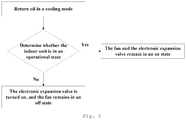
- the existing control method is shown in Fig. 2 .
- the multi-split air conditioning system is operated in a cooling mode. When the multi-split air conditioning system needs oil return, the operational state of the indoor unit 2 is determined.
- the fan 22 and the electronic expansion valve 21 of the indoor unit 2 in an operational state remain in an on state. Whereas, the indoor unit 2 in an off state controls the branch where the indoor unit 2 is located to be opened.
- the electronic expansion valve 21 of the indoor unit 2 may be turned on; or a solenoid valve may also be provided on the branch, and the branch where the indoor unit 2 is located is opened by controlling the solenoid valve, so that the refrigerant and the refrigeration oil may be circulated, and the fan 22 always maintains an off state.
- the indoor unit 2 in the off state during oil return of the system, since the fan 22 is in an off state, the low-temperature and low-pressure refrigerant cannot be effectively evaporated in the indoor heat exchanger 23 thereof, and the low-temperature and low-pressure refrigerant may remain in the indoor heat exchanger 23 after completion of the oil return, which results in outward transmission or radiation of the cold quantity .
- the dewing and dripping phenomenon may occur at the indoor unit 2 in the off state for a long time.
- the present application provides a control method for a multi-split air conditioning system.
- the multi-split air conditioning system determines whether the indoor unit 2 in an off state reaches a dewing condition. That is, it is determined whether there is a dewing risk in the indoor unit 2 in the off state.
- different control methods are used according to different conditions, so as to solve the problem of dewing and dripping at the indoor unit 2 resulting from frequent oil return of the compressor, and improve the user's operational comfort.
- the oil return control of the indoor unit 2 is performed according to a conventional control method. That is, during the oil return of the multi-split air conditioning system, the electronic expansion valve 21 of the indoor unit 2 is controlled to be turned on until the oil return process ends, and the fan 22 always maintains an off state. If it is determined that the indoor unit 2 in the off state reaches the dewing condition, which means that the indoor unit 2 has the dewing risk, at this time, it is necessary to control the oil return of the indoor unit 2 by using an improved control method so as to avoid the problem of dewing and dripping on the indoor unit 2.
- the electronic expansion valve 21 and the fan 22 of the indoor unit 2 are both controlled to be turned on until the oil return process ends, so that during the oil return, the evaporation of the refrigerant within the indoor heat exchanger 23 of the indoor unit 2 is promoted by the fan 22, so as to achieve the effect of avoiding dewing.
- the fan 22 of the indoor unit 2 is controlled to be operated at a low-grade speed during the oil return of the multi-split air conditioning system.
- the low-grade speed described herein may be, for example, the lowest grade speed or the silent grade speed of the indoor unit.
- a humidity sensor is provided in the indoor unit 2 to detect a humidity of the environment in which it is located, and it determines whether the indoor unit 2 has the dewing risk according to the humidity of the environment where the indoor unit 2 is located. That is, the dewing condition comprises: the humidity of the environment where the indoor unit 2 is located being higher than a humidity threshold. If the environment where the indoor unit 2 is located has a low humidity, it is indicated that there is a low air humidity without the dewing risk. If the environment where the indoor unit 2 is located has a high humidity, it is indicated that there is a high air humidity.
- the humidity detected by the humidity sensor provided in the indoor unit 2 is used as the humidity of the environment where the indoor unit 2 is located. Specifically, the humidity of the environment where the indoor unit 2 is located is obtained, and whether the humidity of the environment where the indoor unit 2 is located is higher than a humidity threshold is determined. If so, it is determined that the indoor unit 2 reaches the dewing condition. Otherwise, it is determined that the indoor unit 2 does not reached the dewing condition.
- the humidity threshold therein preferably ranges 60% to 80%.
- the method of controlling the oil return in a cooling mode by using the above-described determination manner comprises:
- the dewing condition comprises: the frequency of oil return of the multi-split air conditioning system reaching or being higher than a predetermined frequency.
- the predetermined frequency may be set according to a specific model and application scenario.
- the preferred range of the predetermined frequency is one oil return every 0.5 to 2 hours.
- the predetermined frequency is one oil return every 0.5 hours, two oil returns every two hours, or three oil returns every three hours.
- the predetermined frequency is four oil returns every 8 hours.
- the dewing condition may further comprise: the fan 22 of the indoor unit 2 in the off state being not effectively operated during a time period between an end of a previous oil return and a beginning of a present oil return. That is, in the case where the multi-split air conditioning system frequently returns oil, if the indoor unit 2 currently in the off state has been operated before, there may not be excessive low-temperature and low-pressure refrigerant accumulated in the indoor heat exchanger 23 of the indoor unit 2, and thus there is no dewing risk. If the indoor unit 2 in the off state has not been operated before, at this time, there may be much low-temperature and low-pressure refrigerant accumulated in the indoor heat exchanger 23 of the indoor unit 2, and thus there may be the dewing risk.
- a criteria for determining an effective operation of the fan 22 comprises whether the fan 22 being turned on at least once. If so, it is determined that the fan 22 has been operated effectively, otherwise it is determined that the fan 22 has not been operated effectively. Since there is a little effect on the refrigerant in the indoor heat exchanger 23 when the fan 22 has been turned on for a short time, in order to improve the accuracy of the determination, further preferably, the criteria for determining the effective operation of the fan 22 further comprises whether a continuous operation time of the fan 22 exceeding a predetermined time. If so, it is determined that the fan 22 has been operated effectively, otherwise it is determined that the fan 22 has not been operated effectively.
- the predetermined time therein may be set according to specific conditions. Preferably, the predetermined time ranges from 5 to 15 minutes, and may be, for example, 5 minutes, 10 minutes, 15 minutes, and further preferably 10 minutes.
- the method of controlling the oil return in a cooling mode by using the above-described determination manner comprises:
- the opening degree of the electronic expansion valve 21 may be set according to an actual refrigerant condition.
- the opening degree of the electronic expansion valve 21 when turned on is controlled to be within a range of 30% to 60%.
- the indoor unit is always in a state having a high dewing risk. At this time, it is not necessary to determine whether the dewing condition is reached.
- the electronic expansion valve 21 and the fan 22 of the indoor unit 2 in an off state are controlled to be turned on.
- the fan 22 is controlled to be operated at the lowest speed, so that it is also possible to achieve the effect of avoiding the dewing and dripping phenomenon of the indoor unit 2 in the off state.
- the solution provided by embodiments of the present invention may be applied to a control process of the multi-split air conditioning system.
- the multi-split air conditioning system comprises a compressor and a plurality of indoor units respectively disposed on a plurality of parallel branches.
- the indoor unit comprises a fan.
- the control method comprises: in a cooling mode, when the multi-split air conditioning system needs oil return, the multi-split air conditioning system determining whether an indoor unit in an off state reaches a dewing condition, opening a branch where the indoor unit is located, and controlling the fan of the indoor unit differently according to a determination result.
- control method for the multi-split air conditioning system when the compressor needs oil return, first of all, it is determined whether there is a dewing risk in the indoor unit in an off state, and different control methods are used for the fan according to different conditions, so as to solve the problem of dewing and dripping at the indoor unit resulting from frequent oil return of the compressor, and improve the user's operational comfort.
Landscapes
- Engineering & Computer Science (AREA)
- Mechanical Engineering (AREA)
- General Engineering & Computer Science (AREA)
- Chemical & Material Sciences (AREA)
- Combustion & Propulsion (AREA)
- Physics & Mathematics (AREA)
- Thermal Sciences (AREA)
- Fluid Mechanics (AREA)
- Air Conditioning Control Device (AREA)
Abstract
Description
- The present invention relates to the technical field of an air conditioner, in particular to a control method for a multi-split air conditioning system and a multi-split air conditioning system controlled using the control method.
- In an air-conditioning system, after a compressor is operated for a period of time, a refrigeration oil may be circulated in the system along with a refrigerant, which causes the refrigeration oil to possibly remain in an indoor heat exchanger or in a pipe between an indoor unit and an outdoor unit. If such refrigeration oil cannot return to the outdoor unit in time, the compressor cannot be effectively lubricated and cooled by the refrigeration oil, thereby affecting the operating performance and reliability of the compressor. Therefore, after the air-conditioning system is operated for a period of time, it is necessary to perform oil return to bring the refrigeration oil brought out by the compressor during exhaust of the compressor back into the compressor, thereby ensuring normal operation of the air-conditioning system. In a multi-split air conditioning system comprising multiple indoor units, when the compressor returns oil, an electronic expansion valve of the indoor unit in an off state needs to be turned on in order to return the refrigeration oil to the outdoor unit. When the multi-split air conditioning system is operated in a cooling mode, if the compressor frequently returns oil, a problem of dewing and dripping will occur at the indoor unit in an off state for a long time, which will affect the user's experience.
- In view of this, one of the objectives of the present invention is to provide a control method for a multi-split air conditioning system and a multi-split air conditioning system which is controlled using the control method, which are capable of effectively solving the problem of dewing and dripping at the indoor unit resulting from frequent oil return of the compressor, and improving the user's operational comfort.
- To achieve the above-described objective, on the one hand, the present invention uses the following technical solution: a control method for a multi-split air conditioning system, wherein the multi-split air conditioning system comprises a compressor and a plurality of indoor units respectively disposed on a plurality of parallel branches, each of the plurality of indoor units comprises a fan, and the control method comprises: in a cooling mode, when the multi-split air conditioning system needs oil return, the multi-split air conditioning system determining whether an indoor unit in an off state reaches a dewing condition, opening a branch where the indoor unit is located, and controlling the fan of the indoor unit differently according to a determination result.
- Optionally, the control method further comprises: when it is determined that the indoor unit in the off state does not reach the dewing condition, controlling the fan of the indoor unit to maintain an off state during the oil return of the multi-split air conditioning system; and/or, when it is determined that the indoor unit in the off state reaches the dewing condition, controlling the fan of the indoor unit to be turned on during the oil return of the multi-split air conditioning system.
- Optionally, each of the plurality of indoor units further comprises a throttling device, and a way to open the branch where the indoor unit is located is to open the throttling device of the indoor unit.
- Optionally, the throttle device is opened at an opening degree of 30% to 60%.
- Optionally, when it is determined that the indoor unit in the off state reaches the dewing condition, the fan of the indoor unit is controlled to be operated at a low grade speed during the oil return of the multi-split air conditioning system.
- Optionally, the dewing condition comprises: a current humidity of an environment where the indoor unit is located being higher than a humidity threshold.
- Optionally, the humidity threshold is 60% to 80%.
- Optionally, it is determined whether the indoor unit in the off state reaches the dewing condition at least according to a frequency of oil return of the multi-split air conditioning system.
- Optionally, the dewing condition comprises: the frequency of oil return of the multi-split air conditioning system reaching or being higher than a predetermined frequency.
- Optionally, the predetermined frequency is one oil return every 0.5 to 2 hours.
- Optionally, the dewing condition further comprises: the fan of the indoor unit being not effectively operated during a time period between an end of the previous oil return and a beginning of the present oil return.
- Optionally, a criteria for determining an effective operation of the fan comprises: whether the fan being turned on at least once.
- Optionally, the criteria for determining the effective operation of the fan further comprises : whether a continuous operation time of the fan exceeding a predetermined time.
- Optionally, the predetermined time is 5 to 15 minutes.
- On the other hand, the present invention uses the following technical solution: a control method for a multi-split air conditioning system, wherein the multi-split air conditioning system comprises a compressor and a plurality of indoor units respectively disposed on a plurality of parallel branches, each of the plurality of indoor units comprises a fan, and the control method comprises: in a cooling mode, during oil return of the multi-split air conditioning system, the multi-split air conditioning system controlling a branch where an indoor unit in an off state is located to be opened, and turning on the fan of the indoor unit.
- Optionally, in the cooling mode, the multi-split air conditioning system controls the fan to be operated at a low grade speed during the oil return of the multi-split air conditioning system.
- In a further aspect, the present invention uses the following technical solution: a multi-split air conditioning system which is controlled using the control method described above.
- In the control method for the multi-split air conditioning system provided by the present invention, when the compressor needs oil return, first of all, it is determined whether there is a risk of dewing in the indoor unit in an off state, and different control methods are used for the fan according to different conditions, so as to solve the problem of dewing and dripping at the indoor unit resulting from frequent oil return of the compressor, and improve the user's operational comfort.
- The above-described and other objectives, features, and advantages of the present invention will be more apparent from the following description of embodiments of the present invention in conjunction with the accompanying drawings, in which:
-
Fig. 1 is a schematic structural view of a multi-split air conditioning system provided by the present invention; -
Fig. 2 shows a flow chart of a control method when an existing multi-split air conditioning system returns oil; -
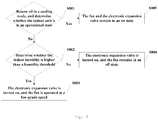
Fig. 3 shows a flow chart of a control method of an embodiment for the multi-split air conditioning system provided by the present invention; -
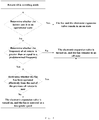
Fig. 4 shows a flow chart of a control method of another embodiment for the multi-split air conditioning system provided by the present invention. - In the
figures, 1 , an outdoor unit; 2, an indoor unit; 21, an electronic expansion valve; 22, a fan; 23, an indoor heat exchanger. - The present invention is described below based on the embodiments, but the present invention is not only limited to these embodiments. In the following detailed description of the present invention, some specific details are expatiated. For those skilled in the art, the present invention may also be fully understood without the description of these details. In order to avoid obscuring the essence of the present invention, well-known methods, processes, procedures, and elements are not described in detail.
- In addition, those skilled in the art should understand that the drawings provided here are for the purpose of illustration, and the drawings are not necessarily drawn to scale.
- Unless specifically required in the context, the words "comprising", "including", and the like throughout the specification and claims should be interpreted as inclusive rather than exclusive or exhaustive, that is, the meaning of "comprising but not limited to".
- In the description of the present invention, it should be understood that, the terms "first", "second", and the like are used for descriptive purposes only, and cannot be understood to indicate or imply relative importance. In addition, in the description of the present invention, unless otherwise stated, the meaning of "a plurality of" is two or more.
- For the problem that the indoor unit in an off state for a long time may suffer from dewing and dripping caused by frequent oil return of the compressor present in the existing multi-split air conditioning system, it is found in the present application that it is caused due to the reasons that the existing oil return control method is not reasonable. Specifically, as shown in
Fig. 1 , the multi-split air conditioning system comprises an outdoor unit 1 and a plurality ofindoor units 2 arranged in parallel. That is, a plurality of parallel branches are provided on the refrigerant circulation circuit, and differentindoor units 2 are respectively provided on different branches to realize mutual parallel connection of theindoor units 2. The outdoor unit 1 is internally provided with a compressor, and theindoor unit 2 comprises a throttling device, anindoor heat exchanger 23, and afan 22. The throttling device may be any device capable of throttling the refrigerant, and anelectronic expansion valve 21 shown inFig. 1 is preferably used as the throttling device to facilitate automatic control. Thefan 22 is provided to drive air flow to promote heat exchange between the air and theindoor heat exchanger 23. The existing control method is shown inFig. 2 . The multi-split air conditioning system is operated in a cooling mode. When the multi-split air conditioning system needs oil return, the operational state of theindoor unit 2 is determined. Thefan 22 and theelectronic expansion valve 21 of theindoor unit 2 in an operational state remain in an on state. Whereas, theindoor unit 2 in an off state controls the branch where theindoor unit 2 is located to be opened. For example, theelectronic expansion valve 21 of theindoor unit 2 may be turned on; or a solenoid valve may also be provided on the branch, and the branch where theindoor unit 2 is located is opened by controlling the solenoid valve, so that the refrigerant and the refrigeration oil may be circulated, and thefan 22 always maintains an off state. For theindoor unit 2 in the off state, during oil return of the system, since thefan 22 is in an off state, the low-temperature and low-pressure refrigerant cannot be effectively evaporated in theindoor heat exchanger 23 thereof, and the low-temperature and low-pressure refrigerant may remain in theindoor heat exchanger 23 after completion of the oil return, which results in outward transmission or radiation of the cold quantity . When the system frequently returns oil, the dewing and dripping phenomenon may occur at theindoor unit 2 in the off state for a long time. - In view of the above problem, the present application provides a control method for a multi-split air conditioning system. In a cooling mode, when the compressor needs oil return, the multi-split air conditioning system determines whether the
indoor unit 2 in an off state reaches a dewing condition. That is, it is determined whether there is a dewing risk in theindoor unit 2 in the off state. And different control methods are used according to different conditions, so as to solve the problem of dewing and dripping at theindoor unit 2 resulting from frequent oil return of the compressor, and improve the user's operational comfort. - Wherein, if it is determined that the
indoor unit 2 in the off state does not reach the dewing condition, which means that theindoor unit 2 does not have the dewing risk, the oil return control of theindoor unit 2 is performed according to a conventional control method. That is, during the oil return of the multi-split air conditioning system, theelectronic expansion valve 21 of theindoor unit 2 is controlled to be turned on until the oil return process ends, and thefan 22 always maintains an off state. If it is determined that theindoor unit 2 in the off state reaches the dewing condition, which means that theindoor unit 2 has the dewing risk, at this time, it is necessary to control the oil return of theindoor unit 2 by using an improved control method so as to avoid the problem of dewing and dripping on theindoor unit 2. Specifically, during the oil return of the multi-split air conditioning system, theelectronic expansion valve 21 and thefan 22 of theindoor unit 2 are both controlled to be turned on until the oil return process ends, so that during the oil return, the evaporation of the refrigerant within theindoor heat exchanger 23 of theindoor unit 2 is promoted by thefan 22, so as to achieve the effect of avoiding dewing. Preferably, in order to reduce the impact caused by the operation of thefan 22 over the environment of the area where thefan 22 is located, thefan 22 of theindoor unit 2 is controlled to be operated at a low-grade speed during the oil return of the multi-split air conditioning system. The low-grade speed described herein may be, for example, the lowest grade speed or the silent grade speed of the indoor unit. - There may be multiple methods for determining whether the
indoor unit 2 in the off state reaches the dewing condition. For example, in an embodiment, a humidity sensor is provided in theindoor unit 2 to detect a humidity of the environment in which it is located, and it determines whether theindoor unit 2 has the dewing risk according to the humidity of the environment where theindoor unit 2 is located. That is, the dewing condition comprises: the humidity of the environment where theindoor unit 2 is located being higher than a humidity threshold. If the environment where theindoor unit 2 is located has a low humidity, it is indicated that there is a low air humidity without the dewing risk. If the environment where theindoor unit 2 is located has a high humidity, it is indicated that there is a high air humidity. If thefan 22 is not turned on, the water vapor in the air during the oil return may condense to produce a dewing. Preferably, the humidity detected by the humidity sensor provided in theindoor unit 2 is used as the humidity of the environment where theindoor unit 2 is located. Specifically, the humidity of the environment where theindoor unit 2 is located is obtained, and whether the humidity of the environment where theindoor unit 2 is located is higher than a humidity threshold is determined. If so, it is determined that theindoor unit 2 reaches the dewing condition. Otherwise, it is determined that theindoor unit 2 does not reached the dewing condition. The humidity threshold therein preferably ranges 60% to 80%. - As shown in
Fig. 3 , the method of controlling the oil return in a cooling mode by using the above-described determination manner comprises: - At step S001, when the multi-split air conditioning system needs oil return, whether the
indoor unit 2 is in an operational state is determined. If so, proceed to step S005, otherwise proceed to step S002. - At step S002, the current humidity of the environment where the
indoor unit 2 in an off state is located is obtained, and whether the current humidity is higher than a humidity threshold is determined. If so, proceed to step S003, otherwise proceed to step S004. - At step S003, the
electronic expansion valve 21 and thefan 22 of theindoor unit 2 are both turned on, thefan 22 is operated at a low-grade speed, and theelectronic expansion valve 21 and thefan 22 are turned off after completion of the oil return. - At step S004, the
electronic expansion valve 21 of theindoor unit 2 is turned on, and theelectronic expansion valve 21 is turned off after completion of the oil return, while thefan 22 is always in an off state. - At step S005, the operational state of the
indoor unit 2 remains unchanged, and theelectronic expansion valve 21 and thefan 22 maintain an on state. - In another embodiment, since the dewing phenomenon is caused by frequent oil return of the multi-split air conditioning system, based on this, it may be determined whether the
indoor unit 2 in the off state reaches the dewing condition according to a frequency of oil return of the multi-split air conditioning system. That is, the dewing condition comprises: the frequency of oil return of the multi-split air conditioning system reaching or being higher than a predetermined frequency. When the frequency of oil return of the multi-split air conditioning system reaches or is higher than the predetermined frequency, there is a risk of accumulating excessive low-temperature and low-pressure refrigerant in theindoor heat exchanger 23 of theindoor unit 2 in the off state. If excessive low-temperature and low-pressure refrigerant is accumulated, it will also emit more cold quantity, and at this time, there is a dewing risk. When there is a low oil return frequency of the multi-split air conditioning system, it is indicated that the cold quantity of the low-temperature and low-pressure refrigerant accumulated in theindoor heat exchanger 23 of theindoor unit 2 in the off state is not enough to cause the dewing phenomenon. The predetermined frequency may be set according to a specific model and application scenario. The preferred range of the predetermined frequency is one oil return every 0.5 to 2 hours. For example, the predetermined frequency is one oil return every 0.5 hours, two oil returns every two hours, or three oil returns every three hours. In a preferred embodiment, the predetermined frequency is four oil returns every 8 hours. - In a further preferred control method, the dewing condition may further comprise: the
fan 22 of theindoor unit 2 in the off state being not effectively operated during a time period between an end of a previous oil return and a beginning of a present oil return. That is, in the case where the multi-split air conditioning system frequently returns oil, if theindoor unit 2 currently in the off state has been operated before, there may not be excessive low-temperature and low-pressure refrigerant accumulated in theindoor heat exchanger 23 of theindoor unit 2, and thus there is no dewing risk. If theindoor unit 2 in the off state has not been operated before, at this time, there may be much low-temperature and low-pressure refrigerant accumulated in theindoor heat exchanger 23 of theindoor unit 2, and thus there may be the dewing risk. - Optionally, a criteria for determining an effective operation of the
fan 22 comprises whether thefan 22 being turned on at least once. If so, it is determined that thefan 22 has been operated effectively, otherwise it is determined that thefan 22 has not been operated effectively. Since there is a little effect on the refrigerant in theindoor heat exchanger 23 when thefan 22 has been turned on for a short time, in order to improve the accuracy of the determination, further preferably, the criteria for determining the effective operation of thefan 22 further comprises whether a continuous operation time of thefan 22 exceeding a predetermined time. If so, it is determined that thefan 22 has been operated effectively, otherwise it is determined that thefan 22 has not been operated effectively. The predetermined time therein may be set according to specific conditions. Preferably, the predetermined time ranges from 5 to 15 minutes, and may be, for example, 5 minutes, 10 minutes, 15 minutes, and further preferably 10 minutes. - As shown in
Fig. 4 , the method of controlling the oil return in a cooling mode by using the above-described determination manner comprises: - At step S010, when the multi-split air conditioning system needs oil return, whether the
indoor unit 2 is in an operational state is determined. If so, proceed to step S060, otherwise proceed to step S020. - At step S020, whether the frequency of oil return of the multi-split air conditioning system reaches or is higher than the predetermined frequency is determined. If so, proceed to step S030, otherwise proceed to step S040.
- At step S030, whether the
fan 22 of theindoor unit 2 in an off state has been effectively operated is determined during a time period between the end of the previous oil return and the beginning of the present oil return. If so, proceed to step S040, otherwise proceed to step S050. - At step S040, the
electronic expansion valve 21 of theindoor unit 2 is turned on, and theelectronic expansion valve 21 is turned off after completion of the oil return, while thefan 22 is always in an off state. - At step S050, the
electronic expansion valve 21 and thefan 22 of theindoor unit 2 are both turned on, thefan 22 is operated at a low-grade speed, and theelectronic expansion valve 21 and thefan 22 are turned off after completion of the oil return. - At step S060, the operational state of the
indoor unit 2 remains unchanged, and theelectronic expansion valve 21 and thefan 22 maintain an on state. - It may be understood that, when the
electronic expansion valve 21 is turned on, the opening degree of theelectronic expansion valve 21 may be set according to an actual refrigerant condition. For example, the opening degree of theelectronic expansion valve 21 when turned on is controlled to be within a range of 30% to 60%. - In an alternative embodiment, it is also possible not to determine whether the dewing condition is reached. For example, in certain application scenarios, the indoor unit is always in a state having a high dewing risk. At this time, it is not necessary to determine whether the dewing condition is reached. In a cooling mode, as long as the multi-split air conditioning system returns oil, the
electronic expansion valve 21 and thefan 22 of theindoor unit 2 in an off state are controlled to be turned on. Preferably, thefan 22 is controlled to be operated at the lowest speed, so that it is also possible to achieve the effect of avoiding the dewing and dripping phenomenon of theindoor unit 2 in the off state. - Those skilled in the art may easily understand that, under the premise that there is no conflict, various preferred solutions as described above may be freely combined and superimposed.
- It should be understood that, the above-described embodiments are merely exemplary but not restrictive, and those skilled in the art may make various obvious or equivalent modifications or replacements directed to the above-described details without departing from the basic principles of the present invention, which will be all comprised in the scope of the claims of the present invention.
- The solution provided by embodiments of the present invention may be applied to a control process of the multi-split air conditioning system. The multi-split air conditioning system comprises a compressor and a plurality of indoor units respectively disposed on a plurality of parallel branches. The indoor unit comprises a fan. The control method comprises: in a cooling mode, when the multi-split air conditioning system needs oil return, the multi-split air conditioning system determining whether an indoor unit in an off state reaches a dewing condition, opening a branch where the indoor unit is located, and controlling the fan of the indoor unit differently according to a determination result. In the control method for the multi-split air conditioning system provided by the present invention, when the compressor needs oil return, first of all, it is determined whether there is a dewing risk in the indoor unit in an off state, and different control methods are used for the fan according to different conditions, so as to solve the problem of dewing and dripping at the indoor unit resulting from frequent oil return of the compressor, and improve the user's operational comfort.
Claims (16)
- A control method for a multi-split air conditioning system, characterized in the multi-split air conditioning system comprises a compressor and a plurality of indoor units respectively disposed on a plurality of parallel branches, each of the plurality of indoor units comprises a fan, and the control method comprises:
in a cooling mode, when the multi-split air conditioning system needs oil return, the multi-split air conditioning system determining whether an indoor unit in an off state reaches a dewing condition, opening a branch where the indoor unit is located, and controlling the fan of the indoor unit differently according to a determination result. - The control method according to claim 1, characterized in the control method further comprises:when it is determined that the indoor unit in the off state does not reach the dewing condition, controlling the fan of the indoor unit to maintain an off state during the oil return of the multi-split air conditioning system; and/or,when it is determined that the indoor unit in the off state reaches the dewing condition, controlling the fan of the indoor unit to be turned on during the oil return of the multi-split air conditioning system.
- The control method according to claim 2, characterized in when it is determined that the indoor unit in the off state reaches the dewing condition, the fan of the indoor unit is controlled to be operated at a low-grade speed during the oil return of the multi-split air conditioning system.
- The control method according to claim 1, characterized in each of the plurality of indoor units further comprises a throttling device, and a way to open the branch where the indoor unit is located is to open the throttling device of the indoor unit.
- The control method according to claim 4, characterized in the throttle device is opened at an opening degree of 30% to 60%.
- The control method according to any one of claims 1 to 5, characterized in the dewing condition comprises: a current humidity of an environment where the indoor unit is located being higher than a humidity threshold.
- The control method according to claim 6, characterized in the humidity threshold is 60% to 80%.
- The control method according to any one of claims 1 to 5, characterized in it is determined whether the indoor unit in the off state reaches the dewing condition at least according to a frequency of oil return of the multi-split air conditioning system.
- The control method according to claim 8, characterized in the dewing condition comprises: the frequency of oil return of the multi-split air conditioning system reaching or being higher than a predetermined frequency.
- The control method according to claim 9, characterized in the predetermined frequency is one oil return every 0.5 to 2 hours.
- The control method according to claim 9, characterized in the dewing condition further comprises: the fan of the indoor unit being not effectively operated during a time period between an end of a previous oil return and a beginning of a present oil return, and a criteria for determining an effective operation of the fan comprises: whether the fan being turned on at least once.
- The control method according to claim 11, characterized in the criteria for determining the effective operation of the fan further comprises: whether a continuous operation time of the fan exceeding a predetermined time.
- The control method according to claim 12, characterized in the predetermined time is 5 to 15 minutes.
- A control method for a multi-split air conditioning system, characterized in the multi-split air conditioning system comprises a compressor and a plurality of indoor units respectively disposed on a plurality of parallel branches, each of the plurality of indoor units comprises a fan, and the control method comprises:
in a cooling mode, during oil return of the multi-split air conditioning system, the multi-split air conditioning system controlling a branch where an indoor unit in an off state is located to be opened, and turning on the fan of the indoor unit. - The control method according to claim 14, characterized in in the cooling mode, the multi-split air conditioning system controls the fan to be operated at a low-grade speed during the oil return of the multi-split air conditioning system.
- A multi-split air conditioning system, characterized in which is controlled using the control method according to any one of claims 1 to 15.
Applications Claiming Priority (2)
| Application Number | Priority Date | Filing Date | Title |
|---|---|---|---|
| CN201710800560.9A CN107575939B (en) | 2017-09-07 | 2017-09-07 | Multi-split system and control method thereof |
| PCT/CN2018/104344 WO2019047889A1 (en) | 2017-09-07 | 2018-09-06 | Multi-split air conditioning system and control method therefor |
Publications (3)
| Publication Number | Publication Date |
|---|---|
| EP3640547A1 true EP3640547A1 (en) | 2020-04-22 |
| EP3640547A4 EP3640547A4 (en) | 2020-09-30 |
| EP3640547B1 EP3640547B1 (en) | 2023-05-03 |
Family
ID=61031424
Family Applications (1)
| Application Number | Title | Priority Date | Filing Date |
|---|---|---|---|
| EP18855086.7A Active EP3640547B1 (en) | 2017-09-07 | 2018-09-06 | Multi-split air conditioning system and control method therefor |
Country Status (4)
| Country | Link |
|---|---|
| US (1) | US11408633B2 (en) |
| EP (1) | EP3640547B1 (en) |
| CN (1) | CN107575939B (en) |
| WO (1) | WO2019047889A1 (en) |
Cited By (1)
| Publication number | Priority date | Publication date | Assignee | Title |
|---|---|---|---|---|
| US11408633B2 (en) | 2017-09-07 | 2022-08-09 | Gree Electric Appliances (Wuhan) Co., Ltd. | Multi-split air conditioning system and control method therefor |
Families Citing this family (8)
| Publication number | Priority date | Publication date | Assignee | Title |
|---|---|---|---|---|
| CN107726554B (en) * | 2017-09-19 | 2020-01-17 | 青岛海尔空调电子有限公司 | A kind of multi-connection comfort balance control method and system |
| CN108397858A (en) * | 2018-02-14 | 2018-08-14 | 青岛海尔空调器有限总公司 | Condensation prevention control method for air conditioner |
| CN109631248B (en) * | 2018-11-16 | 2021-05-25 | 青岛海尔空调电子有限公司 | Multi-split air conditioner refrigeration oil return noise reduction control method and system |
| CN111878892B (en) * | 2020-06-29 | 2022-02-22 | 宁波奥克斯电气股份有限公司 | Oil return method and device of multi-split air conditioner system, air conditioner and storage medium |
| CN114353276B (en) | 2020-10-13 | 2023-03-28 | 美的集团武汉制冷设备有限公司 | Multi-split air conditioner, control method thereof and computer storage medium |
| CN113915737B (en) * | 2021-11-23 | 2022-11-04 | 宁波奥克斯电气股份有限公司 | A low-temperature heating startup control method for an air conditioner and an air conditioner |
| CN117889525A (en) * | 2022-10-09 | 2024-04-16 | 青岛海尔空调电子有限公司 | Multi-connected air conditioning system and anti-condensation control method and storage medium thereof |
| CN119309346B (en) * | 2023-07-14 | 2025-12-30 | 青岛海尔空调电子有限公司 | Oil return control method for multi-split air conditioning systems |
Family Cites Families (26)
| Publication number | Priority date | Publication date | Assignee | Title |
|---|---|---|---|---|
| CN100498139C (en) * | 2001-01-31 | 2009-06-10 | 三菱电机株式会社 | Refrigeration cycle device |
| JP2003166764A (en) * | 2001-09-20 | 2003-06-13 | Denso Corp | Refrigeration cycle device |
| ES2443644T3 (en) * | 2002-03-18 | 2014-02-20 | Daikin Industries, Ltd. | Air conditioning system |
| KR101199382B1 (en) * | 2006-02-17 | 2012-11-09 | 엘지전자 주식회사 | Air-conditioner and Controlling Method for the same |
| CN101187517B (en) * | 2006-11-17 | 2010-05-12 | 海尔集团公司 | Air conditioner defrosting method |
| CN101216198B (en) * | 2007-12-26 | 2010-05-19 | 广汽本田汽车有限公司 | Air conditioning system for injection molding workshop and control method thereof |
| ES2711250T3 (en) * | 2009-10-27 | 2019-04-30 | Mitsubishi Electric Corp | Air conditioner |
| JP5484930B2 (en) * | 2010-01-25 | 2014-05-07 | 三菱重工業株式会社 | Air conditioner |
| CN104180563B (en) * | 2013-05-27 | 2017-06-20 | 珠海格力电器股份有限公司 | Oil return method for heating of multi-split air conditioning system |
| CN104567106A (en) * | 2013-10-24 | 2015-04-29 | 广州南洋理工职业学院 | High-temperature oil return method of variable frequency air conditioner |
| JP5842970B2 (en) * | 2013-10-29 | 2016-01-13 | ダイキン工業株式会社 | Air conditioner |
| KR20150075895A (en) * | 2013-12-26 | 2015-07-06 | 동부대우전자 주식회사 | Method and apparatus for controlling refrigerator to prevent dew from forming thereon |
| JP6230931B2 (en) * | 2014-02-20 | 2017-11-15 | 三菱重工サーマルシステムズ株式会社 | Multi-type air conditioner |
| KR101677649B1 (en) * | 2014-12-23 | 2016-11-18 | 엘지전자 주식회사 | Refrigerator |
| JP6028816B2 (en) * | 2015-01-30 | 2016-11-24 | ダイキン工業株式会社 | Air conditioner |
| JP6028817B2 (en) * | 2015-01-30 | 2016-11-24 | ダイキン工業株式会社 | Air conditioner |
| CN105987483A (en) * | 2015-02-05 | 2016-10-05 | 佛山市禾才科技服务有限公司 | Novel air conditioner defrosting control system |
| KR102264023B1 (en) * | 2015-02-06 | 2021-06-11 | 엘지전자 주식회사 | Air conditioner |
| EP3176516B1 (en) * | 2015-12-01 | 2018-03-21 | Toshiba Carrier Corporation | Air-conditioning apparatus |
| KR101673846B1 (en) * | 2016-04-11 | 2016-11-09 | 대성히트펌프 주식회사 | Method for controlling oil recovery in heatpump system, and heatpump system with oil recovery control fuction |
| KR102552118B1 (en) * | 2016-07-22 | 2023-07-10 | 한온시스템 주식회사 | Air conditining system for vehicle and its control method |
| CN106403192B (en) | 2016-10-09 | 2019-01-15 | 珠海格力电器股份有限公司 | Anti-condensation operation control method and device and multi-connected air conditioning system |
| CN106642602B (en) * | 2016-10-26 | 2023-04-07 | 珠海格力电器股份有限公司 | Multi-connected air conditioning system and detection control method and device thereof |
| CN206207681U (en) * | 2016-10-26 | 2017-05-31 | 珠海格力电器股份有限公司 | Detection control device of multi-connected air conditioning system |
| KR102600975B1 (en) * | 2016-12-21 | 2023-11-14 | 삼성전자주식회사 | Air conditioner and control method thereof |
| CN107575939B (en) * | 2017-09-07 | 2019-10-25 | 珠海格力电器股份有限公司 | Multi-split system and control method thereof |
-
2017
- 2017-09-07 CN CN201710800560.9A patent/CN107575939B/en active Active
-
2018
- 2018-09-06 US US16/645,209 patent/US11408633B2/en active Active
- 2018-09-06 WO PCT/CN2018/104344 patent/WO2019047889A1/en not_active Ceased
- 2018-09-06 EP EP18855086.7A patent/EP3640547B1/en active Active
Cited By (1)
| Publication number | Priority date | Publication date | Assignee | Title |
|---|---|---|---|---|
| US11408633B2 (en) | 2017-09-07 | 2022-08-09 | Gree Electric Appliances (Wuhan) Co., Ltd. | Multi-split air conditioning system and control method therefor |
Also Published As
| Publication number | Publication date |
|---|---|
| CN107575939A (en) | 2018-01-12 |
| EP3640547B1 (en) | 2023-05-03 |
| US11408633B2 (en) | 2022-08-09 |
| WO2019047889A1 (en) | 2019-03-14 |
| CN107575939B (en) | 2019-10-25 |
| EP3640547A4 (en) | 2020-09-30 |
| US20200292199A1 (en) | 2020-09-17 |
Similar Documents
| Publication | Publication Date | Title |
|---|---|---|
| EP3640547A1 (en) | Multi-split air conditioning system and control method therefor | |
| CN105371545B (en) | The refrigerant circulation amount adjustment method of air conditioner and its refrigeration system | |
| US11320185B2 (en) | Defrosting control method for multi-split system | |
| US20190186776A1 (en) | Air conditioner system and a control method for the same | |
| CN103528142B (en) | Anti-frosting air conditioner and control method thereof | |
| US11480369B2 (en) | Fresh-air air conditioning system and control method | |
| CN110319541B (en) | Unloading adjustment control method of large-displacement variable-frequency multi-split system | |
| CN112856717A (en) | Air conditioner, control method thereof and storage medium | |
| CN112856718A (en) | Air conditioner, control method thereof and storage medium | |
| US10955149B2 (en) | Dehumidification system for heat pump | |
| CN106642417A (en) | Air conditioner and low-temperature refrigeration method thereof | |
| JP2015117894A (en) | Air conditioner outdoor unit | |
| CN109059333A (en) | Air conditioner, the control method of air conditioner and storage medium | |
| CN109442792B (en) | Defrosting system and defrosting control method of air conditioner and air conditioner | |
| EP3379170A1 (en) | Air conditioning operation control device, air conditioning system, air conditioning control method, and program | |
| CN110319542B (en) | Unloading start-stop control method of large-displacement variable-frequency multi-split system | |
| JP4134501B2 (en) | Automatic operation control method for air conditioner | |
| CN114061026B (en) | New fan anti-frosting control method, new fan and computer readable storage medium | |
| JP6755396B2 (en) | Air conditioner | |
| CN106288544A (en) | Air-conditioner and control method thereof | |
| CN112797570B (en) | Defrosting control method, defrosting device and multi-connected air conditioning system | |
| WO2022193596A1 (en) | Method and device for controlling air conditioner | |
| CN210891939U (en) | Outdoor unit condenser, outdoor unit and variable frequency air conditioner | |
| CN115992987B (en) | Compressor return pipe de-icing control method and air conditioner | |
| CA2672747C (en) | Forced-air cross-defrost type air-conditioning system |
Legal Events
| Date | Code | Title | Description |
|---|---|---|---|
| STAA | Information on the status of an ep patent application or granted ep patent |
Free format text: STATUS: THE INTERNATIONAL PUBLICATION HAS BEEN MADE |
|
| PUAI | Public reference made under article 153(3) epc to a published international application that has entered the european phase |
Free format text: ORIGINAL CODE: 0009012 |
|
| STAA | Information on the status of an ep patent application or granted ep patent |
Free format text: STATUS: REQUEST FOR EXAMINATION WAS MADE |
|
| 17P | Request for examination filed |
Effective date: 20200117 |
|
| AK | Designated contracting states |
Kind code of ref document: A1 Designated state(s): AL AT BE BG CH CY CZ DE DK EE ES FI FR GB GR HR HU IE IS IT LI LT LU LV MC MK MT NL NO PL PT RO RS SE SI SK SM TR |
|
| AX | Request for extension of the european patent |
Extension state: BA ME |
|
| A4 | Supplementary search report drawn up and despatched |
Effective date: 20200902 |
|
| RIC1 | Information provided on ipc code assigned before grant |
Ipc: F24F 11/77 20180101ALI20200827BHEP Ipc: F25B 31/00 20060101ALI20200827BHEP Ipc: F24F 1/00 20190101AFI20200827BHEP Ipc: F24F 11/86 20180101ALI20200827BHEP Ipc: F24F 110/20 20180101ALI20200827BHEP Ipc: F25B 41/06 20060101ALI20200827BHEP Ipc: F24F 11/70 20180101ALI20200827BHEP Ipc: F24F 11/61 20180101ALI20200827BHEP Ipc: F24F 13/22 20060101ALI20200827BHEP |
|
| DAV | Request for validation of the european patent (deleted) | ||
| DAX | Request for extension of the european patent (deleted) | ||
| RIC1 | Information provided on ipc code assigned before grant |
Ipc: F25B 49/02 20060101ALI20221215BHEP Ipc: F24F 11/70 20180101ALI20221215BHEP Ipc: F24F 11/86 20180101ALI20221215BHEP Ipc: F24F 110/20 20180101ALI20221215BHEP Ipc: F25B 31/00 20060101ALI20221215BHEP Ipc: F24F 13/22 20060101ALI20221215BHEP Ipc: F24F 11/77 20180101ALI20221215BHEP Ipc: F24F 11/61 20180101ALI20221215BHEP Ipc: F24F 1/00 20190101AFI20221215BHEP |
|
| GRAP | Despatch of communication of intention to grant a patent |
Free format text: ORIGINAL CODE: EPIDOSNIGR1 |
|
| STAA | Information on the status of an ep patent application or granted ep patent |
Free format text: STATUS: GRANT OF PATENT IS INTENDED |
|
| INTG | Intention to grant announced |
Effective date: 20230131 |
|
| GRAS | Grant fee paid |
Free format text: ORIGINAL CODE: EPIDOSNIGR3 |
|
| GRAA | (expected) grant |
Free format text: ORIGINAL CODE: 0009210 |
|
| STAA | Information on the status of an ep patent application or granted ep patent |
Free format text: STATUS: THE PATENT HAS BEEN GRANTED |
|
| AK | Designated contracting states |
Kind code of ref document: B1 Designated state(s): AL AT BE BG CH CY CZ DE DK EE ES FI FR GB GR HR HU IE IS IT LI LT LU LV MC MK MT NL NO PL PT RO RS SE SI SK SM TR |
|
| REG | Reference to a national code |
Ref country code: GB Ref legal event code: FG4D |
|
| REG | Reference to a national code |
Ref country code: DE Ref legal event code: R096 Ref document number: 602018049378 Country of ref document: DE |
|
| REG | Reference to a national code |
Ref country code: AT Ref legal event code: REF Ref document number: 1564893 Country of ref document: AT Kind code of ref document: T Effective date: 20230515 Ref country code: CH Ref legal event code: EP |
|
| REG | Reference to a national code |
Ref country code: IE Ref legal event code: FG4D |
|
| P01 | Opt-out of the competence of the unified patent court (upc) registered |
Effective date: 20230530 |
|
| REG | Reference to a national code |
Ref country code: LT Ref legal event code: MG9D |
|
| REG | Reference to a national code |
Ref country code: NL Ref legal event code: MP Effective date: 20230503 |
|
| PG25 | Lapsed in a contracting state [announced via postgrant information from national office to epo] |
Ref country code: SE Free format text: LAPSE BECAUSE OF FAILURE TO SUBMIT A TRANSLATION OF THE DESCRIPTION OR TO PAY THE FEE WITHIN THE PRESCRIBED TIME-LIMIT Effective date: 20230503 Ref country code: PT Free format text: LAPSE BECAUSE OF FAILURE TO SUBMIT A TRANSLATION OF THE DESCRIPTION OR TO PAY THE FEE WITHIN THE PRESCRIBED TIME-LIMIT Effective date: 20230904 Ref country code: NO Free format text: LAPSE BECAUSE OF FAILURE TO SUBMIT A TRANSLATION OF THE DESCRIPTION OR TO PAY THE FEE WITHIN THE PRESCRIBED TIME-LIMIT Effective date: 20230803 Ref country code: NL Free format text: LAPSE BECAUSE OF FAILURE TO SUBMIT A TRANSLATION OF THE DESCRIPTION OR TO PAY THE FEE WITHIN THE PRESCRIBED TIME-LIMIT Effective date: 20230503 Ref country code: ES Free format text: LAPSE BECAUSE OF FAILURE TO SUBMIT A TRANSLATION OF THE DESCRIPTION OR TO PAY THE FEE WITHIN THE PRESCRIBED TIME-LIMIT Effective date: 20230503 |
|
| PG25 | Lapsed in a contracting state [announced via postgrant information from national office to epo] |
Ref country code: RS Free format text: LAPSE BECAUSE OF FAILURE TO SUBMIT A TRANSLATION OF THE DESCRIPTION OR TO PAY THE FEE WITHIN THE PRESCRIBED TIME-LIMIT Effective date: 20230503 Ref country code: PL Free format text: LAPSE BECAUSE OF FAILURE TO SUBMIT A TRANSLATION OF THE DESCRIPTION OR TO PAY THE FEE WITHIN THE PRESCRIBED TIME-LIMIT Effective date: 20230503 Ref country code: LV Free format text: LAPSE BECAUSE OF FAILURE TO SUBMIT A TRANSLATION OF THE DESCRIPTION OR TO PAY THE FEE WITHIN THE PRESCRIBED TIME-LIMIT Effective date: 20230503 Ref country code: LT Free format text: LAPSE BECAUSE OF FAILURE TO SUBMIT A TRANSLATION OF THE DESCRIPTION OR TO PAY THE FEE WITHIN THE PRESCRIBED TIME-LIMIT Effective date: 20230503 Ref country code: IS Free format text: LAPSE BECAUSE OF FAILURE TO SUBMIT A TRANSLATION OF THE DESCRIPTION OR TO PAY THE FEE WITHIN THE PRESCRIBED TIME-LIMIT Effective date: 20230903 Ref country code: HR Free format text: LAPSE BECAUSE OF FAILURE TO SUBMIT A TRANSLATION OF THE DESCRIPTION OR TO PAY THE FEE WITHIN THE PRESCRIBED TIME-LIMIT Effective date: 20230503 Ref country code: GR Free format text: LAPSE BECAUSE OF FAILURE TO SUBMIT A TRANSLATION OF THE DESCRIPTION OR TO PAY THE FEE WITHIN THE PRESCRIBED TIME-LIMIT Effective date: 20230804 |
|
| PG25 | Lapsed in a contracting state [announced via postgrant information from national office to epo] |
Ref country code: FI Free format text: LAPSE BECAUSE OF FAILURE TO SUBMIT A TRANSLATION OF THE DESCRIPTION OR TO PAY THE FEE WITHIN THE PRESCRIBED TIME-LIMIT Effective date: 20230503 |
|
| PG25 | Lapsed in a contracting state [announced via postgrant information from national office to epo] |
Ref country code: SK Free format text: LAPSE BECAUSE OF FAILURE TO SUBMIT A TRANSLATION OF THE DESCRIPTION OR TO PAY THE FEE WITHIN THE PRESCRIBED TIME-LIMIT Effective date: 20230503 |
|
| PG25 | Lapsed in a contracting state [announced via postgrant information from national office to epo] |
Ref country code: SM Free format text: LAPSE BECAUSE OF FAILURE TO SUBMIT A TRANSLATION OF THE DESCRIPTION OR TO PAY THE FEE WITHIN THE PRESCRIBED TIME-LIMIT Effective date: 20230503 Ref country code: SK Free format text: LAPSE BECAUSE OF FAILURE TO SUBMIT A TRANSLATION OF THE DESCRIPTION OR TO PAY THE FEE WITHIN THE PRESCRIBED TIME-LIMIT Effective date: 20230503 Ref country code: RO Free format text: LAPSE BECAUSE OF FAILURE TO SUBMIT A TRANSLATION OF THE DESCRIPTION OR TO PAY THE FEE WITHIN THE PRESCRIBED TIME-LIMIT Effective date: 20230503 Ref country code: EE Free format text: LAPSE BECAUSE OF FAILURE TO SUBMIT A TRANSLATION OF THE DESCRIPTION OR TO PAY THE FEE WITHIN THE PRESCRIBED TIME-LIMIT Effective date: 20230503 Ref country code: DK Free format text: LAPSE BECAUSE OF FAILURE TO SUBMIT A TRANSLATION OF THE DESCRIPTION OR TO PAY THE FEE WITHIN THE PRESCRIBED TIME-LIMIT Effective date: 20230503 Ref country code: CZ Free format text: LAPSE BECAUSE OF FAILURE TO SUBMIT A TRANSLATION OF THE DESCRIPTION OR TO PAY THE FEE WITHIN THE PRESCRIBED TIME-LIMIT Effective date: 20230503 |
|
| REG | Reference to a national code |
Ref country code: DE Ref legal event code: R097 Ref document number: 602018049378 Country of ref document: DE |
|
| REG | Reference to a national code |
Ref country code: AT Ref legal event code: UEP Ref document number: 1564893 Country of ref document: AT Kind code of ref document: T Effective date: 20230503 |
|
| PLBE | No opposition filed within time limit |
Free format text: ORIGINAL CODE: 0009261 |
|
| STAA | Information on the status of an ep patent application or granted ep patent |
Free format text: STATUS: NO OPPOSITION FILED WITHIN TIME LIMIT |
|
| 26N | No opposition filed |
Effective date: 20240206 |
|
| REG | Reference to a national code |
Ref country code: CH Ref legal event code: PL |
|
| PG25 | Lapsed in a contracting state [announced via postgrant information from national office to epo] |
Ref country code: SI Free format text: LAPSE BECAUSE OF FAILURE TO SUBMIT A TRANSLATION OF THE DESCRIPTION OR TO PAY THE FEE WITHIN THE PRESCRIBED TIME-LIMIT Effective date: 20230503 |
|
| PG25 | Lapsed in a contracting state [announced via postgrant information from national office to epo] |
Ref country code: LU Free format text: LAPSE BECAUSE OF NON-PAYMENT OF DUE FEES Effective date: 20230906 |
|
| REG | Reference to a national code |
Ref country code: BE Ref legal event code: MM Effective date: 20230930 |
|
| PG25 | Lapsed in a contracting state [announced via postgrant information from national office to epo] |
Ref country code: MC Free format text: LAPSE BECAUSE OF FAILURE TO SUBMIT A TRANSLATION OF THE DESCRIPTION OR TO PAY THE FEE WITHIN THE PRESCRIBED TIME-LIMIT Effective date: 20230503 Ref country code: SI Free format text: LAPSE BECAUSE OF FAILURE TO SUBMIT A TRANSLATION OF THE DESCRIPTION OR TO PAY THE FEE WITHIN THE PRESCRIBED TIME-LIMIT Effective date: 20230503 Ref country code: LU Free format text: LAPSE BECAUSE OF NON-PAYMENT OF DUE FEES Effective date: 20230906 |
|
| REG | Reference to a national code |
Ref country code: IE Ref legal event code: MM4A |
|
| PG25 | Lapsed in a contracting state [announced via postgrant information from national office to epo] |
Ref country code: IE Free format text: LAPSE BECAUSE OF NON-PAYMENT OF DUE FEES Effective date: 20230906 |
|
| PG25 | Lapsed in a contracting state [announced via postgrant information from national office to epo] |
Ref country code: CH Free format text: LAPSE BECAUSE OF NON-PAYMENT OF DUE FEES Effective date: 20230930 |
|
| PG25 | Lapsed in a contracting state [announced via postgrant information from national office to epo] |
Ref country code: IE Free format text: LAPSE BECAUSE OF NON-PAYMENT OF DUE FEES Effective date: 20230906 Ref country code: CH Free format text: LAPSE BECAUSE OF NON-PAYMENT OF DUE FEES Effective date: 20230930 |
|
| PG25 | Lapsed in a contracting state [announced via postgrant information from national office to epo] |
Ref country code: BE Free format text: LAPSE BECAUSE OF NON-PAYMENT OF DUE FEES Effective date: 20230930 |
|
| PG25 | Lapsed in a contracting state [announced via postgrant information from national office to epo] |
Ref country code: BG Free format text: LAPSE BECAUSE OF FAILURE TO SUBMIT A TRANSLATION OF THE DESCRIPTION OR TO PAY THE FEE WITHIN THE PRESCRIBED TIME-LIMIT Effective date: 20230503 |
|
| PG25 | Lapsed in a contracting state [announced via postgrant information from national office to epo] |
Ref country code: BG Free format text: LAPSE BECAUSE OF FAILURE TO SUBMIT A TRANSLATION OF THE DESCRIPTION OR TO PAY THE FEE WITHIN THE PRESCRIBED TIME-LIMIT Effective date: 20230503 |
|
| PG25 | Lapsed in a contracting state [announced via postgrant information from national office to epo] |
Ref country code: CY Free format text: LAPSE BECAUSE OF FAILURE TO SUBMIT A TRANSLATION OF THE DESCRIPTION OR TO PAY THE FEE WITHIN THE PRESCRIBED TIME-LIMIT; INVALID AB INITIO Effective date: 20180906 |
|
| PG25 | Lapsed in a contracting state [announced via postgrant information from national office to epo] |
Ref country code: HU Free format text: LAPSE BECAUSE OF FAILURE TO SUBMIT A TRANSLATION OF THE DESCRIPTION OR TO PAY THE FEE WITHIN THE PRESCRIBED TIME-LIMIT; INVALID AB INITIO Effective date: 20180906 |
|
| PGFP | Annual fee paid to national office [announced via postgrant information from national office to epo] |
Ref country code: DE Payment date: 20250919 Year of fee payment: 8 |
|
| PGFP | Annual fee paid to national office [announced via postgrant information from national office to epo] |
Ref country code: GB Payment date: 20250811 Year of fee payment: 8 |
|
| PGFP | Annual fee paid to national office [announced via postgrant information from national office to epo] |
Ref country code: FR Payment date: 20250811 Year of fee payment: 8 Ref country code: AT Payment date: 20250918 Year of fee payment: 8 |
|
| PG25 | Lapsed in a contracting state [announced via postgrant information from national office to epo] |
Ref country code: TR Free format text: LAPSE BECAUSE OF FAILURE TO SUBMIT A TRANSLATION OF THE DESCRIPTION OR TO PAY THE FEE WITHIN THE PRESCRIBED TIME-LIMIT Effective date: 20230503 |
|
| PGFP | Annual fee paid to national office [announced via postgrant information from national office to epo] |
Ref country code: IT Payment date: 20250930 Year of fee payment: 8 |