EP3639799A1 - Pants-type disposable diaper - Google Patents
Pants-type disposable diaper Download PDFInfo
- Publication number
- EP3639799A1 EP3639799A1 EP18816971.8A EP18816971A EP3639799A1 EP 3639799 A1 EP3639799 A1 EP 3639799A1 EP 18816971 A EP18816971 A EP 18816971A EP 3639799 A1 EP3639799 A1 EP 3639799A1
- Authority
- EP
- European Patent Office
- Prior art keywords
- waist
- sheet material
- sheet layer
- sheet
- elastic members
- Prior art date
- Legal status (The legal status is an assumption and is not a legal conclusion. Google has not performed a legal analysis and makes no representation as to the accuracy of the status listed.)
- Granted
Links
Images







Classifications
-
- A—HUMAN NECESSITIES
- A61—MEDICAL OR VETERINARY SCIENCE; HYGIENE
- A61F—FILTERS IMPLANTABLE INTO BLOOD VESSELS; PROSTHESES; DEVICES PROVIDING PATENCY TO, OR PREVENTING COLLAPSING OF, TUBULAR STRUCTURES OF THE BODY, e.g. STENTS; ORTHOPAEDIC, NURSING OR CONTRACEPTIVE DEVICES; FOMENTATION; TREATMENT OR PROTECTION OF EYES OR EARS; BANDAGES, DRESSINGS OR ABSORBENT PADS; FIRST-AID KITS
- A61F13/00—Bandages or dressings; Absorbent pads
- A61F13/15—Absorbent pads, e.g. sanitary towels, swabs or tampons for external or internal application to the body; Supporting or fastening means therefor; Tampon applicators
- A61F13/45—Absorbent pads, e.g. sanitary towels, swabs or tampons for external or internal application to the body; Supporting or fastening means therefor; Tampon applicators characterised by the shape
- A61F13/49—Absorbent pads, e.g. sanitary towels, swabs or tampons for external or internal application to the body; Supporting or fastening means therefor; Tampon applicators characterised by the shape specially adapted to be worn around the waist, e.g. diapers or nappies
-
- A—HUMAN NECESSITIES
- A61—MEDICAL OR VETERINARY SCIENCE; HYGIENE
- A61F—FILTERS IMPLANTABLE INTO BLOOD VESSELS; PROSTHESES; DEVICES PROVIDING PATENCY TO, OR PREVENTING COLLAPSING OF, TUBULAR STRUCTURES OF THE BODY, e.g. STENTS; ORTHOPAEDIC, NURSING OR CONTRACEPTIVE DEVICES; FOMENTATION; TREATMENT OR PROTECTION OF EYES OR EARS; BANDAGES, DRESSINGS OR ABSORBENT PADS; FIRST-AID KITS
- A61F13/00—Bandages or dressings; Absorbent pads
- A61F13/15—Absorbent pads, e.g. sanitary towels, swabs or tampons for external or internal application to the body; Supporting or fastening means therefor; Tampon applicators
- A61F13/45—Absorbent pads, e.g. sanitary towels, swabs or tampons for external or internal application to the body; Supporting or fastening means therefor; Tampon applicators characterised by the shape
- A61F13/49—Absorbent pads, e.g. sanitary towels, swabs or tampons for external or internal application to the body; Supporting or fastening means therefor; Tampon applicators characterised by the shape specially adapted to be worn around the waist, e.g. diapers or nappies
- A61F13/49007—Form-fitting, self-adjusting disposable diapers
- A61F13/49009—Form-fitting, self-adjusting disposable diapers with elastic means
- A61F13/49011—Form-fitting, self-adjusting disposable diapers with elastic means the elastic means is located at the waist region
-
- A—HUMAN NECESSITIES
- A61—MEDICAL OR VETERINARY SCIENCE; HYGIENE
- A61F—FILTERS IMPLANTABLE INTO BLOOD VESSELS; PROSTHESES; DEVICES PROVIDING PATENCY TO, OR PREVENTING COLLAPSING OF, TUBULAR STRUCTURES OF THE BODY, e.g. STENTS; ORTHOPAEDIC, NURSING OR CONTRACEPTIVE DEVICES; FOMENTATION; TREATMENT OR PROTECTION OF EYES OR EARS; BANDAGES, DRESSINGS OR ABSORBENT PADS; FIRST-AID KITS
- A61F13/00—Bandages or dressings; Absorbent pads
- A61F13/15—Absorbent pads, e.g. sanitary towels, swabs or tampons for external or internal application to the body; Supporting or fastening means therefor; Tampon applicators
- A61F13/15577—Apparatus or processes for manufacturing
- A61F13/15585—Apparatus or processes for manufacturing of babies' napkins, e.g. diapers
-
- A—HUMAN NECESSITIES
- A61—MEDICAL OR VETERINARY SCIENCE; HYGIENE
- A61F—FILTERS IMPLANTABLE INTO BLOOD VESSELS; PROSTHESES; DEVICES PROVIDING PATENCY TO, OR PREVENTING COLLAPSING OF, TUBULAR STRUCTURES OF THE BODY, e.g. STENTS; ORTHOPAEDIC, NURSING OR CONTRACEPTIVE DEVICES; FOMENTATION; TREATMENT OR PROTECTION OF EYES OR EARS; BANDAGES, DRESSINGS OR ABSORBENT PADS; FIRST-AID KITS
- A61F13/00—Bandages or dressings; Absorbent pads
- A61F13/15—Absorbent pads, e.g. sanitary towels, swabs or tampons for external or internal application to the body; Supporting or fastening means therefor; Tampon applicators
- A61F13/45—Absorbent pads, e.g. sanitary towels, swabs or tampons for external or internal application to the body; Supporting or fastening means therefor; Tampon applicators characterised by the shape
- A61F13/49—Absorbent pads, e.g. sanitary towels, swabs or tampons for external or internal application to the body; Supporting or fastening means therefor; Tampon applicators characterised by the shape specially adapted to be worn around the waist, e.g. diapers or nappies
- A61F13/49007—Form-fitting, self-adjusting disposable diapers
- A61F13/49009—Form-fitting, self-adjusting disposable diapers with elastic means
- A61F13/49011—Form-fitting, self-adjusting disposable diapers with elastic means the elastic means is located at the waist region
- A61F13/49012—Form-fitting, self-adjusting disposable diapers with elastic means the elastic means is located at the waist region the elastic means being elastic panels
-
- A—HUMAN NECESSITIES
- A61—MEDICAL OR VETERINARY SCIENCE; HYGIENE
- A61F—FILTERS IMPLANTABLE INTO BLOOD VESSELS; PROSTHESES; DEVICES PROVIDING PATENCY TO, OR PREVENTING COLLAPSING OF, TUBULAR STRUCTURES OF THE BODY, e.g. STENTS; ORTHOPAEDIC, NURSING OR CONTRACEPTIVE DEVICES; FOMENTATION; TREATMENT OR PROTECTION OF EYES OR EARS; BANDAGES, DRESSINGS OR ABSORBENT PADS; FIRST-AID KITS
- A61F13/00—Bandages or dressings; Absorbent pads
- A61F13/15—Absorbent pads, e.g. sanitary towels, swabs or tampons for external or internal application to the body; Supporting or fastening means therefor; Tampon applicators
- A61F13/45—Absorbent pads, e.g. sanitary towels, swabs or tampons for external or internal application to the body; Supporting or fastening means therefor; Tampon applicators characterised by the shape
- A61F13/49—Absorbent pads, e.g. sanitary towels, swabs or tampons for external or internal application to the body; Supporting or fastening means therefor; Tampon applicators characterised by the shape specially adapted to be worn around the waist, e.g. diapers or nappies
- A61F13/496—Absorbent pads, e.g. sanitary towels, swabs or tampons for external or internal application to the body; Supporting or fastening means therefor; Tampon applicators characterised by the shape specially adapted to be worn around the waist, e.g. diapers or nappies in the form of pants or briefs
-
- A—HUMAN NECESSITIES
- A61—MEDICAL OR VETERINARY SCIENCE; HYGIENE
- A61F—FILTERS IMPLANTABLE INTO BLOOD VESSELS; PROSTHESES; DEVICES PROVIDING PATENCY TO, OR PREVENTING COLLAPSING OF, TUBULAR STRUCTURES OF THE BODY, e.g. STENTS; ORTHOPAEDIC, NURSING OR CONTRACEPTIVE DEVICES; FOMENTATION; TREATMENT OR PROTECTION OF EYES OR EARS; BANDAGES, DRESSINGS OR ABSORBENT PADS; FIRST-AID KITS
- A61F13/00—Bandages or dressings; Absorbent pads
- A61F13/15—Absorbent pads, e.g. sanitary towels, swabs or tampons for external or internal application to the body; Supporting or fastening means therefor; Tampon applicators
- A61F13/51—Absorbent pads, e.g. sanitary towels, swabs or tampons for external or internal application to the body; Supporting or fastening means therefor; Tampon applicators characterised by the outer layers of the pads
- A61F13/514—Backsheet, i.e. the impermeable cover or layer furthest from the skin
- A61F13/51474—Backsheet, i.e. the impermeable cover or layer furthest from the skin characterised by its structure
-
- A—HUMAN NECESSITIES
- A61—MEDICAL OR VETERINARY SCIENCE; HYGIENE
- A61F—FILTERS IMPLANTABLE INTO BLOOD VESSELS; PROSTHESES; DEVICES PROVIDING PATENCY TO, OR PREVENTING COLLAPSING OF, TUBULAR STRUCTURES OF THE BODY, e.g. STENTS; ORTHOPAEDIC, NURSING OR CONTRACEPTIVE DEVICES; FOMENTATION; TREATMENT OR PROTECTION OF EYES OR EARS; BANDAGES, DRESSINGS OR ABSORBENT PADS; FIRST-AID KITS
- A61F13/00—Bandages or dressings; Absorbent pads
- A61F13/15—Absorbent pads, e.g. sanitary towels, swabs or tampons for external or internal application to the body; Supporting or fastening means therefor; Tampon applicators
- A61F13/51—Absorbent pads, e.g. sanitary towels, swabs or tampons for external or internal application to the body; Supporting or fastening means therefor; Tampon applicators characterised by the outer layers of the pads
- A61F13/515—Absorbent pads, e.g. sanitary towels, swabs or tampons for external or internal application to the body; Supporting or fastening means therefor; Tampon applicators characterised by the outer layers of the pads characterised by the interconnection of the topsheet and the backsheet
-
- A—HUMAN NECESSITIES
- A61—MEDICAL OR VETERINARY SCIENCE; HYGIENE
- A61F—FILTERS IMPLANTABLE INTO BLOOD VESSELS; PROSTHESES; DEVICES PROVIDING PATENCY TO, OR PREVENTING COLLAPSING OF, TUBULAR STRUCTURES OF THE BODY, e.g. STENTS; ORTHOPAEDIC, NURSING OR CONTRACEPTIVE DEVICES; FOMENTATION; TREATMENT OR PROTECTION OF EYES OR EARS; BANDAGES, DRESSINGS OR ABSORBENT PADS; FIRST-AID KITS
- A61F13/00—Bandages or dressings; Absorbent pads
- A61F13/15—Absorbent pads, e.g. sanitary towels, swabs or tampons for external or internal application to the body; Supporting or fastening means therefor; Tampon applicators
- A61F13/15577—Apparatus or processes for manufacturing
- A61F2013/15821—Apparatus or processes for manufacturing characterized by the apparatus for manufacturing
- A61F2013/15861—Apparatus or processes for manufacturing characterized by the apparatus for manufacturing for bonding
- A61F2013/15878—Apparatus or processes for manufacturing characterized by the apparatus for manufacturing for bonding by thermal bonding
-
- A—HUMAN NECESSITIES
- A61—MEDICAL OR VETERINARY SCIENCE; HYGIENE
- A61F—FILTERS IMPLANTABLE INTO BLOOD VESSELS; PROSTHESES; DEVICES PROVIDING PATENCY TO, OR PREVENTING COLLAPSING OF, TUBULAR STRUCTURES OF THE BODY, e.g. STENTS; ORTHOPAEDIC, NURSING OR CONTRACEPTIVE DEVICES; FOMENTATION; TREATMENT OR PROTECTION OF EYES OR EARS; BANDAGES, DRESSINGS OR ABSORBENT PADS; FIRST-AID KITS
- A61F13/00—Bandages or dressings; Absorbent pads
- A61F13/15—Absorbent pads, e.g. sanitary towels, swabs or tampons for external or internal application to the body; Supporting or fastening means therefor; Tampon applicators
- A61F13/15577—Apparatus or processes for manufacturing
- A61F2013/15821—Apparatus or processes for manufacturing characterized by the apparatus for manufacturing
- A61F2013/15861—Apparatus or processes for manufacturing characterized by the apparatus for manufacturing for bonding
- A61F2013/1591—Apparatus or processes for manufacturing characterized by the apparatus for manufacturing for bonding via adhesive
-
- A—HUMAN NECESSITIES
- A61—MEDICAL OR VETERINARY SCIENCE; HYGIENE
- A61F—FILTERS IMPLANTABLE INTO BLOOD VESSELS; PROSTHESES; DEVICES PROVIDING PATENCY TO, OR PREVENTING COLLAPSING OF, TUBULAR STRUCTURES OF THE BODY, e.g. STENTS; ORTHOPAEDIC, NURSING OR CONTRACEPTIVE DEVICES; FOMENTATION; TREATMENT OR PROTECTION OF EYES OR EARS; BANDAGES, DRESSINGS OR ABSORBENT PADS; FIRST-AID KITS
- A61F13/00—Bandages or dressings; Absorbent pads
- A61F13/15—Absorbent pads, e.g. sanitary towels, swabs or tampons for external or internal application to the body; Supporting or fastening means therefor; Tampon applicators
- A61F13/45—Absorbent pads, e.g. sanitary towels, swabs or tampons for external or internal application to the body; Supporting or fastening means therefor; Tampon applicators characterised by the shape
- A61F13/49—Absorbent pads, e.g. sanitary towels, swabs or tampons for external or internal application to the body; Supporting or fastening means therefor; Tampon applicators characterised by the shape specially adapted to be worn around the waist, e.g. diapers or nappies
- A61F13/49007—Form-fitting, self-adjusting disposable diapers
- A61F13/49009—Form-fitting, self-adjusting disposable diapers with elastic means
- A61F13/4902—Form-fitting, self-adjusting disposable diapers with elastic means characterised by the elastic material
- A61F2013/49025—Form-fitting, self-adjusting disposable diapers with elastic means characterised by the elastic material having multiple elastic strands
Definitions
- the present invention relates to an underpants-type disposable diaper having an improved texture (softness and a cushioning property) at an end portion of a waist opening.
- an underpants-type disposable diaper includes an outer member forming at least lower torso portions of a front body and a back body, and an inner member attached to the outer member so as to extend from the front body to the back body and including an absorber, and has a waist opening and a pair of left and right leg openings formed by bonding both sides of the outer member of the front body to both sides of the outer member of the back body to form a side seal portion (for example, Patent Literatures 1 to 5).
- a region including a waist portion of an outer body has a laminated structure in which an elastic member is interposed between a plurality of sheet layers (see, for example, Patent Literatures 1 to 4) .
- a hot melt adhesive is planarly applied to at least one of an outer sheet layer adjacent to the outer side of the elastic member and an inner sheet layer adjacent to the inner side of the elastic member to bond the outer sheet layer to the inner sheet layer and to fix the elastic member to the outer sheet layer and the inner sheet layer.
- the hot melt adhesive is applied to a peripheral surface along a maximum length of the elastic member to bond the outer sheet layer to the inner sheet layer while the elastic member is sandwiched between the outer sheet layer and the inner sheet layer, and the elastic member is fixed to the outer sheet layer and the inner sheet layer.
- the waist elastic member 17 closest to the waist opening WO can also touch a skin through only a single sheet layer 121 or 122. Therefore, softness and a cushioning property may be insufficient to impart uncomfortable texture. This point is similar to those described in Patent Literatures 1 to 3.
- a diaper described in Patent Literature 5 has an over sheet layer folded back at an edge of a waist opening from a portion closer to a leg opening than a waist portion of an outer sheet layer and extending to a portion closer to the leg opening than a waist portion of an inner sheet layer.
- the over sheet layer is not bonded to the inner sheet layer or the outer sheet layer over a wide range including the waist portion. Therefore, although fine wrinkles are formed in the outer sheet layer and the inner sheet layer by contraction due to a waist elastic member, wrinkles are hardly formed in the over sheet layer, and only a loose state is obtained. This may be suitable for the purpose of reducing contraction wrinkles as in the diaper described in Patent Literature 5.
- a waist elastic member closest to the waist opening is covered with two sheet layers, but a cushioning property more than the thickness of the sheet is not exhibited. Therefore, there is room for improvement in improving a cushioning property and texture obtained thereby.
- a main object of the present invention is to improve texture of an end portion of a waist opening and the like.
- An underpants-type disposable diaper including: an outer member forming at least lower torso portions of a front body and a back body; an inner member attached to the outer member so as to extend from the front body to the back body and including an absorber; a waist opening; and a pair of left and right leg openings, a waist portion of the outer member including: a plurality of elongated waist elastic members disposed in a width direction at intervals; a waist inner sheet layer facing insides of the waist elastic members; and a waist outer sheet layer facing outsides of the waist elastic members, the waist elastic members being bonded to the waist inner sheet layer and the waist outer sheet layer via a hot melt adhesive, in which the waist portion has a first portion closer to the waist opening than an intermediate portion in a front-back direction and a second portion opposite thereto, and the first portion and the second portion each have at least one of the waist elastic members, the first portion includes an over sheet layer folded back at an edge of the waist opening from an outside of the waist outer sheet layer and extending to an inside of the
- the waist inner sheet layer and the waist outer sheet layer are covered with the over sheet layer. Therefore, all the waist elastic members included in the first portion including a waist elastic member closest to the waist opening touch a skin through the two sheet layers.
- a portion from an edge of the waist opening to the waist elastic members in the first portion is covered with the over sheet layer released from the waist elastic members, and a free portion of the over sheet layer can be freely deformed with respect to the waist elastic members. Therefore, when the product is held by hand, feel of the waist portion is soft.
- the sheet material forming the over sheet layer is released from the waist elastic members, but has contraction wrinkles continuous from the second portion due to an influence of the contraction deformation of the second portion. That is, not only the portion from the edge of the waist opening to the waist elastic members of the first portion is covered with the over sheet layer released from the waist elastic members, but also contraction wrinkles are formed in at least the first portion of the over sheet layer.
- a cushioning property of a corner pressed against a skin when the product is held by hand or worn at the time of wearing or purchasing that is, a cushioning property of a portion including a waist elastic member closest to the waist opening increases.
- texture of an end portion of the waist opening is better than that of a diaper having a conventional over sheet layer.
- the under-waist portion of the outer member includes: a plurality of elongated under-waist elastic members disposed in a width direction at intervals; an under-waist inner sheet layer facing insides of the under-waist elastic members; and an under-waist outer sheet layer facing outsides of the under-waist elastic members, the under-waist elastic members are bonded to the under-waist inner sheet layer and the under-waist outer sheet layer via a hot melt adhesive, a first sheet material forming the under-waist outer sheet layer and a second sheet material forming the under-waist inner sheet layer are both folded inward at an edge of the waist opening through the waist portion, the portion folded inward at the edge of the waist opening in the first sheet material extends to a leg opening side more than a waist elastic member closest to the leg opening, the portion folded in
- the configuration of the sheet material is simple, and manufacture is easy. Therefore, this is preferable.
- the underpants-type disposable diaper according to the second aspect in which four to ten of the waist elastic members are disposed at intervals of 3 to 7 mm in the front-back direction, and a boundary between the first portion and the second portion is located within a range from a position of a waist elastic member first from the waist opening to a position of a waist elastic member fifth from the waist opening.
- the interval between the waist elastic members and the number thereof are preferably within the above range.
- the boundary between the first portion and the second portion is within the above range, improvement of softness by release of the over sheet layer in the first portion and improvement of a cushioning property by formation of contraction wrinkles are easily achieved at the same time.
- the underpants-type disposable diaper according to the second or third aspect in which an interval between the edge of the waist opening and the waist elastic member closest to the waist opening in the front-back direction is 5 mm or less.
- the underpants-type disposable diaper according to any one of the second to fourth aspects, in which a surface of the first sheet material facing the second sheet material and a surface of the second sheet material facing the first sheet material each have an average surface friction coefficient MIU of 0.30 or less.
- the over sheet layer is slippery with respect to the waist inner sheet layer and the waist outer sheet layer, and resistance during deformation of the free portion of the over sheet layer is reduced. Therefore, softness of the portion having the over sheet layer is further improved.
- the underpants-type disposable diaper according to any one of first to fifth aspects, in which a boundary between the first portion and the second portion outside the waist portion is closer to the waist opening than a boundary between the first portion and the second portion inside the waist portion.
- the appearance of the waist portion does not give a loose impression while texture of an end portion of a waist opening felt by a wearer is good, and therefore this is preferable.
- texture at an end portion of a waist opening is improved advantageously, for example.
- a dotted pattern portion in the cross-sectional views illustrates an adhesive as a bonding means for bonding constituent members located on a front surface side and a back surface side, and is formed by applying a hot melt adhesive by solid application, bead application, curtain application, summit application, spiral application, pattern coating (transfer of a hot melt adhesive by a letterpress method), or the like.
- a fixing portion of an elastic member is formed, instead of this or in addition to this, by application to an outer peripheral surface of an elastic member by a comb gun, SureWrap application, or the like.
- hot melt adhesive examples include an EVA-based agent, a pressure-sensitive rubber-based agent (elastomer-based agent), an olefin-based agent, and a polyester/polyamide-based agent, and these can be used without particular limitation.
- a bonding means for bonding constituent members a means by material welding such as heat sealing or ultrasonic sealing can also be used.
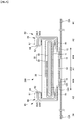
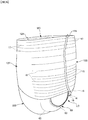
- Figs. 1 to 6 illustrate an example of an underpants-type disposable diaper.
- the underpants-type disposable diaper includes: a rectangular front outer member 12F forming at least a lower torso portion of a front body F; a rectangular back outer member 12B forming at least a lower torso portion of a back body B; and an inner member 200 disposed inside the outer members 12F and 12B so as to extend from the front outer member 12F to the back outer member 12B through a crotch portion. Both sides of the front outer member 12F and both sides of the back outer member 12B are bonded to each other to form a side seal portion 12A.
- an opening formed by the front and back end portions of the outer members 12F and 12B is a waist opening WO through which a wearer's torso passes, and a portion surrounded by lower edges of the outer members 12F and 12B and a side edge of the inner member 200 on both sides of the inner member 200 in the width direction is a leg opening LO through which a leg passes.
- the inner member 200 is a portion for absorbing and holding excrement such as urine
- the outer members 12F and 12B are portions for supporting the inner member 200 with respect to the body of a wearer.
- a reference numeral Y represents the maximum length of the diaper in an unfolded state (front-back direction length from an edge of a waist opening WO of the front body F to an edge of a waist opening WO of the back body B), and a reference numeral X represents the maximum width of the diaper in an unfolded state.
- the underpants-type disposable diaper in the present form has a lower torso region T defined as a front-back direction range (front-back direction range from the waist opening WO to an upper end of the leg opening LO) having the side seal portion 12A, and an intermediate region L defined as a front-back direction range of a portion forming the leg opening LO (between a front-back direction region having the side seal portion 12A of the front body F and a front-back direction region having the side seal portion 12A of the back body B).
- the lower torso region T can be divided into a "waist portion" W conceptually forming an edge of the waist opening and an "under-waist portion" U which is a portion lower than the waist portion W.
- the waist portion W a portion closer to the waist opening WO than the boundary closest to the waist opening WO is the waist portion W.
- a waist extended portion 12E extending so as to be closer to the waist opening WO than the absorber 56 or the inner member 200 is the waist portion W.
- the front-back direction length varies depending on the size of a product and can be appropriately determined.
- the length of the waist portion W can be 15 to 40 mm
- the length of the under-waist portion U can be 65 to 120 mm.
- both side edges of the intermediate region L are each narrowed in a substantially U shape or a curved shape so as to follow a periphery of a wearer's leg, and the wearer's leg passes therethrough.
- the underpants-type disposable diaper in an unfolded state has an approximately hourglass shape as a whole.
- the inner member 200 can adopt an arbitrary shape, but is rectangular in the illustrated form. As illustrated in Figs. 3 to 5 , the inner member 200 includes a top sheet 30 located on a body side, a liquid impervious sheet 11, and an absorbent element 50 interposed therebetween, and is a main unit portion having an absorption function.
- a reference numeral 40 represents an intermediate sheet (second sheet) disposed between the top sheet 30 and the absorbent element 50 in order to rapidly transfer a liquid that has passed through the top sheet 30 to the absorbent element 50.
- a reference numeral 60 represents a side gather 60 extending so as to come into contact with a periphery of a wearer's leg from both sides of the inner member 200 in order to prevent leakage of excrement into both sides of the inner member 200.
- the top sheet 30 transmits a liquid
- examples thereof include a perforated or imperforated nonwoven fabric and a porous plastic sheet.
- the nonwoven fabric is not particularly limited concerning a raw material fiber thereof. Examples thereof include a synthetic fiber such as an olefin-based fiber including polyethylene and polypropylene, a polyester-based fiber, or a polyamide-based fiber, a regenerated fiber such as rayon or cupra, a natural fiber such as cotton, and a mixed fiber and a composite fiber in which two or more kinds of these fibers are used.
- the nonwoven fabric may be manufactured by any processing.
- Examples of a processing method include known methods such as a spunlacing method, a spunbonding method, a thermal bond method, a melt blown method, a needle punching method, an air through method, and a point bond method.
- a spunlacing method if softness and drapeability are demanded, a spunbonding method and a spunlacing method are preferable processing methods. If bulkiness and softness are demanded, an air through method, a point bond method, and a thermal bond method are preferable processing methods.
- the top sheet 30 may be formed of a single sheet or a laminated sheet obtained by sticking two or more sheets to each other. Similarly, the top sheet 30 may be formed of a single sheet or two or more sheets in a plane direction.
- Both sides of the top sheet 30 may be folded back to a back surface side at a side edge of the absorbent element 50 or may protrude from the side edge of the absorbent element 50 to a lateral side without being folded back.
- the top sheet 30 is fixed to a member adjacent to the back surface side by a bonding means by material welding such as heat sealing or ultrasonic sealing, or with a hot melt adhesive.
- a bonding means such as heat sealing or ultrasonic sealing, or with a hot melt adhesive.
- the top sheet 30 is fixed to a surface of an intermediate sheet 40 and a surface of a portion located on a front surface side of the absorber 56 in a wrapping sheet 58 with a hot melt adhesive applied to a back surface thereof.
- the intermediate sheet 40 In order to quickly transfer a liquid that has passed through the top sheet 30 to the absorber, it is possible to dispose the intermediate sheet (also referred to as "second sheet") 40 having a higher liquid transmission rate than the top sheet 30.
- the intermediate sheet 40 is used in order to rapidly transfer a liquid to the absorber to enhance absorption performance of the absorber, and to prevent a "returning" phenomenon of the absorbed liquid from the absorber.
- the intermediate sheet 40 can be omitted.
- Examples of the intermediate sheet 40 include a similar material to that of the top sheet 30, a spunlaced nonwoven fabric, a spunbonded nonwoven fabric, an SMS nonwoven fabric, a pulp nonwoven fabric, a mixed sheet of pulp and rayon, point bonded nonwoven fabric, and crepe paper.
- an air through nonwoven fabric is preferable because of being bulky.
- a composite fiber having a core-sheath structure is preferably used.
- a resin used for the core may be polypropylene (PP) but is preferably polyester (PET) having high rigidity.
- the basis weight is preferably 17 to 80 g/m 2 , and more preferably 25 to 60 g/m 2 .
- a raw material fiber of the nonwoven fabric preferably has a fineness of 2.0 to 10 dtex.
- eccentric fibers having no core in the center are also preferably used.
- the intermediate sheet 40 in the illustrated example is disposed at the center so as to be shorter than the width of the absorber 56, but may be disposed over the maximum width.
- the front-back direction length of the intermediate sheet 40 may be the same as the maximum length of the diaper, may be the same as the length of the absorbent element 50, or may be within a short length range centered on a liquid receiving region.
- the intermediate sheet 40 is fixed to a member adjacent to the back surface side by a bonding means by material welding such as heat sealing or ultrasonic sealing, or with a hot melt adhesive.
- the intermediate sheet 40 is fixed to a surface of a portion located on a front surface side of the absorber 56 in the wrapping sheet 58 with a hot melt adhesive applied to a back surface thereof.
- a material of the liquid impervious sheet 11 is not particularly limited, but examples thereof include a plastic film formed of an olefin-based resin such as polyethylene or polypropylene, a laminated nonwoven fabric having a plastic film disposed on a surface of a nonwoven fabric, and a laminated sheet obtained by superposing and bonding a nonwoven fabric or the like to a plastic film.
- a liquid impervious and moisture pervious material favorably used from a viewpoint of preventing stuffiness.
- a microporous plastic film obtained by kneading an inorganic filler in an olefin-based resin such as polyethylene or polypropylene, molding a sheet, and then stretching the sheet in a monoaxial or biaxial direction is widely used.
- a nonwoven fabric using a micro denier fiber, a nonwoven fabric that has reinforced leakproofness by reducing a space between fibers by applying heat and pressure, and a sheet that has become liquid impervious without using a plastic film by a method for applying a super absorbent polymer, a hydrophobic resin, or a water repellent agent can be used as the liquid impervious sheet 11.
- the liquid impervious sheet 11 may have a width housed in a back surface side of the absorbent element 50 as illustrated in the drawing, or may go around both sides of the absorbent element 50 and extend to both sides of a side surface of the top sheet 30 of the absorbent element 50 in order to enhance leakproofness.
- the extending portion appropriately has a width of about 5 to 20 mm on each of the left and the right.
- an excretion indicator that changes a color due to absorption of a liquid can be disposed.
- the side gather 60 extends along both sides of the inner member 200 over the entire front-back direction LD and is disposed in order to prevent side leakage by being in contact with the periphery of a wearer's leg, and includes what is generally called a three-dimensional gather or a plane gather.
- the side gather 60 illustrated in Figs. 1 , 3 , and 4 is a so-called three-dimensional gather, and rises from a side of the inner member 200 to a front surface side.
- a root side portion 60B rises obliquely toward the center in the width direction
- a tip side portion 60A of the intermediate portion rises obliquely outward in the width direction.
- the side gather 60 is not limited thereto, and can be changed appropriately.
- the side gather 60 can rise toward the center in the width direction as a whole.
- the side gather 60 in the illustrated example is formed by folding back a belt-shaped gather nonwoven fabric 62 having a length equal to the front-back direction length of the inner member 200 in the width direction WD at a tip portion to be folded in two, and fixing a plurality of elongated gather elastic members 63 to the folded portion and between the sheets near the folded portion in a stretched state in a longitudinal direction at intervals in the width direction WD.
- a base portion of the side gather 60 opposite to a tip portion thereof is a root portion 65 fixed to a side of a back surface side of the liquid impervious sheet 11 in the inner member 200, and a portion other than the root portion 65 is a main unit portion 66 (portion on the folded portion side) extending from the root portion 65.
- the main unit portion 66 has the root side portion 60B extending toward the center in the width direction, and the tip side portion 60A folded back at a tip of the root side portion 60B and extending outward in the width direction.
- the surface contact type side gather 60 is adopted.
- a line contact type side gather 60 not folded back outward in the width direction can also be adopted.
- Front-back direction both end portions of the main unit portion 66 are fallen portions 67 fixed to a side surface of the top sheet 30 in a state of falling down. Meanwhile, a front-back direction intermediate portion located therebetween is a non-fixed free portion 68.
- the gather elastic member 63 in the front-back direction LD is fixed in a stretched state at least to a tip portion of the free portion 68.
- a contraction force of the gather elastic member 63 acts so as to bring the front-back direction both end portions closer to each other.
- the front-back direction both end portions of the main unit portion 66 are fixed so as not to rise, whereas a portion therebetween is the non-fixed free portion 68. Therefore, only the free portion 68 rises so as to come into contact with a body side as illustrated by the arrow in Fig. 3 .
- the free portion 68 rises so as to open outward in the width direction at a crotch portion and in the vicinity thereof. Therefore, the side gather 60 comes into contact with a periphery of a leg with a surface to improve fitting.
- the tip side portion 60A is bonded to the root side portion 60B in a state of falling down at the fallen portion 67
- the root side portion 60B is bonded to the top sheet 30 in a state of falling down.
- a hot melt adhesive by various application methods and a means by material welding such as heat sealing or ultrasonic sealing can be used.
- bonding of the root side portion 60B to the top sheet 30 and bonding of the tip side portion 60A to the root side portion 60B may be performed by the same means or by different means.
- the gather nonwoven fabric 62 a product obtained by subjecting a soft nonwoven fabric having excellent uniformity and concealability, such as a spunbonded nonwoven fabric (SS, SSS, or the like), an SMS nonwoven fabric (SMS, SSMMS, or the like), or a melt blown nonwoven fabric, to a water repellent treatment with silicon or the like as necessary can be used suitably.
- the gather nonwoven fabric 62 preferably has a fiber basis weight of about 10 to 30 g/m 2 .
- a rubber thread or the like can be used as the gather elastic member 63. When a spandex rubber thread is used, the spandex rubber thread preferably has a fineness of 470 to 1240 dtex, more preferably 620 to 940 dtex.
- the rubber thread preferably has a stretch rate of 150 to 350%, more preferably 200 to 300% at the time of fixing.
- stretch rate means a value obtained when a natural length is assumed to be 100%.
- a waterproof film 64 can be interposed between the two portions obtained by folding the gather nonwoven fabric 62, and in this case, the gather nonwoven fabric 62 can be partially omitted in a portion where the waterproof film 64 is present.
- at least an outer surface from a base end of the side gather 60 to a tip thereof needs to be formed of the gather nonwoven fabric 62 as in the illustrated example.
- the number of the gather elastic members 63 disposed in the free portion of the side gather 60 is preferably two to six, and more preferably three to five.
- a disposition interval 60d is suitably 3 to 10 mm. With such a configuration, a range where the gather elastic member 63 is disposed easily comes into contact with a skin with a surface.
- the gather elastic member 63 may be disposed not only on a tip side but also on a root side.
- a hot melt adhesive by various application methods and a fixing means by material welding such as heat sealing or ultrasonic sealing can be used.
- a portion other than a bonded portion of the gather elastic member 63 is not bonded or weakly bonded.
- the gather elastic member 63 by applying a hot melt adhesive only to an outer peripheral surface of the gather elastic member 63 by an application means such as a comb gun or a SureWrap nozzle, and sandwiching the gather elastic member 63 between the inner layer and the outer layer of the gather nonwoven fabric 62, the gather elastic member 63 is fixed to the inner layer and the outer layer of the gather nonwoven fabric 62, and the inner layer and the outer layer of the gather nonwoven fabric 62 are fixed to each other only with the hot melt adhesive applied to the outer peripheral surface of the gather elastic member 63.
- an application means such as a comb gun or a SureWrap nozzle
- At least one of a hot melt adhesive by various application methods and a means by material welding such as heat sealing or ultrasonic sealing can be used.
- a rising height of the side gather 60 (width direction length of the main unit portion 66 in an unfolded state) W2 is preferably 15 to 60 mm, and particularly preferably 20 to 40 mm.
- a separation distance W1 between innermost folded portions in a flatly folded state is preferably 60 to 190 mm, and particularly preferably 70 to 140 mm such that the side gather 60 is parallel to a surface of the top sheet 30.
- the absorbent element 50 includes the absorber 56 and the wrapping sheet 58 wrapping the entire absorber 56.
- the wrapping sheet 58 can also be omitted.
- the absorber 56 can be formed by an assembly of fibers.
- this fiber assembly in addition to those obtained by accumulating short fibers such as fluff pulps or synthetic fibers, a filament assembly obtained by opening a tow (fiber bundle) of synthetic fibers such as cellulose acetate as necessary can also be used.
- a fiber basis weight may be, for example, about 100 to 300 g/m 2 .
- a fiber basis weight may be, for example, about 30 to 120 g/m 2 .
- a fineness is, for example, 1 to 16 dtex, preferably 1 to 10 dtex, and more preferably 1 to 5 dtex.
- the filament may be formed of non-crimped fibers but is preferably formed of crimped fibers.
- the degree of crimp of the crimped fibers may be, for example, about 5 to 75, preferably 10 to 50, and more preferably 15 to 50 per 2.54 cm. A uniformly crimped fiber is often used.
- super absorbent polymer particles are preferably dispersed and held.
- the absorber 56 may have a rectangular shape. However, as illustrated in Fig. 7 and the like, the absorber 56 preferably has an hourglass shape having a narrower portion 56N with a narrower width than front-back direction both sides thereof in a front-back direction intermediate portion because fitting of the absorber 56 itself and the side gather 60 to a periphery of a leg is improved.
- the size of the absorber 56 can be determined appropriately as long as the absorber 56 extends to the front, back, left, and right of a ureteral port position. However, the absorber 56 preferably extends to peripheral edges of the inner member 200 or the vicinity thereof in the front-back direction LD and the width direction WD. Note that a reference numeral 56X represents the maximum width of the absorber 56.
- the absorber 56 may contain super absorbent polymer particles partially or entirely.
- the super absorbent polymer particles include "powder” in addition to "particles".
- super absorbent polymer particles 54 those used for this type of disposable diaper can be used as they are. For example, when sieving using a standard sieve of 500 ⁇ m (JIS Z8801-1: 2006) (shake for five minutes) is performed, particles in which a ratio of particles remaining on the sieve is 30% by weight or less are desirable. When sieving using a standard sieve of 180 ⁇ m (JIS Z8801-1: 2006) (shake for five minutes) is performed, particles in which a ratio of particles remaining on the sieve is 60% by weight or more are desirable.
- a material of the super absorbent polymer particles can be used without particular limitation, but those having a water absorption capacity of 40 g/g or more are preferable.
- the super absorbent polymer particles include a starch-based material, a cellulose-based material, and a synthetic polymer-based material.
- a starch-acrylic acid (salt) graft copolymer, a saponified product of a starch-acrylonitrile copolymer, a cross-linked product of sodium carboxymethyl cellulose, an acrylic acid (salt) polymer, or the like can be used.
- As the shapes of the super absorbent polymer particles a usually used particulate material shape is suitable, but other shapes can also be used.
- the super absorbent polymer particles those having a water absorption rate of 70 seconds or less, particularly 40 seconds or less are suitably used. When the water absorption rate is too slow, so-called returning that a liquid supplied into the absorber 56 returns out of the absorber 56 tends to occur.
- the super absorbent polymer particles those having a gel strength of 1000 Pa or more are suitably used. This makes it possible to effectively suppress sticky feeling after liquid absorption even in a case of using the bulky absorber 56.
- the basis weight of the super absorbent polymer particles can be appropriately determined depending on the absorption amount required for an application of the absorber 56. Therefore, the basis weight can be 50 to 350 g/m 2 although this cannot be applied generally.
- the basis weight of a polymer of less than 50 g/m 2 makes it difficult to secure the absorption amount.
- the basis weight of more than 350 g/m 2 saturates an effect.
- the spray density or the spray amount of the super absorbent polymer particles in a planar direction of the absorber 56 can be adjusted if necessary.
- the spray amount at a liquid excretion site can be larger than that at another site.
- the spray density (amount) at a front side can be increased for men
- the spray density (amount) at a central portion can be increased for women. It is also possible to locally dispose a portion where no polymer is present (for example, in a spot shape) in a planar direction of the absorber 56.
- the wrapping sheet 58 in a case where the wrapping sheet 58 is used, as a material thereof, tissue paper, particularly, crepe paper, a nonwoven fabric, a polylaminated nonwoven fabric, a sheet with small holes, and the like can be used. However, it is desirable that the wrapping sheet 58 is a sheet from which super absorbent polymer particles do not escape.
- a nonwoven fabric is used instead of crepe paper, a hydrophilic SMS nonwoven fabric (SMS, SSMMS, or the like) is particularly suitable, and polypropylene, a polyethylene/polypropylene composite material, or the like can be used as a material thereof.
- a nonwoven fabric having a basis weight of 5 to 40 g/m 2 , particularly of 10 to 30 g/m 2 is desirable.
- a wrapping mode of the wrapping sheet 58 can be determined appropriately.
- a form is preferable in which the wrapping sheet 58 is wound around the absorber 56 cylindrically so as to surround front and back surfaces and both side surfaces of the absorber 56, the front and back end portions of the wrapping sheet 58 are caused to protrude from the front and back of the absorber 56, and a wound and overlapping portion and an overlapping portion of the front and back protruding portions are bonded with a hot melt adhesive or by a bonding means such as material welding from viewpoints of ease of manufacture, prevention of leakage of the super absorbent polymer particles from front and back edges, and the like.
- the outer members 12F and 12B are formed by the rectangular front outer member 12F forming at least a lower torso portion of the front body F and the rectangular back outer member 12B forming at least a lower torso portion of the back body B, respectively.
- the front outer member 12F and the back outer member 12B are not continuous on a crotch side, and are separated from each other in the front-back direction LD.
- a separation distance thereof 12d can be about 150 to 250 mm, for example.
- the outer members 12F and 12B may be an integral outer member passing a crotch and continuous from the front body F to the back body B as described in Patent Literature 4.
- the outer members 12F and 12B each have a lower torso portion which is a front-back direction range corresponding to the lower torso region T.
- the front-back direction size of the back outer member 12B is longer than that of the front outer member 12F, and the front outer member 12F does not have a portion corresponding to the intermediate region L, but the back outer member 12B has a gluteal cover portion C extending from the lower torso region T toward the intermediate region L.
- an inguinal cover portion extending from the lower torso region T toward the intermediate region L may be disposed, or the inguinal cover portion may be disposed without a gluteal cover portion.
- the outer members 12F and 12B each include the elastic members 15 to 19 in order to enhance fitting of a wearer to a lower torso, and a stretchable region A2 that elastically stretches and contracts in the width direction WD along with stretching and contracting of the elastic members is formed.
- the stretchable region A2 in a natural length state, the outer members 12F and 12B contract along with contraction of an elastic member to form wrinkles or pleats.
- the elastic member stretches in a longitudinal direction, it is possible to stretch the outer members 12F and 12B to a predetermined stretch rate at which the outer members 12F and 12B stretch without wrinkles.
- the elastic members 15 to 19 in addition to an elongated elastic member (illustrated example) such as a rubber thread, a known elastic member such as a belt-shaped member, a net-shaped member, or a film-shaped member can be used without particular limitation.
- a synthetic rubber or a natural rubber may be used as the elastic members 15 to 19
- a plurality of waist elastic members 17 is attached at intervals in a front-back direction so as to be continuous over the entire width direction WD.
- One or more waist elastic members 17 disposed in a region adjacent to the under-waist portion U may overlap with the inner member 200, or may be disposed on both sides thereof in the width direction except for the center in the width direction overlapping with the inner member 200.
- the waist elastic member 17 it is preferable to dispose 2 to 15 rubber threads, particularly 4 to 10 rubber threads each having a fineness of 155 to 1880 dtex, particularly about 470 to 1240 dtex (in a case of a synthetic rubber, having a cross section of 0.05 to 1.5 mm 2 , particularly about 0.1 to 1.0 mm 2 in a case of a natural rubber) at intervals of 2 to 12 mm, particularly 3 to 7 mm.
- a resultant stretch rate of the waist portion W in the width direction WD is preferably 150 to 400%, and particularly preferably about 220 to 320%.
- all of the waist elastic members 17 in the front-back direction LD do not have to have the same fineness and the same stretch rate.
- the fineness and the stretch rate of the elastic member 17 may be different between an upper portion and a lower portion of the waist portion W.
- a plurality of under-waist elastic members 15 and 19 formed of an elongated elastic member is preferably disposed at intervals in a front-back direction.
- the under-waist elastic members 15 and 19 it is preferable to dispose 5 to 30 rubber threads each having a fineness of 155 to 1880 dtex, particularly about 470 to 1240 dtex (in a case of a synthetic rubber, having a cross section of 0.05 to 1.5 mm 2 , particularly about 0.1 to 1.0 mm 2 in a case of a natural rubber) at intervals of 1 to 15 mm, particularly 3 to 8 mm.
- a resultant stretch rate of the under-waist portion U in the width direction WD is preferably 200 to 350%, and particularly preferably about 240 to 300%.
- a cover portion elastic member 16 formed of an elongated elastic member is preferably attached in the gluteal cover portion C of the back outer member 12B.
- the gluteal cover portion C is contracted toward the center in the width direction WD by the cover portion elastic member 16.
- the cover portion elastic member 16 it is preferable to dispose a rubber thread having a fineness of 155 to 1880 dtex, particularly about 470 to 1240 dtex (in a case of a synthetic rubber, having a cross section of 0.05 to 1.5 mm 2 , particularly about 0.1 to 1.0 mm 2 in a case of a natural rubber).
- a resultant stretch rate of the gluteal cover portion C in the width direction WD is preferably 150 to 300%, and particularly preferably about 180 to 260%.
- a cover portion elastic member can be disposed similarly to the gluteal cover portion C.
- a width direction intermediate portion including a part or the whole of a portion overlapping with the absorber 56 in the width direction WD (preferably including the whole of the inner and outer bonded portions 201 and 202) is a non-stretchable region A1, and both sides thereof in the width direction are stretchable regions A2.
- the waist portion W is preferably the stretchable region A2 over the entire width direction WD.
- the waist portion W may have the non-stretchable region A1 in a width direction intermediate portion.
- the stretchable region A2 and the non-stretchable region A1 can be formed, in manufacture of the outer members 12F and 12B, by fixing the elastic members 15, 16, and 19 in at least both end portions in a stretchable direction in the stretchable region A2 through a hot melt adhesive without fixing the elastic members 15, 16, and 19 in a region to be the non-stretchable region A1, and cutting the elastic members 15, 16, and 19 at one place in a width direction intermediate portion or cutting the elastic members 15, 16, and 19 finely at many places in the region to be the non-stretchable region A1 by means of pressing and heating of the elastic members 15, 16, and 19 to leave elasticity in the stretchable region A2 and to destroy elasticity in the non-stretchable region A1.
- a cutting residue continuous from the elastic members 15, 16, and 19 in the stretchable region A2 remains in the outer members 12F and 12B while being contracted to a natural length alone as an unnecessary elastic member 18.
- a cutting residue continuous from the elastic members 15, 16, and 19 in the stretchable region A2 and a cut piece of an elastic member not continuous from the elastic members 15, 16, and 19 in either of the stretchable regions A2 remain in the outer bodies 12F and 12B while being contracted to a natural length alone as an unnecessary elastic member.
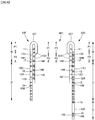
- the waist portion W of each of the outer members 12F and 12B includes the waist inner sheet layer 121 facing an inside of the waist elastic member 17 and the waist outer sheet layer 122 facing an outside of the waist elastic member 17.
- the waist elastic member 17 is bonded to the waist inner sheet layer 121 and the waist outer sheet layer 122 via the hot melt adhesive HM.
- the under-waist portion U of each of the outer members 12F and 12B includes an under-waist inner sheet layer 123 facing insides of the under-waist elastic members 15 and 19 and an under-waist outer sheet layer 124 facing outsides of the under-waist elastic members 15 and 19.
- the under-waist elastic members 15 and 19 are bonded to the under-waist inner sheet layer 123 and the under-waist outer sheet layer 124 via the hot melt adhesive HM.
- the gluteal cover portion C of the back outer member 12B includes a cover portion inner sheet layer 125 facing an inside of the cover portion elastic member 16 and a cover portion outer sheet layer 126 facing an outside of the cover portion elastic member 16.
- the cover portion elastic member 16 is bonded to the cover portion inner sheet layer 125 and the cover portion outer sheet layer 126 via the hot melt adhesive HM.
- the waist portion W has a first portion P1 closer to the waist opening WO than an intermediate portion in a front-back direction LD and a second portion P2 opposite thereto.
- Each of the first portion P1 and the second portion P2 has at least one of the waist elastic members 17.
- the first portion P1 has an over sheet layer 127 folded back at an edge of the waist opening WO from an outside of the waist outer sheet layer 122 and extending to an inside of the waist inner sheet layer 121.
- the over sheet layer 127 is formed of a sheet material (first sheet material 12S described later in the illustrated example) having a portion folded back at an edge of the waist opening WO from a position outside the waist elastic member 17 in the second portion P2 and extending to a position inside the waist elastic member 17 in the second portion P2.
- first portion P1 the waist elastic member 17 is not fixed to the sheet material forming the over sheet layer 127.
- the waist elastic member 17 is fixed to the sheet material forming the over sheet layer 127, and the sheet material forming the over sheet layer 127 together with the waist elastic member 17 is contracted in the width direction WD.
- the first sheet material 12S forming the under-waist outer sheet layer 124 and the second sheet material 12H forming the under-waist inner sheet layer 123 both go toward the waist opening WO, and are folded inward at an edge of the waist opening WO through the waist portion W.
- the portion of the first sheet material 12S folded inward at the edge of the waist opening WO extends to the leg opening LO side more than the waist elastic member 17 closest to the leg opening LO, and the portion of the second sheet material 12H folded inward at the edge of the waist opening WO extends only to a boundary between the first portion P1 and the second portion P2.
- the waist elastic member 17 is bonded to the second sheet material 12H via the hot melt adhesive HM, and the first sheet material 12S is not bonded to the second sheet material 12H.
- the waist elastic member 17 is bonded to the first sheet material 12S facing an inside of the waist elastic member 17 via the hot melt adhesive HM
- the waist elastic member 17 is bonded to the second sheet material 12H facing an outside of the waist elastic member 17 via the hot melt adhesive HM
- the first sheet material 12S is bonded to the second sheet material 12H via the hot melt adhesive HM.
- the over sheet layer 127 is formed of the first sheet material 12S
- the waist outer sheet layer 122 is formed of the second sheet material 12H
- the waist inner sheet layer 121 is formed of the second sheet material 12H in the first portion P1, and is formed of the first sheet material 12S in the second portion P2.
- the cover portion elastic member 16 is disposed.
- the cover portion outer sheet layer 126 is formed of the first sheet material 12S
- the cover portion inner sheet layer 125 is formed of the second sheet material 12H.
- a portion 12r folded inward at the edge of the waist opening WO in the first sheet material 12S is preferably extended so as to cover an end portion of the inner member 200 on the waist opening WO side.
- This structure in the illustrated example not only simplifies the configurations of the sheet material 12S and 12H but also can be manufactured easily by sandwiching the under-waist elastic members 15 and 19 between the first sheet material 12S and the second sheet material 12H to bond the first sheet material 12S to the second sheet material 12H and to fix the under-waist elastic members 15 and 19, then folding back the end portions of the first sheet material 12S and the second sheet material 12H, sandwiching the waist elastic member 17 between the folded portions, bonding the first sheet material 12S to the second sheet material 12H, and fixing the waist elastic member 17.
- the structure in the illustrated example is preferable.
- the portion of the first sheet material 12S folded inward at the edge of the waist opening WO extends only to the boundary between the first portion P1 and the second portion P2, and the portion of the second sheet material 12H folded inward at the edge of the waist opening WO may extend to the leg opening LO side more than the waist elastic member 17 closest to the leg opening LO.
- both the portion of the first sheet material 12S folded inward at the edge of the waist opening WO and the portion of the second sheet material 12H folded inward at the edge of the waist opening WO may extend to the leg opening LO side more than the waist elastic member 17 closest to the leg opening LO.
- the waist inner sheet layer 121 and the waist outer sheet layer 122 are covered with the over sheet layer 127. Therefore, all the waist elastic members 17 included in the first portion P1 including the waist elastic member 17 closest to the waist opening WO touch a skin through the two sheet layers. A portion from an edge of the waist opening WO to the waist elastic members 17 in the first portion P1 is covered with the over sheet layer 127 released from the waist elastic members 17, and a free portion of the over sheet layer 127 can be freely deformed with respect to the waist elastic members 17. Therefore, when the product is held by hand, feel of the waist portion W is soft.
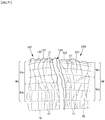
- the over sheet layer 127 slips against the waist inner sheet layer 121 and the waist outer sheet layer 122 is perceived as a smooth hand feel, and the free portion of the over sheet layer 127 is perceived as a soft hand feel. Therefore, a softness characteristic including softness and smoothness which are hardly achieved at the same time is exhibited. Furthermore, in the second portion P2, a contraction force of the waist elastic members 17 directly act on the sheet material 12S forming the over sheet layer 127, and the sheet material 12S has firm contraction wrinkles. In the first portion P1, the sheet material 12S forming the over sheet layer 127 is released from the waist elastic members 17, but has contraction wrinkles continuous from the second portion P2 due to an influence of the contraction deformation of the second portion P2.
- the position of the boundary between the first portion P1 and the second portion P2 can be determined appropriately.
- 4 to 10 waist elastic members 17 are disposed at intervals of 3 to 7 mm in the front-back direction LD
- the boundary between the first portion P1 and the second portion P2 is located within a range from a position of a waist elastic member 17 first from the waist opening WO to a position of a waist elastic member 17 fifth from the waist opening WO
- improvement of softness by release of the over sheet layer 127 in the first portion P1 and improvement of a cushioning property by formation of contraction wrinkles are easily achieved at the same time, and therefore this is preferable.
- the position of the boundary between the first portion P1 and the second portion P2 may be different or the same between the front outer member 12F and the back outer member 12B.
- the position of the boundary between the first portion P1 and the second portion P2 may be different or the same between the inside and the outside of the waist portion W.
- the example illustrated in Fig. 11 and 12 when the length of the first portion P1 in the front outer member 12F in the front-back direction LD is longer than the length of the first portion P1 in the back outer member 12B in the front-back direction LD, a cushioning property against an abdomen is high.
- the position of the boundary between the first portion P1 and the second portion P2 may be different or the same between the inside and the outside of the waist portion W.
- the boundary between the first portion P1 and the second portion P2 outside the waist portion W is located within a range from a position of a waist elastic member 17 first from the waist opening WO to a position of a waist elastic member 17 third from the waist opening WO
- the boundary between the first portion P1 and the second portion P2 inside the waist portion W is located within a range from a position of a waist elastic member 17 second from the waist opening WO to a position of a waist elastic member 17 fifth from the waist opening WO
- there are one or more (three or less) waist elastic members 17 between the boundary between the first portion P1 and the second portion P2 outside the waist portion W and the boundary between the first portion P1 and the second portion P2 inside the waist portion W a balance among a neat appearance, a soft hand feel, and comfortable wearing is particularly excellent.
- this interval is preferably short, and is usually 5 mm or less, and particularly preferably 2 to 4 mm. As a result, the contraction wrinkles formed in the first portion P1 by contraction of the second portion P2 are formed nicely to the edge of the waist opening WO or the vicinity thereof.
- all the sheet layers of the outer members 12F and 12B including the waist inner sheet layer 121, the waist outer sheet layer 122, and the over sheet layer 127 are formed only by the first sheet material 12S and the second sheet material 12H.
- the number of the sheet materials and structures thereof are not limited to the illustrated example, and can be changed appropriately.
- the waist inner sheet layer 121 and the waist outer sheet layer 122 are formed by folding back a single sheet of the second sheet material 12H, but each of the waist inner sheet layer 121 and the waist outer sheet layer 122 may be formed of a single sheet of sheet material.
- all the sheet layers may be formed of a single sheet of sheet material 12U.
- any material can be used without particular limitation, but a nonwoven fabric is preferably used.
- a nonwoven fabric formed of a synthetic fiber such as an olefin-based fiber including polyethylene and polypropylene, a polyester-based fiber, or a polyamide-based fiber, or a mixed fiber or a composite fiber using two or more kinds of these fibers.
- the nonwoven fabric may be manufactured by any processing. Examples of a processing method include known methods such as a spunlacing method, a spunbonding method, a thermal bond method, a melt blown method, a needle punching method, an air through method, and a point bond method.
- the nonwoven fabric preferably has a basis weight of about 10 to 30 g/m 2 per sheet.
- the over sheet layer 127 is slippery with respect to the waist inner sheet layer 121 and the waist outer sheet layer 122, and resistance during deformation of the free portion of the over sheet layer 127 is reduced.
- a surface of the first sheet material 12S facing the second sheet material 12H and a surface of the second sheet material 12H facing the first sheet material 12S preferably each have a nonwoven fabric average surface friction coefficient MIU of 0.30 or less, particularly 0.05 to 0.20 (both machine direction (MD) and cross direction (CD)) based on Kawabata's Evaluation System for Fabrics (KES method), and preferably each have a surface friction coefficient variation deviation MMD of 0.01 or less, particularly 0.003 to 0.008 (both MD and CD). This further improves softness of a portion having the over sheet layer 127.
- the MIU and MMD can be measured with a friction tester KES-SE manufactured by Kato Tech Co., Ltd.
- An elastic member is fixed to the outer members 12F and 12B with the hot melt adhesive HM by various application methods.
- a pair of facing sheet layers that is, the waist inner sheet layer 121 and the waist outer sheet layer 122 or the under-waist inner sheet layer 123 and the under-waist outer sheet layer 124 are preferably bonded to each other with the hot melt adhesive HM for fixing the elastic members 15 to 19.
- a pair of facing sheet layers may be bonded to each other with the hot melt adhesive HM or by material welding such as heat sealing or ultrasonic sealing, and a part or the whole of a pair of the facing sheet layers does not have to be bonded.
- the elastic members 15 to 19 are fixed to the waist inner sheet layer 121 and the waist outer sheet layer 122 only with the hot melt adhesive HM applied to the outer peripheral surfaces of the elastic members 15 to 19, and both the sheet layers are fixed to each other.
- the elastic members 15 to 19 may be fixed to both the sheet layers only at both end portions in a stretchable direction in the stretchable region A2.
- the inner member 200 is exposed between the front outer member 12F and the back outer member 12B. Therefore, in order to prevent the liquid impervious sheet 11 from being exposed to a back surface of the inner member 200, the outer member separated type underpants-type disposable diaper preferably includes a cover nonwoven fabric 13 covering the back surface of the inner member 200 from a portion between the front outer member 12F and the inner member 200 to a portion between the back outer member 12B and the inner member 200.
- the nonwoven fabric used for the cover nonwoven fabric 13 for example, a material similar to those of the outer members 12F and 12B can be appropriately selected, and the nonwoven fabric used for the cover nonwoven fabric 13 is not particularly limited by the type of a fiber or a method for bonding (interlacing) fibers. However, it is desirable to use an air through nonwoven fabric. In this case, the basis weight is preferably 20 to 40 g/m 2 and the thickness is preferably 0.3 to 1.0 mm.
- an imperforated nonwoven fabric having no hole passing therethrough from the front to the back or a perforated nonwoven fabric having many holes passing therethrough from the front to the back at intervals may be used.
- the front-back direction range of the cover nonwoven fabric 13 is not particularly limited, and as illustrated in Figs. 2 and 5 , may extend in the front-back direction LD over the entire region from a front end to a back end of the inner member 200. As illustrated in Fig. 7 , the front-back direction range of the cover nonwoven fabric 13 may extend in the front-back direction LD from a front-back direction intermediate position of a region where the front outer member 12F and the inner member 200 overlap with each other to a front-back direction intermediate position of a region where the back outer member 12B and the inner member 200 overlap with each other. In the case of the example illustrated in Fig.
- a front-back direction length 13y of an overlapping portion between the cover nonwoven fabric 13 and the front outer member 12F and a front-back direction length 13y of an overlapping portion between the cover nonwoven fabric 13 and the back outer member 12B can be appropriately determined, but can be each about 20 to 40 mm in a usual case.
- the width direction range of the cover nonwoven fabric 13 is a range in which a back surface exposed portion of the liquid impervious sheet 11 can be concealed. For this reason, in the illustrated example, the liquid impervious sheet 11 is exposed between base ends of the left and right side gathers 60. Therefore, the cover nonwoven fabric 13 is disposed so as to cover a width direction range from a back surface side of a base portion of at least one of the side gathers 60 to a back surface side of a base portion of the other of the side gathers 60. This makes it possible to conceal the liquid impervious sheet 11 with the cover nonwoven fabric 13 and the gather nonwoven fabric 62 of the side gather 60.
- the inner surface and the outer surface of the cover nonwoven fabric 13 can be bonded to facing surfaces thereof via a hot melt adhesive.
- a fixing region of the cover nonwoven fabric 13 the entire front-back direction and the entire width direction of the cover nonwoven fabric 13 can be fixed, or a part thereof can be non-fixed.
- the widths of the non-fixed portions at width direction both end portions of the cover nonwoven fabric 13 may be determined appropriately, but can be, for example, 3 to 10 mm, preferably 5 to 8 mm.
- the inner member 200 can be fixed to the outer members 12F and 12B by a bonding means by material welding such as heat sealing or ultrasonic sealing, or with a hot melt adhesive.
- a bonding means by material welding such as heat sealing or ultrasonic sealing, or with a hot melt adhesive.
- the inner member 200 is fixed to the inner surfaces of the outer members 12F and 12B.
- the inner and outer bonded portions 201 and 202 for fixing the inner member 200 to the outer members 12F and 12B can be disposed in almost the entire region where the inner member 200 overlaps with the outer members 12F and 12B as illustrated in Fig. 2 , and can be disposed, for example, in a portion excluding width direction both end portions of the inner member 200.
- the present invention is applicable to an underpants-type disposable diaper.
Landscapes
- Health & Medical Sciences (AREA)
- Engineering & Computer Science (AREA)
- Life Sciences & Earth Sciences (AREA)
- Biomedical Technology (AREA)
- Heart & Thoracic Surgery (AREA)
- Vascular Medicine (AREA)
- Epidemiology (AREA)
- Animal Behavior & Ethology (AREA)
- General Health & Medical Sciences (AREA)
- Public Health (AREA)
- Veterinary Medicine (AREA)
- Dermatology (AREA)
- Manufacturing & Machinery (AREA)
- Absorbent Articles And Supports Therefor (AREA)
- Orthopedics, Nursing, And Contraception (AREA)
Abstract
Description
- The present invention relates to an underpants-type disposable diaper having an improved texture (softness and a cushioning property) at an end portion of a waist opening.
- In general, an underpants-type disposable diaper includes an outer member forming at least lower torso portions of a front body and a back body, and an inner member attached to the outer member so as to extend from the front body to the back body and including an absorber, and has a waist opening and a pair of left and right leg openings formed by bonding both sides of the outer member of the front body to both sides of the outer member of the back body to form a side seal portion (for example,
Patent Literatures 1 to 5). - In a general underpants-type disposable diaper, in order to ensure fitting to a body, a region including a waist portion of an outer body has a laminated structure in which an elastic member is interposed between a plurality of sheet layers (see, for example,
Patent Literatures 1 to 4) . - In such a laminated structure of the outer member, in general, a hot melt adhesive is planarly applied to at least one of an outer sheet layer adjacent to the outer side of the elastic member and an inner sheet layer adjacent to the inner side of the elastic member to bond the outer sheet layer to the inner sheet layer and to fix the elastic member to the outer sheet layer and the inner sheet layer. Alternatively, in order to reduce cost and to improve softness by reducing the amount of use of the hot melt adhesive, the hot melt adhesive is applied to a peripheral surface along a maximum length of the elastic member to bond the outer sheet layer to the inner sheet layer while the elastic member is sandwiched between the outer sheet layer and the inner sheet layer, and the elastic member is fixed to the outer sheet layer and the inner sheet layer.
- However, in the conventional underpants-type disposable diaper, there is room for improvement in texture of an end portion of a waist opening when the product is held by hand or worn at the time of wearing or purchasing. More specifically, softness and a cushioning property (compression resilience) of a sheet layer at an edge of a waist opening have an influence on texture of an end portion of the waist opening. However, not only these but also softness and a cushioning property of a corner pressed against a skin when the product is held by hand or worn at the time of wearing or purchasing, that is, softness and a cushioning property of a portion including a waist elastic member closest to the waist opening have a large influence thereon.
- Here, as in the conventional example illustrated in
Fig. 10 , when all of waistelastic members 17 disposed in a waist portion W are fixed to a waistouter sheet layer 122 and a waistinner sheet layer 121 with a hot melt adhesive HM, and at least one of the waistouter sheet layer 122 and the waistinner sheet layer 121 is an outside exposed surface, the waistelastic member 17 closest to the waist opening WO can also touch a skin through only asingle sheet layer Patent Literatures 1 to 3. - As described in Patent Literature 4, when the outer sheet layer and the inner sheet layer are not bonded to an end portion of a waist opening and there is a region without a waist elastic member, at softness and a cushioning property at an edge of the waist opening are improved. However, also in this case, all of the waist elastic members are fixed to the outer sheet layer and the inner sheet layer with a hot melt adhesive, and at least one of the outer sheet layer and the inner sheet layer is an outside exposed surface. Therefore, also in this case, when a portion including the elastic member touches a skin, for example, when the waist portion is held by hand or worn, softness and a cushioning property may be insufficient to impart uncomfortable texture.
- A diaper described in
Patent Literature 5 has an over sheet layer folded back at an edge of a waist opening from a portion closer to a leg opening than a waist portion of an outer sheet layer and extending to a portion closer to the leg opening than a waist portion of an inner sheet layer. The over sheet layer is not bonded to the inner sheet layer or the outer sheet layer over a wide range including the waist portion. Therefore, although fine wrinkles are formed in the outer sheet layer and the inner sheet layer by contraction due to a waist elastic member, wrinkles are hardly formed in the over sheet layer, and only a loose state is obtained. This may be suitable for the purpose of reducing contraction wrinkles as in the diaper described inPatent Literature 5. However, a waist elastic member closest to the waist opening is covered with two sheet layers, but a cushioning property more than the thickness of the sheet is not exhibited. Therefore, there is room for improvement in improving a cushioning property and texture obtained thereby. -
- Patent Literature 1:
JP 2005-287930 A - Patent Literature 2:
JP 2008-023116 A - Patent Literature 3:
JP 2011-254996 A - Patent Literature 4:
JP 2015-171503 A - Patent Literature 5:
JP 2008-049013 A - Therefore, a main object of the present invention is to improve texture of an end portion of a waist opening and the like.
- Typical aspects for solving the above problem are as follows.
- An underpants-type disposable diaper including: an outer member forming at least lower torso portions of a front body and a back body; an inner member attached to the outer member so as to extend from the front body to the back body and including an absorber; a waist opening; and a pair of left and right leg openings,
a waist portion of the outer member including: a plurality of elongated waist elastic members disposed in a width direction at intervals; a waist inner sheet layer facing insides of the waist elastic members; and a waist outer sheet layer facing outsides of the waist elastic members,
the waist elastic members being bonded to the waist inner sheet layer and the waist outer sheet layer via a hot melt adhesive, in which
the waist portion has a first portion closer to the waist opening than an intermediate portion in a front-back direction and a second portion opposite thereto, and the first portion and the second portion each have at least one of the waist elastic members,
the first portion includes an over sheet layer folded back at an edge of the waist opening from an outside of the waist outer sheet layer and extending to an inside of the waist inner sheet layer,
the over sheet layer is formed of a sheet material having a portion folded back at an edge of the waist opening from a position outside the waist elastic member in the second portion and extending to a position inside the waist elastic member in the second portion,
in the first portion, the waist elastic member is not fixed to the sheet material, and
in the second portion, the waist elastic member is fixed to the sheet material, and the sheet material is contracted in a width direction together with the waist elastic member. - In the first aspect, the waist inner sheet layer and the waist outer sheet layer are covered with the over sheet layer. Therefore, all the waist elastic members included in the first portion including a waist elastic member closest to the waist opening touch a skin through the two sheet layers.
- A portion from an edge of the waist opening to the waist elastic members in the first portion is covered with the over sheet layer released from the waist elastic members, and a free portion of the over sheet layer can be freely deformed with respect to the waist elastic members. Therefore, when the product is held by hand, feel of the waist portion is soft.
- Furthermore, in the second portion, a contraction force of the waist elastic members directly act on the sheet material forming the over sheet layer, and the sheet material has firm contraction wrinkles. In the first portion, the sheet material forming the over sheet layer is released from the waist elastic members, but has contraction wrinkles continuous from the second portion due to an influence of the contraction deformation of the second portion. That is, not only the portion from the edge of the waist opening to the waist elastic members of the first portion is covered with the over sheet layer released from the waist elastic members, but also contraction wrinkles are formed in at least the first portion of the over sheet layer. Due to the contraction wrinkles, a cushioning property of a corner pressed against a skin when the product is held by hand or worn at the time of wearing or purchasing, that is, a cushioning property of a portion including a waist elastic member closest to the waist opening increases.
- Therefore, according to the present first aspect, texture of an end portion of the waist opening is better than that of a diaper having a conventional over sheet layer.
- The underpants-type disposable diaper according to the first aspect, in which
the outer member has an under-waist portion located below the waist portion at the lower torso portion,
the under-waist portion of the outer member includes: a plurality of elongated under-waist elastic members disposed in a width direction at intervals; an under-waist inner sheet layer facing insides of the under-waist elastic members; and an under-waist outer sheet layer facing outsides of the under-waist elastic members,
the under-waist elastic members are bonded to the under-waist inner sheet layer and the under-waist outer sheet layer via a hot melt adhesive,
a first sheet material forming the under-waist outer sheet layer and a second sheet material forming the under-waist inner sheet layer are both folded inward at an edge of the waist opening through the waist portion,
the portion folded inward at the edge of the waist opening in the first sheet material extends to a leg opening side more than a waist elastic member closest to the leg opening,
the portion folded inward at the edge of the waist opening in the second sheet material extends only to a boundary between the first portion and the second portion,
the over sheet layer is formed of the first sheet material,
the waist outer sheet layer is formed of the second sheet material,
the waist inner sheet layer is formed of the second sheet material in the first portion, and is formed of the first sheet material in the second portion,
in the first portion, the waist elastic members are bonded to the second sheet material via a hot melt adhesive, and the first sheet material is not bonded to the second sheet material, and
in the second portion, the waist elastic members are bonded to the first sheet material facing insides of the waist elastic members via a hot melt adhesive, the waist elastic members are bonded to the second sheet material facing outsides of the waist elastic members via a hot melt adhesive, and the first sheet material is bonded to the second sheet material via a hot melt adhesive. - According to the present second aspect, the configuration of the sheet material is simple, and manufacture is easy. Therefore, this is preferable.
- The underpants-type disposable diaper according to the second aspect, in which
four to ten of the waist elastic members are disposed at intervals of 3 to 7 mm in the front-back direction, and
a boundary between the first portion and the second portion is located within a range from a position of a waist elastic member first from the waist opening to a position of a waist elastic member fifth from the waist opening. - The interval between the waist elastic members and the number thereof are preferably within the above range. In this case, when the boundary between the first portion and the second portion is within the above range, improvement of softness by release of the over sheet layer in the first portion and improvement of a cushioning property by formation of contraction wrinkles are easily achieved at the same time.
- The underpants-type disposable diaper according to the second or third aspect, in which
an interval between the edge of the waist opening and the waist elastic member closest to the waist opening in the front-back direction is 5 mm or less. - When the interval between the edge of the waist opening and the waist elastic member closest to the waist opening in a front-back direction is 5 mm or less, contraction wrinkles formed in the first portion by contraction of the second portion are formed nicely to the edge of the waist opening or in the vicinity thereof, and therefore this is preferable.
- The underpants-type disposable diaper according to any one of the second to fourth aspects, in which
a surface of the first sheet material facing the second sheet material and a surface of the second sheet material facing the first sheet material each have an average surface friction coefficient MIU of 0.30 or less. - When the first sheet material and the second sheet material are slippery materials, the over sheet layer is slippery with respect to the waist inner sheet layer and the waist outer sheet layer, and resistance during deformation of the free portion of the over sheet layer is reduced. Therefore, softness of the portion having the over sheet layer is further improved.
- The underpants-type disposable diaper according to any one of first to fifth aspects, in which
a boundary between the first portion and the second portion outside the waist portion is closer to the waist opening than a boundary between the first portion and the second portion inside the waist portion. - With such a configuration as in the present aspect, the appearance of the waist portion does not give a loose impression while texture of an end portion of a waist opening felt by a wearer is good, and therefore this is preferable.
- As described above, according to the present invention, texture at an end portion of a waist opening is improved advantageously, for example.
-
-
Fig. 1 is a plan view illustrating an inner surface of an underpants-type disposable diaper in an unfolded state. -
Fig. 2 is a plan view illustrating an outer surface of the underpants-type disposable diaper in an unfolded state. -
Fig. 3 is a cross-sectional view cut along 2-2 ofFig. 1 . -
Fig. 4 is a cross-sectional view cut along 3-3 ofFig. 1 . -
Fig. 5(a) is a cross-sectional view cut along 4-4 ofFig. 1 , andFig. 5(b) is a cross-sectional view cut along 5-5 ofFig. 1 . -
Fig. 6 is a perspective view of the underpants-type disposable diaper. -
Fig. 7 is a plan view illustrating an outer surface of an inner member in an unfolded state together with an outline of an outer member. -
Fig. 8 is a cross-sectional view of a front outer member and a back outer member. -
Fig. 9 is a cross-sectional view of a front outer member and a back outer member. -
Fig. 10 is a cross-sectional view of a front outer member and a back outer member. -
Fig. 11 is a side view illustrating a main part of a trial underpants-type disposable diaper in a wearing state. -
Fig. 12 is a side view illustrating a main part of a trial underpants-type disposable diaper in a natural length state. - Hereinafter, an embodiment of the present invention will be described in detail with reference to the attached drawings. A dotted pattern portion in the cross-sectional views illustrates an adhesive as a bonding means for bonding constituent members located on a front surface side and a back surface side, and is formed by applying a hot melt adhesive by solid application, bead application, curtain application, summit application, spiral application, pattern coating (transfer of a hot melt adhesive by a letterpress method), or the like. A fixing portion of an elastic member is formed, instead of this or in addition to this, by application to an outer peripheral surface of an elastic member by a comb gun, SureWrap application, or the like. Examples of the hot melt adhesive include an EVA-based agent, a pressure-sensitive rubber-based agent (elastomer-based agent), an olefin-based agent, and a polyester/polyamide-based agent, and these can be used without particular limitation. As a bonding means for bonding constituent members, a means by material welding such as heat sealing or ultrasonic sealing can also be used.
-
Figs. 1 to 6 illustrate an example of an underpants-type disposable diaper. The underpants-type disposable diaper includes: a rectangular frontouter member 12F forming at least a lower torso portion of a front body F; a rectangular backouter member 12B forming at least a lower torso portion of a back body B; and aninner member 200 disposed inside theouter members outer member 12F to the backouter member 12B through a crotch portion. Both sides of the frontouter member 12F and both sides of the backouter member 12B are bonded to each other to form aside seal portion 12A. As a result, an opening formed by the front and back end portions of theouter members outer members inner member 200 on both sides of theinner member 200 in the width direction is a leg opening LO through which a leg passes. Theinner member 200 is a portion for absorbing and holding excrement such as urine, and theouter members inner member 200 with respect to the body of a wearer. A reference numeral Y represents the maximum length of the diaper in an unfolded state (front-back direction length from an edge of a waist opening WO of the front body F to an edge of a waist opening WO of the back body B), and a reference numeral X represents the maximum width of the diaper in an unfolded state. - The underpants-type disposable diaper in the present form has a lower torso region T defined as a front-back direction range (front-back direction range from the waist opening WO to an upper end of the leg opening LO) having the
side seal portion 12A, and an intermediate region L defined as a front-back direction range of a portion forming the leg opening LO (between a front-back direction region having theside seal portion 12A of the front body F and a front-back direction region having theside seal portion 12A of the back body B). The lower torso region T can be divided into a "waist portion" W conceptually forming an edge of the waist opening and an "under-waist portion" U which is a portion lower than the waist portion W. Usually, in a case where the lower torso region T has a boundary in which a stretching stress in a width direction WD changes (for example, the fineness of an elastic member or the stretch rate thereof changes), a portion closer to the waist opening WO than the boundary closest to the waist opening WO is the waist portion W. In a case where there is no such a boundary, a waist extendedportion 12E extending so as to be closer to the waist opening WO than theabsorber 56 or theinner member 200 is the waist portion W. The front-back direction length varies depending on the size of a product and can be appropriately determined. For example, the length of the waist portion W can be 15 to 40 mm, and the length of the under-waist portion U can be 65 to 120 mm. Meanwhile, both side edges of the intermediate region L are each narrowed in a substantially U shape or a curved shape so as to follow a periphery of a wearer's leg, and the wearer's leg passes therethrough. As a result, the underpants-type disposable diaper in an unfolded state has an approximately hourglass shape as a whole. - The
inner member 200 can adopt an arbitrary shape, but is rectangular in the illustrated form. As illustrated inFigs. 3 to 5 , theinner member 200 includes atop sheet 30 located on a body side, a liquidimpervious sheet 11, and anabsorbent element 50 interposed therebetween, and is a main unit portion having an absorption function. Areference numeral 40 represents an intermediate sheet (second sheet) disposed between thetop sheet 30 and theabsorbent element 50 in order to rapidly transfer a liquid that has passed through thetop sheet 30 to theabsorbent element 50. Areference numeral 60 represents a side gather 60 extending so as to come into contact with a periphery of a wearer's leg from both sides of theinner member 200 in order to prevent leakage of excrement into both sides of theinner member 200. - The
top sheet 30 transmits a liquid, and examples thereof include a perforated or imperforated nonwoven fabric and a porous plastic sheet. Among these materials, the nonwoven fabric is not particularly limited concerning a raw material fiber thereof. Examples thereof include a synthetic fiber such as an olefin-based fiber including polyethylene and polypropylene, a polyester-based fiber, or a polyamide-based fiber, a regenerated fiber such as rayon or cupra, a natural fiber such as cotton, and a mixed fiber and a composite fiber in which two or more kinds of these fibers are used. Furthermore, the nonwoven fabric may be manufactured by any processing. Examples of a processing method include known methods such as a spunlacing method, a spunbonding method, a thermal bond method, a melt blown method, a needle punching method, an air through method, and a point bond method. For example, if softness and drapeability are demanded, a spunbonding method and a spunlacing method are preferable processing methods. If bulkiness and softness are demanded, an air through method, a point bond method, and a thermal bond method are preferable processing methods. - The
top sheet 30 may be formed of a single sheet or a laminated sheet obtained by sticking two or more sheets to each other. Similarly, thetop sheet 30 may be formed of a single sheet or two or more sheets in a plane direction. - Both sides of the
top sheet 30 may be folded back to a back surface side at a side edge of theabsorbent element 50 or may protrude from the side edge of theabsorbent element 50 to a lateral side without being folded back. - For the purpose of preventing positional deviation with respect to a back surface side member or the like, it is desirable that the
top sheet 30 is fixed to a member adjacent to the back surface side by a bonding means by material welding such as heat sealing or ultrasonic sealing, or with a hot melt adhesive. In the illustrated example, thetop sheet 30 is fixed to a surface of anintermediate sheet 40 and a surface of a portion located on a front surface side of theabsorber 56 in awrapping sheet 58 with a hot melt adhesive applied to a back surface thereof. - In order to quickly transfer a liquid that has passed through the
top sheet 30 to the absorber, it is possible to dispose the intermediate sheet (also referred to as "second sheet") 40 having a higher liquid transmission rate than thetop sheet 30. Theintermediate sheet 40 is used in order to rapidly transfer a liquid to the absorber to enhance absorption performance of the absorber, and to prevent a "returning" phenomenon of the absorbed liquid from the absorber. Theintermediate sheet 40 can be omitted. - Examples of the
intermediate sheet 40 include a similar material to that of thetop sheet 30, a spunlaced nonwoven fabric, a spunbonded nonwoven fabric, an SMS nonwoven fabric, a pulp nonwoven fabric, a mixed sheet of pulp and rayon, point bonded nonwoven fabric, and crepe paper. In particular, an air through nonwoven fabric is preferable because of being bulky. As the air through nonwoven fabric, a composite fiber having a core-sheath structure is preferably used. In this case, a resin used for the core may be polypropylene (PP) but is preferably polyester (PET) having high rigidity. The basis weight is preferably 17 to 80 g/m2, and more preferably 25 to 60 g/m2. A raw material fiber of the nonwoven fabric preferably has a fineness of 2.0 to 10 dtex. In order to make the nonwoven fabric bulky, as mixed fibers of all or some of raw material fibers, eccentric fibers having no core in the center, hollow fibers, eccentric and hollow fibers are also preferably used. - The
intermediate sheet 40 in the illustrated example is disposed at the center so as to be shorter than the width of theabsorber 56, but may be disposed over the maximum width. The front-back direction length of theintermediate sheet 40 may be the same as the maximum length of the diaper, may be the same as the length of theabsorbent element 50, or may be within a short length range centered on a liquid receiving region. - For the purpose of preventing positional deviation with respect to a back surface side member or the like, it is desirable that the
intermediate sheet 40 is fixed to a member adjacent to the back surface side by a bonding means by material welding such as heat sealing or ultrasonic sealing, or with a hot melt adhesive. In the illustrated example, theintermediate sheet 40 is fixed to a surface of a portion located on a front surface side of theabsorber 56 in thewrapping sheet 58 with a hot melt adhesive applied to a back surface thereof. - A material of the liquid
impervious sheet 11 is not particularly limited, but examples thereof include a plastic film formed of an olefin-based resin such as polyethylene or polypropylene, a laminated nonwoven fabric having a plastic film disposed on a surface of a nonwoven fabric, and a laminated sheet obtained by superposing and bonding a nonwoven fabric or the like to a plastic film. For the liquidimpervious sheet 11, it is preferable to use a liquid impervious and moisture pervious material favorably used from a viewpoint of preventing stuffiness. As a moisture pervious plastic film, a microporous plastic film obtained by kneading an inorganic filler in an olefin-based resin such as polyethylene or polypropylene, molding a sheet, and then stretching the sheet in a monoaxial or biaxial direction is widely used. In addition, a nonwoven fabric using a micro denier fiber, a nonwoven fabric that has reinforced leakproofness by reducing a space between fibers by applying heat and pressure, and a sheet that has become liquid impervious without using a plastic film by a method for applying a super absorbent polymer, a hydrophobic resin, or a water repellent agent can be used as the liquidimpervious sheet 11. However, it is desirable to use a resin film in order to obtain sufficient bonding strength at the time of bonding to acover nonwoven fabric 13 described later through a hot melt adhesive. - The liquid
impervious sheet 11 may have a width housed in a back surface side of theabsorbent element 50 as illustrated in the drawing, or may go around both sides of theabsorbent element 50 and extend to both sides of a side surface of thetop sheet 30 of theabsorbent element 50 in order to enhance leakproofness. The extending portion appropriately has a width of about 5 to 20 mm on each of the left and the right. - On an inner side of the liquid
impervious sheet 11, in particular, on a side surface of theabsorber 56, an excretion indicator that changes a color due to absorption of a liquid can be disposed. - The side gather 60 extends along both sides of the
inner member 200 over the entire front-back direction LD and is disposed in order to prevent side leakage by being in contact with the periphery of a wearer's leg, and includes what is generally called a three-dimensional gather or a plane gather. - The side gather 60 illustrated in
Figs. 1 ,3 , and4 is a so-called three-dimensional gather, and rises from a side of theinner member 200 to a front surface side. In the side gather 60, aroot side portion 60B rises obliquely toward the center in the width direction, and atip side portion 60A of the intermediate portion rises obliquely outward in the width direction. However, the side gather 60 is not limited thereto, and can be changed appropriately. For example, the side gather 60 can rise toward the center in the width direction as a whole. - More specifically, the side gather 60 in the illustrated example is formed by folding back a belt-shaped gather
nonwoven fabric 62 having a length equal to the front-back direction length of theinner member 200 in the width direction WD at a tip portion to be folded in two, and fixing a plurality of elongated gatherelastic members 63 to the folded portion and between the sheets near the folded portion in a stretched state in a longitudinal direction at intervals in the width direction WD. A base portion of the side gather 60 opposite to a tip portion thereof (an end portion opposite to the sheet-folded portion in the width direction WD) is aroot portion 65 fixed to a side of a back surface side of the liquidimpervious sheet 11 in theinner member 200, and a portion other than theroot portion 65 is a main unit portion 66 (portion on the folded portion side) extending from theroot portion 65. Themain unit portion 66 has theroot side portion 60B extending toward the center in the width direction, and thetip side portion 60A folded back at a tip of theroot side portion 60B and extending outward in the width direction. In this form, the surface contact type side gather 60 is adopted. However, a line contact type side gather 60 not folded back outward in the width direction can also be adopted. Front-back direction both end portions of themain unit portion 66 are fallenportions 67 fixed to a side surface of thetop sheet 30 in a state of falling down. Meanwhile, a front-back direction intermediate portion located therebetween is a non-fixedfree portion 68. The gatherelastic member 63 in the front-back direction LD is fixed in a stretched state at least to a tip portion of thefree portion 68. - In the side gather 60 configured as described above, a contraction force of the gather
elastic member 63 acts so as to bring the front-back direction both end portions closer to each other. However, the front-back direction both end portions of themain unit portion 66 are fixed so as not to rise, whereas a portion therebetween is the non-fixedfree portion 68. Therefore, only thefree portion 68 rises so as to come into contact with a body side as illustrated by the arrow inFig. 3 . In particular, when theroot portion 65 is located on a back surface side of theinner member 200, thefree portion 68 rises so as to open outward in the width direction at a crotch portion and in the vicinity thereof. Therefore, the side gather 60 comes into contact with a periphery of a leg with a surface to improve fitting. - Like the side gather 60 in the illustrated example, in a bent form in which the
main unit portion 66 includes theroot side portion 60B extending toward the center in the width direction and thetip side portion 60A folded back at a tip of theroot side portion 60B and extending outward in the width direction, thetip side portion 60A is bonded to theroot side portion 60B in a state of falling down at the fallenportion 67, and theroot side portion 60B is bonded to thetop sheet 30 in a state of falling down. For bonding facing surfaces to each other in the fallenportion 67, at least one of a hot melt adhesive by various application methods and a means by material welding such as heat sealing or ultrasonic sealing can be used. In this case, bonding of theroot side portion 60B to thetop sheet 30 and bonding of thetip side portion 60A to theroot side portion 60B may be performed by the same means or by different means. For example, it is one preferable form to bond theroot side portion 60B to thetop sheet 30 with a hot melt adhesive, and to bond thetip side portion 60A to theroot side portion 60B by material welding. - As the gather
nonwoven fabric 62, a product obtained by subjecting a soft nonwoven fabric having excellent uniformity and concealability, such as a spunbonded nonwoven fabric (SS, SSS, or the like), an SMS nonwoven fabric (SMS, SSMMS, or the like), or a melt blown nonwoven fabric, to a water repellent treatment with silicon or the like as necessary can be used suitably. The gathernonwoven fabric 62 preferably has a fiber basis weight of about 10 to 30 g/m2. As the gatherelastic member 63, a rubber thread or the like can be used. When a spandex rubber thread is used, the spandex rubber thread preferably has a fineness of 470 to 1240 dtex, more preferably 620 to 940 dtex. The rubber thread preferably has a stretch rate of 150 to 350%, more preferably 200 to 300% at the time of fixing. Note that the term "stretch rate" means a value obtained when a natural length is assumed to be 100%. As illustrated in the drawing, awaterproof film 64 can be interposed between the two portions obtained by folding the gathernonwoven fabric 62, and in this case, the gathernonwoven fabric 62 can be partially omitted in a portion where thewaterproof film 64 is present. However, in order to impart a cloth-like appearance and a cloth-like texture to a product, at least an outer surface from a base end of the side gather 60 to a tip thereof needs to be formed of the gathernonwoven fabric 62 as in the illustrated example. - The number of the gather
elastic members 63 disposed in the free portion of the side gather 60 is preferably two to six, and more preferably three to five. Adisposition interval 60d is suitably 3 to 10 mm. With such a configuration, a range where the gatherelastic member 63 is disposed easily comes into contact with a skin with a surface. The gatherelastic member 63 may be disposed not only on a tip side but also on a root side. - In the
free portion 68 of the side gather 60, for sticking an inner layer and an outer layer of the gathernonwoven fabric 62 to each other or fixing the gatherelastic member 63 sandwiched therebetween, at least one of a hot melt adhesive by various application methods and a fixing means by material welding such as heat sealing or ultrasonic sealing can be used. When the entire surfaces of the inner layer and the outer layer of the gathernonwoven fabric 62 are stuck to each other, softness is impaired. Therefore, preferably, a portion other than a bonded portion of the gatherelastic member 63 is not bonded or weakly bonded. In the illustrated example, by applying a hot melt adhesive only to an outer peripheral surface of the gatherelastic member 63 by an application means such as a comb gun or a SureWrap nozzle, and sandwiching the gatherelastic member 63 between the inner layer and the outer layer of the gathernonwoven fabric 62, the gatherelastic member 63 is fixed to the inner layer and the outer layer of the gathernonwoven fabric 62, and the inner layer and the outer layer of the gathernonwoven fabric 62 are fixed to each other only with the hot melt adhesive applied to the outer peripheral surface of the gatherelastic member 63. - Similarly, for fixing the
waterproof film 64 incorporated in the side gather 60 to the gathernonwoven fabric 62 and fixing the fallenportion 67, at least one of a hot melt adhesive by various application methods and a means by material welding such as heat sealing or ultrasonic sealing can be used. - The size of the side gather 60 in the illustrated example can be appropriately determined. However, in a case of a baby disposable diaper, for example, as illustrated in
Fig. 3 , a rising height of the side gather 60 (width direction length of themain unit portion 66 in an unfolded state) W2 is preferably 15 to 60 mm, and particularly preferably 20 to 40 mm. A separation distance W1 between innermost folded portions in a flatly folded state is preferably 60 to 190 mm, and particularly preferably 70 to 140 mm such that the side gather 60 is parallel to a surface of thetop sheet 30. - The
absorbent element 50 includes theabsorber 56 and thewrapping sheet 58 wrapping theentire absorber 56. The wrappingsheet 58 can also be omitted. - The
absorber 56 can be formed by an assembly of fibers. As this fiber assembly, in addition to those obtained by accumulating short fibers such as fluff pulps or synthetic fibers, a filament assembly obtained by opening a tow (fiber bundle) of synthetic fibers such as cellulose acetate as necessary can also be used. In a case where fluff pulps or short fibers are accumulated, a fiber basis weight may be, for example, about 100 to 300 g/m2. In a case of a filament assembly, a fiber basis weight may be, for example, about 30 to 120 g/m2. In a case of a synthetic fiber, a fineness is, for example, 1 to 16 dtex, preferably 1 to 10 dtex, and more preferably 1 to 5 dtex. In a case of a filament assembly, the filament may be formed of non-crimped fibers but is preferably formed of crimped fibers. The degree of crimp of the crimped fibers may be, for example, about 5 to 75, preferably 10 to 50, and more preferably 15 to 50 per 2.54 cm. A uniformly crimped fiber is often used. In theabsorber 56, super absorbent polymer particles are preferably dispersed and held. - The
absorber 56 may have a rectangular shape. However, as illustrated inFig. 7 and the like, theabsorber 56 preferably has an hourglass shape having anarrower portion 56N with a narrower width than front-back direction both sides thereof in a front-back direction intermediate portion because fitting of theabsorber 56 itself and the side gather 60 to a periphery of a leg is improved. - The size of the
absorber 56 can be determined appropriately as long as theabsorber 56 extends to the front, back, left, and right of a ureteral port position. However, theabsorber 56 preferably extends to peripheral edges of theinner member 200 or the vicinity thereof in the front-back direction LD and the width direction WD. Note that areference numeral 56X represents the maximum width of theabsorber 56. - The
absorber 56 may contain super absorbent polymer particles partially or entirely. The super absorbent polymer particles include "powder" in addition to "particles". As super absorbent polymer particles 54, those used for this type of disposable diaper can be used as they are. For example, when sieving using a standard sieve of 500 µm (JIS Z8801-1: 2006) (shake for five minutes) is performed, particles in which a ratio of particles remaining on the sieve is 30% by weight or less are desirable. When sieving using a standard sieve of 180 µm (JIS Z8801-1: 2006) (shake for five minutes) is performed, particles in which a ratio of particles remaining on the sieve is 60% by weight or more are desirable. - A material of the super absorbent polymer particles can be used without particular limitation, but those having a water absorption capacity of 40 g/g or more are preferable. Examples of the super absorbent polymer particles include a starch-based material, a cellulose-based material, and a synthetic polymer-based material. A starch-acrylic acid (salt) graft copolymer, a saponified product of a starch-acrylonitrile copolymer, a cross-linked product of sodium carboxymethyl cellulose, an acrylic acid (salt) polymer, or the like can be used. As the shapes of the super absorbent polymer particles, a usually used particulate material shape is suitable, but other shapes can also be used.
- As the super absorbent polymer particles, those having a water absorption rate of 70 seconds or less, particularly 40 seconds or less are suitably used. When the water absorption rate is too slow, so-called returning that a liquid supplied into the
absorber 56 returns out of theabsorber 56 tends to occur. - As the super absorbent polymer particles, those having a gel strength of 1000 Pa or more are suitably used. This makes it possible to effectively suppress sticky feeling after liquid absorption even in a case of using the
bulky absorber 56. - The basis weight of the super absorbent polymer particles can be appropriately determined depending on the absorption amount required for an application of the
absorber 56. Therefore, the basis weight can be 50 to 350 g/m2 although this cannot be applied generally. The basis weight of a polymer of less than 50 g/m2 makes it difficult to secure the absorption amount. The basis weight of more than 350 g/m2 saturates an effect. - The spray density or the spray amount of the super absorbent polymer particles in a planar direction of the
absorber 56 can be adjusted if necessary. For example, the spray amount at a liquid excretion site can be larger than that at another site. When a gender difference is considered, the spray density (amount) at a front side can be increased for men, and the spray density (amount) at a central portion can be increased for women. It is also possible to locally dispose a portion where no polymer is present (for example, in a spot shape) in a planar direction of theabsorber 56. - In a case where the
wrapping sheet 58 is used, as a material thereof, tissue paper, particularly, crepe paper, a nonwoven fabric, a polylaminated nonwoven fabric, a sheet with small holes, and the like can be used. However, it is desirable that thewrapping sheet 58 is a sheet from which super absorbent polymer particles do not escape. In a case where a nonwoven fabric is used instead of crepe paper, a hydrophilic SMS nonwoven fabric (SMS, SSMMS, or the like) is particularly suitable, and polypropylene, a polyethylene/polypropylene composite material, or the like can be used as a material thereof. A nonwoven fabric having a basis weight of 5 to 40 g/m2, particularly of 10 to 30 g/m2 is desirable. - A wrapping mode of the
wrapping sheet 58 can be determined appropriately. However, a form is preferable in which thewrapping sheet 58 is wound around theabsorber 56 cylindrically so as to surround front and back surfaces and both side surfaces of theabsorber 56, the front and back end portions of thewrapping sheet 58 are caused to protrude from the front and back of theabsorber 56, and a wound and overlapping portion and an overlapping portion of the front and back protruding portions are bonded with a hot melt adhesive or by a bonding means such as material welding from viewpoints of ease of manufacture, prevention of leakage of the super absorbent polymer particles from front and back edges, and the like. - The
outer members outer member 12F forming at least a lower torso portion of the front body F and the rectangular backouter member 12B forming at least a lower torso portion of the back body B, respectively. The frontouter member 12F and the backouter member 12B are not continuous on a crotch side, and are separated from each other in the front-back direction LD. Aseparation distance thereof 12d can be about 150 to 250 mm, for example. Theouter members - The
outer members outer member 12B is longer than that of the frontouter member 12F, and the frontouter member 12F does not have a portion corresponding to the intermediate region L, but the backouter member 12B has a gluteal cover portion C extending from the lower torso region T toward the intermediate region L. Although not illustrated, also in the frontouter member 12F, an inguinal cover portion extending from the lower torso region T toward the intermediate region L may be disposed, or the inguinal cover portion may be disposed without a gluteal cover portion. Alternatively, in both the frontouter member 12F and the backouter member 12B, it is not necessary to dispose a portion corresponding to the intermediate region L. - The
outer members elastic members 15 to 19 in order to enhance fitting of a wearer to a lower torso, and a stretchable region A2 that elastically stretches and contracts in the width direction WD along with stretching and contracting of the elastic members is formed. In the stretchable region A2, in a natural length state, theouter members outer members outer members elastic members 15 to 19, in addition to an elongated elastic member (illustrated example) such as a rubber thread, a known elastic member such as a belt-shaped member, a net-shaped member, or a film-shaped member can be used without particular limitation. As theelastic members 15 to 19, either a synthetic rubber or a natural rubber may be used. - The
elastic members 15 to 19 in the illustrated example will be described in more detail. In the waist portion W of theouter members elastic members 17 is attached at intervals in a front-back direction so as to be continuous over the entire width direction WD. One or more waistelastic members 17 disposed in a region adjacent to the under-waist portion U may overlap with theinner member 200, or may be disposed on both sides thereof in the width direction except for the center in the width direction overlapping with theinner member 200. As the waistelastic member 17, it is preferable to dispose 2 to 15 rubber threads, particularly 4 to 10 rubber threads each having a fineness of 155 to 1880 dtex, particularly about 470 to 1240 dtex (in a case of a synthetic rubber, having a cross section of 0.05 to 1.5 mm2, particularly about 0.1 to 1.0 mm2 in a case of a natural rubber) at intervals of 2 to 12 mm, particularly 3 to 7 mm. A resultant stretch rate of the waist portion W in the width direction WD is preferably 150 to 400%, and particularly preferably about 220 to 320%. In the waist portion W, all of the waistelastic members 17 in the front-back direction LD do not have to have the same fineness and the same stretch rate. For example, the fineness and the stretch rate of theelastic member 17 may be different between an upper portion and a lower portion of the waist portion W. - In the under-waist portion U of the
outer members elastic members elastic members - In the gluteal cover portion C of the back
outer member 12B, a cover portionelastic member 16 formed of an elongated elastic member is preferably attached. The gluteal cover portion C is contracted toward the center in the width direction WD by the cover portionelastic member 16. As the cover portionelastic member 16, it is preferable to dispose a rubber thread having a fineness of 155 to 1880 dtex, particularly about 470 to 1240 dtex (in a case of a synthetic rubber, having a cross section of 0.05 to 1.5 mm2, particularly about 0.1 to 1.0 mm2 in a case of a natural rubber). A resultant stretch rate of the gluteal cover portion C in the width direction WD is preferably 150 to 300%, and particularly preferably about 180 to 260%. - Meanwhile, in a case where an inguinal cover portion is disposed in the front
outer member 12F, a cover portion elastic member can be disposed similarly to the gluteal cover portion C. - In a case where the
elastic members absorber 56 like the under-waist portion U and the gluteal cover portion C in the illustrated example, in order to prevent contraction of theabsorber 56 in the width direction WD in a part or the whole thereof, a width direction intermediate portion including a part or the whole of a portion overlapping with theabsorber 56 in the width direction WD (preferably including the whole of the inner and outer bondedportions 201 and 202) is a non-stretchable region A1, and both sides thereof in the width direction are stretchable regions A2. The waist portion W is preferably the stretchable region A2 over the entire width direction WD. However, like the under-waist portion U, the waist portion W may have the non-stretchable region A1 in a width direction intermediate portion. - The stretchable region A2 and the non-stretchable region A1 can be formed, in manufacture of the
outer members elastic members elastic members elastic members elastic members elastic members Fig. 4 , in the non-stretchable region A1, a cutting residue continuous from theelastic members outer members elastic member 18. In the latter case, although not illustrated, a cutting residue continuous from theelastic members elastic members outer bodies - As illustrated in
Fig. 8 , the waist portion W of each of theouter members inner sheet layer 121 facing an inside of the waistelastic member 17 and the waistouter sheet layer 122 facing an outside of the waistelastic member 17. The waistelastic member 17 is bonded to the waistinner sheet layer 121 and the waistouter sheet layer 122 via the hot melt adhesive HM. - In the present example, the under-waist portion U of each of the
outer members inner sheet layer 123 facing insides of the under-waistelastic members outer sheet layer 124 facing outsides of the under-waistelastic members elastic members inner sheet layer 123 and the under-waistouter sheet layer 124 via the hot melt adhesive HM. - Furthermore, in the present example, the gluteal cover portion C of the back
outer member 12B includes a cover portioninner sheet layer 125 facing an inside of the cover portionelastic member 16 and a cover portionouter sheet layer 126 facing an outside of the cover portionelastic member 16. The cover portionelastic member 16 is bonded to the cover portioninner sheet layer 125 and the cover portionouter sheet layer 126 via the hot melt adhesive HM. - Characteristically, the waist portion W has a first portion P1 closer to the waist opening WO than an intermediate portion in a front-back direction LD and a second portion P2 opposite thereto. Each of the first portion P1 and the second portion P2 has at least one of the waist
elastic members 17. The first portion P1 has an oversheet layer 127 folded back at an edge of the waist opening WO from an outside of the waistouter sheet layer 122 and extending to an inside of the waistinner sheet layer 121. The oversheet layer 127 is formed of a sheet material (first sheet material 12S described later in the illustrated example) having a portion folded back at an edge of the waist opening WO from a position outside the waistelastic member 17 in the second portion P2 and extending to a position inside the waistelastic member 17 in the second portion P2. In the first portion P1, the waistelastic member 17 is not fixed to the sheet material forming the oversheet layer 127. In the second portion P2, the waistelastic member 17 is fixed to the sheet material forming the oversheet layer 127, and the sheet material forming the oversheet layer 127 together with the waistelastic member 17 is contracted in the width direction WD. - For this reason, in the illustrated example, the
first sheet material 12S forming the under-waistouter sheet layer 124 and thesecond sheet material 12H forming the under-waistinner sheet layer 123 both go toward the waist opening WO, and are folded inward at an edge of the waist opening WO through the waist portion W. The portion of thefirst sheet material 12S folded inward at the edge of the waist opening WO extends to the leg opening LO side more than the waistelastic member 17 closest to the leg opening LO, and the portion of thesecond sheet material 12H folded inward at the edge of the waist opening WO extends only to a boundary between the first portion P1 and the second portion P2. In the first portion P1, the waistelastic member 17 is bonded to thesecond sheet material 12H via the hot melt adhesive HM, and thefirst sheet material 12S is not bonded to thesecond sheet material 12H. In the second portion P2, the waistelastic member 17 is bonded to thefirst sheet material 12S facing an inside of the waistelastic member 17 via the hot melt adhesive HM, the waistelastic member 17 is bonded to thesecond sheet material 12H facing an outside of the waistelastic member 17 via the hot melt adhesive HM, and thefirst sheet material 12S is bonded to thesecond sheet material 12H via the hot melt adhesive HM. As a result, the oversheet layer 127 is formed of thefirst sheet material 12S, the waistouter sheet layer 122 is formed of thesecond sheet material 12H, and the waistinner sheet layer 121 is formed of thesecond sheet material 12H in the first portion P1, and is formed of thefirst sheet material 12S in the second portion P2. In the illustrated example, the cover portionelastic member 16 is disposed. The cover portionouter sheet layer 126 is formed of thefirst sheet material 12S, and the cover portioninner sheet layer 125 is formed of thesecond sheet material 12H. As illustrated inFig. 5 , aportion 12r folded inward at the edge of the waist opening WO in thefirst sheet material 12S is preferably extended so as to cover an end portion of theinner member 200 on the waist opening WO side. - This structure in the illustrated example not only simplifies the configurations of the
sheet material elastic members first sheet material 12S and thesecond sheet material 12H to bond thefirst sheet material 12S to thesecond sheet material 12H and to fix the under-waistelastic members first sheet material 12S and thesecond sheet material 12H, sandwiching the waistelastic member 17 between the folded portions, bonding thefirst sheet material 12S to thesecond sheet material 12H, and fixing the waistelastic member 17. In the first portion P1, two sheet layers are required in each of the outside and the inside of the waistelastic member 17, and one sheet layer is only required in each of the outside and the inside of each of the waist under-waistelastic members first sheet material 12S folded inward at the edge of the waist opening WO extends only to the boundary between the first portion P1 and the second portion P2, and the portion of thesecond sheet material 12H folded inward at the edge of the waist opening WO may extend to the leg opening LO side more than the waistelastic member 17 closest to the leg opening LO. Of course, both the portion of thefirst sheet material 12S folded inward at the edge of the waist opening WO and the portion of thesecond sheet material 12H folded inward at the edge of the waist opening WO may extend to the leg opening LO side more than the waistelastic member 17 closest to the leg opening LO. - In the
outer members Figs. 11 and12 , the waistinner sheet layer 121 and the waistouter sheet layer 122 are covered with the oversheet layer 127. Therefore, all the waistelastic members 17 included in the first portion P1 including the waistelastic member 17 closest to the waist opening WO touch a skin through the two sheet layers. A portion from an edge of the waist opening WO to the waistelastic members 17 in the first portion P1 is covered with the oversheet layer 127 released from the waistelastic members 17, and a free portion of the oversheet layer 127 can be freely deformed with respect to the waistelastic members 17. Therefore, when the product is held by hand, feel of the waist portion W is soft. In addition, feeling that the oversheet layer 127 slips against the waistinner sheet layer 121 and the waistouter sheet layer 122 is perceived as a smooth hand feel, and the free portion of the oversheet layer 127 is perceived as a soft hand feel. Therefore, a softness characteristic including softness and smoothness which are hardly achieved at the same time is exhibited. Furthermore, in the second portion P2, a contraction force of the waistelastic members 17 directly act on thesheet material 12S forming the oversheet layer 127, and thesheet material 12S has firm contraction wrinkles. In the first portion P1, thesheet material 12S forming the oversheet layer 127 is released from the waistelastic members 17, but has contraction wrinkles continuous from the second portion P2 due to an influence of the contraction deformation of the second portion P2. That is, not only the portion from the edge of the waist opening WO to the waistelastic members 17 of the first portion P1 is covered with the oversheet layer 127 released from the waistelastic member 17, but also contraction wrinkles are formed in at least the first portion P1 of the oversheet layer 127. Due to the contraction wrinkles, a cushioning property of a corner pressed against a skin when the product is held by hand or worn at the time of wearing or purchasing, that is, a cushioning property of a portion including a waistelastic member 17 closest to the waist opening WO increases. Therefore, texture of the end portion of the waist opening WO is better than that of a diaper having a conventional oversheet layer 127. Note that in the trial product illustrated inFigs. 11 and12 , the number of the waistelastic members 17 is different from that in the example illustrated inFig. 8 . - The position of the boundary between the first portion P1 and the second portion P2 can be determined appropriately. However, in a case where 4 to 10 waist
elastic members 17 are disposed at intervals of 3 to 7 mm in the front-back direction LD, when the boundary between the first portion P1 and the second portion P2 is located within a range from a position of a waistelastic member 17 first from the waist opening WO to a position of a waistelastic member 17 fifth from the waist opening WO, improvement of softness by release of the oversheet layer 127 in the first portion P1 and improvement of a cushioning property by formation of contraction wrinkles are easily achieved at the same time, and therefore this is preferable. The position of the boundary between the first portion P1 and the second portion P2 may be different or the same between the frontouter member 12F and the backouter member 12B. For example, as in the example illustrated inFigs. 11 and12 , when the length of the first portion P1 in the frontouter member 12F in the front-back direction LD is longer than the length of the first portion P1 in the backouter member 12B in the front-back direction LD, a cushioning property against an abdomen is high. The position of the boundary between the first portion P1 and the second portion P2 may be different or the same between the inside and the outside of the waist portion W. However, as in the example illustrated inFig. 9 , when the boundary between the first portion P1 and the second portion P2 outside the waist portion W is closer to the waist opening WO than the boundary between the first portion P1 and the second portion P2 inside the waist portion W, the appearance of the waist portion W does not give a loose impression at the time of wearing, and therefore this is preferable. Specifically, when the boundary between the first portion P1 and the second portion P2 outside the waist portion W is located within a range from a position of a waistelastic member 17 first from the waist opening WO to a position of a waistelastic member 17 third from the waist opening WO, the boundary between the first portion P1 and the second portion P2 inside the waist portion W is located within a range from a position of a waistelastic member 17 second from the waist opening WO to a position of a waistelastic member 17 fifth from the waist opening WO, and there are one or more (three or less) waistelastic members 17 between the boundary between the first portion P1 and the second portion P2 outside the waist portion W and the boundary between the first portion P1 and the second portion P2 inside the waist portion W, a balance among a neat appearance, a soft hand feel, and comfortable wearing is particularly excellent. - As illustrated in
Fig. 9 , it is also preferable to secure a wide interval between the edge of the waist opening WO and the waistelastic member 17 closest to the waist opening WO in the front-back direction LD. However, if the interval is too wide, the contraction wrinkles formed in the first portion P1 by contraction of the second portion P2 do not easily reach the edge of the waist opening WO or the vicinity thereof, and a cushioning property of the edge of the waist opening WO may be insufficient. Therefore, this interval is preferably short, and is usually 5 mm or less, and particularly preferably 2 to 4 mm. As a result, the contraction wrinkles formed in the first portion P1 by contraction of the second portion P2 are formed nicely to the edge of the waist opening WO or the vicinity thereof. - In the illustrated example, all the sheet layers of the
outer members inner sheet layer 121, the waistouter sheet layer 122, and the oversheet layer 127 are formed only by thefirst sheet material 12S and thesecond sheet material 12H. However, the number of the sheet materials and structures thereof are not limited to the illustrated example, and can be changed appropriately. For example, in the illustrated example, the waistinner sheet layer 121 and the waistouter sheet layer 122 are formed by folding back a single sheet of thesecond sheet material 12H, but each of the waistinner sheet layer 121 and the waistouter sheet layer 122 may be formed of a single sheet of sheet material. As illustrated inFig. 9 , all the sheet layers may be formed of a single sheet ofsheet material 12U. - As the
first sheet material 12S and thesecond sheet material 12H, any material can be used without particular limitation, but a nonwoven fabric is preferably used. Examples thereof include a nonwoven fabric formed of a synthetic fiber such as an olefin-based fiber including polyethylene and polypropylene, a polyester-based fiber, or a polyamide-based fiber, or a mixed fiber or a composite fiber using two or more kinds of these fibers. Furthermore, the nonwoven fabric may be manufactured by any processing. Examples of a processing method include known methods such as a spunlacing method, a spunbonding method, a thermal bond method, a melt blown method, a needle punching method, an air through method, and a point bond method. In a case where a nonwoven fabric is used, the nonwoven fabric preferably has a basis weight of about 10 to 30 g/m2 per sheet. - When the
first sheet material 12S and thesecond sheet material 12H are slippery materials, the oversheet layer 127 is slippery with respect to the waistinner sheet layer 121 and the waistouter sheet layer 122, and resistance during deformation of the free portion of the oversheet layer 127 is reduced. Therefore, a surface of thefirst sheet material 12S facing thesecond sheet material 12H and a surface of thesecond sheet material 12H facing thefirst sheet material 12S preferably each have a nonwoven fabric average surface friction coefficient MIU of 0.30 or less, particularly 0.05 to 0.20 (both machine direction (MD) and cross direction (CD)) based on Kawabata's Evaluation System for Fabrics (KES method), and preferably each have a surface friction coefficient variation deviation MMD of 0.01 or less, particularly 0.003 to 0.008 (both MD and CD). This further improves softness of a portion having the oversheet layer 127. The MIU and MMD can be measured with a friction tester KES-SE manufactured by Kato Tech Co., Ltd. - An elastic member is fixed to the
outer members elastic members 15 to 19, a pair of facing sheet layers, that is, the waistinner sheet layer 121 and the waistouter sheet layer 122 or the under-waistinner sheet layer 123 and the under-waistouter sheet layer 124 are preferably bonded to each other with the hot melt adhesive HM for fixing theelastic members 15 to 19. In a portion having noelastic members 15 to 19, a pair of facing sheet layers may be bonded to each other with the hot melt adhesive HM or by material welding such as heat sealing or ultrasonic sealing, and a part or the whole of a pair of the facing sheet layers does not have to be bonded. In a portion having theelastic members 15 to 19 in theouter members elastic members 15 to 19 by an application means such as a comb gun or a SureWrap nozzle, and sandwiching theelastic members 15 to 19 between the waistinner sheet layer 121 and the waistouter sheet layer 122, theelastic members 15 to 19 are fixed to the waistinner sheet layer 121 and the waistouter sheet layer 122 only with the hot melt adhesive HM applied to the outer peripheral surfaces of theelastic members 15 to 19, and both the sheet layers are fixed to each other. Theelastic members 15 to 19 may be fixed to both the sheet layers only at both end portions in a stretchable direction in the stretchable region A2. - In an outer member separated type underpants-type disposable diaper, the
inner member 200 is exposed between the frontouter member 12F and the backouter member 12B. Therefore, in order to prevent the liquidimpervious sheet 11 from being exposed to a back surface of theinner member 200, the outer member separated type underpants-type disposable diaper preferably includes acover nonwoven fabric 13 covering the back surface of theinner member 200 from a portion between the frontouter member 12F and theinner member 200 to a portion between the backouter member 12B and theinner member 200. - As a nonwoven fabric used for the
cover nonwoven fabric 13, for example, a material similar to those of theouter members cover nonwoven fabric 13 is not particularly limited by the type of a fiber or a method for bonding (interlacing) fibers. However, it is desirable to use an air through nonwoven fabric. In this case, the basis weight is preferably 20 to 40 g/m2 and the thickness is preferably 0.3 to 1.0 mm. As thecover nonwoven fabric 13, an imperforated nonwoven fabric having no hole passing therethrough from the front to the back or a perforated nonwoven fabric having many holes passing therethrough from the front to the back at intervals may be used. - The front-back direction range of the
cover nonwoven fabric 13 is not particularly limited, and as illustrated inFigs. 2 and5 , may extend in the front-back direction LD over the entire region from a front end to a back end of theinner member 200. As illustrated inFig. 7 , the front-back direction range of thecover nonwoven fabric 13 may extend in the front-back direction LD from a front-back direction intermediate position of a region where the frontouter member 12F and theinner member 200 overlap with each other to a front-back direction intermediate position of a region where the backouter member 12B and theinner member 200 overlap with each other. In the case of the example illustrated inFig. 7 , a front-back direction length 13y of an overlapping portion between thecover nonwoven fabric 13 and the frontouter member 12F and a front-back direction length 13y of an overlapping portion between thecover nonwoven fabric 13 and the backouter member 12B can be appropriately determined, but can be each about 20 to 40 mm in a usual case. - The width direction range of the
cover nonwoven fabric 13 is a range in which a back surface exposed portion of the liquidimpervious sheet 11 can be concealed. For this reason, in the illustrated example, the liquidimpervious sheet 11 is exposed between base ends of the left and right side gathers 60. Therefore, thecover nonwoven fabric 13 is disposed so as to cover a width direction range from a back surface side of a base portion of at least one of the side gathers 60 to a back surface side of a base portion of the other of the side gathers 60. This makes it possible to conceal the liquidimpervious sheet 11 with thecover nonwoven fabric 13 and the gathernonwoven fabric 62 of the side gather 60. In addition, not by covering a back surface side of the base portion of the side gather 60 with width direction both end portions of thecover nonwoven fabric 13 but by covering a back surface side of the width direction both end portions of thecover nonwoven fabric 13 with the gathernonwoven fabric 62, it is possible to conceal the liquidimpervious sheet 11 with thecover nonwoven fabric 13 and the gathernonwoven fabric 62. In this case, since both sides of thecover nonwoven fabric 13 are covered with the gathernonwoven fabric 62, both sides of thecover nonwoven fabric 13 are less likely to be peeled off from the liquidimpervious sheet 11 advantageously. - The inner surface and the outer surface of the
cover nonwoven fabric 13 can be bonded to facing surfaces thereof via a hot melt adhesive. As a fixing region of thecover nonwoven fabric 13, the entire front-back direction and the entire width direction of thecover nonwoven fabric 13 can be fixed, or a part thereof can be non-fixed. For example, when width direction both end portions of thecover nonwoven fabric 13 are non-fixed, even if a side of theabsorber 56 is contracted somewhat due to an influence of the side gather 60, the influence is small, and wrinkles or creases are less likely to be formed in thecover nonwoven fabric 13 advantageously. In this case, the widths of the non-fixed portions at width direction both end portions of thecover nonwoven fabric 13 may be determined appropriately, but can be, for example, 3 to 10 mm, preferably 5 to 8 mm. - The
inner member 200 can be fixed to theouter members inner member 200, that is, the back surface of the liquidimpervious sheet 11 and theroot portion 65 of the side gather 60 in this case, theinner member 200 is fixed to the inner surfaces of theouter members portions inner member 200 to theouter members inner member 200 overlaps with theouter members Fig. 2 , and can be disposed, for example, in a portion excluding width direction both end portions of theinner member 200. - The following terms in the specification have the following meanings unless otherwise specified in the specification.
- "Front-back (longitudinal) direction" means a direction connecting a ventral side (front side) and a dorsal side (back side), and "width direction" means a direction orthogonal to the front-back direction (left-right direction).
- "Front surface side" means a side closer to a wearer's skin when an underpants-type disposable diaper is worn. "Back surface side" means a side far from a wearer's skin when an underpants-type disposable diaper is worn.
- "Front surface" means a surface of a member closer to a wearer's skin when an underpants-type disposable diaper is worn. "Back surface" means a surface far from a wearer's skin when an underpants-type disposable diaper is worn.
- "Stretch rate" means a value obtained when a natural length is assumed to be 100%.
- "Gel strength" is measured as follows. To 49.0 g of artificial urine (mixture of 2% by weight of urea, 0.8% by weight of sodium chloride, 0.03% by weight of calcium chloride dihydrate, 0.08% by weight of magnesium sulfate heptahydrate, and 97.09% by weight of deionized water), 1.0 g of a super absorbent polymer is added, and the resulting mixture is stirred with a stirrer. The gel thus generated is left in a thermohygrostat at 40°C × 60%RH for three hours. Thereafter, the temperature is returned to room temperature, and gel strength is measured with a curdmeter (Curdmeter-MAX ME-500 manufactured by I. Techno Engineering Co., Ltd.).
- "Basis weight" is measured as follows. A sample or a test piece is predried and then left in a test chamber or an apparatus in a standard state (test location is at a temperature of 23 ± 1°C and a relative humidity of 50 ± 2%) so as to have a constant weight. Predrying refers to causing a sample or a test piece to have a constant weight in an environment of a temperature of 100°C. Incidentally, fibers having an official moisture regain of 0.0% do not have to be predried. A sample of 100 mm × 100 mm in size is cut out from a test piece having a constant weight using a template for sampling (100 mm × 100 mm). The weight of the sample is measured. The weight is multiplied by 100 to calculate the weight per square meter to be used as a basis weight.
- "Thickness" is automatically measured under conditions that a load is 0.098 N/cm2 and a pressing area is 2 cm2 using an automatic thickness meter (KES-G5 handy compression measuring program).
- Water absorption capacity is measured in accordance with JIS K7223-1996 "Test method for water absorption capacity of super absorbent polymer".
- Water absorption rate is "time to end point" when JIS K7224-1996 "Test method for water absorption rate of super absorbent polymer" is performed using 2 g of super absorbent polymer and 50 g of physiological saline.
- "Unfolded state" means a flatly unfolded state without contraction or slackness.
- The size of each portion means a size not in a natural length state but in an unfolded state unless otherwise specified.
- In a case where environmental conditions in a test and a measurement are not described, the test and the measurement are performed in a test room or an apparatus in a standard state (test location is at a temperature of 23 ± 1°C and a relative humidity of 50 ± 2%).
- The present invention is applicable to an underpants-type disposable diaper.
-
- 11
- Liquid impervious sheet
- 12A
- Side seal portion
- 12B
- Back outer member
- 12E
- Waist extended portion
- 12F
- Front outer member
- 12F,
- 12B Outer member
- 12H
- Second sheet material
- 12S
- First sheet material
- 13
- Cover nonwoven fabric
- 15, 19
- Under-waist elastic member
- 16
- Cover portion elastic member
- 17
- Waist elastic member
- 18
- Unnecessary elastic member
- 200
- Inner member
- 201, 202
- Inner and outer bonded portion
- 30
- Top sheet
- 40
- Intermediate sheet
- 50
- Absorbent element
- 56
- Absorber
- 58
- Wrapping sheet
- 60
- Side gather
- 60A
- Tip side portion
- 60B
- Root side portion
- 62
- Gather nonwoven fabric
- 67
- Fallen portion
- 68
- Free portion
- A1
- Non-stretchable region
- A2
- Stretchable region
- C
- Gluteal cover portion
- L
- Intermediate region
- LD
- Front-back direction
- T
- Lower torso region
- U
- Under-waist portion
- W
- Waist portion
- WD
- Width direction
- WO
- Waist opening
- LO
- Leg opening
- 121
- Waist inner sheet layer
- 122
- Waist outer sheet layer
- 124
- Under-waist outer sheet layer
- 123
- Under-waist inner sheet layer
- 125
- Cover portion inner sheet layer
- 126
- Cover portion outer sheet layer
- 127
- Over sheet layer
- P1
- First portion
- P2
- Second portion
- HM
- Hot melt adhesive
Claims (6)
- An underpants-type disposable diaper comprising:an outer member forming at least lower torso portions of a front body and a back body;an inner member attached to the outer member so as to extend from the front body to the back body and including an absorber;a waist opening; anda pair of left and right leg openings,a waist portion of the outer member including: a plurality of elongated waist elastic members disposed in a width direction at intervals; a waist inner sheet layer facing insides of the waist elastic members; and a waist outer sheet layer facing outsides of the waist elastic members,the waist elastic members being bonded to the waist inner sheet layer and the waist outer sheet layer via a hot melt adhesive,
whereinthe waist portion has a first portion closer to the waist opening than an intermediate portion in a front-back direction and a second portion opposite thereto, and the first portion and the second portion each have at least one of the waist elastic members,the first portion includes an over sheet layer folded back at an edge of the waist opening from an outside of the waist outer sheet layer and extending to an inside of the waist inner sheet layer,the over sheet layer is formed of a sheet material having a portion folded back at an edge of the waist opening from a position outside the waist elastic member in the second portion and extending to a position inside the waist elastic member in the second portion,in the first portion, the waist elastic member is not fixed to the sheet material, andin the second portion, the waist elastic member is fixed to the sheet material, and the sheet material is contracted in a width direction together with the waist elastic member. - The underpants-type disposable diaper according to claim 1, wherein
the outer member has an under-waist portion located below the waist portion at the lower torso portion,
the under-waist portion of the outer member includes: a plurality of elongated under-waist elastic members disposed in a width direction at intervals; an under-waist inner sheet layer facing insides of the under-waist elastic members; and an under-waist outer sheet layer facing outsides of the under-waist elastic members,
the under-waist elastic members are bonded to the under-waist inner sheet layer and the under-waist outer sheet layer via a hot melt adhesive,
a first sheet material forming the under-waist outer sheet layer and a second sheet material forming the under-waist inner sheet layer both pass through the waist portion and are folded inward at an edge of the waist opening,
the portion folded inward at the edge of the waist opening in the first sheet material extends to a leg opening side more than a waist elastic member closest to the leg opening,
the portion folded inward at the edge of the waist opening in the second sheet material extends only to a boundary between the first portion and the second portion,
the over sheet layer is formed of the first sheet material,
the waist outer sheet layer is formed of the second sheet material,
the waist inner sheet layer is formed of the second sheet material in the first portion, and is formed of the first sheet material in the second portion,
in the first portion, the waist elastic members are bonded to the second sheet material via a hot melt adhesive, and the first sheet material is not bonded to the second sheet material, and
in the second portion, the waist elastic members are bonded to the first sheet material facing insides of the waist elastic members via a hot melt adhesive, the waist elastic members are bonded to the second sheet material facing outsides of the waist elastic members via a hot melt adhesive, and the first sheet material is bonded to the second sheet material via a hot melt adhesive. - The underpants-type disposable diaper according to claim 2, wherein
four to ten of the waist elastic members are disposed at intervals of 3 to 7 mm in the front-back direction, and
a boundary between the first portion and the second portion is located in a range from a position of a waist elastic member first from the waist opening to a position of a waist elastic member fifth from the waist opening. - The underpants-type disposable diaper according to claim 2 or 3, wherein
an interval between the edge of the waist opening and the waist elastic member closest to the waist opening in the front-back direction is 5 mm or less. - The underpants-type disposable diaper according to any one of claims 2 to 4, wherein
a surface of the first sheet material facing the second sheet material and a surface of the second sheet material facing the first sheet material each have an average surface friction coefficient MIU of 0.30 or less. - The underpants-type disposable diaper according to any one of claims 1 to 5, wherein
a boundary between the first portion and the second portion outside the waist portion is closer to the waist opening than a boundary between the first portion and the second portion inside the waist portion.
Applications Claiming Priority (2)
| Application Number | Priority Date | Filing Date | Title |
|---|---|---|---|
| JP2017118290A JP6382399B1 (en) | 2017-06-16 | 2017-06-16 | Pants-type disposable diaper |
| PCT/JP2018/018269 WO2018230216A1 (en) | 2017-06-16 | 2018-05-11 | Pants-type disposable diaper |
Publications (3)
| Publication Number | Publication Date |
|---|---|
| EP3639799A1 true EP3639799A1 (en) | 2020-04-22 |
| EP3639799A4 EP3639799A4 (en) | 2021-03-24 |
| EP3639799B1 EP3639799B1 (en) | 2023-08-16 |
Family
ID=63354869
Family Applications (1)
| Application Number | Title | Priority Date | Filing Date |
|---|---|---|---|
| EP18816971.8A Active EP3639799B1 (en) | 2017-06-16 | 2018-05-11 | Pants-type disposable diaper |
Country Status (8)
| Country | Link |
|---|---|
| US (1) | US11612521B2 (en) |
| EP (1) | EP3639799B1 (en) |
| JP (1) | JP6382399B1 (en) |
| KR (1) | KR102504449B1 (en) |
| CN (1) | CN110730649B (en) |
| BR (1) | BR112019025474B1 (en) |
| RU (1) | RU2759980C2 (en) |
| WO (1) | WO2018230216A1 (en) |
Cited By (1)
| Publication number | Priority date | Publication date | Assignee | Title |
|---|---|---|---|---|
| TWI889967B (en) * | 2021-05-21 | 2025-07-11 | 日商大王製紙股份有限公司 | Pants-type disposable clothing |
Families Citing this family (11)
| Publication number | Priority date | Publication date | Assignee | Title |
|---|---|---|---|---|
| JP6351686B2 (en) * | 2016-10-21 | 2018-07-04 | 大王製紙株式会社 | Pants-type disposable diaper |
| JP7025172B2 (en) * | 2017-10-12 | 2022-02-24 | ユニ・チャーム株式会社 | Elastic sheet for absorbent articles and absorbent articles using it |
| WO2022021294A1 (en) | 2020-07-31 | 2022-02-03 | The Procter & Gamble Company | Wearable article comprising an elastic laminate |
| EP4188300B1 (en) * | 2020-07-31 | 2025-12-10 | The Procter & Gamble Company | Wearable article comprising an elastic belt laminate having hydrophilic inner and outer web |
| CN115802991B (en) | 2020-07-31 | 2025-06-13 | 宝洁公司 | Wearable article including an elastic laminate |
| CN116348077B (en) | 2020-07-31 | 2024-12-13 | 宝洁公司 | Wearable articles comprising elastic laminates having good wicking properties |
| CN112603655B (en) * | 2020-12-14 | 2022-05-10 | 泉州市汉威机械制造有限公司 | Production process of uterus warming sanitary trousers |
| CN113367898A (en) * | 2021-05-26 | 2021-09-10 | 雀氏(福建)实业发展有限公司 | Preparation method of one-piece waistline soft pull-up pants |
| JP7641830B2 (en) * | 2021-06-17 | 2025-03-07 | 大王製紙株式会社 | Pants-type disposable wear |
| CN114343981A (en) * | 2022-01-10 | 2022-04-15 | 浙江昱升个人护理用品有限公司 | Anti-strangulation adhesive-applying training pants and production process thereof |
| JP2024070211A (en) * | 2022-11-10 | 2024-05-22 | 王子ホールディングス株式会社 | Absorbent articles |
Family Cites Families (19)
| Publication number | Priority date | Publication date | Assignee | Title |
|---|---|---|---|---|
| JP3343198B2 (en) * | 1997-03-17 | 2002-11-11 | ユニ・チャーム株式会社 | Disposable diapers |
| JP2005287930A (en) | 2004-04-02 | 2005-10-20 | Kao Corp | Disposable diapers |
| US8092440B2 (en) * | 2004-06-28 | 2012-01-10 | Sca Hygiene Products Ab | Absorbent article with improved leakage security and fit |
| JP4570594B2 (en) | 2006-07-21 | 2010-10-27 | 花王株式会社 | Pants-type disposable diaper |
| JP4953730B2 (en) | 2006-08-28 | 2012-06-13 | 花王株式会社 | Absorbent articles |
| JP4986585B2 (en) * | 2006-11-27 | 2012-07-25 | 花王株式会社 | Absorbent articles |
| TR201806848T4 (en) * | 2006-12-28 | 2018-06-21 | Daio Seishi Kk | Disposable diapers. |
| JP5022107B2 (en) * | 2007-05-31 | 2012-09-12 | 大王製紙株式会社 | Pants-shaped paper diapers |
| WO2009082290A1 (en) * | 2007-12-21 | 2009-07-02 | Sca Hygiene Products Ab | Absorbent garment provided with side panels or belt members |
| SG174270A1 (en) * | 2009-03-23 | 2011-10-28 | Kao Corp | Underwear-type absorbent article |
| JP5540379B2 (en) | 2010-06-09 | 2014-07-02 | 王子ホールディングス株式会社 | Disposable diapers |
| MY177014A (en) * | 2011-03-31 | 2020-09-01 | Oji Holdings Corp | Disposable diaper |
| CA2861230C (en) * | 2011-12-28 | 2016-11-29 | Livedo Corporation | Absorbent article |
| JP6044390B2 (en) * | 2013-02-28 | 2016-12-14 | 王子ホールディングス株式会社 | Disposable diapers |
| JP6089807B2 (en) * | 2013-03-08 | 2017-03-08 | 王子ホールディングス株式会社 | Disposable diapers |
| JP6029026B2 (en) | 2014-03-12 | 2016-11-24 | 大王製紙株式会社 | Pants-type disposable diaper |
| JP5566550B1 (en) * | 2014-03-31 | 2014-08-06 | ユニ・チャーム株式会社 | Pants-type wearing items |
| JP5929984B2 (en) * | 2014-08-20 | 2016-06-08 | 王子ホールディングス株式会社 | Disposable diapers and cushion sheets |
| WO2018094675A1 (en) * | 2016-11-25 | 2018-05-31 | The Procter & Gamble Company | Wearable article having elastic belt |
-
2017
- 2017-06-16 JP JP2017118290A patent/JP6382399B1/en active Active
-
2018
- 2018-05-11 BR BR112019025474-9A patent/BR112019025474B1/en active IP Right Grant
- 2018-05-11 US US16/620,774 patent/US11612521B2/en active Active
- 2018-05-11 CN CN201880036603.3A patent/CN110730649B/en active Active
- 2018-05-11 EP EP18816971.8A patent/EP3639799B1/en active Active
- 2018-05-11 RU RU2019139054A patent/RU2759980C2/en active
- 2018-05-11 WO PCT/JP2018/018269 patent/WO2018230216A1/en not_active Ceased
- 2018-05-11 KR KR1020197036092A patent/KR102504449B1/en active Active
Cited By (1)
| Publication number | Priority date | Publication date | Assignee | Title |
|---|---|---|---|---|
| TWI889967B (en) * | 2021-05-21 | 2025-07-11 | 日商大王製紙股份有限公司 | Pants-type disposable clothing |
Also Published As
| Publication number | Publication date |
|---|---|
| WO2018230216A1 (en) | 2018-12-20 |
| KR20200020691A (en) | 2020-02-26 |
| US20210137750A1 (en) | 2021-05-13 |
| EP3639799B1 (en) | 2023-08-16 |
| KR102504449B1 (en) | 2023-02-27 |
| CN110730649A (en) | 2020-01-24 |
| US11612521B2 (en) | 2023-03-28 |
| EP3639799A4 (en) | 2021-03-24 |
| JP6382399B1 (en) | 2018-08-29 |
| RU2019139054A3 (en) | 2021-07-16 |
| RU2759980C2 (en) | 2021-11-19 |
| RU2019139054A (en) | 2021-07-16 |
| JP2019000417A (en) | 2019-01-10 |
| BR112019025474B1 (en) | 2023-12-12 |
| BR112019025474A2 (en) | 2020-06-23 |
| CN110730649B (en) | 2021-07-20 |
Similar Documents
| Publication | Publication Date | Title |
|---|---|---|
| EP3639799B1 (en) | Pants-type disposable diaper | |
| US11452645B2 (en) | Absorbent article | |
| EP3199132A1 (en) | Method for forming stretchable structure for absorbent article and stretchable structure for absorbent article | |
| CN107874915B (en) | Disposable wearing article and method for attaching perforated nonwoven fabric | |
| JP5964389B2 (en) | Pants-type disposable diaper | |
| CN107874914B (en) | Disposable wearing article and method for attaching perforated nonwoven fabric | |
| EP3831352B1 (en) | Disposable wearable article | |
| EP3760175B1 (en) | Disposable wearable article | |
| CN103179932A (en) | Disposable diaper | |
| EP3639800B1 (en) | Pull-up disposable diaper | |
| EP4548890A1 (en) | Underpants-style disposable wearable article | |
| CN115038420A (en) | Disposable absorbent article | |
| JP6814582B2 (en) | Disposable swimwear | |
| EP3689306B1 (en) | Underpants-type disposable diaper | |
| EP3769732B1 (en) | Tape-type disposable diaper | |
| JP7290918B2 (en) | disposable absorbent article | |
| JP7641790B2 (en) | Pants-type disposable absorbent article | |
| JP7641830B2 (en) | Pants-type disposable wear | |
| EP4464294A1 (en) | Pants-style disposable wearable article | |
| JP2019054939A5 (en) | ||
| JP2016193225A (en) | Underpants type disposable diaper | |
| JP2023000355A5 (en) | ||
| CN114599323A (en) | disposable diapers | |
| JP2020099443A (en) | Absorbent article |
Legal Events
| Date | Code | Title | Description |
|---|---|---|---|
| STAA | Information on the status of an ep patent application or granted ep patent |
Free format text: STATUS: THE INTERNATIONAL PUBLICATION HAS BEEN MADE |
|
| PUAI | Public reference made under article 153(3) epc to a published international application that has entered the european phase |
Free format text: ORIGINAL CODE: 0009012 |
|
| STAA | Information on the status of an ep patent application or granted ep patent |
Free format text: STATUS: REQUEST FOR EXAMINATION WAS MADE |
|
| 17P | Request for examination filed |
Effective date: 20191204 |
|
| AK | Designated contracting states |
Kind code of ref document: A1 Designated state(s): AL AT BE BG CH CY CZ DE DK EE ES FI FR GB GR HR HU IE IS IT LI LT LU LV MC MK MT NL NO PL PT RO RS SE SI SK SM TR |
|
| AX | Request for extension of the european patent |
Extension state: BA ME |
|
| DAV | Request for validation of the european patent (deleted) | ||
| DAX | Request for extension of the european patent (deleted) | ||
| A4 | Supplementary search report drawn up and despatched |
Effective date: 20210218 |
|
| RIC1 | Information provided on ipc code assigned before grant |
Ipc: A61F 13/49 20060101AFI20210212BHEP Ipc: A61F 13/51 20060101ALI20210212BHEP |
|
| GRAP | Despatch of communication of intention to grant a patent |
Free format text: ORIGINAL CODE: EPIDOSNIGR1 |
|
| STAA | Information on the status of an ep patent application or granted ep patent |
Free format text: STATUS: GRANT OF PATENT IS INTENDED |
|
| INTG | Intention to grant announced |
Effective date: 20230224 |
|
| GRAS | Grant fee paid |
Free format text: ORIGINAL CODE: EPIDOSNIGR3 |
|
| GRAA | (expected) grant |
Free format text: ORIGINAL CODE: 0009210 |
|
| STAA | Information on the status of an ep patent application or granted ep patent |
Free format text: STATUS: THE PATENT HAS BEEN GRANTED |
|
| AK | Designated contracting states |
Kind code of ref document: B1 Designated state(s): AL AT BE BG CH CY CZ DE DK EE ES FI FR GB GR HR HU IE IS IT LI LT LU LV MC MK MT NL NO PL PT RO RS SE SI SK SM TR |
|
| REG | Reference to a national code |
Ref country code: CH Ref legal event code: EP |
|
| REG | Reference to a national code |
Ref country code: DE Ref legal event code: R096 Ref document number: 602018055580 Country of ref document: DE |
|
| REG | Reference to a national code |
Ref country code: IE Ref legal event code: FG4D |
|
| REG | Reference to a national code |
Ref country code: LT Ref legal event code: MG9D |
|
| REG | Reference to a national code |
Ref country code: NL Ref legal event code: MP Effective date: 20230816 |
|
| REG | Reference to a national code |
Ref country code: AT Ref legal event code: MK05 Ref document number: 1599328 Country of ref document: AT Kind code of ref document: T Effective date: 20230816 |
|
| PG25 | Lapsed in a contracting state [announced via postgrant information from national office to epo] |
Ref country code: GR Free format text: LAPSE BECAUSE OF FAILURE TO SUBMIT A TRANSLATION OF THE DESCRIPTION OR TO PAY THE FEE WITHIN THE PRESCRIBED TIME-LIMIT Effective date: 20231117 |
|
| PG25 | Lapsed in a contracting state [announced via postgrant information from national office to epo] |
Ref country code: IS Free format text: LAPSE BECAUSE OF FAILURE TO SUBMIT A TRANSLATION OF THE DESCRIPTION OR TO PAY THE FEE WITHIN THE PRESCRIBED TIME-LIMIT Effective date: 20231216 |
|
| PG25 | Lapsed in a contracting state [announced via postgrant information from national office to epo] |
Ref country code: SE Free format text: LAPSE BECAUSE OF FAILURE TO SUBMIT A TRANSLATION OF THE DESCRIPTION OR TO PAY THE FEE WITHIN THE PRESCRIBED TIME-LIMIT Effective date: 20230816 Ref country code: RS Free format text: LAPSE BECAUSE OF FAILURE TO SUBMIT A TRANSLATION OF THE DESCRIPTION OR TO PAY THE FEE WITHIN THE PRESCRIBED TIME-LIMIT Effective date: 20230816 Ref country code: PT Free format text: LAPSE BECAUSE OF FAILURE TO SUBMIT A TRANSLATION OF THE DESCRIPTION OR TO PAY THE FEE WITHIN THE PRESCRIBED TIME-LIMIT Effective date: 20231218 Ref country code: NO Free format text: LAPSE BECAUSE OF FAILURE TO SUBMIT A TRANSLATION OF THE DESCRIPTION OR TO PAY THE FEE WITHIN THE PRESCRIBED TIME-LIMIT Effective date: 20231116 Ref country code: NL Free format text: LAPSE BECAUSE OF FAILURE TO SUBMIT A TRANSLATION OF THE DESCRIPTION OR TO PAY THE FEE WITHIN THE PRESCRIBED TIME-LIMIT Effective date: 20230816 Ref country code: LV Free format text: LAPSE BECAUSE OF FAILURE TO SUBMIT A TRANSLATION OF THE DESCRIPTION OR TO PAY THE FEE WITHIN THE PRESCRIBED TIME-LIMIT Effective date: 20230816 Ref country code: LT Free format text: LAPSE BECAUSE OF FAILURE TO SUBMIT A TRANSLATION OF THE DESCRIPTION OR TO PAY THE FEE WITHIN THE PRESCRIBED TIME-LIMIT Effective date: 20230816 Ref country code: IS Free format text: LAPSE BECAUSE OF FAILURE TO SUBMIT A TRANSLATION OF THE DESCRIPTION OR TO PAY THE FEE WITHIN THE PRESCRIBED TIME-LIMIT Effective date: 20231216 Ref country code: HR Free format text: LAPSE BECAUSE OF FAILURE TO SUBMIT A TRANSLATION OF THE DESCRIPTION OR TO PAY THE FEE WITHIN THE PRESCRIBED TIME-LIMIT Effective date: 20230816 Ref country code: GR Free format text: LAPSE BECAUSE OF FAILURE TO SUBMIT A TRANSLATION OF THE DESCRIPTION OR TO PAY THE FEE WITHIN THE PRESCRIBED TIME-LIMIT Effective date: 20231117 Ref country code: FI Free format text: LAPSE BECAUSE OF FAILURE TO SUBMIT A TRANSLATION OF THE DESCRIPTION OR TO PAY THE FEE WITHIN THE PRESCRIBED TIME-LIMIT Effective date: 20230816 Ref country code: AT Free format text: LAPSE BECAUSE OF FAILURE TO SUBMIT A TRANSLATION OF THE DESCRIPTION OR TO PAY THE FEE WITHIN THE PRESCRIBED TIME-LIMIT Effective date: 20230816 |
|
| PG25 | Lapsed in a contracting state [announced via postgrant information from national office to epo] |
Ref country code: PL Free format text: LAPSE BECAUSE OF FAILURE TO SUBMIT A TRANSLATION OF THE DESCRIPTION OR TO PAY THE FEE WITHIN THE PRESCRIBED TIME-LIMIT Effective date: 20230816 |
|
| PG25 | Lapsed in a contracting state [announced via postgrant information from national office to epo] |
Ref country code: ES Free format text: LAPSE BECAUSE OF FAILURE TO SUBMIT A TRANSLATION OF THE DESCRIPTION OR TO PAY THE FEE WITHIN THE PRESCRIBED TIME-LIMIT Effective date: 20230816 |
|
| PG25 | Lapsed in a contracting state [announced via postgrant information from national office to epo] |
Ref country code: SM Free format text: LAPSE BECAUSE OF FAILURE TO SUBMIT A TRANSLATION OF THE DESCRIPTION OR TO PAY THE FEE WITHIN THE PRESCRIBED TIME-LIMIT Effective date: 20230816 Ref country code: RO Free format text: LAPSE BECAUSE OF FAILURE TO SUBMIT A TRANSLATION OF THE DESCRIPTION OR TO PAY THE FEE WITHIN THE PRESCRIBED TIME-LIMIT Effective date: 20230816 Ref country code: ES Free format text: LAPSE BECAUSE OF FAILURE TO SUBMIT A TRANSLATION OF THE DESCRIPTION OR TO PAY THE FEE WITHIN THE PRESCRIBED TIME-LIMIT Effective date: 20230816 Ref country code: EE Free format text: LAPSE BECAUSE OF FAILURE TO SUBMIT A TRANSLATION OF THE DESCRIPTION OR TO PAY THE FEE WITHIN THE PRESCRIBED TIME-LIMIT Effective date: 20230816 Ref country code: DK Free format text: LAPSE BECAUSE OF FAILURE TO SUBMIT A TRANSLATION OF THE DESCRIPTION OR TO PAY THE FEE WITHIN THE PRESCRIBED TIME-LIMIT Effective date: 20230816 Ref country code: CZ Free format text: LAPSE BECAUSE OF FAILURE TO SUBMIT A TRANSLATION OF THE DESCRIPTION OR TO PAY THE FEE WITHIN THE PRESCRIBED TIME-LIMIT Effective date: 20230816 Ref country code: SK Free format text: LAPSE BECAUSE OF FAILURE TO SUBMIT A TRANSLATION OF THE DESCRIPTION OR TO PAY THE FEE WITHIN THE PRESCRIBED TIME-LIMIT Effective date: 20230816 |
|
| REG | Reference to a national code |
Ref country code: DE Ref legal event code: R097 Ref document number: 602018055580 Country of ref document: DE |
|
| PLBE | No opposition filed within time limit |
Free format text: ORIGINAL CODE: 0009261 |
|
| STAA | Information on the status of an ep patent application or granted ep patent |
Free format text: STATUS: NO OPPOSITION FILED WITHIN TIME LIMIT |
|
| 26N | No opposition filed |
Effective date: 20240517 |
|
| PG25 | Lapsed in a contracting state [announced via postgrant information from national office to epo] |
Ref country code: IT Free format text: LAPSE BECAUSE OF FAILURE TO SUBMIT A TRANSLATION OF THE DESCRIPTION OR TO PAY THE FEE WITHIN THE PRESCRIBED TIME-LIMIT Effective date: 20230816 Ref country code: SI Free format text: LAPSE BECAUSE OF FAILURE TO SUBMIT A TRANSLATION OF THE DESCRIPTION OR TO PAY THE FEE WITHIN THE PRESCRIBED TIME-LIMIT Effective date: 20230816 |
|
| PG25 | Lapsed in a contracting state [announced via postgrant information from national office to epo] |
Ref country code: BG Free format text: LAPSE BECAUSE OF FAILURE TO SUBMIT A TRANSLATION OF THE DESCRIPTION OR TO PAY THE FEE WITHIN THE PRESCRIBED TIME-LIMIT Effective date: 20230816 |
|
| PG25 | Lapsed in a contracting state [announced via postgrant information from national office to epo] |
Ref country code: BG Free format text: LAPSE BECAUSE OF FAILURE TO SUBMIT A TRANSLATION OF THE DESCRIPTION OR TO PAY THE FEE WITHIN THE PRESCRIBED TIME-LIMIT Effective date: 20230816 |
|
| REG | Reference to a national code |
Ref country code: CH Ref legal event code: PL |
|
| PG25 | Lapsed in a contracting state [announced via postgrant information from national office to epo] |
Ref country code: MC Free format text: LAPSE BECAUSE OF FAILURE TO SUBMIT A TRANSLATION OF THE DESCRIPTION OR TO PAY THE FEE WITHIN THE PRESCRIBED TIME-LIMIT Effective date: 20230816 |
|
| PG25 | Lapsed in a contracting state [announced via postgrant information from national office to epo] |
Ref country code: LU Free format text: LAPSE BECAUSE OF NON-PAYMENT OF DUE FEES Effective date: 20240511 |
|
| PG25 | Lapsed in a contracting state [announced via postgrant information from national office to epo] |
Ref country code: MC Free format text: LAPSE BECAUSE OF FAILURE TO SUBMIT A TRANSLATION OF THE DESCRIPTION OR TO PAY THE FEE WITHIN THE PRESCRIBED TIME-LIMIT Effective date: 20230816 Ref country code: LU Free format text: LAPSE BECAUSE OF NON-PAYMENT OF DUE FEES Effective date: 20240511 Ref country code: CH Free format text: LAPSE BECAUSE OF NON-PAYMENT OF DUE FEES Effective date: 20240531 |
|
| REG | Reference to a national code |
Ref country code: BE Ref legal event code: MM Effective date: 20240531 |
|
| PG25 | Lapsed in a contracting state [announced via postgrant information from national office to epo] |
Ref country code: IE Free format text: LAPSE BECAUSE OF NON-PAYMENT OF DUE FEES Effective date: 20240511 |
|
| PG25 | Lapsed in a contracting state [announced via postgrant information from national office to epo] |
Ref country code: BE Free format text: LAPSE BECAUSE OF NON-PAYMENT OF DUE FEES Effective date: 20240531 |
|
| PG25 | Lapsed in a contracting state [announced via postgrant information from national office to epo] |
Ref country code: CY Free format text: LAPSE BECAUSE OF FAILURE TO SUBMIT A TRANSLATION OF THE DESCRIPTION OR TO PAY THE FEE WITHIN THE PRESCRIBED TIME-LIMIT; INVALID AB INITIO Effective date: 20180511 |
|
| PG25 | Lapsed in a contracting state [announced via postgrant information from national office to epo] |
Ref country code: HU Free format text: LAPSE BECAUSE OF FAILURE TO SUBMIT A TRANSLATION OF THE DESCRIPTION OR TO PAY THE FEE WITHIN THE PRESCRIBED TIME-LIMIT; INVALID AB INITIO Effective date: 20180511 |
|
| PGFP | Annual fee paid to national office [announced via postgrant information from national office to epo] |
Ref country code: GB Payment date: 20260323 Year of fee payment: 9 |
|
| PGFP | Annual fee paid to national office [announced via postgrant information from national office to epo] |
Ref country code: DE Payment date: 20260402 Year of fee payment: 9 |
|
| PGFP | Annual fee paid to national office [announced via postgrant information from national office to epo] |
Ref country code: TR Payment date: 20260508 Year of fee payment: 9 |
|
| PGFP | Annual fee paid to national office [announced via postgrant information from national office to epo] |
Ref country code: FR Payment date: 20260401 Year of fee payment: 9 |