EP3639565B1 - Ble communications system and method - Google Patents
Ble communications system and method Download PDFInfo
- Publication number
- EP3639565B1 EP3639565B1 EP18734671.3A EP18734671A EP3639565B1 EP 3639565 B1 EP3639565 B1 EP 3639565B1 EP 18734671 A EP18734671 A EP 18734671A EP 3639565 B1 EP3639565 B1 EP 3639565B1
- Authority
- EP
- European Patent Office
- Prior art keywords
- connection
- ble
- network
- proximate
- beacon advertisement
- Prior art date
- Legal status (The legal status is an assumption and is not a legal conclusion. Google has not performed a legal analysis and makes no representation as to the accuracy of the status listed.)
- Active
Links
Images



Classifications
-
- H—ELECTRICITY
- H04—ELECTRIC COMMUNICATION TECHNIQUE
- H04W—WIRELESS COMMUNICATION NETWORKS
- H04W4/00—Services specially adapted for wireless communication networks; Facilities therefor
- H04W4/80—Services using short range communication, e.g. near-field communication [NFC], radio-frequency identification [RFID] or low energy communication
-
- H—ELECTRICITY
- H04—ELECTRIC COMMUNICATION TECHNIQUE
- H04W—WIRELESS COMMUNICATION NETWORKS
- H04W48/00—Access restriction; Network selection; Access point selection
- H04W48/08—Access restriction or access information delivery, e.g. discovery data delivery
- H04W48/10—Access restriction or access information delivery, e.g. discovery data delivery using broadcasted information
-
- H—ELECTRICITY
- H04—ELECTRIC COMMUNICATION TECHNIQUE
- H04W—WIRELESS COMMUNICATION NETWORKS
- H04W76/00—Connection management
-
- H—ELECTRICITY
- H04—ELECTRIC COMMUNICATION TECHNIQUE
- H04W—WIRELESS COMMUNICATION NETWORKS
- H04W76/00—Connection management
- H04W76/10—Connection setup
-
- H—ELECTRICITY
- H04—ELECTRIC COMMUNICATION TECHNIQUE
- H04W—WIRELESS COMMUNICATION NETWORKS
- H04W88/00—Devices specially adapted for wireless communication networks, e.g. terminals, base stations or access point devices
- H04W88/08—Access point devices
Definitions
- Disclosed embodiments relate to wireless communications, and more specifically, to wireless communication among BLUETOOTH Low Energy (BLE) equipped devices in which conventional BLE central and peripheral roles of those devices are reversed and made applicable to nodes of a BLE-enabled network so as to enhance BLE networking capability.
- BLE BLUETOOTH Low Energy
- a thing can be a natural or man-made object to which is assigned a unique ID/address and which is configured with the ability to capture and/or create data and transfer that data over a network.
- a thing can be, e.g., a person with a heart monitor implant, a farm animal with a biochip transponder, an automobile that has built-in sensors to alert the driver when tire pressure is low, field operation devices that assist fire-fighters in search and rescue, personal biometric monitors woven into clothing that interact with thermostat systems and lighting systems to control HVAC and illumination conditions in a room continuously and imperceptibly, a refrigerator that is "aware" of its suitably tagged contents that can both plan a variety of menus from the food actually present therein and warn users of stale or spoiled food, etc.
- the fringe nodes will be comprised substantially of such small devices.
- the sub-segment that has the greatest growth potential is embedded, low-power, wireless devices.
- Networks of such devices are described as comprising the Wireless Embedded Internet (“WET”), which is a subset of loT.
- WET Wireless Embedded Internet
- the WET includes resource-limited embedded devices, which typically are battery powered, and which are typically connected to the Internet by low-power, lowbandwidth wireless networks (“LoWPANs").
- LoWPANs low-power, lowbandwidth wireless networks
- the BLUETOOTH Special Interest Group devised BLE particularly in consideration of loT devices and applications which do not rely upon continuous connection(s), but depend on extended battery life.
- a good example of these devices includes a temperature sensor which intermittently provides temperature readings to a collector device that collects such readings. That is, continuous connection between the sensor and collector is not necessary to obtain, for example, such temperature reading at a discrete point in time.
- the BLUETOOTH specification governing operation of BLE devices relates definitional roles to each of the above sensor and collector as peripheral and central, respectively.
- a peripheral such as a sensor above, makes its presence known to any central, such as a collector above, merely by continuously "advertising" its presence.
- the peripheral continuously sends beacon advertisement messages for recognition by a central that itself decides whether connection with the recognized peripheral should occur.
- beacon advertisement messages for recognition by a central that itself decides whether connection with the recognized peripheral should occur.
- such advertising occurs across three advertising channels, or frequencies, so as to reduce instances of interference among signals sent by multiple peripherals.
- An example of such an impediment exists in the form of an uncertainty that a peripheral device may experience in actually knowing why its broadcast advertisement has not been acknowledged by a central device. Specifically, such uncertainty exists due to the peripheral's inability to know whether a central device is in a range enabling receipt of its advertisement, or additionally, whether a central device that is in range is simply overloaded such that it has not had sufficient time or capacity to process the peripheral's advertisement.
- a still further impediment to BLE networking exists in the fundamental complexity brought about by the conventional BLE peripheral/central relationship.
- a mobile peripheral which moves out of range of a central such as a first network access point (AP) to which it had previously connected essentially loses any established relationship that such peripheral made with that first AP.
- this second AP is not immediately able to know, due to the established relationship of the peripheral with the first AP, whether a connection should be made in view of considerations including network configuration, security and authentication.
- connection information it receives from a coordinating application running on the BLE network and that provides information to APs concerning whether connection should be made with a peripheral as a result of its broadcast advertisement.
- a considerable amount of time has elapsed before connection information can be, or is, provided by the coordinating application to the second AP in order to allow it to determine that it should connect with the peripheral.
- WO2016/053909A1 discloses that conventional Bluetooth low energy (or like personal wireless network) controllers cannot resolve private addresses without some calculation from a host processor but leaving the host processor on or awaking it from a sleep each time a non-trusted device attempts to connect wastes power. Hostless private address resolution allows a host controller to enter a sleep state off while the Bluetooth controller advertises its device name, primary services, rejects connection requests from non-trusted devices with public and private addresses, and awakens the host controller upon a connection request from a trusted client device with a public or private address. US2016/183042A1 discloses techniques for obtaining device location using a BLE location beacon.
- a BLE communications system is provided as recited in claim 1.
- a method of BLE communication is provided as recited in claim 7.
- the blocks in a flowchart, the communications in a sequence-diagram, the states in a state-diagram, etc. may occur out of the orders illustrated in the figures. That is, the illustrated orders of the blocks/communications/states are not intended to be limiting. Rather, the illustrated blocks/communications/states may be reordered into any suitable order, and some of the blocks/communications/states could occur simultaneously.
- a reference to "A and/or B", when used in conjunction with open-ended language such as “comprising” can refer, in one embodiment, to A only (optionally including elements other than B); in another embodiment, to B only (optionally including elements other than A); in yet another embodiment, to both A and B (optionally including other elements); etc.
- the phrase "at least one,” in reference to a list of one or more elements, should be understood to mean at least one element selected from any one or more of the elements in the list of elements, but not necessarily including at least one of each and every element specifically listed within the list of elements and not excluding any combinations of elements in the list of elements.
- This definition also allows that elements may optionally be present other than the elements specifically identified within the list of elements to which the phrase "at least one" refers, whether related or unrelated to those elements specifically identified.
- At least one of A and B can refer, in one embodiment, to at least one, optionally including more than one, A, with no B present (and optionally including elements other than B); in another embodiment, to at least one, optionally including more than one, B, with no A present (and optionally including elements other than A); in yet another embodiment, to at least one, optionally including more than one, A, and at least one, optionally including more than one, B (and optionally including other elements); etc.
- network is used herein to mean one or more conventional or proprietary networks using an appropriate network data transmission protocol, or other specification and/or guidelines which may be applicable to the transfer of information.
- networks include, PSTN, LAN, WAN, WiFi, WiMax, Internet, World Wide Web, Ethernet, other wireless networks, and the like.
- wireless device is used herein to mean one or more conventional or proprietary devices using radio frequency transmission techniques or any other techniques enabling the transfer of information.
- wireless devices include cellular telephones, desktop computers, laptop computers, handheld computers, electronic games, portable digital assistants, MP3 players, DVD players, or the like.
- BLE networking enables detection and connection among devices that generally do not require continuous connection therebetween in order for an exchange of information in the form of data to occur. Yet, such devices depend upon extended battery life in order that the opportunity for such an exchange may continue to reliably exist.
- the devices themselves vary in their construction, whether, for example, a sensor, a cellphone, a network access point (AP), or some other object configured to enable and/or provide BLE communication(s) and which is either stationary or mobile, such as a BLUETOOTH tag.
- BLUETOOTH In the context of BLE networking, such devices are prescribed by the BLUETOOTH Core Specification 4.0 and are compatible with IEEE 802.15.1, as appropriate.
- a peripheral is generally understood as a device which merely broadcasts, or advertises, its presence toward another device referred to as a central, with the intent that such presence be detected by that central.
- the broadcast generally takes the form of a beacon advertisement message transmitted as a radio frequency (RF) signal.
- RF radio frequency
- embodiments disclosed herein reverse the directional flows of transmission of the beacon advertisement message and connection so as to thereby reverse the roles of a conventional central and a conventional peripheral, and make such role reversal applicable to appropriate nodes in a BLE-enabled network.
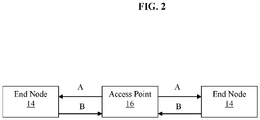
- each of exemplary BLE end nodes (ENs) 14 are responsible for detection of a beacon advertisement message transmitted from an exemplary BLE access point (AP) 16 in the direction of arrows "A,” and moreover, whereby such ENs 14 are solely responsible for evaluating and/or determining whether to initiate or initiate and establish a BLE connection with the AP 16, as shown in the direction of arrows "B.” That is, in no way is the AP 16 responsible for evaluating and/or determining any aspect or aspects of whether to make a connection between a respective AP 16 and a respective EN 14, and whereas such aspect or aspects, rather, are solely evaluated and/or determined by the EN 14 so that the EN 14, itself, is enabled to then solely initiate or initiate and establish the aforementioned connection, if doing so is deemed appropriate by the EN 14.
- the term, "initiate” means taking any initial steps or enacting any initial procedures
- the terms, “establish” or “established” mean taking any steps or enacting any procedures related to whether to cause and/or maintain a connection between an AP 16 and an EN 14, and thereafter making and/or maintaining such connection.
- FIGS. 3-6 and their accompanying descriptions below address various manner of associating an EN 14 to an AP 16.
- FIG. 3 illustrates a BLE-enabled network and communications system thereof
- FIG. 4 illustrates a manner of proximity association of a BLE EN to a BLE AP
- FIG. 5 illustrates a manner of detection, by a BLE EN, of a BLE AP
- FIG. 6 illustrates a manner of connection, by a BLE EN, with a BLE AP.
- an EN 14 does not, at any time, transmit to an AP 16 its location, but rather, the location of the EN 14 may be determined by relative association of one or more APs 16.
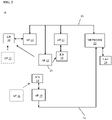
- FIG. 3 illustrates a BLE-enabled network 18 and communications system thereof according to the present embodiments in which ENs 14 detect a received signal strength (RSS) of all beacon advertisement messages transmitted from the APs 16, solely determine proximity with respect to the APs 16, and further, solely initiate and establish all connections therebetween the ENs 14 and APs 16, in response to having evaluated and/or made a decision with respect to, for example, such RSS, information contained in the beacon advertisement message, and/or other information, as discussed below in regard to FIGS. 4-6 .
- RSS received signal strength
- data such as, optionally, identifying information, other than location information, of the EN 14 and identifying information of, other than the connected AP 16, the most proximate AP 16, and contained information of the EN 14 including, for example, sensory information thereof, may be transferred to the respective AP 16 for delivery through a backhaul 20, implemented by a cellular, WiFi, Low Power Wide Area Network (LPWAN) configuration, to a network or cloud service 22 for transfer to an end user terminal 24, such as a personal computing or other electronic device enabled to convey the aforementioned information.
- LPWAN Low Power Wide Area Network
- EN 14 may transmit identifying information of the AP 16 which is most proximate to the EN 14.
- AP 16 may or may not be an AP 16 which is connectable to the network 22, as is explained below.
- an AP 16 is connectable if able to connect to the network 22 via backhaul 20, and as non-connectable if unable to make such connection.
- non-connectable APs 16, which may or may not be present in the network 18 according to FIG. 3 are shown in dashed lines, as are transmissions of their beacon advertisement messages.
- EN 14 and AP 16 are exemplary of first and second network nodes, respectively, which may be similarly configured as are EN 14 and AP 16 to carry out communications with respect to the BLE networking described herein and/or according to the other, appropriate wireless protocol discussed above.
- the EN 14 is configured with an estimator comprising appropriate software and/or hardware for estimating proximity to a given AP 16, based on RSS, and is also configured with appropriate software and/or hardware for performing all operations associated with initiating and/or establishing a connection with an AP 16.
- the estimator conducts a Bayesian Estimation, and specifically a maximum a posteriori (MAP) estimation for each AP 16 encountered by the mobile EN 14 at the time of the encounter, i.e., at the time of receipt of a beacon advertisement message from the respective AP 16.
- MAP maximum a posteriori
- the EN 14 and its estimator may also be configured to undertake the MAP estimation at any time during operation of the EN 14.
- the estimation is given by the following Equation (1),
- the posterior distribution for a given proximity between a particular EN 14 and AP 16 pair at time, t, is determined. In particular, such determination is made by advancing the next most previous posterior, from time, t-1, to the current time, t, given
- a variance of the previous estimate is increased by a predetermined rate. Accordingly, a new posterior estimate may be obtained based on all observations by an EN 14 in accordance with Equation (2), as follows:
- xi represents a variable distance from an EN 14 to an AP 16
- yi represents a RSS of a beacon advertisement message
- N represents a number of observations, i.e., a number of received beacon advertisement messages.
- the highest value, or minimum variance, distribution is chosen as the MAP estimate.
- a confidence value representing a level of expectation that a respective AP 16 is most proximate to the EN 14, is calculated for each AP 16 encountered by the EN 14, based on the estimated posterior distribution and Equation (3) below, and insofar as a 10 dB predetermined variance in RSS is set as an optional, acceptable variance therefor:
- variance level could be set as the predetermined variance depending upon, for example, device configuration(s) of one or more of the AP 16 and EN 14.
- Selection of which AP 16 is most proximate to the EN 14 is determined as that AP 16 which yields the highest confidence value. However, if a further AP 16 yields a next most confident value corresponding to a predetermined tolerance for the confidence value, selection of the AP 16 that is most proximate to the EN 14 is determined from among all of the APs 16 which have broadcast a beacon advertisement message received by the EN 14. Still further, a signal strength from a respective AP 16 may be adjusted, in accordance with an adjustment factor included in the beacon advertisement message, to confer exclusive selection thereof by the EN 14, i.e., any other AP 16 whose beacon advertisement message the EN 14 has received is excluded from being considered as being most proximate to the EN 14. It is to be understood, that the estimator of a particular EN 14 may be configured to create a statistical fingerprint of AP 16 associations so as to optimize interpretation of future association patterns.
- FIG. 4 sets forth a sequence of the above proximity determination enabling association of a respective EN 14 to a respective AP 16.
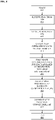
- flow begins at decision block 410 and proceeds to decision block 420 at which an EN 14 receives a RSS from one or more APs 16. Thereafter, at decision block 430, the EN 14 measures the RSSs. At decision block 440, the estimator, which is configured integrally with the EN 16, calculates a MAP estimation for each of the RSSs. Subsequently, at decision block 450, EN 14 calculates a confidence value from each of the estimated posterior distributions. At decision block 460, the AP 16 yielding a highest confidence value is selected as the most proximate AP 16 to the EN 14. Flow then proceeds to decision blocks 470-480 in response to the selection by the EN 14. At decision block 470, EN 14 records the selection of the AP 16 according to identifying information thereof, including, for example, its network address or other appropriate networking identifying information. At decision block 480, the proximity association process ends.
- EN 14 may modulate its behavior depending upon certain conditions. For example, EN 14 may vary the frequency with which it conducts its MAP estimate depending upon whether the EN 14 is stationary or moving. That is, EN 14 may perform its estimation more frequently if it is moving, and less often if it is stationary. Still further, EN 14 may be configured to perform some predetermined action depending upon whether it is at a predetermined location (e.g., activate a light-emitting device (LED) or alarm) and/or whether no further AP 16 is detected (e.g., deactivate a device).
- a predetermined location e.g., activate a light-emitting device (LED) or alarm
- no further AP 16 e.g., deactivate a device
- the decision as to which AP 16 a mobile EN 14 should connect with, and to which it may transmit the identifying information of the most proximate AP 16, is determined based on attainment of a highest connection value calculated by the mobile EN 14. That is, as a mobile EN 14 moves in proximity to one or more APs 16, the value of connection with any one of the APs is assessed based on several components including the confidence value, in accordance with FIG.
- an EN 14 that moves among various APs 16, which may or may not be connectable to the network 22, determines an optimal connection among such APs 16 based on the aforementioned components yielding the highest connection value in accordance with Equation 4.
- the connected AP 16 may receive from the EN 14 the identifying information of another AP 16 that is most proximate in a case in which the connected AP 16 has been determined to have attained the highest connection value, but not the highest confidence value.
- the other, most proximate AP 16 may be any of the following: a non-connectable AP 16, or another connectable AP 16, indicated at 26 in FIG.3 , to which connection has not been made due to it not achieving the highest connection value.
- the consideration of the confidence value in Equation 4 increases the likelihood that the most proximate AP 16 is the one to which EN 14 connects.
- this scenario is not certain given connectability of one or more APs 16 and other considerations used in determining the connection value according to Equation 4.
- FIG. 5 provides a sequence for scanning for detection of a beacon advertisement message respectively transmitted from one or more APs 16
- FIG. 6 provides a sequence for determining an AP 16 with which the EN 14 should connect, based on the above-discussed connection value, ⁇ , as determined in accordance with Equation 4.
- Flow begins in FIG. 5 at decision block 510 and proceeds to decision block 520 at which EN 14 scans for and detects a respective beacon advertisement message from one or more APs 16, whose identifying and/or location information is known to the network 22. Thereafter, at decision block 530, EN 14 processes a detected beacon advertisement message to determine a Universally Unique Identifier (UUID) match wherein identifying data of the AP 16 broadcasting the beacon advertisement message is confirmed as belonging to the network 22. From there, flow proceeds to decision block 540 to determine and confirm a token match.
- UUID Universally Unique Identifier
- the broadcasting AP 16 is, at decision block 550, added to a list of detected APs 16 ("detection list") for which decisions at blocks 530 and 540 have been confirmed.
- the estimator of EN 14 calculates respective confidence values for the detected APs, and records each of the respective confidence values for the detected APs 16 such that attained confidence value is associated with a respective, detected AP 16 when such AP 16 is added to the detection list, and also its selection of the most proximate AP 16. Thereafter, it is determined at decision block 560 whether the scanning operation has timed out. If not, as in the case of negative decisions at decision blocks 530 and 540, scanning continues. If the scanning operation has timed out, flow proceeds, as shown in FIG. 6 , to determine which AP 16, from among the detection list, the EN 14 should connect.
- this connection list is initialized, an AP 16, with its associated confidence value, is drawn from the detection list, at decision block 620, at which point it is then determined, at decision block 630, if such AP 16 is connectable to the network 22 of FIG. 3 , for example. If the drawn AP 16 is connectable, flow then proceeds, with respect to such drawn AP 16, to decision block 640 whereat a connection value therefor is calculated in accordance with Equation (4).
- Flow is then iterative through decision blocks 620-640 until detection list provided at decision block 550 is empty. From among respective connection values calculated at decision block 640, EN 14 selects and connects with, at decision block 650, the AP 16 having a highest connection value in accordance with Equation (4), and proceeds to an end at decision block 660 once connection is established.
- identifying information, other than location information, of an AP 16 which is determined to be most proximate to the EN 14, but non-connectable to the network 22, may be transmitted, by the EN 14, to the AP 16 with which the aforementioned connection has been established.
- the aforementioned proximity determination serves the dual purpose of both determining which AP 16, whether the AP 16 is connectable or non-connectable, is most proximate to an EN 14, and providing a basis for determining which AP 16 the EN 14 should connect. That is, the AP 16 with which the EN 14 ultimately connects may receive identifying information of a non-connectable AP 16 that is most proximate to the EN 14 so that a relative determination of the location of the EN 14 may be determined with reference to this latter, non-connectable AP 16. In this way, the granularity of the proximity determination above is increased such that non-connectable APs 16, and not only connectable APs 16, are each considered by the estimator of EN 14 so as to render available a more accurate AP/EN proximity association.
- connection with a respective one thereof is made based upon the aforementioned confidence and connection values, such that the connected AP 16 likewise may yield a highest confidence value so as to be most proximate to the EN 14, and represent the optimal connection according to Equation (4).
- proximity will be made known to the user 24 by virtue of the established connection and the lack of any other AP 16 identifying information being transferred to the network 22.
- Such ability of a EN 14 to select and connect with a specified, respective one of APs 16 removes the shortcomings of conventional BLE networking by enabling a mobile EN 14 to have the autonomy necessary to initiate or initiate and establish connection with an AP 16 solely in response to its own evaluation and decisionmaking with respect to aspects contributing to the aforementioned proximity association, connection value and/or other information associated with the EN 14.
- such other information may optionally include one or more parameters relating to operation of the EN 14.
- the embodiments discussed herein eliminate the conventionally overwhelming number of advertisements transmitted by peripherals in conventional BLE networking. That is, the present embodiments substantially reduce the number of advertisements occurring at a given time by virtue of the BLE role reversal, discussed herein, in which plural end nodes receive, rather than transmit, advertisements in the form of beacon advertisement messages from one more access points.
- the EN 14 may then transfer its own identifying information, other than location information, and identifying information of the most proximate AP 16. In this way, when information of an AP 16 other than the connected AP 16 is not transferred, it will be understood that the connected AP 16 is most proximate to the EN 14. Concurrently with the transfer of the above information, the EN 14 may also transfer one or more of its contained information including sensory information, access information, notification information, alarm information, and any other status and/or content information thereof as may be applicable to its particular configuration.
- EN 14 may transfer any of the aforementioned types of information so as to be applicable to such environments including a workplace or other type of commercial environment in which commerce is a purpose, a residence, and a medical facility or other facility in which tracking of persons or objects is necessary and/or desired.
- an EN 14 which may be defined as a BLE tag and/or a BLE tag attached to or associated with a particular object, is seeking association with a BLE AP 16 that is configured to report information of the tag to an end user 24 via backhaul 20 and network 22.
- EN 14 and AP 16 may be embodied as being any stationary and/or mobile nodes of an appropriate wireless network, and as being capable of operating according to a BLE protocol or other protocol in which such nodes may operate as respective first and second nodes according to any of FIGS. 4 , 5 , and/or 6.
- a respective EN 14 may be configured to calculate its confidence and connections values at the same time, or, at different times.
- EN 14 may undertake any of the processes of FIGS. 4-6 at any time, whether the EN 14 is mobile or stationary.
- the EN 14 is configured to optimize, at least, a rate at which connection may be established, with respect to, at least, proximity of such connection as well as the efficiency of such connection, as will be understood based on the components of Equation (4).
- such tag is attached to an object, such as a hospital bed for which it is desirous to know the location thereof at any given point in time when it is moving throughout a hospital environment.
- an object such as a hospital bed for which it is desirous to know the location thereof at any given point in time when it is moving throughout a hospital environment.
- the hospital bed, with the tag attached thereto is transient throughout the hospital, moving from floor to floor and from room to room, as the case may be when a patient is to undergo a particular procedure.
- the bed moves from one location to the next, its whereabouts may be tracked through monitoring achieved by the BLE communications system disclosed herein.
- the hospital bed may move throughout a particular floor, it contemplated that it will move among a number of APs whose location is known to the hospital network.
- the tag attached to the bed will scan for beacon advertisement messages transmitted from the various APs.
- the tag Upon receipt of the transmitted signals, the tag is configured to conduct the MAP estimation discussed hereinabove and calculate a highest confidence value for the AP that is in closest proximity at a given point in time and which may or may not be connectable to the hospital network.
- the tag is further configured to connect with a particular connectable AP having a highest connection value, as shown by the exemplary double arrows extending between an exemplary EN 14 and AP 16 of FIG.
- the process of determining proximity of the tag to both connectable and non-connectable APs continues until, optionally, such point in time when the bed and attached tag are stationary such that identifying information of a further, different AP need not be reported.
- the attached tag is alternatively, and optionally, configured to conduct a scan of broadcasting APs and assess their UUID and token information so as to qualify those APs to be included on a detection list resulting from the scan and from which connection with a specified one thereof will occur in order to transfer the tag's identity, identity information of the AP to which the tag is most proximate, and/or contained information of the tag to an end user.
- this detection list is compiled and scanning is completed, embodiments of the present disclosure contemplate the tag being configured to initialize a connection list of APs, from among the APs compiled on the detection list.
- the tag is further contemplated to conduct a determination of whether an AP is connectable to the network 22 via backhaul 20 so as to be able to transfer information of the tag to an end user desirous of knowing the location of the hospital bed.
- Each connectable AP is then evaluated as to its associated connection value in accordance with Equation (4) above.
- connection value for each AP is assessed based on components comprising a confidence value representing a level of expectation that a respective AP is most proximate to the tag and an associated weighting factor, a network loading value and an associated weighting factor, and an association factor of the AP.
- association factor it is contemplated that such factor be deemed to have a value of zero if the tag has not connected with the AP being evaluated, and to have a highest value if the tag has had its most recent connection with that AP. In this way, those connectable APs for whom a connection value has been evaluated by the tag will yield an AP having a highest connection value.
- the tag will then select that AP as the AP with which to initiate and establish a connection enabling the transfer of pertinent information of the tag, including identity information of the AP to which the tag is most proximate, to the end user.
- the embodiments disclosed herein optimize the efficiency of a BLE-enabled network by, at least, reducing burdens on network resources, as well as by enhancing the likelihood of connection in situations in which multiple end nodes are co-located. It will likewise be understood that the embodiments disclosed herein enable a determination of the relative location of an end node in view of its proximity to an access point, whether or not such access point is connectable or non-connectable.
- suitable computer-usable media include: volatile memory such as random access memory (RAM); nonvolatile, hard-coded or programmable-type media such as read only memories (ROMs) or erasable, electrically programmable read only memories (EEPROMs); recordable-type and/or re-recordable media such as floppy disks, hard disk drives, compact discs (CDs), digital versatile discs (DVDs), etc.; and transmission-type media, e.g., digital and/or analog communications links such as those based on electrical-current conductors, light conductors and/or electromagnetic radiation.
- RAM random access memory
- ROMs read only memories
- EEPROMs electrically programmable read only memories
- CDs compact discs
- DVDs digital versatile discs
- transmission-type media e.g., digital and/or analog communications links such as those based on electrical-current conductors, light conductors and/or electromagnetic radiation.
Landscapes
- Engineering & Computer Science (AREA)
- Computer Networks & Wireless Communication (AREA)
- Signal Processing (AREA)
- Computer Security & Cryptography (AREA)
- Mobile Radio Communication Systems (AREA)
- Telephonic Communication Services (AREA)
- Quality & Reliability (AREA)
- Physics & Mathematics (AREA)
- Electromagnetism (AREA)
Description
- Disclosed embodiments relate to wireless communications, and more specifically, to wireless communication among BLUETOOTH Low Energy (BLE) equipped devices in which conventional BLE central and peripheral roles of those devices are reversed and made applicable to nodes of a BLE-enabled network so as to enhance BLE networking capability.
- Circa 2009, the Internet was in a stage of its evolution in which the backbone (routers and servers) was connected to fringe nodes formed primarily by personal computers. At that time, Kevin Ashton (among others) looked ahead to the next stage in the Internet's evolution, which he described as the Internet of Things ("IoT"). In his article, "That 'Internet of Things' Thing," RFID Journal, Jul. 22, 2009, he describes the circa-2009-Internet as almost wholly dependent upon human interaction, i.e., he asserts that nearly all of the data then available on the internet was generated by data-capture/data-creation chains of events each of which included human interaction, e.g., typing, pressing a record button, taking a digital picture, or scanning a bar code. In the evolution of the Internet, such dependence upon human interaction as a link in each chain of data-capture and/or data-generation is a bottleneck. To deal with the bottleneck, Ashton suggested adapting internet-connected computers by providing them with data-capture and/or data-generation capability, thereby eliminating human interaction from a substantial portion of the data-capture/data-creation chains of events.
- In the context of the loT, a thing can be a natural or man-made object to which is assigned a unique ID/address and which is configured with the ability to capture and/or create data and transfer that data over a network. Relative to the loT, a thing can be, e.g., a person with a heart monitor implant, a farm animal with a biochip transponder, an automobile that has built-in sensors to alert the driver when tire pressure is low, field operation devices that assist fire-fighters in search and rescue, personal biometric monitors woven into clothing that interact with thermostat systems and lighting systems to control HVAC and illumination conditions in a room continuously and imperceptibly, a refrigerator that is "aware" of its suitably tagged contents that can both plan a variety of menus from the food actually present therein and warn users of stale or spoiled food, etc.
- In the post-2009 evolution of the Internet towards the loT, a segment that has experienced major growth is that of small, inexpensive, networked processing devices, distributed at all scales throughout everyday life. Of those, many are configured for everyday/commonplace purposes. For the loT, the fringe nodes will be comprised substantially of such small devices.
- Within the small-device segment, the sub-segment that has the greatest growth potential is embedded, low-power, wireless devices. Networks of such devices are described as comprising the Wireless Embedded Internet ("WET"), which is a subset of loT. More particularly, the WET includes resource-limited embedded devices, which typically are battery powered, and which are typically connected to the Internet by low-power, lowbandwidth wireless networks ("LoWPANs").
- The BLUETOOTH Special Interest Group devised BLE particularly in consideration of loT devices and applications which do not rely upon continuous connection(s), but depend on extended battery life. A good example of these devices includes a temperature sensor which intermittently provides temperature readings to a collector device that collects such readings. That is, continuous connection between the sensor and collector is not necessary to obtain, for example, such temperature reading at a discrete point in time.
- The BLUETOOTH specification governing operation of BLE devices relates definitional roles to each of the above sensor and collector as peripheral and central, respectively.
- In accordance with customary BLE networking operations, a peripheral, such as a sensor above, makes its presence known to any central, such as a collector above, merely by continuously "advertising" its presence. In other words, the peripheral continuously sends beacon advertisement messages for recognition by a central that itself decides whether connection with the recognized peripheral should occur. In a BLE environment, such advertising occurs across three advertising channels, or frequencies, so as to reduce instances of interference among signals sent by multiple peripherals.
- Yet, existing within such a BLE environment are several impediments to optimal communication between peripheral and central devices.
- An example of such an impediment exists in the form of an uncertainty that a peripheral device may experience in actually knowing why its broadcast advertisement has not been acknowledged by a central device. Specifically, such uncertainty exists due to the peripheral's inability to know whether a central device is in a range enabling receipt of its advertisement, or additionally, whether a central device that is in range is simply overloaded such that it has not had sufficient time or capacity to process the peripheral's advertisement.
- Yet a further impediment that exists to an optimal relationship between a peripheral and central is congestion across the advertising channels leading to opportunities for signaling collision and missed advertisements, each of which causes a lack of connection. These failures are prevalent in scenarios in which multiple peripherals are co-located, i.e., disposed in or at a same space within a structure such as a building or other venue in which peripheral and central functionality are required or desired.
- A still further impediment to BLE networking exists in the fundamental complexity brought about by the conventional BLE peripheral/central relationship. In this relationship, a mobile peripheral which moves out of range of a central such as a first network access point (AP) to which it had previously connected essentially loses any established relationship that such peripheral made with that first AP. In this case, when the peripheral moves within range of another, second AP, this second AP is not immediately able to know, due to the established relationship of the peripheral with the first AP, whether a connection should be made in view of considerations including network configuration, security and authentication. The only basis for informing the second AP whether connection with the peripheral should occur is information it receives from a coordinating application running on the BLE network and that provides information to APs concerning whether connection should be made with a peripheral as a result of its broadcast advertisement. However, by the time the coordinating application learns of the lost connection with the first AP in the above scenario, a considerable amount of time has elapsed before connection information can be, or is, provided by the coordinating application to the second AP in order to allow it to determine that it should connect with the peripheral. Thus, in these ways, it will be understood that enabling connection with a peripheral moving among several APs is not only complex, but further disadvantages exist insofar as increased connection latency and a higher utilization of backhaul due to necessary information that must flow to and from the coordinating application.
- Thus, it would be desirable to provide for one or more optimized BLE networking relationships that address and overcome the aforementioned impediments and disadvantages now associated with the conventional BLE central/peripheral networking relationship discussed above. More specifically, it would be desirable to provide applicability of such optimized BLE relationships in connection with various application environments such as, for example, providing healthcare, improving fitness, improving internet connectivity, improving proximity sensing, improving alert systems, improving jobsite monitoring, improving systems controlling access, improving automation and improving systems and methods for tracking assets to be inventoried and for which location must be determined, whether in a commercial or residential setting, as well as any other application in which a BLE networking protocol is deployed.
-
WO2016/053909A1 discloses that conventional Bluetooth low energy (or like personal wireless network) controllers cannot resolve private addresses without some calculation from a host processor but leaving the host processor on or awaking it from a sleep each time a non-trusted device attempts to connect wastes power. Hostless private address resolution allows a host controller to enter a sleep state off while the Bluetooth controller advertises its device name, primary services, rejects connection requests from non-trusted devices with public and private addresses, and awakens the host controller upon a connection request from a trusted client device with a public or private address.US2016/183042A1 discloses techniques for obtaining device location using a BLE location beacon. - It is to be understood that both the following summary and the detailed description are exemplary and explanatory and are intended to provide further explanation of the present embodiments as claimed. Neither the summary nor the description that follows is intended to define or limit the scope of the present embodiments to the particular features mentioned in the summary or in the description. Rather, the scope of the present embodiments is defined by the appended claims.
- A BLE communications system is provided as recited in claim 1.
- A method of BLE communication is provided as recited in claim 7.
- The accompanying drawings, which are incorporated herein and form a part of the specification, illustrate exemplary embodiments and, together with the description, further serve to enable a person skilled in the pertinent art to make and use these embodiments and others that will be apparent to those skilled in the art. Embodiments herein will be more particularly described in conjunction with the following drawings wherein:
-
FIG. 1 is an illustration of BLE transmission of a beacon advertisement message between a BLE central and a BLE peripheral, according to the related art; -
FIG. 2 is an illustration of BLE transmission of a beacon advertisement message between a BLE end node (EN) and a BLE access point (AP), according to embodiments disclosed herein; -
FIG. 3 is an illustration of a BLE-enabled network in accordance withFIG. 2 ; -
FIG. 4 is a sequence diagram of proximity association of a BLE EN with a BLE AP, in accordance withFIG. 3 ; -
FIG. 5 is a sequence diagram of detection, by a BLE EN, of a BLE AP, in accordance withFIG. 3 ; and -
FIG. 6 is a sequence diagram of connection, by the BLE EN, with the BLE AP, in accordance withFIGS. 3 and5 . - The present disclosure will now be described in terms of various exemplary embodiments. This specification discloses one or more embodiments that incorporate features of the present embodiments. The embodiment(s) described, and references in the specification to "one embodiment", "an embodiment", "an example embodiment", etc., indicate that the embodiment(s) described may include a particular feature, structure, or characteristic. Such phrases are not necessarily referring to the same embodiment. The skilled artisan will appreciate that a particular feature, structure, or characteristic described in connection with one embodiment is not necessarily limited to that embodiment but typically has relevance and applicability to one or more other embodiments.
- In the several figures, like reference numerals may be used for like elements having like functions even in different drawings. The embodiments described, and their detailed construction and elements, are merely provided to assist in a comprehensive understanding of the present embodiments. Thus, it is apparent that the present embodiments can be carried out in a variety of ways, and does not require any of the specific features described herein. Also, well-known functions or constructions are not described in detail since they would obscure the present embodiments with unnecessary detail.
- The description is not to be taken in a limiting sense, but is made merely for the purpose of illustrating the general principles of the present embodiments, since the scope of the present embodiments are best defined by the appended claims.
- It should also be noted that in some alternative implementations, the blocks in a flowchart, the communications in a sequence-diagram, the states in a state-diagram, etc., may occur out of the orders illustrated in the figures. That is, the illustrated orders of the blocks/communications/states are not intended to be limiting. Rather, the illustrated blocks/communications/states may be reordered into any suitable order, and some of the blocks/communications/states could occur simultaneously.
- All definitions, as defined and used herein, should be understood to control over dictionary definitions, definitions in documents incorporated by reference, and/or ordinary meanings of the defined terms.
- The indefinite articles "a" and "an," as used herein in the specification and in the claims, unless clearly indicated to the contrary, should be understood to mean "at least one."
- The phrase "and/or," as used herein in the specification and in the claims, should be understood to mean "either or both" of the elements so conjoined, i.e., elements that are conjunctively present in some cases and disjunctively present in other cases. Multiple elements listed with "and/or" should be construed in the same fashion, i.e., "one or more" of the elements so conjoined. Other elements may optionally be present other than the elements specifically identified by the "and/or" clause, whether related or unrelated to those elements specifically identified. Thus, as a non-limiting example, a reference to "A and/or B", when used in conjunction with open-ended language such as "comprising" can refer, in one embodiment, to A only (optionally including elements other than B); in another embodiment, to B only (optionally including elements other than A); in yet another embodiment, to both A and B (optionally including other elements); etc.
- As used herein in the specification and in the claims, "or" should be understood to have the same meaning as "and/or" as defined above. For example, when separating items in a list, "or" or "and/or" shall be interpreted as being inclusive, i.e., the inclusion of at least one, but also including more than one, of a number or list of elements, and, optionally, additional unlisted items. Only terms clearly indicated to the contrary, such as "only one of or "exactly one of," or, when used in the claims, "consisting of," will refer to the inclusion of exactly one element of a number or list of elements. In general, the term "or" as used herein shall only be interpreted as indicating exclusive alternatives (i.e. "one or the other but not both") when preceded by terms of exclusivity, such as "either," "one of," "only one of," or "exactly one of "Consisting essentially of," when used in the claims, shall have its ordinary meaning as used in the field of patent law.
- As used herein in the specification and in the claims, the phrase "at least one," in reference to a list of one or more elements, should be understood to mean at least one element selected from any one or more of the elements in the list of elements, but not necessarily including at least one of each and every element specifically listed within the list of elements and not excluding any combinations of elements in the list of elements. This definition also allows that elements may optionally be present other than the elements specifically identified within the list of elements to which the phrase "at least one" refers, whether related or unrelated to those elements specifically identified. Thus, as a non-limiting example, "at least one of A and B" (or, equivalently, "at least one of A or B," or, equivalently "at least one of A and/or B") can refer, in one embodiment, to at least one, optionally including more than one, A, with no B present (and optionally including elements other than B); in another embodiment, to at least one, optionally including more than one, B, with no A present (and optionally including elements other than A); in yet another embodiment, to at least one, optionally including more than one, A, and at least one, optionally including more than one, B (and optionally including other elements); etc.
- In the claims, as well as in the specification above, all transitional phrases such as "comprising," "including," "carrying," "having," "containing," "involving," "holding," "composed of," and the like are to be understood to be open-ended, i.e., to mean including but not limited to. Only the transitional phrases "consisting of" and "consisting essentially of" shall be closed or semiclosed transitional phrases, respectively, as set forth in the United States Patent Office Manual of Patent Examining Procedures, Section 2111.03.
- It will be understood that, although the terms first, second, etc. may be used herein to describe various elements, these elements should not be limited by these terms. These terms are only used to distinguish one element from another. For example, a first element could be termed a second element, and, similarly, a second element could be termed a first element, without departing from the scope of example embodiments. As used herein, the term "and/or" includes any and all combinations of one or more of the associated listed items. As used herein, the singular forms "a", "an" and "the" are intended to include the plural forms as well, unless the context clearly indicates otherwise.
- The word "exemplary" is used herein to mean "serving as an example, instance, or illustration." Any embodiment described herein as "exemplary" is not necessarily to be construed as preferred or advantageous over other embodiments. Additionally, all embodiments described herein should be considered exemplary unless otherwise stated.
- The word "network" is used herein to mean one or more conventional or proprietary networks using an appropriate network data transmission protocol, or other specification and/or guidelines which may be applicable to the transfer of information. Examples of such networks include, PSTN, LAN, WAN, WiFi, WiMax, Internet, World Wide Web, Ethernet, other wireless networks, and the like.
- The phrase "wireless device" is used herein to mean one or more conventional or proprietary devices using radio frequency transmission techniques or any other techniques enabling the transfer of information. Examples of such wireless devices include cellular telephones, desktop computers, laptop computers, handheld computers, electronic games, portable digital assistants, MP3 players, DVD players, or the like.
- BLE networking enables detection and connection among devices that generally do not require continuous connection therebetween in order for an exchange of information in the form of data to occur. Yet, such devices depend upon extended battery life in order that the opportunity for such an exchange may continue to reliably exist. The devices themselves vary in their construction, whether, for example, a sensor, a cellphone, a network access point (AP), or some other object configured to enable and/or provide BLE communication(s) and which is either stationary or mobile, such as a BLUETOOTH tag. In the context of BLE networking, such devices are prescribed by the BLUETOOTH Core Specification 4.0 and are compatible with IEEE 802.15.1, as appropriate.
- Typically, in the context of BLE communications, one or more of these devices assume the roles of a central 10 and a peripheral 12, as shown in
FIG. 1 . A peripheral is generally understood as a device which merely broadcasts, or advertises, its presence toward another device referred to as a central, with the intent that such presence be detected by that central. The broadcast generally takes the form of a beacon advertisement message transmitted as a radio frequency (RF) signal. Should detection occur, it is also generally understood that it is the central that determines whether a connection with the peripheral should occur. If the answer to that determination is in the affirmative, the central establishes a connection, and also prescribes all conditions under which any connection with a peripheral is to be made. The directional flow of transmission of the beacon advertisement message comprising a RF signal from the peripheral is shown by arrows "A," inFIG. 1 , while the directional flow of establishment of a connection with the peripheral by the central is shown by arrows "B." - Such a scheme renders BLE networking susceptible to the many shortcomings discussed hereinabove.
- Thus, in an effort to address those shortcomings, embodiments disclosed herein reverse the directional flows of transmission of the beacon advertisement message and connection so as to thereby reverse the roles of a conventional central and a conventional peripheral, and make such role reversal applicable to appropriate nodes in a BLE-enabled network.
FIG. 2 illustrates such reversal of roles insofar as each of exemplary BLE end nodes (ENs) 14 are responsible for detection of a beacon advertisement message transmitted from an exemplary BLE access point (AP) 16 in the direction of arrows "A," and moreover, wherebysuch ENs 14 are solely responsible for evaluating and/or determining whether to initiate or initiate and establish a BLE connection with theAP 16, as shown in the direction of arrows "B." That is, in no way is theAP 16 responsible for evaluating and/or determining any aspect or aspects of whether to make a connection between arespective AP 16 and arespective EN 14, and whereas such aspect or aspects, rather, are solely evaluated and/or determined by theEN 14 so that theEN 14, itself, is enabled to then solely initiate or initiate and establish the aforementioned connection, if doing so is deemed appropriate by theEN 14. Herein, the term, "initiate" means taking any initial steps or enacting any initial procedures, and the terms, "establish" or "established" mean taking any steps or enacting any procedures related to whether to cause and/or maintain a connection between anAP 16 and anEN 14, and thereafter making and/or maintaining such connection. -
FIGS. 3-6 and their accompanying descriptions below address various manner of associating anEN 14 to anAP 16. Therein,FIG. 3 illustrates a BLE-enabled network and communications system thereof,FIG. 4 illustrates a manner of proximity association of a BLE EN to a BLE AP,FIG. 5 illustrates a manner of detection, by a BLE EN, of a BLE AP, andFIG. 6 illustrates a manner of connection, by a BLE EN, with a BLE AP. Throughout, it is to be understood that anEN 14 does not, at any time, transmit to anAP 16 its location, but rather, the location of theEN 14 may be determined by relative association of one ormore APs 16. - Specifically,
FIG. 3 illustrates a BLE-enablednetwork 18 and communications system thereof according to the present embodiments in whichENs 14 detect a received signal strength (RSS) of all beacon advertisement messages transmitted from theAPs 16, solely determine proximity with respect to theAPs 16, and further, solely initiate and establish all connections therebetween theENs 14 andAPs 16, in response to having evaluated and/or made a decision with respect to, for example, such RSS, information contained in the beacon advertisement message, and/or other information, as discussed below in regard toFIGS. 4-6 . Once a connection between anEN 14 and anAP 16 is made, data such as, optionally, identifying information, other than location information, of theEN 14 and identifying information of, other than theconnected AP 16, the mostproximate AP 16, and contained information of theEN 14 including, for example, sensory information thereof, may be transferred to therespective AP 16 for delivery through abackhaul 20, implemented by a cellular, WiFi, Low Power Wide Area Network (LPWAN) configuration, to a network orcloud service 22 for transfer to an end user terminal 24, such as a personal computing or other electronic device enabled to convey the aforementioned information. Pertinent identifying and/or location information of theAPs 16 are known to thenetwork 22. - As mentioned,
EN 14 may transmit identifying information of theAP 16 which is most proximate to theEN 14.Such AP 16 may or may not be anAP 16 which is connectable to thenetwork 22, as is explained below. In these regards, it is to be understood that anAP 16 is connectable if able to connect to thenetwork 22 viabackhaul 20, and as non-connectable if unable to make such connection. For instance,non-connectable APs 16, which may or may not be present in thenetwork 18 according toFIG. 3 , are shown in dashed lines, as are transmissions of their beacon advertisement messages. - Further, it is to be understood that, while communications between an
EN 14 andAP 16 are discussed herein in the context of the BLE protocol, it is contemplated that such communication may also be optionally achieved according to another wireless protocol, as appropriate. Also, it is to be understood thatEN 14 andAP 16 are exemplary of first and second network nodes, respectively, which may be similarly configured as areEN 14 andAP 16 to carry out communications with respect to the BLE networking described herein and/or according to the other, appropriate wireless protocol discussed above. - In an exemplary case in which a
respective EN 14 is mobile, theEN 14 is configured with an estimator comprising appropriate software and/or hardware for estimating proximity to a givenAP 16, based on RSS, and is also configured with appropriate software and/or hardware for performing all operations associated with initiating and/or establishing a connection with anAP 16. - The estimator conducts a Bayesian Estimation, and specifically a maximum a posteriori (MAP) estimation for each
AP 16 encountered by themobile EN 14 at the time of the encounter, i.e., at the time of receipt of a beacon advertisement message from therespective AP 16. Furthermore, theEN 14 and its estimator may also be configured to undertake the MAP estimation at any time during operation of theEN 14. The estimation is given by the following Equation (1),
- In this way, the posterior distribution,

particular EN 14 andAP 16 pair at time, t, is determined. In particular, such determination is made by advancing the next most previous posterior,

- It is contemplated that a variance of the previous estimate,

EN 14 in accordance with Equation (2), as follows:
- Therein, xi represents a variable distance from an
EN 14 to anAP 16, yi represents a RSS of a beacon advertisement message and N represents a number of observations, i.e., a number of received beacon advertisement messages. In this regard, the highest value, or minimum variance, distribution is chosen as the MAP estimate. - Once the MAP estimate is obtained, a confidence value, representing a level of expectation that a
respective AP 16 is most proximate to theEN 14, is calculated for eachAP 16 encountered by theEN 14, based on the estimated posterior distribution and Equation (3) below, and insofar as a 10 dB predetermined variance in RSS is set as an optional, acceptable variance therefor:
- Thus, it is to be understood that another variance level could be set as the predetermined variance depending upon, for example, device configuration(s) of one or more of the
AP 16 andEN 14. - Selection of which
AP 16 is most proximate to theEN 14 is determined as thatAP 16 which yields the highest confidence value. However, if afurther AP 16 yields a next most confident value corresponding to a predetermined tolerance for the confidence value, selection of theAP 16 that is most proximate to theEN 14 is determined from among all of theAPs 16 which have broadcast a beacon advertisement message received by theEN 14. Still further, a signal strength from arespective AP 16 may be adjusted, in accordance with an adjustment factor included in the beacon advertisement message, to confer exclusive selection thereof by theEN 14, i.e., anyother AP 16 whose beacon advertisement message theEN 14 has received is excluded from being considered as being most proximate to theEN 14. It is to be understood, that the estimator of aparticular EN 14 may be configured to create a statistical fingerprint ofAP 16 associations so as to optimize interpretation of future association patterns. -
FIG. 4 sets forth a sequence of the above proximity determination enabling association of arespective EN 14 to arespective AP 16. - Therein, flow begins at
decision block 410 and proceeds to decision block 420 at which anEN 14 receives a RSS from one ormore APs 16. Thereafter, atdecision block 430, theEN 14 measures the RSSs. At decision block 440, the estimator, which is configured integrally with theEN 16, calculates a MAP estimation for each of the RSSs. Subsequently, at decision block 450,EN 14 calculates a confidence value from each of the estimated posterior distributions. Atdecision block 460, theAP 16 yielding a highest confidence value is selected as the mostproximate AP 16 to theEN 14. Flow then proceeds to decision blocks 470-480 in response to the selection by theEN 14. At decision block 470,EN 14 records the selection of theAP 16 according to identifying information thereof, including, for example, its network address or other appropriate networking identifying information. At decision block 480, the proximity association process ends. - Furthermore, it is contemplated that
EN 14 may modulate its behavior depending upon certain conditions. For example,EN 14 may vary the frequency with which it conducts its MAP estimate depending upon whether theEN 14 is stationary or moving. That is,EN 14 may perform its estimation more frequently if it is moving, and less often if it is stationary. Still further,EN 14 may be configured to perform some predetermined action depending upon whether it is at a predetermined location (e.g., activate a light-emitting device (LED) or alarm) and/or whether nofurther AP 16 is detected (e.g., deactivate a device). - Additionally, and in accordance with
FIGS. 5-6 , the decision as to which AP 16 amobile EN 14 should connect with, and to which it may transmit the identifying information of the mostproximate AP 16, is determined based on attainment of a highest connection value calculated by themobile EN 14. That is, as amobile EN 14 moves in proximity to one ormore APs 16, the value of connection with any one of the APs is assessed based on several components including the confidence value, in accordance withFIG. 4 , and an associated weighting factor, a network loading value and an associated weighting factor, and an association factor of thebroadcasting AP 16, and is given by the following Equation (4):
σ represents the connection value, as an absolute value, α represents a weighting factor assigned to the confidence value calculated by theEN 14, P represents the confidence value, β represents a weighting factor assigned to loading of the connected network, L represents a loading value of the connected network and is included in the beacon advertisement message, and γ represents an association factor for arespective AP 16, such that γ equals zero if theEN 14 has not made a previous connection with therespective AP 16 and equals a predetermined highest value if therespective AP 16 is theAP 16 with which theEN 14 has made a most previous connection. - In this way, an
EN 14 that moves amongvarious APs 16, which may or may not be connectable to thenetwork 22, determines an optimal connection amongsuch APs 16 based on the aforementioned components yielding the highest connection value in accordance with Equation 4. - Once such connection is made, as indicated by the exemplary double arrows of
FIG. 3 , theconnected AP 16 may receive from theEN 14 the identifying information of anotherAP 16 that is most proximate in a case in which theconnected AP 16 has been determined to have attained the highest connection value, but not the highest confidence value. The other, mostproximate AP 16 may be any of the following: anon-connectable AP 16, or anotherconnectable AP 16, indicated at 26 inFIG.3 , to which connection has not been made due to it not achieving the highest connection value. Thus, it is to be understood that the consideration of the confidence value in Equation 4 increases the likelihood that the mostproximate AP 16 is the one to whichEN 14 connects. However, this scenario is not certain given connectability of one ormore APs 16 and other considerations used in determining the connection value according to Equation 4. - The manner of determining the above optimal connection at the
mobile EN 14 is demonstrated by the flow ofFIGS. 5-6 .FIG. 5 provides a sequence for scanning for detection of a beacon advertisement message respectively transmitted from one ormore APs 16, whileFIG. 6 provides a sequence for determining anAP 16 with which theEN 14 should connect, based on the above-discussed connection value, σ, as determined in accordance with Equation 4. - Flow begins in
FIG. 5 atdecision block 510 and proceeds to decision block 520 at whichEN 14 scans for and detects a respective beacon advertisement message from one ormore APs 16, whose identifying and/or location information is known to thenetwork 22. Thereafter, atdecision block 530,EN 14 processes a detected beacon advertisement message to determine a Universally Unique Identifier (UUID) match wherein identifying data of theAP 16 broadcasting the beacon advertisement message is confirmed as belonging to thenetwork 22. From there, flow proceeds to decision block 540 to determine and confirm a token match. If a match is confirmed at 540, thebroadcasting AP 16 is, atdecision block 550, added to a list of detected APs 16 ("detection list") for which decisions atblocks EN 14 calculates respective confidence values for the detected APs, and records each of the respective confidence values for the detectedAPs 16 such that attained confidence value is associated with a respective, detectedAP 16 whensuch AP 16 is added to the detection list, and also its selection of the mostproximate AP 16. Thereafter, it is determined atdecision block 560 whether the scanning operation has timed out. If not, as in the case of negative decisions at decision blocks 530 and 540, scanning continues. If the scanning operation has timed out, flow proceeds, as shown inFIG. 6 , to determine whichAP 16, from among the detection list, theEN 14 should connect. - Based on a timeout having occurred and the detection list, flow then proceeds, from
decision block 560, to decision block 610 ofFIG. 6 so as to initialize a list ofAPs 16 to which theEN 14 should connect (so as to provide a "connection list"). Once this connection list is initialized, anAP 16, with its associated confidence value, is drawn from the detection list, atdecision block 620, at which point it is then determined, at decision block 630, ifsuch AP 16 is connectable to thenetwork 22 ofFIG. 3 , for example. If the drawnAP 16 is connectable, flow then proceeds, with respect to such drawnAP 16, to decision block 640 whereat a connection value therefor is calculated in accordance with Equation (4). Flow is then iterative through decision blocks 620-640 until detection list provided atdecision block 550 is empty. From among respective connection values calculated at decision block 640,EN 14 selects and connects with, atdecision block 650, theAP 16 having a highest connection value in accordance with Equation (4), and proceeds to an end atdecision block 660 once connection is established. - During that connection, however, identifying information, other than location information, of an
AP 16 which is determined to be most proximate to theEN 14, but non-connectable to thenetwork 22, may be transmitted, by theEN 14, to theAP 16 with which the aforementioned connection has been established. - In this way, the aforementioned proximity determination according to the discussed confidence value serves the dual purpose of both determining which
AP 16, whether theAP 16 is connectable or non-connectable, is most proximate to anEN 14, and providing a basis for determining whichAP 16 theEN 14 should connect. That is, theAP 16 with which theEN 14 ultimately connects may receive identifying information of anon-connectable AP 16 that is most proximate to theEN 14 so that a relative determination of the location of theEN 14 may be determined with reference to this latter,non-connectable AP 16. In this way, the granularity of the proximity determination above is increased such thatnon-connectable APs 16, and not onlyconnectable APs 16, are each considered by the estimator ofEN 14 so as to render available a more accurate AP/EN proximity association. - Accordingly, as
mobile EN 14 moves in and out of range of one ormore APs 16, connection with a respective one thereof is made based upon the aforementioned confidence and connection values, such that theconnected AP 16 likewise may yield a highest confidence value so as to be most proximate to theEN 14, and represent the optimal connection according to Equation (4). In this case, such proximity will be made known to the user 24 by virtue of the established connection and the lack of anyother AP 16 identifying information being transferred to thenetwork 22. - Such ability of a
EN 14 to select and connect with a specified, respective one ofAPs 16 removes the shortcomings of conventional BLE networking by enabling amobile EN 14 to have the autonomy necessary to initiate or initiate and establish connection with anAP 16 solely in response to its own evaluation and decisionmaking with respect to aspects contributing to the aforementioned proximity association, connection value and/or other information associated with theEN 14. For instance, such other information may optionally include one or more parameters relating to operation of theEN 14. - In removing the aforementioned shortcomings, it will be apparent that the embodiments discussed herein eliminate the conventionally overwhelming number of advertisements transmitted by peripherals in conventional BLE networking. That is, the present embodiments substantially reduce the number of advertisements occurring at a given time by virtue of the BLE role reversal, discussed herein, in which plural end nodes receive, rather than transmit, advertisements in the form of beacon advertisement messages from one more access points.
- Once connected, the
EN 14 may then transfer its own identifying information, other than location information, and identifying information of the mostproximate AP 16. In this way, when information of anAP 16 other than theconnected AP 16 is not transferred, it will be understood that theconnected AP 16 is most proximate to theEN 14. Concurrently with the transfer of the above information, theEN 14 may also transfer one or more of its contained information including sensory information, access information, notification information, alarm information, and any other status and/or content information thereof as may be applicable to its particular configuration. For instance, it is contemplated thatEN 14 may transfer any of the aforementioned types of information so as to be applicable to such environments including a workplace or other type of commercial environment in which commerce is a purpose, a residence, and a medical facility or other facility in which tracking of persons or objects is necessary and/or desired. - The following examples describe instances of associating a particular end node (EN) 14 to a particular access point (AP) 16. Further, such examples are set forth in the context of the BLE-enabled
network 18 ofFIG. 3 and with the exemplary understanding that anEN 14, which may be defined as a BLE tag and/or a BLE tag attached to or associated with a particular object, is seeking association with aBLE AP 16 that is configured to report information of the tag to an end user 24 viabackhaul 20 andnetwork 22. In these regards, it is contemplated thatEN 14 andAP 16 may be embodied as being any stationary and/or mobile nodes of an appropriate wireless network, and as being capable of operating according to a BLE protocol or other protocol in which such nodes may operate as respective first and second nodes according to any ofFIGS. 4 ,5 , and/or 6. Also, in these regards, it is to be understood that arespective EN 14 may be configured to calculate its confidence and connections values at the same time, or, at different times. It is to be understood thatEN 14 may undertake any of the processes ofFIGS. 4-6 at any time, whether theEN 14 is mobile or stationary. Thus, theEN 14 is configured to optimize, at least, a rate at which connection may be established, with respect to, at least, proximity of such connection as well as the efficiency of such connection, as will be understood based on the components of Equation (4). - In a first instance, it is contemplated that such tag is attached to an object, such as a hospital bed for which it is desirous to know the location thereof at any given point in time when it is moving throughout a hospital environment. Thus, assume that the hospital bed, with the tag attached thereto, is transient throughout the hospital, moving from floor to floor and from room to room, as the case may be when a patient is to undergo a particular procedure. At any given point in time, as the bed moves from one location to the next, its whereabouts may be tracked through monitoring achieved by the BLE communications system disclosed herein.
- More specifically, as the hospital bed may move throughout a particular floor, it contemplated that it will move among a number of APs whose location is known to the hospital network. As that travel occurs, the tag attached to the bed will scan for beacon advertisement messages transmitted from the various APs. Upon receipt of the transmitted signals, the tag is configured to conduct the MAP estimation discussed hereinabove and calculate a highest confidence value for the AP that is in closest proximity at a given point in time and which may or may not be connectable to the hospital network. The tag is further configured to connect with a particular connectable AP having a highest connection value, as shown by the exemplary double arrows extending between an
exemplary EN 14 andAP 16 ofFIG. 3 , so that the identifying and other information of the closest proximity AP may then be transferred to the end user. In this way, as the bed and attached tag may continue to move, the process of determining proximity of the tag to both connectable and non-connectable APs continues until, optionally, such point in time when the bed and attached tag are stationary such that identifying information of a further, different AP need not be reported. - More particularly, and continuing with the example scenario above, the attached tag is alternatively, and optionally, configured to conduct a scan of broadcasting APs and assess their UUID and token information so as to qualify those APs to be included on a detection list resulting from the scan and from which connection with a specified one thereof will occur in order to transfer the tag's identity, identity information of the AP to which the tag is most proximate, and/or contained information of the tag to an end user. Once this detection list is compiled and scanning is completed, embodiments of the present disclosure contemplate the tag being configured to initialize a connection list of APs, from among the APs compiled on the detection list. Once initialized, the tag is further contemplated to conduct a determination of whether an AP is connectable to the
network 22 viabackhaul 20 so as to be able to transfer information of the tag to an end user desirous of knowing the location of the hospital bed. Each connectable AP is then evaluated as to its associated connection value in accordance with Equation (4) above. - More specifically, the connection value for each AP, that is determined to be connectable to the
network 22, is assessed based on components comprising a confidence value representing a level of expectation that a respective AP is most proximate to the tag and an associated weighting factor, a network loading value and an associated weighting factor, and an association factor of the AP. In regard to the association factor, it is contemplated that such factor be deemed to have a value of zero if the tag has not connected with the AP being evaluated, and to have a highest value if the tag has had its most recent connection with that AP. In this way, those connectable APs for whom a connection value has been evaluated by the tag will yield an AP having a highest connection value. As such, the tag will then select that AP as the AP with which to initiate and establish a connection enabling the transfer of pertinent information of the tag, including identity information of the AP to which the tag is most proximate, to the end user. - In these ways, it will be understood that the embodiments disclosed herein optimize the efficiency of a BLE-enabled network by, at least, reducing burdens on network resources, as well as by enhancing the likelihood of connection in situations in which multiple end nodes are co-located. It will likewise be understood that the embodiments disclosed herein enable a determination of the relative location of an end node in view of its proximity to an access point, whether or not such access point is connectable or non-connectable.
- The present embodiments are not limited to the particular embodiments illustrated in the drawings and described above in detail. Those skilled in the art will recognize that other arrangements could be devised. The present embodiments encompass every possible combination of the various features of each embodiment disclosed. One or more of the elements described herein with respect to various embodiments can be implemented in a more separated or integrated manner than explicitly described, or even removed or rendered as inoperable in certain cases, as is useful in accordance with a particular application. While the present embodiments have been described with reference to specific illustrative embodiments, modifications and variations of the present embodiments may be constructed without departing from the scope of the claims.
- While the present embodiments have been described in the context of the embodiments explicitly discussed herein, those skilled in the art will appreciate that the present embodiments are capable of being implemented and distributed in the form of a computer-usable medium (in a variety of forms) containing computer-executable instructions, and that the present embodiments apply equally regardless of the particular type of computer-usable medium which is used to carry out the distribution. An exemplary computer-usable medium is coupled to a computer such the computer can read information including the computer-executable instructions therefrom, and (optionally) write information thereto. Alternatively, the computer-usable medium may be integral to the computer. When the computer-executable instructions are loaded into and executed by the computer, the computer becomes an apparatus for practicing the embodiments. For example, when the computer-executable instructions are loaded into and executed by a general-purpose computer, the general-purpose computer becomes configured thereby into a special-purpose computer. Examples of suitable computer-usable media include: volatile memory such as random access memory (RAM); nonvolatile, hard-coded or programmable-type media such as read only memories (ROMs) or erasable, electrically programmable read only memories (EEPROMs); recordable-type and/or re-recordable media such as floppy disks, hard disk drives, compact discs (CDs), digital versatile discs (DVDs), etc.; and transmission-type media, e.g., digital and/or analog communications links such as those based on electrical-current conductors, light conductors and/or electromagnetic radiation.
- Although the present embodiments have been described in detail, those skilled in the art will understand that various changes, substitutions, variations, enhancements, nuances, gradations, lesser forms, alterations, revisions, improvements and knock-offs of the embodiments disclosed herein may be made without departing from the scope of the claims.
Claims (9)
- A Bluetooth Low Energy, BLE, communications system, comprising:an end node, EN (14); andan access point, AP, (16) configured for connection to a network (22), the AP being configured to transmit a beacon advertisement message,in which the EN is configured to detect the beacon advertisement message, and initiate a connection with the AP characterised in that, as a result of the connection, the connected AP is caused to transfer to the network (22) identifying information of each of the EN and a most proximate AP,and in that the EN is configured to determine whether to initiate the connection with the AP based on attainment of a highest connection value calculated by the EN based on a confidence value and an associated weighting factor, a network loading value and an associated weighting factor, and an association factor of the AP.
- The BLE communications system of claim 1, wherein:
the EN is configured to transmit contained information associated therewith to the connected AP, in response to the established connection. - The BLE communications system of claim 2, wherein:
the connected AP is configured to transmit each of the identifying and the contained information associated with the EN to an end user through transmission across a backhaul comprising any one of cellular, WiFi and Low Power Wide Area Network, LPWAN. - The BLE communications system of claim 1, wherein:
the EN is configured to determine that the most proximate AP is nearest in proximity to the EN, based on a measurement of a received signal strength, RSS, of the transmitted beacon advertisement message, and in response to detecting, at a given time, beacon advertisement messages transmitted by multiple APs, the EN is further configured to determine that the most proximate AP is nearest in proximity in response to the EN by conducting a Bayesian maximum a posteriori, MAP, estimation of each of the RSSs resulting from the multiple transmissions of the beacon advertisement messages. - The BLE communications system of claim 4, wherein:
the EN is configured to calculate the confidence value, representing a level of expectation that the AP is most proximate to the EN, based on each of an estimated posterior distribution and a predetermined variance with respect to each of the RSSs for the multiple transmissions of the beacon advertisement messages. - The BLE communications system of claim 5, wherein:
the EN is configured to determine the most proximate AP as being nearest in proximity to the EN based on the confidence value for the AP comprising a highest confidence value from among the measured RSSs. - A method of Bluetooth Low Energy, BLE, communication between a BLE access point, AP, (16) configured for connection to a network (22) and a BLE end node, EN, (14), the method comprising:transmitting a beacon advertisement message from the AP;detecting the beacon advertisement message, at the EN; andinitiating a connection between the AP and the EN, at the EN characterised by, as a result of the connection, the connected AP being caused to transfer to the network identifying information of each of the EN and a most proximate AP,and by the EN determining whether to initiate the connection with the AP based on attainment of a highest connection value based on attainment of a highest connection value calculated by the EN based on a confidence value and an associated weighting factor, a network loading value and an associated weighting factor, and an association factor of the AP.
- The method of BLE communication of claim 7, comprising:
the EN transmitting contained information associated therewith to the connected AP, in response to the established connection. - The method of BLE communication of claim 8, comprising:
the connected AP transmitting each of the identifying and the contained information associated with the EN to an end user through transmission across a backhaul comprising any one of cellular, WiFi and Low Power Wide Area Network, LPWAN.
Applications Claiming Priority (2)
| Application Number | Priority Date | Filing Date | Title |
|---|---|---|---|
| US15/626,083 US10244373B2 (en) | 2017-06-17 | 2017-06-17 | BLE networking systems and methods providing central and peripheral role reversal |
| PCT/US2018/034827 WO2018231502A1 (en) | 2017-06-17 | 2018-05-29 | Ble networking systems and methods providing central and peripheral role reversal |
Publications (2)
| Publication Number | Publication Date |
|---|---|
| EP3639565A1 EP3639565A1 (en) | 2020-04-22 |
| EP3639565B1 true EP3639565B1 (en) | 2022-04-13 |
Family
ID=62751539
Family Applications (1)
| Application Number | Title | Priority Date | Filing Date |
|---|---|---|---|
| EP18734671.3A Active EP3639565B1 (en) | 2017-06-17 | 2018-05-29 | Ble communications system and method |
Country Status (3)
| Country | Link |
|---|---|
| US (1) | US10244373B2 (en) |
| EP (1) | EP3639565B1 (en) |
| WO (1) | WO2018231502A1 (en) |
Families Citing this family (9)
| Publication number | Priority date | Publication date | Assignee | Title |
|---|---|---|---|---|
| DE112019005476T5 (en) | 2018-11-01 | 2021-08-19 | Link Labs, Inc. | BLE networking systems and methods for providing central and peripheral role reversal with improved peripheral location switching |
| DE112019006738T5 (en) | 2019-01-23 | 2022-01-05 | Link Labs, Inc. | BLE network systems and methods that allow the roles of central and peripheral to be reversed with improved peripheral location using an ultrasonic waveform |
| JP7424013B2 (en) * | 2019-11-29 | 2024-01-30 | ブラザー工業株式会社 | Computer programs for function execution devices and terminal devices |
| JP7425590B2 (en) * | 2019-12-12 | 2024-01-31 | キヤノン株式会社 | Power receiving device, its control method, and program |
| US10986467B1 (en) | 2020-09-29 | 2021-04-20 | Link Labs, Inc. | Apparatus and method for geolocating a tag relative to a threshold via phase-based time difference of arrival framework |
| US11412472B1 (en) | 2021-10-15 | 2022-08-09 | Link Labs, Inc. | System and method for generating phase-coherent signaling via calibrated phase synchronization factors among wireless ranging nodes in a phase-based time difference of arrival framework |
| CN113993115B (en) * | 2021-12-27 | 2022-04-01 | 飞天诚信科技股份有限公司 | Automatic unlocking screen method, device, electronic device and readable storage medium |
| WO2024047378A1 (en) * | 2022-08-30 | 2024-03-07 | Wiliot, LTD. | Determining collective location of low energy wireless tags |
| US11778540B1 (en) | 2022-10-12 | 2023-10-03 | Link Labs, Inc. | BLE networking systems and methods including filtering for selectively collecting and processing advertisement data |
Family Cites Families (49)
| Publication number | Priority date | Publication date | Assignee | Title |
|---|---|---|---|---|
| US5920287A (en) | 1997-01-21 | 1999-07-06 | Widata Corporation | Radio location system for precisely tracking objects by RF transceiver tags which randomly and repetitively emit wideband identification signals |
| US6469628B1 (en) | 1998-03-23 | 2002-10-22 | Time Domain Corporation | System and method for using impulse radio technology in the farming field |
| US7411921B2 (en) | 1999-10-21 | 2008-08-12 | Rf Technologies, Inc. | Method and apparatus for integrating wireless communication and asset location |
| CA2497412A1 (en) | 2002-09-23 | 2004-05-06 | Sysmore, Inc. | System and method for assessing fluid distribution |
| DE10301499A1 (en) | 2003-01-16 | 2004-07-29 | Siemens Ag | Multimode mobile telephone, e.g. for GSM and 3G networks, has dynamically adaptive predistortion system including unused receiver module to process transmit signal sample |
| US7242294B2 (en) | 2003-09-17 | 2007-07-10 | Agilent Technologies, Inc | System and method for using mobile collectors for accessing a wireless sensor network |
| US20050250519A1 (en) | 2004-05-10 | 2005-11-10 | Isaac Samuel | Displaying location of a terminal for cellular wireless telecommunications |
| US20080108370A1 (en) | 2005-04-06 | 2008-05-08 | Steve Aninye | System and Method for Tracking, Monitoring, Collecting, Reporting and Communicating with the Movement of Individuals |
| WO2006122004A1 (en) | 2005-05-06 | 2006-11-16 | Omnilink Systems, Inc. | System and method of tracking the movement of individuals and assets |
| US20070004426A1 (en) | 2005-06-30 | 2007-01-04 | Pfleging Gerald W | Location information display for cellular device |
| US7898391B2 (en) | 2005-07-01 | 2011-03-01 | Trimble Navigation Limited | Multi-reader coordination in RFID system |
| US20070046459A1 (en) | 2005-08-31 | 2007-03-01 | Motorola, Inc. | Methods and apparatus for asset tracking |
| WO2008080022A2 (en) | 2006-12-22 | 2008-07-03 | Apple Inc. | Communicating and storing information associated with media broadcasts |
| US20090094349A1 (en) | 2007-03-14 | 2009-04-09 | Amx, Llc | Device roaming on a zigbee network |
| US8026814B1 (en) | 2007-07-25 | 2011-09-27 | Pinpoint Technologies Inc. | Wireless mesh network for an asset tracking system |
| US7973655B2 (en) | 2007-11-27 | 2011-07-05 | Yahoo! Inc. | Mobile device tracking and location awareness |
| US8269604B2 (en) | 2009-01-14 | 2012-09-18 | Vendwatch Telematics, Llc | Remotely monitoring field assets |
| US8712330B2 (en) | 2009-06-12 | 2014-04-29 | Broadcom Corporation | Method and system for Bluetooth low power link layer connection setup |
| WO2011017403A1 (en) | 2009-08-04 | 2011-02-10 | Zia Systems, Llc | System and method for real-time tracking of objects |
| US8368555B2 (en) | 2009-11-19 | 2013-02-05 | Silver Spring Networks, Inc. | Utility network interface device configured to detect and report abnormal operating condition |
| US8682541B2 (en) | 2010-02-01 | 2014-03-25 | Trimble Navigation Limited | Sensor unit system |
| US8849926B2 (en) | 2010-08-06 | 2014-09-30 | Simon Fraser University | System and method for self-calibrating, self-organizing and localizing sensors in wireless sensor networks |
| KR101534995B1 (en) | 2011-02-05 | 2015-07-07 | 애플 인크. | Method and apparatus for mobile location determination |
| US9454744B2 (en) | 2011-09-02 | 2016-09-27 | Fisher-Rosemount Systems, Inc. | Asset tracking in process control environments |
| US8929913B2 (en) | 2011-09-12 | 2015-01-06 | Shmuel Hovav | System and method for employing geographically overlapping autonomous static and mobile wireless networks for asset tracking |
| US9400902B2 (en) | 2012-05-22 | 2016-07-26 | Trimble Navigation Limited | Multi-modal entity tracking and display |
| US9439041B2 (en) | 2012-06-29 | 2016-09-06 | Lighthouse Signal Systems, Llc | Systems and methods for calibration based indoor geolocation |
| CN104704911B (en) | 2012-10-11 | 2019-12-24 | 维谛信息技术系统有限公司 | Systems and methods for tracking assets incorporating wireless networks |
| RU2015137718A (en) * | 2013-02-06 | 2017-03-14 | Конинклейке Филипс Н.В. | ACTIVE COMPENSATION FOR COMPONENTS OF FIELD DISTORTION IN THE SYSTEM FOR CREATING MAGNETIC RESONANCE IMAGES WITH HENRY |
| KR102226520B1 (en) | 2014-03-07 | 2021-03-11 | 삼성전자주식회사 | Method and apparatus for updating advertising information |
| JP6298336B2 (en) * | 2014-03-27 | 2018-03-20 | 公益財団法人鉄道総合技術研究所 | Train control apparatus and control method |
| WO2015149073A1 (en) | 2014-03-28 | 2015-10-01 | Mobile Heartbeat Llc | System for dynamic location-aware patient care process controls and dynamic location-aware asset tracking |
| US9813850B2 (en) | 2014-04-09 | 2017-11-07 | Senaya, Inc. | Asset tracking system having primary and secondary tracking devices |
| WO2015188122A1 (en) | 2014-06-06 | 2015-12-10 | Casanova Andres E | Wirelessly managing parking |
| US9641964B2 (en) | 2014-09-03 | 2017-05-02 | CloudLeaf, Inc. | Systems, methods and devices for asset status determination |
| US11159963B2 (en) * | 2014-09-09 | 2021-10-26 | Fortinet, Inc. | Alternative network communication for access point troubleshooting and monitoring |
| US9853969B2 (en) | 2014-10-01 | 2017-12-26 | Gopro, Inc. | Bluetooth low energy hostless private address resolution |
| US9712953B2 (en) | 2014-10-14 | 2017-07-18 | Rajinder Singh | Asset monitoring and tracking with a distributed Bluetooth low energy (BTLE) sensor system of heterogeneous sensors over wireless networks |
| US9842013B2 (en) | 2014-10-27 | 2017-12-12 | Aruba Networks, Inc. | Dynamic adaptive approach for failure detection of node in a cluster |
| US10021644B2 (en) | 2014-10-30 | 2018-07-10 | Qualcomm Incorporated | Network discovery |
| US9838864B2 (en) | 2014-11-05 | 2017-12-05 | Qualcomm Incorporated | Power efficient availability advertising and discovery |
| US20160183042A1 (en) | 2014-12-23 | 2016-06-23 | Intel Corporation | Location ble beacon |
| US9426616B1 (en) | 2015-02-10 | 2016-08-23 | Tyco Fire & Security Gmbh | Wireless sensor network controlled low energy link |
| US9374667B1 (en) | 2015-03-24 | 2016-06-21 | Awarepoint Corporation | Bluetooth low energy rapid room entry system and method |
| US9788167B2 (en) | 2015-04-06 | 2017-10-10 | Awarepoint Corporation | Bluetooth low energy location system and method |
| US10715972B2 (en) | 2015-07-31 | 2020-07-14 | CityBeacon IP BV | Multifunctional interactive beacon with mobile device interaction |
| US10015041B2 (en) * | 2015-09-17 | 2018-07-03 | Comcast Cable Communications, Llc | Providing network connectivity for a service disruption |
| US20180084588A1 (en) | 2016-09-16 | 2018-03-22 | Microsoft Technology Licensing, Llc | Managing Automatic Connections to a Wireless Dock |
| US20180160334A1 (en) | 2016-12-06 | 2018-06-07 | Qualcomm Incorporated | Techniques for managing wlan ap-client mapping in a multi-radio systems |
-
2017
- 2017-06-17 US US15/626,083 patent/US10244373B2/en active Active
-
2018
- 2018-05-29 WO PCT/US2018/034827 patent/WO2018231502A1/en not_active Ceased
- 2018-05-29 EP EP18734671.3A patent/EP3639565B1/en active Active
Also Published As
| Publication number | Publication date |
|---|---|
| WO2018231502A1 (en) | 2018-12-20 |
| US10244373B2 (en) | 2019-03-26 |
| EP3639565A1 (en) | 2020-04-22 |
| US20180367942A1 (en) | 2018-12-20 |
Similar Documents
| Publication | Publication Date | Title |
|---|---|---|
| US10244373B2 (en) | BLE networking systems and methods providing central and peripheral role reversal | |
| US10264436B1 (en) | BLE networking systems and methods providing central and peripheral role reversal with independent peripheral network connectivity | |
| US10838505B2 (en) | System and method for gesture recognition | |
| US10244377B2 (en) | BLE networking systems and methods providing central and peripheral role reversal according to network provisioned timing therefor | |
| US10708970B2 (en) | BLE networking systems and methods providing central and peripheral role reversal with enhanced peripheral location determination using constant tone extension analysis for a same channel | |
| US10237913B2 (en) | BLE networking systems and methods providing central and peripheral role reversal thereof while movable between locations | |
| KR102376358B1 (en) | Methods and apparatuses for actively switching between available networks | |
| US20210126737A1 (en) | Method and apparatus for detecting physical downlink control channel based on predicted information | |
| US20180276422A1 (en) | Proximity-based localization of wireless tags based on wireless gateway association information | |
| US10484932B2 (en) | BLE networking systems and methods providing central and peripheral role reversal with enhanced peripheral location determination using ultrasonic waveform | |
| JP4791026B2 (en) | Device approach discrimination method in wireless network | |
| US10499196B2 (en) | BLE networking systems and methods providing central and peripheral role reversal with enhanced peripheral location determination | |
| CN105324679A (en) | Systems and methods for sharing context information in a neighbor aware network | |
| US9320004B2 (en) | Communication apparatus, control method for communication apparatus, and storage medium storing program | |
| US11778540B1 (en) | BLE networking systems and methods including filtering for selectively collecting and processing advertisement data | |
| Osmani et al. | An analysis of distance estimation to detect proximity in social interactions | |
| US10506498B1 (en) | BLE networking systems and methods providing central and peripheral role reversal with enhanced peripheral location determination using ultrasonic waveform and correlation therefor | |
| Savazzi et al. | Cellular data analytics for detection and discrimination of body movements | |
| US10616744B2 (en) | Presence indicator signal | |
| WO2019183258A1 (en) | Ble networking systems and methods providing central and peripheral role reversal according to network provisioned timing therefor | |
| Curran | Hybrid passive and active approach to tracking movement within indoor environments | |
| WO2020154071A1 (en) | Ble networking systems and methods providing central and peripheral role reversal with enhanced peripheral location determination using ultrasonic waveform | |
| WO2020092463A1 (en) | Ble networking systems and methods providing central and peripheral role reversal with enhanced peripheral location determination | |
| US10455430B2 (en) | Predicting wireless access point availability | |
| WO2019183255A1 (en) | Ble networking systems and methods providing central and peripheral role reversal thereof while movable between locations |
Legal Events
| Date | Code | Title | Description |
|---|---|---|---|
| STAA | Information on the status of an ep patent application or granted ep patent |
Free format text: STATUS: UNKNOWN |
|
| STAA | Information on the status of an ep patent application or granted ep patent |
Free format text: STATUS: THE INTERNATIONAL PUBLICATION HAS BEEN MADE |
|
| PUAI | Public reference made under article 153(3) epc to a published international application that has entered the european phase |
Free format text: ORIGINAL CODE: 0009012 |
|
| STAA | Information on the status of an ep patent application or granted ep patent |
Free format text: STATUS: REQUEST FOR EXAMINATION WAS MADE |
|
| 17P | Request for examination filed |
Effective date: 20191217 |
|
| AK | Designated contracting states |
Kind code of ref document: A1 Designated state(s): AL AT BE BG CH CY CZ DE DK EE ES FI FR GB GR HR HU IE IS IT LI LT LU LV MC MK MT NL NO PL PT RO RS SE SI SK SM TR |
|
| AX | Request for extension of the european patent |
Extension state: BA ME |
|
| DAV | Request for validation of the european patent (deleted) | ||
| DAX | Request for extension of the european patent (deleted) | ||
| STAA | Information on the status of an ep patent application or granted ep patent |
Free format text: STATUS: EXAMINATION IS IN PROGRESS |
|
| 17Q | First examination report despatched |
Effective date: 20210118 |
|
| GRAP | Despatch of communication of intention to grant a patent |
Free format text: ORIGINAL CODE: EPIDOSNIGR1 |
|
| STAA | Information on the status of an ep patent application or granted ep patent |
Free format text: STATUS: GRANT OF PATENT IS INTENDED |
|
| INTG | Intention to grant announced |
Effective date: 20211108 |
|
| GRAS | Grant fee paid |
Free format text: ORIGINAL CODE: EPIDOSNIGR3 |
|
| GRAA | (expected) grant |
Free format text: ORIGINAL CODE: 0009210 |
|
| STAA | Information on the status of an ep patent application or granted ep patent |
Free format text: STATUS: THE PATENT HAS BEEN GRANTED |
|
| AK | Designated contracting states |
Kind code of ref document: B1 Designated state(s): AL AT BE BG CH CY CZ DE DK EE ES FI FR GB GR HR HU IE IS IT LI LT LU LV MC MK MT NL NO PL PT RO RS SE SI SK SM TR |
|
| REG | Reference to a national code |
Ref country code: GB Ref legal event code: FG4D |
|
| REG | Reference to a national code |
Ref country code: CH Ref legal event code: EP |
|
| REG | Reference to a national code |
Ref country code: DE Ref legal event code: R096 Ref document number: 602018033780 Country of ref document: DE |
|
| REG | Reference to a national code |
Ref country code: IE Ref legal event code: FG4D |
|
| REG | Reference to a national code |
Ref country code: AT Ref legal event code: REF Ref document number: 1484359 Country of ref document: AT Kind code of ref document: T Effective date: 20220515 |
|
| REG | Reference to a national code |
Ref country code: LT Ref legal event code: MG9D |
|
| REG | Reference to a national code |
Ref country code: NL Ref legal event code: MP Effective date: 20220413 |
|
| REG | Reference to a national code |
Ref country code: AT Ref legal event code: MK05 Ref document number: 1484359 Country of ref document: AT Kind code of ref document: T Effective date: 20220413 |
|
| PG25 | Lapsed in a contracting state [announced via postgrant information from national office to epo] |
Ref country code: NL Free format text: LAPSE BECAUSE OF FAILURE TO SUBMIT A TRANSLATION OF THE DESCRIPTION OR TO PAY THE FEE WITHIN THE PRESCRIBED TIME-LIMIT Effective date: 20220413 |
|
| PG25 | Lapsed in a contracting state [announced via postgrant information from national office to epo] |
Ref country code: SE Free format text: LAPSE BECAUSE OF FAILURE TO SUBMIT A TRANSLATION OF THE DESCRIPTION OR TO PAY THE FEE WITHIN THE PRESCRIBED TIME-LIMIT Effective date: 20220413 Ref country code: PT Free format text: LAPSE BECAUSE OF FAILURE TO SUBMIT A TRANSLATION OF THE DESCRIPTION OR TO PAY THE FEE WITHIN THE PRESCRIBED TIME-LIMIT Effective date: 20220816 Ref country code: NO Free format text: LAPSE BECAUSE OF FAILURE TO SUBMIT A TRANSLATION OF THE DESCRIPTION OR TO PAY THE FEE WITHIN THE PRESCRIBED TIME-LIMIT Effective date: 20220713 Ref country code: LT Free format text: LAPSE BECAUSE OF FAILURE TO SUBMIT A TRANSLATION OF THE DESCRIPTION OR TO PAY THE FEE WITHIN THE PRESCRIBED TIME-LIMIT Effective date: 20220413 Ref country code: HR Free format text: LAPSE BECAUSE OF FAILURE TO SUBMIT A TRANSLATION OF THE DESCRIPTION OR TO PAY THE FEE WITHIN THE PRESCRIBED TIME-LIMIT Effective date: 20220413 Ref country code: GR Free format text: LAPSE BECAUSE OF FAILURE TO SUBMIT A TRANSLATION OF THE DESCRIPTION OR TO PAY THE FEE WITHIN THE PRESCRIBED TIME-LIMIT Effective date: 20220714 Ref country code: FI Free format text: LAPSE BECAUSE OF FAILURE TO SUBMIT A TRANSLATION OF THE DESCRIPTION OR TO PAY THE FEE WITHIN THE PRESCRIBED TIME-LIMIT Effective date: 20220413 Ref country code: ES Free format text: LAPSE BECAUSE OF FAILURE TO SUBMIT A TRANSLATION OF THE DESCRIPTION OR TO PAY THE FEE WITHIN THE PRESCRIBED TIME-LIMIT Effective date: 20220413 Ref country code: BG Free format text: LAPSE BECAUSE OF FAILURE TO SUBMIT A TRANSLATION OF THE DESCRIPTION OR TO PAY THE FEE WITHIN THE PRESCRIBED TIME-LIMIT Effective date: 20220713 Ref country code: AT Free format text: LAPSE BECAUSE OF FAILURE TO SUBMIT A TRANSLATION OF THE DESCRIPTION OR TO PAY THE FEE WITHIN THE PRESCRIBED TIME-LIMIT Effective date: 20220413 |
|
| PG25 | Lapsed in a contracting state [announced via postgrant information from national office to epo] |
Ref country code: RS Free format text: LAPSE BECAUSE OF FAILURE TO SUBMIT A TRANSLATION OF THE DESCRIPTION OR TO PAY THE FEE WITHIN THE PRESCRIBED TIME-LIMIT Effective date: 20220413 Ref country code: PL Free format text: LAPSE BECAUSE OF FAILURE TO SUBMIT A TRANSLATION OF THE DESCRIPTION OR TO PAY THE FEE WITHIN THE PRESCRIBED TIME-LIMIT Effective date: 20220413 Ref country code: LV Free format text: LAPSE BECAUSE OF FAILURE TO SUBMIT A TRANSLATION OF THE DESCRIPTION OR TO PAY THE FEE WITHIN THE PRESCRIBED TIME-LIMIT Effective date: 20220413 Ref country code: IS Free format text: LAPSE BECAUSE OF FAILURE TO SUBMIT A TRANSLATION OF THE DESCRIPTION OR TO PAY THE FEE WITHIN THE PRESCRIBED TIME-LIMIT Effective date: 20220813 |
|
| REG | Reference to a national code |
Ref country code: CH Ref legal event code: PL |
|
| REG | Reference to a national code |
Ref country code: DE Ref legal event code: R097 Ref document number: 602018033780 Country of ref document: DE |
|
| REG | Reference to a national code |
Ref country code: BE Ref legal event code: MM Effective date: 20220531 |
|
| PG25 | Lapsed in a contracting state [announced via postgrant information from national office to epo] |
Ref country code: SM Free format text: LAPSE BECAUSE OF FAILURE TO SUBMIT A TRANSLATION OF THE DESCRIPTION OR TO PAY THE FEE WITHIN THE PRESCRIBED TIME-LIMIT Effective date: 20220413 Ref country code: SK Free format text: LAPSE BECAUSE OF FAILURE TO SUBMIT A TRANSLATION OF THE DESCRIPTION OR TO PAY THE FEE WITHIN THE PRESCRIBED TIME-LIMIT Effective date: 20220413 Ref country code: RO Free format text: LAPSE BECAUSE OF FAILURE TO SUBMIT A TRANSLATION OF THE DESCRIPTION OR TO PAY THE FEE WITHIN THE PRESCRIBED TIME-LIMIT Effective date: 20220413 Ref country code: MC Free format text: LAPSE BECAUSE OF FAILURE TO SUBMIT A TRANSLATION OF THE DESCRIPTION OR TO PAY THE FEE WITHIN THE PRESCRIBED TIME-LIMIT Effective date: 20220413 Ref country code: LU Free format text: LAPSE BECAUSE OF NON-PAYMENT OF DUE FEES Effective date: 20220529 Ref country code: LI Free format text: LAPSE BECAUSE OF NON-PAYMENT OF DUE FEES Effective date: 20220531 Ref country code: EE Free format text: LAPSE BECAUSE OF FAILURE TO SUBMIT A TRANSLATION OF THE DESCRIPTION OR TO PAY THE FEE WITHIN THE PRESCRIBED TIME-LIMIT Effective date: 20220413 Ref country code: DK Free format text: LAPSE BECAUSE OF FAILURE TO SUBMIT A TRANSLATION OF THE DESCRIPTION OR TO PAY THE FEE WITHIN THE PRESCRIBED TIME-LIMIT Effective date: 20220413 Ref country code: CZ Free format text: LAPSE BECAUSE OF FAILURE TO SUBMIT A TRANSLATION OF THE DESCRIPTION OR TO PAY THE FEE WITHIN THE PRESCRIBED TIME-LIMIT Effective date: 20220413 Ref country code: CH Free format text: LAPSE BECAUSE OF NON-PAYMENT OF DUE FEES Effective date: 20220531 |
|
| PLBE | No opposition filed within time limit |
Free format text: ORIGINAL CODE: 0009261 |
|
| STAA | Information on the status of an ep patent application or granted ep patent |
Free format text: STATUS: NO OPPOSITION FILED WITHIN TIME LIMIT |
|
| 26N | No opposition filed |
Effective date: 20230116 |
|
| PG25 | Lapsed in a contracting state [announced via postgrant information from national office to epo] |
Ref country code: AL Free format text: LAPSE BECAUSE OF FAILURE TO SUBMIT A TRANSLATION OF THE DESCRIPTION OR TO PAY THE FEE WITHIN THE PRESCRIBED TIME-LIMIT Effective date: 20220413 |
|
| PG25 | Lapsed in a contracting state [announced via postgrant information from national office to epo] |
Ref country code: IE Free format text: LAPSE BECAUSE OF NON-PAYMENT OF DUE FEES Effective date: 20220529 |
|
| PG25 | Lapsed in a contracting state [announced via postgrant information from national office to epo] |
Ref country code: SI Free format text: LAPSE BECAUSE OF FAILURE TO SUBMIT A TRANSLATION OF THE DESCRIPTION OR TO PAY THE FEE WITHIN THE PRESCRIBED TIME-LIMIT Effective date: 20220413 Ref country code: BE Free format text: LAPSE BECAUSE OF NON-PAYMENT OF DUE FEES Effective date: 20220531 |
|
| PG25 | Lapsed in a contracting state [announced via postgrant information from national office to epo] |
Ref country code: IT Free format text: LAPSE BECAUSE OF FAILURE TO SUBMIT A TRANSLATION OF THE DESCRIPTION OR TO PAY THE FEE WITHIN THE PRESCRIBED TIME-LIMIT Effective date: 20220413 |
|
| PG25 | Lapsed in a contracting state [announced via postgrant information from national office to epo] |
Ref country code: MK Free format text: LAPSE BECAUSE OF FAILURE TO SUBMIT A TRANSLATION OF THE DESCRIPTION OR TO PAY THE FEE WITHIN THE PRESCRIBED TIME-LIMIT Effective date: 20220413 Ref country code: CY Free format text: LAPSE BECAUSE OF FAILURE TO SUBMIT A TRANSLATION OF THE DESCRIPTION OR TO PAY THE FEE WITHIN THE PRESCRIBED TIME-LIMIT Effective date: 20220413 |
|
| PG25 | Lapsed in a contracting state [announced via postgrant information from national office to epo] |
Ref country code: HU Free format text: LAPSE BECAUSE OF FAILURE TO SUBMIT A TRANSLATION OF THE DESCRIPTION OR TO PAY THE FEE WITHIN THE PRESCRIBED TIME-LIMIT; INVALID AB INITIO Effective date: 20180529 |
|
| PG25 | Lapsed in a contracting state [announced via postgrant information from national office to epo] |
Ref country code: MT Free format text: LAPSE BECAUSE OF FAILURE TO SUBMIT A TRANSLATION OF THE DESCRIPTION OR TO PAY THE FEE WITHIN THE PRESCRIBED TIME-LIMIT Effective date: 20220413 |
|
| PG25 | Lapsed in a contracting state [announced via postgrant information from national office to epo] |
Ref country code: BG Free format text: LAPSE BECAUSE OF FAILURE TO SUBMIT A TRANSLATION OF THE DESCRIPTION OR TO PAY THE FEE WITHIN THE PRESCRIBED TIME-LIMIT Effective date: 20220413 |
|
| PG25 | Lapsed in a contracting state [announced via postgrant information from national office to epo] |
Ref country code: BG Free format text: LAPSE BECAUSE OF FAILURE TO SUBMIT A TRANSLATION OF THE DESCRIPTION OR TO PAY THE FEE WITHIN THE PRESCRIBED TIME-LIMIT Effective date: 20220413 |
|
| PGFP | Annual fee paid to national office [announced via postgrant information from national office to epo] |
Ref country code: DE Payment date: 20250529 Year of fee payment: 8 |
|
| PGFP | Annual fee paid to national office [announced via postgrant information from national office to epo] |
Ref country code: GB Payment date: 20250527 Year of fee payment: 8 |
|
| PGFP | Annual fee paid to national office [announced via postgrant information from national office to epo] |
Ref country code: FR Payment date: 20250526 Year of fee payment: 8 |
|
| PG25 | Lapsed in a contracting state [announced via postgrant information from national office to epo] |
Ref country code: TR Free format text: LAPSE BECAUSE OF FAILURE TO SUBMIT A TRANSLATION OF THE DESCRIPTION OR TO PAY THE FEE WITHIN THE PRESCRIBED TIME-LIMIT Effective date: 20220413 |