EP3637633A2 - Reducing beamforming feedback size in wlan communication - Google Patents
Reducing beamforming feedback size in wlan communication Download PDFInfo
- Publication number
- EP3637633A2 EP3637633A2 EP19201675.6A EP19201675A EP3637633A2 EP 3637633 A2 EP3637633 A2 EP 3637633A2 EP 19201675 A EP19201675 A EP 19201675A EP 3637633 A2 EP3637633 A2 EP 3637633A2
- Authority
- EP
- European Patent Office
- Prior art keywords
- beamforming
- channel
- wireless
- beamforming feedback
- beambook
- Prior art date
- Legal status (The legal status is an assumption and is not a legal conclusion. Google has not performed a legal analysis and makes no representation as to the accuracy of the status listed.)
- Granted
Links
Images




Classifications
-
- H—ELECTRICITY
- H04—ELECTRIC COMMUNICATION TECHNIQUE
- H04B—TRANSMISSION
- H04B7/00—Radio transmission systems, i.e. using radiation field
- H04B7/02—Diversity systems; Multi-antenna system, i.e. transmission or reception using multiple antennas
- H04B7/04—Diversity systems; Multi-antenna system, i.e. transmission or reception using multiple antennas using two or more spaced independent antennas
- H04B7/06—Diversity systems; Multi-antenna system, i.e. transmission or reception using multiple antennas using two or more spaced independent antennas at the transmitting station
- H04B7/0613—Diversity systems; Multi-antenna system, i.e. transmission or reception using multiple antennas using two or more spaced independent antennas at the transmitting station using simultaneous transmission
- H04B7/0615—Diversity systems; Multi-antenna system, i.e. transmission or reception using multiple antennas using two or more spaced independent antennas at the transmitting station using simultaneous transmission of weighted versions of same signal
- H04B7/0619—Diversity systems; Multi-antenna system, i.e. transmission or reception using multiple antennas using two or more spaced independent antennas at the transmitting station using simultaneous transmission of weighted versions of same signal using feedback from receiving side
- H04B7/0658—Feedback reduction
- H04B7/066—Combined feedback for a number of channels, e.g. over several subcarriers like in orthogonal frequency division multiplexing [OFDM]
-
- H—ELECTRICITY
- H04—ELECTRIC COMMUNICATION TECHNIQUE
- H04B—TRANSMISSION
- H04B7/00—Radio transmission systems, i.e. using radiation field
- H04B7/02—Diversity systems; Multi-antenna system, i.e. transmission or reception using multiple antennas
- H04B7/04—Diversity systems; Multi-antenna system, i.e. transmission or reception using multiple antennas using two or more spaced independent antennas
- H04B7/0413—MIMO systems
- H04B7/0417—Feedback systems
- H04B7/0421—Feedback systems utilizing implicit feedback, e.g. steered pilot signals
-
- H—ELECTRICITY
- H04—ELECTRIC COMMUNICATION TECHNIQUE
- H04B—TRANSMISSION
- H04B7/00—Radio transmission systems, i.e. using radiation field
- H04B7/02—Diversity systems; Multi-antenna system, i.e. transmission or reception using multiple antennas
- H04B7/04—Diversity systems; Multi-antenna system, i.e. transmission or reception using multiple antennas using two or more spaced independent antennas
- H04B7/0413—MIMO systems
- H04B7/0456—Selection of precoding matrices or codebooks, e.g. using matrices antenna weighting
-
- H—ELECTRICITY
- H04—ELECTRIC COMMUNICATION TECHNIQUE
- H04B—TRANSMISSION
- H04B7/00—Radio transmission systems, i.e. using radiation field
- H04B7/02—Diversity systems; Multi-antenna system, i.e. transmission or reception using multiple antennas
- H04B7/04—Diversity systems; Multi-antenna system, i.e. transmission or reception using multiple antennas using two or more spaced independent antennas
- H04B7/06—Diversity systems; Multi-antenna system, i.e. transmission or reception using multiple antennas using two or more spaced independent antennas at the transmitting station
- H04B7/0613—Diversity systems; Multi-antenna system, i.e. transmission or reception using multiple antennas using two or more spaced independent antennas at the transmitting station using simultaneous transmission
- H04B7/0615—Diversity systems; Multi-antenna system, i.e. transmission or reception using multiple antennas using two or more spaced independent antennas at the transmitting station using simultaneous transmission of weighted versions of same signal
- H04B7/0617—Diversity systems; Multi-antenna system, i.e. transmission or reception using multiple antennas using two or more spaced independent antennas at the transmitting station using simultaneous transmission of weighted versions of same signal for beam forming
-
- H—ELECTRICITY
- H04—ELECTRIC COMMUNICATION TECHNIQUE
- H04B—TRANSMISSION
- H04B7/00—Radio transmission systems, i.e. using radiation field
- H04B7/02—Diversity systems; Multi-antenna system, i.e. transmission or reception using multiple antennas
- H04B7/04—Diversity systems; Multi-antenna system, i.e. transmission or reception using multiple antennas using two or more spaced independent antennas
- H04B7/06—Diversity systems; Multi-antenna system, i.e. transmission or reception using multiple antennas using two or more spaced independent antennas at the transmitting station
- H04B7/0613—Diversity systems; Multi-antenna system, i.e. transmission or reception using multiple antennas using two or more spaced independent antennas at the transmitting station using simultaneous transmission
- H04B7/0615—Diversity systems; Multi-antenna system, i.e. transmission or reception using multiple antennas using two or more spaced independent antennas at the transmitting station using simultaneous transmission of weighted versions of same signal
- H04B7/0619—Diversity systems; Multi-antenna system, i.e. transmission or reception using multiple antennas using two or more spaced independent antennas at the transmitting station using simultaneous transmission of weighted versions of same signal using feedback from receiving side
- H04B7/0621—Feedback content
- H04B7/0626—Channel coefficients, e.g. channel state information [CSI]
-
- H—ELECTRICITY
- H04—ELECTRIC COMMUNICATION TECHNIQUE
- H04B—TRANSMISSION
- H04B7/00—Radio transmission systems, i.e. using radiation field
- H04B7/02—Diversity systems; Multi-antenna system, i.e. transmission or reception using multiple antennas
- H04B7/04—Diversity systems; Multi-antenna system, i.e. transmission or reception using multiple antennas using two or more spaced independent antennas
- H04B7/06—Diversity systems; Multi-antenna system, i.e. transmission or reception using multiple antennas using two or more spaced independent antennas at the transmitting station
- H04B7/0613—Diversity systems; Multi-antenna system, i.e. transmission or reception using multiple antennas using two or more spaced independent antennas at the transmitting station using simultaneous transmission
- H04B7/0615—Diversity systems; Multi-antenna system, i.e. transmission or reception using multiple antennas using two or more spaced independent antennas at the transmitting station using simultaneous transmission of weighted versions of same signal
- H04B7/0619—Diversity systems; Multi-antenna system, i.e. transmission or reception using multiple antennas using two or more spaced independent antennas at the transmitting station using simultaneous transmission of weighted versions of same signal using feedback from receiving side
- H04B7/0621—Feedback content
- H04B7/0632—Channel quality parameters, e.g. channel quality indicator [CQI]
-
- H—ELECTRICITY
- H04—ELECTRIC COMMUNICATION TECHNIQUE
- H04B—TRANSMISSION
- H04B7/00—Radio transmission systems, i.e. using radiation field
- H04B7/02—Diversity systems; Multi-antenna system, i.e. transmission or reception using multiple antennas
- H04B7/04—Diversity systems; Multi-antenna system, i.e. transmission or reception using multiple antennas using two or more spaced independent antennas
- H04B7/06—Diversity systems; Multi-antenna system, i.e. transmission or reception using multiple antennas using two or more spaced independent antennas at the transmitting station
- H04B7/0613—Diversity systems; Multi-antenna system, i.e. transmission or reception using multiple antennas using two or more spaced independent antennas at the transmitting station using simultaneous transmission
- H04B7/0615—Diversity systems; Multi-antenna system, i.e. transmission or reception using multiple antennas using two or more spaced independent antennas at the transmitting station using simultaneous transmission of weighted versions of same signal
- H04B7/0619—Diversity systems; Multi-antenna system, i.e. transmission or reception using multiple antennas using two or more spaced independent antennas at the transmitting station using simultaneous transmission of weighted versions of same signal using feedback from receiving side
- H04B7/0636—Feedback format
- H04B7/0641—Differential feedback
-
- H—ELECTRICITY
- H04—ELECTRIC COMMUNICATION TECHNIQUE
- H04B—TRANSMISSION
- H04B7/00—Radio transmission systems, i.e. using radiation field
- H04B7/02—Diversity systems; Multi-antenna system, i.e. transmission or reception using multiple antennas
- H04B7/04—Diversity systems; Multi-antenna system, i.e. transmission or reception using multiple antennas using two or more spaced independent antennas
- H04B7/06—Diversity systems; Multi-antenna system, i.e. transmission or reception using multiple antennas using two or more spaced independent antennas at the transmitting station
- H04B7/0613—Diversity systems; Multi-antenna system, i.e. transmission or reception using multiple antennas using two or more spaced independent antennas at the transmitting station using simultaneous transmission
- H04B7/0615—Diversity systems; Multi-antenna system, i.e. transmission or reception using multiple antennas using two or more spaced independent antennas at the transmitting station using simultaneous transmission of weighted versions of same signal
- H04B7/0619—Diversity systems; Multi-antenna system, i.e. transmission or reception using multiple antennas using two or more spaced independent antennas at the transmitting station using simultaneous transmission of weighted versions of same signal using feedback from receiving side
- H04B7/0658—Feedback reduction
-
- H—ELECTRICITY
- H04—ELECTRIC COMMUNICATION TECHNIQUE
- H04B—TRANSMISSION
- H04B7/00—Radio transmission systems, i.e. using radiation field
- H04B7/02—Diversity systems; Multi-antenna system, i.e. transmission or reception using multiple antennas
- H04B7/04—Diversity systems; Multi-antenna system, i.e. transmission or reception using multiple antennas using two or more spaced independent antennas
- H04B7/06—Diversity systems; Multi-antenna system, i.e. transmission or reception using multiple antennas using two or more spaced independent antennas at the transmitting station
- H04B7/0613—Diversity systems; Multi-antenna system, i.e. transmission or reception using multiple antennas using two or more spaced independent antennas at the transmitting station using simultaneous transmission
- H04B7/0615—Diversity systems; Multi-antenna system, i.e. transmission or reception using multiple antennas using two or more spaced independent antennas at the transmitting station using simultaneous transmission of weighted versions of same signal
- H04B7/0619—Diversity systems; Multi-antenna system, i.e. transmission or reception using multiple antennas using two or more spaced independent antennas at the transmitting station using simultaneous transmission of weighted versions of same signal using feedback from receiving side
- H04B7/0658—Feedback reduction
- H04B7/0663—Feedback reduction using vector or matrix manipulations
-
- H—ELECTRICITY
- H04—ELECTRIC COMMUNICATION TECHNIQUE
- H04B—TRANSMISSION
- H04B7/00—Radio transmission systems, i.e. using radiation field
- H04B7/02—Diversity systems; Multi-antenna system, i.e. transmission or reception using multiple antennas
- H04B7/04—Diversity systems; Multi-antenna system, i.e. transmission or reception using multiple antennas using two or more spaced independent antennas
- H04B7/08—Diversity systems; Multi-antenna system, i.e. transmission or reception using multiple antennas using two or more spaced independent antennas at the receiving station
- H04B7/0837—Diversity systems; Multi-antenna system, i.e. transmission or reception using multiple antennas using two or more spaced independent antennas at the receiving station using pre-detection combining
- H04B7/0842—Weighted combining
- H04B7/086—Weighted combining using weights depending on external parameters, e.g. direction of arrival [DOA], predetermined weights or beamforming
-
- H—ELECTRICITY
- H04—ELECTRIC COMMUNICATION TECHNIQUE
- H04L—TRANSMISSION OF DIGITAL INFORMATION, e.g. TELEGRAPHIC COMMUNICATION
- H04L25/00—Baseband systems
- H04L25/02—Details ; arrangements for supplying electrical power along data transmission lines
- H04L25/0202—Channel estimation
- H04L25/0224—Channel estimation using sounding signals
-
- H—ELECTRICITY
- H04—ELECTRIC COMMUNICATION TECHNIQUE
- H04L—TRANSMISSION OF DIGITAL INFORMATION, e.g. TELEGRAPHIC COMMUNICATION
- H04L25/00—Baseband systems
- H04L25/02—Details ; arrangements for supplying electrical power along data transmission lines
- H04L25/0202—Channel estimation
- H04L25/0204—Channel estimation of multiple channels
-
- H—ELECTRICITY
- H04—ELECTRIC COMMUNICATION TECHNIQUE
- H04L—TRANSMISSION OF DIGITAL INFORMATION, e.g. TELEGRAPHIC COMMUNICATION
- H04L5/00—Arrangements affording multiple use of the transmission path
- H04L5/0001—Arrangements for dividing the transmission path
- H04L5/0003—Two-dimensional division
- H04L5/0005—Time-frequency
- H04L5/0007—Time-frequency the frequencies being orthogonal, e.g. OFDM(A) or DMT
-
- H—ELECTRICITY
- H04—ELECTRIC COMMUNICATION TECHNIQUE
- H04W—WIRELESS COMMUNICATION NETWORKS
- H04W84/00—Network topologies
- H04W84/02—Hierarchically pre-organised networks, e.g. paging networks, cellular networks, WLAN [Wireless Local Area Network] or WLL [Wireless Local Loop]
- H04W84/10—Small scale networks; Flat hierarchical networks
- H04W84/12—WLAN [Wireless Local Area Networks]
Definitions
- Embodiments of the present disclosure relate generally to the field of wireless network communication, and more specifically, to the field of beamforming mechanisms in wireless local area network (WLAN) communication systems.
- WLAN wireless local area network
- Beamforming technology is widely used in different types of wireless communication systems.
- beamforming also known as beam steering
- beam steering is defined as a spatial filtering mechanism used at a transmitter (a beamformer station (STA)) to improve the signal power or signal-to-noise ratio (SNR) at an intended receiver (a beamformee STA). It basically involves applying a steering matrix to adjust the signal amplitudes and phase of the beamformer antennas to focus the signal transmission toward the beamformee direction, and at the same time, to avoid receiving or creating interference.
- STA beamformer station
- SNR signal-to-noise ratio
- a beamformee When using explicit feedback in channel sounding, a beamformee makes a direct estimate of a channel from training symbols sent from the beamformer.
- the beamformee may generate channel state information (CSI) or steering feedback based on an observation of these training symbols.
- the beamformee quantizes the feedback and sends it to the beamformer.
- the beamformer can use the feedback as the basis for determining the beamforming steering matrix.
- an estimated channel is represented by using beamforming feedback matrices V and SNRs (eigenvalues).
- V and SNRs eigenvalues
- the feedback matrices are compressed into angles using Givens rotations, before being fed back to the beamformer along with the SNRs.
- Fig. 1 is a table showing the various numbers of bits used for reporting compressed beamforming feedback matrices in different multiple input multiple output (MIMO) and bandwidths according to the conventional method.
- Nr and Nc denote the row number and column numbers of the matrices
- the number of angels generated for each subcarrier or subcarrier group is 240
- the feedback ranges from 300,128 bits to 1,200,128 bits depending on a few factors, including the channel bandwidth (80 MHz or 320 MHz), the group length (Ng), and whether collaborative beamforming (CB) is used.
- the present disclosure is directed to methods of channel sounding that generate and use reduced amount of beamforming feedback information in WIFI transmission communication.
- the present disclosure provides a mechanism of providing beamforming feedback information which involves using a source coding method to further compress already-compressed feedback matrices.
- a beamformee performs channel estimation and generates beamforming feedback matrices and SNRs for respective subcarriers or subcarrier groups.
- the feedback matrices are first compressed into angels by using a Givens rotation method.
- the angels are then further subject to a source coding process to generate further compressed beamforming feedback which has an even smaller size than the first compressed feedback.
- the further compressed beamforming feedback and the SNRs are transmitted to the beamformer as beamforming feedback information, e.g., in a CSI frame.
- the MU-MIMO control field in the CSI frame may include a subfield defined to indicate two possible scenarios: further compression by source coding applied, and no further compression by source coding applied.
- the beamformer decompresses the beamforming feedback information first by source decoding and then by Givens rotation decompression. As a result, the beamforming feedback matrices are restored and used to generate a steering matrix to control the beamformer antennas.
- a channel metric may be generated based on an estimated channel response and then used to generate a beamforming feedback matrix.
- the channel metric can be the subspace projection between the estimated channel of a subcarrier and the space of a estimated channels of its neighboring subcarriers.
- the channel metric can be a difference between an estimated channel and an average of a group estimated channel. This can further reduced the size of beamforming feedback, especially when the channel responses are close to each other.
- Embodiments of the present disclosure further provide a mechanism for reducing the sizes of beamforming feedback information by reporting beambook indices to a beamformer, instead of reporting compressed beamforming feedback matrices.
- the beamforming and beamformee each maintain a beambook containing a plurality of predetermined entries of beamforming vectors, and indices of the entries. The indices may be in the form of codeword.
- the beamformee For each subcarrier or subcarrier group, the beamformee generates a set of beamforming feedback information based on channel estimation. The generated information is mapped to the beambook to find a matching predetermined entry. The beambook index of the matching entry is selected and specified in the beamforming feedback report.
- the beambook indices may be compressed by source coding and the compressed indices are specified in a beamforming feedback report.
- the set of beamforming feedback information additionally includes a set of parameter metrics which can be fed back along with each beam index, such as SNR, transmit power and/or channel variation metrics, etc.
- the beamformer Upon receiving the report, the beamformer uses the specified beambook indices to look up the beambook and find the matching predetermined entries as the reported beamforming feedback information.
- the present disclosure provides mechanisms of reducing beamforming feedback reporting sizes in WIFI communication.
- a beamformee station STA
- beamforming feedback matrices generated from channel estimation are subject to two compression processes.
- the matrices are first compressed into angles by using Givens rotation, which are further compressed by using source coding.
- the double compressed feedback information is transmitted in a report to the beamformer.
- the beamformer reconstructs the feedback matrices by first decompressing the reported information based on source coding and then further decompressing based on the Givens rotation.
- the beamformer and beamformee are each preloaded with a beambook which includes a set of predetermined beamforming vectors associated with indices for each subcarrier or subcarrier group.
- the beamformee After channel estimation, the beamformee generates beamforming feedback matrices and mapping them to the beambook to find the matching indices.
- the matching indices are then transmitted to the beamformer in a feedback report. Accordingly, the beamformer uses the reported indices to look up the beambook and find the corresponding predetermined entries as reported beamforming feedback.
- Fig. 2 illustrates the information flow within and between a beamformer and a beamformer in an exemplary channel calibration procedure that utilizes source coding further compression in accordance with an embodiment of the present disclosure.
- the beamformer 250 transmits a Null Data Packet (NDP) frame to the beamformee 200 which carries out channel sounding by analyzing the received training symbols 201 in the NDP.
- NDP Null Data Packet
- VHT-LTF very high throughput long training field
- the beamformee performs channel estimation 210 based on the training symbols and accordingly generates a beamforming feedback matrix 204 and an SNR for each subcarrier or subcarrier group and a SNR 205.
- the feedback matrix represents channel responses for the training symbols.
- the feedback matrices are then transformed into angles by matrix multiplication operations, or referred to herein as angle compression 213, e.g., Givens rotation, and thereby the first compressed beamforming feedback 206 is generated.
- the beamforming feedback matrix 204 is generated directly by using the estimated channel response (e.g. 202) of the subcarrier, particularly by using singular value decomposition ( svd ) of the estimated response.
- H j is the estimated channel response for subcarrier j
- a channel metric 203 is first calculated at 211 based on the estimated channel response 202, and the channel metric 203 is then used to calculate the feedback matrix 204 at 212.
- the feedback matrices can be shaped into forms with less redundancy and a compressed version thereof has an even smaller size.
- a channel metric can be a difference between the estimated channel response of an instant subcarrier and the average ( H ⁇ ) of a group of channel responses of a set of subcarriers.
- Source coding 214 can be performed on the first compressed beamforming feedback 206 (e.g., composed of angles resulting from the Givens rotation) to generate the further compressed beamforming feedback 205.
- the source coding compression includes arithmetic coding compression.
- the present disclosure is not limited to any specific method, process, logic or configuration to implement the source coding process.
- the source coding can be a lossy or a lossless compression process and can be implemented in any manner that is well known in the art.
- the compressed results from source coding are specified in a beamforming feedback report field of a CSI frame which is transmitted to the beamformer 250 at 215.
- the beamformer 250 receives the CSI frame and resolve the feedback report field to derive the SNRs 255 and the further decompressed beamforming feedback 254.
- the feedback 254 is first subject to source decoding at 263 to reverse the source coding process and thereby generates first decompressed beamforming feedback 253.
- the decompressed feedback 253 is further decompressed to reverse the angle compression (referred to as "angle decompression 262" herein) and thereby recover the beamforming feedback matrices 252.
- a steering matrix 251 is calculated at 261 based on the recovered feedback matrices 252.
- the steering matrix is a precise mathematical description of how each individual antenna element in an antenna array should be controlled to attain a spatial path for the directed transmission, e.g., in terms of signal phase and amplitude.
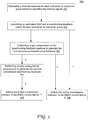
- Fig. 3 is a flow chart depicting an exemplary process 300 of generating a beamforming feedback report and signaling the compression mode of beamforming feedback matrices in accordance with an embodiment of the present disclosure.
- Process 300 can be performed by a beamformee STA, e.g., a non-AP STA.
- the beamformee is configured to generate beamforming feedback in the report in 3 possible modes: without compression at all, with the angel compression only, and with source coding further compression.
- the reporting message (e.g., a CSI frame) includes a MIMO control field with a further compression indicator used to signal whether source coding further compression is applied to the reported feedback matrices.
- the beamformee estimates the channel response based on beamforming training signals, e.g., included in a NDP transmitted from the beamformer.
- an estimated SNR and a beamforming feedback matrix are calculated for each subcarrier or subcarrier group. It will be appreciated that any suitable process can be used for this calculation without departing from the scope of the present disclosure.
- the uncompressed matrices are specified in the beamforming report field of the CSI frame for transmission.
- the further compression indicator in the MIMO control field is set to "0.”
- angle compression e.g., based on Givens rotation, is performed on the matrices to generate first compressed beamforming feedback.
- the resultant compressed feedback is specified in the beamforming report field of the CSI frame without subject to further compression.
- the further compression indicator in the MIMO control field is also set to "0" at 306.
- the first compressed beamforming feedback is further compressed by using source coding compression to generate second compressed beamforming feedback which is specified in the beamforming report field of the CSI frame for transmission to the beamformer.
- the further compression indicator in the MIMO control field is set to "1.”
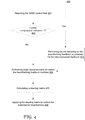
- Fig. 4 is a flow chart depicting an exemplary process 400 of beamforming in response to a beamforming feedback report and its further compression indicator in accordance with an embodiment of the present disclosure.
- Process 400 can be performed in response to a received CSI frame by a beamformer STA, e.g., an AP STA.
- the CSI frame includes a MIMO control field with a further compression indicator.
- the beamformer resolves the MIMO control field, and determines (at 402) whether source coding further compression is indicated. If yes, the beamformer performs source decoding on the information in the beamforming report field to generate the first decompressed feedback (at 403).
- the beamformer further performs angle decompression on the first decompressed feedback to restore the beamforming feedback matrices.
- the beamformer directly performs angle decompression to resolve the beamforming report field to restore the beamforming feedback matrices.
- the beamformer Based on the decompressed beamforming feedback matrices, the beamformer derives a steering matrix at 405. At 406, the steering matrix is then used by the transceiver to control the directionality of the beam in the following beamforming data transmission. Particularly, a spatial mapper in the transceiver uses the steering matrix to alter the transmitted data signal such that the energy is focused on the intended STA, e.g., the beamformee STA that transmits the CSI frame.
- the beamforming feedback matrices are mapped to beambook indices in a lookup table, which have much smaller sizes, for transmission to the beamformer.
- the beamformer and beamformee STAs are each preloaded with a beambook lookup table.
- the beambook has a set of entries for each subcarrier or subcarrier group, each entry including a predetermined beamforming vector and an associated beambook index.
- the beamformee After the beamformee generates the beamforming feedback matrices based on channel estimation, it looks up the beambook to find the matching predetermined beamforming vectors, and their indices are specified in the beamforming report field of the CSI frame for transmission to the beamformer.
- the beamformer receiving the CSI frame restores the beamforming feedback matrices also by looking up the beambook.
- beamforming vectors included in a beambook can be defined to have any suitable content, form, or correlation with beamforming feedback matrices without departing the scope of the present disclosure.
- the search engine for the beambook varies accordingly in different embodiments.
- Feeding back beambook indices consumes dramatically reduced transmission time and bandwidth compared to feeding back matrices themselves or even compressed matrices. For example, for one subcarrier in an 8 ⁇ 2 MIMO system, reporting compressed beamforming feedback resulting from Givens rotation alone requires at least 78 bits for a single-user (SU) transmission and 156 bits for a multi-user (MU) transmission. In contrast, in an exemplary beambook, 256 codes are used for 256 predetermined entries, and each subcarrier just requires 8 bits for the reported beambook index.
- Fig. 5 illustrates the information flow within and between a beamformer and a beamformer in an exemplary channel calibration procedure that utilizes beambook indices in beamforming feedback reporting in accordance with an embodiment of the present disclosure.
- the beamformer 550 transmits a NDP frame to the beamformee 500 which carries out channel sounding by analyzing the received training symbols 501 in the NDP.
- the beamformee performs channel estimation on the training signals to generate parameter metrics 503 and beamforming feedback matrices 502 for respective subcarriers or subcarrier groups.
- the beamforming matrices 502 may be generated by calculating channel metrics based on channel responses, as described in greater detail with reference to Fig. 2 .
- a parameter metric for each subcarrier may include SNR, transmit power and/or channel variation, etc.
- the beamformer For each generated feedback matrix, the beamformer maps it to the beambook and thereby finds a matching predetermined entry at 512, e.g., by comparison or any other suitable searching mechanism that is well known in the art.
- the indices 504 of the matching entries are selected and specified in the beamforming feedback report field of the CSI frame for transmission 513 to the beamformer 550.
- a parameter metric 503 For each subcarrier or subcarrier group, a parameter metric 503 may be fed back as well.
- the beamformer 550 receives and resolve the feedback report to obtain the reported beambook indices 554 and the parameter metrics.
- the beamformer 550 uses the indices to search the beambook and restore the predetermined beamforming feedback matrices 552.
- the restored matrices 552 and the parameter metrics 553 are used to calculate a steering matrix 551 for use of beamforming in following data transmission, as noted above.
- the beamformee may further reduce the feedback reporting size by compressing the beambook indices, e.g., by using source coding.
- the MIMO control field of a CSI frame may include an index compression indication for indicating whether source coding compression is applied on the reported beambook indices.
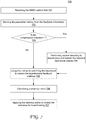
- Fig. 6 is a flow chart depicting an exemplary process 600 of generating a beamforming feedback report in which beambook indices are used to represent the beamforming feedback matrices in accordance with an embodiment of the present disclosure.
- Process 600 can be performed by a beamformee STA.
- the beamformee estimates the channel response for each subcarrier or subcarrier group based on beamforming training signals, e.g., included in a NDP transmitted from the beamformer.
- an estimated SNR and a beamforming feedback matrix are calculated for the subcarrier or the subcarrier group.
- the generated matrices are used to search the beambook for matching entries, resulting in beambook indices of the matching entries.
- the beamformee can be capable of generating beambook indices for inclusion in the report in 2 possible modes: compressed or non-compressed.
- the reporting message e.g., a CSI frame
- the reporting message includes an MIMO control field with an index compression indicator which is defined to signal whether source coding compression is applied to the reported beambook indices.
- the index compression indicator in the MIMO control field is set to "0.”
- source coding compression is performed on the matching beambook indices at 604 and the compressed indices are specified in the reporting message. Accordingly, the index compression indicator in the MIMO control field is set to "1" at 605.
- Fig. 7 is a flow chart depicting an exemplary process 700 of beamforming in response to a beamforming feedback report and the index compression indicator in accordance with the present disclosure.
- Process 700 can be performed in response to a received CSI frame by a beamformer STA, e.g., an AP STA.
- the CSI frame includes a MIMO control field with a further compression indicator.
- the beamformer resolves the MIMO control field, and derives the parameter metrics from the feedback information at 702.
- the indicator value equals to "0"
- the reported indices are used to search the beambook to find the associated beamforming matrices.
- a steering matrix 706 is then calculated by using the found matrices.
- the steering matrix is applied to control the antennas for subsequent beamforming data transmission.
- STAs in a WLAN support may support both beamforming matrix feedback and beambook feedback, each described in greater detail as above.
- the MIMO control field may have a field for indicating the feedback mode as well as SU/MU mode.
- a 2-bit indicator may be used as follows:
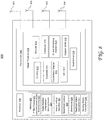
- Fig. 8 is a block diagram illustrating an exemplary wireless communication device 800 configured to generate and/or resolve beamforming feedback information with reduced sizes in accordance with an embodiment of the present disclosure.
- the device 800 may be an AP STA, a repeater, a coordinator, or a non-AP STA having a transceiver configured for data communication, e.g., a general purpose computer, a smart phone, a tablet wearable device, a sensor used on Internet of Things (IoT), and etc.
- IoT Internet of Things
- device 800 is equipped to operate as both a beamformer STA and a beamformee STA.
- device 800 may only operate either as a beamformer STA or a beamformee STA.
- the device 800 includes a main processor 830, memory 820, a WIFI transceiver 840 coupled to an array of antenna 801 ⁇ 804.
- the memory 820 includes a PPDU format module 821 storing various packet formats.
- the module 821 has processor-executable instructions and information related to setting indications of source coding further compression and/or index compression indication.
- the memory 820 includes a beamforming module 822 storing processor-executable instructions and information related to generating beamforming training signals, generating beamforming feedback information based on received beamforming training signals, beamforming for data transmission, and etc.
- a beamforming module 822 stores processor-executable instructions and information for compressing/decompressing beamforming feedback matrices, e.g., according to Givens rotations.
- a source coding/decoding module 824 stores processor-executable instructions and information for further compressing beamforming feedback matrices that have been subject to angle compression, compressing beambook indices, decompressing reported beamforming feedback information, and decompressing beambook indices.
- the beambook 826 is a lookup table storing a set of predetermined beamforming vectors for each subcarrier, each vector associated with an index.
- the beambook lookup module 825 stores instructions and information for a search engine used to search for matching entries in the beambook 826.
- the feedback matrix calculation module 827 and the steering matrix calculation module 828 are configured to calculate beamforming feedback matrices based on received beamforming training signal and to calculate a steering matrix based on beamforming feedback matrices, respectively.
- the transceiver 840 includes various modules of the transmit path in a signal processor 810, the modules configured to generate data packets, control frames, or any other type of communication transmission units for transmission to another STA. For instance, it has a transmit First-In-First-Out (TX FIFO) 811, an encoder 812, a scrambler 813, an interleaver 814, a constellation mapper 815, an inversed discrete Fourier transformer (IDFT) 817, a GI and windowing insertion module 816, a Doppler metric module 818, and a beamformer module 819.
- TX FIFO transmit First-In-First-Out
- the transceiver 840 also includes various modules of a receive path configured to receive data packets, control frames, or any other type of communication transmission units from another STA.
Landscapes
- Engineering & Computer Science (AREA)
- Computer Networks & Wireless Communication (AREA)
- Signal Processing (AREA)
- Power Engineering (AREA)
- Physics & Mathematics (AREA)
- Mathematical Physics (AREA)
- Radio Transmission System (AREA)
- Mobile Radio Communication Systems (AREA)
Abstract
Description
- This patent application claims priority and benefit of: the
U.S. Provisional Patent Application No. 62/743,008 - Embodiments of the present disclosure relate generally to the field of wireless network communication, and more specifically, to the field of beamforming mechanisms in wireless local area network (WLAN) communication systems.
- Beamforming technology is widely used in different types of wireless communication systems. In WLAN communication systems and take WIFI for examples, beamforming, also known as beam steering, is defined as a spatial filtering mechanism used at a transmitter (a beamformer station (STA)) to improve the signal power or signal-to-noise ratio (SNR) at an intended receiver (a beamformee STA). It basically involves applying a steering matrix to adjust the signal amplitudes and phase of the beamformer antennas to focus the signal transmission toward the beamformee direction, and at the same time, to avoid receiving or creating interference.
- When using explicit feedback in channel sounding, a beamformee makes a direct estimate of a channel from training symbols sent from the beamformer. The beamformee may generate channel state information (CSI) or steering feedback based on an observation of these training symbols. The beamformee quantizes the feedback and sends it to the beamformer. The beamformer can use the feedback as the basis for determining the beamforming steering matrix.
- In wireless communication systems compliant with IEEE 802.11 family standards and specifications, an estimated channel is represented by using beamforming feedback matrices V and SNRs (eigenvalues). To reduce the size of the beamforming feedback information which often consumes significant transmission time and bandwidth as an overhead, the feedback matrices are compressed into angles using Givens rotations, before being fed back to the beamformer along with the SNRs.
-
Fig. 1 is a table showing the various numbers of bits used for reporting compressed beamforming feedback matrices in different multiple input multiple output (MIMO) and bandwidths according to the conventional method. For example, between two STAs each with 16 antennas (Nr and Nc denote the row number and column numbers of the matrices), as a result of compression, the number of angels generated for each subcarrier or subcarrier group is 240, and the feedback ranges from 300,128 bits to 1,200,128 bits depending on a few factors, including the channel bandwidth (80 MHz or 320 MHz), the group length (Ng), and whether collaborative beamforming (CB) is used. The data demonstrate that the amount of information for reporting compressed beamforming feedback can still be considerably large, especially for large antenna arrays and large bandwidths. One approach to further reduce the size of compressed beamforming feedback is by using greater group lengths, e.g., Ng=16, or 32. However, this inevitably decreases the accuracy of feedback reporting and degrades the beamforming performance, especially in multi-user (MU) MIMO scenarios. - Therefore, it is desirable to further reduce the amount of information used for beamforming feedback reporting without decreasing reporting accuracy, and thereby reduce the overhead of beamforming data transmission and improve network efficiency and throughput. The present disclosure is directed to methods of channel sounding that generate and use reduced amount of beamforming feedback information in WIFI transmission communication. These are defined in the independent claims. The dependent claims define preferred embodiments thereof.
- The present disclosure provides a mechanism of providing beamforming feedback information which involves using a source coding method to further compress already-compressed feedback matrices. Particularly, in a channel sounding process, once receiving training signals from a beamformer, a beamformee performs channel estimation and generates beamforming feedback matrices and SNRs for respective subcarriers or subcarrier groups. The feedback matrices are first compressed into angels by using a Givens rotation method. The angels are then further subject to a source coding process to generate further compressed beamforming feedback which has an even smaller size than the first compressed feedback. The further compressed beamforming feedback and the SNRs are transmitted to the beamformer as beamforming feedback information, e.g., in a CSI frame. In some embodiments, the MU-MIMO control field in the CSI frame may include a subfield defined to indicate two possible scenarios: further compression by source coding applied, and no further compression by source coding applied.
- Based on the indications in the MIMO control field, the beamformer decompresses the beamforming feedback information first by source decoding and then by Givens rotation decompression. As a result, the beamforming feedback matrices are restored and used to generate a steering matrix to control the beamformer antennas.
- Preferably, a channel metric may be generated based on an estimated channel response and then used to generate a beamforming feedback matrix. The channel metric can be the subspace projection between the estimated channel of a subcarrier and the space of a estimated channels of its neighboring subcarriers. Preferably, the channel metric can be a difference between an estimated channel and an average of a group estimated channel. This can further reduced the size of beamforming feedback, especially when the channel responses are close to each other.
- Embodiments of the present disclosure further provide a mechanism for reducing the sizes of beamforming feedback information by reporting beambook indices to a beamformer, instead of reporting compressed beamforming feedback matrices. More specifically, the beamforming and beamformee each maintain a beambook containing a plurality of predetermined entries of beamforming vectors, and indices of the entries. The indices may be in the form of codeword. For each subcarrier or subcarrier group, the beamformee generates a set of beamforming feedback information based on channel estimation. The generated information is mapped to the beambook to find a matching predetermined entry. The beambook index of the matching entry is selected and specified in the beamforming feedback report. Preferably, the beambook indices may be compressed by source coding and the compressed indices are specified in a beamforming feedback report. In particular, the set of beamforming feedback information additionally includes a set of parameter metrics which can be fed back along with each beam index, such as SNR, transmit power and/or channel variation metrics, etc.
- Upon receiving the report, the beamformer uses the specified beambook indices to look up the beambook and find the matching predetermined entries as the reported beamforming feedback information.
- Embodiments of the present invention will be better understood from a reading of the following detailed description, taken in conjunction with the accompanying figures, in which like reference characters designate like elements.
-
Fig. 1 is a table showing the various numbers of bits used for reporting compressed beamforming feedback matrices in different multiple input multiple output (MIMO) and bandwidths according to the conventional method. -
Fig. 2 illustrates the information flow within and between a beamformer and a beamformer in an exemplary channel calibration procedure that utilizes source coding further compression in accordance with an embodiment of the present disclosure. -
Fig. 3 is a flow chart depicting an exemplary process of generating a beamforming feedback report and signaling the compression mode of beamforming feedback matrices in accordance with an embodiment of the present disclosure -
Fig. 4 is a flow chart depicting an exemplary process of beamforming in response to a beamforming feedback report and its further compression indicator in accordance with an embodiment of the present disclosure. -
Fig. 5 illustrates the information flow within and between a beamformer and a beamformer in an exemplary channel calibration procedure that utilizes beambook indices in beamforming feedback reporting in accordance with an embodiment of the present disclosure. -
Fig. 6 is a flow chart depicting an exemplary process of generating a beamforming feedback report in which beambook indices are used to represent the beamforming feedback matrices in accordance with an embodiment of the present disclosure. -
Fig. 7 is a flow chart depicting an exemplary process of beamforming in response to a beamforming feedback report and the index compression indicator in accordance with an embodiment of the present disclosure. -
Fig. 8 is a block diagram illustrating an exemplarywireless communication device 800 configured to generate and/or resolve beamforming feedback information with reduced sizes in accordance with an embodiment of the present disclosure - Reference will now be made in detail to the preferred embodiments of the present invention, examples of which are illustrated in the accompanying drawings. While the invention will be described in conjunction with the preferred embodiments, it will be understood that they are not intended to limit the invention to these embodiments. On the contrary, the invention is intended to cover alternatives, modifications, and equivalents which may be included within the spirit and scope of the invention as defined by the appended claims. Furthermore, in the following detailed description of embodiments of the present invention, numerous specific details are set forth in order to provide a thorough understanding of the present invention. However, it will be recognized by one of ordinary skill in the art that the present invention may be practiced without these specific details. In other instances, well-known methods, procedures, components, and circuits have not been described in detail so as not to unnecessarily obscure aspects of the embodiments of the present invention. Although a method may be depicted as a sequence of numbered steps for clarity, the numbering does not necessarily dictate the order of the steps. It should be understood that some of the steps may be skipped, performed in parallel, or performed without the requirement of maintaining a strict order of sequence. The drawings showing embodiments of the invention are semi-diagrammatic and not to scale and, particularly, some of the dimensions are for the clarity of presentation and are shown exaggerated in the Figures. Similarly, although the views in the drawings for the ease of description generally show similar orientations, this depiction in the Figures is arbitrary for the most part. Generally, the invention can be operated in any orientation.
- The present disclosure provides mechanisms of reducing beamforming feedback reporting sizes in WIFI communication. Preferably, at a beamformee station (STA), beamforming feedback matrices generated from channel estimation are subject to two compression processes. The matrices are first compressed into angles by using Givens rotation, which are further compressed by using source coding. The double compressed feedback information is transmitted in a report to the beamformer. Accordingly, the beamformer reconstructs the feedback matrices by first decompressing the reported information based on source coding and then further decompressing based on the Givens rotation.
- Preferably, the beamformer and beamformee are each preloaded with a beambook which includes a set of predetermined beamforming vectors associated with indices for each subcarrier or subcarrier group. After channel estimation, the beamformee generates beamforming feedback matrices and mapping them to the beambook to find the matching indices. The matching indices are then transmitted to the beamformer in a feedback report. Accordingly, the beamformer uses the reported indices to look up the beambook and find the corresponding predetermined entries as reported beamforming feedback.
-
Fig. 2 illustrates the information flow within and between a beamformer and a beamformer in an exemplary channel calibration procedure that utilizes source coding further compression in accordance with an embodiment of the present disclosure. Thebeamformer 250 transmits a Null Data Packet (NDP) frame to thebeamformee 200 which carries out channel sounding by analyzing the receivedtraining symbols 201 in the NDP. For example, in an NDP, there is a very high throughput long training field (VHT-LTF) for each spatial subcarrier used in transmission, and hence to be used in the beamforming data transmission. - The beamformee performs
channel estimation 210 based on the training symbols and accordingly generates abeamforming feedback matrix 204 and an SNR for each subcarrier or subcarrier group and aSNR 205. The feedback matrix represents channel responses for the training symbols. The feedback matrices are then transformed into angles by matrix multiplication operations, or referred to herein asangle compression 213, e.g., Givens rotation, and thereby the firstcompressed beamforming feedback 206 is generated. - Preferably, the
beamforming feedback matrix 204 is generated directly by using the estimated channel response (e.g. 202) of the subcarrier, particularly by using singular value decomposition (svd) of the estimated response. For example, Hj is the estimated channel response for subcarrier j, and its beamforming feedback matrix Vj is obtained as:
- Preferably, as shown, a
channel metric 203 is first calculated at 211 based on the estimatedchannel response 202, and thechannel metric 203 is then used to calculate thefeedback matrix 204 at 212. In this manner, the feedback matrices can be shaped into forms with less redundancy and a compressed version thereof has an even smaller size. - For example, the channel metric may be the subspace projection between the estimated channel response Hj and the space of a group of estimated channel responses associated with its neighboring subcarriers (index k=(j-M)∼(j+M)). For example, the beamforming feedback matrix is determined by


- Preferably, a channel metric can be a difference between the estimated channel response of an instant subcarrier and the average (H̃) of a group of channel responses of a set of subcarriers. For example, the beamforming feedback matrix is obtained by

-
Source coding 214 can be performed on the first compressed beamforming feedback 206 (e.g., composed of angles resulting from the Givens rotation) to generate the furthercompressed beamforming feedback 205. Preferably, the source coding compression includes arithmetic coding compression. The present disclosure is not limited to any specific method, process, logic or configuration to implement the source coding process. The source coding can be a lossy or a lossless compression process and can be implemented in any manner that is well known in the art. The compressed results from source coding are specified in a beamforming feedback report field of a CSI frame which is transmitted to thebeamformer 250 at 215. - At 264, the
beamformer 250 receives the CSI frame and resolve the feedback report field to derive theSNRs 255 and the further decompressed beamforming feedback 254. The feedback 254 is first subject to source decoding at 263 to reverse the source coding process and thereby generates first decompressedbeamforming feedback 253. The decompressedfeedback 253 is further decompressed to reverse the angle compression (referred to as "angle decompression 262" herein) and thereby recover thebeamforming feedback matrices 252. Asteering matrix 251 is calculated at 261 based on the recoveredfeedback matrices 252. The steering matrix is a precise mathematical description of how each individual antenna element in an antenna array should be controlled to attain a spatial path for the directed transmission, e.g., in terms of signal phase and amplitude. -
Fig. 3 is a flow chart depicting anexemplary process 300 of generating a beamforming feedback report and signaling the compression mode of beamforming feedback matrices in accordance with an embodiment of the present disclosure.Process 300 can be performed by a beamformee STA, e.g., a non-AP STA. Preferably, the beamformee is configured to generate beamforming feedback in the report in 3 possible modes: without compression at all, with the angel compression only, and with source coding further compression. The reporting message (e.g., a CSI frame) includes a MIMO control field with a further compression indicator used to signal whether source coding further compression is applied to the reported feedback matrices. - At 301, the beamformee estimates the channel response based on beamforming training signals, e.g., included in a NDP transmitted from the beamformer. At 302, an estimated SNR and a beamforming feedback matrix are calculated for each subcarrier or subcarrier group. It will be appreciated that any suitable process can be used for this calculation without departing from the scope of the present disclosure. In some scenarios, as shown in path "1," the uncompressed matrices are specified in the beamforming report field of the CSI frame for transmission. In this scenario, the further compression indicator in the MIMO control field is set to "0." At 303, angle compression, e.g., based on Givens rotation, is performed on the matrices to generate first compressed beamforming feedback. Preferably, as shown in path "2" the resultant compressed feedback is specified in the beamforming report field of the CSI frame without subject to further compression. Thus, the further compression indicator in the MIMO control field is also set to "0" at 306. In still some other scenarios, as shown in path "3," at 304, the first compressed beamforming feedback is further compressed by using source coding compression to generate second compressed beamforming feedback which is specified in the beamforming report field of the CSI frame for transmission to the beamformer. At 305, the further compression indicator in the MIMO control field is set to "1."
-
Fig. 4 is a flow chart depicting anexemplary process 400 of beamforming in response to a beamforming feedback report and its further compression indicator in accordance with an embodiment of the present disclosure.Process 400 can be performed in response to a received CSI frame by a beamformer STA, e.g., an AP STA. The CSI frame includes a MIMO control field with a further compression indicator. At 401, the beamformer resolves the MIMO control field, and determines (at 402) whether source coding further compression is indicated. If yes, the beamformer performs source decoding on the information in the beamforming report field to generate the first decompressed feedback (at 403). At 404, the beamformer further performs angle decompression on the first decompressed feedback to restore the beamforming feedback matrices. On the other hand, if the further compression indicator equals "0," at 404, the beamformer directly performs angle decompression to resolve the beamforming report field to restore the beamforming feedback matrices. - Based on the decompressed beamforming feedback matrices, the beamformer derives a steering matrix at 405. At 406, the steering matrix is then used by the transceiver to control the directionality of the beam in the following beamforming data transmission. Particularly, a spatial mapper in the transceiver uses the steering matrix to alter the transmitted data signal such that the energy is focused on the intended STA, e.g., the beamformee STA that transmits the CSI frame.
- Preferably, instead of being compressed, the beamforming feedback matrices are mapped to beambook indices in a lookup table, which have much smaller sizes, for transmission to the beamformer. The beamformer and beamformee STAs are each preloaded with a beambook lookup table. The beambook has a set of entries for each subcarrier or subcarrier group, each entry including a predetermined beamforming vector and an associated beambook index. After the beamformee generates the beamforming feedback matrices based on channel estimation, it looks up the beambook to find the matching predetermined beamforming vectors, and their indices are specified in the beamforming report field of the CSI frame for transmission to the beamformer. Conversely, the beamformer receiving the CSI frame restores the beamforming feedback matrices also by looking up the beambook. It will be appreciated that beamforming vectors included in a beambook can be defined to have any suitable content, form, or correlation with beamforming feedback matrices without departing the scope of the present disclosure. Depending on the definitions of the beamforming vectors, the search engine for the beambook varies accordingly in different embodiments.
- Feeding back beambook indices consumes dramatically reduced transmission time and bandwidth compared to feeding back matrices themselves or even compressed matrices. For example, for one subcarrier in an 8×2 MIMO system, reporting compressed beamforming feedback resulting from Givens rotation alone requires at least 78 bits for a single-user (SU) transmission and 156 bits for a multi-user (MU) transmission. In contrast, in an exemplary beambook, 256 codes are used for 256 predetermined entries, and each subcarrier just requires 8 bits for the reported beambook index.
-
Fig. 5 illustrates the information flow within and between a beamformer and a beamformer in an exemplary channel calibration procedure that utilizes beambook indices in beamforming feedback reporting in accordance with an embodiment of the present disclosure. Thebeamformer 550 transmits a NDP frame to thebeamformee 500 which carries out channel sounding by analyzing the receivedtraining symbols 501 in the NDP. The beamformee performs channel estimation on the training signals to generateparameter metrics 503 andbeamforming feedback matrices 502 for respective subcarriers or subcarrier groups. Preferably, thebeamforming matrices 502 may be generated by calculating channel metrics based on channel responses, as described in greater detail with reference toFig. 2 . A parameter metric for each subcarrier may include SNR, transmit power and/or channel variation, etc. - For each generated feedback matrix, the beamformer maps it to the beambook and thereby finds a matching predetermined entry at 512, e.g., by comparison or any other suitable searching mechanism that is well known in the art. The
indices 504 of the matching entries are selected and specified in the beamforming feedback report field of the CSI frame fortransmission 513 to thebeamformer 550. For each subcarrier or subcarrier group, aparameter metric 503 may be fed back as well. - At 563, the
beamformer 550 receives and resolve the feedback report to obtain the reportedbeambook indices 554 and the parameter metrics. At 562, thebeamformer 550 uses the indices to search the beambook and restore the predeterminedbeamforming feedback matrices 552. At 561, the restoredmatrices 552 and theparameter metrics 553 are used to calculate asteering matrix 551 for use of beamforming in following data transmission, as noted above. - Preferably, the beamformee may further reduce the feedback reporting size by compressing the beambook indices, e.g., by using source coding. In some embodiments, the MIMO control field of a CSI frame may include an index compression indication for indicating whether source coding compression is applied on the reported beambook indices.
-
Fig. 6 is a flow chart depicting anexemplary process 600 of generating a beamforming feedback report in which beambook indices are used to represent the beamforming feedback matrices in accordance with an embodiment of the present disclosure.Process 600 can be performed by a beamformee STA. At 601, the beamformee estimates the channel response for each subcarrier or subcarrier group based on beamforming training signals, e.g., included in a NDP transmitted from the beamformer. At 602, an estimated SNR and a beamforming feedback matrix are calculated for the subcarrier or the subcarrier group. At 603, the generated matrices are used to search the beambook for matching entries, resulting in beambook indices of the matching entries. - The beamformee can be capable of generating beambook indices for inclusion in the report in 2 possible modes: compressed or non-compressed. The reporting message (e.g., a CSI frame) includes an MIMO control field with an index compression indicator which is defined to signal whether source coding compression is applied to the reported beambook indices. In some scenarios, as shown in path "1," the matching beambook indices are specified directly in the reporting message. Accordingly, at 606, the index compression indicator in the MIMO control field is set to "0." In some other scenarios, as shown in path "2," source coding compression is performed on the matching beambook indices at 604 and the compressed indices are specified in the reporting message. Accordingly, the index compression indicator in the MIMO control field is set to "1" at 605.
-
Fig. 7 is a flow chart depicting anexemplary process 700 of beamforming in response to a beamforming feedback report and the index compression indicator in accordance with the present disclosure.Process 700 can be performed in response to a received CSI frame by a beamformer STA, e.g., an AP STA. The CSI frame includes a MIMO control field with a further compression indicator. At 701, the beamformer resolves the MIMO control field, and derives the parameter metrics from the feedback information at 702. At 703, it is determined whether the index compression is indicated, i.e., the indicator value equals to "1." If yes, at 704, source decoding is performed to decompress the feedback information in the feedback report field into reported beambook indices. If the indicator value equals to "0," no decompression process is performed on the feedback information in the feedback report field. In both scenarios, at 705, the reported indices are used to search the beambook to find the associated beamforming matrices. Asteering matrix 706 is then calculated by using the found matrices. At 707, the steering matrix is applied to control the antennas for subsequent beamforming data transmission. - Preferably, STAs in a WLAN support may support both beamforming matrix feedback and beambook feedback, each described in greater detail as above. The MIMO control field may have a field for indicating the feedback mode as well as SU/MU mode. For example, a 2-bit indicator may be used as follows:
- 00: SU with Compressed feedback
- 01: MU with Compressed feedback
- 10: SU with Beambook feedback
- 11: MU with Beambook feedback
-
Fig. 8 is a block diagram illustrating an exemplarywireless communication device 800 configured to generate and/or resolve beamforming feedback information with reduced sizes in accordance with an embodiment of the present disclosure. Thedevice 800 may be an AP STA, a repeater, a coordinator, or a non-AP STA having a transceiver configured for data communication, e.g., a general purpose computer, a smart phone, a tablet wearable device, a sensor used on Internet of Things (IoT), and etc. Preferably,device 800 is equipped to operate as both a beamformer STA and a beamformee STA. In particular,device 800 may only operate either as a beamformer STA or a beamformee STA. - The
device 800 includes amain processor 830,memory 820, aWIFI transceiver 840 coupled to an array ofantenna 801∼804. Thememory 820 includes a PPDU format module 821 storing various packet formats. The module 821 has processor-executable instructions and information related to setting indications of source coding further compression and/or index compression indication. - The
memory 820 includes abeamforming module 822 storing processor-executable instructions and information related to generating beamforming training signals, generating beamforming feedback information based on received beamforming training signals, beamforming for data transmission, and etc. Particularly, an angle rotation compression/decompression module 823 stores processor-executable instructions and information for compressing/decompressing beamforming feedback matrices, e.g., according to Givens rotations. A source coding/decoding module 824 stores processor-executable instructions and information for further compressing beamforming feedback matrices that have been subject to angle compression, compressing beambook indices, decompressing reported beamforming feedback information, and decompressing beambook indices. - The
beambook 826 is a lookup table storing a set of predetermined beamforming vectors for each subcarrier, each vector associated with an index. Thebeambook lookup module 825 stores instructions and information for a search engine used to search for matching entries in thebeambook 826. The feedbackmatrix calculation module 827 and the steeringmatrix calculation module 828 are configured to calculate beamforming feedback matrices based on received beamforming training signal and to calculate a steering matrix based on beamforming feedback matrices, respectively. - The
transceiver 840 includes various modules of the transmit path in asignal processor 810, the modules configured to generate data packets, control frames, or any other type of communication transmission units for transmission to another STA. For instance, it has a transmit First-In-First-Out (TX FIFO) 811, anencoder 812, ascrambler 813, aninterleaver 814, aconstellation mapper 815, an inversed discrete Fourier transformer (IDFT) 817, a GI andwindowing insertion module 816, a Dopplermetric module 818, and abeamformer module 819. Thetransceiver 840 also includes various modules of a receive path configured to receive data packets, control frames, or any other type of communication transmission units from another STA. - Although certain preferred embodiments and methods have been disclosed herein, it will be apparent from the foregoing disclosure to those skilled in the art that variations and modifications of such embodiments and methods may be made without departing from the spirit and scope of the invention. It is intended that the invention shall be limited only to the extent required by the appended claims and the rules and principles of applicable law.
Claims (15)
- A method of beamforming performed by a first wireless station, in the following also referred to as STA, in a wireless local area network, in the following also referred to as WLAN, the method comprising:receiving a null data packets, in the following also referred to as NDP, at a first set of antennas comprised in said first wireless STA, wherein said NDP is transmitted from a second wireless STA through a wireless channel and comprises beamforming training signals;estimating a channel response of said wireless channel based on said beamforming training signals;generating a beamforming feedback matrix based on an estimated channel response, wherein said beamforming feedback matrix corresponds to a subcarrier or a subcarrier group in said wireless channel;performing angle compression on said beamforming feedback matrix to generate first compressed beamforming feedback; andperforming source coding to compress said first compressed beamforming feedback to generate second compressed beamforming feedback.
- The method of Claim 1, wherein said performing said source coding comprises performing arithmetic coding.
- The method of Claim 1 or 2, wherein said generating said beamforming feedback matrix comprises:generating a channel metric based on said estimated channel response; andgenerating said beamforming feedback matrix based on said channel metric.
- The method of Claim 3, wherein said channel metric corresponds to- a subspace projection between said estimated channel and a space of estimated channels corresponding to neighboring subcarriers of said subcarrier and/or- a difference between said estimated channel and an average of a plurality of estimated channels comprising said estimated channel.
- The method of any one of the preceding Claims, further comprising:transmitting a message to said second wireless STA, wherein said message comprises a beamforming report field specifying said second compressed beamforming feedback; andsetting a first field in said message to a first value for indicating to said second wireless STA that said second compressed beamforming feedback results from said source coding, wherein in particular said first field is defined to carry one of: said first value; a second value indicating that information specified in said beamforming report field results only from said angle compression; and a third value indicating that information specified in said beamforming report field is uncompressed, wherein preferably said message comprises a channel station information, in the following also referred to as CSI, frame, and wherein further said first field is a multiple input multiple output, in the following also referred to as MIMO, control field.
- A method of beamforming performed by a first wireless station, in the following also referred to as STA, in a wireless local area network, in the following also referred to as WLAN, the method comprising:transmitting a null data packets, in the following also referred to as NDP, to a second wireless STA through a first set of antennas, wherein said NDP comprises beamforming training signals;receiving a message from said second wireless STA, wherein said message comprises a beamforming report field representing a compressed beamforming matrix associated with a subcarrier or a subcarrier group;performing source decoding to decompress information in said beamforming report field and generate first decompressed beamforming information; andperforming angle decompression on said first decompressed beamforming information to generate a beamforming feedback matrix.
- The method of Claim 6, wherein- said source decoding comprises an arithmetic decoding process, and/or- said source decoding and said angle decompression are performed in response to an indication in a first field of said message, wherein said first field is defined to carry one of 3 values comprising: said first value indicating that information in said beamforming report field results from to both angle compression and source coding; a second value indicating that information in said beamforming report field results from only angle compression; and a third value indicating that information in said beamforming report field is uncompressed.
- The method of Claim 7, wherein said message comprises a channel state information, in the following also referred to as CSI, frame, and wherein further said first field is a multiple input multiple output, in the following also referred to as MIMO, control field.
- The method of Claim 7 or 8, further comprising deriving a signal noise ratio from information specified in said beamforming report field.
- A method of beamforming in wireless communication performed by a first wireless station, in the following also referred to as STA, the method comprising:receiving a null data packets, in the following also referred to as NDP, at a first set of antennas comprised in said first wireless STA, wherein said NDP is transmitted from a second wireless STA through a wireless channel and comprises beamforming training signals;estimating a channel response of said wireless channel based on said beamforming training signals;generating a beamforming feedback matrix based on an estimated channel response, wherein said beamforming feedback matrix corresponds to a subcarrier or a subcarrier group in said wireless channel;accessing a beambook resident on said first wireless STA, wherein said beambook comprises a plurality preloaded entries associated with said subcarrier or said subcarrier group, wherein each preloaded entry comprises a beambook index and a predetermined beamforming vector;searching said beambook to match said beamforming feedback matrix with a predetermined beamforming vector and determine a select beambook index; andtransmitting a message to said second wireless STA via said wireless channel, wherein said message comprises a representation of said selected beambook index.
- The method of Claim 10, where said message further comprises values of one or more of:
signal-noise ratio; transmission power; and a channel variation metric that result from said estimating. - The method of Claim 10 or 11, further comprising:compressing said select beambook index to generate a compressed beambook index; andsetting a first field in said message to indicate that said representation results from a compression process.
- The method of any one of Claims 10 to 12, wherein said generating said beamforming feedback matrix comprises:generating a channel metric based on said estimated channel response; andgenerating said beamforming feedback matrix based on said channel metric.
- The method of Claim 13, wherein said channel metric corresponds to- a subspace projection between said estimated channel and a space of estimated channels corresponding to neighboring subcarriers of said subcarrier, and/or- a difference between said estimated channel and an average of a plurality of estimated channels comprising said estimated channel.
- The method of Claim 12, wherein said message comprises a channel station information, in the following also referred to as CSI, frame, and wherein further said first field is a multiple input multiple output, in the following also referred to as MIMO, control field.
Applications Claiming Priority (2)
| Application Number | Priority Date | Filing Date | Title |
|---|---|---|---|
| US201862743008P | 2018-10-09 | 2018-10-09 | |
| US16/563,592 US11101867B2 (en) | 2018-10-09 | 2019-09-06 | Reducing beamforming feedback size in WLAN communication |
Publications (3)
| Publication Number | Publication Date |
|---|---|
| EP3637633A2 true EP3637633A2 (en) | 2020-04-15 |
| EP3637633A3 EP3637633A3 (en) | 2020-06-03 |
| EP3637633B1 EP3637633B1 (en) | 2021-09-22 |
Family
ID=68159043
Family Applications (1)
| Application Number | Title | Priority Date | Filing Date |
|---|---|---|---|
| EP19201675.6A Active EP3637633B1 (en) | 2018-10-09 | 2019-10-07 | Reducing beamforming feedback size in wlan communication |
Country Status (4)
| Country | Link |
|---|---|
| US (1) | US11101867B2 (en) |
| EP (1) | EP3637633B1 (en) |
| CN (1) | CN111030742B (en) |
| TW (1) | TWI713321B (en) |
Cited By (1)
| Publication number | Priority date | Publication date | Assignee | Title |
|---|---|---|---|---|
| CN114257279A (en) * | 2020-09-25 | 2022-03-29 | 三星电子株式会社 | Apparatus and method using adaptive codebook for dual beam forming feedback |
Families Citing this family (16)
| Publication number | Priority date | Publication date | Assignee | Title |
|---|---|---|---|---|
| US11336349B2 (en) * | 2020-05-13 | 2022-05-17 | Semiconductor Components Industries, Llc | Steering matrix derivation |
| CN113747485A (en) * | 2020-05-30 | 2021-12-03 | 华为技术有限公司 | Multi-AP cooperative transmission channel detection method and related device |
| US11496338B2 (en) | 2020-07-14 | 2022-11-08 | Nxp Usa, Inc. | Method and apparatus for beamforming |
| CN114630412B (en) * | 2020-12-11 | 2024-07-30 | 华为技术有限公司 | Power control method and related device in wireless local area network |
| US11799529B2 (en) * | 2020-12-16 | 2023-10-24 | Samsung Electronics Co., Ltd | Device and method of performing subcarrier grouping and/or codebook size selection in real-time for beamforming feedback and wireless communication system including the same |
| CN115913293A (en) * | 2021-09-30 | 2023-04-04 | 索尼集团公司 | Channel feedback method, precoding matrix adjustment method, wireless communication device and base station |
| US20240380443A1 (en) * | 2022-02-24 | 2024-11-14 | Mediatek Singapore Pte. Ltd. | Method and apparatus for multiple-input and multiple-output (mimo) channel state information (csi) feedback |
| US12537581B2 (en) * | 2022-04-15 | 2026-01-27 | Mediatek Inc. | Method for performing beamforming sounding feedback in system-parameter-aware manner, and associated apparatus |
| CN117097377A (en) | 2022-05-13 | 2023-11-21 | 台达电子工业股份有限公司 | Antenna device and beam control method |
| TWI802411B (en) * | 2022-05-13 | 2023-05-11 | 台達電子工業股份有限公司 | Antenna device and beam control method |
| US12537718B2 (en) | 2022-11-04 | 2026-01-27 | Samsung Electronics Co., Ltd. | Wireless communication apparatus for adaptive beamforming and operating method thereof |
| US12335005B2 (en) * | 2022-11-17 | 2025-06-17 | Nxp Usa, Inc. | Beamforming feedback reduction in wifi |
| WO2024183427A1 (en) * | 2023-03-06 | 2024-09-12 | Oppo广东移动通信有限公司 | Wireless communication methods, device, and storage medium |
| EP4462693A1 (en) * | 2023-05-08 | 2024-11-13 | Samsung Electronics Co., Ltd. | Method and apparatus for low complexity beamforming feedback in wireless local area networks |
| WO2025175490A1 (en) * | 2024-02-20 | 2025-08-28 | Huawei Technologies Co., Ltd. | A method and devices for generating beamformer report message |
| CN119324727B (en) * | 2024-09-12 | 2025-11-07 | 浙江大学 | Method for preventing privacy disclosure in beam forming process based on router side space mapping mechanism |
Family Cites Families (16)
| Publication number | Priority date | Publication date | Assignee | Title |
|---|---|---|---|---|
| GB2411328B (en) * | 2004-02-23 | 2007-05-16 | Toshiba Res Europ Ltd | Adaptive MIMO systems |
| US7746802B2 (en) | 2004-06-01 | 2010-06-29 | Samsung Electronics Co., Ltd. | Method and apparatus for channel state feedback using arithmetic coding |
| US7965649B2 (en) * | 2005-11-04 | 2011-06-21 | Samsung Electronics Co., Ltd. | Apparatus and method for feedback of subcarrier quality estimation in an OFDM/OFDMA system |
| US20080130778A1 (en) | 2006-12-04 | 2008-06-05 | Samsung Electronics Co., Ltd. | System and method for wireless communication of uncompressed high definition video data using a transfer matrix for beamforming estimation |
| WO2010118383A1 (en) * | 2009-04-10 | 2010-10-14 | Marvell World Trade Ltd. | Signaling for multi-dimension wireless resource allocation |
| WO2012021449A1 (en) * | 2010-08-10 | 2012-02-16 | Marvell World Trade Ltd. | Sub-band feedback for beamforming on downlink multiple user mimo configurations |
| US20130301551A1 (en) * | 2012-05-09 | 2013-11-14 | Interdigital Patent Holdings, Inc. | Multi-user multiple input multiple output communications in wireless local area networks and wireless transmit and receive units |
| EP4228166A1 (en) | 2012-09-28 | 2023-08-16 | InterDigital Patent Holdings, Inc. | Method for wifi beamforming, feedback, and sounding (wibeam) |
| US9960824B2 (en) * | 2015-02-09 | 2018-05-01 | Newracom, Inc. | High-efficiency (HE) sounding methods for MIMO and OFDMA |
| US10158413B2 (en) * | 2015-05-08 | 2018-12-18 | Newracom, Inc. | Uplink sounding for WLAN system |
| EP4503466A3 (en) * | 2015-07-10 | 2025-04-23 | InterDigital Patent Holdings, Inc. | Unified feedback for ofdma wlan |
| US20170054542A1 (en) * | 2015-08-19 | 2017-02-23 | Qualcomm Incorporated | Sounding design for channel feedback |
| CN105338393A (en) * | 2015-10-29 | 2016-02-17 | 小米科技有限责任公司 | Medium synchronization method and device |
| US9807205B2 (en) | 2015-11-02 | 2017-10-31 | Cisco Technology, Inc. | Header compression for CCN messages using dictionary |
| US10148330B2 (en) | 2016-05-10 | 2018-12-04 | Intel IP Corporation | Beamforming smoothing and indication |
| US20190097709A1 (en) * | 2017-09-22 | 2019-03-28 | Qualcomm Incorporated | Coherent beamforming feedback |
-
2019
- 2019-09-06 US US16/563,592 patent/US11101867B2/en active Active
- 2019-10-03 TW TW108135782A patent/TWI713321B/en active
- 2019-10-07 EP EP19201675.6A patent/EP3637633B1/en active Active
- 2019-10-09 CN CN201910952527.7A patent/CN111030742B/en active Active
Cited By (3)
| Publication number | Priority date | Publication date | Assignee | Title |
|---|---|---|---|---|
| CN114257279A (en) * | 2020-09-25 | 2022-03-29 | 三星电子株式会社 | Apparatus and method using adaptive codebook for dual beam forming feedback |
| EP3975446A1 (en) * | 2020-09-25 | 2022-03-30 | Samsung Electronics Co., Ltd. | Device and method using adaptive codebook for dual beamforming feedback and wireless communication system including the same |
| US11387877B2 (en) | 2020-09-25 | 2022-07-12 | Samsung Electronics Co., Ltd. | Device and method using adaptive codebook for dual beamforming feedback and wireless communication system including the same |
Also Published As
| Publication number | Publication date |
|---|---|
| EP3637633A3 (en) | 2020-06-03 |
| CN111030742A (en) | 2020-04-17 |
| US11101867B2 (en) | 2021-08-24 |
| CN111030742B (en) | 2023-08-04 |
| TWI713321B (en) | 2020-12-11 |
| EP3637633B1 (en) | 2021-09-22 |
| TW202015361A (en) | 2020-04-16 |
| US20200112353A1 (en) | 2020-04-09 |
Similar Documents
| Publication | Publication Date | Title |
|---|---|---|
| US11101867B2 (en) | Reducing beamforming feedback size in WLAN communication | |
| EP3963733B1 (en) | Methods and apparatuses for csi reporting in a wireless communication system | |
| US12191954B2 (en) | Channel state information feedback method, device, terminal, and network side, and storage medium | |
| US8149791B2 (en) | MIMO beamforming method and method of constructing a differential codebook for a wireless network | |
| US11799526B2 (en) | Method and apparatus for transmitting a CSI report containing coefficients | |
| US8233556B2 (en) | Reduced feedback transmit beamforming | |
| EP2628257B1 (en) | Mimo channel matrix feedback in ofdm systems | |
| EP2294740B1 (en) | System and method for quantization of channel state information | |
| CN111510189A (en) | Information feedback method and device | |
| CN108631847A (en) | Method, terminal device and the network equipment of transmitting channel state information | |
| WO2023071683A1 (en) | Method and apparatus for feeding back channel state | |
| CN110336597A (en) | Determine method, user equipment and the base station of pre-coding matrix instruction | |
| US20120188899A1 (en) | Method for processing channel state information terminal and base station | |
| CN110168949A (en) | Method, terminal device and network device for feeding back channel state information | |
| US20110243207A1 (en) | System and Method for Adapting Codebooks | |
| CN108282254B (en) | Channel state information reporting method, base station and user equipment | |
| US20170141828A1 (en) | Wireless communication methods and apparatus | |
| WO2023080838A2 (en) | Communication apparatus and communication method for partial channel state information feedback | |
| CN117955540A (en) | Channel state information sending and receiving method, communication device and storage medium | |
| CN104283631A (en) | Method and device for generating precoding matrix for 3D MIMO system and transmitter | |
| CN110535497A (en) | CSI transmission and reception method and device, communication node and storage medium | |
| WO2024164638A1 (en) | Indication information sending method and apparatus, indication information receiving method and apparatus, and storage medium | |
| WO2023196794A1 (en) | Beamforming in wireless networks via split computing | |
| EP4462693A1 (en) | Method and apparatus for low complexity beamforming feedback in wireless local area networks | |
| US20240380466A1 (en) | Method and apparatus for low complexity beamforming feedback in wireless local area networks |
Legal Events
| Date | Code | Title | Description |
|---|---|---|---|
| PUAI | Public reference made under article 153(3) epc to a published international application that has entered the european phase |
Free format text: ORIGINAL CODE: 0009012 |
|
| STAA | Information on the status of an ep patent application or granted ep patent |
Free format text: STATUS: THE APPLICATION HAS BEEN PUBLISHED |
|
| AK | Designated contracting states |
Kind code of ref document: A2 Designated state(s): AL AT BE BG CH CY CZ DE DK EE ES FI FR GB GR HR HU IE IS IT LI LT LU LV MC MK MT NL NO PL PT RO RS SE SI SK SM TR |
|
| AX | Request for extension of the european patent |
Extension state: BA ME |
|
| PUAL | Search report despatched |
Free format text: ORIGINAL CODE: 0009013 |
|
| AK | Designated contracting states |
Kind code of ref document: A3 Designated state(s): AL AT BE BG CH CY CZ DE DK EE ES FI FR GB GR HR HU IE IS IT LI LT LU LV MC MK MT NL NO PL PT RO RS SE SI SK SM TR |
|
| AX | Request for extension of the european patent |
Extension state: BA ME |
|
| RIC1 | Information provided on ipc code assigned before grant |
Ipc: H04B 7/06 20060101ALI20200501BHEP Ipc: H04B 7/0456 20170101AFI20200501BHEP |
|
| STAA | Information on the status of an ep patent application or granted ep patent |
Free format text: STATUS: REQUEST FOR EXAMINATION WAS MADE |
|
| 17P | Request for examination filed |
Effective date: 20201203 |
|
| RBV | Designated contracting states (corrected) |
Designated state(s): AL AT BE BG CH CY CZ DE DK EE ES FI FR GB GR HR HU IE IS IT LI LT LU LV MC MK MT NL NO PL PT RO RS SE SI SK SM TR |
|
| GRAP | Despatch of communication of intention to grant a patent |
Free format text: ORIGINAL CODE: EPIDOSNIGR1 |
|
| STAA | Information on the status of an ep patent application or granted ep patent |
Free format text: STATUS: GRANT OF PATENT IS INTENDED |
|
| INTG | Intention to grant announced |
Effective date: 20210224 |
|
| GRAJ | Information related to disapproval of communication of intention to grant by the applicant or resumption of examination proceedings by the epo deleted |
Free format text: ORIGINAL CODE: EPIDOSDIGR1 |
|
| STAA | Information on the status of an ep patent application or granted ep patent |
Free format text: STATUS: REQUEST FOR EXAMINATION WAS MADE |
|
| GRAP | Despatch of communication of intention to grant a patent |
Free format text: ORIGINAL CODE: EPIDOSNIGR1 |
|
| STAA | Information on the status of an ep patent application or granted ep patent |
Free format text: STATUS: GRANT OF PATENT IS INTENDED |
|
| INTC | Intention to grant announced (deleted) | ||
| GRAS | Grant fee paid |
Free format text: ORIGINAL CODE: EPIDOSNIGR3 |
|
| GRAA | (expected) grant |
Free format text: ORIGINAL CODE: 0009210 |
|
| STAA | Information on the status of an ep patent application or granted ep patent |
Free format text: STATUS: THE PATENT HAS BEEN GRANTED |
|
| INTG | Intention to grant announced |
Effective date: 20210804 |
|
| AK | Designated contracting states |
Kind code of ref document: B1 Designated state(s): AL AT BE BG CH CY CZ DE DK EE ES FI FR GB GR HR HU IE IS IT LI LT LU LV MC MK MT NL NO PL PT RO RS SE SI SK SM TR |
|
| RAP3 | Party data changed (applicant data changed or rights of an application transferred) |
Owner name: MEDIATEK SINGAPORE PTE. LTD. |
|
| REG | Reference to a national code |
Ref country code: GB Ref legal event code: FG4D |
|
| RIN1 | Information on inventor provided before grant (corrected) |
Inventor name: LIU, JIANHAN |
|
| REG | Reference to a national code |
Ref country code: IE Ref legal event code: FG4D |
|
| REG | Reference to a national code |
Ref country code: DE Ref legal event code: R096 Ref document number: 602019007826 Country of ref document: DE |
|
| REG | Reference to a national code |
Ref country code: CH Ref legal event code: EP Ref country code: AT Ref legal event code: REF Ref document number: 1433125 Country of ref document: AT Kind code of ref document: T Effective date: 20211015 |
|
| REG | Reference to a national code |
Ref country code: LT Ref legal event code: MG9D |
|
| REG | Reference to a national code |
Ref country code: NL Ref legal event code: MP Effective date: 20210922 |
|
| PG25 | Lapsed in a contracting state [announced via postgrant information from national office to epo] |
Ref country code: RS Free format text: LAPSE BECAUSE OF FAILURE TO SUBMIT A TRANSLATION OF THE DESCRIPTION OR TO PAY THE FEE WITHIN THE PRESCRIBED TIME-LIMIT Effective date: 20210922 Ref country code: SE Free format text: LAPSE BECAUSE OF FAILURE TO SUBMIT A TRANSLATION OF THE DESCRIPTION OR TO PAY THE FEE WITHIN THE PRESCRIBED TIME-LIMIT Effective date: 20210922 Ref country code: BG Free format text: LAPSE BECAUSE OF FAILURE TO SUBMIT A TRANSLATION OF THE DESCRIPTION OR TO PAY THE FEE WITHIN THE PRESCRIBED TIME-LIMIT Effective date: 20211222 Ref country code: LT Free format text: LAPSE BECAUSE OF FAILURE TO SUBMIT A TRANSLATION OF THE DESCRIPTION OR TO PAY THE FEE WITHIN THE PRESCRIBED TIME-LIMIT Effective date: 20210922 Ref country code: NO Free format text: LAPSE BECAUSE OF FAILURE TO SUBMIT A TRANSLATION OF THE DESCRIPTION OR TO PAY THE FEE WITHIN THE PRESCRIBED TIME-LIMIT Effective date: 20211222 Ref country code: HR Free format text: LAPSE BECAUSE OF FAILURE TO SUBMIT A TRANSLATION OF THE DESCRIPTION OR TO PAY THE FEE WITHIN THE PRESCRIBED TIME-LIMIT Effective date: 20210922 Ref country code: FI Free format text: LAPSE BECAUSE OF FAILURE TO SUBMIT A TRANSLATION OF THE DESCRIPTION OR TO PAY THE FEE WITHIN THE PRESCRIBED TIME-LIMIT Effective date: 20210922 |
|
| REG | Reference to a national code |
Ref country code: AT Ref legal event code: MK05 Ref document number: 1433125 Country of ref document: AT Kind code of ref document: T Effective date: 20210922 |
|
| PG25 | Lapsed in a contracting state [announced via postgrant information from national office to epo] |
Ref country code: LV Free format text: LAPSE BECAUSE OF FAILURE TO SUBMIT A TRANSLATION OF THE DESCRIPTION OR TO PAY THE FEE WITHIN THE PRESCRIBED TIME-LIMIT Effective date: 20210922 Ref country code: GR Free format text: LAPSE BECAUSE OF FAILURE TO SUBMIT A TRANSLATION OF THE DESCRIPTION OR TO PAY THE FEE WITHIN THE PRESCRIBED TIME-LIMIT Effective date: 20211223 |
|
| PG25 | Lapsed in a contracting state [announced via postgrant information from national office to epo] |
Ref country code: AT Free format text: LAPSE BECAUSE OF FAILURE TO SUBMIT A TRANSLATION OF THE DESCRIPTION OR TO PAY THE FEE WITHIN THE PRESCRIBED TIME-LIMIT Effective date: 20210922 |
|
| PG25 | Lapsed in a contracting state [announced via postgrant information from national office to epo] |
Ref country code: IS Free format text: LAPSE BECAUSE OF FAILURE TO SUBMIT A TRANSLATION OF THE DESCRIPTION OR TO PAY THE FEE WITHIN THE PRESCRIBED TIME-LIMIT Effective date: 20220122 Ref country code: SK Free format text: LAPSE BECAUSE OF FAILURE TO SUBMIT A TRANSLATION OF THE DESCRIPTION OR TO PAY THE FEE WITHIN THE PRESCRIBED TIME-LIMIT Effective date: 20210922 Ref country code: RO Free format text: LAPSE BECAUSE OF FAILURE TO SUBMIT A TRANSLATION OF THE DESCRIPTION OR TO PAY THE FEE WITHIN THE PRESCRIBED TIME-LIMIT Effective date: 20210922 Ref country code: PT Free format text: LAPSE BECAUSE OF FAILURE TO SUBMIT A TRANSLATION OF THE DESCRIPTION OR TO PAY THE FEE WITHIN THE PRESCRIBED TIME-LIMIT Effective date: 20220124 Ref country code: PL Free format text: LAPSE BECAUSE OF FAILURE TO SUBMIT A TRANSLATION OF THE DESCRIPTION OR TO PAY THE FEE WITHIN THE PRESCRIBED TIME-LIMIT Effective date: 20210922 Ref country code: NL Free format text: LAPSE BECAUSE OF FAILURE TO SUBMIT A TRANSLATION OF THE DESCRIPTION OR TO PAY THE FEE WITHIN THE PRESCRIBED TIME-LIMIT Effective date: 20210922 Ref country code: ES Free format text: LAPSE BECAUSE OF FAILURE TO SUBMIT A TRANSLATION OF THE DESCRIPTION OR TO PAY THE FEE WITHIN THE PRESCRIBED TIME-LIMIT Effective date: 20210922 Ref country code: EE Free format text: LAPSE BECAUSE OF FAILURE TO SUBMIT A TRANSLATION OF THE DESCRIPTION OR TO PAY THE FEE WITHIN THE PRESCRIBED TIME-LIMIT Effective date: 20210922 Ref country code: CZ Free format text: LAPSE BECAUSE OF FAILURE TO SUBMIT A TRANSLATION OF THE DESCRIPTION OR TO PAY THE FEE WITHIN THE PRESCRIBED TIME-LIMIT Effective date: 20210922 Ref country code: AL Free format text: LAPSE BECAUSE OF FAILURE TO SUBMIT A TRANSLATION OF THE DESCRIPTION OR TO PAY THE FEE WITHIN THE PRESCRIBED TIME-LIMIT Effective date: 20210922 |
|
| REG | Reference to a national code |
Ref country code: DE Ref legal event code: R097 Ref document number: 602019007826 Country of ref document: DE Ref country code: BE Ref legal event code: MM Effective date: 20211031 |
|
| PG25 | Lapsed in a contracting state [announced via postgrant information from national office to epo] |
Ref country code: MC Free format text: LAPSE BECAUSE OF FAILURE TO SUBMIT A TRANSLATION OF THE DESCRIPTION OR TO PAY THE FEE WITHIN THE PRESCRIBED TIME-LIMIT Effective date: 20210922 |
|
| PG25 | Lapsed in a contracting state [announced via postgrant information from national office to epo] |
Ref country code: LU Free format text: LAPSE BECAUSE OF NON-PAYMENT OF DUE FEES Effective date: 20211007 Ref country code: DK Free format text: LAPSE BECAUSE OF FAILURE TO SUBMIT A TRANSLATION OF THE DESCRIPTION OR TO PAY THE FEE WITHIN THE PRESCRIBED TIME-LIMIT Effective date: 20210922 Ref country code: BE Free format text: LAPSE BECAUSE OF NON-PAYMENT OF DUE FEES Effective date: 20211031 |
|
| PLBE | No opposition filed within time limit |
Free format text: ORIGINAL CODE: 0009261 |
|
| STAA | Information on the status of an ep patent application or granted ep patent |
Free format text: STATUS: NO OPPOSITION FILED WITHIN TIME LIMIT |
|
| 26N | No opposition filed |
Effective date: 20220623 |
|
| PG25 | Lapsed in a contracting state [announced via postgrant information from national office to epo] |
Ref country code: IE Free format text: LAPSE BECAUSE OF NON-PAYMENT OF DUE FEES Effective date: 20211007 |
|
| PG25 | Lapsed in a contracting state [announced via postgrant information from national office to epo] |
Ref country code: SI Free format text: LAPSE BECAUSE OF FAILURE TO SUBMIT A TRANSLATION OF THE DESCRIPTION OR TO PAY THE FEE WITHIN THE PRESCRIBED TIME-LIMIT Effective date: 20210922 |
|
| PG25 | Lapsed in a contracting state [announced via postgrant information from national office to epo] |
Ref country code: IT Free format text: LAPSE BECAUSE OF FAILURE TO SUBMIT A TRANSLATION OF THE DESCRIPTION OR TO PAY THE FEE WITHIN THE PRESCRIBED TIME-LIMIT Effective date: 20210922 |
|
| REG | Reference to a national code |
Ref country code: CH Ref legal event code: PL |
|
| PG25 | Lapsed in a contracting state [announced via postgrant information from national office to epo] |
Ref country code: CY Free format text: LAPSE BECAUSE OF FAILURE TO SUBMIT A TRANSLATION OF THE DESCRIPTION OR TO PAY THE FEE WITHIN THE PRESCRIBED TIME-LIMIT Effective date: 20210922 |
|
| PG25 | Lapsed in a contracting state [announced via postgrant information from national office to epo] |
Ref country code: SM Free format text: LAPSE BECAUSE OF FAILURE TO SUBMIT A TRANSLATION OF THE DESCRIPTION OR TO PAY THE FEE WITHIN THE PRESCRIBED TIME-LIMIT Effective date: 20210922 Ref country code: LI Free format text: LAPSE BECAUSE OF NON-PAYMENT OF DUE FEES Effective date: 20221031 Ref country code: HU Free format text: LAPSE BECAUSE OF FAILURE TO SUBMIT A TRANSLATION OF THE DESCRIPTION OR TO PAY THE FEE WITHIN THE PRESCRIBED TIME-LIMIT; INVALID AB INITIO Effective date: 20191007 Ref country code: CH Free format text: LAPSE BECAUSE OF NON-PAYMENT OF DUE FEES Effective date: 20221031 |
|
| P01 | Opt-out of the competence of the unified patent court (upc) registered |
Effective date: 20230627 |
|
| PG25 | Lapsed in a contracting state [announced via postgrant information from national office to epo] |
Ref country code: MK Free format text: LAPSE BECAUSE OF FAILURE TO SUBMIT A TRANSLATION OF THE DESCRIPTION OR TO PAY THE FEE WITHIN THE PRESCRIBED TIME-LIMIT Effective date: 20210922 |
|
| PG25 | Lapsed in a contracting state [announced via postgrant information from national office to epo] |
Ref country code: TR Free format text: LAPSE BECAUSE OF FAILURE TO SUBMIT A TRANSLATION OF THE DESCRIPTION OR TO PAY THE FEE WITHIN THE PRESCRIBED TIME-LIMIT Effective date: 20210922 |
|
| PG25 | Lapsed in a contracting state [announced via postgrant information from national office to epo] |
Ref country code: MT Free format text: LAPSE BECAUSE OF FAILURE TO SUBMIT A TRANSLATION OF THE DESCRIPTION OR TO PAY THE FEE WITHIN THE PRESCRIBED TIME-LIMIT Effective date: 20210922 |
|
| PGFP | Annual fee paid to national office [announced via postgrant information from national office to epo] |
Ref country code: GB Payment date: 20250814 Year of fee payment: 7 |
|
| PGFP | Annual fee paid to national office [announced via postgrant information from national office to epo] |
Ref country code: FR Payment date: 20250808 Year of fee payment: 7 |
|
| PGFP | Annual fee paid to national office [announced via postgrant information from national office to epo] |
Ref country code: DE Payment date: 20250813 Year of fee payment: 7 |