EP3637307B1 - Binocular pedestrian detection system having dual-stream deep learning neural network and the methods of using the same - Google Patents
Binocular pedestrian detection system having dual-stream deep learning neural network and the methods of using the same Download PDFInfo
- Publication number
- EP3637307B1 EP3637307B1 EP19185143.5A EP19185143A EP3637307B1 EP 3637307 B1 EP3637307 B1 EP 3637307B1 EP 19185143 A EP19185143 A EP 19185143A EP 3637307 B1 EP3637307 B1 EP 3637307B1
- Authority
- EP
- European Patent Office
- Prior art keywords
- binocular
- pedestrians
- neural network
- features
- disparity
- Prior art date
- Legal status (The legal status is an assumption and is not a legal conclusion. Google has not performed a legal analysis and makes no representation as to the accuracy of the status listed.)
- Active
Links
Images




Classifications
-
- G—PHYSICS
- G06—COMPUTING OR CALCULATING; COUNTING
- G06F—ELECTRIC DIGITAL DATA PROCESSING
- G06F18/00—Pattern recognition
- G06F18/20—Analysing
- G06F18/21—Design or setup of recognition systems or techniques; Extraction of features in feature space; Blind source separation
- G06F18/214—Generating training patterns; Bootstrap methods, e.g. bagging or boosting
-
- G—PHYSICS
- G06—COMPUTING OR CALCULATING; COUNTING
- G06F—ELECTRIC DIGITAL DATA PROCESSING
- G06F18/00—Pattern recognition
- G06F18/20—Analysing
- G06F18/21—Design or setup of recognition systems or techniques; Extraction of features in feature space; Blind source separation
- G06F18/217—Validation; Performance evaluation; Active pattern learning techniques
-
- G—PHYSICS
- G06—COMPUTING OR CALCULATING; COUNTING
- G06F—ELECTRIC DIGITAL DATA PROCESSING
- G06F18/00—Pattern recognition
- G06F18/20—Analysing
- G06F18/24—Classification techniques
- G06F18/241—Classification techniques relating to the classification model, e.g. parametric or non-parametric approaches
- G06F18/2413—Classification techniques relating to the classification model, e.g. parametric or non-parametric approaches based on distances to training or reference patterns
-
- G—PHYSICS
- G06—COMPUTING OR CALCULATING; COUNTING
- G06F—ELECTRIC DIGITAL DATA PROCESSING
- G06F18/00—Pattern recognition
- G06F18/20—Analysing
- G06F18/25—Fusion techniques
- G06F18/253—Fusion techniques of extracted features
-
- G—PHYSICS
- G06—COMPUTING OR CALCULATING; COUNTING
- G06N—COMPUTING ARRANGEMENTS BASED ON SPECIFIC COMPUTATIONAL MODELS
- G06N3/00—Computing arrangements based on biological models
- G06N3/02—Neural networks
- G06N3/04—Architecture, e.g. interconnection topology
-
- G—PHYSICS
- G06—COMPUTING OR CALCULATING; COUNTING
- G06N—COMPUTING ARRANGEMENTS BASED ON SPECIFIC COMPUTATIONAL MODELS
- G06N3/00—Computing arrangements based on biological models
- G06N3/02—Neural networks
- G06N3/04—Architecture, e.g. interconnection topology
- G06N3/042—Knowledge-based neural networks; Logical representations of neural networks
-
- G—PHYSICS
- G06—COMPUTING OR CALCULATING; COUNTING
- G06N—COMPUTING ARRANGEMENTS BASED ON SPECIFIC COMPUTATIONAL MODELS
- G06N3/00—Computing arrangements based on biological models
- G06N3/02—Neural networks
- G06N3/04—Architecture, e.g. interconnection topology
- G06N3/045—Combinations of networks
-
- G—PHYSICS
- G06—COMPUTING OR CALCULATING; COUNTING
- G06N—COMPUTING ARRANGEMENTS BASED ON SPECIFIC COMPUTATIONAL MODELS
- G06N3/00—Computing arrangements based on biological models
- G06N3/02—Neural networks
- G06N3/04—Architecture, e.g. interconnection topology
- G06N3/0464—Convolutional networks [CNN, ConvNet]
-
- G—PHYSICS
- G06—COMPUTING OR CALCULATING; COUNTING
- G06N—COMPUTING ARRANGEMENTS BASED ON SPECIFIC COMPUTATIONAL MODELS
- G06N3/00—Computing arrangements based on biological models
- G06N3/02—Neural networks
- G06N3/08—Learning methods
-
- G—PHYSICS
- G06—COMPUTING OR CALCULATING; COUNTING
- G06N—COMPUTING ARRANGEMENTS BASED ON SPECIFIC COMPUTATIONAL MODELS
- G06N3/00—Computing arrangements based on biological models
- G06N3/02—Neural networks
- G06N3/08—Learning methods
- G06N3/084—Backpropagation, e.g. using gradient descent
-
- G—PHYSICS
- G06—COMPUTING OR CALCULATING; COUNTING
- G06N—COMPUTING ARRANGEMENTS BASED ON SPECIFIC COMPUTATIONAL MODELS
- G06N3/00—Computing arrangements based on biological models
- G06N3/02—Neural networks
- G06N3/08—Learning methods
- G06N3/09—Supervised learning
-
- G—PHYSICS
- G06—COMPUTING OR CALCULATING; COUNTING
- G06T—IMAGE DATA PROCESSING OR GENERATION, IN GENERAL
- G06T7/00—Image analysis
- G06T7/50—Depth or shape recovery
- G06T7/55—Depth or shape recovery from multiple images
- G06T7/593—Depth or shape recovery from multiple images from stereo images
-
- G—PHYSICS
- G06—COMPUTING OR CALCULATING; COUNTING
- G06T—IMAGE DATA PROCESSING OR GENERATION, IN GENERAL
- G06T7/00—Image analysis
- G06T7/70—Determining position or orientation of objects or cameras
-
- G—PHYSICS
- G06—COMPUTING OR CALCULATING; COUNTING
- G06V—IMAGE OR VIDEO RECOGNITION OR UNDERSTANDING
- G06V10/00—Arrangements for image or video recognition or understanding
- G06V10/40—Extraction of image or video features
- G06V10/44—Local feature extraction by analysis of parts of the pattern, e.g. by detecting edges, contours, loops, corners, strokes or intersections; Connectivity analysis, e.g. of connected components
- G06V10/443—Local feature extraction by analysis of parts of the pattern, e.g. by detecting edges, contours, loops, corners, strokes or intersections; Connectivity analysis, e.g. of connected components by matching or filtering
- G06V10/449—Biologically inspired filters, e.g. difference of Gaussians [DoG] or Gabor filters
- G06V10/451—Biologically inspired filters, e.g. difference of Gaussians [DoG] or Gabor filters with interaction between the filter responses, e.g. cortical complex cells
- G06V10/454—Integrating the filters into a hierarchical structure, e.g. convolutional neural networks [CNN]
-
- G—PHYSICS
- G06—COMPUTING OR CALCULATING; COUNTING
- G06V—IMAGE OR VIDEO RECOGNITION OR UNDERSTANDING
- G06V10/00—Arrangements for image or video recognition or understanding
- G06V10/40—Extraction of image or video features
- G06V10/56—Extraction of image or video features relating to colour
-
- G—PHYSICS
- G06—COMPUTING OR CALCULATING; COUNTING
- G06V—IMAGE OR VIDEO RECOGNITION OR UNDERSTANDING
- G06V10/00—Arrangements for image or video recognition or understanding
- G06V10/70—Arrangements for image or video recognition or understanding using pattern recognition or machine learning
- G06V10/764—Arrangements for image or video recognition or understanding using pattern recognition or machine learning using classification, e.g. of video objects
-
- G—PHYSICS
- G06—COMPUTING OR CALCULATING; COUNTING
- G06V—IMAGE OR VIDEO RECOGNITION OR UNDERSTANDING
- G06V10/00—Arrangements for image or video recognition or understanding
- G06V10/70—Arrangements for image or video recognition or understanding using pattern recognition or machine learning
- G06V10/77—Processing image or video features in feature spaces; using data integration or data reduction, e.g. principal component analysis [PCA] or independent component analysis [ICA] or self-organising maps [SOM]; Blind source separation
- G06V10/80—Fusion, i.e. combining data from various sources at the sensor level, preprocessing level, feature extraction level or classification level
- G06V10/806—Fusion, i.e. combining data from various sources at the sensor level, preprocessing level, feature extraction level or classification level of extracted features
-
- G—PHYSICS
- G06—COMPUTING OR CALCULATING; COUNTING
- G06V—IMAGE OR VIDEO RECOGNITION OR UNDERSTANDING
- G06V10/00—Arrangements for image or video recognition or understanding
- G06V10/70—Arrangements for image or video recognition or understanding using pattern recognition or machine learning
- G06V10/82—Arrangements for image or video recognition or understanding using pattern recognition or machine learning using neural networks
-
- G—PHYSICS
- G06—COMPUTING OR CALCULATING; COUNTING
- G06V—IMAGE OR VIDEO RECOGNITION OR UNDERSTANDING
- G06V20/00—Scenes; Scene-specific elements
- G06V20/50—Context or environment of the image
- G06V20/52—Surveillance or monitoring of activities, e.g. for recognising suspicious objects
-
- G—PHYSICS
- G06—COMPUTING OR CALCULATING; COUNTING
- G06V—IMAGE OR VIDEO RECOGNITION OR UNDERSTANDING
- G06V20/00—Scenes; Scene-specific elements
- G06V20/60—Type of objects
- G06V20/64—Three-dimensional [3D] objects
-
- G—PHYSICS
- G06—COMPUTING OR CALCULATING; COUNTING
- G06V—IMAGE OR VIDEO RECOGNITION OR UNDERSTANDING
- G06V40/00—Recognition of biometric, human-related or animal-related patterns in image or video data
- G06V40/10—Human or animal bodies, e.g. vehicle occupants or pedestrians; Body parts, e.g. hands
-
- G—PHYSICS
- G06—COMPUTING OR CALCULATING; COUNTING
- G06V—IMAGE OR VIDEO RECOGNITION OR UNDERSTANDING
- G06V40/00—Recognition of biometric, human-related or animal-related patterns in image or video data
- G06V40/20—Movements or behaviour, e.g. gesture recognition
- G06V40/23—Recognition of whole body movements, e.g. for sport training
-
- H—ELECTRICITY
- H04—ELECTRIC COMMUNICATION TECHNIQUE
- H04N—PICTORIAL COMMUNICATION, e.g. TELEVISION
- H04N13/00—Stereoscopic video systems; Multi-view video systems; Details thereof
- H04N13/20—Image signal generators
- H04N13/204—Image signal generators using stereoscopic image cameras
- H04N13/239—Image signal generators using stereoscopic image cameras using two two-dimensional [2D] image sensors having a relative position equal to or related to the interocular distance
-
- H—ELECTRICITY
- H04—ELECTRIC COMMUNICATION TECHNIQUE
- H04N—PICTORIAL COMMUNICATION, e.g. TELEVISION
- H04N13/00—Stereoscopic video systems; Multi-view video systems; Details thereof
- H04N13/20—Image signal generators
- H04N13/204—Image signal generators using stereoscopic image cameras
- H04N13/246—Calibration of cameras
-
- H—ELECTRICITY
- H04—ELECTRIC COMMUNICATION TECHNIQUE
- H04N—PICTORIAL COMMUNICATION, e.g. TELEVISION
- H04N13/00—Stereoscopic video systems; Multi-view video systems; Details thereof
- H04N13/20—Image signal generators
- H04N13/271—Image signal generators wherein the generated image signals comprise depth maps or disparity maps
-
- G—PHYSICS
- G06—COMPUTING OR CALCULATING; COUNTING
- G06T—IMAGE DATA PROCESSING OR GENERATION, IN GENERAL
- G06T2207/00—Indexing scheme for image analysis or image enhancement
- G06T2207/10—Image acquisition modality
- G06T2207/10004—Still image; Photographic image
- G06T2207/10012—Stereo images
-
- G—PHYSICS
- G06—COMPUTING OR CALCULATING; COUNTING
- G06T—IMAGE DATA PROCESSING OR GENERATION, IN GENERAL
- G06T2207/00—Indexing scheme for image analysis or image enhancement
- G06T2207/10—Image acquisition modality
- G06T2207/10016—Video; Image sequence
- G06T2207/10021—Stereoscopic video; Stereoscopic image sequence
-
- G—PHYSICS
- G06—COMPUTING OR CALCULATING; COUNTING
- G06T—IMAGE DATA PROCESSING OR GENERATION, IN GENERAL
- G06T2207/00—Indexing scheme for image analysis or image enhancement
- G06T2207/20—Special algorithmic details
- G06T2207/20081—Training; Learning
-
- G—PHYSICS
- G06—COMPUTING OR CALCULATING; COUNTING
- G06T—IMAGE DATA PROCESSING OR GENERATION, IN GENERAL
- G06T2207/00—Indexing scheme for image analysis or image enhancement
- G06T2207/20—Special algorithmic details
- G06T2207/20084—Artificial neural networks [ANN]
-
- G—PHYSICS
- G06—COMPUTING OR CALCULATING; COUNTING
- G06T—IMAGE DATA PROCESSING OR GENERATION, IN GENERAL
- G06T2207/00—Indexing scheme for image analysis or image enhancement
- G06T2207/30—Subject of image; Context of image processing
- G06T2207/30196—Human being; Person
-
- H—ELECTRICITY
- H04—ELECTRIC COMMUNICATION TECHNIQUE
- H04N—PICTORIAL COMMUNICATION, e.g. TELEVISION
- H04N13/00—Stereoscopic video systems; Multi-view video systems; Details thereof
- H04N2013/0074—Stereoscopic image analysis
- H04N2013/0081—Depth or disparity estimation from stereoscopic image signals
Definitions
- the present disclosure generally relates to pedestrian detection, and more particularly to a binocular pedestrian detection system having dual-stream deep learning neural network and methods of using the binocular pedestrian detection system having dual-stream deep learning neural network.
- Pedestrian detection plays a key role in video surveillance and pedestrian counting in a defined area, such as a store, a street, or a sports stadium.
- a number of methods may be used to detect pedestrians: (a) Monocular Video Pedestrian detection based on single frame picture, (b) Monocular Video Pedestrian detection based on frame motion information; (c) Pedestrian detection based on binocular vision, and (d) Pedestrian detection using 3D data acquisition system etc.
- Method (a) only utilizes the color and texture information of monocular RGB images. For targets difficult to be distinguished such as shadow, footprints, or a pedestrian wearing a hat, its robustness is poor and misdetection occurs often.
- Method (b) extracts the motion information of pedestrians based on their edge features between subsequent frames, and the detection results and robustness are both good for pedestrians in motion. However, it is not very good for stationary pedestrians since the edge features between subsequent frames are not easy to be extracted and pedestrian detection often fails.
- Method (c) makes use of binocular information for more accurate pedestrian detection results. But the existing method is only to use the disparity maps to select regions of interest, pedestrian detection in the area of interest is still based on monocular RGB image characteristics. Therefore, this method can only be used to remove false pedestrian targets (such as shadows, footprints), and the detection effect of special pedestrian targets such as those wearing hats is still poor.
- the three-dimensional locations can be accurately determined by collecting three-dimensional information using method (d).
- this approach requires the use of additional expensive 3D data acquisition systems such as LiDAR, which is difficult to be equipped in common public places, so this method is less practical in practical scenarios.
- CN 108596040A relates to a serial channel pedestrian detection method based on binocular vision.
- CN 105550675A relates to a binocular pedestrian detection method based on an optimization polymerization integration channel.
- EP 1768067A2 relates to an integrated electro-optical device for counting persons who pass through a gate, or stay in a delimited zone, which is suitable to reconstruct the three-dimensional profile of an area subjected to visual control by means of stereoscopic vision techniques.
- CN 108335322A relates to a depth estimation method comprising the steps of taking a single picture as a first image in a binocular image, through a first neural network, obtaining a second image in the binocular image based on the first image, and through a second neural network, performing binocular stereo matching on the first image and the second image to obtain depth information corresponding to the first image.
- phrase at least one of A, B, and C should be construed to mean a logical (A or B or C), using a non-exclusive logical OR. It should be understood that one or more steps within a method may be executed in different order (or concurrently) without altering the principles of the present disclosure.
- module may refer to, be part of, or include an Application Specific Integrated Circuit (ASIC); an electronic circuit; a combinational logic circuit; a field programmable gate array (FPGA); a processor (shared, dedicated, or group) that executes code; other suitable hardware components that provide the described functionality; or a combination of some or all of the above, such as in a system-on-chip.
- ASIC Application Specific Integrated Circuit
- FPGA field programmable gate array
- the term module may include memory (shared, dedicated, or group) that stores code executed by the processor.
- code may include software, firmware, and/or microcode, and may refer to programs, routines, functions, classes, and/or objects.
- shared means that some or all code from multiple modules may be executed using a single (shared) processor. In addition, some or all code from multiple modules may be stored by a single (shared) memory.
- group means that some or all code from a single module may be executed using a group of processors. In addition, some or all code from a single module may be stored using a group of memories.
- the apparatuses and methods described herein may be implemented by one or more computer programs executed by one or more processors.
- the computer programs include processor-executable instructions that are stored on a non-transitory tangible computer readable medium.
- the computer programs may also include stored data.
- Non-limiting examples of the non-transitory tangible computer readable medium are nonvolatile memory, magnetic storage, and optical storage.
- FIGS. 1 through 9 in which embodiments of the disclosure are shown.
- This disclosure may, however, be embodied in many different forms and should not be construed as limited to the embodiments set forth herein; rather, these embodiments are provided so that this disclosure will be thorough and complete, and will fully convey the scope of the disclosure to those skilled in the art.
- Like numbers refer to like elements throughout.
- the present disclosure relates to a binocular pedestrian detection system 100 as shown in FIG. 1 .
- the binocular pedestrian detection system 100 includes: a binocular camera 110, an image/video processing application specific integrated circuit (ASIC) 120, and a binocular pedestrian detection system controller 130.
- the binocular camera 110 has a first camera 111, and a second camera 112 to capture a series of binocular images of pedestrians 303 passing through a predetermined area.
- the first camera 111 includes a first lens 1111, and a first CMOS sensor 1112 for capturing a left image through the first lens 1111.
- the second camera 112 includes a second lens 1121, and a second CMOS sensor 1122 for capturing a right image through the second lens 1121.
- the left image and the right image form a binocular image.
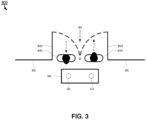
- the binocular pedestrian detection system 100 is installed over a doorway 302 to a closed area as illustrated in FIG. 3 .
- the closed area includes walls 301, and the doorway 302 includes a left door 3021, and a right door 3022.
- pedestrians 303 may enter or exit the closed area.
- At least one binocular pedestrian detection system 100 in order to count the pedestrians walking into or out of the closed area, should be installed to accurately count the pedestrians.
- the binocular images of pedestrians 303 are captured in video form. In another embodiment, the binocular images of pedestrians 303 are captured in still images sampled from the video captured through the binocular camera 110. In certain embodiments, the sampling rate of the binocular video is 20 to 25 frames per second (fps). Depending on the speed of the Image/Video Processing ASIC 120 and the processor 131, the sampling rate of the binocular video may be reduced to as low as 10-14 fps with the image resolution at 320 x 240 pixels using mobile communication network platform.
- At least one binocular pedestrian detection system 100 should be installed over each of the doors.
- more than one binocular pedestrian detection system 100 may be installed over the doorway opening to accurately count the pedestrians.
- the binocular pedestrian detection system 100 may be installed directly over the entry way and directly over the pedestrian 303 and a predetermined distance from the wall 301, for example 60-80CM from the wall 301. According to this installation, the images captured by the binocular pedestrian detection system 100 may be flat, shadows, footprints may cause pedestrian detection to fail, and accuracy of the pedestrian detection may not be ideal.
- the binocular pedestrian detection system 100 may be installed in a predetermined angle over the entry way and the pedestrian 303 and a predetermined distance from the wall 301, for example 60-80CM from the wall 301. According to this installation, the images captured by the binocular pedestrian detection system 100 may be more realistic, shadows and footprints may be distinguished from the images captured and accuracy of the pedestrian detection may be improved.
- the image/video processing ASIC 120 pre-processes the binocular images of pedestrians 303 captured by the binocular camera 110.
- the image/video processing ASIC 120 may include a graphics processing unit (GPU) designed for doing dedicated graphics-rendering computations.
- the pre-process includes, among other things, binocular camera calibration, binocularly rectifying training binocular images, binocularly rectifying real-time binocular images for pedestrian detection and calculating disparity maps.
- the binocular pedestrian detection system controller 130 includes a processor 131, a network interface 132, and a memory 133 storing an operating system 1333, and computer executable instructions 1334.
- the processor 131 may include single core processor, multi-core processor, shared processor, dedicated processor, a group of processors, and artificial intelligence (AI) processor designed to handle artificial intelligence related computations.
- AI artificial intelligence
- the operating system 1333, the computer executable instructions 1334, and many parameters used in the operation of a dual-stream deep learning neural network are stored in a non-volatile solid-state drive (SSD) device 1332.
- SSD solid-state drive
- the computer executable instructions 1334 are executed in the processor 131, the computer executable instructions 1334 are loaded into one or more DDR RAM devices 1331 and cause the processor 131 to perform one or more of following: capturing, by the binocular camera 110, the binocular images of the pedestrians 303 passing through the predetermined area, binocularly rectifying, by the image/video processing ASIC 120, the binocular images of the pedestrians 303 captured, calculating disparity maps of the binocular images of the pedestrians 303 binocularly rectified, training a dual-stream deep learning neural network 625, and detecting, via the dual-stream deep learning neural network 625 trained, the pedestrians 303 passing through the predetermined area.
- the binocular camera 110 may be calibrated to increase the consistency and accuracy of the binocular camera 110 as shown in box 601 of FIG. 6 .
- Binocular camera calibration allows the Binocular camera 110 to shoot a specified size object from different angles, calculates the internal and external parameters of the Binocular camera 110.
- the specific steps of calibration include: (a) making a 12x12 black-and-white checkerboard, using the binocular camera 110 to shoot 15 photos of the checkerboard from different angles.
- the checkerboard must be present in the view of the first camera 111 and the second camera 112 of the binocular camera 110 simultaneously, and (b) calibration of the camera is performed using the calibration kit toolbox_calib of MATLAB, according to the 15 photos captured above during the calibration. Following parameters of the first camera 111 and the second camera 112 are obtained through calibration:
- the binocular camera 110 captures a first image I 1 by the first camera 111, and a second image I 2 by the second camera 112.
- These two binocular images I 1 and I 2 are binocularly rectified by using rectification functions including stereoRectify, initUndistortRectifyMap, and remap, and using the parameters obtained through binocular calibration described above: f x 1 , f y 1 , f x 2 , f y 2 , c x 1 , c y 1 , c x 2 , c y 2 , d 1 ′ , d 2 ′ , R, and T .
- the functions used include:
- the rectified binocular images I 1 r and I 2 r may be fed to a training phase 610 and to an application phase 620.
- the binocular images of the pedestrians 303 include certain training binocular images of the pedestrians 303 and certain real-time binocular images of the pedestrians 303 captured by the binocular camera 110 for pedestrian detection.
- the image/video processing ASIC 120 is programmed to perform one or more of operations: performing calibration of the binocular camera 110, binocularly rectifying the binocular images of the pedestrians 303, calculating the disparity maps of training binocular images of the pedestrians 303 during a training phase 610, and calculating the disparity maps of real-time binocular images of the pedestrians 303 during an application phase 620.
- the training binocular images of pedestrians 303 from the binocular camera 110 are directed to box 611 for binocular rectifying the training binocular images of pedestrians 303.
- the rectified training binocular images of pedestrians 303 are used to calculate disparity maps of these training binocular images of pedestrians 303 in box 613.
- the disparity map d of the rectified binocular images I 1 r and I 2 r is generated by using standard Semi-Global Block-Matching (SGBM) Algorithm.
- Disparity map d is a gray-scaled image with a pixel value of 0-255.
- Disparity map d records the amount of deviation for each point on the image, between the first (left) and the second (right) positions. For example, for the position of column j of line i in the first (left) image, I 1 r i j , this point is found to appear in the right image, I 2 r i , j + ⁇ j through a search for a match, then ⁇ j is the value of disparity map d (i,j). For an object further away, the position deviation ⁇ j of the first image and the second image will be smaller. For a close object, the position deviation ⁇ j of the first image and the second image will be greater. Therefore, the disparity map d reflects the relative distance of the object from each of the first camera 111 and the second camera 112 of the binocular camera 110.
- the calculated disparity maps of the binocular images of pedestrians 303 are then used in box 615 for extracting disparity features of the disparity maps of these training binocular images of pedestrians 303.
- the output of the training of the neural network for extracting disparity features is fed into box 617 to train the neural network for learning and fusing features.
- the neural network for extracting disparity features and the neural network for learning and fusing features are trained, the neural network for extracting disparity features and the neural network for learning and fusing features are combined and used for forming and training of a dual-stream deep learning neural network in box 619.
- the output of the box 619 forms the dual-stream deep learning neural network 625 to be used for detecting pedestrians 303 in the application phase 620.
- the architecture of the neural network for extracting disparity features is referring to single shot multibox detector (SSD) as shown in FIG. 8 .
- the backbone of the SSD consists of 23 layers, each of which includes convolution operations, non-linear activations, and pooling operations and these operations are performed according to the equations shown in FIG. 8 along each of the 23 layers.
- the pooling operations are performed with the maximum value (Maximum Pooling), meaning that each pixel is replaced by the maximum value of its neighborhood pixels.
- conv represents the convolution operation
- pool represents the pooling operation
- the k x k represents the size of the convolution kernel or the pooling kernel
- p represents the number of pixels (pading) of the edge of the feature graph
- s represents the step size (stride) of the convolution kernel
- c represents convolution kernel traversal (channels).
- a detection branch 11 (DB #1), a detection branch 21 (DB #2), a detection branch 31 (DB #3), a detection branch 41 (DB #4), a detection branch 51 (DB #5), and a detection branch 61 (DB #6), are formed at 10 th , 15 th , 17 th , 19 th , 21 st , and 23 rd layers, respectively.
- Each of the detection branches is formed after two convolution operations. The first convolution results in a pedestrian position feature map, and the second convolution results its corresponding scoring feature map as shown in FIG. 9 .
- the 4 * k values for each pixel position (x, y) in the position feature map represent the coordinates of the upper-left corner, length, and width of the k predicted rectangle positions.
- the 2*k values for each pixel position (x, y) in the scoring feature map represent k predicted scoring corresponding to the "pedestrian" and "background" of k predicted positions.
- the pedestrian detection results obtained by each of the detection branches DB #1, DB #2, DB #3, DB #4, DB #5, and DB #6 are combined to obtain final pedestrian detection results, as shown in FIG. 8 .
- the number of categories of detection branches in SSD is set to 2, i.e., only the "pedestrian" and "background” categories.
- N is the total number of binocular image frames.
- all pedestrian bounding boxes (bounding box) are manually marked out in the left image.
- Each bounding box is represented by its coordinates of the upper-left corners, the length and the width.
- the neural network for extracting disparity features is trained using back propagation and the gradient descent method. At the end of the training, only the first 7 layers of the neural network for extracting disparity features are retained for disparity feature extraction, and the remaining layers are discarded. Finally, when a disparity map is entered, the neural network for extracting disparity features generates a feature map with 1/8 resolution of the original disparity map.
- the architecture of the neural network for learning and fusing features is also referring to single shot multibox detector (SSD) as shown in FIG. 8 using similar parameters and formulas.
- the number of categories of detection branches in SSD is also set to 2, i.e., only the "pedestrian" and "background” categories.
- the neural network for learning and fusing features is also trained by the back propagation and gradient descent method.
- the dual-stream deep learning neural network is formed and trained by combining the disparity features extracted using the neural network for extracting disparity features and RGB features learned by the 7th layer of the neural network for learning and fusing features. These features are concatenated and continued to forward propagation according to subsequent structure of the neural network for learning and fusing features.
- real-time binocular images of pedestrians 303 are received from the calibrated binocular camera 110, and these binocular images of pedestrians 303 are binocularly rectified in box 621.
- the rectified real-time binocular images of pedestrians 303 are used to calculate disparity maps of these real-time binocular images of pedestrians 303 in box 623.
- the dual-stream deep learning neural network trained in box 619 is used in box 625 to detect pedestrians 303.
- the pedestrian detection output from box 625 are used in box 627 to perform non-maximum suppression operation.
- the final pedestrian detection results are obtained in box 629 after the non-maximum suppression operation is performed on the output of the box 625.
- the input binocular images of pedestrians 303 are directed to two separate streams: a first stream and a second stream.
- the first stream includes box 62511 and box 62513 and this stream is used to extract disparity features of the binocular images of pedestrians 303.
- the second stream includes box 62521 and box 62523 and this stream is used to learn RGB features of the left images of pedestrians 303.
- the disparity maps of input binocular images of pedestrians 303 are received.
- the received disparity maps of binocular images of pedestrians 303 are used in box 62513 to extract disparity features using neural network for extracting disparity features.
- binocularly rectified left images of pedestrians 303 are received.
- the received binocularly rectified left images of pedestrians 303 are used in box 62523 to learn RGB features using the first N layers of neural network for learning and fusing features, where N is a positive integer and N ⁇ M.
- the extracted disparity features from box 62513 and the learned RGB features from box 62523 are stacked through channels in box 62525.
- the stacked disparity features and RGB features are sent to the remaining M-N layers of the neural network for learning and fusing features.
- the final pedestrian detection results are the output of the M-th layer of the neural network for learning and fusing features.
- M is 15, and N is 7.
- the network interface 132 is a power-on-ethernet (POE) network interface.
- the power supplying to the binocular pedestrian detection system 100 is provided by the POE network interface, and the final pedestrian detection results are transmitted to a server that collects the final pedestrian detection results through the network interface 132 and a communication network 140 as shown in FIG. 1 .
- POE power-on-ethernet
- the dual-stream deep learning neural network 625 may be used to detect pedestrians.
- binocular RGB images I 1 , I 2 are captured by the binocular camera 110.
- the captured binocular RGB images I 1 , I 2 are then rectified to obtain the rectified binocular images I 1 r , I 2 r .
- Binocular disparity map d is calculated using the rectified binocular images I 1 r , I 2 r .
- the binocular disparity map d is used by the neural network for extracting disparity features to extract the disparity features, and the rectified left image I 1 r is used by the neural network for learning and fusing features to learn RGB features using the first N layers.
- the extracted disparity features and the learned RGB features are stacked through channels.
- the stacked features are then sent to the remaining M-N layers of the neural network for learning and fusing features to get pedestrian detection results.
- the initial pedestrian detection results are refined using non-maximum suppression operations as shown in box 627 of FIG. 6 .
- following steps are taken:
- the present disclosure relates to a method of detecting pedestrians using a binocular pedestrian detection system 100.
- the method includes: capturing certain binocular images of pedestrians 303 passing through a predetermined area using a binocular camera 110 of the binocular pedestrian detection system 100, binocularly rectifying, via an image/video processing ASIC 120 of the binocular pedestrian detection system 100, the binocular images of the pedestrians 303 captured, calculating, via the image/video processing ASIC 120, disparity maps of the binocular images of the pedestrians 303 binocularly rectified, training a dual-stream deep learning neural network 625 using the rectified left images and disparity maps of the binocular images of the pedestrians 303 calculated, and detecting, via the dual-stream deep learning neural network 625 trained, the pedestrians 303 passing through the predetermined area.
- the dual-stream deep learning neural network 625 includes a neural network for extracting disparity features from the disparity maps of the binocular images of the pedestrians 303, and a neural network for learning and fusing the features of RGB and disparity from binocular images of pedestrians 303.
- the binocular pedestrian detection system 100 includes: the binocular camera 110, the image/video processing application specific integrated circuit (ASIC) 120, and a binocular pedestrian detection system controller 130.
- the binocular camera 110 has a first camera 111, and a second camera 112 to capture certain number of binocular images of pedestrians 303 passing through a predetermined area.
- the first camera 111 includes a first lens 1111, and a first CMOS sensor 1112 for capturing a left image through the first lens 1111.
- the second camera 112 includes a second lens 1121, and a second CMOS sensor 1122 for capturing a right image through the second lens 1121. The left image and the right image form a binocular image.
- the image/video processing ASIC 120 preprocesses the binocular images of the pedestrians 303 captured by the binocular camera 110.
- the binocular pedestrian detection system controller 130 includes a processor 131, a network interface 132, and a memory 133 storing an operating system 1333, and computer executable instructions 1334. When the computer executable instructions 1334 are executed in the processor 131, the computer executable instructions 1334 cause the processor 131 to perform one or more operations of the method.
- the binocular images of the pedestrians 303 include certain training binocular images of the pedestrians 303 and certain real-time binocular images of the pedestrians 303 captured by the binocular camera 110 for pedestrian detection.
- the image/video processing ASIC 120 is programmed to perform: performing calibration of the binocular camera 110, binocularly rectifying the binocular images of the pedestrians 303, calculating the disparity maps of training binocular images of the pedestrians 303 during a training phase, and calculating the disparity maps of real-time binocular images of the pedestrians 303 during an application phase.
- the training phase includes: training of the neural network for extracting disparity features using the disparity maps of the binocular images of the pedestrians 303, training of the neural network for learning and fusing the features of RGB and disparity using the left images of pedestrians 303 only, and stacking the trained neural network for extracting disparity features and the neural network for learning and fusing features to form the dual-stream deep learning neural network 625.
- the application phase includes: capturing, by the binocular camera 110, the real-time binocular images of the pedestrians 303, binocularly rectifying, by the image/video processing ASIC 120, the real-time binocular images of the pedestrians 303 captured, calculating, by the image/video processing ASIC 120, disparity maps of the real-time binocular images of the pedestrians 303 binocularly rectified, detecting the pedestrians 303 from the rectified left images and disparity maps of the real-time binocular images of the pedestrians 303 using the dual-stream deep learning neural network 625 formed during the training phase, and performing non-maximum suppression operation to detection results to obtain final pedestrian detection results.
- the process of detecting pedestrians 303 using the dual-stream deep learning neural network 625 includes: extracting disparity features from the disparity maps of the real-time binocular images of the pedestrians 303 using the neural network for extracting disparity features, learning RGB features from rectified left images of pedestrians 303 using the first N layers of the neural network for learning and fusing the features of RGB and disparity, stacking the disparity features extracted and the RGB features learned through a number of channels, and fusing features of disparity and RGB using the last M-N layers of the neural network for learning and fusing features to obtain the final pedestrian detection results.
- N is a positive integer
- M is a positive integer greater than N and is a total number of layers of the neural network for learning and fusing features.
- N is 7, and M is 15.
- the binocular pedestrian detection system 100 is installed over a doorway 301 having binocular camera 110 facing down to the pedestrians 303 passing through the doorway 301. In another embodiment, the binocular pedestrian detection system 100 is installed over a doorway 301 having binocular camera 110 facing the pedestrians 303 passing through the doorway 301 in a predetermined angle.
- the network interface 132 includes a power-on-ethernet (POE) network interface.
- the power supplying to the binocular pedestrian detection system 100 is provided by the POE network interface, and the final pedestrian detection results are transmitted to a server that collects the final pedestrian detection results through the network interface 132 and a communication network 140.
- POE power-on-ethernet
- the communication network 140 includes: a wireless personal area network (WPAN), a wireless local area network (WLAN), a wireless metropolitan area network (WMAN), a wireless wide area network (WWAN), a cellular network, and a mobile communication network.
- the WPAN may also include a Wi-Fi network, a Bluetooth network, an infrared network, and a Zigbee network.
Landscapes
- Engineering & Computer Science (AREA)
- Theoretical Computer Science (AREA)
- Physics & Mathematics (AREA)
- General Physics & Mathematics (AREA)
- Multimedia (AREA)
- Evolutionary Computation (AREA)
- Computer Vision & Pattern Recognition (AREA)
- Artificial Intelligence (AREA)
- Health & Medical Sciences (AREA)
- Data Mining & Analysis (AREA)
- General Health & Medical Sciences (AREA)
- Life Sciences & Earth Sciences (AREA)
- Computing Systems (AREA)
- Software Systems (AREA)
- General Engineering & Computer Science (AREA)
- Biomedical Technology (AREA)
- Molecular Biology (AREA)
- Biophysics (AREA)
- Mathematical Physics (AREA)
- Computational Linguistics (AREA)
- Medical Informatics (AREA)
- Databases & Information Systems (AREA)
- Signal Processing (AREA)
- Bioinformatics & Cheminformatics (AREA)
- Bioinformatics & Computational Biology (AREA)
- Evolutionary Biology (AREA)
- Human Computer Interaction (AREA)
- Social Psychology (AREA)
- Psychiatry (AREA)
- Biodiversity & Conservation Biology (AREA)
- Image Analysis (AREA)
Description
- The present disclosure generally relates to pedestrian detection, and more particularly to a binocular pedestrian detection system having dual-stream deep learning neural network and methods of using the binocular pedestrian detection system having dual-stream deep learning neural network.
- Pedestrian detection plays a key role in video surveillance and pedestrian counting in a defined area, such as a store, a street, or a sports stadium. A number of methods may be used to detect pedestrians: (a) Monocular Video Pedestrian detection based on single frame picture, (b) Monocular Video Pedestrian detection based on frame motion information; (c) Pedestrian detection based on binocular vision, and (d) Pedestrian detection using 3D data acquisition system etc. Method (a) only utilizes the color and texture information of monocular RGB images. For targets difficult to be distinguished such as shadow, footprints, or a pedestrian wearing a hat, its robustness is poor and misdetection occurs often. Method (b) extracts the motion information of pedestrians based on their edge features between subsequent frames, and the detection results and robustness are both good for pedestrians in motion. However, it is not very good for stationary pedestrians since the edge features between subsequent frames are not easy to be extracted and pedestrian detection often fails. Method (c) makes use of binocular information for more accurate pedestrian detection results. But the existing method is only to use the disparity maps to select regions of interest, pedestrian detection in the area of interest is still based on monocular RGB image characteristics. Therefore, this method can only be used to remove false pedestrian targets (such as shadows, footprints), and the detection effect of special pedestrian targets such as those wearing hats is still poor. With the help of the pedestrian detection method depending on 3D data acquisition equipment, the three-dimensional locations can be accurately determined by collecting three-dimensional information using method (d). However, this approach requires the use of additional expensive 3D data acquisition systems such as LiDAR, which is difficult to be equipped in common public places, so this method is less practical in practical scenarios.
- Therefore, a heretofore unaddressed need still exists in the art to address the aforementioned deficiencies and inadequacies.
-
CN 108596040A relates to a serial channel pedestrian detection method based on binocular vision.CN 105550675A relates to a binocular pedestrian detection method based on an optimization polymerization integration channel.EP 1768067A2 relates to an integrated electro-optical device for counting persons who pass through a gate, or stay in a delimited zone, which is suitable to reconstruct the three-dimensional profile of an area subjected to visual control by means of stereoscopic vision techniques.CN 108335322A relates to a depth estimation method comprising the steps of taking a single picture as a first image in a binocular image, through a first neural network, obtaining a second image in the binocular image based on the first image, and through a second neural network, performing binocular stereo matching on the first image and the second image to obtain depth information corresponding to the first image. - The invention is set out in the appended set of claims.
- These and other aspects of the present disclosure will become apparent from the following description of the preferred embodiment taken in conjunction with the following drawings, although variations and modifications therein may be effected without departing from the scope of the novel concepts of the disclosure.
- The accompanying drawings illustrate one or more embodiments of the present disclosure, and features and benefits thereof, and together with the written description, serve to explain the principles of the present invention. Wherever possible, the same reference numbers are used throughout the drawings to refer to the same or like elements of an embodiment, and wherein:
-
FIG. 1 shows a block diagram of a binocular pedestrian detection system having dual stream deep learning neural network according to certain embodiments of the present disclosure; -
FIG. 2 illustrates a bottom view of the binocular pedestrian detection system according to certain embodiments of present disclosure; -
FIG. 3 illustrates the binocular pedestrian detection system installed over a doorway for detecting pedestrians walking into or out of the doorway according to certain embodiments of the present disclosure; -
FIG. 4 illustrates the binocular pedestrian detection system installed over a doorway facing down according to certain embodiments of the present disclosure; -
FIG. 5 illustrates the binocular pedestrian detection system installed over a doorway facing pedestrians in an angle according to certain embodiments of the present disclosure; -
FIG. 6 shows a block diagram of a training phase and an application phase of a dual-stream deep learning neural network according to certain embodiments of the present disclosure; -
FIG. 7 shows detailed operation of detecting pedestrian using the dual-stream deep learning neural network according to certain embodiments of the present disclosure; -
FIG. 8 illustrates a single shot multibox detector (SSD) based neural network using dual-stream deep learning neural network diagram according to certain embodiments of the present disclosure; and -
FIG. 9 illustrates certain detection branches from the SSD neural network using dual-stream deep learning neural network diagram shown inFIG. 8 according to certain embodiments of the present disclosure. - The present disclosure is more particularly described in the following examples that are intended as illustrative only since numerous modifications and variations therein will be apparent to those skilled in the art. Various embodiments of the disclosure are now described in detail. Referring to the drawings, like numbers, if any, indicate like components throughout the views. As used in the description herein and throughout the claims that follow, the meaning of "a", "an", and "the" includes plural reference unless the context clearly dictates otherwise. Also, as used in the description herein and throughout the claims that follow, the meaning of "in" includes "in" and "on" unless the context clearly dictates otherwise. Moreover, titles or subtitles may be used in the specification for the convenience of a reader, which shall have no influence on the scope of the present disclosure. Additionally, some terms used in this specification are more specifically defined below.
- The terms used in this specification generally have their ordinary meanings in the art, within the context of the disclosure, and in the specific context where each term is used. Certain terms that are used to describe the disclosure are discussed below, or elsewhere in the specification, to provide additional guidance to the practitioner regarding the description of the disclosure. For convenience, certain terms may be highlighted, for example using italics and/or quotation marks. The use of highlighting has no influence on the scope and meaning of a term; the scope and meaning of a term is the same, in the same context, whether or not it is highlighted. It will be appreciated that same thing can be said in more than one way. Consequently, alternative language and synonyms may be used for any one or more of the terms discussed herein, nor is any special significance to be placed upon whether or not a term is elaborated or discussed herein. Synonyms for certain terms are provided. A recital of one or more synonyms does not exclude the use of other synonyms. The use of examples anywhere in this specification including examples of any terms discussed herein is illustrative only, and in no way limits the scope and meaning of the disclosure or of any exemplified term. Likewise, the disclosure is not limited to various embodiments given in this specification.
- Unless otherwise defined, all technical and scientific terms used herein have the same meaning as commonly understood by one of ordinary skill in the art to which this disclosure pertains. In the case of conflict, the present document, including definitions will control.
- As used herein, "around", "about" or "approximately" shall generally mean within 20 percent, preferably within 10 percent, and more preferably within 5 percent of a
given value or range. Numerical quantities given herein are approximate, meaning that the term "around", "about" or "approximately" can be inferred if not expressly stated. - As used herein, "plurality" means two or more.
- As used herein, the terms "comprising," "including," "carrying," "having," "containing," "involving," and the like are to be understood to be open-ended, i.e., to mean including but not limited to.
- As used herein, the phrase at least one of A, B, and C should be construed to mean a logical (A or B or C), using a non-exclusive logical OR. It should be understood that one or more steps within a method may be executed in different order (or concurrently) without altering the principles of the present disclosure.
- As used herein, the term module may refer to, be part of, or include an Application Specific Integrated Circuit (ASIC); an electronic circuit; a combinational logic circuit; a field programmable gate array (FPGA); a processor (shared, dedicated, or group) that executes code; other suitable hardware components that provide the described functionality; or a combination of some or all of the above, such as in a system-on-chip. The term module may include memory (shared, dedicated, or group) that stores code executed by the processor.
- The term code, as used above, may include software, firmware, and/or microcode, and may refer to programs, routines, functions, classes, and/or objects. The term shared, as used above, means that some or all code from multiple modules may be executed using a single (shared) processor. In addition, some or all code from multiple modules may be stored by a single (shared) memory. The term group, as used above, means that some or all code from a single module may be executed using a group of processors. In addition, some or all code from a single module may be stored using a group of memories.
- The apparatuses and methods described herein may be implemented by one or more computer programs executed by one or more processors. The computer programs include processor-executable instructions that are stored on a non-transitory tangible computer readable medium. The computer programs may also include stored data. Non-limiting examples of the non-transitory tangible computer readable medium are nonvolatile memory, magnetic storage, and optical storage.
- The present disclosure will now be described more fully hereinafter with reference to the accompanying drawings
FIGS. 1 through 9 , in which embodiments of the disclosure are shown. This disclosure may, however, be embodied in many different forms and should not be construed as limited to the embodiments set forth herein; rather, these embodiments are provided so that this disclosure will be thorough and complete, and will fully convey the scope of the disclosure to those skilled in the art. Like numbers refer to like elements throughout. - In one aspect, the present disclosure relates to a binocular
pedestrian detection system 100 as shown inFIG. 1 . In certain embodiments, the binocularpedestrian detection system 100 includes: abinocular camera 110, an image/video processing application specific integrated circuit (ASIC) 120, and a binocular pedestriandetection system controller 130. As shown inFIGS. 1 and3 , thebinocular camera 110 has afirst camera 111, and asecond camera 112 to capture a series of binocular images ofpedestrians 303 passing through a predetermined area. Thefirst camera 111 includes afirst lens 1111, and afirst CMOS sensor 1112 for capturing a left image through thefirst lens 1111. Thesecond camera 112 includes asecond lens 1121, and asecond CMOS sensor 1122 for capturing a right image through thesecond lens 1121. The left image and the right image form a binocular image. - In certain embodiments, the binocular
pedestrian detection system 100 is installed over adoorway 302 to a closed area as illustrated inFIG. 3 . The closed area includeswalls 301, and thedoorway 302 includes aleft door 3021, and aright door 3022. When thefirst door 3021 and/or the second door are open,pedestrians 303 may enter or exit the closed area. - In certain embodiments, in order to count the pedestrians walking into or out of the closed area, at least one binocular
pedestrian detection system 100 should be installed to accurately count the pedestrians. - In one embodiment, the binocular images of
pedestrians 303 are captured in video form. In another embodiment, the binocular images ofpedestrians 303 are captured in still images sampled from the video captured through thebinocular camera 110. In certain embodiments, the sampling rate of the binocular video is 20 to 25 frames per second (fps). Depending on the speed of the Image/Video Processing ASIC 120 and theprocessor 131, the sampling rate of the binocular video may be reduced to as low as 10-14 fps with the image resolution at 320 x 240 pixels using mobile communication network platform. - In certain embodiments, when the closed area includes more than one doors, at least one binocular
pedestrian detection system 100 should be installed over each of the doors. - In certain embodiments, when the door is unusually wide, or there is no
wall 301 in a store front, more than one binocularpedestrian detection system 100 may be installed over the doorway opening to accurately count the pedestrians. - In one embodiment, as shown in
FIG. 4 , the binocularpedestrian detection system 100 may be installed directly over the entry way and directly over thepedestrian 303 and a predetermined distance from thewall 301, for example 60-80CM from thewall 301. According to this installation, the images captured by the binocularpedestrian detection system 100 may be flat, shadows, footprints may cause pedestrian detection to fail, and accuracy of the pedestrian detection may not be ideal. - In another embodiment, as shown in
FIG. 5 , the binocularpedestrian detection system 100 may be installed in a predetermined angle over the entry way and thepedestrian 303 and a predetermined distance from thewall 301, for example 60-80CM from thewall 301. According to this installation, the images captured by the binocularpedestrian detection system 100 may be more realistic, shadows and footprints may be distinguished from the images captured and accuracy of the pedestrian detection may be improved. - Referring back to
FIG. 1 , the image/video processing ASIC 120 pre-processes the binocular images ofpedestrians 303 captured by thebinocular camera 110. The image/video processing ASIC 120 may include a graphics processing unit (GPU) designed for doing dedicated graphics-rendering computations. The pre-process includes, among other things, binocular camera calibration, binocularly rectifying training binocular images, binocularly rectifying real-time binocular images for pedestrian detection and calculating disparity maps. The binocular pedestriandetection system controller 130 includes aprocessor 131, anetwork interface 132, and amemory 133 storing anoperating system 1333, and computerexecutable instructions 1334. Theprocessor 131 may include single core processor, multi-core processor, shared processor, dedicated processor, a group of processors, and artificial intelligence (AI) processor designed to handle artificial intelligence related computations. - The
operating system 1333, the computerexecutable instructions 1334, and many parameters used in the operation of a dual-stream deep learning neural network are stored in a non-volatile solid-state drive (SSD)device 1332. When the computerexecutable instructions 1334 are executed in theprocessor 131, the computerexecutable instructions 1334 are loaded into one or moreDDR RAM devices 1331 and cause theprocessor 131 to perform one or more of following: capturing, by thebinocular camera 110, the binocular images of thepedestrians 303 passing through the predetermined area, binocularly rectifying, by the image/video processing ASIC 120, the binocular images of thepedestrians 303 captured, calculating disparity maps of the binocular images of thepedestrians 303 binocularly rectified, training a dual-stream deep learningneural network 625, and detecting, via the dual-stream deep learningneural network 625 trained, thepedestrians 303 passing through the predetermined area. - Referring now to
FIG. 6 , a block diagram of a training phase and an application phase of a dual-stream deep learning neural network is shown according to certain embodiments of the present disclosure. In certain embodiments, thebinocular camera 110 may be calibrated to increase the consistency and accuracy of thebinocular camera 110 as shown inbox 601 ofFIG. 6 . Binocular camera calibration allows theBinocular camera 110 to shoot a specified size object from different angles, calculates the internal and external parameters of theBinocular camera 110. - In one embodiment, the specific steps of calibration include: (a) making a 12x12 black-and-white checkerboard, using the
binocular camera 110 to shoot 15 photos of the checkerboard from different angles. The checkerboard must be present in the view of thefirst camera 111 and thesecond camera 112 of thebinocular camera 110 simultaneously, and (b) calibration of the camera is performed using the calibration kit toolbox_calib of MATLAB, according to the 15 photos captured above during the calibration. Following parameters of thefirst camera 111 and thesecond camera 112 are obtained through calibration: - a left x direction focal length:

- a left y direction focal length:

- a right x direction focal length:

- a right y direction focal length:

- a left camera image center coordinates:


- a right camera image center coordinates:


- a first camera distortion parameter:

- a second camera distortion parameter:

- a rotation matrix between the
first camera 111 and the second camera 112: R; and - a shift vector T.
- These camera parameters are used for performing binocular rectification of binocular images of pedestrians captured by the
binocular camera 110. In certain embodiments, thebinocular camera 110 captures a first image I1 by thefirst camera 111, and a second image I2 by thesecond camera 112. These two binocular images I1 and I2 are binocularly rectified by using rectification functions including stereoRectify, initUndistortRectifyMap, and remap, and using the parameters obtained through binocular calibration described above:
- In certain embodiments, the functions used include:
- stereoRectify(M1, D1, M2, D2, imageSize, R, T, R1, R2, P1, P2, Q, CALIB_ZERO_DISPARITY, 0, imageSize, & ValidRoil, & ValidRoi2);
- initUndistortRectifyMap(M1, D1, R1, P1, imageSize, CV 16SC2, rmap[0][0], rmap[0][1]);
- initUndistortRectifyMap(M2, D2, R2, P2, imageSize, CV 16SC2, rmap[1][0], rmap[1][1]);
- where,

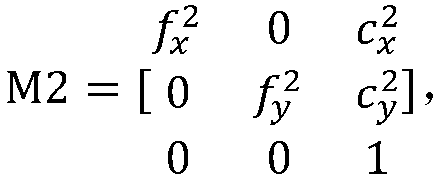


R1, R2, P1, P2, Q, ValidRoil , ValidRoi2, rmap are the output variables ∘ - remap(left_src, left_dst, rmap[0][0], rmap[0][1], INTER_LINEAR);
- remap(right_src, right_dst, rmap[1][0], rmap[1][1], INTER_LINEAR);
- where left_src is the first image I1, right_src is the second image I2, left_dst is the rectified first image


- The rectified binocular images


training phase 610 and to anapplication phase 620. - In certain embodiments, the dual-stream deep learning
neural network 625 includes a neural network for extracting disparity features from the disparity maps of the binocular images of thepedestrians 303, and a neural network for learning and fusing the features of RGB and disparity from binocular images ofpedestrians 303. In certain embodiments, the neural network for learning and fusing features includes M layers, where M is a positive integer and is a total number of layers of the neural network for learning and fusing features. - In certain embodiments, the binocular images of the
pedestrians 303 include certain training binocular images of thepedestrians 303 and certain real-time binocular images of thepedestrians 303 captured by thebinocular camera 110 for pedestrian detection. The image/video processing ASIC 120 is programmed to perform one or more of operations: performing calibration of thebinocular camera 110, binocularly rectifying the binocular images of thepedestrians 303, calculating the disparity maps of training binocular images of thepedestrians 303 during atraining phase 610, and calculating the disparity maps of real-time binocular images of thepedestrians 303 during anapplication phase 620. - In certain embodiments, in the
training phase 610, the training binocular images ofpedestrians 303 from thebinocular camera 110 are directed tobox 611 for binocular rectifying the training binocular images ofpedestrians 303. The rectified training binocular images ofpedestrians 303 are used to calculate disparity maps of these training binocular images ofpedestrians 303 inbox 613. - The disparity map d of the rectified binocular images


- Disparity map d records the amount of deviation for each point on the image, between the first (left) and the second (right) positions. For example, for the position of column j of line i in the first (left) image,


first camera 111 and thesecond camera 112 of thebinocular camera 110. - In certain embodiments, the calculated disparity maps of the binocular images of
pedestrians 303 are then used inbox 615 for extracting disparity features of the disparity maps of these training binocular images ofpedestrians 303. After the training of the neural network for extracting disparity features, the output of the training of the neural network for extracting disparity features is fed intobox 617 to train the neural network for learning and fusing features. Once the neural network for extracting disparity features and the neural network for learning and fusing features are trained, the neural network for extracting disparity features and the neural network for learning and fusing features are combined and used for forming and training of a dual-stream deep learning neural network inbox 619. The output of thebox 619 forms the dual-stream deep learningneural network 625 to be used for detectingpedestrians 303 in theapplication phase 620. - In certain embodiments, the architecture of the neural network for extracting disparity features is referring to single shot multibox detector (SSD) as shown in
FIG. 8 . In one embodiment, the backbone of the SSD consists of 23 layers, each of which includes convolution operations, non-linear activations, and pooling operations and these operations are performed according to the equations shown inFIG. 8 along each of the 23 layers. - As shown in
FIG. 8 , these 23 layers are sequentially connected to each other. The nonlinear activation takes the ReLU activation function, defined as f(x)=max(0, x). The pooling operations are performed with the maximum value (Maximum Pooling), meaning that each pixel is replaced by the maximum value of its neighborhood pixels. - In certain embodiments, conv represents the convolution operation, pool represents the pooling operation, the k x k represents the size of the convolution kernel or the pooling kernel, p represents the number of pixels (pading) of the edge of the feature graph, and s represents the step size (stride) of the convolution kernel, and c represents convolution kernel traversal (channels).
- In certain embodiments, as shown in
FIG. 8 , A detection branch 11 (DB #1), a detection branch 21 (DB #2), a detection branch 31 (DB #3), a detection branch 41 (DB #4), a detection branch 51 (DB #5), and a detection branch 61 (DB #6), are formed at 10th, 15th, 17th, 19th, 21st, and 23rd layers, respectively. Each of the detection branches is formed after two convolution operations. The first convolution results in a pedestrian position feature map, and the second convolution results its corresponding scoring feature map as shown inFIG. 9 . The 4*k values for each pixel position (x, y) in the position feature map represent the coordinates of the upper-left corner, length, and width of the k predicted rectangle positions. The 2*k values for each pixel position (x, y) in the scoring feature map represent k predicted scoring corresponding to the "pedestrian" and "background" of k predicted positions. The pedestrian detection results obtained by each of the detectionbranches DB # 1,DB # 2,DB # 3,DB # 4,DB # 5, andDB # 6 are combined to obtain final pedestrian detection results, as shown inFIG. 8 . - In certain embodiments, the number of categories of detection branches in SSD is set to 2, i.e., only the "pedestrian" and "background" categories. A large number N of binocular image frames ,


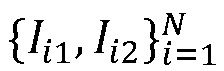
- During training, the binocular disparity maps


- In certain embodiments, the architecture of the neural network for learning and fusing features is also referring to single shot multibox detector (SSD) as shown in
FIG. 8 using similar parameters and formulas. In certain embodiments, the number of categories of detection branches in SSD is also set to 2, i.e., only the "pedestrian" and "background" categories. The rectified left image frame
- In certain embodiments, as shown in
box 619 ofFIG. 7 , the dual-stream deep learning neural network is formed and trained by combining the disparity features extracted using the neural network for extracting disparity features and RGB features learned by the 7th layer of the neural network for learning and fusing features. These features are concatenated and continued to forward propagation according to subsequent structure of the neural network for learning and fusing features. - In certain embodiments, in the
application phase 620, real-time binocular images ofpedestrians 303 are received from the calibratedbinocular camera 110, and these binocular images ofpedestrians 303 are binocularly rectified inbox 621. The rectified real-time binocular images ofpedestrians 303 are used to calculate disparity maps of these real-time binocular images ofpedestrians 303 inbox 623. The dual-stream deep learning neural network trained inbox 619 is used inbox 625 to detectpedestrians 303. The pedestrian detection output frombox 625 are used in box 627 to perform non-maximum suppression operation. The final pedestrian detection results are obtained in box 629 after the non-maximum suppression operation is performed on the output of thebox 625. - Referring now to
FIG. 7 , a detailed operation of detecting pedestrian using the dual-stream deep learning neural network is shown according to certain embodiments of the present disclosure. The input binocular images ofpedestrians 303 are directed to two separate streams: a first stream and a second stream. The first stream includesbox 62511 andbox 62513 and this stream is used to extract disparity features of the binocular images ofpedestrians 303. The second stream includesbox 62521 andbox 62523 and this stream is used to learn RGB features of the left images ofpedestrians 303. In the first stream, atbox 62511, the disparity maps of input binocular images ofpedestrians 303 are received. The received disparity maps of binocular images ofpedestrians 303 are used inbox 62513 to extract disparity features using neural network for extracting disparity features. In the second stream, atbox 62521, binocularly rectified left images ofpedestrians 303 are received. The received binocularly rectified left images ofpedestrians 303 are used inbox 62523 to learn RGB features using the first N layers of neural network for learning and fusing features, where N is a positive integer and N < M. - In certain embodiments, the extracted disparity features from
box 62513 and the learned RGB features frombox 62523 are stacked through channels inbox 62525. The stacked disparity features and RGB features are sent to the remaining M-N layers of the neural network for learning and fusing features. The final pedestrian detection results are the output of the M-th layer of the neural network for learning and fusing features. In one embodiment, M is 15, and N is 7. - In certain embodiments, the
network interface 132 is a power-on-ethernet (POE) network interface. The power supplying to the binocularpedestrian detection system 100 is provided by the POE network interface, and the final pedestrian detection results are transmitted to a server that collects the final pedestrian detection results through thenetwork interface 132 and acommunication network 140 as shown inFIG. 1 . - In certain embodiments, once the dual-stream deep learning
neural network 625 is formed and properly trained, the dual-stream deep learningneural network 625 may be used to detect pedestrians. - In a practical pedestrian detection application, binocular RGB images I 1,I 2 are captured by the
binocular camera 110. The captured binocular RGB images I 1,I 2 are then rectified to obtain the rectified binocular images


- In certain embodiments, the initial pedestrian detection results are refined using non-maximum suppression operations as shown in box 627 of
FIG. 6 . In one embodiment, following steps are taken: - (a) initialization step:


- (b) Selecting the pedestrian bounding box with the highest detection score Bmax from


- (c) removing


- (d) removing Bmax from


- (e) obtaining final pedestrian detection result


- In another aspect, the present disclosure relates to a method of detecting pedestrians using a binocular
pedestrian detection system 100. In certain embodiments, the method includes: capturing certain binocular images ofpedestrians 303 passing through a predetermined area using abinocular camera 110 of the binocularpedestrian detection system 100, binocularly rectifying, via an image/video processing ASIC 120 of the binocularpedestrian detection system 100, the binocular images of thepedestrians 303 captured, calculating, via the image/video processing ASIC 120, disparity maps of the binocular images of thepedestrians 303 binocularly rectified, training a dual-stream deep learningneural network 625 using the rectified left images and disparity maps of the binocular images of thepedestrians 303 calculated, and detecting, via the dual-stream deep learningneural network 625 trained, thepedestrians 303 passing through the predetermined area. - In certain embodiments, the dual-stream deep learning
neural network 625 includes a neural network for extracting disparity features from the disparity maps of the binocular images of thepedestrians 303, and a neural network for learning and fusing the features of RGB and disparity from binocular images ofpedestrians 303. - In certain embodiments, the binocular
pedestrian detection system 100 includes: thebinocular camera 110, the image/video processing application specific integrated circuit (ASIC) 120, and a binocular pedestriandetection system controller 130. Thebinocular camera 110 has afirst camera 111, and asecond camera 112 to capture certain number of binocular images ofpedestrians 303 passing through a predetermined area. Thefirst camera 111 includes afirst lens 1111, and afirst CMOS sensor 1112 for capturing a left image through thefirst lens 1111. Thesecond camera 112 includes asecond lens 1121, and asecond CMOS sensor 1122 for capturing a right image through thesecond lens 1121. The left image and the right image form a binocular image. The image/video processing ASIC 120 preprocesses the binocular images of thepedestrians 303 captured by thebinocular camera 110. The binocular pedestriandetection system controller 130 includes aprocessor 131, anetwork interface 132, and amemory 133 storing anoperating system 1333, and computerexecutable instructions 1334. When the computerexecutable instructions 1334 are executed in theprocessor 131, the computerexecutable instructions 1334 cause theprocessor 131 to perform one or more operations of the method. - In certain embodiments, the binocular images of the
pedestrians 303 include certain training binocular images of thepedestrians 303 and certain real-time binocular images of thepedestrians 303 captured by thebinocular camera 110 for pedestrian detection. The image/video processing ASIC 120 is programmed to perform: performing calibration of thebinocular camera 110, binocularly rectifying the binocular images of thepedestrians 303, calculating the disparity maps of training binocular images of thepedestrians 303 during a training phase, and calculating the disparity maps of real-time binocular images of thepedestrians 303 during an application phase. - In certain embodiments, the training phase includes: training of the neural network for extracting disparity features using the disparity maps of the binocular images of the
pedestrians 303, training of the neural network for learning and fusing the features of RGB and disparity using the left images ofpedestrians 303 only, and stacking the trained neural network for extracting disparity features and the neural network for learning and fusing features to form the dual-stream deep learningneural network 625. - In certain embodiments, the application phase includes: capturing, by the
binocular camera 110, the real-time binocular images of thepedestrians 303, binocularly rectifying, by the image/video processing ASIC 120, the real-time binocular images of thepedestrians 303 captured, calculating, by the image/video processing ASIC 120, disparity maps of the real-time binocular images of thepedestrians 303 binocularly rectified, detecting thepedestrians 303 from the rectified left images and disparity maps of the real-time binocular images of thepedestrians 303 using the dual-stream deep learningneural network 625 formed during the training phase, and performing non-maximum suppression operation to detection results to obtain final pedestrian detection results. - In certain embodiments, the process of detecting
pedestrians 303 using the dual-stream deep learningneural network 625 includes: extracting disparity features from the disparity maps of the real-time binocular images of thepedestrians 303 using the neural network for extracting disparity features, learning RGB features from rectified left images ofpedestrians 303 using the first N layers of the neural network for learning and fusing the features of RGB and disparity, stacking the disparity features extracted and the RGB features learned through a number of channels, and fusing features of disparity and RGB using the last M-N layers of the neural network for learning and fusing features to obtain the final pedestrian detection results. In certain embodiments, N is a positive integer, and M is a positive integer greater than N and is a total number of layers of the neural network for learning and fusing features. In one embodiment, N is 7, and M is 15. - In one embodiment, the binocular
pedestrian detection system 100 is installed over adoorway 301 havingbinocular camera 110 facing down to thepedestrians 303 passing through thedoorway 301. In another embodiment, the binocularpedestrian detection system 100 is installed over adoorway 301 havingbinocular camera 110 facing thepedestrians 303 passing through thedoorway 301 in a predetermined angle. - In certain embodiments, the
network interface 132 includes a power-on-ethernet (POE) network interface. The power supplying to the binocularpedestrian detection system 100 is provided by the POE network interface, and the final pedestrian detection results are transmitted to a server that collects the final pedestrian detection results through thenetwork interface 132 and acommunication network 140. - The
communication network 140 includes: a wireless personal area network (WPAN), a wireless local area network (WLAN), a wireless metropolitan area network (WMAN), a wireless wide area network (WWAN), a cellular network, and a mobile communication network. The WPAN may also include a Wi-Fi network, a Bluetooth network, an infrared network, and a Zigbee network. - The foregoing description of the exemplary embodiments of the disclosure has been presented only for the purposes of illustration and description and is not intended to be exhaustive or to limit the disclosure to the precise forms disclosed. Many modifications and variations are possible in light of the above teaching.
- The embodiments were chosen and described in order to explain the principles of the disclosure and their practical application so as to enable others skilled in the art to utilize the disclosure and various embodiments and with various modifications as are suited to the particular use contemplated. Alternative embodiments will become apparent to those skilled in the art to which the present disclosure pertains without departing from its scope. Accordingly, the scope of the present disclosure is defined by the appended claims rather than the foregoing description and the exemplary embodiments described therein.
Claims (15)
- A binocular pedestrian detection system (100), comprising:a binocular camera (110) having a first camera (111), and a second camera (112) to capture a plurality of binocular images of a plurality of pedestrians (303) passing through a predetermined area, wherein each binocular image comprises a left image and a right image;an image/video processing application specific integrated circuit (120), ASIC, to preprocess the plurality of binocular images of the pedestrians (303) captured by the binocular camera (110); anda binocular pedestrian detection system controller (130), having a processor (131), a network interface (132), and a memory (133) storing an operating system (1333), and computer executable instructions (1334), wherein when executed in the processor (131), the computer executable instructions (1334) cause the processor (131) to perform following:capturing, by the binocular camera (110), the plurality of binocular images of the pedestrians (303) passing through the predetermined area;binocularly rectifying, by the image/video processing ASIC (120), the plurality of binocular images of the pedestrians (303) captured;calculating, by the image/video processing ASIC (120), disparity maps of the plurality of binocular images of the pedestrians (303) binocularly rectified;training a dual-stream deep learning neural network (625), wherein the dual-stream deep learning neural network comprises a neural network for extracting disparity features from the disparity maps of the plurality of binocular images of the pedestrians, and a neural network for learning and fusing features from the rectified left images and disparity maps of the plurality of binocular images of the pedestrians, and wherein the training comprises:training of the neural network for extracting disparity features using the disparity maps of the plurality of binocular images of the pedestrians;training of the neural network for learning and fusing the features of RGB and disparity, wherein the neural network for learning and fusing the features of RGB and disparity includes M layers and M is a positive integer, wherein the learning of RGB features is based on the plurality of left images of pedestrians using the first N layers of the neural network, where N is a positive integer and N<M; andstacking the trained neural network for extracting disparity features and the neural network for learning and fusing features to form the dual-stream deep learning neural network (625), wherein the extracted disparity features and the learned RGB features are stacked through channels, and wherein the stacked disparity features and RGB features are sent to the remaining M-N layers of the neural network for learning and fusing features; anddetecting, via the dual-stream deep learning neural network (625) trained, the plurality of pedestrians (303) passing through the predetermined area.
- The binocular pedestrian detection system (100) of claim 1, wherein the first camera (111) comprises a first lens (1111), and a first CMOS sensor (1112) for capturing a left image through the first lens (1111), the second camera (112) comprises a second lens (1121), and a second CMOS sensor (1122) for capturing a right image through the second lens (1121), and the left image and the right image form a binocular image.
- The binocular pedestrian detection system (100) of claim 1, wherein the image/video processing ASIC (120) is programmed to perform one or more of following operations:performing calibration of the binocular camera (110);binocularly rectifying the plurality of binocular images of the pedestrians (303), wherein the plurality of binocular images of the pedestrians comprises a plurality of training binocular images of the pedestrians and a plurality of real-time binocular images of the pedestrians captured by the binocular camera (110) for pedestrian detection;calculating the disparity maps of the plurality of training binocular images of the pedestrians during a training phase (610); andcalculating the disparity maps of the plurality of real-time binocular images of the pedestrians during an application phase (620),wherein the training phase (610) comprises:training of the neural network for extracting disparity features using the disparity maps of the plurality of binocular images of the pedestrians;training of the neural network for learning and fusing the features of RGB and disparity using the plurality of left images of pedestrians; andstacking the trained neural network for extracting disparity features and the neural network for learning and fusing features to form the dual-stream deep learning neural network (625), andwherein the application phase (620) comprises:capturing, by the binocular camera (110), the plurality of real-time binocular images of the pedestrians (303);binocularly rectifying, by the image/video processing ASIC (120), the plurality of real-time binocular images of the pedestrians captured;calculating, by the image/video processing ASIC (120), disparity maps of the plurality of real-time binocular images of the pedestrians binocularly rectified;detecting the plurality of the pedestrians from the rectified left images and disparity maps of the plurality of real-time binocular images of the pedestrians using the dual-stream deep learning neural network (625) formed during the training phase (610); andperforming non-maximum suppression to detection results to obtain final pedestrian detection results.
- The binocular pedestrian detection system (100) of claim 3, wherein the detecting the plurality of the pedestrians (303) using the dual-stream deep learning neural network (625) comprises:extracting disparity features from the disparity maps of the plurality of real-time binocular images of the pedestrians (303) using the neural network for extracting disparity features;learning RGB features from the plurality of rectified left images of pedestrians (303) using the first N layers of the neural network for learning and fusing the features of RGB and disparity, wherein N is a positive integer;stacking the disparity features extracted and the RGB features learned through a plurality of channels;fusing features of disparity and RGB using the last M-N layers of the neural network for learning and fusing features to obtain the final pedestrian detection results, wherein M is a positive integer greater than N and is a total number of layers of the neural network for learning and fusing features.
- The binocular pedestrian detection system (100) of claim 4, wherein N is 7, and M is 15.
- The binocular pedestrian detection system (100) of claim 1, wherein the binocular pedestrian detection system (100) is installed over a doorway (302) having binocular camera (110) facing down to the plurality of pedestrians (303) passing through the doorway (302).
- The binocular pedestrian detection system (100) of claim 1, wherein the binocular pedestrian detection system is installed over a doorway (302) having binocular camera (110) facing the plurality of pedestrians (303) passing through the doorway (302) in a predetermined angle.
- The binocular pedestrian detection system (100) of claim 1, wherein the network interface (132) comprises a power-on-ethernet, POE, network interface, wherein the power supplying to the binocular pedestrian detection system (100) is provided by the POE network interface, and the final pedestrian detection results are transmitted to a server that collects the final pedestrian detection results through the network interface (132) and a communication network (140).
- A method of detecting pedestrians using a binocular pedestrian detection system (100), comprising:Capturing a plurality of binocular images of a plurality of pedestrians (303) passing through a predetermined area using a binocular camera (110) of the binocular pedestrian detection system (100), wherein each of the plurality of binocular images comprises a left image and a right image;binocularly rectifying, via an image/video processing application specific integrated circuit (120), ASIC, of the binocular pedestrian detection system (100), the plurality of binocular images of the pedestrians captured;calculating, via the image/video processing ASIC (120), disparity maps of the plurality of binocular images of the pedestrians binocularly rectified;training a dual-stream deep learning neural network (625) using the rectified left images and disparity maps of the plurality of binocular images of the pedestrians calculated, wherein the dual-stream deep learning neural network comprises a neural network for extracting disparity features from the disparity maps of the plurality of binocular images of the pedestrians, and a neural network for learning and fusing features from the rectified left images and disparity maps of the plurality of binocular images of the pedestrians, and wherein the training comprises:training of the neural network for extracting disparity features using the disparity maps of the plurality of binocular images of the pedestrians;training of the neural network for learning and fusing the features of RGB and disparity, wherein the neural network for learning and fusing the features of RGB and disparity includes M layers and M is a positive integer, wherein the learning of RGB features is based on the plurality of left images of pedestrians using the first N layers of the neural network, where N is a positive integer and N<M; andstacking the trained neural network for extracting disparity features and the neural network for learning and fusing features to form the dual-stream deep learning neural network (625), wherein the extracted disparity features and the learned RGB features are stacked through channels, and wherein the stacked disparity features and RGB features are sent to the remaining M-N layers of the neural network for learning and fusing features; anddetecting, via the dual-stream deep learning neural network (625) trained, the plurality of pedestrians passing through the predetermined area.
- The method of claim 9, wherein the binocular pedestrian detection system (100) comprises:the binocular camera (110) having a first camera (111), and a second camera (112) to capture a plurality of binocular images of the plurality of pedestrians (303) passing through the predetermined area;the image/video processing ASIC (120) to preprocess the plurality of binocular images of the pedestrians (303) captured by the binocular camera (110); anda binocular pedestrian detection system controller (130), having a processor (131), a network interface (132), and a memory (133) storing an operating system (1333), and computer executable instructions (1334), wherein when executed in the processor (131), the computer executable instructions (1334) cause the processor (131) to perform one or more operations of the method.
- The method of claim 9, wherein the image/video processing ASIC (120) is programmed to perform one or more of following operations:performing calibration of the binocular camera;binocularly rectifying the plurality of binocular images of the pedestrians, wherein the plurality of binocular images of the pedestrians comprises a plurality of training binocular images of the pedestrians and a plurality of real-time binocular images of the pedestrians captured by the binocular camera for pedestrian detection;calculating the disparity maps of the plurality of training binocular images of the pedestrians during a training phase (610); andcalculating the disparity maps of the plurality of real-time binocular images of the pedestrians during an application phase (620),wherein the training phase (610) comprises:training of the neural network for extracting disparity features using the disparity maps of the plurality of binocular images of the pedestrians;training of the neural network for learning and fusing the features of RGB and disparity using the plurality of left images of pedestrians; andstacking the trained neural network for extracting disparity features and the neural network for learning and fusing features to form the dual-stream deep learning neural network (625), andwherein the application phase (620) comprises:capturing, by the binocular camera, the plurality of real-time binocular images of the pedestrians;binocularly rectifying, by the image/video processing ASIC, the plurality of real-time binocular images of the pedestrians captured;calculating, by the image/video processing ASIC, disparity maps of the plurality of real-time binocular images of the pedestrians binocularly rectified;detecting the plurality of the pedestrians from the rectified left images and disparity maps of the plurality of real-time binocular images of the pedestrians using the dual-stream deep learning neural network formed during the training phase; andperforming non-maximum suppression to detection results to obtain final pedestrian detection results.
- The method of claim 11, wherein the detecting the plurality of the pedestrians (303) using the dual-stream deep learning neural network (625) comprises:extracting disparity features from the disparity maps of the plurality of real-time binocular images of the pedestrians using the neural network for extracting disparity features;learning RGB features from the plurality of rectified left images of pedestrians using the first N layers of the neural network for learning and fusing the features of RGB and disparity, wherein N is a positive integer;stacking the disparity features extracted and the RGB features learned through a plurality of channels;fusing features of disparity and RGB using the last M-N layers of the neural network for learning and fusing features to obtain the final pedestrian detection results, wherein M is a positive integer greater than N and is a total number of layers of the neural network for learning and fusing features.
- The method of claim 9, wherein the binocular pedestrian detection system (100) is installed over a doorway (302) having binocular camera (110) facing down to the plurality of pedestrians (303) passing through the doorway (302).
- The method of claim 9, wherein the binocular pedestrian detection system (100) is installed over a doorway (302) having binocular camera (110) facing the plurality of pedestrians (303) passing through the doorway (302) in a predetermined angle.
- The method of claim 10, wherein the network interface (132) comprises a power-on-ethernet, POE, network interface, wherein the power supply to the binocular pedestrian detection system (100) is provided by the POE network interface, and the final pedestrian detection results are transmitted to a server that collects the final pedestrian detection results through the network interface (132) and a communication network (140).
Applications Claiming Priority (1)
| Application Number | Priority Date | Filing Date | Title |
|---|---|---|---|
| US16/157,173 US10503966B1 (en) | 2018-10-11 | 2018-10-11 | Binocular pedestrian detection system having dual-stream deep learning neural network and the methods of using the same |
Publications (2)
| Publication Number | Publication Date |
|---|---|
| EP3637307A1 EP3637307A1 (en) | 2020-04-15 |
| EP3637307B1 true EP3637307B1 (en) | 2025-03-26 |
Family
ID=67220695
Family Applications (1)
| Application Number | Title | Priority Date | Filing Date |
|---|---|---|---|
| EP19185143.5A Active EP3637307B1 (en) | 2018-10-11 | 2019-07-09 | Binocular pedestrian detection system having dual-stream deep learning neural network and the methods of using the same |
Country Status (6)
| Country | Link |
|---|---|
| US (1) | US10503966B1 (en) |
| EP (1) | EP3637307B1 (en) |
| JP (1) | JP2020061128A (en) |
| KR (1) | KR102182356B1 (en) |
| CA (1) | CA3055148C (en) |
| RU (1) | RU2730687C1 (en) |
Families Citing this family (20)
| Publication number | Priority date | Publication date | Assignee | Title |
|---|---|---|---|---|
| CN109784186B (en) * | 2018-12-18 | 2020-12-15 | 深圳云天励飞技术有限公司 | A pedestrian re-identification method, device, electronic device, and computer-readable storage medium |
| US11475546B2 (en) | 2019-06-11 | 2022-10-18 | Immervision, Inc. | Method for optimal body or face protection with adaptive dewarping based on context segmentation layers |
| CN113014899B (en) * | 2019-12-20 | 2023-02-03 | 杭州海康威视数字技术股份有限公司 | Method, device and system for determining parallax of binocular images |
| CN111127435B (en) * | 2019-12-25 | 2022-11-15 | 福州大学 | No-reference image quality evaluation method based on double-current convolution neural network |
| CN111310916B (en) * | 2020-01-22 | 2022-10-25 | 浙江省北大信息技术高等研究院 | A deep system training method and system for distinguishing left and right eye pictures |
| CN111539336B (en) * | 2020-04-25 | 2023-06-20 | 长治学院 | Pedestrian re-recognition method for improving local attention |
| CN111598048B (en) * | 2020-05-31 | 2021-06-15 | 中国科学院地理科学与资源研究所 | An urban village identification method based on fusion of high-resolution remote sensing images and street view images |
| CN111931802A (en) * | 2020-06-16 | 2020-11-13 | 南京信息工程大学 | Pedestrian re-identification method based on fusion of middle-layer features of Simese network structure |
| CN111899282B (en) * | 2020-07-30 | 2024-05-14 | 平安科技(深圳)有限公司 | Pedestrian track tracking method and device based on binocular camera calibration |
| CN111814754A (en) * | 2020-08-18 | 2020-10-23 | 深延科技(北京)有限公司 | Single-frame image pedestrian detection method and device for night scene |
| CN112329671B (en) * | 2020-11-11 | 2022-06-17 | 润联软件系统(深圳)有限公司 | Pedestrian running behavior detection method based on deep learning and related components |
| CN112613461B (en) * | 2020-12-14 | 2022-11-29 | 南京理工大学 | Intelligent gate communication and attendance checking method and system combining face recognition |
| CN113281779B (en) * | 2021-05-20 | 2022-07-12 | 中山大学 | A method, device, equipment and medium for rapid detection of 3D objects |
| CN113781543B (en) * | 2021-11-10 | 2022-03-18 | 北京中科慧眼科技有限公司 | Binocular camera-based height limiting device detection method and system and intelligent terminal |
| CN117173739A (en) * | 2022-05-28 | 2023-12-05 | 深圳市光鉴科技有限公司 | A non-homologous binocular camera with alignment function |
| CN115597551B (en) * | 2022-12-14 | 2023-04-07 | 成都量芯集成科技有限公司 | Handheld laser-assisted binocular scanning device and method |
| CN116152703A (en) * | 2022-12-21 | 2023-05-23 | 珠海格力电器股份有限公司 | Sleeping posture recognition method, module, device and computer readable medium |
| CN116189075A (en) * | 2022-12-27 | 2023-05-30 | 南京美基森信息技术有限公司 | High-reliability pedestrian detection method based on binocular camera |
| CN116805360B (en) * | 2023-08-21 | 2023-12-05 | 江西师范大学 | Obvious target detection method based on double-flow gating progressive optimization network |
| CN119625019B (en) * | 2024-11-22 | 2025-10-17 | 燕山大学 | Single-target tracking system and method based on MCU |
Citations (1)
| Publication number | Priority date | Publication date | Assignee | Title |
|---|---|---|---|---|
| US20200226777A1 (en) * | 2018-02-01 | 2020-07-16 | Shenzhen Sensetime Technology Co., Ltd. | Depth estimation method and apparatus, electronic device, program, and medium |
Family Cites Families (22)
| Publication number | Priority date | Publication date | Assignee | Title |
|---|---|---|---|---|
| US20050201591A1 (en) * | 2004-03-10 | 2005-09-15 | Kiselewich Stephen J. | Method and apparatus for recognizing the position of an occupant in a vehicle |
| ITUD20050152A1 (en) * | 2005-09-23 | 2007-03-24 | Neuricam Spa | ELECTRO-OPTICAL DEVICE FOR THE COUNTING OF PEOPLE, OR OTHERWISE, BASED ON STEREOSCOPIC VISION, AND ITS PROCEDURE |
| JP4617286B2 (en) * | 2006-10-17 | 2011-01-19 | 中央電子株式会社 | Unauthorized passing person detection device and unauthorized passing person recording system using the same |
| EP2293588A1 (en) * | 2009-08-31 | 2011-03-09 | Robert Bosch GmbH | Method for using a stereovision camera arrangement |
| JP5673032B2 (en) * | 2010-11-29 | 2015-02-18 | ソニー株式会社 | Image processing apparatus, display apparatus, image processing method, and program |
| US20140365644A1 (en) * | 2013-05-09 | 2014-12-11 | Bay Sensors | Internet traffic analytics for non-internet traffic |
| JP6398347B2 (en) * | 2013-08-15 | 2018-10-03 | 株式会社リコー | Image processing apparatus, recognition object detection method, recognition object detection program, and moving object control system |
| KR101611261B1 (en) * | 2013-12-12 | 2016-04-12 | 엘지전자 주식회사 | Stereo camera, driver assistance apparatus and Vehicle including the same |
| CN105095905B (en) * | 2014-04-18 | 2018-06-22 | 株式会社理光 | Target identification method and Target Identification Unit |
| KR101756698B1 (en) * | 2015-12-30 | 2017-07-12 | 재단법인대구경북과학기술원 | Apparatus for object detection on the road and method thereof |
| CN112051855B (en) * | 2016-01-05 | 2025-04-08 | 御眼视觉技术有限公司 | Navigation system for host vehicle, autonomous vehicle, and method of navigating autonomous vehicle |
| CN105550675B (en) * | 2016-02-02 | 2019-02-22 | 天津大学 | Binocular pedestrian detection method based on optimized aggregate integral channel |
| RU168781U1 (en) * | 2016-06-07 | 2017-02-17 | Открытое акционерное общество Научно-производственный центр "Электронные вычислительно-информационные системы" | STEREO IMAGE PROCESSING DEVICE |
| KR101965829B1 (en) * | 2016-10-04 | 2019-08-13 | 엘지전자 주식회사 | Parking Assistance Apparatus and Vehicle Having The Same |
| US20180150704A1 (en) * | 2016-11-28 | 2018-05-31 | Kwangwoon University Industry-Academic Collaboration Foundation | Method of detecting pedestrian and vehicle based on convolutional neural network by using stereo camera |
| US11205120B2 (en) * | 2016-12-22 | 2021-12-21 | Samsung Electronics Co., Ltd | System and method for training deep learning classification networks |
| KR20180090610A (en) * | 2017-02-03 | 2018-08-13 | 삼성전자주식회사 | Method and apparatus for outputting information about a lane |
| CN106952274B (en) * | 2017-03-14 | 2019-06-21 | 西安电子科技大学 | Pedestrian detection and ranging method based on stereo vision |
| US10733755B2 (en) * | 2017-07-18 | 2020-08-04 | Qualcomm Incorporated | Learning geometric differentials for matching 3D models to objects in a 2D image |
| CN108363953B (en) * | 2018-01-12 | 2020-09-29 | 浙江大华技术股份有限公司 | Pedestrian detection method and binocular monitoring equipment |
| CN108596040A (en) * | 2018-03-29 | 2018-09-28 | 中山大学 | A kind of channels in series fusion pedestrian detection method based on binocular vision |
| CN108537837B (en) * | 2018-04-04 | 2023-05-05 | 腾讯科技(深圳)有限公司 | A method and related device for determining depth information |
-
2018
- 2018-10-11 US US16/157,173 patent/US10503966B1/en active Active
-
2019
- 2019-07-09 EP EP19185143.5A patent/EP3637307B1/en active Active
- 2019-08-08 RU RU2019125306A patent/RU2730687C1/en active
- 2019-08-28 JP JP2019155621A patent/JP2020061128A/en active Pending
- 2019-09-06 KR KR1020190110812A patent/KR102182356B1/en active Active
- 2019-09-12 CA CA3055148A patent/CA3055148C/en active Active
Patent Citations (1)
| Publication number | Priority date | Publication date | Assignee | Title |
|---|---|---|---|---|
| US20200226777A1 (en) * | 2018-02-01 | 2020-07-16 | Shenzhen Sensetime Technology Co., Ltd. | Depth estimation method and apparatus, electronic device, program, and medium |
Also Published As
| Publication number | Publication date |
|---|---|
| US10503966B1 (en) | 2019-12-10 |
| RU2730687C1 (en) | 2020-08-25 |
| JP2020061128A (en) | 2020-04-16 |
| KR20200041253A (en) | 2020-04-21 |
| CA3055148A1 (en) | 2020-03-27 |
| KR102182356B1 (en) | 2020-11-24 |
| CA3055148C (en) | 2020-06-30 |
| EP3637307A1 (en) | 2020-04-15 |
Similar Documents
| Publication | Publication Date | Title |
|---|---|---|
| US10503966B1 (en) | Binocular pedestrian detection system having dual-stream deep learning neural network and the methods of using the same | |
| JP2020061128A5 (en) | ||
| US12348857B2 (en) | Directed image capture | |
| EP3190781B1 (en) | Autofocus method, device and electronic apparatus | |
| CN103168467B (en) | The security monitoring video camera using heat picture coordinate is followed the trail of and monitoring system and method | |
| US7305106B2 (en) | Object detection apparatus, object detection method and recording medium | |
| US9600898B2 (en) | Method and apparatus for separating foreground image, and computer-readable recording medium | |
| CN103714321B (en) | Driver's Face detection system based on range image and intensity image | |
| US20120069007A1 (en) | Method for Enhancing Depth Maps | |
| KR20150021526A (en) | Self learning face recognition using depth based tracking for database generation and update | |
| CN107204012A (en) | Reduce the power consumption of time-of-flight depth imaging | |
| CN116883990B (en) | A target detection method based on stereoscopic vision depth perception learning | |
| KR20110034545A (en) | Image processing apparatus and image processing method | |
| WO2018101247A1 (en) | Image recognition imaging apparatus | |
| US20210150745A1 (en) | Image processing method, device, electronic apparatus, and computer readable storage medium | |
| US20130038698A1 (en) | Image processing device, image processing method and imaging device | |
| CN112613568B (en) | Target identification method and device based on visible light and infrared multispectral image sequence | |
| CN104517095A (en) | Head division method based on depth image | |
| US11659135B2 (en) | Slow or fast motion video using depth information | |
| CN109559353A (en) | Camera module scaling method, device, electronic equipment and computer readable storage medium | |
| CN115526897A (en) | Flame positioning method and system for fire-fighting robot in UHV converter station | |
| CN105989363A (en) | Establishing method for multi-angle face image library | |
| KR102299250B1 (en) | Counting device and method using composite image data | |
| CN117612153A (en) | Three-dimensional target recognition and positioning method based on image and point cloud information completion | |
| CN110717593B (en) | Method and device for neural network training, mobile information measurement and key frame detection |
Legal Events
| Date | Code | Title | Description |
|---|---|---|---|
| PUAI | Public reference made under article 153(3) epc to a published international application that has entered the european phase |
Free format text: ORIGINAL CODE: 0009012 |
|
| STAA | Information on the status of an ep patent application or granted ep patent |
Free format text: STATUS: REQUEST FOR EXAMINATION WAS MADE |
|
| 17P | Request for examination filed |
Effective date: 20190709 |
|
| AK | Designated contracting states |
Kind code of ref document: A1 Designated state(s): AL AT BE BG CH CY CZ DE DK EE ES FI FR GB GR HR HU IE IS IT LI LT LU LV MC MK MT NL NO PL PT RO RS SE SI SK SM TR |
|
| AX | Request for extension of the european patent |
Extension state: BA ME |
|
| STAA | Information on the status of an ep patent application or granted ep patent |
Free format text: STATUS: EXAMINATION IS IN PROGRESS |
|
| 17Q | First examination report despatched |
Effective date: 20201202 |
|
| REG | Reference to a national code |
Ref country code: DE Free format text: PREVIOUS MAIN CLASS: G06K0009000000 Ref country code: DE Ref legal event code: R079 Ref document number: 602019067686 Country of ref document: DE Free format text: PREVIOUS MAIN CLASS: G06K0009000000 Ipc: G06V0010560000 |
|
| GRAP | Despatch of communication of intention to grant a patent |
Free format text: ORIGINAL CODE: EPIDOSNIGR1 |
|
| STAA | Information on the status of an ep patent application or granted ep patent |
Free format text: STATUS: GRANT OF PATENT IS INTENDED |
|
| RIC1 | Information provided on ipc code assigned before grant |
Ipc: G06V 10/80 20220101ALI20241023BHEP Ipc: G06V 10/764 20220101ALI20241023BHEP Ipc: G06T 7/593 20170101ALI20241023BHEP Ipc: G06F 18/2413 20230101ALI20241023BHEP Ipc: G06F 18/25 20230101ALI20241023BHEP Ipc: G06T 7/70 20170101ALI20241023BHEP Ipc: G06V 10/44 20220101ALI20241023BHEP Ipc: G06V 40/20 20220101ALI20241023BHEP Ipc: G06V 20/64 20220101ALI20241023BHEP Ipc: G06V 10/82 20220101ALI20241023BHEP Ipc: G06V 40/10 20220101ALI20241023BHEP Ipc: G06V 20/52 20220101ALI20241023BHEP Ipc: G06V 10/56 20220101AFI20241023BHEP |
|
| INTG | Intention to grant announced |
Effective date: 20241106 |
|
| GRAS | Grant fee paid |
Free format text: ORIGINAL CODE: EPIDOSNIGR3 |
|
| GRAA | (expected) grant |
Free format text: ORIGINAL CODE: 0009210 |
|
| STAA | Information on the status of an ep patent application or granted ep patent |
Free format text: STATUS: THE PATENT HAS BEEN GRANTED |
|
| RAP3 | Party data changed (applicant data changed or rights of an application transferred) |
Owner name: TD INTELLIGENCE (GUANGZHOU) CO., LTD. |
|
| AK | Designated contracting states |
Kind code of ref document: B1 Designated state(s): AL AT BE BG CH CY CZ DE DK EE ES FI FR GB GR HR HU IE IS IT LI LT LU LV MC MK MT NL NO PL PT RO RS SE SI SK SM TR |
|
| REG | Reference to a national code |
Ref country code: GB Ref legal event code: FG4D |
|
| REG | Reference to a national code |
Ref country code: CH Ref legal event code: EP |
|
| REG | Reference to a national code |
Ref country code: DE Ref legal event code: R096 Ref document number: 602019067686 Country of ref document: DE |
|
| REG | Reference to a national code |
Ref country code: IE Ref legal event code: FG4D |
|
| PG25 | Lapsed in a contracting state [announced via postgrant information from national office to epo] |
Ref country code: RS Free format text: LAPSE BECAUSE OF FAILURE TO SUBMIT A TRANSLATION OF THE DESCRIPTION OR TO PAY THE FEE WITHIN THE PRESCRIBED TIME-LIMIT Effective date: 20250626 |
|
| PG25 | Lapsed in a contracting state [announced via postgrant information from national office to epo] |
Ref country code: FI Free format text: LAPSE BECAUSE OF FAILURE TO SUBMIT A TRANSLATION OF THE DESCRIPTION OR TO PAY THE FEE WITHIN THE PRESCRIBED TIME-LIMIT Effective date: 20250326 |
|
| PGFP | Annual fee paid to national office [announced via postgrant information from national office to epo] |
Ref country code: GB Payment date: 20250625 Year of fee payment: 7 |
|
| REG | Reference to a national code |
Ref country code: LT Ref legal event code: MG9D |
|
| PG25 | Lapsed in a contracting state [announced via postgrant information from national office to epo] |
Ref country code: NO Free format text: LAPSE BECAUSE OF FAILURE TO SUBMIT A TRANSLATION OF THE DESCRIPTION OR TO PAY THE FEE WITHIN THE PRESCRIBED TIME-LIMIT Effective date: 20250626 |
|
| PG25 | Lapsed in a contracting state [announced via postgrant information from national office to epo] |
Ref country code: HR Free format text: LAPSE BECAUSE OF FAILURE TO SUBMIT A TRANSLATION OF THE DESCRIPTION OR TO PAY THE FEE WITHIN THE PRESCRIBED TIME-LIMIT Effective date: 20250326 |
|
| PG25 | Lapsed in a contracting state [announced via postgrant information from national office to epo] |
Ref country code: LV Free format text: LAPSE BECAUSE OF FAILURE TO SUBMIT A TRANSLATION OF THE DESCRIPTION OR TO PAY THE FEE WITHIN THE PRESCRIBED TIME-LIMIT Effective date: 20250326 |
|
| PGFP | Annual fee paid to national office [announced via postgrant information from national office to epo] |
Ref country code: FR Payment date: 20250625 Year of fee payment: 7 |
|
| PG25 | Lapsed in a contracting state [announced via postgrant information from national office to epo] |
Ref country code: GR Free format text: LAPSE BECAUSE OF FAILURE TO SUBMIT A TRANSLATION OF THE DESCRIPTION OR TO PAY THE FEE WITHIN THE PRESCRIBED TIME-LIMIT Effective date: 20250627 Ref country code: BG Free format text: LAPSE BECAUSE OF FAILURE TO SUBMIT A TRANSLATION OF THE DESCRIPTION OR TO PAY THE FEE WITHIN THE PRESCRIBED TIME-LIMIT Effective date: 20250326 |
|
| REG | Reference to a national code |
Ref country code: NL Ref legal event code: MP Effective date: 20250326 |
|
| PG25 | Lapsed in a contracting state [announced via postgrant information from national office to epo] |
Ref country code: NL Free format text: LAPSE BECAUSE OF FAILURE TO SUBMIT A TRANSLATION OF THE DESCRIPTION OR TO PAY THE FEE WITHIN THE PRESCRIBED TIME-LIMIT Effective date: 20250326 |
|
| PG25 | Lapsed in a contracting state [announced via postgrant information from national office to epo] |
Ref country code: SE Free format text: LAPSE BECAUSE OF FAILURE TO SUBMIT A TRANSLATION OF THE DESCRIPTION OR TO PAY THE FEE WITHIN THE PRESCRIBED TIME-LIMIT Effective date: 20250326 |
|
| REG | Reference to a national code |
Ref country code: AT Ref legal event code: MK05 Ref document number: 1779730 Country of ref document: AT Kind code of ref document: T Effective date: 20250326 |
|
| PG25 | Lapsed in a contracting state [announced via postgrant information from national office to epo] |
Ref country code: SM Free format text: LAPSE BECAUSE OF FAILURE TO SUBMIT A TRANSLATION OF THE DESCRIPTION OR TO PAY THE FEE WITHIN THE PRESCRIBED TIME-LIMIT Effective date: 20250326 |
|
| PG25 | Lapsed in a contracting state [announced via postgrant information from national office to epo] |
Ref country code: ES Free format text: LAPSE BECAUSE OF FAILURE TO SUBMIT A TRANSLATION OF THE DESCRIPTION OR TO PAY THE FEE WITHIN THE PRESCRIBED TIME-LIMIT Effective date: 20250326 Ref country code: PT Free format text: LAPSE BECAUSE OF FAILURE TO SUBMIT A TRANSLATION OF THE DESCRIPTION OR TO PAY THE FEE WITHIN THE PRESCRIBED TIME-LIMIT Effective date: 20250728 |
|
| PGFP | Annual fee paid to national office [announced via postgrant information from national office to epo] |
Ref country code: DE Payment date: 20250626 Year of fee payment: 7 |
|
| PG25 | Lapsed in a contracting state [announced via postgrant information from national office to epo] |
Ref country code: PL Free format text: LAPSE BECAUSE OF FAILURE TO SUBMIT A TRANSLATION OF THE DESCRIPTION OR TO PAY THE FEE WITHIN THE PRESCRIBED TIME-LIMIT Effective date: 20250326 Ref country code: IT Free format text: LAPSE BECAUSE OF FAILURE TO SUBMIT A TRANSLATION OF THE DESCRIPTION OR TO PAY THE FEE WITHIN THE PRESCRIBED TIME-LIMIT Effective date: 20250326 |
|
| PG25 | Lapsed in a contracting state [announced via postgrant information from national office to epo] |
Ref country code: AT Free format text: LAPSE BECAUSE OF FAILURE TO SUBMIT A TRANSLATION OF THE DESCRIPTION OR TO PAY THE FEE WITHIN THE PRESCRIBED TIME-LIMIT Effective date: 20250326 |
|
| PG25 | Lapsed in a contracting state [announced via postgrant information from national office to epo] |
Ref country code: EE Free format text: LAPSE BECAUSE OF FAILURE TO SUBMIT A TRANSLATION OF THE DESCRIPTION OR TO PAY THE FEE WITHIN THE PRESCRIBED TIME-LIMIT Effective date: 20250326 |
|
| PG25 | Lapsed in a contracting state [announced via postgrant information from national office to epo] |
Ref country code: RO Free format text: LAPSE BECAUSE OF FAILURE TO SUBMIT A TRANSLATION OF THE DESCRIPTION OR TO PAY THE FEE WITHIN THE PRESCRIBED TIME-LIMIT Effective date: 20250326 |
|
| PG25 | Lapsed in a contracting state [announced via postgrant information from national office to epo] |
Ref country code: SK Free format text: LAPSE BECAUSE OF FAILURE TO SUBMIT A TRANSLATION OF THE DESCRIPTION OR TO PAY THE FEE WITHIN THE PRESCRIBED TIME-LIMIT Effective date: 20250326 |
|
| PG25 | Lapsed in a contracting state [announced via postgrant information from national office to epo] |
Ref country code: IS Free format text: LAPSE BECAUSE OF FAILURE TO SUBMIT A TRANSLATION OF THE DESCRIPTION OR TO PAY THE FEE WITHIN THE PRESCRIBED TIME-LIMIT Effective date: 20250726 |
|
| REG | Reference to a national code |
Ref country code: DE Ref legal event code: R097 Ref document number: 602019067686 Country of ref document: DE |
|
| PG25 | Lapsed in a contracting state [announced via postgrant information from national office to epo] |
Ref country code: DK Free format text: LAPSE BECAUSE OF FAILURE TO SUBMIT A TRANSLATION OF THE DESCRIPTION OR TO PAY THE FEE WITHIN THE PRESCRIBED TIME-LIMIT Effective date: 20250326 |
|
| PG25 | Lapsed in a contracting state [announced via postgrant information from national office to epo] |
Ref country code: CZ Free format text: LAPSE BECAUSE OF FAILURE TO SUBMIT A TRANSLATION OF THE DESCRIPTION OR TO PAY THE FEE WITHIN THE PRESCRIBED TIME-LIMIT Effective date: 20250326 |
|
| PLBE | No opposition filed within time limit |
Free format text: ORIGINAL CODE: 0009261 |
|
| STAA | Information on the status of an ep patent application or granted ep patent |
Free format text: STATUS: NO OPPOSITION FILED WITHIN TIME LIMIT |
|
| REG | Reference to a national code |
Ref country code: CH Ref legal event code: L10 Free format text: ST27 STATUS EVENT CODE: U-0-0-L10-L00 (AS PROVIDED BY THE NATIONAL OFFICE) Effective date: 20260211 |
|
| REG | Reference to a national code |
Ref country code: CH Ref legal event code: H13 Free format text: ST27 STATUS EVENT CODE: U-0-0-H10-H13 (AS PROVIDED BY THE NATIONAL OFFICE) Effective date: 20260224 |
|
| 26N | No opposition filed |
Effective date: 20260105 |
|
| PG25 | Lapsed in a contracting state [announced via postgrant information from national office to epo] |
Ref country code: LU Free format text: LAPSE BECAUSE OF NON-PAYMENT OF DUE FEES Effective date: 20250709 |
|
| REG | Reference to a national code |
Ref country code: BE Ref legal event code: MM Effective date: 20250731 |
|
| PG25 | Lapsed in a contracting state [announced via postgrant information from national office to epo] |
Ref country code: BE Free format text: LAPSE BECAUSE OF NON-PAYMENT OF DUE FEES Effective date: 20250731 |
|
| PG25 | Lapsed in a contracting state [announced via postgrant information from national office to epo] |
Ref country code: CH Free format text: LAPSE BECAUSE OF NON-PAYMENT OF DUE FEES Effective date: 20250731 |