EP3637295A1 - Risky address identification method and apparatus, and electronic device - Google Patents
Risky address identification method and apparatus, and electronic device Download PDFInfo
- Publication number
- EP3637295A1 EP3637295A1 EP18827964.0A EP18827964A EP3637295A1 EP 3637295 A1 EP3637295 A1 EP 3637295A1 EP 18827964 A EP18827964 A EP 18827964A EP 3637295 A1 EP3637295 A1 EP 3637295A1
- Authority
- EP
- European Patent Office
- Prior art keywords
- address
- risk
- word
- words
- training samples
- Prior art date
- Legal status (The legal status is an assumption and is not a legal conclusion. Google has not performed a legal analysis and makes no representation as to the accuracy of the status listed.)
- Granted
Links
Images




Classifications
-
- G—PHYSICS
- G06—COMPUTING OR CALCULATING; COUNTING
- G06N—COMPUTING ARRANGEMENTS BASED ON SPECIFIC COMPUTATIONAL MODELS
- G06N20/00—Machine learning
- G06N20/10—Machine learning using kernel methods, e.g. support vector machines [SVM]
-
- G—PHYSICS
- G06—COMPUTING OR CALCULATING; COUNTING
- G06F—ELECTRIC DIGITAL DATA PROCESSING
- G06F16/00—Information retrieval; Database structures therefor; File system structures therefor
- G06F16/30—Information retrieval; Database structures therefor; File system structures therefor of unstructured textual data
- G06F16/33—Querying
- G06F16/3331—Query processing
- G06F16/334—Query execution
-
- G—PHYSICS
- G06—COMPUTING OR CALCULATING; COUNTING
- G06F—ELECTRIC DIGITAL DATA PROCESSING
- G06F18/00—Pattern recognition
- G06F18/20—Analysing
- G06F18/21—Design or setup of recognition systems or techniques; Extraction of features in feature space; Blind source separation
- G06F18/214—Generating training patterns; Bootstrap methods, e.g. bagging or boosting
-
- G—PHYSICS
- G06—COMPUTING OR CALCULATING; COUNTING
- G06F—ELECTRIC DIGITAL DATA PROCESSING
- G06F18/00—Pattern recognition
- G06F18/20—Analysing
- G06F18/24—Classification techniques
- G06F18/241—Classification techniques relating to the classification model, e.g. parametric or non-parametric approaches
- G06F18/2411—Classification techniques relating to the classification model, e.g. parametric or non-parametric approaches based on the proximity to a decision surface, e.g. support vector machines
-
- G—PHYSICS
- G06—COMPUTING OR CALCULATING; COUNTING
- G06F—ELECTRIC DIGITAL DATA PROCESSING
- G06F18/00—Pattern recognition
- G06F18/20—Analysing
- G06F18/29—Graphical models, e.g. Bayesian networks
- G06F18/295—Markov models or related models, e.g. semi-Markov models; Markov random fields; Networks embedding Markov models
-
- G—PHYSICS
- G06—COMPUTING OR CALCULATING; COUNTING
- G06F—ELECTRIC DIGITAL DATA PROCESSING
- G06F21/00—Security arrangements for protecting computers, components thereof, programs or data against unauthorised activity
- G06F21/50—Monitoring users, programs or devices to maintain the integrity of platforms, e.g. of processors, firmware or operating systems
- G06F21/55—Detecting local intrusion or implementing counter-measures
-
- G—PHYSICS
- G06—COMPUTING OR CALCULATING; COUNTING
- G06F—ELECTRIC DIGITAL DATA PROCESSING
- G06F21/00—Security arrangements for protecting computers, components thereof, programs or data against unauthorised activity
- G06F21/50—Monitoring users, programs or devices to maintain the integrity of platforms, e.g. of processors, firmware or operating systems
- G06F21/55—Detecting local intrusion or implementing counter-measures
- G06F21/56—Computer malware detection or handling, e.g. anti-virus arrangements
- G06F21/562—Static detection
-
- G—PHYSICS
- G06—COMPUTING OR CALCULATING; COUNTING
- G06F—ELECTRIC DIGITAL DATA PROCESSING
- G06F40/00—Handling natural language data
- G06F40/20—Natural language analysis
- G06F40/279—Recognition of textual entities
- G06F40/289—Phrasal analysis, e.g. finite state techniques or chunking
-
- G—PHYSICS
- G06—COMPUTING OR CALCULATING; COUNTING
- G06F—ELECTRIC DIGITAL DATA PROCESSING
- G06F40/00—Handling natural language data
- G06F40/30—Semantic analysis
-
- G—PHYSICS
- G06—COMPUTING OR CALCULATING; COUNTING
- G06N—COMPUTING ARRANGEMENTS BASED ON SPECIFIC COMPUTATIONAL MODELS
- G06N7/00—Computing arrangements based on specific mathematical models
- G06N7/01—Probabilistic graphical models, e.g. probabilistic networks
-
- H—ELECTRICITY
- H04—ELECTRIC COMMUNICATION TECHNIQUE
- H04L—TRANSMISSION OF DIGITAL INFORMATION, e.g. TELEGRAPHIC COMMUNICATION
- H04L63/00—Network architectures or network communication protocols for network security
- H04L63/14—Network architectures or network communication protocols for network security for detecting or protecting against malicious traffic
- H04L63/1408—Network architectures or network communication protocols for network security for detecting or protecting against malicious traffic by monitoring network traffic
-
- G—PHYSICS
- G06—COMPUTING OR CALCULATING; COUNTING
- G06F—ELECTRIC DIGITAL DATA PROCESSING
- G06F2221/00—Indexing scheme relating to security arrangements for protecting computers, components thereof, programs or data against unauthorised activity
- G06F2221/21—Indexing scheme relating to G06F21/00 and subgroups addressing additional information or applications relating to security arrangements for protecting computers, components thereof, programs or data against unauthorised activity
- G06F2221/2119—Authenticating web pages, e.g. with suspicious links
-
- G—PHYSICS
- G06—COMPUTING OR CALCULATING; COUNTING
- G06Q—INFORMATION AND COMMUNICATION TECHNOLOGY [ICT] SPECIALLY ADAPTED FOR ADMINISTRATIVE, COMMERCIAL, FINANCIAL, MANAGERIAL OR SUPERVISORY PURPOSES; SYSTEMS OR METHODS SPECIALLY ADAPTED FOR ADMINISTRATIVE, COMMERCIAL, FINANCIAL, MANAGERIAL OR SUPERVISORY PURPOSES, NOT OTHERWISE PROVIDED FOR
- G06Q30/00—Commerce
- G06Q30/06—Buying, selling or leasing transactions
- G06Q30/0601—Electronic shopping [e-shopping]
Definitions
- the specification relates to the field of computer technologies, and in particular to a risk address identification method and apparatus, and an electronic device.
- word segmentation and labeling may be performed on an input address using a word segmentation algorithm, and finally address word matching is performed one by one according to the labeled information of different address words, so as to identify whether the input address is a risk address through the matching result.
- the embodiments of the specification provide a risk address identification method and apparatus, and an electronic device, for solving the following technical problem: a more accurate risk address identification solution is needed.
- the embodiments of the specification provide a risk address identification method, the method comprising:
- the embodiments of the specification provide a risk address identification apparatus, the apparatus comprising:
- the embodiments of the specification provide an electronic device, comprising:
- At least one of the above-mentioned technical solutions employed in the embodiments of the specification can achieve the following beneficial effects: using a hidden Markov model obtained based on semantics learning before and after address words and a support vector machine model to obtain a classification determination result of an input address according to an address word obtained after processing the input address and the semantics before and after the address word, so that a risk address can be identified more accurately.
- the embodiments of the specification provide a risk address identification method and apparatus, and an electronic device.
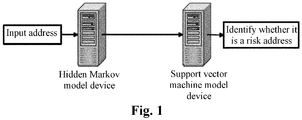
- Fig. 1 is a schematic diagram of an overall architecture involved in the solution of the specification in a practical application scenario.
- an address is firstly input and processed by a device containing a Hidden Markov Model (HMM) to obtain a decision vector corresponding to the input address, then the decision vector is further processed by a device containing a Support Vector Machine (SVM), and finally, whether the input address is a risk address is determined.
- HMM Hidden Markov Model
- SVM Support Vector Machine
- Fig. 2 is a schematic flowchart of the risk address identification method, and the flow in Fig. 2 may include the following steps: S102: an address word sequence corresponding to an input address is acquired.
- the address word sequence can be obtained after processing the input address.
- an interference character removing operation can be firstly performed on the input address, and then an address word sequence is further obtained.
- the address word sequence may also be the input address itself if the input address includes word separators such as spaces, or if the processing ability, for excluding interference characters, of the risk address identification in the subsequent steps is good.
- the various risk addresses can be understood as a risk address library composed of multiple risk addresses.
- a risk word can be understood as a risky address word contained in the risk address.
- the risk address may contain one or more risk words, and these risk words may constitute the risk address sequentially according to a certain rule or may be relatively independent.
- the method for determining hitting may, for example, comprise: respectively scanning each address word in the address word sequence and matching same with each address word in the risk address, and determining a hit address word (for ease of description, such an address word may be hereinafter referred to as a hit address word).
- the address word sequence can be represented as one multi-dimensional vector, with each dimension of the vector respectively corresponding to one address word in the address word sequence; further, the dimension, in the vector, corresponding to the address word A can be determined by scanning, and the dimension is labeled as 1 to determine that the address word A is hit; and for the other address words that are not hit, the corresponding dimensions are labeled as 0.
- each of required address words can be obtained from the address word sequence according to the determined address word and the semantics before and after it, and an observation sequence is generated according to the determined address word and the obtained address words, wherein the extracted address words may be continuous address words, and may also be discontinuous address words that conform to a certain rule;
- the way of generating an observation sequence corresponding to the address word sequence may also be: first splitting the address word sequence to obtain a plurality of address word subsequences, and then generating an observation sequence according to required address word subsequence.
- S108 the observation sequence is processed using a hidden Markov model obtained based on semantics learning before and after address words, to obtain a decision vector, wherein the decision vector represents probabilities of the risk address being hit by the various address words contained in the address word sequence.
- the semantics before and after address words may be associated semantics of address words before and after, and associated with, a current address word, and the current address word, and the number of associated address words may be two or three, wherein the associated address words may be either address words adjacent to the current address word or address words spaced apart from the current address word by a word.
- the above-mentioned current address word may be the determined address word in step S106.
- the semantics before and after the address word may be that the address words before and after, and adjacent to, the determined address word serve as the semantics before and after the address word, for example, Chaoyang District, Beijing, China, wherein the semantics before and after Beijing includes China and Chaoyang District; and it is also possible to use address words, in the address word sequence, not adjacent to each other as the semantics before and after the determined word.
- an observation sequence may also be an address word sequence or an input address itself.
- the probability of hitting the risk address can be labeled directly based on the hit address word and the semantics before and after it according to a labeling result of the hit address word in the address word sequence or the input address.
- S110 whether the input address is a risk address is identified by making a classification decision on the decision vector.
- the classification decision may be a binary classification decision made on the decision vector.
- one class may be a decision vector corresponding to a risk address
- the other class may be a decision vector corresponding to a non-risk address. Further, whether the input address corresponding to the decision vector is a risk address may be determined.
- acquiring an address word sequence corresponding to an input address may specifically comprise: receiving an input address; and performing data cleaning processing and word segmentation processing on the input address to obtain an address word sequence corresponding to the input address.
- the method of the data cleaning processing may comprise: removing an interference character from the input address to obtain a standardized address character string; or adjusting the arrangement order of various address words in the input address.
- the method of the word segmentation processing may comprise: segmenting the standardized address character string using a specific character such as a space or a semicolon, to obtain an address word sequence corresponding to the input address.
- an interference character removing operation can be firstly performed on the input address, and then an address word sequence is further obtained.
- interference characters existing in an input address to remove the interference characters
- the interference characters may, for example, include at least one of the following: extra spaces, half-width characters, "
- the cleaned input address can be, for example, a standardized address character string separated by spaces
- word segmentation labeling is performed: the cleaned address character string is segmented by spaces, auxiliary words, such as of and the, appearing in the address character string are labeled lexicographically, and these auxiliary words often can be not used in subsequent address matching and identification; and finally, an address word sequence composed of address words is obtained after the word segmentation labeling.
- an address word sequence is obtained, so that quick, efficient and accurate operations such as identification of risk address words can be performed on the address word sequence subsequently.
- the address word sequence may also be the input address itself if the input address includes word separators such as a space, or if the processing ability, for excluding interference characters, of the risk address identification in the subsequent steps is good; as such, the step of processing the input address can be omitted.
- step S 104 determining, in various address words contained in the address word sequence, an address word hitting a risk word corresponding to each risk address may specifically comprise:
- the labeling may be: correspondingly labeling, with a number or a character, a matching result of various address words in the address word sequence respectively, including labeling a result indicating hitting and labeling a result indicating not hitting after the matching in the address word sequence, and composing a labeling vector together by these numbers or characters indicating the labeling results.
- an address word sequence or various address words in an observation sequence corresponding to the address word sequence is globally scanned, matched, and labeled, and if the second address word A in a certain address word sequence matches an address word a in an address word set corresponding to a risk address, then the address word A is labeled as 1, otherwise the address word A is labeled as 0.
- a labeling vector is obtained, which may also be referred to as an initial labeling vector, such as [0, 0, 1, 0, 0, 0].
- the various address words in the address word sequence are respectively matched, and the specific matching method may comprise: performing global risk address scanning and matching on the address word sequence (risk address information includes countries, regions, and major cities), wherein the matching algorithms used may, for example, include a character string similarity matching algorithm, a pronunciation similarity matching algorithm, and an editing distance matching algorithm, etc.
- determining, in various address words contained in the address word sequence, an address word hitting a risk word corresponding to each risk address further comprises: if there is no successfully matched address word, determining that the input address is not a risk address.
- generating an observation sequence corresponding to the address word sequence according to the determined address word may specifically comprise: for the determined address word, respectively performing the following: generating an observation sequence corresponding to the address word sequence according to the address word and associated words of the address word in the address word sequence, wherein the associated words reflect the semantics before and after the address word in the address word sequence.
- the address word sequence contains a plurality of determined address words, a plurality of corresponding observation sequences may be generated, and it may also be chosen to generate an observation sequence corresponding to one of the determined address words.
- An associated word can be understood as a word that has a certain logical relationship or a specific association relationship with words before and after it, or a word artificially defined to produce an association relationship with words before and after it.
- the associated words are adjacent to the current word, for example they can be two words before or after, and adjacent to, the current word.
- a hidden Markov model can be obtained in advance based on the semantics learning before and after address words.
- Fig. 3 is a schematic flowchart of the modeling method, and the flow in Fig. 3 may include the following steps:
- the training samples include positive samples and negative samples; a risk address can be a positive sample, and a non-risk address can be a negative sample.
- the negative samples may be the addresses of 235 non-sanction countries or regions in the whole world, and the positive samples may be address data for all sanction countries and regions.
- a risk address contains a risk word, and of course, a non-risk address may also contain a risk word.
- the address words in step S204 can be understood as address words, which match the risk words corresponding to the risk addresses, in the training samples.
- a predefined sample address whether the sample address contains a risk word and which address word is a risk word have been labeled in advance.
- the sample address is a training sample address contained in the training samples.
- a required observation sequence is extracted according to the labeled address word in the sample address and the semantics before and after it; and generally, 2 or 3 words before and after and associated with the labeled address word are selected as the semantics before and after the address word, which all together form the observation sequence.
- hidden Markov model parameters are trained until appropriate hidden Markov model parameters are obtained, and then a needed hidden Markov model is determined according to the hidden Markov model parameters obtained through the training.
- the quantity and scale of training sample addresses will directly affect the quality of the training result.
- the address library used for the training sample addresses is more comprehensive and has a wider coverage, it is advantageous to improve the accuracy of the identification of the model, and therefore, the method can achieve a great modeling effect in the case of having enough training sample addresses.
- the initial parameters include: an initial probability vector ⁇ t , a state transition matrix, a ij , and the like; and extracting initial parameters according to predefined training samples may specifically comprise: based on the training samples, obtaining an initial probability vector by respectively performing probability labeling on the address words contained in the training samples; and obtaining a state transition matrix of the sample addresses according to state transition probabilities, between a risk word and a non-risk word, of the address words contained in the training samples.
- a risk word is an address word contained in a risk address
- a non-risk word is an address word contained in a non-risk address
- some address words can be both risk words and non-risk words.
- each training sample may be a sample address.
- a state transition matrix of the sample addresses is obtained according to state transition probabilities, between a risk word and a non-risk word, of the address words contained in the training samples.
- the state transition probability refers to the probability that state transition of an address word between two hidden states, i.e., a risk address and a non-risk address, may happen.
- training the hidden Markov model parameters according to the initial model and the observation sequences corresponding to the training samples to obtain a hidden Markov model may specifically comprise: according to the initial model and the observation sequences corresponding to the training samples, using a Baum-Welch algorithm to train the hidden Markov model parameters so as to obtain a hidden Markov model.
- O o 1 o 2 ⁇ o h ⁇ o n -1 o n , wherein the sequence O is an address word sequence containing a hit risk country/region word, and o h is an address word to be labeled.
- processing the observation sequence using a hidden Markov model obtained based on semantics learning before and after address words, to obtain a decision vector may specifically comprise:
- an obtained decision vector may be represented as [0, 0.5, 1, 0.3, 0, 0].
- making a classification decision on the decision vector may specifically comprise: making a classification decision on the decision vector using an SVM model obtained through training.
- a decision vector is obtained by calculation through a hidden Markov model, and then a decision with binary or more classification is made on the decision vector; and explanation is made below by mainly taking a binary classification decision as an example.
- Fig. 4 is a schematic flowchart of the modeling method for a support vector machine model, and the flow in Fig. 4 may include the following steps:
- the training samples for the support vector machine may be decision vectors corresponding to training samples obtained by training sample addresses through the above-mentioned hidden Markov model, or may be other to-be-discriminated data characterizing the input address.
- An SVM model parameter ⁇ i is obtained by training based on a large amount of address data such as global address library data, to further optimize the support vector machine model.
- a classification determination result of a risk address is obtained according to a matching result of each address word and the semantics before and after it, which can effectively identify risk addresses or forged risk addresses, and can avoid the misjudgment of risk-free addresses.
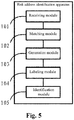
- Fig. 5 is a schematic structural diagram of a risk address identification apparatus corresponding to Fig. 2 provided in an embodiment of the specification.
- the structure as shown in Fig. 5 may specifically include:
- a classification determination result of the input address is obtained according to the address word obtained after processing the input address and the semantics before and after it, which can effectively identify risk addresses or forged risk addresses, and can avoid the misjudgment of risk-free addresses. Therefore, problems in the prior art can be partially or completely solved.
- the receiving module 101 acquiring an address word sequence corresponding to an input address may specifically comprise: the receiving module 101 receiving an input address; and performing data cleaning processing and word segmentation processing on the input address to obtain an address word sequence corresponding to the input address. Through further cleaning processing and word segmentation processing on the input address, a standardized address word sequence is obtained, so as to facilitate the labeling operation on the address word sequence in subsequent steps, which can improve the work efficiency of probability labeling of the determined address words in the address word sequence.
- the matching module 102 determining, in various address words contained in the address word sequence, an address word hitting a risk word corresponding to each risk address may specifically comprise:
- the matching module 102 determining, in various address words contained in the address word sequence, an address word hitting a risk word corresponding to each risk address may further comprise: if there is no successfully matched address word, determining that the input address is not a risk address.
- the generation module 103 generating an observation sequence corresponding to the address word sequence according to the determined address word may specifically comprise: for the determined address word, respectively performing the following: generating an observation sequence corresponding to the address word sequence according to the address word and associated words of the address word in the address word sequence, wherein the associated words reflect the semantics before and after the address word in the address word sequence.
- the semantics before and after the address word refers to a plurality of address words before and after, and associated with, the hit address word
- the number of associated address words may be two or three, where the associated address words may be address words associated continuously with the hit address word and may also be address words associated with and spaced apart from the hit address word.
- obtaining a hidden Markov model based on the semantics learning before and after address words comprises:
- the observation sequence consisting of the hit risk word and the semantics before and after the risk word is used to train the hidden Markov model parameters, so as to obtain the required hidden Markov model (HMM), which can improve the accuracy of input address risk identification by the hidden Markov model.
- HMM hidden Markov model
- a risk word is an address word contained in a risk address
- a non-risk word is an address word contained in a non-risk address
- some address words can be both risk words and non-risk words.
- training the hidden Markov model parameters according to the initial model and the observation sequences corresponding to the training samples to obtain a hidden Markov model may specifically comprise: according to the initial model and the observation sequences corresponding to the training samples, using a Baum-Welch algorithm to train the hidden Markov model parameters so as to obtain a hidden Markov model.
- the labeling module 104 processing the observation sequence using a hidden Markov model obtained based on semantics learning before and after address words, to obtain a decision vector may specifically comprise: processing the observation sequence using the hidden Markov model obtained by semantics learning before and after address words, and a Viterbi algorithm, to obtain a decision vector.
- the decision vector represents the probabilities of the risk address being hit by the various address words contained in the address word sequence.
- the identification module 105 making a classification decision on the decision vector may specifically comprise: making a classification decision on the decision vector using a support vector machine (SVM) model obtained through training.
- SVM support vector machine
- obtaining a support vector machine model through training comprises:
- the training samples can be understood as the decision vector in the above-mentioned embodiments, or other to-be-discriminated data characterizing the input address.
- the SVM needs to be used to map the decision vector to a high-dimensional feature space and then make a binary classification decision.
- a classification decision can be made on some decision vectors, which are easy to process, without mapping same to a high-dimensional feature space, for example, a linear classification decision can be made, which can reduce the computational difficulty and promote the processing speed.
- an electronic device comprising:
- Fig. 6 is a schematic flowchart where risk address identification indicates that an address has no risk, provided in an embodiment of the specification, which may specifically include:
- Fig. 7 is a schematic flowchart where risk address identification indicates that an address is risky, provided in an embodiment of the specification, which may specifically comprise:
- Fig. 8 is a schematic flowchart of the modeling and identification of the risk address identification provided in an embodiment of the specification, which may specifically include:
- the hidden Markov model parameters are trained to obtain a needed hidden Markov model.
- the parameters of the SVM are trained according to the decision vector output through the hidden Markov model, to finally obtain a needed SVM model.
- a user When performing risk address scanning and identification, a user firstly inputs an address; then, standardization processing and global risk address scanning and labeling are performed on the input address to obtain a labeled address word sequence, and further, an observation sequence is obtained based on the risk word and the semantics before and after it.
- risk probability calculation and labeling are performed on the address word sequence (the observation sequence) through the hidden Markov model to generate a decision vector.
- the SVM makes a binary classification decision according to the decision vector to determine whether the input address is a risk address.
- the hidden Markov model and the support vector machine are used to judge and identify the input address based on the risk address word and the semantics before and after it, and the accuracy of the identification can be effectively improved.
- the apparatus, electronic device and non-volatile computer storage medium provided in the embodiments of the specification correspond to the method. Therefore, the apparatus, electronic device and non-volatile computer storage medium also have the similar beneficial technical effects to those of the corresponding method. Since the beneficial technical effects of the method have been described in detail above, the beneficial technical effects of the corresponding apparatus, electronic device and non-volatile computer storage medium will not be described herein.
- an improvement on a technology may be obviously distinguished as an improvement on hardware (for example, an improvement on a circuit structure such as a diode, a transistor, and a switch) or an improvement on software (an improvement on a method procedure).
- improvements of many method procedures at present may be considered as direct improvements on hardware circuit structures. Almost all designers program the improved method procedures into hardware circuits to obtain corresponding hardware circuit structures. Therefore, it cannot be said that the improvement of a method procedure cannot be implemented using a hardware entity module.
- a Programmable Logic Device for example, a Field Programmable Gate Array (FPGA)
- FPGA Field Programmable Gate Array
- the "logic compiler” software is similar to a software complier used for developing and writing a program, and original code before compiling also needs to be written in a specific programming language, which is referred to as a Hardware Description Language (HDL).
- HDL Hardware Description Language
- HDLs there are many types of HDLs, such as ABEL (Advanced Boolean Expression Language), AHDL (Altera Hardware Description Language), Confluence, CUPL (Cornell University Programming Language), HDCal, JHDL (Java Hardware Description Language), Lava, Lola, MyHDL, PALASM, and RHDL (Ruby Hardware Description Language), among which VHDL (Very-High-Speed Integrated Circuit Hardware Description Language) and Verilog are most commonly used now.
- ABEL Advanced Boolean Expression Language
- AHDL Altera Hardware Description Language
- Confluence CUPL (Cornell University Programming Language)
- HDCal Joint Deformation Language
- JHDL Joint Hardware Description Language
- Lava Lava
- Lola MyHDL
- PALASM Phase Change Language
- RHDL Raby Hardware Description Language
- VHDL Very-High-Speed Integrated Circuit Hardware Description Language
- Verilog Verilog
- a controller may be implemented in any suitable manner.
- the controller may be in the form of a microprocessor or a processor, and a computer readable medium storing computer readable program codes (for example, software or firmware) executable by the (micro)processor, a logic gate, a switch, an Application Specific Integrated Circuit (ASIC), a programmable logic controller, and an embedded micro-controller.
- Examples of the controller include, but are not limited to, the following micro-controllers: ARC 625D, Atmel AT91SAM, Microchip PIC18F26K20, and Silicone Labs C8051F320.
- a memory controller may also be implemented as a part of a control logic of a memory.
- the method steps may be logically programmed to enable the controller to implement the same function in the form of a logic gate, a switch, an application specific integrated circuit, a programmable logic controller and an embedded microcontroller. Therefore, such a controller may be considered as a hardware component, and apparatuses included therein for implementing various functions may also be considered as structures inside the hardware component. Alternatively, the apparatuses for implementing various functions may even be considered as both software modules for implementing the method and structures inside the hardware components.
- the system, apparatus, modules or units illustrated in the above-described embodiments can be implemented by a computer chip or an entity, or implemented by a product having a specific function.
- a typical implementation device is a computer.
- the computer may be a personal computer, a laptop computer, a cellular phone, a camera phone, a smart phone, a personal digital assistant, a media player, a navigation device, an email device, a game console, a tablet computer, a wearable device, or a combination of any of these devices.
- the embodiments of the specification may be provided as a method, a system, or a computer program product. Therefore, the embodiments of the specification may be implemented in a form of complete hardware embodiments, complete software embodiments, or embodiments combining software and hardware. Moreover, the embodiments of the specification may be in the form of a computer program product implemented on one or more computer usable storage mediums (including, but not limited to, a magnetic disk memory, a CD-ROM, an optical memory and the like) including computer usable program codes therein.
- a computer usable storage mediums including, but not limited to, a magnetic disk memory, a CD-ROM, an optical memory and the like
- These computer program instructions may also be stored in a computer readable memory that can guide a computer or other programmable data processing devices to operate in a particular manner, such that the instructions stored in the computer readable memory produce a manufactured product, including an instruction apparatus.
- the instruction apparatus implements a function specified in one or more processes in the flowcharts and/or in one or more blocks in the block diagrams.
- These computer program instructions may also be loaded onto a computer or other programmable data processing devices, such that a series of operation steps are performed on the computer or other programmable devices, thus producing computer-implemented processing. Therefore, the instructions executed on the computer or other programmable devices provide steps for implementing a function specified in one or more processes in the flowcharts and/or in one or more blocks in the block diagrams.
- the computing device comprises one or more central processing units (CPUs), an input/output interface, a network interface, and a memory.
- CPUs central processing units
- input/output interface input/output interface
- network interface network interface
- memory a memory
- the memory may include a computer-readable medium such as a non-permanent memory, a Random Access Memory (RAM), and/or a non-volatile memory, e.g., a Read-Only Memory (ROM) or a flash RAM.
- a computer-readable medium such as a non-permanent memory, a Random Access Memory (RAM), and/or a non-volatile memory, e.g., a Read-Only Memory (ROM) or a flash RAM.
- RAM Random Access Memory
- ROM Read-Only Memory
- flash RAM flash RAM
- the computer readable medium includes permanent and non-permanent media as well as removable and non-removable media, and may store information by any method or technology.
- the information may be a computer-readable instruction, a data structure, a module of a program, or other data.
- An example of the storage medium of a computer includes, but is not limited to, a phase change memory (PRAM), a static random access memory (SRAM), a dynamic random access memory (DRAM), other types of random access memories (RAMs), a read-only memory (ROM), an electrically erasable programmable read-only memory (EEPROM), a flash memory or other memory technologies, a compact disk read-only memory (CD-ROM), a digital versatile disc (DVD) or other optical storages, a cassette tape, a magnetic tape/magnetic disk storage or other magnetic storage devices, or any other non-transmission medium, and can be used to store information accessible to the computing device.
- the computer-readable medium does not include a computer-readable transitory medium, such as modulated data signals and carriers.
- the specification may be described in a general context of computer-executable instructions executed by a computer, for example, a program module.
- the program module includes a routine, a program, an object, a component, a data structure, and the like for executing a specific task or implementing a specific abstract data type.
- the specification may also be practiced in distributed computing environments. In the distributed computing environments, a task is executed by a remote processing device connected through a communications network. In the distributed computing environments, the program module may be located in a local and remote computer storage medium, including a storage device.
Landscapes
- Engineering & Computer Science (AREA)
- Theoretical Computer Science (AREA)
- Physics & Mathematics (AREA)
- General Engineering & Computer Science (AREA)
- General Physics & Mathematics (AREA)
- Data Mining & Analysis (AREA)
- Artificial Intelligence (AREA)
- Software Systems (AREA)
- Evolutionary Computation (AREA)
- Computer Security & Cryptography (AREA)
- Computer Vision & Pattern Recognition (AREA)
- Computer Hardware Design (AREA)
- Bioinformatics & Cheminformatics (AREA)
- Bioinformatics & Computational Biology (AREA)
- Life Sciences & Earth Sciences (AREA)
- Evolutionary Biology (AREA)
- General Health & Medical Sciences (AREA)
- Computational Linguistics (AREA)
- Health & Medical Sciences (AREA)
- Computing Systems (AREA)
- Mathematical Physics (AREA)
- Audiology, Speech & Language Pathology (AREA)
- Medical Informatics (AREA)
- Virology (AREA)
- Databases & Information Systems (AREA)
- Business, Economics & Management (AREA)
- Probability & Statistics with Applications (AREA)
- Algebra (AREA)
- Computational Mathematics (AREA)
- Mathematical Analysis (AREA)
- Mathematical Optimization (AREA)
- Pure & Applied Mathematics (AREA)
- Computer Networks & Wireless Communication (AREA)
- Signal Processing (AREA)
- Accounting & Taxation (AREA)
- Finance (AREA)
- Development Economics (AREA)
- Economics (AREA)
- Marketing (AREA)
- Strategic Management (AREA)
Abstract
Description
- The specification relates to the field of computer technologies, and in particular to a risk address identification method and apparatus, and an electronic device.
- Online financial transactions are becoming more and more developed, and some users unlawfully use online finance to conduct illegal money operations, such as money laundering. In order to prevent the occurrence of illegal online financial transactions, there are already some solutions for identifying risk addresses, which are generally solutions targeted at identifying relatively regular risk addresses.
- For example, word segmentation and labeling may be performed on an input address using a word segmentation algorithm, and finally address word matching is performed one by one according to the labeled information of different address words, so as to identify whether the input address is a risk address through the matching result.
- Based on the prior art, a more accurate risk address identification solution is needed.
- The embodiments of the specification provide a risk address identification method and apparatus, and an electronic device, for solving the following technical problem: a more accurate risk address identification solution is needed.
- In order to solve the above-mentioned technical problem, the embodiments of the specification are implemented as follows:
the embodiments of the specification provide a risk address identification method, the method comprising: - acquiring an address word sequence corresponding to an input address;
- determining, in various address words contained in the address word sequence, an address word hitting a risk word corresponding to each risk address;
- generating an observation sequence corresponding to the address word sequence according to the determined address word;
- processing the observation sequence using a hidden Markov model obtained based on semantics learning before and after address words, to obtain a decision vector, wherein the decision vector represents probabilities of the risk address being hit by the various address words contained in the address word sequence; and
- identifying whether the input address is a risk address by making a classification decision on the decision vector.
- The embodiments of the specification provide a risk address identification apparatus, the apparatus comprising:
- a receiving module for acquiring an address word sequence corresponding to an input address;
- a matching module for determining, in various address words contained in the address word sequence, an address word hitting a risk word corresponding to each risk address;
- a generation module for generating an observation sequence corresponding to the address word sequence according to the determined address word;
- a labeling module for processing the observation sequence using a hidden Markov model obtained based on semantics learning before and after address words, to obtain a decision vector, wherein the decision vector represents probabilities of the risk address being hit by the various address words contained in the address word sequence; and
- an identification module for identifying whether the input address is a risk address by making a classification decision on the decision vector.
- The embodiments of the specification provide an electronic device, comprising:
- at least one processor; and
- a memory in communication connection with the at least one processor, wherein
- the memory stores instructions executable by the at least one processor, the instructions being executed by the at least one processor to enable the at least one processor to:
- acquire an address word sequence corresponding to an input address;
- determine, in various address words contained in the address word sequence, an address word hitting a risk word corresponding to each risk address;
- generate an observation sequence corresponding to the address word sequence according to the determined address word;
- process the observation sequence using a hidden Markov model obtained based on semantics learning before and after address words, to obtain a decision vector, wherein the decision vector represents probabilities of the risk address being hit by the various address words contained in the address word sequence; and
- identify whether the input address is a risk address by making a classification decision on the decision vector.
- At least one of the above-mentioned technical solutions employed in the embodiments of the specification can achieve the following beneficial effects: using a hidden Markov model obtained based on semantics learning before and after address words and a support vector machine model to obtain a classification determination result of an input address according to an address word obtained after processing the input address and the semantics before and after the address word, so that a risk address can be identified more accurately.
- In order to illustrate the technical solutions in the embodiments of the specification or the prior art more clearly, the accompanying drawings to be used in the description of the embodiments or the prior art will be simply introduced below. Apparently, the accompanying drawings in the following description show merely some embodiments stated in the specification, and one of ordinary skill in the art may still derive other drawings from these accompanying drawings without any creative effort.
-
Fig. 1 is a schematic diagram of an overall architecture involved in the solution of the specification in a practical application scenario; -
Fig. 2 is a schematic flowchart of a risk address identification method provided in an embodiment of the specification; -
Fig. 3 is a schematic flowchart of a modeling method for a hidden Markov model provided in an embodiment of the specification; -
Fig. 4 is a schematic flowchart of a modeling method for a support vector machine model provided in an embodiment of the specification; -
Fig. 5 is a schematic structural diagram of a risk address identification apparatus provided in an embodiment of the specification; -
Fig. 6 is a schematic flowchart where risk address identification indicates that an address has no risk, provided in an embodiment of the specification; -
Fig. 7 is a schematic flowchart where risk address identification indicates that an address is risky, provided in an embodiment of the specification; and -
Fig. 8 is a schematic flowchart of the modeling and identification of the risk address identification provided in an embodiment of the specification. - The embodiments of the specification provide a risk address identification method and apparatus, and an electronic device.
- In order to make those skilled in the art better understand the technical solutions in the specification, the technical solutions in the embodiments of the specification will be clearly and completely described below in conjunction with the accompanying drawings in the embodiments of the specification. It is obvious that the described embodiments are only some of the embodiments of the present application, but not all of them. All other embodiments obtained by those of ordinary skill in the art based on the embodiments of the specification without creative effort shall fall within the scope of protection of the present application.
-
Fig. 1 is a schematic diagram of an overall architecture involved in the solution of the specification in a practical application scenario. In the overall architecture, an address is firstly input and processed by a device containing a Hidden Markov Model (HMM) to obtain a decision vector corresponding to the input address, then the decision vector is further processed by a device containing a Support Vector Machine (SVM), and finally, whether the input address is a risk address is determined. - Based on the above-mentioned overall architecture, the solution of the specification will be described in detail below.
- The embodiments of the specification provide a risk address identification method.
Fig. 2 is a schematic flowchart of the risk address identification method, and the flow inFig. 2 may include the following steps:
S102: an address word sequence corresponding to an input address is acquired. - The address word sequence can be obtained after processing the input address.
- For example, if the input address contains many interference characters, an interference character removing operation can be firstly performed on the input address, and then an address word sequence is further obtained. The address word sequence may also be the input address itself if the input address includes word separators such as spaces, or if the processing ability, for excluding interference characters, of the risk address identification in the subsequent steps is good.
- S104: an address word hitting a risk word corresponding to each risk address is determined in various address words contained in the address word sequence.
- The various risk addresses can be understood as a risk address library composed of multiple risk addresses.
- A risk word can be understood as a risky address word contained in the risk address. The risk address may contain one or more risk words, and these risk words may constitute the risk address sequentially according to a certain rule or may be relatively independent.
- The method for determining hitting may, for example, comprise: respectively scanning each address word in the address word sequence and matching same with each address word in the risk address, and determining a hit address word (for ease of description, such an address word may be hereinafter referred to as a hit address word).
- For example, if an address word sequence contains multiple address words, and an address word A in the address sequence matches and hits a risk word a contained in a risk address, the address word sequence can be represented as one multi-dimensional vector, with each dimension of the vector respectively corresponding to one address word in the address word sequence; further, the dimension, in the vector, corresponding to the address word A can be determined by scanning, and the dimension is labeled as 1 to determine that the address word A is hit; and for the other address words that are not hit, the corresponding dimensions are labeled as 0.
- S106: an observation sequence corresponding to the address word sequence is generated according to the determined address word.
- There are many ways of generating an observation sequence corresponding to the address word sequence: each of required address words can be obtained from the address word sequence according to the determined address word and the semantics before and after it, and an observation sequence is generated according to the determined address word and the obtained address words, wherein the extracted address words may be continuous address words, and may also be discontinuous address words that conform to a certain rule;
The way of generating an observation sequence corresponding to the address word sequence may also be: first splitting the address word sequence to obtain a plurality of address word subsequences, and then generating an observation sequence according to required address word subsequence. - S108: the observation sequence is processed using a hidden Markov model obtained based on semantics learning before and after address words, to obtain a decision vector, wherein the decision vector represents probabilities of the risk address being hit by the various address words contained in the address word sequence.
- The semantics before and after address words may be associated semantics of address words before and after, and associated with, a current address word, and the current address word, and the number of associated address words may be two or three, wherein the associated address words may be either address words adjacent to the current address word or address words spaced apart from the current address word by a word.
- Specifically, the above-mentioned current address word may be the determined address word in step S106. The semantics before and after the address word may be that the address words before and after, and adjacent to, the determined address word serve as the semantics before and after the address word, for example, Chaoyang District, Beijing, China, wherein the semantics before and after Beijing includes China and Chaoyang District; and it is also possible to use address words, in the address word sequence, not adjacent to each other as the semantics before and after the determined word.
- Further, in order to simplify processing steps, an observation sequence may also be an address word sequence or an input address itself. In this case, the probability of hitting the risk address can be labeled directly based on the hit address word and the semantics before and after it according to a labeling result of the hit address word in the address word sequence or the input address.
- S110: whether the input address is a risk address is identified by making a classification decision on the decision vector.
- The classification decision may be a binary classification decision made on the decision vector. For example, one class may be a decision vector corresponding to a risk address, and the other class may be a decision vector corresponding to a non-risk address. Further, whether the input address corresponding to the decision vector is a risk address may be determined.
- In the embodiments of the specification, for step S102, acquiring an address word sequence corresponding to an input address may specifically comprise:
receiving an input address; and performing data cleaning processing and word segmentation processing on the input address to obtain an address word sequence corresponding to the input address. - The method of the data cleaning processing may comprise: removing an interference character from the input address to obtain a standardized address character string; or adjusting the arrangement order of various address words in the input address.
- The method of the word segmentation processing may comprise: segmenting the standardized address character string using a specific character such as a space or a semicolon, to obtain an address word sequence corresponding to the input address.
- As mentioned earlier, if the input address contains many interference characters, an interference character removing operation can be firstly performed on the input address, and then an address word sequence is further obtained.
- For example, first, data cleaning is performed on some interference characters existing in an input address to remove the interference characters, wherein the interference characters may, for example, include at least one of the following: extra spaces, half-width characters, "|", ":", "∼", etc., and the cleaned input address can be, for example, a standardized address character string separated by spaces; then, word segmentation labeling is performed: the cleaned address character string is segmented by spaces, auxiliary words, such as of and the, appearing in the address character string are labeled lexicographically, and these auxiliary words often can be not used in subsequent address matching and identification; and finally, an address word sequence composed of address words is obtained after the word segmentation labeling. After performing cleaning and word segmentation on the input address, an address word sequence is obtained, so that quick, efficient and accurate operations such as identification of risk address words can be performed on the address word sequence subsequently.
- As mentioned earlier, the address word sequence may also be the input address itself if the input address includes word separators such as a space, or if the processing ability, for excluding interference characters, of the risk address identification in the subsequent steps is good; as such, the step of processing the input address can be omitted.
- In the embodiments of the specification, for
step S 104, determining, in various address words contained in the address word sequence, an address word hitting a risk word corresponding to each risk address may specifically comprise: - respectively matching the various address words in the address word sequence using risk words corresponding to each risk address; and
- if one of the address words is successfully matched, labeling same and determining same as an address word hitting a risk word corresponding to each risk address.
- The labeling may be: correspondingly labeling, with a number or a character, a matching result of various address words in the address word sequence respectively, including labeling a result indicating hitting and labeling a result indicating not hitting after the matching in the address word sequence, and composing a labeling vector together by these numbers or characters indicating the labeling results.
- For example, an address word sequence or various address words in an observation sequence corresponding to the address word sequence is globally scanned, matched, and labeled, and if the second address word A in a certain address word sequence matches an address word a in an address word set corresponding to a risk address, then the address word A is labeled as 1, otherwise the address word A is labeled as 0. Further, a labeling vector is obtained, which may also be referred to as an initial labeling vector, such as [0, 0, 1, 0, 0, 0].
- The various address words in the address word sequence are respectively matched, and the specific matching method may comprise: performing global risk address scanning and matching on the address word sequence (risk address information includes countries, regions, and major cities), wherein the matching algorithms used may, for example, include a character string similarity matching algorithm, a pronunciation similarity matching algorithm, and an editing distance matching algorithm, etc.
- Further, determining, in various address words contained in the address word sequence, an address word hitting a risk word corresponding to each risk address further comprises:
if there is no successfully matched address word, determining that the input address is not a risk address. - If various address words in a certain address word sequence do not match risk words in the risk addresses, then it can be considered that the address word sequence does not contain a risk word, and correspondingly the probability that the input address is not a risk address is greater, so further operations on the input address can be ended.
- In the embodiments of the specification, for step S106, generating an observation sequence corresponding to the address word sequence according to the determined address word may specifically comprise:
for the determined address word, respectively performing the following: generating an observation sequence corresponding to the address word sequence according to the address word and associated words of the address word in the address word sequence, wherein the associated words reflect the semantics before and after the address word in the address word sequence. - If the address word sequence contains a plurality of determined address words, a plurality of corresponding observation sequences may be generated, and it may also be chosen to generate an observation sequence corresponding to one of the determined address words. An associated word can be understood as a word that has a certain logical relationship or a specific association relationship with words before and after it, or a word artificially defined to produce an association relationship with words before and after it. Generally, the associated words are adjacent to the current word, for example they can be two words before or after, and adjacent to, the current word.
- In the embodiments of the specification, a hidden Markov model can be obtained in advance based on the semantics learning before and after address words.
- The embodiments of the specification provide a modeling method for a hidden Markov model.
Fig. 3 is a schematic flowchart of the modeling method, and the flow inFig. 3 may include the following steps: - S202: extracting initial parameters according to predefined training samples, and establishing an initial model containing hidden Markov model parameters according to the initial parameters, wherein the training samples are risk addresses or non-risk addresses;
- S204: generating observation sequences corresponding to the training samples according to address words contained in the training samples and the semantics before and after the address words; and
- S206: training the hidden Markov model parameters according to the initial model and the observation sequences corresponding to the training samples to obtain a hidden Markov model.
- The training samples include positive samples and negative samples; a risk address can be a positive sample, and a non-risk address can be a negative sample. By training the hidden Markov model with positive and negative samples, a better training effect can be achieved.
- For example, in one implementation, the negative samples may be the addresses of 235 non-sanction countries or regions in the whole world, and the positive samples may be address data for all sanction countries and regions. It should be noted that, in general, a risk address contains a risk word, and of course, a non-risk address may also contain a risk word.
- The address words in step S204 can be understood as address words, which match the risk words corresponding to the risk addresses, in the training samples. In a predefined sample address, whether the sample address contains a risk word and which address word is a risk word have been labeled in advance. Here, the sample address is a training sample address contained in the training samples.
- Further, a required observation sequence is extracted according to the labeled address word in the sample address and the semantics before and after it; and generally, 2 or 3 words before and after and associated with the labeled address word are selected as the semantics before and after the address word, which all together form the observation sequence.
- Further, according to the obtained initial labeling model and observation sequence, hidden Markov model parameters are trained until appropriate hidden Markov model parameters are obtained, and then a needed hidden Markov model is determined according to the hidden Markov model parameters obtained through the training.
- In the modeling method for a hidden Markov model of
Fig. 3 , the quantity and scale of training sample addresses will directly affect the quality of the training result. When the address library used for the training sample addresses is more comprehensive and has a wider coverage, it is advantageous to improve the accuracy of the identification of the model, and therefore, the method can achieve a great modeling effect in the case of having enough training sample addresses. - The initial parameters include: an initial probability vector πt , a state transition matrix, aij, and the like; and
extracting initial parameters according to predefined training samples may specifically comprise:
based on the training samples, obtaining an initial probability vector by respectively performing probability labeling on the address words contained in the training samples; and obtaining a state transition matrix of the sample addresses according to state transition probabilities, between a risk word and a non-risk word, of the address words contained in the training samples. Here, a risk word is an address word contained in a risk address, a non-risk word is an address word contained in a non-risk address, and some address words can be both risk words and non-risk words. - There may be a plurality of training samples. Generally, each training sample may be a sample address. When probability labeling is performed, a sample address is selected from the set as a training sample; for example, after probability labeling is performed on address words in a certain sample address, the second address word in the sample address is a hit address word, and an initial probability vector πt =[0, 1, 0, 0, 0, 0] is obtained, where 1 represents a hit address word, and 0 represents an address words that is not hit.
- Further, a state transition matrix of the sample addresses is obtained according to state transition probabilities, between a risk word and a non-risk word, of the address words contained in the training samples. In one or more embodiments of the specification, the state transition probability refers to the probability that state transition of an address word between two hidden states, i.e., a risk address and a non-risk address, may happen.
- In the embodiments of the specification, training the hidden Markov model parameters according to the initial model and the observation sequences corresponding to the training samples to obtain a hidden Markov model may specifically comprise:
according to the initial model and the observation sequences corresponding to the training samples, using a Baum-Welch algorithm to train the hidden Markov model parameters so as to obtain a hidden Markov model. - In addition, other data for training the hidden Markov model parameters can also be acquired, for example, O=o 1 o 2···oh ···o n-1 on , wherein the sequence O is an address word sequence containing a hit risk country/region word, and oh is an address word to be labeled. Generally, it is possible to take n = 10; an observation sequence is obtained according to 3 words before and after the address word in the context of oh to be labeled, wherein S = s 1 s 2 ···sh···s n-1 sn is the labeling vector corresponding to the address word sequence O, and represents the probabilities of the risk address being hit by various address words in the address word sequence; and then the hitting probabilities of the various address words form the labeling vector, wherein the labeling vector can be understood as the initial labeling vector;
P(oh,sh |λ) indicates the probability that the address word sequence oh and its hit label sh are correct, and is used for selecting a needed hidden Markov model parameter λ; and
then, the hidden Markov model parameter λ is trained according to the above-mentioned parameter to obtain a hidden Markov model. - Further, an objective function of the model is defined as: argmaxP(oh,sh |λ), to facilitate the acquisition of a needed decision vector;
In the embodiments of the specification, for step S108, processing the observation sequence using a hidden Markov model obtained based on semantics learning before and after address words, to obtain a decision vector may specifically comprise: - processing the observation sequence using the hidden Markov model obtained by semantics learning before and after address words, and a Viterbi algorithm, to obtain a decision vector,
- wherein the decision vector represents the probabilities of the risk address being hit by the various address words contained in the address word sequence. In addition, the decision vector may also represent the probabilities of the risk address being hit by various address words contained in the observation sequence corresponding to the address word sequence, and an address word not contained in the observation sequence may be directly labeled as 0.
- For example, if an address word sequence [A, B, C, D, E, F] has a corresponding observation sequence [B, C, D], then an obtained decision vector may be represented as [0, 0.5, 1, 0.3, 0, 0].
- In the embodiments of the specification, for step S110, making a classification decision on the decision vector may specifically comprise:
making a classification decision on the decision vector using an SVM model obtained through training. - Generally, a decision vector is obtained by calculation through a hidden Markov model, and then a decision with binary or more classification is made on the decision vector; and explanation is made below by mainly taking a binary classification decision as an example.
- In the embodiments of the specification, a modeling method for a support vector machine model is provided.
Fig. 4 is a schematic flowchart of the modeling method for a support vector machine model, and the flow inFig. 4 may include the following steps: - S302: acquiring training samples for a support vector machine;
- S304: mapping the training samples of the support vector machine to a high-dimensional feature space, to obtain a sample feature space corresponding to the training samples of the support vector machine;
- S306: acquiring, from the sample feature space, parameters representing sample features, and establishing a discrimination function for determining a category of the sample features according to the parameters of the sample features; and
- S308: training corresponding SVM model parameters in the discrimination function based on the training samples of the support vector machine, to obtain the SVM model.
- The training samples for the support vector machine may be decision vectors corresponding to training samples obtained by training sample addresses through the above-mentioned hidden Markov model, or may be other to-be-discriminated data characterizing the input address.
- Specifically, the SVM can map a decision vector address to a high-dimensional feature space by selecting a multi-power polynomial kernel function, and the expression is as follows:

- The SVM is used to find the optimal classification hyperplane for each category of sample features and other features in the high-dimensional feature space of the sample address, a support vector set representing various sample features and the corresponding VC credibility thereof are obtained, and the discrimination function for determining the category of each feature is formed:

- An SVM model parameter αi is obtained by training based on a large amount of address data such as global address library data, to further optimize the support vector machine model.
- By address matching learning based on semantic identification, a classification determination result of a risk address is obtained according to a matching result of each address word and the semantics before and after it, which can effectively identify risk addresses or forged risk addresses, and can avoid the misjudgment of risk-free addresses.
- Based on the same idea, the embodiments of the specification further provide a risk address identification apparatus.
Fig. 5 is a schematic structural diagram of a risk address identification apparatus corresponding toFig. 2 provided in an embodiment of the specification. The structure as shown inFig. 5 may specifically include: - a
receiving module 101 for acquiring an address word sequence corresponding to an input address; - a
matching module 102 for determining, in various address words contained in the address word sequence, an address word hitting a risk word corresponding to each risk address; - a
generation module 103 for generating an observation sequence corresponding to the address word sequence according to the determined address word; - a
labeling module 104 for processing the observation sequence using a hidden Markov model obtained based on semantics learning before and after address words, to obtain a decision vector, wherein the decision vector represents the probabilities of the risk address being hit by the various address words contained in the address word sequence; and - an
identification module 105 for identifying whether the input address is a risk address by making a classification decision on the decision vector. - Using the hidden Markov model obtained based on semantics learning before and after address words and the support vector machine model, a classification determination result of the input address is obtained according to the address word obtained after processing the input address and the semantics before and after it, which can effectively identify risk addresses or forged risk addresses, and can avoid the misjudgment of risk-free addresses. Therefore, problems in the prior art can be partially or completely solved.
- Further, the receiving
module 101 acquiring an address word sequence corresponding to an input address may specifically comprise:
the receivingmodule 101 receiving an input address; and performing data cleaning processing and word segmentation processing on the input address to obtain an address word sequence corresponding to the input address. Through further cleaning processing and word segmentation processing on the input address, a standardized address word sequence is obtained, so as to facilitate the labeling operation on the address word sequence in subsequent steps, which can improve the work efficiency of probability labeling of the determined address words in the address word sequence. - Further, the
matching module 102 determining, in various address words contained in the address word sequence, an address word hitting a risk word corresponding to each risk address may specifically comprise: - the matching module 120 respectively matching the various address words in the address word sequence using risk words corresponding to each risk address; and
- if one of the address words is successfully matched, labeling same and determining same as an address word hitting a risk word corresponding to each risk address.
- Further, the
matching module 102 determining, in various address words contained in the address word sequence, an address word hitting a risk word corresponding to each risk address may further comprise:
if there is no successfully matched address word, determining that the input address is not a risk address. - By labeling the address word through the
matching module 102, quick pre-filtering of a risk input address and a risk-free input address can be performed, which can improve the work efficiency of the risk address identification. - Further, the
generation module 103 generating an observation sequence corresponding to the address word sequence according to the determined address word may specifically comprise:
for the determined address word, respectively performing the following: generating an observation sequence corresponding to the address word sequence according to the address word and associated words of the address word in the address word sequence, wherein the associated words reflect the semantics before and after the address word in the address word sequence. Here, the semantics before and after the address word refers to a plurality of address words before and after, and associated with, the hit address word, and the number of associated address words may be two or three, where the associated address words may be address words associated continuously with the hit address word and may also be address words associated with and spaced apart from the hit address word. - Further, obtaining a hidden Markov model based on the semantics learning before and after address words comprises:
- extracting initial parameters according to predefined training samples, and establishing an initial model containing hidden Markov model parameters according to the initial parameters, wherein the training samples are risk addresses or non-risk addresses;
- generating observation sequences corresponding to the training samples according to address words contained in the training samples and the semantics before and after the address words; and
- training the hidden Markov model parameters according to the initial model and the observation sequences corresponding to the training samples to obtain a hidden Markov model.
- For the hidden Markov model, the observation sequence consisting of the hit risk word and the semantics before and after the risk word is used to train the hidden Markov model parameters, so as to obtain the required hidden Markov model (HMM), which can improve the accuracy of input address risk identification by the hidden Markov model.
- Further, the initial parameters include: an initial probability vector and a state transition matrix; and
extracting initial parameters according to predefined training samples may specifically comprise:
based on a plurality of training samples, obtaining an initial probability vector by respectively performing probability labeling on the address words contained in the training samples; and obtaining a state transition matrix of the sample addresses according to state transition probabilities, between a risk word and a non-risk word, of the address words contained in the training samples. Here, a risk word is an address word contained in a risk address, a non-risk word is an address word contained in a non-risk address, and some address words can be both risk words and non-risk words. - Further, training the hidden Markov model parameters according to the initial model and the observation sequences corresponding to the training samples to obtain a hidden Markov model may specifically comprise:
according to the initial model and the observation sequences corresponding to the training samples, using a Baum-Welch algorithm to train the hidden Markov model parameters so as to obtain a hidden Markov model. - It should be noted that during the modeling of the hidden Markov model, the quantity and scale of training sample addresses will directly affect the quality of the training result. When the global address library used for the training sample addresses is more comprehensive and has a wider coverage, the rate of identification while using the model will be vastly improved, and therefore, a great modeling effect can be achieved in the case of having enough training sample addresses.
- Further, the
labeling module 104 processing the observation sequence using a hidden Markov model obtained based on semantics learning before and after address words, to obtain a decision vector may specifically comprise:
processing the observation sequence using the hidden Markov model obtained by semantics learning before and after address words, and a Viterbi algorithm, to obtain a decision vector. The decision vector represents the probabilities of the risk address being hit by the various address words contained in the address word sequence. - Further, the
identification module 105 making a classification decision on the decision vector may specifically comprise:
making a classification decision on the decision vector using a support vector machine (SVM) model obtained through training. - Further, obtaining a support vector machine model through training comprises:
- acquiring training samples for a support vector machine;
- mapping the training samples of the support vector machine to a high-dimensional feature space, to obtain a sample feature space corresponding to the training samples of the support vector machine;
- acquiring, from the sample feature space, parameters representing the sample features, and establishing a discrimination function for determining a category of the sample features according to the parameters of the sample features; and
- training corresponding SVM model parameters in the discrimination function based on the training samples for the SVM, to obtain an SVM model.
- The training samples can be understood as the decision vector in the above-mentioned embodiments, or other to-be-discriminated data characterizing the input address.
- Generally, for a decision vector calculated through the hidden Markov model, the SVM needs to be used to map the decision vector to a high-dimensional feature space and then make a binary classification decision. Of course, a classification decision can be made on some decision vectors, which are easy to process, without mapping same to a high-dimensional feature space, for example, a linear classification decision can be made, which can reduce the computational difficulty and promote the processing speed.
- Based on the same idea, the embodiments of the specification further provide an electronic device, comprising:
- at least one processor; and
- a memory in communication connection with the at least one processor, wherein
- the memory stores instructions executable by the at least one processor, the instructions being executed by the at least one processor to enable the at least one processor to:
- acquire an address word sequence corresponding to an input address;
- determine, in various address words contained in the address word sequence, an address word hitting a risk word corresponding to each risk address;
- generate an observation sequence corresponding to the address word sequence according to the determined address word;
- process the observation sequence using a hidden Markov model obtained based on semantics learning before and after address words, to obtain a decision vector, wherein the decision vector represents probabilities of the risk address being hit by the various address words contained in the address word sequence; and
- identify whether the input address is a risk address by making a classification decision on the decision vector.
- In order to better explain the inventive concept of one or more embodiments of the specification, two embodiments are specifically enumerated below:
Fig. 6 is a schematic flowchart where risk address identification indicates that an address has no risk, provided in an embodiment of the specification, which may specifically include: - first, the text of an input address being:
REPUBLICA DE SIRIA 7495 SANTA FE Santa Fe AR; - then, globally scanning the input address and labeling same as hitting a sanction address (country or city) word: SIRIA, and obtaining an initial labeling vector [0, 0, 1, 0, 0, 0, 0, 0, 0] of the input address, where the initial labeling vector can be understood as the initial probability vector;
- further, obtaining a decision vector [0.01, 0.02, 0.02, 0.02, 0.01, 0, 0, 0, 0] through a hidden Markov labeling model; and
- finally, the SVM classification model making a decision that: the input address does not hit the sanction address, wherein the sanction address described here can be understood as the risk address.
-
Fig. 7 is a schematic flowchart where risk address identification indicates that an address is risky, provided in an embodiment of the specification, which may specifically comprise: - first, the text of an input address being: Rostovskaya, 31a,
Simferopol 5 Other RU; - then, globally scanning the input address and labeling same as hitting the sanction address (country or city) word: Simferopol, and obtaining an initial labeling vector [0, 0, 1, 0, 0, 0] of the input address;
- further, obtaining a decision vector [0.9, 0.9, 0.9, 0.9, 0.5, 0.1] through a hidden Markov labeling model; and
- finally, the SVM classification model making a decision that: the input address hits the sanction address,
- wherein the sanction address described here can be understood as the above-mentioned risk address.
-
Fig. 8 is a schematic flowchart of the modeling and identification of the risk address identification provided in an embodiment of the specification, which may specifically include: - when modeling the risk address identification model, performing parameter training, and first, acquiring a training address corpus, which can be understood as the sample addresses;
- then, cleaning the training address corpus and separating them into standardized address character strings, which can be understood as the address word sequence;
- then, globally scanning, matching and labeling the input training address corpus, to obtain an initial labeling model and initial parameters.
- Further, according to the initial labeling model, the hidden Markov model parameters are trained to obtain a needed hidden Markov model. Further again, the parameters of the SVM are trained according to the decision vector output through the hidden Markov model, to finally obtain a needed SVM model.
- When performing risk address scanning and identification, a user firstly inputs an address; then, standardization processing and global risk address scanning and labeling are performed on the input address to obtain a labeled address word sequence, and further, an observation sequence is obtained based on the risk word and the semantics before and after it.
- Further again, risk probability calculation and labeling are performed on the address word sequence (the observation sequence) through the hidden Markov model to generate a decision vector.
- Finally, the SVM makes a binary classification decision according to the decision vector to determine whether the input address is a risk address.
- The hidden Markov model and the support vector machine are used to judge and identify the input address based on the risk address word and the semantics before and after it, and the accuracy of the identification can be effectively improved.
- Specific embodiments of the specification are described above. The other embodiments fall within the scope of the appended claims. In some cases, the actions or steps specified in the claims can be performed in a different order than those in the embodiments and can still achieve desired results. Additionally, the processes depicted in the drawings are not necessarily in a particular order or consecutive order as shown to achieve the desired results. In some implementations, multi-task processing and parallel processing are also possible or may be advantageous.
- Various embodiments in the description are all described in a progressive manner. For the same or similar parts among the embodiments, reference can be made to one another. For each embodiment, the part thereof different from the other embodiments is mainly described. Particularly, the apparatus, electronic device, non-volatile computer storage medium embodiments are described in a relatively simple manner because they are substantially similar to the method embodiments, and for related parts, reference can be made to the parts of the description in the method embodiments.
- The apparatus, electronic device and non-volatile computer storage medium provided in the embodiments of the specification correspond to the method. Therefore, the apparatus, electronic device and non-volatile computer storage medium also have the similar beneficial technical effects to those of the corresponding method. Since the beneficial technical effects of the method have been described in detail above, the beneficial technical effects of the corresponding apparatus, electronic device and non-volatile computer storage medium will not be described herein.
- In the 1990s, an improvement on a technology may be obviously distinguished as an improvement on hardware (for example, an improvement on a circuit structure such as a diode, a transistor, and a switch) or an improvement on software (an improvement on a method procedure). However, with the development of various technologies, improvements of many method procedures at present may be considered as direct improvements on hardware circuit structures. Almost all designers program the improved method procedures into hardware circuits to obtain corresponding hardware circuit structures. Therefore, it cannot be said that the improvement of a method procedure cannot be implemented using a hardware entity module. For example, a Programmable Logic Device (PLD) (for example, a Field Programmable Gate Array (FPGA)) is such an integrated circuit, and logic functions thereof are determined by a user programming device. Designers program by themselves to "integrate" a digital system into a piece of PLD, without inviting a chip manufacturer to design and manufacture a dedicated integrated circuit chip. Moreover, at present, the programming is mostly implemented using "logic compiler" software, instead of manually manufacturing an integrated circuit chip. The "logic compiler" software is similar to a software complier used for developing and writing a program, and original code before compiling also needs to be written in a specific programming language, which is referred to as a Hardware Description Language (HDL). There are many types of HDLs, such as ABEL (Advanced Boolean Expression Language), AHDL (Altera Hardware Description Language), Confluence, CUPL (Cornell University Programming Language), HDCal, JHDL (Java Hardware Description Language), Lava, Lola, MyHDL, PALASM, and RHDL (Ruby Hardware Description Language), among which VHDL (Very-High-Speed Integrated Circuit Hardware Description Language) and Verilog are most commonly used now. Those skilled in the art also should know that a hardware circuit for implementing the logic method procedure may be easily obtained only by slightly logically programming the method procedure using the above-described several hardware description languages and programming same into an integrated circuit.
- A controller may be implemented in any suitable manner. For example, the controller may be in the form of a microprocessor or a processor, and a computer readable medium storing computer readable program codes (for example, software or firmware) executable by the (micro)processor, a logic gate, a switch, an Application Specific Integrated Circuit (ASIC), a programmable logic controller, and an embedded micro-controller. Examples of the controller include, but are not limited to, the following micro-controllers: ARC 625D, Atmel AT91SAM, Microchip PIC18F26K20, and Silicone Labs C8051F320. A memory controller may also be implemented as a part of a control logic of a memory. Those skilled in the art also know that, in addition to implementing the controller by pure computer readable program codes, the method steps may be logically programmed to enable the controller to implement the same function in the form of a logic gate, a switch, an application specific integrated circuit, a programmable logic controller and an embedded microcontroller. Therefore, such a controller may be considered as a hardware component, and apparatuses included therein for implementing various functions may also be considered as structures inside the hardware component. Alternatively, the apparatuses for implementing various functions may even be considered as both software modules for implementing the method and structures inside the hardware components.
- The system, apparatus, modules or units illustrated in the above-described embodiments can be implemented by a computer chip or an entity, or implemented by a product having a specific function. A typical implementation device is a computer. For example, the computer may be a personal computer, a laptop computer, a cellular phone, a camera phone, a smart phone, a personal digital assistant, a media player, a navigation device, an email device, a game console, a tablet computer, a wearable device, or a combination of any of these devices.
- For ease of description, the above-described apparatus is divided into various modules based on functions, and the modules are described separately. Of course, when one or more embodiments of the specification are implemented, functions of various units can be implemented in one or more pieces of software and/or hardware.
- Those skilled in the art should understand that the embodiments of the specification may be provided as a method, a system, or a computer program product. Therefore, the embodiments of the specification may be implemented in a form of complete hardware embodiments, complete software embodiments, or embodiments combining software and hardware. Moreover, the embodiments of the specification may be in the form of a computer program product implemented on one or more computer usable storage mediums (including, but not limited to, a magnetic disk memory, a CD-ROM, an optical memory and the like) including computer usable program codes therein.
- The specification is described with reference to flowcharts and/or block diagrams of the method, device (system) and computer program product according to the embodiments of the present invention. It should be understood that computer program instructions may implement each process and/or block in the flowcharts and/or block diagrams and combinations of processes and/or blocks in the flowcharts and/or block diagrams. These computer program instructions may be provided to a general-purpose computer, a special-purpose computer, an embedded processor, or a processor of other programmable data processing devices to produce a machine, so that an apparatus for implementing a specified function in one or more processes in the flowcharts and/or in one or more blocks in the block diagrams is produced by the instructions executed by the processor of the computer or other programmable data processing devices.
- These computer program instructions may also be stored in a computer readable memory that can guide a computer or other programmable data processing devices to operate in a particular manner, such that the instructions stored in the computer readable memory produce a manufactured product, including an instruction apparatus. The instruction apparatus implements a function specified in one or more processes in the flowcharts and/or in one or more blocks in the block diagrams.
- These computer program instructions may also be loaded onto a computer or other programmable data processing devices, such that a series of operation steps are performed on the computer or other programmable devices, thus producing computer-implemented processing. Therefore, the instructions executed on the computer or other programmable devices provide steps for implementing a function specified in one or more processes in the flowcharts and/or in one or more blocks in the block diagrams.
- In a typical configuration, the computing device comprises one or more central processing units (CPUs), an input/output interface, a network interface, and a memory.
- The memory may include a computer-readable medium such as a non-permanent memory, a Random Access Memory (RAM), and/or a non-volatile memory, e.g., a Read-Only Memory (ROM) or a flash RAM. The memory is an example of a computer-readable medium.
- The computer readable medium includes permanent and non-permanent media as well as removable and non-removable media, and may store information by any method or technology. The information may be a computer-readable instruction, a data structure, a module of a program, or other data. An example of the storage medium of a computer includes, but is not limited to, a phase change memory (PRAM), a static random access memory (SRAM), a dynamic random access memory (DRAM), other types of random access memories (RAMs), a read-only memory (ROM), an electrically erasable programmable read-only memory (EEPROM), a flash memory or other memory technologies, a compact disk read-only memory (CD-ROM), a digital versatile disc (DVD) or other optical storages, a cassette tape, a magnetic tape/magnetic disk storage or other magnetic storage devices, or any other non-transmission medium, and can be used to store information accessible to the computing device. According to the definition herein, the computer-readable medium does not include a computer-readable transitory medium, such as modulated data signals and carriers.
- It should be further noted that terms "include," "comprise," or any other variations thereof are intended to cover non-exclusive inclusion, so that a process, method, commodity or device including a series of elements not only includes the elements, but also includes other elements not expressly listed, or further includes elements inherent to the process, method, commodity or device. In the absence of more limitations, an element defined by "including a/an..." does not exclude that the process, method, commodity or device including the element further has other identical elements.
- The specification may be described in a general context of computer-executable instructions executed by a computer, for example, a program module. Generally, the program module includes a routine, a program, an object, a component, a data structure, and the like for executing a specific task or implementing a specific abstract data type. The specification may also be practiced in distributed computing environments. In the distributed computing environments, a task is executed by a remote processing device connected through a communications network. In the distributed computing environments, the program module may be located in a local and remote computer storage medium, including a storage device.
- Various embodiments in the description are all described in a progressive manner. For the same or similar parts among the embodiments, reference can be made to one another. For each embodiment, the part thereof different from the other embodiments is mainly described. Particularly, the system embodiments are described in a relatively simple manner because they are substantially similar to the method embodiments, and for related parts, reference can be made to the parts of the description in the method embodiments.
- Described above are merely embodiments of the specification, and are not used to limit the present application. For those skilled in the art, the present application may have various changes and variations. Any modification, equivalent replacement, improvement and the like made within the spirit and principle of the present application should be included in the scope of the claims of the present application.
Claims (23)
- A risk address identification method, comprising:acquiring an address word sequence corresponding to an input address;determining, in various address words contained in the address word sequence, an address word hitting a risk word corresponding to each risk address;generating an observation sequence corresponding to the address word sequence according to the determined address word;processing the observation sequence using a hidden Markov model obtained based on semantics learning before and after address words, to obtain a decision vector, wherein the decision vector represents probabilities of the risk address being hit by the various address words contained in the address word sequence; andidentifying whether the input address is a risk address by making a classification decision on the decision vector.
- The method according to claim 1, wherein acquiring an address word sequence corresponding to an input address specifically comprises:receiving an input address;performing data cleaning processing and word segmentation processing on the input address to obtain an address word sequence corresponding to the input address.
- The method according to claim 1, wherein determining, in various address words contained in the address word sequence, an address word hitting a risk word corresponding to each risk address specifically comprises:respectively matching the various address words in the address word sequence using risk words corresponding to each risk address; andif one of the address words is successfully matched, labeling same and determining same as an address word hitting a risk word corresponding to each risk address.
- The method according to claim 3, wherein determining, in various address words contained in the address word sequence, an address word hitting a risk word corresponding to each risk address further comprises:
if there is no successfully matched address word, determining that the input address is not a risk address. - The method according to claim 3, wherein generating an observation sequence corresponding to the address word sequence according to the determined address word specifically comprises:
for the determined address word, respectively performing the following: generating an observation sequence corresponding to the address word sequence according to the address word and associated words of the address word in the address word sequence, wherein the associated words reflect the semantics before and after the address word in the address word sequence. - The method according to claim 1, wherein obtaining a hidden Markov model based on semantics learning before and after address words comprises:extracting initial parameters according to predefined training samples, and establishing an initial model containing hidden Markov model parameters according to the initial parameters, wherein the training samples are risk addresses or non-risk addresses;generating observation sequences corresponding to the training samples according to address words contained in the training samples and the semantics before and after the address words; andtraining the hidden Markov model parameters according to the initial model and the observation sequences corresponding to the training samples to obtain a hidden Markov model.
- The method according to claim 6, wherein the initial parameters comprise: an initial probability vector and a state transition matrix; and
extracting initial parameters according to predefined training samples specifically comprises:based on a plurality of predefined training samples, obtaining an initial probability vector by respectively performing probability labeling on address words contained in the training samples; andobtaining a state transition matrix of the sample addresses according to state transition probabilities, between a risk word and a non-risk word, of the address words contained in the training samples. - The method according to claim 6, wherein training the hidden Markov model parameters according to the initial model and the observation sequences corresponding to the training samples to obtain a hidden Markov model specifically comprises:
according to the initial model and the observation sequences corresponding to the training samples, using a Baum-Welch algorithm to train the hidden Markov model parameters so as to obtain a hidden Markov model. - The method according to claim 1, wherein processing the observation sequence using a hidden Markov model obtained based on semantics learning before and after address words to obtain a decision vector specifically comprises:
processing the observation sequence using the hidden Markov model obtained by semantics learning before and after address words, and a Viterbi algorithm, to obtain a decision vector. - The method according to claim 1, wherein making a classification decision on the decision vector specifically comprises:
making a classification decision on the decision vector using a support vector machine (SVM) model obtained through training. - The method according to claim 10, wherein obtaining a support vector machine model through training comprises:acquiring training samples for a support vector machine;mapping the training samples of the support vector machine to a high-dimensional feature space, to obtain a sample feature space corresponding to the training samples of the support vector machine;acquiring, from the sample feature space, parameters representing sample features, and establishing a discrimination function for determining a category of the sample features according to the parameters of the sample features; andtraining corresponding SVM model parameters in the discrimination function based on the training samples of the support vector machine, to obtain an SVM model.
- A risk address identification apparatus, comprising:a receiving module for acquiring an address word sequence corresponding to an input address;a matching module for determining, in various address words contained in the address word sequence, an address word hitting a risk word corresponding to each risk address;a generation module for generating an observation sequence corresponding to the address word sequence according to the determined address word;a labeling module for processing the observation sequence using a hidden Markov model obtained based on semantics learning before and after address words, to obtain a decision vector, wherein the decision vector represents probabilities of the risk address being hit by the various address words contained in the address word sequence; andan identification module for identifying whether the input address is a risk address by making a classification decision on the decision vector.
- The apparatus according to claim 12, wherein the receiving module acquiring an address word sequence corresponding to an input address specifically comprises:the receiving module receiving an input address; andperforming data cleaning processing and word segmentation processing on the input address to obtain an address word sequence corresponding to the input address.
- The apparatus according to claim 12, wherein the matching module determining, in various address words contained in the address word sequence, an address word hitting a risk word corresponding to each risk address specifically comprises:respectively matching the various address words in the address word sequence using risk words corresponding to each risk address; andif one of the address words is successfully matched, labeling same and determining same as an address word hitting a risk word corresponding to each risk address.
- The apparatus according to claim 14, wherein the matching module determining, in various address words contained in the address word sequence, an address word hitting a risk word corresponding to each risk address further comprises:
if there is no successfully matched address word, determining that the input address is not a risk address. - The apparatus according to claim 14, wherein the generation module generating an observation sequence corresponding to the address word sequence according to the determined address word specifically comprises:
for the determined address word, respectively performing the following: generating an observation sequence corresponding to the address word sequence according to the address word and associated words of the address word in the address word sequence, wherein the associated words reflect the semantics before and after the address word in the address word sequence. - The apparatus according to claim 12, wherein obtaining a hidden Markov model based on semantics learning before and after address words comprises:extracting initial parameters according to predefined training samples, and establishing an initial model containing hidden Markov model parameters according to the initial parameters, wherein the training samples are risk addresses or non-risk addresses;generating observation sequences corresponding to the training samples according to address words contained in the training samples and the semantics before and after the address words; andtraining the hidden Markov model parameters according to the initial model and the observation sequences corresponding to the training samples to obtain a hidden Markov model.
- The apparatus according to claim 17, wherein the initial parameters comprise: an initial probability vector and a state transition matrix; and
extracting initial parameters according to predefined training samples specifically comprises:based on a plurality of predefined training samples, obtaining an initial probability vector by respectively performing probability labeling on address words contained in the training samples; andobtaining a state transition matrix of the sample addresses according to state transition probabilities, between a risk word and a non-risk word, of the address words contained in the training samples. - The apparatus according to claim 17, wherein training the hidden Markov model parameters according to the initial model and the observation sequences corresponding to the training samples to obtain a hidden Markov model specifically comprises:
according to the initial model and the observation sequences corresponding to the training samples, using a Baum-Welch algorithm to train the hidden Markov model parameters so as to obtain a hidden Markov model. - The apparatus according to claim 12, wherein the labeling module processing the observation sequence using a hidden Markov model obtained based on semantics learning before and after address words, to obtain a decision vector specifically comprises:
processing the observation sequence using the hidden Markov model obtained by semantics learning before and after address words, and a Viterbi algorithm, to obtain a decision vector. - The apparatus according to claim 12, wherein the identification module making a classification decision on the decision vector specifically comprises:
making a classification decision on the decision vector using a support vector machine (SVM) model obtained through training. - The apparatus according to claim 21, wherein obtaining a support vector machine model through training comprises:acquiring training samples for a support vector machine;mapping the training samples of the support vector machine to a high-dimensional feature space, to obtain a sample feature space corresponding to the training samples of the support vector machine;acquiring, from the sample feature space, parameters representing sample features, and establishing a discrimination function for determining a category of the sample features according to the parameters of the sample features; andtraining corresponding SVM model parameters in the discrimination function based on the training samples of the support vector machine, to obtain the SVM model.
- An electronic device, comprising:at least one processor; anda memory in communication connection with the at least one processor, whereinthe memory stores instructions executable by the at least one processor, the instructions being executed by the at least one processor to enable the at least one processor to:acquire an address word sequence corresponding to an input address;determine, in various address words contained in the address word sequence, an address word hitting a risk word corresponding to each risk address;generate an observation sequence corresponding to the address word sequence according to the determined address word;process the observation sequence using a hidden Markov model obtained based on semantics learning before and after address words, to obtain a decision vector, wherein the decision vector represents probabilities of the risk address being hit by the various address words contained in the address word sequence; andidentify whether the input address is a risk address by making a classification decision on the decision vector.
Applications Claiming Priority (2)
| Application Number | Priority Date | Filing Date | Title |
|---|---|---|---|
| CN201710543805.4A CN107526967B (en) | 2017-07-05 | 2017-07-05 | Risk address identification method and device and electronic equipment |
| PCT/CN2018/093791 WO2019007288A1 (en) | 2017-07-05 | 2018-06-29 | Risky address identification method and apparatus, and electronic device |
Publications (3)
| Publication Number | Publication Date |
|---|---|
| EP3637295A1 true EP3637295A1 (en) | 2020-04-15 |
| EP3637295A4 EP3637295A4 (en) | 2020-04-29 |
| EP3637295B1 EP3637295B1 (en) | 2021-08-04 |
Family
ID=60748842
Family Applications (1)
| Application Number | Title | Priority Date | Filing Date |
|---|---|---|---|
| EP18827964.0A Active EP3637295B1 (en) | 2017-07-05 | 2018-06-29 | Risky address identification method and apparatus, and electronic device |
Country Status (10)
| Country | Link |
|---|---|
| US (2) | US10762296B2 (en) |
| EP (1) | EP3637295B1 (en) |
| JP (1) | JP6894058B2 (en) |
| KR (1) | KR102244417B1 (en) |
| CN (1) | CN107526967B (en) |
| MY (1) | MY201873A (en) |
| PH (1) | PH12019501823A1 (en) |
| SG (1) | SG11201907079QA (en) |
| TW (1) | TWI682302B (en) |
| WO (1) | WO2019007288A1 (en) |
Families Citing this family (23)
| Publication number | Priority date | Publication date | Assignee | Title |
|---|---|---|---|---|
| CN107423883B (en) * | 2017-06-15 | 2020-04-07 | 创新先进技术有限公司 | Risk identification method and device for to-be-processed service and electronic equipment |
| CN107526967B (en) * | 2017-07-05 | 2020-06-02 | 阿里巴巴集团控股有限公司 | Risk address identification method and device and electronic equipment |
| CN108920457B (en) * | 2018-06-15 | 2022-01-04 | 腾讯大地通途(北京)科技有限公司 | Address recognition method and device and storage medium |
| CN108876545A (en) * | 2018-06-22 | 2018-11-23 | 北京小米移动软件有限公司 | Order recognition methods, device and readable storage medium storing program for executing |
| CN109102303B (en) * | 2018-06-28 | 2021-06-08 | 招联消费金融有限公司 | Risk detection method and related device |
| CN109191226B (en) * | 2018-06-29 | 2021-10-12 | 创新先进技术有限公司 | Risk control method and device |
| CN108960645B (en) * | 2018-07-10 | 2020-11-13 | 创新先进技术有限公司 | A risk prevention and control method, system and terminal device |
| CN109598000B (en) * | 2018-12-28 | 2023-06-16 | 百度在线网络技术(北京)有限公司 | Semantic relation recognition method, semantic relation recognition device, computer equipment and storage medium |
| CN111488334B (en) * | 2019-01-29 | 2023-04-14 | 阿里巴巴集团控股有限公司 | Data processing method and electronic device |
| CN110322252B (en) * | 2019-05-30 | 2023-07-04 | 创新先进技术有限公司 | Risk subject identification method and device |
| CN110335115A (en) * | 2019-07-01 | 2019-10-15 | 阿里巴巴集团控股有限公司 | A kind of service order processing method and processing device |
| CN110348730A (en) * | 2019-07-04 | 2019-10-18 | 创新奇智(南京)科技有限公司 | Risk subscribers judgment method and its system, electronic equipment |
| CN112579713B (en) * | 2019-09-29 | 2023-11-21 | 中国移动通信集团辽宁有限公司 | Address identification method, device, computing equipment and computer storage medium |
| US11132512B2 (en) * | 2019-11-08 | 2021-09-28 | International Business Machines Corporation | Multi-perspective, multi-task neural network model for matching text to program code |
| CN112988989B (en) * | 2019-12-18 | 2022-08-12 | 中国移动通信集团四川有限公司 | A place name address matching method and server |
| CN113111232B (en) * | 2020-02-13 | 2024-09-06 | 北京明亿科技有限公司 | Regular expression-based alarm receiving text address extraction method and device |
| CN111738358B (en) * | 2020-07-24 | 2020-12-08 | 支付宝(杭州)信息技术有限公司 | A data identification method, apparatus, device and readable medium |
| CN112818667B (en) * | 2021-01-29 | 2024-07-02 | 上海寻梦信息技术有限公司 | Address correction method, system, device and storage medium |
| CN113343670B (en) * | 2021-05-26 | 2023-07-28 | 武汉大学 | Address text element extraction method based on coupling of hidden Markov and classification algorithm |
| US12289332B2 (en) | 2021-11-15 | 2025-04-29 | Cfd Research Corporation | Cybersecurity systems and methods for protecting, detecting, and remediating critical application security attacks |
| CN114528908B (en) * | 2021-12-31 | 2024-09-06 | 安徽航天信息有限公司 | Network request data classification model training method, classification method and storage medium |
| CN116521881B (en) * | 2023-05-29 | 2025-11-28 | 湖南大学 | A Sentinel Classification Method |
| CN119848164B (en) * | 2024-12-24 | 2025-12-16 | 京东城市(北京)数字科技有限公司 | Address matching methods, devices, equipment, media and products |
Family Cites Families (31)
| Publication number | Priority date | Publication date | Assignee | Title |
|---|---|---|---|---|
| US8812300B2 (en) * | 1998-03-25 | 2014-08-19 | International Business Machines Corporation | Identifying related names |
| JP4497834B2 (en) * | 2003-04-28 | 2010-07-07 | パイオニア株式会社 | Speech recognition apparatus, speech recognition method, speech recognition program, and information recording medium |
| JP4545540B2 (en) * | 2004-10-01 | 2010-09-15 | 三菱電機株式会社 | Access prevention device |
| JP4639784B2 (en) * | 2004-12-06 | 2011-02-23 | ソニー株式会社 | Learning device, learning method, and program |
| US7590536B2 (en) * | 2005-10-07 | 2009-09-15 | Nuance Communications, Inc. | Voice language model adjustment based on user affinity |
| WO2007130546A2 (en) * | 2006-05-04 | 2007-11-15 | Jpmorgan Chase Bank, N.A. | System and method for restricted party screening and resolution services |
| US7668921B2 (en) * | 2006-05-30 | 2010-02-23 | Xerox Corporation | Method and system for phishing detection |
| JPWO2008004663A1 (en) * | 2006-07-07 | 2009-12-10 | 日本電気株式会社 | Language model update device, language model update method, and language model update program |
| US7590707B2 (en) * | 2006-08-07 | 2009-09-15 | Webroot Software, Inc. | Method and system for identifying network addresses associated with suspect network destinations |
| US7984500B1 (en) * | 2006-10-05 | 2011-07-19 | Amazon Technologies, Inc. | Detecting fraudulent activity by analysis of information requests |
| KR100897553B1 (en) * | 2007-01-04 | 2009-05-15 | 삼성전자주식회사 | Speech recognition method and device using user's device usage pattern |
| US8805861B2 (en) * | 2008-12-09 | 2014-08-12 | Google Inc. | Methods and systems to train models to extract and integrate information from data sources |
| CN101923618B (en) * | 2010-08-19 | 2011-12-21 | 中国航天科技集团公司第七一0研究所 | A Vulnerability Detection Method of Assembly Instruction Level Based on Hidden Markov Model |
| US8468167B2 (en) * | 2010-10-25 | 2013-06-18 | Corelogic, Inc. | Automatic data validation and correction |
| CN102339320B (en) * | 2011-11-04 | 2013-08-28 | 华为数字技术(成都)有限公司 | Malicious web recognition method and device |
| US9275339B2 (en) * | 2012-04-24 | 2016-03-01 | Raytheon Company | System and method for probabilistic name matching |
| CN103810425B (en) * | 2012-11-13 | 2015-09-30 | 腾讯科技(深圳)有限公司 | The detection method of malice network address and device |
| TWI461952B (en) * | 2012-12-26 | 2014-11-21 | Univ Nat Taiwan Science Tech | Method and system for detecting malware applications |
| US9178901B2 (en) * | 2013-03-26 | 2015-11-03 | Microsoft Technology Licensing, Llc | Malicious uniform resource locator detection |
| CN103220302A (en) * | 2013-05-07 | 2013-07-24 | 腾讯科技(深圳)有限公司 | Malicious website access defending method and related device |
| CN103530562A (en) * | 2013-10-23 | 2014-01-22 | 腾讯科技(深圳)有限公司 | Method and device for identifying malicious websites |
| CN104217160B (en) * | 2014-09-19 | 2017-11-28 | 中国科学院深圳先进技术研究院 | A kind of Chinese detection method for phishing site and system |
| CN106205220A (en) * | 2015-01-07 | 2016-12-07 | 江苏理工学院 | Air traffic control method |
| US10049099B2 (en) * | 2015-04-10 | 2018-08-14 | Facebook, Inc. | Spell correction with hidden markov models on online social networks |
| CN104766014B (en) * | 2015-04-30 | 2017-12-01 | 安一恒通(北京)科技有限公司 | Method and system for detecting malicious web addresses |
| CN106296195A (en) * | 2015-05-29 | 2017-01-04 | 阿里巴巴集团控股有限公司 | A kind of Risk Identification Method and device |
| CN104933443A (en) * | 2015-06-26 | 2015-09-23 | 北京途美科技有限公司 | Automatic identifying and classifying method for sensitive data |
| CN105574146A (en) * | 2015-12-15 | 2016-05-11 | 北京奇虎科技有限公司 | Website intercepting method and device |
| CN105447204B (en) * | 2016-01-04 | 2017-12-12 | 北京百度网讯科技有限公司 | Network address recognition methods and device |
| CN106682502B (en) * | 2016-12-13 | 2019-07-19 | 重庆邮电大学 | Intrusion Intent Recognition System and Method Based on Hidden Markov and Probabilistic Inference |
| CN107526967B (en) * | 2017-07-05 | 2020-06-02 | 阿里巴巴集团控股有限公司 | Risk address identification method and device and electronic equipment |
-
2017
- 2017-07-05 CN CN201710543805.4A patent/CN107526967B/en active Active
-
2018
- 2018-05-16 TW TW107116561A patent/TWI682302B/en not_active IP Right Cessation
- 2018-06-29 SG SG11201907079QA patent/SG11201907079QA/en unknown
- 2018-06-29 KR KR1020197023966A patent/KR102244417B1/en active Active
- 2018-06-29 MY MYPI2019004454A patent/MY201873A/en unknown
- 2018-06-29 WO PCT/CN2018/093791 patent/WO2019007288A1/en not_active Ceased
- 2018-06-29 EP EP18827964.0A patent/EP3637295B1/en active Active
- 2018-06-29 JP JP2019542684A patent/JP6894058B2/en active Active
-
2019
- 2019-08-06 PH PH12019501823A patent/PH12019501823A1/en unknown
- 2019-10-04 US US16/592,895 patent/US10762296B2/en active Active
-
2020
- 2020-01-29 US US16/775,913 patent/US10699076B2/en active Active
Also Published As
| Publication number | Publication date |
|---|---|
| EP3637295B1 (en) | 2021-08-04 |
| US10699076B2 (en) | 2020-06-30 |
| PH12019501823A1 (en) | 2019-10-07 |
| TWI682302B (en) | 2020-01-11 |
| CN107526967A (en) | 2017-12-29 |
| KR102244417B1 (en) | 2021-04-28 |
| US20200167526A1 (en) | 2020-05-28 |
| EP3637295A4 (en) | 2020-04-29 |
| CN107526967B (en) | 2020-06-02 |
| TW201907325A (en) | 2019-02-16 |
| SG11201907079QA (en) | 2019-08-27 |
| US10762296B2 (en) | 2020-09-01 |
| JP6894058B2 (en) | 2021-06-23 |
| US20200034426A1 (en) | 2020-01-30 |
| JP2020524314A (en) | 2020-08-13 |
| WO2019007288A1 (en) | 2019-01-10 |
| KR20200015444A (en) | 2020-02-12 |
| MY201873A (en) | 2024-03-21 |
Similar Documents
| Publication | Publication Date | Title |
|---|---|---|
| US10699076B2 (en) | Risk address identification method and apparatus, and electronic device | |
| CN101075228B (en) | Method and apparatus for named entity recognition in natural language | |
| US20240013563A1 (en) | System and method to extract information from unstructured image documents | |
| CN110363049B (en) | Methods and devices for detecting, identifying and determining categories of graphic elements | |
| JP6335898B2 (en) | Information classification based on product recognition | |
| EP3869511A1 (en) | Method and system for annotating scope of claims of gene sequence, method and system for searching gene sequence, and method and system for annotating information of gene sequence | |
| CN107480143A (en) | Dialogue topic dividing method and system based on context dependence | |
| CN114239566B (en) | Method, device, processor and computer-readable storage medium for realizing accurate detection of two-step Chinese events based on information enhancement | |
| CN111159354A (en) | A sensitive information detection method, device, equipment and system | |
| CN112287071A (en) | Text relation extraction method and device and electronic equipment | |
| CN113642320B (en) | Method, device, equipment and medium for extracting document directory structure | |
| CN119740577A (en) | Topic clustering text segmentation method, device, medium and program product based on large language model | |
| CN118535737A (en) | A fast fine-tuning method and system for address classification based on text classification | |
| Yin et al. | Beyond background shift: Rethinking instance replay in continual semantic segmentation | |
| US12455913B2 (en) | Method, device, and medium for consistency detection of a document and an abstract | |
| CN112417093A (en) | Model training method and device | |
| CN109522920B (en) | Training method and device of synonymy discriminant model based on combination of semantic features | |
| US11221856B2 (en) | Joint bootstrapping machine for text analysis | |
| CN117131159A (en) | Method, device, equipment and storage medium for extracting sensitive information | |
| WO2024244255A1 (en) | Synonym mining | |
| Ekbal et al. | Ensemble based active annotation for named entity recognition | |
| CN115759070A (en) | Intention identification method and device, storage medium and electronic equipment | |
| CN115439790B (en) | A Weakly Supervised Temporal Action Localization Method Based on Cascaded Seed Region Growth Modules | |
| Çöltekin | Improving successor variety for morphological segmentation | |
| CN119783805A (en) | Text data reverse generation method and device based on event pattern |
Legal Events
| Date | Code | Title | Description |
|---|---|---|---|
| STAA | Information on the status of an ep patent application or granted ep patent |
Free format text: STATUS: THE INTERNATIONAL PUBLICATION HAS BEEN MADE |
|
| PUAI | Public reference made under article 153(3) epc to a published international application that has entered the european phase |
Free format text: ORIGINAL CODE: 0009012 |
|
| STAA | Information on the status of an ep patent application or granted ep patent |
Free format text: STATUS: REQUEST FOR EXAMINATION WAS MADE |
|
| 17P | Request for examination filed |
Effective date: 20191206 |
|
| AK | Designated contracting states |
Kind code of ref document: A1 Designated state(s): AL AT BE BG CH CY CZ DE DK EE ES FI FR GB GR HR HU IE IS IT LI LT LU LV MC MK MT NL NO PL PT RO RS SE SI SK SM TR |
|
| AX | Request for extension of the european patent |
Extension state: BA ME |
|
| A4 | Supplementary search report drawn up and despatched |
Effective date: 20200401 |
|
| RIC1 | Information provided on ipc code assigned before grant |
Ipc: G06N 7/00 20060101ALI20200326BHEP Ipc: G06F 21/55 20130101ALI20200326BHEP Ipc: G06F 40/30 20200101ALI20200326BHEP Ipc: G06Q 30/06 20120101ALI20200326BHEP Ipc: H04L 29/06 20060101ALI20200326BHEP Ipc: G06F 21/56 20130101AFI20200326BHEP Ipc: G06K 9/62 20060101ALI20200326BHEP Ipc: G06F 16/33 20190101ALI20200326BHEP Ipc: G06N 20/00 20190101ALI20200326BHEP |
|
| STAA | Information on the status of an ep patent application or granted ep patent |
Free format text: STATUS: EXAMINATION IS IN PROGRESS |
|
| DAV | Request for validation of the european patent (deleted) | ||
| DAX | Request for extension of the european patent (deleted) | ||
| 17Q | First examination report despatched |
Effective date: 20200928 |
|
| RAP1 | Party data changed (applicant data changed or rights of an application transferred) |
Owner name: ADVANCED NEW TECHNOLOGIES CO., LTD. |
|
| REG | Reference to a national code |
Ref country code: DE Ref legal event code: R079 Ref document number: 602018021403 Country of ref document: DE Free format text: PREVIOUS MAIN CLASS: G06F0021560000 Ipc: G06N0020100000 |
|
| RIC1 | Information provided on ipc code assigned before grant |
Ipc: G06N 20/10 20190101AFI20210331BHEP Ipc: G06F 16/33 20190101ALI20210331BHEP Ipc: G06F 21/55 20130101ALI20210331BHEP Ipc: G06F 21/56 20130101ALI20210331BHEP Ipc: G06F 40/30 20200101ALI20210331BHEP Ipc: G06K 9/62 20060101ALI20210331BHEP Ipc: G06N 7/00 20060101ALI20210331BHEP Ipc: G06Q 30/06 20120101ALI20210331BHEP Ipc: H04L 29/06 20060101ALI20210331BHEP |
|
| GRAP | Despatch of communication of intention to grant a patent |
Free format text: ORIGINAL CODE: EPIDOSNIGR1 |
|
| STAA | Information on the status of an ep patent application or granted ep patent |
Free format text: STATUS: GRANT OF PATENT IS INTENDED |
|
| GRAS | Grant fee paid |
Free format text: ORIGINAL CODE: EPIDOSNIGR3 |
|
| INTG | Intention to grant announced |
Effective date: 20210510 |
|
| GRAA | (expected) grant |
Free format text: ORIGINAL CODE: 0009210 |
|
| STAA | Information on the status of an ep patent application or granted ep patent |
Free format text: STATUS: THE PATENT HAS BEEN GRANTED |
|
| AK | Designated contracting states |
Kind code of ref document: B1 Designated state(s): AL AT BE BG CH CY CZ DE DK EE ES FI FR GB GR HR HU IE IS IT LI LT LU LV MC MK MT NL NO PL PT RO RS SE SI SK SM TR |
|
| REG | Reference to a national code |
Ref country code: GB Ref legal event code: FG4D |
|
| REG | Reference to a national code |
Ref country code: AT Ref legal event code: REF Ref document number: 1417762 Country of ref document: AT Kind code of ref document: T Effective date: 20210815 |
|
| REG | Reference to a national code |
Ref country code: CH Ref legal event code: EP |
|
| REG | Reference to a national code |
Ref country code: DE Ref legal event code: R096 Ref document number: 602018021403 Country of ref document: DE |
|
| REG | Reference to a national code |
Ref country code: IE Ref legal event code: FG4D |
|
| REG | Reference to a national code |
Ref country code: LT Ref legal event code: MG9D |
|
| REG | Reference to a national code |
Ref country code: NL Ref legal event code: MP Effective date: 20210804 |
|
| REG | Reference to a national code |
Ref country code: AT Ref legal event code: MK05 Ref document number: 1417762 Country of ref document: AT Kind code of ref document: T Effective date: 20210804 |
|
| PG25 | Lapsed in a contracting state [announced via postgrant information from national office to epo] |
Ref country code: HR Free format text: LAPSE BECAUSE OF FAILURE TO SUBMIT A TRANSLATION OF THE DESCRIPTION OR TO PAY THE FEE WITHIN THE PRESCRIBED TIME-LIMIT Effective date: 20210804 Ref country code: NO Free format text: LAPSE BECAUSE OF FAILURE TO SUBMIT A TRANSLATION OF THE DESCRIPTION OR TO PAY THE FEE WITHIN THE PRESCRIBED TIME-LIMIT Effective date: 20211104 Ref country code: PT Free format text: LAPSE BECAUSE OF FAILURE TO SUBMIT A TRANSLATION OF THE DESCRIPTION OR TO PAY THE FEE WITHIN THE PRESCRIBED TIME-LIMIT Effective date: 20211206 Ref country code: LT Free format text: LAPSE BECAUSE OF FAILURE TO SUBMIT A TRANSLATION OF THE DESCRIPTION OR TO PAY THE FEE WITHIN THE PRESCRIBED TIME-LIMIT Effective date: 20210804 Ref country code: AT Free format text: LAPSE BECAUSE OF FAILURE TO SUBMIT A TRANSLATION OF THE DESCRIPTION OR TO PAY THE FEE WITHIN THE PRESCRIBED TIME-LIMIT Effective date: 20210804 Ref country code: BG Free format text: LAPSE BECAUSE OF FAILURE TO SUBMIT A TRANSLATION OF THE DESCRIPTION OR TO PAY THE FEE WITHIN THE PRESCRIBED TIME-LIMIT Effective date: 20211104 Ref country code: FI Free format text: LAPSE BECAUSE OF FAILURE TO SUBMIT A TRANSLATION OF THE DESCRIPTION OR TO PAY THE FEE WITHIN THE PRESCRIBED TIME-LIMIT Effective date: 20210804 Ref country code: ES Free format text: LAPSE BECAUSE OF FAILURE TO SUBMIT A TRANSLATION OF THE DESCRIPTION OR TO PAY THE FEE WITHIN THE PRESCRIBED TIME-LIMIT Effective date: 20210804 Ref country code: RS Free format text: LAPSE BECAUSE OF FAILURE TO SUBMIT A TRANSLATION OF THE DESCRIPTION OR TO PAY THE FEE WITHIN THE PRESCRIBED TIME-LIMIT Effective date: 20210804 Ref country code: SE Free format text: LAPSE BECAUSE OF FAILURE TO SUBMIT A TRANSLATION OF THE DESCRIPTION OR TO PAY THE FEE WITHIN THE PRESCRIBED TIME-LIMIT Effective date: 20210804 |
|
| PG25 | Lapsed in a contracting state [announced via postgrant information from national office to epo] |
Ref country code: PL Free format text: LAPSE BECAUSE OF FAILURE TO SUBMIT A TRANSLATION OF THE DESCRIPTION OR TO PAY THE FEE WITHIN THE PRESCRIBED TIME-LIMIT Effective date: 20210804 Ref country code: LV Free format text: LAPSE BECAUSE OF FAILURE TO SUBMIT A TRANSLATION OF THE DESCRIPTION OR TO PAY THE FEE WITHIN THE PRESCRIBED TIME-LIMIT Effective date: 20210804 Ref country code: GR Free format text: LAPSE BECAUSE OF FAILURE TO SUBMIT A TRANSLATION OF THE DESCRIPTION OR TO PAY THE FEE WITHIN THE PRESCRIBED TIME-LIMIT Effective date: 20211105 |
|
| PG25 | Lapsed in a contracting state [announced via postgrant information from national office to epo] |
Ref country code: NL Free format text: LAPSE BECAUSE OF FAILURE TO SUBMIT A TRANSLATION OF THE DESCRIPTION OR TO PAY THE FEE WITHIN THE PRESCRIBED TIME-LIMIT Effective date: 20210804 |
|
| PG25 | Lapsed in a contracting state [announced via postgrant information from national office to epo] |
Ref country code: DK Free format text: LAPSE BECAUSE OF FAILURE TO SUBMIT A TRANSLATION OF THE DESCRIPTION OR TO PAY THE FEE WITHIN THE PRESCRIBED TIME-LIMIT Effective date: 20210804 |
|
| REG | Reference to a national code |
Ref country code: DE Ref legal event code: R097 Ref document number: 602018021403 Country of ref document: DE |
|
| PG25 | Lapsed in a contracting state [announced via postgrant information from national office to epo] |
Ref country code: SM Free format text: LAPSE BECAUSE OF FAILURE TO SUBMIT A TRANSLATION OF THE DESCRIPTION OR TO PAY THE FEE WITHIN THE PRESCRIBED TIME-LIMIT Effective date: 20210804 Ref country code: SK Free format text: LAPSE BECAUSE OF FAILURE TO SUBMIT A TRANSLATION OF THE DESCRIPTION OR TO PAY THE FEE WITHIN THE PRESCRIBED TIME-LIMIT Effective date: 20210804 Ref country code: RO Free format text: LAPSE BECAUSE OF FAILURE TO SUBMIT A TRANSLATION OF THE DESCRIPTION OR TO PAY THE FEE WITHIN THE PRESCRIBED TIME-LIMIT Effective date: 20210804 Ref country code: EE Free format text: LAPSE BECAUSE OF FAILURE TO SUBMIT A TRANSLATION OF THE DESCRIPTION OR TO PAY THE FEE WITHIN THE PRESCRIBED TIME-LIMIT Effective date: 20210804 Ref country code: CZ Free format text: LAPSE BECAUSE OF FAILURE TO SUBMIT A TRANSLATION OF THE DESCRIPTION OR TO PAY THE FEE WITHIN THE PRESCRIBED TIME-LIMIT Effective date: 20210804 Ref country code: AL Free format text: LAPSE BECAUSE OF FAILURE TO SUBMIT A TRANSLATION OF THE DESCRIPTION OR TO PAY THE FEE WITHIN THE PRESCRIBED TIME-LIMIT Effective date: 20210804 |
|
| PLBE | No opposition filed within time limit |
Free format text: ORIGINAL CODE: 0009261 |
|
| STAA | Information on the status of an ep patent application or granted ep patent |
Free format text: STATUS: NO OPPOSITION FILED WITHIN TIME LIMIT |
|
| 26N | No opposition filed |
Effective date: 20220506 |
|
| PG25 | Lapsed in a contracting state [announced via postgrant information from national office to epo] |
Ref country code: IT Free format text: LAPSE BECAUSE OF FAILURE TO SUBMIT A TRANSLATION OF THE DESCRIPTION OR TO PAY THE FEE WITHIN THE PRESCRIBED TIME-LIMIT Effective date: 20210804 |
|
| PG25 | Lapsed in a contracting state [announced via postgrant information from national office to epo] |
Ref country code: SI Free format text: LAPSE BECAUSE OF FAILURE TO SUBMIT A TRANSLATION OF THE DESCRIPTION OR TO PAY THE FEE WITHIN THE PRESCRIBED TIME-LIMIT Effective date: 20210804 |
|
| PG25 | Lapsed in a contracting state [announced via postgrant information from national office to epo] |
Ref country code: MC Free format text: LAPSE BECAUSE OF FAILURE TO SUBMIT A TRANSLATION OF THE DESCRIPTION OR TO PAY THE FEE WITHIN THE PRESCRIBED TIME-LIMIT Effective date: 20210804 |
|
| REG | Reference to a national code |
Ref country code: CH Ref legal event code: PL |
|
| REG | Reference to a national code |
Ref country code: BE Ref legal event code: MM Effective date: 20220630 |
|
| PG25 | Lapsed in a contracting state [announced via postgrant information from national office to epo] |
Ref country code: LU Free format text: LAPSE BECAUSE OF NON-PAYMENT OF DUE FEES Effective date: 20220629 Ref country code: LI Free format text: LAPSE BECAUSE OF NON-PAYMENT OF DUE FEES Effective date: 20220630 Ref country code: IE Free format text: LAPSE BECAUSE OF NON-PAYMENT OF DUE FEES Effective date: 20220629 Ref country code: CH Free format text: LAPSE BECAUSE OF NON-PAYMENT OF DUE FEES Effective date: 20220630 |
|
| PG25 | Lapsed in a contracting state [announced via postgrant information from national office to epo] |
Ref country code: BE Free format text: LAPSE BECAUSE OF NON-PAYMENT OF DUE FEES Effective date: 20220630 |
|
| P01 | Opt-out of the competence of the unified patent court (upc) registered |
Effective date: 20230530 |
|
| PG25 | Lapsed in a contracting state [announced via postgrant information from national office to epo] |
Ref country code: MK Free format text: LAPSE BECAUSE OF FAILURE TO SUBMIT A TRANSLATION OF THE DESCRIPTION OR TO PAY THE FEE WITHIN THE PRESCRIBED TIME-LIMIT Effective date: 20210804 Ref country code: CY Free format text: LAPSE BECAUSE OF FAILURE TO SUBMIT A TRANSLATION OF THE DESCRIPTION OR TO PAY THE FEE WITHIN THE PRESCRIBED TIME-LIMIT Effective date: 20210804 |
|
| PG25 | Lapsed in a contracting state [announced via postgrant information from national office to epo] |
Ref country code: HU Free format text: LAPSE BECAUSE OF FAILURE TO SUBMIT A TRANSLATION OF THE DESCRIPTION OR TO PAY THE FEE WITHIN THE PRESCRIBED TIME-LIMIT; INVALID AB INITIO Effective date: 20180629 |
|
| PG25 | Lapsed in a contracting state [announced via postgrant information from national office to epo] |
Ref country code: MT Free format text: LAPSE BECAUSE OF FAILURE TO SUBMIT A TRANSLATION OF THE DESCRIPTION OR TO PAY THE FEE WITHIN THE PRESCRIBED TIME-LIMIT Effective date: 20210804 |
|
| PGFP | Annual fee paid to national office [announced via postgrant information from national office to epo] |
Ref country code: DE Payment date: 20250402 Year of fee payment: 8 |
|
| PGFP | Annual fee paid to national office [announced via postgrant information from national office to epo] |
Ref country code: GB Payment date: 20250401 Year of fee payment: 8 |
|
| PGFP | Annual fee paid to national office [announced via postgrant information from national office to epo] |
Ref country code: FR Payment date: 20250508 Year of fee payment: 8 |
|
| PG25 | Lapsed in a contracting state [announced via postgrant information from national office to epo] |
Ref country code: TR Free format text: LAPSE BECAUSE OF FAILURE TO SUBMIT A TRANSLATION OF THE DESCRIPTION OR TO PAY THE FEE WITHIN THE PRESCRIBED TIME-LIMIT Effective date: 20210804 |