EP3637154A1 - Analysis device, stratum dating device, analysis method, stratum dating method, and program - Google Patents
Analysis device, stratum dating device, analysis method, stratum dating method, and program Download PDFInfo
- Publication number
- EP3637154A1 EP3637154A1 EP18799136.9A EP18799136A EP3637154A1 EP 3637154 A1 EP3637154 A1 EP 3637154A1 EP 18799136 A EP18799136 A EP 18799136A EP 3637154 A1 EP3637154 A1 EP 3637154A1
- Authority
- EP
- European Patent Office
- Prior art keywords
- age
- microfossil
- analysis
- stratum
- sample
- Prior art date
- Legal status (The legal status is an assumption and is not a legal conclusion. Google has not performed a legal analysis and makes no representation as to the accuracy of the status listed.)
- Withdrawn
Links
Images






Classifications
-
- G—PHYSICS
- G01—MEASURING; TESTING
- G01N—INVESTIGATING OR ANALYSING MATERIALS BY DETERMINING THEIR CHEMICAL OR PHYSICAL PROPERTIES
- G01N33/00—Investigating or analysing materials by specific methods not covered by groups G01N1/00 - G01N31/00
- G01N33/24—Earth materials
-
- G—PHYSICS
- G06—COMPUTING OR CALCULATING; COUNTING
- G06V—IMAGE OR VIDEO RECOGNITION OR UNDERSTANDING
- G06V20/00—Scenes; Scene-specific elements
- G06V20/60—Type of objects
- G06V20/69—Microscopic objects, e.g. biological cells or cellular parts
- G06V20/698—Matching; Classification
-
- C—CHEMISTRY; METALLURGY
- C12—BIOCHEMISTRY; BEER; SPIRITS; WINE; VINEGAR; MICROBIOLOGY; ENZYMOLOGY; MUTATION OR GENETIC ENGINEERING
- C12Q—MEASURING OR TESTING PROCESSES INVOLVING ENZYMES, NUCLEIC ACIDS OR MICROORGANISMS; COMPOSITIONS OR TEST PAPERS THEREFOR; PROCESSES OF PREPARING SUCH COMPOSITIONS; CONDITION-RESPONSIVE CONTROL IN MICROBIOLOGICAL OR ENZYMOLOGICAL PROCESSES
- C12Q1/00—Measuring or testing processes involving enzymes, nucleic acids or microorganisms; Compositions therefor; Processes of preparing such compositions
- C12Q1/02—Measuring or testing processes involving enzymes, nucleic acids or microorganisms; Compositions therefor; Processes of preparing such compositions involving viable microorganisms
- C12Q1/04—Determining presence or kind of microorganism; Use of selective media for testing antibiotics or bacteriocides; Compositions containing a chemical indicator therefor
-
- G—PHYSICS
- G01—MEASURING; TESTING
- G01N—INVESTIGATING OR ANALYSING MATERIALS BY DETERMINING THEIR CHEMICAL OR PHYSICAL PROPERTIES
- G01N21/00—Investigating or analysing materials by the use of optical means, i.e. using sub-millimetre waves, infrared, visible or ultraviolet light
- G01N21/84—Systems specially adapted for particular applications
-
- G—PHYSICS
- G01—MEASURING; TESTING
- G01V—GEOPHYSICS; GRAVITATIONAL MEASUREMENTS; DETECTING MASSES OR OBJECTS; TAGS
- G01V8/00—Prospecting or detecting by optical means
- G01V8/02—Prospecting
-
- G—PHYSICS
- G06—COMPUTING OR CALCULATING; COUNTING
- G06V—IMAGE OR VIDEO RECOGNITION OR UNDERSTANDING
- G06V20/00—Scenes; Scene-specific elements
- G06V20/60—Type of objects
- G06V20/69—Microscopic objects, e.g. biological cells or cellular parts
- G06V20/695—Preprocessing, e.g. image segmentation
-
- G—PHYSICS
- G01—MEASURING; TESTING
- G01N—INVESTIGATING OR ANALYSING MATERIALS BY DETERMINING THEIR CHEMICAL OR PHYSICAL PROPERTIES
- G01N2201/00—Features of devices classified in G01N21/00
- G01N2201/12—Circuits of general importance; Signal processing
- G01N2201/125—Digital circuitry
Definitions
- the present invention relates to a technique of assisting a study of a stratum age based on a microfossil existing in a collected sample.
- a study is performed in which an expert estimates an age of a stratum on the basis of a microfossil (zooplankton and algal fossils) existing in a sample collected from the stratum.
- the expert estimates the age of the stratum on the basis of a taxon of the microfossil existing in the sample, for example, with reference to a table or the like indicating an existence range of the taxon (classification unit of organisms such as kingdom, phylum, class, order, family, genus, and species) of the microfossil as disclosed in Non-Patent Document 1 below.
- Non-Patent Document 1 Tanimura Yoshihiro and Tuji Akihiro, "Bikaseki: Kembikyo de miru purankuton kaseki no sekai (Microfossils: The world of plankton fossils seen with a microscope)", National Science Museum Sosho, Tokai University Press, August 2012, p. 86 to 87, 282 to 288, and 308 to 309
- the present invention is made in view of the above problems.
- One of the objects of the present invention is to provide a technique capable of accurately estimating an age of a stratum on the basis of a microfossil.
- an analysis apparatus including an image acquisition unit that acquires image data of a microfossil in a sample collected from a stratum, and an analysis unit that analyzes the image data using a machine learning result to analyze a taxon or kind of the microfossil in the image data.
- a stratum age estimation apparatus including an analysis result acquisition unit that acquires an analysis result of a taxon or kind of a microfossil in a sample collected from a stratum, and an age estimation unit that estimates and outputs an age of the stratum from which the sample is collected, using the analysis result.
- an analysis method executed by a computer includes acquiring, by the computer, image data of a sample collected from a stratum, and analyzing, by the computer, the image data using a machine learning result to analyze a taxon or kind of the microfossil in the image data.
- the stratum age estimation method includes acquiring, by the computer, an analysis result of a taxon or kind of a microfossil in a sample collected from a stratum, and estimating and outputting, by the computer, a stratum age of the sample using the analysis result.
- a program causing a computer to function as an image acquisition unit that acquires image data of a sample collected from a stratum, and an analysis unit that analyzes the image data using a machine learning result to analyze a taxon or kind of the microfossil in the image data.
- a program causing a computer to function as an analysis result acquisition unit that acquires an analysis result of a taxon or kind of a microfossil in a sample collected from a stratum and an age estimation unit that estimates and outputs a stratum age of the sample using the analysis result.
- a method of estimating a stratum age using a microfossil in the related art will be outlined.
- a target stratum is first excavated by using a drilling apparatus such as a drill pipe to collect a sample of the stratum.
- a preparation is created on the basis of the sample collected from the stratum in order to observe in detail the microfossil which is a clue to estimate the age of the stratum to be studied.
- a pretreatment is performed for each of target microfossils (for example, coccolithophore, diatom, radiolaria, and foraminifera used as so-called index fossils) to create the preparation.
- target microfossils for example, coccolithophore, diatom, radiolaria, and foraminifera used as so-called index fossils
- An expert sets the preparation on a microscope to discriminate a taxon (classification group) of the microfossil existing in the sample. Then, the expert estimates an approximate age of the stratum from which the sample is collected with reference to the discriminated taxon of the microfossil and, for example, the existence period of each taxon of the microfossil disclosed in Non-Patent Document 1. In this case, a combination of taxa of the microfossil, a size of the microfossil, and the like are significant clues for estimating the age. Then, a final stratum age is discussed and decided on the basis of the age estimated for each kind of the microfossil (age estimated from an observation result of coccolithophore, age estimated from an observation result diatom, or the like).
- each block represents a configuration of functional units instead of a configuration of hardware units in each block diagram, unless otherwise described.
- Fig. 1 is a block diagram conceptually showing the functional configuration of an analysis apparatus 100 according to a first example embodiment.
- the analysis apparatus 100 includes an image acquisition unit 110 and an analysis unit 120.
- the image acquisition unit 110 acquires image data of a microfossil existing in a sample collected from a stratum.
- This image data is generated by imaging a preparation created from the sample collected from the stratum in a microscope apparatus or the like. This preparation is created for each kind of the microfossils to be analyzed (for example, classification of coccolithophore, diatom, radiolaria, foraminifera, and the like).
- the analysis unit 120 processes the image data acquired by the image acquisition unit 110 using a machine learning result to analyze the taxon or kind of the microfossil in the image data.
- This machine learning result is a model (for example, a neural network such as a convolutional neural network (CNN)) constructed with a past classification result (combination of image data of a microfossil and the classification of the microfossil) by an expert as training data, that is, a model constructed by learning knowledge of the expert.
- CNN convolutional neural network
- Each functional configuration unit of the analysis apparatus 100 may be formed by hardware (for example, a hard-wired electronic circuit) implementing each functional configuration unit, or a combination of hardware and software (for example, a combination of an electronic circuit and a program that controls the circuit).
- hardware for example, a hard-wired electronic circuit
- software for example, a combination of an electronic circuit and a program that controls the circuit.
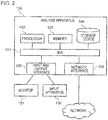
- Fig. 2 is a diagram conceptually showing a hardware configuration of the analysis apparatus 100.
- the analysis apparatus 100 includes a bus 101, a processor 102, a memory 103, a storage device 104, an input and output interface 105, and a network interface 106.
- the bus 101 is a data transmission path for the processor 102, the memory 103, the storage device 104, the input and output interface 105, and the network interface 106 to mutually transmit and receive data.
- a method of connecting the processor 102, the memory 103, the storage device 104, the input and output interface 105, the network interface 106, and the like to one another is not limited to the bus connection.
- the processor 102 is an arithmetic apparatus such as a central processing unit (CPU) or a graphics processing unit (GPU).
- the memory 103 is a main storage apparatus formed by using a random access memory (RAM), a read only memory (ROM), or the like.
- the storage device 104 is an auxiliary storage apparatus formed by using a hard disk drive (HDD), a solid state drive (SSD), a memory card, or the like.
- the storage device 104 stores program modules implementing the respective functional configuration units (the image acquisition unit 110 and the analysis unit 120) of the analysis apparatus 100.
- the processor 102 reads each of the program modules into the memory 103 and executes each program module to realize a function corresponding to each program module.
- the input and output interface 105 is an interface for connecting the analysis apparatus 100 to a monitor 151, an input apparatus 152, and the like.
- the monitor 151 is a device for display output such as a liquid crystal display (LCD) or a cathode ray tube (CRT) display.
- the input apparatus 152 is a device for input such as a keyboard or a mouse.
- the network interface 106 is an interface for connecting the analysis apparatus 100 to a communication network such as a local area network (LAN) or a wide area network (WAN). As shown in Fig. 2 , the analysis apparatus 100 can communicate with an external server apparatus (not shown) by being connected to the communication network through the network interface 106. It should be noted that a method of connecting to the communication network may be a wireless connection or a wired connection.
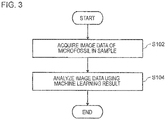
- FIG. 3 is a flowchart illustrating the operation of the analysis apparatus 100 according to the first example embodiment.
- the image acquisition unit 110 acquires the image data of the microfossil in the sample from the microscope apparatus or the like in which the preparation created on the basis of the sample collected from the stratum is set (S102).
- the analysis unit 120 analyzes the image data of the microfossil acquired by the image acquisition unit 110 using the machine learning result such as CNN (S104). For example, the analysis unit 120 can input the image data of the microfossil acquired by the image acquisition unit 110 into the machine learning result and obtain an analysis result of the taxon of the microfossil in the image data as an output.
- the analysis result (discrimination result) of the taxon of the microfossil in the image data by processing the image data of the microfossil existing in the sample collected from the stratum using the machine learning result. Discriminating the taxon of the microfossil is an important part in estimating the stratum age using the microfossil and requires experience.
- the image data of the microfossil is analyzed using the machine learning result constructed by learning the knowledge of the experienced expert. Therefore, it is possible for even an inexperienced person to accurately analyze the taxon of the microfossil. Further, it is possible for even an inexperienced person to accurately estimate the age of the stratum by collating this analysis result with the existence period of each microfossil disclosed in Non-Patent Document 1 and the like.
- the present example embodiment has the same configuration as the first example embodiment except for the following points.
- Fig. 4 is a block diagram conceptually showing a functional configuration of an analysis apparatus 100 according to the second example embodiment.
- the analysis apparatus 100 of the present example embodiment has a preprocessing unit 130 and an age estimation unit 140 in addition to the configuration of the first example embodiment.
- the preprocessing unit 130 executes preprocessing on the image data acquired by the image acquisition unit 110 before the analysis by the analysis unit 120.
- the age estimation unit 140 estimates and outputs the age of the stratum from which the sample is collected, using the analysis result by an analysis unit.
- the analysis apparatus 100 of the present example embodiment has the same hardware configuration (for example, Fig. 2 ) as that of the first example embodiment.
- the storage device 104 of the present example embodiment further stores program modules implementing functions of the preprocessing unit 130 and the age estimation unit 140 described above, and the processor 102 executes the program modules to realize the functions of the present example embodiment described above.
- FIG. 5 is a flowchart showing a flow of processing of the analysis apparatus 100 according to the second example embodiment.
- the image acquisition unit 110 acquires one piece of image data (original image data) generated by imaging a preparation created from the sample collected from the stratum using the microscope apparatus or the like (S202).
- the original image data is generated by imaging the preparation created for each kind in a to some extent higher class (high-order classification: for example, coccolithophore, diatom, radiolaria, foraminifera, and the like) with the microscope apparatus.
- the image acquisition unit 110 processes the original image data to cut out a plurality of pieces of image data of one microfossil sample from the original image data (S204).
- the "image data of one microfossil sample” means image data including one microfossil classified as a kind in a to some extent higher class such as "coccolithophore”, “diatom”, “radiolaria”, and “foraminifera”.
- the image acquisition unit 110 displays the original image data on the monitor 151 and receives an operation input from a user, and thus can decide a cutout region including one microfossil as described above.
- the image acquisition unit 110 may be configured to automatically cut out the region including one microfossil as described above from the original image data using a neural network constructed for each kind in a to some extent higher class (higher-order classification: for example, coccolithophore, diatom, radiolaria, foraminifera, and the like).
- higher-order classification for example, coccolithophore, diatom, radiolaria, foraminifera, and the like.
- the plurality of pieces of image data cut out by the image acquisition unit 110 are transferred to the preprocessing unit 130 before the analysis by the analysis unit 120.
- the preprocessing unit 130 executes the preprocessing on the image data acquired by the image acquisition unit 110 before the analysis by the analysis unit 120 (S206). In order to match the dimension of the data with the training data used in constructing the machine learning result such as the neural network, the preprocessing unit 130 adjusts a resolution (the number of pixels per inch) according to the training data. The preprocessing unit 130 also executes, for example, processing of adjusting at least one of the brightness, the edge, and the contrast of the image data acquired by the image acquisition unit 110.
- the preprocessing unit 130 can acquire information for discriminating the kind of the microfossil to be analyzed together with the image data and execute the preprocessing set for each kind (analysis target) of microfossil discriminated by the information.
- the information for discriminating the kind of the microfossil is imparted, for example, at the time of generating the original image data or at the time of cutting out the plurality of pieces of image data, and the preprocessing unit 130 can acquire the information for discriminating the kind of the microfossil in the image data together with the image data.
- the preprocessing unit 130 may display a screen that receives a user input relating to the information for discriminating the kind of the microfossil on the monitor 151 and acquire the information for discriminating the kind of the microfossil through the screen.
- the preprocessing unit 130 can perform discrimination on the image data with reference to a table as shown in Fig. 6 on the basis of the information for discriminating the kind of the microfossil.
- Fig. 6 is a diagram illustrating information defining preprocessing corresponding to a kind of the microfossil to be analyzed.
- Fig. 6 illustrates a table in which the information for discriminating the kind of the microfossil to be analyzed and information indicating preprocessing to be executed and an adjustment parameter are stored in association with each other.
- the preprocessing unit 130 executes the preprocessing of adjusting "brightness", "edge", and "contrast” using the adjustment parameter.
- the preprocessing of another microfossil for example, radiolaria and foraminifera
- another microfossil for example, radiolaria and foraminifera
- the preprocessing unit 130 executes the preprocessing on each of the plurality of pieces of image data cut out in the processing of S204 and transfers the plurality of pieces of image data after the processing to the analysis unit 120.
- the analysis unit 120 analyzes the plurality of pieces of image data processed by the preprocessing unit 130 to generate the analysis result for each classification (for example, coccolithophore, diatom, radiolaria, foraminifera, and the like) in the previous processing (S208).
- each classification for example, coccolithophore, diatom, radiolaria, foraminifera, and the like
- a machine learning result is further prepared for each kind in a lower class (for example, taxon such as "genus Pseudoemiliania” or “genus Reticulofenestra” in the case of coccolithophore) for each kind of the microfossils such as coccolithophore, diatom, radiolaria, and foraminifera.
- taxon such as "genus Pseudoemiliania” or “genus Reticulofenestra” in the case of coccolithophore
- the analysis unit 120 generates the analysis result for each taxon using a plurality of machine learning results according to taxa. For example, the analysis unit 120 generates the analysis result as follows.
- the analysis unit 120 subdivides the classification of the microfossil in the image data using the machine learning result prepared for each kind of the microfossil.
- the analysis unit 120 may decide which machine learning result may be used, by acquiring the information indicating the kind of the microfossil by an input from the user or on the basis of the information for discriminating the kind of the microfossil in the image data imparted to the image data.
- microfossils may be identical at a classification level such as "coccolithophore” or "diatom” but may have a large difference in an appearance feature (shape) at a lower classification level.
- the analysis unit 120 may be configured to group the image data classified in the processing of S204 by a classification filter (for example, pattern matching or neural network constructed by learning relating to shape) on the basis of the appearance feature and then analyze the classification using the machine learning result associated with each group.
- a classification filter for example, pattern matching or neural network constructed by learning relating to shape
- the analysis unit 120 repeats the processing of inputting the image data classified using a machine learning result of a certain taxon into a machine learning result of a taxon belonging to a class lower than that of the certain taxon to classify the image data and generates an analysis result subdivided to a level where the stratum age can be estimated.
- the analysis unit 120 generates, as the analysis result, for example, information indicating a taxon of the microfossil in image data and a degree of certainty (certainty factor) for the taxon.
- the analysis unit 120 can generate the analysis result including the discrimination result of the kind of image data (whether it is "genus Pseudoemiliania” or “genus Reticulofenestra") and the certainty factor using, for example, the machine learning result for each taxon such as "genus Pseudoemiliania” or “genus Reticulofenestra” as described above.
- the analysis unit 120 may further measure a size (for example, diameter or the like) of the microfossil in each piece of image data in order to improve the accuracy of estimating the age.
- the analysis unit 120 can measure the size of the microfossil in the image data on the basis of the resolution (the number of pixels per inch) of the image data and a pixel region (the number of pixels) of the microfossil and include the measured size in the analysis result.
- the analysis result generated by the analysis unit 120 is transferred to the age estimation unit 140.
- a configuration in which the analysis results are output stepwise from the higher class toward the lower class provides information indicating a process until a final analysis result is obtained.
- the user On the basis of the information, it is possible for the user to check how the image data is decided by the machine learning result and perform appropriate measures to improve the analysis accuracy such as tuning (relearning) of the machine learning result or reclassification of the image data by manual or a relearning result.
- the age estimation unit 140 estimates the age of the stratum from which the sample is collected, using the analysis result generated by the analysis unit 120 (S210).
- the age estimation unit 140 first estimates the age of the stratum for each kind of the microfossil using the analysis result obtained for each kind of the microfossil.
- the age estimation unit 140 can estimate the age of the stratum for each kind of the microfossil as follows.
- Fig. 7 is a diagram for illustratively describing a flow in which the age estimation unit 140 estimates the age of the stratum for each kind of the microfossil.
- (a) of Fig. 7 shows an example of the analysis result acquired by the age estimation unit 140 from the analysis unit 120.
- a case is illustrated in which seven pieces of image data relating to microfossils classified into four kinds of algae A to D are analyzed by the analysis unit 120, and information indicating the sizes (diameters) of the microfossils in respective pieces of image data and information indicating probabilities that the microfossils are the algae A to D are acquired as the analysis result.
- the age estimation unit 140 can decide an age estimated for a kind of the microfossil on the basis of the analysis result and a standard distribution of the microfossil for each age. Specifically, the age estimation unit 140 computes a distribution of the microfossil in the sample, as shown in (b) of Fig. 7 , on the basis of the analysis result. The age estimation unit 140 may compute the distribution of the microfossil in the sample, for example, from a statistical value such as an average value of the probabilities of the respective analysis results of pieces of image data or may compute the distribution of the microfossil in the sample from a result of determining an alga with the highest probability for each piece of image data as the microfossil in the image data.
- the age estimation unit 140 compares the computed distribution of the microfossil in the sample with the standard distribution of the fossil for each age as shown in (c) of Fig. 7 . It should be noted that a plurality of standard distributions as shown in (c) of Fig. 7 may be prepared in association with area information since a ratio of microfossil assemblages may be influenced by an environmental difference in each area.
- the age estimation unit 140 receives information indicating a place from which the sample is collected and thus can read out the standard distribution corresponding to the place.
- the age estimation unit 140 estimates the age of the stratum from which the sample is collected, on the basis of the distribution similarity or the like. In the examples of Fig.
- the age estimation unit 140 may estimate the age of the stratum from which the sample is collected as, for example, "the early period of age 2 to the late period of age 3" or "age 3 ⁇ X years". It should be noted that the flow described here is merely an example and the present invention is not particularly limited thereto.
- the age estimation unit 140 may be configured to process the analysis result using the machine learning result and thus estimate and output the age of the stratum from which the sample is collected.
- the machine learning result can be constructed, for example, using training data in which the distribution of the taxon of the microfossil is associated with the estimation result of the age (approximate age and range thereof) corresponding to the distribution.
- the age estimation unit 140 estimates a final age on the basis of the age estimated for each kind of the microfossil (S212). For example, the age estimation unit 140 can decide a portion where the age estimated for each kind of the microfossil overlaps as a final estimation result of the age of the stratum from which the sample is collected.
- the age estimation unit 140 acquires the final analysis result of each piece of image data by the analysis unit 120.
- the analysis result includes information indicating a taxon of the microfossil in each piece of image data and the certainty factor for the taxon (for example, "certainty factor NN% for genus XX of coccolithophore” or the like).
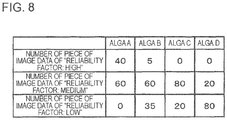
- the age estimation unit 140 classifies the final analysis result of each piece of image data acquired from the analysis unit 120 into a plurality of stages on the basis of the certainty factor (for example, "certainty factor: high", “certainty factor: medium”, and "certainty factor: low”) (for example, Fig. 8).
- a column of "alga A" indicates a result of inputting 100 pieces of image data into the machine learning result of alga A. Specifically, the column indicates that an analysis result is obtained in which the number of pieces of image data classified into alga A with high certainty factor is 40, the number of pieces of image data classified into alga A with medium certainty factor is 60, and the number of pieces of image data classified into alga A with low certainty factor is zero.
- the age estimation unit 140 can classify the analysis result of each piece of image data into the plurality of stages on the basis of the certainty factor, using a threshold value, which is common to all taxa or set for each taxon, relating to the certainty factor.
- the age estimation unit 140 decides whether or not there is a taxon for which a significant number (for example, 1/10 of the number of pieces of image data) or more of the analysis results classified as "certainty factor: high" are obtained.
- the age estimation unit 140 narrows down the age to at least an age corresponding to an existence period of the taxon as a candidate for the age of the stratum from which the sample is collected. For example, assuming that the existence period of each of the algae A to D is defined as shown in Fig. 9 , in a case where the analysis result as shown in Fig.
- the age estimation unit 140 narrows down the age to the existence periods (age 1 to age 3) of alga A, for which the significant number of analysis results classified as "reliability factor: high” is obtained, as candidates for the age of the stratum from which the sample is collected.
- the age estimation unit 140 may be configured to exclude the age corresponding to the existence period of the taxon from the candidate for the age of the stratum from which the sample is collected. For example, assuming that the existence period of each of the algae A to D is defined as shown in Fig. 9 , in the case where the analysis result as shown in Fig. 8 is obtained, the age estimation unit 140 can exclude the existence periods (age 3 to age 5) of alga D from the candidate for the age of the stratum from which the sample is collected.
- the age estimation unit 140 computes a score indicating certainty for each of the plurality of candidates on the basis of, for example, the number (percentage) of analysis results classified into "certainty factor: high” and “certainty factor: medium” and thus can output an estimation result of the age on the basis of the score. For example, the age estimation unit 140 determines a taxon for which the significant number or more of analysis results classified as "certainty factor: high” are obtained and assigns a first score (maximum score) to the age corresponding to the existence period of the taxon.
- the age estimation unit 140 determines a certain taxon for which the number of analysis results classified as "certainty factor: high” is less than the significant number but the number of analysis results of "certainty factor: medium” is equal to or larger than the significant number and assigns a second score smaller than the first score to the age corresponding to the existence period of the taxon.
- the age estimation unit 140 assigns a third score smaller than the second score to the ages corresponding to the existence periods of taxa other than the above.
- the age estimation unit 140 computes a statistical value (sum value, average value, or the like) of the score assigned to each age according to the analysis result for each taxon and ranks each of the plurality of candidates narrowed down on the basis of the statistical value.
- the age estimation unit 140 outputs the plurality of narrowed down candidates in a format in which the ranks can be understood using, for example, a display or a printer. It is possible for the user to select the most likely age on the basis of the output result.
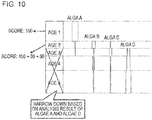
- a series of flows are, for example, as shown in Fig. 10 .
- the age estimation unit 140 narrows down the candidates to age 1 or age 2 on the basis of the statistics of analysis results of algae A and algae D.
- the age estimation unit 140 assigns the "first score (for example, "100")” to age 1 corresponding to only the existence period of alga A.
- the age estimation unit 140 assigns "first score + second score + second score (for example, "100 + 30 + 30”)” to age 2 corresponding to the existence periods of algae A, B, and C.
- the age estimation unit 140 outputs information indicating that age 2 is the most probable and age 1 is the second most probable as the estimated age of the stratum from which the sample is collected.
- the result of estimating the age of the stratum is output using the result of analyzing the image data, generated on the basis of the sample collected from the stratum, by the analysis unit 120.
- the analysis apparatus 100 of the present example embodiment it is possible to automatically estimate the stratum age and thus reduce the load applied to the study of the stratum age.
- Fig. 11 is a block diagram conceptually illustrating a functional configuration of a modification example of the second example embodiment.
- the age estimation unit 140 described above may be included in an apparatus 200 different from the analysis apparatus 100.
- the apparatus 200 including the age estimation unit 140 can also be referred to as a "geological age estimation apparatus".
- the stratum age estimation apparatus 200 includes an analysis result acquisition unit 210 that acquires an analysis result of a taxon of a microfossil in a sample collected from a stratum in addition to the age estimation unit 140.
- the analysis result acquisition unit 210 can acquire, for example, the information as shown in (a) of Fig. 7 from the analysis apparatus 100.
- the age estimation unit 140 can decide an age estimated for a kind of the microfossil on the basis of the analysis result and the standard distribution of the microfossil for each age. Specifically, the age estimation unit 140 computes a distribution of the microfossil in the sample on the basis of these analysis results (for example, Fig. (b) of 7) and compares the computed distribution of the microfossil in the sample with the standard distribution of microfossil for each age, and thus can estimate and output the age of the stratum from which the sample is collected.
- the age estimation unit 140 may be configured to process the analysis result using the machine learning result and thus estimate and output the age of the stratum from which the sample is collected.
- Fig. 12 is a diagram conceptually showing a hardware configuration of the stratum age estimation apparatus 200.
- the stratum age estimation apparatus 200 is configured to include a bus 201, a processor 202, a memory 203, a storage device 204, an input and output interface 205, and a network interface 206.
- the bus 201 is a data transmission path for the processor 202, the memory 203, the storage device 204, the input and output interface 205, and the network interface 206 to mutually transmit and receive data.
- a method of connecting the processor 202, the memory 203, the storage device 204, the input and output interface 205, the network interface 206, and the like to one another is not limited to the bus connection.
- the processor 202 is an arithmetic apparatus such as a central processing unit (CPU) or a graphics processing unit (GPU).
- the memory 203 is a main storage apparatus formed by using a random access memory (RAM), a read only memory (ROM), or the like.
- the storage device 104 is an auxiliary storage apparatus formed by using a hard disk drive (HDD), a solid state drive (SSD), a memory card, or the like.
- the storage device 204 stores program modules implementing the respective functional configuration units (the analysis result acquisition unit 210 and the age estimation unit 140) of the stratum age estimation apparatus 200.
- the processor 202 reads each of the program modules into the memory 103 and executes each program module to realize a function corresponding to each program module.
- the input and output interface 205 is an interface for connecting the stratum age estimation apparatus 200 to a monitor 251, an input apparatus 252, and the like.
- the input apparatus 252 is a device for input such as a keyboard or a mouse.
- the monitor 251 is a device for display output such as a liquid crystal display (LCD) or a cathode ray tube (CRT) display.
- LCD liquid crystal display
- CRT cathode ray tube
- the network interface 206 is an interface for connecting the stratum age estimation apparatus 200 to a communication network such as a local area network (LAN) or a wide area network (WAN). As shown in Fig. 12 , the stratum age estimation apparatus 200 can communicate with the analysis apparatus 100 or an external server apparatus (not shown) by being connected to the communication network through the network interface 206. It should be noted that a method of connecting to the communication network may be a wireless connection or a wired connection.
- a processing unit that performs a tuning operation for maintaining or improving the accuracy of the machine learning result may be further provided.
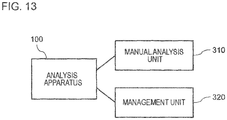
- Fig. 13 is a block diagram illustrating another example embodiment of the present invention.
- a manual analysis unit 310 and a management unit 320 are connected to the analysis apparatus 100.
- the management unit 320 is a processing unit that stores various types of data necessary for processing in the manual analysis unit 310 described below.
- the management unit 320 manages parameters (image adjustment parameter, analysis parameter, parameters relating to age estimation, and the like) used for various computations, the history of machine learning result models, and the like.
- the management unit 320 sequentially stores operation logs (for example, a set of pieces of input image data of the microfossil and a version of the machine learning result used for classification of the microfossil) in the analysis apparatus 100 such that the manual analysis unit 310 can trace a course until the analysis apparatus 100 outputs a certain result.
- the manual analysis unit 310 is a processing unit that manually checks whether the analysis apparatus 100 operates correctly, using information stored in the management unit 320.
- the manual analysis unit 310 can, for example, check the operation log of the analysis apparatus 100 and perform reclassification processing on the erroneously classified microfossil as a result of using a certain machine learning result model.
- the manual analysis unit 310 can display the input image data and the classification result (taxon) of the microfossil in the image data on a monitor for a manager, which is not shown, and receive an input for correcting an erroneous classification result.
- the manual analysis unit 310 also can execute relearning processing with respect to the machine learning result model by which the erroneous classification result is output and can execute the reclassification processing using a machine learning result model on which the relearning processing has been performed.
- the parameter relating to the age estimation may vary in future studies. For example, as a result of future stratum studies, the existence period of a certain taxon may be shorter or longer than a currently defined period.
- the manual analysis unit 310 may further include an adjustment function of the parameter relating to the age estimation.
Landscapes
- Engineering & Computer Science (AREA)
- Life Sciences & Earth Sciences (AREA)
- Health & Medical Sciences (AREA)
- Chemical & Material Sciences (AREA)
- Physics & Mathematics (AREA)
- General Health & Medical Sciences (AREA)
- General Physics & Mathematics (AREA)
- Molecular Biology (AREA)
- Immunology (AREA)
- Biochemistry (AREA)
- Analytical Chemistry (AREA)
- Theoretical Computer Science (AREA)
- Multimedia (AREA)
- Biomedical Technology (AREA)
- Organic Chemistry (AREA)
- Pathology (AREA)
- General Life Sciences & Earth Sciences (AREA)
- Zoology (AREA)
- Wood Science & Technology (AREA)
- Proteomics, Peptides & Aminoacids (AREA)
- Environmental & Geological Engineering (AREA)
- Medicinal Chemistry (AREA)
- Food Science & Technology (AREA)
- Remote Sensing (AREA)
- Geology (AREA)
- Biotechnology (AREA)
- Geophysics (AREA)
- Biophysics (AREA)
- Toxicology (AREA)
- Bioinformatics & Cheminformatics (AREA)
- General Engineering & Computer Science (AREA)
- Genetics & Genomics (AREA)
- Microbiology (AREA)
- Investigating Or Analysing Materials By Optical Means (AREA)
- Image Analysis (AREA)
- Geophysics And Detection Of Objects (AREA)
- Apparatus Associated With Microorganisms And Enzymes (AREA)
- Investigating Or Analysing Biological Materials (AREA)
- Image Processing (AREA)
Abstract
Description
- The present invention relates to a technique of assisting a study of a stratum age based on a microfossil existing in a collected sample.
- A study is performed in which an expert estimates an age of a stratum on the basis of a microfossil (zooplankton and algal fossils) existing in a sample collected from the stratum. The expert estimates the age of the stratum on the basis of a taxon of the microfossil existing in the sample, for example, with reference to a table or the like indicating an existence range of the taxon (classification unit of organisms such as kingdom, phylum, class, order, family, genus, and species) of the microfossil as disclosed in Non-Patent
Document 1 below. - [Non-Patent Document 1] Tanimura Yoshihiro and Tuji Akihiro, "Bikaseki: Kembikyo de miru purankuton kaseki no sekai (Microfossils: The world of plankton fossils seen with a microscope)", National Science Museum Sosho, Tokai University Press, August 2012, p. 86 to 87, 282 to 288, and 308 to 309
- It is of a significant academic or industrial benefit when an age of a stratum can be analyzed accurately. However, there are only a limited number of experts who can accurately estimate the age of the stratum on the basis of a microfossil included in the stratum, and it is extremely difficult for an inexperienced person to estimate the age of the stratum with the same accuracy as the expert.
- The present invention is made in view of the above problems. One of the objects of the present invention is to provide a technique capable of accurately estimating an age of a stratum on the basis of a microfossil.
- According to the present invention, there is provided an analysis apparatus including an image acquisition unit that acquires image data of a microfossil in a sample collected from a stratum, and an analysis unit that analyzes the image data using a machine learning result to analyze a taxon or kind of the microfossil in the image data.
- According to the present invention, there is provided a stratum age estimation apparatus including an analysis result acquisition unit that acquires an analysis result of a taxon or kind of a microfossil in a sample collected from a stratum, and an age estimation unit that estimates and outputs an age of the stratum from which the sample is collected, using the analysis result.
- According to the present invention, there is provided an analysis method executed by a computer. The analysis method includes acquiring, by the computer, image data of a sample collected from a stratum, and analyzing, by the computer, the image data using a machine learning result to analyze a taxon or kind of the microfossil in the image data.
- According to the present invention, there is provided a stratum age estimation method executed by a computer. The stratum age estimation method includes acquiring, by the computer, an analysis result of a taxon or kind of a microfossil in a sample collected from a stratum, and estimating and outputting, by the computer, a stratum age of the sample using the analysis result.
- According to the present invention, there is provided a program causing a computer to function as an image acquisition unit that acquires image data of a sample collected from a stratum, and an analysis unit that analyzes the image data using a machine learning result to analyze a taxon or kind of the microfossil in the image data.
- According to the present invention, there is provided a program causing a computer to function as an analysis result acquisition unit that acquires an analysis result of a taxon or kind of a microfossil in a sample collected from a stratum and an age estimation unit that estimates and outputs a stratum age of the sample using the analysis result.
- According to the present invention, it is possible to accurately estimate the age of the stratum on the basis of the microfossil.
- The objects described above, and other objects, features and advantages will become more apparent from preferred example embodiments described below and the following drawings accompanying the example embodiments.
-
-
Fig. 1 is a block diagram conceptually showing a functional configuration of an analysis apparatus according to a first example embodiment. -
Fig. 2 is a diagram conceptually showing a hardware configuration of the analysis apparatus. -
Fig. 3 is a flowchart illustrating an operation of the analysis apparatus according to the first example embodiment. -
Fig. 4 is a block diagram conceptually showing a functional configuration of an analysis apparatus according to a second example embodiment. -
Fig. 5 is a flowchart showing a flow of processing of the analysis apparatus according to the second example embodiment. -
Fig. 6 is a diagram illustrating information defining preprocessing corresponding to a kind of the microfossil to be analyzed. -
Fig. 7 is diagrams for illustratively describing a flow in which an age estimation unit estimates an age of a stratum for each kind of the microfossil. -
Fig. 8 is a diagram showing an example of a result of classifying a final analysis result of each piece of image data on the basis of a certainty factor. -
Fig. 9 is a diagram illustrating an existence period of each taxon. -
Fig. 10 is a diagram illustrating a flow of another piece of processing of the age estimation unit. -
Fig. 11 is a block diagram conceptually illustrating a functional configuration of a modification example according to the second example embodiment. -
Fig. 12 is a diagram conceptually showing a hardware configuration of a stratum age estimation apparatus. -
Fig. 13 is a block diagram illustrating another aspect of the present invention. - Before describing a configuration of the present invention, a method of estimating a stratum age using a microfossil in the related art will be outlined. In the method in the related art, a target stratum is first excavated by using a drilling apparatus such as a drill pipe to collect a sample of the stratum. Then, a preparation is created on the basis of the sample collected from the stratum in order to observe in detail the microfossil which is a clue to estimate the age of the stratum to be studied. A pretreatment is performed for each of target microfossils (for example, coccolithophore, diatom, radiolaria, and foraminifera used as so-called index fossils) to create the preparation. An expert sets the preparation on a microscope to discriminate a taxon (classification group) of the microfossil existing in the sample. Then, the expert estimates an approximate age of the stratum from which the sample is collected with reference to the discriminated taxon of the microfossil and, for example, the existence period of each taxon of the microfossil disclosed in Non-Patent
Document 1. In this case, a combination of taxa of the microfossil, a size of the microfossil, and the like are significant clues for estimating the age. Then, a final stratum age is discussed and decided on the basis of the age estimated for each kind of the microfossil (age estimated from an observation result of coccolithophore, age estimated from an observation result diatom, or the like). - As described above, there are only a limited number of people who can accurately estimate the age using the index fossil. In the present invention described below, it is possible for even an inexperienced person to accurately estimate the age of the microfossil. It is possible to accurately estimate the age of the stratum using the estimation result of the age of the microfossil. Accordingly, it is possible to solve the problem such as a shortage of experts as well.
- Hereinafter, example embodiments of the present invention will be described with reference to the drawings. It should be noted that the same reference numeral is assigned to the same component for all the drawings, and the description thereof will not be repeated. Further, each block represents a configuration of functional units instead of a configuration of hardware units in each block diagram, unless otherwise described.
-
Fig. 1 is a block diagram conceptually showing the functional configuration of ananalysis apparatus 100 according to a first example embodiment. As shown inFig. 1 , theanalysis apparatus 100 according to the present example embodiment includes animage acquisition unit 110 and ananalysis unit 120. - The
image acquisition unit 110 acquires image data of a microfossil existing in a sample collected from a stratum. This image data is generated by imaging a preparation created from the sample collected from the stratum in a microscope apparatus or the like. This preparation is created for each kind of the microfossils to be analyzed (for example, classification of coccolithophore, diatom, radiolaria, foraminifera, and the like). - The
analysis unit 120 processes the image data acquired by theimage acquisition unit 110 using a machine learning result to analyze the taxon or kind of the microfossil in the image data. This machine learning result is a model (for example, a neural network such as a convolutional neural network (CNN)) constructed with a past classification result (combination of image data of a microfossil and the classification of the microfossil) by an expert as training data, that is, a model constructed by learning knowledge of the expert. - Each functional configuration unit of the
analysis apparatus 100 may be formed by hardware (for example, a hard-wired electronic circuit) implementing each functional configuration unit, or a combination of hardware and software (for example, a combination of an electronic circuit and a program that controls the circuit). Hereinafter, a case where each functional configuration unit of theanalysis apparatus 100 is formed by the combination of hardware and software will be further described. -
Fig. 2 is a diagram conceptually showing a hardware configuration of theanalysis apparatus 100. As shown inFig. 2 , theanalysis apparatus 100 includes abus 101, aprocessor 102, amemory 103, astorage device 104, an input andoutput interface 105, and anetwork interface 106. - The
bus 101 is a data transmission path for theprocessor 102, thememory 103, thestorage device 104, the input andoutput interface 105, and thenetwork interface 106 to mutually transmit and receive data. However, a method of connecting theprocessor 102, thememory 103, thestorage device 104, the input andoutput interface 105, thenetwork interface 106, and the like to one another is not limited to the bus connection. - The
processor 102 is an arithmetic apparatus such as a central processing unit (CPU) or a graphics processing unit (GPU). Thememory 103 is a main storage apparatus formed by using a random access memory (RAM), a read only memory (ROM), or the like. Thestorage device 104 is an auxiliary storage apparatus formed by using a hard disk drive (HDD), a solid state drive (SSD), a memory card, or the like. - The
storage device 104 stores program modules implementing the respective functional configuration units (theimage acquisition unit 110 and the analysis unit 120) of theanalysis apparatus 100. Theprocessor 102 reads each of the program modules into thememory 103 and executes each program module to realize a function corresponding to each program module. - The input and
output interface 105 is an interface for connecting theanalysis apparatus 100 to amonitor 151, aninput apparatus 152, and the like. Themonitor 151 is a device for display output such as a liquid crystal display (LCD) or a cathode ray tube (CRT) display. Theinput apparatus 152 is a device for input such as a keyboard or a mouse. - The
network interface 106 is an interface for connecting theanalysis apparatus 100 to a communication network such as a local area network (LAN) or a wide area network (WAN). As shown inFig. 2 , theanalysis apparatus 100 can communicate with an external server apparatus (not shown) by being connected to the communication network through thenetwork interface 106. It should be noted that a method of connecting to the communication network may be a wireless connection or a wired connection. - An operation of the
analysis apparatus 100 in the present example embodiment will be illustrated inFig. 3. Fig. 3 is a flowchart illustrating the operation of theanalysis apparatus 100 according to the first example embodiment. - The
image acquisition unit 110 acquires the image data of the microfossil in the sample from the microscope apparatus or the like in which the preparation created on the basis of the sample collected from the stratum is set (S102). Theanalysis unit 120 analyzes the image data of the microfossil acquired by theimage acquisition unit 110 using the machine learning result such as CNN (S104). For example, theanalysis unit 120 can input the image data of the microfossil acquired by theimage acquisition unit 110 into the machine learning result and obtain an analysis result of the taxon of the microfossil in the image data as an output. - As described above, in the present example embodiment, it is possible to obtain the analysis result (discrimination result) of the taxon of the microfossil in the image data by processing the image data of the microfossil existing in the sample collected from the stratum using the machine learning result. Discriminating the taxon of the microfossil is an important part in estimating the stratum age using the microfossil and requires experience. In the present example embodiment, the image data of the microfossil is analyzed using the machine learning result constructed by learning the knowledge of the experienced expert. Therefore, it is possible for even an inexperienced person to accurately analyze the taxon of the microfossil. Further, it is possible for even an inexperienced person to accurately estimate the age of the stratum by collating this analysis result with the existence period of each microfossil disclosed in
Non-Patent Document 1 and the like. - The present example embodiment has the same configuration as the first example embodiment except for the following points.
-
Fig. 4 is a block diagram conceptually showing a functional configuration of ananalysis apparatus 100 according to the second example embodiment. As shown inFig. 4 , theanalysis apparatus 100 of the present example embodiment has apreprocessing unit 130 and anage estimation unit 140 in addition to the configuration of the first example embodiment. Thepreprocessing unit 130 executes preprocessing on the image data acquired by theimage acquisition unit 110 before the analysis by theanalysis unit 120. Theage estimation unit 140 estimates and outputs the age of the stratum from which the sample is collected, using the analysis result by an analysis unit. - The
analysis apparatus 100 of the present example embodiment has the same hardware configuration (for example,Fig. 2 ) as that of the first example embodiment. Thestorage device 104 of the present example embodiment further stores program modules implementing functions of thepreprocessing unit 130 and theage estimation unit 140 described above, and theprocessor 102 executes the program modules to realize the functions of the present example embodiment described above. - An operation example of the
analysis apparatus 100 according to the present example embodiment will be described with reference toFig. 5. Fig. 5 is a flowchart showing a flow of processing of theanalysis apparatus 100 according to the second example embodiment. - In the present example embodiment, the
image acquisition unit 110 acquires one piece of image data (original image data) generated by imaging a preparation created from the sample collected from the stratum using the microscope apparatus or the like (S202). The original image data is generated by imaging the preparation created for each kind in a to some extent higher class (high-order classification: for example, coccolithophore, diatom, radiolaria, foraminifera, and the like) with the microscope apparatus. Theimage acquisition unit 110 processes the original image data to cut out a plurality of pieces of image data of one microfossil sample from the original image data (S204). The "image data of one microfossil sample" means image data including one microfossil classified as a kind in a to some extent higher class such as "coccolithophore", "diatom", "radiolaria", and "foraminifera". Theimage acquisition unit 110 displays the original image data on themonitor 151 and receives an operation input from a user, and thus can decide a cutout region including one microfossil as described above. In addition, theimage acquisition unit 110 may be configured to automatically cut out the region including one microfossil as described above from the original image data using a neural network constructed for each kind in a to some extent higher class (higher-order classification: for example, coccolithophore, diatom, radiolaria, foraminifera, and the like). In the present example embodiment, the plurality of pieces of image data cut out by theimage acquisition unit 110 are transferred to thepreprocessing unit 130 before the analysis by theanalysis unit 120. - The
preprocessing unit 130 executes the preprocessing on the image data acquired by theimage acquisition unit 110 before the analysis by the analysis unit 120 (S206). In order to match the dimension of the data with the training data used in constructing the machine learning result such as the neural network, thepreprocessing unit 130 adjusts a resolution (the number of pixels per inch) according to the training data. Thepreprocessing unit 130 also executes, for example, processing of adjusting at least one of the brightness, the edge, and the contrast of the image data acquired by theimage acquisition unit 110. - In this case, the
preprocessing unit 130 can acquire information for discriminating the kind of the microfossil to be analyzed together with the image data and execute the preprocessing set for each kind (analysis target) of microfossil discriminated by the information. The information for discriminating the kind of the microfossil is imparted, for example, at the time of generating the original image data or at the time of cutting out the plurality of pieces of image data, and thepreprocessing unit 130 can acquire the information for discriminating the kind of the microfossil in the image data together with the image data. In addition, for example, thepreprocessing unit 130 may display a screen that receives a user input relating to the information for discriminating the kind of the microfossil on themonitor 151 and acquire the information for discriminating the kind of the microfossil through the screen. Thepreprocessing unit 130 can perform discrimination on the image data with reference to a table as shown inFig. 6 on the basis of the information for discriminating the kind of the microfossil. -
Fig. 6 is a diagram illustrating information defining preprocessing corresponding to a kind of the microfossil to be analyzed.Fig. 6 illustrates a table in which the information for discriminating the kind of the microfossil to be analyzed and information indicating preprocessing to be executed and an adjustment parameter are stored in association with each other. For example, in a case where "coccolithophore" is obtained as the information for discriminating the kind of the microfossil to be analyzed, thepreprocessing unit 130 executes the preprocessing of adjusting "brightness", "edge", and "contrast" using the adjustment parameter. In the example ofFig. 6 , only information relating to coccolithophore and diatom is stored. However, the preprocessing of another microfossil (for example, radiolaria and foraminifera) may be further stored. - The
preprocessing unit 130 executes the preprocessing on each of the plurality of pieces of image data cut out in the processing of S204 and transfers the plurality of pieces of image data after the processing to theanalysis unit 120. - The
analysis unit 120 analyzes the plurality of pieces of image data processed by thepreprocessing unit 130 to generate the analysis result for each classification (for example, coccolithophore, diatom, radiolaria, foraminifera, and the like) in the previous processing (S208). Here, in order for the image data cut out for each kind, such as coccolithophore, diatom, radiolaria, or foraminifera, in the processing of S204 to be further subdivided in the kind, a machine learning result is further prepared for each kind in a lower class (for example, taxon such as "genus Pseudoemiliania" or "genus Reticulofenestra" in the case of coccolithophore) for each kind of the microfossils such as coccolithophore, diatom, radiolaria, and foraminifera. Then, theanalysis unit 120 generates the analysis result for each taxon using a plurality of machine learning results according to taxa. For example, theanalysis unit 120 generates the analysis result as follows. - First, the
analysis unit 120 subdivides the classification of the microfossil in the image data using the machine learning result prepared for each kind of the microfossil. Theanalysis unit 120 may decide which machine learning result may be used, by acquiring the information indicating the kind of the microfossil by an input from the user or on the basis of the information for discriminating the kind of the microfossil in the image data imparted to the image data. - It should be noted that the microfossils may be identical at a classification level such as "coccolithophore" or "diatom" but may have a large difference in an appearance feature (shape) at a lower classification level. The
analysis unit 120 may be configured to group the image data classified in the processing of S204 by a classification filter (for example, pattern matching or neural network constructed by learning relating to shape) on the basis of the appearance feature and then analyze the classification using the machine learning result associated with each group. - Then, the
analysis unit 120 repeats the processing of inputting the image data classified using a machine learning result of a certain taxon into a machine learning result of a taxon belonging to a class lower than that of the certain taxon to classify the image data and generates an analysis result subdivided to a level where the stratum age can be estimated. Theanalysis unit 120 generates, as the analysis result, for example, information indicating a taxon of the microfossil in image data and a degree of certainty (certainty factor) for the taxon. Theanalysis unit 120 can generate the analysis result including the discrimination result of the kind of image data (whether it is "genus Pseudoemiliania" or "genus Reticulofenestra") and the certainty factor using, for example, the machine learning result for each taxon such as "genus Pseudoemiliania" or "genus Reticulofenestra" as described above. Theanalysis unit 120 may further measure a size (for example, diameter or the like) of the microfossil in each piece of image data in order to improve the accuracy of estimating the age. For example, theanalysis unit 120 can measure the size of the microfossil in the image data on the basis of the resolution (the number of pixels per inch) of the image data and a pixel region (the number of pixels) of the microfossil and include the measured size in the analysis result. The analysis result generated by theanalysis unit 120 is transferred to theage estimation unit 140. - It should be noted that a configuration in which the analysis results are output stepwise from the higher class toward the lower class provides information indicating a process until a final analysis result is obtained. On the basis of the information, it is possible for the user to check how the image data is decided by the machine learning result and perform appropriate measures to improve the analysis accuracy such as tuning (relearning) of the machine learning result or reclassification of the image data by manual or a relearning result.
- The
age estimation unit 140 estimates the age of the stratum from which the sample is collected, using the analysis result generated by the analysis unit 120 (S210). Theage estimation unit 140 first estimates the age of the stratum for each kind of the microfossil using the analysis result obtained for each kind of the microfossil. For example, theage estimation unit 140 can estimate the age of the stratum for each kind of the microfossil as follows. -
Fig. 7 is a diagram for illustratively describing a flow in which theage estimation unit 140 estimates the age of the stratum for each kind of the microfossil. (a) ofFig. 7 shows an example of the analysis result acquired by theage estimation unit 140 from theanalysis unit 120. Here, a case is illustrated in which seven pieces of image data relating to microfossils classified into four kinds of algae A to D are analyzed by theanalysis unit 120, and information indicating the sizes (diameters) of the microfossils in respective pieces of image data and information indicating probabilities that the microfossils are the algae A to D are acquired as the analysis result. Theage estimation unit 140 can decide an age estimated for a kind of the microfossil on the basis of the analysis result and a standard distribution of the microfossil for each age. Specifically, theage estimation unit 140 computes a distribution of the microfossil in the sample, as shown in (b) ofFig. 7 , on the basis of the analysis result. Theage estimation unit 140 may compute the distribution of the microfossil in the sample, for example, from a statistical value such as an average value of the probabilities of the respective analysis results of pieces of image data or may compute the distribution of the microfossil in the sample from a result of determining an alga with the highest probability for each piece of image data as the microfossil in the image data. Theage estimation unit 140 compares the computed distribution of the microfossil in the sample with the standard distribution of the fossil for each age as shown in (c) ofFig. 7 . It should be noted that a plurality of standard distributions as shown in (c) ofFig. 7 may be prepared in association with area information since a ratio of microfossil assemblages may be influenced by an environmental difference in each area. Theage estimation unit 140 receives information indicating a place from which the sample is collected and thus can read out the standard distribution corresponding to the place. Theage estimation unit 140 estimates the age of the stratum from which the sample is collected, on the basis of the distribution similarity or the like. In the examples ofFig. 7 , in view of the facts that (1) The distributions of algae B to D are closest toage 3, (2) The distribution of alga A is a small amount (5%), and (3) the distribution of alga D is 50%, theage estimation unit 140 may estimate the age of the stratum from which the sample is collected as, for example, "the early period ofage 2 to the late period ofage 3" or "age 3 ± X years". It should be noted that the flow described here is merely an example and the present invention is not particularly limited thereto. - For example, the
age estimation unit 140 may be configured to process the analysis result using the machine learning result and thus estimate and output the age of the stratum from which the sample is collected. In this case, the machine learning result can be constructed, for example, using training data in which the distribution of the taxon of the microfossil is associated with the estimation result of the age (approximate age and range thereof) corresponding to the distribution. - The
age estimation unit 140 estimates a final age on the basis of the age estimated for each kind of the microfossil (S212). For example, theage estimation unit 140 can decide a portion where the age estimated for each kind of the microfossil overlaps as a final estimation result of the age of the stratum from which the sample is collected. - Another example of the processing of the
age estimation unit 140 will be described with reference toFigs. 8 to 10 . It should be noted that pieces of processing described below are merely examples and the present invention is not limited to these examples. - First, the
age estimation unit 140 acquires the final analysis result of each piece of image data by theanalysis unit 120. The analysis result includes information indicating a taxon of the microfossil in each piece of image data and the certainty factor for the taxon (for example, "certainty factor NN% for genus XX of coccolithophore" or the like). Theage estimation unit 140 classifies the final analysis result of each piece of image data acquired from theanalysis unit 120 into a plurality of stages on the basis of the certainty factor (for example, "certainty factor: high", "certainty factor: medium", and "certainty factor: low") (for example,Fig. 8). Fig. 8 is a diagram showing an example of a result of classifying the final analysis result of each piece of image data on the basis of the certainty factor. For example, a column of "alga A" indicates a result of inputting 100 pieces of image data into the machine learning result of alga A. Specifically, the column indicates that an analysis result is obtained in which the number of pieces of image data classified into alga A with high certainty factor is 40, the number of pieces of image data classified into alga A with medium certainty factor is 60, and the number of pieces of image data classified into alga A with low certainty factor is zero. Theage estimation unit 140 can classify the analysis result of each piece of image data into the plurality of stages on the basis of the certainty factor, using a threshold value, which is common to all taxa or set for each taxon, relating to the certainty factor. - Next, the
age estimation unit 140 decides whether or not there is a taxon for which a significant number (for example, 1/10 of the number of pieces of image data) or more of the analysis results classified as "certainty factor: high" are obtained. In a case where the significant number of analysis results classified as "certainty factor: high" are obtained for a certain taxon, theage estimation unit 140 narrows down the age to at least an age corresponding to an existence period of the taxon as a candidate for the age of the stratum from which the sample is collected. For example, assuming that the existence period of each of the algae A to D is defined as shown inFig. 9 , in a case where the analysis result as shown inFig. 8 is obtained, theage estimation unit 140 narrows down the age to the existence periods (age 1 to age 3) of alga A, for which the significant number of analysis results classified as "reliability factor: high" is obtained, as candidates for the age of the stratum from which the sample is collected. Here, in a case where most analysis results (for example, 80% or more) are classified as "certainty factor: low" for a certain taxon, theage estimation unit 140 may be configured to exclude the age corresponding to the existence period of the taxon from the candidate for the age of the stratum from which the sample is collected. For example, assuming that the existence period of each of the algae A to D is defined as shown inFig. 9 , in the case where the analysis result as shown inFig. 8 is obtained, theage estimation unit 140 can exclude the existence periods (age 3 to age 5) of alga D from the candidate for the age of the stratum from which the sample is collected. - A plurality of candidates may remain as a result of the above narrowing down. In this case, the
age estimation unit 140 computes a score indicating certainty for each of the plurality of candidates on the basis of, for example, the number (percentage) of analysis results classified into "certainty factor: high" and "certainty factor: medium" and thus can output an estimation result of the age on the basis of the score. For example, theage estimation unit 140 determines a taxon for which the significant number or more of analysis results classified as "certainty factor: high" are obtained and assigns a first score (maximum score) to the age corresponding to the existence period of the taxon. Theage estimation unit 140 determines a certain taxon for which the number of analysis results classified as "certainty factor: high" is less than the significant number but the number of analysis results of "certainty factor: medium" is equal to or larger than the significant number and assigns a second score smaller than the first score to the age corresponding to the existence period of the taxon. Theage estimation unit 140 assigns a third score smaller than the second score to the ages corresponding to the existence periods of taxa other than the above. Theage estimation unit 140 computes a statistical value (sum value, average value, or the like) of the score assigned to each age according to the analysis result for each taxon and ranks each of the plurality of candidates narrowed down on the basis of the statistical value. Theage estimation unit 140 outputs the plurality of narrowed down candidates in a format in which the ranks can be understood using, for example, a display or a printer. It is possible for the user to select the most likely age on the basis of the output result. - A series of flows are, for example, as shown in
Fig. 10 . As shown inFig. 10 , theage estimation unit 140 narrows down the candidates toage 1 orage 2 on the basis of the statistics of analysis results of algae A and algae D. Theage estimation unit 140 assigns the "first score (for example, "100")" toage 1 corresponding to only the existence period of alga A. Theage estimation unit 140 assigns "first score + second score + second score (for example, "100 + 30 + 30")" toage 2 corresponding to the existence periods of algae A, B, and C. With the scores, theage estimation unit 140 outputs information indicating thatage 2 is the most probable andage 1 is the second most probable as the estimated age of the stratum from which the sample is collected. - As described above, according to the present example embodiment, the result of estimating the age of the stratum is output using the result of analyzing the image data, generated on the basis of the sample collected from the stratum, by the
analysis unit 120. As described above, with theanalysis apparatus 100 of the present example embodiment, it is possible to automatically estimate the stratum age and thus reduce the load applied to the study of the stratum age. -
Fig. 11 is a block diagram conceptually illustrating a functional configuration of a modification example of the second example embodiment. In the present modification example, theage estimation unit 140 described above may be included in anapparatus 200 different from theanalysis apparatus 100. Theapparatus 200 including theage estimation unit 140 can also be referred to as a "geological age estimation apparatus". The stratumage estimation apparatus 200 includes an analysisresult acquisition unit 210 that acquires an analysis result of a taxon of a microfossil in a sample collected from a stratum in addition to theage estimation unit 140. - In the present modification example, the analysis
result acquisition unit 210 can acquire, for example, the information as shown in (a) ofFig. 7 from theanalysis apparatus 100. Theage estimation unit 140 can decide an age estimated for a kind of the microfossil on the basis of the analysis result and the standard distribution of the microfossil for each age. Specifically, theage estimation unit 140 computes a distribution of the microfossil in the sample on the basis of these analysis results (for example, Fig. (b) of 7) and compares the computed distribution of the microfossil in the sample with the standard distribution of microfossil for each age, and thus can estimate and output the age of the stratum from which the sample is collected. Theage estimation unit 140 may be configured to process the analysis result using the machine learning result and thus estimate and output the age of the stratum from which the sample is collected. -
Fig. 12 is a diagram conceptually showing a hardware configuration of the stratumage estimation apparatus 200. As shown inFig. 12 , the stratumage estimation apparatus 200 is configured to include abus 201, aprocessor 202, amemory 203, astorage device 204, an input andoutput interface 205, and anetwork interface 206. - The
bus 201 is a data transmission path for theprocessor 202, thememory 203, thestorage device 204, the input andoutput interface 205, and thenetwork interface 206 to mutually transmit and receive data. However, a method of connecting theprocessor 202, thememory 203, thestorage device 204, the input andoutput interface 205, thenetwork interface 206, and the like to one another is not limited to the bus connection. - The
processor 202 is an arithmetic apparatus such as a central processing unit (CPU) or a graphics processing unit (GPU). Thememory 203 is a main storage apparatus formed by using a random access memory (RAM), a read only memory (ROM), or the like. Thestorage device 104 is an auxiliary storage apparatus formed by using a hard disk drive (HDD), a solid state drive (SSD), a memory card, or the like. - The
storage device 204 stores program modules implementing the respective functional configuration units (the analysisresult acquisition unit 210 and the age estimation unit 140) of the stratumage estimation apparatus 200. Theprocessor 202 reads each of the program modules into thememory 103 and executes each program module to realize a function corresponding to each program module. - The input and
output interface 205 is an interface for connecting the stratumage estimation apparatus 200 to amonitor 251, aninput apparatus 252, and the like. Theinput apparatus 252 is a device for input such as a keyboard or a mouse. Themonitor 251 is a device for display output such as a liquid crystal display (LCD) or a cathode ray tube (CRT) display. - The
network interface 206 is an interface for connecting the stratumage estimation apparatus 200 to a communication network such as a local area network (LAN) or a wide area network (WAN). As shown inFig. 12 , the stratumage estimation apparatus 200 can communicate with theanalysis apparatus 100 or an external server apparatus (not shown) by being connected to the communication network through thenetwork interface 206. It should be noted that a method of connecting to the communication network may be a wireless connection or a wired connection. - The example embodiments of the present invention are described with reference to the drawings. However, the example embodiments are examples of the present invention, and various configurations other than the above can be employed.
- For example, as shown in
Fig. 13 , a processing unit that performs a tuning operation for maintaining or improving the accuracy of the machine learning result may be further provided.Fig. 13 is a block diagram illustrating another example embodiment of the present invention. InFig. 13 , amanual analysis unit 310 and amanagement unit 320 are connected to theanalysis apparatus 100. - The
management unit 320 is a processing unit that stores various types of data necessary for processing in themanual analysis unit 310 described below. Themanagement unit 320 manages parameters (image adjustment parameter, analysis parameter, parameters relating to age estimation, and the like) used for various computations, the history of machine learning result models, and the like. Themanagement unit 320 sequentially stores operation logs (for example, a set of pieces of input image data of the microfossil and a version of the machine learning result used for classification of the microfossil) in theanalysis apparatus 100 such that themanual analysis unit 310 can trace a course until theanalysis apparatus 100 outputs a certain result. - The
manual analysis unit 310 is a processing unit that manually checks whether theanalysis apparatus 100 operates correctly, using information stored in themanagement unit 320. Themanual analysis unit 310 can, for example, check the operation log of theanalysis apparatus 100 and perform reclassification processing on the erroneously classified microfossil as a result of using a certain machine learning result model. For example, themanual analysis unit 310 can display the input image data and the classification result (taxon) of the microfossil in the image data on a monitor for a manager, which is not shown, and receive an input for correcting an erroneous classification result. Themanual analysis unit 310 also can execute relearning processing with respect to the machine learning result model by which the erroneous classification result is output and can execute the reclassification processing using a machine learning result model on which the relearning processing has been performed. The parameter relating to the age estimation may vary in future studies. For example, as a result of future stratum studies, the existence period of a certain taxon may be shorter or longer than a currently defined period. Themanual analysis unit 310 may further include an adjustment function of the parameter relating to the age estimation. - In the plurality of flowcharts used in the above description, the plurality of steps (processing) are described in order. However, the execution order of the steps executed in each example embodiment is not limited to the order of the description. In each example embodiment, the order of the illustrated steps can be changed within the scope of the contents. Each of the above example embodiments can be combined within the scope in which the contents do not contradict each other.
- Some or all of the above example embodiments may be described as in the following additions but are not limited to the additions.
- 1. An analysis apparatus including: an image acquisition unit that acquires image data of a microfossil in a sample collected from a stratum; and an analysis unit that analyzes the image data using a machine learning result to analyze a taxon or kind of the microfossil in the image data.
- 2. The analysis apparatus according to 1, in which the analysis unit generates, as an analysis result, information indicating the taxon or kind of the microfossil in the image data and a certainty factor for the taxon or kind.
- 3. The analysis apparatus according to 1 or 2, in which the image acquisition unit processes one piece of original image data to cut out a plurality of pieces of the image data from the one piece of original image data.
- 4. The analysis apparatus according to any one of 1 to 3, in which the analysis unit generates an analysis result for each taxon or kind of the microfossil using a plurality of machine learning results prepared for each taxon or kind of the microfossil.
- 5. The analysis apparatus according to any one of 1 to 4, further including: a preprocessing unit that executes preprocessing on the image data before the analysis by the analysis unit.
- 6. The analysis apparatus according to 5, in which the preprocessing unit executes processing of adjusting at least one of brightness and an edge of the image data as the preprocessing.
- 7. The analysis apparatus according to 5 or 6, in which the preprocessing unit acquires information for discriminating an analysis target together with the image data and executes preprocessing decided for each analysis target discriminated by the information.
- 8. The analysis apparatus according to any one of 1 to 7, further including: an age estimation unit that estimates and outputs an age of the stratum from which the sample is collected, using an analysis result by the analysis unit.
- 9. The analysis apparatus according to 8, in which the age estimation unit estimates and outputs the age of the stratum from which the sample is collected, using a standard distribution of the microfossil for each age.
- 10. The analysis apparatus according to 9, in which the age estimation unit computes a distribution of the microfossil in the sample using an analysis result for each taxon or kind of the microfossil by the analysis unit, and estimates and outputs the age of the stratum from which the sample is collected on the basis of the distribution of the microfossil in the sample and the standard distribution of the microfossil for each age.
- 11. The analysis apparatus according to 8, in which the age estimation unit processes the analysis result using a machine learning result to estimate and output the age of the stratum from which the sample is collected.
- 12. A stratum age estimation apparatus including: an analysis result acquisition unit that acquires an analysis result of a taxon or kind of a microfossil in a sample collected from a stratum, and an age estimation unit that estimates and outputs an age of the stratum from which the sample is collected, using the analysis result.
- 13. The stratum age estimation apparatus according to 12, in which the age estimation unit estimates and outputs the age of the stratum from which the sample is collected, using a standard distribution of the microfossil for each age.
- 14. The stratum age estimation apparatus according to 13, in which the analysis result acquisition unit acquires the analysis result for each taxon or kind of the microfossil in the sample, and the age estimation unit computes a distribution of the microfossil in the sample using the analysis result for each taxon of the microfossil and estimates and outputs the age of the stratum from which the sample is collected on the basis of the distribution of the microfossil in the sample and the standard distribution of the microfossil for each age.
- 15. The stratum age estimation apparatus according to 12, in which the age estimation unit processes the analysis result using a machine learning result to estimate and output the age of the stratum from which the sample is collected.
- 16. An analysis method executed by a computer, the method including: acquiring, by the computer, image data of a sample collected from a stratum; and analyzing, by the computer, the image data using a machine learning result to analyze a taxon or kind of a microfossil in the image data.
- 17. The analysis method according to 16, the method including: generating, by the computer, information indicating the taxon or kind of the microfossil in the image data and a certainty factor for the taxon or kind as an analysis result.
- 18. The analysis method according to 16 or 17, the method including: processing, by the computer, one piece of original image data to cut out a plurality of pieces of the image data from the one piece of original image data.
- 19. The analysis method according to any one of 16 to 18, the method including:
generating, by the computer, an analysis result for each taxon or kind of the microfossil using a plurality of machine learning results prepared for each taxon or kind of the microfossil. - 20. The analysis method according to any one of 16 to 19, the method including:
executing, by the computer, preprocessing on the image data before the analysis. - 21. The analysis method according to 20, the method including: executing, by the computer, processing of adjusting at least one of brightness and an edge of the image data as the preprocessing.
- 22. The analysis method according to 20 or 21, the method including: acquiring, by the computer, information for discriminating an analysis target together with the image data and executing, by the computer, preprocessing decided for each analysis target discriminated by the information.
- 23. The analysis method according to any one of 16 to 22, the method including:
estimating and outputting, by the computer, an age of the stratum from which the sample is collected using the analysis result. - 24. The analysis method according to 23, the method including: estimating and outputting, by the computer, the age of the stratum from which the sample is collected using a standard distribution of the microfossil for each age.
- 25. The analysis method according to 24, the method including: computing, by the computer, a distribution of the microfossil in the sample using an analysis result for each taxon or kind of the microfossil; and estimating and outputting, by the computer, the age of the stratum from which the sample is collected on the basis of the distribution of the microfossil in the sample and the standard distribution of the microfossil for each age.
- 26. The analysis method according to 23, the method including: processing, by the computer, the analysis result using a machine learning result to estimate and output the age of the stratum from which the sample is collected.
- 27. A stratum age estimation method executed by a computer, the method including:
acquiring, by the computer, an analysis result of a taxon or kind of a microfossil in a sample collected from a stratum; and estimating and outputting, by the computer, an age of the stratum from which the sample is collected using the analysis result. - 28. The stratum age estimation method according to 27, the method including: estimating and outputting, by the computer, the age of the stratum from which the sample is collected using a standard distribution of the microfossil for each age.
- 29. The stratum age estimation method according to 28, the method including: acquiring, by the computer, the analysis result for each taxon or kind of the microfossil in the sample; computing, by the computer, a distribution of the microfossil in the sample using the analysis result for each taxon of the microfossil; and estimating and outputting, by the computer, the age of the stratum from which the sample is collected on the basis of the distribution of the microfossil in the sample and the standard distribution of the microfossil for each age.
- 30. The stratum age estimation method according to 27, the method including: processing, by the computer, the analysis result using a machine learning result to estimate and output the age of the stratum from which the sample is collected.
- 31. A program causing a computer to function as: an image acquisition unit that acquires image data of a sample collected from a stratum; and an analysis unit that analyzes the image data using a machine learning result to analyze a taxon or kind of a microfossil in the image data.
- 32. The program according to 31 causing the computer to function as: a unit that generates, as an analysis result, information indicating the taxon or kind of the microfossil in the image data and a certainty factor for the taxon or kind.
- 33. The program according to 31 or 32 causing the computer to function as: a unit that processes one piece of original image data to cut out a plurality of pieces of the image data from the one piece of original image data.
- 34. The program according to any one of 31 to 33 causing the computer to function as: a unit that generates an analysis result for each taxon or kind of the microfossil using a plurality of machine learning results prepared for each taxon or kind of the microfossil.
- 35. The program according to any one of 31 to 34 causing the computer to further function as: a preprocessing unit that executes preprocessing on the image data before the analysis by the analysis unit.
- 36. The program according to 35 causing the computer to function as: a unit that executes processing of adjusting at least one of brightness and an edge of the image data as the preprocessing.
- 37. The program according to 35 or 36 causing the computer to function as: a unit that acquires information for discriminating an analysis target together with the image data and executes preprocessing decided for each analysis target discriminated by the information.
- 38. The program according to any one of 31 to 37 causing the computer to further function as: an age estimation unit that estimates and outputs an age of the stratum from which the sample is collected, using an analysis result by the analysis unit.
- 39. The program according to 38 causing the computer to function as: a unit that estimates and outputs the age of the stratum from which the sample is collected, using a standard distribution of the microfossil for each age.
- 40. The program according to 39 causing the computer to function as: a unit that computes a distribution of the microfossil in the sample using an analysis result for each taxon or kind of the microfossil by the analysis unit, and estimates and outputs the age of the stratum from which the sample is collected on the basis of the distribution of the microfossil in the sample and the standard distribution of the microfossil for each age.
- 41. The program according to 38 causing the computer to function as: a unit that processes the analysis result using a machine learning result to estimate and output the age of the stratum from which the sample is collected.
- 42. A program causing a computer to function as: an analysis result acquisition unit that acquires an analysis result of a taxon or kind of a microfossil in a sample collected from a stratum, and an age estimation unit that estimates and outputs an age of the stratum of the sample, using the analysis result.
- 43. The program according to 42 causing the computer to function as: a unit that estimates and outputs the age of the stratum from which the sample is collected, using a standard distribution of the microfossil for each age.
- 44. The program according to 43 causing the computer to function as: a unit that acquires the analysis result for each taxon or kind of the microfossil in the sample, computes a distribution of the microfossil in the sample using the analysis result for each taxon of the microfossil, and estimates and outputs the age of the stratum from which the sample is collected on the basis of the distribution of the microfossil in the sample and the standard distribution of the microfossil for each age.
- 45. The program according to 42 causing the computer to function as: a unit that processes the analysis result using a machine learning result to estimate and output the age of the stratum from which the sample is collected.
- This application claims priority on the basis of Japanese Patent Application No.
2017-094086, filed May 10, 2017
Claims (45)
- An analysis apparatus comprising:an image acquisition unit that acquires image data of a microfossil in a sample collected from a stratum; andan analysis unit that analyzes the image data using a machine learning result to analyze a taxon or kind of the microfossil in the image data.
- The analysis apparatus according to claim 1,
wherein the analysis unit generates, as an analysis result, information indicating the taxon or kind of the microfossil in the image data and a certainty factor for the taxon or kind. - The analysis apparatus according to claim 1 or 2,
wherein the image acquisition unit processes one piece of original image data to cut out a plurality of pieces of the image data from the one piece of original image data. - The analysis apparatus according to any one of claims 1 to 3,
wherein the analysis unit generates an analysis result for each taxon or kind of the microfossil using a plurality of machine learning results prepared for each taxon or kind of the microfossil. - The analysis apparatus according to any one of claims 1 to 4, further comprising:
a preprocessing unit that executes preprocessing on the image data before the analysis by the analysis unit. - The analysis apparatus according to claim 5,
wherein the preprocessing unit executes processing of adjusting at least one of brightness and an edge of the image data as the preprocessing. - The analysis apparatus according to claim 5 or 6,
wherein the preprocessing unit acquires information for discriminating an analysis target together with the image data and executes preprocessing decided for each analysis target discriminated by the information. - The analysis apparatus according to any one of claims 1 to 7, further comprising:
an age estimation unit that estimates and outputs an age of the stratum from which the sample is collected, using an analysis result by the analysis unit. - The analysis apparatus according to claim 8,
wherein the age estimation unit estimates and outputs the age of the stratum from which the sample is collected, using a standard distribution of the microfossil for each age. - The analysis apparatus according to claim 9,wherein the age estimation unit computes a distribution of the microfossil in the sample using an analysis result for each taxon or kind of the microfossil by the analysis unit, andestimates and outputs the age of the stratum from which the sample is collected on the basis of the distribution of the microfossil in the sample and the standard distribution of the microfossil for each age.
- The analysis apparatus according to claim 8,
wherein the age estimation unit processes the analysis result using a machine learning result to estimate and output the age of the stratum from which the sample is collected. - A stratum age estimation apparatus comprising:an analysis result acquisition unit that acquires an analysis result of a taxon or kind of a microfossil in a sample collected from a stratum; andan age estimation unit that estimates and outputs an age of the stratum from which the sample is collected, using the analysis result.
- The stratum age estimation apparatus according to claim 12,
wherein the age estimation unit estimates and outputs the age of the stratum from which the sample is collected, using a standard distribution of the microfossil for each age. - The stratum age estimation apparatus according to claim 13,wherein the analysis result acquisition unit acquires the analysis result for each taxon or kind of the microfossil in the sample, andwherein the age estimation unitcomputes a distribution of the microfossil in the sample using the analysis result for each taxon of the microfossil, andestimates and outputs the age of the stratum from which the sample is collected on the basis of the distribution of the microfossil in the sample and the standard distribution of the microfossil for each age.
- The stratum age estimation apparatus according to claim 12,
wherein the age estimation unit processes the analysis result using a machine learning result to estimate and output the age of the stratum from which the sample is collected. - An analysis method executed by a computer, the method comprising:acquiring, by the computer, image data of a sample collected from a stratum; andanalyzing, by the computer, the image data using a machine learning result to analyze a taxon or kind of a microfossil in the image data.
- The analysis method according to claim 16, the method comprising:
generating, by the computer, information indicating the taxon or kind of the microfossil in the image data and a certainty factor for the taxon or kind as an analysis result. - The analysis method according to claim 16 or 17, the method comprising:
processing, by the computer, one piece of original image data to cut out a plurality of pieces of the image data from the one piece of original image data. - The analysis method according to any one of claims 16 to 18, the method comprising:
generating, by the computer, an analysis result for each taxon or kind of the microfossil using a plurality of machine learning results prepared for each taxon or kind of the microfossil. - The analysis method according to any one of claims 16 to 19, the method comprising:
executing, by the computer, preprocessing on the image data before the analysis. - The analysis method according to claim 20, the method comprising:
executing, by the computer, processing of adjusting at least one of brightness and an edge of the image data as the preprocessing. - The analysis method according to claim 20 or 21, the method comprising:
acquiring, by the computer, information for discriminating an analysis target together with the image data and executing, by the computer, preprocessing decided for each analysis target discriminated by the information. - The analysis method according to any one of claims 16 to 22, the method comprising:
estimating and outputting, by the computer, an age of the stratum from which the sample is collected using a result of the analysis. - The analysis method according to claim 23, the method comprising:
estimating and outputting, by the computer, the age of the stratum from which the sample is collected using a standard distribution of the microfossil for each age. - The analysis method according to claim 24, the method comprising:computing, by the computer, a distribution of the microfossil in the sample using an analysis result for each taxon or kind of the microfossil; andestimating and outputting, by the computer, the age of the stratum from which the sample is collected on the basis of the distribution of the microfossil in the sample and the standard distribution of the microfossil for each age.
- The analysis method according to claim 23, the method comprising:
processing, by the computer, the analysis result using a machine learning result to estimate and output the age of the stratum from which the sample is collected. - A stratum age estimation method executed by a computer, the method comprising:acquiring, by the computer, an analysis result of a taxon or kind of a microfossil in a sample collected from a stratum; andestimating and outputting, by the computer, an age of the stratum from which the sample is collected using the analysis result.
- The stratum age estimation method according to claim 27, the method comprising:
estimating and outputting, by the computer, the age of the stratum from which the sample is collected using a standard distribution of the microfossil for each age. - The stratum age estimation method according to claim 28, the method comprising:acquiring, by the computer, the analysis result for each taxon or kind of the microfossil in the sample;computing, by the computer, a distribution of the microfossil in the sample using the analysis result for each taxon of the microfossil; andestimating and outputting, by the computer, the age of the stratum from which the sample is collected on the basis of the distribution of the microfossil in the sample and the standard distribution of the microfossil for each age.
- The stratum age estimation method according to claim 27, the method comprising:
processing, by the computer, the analysis result using a machine learning result to estimate and output the age of the stratum from which the sample is collected. - A program causing a computer to function as:an image acquisition unit that acquires image data of a sample collected from a stratum; andan analysis unit that analyzes the image data using a machine learning result to analyze a taxon or kind of a microfossil in the image data.
- The program according to claim 31 causing the computer to function as:
a unit that generates, as an analysis result, information indicating the taxon or kind of the microfossil in the image data and a certainty factor for the taxon or kind. - The program according to claim 31 or 32 causing the computer to function as:
a unit that processes one piece of original image data to cut out a plurality of pieces of the image data from the one piece of original image data. - The program according to any one of claims 31 to 33 causing the computer to function as:
a unit that generates an analysis result for each taxon or kind of the microfossil using a plurality of machine learning results prepared for each taxon or kind of the microfossil. - The program according to any one of claims 31 to 34 causing the computer to further function as:
a preprocessing unit that executes preprocessing on the image data before the analysis by the analysis unit. - The program according to claim 35 causing the computer to function as:
a unit that executes processing of adjusting at least one of brightness and an edge of the image data as the preprocessing. - The program according to claim 35 or 36 causing the computer to function as:
a unit that acquires information for discriminating an analysis target together with the image data and executes preprocessing decided for each analysis target discriminated by the information. - The program according to any one of claims 31 to 37 causing the computer to further function as:
an age estimation unit that estimates and outputs an age of the stratum from which the sample is collected, using an analysis result by the analysis unit. - The program according to claim 38 causing the computer to function as:
a unit that estimates and outputs the age of the stratum from which the sample is collected, using a standard distribution of the microfossil for each age. - The program according to claim 39 causing the computer to function as:a unit that computes a distribution of the microfossil in the sample using an analysis result for each taxon or kind of the microfossil by the analysis unit, andestimates and outputs the age of the stratum from which the sample is collected on the basis of the distribution of the microfossil in the sample and the standard distribution of the microfossil for each age.
- The program according to claim 38 causing the computer to function as:
a unit that processes the analysis result using a machine learning result to estimate and output the age of the stratum from which the sample is collected. - A program causing a computer to function as:an analysis result acquisition unit that acquires an analysis result of a taxon or kind of a microfossil in a sample collected from a stratum; andan age estimation unit that estimates and outputs an age of the stratum of the sample, using the analysis result.
- The program according to claim 42 causing the computer to function as:
a unit that estimates and outputs the age of the stratum from which the sample is collected, using a standard distribution of the microfossil for each age. - The program according to claim 43 causing the computer to function as:a unit that acquires the analysis result for each taxon or kind of the microfossil in the sample;computes a distribution of the microfossil in the sample using the analysis result for each taxon of the microfossil; andestimates and outputs the age of the stratum from which the sample is collected on the basis of the distribution of the microfossil in the sample and the standard distribution of the microfossil for each age.
- The program according to claim 42 causing the computer to function as:
a unit that processes the analysis result using a machine learning result to estimate and output the age of the stratum from which the sample is collected.
Applications Claiming Priority (2)
| Application Number | Priority Date | Filing Date | Title |
|---|---|---|---|
| JP2017094086 | 2017-05-10 | ||
| PCT/JP2018/018172 WO2018207885A1 (en) | 2017-05-10 | 2018-05-10 | Analysis device, stratum dating device, analysis method, stratum dating method, and program |
Publications (2)
| Publication Number | Publication Date |
|---|---|
| EP3637154A1 true EP3637154A1 (en) | 2020-04-15 |
| EP3637154A4 EP3637154A4 (en) | 2021-02-17 |
Family
ID=64105537
Family Applications (1)
| Application Number | Title | Priority Date | Filing Date |
|---|---|---|---|
| EP18799136.9A Withdrawn EP3637154A4 (en) | 2017-05-10 | 2018-05-10 | ANALYSIS DEVICE, STRATE DATING DEVICE, ANALYSIS PROCEDURE, STRATE DATING PROCESS AND PROGRAM |
Country Status (6)
| Country | Link |
|---|---|
| US (1) | US11448634B2 (en) |
| EP (1) | EP3637154A4 (en) |
| JP (1) | JP6842624B2 (en) |
| CN (1) | CN110622042A (en) |
| BR (1) | BR112019023381A2 (en) |
| WO (1) | WO2018207885A1 (en) |
Cited By (2)
| Publication number | Priority date | Publication date | Assignee | Title |
|---|---|---|---|---|
| CN113092725A (en) * | 2021-04-09 | 2021-07-09 | 中国科学院地质与地球物理研究所 | Method for determining mineralized microfossicles and application |
| US12524991B2 (en) | 2020-09-02 | 2026-01-13 | IFP Energies Nouvelles | Method for detecting and counting at least one geological constituent of a rock sample |
Families Citing this family (2)
| Publication number | Priority date | Publication date | Assignee | Title |
|---|---|---|---|---|
| CN112083720A (en) * | 2020-08-18 | 2020-12-15 | 谈斯聪 | Amphibious exploration and examination device, system and method |
| BR112023022541A2 (en) * | 2021-04-30 | 2024-01-02 | Ohio State Innovation Foundation | APPARATUS AND METHODS FOR IDENTIFYING SUBSURFACE HYDROGEN ACCUMULATION |
Family Cites Families (17)
| Publication number | Priority date | Publication date | Assignee | Title |
|---|---|---|---|---|
| SU1331289A1 (en) | 1985-05-30 | 1995-04-30 | В.М. Бяков | Mountain sedimentary rocks absolute age determination method |
| JP2004354250A (en) | 2003-05-29 | 2004-12-16 | Nidek Co Ltd | Defect inspection device |
| US7333650B2 (en) | 2003-05-29 | 2008-02-19 | Nidek Co., Ltd. | Defect inspection apparatus |
| EA010117B1 (en) | 2006-10-26 | 2008-06-30 | Кыргызско-Российский Славянский Университет | Method for determining age of sedimentary rock deposits |
| CN101477630A (en) * | 2009-02-17 | 2009-07-08 | 吴俊� | System and method for intelligent water treatment micro-organism machine vision identification |
| EP2798153B1 (en) * | 2012-01-19 | 2017-12-06 | Halliburton Energy Services, Inc. | Fossil recognition apparatus, systems, and methods |
| US9842257B2 (en) * | 2012-01-23 | 2017-12-12 | Perceptimed, Inc. | Automated pharmaceutical pill identification |
| FR3018354B1 (en) | 2014-03-05 | 2017-06-09 | Total Sa | METHOD FOR ANALYZING SEDIMENT SAMPLES WITH AUTOMATIC RECOGNITION OF NANNOFOSSILS |
| CN104199124B (en) * | 2014-08-26 | 2017-03-08 | 中国石油天然气股份有限公司 | Miscible formation analysis method and device |
| CN104331712B (en) * | 2014-11-24 | 2017-08-25 | 齐齐哈尔格林环保科技开发有限公司 | A kind of alga cells classification of images method |
| EP3256885B1 (en) * | 2015-02-13 | 2020-12-30 | Services Petroliers Schlumberger | Diagenetic and depositional rock analysis |
| US10656254B2 (en) | 2015-11-19 | 2020-05-19 | Analog Devices, Inc. | Analog ultrasound beamformer |
| CN105608447B (en) | 2016-02-17 | 2018-12-07 | 陕西师范大学 | To the detection method of human body face smile expression depth convolutional neural networks |
| WO2018013141A1 (en) * | 2016-07-15 | 2018-01-18 | Landmark Graphics Corporation | Determining a numerical age for geological events within a scheme |
| CN106327451A (en) * | 2016-11-28 | 2017-01-11 | 玉溪师范学院 | Image restorative method of ancient animal fossils |
| FR3067500B1 (en) * | 2017-06-13 | 2021-04-16 | Ifp Energies Now | PROCESS FOR THE EXPLOITATION OF A SEDIMENTARY BASIN CONTAINING HYDROCARBONS, BY MEANS OF A MODELING OF THE ACCUMULATION OF SOIL ORGANIC MATTER |
| US10838976B2 (en) * | 2017-10-17 | 2020-11-17 | Saudi Arabian Oil Company | Paleo fossil and sedimentary structure data mining and datum for biostratigraphy |
-
2018
- 2018-05-10 EP EP18799136.9A patent/EP3637154A4/en not_active Withdrawn
- 2018-05-10 CN CN201880030929.5A patent/CN110622042A/en active Pending
- 2018-05-10 WO PCT/JP2018/018172 patent/WO2018207885A1/en not_active Ceased
- 2018-05-10 US US16/611,263 patent/US11448634B2/en active Active
- 2018-05-10 BR BR112019023381-4A patent/BR112019023381A2/en not_active Application Discontinuation
- 2018-05-10 JP JP2019517700A patent/JP6842624B2/en active Active
Cited By (3)
| Publication number | Priority date | Publication date | Assignee | Title |
|---|---|---|---|---|
| US12524991B2 (en) | 2020-09-02 | 2026-01-13 | IFP Energies Nouvelles | Method for detecting and counting at least one geological constituent of a rock sample |
| CN113092725A (en) * | 2021-04-09 | 2021-07-09 | 中国科学院地质与地球物理研究所 | Method for determining mineralized microfossicles and application |
| CN113092725B (en) * | 2021-04-09 | 2021-12-07 | 中国科学院地质与地球物理研究所 | Method for determining mineralized microfossicles and application |
Also Published As
| Publication number | Publication date |
|---|---|
| JPWO2018207885A1 (en) | 2020-03-12 |
| US11448634B2 (en) | 2022-09-20 |
| CN110622042A (en) | 2019-12-27 |
| WO2018207885A1 (en) | 2018-11-15 |
| BR112019023381A2 (en) | 2020-06-16 |
| US20200166497A1 (en) | 2020-05-28 |
| JP6842624B2 (en) | 2021-03-17 |
| EP3637154A4 (en) | 2021-02-17 |
Similar Documents
| Publication | Publication Date | Title |
|---|---|---|
| WO2024067387A1 (en) | User portrait generation method based on characteristic variable scoring, device, vehicle, and storage medium | |
| US7725413B2 (en) | Generating two-class classification model for predicting chemical toxicity | |
| US11448634B2 (en) | Analysis apparatus, stratum age estimation apparatus, analysis method, stratum age estimation method, and program | |
| US20030174889A1 (en) | Image segmentation using statistical clustering with saddle point detection | |
| CN113222149A (en) | Model training method, device, equipment and storage medium | |
| US11263258B2 (en) | Information processing method, information processing apparatus, and non-transitory computer-readable storage medium for storing information processing program of scoring with respect to combination of imaging method and trained model | |
| CN114553591B (en) | Training method of random forest model, abnormal flow detection method and device | |
| US20220139069A1 (en) | Information processing system, information processing method, and recording medium | |
| CN111048214A (en) | Early warning method and device for spreading situation of foreign livestock and poultry epidemic diseases | |
| CN111210402A (en) | Face image quality scoring method and device, computer equipment and storage medium | |
| Schiff et al. | Predicting deep neural network generalization with perturbation response curves | |
| CN115019121B (en) | A method for defending against adversarial sample attacks for network digital image recognition | |
| CN115620859A (en) | Report structured processing method, device, equipment and storage medium | |
| JP2023092883A (en) | Spectrum analysis method, device and system | |
| US8644581B2 (en) | Systems and methods for cellular analysis data pattern global positioning | |
| CN116704208B (en) | Local interpretable method based on characteristic relation | |
| Dewi et al. | Melon Fruit Quality Classification with Hyperparameter Optimization of Random Forest Algorithm Using Grey Wolf Optimizer | |
| CN117173696A (en) | Shows specified types of cell identification methods, devices, electronic devices, and media | |
| CN116205913A (en) | Method, device, equipment and storage medium for processing ophthalmic ultrasonic image | |
| CN112115705B (en) | Screening method and device of electronic resume | |
| CN111341404B (en) | Electronic medical record data set analysis method and system based on ernie model | |
| Suganthi et al. | A novel feature extraction method for identifying quality seed selection | |
| CN120579715B (en) | Enterprise environment responsibility assessment method, device, equipment, medium and program product | |
| Tleis et al. | Machine Learning approach to discriminate Saccharomyces cerevisiae yeast cells using sophisticated image features | |
| CN120954685B (en) | Machine Learning-Based Immune Marker Analysis System |
Legal Events
| Date | Code | Title | Description |
|---|---|---|---|
| STAA | Information on the status of an ep patent application or granted ep patent |
Free format text: STATUS: THE INTERNATIONAL PUBLICATION HAS BEEN MADE |
|
| PUAI | Public reference made under article 153(3) epc to a published international application that has entered the european phase |
Free format text: ORIGINAL CODE: 0009012 |
|
| STAA | Information on the status of an ep patent application or granted ep patent |
Free format text: STATUS: REQUEST FOR EXAMINATION WAS MADE |
|
| 17P | Request for examination filed |
Effective date: 20191210 |
|
| AK | Designated contracting states |
Kind code of ref document: A1 Designated state(s): AL AT BE BG CH CY CZ DE DK EE ES FI FR GB GR HR HU IE IS IT LI LT LU LV MC MK MT NL NO PL PT RO RS SE SI SK SM TR |
|
| AX | Request for extension of the european patent |
Extension state: BA ME |
|
| DAV | Request for validation of the european patent (deleted) | ||
| DAX | Request for extension of the european patent (deleted) | ||
| A4 | Supplementary search report drawn up and despatched |
Effective date: 20210120 |
|
| RIC1 | Information provided on ipc code assigned before grant |
Ipc: C12Q 1/04 20060101ALI20210114BHEP Ipc: G01N 21/17 20060101ALI20210114BHEP Ipc: G01V 8/02 20060101AFI20210114BHEP Ipc: C12M 1/34 20060101ALI20210114BHEP |
|
| STAA | Information on the status of an ep patent application or granted ep patent |
Free format text: STATUS: THE APPLICATION IS DEEMED TO BE WITHDRAWN |
|
| 18D | Application deemed to be withdrawn |
Effective date: 20210820 |