EP3637117A1 - Circuit working state testing method and testing device - Google Patents
Circuit working state testing method and testing device Download PDFInfo
- Publication number
- EP3637117A1 EP3637117A1 EP18814279.8A EP18814279A EP3637117A1 EP 3637117 A1 EP3637117 A1 EP 3637117A1 EP 18814279 A EP18814279 A EP 18814279A EP 3637117 A1 EP3637117 A1 EP 3637117A1
- Authority
- EP
- European Patent Office
- Prior art keywords
- state
- neural network
- circuit
- fault
- sample set
- Prior art date
- Legal status (The legal status is an assumption and is not a legal conclusion. Google has not performed a legal analysis and makes no representation as to the accuracy of the status listed.)
- Withdrawn
Links
Images



Classifications
-
- G—PHYSICS
- G01—MEASURING; TESTING
- G01R—MEASURING ELECTRIC VARIABLES; MEASURING MAGNETIC VARIABLES
- G01R31/00—Arrangements for testing electric properties; Arrangements for locating electric faults; Arrangements for electrical testing characterised by what is being tested not provided for elsewhere
- G01R31/28—Testing of electronic circuits, e.g. by signal tracer
- G01R31/2832—Specific tests of electronic circuits not provided for elsewhere
- G01R31/2836—Fault-finding or characterising
-
- G—PHYSICS
- G09—EDUCATION; CRYPTOGRAPHY; DISPLAY; ADVERTISING; SEALS
- G09G—ARRANGEMENTS OR CIRCUITS FOR CONTROL OF INDICATING DEVICES USING STATIC MEANS TO PRESENT VARIABLE INFORMATION
- G09G3/00—Control arrangements or circuits, of interest only in connection with visual indicators other than cathode-ray tubes
- G09G3/006—Electronic inspection or testing of displays and display drivers, e.g. of LED or LCD displays
-
- G—PHYSICS
- G01—MEASURING; TESTING
- G01R—MEASURING ELECTRIC VARIABLES; MEASURING MAGNETIC VARIABLES
- G01R31/00—Arrangements for testing electric properties; Arrangements for locating electric faults; Arrangements for electrical testing characterised by what is being tested not provided for elsewhere
- G01R31/28—Testing of electronic circuits, e.g. by signal tracer
- G01R31/2832—Specific tests of electronic circuits not provided for elsewhere
- G01R31/2836—Fault-finding or characterising
- G01R31/2846—Fault-finding or characterising using hard- or software simulation or using knowledge-based systems, e.g. expert systems, artificial intelligence or interactive algorithms
-
- G—PHYSICS
- G01—MEASURING; TESTING
- G01R—MEASURING ELECTRIC VARIABLES; MEASURING MAGNETIC VARIABLES
- G01R31/00—Arrangements for testing electric properties; Arrangements for locating electric faults; Arrangements for electrical testing characterised by what is being tested not provided for elsewhere
- G01R31/28—Testing of electronic circuits, e.g. by signal tracer
- G01R31/317—Testing of digital circuits
-
- G—PHYSICS
- G06—COMPUTING OR CALCULATING; COUNTING
- G06N—COMPUTING ARRANGEMENTS BASED ON SPECIFIC COMPUTATIONAL MODELS
- G06N3/00—Computing arrangements based on biological models
- G06N3/02—Neural networks
- G06N3/04—Architecture, e.g. interconnection topology
- G06N3/047—Probabilistic or stochastic networks
-
- G—PHYSICS
- G06—COMPUTING OR CALCULATING; COUNTING
- G06N—COMPUTING ARRANGEMENTS BASED ON SPECIFIC COMPUTATIONAL MODELS
- G06N3/00—Computing arrangements based on biological models
- G06N3/02—Neural networks
- G06N3/04—Architecture, e.g. interconnection topology
- G06N3/0499—Feedforward networks
-
- G—PHYSICS
- G06—COMPUTING OR CALCULATING; COUNTING
- G06N—COMPUTING ARRANGEMENTS BASED ON SPECIFIC COMPUTATIONAL MODELS
- G06N3/00—Computing arrangements based on biological models
- G06N3/02—Neural networks
- G06N3/08—Learning methods
-
- G—PHYSICS
- G06—COMPUTING OR CALCULATING; COUNTING
- G06N—COMPUTING ARRANGEMENTS BASED ON SPECIFIC COMPUTATIONAL MODELS
- G06N3/00—Computing arrangements based on biological models
- G06N3/02—Neural networks
- G06N3/08—Learning methods
- G06N3/09—Supervised learning
-
- G—PHYSICS
- G09—EDUCATION; CRYPTOGRAPHY; DISPLAY; ADVERTISING; SEALS
- G09G—ARRANGEMENTS OR CIRCUITS FOR CONTROL OF INDICATING DEVICES USING STATIC MEANS TO PRESENT VARIABLE INFORMATION
- G09G3/00—Control arrangements or circuits, of interest only in connection with visual indicators other than cathode-ray tubes
- G09G3/20—Control arrangements or circuits, of interest only in connection with visual indicators other than cathode-ray tubes for presentation of an assembly of a number of characters, e.g. a page, by composing the assembly by combination of individual elements arranged in a matrix no fixed position being assigned to or needed to be assigned to the individual characters or partial characters
-
- G—PHYSICS
- G06—COMPUTING OR CALCULATING; COUNTING
- G06N—COMPUTING ARRANGEMENTS BASED ON SPECIFIC COMPUTATIONAL MODELS
- G06N7/00—Computing arrangements based on specific mathematical models
- G06N7/01—Probabilistic graphical models, e.g. probabilistic networks
-
- G—PHYSICS
- G09—EDUCATION; CRYPTOGRAPHY; DISPLAY; ADVERTISING; SEALS
- G09G—ARRANGEMENTS OR CIRCUITS FOR CONTROL OF INDICATING DEVICES USING STATIC MEANS TO PRESENT VARIABLE INFORMATION
- G09G2310/00—Command of the display device
- G09G2310/02—Addressing, scanning or driving the display screen or processing steps related thereto
- G09G2310/0264—Details of driving circuits
- G09G2310/0267—Details of drivers for scan electrodes, other than drivers for liquid crystal, plasma or OLED displays
-
- G—PHYSICS
- G09—EDUCATION; CRYPTOGRAPHY; DISPLAY; ADVERTISING; SEALS
- G09G—ARRANGEMENTS OR CIRCUITS FOR CONTROL OF INDICATING DEVICES USING STATIC MEANS TO PRESENT VARIABLE INFORMATION
- G09G2310/00—Command of the display device
- G09G2310/02—Addressing, scanning or driving the display screen or processing steps related thereto
- G09G2310/0264—Details of driving circuits
- G09G2310/0286—Details of a shift registers arranged for use in a driving circuit
Definitions
- the present disclosure relates to detection technique field, in particular to a detection method and a detection apparatus for an operating state of a circuit.
- TFT-LCD thin film transistor-liquid crystal display
- failures such as abnormal display would always occur to the product due to array manufacture procedure defects or design defects, and these problems are mostly caused by faults existing in the circuit of the product.
- GOA gate driver on array
- the hard fault refers to open circuit or short circuit which occurs to an element.
- topology structure of the circuit would change, thereby causing complete failure of the product.
- the soft fault means that a parameter of the element exceeds a predetermined tolerance range.
- the soft fault would not directly cause complete failure of the product, but display performance of the product will be still influenced.
- a detection method for an operating state of a circuit comprising: forming a neural network that acquires a state category of a circuit to be detected; measuring an electrical characteristic parameter of at least one node in said circuit to be detected, inputting the measured electrical characteristic parameter of the at least one node to said neural network, and obtaining the state category of said circuit to be detected through said neural network.
- forming the neural network that acquires a state category of a circuit to be detected comprises: constructing a neural network model; constructing a fault training sample set, wherein said fault training sample set comprises a plurality of state categories and the electrical characteristic parameter of at least node in said circuit to be detected corresponding to each state category of the plurality of state categories, and said plurality of state categories comprise a normal state and at least one fault state of said circuit to be detected; training said neural network model according to said fault training sample set to obtain a trained neural network, wherein said neural network is used to acquire the state category of said circuit to be detected.
- constructing the fault training sample set comprises: setting said circuit to be detected according to each state category of said plurality of state categories, and measuring an electrical characteristic parameter of at least one node in a set circuit to be detected; constructing the fault training sample set according to said plurality of state categories and the electrical characteristic parameter of at least one node corresponding to each state category of said plurality of state categories.
- setting said circuit to be detected according to each state category of said plurality of state categories comprises at least one of following operations: when said plurality of state categories comprise at least one hard fault state category, setting an element in said circuit to be detected corresponding to each hard fault state category of said at least one hard fault state category as a short circuit state or an open circuit state; and when said plurality of state categories comprise at least one soft fault state category, setting a parameter of an element in said circuit to be detected corresponding to each soft fault state category of said at least one soft fault state category as exceeding its tolerance range, and performing a Monte Carlo transient analysis on said set circuit to be detected.
- training said neural network model according to said fault training sample set to obtain a trained neural network comprises: constructing a fault sample target set, wherein said fault sample target set is a correspondence relationship between a binary code output by said neural network and said plurality of state categories; inputting said fault training sample set to said neural network model to train said neural network model, to acquire the trained neural network.
- said method before constructing a fault sample target set, said method further comprises: performing dimension-reduction processing on electrical characteristic parameter data of at least one node corresponding to each state category of said plurality of state categories in the fault training sample set.
- forming the neural network that acquires the state category of the circuit to be detected comprises: constructing a correction sample set, wherein the correction sample set comprises a plurality of state categories and an electrical characteristic parameter of at least one node in said circuit to be detected corresponding to each state category of said plurality of state categories; after training said neural network model according to said fault training sample set to obtain a trained neural network, further comprising: correcting the trained neural network according to said correction sample set.
- constructing the correction sample set comprises: setting said circuit to be detected according to each state category of said plurality of state category, and measuring the electrical characteristic parameter of at least one node in a set circuit to be detected; constructing a correction sample set according to said plurality of state categories and an electrical characteristic parameter of at least one node corresponding to each state category of said plurality of state categories.
- setting said circuit to be detected according to each state category of said plurality of state categories comprises at least one of following operations: when said plurality of state categories comprise at least one hard fault state category, setting an element in said circuit to be detected corresponding to each hard fault state category of said at least hard fault state category as a short circuit state or an open circuit state; and, when said plurality of state categories comprise at least one soft fault state category, setting a parameter of an element in said circuit to be detected corresponding to each soft fault state category of said at least one soft fault state category as exceeding its tolerance range, and performing a Monte Carlo transient analysis on a set circuit to be detected.
- correcting a trained neural network according said correction sample set comprises: inputting the electrical characteristic parameter of at least one node in said correction sample set corresponding to each state category of said plurality of state categories into the trained neural network, so that the trained neural network outputs a binary code, comparing a correspondence relationship between an output binary code and a state category in said correction sample set corresponding to the electrical characteristic parameter of said at least one node with said fault sample target set, determining whether an output result of said neural network is accurate, and if it is determined as accurate, then the trained neural network is used to perform fault detection on said circuit to be detected; if it is determined as inaccurate, then the trained neural network is re-trained.
- a detection apparatus for an operating state of a circuit, comprising: a neural network forming module, configured to form a neural network that acquires a state category of a circuit to be detected; a measuring module, configured to measure an electrical characteristic parameter of at least one node in said circuit to be detected; a detection module, connected to said neural network forming module and said measuring module respectively, and configured to acquire said neural network and an electrical characteristic parameter of at least one node in said circuit to be detected, input an acquired electrical characteristic parameter of at least one node to said neural network, and obtain the state category of said circuit to be detected through said the neural network.
- said neural network forming module comprises: a model constructing sub-module, configured to construct a neural network model; a training sample set constructing sub-module, configured to construct a fault training sample set; a training sub-module, connected to said module constructing sub-module, said training sample set constructing sub-module and said detection module respectively and configured to acquire said fault training sample set and said neural network model, and train said neural network model according to said fault training sample set to obtain a trained neural network.
- said training sample set constructing sub-module comprises at least one of a hard fault training sample set constructing unit and a soft fault training sample set constructing unit connected to said training sub-module, wherein said hard fault training sample set constructing unit is configured to construct a hard fault training sample set; said soft fault training sample set constructing unit is configured to construct a soft fault training sample set.
- said training sub-module comprises: a target set constructing unit, configured to construct a fault sample target set, said fault sample target set being a correspondence relationship between a binary code output by said neural network and said plurality of state categories; a training execution unit, connected to said detection module, said target set constructing unit, said model constructing sub-module and said training sample set constructing sub-module respectively, and configured to acquire said fault sample target set and said neural network model, input said fault training sample set to said neural network model, and train said neural network according to said fault sample target set to obtain a trained neural network.
- said training sub-module further comprises: a dimension reduction unit, connected to said training sample set constructing sub-module and said training execution unit respectively, and configured to perform dimension-reduction processing on electrical characteristic parameter of at least one node in said fault training sample set corresponding to each state category of different state categories.
- said neural network forming module comprises a correction sample set constructing sub-module, configured to construct a correction sample set; said training sub-module comprises a correction unit connected to said correction sample set constructing sub-module and said training execution unit respectively and configured to correct the trained neural network according to said correction sample set.
- said correction sample set constructing sub-module comprises at least one of a hard fault correction sample set constructing unit and a soft fault correction sample set constructing unit connected to said correction unit; wherein said hard fault correction sample set constructing unit is configured to construct a hard fault correction sample set; said soft fault correction sample set constructing unit is configured to construct a soft fault correction sample set.
- a computer readable storage medium configured to store computer instructions, wherein said computer instructions executes one or more steps in said detection method of the operating state of the circuit as described in the first aspect of the present disclosure when being ran by a processor.
- a computer product comprising one or more processors, wherein said processor is configured to run computer instructions to execute one or more steps of said detection method of the operating state of the circuit as described in the first aspect of the present disclosure.
- faults of the GOA circuit are detected usually by means of performing microscope detection on the GOA region under a microscope.
- this means can detect only hard faults, while soft faults of the GOA circuit cannot be identified. Therefore, additional determination on whether a GOA film layer is abnormal by means of TFT characteristics testing or scanning electron microscope (SEM) splicing is needed, so as to detect soft faults of the GOA circuit.
- SEM scanning electron microscope
- a detection method for an operating state of a circuit may comprise: step S1, forming a neural network that acquires a state category of a circuit to be detected; step S2, measuring electrical characteristic parameters of at least one node in the circuit to be detected; and step S3, inputting the measured electrical characteristic of at least one node to the neural network, and obtaining the state category in the circuit to be detected through the neural network.
- the detection method for the operating state of the circuit provided in the embodiments of the present disclosure, by inputting the measured electrical characteristic parameters of at least one node in the circuit to be detected into the neural network, the state category of the circuit to be detected can be obtained through the neural network.
- the detection method for the operating state of the circuit provided in the embodiments is based on the neural network.
- the neural network has advantages of self-learning, massively parallel processing, distributed storing and processing data, and in the process of detecting, the neural network can optimize itself constantly to enhance accuracy and efficiency of operational analysis, and thus detecting the state categories in the circuit to be detected by utilizing the neural network can enhance accuracy of the detection.
- the state category in the circuit to be detected can be obtained only by inputting the electrical characteristic parameters of a part of nodes in the circuit to be detected to the neural network. That is, the operating state of the circuit to be detected may be obtained without performing operations such as microscope detection, TFT characteristic testing or SEM splicing on the circuit to be detected, which greatly saves the time, and reduces complexity due to manual analysis work. Therefore, the detection method for the operating state of the circuit provided in the embodiments is capable of detecting the operating state of the circuit accurately and quickly.
- step S 1 may include acquiring the neural network based on the structure of the circuit, or acquiring the neural network using the existing neural network. Furthermore, when the neural network is obtained based on the structure of the circuit, the neural network may be obtained according to the structure of the circuit to be detected itself, or may be obtained according to a structure of other circuits which have a same structure as the circuit to be detected.
- the electrical characteristic parameters of the node may be a node voltage parameter, a node current parameter or node power parameter of the node, and of course, may be other electrical characteristic parameters that can be received by the neural network, to which the present disclosure does not limit.
- a normal state included in the state categories refers to a state where the circuit to be detected has no fault and runs normally.
- step S1 can in particular comprise: step S11, constructing a neural network model; step S12: constructing a fault training sample set, wherein the fault training sample set can comprise a plurality of state categories and electrical characteristic parameters of at least one node in the circuit to be detected corresponding to each state category of the plurality of state categories, and the plurality of state categories can comprise a normal state and at least one fault state of the circuit to be detected; and step S13, training the neural network model according to the fault training sample set to obtain a trained neural network, wherein the trained neural network is used to acquire the state category of the circuit to be detected.
- training the neural network model according to the fault training sample set refers to that the plurality of state categories in the fault training sample set and the electrical characteristic parameters of at least one node in the circuit to be detected corresponding to each state of the plurality of state categories are input into the neural network so that the neural network correctly knows a correspondence relationship between the electrical characteristic parameters of the at least one node and the state categories.
- the trained neural network can accurately output a state category corresponding to the input electrical characteristic parameters of at least one node.
- the process of training the neural network model can also be called as a learning process of the neural network model.
- it can make that the trained neural network has a stronger generalization capability, and thus obtains a correct input/output mapping relationship, so that it is capable of further increasing accuracy of operation and analysis of the neural network.
- step S11 can in particular comprise: constructing a probabilistic neural network model according to a newpnn() function in a Matlab neural network toolbox used for designing the neural network model.
- the constructed probabilistic neural network model is used to acquire the state category of the circuit to be detected.
- the probabilistic neural network model comprises an input node, an output node and an input/output control algorithm.
- the circuit to be detected comprises N nodes
- electrical characteristic parameters of N nodes corresponding to each state category of the plurality of state categories can be combined into an N-dimensional vector to be input to the probabilistic neural network model. Therefore, the number of the input nodes of the constructed probabilistic neural network model needs to equate to the number of dimensions N of the input vector, that is, the number of the input nodes of the probabilistic neural network model equates to the number of nodes in the circuit to be detected.
- the trained probabilistic neural network By training the probabilistic neural network model utilizing the electrical characteristic parameters of the N nodes, it can be further guaranteed that the trained probabilistic neural network has a correct input/output mapping relationship.
- electrical characteristic parameters of only a part of nodes of the N nodes are input to the probabilistic neural network model.
- the number of the input nodes of the probabilistic neural network model is smaller than the number of nodes in the circuit to be detected.
- the number of output nodes of the constructed probabilistic neural network model should equate to the number M of the state categories in the circuit to be detected, that is, the number of the output nodes of the probabilistic neural network model equates to the number of the state categories in the circuit to be detected.
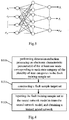
- the probabilistic neural network model has N input nodes: x 1 ⁇ x N , and M output nodes: y 1 ⁇ y M .
- the constructed neural network model is a probabilistic neural network model.
- the probabilistic neural network model is a parallel algorithm developed from Bayes minimum risk, and has advantages of short training time, being not easy to convergent to local optimum and being appropriate for mode classification. Therefore, detecting the state categories of the circuit to be detected based on the probabilistic neural network model is capable of further reducing the detection time and improving accuracy of detection.
- the step S12 can in particular comprise: setting the circuit to be detected according to each state category of the plurality of state categories, and measuring electrical characteristic parameter(s) of at least one node in the set circuit to be detected; and constructing a fault training sample set according to the plurality of state categories and the electrical characteristic parameter(s) of at least one node corresponding to each state category of the plurality of state categories.
- the state categories of the circuit can comprise a normal state and at least one fault state of the circuit to be detected, wherein the fault state commonly comprises a hard fault state and a soft fault state. Therefore, the fault training sample set constructed in step S12 can in particular comprise at least one of a hard fault training sample set and a soft fault training sample set. On such a basis, the step of "setting the circuit to be detected according to each state category of the plurality of state categories can in particular comprise at least one of the following operations:
- the plurality of state categories comprise at least one hard fault state category, setting an element(s) in the circuit to be detected corresponding to each hard fault state category of at least one hard fault state category as a short circuit state or an open circuit, state; in this case, then, acquiring an electrical characteristic parameter(s) of at least one node in the circuit to be detected corresponding to each hard fault state category of at least one hard fault state category; constructing a hard fault training sample set according to the at least one hard fault state category and the electrical characteristic parameter(s) of at least one node corresponding to each hard fault state category of at least one hard fault state category;
- the plurality of state categories comprise at least one soft fault state category
- short circuit or open circuit of the element can be set artificially by utilizing a device such as a laser cutting device.
- the Monte Carlo transient analysis can be performed on the set circuit to be detected by adopting a PSPICE software to acquire the electrical characteristic parameter(s) of the at least one node in the circuit to be detected corresponding to each state category of the plurality of state categories.
- the PSPICE software is a simulation software having strong circuit diagram drawing function, circuit simulation function, graphic post-processing function and element and device symbol designing function. Performing the Monte Carlo transient analysis on the set circuit to be detected by utilizing the PSPICE software can achieve great simulation analysis effect.
- the step S13 can in particular comprise: in step S131, constructing a fault sample target set.
- the fault sample target set is a corresponding relationship between a binary code output by the neural network and the plurality of state categories.
- the circuit to be detected can comprise three state categories, such as a state category A, a state category B and a state category C, and the neural network comprises three output nodes, and each output node outputs a series of binary codes.
- the fault sample target set includes: a binary code output by a neural network output 100corresponding to the state category A, a binary code of a neural network output 010 is corresponding to the state category B, and a binary code of a neural network output 001 is corresponding to the state category C.
- step S132 the fault training sample set is input to the neural network model to train the neural network model, and a trained neural network is obtained.
- the trained neural network needs to satisfy: when a currently measured electrical characteristic parameter of at least one node is input to the trained neural network, a state category to which a binary code output by the trained neural network is corresponding in the fault sample target set is consistent with a state category where the current circuit to be detected is actually in.
- electrical characteristic parameters of respective nodes corresponding to the state category A are input to the trained neural network, and the binary code output by the trained neural network shall be 100; electrical characteristic parameters of respective nodes corresponding to the state category B are input to the trained neural network, and the binary code output by the trained neural network shall be 010; electrical characteristic parameters of respective nodes corresponding to the state category C are input to the trained neural network, and the binary code output by the trained neural network shall be 001.
- the detection method for the operation state of the circuit can further comprise: step S130: performing dimension-reduction processing on the electrical characteristic parameter data of at least one node corresponding to each state category of the plurality of state categories in the fault training sample set.
- dimension-reduction processing can be performed on the electrical characteristic parameter data in the fault training sample set by utilizing the principal component analysis (hereinafter referred to as PCA).
- step S1 can further comprise: in step S14, constructing a correction sample set.
- the correction sample set comprises a plurality of state categories and an electrical characteristic parameter(s) of at least one node in the circuit to be detected corresponding to each state category of the plurality of state categories; and in step S15, correcting the trained neural network according to the correction sample set.
- step of constructing a correction sample set is executed after the step S13 just for illustrative description.
- step of constructing the correction sample set and the step of constructing the fault training sample set can be performed simultaneously.
- the correction sample set can comprise at least one of a hard fault correction sample set and a soft fault correction sample set.
- the neural network model is trained by using only the hard fault training sample set, correspondingly, the trained neural network can be corrected through the hard fault correction sample set.
- the neural network model is trained by using only the soft fault training sample set, correspondingly, the trained neural network can be corrected through the soft fault correction sample set.
- the neural network model is trained by using both the hard fault training sample set and the soft fault training sample set simultaneously, correspondingly, the trained neural network can be corrected through at least one of the hard fault correction sample set and the soft fault correction sample set.
- the step S14 can in particular comprise: setting the circuit to be detected according to each state category of the plurality of state categories, and measuring the electrical characteristic parameter(s) of at least one node in the set circuit to be detected; and constructing the correction sample set according to the plurality of state categories and the electrical characteristic parameter(s) of at least one node corresponding to each state category of the plurality of state categories.
- the step of "setting the circuit to be detected according to each state category of the plurality of state categories" can comprise at least one of following operations: if the plurality of state categories comprise at least one hard fault state category, setting an element in the circuit to be detected corresponding to each hard fault state category of at least one hard fault state category as a short circuit state or an open circuit state; and if the plurality of state categories comprise at least one soft fault state category, setting a parameter of an element in the circuit to be detected corresponding to each soft fault state category of at least one soft fault state categories to exceed its tolerance range, for example, performing a Monte Carlo transient analysis on the set circuit to be detected through the PSPICE software.
- short circuit or open circuit of the element can be set artificially by utilizing a device such as a laser cutting device.
- the Monte Carlo transient analysis can be performed on the set circuit to be detected by the PSPICE software to acquire the electrical characteristic parameter(s) of at least one node in the circuit to be detected corresponding to each state category of the plurality of state categories, or to acquire the electrical characteristic parameter by means of actual measurement,
- Step S15 can in particular comprise: inputting an electrical characteristic parameter(s) of at least one node in the correction sample set corresponding to each state category of the plurality of state categories into the trained neural network, so that the trained neural network outputs a binary code, comparing a correspondence relationship between the output binary code and the state category corresponding to the input electrical characteristic parameter(s) of at least node in the correction sample set with the fault sample target set, and determining whether an output result of the neural network is accurate. For example, an accuracy rate of the output result of the neural network can be compared with a predetermined threshold value.
- the accuracy rate is higher than or equal to the threshold value, then it is determined that the output result of the neural network is accurate, and the trained neural network can be used to detect faults of the circuit to be detected; if the accuracy rate is lower than the threshold value, then it is determined that the output result of the neural network is inaccurate, and at this time, the trained neural network needs to be re-trained.
- the detection method is applicable to various circuits, for example, a resistance circuit, a single-stage circuit of a LIPS product.
- the detection method of the operating state of the circuit will be described in detail by taking the structure of the circuit as shown in Figs. 6 and 7 as an example.
- the circuit as shown in Fig.6 comprises 20 resistors (R1 ⁇ R20), and 12 nodes (P1 ⁇ P12). It is assumed that the circuit comprises 8 state categories: one normal state and seven fault states, wherein the seven fault states comprise R1 +40%, R1 -50%, R6 open circuit, R9 short circuit, R18 open circuit, R20+50%, R19+50% and R20 open circuit.
- R1+40% and R1-50% represents that a parameter value of R1 is higher than 40% of the tolerance range
- R1-50% represents that a parameter value of R1 is lower than 40% of the tolerance rang, which both belong to software faults.
- Step H1 constructing a probabilistic neural network model, wherein the probabilistic neural network comprises 6 output nodes, 8 output nodes and input/output control algorithms.
- Step H2 for each state category of 8 state categories, performing the Monte Carlo transient analysis for 30 times, and acquiring voltages of nodes P2, P5, P6, P8, P9, P11 in the circuit to be detected under each state category.
- node voltages of 6 nodes in the circuit to be detected acquired by performing the Monte Carlo transient state analysis for 20 times are used to construct the fault training sample set
- node voltages of 6 nodes in the circuit to be detected acquired by performing the Monte Carlo transient analysis for 10 times are used to construct the correction sample set.
- the fault training sample set comprises 160 fault training samples.
- the correction sample set comprises 80 correction samples.
- Step H3 by utilizing a PCA algorithm, performing dimension-reduction processing on node voltage data of 6 nodes corresponding to each of the 8 state categories included in the fault training sample set.
- a part of codes of the PCA algorithm in the Matlab environment is as shown below:
- Step H4 constructing the fault sample target set, wherein the correspondence relationship between the binary code output by the probabilistic neural network and the state category is as shown in Table 1: Table 1 Output nodes of probabilistic neural network State category 1 2 3 4 5 6 7 8 1 0 0 0 0 0 0 0 0 0 Normal 0 1 0 0 0 0 0 0 R1+40% 0 0 1 0 0 0 0 0 R1-50% 0 0 0 1 0 0 0 0 R6 open cirucit 0 0 0 0 1 0 0 0 R9 short circuit 0 0 0 0 0 1 0 0 R18 open circuit 0 0 0 0 0 0 0 1 0 R20+50% 0 0 0 0 0 0 0 0 1 R19+50% R20 open circuit
- Step H5 inputting the fault training sample set on which the dimension-reduction processing has been performed into the probabilistic neural network model, and training the probabilistic neural network model to obtain the trained probabilistic neural network.
- a part of codes for realizing training the probabilistic neural network model in the Matlab environment are as sown below:
- Step H6 extracting node voltage data of 6 nodes corresponding to the four state categories R1-50%, R9 short circuit, R18 open circuit and R20+50% from the correction sample set respectively and correcting the trained neural network.
- node voltage data of 6 nodes corresponding to the four state categories R1-50%, R9 short circuit, R18 open circuit and R20+50% is as shown in Table 2: Table 2 P2 P5 P6 P8 P9 P11 State category 4.3491 3.1776 2.7966 3.2949 2.5171 2.9567 R1-50% 4.1771 3.3255 2.8933 3.9142 2.8470 3.7100 R9 short cicuit 4.0867 3.2338 2.8309 3.3183 2.8341 2.7899 R18 open circuit 4.0937 3.1390 2.7445 3.3669 2.6096 3.1128 R20+50%
- the node voltages of 6 nodes corresponding to the state category R1-50% are input to the trained probabilistic neural network respectively, and the binary code output by the probabilistic neural network is 00100000; node voltages of 6 nodes corresponding to the state category R9 short circuit are input to the trained probabilistic neural network respectively, and the binary code output by the probabilistic neural network is 00001000; node voltages of 6 nodes corresponding to the state category R18 open circuit are input to the trained probabilistic neural network, and the binary code output by the probabilistic neural network is 00000100; node voltages of 6 nodes corresponding to the state category R20+50% are input to the trained probabilistic neural network, and the binary code output by the probabilistic neural network is 00000010.
- Step H7 measuring node voltages of nodes P2, P5, P6, P8, P9, P11 in the circuit.
- Step H8 inputting measured node voltages into the trained probabilistic neural network and obtaining the state category of the circuit through the probabilistic neural network.
- the detection method of the operating state of the circuit according to the embodiment of the present disclosure can be further applied to the GOA circuit.
- display defects reflected on the display panel (LCD) for the damages of the GOA circuit for example, black screen of display, split screen of display, mess-up screen of display, and bright line at the bottom, etc.
- each display defect is corresponding to non-normal operating state of internal devices in the circuit.
- the single-stage GOA circuit comprises 8 transistors and 2 capacitors. It is assumed that the circuit comprises one normal state and four fault states.
- the fourth fault states are T1 open circuit, T3 open circuit, C1+50%, T4 current Ioff increase in a turn-off state.
- T1 open circuit and T3 open circuit are hard faults, and C1+50% and T4 Ioff increase are soft faults.
- external performance of the T1 open circuit is black screen of display
- external performance of T3 open circuit is split screen of display
- external performance of C1+50% is mess-up screen of display
- external performance of T4 Ioff is bright line at the bottom.
- the test can be performed by using actual TFT-LCD product.
- the specific method is to use Laser cutting to break down the corresponding components in the GOA circuit on the TFT-LCD product, that is, the corresponding fault can be simulated.
- voltage values of nodes P1-P9 in the GOA circuit as shown in Fig.7 are acquired by utilizing a laser probe device and an oscilloscope.
- the training sample set and the correction sample set can be obtained by using the Monte Carlo analysis according to the simulation method of the resistance circuit, details omitted herein.
- the above simulation data is input to the neural network model (for example, probabilistic neural network model PNN) to train and test the neural network model, so as to obtain the trained neural network.
- the neural network model for example, probabilistic neural network model PNN
- the above simulation data can be dimension-reduction firstly by using the PCA algorithm.
- a detection apparatus for an operating state of a circuit is provided in an embodiment of the present disclosure.
- the apparatus is corresponding to the detection method for the operating state of the circuit provided in the first embodiment.
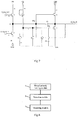
- the detection apparatus for the operating state of the circuit comprises a neural network forming module 1, a measuring module and a detection module 3.
- the neural network forming module 1 is configured to form a neural network for acquiring a state category of a circuit to be detected.
- the measuring module 2 is configured to measure an electrical characteristic parameter(s) of at least one node in the circuit to be detected.
- the detection module 3 is connected to the neural network forming module 1 and the measuring module 2, respectively, and configured to acquire the neural network and an electrical characteristic parameter(s) of at least one node in the circuit to be detected, input the measured electrical characteristic parameter(s) of at least one node into the neural network, and obtain the state category of the circuit to be detected through the neural network.
- the detection apparatus of the operating state of the circuit provided in the embodiment comprises the neural network forming module 1. Therefore, detecting the state category of the circuit to be detected by utilizing the neural network is capable of raising accuracy of the detection.
- the detection apparatus for the operating state of the circuit provided in the embodiment the state category in the circuit to be detected can be obtained only if the electrical characteristic parameter(s) of a part of nodes in the circuit to be detected is input to the neural network, i.e., acquiring the operating state of the circuit to be detected, without performing operations such as microscope detection, TFT characteristic testing or SEM splicing on the circuit to be detected, which greatly saves the time. Therefore, by adopting the detection apparatus for the operating state of the circuit provide in the present embodiment, it is capable of detecting the operating state in the circuit accurately and quickly.
- the electrical characteristic parameter(s) of the nodes can in particular be a node voltage parameter, a node current parameter or a node power parameter of the nodes. Of course, it can also be other electrical characteristic parameters that can be received by the neural network.
- the neural network forming module 1 comprises a model constructing sub-module 4, a training sample set constructing sub-module 5, and a training sub-module 6 connected to the model constructing sub-module 4, the training set constructing sub-module 5 and the detection module 3 respectively.
- the model constructing sub-module 4 is configured to construct the neural network model.
- the training sample set sub-module 5 is configured to construct the fault training sample set.
- the training sub-module 6 is configured to acquire a fault training sample set and a neural network model and train the neural network model according to the fault training sample set to obtain a trained neural network.
- a generalization capability of the trained neural network can be made strong, and a correct input/output mapping relationship can b obtained, so that accuracy of operational analysis of the neural network can be further enhanced.
- the model constructing sub-module 4 is used to construct a probabilistic neural network model.
- the constructed probabilistic neural network model comprises an input node, an output node and an input/output control algorithm.
- the probabilistic neural network model has advantages of short training time, being not easy to convergent to local optimum and being appropriate for mode classification. Therefore, detecting the state categories of the circuit to be detected by using the probabilistic neural network model is capable of further reducing the time spent on detection and raising accuracy of the detection.
- the state category of the circuit comprises a normal state and fault state(s), wherein the fault states generally comprise two states, i.e., hard fault and soft fault. Therefore, the training sample set constructing sub-module 5 can comprise at least one of a hard fault training sample set constructing unit 7, which is connected to the training sub-module 6, and a soft fault training sample set, which is connected to the training sub-module 6.
- the hard fault training sample set constructing unit 7 is configured to construct the hard fault training sample set.
- the constructed hard fault training sample set comprises at least one hard fault state category, and the electrical characteristic parameter(s) of at least one node in the circuit to be detected corresponding to each hard fault state category of at least one hard fault state category.
- the soft fault training sample set constructing unit 8 is configured to construct the soft fault training sample set.
- the constructed soft fault training sample set comprises at least one soft fault state category, and the electrical characteristic parameter(s) of the at least one node in the circuit to be detected corresponding to each soft fault state category of the at least one soft fault state category.
- the training sub-module 6 comprises a target set constructing unit 9 and a training execution unit 10.
- the target set constructing unit 9 is configured to construct the fault sample target set.
- the training execution unit 10 is connected to the detection module 3, the target set constructing unit 9, the model constructing sub-module 4, and the training sample set constructing sub-module 5 (at least one of the hard fault training sample set constructing unit 7 and the soft fault training sample set constructing unit 8) respectively, and is configured to acquire the fault sample target set, the neural network model, and at least one of the hard fault training sample set and the soft fault training sample set.
- the training execution unit 10 inputs at least one of the hard fault training sample set and the soft fault training sample set into the neural network model and trains the neural network according to the fault sample target set to obtain the trained neural network.
- the training sub-module 6 can further comprise a dimension-reduction unit 11 connected to the training execution unit 10 and the training sample set constructing sub-module 5 (at least one of the hard fault training sample set constructing unit 7 and the soft fault training sample set constructing unit 8) respectively.
- the dimension-reduction unit 11 is configured to perform dimension-reduction processing on the electrical characteristic parameter data of at least one node corresponding to each state category of the plurality of state categories in the fault training sample set, so as to exclude mutually-overlapped information in various information included in the fault training sample set.
- the neural network forming module 1 can further comprise a correction sample set constructing sub-module 12 configured to construct a correction sample set.
- the correction sample set comprises the plurality of state categories and the electrical characteristic parameter(s) of at least one node in the circuit to be detected corresponding to each state category of the plurality of state categories.
- the training sub-module 6 can further comprise a correction unit 13 connected to the correction sample set constructing sub-module 12 and the training execution unit 10 respectively.
- the correction unit 13 is configured to correct the trained neural network according to the correction sample set.
- the trained neural network can be tested according to the correction sample set, and accuracy can be determined when the neural network detects the operating state on the circuit to be detected. If it is determined as inaccurate, it is necessary to re-train the neural network whose training has been completed until the re-trained neural network detects the faults of the circuit to be detected.
- the correction sample set constructing sub-module 12 in particular comprises at least one of a hard fault correction sample set constructing unit 14 and a soft fault correction sample set constructing unit 15, which are connected to the correction unit 13.
- the hard fault correction sample set constructing unit 14 is configured to construct a hard fault correction sample set.
- the constructed hard fault training sample set comprises at least one hard fault state category, and the electrical characteristic parameter(s) of at least one node in the circuit to be detected corresponding to each hard fault stage category of at least one hard fault state categories.
- the soft fault correction sample set constructing unit 15 is configured to construct a soft fault correction sample set.
- the constructed soft fault training sample set comprises at least one soft fault state category, and the electrical characteristic parameter(s) of at least one node in the circuit to be detected corresponding to each soft fault state category of at least one soft fault state category.
- Respective modules, sub-modules and units included in the detection apparatus of the operating state of the circuit as described above can be realized by using one or more processors, and they can further comprise one or more memories for storing computer instructions. When the computer instructions are ran, the processor executes one or more steps or functions in the embodiment.
- the memory can be realized by various volatile or non-volatile memory devices of any type or combination thereof, such as a static random access memory (SRAM), an electrically erasable programmable read-only memory (EEPROM), an erasable programmable read-only memory (EPROM), a programmable read-only memory (PROM), a read-only memory (ROM), a magnetic memory, a flash memory, a magnetic disk or an optical disk.
- SRAM static random access memory
- EEPROM electrically erasable programmable read-only memory
- EPROM erasable programmable read-only memory
- PROM programmable read-only memory
- ROM read-only memory
- the processor can be logic operation device having data processing capability and/or program executing capability such as a central processing unit (CPU) or a field programmable gate array (FPGA) or a micro controller unit (MCU) or a digital signal processor (SDP) or a specific integrated circuit (ASIC) or a graphic processing unit (GPU).
- CPU central processing unit
- FPGA field programmable gate array
- MCU micro controller unit
- SDP digital signal processor
- ASIC application specific integrated circuit
- GPU graphic processing unit
- the computer instructions comprise one or more processor operations defined by an instruction set architecture corresponding to processors. These computer instructions can be included and represented logically by one or more computer programs.
Landscapes
- Engineering & Computer Science (AREA)
- Physics & Mathematics (AREA)
- General Physics & Mathematics (AREA)
- Theoretical Computer Science (AREA)
- General Engineering & Computer Science (AREA)
- Evolutionary Computation (AREA)
- Health & Medical Sciences (AREA)
- Artificial Intelligence (AREA)
- Computer Hardware Design (AREA)
- Biomedical Technology (AREA)
- Mathematical Physics (AREA)
- General Health & Medical Sciences (AREA)
- Molecular Biology (AREA)
- Computing Systems (AREA)
- Computational Linguistics (AREA)
- Biophysics (AREA)
- Data Mining & Analysis (AREA)
- Software Systems (AREA)
- Life Sciences & Earth Sciences (AREA)
- Medical Informatics (AREA)
- Probability & Statistics with Applications (AREA)
- Tests Of Electronic Circuits (AREA)
- Investigating Or Analyzing Materials By The Use Of Electric Means (AREA)
- Testing Electric Properties And Detecting Electric Faults (AREA)
Abstract
Description
- The present application claims the priority of a Chinese patent application No.
201710429375.3 filed on June 8, 2017 - The present disclosure relates to detection technique field, in particular to a detection method and a detection apparatus for an operating state of a circuit.
- In a thin film transistor-liquid crystal display (TFT-LCD) product, failures such as abnormal display would always occur to the product due to array manufacture procedure defects or design defects, and these problems are mostly caused by faults existing in the circuit of the product. By taking a gate driver on array (GOA) circuit as an example, the faults existing in the GOA circuit are usually classified into hard faults and soft faults. The hard fault refers to open circuit or short circuit which occurs to an element. When a hard fault occurs in the GOA circuit, topology structure of the circuit would change, thereby causing complete failure of the product. The soft fault means that a parameter of the element exceeds a predetermined tolerance range. When the GOA circuit has a soft fault, the soft fault would not directly cause complete failure of the product, but display performance of the product will be still influenced.
- In order to accurately find the causes of failures which occur to the product, performing fault detection on the GOA circuit becomes an essential step.
- There is provided in a first aspect of the present disclosure a detection method for an operating state of a circuit, comprising: forming a neural network that acquires a state category of a circuit to be detected; measuring an electrical characteristic parameter of at least one node in said circuit to be detected, inputting the measured electrical characteristic parameter of the at least one node to said neural network, and obtaining the state category of said circuit to be detected through said neural network.
- In one example, forming the neural network that acquires a state category of a circuit to be detected comprises: constructing a neural network model; constructing a fault training sample set, wherein said fault training sample set comprises a plurality of state categories and the electrical characteristic parameter of at least node in said circuit to be detected corresponding to each state category of the plurality of state categories, and said plurality of state categories comprise a normal state and at least one fault state of said circuit to be detected; training said neural network model according to said fault training sample set to obtain a trained neural network, wherein said neural network is used to acquire the state category of said circuit to be detected.
- In one example, constructing the fault training sample set comprises: setting said circuit to be detected according to each state category of said plurality of state categories, and measuring an electrical characteristic parameter of at least one node in a set circuit to be detected; constructing the fault training sample set according to said plurality of state categories and the electrical characteristic parameter of at least one node corresponding to each state category of said plurality of state categories.
- In one example, setting said circuit to be detected according to each state category of said plurality of state categories comprises at least one of following operations: when said plurality of state categories comprise at least one hard fault state category, setting an element in said circuit to be detected corresponding to each hard fault state category of said at least one hard fault state category as a short circuit state or an open circuit state; and when said plurality of state categories comprise at least one soft fault state category, setting a parameter of an element in said circuit to be detected corresponding to each soft fault state category of said at least one soft fault state category as exceeding its tolerance range, and performing a Monte Carlo transient analysis on said set circuit to be detected.
- In one example, training said neural network model according to said fault training sample set to obtain a trained neural network comprises: constructing a fault sample target set, wherein said fault sample target set is a correspondence relationship between a binary code output by said neural network and said plurality of state categories; inputting said fault training sample set to said neural network model to train said neural network model, to acquire the trained neural network.
- In one example, before constructing a fault sample target set, said method further comprises: performing dimension-reduction processing on electrical characteristic parameter data of at least one node corresponding to each state category of said plurality of state categories in the fault training sample set.
- In one example, forming the neural network that acquires the state category of the circuit to be detected comprises: constructing a correction sample set, wherein the correction sample set comprises a plurality of state categories and an electrical characteristic parameter of at least one node in said circuit to be detected corresponding to each state category of said plurality of state categories; after training said neural network model according to said fault training sample set to obtain a trained neural network, further comprising: correcting the trained neural network according to said correction sample set.
- In one example, constructing the correction sample set comprises: setting said circuit to be detected according to each state category of said plurality of state category, and measuring the electrical characteristic parameter of at least one node in a set circuit to be detected; constructing a correction sample set according to said plurality of state categories and an electrical characteristic parameter of at least one node corresponding to each state category of said plurality of state categories.
- In one example, setting said circuit to be detected according to each state category of said plurality of state categories comprises at least one of following operations: when said plurality of state categories comprise at least one hard fault state category, setting an element in said circuit to be detected corresponding to each hard fault state category of said at least hard fault state category as a short circuit state or an open circuit state; and, when said plurality of state categories comprise at least one soft fault state category, setting a parameter of an element in said circuit to be detected corresponding to each soft fault state category of said at least one soft fault state category as exceeding its tolerance range, and performing a Monte Carlo transient analysis on a set circuit to be detected.
- In one example, correcting a trained neural network according said correction sample set comprises: inputting the electrical characteristic parameter of at least one node in said correction sample set corresponding to each state category of said plurality of state categories into the trained neural network, so that the trained neural network outputs a binary code, comparing a correspondence relationship between an output binary code and a state category in said correction sample set corresponding to the electrical characteristic parameter of said at least one node with said fault sample target set, determining whether an output result of said neural network is accurate, and if it is determined as accurate, then the trained neural network is used to perform fault detection on said circuit to be detected; if it is determined as inaccurate, then the trained neural network is re-trained.
- There is provided in a second aspect of the present disclosure a detection apparatus for an operating state of a circuit, comprising: a neural network forming module, configured to form a neural network that acquires a state category of a circuit to be detected; a measuring module, configured to measure an electrical characteristic parameter of at least one node in said circuit to be detected; a detection module, connected to said neural network forming module and said measuring module respectively, and configured to acquire said neural network and an electrical characteristic parameter of at least one node in said circuit to be detected, input an acquired electrical characteristic parameter of at least one node to said neural network, and obtain the state category of said circuit to be detected through said the neural network.
- In one example, said neural network forming module comprises: a model constructing sub-module, configured to construct a neural network model; a training sample set constructing sub-module, configured to construct a fault training sample set; a training sub-module, connected to said module constructing sub-module, said training sample set constructing sub-module and said detection module respectively and configured to acquire said fault training sample set and said neural network model, and train said neural network model according to said fault training sample set to obtain a trained neural network.
- In one example, said training sample set constructing sub-module comprises at least one of a hard fault training sample set constructing unit and a soft fault training sample set constructing unit connected to said training sub-module, wherein said hard fault training sample set constructing unit is configured to construct a hard fault training sample set; said soft fault training sample set constructing unit is configured to construct a soft fault training sample set.
- In one example, said training sub-module comprises: a target set constructing unit, configured to construct a fault sample target set, said fault sample target set being a correspondence relationship between a binary code output by said neural network and said plurality of state categories; a training execution unit, connected to said detection module, said target set constructing unit, said model constructing sub-module and said training sample set constructing sub-module respectively, and configured to acquire said fault sample target set and said neural network model, input said fault training sample set to said neural network model, and train said neural network according to said fault sample target set to obtain a trained neural network.
- In one example, said training sub-module further comprises: a dimension reduction unit, connected to said training sample set constructing sub-module and said training execution unit respectively, and configured to perform dimension-reduction processing on electrical characteristic parameter of at least one node in said fault training sample set corresponding to each state category of different state categories.
- In one example, said neural network forming module comprises a correction sample set constructing sub-module, configured to construct a correction sample set; said training sub-module comprises a correction unit connected to said correction sample set constructing sub-module and said training execution unit respectively and configured to correct the trained neural network according to said correction sample set.
- In one example, said correction sample set constructing sub-module comprises at least one of a hard fault correction sample set constructing unit and a soft fault correction sample set constructing unit connected to said correction unit; wherein said hard fault correction sample set constructing unit is configured to construct a hard fault correction sample set; said soft fault correction sample set constructing unit is configured to construct a soft fault correction sample set.
- There is provided in a third aspect of the present disclosure a computer readable storage medium, configured to store computer instructions, wherein said computer instructions executes one or more steps in said detection method of the operating state of the circuit as described in the first aspect of the present disclosure when being ran by a processor.
- There is provided in a fourth aspect of the present disclosure a computer product, comprising one or more processors, wherein said processor is configured to run computer instructions to execute one or more steps of said detection method of the operating state of the circuit as described in the first aspect of the present disclosure.
- In order to describe technical solutions in embodiments of the present disclosure more clearly, accompanying figures that need to be used in the embodiments will be introduced simply. Obviously, the accompanying figures in the following description are just some embodiments of the present disclosure. For those ordinary skilled in the art, other accompanying figures can be obtained according to these accompanying figures without paying any inventive labor.
-
Fig.1 is a first flow chart of a detection method for an operating state of a circuit provided in a first embodiment of the present disclosure; -
Fig.2 is a second flow chart of a detection method for an operating state of a circuit provided in a first embodiment of the present disclosure; -
Fig.3 is a schematic diagram of a topology structure of a probabilistic neural network model provided in a first embodiment of the present disclosure; -
Fig.4 is a third flow chart of a detection method for an operating state provided in a first embodiment of the present disclosure; -
Fig.5 is a fourth flow chart of a detection method for an operating state of a circuit provided in a first embodiment of the present disclosure; -
Fig.6 is a schematic diagram of a structure of a resistance circuit provided in a first embodiment of the present disclosure; -
Fig.7 is a schematic diagram of a structure of a GOA circuit provided in a first embodiment of the present disclosure; -
Fig.8 is a first schematic diagram of a structure of a detection apparatus for an operating state of a circuit provided in a second embodiment of the present disclosure; -
Fig.9 is a second schematic diagram of a structure of a detection apparatus for an operating state of a circuit provided in a second embodiment of the present disclosure. - In order to make purposes, features and advantages of the present disclosure easier to be understood, technical solutions in embodiments of the present disclosure will be described clearly and completely by combining with accompanying figures in the embodiments of the present disclosure. Obviously, the embodiments described below are just a part of embodiments of the present disclosure, but not all the embodiments. Based on the embodiment in the present disclosure, all the other embodiments obtained by those ordinary skilled in the art without paying any inventive labor shall fall into the scope sought for protection in the present disclosure.
- In the related art, faults of the GOA circuit are detected usually by means of performing microscope detection on the GOA region under a microscope. However, this means can detect only hard faults, while soft faults of the GOA circuit cannot be identified. Therefore, additional determination on whether a GOA film layer is abnormal by means of TFT characteristics testing or scanning electron microscope (SEM) splicing is needed, so as to detect soft faults of the GOA circuit. However, the above-mentioned two detection methods both spend too much time, and have low detection efficiency, and thus being disadvantageous for analyzing and improving the failures of the GOA circuit.
- As shown in
Fig.1 , there is provided in the present embodiment a detection method for an operating state of a circuit. The detection method for the operating state of the circuit may comprise: step S1, forming a neural network that acquires a state category of a circuit to be detected; step S2, measuring electrical characteristic parameters of at least one node in the circuit to be detected; and step S3, inputting the measured electrical characteristic of at least one node to the neural network, and obtaining the state category in the circuit to be detected through the neural network. - In the detection method for the operating state of the circuit provided in the embodiments of the present disclosure, by inputting the measured electrical characteristic parameters of at least one node in the circuit to be detected into the neural network, the state category of the circuit to be detected can be obtained through the neural network. The detection method for the operating state of the circuit provided in the embodiments is based on the neural network. The neural network has advantages of self-learning, massively parallel processing, distributed storing and processing data, and in the process of detecting, the neural network can optimize itself constantly to enhance accuracy and efficiency of operational analysis, and thus detecting the state categories in the circuit to be detected by utilizing the neural network can enhance accuracy of the detection. Furthermore, in the process of detecting the state category of the circuit to be detected, the state category in the circuit to be detected can be obtained only by inputting the electrical characteristic parameters of a part of nodes in the circuit to be detected to the neural network. That is, the operating state of the circuit to be detected may be obtained without performing operations such as microscope detection, TFT characteristic testing or SEM splicing on the circuit to be detected, which greatly saves the time, and reduces complexity due to manual analysis work. Therefore, the detection method for the operating state of the circuit provided in the embodiments is capable of detecting the operating state of the circuit accurately and quickly.
- It needs to be specified that "forming a neural network that acquires a state category of a circuit to be detected" mentioned in
step S 1 may include acquiring the neural network based on the structure of the circuit, or acquiring the neural network using the existing neural network. Furthermore, when the neural network is obtained based on the structure of the circuit, the neural network may be obtained according to the structure of the circuit to be detected itself, or may be obtained according to a structure of other circuits which have a same structure as the circuit to be detected. - It needs to be specified that the electrical characteristic parameters of the node may be a node voltage parameter, a node current parameter or node power parameter of the node, and of course, may be other electrical characteristic parameters that can be received by the neural network, to which the present disclosure does not limit.
- It could be understood that a normal state included in the state categories refers to a state where the circuit to be detected has no fault and runs normally.
- As shown in
Fig.2 , step S1 can in particular comprise: step S11, constructing a neural network model; step S12: constructing a fault training sample set, wherein the fault training sample set can comprise a plurality of state categories and electrical characteristic parameters of at least one node in the circuit to be detected corresponding to each state category of the plurality of state categories, and the plurality of state categories can comprise a normal state and at least one fault state of the circuit to be detected; and step S13, training the neural network model according to the fault training sample set to obtain a trained neural network, wherein the trained neural network is used to acquire the state category of the circuit to be detected. - Herein, training the neural network model according to the fault training sample set refers to that the plurality of state categories in the fault training sample set and the electrical characteristic parameters of at least one node in the circuit to be detected corresponding to each state of the plurality of state categories are input into the neural network so that the neural network correctly knows a correspondence relationship between the electrical characteristic parameters of the at least one node and the state categories. Thus, after training of the neural network is completed, and when the electrical characteristic parameters of at least one node in the circuit to be detected is input to the neural network, the trained neural network can accurately output a state category corresponding to the input electrical characteristic parameters of at least one node.
- The process of training the neural network model can also be called as a learning process of the neural network model. By training the neural network model, it can make that the trained neural network has a stronger generalization capability, and thus obtains a correct input/output mapping relationship, so that it is capable of further increasing accuracy of operation and analysis of the neural network.
- Herein, step S11 can in particular comprise: constructing a probabilistic neural network model according to a newpnn() function in a Matlab neural network toolbox used for designing the neural network model. Herein, the constructed probabilistic neural network model is used to acquire the state category of the circuit to be detected. The probabilistic neural network model comprises an input node, an output node and an input/output control algorithm.
- Assuming that the circuit to be detected comprises N nodes, when the probabilistic neural network model is trained in subsequent process, for example, electrical characteristic parameters of N nodes corresponding to each state category of the plurality of state categories can be combined into an N-dimensional vector to be input to the probabilistic neural network model. Therefore, the number of the input nodes of the constructed probabilistic neural network model needs to equate to the number of dimensions N of the input vector, that is, the number of the input nodes of the probabilistic neural network model equates to the number of nodes in the circuit to be detected.
- By training the probabilistic neural network model utilizing the electrical characteristic parameters of the N nodes, it can be further guaranteed that the trained probabilistic neural network has a correct input/output mapping relationship. Of course, electrical characteristic parameters of only a part of nodes of the N nodes are input to the probabilistic neural network model. At this time, the number of the input nodes of the probabilistic neural network model is smaller than the number of nodes in the circuit to be detected.
- Assuming that the circuit to be detected has totally M state categories, in order to guarantee that it is capable of outputting any one state category of all the state categories by utilizing the probabilistic neural network, in one example, the number of output nodes of the constructed probabilistic neural network model should equate to the number M of the state categories in the circuit to be detected, that is, the number of the output nodes of the probabilistic neural network model equates to the number of the state categories in the circuit to be detected. In particular, as shown in
Fig.3 , the probabilistic neural network model has N input nodes: x1∼xN, and M output nodes: y1∼yM. - In the detection method for the operating state provided in the embodiment, the constructed neural network model is a probabilistic neural network model. Compared with a conventional BP neural network model, the probabilistic neural network model is a parallel algorithm developed from Bayes minimum risk, and has advantages of short training time, being not easy to convergent to local optimum and being appropriate for mode classification. Therefore, detecting the state categories of the circuit to be detected based on the probabilistic neural network model is capable of further reducing the detection time and improving accuracy of detection.
- In one example, the step S12 can in particular comprise: setting the circuit to be detected according to each state category of the plurality of state categories, and measuring electrical characteristic parameter(s) of at least one node in the set circuit to be detected; and constructing a fault training sample set according to the plurality of state categories and the electrical characteristic parameter(s) of at least one node corresponding to each state category of the plurality of state categories.
- The state categories of the circuit can comprise a normal state and at least one fault state of the circuit to be detected, wherein the fault state commonly comprises a hard fault state and a soft fault state. Therefore, the fault training sample set constructed in step S12 can in particular comprise at least one of a hard fault training sample set and a soft fault training sample set. On such a basis, the step of "setting the circuit to be detected according to each state category of the plurality of state categories can in particular comprise at least one of the following operations:
- if the plurality of state categories comprise at least one hard fault state category, setting an element(s) in the circuit to be detected corresponding to each hard fault state category of at least one hard fault state category as a short circuit state or an open circuit, state; in this case, then, acquiring an electrical characteristic parameter(s) of at least one node in the circuit to be detected corresponding to each hard fault state category of at least one hard fault state category; constructing a hard fault training sample set according to the at least one hard fault state category and the electrical characteristic parameter(s) of at least one node corresponding to each hard fault state category of at least one hard fault state category;
- And, when the plurality of state categories comprise at least one soft fault state category, setting a parameter(s) of an element(s) in the circuit to be detected corresponding to each fault state category of the at least one soft fault state category to exceed its tolerance range, and, for example, performing a Monte Carlo transient analysis on the set circuit to be detected through a PSPICE software; in this case, then, acquiring an electric characteristic parameter(s) of the at least one node in the circuit to be detected corresponding to each soft fault state category of the at least one soft fault state category, constructing a soft fault training sample set according to the at least one soft fault state category and the electrical characteristic parameter(s) of the at least one node corresponding to each soft fault state category of the at least one soft fault state category.
- It needs to be specified that besides simulating hard faults of the circuit by means of software, short circuit or open circuit of the element can be set artificially by utilizing a device such as a laser cutting device. Moreover, when the node voltage is being acquired, the Monte Carlo transient analysis can be performed on the set circuit to be detected by adopting a PSPICE software to acquire the electrical characteristic parameter(s) of the at least one node in the circuit to be detected corresponding to each state category of the plurality of state categories.
- It needs to be specified that the PSPICE software is a simulation software having strong circuit diagram drawing function, circuit simulation function, graphic post-processing function and element and device symbol designing function. Performing the Monte Carlo transient analysis on the set circuit to be detected by utilizing the PSPICE software can achieve great simulation analysis effect.
- As shown in
Fig.4 , the step S13 can in particular comprise: in step S131, constructing a fault sample target set. Herein, the fault sample target set is a corresponding relationship between a binary code output by the neural network and the plurality of state categories. - Exemplarily, the circuit to be detected can comprise three state categories, such as a state category A, a state category B and a state category C, and the neural network comprises three output nodes, and each output node outputs a series of binary codes. The fault sample target set includes: a binary code output by a neural network output 100corresponding to the state category A, a binary code of a neural network output 010 is corresponding to the state category B, and a binary code of a neural network output 001 is corresponding to the state category C.
- Next, in step S132: the fault training sample set is input to the neural network model to train the neural network model, and a trained neural network is obtained. The trained neural network needs to satisfy: when a currently measured electrical characteristic parameter of at least one node is input to the trained neural network, a state category to which a binary code output by the trained neural network is corresponding in the fault sample target set is consistent with a state category where the current circuit to be detected is actually in.
- Exemplarily, electrical characteristic parameters of respective nodes corresponding to the state category A are input to the trained neural network, and the binary code output by the trained neural network shall be 100; electrical characteristic parameters of respective nodes corresponding to the state category B are input to the trained neural network, and the binary code output by the trained neural network shall be 010; electrical characteristic parameters of respective nodes corresponding to the state category C are input to the trained neural network, and the binary code output by the trained neural network shall be 001.
- In order to exclude mutually-overlapped information among various information included in the fault training sample set, referring to
Fig.4 again, prior to the step S131, the detection method for the operation state of the circuit provided in the embodiment can further comprise: step S130: performing dimension-reduction processing on the electrical characteristic parameter data of at least one node corresponding to each state category of the plurality of state categories in the fault training sample set. In particular, dimension-reduction processing can be performed on the electrical characteristic parameter data in the fault training sample set by utilizing the principal component analysis (hereinafter referred to as PCA). - Additionally, as shown in
Fig.5 , step S1 can further comprise: in step S14, constructing a correction sample set. Herein, the correction sample set comprises a plurality of state categories and an electrical characteristic parameter(s) of at least one node in the circuit to be detected corresponding to each state category of the plurality of state categories; and in step S15, correcting the trained neural network according to the correction sample set. - It needs to be noted that the step of constructing a correction sample set is executed after the step S13 just for illustrative description. In the actual application, the step of constructing the correction sample set and the step of constructing the fault training sample set can be performed simultaneously.
- In particular, the correction sample set can comprise at least one of a hard fault correction sample set and a soft fault correction sample set. When the neural network model is trained by using only the hard fault training sample set, correspondingly, the trained neural network can be corrected through the hard fault correction sample set. When the neural network model is trained by using only the soft fault training sample set, correspondingly, the trained neural network can be corrected through the soft fault correction sample set. When the neural network model is trained by using both the hard fault training sample set and the soft fault training sample set simultaneously, correspondingly, the trained neural network can be corrected through at least one of the hard fault correction sample set and the soft fault correction sample set.
- On such a basis, the step S14 can in particular comprise: setting the circuit to be detected according to each state category of the plurality of state categories, and measuring the electrical characteristic parameter(s) of at least one node in the set circuit to be detected; and constructing the correction sample set according to the plurality of state categories and the electrical characteristic parameter(s) of at least one node corresponding to each state category of the plurality of state categories.
- In particular, the step of "setting the circuit to be detected according to each state category of the plurality of state categories" can comprise at least one of following operations: if the plurality of state categories comprise at least one hard fault state category, setting an element in the circuit to be detected corresponding to each hard fault state category of at least one hard fault state category as a short circuit state or an open circuit state; and if the plurality of state categories comprise at least one soft fault state category, setting a parameter of an element in the circuit to be detected corresponding to each soft fault state category of at least one soft fault state categories to exceed its tolerance range, for example, performing a Monte Carlo transient analysis on the set circuit to be detected through the PSPICE software.
- It needs to be specified that besides simulating the hard fault of the circuit by means of software, short circuit or open circuit of the element can be set artificially by utilizing a device such as a laser cutting device. Moreover, when the node voltage is being acquired, the Monte Carlo transient analysis can be performed on the set circuit to be detected by the PSPICE software to acquire the electrical characteristic parameter(s) of at least one node in the circuit to be detected corresponding to each state category of the plurality of state categories, or to acquire the electrical characteristic parameter by means of actual measurement,
- Step S15 can in particular comprise: inputting an electrical characteristic parameter(s) of at least one node in the correction sample set corresponding to each state category of the plurality of state categories into the trained neural network, so that the trained neural network outputs a binary code, comparing a correspondence relationship between the output binary code and the state category corresponding to the input electrical characteristic parameter(s) of at least node in the correction sample set with the fault sample target set, and determining whether an output result of the neural network is accurate. For example, an accuracy rate of the output result of the neural network can be compared with a predetermined threshold value. If the accuracy rate is higher than or equal to the threshold value, then it is determined that the output result of the neural network is accurate, and the trained neural network can be used to detect faults of the circuit to be detected; if the accuracy rate is lower than the threshold value, then it is determined that the output result of the neural network is inaccurate, and at this time, the trained neural network needs to be re-trained.
- Based on the above description, by testing the trained neural network through the correction sample set, accuracy can be determined when the neural network detects the operating state of the circuit to be detected. If it is determined as inaccurate, the trained neural network needs to be re-trained, until the re-trained neural network accurately detects the faults of the circuit to be detected.
- The detection method is applicable to various circuits, for example, a resistance circuit, a single-stage circuit of a LIPS product. The detection method of the operating state of the circuit will be described in detail by taking the structure of the circuit as shown in
Figs. 6 and7 as an example. - The circuit as shown in
Fig.6 comprises 20 resistors (R1∼R20), and 12 nodes (P1∼P12). It is assumed that the circuit comprises 8 state categories: one normal state and seven fault states, wherein the seven fault states comprise R1 +40%, R1 -50%, R6 open circuit, R9 short circuit, R18 open circuit, R20+50%, R19+50% and R20 open circuit. By taking R1+40% and R1-50% as an example, R1+40% represents that a parameter value of R1 is higher than 40% of the tolerance range, R1-50% represents that a parameter value of R1 is lower than 40% of the tolerance rang, which both belong to software faults. - Step H1: constructing a probabilistic neural network model, wherein the probabilistic neural network comprises 6 output nodes, 8 output nodes and input/output control algorithms.
- Step H2: for each state category of 8 state categories, performing the Monte Carlo transient analysis for 30 times, and acquiring voltages of nodes P2, P5, P6, P8, P9, P11 in the circuit to be detected under each state category. Herein, node voltages of 6 nodes in the circuit to be detected acquired by performing the Monte Carlo transient state analysis for 20 times are used to construct the fault training sample set, and node voltages of 6 nodes in the circuit to be detected acquired by performing the Monte Carlo transient analysis for 10 times are used to construct the correction sample set. It shall be known that for the circuit to be detected under each state category, voltages of nodes acquired by performing the Monte Carlo for a plurality of times are different or not the same completely, and thus the result of the Monte Carlo analysis for a plurality of times can form a plurality of samples.
- It needs to be specified that when the fault training sample set is constructed, since the Monte Carlo transient state analysis is performed on each state category of 8 state categories for 20 times, the fault training sample set comprises 160 fault training samples. For the same reason, when the correction sample set is constructed. Since the Monte Carlo transient state analysis is performed on each state category of 8 state categories for 10 times, the correction sample set comprises 80 correction samples.
- Step H3: by utilizing a PCA algorithm, performing dimension-reduction processing on node voltage data of 6 nodes corresponding to each of the 8 state categories included in the fault training sample set. Herein, a part of codes of the PCA algorithm in the Matlab environment is as shown below:
    samplemean=mean(allsamples); % taking a mean value of a sample matrix
    column=0;
    for j=1:m % normalization of the sample matrix
        for i=1:n
            column-column+(allsamples(i,j)-samplemean(1,j))^2;
        end
        Sj(1,j)=column/(n-1);
        column=0;
    end
    for j=1:m
        for i=1:n
    all(i,j)=(allsatnples(i,j)-samplemean(1,j))/((Sj(1,j))^0.5);
            end
        end
    [n,p]=size(all); % calculating a covariance matrix
    all=all-ones(n,1)*mean(all);
    cov=all'*all/(n-1);
    sigma-(cov'*cov)/(n-1); % calculating a characteristic value and a characteristic vector
    [v d]=eigs(sigma);
    d1=diag(d);
    [d2 index]=sort(d1);% ordering the characteristic value
    cols=size(v,2);
    for i=1:cols
        vsort(:,i)=v(:,index(cols-i+1));
        dsort(i)=d1(index(cols-i+1));
    end
    dsum=sum(dsort); % calculating a contribution rate of principal components
        dsum_extract=0;
        p=0;
        while(dsum_extract/dsum<0.85)
            p=p+1;
            dsum_extract=sum(dsort(1:p));
        end
| Output nodes of probabilistic neural | State category | ||||||||
| 1 | 2 | 3 | 4 | 5 | 6 | 7 | 8 | ||
| 1 | 0 | 0 | 0 | 0 | 0 | 0 | 0 | Normal | |
| 0 | 1 | 0 | 0 | 0 | 0 | 0 | 0 | R1+40% | |
| 0 | 0 | 1 | 0 | 0 | 0 | 0 | 0 | R1-50% | |
| 0 | 0 | 0 | 1 | 0 | 0 | 0 | 0 | R6 open cirucit | |
| 0 | 0 | 0 | 0 | 1 | 0 | 0 | 0 | R9 short circuit | |
| 0 | 0 | 0 | 0 | 0 | 1 | 0 | 0 | R18 open circuit | |
| 0 | 0 | 0 | 0 | 0 | 0 | 1 | 0 | R20+50% | |
| 0 | 0 | 0 | 0 | 0 | 0 | 0 | 1 | R19+50% R20 open circuit | |
                        tl=clock; % time starts
            net=newpnn(p,t,spread); %p is an input vector, t is a target vector, a value of
 spread is 0.1
            data=etime(clock,tl); % a trained neural network is stored
            save net2 net;
| P2 | P5 | P6 | P8 | P9 | P11 | State category |
| 4.3491 | 3.1776 | 2.7966 | 3.2949 | 2.5171 | 2.9567 | R1-50% |
| 4.1771 | 3.3255 | 2.8933 | 3.9142 | 2.8470 | 3.7100 | R9 short cicuit |
| 4.0867 | 3.2338 | 2.8309 | 3.3183 | 2.8341 | 2.7899 | R18 open circuit |
| 4.0937 | 3.1390 | 2.7445 | 3.3669 | 2.6096 | 3.1128 | R20+50% |
            load net2 net; % loading the trained neural network
    y=sim(net,p_test); % classifying a sample to be detected p_test
    yc=vec2ind(y); % a result is transformed into a row vector
Claims (19)
- A detection method for an operating state of a circuit, comprising:forming a neural network that acquires a state category of a circuit to be detected;measuring electrical characteristic parameters of at least one node in said circuit to be detected;inputting the measured electrical characteristic parameters of at least one node to said neural network, and obtaining the state category of said circuit to be detected through said neural network.
- The detection method for the operating state of the circuit according to claim 1, wherein forming the neural network that acquires the state category of a circuit to be detected comprises:constructing a neural network model;constructing a fault training sample set, wherein said fault training sample set comprises a plurality of state categories and the electrical characteristic parameters of at least one node in said circuit to be detected corresponding to each state category of the plurality of state categories, and said plurality of state categories comprise a normal state and at least one fault state of said circuit to be detected;training said neural network model according to said fault training sample set to obtain a trained neural network, wherein said neural network is used to acquire the state category of said circuit to be detected.
- The detection method for the operating state of the circuit according to claim 2, wherein constructing the fault training sample set comprises:setting said circuit to be detected according to each state category of said plurality of state categories, and measuring the electrical characteristic parameters of at least one node in the set circuit to be detected;constructing the fault training sample set according to said plurality of state categories and the electrical characteristic parameters of at least one node corresponding to each state category of said plurality of state categories.
- The detection method for the operating state of the circuit according to claim 3, wherein setting said circuit to be detected according to each state category of said plurality of state categories comprises at least one of following operations:when said plurality of state categories comprise at least one hard fault state category, setting an element in said circuit to be detected corresponding to each hard fault state category of said at least one hard fault state category as a short circuit state or an open circuit state; andwhen said plurality of state categories comprise at least one soft fault state category, setting a parameter of an element in said circuit to be detected corresponding to each soft fault state category of said at least one soft fault state category as exceeding its tolerance range, and performing a Monte Carlo transient analysis on said set circuit to be detected.
- The detection method for the operating state of the circuit according to claim 2, wherein
training said neural network model according to said fault training sample set to obtain the trained neural network comprises:constructing a fault sample target set, wherein said fault sample target set is a correspondence relationship between a binary code output by said neural network and said plurality of state categories;inputting said fault training sample set to said neural network model to train said neural network model, to acquire the trained neural network. - The detection method for the operating state of the circuit according to claim 5, wherein before constructing the fault sample target set, said method further comprises: performing dimension-reduction processing on electrical characteristic parameter data of at least one node corresponding to each state category of said plurality of state categories in said fault training sample set.
- The detection method of the operating state of the circuit according to any one of claims 1 to 6, wherein forming the neural network that acquires the state category of said circuit to be detected comprises: constructing a correction sample set, wherein said correction sample set comprises a plurality of state categories and electrical characteristic parameters of at least one node in said circuit to be detected corresponding to each state category of said plurality of state categories;
after training said neural network model according to said fault training sample set to obtain the trained neural network, further comprising: correcting the trained neural network according to said correction sample set. - The detection method for the operating state of the circuit according to claim 7, wherein constructing the correction sample set comprises:setting said circuit to be detected according to each state category of said plurality of state category, and measuring the electrical characteristic parameters of at least one node in a set circuit to be detected;constructing the correction sample set according to said plurality of state categories and the electrical characteristic parameters of at least one node corresponding to each state category of said plurality of state categories.
- The detection method for the operating state of the circuit according to claim 8, wherein setting said circuit to be detected according to each state category of said plurality of state categories comprises at least one of following operations:when said plurality of state categories comprise at least one hard fault state category, setting an element in said circuit to be detected corresponding to each hard fault state category of said at least hard fault state category as a short circuit state or an open circuit state; and,when said plurality of state categories comprise at least one soft fault state category, setting a parameter of an element in said circuit to be detected corresponding to each soft fault state category of said at least one soft fault state category as exceeding its tolerance range, and performing a Monte Carlo transient analysis on a set circuit to be detected.
- The detection method for the operating state of the circuit according to any one of claims 7 to 9, wherein correcting the trained neural network according to said correction sample set comprises:
inputting the electrical characteristic parameters of at least one node in said correction sample set corresponding to each state category of said plurality of state categories into the trained neural network, so that the trained neural network outputs a binary code, comparing a correspondence relationship between the output binary code and a state category in said correction sample set corresponding to the electrical characteristic parameters of said at least one node with said fault sample target set, determining whether the output of said neural network is accurate, and if it is determined as accurate, then the trained neural network is used to perform fault detection on said circuit to be detected; if it is determined as inaccurate, then the trained neural network is re-trained. - A detection apparatus for an operating state of a circuit, comprising:a neural network forming module, configured to form a neural network that acquires a state category of a circuit to be detected;a measuring module, configured to measure electrical characteristic parameters of at least one node in said circuit to be detected;a detection module connected to said neural network forming module and said measuring module respectively, and configured to acquire said neural network and the electrical characteristic parameters of at least one node in said circuit to be detected, input an acquired electrical characteristic parameters of at least one node to said neural network, and obtain the state category of said circuit to be detected through said the neural network.
- The apparatus for the operating state of the circuit according to claim 11, wherein said neural network forming module comprises:a model constructing sub-module, configured to construct a neural network model;a training sample set constructing sub-module, configured to construct a fault training sample set;a training sub-module, connected to said module constructing sub-module, said training sample set constructing sub-module and said detection module respectively, and configured to acquire said fault training sample set and said neural network model, train said neural network model according to said fault training sample set to obtain a trained neural network.
- The apparatus for the operating state of the circuit according to claim 12, wherein,
said training sample set constructing sub-module comprises at least one of a hard fault training sample set constructing unit and a soft fault training sample set constructing unit connected to said training sub-module,
wherein said hard fault training sample set constructing unit is configured to construct a hard fault training sample set; said soft fault training sample set constructing unit is configured to construct a soft fault training sample set. - The apparatus for the operating state of the circuit according to claim 12, wherein, said training sub-module comprises:a target set constructing unit, configured to construct a fault sample target set, said fault sample target set being a correspondence relationship between a binary code output by said neural network and said plurality of state categories;a training execution unit, connected to said detection module, said target set constructing unit, said model constructing sub-module and said training sample set constructing sub-module respectively, and configured to acquire said fault sample target set and said neural network model, input said fault training sample set to said neural network model, and train said neural network according to said fault sample target set to obtain a trained neural network.
- The apparatus for the operating state of the circuit according to claim 14, wherein said training sub-module further comprises: a dimension reduction unit, connected to said training sample set constructing sub-module and said training execution unit respectively, and configured to perform dimension-reduction processing on electrical characteristic parameters data of at least one node in said fault training sample set corresponding to each state category of a plurality of state categories.
- The apparatus for the operating state of the circuit according to any one of claims 11-15, wherein said neural network forming module comprises a correction sample set constructing sub-module configured to construct a correction sample set;
said training sub-module comprises a correction unit connected to said correction sample set constructing sub-module and said training execution unit respectively and configured to correct the trained neural network according to said correction sample set. - The apparatus for the operating state of the circuit according to claim 16, wherein said correction sample set constructing sub-module comprises at least one of a hard fault correction sample set constructing unit and a soft fault correction sample set constructing unit connected to said correction unit; wherein said hard fault correction sample set constructing unit is configured to construct a hard fault correction sample set; said soft fault correction sample set constructing unit is configured to construct a soft fault correction sample set.
- A computer readable storage medium, configured to store computer instructions, wherein said computer instructions executes one or more steps in said detection method of the operating state of the circuit according to any one of claims 1 to 10 when being ran by a processor.
- A computer product, comprising one or more processors, wherein said processor is configured to run computer instructions to execute one or more steps of said detection method of the operating state of the circuit according to any one of claims 1 to 10.
Applications Claiming Priority (2)
| Application Number | Priority Date | Filing Date | Title |
|---|---|---|---|
| CN201710429375.3A CN107192939A (en) | 2017-06-08 | 2017-06-08 | A kind of detection method and detecting system of the working condition of circuit |
| PCT/CN2018/088745 WO2018223865A1 (en) | 2017-06-08 | 2018-05-28 | Circuit working state testing method and testing device |
Publications (2)
| Publication Number | Publication Date |
|---|---|
| EP3637117A1 true EP3637117A1 (en) | 2020-04-15 |
| EP3637117A4 EP3637117A4 (en) | 2021-03-17 |
Family
ID=59876678
Family Applications (1)
| Application Number | Title | Priority Date | Filing Date |
|---|---|---|---|
| EP18814279.8A Withdrawn EP3637117A4 (en) | 2017-06-08 | 2018-05-28 | TESTING PROCEDURE AND TESTING DEVICE FOR SHIFTING OPERATIONAL CONDITION |
Country Status (4)
| Country | Link |
|---|---|
| US (1) | US11017700B2 (en) |
| EP (1) | EP3637117A4 (en) |
| CN (1) | CN107192939A (en) |
| WO (1) | WO2018223865A1 (en) |
Cited By (1)
| Publication number | Priority date | Publication date | Assignee | Title |
|---|---|---|---|---|
| CN118914916A (en) * | 2024-08-12 | 2024-11-08 | 达测科技(广州)股份有限公司 | Current detection method and system based on LED fault test power supply |
Families Citing this family (21)
| Publication number | Priority date | Publication date | Assignee | Title |
|---|---|---|---|---|
| CN107192939A (en) * | 2017-06-08 | 2017-09-22 | 京东方科技集团股份有限公司 | A kind of detection method and detecting system of the working condition of circuit |
| CN108877721B (en) * | 2018-07-26 | 2020-07-24 | 京东方科技集团股份有限公司 | Shift register unit, gate drive circuit, display device and drive method |
| US11341034B2 (en) * | 2018-08-06 | 2022-05-24 | International Business Machines Corporation | Analysis of verification parameters for training reduction |
| CN111194431A (en) * | 2018-09-14 | 2020-05-22 | 西安大医集团有限公司 | Method, device and system for diagnosing state of radiotherapy equipment and storage medium |
| CN110967618A (en) * | 2019-03-21 | 2020-04-07 | 宁德时代新能源科技股份有限公司 | Circuit parameter detection method and detection device |
| CN111142060B (en) * | 2019-12-02 | 2023-11-07 | 国网浙江省电力有限公司 | An adaptive threshold adjustment diagnostic method based on improved BP neural network |
| CN111025128A (en) * | 2019-12-20 | 2020-04-17 | 中国人民解放军陆军军医大学第一附属医院 | Medical equipment fault detection system and method based on AI |
| JP7504601B2 (en) * | 2020-01-28 | 2024-06-24 | 株式会社東芝 | Signal processing device, signal processing method and program |
| CN112528845B (en) * | 2020-12-11 | 2022-09-20 | 华中师范大学 | Physical circuit diagram identification method based on deep learning and application thereof |
| CN112731102B (en) * | 2020-12-23 | 2021-12-21 | 四川长虹电器股份有限公司 | Liquid crystal display television backlight fault detection method |
| CN112581031B (en) * | 2020-12-30 | 2023-10-17 | 杭州朗阳科技有限公司 | Method for implementing real-time monitoring of motor abnormality by Recurrent Neural Network (RNN) through C language |
| CN113391188B (en) * | 2021-04-22 | 2022-04-22 | 厦门大学 | Self-calibration system and method based on neural network |
| CN113687209A (en) * | 2021-07-15 | 2021-11-23 | 上海华岭集成电路技术股份有限公司 | Integrated circuit test abnormity analysis system and method based on deep learning |
| CN113554010B (en) * | 2021-09-22 | 2022-01-21 | 广东电网有限责任公司东莞供电局 | Power grid line fault recognition model training method |
| CN114330437B (en) * | 2021-12-28 | 2025-11-07 | 北京百度网讯科技有限公司 | Fault detection method and training method and device of fault classification model |
| CN114626307B (en) * | 2022-03-29 | 2023-04-07 | 电子科技大学 | Distributed consistent target state estimation method based on variational Bayes |
| CN115146569A (en) * | 2022-07-25 | 2022-10-04 | 中国科学院微电子研究所 | A kind of integrated circuit delay determination method, device and equipment |
| CN116799966B (en) * | 2023-08-25 | 2023-10-20 | 石家庄长川电气科技有限公司 | Big data-based monitoring system and method |
| CN117176550B (en) * | 2023-09-25 | 2024-03-19 | 云念软件(广东)有限公司 | Integrated operation maintenance method and system based on fault identification |
| CN118918806A (en) * | 2024-10-11 | 2024-11-08 | 深圳市中润光电技术有限公司 | Operation monitoring method and system of LED display screen |
| CN119936549B (en) * | 2025-04-09 | 2025-07-15 | 国网山西省电力公司经济技术研究院 | Power quality assessment method and system for power distribution network |
Family Cites Families (17)
| Publication number | Priority date | Publication date | Assignee | Title |
|---|---|---|---|---|
| DE4333259C1 (en) * | 1993-09-27 | 1995-05-24 | Siemens Ag | Method for generating a direction signal indicating the direction of a short-circuit current |
| US5537327A (en) * | 1993-10-22 | 1996-07-16 | New York State Electric & Gas Corporation | Method and apparatus for detecting high-impedance faults in electrical power systems |
| JP2000329812A (en) | 1999-05-21 | 2000-11-30 | Fuji Electric Co Ltd | Power System Accident Point Rating System |
| DE602006002896D1 (en) * | 2005-02-14 | 2008-11-13 | Denso Corp | Method and device for detecting the charging status of a secondary battery based on neural network calculation |
| US20070130491A1 (en) | 2005-12-06 | 2007-06-07 | Mazumder Didarul A | Error detection of digital logic circuits using hierarchical neural networks |
| CN101221213A (en) * | 2008-01-25 | 2008-07-16 | 湖南大学 | Neural Network Method for Fault Diagnosis of Analog Circuits Based on Particle Swarm Optimization |
| CN101231672A (en) * | 2008-02-02 | 2008-07-30 | 湖南大学 | Soft Fault Diagnosis Method for Analog Circuits Based on Improved BP Neural Network |
| CN101231673A (en) * | 2008-02-02 | 2008-07-30 | 湖南大学 | An Analog Circuit Fault Diagnosis Method Using Immune Ant Algorithm Optimization |
| CN101404071B (en) | 2008-11-07 | 2010-07-14 | 湖南大学 | Electronic Circuit Fault Diagnosis Neural Network Method Based on Grouping Particle Swarm Optimization |
| CN101819253B (en) | 2010-04-20 | 2013-10-23 | 湖南大学 | A Fault Diagnosis Method of Tolerance Circuit Based on Probabilistic Neural Network |
| CN101871994B (en) * | 2010-06-11 | 2012-03-21 | 南京航空航天大学 | Method for diagnosing faults of analog circuit of multi-fractional order information fusion |
| US8589317B2 (en) * | 2010-12-16 | 2013-11-19 | Microsoft Corporation | Human-assisted training of automated classifiers |
| CN102129030A (en) * | 2010-12-28 | 2011-07-20 | 长沙河野电气科技有限公司 | Analog circuit genetic neural network diagnosis system using uniform spatial characteristics |
| CN102305910A (en) * | 2011-06-22 | 2012-01-04 | 长沙河野电气科技有限公司 | Fuzzy neural network-based large-scale direct current analog circuit interval diagnosis method |
| CN103267941B (en) * | 2013-05-07 | 2015-05-27 | 长沙学院 | Method for testing fault modes of integrated switching current circuit |
| CN103439647A (en) * | 2013-08-28 | 2013-12-11 | 深圳华越天芯电子有限公司 | Analog circuit fault diagnosis method for dynamic supply current monitoring |
| CN107192939A (en) | 2017-06-08 | 2017-09-22 | 京东方科技集团股份有限公司 | A kind of detection method and detecting system of the working condition of circuit |
-
2017
- 2017-06-08 CN CN201710429375.3A patent/CN107192939A/en active Pending
-
2018
- 2018-05-28 EP EP18814279.8A patent/EP3637117A4/en not_active Withdrawn
- 2018-05-28 WO PCT/CN2018/088745 patent/WO2018223865A1/en not_active Ceased
- 2018-05-28 US US16/329,902 patent/US11017700B2/en not_active Expired - Fee Related
Cited By (1)
| Publication number | Priority date | Publication date | Assignee | Title |
|---|---|---|---|---|
| CN118914916A (en) * | 2024-08-12 | 2024-11-08 | 达测科技(广州)股份有限公司 | Current detection method and system based on LED fault test power supply |
Also Published As
| Publication number | Publication date |
|---|---|
| US11017700B2 (en) | 2021-05-25 |
| EP3637117A4 (en) | 2021-03-17 |
| US20190228691A1 (en) | 2019-07-25 |
| WO2018223865A1 (en) | 2018-12-13 |
| CN107192939A (en) | 2017-09-22 |
Similar Documents
| Publication | Publication Date | Title |
|---|---|---|
| US11017700B2 (en) | Circuit working state testing method and testing device | |
| US10650910B2 (en) | Semiconductor fault analysis device and fault analysis method thereof | |
| US11232020B2 (en) | Fault detection using breakpoint value-based fingerprints of failing regression test cases | |
| US20190287016A1 (en) | Computer-readable recording medium, learning method, and learning device | |
| WO2008125998A1 (en) | Analog circuit testing and test pattern generation | |
| CN115841046B (en) | Accelerated degradation test data processing method and device based on Wiener process | |
| JP4500338B2 (en) | Test pattern evaluation method and test pattern evaluation apparatus | |
| CN110907810A (en) | A Single-Fault Diagnosis Method for Analog Circuits Based on Particle Swarm Optimization | |
| WO2020098557A1 (en) | Method and apparatus for determining jitter, storage medium and electronic device | |
| JP2715956B2 (en) | Method for narrowing down a failure portion of CMOS logic circuit using Iddq | |
| US10054634B2 (en) | Test device | |
| US7962302B2 (en) | Predicting wafer failure using learned probability | |
| CN118278553A (en) | Product quality detection method, device, computer equipment and storage medium | |
| US20180372799A1 (en) | Testing mechanism for a proximity fail probability of defects across integrated chips | |
| US8397113B2 (en) | Method and system for identifying power defects using test pattern switching activity | |
| CN116540059B (en) | Semiconductor chip testing method, device, equipment and storage medium | |
| CN104835435B (en) | The method of testing and test device of a kind of Liquid Crystal Module | |
| CN115410502B (en) | Display device, detection circuit and detection method thereof | |
| CN112505533A (en) | Analog circuit double-fault diagnosis method based on improved particle swarm optimization | |
| US9595316B2 (en) | Design-for-test apparatuses and techniques | |
| CN111506506A (en) | Test method, device, equipment and readable storage medium | |
| US10725454B2 (en) | Mask process aware calibration using mask pattern fidelity inspections | |
| JP4921751B2 (en) | Fault detection simulation system, fault detection simulation method and program | |
| US12169449B1 (en) | System, method, and computer program for test-related automatic tracing | |
| CN111967208A (en) | Construction method and device of testability evaluation simulation model |
Legal Events
| Date | Code | Title | Description |
|---|---|---|---|
| STAA | Information on the status of an ep patent application or granted ep patent |
Free format text: STATUS: THE INTERNATIONAL PUBLICATION HAS BEEN MADE |
|
| PUAI | Public reference made under article 153(3) epc to a published international application that has entered the european phase |
Free format text: ORIGINAL CODE: 0009012 |
|
| STAA | Information on the status of an ep patent application or granted ep patent |
Free format text: STATUS: REQUEST FOR EXAMINATION WAS MADE |
|
| 17P | Request for examination filed |
Effective date: 20190305 |
|
| AK | Designated contracting states |
Kind code of ref document: A1 Designated state(s): AL AT BE BG CH CY CZ DE DK EE ES FI FR GB GR HR HU IE IS IT LI LT LU LV MC MK MT NL NO PL PT RO RS SE SI SK SM TR |
|
| AX | Request for extension of the european patent |
Extension state: BA ME |
|
| DAV | Request for validation of the european patent (deleted) | ||
| DAX | Request for extension of the european patent (deleted) | ||
| A4 | Supplementary search report drawn up and despatched |
Effective date: 20210212 |
|
| RIC1 | Information provided on ipc code assigned before grant |
Ipc: G09G 3/00 20060101ALI20210208BHEP Ipc: G06N 7/00 20060101ALI20210208BHEP Ipc: G09G 3/20 20060101ALI20210208BHEP Ipc: G01R 31/317 20060101ALI20210208BHEP Ipc: G06N 3/08 20060101ALI20210208BHEP Ipc: G01R 31/28 20060101AFI20210208BHEP Ipc: G06N 3/04 20060101ALI20210208BHEP |
|
| STAA | Information on the status of an ep patent application or granted ep patent |
Free format text: STATUS: THE APPLICATION HAS BEEN WITHDRAWN |
|
| 18W | Application withdrawn |
Effective date: 20220411 |