EP3636703A1 - Rubber composition, vulcanized rubber, rubber product, and tire - Google Patents
Rubber composition, vulcanized rubber, rubber product, and tire Download PDFInfo
- Publication number
- EP3636703A1 EP3636703A1 EP18812691.6A EP18812691A EP3636703A1 EP 3636703 A1 EP3636703 A1 EP 3636703A1 EP 18812691 A EP18812691 A EP 18812691A EP 3636703 A1 EP3636703 A1 EP 3636703A1
- Authority
- EP
- European Patent Office
- Prior art keywords
- rubber
- mass
- rubber composition
- resin
- polyhydric alcohol
- Prior art date
- Legal status (The legal status is an assumption and is not a legal conclusion. Google has not performed a legal analysis and makes no representation as to the accuracy of the status listed.)
- Granted
Links
Images
Classifications
-
- C—CHEMISTRY; METALLURGY
- C08—ORGANIC MACROMOLECULAR COMPOUNDS; THEIR PREPARATION OR CHEMICAL WORKING-UP; COMPOSITIONS BASED THEREON
- C08J—WORKING-UP; GENERAL PROCESSES OF COMPOUNDING; AFTER-TREATMENT NOT COVERED BY SUBCLASSES C08B, C08C, C08F, C08G or C08H
- C08J9/00—Working-up of macromolecular substances to porous or cellular articles or materials; After-treatment thereof
- C08J9/0014—Use of organic additives
- C08J9/0023—Use of organic additives containing oxygen
-
- C—CHEMISTRY; METALLURGY
- C08—ORGANIC MACROMOLECULAR COMPOUNDS; THEIR PREPARATION OR CHEMICAL WORKING-UP; COMPOSITIONS BASED THEREON
- C08L—COMPOSITIONS OF MACROMOLECULAR COMPOUNDS
- C08L7/00—Compositions of natural rubber
-
- B—PERFORMING OPERATIONS; TRANSPORTING
- B60—VEHICLES IN GENERAL
- B60C—VEHICLE TYRES; TYRE INFLATION; TYRE CHANGING; CONNECTING VALVES TO INFLATABLE ELASTIC BODIES IN GENERAL; DEVICES OR ARRANGEMENTS RELATED TO TYRES
- B60C1/00—Tyres characterised by the chemical composition or the physical arrangement or mixture of the composition
-
- C—CHEMISTRY; METALLURGY
- C08—ORGANIC MACROMOLECULAR COMPOUNDS; THEIR PREPARATION OR CHEMICAL WORKING-UP; COMPOSITIONS BASED THEREON
- C08J—WORKING-UP; GENERAL PROCESSES OF COMPOUNDING; AFTER-TREATMENT NOT COVERED BY SUBCLASSES C08B, C08C, C08F, C08G or C08H
- C08J9/00—Working-up of macromolecular substances to porous or cellular articles or materials; After-treatment thereof
- C08J9/0061—Working-up of macromolecular substances to porous or cellular articles or materials; After-treatment thereof characterized by the use of several polymeric components
-
- C—CHEMISTRY; METALLURGY
- C08—ORGANIC MACROMOLECULAR COMPOUNDS; THEIR PREPARATION OR CHEMICAL WORKING-UP; COMPOSITIONS BASED THEREON
- C08J—WORKING-UP; GENERAL PROCESSES OF COMPOUNDING; AFTER-TREATMENT NOT COVERED BY SUBCLASSES C08B, C08C, C08F, C08G or C08H
- C08J9/00—Working-up of macromolecular substances to porous or cellular articles or materials; After-treatment thereof
- C08J9/0066—Use of inorganic compounding ingredients
-
- C—CHEMISTRY; METALLURGY
- C08—ORGANIC MACROMOLECULAR COMPOUNDS; THEIR PREPARATION OR CHEMICAL WORKING-UP; COMPOSITIONS BASED THEREON
- C08J—WORKING-UP; GENERAL PROCESSES OF COMPOUNDING; AFTER-TREATMENT NOT COVERED BY SUBCLASSES C08B, C08C, C08F, C08G or C08H
- C08J9/00—Working-up of macromolecular substances to porous or cellular articles or materials; After-treatment thereof
- C08J9/0085—Use of fibrous compounding ingredients
-
- C—CHEMISTRY; METALLURGY
- C08—ORGANIC MACROMOLECULAR COMPOUNDS; THEIR PREPARATION OR CHEMICAL WORKING-UP; COMPOSITIONS BASED THEREON
- C08J—WORKING-UP; GENERAL PROCESSES OF COMPOUNDING; AFTER-TREATMENT NOT COVERED BY SUBCLASSES C08B, C08C, C08F, C08G or C08H
- C08J9/00—Working-up of macromolecular substances to porous or cellular articles or materials; After-treatment thereof
- C08J9/04—Working-up of macromolecular substances to porous or cellular articles or materials; After-treatment thereof using blowing gases generated by a previously added blowing agent
- C08J9/06—Working-up of macromolecular substances to porous or cellular articles or materials; After-treatment thereof using blowing gases generated by a previously added blowing agent by a chemical blowing agent
- C08J9/10—Working-up of macromolecular substances to porous or cellular articles or materials; After-treatment thereof using blowing gases generated by a previously added blowing agent by a chemical blowing agent developing nitrogen, the blowing agent being a compound containing a nitrogen-to-nitrogen bond
- C08J9/102—Azo-compounds
- C08J9/103—Azodicarbonamide
-
- C—CHEMISTRY; METALLURGY
- C08—ORGANIC MACROMOLECULAR COMPOUNDS; THEIR PREPARATION OR CHEMICAL WORKING-UP; COMPOSITIONS BASED THEREON
- C08J—WORKING-UP; GENERAL PROCESSES OF COMPOUNDING; AFTER-TREATMENT NOT COVERED BY SUBCLASSES C08B, C08C, C08F, C08G or C08H
- C08J9/00—Working-up of macromolecular substances to porous or cellular articles or materials; After-treatment thereof
- C08J9/04—Working-up of macromolecular substances to porous or cellular articles or materials; After-treatment thereof using blowing gases generated by a previously added blowing agent
- C08J9/06—Working-up of macromolecular substances to porous or cellular articles or materials; After-treatment thereof using blowing gases generated by a previously added blowing agent by a chemical blowing agent
- C08J9/10—Working-up of macromolecular substances to porous or cellular articles or materials; After-treatment thereof using blowing gases generated by a previously added blowing agent by a chemical blowing agent developing nitrogen, the blowing agent being a compound containing a nitrogen-to-nitrogen bond
- C08J9/107—Nitroso compounds
-
- C—CHEMISTRY; METALLURGY
- C08—ORGANIC MACROMOLECULAR COMPOUNDS; THEIR PREPARATION OR CHEMICAL WORKING-UP; COMPOSITIONS BASED THEREON
- C08K—Use of inorganic or non-macromolecular organic substances as compounding ingredients
- C08K5/00—Use of organic ingredients
- C08K5/04—Oxygen-containing compounds
- C08K5/05—Alcohols; Metal alcoholates
- C08K5/053—Polyhydroxylic alcohols
-
- C—CHEMISTRY; METALLURGY
- C08—ORGANIC MACROMOLECULAR COMPOUNDS; THEIR PREPARATION OR CHEMICAL WORKING-UP; COMPOSITIONS BASED THEREON
- C08K—Use of inorganic or non-macromolecular organic substances as compounding ingredients
- C08K5/00—Use of organic ingredients
- C08K5/16—Nitrogen-containing compounds
- C08K5/22—Compounds containing nitrogen bound to another nitrogen atom
- C08K5/23—Azo-compounds
-
- C—CHEMISTRY; METALLURGY
- C08—ORGANIC MACROMOLECULAR COMPOUNDS; THEIR PREPARATION OR CHEMICAL WORKING-UP; COMPOSITIONS BASED THEREON
- C08K—Use of inorganic or non-macromolecular organic substances as compounding ingredients
- C08K5/00—Use of organic ingredients
- C08K5/16—Nitrogen-containing compounds
- C08K5/34—Heterocyclic compounds having nitrogen in the ring
- C08K5/3467—Heterocyclic compounds having nitrogen in the ring having more than two nitrogen atoms in the ring
- C08K5/3477—Six-membered rings
-
- C—CHEMISTRY; METALLURGY
- C08—ORGANIC MACROMOLECULAR COMPOUNDS; THEIR PREPARATION OR CHEMICAL WORKING-UP; COMPOSITIONS BASED THEREON
- C08L—COMPOSITIONS OF MACROMOLECULAR COMPOUNDS
- C08L9/00—Compositions of homopolymers or copolymers of conjugated diene hydrocarbons
-
- C—CHEMISTRY; METALLURGY
- C08—ORGANIC MACROMOLECULAR COMPOUNDS; THEIR PREPARATION OR CHEMICAL WORKING-UP; COMPOSITIONS BASED THEREON
- C08J—WORKING-UP; GENERAL PROCESSES OF COMPOUNDING; AFTER-TREATMENT NOT COVERED BY SUBCLASSES C08B, C08C, C08F, C08G or C08H
- C08J2201/00—Foams characterised by the foaming process
- C08J2201/02—Foams characterised by the foaming process characterised by mechanical pre- or post-treatments
- C08J2201/026—Crosslinking before of after foaming
-
- C—CHEMISTRY; METALLURGY
- C08—ORGANIC MACROMOLECULAR COMPOUNDS; THEIR PREPARATION OR CHEMICAL WORKING-UP; COMPOSITIONS BASED THEREON
- C08J—WORKING-UP; GENERAL PROCESSES OF COMPOUNDING; AFTER-TREATMENT NOT COVERED BY SUBCLASSES C08B, C08C, C08F, C08G or C08H
- C08J2203/00—Foams characterized by the expanding agent
- C08J2203/04—N2 releasing, ex azodicarbonamide or nitroso compound
-
- C—CHEMISTRY; METALLURGY
- C08—ORGANIC MACROMOLECULAR COMPOUNDS; THEIR PREPARATION OR CHEMICAL WORKING-UP; COMPOSITIONS BASED THEREON
- C08J—WORKING-UP; GENERAL PROCESSES OF COMPOUNDING; AFTER-TREATMENT NOT COVERED BY SUBCLASSES C08B, C08C, C08F, C08G or C08H
- C08J2307/00—Characterised by the use of natural rubber
-
- C—CHEMISTRY; METALLURGY
- C08—ORGANIC MACROMOLECULAR COMPOUNDS; THEIR PREPARATION OR CHEMICAL WORKING-UP; COMPOSITIONS BASED THEREON
- C08J—WORKING-UP; GENERAL PROCESSES OF COMPOUNDING; AFTER-TREATMENT NOT COVERED BY SUBCLASSES C08B, C08C, C08F, C08G or C08H
- C08J2309/00—Characterised by the use of homopolymers or copolymers of conjugated diene hydrocarbons
-
- C—CHEMISTRY; METALLURGY
- C08—ORGANIC MACROMOLECULAR COMPOUNDS; THEIR PREPARATION OR CHEMICAL WORKING-UP; COMPOSITIONS BASED THEREON
- C08J—WORKING-UP; GENERAL PROCESSES OF COMPOUNDING; AFTER-TREATMENT NOT COVERED BY SUBCLASSES C08B, C08C, C08F, C08G or C08H
- C08J2407/00—Characterised by the use of natural rubber
-
- C—CHEMISTRY; METALLURGY
- C08—ORGANIC MACROMOLECULAR COMPOUNDS; THEIR PREPARATION OR CHEMICAL WORKING-UP; COMPOSITIONS BASED THEREON
- C08J—WORKING-UP; GENERAL PROCESSES OF COMPOUNDING; AFTER-TREATMENT NOT COVERED BY SUBCLASSES C08B, C08C, C08F, C08G or C08H
- C08J2409/00—Characterised by the use of homopolymers or copolymers of conjugated diene hydrocarbons
-
- C—CHEMISTRY; METALLURGY
- C08—ORGANIC MACROMOLECULAR COMPOUNDS; THEIR PREPARATION OR CHEMICAL WORKING-UP; COMPOSITIONS BASED THEREON
- C08J—WORKING-UP; GENERAL PROCESSES OF COMPOUNDING; AFTER-TREATMENT NOT COVERED BY SUBCLASSES C08B, C08C, C08F, C08G or C08H
- C08J2423/00—Characterised by the use of homopolymers or copolymers of unsaturated aliphatic hydrocarbons having only one carbon-to-carbon double bond; Derivatives of such polymers
- C08J2423/02—Characterised by the use of homopolymers or copolymers of unsaturated aliphatic hydrocarbons having only one carbon-to-carbon double bond; Derivatives of such polymers not modified by chemical after treatment
- C08J2423/04—Homopolymers or copolymers of ethene
- C08J2423/06—Polyethene
-
- C—CHEMISTRY; METALLURGY
- C08—ORGANIC MACROMOLECULAR COMPOUNDS; THEIR PREPARATION OR CHEMICAL WORKING-UP; COMPOSITIONS BASED THEREON
- C08J—WORKING-UP; GENERAL PROCESSES OF COMPOUNDING; AFTER-TREATMENT NOT COVERED BY SUBCLASSES C08B, C08C, C08F, C08G or C08H
- C08J2423/00—Characterised by the use of homopolymers or copolymers of unsaturated aliphatic hydrocarbons having only one carbon-to-carbon double bond; Derivatives of such polymers
- C08J2423/02—Characterised by the use of homopolymers or copolymers of unsaturated aliphatic hydrocarbons having only one carbon-to-carbon double bond; Derivatives of such polymers not modified by chemical after treatment
- C08J2423/04—Homopolymers or copolymers of ethene
- C08J2423/08—Copolymers of ethene
-
- C—CHEMISTRY; METALLURGY
- C08—ORGANIC MACROMOLECULAR COMPOUNDS; THEIR PREPARATION OR CHEMICAL WORKING-UP; COMPOSITIONS BASED THEREON
- C08J—WORKING-UP; GENERAL PROCESSES OF COMPOUNDING; AFTER-TREATMENT NOT COVERED BY SUBCLASSES C08B, C08C, C08F, C08G or C08H
- C08J2491/00—Characterised by the use of oils, fats or waxes; Derivatives thereof
Definitions
- the present invention relates to a rubber composition, a vulcanized rubber, a rubber product, and a tire.
- Patent Literature 1 discloses a technique for providing a tire having excellent steering stability and wear resistance using a specific tire vulcanization mold.
- An object of the present invention is to provide a rubber composition from which a vulcanized rubber having excellent wear resistance and a high breaking elongation and a high breaking stress can be provided. Further, another object of the present invention is to provide a vulcanized rubber obtained by vulcanizing the rubber composition, and a rubber product and a tire comprising the rubber composition or the vulcanized rubber.
- the present invention relates to the following ⁇ 1> to ⁇ 12>.
- a rubber composition from which a vulcanized rubber having excellent wear resistance and a high breaking elongation and a high breaking stress can be provided.
- the present invention further provides a vulcanized rubber obtained by vulcanizing the rubber composition, and a rubber product and a tire comprising the rubber composition or the vulcanized rubber.
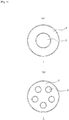
- Fig. 1 is a cross-sectional view of a die attached to a twin-screw extruder for producing a composite fiber.
- Part by mass and % by mass have the same meaning as part by weight and % by weight, respectively.
- the rubber composition of the present invention comprises a rubber component (A) (hereinafter also referred to as “component A”), a foaming agent (B) (hereinafter also referred to as “component B”), and a polyhydric alcohol (C) having 3 or more hydroxyl groups per molecule (hereinafter also referred to as “component C”).
- the rubber component (A) comprises 30% by mass or more of natural rubber based on the entire rubber component.
- the content of the polyhydric alcohol (C) is 1 to 6 parts by mass per 100 parts by mass of the rubber component (A).
- a vulcanized rubber obtained by vulcanizing a rubber composition comprising a foaming agent is greatly inferior in wear resistance, breaking elongation, breaking stress, and the like, compared to vulcanized rubber containing no foaming agent, and hence improvement thereof has been desired.
- the present inventors have diligently studied and found that mixing a specific amount of a specific polyhydric alcohol improves properties such as wear resistance, breaking elongation, and breaking stress, thereby completing the present invention. Although the detailed mechanism is unknown, it is partially understood as follows.
- the rubber composition of the present invention comprises a rubber component (A), and the rubber component (A) contains 30% by mass or more of natural rubber based on the total rubber components.
- the content of the natural rubber is less than 30% by mass in the rubber component, the effect of improving wear resistance, breaking elongation, and breaking stress due to the addition of the polyhydric alcohol (C) cannot be sufficiently obtained.
- the content of the natural rubber in the rubber component is 30% by mass or more, and from the viewpoint of obtaining a vulcanized rubber having further improved wear resistance, breaking elongation, and breaking stress, the content is preferably 35% by mass or more, more preferably 40% by mass or more, and still more preferably 50% by mass or more.
- the rubber component may comprise another rubber other than natural rubber, and preferably does contain another rubber.
- a preferred example of the other rubber is a synthetic diene rubber.
- the synthetic diene rubber include a polyisoprene rubber, a polybutadiene rubber (BR), a styrene-butadiene copolymer rubber (SBR), an ethylene-propylene-diene terpolymer rubber, a chloroprene rubber, a butyl rubber, a halogenated butyl rubber, and an acrylonitrile-butadiene rubber.
- BR polybutadiene rubber
- SBR styrene-butadiene copolymer rubber
- chloroprene rubber ethylene-propylene-diene terpolymer rubber
- chloroprene rubber ethylene-propylene-diene terpolymer rubber
- chloroprene rubber ethylene-propylene-diene terpolymer rubber
- chloroprene rubber ethylene-propylene-diene terpolymer rubber
- a preferred example of the other rubber is BR.
- a high-cis polybutadiene rubber is preferable as the polybutadiene rubber from the viewpoint of improving wear resistance.
- the high-cis polybutadiene rubber refers to a high-cis polybutadiene rubber having a cis-1,4 bond content in a 1,3-butadiene unit of 90% or more and 99% or less as measured by FT-IR.
- the cis-1,4 bond content in a 1,3-butadiene unit of the high-cis polybutadiene rubber is preferably 95% or more and 99% or less.
- the production method of the high-cis polybutadiene rubber is not particularly limited, and may be produced by a known method. Examples thereof include a method of polymerizing butadiene using a neodymium catalyst.
- Examples of commercially available high-cis polybutadiene rubber include “BR01” and “T700” manufactured by JSR Corporation and “Ubepol BR150L” manufactured by Ube Industries, Ltd.
- the rubber composition of the present invention comprises a foaming agent (B).
- a foaming agent (B) By comprising the foaming agent (B), gas generated from the foaming agent at the time of vulcanization is encapsulated by the vulcanized rubber such that the weight of the vulcanized rubber can be reduced and excellent on-ice performance can be imparted to the vulcanized rubber.
- a foaming agent that has been conventionally used as a foaming agent for rubber compositions may be used without any particular limitation, and specific examples thereof include azodicarbonamide (ADCA), dinitrosopentamethylenetetramine (DPT), dinitrosopentastyrenetetramine, benzenesulfonylhydrazide derivatives, p,p'-oxybisbenzenesulfonylhydrazide (OBSH), ammonium bicarbonate, sodium bicarbonate and ammonium carbonate which generate carbon dioxide, nitrososulfonylazo compounds which generate nitrogen, N,N'-dimethyl-N,N'-dinitrosophtalamide, toluenesulfonylhydrazide, p-toluenesulfonylsemicarbazide, and p,p'-oxybisbenzenesulfonylsemicarbazide.
- ADCA azodicarbonamide
- DPT dinitros
- foaming agents (B) may be used singly or in combinations of two or more.
- the mixing amount of the foaming agent (B) is not particularly limited, but preferably is 0.1 to 20 parts by mass, more preferably 0.3 to 10 parts by mass, and still more preferably 0.5 to 5 parts by mass per 100 parts by mass of the rubber component (A) in consideration of obtaining the desired foaming ratio and maintaining the wear resistance.
- the foaming agent is preferably used in combination with a foaming aid.
- foaming aid include urea, zinc stearate, zinc benzenesulfinate, and zinc white. These may be used singly or in combinations of two or more.
- foaming aid in combination facilitates the foaming reaction and increases the degree of completion of the reaction. This enables suppression of unnecessary temporal deterioration.
- the mass ratio of the foaming agent to the foaming aid is preferably 0.3 to 2.0, more preferably 0.6 to 1.8, and still more preferably 1.0 to 1.5.
- polyhydric alcohol (C) comprising the polyhydric alcohol (C) having 3 or more hydroxyl groups per molecule (also simply referred to as “polyhydric alcohol (C)")
- the wear resistance, breaking elongation, and breaking stress of the rubber composition of the present invention is improved.
- the polyhydric alcohol may be mixed as is, or may be mixed in a state of being supported with a synthetic rubber, a filler, a resin, or the like, or being kneaded with these raw materials in advance (masterbatch).
- the polyhydric alcohol (C) has 3 or more hydroxyl groups per molecule. From the viewpoint of wear resistance, breaking elongation, and breaking stress, it is preferable that the number of hydroxyl groups per molecule be large, but from the viewpoint of obtaining the desired melting point, it is preferable that the number of hydroxyl groups per molecule be 4 or more and 10 or less, and more preferably 5 or more and 8 or less.
- the melting point of the polyhydric alcohol (C) is preferably 170°C or less, more preferably 160°C or less, still more preferably 145°C or less, and even more preferably 130°C or less, from the viewpoint of homogeneously dispersing the polyhydric alcohol (C) in the rubber component during kneading.
- the polyhydric alcohol (C) may be any of an aliphatic polyhydric alcohol, an alicyclic polyhydric alcohol, and an aromatic polyhydric alcohol, but is preferably an aliphatic polyhydric alcohol or an alicyclic polyhydric alcohol, and more preferably an aliphatic polyhydric alcohol, from the viewpoint of obtaining the desired melting point. That is, the polyhydric alcohol is preferably a chain polyhydric alcohol.
- the polyhydric alcohol have no cyclic structure because a vulcanized rubber having more excellent wear resistance can be obtained.
- the aliphatic polyhydric alcohol is preferably a compound in which a linear or branched aliphatic hydrocarbon is substituted with 3 or more hydroxyl groups, and more preferably a linear polyhydric alcohol in which a linear aliphatic hydrocarbon is substituted with 3 or more hydroxyl groups.
- the aliphatic hydrocarbon may be either a saturated aliphatic hydrocarbon or an unsaturated aliphatic hydrocarbon, but is preferably a saturated aliphatic hydrocarbon.
- the number of hydroxyl groups that the polyhydric alcohol (C) has per molecule be more than a half of the number of carbon atoms that the polyhydric alcohol (C) has per molecule. That is, when the number of hydroxyl groups that the polyhydric alcohol (C) has per molecule is N OH and the number of carbon atoms that the polyhydric alcohol (C) has per molecule is Nc, it is preferable that the following Formula (A) be satisfied: N OH > N C / 2
- N OH /N c is preferably more than 0.5, more preferably 0.65 or more, still more preferably 0.8 or more, and even more preferably 0.9 or more.
- the boiling point of the polyhydric alcohol (C) is preferably 160°C or more, more preferably 180°C or more, and still more preferably 200°C or more, from the viewpoint of suppressing the volatilization of the polyhydric alcohol (C) at the time of kneading and vulcanization of the rubber composition.
- the upper limit of the boiling point is not particularly limited, but is preferably 500°C or less, and more preferably 400°C or less.
- the configuration of these sugar alcohols may be D-form or L-form, or may be DL-form which has D-form and L-form in any ratios.
- mannitol preferred in the present invention are mannitol, galactitol, xylitol, and sorbitol, more preferred are xylitol and sorbitol, and still more preferred is sorbitol.
- the content of the polyhydric alcohol (C) is 1 to 6 parts by mass per 100 parts by mass of the rubber component (A).
- the content of the polyhydric alcohol (C) is less than 1 part by mass, desired effects cannot be acquired.
- the content thereof exceeds 6 parts by mass, degradation of fracture characteristics and deterioration of a low-loss characteristics occur.
- the content of the polyhydric alcohol (C) is preferably 1.2 to 5.5 parts by mass, more preferably 1.5 to 4.0 parts by mass, and still more preferably 1.5 to 3.0 parts by mass per 100 parts by mass of the rubber component (A) in the rubber composition.
- the rubber composition of the present invention preferably comprises a composite fiber (D) (hereinafter also referred to as "component D”) in addition to the above components A to C.
- component D a composite fiber
- the composite fiber (D) is preferably made of a hydrophilic resin having a coating layer formed on the surface. Comprising such a composite fiber (D) ensures affinity with water to be sufficient, and imparts excellent drainage performance when used in tire applications in particular. By providing the coating layer on the surface of the composite fiber (D), the dispersibility of the composite fiber (D) in the rubber composition becomes satisfactory.
- the hydrophilic resin is preferably insoluble in water, and by adopting a hydrophilic resin insoluble in water, dissolution of the composite fiber (D) is suppressed, even when the composite fiber (D) is exposed on the surface of a product (for example, a tire).
- hydrophilic resin examples include an ethylene-vinyl alcohol copolymer, a vinyl alcohol homopolymer, a poly(meth)acrylic acid resin, or a resin made of an ester of the poly(meth)acrylic acid resin (hereinafter, a copolymer containing a structural unit derived from (meth)acrylic acid and a (co)polymer containing a structural unit derived from (meth)acrylate are collectively referred to as a (meth)acrylic resin), a polyamide resin, a polyethylene glycol resin, a carboxyvinyl copolymer, a styrene-maleic acid copolymer, a polyvinylpyrrolidone resin, a vinyl pyrrolidone-vinyl acetate copolymer, a polyester resin, and a cellulosic resin.
- the surface of the fiber made of the hydrophilic resin exhibits affinity with the rubber component, and it is preferable that a coating layer made of a low melting point resin having a melting point lower than the maximum vulcanization temperature (hereinafter also referred to as "low melting point resin") be formed on the surface.
- a coating layer made of a low melting point resin having a melting point lower than the maximum vulcanization temperature hereinafter also referred to as "low melting point resin”
- the drainage effect due to the hydrophilic resin can be sufficiently exerted, and the cavities present inside the composite fiber (D) can also sufficiently function as drainage grooves.
- the low melting point resin melts at the time of vulcanization and becomes a coating layer having fluidity and contributes to adhesion between the rubber component (A) and the composite fiber (D), thereby imparting satisfactory drainage performance and durability.
- the thickness of such a coating layer may vary depending on the mixing amount of the hydrophilic resin, the average diameter of the composite fiber (D), or the like, but is preferably 0.001 to 10 ⁇ m, and more preferably 0.001 to 5 ⁇ m.
- the coating layer may be formed over the entire surface of the hydrophilic resin, or may be formed on a part of the surface of the hydrophilic resin, and specifically, it is preferable that the coating layer be formed at a fraction of at least 50% of the entire surface area of the hydrophilic resin.
- Examples of the resin having affinity with the rubber component include a resin having a solubility parameter (SP value) close to that of the rubber component.
- SP value solubility parameter
- the low melting point resin is preferably a resin of which the melting point is lower than the maximum vulcanization temperature
- the maximum vulcanization temperature means the maximum temperature reached by the rubber composition at the time of vulcanization of the rubber composition.
- the maximum vulcanization temperature means the maximum temperature that the rubber composition reaches from the time when the rubber composition enters the mold to the time when the rubber composition exits the mold and cools, and such maximum vulcanization temperature may be measured, for example, by embedding a thermocouple in the rubber composition.
- the upper limit of the melting point of the low melting point resin is not particularly limited, but is preferably selected in consideration of the above points, and is, in general, preferably lower than the maximum vulcanization temperature of the rubber composition by 10°C or more, and more preferably by 20°C or more.
- the industrial vulcanization temperature of the rubber composition is preferably about 190°C at the maximum, and in the case where the maximum vulcanization temperature is set to 190°C, for example, the melting point of the low melting point resin is preferably selected within a range of 190°C or less, more preferably 180°C or less, and even more preferably 170°C or less.
- the melting point of the resin may be measured using a known melting point measuring device or the like, and the melting peak temperature measured using a DSC measuring device may be used as the melting point, for example.
- the low melting point resin used for the coating layer is preferably a resin having a polar component of 50% by mass or less with respect to all components in the low melting point resin, and more preferably a polyolefin resin.
- the low melting point resin is a resin having a polar component within the above range with respect to all components, the difference in SP value from the rubber component is moderate and the melting point is suitably lower than the maximum vulcanization temperature, and thus the resin can be easily melted at the time of vulcanization to promote the foaming of vulcanized rubber while sufficiently ensuring satisfactory affinity with the rubber component. Therefore, it is possible to reliably form cavities inside the composite fiber while more reliably improving the dispersibility of the fiber made of the hydrophilic resin in the rubber component.
- the polyolefin resin may be branched or linear.
- the polyolefin resin may be an ionomer resin in which ethylene-methacrylic acid copolymer molecules are cross-linked via metal ions.
- Specific examples thereof include polyethylene, polypropylene, polybutene, polystyrene, ethylene-propylene copolymer, ethylene-methacrylic acid copolymer, ethylene-ethyl acrylate copolymer, ethylene/propylene/diene terpolymer, ethylene/vinyl acetate copolymer, and ionomer resins thereof. These may be used singly or in combinations of two or more.
- polyethylene resin polypropylene resin
- polyolefin ionomer polyolefin ionomer
- maleic anhydride-modified ⁇ -polyolefin are preferable.
- the rubber strength can be further improved.
- the composite fiber (D) made of the hydrophilic resin on which the coating layer made of the low melting point resin is formed a method of blending these resins using a mixing mill, melt-spinning the resins to form an undrawn yarn, and hot-drawing the undrawn yarn into a fiber may be adopted.
- a method of blending the resins using two twin-screw extruders each having a die 1 as shown in (a) or (b) of Fig. 1 , and then forming into fiber in the same manner may also be adopted.
- the hydrophilic resin is extruded from a die outlet 2 and the low melting point resin is extruded from a die outlet 3 simultaneously, thereby forming an undrawn yarn.
- the amount of these resins to be added to the mixing mill or hopper may vary depending on the length and diameter of the composite to be obtained (fiber), but the amount of the low melting point resin is preferably 5 to 300 parts by mass, and more preferably 10 to 150 parts by mass per 100 parts by mass of the hydrophilic resin.
- the average length of the composite fiber (D) thus obtained is preferably 0.1 to 500 mm, more preferably 0.1 to 7 mm, and the average diameter is preferably 0.001 to 2 mm, and more preferably 0.005 to 0.5 mm.
- the composite fibers are not likely to be entangled more than necessary, and satisfactory dispersibility is also not likely to be hindered.
- the aspect ratio is preferably 10 to 4,000, and more preferably 50 to 2,000.
- the aspect ratio means the ratio of the major axis to the minor axis of the composite fiber.
- the mixing amount of the composite fiber made of the hydrophilic resin on which the coating layer is formed is preferably 0.1 to 100 parts by mass, more preferably 0.3 to 30 parts by mass, and still more preferably 0.5 to 10 parts by mass, and even more preferably 1 to 6 parts by mass per 100 parts by mass of the rubber component.
- the mixing amount of the composite fiber made of the hydrophilic resin on which the coating layer is formed is within the above range, it becomes possible to maintain sufficient durability while exerting satisfactory drainage performance by forming cavities inside the composite fiber.
- the rubber composition of the present invention may comprise other components in addition to the components described above.
- the other components are not particularly limited, and additives usually used in the rubber industry, for example, fillers such as carbon black, silica, and aluminum hydroxide, softeners, antioxidants, vulcanizing agents (e.g., sulfur), vulcanization accelerators, vulcanization acceleration aids (e.g., zinc oxide and fatty acids such as stearic acid), vulcanization retarders, silane coupling agents, resins, and oils may be appropriately selected and mixed within a range that does not impair the objects of the present invention.
- fillers such as carbon black, silica, and aluminum hydroxide
- softeners e.g., antioxidants
- vulcanizing agents e.g., sulfur
- vulcanization accelerators e.g., vulcanization accelerators
- vulcanization acceleration aids e.g., zinc oxide and fatty acids such as stearic acid
- vulcanization retarders
- the rubber composition of the present invention preferably comprises a filler as the other component for the purpose of improving the reinforcing property or the like.
- the mixing amount of the filler is not particularly limited and may be appropriately selected depending on the intended purpose, but is preferably 30 to 120 parts by mass, more preferably 40 to 100 parts by mass, and still more preferably 50 to 80 parts by mass per 100 parts by mass of the rubber component.
- the mixing amount of the filler is 30 parts by mass or more, the effect of improving the reinforcing property due to the mixing of filler can be obtained, and when the mixing amount is 120 parts by mass or less, satisfactory workability can be maintained.
- the filler is not particularly limited, and examples thereof include carbon black, silica, aluminum hydroxide, clay, alumina, talc, mica, kaolin, glass balloon, glass beads, calcium carbonate, magnesium carbonate, magnesium hydroxide, magnesium oxide, titanium oxide, potassium titanate, and barium sulfate. Of these, it is preferable to use at least one selected from carbon black and silica, and it is more preferable to use carbon black and silica in combination. These may be used singly or in combinations of two or more.
- the carbon black is not particularly limited and may be appropriately selected depending on the intended purpose, and examples thereof include FEF, GPF, SRF, HAF, IISAF, ISAF, and SAF. These may be used singly or in combinations of two or more.
- the silica is not particularly limited and may be appropriately selected depending on the intended purpose.
- the CTAB (cetyltrimethylammonium bromide) specific surface area is preferably 50 m 2 /g or more, more preferably 90 m 2 /g or more, and preferably 350 m 2 /g or less, more preferably 300 m 2 /g or less. In a case where the CTAB specific surface area of silica is 50 m 2 /g or more, the wear resistance is further improved, and when the CTAB specific surface area of silica is 350 m 2 /g or less, the rolling resistance is reduced.
- silica examples include wet silica (hydrated silica), dry silica (anhydrous silica), calcium silicate, and aluminum silicate. Of them, wet silica is preferred. These silicas may be used singly or in combinations of two or more.
- the rubber composition of the present invention may comprise a silane coupling agent from the viewpoint of improving the dispersibility of the filler in the rubber composition and improving the reinforcing property.
- silane coupling agent examples include vinyltriethoxysilane, vinyltris ( ⁇ -methoxyethoxy)silane, ⁇ -methacryloxypropyltrimethoxysilane, vinyltriacetoxysilane, ⁇ -glycidoxypropyltrimethoxysilane, ⁇ -glycidoxy propyltriethoxysilane, ⁇ -(3,4-epoxycyclohexyl) ethyltrimethoxysilane, ⁇ -chloropropylmethoxysilane, vinyltrichlorosilane, ⁇ -mercaptopropyltrimethoxysilane, ⁇ -aminopropyltriethoxysilane, N- ⁇ -(aminoethyl)- ⁇ -aminopropyltrimethoxysilane, bis-triethoxysilylpropyl tetrasulfide, and bis-triethoxysilylpropyl disulfide
- silane coupling agents may be used singly or in combinations of two or more.
- the content thereof is preferably, but not particularly limited to, 1 to 10% by mass, and more preferably 5 to 10% by mass per the content of the filler containing carbon black.
- the content of the silane coupling agent is 1% by mass or more per the content of the filler, the effect of improving the dispersibility of the filler is sufficiently and easily developed, and when the content is 10% by mass or less, mixing an excessive amount of the coupling agent is inhibited, which is preferable from an economic viewpoint.
- the rubber composition of the present invention preferably comprises a resin as the other component.
- the resin contained as the other component is a resin other than the rubber component (A) and the composite fiber (D).
- the resin is preferably a thermoplastic resin, and examples thereof include an aliphatic hydrocarbon resin, an alicyclic hydrocarbon resin, a terpene resin, and a terpene phenol resin, and an aliphatic hydrocarbon resin and an alicyclic hydrocarbon resin are preferable.
- Examples of the aliphatic hydrocarbon resin include petroleum resins produced by polymerization of C5 petroleum fraction.
- Examples of the petroleum resins produced by using high purity 1,3-pentadiene as a main raw material include trade name "Quintone 100" series (A100, B170, K100, M100, R100, N295, U190, S100, D100, U185, P195N, etc.) manufactured by ZEON CORPORATION.
- Examples of the other petroleum resins produced by polymerizing C5 petroleum fraction include trade name “Escorez” series (1102, 1202(U), 1304, 1310, 1315, 1395, etc.) manufactured by Exxon Mobil Corporation and trade name “Hirez” series (G-100X, -T-100X, -C-110X, -R-100X, etc.) manufactured by Mitsui Chemicals.
- Examples of the alicyclic hydrocarbon resins include a cyclopentadiene petroleum resin produced by using cyclopentadiene extracted from C5 fraction as a main raw material and a dicyclopentadiene petroleum resin produced by using dicyclopentadiene in C5 fraction as a raw material.
- Examples of the cyclopentadiene petroleum resin produced by using high purity cyclopentadiene as a main raw material include trade name "Quintone 1000" series (1325, 1345, etc.) manufactured by ZEON CORPORATION.
- Examples of the dicyclopentadiene petroleum resin include trade name "Marukarez M” series (M-890A, M-845A, M-990A, etc.) manufactured by Maruzen Petrochemical.
- Terpene resins refer to resins produced by using naturally derived from turpentine oil or orange oil as a main raw material. Examples thereof include trade name "YS resin” series (PX-1250, TR-105, etc.) manufactured by Yasuhara Chemical, and trade name “Piccolyte” series (A115, S115, etc.) manufactured by Hercules.
- terpene phenol resins examples include trade name "YS POLYSTER” series (U series such as U-130, U-115, and T series such as T-115, T-130, T-145) manufactured by Yasuhara Chemical and trade name "TAMANOL 901" manufactured by Arakawa Chemical Industries.
- the content of the resin is preferably 1 to 50 parts by mass, more preferably 2 to 30 parts by mass, and still more preferably 5 to 15 parts by mass per 100 parts by mass of the rubber component (A).
- the content of the resin is within the above range, the effect of improving wear resistance, breaking elongation, and breaking stress due to the interaction between the polyhydric alcohol (C) and the rubber component (A) can be maximized.
- the rubber composition of the present invention preferably comprises a process oil, and examples of the process oil include paraffin oil, naphthenic oil, and aroma oil.
- the content of the process oil is preferably 3 to 100 parts by mass, more preferably 5 to 50 parts by mass, and still more preferably 10 to 30 parts by mass per 100 parts by mass of the rubber component (A).
- the total content of the resin and the process oil is preferably 10 to 80 parts by mass, more preferably 20 to 60 parts by mass, and still more preferably 25 to 50 parts by mass per 100 parts by mass of the rubber component.
- the rubber composition of the present invention may be prepared by mixing and kneading the above components using a kneader such as a Banbury mixer, a roll, or an internal mixer.
- a kneader such as a Banbury mixer, a roll, or an internal mixer.
- the mixing amounts of the rubber component (A), the foaming agent (B), the polyhydric alcohol (C) and the like are the same as the amounts already described as the contents in the rubber component.
- the respective components may be kneaded in one step, or two or more divided steps.
- methods of kneading include a method in which a rubber component (A), a polyhydric alcohol (C), and another mixing component other than the vulcanizing agent and the foaming agent is kneaded in the first step, and the vulcanizing agent and the foaming agent are kneaded in the second step.
- the maximum temperature of the first step of kneading is preferably 130 to 170°C and the maximum temperature of the second step is preferably 90 to 120°C.
- the vulcanized rubber of the present invention is obtained by vulcanizing the rubber composition of the present invention described above. Since foaming occurs simultaneously with the vulcanization, vulcanized rubber including air bubbles inside is obtained through vulcanization.
- the vulcanization method of the rubber composition is not particularly limited, and a known vulcanization method may be applied.
- the vulcanization may be performed by molding an unvulcanized rubber composition and then subjecting the same to vulcanization, or by performing a step of preliminary vulcanization to obtain a semi-vulcanized rubber from an unvulcanized rubber composition, and molding the same and then subjecting the semi-vulcanized rubber to main vulcanization.
- the vulcanized rubber of the present invention has a foaming rate of preferably 3% or more, more preferably 5% or more, still more preferably 10% or more, and even more preferably 20% or more, and preferably 75% or less, more preferably 50% or less, still more preferably 45% or less, and even more preferably 40% or less from the viewpoint of improvement in both of on-ice performance and wear resistance.
- Vs The foaming rate Vs is represented by the following Formula (I).
- Vs ⁇ 0 ⁇ ⁇ g / ⁇ 1 ⁇ ⁇ g ⁇ 1 ⁇ 100 %
- ⁇ 1 represents the density (g/cm 3 ) of foamed rubber
- ⁇ 0 represents the density (g/cm 3 ) of the solid phase portion of the foamed rubber
- ⁇ g represents the density (g/cm 3 ) of the gas portion in the air bubbles of the foamed rubber.
- the foamed rubber is formed from a rubber solid phase portion and cavities (closed air bubbles) bounded by the rubber solid phase portion, that is, the gas portion in air bubbles.
- Formula (I) is substantially equivalent to the following Formula (II).
- Vs ⁇ 0 / ⁇ 1 ⁇ 1 ⁇ 100 %
- the rubber composition and the vulcanized rubber of the present invention are used for various rubber products and are suitable as tread members of tires, and particularly suitable as tread members of pneumatic tires.
- Examples of the infill gas of the pneumatic tires include ordinary air or air having a controlled oxygen partial pressure, and inert gases such as nitrogen, argon, and helium.
- the rubber composition or the vulcanized rubber of the present invention is used for tires, those are not limited to tread members of tires and may be used for base tread, sidewall, side-reinforcing rubber, and bead filler.
- the rubber composition of the present invention may be used as vibration isolation rubber, seismic isolation rubber, belt (conveyor belt), rubber roller, various hoses, and moran.
- TSR20 BR Polybutadiene rubber, manufactured by JSR Corporation, trade name "BR01"
- Composite resin A Composite fiber (G156B, manufactured by Kuraray Co., Ltd.) in which ethylene-vinyl alcohol copolymer forms an island portion and polyethylene forms a sea portion.
- Carbon black SAF (ASAHI #105, manufactured by Asahi Carbon Co., Ltd.)
- Process oil Petroleum hydrocarbon process oil (DAIHANA PROCESS OIL NS-28, manufactured by Idemitsu Kosan Co., Ltd.)
- Silica NIPSIL AQ, manufactured by Tosoh Silica Corporation
- Silane coupling agent Bistriethoxysilylpropyl polysulfide, manufactured by Shin-Etsu Chemical Co., Ltd.
- Thermal expansion microcapsules Matsumoto Microsphere F100MD, manufactured by Matsumoto Yushi-Seiyaku Co., Ltd.
- Zinc oxide manufactured by Hakusui Tech Co., Ltd.
- Wax Microcrystalline (Selected microcrystalline wax), manufactured by Seiko Chemical Co., Ltd.
- Antioxidant NOCRAC 6C, manufactured by Ouchi Shinko Chemical Industry Co., Ltd.
- Resin Aliphatic hydrocarbon resin (HI-REZ G-100X), manufactured by Mitsui Chemical Co., Ltd.
- Vulcanization accelerator CZ N-Cyclohexyl-2-benzothiazolylsulfenamide (Nocceler CZ, manufactured by Ouchi Shinko Chemical Industrial Co., Ltd.)
- Vulcanization accelerator MBTS Di-2-benzothiazolyl disulfide (Nocceler DM-P, manufactured by Ouchi Shinko Chemical Industry Co., Ltd.)
- Measurement was performed in accordance with JIS K 6251:2010 at a tensile speed of 300 mm/min and room temperature (23°C).
- the obtained rubber composition was vulcanized at 160°C for 15 minutes to prepare a vulcanized rubber, and the vulcanized rubber was evaluated for wear resistance, breaking elongation, and breaking stress.
- the samples were evaluated based on the evaluation of Comparative Example 1 as 100.
- the obtained rubber composition was vulcanized at 160°C for 15 minutes to prepare a vulcanized rubber, and the vulcanized rubber was evaluated for wear resistance, breaking elongation, and breaking stress.
- the samples were evaluated based on the evaluation of Comparative Example 9 as 100.
- a rubber composition from which a vulcanized rubber having excellent wear resistance and a high breaking elongation and a high breaking stress can be provided.
- a rubber product such as a tire having excellent wear resistance and a high breaking elongation and a high breaking stress can be provided.
Landscapes
- Chemical & Material Sciences (AREA)
- Health & Medical Sciences (AREA)
- Chemical Kinetics & Catalysis (AREA)
- Medicinal Chemistry (AREA)
- Polymers & Plastics (AREA)
- Organic Chemistry (AREA)
- Engineering & Computer Science (AREA)
- Materials Engineering (AREA)
- General Chemical & Material Sciences (AREA)
- Mechanical Engineering (AREA)
- Inorganic Chemistry (AREA)
- Emergency Medicine (AREA)
- Compositions Of Macromolecular Compounds (AREA)
- Manufacture Of Porous Articles, And Recovery And Treatment Of Waste Products (AREA)
Abstract
Description
- The present invention relates to a rubber composition, a vulcanized rubber, a rubber product, and a tire.
- In recent years, in the field of pneumatic tires, pneumatic tires using foamed rubber in the tread portion have been manufactured and sold, and applied to studless tires specialized in on-ice performance. Further, in order to reduce a fuel consumption of automobiles and the like, there has been a demand for weight reduction of members using rubber compositions, e.g., tires.
-
Patent Literature 1 discloses a technique for providing a tire having excellent steering stability and wear resistance using a specific tire vulcanization mold. - PTL1:
JP 2014-172379 A - An object of the present invention is to provide a rubber composition from which a vulcanized rubber having excellent wear resistance and a high breaking elongation and a high breaking stress can be provided. Further, another object of the present invention is to provide a vulcanized rubber obtained by vulcanizing the rubber composition, and a rubber product and a tire comprising the rubber composition or the vulcanized rubber.
- As a result of diligent studies, the present inventors have found that mixing a specific amount of a specific polyhydric alcohol into a rubber composition comprising a specific rubber component and a foaming agent can solve the above-mentioned problems.
- Specifically, the present invention relates to the following <1> to <12>.
- <1> A rubber composition comprising a rubber component (A), a foaming agent (B), and a polyhydric alcohol (C) having 3 or more hydroxyl groups per molecule, wherein the rubber component (A) comprises 30% by mass or more of natural rubber based on the entire rubber component, and a content of the polyhydric alcohol (C) is 1 to 6 parts by mass per 100 parts by mass of the rubber component (A).
- <2> The rubber composition according to <1>, wherein the polyhydric alcohol (C) is a linear polyhydric alcohol in which a linear aliphatic hydrocarbon is substituted with 3 or more hydroxyl groups.
- <3> The rubber composition according to <1> or <2>, wherein the number of hydroxyl groups that the polyhydric alcohol (C) has per molecule is more than a half of the number of carbon atoms per molecule.
- <4> The rubber composition according to any one of <1> to <3>, wherein a melting point of the polyhydric alcohol (C) is 170°C or less.
- <5> The rubber composition according to any one of <1> to <4>, wherein a content of the foaming agent (B) is 0.1 to 20 parts by mass per 100 parts by mass of the rubber component (A).
- <6> The rubber composition according to any one of <1> to <5>, wherein the foaming agent (B) comprises at least one selected from the group consisting of azodicarbonamide and dinitrosopentamethylenetetramine.
- <7> The rubber composition according to any one of <1> to <6>, further comprising a filler, wherein a content of the filler is 30 to 120 parts by mass per 100 parts by mass of the rubber component (A).
- <8> The rubber composition according to any one of <1> to <7>, further comprising a composite fiber (D).
- <9> A vulcanized rubber obtained by vulcanizing the rubber composition according to any one of <1> to <8>.
- <10> The vulcanized rubber according to <9>, having a foaming rate of 5 to 50%.
- <11> A rubber product comprising the rubber composition according to any one of <1> to <8> or the vulcanized rubber according to <9> or <10>.
- <12> A tire comprising the rubber composition according to any one of <1> to <8> or the vulcanized rubber according to <9> or <10>.
- According to the present invention, a rubber composition from which a vulcanized rubber having excellent wear resistance and a high breaking elongation and a high breaking stress can be provided. The present invention further provides a vulcanized rubber obtained by vulcanizing the rubber composition, and a rubber product and a tire comprising the rubber composition or the vulcanized rubber.
- [
Fig. 1] Fig. 1 is a cross-sectional view of a die attached to a twin-screw extruder for producing a composite fiber. - Hereinunder, the present invention is described in detail on the basis of embodiments thereof. In the following description, the expression of "A to B" showing a numerical range indicates a numerical range including the end points A and B, and represents "A or more and B or less" (in the case of A < B), or "A or less and B or more" (in the case of A > B).
- Part by mass and % by mass have the same meaning as part by weight and % by weight, respectively.
- The rubber composition of the present invention comprises a rubber component (A) (hereinafter also referred to as "component A"), a foaming agent (B) (hereinafter also referred to as "component B"), and a polyhydric alcohol (C) having 3 or more hydroxyl groups per molecule (hereinafter also referred to as "component C"). The rubber component (A) comprises 30% by mass or more of natural rubber based on the entire rubber component. The content of the polyhydric alcohol (C) is 1 to 6 parts by mass per 100 parts by mass of the rubber component (A).
- Conventionally, a vulcanized rubber obtained by vulcanizing a rubber composition comprising a foaming agent is greatly inferior in wear resistance, breaking elongation, breaking stress, and the like, compared to vulcanized rubber containing no foaming agent, and hence improvement thereof has been desired.
- The present inventors have diligently studied and found that mixing a specific amount of a specific polyhydric alcohol improves properties such as wear resistance, breaking elongation, and breaking stress, thereby completing the present invention. Although the detailed mechanism is unknown, it is partially understood as follows.
- That is, it is presumed, although the reason is unknown, that the interaction of a specific polyhydric alcohol with natural rubber serving as a rubber component results in improvement of wear resistance, breaking elongation, and breaking stress, even when a vulcanized rubber foamed with a foaming agent is used.
- The present invention will be described in detail hereinunder.
- The rubber composition of the present invention comprises a rubber component (A), and the rubber component (A) contains 30% by mass or more of natural rubber based on the total rubber components. When the content of the natural rubber is less than 30% by mass in the rubber component, the effect of improving wear resistance, breaking elongation, and breaking stress due to the addition of the polyhydric alcohol (C) cannot be sufficiently obtained.
- The content of the natural rubber in the rubber component is 30% by mass or more, and from the viewpoint of obtaining a vulcanized rubber having further improved wear resistance, breaking elongation, and breaking stress, the content is preferably 35% by mass or more, more preferably 40% by mass or more, and still more preferably 50% by mass or more.
- The rubber component may comprise another rubber other than natural rubber, and preferably does contain another rubber.
- A preferred example of the other rubber is a synthetic diene rubber. Examples of the synthetic diene rubber include a polyisoprene rubber, a polybutadiene rubber (BR), a styrene-butadiene copolymer rubber (SBR), an ethylene-propylene-diene terpolymer rubber, a chloroprene rubber, a butyl rubber, a halogenated butyl rubber, and an acrylonitrile-butadiene rubber. These synthetic diene rubbers may be used singly or in combinations of two or more.
- A preferred example of the other rubber is BR.
- A high-cis polybutadiene rubber is preferable as the polybutadiene rubber from the viewpoint of improving wear resistance. The high-cis polybutadiene rubber refers to a high-cis polybutadiene rubber having a cis-1,4 bond content in a 1,3-butadiene unit of 90% or more and 99% or less as measured by FT-IR. The cis-1,4 bond content in a 1,3-butadiene unit of the high-cis polybutadiene rubber is preferably 95% or more and 99% or less.
- The production method of the high-cis polybutadiene rubber is not particularly limited, and may be produced by a known method. Examples thereof include a method of polymerizing butadiene using a neodymium catalyst.
- Examples of commercially available high-cis polybutadiene rubber include "BR01" and "T700" manufactured by JSR Corporation and "Ubepol BR150L" manufactured by Ube Industries, Ltd.
- The rubber composition of the present invention comprises a foaming agent (B). By comprising the foaming agent (B), gas generated from the foaming agent at the time of vulcanization is encapsulated by the vulcanized rubber such that the weight of the vulcanized rubber can be reduced and excellent on-ice performance can be imparted to the vulcanized rubber.
- As the foaming agent (B), a foaming agent that has been conventionally used as a foaming agent for rubber compositions may be used without any particular limitation, and specific examples thereof include azodicarbonamide (ADCA), dinitrosopentamethylenetetramine (DPT), dinitrosopentastyrenetetramine, benzenesulfonylhydrazide derivatives, p,p'-oxybisbenzenesulfonylhydrazide (OBSH), ammonium bicarbonate, sodium bicarbonate and ammonium carbonate which generate carbon dioxide, nitrososulfonylazo compounds which generate nitrogen, N,N'-dimethyl-N,N'-dinitrosophtalamide, toluenesulfonylhydrazide, p-toluenesulfonylsemicarbazide, and p,p'-oxybisbenzenesulfonylsemicarbazide. Of them, azodicarbonamide (ADCA) and dinitrosopentamethylenetetramine (DPT) are preferred from the viewpoint of processability in production.
- These foaming agents (B) may be used singly or in combinations of two or more.
- The mixing amount of the foaming agent (B) is not particularly limited, but preferably is 0.1 to 20 parts by mass, more preferably 0.3 to 10 parts by mass, and still more preferably 0.5 to 5 parts by mass per 100 parts by mass of the rubber component (A) in consideration of obtaining the desired foaming ratio and maintaining the wear resistance.
- The foaming agent is preferably used in combination with a foaming aid. Examples of the foaming aid include urea, zinc stearate, zinc benzenesulfinate, and zinc white. These may be used singly or in combinations of two or more.
- Using the foaming aid in combination facilitates the foaming reaction and increases the degree of completion of the reaction. This enables suppression of unnecessary temporal deterioration.
- The mass ratio of the foaming agent to the foaming aid (foaming agent/foaming aid) is preferably 0.3 to 2.0, more preferably 0.6 to 1.8, and still more preferably 1.0 to 1.5.
- By comprising a polyhydric alcohol (C) comprising the polyhydric alcohol (C) having 3 or more hydroxyl groups per molecule (also simply referred to as "polyhydric alcohol (C)"), the wear resistance, breaking elongation, and breaking stress of the rubber composition of the present invention is improved.
- The polyhydric alcohol may be mixed as is, or may be mixed in a state of being supported with a synthetic rubber, a filler, a resin, or the like, or being kneaded with these raw materials in advance (masterbatch).
- The polyhydric alcohol (C) has 3 or more hydroxyl groups per molecule. From the viewpoint of wear resistance, breaking elongation, and breaking stress, it is preferable that the number of hydroxyl groups per molecule be large, but from the viewpoint of obtaining the desired melting point, it is preferable that the number of hydroxyl groups per molecule be 4 or more and 10 or less, and more preferably 5 or more and 8 or less.
- The melting point of the polyhydric alcohol (C) is preferably 170°C or less, more preferably 160°C or less, still more preferably 145°C or less, and even more preferably 130°C or less, from the viewpoint of homogeneously dispersing the polyhydric alcohol (C) in the rubber component during kneading.
- The polyhydric alcohol (C) may be any of an aliphatic polyhydric alcohol, an alicyclic polyhydric alcohol, and an aromatic polyhydric alcohol, but is preferably an aliphatic polyhydric alcohol or an alicyclic polyhydric alcohol, and more preferably an aliphatic polyhydric alcohol, from the viewpoint of obtaining the desired melting point. That is, the polyhydric alcohol is preferably a chain polyhydric alcohol.
- Further, it is preferable that the polyhydric alcohol have no cyclic structure because a vulcanized rubber having more excellent wear resistance can be obtained.
- The aliphatic polyhydric alcohol is preferably a compound in which a linear or branched aliphatic hydrocarbon is substituted with 3 or more hydroxyl groups, and more preferably a linear polyhydric alcohol in which a linear aliphatic hydrocarbon is substituted with 3 or more hydroxyl groups. The aliphatic hydrocarbon may be either a saturated aliphatic hydrocarbon or an unsaturated aliphatic hydrocarbon, but is preferably a saturated aliphatic hydrocarbon.
- It is preferable that the number of hydroxyl groups that the polyhydric alcohol (C) has per molecule be more than a half of the number of carbon atoms that the polyhydric alcohol (C) has per molecule. That is, when the number of hydroxyl groups that the polyhydric alcohol (C) has per molecule is NOH and the number of carbon atoms that the polyhydric alcohol (C) has per molecule is Nc, it is preferable that the following Formula (A) be satisfied:

- It is preferable, because when the above Formula (A) is satisfied, a vulcanized rubber having more excellent wear resistance, breaking elongation, and breaking stress can be obtained, a desired melting point of the polyhydric alcohol (C) can be easily obtained, and the dispersibility of the polyhydric alcohol (C) in the rubber composition is excellent.
- NOH/Nc is preferably more than 0.5, more preferably 0.65 or more, still more preferably 0.8 or more, and even more preferably 0.9 or more.
- The boiling point of the polyhydric alcohol (C) is preferably 160°C or more, more preferably 180°C or more, and still more preferably 200°C or more, from the viewpoint of suppressing the volatilization of the polyhydric alcohol (C) at the time of kneading and vulcanization of the rubber composition. The upper limit of the boiling point is not particularly limited, but is preferably 500°C or less, and more preferably 400°C or less.
- Examples of the polyhydric alcohol (C) include sugar alcohols, and specific examples thereof include tetritols such as erythritol (boiling point = 329 to 331°C, melting point = 121°C) and threitol (boiling point = 330°C, melting point = 88 to 90°C), pentitols such as arabitol, xylitol (boiling point = 216°C, melting point = 92 to 96°C), and ribitol; hexitols such as sorbitol (boiling point = 296°C, melting point = 95°C), mannitol (boiling point = 290 to 295°C, melting point = 166 to 168°C), and galactitol (boiling point: 275 to 280°C, melting point: 98 to 100°C); heptitols such as boremitol; octitols such as D-erythro-D-galactooctitol; nonitols; and decitols.
- There is no limitation on the configuration of these sugar alcohols. The configuration of these sugar alcohols may be D-form or L-form, or may be DL-form which has D-form and L-form in any ratios.
- Of them, preferred in the present invention are mannitol, galactitol, xylitol, and sorbitol, more preferred are xylitol and sorbitol, and still more preferred is sorbitol.
- In the rubber composition of the present invention, the content of the polyhydric alcohol (C) is 1 to 6 parts by mass per 100 parts by mass of the rubber component (A). When the content of the polyhydric alcohol (C) is less than 1 part by mass, desired effects cannot be acquired. When the content thereof exceeds 6 parts by mass, degradation of fracture characteristics and deterioration of a low-loss characteristics occur.
- The content of the polyhydric alcohol (C) is preferably 1.2 to 5.5 parts by mass, more preferably 1.5 to 4.0 parts by mass, and still more preferably 1.5 to 3.0 parts by mass per 100 parts by mass of the rubber component (A) in the rubber composition.
- The rubber composition of the present invention preferably comprises a composite fiber (D) (hereinafter also referred to as "component D") in addition to the above components A to C.
- The composite fiber (D) is preferably made of a hydrophilic resin having a coating layer formed on the surface. Comprising such a composite fiber (D) ensures affinity with water to be sufficient, and imparts excellent drainage performance when used in tire applications in particular. By providing the coating layer on the surface of the composite fiber (D), the dispersibility of the composite fiber (D) in the rubber composition becomes satisfactory.
- The hydrophilic resin is preferably insoluble in water, and by adopting a hydrophilic resin insoluble in water, dissolution of the composite fiber (D) is suppressed, even when the composite fiber (D) is exposed on the surface of a product (for example, a tire).
- Although the hydrophilic resin is not particularly limited as long as the resin is a resin capable of exerting affinity with water, that is, a resin having a hydrophilic group in the molecule, specifically, a resin containing an oxygen atom, a nitrogen atom, or a sulfur atom is preferred, and examples thereof include a resin containing at least one selected from the group consisting of -OH, -C(=O)OH, -OC(=O)R (where R is an alkyl group), -NH2, -NCO and -SH. Of these groups, - OH, -C(=O)OH, -OC(=O)R, -NH2 and -NCO are preferred.
- Further specific examples of such hydrophilic resin include an ethylene-vinyl alcohol copolymer, a vinyl alcohol homopolymer, a poly(meth)acrylic acid resin, or a resin made of an ester of the poly(meth)acrylic acid resin (hereinafter, a copolymer containing a structural unit derived from (meth)acrylic acid and a (co)polymer containing a structural unit derived from (meth)acrylate are collectively referred to as a (meth)acrylic resin), a polyamide resin, a polyethylene glycol resin, a carboxyvinyl copolymer, a styrene-maleic acid copolymer, a polyvinylpyrrolidone resin, a vinyl pyrrolidone-vinyl acetate copolymer, a polyester resin, and a cellulosic resin. Of these, at least one resin selected from the group consisting of an ethylene-vinyl alcohol copolymer, a vinyl alcohol homopolymer, a poly(meth)acrylic acid resin, a polyamide resin, an aliphatic polyamide resin, an aromatic polyamide resin, a polyester resin, a polyvinyl alcohol resin, a cellulosic resin or a (meth)acrylic resin is preferred, and an ethylene-vinyl alcohol copolymer is more preferred.
- The surface of the fiber made of the hydrophilic resin exhibits affinity with the rubber component, and it is preferable that a coating layer made of a low melting point resin having a melting point lower than the maximum vulcanization temperature (hereinafter also referred to as "low melting point resin") be formed on the surface. By forming such a coating layer, satisfactory affinity with the rubber component can be exerted in the vicinity of the composite fiber (D), while effectively maintaining affinity with water possessed by the hydrophilic resin itself, and a hydrophilic resin that is difficult to melt is captured at the time of vulcanization (foaming) and the formation of cavities inside the composite fiber (D) is promoted. That is, by securing satisfactory dispersion of the composite fiber (D) in the rubber component, the drainage effect due to the hydrophilic resin can be sufficiently exerted, and the cavities present inside the composite fiber (D) can also sufficiently function as drainage grooves. The low melting point resin melts at the time of vulcanization and becomes a coating layer having fluidity and contributes to adhesion between the rubber component (A) and the composite fiber (D), thereby imparting satisfactory drainage performance and durability.
- The thickness of such a coating layer may vary depending on the mixing amount of the hydrophilic resin, the average diameter of the composite fiber (D), or the like, but is preferably 0.001 to 10 µm, and more preferably 0.001 to 5 µm. By forming the coating layer with a thickness in the above range, the desired effect in the present invention can be sufficiently exerted. Further, the coating layer may be formed over the entire surface of the hydrophilic resin, or may be formed on a part of the surface of the hydrophilic resin, and specifically, it is preferable that the coating layer be formed at a fraction of at least 50% of the entire surface area of the hydrophilic resin.
- Examples of the resin having affinity with the rubber component include a resin having a solubility parameter (SP value) close to that of the rubber component.
- The low melting point resin is preferably a resin of which the melting point is lower than the maximum vulcanization temperature, and the maximum vulcanization temperature means the maximum temperature reached by the rubber composition at the time of vulcanization of the rubber composition. For example, in the case of mold vulcanization, the maximum vulcanization temperature means the maximum temperature that the rubber composition reaches from the time when the rubber composition enters the mold to the time when the rubber composition exits the mold and cools, and such maximum vulcanization temperature may be measured, for example, by embedding a thermocouple in the rubber composition.
- The upper limit of the melting point of the low melting point resin is not particularly limited, but is preferably selected in consideration of the above points, and is, in general, preferably lower than the maximum vulcanization temperature of the rubber composition by 10°C or more, and more preferably by 20°C or more. The industrial vulcanization temperature of the rubber composition is preferably about 190°C at the maximum, and in the case where the maximum vulcanization temperature is set to 190°C, for example, the melting point of the low melting point resin is preferably selected within a range of 190°C or less, more preferably 180°C or less, and even more preferably 170°C or less.
- The melting point of the resin may be measured using a known melting point measuring device or the like, and the melting peak temperature measured using a DSC measuring device may be used as the melting point, for example.
- Specifically, the low melting point resin used for the coating layer is preferably a resin having a polar component of 50% by mass or less with respect to all components in the low melting point resin, and more preferably a polyolefin resin. When the low melting point resin is a resin having a polar component within the above range with respect to all components, the difference in SP value from the rubber component is moderate and the melting point is suitably lower than the maximum vulcanization temperature, and thus the resin can be easily melted at the time of vulcanization to promote the foaming of vulcanized rubber while sufficiently ensuring satisfactory affinity with the rubber component. Therefore, it is possible to reliably form cavities inside the composite fiber while more reliably improving the dispersibility of the fiber made of the hydrophilic resin in the rubber component.
- The polyolefin resin may be branched or linear. The polyolefin resin may be an ionomer resin in which ethylene-methacrylic acid copolymer molecules are cross-linked via metal ions. Specific examples thereof include polyethylene, polypropylene, polybutene, polystyrene, ethylene-propylene copolymer, ethylene-methacrylic acid copolymer, ethylene-ethyl acrylate copolymer, ethylene/propylene/diene terpolymer, ethylene/vinyl acetate copolymer, and ionomer resins thereof. These may be used singly or in combinations of two or more.
- Of these, polyethylene resin, polypropylene resin, polyolefin ionomer, and maleic anhydride-modified α-polyolefin are preferable. In a case where a polyolefin ionomer or maleic anhydride-modified α-polyolefin capable of adhering to the hydroxyl group of the hydrophilic resin is used, the rubber strength can be further improved.
- In order to produce the composite fiber (D) made of the hydrophilic resin on which the coating layer made of the low melting point resin is formed, a method of blending these resins using a mixing mill, melt-spinning the resins to form an undrawn yarn, and hot-drawing the undrawn yarn into a fiber may be adopted. Alternatively, a method of blending the resins using two twin-screw extruders each having a
die 1 as shown in (a) or (b) ofFig. 1 , and then forming into fiber in the same manner may also be adopted. In this case, the hydrophilic resin is extruded from adie outlet 2 and the low melting point resin is extruded from adie outlet 3 simultaneously, thereby forming an undrawn yarn. The amount of these resins to be added to the mixing mill or hopper may vary depending on the length and diameter of the composite to be obtained (fiber), but the amount of the low melting point resin is preferably 5 to 300 parts by mass, and more preferably 10 to 150 parts by mass per 100 parts by mass of the hydrophilic resin. By adding these resins in an amount within the above range, a coating layer capable of exerting desired effects to be effectively formed on the surface of the composite (fiber) made of the hydrophilic resin obtained after the stretching step. - The average length of the composite fiber (D) thus obtained is preferably 0.1 to 500 mm, more preferably 0.1 to 7 mm, and the average diameter is preferably 0.001 to 2 mm, and more preferably 0.005 to 0.5 mm. When the average length and the average diameter are within the above ranges, the composite fibers are not likely to be entangled more than necessary, and satisfactory dispersibility is also not likely to be hindered.
- The aspect ratio is preferably 10 to 4,000, and more preferably 50 to 2,000. The aspect ratio means the ratio of the major axis to the minor axis of the composite fiber.
- The mixing amount of the composite fiber made of the hydrophilic resin on which the coating layer is formed is preferably 0.1 to 100 parts by mass, more preferably 0.3 to 30 parts by mass, and still more preferably 0.5 to 10 parts by mass, and even more preferably 1 to 6 parts by mass per 100 parts by mass of the rubber component. When the mixing amount of the composite fiber made of the hydrophilic resin on which the coating layer is formed is within the above range, it becomes possible to maintain sufficient durability while exerting satisfactory drainage performance by forming cavities inside the composite fiber.
- The rubber composition of the present invention may comprise other components in addition to the components described above. The other components are not particularly limited, and additives usually used in the rubber industry, for example, fillers such as carbon black, silica, and aluminum hydroxide, softeners, antioxidants, vulcanizing agents (e.g., sulfur), vulcanization accelerators, vulcanization acceleration aids (e.g., zinc oxide and fatty acids such as stearic acid), vulcanization retarders, silane coupling agents, resins, and oils may be appropriately selected and mixed within a range that does not impair the objects of the present invention.
- The rubber composition of the present invention preferably comprises a filler as the other component for the purpose of improving the reinforcing property or the like.
- The mixing amount of the filler is not particularly limited and may be appropriately selected depending on the intended purpose, but is preferably 30 to 120 parts by mass, more preferably 40 to 100 parts by mass, and still more preferably 50 to 80 parts by mass per 100 parts by mass of the rubber component. When the mixing amount of the filler is 30 parts by mass or more, the effect of improving the reinforcing property due to the mixing of filler can be obtained, and when the mixing amount is 120 parts by mass or less, satisfactory workability can be maintained.
- The filler is not particularly limited, and examples thereof include carbon black, silica, aluminum hydroxide, clay, alumina, talc, mica, kaolin, glass balloon, glass beads, calcium carbonate, magnesium carbonate, magnesium hydroxide, magnesium oxide, titanium oxide, potassium titanate, and barium sulfate. Of these, it is preferable to use at least one selected from carbon black and silica, and it is more preferable to use carbon black and silica in combination. These may be used singly or in combinations of two or more.
- The carbon black is not particularly limited and may be appropriately selected depending on the intended purpose, and examples thereof include FEF, GPF, SRF, HAF, IISAF, ISAF, and SAF. These may be used singly or in combinations of two or more.
- The silica is not particularly limited and may be appropriately selected depending on the intended purpose. The CTAB (cetyltrimethylammonium bromide) specific surface area is preferably 50 m2/g or more, more preferably 90 m2/g or more, and preferably 350 m2/g or less, more preferably 300 m2/g or less. In a case where the CTAB specific surface area of silica is 50 m2/g or more, the wear resistance is further improved, and when the CTAB specific surface area of silica is 350 m2/g or less, the rolling resistance is reduced.
- Examples of silica, which are not particularly limited, include wet silica (hydrated silica), dry silica (anhydrous silica), calcium silicate, and aluminum silicate. Of them, wet silica is preferred. These silicas may be used singly or in combinations of two or more.
- In a case where silica is used as the filler, the rubber composition of the present invention may comprise a silane coupling agent from the viewpoint of improving the dispersibility of the filler in the rubber composition and improving the reinforcing property.
- Examples of the silane coupling agent include vinyltriethoxysilane, vinyltris (β-methoxyethoxy)silane, γ-methacryloxypropyltrimethoxysilane, vinyltriacetoxysilane, γ-glycidoxypropyltrimethoxysilane, γ-glycidoxy propyltriethoxysilane, β-(3,4-epoxycyclohexyl) ethyltrimethoxysilane, γ-chloropropylmethoxysilane, vinyltrichlorosilane, γ-mercaptopropyltrimethoxysilane, γ-aminopropyltriethoxysilane, N-β-(aminoethyl)-γ-aminopropyltrimethoxysilane, bis-triethoxysilylpropyl tetrasulfide, and bis-triethoxysilylpropyl disulfide.
- These silane coupling agents may be used singly or in combinations of two or more. The content thereof is preferably, but not particularly limited to, 1 to 10% by mass, and more preferably 5 to 10% by mass per the content of the filler containing carbon black. When the content of the silane coupling agent is 1% by mass or more per the content of the filler, the effect of improving the dispersibility of the filler is sufficiently and easily developed, and when the content is 10% by mass or less, mixing an excessive amount of the coupling agent is inhibited, which is preferable from an economic viewpoint.
- The rubber composition of the present invention preferably comprises a resin as the other component. Here, the resin contained as the other component is a resin other than the rubber component (A) and the composite fiber (D). The resin is preferably a thermoplastic resin, and examples thereof include an aliphatic hydrocarbon resin, an alicyclic hydrocarbon resin, a terpene resin, and a terpene phenol resin, and an aliphatic hydrocarbon resin and an alicyclic hydrocarbon resin are preferable.
- Examples of the aliphatic hydrocarbon resin include petroleum resins produced by polymerization of C5 petroleum fraction. Examples of the petroleum resins produced by using
high purity 1,3-pentadiene as a main raw material include trade name "Quintone 100" series (A100, B170, K100, M100, R100, N295, U190, S100, D100, U185, P195N, etc.) manufactured by ZEON CORPORATION. Examples of the other petroleum resins produced by polymerizing C5 petroleum fraction include trade name "Escorez" series (1102, 1202(U), 1304, 1310, 1315, 1395, etc.) manufactured by Exxon Mobil Corporation and trade name "Hirez" series (G-100X, -T-100X, -C-110X, -R-100X, etc.) manufactured by Mitsui Chemicals. - Examples of the alicyclic hydrocarbon resins include a cyclopentadiene petroleum resin produced by using cyclopentadiene extracted from C5 fraction as a main raw material and a dicyclopentadiene petroleum resin produced by using dicyclopentadiene in C5 fraction as a raw material. Examples of the cyclopentadiene petroleum resin produced by using high purity cyclopentadiene as a main raw material include trade name "Quintone 1000" series (1325, 1345, etc.) manufactured by ZEON CORPORATION. Examples of the dicyclopentadiene petroleum resin include trade name "Marukarez M" series (M-890A, M-845A, M-990A, etc.) manufactured by Maruzen Petrochemical.
- Terpene resins refer to resins produced by using naturally derived from turpentine oil or orange oil as a main raw material. Examples thereof include trade name "YS resin" series (PX-1250, TR-105, etc.) manufactured by Yasuhara Chemical, and trade name "Piccolyte" series (A115, S115, etc.) manufactured by Hercules.
- Examples of the terpene phenol resins include trade name "YS POLYSTER" series (U series such as U-130, U-115, and T series such as T-115, T-130, T-145) manufactured by Yasuhara Chemical and trade name "TAMANOL 901" manufactured by Arakawa Chemical Industries.
- The content of the resin is preferably 1 to 50 parts by mass, more preferably 2 to 30 parts by mass, and still more preferably 5 to 15 parts by mass per 100 parts by mass of the rubber component (A). When the content of the resin is within the above range, the effect of improving wear resistance, breaking elongation, and breaking stress due to the interaction between the polyhydric alcohol (C) and the rubber component (A) can be maximized.
- The rubber composition of the present invention preferably comprises a process oil, and examples of the process oil include paraffin oil, naphthenic oil, and aroma oil.
- The content of the process oil is preferably 3 to 100 parts by mass, more preferably 5 to 50 parts by mass, and still more preferably 10 to 30 parts by mass per 100 parts by mass of the rubber component (A).
- The total content of the resin and the process oil is preferably 10 to 80 parts by mass, more preferably 20 to 60 parts by mass, and still more preferably 25 to 50 parts by mass per 100 parts by mass of the rubber component.
- When the content of the process oil and the total content of the resin and the process oil are within the above range, the effect of improving wear resistance, breaking elongation, and breaking stress due to the interaction between the polyhydric alcohol (C) and the rubber component (A) can be maximized.
- The rubber composition of the present invention may be prepared by mixing and kneading the above components using a kneader such as a Banbury mixer, a roll, or an internal mixer.
- Here, the mixing amounts of the rubber component (A), the foaming agent (B), the polyhydric alcohol (C) and the like are the same as the amounts already described as the contents in the rubber component.
- The respective components may be kneaded in one step, or two or more divided steps. Examples of methods of kneading those include a method in which a rubber component (A), a polyhydric alcohol (C), and another mixing component other than the vulcanizing agent and the foaming agent is kneaded in the first step, and the vulcanizing agent and the foaming agent are kneaded in the second step.
- The maximum temperature of the first step of kneading is preferably 130 to 170°C and the maximum temperature of the second step is preferably 90 to 120°C.
- The vulcanized rubber of the present invention is obtained by vulcanizing the rubber composition of the present invention described above. Since foaming occurs simultaneously with the vulcanization, vulcanized rubber including air bubbles inside is obtained through vulcanization.
- The vulcanization method of the rubber composition is not particularly limited, and a known vulcanization method may be applied. For example, the vulcanization may be performed by molding an unvulcanized rubber composition and then subjecting the same to vulcanization, or by performing a step of preliminary vulcanization to obtain a semi-vulcanized rubber from an unvulcanized rubber composition, and molding the same and then subjecting the semi-vulcanized rubber to main vulcanization.
- The vulcanized rubber of the present invention has a foaming rate of preferably 3% or more, more preferably 5% or more, still more preferably 10% or more, and even more preferably 20% or more, and preferably 75% or less, more preferably 50% or less, still more preferably 45% or less, and even more preferably 40% or less from the viewpoint of improvement in both of on-ice performance and wear resistance.
- The foaming rate Vs is represented by the following Formula (I).

- Here, ρ1 represents the density (g/cm3) of foamed rubber, ρ0 represents the density (g/cm3) of the solid phase portion of the foamed rubber, and ρg represents the density (g/cm3) of the gas portion in the air bubbles of the foamed rubber.
- The foamed rubber is formed from a rubber solid phase portion and cavities (closed air bubbles) bounded by the rubber solid phase portion, that is, the gas portion in air bubbles.
- Further, since the density ρg of the gas portion is extremely small, close to zero, and extremely small with respect to the density po of the rubber solid phase portion, Formula (I) is substantially equivalent to the following Formula (II).

- The rubber composition and the vulcanized rubber of the present invention are used for various rubber products and are suitable as tread members of tires, and particularly suitable as tread members of pneumatic tires. Examples of the infill gas of the pneumatic tires include ordinary air or air having a controlled oxygen partial pressure, and inert gases such as nitrogen, argon, and helium.
- When the rubber composition or the vulcanized rubber of the present invention is used for tires, those are not limited to tread members of tires and may be used for base tread, sidewall, side-reinforcing rubber, and bead filler.
- In addition, for applications other than tires, the rubber composition of the present invention may be used as vibration isolation rubber, seismic isolation rubber, belt (conveyor belt), rubber roller, various hoses, and moran.
- The present invention will be described in more detail with reference to Examples given below, but the present invention is not whatsoever restricted by the following Examples.
- The components to be mixed in the rubber composition of Examples and Comparative Examples are mentioned below.
- Natural rubber: TSR20
BR: Polybutadiene rubber, manufactured by JSR Corporation, trade name "BR01" -
- Foaming agent A: Cellmic AN, manufactured by Sankyo Chemical Co., Ltd.
- Foaming agent B: Uniform AZ, manufactured by Otsuka Chemical Co., Ltd.
-
- Polyhydric alcohol A: Sorbitol (manufactured by Kanto Chemical Co., Ltd., number of hydroxyl groups 6, number of hydroxyl groups/number of carbon atoms = 1)
- Polyhydric alcohol B: Xylitol (manufactured by Wako Pure Chemical Industries, Ltd., number of hydroxyl groups 5, number of hydroxyl groups/number of carbon atoms = 1)
- Composite resin A: Composite fiber (G156B, manufactured by Kuraray Co., Ltd.) in which ethylene-vinyl alcohol copolymer forms an island portion and polyethylene forms a sea portion.
- Carbon black: SAF (ASAHI #105, manufactured by Asahi Carbon Co., Ltd.)
Process oil: Petroleum hydrocarbon process oil (DAIHANA PROCESS OIL NS-28, manufactured by Idemitsu Kosan Co., Ltd.)
Silica: NIPSIL AQ, manufactured by Tosoh Silica Corporation
Silane coupling agent: Bistriethoxysilylpropyl polysulfide, manufactured by Shin-Etsu Chemical Co., Ltd.
Thermal expansion microcapsules: Matsumoto Microsphere F100MD, manufactured by Matsumoto Yushi-Seiyaku Co., Ltd.
Zinc oxide: manufactured by Hakusui Tech Co., Ltd.
Wax: Microcrystalline (Selected microcrystalline wax), manufactured by Seiko Chemical Co., Ltd.
Antioxidant: NOCRAC 6C, manufactured by Ouchi Shinko Chemical Industry Co., Ltd.
Resin: Aliphatic hydrocarbon resin (HI-REZ G-100X), manufactured by Mitsui Chemical Co., Ltd.
Vulcanization accelerator CZ: N-Cyclohexyl-2-benzothiazolylsulfenamide (Nocceler CZ, manufactured by Ouchi Shinko Chemical Industrial Co., Ltd.)
Vulcanization accelerator MBTS: Di-2-benzothiazolyl disulfide (Nocceler DM-P, manufactured by Ouchi Shinko Chemical Industry Co., Ltd.) - Evaluation in the following Examples and Comparative Examples was carried out as follows.
- (1) Wear Resistance
Measurement was performed in accordance with the method B of the sliding wear test of JIS K 7218:1986. The measurement temperature was room temperature (23°C) and the load was 16N. The reciprocals of the respective wear amounts were shown as being indexed taking the reciprocal of the wear amount of the vulcanized rubber of Comparative Example 1 or Comparative Example 9 as 100. The larger the index value, the better the wear resistance. - (2) Breaking Elongation (elongation at break, EB) and Breaking Stress (tensile strength at break, TB)
- Measurement was performed in accordance with JIS K 6251:2010 at a tensile speed of 300 mm/min and room temperature (23°C).
- In the evaluation, the results were shown as being indexed taking the breaking elongation (EB) and the breaking stress (TB) of Comparative Example 1 or Comparative Example 9 as 100. The larger the value, the higher the breaking elongation and the breaking stress.
- According to the mixing formulation shown in Table 1 and using a Banbury mixer, the above-mentioned mixing components for rubber composition were kneaded to prepare samples of rubber compositions. In the final stage of kneading, sulfur serving as the vulcanizing agent, the vulcanization accelerator, and the foaming agent were added.
- The obtained rubber composition was vulcanized at 160°C for 15 minutes to prepare a vulcanized rubber, and the vulcanized rubber was evaluated for wear resistance, breaking elongation, and breaking stress. The samples were evaluated based on the evaluation of Comparative Example 1 as 100.
- According to the mixing formulation shown in Table 2 and using a Banbury mixer, the above-mentioned mixing components for rubber composition were kneaded to prepare samples of rubber compositions. In the final stage of kneading, sulfur serving as the vulcanizing agent, the vulcanization accelerator, and the foaming agent were added.
- The obtained rubber composition was vulcanized at 160°C for 15 minutes to prepare a vulcanized rubber, and the vulcanized rubber was evaluated for wear resistance, breaking elongation, and breaking stress. The samples were evaluated based on the evaluation of Comparative Example 9 as 100.


- According to the present invention, a rubber composition from which a vulcanized rubber having excellent wear resistance and a high breaking elongation and a high breaking stress can be provided. Further, according to the present invention, a rubber product such as a tire having excellent wear resistance and a high breaking elongation and a high breaking stress can be provided.
-
- 1
- Die
- 2
- Die outlet (Die outlet for hydrophilic resin extrusion)
- 3
- Die outlet (Die outlet for low melting point resin extrusion)
Claims (12)
- A rubber composition comprising:a rubber component (A);a foaming agent (B); anda polyhydric alcohol (C) having 3 or more hydroxyl groups per molecule,wherein the rubber component (A) comprises 30% by mass or more of natural rubber based on the entire rubber component, anda content of the polyhydric alcohol (C) is 1 to 6 parts by mass per 100 parts by mass of the rubber component (A).
- The rubber composition according to claim 1,
wherein the polyhydric alcohol (C) is a linear polyhydric alcohol in which a linear aliphatic hydrocarbon is substituted with 3 or more hydroxyl groups. - The rubber composition according to claim 1 or 2,
wherein the number of hydroxyl groups that the polyhydric alcohol (C) has per molecule is more than a half of the number of carbon atoms per molecule. - The rubber composition according to any one of claims 1 to 3,
wherein a melting point of the polyhydric alcohol (C) is 170°C or less. - The rubber composition according to any one of claims 1 to 4,
wherein a content of the foaming agent (B) is 0.1 to 20 parts by mass per 100 parts by mass of the rubber component (A). - The rubber composition according to any one of 1 to 5,
wherein the foaming agent (B) comprises at least one selected from the group consisting of azodicarbonamide and dinitrosopentamethylenetetramine. - The rubber composition according to any one of claim 1 to 6, further comprising:a filler,wherein a content of the filler is 30 to 120 parts by mass per 100 parts by mass of the rubber component (A).
- The rubber composition according to any one of claims 1 to 7, further comprising:
a composite fiber (D). - A vulcanized rubber obtained by vulcanizing the rubber composition according to any one of claims 1 to 8.
- The vulcanized rubber according to claim 9,
having a foaming rate of 5 to 50%. - A rubber product comprising:the rubber composition according to any one of claims 1 to 8; orthe vulcanized rubber according to claim 9 or 10.
- A tire comprising:the rubber composition according to any one of claims 1 to 8; orthe vulcanized rubber according to claim 9 or 10.
Applications Claiming Priority (2)
| Application Number | Priority Date | Filing Date | Title |
|---|---|---|---|
| JP2017114403 | 2017-06-09 | ||
| PCT/JP2018/020396 WO2018225566A1 (en) | 2017-06-09 | 2018-05-28 | Rubber composition, vulcanized rubber, rubber product, and tire |
Publications (3)
| Publication Number | Publication Date |
|---|---|
| EP3636703A1 true EP3636703A1 (en) | 2020-04-15 |
| EP3636703A4 EP3636703A4 (en) | 2021-01-27 |
| EP3636703B1 EP3636703B1 (en) | 2023-01-11 |
Family
ID=64566264
Family Applications (1)
| Application Number | Title | Priority Date | Filing Date |
|---|---|---|---|
| EP18812691.6A Active EP3636703B1 (en) | 2017-06-09 | 2018-05-28 | Rubber composition, vulcanized rubber, rubber product, and tire |
Country Status (5)
| Country | Link |
|---|---|
| US (1) | US20200109266A1 (en) |
| EP (1) | EP3636703B1 (en) |
| JP (1) | JP7012081B2 (en) |
| CN (1) | CN110709458A (en) |
| WO (1) | WO2018225566A1 (en) |
Families Citing this family (1)
| Publication number | Priority date | Publication date | Assignee | Title |
|---|---|---|---|---|
| CN111165871A (en) * | 2020-01-17 | 2020-05-19 | 湖南中烟工业有限责任公司 | Low-harm cigarette subjected to cigarette enhancement treatment |
Family Cites Families (14)
| Publication number | Priority date | Publication date | Assignee | Title |
|---|---|---|---|---|
| JPS6041087B2 (en) * | 1975-03-14 | 1985-09-13 | 三菱電線工業株式会社 | Foamed fire protection composition for molding process |
| JPS52128691A (en) * | 1976-04-19 | 1977-10-28 | Fujikura Ltd | Foaming composition for preventing fire |
| JP3238309B2 (en) * | 1995-09-22 | 2001-12-10 | ほくれい株式会社 | Food cooking method and device used therefor |
| JPH0984630A (en) * | 1995-09-25 | 1997-03-31 | Nishikawa Rubber Co Ltd | Makeup sponge puff |
| US20080149245A1 (en) * | 2006-12-20 | 2008-06-26 | Georges Marcel Victor Thielen | Pneumatic Tire |
| JP2009062438A (en) * | 2007-09-05 | 2009-03-26 | Yokohama Rubber Co Ltd:The | Rubber composition for tire tread |
| JP5754092B2 (en) * | 2010-07-15 | 2015-07-22 | 横浜ゴム株式会社 | Laminated body and pneumatic tire using the same |
| CN105754154B (en) * | 2011-04-13 | 2017-10-27 | 株式会社普利司通 | Rubber composition, vulcanization rubber and the tire manufactured using it |
| JP2013213129A (en) * | 2012-04-02 | 2013-10-17 | Yokohama Rubber Co Ltd:The | Rubber composition for tire and pneumatic tire by using the same |
| JP6062775B2 (en) | 2013-03-13 | 2017-01-18 | 住友ゴム工業株式会社 | Tire vulcanizing mold, tire vulcanizing method and pneumatic tire |
| CN104130467B (en) * | 2014-08-10 | 2016-06-08 | 宁国市宁盛橡塑制品有限公司 | A kind of vibration-damping foamed elastomeric material |
| JP6688309B2 (en) * | 2015-10-22 | 2020-04-28 | 株式会社ブリヂストン | Rubber composition and tire using the same |
| CN105419123A (en) * | 2015-12-23 | 2016-03-23 | 芜湖馨源海绵有限公司 | Vehicle air outlet rubber sponge and preparation method thereof |
| JP2017203118A (en) * | 2016-05-12 | 2017-11-16 | 株式会社ブリヂストン | Rubber composition, crosslinked rubber, tire and rubber article |
-
2018
- 2018-05-28 WO PCT/JP2018/020396 patent/WO2018225566A1/en not_active Ceased
- 2018-05-28 EP EP18812691.6A patent/EP3636703B1/en active Active
- 2018-05-28 JP JP2019523465A patent/JP7012081B2/en active Active
- 2018-05-28 CN CN201880037707.6A patent/CN110709458A/en active Pending
-
2019
- 2019-12-06 US US16/705,873 patent/US20200109266A1/en not_active Abandoned
Also Published As
| Publication number | Publication date |
|---|---|
| WO2018225566A1 (en) | 2018-12-13 |
| CN110709458A (en) | 2020-01-17 |
| EP3636703A4 (en) | 2021-01-27 |
| EP3636703B1 (en) | 2023-01-11 |
| JPWO2018225566A1 (en) | 2020-04-09 |
| JP7012081B2 (en) | 2022-02-10 |
| US20200109266A1 (en) | 2020-04-09 |
Similar Documents
| Publication | Publication Date | Title |
|---|---|---|
| US9534110B2 (en) | Rubber composition, vulcanized rubber and tire manufactured using the same | |
| CN102666136B (en) | Rubber composition for aircraft tire treads | |
| JP5701134B2 (en) | Rubber composition, vulcanized rubber, and tire using the same | |
| EP3725837A1 (en) | Rubber composition, vulcanized rubber and tire | |
| JP2014523961A (en) | Self-sealing elastomer composition for pneumatic articles | |
| JP6688309B2 (en) | Rubber composition and tire using the same | |
| JP6097750B2 (en) | tire | |
| EP3722359B1 (en) | Rubber composition and pneumatic tire | |
| JP2008169295A (en) | Rubber composition and pneumatic tire using the same | |
| JP2008169296A (en) | Rubber composition and pneumatic tire using the same | |
| JP5380962B2 (en) | Pneumatic studless tire | |
| JP2019099747A (en) | Rubber composition, vulcanizate and tire | |
| EP3943316A1 (en) | Studless tire rubber composition and studless tire using same | |
| JP5265115B2 (en) | Rubber composition and pneumatic tire using the same | |
| EP3636703B1 (en) | Rubber composition, vulcanized rubber, rubber product, and tire | |
| JP5993876B2 (en) | Vulcanized rubber, method for producing the same, and tire | |
| JP2012219246A (en) | Rubber composition, and tire using the same | |
| JP2004263098A (en) | Rubber composition for pneumatic tire | |
| WO2019116701A1 (en) | Rubber composition, vulcanized rubber and tire | |
| EP3623419B1 (en) | Rubber composition, vulcanized rubber, tire, studless tire | |
| EP4549509A1 (en) | Vulcanized rubber composition for tires and tire | |
| JP5775726B2 (en) | Rubber composition and tire using the same | |
| EP4360905A1 (en) | Vulcanized rubber composition and tire | |
| JP6008498B2 (en) | tire | |
| JP5982021B2 (en) | Rubber composition, vulcanized rubber, and tire using the same |
Legal Events
| Date | Code | Title | Description |
|---|---|---|---|
| STAA | Information on the status of an ep patent application or granted ep patent |
Free format text: STATUS: THE INTERNATIONAL PUBLICATION HAS BEEN MADE |
|
| PUAI | Public reference made under article 153(3) epc to a published international application that has entered the european phase |
Free format text: ORIGINAL CODE: 0009012 |
|
| STAA | Information on the status of an ep patent application or granted ep patent |
Free format text: STATUS: REQUEST FOR EXAMINATION WAS MADE |
|
| 17P | Request for examination filed |
Effective date: 20191205 |
|
| AK | Designated contracting states |
Kind code of ref document: A1 Designated state(s): AL AT BE BG CH CY CZ DE DK EE ES FI FR GB GR HR HU IE IS IT LI LT LU LV MC MK MT NL NO PL PT RO RS SE SI SK SM TR |
|
| AX | Request for extension of the european patent |
Extension state: BA ME |
|
| DAV | Request for validation of the european patent (deleted) | ||
| DAX | Request for extension of the european patent (deleted) | ||
| A4 | Supplementary search report drawn up and despatched |
Effective date: 20210113 |
|
| RIC1 | Information provided on ipc code assigned before grant |
Ipc: C08K 5/053 20060101ALI20201222BHEP Ipc: C08K 5/3477 20060101ALI20201222BHEP Ipc: C08L 9/00 20060101ALI20201222BHEP Ipc: B60C 1/00 20060101ALI20201222BHEP Ipc: C08L 7/00 20060101AFI20201222BHEP Ipc: C08J 9/10 20060101ALI20201222BHEP Ipc: C08K 5/23 20060101ALI20201222BHEP |
|
| GRAP | Despatch of communication of intention to grant a patent |
Free format text: ORIGINAL CODE: EPIDOSNIGR1 |
|
| STAA | Information on the status of an ep patent application or granted ep patent |
Free format text: STATUS: GRANT OF PATENT IS INTENDED |
|
| INTG | Intention to grant announced |
Effective date: 20220825 |
|
| GRAS | Grant fee paid |
Free format text: ORIGINAL CODE: EPIDOSNIGR3 |
|
| GRAA | (expected) grant |
Free format text: ORIGINAL CODE: 0009210 |
|
| STAA | Information on the status of an ep patent application or granted ep patent |
Free format text: STATUS: THE PATENT HAS BEEN GRANTED |
|
| AK | Designated contracting states |
Kind code of ref document: B1 Designated state(s): AL AT BE BG CH CY CZ DE DK EE ES FI FR GB GR HR HU IE IS IT LI LT LU LV MC MK MT NL NO PL PT RO RS SE SI SK SM TR |
|
| REG | Reference to a national code |
Ref country code: GB Ref legal event code: FG4D |
|
| REG | Reference to a national code |
Ref country code: CH Ref legal event code: EP |
|
| REG | Reference to a national code |
Ref country code: DE Ref legal event code: R096 Ref document number: 602018045363 Country of ref document: DE |
|
| REG | Reference to a national code |
Ref country code: IE Ref legal event code: FG4D |
|
| REG | Reference to a national code |
Ref country code: AT Ref legal event code: REF Ref document number: 1543409 Country of ref document: AT Kind code of ref document: T Effective date: 20230215 |
|
| REG | Reference to a national code |
Ref country code: LT Ref legal event code: MG9D |
|
| REG | Reference to a national code |
Ref country code: NL Ref legal event code: MP Effective date: 20230111 |
|
| REG | Reference to a national code |
Ref country code: AT Ref legal event code: MK05 Ref document number: 1543409 Country of ref document: AT Kind code of ref document: T Effective date: 20230111 |
|
| PG25 | Lapsed in a contracting state [announced via postgrant information from national office to epo] |
Ref country code: NL Free format text: LAPSE BECAUSE OF FAILURE TO SUBMIT A TRANSLATION OF THE DESCRIPTION OR TO PAY THE FEE WITHIN THE PRESCRIBED TIME-LIMIT Effective date: 20230111 |
|
| PG25 | Lapsed in a contracting state [announced via postgrant information from national office to epo] |
Ref country code: RS Free format text: LAPSE BECAUSE OF FAILURE TO SUBMIT A TRANSLATION OF THE DESCRIPTION OR TO PAY THE FEE WITHIN THE PRESCRIBED TIME-LIMIT Effective date: 20230111 Ref country code: PT Free format text: LAPSE BECAUSE OF FAILURE TO SUBMIT A TRANSLATION OF THE DESCRIPTION OR TO PAY THE FEE WITHIN THE PRESCRIBED TIME-LIMIT Effective date: 20230511 Ref country code: NO Free format text: LAPSE BECAUSE OF FAILURE TO SUBMIT A TRANSLATION OF THE DESCRIPTION OR TO PAY THE FEE WITHIN THE PRESCRIBED TIME-LIMIT Effective date: 20230411 Ref country code: LV Free format text: LAPSE BECAUSE OF FAILURE TO SUBMIT A TRANSLATION OF THE DESCRIPTION OR TO PAY THE FEE WITHIN THE PRESCRIBED TIME-LIMIT Effective date: 20230111 Ref country code: LT Free format text: LAPSE BECAUSE OF FAILURE TO SUBMIT A TRANSLATION OF THE DESCRIPTION OR TO PAY THE FEE WITHIN THE PRESCRIBED TIME-LIMIT Effective date: 20230111 Ref country code: HR Free format text: LAPSE BECAUSE OF FAILURE TO SUBMIT A TRANSLATION OF THE DESCRIPTION OR TO PAY THE FEE WITHIN THE PRESCRIBED TIME-LIMIT Effective date: 20230111 Ref country code: ES Free format text: LAPSE BECAUSE OF FAILURE TO SUBMIT A TRANSLATION OF THE DESCRIPTION OR TO PAY THE FEE WITHIN THE PRESCRIBED TIME-LIMIT Effective date: 20230111 Ref country code: AT Free format text: LAPSE BECAUSE OF FAILURE TO SUBMIT A TRANSLATION OF THE DESCRIPTION OR TO PAY THE FEE WITHIN THE PRESCRIBED TIME-LIMIT Effective date: 20230111 |
|
| PG25 | Lapsed in a contracting state [announced via postgrant information from national office to epo] |
Ref country code: SE Free format text: LAPSE BECAUSE OF FAILURE TO SUBMIT A TRANSLATION OF THE DESCRIPTION OR TO PAY THE FEE WITHIN THE PRESCRIBED TIME-LIMIT Effective date: 20230111 Ref country code: PL Free format text: LAPSE BECAUSE OF FAILURE TO SUBMIT A TRANSLATION OF THE DESCRIPTION OR TO PAY THE FEE WITHIN THE PRESCRIBED TIME-LIMIT Effective date: 20230111 Ref country code: IS Free format text: LAPSE BECAUSE OF FAILURE TO SUBMIT A TRANSLATION OF THE DESCRIPTION OR TO PAY THE FEE WITHIN THE PRESCRIBED TIME-LIMIT Effective date: 20230511 Ref country code: GR Free format text: LAPSE BECAUSE OF FAILURE TO SUBMIT A TRANSLATION OF THE DESCRIPTION OR TO PAY THE FEE WITHIN THE PRESCRIBED TIME-LIMIT Effective date: 20230412 Ref country code: FI Free format text: LAPSE BECAUSE OF FAILURE TO SUBMIT A TRANSLATION OF THE DESCRIPTION OR TO PAY THE FEE WITHIN THE PRESCRIBED TIME-LIMIT Effective date: 20230111 |
|
| REG | Reference to a national code |
Ref country code: DE Ref legal event code: R097 Ref document number: 602018045363 Country of ref document: DE |
|
| PG25 | Lapsed in a contracting state [announced via postgrant information from national office to epo] |
Ref country code: SM Free format text: LAPSE BECAUSE OF FAILURE TO SUBMIT A TRANSLATION OF THE DESCRIPTION OR TO PAY THE FEE WITHIN THE PRESCRIBED TIME-LIMIT Effective date: 20230111 Ref country code: RO Free format text: LAPSE BECAUSE OF FAILURE TO SUBMIT A TRANSLATION OF THE DESCRIPTION OR TO PAY THE FEE WITHIN THE PRESCRIBED TIME-LIMIT Effective date: 20230111 Ref country code: EE Free format text: LAPSE BECAUSE OF FAILURE TO SUBMIT A TRANSLATION OF THE DESCRIPTION OR TO PAY THE FEE WITHIN THE PRESCRIBED TIME-LIMIT Effective date: 20230111 Ref country code: DK Free format text: LAPSE BECAUSE OF FAILURE TO SUBMIT A TRANSLATION OF THE DESCRIPTION OR TO PAY THE FEE WITHIN THE PRESCRIBED TIME-LIMIT Effective date: 20230111 Ref country code: CZ Free format text: LAPSE BECAUSE OF FAILURE TO SUBMIT A TRANSLATION OF THE DESCRIPTION OR TO PAY THE FEE WITHIN THE PRESCRIBED TIME-LIMIT Effective date: 20230111 |
|
| PLBE | No opposition filed within time limit |
Free format text: ORIGINAL CODE: 0009261 |
|
| STAA | Information on the status of an ep patent application or granted ep patent |
Free format text: STATUS: NO OPPOSITION FILED WITHIN TIME LIMIT |
|
| PG25 | Lapsed in a contracting state [announced via postgrant information from national office to epo] |
Ref country code: SK Free format text: LAPSE BECAUSE OF FAILURE TO SUBMIT A TRANSLATION OF THE DESCRIPTION OR TO PAY THE FEE WITHIN THE PRESCRIBED TIME-LIMIT Effective date: 20230111 |
|
| 26N | No opposition filed |
Effective date: 20231012 |
|
| REG | Reference to a national code |
Ref country code: CH Ref legal event code: PL |
|
| PG25 | Lapsed in a contracting state [announced via postgrant information from national office to epo] |
Ref country code: MC Free format text: LAPSE BECAUSE OF FAILURE TO SUBMIT A TRANSLATION OF THE DESCRIPTION OR TO PAY THE FEE WITHIN THE PRESCRIBED TIME-LIMIT Effective date: 20230111 |
|
| GBPC | Gb: european patent ceased through non-payment of renewal fee |
Effective date: 20230528 |
|
| REG | Reference to a national code |
Ref country code: BE Ref legal event code: MM Effective date: 20230531 |
|
| PG25 | Lapsed in a contracting state [announced via postgrant information from national office to epo] |
Ref country code: SI Free format text: LAPSE BECAUSE OF FAILURE TO SUBMIT A TRANSLATION OF THE DESCRIPTION OR TO PAY THE FEE WITHIN THE PRESCRIBED TIME-LIMIT Effective date: 20230111 Ref country code: MC Free format text: LAPSE BECAUSE OF FAILURE TO SUBMIT A TRANSLATION OF THE DESCRIPTION OR TO PAY THE FEE WITHIN THE PRESCRIBED TIME-LIMIT Effective date: 20230111 Ref country code: LU Free format text: LAPSE BECAUSE OF NON-PAYMENT OF DUE FEES Effective date: 20230528 Ref country code: LI Free format text: LAPSE BECAUSE OF NON-PAYMENT OF DUE FEES Effective date: 20230531 Ref country code: CH Free format text: LAPSE BECAUSE OF NON-PAYMENT OF DUE FEES Effective date: 20230531 |
|
| REG | Reference to a national code |
Ref country code: IE Ref legal event code: MM4A |
|
| PG25 | Lapsed in a contracting state [announced via postgrant information from national office to epo] |
Ref country code: IE Free format text: LAPSE BECAUSE OF NON-PAYMENT OF DUE FEES Effective date: 20230528 |
|
| PG25 | Lapsed in a contracting state [announced via postgrant information from national office to epo] |
Ref country code: IE Free format text: LAPSE BECAUSE OF NON-PAYMENT OF DUE FEES Effective date: 20230528 Ref country code: GB Free format text: LAPSE BECAUSE OF NON-PAYMENT OF DUE FEES Effective date: 20230528 |
|
| PG25 | Lapsed in a contracting state [announced via postgrant information from national office to epo] |
Ref country code: IT Free format text: LAPSE BECAUSE OF FAILURE TO SUBMIT A TRANSLATION OF THE DESCRIPTION OR TO PAY THE FEE WITHIN THE PRESCRIBED TIME-LIMIT Effective date: 20230111 Ref country code: BE Free format text: LAPSE BECAUSE OF NON-PAYMENT OF DUE FEES Effective date: 20230531 |
|
| PG25 | Lapsed in a contracting state [announced via postgrant information from national office to epo] |
Ref country code: BG Free format text: LAPSE BECAUSE OF FAILURE TO SUBMIT A TRANSLATION OF THE DESCRIPTION OR TO PAY THE FEE WITHIN THE PRESCRIBED TIME-LIMIT Effective date: 20230111 |
|
| P01 | Opt-out of the competence of the unified patent court (upc) registered |
Free format text: CASE NUMBER: APP_57139/2024 Effective date: 20241018 |
|
| PG25 | Lapsed in a contracting state [announced via postgrant information from national office to epo] |
Ref country code: BG Free format text: LAPSE BECAUSE OF FAILURE TO SUBMIT A TRANSLATION OF THE DESCRIPTION OR TO PAY THE FEE WITHIN THE PRESCRIBED TIME-LIMIT Effective date: 20230111 |
|
| PGFP | Annual fee paid to national office [announced via postgrant information from national office to epo] |
Ref country code: DE Payment date: 20250521 Year of fee payment: 8 |
|
| PGFP | Annual fee paid to national office [announced via postgrant information from national office to epo] |
Ref country code: FR Payment date: 20250528 Year of fee payment: 8 |
|
| PG25 | Lapsed in a contracting state [announced via postgrant information from national office to epo] |
Ref country code: CY Free format text: LAPSE BECAUSE OF FAILURE TO SUBMIT A TRANSLATION OF THE DESCRIPTION OR TO PAY THE FEE WITHIN THE PRESCRIBED TIME-LIMIT; INVALID AB INITIO Effective date: 20180528 |
|
| PG25 | Lapsed in a contracting state [announced via postgrant information from national office to epo] |
Ref country code: HU Free format text: LAPSE BECAUSE OF FAILURE TO SUBMIT A TRANSLATION OF THE DESCRIPTION OR TO PAY THE FEE WITHIN THE PRESCRIBED TIME-LIMIT; INVALID AB INITIO Effective date: 20180528 |
|
| PG25 | Lapsed in a contracting state [announced via postgrant information from national office to epo] |
Ref country code: TR Free format text: LAPSE BECAUSE OF FAILURE TO SUBMIT A TRANSLATION OF THE DESCRIPTION OR TO PAY THE FEE WITHIN THE PRESCRIBED TIME-LIMIT Effective date: 20230111 |