EP3636628B1 - 13-oxidized ingenol derivative and use thereof - Google Patents
13-oxidized ingenol derivative and use thereof Download PDFInfo
- Publication number
- EP3636628B1 EP3636628B1 EP18812748.4A EP18812748A EP3636628B1 EP 3636628 B1 EP3636628 B1 EP 3636628B1 EP 18812748 A EP18812748 A EP 18812748A EP 3636628 B1 EP3636628 B1 EP 3636628B1
- Authority
- EP
- European Patent Office
- Prior art keywords
- ingenol
- compound
- group
- dodecanoyl
- angeloyl
- Prior art date
- Legal status (The legal status is an assumption and is not a legal conclusion. Google has not performed a legal analysis and makes no representation as to the accuracy of the status listed.)
- Active
Links
Classifications
-
- C—CHEMISTRY; METALLURGY
- C07—ORGANIC CHEMISTRY
- C07C—ACYCLIC OR CARBOCYCLIC COMPOUNDS
- C07C69/00—Esters of carboxylic acids; Esters of carbonic or haloformic acids
- C07C69/52—Esters of acyclic unsaturated carboxylic acids having the esterified carboxyl group bound to an acyclic carbon atom
- C07C69/533—Monocarboxylic acid esters having only one carbon-to-carbon double bond
-
- C—CHEMISTRY; METALLURGY
- C07—ORGANIC CHEMISTRY
- C07C—ACYCLIC OR CARBOCYCLIC COMPOUNDS
- C07C69/00—Esters of carboxylic acids; Esters of carbonic or haloformic acids
- C07C69/013—Esters of alcohols having the esterified hydroxy group bound to a carbon atom of a ring other than a six-membered aromatic ring
-
- A—HUMAN NECESSITIES
- A61—MEDICAL OR VETERINARY SCIENCE; HYGIENE
- A61P—SPECIFIC THERAPEUTIC ACTIVITY OF CHEMICAL COMPOUNDS OR MEDICINAL PREPARATIONS
- A61P35/00—Antineoplastic agents
-
- C—CHEMISTRY; METALLURGY
- C07—ORGANIC CHEMISTRY
- C07C—ACYCLIC OR CARBOCYCLIC COMPOUNDS
- C07C69/00—Esters of carboxylic acids; Esters of carbonic or haloformic acids
- C07C69/02—Esters of acyclic saturated monocarboxylic acids having the carboxyl group bound to an acyclic carbon atom or to hydrogen
- C07C69/22—Esters of acyclic saturated monocarboxylic acids having the carboxyl group bound to an acyclic carbon atom or to hydrogen having three or more carbon atoms in the acid moiety
- C07C69/33—Esters of acyclic saturated monocarboxylic acids having the carboxyl group bound to an acyclic carbon atom or to hydrogen having three or more carbon atoms in the acid moiety esterified with hydroxy compounds having more than three hydroxy groups
-
- C—CHEMISTRY; METALLURGY
- C07—ORGANIC CHEMISTRY
- C07C—ACYCLIC OR CARBOCYCLIC COMPOUNDS
- C07C69/00—Esters of carboxylic acids; Esters of carbonic or haloformic acids
- C07C69/608—Esters of carboxylic acids having a carboxyl group bound to an acyclic carbon atom and having a ring other than a six-membered aromatic ring in the acid moiety
-
- C—CHEMISTRY; METALLURGY
- C07—ORGANIC CHEMISTRY
- C07D—HETEROCYCLIC COMPOUNDS
- C07D261/00—Heterocyclic compounds containing 1,2-oxazole or hydrogenated 1,2-oxazole rings
- C07D261/02—Heterocyclic compounds containing 1,2-oxazole or hydrogenated 1,2-oxazole rings not condensed with other rings
- C07D261/06—Heterocyclic compounds containing 1,2-oxazole or hydrogenated 1,2-oxazole rings not condensed with other rings having two or more double bonds between ring members or between ring members and non-ring members
- C07D261/10—Heterocyclic compounds containing 1,2-oxazole or hydrogenated 1,2-oxazole rings not condensed with other rings having two or more double bonds between ring members or between ring members and non-ring members with hetero atoms or with carbon atoms having three bonds to hetero atoms with at the most one bond to halogen, e.g. ester or nitrile radicals, directly attached to ring carbon atoms
- C07D261/18—Carbon atoms having three bonds to hetero atoms, with at the most one bond to halogen
-
- C—CHEMISTRY; METALLURGY
- C07—ORGANIC CHEMISTRY
- C07D—HETEROCYCLIC COMPOUNDS
- C07D317/00—Heterocyclic compounds containing five-membered rings having two oxygen atoms as the only ring hetero atoms
- C07D317/08—Heterocyclic compounds containing five-membered rings having two oxygen atoms as the only ring hetero atoms having the hetero atoms in positions 1 and 3
- C07D317/10—Heterocyclic compounds containing five-membered rings having two oxygen atoms as the only ring hetero atoms having the hetero atoms in positions 1 and 3 not condensed with other rings
- C07D317/14—Heterocyclic compounds containing five-membered rings having two oxygen atoms as the only ring hetero atoms having the hetero atoms in positions 1 and 3 not condensed with other rings with substituted hydrocarbon radicals attached to ring carbon atoms
- C07D317/18—Radicals substituted by singly bound oxygen or sulfur atoms
-
- C—CHEMISTRY; METALLURGY
- C07—ORGANIC CHEMISTRY
- C07D—HETEROCYCLIC COMPOUNDS
- C07D317/00—Heterocyclic compounds containing five-membered rings having two oxygen atoms as the only ring hetero atoms
- C07D317/08—Heterocyclic compounds containing five-membered rings having two oxygen atoms as the only ring hetero atoms having the hetero atoms in positions 1 and 3
- C07D317/44—Heterocyclic compounds containing five-membered rings having two oxygen atoms as the only ring hetero atoms having the hetero atoms in positions 1 and 3 ortho- or peri-condensed with carbocyclic rings or ring systems
- C07D317/70—Heterocyclic compounds containing five-membered rings having two oxygen atoms as the only ring hetero atoms having the hetero atoms in positions 1 and 3 ortho- or peri-condensed with carbocyclic rings or ring systems condensed with ring systems containing two or more relevant rings
-
- C—CHEMISTRY; METALLURGY
- C07—ORGANIC CHEMISTRY
- C07D—HETEROCYCLIC COMPOUNDS
- C07D319/00—Heterocyclic compounds containing six-membered rings having two oxygen atoms as the only ring hetero atoms
- C07D319/04—1,3-Dioxanes; Hydrogenated 1,3-dioxanes
- C07D319/06—1,3-Dioxanes; Hydrogenated 1,3-dioxanes not condensed with other rings
-
- C—CHEMISTRY; METALLURGY
- C07—ORGANIC CHEMISTRY
- C07D—HETEROCYCLIC COMPOUNDS
- C07D319/00—Heterocyclic compounds containing six-membered rings having two oxygen atoms as the only ring hetero atoms
- C07D319/04—1,3-Dioxanes; Hydrogenated 1,3-dioxanes
- C07D319/08—1,3-Dioxanes; Hydrogenated 1,3-dioxanes condensed with carbocyclic rings or ring systems
-
- C—CHEMISTRY; METALLURGY
- C07—ORGANIC CHEMISTRY
- C07D—HETEROCYCLIC COMPOUNDS
- C07D493/00—Heterocyclic compounds containing oxygen atoms as the only ring hetero atoms in the condensed system
- C07D493/02—Heterocyclic compounds containing oxygen atoms as the only ring hetero atoms in the condensed system in which the condensed system contains two hetero rings
- C07D493/04—Ortho-condensed systems
-
- C—CHEMISTRY; METALLURGY
- C07—ORGANIC CHEMISTRY
- C07D—HETEROCYCLIC COMPOUNDS
- C07D493/00—Heterocyclic compounds containing oxygen atoms as the only ring hetero atoms in the condensed system
- C07D493/02—Heterocyclic compounds containing oxygen atoms as the only ring hetero atoms in the condensed system in which the condensed system contains two hetero rings
- C07D493/08—Bridged systems
-
- C—CHEMISTRY; METALLURGY
- C07—ORGANIC CHEMISTRY
- C07C—ACYCLIC OR CARBOCYCLIC COMPOUNDS
- C07C2603/00—Systems containing at least three condensed rings
- C07C2603/56—Ring systems containing bridged rings
- C07C2603/86—Ring systems containing bridged rings containing four rings
Definitions
- the present invention relates to a derivative of 13-oxidized ingenol (13-oxyingenol), and a medical use thereof in the prevention and/or treatment of a disease responsive to release of IL-8 by keratinocyte.
- Ingenol is a class of tetranuclear diterpenoids, which is mostly present in the form of an ester in the Euphorbia. It was originally isolated as a stimulant and a tumor promotor from Leptochloa chinensis in the 70s of last century. Modern studies have shown that such compounds have antitumor activity ( Wang HY et al, Phytotherapy research, 2012, 26 (6): 853-9 ), and antiviral activity ( Abreu CM et al, PLOS ONE, 2014, 9 (5): e97257 ), etc., and certain ingenol compounds are PKC agonists ( Asada A.
- the parent nucleus of ingenol compounds of natural source exists mainly in three forms: ingenol, 13-oxidized ingenol (i.e. 13-oxyingenol), and 16-oxidized ingenol.
- 13-oxidized ingenol is mainly found in Euphorbia kansui L. , Euphorbia cornigera B. and Euphorbia cyparissias L..
- the kansui L. is one of the commonly used toxic Chinese herbal medicines. It has the purgative and dampness-eliminating function.
- ingenol and 13-oxidized ingenol-type compounds are the main active components of the anti-tumor effects ( Wang HY et al., Phytotherapy Research, 2012, 26(6): 853-859 ; Wu TS et al, Journal of Natural Products, 1991, 54(3): 823-829 ), wherein certain 13-oxidized ingenol-type compounds can also induce production of IFN- ⁇ in NK92 cells ( Khiev P. et al, Archives Pharmacal Research, 2012,35(9): 1553-1558 ).
- the naturally occurring 13-oxidized ingenane diterpene ester compounds have a broad spectrum of cytotoxicity, which limits their use. It is necessary to find new 13-oxidized ingenane diterpene ester compounds which have the advantage of being highly efficient and less toxic than naturally occurring compounds.
- Ingenol-3-angelate can also induce proinflammatory effect in part by activating multiple PKC isoforms, including activation of vascular endothelial cells ( Hampson P. et al, Cancer Immunol Immunother, 2008, 57: 1241-1251 ), and by inducing the release of IL-8 by keratinocytes and chemotaxis of neutrophils to the inflammatory site, a large amount of reactive oxygen species is released to kill the aberrant cells ( Challacombe JM et al, The Journal of Immunology, 2006, 177: 8123-8132 ).
- JP H08-245505 A discloses a diterpene derivative and its use as an antitumour agent.
- JP H08-245379 A discloses an antiviral agent comprising a diterpene derivative.
- Ohyoshi et al discloses the total synthesis and biological evaluation of natural derivatives and artificial analogs of 13-oxyingenol.
- ingenol refers to a compound having the structure below (wherein the numbers 3, 4, 5, 13, and 20 represent the number of carbon atoms):
- C 1 -C 11 linear or branched alkyl refers to a linear or branched alkyl containing 1 to 11 carbon atoms, including but not limited to C 1 -C 4 linear alkyl, C 1 -C 4 branched alkyl, C 4 -C 9 linear alkyl, C 4 -C 9 branched alkyl, C 9 -C 11 linear alkyl, C 9 -C 11 branched alkyl, C 1 -C 11 linear alkyl, C 1 -C 11 branched alkyl, such as methyl, ethyl, n-propyl, isopropyl, n-butyl, 2-methylpropyl, 1-methylpropyl, 1,1-dimethylethyl, n-pentyl, 3-methylbutyl, 2-methylbutyl, 1-methylbutyl, 1-ethylpropyl, n-hexyl, 4-methylpentyl, 3-methylpentyl, 3-methylpenty
- C 1 -C 4 linear or branched alkoxyl refers to a group formed in the form of "C 1 -C 4 linear or branched alkyl-O-”.
- C 2 -C 11 linear or branched alkenyl refers to a linear or branched alkenyl containing 2 to 11 carbon atoms which may contain one or more (e.g., 2, 3, 4 or 5) carbon-carbon double bonds, including but not limited to C 2 -C 4 linear alkenyl, C 2 -C 4 branched alkenyl, C 3 -C 5 linear alkenyl, C 3 -C 5 branched alkenyl, C 4 -C 5 branched alkenyl, C 5 -C 9 linear alkenyl, C 5 -C 9 branched alkenyl, C 9 -C 11 linear alkenyl, C 9 -C 11 branched alkenyl, C 1 -C 11 linear alkenyl, C 1 -C 11 branched alkenyl, such as vinyl group, propenyl group, allyl group , 1,3-nondienyl and 1,3,5-nontrieny
- 6-10 membered aryl refers to an aromatic cyclic group containing 6 to 10 carbon atoms, such as phenyl, and naphthyl.
- 5-8 membered heteroaryl refers to an aromatic cyclic group containing 5 to 8 ring atoms, wherein one or more (e.g., 2, 3, 4 or 5) ring atoms are heteroatoms (e.g., an oxygen atom, a sulfur atom, a nitrogen atom), including, for example, 5-7-membered heteroaryl, 5-6-membered heteroaryl, 5-8-membered nitrogen-containing heteroaryl, 5-8-membered oxygen-containing heteroaryl, 5-6 membered nitrogen-containing heteroaryl, 5-6 membered oxygen-containing heteroaryl, and the like.
- heteroatoms e.g., an oxygen atom, a sulfur atom, a nitrogen atom
- 5-8 membered cycloalkyl refers to a cyclic alkyl containing 5 to 8 ring carbon atoms, such as a 5-6 membered cycloalkyl. Specific examples include, but are not limited to, cyclopentanyl, cyclohexanyl, cycloheptanyl, cyclooctanyl, and the like.
- the term "5-8 membered aliphatic heterocyclic group” is an aliphatic saturated or partially saturated, non-aromatic ring having at least one heteroatom (e.g., an oxygen atom, a sulfur atom, a nitrogen atom) as ring atom.
- the number of said heteroatoms is 1, 2, 3 or 4, such as 5-8 membered nitrogen-containing aliphatic heterocyclic group, 5-6 membered nitrogen-containing aliphatic heterocyclic group, 5-8 membered oxygen-containing aliphatic heterocyclic group, and 6-7 membered oxygen-containing aliphatic heterocyclic group.
- 1,4-dioxanyl 1,3-dioxanyl, 1,3-dioxolanyl, 1,4-dioxinyl, tetrahydrofuranyl, dihydropyrrolyl, pyrrolidinyl, imidazolidinyl, 4,5-dihydroimidazolyl, pyrazolidinyl, 4,5-dihydropyrazolyl, 2,5-dihydrothienyl, tetrahydrothiophenyl, 4,5-dihydrothiazolyl, piperidinyl, piperazinyl, morpholinyl, hexahydropyrimidinyl, hexahydropyridazinyl, 4,5-dihydrooxazolyl, 4,5-dihydroisoxazolyl, 2,3-dihydroisoxazolyl, 2H- 1,2-oxazinyl, 6H
- the term "8-10 membered saturated or partially saturated fused heterocyclic group” refers to a fused ring structure having 8 to 10 ring atoms formed by two or more cyclic structures which are joined together by sharing two adjacent atoms (i.e., sharing a bond) with each other, wherein one or more (e.g., 2, 3, 4 or 5) of the ring atoms are heteroatom(s) (e.g., oxygen atom, sulfur atom, nitrogen atom), and the fused ring structure is saturated or partially saturated.
- 8-10 membered saturated nitrogen-containing fused heterocyclic group 8-10 membered partially saturated oxygen-containing fused heterocyclic group, and 8-10 membered partially saturated nitrogen-containing fused heterocyclic group, such as a benzopiperidinyl group, a benzopiperazinyl, benzopyrrolidinyl, benzomorpholinyl, and the like.
- halogen includes, for example, fluorine, chlorine, bromine, and iodine.
- solvate refers to a substance formed by association of a compound with a solvent molecule.
- the solvent may be an organic solvent (e.g., methanol, ethanol, propanol, acetonitrile, etc.), water, and the like.
- the compounds of the invention may form an acetonide with acetone or form a hydrate with water.
- the term "pharmaceutically acceptable salts” includes, but is not limited to, inorganic acid salts and organic acid salts such as hydrochloride, hydrobromide, hydroiodide, nitrate, sulfate, bisulfate, phosphate, hydrophosphate, acetate, propionate, butyrate, oxalate, trimethylacetate, oxalate, alginate, citrate, picrate, gluconate, tartrate, maleate, mesylate, succinate, pamoate, trifluoroacetate, and the like.
- inorganic acid salts such as hydrochloride, hydrobromide, hydroiodide, nitrate, sulfate, bisulfate, phosphate, hydrophosphate, acetate, propionate, butyrate, oxalate, trimethylacetate, oxalate, alginate, citrate, picrate, gluconate, tartrate, maleate, mesylate, succinate,
- crystal form refers to the crystal structure of a substance.
- crystallization of a substance When crystallization of a substance occurs, it is affected by various factors, so that the intramolecular or intermolecular bonding mode changes, resulting in the different arrangement of the molecules or atoms in the lattice space, thereby forming different crystal structures.
- the compound of the present invention may exist in a single crystal structure or in a plurality of crystal structures, i.e., has "polymorphs".
- the compounds of the invention may exist in different crystal forms.
- prodrug refers to a compound that can be converted to a compound of the invention by a reaction, such as oxidation, reduction, hydrolysis, and the like, in a subject.
- a prodrug of a compound of the invention may or may not possess the pharmaceutical activity of the compounds of the invention itself.
- a compound comprising a hydroxyl group can be administered in the form of an ester which is hydrolyzed in vivo into a hydroxyl compound.
- Suitable esters which can be converted in vivo into hydroxyl compounds include acetate, citrate, lactate, tartrate, malonate, oxalate, salicylate, propionate, succinate, fumarate, maleate, methylene-bis-2-hydroxynaphthoate, and the like.
- a compound comprising an amino group may be acylated, alkylated or phosphorylated to form a compound such as an eicosanoylamino, alanylamino, or pivaloyloxymethylamino compound for administration.
- the term "metabolite” refers to a substance produced by the metabolism of a compound in vivo, which may have a higher biological activity than the original compound, may also have lower biological activity than the original compound, or may not have biological activity.
- prevention refers to preventing or delaying the onset of a disease.
- treatment refers to curing or at least partially arresting a disease, or alleviating the symptoms of a disease.
- an “effective amount” refers to an amount sufficient to achieve, or at least partially achieve, the desired effect.
- “prophylactically effective amount” refers to an amount sufficient to prevent, arrest or delay the onset of a disease
- “therapeutically effective amount” refers to an amount sufficient to cure or at least partially arrest a disease and a complication thereof of a patient already suffering from such disease. Determination of such an effective amount is well within the capabilities of those skilled in the art.
- the amount effective for therapeutic use will depend on the severity of a condition to be treated, the overall status of the patient's own immune system, the general conditions of the patient such as age, weight and gender, the mode of administration of the drug, and other treatments administered simultaneously, and the like.
- the inventors have obtained new 13-oxidized ingenol derivatives by intensive research and creative labor, and surprisingly found that the 13-oxidized ingenol derivatives have an influence on the oxidative burst of the neutrophils, and are capable of stimulating the release of IL-8 by human keratinocytes (HaCaT).
- the present invention provides a compound according to claim 1.
- a further aspect of the present invention provides a pharmaceutical composition comprising the compound, according to claim 2.
- Another aspect of the invention provides the compound for use in the prevention and/or treatment of a disease disease responsive to a release of IL-8 by keratinocyte, according to claim 3.
- the present disclosure provides a compound of Formula (I), or a pharmaceutically acceptable salt, solvate, prodrug, metabolite or crystal form thereof, wherein,
- the C 1 -C 11 linear or branched alkyl or C 2 -C 11 linear or branched alkenyl group is independently substituted with one or more phenyl groups, wherein the phenyl group is optionally substituted with methyl group(s).
- the 5-8 membered cycloalkyl, 6-10 membered aryl, 5-8 membered aliphatic heterocyclic group, 5-8 membered heteroaryl group, 8-10 membered saturated or partially saturated fused heterocyclic group is independently substituted with one or more substituents selected from the group consisting of halogen, C 1 -C 4 linear or branched alkyl, C 1 -C 4 linear or branched alkoxyl, phenyl, -NH 2 , -NHCH 3 and -NH-CH 2 -Ph.
- R 3 is hydrogen or hydroxyl, more preferably hydroxyl.
- R 3 is X-C(O)-O-
- R 2 is hydrogen
- R 1 is hydrogen.
- R 1 is M-C(O)-, wherein M is selected from the group consisting of C 1 -C 11 linear alkyl (e.g., methyl, n-propyl, n-pentyl, n-heptyl, n-nonyl, n-undecyl) and C 2 -C 11 linear alkenyl (e.g., nondienyl, and nontrienyl).
- C 1 -C 11 linear alkyl e.g., methyl, n-propyl, n-pentyl, n-heptyl, n-nonyl, n-undecyl
- C 2 -C 11 linear alkenyl e.g., nondienyl, and nontrienyl
- R 1 is hydrogen. In certain examples, R 1 is M-C(O)-, wherein M is selected from the group consisting of methyl, n-propyl, n-pentyl, n-heptyl, n-nonyl, n-undecyl, 1,3-nondienyl and 1,3,5-nontrienyl.
- R 2 is hydrogen.
- R 2 is Q-C(O)-, wherein Q is selected from the group consisting of C 1 -C 5 linear alkyl, C 4 -C 5 branched alkyl, C 3 -C 5 linear alkenyl, C 3 -C 5 branched alkenyl, 5-6 membered cycloalkyl, phenyl, 5-6 membered nitrogen-containing aliphatic heterocyclic group, 5-6 membered heteroaryl, 8-10 membered partially saturated nitrogen-containing fused heterocyclic group, and NR'R", wherein, R' is methyl group, R" is phenyl group optionally substituted with halogen(s); and in the 5-6 membered heteroaryl group, the heteroatom is selected from the group consisting of nitrogen and oxygen.
- the C 1 -C 5 linear alkyl group, C 4 -C 5 branched alkyl group, C 3 -C 5 linear alkenyl group or C 3 -C 5 branched alkenyl group is independently substituted with one or more phenyl groups, wherein the phenyl group is optionally substituted with methyl group(s).
- the 5-6 membered cycloalkyl, phenyl, 5-6 membered nitrogen-containing aliphatic heterocyclic group, 5-6 membered heteroaryl or 8-10 membered partially saturated nitrogen-containing fused heterocyclic group is independently substituted with one or more substituents selected from the group consisting of halogen, methyl, ethyl, methoxy, phenyl, -NH 2 , -NHCH 3 and -NH-CH 2 -Ph.
- R 2 is hydrogen. In certain examples, R 2 is Q-C(O)-, wherein Q is selected from the group consisting of methyl, n-propyl, n-pentyl, t-butyl, phenyl,
- R 2 is hydrogen.
- R 2 is Q-C(O)-, wherein Q is selected from the group consisting of C 1 -C 5 linear alkyl, C 4 -C 5 branched alkyl, C 3 -C 5 linear alkenyl, C 3 -C 5 branched alkenyl, 5-membered heteroaryl group substituted with ethyl group(s), wherein the 5-membered heteroaryl group comprises heteroatom(s) selected from the group consisting of nitrogen and oxygen.
- R 2 is hydrogen. In certain examples, R 2 is Q-C(O)-, wherein Q is selected from the group consisting of methyl, n-propyl, n-pentyl, t-butyl,
- R 2 is hydrogen. In certain examples, R 2 is Q-C(O)-, wherein Q is selected from the group consisting of methyl, n-propyl,
- R 3 is hydrogen. In certain examples, R 3 is hydroxyl group. In certain examples, R 3 is X-C(O)-O-, wherein X is selected from the group consisting of hydrogen, C 1 -C 5 linear alkyl, C 4 -C 5 branched alkyl, C 3 -C 5 linear alkenyl, C 3 -C 5 branched alkenyl, 5-6 membered cycloalkyl, phenyl, 5-6 membered nitrogen-containing aliphatic heterocyclic group, 5-6 membered heteroaryl, 8-10 membered partially saturated nitrogen-containing fused heterocyclic group, and NR'R", wherein, R' is methyl group, R" is phenyl group optionally substituted with halogen(s); and in the 5-6 membered heteroaryl group, the heteroatom is selected from the group consisting of nitrogen and oxygen.
- the C 1 -C 5 linear alkyl group, C 4 -C 5 branched alkyl group, C 3 -C 5 linear alkenyl group or C 3 -C 5 branched alkenyl group is independently substituted with one or more phenyl groups, wherein the phenyl group is optionally substituted with methyl group(s).
- the 5-6 membered cycloalkyl, phenyl, 5-6 membered nitrogen-containing aliphatic heterocyclic group, 5-6 membered heteroaryl or 8-10 membered partially saturated nitrogen-containing fused heterocyclic group is independently substituted with one or more substituents selected from the group consisting of halogen, methyl, ethyl, methoxy, phenyl, -NH 2 , -NHCH 3 and -NH-CH 2 -Ph.
- R 3 is hydrogen. In certain examples, R 3 is hydroxyl group. In certain examples, R 3 is X-C(O)-O-, wherein X is selected from the group consisting of methyl, n-propyl, t-butyl, n-pentyl, phenyl,
- R 3 is hydrogen. In certain examples, R 3 is hydroxyl group. In certain examples, R 3 is X-C(O)-O-, wherein X is selected from the group consisting of C 1 -C 3 linear alkyl, C 3 -C 5 linear alkenyl, C 3 -C 5 branched alkenyl, and 5-membered heteroaryl group substituted with ethyl group(s), wherein the 5-membered heteroaryl group comprises heteroatom(s) selected from the group consisting of nitrogen and oxygen.
- R 3 is hydrogen. In certain examples, R 3 is hydroxyl group. In certain examples, R 3 is X-C(O)-O-, wherein X is selected from the group consisting of methyl, n-propyl, n-pentyl, t-butyl,
- R 3 is hydroxyl group. In certain examples, R 3 is X-C(O)-O-, wherein X is selected from the group consisting of n-propyl,
- R 1 is selected from the group consisting of hydrogen and M-C(O)-, wherein M is selected from the group consisting of C 1 -C 11 linear alkyl (e.g., methyl, n-propyl, n-pentyl, n-heptyl, n-nonyl, n-undecyl) and C 2 -C 11 linear alkenyl (e.g., nondienyl, and nontrienyl);
- C 1 -C 11 linear alkyl e.g., methyl, n-propyl, n-pentyl, n-heptyl, n-nonyl, n-undecyl
- C 2 -C 11 linear alkenyl e.g., nondienyl, and nontrienyl
- R 2 is hydrogen.
- R 2 is Q-C(O)-, wherein Q is selected from the group consisting of C 1 -C 5 linear alkyl, C 4 -C 5 branched alkyl, C 3 -C 5 linear alkenyl, C 3 -C 5 branched alkenyl, phenyl, 5-membered heteroaryl group substituted with ethyl group(s), wherein the 5-membered heteroaryl group comprises heteroatom(s) selected from the group consisting of nitrogen and oxygen.
- R 3 is hydrogen. In certain embodiments, R 3 is hydroxyl group. In certain examples, R 3 is X-C(O)-O-, wherein X is selected from the group consisting of C 1 -C 5 linear alkyl, C 4 -C 5 branched alkyl, C 3 -C 5 linear alkenyl, C 3 -C 5 branched alkenyl, phenyl, and 5-membered heteroaryl group substituted with ethyl group(s), wherein the 5-membered heteroaryl group comprises heteroatom(s) selected from the group consisting of nitrogen and oxygen.
- R 1 is selected from the group consisting of hydrogen and M-C(O)-, wherein M is selected from the group consisting of methyl, n-propyl, n-pentyl, n-heptyl, n-nonyl, n-undecyl, 1,3-nondienyl and 1,3,5-nontrienyl.
- R 2 is hydrogen. In certain embodiments, R 2 is Q-C(O)-, wherein Q is selected from the group consisting of methyl, n-propyl, n-pentyl, t-butyl, phenyl and
- R 3 is hydrogen. In certain examples, R 3 is hydroxyl group. In certain examples, R 3 is X-C(O)-O-, wherein X is selected from the group consisting of methyl, n-propyl, t-butyl, n-pentyl, phenyl and
- R 1 is selected from the group consisting of hydrogen and M-C(O)-, wherein M is selected from the group consisting of methyl, n-propyl, n-pentyl, n-heptyl, n-nonyl, 1,3-nondienyl and 1,3,5-nontrienyl.
- R 2 is hydrogen. In certain embodiments, R 2 is Q-C(O)-, wherein Q is selected from the group consisting of methyl, n-propyl, n-pentyl, t-butyl,
- R 3 is hydrogen. In certain examples, R 3 is X-C(O)-O-, wherein X is selected from the group consisting of methyl, n-propyl, t-butyl, n-pentyl,
- R 1 is selected from the group consisting of hydrogen and M-C(O)-, wherein M is selected from the group consisting of methyl, n-propyl, n-pentyl, n-heptyl, n-nonyl, 1,3-nondienyl and 1,3,5-nontrienyl.
- R 2 is hydrogen.
- R 1 is M-C(O)-, and M is n-undecyl
- R 3 is hydrogen. In certain embodiments, R 3 is hydroxyl group.
- R 3 is X-C(O)-O-, wherein X is selected from the group consisting of methyl, n-propyl, t-butyl,
- R 3 is X-C(O)-O-, wherein X is selected from the group consisting of methyl, n-propyl,
- R 1 is M-C(O)-, M is n-undecyl; R 2 is hydrogen; R 3 is X-C(O)-O-, wherein X is selected from the group consisting of methyl, n-propyl,
- R 1 is M-C(O)-, M is n-undecyl;
- R 2 is R 3 is X-C(O)-O-, wherein X is selected from the group consisting of methyl, n-propyl, t-butyl , n-pentyl,
- R 1 is selected from the group consisting of hydrogen and M-C(O)-, wherein M is selected from the group consisting of C 1 -C 11 linear alkyl (e.g., methyl, n-propyl, n-pentyl, n-heptyl, n-nonyl, n-undecyl) and C 2 -C 11 linear alkenyl (e.g., nondienyl, and nontrienyl);
- C 1 -C 11 linear alkyl e.g., methyl, n-propyl, n-pentyl, n-heptyl, n-nonyl, n-undecyl
- C 2 -C 11 linear alkenyl e.g., nondienyl, and nontrienyl
- R 2 is hydrogen.
- R 2 is Q-C(O)-, wherein Q is selected from the group consisting of methyl, C 3 -C 5 linear alkenyl, C 3 -C 5 branched alkenyl, 5-6 membered cycloalkyl, phenyl, 5-6 membered nitrogen-containing aliphatic heterocyclic group, 5-6 membered heteroaryl group, 8-10 membered partially saturated nitrogen-containing fused heterocyclic group, and NR'R", wherein R' is methyl, and R" is phenyl group optionally substituted with halogen(s); wherein the 5-6 membered heteroaryl group comprises heteroatom(s) selected from the group consisting of nitrogen and oxygen.
- R 3 is hydroxyl group.
- R 3 is X-C(O)-O-, wherein X is selected from the group consisting of hydrogen, methyl, C 3 -C 5 linear alkenyl, C 3 -C 5 branched alkenyl, 5-6 membered cycloalkyl, phenyl, 5-6 membered nitrogen-containing aliphatic heterocyclic group, 5-6 membered heteroaryl group, 8-10 membered partially saturated nitrogen-containing fused heterocyclic group, and NR'R", wherein R' is methyl, and R" is phenyl group optionally substituted with halogen(s); wherein the 5-6 membered heteroaryl group comprises heteroatom(s) selected from the group consisting of nitrogen and oxygen.
- Q and X are independently selected from the group consisting of the following groups:
- R 1 is M-C(O)-, and M is n-nonyl, n-heptyl or n-undecyl;
- R 2 is hydrogen. In certain embodiments, R 2 is Q-C(O)-, wherein Q is selected from the group consisting of t-butyl, n-pentyl, and phenyl.
- R 3 is hydroxyl group.
- R 3 is X-C(O)-O-, wherein X is selected from the group consisting of methyl, t-butyl, n-pentyl, and phenyl.
- the present disclosure also provides a compound of Formula (II), or a pharmaceutically acceptable salt, solvate, prodrug, metabolite or crystal form thereof, wherein, R 1 and R 3 are as defined in any one of the above.
- R 1 is selected from the group consisting of hydrogen and M-C(O)-, wherein M is selected from the group consisting of C 1 -C 11 linear alkyl (e.g., methyl, n-propyl, n-pentyl, n-heptyl, n-nonyl, and n-undecyl).
- M is selected from the group consisting of C 1 -C 11 linear alkyl (e.g., methyl, n-propyl, n-pentyl, n-heptyl, n-nonyl, and n-undecyl).
- R 3 is hydroxyl group.
- the compound is selected from the group consisting of:
- the present disclosure also provides a compound of Formula (III), or a pharmaceutically acceptable salt, solvate, prodrug, metabolite or crystal form thereof, wherein, R 1 and R 2 are as defined in any one of the above.
- R 1 is selected from the group consisting of hydrogen and M-C(O)-, wherein M is selected from the group consisting of C 1 -C 11 linear alkyl (e.g., methyl, n-propyl, n-pentyl, n-heptyl, n-nonyl, and n-undecyl).
- M is selected from the group consisting of C 1 -C 11 linear alkyl (e.g., methyl, n-propyl, n-pentyl, n-heptyl, n-nonyl, and n-undecyl).
- R 2 is selected from the group consisting of hydrogen and Q-C(O)-, wherein Q is selected from the group consisting of methyl, n-propyl, t-butyl, n-pentyl,
- R 2 is hydrogen. In certain embodiments, R 2 is Q-C(O)-, wherein Q is selected from the group consisting of methyl, n-propyl, t-butyl, n-pentyl,
- R 1 is M-C(O)- and M is n-undecyl
- R 2 is not hydrogen
- R 1 is M-C(O)-
- M is n-undecyl
- R 2 is Q-C(O)-
- Q is not t-butyl, n-pentyl, n-undecyl or phenyl.
- the present disclosure also provides a compound of Formula (IV), or a pharmaceutically acceptable salt, solvate, prodrug, metabolite or crystal form thereof, wherein, R 1 is as defined in any one of the above.
- R 1 is M-C(O)-, wherein M is selected from the group consisting of C 1 -C 10 linear alkyl.
- the compound is selected from the group consisting of:
- the present disclosure also provides a pharmaceutical composition
- a pharmaceutical composition comprising a compound as described above, or a pharmaceutically acceptable salt, solvate, prodrug, metabolite or crystal form thereof, as well as a pharmaceutically acceptable carrier (for example, an excipient, a disintegrant, a binder, an absorption enhancer, a flavoring agent or a surfactant).
- the pharmaceutical composition may be formulated into any pharmaceutically acceptable dosage form including, but not limited to, tablet, capsule, granule, pill, powder, solution, suspension, aerosol, dispersion, emulsion, gel, and ointment, etc.
- the dosage form can be an immediate release, sustained release or controlled release dosage form.
- the pharmaceutical composition may also be administered to a subject in need thereof any suitable administration mode (for example, orally, parenterally, intravenously, intraarterially, intraperitoneally, transdermally, sublingually, rectally, intramuscularly, transbuccally, intranasally, inhalation, vaginally, subcutaneously, intralipidly, intraocularly, intraarticularly, intrathecally, liposome, topical application to the skin, and intratumoral injection, etc.).
- the pharmaceutical composition can be prepared into a conventional solid preparation such as tablet, capsule, pill, and granule, etc.; or it can also be prepared into an oral liquid preparation such as oral solution, oral suspension and syrup, etc.
- a suitable filler, a binder, a disintegrant, and a lubricant, etc. may be added.
- the pharmaceutical composition can be prepared into an injection, including an injection solution, a sterile powder for injection, and a concentrated solution for injection.
- an injection When an injection is prepared, it can be produced by a conventional method in the prior art, and when an injection is formulated, an additive may not be added, or a suitable additive may be added depending on the nature of the drug.
- the pharmaceutical composition can be formulated as a suppository, etc.
- the pharmaceutical composition can be formulated as an inhalant or a spray, etc.
- a compound as described above, or a pharmaceutically acceptable salt, solvate, prodrug, metabolite or crystal form thereof may be useful for the manufacture of a medicament for the prevention and/or treatment of a cosmetic indication or a disease associated with proliferation or tumor in a subject.
- the cosmetic indication may be selected from the group consisting of skin phototrauma, seborrheic keratosis, and keloids.
- the disease associated with proliferation or tumor may be selected from the group consisting of cutaneous wart, genital wart, porokeratosis, lung cancer, gastric cancer, breast cancer, colon cancer, bladder cancer, leukemia, liver cancer, cervical cancer, lymphoma, malignant melanoma, basal cell carcinoma, squamous cell carcinoma, Merkel cell carcinoma, vaginal cancer, vulvar cancer, and a precancerous lesion, including solar keratosis, malignant freckle, cervical intraepithelial neoplasia, anal intraepithelial neoplasia, and vulvar intraepithelial neoplasia.
- a compound as described above, or a pharmaceutically acceptable salt, solvate, prodrug, metabolite or crystal form thereof may be useful for the manufacture of a medicament for facilitating the healing of a skin wound, or for the prevention and/or treatment of the following disease in a subject: a disease responsive to neutrophil oxidative burst, a disease responsive to a release of IL-8 by keratinocyte, or a disease responsive to induction of necrosis.
- the wound may be a wound associated with diabetes or a wound caused by pathogenic infection.
- the disease may be selected from the group consisting of: viral infectious dermatosis, including verruca vulgaris, verruca plana, molluscum contagiosum, genital warts; skin cancers, including malignant melanoma, basal cell carcinoma, squamous cell carcinoma, Merkel cell carcinoma, vaginal cancer, and vulvar cancer; and a precancerous lesion of skin, including solar keratosis, malignant freckle, cervical intraepithelial neoplasia, anal intraepithelial neoplasia, and vulvar intraepithelial neoplasia.
- viral infectious dermatosis including verruca vulgaris, verruca plana, molluscum contagiosum, genital warts
- skin cancers including malignant melanoma, basal cell carcinoma, squamous cell carcinoma, Merkel cell carcinoma, vaginal cancer, and vulvar cancer
- a precancerous lesion of skin including solar
- a compound as described above or a pharmaceutically acceptable salt, solvate, prodrug, metabolite or crystal form thereof for the preparation of a formulation for inhibiting proliferation of a cell associated with proliferation or a tumor, for stimulating neutrophil oxidative burst, or for stimulating a release of IL-8 by keratinocyte.
- the proliferation or tumor may be selected from the group consisting of cutaneous wart, genital wart, porokeratosis, lung cancer, gastric cancer, breast cancer, colon cancer, bladder cancer, leukemia, liver cancer, cervical cancer, lymphoma, malignant melanoma, basal cell carcinoma, squamous cell carcinoma, Merkel cell carcinoma, vaginal cancer, vulvar cancer, and a precancerous lesion, including solar keratosis, malignant freckle, cervical intraepithelial neoplasia, anal intraepithelial neoplasia, and vulvar intraepithelial neoplasia.
- the present disclosure also provides a method for the prevention and/or treatment of a cosmetic indication or a disease associated with proliferation or tumor in a subject, the method comprises administering to a subject in need thereof an effective amount of a compound as described above, or a pharmaceutically acceptable salt, solvate, prodrug, metabolite or crystal form thereof.
- the cosmetic indication may be selected from the group consisting of skin phototrauma, seborrheic keratosis, and keloids.
- the disease associated with proliferation or tumor may be selected from the group consisting of cutaneous wart, genital wart, porokeratosis, lung cancer, gastric cancer, breast cancer, colon cancer, bladder cancer, leukemia, liver cancer, cervical cancer, lymphoma, malignant melanoma, basal cell carcinoma, squamous cell carcinoma, Merkel cell carcinoma, vaginal cancer, vulvar cancer, and a precancerous lesion, including solar keratosis, malignant freckle, cervical intraepithelial neoplasia, anal intraepithelial neoplasia, and vulvar intraepithelial neoplasia.
- the present disclosure also provides a method for facilitating the healing of a skin wound, or for the prevention and/or treatment of the following diseases in a subject: a disease responsive to neutrophil oxidative burst, a disease responsive to a release of IL-8 by keratinocyte, or a disease responsive to induction of necrosis, wherein the method comprises administering to a subject in need thereof an effective amount of a compound as described above, or a pharmaceutically acceptable salt, solvate, prodrug, metabolite or crystal form thereof.
- the wound may be a wound associated with diabetes or a wound caused by pathogenic infection.
- the disease may be selected from the group consisting of: viral infectious dermatosis, including verruca vulgaris, verruca plana, molluscum contagiosum, genital warts; skin cancers, including malignant melanoma, basal cell carcinoma, squamous cell carcinoma, Merkel cell carcinoma, vaginal cancer, and vulvar cancer; and a precancerous lesion of skin, including solar keratosis, malignant freckle, cervical intraepithelial neoplasia, anal intraepithelial neoplasia, and vulvar intraepithelial neoplasia.
- viral infectious dermatosis including verruca vulgaris, verruca plana, molluscum contagiosum, genital warts
- skin cancers including malignant melanoma, basal cell carcinoma, squamous cell carcinoma, Merkel cell carcinoma, vaginal cancer, and vulvar cancer
- a precancerous lesion of skin including solar
- the present disclosure also provides a method capable of inhibiting proliferation of a cell associated with proliferation or a tumor, stimulating neutrophil oxidative burst, and/or stimulating a release of IL-8 by keratinocyte, the method comprises administering to a cell in need thereof an effective amount of a compound as described above, or a pharmaceutically acceptable salt, solvate, prodrug, metabolite or crystal form thereof.
- the proliferation or tumor may be selected from the group consisting of cutaneous wart, genital wart, porokeratosis, lung cancer, gastric cancer, breast cancer, colon cancer, bladder cancer, leukemia, liver cancer, cervical cancer, lymphoma, malignant melanoma, basal cell carcinoma, squamous cell carcinoma, Merkel cell carcinoma, vaginal cancer, vulvar cancer, and a precancerous lesion, including solar keratosis, malignant freckle, cervical intraepithelial neoplasia, anal intraepithelial neoplasia, and vulvar intraepithelial neoplasia.
- the cell associated with proliferation or a tumor, the neutrophil or the keratinocyte may be a primary cell from a subject or a culture thereof, or an established cell line.
- the subject may be any animals, preferably mammals, such as a bovine, an equid, a caprid, a porcine, a canid, a felid, a rodent, and a primate.
- mammals such as a bovine, an equid, a caprid, a porcine, a canid, a felid, a rodent, and a primate.
- the particularly preferred subject is human.
- the 13-oxidized ingenol 3-O-acylate can be synthesized according to, for example, the method of Scheme 1, 2 or 3.
- the protecting group (Pg) may be a protecting group for hydroxyl commonly used in organic chemistry.
- the Pg may be an acetal or a ketal, etc.
- the Pg may be a silyl group or a trityl group, or a tetrahydropyran, and the like.
- the esterification reaction in Scheme 1, 2 or 3 may be carried out by an esterification reaction commonly used in organic synthesis, for example, a reaction carried out using an acid, an acid anhydride, a mixed acid anhydride or an acid halide as an acylating agent, and in the presence of an acidic or basic catalyst in a suitable solvent.
- the deprotection reaction in Scheme 1, 2 or 3 can be carried out using the deprotection reaction conditions for an acetal, a ketal, a silyl, a trityl or a tetrahydropyran, etc., which are commonly used in organic synthesis.
- the starting synthetic materials in Scheme 1, 2 or 3 can be obtained from Euphorbia (e.g., kansui L., Leptochloa chinensis., Euphorbia cornigera , Euphorbia cyparissias L., uphorbia papillosa , etc.) by a conventional method such as alcohol extraction, alkali hydrolysis or column chromatography.
- Euphorbia e.g., kansui L., Leptochloa chinensis., Euphorbia cornigera , Euphorbia cyparissias L., uphorbia papillosa , etc.
- R represents an aliphatic acyl group or a benzoyl group, and when R is an aliphatic acyl group, it may be selected from the group consisting of acetyl, n-octanoyl, decanoyl, dodecanoyl, 2E,4E-decadienoyl, 2Z,4E,6Z-decatrienoyl.
- the starting synthetic materials in Scheme a or b can be obtained from Euphorbia (e.g., kansui L., Leptochloa chinensis., Euphorbia cornigera , Euphorbia cyparissiasL. , Euphorbia papillosa , etc.) by a conventional method such as alcohol extraction, alkali hydrolysis or column chromatography.
- Euphorbia e.g., kansui L., Leptochloa chinensis., Euphorbia cornigera , Euphorbia cyparissiasL. , Euphorbia papillosa , etc.
- the protecting group (Pg) may be a protecting group for hydroxyl commonly used in organic chemistry.
- the Pg may be an acetal or a ketal, etc.
- the Pg may be a methyl, a silyl group, a trityl group, or a tetrahydropyran, and the like.
- the ester reduction reaction in the Scheme a or b may be carried out by an ester reduction reaction commonly used in organic synthesis, for example, an ester reduction reaction using lithium aluminum hydride, diisobutylaluminum hydride, vitride, sodium borohydride/Lewis acid or lithium borohydride as a reducing agent in a suitable solvent.
- the esterification reaction in Scheme a or b may be carried out by an esterification reaction commonly used in organic synthesis, for example, an esterification reaction using an acid, an acid anhydride, a mixed acid anhydride or an acid halide as an acylating agent, in the presence of an acidic or basic catalyst in a suitable solvent.
- the deprotection reaction in Scheme a or b can be carried out using the deprotection reaction conditions for an acetal, a ketal, a methyl, a silyl, a trityl or a tetrahydropyran, etc., which are commonly used in organic synthesis.
- Example compounds are provided below to demonstrate the advantageous activity and beneficial technical effects of the compounds of the present disclosure. However, it should be understood that the following experimental schemes are merely illustrative.
- Example 1 Preparation of 13-O-decanoyl-ingenol (Compound 1a), 13-O-(2'E,4'E-decadienoyl)-ingenol (Compound 1b) and 13-O-dodecanoyl-ingenol (Compound 1c), 20-O-deoxy-13-O-dodecanoyl-ingenol (Compound 1d), 6,7-epoxy-20-deoxy-ingenol (Compound 1e), 6,7-epoxy-20-O-(2,3-dimethylbutyryl)-13-O-dodecanoyl-ingenol (Compound 1f)
- the extract was purified by normal phase silica gel column chromatography eluted with a gradient of petroleum ether: ethyl acetate (100:1 to 1:2) to obtain fractions rich in 13-oxidized ingenol and fractions rich in deoxy-ingenol, respectively.
- Example 2 (a reference example): Preparation of 13-O-dodecanoyl-ingenol acetonide
- 13-O-dodecanoyl-ingenol (0.2 mmol) was dissolved in 0.5 mg/mL of a solution of p-toluenesulfonic acid monohydrate in acetone and stirred at 30°C for 12 h.
- the reaction solution was concentrated to dryness under reduced pressure, re-dissolved in ethyl acetate, and washed with water and saturated aqueous sodium chloride solution, successively, and then the organic layer was concentrated to dryness under reduced pressure.
- the extract was purified by normal phase silica gel column chromatography eluted with a gradient of petroleum ether: ethyl acetate (100:1 to 1:2) to obtain fractions rich in 13-oxidized ingenol.
- the fractions were further purified by reverse-phase silica gel column chromatography eluted with a gradient of acetonitrile: water (10% acetonitrile to 100% acetonitrile), and the same fractions were combined to obtain 13-O-acetyl-ingenol (Compound 4a), 13-O-(2'Z,4'E,6'Z-decatrienoyl)-ingenol (Compound 4b) and 13-0-dodecanoyl-ingenol (Compound 1c), respectively.
- Example 5 (a reference example): Preparation of 13-O-n-butanoyl-ingenol (Compound 5)
- Example 6 (a reference example): Preparation of 13-O-n-hexanoyl-ingenol (Compound 6)
- 13-O-n-hexanoyl-ingenol 3,4,5,20-diacetonide was prepared according to the preparation method of 13-O-acetyl-ingenol 3,4,5,20-diacetonide (Compound 41) (refer to Example 4), except that acetic anhydride was replaced with n-hexanoic anhydride.
- 13-O-dodecanoyl-ingenol (Compound 1c, for which the preparation method may refer Example 1) as a starting material, according to the synthesis method in Example 8, 13-O-dodecanoyl-ingenol 5,20-acetonide was synthesized, and then angelic anhydride was replaced with butyric anhydride to synthesize 3-O-n-butanoyl-13-O-dodecanoyl-ingenol 5,20-acetonide, and the acetonide-protecting group was removed to obtain the title Compound (Compound 11).
- Example 15 Preparation of 3,20-O-diangeloyl-13-O-dodecanoyl-ingenol (Compound 15a) and 20-O-angeloyl-13-O-dodecanoyl-ingenol (Compound 15b)
- the inhibitory activity of compounds of the present invention against proliferation of seven human tumor cell lines and mouse B16-F10 melanoma cells was tested in vitro, and the IC 50 value (50% inhibitory concentration) of compounds against each tumor cell line was calculated.
- the seven human tumor cell lines are: MCF-7 (human breast cancer cells), LOVO (human colon cancer cells), A549 (human lung cancer cells), BGC-823 (human gastric cancer cells), SMMC-7721 (human liver cancer cells), K562 (human leukemia cells), and HeLa (human cervical cancer cells).
- IC 50 values of the compounds for A549, BGC-823, LOVO, MCF-7, SMMC-7721, HeLa, and B16-F10 cells were tested.
- the above cells were routinely cultured in 1640 nutrient solution containing 10% calf serum, with passage for 1 time every 2 days, and the cells in logarithmic growth phase were taken for experiments.
- K562 cells were taken and centrifuged and diluted into 2 ⁇ 10 5 ⁇ mL -1 single cell suspension with RPMI 1640 solution containing 10% calf serum, and inoculated into a 96-well culture plate at 100 ⁇ L per well.
- IR(%) (1 - OD value of the experimental group / OD value of the cell control group) ⁇ 100%
- IC 50 values of compounds of the present invention for inhibition of proliferation of seven human tumor cell lines and mouse B16-F10 melanoma cells are shown in Table 1.
- Table 1 IC 50 value of compound for inhibition of proliferation of tumor cell lines Compound name and number Cell line A549 BGC-823 LOVO K562 SMM C-7721 MCF-7 HeLa B16-F10 20-deoxy-13-O-dodecanoyl-ingenol (Compound 1d) 26.8 15.4 19.2 6.88 31.5 29.2 - - 13-O-decanoyl-ingenol (Compound 1a) 15.1 15.0 9.77 0.70 19.5 13.8 29.1 - 13-O-(2'E,4'E-decadienoyl)-ingenol (Compound 1b) 12.8 10.6 12.9 8.97 8.01 11.8 - - 13-O-dodecanoyl-ingenol (Compound 1c) 11.1 6.19 8.97
- This example investigated the effect of compound on neutrophil oxidative burst and calculated the efficiency of each compound in stimulating neutrophil oxidative burst.
- the neutrophilic granulocytes were isolated by the operational procedure of the rat peripheral blood neutrophil isolation kit.
- the neutrophilic granulocytes were re-suspended by Hanks, and were plated in a 96-well white plate at 1 ⁇ 10 5 cells/well, 80 ⁇ L/well; 1 mM of Luminol was added at 10 ⁇ L/well; 10 ⁇ L of the sample was added to each well, and the degree of oxidative burst was evaluated by chemiluminescence.
- Efficiency % C sample ⁇ C control / C control ⁇ 100 %
Landscapes
- Organic Chemistry (AREA)
- Chemical & Material Sciences (AREA)
- Health & Medical Sciences (AREA)
- Life Sciences & Earth Sciences (AREA)
- Medicinal Chemistry (AREA)
- Nuclear Medicine, Radiotherapy & Molecular Imaging (AREA)
- General Chemical & Material Sciences (AREA)
- Pharmacology & Pharmacy (AREA)
- Chemical Kinetics & Catalysis (AREA)
- Animal Behavior & Ethology (AREA)
- General Health & Medical Sciences (AREA)
- Public Health (AREA)
- Veterinary Medicine (AREA)
- Acyclic And Carbocyclic Compounds In Medicinal Compositions (AREA)
- Organic Low-Molecular-Weight Compounds And Preparation Thereof (AREA)
- Pharmaceuticals Containing Other Organic And Inorganic Compounds (AREA)
Description
- The present invention relates to a derivative of 13-oxidized ingenol (13-oxyingenol), and a medical use thereof in the prevention and/or treatment of a disease responsive to release of IL-8 by keratinocyte.
- Ingenol is a class of tetranuclear diterpenoids, which is mostly present in the form of an ester in the Euphorbia. It was originally isolated as a stimulant and a tumor promotor from Leptochloa chinensis in the 70s of last century. Modern studies have shown that such compounds have antitumor activity (Wang HY et al, Phytotherapy research, 2012, 26 (6): 853-9), and antiviral activity (Abreu CM et al, PLOS ONE, 2014, 9 (5): e97257), etc., and certain ingenol compounds are PKC agonists (Asada A. et al, The Journal of Biological Chemistry, 1998, 273(43): 28392-28398). Ingenol 3-angelate has been approved by the US FDA in 2012 for topical treatment of solar keratosis, its use in the treatment of non-melanoma skin cancer is also in clinical trials.
- The parent nucleus of ingenol compounds of natural source exists mainly in three forms: ingenol, 13-oxidized ingenol (i.e. 13-oxyingenol), and 16-oxidized ingenol. Among them, 13-oxidized ingenol is mainly found in Euphorbia kansui L., Euphorbia cornigera B. and Euphorbia cyparissias L.. The kansui L. is one of the commonly used toxic Chinese herbal medicines. It has the purgative and dampness-eliminating function. Modern research has found that it has obvious purgative effect, anti-tumor effect, anti-viral effect and anti-fertility effect (Zhao Xueyan et al., Chinese herbal medicine, 2014, 45 (20): 3029-3033). Studies on the chemical components and biological activities of kansui L. have shown that ingenol and 13-oxidized ingenol-type compounds are the main active components of the anti-tumor effects (Wang HY et al., Phytotherapy Research, 2012, 26(6): 853-859; Wu TS et al, Journal of Natural Products, 1991, 54(3): 823-829), wherein certain 13-oxidized ingenol-type compounds can also induce production of IFN-γ in NK92 cells (Khiev P. et al, Archives Pharmacal Research, 2012,35(9): 1553-1558). The naturally occurring 13-oxidized ingenane diterpene ester compounds have a broad spectrum of cytotoxicity, which limits their use. It is necessary to find new 13-oxidized ingenane diterpene ester compounds which have the advantage of being highly efficient and less toxic than naturally occurring compounds.
- Studies have shown that treatment of solar keratosis by ingenol-3-angelate is achieved through a dual-acting mechanism: (i) inducing the death of aberrant keratinocytes by direct cytotoxicity or induction of apoptosis; (ii) inducing an immune response in a targeted lesion area, further killing abnormal cells by neutrophil-mediated antibody-dependent cytotoxicity (Rosen RH et al, Journal of the American Academy of Dermatology, 2012, 66 (3): 486-493). At high concentrations (hundreds of micromoles), ingenol-3-angelate can induce rapid death of cancer cells (Ogbourne S. M. et al, Cancer Research, 2004, 64: 2833-2839). Ingenol-3-angelate can also induce proinflammatory effect in part by activating multiple PKC isoforms, including activation of vascular endothelial cells (Hampson P. et al, Cancer Immunol Immunother, 2008, 57: 1241-1251), and by inducing the release of IL-8 by keratinocytes and chemotaxis of neutrophils to the inflammatory site, a large amount of reactive oxygen species is released to kill the aberrant cells (Challacombe JM et al, The Journal of Immunology, 2006, 177: 8123-8132).
- Studies have found that compounds having a dual-acting mechanism through direct cytotoxicity and immunostimulatory effect can be used for the preparation of a medication for treating diseases associated with proliferation or tumor, and can also be used for the preparation of a medication for treating or improving symptoms associated in the cosmetic field.
- Therefore, it is necessary to find a new 13-oxidized ingenol derivative having a dual-acting mechanism of direct cytotoxicity and immunostimulatory effect, which has similar or improved biological activity to the ingenol-3-angelate.
-
JP H08-245505 A -
JP H08-245379 A - Ohyoshi et al (Org. Biomol. Chem. 2016, 14, 11426) discloses the total synthesis and biological evaluation of natural derivatives and artificial analogs of 13-oxyingenol.
- The scientific and technical terms used herein have the meanings commonly understood by those skilled in the art, unless otherwise stated. Moreover, the laboratory procedures involved herein are routine steps that are widely used in the corresponding art. Also, for a better understanding of the present invention, definitions and explanations of related terms are provided below.
- As used herein, the term "ingenol" refers to a compound having the structure below (wherein the numbers 3, 4, 5, 13, and 20 represent the number of carbon atoms):

- As used herein, the term "C1-C11 linear or branched alkyl" refers to a linear or branched alkyl containing 1 to 11 carbon atoms, including but not limited to C1-C4 linear alkyl, C1-C4 branched alkyl, C4-C9 linear alkyl, C4-C9 branched alkyl, C9-C11 linear alkyl, C9-C11 branched alkyl, C1-C11 linear alkyl, C1-C11 branched alkyl, such as methyl, ethyl, n-propyl, isopropyl, n-butyl, 2-methylpropyl, 1-methylpropyl, 1,1-dimethylethyl, n-pentyl, 3-methylbutyl, 2-methylbutyl, 1-methylbutyl, 1-ethylpropyl, n-hexyl, 4-methylpentyl, 3-methylpentyl, 2-methylpentyl, 1-methylpentyl, 3,3-dimethylbutyl, 2,2-dimethylbutyl, 1,1-dimethylbutyl, 1,2-dimethylbutyl , 1,3-dimethylbutyl, 2,3-dimethylbutyl, 2-ethylbutyl, 1,2-dimethylpropyl, n-heptyl, n-octyl, n-nonyl, n-decyl, n-undecyl, and the like. The term "C1-C4 linear or branched alkyl" refers to a linear or branched alkyl containing 1 to 4 carbon atoms.
- As used herein, the term "C1-C4 linear or branched alkoxyl" refers to a group formed in the form of "C1-C4 linear or branched alkyl-O-".
- As used herein, the term "C2-C11 linear or branched alkenyl" refers to a linear or branched alkenyl containing 2 to 11 carbon atoms which may contain one or more (e.g., 2, 3, 4 or 5) carbon-carbon double bonds, including but not limited to C2-C4 linear alkenyl, C2-C4 branched alkenyl, C3-C5 linear alkenyl, C3-C5 branched alkenyl, C4-C5 branched alkenyl, C5-C9 linear alkenyl, C5-C9 branched alkenyl, C9-C11 linear alkenyl, C9-C11 branched alkenyl, C1-C11 linear alkenyl, C1-C11 branched alkenyl, such as vinyl group, propenyl group, allyl group ,


- As used herein, the term "6-10 membered aryl" refers to an aromatic cyclic group containing 6 to 10 carbon atoms, such as phenyl, and naphthyl.
- As used herein, the term "5-8 membered heteroaryl" refers to an aromatic cyclic group containing 5 to 8 ring atoms, wherein one or more (e.g., 2, 3, 4 or 5) ring atoms are heteroatoms (e.g., an oxygen atom, a sulfur atom, a nitrogen atom), including, for example, 5-7-membered heteroaryl, 5-6-membered heteroaryl, 5-8-membered nitrogen-containing heteroaryl, 5-8-membered oxygen-containing heteroaryl, 5-6 membered nitrogen-containing heteroaryl, 5-6 membered oxygen-containing heteroaryl, and the like. Specific examples include, but are not limited to, furyl, thienyl, pyrrolyl, thiazolyl, isothiazolyl, thiadiazolyl, oxazolyl, isoxazolyl, oxadiazolyl, imidazolyl, pyrazolyl, indolyl, quinolyl, isoquinolyl, 1,2,3-triazolyl, 1,2,4-triazolyl, 1,2,3-oxadiazolyl, 1,2,4-oxadiazolyl, 1,2,5-oxadiazolyl, 1,3,4-oxadiazolyl, pyridyl, 2-pyridone, 4-pyridone, pyrimidinyl, 1,4-dioxinyl, 2H-1,2-oxazinyl, 4H-1,2-oxazinyl, 6H-1,2-oxazinyl, 4H-1,3-oxazinyl, 6H-1,3-oxazinyl, 4H-1,4-oxazinyl, pyridazinyl, pyrazinyl, 1,2,3-triazinyl, 1,3,5-triazinyl, 1,2,4,5-tetrazinyl, azepinyl, 1,3-diazepinyl, azacyclooctatetraenyl, and the like.
- As used herein, the term "5-8 membered cycloalkyl" refers to a cyclic alkyl containing 5 to 8 ring carbon atoms, such as a 5-6 membered cycloalkyl. Specific examples include, but are not limited to, cyclopentanyl, cyclohexanyl, cycloheptanyl, cyclooctanyl, and the like.
- As used herein, the term "5-8 membered aliphatic heterocyclic group" is an aliphatic saturated or partially saturated, non-aromatic ring having at least one heteroatom (e.g., an oxygen atom, a sulfur atom, a nitrogen atom) as ring atom. Preferably, the number of said heteroatoms is 1, 2, 3 or 4, such as 5-8 membered nitrogen-containing aliphatic heterocyclic group, 5-6 membered nitrogen-containing aliphatic heterocyclic group, 5-8 membered oxygen-containing aliphatic heterocyclic group, and 6-7 membered oxygen-containing aliphatic heterocyclic group. Specific examples include, but are not limited to, 1,4-dioxanyl, 1,3-dioxanyl, 1,3-dioxolanyl, 1,4-dioxinyl, tetrahydrofuranyl, dihydropyrrolyl, pyrrolidinyl, imidazolidinyl, 4,5-dihydroimidazolyl, pyrazolidinyl, 4,5-dihydropyrazolyl, 2,5-dihydrothienyl, tetrahydrothiophenyl, 4,5-dihydrothiazolyl, piperidinyl, piperazinyl, morpholinyl, hexahydropyrimidinyl, hexahydropyridazinyl, 4,5-dihydrooxazolyl, 4,5-dihydroisoxazolyl, 2,3-dihydroisoxazolyl, 2H-1,2-oxazinyl, 6H-1,3-oxazinyl, 4H-1,3-thiazinyl, 6H-1,3-thiazinyl, 2H-pyranyl, 3,4-dihydro-2H-pyranyl.
- As used herein, the term "8-10 membered saturated or partially saturated fused heterocyclic group" refers to a fused ring structure having 8 to 10 ring atoms formed by two or more cyclic structures which are joined together by sharing two adjacent atoms (i.e., sharing a bond) with each other, wherein one or more (e.g., 2, 3, 4 or 5) of the ring atoms are heteroatom(s) (e.g., oxygen atom, sulfur atom, nitrogen atom), and the fused ring structure is saturated or partially saturated. For example, 8-10 membered saturated nitrogen-containing fused heterocyclic group, 8-10 membered partially saturated oxygen-containing fused heterocyclic group, and 8-10 membered partially saturated nitrogen-containing fused heterocyclic group, such as a benzopiperidinyl group, a benzopiperazinyl, benzopyrrolidinyl, benzomorpholinyl, and the like.
- As used herein, the term "halogen" includes, for example, fluorine, chlorine, bromine, and iodine.
- As used herein, "" means that a substituent is attached to another group via a chemical bond at the position of the wavy line.

- As used herein, the term "solvate" refers to a substance formed by association of a compound with a solvent molecule. The solvent may be an organic solvent (e.g., methanol, ethanol, propanol, acetonitrile, etc.), water, and the like. For example, the compounds of the invention may form an acetonide with acetone or form a hydrate with water.
- As used herein, the term "pharmaceutically acceptable salts" includes, but is not limited to, inorganic acid salts and organic acid salts such as hydrochloride, hydrobromide, hydroiodide, nitrate, sulfate, bisulfate, phosphate, hydrophosphate, acetate, propionate, butyrate, oxalate, trimethylacetate, oxalate, alginate, citrate, picrate, gluconate, tartrate, maleate, mesylate, succinate, pamoate, trifluoroacetate, and the like.
- As used herein, the term "crystal form" refers to the crystal structure of a substance. When crystallization of a substance occurs, it is affected by various factors, so that the intramolecular or intermolecular bonding mode changes, resulting in the different arrangement of the molecules or atoms in the lattice space, thereby forming different crystal structures. The compound of the present invention may exist in a single crystal structure or in a plurality of crystal structures, i.e., has "polymorphs". The compounds of the invention may exist in different crystal forms.
- As used herein, the term "prodrug" refers to a compound that can be converted to a compound of the invention by a reaction, such as oxidation, reduction, hydrolysis, and the like, in a subject. A prodrug of a compound of the invention may or may not possess the pharmaceutical activity of the compounds of the invention itself. For example, a compound comprising a hydroxyl group can be administered in the form of an ester which is hydrolyzed in vivo into a hydroxyl compound. Suitable esters which can be converted in vivo into hydroxyl compounds include acetate, citrate, lactate, tartrate, malonate, oxalate, salicylate, propionate, succinate, fumarate, maleate, methylene-bis-2-hydroxynaphthoate, and the like. Similarly, a compound comprising an amino group may be acylated, alkylated or phosphorylated to form a compound such as an eicosanoylamino, alanylamino, or pivaloyloxymethylamino compound for administration.
- As used herein, the term "metabolite" refers to a substance produced by the metabolism of a compound in vivo, which may have a higher biological activity than the original compound, may also have lower biological activity than the original compound, or may not have biological activity.
- As used herein, the term "prevention" refers to preventing or delaying the onset of a disease.
- As used herein, the term "treatment" refers to curing or at least partially arresting a disease, or alleviating the symptoms of a disease.
- An "effective amount" refers to an amount sufficient to achieve, or at least partially achieve, the desired effect. For example, "prophylactically effective amount" refers to an amount sufficient to prevent, arrest or delay the onset of a disease; "therapeutically effective amount" refers to an amount sufficient to cure or at least partially arrest a disease and a complication thereof of a patient already suffering from such disease. Determination of such an effective amount is well within the capabilities of those skilled in the art. For example, the amount effective for therapeutic use will depend on the severity of a condition to be treated, the overall status of the patient's own immune system, the general conditions of the patient such as age, weight and gender, the mode of administration of the drug, and other treatments administered simultaneously, and the like.
- The inventors have obtained new 13-oxidized ingenol derivatives by intensive research and creative labor, and surprisingly found that the 13-oxidized ingenol derivatives have an influence on the oxidative burst of the neutrophils, and are capable of stimulating the release of IL-8 by human keratinocytes (HaCaT).
- In one aspect, the present invention provides a compound according to claim 1. A further aspect of the present invention provides a pharmaceutical composition comprising the compound, according to claim 2. Another aspect of the invention provides the compound for use in the prevention and/or treatment of a disease disease responsive to a release of IL-8 by keratinocyte, according to claim 3.
- More generally, the present disclosure provides a compound of Formula (I), or a pharmaceutically acceptable salt, solvate, prodrug, metabolite or crystal form thereof,

- R1 is selected from the group consisting of hydrogen and M-C(O)-, wherein M is selected from the group consisting of hydrogen, C1-C11 linear or branched alkyl, C2-C11 linear or branched alkenyl, 6-10 membered aryl and 5-8 membered heteroaryl;
- R2 is selected from the group consisting of hydrogen and Q-C(O)-, wherein Q is selected from the group consisting of hydrogen, C1-C11 linear or branched alkyl, C2-C11 linear or branched alkenyl, 5-8 membered cycloalkyl, 6-10 membered aryl, 5-8 membered aliphatic heterocyclic group, 5-8 membered heteroaryl group, 8-10 membered saturated or partially saturated fused heterocyclic group and NR'R", wherein R' is C1-C4 linear or branched alkyl group, R" is phenyl group optionally substituted with halogen(s);
- R3 is selected from the group consisting of hydrogen, hydroxyl and X-C(O)-O-, wherein X is selected from the group consisting of hydrogen, C1-C11 linear or branched alkyl, C2-C11 linear or branched alkenyl, 5-8 membered cycloalkyl, 6-10 membered aryl, 5-8 membered aliphatic heterocyclic group, 5-8 membered heteroaryl group, 8-10 membered saturated or partially saturated fused heterocyclic group and NR'R", wherein R' is C1-C4 linear or branched alkyl group, R" is phenyl group optionally substituted with halogen(s).
- Optionally, the C1-C11 linear or branched alkyl or C2-C11 linear or branched alkenyl group is independently substituted with one or more phenyl groups, wherein the phenyl group is optionally substituted with methyl group(s).
- Optionally, the 5-8 membered cycloalkyl, 6-10 membered aryl, 5-8 membered aliphatic heterocyclic group, 5-8 membered heteroaryl group, 8-10 membered saturated or partially saturated fused heterocyclic group is independently substituted with one or more substituents selected from the group consisting of halogen, C1-C4 linear or branched alkyl, C1-C4 linear or branched alkoxyl, phenyl, -NH2, -NHCH3 and -NH-CH2-Ph.
- In certain examples of the disclosed compounds, when R2 is Q-C(O)-, R3 is hydrogen or hydroxyl, more preferably hydroxyl.
- In certain examples, when R3 is X-C(O)-O-, R2 is hydrogen.
- In certain examples, R1 is hydrogen. In certain examples, R1 is M-C(O)-, wherein M is selected from the group consisting of C1-C11 linear alkyl (e.g., methyl, n-propyl, n-pentyl, n-heptyl, n-nonyl, n-undecyl) and C2-C11 linear alkenyl (e.g., nondienyl, and nontrienyl).
- In certain examples, R1 is hydrogen. In certain examples, R1 is M-C(O)-, wherein M is selected from the group consisting of methyl, n-propyl, n-pentyl, n-heptyl, n-nonyl, n-undecyl, 1,3-nondienyl and 1,3,5-nontrienyl.
- In certain examples, R2 is hydrogen. In certain examples, R2 is Q-C(O)-, wherein Q is selected from the group consisting of C1-C5 linear alkyl, C4-C5 branched alkyl, C3-C5 linear alkenyl, C3-C5 branched alkenyl, 5-6 membered cycloalkyl, phenyl, 5-6 membered nitrogen-containing aliphatic heterocyclic group, 5-6 membered heteroaryl, 8-10 membered partially saturated nitrogen-containing fused heterocyclic group, and NR'R", wherein, R' is methyl group, R" is phenyl group optionally substituted with halogen(s); and in the 5-6 membered heteroaryl group, the heteroatom is selected from the group consisting of nitrogen and oxygen.
- Optionally, the C1-C5 linear alkyl group, C4-C5 branched alkyl group, C3-C5 linear alkenyl group or C3-C5 branched alkenyl group is independently substituted with one or more phenyl groups, wherein the phenyl group is optionally substituted with methyl group(s).
- Optionally, the 5-6 membered cycloalkyl, phenyl, 5-6 membered nitrogen-containing aliphatic heterocyclic group, 5-6 membered heteroaryl or 8-10 membered partially saturated nitrogen-containing fused heterocyclic group is independently substituted with one or more substituents selected from the group consisting of halogen, methyl, ethyl, methoxy, phenyl, -NH2, -NHCH3 and -NH-CH2-Ph.
- In certain examples, R2 is hydrogen. In certain examples, R2 is Q-C(O)-, wherein Q is selected from the group consisting of methyl, n-propyl, n-pentyl, t-butyl,


- In certain examples, R2 is hydrogen. In certain examples, R2 is Q-C(O)-, wherein Q is selected from the group consisting of C1-C5 linear alkyl, C4-C5 branched alkyl, C3-C5 linear alkenyl, C3-C5 branched alkenyl, 5-membered heteroaryl group substituted with ethyl group(s), wherein the 5-membered heteroaryl group comprises heteroatom(s) selected from the group consisting of nitrogen and oxygen.
- In certain examples, R2 is hydrogen. In certain examples, R2 is Q-C(O)-, wherein Q is selected from the group consisting of methyl, n-propyl, n-pentyl, t-butyl,


- In certain examples, R2 is hydrogen. In certain examples, R2 is Q-C(O)-, wherein Q is selected from the group consisting of methyl, n-propyl,

- In certain examples, R3 is hydrogen. In certain examples, R3 is hydroxyl group. In certain examples, R3 is X-C(O)-O-, wherein X is selected from the group consisting of hydrogen, C1-C5 linear alkyl, C4-C5 branched alkyl, C3-C5 linear alkenyl, C3-C5 branched alkenyl, 5-6 membered cycloalkyl, phenyl, 5-6 membered nitrogen-containing aliphatic heterocyclic group, 5-6 membered heteroaryl, 8-10 membered partially saturated nitrogen-containing fused heterocyclic group, and NR'R", wherein, R' is methyl group, R" is phenyl group optionally substituted with halogen(s); and in the 5-6 membered heteroaryl group, the heteroatom is selected from the group consisting of nitrogen and oxygen.
- Optionally, the C1-C5 linear alkyl group, C4-C5 branched alkyl group, C3-C5 linear alkenyl group or C3-C5 branched alkenyl group is independently substituted with one or more phenyl groups, wherein the phenyl group is optionally substituted with methyl group(s).
- Optionally, the 5-6 membered cycloalkyl, phenyl, 5-6 membered nitrogen-containing aliphatic heterocyclic group, 5-6 membered heteroaryl or 8-10 membered partially saturated nitrogen-containing fused heterocyclic group is independently substituted with one or more substituents selected from the group consisting of halogen, methyl, ethyl, methoxy, phenyl, -NH2, -NHCH3 and -NH-CH2-Ph.
- In certain examples, R3 is hydrogen. In certain examples, R3 is hydroxyl group. In certain examples, R3 is X-C(O)-O-, wherein X is selected from the group consisting of methyl, n-propyl, t-butyl, n-pentyl,


- In certain examples, R3 is hydrogen. In certain examples, R3 is hydroxyl group. In certain examples, R3 is X-C(O)-O-, wherein X is selected from the group consisting of C1-C3 linear alkyl, C3-C5 linear alkenyl, C3-C5 branched alkenyl, and 5-membered heteroaryl group substituted with ethyl group(s), wherein the 5-membered heteroaryl group comprises heteroatom(s) selected from the group consisting of nitrogen and oxygen.
- In certain examples, R3 is hydrogen. In certain examples, R3 is hydroxyl group. In certain examples, R3 is X-C(O)-O-, wherein X is selected from the group consisting of methyl, n-propyl, n-pentyl, t-butyl,

- In certain examples, R3 is hydroxyl group. In certain examples, R3 is X-C(O)-O-, wherein X is selected from the group consisting of n-propyl,

- In certain examples, R1 is selected from the group consisting of hydrogen and M-C(O)-, wherein M is selected from the group consisting of C1-C11 linear alkyl (e.g., methyl, n-propyl, n-pentyl, n-heptyl, n-nonyl, n-undecyl) and C2-C11 linear alkenyl (e.g., nondienyl, and nontrienyl);
- R2 is selected from the group consisting of hydrogen and Q-C(O)-, wherein Q is selected from the group consisting of C1-C5 linear alkyl, C4-C5 branched alkyl, C3-C5 linear alkenyl, C3-C5 branched alkenyl, phenyl, 5-membered heteroaryl group substituted with ethyl group(s), wherein the 5-membered heteroaryl group comprises heteroatom(s)selected from the group consisting of nitrogen and oxygen; and
- R3 is selected from the group consisting of hydrogen, hydroxyl and X-C(O)-O-, wherein X is selected from the group consisting of C1-C5 linear alkyl, C4-C5 branched alkyl, C3-C5 linear alkenyl, C3-C5 branched alkenyl, phenyl, and 5-membered heteroaryl group substituted with ethyl group(s), wherein the 5-membered heteroaryl group comprises heteroatom(s) selected from the group consisting of nitrogen and oxygen.
- In certain examples, R2 is hydrogen. In certain embodiments, R2 is Q-C(O)-, wherein Q is selected from the group consisting of C1-C5 linear alkyl, C4-C5 branched alkyl, C3-C5 linear alkenyl, C3-C5 branched alkenyl, phenyl, 5-membered heteroaryl group substituted with ethyl group(s), wherein the 5-membered heteroaryl group comprises heteroatom(s) selected from the group consisting of nitrogen and oxygen.
- In certain examples, R3 is hydrogen. In certain embodiments, R3 is hydroxyl group. In certain examples, R3 is X-C(O)-O-, wherein X is selected from the group consisting of C1-C5 linear alkyl, C4-C5 branched alkyl, C3-C5 linear alkenyl, C3-C5 branched alkenyl, phenyl, and 5-membered heteroaryl group substituted with ethyl group(s), wherein the 5-membered heteroaryl group comprises heteroatom(s) selected from the group consisting of nitrogen and oxygen.
- In certain examples, R1 is selected from the group consisting of hydrogen and M-C(O)-, wherein M is selected from the group consisting of methyl, n-propyl, n-pentyl, n-heptyl, n-nonyl, n-undecyl, 1,3-nondienyl and 1,3,5-nontrienyl.
- R2 is selected from the group consisting of hydrogen and Q-C(O)-, wherein Q is selected from the group consisting of methyl, n-propyl, n-pentyl, t-butyl,


- R3 is selected from the group consisting of hydrogen, hydroxyl and X-C(O)-O-, wherein X is selected from the group consisting of methyl, n-propyl, t-butyl, n-pentyl,


- In certain examples, R2 is hydrogen. In certain embodiments, R2 is Q-C(O)-, wherein Q is selected from the group consisting of methyl, n-propyl, n-pentyl, t-butyl,


- In certain examples, R3 is hydrogen. In certain examples, R3 is hydroxyl group. In certain examples, R3 is X-C(O)-O-, wherein X is selected from the group consisting of methyl, n-propyl, t-butyl, n-pentyl,


- In certain examples, R1 is selected from the group consisting of hydrogen and M-C(O)-, wherein M is selected from the group consisting of methyl, n-propyl, n-pentyl, n-heptyl, n-nonyl, 1,3-nondienyl and 1,3,5-nontrienyl.
- R2 is selected from the group consisting of hydrogen and Q-C(O)-, wherein Q is selected from the group consisting of methyl, n-propyl, n-pentyl, t-butyl,


- R3 is selected from the group consisting of hydrogen and X-C(O)-O-, wherein X is selected from the group consisting of methyl, n-propyl, t-butyl, n-pentyl,


- when R1 is M-C(O)-, M is methyl or 1,3,5-nontrienyl, R3 is X-C(O)-O- and X is

- when R1 is M-C(O)-, M is n-nonyl and R3 is CH3-C(O)-O-, R2 is not

- when R1 is hydrogen and R3 is (CH3)3C-C(O)-O-, R2 is not hydrogen or (CH3)3C-C(O)-.
- In certain examples, R2 is hydrogen. In certain embodiments, R2 is Q-C(O)-, wherein Q is selected from the group consisting of methyl, n-propyl, n-pentyl, t-butyl,


- In certain examples, R3 is hydrogen. In certain examples, R3 is X-C(O)-O-, wherein X is selected from the group consisting of methyl, n-propyl, t-butyl, n-pentyl,


- In certain examples, R1 is selected from the group consisting of hydrogen and M-C(O)-, wherein M is selected from the group consisting of methyl, n-propyl, n-pentyl, n-heptyl, n-nonyl, 1,3-nondienyl and 1,3,5-nontrienyl.
- R2 is selected from the group consisting of hydrogen and Q-C(O)-, wherein Q is selected from the group consisting of methyl, n-propyl, n-pentyl, t-butyl,


- R3 is hydroxyl group;
and, - when R2 is Q-C(O)- and Q is

- when R2 is hydrogen, R1 is not hydrogen or 1,3,5-nontrienyl.
- In certain examples, R2 is hydrogen. In certain embodiments, R2Q-C(O)-, wherein Q is selected from the group consisting of methyl, n-propyl, n-pentyl, t-butyl,


- In certain examples, R1 is M-C(O)-, and M is n-undecyl;
- R2 is Q-C(O)-, wherein Q is selected from the group consisting of methyl, n-propyl,


- R3 is selected from the group consisting of hydrogen, hydroxyl and X-C(O)-O-, wherein X is selected from the group consisting of methyl, n-propyl, t-butyl,


- In certain examples, R3 is hydrogen. In certain embodiments, R3 is hydroxyl group.
- In certain examples, R3 is X-C(O)-O-, wherein X is selected from the group consisting of methyl, n-propyl, t-butyl,

- In certain examples, R3 is X-C(O)-O-, wherein X is selected from the group consisting of methyl, n-propyl,

- In certain examples, R1 is M-C(O)-, M is n-undecyl; R2 is hydrogen; R3 is X-C(O)-O-, wherein X is selected from the group consisting of methyl, n-propyl,


- In certain examples, R1 is M-C(O)-, M is n-undecyl; R2 is


- In certain examples, R1 is selected from the group consisting of hydrogen and M-C(O)-, wherein M is selected from the group consisting of C1-C11 linear alkyl (e.g., methyl, n-propyl, n-pentyl, n-heptyl, n-nonyl, n-undecyl) and C2-C11 linear alkenyl (e.g., nondienyl, and nontrienyl);
- R2 is selected from the group consisting of hydrogen and Q-C(O)-, wherein Q is selected from the group consisting of methyl, C3-C5 linear alkenyl, C3-C5 branched alkenyl, 5-6 membered cycloalkyl, phenyl, 5-6 membered nitrogen-containing aliphatic heterocyclic group, 5-6 membered heteroaryl group, 8-10 membered partially saturated nitrogen-containing fused heterocyclic group, and NR'R", wherein R' is methyl, and R" is phenyl group optionally substituted with halogen(s); wherein the 5-6 membered heteroaryl group comprises heteroatom(s) selected from the group consisting of nitrogen and oxygen;
- wherein the methyl, C3-C5 linear alkenyl or C3-C5 branched alkenyl group is independently substituted with one or more phenyl groups, wherein the phenyl group is optionally substituted with methyl group(s);
- optionally, the 5-6 membered cycloalkyl, phenyl, 5-6 membered nitrogen-containing aliphatic heterocyclic group, 5-6 membered heteroaryl or 8-10 membered partially saturated nitrogen-containing fused heterocyclic group is independently substituted with one or more substituents selected from the group consisting of halogen, methyl, ethyl, methoxy, phenyl, -NH2, -NHCH3 and -NH-CH2-Ph;
- R3 is selected from the group consisting of hydroxyl and X-C(O)-O-, wherein X is selected from the group consisting of hydrogen, methyl, C3-C5 linear alkenyl, C3-C5 branched alkenyl, 5-6 membered cycloalkyl, phenyl, 5-6 membered nitrogen-containing aliphatic heterocyclic group, 5-6 membered heteroaryl group, 8-10 membered partially saturated nitrogen-containing fused heterocyclic group, and NR'R", wherein R' is methyl, and R" is phenyl group optionally substituted with halogen(s); wherein the 5-6 membered heteroaryl group comprises heteroatom(s) selected from the group consisting of nitrogen and oxygen;
- wherein the methyl, C3-C5 linear alkenyl or C3-C5 branched alkenyl group is independently substituted with one or more phenyl groups, wherein the phenyl group is optionally substituted with methyl group(s);
- optionally, the 5-6 membered cycloalkyl, phenyl, 5-6 membered nitrogen-containing aliphatic heterocyclic group, 5-6 membered heteroaryl or 8-10 membered partially saturated nitrogen-containing fused heterocyclic group is independently substituted with one or more substituents selected from the group consisting of halogen, methyl, ethyl, methoxy, phenyl, -NH2, -NHCH3 and -NH-CH2-Ph.
- In certain examples, R2 is hydrogen. In certain examples, R2 is Q-C(O)-, wherein Q is selected from the group consisting of methyl, C3-C5 linear alkenyl, C3-C5 branched alkenyl, 5-6 membered cycloalkyl, phenyl, 5-6 membered nitrogen-containing aliphatic heterocyclic group, 5-6 membered heteroaryl group, 8-10 membered partially saturated nitrogen-containing fused heterocyclic group, and NR'R", wherein R' is methyl, and R" is phenyl group optionally substituted with halogen(s); wherein the 5-6 membered heteroaryl group comprises heteroatom(s) selected from the group consisting of nitrogen and oxygen.
- In certain examples, R3 is hydroxyl group. In certain embodiments, R3 is X-C(O)-O-, wherein X is selected from the group consisting of hydrogen, methyl, C3-C5 linear alkenyl, C3-C5 branched alkenyl, 5-6 membered cycloalkyl, phenyl, 5-6 membered nitrogen-containing aliphatic heterocyclic group, 5-6 membered heteroaryl group, 8-10 membered partially saturated nitrogen-containing fused heterocyclic group, and NR'R", wherein R' is methyl, and R" is phenyl group optionally substituted with halogen(s); wherein the 5-6 membered heteroaryl group comprises heteroatom(s) selected from the group consisting of nitrogen and oxygen.
- In certain examples, Q and X are independently selected from the group consisting of the following groups:


- In certain examples, R1 is M-C(O)-, and M is n-nonyl, n-heptyl or n-undecyl;
- R2 is selected from the group consisting of hydrogen and Q-C(O)-, wherein Q is selected from the group consisting of


- R3 is selected from the group consisting of a hydroxyl group and X-C(O)-O-, wherein X is selected from the group consisting of
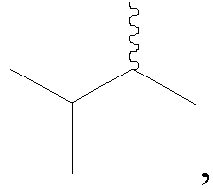
- In certain examples, R2 is hydrogen. In certain embodiments, R2 is Q-C(O)-, wherein Q is selected from the group consisting of


- In certain examples, R3 is hydroxyl group. In certain embodiments, R3 is X-C(O)-O-, wherein X is selected from the group consisting of

- This application specifically relates to the following compounds:
Name of Compounds Structure of Compound Number of Compound 13-O-decanoyl-ingenol 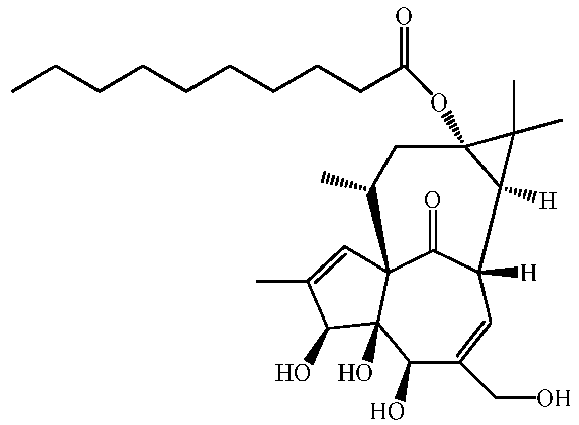
1a 13-O-(2'E,4'E-decadienoyl)-ingenol 
1b 20-deoxy-13-O-dodecanoyl-ingenol 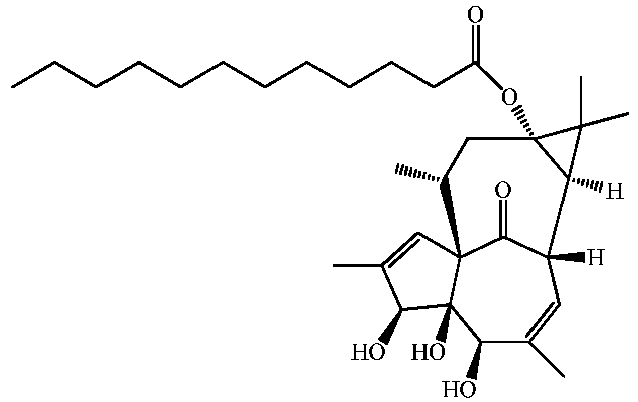
1d 6,7-epoxy-20-deoxy-ingenol 
1e 6,7-epoxy-20-O-(2,3-dimethylbutyryl)-13-O-dodecanoyl-ingenol 
1f 3-O-angeloyl-13-hydroxy-ingenol 
3 13-O-acetyl-ingenol 
4a 13-O-n-butanoyl-ingenol 
5 13-O-n-hexanoyl-ingenol 
6 13-O-n-octanoyl-ingenol 
7 3-O-angeloyl-13-O-acetyl-ingenol* 
8 3-O-acetyl-13-O-dodecanoyl-ingenol 
10 3-O-n-butanoyl-13-O-dodecanoyl-ingenol 
11 20-O-acetyl-13-O-dodecanoyl-ingenol 
12 20-O-n-butanoyl- 13 -O-dodecanoyl-ingenol 
13 20-O-(2,3-dimethylbutyryl)-13-O-decanoyl-ingenol 
14 20-O-angeloyl-13-O-dodecanoyl-ingenol 
15b 3,20-O-diangeloyl-13-O-dodecanoyl-ingenol 
15a 3-O-angeloyl-13-O-butanoyl-ingenol* 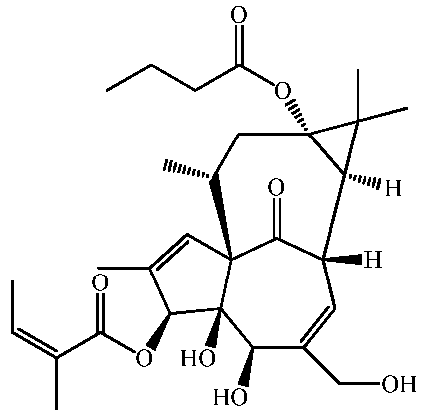
16 3-O-angeloyl-13-O-hexanoyl-ingenol* 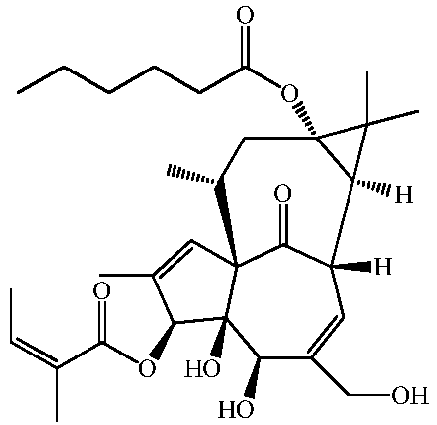
17 3-O-angeloyl-13-O-octanoyl-ingenol 
18 3-O-angeloyl-13-O-decanoyl-ingenol 
19 3-O-(2,3-dimethylbutenoyl)-13-O-dodecanoyl-ingenol* 
21 3-O-(3,5-diethylisoxazolyl-4-formyl)-13-O-dodecanoyl-ingenol* 
22 20-O-tigloyl-13-O-dodecanoyl-ingenol 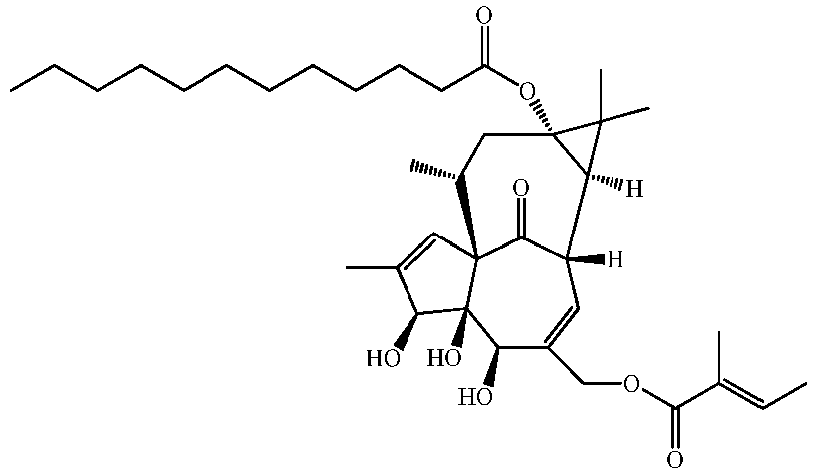
20-O-acetyl-13-hydroxy-ingenol 
20-O-acetyl-13-O-acetyl-ingenol 
20-O-acetyl-13-O-butanoyl-ingenol 
20-O-acetyl-13-O-hexanoyl-ingenol 
20-O-acetyl-13-O-octanoyl-ingenol 
20-O-acetyl-13-O-decanoyl-ingenol 
3-O-acetyl-13-hydroxy-ingenol 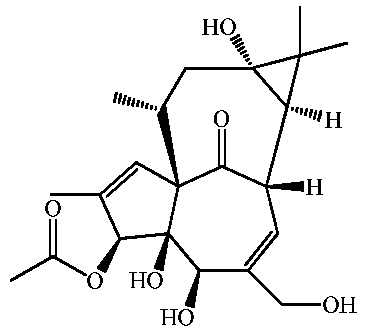
3-O-acetyl-13-O-acetyl-ingenol 
3-O-acetyl-13-O-butanoyl-ingenol 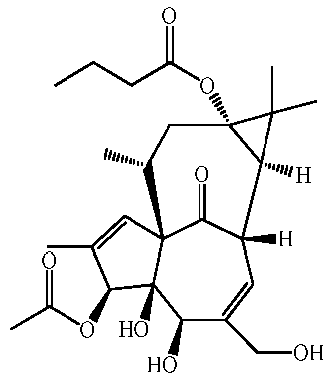
3-O-acetyl-13-O-hexanoyl-ingenol 
3-O-acetyl-13-O-octanoyl-ingenol 
3-O-acetyl-13-O-decanoyl-ingenol 
3-O-butyroyl-13-hydroxy-ingenol 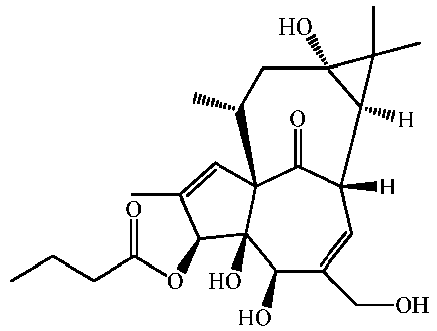
3-O-butyroyl-13-O-acetyl-ingenol 
3-O-butyroyl-13-O-butanoyl-ingenol 
3-O-butyroyl-13-O-hexanoyl-ingenol 
3-O-butyroyl-13-O-octanoyl-ingenol 
3-O-butyroyl-13-O-decanoyl-ingenol 
3-O-hexanoyl-13-hydroxy-ingenol 
3-O-hexanoyl-13-O-acetyl-ingenol 
3-O-hexanoyl-13-O-butanoyl-ingenol 
3-O-hexanoyl-13-O-hexanoyl-ingenol 
3-O-hexanoyl-13-O-octanoyl-ingenol 
3-O-hexanoyl-13-O-decanoyl-ingenol 
3-O-(2,3-dimethylbutyryl)-13-hydroxy-ingenol 
3-O-(2,3-dimethylbutyryl)-13-O-acetyl-ingenol 
3-O-(2,3-dimethylbutyryl)-13-O-butanoyl-ingenol 
3-O-(2,3-dimethylbutyryl)-13-O-hexanoyl-ingenol 
3-O-(2,3-dimethylbutenoyl)-13-hydroxy-ingenol 
3-O-(2,3-dimethylbutenoyl)-13-O-acetyl-ingenol 
3-O-(2,3-dimethylbutenoyl)-13-O-butanoyl-ingenol 
3-O-(2,3-dimethylbutenoyl)-13-O-hexanoyl-ingenol 
3-O-(2,3-dimethylbutenoyl)-13-O-octanoyl-ingenol 
3-O-(2,3-dimethylbutenoyl)-13-O-decanoyl-ingenol 
3-O-trimethylacetyl-13 -hydroxy-ingenol 
3-O-trimethylacetyl-13-O-acetyl-ingenol 
3-O-trimethylacetyl-13-O-butanoyl-ingenol 
3-O-trimethylacetyl-13-O-hexanoyl-ingenol 
3-O-trimethylacetyl-13-O-octanoyl-ingenol 
3-O-trimethylacetyl-13-O-decanoyl-ingenol 
3-O-tigloyl-13-hydroxy-ingenol 
3-O-tigloyl-13-O-acetyl-ingenol 
3-O-tigloyl-13-O-butanoyl-ingenol 
3-O-tigloyl-13-O-hexanoyl-ingenol 
3-O-tigloyl-13-O-octanoyl-ingenol 
3-O-tigloyl-13-O-decanoyl-ingenol 
3-O-tigloyl-13-O-dodecanoyl-ingenol 
20 3-O-(3,5-diethylisoxazolyl-4-formyl)-13 -hydroxy-ingenol 
3-O-(3,5-diethylisoxazolyl-4-formyl)-13-O-acetyl-ingenol 
3-O-(3,5-diethylisoxazolyl-4-formyl)-13-O-butanoyl-ingenol 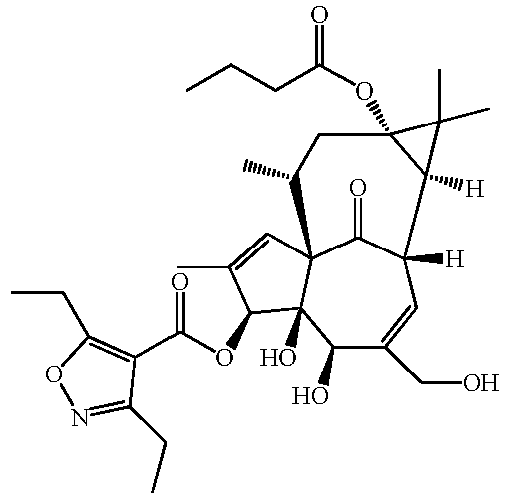
3-O-(3,5-diethylisoxazolyl-4-formyl)-13-O-hexanoyl-ingenol 
3-O-(3,5-diethylisoxazolyl-4-formyl)-13-O-octanoyl-ingenol 
3-O-(3,5-diethylisoxazolyl-4-formyl)-13-O-decanoyl-ingenol 
20-O-butyroyl-13-hydroxy-ingenol 
20-O-butyroyl-13-O-acetyl-ingenol 
20-O-butyroyl-13-O-butanoyl-ingenol 
20-O-butyroyl-13-O-hexanoyl-ingenol 
20-O-butyroyl-13-O-octanoyl-ingenol 
20-O-butyroyl-13-O-decanoyl-ingenol 
20-O-hexanoyl-13-hydroxy-ingenol 
20-O-hexanoyl-13-O-acetyl-ingenol 
20-O-hexanoyl-13-O-butanoyl-ingenol 
20-O-hexanoyl-13-O-hexanoyl-ingenol 
20-O-hexanoyl-13-O-octanoyl-ingenol 
20-O-hexanoyl-13-O-decanoyl-ingenol 
20-O-angeloyl-13-hydroxy-ingenol 
20-O-angeloyl-13-O-butanoyl-ingenol 
20-O-angeloyl-13-O-hexanoyl-ingenol 
20-O-angeloyl-13-O-octanoyl-ingenol 
20-O-angeloyl-13-O-decanoyl-ingenol 
20-O-tigloyl-13-hydroxy-ingenol 
20-O-tigloyl-13-O-acetyl-ingenol 
20-O-tigloyl-13-O-butanoyl-ingenol 
20-O-tigloyl-13-O-hexanoyl-ingenol 
20-O-tigloyl-13-O-octanoyl-ingenol 
20-O-tigloyl-13-O-decanoyl-ingenol 
20-O-(2,3-dimethylbutyryl)-13-hydroxy-ingenol 
20-O-(2,3-dimethylbutyryl)-13-O-acetyl-ingenol 
20-O-(2,3-dimethylbutyryl)-13-O-butanoyl-ingenol 
20-O-(2,3-dimethylbutyryl)-13-O-hexanoyl-ingenol 
20-O-(2,3-dimethylbutyryl)-13-O-octanoyl-ingenol 
20-O-(2,3-dimethylbutenoyl)-13-hydroxy-ingenol 
20-O-(2,3-dimethylbutenoyl)-13-O-acetyl-ingenol 
20-O-(2,3-dimethylbutenoyl)-13-O-butanoyl-ingenol 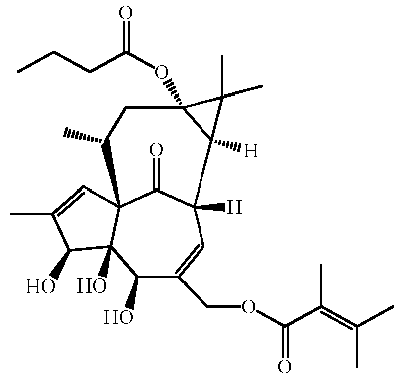
20-O-(2,3-dimethylbutenoyl)-13-O-hexanoyl-ingenol 
20-O-(2,3-dimethylbutenoyl)-13-O-octanoyl-ingenol 
20-O-(2,3-dimethylbutenoyl)-13-O-decanoyl-ingenol 
20-O-(2,3-dimethylbutenoyl)-13-O-dodecanoyl-ingenol 
20-O-trimethylacetyl-13-O-acetyl-ingenol 
20-O-trimethylacetyl-13-O-butanoyl-ingenol 
20-O-trimethylacetyl-13-O-hexanoyl-ingenol 
20-O-trimethylacetyl-13-O-octanoyl-ingenol 
20-O-trimethylacetyl-13-O-decanoyl-ingenol 
20-O-(3,5-diethylisoxazolyl-4-formyl)-13-hydroxy-ingenol 
20-O-(3,5-diethylisoxazolyl-4-formyl)-13-O-acetyl-ingenol 
20-O-(3,5-diethylisoxazolyl-4-formyl)-13-O-butanoyl-ingenol 
20-O-(3,5-diethylisoxazolyl-4-formyl)-13-O-hexanoyl-ingenol 
20-O-(3,5-diethylisoxazolyl-4-formyl)-13-O-octanoyl-ingenol 
20-O-(3,5-diethylisoxazolyl-4-formyl)-13-O-decanoyl-ingenol 
20-O-(3,5-diethylisoxazolyl-4-formyl)-13-O-dodecanoyl-ingenol 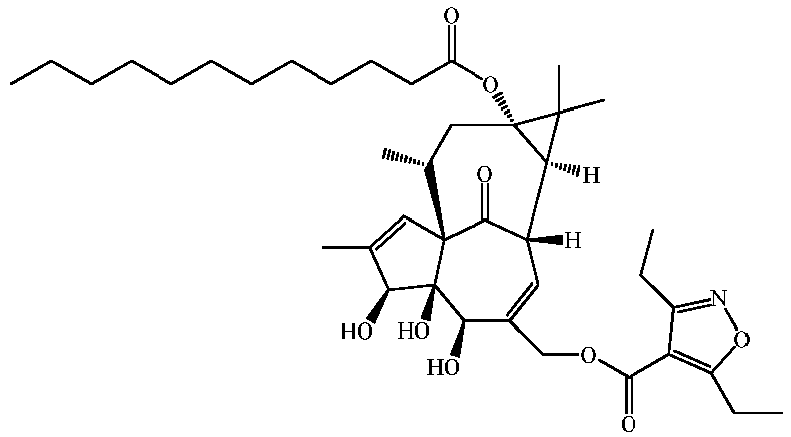
and 13-O-dodecanoyl-ingenol 
1c 3-O-angeloyl-13-O-dodecanoyl-ingenol 
9 3-O-trimethylacetyl-13-O-dodecanoyl-ingenol 
3-O-hexanoyl-13-O-dodecanoyl-ingenol 
3-O-(2,3-dimethylbutyryl)-13-O-dodecanoyl-ingenol 
20-O-trimethylacetyl-13- O-dodecanoyl-ingenol 
20-O-(2,3-dimethylbutyryl)-13-O-dodecanoyl-ingenol 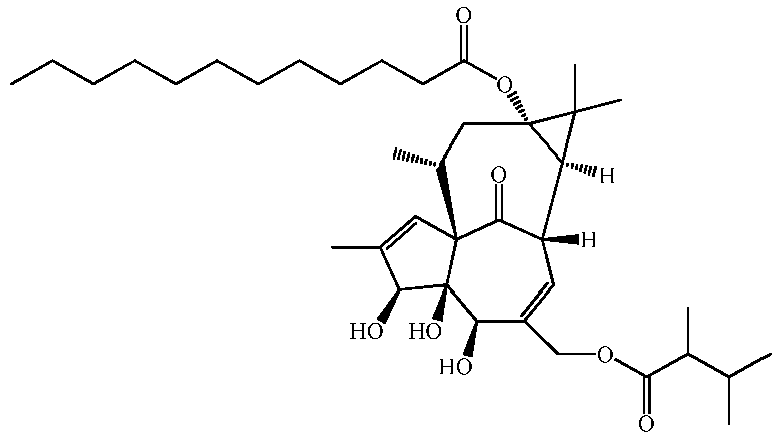
20-O-hexanoyl-13-O-dodecanoyl-ingenol 
3-O-(2,3-dimethylbutyryl)-13-O-dodecanoyl-20-O-acetyl-ingenol 
3-O-(2,3-dimethylbutyryl)-13-O-decanoyl-ingenol 
3-O-(2,3-dimethylbutyryl)-13-O-decanoyl-20-O-acetyl-ingenol 
3-O-(2,3-dimethylbutyryl)-13-O-octanoyl-ingenol 
3-O-benzoyl-13-O-dodecanoyl-ingenol 
20-O-benzoyl-13-O-dodecanoyl-ingenol 
* Compounds 8, 16, 17, 19, 21 and 22 are embodiments of the present invention. The other disclosed compounds are reference examples, not in accordance with the present independent claims. - The present disclosure also provides a compound of Formula (II), or a pharmaceutically acceptable salt, solvate, prodrug, metabolite or crystal form thereof,

- In certain examples, R1 is selected from the group consisting of hydrogen and M-C(O)-, wherein M is selected from the group consisting of C1-C11 linear alkyl (e.g., methyl, n-propyl, n-pentyl, n-heptyl, n-nonyl, and n-undecyl).
- In certain examples, R3 is hydroxyl group.
- In certain examples, the compound is selected from the group consisting of:
- 13-hydroxy-ingenol 3,4-acetonide
- 13-O-acetyl-ingenol 3,4-acetonide
- 13-O-n-butanoyl-ingenol 3,4-acetonide
- 13-O-n-hexanoyl-ingenol 3,4-acetonide
- 13-O-n-octanoyl-ingenol 3,4-acetonide
- 13-O-decanoyl-ingenol 3,4-acetonide
- 13-O-dodecanoyl-ingenol 3,4-acetonide (2c).
- The present disclosure also provides a compound of Formula (III), or a pharmaceutically acceptable salt, solvate, prodrug, metabolite or crystal form thereof,

- In certain examples, R1 is selected from the group consisting of hydrogen and M-C(O)-, wherein M is selected from the group consisting of C1-C11 linear alkyl (e.g., methyl, n-propyl, n-pentyl, n-heptyl, n-nonyl, and n-undecyl).
- In certain examples, R2 is selected from the group consisting of hydrogen and Q-C(O)-, wherein Q is selected from the group consisting of methyl, n-propyl, t-butyl, n-pentyl,


- In certain examples, R2 is hydrogen. In certain embodiments, R2 is Q-C(O)-, wherein Q is selected from the group consisting of methyl, n-propyl, t-butyl, n-pentyl,


- In certain examples, when R1 is M-C(O)- and M is n-undecyl, R2 is not hydrogen.
- In certain examples, when R1 is M-C(O)-, M is n-undecyl, and R2 is Q-C(O)-, Q is not

- Examples of such compounds are:
- 13-hydroxy-ingenol 5,20-acetonide (33)
- 13-O-acetyl-ingenol 5,20-acetonide (81)
- 13-O-n-butanoyl-ingenol 5,20-acetonide
- 13-O-n-hexanoyl-ingenol 5,20-acetonide
- 13-O-n-octanoyl-ingenol 5,20-acetonide
- 13-O-decanoyl-ingenol 5,20-acetonide
- 3-O-angeloyl-13-hydroxy-ingenol 5,20-acetonide (34)
- 3-O-angeloyl-13-O-acetyl-ingenol 5,20-acetonide (82)
- 3-O-angeloyl-13-O-n-butanoyl-ingenol 5,20-acetonide
- 3-O-angeloyl-13-O-n-hexanoyl-ingenol 5,20-acetonide
- 3-O-angeloyl-13-O-n-octanoyl-ingenol 5,20-acetonide
- 3-O-angeloyl-13-O-decanoyl-ingenol 5,20-acetonide
- 3-O-acetyl-13-O-dodecanoyl-ingenol 5,20-acetonide
- 3-O-n-butanoyl-13-O-dodecanoyl-ingenol 5,20-acetonide
- 3-O-tigloyl-13-O-dodecanoyl-ingenol 5,20-acetonide
- 3-O-(2,3-dimethylbutenoyl)-13-O-dodecanoyl-ingenol 5,20-acetonide
- 3-O-(3,5-diethylisoxazolyl-4-formyl)-13-O-dodecanoyl-ingenol 5,20-acetonide.
- The present disclosure also provides a compound of Formula (IV), or a pharmaceutically acceptable salt, solvate, prodrug, metabolite or crystal form thereof,

- In certain examples, R1 is M-C(O)-, wherein M is selected from the group consisting of C1-C10 linear alkyl.
- In certain examples, the compound is selected from the group consisting of:
- 13-O-acetyl-ingenol 3,4,5,20-diacetonide (41)
- 13-O-n-butanoyl-ingenol 3,4,5,20-diacetonide (51)
- 13-O-n-hexanoyl-ingenol 3,4,5,20-diacetonide (61)
- 13-O-n-octanoyl-ingenol 3,4,5,20-diacetonide (71)
- 13-O-decanoyl-ingenol 3,4,5,20-diacetonide.
- The present disclosure also provides a pharmaceutical composition comprising a compound as described above, or a pharmaceutically acceptable salt, solvate, prodrug, metabolite or crystal form thereof, as well as a pharmaceutically acceptable carrier (for example, an excipient, a disintegrant, a binder, an absorption enhancer, a flavoring agent or a surfactant). The pharmaceutical composition may be formulated into any pharmaceutically acceptable dosage form including, but not limited to, tablet, capsule, granule, pill, powder, solution, suspension, aerosol, dispersion, emulsion, gel, and ointment, etc. The dosage form can be an immediate release, sustained release or controlled release dosage form.
- The pharmaceutical composition may also be administered to a subject in need thereof any suitable administration mode (for example, orally, parenterally, intravenously, intraarterially, intraperitoneally, transdermally, sublingually, rectally, intramuscularly, transbuccally, intranasally, inhalation, vaginally, subcutaneously, intralipidly, intraocularly, intraarticularly, intrathecally, liposome, topical application to the skin, and intratumoral injection, etc.). For oral administration, the pharmaceutical composition can be prepared into a conventional solid preparation such as tablet, capsule, pill, and granule, etc.; or it can also be prepared into an oral liquid preparation such as oral solution, oral suspension and syrup, etc. When an oral preparation is prepared, a suitable filler, a binder, a disintegrant, and a lubricant, etc., may be added. For parenteral administration, the pharmaceutical composition can be prepared into an injection, including an injection solution, a sterile powder for injection, and a concentrated solution for injection. When an injection is prepared, it can be produced by a conventional method in the prior art, and when an injection is formulated, an additive may not be added, or a suitable additive may be added depending on the nature of the drug. For rectal administration, the pharmaceutical composition can be formulated as a suppository, etc. For pulmonary administration, the pharmaceutical composition can be formulated as an inhalant or a spray, etc.
- A compound as described above, or a pharmaceutically acceptable salt, solvate, prodrug, metabolite or crystal form thereof may be useful for the manufacture of a medicament for the prevention and/or treatment of a cosmetic indication or a disease associated with proliferation or tumor in a subject.
- The cosmetic indication may be selected from the group consisting of skin phototrauma, seborrheic keratosis, and keloids.
- The disease associated with proliferation or tumor may be selected from the group consisting of cutaneous wart, genital wart, porokeratosis, lung cancer, gastric cancer, breast cancer, colon cancer, bladder cancer, leukemia, liver cancer, cervical cancer, lymphoma, malignant melanoma, basal cell carcinoma, squamous cell carcinoma, Merkel cell carcinoma, vaginal cancer, vulvar cancer, and a precancerous lesion, including solar keratosis, malignant freckle, cervical intraepithelial neoplasia, anal intraepithelial neoplasia, and vulvar intraepithelial neoplasia.
- A compound as described above, or a pharmaceutically acceptable salt, solvate, prodrug, metabolite or crystal form thereof may be useful for the manufacture of a medicament for facilitating the healing of a skin wound, or for the prevention and/or treatment of the following disease in a subject: a disease responsive to neutrophil oxidative burst, a disease responsive to a release of IL-8 by keratinocyte, or a disease responsive to induction of necrosis.
- The wound may be a wound associated with diabetes or a wound caused by pathogenic infection.
- The disease may be selected from the group consisting of: viral infectious dermatosis, including verruca vulgaris, verruca plana, molluscum contagiosum, genital warts; skin cancers, including malignant melanoma, basal cell carcinoma, squamous cell carcinoma, Merkel cell carcinoma, vaginal cancer, and vulvar cancer; and a precancerous lesion of skin, including solar keratosis, malignant freckle, cervical intraepithelial neoplasia, anal intraepithelial neoplasia, and vulvar intraepithelial neoplasia.
- Also described is the use of a compound as described above, or a pharmaceutically acceptable salt, solvate, prodrug, metabolite or crystal form thereof for the preparation of a formulation for inhibiting proliferation of a cell associated with proliferation or a tumor, for stimulating neutrophil oxidative burst, or for stimulating a release of IL-8 by keratinocyte.
- The proliferation or tumor may be selected from the group consisting of cutaneous wart, genital wart, porokeratosis, lung cancer, gastric cancer, breast cancer, colon cancer, bladder cancer, leukemia, liver cancer, cervical cancer, lymphoma, malignant melanoma, basal cell carcinoma, squamous cell carcinoma, Merkel cell carcinoma, vaginal cancer, vulvar cancer, and a precancerous lesion, including solar keratosis, malignant freckle, cervical intraepithelial neoplasia, anal intraepithelial neoplasia, and vulvar intraepithelial neoplasia.
- The present disclosure also provides a method for the prevention and/or treatment of a cosmetic indication or a disease associated with proliferation or tumor in a subject, the method comprises administering to a subject in need thereof an effective amount of a compound as described above, or a pharmaceutically acceptable salt, solvate, prodrug, metabolite or crystal form thereof.
- The cosmetic indication may be selected from the group consisting of skin phototrauma, seborrheic keratosis, and keloids.
- The disease associated with proliferation or tumor may be selected from the group consisting of cutaneous wart, genital wart, porokeratosis, lung cancer, gastric cancer, breast cancer, colon cancer, bladder cancer, leukemia, liver cancer, cervical cancer, lymphoma, malignant melanoma, basal cell carcinoma, squamous cell carcinoma, Merkel cell carcinoma, vaginal cancer, vulvar cancer, and a precancerous lesion, including solar keratosis, malignant freckle, cervical intraepithelial neoplasia, anal intraepithelial neoplasia, and vulvar intraepithelial neoplasia.
- The present disclosure also provides a method for facilitating the healing of a skin wound, or for the prevention and/or treatment of the following diseases in a subject: a disease responsive to neutrophil oxidative burst, a disease responsive to a release of IL-8 by keratinocyte, or a disease responsive to induction of necrosis, wherein the method comprises administering to a subject in need thereof an effective amount of a compound as described above, or a pharmaceutically acceptable salt, solvate, prodrug, metabolite or crystal form thereof.
- The wound may be a wound associated with diabetes or a wound caused by pathogenic infection.
- The disease may be selected from the group consisting of: viral infectious dermatosis, including verruca vulgaris, verruca plana, molluscum contagiosum, genital warts; skin cancers, including malignant melanoma, basal cell carcinoma, squamous cell carcinoma, Merkel cell carcinoma, vaginal cancer, and vulvar cancer; and a precancerous lesion of skin, including solar keratosis, malignant freckle, cervical intraepithelial neoplasia, anal intraepithelial neoplasia, and vulvar intraepithelial neoplasia.
- The present disclosure also provides a method capable of inhibiting proliferation of a cell associated with proliferation or a tumor, stimulating neutrophil oxidative burst, and/or stimulating a release of IL-8 by keratinocyte, the method comprises administering to a cell in need thereof an effective amount of a compound as described above, or a pharmaceutically acceptable salt, solvate, prodrug, metabolite or crystal form thereof.
- The proliferation or tumor may be selected from the group consisting of cutaneous wart, genital wart, porokeratosis, lung cancer, gastric cancer, breast cancer, colon cancer, bladder cancer, leukemia, liver cancer, cervical cancer, lymphoma, malignant melanoma, basal cell carcinoma, squamous cell carcinoma, Merkel cell carcinoma, vaginal cancer, vulvar cancer, and a precancerous lesion, including solar keratosis, malignant freckle, cervical intraepithelial neoplasia, anal intraepithelial neoplasia, and vulvar intraepithelial neoplasia.
- The cell associated with proliferation or a tumor, the neutrophil or the keratinocyte may be a primary cell from a subject or a culture thereof, or an established cell line.
- The subject may be any animals, preferably mammals, such as a bovine, an equid, a caprid, a porcine, a canid, a felid, a rodent, and a primate. Among them, the particularly preferred subject is human.
- The present disclosure also provides various exemplary methods for preparing the compounds of Formula (I), as shown in Schemes 1, 2, and 3, respectively:


- In the present methods, the 13-oxidized ingenol 3-O-acylate can be synthesized according to, for example, the method of Scheme 1, 2 or 3. The protecting group (Pg) may be a protecting group for hydroxyl commonly used in organic chemistry. For example, in the Scheme 1, the Pg may be an acetal or a ketal, etc., and in the Scheme 2, the Pg may be a silyl group or a trityl group, or a tetrahydropyran, and the like. The esterification reaction in Scheme 1, 2 or 3 may be carried out by an esterification reaction commonly used in organic synthesis, for example, a reaction carried out using an acid, an acid anhydride, a mixed acid anhydride or an acid halide as an acylating agent, and in the presence of an acidic or basic catalyst in a suitable solvent. The deprotection reaction in Scheme 1, 2 or 3 can be carried out using the deprotection reaction conditions for an acetal, a ketal, a silyl, a trityl or a tetrahydropyran, etc., which are commonly used in organic synthesis.
- The starting synthetic materials in Scheme 1, 2 or 3 can be obtained from Euphorbia (e.g., kansui L., Leptochloa chinensis., Euphorbia cornigera, Euphorbia cyparissias L., uphorbia papillosa, etc.) by a conventional method such as alcohol extraction, alkali hydrolysis or column chromatography.
- The starting synthetic materials in Scheme 1, 2, or 3 can also be prepared according to the following non-limiting general methods.


- In the Scheme a or b, R represents an aliphatic acyl group or a benzoyl group, and when R is an aliphatic acyl group, it may be selected from the group consisting of acetyl, n-octanoyl, decanoyl, dodecanoyl, 2E,4E-decadienoyl, 2Z,4E,6Z-decatrienoyl.
- The starting synthetic materials in Scheme a or b can be obtained from Euphorbia (e.g., kansui L., Leptochloa chinensis., Euphorbia cornigera, Euphorbia cyparissiasL., Euphorbia papillosa, etc.) by a conventional method such as alcohol extraction, alkali hydrolysis or column chromatography.
- In Scheme a or b, the protecting group (Pg) may be a protecting group for hydroxyl commonly used in organic chemistry. For example, in the Scheme a, the Pg may be an acetal or a ketal, etc., and in the Scheme b, the Pg may be a methyl, a silyl group, a trityl group, or a tetrahydropyran, and the like. The ester reduction reaction in the Scheme a or b may be carried out by an ester reduction reaction commonly used in organic synthesis, for example, an ester reduction reaction using lithium aluminum hydride, diisobutylaluminum hydride, vitride, sodium borohydride/Lewis acid or lithium borohydride as a reducing agent in a suitable solvent. The esterification reaction in Scheme a or b may be carried out by an esterification reaction commonly used in organic synthesis, for example, an esterification reaction using an acid, an acid anhydride, a mixed acid anhydride or an acid halide as an acylating agent, in the presence of an acidic or basic catalyst in a suitable solvent. The deprotection reaction in Scheme a or b can be carried out using the deprotection reaction conditions for an acetal, a ketal, a methyl, a silyl, a trityl or a tetrahydropyran, etc., which are commonly used in organic synthesis.
- The compounds of the present invention have one or more of the following beneficial effects compared to the prior art:
- 1. The compounds of the present invention can induce rapid death of a variety of tumor cells, and some compounds exhibit high selectivity for leukemia cells.
- 2. The compounds of the present invention can stimulate neutrophil oxidative burst and are more effective than 3-O-angeloyl-ingenol. Neutrophils are an important component of the innate immune response and, therefore, the compounds of the present invention can stimulate an innate immune response.
- 3. The compounds of the present invention can stimulate the release of IL-8 by keratinocytes and are as efficient as 3-O-angeloyl-ingenol or higher than 3-O-angeloyl-ingenol. IL-8 is a chemokine of neutrophils, whereby the compounds of the present invention can induce immune stimulation.
- 4. The compounds of the present invention are less polar than 3-O-angeloyl-ingenol and are more accessible to the dermis layer than 3-O-angeloyl-ingenol.
- Example compounds are provided below to demonstrate the advantageous activity and beneficial technical effects of the compounds of the present disclosure. However, it should be understood that the following experimental schemes are merely illustrative.
- Examples wherein the specific conditions are not specified are carried out according to the conventional conditions or conditions suggested by manufacturer. The reagents or instruments used wherein the manufacturers are not indicated, are all commercially available conventional products.
- 20 kg of kansui L. medicinal herbs was cold-soak extracted by 3 to 6 folds amount of 95% ethanol, until complete extraction; the extracting solutions were combined, and concentrated under reduced pressure until an alcohol-free taste to obtain an extract. To the extract, 10 folds amount of a solution of NaOH in methanol (0.5 M) was added, the mixture was stirred for about 2 hours. The mixture was adjusted to pH about 7 with dilute hydrochloric acid, and extracted 3 times with ethyl acetate, and then the ethyl acetate layers were combined, concentrated under reduced pressure to dryness. The extract was purified by normal phase silica gel column chromatography eluted with a gradient of petroleum ether: ethyl acetate (100:1 to 1:2) to obtain fractions rich in 13-oxidized ingenol and fractions rich in deoxy-ingenol, respectively. The fractions rich in 13-oxidized ingenol were purified by reverse-phase silica gel column chromatography, eluted with a gradient of methanol: water (10% methanol to 100% methanol), and the same fractions were combined to obtain 13-O-decanoyl-ingenol (Compound 1a), 13-O-(2'E,4'E-decadienoyl)-ingenol (Compound 1b), 13-O-dodecanoyl-ingenol (Compound 1c), and 6,7-epoxy-20-O-(2,3-dimethylbutyryl)-13-O-dodecanoyl-ingenol (Compound 1f).
- The fractions rich in deoxy-ingenol were purified by normal phase silica gel column chromatography eluted with a gradient of petroleum ether: acetone (20:1 to 1:2), and the same fractions were combined to obtain 20-O-deoxy-13-O-dodecanoyl-ingenol (Compound 1d), and 6,7-epoxy-20-deoxy-ingenol (Compound 1e).
- The structural formula and hydrogen nuclear magnetic resonance spectrum (1H-NMR) of the compounds are as follows:
-

- 1H-NMR (400MHz, CDCl3) δ 6.02(d, 1H), 5.88(d, 1H), 4.39(d, 1H), 4.02-4.21(m, 4H), 3.83(d, 1H), 3.59(d, 1H), 3.25(brs, 1H), 2.73(brd, 1H), 2.46(m, 1H), 2.15-2.22(m, 3H), 1.85(s, 3H), 1.55(m, 2H), 1.25-1.29(m, 13H), 1.22(s, 3H), 1.07(s, 3H), 0.96(d, 3H), 0.88(t, 3H).
-

- 1H-NMR (400MHz, CDCl3) δ 7.20(m, 1H), 6.12-6.14(m, 2H), 6.03(d, 1H), 5.90(s, 1H), 5.71(d, 1H), 4.41(brs, 1H), 4.05-4.22(m, 4H), 3.84(brs, 1H), 3.57(brs, 1H), 3.13(brs, 1H), 2.76(d, 1H), 2.58(brs, 1H), 2.45(brs, 1H), 2.24(dd, 1H), 2.15(m, 2H), 1.86(s, 3H), 1.42(m, 2H), 1.24-1.29(m, 8H), 1.08(s, 3H), 0.96(d, 3H), 0.89(t, 3H).
-

- 1H-NMR (400MHz, CDCl3) δ 6.01(d, 1H), 5.85(brs, 1H), 4.37(s, 1H), 4.24(brs, 1H), 4.17(d, 1H), 4.08(d, 1H), 4.05(dd, 1H), 3.82(brs, 1H), 2.72(m, 1H), 2.46(m, 1H), 2.19(t, 2H), 2.15(m, 1H), 1.84(s, 3H), 1.54(m, 2H), 1.20-1.29(m, 20H), 1.06(s, 3H), 0.94(d, 3H), 0.87(t, 3H).
-

- 1H-NMR (400MHz, CDCl3) δ 5.94(s, 1H), 5.70(d, 1H), 4.40(brs, 1H), 4.15(s, 1H), 3.96(brd, 1H), 3.46(d, 1H), 2.93(brd, 1H), 2.66-2.74(m, 2H), 2.36(m, 1H), 2.17-2.23(m, 3H), 1.85(s, 3H), 1.77(s, 3H), 1.54(m, 2H), 1.22-1.24(m, 17H), 1.21(s, 3H), 1.05(s, 3H), 0.96(d, 3H), 0.87(t, 3H).
-

- 1H-NMR (400MHz, CDCl3) δ 5.96(d, 1H), 4.28(s, 1H), 3.26-3.32(m, 2H), 3.16(ddd, 1H), 2.26(m, 1H), 2.16(m, 1H), 1.82(s, 3H), 1.70(m, 1H), 1.41(s, 3H), 1.18(s, 3H), 1.07(s, 3H), 0.93(d, 3H), 0.86(m, 1H), 0.69(m, 1H).
-

- 1H-NMR (400 MHz, CDCl3) δ 5.97(d, 1H), 4.41 (d, 1H), 4.33(brs, 1H), 4.00(s, 1H), 3.98(d, 1H), 3.52(brd, 1H), 3.46(d, 1H), 3.11 (dd, 1H), 2.74(m, 1H), 2.62(m, 1H), 2.16-2.29(m, 4H), 1.84-1.91(m, 4H), 1.55(m, 2H), 1.18-1.31(m, 20H), 1.08(t, 9H), 0.85-0.95(m, 9H).
- 13-O-dodecanoyl-ingenol (0.2 mmol) was dissolved in 0.5 mg/mL of a solution of p-toluenesulfonic acid monohydrate in acetone and stirred at 30°C for 12 h. The reaction solution was concentrated to dryness under reduced pressure, re-dissolved in ethyl acetate, and washed with water and saturated aqueous sodium chloride solution, successively, and then the organic layer was concentrated to dryness under reduced pressure. The resulting residual was purified by flash chromatography (petroleum ether: ethyl acetate = 10:1 to 6:4) to obtain 13-O-dodecanoyl-ingenol 3,4,5,20-diacetonide (Compound 2a), 13-O-dodecanoyl-ingenol 5,20-acetonide (Compound 2b), 13-O-dodecanoyl-ingenol 3,4-acetonide (Compound 2c), respectively.
- The structural formula and hydrogen nuclear magnetic resonance spectrum (1H-NMR) of the compounds are as follows:
-
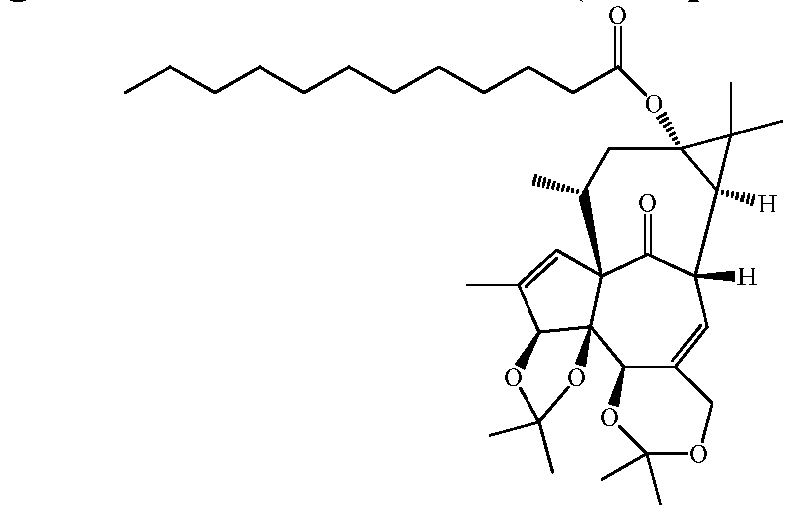
- 1H-NMR (400MHz, CDCl3) δ 5.93(d, 1H), 5.67(d, 1H), 4.86(s, 1H), 4.25(dd, 1H), 4.10(d, 1H), 3.93(s, 1H), 3.54(brd, 1H), 2.72(dd, 1H), 2.61(dt, 1H), 2.21(t, 2H), 2.10(dd, 1H), 1.86(s, 3H), 1.51-1.58(m, 8H), 1.40(s, 3H), 1.32(s, 3H), 1.23-1.30(m, 17H), 1.21(s, 3H), 1.06(s, 3H), 0.98(d, 3H), 0.87(t, 3H).
-

- 1H-NMR (400MHz, CDCl3) δ 5.89(d, 1H), 5.77(d, 1H), 4.28(d, 1H), 4.18(s, 2H), 4.04(brd, 1H), 3.94(s, 1H), 3.55(s, 1H), 2.74(dd, 1H), 2.59(dt, 1H), 2.53(d, 1H), 2.20(t, 2H), 2.15(dd, 1H), 1.86(s, 3H), 1.55(m, 2H), 1.41(s, 3H), 1.36(s, 3H), 1.25(brs, 17H), 1.23(s, 3H), 1.07(s, 3H), 0.95(d, 3H), 0.87(t, 3H).
-

- 1H-NMR (400MHz, CDCl3) δ 6.09(d, 1H), 5.75(d, 1H), 4.77(s, 1H), 4.10-4.17(m, 4H), 3.22(d, 1H), 2.73-2.79(m, 2H), 2.20(t, 2H), 1.95(m, 1H), 1.86(s, 3H), 1.54(s, 5H), 1.49(s, 3H), 1.22-1.31(m, 20H), 1.08(s, 3H), 1.01(d, 3H), 0.88(t, 3H).
-

- 13-O-dodecanoyl-ingenol 3,4,5,20-diacetonide (Compound 2a, for which the preparation procedure may refer to Example 2) (0.5 mmol) was dissolved in diethyl ether, and lithium aluminium hydride was added in the condition of ice water bath and stirred for 15 min. The reaction solution was added with a saturated aqueous sodium sulfate solution, and extracted with diethyl ether. The organic layer was washed with saturated aqueous sodium chloride solution, and then concentrated to dryness under reduced pressure. The resulting residual was purified by flash chromatography (petroleum ether: ethyl acetate = 7:3) to obtain 13-OH-ingenol 3,4,5,20-diacetonide (Compound 31).
- Compound 31 (0.4 mmol) was dissolved in methanol, 4 M diluted hydrochloric acid was added and stirred at room temperature for 15 h. The reaction solution was poured into water, adjusted to pH about 7 with sodium hydrogen carbonate solution, and extracted with ethyl acetate. The organic layer was washed with saturated aqueous sodium chloride solution, and then concentrated to dryness under reduced pressure. The resulting residual was purified by flash chromatography (petroleum ether: acetone = 3:2) to obtain 13-OH-ingenol (Compound 32).
- Compound 32 (0.3 mmol) was dissolved in 0.5 mg/mL of a solution of p-toluenesulfonic acid monohydrate in acetone and stirred at room temperature for 1 h. The reaction solution was concentrated to dryness under reduced pressure, re-dissolved in ethyl acetate, and washed with water and saturated aqueous sodium chloride solution, successively, and then the organic layer was concentrated to dryness under reduced pressure. The resulting residual was purified by flash chromatography (petroleum ether: acetone = 3:1) to obtain 13-OH-ingenol 5,20-acetonide (Compound 33).
- Compound 33 (0.2 mmol) was dissolved in acetonitrile, angelic anhydride (0.24 mmol), and cesium carbonate (0.3 mmol) were added, and stirred at room temperature for 24 h. The reaction solution was poured into water, extracted with diethyl ether. The organic layer was washed with saturated aqueous sodium chloride solution, and then concentrated to dryness under reduced pressure. The resulting residual was purified by flash chromatography (petroleum ether: acetone = 7:1) to obtain 3-O-angeloyl-13-OH-ingenol 5,20-acetonide (Compound 34).
- Compound 34 (0.1 mmol) was dissolved in methanol, 4 M diluted hydrochloric acid was added and stirred at room temperature for 8 h. The reaction solution was poured into water, extracted with ethyl acetate. The organic layer was washed with saturated aqueous sodium chloride solution, and then concentrated to dryness under reduced pressure. The resulting residual was purified by flash chromatography (petroleum ether: acetone = 2:1) to obtain the title compound (Compound 3).
- The hydrogen nuclear magnetic resonance spectrum of Compound 3: 1H-NMR (400MHz, Acetone-d6) δ 6.11(dq, 1H), 6.00(d, 1H), 5.93(brd, 1H), 5.82(s, 1H), 4.10-4.15(m, 3H), 3.95(s, 1H), 2.79(m, 1H), 2.68(dd, 1H), 1.97(m, 3H), 1.86-1.92(m, 4H), 1.78(d, 3H), 1.16(s, 3H), 1.10(d, 3H), 1.07(s, 3H), 0.96(d, 1H).
- 50 kg of dry aboveground part of Euphorbia cornigera was cold-soak extracted by 3 to 6 folds amount of 95% ethanol, until complete extraction, the extracting solutions were combined, and concentrated under reduced pressure until an alcohol-free taste to obtain an extract. To the extract, 10 folds amount of a solution of NaOH in methanol (0.5 M) was added, the mixture was stirred for about 2 hours. The mixture was adjusted to pH about 7 with dilute hydrochloric acid, and extracted with ethyl acetate for 3 times, and then the ethyl acetate layers were combined, and concentrated under reduced pressure to dryness. The extract was purified by normal phase silica gel column chromatography eluted with a gradient of petroleum ether: ethyl acetate (100:1 to 1:2) to obtain fractions rich in 13-oxidized ingenol. The fractions were further purified by reverse-phase silica gel column chromatography eluted with a gradient of acetonitrile: water (10% acetonitrile to 100% acetonitrile), and the same fractions were combined to obtain 13-O-acetyl-ingenol (Compound 4a), 13-O-(2'Z,4'E,6'Z-decatrienoyl)-ingenol (Compound 4b) and 13-0-dodecanoyl-ingenol (Compound 1c), respectively.
- 13-OH-ingenol 3,4,5,20-diacetonide (Compound 31, for which the preparation procedure may refer to Example 3) (0.4 mmol) was dissolved in anhydrous pyridine, and acetic anhydride (0.5 mmol) was added and stirred at 50°C for 24 h. The reaction solution was poured into ice water, adjusted to pH about 7 with sodium hydrogen carbonate solution, and extracted with diethyl ether. The organic layer was washed with saturated aqueous sodium chloride solution, and then concentrated to dryness under reduced pressure. The resulting residual was purified by flash chromatography (petroleum ether: ethyl acetate = 10:1) to obtain 13-O-acetyl-ingenol 3,4,5,20-diacetonide (Compound 41).
- Compound 41 (0.25 mmol) was dissolved in methanol, 4 M diluted hydrochloric acid was added and stirred at room temperature for 15 h. The reaction solution was poured into water, adjusted to pH about 7 with sodium hydrogen carbonate solution, and extracted with ethyl acetate. The organic layer was washed with saturated aqueous sodium chloride solution, and then concentrated to dryness under reduced pressure. The resulting residual was purified by flash chromatography (chloroform : methanol = 94:6) to obtain 13-O-acetyl-ingenol (Compound 4a). The structural formula and hydrogen nuclear magnetic resonance spectrum are as follows:
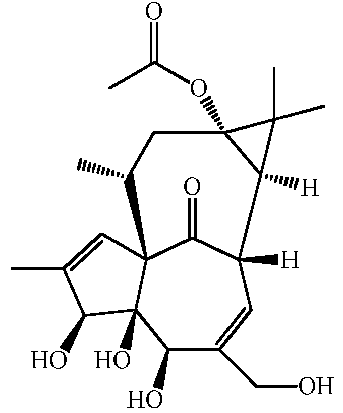
- 1H-NMR (400MHz, CDCl3) δ 6.01(d, 1H), 5.84(d, 1H), 4.37(d, 1H), 4.23(s, 1H), 4.03-4.18(m, 3H), 3.81(d, 1H), 3.68-3.71(m, 2H), 2.93(m, 1H), 2.72(dd, 1H), 2.47(m, 1H), 2.15(dd, 1H), 1.96(s, 3H), 1.84(d, 3H), 119-1.24(m, 4H), 1.08(s, 3H), 0.95(d, 3H).
-

- 13-O-n-butanoyl-ingenol 3,4,5,20-diacetonide (Compound 51) was prepared according to the preparation method of 13-O-acetyl-ingenol 3,4,5,20-diacetonide (Compound 41) (refer to Example 4), except that acetic anhydride was replaced with n-butyric anhydride.
- Using Compound 51 as a raw material, the acetonide-protecting group was removed according to the preparation procedure of Compound 4a to obtain 13-O-n-butanoyl-ingenol (Compound 5).
- The hydrogen nuclear magnetic resonance spectrum of Compound 5: 1H-NMR (400 MHz, CDCl3) δ 6.02(d, 1H), 5.88(d, 1H), 4.39(d, 1H), 4.03-4.20(m, 4H), 3.82(d, 1H), 3.54(d, 1H), 3.16(d, 1H), 2.73(dd, 1H), 2.58(m, 1H), 2.45(m, 1H), 2.14-2.25(m, 3H), 1.85(s, 3H), 1.59(m, 2H), 1.24(d, 1H), 1.22(s, 3H), 1.07(s, 3H), 0.96(d, 3H), 0.92(t, 3H).
-

- 13-O-n-hexanoyl-ingenol 3,4,5,20-diacetonide (Compound 61) was prepared according to the preparation method of 13-O-acetyl-ingenol 3,4,5,20-diacetonide (Compound 41) (refer to Example 4), except that acetic anhydride was replaced with n-hexanoic anhydride.
- Using Compound 61 as a raw material, the acetonide-protecting group was removed according to the preparation method of Compound 4a to obtain 13-O-n-hexanoyl-ingenol (Compound 6).
- The hydrogen nuclear magnetic resonance spectrum of Compound 6: 1H-NMR (400MHz, CDCl3) δ 6.00(d, 1H), 5.84(d, 1H), 4.35(d, 1H), 4.25(s, 1H), 4.03-4.18(m, 3H), 3.85(d, 1H), 3.76-3.82(m, 2H), 3.08(m, 1H), 2.72(dd, 1H), 2.46(m, 1H), 2.10-2.22(m, 3H), 1.84(s, 3H), 1.55(m, 2H), 1.23-1.30(m, 5H), 1.21(s, 3H), 1.06(s, 3H), 0.94(d, 3H), 0.87(t, 3H).
-

- 13-O-n-octanoyl-ingenol 3,4,5,20-diacetonide (Compound 71) was prepared according to the preparation method of 13-O-acetyl-ingenol 3,4,5,20-diacetonide (Compound 41) (refer to Example 4), except that acetic anhydride was replaced with n-octanoic anhydride.
- Using Compound 71 as a raw material, the acetonide-protecting group was removed according to the preparation method of Compound 4a to obtain 13-O-n-octanoyl-ingenol (Compound 7).
- The hydrogen nuclear magnetic resonance spectrum of Compound 7: 1H-NMR (400MHz, CDCl3) δ 6.00(d, 1H), 5.84(d, 1H), 4.36(d, 1H), 4.24(s, 1H), 4.03-4.18(m, 3H), 3.73-3.82(m, 3H), 3.00(brs, 1H), 2.72(brd, 1H), 2.46(m, 1H), 2.11-2.21(m, 3H), 1.84(s, 3H), 1.54(m, 2H), 1.22-1.32(m, 9H), 1.21(s, 3H), 1.06(s, 3H), 0.94(d, 3H), 0.86(t, 3H).
-

- 13-O-acetyl-ingenol (Compound 4a, for which the preparation procedure may refer to Example 4) (0.5 mmol) was dissolved in 0.4 mg/mL of a solution of p-toluenesulfonic acid monohydrate in acetone and stirred at room temperature for 1 h. The reaction solution was concentrated to dryness under reduced pressure, re-dissolved in ethyl acetate, and washed with water and saturated aqueous sodium chloride solution, successively, and then the organic layer was concentrated to dryness under reduced pressure. The resulting residual was purified by flash chromatography (petroleum ether: ethyl acetate = 2:1) to obtain 13-O-acetyl-ingenol 5,20-acetonide (Compound 81).
- Compound 81 (0.4 mmol) was dissolved in acetonitrile, angelic anhydride (0.6 mmol), and cesium carbonate (0.6 mmol) were added, and stirred at room temperature for 24 h. The reaction solution was poured into water, extracted with diethyl ether. The organic layer was washed with saturated aqueous sodium chloride solution, and then concentrated to dryness under reduced pressure. The resulting residual was purified by flash chromatography (petroleum ether: ethyl acetate = 8:1) to obtain 3-O-angeloyl-13-O-acetyl-ingenol 5,20-acetonide (Compound 82).
- Compound 82 (0.3 mmol) was dissolved in methanol, 4 M diluted hydrochloric acid was added and stirred at room temperature for 12 h. The reaction solution was poured into water and extracted with ethyl acetate. The organic layer was washed with saturated aqueous sodium chloride solution, and then concentrated to dryness under reduced pressure. The resulting residual was purified by flash chromatography (petroleum ether: acetone = 4:1) to obtain the title compound (Compound 8).
- The hydrogen nuclear magnetic resonance spectrum of Compound 8: 1H-NMR (400MHz, CDCl3) δ 6.17(dq, 1H), 6.01-6.05(m, 2H), 5.53(s, 1H), 4.43(brs, 1H), 4.16(brs, 2H), 4.07-4.11(m, 2H), 3.56(s, 1H), 2.72(dd, 1H), 2.65(m, 1H), 2.45(brs, 1H), 2.19(m, 1H), 2.01(dd, 3H), 1.96(s, 3H), 1.91(m, 3H), 1.81(d, 3H), 1.24(d, 1H), 1.19(s, 3H), 1.08(s, 3H), 0.97(d, 3H).
-

- Using 13-O-dodecanoyl-ingenol (Compound 1c, for which the preparation method may refer to Example 1) as raw material, acetonide protection reaction, esterification reaction, and the reaction of removing acetonide-protecting group were carried out in sequence according to the synthesis method of Compound 8 to obtain the title Compound (Compound 9).
- The hydrogen nuclear magnetic resonance spectrum of Compound 9: 1H-NMR (400MHz, CDCl3) δ 6.17(dq, 1H), 6.02-6.04(m, 2H), 5.53(s, 1H), 4.34(d, 1H), 4.16(d, 2H), 4.08-4.11(m, 2H), 3.54(s, 1H), 2.73(dd, 1H), 2.65(m, 1H), 2.32(t, 1H), 2.16-2.22(m, 3H), 2.01(dd, 3H), 1.91(s, 3H), 1.81(s, 3H), 1.60(s, 2H), 1.55(m, 2H), 1.22-1.28(m, 15H), 1.19(s, 3H), 1.06(s, 3H), 0.97(d, 3H), 0.88(t, 3H).
-

- Using 13-O-dodecanoyl-ingenol (Compound 1c, for which the preparation method may refer to Example 1) as a starting material, according to the synthesis method in Example 8, 13-0-dodecanoyl-ingenol 5,20-acetonide was synthesized and then angelic anhydride was replaced with acetic anhydride to synthesize 3-O-acetyl-13-O-dodecanoyl-ingenol 5,20-acetonide, and the acetonide-protecting group was removed to obtain the title Compound (Compound 10).
- The hydrogen nuclear magnetic resonance spectrum of Compound 10: 1H-NMR (400MHz, CDCl3) δ 6.01-6.03(m, 2H), 5.47(s, 1H), 4.32(d, 1H), 3.98-4.16(m, 4H), 3.58(s, 1H), 2.71(dd, 1H), 2.60(m, 1H), 2.47(t, 1H), 2.16-2.24(m, 3H), 2.15(s, 3H), 1.78(s, 3H), 1.55(m, 2H), 1.21-1.33(m, 17H), 1.19(s, 3H), 1.06(s, 3H), 0.97(d, 3H), 0.87(t, 3H).
-

- Using 13-O-dodecanoyl-ingenol (Compound 1c, for which the preparation method may refer Example 1) as a starting material, according to the synthesis method in Example 8, 13-O-dodecanoyl-ingenol 5,20-acetonide was synthesized, and then angelic anhydride was replaced with butyric anhydride to synthesize 3-O-n-butanoyl-13-O-dodecanoyl-ingenol 5,20-acetonide, and the acetonide-protecting group was removed to obtain the title Compound (Compound 11).
- The hydrogen nuclear magnetic resonance spectrum of Compound 11: 1H-NMR (400MHz, CDCl3) δ 6.01-6.03(m, 2H), 5.46(s, 1H), 4.34(d, 1H), 4.02-4.18(m, 4H), 3.55(s, 1H), 2.71(dd, 1H), 2.60(m, 1H), 2.47(m, 1H), 2.38(dt, 2H), 2.16-2.24(m, 3H), 1.78(s, 3H), 1.63-1.72(m, 2H), 1.55(m, 2H), 1.20-1.33(m, 17H), 1.19(s, 3H), 1.06(s, 3H), 0.96-1.00(m, 6H), 0.87(t, 3H).
-

- 13-O-dodecanoyl-ingenol (Compound 1c, for which the preparation method may refer to Example 1) (0.06 mmol) was dissolved in dichloromethane, acetic anhydride (0.06 mmol) and 4-dimethylaminopyridine (0.06 mmol) were added, and stirred at room temperature for 8h. The reaction solution was poured into water, extracted with diethyl ether. The organic layer was washed with saturated aqueous sodium chloride solution, and then concentrated to dryness under reduced pressure. The resulting residual was purified by flash chromatography (petroleum ether: acetone = 4:1) to obtain the title compound (Compound 12).
- The hydrogen nuclear magnetic resonance spectrum of Compound 12: 1H-NMR (400MHz, CDCl3) δ 6.07(d, 1H), 5.92(d, 1H), 4.71(d, 1H), 4.52(d, 1H), 4.45(d, 1H), 4.12(s, 1H), 4.03(dd, 1H), 3.69(d, 1H), 2.91(d, 1H), 2.73(dd, 1H), 2.65(d, 1H), 2.42(m, 1H), 2.16-2.22(m, 3H), 2.06(s, 3H), 1.86(s, 3H), 1.55(m, 2H), 1.23-1.29(m, 17H), 1.22(s, 3H), 1.07(s, 3H), 0.97(d, 3H), 0.88(t, 3H).
-

- 13-O-dodecanoyl-ingenol (Compound 1c, for which the preparation method may refer to Example 1) (0.07 mmol) was dissolved in dichloromethane, n-butyric anhydride (0.08 mmol) and 4-dimethylaminopyridine (0.08 mmol) were added, and stirred at room temperature for 8 h. The reaction solution was poured into water, extracted with diethyl ether. The organic layer was washed with saturated aqueous sodium chloride solution, and then concentrated to dryness under reduced pressure. The resulting residual was purified by flash chromatography (petroleum ether: acetone = 5:1) to obtain the title compound (Compound 13).
- The hydrogen nuclear magnetic resonance spectrum of Compound 13: 1H-NMR (400MHz, CDCl3) δ 6.07(brd, 1H), 5.91(s, 1H), 4.73(d, 1H), 4.53(d, 1H), 4.44(d, 1H), 4.09(s, 1H), 4.03(m, 1H), 3.69(brd, 1H), 2.95(d, 1H), 2.73(brd, 1H), 2.61(d, 1H), 2.43(m, 1H), 2.29(t, 2H), 2.17-2.22(m, 3H), 1.86(s, 3H), 1.55(m, 2H), 1.22-1.29(m, 19H), 1.21(s, 3H), 1.07(s, 3H), 0.86-0.98(m, 9H).
-
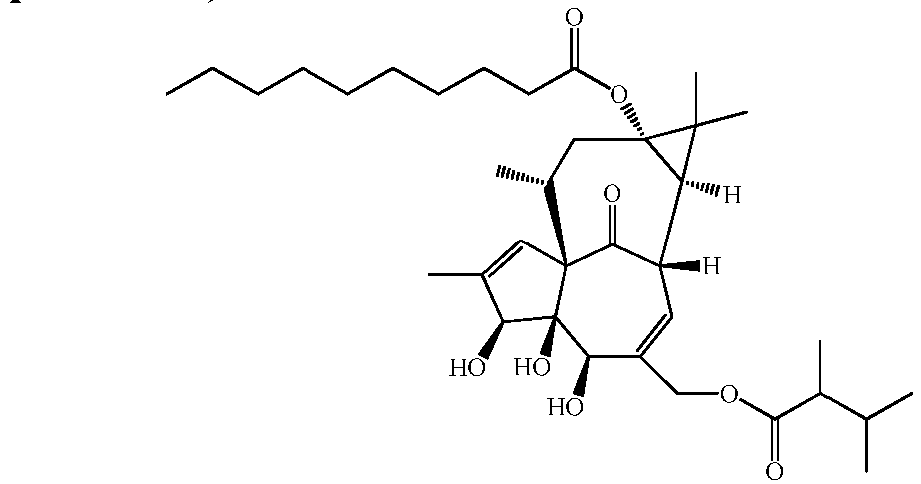
- 13-O-decanoyl-ingenol (Compound 1a, for which the preparation method may refer to Example 1) (0.06 mmol) was dissolved in dichloromethane, and 2,3-dimethylbutyric acid (0.06 mmol), N,N'-dicyclohexylcarbodiimide (0.08 mmol) and 4-dimethylaminopyridine (0.08 mmol) were added in the condition of ice water bath, then stirred at 20°C for 32 h. The reaction solution was poured into water, extracted with diethyl ether. The organic layer was washed with saturated aqueous sodium chloride solution, and then concentrated to dryness under reduced pressure. The resulting residual was purified by flash chromatography (petroleum ether: acetone = 4:1) to obtain the desired compound (Compound 14).
- The hydrogen nuclear magnetic resonance spectrum of Compound 14: 1H-NMR (400MHz, CDCl3) δ 6.08(d, 1H), 5.89(d, 1H), 4.72(d, 1H), 4.53(d, 1H), 4.43(s, 1H), 4.03(dd, 1H), 3.66(d, 1H), 2.72(dd, 1H), 2.43(m, 1H), 2.15-2.28(m, 4H), 1.89(m, 1H), 1.84(s, 3H), 1.55(m, 2H), 1.23-1.28(m, 13H), 1.20(s, 3H), 1.08(d, 3H), 1.07(s, 3H), 0.96(d, 3H), 0.86-0.90(m, 9H).
- 13-O-dodecanoyl-ingenol (Compound 1c, for which the preparation procedure may refer to Example 1) (0.06 mmol) was dissolved in acetonitrile, angelic anhydride (0.08 mmol) and cesium carbonate (0.08 mmol) were added, and stirred at room temperature for 30 h. The reaction solution was poured into water, extracted with diethyl ether. The organic layer was washed with saturated aqueous sodium chloride solution, and then concentrated to dryness under reduced pressure. The resulting residual was purified by flash chromatography (petroleum ether: acetone = 12:1 to 6:1), to obtain 3,20-O-diangeloyl-13-O-dodecanoyl-ingenol (Compound 15a), and 20-O-angeloyl-13-O-dodecanoyl-ingenol (Compound 15b), respectively.
-

- 1H-NMR (400MHz, CDCl3) δ 6.04-6.20(m, 4H), 5.55(s, 1H), 4.86(d, 1H), 4.57(d, 1H), 4.08(dd, 1H), 3.92(d, 1H), 3.77(d, 1H), 3.53(s, 1H), 2.72(dd, 1H), 2.62(m, 1H), 2.18-2.25(m, 3H), 2.01(dd, 3H), 1.90-1.95(m, 6H), 1.88(brs, 3H), 1.80(brs, 3H), 1.56(m, 2H), 1.24-1.28(m, 17H), 1.18(s, 3H), 1.06(s, 3H), 0.98(d, 3H), 0.88(t, 3H).
-

- 1H-NMR (400MHz, CDCl3) δ 6.05-6.09(m, 2H), 5.91(d, 1H), 4.79(d, 1H), 4.62(d, 1H), 4.43(d, 1H), 4.04-4.09(m, 2H), 3.72(d, 1H), 3.06(d, 1H), 2.73(dd, 1H), 2.62(d, 1H), 2.44(m, 1H), 2.16-2.22(m, 3H), 1.94(m, 3H), 1.85-1.89(m, 6H), 1.56(m, 2H), 1.24-1.28(m, 17H), 1.22(s, 3H), 1.07(s, 3H), 0.97(d, 3H), 0.88(t, 3H).
-

- Using 13-O-n-butanoyl-ingenol (Compound 5, for which the preparation method may refer to Example 5) as raw material, acetonide protection reaction, esterification reaction, and the reaction of removing acetonide-protecting group were carried out in sequence according to the synthesis method in Example 8 to obtain the title Compound (Compound 16).
- 1H-NMR (400MHz, CDCl3) δ 6.15(dq, 1H), 6.00-6.03(m, 2H), 5.55 (s, 1H), 4.56(brs, 1H), 4.05-4.17(m, 4H), 3.61(s, 1H), 2.61-2.76 (m, 3H), 2.14-2.23(m, 3H), 1.99(dd, 3H), 1.89(t, 3H), 1.79(d, 3H), 1.58(m, 2H), 1.22(d, 1H), 1.18(s, 3H), 1.05(s, 3H), 0.96 (d, 3H), 0.91(t, 3H).
-

- Using 13-O-n-hexanoyl-ingenol (Compound 6, for which the preparation method may refer to Example 6) as raw material, acetonide protection reaction, esterification reaction, and the reaction of removing acetonide-protecting group were carried out in sequence according to the synthesis method in Example 8 to obtain the title Compound (Compound 17).
- 1H-NMR (400MHz, CDCl3) δ 6.15(dq, 1H), 5.98-6.03(m, 2H), 5.55 (s, 1H), 4.59(brs, 1H), 4.05-4.18(m, 4H), 3.62(s, 1H), 2.59-2.75(m, 2H), 2.14-2.23(m, 3H), 1.99(dd, 3H), 1.89(t, 3H), 1.80(s, 3H), 1.55(m, 2H), 1.19-1.31(m, 5H), 1.17(s, 3H), 1.05(s, 3H), 0.96(d, 3H), 0.86(t, 3H).
-

- Using 13-O-n-octanoyl-ingenol (Compound 7, for which the preparation method may refer to Example 7) as raw material, acetonide protection reaction, esterification reaction, and the reaction of removing acetonide-protecting group were carried out in sequence according to the synthesis method in Example 8 to obtain the title Compound (Compound 18).
- 1H-NMR (400MHz, CDCl3) δ 6.15(dq, 1H), 5.98-6.05(m, 2H), 5.54 (s, 1H), 4.53(brs, 1H), 4.05-4.19(m, 4H), 3.60(s, 1H), 2.58-2.74(m, 3H), 2.14-2.23(m, 3H), 1.99(dd, 3H), 1.90(t, 3H), 1.80(s, 3H), 1.54(m, 2H), 1.20-1.31(m, 9H), 1.18(s, 3H), 1.05(s, 3H), 0.96(d, 3H), 0.86(t, 3H).
-

- Using 13-O-decanoyl-ingenol (Compound 1a, for which the preparation method may refer to Example 1) as raw material, acetonide protection reaction, esterification reaction, and the reaction of removing acetonide-protecting group were carried out in sequence according to the synthesis method in Example 8 to obtain the title Compound (Compound 19).
- 1H-NMR (400MHz, CDCl3) δ 6.14(q, 1H), 6.00(brs, 2H), 5.55(s, 1H), 4.60(brs, 1H), 4.03-4.19(m, 4H), 3.63(s, 1H), 2.58-2.76(m, 3H), 2.13-2.24(m, 3H), 1.99(d, 3H), 1.89(brs, 3H), 1.79(s, 3H), 1.54(m, 2H), 1.19-1.28(m, 13H), 1.17(s, 3H), 1.05(s, 3H), 0.95(d, 3H), 0.86(t, 3H).
-

- Using Compound 13-O-dodecanoyl-ingenol (Compound 1c, for which the preparation method may refer to Example 1) as a starting material, according to the synthesis method in Example 8, 13-O-dodecanoyl-ingenol 5,20-acetonide was synthesized, and then angelic anhydride was replaced with tiglic anhydride to synthesize 3-O-tigloyl-13-O-dodecanoyl-ingenol 5,20-acetonide, and the reaction of removing acetonide-protecting group were carried out to obtain the title Compound (Compound 20).
- 1H-NMR (400MHz, CDCl3) δ 6.87(q, 1H), 6.00(s, 2H), 5.52(s, 1H), 4.65(m, 1H), 4.00-4.18(m, 4H), 3.61(s, 1H), 2.96(m, 1H), 2.71(dd, 1H), 2.61(m, 1H), 2.11-2.23(m, 3H), 1.83(s, 3H), 1.81(d, 3H), 1.77(s, 3H), 1.54(m, 2H), 1.19-1.33(m, 17H), 1.16(s, 3H), 1.04(s, 3H), 0.97(d, 3H), 0.86(t, 3H).
-

- Using Compound 13-O-dodecanoyl-ingenol (Compound 1c, for which the preparation method may refer to Example 1) as a starting material, according to the synthesis method in Example 8, 13-O-dodecanoyl-ingenol 5,20-acetonide was synthesized, and then angelic anhydride was replaced with 2,3-dimethylbutenoyl chloride to synthesize 3-O-(2,3-dimethylbutenoyl)-13-O-dodecanoyl-ingenol 5,20-acetonide, and the reaction of removing acetonide-protecting group was carried out to obtain the title Compound (Compound 21).
- 1H-NMR (400 MHz, CDCl3) δ 5.96-6.05(m, 2H), 5.50(s, 1H), 4.50(d, 1H), 4.02-4.18(m, 4H), 3.60(s, 1H), 2.56-2.78(m, 2H), 2.15-2.24(m, 3H), 2.04(d, 3H), 1.86(s, 3H), 1.84(s, 3H), 1.79(d, 3H), 1.54(m, 2H), 1.19-1.32(m, 17H), 1.18(s, 3H), 1.05(s, 3H), 0.96(d, 3H), 0.87(t, 3H).
-

- 13-O-dodecanoyl-ingenol (Compound 1c, for which the preparation procedure may refer to Example 1) (0.5 mmol) was dissolved in 0.4 mg/mL of a solution of p-toluenesulfonic acid monohydrate in acetone and stirred at room temperature for 1 h. The reaction solution was concentrated to dryness under reduced pressure, re-dissolved in ethyl acetate, and washed with water and saturated aqueous sodium chloride solution, successively, and then the organic layer was concentrated to dryness under reduced pressure. The resulting residual was purified by flash chromatography (petroleum ether: ethyl acetate = 4:1) to obtain 13-O-dodecanoyl-ingenol 5,20-acetonide (Compound 221).
- Compound 221 (0.1 mmol) was dissolved in dichloromethane, and 3,5-diethylisoxazolyl-4-carboxylic acid (0.15 mmol), N,N' -dicyclohexylcarbodiimide (0.15 mmol), and 4-dimethylaminopyridine (0.15 mmol) were added in the condition of ice water bath, and stirred at 20° C for 8 h. The reaction solution was poured into water and extracted with diethyl ether, The organic layer was washed with saturated aqueous sodium chloride solution, and then concentrated to dryness under reduced pressure. The resulting residual was purified by flash chromatography (petroleum ether: acetone = 15:1) to obtain 3-O-(3,5-diethylisoxazolyl-4-formyl)-13-O-dodecanoyl-ingenol 5,20-acetonide(Compound 222).
- Compound 222 (0.05 mmol) was dissolved in methanol, 4 M diluted hydrochloric acid was added and stirred at room temperature for 12 h. The reaction solution was poured into water and extracted with ethyl acetate. The organic layer was washed with saturated aqueous sodium chloride solution, and then concentrated to dryness under reduced pressure. The resulting residual was purified by flash chromatography (petroleum ether: acetone = 2:1) to obtain the title compound (Compound 22).
- 1H-NMR (400MHz, CDCl3) δ 6.10(d, 1H), 6.03(d, 1H), 5.69(s, 1H), 4.07-4.22(m, 4H), 3.78(brs, 1H), 3.06(dq, 2H), 2.85(m, 2H), 2.58-2.74(m, 2H), 2.26(dd, 1H), 2.19(t, 2H), 2.03(s, 1H), 1.83(s, 3H), 1.54(m, 2H), 1.17-1.32(m, 23H), 1.15(s, 3H), 1.04(s, 3H), 0.99(d, 3H), 0.86(t, 3H).
- In this example, the inhibitory activity of compounds of the present invention against proliferation of seven human tumor cell lines and mouse B16-F10 melanoma cells was tested in vitro, and the IC50 value (50% inhibitory concentration) of compounds against each tumor cell line was calculated.
- The seven human tumor cell lines are: MCF-7 (human breast cancer cells), LOVO (human colon cancer cells), A549 (human lung cancer cells), BGC-823 (human gastric cancer cells), SMMC-7721 (human liver cancer cells), K562 (human leukemia cells), and HeLa (human cervical cancer cells).
- IC50 values of the compounds for A549, BGC-823, LOVO, MCF-7, SMMC-7721, HeLa, and B16-F10 cells were tested. The above cells were routinely cultured in 1640 nutrient solution containing 10% calf serum, with passage for 1 time every 2 days, and the cells in logarithmic growth phase were taken for experiments. After the A549, BGC-823, LOVO, MCF-7, SMMC-7721, HeLa and B16-F10 cells in logarithmic growth phase were subjected to 0.25% trypsin digestion, they were blown into a single cell suspension, and then the cell concentration was adjusted to about 1 × 10⁵·mL-1 using RPMI 1640 solution containing 10% calf serum. The cells were seeded in a 96-well culture plate at 100 µL per well, and cultured for 24 hours until the cells were attached. K562 cells were taken and centrifuged and diluted into 2 × 10⁵·mL-1 single cell suspension with RPMI 1640 solution containing 10% calf serum, and inoculated into a 96-well culture plate at 100 µL per well.
- 100 µL of sample solution with different concentrations to be tested were added to the above 96-well plate, each concentration was added to 4 wells in parallel, and the cell control group was added with an equal volume of RPMI 1640 medium containing 10% calf serum to make a reaction volume of 200 µL. After incubating in an incubator at 37°C, 5% CO2 for 72 h, 10 µL of 5 mg·mL-1 MTT solution was added to each well, and incubated at 37°C for 4 h. The supernatant was carefully aspirated, 180 µL of DMSO was added to each well followed by shaking, and the absorbance (OD) value was measured at 570 nm on the microplate reader. The inhibition rate was calculated, and regression equation was established with the logarithmic value of the sample concentration and the inhibition rate (IR) to find the IC50 value of the compound against the cells to be tested.
IR(%) = (1 - OD value of the experimental group / OD value of the cell control group) × 100% - The IC50 values of compounds of the present invention for inhibition of proliferation of seven human tumor cell lines and mouse B16-F10 melanoma cells are shown in Table 1.
Table 1 IC50 value of compound for inhibition of proliferation of tumor cell lines (µg/mL) Compound name and number Cell line A549 BGC-823 LOVO K562 SMM C-7721 MCF-7 HeLa B16-F10 20-deoxy-13-O-dodecanoyl-ingenol (Compound 1d) 26.8 15.4 19.2 6.88 31.5 29.2 - - 13-O-decanoyl-ingenol (Compound 1a) 15.1 15.0 9.77 0.70 19.5 13.8 29.1 - 13-O-(2'E,4'E-decadienoyl)-ingenol (Compound 1b) 12.8 10.6 12.9 8.97 8.01 11.8 - - 13-O-dodecanoyl-ingenol (Compound 1c) 11.1 6.19 8.97 5.51 6.49 6.36 15.1 - 6,7-epoxy-20-deoxy-ingenol (Compound 1e) >200 >200 >200 5.52 >200 >200 - - 6,7-epoxy-20-O-(2,3-dimethylbutyryl)-13-O-dodecanoyl-ingenol (Compound 1f) - - - - - 16.8 - 13-O-n-octanoyl-ingenol (Compound 7) 29.7 25.1 24.1 1.72 16.0 16.2 29.3 38.4 3-O-acetyl-13-O-dodecanoyl-ingenol (Compound 10) 10.7 14.7 9.41 0.22 13.1 16.3 10.9 21.4 3-O-n-butanoyl-13-O-dodecanoyl-ingenol (Compound 11) 14.3 13.4 8.82 0.10 19.1 18.5 20.3 26.2 20-O-acetyl-13-O-dodecanoyl-ingenol (Compound 12) 16.0 10.3 6.71 0.06 12.7 12.7 32.3 14.0 20-O-n-butanoyl-13-O-dodecanoyl-ingenol (Compound 13) 17.2 12.4 6.93 0.07 12.5 18.0 24.2 30.5 20-O-angeloyl-13-O-dodecanoyl-ingenol (Compound 15b) 10.0 20.6 15.2 0.001 13.1 23.3 10.2 9.09 3,20-O-diangeloyl-13-O-dodecanoyl-ingenol (Compound 15a) >100 >100 >100 3.22 26.9 >100 - - 13-O-dodecanoyl-ingenol 5,20-acetonide (Compound 2b) 15.0 17.8 23.0 0.85 15.2 13.7 - - 13-O-dodecanoyl-ingenol 3,4-acetonide (Compound 2c) 9.59 5.30 10.3 0.42 8.21 8.89 - - 3-O-angeloyl-13-O-acetyl-ingenol (Compound 8)* >50 >100 >50 0.0065 96.6 >50 >100 - 3-O-angeloyl-13-O-butanoyl-ingenol (Compound 16)* 46.8 44.1 36.9 4.21 43.5 38.4 61.1 17.0 3-O-angeloyl-13-O-hexanoyl-ingenol (Compound 17)* 21.7 21.7 16.9 2.93 21.1 18.6 18.6 6.50 3-O-angeloyl-13-O-octanoyl-ingenol (Compound 18) 13.6 10.1 8.47 1.41 12.4 11.7 12.2 8.43 3-O-angeloyl-13-O-decanoyl-ingenol (Compound 19)* 12.6 14.0 7.90 2.13 13.4 9.30 8.58 9.85 3-O-tigloyl-13-O-dodecanoyl-ingenol (Compound 20) 13.1 11.0 9.91 0.81 18.4 6.80 7.45 3.33 3-O-(2,3-dimethylbutenoyl)-13-O-dodecanoyl-ingenol (Compound 21)* 11.8 10.4 12.4 2.06 12.8 8.32 15.3 15.1 3-O-(3,5-diethylisoxazolyl-4-formyl)-13-O-dodecanoyl-ingenol (Compound 22)* 18.3 11.3 11.0 1.14 20.1 10.9 9.59 2.96 3-O-angeloyl-13-O-dodecanoyl-ingenol (Compound 9) 10.8 0.85 10.1 1.87 8.86 10.1 12.5 10.4 3-O-(2,3-dimethylbutyryl)-13-O-dodecanoyl-ingenol 11.0 10.4 7.60 0.12 14.5 9.05 24.3 17.8 3-O-trimethylacetyl-13-O-dodecanoyl-ingenol 17.5 6.81 9.68 <0.20 15.1 8.79 14.2 7.70 3-O-hexanoyl-13-O-dodecanoyl-ingenol 18.5 18.3 16.5 <0.20 16.1 14.0 - - 20-O-(2,3-dimethylbutyryl)-13-O-dodecanoyl-ingenol 8.89 11.0 8.36 0.64 10.7 10.1 14.5 16.6 3-O-angeloyl-ingenol 31.2 43.5 33.4 0.0076 28.2 57.4 49.4 38.1 *Compounds 8, 16, 17, 19, 21, and 22 are embodiments of the present invention. The other compounds are reference examples, not in accordance with the present independent claims. - The results in Table 1 indicate that the derivative of 13-oxidized ingenol can exhibit inhibitory effect on the proliferation of various tumor cells, and some compounds exhibit selective inhibitory effect on leukemia cells.
- This example investigated the effect of compound on neutrophil oxidative burst and calculated the efficiency of each compound in stimulating neutrophil oxidative burst.
- Blood was taken from the abdominal aorta of rat. The neutrophilic granulocytes were isolated by the operational procedure of the rat peripheral blood neutrophil isolation kit. The neutrophilic granulocytes were re-suspended by Hanks, and were plated in a 96-well white plate at 1×10⁵ cells/well, 80 µL/well; 1 mM of Luminol was added at 10 µL/well; 10 µL of the sample was added to each well, and the degree of oxidative burst was evaluated by chemiluminescence.

- The efficiency of compounds in stimulating neutrophil oxidative burst is shown in Table 2.
Table 2 Efficiency of compounds in stimulating neutrophil oxidative burst Compound name and number Efficiency (%) 3 µg/mL 0.1 µg/mL 3-O-angeloyl-13-OH-ingenol (Compound 3) 65.0 - 13-O-decanoyl-ingenol (Compound 1a) 65.2 - 13-O-n-octanoyl-ingenol (Compound 7) 45.0 - 20-O-(2,3-dimethylbutyryl)-13-O-decanoyl -ingenol (Compound 14) 62.8 - 3-O-angeloyl-13-O-dodecanoyl-ingenol (Compound 9) 77.0 - 3-O-n-butanoyl-13-O-dodecanoyl-ingenol (Compound 11) 33.5 - 20-O-acetyl-13-O-dodecanoyl-ingenol (Compound 12) 88.3 - 20-O-n-butanoyl-13-O-dodecanoyl-ingenol (Compound 13) 62.4 - 13-O-dodecanoyl-ingenol 3,4-acetonide (Compound 2c) 64.6 - 3-O-angeloyl-13-O-butanoyl-ingenol (Compound 16)* 80.1 - 3-O-angeloyl-13-O-hexanoyl-ingenol (Compound 17)* - 82.1 3-O-angeloyl-13-O-octanoyl-ingenol (Compound 18) - 69.1 3-O-angeloyl-13-O-decanoyl-ingenol (Compound 19)* - 43.5 3-O-tigloyl-13-O-dodecanoyl-ingenol (Compound 20) 43.8 -
Claims (3)
- A compound, or a pharmaceutically acceptable salt, solvate, or crystal form thereof, wherein the compound is selected from:
Name of Compound Structure of Compound 3-O-angeloyl-13-O-acetyl-ingenol 
3-O-angeloyl-13-O-butanoyl-ingenol 
3-O-angeloyl-13-O-hexanoyl-ingenol 
3-O-angeloyl-13-O-decanoyl-ingenol 
3-O-(2,3-dimethylbutenoyl)-13-O-dodecanoyl-ingenol 
3-O-(3,5-diethylisoxazolyl-4-formyl)-13-O-dodecanoyl-ingenol 
- A pharmaceutical composition comprising the compound or the pharmaceutically acceptable salt, solvate, or crystal form of claim 1, and a pharmaceutically acceptable carrier, optionally wherein the pharmaceutically acceptable carrier comprises an excipient, a disintegrant, a binder, an absorption enhancer, a flavoring agent or a surfactant.
- A compound, or a pharmaceutically acceptable salt, solvate, or crystal form thereof, for use in prevention and/or treatment of a disease responsive to a release of IL-8 by keratinocyte, wherein the compound is selected from:
Name of Compound Structure of Compound 3-O-angeloyl-13-O-acetyl-ingenol 
3-O-angeloyl-13-O-butanoyl-ingenol 
3-O-angeloyl-13-O-hexanoyl-ingenol 
3-O-angeloyl-13-O-decanoyl-ingenol 
3-O-(2,3-dimethylbutenoyl)-13-O-dodecanoyl-ingenol 
3-O-(3,5-diethylisoxazolyl-4-formyl)-13-O-dodecanoyl-ingenol 
Applications Claiming Priority (2)
| Application Number | Priority Date | Filing Date | Title |
|---|---|---|---|
| CN2017087700 | 2017-06-09 | ||
| PCT/CN2018/090272 WO2018224007A1 (en) | 2017-06-09 | 2018-06-07 | 13-oxidized ingenol derivative and use thereof |
Publications (3)
| Publication Number | Publication Date |
|---|---|
| EP3636628A1 EP3636628A1 (en) | 2020-04-15 |
| EP3636628A4 EP3636628A4 (en) | 2021-04-07 |
| EP3636628B1 true EP3636628B1 (en) | 2024-05-29 |
Family
ID=64566390
Family Applications (1)
| Application Number | Title | Priority Date | Filing Date |
|---|---|---|---|
| EP18812748.4A Active EP3636628B1 (en) | 2017-06-09 | 2018-06-07 | 13-oxidized ingenol derivative and use thereof |
Country Status (5)
| Country | Link |
|---|---|
| US (1) | US11753363B2 (en) |
| EP (1) | EP3636628B1 (en) |
| CN (1) | CN110730771B (en) |
| AU (1) | AU2018280534B2 (en) |
| WO (1) | WO2018224007A1 (en) |
Families Citing this family (2)
| Publication number | Priority date | Publication date | Assignee | Title |
|---|---|---|---|---|
| CN116785274A (en) * | 2023-06-25 | 2023-09-22 | 云南民族大学 | Preparation method and application of diterpene compounds with strong anti-skin cancer and anti-inflammatory activity in wolfberry |
| CN117800877B (en) * | 2023-12-27 | 2025-05-06 | 沈阳药科大学 | 13-OD carbamate derivative and preparation and application thereof |
Family Cites Families (4)
| Publication number | Priority date | Publication date | Assignee | Title |
|---|---|---|---|---|
| JPH08245505A (en) * | 1994-09-09 | 1996-09-24 | Tosoh Corp | Diterpene derivative, its production and antitumor agent containing the same as active ingredient |
| JPH08245379A (en) * | 1995-01-12 | 1996-09-24 | Soyaku Gijutsu Kenkyusho:Kk | Antiviral agent |
| LT2595948T (en) | 2010-07-20 | 2019-12-10 | Leo Laboratories Ltd | A method of producing ingenol-3-angelate |
| CN106928063B (en) * | 2015-12-31 | 2020-09-01 | 上海鑫昊生物科技有限公司 | Ingenol compounds and application thereof in anti-HIV latent treatment |
-
2018
- 2018-06-07 AU AU2018280534A patent/AU2018280534B2/en active Active
- 2018-06-07 EP EP18812748.4A patent/EP3636628B1/en active Active
- 2018-06-07 WO PCT/CN2018/090272 patent/WO2018224007A1/en not_active Ceased
- 2018-06-07 CN CN201880038226.7A patent/CN110730771B/en active Active
- 2018-06-07 US US16/620,803 patent/US11753363B2/en active Active
Also Published As
| Publication number | Publication date |
|---|---|
| CN110730771A (en) | 2020-01-24 |
| AU2018280534B2 (en) | 2021-04-01 |
| AU2018280534A1 (en) | 2020-01-30 |
| EP3636628A4 (en) | 2021-04-07 |
| EP3636628A1 (en) | 2020-04-15 |
| US20200140369A1 (en) | 2020-05-07 |
| US20210147334A9 (en) | 2021-05-20 |
| CN110730771B (en) | 2022-12-30 |
| US11753363B2 (en) | 2023-09-12 |
| WO2018224007A1 (en) | 2018-12-13 |
Similar Documents
| Publication | Publication Date | Title |
|---|---|---|
| CN101671346B (en) | Stewartane-type dimeric sesquiterpenes, preparation method and application in pharmacy | |
| EP0598359A1 (en) | Hypoglycemic dihydrochalcone derivatives | |
| CN113402370B (en) | A kind of diterpene derivative and its preparation method, pharmaceutical composition and application | |
| US20140364490A1 (en) | 1-oxo/acylation-14-acylated oridonin derivative, preparation method therefor and application thereof | |
| CN112538088B (en) | Daphnane diterpene for resisting prostatic cancer and preparation method thereof | |
| WO2012149667A1 (en) | Cardenolide compounds and antitumor use thereof | |
| US11753363B2 (en) | 13-oxidized ingenol derivative and use thereof | |
| EP2532671A1 (en) | Novel synthetic glycolipid and use thereof | |
| US20050261363A1 (en) | Compounds isolated from gamboge resin having activity in inhibiting the growth of tumor/cancer cells and pharmaceutical compositions comprising the same | |
| JP5574432B2 (en) | Esterified α-galactosylceramides | |
| CN104513290B (en) | Triptolidenol derivative and its application | |
| EP2862869B1 (en) | Acylated derivatives of polyphyllin i, preparation method therefor and application thereof | |
| EP1619195A2 (en) | Compounds isolated from gamboge resin having activity in inhibiting the growth of tumor/cancer cells and pharmaceutical compositions comprising the same | |
| KR100547253B1 (en) | Ginsenoside derivatives effective for preventing and treating cancer | |
| KR101509225B1 (en) | Novel triterpenoids from acanthopanax sessiliflorus and an anti-inflammatory composition containing it | |
| EP2786989B1 (en) | 2-alkyl-or-aryl-substituted tanshinone derivatives, and preparation method and application thereof | |
| WO2019135257A1 (en) | Artemisinic acid glycoconjugate compounds, process for preparation and use thereof | |
| CN113321696B (en) | Preparation method of cardiac glycoside and application of cardiac glycoside in preparation of antitumor drugs | |
| CN104955831A (en) | Novel flavonoid compounds and uses thereof | |
| CN120737090B (en) | Compound or composition and application thereof in preparation of medicines with anticancer effect | |
| WO2012165394A1 (en) | Anti-tumor agent | |
| KR100564383B1 (en) | Method for preparing ginsenoside derivatives | |
| CN113956224A (en) | Semi-synthetic flavonoids and their anti-inflammatory uses | |
| KR100516647B1 (en) | Hypoglycemic composition | |
| Shinta | Synthesis, cytotoxicity and anti-inflammatory activity of piperine derivatives |
Legal Events
| Date | Code | Title | Description |
|---|---|---|---|
| STAA | Information on the status of an ep patent application or granted ep patent |
Free format text: STATUS: THE INTERNATIONAL PUBLICATION HAS BEEN MADE |
|
| PUAI | Public reference made under article 153(3) epc to a published international application that has entered the european phase |
Free format text: ORIGINAL CODE: 0009012 |
|
| STAA | Information on the status of an ep patent application or granted ep patent |
Free format text: STATUS: REQUEST FOR EXAMINATION WAS MADE |
|
| 17P | Request for examination filed |
Effective date: 20200109 |
|
| AK | Designated contracting states |
Kind code of ref document: A1 Designated state(s): AL AT BE BG CH CY CZ DE DK EE ES FI FR GB GR HR HU IE IS IT LI LT LU LV MC MK MT NL NO PL PT RO RS SE SI SK SM TR |
|
| AX | Request for extension of the european patent |
Extension state: BA ME |
|
| DAV | Request for validation of the european patent (deleted) | ||
| DAX | Request for extension of the european patent (deleted) | ||
| A4 | Supplementary search report drawn up and despatched |
Effective date: 20210310 |
|
| RIC1 | Information provided on ipc code assigned before grant |
Ipc: C07C 69/533 20060101ALI20210303BHEP Ipc: C07D 317/18 20060101ALI20210303BHEP Ipc: C07D 319/06 20060101ALI20210303BHEP Ipc: A61P 35/00 20060101ALI20210303BHEP Ipc: A61K 31/215 20060101ALI20210303BHEP Ipc: C07C 69/33 20060101AFI20210303BHEP |
|
| RAP1 | Party data changed (applicant data changed or rights of an application transferred) |
Owner name: TIANJIN ZHONGXIN PHARMACEUTICAL RESEARCH INSTITUTE LTD. |
|
| STAA | Information on the status of an ep patent application or granted ep patent |
Free format text: STATUS: EXAMINATION IS IN PROGRESS |
|
| RAP1 | Party data changed (applicant data changed or rights of an application transferred) |
Owner name: TIANJIN PHARMACEUTICALS DA REN TANG GROUP CORP., LTD. TRADITIONAL CHINESE MEDICINE RESEARCH INSTITUTE |
|
| 17Q | First examination report despatched |
Effective date: 20230421 |
|
| GRAP | Despatch of communication of intention to grant a patent |
Free format text: ORIGINAL CODE: EPIDOSNIGR1 |
|
| STAA | Information on the status of an ep patent application or granted ep patent |
Free format text: STATUS: GRANT OF PATENT IS INTENDED |
|
| INTG | Intention to grant announced |
Effective date: 20240105 |
|
| GRAS | Grant fee paid |
Free format text: ORIGINAL CODE: EPIDOSNIGR3 |
|
| GRAA | (expected) grant |
Free format text: ORIGINAL CODE: 0009210 |
|
| STAA | Information on the status of an ep patent application or granted ep patent |
Free format text: STATUS: THE PATENT HAS BEEN GRANTED |
|
| AK | Designated contracting states |
Kind code of ref document: B1 Designated state(s): AL AT BE BG CH CY CZ DE DK EE ES FI FR GB GR HR HU IE IS IT LI LT LU LV MC MK MT NL NO PL PT RO RS SE SI SK SM TR |
|
| REG | Reference to a national code |
Ref country code: CH Ref legal event code: EP |
|
| REG | Reference to a national code |
Ref country code: IE Ref legal event code: FG4D |
|
| REG | Reference to a national code |
Ref country code: DE Ref legal event code: R096 Ref document number: 602018070119 Country of ref document: DE |
|
| REG | Reference to a national code |
Ref country code: LT Ref legal event code: MG9D |
|
| REG | Reference to a national code |
Ref country code: NL Ref legal event code: MP Effective date: 20240529 |
|
| PG25 | Lapsed in a contracting state [announced via postgrant information from national office to epo] |
Ref country code: IS Free format text: LAPSE BECAUSE OF FAILURE TO SUBMIT A TRANSLATION OF THE DESCRIPTION OR TO PAY THE FEE WITHIN THE PRESCRIBED TIME-LIMIT Effective date: 20240929 |
|
| PG25 | Lapsed in a contracting state [announced via postgrant information from national office to epo] |
Ref country code: BG Free format text: LAPSE BECAUSE OF FAILURE TO SUBMIT A TRANSLATION OF THE DESCRIPTION OR TO PAY THE FEE WITHIN THE PRESCRIBED TIME-LIMIT Effective date: 20240529 |
|
| PG25 | Lapsed in a contracting state [announced via postgrant information from national office to epo] |
Ref country code: HR Free format text: LAPSE BECAUSE OF FAILURE TO SUBMIT A TRANSLATION OF THE DESCRIPTION OR TO PAY THE FEE WITHIN THE PRESCRIBED TIME-LIMIT Effective date: 20240529 Ref country code: FI Free format text: LAPSE BECAUSE OF FAILURE TO SUBMIT A TRANSLATION OF THE DESCRIPTION OR TO PAY THE FEE WITHIN THE PRESCRIBED TIME-LIMIT Effective date: 20240529 |
|
| PG25 | Lapsed in a contracting state [announced via postgrant information from national office to epo] |
Ref country code: GR Free format text: LAPSE BECAUSE OF FAILURE TO SUBMIT A TRANSLATION OF THE DESCRIPTION OR TO PAY THE FEE WITHIN THE PRESCRIBED TIME-LIMIT Effective date: 20240830 |
|
| REG | Reference to a national code |
Ref country code: AT Ref legal event code: MK05 Ref document number: 1690526 Country of ref document: AT Kind code of ref document: T Effective date: 20240529 |
|
| PG25 | Lapsed in a contracting state [announced via postgrant information from national office to epo] |
Ref country code: ES Free format text: LAPSE BECAUSE OF FAILURE TO SUBMIT A TRANSLATION OF THE DESCRIPTION OR TO PAY THE FEE WITHIN THE PRESCRIBED TIME-LIMIT Effective date: 20240529 |
|
| PG25 | Lapsed in a contracting state [announced via postgrant information from national office to epo] |
Ref country code: AT Free format text: LAPSE BECAUSE OF FAILURE TO SUBMIT A TRANSLATION OF THE DESCRIPTION OR TO PAY THE FEE WITHIN THE PRESCRIBED TIME-LIMIT Effective date: 20240529 |
|
| PG25 | Lapsed in a contracting state [announced via postgrant information from national office to epo] |
Ref country code: PL Free format text: LAPSE BECAUSE OF FAILURE TO SUBMIT A TRANSLATION OF THE DESCRIPTION OR TO PAY THE FEE WITHIN THE PRESCRIBED TIME-LIMIT Effective date: 20240529 |
|
| PG25 | Lapsed in a contracting state [announced via postgrant information from national office to epo] |
Ref country code: LV Free format text: LAPSE BECAUSE OF FAILURE TO SUBMIT A TRANSLATION OF THE DESCRIPTION OR TO PAY THE FEE WITHIN THE PRESCRIBED TIME-LIMIT Effective date: 20240529 |
|
| PG25 | Lapsed in a contracting state [announced via postgrant information from national office to epo] |
Ref country code: PL Free format text: LAPSE BECAUSE OF FAILURE TO SUBMIT A TRANSLATION OF THE DESCRIPTION OR TO PAY THE FEE WITHIN THE PRESCRIBED TIME-LIMIT Effective date: 20240529 Ref country code: NO Free format text: LAPSE BECAUSE OF FAILURE TO SUBMIT A TRANSLATION OF THE DESCRIPTION OR TO PAY THE FEE WITHIN THE PRESCRIBED TIME-LIMIT Effective date: 20240829 Ref country code: LV Free format text: LAPSE BECAUSE OF FAILURE TO SUBMIT A TRANSLATION OF THE DESCRIPTION OR TO PAY THE FEE WITHIN THE PRESCRIBED TIME-LIMIT Effective date: 20240529 Ref country code: IS Free format text: LAPSE BECAUSE OF FAILURE TO SUBMIT A TRANSLATION OF THE DESCRIPTION OR TO PAY THE FEE WITHIN THE PRESCRIBED TIME-LIMIT Effective date: 20240929 Ref country code: HR Free format text: LAPSE BECAUSE OF FAILURE TO SUBMIT A TRANSLATION OF THE DESCRIPTION OR TO PAY THE FEE WITHIN THE PRESCRIBED TIME-LIMIT Effective date: 20240529 Ref country code: GR Free format text: LAPSE BECAUSE OF FAILURE TO SUBMIT A TRANSLATION OF THE DESCRIPTION OR TO PAY THE FEE WITHIN THE PRESCRIBED TIME-LIMIT Effective date: 20240830 Ref country code: FI Free format text: LAPSE BECAUSE OF FAILURE TO SUBMIT A TRANSLATION OF THE DESCRIPTION OR TO PAY THE FEE WITHIN THE PRESCRIBED TIME-LIMIT Effective date: 20240529 Ref country code: ES Free format text: LAPSE BECAUSE OF FAILURE TO SUBMIT A TRANSLATION OF THE DESCRIPTION OR TO PAY THE FEE WITHIN THE PRESCRIBED TIME-LIMIT Effective date: 20240529 Ref country code: BG Free format text: LAPSE BECAUSE OF FAILURE TO SUBMIT A TRANSLATION OF THE DESCRIPTION OR TO PAY THE FEE WITHIN THE PRESCRIBED TIME-LIMIT Effective date: 20240529 Ref country code: AT Free format text: LAPSE BECAUSE OF FAILURE TO SUBMIT A TRANSLATION OF THE DESCRIPTION OR TO PAY THE FEE WITHIN THE PRESCRIBED TIME-LIMIT Effective date: 20240529 Ref country code: RS Free format text: LAPSE BECAUSE OF FAILURE TO SUBMIT A TRANSLATION OF THE DESCRIPTION OR TO PAY THE FEE WITHIN THE PRESCRIBED TIME-LIMIT Effective date: 20240829 |
|
| PG25 | Lapsed in a contracting state [announced via postgrant information from national office to epo] |
Ref country code: NL Free format text: LAPSE BECAUSE OF FAILURE TO SUBMIT A TRANSLATION OF THE DESCRIPTION OR TO PAY THE FEE WITHIN THE PRESCRIBED TIME-LIMIT Effective date: 20240529 |
|
| PG25 | Lapsed in a contracting state [announced via postgrant information from national office to epo] |
Ref country code: NL Free format text: LAPSE BECAUSE OF FAILURE TO SUBMIT A TRANSLATION OF THE DESCRIPTION OR TO PAY THE FEE WITHIN THE PRESCRIBED TIME-LIMIT Effective date: 20240529 |
|
| PG25 | Lapsed in a contracting state [announced via postgrant information from national office to epo] |
Ref country code: DK Free format text: LAPSE BECAUSE OF FAILURE TO SUBMIT A TRANSLATION OF THE DESCRIPTION OR TO PAY THE FEE WITHIN THE PRESCRIBED TIME-LIMIT Effective date: 20240529 |
|
| PG25 | Lapsed in a contracting state [announced via postgrant information from national office to epo] |
Ref country code: EE Free format text: LAPSE BECAUSE OF FAILURE TO SUBMIT A TRANSLATION OF THE DESCRIPTION OR TO PAY THE FEE WITHIN THE PRESCRIBED TIME-LIMIT Effective date: 20240529 |
|
| PG25 | Lapsed in a contracting state [announced via postgrant information from national office to epo] |
Ref country code: CZ Free format text: LAPSE BECAUSE OF FAILURE TO SUBMIT A TRANSLATION OF THE DESCRIPTION OR TO PAY THE FEE WITHIN THE PRESCRIBED TIME-LIMIT Effective date: 20240529 |
|
| PG25 | Lapsed in a contracting state [announced via postgrant information from national office to epo] |
Ref country code: SK Free format text: LAPSE BECAUSE OF FAILURE TO SUBMIT A TRANSLATION OF THE DESCRIPTION OR TO PAY THE FEE WITHIN THE PRESCRIBED TIME-LIMIT Effective date: 20240529 Ref country code: RO Free format text: LAPSE BECAUSE OF FAILURE TO SUBMIT A TRANSLATION OF THE DESCRIPTION OR TO PAY THE FEE WITHIN THE PRESCRIBED TIME-LIMIT Effective date: 20240529 |
|
| PG25 | Lapsed in a contracting state [announced via postgrant information from national office to epo] |
Ref country code: SM Free format text: LAPSE BECAUSE OF FAILURE TO SUBMIT A TRANSLATION OF THE DESCRIPTION OR TO PAY THE FEE WITHIN THE PRESCRIBED TIME-LIMIT Effective date: 20240529 |
|
| PG25 | Lapsed in a contracting state [announced via postgrant information from national office to epo] |
Ref country code: SM Free format text: LAPSE BECAUSE OF FAILURE TO SUBMIT A TRANSLATION OF THE DESCRIPTION OR TO PAY THE FEE WITHIN THE PRESCRIBED TIME-LIMIT Effective date: 20240529 Ref country code: SK Free format text: LAPSE BECAUSE OF FAILURE TO SUBMIT A TRANSLATION OF THE DESCRIPTION OR TO PAY THE FEE WITHIN THE PRESCRIBED TIME-LIMIT Effective date: 20240529 Ref country code: RO Free format text: LAPSE BECAUSE OF FAILURE TO SUBMIT A TRANSLATION OF THE DESCRIPTION OR TO PAY THE FEE WITHIN THE PRESCRIBED TIME-LIMIT Effective date: 20240529 Ref country code: EE Free format text: LAPSE BECAUSE OF FAILURE TO SUBMIT A TRANSLATION OF THE DESCRIPTION OR TO PAY THE FEE WITHIN THE PRESCRIBED TIME-LIMIT Effective date: 20240529 Ref country code: DK Free format text: LAPSE BECAUSE OF FAILURE TO SUBMIT A TRANSLATION OF THE DESCRIPTION OR TO PAY THE FEE WITHIN THE PRESCRIBED TIME-LIMIT Effective date: 20240529 Ref country code: CZ Free format text: LAPSE BECAUSE OF FAILURE TO SUBMIT A TRANSLATION OF THE DESCRIPTION OR TO PAY THE FEE WITHIN THE PRESCRIBED TIME-LIMIT Effective date: 20240529 |
|
| REG | Reference to a national code |
Ref country code: CH Ref legal event code: PL |
|
| PG25 | Lapsed in a contracting state [announced via postgrant information from national office to epo] |
Ref country code: IT Free format text: LAPSE BECAUSE OF FAILURE TO SUBMIT A TRANSLATION OF THE DESCRIPTION OR TO PAY THE FEE WITHIN THE PRESCRIBED TIME-LIMIT Effective date: 20240529 Ref country code: MC Free format text: LAPSE BECAUSE OF FAILURE TO SUBMIT A TRANSLATION OF THE DESCRIPTION OR TO PAY THE FEE WITHIN THE PRESCRIBED TIME-LIMIT Effective date: 20240529 |
|
| PG25 | Lapsed in a contracting state [announced via postgrant information from national office to epo] |
Ref country code: LU Free format text: LAPSE BECAUSE OF NON-PAYMENT OF DUE FEES Effective date: 20240607 |
|
| REG | Reference to a national code |
Ref country code: DE Ref legal event code: R097 Ref document number: 602018070119 Country of ref document: DE |
|
| PLBE | No opposition filed within time limit |
Free format text: ORIGINAL CODE: 0009261 |
|
| STAA | Information on the status of an ep patent application or granted ep patent |
Free format text: STATUS: NO OPPOSITION FILED WITHIN TIME LIMIT |
|
| PG25 | Lapsed in a contracting state [announced via postgrant information from national office to epo] |
Ref country code: IE Free format text: LAPSE BECAUSE OF NON-PAYMENT OF DUE FEES Effective date: 20240607 |
|
| GBPC | Gb: european patent ceased through non-payment of renewal fee |
Effective date: 20240829 |
|
| PG25 | Lapsed in a contracting state [announced via postgrant information from national office to epo] |
Ref country code: SI Free format text: LAPSE BECAUSE OF FAILURE TO SUBMIT A TRANSLATION OF THE DESCRIPTION OR TO PAY THE FEE WITHIN THE PRESCRIBED TIME-LIMIT Effective date: 20240529 Ref country code: BE Free format text: LAPSE BECAUSE OF NON-PAYMENT OF DUE FEES Effective date: 20240630 Ref country code: CH Free format text: LAPSE BECAUSE OF NON-PAYMENT OF DUE FEES Effective date: 20240630 |
|
| PG25 | Lapsed in a contracting state [announced via postgrant information from national office to epo] |
Ref country code: FR Free format text: LAPSE BECAUSE OF NON-PAYMENT OF DUE FEES Effective date: 20240729 |
|
| REG | Reference to a national code |
Ref country code: BE Ref legal event code: MM Effective date: 20240630 |
|
| 26N | No opposition filed |
Effective date: 20250303 |
|
| PGFP | Annual fee paid to national office [announced via postgrant information from national office to epo] |
Ref country code: DE Payment date: 20250528 Year of fee payment: 8 |
|
| PG25 | Lapsed in a contracting state [announced via postgrant information from national office to epo] |
Ref country code: GB Free format text: LAPSE BECAUSE OF NON-PAYMENT OF DUE FEES Effective date: 20240829 |
|
| PG25 | Lapsed in a contracting state [announced via postgrant information from national office to epo] |
Ref country code: SE Free format text: LAPSE BECAUSE OF FAILURE TO SUBMIT A TRANSLATION OF THE DESCRIPTION OR TO PAY THE FEE WITHIN THE PRESCRIBED TIME-LIMIT Effective date: 20240529 |
|
| PG25 | Lapsed in a contracting state [announced via postgrant information from national office to epo] |
Ref country code: PT Free format text: LAPSE BECAUSE OF NON-PAYMENT OF DUE FEES Effective date: 20240529 |
|
| PG25 | Lapsed in a contracting state [announced via postgrant information from national office to epo] |
Ref country code: CY Free format text: LAPSE BECAUSE OF FAILURE TO SUBMIT A TRANSLATION OF THE DESCRIPTION OR TO PAY THE FEE WITHIN THE PRESCRIBED TIME-LIMIT; INVALID AB INITIO Effective date: 20180607 |
|
| REG | Reference to a national code |
Ref country code: DE Ref legal event code: R082 Ref document number: 602018070119 Country of ref document: DE Representative=s name: WESTPHAL, MUSSGNUG & PARTNER PATENTANWAELTE MI, DE |
|
| PG25 | Lapsed in a contracting state [announced via postgrant information from national office to epo] |
Ref country code: HU Free format text: LAPSE BECAUSE OF FAILURE TO SUBMIT A TRANSLATION OF THE DESCRIPTION OR TO PAY THE FEE WITHIN THE PRESCRIBED TIME-LIMIT; INVALID AB INITIO Effective date: 20180607 |