EP3636446A1 - Recording material and compound - Google Patents
Recording material and compound Download PDFInfo
- Publication number
- EP3636446A1 EP3636446A1 EP18813434.0A EP18813434A EP3636446A1 EP 3636446 A1 EP3636446 A1 EP 3636446A1 EP 18813434 A EP18813434 A EP 18813434A EP 3636446 A1 EP3636446 A1 EP 3636446A1
- Authority
- EP
- European Patent Office
- Prior art keywords
- ringc
- group
- oso
- ome
- cyclic
- Prior art date
- Legal status (The legal status is an assumption and is not a legal conclusion. Google has not performed a legal analysis and makes no representation as to the accuracy of the status listed.)
- Granted
Links
Classifications
-
- B—PERFORMING OPERATIONS; TRANSPORTING
- B41—PRINTING; LINING MACHINES; TYPEWRITERS; STAMPS
- B41M—PRINTING, DUPLICATING, MARKING, OR COPYING PROCESSES; COLOUR PRINTING
- B41M5/00—Duplicating or marking methods; Sheet materials for use therein
- B41M5/26—Thermography ; Marking by high energetic means, e.g. laser otherwise than by burning, and characterised by the material used
- B41M5/30—Thermography ; Marking by high energetic means, e.g. laser otherwise than by burning, and characterised by the material used using chemical colour formers
- B41M5/323—Organic colour formers, e.g. leuco dyes
-
- B—PERFORMING OPERATIONS; TRANSPORTING
- B41—PRINTING; LINING MACHINES; TYPEWRITERS; STAMPS
- B41M—PRINTING, DUPLICATING, MARKING, OR COPYING PROCESSES; COLOUR PRINTING
- B41M5/00—Duplicating or marking methods; Sheet materials for use therein
- B41M5/26—Thermography ; Marking by high energetic means, e.g. laser otherwise than by burning, and characterised by the material used
- B41M5/30—Thermography ; Marking by high energetic means, e.g. laser otherwise than by burning, and characterised by the material used using chemical colour formers
- B41M5/333—Colour developing components therefor, e.g. acidic compounds
- B41M5/3333—Non-macromolecular compounds
-
- B—PERFORMING OPERATIONS; TRANSPORTING
- B41—PRINTING; LINING MACHINES; TYPEWRITERS; STAMPS
- B41M—PRINTING, DUPLICATING, MARKING, OR COPYING PROCESSES; COLOUR PRINTING
- B41M5/00—Duplicating or marking methods; Sheet materials for use therein
- B41M5/124—Duplicating or marking methods; Sheet materials for use therein using pressure to make a masked colour visible, e.g. to make a coloured support visible, to create an opaque or transparent pattern, or to form colour by uniting colour-forming components
- B41M5/132—Chemical colour-forming components; Additives or binders therefor
- B41M5/155—Colour-developing components, e.g. acidic compounds; Additives or binders therefor; Layers containing such colour-developing components, additives or binders
-
- B—PERFORMING OPERATIONS; TRANSPORTING
- B41—PRINTING; LINING MACHINES; TYPEWRITERS; STAMPS
- B41M—PRINTING, DUPLICATING, MARKING, OR COPYING PROCESSES; COLOUR PRINTING
- B41M5/00—Duplicating or marking methods; Sheet materials for use therein
- B41M5/26—Thermography ; Marking by high energetic means, e.g. laser otherwise than by burning, and characterised by the material used
- B41M5/30—Thermography ; Marking by high energetic means, e.g. laser otherwise than by burning, and characterised by the material used using chemical colour formers
- B41M5/333—Colour developing components therefor, e.g. acidic compounds
-
- C—CHEMISTRY; METALLURGY
- C07—ORGANIC CHEMISTRY
- C07C—ACYCLIC OR CARBOCYCLIC COMPOUNDS
- C07C275/00—Derivatives of urea, i.e. compounds containing any of the groups, the nitrogen atoms not being part of nitro or nitroso groups
- C07C275/28—Derivatives of urea, i.e. compounds containing any of the groups, the nitrogen atoms not being part of nitro or nitroso groups having nitrogen atoms of urea groups bound to carbon atoms of six-membered aromatic rings of a carbon skeleton
- C07C275/32—Derivatives of urea, i.e. compounds containing any of the groups, the nitrogen atoms not being part of nitro or nitroso groups having nitrogen atoms of urea groups bound to carbon atoms of six-membered aromatic rings of a carbon skeleton being further substituted by singly-bound oxygen atoms
- C07C275/34—Derivatives of urea, i.e. compounds containing any of the groups, the nitrogen atoms not being part of nitro or nitroso groups having nitrogen atoms of urea groups bound to carbon atoms of six-membered aromatic rings of a carbon skeleton being further substituted by singly-bound oxygen atoms having nitrogen atoms of urea groups and singly-bound oxygen atoms bound to carbon atoms of the same non-condensed six-membered aromatic ring
-
- C—CHEMISTRY; METALLURGY
- C07—ORGANIC CHEMISTRY
- C07C—ACYCLIC OR CARBOCYCLIC COMPOUNDS
- C07C275/00—Derivatives of urea, i.e. compounds containing any of the groups, the nitrogen atoms not being part of nitro or nitroso groups
- C07C275/28—Derivatives of urea, i.e. compounds containing any of the groups, the nitrogen atoms not being part of nitro or nitroso groups having nitrogen atoms of urea groups bound to carbon atoms of six-membered aromatic rings of a carbon skeleton
- C07C275/40—Derivatives of urea, i.e. compounds containing any of the groups, the nitrogen atoms not being part of nitro or nitroso groups having nitrogen atoms of urea groups bound to carbon atoms of six-membered aromatic rings of a carbon skeleton being further substituted by nitrogen atoms not being part of nitro or nitroso groups
-
- C—CHEMISTRY; METALLURGY
- C07—ORGANIC CHEMISTRY
- C07C—ACYCLIC OR CARBOCYCLIC COMPOUNDS
- C07C275/00—Derivatives of urea, i.e. compounds containing any of the groups, the nitrogen atoms not being part of nitro or nitroso groups
- C07C275/28—Derivatives of urea, i.e. compounds containing any of the groups, the nitrogen atoms not being part of nitro or nitroso groups having nitrogen atoms of urea groups bound to carbon atoms of six-membered aromatic rings of a carbon skeleton
- C07C275/42—Derivatives of urea, i.e. compounds containing any of the groups, the nitrogen atoms not being part of nitro or nitroso groups having nitrogen atoms of urea groups bound to carbon atoms of six-membered aromatic rings of a carbon skeleton being further substituted by carboxyl groups
-
- C—CHEMISTRY; METALLURGY
- C07—ORGANIC CHEMISTRY
- C07C—ACYCLIC OR CARBOCYCLIC COMPOUNDS
- C07C309/00—Sulfonic acids; Halides, esters, or anhydrides thereof
- C07C309/63—Esters of sulfonic acids
- C07C309/72—Esters of sulfonic acids having sulfur atoms of esterified sulfo groups bound to carbon atoms of six-membered aromatic rings of a carbon skeleton
- C07C309/73—Esters of sulfonic acids having sulfur atoms of esterified sulfo groups bound to carbon atoms of six-membered aromatic rings of a carbon skeleton to carbon atoms of non-condensed six-membered aromatic rings
-
- C—CHEMISTRY; METALLURGY
- C07—ORGANIC CHEMISTRY
- C07C—ACYCLIC OR CARBOCYCLIC COMPOUNDS
- C07C309/00—Sulfonic acids; Halides, esters, or anhydrides thereof
- C07C309/63—Esters of sulfonic acids
- C07C309/72—Esters of sulfonic acids having sulfur atoms of esterified sulfo groups bound to carbon atoms of six-membered aromatic rings of a carbon skeleton
- C07C309/75—Esters of sulfonic acids having sulfur atoms of esterified sulfo groups bound to carbon atoms of six-membered aromatic rings of a carbon skeleton containing singly-bound oxygen atoms bound to the carbon skeleton
-
- B—PERFORMING OPERATIONS; TRANSPORTING
- B41—PRINTING; LINING MACHINES; TYPEWRITERS; STAMPS
- B41M—PRINTING, DUPLICATING, MARKING, OR COPYING PROCESSES; COLOUR PRINTING
- B41M2205/00—Printing methods or features related to printing methods; Location or type of the layers
- B41M2205/04—Direct thermal recording [DTR]
-
- B—PERFORMING OPERATIONS; TRANSPORTING
- B41—PRINTING; LINING MACHINES; TYPEWRITERS; STAMPS
- B41M—PRINTING, DUPLICATING, MARKING, OR COPYING PROCESSES; COLOUR PRINTING
- B41M2205/00—Printing methods or features related to printing methods; Location or type of the layers
- B41M2205/28—Storage stability; Improved self life
-
- B—PERFORMING OPERATIONS; TRANSPORTING
- B41—PRINTING; LINING MACHINES; TYPEWRITERS; STAMPS
- B41M—PRINTING, DUPLICATING, MARKING, OR COPYING PROCESSES; COLOUR PRINTING
- B41M5/00—Duplicating or marking methods; Sheet materials for use therein
- B41M5/26—Thermography ; Marking by high energetic means, e.g. laser otherwise than by burning, and characterised by the material used
- B41M5/30—Thermography ; Marking by high energetic means, e.g. laser otherwise than by burning, and characterised by the material used using chemical colour formers
- B41M5/323—Organic colour formers, e.g. leuco dyes
- B41M5/327—Organic colour formers, e.g. leuco dyes with a lactone or lactam ring
-
- B—PERFORMING OPERATIONS; TRANSPORTING
- B41—PRINTING; LINING MACHINES; TYPEWRITERS; STAMPS
- B41M—PRINTING, DUPLICATING, MARKING, OR COPYING PROCESSES; COLOUR PRINTING
- B41M5/00—Duplicating or marking methods; Sheet materials for use therein
- B41M5/26—Thermography ; Marking by high energetic means, e.g. laser otherwise than by burning, and characterised by the material used
- B41M5/30—Thermography ; Marking by high energetic means, e.g. laser otherwise than by burning, and characterised by the material used using chemical colour formers
- B41M5/323—Organic colour formers, e.g. leuco dyes
- B41M5/327—Organic colour formers, e.g. leuco dyes with a lactone or lactam ring
- B41M5/3275—Fluoran compounds
-
- B—PERFORMING OPERATIONS; TRANSPORTING
- B41—PRINTING; LINING MACHINES; TYPEWRITERS; STAMPS
- B41M—PRINTING, DUPLICATING, MARKING, OR COPYING PROCESSES; COLOUR PRINTING
- B41M5/00—Duplicating or marking methods; Sheet materials for use therein
- B41M5/26—Thermography ; Marking by high energetic means, e.g. laser otherwise than by burning, and characterised by the material used
- B41M5/30—Thermography ; Marking by high energetic means, e.g. laser otherwise than by burning, and characterised by the material used using chemical colour formers
- B41M5/333—Colour developing components therefor, e.g. acidic compounds
- B41M5/3333—Non-macromolecular compounds
- B41M5/3335—Compounds containing phenolic or carboxylic acid groups or metal salts thereof
-
- B—PERFORMING OPERATIONS; TRANSPORTING
- B41—PRINTING; LINING MACHINES; TYPEWRITERS; STAMPS
- B41M—PRINTING, DUPLICATING, MARKING, OR COPYING PROCESSES; COLOUR PRINTING
- B41M5/00—Duplicating or marking methods; Sheet materials for use therein
- B41M5/26—Thermography ; Marking by high energetic means, e.g. laser otherwise than by burning, and characterised by the material used
- B41M5/30—Thermography ; Marking by high energetic means, e.g. laser otherwise than by burning, and characterised by the material used using chemical colour formers
- B41M5/333—Colour developing components therefor, e.g. acidic compounds
- B41M5/3333—Non-macromolecular compounds
- B41M5/3335—Compounds containing phenolic or carboxylic acid groups or metal salts thereof
- B41M5/3336—Sulfur compounds, e.g. sulfones, sulfides, sulfonamides
-
- B—PERFORMING OPERATIONS; TRANSPORTING
- B41—PRINTING; LINING MACHINES; TYPEWRITERS; STAMPS
- B41M—PRINTING, DUPLICATING, MARKING, OR COPYING PROCESSES; COLOUR PRINTING
- B41M5/00—Duplicating or marking methods; Sheet materials for use therein
- B41M5/26—Thermography ; Marking by high energetic means, e.g. laser otherwise than by burning, and characterised by the material used
- B41M5/30—Thermography ; Marking by high energetic means, e.g. laser otherwise than by burning, and characterised by the material used using chemical colour formers
- B41M5/337—Additives; Binders
- B41M5/3375—Non-macromolecular compounds
Definitions
- the present invention relates to a thermal or pressure-sensitive recording material employing color development through a reaction between a color former and a color-developing agent.
- Recording materials that employ color development through a reaction between a color former and a color-developing agent allow recording in a short time using a relatively simple apparatus without performing complicated treatments such as development and fixation and are thus widely used in thermal recording paper for output recording in facsimiles, printers, etc., or pressure-sensitive copying paper or the like for forms for simultaneous multiple copying.
- These recording materials are required to immediately develop colors, maintain the whiteness of an uncolored part (hereinafter, referred to as a "background"), and offer high colorfastness of colored images.
- a phenol color-developing agent such as 4,4'-isopropylidene diphenol shows good color-developing performance
- an agent can correspond to an endocrine disruptor and is not allowed to be used for some users. Therefore, a color-developing agent having a structure not containing a phenol skeleton (which is hereinafter referred to as the non-phenol-based) is required.
- a non-phenol-based color-developing agent having a diphenylurea structure has already been known.
- diphenylurea itself (see Patent Document 1) has a problem in color developing performance, as a related compound improved in the performance as a color-developing agent, a urea-urethane compound described in Patent Document 2, a compound having a diphenylurea structure and a sulfonamide structure described in Patent Document 3 or 4 or the like may be exemplified.
- Patent Document 5 and Non-patent Documents 1 to 3 may be exemplified, which are known for use in a pharmaceutical (an antiatherosclerotic agent or an antimitotic agent) but not known for use in a recording material.
- the present inventors have further searched for a non-phenol-based color-developing agent excellent in color developing performance.
- An object of the present invention is to provide a recording material or a recording sheet using, as a color-developing agent, a non-phenol-based compound good in color-developing performance, etc.
- the present inventors have found a compound having a non-phenol-based structure and good in color developing performance and the like, resulting in accomplishing the present invention.
- the present invention relates to the following inventions:
- a recording material or a recording sheet good in color developing performance and storage property may be obtained.
- a recording material having improved color-developing sensitivity and excellent in a background heat resistance and an image water resistance may be obtained.
- the compound represented by the formula (I) is a compound represented by any of the following formulas (II), (III) and (IV):
- the compound represented by the formula (III) is preferred in terms of performances such as a color-developing property.
- the two R 3 s adjacent to each other optionally bond to each other to form, together with carbon atoms of the benzene ring directly bonded thereto, an optionally substituted 6-membered ring.
- R 1 represents a hydrogen atom, a linear C1-C6 alkyl group, a linear C1-C6 alkoxy group, a chlorine atom or a nitro group
- R 2 represents a hydrogen atom
- R 3 represents a hydrogen atom or a linear C1-C6 alkyl group.
- linear, branched or cyclic C1-C6 alkyl group of R 4 or R 5 the same as those exemplified as the linear, branched or cyclic C1-C6 alkyl group of R 1 may be exemplified.
- n1 and n3 each independently represent any integer of 1 to 5, and n2 represents any integer of 1 to 4.
- the compound represented by the formula (I) may be produced by any method as long as the compound can be produced, and may be produced by any of various known methods such as production methods 1 to 4 described below.
- the compound represented by the formula (I) may be produced by reacting an aniline derivative represented by a general formula (V): (wherein R 1 and n1 represent the same as those in the formula (I)) with an isocyanate derivative represented by a general formula (VI): (wherein R 2 , R 3 , n2, n3 and X represent the same as those in the formula (I)).
- the compound represented by the formula (I) may be produced through a step (2') described below following the step (1) the same as that of the production method 2.
- the compound represented by the formula (I) may be also produced through a step (2") described below following the step (1) the same as that of the production method 2.
- the compounds of the present invention can be identified in their structure by measuring 1 H-NMR, 13 C-NMR, IR, MS or the like by using a known measuring apparatus. Besides, the purity can be measured by using a measuring apparatus for liquid chromatography (HPLC), thermal analysis (DSC) or the like.
- HPLC liquid chromatography
- DSC thermal analysis
- a recording material of the present invention can be used for any purpose as long as it is a recording material containing a color former and at least one of the compounds represented by the formula (I), and for example, it can be used as a thermal recording material or a pressure-sensitive copying material.
- the proportion of the compound(s) of at least one of the compounds represented by the formula (I) to the color former used is usually 0.01 to 10 parts by mass, preferably 0.5 to 10 parts by mass, and more preferably 1.0 to 5 parts by mass, with respect to 1 part by mass of the color former.
- the recording material of the present invention can contain, in addition to the color former and the compound(s) represented by the formula (I), one or more of color-developing agents, image stabilizers, sensitizers, fillers, dispersants, antioxidants, desensitizers, anti-tack agents, antifoaming agents, light stabilizers, fluorescent brightening agents, etc., known in the art, as needed.
- the amount of each of the components used is in the range of usually 0.1 to 15 parts by mass, preferably 1 to 10 parts by mass, with respect to 1 part by mass of the color former.
- These agents may be contained in a color-developing layer or may be contained in any layer, for example, a protective layer, when they consist of a multilayer structure.
- a protective layer when they consist of a multilayer structure.
- these layers can contain antioxidants, light stabilizers, etc.
- antioxidants or light stabilizers can be contained in a form encapsulated in microcapsules, as needed, in these layers.
- Examples of the color former used in the recording material of the present invention can include, but not limited to, fluoran, phthalide, lactam, triphenylmethane, phenothiazine, and spiropyran leuco dyes.
- Any color former that forms a color by contact with the color-developing agent, which is an acidic substance, can be used.
- these color formers can be used alone to produce a recording material of the color developed by it, as a matter of course.
- two or more thereof can be used by mixing.
- three primary color (red, blue, and green) formers or black color formers can be used by mixing to produce a recording material that develops a true black color.
- fluoran color formers examples include 3,3-bis(p-dimethylaminophenyl)phthalide, 3,3-bis(p-dimethylaminophenyl)-6-dimethylaminophthalide (also known as crystal violet lactone), 3,3-bis(p-dimethylaminophenyl)-6-diethylaminophthalide, 3,3-bis(p-dimethylaminophenyl)-6-chlorophthalide, 3,3-bis(p-dibutylaminophenyl)phthalide, 3-cyclohexylamino-6-chlorofluoran, 3-dimethylamino-5,7-dimethylfluoran, 3-N-methyl-N-isopropylamino-6-methyl-7-anilinofluoran, 3-N-methyl-N-isobutylamino-6-methyl-7-anilinofluoran, 3-N-methyl-N-isoamylamino-6-methyl-7-anilinofluor
- preferable examples thereof can include 3,3-bis(p-dimethylaminophenyl)-6-dimethylaminophthalide, 3-cyclohexylamino-6-chlorofluoran, 3-diethylamino-7-chlorofluoran, 3-diethylamino-6,8-dimethylfluoran, 3-diethylamino-7-methylfluoran, 3-diethylamino-7,8-benzofluoran, 3-diethylamino-6-methyl-7-chlorofluoran, 3-dibutylamino-6-methyl-7-bromofluoran, 3-diethylamino-7-(o-chloroanilino)fluoran, 3-dibutylamino-7-(o-chloroanilino)fluoran, 3-N-methyl-N-cyclohexylamino-6-methyl-7-anilinofluoran, 3-(N,N-diethylamino)-5-
- examples of near infrared absorbing dyes include 3-[4-[4-(4-anilino)-anilino]anilino]-6-methyl-7-chlorofluoran, 3,3-bis[2-(4-dimethylaminophenyl)-2-(4-methoxyphenyl)vinyl]-4,5,6,7-tetrachlorophthalide, and 3,6,6'-tris(dimethylamino)spiro(fluorene-9,3'-phthalide).
- At least one of the compounds represented by the formula (I) of the present invention is suitably used as a color-developing agent mainly in a thermal recording material, and these compounds alone can be used or these compounds can be used together with a plurality of known color-developing agents. The ratio among them is arbitrary.
- Examples of other color-developing agents can specifically include the followings: bisphenol compounds such as bisphenol A, 4,4'-sec-butylidenebisphenol, 4,4'-cyclohexylidenebisphenol, 2,2'-bis(4-hydroxyphenyl)-3,3'-dimethylbutane, 2,2'-dihydroxydiphenyl, pentamethylene-bis(4-hydroxybenzoate), 2,2-dimethyl-3,3-di(4-hydroxyphenyl)pentane, 2,2-di(4-hydroxyphenyl)hexane, 2,2-bis(4-hydroxyphenyl)propane, 2,2-bis(4-hydroxyphenyl)butane, 2,2-bis(4-hydroxy-3-methylphenyl)propane, 4,4'-(1-phenylethylidene)bisphenol, 4,4'-ethylidenebisphenol, (hydroxyphenyl)methylphenol, 2,2'-bis(4-hydroxy-3-phenyl-phenyl)prop
- preferable examples thereof include 4-hydroxy-4'-isopropoxydiphenylsulfone, cross-linked diphenylsulfone compounds or mixtures thereof, and N-(2-(3-phenylureido)phenyl)benzenesulfonamide.
- Examples of the image stabilizer can include: epoxy group-containing diphenylsulfones such as 4-benzyloxy-4'-(2-methylglycidyloxy)-diphenylsulfone and 4,4'-diglycidyloxydiphenylsulfone; 1,4-diglycidyloxybenzene, 4-[ ⁇ -(hydroxymethyl)benzyloxy]-4'-hydroxydiphenylsulfone, 2-propanol derivatives, salicylic acid derivatives, metal salts (particularly, zinc salts) of oxynaphthoic acid derivatives, metal salts of 2,2-methylenebis(4,6-t-butylphenyl)phosphate, and other water-insoluble zinc compounds; hindered phenol compounds such as 2,2-bis(4'-hydroxy-3',5'-dibromophenyl)propane, 4,4'-sulfonylbis(2,6-dibromophenol), 4,4'-butylidene(6-t-
- the examples further include a cross-linked diphenylsulfone compound represented by the following formula or a mixture thereof:
- the image stabilizer is preferably a compound that is solid at room temperature, particularly preferably has a melting point of 60°C or higher, and is poorly soluble in water.
- the sensitizer can include: higher fatty acid amides such as stearic acid amide, stearic acid anilide, and palmitic acid amide; amides such as benzamide, acetoacetic acid anilide, thioacetanilide acrylic acid amide, ethylenebisamide, ortho-toluenesulfonamide, and para-toluenesulfonamide; phthalic acid diesters such as dimethyl phthalate, dibenzyl isophthalate, dimethyl isophthalate, dimethyl terephthalate, diethyl isophthalate, diphenyl isophthalate, and dibenzyl terephthalate; oxalic acid diesters such as dibenzyl oxalate, di(4-methylbenzyl) oxalate, di(4-chlorobenzyl) oxalate, a mixture of equal parts of dibenzyl oxalate and di(4-chlorobenzyl)
- Preferable examples thereof can include 2-naphthylbenzyl ether, m-terphenyl, 4-benzylbiphenyl, benzyl oxalate, di(4-chlorobenzyl) oxalate, a mixture of equal parts of benzyl oxalate and di(4-chlorobenzyl) oxalate, di(4-methylbenzyl) oxalate, a mixture of equal parts of di(4-chlorobenzyl) oxalate and di(4-methylbenzyl) oxalate, phenyl 1-hydroxy-2-naphthoate, 1,2-bis(phenoxy)ethane, 1,2-bis(3-methylphenoxy)ethane, 1,2-bis(phenoxymethyl)benzene, N,N'-1,2-phenylenebis(3-phenylurea), dimethyl terephthalate, stearic acid amide, Amide AP-1(7:3 mixture of
- More preferable examples thereof can include di(4-methylbenzyl) oxalate, 1,2-bis(3-methylphenoxy)ethane, 1,2-bis(phenoxymethyl)benzene, diphenylsulfone, and 2-naphthylbenzyl ether.
- Examples of the filler can include silica, clay, kaolin, calcinated kaolin, talc, satin white, aluminum hydroxide, calcium carbonate, magnesium carbonate, zinc oxide, titanium oxide, barium sulfate, magnesium silicate, aluminum silicate, plastic pigments, diatomaceous earth, talc, and aluminum hydroxide.
- preferable examples thereof can include calcinated kaolin and calcium carbonate.
- the ratio of the filler used is 0.1 to 15 parts by mass, preferably 1 to 10 parts by mass, with respect to 1 part by mass of the color former.
- these fillers may be used by mixing.
- the dispersant can include: polyvinyl alcohols having various degrees of saponification and polymerization, such as polyvinyl alcohol, acetoacetylated polyvinyl alcohol, carboxy-modified polyvinyl alcohol, sulfonic acid-modified polyvinyl alcohol, amide-modified polyvinyl alcohol, and butyral-modified vinyl alcohol; cellulose derivatives such as methylcellulose, carboxymethylcellulose, hydroxyethylcellulose, ethylcellulose, acetylcellulose, and hydroxymethylcellulose; and sodium polyacrylate; polyacrylic acid ester; polyacrylamide; starch; sulfosuccinic acid esters such as dioctyl sodium sulfosuccinate; sodium dodecylbenzenesulfonate; a sodium salt of lauryl alcohol sulfuric acid ester, fatty acid salt; styrene-maleic anhydride copolymers; styrenebutadiene copolymers
- the dispersant is used in a state of solution dissolved in a solvent such as water, alcohol, ketone, ester, or hydrocarbon.
- a solvent such as water, alcohol, ketone, ester, or hydrocarbon.
- the dispersant may be used in a state emulsified in water or other solvents or in the form of paste dispersed therein.
- antioxidant examples include 4,4'-propylmethylenebis(3-methyl-6-t-butylphenol), 4,4'-butylidenebis(3-methyl-6-t-butylphenol), 4,4'-thiobis(2-t-butyl-5-methylphenol), 1,1,3-tris(2-methyl-4-hydroxy-5-t-butylphenyl)butane, 1,1,3-tris(2-methyl-4-hydroxy-5-cyclohexylphenyl)butane, 4- ⁇ 4-[1,1-bis(4-hydroxyphenyl)ethyl]- ⁇ , ⁇ -dimethylbenzyl ⁇ phenol, 1,1,3-tris(2-methyl-4-hydroxy-5-cyclohexylphenyl)butane, 2,2'-methylenebis(6-t-butyl-4-methylphenol), 2,2'-methylenebis(6-t-butyl-4-ethylphenol), 4,4'-thiobis(6-t-butyl-3-methylphenol), 1,3,
- Examples of the desensitizer can include aliphatic higher alcohols, polyethylene glycol, and guanidine derivatives.
- anti-tack agent examples include stearic acid, zinc stearate, calcium stearate, carnauba wax, paraffin wax, and ester wax.
- antifoaming agent can include higher alcohol-based, fatty acid ester-based, oil-based, silicone-based, polyether-based, modified hydrocarbon-based, and paraffin-based antifoaming agents.
- Examples of the light stabilizer can include: salicylic acid-based UV absorbers such as phenyl salicylate, p-t-butylphenyl salicylate, and p-octylphenyl salicylate; benzophenone-based UV absorbers such as 2,4-dihydroxybenzophenone, 2-hydroxy-4-methoxybenzophenone, 2-hydroxy-4-benzyloxybenzophenone, 2-hydroxy-4-octyloxybenzophenone, 2-hydroxy-4-dodecyloxybenzophenone, 2,2'-dihydroxy-4-methoxybenzophenone, 2,2'-dihydroxy-4,4'-dimethoxybenzophenone, 2-hydroxy-4-methoxy-5-sulfobenzophenone, and bis(2-methoxy-4-hydroxy-5-benzoylphenyl)methane; benzotriazole-based UV absorbers such as 2-(2'-hydroxy-5'-methylphenyl)benzotriazole, 2-(2'-
- fluorescent brightening agent can include 4,4'-bis[2-anilino-4-(2-hydroxyethyl)amino-1,3,5-triazinyl-6-amino]stilbene-2,2'-disulfonic acid disodium salt, 4,4'-bis[2-anilino-4-bis(hydroxyethyl)amino-1,3,5-triazinyl-6-amino]stilbene-2,2'-disulfonic acid disodium salt, 4,4'-bis[2-anilino-4-bis(hydroxypropyl)amino-1,3,5-triazinyl-6-amino]stilbene-2,2'-disulfonic acid disodium salt, 4,4'-bis[2-methoxy-4-(2-hydroxyethyl)amino-1,3,5-triazinyl-6-amino]stilbene-2,2'-disulfonic acid disodium salt, 4,4'-bis[2-methoxy-4-(2-hydroxyeth
- the thermal recording paper When the present invention is used in thermal recording paper, it may be used in the same way as a known use method.
- the thermal recording paper can be produced by separately dispersing fine particles of the compound of the present invention and fine particles of a color former in aqueous solutions of water-soluble binders such as polyvinyl alcohol or cellulose, mixing these suspension solutions, applying the mixture to a support such as paper, and drying it.
- the production method of pressure-sensitive copying paper using the present invention is the same as the production method using a known color-developing agent or sensitizer.
- a color former microencapsulated by a known method is dispersed with an appropriate dispersant and applied to paper to prepare a sheet of the color former.
- a dispersion solution of a color-developing agent is applied to paper to prepare a sheet of the color-developing agent. Both the sheets thus prepared are combined to prepare pressure-sensitive copying paper.
- the pressure-sensitive copying paper may be a unit consisting of: upper paper carrying a microcapsule containing a solution of a color former in an organic solvent, wherein the microcapsule is applied and carried on the underside of the upper paper; and lower paper carrying a color-developing agent (acidic substance) applied and carried on the top surface of the lower paper.
- the pressure-sensitive copying paper may be so-called self-contained paper comprising the microcapsule and the color-developing agent applied on the same paper surface.
- Examples of the color-developing agent used in the production or the color-developing agent mixed with the compound of the present invention can include: inorganic acidic substances such as acid white clay, activated white clay, attapulgite, bentonite, colloidal silica, aluminum silicate, magnesium silicate, zinc silicate, tin silicate, calcinated kaolin, and talc; aliphatic carboxylic acids such as oxalic acid, maleic acid, tartaric acid, citric acid, succinic acid, and stearic acid; aromatic carboxylic acids such as benzoic acid, p-t-butylbenzoic acid, phthalic acid, gallic acid, salicylic acid, 3-isopropylsalicylic acid, 3-phenylsalicylic acid, 3-cyclohexylsalicylic acid, 3,5-dit-butylsalicylic acid, 3-methyl-5-benzylsalicylic acid, 3-phenyl-5-(2,2-d
- the conventionally known paper such as a synthetic paper, a film, a plastic film, a foamed plastic film, nonwoven cloth, recycled paper produced by recycled paper pulps
- a synthetic paper such as a synthetic paper, a film, a plastic film, a foamed plastic film, nonwoven cloth, recycled paper produced by recycled paper pulps
- the combination thereof can also be used as the support.
- a dispersion solution containing a dispersion solution of a color former, a dispersion solution of a color-developing agent, and a dispersion solution of a filler can be directly applied to the paper, or the dispersion solution can be applied after applying a dispersion solution for an undercoat layer to the paper and drying it.
- the dispersion solution for the undercoat layer is applied before applying the dispersion solution because better color-developing sensitivity is thus attained.
- the dispersion solution for the undercoat layer is used for improving the smoothness on the surface of the support and is not particularly limited, but preferably contains a filler, a dispersant and water, and specifically, calcinated kaolin or calcium carbonate is preferred as the filler, and polyvinyl alcohol is preferred as the dispersant.
- Examples of methods for forming a recording material layer on the support include a method comprising applying a dispersion solution containing a dispersion solution of a color former, a dispersion solution of a color-developing agent, and a dispersion solution of a filler to a support, followed by drying, a method comprising spraying such a dispersion solution onto a support with a spray or the like, followed by drying, and a method comprising dipping a support in such a dispersion solution for a given time, followed by drying.
- examples of the application method include hand coating, a size press coater method, a roll coater method, an air knife coater method, a blend coater method, a flow coater method, a curtain coater method, a comma direct method, a gravure direct method, a gravure reverse method, and a reverse roll coater method.
- Ansilex(R)-93 was used as the calcinated kaolin.
- Dispersion solution of color former (solution A) 3-Di-n-butylamino-6-methyl-7-anilinofluoran 16 parts 10% Aqueous solution of polyvinyl alcohol 84 parts Dispersion solution of color-developing agent (solution B) Compound No.1 (see Table 1) 16 parts 10% Aqueous solution of polyvinyl alcohol 84 parts Dispersion solution of filler (solution C) Calcinated kaolin 27.8 parts 10% Aqueous solution of polyvinyl alcohol 26.2 parts Water 71 parts (parts: parts by mass)
- Each mixture having the composition of the solution A, B, or C was sufficiently ground with a sand grinder to prepare dispersion solutions of the components of the solutions A to C, and 1 part by mass of the solution A, 2 parts by mass of the solution B, and 4 parts by mass of the solution C were mixed to prepare a coating solution.
- This coating solution was applied to white paper using a wire rod (manufactured by Webster, Wire Bar No. 12), the paper was dried, and then, calendering treatment was performed to prepare thermal recording paper (coating solution: approximately 5.5 g/m 2 in terms of dry mass).
- Thermal paper was prepared in the same manner as described with respect to the evaluation sample 3 above except that each compound shown in Table 1 was used instead of the compound No. 1 in the dispersion solution of the color-developing agent (solution B) of the evaluation sample 3.
- concentration B the color-developing agent
- Thermal paper was prepared in the same manner as described with respect to the evaluation sample 3 above except that P-201 (evaluation sample 1) or 4,4'-BPS (evaluation sample 2) was used instead of the compound No. 1 in the dispersion solution of the color-developing agent (solution B) of the evaluation sample 3.
- P-201 evaluation sample 1
- 4,4'-BPS evaluation sample 2
- P-201 means N-p-toluenesulfonyl-N'-3-(p-toluenesulfonyloxyphenyl)urea
- 4,4'-BPS means 4,4'-dihydroxydiphenylsulfone.
- the recording materials of the present invention were free from background fogging. Besides, it was revealed that the recording materials of the present invention are excellent in the background heat resistance.
- each thermal recording paper prepared as the evaluation samples 1, 2, 8, 11 to 13, 15, 17 to 21 and 23 was cut off, and the saturated color development was caused in the same manner as before the test. Subsequently, each test paper was kept in the thermostat (trade name: DK-400, manufactured by Yamato Scientific Co., Ltd.) at a temperature of 100°C for 24 hours. The optical concentration of the background after thus being kept was measured by the spectrophotometer (Spectroeye LT, manufactured by X-rite). The results are shown in Table 4.
- each thermal recording paper prepared as the evaluation samples 1, 2, 8, 11 to 13, 15, 17 to 21 and 23 was cut off, and the saturated color development was caused in the same manner as before the test. Subsequently, each test paper was dipped in a 35% ethanol solution at 25°C for 1 hour. After the test, the optical concentration was measured by the spectrophotometer (Spectroeye LT, manufactured by X-rite). The results are shown in Table 4.
Landscapes
- Chemical & Material Sciences (AREA)
- Organic Chemistry (AREA)
- Chemical Kinetics & Catalysis (AREA)
- General Chemical & Material Sciences (AREA)
- Physics & Mathematics (AREA)
- Optics & Photonics (AREA)
- Heat Sensitive Colour Forming Recording (AREA)
- Organic Low-Molecular-Weight Compounds And Preparation Thereof (AREA)
- Color Printing (AREA)
- Heterocyclic Carbon Compounds Containing A Hetero Ring Having Oxygen Or Sulfur (AREA)
Abstract
Description
- The present invention relates to a thermal or pressure-sensitive recording material employing color development through a reaction between a color former and a color-developing agent.
- The present application claims priority based on Japanese Patent Application No.
2017-113439 filed on June 8, 2017 - Recording materials that employ color development through a reaction between a color former and a color-developing agent allow recording in a short time using a relatively simple apparatus without performing complicated treatments such as development and fixation and are thus widely used in thermal recording paper for output recording in facsimiles, printers, etc., or pressure-sensitive copying paper or the like for forms for simultaneous multiple copying. These recording materials are required to immediately develop colors, maintain the whiteness of an uncolored part (hereinafter, referred to as a "background"), and offer high colorfastness of colored images. For this purpose, attempts have been made to develop color former, color-developing agents, storage stabilizers, etc. Nevertheless, few recording materials have well-balanced, sufficiently satisfactory color-developing sensitivity, background and image storage property, etc.
- On the other hand, although a phenol color-developing agent such as 4,4'-isopropylidene diphenol shows good color-developing performance, such an agent can correspond to an endocrine disruptor and is not allowed to be used for some users. Therefore, a color-developing agent having a structure not containing a phenol skeleton (which is hereinafter referred to as the non-phenol-based) is required.
- A non-phenol-based color-developing agent having a diphenylurea structure has already been known. Although diphenylurea itself (see Patent Document 1) has a problem in color developing performance, as a related compound improved in the performance as a color-developing agent, a urea-urethane compound described in Patent Document 2, a compound having a diphenylurea structure and a sulfonamide structure described in Patent Document 3 or 4 or the like may be exemplified.
- Besides, as a related compound, those described in Patent Document 5 and Non-patent Documents 1 to 3 may be exemplified, which are known for use in a pharmaceutical (an antiatherosclerotic agent or an antimitotic agent) but not known for use in a recording material.
- The present inventors have further searched for a non-phenol-based color-developing agent excellent in color developing performance.
-
- Patent Document 1: Japanese unexamined Patent Application Publication No.
8-2112 - Patent Document 2: International Publication No.
WO00/14058 - Patent Document 3: Japanese unexamined Patent Application Publication No.
11-268421 - Patent Document 4: International Publication No.
WO2014-080615 - Patent Document 5: Japanese unexamined Patent Application Publication No.
9-227495 -
- Non-patent Document 1: Russian J. Org. Chem., Sept. 2014, 50, 9, 1292-1300
- Non-patent Document 2: Bioorg. Med. Chem. Lett., 9 July 2001, 11, 13, 1671-1673
- Non-patent Document 3: J. Org. Chem., 1940, 05(3), 300-312
- An object of the present invention is to provide a recording material or a recording sheet using, as a color-developing agent, a non-phenol-based compound good in color-developing performance, etc.
- The present inventors have found a compound having a non-phenol-based structure and good in color developing performance and the like, resulting in accomplishing the present invention.
- Specifically, the present invention relates to the following inventions:
- (1) A recording material containing a color former, wherein the recording material contains at least one compound selected from the group consisting of compounds represented by the following formula (I):

R1 to R3 each independently represent a hydrogen atom, a halogen atom, a nitro group, a cyano group, a linear, branched or cyclic C1-C6 alkylcarbonyl group, a linear, branched or cyclic C1-C6 alkyl group, a linear, branched or cyclic C1-C6 alkoxy group, a C2-C6 alkenyl group, a linear, branched or cyclic C1-C6 fluoroalkyl group, a N(R4)2 group (wherein R4 represents a hydrogen atom, a phenyl group, a benzyl group, or a linear, branched or cyclic C1-C6 alkyl group), a NHCOR5 group (wherein R5 represents a linear, branched or cyclic C1-C6 alkyl group), an optionally substituted phenyl group, or an optionally substituted benzyl group;
n1 and n3 each independently represent any integer of 1 to 5;
two groups represented by R3 adjacent to each other on a benzene ring optionally bond to each other to form an optionally substituted 6-membered ring; and
n2 represents any integer of 1 to 4). - (2) A recording sheet having a recording material layer formed with the recording material according to (1) on a support.
- (3) A method for using, as a color-developing agent, at least one compound selected from the group consisting of compounds represented by the following formula (I):

R1 to R3 each independently represent a hydrogen atom, a halogen atom, a nitro group, a cyano group, a linear, branched or cyclic C1-C6 alkylcarbonyl group, a linear, branched or cyclic C1-C6 alkyl group, a linear, branched or cyclic C1-C6 alkoxy group, a C2-C6 alkenyl group, a linear, branched or cyclic C1-C6 fluoroalkyl group, a N(R4)2 group (wherein R4 represents a hydrogen atom, a phenyl group, a benzyl group, or a linear, branched or cyclic C1-C6 alkyl group), a NHCOR5 group (wherein R5 represents a linear, branched or cyclic C1-C6 alkyl group), an optionally substituted phenyl group, or an optionally substituted benzyl group;
n1 and n3 each independently represent any integer of 1 to 5;
two groups represented by R3 adjacent to each other on a benzene ring optionally bond to each other to form an optionally substituted 6-membered ring; and
n2 represents any integer of 1 to 4). - (4) A compound represented by the following formula (I) :

R1 to R3 each independently represent a hydrogen atom, a halogen atom, a nitro group, a cyano group, a linear, branched or cyclic C1-C6 alkylcarbonyl group, a linear, branched or cyclic C1-C6 alkyl group, a linear, branched or cyclic C1-C6 alkoxy group, a C2-C6 alkenyl group, a linear, branched or cyclic C1-C6 fluoroalkyl group, a N(R4)2 group (wherein R4 represents a hydrogen atom, a phenyl group, a benzyl group, or a linear, branched or cyclic C1-C6 alkyl group), a NHCOR5 group (wherein R5 represents a linear, branched or cyclic C1-C6 alkyl group), an optionally substituted phenyl group, or an optionally substituted benzyl group;
n1 and n3 each independently represent any integer of 1 to 5;
two groups represented by R3 adjacent to each other on a benzene ring optionally bond to each other to form an optionally substituted 6-membered ring; and
n2 represents any integer of 1 to 4). - According to the present invention, a recording material or a recording sheet good in color developing performance and storage property may be obtained. In particular, a recording material having improved color-developing sensitivity and excellent in a background heat resistance and an image water resistance may be obtained.
-

- A compound represented by a formula (I) is described below.
- In the formula (I), X represents CH2, C=O, or SO2.
- The compound represented by the formula (I) is a compound represented by any of the following formulas (II), (III) and (IV):


- Among them, the compound represented by the formula (III) is preferred in terms of performances such as a color-developing property.
- In particular, when X = CO, the compound represented by the formula (III) or the formula (IV) is preferred, and the compound represented by the formula (III) is more preferred. Besides, when X = SO2, the compound represented by the formula (III) is preferred.
- In the formula (I), as R1 to R3, the following may be exemplified:
- a hydrogen atom;
- a halogen atom such as a fluorine atom, a chlorine atom, a bromine atom or an iodine atom;
- a nitro group;
- a cyano group;
- a straight, branched or cyclic C1-C6 alkyl group such as methyl, ethyl, propyl, isopropyl, n-butyl, isobutyl, sec-butyl, t-butyl, n-pentyl, isopentyl, neopentyl, n-hexyl, isohexyl, cyclopropyl, cyclobutyl, 2-methylcyclopropyl, cyclopropylmethyl, cyclopentyl, or cyclohexyl;
- a straight, branched or cyclic C1-C6 alkoxy group such as methoxy, ethoxy, propoxy, isopropoxy, n-butoxy, isobutoxy, sec-butoxy, t-butoxy, n-pentyloxy, isopentyloxy, n-hexyloxy, cyclopropoxy, cyclobutoxy, 2-methylcyclopropoxy, cyclopropylmethoxy, cyclopentyloxy, or cyclohexyloxy;
- a straight, branched or cyclic C1-C6 alkylcarbonyl group such as methylcarbonyl, ethylcarbonyl, propylcarbonyl, isopropylcarbonyl, n-butylcarbonyl, isobutylcarbonyl, sec-butylcarbonyl, t-butylcarbonyl, n-pentylcarbonyl, isopentylcarbonyl, neopentylcarbonyl, n-hexylcarbonyl, isohexylcarbonyl, cyclopropylcarbonyl, cyclobutylcarbonyl, 2-methylcyclopropylcarbonyl, cyclopropylmethylcarbonyl, cyclopentylcarbonyl, or cyclohexylcarbonyl;
- a C2-C6 alkenyl group such as a vinyl group, an allyl group, an isopropenyl group, a 1-propenyl group, a 2-propenyl group, a 1-butenyl group, a 2-butenyl group, a 3-butenyl group, a 1,3-butanedienyl group, or a 2-methyl-2-propenyl group;
- a straight, branched or cyclic C1-C6 fluoroalkyl group such as a trifluoromethyl group, a perfluoroethyl group, a perfluoropropyl group, a perfluorobutyl group, a perfluorohexyl group, or a perfluorocyclohexyl group;
- a N(R4)2 group (wherein R4 represents a hydrogen atom, a phenyl group, a benzyl group, or a linear, branched or cyclic C1-C6 alkyl group);
- NHCOR5 (wherein R5 represents a linear, branched or cyclic C1-C6 alkyl group);
- an optionally substituted phenyl group;
- an optionally substituted benzyl group, and the like.
- Besides, when at least two R3s are present in adjacent positions on a benzene ring, the two R3s adjacent to each other optionally bond to each other to form, together with carbon atoms of the benzene ring directly bonded thereto, an optionally substituted 6-membered ring. Specifically, a compound in which a naphthalene ring (bonded to X at either the 1- or the 2-position) is formed together with the benzene ring by forming an optionally substituted 1,3-dibuten-1,4-yl group through mutual bond of the two R3s adjacent to each other; a compound in which a 1,2-dihydronaphthalene ring (bonded to X in any of the 5-, the 6-, the 7- and the 8-positions) is formed together with the benzene ring by forming an optionally substituted 1-buten-1,4-yl group through mutual bond of the two R3s adjacent to each other; a compound in which a 1,4-dihydronaphthalene ring (bonded to X in either the 5- or the 6-position) together with the benzene ring by forming an optionally substituted 2-buten-1,4-yl group through mutual bond of the two R3s adjacent to each other; and a compound in which a tetralin ring (bonded to X in either the 1- or the 2-position) together with the benzene ring by forming an optionally substituted butan-1,4-yl group through mutual bond of the two R3s adjacent to each other may be exemplified.
- Preferably, R1 represents a hydrogen atom, a linear C1-C6 alkyl group, a linear C1-C6 alkoxy group, a chlorine atom or a nitro group, R2 represents a hydrogen atom, and R3 represents a hydrogen atom or a linear C1-C6 alkyl group.
- As the linear, branched or cyclic C1-C6 alkyl group of R4 or R5, the same as those exemplified as the linear, branched or cyclic C1-C6 alkyl group of R1 may be exemplified.
- Here, examples of the substituent in "optionally substituted" group include:
- a halogen atom such as a fluorine atom, a chlorine atom, a bromine atom, or an iodine atom;
- a C1-C6 alkyl group such as a methyl group, an ethyl group, a n-propyl group, an isopropyl group, a n-butyl group, a sec-butyl group, a t-butyl group, a n-pentyl group, an isopentyl group, a neopentyl group, a t-pentyl group, a n-hexyl group, an isohexyl group, a 1-methyl pentyl group, or a 2-methyl pentyl group; and
- a C1-C6 alkoxy group such as a methoxy group, an ethoxy group, a n-propoxy group, an isopropoxy group, a n-butoxy group, a sec-butoxy group, or a t-butoxy group.
- n1 and n3 each independently represent any integer of 1 to 5, and n2 represents any integer of 1 to 4.
- As representative compounds represented by the formula (I), 1-(3-benzyloxyphenyl)-3-(3-chlorophenyl)urea, 3-(3-phenylureido)phenyl benzoate, and 3-(3-(3-chlorophenyl)ureido)phenyl-4-methylbenzenesulfonate may be exemplified.
- The compound represented by the formula (I) may be produced by any method as long as the compound can be produced, and may be produced by any of various known methods such as production methods 1 to 4 described below.
- The compound represented by the formula (I) may be produced by reacting an aniline derivative represented by a general formula (V):
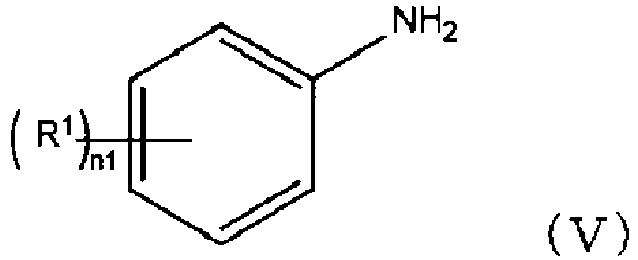

- Alternatively, when X is CH2, the compound represented by the formula (I) may be also produced through steps (1) and (2) described below.
- (1) A step of reacting an aminophenol derivative represented by a general formula (VII):


- (2) A step of reacting the phenol derivative represented by the formula (IX) with a benzyl chloride derivative represented by a general formula (X):
- Alternatively, when X is C=O, the compound represented by the formula (I) may be produced through a step (2') described below following the step (1) the same as that of the production method 2.
- (2') A step of reacting the phenol derivative represented by the formula (IX) with a benzoyl chloride derivative represented by a general formula (XI):


- Alternatively, when X is SO2, the compound represented by the formula (I) may be also produced through a step (2") described below following the step (1) the same as that of the production method 2.
- (2") A step of reacting the phenol derivative represented by the formula (IX) with a benzenesulfonyl chloride derivative represented by a general formula (XIII):


- The compounds of the present invention can be identified in their structure by measuring 1H-NMR, 13C-NMR, IR, MS or the like by using a known measuring apparatus. Besides, the purity can be measured by using a measuring apparatus for liquid chromatography (HPLC), thermal analysis (DSC) or the like.
- Furthermore, examples of a compound that can be thus synthesized are shown in Table 1.

Table 1 Compound No. ring-A ring-B Ring-C Melting point (°C) (R1)n1 (R2)n2 and O-X-ring-C (R3)n3 2 3 4 5 6 2 3 4 5 6 2 3 4 5 6 1 H H H H H OCH2-ringC H H H H H H H H H 172-173 2 Cl H H H H OCH2-ringC H H H H H H H H H 3 H Cl H H H OCH2-ringC H H H H H H H H H 4 H H Cl H H OCH2-ringC H H H H H H H H H 200-201 5 Me H H H H OCH2-ringC H H H H H H H H H 6 H Me H H H OCH2-ringC H H H H H H H H H 7 H H Me H H OCH2-ringC H H H H H H H H H 8 OMe H H H H OCH2-ringC H H H H H H H H H 9 H OMe H H H OCH2-ringC H H H H H H H H H 10 H H OMe H H OCH2-ringC H H H H H H H H H 11 H H NHAc H H OCH2-ringC H H H H H H H H H 12 H H Ac H H OCH2-ringC H H H H H H H H H 13 NO2 H H H H OCH2-ringC H H H H H H H H H 14 H NO2 H H H OCH2-ringC H H H H H H H H H 15 H H NO2 H H OCH2-ringC H H H H H H H H H 16 CN H H H H OCH2-ringC H H H H H H H H H 17 H CN H H H OCH2-ringC H H H H H H H H H 18 H H CN H H OCH2-ringC H H H H H H H H H 19 H H H H H OCH2-ringC H H H H H H Me H H 20 Cl H H H H OCH2-ringC H H H H H H Me H H 21 H Cl H H H OCH2-ringC H H H H H H Me H H 22 H H Cl H H OCH2-ringC H H H H H H Me H H 23 Me H H H H OCH2-ringC H H H H H H Me H H 24 H Me H H H OCH2-ringC H H H H H H Me H H 25 H H Me H H OCH2-ringC H H H H H H Me H H 26 OMe H H H H OCH2-ringC H H H H H H Me H H 27 H OMe H H H OCH2-ringC H H H H H H Me H H 28 H H OMe H H OCH2-ringC H H H H H H Me H H 29 NO2 H H H H OCH2-ringC H H H H H H Me H H 30 H NO2 H H H OCH2-ringC H H H H H H Me H H 31 H H NO2 H H OCH2-ringC H H H H H H Me H H 32 CN H H H H OCH2-ringC H H H H H H Me H H 33 H CN H H H OCH2-ringC H H H H H H Me H H 34 H H CN H H OCH2-ringC H H H H H H Me H H 35 H H H H H OCH2-ringC H H H H H H OMe H H 36 Cl H H H H OCH2-ringC H H H H H H OMe H H 37 H Cl H H H OCH2-ringC H H H H H H OMe H H 38 H H Cl H H OCH2-ringC H H H H H H OMe H H 39 Me H H H H OCH2-ringC H H H H H H OMe H H 40 H Me H H H OCH2-ringC H H H H H H OMe H H 41 H H Me H H OCH2-ringC H H H H H H OMe H H 42 OMe H H H H OCH2-ringC H H H H H H OMe H H 43 H OMe H H H OCH2-ringC H H H H H H OMe H H 44 H H OMe H H OCH2-ringC H H H H H H OMe H H 45 NO2 H H H H OCH2-ringC H H H H H H OMe H H 46 H NO2 H H H OCH2-ringC H H H H H H OMe H H 47 H H NO2 H H OCH2-ringC H H H H H H OMe H H 48 CN H H H H OCH2-ringC H H H H H H OMe H H 49 H CN H H H OCH2-ringC H H H H H H OMe H H 50 H H CN H H OCH2-ringC H H H H H H OMe H H 51 H H H H H OCH2-ringC H H H H H H Cl H H 52 Cl H H H H OCH2-ringC H H H H H H Cl H H 53 H Cl H H H OCH2-ringC H H H H H H Cl H H 54 H H Cl H H OCH2-ringC H H H H H H Cl H H 55 Me H H H H OCH2-ringC H H H H H H Cl H H 56 H Me H H H OCH2-ringC H H H H H H Cl H H 57 H H Me H H OCH2-ringC H H H H H H Cl H H 58 OMe H H H H OCH2-ringC H H H H H H Cl H H 59 H OMe H H H OCH2-ringC H H H H H H Cl H H 60 H H OMe H H OCH2-ringC H H H H H H Cl H H 61 NO2 H H H H OCH2-ringC H H H H H H Cl H H 62 H NO2 H H H OCH2-ringC H H H H H H Cl H H 63 H H NO2 H H OCH2-ringC H H H H H H Cl H H 64 CN H H H H OCH2-ringC H H H H H H Cl H H 65 H CN H H H OCH2-ringC H H H H H H Cl H H 66 H H CN H H OCH2-ringC H H H H H H Cl H H 67 H H H H H OCO-ringC H H H H H H H H H 171-174 68 Cl H H H H OCO-ringC H H H H H H H H H 69 H Cl H H H OCO-ringC H H H H H H H H H 70 H H Cl H H OCO-ringC H H H H H H H H H 206-207 71 Me H H H H OCO-ringC H H H H H H H H H 72 H Me H H H OCO-ringC H H H H H H H H H 73 H H Me H H OCO-ringC H H H H H H H H H 74 OMe H H H H OCO-ringC H H H H H H H H H 75 H OMe H H H OCO-ringC H H H H H H H H H 76 H H OMe H H OCO-ringC H H H H H H H H H 77 H H NHAc H H OCO-ringC H H H H H H H H H 78 H H Ac H H OCO-ringC H H H H H H H H H 79 NO2 H H H H OCO-ringC H H H H H H H H H 80 H NO2 H H H OCO-ringC H H H H H H H H H 81 H H NO2 H H OCO-ringC H H H H H H H H H 82 CN H H H H OCO-ringC H H H H H H H H H 83 H CN H H H OCO-ringC H H H H H H H H H 84 H H CN H H OCO-ringC H H H H H H H H H 85 H H H H H OCO-ringC H H H H H H Me H H 86 Cl H H H H OCO-ringC H H H H H H Me H H 87 H Cl H H H OCO-ringC H H H H H H Me H H 88 H H Cl H H OCO-ringC H H H H H H Me H H 89 Me H H H H OCO-ringC H H H H H H Me H H 90 H Me H H H OCO-ringC H H H H H H Me H H 91 H H Me H H OCO-ringC H H H H H H Me H H 92 OMe H H H H OCO-ringC H H H H H H Me H H 93 H OMe H H H OCO-ringC H H H H H H Me H H 94 H H OMe H H OCO-ringC H H H H H H Me H H 95 NO2 H H H H OCO-ringC H H H H H H Me H H 96 H NO2 H H H OCO-ringC H H H H H H Me H H 97 H H NO2 H H OCO-ringC H H H H H H Me H H 98 CN H H H H OCO-ringC H H H H H H Me H H 99 H CN H H H OCO-ringC H H H H H H Me H H 100 H H CN H H OCO-ringC H H H H H H Me H H 101 H H H H H OCO-ringC H H H H H H OMe H H 102 Cl H H H H OCO-ringC H H H H H H OMe H H 103 H Cl H H H OCO-ringC H H H H H H OMe H H 104 H H Cl H H OCO-ringC H H H H H H OMe H H 105 Me H H H H OCO-ringC H H H H H H OMe H H 106 H Me H H H OCO-ringC H H H H H H OMe H H 107 H H Me H H OCO-ringC H H H H H H OMe H H 108 OMe H H H H OCO-ringC H H H H H H OMe H H 109 H OMe H H H OCO-ringC H H H H H H OMe H H 110 H H OMe H H OCO-ringC H H H H H H OMe H H 111 NO2 H H H H OCO-ringC H H H H H H OMe H H 112 H NO2 H H H OCO-ringC H H H H H H OMe H H 113 H H NO2 H H OCO-ringC H H H H H H OMe H H 114 CN H H H H OCO-ringC H H H H H H OMe H H 115 H CN H H H OCO-ringC H H H H H H OMe H H 116 H H CN H H OCO-ringC H H H H H H OMe H H 117 H H H H H OCO-ringC H H H H H H Cl H H 118 Cl H H H H OCO-ringC H H H H H H Cl H H 119 H Cl H H H OCO-ringC H H H H H H Cl H H 120 H H Cl H H OCO-ringC H H H H H H Cl H H 121 Me H H H H OCO-ringC H H H H H H Cl H H 122 H Me H H H OCO-ringC H H H H H H Cl H H 123 H H Me H H OCO-ringC H H H H H H Cl H H 124 OMe H H H H OCO-ringC H H H H H H Cl H H 125 H OMe H H H OCO-ringC H H H H H H Cl H H 126 H H OMe H H OCO-ringC H H H H H H Cl H H 127 NO2 H H H H OCO-ringC H H H H H H Cl H H 128 H NO2 H H H OCO-ringC H H H H H H Cl H H 129 H H NO2 H H OCO-ringC H H H H H H Cl H H 130 CN H H H H OCO-ringC H H H H H H Cl H H 131 H CN H H H OCO-ringC H H H H H H Cl H H 132 H H CN H H OCO-ringC H H H H H H Cl H H 133 H H H H H OSO2-ringC H H H H H H H H H 134 Cl H H H H OSO2-ringC H H H H H H H H H 135 H Cl H H H OSO2-ringC H H H H H H H H H 136 H H Cl H H OSO2-ringC H H H H H H H H H 137 Me H H H H OSO2-ringC H H H H H H H H H 138 H Me H H H OSO2-ringC H H H H H H H H H 139 H H Me H H OSO2-ringC H H H H H H H H H 140 OMe H H H H OSO2-ringC H H H H H H H H H 141 H OMe H H H OSO2-ringC H H H H H H H H H 142 H H OMe H H OSO2-ringC H H H H H H H H H 143 NO2 H H H H OSO2-ringC H H H H H H H H H 144 H NO2 H H H OSO2-ringC H H H H H H H H H 145 H H NO2 H H OSO2-ringC H H H H H H H H H 146 CN H H H H OSO2-ringC H H H H H H H H H 147 H CN H H H OSO2-ringC H H H H H H H H H 148 H H CN H H OSO2-ringC H H H H H H H H H 149 H H H H H OSO2-ringC H H H H H H Me H H 173-174 150 Cl H H H H OSO2-ringC H H H H H H Me H H 151 H Cl H H H OSO2-ringC H H H H H H Me H H 152 H H Cl H H OSO2-ringC H H H H H H Me H H 144-147 153 Me H H H H OSO2-ringC H H H H H H Me H H 154 H Me H H H OSO2-ringC H H H H H H Me H H 155 H H Me H H OSO2-ringC H H H H H H Me H H 156 OMe H H H H OSO2-ringC H H H H H H Me H H 157 H OMe H H H OSO2-ringC H H H H H H Me H H 158 H H OMe H H OSO2-ringC H H H H H H Me H H 159 H H NHAc H H OSO2-ringC H H H H H H Me H H 160 H H Ac H H OSO2-ringC H H H H H H Me H H 161 NO2 H H H H OSO2-ringC H H H H H H Me H H 162 H NO2 H H H OSO2-ringC H H H H H H Me H H 163 H H NO2 H H OSO2-ringC H H H H H H Me H H 164 CN H H H H OSO2-ringC H H H H H H Me H H 165 H CN H H H OSO2-ringC H H H H H H Me H H 166 H H CN H H OSO2-ringC H H H H H H Me H H 167 H H H H H OSO2-ringC H H H H H H OMe H H 168 Cl H H H H OSO2-ringC H H H H H H OMe H H 169 H Cl H H H OSO2-ringC H H H H H H OMe H H 170 H H Cl H H OSO2-ringC H H H H H H OMe H H 171 Me H H H H OSO2-ringC H H H H H H OMe H H 172 H Me H H H OSO2-ringC H H H H H H OMe H H 173 H H Me H H OSO2-ringC H H H H H H OMe H H 174 OMe H H H H OSO2-ringC H H H H H H OMe H H 175 H OMe H H H OSO2-ringC H H H H H H OMe H H 176 H H OMe H H OSO2-ringC H H H H H H OMe H H 177 H H NHAc H H OSO2-ringC H H H H H H OMe H H 178 H H Ac H H OSO2-ringC H H H H H H OMe H H 179 NO2 H H H H OSO2-ringC H H H H H H OMe H H 180 H NO2 H H H OSO2-ringC H H H H H H OMe H H 181 H H NO2 H H OSO2-ringC H H H H H H OMe H H 182 CN H H H H OSO2-ringC H H H H H H OMe H H 183 H CN H H H OSO2-ringC H H H H H H OMe H H 184 H H CN H H OSO2-ringC H H H H H H OMe H H 185 H H H H H OSO2-ringC H H H H H H Cl H H 186 Cl H H H H OSO2-ringC H H H H H H Cl H H 187 H Cl H H H OSO2-ringC H H H H H H Cl H H 188 H H Cl H H OSO2-ringC H H H H H H Cl H H 189 Me H H H H OSO2-ringC H H H H H H Cl H H 190 H Me H H H OSO2-ringC H H H H H H Cl H H 191 H H Me H H OSO2-ringC H H H H H H Cl H H 192 OMe H H H H OSO2-ringC H H H H H H Cl H H 193 H OMe H H H OSO2-ringC H H H H H H Cl H H 194 H H OMe H H OSO2-ringC H H H H H H Cl H H 195 H H NHAc H H OSO2-ringC H H H H H H Cl H H 196 H H Ac H H OSO2-ringC H H H H H H Cl H H 197 NO2 H H H H OSO2-ringC H H H H H H Cl H H 198 H NO2 H H H OSO2-ringC H H H H H H Cl H H 199 H H NO2 H H OSO2-ringC H H H H H H Cl H H 200 CN H H H H OSO2-ringC H H H H H H Cl H H 201 H CN H H H OSO2-ringC H H H H H H Cl H H 202 H H CN H H OSO2-ringC H H H H H H Cl H H 203 H H H H H H OCH2-ringC H H H H H H H H 179-182 204 Cl H H H H H OCH2-ringC H H H H H H H H 163-164 205 H Cl H H H H OCH2-ringC H H H H H H H H 174-175 206 H H Cl H H H OCH2-ringC H H H H H H H H 197-198 207 Me H H H H H OCH2-ringC H H H H H H H H 208 H Me H H H H OCH2-ringC H H H H H H H H 209 H H Me H H H OCH2-ringC H H H H H H H H 210 OMe H H H H H OCH2-ringC H H H H H H H H 211 H OMe H H H H OCH2-ringC H H H H H H H H 212 H H OMe H H H OCH2-ringC H H H H H H H H 213 H H NHAc H H H OCH2-ringC H H H H H H H H 214 H H Ac H H H OCH2-ringC H H H H H H H H 215 NO2 H H H H H OCH2-ringC H H H H H H H H 216 H NO2 H H H H OCH2-ringC H H H H H H H H 217 H H NO2 H H H OCH2-ringC H H H H H H H H 218 CN H H H H H OCH2-ringC H H H H H H H H 219 H CN H H H H OCH2-ringC H H H H H H H H 220 H H CN H H H OCH2-ringC H H H H H H H H 221 H H H H H H OCO-ringC H H H H H H H H 174-179 222 Cl H H H H H OCO-ringC H H H H H H H H 178-179 223 H Cl H H H H OCO-ringC H H H H H H H H 200-201 224 H H Cl H H H OCO-ringC H H H H H H H H 209-210 225 Me H H H H H OCO-ringC H H H H H H H H 226 H Me H H H H OCO-ringC H H H H H H H H 227 H H Me H H H OCO-ringC H H H H H H H H 228 OMe H H H H H OCO-ringC H H H H H H H H 229 H OMe H H H H OCO-ringC H H H H H H H H 230 H H OMe H H H OCO-ringC H H H H H H H H 231 H H NHAc H H H OCO-ringC H H H H H H H H 232 H H Ac H H H OCO-ringC H H H H H H H H 233 NO2 H H H H H OCO-ringC H H H H H H H H 234 H NO2 H H H H OCO-ringC H H H H H H H H 235 H H NO2 H H H OCO-ringC H H H H H H H H 166-169 236 CN H H H H H OCO-ringC H H H H H H H H 237 H CN H H H H OCO-ringC H H H H H H H H 238 H H CN H H H OCO-ringC H H H H H H H H 239 H H H H H H OSO2-ringC H H H H H Me H H 172-174 240 Cl H H H H H OSO2-ringC H H H H H Me H H 155-156 241 H Cl H H H H OSO2-ringC H H H H H Me H H 192-193 242 H H Cl H H H OSO2-ringC H H H H H Me H H 147-148 243 Me H H H H H OSO2-ringC H H H H H Me H H 244 H Me H H H H OSO2-ringC H H H H H Me H H 245 H H Me H H H OSO2-ringC H H H H H Me H H 246 OMe H H H H H OSO2-ringC H H H H H Me H H 247 H OMe H H H H OSO2-ringC H H H H H Me H H 248 H H OMe H H H OSO2-ringC H H H H H Me H H 176-177 249 H H NHAc H H H OSO2-ringC H H H H H Me H H 250 H H Ac H H H OSO2-ringC H H H H H Me H H 251 NO2 H H H H H OSO2-ringC H H H H H Me H H 252 H NO2 H H H H OSO2-ringC H H H H H Me H H 253 H H NO2 H H H OSO2-ringC H H H H H Me H H 206-207 254 CN H H H H H OSO2-ringC H H H H H Me H H 255 H CN H H H H OSO2-ringC H H H H H Me H H 256 H H CN H H H OSO2-ringC H H H H H Me H H 257 H H H H H H OSO2-ringC H H H H H OMe H H 258 Cl H H H H H OSO2-ringC H H H H H OMe H H 259 H Cl H H H H OSO2-ringC H H H H H OMe H H 260 H H Cl H H H OSO2-ringC H H H H H OMe H H 261 Me H H H H H OSO2-ringC H H H H H OMe H H 262 H Me H H H H OSO2-ringC H H H H H OMe H H 263 H H Me H H H OSO2-ringC H H H H H OMe H H 264 OMe H H H H H OSO2-ringC H H H H H OMe H H 265 H OMe H H H H OSO2-ringC H H H H H OMe H H 266 H H OMe H H H OSO2-ringC H H H H H OMe H H 267 H H NHAc H H H OSO2-ringC H H H H H OMe H H 268 H H Ac H H H OSO2-ringC H H H H H OMe H H 269 NO2 H H H H H OSO2-ringC H H H H H OMe H H 270 H NO2 H H H H OSO2-ringC H H H H H OMe H H 271 H H NO2 H H H OSO2-ringC H H H H H OMe H H 272 CN H H H H H OSO2-ringC H H H H H OMe H H 273 H CN H H H H OSO2-ringC H H H H H OMe H H 274 H H CN H H H OSO2-ringC H H H H H OMe H H 275 H H H H H H OSO2-ringC H H H H H Cl H H 276 Cl H H H H H OSO2-ringC H H H H H Cl H H 277 H Cl H H H H OSO2-ringC H H H H H Cl H H 278 H H Cl H H H OSO2-ringC H H H H H Cl H H 279 Me H H H H H OSO2-ringC H H H H H Cl H H 280 H Me H H H H OSO2-ringC H H H H H Cl H H 281 H H Me H H H OSO2-ringC H H H H H Cl H H 282 OMe H H H H H OSO2-ringC H H H H H Cl H H 283 H OMe H H H H OSO2-ringC H H H H H Cl H H 284 H H OMe H H H OSO2-ringC H H H H H Cl H H 285 H H NHAc H H H OSO2-ringC H H H H H Cl H H 286 H H Ac H H H OSO2-ringC H H H H H Cl H H 287 NO2 H H H H H OSO2-ringC H H H H H Cl H H 288 H NO2 H H H H OSO2-ringC H H H H H Cl H H 289 H H NO2 H H H OSO2-ringC H H H H H Cl H H 290 CN H H H H H OSO2-ringC H H H H H Cl H H 291 H CN H H H H OSO2-ringC H H H H H Cl H H 292 H H CN H H H OSO2-ringC H H H H H Cl H H 293 H H H H H H H OCH2-ringC H H H H H H H 294 Cl H H H H H H OCH2-ringC H H H H H H H 295 H Cl H H H H H OCH2-ringC H H H H H H H 296 H H Cl H H H H OCH2-ringC H H H H H H H 297 Me H H H H H H OCH2-ringC H H H H H H H 298 H Me H H H H H OCH2-ringC H H H H H H H 299 H H Me H H H H OCH2-ringC H H H H H H H 300 OMe H H H H H H OCH2-ringC H H H H H H H 301 H OMe H H H H H OCH2-ringC H H H H H H H 302 H H OMe H H H H OCH2-ringC H H H H H H H 303 H H NHAc H H H H OCH2-ringC H H H H H H H 304 H H Ac H H H H OCH2-ringC H H H H H H H 305 NO2 H H H H H H OCH2-ringC H H H H H H H 306 H NO2 H H H H H OCH2-ringC H H H H H H H 307 H H NO2 H H H H OCH2-ringC H H H H H H H 308 CN H H H H H H OCH2-ringC H H H H H H H 309 H CN H H H H H OCH2-ringC H H H H H H H 310 H H CN H H H H OCH2-ringC H H H H H H H 311 H H H H H H H OCO-ringC H H H H H H H 215-216 312 Cl H H H H H H OCO-ringC H H H H H H H 313 H Cl H H H H H OCO-ringC H H H H H H H 314 H H Cl H H H H OCO-ringC H H H H H H H 315 Me H H H H H H OCO-ringC H H H H H H H 316 H Me H H H H H OCO-ringC H H H H H H H 317 H H Me H H H H OCO-ringC H H H H H H H 318 OMe H H H H H H OCO-ringC H H H H H H H 319 H OMe H H H H H OCO-ringC H H H H H H H 320 H H OMe H H H H OCO-ringC H H H H H H H 321 H H NHAc H H H H OCO-ringC H H H H H H H 322 H H Ac H H H H OCO-ringC H H H H H H H 323 NO2 H H H H H H OCO-ringC H H H H H H H 324 H NO2 H H H H H OCO-ringC H H H H H H H 325 H H NO2 H H H H OCO-ringC H H H H H H H 326 CN H H H H H H OCO-ringC H H H H H H H 327 H CN H H H H H OCO-ringC H H H H H H H 328 H H CN H H H H OCO-ringC H H H H H H H 329 H H H H H H H OSO2-ringC H H H H Me H H 330 Cl H H H H H H OSO2-ringC H H H H Me H H 331 H Cl H H H H H OSO2-ringC H H H H Me H H 332 H H Cl H H H H OSO2-ringC H H H H Me H H 333 Me H H H H H H OSO2-ringC H H H H Me H H 334 H Me H H H H H OSO2-ringC H H H H Me H H 335 H H Me H H H H OSO2-ringC H H H H Me H H 336 OMe H H H H H H OSO2-ringC H H H H Me H H 337 H OMe H H H H H OSO2-ringC H H H H Me H H 338 H H OMe H H H H OSO2-ringC H H H H Me H H 339 H H NHAc H H H H OSO2-ringC H H H H Me H H 340 H H Ac H H H H OSO2-ringC H H H H Me H H 341 NO2 H H H H H H OSO2-ringC H H H H Me H H 342 H NO2 H H H H H OSO2-ringC H H H H Me H H 343 H H NO2 H H H H OSO2-ringC H H H H Me H H 344 CN H H H H H H OSO2-ringC H H H H Me H H 345 H CN H H H H H OSO2-ringC H H H H Me H H 346 H H CN H H H H OSO2-ringC H H H H Me H H 347 H H H H H H H OSO2-ringC H H H H OMe H H 348 Cl H H H H H H OSO2-ringC H H H H OMe H H 349 H Cl H H H H H OSO2-ringC H H H H OMe H H 350 H H Cl H H H H OSO2-ringC H H H H OMe H H 351 Me H H H H H H OSO2-ringC H H H H OMe H H 352 H Me H H H H H OSO2-ringC H H H H OMe H H 353 H H Me H H H H OSO2-ringC H H H H OMe H H 354 OMe H H H H H H OSO2-ringC H H H H OMe H H 355 H OMe H H H H H OSO2-ringC H H H H OMe H H 356 H H OMe H H H H OSO2-ringC H H H H OMe H H 357 H H NHAc H H H H OSO2-ringC H H H H OMe H H 358 H H Ac H H H H OSO2-ringC H H H H OMe H H 359 NO2 H H H H H H OSO2-ringC H H H H OMe H H 360 H NO2 H H H H H OSO2-ringC H H H H OMe H H 361 H H NO2 H H H H OSO2-ringC H H H H OMe H H 362 CN H H H H H H OSO2-ringC H H H H OMe H H 363 H CN H H H H H OSO2-ringC H H H H OMe H H 364 H H CN H H H H OSO2-ringC H H H H OMe H H 365 H H H H H H H OSO2-ringC H H H H Cl H H 366 Cl H H H H H H OSO2-ringC H H H H Cl H H 367 H Cl H H H H H OSO2-ringC H H H H Cl H H 368 H H Cl H H H H OSO2-ringC H H H H Cl H H 369 Me H H H H H H OSO2-ringC H H H H Cl H H 370 H Me H H H H H OSO2-ringC H H H H Cl H H 371 H H Me H H H H OSO2-ringC H H H H Cl H H 372 OMe H H H H H H OSO2-ringC H H H H Cl H H 373 H OMe H H H H H OSO2-ringC H H H H Cl H H 374 H H OMe H H H H OSO2-ringC H H H H Cl H H 375 H H NHAc H H H H OSO2-ringC H H H H Cl H H 376 H H Ac H H H H OSO2-ringC H H H H Cl H H 377 NO2 H H H H H H OSO2-ringC H H H H Cl H H 378 H NO2 H H H H H OSO2-ringC H H H H Cl H H 379 H H NO2 H H H H OSO2-ringC H H H H Cl H H 380 CN H H H H H H OSO2-ringC H H H H Cl H H 381 H CN H H H H H OSO2-ringC H H H H Cl H H 382 H H CN H H H H OSO2-ringC H H H H Cl H H - A recording material of the present invention can be used for any purpose as long as it is a recording material containing a color former and at least one of the compounds represented by the formula (I), and for example, it can be used as a thermal recording material or a pressure-sensitive copying material.
- The proportion of the compound(s) of at least one of the compounds represented by the formula (I) to the color former used is usually 0.01 to 10 parts by mass, preferably 0.5 to 10 parts by mass, and more preferably 1.0 to 5 parts by mass, with respect to 1 part by mass of the color former.
- The recording material of the present invention can contain, in addition to the color former and the compound(s) represented by the formula (I), one or more of color-developing agents, image stabilizers, sensitizers, fillers, dispersants, antioxidants, desensitizers, anti-tack agents, antifoaming agents, light stabilizers, fluorescent brightening agents, etc., known in the art, as needed. The amount of each of the components used is in the range of usually 0.1 to 15 parts by mass, preferably 1 to 10 parts by mass, with respect to 1 part by mass of the color former.
- These agents may be contained in a color-developing layer or may be contained in any layer, for example, a protective layer, when they consist of a multilayer structure. Particularly, when an overcoat layer or an undercoat layer is provided in the upper and/or lower parts of the color-developing layer, these layers can contain antioxidants, light stabilizers, etc. Furthermore, these antioxidants or light stabilizers can be contained in a form encapsulated in microcapsules, as needed, in these layers.
- Examples of the color former used in the recording material of the present invention can include, but not limited to, fluoran, phthalide, lactam, triphenylmethane, phenothiazine, and spiropyran leuco dyes. Any color former that forms a color by contact with the color-developing agent, which is an acidic substance, can be used. Moreover, these color formers can be used alone to produce a recording material of the color developed by it, as a matter of course. Alternatively, two or more thereof can be used by mixing. For example, three primary color (red, blue, and green) formers or black color formers can be used by mixing to produce a recording material that develops a true black color.
- Examples of the fluoran color formers include 3,3-bis(p-dimethylaminophenyl)phthalide, 3,3-bis(p-dimethylaminophenyl)-6-dimethylaminophthalide (also known as crystal violet lactone), 3,3-bis(p-dimethylaminophenyl)-6-diethylaminophthalide, 3,3-bis(p-dimethylaminophenyl)-6-chlorophthalide, 3,3-bis(p-dibutylaminophenyl)phthalide, 3-cyclohexylamino-6-chlorofluoran, 3-dimethylamino-5,7-dimethylfluoran, 3-N-methyl-N-isopropylamino-6-methyl-7-anilinofluoran, 3-N-methyl-N-isobutylamino-6-methyl-7-anilinofluoran, 3-N-methyl-N-isoamylamino-6-methyl-7-anilinofluoran, 3-diethylamino-7-chlorofluoran, 3-diethylamino-6,8-dimethylfluoran, 3-diethylamino-7-methylfluoran, 3-diethylamino-7,8-benzofluoran, 3-diethylamino-6-methyl-7-chlorofluoran, 3-dibutylamino-6-methyl-7-bromofluoran, 3-(N-p-tolyl-N-ethylamino)-6-methyl-7-anilinofluoran, 3-pyrrolidino-6-methylamino-7-anilinofluoran, 2-{N-(3'-trifluoromethylphenyl)amino}-6-diethylaminofluoran, 2-{3,6-bis(diethylamino)-9-(o-chloroanilino)xanthyl}benzoic acid lactam, 3-diethylamino-6-methyl-7-(m-trichloromethylanilino)fluoran, 3-diethylamino-7-(o-chloroanilino)fluoran, 3-dibutylamino-7-(o-chloroanilino)fluoran, 3-N-methyl-N-amylamino-6-methyl-7-anilinofluoran, 3-N-methyl-N-cyclohexylamino-6-methyl-7-anilinofluoran, 3-diethylamino-6-methyl-7-anilinofluoran, 3-diethylamino-6-methyl-7-(2',4'-dimethylanilino)fluoran, 3-(N,N-diethylamino)-5-methyl-7-(N,N-dibenzylamino)fluoran, 3-(N,N-diethylamino)-7-(N,N-dibenzylamino)fluoran, 3-(N-ethyl-N-isobutylamino)-6-methyl-7-anilinofluoran, 3-(N-ethyl-N-propylamino)-6-methyl-7-anilinofluoran, 3-(N-methyl-N-propylamino)-6-methyl-7-anilinofluoran, 3-(N-ethyl-N-isopentylamino)-6-methyl-7-anilinofluoran, 3-(N-ethyl-N-toluidino)-6-methyl-7-anilino-fluoran, 3-pyrrolidino-6-methyl-7-anilinofluoran, 3-piperidino-6-methyl-7-anilinofluoran, 3-dimethylamino-7-(m-trifluoromethylanilino)fluoran, 3-dipentylamino-6-methyl-7-anilinofluoran, 3-(N-ethoxypropyl-N-ethylamino)-6-methyl-7-anilinofluoran, 3-dibutylamino-7-(o-fluoroanilino)fluoran, 3-diethylaminobenzo[a]fluoran, 3-diethylamino-5-methyl-7-benzylaminofluoran, 3-diethylamino-5-chlorofluoran, 3-diethylamino-6-(N,N'-dibenzylamino)fluoran, 3,6-dimethoxyfluoran, 2,4-dimethyl-6-(4-dimethylaminophenyl)aminofluoran, 3-diethylamino-7-(m-trifluoromethylanilino)fluoran, 3-diethylamino-6-methyl-7-octylaminofluoran, 3-diethylamino-6-methyl-7-(m-tolylamino)fluoran, 3-diethylamino-6-methyl-7-(2,4-xylylamino)fluoran, 3-diethylamino-7-(o-fluoroanilino)fluoran, 3-diphenylamino-6-methyl-7-anilinofluoran, benzoylleucomethylene blue, 6'-chloro-8'-methoxy-benzindolino-spiropyran, 6'-bromo-3'-methoxy-benzindolino-spiropyran, 3-(2'-hydroxy-4'-dimethylaminophenyl)-3-(2'-methoxy-5'-chlorophenyl)phthalide, 3-(2'-hydroxy-4'-dimethylaminophenyl)-3-(2'-methoxy-5'-nitrophenyl)phthalide, 3-(2'-hydroxy-4'-diethylaminophenyl)-3-(2'-methoxy-5'-methylphenyl)phthalide, 3-(2'-methoxy-4'-dimethylaminophenyl)-3-(2'-hydroxy-4'-chloro-5'-methylphenyl)phthalide, 3-morpholino-7-(N-propyl-m-trifluoromethylanilino)fluoran, 3-pyrrolidino-7-m-trifluoromethylanilinofluoran, 3-diethylamino-5-chloro-7-(N-benzyl-m-trifluoromethylanilino)fluoran, 3-pyrrolidino-7-di(p-chlorophenyl)aminofluoran, 3-diethylamino-5-chloro-7-(α-phenylethylamino)fluoran, 3-(N-ethyl-p-toluidino)-7-(a-phenylethylamino)fluoran, 3-diethylamino-7-(o-methoxycarbonylphenylamino)fluoran, 3-diethylamino-5-methyl-7-(α-phenylethylamino)fluoran, 3-diethylamino-7-piperidinofluoran, 2-chloro-3-(N-methyltoluidino)-7-(p-n-butylanilino)fluoran, 3-(N-methyl-N-isopropylamino)-6-methyl-7-anilinofluoran, 3-dibutylamino-6-methyl-7-anilinofluoran, 3,6-bis(dimethylamino)fluorenespiro(9,3')-6'-dimethylaminophthalide, 3-(N-benzyl-N-cyclohexylamino)-5,6-benzo-7-α-naphthylamino-4'-bromofluoran, 3-diethylamino-6-chloro-7-anilinofluoran, 3-N-ethyl-N-(2-ethoxypropyl)amino-6-methyl-7-anilinofluoran, 3-N-ethyl-N-tetrahydrofurfurylamino-6-methyl-7-anilinofluoran, 3-diethylamino-6-methyl-7-mesidino-4',5'-benzofluoran, and 3-(N-ethyl-p-toluidino)-7-(methylphenylamino)fluoran.
- Among these color formers, preferable examples thereof can include 3,3-bis(p-dimethylaminophenyl)-6-dimethylaminophthalide, 3-cyclohexylamino-6-chlorofluoran, 3-diethylamino-7-chlorofluoran, 3-diethylamino-6,8-dimethylfluoran, 3-diethylamino-7-methylfluoran, 3-diethylamino-7,8-benzofluoran, 3-diethylamino-6-methyl-7-chlorofluoran, 3-dibutylamino-6-methyl-7-bromofluoran, 3-diethylamino-7-(o-chloroanilino)fluoran, 3-dibutylamino-7-(o-chloroanilino)fluoran, 3-N-methyl-N-cyclohexylamino-6-methyl-7-anilinofluoran, 3-(N,N-diethylamino)-5-methyl-7-(N,N-dibenzylamino)fluoran, 3-(N,N-diethylamino)-7-(N,N-dibenzylamino)fluoran, 3-(N-ethyl-N-isobutylamino)-6-methyl-7-anilinofluoran, 3-(N-methyl-N-propylamino)-6-methyl-7-anilinofluoran, 3-(N-ethyl-N-isopentylamino)-6-methyl-7-anilinofluoran, 3-(N-ethyl-N-toluidino)-6-methyl-7-anilino-fluoran, 3-(N-ethoxypropyl-N-ethylamino)-6-methyl-7-anilinofluoran, 3-dibutylamino-7-(o-fluoroanilino)fluoran, 3-diethylamino-7-(m-trifluoromethylanilino)fluoran, 3-diethylamino-6-methyl-7-octylaminofluoran, 3-diethylamino-6-methyl-7-(m-tolylamino)fluoran, 3-diethylamino-7-(o-fluoroanilino)fluoran, 3-diphenylamino-6-methyl-7-anilinofluoran, benzoylleucomethylene blue, 3-dibutylamino-6-methyl-7-anilinofluoran, 3-N-ethyl-N-tetrahydrofurfurylamino-6-methyl-7-anilinofluoran, and 3-(N-ethyl-p-toluidino)-7-(methylphenylamino)fluoran.
- Moreover, examples of near infrared absorbing dyes include 3-[4-[4-(4-anilino)-anilino]anilino]-6-methyl-7-chlorofluoran, 3,3-bis[2-(4-dimethylaminophenyl)-2-(4-methoxyphenyl)vinyl]-4,5,6,7-tetrachlorophthalide, and 3,6,6'-tris(dimethylamino)spiro(fluorene-9,3'-phthalide).
- At least one of the compounds represented by the formula (I) of the present invention is suitably used as a color-developing agent mainly in a thermal recording material, and these compounds alone can be used or these compounds can be used together with a plurality of known color-developing agents. The ratio among them is arbitrary.
- Examples of other color-developing agents can specifically include the followings:
bisphenol compounds such as bisphenol A, 4,4'-sec-butylidenebisphenol, 4,4'-cyclohexylidenebisphenol, 2,2'-bis(4-hydroxyphenyl)-3,3'-dimethylbutane, 2,2'-dihydroxydiphenyl, pentamethylene-bis(4-hydroxybenzoate), 2,2-dimethyl-3,3-di(4-hydroxyphenyl)pentane, 2,2-di(4-hydroxyphenyl)hexane, 2,2-bis(4-hydroxyphenyl)propane, 2,2-bis(4-hydroxyphenyl)butane, 2,2-bis(4-hydroxy-3-methylphenyl)propane, 4,4'-(1-phenylethylidene)bisphenol, 4,4'-ethylidenebisphenol, (hydroxyphenyl)methylphenol, 2,2'-bis(4-hydroxy-3-phenyl-phenyl)propane, 4,4'-(1,3-phenylenediisopropylidene)bisphenol, 4,4'-(1,4-phenylenediisopropylidene)bisphenol, and butyl 2,2-bis(4-hydroxyphenyl)acetate; sulfur-containing bisphenol compounds such as 4,4'-dihydroxydiphenyl thioether, 1,7-di(4-hydroxyphenylthio)-3,5-dioxaheptane, 2,2'-bis(4-hydroxyphenylthio)diethyl ether, and 4,4'-dihydroxy-3,3'-dimethyldiphenyl thioether; 4-hydroxybenzoic acid esters such as benzyl 4-hydroxybenzoate, ethyl 4-hydroxybenzoate, propyl 4-hydroxybenzoate, isopropyl 4-hydroxybenzoate, butyl 4-hydroxybenzoate, isobutyl 4-hydroxybenzoate, chlorobenzyl 4-hydroxybenzoate, methylbenzyl 4-hydroxybenzoate, and diphenylmethyl 4-hydroxybenzoate; metal salts of benzoic acid such as zinc benzoate and zinc 4-nitrobenzoate, and salicylic acids such as 4-[2-(4-methoxyphenyloxy)ethyloxy]salicylic acid; metal salts of salicylic acid such as zinc salicylate and zinc bis[4-(octyloxycarbonylamino)-2-hydroxybenzoate]; hydroxysulfones such as 4,4'-dihydroxydiphenylsulfone (abbreviated as 4,4'-BPS), 2,4'-dihydroxydiphenylsulfone, 4-hydroxy-4'-methyldiphenylsulfone, 4-hydroxy-4'-isopropoxydiphenylsulfone, 4-hydroxy-4'-butoxydiphenylsulfone, 4,4'-dihydroxy-3,3'-diallyldiphenylsulfone, 3,4-dihydroxy-4'-methyldiphenylsulfone, 4,4'-dihydroxy-3,3',5,5'-tetrabromodiphenylsulfone, 4-allyloxy-4'-hydroxydiphenylsulfone, 2-(4-hydroxyphenylsulfonyl)phenol, 4,4'-sulfonylbis[2-(2-propenyl)]phenol, 4-[[4-(propoxy)phenyl}sulfonyl]phenol, 4-[{4-(allyloxy)phenyl}sulfonyl]phenol, 4-[{4-(benzyloxy)phenyl}sulfonyl]phenol, and 2,4-bis(phenylsulfonyl)-5-methyl-phenol; polyvalent metal salts of hydroxysulfones such as 4-phenylsulfonylphenoxyzinc magnesium, -aluminum, and -titanium; 4-hydroxyphthalic acid diesters such as dimethyl 4-hydroxyphthalate, dicyclohexyl 4-hydroxyphthalate, and diphenyl 4-hydroxyphthalate; hydroxynaphthoic acid esters such as 2-hydroxy-6-carboxynaphthalene; trihalomethylsulfones such as tribromomethylphenylsulfone; sulfonamide compounds such as N-phenyl-4-aminobenzenesulfonamide, N-phenyl-3-nitrobenzenesulfonamide, N-(2-methoxyphenyl)-p-toluenesulfonamide, and Neo-Uliron; diphenylurea compounds such as 1,2-diphenylurea, N-phenyl-4-(3-phenylureido)benzenesulfonamide, 4-methyl-N-(2-(3-phenylureido)phenyl)benzenesulfonamide, N-(2-(3-phenylureido)phenyl)benzenesulfonamide, N-(2-(3-phenylureido)phenyl)acetamide, and 4-methyl-N-(2-(3-phenylureido)phenyl)benzamide; sulfonylurea compounds such as 4,4'-bis(p-toluenesulfonylaminocarbonylamino)diphenylmethane, and N-(4-methylphenylsulfonyl)-N'-(3-(4-methylphenylsulfonyloxy)phenyl)urea (abbreviated as PF-201); hydroxyacetophenone, p-phenylphenol, benzyl 4-hydroxyphenylacetate, p-benzylphenol, hydroquinone-monobenzyl ether, 2,4-dihydroxy-2'-methoxybenzanilide, tetracyanoquinodimethanes, N-(2-hydroxyphenyl)-2-[(4-hydroxyphenyl)thio]acetamide, N-(4-hydroxyphenyl)-2-[(4-hydroxyphenyl)thio]acetamide, 4-hydroxybenzenesulfonanilide, 4'-hydroxy-4-methylbenzenesulfonanilide, 4,4'-bis(4-methyl-3-phenoxycarbonyl)aminophenylureido))diphenylsulfone, 3-(3-phenylureido)benzenesulfonanilide, octadecylphosphoric acid, and dodecylphosphoric acid; and cross-linked diphenylsulfone compounds represented by the following formula or mixtures thereof:
- Among them, preferable examples thereof include 4-hydroxy-4'-isopropoxydiphenylsulfone, cross-linked diphenylsulfone compounds or mixtures thereof, and N-(2-(3-phenylureido)phenyl)benzenesulfonamide.
- Examples of the image stabilizer can include: epoxy group-containing diphenylsulfones such as 4-benzyloxy-4'-(2-methylglycidyloxy)-diphenylsulfone and 4,4'-diglycidyloxydiphenylsulfone; 1,4-diglycidyloxybenzene, 4-[α-(hydroxymethyl)benzyloxy]-4'-hydroxydiphenylsulfone, 2-propanol derivatives, salicylic acid derivatives, metal salts (particularly, zinc salts) of oxynaphthoic acid derivatives, metal salts of 2,2-methylenebis(4,6-t-butylphenyl)phosphate, and other water-insoluble zinc compounds; hindered phenol compounds such as 2,2-bis(4'-hydroxy-3',5'-dibromophenyl)propane, 4,4'-sulfonylbis(2,6-dibromophenol), 4,4'-butylidene(6-t-butyl-3-methylphenol), 2,2'-methylene-bis(4-methyl-6-t-butylphenol), 2,2'-methylene-bis(4-ethyl-6-t-butylphenol), 2,2'-di-t-butyl-5,5'-dimethyl-4,4'-sulfonyldiphenol, 1,1,3-tris(2-methyl-4-hydroxy-5-cyclohexylphenyl)butane, and 1,1,3-tris(2-methyl-4-hydroxy-5-t-butylphenyl)butane, and phenol novolac compounds, epoxy resins, UU (color-developing agent manufactured by CHEMIPRO KASEI Kaisha, Ltd.), 3,3'-diaminodiphenylsulfone, and 4,4'-diaminodiphenylsulfone.
- The examples further include a cross-linked diphenylsulfone compound represented by the following formula or a mixture thereof:

- The image stabilizer is preferably a compound that is solid at room temperature, particularly preferably has a melting point of 60°C or higher, and is poorly soluble in water.
- Examples of the sensitizer can include: higher fatty acid amides such as stearic acid amide, stearic acid anilide, and palmitic acid amide; amides such as benzamide, acetoacetic acid anilide, thioacetanilide acrylic acid amide, ethylenebisamide, ortho-toluenesulfonamide, and para-toluenesulfonamide; phthalic acid diesters such as dimethyl phthalate, dibenzyl isophthalate, dimethyl isophthalate, dimethyl terephthalate, diethyl isophthalate, diphenyl isophthalate, and dibenzyl terephthalate; oxalic acid diesters such as dibenzyl oxalate, di(4-methylbenzyl) oxalate, di(4-chlorobenzyl) oxalate, a mixture of equal parts of dibenzyl oxalate and di(4-chlorobenzyl) oxalate, and a mixture of equal parts of di(4-chlorobenzyl) oxalate and di(4-methylbenzyl) oxalate; bis(t-butylphenols) such as 2,2'-methylenebis(4-methyl-6-t-butylphenol) and 4,4'-methylene-bis-2,6-di-t-butylphenol; 4,4'-dihydroxydiphenylsulfone diethers such as 4,4'-dimethoxydiphenylsulfone, 4,4'-diethoxydiphenylsulfone, 4,4'-dipropoxydiphenylsulfone, 4,4'-diisopropoxydiphenylsulfone, 4,4'-dibutoxydiphenylsulfone, 4,4'-diisobutoxydiphenylsulfone, 4,4'-dipentyloxydiphenylsulfone, 4,4'-dihexyloxydiphenylsulfone, and 4,4'-diallyloxydiphenylsulfone; 2,4'-dihydroxydiphenylsulfone diethers such as 2,4'-dimethoxydiphenylsulfone, 2,4'-diethoxydiphenylsulfone, 2,4'-dipropoxydiphenylsulfone, 2,4'-diisopropoxydiphenylsulfone, 2,4'-dibutoxydiphenylsulfone, 2,4'-diisobutoxydiphenylsulfone, 2,4'-dipentyloxydiphenylsulfone, 2,4'-dihexyloxydiphenylsulfone, and 2,4'-diallyloxydiphenylsulfone; 1,2-bis(phenoxy)ethane, 1,2-bis(4-methylphenoxy)ethane, 1,2-bis(3-methylphenoxy)ethane, 1,2-bis(phenoxymethyl)benzene, 1,2-bis(4-methoxyphenylthio)ethane, 1,2-bis(4-methoxyphenoxy)propane, 1,3-diphenoxy-2-propanol, 1,4-diphenylthio-2-butene, 1,4-diphenylthiobutane, 1,4-diphenoxy-2-butene, 1,5-bis(4-methoxyphenoxy)-3-oxapentane, 1,3-dibenzoyloxypropane, dibenzoyloxymethane, 4,4'-ethylenedioxy-bis-benzoic acid dibenzyl ester, bis[2-(4-methoxy-phenoxy)ethyl] ether, 2-naphthylbenzyl ether, 1,3-bis(2-vinyloxyethoxy)benzene, 1,4-diethoxynaphthalene, 1,4-dibenzyloxynaphthalene, 1,4-dimethoxynaphthalene, 1,4-bis(2-vinyloxyethoxy)benzene, p-(2-vinyloxyethoxy)biphenyl, p-aryloxybiphenyl, p-propargyloxybiphenyl, p-benzyloxybenzyl alcohol, 4-(m-methylphenoxymethyl)biphenyl, 4-methylphenyl-biphenyl ether, di-β-naphthylphenylenediamine, diphenylamine, carbazole, 2,3-di-m-tolylbutane, 4-benzylbiphenyl, 4,4'-dimethylbiphenyl, terphenyls such as m-terphenyl and p-terphenyl; 1,2-bis(3,4-dimethylphenyl)ethane, 2,3,5,6-tetramethyl-4'-methyldiphenylmethane, 4-acetylbiphenyl, dibenzoylmethane, triphenylmethane, phenyl 1-hydroxy-naphthoate, methyl 1-hydroxy-2-naphthoate, N-octadecylcarbamoyl-p-methoxycarbonylbenzene, benzyl p-benzyloxybenzoate, phenyl β-naphthoate, methyl p-nitrobenzoate, diphenylsulfone, carbonic acid derivatives such as diphenyl carbonate, guaiacol carbonate, di-p-tolyl carbonate, and phenyl-α-naphthyl carbonate; 1,1-diphenylpropanol, 1,1-diphenylethanol, diphenylmethanol, N-octadecylcarbamoylbenzene, dibenzyl disulfide, N,N'-1,2-phenylenebis(3-phenylurea), stearic acid, Amide AP-1(7:3 mixture of stearic acid amide and palmitic acid amide), stearates such as aluminum stearate, calcium stearate, and zinc stearate; and zinc palmitate, behenic acid, zinc behenate, montanic acid wax, and polyethylene wax.
- Preferable examples thereof can include 2-naphthylbenzyl ether, m-terphenyl, 4-benzylbiphenyl, benzyl oxalate, di(4-chlorobenzyl) oxalate, a mixture of equal parts of benzyl oxalate and di(4-chlorobenzyl) oxalate, di(4-methylbenzyl) oxalate, a mixture of equal parts of di(4-chlorobenzyl) oxalate and di(4-methylbenzyl) oxalate, phenyl 1-hydroxy-2-naphthoate, 1,2-bis(phenoxy)ethane, 1,2-bis(3-methylphenoxy)ethane, 1,2-bis(phenoxymethyl)benzene, N,N'-1,2-phenylenebis(3-phenylurea), dimethyl terephthalate, stearic acid amide, Amide AP-1(7:3 mixture of stearic acid amide and palmitic acid amide), diphenylsulfone, and 4-acetylbiphenyl.
- More preferable examples thereof can include di(4-methylbenzyl) oxalate, 1,2-bis(3-methylphenoxy)ethane, 1,2-bis(phenoxymethyl)benzene, diphenylsulfone, and 2-naphthylbenzyl ether.
- Examples of the filler can include silica, clay, kaolin, calcinated kaolin, talc, satin white, aluminum hydroxide, calcium carbonate, magnesium carbonate, zinc oxide, titanium oxide, barium sulfate, magnesium silicate, aluminum silicate, plastic pigments, diatomaceous earth, talc, and aluminum hydroxide. Among them, preferable examples thereof can include calcinated kaolin and calcium carbonate. The ratio of the filler used is 0.1 to 15 parts by mass, preferably 1 to 10 parts by mass, with respect to 1 part by mass of the color former. Moreover, these fillers may be used by mixing.
- Examples of the dispersant can include: polyvinyl alcohols having various degrees of saponification and polymerization, such as polyvinyl alcohol, acetoacetylated polyvinyl alcohol, carboxy-modified polyvinyl alcohol, sulfonic acid-modified polyvinyl alcohol, amide-modified polyvinyl alcohol, and butyral-modified vinyl alcohol; cellulose derivatives such as methylcellulose, carboxymethylcellulose, hydroxyethylcellulose, ethylcellulose, acetylcellulose, and hydroxymethylcellulose; and sodium polyacrylate; polyacrylic acid ester; polyacrylamide; starch; sulfosuccinic acid esters such as dioctyl sodium sulfosuccinate; sodium dodecylbenzenesulfonate; a sodium salt of lauryl alcohol sulfuric acid ester, fatty acid salt; styrene-maleic anhydride copolymers; styrenebutadiene copolymers; polyvinyl chloride; polyvinyl acetate; polyacrylic acid ester; polyvinylbutyral; polyurethane; polystyrene and copolymers thereof; polyamide resins; silicone resins; petroleum resins; terpene resins; ketone resins; and coumarone resins.
- The dispersant is used in a state of solution dissolved in a solvent such as water, alcohol, ketone, ester, or hydrocarbon. Alternatively, the dispersant may be used in a state emulsified in water or other solvents or in the form of paste dispersed therein.
- Examples of the antioxidant can include 4,4'-propylmethylenebis(3-methyl-6-t-butylphenol), 4,4'-butylidenebis(3-methyl-6-t-butylphenol), 4,4'-thiobis(2-t-butyl-5-methylphenol), 1,1,3-tris(2-methyl-4-hydroxy-5-t-butylphenyl)butane, 1,1,3-tris(2-methyl-4-hydroxy-5-cyclohexylphenyl)butane, 4-{4-[1,1-bis(4-hydroxyphenyl)ethyl]-α,α-dimethylbenzyl}phenol, 1,1,3-tris(2-methyl-4-hydroxy-5-cyclohexylphenyl)butane, 2,2'-methylenebis(6-t-butyl-4-methylphenol), 2,2'-methylenebis(6-t-butyl-4-ethylphenol), 4,4'-thiobis(6-t-butyl-3-methylphenol), 1,3,5-tris[{4-(1,1-dimethylethyl)-3-hydroxy-2,6-dimethylphenyl}methyl]-1,3,5-triazine-2,4,6(1H,3H,5H)-trione, and 1,3,5-tris[{3,5-bis(1,1-dimethylethyl)-4-hydroxyphenyl}methyl]-1,3,5-triazine-2,4,6(1H,3H,5H)-trione.
- Examples of the desensitizer can include aliphatic higher alcohols, polyethylene glycol, and guanidine derivatives.
- Examples of the anti-tack agent can include stearic acid, zinc stearate, calcium stearate, carnauba wax, paraffin wax, and ester wax.
- Examples of the antifoaming agent can include higher alcohol-based, fatty acid ester-based, oil-based, silicone-based, polyether-based, modified hydrocarbon-based, and paraffin-based antifoaming agents.
- Examples of the light stabilizer can include: salicylic acid-based UV absorbers such as phenyl salicylate, p-t-butylphenyl salicylate, and p-octylphenyl salicylate; benzophenone-based UV absorbers such as 2,4-dihydroxybenzophenone, 2-hydroxy-4-methoxybenzophenone, 2-hydroxy-4-benzyloxybenzophenone, 2-hydroxy-4-octyloxybenzophenone, 2-hydroxy-4-dodecyloxybenzophenone, 2,2'-dihydroxy-4-methoxybenzophenone, 2,2'-dihydroxy-4,4'-dimethoxybenzophenone, 2-hydroxy-4-methoxy-5-sulfobenzophenone, and bis(2-methoxy-4-hydroxy-5-benzoylphenyl)methane; benzotriazole-based UV absorbers such as 2-(2'-hydroxy-5'-methylphenyl)benzotriazole, 2-(2'-hydroxy-5'-t-butylphenyl)benzotriazole, 2-(2'-hydroxy-3',5'-di-t-butylphenyl)benzotriazole, 2-(2'-hydroxy-3'-t-butyl-5'-methylphenyl)-5-chlorobenzotriazole, 2-(2'-hydroxy-3',5'-di-t-butylphenyl)-5-chlorobenzotriazole, 2-(2'-hydroxy-3',5'-di-t-amylphenyl)benzotriazole, 2-(2'-hydroxy-5'-tert-butylphenyl)benzotriazole, 2-(2'-hydroxy-5'-(1",1",3",3"-tetramethylbutyl)phenyl)benzotriazole, 2-[2'-hydroxy-3'-(3",4",5",6"-tetrahydrophthalimidomethyl)-5'-methylphenyl]benzotriazole, 2-(2'-hydroxy-5'-t-octylphenyl)benzotriazole, 2-[2'-hydroxy-3',5'-bis(α,α-dimethylbenzyl)phenyl]-2H-benzotriazole, 2-(2'-hydroxy-3'-dodecyl-5'-methylphenyl)benzotriazole, 2-(2'-hydroxy-3'-undecyl-5'-methylphenyl)benzotriazole, 2-(2'-hydroxy-3'-tridecyl-5'-methylphenyl)benzotriazole, 2-(2'-hydroxy-3'-tetradecyl-5'-methylphenyl)benzotriazole, 2-(2'-hydroxy-3'-pentadecyl-5'-methylphenyl)benzotriazole, 2-(2'-hydroxy-3'-hexadecyl-5'-methylphenyl)benzotriazole, 2-[2'-hydroxy-4'-(2"-ethylhexyl)oxyphenyl]benzotriazole, 2-[2'-hydroxy-4'-(2"-ethylheptyl)oxyphenyl]benzotriazole, 2-[2'-hydroxy-4'-(2"-ethyloctyl)oxyphenyl]benzotriazole, 2-[2'-hydroxy-4'-(2"-propyloctyl)oxyphenyl]benzotriazole, 2-[2'-hydroxy-4'-(2"-propylheptyl)oxyphenyl]benzotriazole, 2-[2'-hydroxy-4'-(2"-propylhexyl)oxyphenyl]benzotriazole, 2-[2'-hydroxy-4'-(1"-ethylhexyl)oxyphenyl]benzotriazole, 2-[2'-hydroxy-4'-(1"-ethylheptyl)oxyphenyl]benzotriazole, 2-[2'-hydroxy-4'-(1'-ethyloctyl)oxyphenyl]benzotriazole, 2-[2'-hydroxy-4'-(1"-propyloctyl)oxyphenyl]benzotriazole, 2-[2'-hydroxy-4'-(1"-propylheptyl)oxyphenyl]benzotriazole, 2-[2'-hydroxy-4'-(1"-propylhexyl)oxyphenyl]benzotriazole, 2,2'-methylenebis[4-(1,1,3,3-tetramethylbutyl)-6-(2H-benzotriazol-2-yl)]phenol, and a condensate of polyethylene glycol and methyl-3-[3-t-butyl-5-(2H-benzotriazol-2-yl)-4-hydroxyphenyl]propionate; cyanoacrylate-based UV absorbers such as 2'-ethylhexyl-2-cyano-3,3-diphenylacrylate and ethyl-2-cyano-3,3-diphenylacrylate; hindered amine-based UV absorbers such as bis(2,2,6,6-tetramethyl-4-piperidyl)sebacate, succinic acid-bis(2,2,6,6-tetramethyl-4-piperidyl) ester, and 2-(3,5-di-t-butyl)malonic acid-bis(1,2,2,6,6-pentamethyl-4-piperidyl) ester; and 1,8-dihydroxy-2-acetyl-3-methyl-6-methoxynaphthalene.
- Examples of the fluorescent brightening agent can include 4,4'-bis[2-anilino-4-(2-hydroxyethyl)amino-1,3,5-triazinyl-6-amino]stilbene-2,2'-disulfonic acid disodium salt, 4,4'-bis[2-anilino-4-bis(hydroxyethyl)amino-1,3,5-triazinyl-6-amino]stilbene-2,2'-disulfonic acid disodium salt, 4,4'-bis[2-anilino-4-bis(hydroxypropyl)amino-1,3,5-triazinyl-6-amino]stilbene-2,2'-disulfonic acid disodium salt, 4,4'-bis[2-methoxy-4-(2-hydroxyethyl)amino-1,3,5-triazinyl-6-amino]stilbene-2,2'-disulfonic acid disodium salt, 4,4'-bis[2-methoxy-4-(2-hydroxypropyl)amino-1,3,5-triazinyl-6-amino]stilbene-2,2'-disulfonic acid disodium salt, 4,4'-bis[2-m-sulfoanilino-4-bis(hydroxyethyl)amino-1,3,5-triazinyl-6-amino]stilbene-2,2'-disulfonic acid disodium salt, 4-[2-p-sulfoanilino-4-bis(hydroxyethyl)amino-1,3,5-triazinyl-6-amino]-4'-[2-m-sulfoanilino-4-bis(hydroxyethyl)amino-1,3,5-triazinyl-6-amino]stilbene-2,2'-disulfonic acid tetrasodium salt, 4,4'-bis[2-p-sulfoanilino-4-bis(hydroxyethyl)amino-1,3,5-triazinyl-6-amino]stilbene-2,2'-disulfonic acid tetrasodium salt, 4,4'-bis[2-(2,5-disulfoanilino)-4-phenoxyamino-1,3,5-triazinyl-6-amino]stilbene-2,2'-disulfonic acid hexasodium salt, 4,4'-bis[2-(2,5-disulfoanilino)-4-(p-methoxycarbonylphenoxy)amino-1,3,5-triazinyl-6-amino]stilbene-2,2'-disulfonic acid hexasodium salt, 4,4'-bis[2-(p-sulfophenoxy)-4-bis(hydroxyethyl)amino-1,3,5-triazinyl-6-amino]stilbene-2,2'-disulfonic acid hexasodium salt, 4,4'-bis[2-(2,5-disulfoanilino)-4-formalinylamino-1,3,5-triazinyl-6-amino]stilbene-2,2'-disulfonic acid hexasodium salt, and 4,4'-bis[2-(2,5-disulfoanilino)-4-bis(hydroxyethyl)amino-1,3,5-triazinyl-6-amino]stilbene-2,2'-disulfonic acid hexasodium salt.
- When the present invention is used in thermal recording paper, it may be used in the same way as a known use method. For example, the thermal recording paper can be produced by separately dispersing fine particles of the compound of the present invention and fine particles of a color former in aqueous solutions of water-soluble binders such as polyvinyl alcohol or cellulose, mixing these suspension solutions, applying the mixture to a support such as paper, and drying it.
- The production method of pressure-sensitive copying paper using the present invention is the same as the production method using a known color-developing agent or sensitizer. For example, a color former microencapsulated by a known method is dispersed with an appropriate dispersant and applied to paper to prepare a sheet of the color former. Moreover, a dispersion solution of a color-developing agent is applied to paper to prepare a sheet of the color-developing agent. Both the sheets thus prepared are combined to prepare pressure-sensitive copying paper. The pressure-sensitive copying paper may be a unit consisting of: upper paper carrying a microcapsule containing a solution of a color former in an organic solvent, wherein the microcapsule is applied and carried on the underside of the upper paper; and lower paper carrying a color-developing agent (acidic substance) applied and carried on the top surface of the lower paper. Alternatively, the pressure-sensitive copying paper may be so-called self-contained paper comprising the microcapsule and the color-developing agent applied on the same paper surface.
- Examples of the color-developing agent used in the production or the color-developing agent mixed with the compound of the present invention, which is conventionally known, can include: inorganic acidic substances such as acid white clay, activated white clay, attapulgite, bentonite, colloidal silica, aluminum silicate, magnesium silicate, zinc silicate, tin silicate, calcinated kaolin, and talc; aliphatic carboxylic acids such as oxalic acid, maleic acid, tartaric acid, citric acid, succinic acid, and stearic acid; aromatic carboxylic acids such as benzoic acid, p-t-butylbenzoic acid, phthalic acid, gallic acid, salicylic acid, 3-isopropylsalicylic acid, 3-phenylsalicylic acid, 3-cyclohexylsalicylic acid, 3,5-dit-butylsalicylic acid, 3-methyl-5-benzylsalicylic acid, 3-phenyl-5-(2,2-dimethylbenzyl)salicylic acid, 3,5-di-(2-methylbenzyl)salicylic acid, and 2-hydroxy-1-benzyl-3-naphthoic acid, and metal salts thereof such as zinc, magnesium, aluminum, and titanium; phenol resin-based color-developing agents such as p-phenylphenol-formalin resins and p-butylphenol-acetylene resins, and mixtures of these phenol resin-based color-developing agents and the metal salts of the aromatic carboxylic acids.
- The conventionally known paper such as a synthetic paper, a film, a plastic film, a foamed plastic film, nonwoven cloth, recycled paper produced by recycled paper pulps) can be used as the support used in the present invention. Moreover, the combination thereof can also be used as the support.
- If paper is used as the support, a dispersion solution containing a dispersion solution of a color former, a dispersion solution of a color-developing agent, and a dispersion solution of a filler can be directly applied to the paper, or the dispersion solution can be applied after applying a dispersion solution for an undercoat layer to the paper and drying it. Preferably, the dispersion solution for the undercoat layer is applied before applying the dispersion solution because better color-developing sensitivity is thus attained.
- The dispersion solution for the undercoat layer is used for improving the smoothness on the surface of the support and is not particularly limited, but preferably contains a filler, a dispersant and water, and specifically, calcinated kaolin or calcium carbonate is preferred as the filler, and polyvinyl alcohol is preferred as the dispersant.
- Examples of methods for forming a recording material layer on the support include a method comprising applying a dispersion solution containing a dispersion solution of a color former, a dispersion solution of a color-developing agent, and a dispersion solution of a filler to a support, followed by drying, a method comprising spraying such a dispersion solution onto a support with a spray or the like, followed by drying, and a method comprising dipping a support in such a dispersion solution for a given time, followed by drying. Moreover, examples of the application method include hand coating, a size press coater method, a roll coater method, an air knife coater method, a blend coater method, a flow coater method, a curtain coater method, a comma direct method, a gravure direct method, a gravure reverse method, and a reverse roll coater method.
- Hereinafter, a recording material of the present invention is described in detail with reference to Examples. However, the present invention is not necessarily limited to them.
- Incidentally, Ansilex(R)-93 was used as the calcinated kaolin.
- Each compound was synthesized by any of the methods described in the paragraphs of (Method for producing compound represented by formula (I)).
- To 200 ml of acetonitrile, 10.9 g of o-aminophenol was added, and the resultant was cooled to 5°C. To this solution, 11.9 g of phenyl isocyanate (manufactured by Wako Pure Chemical Industries, Ltd., purity 98%) was added dropwise while preventing the temperature from increasing to 10°C or more, and then, a reaction was performed at the same temperature for 30 minutes. After the completion of the reaction, the thus deposited crystals were filtered off to obtain 1-(2-hydroxyphenyl)-3-phenylurea as white crystals (19.5 g, yield 85%).
- To 15 ml of DMF, 3.4 g of the 1-(2-hydroxyphenyl)-3-phenylurea obtained as described above and 7.0 g of a 10% sodium hydroxide aqueous solution were added. To the resultant, 2.1 g of benzyl chloride was added dropwise at room temperature, and a reaction was performed at room temperature for 4 hours, and further at 60°C for 3 hours. After the completion of the reaction, the temperature was restored to room temperature, 50 ml of ethyl acetate and 20 ml of n-hexane were added thereto, and the thus deposited crystals were filtered off. The resultant was dried under reduced pressure to obtain the title compound as white crystals (2.2 g, yield 47%). Melting point: 172 - 173°C
- To 50 ml of acetone, 3.0 g of 1-(2-(hydroxyphenyl)-3-phenylurea, that is, a synthetic intermediate obtained in the same manner as in Example 1, and 2.0 g of triethylamine were added. To this solution, 1.8 g of benzoyl chloride was added dropwise at 40°C, and a reaction was performed for 2 hours. After the completion of the reaction, an insoluble substance was removed by filtering, and the solvent was distilled off under reduced pressure. The residue was recrystallized from 75 ml of 66% ethanol. The thus deposited crystals were filtered off and dried under reduced pressure to obtain the title compound as white crystals (3.7 g, yield 98%). Melting point: 171 - 174°C
- To 200 ml of acetonitrile, 10.9 g of m-aminophenol was added, and the resultant was cooled to 5°C. To this solution, 11.9 g of phenyl isocyanate was added dropwise while preventing the temperature from increasing to 10°C or more, and then, a reaction was performed at the same temperature for 30 minutes. After the completion of the reaction, the thus deposited crystals were filtered off to obtain 1-(3-hydroxyphenyl)-3-phenylurea as white crystals (19.5 g, yield 85%).
- To 20 ml of DMF, 4.6 g of the 1-(3-hydroxyphenyl)-3-phenylurea obtained as described above and 1.4 g of potassium carbonate were added, and the resultant was heated to 90°C in an oil bath. To the resultant, 2.5 g of benzyl chloride was added dropwise, and a reaction was performed at 90°C for 2 hours. After the completion of the reaction, the reaction solution was added dropwise to 100 ml of 1% hydrochloric acid, and the thus deposited crystals were filtered off. To the resultant crystals, 120 ml of ethyl acetate was added to dissolve the crystals therein under reflux. To the resultant, n-hexane was added, the resultant was cooled to room temperature, and the thus deposited crystals were filtered off. The resultant was dried under reduced pressure to obtain the title compound as white crystals (3.7 g, yield 58%). Melting point: 179 - 182°C
- To 100 ml of acetonitrile, 4.6 g of 1-(3-(hydroxyphenyl)-3-phenylurea, that is, a synthetic intermediate obtained in the same manner as in Example 3, and 2.0 g of triethylamine were added. To this solution, 2.8 g of benzoyl chloride was added dropwise at room temperature, and a reaction was performed at the same temperature for 1 hour. After the completion of the reaction, the solvent was distilled off under reduced pressure, and the residue was dissolved in 100 ml of ethyl acetate and washed with 100 ml of 5% hydrochloric acid. After separation, an organic layer was dried over magnesium sulfate. The solvent was distilled off under reduced pressure, and the residue was recrystallized from acetone. The thus obtained crystals were filtered off and dried under reduced pressure to obtain the title compound as white crystals (4.0 g, yield 60%). Melting point: 174 - 179°C
- To 50 ml of acetone, 4.6 g of 1-(3-hydroxyphenyl)-3-phenylurea, that is, a synthesis intermediate obtained in the same manner as in Example 3, and 2.1 g of triethylamine were added. To this solution, 4.0 g of p-toluenesulfonyl chloride was added, and a reaction was performed at room temperature for 3 hours. After the completion of the reaction, 1% hydrochloric acid was added to the reaction solution, and the thus deposited crystals were filtered off. The thus obtained crystals were well washed with water, and dried under reduced pressure to obtain the title compound as white crystals (7.0 g, yield 91%). Melting point: 172 - 174°C
- To 50 ml of ethyl acetate, 5.5 g of p-aminophenol was added, and the resultant was cooled to 5°C. To this solution, 6.0 g of phenyl isocyanate was added dropwise while preventing the temperature from increasing to 10°C or more, and then, a reaction was performed at the same temperature for 1 hour. After the completion of the reaction, the thus deposited crystals were filtered off, and added to 100 ml of acetone. To the resultant, 7.0 g of benzoyl chloride was added dropwise at 40°C, and a reaction was performed for 30 minutes. After the completion of the reaction, the solvent was distilled off under reduced pressure to obtain the title compound as white crystals (12.6 g, yield 75%). Melting point: 215 - 216°C
-
Dispersion solution of color former (solution A) 3-Di-n-butylamino-6-methyl-7-anilinofluoran 16 parts 10% Aqueous solution of polyvinyl alcohol 84 parts Dispersion solution of color-developing agent (solution B) Compound No.1 (see Table 1) 16 parts 10% Aqueous solution of polyvinyl alcohol 84 parts Dispersion solution of filler (solution C) Calcinated kaolin 27.8 parts 10% Aqueous solution of polyvinyl alcohol 26.2 parts Water 71 parts (parts: parts by mass) - Each mixture having the composition of the solution A, B, or C was sufficiently ground with a sand grinder to prepare dispersion solutions of the components of the solutions A to C, and 1 part by mass of the solution A, 2 parts by mass of the solution B, and 4 parts by mass of the solution C were mixed to prepare a coating solution. This coating solution was applied to white paper using a wire rod (manufactured by Webster, Wire Bar No. 12), the paper was dried, and then, calendering treatment was performed to prepare thermal recording paper (coating solution: approximately 5.5 g/m2 in terms of dry mass).
- Thermal paper was prepared in the same manner as described with respect to the evaluation sample 3 above except that each compound shown in Table 1 was used instead of the compound No. 1 in the dispersion solution of the color-developing agent (solution B) of the evaluation sample 3. The relationship between the evaluation sample No. and the color-developing agent is shown in Table 2.
- Thermal paper was prepared in the same manner as described with respect to the evaluation sample 3 above except that P-201 (evaluation sample 1) or 4,4'-BPS (evaluation sample 2) was used instead of the compound No. 1 in the dispersion solution of the color-developing agent (solution B) of the evaluation sample 3. The relationship between the evaluation sample No. and the color-developing agent is shown in Table 2.
- Here, P-201 means N-p-toluenesulfonyl-N'-3-(p-toluenesulfonyloxyphenyl)urea, and 4,4'-BPS means 4,4'-dihydroxydiphenylsulfone.
- In each thermal recording paper prepared as the evaluation samples 1 to 24, saturated color development was caused in a checkered pattern by using a thermal printing tester (manufactured by Ohkura Electric Co., Ltd., Model TH-PMD) under conditions of a printing voltage of 17 V and a pulse width of 1.8 ms. The optical concentration attained after the color development was measured by a spectrophotometer (Spectroeye LT, manufactured by X-rite). The results are shown in Table 2.
TABLE 2 RESULTS OF SATURATED COLOR DEVELOPMENT TEST EVALUATION SAMPLE COLOR-DEVELOPING AGENT SATURATED CONCENTRATION 1 P-201 1.21 2 4,4'-BPS 1.17 3 No.1 0.89 4 No.4 1.02 5 No.67 0.91 6 No.70 0.82 7 No.149 0.96 8 No.152 0.96 9 No.203 1.26 10 No.204 1.20 11 No.205 1.26 12 No.206 1.27 13 No.221 1.25 14 No.222 1.12 15 No.223 1.23 16 No.224 1.13 17 No.235 1.17 18 No.239 1.22 19 No.240 1.19 20 No.241 1.21 21 No.242 1.25 22 No.248 1.23 23 No.253 1.09 24 No.311 1.06 - It was revealed from the results shown in Table 2 that the compounds of the present invention used together with a color former show good color development which is comparable to that of P-201 and 4,4'-BPS, that is, a conventionally used color-developing agent.
- Each test paper of the evaluation samples 1 to 24 was subjected to a storage property test under conditions shown below before and after a test. The results are summarized in Table 3.
- A portion of each thermal recording paper prepared as the evaluation samples 1 to 24 was cut off, and the optical concentration of the background was measured by the spectrophotometer (Spectroeye LT, manufactured by X-rite). The results are shown in Table 3.
- A portion of each thermal recording paper prepared as the evaluation samples 1 to 24 was cut off and kept in a thermostat (trade name: DK-400, manufactured by Yamato Scientific Co., Ltd.) at a temperature of 100°C for 24 hours. The optical concentration of the background after thus being kept was measured by the spectrophotometer (Spectroeye LT, manufactured by X-rite). The results are shown in Table 3.
TABLE 3 RESULTS OF BACKGROUND HEAT RESISTANCE TEST EVALUATION SAMPLE BEFORE TEST BACKGROUND HEAT RESISTANCE 100°C 24 hours 1 0.11 0.21 2 0.11 0.13 3 0.07 0.08 4 0.07 0.07 5 0.07 0.08 6 0.07 0.07 7 0.07 0.08 8 0.07 0.09 9 0.07 0.10 10 0.05 0.07 11 0.09 0.12 12 0.08 0.10 13 0.08 0.13 14 0.05 0.06 15 0.09 0.09 16 0.08 0.10 17 0.08 0.11 18 0.07 0.10 19 0.06 0.09 20 0.06 0.08 21 0.14 0.61 22 0.05 0.07 23 0.06 0.08 24 0.07 0.08 - On the basis of Table 3, the recording materials of the present invention were free from background fogging. Besides, it was revealed that the recording materials of the present invention are excellent in the background heat resistance.
- Each test paper of the evaluation samples 1, 2, 8, 11 to 13, 15, 17 to 21 and 23 was subjected to a storage property test under conditions shown below. The evaluation made on the basis of the test results is summarized in Table 4.
- A portion of each thermal recording paper prepared as the evaluation samples 1, 2, 8, 11 to 13, 15, 17 to 21 and 23 was cut off and colored under conditions of a printing voltage of 17 V and a pulse width of 1.8 ms by using the thermal printing tester (trade name: model TH-PMH, manufactured by Ohkura Electric Co., Ltd.), and the concentration of the colored image was measured by the spectrophotometer (Spectroeye LT, manufactured by X-rite). The results are shown in Table 4.
- A portion of each thermal recording paper prepared as the evaluation samples 1, 2, 8, 11 to 13, 15, 17 to 21 and 23 was cut off, and the saturated color development was caused in the same manner as before the test. Subsequently, each test paper was kept in the thermostat (trade name: DK-400, manufactured by Yamato Scientific Co., Ltd.) at a temperature of 100°C for 24 hours. The optical concentration of the background after thus being kept was measured by the spectrophotometer (Spectroeye LT, manufactured by X-rite). The results are shown in Table 4.
- A portion of each thermal recording paper prepared as the evaluation samples 1, 2, 8, 11 to 13, 15, 17 to 21 and 23 was cut off, and the saturated color development was caused in the same manner as before the test. Subsequently, a vinyl chloride wrapping film (one containing a plasticizer) was brought into close contact with the color-developed surface and the other surface of each test paper, and the test paper was kept in that state at 40°C for 4 hours. After the test, the optical concentration was measured by the spectrophotometer (Spectroeye LT, manufactured by X-rite). The results are shown in Table 4.
- A portion of each thermal recording paper prepared as the evaluation samples 1, 2, 8, 11 to 13, 15, 17 to 21 and 23 was cut off, and the saturated color development was caused in the same manner as before the test. Subsequently, each test paper was dipped in a 35% ethanol solution at 25°C for 1 hour. After the test, the optical concentration was measured by the spectrophotometer (Spectroeye LT, manufactured by X-rite). The results are shown in Table 4.
TABLE 4 RESULTS OF IMAGE STABILITY EVALUATION SAMPLE IMAGE HEAT RESISTANCE (%) 100°C 24 hours PLASTICIZER RESISTANCE (%) ALCOHOL RESISTANCE (%) 1 91 75 77 2 90 55 15 8 96 9 50 11 52 11 22 12 43 12 46 13 60 11 42 15 56 12 47 17 105 66 82 18 74 12 39 19 89 18 46 20 58 31 37 21 106 66 78 23 98 51 50 - It was revealed from the results shown in Table 4 that the recording materials of the present invention are good in the image heat resistance, the plasticizer resistance and the alcohol resistance.

Claims (4)
- A recording material containing a color former, wherein the recording material contains at least one compound selected from the group consisting of compounds represented by the following formula (I):
 R1 to R3 each independently represent a hydrogen atom, a halogen atom, a nitro group, a cyano group, a linear, branched or cyclic C1-C6 alkylcarbonyl group, a linear, branched or cyclic C1-C6 alkyl group, a linear, branched or cyclic C1-C6 alkoxy group, a C2-C6 alkenyl group, a linear, branched or cyclic C1-C6 fluoroalkyl group, a N(R4)2 group (wherein R4 represents a hydrogen atom, a phenyl group, a benzyl group, or a linear, branched or cyclic C1-C6 alkyl group), a NHCOR5 group (wherein R5 represents a linear, branched or cyclic C1-C6 alkyl group), an optionally substituted phenyl group, or an optionally substituted benzyl group;n1 and n3 each independently represent any integer of 1 to 5;two groups represented by R3 adjacent to each other on a benzene ring optionally bond to each other to form an optionally substituted 6-membered ring; andn2 represents any integer of 1 to 4).
 - A recording sheet having a recording material layer formed with the recording material according to claim 1 on a support.
- A method for using, as a color-developing agent, at least one compound selected from the group consisting of compounds represented by the following formula (I):
 R1 to R3 each independently represent a hydrogen atom, a halogen atom, a nitro group, a cyano group, a linear, branched or cyclic C1-C6 alkylcarbonyl group, a linear, branched or cyclic C1-C6 alkyl group, a linear, branched or cyclic C1-C6 alkoxy group, a C2-C6 alkenyl group, a linear, branched or cyclic C1-C6 fluoroalkyl group, a N(R4)2 group (wherein R4 represents a hydrogen atom, a phenyl group, a benzyl group, or a linear, branched or cyclic C1-C6 alkyl group), a NHCOR5 group (wherein R5 represents a linear, branched or cyclic C1-C6 alkyl group), an optionally substituted phenyl group, or an optionally substituted benzyl group;n1 and n3 each independently represent any integer of 1 to 5;two groups represented by R3 adjacent to each other on a benzene ring optionally bond to each other to form an optionally substituted 6-membered ring; andn2 represents any integer of 1 to 4).
 - A compound represented by the following formula (I):
 R1 to R3 each independently represent a hydrogen atom, a halogen atom, a nitro group, a cyano group, a linear, branched or cyclic C1-C6 alkylcarbonyl group, a linear, branched or cyclic C1-C6 alkyl group, a linear, branched or cyclic C1-C6 alkoxy group, a C2-C6 alkenyl group, a linear, branched or cyclic C1-C6 fluoroalkyl group, a N(R4)2 group (wherein R4 represents a hydrogen atom, a phenyl group, a benzyl group, or a linear, branched or cyclic C1-C6 alkyl group), a NHCOR5 group (wherein R5 represents a linear, branched or cyclic C1-C6 alkyl group), an optionally substituted phenyl group, or an optionally substituted benzyl group;n1 and n3 each independently represent any integer of 1 to 5;two groups represented by R3 adjacent to each other on a benzene ring optionally bond to each other to form an optionally substituted 6-membered ring; andn2 represents any integer of 1 to 4).
Applications Claiming Priority (2)
| Application Number | Priority Date | Filing Date | Title |
|---|---|---|---|
| JP2017113439 | 2017-06-08 | ||
| PCT/JP2018/021290 WO2018225663A1 (en) | 2017-06-08 | 2018-06-01 | Recording material and compound |
Publications (3)
| Publication Number | Publication Date |
|---|---|
| EP3636446A1 true EP3636446A1 (en) | 2020-04-15 |
| EP3636446A4 EP3636446A4 (en) | 2021-03-10 |
| EP3636446B1 EP3636446B1 (en) | 2025-04-16 |
Family
ID=64565873
Family Applications (1)
| Application Number | Title | Priority Date | Filing Date |
|---|---|---|---|
| EP18813434.0A Active EP3636446B1 (en) | 2017-06-08 | 2018-06-01 | Recording material, recording sheet and use of a compound as colour-developing agent |
Country Status (9)
| Country | Link |
|---|---|
| US (1) | US11529819B2 (en) |
| EP (1) | EP3636446B1 (en) |
| JP (1) | JP6869344B2 (en) |
| KR (1) | KR102335292B1 (en) |
| CN (1) | CN110709255B (en) |
| ES (1) | ES3024687T3 (en) |
| FI (1) | FI3636446T3 (en) |
| TW (1) | TWI672286B (en) |
| WO (1) | WO2018225663A1 (en) |
Cited By (2)
| Publication number | Priority date | Publication date | Assignee | Title |
|---|---|---|---|---|
| EP4259449B1 (en) | 2020-12-10 | 2024-06-19 | Appvion, LLC | Multi-purpose phenol-free direct thermal recording media |
| US12545045B2 (en) | 2022-08-10 | 2026-02-10 | Appvion, Llc | Direct thermal recording media with diarylurea combinations for oil resistance |
Families Citing this family (12)
| Publication number | Priority date | Publication date | Assignee | Title |
|---|---|---|---|---|
| JP2020040287A (en) * | 2018-09-11 | 2020-03-19 | 日本化薬株式会社 | Heat-sensitive recording material |
| JP7559055B2 (en) * | 2019-08-30 | 2024-10-01 | ソレニス・テクノロジーズ・ケイマン・エル・ピー | Heat-sensitive recording material containing non-phenolic colour developer |
| JP7411510B2 (en) * | 2020-06-18 | 2024-01-11 | 日本製紙株式会社 | heat sensitive recording material |
| US12115803B2 (en) * | 2020-12-10 | 2024-10-15 | Appvion, Llc | Fade-resistant water-dispersible phenol-free direct thermal media |
| US12151498B2 (en) | 2020-12-10 | 2024-11-26 | Appvion, Llc | Multi-purpose phenol-free direct thermal recording media |
| US20240294025A1 (en) * | 2021-07-19 | 2024-09-05 | Mitsubishi Paper Mills Limited | Thermal recording material |
| JP7321600B2 (en) * | 2021-10-29 | 2023-08-07 | 三光株式会社 | Novel substituted hydroxybenzoic acid ester derivative and heat-sensitive recording material using the same |
| JP7286053B1 (en) | 2021-11-30 | 2023-06-02 | 日本化薬株式会社 | Thermal recording composition |
| EP4442468A4 (en) * | 2021-12-02 | 2024-12-18 | Nippon Kayaku Kabushiki Kaisha | Heat-sensitive recording composition |
| US20250326242A1 (en) * | 2022-04-14 | 2025-10-23 | Oji Holdings Corporation | Thermosensitive recording medium |
| KR102849070B1 (en) * | 2022-08-29 | 2025-08-21 | 오사카 시링구 인사츠 가부시키가이샤 | Thermal recorder |
| JP7456712B1 (en) * | 2022-08-29 | 2024-03-27 | 大阪シーリング印刷株式会社 | heat sensitive recording material |
Family Cites Families (22)
| Publication number | Priority date | Publication date | Assignee | Title |
|---|---|---|---|---|
| US5041605A (en) | 1989-11-20 | 1991-08-20 | Eastman Kodak Company | Method of synthesizing phenolic cyan-dye-forming photographic couplers |
| JP3339043B2 (en) | 1994-06-27 | 2002-10-28 | 日本製紙株式会社 | Thermal recording medium |
| JPH082112A (en) | 1994-06-27 | 1996-01-09 | Nippon Paper Ind Co Ltd | Thermal recording material |
| JPH09227495A (en) | 1996-02-16 | 1997-09-02 | Tanabe Seiyaku Co Ltd | Phenol derivative and its manufacturing method |
| US6291619B1 (en) | 1997-01-30 | 2001-09-18 | Hitachi Chemical Co., Ltd | Photosensitive resin composition, method for forming pattern therefrom, electronic devices produced by using the same, and method for production thereof |
| JP3843586B2 (en) | 1998-03-23 | 2006-11-08 | 日本製紙株式会社 | Thermal recording material |
| ES2339835T3 (en) | 1998-09-04 | 2010-05-25 | Chemipro Kasei Kaisha, Ltd. | COLOR REVELATOR COMPOUND AND RECORDING MATERIAL. |
| JPWO2003029199A1 (en) * | 2001-09-28 | 2005-01-13 | 武田薬品工業株式会社 | Benzene derivatives, their production and use |
| US7169737B2 (en) * | 2002-03-14 | 2007-01-30 | Nippon Soda Co., Ltd. | Phenolic compound and recording material using the same |
| ATE460402T1 (en) | 2004-05-12 | 2010-03-15 | Bristol Myers Squibb Co | UREA ANTAGONISTS OF THE P2Y1 RECEPTOR SUITABLE FOR THE TREATMENT OF THROMBOTIC DISEASES |
| US20090023731A1 (en) | 2007-03-22 | 2009-01-22 | Arete Therapeutics, Inc. | Soluble epoxide hydrolase inhibitors |
| GB2441020A (en) | 2007-05-11 | 2008-02-20 | Ciba Sc Holding Ag | Heat sensitive coating |
| EP2060565A1 (en) * | 2007-11-16 | 2009-05-20 | 4Sc Ag | Novel bifunctional compounds which inhibit protein kinases and histone deacetylases |
| JP5585868B2 (en) * | 2010-03-10 | 2014-09-10 | 国立大学法人静岡大学 | Urea compound, urea compound self-assembly, organogel containing self-assembly, and method for producing the same |
| TWI516467B (en) * | 2012-11-21 | 2016-01-11 | Nippon Soda Co | A recording material using a non-phenolic compound is used |
| EP2957427B1 (en) | 2013-02-13 | 2019-07-24 | Oji Holdings Corporation | Heat-sensitive recording body |
| JP2016528197A (en) | 2013-07-01 | 2016-09-15 | ブリストル−マイヤーズ スクイブ カンパニーBristol−Myers Squibb Company | IDO inhibitor |
| JP2016045242A (en) * | 2014-08-20 | 2016-04-04 | 株式会社村田製作所 | Electrolytic solution composition, and optical device |
| EP3395583B1 (en) * | 2015-12-25 | 2024-03-27 | Nippon Kayaku Kabushiki Kaisha | Heat-sensitive recording material |
| JP6616682B2 (en) | 2015-12-25 | 2019-12-04 | ジーイー・メディカル・システムズ・グローバル・テクノロジー・カンパニー・エルエルシー | Centerline determination device, medical device, and program |
| JP2017165091A (en) * | 2016-03-09 | 2017-09-21 | 日本化薬株式会社 | Thermosensitive recording material |
| JP7350759B2 (en) * | 2018-02-26 | 2023-09-26 | アルゼキュア ファーマ アーべー | Triazine derivatives for treating neurotrophin-related diseases |
-
2018
- 2018-06-01 CN CN201880036676.2A patent/CN110709255B/en active Active
- 2018-06-01 EP EP18813434.0A patent/EP3636446B1/en active Active
- 2018-06-01 JP JP2019523513A patent/JP6869344B2/en active Active
- 2018-06-01 KR KR1020197034980A patent/KR102335292B1/en active Active
- 2018-06-01 ES ES18813434T patent/ES3024687T3/en active Active
- 2018-06-01 US US16/617,442 patent/US11529819B2/en active Active
- 2018-06-01 FI FIEP18813434.0T patent/FI3636446T3/en active
- 2018-06-01 WO PCT/JP2018/021290 patent/WO2018225663A1/en not_active Ceased
- 2018-06-06 TW TW107119446A patent/TWI672286B/en active
Cited By (2)
| Publication number | Priority date | Publication date | Assignee | Title |
|---|---|---|---|---|
| EP4259449B1 (en) | 2020-12-10 | 2024-06-19 | Appvion, LLC | Multi-purpose phenol-free direct thermal recording media |
| US12545045B2 (en) | 2022-08-10 | 2026-02-10 | Appvion, Llc | Direct thermal recording media with diarylurea combinations for oil resistance |
Also Published As
| Publication number | Publication date |
|---|---|
| US20200086669A1 (en) | 2020-03-19 |
| FI3636446T3 (en) | 2025-05-28 |
| JPWO2018225663A1 (en) | 2020-04-02 |
| TW201902871A (en) | 2019-01-16 |
| JP6869344B2 (en) | 2021-05-12 |
| KR102335292B1 (en) | 2021-12-06 |
| CN110709255B (en) | 2021-08-06 |
| KR20200004838A (en) | 2020-01-14 |
| EP3636446B1 (en) | 2025-04-16 |
| EP3636446A4 (en) | 2021-03-10 |
| WO2018225663A1 (en) | 2018-12-13 |
| CN110709255A (en) | 2020-01-17 |
| ES3024687T3 (en) | 2025-06-05 |
| TWI672286B (en) | 2019-09-21 |
| BR112019025008A2 (en) | 2020-06-16 |
| US11529819B2 (en) | 2022-12-20 |
Similar Documents
| Publication | Publication Date | Title |
|---|---|---|
| EP3636446B1 (en) | Recording material, recording sheet and use of a compound as colour-developing agent | |
| EP2923851B1 (en) | Recording material produced using non-phenol compound | |
| EP3263553B1 (en) | Crystalline modification of n-(2-(3-phenylureido)phenyl)benzenesulfonamide and recording material using same | |
| EP3505357B1 (en) | Recording material and recording sheet | |
| EP3254860B1 (en) | Recording material and recording sheet | |
| EP2394985B1 (en) | Phenolic compound and recording material | |
| EP3575100B1 (en) | Recording material and recording sheet | |
| JP6162204B2 (en) | Recording materials using phenolic compounds | |
| EP2484663B1 (en) | Phenolic compound and recording material | |
| BR112019025008B1 (en) | RECORDING MATERIAL CONTAINING A COLOR FORMER, RECORDING SHEET, AND COMPOUND |
Legal Events
| Date | Code | Title | Description |
|---|---|---|---|
| STAA | Information on the status of an ep patent application or granted ep patent |
Free format text: STATUS: THE INTERNATIONAL PUBLICATION HAS BEEN MADE |
|
| PUAI | Public reference made under article 153(3) epc to a published international application that has entered the european phase |
Free format text: ORIGINAL CODE: 0009012 |
|
| STAA | Information on the status of an ep patent application or granted ep patent |
Free format text: STATUS: REQUEST FOR EXAMINATION WAS MADE |
|
| 17P | Request for examination filed |
Effective date: 20191128 |
|
| AK | Designated contracting states |
Kind code of ref document: A1 Designated state(s): AL AT BE BG CH CY CZ DE DK EE ES FI FR GB GR HR HU IE IS IT LI LT LU LV MC MK MT NL NO PL PT RO RS SE SI SK SM TR |
|
| AX | Request for extension of the european patent |
Extension state: BA ME |
|
| DAV | Request for validation of the european patent (deleted) | ||
| DAX | Request for extension of the european patent (deleted) | ||
| A4 | Supplementary search report drawn up and despatched |
Effective date: 20210209 |
|
| RIC1 | Information provided on ipc code assigned before grant |
Ipc: C07C 309/73 20060101ALI20210203BHEP Ipc: B41M 5/333 20060101AFI20210203BHEP Ipc: C07C 275/34 20060101ALI20210203BHEP Ipc: B41M 5/327 20060101ALN20210203BHEP Ipc: B41M 5/155 20060101ALI20210203BHEP Ipc: B41M 5/337 20060101ALN20210203BHEP |
|
| STAA | Information on the status of an ep patent application or granted ep patent |
Free format text: STATUS: EXAMINATION IS IN PROGRESS |
|
| 17Q | First examination report despatched |
Effective date: 20230209 |
|
| RAP3 | Party data changed (applicant data changed or rights of an application transferred) |
Owner name: NIPPON SODA CO., LTD. |
|
| GRAP | Despatch of communication of intention to grant a patent |
Free format text: ORIGINAL CODE: EPIDOSNIGR1 |
|
| STAA | Information on the status of an ep patent application or granted ep patent |
Free format text: STATUS: GRANT OF PATENT IS INTENDED |
|
| RIC1 | Information provided on ipc code assigned before grant |
Ipc: B41M 5/337 20060101ALN20241129BHEP Ipc: B41M 5/327 20060101ALN20241129BHEP Ipc: C07C 309/75 20060101ALI20241129BHEP Ipc: C07C 275/42 20060101ALI20241129BHEP Ipc: C07C 275/40 20060101ALI20241129BHEP Ipc: C07C 309/73 20060101ALI20241129BHEP Ipc: C07C 275/34 20060101ALI20241129BHEP Ipc: B41M 5/155 20060101ALI20241129BHEP Ipc: B41M 5/333 20060101AFI20241129BHEP |
|
| INTG | Intention to grant announced |
Effective date: 20250102 |
|
| GRAS | Grant fee paid |
Free format text: ORIGINAL CODE: EPIDOSNIGR3 |
|
| GRAA | (expected) grant |
Free format text: ORIGINAL CODE: 0009210 |
|
| STAA | Information on the status of an ep patent application or granted ep patent |
Free format text: STATUS: THE PATENT HAS BEEN GRANTED |
|
| P01 | Opt-out of the competence of the unified patent court (upc) registered |
Free format text: CASE NUMBER: APP_7656/2025 Effective date: 20250214 |
|
| AK | Designated contracting states |
Kind code of ref document: B1 Designated state(s): AL AT BE BG CH CY CZ DE DK EE ES FI FR GB GR HR HU IE IS IT LI LT LU LV MC MK MT NL NO PL PT RO RS SE SI SK SM TR |
|
| REG | Reference to a national code |
Ref country code: GB Ref legal event code: FG4D |
|
| REG | Reference to a national code |
Ref country code: CH Ref legal event code: EP Ref country code: DE Ref legal event code: R096 Ref document number: 602018081159 Country of ref document: DE |
|
| REG | Reference to a national code |
Ref country code: IE Ref legal event code: FG4D |
|
| REG | Reference to a national code |
Ref country code: FI Ref legal event code: FGE |
|
| REG | Reference to a national code |
Ref country code: ES Ref legal event code: FG2A Ref document number: 3024687 Country of ref document: ES Kind code of ref document: T3 Effective date: 20250605 |
|
| PGFP | Annual fee paid to national office [announced via postgrant information from national office to epo] |
Ref country code: FI Payment date: 20250627 Year of fee payment: 8 |
|
| PGFP | Annual fee paid to national office [announced via postgrant information from national office to epo] |
Ref country code: DE Payment date: 20250618 Year of fee payment: 8 |
|
| PGFP | Annual fee paid to national office [announced via postgrant information from national office to epo] |
Ref country code: FR Payment date: 20250626 Year of fee payment: 8 |
|
| REG | Reference to a national code |
Ref country code: NL Ref legal event code: MP Effective date: 20250416 |
|
| PG25 | Lapsed in a contracting state [announced via postgrant information from national office to epo] |
Ref country code: NL Free format text: LAPSE BECAUSE OF FAILURE TO SUBMIT A TRANSLATION OF THE DESCRIPTION OR TO PAY THE FEE WITHIN THE PRESCRIBED TIME-LIMIT Effective date: 20250416 |
|
| REG | Reference to a national code |
Ref country code: AT Ref legal event code: MK05 Ref document number: 1785346 Country of ref document: AT Kind code of ref document: T Effective date: 20250416 |
|
| PG25 | Lapsed in a contracting state [announced via postgrant information from national office to epo] |
Ref country code: PT Free format text: LAPSE BECAUSE OF FAILURE TO SUBMIT A TRANSLATION OF THE DESCRIPTION OR TO PAY THE FEE WITHIN THE PRESCRIBED TIME-LIMIT Effective date: 20250818 |
|
| PGFP | Annual fee paid to national office [announced via postgrant information from national office to epo] |
Ref country code: ES Payment date: 20250728 Year of fee payment: 8 |
|
| REG | Reference to a national code |
Ref country code: LT Ref legal event code: MG9D |
|
| PG25 | Lapsed in a contracting state [announced via postgrant information from national office to epo] |
Ref country code: NO Free format text: LAPSE BECAUSE OF FAILURE TO SUBMIT A TRANSLATION OF THE DESCRIPTION OR TO PAY THE FEE WITHIN THE PRESCRIBED TIME-LIMIT Effective date: 20250716 Ref country code: GR Free format text: LAPSE BECAUSE OF FAILURE TO SUBMIT A TRANSLATION OF THE DESCRIPTION OR TO PAY THE FEE WITHIN THE PRESCRIBED TIME-LIMIT Effective date: 20250717 |
|
| PG25 | Lapsed in a contracting state [announced via postgrant information from national office to epo] |
Ref country code: PL Free format text: LAPSE BECAUSE OF FAILURE TO SUBMIT A TRANSLATION OF THE DESCRIPTION OR TO PAY THE FEE WITHIN THE PRESCRIBED TIME-LIMIT Effective date: 20250416 |
|
| PG25 | Lapsed in a contracting state [announced via postgrant information from national office to epo] |
Ref country code: BG Free format text: LAPSE BECAUSE OF FAILURE TO SUBMIT A TRANSLATION OF THE DESCRIPTION OR TO PAY THE FEE WITHIN THE PRESCRIBED TIME-LIMIT Effective date: 20250416 |
|
| PG25 | Lapsed in a contracting state [announced via postgrant information from national office to epo] |
Ref country code: HR Free format text: LAPSE BECAUSE OF FAILURE TO SUBMIT A TRANSLATION OF THE DESCRIPTION OR TO PAY THE FEE WITHIN THE PRESCRIBED TIME-LIMIT Effective date: 20250416 |
|
| PG25 | Lapsed in a contracting state [announced via postgrant information from national office to epo] |
Ref country code: AT Free format text: LAPSE BECAUSE OF FAILURE TO SUBMIT A TRANSLATION OF THE DESCRIPTION OR TO PAY THE FEE WITHIN THE PRESCRIBED TIME-LIMIT Effective date: 20250416 |
|
| PG25 | Lapsed in a contracting state [announced via postgrant information from national office to epo] |
Ref country code: RS Free format text: LAPSE BECAUSE OF FAILURE TO SUBMIT A TRANSLATION OF THE DESCRIPTION OR TO PAY THE FEE WITHIN THE PRESCRIBED TIME-LIMIT Effective date: 20250716 |
|
| PG25 | Lapsed in a contracting state [announced via postgrant information from national office to epo] |
Ref country code: IS Free format text: LAPSE BECAUSE OF FAILURE TO SUBMIT A TRANSLATION OF THE DESCRIPTION OR TO PAY THE FEE WITHIN THE PRESCRIBED TIME-LIMIT Effective date: 20250816 |
|
| PG25 | Lapsed in a contracting state [announced via postgrant information from national office to epo] |
Ref country code: LV Free format text: LAPSE BECAUSE OF FAILURE TO SUBMIT A TRANSLATION OF THE DESCRIPTION OR TO PAY THE FEE WITHIN THE PRESCRIBED TIME-LIMIT Effective date: 20250416 |
|
| PG25 | Lapsed in a contracting state [announced via postgrant information from national office to epo] |
Ref country code: SM Free format text: LAPSE BECAUSE OF FAILURE TO SUBMIT A TRANSLATION OF THE DESCRIPTION OR TO PAY THE FEE WITHIN THE PRESCRIBED TIME-LIMIT Effective date: 20250416 Ref country code: DK Free format text: LAPSE BECAUSE OF FAILURE TO SUBMIT A TRANSLATION OF THE DESCRIPTION OR TO PAY THE FEE WITHIN THE PRESCRIBED TIME-LIMIT Effective date: 20250416 |
|
| REG | Reference to a national code |
Ref country code: DE Ref legal event code: R097 Ref document number: 602018081159 Country of ref document: DE |
|
| PG25 | Lapsed in a contracting state [announced via postgrant information from national office to epo] |
Ref country code: CZ Free format text: LAPSE BECAUSE OF FAILURE TO SUBMIT A TRANSLATION OF THE DESCRIPTION OR TO PAY THE FEE WITHIN THE PRESCRIBED TIME-LIMIT Effective date: 20250416 |
|
| PG25 | Lapsed in a contracting state [announced via postgrant information from national office to epo] |
Ref country code: EE Free format text: LAPSE BECAUSE OF FAILURE TO SUBMIT A TRANSLATION OF THE DESCRIPTION OR TO PAY THE FEE WITHIN THE PRESCRIBED TIME-LIMIT Effective date: 20250416 |
|
| PG25 | Lapsed in a contracting state [announced via postgrant information from national office to epo] |
Ref country code: SK Free format text: LAPSE BECAUSE OF FAILURE TO SUBMIT A TRANSLATION OF THE DESCRIPTION OR TO PAY THE FEE WITHIN THE PRESCRIBED TIME-LIMIT Effective date: 20250416 Ref country code: RO Free format text: LAPSE BECAUSE OF FAILURE TO SUBMIT A TRANSLATION OF THE DESCRIPTION OR TO PAY THE FEE WITHIN THE PRESCRIBED TIME-LIMIT Effective date: 20250416 |
|
| REG | Reference to a national code |
Ref country code: CH Ref legal event code: H13 Free format text: ST27 STATUS EVENT CODE: U-0-0-H10-H13 (AS PROVIDED BY THE NATIONAL OFFICE) Effective date: 20260127 |
|
| PG25 | Lapsed in a contracting state [announced via postgrant information from national office to epo] |
Ref country code: IT Free format text: LAPSE BECAUSE OF FAILURE TO SUBMIT A TRANSLATION OF THE DESCRIPTION OR TO PAY THE FEE WITHIN THE PRESCRIBED TIME-LIMIT Effective date: 20250416 |
|
| PG25 | Lapsed in a contracting state [announced via postgrant information from national office to epo] |
Ref country code: MC Free format text: LAPSE BECAUSE OF FAILURE TO SUBMIT A TRANSLATION OF THE DESCRIPTION OR TO PAY THE FEE WITHIN THE PRESCRIBED TIME-LIMIT Effective date: 20250416 |
|
| PG25 | Lapsed in a contracting state [announced via postgrant information from national office to epo] |
Ref country code: LU Free format text: LAPSE BECAUSE OF NON-PAYMENT OF DUE FEES Effective date: 20250601 |
|
| PLBE | No opposition filed within time limit |
Free format text: ORIGINAL CODE: 0009261 |
|
| STAA | Information on the status of an ep patent application or granted ep patent |
Free format text: STATUS: NO OPPOSITION FILED WITHIN TIME LIMIT |
|
| REG | Reference to a national code |
Ref country code: CH Ref legal event code: L10 Free format text: ST27 STATUS EVENT CODE: U-0-0-L10-L00 (AS PROVIDED BY THE NATIONAL OFFICE) Effective date: 20260225 |
|
| REG | Reference to a national code |
Ref country code: BE Ref legal event code: MM Effective date: 20250630 |
|
| 26N | No opposition filed |
Effective date: 20260119 |
|
| GBPC | Gb: european patent ceased through non-payment of renewal fee |
Effective date: 20250716 |
|
| PG25 | Lapsed in a contracting state [announced via postgrant information from national office to epo] |
Ref country code: GB Free format text: LAPSE BECAUSE OF NON-PAYMENT OF DUE FEES Effective date: 20250716 |
|
| PG25 | Lapsed in a contracting state [announced via postgrant information from national office to epo] |
Ref country code: IE Free format text: LAPSE BECAUSE OF NON-PAYMENT OF DUE FEES Effective date: 20250601 |
|
| PG25 | Lapsed in a contracting state [announced via postgrant information from national office to epo] |
Ref country code: BE Free format text: LAPSE BECAUSE OF NON-PAYMENT OF DUE FEES Effective date: 20250630 |
|
| PG25 | Lapsed in a contracting state [announced via postgrant information from national office to epo] |
Ref country code: CH Free format text: LAPSE BECAUSE OF NON-PAYMENT OF DUE FEES Effective date: 20250630 |