EP3635470B1 - Laminated glazing with embedded data transponder - Google Patents
Laminated glazing with embedded data transponder Download PDFInfo
- Publication number
- EP3635470B1 EP3635470B1 EP18812894.6A EP18812894A EP3635470B1 EP 3635470 B1 EP3635470 B1 EP 3635470B1 EP 18812894 A EP18812894 A EP 18812894A EP 3635470 B1 EP3635470 B1 EP 3635470B1
- Authority
- EP
- European Patent Office
- Prior art keywords
- laminated glazing
- data
- substrate
- data transponder
- transponder device
- Prior art date
- Legal status (The legal status is an assumption and is not a legal conclusion. Google has not performed a legal analysis and makes no representation as to the accuracy of the status listed.)
- Active
Links
Images


Classifications
-
- G—PHYSICS
- G06—COMPUTING OR CALCULATING; COUNTING
- G06K—GRAPHICAL DATA READING; PRESENTATION OF DATA; RECORD CARRIERS; HANDLING RECORD CARRIERS
- G06K19/00—Record carriers for use with machines and with at least a part designed to carry digital markings
- G06K19/06—Record carriers for use with machines and with at least a part designed to carry digital markings characterised by the kind of the digital marking, e.g. shape, nature, code
- G06K19/067—Record carriers with conductive marks, printed circuits or semiconductor circuit elements, e.g. credit or identity cards also with resonating or responding marks without active components
- G06K19/07—Record carriers with conductive marks, printed circuits or semiconductor circuit elements, e.g. credit or identity cards also with resonating or responding marks without active components with integrated circuit chips
- G06K19/077—Constructional details, e.g. mounting of circuits in the carrier
- G06K19/07749—Constructional details, e.g. mounting of circuits in the carrier the record carrier being capable of non-contact communication, e.g. constructional details of the antenna of a non-contact smart card
- G06K19/07773—Antenna details
-
- B—PERFORMING OPERATIONS; TRANSPORTING
- B32—LAYERED PRODUCTS
- B32B—LAYERED PRODUCTS, i.e. PRODUCTS BUILT-UP OF STRATA OF FLAT OR NON-FLAT, e.g. CELLULAR OR HONEYCOMB, FORM
- B32B17/00—Layered products essentially comprising sheet glass, or glass, slag, or like fibres
- B32B17/06—Layered products essentially comprising sheet glass, or glass, slag, or like fibres comprising glass as the main or only constituent of a layer, next to another layer of a specific material
- B32B17/10—Layered products essentially comprising sheet glass, or glass, slag, or like fibres comprising glass as the main or only constituent of a layer, next to another layer of a specific material of synthetic resin
- B32B17/10005—Layered products essentially comprising sheet glass, or glass, slag, or like fibres comprising glass as the main or only constituent of a layer, next to another layer of a specific material of synthetic resin laminated safety glass or glazing
- B32B17/10009—Layered products essentially comprising sheet glass, or glass, slag, or like fibres comprising glass as the main or only constituent of a layer, next to another layer of a specific material of synthetic resin laminated safety glass or glazing characterized by the number, the constitution or treatment of glass sheets
- B32B17/10018—Layered products essentially comprising sheet glass, or glass, slag, or like fibres comprising glass as the main or only constituent of a layer, next to another layer of a specific material of synthetic resin laminated safety glass or glazing characterized by the number, the constitution or treatment of glass sheets comprising only one glass sheet
-
- B—PERFORMING OPERATIONS; TRANSPORTING
- B32—LAYERED PRODUCTS
- B32B—LAYERED PRODUCTS, i.e. PRODUCTS BUILT-UP OF STRATA OF FLAT OR NON-FLAT, e.g. CELLULAR OR HONEYCOMB, FORM
- B32B17/00—Layered products essentially comprising sheet glass, or glass, slag, or like fibres
- B32B17/06—Layered products essentially comprising sheet glass, or glass, slag, or like fibres comprising glass as the main or only constituent of a layer, next to another layer of a specific material
- B32B17/10—Layered products essentially comprising sheet glass, or glass, slag, or like fibres comprising glass as the main or only constituent of a layer, next to another layer of a specific material of synthetic resin
- B32B17/10005—Layered products essentially comprising sheet glass, or glass, slag, or like fibres comprising glass as the main or only constituent of a layer, next to another layer of a specific material of synthetic resin laminated safety glass or glazing
- B32B17/10009—Layered products essentially comprising sheet glass, or glass, slag, or like fibres comprising glass as the main or only constituent of a layer, next to another layer of a specific material of synthetic resin laminated safety glass or glazing characterized by the number, the constitution or treatment of glass sheets
- B32B17/10036—Layered products essentially comprising sheet glass, or glass, slag, or like fibres comprising glass as the main or only constituent of a layer, next to another layer of a specific material of synthetic resin laminated safety glass or glazing characterized by the number, the constitution or treatment of glass sheets comprising two outer glass sheets
-
- B—PERFORMING OPERATIONS; TRANSPORTING
- B32—LAYERED PRODUCTS
- B32B—LAYERED PRODUCTS, i.e. PRODUCTS BUILT-UP OF STRATA OF FLAT OR NON-FLAT, e.g. CELLULAR OR HONEYCOMB, FORM
- B32B17/00—Layered products essentially comprising sheet glass, or glass, slag, or like fibres
- B32B17/06—Layered products essentially comprising sheet glass, or glass, slag, or like fibres comprising glass as the main or only constituent of a layer, next to another layer of a specific material
- B32B17/10—Layered products essentially comprising sheet glass, or glass, slag, or like fibres comprising glass as the main or only constituent of a layer, next to another layer of a specific material of synthetic resin
- B32B17/10005—Layered products essentially comprising sheet glass, or glass, slag, or like fibres comprising glass as the main or only constituent of a layer, next to another layer of a specific material of synthetic resin laminated safety glass or glazing
- B32B17/10165—Functional features of the laminated safety glass or glazing
- B32B17/10293—Edge features, e.g. inserts or holes
-
- B—PERFORMING OPERATIONS; TRANSPORTING
- B32—LAYERED PRODUCTS
- B32B—LAYERED PRODUCTS, i.e. PRODUCTS BUILT-UP OF STRATA OF FLAT OR NON-FLAT, e.g. CELLULAR OR HONEYCOMB, FORM
- B32B17/00—Layered products essentially comprising sheet glass, or glass, slag, or like fibres
- B32B17/06—Layered products essentially comprising sheet glass, or glass, slag, or like fibres comprising glass as the main or only constituent of a layer, next to another layer of a specific material
- B32B17/10—Layered products essentially comprising sheet glass, or glass, slag, or like fibres comprising glass as the main or only constituent of a layer, next to another layer of a specific material of synthetic resin
- B32B17/10005—Layered products essentially comprising sheet glass, or glass, slag, or like fibres comprising glass as the main or only constituent of a layer, next to another layer of a specific material of synthetic resin laminated safety glass or glazing
- B32B17/10165—Functional features of the laminated safety glass or glazing
- B32B17/10339—Specific parts of the laminated safety glass or glazing being colored or tinted
- B32B17/10348—Specific parts of the laminated safety glass or glazing being colored or tinted comprising an obscuration band
-
- B—PERFORMING OPERATIONS; TRANSPORTING
- B32—LAYERED PRODUCTS
- B32B—LAYERED PRODUCTS, i.e. PRODUCTS BUILT-UP OF STRATA OF FLAT OR NON-FLAT, e.g. CELLULAR OR HONEYCOMB, FORM
- B32B17/00—Layered products essentially comprising sheet glass, or glass, slag, or like fibres
- B32B17/06—Layered products essentially comprising sheet glass, or glass, slag, or like fibres comprising glass as the main or only constituent of a layer, next to another layer of a specific material
- B32B17/10—Layered products essentially comprising sheet glass, or glass, slag, or like fibres comprising glass as the main or only constituent of a layer, next to another layer of a specific material of synthetic resin
- B32B17/10005—Layered products essentially comprising sheet glass, or glass, slag, or like fibres comprising glass as the main or only constituent of a layer, next to another layer of a specific material of synthetic resin laminated safety glass or glazing
- B32B17/1055—Layered products essentially comprising sheet glass, or glass, slag, or like fibres comprising glass as the main or only constituent of a layer, next to another layer of a specific material of synthetic resin laminated safety glass or glazing characterized by the resin layer, i.e. interlayer
-
- B—PERFORMING OPERATIONS; TRANSPORTING
- B32—LAYERED PRODUCTS
- B32B—LAYERED PRODUCTS, i.e. PRODUCTS BUILT-UP OF STRATA OF FLAT OR NON-FLAT, e.g. CELLULAR OR HONEYCOMB, FORM
- B32B17/00—Layered products essentially comprising sheet glass, or glass, slag, or like fibres
- B32B17/06—Layered products essentially comprising sheet glass, or glass, slag, or like fibres comprising glass as the main or only constituent of a layer, next to another layer of a specific material
- B32B17/10—Layered products essentially comprising sheet glass, or glass, slag, or like fibres comprising glass as the main or only constituent of a layer, next to another layer of a specific material of synthetic resin
- B32B17/10005—Layered products essentially comprising sheet glass, or glass, slag, or like fibres comprising glass as the main or only constituent of a layer, next to another layer of a specific material of synthetic resin laminated safety glass or glazing
- B32B17/1055—Layered products essentially comprising sheet glass, or glass, slag, or like fibres comprising glass as the main or only constituent of a layer, next to another layer of a specific material of synthetic resin laminated safety glass or glazing characterized by the resin layer, i.e. interlayer
- B32B17/10678—Layered products essentially comprising sheet glass, or glass, slag, or like fibres comprising glass as the main or only constituent of a layer, next to another layer of a specific material of synthetic resin laminated safety glass or glazing characterized by the resin layer, i.e. interlayer comprising UV absorbers or stabilizers, e.g. antioxidants
-
- B—PERFORMING OPERATIONS; TRANSPORTING
- B32—LAYERED PRODUCTS
- B32B—LAYERED PRODUCTS, i.e. PRODUCTS BUILT-UP OF STRATA OF FLAT OR NON-FLAT, e.g. CELLULAR OR HONEYCOMB, FORM
- B32B27/00—Layered products comprising a layer of synthetic resin
- B32B27/30—Layered products comprising a layer of synthetic resin comprising vinyl (co)polymers; comprising acrylic (co)polymers
- B32B27/304—Layered products comprising a layer of synthetic resin comprising vinyl (co)polymers; comprising acrylic (co)polymers comprising vinyl halide (co)polymers, e.g. PVC, PVDC, PVF, PVDF
-
- B—PERFORMING OPERATIONS; TRANSPORTING
- B32—LAYERED PRODUCTS
- B32B—LAYERED PRODUCTS, i.e. PRODUCTS BUILT-UP OF STRATA OF FLAT OR NON-FLAT, e.g. CELLULAR OR HONEYCOMB, FORM
- B32B27/00—Layered products comprising a layer of synthetic resin
- B32B27/32—Layered products comprising a layer of synthetic resin comprising polyolefins
-
- B—PERFORMING OPERATIONS; TRANSPORTING
- B32—LAYERED PRODUCTS
- B32B—LAYERED PRODUCTS, i.e. PRODUCTS BUILT-UP OF STRATA OF FLAT OR NON-FLAT, e.g. CELLULAR OR HONEYCOMB, FORM
- B32B27/00—Layered products comprising a layer of synthetic resin
- B32B27/36—Layered products comprising a layer of synthetic resin comprising polyesters
- B32B27/365—Layered products comprising a layer of synthetic resin comprising polyesters comprising polycarbonates
-
- G—PHYSICS
- G02—OPTICS
- G02B—OPTICAL ELEMENTS, SYSTEMS OR APPARATUS
- G02B1/00—Optical elements characterised by the material of which they are made; Optical coatings for optical elements
- G02B1/10—Optical coatings produced by application to, or surface treatment of, optical elements
-
- G—PHYSICS
- G02—OPTICS
- G02B—OPTICAL ELEMENTS, SYSTEMS OR APPARATUS
- G02B27/00—Optical systems or apparatus not provided for by any of the groups G02B1/00 - G02B26/00, G02B30/00
- G02B27/01—Head-up displays
-
- G—PHYSICS
- G02—OPTICS
- G02B—OPTICAL ELEMENTS, SYSTEMS OR APPARATUS
- G02B5/00—Optical elements other than lenses
- G02B5/20—Filters
- G02B5/208—Filters for use with infrared or ultraviolet radiation, e.g. for separating visible light from infrared and/or ultraviolet radiation
-
- G—PHYSICS
- G06—COMPUTING OR CALCULATING; COUNTING
- G06K—GRAPHICAL DATA READING; PRESENTATION OF DATA; RECORD CARRIERS; HANDLING RECORD CARRIERS
- G06K17/00—Methods or arrangements for effecting co-operative working between equipments covered by two or more of main groups G06K1/00 - G06K15/00, e.g. automatic card files incorporating conveying and reading operations
-
- G—PHYSICS
- G06—COMPUTING OR CALCULATING; COUNTING
- G06K—GRAPHICAL DATA READING; PRESENTATION OF DATA; RECORD CARRIERS; HANDLING RECORD CARRIERS
- G06K19/00—Record carriers for use with machines and with at least a part designed to carry digital markings
- G06K19/06—Record carriers for use with machines and with at least a part designed to carry digital markings characterised by the kind of the digital marking, e.g. shape, nature, code
- G06K19/067—Record carriers with conductive marks, printed circuits or semiconductor circuit elements, e.g. credit or identity cards also with resonating or responding marks without active components
- G06K19/07—Record carriers with conductive marks, printed circuits or semiconductor circuit elements, e.g. credit or identity cards also with resonating or responding marks without active components with integrated circuit chips
- G06K19/077—Constructional details, e.g. mounting of circuits in the carrier
- G06K19/0772—Physical layout of the record carrier
-
- G—PHYSICS
- G06—COMPUTING OR CALCULATING; COUNTING
- G06K—GRAPHICAL DATA READING; PRESENTATION OF DATA; RECORD CARRIERS; HANDLING RECORD CARRIERS
- G06K19/00—Record carriers for use with machines and with at least a part designed to carry digital markings
- G06K19/06—Record carriers for use with machines and with at least a part designed to carry digital markings characterised by the kind of the digital marking, e.g. shape, nature, code
- G06K19/067—Record carriers with conductive marks, printed circuits or semiconductor circuit elements, e.g. credit or identity cards also with resonating or responding marks without active components
- G06K19/07—Record carriers with conductive marks, printed circuits or semiconductor circuit elements, e.g. credit or identity cards also with resonating or responding marks without active components with integrated circuit chips
- G06K19/077—Constructional details, e.g. mounting of circuits in the carrier
- G06K19/0772—Physical layout of the record carrier
- G06K19/07722—Physical layout of the record carrier the record carrier being multilayered, e.g. laminated sheets
-
- G—PHYSICS
- G06—COMPUTING OR CALCULATING; COUNTING
- G06K—GRAPHICAL DATA READING; PRESENTATION OF DATA; RECORD CARRIERS; HANDLING RECORD CARRIERS
- G06K19/00—Record carriers for use with machines and with at least a part designed to carry digital markings
- G06K19/06—Record carriers for use with machines and with at least a part designed to carry digital markings characterised by the kind of the digital marking, e.g. shape, nature, code
- G06K19/067—Record carriers with conductive marks, printed circuits or semiconductor circuit elements, e.g. credit or identity cards also with resonating or responding marks without active components
- G06K19/07—Record carriers with conductive marks, printed circuits or semiconductor circuit elements, e.g. credit or identity cards also with resonating or responding marks without active components with integrated circuit chips
- G06K19/077—Constructional details, e.g. mounting of circuits in the carrier
- G06K19/07749—Constructional details, e.g. mounting of circuits in the carrier the record carrier being capable of non-contact communication, e.g. constructional details of the antenna of a non-contact smart card
-
- B—PERFORMING OPERATIONS; TRANSPORTING
- B32—LAYERED PRODUCTS
- B32B—LAYERED PRODUCTS, i.e. PRODUCTS BUILT-UP OF STRATA OF FLAT OR NON-FLAT, e.g. CELLULAR OR HONEYCOMB, FORM
- B32B2369/00—Polycarbonates
-
- B—PERFORMING OPERATIONS; TRANSPORTING
- B32—LAYERED PRODUCTS
- B32B—LAYERED PRODUCTS, i.e. PRODUCTS BUILT-UP OF STRATA OF FLAT OR NON-FLAT, e.g. CELLULAR OR HONEYCOMB, FORM
- B32B2457/00—Electrical equipment
-
- G—PHYSICS
- G02—OPTICS
- G02B—OPTICAL ELEMENTS, SYSTEMS OR APPARATUS
- G02B27/00—Optical systems or apparatus not provided for by any of the groups G02B1/00 - G02B26/00, G02B30/00
- G02B27/01—Head-up displays
- G02B2027/0192—Supplementary details
- G02B2027/0194—Supplementary details with combiner of laminated type, for optical or mechanical aspects
Definitions
- the present disclosure relates generally to a laminated glazing of a vehicle embedded with one or more data transponders and more particularly to a laminated glazing with better readability performance of the data transponders in extreme weather conditions.
- RFID and NFC tags provided on the vehicle windshields in the form of stickers and used as a data storage device to store vehicle related data or information.
- these RFID or NFC stickers come with several limitations. For instance, these stickers can be removed or tampered easily due to ageing, weathering, theft, or damage due resulting from external factors such as wind, rain, or vandalism. Moreover, it is very difficult to stick these stickers having the data transponders, once peeled off from the vehicle windshield. Thus results in wastage of these stickers.
- the other limitation is the durability of the antenna, which has the tendency to degrade in terms of readability over a period. As a result, vehicle operators must periodically replace or cover over expired stickers with new stickers. The difficulty of removing expired stickers is also a disadvantage, as it is difficult to remove adhesive or sticky residue or remnants of the sticker from the automobile glazing.
- US patent no. 6,275,157 to Mays et al. discloses a data transponder comprising a glass panel and RFID device, which is at least partially embedded in the glass panel.
- RFID device is disposed between adjacent ones of the glass layers and becomes embedded therein upon lamination of the glass layers together.
- US Patent '157 neither discloses a heating element associated with RFID device nor discloses a NFC device.
- '157 is not dealing with improving durability and data readability of the data transponders in harsh conditions such as colder weather conditions wherein temperature goes well below 0 °c.
- the above mentioned prior art is not providing the ideal location for placing the data transponders within the laminated glazing.
- US 2011/169705 A1 represents the basis for the preamble of claim 1 and discloses a laminated glazing for a vehicle embedded with one or more circuit elements; at least one circuit element comprising an antenna and an integrated circuit, wherein the integrated circuit elements are configured to communicate data wirelessly.
- the current disclosure provides an effective way of enhancing durability of data transponders and data readability of these transponders by integrating a heating element in and around the region close to these data transponders.
- one or more heating element 106 is provided between the first substrate 100a and the second substrate 100b, wherein the heating element 106 is positioned around the data transponder device 102 at a pre-defined distance therein.
- the method of manufacturing a laminated glazing 100 is provided according to claim 27.
- the present disclosure is to provide an improved automobile glazing incorporating other functions in addition to the usual one.
- the present disclosure further provides an improved automobile glazing embedded with one or more data transponders and more particularly to a laminated glazing with better readability performance of the data transponders with in extreme weather conditions.
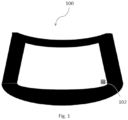
- FIG. 1 illustrates a laminated glazing 100 of the current disclosure embedded with a data transponder device.
- the data transponder device is a near field communication (NFC) device 102.
- NFC near field communication
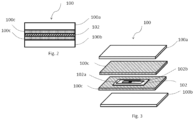
- FIG. 2 illustrates a cross section view of laminated glazing 100.
- one or both the first substrate 100a and second substrate 100b is a glass or a polymer.
- the polymer is polycarbonate (PC) or polypropylene (PP).
- the one or both the first substrate 100a and second substrate 100b can be of various shapes such as flat, curved, wedged or contoured.
- at least the first substrate 100a, the second substrate 100b or both the first and the second substrate 100a, 100b may be strengthened either chemically or thermally.
- the first substrate 100a, the second substrate 100b or both the first and the second substrate 100a, 100b may have a thickness of at least 0.5 mm.
- One or more interlayers 100c provided between the first substrate 100a and second substrate 100b to form the laminated assembly.
- NFC device 102 is integrated between the first substrate 100a, second substrate 100b, or one or more interlayers 100c.
- one or more interlayers 100c may be made up of polymers with same or different mechanical and chemical properties.
- the one or more interlayers 100c comprises a polymer selected from the group consisting of poly vinyl butyral (PVB), polycarbonate (PC), acoustic PVB, shade band PVB, thermal control PVB, ethylene vinyl acetate (EVA), thermoplastic polyurethane (TPU), ionomer, a thermoplastic material, polybutylene terephthalate (PBT), polyethylenevinylacetate (PET), polyethylene naphthalate (PEN), polyvinyl chloride (PVC), polyvinyl fluorides (PVf), polyacrylate (PA), polymethyl methacrylate (PMMA), polyurethane (PUR) and combinations thereof.
- PVB poly vinyl butyral
- PC polycarbonate
- acoustic PVB shade band PVB
- thermal control PVB ethylene vinyl acetate
- EVA ethylene vinyl acetate
- TPU thermoplastic polyurethan
- the interlayers 100c either has uniform thickness throughout or nonuniform thickness.
- the interlayer 100c interlayers may have a thickness of at least 0.38mm.
- the interlayers 100c are modified to accommodate one or more data transponders such as NFC device 102 and RFID tag 104.
- the interlayer 100c is modified to assemble thicker data transponders in the laminated glazing 100.
- the interlayer 100c is modified by either cutting, pressing, grinding, heating or combination thereof.
- the cutting of interlayer 100c is done manually or automatically by means of cutting fixtures.
- the grinding of interlayer 100c is done by means of abrasive wheel or pencil grinders which are electrically or pneumatically operated.
- the interlayer 100c can be modified by heating.
- the data transponder is disposed on the interlayer 100c by means of a hot stamping tool in which stamping is done by means of physical pressure and at a defined temperature.
- the modification of interlayer 100c by heating method is also done by means of having an adhesive backing in the data transponder 102 along with hot stamping to ensure much higher bonding between interlayer 100c and the data transponder 102.
- FIG. 3 illustrates an exploded view of a laminated glazing 100.
- the laminated glazing 100 comprises first substrate 100a, second substrate 100b, two interlayers 100c and a NFC device 102.
- the interlayers 100c are provided on the inner face of the first substrate 100a.
- the interlayers 100c is intermediate the first and second substrates 100a and 100b respectively.
- FIG. 3 further illustrates NFC device 102 comprising of an antenna102a and an integrated circuit 102b.
- the data transponder devices such as NFC device 102 and RFID tag 104 (not shown) is disposed between the first substrate 100a and the second substrate 100b, or integral to one or both the first substrate 100a and the second substrate 100b, or disposed between one or more interlayers 100c, or integral to one or more interlayers 100c.
- the data transponder devices 102, 104 has a thickness of at least 5% of interlayer 100c thickness. More specifically, the data transponder devices 102, 104 may has a thickness of at least 50 ⁇ m to 500 ⁇ m.
- the operating frequency of NFC device 102 and RFID tag104 ranges in between 3 kilohertz (KHz) to 10 gigahertz (GHz).
- the data transponder devices 102, 104 are either passive or active. The passive data transponder does not require a power supply whereas the data transponder which is active requires a power supply. The power transmission and communication is wireless.
- the data transponder devices 102, 104 comprises a material selected from the group consisting of metal, conductive polymers, metal grids, carbon nanotubes (CNT) layer, graphene, transparent conductive oxides or conductive oxides.
- the metal is selected from the group consisting of copper, aluminum, silver or platinum.
- the transparent conductive oxides are selected from the group consisting of zinc oxide or indium tin oxide.
- the conductive polymers are selected from the group consisting of polyaniline or polyindoles.
- the data transponder 102, 104 comprises of a stack of layers consisting of a substrate, an antennae, a chip and an overlay, wherein the substrate and overlay are comprised of a glass or a polymer, wherein the polymer is selected from a group consisting of poly vinyl butyral (PVB), polycarbonate (PC), acoustic PVB, shade band PVB, thermal control PVB, ethylene vinyl acetate (EVA), thermoplastic polyurethane and/or polyvinyl chloride and/or polyester and/or(TPU), ionomer, a thermoplastic material, polybutylene terephthalate (PBT), polyethylenevinylacetate (PET) and/or polycarbonate and/or polypropylene and/or polyethylene and/or polyurethacrylate), polyethylene naphthalate (PEN), polyvinyl chloride (PVC), polyvinyl fluorides (PVf), polyacrylate (PA), polymethyl methacrylate (PMMA), polyurethane (PUR
- the data transponder devices 102, 104 are integrated in the laminated glazing 100 by printing, depositing or patching.
- the data transponder devices 102, 104 can be directly printed onto the first or second substrate 100a, 100b or the interlayer 100c by means of screen printing with multiple layers onto one another.
- the data transponder devices 102, 104 can also be deposited over the first or second substrate 100a, 100b directly either by physical vapor deposition coating or chemical vapor deposition coating.
- the data transponder devices 102, 104 can be a separate thin film patch which can be fixed optionally by adhesive either on first or second substrate 100a, 100b or on the interlayer 100c.
- the data transponder devices 102, 104 are cured during the integration in the laminated glazing 100.
- the curing of the data transponder devices 102, 104 can be done by infrared or ultraviolet rays.
- the data transponder devices 102, 104 comprises of antenna 102a, 104a and integrated circuit 102b, 104b.
- the antenna 102a, 104a and the integrated circuit 102b, 104b are coupled together.
- the antenna 102a, 104a are for receiving and transmitting signals.
- the integrated circuit 102b, 104b are for processing the information.
- the integrated circuit 102b, 104b comprises of a memory.
- the memory consists of a read-only portion and re-writable portion.
- the read-only portion store data which cannot be altered and the re-writable portion store data which can be altered.
- the integrated circuit 102b, 104b is in a form of a chip.
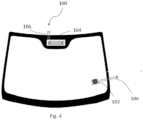
- FIG. 4 illustrates a laminated glazing 100 for a vehicle herein, comprising of NFC device 102 and radio frequency identification (RFID) tag 104.
- the laminated glazing 100 is provided with embedded data transponders such as NFC device 102 and RFID tag 104.
- a heating element 106 is spaced around the embedded NFC device 102 and RFID tag 104 for rapidly heating the region around the antenna 102a and 102b of the data transponder.
- the heating element 106 which provides rapid heating around a particular region, is made of a metal for conducting electricity.
- the heating element 106 is a sticker or screen-printed with conductive ink.
- the heating element 106 is incorporated between the substrates 100a, 100b of the laminated glazing 100 and more specifically, the heating element 106 is provided on the interlayer 100c or in the inner face.
- the readability of data transponders such as NFC device 102 and RFID tag 104 are affected due to several external environmental factors such as fogging, icing etc., by having the heating element 106, the performance of the data transponders in colder conditions are improved.
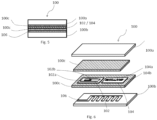
- FIG. 5 illustrates a cross section view of laminated glazing 100.
- One or both the first substrate 100a and second substrate 100b is a glass or a polymer.
- One or more interlayers 100c provided between the first substrate 100a and second substrate 100b to form the laminated assembly.
- the data transponder device 102 and 104 are integrated between the first substrate 100a, second substrate 100b, or one or more interlayers 100c.
- FIG. 6 illustrates an exploded view of a laminated glazing 100.
- the laminated glazing 100 comprises first substrate 100a, second substrate 100b, two interlayers 100c and data transponders such as NFC device 102 and/or RFID tag 104.
- the interlayers 100c are provided on the inner face of the first substrate 100a.
- the interlayers 100c is intermediate the first and second substrates 100a and 100b respectively.
- the NFC device 102 comprises of an antenna 102a and an integrated circuit 102b.
- the RFID tag 104 comprises of an antenna 104a and an integrated circuit 104b.
- the heating element 106 provided between the first and the second substrate 100a and 100b respectively and spaced around the data transponder device such as NFC device 102 and RFID tag 104 for rapidly heating the antenna 102a and 104a respectively.
- the data transponder devices 102, 104 is adapted to provide data including but not limited to vehicle identification numbers (VIN), motor vehicle registration status, motor vehicle inspection status, insurance compliance status, amber alert, emission compliance status, speed, toll account information, global positioning system (GPS) data, location status, motor vehicle security/retrieval status, vehicle registration data, sensor data, safety certification data, emission control certification data, contact information, product identification number, anti-theft system, lock-unlock doors, power-on and engine starting and closing control, initiate connection to internet terminal, initiate communication with the Wi-Fi modules, changing modes of a mobile device based on external factors, switching on/off electronic devices.
- VIN vehicle identification numbers
- GPS global positioning system
- the integration of the data transponder devices 102, 104 along with the laminated glazing 100 can be done by means of placing it along with the sun control film.
- the film can be installed on outer surface or the internal surface of the laminated glazing and can be placed in such a way that it can cover-up the data transponder devices 102, 104 embedded in the laminated glazing 100 so as to ensure its intact within.
- zone isolation for data transponder devices 102, 104 in metal based coated laminated glazing is provided.
- the data transponder device 102, 104 readability is significantly affected when it comes to be over the metal parts. It is always advisable to place the data transponder devices 102, 104 away from the metal surface to avoid readability issues.
- the laminated glazing 100 when coated with the metal oxide coating, the data transponder devices 102, 104 placed over may have issues with respect to readability. In order to avoid the issue, local isolation for data transponder devices 102, 104 has been done.
- the ideal location for providing the isolation for data transponder devices 102, 104 is the mirror button area which is placed away from the metal body of the vehicle.
- FIG. 7 illustrates a plan view of a laminated glazing integrated with a data transponder device 102 in ceramic masking region 710, which is located on the border regions of the windshield to provide ultraviolet protection to the data transponder device 102.
- FIG. 8 illustrates a cross section view of a laminated glazing provided with an UV protection layer 810 to provide ultraviolet protection to the data transponder device 102, 104 comprising epoxy resins with additives selected from a group consisting of acrylate-urethane based coatings, Titanium dioxide (Tio2), Zinc Oxide (ZnO) nanoparticles embedded acrylic coatings, Aluminum fluoride (AlF3), Sodium hexafluoroaluminate (Na3AlF6), Magnesium fluoride (MgF2), Lanthanum trifluoride (LaF3), Gadolinium Fluoride (GdF3), or combinations thereof.
- additives selected from a group consisting of acrylate-urethane based coatings, Titanium dioxide (Tio2), Zinc Oxide (ZnO) nanoparticles embedded acrylic coatings, Aluminum fluoride (AlF3), Sodium hexafluoroaluminate (Na3AlF6), Magne
- FIG. 9 illustrates a cross section view of a laminated glazing provided with an access-shielding layer 910 according to an embodiment of the present disclosure to provide selective reading of the data transponder device 102, 104 from outside/inside the vehicle depending on the location and arrangement of the access-shielding layer 910 and the detection device.
- This access-shielding layer 910 comprises of a material, which can reflect or absorb the radio waves to provide selective reading of the transponder device 102, 104.
- the accessibility of the data transponder devices 102, 104 from one of the first or second substrate 100a / 100b may be obstructed so that the authorized user can only access the data transponder devices 102, 104.
- the accessibility of data transponders 102, 104 is obstructed to maintain information privacy.
- the entrapped air between the substrates, interlayers and data transponder device along with connector element is removed to create preliminary adhesion.
- the de-airing is done by means of having a rubber ring which seals the complete edges of the assembly.
- the ring is designed to 95% of the actual assembly circumference and further to accommodate in case the connector element is partially extended portion.
- the suction takes place by removing the air which is entrapped in between the assembly.
- the ring has one exit hose through which the air is removed.
- the assembly is substantially transparent. If there is cloudiness in the assembly, then it means that air is trapper between the assembly.
- the interlayer 100c is provided with pores (pin holes) for volatiles to escape during the de-airing process.
- Step 1030 autoclaving the de-aired assembly to form the data transponder 102, 104 integrated laminated glazing.
- the read range is defined as maximum distance for detecting the data transponder by the detector.
- Readability counts are defined as number of time the tag responded to the detector in a minute.
- Location of the data transponder in the laminated glazing is defined as the placement of the data transponder in the laminate.
- Data integrity check is defined as the determination of information lost in the data transponder.
- the data transponder embedded laminated glazing samples were kept inside an environmental chamber at a temperature of 65°C and relative humidity of 95%for 15 weeks and the effect on the read range, readability counts, location for data transponder in the laminated glazing and data integrity was checked for the samples.
- Table 4 shows the different parameters checked after the samples were kept at a temperature of 65 0 C and relative humidity of 95%for 15 weeks.
- the laminated glazing of the present disclosure is a laminated glass pane which can be installed in a building or a windshield, windscreen or sunroof or automobile glazing which can be installed in a motor vehicle.
- the automobile glazing system of the present invention may be subject to changes in materials, dimensions, constructive details and/or functional and/or ornamental configuration without departing from the scope of the protection claimed.
- the terms “comprises,” “comprising,” “includes,” “including,” “has,” “having” or any other variation thereof, are intended to cover a non-exclusive inclusion.
- a method, article, or apparatus that comprises a list of features is not necessarily limited only to those features but may include other features not expressly listed or inherent to such method, article, or apparatus.
- “or” refers to an inclusive-or and not to an exclusive-or. For example, a condition A or B is satisfied by any one of the following: A is true (or present) and B is false (or not present), A is false (or not present) and B is true (or present), and both A and B are true (or present).
Landscapes
- Engineering & Computer Science (AREA)
- Physics & Mathematics (AREA)
- General Physics & Mathematics (AREA)
- Theoretical Computer Science (AREA)
- Computer Hardware Design (AREA)
- Microelectronics & Electronic Packaging (AREA)
- Optics & Photonics (AREA)
- Biochemistry (AREA)
- Computer Networks & Wireless Communication (AREA)
- Life Sciences & Earth Sciences (AREA)
- Chemical & Material Sciences (AREA)
- Toxicology (AREA)
- Health & Medical Sciences (AREA)
- Joining Of Glass To Other Materials (AREA)
- Laminated Bodies (AREA)
- Details Of Aerials (AREA)
- Semiconductor Integrated Circuits (AREA)
Description
- The present disclosure relates generally to a laminated glazing of a vehicle embedded with one or more data transponders and more particularly to a laminated glazing with better readability performance of the data transponders in extreme weather conditions.
- Background description includes information that may be useful in understanding the present disclosure. It is not an admission that any of the information provided herein is prior art or relevant to the presently claimed invention, or that any publication specifically or implicitly referenced is prior art.
- Currently RFID and NFC tags provided on the vehicle windshields in the form of stickers and used as a data storage device to store vehicle related data or information.
- However, these RFID or NFC stickers come with several limitations. For instance, these stickers can be removed or tampered easily due to ageing, weathering, theft, or damage due resulting from external factors such as wind, rain, or vandalism. Moreover, it is very difficult to stick these stickers having the data transponders, once peeled off from the vehicle windshield. Thus results in wastage of these stickers. The other limitation is the durability of the antenna, which has the tendency to degrade in terms of readability over a period. As a result, vehicle operators must periodically replace or cover over expired stickers with new stickers. The difficulty of removing expired stickers is also a disadvantage, as it is difficult to remove adhesive or sticky residue or remnants of the sticker from the automobile glazing.
-
US patent no. 6,275,157 to Mays et al. discloses a data transponder comprising a glass panel and RFID device, which is at least partially embedded in the glass panel. In an embodiment, RFID device is disposed between adjacent ones of the glass layers and becomes embedded therein upon lamination of the glass layers together. - The above mentioned prior art primarily aimed at integrating an RFID transponder/device on the glass panel. US Patent '157 neither discloses a heating element associated with RFID device nor discloses a NFC device. In addition to this, there are many significant drawbacks in this prior-art. Firstly, '157 is not dealing with improving durability and data readability of the data transponders in harsh conditions such as colder weather conditions wherein temperature goes well below 0 °c. Moreover, the above mentioned prior art is not providing the ideal location for placing the data transponders within the laminated glazing.
US 2011/169705 A1 represents the basis for the preamble of claim 1 and discloses a laminated glazing for a vehicle embedded with one or more circuit elements; at least one circuit element comprising an antenna and an integrated circuit, wherein the integrated circuit elements are configured to communicate data wirelessly. - As a result, it would be desirable to provide a windshield with data transponder devices having enhanced durability and data readability performance in extreme weather conditions. The current disclosure provides an effective way of enhancing durability of data transponders and data readability of these transponders by integrating a heating element in and around the region close to these data transponders.
- Other features and aspects of this disclosure will be apparent from the following description and the accompanying drawings. The current disclosure provides a laminated glazing according to claim 1. Claims 2-26 expose additional features for that laminated glazing.
- According to the invention, one or
more heating element 106 is provided between thefirst substrate 100a and thesecond substrate 100b, wherein theheating element 106 is positioned around thedata transponder device 102 at a pre-defined distance therein. - The method of manufacturing a laminated
glazing 100 is provided according to claim 27. - Embodiments are illustrated by way of example and are not limited in the accompanying figures.
-
FIG. 1 illustrates a plan view of a laminated glazing according to the present disclosure; -
FIG. 2 illustrates a cross section view of a laminated glazing, according to an embodiment of the present disclosure; -
FIG. 3 illustrates an exploded view of a laminated glazing, according to an embodiment of the present disclosure; -
FIG. 4 illustrates a plan view of a laminated glazing according to the present disclosure; -
FIG. 5 illustrates a cross section view of a laminated glazing, according to an embodiment of the present disclosure; -
FIG. 6 illustrates an exploded view of a laminated glazing, according to an embodiment of the present disclosure; -
FIG. 7 illustrates a plan view of a laminated glazing integrated with a data transponder device in ceramic masking region according to an embodiment of the present disclosure; -
FIG. 8 illustrates a cross section view of a laminated glazing provided with an UV protection layer according to an embodiment of the present disclosure; -
FIG. 9 illustrates a cross section view of a laminated glazing provided with an access shielding layer according to an embodiment of the present disclosure; -
FIG. 10 illustrates a flowchart of the method of manufacturing the laminated glazing for automobile, according to an embodiment of the present disclosure; - Skilled artisans appreciate that elements in the figures are illustrated for simplicity and clarity and have not necessarily been drawn to scale. For example, the dimensions of some of the elements in the figures may be exaggerated relative to other elements to help to improve understanding of embodiments of the invention.
- The present invention is now discussed in more detail referring to the drawings that accompany the present application. In the accompanying drawings, like and/or corresponding elements are referred to by like reference numbers.
- Wherever possible, the same reference numbers will be used throughout the drawings to refer to the same or the like parts. The present disclosure is to provide an improved automobile glazing incorporating other functions in addition to the usual one. The present disclosure further provides an improved automobile glazing embedded with one or more data transponders and more particularly to a laminated glazing with better readability performance of the data transponders with in extreme weather conditions.
-
FIG. 1 illustrates a laminatedglazing 100 of the current disclosure embedded with a data transponder device. In an embodiment, the data transponder device is a near field communication (NFC)device 102. -
FIG. 2 illustrates a cross section view of laminatedglazing 100. In an embodiment, one or both thefirst substrate 100a andsecond substrate 100b is a glass or a polymer. The polymer is polycarbonate (PC) or polypropylene (PP). The one or both thefirst substrate 100a andsecond substrate 100b can be of various shapes such as flat, curved, wedged or contoured. Optionally, at least thefirst substrate 100a, thesecond substrate 100b or both the first and thesecond substrate first substrate 100a, thesecond substrate 100b or both the first and thesecond substrate more interlayers 100c provided between thefirst substrate 100a andsecond substrate 100b to form the laminated assembly.NFC device 102 is integrated between thefirst substrate 100a,second substrate 100b, or one ormore interlayers 100c. - In an embodiment, one or
more interlayers 100c may be made up of polymers with same or different mechanical and chemical properties. The one ormore interlayers 100c comprises a polymer selected from the group consisting of poly vinyl butyral (PVB), polycarbonate (PC), acoustic PVB, shade band PVB, thermal control PVB, ethylene vinyl acetate (EVA), thermoplastic polyurethane (TPU), ionomer, a thermoplastic material, polybutylene terephthalate (PBT), polyethylenevinylacetate (PET), polyethylene naphthalate (PEN), polyvinyl chloride (PVC), polyvinyl fluorides (PVf), polyacrylate (PA), polymethyl methacrylate (PMMA), polyurethane (PUR) and combinations thereof. - The
interlayers 100c either has uniform thickness throughout or nonuniform thickness. Theinterlayer 100c interlayers may have a thickness of at least 0.38mm. Optionally, theinterlayers 100c are modified to accommodate one or more data transponders such asNFC device 102 andRFID tag 104. - Generally, the
interlayer 100c is modified to assemble thicker data transponders in the laminatedglazing 100. Theinterlayer 100c is modified by either cutting, pressing, grinding, heating or combination thereof. The cutting ofinterlayer 100c is done manually or automatically by means of cutting fixtures. The grinding ofinterlayer 100c is done by means of abrasive wheel or pencil grinders which are electrically or pneumatically operated. Further, theinterlayer 100c can be modified by heating. In this, the data transponder is disposed on theinterlayer 100c by means of a hot stamping tool in which stamping is done by means of physical pressure and at a defined temperature. In some instances, the modification ofinterlayer 100c by heating method is also done by means of having an adhesive backing in thedata transponder 102 along with hot stamping to ensure much higher bonding betweeninterlayer 100c and thedata transponder 102. -
FIG. 3 illustrates an exploded view of alaminated glazing 100. Thelaminated glazing 100 comprisesfirst substrate 100a,second substrate 100b, twointerlayers 100c and aNFC device 102. Theinterlayers 100c are provided on the inner face of thefirst substrate 100a. Theinterlayers 100c is intermediate the first andsecond substrates -
FIG. 3 further illustratesNFC device 102 comprising of an antenna102a and anintegrated circuit 102b. In an embodiment, the data transponder devices such asNFC device 102 and RFID tag 104 (not shown) is disposed between thefirst substrate 100a and thesecond substrate 100b, or integral to one or both thefirst substrate 100a and thesecond substrate 100b, or disposed between one ormore interlayers 100c, or integral to one ormore interlayers 100c. Thedata transponder devices interlayer 100c thickness. More specifically, thedata transponder devices - The operating frequency of
NFC device 102 and RFID tag104 ranges in between 3 kilohertz (KHz) to 10 gigahertz (GHz). Thedata transponder devices - The
data transponder devices - The
data transponder - The
data transponder devices laminated glazing 100 by printing, depositing or patching. Thedata transponder devices second substrate interlayer 100c by means of screen printing with multiple layers onto one another. Thedata transponder devices second substrate data transponder devices second substrate interlayer 100c. - Optionally, the
data transponder devices laminated glazing 100. The curing of thedata transponder devices - In an embodiment, the
data transponder devices antenna 102a, 104a andintegrated circuit antenna 102a, 104a and theintegrated circuit antenna 102a, 104a are for receiving and transmitting signals. Theintegrated circuit integrated circuit integrated circuit -
FIG. 4 illustrates alaminated glazing 100 for a vehicle herein, comprising ofNFC device 102 and radio frequency identification (RFID)tag 104. Thelaminated glazing 100 is provided with embedded data transponders such asNFC device 102 andRFID tag 104. Aheating element 106 is spaced around the embeddedNFC device 102 andRFID tag 104 for rapidly heating the region around theantenna heating element 106, which provides rapid heating around a particular region, is made of a metal for conducting electricity. Theheating element 106 is a sticker or screen-printed with conductive ink. In an embodiment, theheating element 106 is incorporated between thesubstrates laminated glazing 100 and more specifically, theheating element 106 is provided on theinterlayer 100c or in the inner face. The readability of data transponders such asNFC device 102 andRFID tag 104 are affected due to several external environmental factors such as fogging, icing etc., by having theheating element 106, the performance of the data transponders in colder conditions are improved. -
FIG. 5 illustrates a cross section view oflaminated glazing 100. One or both thefirst substrate 100a andsecond substrate 100b is a glass or a polymer. One ormore interlayers 100c provided between thefirst substrate 100a andsecond substrate 100b to form the laminated assembly. Thedata transponder device first substrate 100a,second substrate 100b, or one ormore interlayers 100c. -
FIG. 6 illustrates an exploded view of alaminated glazing 100. Thelaminated glazing 100 comprisesfirst substrate 100a,second substrate 100b, twointerlayers 100c and data transponders such asNFC device 102 and/orRFID tag 104. Theinterlayers 100c are provided on the inner face of thefirst substrate 100a. Theinterlayers 100c is intermediate the first andsecond substrates NFC device 102 comprises of anantenna 102a and anintegrated circuit 102b. TheRFID tag 104 comprises of an antenna 104a and anintegrated circuit 104b. Theheating element 106 provided between the first and thesecond substrate NFC device 102 andRFID tag 104 for rapidly heating theantenna 102a and 104a respectively. - In an embodiment, the
data transponder devices - In an alternate embodiment, the integration of the
data transponder devices laminated glazing 100 can be done by means of placing it along with the sun control film. The film can be installed on outer surface or the internal surface of the laminated glazing and can be placed in such a way that it can cover-up thedata transponder devices laminated glazing 100 so as to ensure its intact within. - In an embodiment, zone isolation for
data transponder devices data transponder device data transponder devices laminated glazing 100 when coated with the metal oxide coating, thedata transponder devices data transponder devices data transponder devices data transponder devices ceramic masking region 710. The advantage of embedding thedata transponder devices ceramic masking region 710 is to provide protection against the ultraviolet rays.FIG. 7 illustrates a plan view of a laminated glazing integrated with adata transponder device 102 inceramic masking region 710, which is located on the border regions of the windshield to provide ultraviolet protection to thedata transponder device 102. -
FIG. 8 illustrates a cross section view of a laminated glazing provided with anUV protection layer 810 to provide ultraviolet protection to thedata transponder device -
FIG. 9 illustrates a cross section view of a laminated glazing provided with an access-shielding layer 910 according to an embodiment of the present disclosure to provide selective reading of thedata transponder device shielding layer 910 and the detection device. This access-shielding layer 910 comprises of a material, which can reflect or absorb the radio waves to provide selective reading of thetransponder device data transponder devices second substrate 100a / 100b may be obstructed so that the authorized user can only access thedata transponder devices data transponders -
FIG. 10 illustrates the flowchart for a method of manufacturing a laminated glazing used in vehicles with data transponders embedded.Step 1010 includes assembling the first andsecond substrate more interlayers 100c and thedata transponder Step 1020 includes de-airing the assembly to form a de-aired assembly. De-airing is a crucial step in formation of laminated curved article. The assembly is kept under vacuum and is heat treated to remove air trapped in between the assembly. During de-airing process the entrapped air between the substrates, interlayers and data transponder device along with connector element is removed to create preliminary adhesion. The de-airing is done by means of having a rubber ring which seals the complete edges of the assembly. The ring is designed to 95% of the actual assembly circumference and further to accommodate in case the connector element is partially extended portion. The suction takes place by removing the air which is entrapped in between the assembly. The ring has one exit hose through which the air is removed. After the de-airing step the assembly is substantially transparent. If there is cloudiness in the assembly, then it means that air is trapper between the assembly. Alternatively, theinterlayer 100c is provided with pores (pin holes) for volatiles to escape during the de-airing process.Step 1030 autoclaving the de-aired assembly to form thedata transponder - The standard tests were performed on the data transponder embedded laminated glazing samples to study the effect on the read range, readability counts, location for data transponder in the laminated glazing and data integrity. The read range is defined as maximum distance for detecting the data transponder by the detector. Readability counts are defined as number of time the tag responded to the detector in a minute. Location of the data transponder in the laminated glazing is defined as the placement of the data transponder in the laminate. Data integrity check is defined as the determination of information lost in the data transponder.
- The data transponder embedded laminated glazing samples were kept at 80°C for 24 hours and the effect on the read range, readability counts, location for data transponder in the laminated glazing and data integrity was checked. Table 1 shows the different parameters checked after the samples were kept at 80°C for 24 hours.
Table1: Sample No. Location Data Integrity Read Range Readability Count Sample 1 Inner face of first substrate Yes 14.5 4274 Sample 2 Inner face of second substrate Yes 14.5 3449 Sample 3 Between two interlayers Yes 14.5 5925 - Results from storage stability test (Table 1) showed that the readability was higher when the data transponder device embedded between two interlayers of the laminate glazing. In addition to this, when the data transponder device was embedded on the inner face of the first substrate, higher data readability was achieved.
- The data transponder embedded laminated glazing samples were kept at 100°C for 400 hours and the effect on the read range, readability counts, location for data transponder in the laminated glazing and data integrity was checked. Table 2 shows the different parameters checked after the samples were kept at 100°C for 400 hours.
Table 2: Sample No. Location Data Integrity Read Range Readability Count Sample 1 Inner face of first substrate Yes 15 9029 Sample 2 Inner face of second substrate Yes 15 10006 Sample 3 Between two interlayers Yes 15 10537 - Results from heat resistance test (Table 2) showed that the readability was higher when the data transponder device embedded between two interlayers of the laminate glazing. In addition to this, when the data transponder device was embedded on the inner face of the second substrate, higher data readability was achieved.
- The data transponder embedded laminated glazing samples were kept at following conditions firstly 30°C for 2 hours, secondly room temperature for 30 minutes, thirdly 100°C for 2 hours and finally room temperature for 30 minutes. The effect on the read range, readability counts, location for data transponder in the laminated glazing and data integrity was checked for the samples. Table 3 shows the different parameters checked after the samples were subjected to above mentioned conditions.
Table 3: Sample No. Location Data Integrity Read Range Readability Count Sample 1 Inner face of first substrate Yes 14.5 18852 Sample 2 Inner face of second substrate Yes 14.5 11484 Sample 3 Between two interlayers Yes 14.5 1806 - Results from thermal cycle resistance test (Table 3) showed that the readability was higher when the data transponder device embedded on the inner face of the first substrate of the laminate glazing. In addition to this, when the data transponder device was embedded on the inner face of the second substrate, very higher data readability was achieved than embedded between two interlayers.
- The data transponder embedded laminated glazing samples were irradiated with full solar spectra at 65 W/m2 for 2700 hours and the effect on the read range, readability counts, location for data transponder in the laminated glazing and data integrity was checked for the samples. Table 4 shows the different parameters checked after the samples were irradiated at 65 W/m2 for 2700 hours.
Table 4: Sample No. Location Data Integrity Read Range Readability Count Sample 1 Inner face of first substrate Yes 15 16895 Sample 2 Inner face of second substrate Yes 14 25801 Sample 3 Between two interlayers Yes 15 23809 - Results from high light resistance test (Table 4) showed that the readability was higher when the data transponder device embedded on the inner face of the second substrate of the laminate glazing. In addition to this, when the data transponder device embedded between two interlayers, higher data readability was achieved.
- The data transponder embedded laminated glazing samples were kept inside an environmental chamber at a temperature of 65°C and relative humidity of 95%for 15 weeks and the effect on the read range, readability counts, location for data transponder in the laminated glazing and data integrity was checked for the samples. Table 4 shows the different parameters checked after the samples were kept at a temperature of 650C and relative humidity of 95%for 15 weeks.
Table 4: Sample No. Location Data Integrity Read Range Readability Count Sample 1 Inner face of first substrate Yes 14 3221 Sample 2 Inner face of second substrate Yes 14 6579 Sample 3 Between two interlayers Yes 14 6840 - Results from long-term reliability test (Table 2) showed that the readability was higher when the data transponder device embedded between two interlayers of the laminate glazing. In addition to this, when the data transponder device was embedded on the inner face of the second substrate, higher data readability was achieved.
- From the above results, it was established that the data transponders should be embedded on inner face of the first substrate of the
laminated glazing 100 to achieve best readability. - The laminated glazing of the present disclosure is a laminated glass pane which can be installed in a building or a windshield, windscreen or sunroof or automobile glazing which can be installed in a motor vehicle.
- According to the basic construction described above, the automobile glazing system of the present invention may be subject to changes in materials, dimensions, constructive details and/or functional and/or ornamental configuration without departing from the scope of the protection claimed.
- Note that not all of the activities described above in the general description or the examples are required, that a portion of a specific activity may not be required, and that one or more further activities may be performed in addition to those described. Still further, the order in which activities are listed is not necessarily the order in which they are performed.
- Benefits, other advantages, and solutions to problems have been described above with regard to specific embodiments. However, the benefits, advantages, solutions to problems, and any feature(s) that may cause any benefit, advantage, or solution to occur or become more pronounced are not to be construed as a critical, required, or essential feature of any or all the claims.
- The specification and illustrations of the embodiments described herein are intended to provide a general understanding of the structure of the various embodiments. The specification and illustrations are not intended to serve as an exhaustive and comprehensive description of all of the elements and features of apparatus and systems that use the structures or methods described herein. Certain features, that are for clarity, described herein in the context of separate embodiments, may also be provided in combination in a single embodiment. Conversely, various features that are, for brevity, described in the context of a single embodiment, may also be provided separately or in a sub combination. Further, reference to values stated in ranges includes each and every value within that range. Many other embodiments may be apparent to skilled artisans only after reading this specification. Other embodiments may be used and derived from the disclosure, such that a structural substitution, logical substitution, or another change may be made without departing from the scope of the disclosure. Accordingly, the disclosure is to be regarded as illustrative rather than restrictive.
- The description in combination with the figures is provided to assist in understanding the teachings disclosed herein, is provided to assist in describing the teachings, and should not be interpreted as a limitation on the scope or applicability of the teachings. However, other teachings can certainly be used in this application.
- As used herein, the terms "comprises," "comprising," "includes," "including," "has," "having" or any other variation thereof, are intended to cover a non-exclusive inclusion. For example, a method, article, or apparatus that comprises a list of features is not necessarily limited only to those features but may include other features not expressly listed or inherent to such method, article, or apparatus. Further, unless expressly stated to the contrary, "or" refers to an inclusive-or and not to an exclusive-or. For example, a condition A or B is satisfied by any one of the following: A is true (or present) and B is false (or not present), A is false (or not present) and B is true (or present), and both A and B are true (or present).
- Also, the use of "a" or "an" is employed to describe elements and components described herein. This is done merely for convenience and to give a general sense of the scope of the invention. This description should be read to include one or at least one and the singular also includes the plural, or vice versa, unless it is clear that it is meant otherwise. For example, when a single item is described herein, more than one item may be used in place of a single item. Similarly, where more than one item is described herein, a single item may be substituted for that more than one item.
- Unless otherwise defined, all technical and scientific terms used herein have the same meaning as commonly understood by one of ordinary skill in the art to which this invention belongs. The materials, methods, and examples are illustrative only and not intended to be limiting. To the extent that certain details regarding specific materials and processing acts are not described, such details may include conventional approaches, which may be found in reference books and other sources within the manufacturing arts.
- While aspects of the present disclosure have been particularly shown and described with reference to the embodiments above, it will be understood by those skilled in the art that various additional embodiments may be contemplated by the modification of the disclosed machines, systems and methods without departing from the scope of what is disclosed. Such embodiments should be understood to fall within the scope of the present disclosure as determined based upon the claims.
-
- 100
- Laminated glazing
- 100a
- First substrate
- 100b
- Second substrate
- 100c
- Interlayer
- 102
- NFC device
- 102a
- NFC antenna
- 102b
- NFC integrated circuit
- 104
- RFID tag
- 104a
- RFID antenna
- 104b
- RFID integrated circuit
- 106
- Heating element
- 710
- Ceramic masking region
- 810
- UV protection layer
- 910
- Access-shielding layer
- 1010
- Step
- 1020
- Step
- 1030
- Step
Claims (27)
- A laminated glazing (100) for a vehicle embedded with one or more data transponders comprising:a first substrate (100a) consisting an outer face and an inner face;one or more interlayers (100c) disposed on the inner face of the first substrate (100a);a second substrate (100b) disposed on the interlayer (100c);characterized in thatat least one data transponder device (102, 104) comprising an antenna (102a, 104a) and an integrated circuit (102b, 104b) disposed on one or more interlayer (100c),wherein one or more interlayer (100c) placed in between the first and second substrate (100a, 100b),wherein the data transponder device (102, 104) is configured to communicate data wirelessly with a detecting device or a mobile device and provide selective reading of the transponder device (102, 104),one or more heating element (106) being provided between the first substrate (100a) and the second substrate (100b), wherein the heating element (106) is positioned around the data transponder device (102, 104) at a pre-defined distance therein to heat a region around the antenna (102a, 104a) and thereby improve readability of the data transponder.
- The laminated glazing (100) as claimed in claim 1, comprises a ceramic masking region (710) around the edges of the laminated glazing (100).
- The laminated glazing (100) as claimed in claim 1, wherein the data transponder device (102, 104) is positioned on a ceramic masking region (710), thereby configured to provide ultraviolet protection to the data transponder device (102, 104).
- The laminated glazing (100) as claimed in claim 1, wherein the laminated glazing (100) comprises an access shielding layer (910) essentially consisting of one more organic or inorganic substances that can reflect or absorb the radio waves.
- The laminated glazing (100) as claimed in claim 1, wherein the laminated glazing (100) comprises a UV protection layer (810) configured to provide ultraviolet protection to the data transponder device (102, 104) comprising epoxy resins with additives, wherein the additive is selected from a group consisting of acrylate-urethane based coatings, Titanium dioxide (Tio2), Zinc Oxide (ZnO) nanoparticles embedded acrylic coatings, Aluminum fluoride (A1F3), Sodium hexafluoroaluminate (Na3AlF6), Magnesium fluoride (MgF2), Lanthanum trifluoride (LaF3), Gadolinium Fluoride (GdF3) or combinations thereof.
- The laminated glazing (100) as claimed in claim 1, wherein the first substrate (100a) or the second substrate (100b) is of varying thickness.
- The laminated glazing (100) as claimed in claim 1, wherein the data transponder (102, 104) comprises of a stack of layers consisting of a substrate, an antennae, a chip and an overlay, wherein the substrate and overlay are comprised of a glass or a polymer, wherein the polymer is selected from a group consisting of poly vinyl butyral (PVB), polycarbonate (PC), acoustic PVB, shade band PVB, thermal control PVB, ethylene vinyl acetate (EVA), thermoplastic polyurethane and/or polyvinyl chloride and/or polyester and/or (TPU), ionomer, a thermoplastic material, polybutylene terephthalate (PBT), polyethylenevinylacetate (PET) and/or polycarbonate and/or polypropylene and/or polyethylene and/or polyurethacrylate, polyethylene naphthalate (PEN), polyvinyl chloride (PVC), polyvinyl fluorides (PVf), polyacrylate (PA), polymethyl methacrylate (PMMA), polyurethane (PUR) or combinations thereof.
- The laminated glazing (100) as claimed in claim 1, wherein at least one of the first substrate (100a) or the second substrate (100b) is a glass or a polymer.
- The laminated glazing (100) as claimed in claim 8, wherein the polymer is polycarbonate (PC) or polypropylene (PP).
- The laminated glazing (100) as claimed in claim 1, wherein the shape of the first substrate (100a) or the second substrate (100b) is flat, curved, wedged or contoured.
- The laminated glazing (100) as claimed in claim 1, wherein the interlayer (100c) comprises a polymer selected from a group of poly vinyl butyral (PVB), polycarbonate (PC), acoustic PVB, shade band PVB, thermal control PVB, ethylene vinyl acetate (EVA), thermoplastic polyurethane (TPU), ionomer, a thermoplastic material, polybutylene terephthalate (PBT), polyethylenevinylacetate (PET), polyethylene naphthalate (PEN), polyvinyl chloride (PVC), polyvinyl fluorides (PVf), polyacrylate (PA), polymethyl methacrylate (PMMA), polyurethane (PUR) or combinations thereof.
- The laminated glazing as claimed in claim 1, wherein the data transponder device (102, 104) is sandwiched between the first substrate (100a) and the second substrate (100b).
- The laminated glazing (100) as claimed in claim 1, wherein the detecting device is at least one of a radio frequency (RF) reader, a handheld device, a mobile device, a cell phone, a vehicle key, and a tablet, the radio frequency (RF) reader being for example installed in at least one of windshield, car frame, and dashboard area of the vehicle.
- The laminated glazing (100) as claimed in claim 1, wherein the data communicated wirelessly by the data transponder device with the detecting device comprises at least one of vehicle identification number (VIN), motor vehicle registration status, motor vehicle inspection status, insurance compliance status, amber alert, emission compliance status, speed, toll account information, global positioning system (GPS) data, location status, motor vehicle security/retrieval status, vehicle registration data, sensor data, safety certification data, emission control certification data, contact information, product identification number, anti-theft system, lock-unlock doors, power-on and engine starting and closing control, initiate connection to internet terminal, initiate communication with the Wi-Fi modules, changing modes of a mobile device based on external factors, switching on/off electronic devices or combinations thereof.
- The laminated glazing (100) as claimed in claim 1, wherein the data transponder device (102, 104) is operated and powered wirelessly by the detecting device.
- The laminated glazing (100) as claimed in claim 1, wherein the integrated circuit (102b, 104b) comprises a modulator, and photovoltaic cells for supplying power to the data transponder device (102, 104).
- The laminated glazing (100) as claimed in claim 1, wherein the interlayer (100c) is modified by a method selected from a group consisting of cutting, pressing, grinding, heating or combinations thereof to accommodate at least one data transponder device (102, 104).
- The laminated glazing (100) as claimed in claim 1, wherein the data transponder device (102, 104) has a thickness in the range of 50 µm to 500 µm.
- The laminated glazing (100) as claimed in claim 1, wherein the data transponder device (102, 104) is at least one of a flexible element or a rigid element.
- The laminated glazing (100) as claimed in claim 1, wherein the data transponder device (102, 104) includes at least one of an active RFID tag, a passive RFID tag and a semi-passive RFID tag.
- The laminated glazing (100) as claimed in claim 1, wherein the data transponder device (102, 104) is a near field communication (NFC) device (102) and/or a radio frequency identification (RFID) tag (104) or a combination thereof.
- The laminated glazing (100) as claimed in claim 1, wherein the data transponder device (102, 104) is integrated in the laminated glazing (100) by printing, depositing or other suitable methods.
- The laminated glazing (100) as claimed in claim 1, wherein the integrated circuit (102b, 104b) comprises a memory with a pre-defined information stored therein and a read-write portion configurable by a user.
- The laminated glazing (100) as claimed in claim 1, wherein the antenna (102a) is a NFC antenna configured to operate at a frequency of 13.6MHz.
- The laminated glazing (100) as claimed in claim 1, wherein the antenna (102a) is a high frequency antenna configured to operate in a frequency range between 3 kilohertz (KHz) to 10 gigahertz (GHz).
- The laminated glazing (100) as claimed in claim 1, is a windshield, windscreen and/or sunroof of an automobile.
- A method of manufacturing a laminated glazing (100) as claimed in claim 1, wherein the method comprising the steps of:assembling of first and second substrate (100a, 100b) along with one or more data transponder device (102, 104) at a pre-defined locations to one or more interlayers (100c) to form a laminate assemblyde-airing of the laminated assembly based on the size, number and type of data transponder device; andautoclaving the de-aired laminated assembly in successive time steps involving multiple pressure and temperature values to form the data transponder device (102, 104) integrated laminated glazing (100).
Applications Claiming Priority (2)
| Application Number | Priority Date | Filing Date | Title |
|---|---|---|---|
| IN201741020258 | 2017-06-09 | ||
| PCT/IN2018/050379 WO2018225095A1 (en) | 2017-06-09 | 2018-06-08 | Laminated glazing with embedded data transponder |
Publications (3)
| Publication Number | Publication Date |
|---|---|
| EP3635470A1 EP3635470A1 (en) | 2020-04-15 |
| EP3635470A4 EP3635470A4 (en) | 2021-02-24 |
| EP3635470B1 true EP3635470B1 (en) | 2024-10-23 |
Family
ID=64565825
Family Applications (1)
| Application Number | Title | Priority Date | Filing Date |
|---|---|---|---|
| EP18812894.6A Active EP3635470B1 (en) | 2017-06-09 | 2018-06-08 | Laminated glazing with embedded data transponder |
Country Status (11)
| Country | Link |
|---|---|
| US (1) | US11494605B2 (en) |
| EP (1) | EP3635470B1 (en) |
| JP (1) | JP7229944B2 (en) |
| KR (1) | KR102669850B1 (en) |
| CN (1) | CN110720070B (en) |
| BR (1) | BR112019025910A2 (en) |
| CA (1) | CA3065749A1 (en) |
| MA (1) | MA47548B1 (en) |
| MX (1) | MX2019014712A (en) |
| RU (1) | RU2019144012A (en) |
| WO (1) | WO2018225095A1 (en) |
Families Citing this family (22)
| Publication number | Priority date | Publication date | Assignee | Title |
|---|---|---|---|---|
| US9306666B1 (en) | 2009-10-08 | 2016-04-05 | Dynamics Inc. | Programming protocols for powered cards and devices |
| US10055614B1 (en) | 2010-08-12 | 2018-08-21 | Dynamics Inc. | Systems and methods for advanced detection mechanisms for magnetic cards and devices |
| US9033218B1 (en) | 2012-05-15 | 2015-05-19 | Dynamics Inc. | Cards, devices, systems, methods and dynamic security codes |
| US12380474B1 (en) | 2012-08-30 | 2025-08-05 | Dynamics Inc. | Cards, devices, systems, and methods for a ratings management system |
| US9010644B1 (en) | 2012-11-30 | 2015-04-21 | Dynamics Inc. | Dynamic magnetic stripe communications device with stepped magnetic material for magnetic cards and devices |
| CO2018000469A1 (en) * | 2017-11-30 | 2018-04-30 | Agp America Sa | Automotive laminate with invisible solid edge substrate compensation layer |
| CA3086468C (en) | 2018-05-14 | 2022-07-12 | Saint-Gobain Glass France | Insulating glazing unit |
| EP3794197A1 (en) | 2018-05-14 | 2021-03-24 | Saint-Gobain Glass France | Insulating glazing unit |
| EP3794198B1 (en) | 2018-05-14 | 2022-05-04 | Saint-Gobain Glass France | Insulating glazing unit |
| MX2021002471A (en) * | 2018-09-03 | 2021-04-29 | Saint Gobain | Vehicle window comprising a transponder. |
| BR112021004472A2 (en) * | 2018-09-10 | 2021-05-25 | Saint-Gobain Glass France | intelligent vehicle control system with integrated glazing |
| JP7415943B2 (en) * | 2018-11-22 | 2024-01-17 | Agc株式会社 | antenna system |
| WO2020156870A1 (en) * | 2019-01-29 | 2020-08-06 | Saint-Gobain Glass France | Insulating glazing unit and glazing |
| CN111612118A (en) * | 2019-02-26 | 2020-09-01 | 法国圣-戈班玻璃公司 | Coated window glass with improved readability and method of making the same |
| CN111349264B (en) * | 2019-06-11 | 2022-12-30 | 安徽紫金新材料科技股份有限公司 | Hydrophobic oleophobic antistatic PVC composite film |
| ES2949213T3 (en) * | 2019-08-09 | 2023-09-26 | Saint Gobain | Glazing with RFID transponder |
| WO2021176464A1 (en) * | 2020-03-02 | 2021-09-10 | Saint-Gobain Glass France | A coated laminated glazing with improved readability by means of an enablement layer |
| FR3108192A1 (en) * | 2020-03-12 | 2021-09-17 | Saint-Gobain Glass France | WINDOWS INCLUDING A GLASS ELEMENT CONTAINING A COMMUNICATION DEVICE CONFIGURED TO OPERATE BY RADIO FREQUENCIES AND SURFACE ACOUSTIC WAVES |
| CA3179029A1 (en) * | 2020-09-14 | 2022-03-17 | Christian EFFERTZ | Insulating glazing unit and glazing |
| WO2023119315A1 (en) * | 2021-12-24 | 2023-06-29 | Saint-Gobain Glass France | A coated automotive glazing with integrated radar unit |
| US12311637B2 (en) | 2022-11-04 | 2025-05-27 | Agc Automotive Americas Co. | Laminated glazing assembly including an antenna assembly |
| WO2024251467A1 (en) * | 2023-06-07 | 2024-12-12 | Saint-Gobain Glass France | Composite pane comprising a heating device |
Family Cites Families (20)
| Publication number | Priority date | Publication date | Assignee | Title |
|---|---|---|---|---|
| JPS52147151U (en) * | 1976-04-30 | 1977-11-08 | ||
| JPS6130102A (en) * | 1984-07-20 | 1986-02-12 | Nippon Sheet Glass Co Ltd | Antenna of window glass for automobile |
| DE59105751D1 (en) * | 1990-03-10 | 1995-07-27 | Flachglas Ag | Motor vehicle window in the form of a double-pane insulating glass unit with antenna elements. |
| US6121880A (en) | 1999-05-27 | 2000-09-19 | Intermec Ip Corp. | Sticker transponder for use on glass surface |
| JP4386784B2 (en) | 2004-04-14 | 2009-12-16 | 横浜ゴム株式会社 | Tire condition detection device |
| JP2006244316A (en) | 2005-03-04 | 2006-09-14 | Nippon Sheet Glass Co Ltd | Panel and panel manufacturing method |
| JP4749219B2 (en) * | 2005-11-28 | 2011-08-17 | 富士通テン株式会社 | Loop antenna, method of attaching loop antenna to vehicle, and rear glass of vehicle including loop antenna |
| JP5121363B2 (en) * | 2006-09-14 | 2013-01-16 | ニッタ株式会社 | Communication improvement device, communication system, and article information handling facility |
| US7825854B2 (en) | 2007-04-19 | 2010-11-02 | The Boeing Company | System and method for compensating for temperature effects on GPS transponders |
| KR20090026592A (en) * | 2007-09-10 | 2009-03-13 | 김삼중 | Automotive windshield with RFID tag |
| DE102008022711A1 (en) * | 2008-05-07 | 2009-11-26 | Ses Rfid Solutions Gmbh | Spatial structure with a transponder and method for generating the same |
| JP5348646B2 (en) | 2009-03-31 | 2013-11-20 | 東芝Itコントロールシステム株式会社 | Wireless tag device |
| US8810462B2 (en) * | 2010-01-13 | 2014-08-19 | Origin Gps Ltd. | Rigid elements embedded in a motor vehicle windshield |
| FR2978524B1 (en) | 2011-07-29 | 2013-07-05 | Saint Gobain | LUMINOUS VEHICLE GLAZING, MANUFACTURING |
| DE102012012566B3 (en) * | 2012-06-23 | 2013-12-05 | Audi Ag | Composite pane for a motor vehicle and motor vehicle with such a composite pane. |
| KR102243381B1 (en) * | 2014-11-07 | 2021-04-22 | 삼성전자주식회사 | Antenna device |
| CA2971345A1 (en) | 2014-12-16 | 2016-06-23 | Saint-Gobain Glass France | Electrically heatable antenna pane as well as production method therefor |
| JP6763306B2 (en) | 2014-12-24 | 2020-09-30 | Agc株式会社 | Electrical connection member and laminated board using it |
| US10286638B2 (en) * | 2015-10-19 | 2019-05-14 | Solutia Inc. | Multiple layer interlayers having enhanced properties |
| CN111149199A (en) * | 2017-10-11 | 2020-05-12 | 索尼半导体解决方案公司 | Semiconductor device and method of manufacturing the same |
-
2018
- 2018-06-08 MA MA47548A patent/MA47548B1/en unknown
- 2018-06-08 WO PCT/IN2018/050379 patent/WO2018225095A1/en not_active Ceased
- 2018-06-08 JP JP2019567640A patent/JP7229944B2/en active Active
- 2018-06-08 US US16/620,310 patent/US11494605B2/en active Active
- 2018-06-08 CA CA3065749A patent/CA3065749A1/en not_active Abandoned
- 2018-06-08 KR KR1020207000334A patent/KR102669850B1/en active Active
- 2018-06-08 EP EP18812894.6A patent/EP3635470B1/en active Active
- 2018-06-08 BR BR112019025910-4A patent/BR112019025910A2/en not_active Application Discontinuation
- 2018-06-08 CN CN201880038065.1A patent/CN110720070B/en active Active
- 2018-06-08 MX MX2019014712A patent/MX2019014712A/en unknown
- 2018-06-08 RU RU2019144012A patent/RU2019144012A/en unknown
Also Published As
| Publication number | Publication date |
|---|---|
| MX2019014712A (en) | 2020-02-07 |
| JP2020523681A (en) | 2020-08-06 |
| MA47548A1 (en) | 2020-03-31 |
| BR112019025910A2 (en) | 2020-09-15 |
| US20200193259A1 (en) | 2020-06-18 |
| KR20200017454A (en) | 2020-02-18 |
| MA47548B1 (en) | 2021-05-31 |
| KR102669850B1 (en) | 2024-05-29 |
| CA3065749A1 (en) | 2018-12-13 |
| US11494605B2 (en) | 2022-11-08 |
| JP7229944B2 (en) | 2023-02-28 |
| RU2019144012A3 (en) | 2022-03-18 |
| EP3635470A4 (en) | 2021-02-24 |
| WO2018225095A1 (en) | 2018-12-13 |
| EP3635470A1 (en) | 2020-04-15 |
| CN110720070A (en) | 2020-01-21 |
| CN110720070B (en) | 2023-02-03 |
| RU2019144012A (en) | 2021-07-09 |
Similar Documents
| Publication | Publication Date | Title |
|---|---|---|
| US11494605B2 (en) | Laminated glazing with embedded data transponder | |
| CN107107570B (en) | Method for producing a composite glass pane with an infrared reflective coating on a carrier foil | |
| US7722948B2 (en) | Laminated Glazing | |
| US6867893B2 (en) | Process for producing a transparent pane structure for motor vehicles and a transparent pane structure | |
| JP7202451B2 (en) | Vehicle window with transponder | |
| CN101573306A (en) | Single pane glazing laminates | |
| CN112020794B (en) | Antenna board | |
| US20220094033A1 (en) | A coated glazing with improved readability and a method thereof | |
| US11161326B2 (en) | Automotive glazing system with a display | |
| CA2942938A1 (en) | Transparent pane with heatable coating | |
| EP4372905B1 (en) | Antenna arrangement | |
| US20060208904A1 (en) | Panel and panel manufacturing method | |
| KR20010103678A (en) | Process for manufacturing a laminated glazing unit with a corrosion-protected transparent surface coating, and the laminated glazing unit | |
| WO2022229981A1 (en) | Vehicle glazing integrated with multi-radio frequency based electronic device | |
| CN210984927U (en) | Vehicle glazing with transponder | |
| WO2021176464A1 (en) | A coated laminated glazing with improved readability by means of an enablement layer | |
| CN113840727A (en) | Vehicle glazing with sunscreen coating |
Legal Events
| Date | Code | Title | Description |
|---|---|---|---|
| STAA | Information on the status of an ep patent application or granted ep patent |
Free format text: STATUS: THE INTERNATIONAL PUBLICATION HAS BEEN MADE |
|
| PUAI | Public reference made under article 153(3) epc to a published international application that has entered the european phase |
Free format text: ORIGINAL CODE: 0009012 |
|
| STAA | Information on the status of an ep patent application or granted ep patent |
Free format text: STATUS: REQUEST FOR EXAMINATION WAS MADE |
|
| 17P | Request for examination filed |
Effective date: 20200109 |
|
| AK | Designated contracting states |
Kind code of ref document: A1 Designated state(s): AL AT BE BG CH CY CZ DE DK EE ES FI FR GB GR HR HU IE IS IT LI LT LU LV MC MK MT NL NO PL PT RO RS SE SI SK SM TR |
|
| AX | Request for extension of the european patent |
Extension state: BA ME |
|
| RAP1 | Party data changed (applicant data changed or rights of an application transferred) |
Owner name: SAINT-GOBAIN GLASS FRANCE |
|
| DAV | Request for validation of the european patent (deleted) | ||
| DAX | Request for extension of the european patent (deleted) | ||
| A4 | Supplementary search report drawn up and despatched |
Effective date: 20210127 |
|
| RIC1 | Information provided on ipc code assigned before grant |
Ipc: G06K 17/00 20060101AFI20210121BHEP Ipc: B32B 17/00 20060101ALI20210121BHEP Ipc: G02B 27/00 20060101ALI20210121BHEP Ipc: G06K 19/077 20060101ALI20210121BHEP |
|
| STAA | Information on the status of an ep patent application or granted ep patent |
Free format text: STATUS: EXAMINATION IS IN PROGRESS |
|
| 17Q | First examination report despatched |
Effective date: 20220705 |
|
| REG | Reference to a national code |
Ref country code: DE Ref legal event code: R079 Ipc: G06K0017000000 Ref document number: 602018075786 Country of ref document: DE Free format text: PREVIOUS MAIN CLASS: G02B0027000000 |
|
| GRAP | Despatch of communication of intention to grant a patent |
Free format text: ORIGINAL CODE: EPIDOSNIGR1 |
|
| STAA | Information on the status of an ep patent application or granted ep patent |
Free format text: STATUS: GRANT OF PATENT IS INTENDED |
|
| INTG | Intention to grant announced |
Effective date: 20230302 |
|
| RIC1 | Information provided on ipc code assigned before grant |
Ipc: G02B 5/20 20060101ALI20230217BHEP Ipc: G02B 1/10 20060101ALI20230217BHEP Ipc: B32B 17/10 20060101ALI20230217BHEP Ipc: B32B 17/00 20060101ALI20230217BHEP Ipc: G02B 27/00 20060101ALI20230217BHEP Ipc: G06K 19/077 20060101ALI20230217BHEP Ipc: G06K 17/00 20060101AFI20230217BHEP |
|
| GRAJ | Information related to disapproval of communication of intention to grant by the applicant or resumption of examination proceedings by the epo deleted |
Free format text: ORIGINAL CODE: EPIDOSDIGR1 |
|
| STAA | Information on the status of an ep patent application or granted ep patent |
Free format text: STATUS: EXAMINATION IS IN PROGRESS |
|
| INTC | Intention to grant announced (deleted) | ||
| GRAP | Despatch of communication of intention to grant a patent |
Free format text: ORIGINAL CODE: EPIDOSNIGR1 |
|
| STAA | Information on the status of an ep patent application or granted ep patent |
Free format text: STATUS: GRANT OF PATENT IS INTENDED |
|
| INTG | Intention to grant announced |
Effective date: 20240516 |
|
| GRAS | Grant fee paid |
Free format text: ORIGINAL CODE: EPIDOSNIGR3 |
|
| GRAA | (expected) grant |
Free format text: ORIGINAL CODE: 0009210 |
|
| STAA | Information on the status of an ep patent application or granted ep patent |
Free format text: STATUS: THE PATENT HAS BEEN GRANTED |
|
| AK | Designated contracting states |
Kind code of ref document: B1 Designated state(s): AL AT BE BG CH CY CZ DE DK EE ES FI FR GB GR HR HU IE IS IT LI LT LU LV MC MK MT NL NO PL PT RO RS SE SI SK SM TR |
|
| REG | Reference to a national code |
Ref country code: GB Ref legal event code: FG4D |
|
| REG | Reference to a national code |
Ref country code: CH Ref legal event code: EP |
|
| REG | Reference to a national code |
Ref country code: DE Ref legal event code: R096 Ref document number: 602018075786 Country of ref document: DE |
|
| REG | Reference to a national code |
Ref country code: IE Ref legal event code: FG4D |
|
| REG | Reference to a national code |
Ref country code: LT Ref legal event code: MG9D |
|
| REG | Reference to a national code |
Ref country code: NL Ref legal event code: MP Effective date: 20241023 |
|
| REG | Reference to a national code |
Ref country code: AT Ref legal event code: MK05 Ref document number: 1735430 Country of ref document: AT Kind code of ref document: T Effective date: 20241023 |
|
| PG25 | Lapsed in a contracting state [announced via postgrant information from national office to epo] |
Ref country code: NL Free format text: LAPSE BECAUSE OF FAILURE TO SUBMIT A TRANSLATION OF THE DESCRIPTION OR TO PAY THE FEE WITHIN THE PRESCRIBED TIME-LIMIT Effective date: 20241023 |
|
| PG25 | Lapsed in a contracting state [announced via postgrant information from national office to epo] |
Ref country code: NL Free format text: LAPSE BECAUSE OF FAILURE TO SUBMIT A TRANSLATION OF THE DESCRIPTION OR TO PAY THE FEE WITHIN THE PRESCRIBED TIME-LIMIT Effective date: 20241023 |
|
| PG25 | Lapsed in a contracting state [announced via postgrant information from national office to epo] |
Ref country code: PT Free format text: LAPSE BECAUSE OF FAILURE TO SUBMIT A TRANSLATION OF THE DESCRIPTION OR TO PAY THE FEE WITHIN THE PRESCRIBED TIME-LIMIT Effective date: 20250224 Ref country code: IS Free format text: LAPSE BECAUSE OF FAILURE TO SUBMIT A TRANSLATION OF THE DESCRIPTION OR TO PAY THE FEE WITHIN THE PRESCRIBED TIME-LIMIT Effective date: 20250223 Ref country code: HR Free format text: LAPSE BECAUSE OF FAILURE TO SUBMIT A TRANSLATION OF THE DESCRIPTION OR TO PAY THE FEE WITHIN THE PRESCRIBED TIME-LIMIT Effective date: 20241023 |
|
| PG25 | Lapsed in a contracting state [announced via postgrant information from national office to epo] |
Ref country code: FI Free format text: LAPSE BECAUSE OF FAILURE TO SUBMIT A TRANSLATION OF THE DESCRIPTION OR TO PAY THE FEE WITHIN THE PRESCRIBED TIME-LIMIT Effective date: 20241023 |
|
| PG25 | Lapsed in a contracting state [announced via postgrant information from national office to epo] |
Ref country code: BG Free format text: LAPSE BECAUSE OF FAILURE TO SUBMIT A TRANSLATION OF THE DESCRIPTION OR TO PAY THE FEE WITHIN THE PRESCRIBED TIME-LIMIT Effective date: 20241023 |
|
| PG25 | Lapsed in a contracting state [announced via postgrant information from national office to epo] |
Ref country code: ES Free format text: LAPSE BECAUSE OF FAILURE TO SUBMIT A TRANSLATION OF THE DESCRIPTION OR TO PAY THE FEE WITHIN THE PRESCRIBED TIME-LIMIT Effective date: 20241023 |
|
| PG25 | Lapsed in a contracting state [announced via postgrant information from national office to epo] |
Ref country code: NO Free format text: LAPSE BECAUSE OF FAILURE TO SUBMIT A TRANSLATION OF THE DESCRIPTION OR TO PAY THE FEE WITHIN THE PRESCRIBED TIME-LIMIT Effective date: 20250123 |
|
| PG25 | Lapsed in a contracting state [announced via postgrant information from national office to epo] |
Ref country code: AT Free format text: LAPSE BECAUSE OF FAILURE TO SUBMIT A TRANSLATION OF THE DESCRIPTION OR TO PAY THE FEE WITHIN THE PRESCRIBED TIME-LIMIT Effective date: 20241023 Ref country code: LV Free format text: LAPSE BECAUSE OF FAILURE TO SUBMIT A TRANSLATION OF THE DESCRIPTION OR TO PAY THE FEE WITHIN THE PRESCRIBED TIME-LIMIT Effective date: 20241023 Ref country code: GR Free format text: LAPSE BECAUSE OF FAILURE TO SUBMIT A TRANSLATION OF THE DESCRIPTION OR TO PAY THE FEE WITHIN THE PRESCRIBED TIME-LIMIT Effective date: 20250124 |
|
| PG25 | Lapsed in a contracting state [announced via postgrant information from national office to epo] |
Ref country code: PL Free format text: LAPSE BECAUSE OF FAILURE TO SUBMIT A TRANSLATION OF THE DESCRIPTION OR TO PAY THE FEE WITHIN THE PRESCRIBED TIME-LIMIT Effective date: 20241023 |
|
| PG25 | Lapsed in a contracting state [announced via postgrant information from national office to epo] |
Ref country code: RS Free format text: LAPSE BECAUSE OF FAILURE TO SUBMIT A TRANSLATION OF THE DESCRIPTION OR TO PAY THE FEE WITHIN THE PRESCRIBED TIME-LIMIT Effective date: 20250123 |
|
| RAP2 | Party data changed (patent owner data changed or rights of a patent transferred) |
Owner name: SAINT-GOBAIN SEKURIT FRANCE |
|
| REG | Reference to a national code |
Ref country code: DE Ref legal event code: R081 Ref document number: 602018075786 Country of ref document: DE Owner name: SAINT-GOBAIN SEKURIT FRANCE, FR Free format text: FORMER OWNER: SAINT-GOBAIN GLASS FRANCE, COURBEVOIE, FR |
|
| PG25 | Lapsed in a contracting state [announced via postgrant information from national office to epo] |
Ref country code: SM Free format text: LAPSE BECAUSE OF FAILURE TO SUBMIT A TRANSLATION OF THE DESCRIPTION OR TO PAY THE FEE WITHIN THE PRESCRIBED TIME-LIMIT Effective date: 20241023 |
|
| PGFP | Annual fee paid to national office [announced via postgrant information from national office to epo] |
Ref country code: DE Payment date: 20250429 Year of fee payment: 8 |
|
| PG25 | Lapsed in a contracting state [announced via postgrant information from national office to epo] |
Ref country code: DK Free format text: LAPSE BECAUSE OF FAILURE TO SUBMIT A TRANSLATION OF THE DESCRIPTION OR TO PAY THE FEE WITHIN THE PRESCRIBED TIME-LIMIT Effective date: 20241023 |
|
| PGFP | Annual fee paid to national office [announced via postgrant information from national office to epo] |
Ref country code: GB Payment date: 20250501 Year of fee payment: 8 |
|
| PG25 | Lapsed in a contracting state [announced via postgrant information from national office to epo] |
Ref country code: EE Free format text: LAPSE BECAUSE OF FAILURE TO SUBMIT A TRANSLATION OF THE DESCRIPTION OR TO PAY THE FEE WITHIN THE PRESCRIBED TIME-LIMIT Effective date: 20241023 |
|
| PGFP | Annual fee paid to national office [announced via postgrant information from national office to epo] |
Ref country code: FR Payment date: 20250508 Year of fee payment: 8 |
|
| PG25 | Lapsed in a contracting state [announced via postgrant information from national office to epo] |
Ref country code: RO Free format text: LAPSE BECAUSE OF FAILURE TO SUBMIT A TRANSLATION OF THE DESCRIPTION OR TO PAY THE FEE WITHIN THE PRESCRIBED TIME-LIMIT Effective date: 20241023 |
|
| REG | Reference to a national code |
Ref country code: DE Ref legal event code: R097 Ref document number: 602018075786 Country of ref document: DE |
|
| PG25 | Lapsed in a contracting state [announced via postgrant information from national office to epo] |
Ref country code: SK Free format text: LAPSE BECAUSE OF FAILURE TO SUBMIT A TRANSLATION OF THE DESCRIPTION OR TO PAY THE FEE WITHIN THE PRESCRIBED TIME-LIMIT Effective date: 20241023 |
|
| PG25 | Lapsed in a contracting state [announced via postgrant information from national office to epo] |
Ref country code: CZ Free format text: LAPSE BECAUSE OF FAILURE TO SUBMIT A TRANSLATION OF THE DESCRIPTION OR TO PAY THE FEE WITHIN THE PRESCRIBED TIME-LIMIT Effective date: 20241023 |
|
| PG25 | Lapsed in a contracting state [announced via postgrant information from national office to epo] |
Ref country code: IT Free format text: LAPSE BECAUSE OF FAILURE TO SUBMIT A TRANSLATION OF THE DESCRIPTION OR TO PAY THE FEE WITHIN THE PRESCRIBED TIME-LIMIT Effective date: 20241023 |
|
| REG | Reference to a national code |
Ref country code: GB Ref legal event code: 732E Free format text: REGISTERED BETWEEN 20250703 AND 20250709 |
|
| PLBE | No opposition filed within time limit |
Free format text: ORIGINAL CODE: 0009261 |
|
| STAA | Information on the status of an ep patent application or granted ep patent |
Free format text: STATUS: NO OPPOSITION FILED WITHIN TIME LIMIT |
|
| PG25 | Lapsed in a contracting state [announced via postgrant information from national office to epo] |
Ref country code: SE Free format text: LAPSE BECAUSE OF FAILURE TO SUBMIT A TRANSLATION OF THE DESCRIPTION OR TO PAY THE FEE WITHIN THE PRESCRIBED TIME-LIMIT Effective date: 20241023 |
|
| 26N | No opposition filed |
Effective date: 20250724 |
|
| REG | Reference to a national code |
Ref country code: CH Ref legal event code: H13 Free format text: ST27 STATUS EVENT CODE: U-0-0-H10-H13 (AS PROVIDED BY THE NATIONAL OFFICE) Effective date: 20260127 |
|
| PG25 | Lapsed in a contracting state [announced via postgrant information from national office to epo] |
Ref country code: MC Free format text: LAPSE BECAUSE OF FAILURE TO SUBMIT A TRANSLATION OF THE DESCRIPTION OR TO PAY THE FEE WITHIN THE PRESCRIBED TIME-LIMIT Effective date: 20241023 |
|
| PG25 | Lapsed in a contracting state [announced via postgrant information from national office to epo] |
Ref country code: LU Free format text: LAPSE BECAUSE OF NON-PAYMENT OF DUE FEES Effective date: 20250608 |
|
| REG | Reference to a national code |
Ref country code: BE Ref legal event code: MM Effective date: 20250630 |
|
| PG25 | Lapsed in a contracting state [announced via postgrant information from national office to epo] |
Ref country code: IE Free format text: LAPSE BECAUSE OF NON-PAYMENT OF DUE FEES Effective date: 20250608 |
|
| PG25 | Lapsed in a contracting state [announced via postgrant information from national office to epo] |
Ref country code: BE Free format text: LAPSE BECAUSE OF NON-PAYMENT OF DUE FEES Effective date: 20250630 |
|
| PG25 | Lapsed in a contracting state [announced via postgrant information from national office to epo] |
Ref country code: CH Free format text: LAPSE BECAUSE OF NON-PAYMENT OF DUE FEES Effective date: 20250630 |