EP3634951B1 - Novel substituted sulfoximine compounds - Google Patents
Novel substituted sulfoximine compounds Download PDFInfo
- Publication number
- EP3634951B1 EP3634951B1 EP18739634.6A EP18739634A EP3634951B1 EP 3634951 B1 EP3634951 B1 EP 3634951B1 EP 18739634 A EP18739634 A EP 18739634A EP 3634951 B1 EP3634951 B1 EP 3634951B1
- Authority
- EP
- European Patent Office
- Prior art keywords
- hexahydro
- indacen
- cyano
- carbamoyl
- sulfonimidamide
- Prior art date
- Legal status (The legal status is an assumption and is not a legal conclusion. Google has not performed a legal analysis and makes no representation as to the accuracy of the status listed.)
- Active
Links
Classifications
-
- A—HUMAN NECESSITIES
- A61—MEDICAL OR VETERINARY SCIENCE; HYGIENE
- A61K—PREPARATIONS FOR MEDICAL, DENTAL OR TOILETRY PURPOSES
- A61K31/00—Medicinal preparations containing organic active ingredients
- A61K31/33—Heterocyclic compounds
- A61K31/395—Heterocyclic compounds having nitrogen as a ring hetero atom, e.g. guanethidine or rifamycins
- A61K31/435—Heterocyclic compounds having nitrogen as a ring hetero atom, e.g. guanethidine or rifamycins having six-membered rings with one nitrogen as the only ring hetero atom
- A61K31/44—Non condensed pyridines; Hydrogenated derivatives thereof
- A61K31/4406—Non condensed pyridines; Hydrogenated derivatives thereof only substituted in position 3, e.g. zimeldine
-
- A—HUMAN NECESSITIES
- A61—MEDICAL OR VETERINARY SCIENCE; HYGIENE
- A61P—SPECIFIC THERAPEUTIC ACTIVITY OF CHEMICAL COMPOUNDS OR MEDICINAL PREPARATIONS
- A61P29/00—Non-central analgesic, antipyretic or antiinflammatory agents, e.g. antirheumatic agents; Non-steroidal antiinflammatory drugs [NSAID]
-
- C—CHEMISTRY; METALLURGY
- C07—ORGANIC CHEMISTRY
- C07C—ACYCLIC OR CARBOCYCLIC COMPOUNDS
- C07C381/00—Compounds containing carbon and sulfur and having functional groups not covered by groups C07C301/00 - C07C337/00
- C07C381/10—Compounds containing sulfur atoms doubly-bound to nitrogen atoms
-
- C—CHEMISTRY; METALLURGY
- C07—ORGANIC CHEMISTRY
- C07D—HETEROCYCLIC COMPOUNDS
- C07D213/00—Heterocyclic compounds containing six-membered rings, not condensed with other rings, with one nitrogen atom as the only ring hetero atom and three or more double bonds between ring members or between ring members and non-ring members
- C07D213/02—Heterocyclic compounds containing six-membered rings, not condensed with other rings, with one nitrogen atom as the only ring hetero atom and three or more double bonds between ring members or between ring members and non-ring members having three double bonds between ring members or between ring members and non-ring members
- C07D213/04—Heterocyclic compounds containing six-membered rings, not condensed with other rings, with one nitrogen atom as the only ring hetero atom and three or more double bonds between ring members or between ring members and non-ring members having three double bonds between ring members or between ring members and non-ring members having no bond between the ring nitrogen atom and a non-ring member or having only hydrogen or carbon atoms directly attached to the ring nitrogen atom
- C07D213/60—Heterocyclic compounds containing six-membered rings, not condensed with other rings, with one nitrogen atom as the only ring hetero atom and three or more double bonds between ring members or between ring members and non-ring members having three double bonds between ring members or between ring members and non-ring members having no bond between the ring nitrogen atom and a non-ring member or having only hydrogen or carbon atoms directly attached to the ring nitrogen atom with hetero atoms or with carbon atoms having three bonds to hetero atoms with at the most one bond to halogen, e.g. ester or nitrile radicals, directly attached to ring carbon atoms
- C07D213/62—Oxygen or sulfur atoms
- C07D213/70—Sulfur atoms
-
- C—CHEMISTRY; METALLURGY
- C07—ORGANIC CHEMISTRY
- C07D—HETEROCYCLIC COMPOUNDS
- C07D213/00—Heterocyclic compounds containing six-membered rings, not condensed with other rings, with one nitrogen atom as the only ring hetero atom and three or more double bonds between ring members or between ring members and non-ring members
- C07D213/02—Heterocyclic compounds containing six-membered rings, not condensed with other rings, with one nitrogen atom as the only ring hetero atom and three or more double bonds between ring members or between ring members and non-ring members having three double bonds between ring members or between ring members and non-ring members
- C07D213/04—Heterocyclic compounds containing six-membered rings, not condensed with other rings, with one nitrogen atom as the only ring hetero atom and three or more double bonds between ring members or between ring members and non-ring members having three double bonds between ring members or between ring members and non-ring members having no bond between the ring nitrogen atom and a non-ring member or having only hydrogen or carbon atoms directly attached to the ring nitrogen atom
- C07D213/60—Heterocyclic compounds containing six-membered rings, not condensed with other rings, with one nitrogen atom as the only ring hetero atom and three or more double bonds between ring members or between ring members and non-ring members having three double bonds between ring members or between ring members and non-ring members having no bond between the ring nitrogen atom and a non-ring member or having only hydrogen or carbon atoms directly attached to the ring nitrogen atom with hetero atoms or with carbon atoms having three bonds to hetero atoms with at the most one bond to halogen, e.g. ester or nitrile radicals, directly attached to ring carbon atoms
- C07D213/62—Oxygen or sulfur atoms
- C07D213/70—Sulfur atoms
- C07D213/71—Sulfur atoms to which a second hetero atom is attached
-
- C—CHEMISTRY; METALLURGY
- C07—ORGANIC CHEMISTRY
- C07D—HETEROCYCLIC COMPOUNDS
- C07D213/00—Heterocyclic compounds containing six-membered rings, not condensed with other rings, with one nitrogen atom as the only ring hetero atom and three or more double bonds between ring members or between ring members and non-ring members
- C07D213/02—Heterocyclic compounds containing six-membered rings, not condensed with other rings, with one nitrogen atom as the only ring hetero atom and three or more double bonds between ring members or between ring members and non-ring members having three double bonds between ring members or between ring members and non-ring members
- C07D213/04—Heterocyclic compounds containing six-membered rings, not condensed with other rings, with one nitrogen atom as the only ring hetero atom and three or more double bonds between ring members or between ring members and non-ring members having three double bonds between ring members or between ring members and non-ring members having no bond between the ring nitrogen atom and a non-ring member or having only hydrogen or carbon atoms directly attached to the ring nitrogen atom
- C07D213/60—Heterocyclic compounds containing six-membered rings, not condensed with other rings, with one nitrogen atom as the only ring hetero atom and three or more double bonds between ring members or between ring members and non-ring members having three double bonds between ring members or between ring members and non-ring members having no bond between the ring nitrogen atom and a non-ring member or having only hydrogen or carbon atoms directly attached to the ring nitrogen atom with hetero atoms or with carbon atoms having three bonds to hetero atoms with at the most one bond to halogen, e.g. ester or nitrile radicals, directly attached to ring carbon atoms
- C07D213/72—Nitrogen atoms
- C07D213/76—Nitrogen atoms to which a second hetero atom is attached
-
- C—CHEMISTRY; METALLURGY
- C07—ORGANIC CHEMISTRY
- C07D—HETEROCYCLIC COMPOUNDS
- C07D215/00—Heterocyclic compounds containing quinoline or hydrogenated quinoline ring systems
- C07D215/02—Heterocyclic compounds containing quinoline or hydrogenated quinoline ring systems having no bond between the ring nitrogen atom and a non-ring member or having only hydrogen atoms or carbon atoms directly attached to the ring nitrogen atom
- C07D215/16—Heterocyclic compounds containing quinoline or hydrogenated quinoline ring systems having no bond between the ring nitrogen atom and a non-ring member or having only hydrogen atoms or carbon atoms directly attached to the ring nitrogen atom with hetero atoms or with carbon atoms having three bonds to hetero atoms with at the most one bond to halogen, e.g. ester or nitrile radicals, directly attached to ring carbon atoms
- C07D215/36—Sulfur atoms
-
- C—CHEMISTRY; METALLURGY
- C07—ORGANIC CHEMISTRY
- C07D—HETEROCYCLIC COMPOUNDS
- C07D231/00—Heterocyclic compounds containing 1,2-diazole or hydrogenated 1,2-diazole rings
- C07D231/02—Heterocyclic compounds containing 1,2-diazole or hydrogenated 1,2-diazole rings not condensed with other rings
- C07D231/10—Heterocyclic compounds containing 1,2-diazole or hydrogenated 1,2-diazole rings not condensed with other rings having two or three double bonds between ring members or between ring members and non-ring members
- C07D231/14—Heterocyclic compounds containing 1,2-diazole or hydrogenated 1,2-diazole rings not condensed with other rings having two or three double bonds between ring members or between ring members and non-ring members with hetero atoms or with carbon atoms having three bonds to hetero atoms with at the most one bond to halogen, e.g. ester or nitrile radicals, directly attached to ring carbon atoms
- C07D231/38—Nitrogen atoms
-
- C—CHEMISTRY; METALLURGY
- C07—ORGANIC CHEMISTRY
- C07D—HETEROCYCLIC COMPOUNDS
- C07D265/00—Heterocyclic compounds containing six-membered rings having one nitrogen atom and one oxygen atom as the only ring hetero atoms
- C07D265/28—1,4-Oxazines; Hydrogenated 1,4-oxazines
- C07D265/30—1,4-Oxazines; Hydrogenated 1,4-oxazines not condensed with other rings
-
- C—CHEMISTRY; METALLURGY
- C07—ORGANIC CHEMISTRY
- C07D—HETEROCYCLIC COMPOUNDS
- C07D295/00—Heterocyclic compounds containing polymethylene-imine rings with at least five ring members, 3-azabicyclo [3.2.2] nonane, piperazine, morpholine or thiomorpholine rings, having only hydrogen atoms directly attached to the ring carbon atoms
- C07D295/04—Heterocyclic compounds containing polymethylene-imine rings with at least five ring members, 3-azabicyclo [3.2.2] nonane, piperazine, morpholine or thiomorpholine rings, having only hydrogen atoms directly attached to the ring carbon atoms with substituted hydrocarbon radicals attached to ring nitrogen atoms
- C07D295/08—Heterocyclic compounds containing polymethylene-imine rings with at least five ring members, 3-azabicyclo [3.2.2] nonane, piperazine, morpholine or thiomorpholine rings, having only hydrogen atoms directly attached to the ring carbon atoms with substituted hydrocarbon radicals attached to ring nitrogen atoms substituted by singly bound oxygen or sulfur atoms
- C07D295/096—Heterocyclic compounds containing polymethylene-imine rings with at least five ring members, 3-azabicyclo [3.2.2] nonane, piperazine, morpholine or thiomorpholine rings, having only hydrogen atoms directly attached to the ring carbon atoms with substituted hydrocarbon radicals attached to ring nitrogen atoms substituted by singly bound oxygen or sulfur atoms with the ring nitrogen atoms and the oxygen or sulfur atoms separated by carbocyclic rings or by carbon chains interrupted by carbocyclic rings
-
- C—CHEMISTRY; METALLURGY
- C07—ORGANIC CHEMISTRY
- C07D—HETEROCYCLIC COMPOUNDS
- C07D305/00—Heterocyclic compounds containing four-membered rings having one oxygen atom as the only ring hetero atoms
- C07D305/02—Heterocyclic compounds containing four-membered rings having one oxygen atom as the only ring hetero atoms not condensed with other rings
- C07D305/04—Heterocyclic compounds containing four-membered rings having one oxygen atom as the only ring hetero atoms not condensed with other rings having no double bonds between ring members or between ring members and non-ring members
- C07D305/08—Heterocyclic compounds containing four-membered rings having one oxygen atom as the only ring hetero atoms not condensed with other rings having no double bonds between ring members or between ring members and non-ring members with hetero atoms or with carbon atoms having three bonds to hetero atoms with at the most one bond to halogen, e.g. ester or nitrile radicals, directly attached to ring atoms
-
- C—CHEMISTRY; METALLURGY
- C07—ORGANIC CHEMISTRY
- C07D—HETEROCYCLIC COMPOUNDS
- C07D307/00—Heterocyclic compounds containing five-membered rings having one oxygen atom as the only ring hetero atom
- C07D307/02—Heterocyclic compounds containing five-membered rings having one oxygen atom as the only ring hetero atom not condensed with other rings
- C07D307/34—Heterocyclic compounds containing five-membered rings having one oxygen atom as the only ring hetero atom not condensed with other rings having two or three double bonds between ring members or between ring members and non-ring members
- C07D307/56—Heterocyclic compounds containing five-membered rings having one oxygen atom as the only ring hetero atom not condensed with other rings having two or three double bonds between ring members or between ring members and non-ring members with hetero atoms or with carbon atoms having three bonds to hetero atoms with at the most one bond to halogen, e.g. ester or nitrile radicals, directly attached to ring carbon atoms
- C07D307/64—Sulfur atoms
-
- C—CHEMISTRY; METALLURGY
- C07—ORGANIC CHEMISTRY
- C07D—HETEROCYCLIC COMPOUNDS
- C07D319/00—Heterocyclic compounds containing six-membered rings having two oxygen atoms as the only ring hetero atoms
- C07D319/10—1,4-Dioxanes; Hydrogenated 1,4-dioxanes
- C07D319/14—1,4-Dioxanes; Hydrogenated 1,4-dioxanes condensed with carbocyclic rings or ring systems
- C07D319/16—1,4-Dioxanes; Hydrogenated 1,4-dioxanes condensed with carbocyclic rings or ring systems condensed with one six-membered ring
-
- C—CHEMISTRY; METALLURGY
- C07—ORGANIC CHEMISTRY
- C07D—HETEROCYCLIC COMPOUNDS
- C07D319/00—Heterocyclic compounds containing six-membered rings having two oxygen atoms as the only ring hetero atoms
- C07D319/10—1,4-Dioxanes; Hydrogenated 1,4-dioxanes
- C07D319/14—1,4-Dioxanes; Hydrogenated 1,4-dioxanes condensed with carbocyclic rings or ring systems
- C07D319/16—1,4-Dioxanes; Hydrogenated 1,4-dioxanes condensed with carbocyclic rings or ring systems condensed with one six-membered ring
- C07D319/18—Ethylenedioxybenzenes, not substituted on the hetero ring
-
- C—CHEMISTRY; METALLURGY
- C07—ORGANIC CHEMISTRY
- C07D—HETEROCYCLIC COMPOUNDS
- C07D333/00—Heterocyclic compounds containing five-membered rings having one sulfur atom as the only ring hetero atom
- C07D333/02—Heterocyclic compounds containing five-membered rings having one sulfur atom as the only ring hetero atom not condensed with other rings
- C07D333/04—Heterocyclic compounds containing five-membered rings having one sulfur atom as the only ring hetero atom not condensed with other rings not substituted on the ring sulphur atom
- C07D333/26—Heterocyclic compounds containing five-membered rings having one sulfur atom as the only ring hetero atom not condensed with other rings not substituted on the ring sulphur atom with hetero atoms or with carbon atoms having three bonds to hetero atoms with at the most one bond to halogen, e.g. ester or nitrile radicals, directly attached to ring carbon atoms
- C07D333/30—Hetero atoms other than halogen
- C07D333/34—Sulfur atoms
-
- C—CHEMISTRY; METALLURGY
- C07—ORGANIC CHEMISTRY
- C07C—ACYCLIC OR CARBOCYCLIC COMPOUNDS
- C07C2603/00—Systems containing at least three condensed rings
- C07C2603/02—Ortho- or ortho- and peri-condensed systems
- C07C2603/04—Ortho- or ortho- and peri-condensed systems containing three rings
- C07C2603/06—Ortho- or ortho- and peri-condensed systems containing three rings containing at least one ring with less than six ring members
- C07C2603/10—Ortho- or ortho- and peri-condensed systems containing three rings containing at least one ring with less than six ring members containing five-membered rings
Definitions
- optionally substituted alkyl' means either 'alkyl' or 'substituted alkyl'.
- an optionally substituted group includes an unsubstituted group.
- R 1 , B-(R 2 ) m , and R 3 are as defined earlier.
- Compound 2 can be prepared by variety of methods familiar to those skilled in art using a base like sodium hydroxide from commercially available sulfonyl chloride (1). Chlorination of 2 with reagents like thionyl chloride afforded 3. Compound 3 on treatment with ammonia under suitable conditions and appropriate solvents provided compound 4. Compound 4 on treatment with isocyanato derivative (5) under suitable conditions, in presence of base like butyl lithium and appropriate solvents provided compound of formula 6. Compound 6 was subjected to chlorination with suitable reagent under suitable conditions, base and solvent followed by reaction with optionally substituted amines to afford compounds of formula (I). Chiral separation of the compounds of formula (I) can be achieved using suitable chiral columns via techniques like HPLC; or by using suitable chiral reagents, by a person skilled in the art.
- Example-1 Preparation of N'-cyano-N-((1,2,3,5,6,7-hexahydro-s-indacen-4-yl)carbamoyl)-4-methylbenzene sulfonimidamide
- N-((1,2,3,5,6,7-hexahydro-s-indacen-4-yl)carbamoyl)-4-methylbenzenesulfinamide (1.0 eq.) was taken in MeCN (10 mL) under N2 atm. Solid cyanamide (2.1 eq.), potassium tert-butoxide (2 eq.) and N-Chlorosuccinimide (1.2 eq.) were added subsequently. The resulted suspension was stirred further for 3 h at RT. Upon completion of starting material, reaction mixture was concentrated under reduced pressure. it was diluted with Ethyl Acetate (15 mL) and water, layers were separated, aq.
- Example 1 The in vitro IL-1 ⁇ inhibitory activity (IC 50 ) for representative compounds is listed in Table 1: Table 1 Compound IC 50 (nM) Example 1 6.6 Example 3 12 Example 4 15 Example 5 23 Example 6 62 Example 7 13 Example 8 34 Example 9 5 Example 10 23 Example 11 27 Example 13 32 Example 14 28 Example 15 3 Example 16 13 Example 17 32 Example 18 5.6 Example 19 17 Example 20 3.3 Example 21 13 Example 22 4.8 Example 23 2.4 Example 24 27 Example 25 63 Example 26 23 Example 27 - Example 28 3.5 Example 30 19 Example 31 4.4 Example 32 45 Example 33 12 Example 34 27 Example 35 43 Example 37 38 Example 42 7.8 Example 43 7.7 Example 44 1.26 Example 45 4
- mice Female C57 mice (6-8 weeks) received intraperitoneal injection of 50 ⁇ g/mouse of lipopolysaccharide (LPS) in PBS. Animals were treated immediately with the test compounds or the vehicle. After 2h of LPS injection, animals were administered with ATP at 12.5 mg/mouse dissolved in PBS via intraperitoneal route. After 30 minutes of ATP injection, serum was collected for IL-1 ⁇ estimation by ELISA.
- LPS lipopolysaccharide
- novel compounds of the present invention can be formulated into suitable pharmaceutically acceptable compositions by combining with suitable excipients by techniques and processes and concentrations as are well known.
- the compounds of formula (I) or pharmaceutical compositions containing them are useful as a medicament for the inhibition of NLRP3 activity and suitable for humans and other warm blooded animals, and may be administered either by oral, topical or parenteral administration.
- a pharmaceutical composition comprising the compounds of the present invention may comprise a suitable binder, suitable bulking agent &/or diluent and any other suitable agents as may be necessary.
- the pharmaceutical composition may be suitably coated with suitable coating agents.
- the compounds of the present invention (I) are NLRP3 inhibitors and are useful in the treatment of disease states mediated by NLRP3, preferably diseases or conditions in which interleukin 1 ⁇ activity in which interleukin 1 ⁇ activity and interleukin-18 (IL-18) are implicated and related disorders.
- the quantity of active component that is, the compounds of Formula (I) according to this invention, in the pharmaceutical composition and unit dosage form thereof may be varied or adjusted widely depending upon the particular application method, the potency of the particular compound and the desired concentration. Generally, the quantity of active component will range between 0.5% to 90% by weight of the composition.
- novel compounds of the present invention can be formulated into suitable pharmaceutically acceptable compositions by combining with suitable excipients by techniques and processes and concentrations as are well known.
- a pharmaceutical composition comprising the compounds of the present invention may comprise a suitable binder, suitable bulking agent &/or diluent and any other suitable agents as may be necessary.
- the pharmaceutical composition may be suitably coated with suitable coating agents.
Landscapes
- Chemical & Material Sciences (AREA)
- Organic Chemistry (AREA)
- Health & Medical Sciences (AREA)
- Life Sciences & Earth Sciences (AREA)
- Veterinary Medicine (AREA)
- Public Health (AREA)
- General Health & Medical Sciences (AREA)
- Medicinal Chemistry (AREA)
- Animal Behavior & Ethology (AREA)
- Pharmacology & Pharmacy (AREA)
- Rheumatology (AREA)
- Nuclear Medicine, Radiotherapy & Molecular Imaging (AREA)
- General Chemical & Material Sciences (AREA)
- Chemical Kinetics & Catalysis (AREA)
- Pain & Pain Management (AREA)
- Epidemiology (AREA)
- Pharmaceuticals Containing Other Organic And Inorganic Compounds (AREA)
Description
- The present invention relates to novel heterocyclic compounds of the general formula (I) their pharmaceutically acceptable salts, pharmaceutically acceptable solvates, enantiomers, diastereomers and polymorphs. The invention also relates to processes for the preparation of the compounds of invention, pharmaceutical compositions containing the compounds and their use as the compounds of the invention belong to the family of NOD-like receptor family (NLR) protein NLRP3 modulators. The present invention thus relates to novel NLRP3 modulators as well as to the the novel inhibitor compounds for use the treatment of diseases or conditions as well as treatment of disease states mediated by NLRP3 as well as treatment of diseases or conditions in which interleukin 1β activity and interleukin-18 (IL-18) is implicated.
- The NOD-like receptor family (NLR) protein NLRP3 is an intracellular signaling molecule that senses many pathogens, environmental and host-derived factors. (Wen., et. al., Immunity. 2013; 39:432-441). Activation of NLRP3 leads to binding with apoptosis associated speck-like protein containing a CARD (ASC). ASC in turn interacts with the cysteine protease caspase-1, forming a complex termed the inflammasome. This results in the activation of caspase-1, which cleaves the pro-inflammatory cytokines IL-1β and IL-18 to their active forms and mediates a type of inflammatory cell death known as pyroptosis. Other intracellular pattern recognition receptors (PRRs) are also capable of forming inflammasomes. These include other NLR family members such as NLRP1 and NLRC4 and non-NLR PRRs such as the double-stranded DNA (dsDNA) sensors absent in melanoma 2 (AIM2) and interferon, gamma inducible protein 16 (IFI16). (Latz, et. al., Nat Rev Immunol. 2013; 13:397-411) NLRP3-dependent IL-1β processing can also be activated by an indirect, non-canonical pathway downstream of caspase-1 (Lamkanfi, et. al., Cell. 2014; 157:1013-1022).
- Inflammasome components such as NLRP3, ASC and caspase-1 are expressed in immune cells in the liver including Kupffer cells, infiltrating macrophages, hepatocytes, and hepatic stellate cells. Inflammasome activation is dependent on two successive signals. Signal 1 is driven by TLR and IL-1R signaling, includes expression of component proteins including NLRP3, ASC, pro-caspase-1, pro-IL-1β, and pro-IL-18. Signal 2 is provided by danger signals (DAMPS) that during NASH development are mainly released by stressed or dying hepatocytes or via a "leaky" gut (PAMPs). This process leads to oligomerization of the inflammasome components and cleavage of pro-caspase-1, leading to the release of active pro-inflammatory cytokines.
- The NLRP3 inflammasome acts as a key mediator of inflammatory responses through the activation of caspase- 1 leading to processing and release of the pro-inflammatory cytokines interleukin-1β (IL-1β) and interleukin-18 (IL-18). The NLRP3 inflammasome is a component of the inflammatory process and its aberrant activation is pathogenic in inherited disorders such as the rare periodic fever syndrome, cryopyrin associated periodic syndromes (CAPS), Tumor necrosis factor receptor-associated periodic syndrome (TRAPS) and complex diseases such as multiple sclerosis, type 2 diabetes, atherosclerosis, asthma, gouty arthritis, and inflammatory central nervous system (CNS) diseases. (Masters, et. al., Annu Rev Immunol. 2009; 27:621-668; Strowig, et. al., Nature 2012, 481, 278-286; Guo, et. al., Nat. Med. 2015, 21, 677.)
- Inflammation is an essential host response to infection and injury. The regulation of the pro-inflammatory cytokine interleukin-1β (IL-1β), which is central to host responses to infection, also causes tissue injury when activated inappropriately. (Dinarello, et. al., Nat. Rev. Drug Discovery 2012, 11, 633-652.) NLRP3 inflammasome activation plays a key role in each of the components including induction of pro-inflammatory signaling, hepatocellular injury and cell death, and activation of the hepatic stellate cells (HSC) that are responsible for collagen deposition and liver fibrosis. In particular, the transition from NAFLD to NASH associates with NLRP3-inflammasome activation and an increased expression of inflammasome-related components, including apoptosis-associated speck-like protein containing a carboxy-terminal CARD (ASC), caspase-1 (CASP-1) and pannexin. (Mridha, et. al., Journal of Hepatology, 2017, 66 (5), 1037-1046)
- Current treatments for NLRP3 related diseases include biologic agents that target IL-1. These are the recombinant IL-1 receptor antagonist Anakinra, the neutralizing IL-1β antibody Canakinumab and the soluble decoy IL-1 receptor Rilonacept.
- Published patent applications
WO98/32733 WO2001/019390 ,WO2014/190015 ,WO2016/123229 disclose certainWO/2016/131098 filed by The University Of Queensland disclosed sulfonylureas derivatives and related compounds as NLRP3 inflammasome inhibitors.WO2017/017469 filed by The University of Manchester, disclosed certain cyclic diarylboron derivatives as NLRP3 inflammasome inhibitors for the treatment of diseases or conditions in which interleukin 1 β activity is implicated. Some of the recent patent applications such asWO2017031161 ,WO2017079352 disclosed certain class of compounds as NLRP3 inhibitors. - Toth, J E. et al. J. Med. Chem, 1997, 40, 1018-1025 relates to a series of sulfonimidamide analogs of the oncolytic diarylsulfonylureas that were synthesized and evaluated for (1) in vitro cytotoxicity against CEM cells, (2) in vivo antitumor activity against subaxillary implanted 6C3HED lymphosarcoma, and (3) metabolic breakdown to the o-sulfate of p-chloroaniline.
-
US 5,258,406 relates to sulfonimidamides and their use as antineoplastic agents. -
US 4,666,506 relates to aryl and heteroaryl sulfonimidamides which also contain a pyrimidine or triazine heterocycle and are purported to be useful as general or selective preemergent and postemergent herbicides. -
US 2002/077486 relates to sulfonylurea derivatives, sulfonylthiourea derivatives, sulfonylguanidine derivatives, sulfonylcyanoguanidine, derivatives, thioacylsulfonamide derivatives, and acylsulfonamide derivatives of formulae (I) to (VIII), which are allegedly effective platelet ADP receptor inhibitors. - 1-[(4-chloroanilino)-(4-methylphenyl)-oxo-lambda6-sulfanylidene]-3-phenylurea is a compound disclosed in the PubChem database. Compound 1027831-60-2 in the Chemical Abstracts Service database has a related structure.
- We herein disclose novel heterocyclic compounds of general formula (I) which are NLRP3 Modulators for the prevention and treatment of disease states mediated by NLRP3 or conditions in which interleukin 1β activity and interleukin-18 (IL-18) are implicated, including inflammation, Cryopyrin-associated periodic syndromes (CAPS), gouty arthritis, type 2 diabetes, atherosclerosis, and liver fibrosis. More particularly, embodiments of the present invention are useful as therapeutics in the treatment of a variety of pathological conditions including (but not limited to) lymphoma, auto-immune diseases, heteroimmune diseases, inflammatory diseases, cancer, and neurodegenerative diseases or conditions.
- The present invention discloses heterocyclic compounds as defined by the general formula (I) that are NLRP3 modulators for the prevention and treatment of disease states mediated by NLRP3 as well as treatment of diseases or conditions in which interleukin 1β activity and interleukin-18 (IL-18) are implicated. The compounds of the present invention are useful in the treatment of human or animal body, by inhibition of NLRP3. The compounds of this invention are therefore suitable for the prevention and treatment of disease states mediated by NLRP3.
- An embodiment of the present invention provides novel heterocyclic compounds represented by the general formula (I), their tautomeric forms, their enantiomers, their diastereoisomers, their stereoisomers, their pharmaceutically acceptable salts and pharmaceutical compositions containing them or their mixtures thereof.
- In a further embodiment of the present invention is provided pharmaceutical compositions containing compounds of the general formula (I), their tautomeric forms, their enantiomers, their diastereoisomers, their stereoisomers, their pharmaceutically acceptable salts, or their mixtures in combination with suitable carriers, solvents, diluents and other media normally employed in preparing such compositions.
- The compounds of the present invention may be used as NLRP3 modulators, by administering a therapeutically effective and non-toxic amount of compounds of general formula (I) or their pharmaceutically acceptable compositions to the mammals.
- In a still further embodiment is provided an intermediate that may be used in a process for preparing the novel compounds of the present invention.
- Accordingly, the present invention relates to the compounds as set out in the attached claims 1 and 2. Those compounds are of the general formula (I)

- 'A' is selected from unsubstituted or substituted aryl, or heterocyclyl groups having one or more than one heteroatoms;
- 'B-(R2)m' is

- wherein X, Y, Z at each occurrence is independently selected from C, N, S, SO2, and O, which may be optionally substituted;
- R1 represents one or more substituents selected from hydrogen, halogen, cyano, optionally substituted groups selected from (C1-C6)alkyl preferably haloalkyl, (C2-C6)alkenyl, (C1-C6)alkoxy, (C3-C6)cycloalkyl, aryl, heterocyclyl preferably heteroaryl, benzyl, thiol, mercapto alkyl, C1-C6(thio-alkoxy), bridged or spiro ring system having optionally one or more than one heteroatoms;
- R3 represents cyano;
- 'n' is 0-3;
- R4 is selected from hydrogen, and optionally substituted groups selected from (C1-C6)alkyl;
- wherein the substituents on any of the optionally substituted groups above are independently selected from hydrogen, hydroxy, cyano, halo, haloalkyl, haloalkyloxy, alkylthio (C1-C6)alkyl, (C2-C6)alkenyl, (C2-C6)alkynyl, (C3-C10)cycloalkyl, (C1-C6)alkoxy, -COR10, -CSR10, C(O)OR10, C(O)-R10, -C(O)-NR11R12, -C(S)-NR11R12, -SO2R10 group,
- wherein R10 is independently selected from hydrogen, optionally substituted group selected from (C1-C6)alkyl, (C2-C6)alkenyl, (C2-C6)alkynyl, (C3-C7)cycloalkyl, aryl, and heterocyclyl group, preferably heteroaryl;
- R11 and R12 are independently selected from hydrogen, optionally substituted group selected from (C1-C6)alkyl, (C1- C6)alkoxy, aryl or benzyl group.
- In a preferred embodiment, the groups, radicals described above may be selected from:
"Alkyl", as well as other groups having the prefix "alk", such as alkoxy and alkanoyl, means a carbon chain which in the case of alkoxy and alkanoyl may further be substituted with an oxygen atom as is well understood by a skilled artisan, which may further be either linear or branched, and combinations thereof, unless the carbon chain is defined otherwise. Examples of alkyl group include but not are limited to methyl, ethyl, propyl, isopropyl, butyl, sec-butyl, tert. -butyl, pentyl, hexyl etc. When no number of carbon atoms is specified, C(1-6) is intended. - "Alkenyl" means carbon chains which contain at least one carbon-carbon double bond, and which may be linear or branched or combinations thereof, unless the carbon chain is defined otherwise. Examples of alkenyl include but not limited to vinyl, allyl, isopropenyl, hexenyl, pentenyl, heptenyl, l -propenyl, 2-butenyl, 2-methyl -2-butenyl etc. Where the specified number of carbon atoms permits, e. g., from C5-10, the term alkenyl also includes cycloalkenyl groups and combinations of linear, branched and cyclic structures. When no number of carbon atoms is specified, C(2-6) is intended.
- "Alkynyl" means carbon chains which contain at least one carbon-carbon triple bond, and which may be linear or branched or combinations thereof. Examples of alkynyl include ethynyl, propargyl, 3-methyl- l -pentynyl etc. When no number of carbon atoms is specified, is intended.
- As used herein, "carbocycle" or "carbocyclic residue" is intended to mean any stable monocyclic or bicyclic or tricyclic ring, any of which may be saturated, partially unsaturated, or aromatic. Examples of such carbocycles include, but are not limited to, cyclopropyl, cyclobutyl, cyclopentyl, cyclohexyl, cycloheptyl, adamantyl, cyclooctyl, [3.3.0]bicyclooctane, [4.3.0]bicyclononane, [4.4.0]bicyclodecane (decalin), [2.2.2]bicyclooctane, fluorenyl, phenyl, naphthyl, indanyl, adamantyl, or tetrahydronaphthyl (tetralin). In a broader perspective, the term carbocycle is intended to include, wherever applicable, the groups representing cycloalkyl, phenyl and other saturated, partially saturated or aromatic residues;
"Cycloalkyl" is the subset of alkyl and means saturated carbocyclic ring having a specified number of carbon atoms, preferably 3-6 carbon atoms. Examples of cycloalkyl include cyclopropyl, cyclobutyl, cyclopentyl, cyclohexyl, cycloheptyl etc. A cycloalkyl group generally is monocyclic unless otherwise stated. Cycloalkyl groups are saturated unless and otherwise stated. - The "alkoxy" refers to the straight or branched chain alkoxides of the number of carbon atoms specified.
- "Aryl" means a mono- or polycyclic aromatic ring system containing carbon ring atoms. The preferred aryls are monocyclic or bicyclic 6-10 membered aromatic ring systems. Phenyl and naphthyl are preferred aryls.
- "Heterocyclyl" means a saturated, partially saturated or unsaturated aromatic or non-aromatic mono, bi or tricyclic radicals, containing one or more heteroatoms selected from nitrogen, sulfur and oxygen, further optionally including the oxidized forms of sulfur, namely SO & SO2. Examples of heterocycles include tetrahydrofuran (THF), dihydrofuran, 1 ,4-dioxane, morpholine, 1 ,4-dithiane, piperazine, piperidine, 1 ,3-dioxolane, imidazoline, imidazolidine, pyrrolidine, pyrroline, tetrahydropyran, dihydropyran, oxathiolane, dithiolane, 1 ,3-dioxane, 1 ,3-dithiane, oxathiane, thiomorpholine, etc. The term "heterocycloalkyl" refers to a heterocyclic group as defined above connected to an alkyl group as defined above;
"Heteroaryl" means an aromatic or partially aromatic heterocycle that contains at least one ring heteroatom selected from O, S and N. Heteroaryls thus include heteroaryls fused to the other kinds of rings, such as aryls, cycloalkyls, and heterocycles that are not aromatic. Examples of heteroaryl groups include; pyrrolyl, isoxazolyl, isothiazolyl, pyrazolyl, pyridyl, oxazolyl, oxadiazolyl, thiadiazolyl, thiazolyl, imidazolyl, triazolyl, tetrazolyl, furyl, triazinyl, thienyl, pyrimidyl, benzisoxazolyl, benzoxazolyl, benzthiazolyl, benzothiadiazolyl, dihydrobenzofuranyl, indolinyl, pyridazinyl, indazolyl, isoindolyl, dihydrobenzothienyl, indolinyl, pyridazinyl, indazolyl, isoindolyl, dihydrobenzothienyl, indolizinyl, cinnolinyl, phthalazinyl, quinazolinyl, napthyridinyl, carbazolyl, benzodioxolyl, quinoxalinyl, purinyl, furazanyl, isobenzylfuranyl, benzimidazolyl, benzofuranyt, benzothienyl, quinolyl, indolyl, isoquinolyl, dibenzofuranyl etc. For heterocyclyl; and heteroaryl groups, rings and ring systems containing from 3-15 carbon atoms are included, forming 1-3 rings. - The term "haloalkyl "means a alkyl structure in which at least one hydrogen is replaced with a halogen atom. In certain embodiments in which two or more hydrogen atoms are replaced with halogen atoms, the halogen atoms are all the same as one another.
- the "haloalkoxy" group is selected from suitable haloalkyl, as defined above, directly attached to an oxygen atom, more preferably groups selected from fluoromethoxy, chloromethoxy, fluoroethoxy, chloroethoxy and the like;
In certain other embodiment in which two or more hydrogen atoms are replaced with halogen atoms, the halogen atoms are not all the same as one another. - "Halo/ Halogen" refers to fluorine, chlorine, bromine, iodine. Chlorine and fluorine are generally preferred.
- Suitable groups and substituents on the groups may be selected from those described anywhere in the specification.
- The term "substituted," as used herein, means that any one or more hydrogen on the designated atom is replaced with a selection from the indicated group, provided that the designated atom's normal valency is not exceeded, and that the substitution results in a stable compound. The term "substituted," as used herein, means that any one or more hydrogens on the designated atom is replaced with a selection from the indicated group, provided that the designated atom's normal valency is not exceeded, and that the substitution results in a stable compound.
- "Pharmaceutically acceptable salts" refer to derivatives of the disclosed compounds wherein the parent compound is modified by making acid or base salts thereof. Examples of pharmaceutically acceptable salts include, but are not limited to, mineral or organic acid salts of the basic residues. Such conventional non-toxic salts include, but are not limited to, those derived from inorganic and organic acids selected from 1 , 2-ethanedisulfonic, 2-acetoxybenzoic, 2-hydroxyethanesulfonic, acetic, ascorbic, benzenesulfonic, benzoic, bicarbonic, carbonic, citric, edetic, ethane disulfonic, ethane sulfonic, fumaric, glucoheptonic, gluconic, glutamic, glycolic, glycollyarsanilic, hexylresorcinic, hydrabamic, hydrobromie, hydrochloric, hydroiodide, hydroxymaleic, hydroxynaphthoic, isethionic, lactic, lactobionic, - lauryl sulfonic, maleic, malic, mandelic, methanesulfonic, napsylic, nitric, oxalic, pamoic, pantothenic, phenylacetic, phosphoric, polygalacturonic, propionic, salicyclic, stearic, subacetic, succinic, sulfamic, sulfanilic, sulfuric, tannic, tartaric, and toluenesulfonic.
- The term 'optional' or `optionally' means that the subsequent described event or circumstance may or may not occur, and the description includes instances where the event or circumstance occur and instances in which it does not. For example, optionally substituted alkyl' means either 'alkyl' or 'substituted alkyl'. Further an optionally substituted group includes an unsubstituted group.
- Unless otherwise stated in the specification, structures depicted herein are also meant to include compounds which differ only in the presence of one or more isotopically enriched atoms.
- Particularly useful compounds may be selected from but not limited to the following:
- N'-cyano-N-((1,2,3,5,6,7-hexahydro-s-indacen-4-yl)carbamoyl)-4-methylbenzene sulfonimidamide;
- 4-acetyl-N'-cyano-N-((1,2,3,5,6,7-hexahydro-s-indacen-4-yl)carbamoyl)benzenesulfonimidamide;
- N'-cyano-N-((1,2,3,5,6,7-hexahydro-s-indacen-4-yl)carbamoyl)-4-(2-hydroxypropan-2-yl)benzenesulfonimidamide;
- N'-cyano-N-((1,2,3,5,6,7-hexahydro-s-indacen-4-yl)carbamoyl)-3-nitrobenzenesulfonimidamide;
- N'-cyano-N-((1,2,3,5,6,7-hexahydro-s-indacen-4-yl)carbamoyl)-4-methoxybenzenesulfonimidamide;
- N'-cyano-4-fluoro-N-((1,2,3,5,6,7-hexahydro-s-indacen-4-yl)carbamoyl)benzenesulfonimidamide;
- N'-cyano-N-((1,2,3,5,6,7-hexahydro-s-indacen-4-yl)carbamoyl)benzenesulfonimidamide;
- N'-cyano-N-((1,2,3,5,6,7-hexahydro-s-indacen-4-yl)carbamoyl)-6-methoxypyridine-3-sulfonimidamide;
- N'-cyano-3-fluoro-N-((1,2,3,5,6,7-hexahydro-s-indacen-4-yl)carbamoyl)-4-methyl-benzenesulfonimidamide;
- 4-chloro-N'-cyano-N-((1,2,3,5,6,7-hexahydro-s-indacen-4-yl)carbamoyl)benzene-sulfonimidamide;
- 4-bromo-N'-cyano-N-((1,2,3,5,6,7-hexahydro-s-indacen-4-yl)carbamoyl)benzene-sulfonimidamide;
- 4-(benzyloxy)-N'-cyano-N-((1,2,3,5,6,7-hexahydro-s-indacen-4-yl)carbamoyl)benzene-sulfonimidamide;
- N'-cyano-N-((1,2,3,5,6,7-hexahydro-s-indacen-4-yl)carbamoyl)-4-(trifluoromethyl)-benzenesulfonimidamide;
- N'-cyano-N-((1,2,3,5,6,7-hexahydro-s-indacen-4-yl)carbamoyl)pyridine-2-sulfonimidamide;
- N'-cyano-N-((1,2,3,5,6,7-hexahydro-s-indacen-4-yl)carbamoyl)-3-(2-hydroxypropan-2-yl)benzenesulfonimidamide;
- N'-cyano-N-((1,2,3,5,6,7-hexahydro-s-indacen-4-yl)carbamoyl)-4-(3-hydroxyoxetan-3-yl)benzenesulfonimidamide;
- N'-cyano-N-((1,2,3, 5,6,7-hexahydro-s-indacen-4-yl)carbamoyl)-4-(prop-1-en-2-yl)furan-2-sulfonimidamide;
- 5-bromo-N'-cyano-N-((1,2,3,5,6,7-hexahydro-s-indacen-4-yl)carbamoyl)thiophene-2-sulfonimidamide;
- N'-cyano-N-((1,2,3,5,6,7-hexahydro-s-indacen-4-yl)carbamoyl)-3-methoxybenzene-sulfonimidamide;
- N'-cyano-N-((1,2,3,5,6,7-hexahydro-s-indacen-4-yl)carbamoyl)-4-(2-hydroxypropan-2-yl)furan-2-sulfonimidamide
- N'-cyano-N-((1,2,3,5,6,7-hexahydro-s-indacen-4-yl)carbamoyl)-2,3-dihydrobenzo[b][1,4] dioxine-6-sulfonimidamide;
- N'-cyano-N-((1,2,3,5,6,7-hexahydro-s-indacen-4-yl)carbamoyl)-5-(2-hydroxypropan-2-yl)thiophene-2-sulfonimidamide;
- N'-cyano-2-fluoro-N-((1,2,3,5,6,7-hexahydro-s-indacen-4-yl)carbamoyl)-5-methylbenzene-sulfonimidamide;
- N'-cyano-3-(1,1,1,3,3,3-hexafluoro-2-hydroxypropan-2-yl)-N-((1,2,3,5,6,7-hexahydro-s-indacen-4-yl)carbamoyl)benzenesulfonimidamide
- N'-cyano-3,5-difluoro-N-((1,2,3,5,6,7-hexahydro-s-indacen-4-yl)carbamoyl)benzene-sulfonimidamide;
- N'-cyano-2,4-difluoro-N-((1,2,3,5,6,7-hexahydro-s-indacen-4-yl)carbamoyl)benzene-sulfonimidamide;
- N'-cyano-N-((1,2,3,5,6,7-hexahydro-s-indacen-4-yl)carbamoyl)-3-(trifluoromethoxy)-benzenesulfonimidamide;
- N'-cyano-N-((1,2,3,5,6,7-hexahydro-s-indacen-4-yl)carbamoyl)-1-phenylmethanesulfo-nimidamide;
- N'-cyano-N-((1,2,3,6,7,8-hexahydro-as-indacen-4-yl)carbamoyl)-4-methylbenzenesulfo-nimidamide;
- N'-cyano-N-((1,2,3,5,6,7-hexahydro-s-indacen-4-yl)carbamoyl)thiophene-2-sulfonimidamide;
- N'-cyano-N-((1,2,3,5,6,7-hexahydro-s-indacen-4-yl)carbamoyl)-3,4-dimethoxybenzene-sulfonimidamide;
- N'-cyano-N-((1,2,3,5,6,7-hexahydro-s-indacen-4-yl)carbamoyl)-6-methylpyridine-2-sulfonimidamide;
- N',3-dicyano-N-((1,2,3,5,6,7-hexahydro-s-indacen-4-yl)carbamoyl)benzenesulfo-nimidamide;
- N'-cyano-N-((1,2,3,5,6,7-hexahydro-s-indacen-4-yl)carbamoyl)pyridine-3-sulfonimidamide
- N',4-dicyano-N-((1,2,3,5,6,7-hexahydro-s-indacen-4-yl)carbamoyl)benzene-sulfonimidamide;
- N'-cyano-N-((1,2,3,5,6,7-hexahydro-s-indacen-4-yl)carbamoyl)pyridine-4-sulfonimidamide;
- N'-cyano-3-fluoro-N-((1,2,3,5,6,7-hexahydro-s-indacen-4-yl)carbamoyl)benzene-sulfonimidamide;
- N'-cyano-N-((1,2,3,5,6,7-hexahydro-s-indacen-4-yl)carbamoyl)quinoline-8-sulfonimidamide;
- N'-cyano-N-((1,2,3,5,6,7-hexahydro-s-indacen-4-yl)carbamoyl)-4-morpholinobenzene sulfonimidamide;
- N-(3-(N'-cyano-N-((1,2,3,5,6,7-hexahydro-s-indacen-4-yl)carbamoyl)sulfamidimidoyl) phenyl) acetamide;
- N'-cyano-N-((1,2,3,5,6,7-hexahydro-s-indacen-4-yl)carbamoyl)-3-morpholinobenzene sulfonimidamide;
- N'-cyano-4-fluoro-N-((1,2,3,5,6,7-hexahydro-s-indacen-4-yl)carbamoyl)-3-(2-hydroxypropan-2-yl)benzenesulfonimidamide;
- N'-cyano-2-fluoro-N-((1,2,3,5,6,7-hexahydro-s-indacen-4-yl)carbamoyl)-5-(2-hydroxypropan-2-yl)benzenesulfonimidamide;
- N'-cyano-N-((1,2,3,5,6,7-hexahydro-s-indacen-4-yl)carbamoyl)-5-(2-hydroxypropan-2-yl)pyridine-3-sulfonimidamide;
- N'-cyano-1-(4-cyanophenyl)-N-((1,2,3,5,6,7-hexahydro-s-indacen-4-yl)carbamoyl)-methanesulfonimidamide;
- N'-cyano-3-(2-hydroxypropan-2-yl)-N-((3-oxo-1,2,3,5,6,7-hexahydro-s-indacen-4-yl)carbamoyl)-benzenesulfonimidamide.
- or pharmaceutically acceptable salts of any of the compounds above.
- Following is a list of abbreviations used in the description of the preparation of the compounds of the present invention:
- bs: broad singlet
- CDC13: Deuterated chloroform
- CHC13: Chloroform
- d: doublet
- dd: doublet of doublet
- dt: doublet of triplet
- DCM: Dichloromethane
- DMAC: N,N-(Dimethylacetamide)
- DMAP: 4-(Dimethylamino) pyridine
- DMF: N,N-Dimethyl formamide
- DMSO: Dimethyl sulfoxide
- EDTA: Ethylenediaminetertraacetic acid
- EtOAc: Ethyl acetate
- EtOH: Ethanol
- HCl(g): Hydrogen chloride (gas)
- K2CO3: Potassium carbonate
- MeOH: Methanol
- m: multiplet
- mmol: millimoles
- µg : microgram
- MS: Mass spectrum
- Na2CO3: Sodium carbonate
- ng : nanogram
- NIS: N-iodosuccinimide
- 1H NMR : Proton nuclear magnetic resonance
- POCI3: Phosphorylchloride
- s: singlet
- t: Triplet
- td: triplet of doublet
- THF: Tetrahydrofuran
- TLC: Thin layer chromatography
- RT: room temperature
- N2: Nitrogen
- PMA = Phorbol 12-myristate 13-acetate
- IL1β: Interleukin 1 beta
- TNF α: Tumor necrosis factor alpha
- DAMP: damage-associated molecular pattern;
- PAMP: pathogen-associated molecular pattern;
- TLR: Toll-like receptor.
- The novel compounds of the present invention can be prepared using the reactions and techniques described below, together with conventional techniques known to those skilled in the art of organic synthesis, or variations thereon as appreciated by those skilled in the art.
- The reactions can be performed in solvents appropriate to the reagents and materials employed and suitable for the transformations being affected. Preferred methods include, but not limited to those described below, where all symbols are as defined earlier unless and otherwise defined below.
- The compounds of the general formula (I) can be prepared as described in schemes below along with suitable modifications/variations which are well within the scope of a person skilled in the art.


- Wherein A, R1, B-(R2)m, and R3, are as defined earlier. Compound 2 can be prepared by variety of methods familiar to those skilled in art using a base like sodium hydroxide from commercially available sulfonyl chloride (1). Chlorination of 2 with reagents like thionyl chloride afforded 3. Compound 3 on treatment with ammonia under suitable conditions and appropriate solvents provided compound 4. Compound 4 on treatment with isocyanato derivative (5) under suitable conditions, in presence of base like butyl lithium and appropriate solvents provided compound of formula 6. Compound 6 was subjected to chlorination with suitable reagent under suitable conditions, base and solvent followed by reaction with optionally substituted amines to afford compounds of formula (I). Chiral separation of the compounds of formula (I) can be achieved using suitable chiral columns via techniques like HPLC; or by using suitable chiral reagents, by a person skilled in the art.
- The invention is further illustrated by the following non-limiting examples which describe the preferred way of carrying out the present invention. These are provided without limiting the scope of the present invention in any way.
- 1H NMR spectral data given in the examples (vide infra) are recorded using a 400 MHz spectrometer (Bruker AVANCE-400) and reported in δ scale. Until and otherwise mentioned the solvent used for NMR is CDCl3 using TMS as the internal standard.
-

- Sodium sulfite (12.64 g, 100 mmol) was dissolved in water (50 mL) at room temperature; it was heated to 65 °C temp. 10 M solution of NaOH (7.22 g, 181 mmol) was added drop wise. At the same time p-toluenesulfonyl chloride (15.3 g, 80 mmol) was added portion wise. After the addition the reaction mixture was heated to 70 °C for 3 hours. After completion of starting material, hot solution was filtered and the filtrate was kept the fridge for 17 hours. Solid was ppt. out, filtered it. Then solid was dissolved in water (120 mL) and cooled to 0 °C temp., acidified with conc. HCl. stirred for 1 hour. and solid was filtered off, washed it with cold water (5 mL × 3) and dried under desiccator over P2O5 to yield 4-methylbenzenesulfinic acid (8.0 g, 51.2 mmol, 63.8 % yield)
1H NMR (400 MHz, CDCl3): δ = 7.63 (d, 2H), 7.38 (d, 2H), 2.42 (s, 3H); MS (ESI): m/z (%) = 154.4 (100%) (M-H)-. -

- 4-methylbenzenesulfinic acid (10.0 g, 64.0 mmol) was taken in ether (50 mL), slurry was cooled to 0 °C and added thionyl chloride (18.69 ml, 256 mmol) drop wise. After the addition was completed, ice bath was removed and reaction mixture was heated to 40 °C for 4 hours. Upon completion of starting material, reaction mixture was concentrated under reduced pressure to obtain crude 4-methylbenzene-1-sulfinic chloride (11.18 g, 64.0 mmol, 100 % yield). It was directly used in the next step without further purification.
-

- 4-methylbenzene-1-sulfinic chloride (11 g, 63.0 mmol) was dissolved in ether (50 mL), it was cooled to 0 °C and ammonia gas was purged for 45 min. Upon completion of starting material, reaction mixture was concentrated under reduced pressure. Then into it water was added, solid was filtered off and washed with water. The obtained solid was dried under reduced pressure in dessicator over P2O5 to yield 4-methylbenzenesulfinamide (7.6 g, 49.0 mmol, 78 % yield)
1H NMR (400 MHz, CDCl3): δ = 7.65 (d, 2H), 7.33 (d, 2H), 4.29 (s, 2H), 2.43 (s, 3H); MS (ESI): m/z (%) = 155.33 (100%) (M+H)+ -

- 4-methylbenzenesulfinamide (1 eq.) was dissolved in THF (20 mL) under N2 atm. it was cooled to -78 °C and drop wise added n-butyl lithium (1.2 eq), after the addition solution was stirred for 30 min. at -78 °C temp. Then bath was removed and reaction mixture was stirred for 30 min. at RT. Then 4-isocyanato-1,2,3,5,6,7-hexahydro-s-indacene (1.2 eq.) was added drop wise at RT. Solid was ppt. then reaction mixture was further stirred for 4 h at RT. Upon completion of starting material, reaction mixture was concentrated under reduced pressure, resulting residue was treated with water (30 mL) solid was collected by filtration, it was washed with water and hexane, then dried under reduced pressure in dessicator over P2O5 to yield N-((1,2,3,5,6,7-hexahydro-s-indacen-4-yl)carbamoyl)-4-methylbenzenesulfinamide.
-

- N-((1,2,3,5,6,7-hexahydro-s-indacen-4-yl)carbamoyl)-4-methylbenzenesulfinamide (1.0 eq.) was taken in MeCN (10 mL) under N2 atm. Solid cyanamide (2.1 eq.), potassium tert-butoxide (2 eq.) and N-Chlorosuccinimide (1.2 eq.) were added subsequently. The resulted suspension was stirred further for 3 h at RT. Upon completion of starting material, reaction mixture was concentrated under reduced pressure. it was diluted with Ethyl Acetate (15 mL) and water, layers were separated, aq. layer was back extracted with Ethyl Acetate (15 mL × 4), all org. layer was combined and washed with water (15 mL), brine (15 mL), dried it over Na2SO4 and conc. under reduced pressure at 45 °C to yield crude product, which was purified by preparative HPLC to afford N'-cyano-N-((1,2,3,5,6,7-hexahydro-s-indacen-4-yl)carbamoyl)-4-methylbenzene sulfonimidamide.
1H NMR (400 MHz, DMSO-d6 ): δ = 7.91 (s, 1H), 7.65 (d, J = 8.0 Hz, 2H), 7.27 (d, J = 8.0 Hz, 2H), 6.78 (s, 1H), 2.75 - 2.67 (m, 4H), 2.65 - 2.56 (m, 4H), 2.34 (s, 3H), 1.92 - 1.83 (m, 4H); MS (ESI): m/z (%) = 395.10 (100%) (M+H)+, 393.15 (100%) (M+H) - Alternatively, the compounds of the general formula (I) can be prepared as described in schemes below along with suitable modifications/variations which are well within the scope of a person skilled in the art.
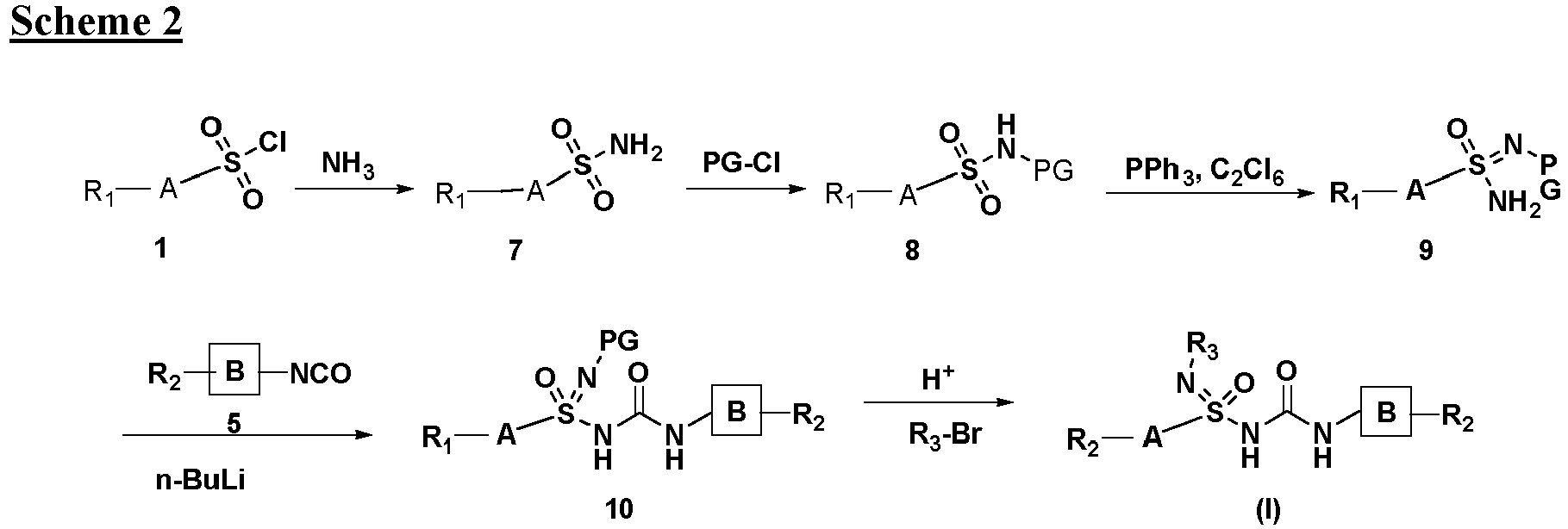
- Wherein PG is selected from silyl groups like tert-butyldiphenylsilyl, tert-butyldimethylsilyl, trimethylsilyl or 9-Fluorenylmethyl carbamate, FMOC (Fluorenylmethyloxycarbonyl), t-Butyl carbamate, BOC; Benzyl carbamate, Acetamide, Benzylamine, p-Toluenesulfonamide. A, R1, B-(R2)m, and R3, are as defined earlier. Compound 7 can be prepared by using ammonia from commercially available sulfonyl chloride (1). Protection of amine group of 7 with suitable protecting groups like substituted silyl chlorides afforded 8. Compound 8 on treatment with triphenyl phosphine and dichloroethane under suitable conditions and appropriate solvents provide compound of compound 9. Compound 9 on treatment with isocyanato derivative (5) under suitable conditions, base like butyl lithium and appropriate solvents yielded compound of formula 10. Compound 10 was subjected to the deprotection with suitable reagent under suitable conditions, followed by reaction with optionally substituted halides provide compounds of formula (I). Chiral separation of the compounds of formula (I) can be achieved using suitable chiral columns via techniques like HPLC; or by using suitable chiral reagents, by a person skilled in the art.
- The invention is further illustrated by the following non-limiting examples which describe the preferred way of carrying out the present invention. These are provided without limiting the scope of the present invention in any way.
-

- 4-methylbenzenesulfonamide (10.0 g, 58.4 mmol, 1eq.) was taken in THF (50 mL), and added triethyl amine (17.41 mL, 128 mmol, 2.2 eq.) drop wise at 0 °C, further a solution of tert-butylchlorodimethylsilane (11.0 g, 73 mmol, 1.25 eq.) in toluene (10 mL) was added. After the addition completed, ice bath was removed and reaction mixture was heated to 50 °C for 16 h. Upon completion of starting material, reaction mixture was concentrated under reduced pressure. Subsequently it was diluted with EA (100 mL) and water, layers were separated, aq. layer was back extracted with EA (50 mL × 4), all org. layer was combined and washed with water (50 mL), brine (50 mL), dried over Na2SO4 and conc. under reduced pressure at 45 °C to yield crude product, which was purified by column chromatography to afford N-(tert-butyldimethylsilyl)-4-methylbenzenesulfonamide (12 g, 72% yield)
1H NMR (DMSO-d6, 400 MHz) δ ppm: 7.69 (d, 2H, J = 6.4 Hz), 7.58 (s, 1H), 7.36 (d, 2H, J = 8.4 Hz), 2.37 (s, 3H), 0.86 (s, 9H), 0.08 (s, 6H).; MS (ESI): m/z (%) = 285.9 (80%) (M+H)+ -

- A solution of triphenylphosphane (5.05 g, 19.2 mmol, 1.1 eq.) and hexachloro ethane (4.56 g, 19.2 mmol, 1.1 eq.) in chloroform (50 mL) was heated to 70 °C for 5 h. Reaction mixture was cooled to 0 °C and added triethy amine (2.66 g, 26.3 mmol, 1.5 eq.) further a solution of N-(tert-butyldimethylsilyl)-4-methylbenzenesulfonamide (5.0 g, 17.51 mmol, 1.0 eq.) in chloroform (10 mL) was added. After 20 minutes at 0 °C, ammonia gas was purged. Reaction mixture was concentrated to yield crude product, which was purified by column chromatography to afford N-(tert-butyldimethylsilyl)-4-methylbenzenesulfon- imidamide (3.2 g, 64% yield)
1H NMR (DMSO-d6, 400 MHz) δ ppm: 7.54-7.73 (m, 2H), 7.30 (d, 2H, J = 8 Hz), 6.57 (s, 2H), 2.35 (s, 3H), 0.87 (s, 9H), 0.00 (s, 6H); MS (ESI): m/z (%) = 284.9 (100%) (M+H)+. -

- To a solution of N'-(tert-butyldimethylsilyl)-4-methylbenzenesulfon- imidamide (1.7 g, 5.98 mmol, 1.0 eq.) in dry THF (25 mL) was added n-BuLi (2.87 mL, 2.5 M, 7.17 mmol, 1.2 eq.) at -78 °C. The reaction mixture was strieed at this temperature for 0.5 h and at rt for 0.5 h. 4-isocyanato-1,2,3,5,6,7-hexahydro-s-indacene (1.19 g, 5.98 mmol, 1.0 eq.) was added to the reaction mixture at room temperature (RT) and stirred for 2 h. Reaction mixture was cooled to 0 °C and quenched with NH4Cl. It was diluted with EA (100 mL) and water, layers were separated, aq. layer was back extracted with EA (50 mL × 4), all org. layer was combined and washed with water (50 mL), brine (50 mL), dried it over Na2SO4 and conc. under reduced pressure at 45 °C to yield, crude product, which was used for next step.
1H NMR (DMSO-d6, 400 MHz) δ ppm: 9.93 (s, 1H), 8.06 (s, 1H), 7.82 (d, 2H, J = 8 Hz), 7.37 (d, 2H, J = 8 Hz), 6.90 (s, 1H), 2.78-2.67 (m, 4H), 2.56-2.50 (m, 4H), 2.35 (s, 3H), 1.95-1.91 (m, 4H), 0.90 (s, 9H), 0.00 (s, 6H); MS (ESI): m/z (%) = 484.5 (100%) (M+H)+ -

- To a solution of N'-(tert-butyldimethylsilyl)-N-((1,2,3,5,6,7-hexahydro-s-indacen-4-yl)carbamoyl)-4-methylbenzenesulfonimidamide (3.3 g, 6.82 mmol, 1.0 eq.) in dry THF (35 mL) was added HCl-dioxane (5.12 mL, 4 M, 7.17 mmol, 3 eq.) at 0 °C. The reaction mixture was stirred at this temperature for 0.5 h and at RT for 1 h. Reaction mixture was cooled to 0 °C and quenched with aq. ammonia and waster was added. This mixture was filtered and dried under vacuum to yield N-((1,2,3,5,6,7-hexahydro-s-indacen-4-yl)carbamoyl)-4-methylbenzenesulfonimidamide as white solid (2.2 g, Yield = 87%)
1H NMR (400 MHz, DMSO-d6 ): δ = 9.42 (s, 1H), 7.54 (d, J = 7.6 Hz, 2H), 7.34 (d, J = 7.6 Hz, 2H), 6.92 (s, 1H), 6.2 (bs, 2H), 2.82 - 2.79 (m, 8H), 2.36 (s, 3H), 1.82 - 1.72 (m, 4H); MS (ESI): m/z (%) = 370.00 (100%) (M+H)+, 368.05 (100%) (M-H)- -

- To a solution of N-((1,2,3,5,6,7-hexahydro-s-indacen-4-yl)carbamoyl)-4-methylbenzene-sulfonimidamide (0.1 g, 0.27 mmol, 1.0 eq.) in DMF (1 mL) was added triethylamine (0.15 mL, 1.08 mmol, 4 eq.) and CNBr (0.057 g, 0.54 mmol, 2.0 eq.) at rt. The reaction mixture was stirred at room temperature for 18 h The crude product was purified by preparative HPLC to afford N'-cyano-N-((1,2,3,5,6,7-hexahydro-s-indacen-4-yl)carbamoyl)-4-methylbenzene sulfonimidamide (1.024 g, Yield = 22%)
1H NMR (400 MHz, DMSO-d6 ): δ = 7.91 (s, 1H), 7.65 (d, J = 8.0 Hz, 2H), 7.27 (d, J = 8.0 Hz, 2H), 6.78 (s, 1H), 2.75 - 2.67 (m, 4H), 2.65 - 2.56 (m, 4H), 2.34 (s, 3H), 1.92 - 1.83 (m, 4H); MS (ESI): m/z (%) = 395.10 (100%) (M+H)+, 393.15 (100%) (M+H) - Using appropriate starting materials and suitable modifications of the process described in Example 1B, including suitable addition and/or deletion of steps as may be necessary, well within the scope of a person skilled in the art, the following compounds were prepared in an analogues manner.
-

- 1H NMR (400 MHz, DMSO-d6 ): δ = 8.1 (bs, 1H), 8.06 (d, J = 8.4 Hz, 2H), 7.87 (d, J = 8.4 Hz, 2H), 6.80 (s, 1H), 2.75 - 2.70 (m, 4H), 2.67 - 2.63 (m, 4H), 2.61 (s, 3H), 1.93 (t, J = 7.2 Hz, 4H); MS (ESI): m/z (%) = 423.10 (100%) (M+H)+; IR (KBr): v = 3433, 2949, 2845, 2189, 1687, 1599, 1541, 1263, 1199, 1118, 821 cm-1.
-

- 1H NMR (400 MHz, DMSO-d6 ): δ = 8.0 (bs, 1H), 7.67 (d, J = 8.4 Hz, 2H), 7.55 (d, J = 8.4 Hz, 2H), 6.79 (s, 1H), 5.16 (s, 1H), 2.75 (t, J = 7.2 Hz, 4H), 2.68 - 2.66 (m, 4H), 1.91 (t, J = 7.2 Hz, 4H), 1.43 (s, 6H); MS (ESI): m/z (%) = 439.15 (100%) (M+H)+.
-

- 1H NMR (400 MHz, DMSO-d6 ): δ = 8.48 (s, 1H), 8.37 (d, J = 8.4 Hz, 2H), 8.17 (d, J = 8.0 Hz, 2H), 7.82 (t, J = 8.4 Hz, 2H), 6.80 (s, 1H), 2.78-2.69 (m, 4H), 2.68-2.57 (m, 4H), 1.98-1.81 (m, 4H); MS (ESI): m/z (%) = 426.10 (100%) (M+H)+, 448.09 (15%) (M+Na).
-

- 1H NMR (400 MHz, DMSO-d6 ): δ = 7.93 (s, 1H), 7.70 (d, J = 9.2Hz, 2H), 7.01 (d, J = 8.8 Hz, 2H), 6.79 (s, 1H), 3.80 (s, 3H), 2.76 (t, J = 7.6Hz, 4H), 2.70-2.56 (m, 4H), 1.93-1.85(m, 4H); MS (ESI): m/z (%) = 411.19 (100%) (M+H)+, 433.17 (90%) (M+Na).
-
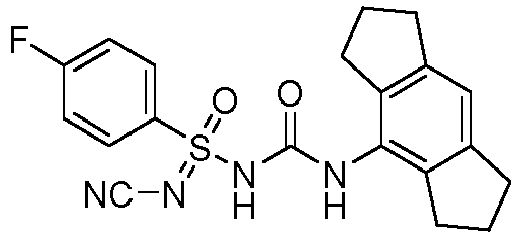
- 1H NMR (400 MHz, DMSO-d6 ): δ = 8.03 (br s, 1H), 7.81 - 7.77 (m, 2H), 7.32 (t, J = 8.8 Hz, 2H), 6.79 (s, 1H), 2.73 (t, J = 7.2 Hz, 4H), 2.64 - 2.59 (m, 4H), 1.90 - 1.87 (m, 4H); MS (ESI): m/z (%) = 399.10 (100%) (M+H)+.
-

- 1H NMR (400 MHz, DMSO-d6 ): δ = 8.01 (br s, 1H), 7.77 - 7.75 (m, 2H), 7.49 - 7.46 (m, 3H), 6.79 (s, 1H), 2.76 - 2.72 (m, 4H), 2.67 - 2.60 (m, 4H), 1.93 - 1.89 (m, 4H).
-

- 1H NMR (400 MHz, DMSO-d6 ): δ = 8.51 - 8.48 (m, 1H), 8.04 (br s, 1H), 8.01 - 7.93 (m, 1H), 6.92 (d, J = 9.2 Hz, 1H), 6.80 (s, 1H), 3.87 (s, 3H), 2.81 - 2.59 (m, 8H), 1.91 - 1.84 (m, 4H); MS (ESI): m/z (%) = 412.20 (100%) (M+H)+.
-

- 1H NMR (400 MHz, DMSO-d6 ): δ = 8.08 (br s, 1H), 7.49 - 7.47 (m, 1H), 7.43 - 7.39 (m, 2H), 6.80 (s, 1H), 2.73 (d, J = 7.2 Hz, 4H), 2.68 - 2.58 (m, 4H), 2.28 (s, 3H), 1.93 - 1.88 (m, 4H); MS (ESI): m/z (%) = 413.15 (100%) (M+H)+; IR (KBr): v = 3433, 3234, 2951, 2193, 1599, 1577, 1533, 1492 cm-1.
-

- 1H NMR (400 MHz, DMSO-d6 ): δ = 8.05 (br s, 1H), 7.74 (d, J = 8.8 Hz, 2H), 7.56 (d, J = 8.8 Hz, 2H), 6.80 (s, 1H), 2.74 (t, J = 7.2 Hz, 4H), 2.68 - 2.59 (m, 4H), 1.93 - 1.87 (m, 4H); MS (ESI): m/z (%) = 415.10 (100%) (M+H)+; IR (KBr): v = 3257, 2945, 2845, 2189, 1678, 1597, 1535 cm-1.
-

- 1H NMR (400 MHz, DMSO-d6 ): δ = 8.06 (br s, 1H), 7.71 - 7.66 (m, 4H), 6.80 (s, 1H), 2.74 (t, J = 7.2 Hz, 4H), 2.68 - 2.59 (m, 4H), 1.93 - 1.84 (m, 4H); MS (ESI): m/z (%) = 459.15 (100%) (M)+; IR (KBr): v = 3433, 3236, 2945, 2843, 2191, 1599, 1573, 1531 cm-1.
-

- 1H NMR (400 MHz, DMSO-d6 ): δ = 7.91 (s, 1H), 7.70-7.66 (m, 2H), 7.47-7.45 (m, 2H), 7.42-7.38 (m, 2H), 7.36-7.32 (m, 2H), 7.10-7.05 (m, 3H), 6.79 (s, 1H), 5.16 (s, 1H), 3.34-2.68 (m, 4H), 2.67-2.90 (m, 4H), 1.91-1.89 (m, 4H); MS (ESI): m/z (%) = 487.35 (100%) (M+H)+, 509.45 (30%) (M+NH4)+; 485.55 (100%) (M-1); IR (KBr): v = 3223, 2947, 2177, 1593, 1496, 1251, 1114, 1095, 827. 698, 532 cm-1.
-

- 1H NMR (400 MHz, DMSO-d 6, D2O-X): δ = 8.12 (br, s, 1H), 7.94 (d, J = 8.4 Hz, 2H), 7.88 (d, J = 8.4 Hz, 2H), 6.80 (s, 1H), 2.75 - 2.72 (m, 4H), 2.68 - 2.55 (m, 4H), 1.91 - 1.87 (m, 4H); MS (ESI): m/z (%) = 449.10 (100%) (M+H)+, 471.15 (30%) (M+Na)+, 447.30 (70%) (M-1)+; IR (KBr): v = 3433, 3248, 2195, 1600, 1402, 1323, 1132, 1062, 827, 709 cm-1.
-

- 1H NMR (400 MHz, DMSO): δ = 11.9 (bs, 1H), 8.60-8.61 (m, 1H), 8.15 (bs, 1H), 7.86-7.97 (m, 1H), 7.47-7.50 (m, 1H), 7.47-7.49 (m, 1H), 6.79 (s, 1H), 2.75-2.72 (m, 4H), 2.51-2.69 (m, 4H), 1.76-1.91 (m, 4H); MS (ESI): m/z (%) = 382.10 (100%) (M+H)+; IR (KBr): v = 3431, 2951, 2187, 1616, 1510, 1197 cm-1.
-

- 1H NMR (400 MHz, DMSO-d6 ): δ = 8.0 (bs, 1H), 7.89 (s, 1H), 7.61 - 7.55 (m, 2H), 7.41 - 7.37 (m, 1H), 6.79 (s, 1H), 5.19 (s, 1H), 2.76 (t, J = 8.0 Hz, 4H), 2.67 (quin, J = 7.2 Hz, 4H), 1.90 (t, J = 7.6 Hz, 4H), 1.44 (s, 6H); MS (ESI): m/z (%) = 439.15 (100%) (M+H)+; IR (KBr): v= 3400, 3294, 3257, 2976, 2845, 2196, 1593, 1523, 1288, 1224, 1192 cm-1.
-

- 1H NMR (400 MHz, DMSO-d6 ): δ = 8.0 (bs, 1H), 7.79 (d, J = 8.8 Hz, 2H), 7.70 (d, J = 8.4 Hz, 2H), 6.79 (s, 1H), 6.49 (s, 1H), 4.79 (d, J = 6.8 Hz, 2H), 4.71 (d, J = 6.0 Hz, 2H), 2.76 (t, J = 7.2 Hz, 4H), 2.67 (quin, J = 7.2 Hz, 4H), 1.91 (t, J = 7.6 Hz, 4H); MS (ESI): m/z (%) = 453.25 (100%) (M+H)+.
-

- 1H NMR (400 MHz, DMSO-d6 ): δ = 9.4 (s, 1H), 8.1 (bs, 1H), 7.87 (s, 1H), 7.03 (s, 1H), 6.82 (s, 1H), 5.34 (s, 1H), 4.97 (s, 1H), 2.82 - 2.73 (m, 4H), 2.68 - 2.65 (m, 4H), 1.95 (s, 3H), 1.91 (t, J = 7.6 Hz, 4H); MS (ESI): m/z (%) = 411.13 (100%) (M+H)+, 409.08 (100%) (M-H); IR (KBr): v= 3433, 3255, 2946, 2845, 21963, 1656, 1600, 1531, 1460, 1274 cm-1.
-

- 1H NMR (400 MHz, DMSO-d6 ): δ = 8.13 (bs, 1H), 7.24 (s, 1H), 7.20 (s, 1H), 6.63 (s, 1H), 2.76 (bs, 4H), 2.68 (q, J = 6.4 Hz, 4H), 1.93 (t, J = 6.4 Hz, 4H); MS (ESI): m/z (%) = 466.10 (100%) (M+H)+, 465.30 (100%) (M-H); IR (KBr): v= 3433, 3244, 2955, 2922, 2202, 2183, 1595, 1533, 1460, 1402, 1276 cm-1.
-

- 1H NMR (400 MHz, DMSO-d6 ): δ = 8.26 (bs, 1H), 7.42 (t, J = 7.6 Hz, 1H), 7.35 (t, J = 8.0 Hz, 1H), 7.28 (t, J = 2.0 Hz, 1H), 7.07 - 7.05 (m, 1H), 6.80 (s, 1H), 3.79 (s, 3H), 2.76 (t, J = 7.6 Hz, 4H), 2.68 - 2.63 (m, 4H), 1.93 (qui, J = 6.8 Hz, 4H); MS (ESI): m/z (%) = 411.20 (100%) (M+H)+, 409.20 (100%) (M-H); IR (KBr): v= 3423, 3225, 2937, 2848, 2198, 2175, 1597, 1541, 1483, 1460, 1427 cm-1.
-

- 1H NMR (400 MHz, DMSO-d6 ): δ = 8.10 (bs, 1H), 7.55 (s, 1H), 6.82 (s, 1H), 6.79 (s, 1H), 5.03 (s, 1H), 2.77 (t, J = 7.2 Hz, 4H), 2.68 (t, J = 7.2 Hz, 4H), 1.94 (qui, J = 7.2 Hz, 4H), 1.38 (s, 6H); MS (ESI): m/z (%) = 429.20 (100%) (M+H)+, 427.30 (100%) (M-H); IR (KBr): v = 3389, 3138, 2949, 2843, 2191, 1620, 1512, 1274, 1240, 1197, 1118 cm-1.
-

- 1H NMR (400 MHz, DMSO-d6 ): δ = 7.96 (bs, 1H), 7.23 (d, J = 6.8 Hz, 2H), 6.94 (d, J = 9.2 Hz, 1H), 6.80 (s, 1H), 4.28 (s, 4H), 2.76 (t, J = 7.2 Hz, 4H), 2.69 - 2.61 (m, 4H), 1.94 (qui, J = 7.2 Hz, 4H); MS (ESI): m/z (%) = 439.10 (100%) (M+H)+, 437.10 (100%) (M-H); IR (KBr): v= 3431, 3232, 2928, 2195, 2179, 1595, 1537, 1496, 1458, 1421, 1128, 1151 cm-1.
-

- 1H NMR (400 MHz, DMSO-d6 ): δ = 7.95 (bs, 1H), 7.23 (d, J = 4.0 Hz, 1H), 6.82 (d, J = 4.0 Hz, 1H), 6.81 (s, 1H), 5.63 (s, 2H), 2.77 (t, J = 7.2 Hz, 4H), 2.68 - 2.65 (m, 4H), 1.94 (qui, J = 7.2 Hz, 4H), 1.49 (s, 6H); MS (ESI): m/z (%) = 445.10 (100%) (M+H)+, 443.10 (100%) (M-H).
-

- 1H NMR (400 MHz, DMSO-d6 ): δ = 8.06 (bs, 1H), 7.55 (d, J = 5.2 Hz, 1H), 7.32 - 7.30 (m, 1H), 7.16 - 7.12 (m, 1H), 6.80 (s, 1H), 2.76 (t, J = 7.2 Hz, 4H), 2.68 - 2.64 (m, 4H), 2.31 (s, 3H), 1.94 (qui, J = 7.6 Hz, 4H); MS (ESI): m/z (%) = 413.13 (100%) (M+H)+; IR (KBr): v= 3433, 3246, 2929, 2845, 2196, 2179, 1595, 1573, 1531, 1492, 1460, 1251 cm-1.
-

- 1H NMR (400 MHz, DMSO-d6 ): δ = 8.95 (s, 1H), 8.14 (S, 1H), 8.04 (s, 1H), 7.92 (d, J = 8.0 Hz, 1H), 7.78 (d, J = 8.0 Hz, 1H), 7.66 (t, J = 7.6 Hz, 1H), 6.79 (s, 1H), 2.75 (t, J = 6.8 Hz, 4H), 2.62 (t, J = 6.8 Hz, 4H), 1.91 (quin, J = 6.8 Hz, 4H); MS (ESI): m/z (%) = 547.05 (100%) (M+H)+, 545.10 (100%) (M-H); IR (KBr): v = 3369, 2955, 2847, 2189, 1610, 1510, 1269, 1197 cm-1.
-

- 1H NMR (400 MHz, DMSO-d6 ): δ = 8.20 (s, 1H), 7.49 - 7.44 (m, 1H), 7.39 - 7.34 (m, 2H), 6.82 (S, 1H), 2.72 (t, J = 7.2 Hz, 4H), 2.62 (quin, J = 7.6 Hz, 4H), 1.94 (t, J = 7.2 Hz, 4H); MS (ESI): m/z (%) = 417.05 (100%) (M+H)+, 415.05 (100%) (M-H); IR (KBr): v = 3238, 3086, 2956, 2196, 2181, 1597, 1537, 1444, 1278 cm-1.
-

- 1H NMR (400 MHz, DMSO-d6 ): δ = 8.05 (bs, 1H), 7.84 - 7.78 (m, 1H), 7.38 - 7.32 (m, 1H), 7.20 - 7.15 (m, 1H), 6.80 (S, 1H), 2.76 (t, J = 7.2 Hz, 4H), 2.69 - 2.61 (m, 4H), 1.93 (quin, J = 7.2 Hz, 4H); MS (ESI): m/z (%) = 416.99 (100%) (M+H)+; IR (KBr): v = 3433, 3255, 2947, 2845, 2195, 1602, 1525, 1487, 1201 cm-1.
-

- 1H NMR (400 MHz, DMSO-d6 ): δ = 8.15 (bs, 1H), 7.78 (d, J = 8.0 Hz, 1H), 7.67 - 7.63 (m, 2H), 7.53 (d, J = 8.0 Hz, 1H), 6.80 (S, 1H), 2.76 (t, J = 7.2 Hz, 4H), 2.64 (t, J = 8.0 Hz, 4H), 1.91 (t, J = 4.8 Hz, 4H); MS (ESI): m/z (%) = 464.91 (100%) (M)+; IR (KBr): v = 3433, 2953, 2847, 2185, 1608, 1261, 1207 cm-1.
-

- 1H NMR (400 MHz, DMSO-d6 ): δ = 7.87 (bs, 1H), 7.43 - 7.30 (m, 5H), 6.84 (S, 1H), 4.66 (d, J = 13.2 Hz, 1H), 4.57 (d, J = 13.2 Hz, 1H), 2.81 - 2.72 (m, 8H), 1.99 (quin, J = 7.6 Hz, 4H); MS (ESI): m/z (%) = 395.15 (100%) (M+H)+, 417.14 (20%) (M+Na)+; IR (KBr): v = 3315, 2945, 2845, 2119, 1604, 1525, 1290, 1234, 1203, 945, 694 cm-1.
-

- 1H NMR (400 MHz, DMSO-d6 ): δ = 7.65 (d, J = 8.4 Hz, 2H), 7.63 (s, 1H), 7.33 (s, 1H), 7.28 (d, J = 8.4 Hz, 2H), 3.09 (m, 4H), 2.67(m, 4H), 2.35 (s, 3H), 1.97 (m, 4H); MS (ESI): m/z (%) = 395.2 (100%) (M+1); IR (KBr): v = 3362, 2960, 2847, 2206, 1593, 1519, 1421, 1280, 1182 cm-1.
-

- 1H NMR (400 MHz, DMSO-d6 ): δ = 8.01 (s, 1H), 7.72 (d, J = 1.2 Hz, 1H), 7.43 (d, J = 2.0 Hz, 1H ), 7.06 (d, J = 4.8 Hz, 1H), 6.81 (s.1H), 2.73 (m, 4H), 2.64(m, 4H), 1.90 (m, 4H); MS (ESI): m/z (%) = 387 (M+1).
-

- 1H NMR (400 MHz, DMSO-d6 ): δ = 7.95 (s, 1H), 7.34 (d, J = 2.0 Hz, 1H), 7.29 (d, J = 2.0 Hz, 1H), 7.04 (d, J = 8.8 Hz, 1H), 6.69 (s, 1H), 3.94 (s, 3H). 3.80 (s, 3H), 2.73 (m, 4H), 2.64(m, 4H), 2.09 (m, 4H); MS (ESI): m/z (%) = 441.2 (100%) (M+1); IR (KBr): v = - 3423.76, 2939.6, 2191.21, 1595.18, 1508.38, 1261.49, 941.29 cm-1.
-

- 1H NMR (400 MHz, DMSO): δ = 8.10 (bs, 1H), 7.85-7.81 (m, 1H), 7.68-7.66 (m, 1H), 7.34-7.36 (m, 1H), 6.79 (s, 1H), 2.75-2.70 (m, 4H), 2.68-2.55 (m, 4H), 2.50 (s, 3H), 1.99-1.86 (m, 4H); MS (ESI): m/z (%) = 396.30 (100%) (M+H)+; IR (KBr): v = 3367, 2949, 2189, 1732, 1612, 1195 cm-1.
-
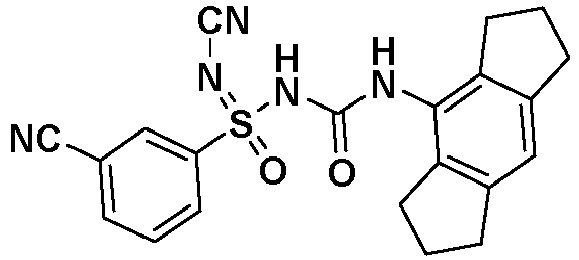
- 1H NMR (400 MHz, DMSO): δ = 8.20 (bs, 1H), 8.06-7.98 (m, 3H), 7.76-7.72 (m, 1H), 6.81 (s, 1H), 2.76-2.50 (m, 8H), 1.93-1.88 (m, 4H); MS (ESI): m/z (%) = 405.95 (100%) (M+H)+; IR (KBr): v = 3412, 2949, 2191, 1599, 1251, 1205 cm-1.
-

- 1H NMR (400 MHz, DMSO): δ = 8.15 (bs, 1H), 8.00-7.97 (m, 2H), 7.89-7.88 (m, 2H), 6.80 (s, 1H), 2.80-2.50 (m, 8H), 1.93-1.19 (m, 4H); MS (ESI): m/z (%) = 406.10 (100%) (M+H)+; IR (KBr): v = 3433, 3246, 2196, 1597, 1246 cm-1.
-

- 1H NMR (400 MHz, DMSO): δ = 8.87 (d, J=2Hz, 1H), 8.67-7.66 (m, 1H), 8.10 (bs, 1H), 8.09-8.07 (m, 1H), 7.56-7.53 (m, 1H), 6.80 (s, 1H), 2.76-2.60 (m, 8H), 1.91-1.87 (m, 4H); MS (ESI): m/z (%) = 382.05 (100%) (M+H)+; IR (KBr): v = 3267, 2951, 2193, 1599, 1257, 1232 cm-1.
-

- 1H NMR (400 MHz, DMSO): δ = 8.74-8.73 (m, 2H), 8.20 (bs, 1H), 7.66-7.64 (m, 2H), 6.81 (s, 1H), 2.76-2.59 (m, 8H), 1.91-1.87 (m, 4H); MS (ESI): m/z (%) = 382.13 (100%) (M+H)+; IR (KBr): v = 3236, 2951, 2181, 1739, 1599, 1247 cm-1.
-

- 1H NMR (400 MHz, DMSO-d6 ): δ = 8.11 (s, 1H), 7.58 (d, J = 6.4 Hz, 2H), 7.48 (d, J = 8.8 Hz, 1H), 7.37 (d, J = 2.8 Hz, 1H), 6.80 (s, 1H), 2.82 (m, 4H), 2.64(m, 4H), 1.91 (m, 4H); MS (ESI): m/z (%) = 397 (100%) (M-1).
-

- 1H NMR (400 MHz, DMSO-d6 ): δ = 9.02 (s, 1H), 8.64 (d, J = 9.2 Hz, 1H), 8.46 (d, J = 8.0 Hz, 1H), 8.20 (d, J = 7.2 Hz, 1H), 7.78 (m, 1H), 7.72 (d, J = 7.6 Hz, 1H), 7.12 (s, 1H), 3.23 (m, 1H), 2.91 (m, 4H), 2.75(m, 4H), 2.01 (m, 4H); MS (ESI): m/z (%) = 432.13 (100%) (M+1).
-

- 1H NMR (400 MHz, DMSO-d6 ): δ = 7.87 (s, 1H), 7.59 (d, J = 9.2 Hz, 2H), 6.97 (d, J = 8.8 Hz, 2H), 6.79 (s, 1H), 3.73 (t, J = 4.8 Hz, 4H ), 3.20 (t, J = 4.8 Hz, 4H), 2.85 (m, 4H), 2.65(m, 4H), 1.91 (m, 4H); MS (ESI): m/z (%) = 466.12 (100%) (M+1); IR (KBr): v = 3442, 2949, 2177, 1593, 1504, 1379, 1240, 1190, 927 cm-1.
-

- 1H NMR (400 MHz, DMSO-d6 ): δ = 10.16 (s, 1H), 7.96 (s, 2H), 7.76 (s, 1H), 7.39 (d, J = 2.0 Hz, 2H), 6.79 (s, 1H), 2.85 (m, 4H), 2.55(m, 4H), 2.05 (s, 3H), 1.85 (m, 4H); MS (ESI): m/z (%) = 435.9 (100%) (M-1); IR (KBr): v = 3433, 2918, 2173, 1701, 1599, 1545, 1384, 1215, 1163, 1126, 840 cm-1.
-

- 1H NMR (400 MHz, DMSO-d6 ): δ = 8.0 (s, 1H), 7.31 (d, J = 8.0 Hz, 2H), 7.20 (d, J = 8.0 Hz, 2H), 7.07 (d, J = 1.60 Hz, 1H), 6.80 (s, 1H), 3.75 (t, J = 4.8 Hz, 4H ), 3.12 (t, J = 4.8 Hz, 4H), 2.74 (m, 4H), 2.71(m, 4H), 1.95 (m, 4H); MS (ESI): m/z (%) = 465.98 (100%) (M+1); IR (KBr): v = 3433, 3225, 2955, 2195, 1595, 1539, 1485, 1379, 1280, 1120, 937 cm-1.
-

- 1H NMR (400 MHz, DMSO): δ = 8.13 (dd, J=2.4Hz, J=7.6Hz, 1H), 8.00 (bs, 1H), 7.68-7.64 (m, 1H), 7.24-7.19 (m, 2H), 6.79 (s, 1H), 2.76-2.60 (m, 8H), 1.95-1.85 (m, 4H), 1.50 (s, 3H), 1.48 (s, 3H); MS (ESI): m/z (%) = 456.88 (100%) (M+H)+; IR (KBr): v = 3369, 2953, 2185, 1614, 1215 cm-1.
-

- 1H NMR (400 MHz, DMSO): δ = 8.10 (bs, 1H), 7.88 (dd, J=2.4Hz, J=7.2Hz, 1H), 7.56-7.55 (m, 1H), 7.19-7.15 (m, 1H), 6.80 (s, 1H), 5.22 (s, 1H), 2.76-2.61 (m, 8H), 1.99-1.87 (m, 4H), 1.42 (s, 6H); MS (ESI): m/z (%) = 456.90 (100%) (M+H)+; IR (KBr): v = 3412, 2949, 2196, 1595, 1195 cm-1.
-

- 1H NMR (400 MHz, DMSO): δ = 8.75-8.72 (m, 2H), 8.22-8.14 (m, 2H), 6.80 (s, 1H), 5.43 (s, 1H), 2.90-2.60 (m, 8H), 1.99-1.76 (m, 4H), 1.48 (s, 3H), 1.47 (s, 3H); MS (ESI): m/z (%) = 439.83 (100%) (M+H)+.
-

- 1H NMR (400 MHz, DMSO-d6 ): δ = 7.94 (bs, 1H), 7.82 (d, J = 8.4 Hz, 2H), 7.54 (d, J = 8.0 Hz, 2H), 6.84 (S, 1H), 4.78 (d, J = 13.2 Hz, 1H), 4.68 (d, J = 12.8 Hz, 1H), 2.79 (t, J = 7.2 Hz, 4H), 2.73 (t, J = 7.2 Hz, 4H), 1.97 (quin, J = 7.2 Hz, 4H); MS (ESI): m/z (%) = 420.17 (100%) (M+H)+, 442.15 (20%) (M+Na)+; IR (KBr): v= 3290, 2951, 2850, 2229, 2189, 1720, 1602, 1529, 1460, 1286, 1228, 1161 cm-1.
-
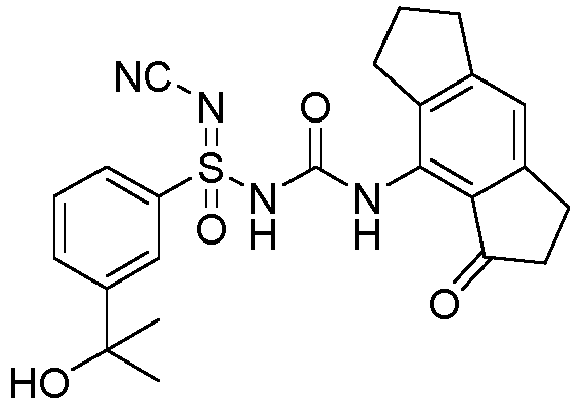
- 1H NMR (400 MHz, DMSO-d6 ): δ = 8.89 (s, 1H), 7.92 (S, 1H), 7.60 (q, J = 7.6 Hz, 2H), 7.41 (t, J = 7.6 Hz, 1H), 7.00 (s, 1H), 5.21 (s, 1H), 2.82 (t, J = 4.4 Hz, 2H), 2.82 (t, J = 7.6 Hz, 2H), 2.77 - 2.67 (m, 4H), 1.85 (t, J = 6.0 Hz, 2H), 1.43 (s, 6H); MS (ESI): m/z (%) = 453.35 (100%) (M+H)+, 475.35 (50%) (M+Na)+; IR (KBr): v= 3421, 2964, 2926, 2181, 1672, 1651, 1614, 1508, 1460, 1419, 1251, 1190 cm-1.
- THP1 (Tamm-Horsfall Protein 1) monocytes were differentiated with PMA (Phorbol 12-myristate 13-acetate) (100ng/ml) and incubated at 37°C for 20 h in presence of 5% CO2. 2×10⁵ differentiated cells were plated per well of 96 well tissue culture plates. The cells were primed using 500ng/ml Lipopolysaccharide and incubating for 4hrs under the same condition. The cells were then treated with various concentrations of the compounds for 30 min followed by treatment with 5mM ATP for 1hr. The supernatants were collected and analysed by IL-1b (Mabtech Cat # 3415-1H-20) or TNF-a (Mabtech; Cat # 3510-1H-20) detection kit. The data were analyzed using GraphPad Prism V7.0. Dose Response Curve (DRC) was constructed to determine the IC50 value by fitting percentage cell survival data to the GraphPad Prism using nonlinear regression analysis. The in vitro IL-1β inhibitory activity (IC50) for representative compounds is listed in Table 1:
Table 1 Compound IC50 (nM) Example 1 6.6 Example 3 12 Example 4 15 Example 5 23 Example 6 62 Example 7 13 Example 8 34 Example 9 5 Example 10 23 Example 11 27 Example 13 32 Example 14 28 Example 15 3 Example 16 13 Example 17 32 Example 18 5.6 Example 19 17 Example 20 3.3 Example 21 13 Example 22 4.8 Example 23 2.4 Example 24 27 Example 25 63 Example 26 23 Example 27 - Example 28 3.5 Example 30 19 Example 31 4.4 Example 32 45 Example 33 12 Example 34 27 Example 35 43 Example 37 38 Example 42 7.8 Example 43 7.7 Example 44 1.26 Example 45 4 - Demonstration of in vivo efficacy of test compounds in rats mice, oral routes of administration.
- All the animal experiments were carried out in female rats and mice, bred in-house. Animals were housed in groups of 6 animals per cage, for a week, in order to habituate them to vivarium conditions (25 ± 4 °C, 60-65 % relative humidity, 12: 12 h light: dark cycle, with lights on at 7.30 am). All the animal experiments were carried out according to the internationally valid guidelines following approval by the 'Zydus Research Center animal ethical committee'.
- Female C57 mice (6-8 weeks) received intraperitoneal injection of 50 µg/mouse of lipopolysaccharide (LPS) in PBS. Animals were treated immediately with the test compounds or the vehicle. After 2h of LPS injection, animals were administered with ATP at 12.5 mg/mouse dissolved in PBS via intraperitoneal route. After 30 minutes of ATP injection, serum was collected for IL-1β estimation by ELISA.
- The novel compounds of the present invention can be formulated into suitable pharmaceutically acceptable compositions by combining with suitable excipients by techniques and processes and concentrations as are well known.
- The compounds of formula (I) or pharmaceutical compositions containing them are useful as a medicament for the inhibition of NLRP3 activity and suitable for humans and other warm blooded animals, and may be administered either by oral, topical or parenteral administration.
- Thus, a pharmaceutical composition comprising the compounds of the present invention may comprise a suitable binder, suitable bulking agent &/or diluent and any other suitable agents as may be necessary. Optionally, the pharmaceutical composition may be suitably coated with suitable coating agents.
- The compounds of the present invention (I) are NLRP3 inhibitors and are useful in the treatment of disease states mediated by NLRP3, preferably diseases or conditions in which interleukin 1 β activity in which interleukin 1β activity and interleukin-18 (IL-18) are implicated and related disorders.
- The quantity of active component, that is, the compounds of Formula (I) according to this invention, in the pharmaceutical composition and unit dosage form thereof may be varied or adjusted widely depending upon the particular application method, the potency of the particular compound and the desired concentration. Generally, the quantity of active component will range between 0.5% to 90% by weight of the composition.
- The compounds of the present invention, formula (I), may be used alone or in any combination with one or more other therapeutic agents which a skilled medical practitioner can easily identify. Such other therapeutic agent may be selected depending on the type of disease being treated, the severity, other medications being taken by the patients etc. Thus for example, for treatment of rheumatoid arthritis, one or more DMARDs may be used in combination with the compounds of the present invention.
- In one of the embodiments compound of formula (I) of the present invention may be used in combination with one or more suitable pharmaceutically active agents selected from following therapeutic agents in any combination. Inhibitors of interleukin-1β (e.g. rilonacept, canakinumab, and anakinra); immune-suppressants (e.g., Methotrexate, mercaptopurine, cyclophosphamide), metabolic disorders drugs, glucocorticoids, non-steroidal antiinflammatory drugs, Cox-2 specific inhibitors, TNF-α binding proteins (eg.,Infliximab, etanercept), interferon- 13, interferon, interleukin-2, antihistamines, beta-agonist, BTK inhibitors, anticolinergics, anti-cancer agents or their suitable pharmaceutically acceptable salts. Further examples for use in combination with Non-Alcoholic Steato- Hepatitis (NASH) and fibrosis drugs, anticancer antibiotics, hormones, Aromatase inhibitors, antibodies, cytokines, vaccines, drug conjugates, inhibitors of mitogen-activated protein kinase signaling (ex: BAY 43-9006), Syk inhibitors, mTOR inhibitors, antibodies (Rituxan), and BCR/ABL antagonist.
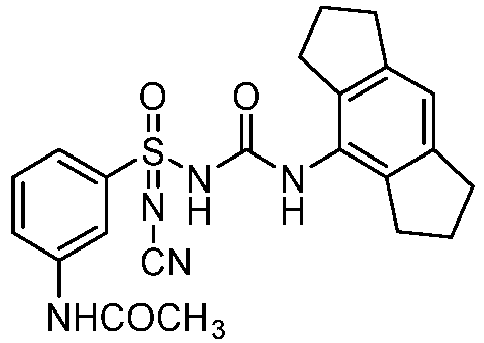
- 1H NMR (400 MHz, DMSO-d6 ): δ = 10.16 (s, 1H), 7.96 (s, 2H), 7.76 (s, 1H), 7.39 (d, J = 2.0 Hz, 2H), 6.79 (s, 1H), 2.85 (m, 4H), 2.55(m, 4H), 2.05 (s, 3H), 1.85 (m, 4H); MS (ESI): m/z (%) = 435.9 (100%) (M-1); IR (KBr): v = 3433, 2918, 2173, 1701, 1599, 1545, 1384, 1215, 1163, 1126, 840 cm-1.
-

- 1H NMR (400 MHz, DMSO-d6 ): δ = 8.0 (s, 1H), 7.31 (d, J = 8.0 Hz, 2H), 7.20 (d, J = 8.0 Hz, 2H), 7.07 (d, J = 1.60 Hz, 1H), 6.80 (s, 1H), 3.75 (t, J = 4.8 Hz, 4H ), 3.12 (t, J = 4.8 Hz, 4H), 2.74 (m, 4H), 2.71(m, 4H), 1.95 (m, 4H); MS (ESI): m1z (%) = 465.98 (100%) (M+1); IR (KBr): v = 3433, 3225, 2955, 2195, 1595, 1539, 1485, 1379, 1280, 1120, 937 cm-1.
-

- 1H NMR (400 MHz, DMSO): δ = 8.13 (dd, J=2.4Hz, J=7.6Hz, 1H), 8.00 (bs, 1H), 7.68-7.64 (m, 1H), 7.24-7.19 (m, 2H), 6.79 (s, 1H), 2.76-2.60 (m, 8H), 1.95-1.85 (m, 4H), 1.50 (s, 3H), 1.48 (s, 3H); MS (ESI): m1z (%) = 456.88 (100%) (M+H)+; IR (KBr): v = 3369, 2953, 2185, 1614, 1215 cm-1.
-

- 1H NMR (400 MHz, DMSO): δ = 8.10 (bs, 1H), 7.88 (dd, J=2.4Hz, J=7.2Hz, 1H), 7.56-7.55 (m, 1H), 7.19-7.15 (m, 1H), 6.80 (s, 1H), 5.22 (s, 1H), 2.76-2.61 (m, 8H), 1.99-1.87 (m, 4H), 1.42 (s, 6H); MS (ESI): m1z (%) = 456.90 (100%) (M+H)+; IR (KBr): v = 3412, 2949, 2196, 1595, 1195 cm-1.
-

- 1H NMR (400 MHz, DMSO): δ = 8.75-8.72 (m, 2H), 8.22-8.14 (m, 2H), 6.80 (s, 1H), 5.43 (s, 1H), 2.90-2.60 (m, 8H), 1.99-1.76 (m, 4H), 1.48 (s, 3H), 1.47 (s, 3H); MS (ESI): m/z (%) = 439.83 (100%) (M+H)+.
-

- 1H NMR (400 MHz, DMSO-d6 ): δ = 7.94 (bs, 1H), 7.82 (d, J = 8.4 Hz, 2H), 7.54 (d, J = 8.0 Hz, 2H), 6.84 (S, 1H), 4.78 (d, J = 13.2 Hz, 1H), 4.68 (d, J = 12.8 Hz, 1H), 2.79 (t, J = 7.2 Hz, 4H), 2.73 (t, J = 7.2 Hz, 4H), 1.97 (quin, J = 7.2 Hz, 4H); MS (ESI): m1z (%) = 420.17 (100%) (M+H)+, 442.15 (20%) (M+Na)+; IR (KBr): v = 3290, 2951, 2850, 2229, 2189, 1720, 1602, 1529, 1460, 1286, 1228, 1161 cm-1.
-

- 1H NMR (400 MHz, DMSO-d6 ): δ = 8.2 (bs, 1H), 7.78 (d, J = 8.0 Hz, 2H), 7.58 (d, J = 7.6 Hz, 2H), 7.06 (S, 2H), 6.89 (S, 1H), 4.89 (d, J = 13.2 Hz, 1H), 4.75 (d, J = 13.2 Hz, 1H), 2.80 (t, J = 7.2 Hz, 4H), 2.67 (t, J = 7.2 Hz, 4H), 1.96 (t, J = 7.2 Hz, 4H); MS (ESI): m1z (%) = 395.15 (50%) (M+H)+, 393.04 (100 %) (M-H)+; IR (KBr): v= 3275, 3176, 2949, 2843, 2231, 1618, 1531, 1460, 1288, 1246, 1151, 829 cm-1.
-

- 1H NMR (400 MHz, DMSO-d6 ): δ = 8.89 (s, 1H), 7.92 (S, 1H), 7.60 (q, J = 7.6 Hz, 2H), 7.41 (t, J = 7.6 Hz, 1H), 7.00 (s, 1H), 5.21 (s, 1H), 2.82 (t, J = 4.4 Hz, 2H), 2.82 (t, J = 7.6 Hz, 2H), 2.77 - 2.67 (m, 4H), 1.85 (t, J = 6.0 Hz, 2H), 1.43 (s, 6H); MS (ESI): m/z (%) = 453.35 (100%) (M+H)+, 475.35 (50%) (M+Na)+; IR (KBr): v= 3421, 2964, 2926, 2181, 1672, 1651, 1614, 1508, 1460, 1419, 1251, 1190 cm-1.
- THP1 (Tamm-Horsfall Protein 1) monocytes were differentiated with PMA (Phorbol 12-myristate 13-acetate) (100ng/ml) and incubated at 37°C for 20 h in presence of 5% CO2. 2×10⁵ differentiated cells were plated per well of 96 well tissue culture plates. The cells were primed using 500ng/ml Lipopolysaccharide and incubating for 4hrs under the same condition. The cells were then treated with various concentrations of the compounds for 30 min followed by treatment with 5mM ATP for 1hr. The supernatants were collected and analysed by IL-1b (Mabtech Cat # 3415-1H-20) or TNF-a (Mabtech; Cat # 3510-1H-20) detection kit. The data were analyzed using GraphPad Prism V7.0. Dose Response Curve (DRC) was constructed to determine the IC50 value by fitting percentage cell survival data to the GraphPad Prism using nonlinear regression analysis. The in vitro IL-1β inhibitory activity (IC50) for representative compounds is listed in Table 1:
Table 1 Compound IC50 (nM) Example 1 6.6 Example 17 12 Example 18 15 Example 19 23 Example 21 62 Example 22 13 Example 24 34 Example 25 5 Example 26 23 Example 27 27 Example 29 32 Example 30 28 Example 34 3 Example 35 13 Example 36 32 Example 37 5.6 Example 38 17 Example 39 3.3 Example 40 13 Example 41 4.8 Example 42 2.4 Example 43 27 Example 44 63 Example 45 23 Example 46 - Example 48 3.5 Example 51 19 Example 52 4.4 Example 53 45 Example 54 12 Example 55 27 Example 56 43 Example 58 38 Example 63 7.8 Example 64 7.7 Example 65 1.26 Example 66 4 - Demonstration of in vivo efficacy of test compounds in rats mice, oral routes of administration.
- All the animal experiments were carried out in female rats and mice, bred in-house. Animals were housed in groups of 6 animals per cage, for a week, in order to habituate them to vivarium conditions (25 ± 4 °C, 60-65 % relative humidity, 12: 12 h light: dark cycle, with lights on at 7.30 am). All the animal experiments were carried out according to the internationally valid guidelines following approval by the 'Zydus Research Center animal ethical committee'.
- Female C57 mice (6-8 weeks) received intraperitoneal injection of 50 µg/mouse of lipopolysaccharide (LPS) in PBS. Animals were treated immediately with the test compounds or the vehicle. After 2h of LPS injection, animals were administered with ATP at 12.5 mg/mouse dissolved in PBS via intraperitoneal route. After 30 minutes of ATP injection, serum was collected for IL-1β estimation by ELISA.
- The novel compounds of the present invention can be formulated into suitable pharmaceutically acceptable compositions by combining with suitable excipients by techniques and processes and concentrations as are well known.
- The compounds of formula (I) or pharmaceutical compositions containing them are useful as a medicament for the inhibition of NLRP3 activity and suitable for humans and other warm blooded animals, and may be administered either by oral, topical or parenteral administration. Thus, a pharmaceutical composition comprising the compounds of the present invention may comprise a suitable binder, suitable bulking agent &/or diluent and any other suitable agents as may be necessary. Optionally, the pharmaceutical composition may be suitably coated with suitable coating agents.
- The compounds of the present invention (I) are NLRP3 inhibitors and are useful in the treatment of disease states mediated by NLRP3, preferably diseases or conditions in which interleukin 1 β activity in which interleukin 1β activity and interleukin-18 (IL-18) are implicated and related disorders.
- The quantity of active component, that is, the compounds of Formula (I) according to this invention, in the pharmaceutical composition and unit dosage form thereof may be varied or adjusted widely depending upon the particular application method, the potency of the particular compound and the desired concentration. Generally, the quantity of active component will range between 0.5% to 90% by weight of the composition.
- The compounds of the present invention, formula (I), may be used alone or in any combination with one or more other therapeutic agents which a skilled medical practitioner can easily identify. Such other therapeutic agent may be selected depending on the type of disease being treated, the severity, other medications being taken by the patients etc. Thus for example, for treatment of rheumatoid arthritis, one or more DMARDs may be used in combination with the compounds of the present invention.
- In one of the embodiments compound of formula (I) of the present invention may be used in combination with one or more suitable pharmaceutically active agents selected from following therapeutic agents in any combination. Inhibitors of interleukin-1β (e.g. rilonacept, canakinumab, and anakinra); immune-suppressants (e.g., Methotrexate, mercaptopurine, cyclophosphamide), metabolic disorders drugs, glucocorticoids, non-steroidal antiinflammatory drugs, Cox-2 specific inhibitors, TNF-α binding proteins (eg.,Infliximab, etanercept), interferon- 13, interferon, interleukin-2, antihistamines, beta-agonist, BTK inhibitors, anticolinergics, anti-cancer agents or their suitable pharmaceutically acceptable salts. Further examples for use in combination with Non-Alcoholic Steato- Hepatitis (NASH) and fibrosis drugs, anticancer antibiotics, hormones, Aromatase inhibitors, antibodies, cytokines, vaccines, drug conjugates, inhibitors of mitogen-activated protein kinase signaling (ex: BAY 43-9006), Syk inhibitors, mTOR inhibitors, antibodies (Rituxan), and BCR/ABL antagonist.
Claims (6)
- A compound of formula (I)
 'A' is selected from unsubstituted or substituted aryl, or heterocyclyl groups having one or more than one heteroatoms;'B-(R2)m' is
 wherein X, Y, Z at each occurrence is independently selected from C, N, S, SOz, and O, which may be optionally substituted;R1 represents one or more substituents selected from hydrogen, halogen, cyano, optionally substituted groups selected from (C1-C6)alkyl preferably haloalkyl, (C2-Cs)alkenyl, (C1-C6)alkoxy, (C3-C6)cycloalkyl, aryl, heterocyclyl preferably heteroaryl, benzyl, thiol, mercapto alkyl, C1-C6(thio-alkoxy), bridged or spiro ring system having optionally one or more than one heteroatoms;R3 represents cyano;'n' is 0-3;R4 is selected from hydrogen, and optionally substituted groups selected from (C1-Cs)alkyl;wherein the substituents on any of the optionally substituted groups above are independently selected from hydrogen, hydroxy, cyano, halo, haloalkyl, haloalkyloxy, alkylthio (C1-C6)alkyl, (C2-C6)alkenyl, (C2-C6)alkynyl, (C3-C10)cycloalkyl, (C1-C6)alkoxy, -COR10, -CSR10, C(O)OR10, C(O)-R10, -C(O)-NR11R12, -C(S)-NR11R12, -SO2R10 group, wherein R10 is independently selected from hydrogen, optionally substituted group selected from (C1-C6)alkyl, (C2-Cs)alkenyl, (C2-C6)alkynyl, (C3-C7)cycloalkyl, aryl, and heterocyclyl group, preferably heteroaryl; R11 and R12 are independently selected from hydrogen, optionally substituted group selected from (C1-C6)alkyl, (C1- Cs)alkoxy, aryl or benzyl group.
 - A compound selected from the group consisting of:N'-cyano-N-((1,2,3,5,6,7-hexahydro-s-indacen-4-yl)carbamoyl)-4-methylbenzene sulfonimidamide;4-acetyl-N'-cyano-N-((1,2,3,5,6,7-hexahydro-s-indacen-4-yl)carbamoyl)benzenesulfo-nimidamide;N'-cyano-N-((1,2,3,5,6,7-hexahydro-s-indacen-4-yl)carbamoyl)-4-(2-hydroxypropan-2-yl)benzenesulfonimidamide;N'-cyano-N-((1,2,3,5,6,7-hexahydro-s-indacen-4-yl)carbamoyl)-3-nitrobenzenesulfo-nimidamide;N'-cyano-N-((1,2,3,5,6,7-hexahydro-s-indacen-4-yl)carbamoyl)-4-methoxybenzenesulfo-nimidamide;N'-cyano-4-fluoro-N-((1,2,3,5,6,7-hexahydro-s-indacen-4-yl)carbamoyl)benzenesulfo-nimidamide;N'-cyano-N-((1,2,3,5,6,7-hexahydro-s-indacen-4-yl)carbamoyl)benzenesulfonimidamide;N'-cyano-N-((1,2,3,5,6,7-hexahydro-s-indacen-4-yl)carbamoyl)-6-methoxypyridine-3-sulfonimidamide;N'-cyano-3-fluoro-N-((1,2,3,5,6,7-hexahydro-s-indacen-4-yl)carbamoyl)-4-methyl-benzenesulfonimidamide;4-chloro-N'-cyano-N-((1,2,3,5,6,7-hexahydro-s-indacen-4-yl)carbamoyl)benzene-sulfonimidamide;4-bromo-N'-cyano-N-((1,2,3,5,6,7-hexahydro-s-indacen-4-yl)carbamoyl)benzene-sulfonimidamide;4-(benzyloxy)-N'-cyano-N-((1,2,3,5,6,7-hexahydro-s-indacen-4-yl)carbamoyl)benzene-sulfonimidamide;N'-cyano-N-((1,2,3,5,6,7-hexahydro-s-indacen-4-yl)carbamoyl)-4-(trifluoromethyl)-benzenesulfonimidamide;N'-cyano-N-((1,2,3,5,6,7-hexahydro-s-indacen-4-yl)carbamoyl)pyridine-2-sulfonimidamide;N'-cyano-N-((1,2,3,5,6,7-hexahydro-s-indacen-4-yl)carbamoyl)-3-(2-hydroxypropan-2-yl)benzenesulfonimidamide;N'-cyano-N-((1,2,3,5,6,7-hexahydro-s-indacen-4-yl)carbamoyl)-4-(3-hydroxyoxetan-3-yl)benzenesulfonimidamide;N'-cyano-N-((1,2,3,5,6,7-hexahydro-s-indacen-4-yl)carbamoyl)-4-(prop-1-en-2-yl)furan-2-sulfonimidamide;5-bromo-N'-cyano-N-((1,2,3,5,6,7-hexahydro-s-indacen-4-yl)carbamoyl)thiophene-2-sulfonimidamide;N'-cyano-N-((1,2,3,5,6,7-hexahydro-s-indacen-4-yl)carbamoyl)-3-methoxybenzene-sulfonimidamide;N'-cyano-N-((1,2,3,5,6,7-hexahydro-s-indacen-4-yl)carbamoyl)-4-(2-hydroxypropan-2-yl)furan-2-sulfonimidamideN'-cyano-N-((1,2,3,5,6,7-hexahydro-s-indacen-4-yl)carbamoyl)-2,3-dihydrobenzo[b][1,4] dioxine-6-sulfonimidamide;N'-cyano-N-((1,2,3,5,6,7-hexahydro-s-indacen-4-yl)carbamoyl)-5-(2-hydroxypropan-2-yl)thiophene-2-sulfonimidamide;N'-cyano-2-fluoro-N-((1,2,3,5,6,7-hexahydro-s-indacen-4-yl)carbamoyl)-5-methylbenzene-sulfonimidamide;N'-cyano-3-(1,1,1,3,3,3-hexafluoro-2-hydroxypropan-2-yl)-N-((1,2,3,5,6,7-hexahydro-s-indacen-4-yl)carbamoyl)benzenesulfonimidamideN'-cyano-3,5-difluoro-N-((1,2,3,5,6,7-hexahydro-s-indacen-4-yl)carbamoyl)benzene-sulfonimidamide;N'-cyano-2,4-difluoro-N-((1,2,3,5,6,7-hexahydro-s-indacen-4-yl)carbamoyl)benzene-sulfonimidamide;N'-cyano-N-((1,2,3,5,6,7-hexahydro-s-indacen-4-yl)carbamoyl)-3-(trifluoromethoxy)-benzenesulfonimidamide;N'-cyano-N-((1,2,3,5,6,7-hexahydro-s-indacen-4-yl)carbamoyl)-1-phenylmethanesulfo-nimidamide;N'-cyano-N-((1,2,3,6,7,8-hexahydro-as-indacen-4-yl)carbamoyl)-4-methylbenzenesulfo-nimidamide;N'-cyano-N-((1,2,3,5,6,7-hexahydro-s-indacen-4-yl)carbamoyl)thiophene-2-sulfonimidamide;N'-cyano-N-((1,2,3,5,6,7-hexahydro-s-indacen-4-yl)carbamoyl)-3,4-dimethoxybenzene-sulfonimidamide;N'-cyano-N-((1,2,3,5,6,7-hexahydro-s-indacen-4-yl)carbamoyl)-6-methylpyridine-2-sulfonimidamide;N',3-dicyano-N-((1,2,3,5,6,7-hexahydro-s-indacen-4-yl)carbamoyl)benzenesulfo-nimidamide;N',4-dicyano-N-((1,2,3,5,6,7-hexahydro-s-indacen-4-yl)carbamoyl)benzene-sulfon-imidamide;N'-cyano-N-((1,2,3,5,6,7-hexahydro-s-indacen-4-yl)carbamoyl)pyridine-4-sulfonimidamide;N'-cyano-3-fluoro-N-((1,2,3,5,6,7-hexahydro-s-indacen-4-yl)carbamoyl)benzene-sulfonimidamide;N'-cyano-N-((1,2,3,5,6,7-hexahydro-s-indacen-4-yl)carbamoyl)quinoline-8-sulfonimidamide;N'-cyano-N-((1,2,3,5,6,7-hexahydro-s-indacen-4-yl)carbamoyl)-4-morpholinobenzene sulfonimidamide;N-(3-(N'-cyano-N-((1,2,3,5,6,7-hexahydro-s-indacen-4-yl)carbamoyl)sulfamidimidoyl) phenyl) acetamide;N'-cyano-N-((1,2,3,5,6,7-hexahydro-s-indacen-4-yl)carbamoyl)-3-morpholinobenzene sulfonimidamide;N'-cyano-4-fluoro-N-((1,2,3,5,6,7-hexahydro-s-indacen-4-yl)carbamoyl)-3-(2-hydroxypropan-2-yl)benzenesulfonimidamide;N'-cyano-2-fluoro-N-((1,2,3,5,6,7-hexahydro-s-indacen-4-yl)carbamoyl)-5-(2-hydroxypropan-2-yl)benzenesulfonimidamide;N'-cyano-N-((1,2,3,5,6,7-hexahydro-s-indacen-4-yl)carbamoyl)-5-(2-hydroxypropan-2-yl)pyridine-3-sulfonimidamide;N'-cyano-1-(4-cyanophenyl)-N-((1,2,3,5,6,7-hexahydro-s-indacen-4-yl)carbamoyl)-methanesulfonimidamide;N'-cyano-3-(2-hydroxypropan-2-yl)-N-((3-oxo-1,2,3,5,6,7-hexahydro-s-indacen-4-yl)carba-moyl)-benzenesulfonimidamide.
- A pharmaceutical composition comprising a therapeutically effective amount of a compound of Formula (I) as claimed in claim 1, or a compound of claim 2, and optionally one or more pharmaceutically acceptable carriers, diluents or excipients.
- The compound of claim 1 or 2, or pharmaceutical composition of claim 3, for use in the treatment of a disease mediated by the NLRP3 modulators as well as treatment of diseases or conditions in which interleukin 1β activity and interleukin-18 (IL-18) are implicated, wherein said disease is selected from inflammation, Cryopyrin-associated periodic syndromes (CAPS), gouty arthritis, type 2 diabetes, atherosclerosis, and liver fibrosis, preferably lymphoma, autoimmune diseases, heteroimmune diseases, inflammatory diseases, cancer, and neurodegenerative diseases or conditions.
- The compound of claim 1 or 2, or pharmaceutical composition of claim 3, in combination with one or more suitable pharmaceutically active agents selected from the group consisting of inhibitors of interleukin-1β; immune-suppressants; metabolic disorders drugs, glucocorticoids, non-steroidal anti-inflammatory drugs, COX-2 specific inhibitors, TNF-α binding proteins, interferon-13, interferon, interleukin-2, antihistamines, beta-agonist, BTK inhibitors, anticolinergics, anticancer agents or their suitable pharmaceutically acceptable salts, Non-Alcoholic Steato- Hepatitis (NASH) and fibrosis drugs, anticancer drugs, antibiotics, hormones, aromatase inhibitors, inhibitors of mitogen-activated protein kinase signaling, Syk inhibitors, mTOR inhibitors, and BCR/ABL antagonists.
- An intermediate compound for the preparation of compound of Formula I as claimed in claim 1, wherein the intermediate compound is of the formula
 wherein PG is selected from silyl groups, preferably tert-butyldiphenylsilyl, tert-butyldimethylsilyl, trimethylsilyl or 9-Fluorenylmethyl carbamate, FMOC (Fluorenylmethyloxycarbonyl), andA, ring 'B-(R2)', and R1 are as defined in claim 1.
Applications Claiming Priority (2)
| Application Number | Priority Date | Filing Date | Title |
|---|---|---|---|
| IN201721020305 | 2017-06-09 | ||
| PCT/IB2018/054134 WO2018225018A1 (en) | 2017-06-09 | 2018-06-08 | Novel substituted sulfoximine compounds |
Publications (3)
| Publication Number | Publication Date |
|---|---|
| EP3634951A1 EP3634951A1 (en) | 2020-04-15 |
| EP3634951B1 true EP3634951B1 (en) | 2024-07-10 |
| EP3634951B8 EP3634951B8 (en) | 2024-08-21 |
Family
ID=62873500
Family Applications (1)
| Application Number | Title | Priority Date | Filing Date |
|---|---|---|---|
| EP18739634.6A Active EP3634951B8 (en) | 2017-06-09 | 2018-06-08 | Novel substituted sulfoximine compounds |
Country Status (3)
| Country | Link |
|---|---|
| US (1) | US11236045B2 (en) |
| EP (1) | EP3634951B8 (en) |
| WO (1) | WO2018225018A1 (en) |
Families Citing this family (40)
| Publication number | Priority date | Publication date | Assignee | Title |
|---|---|---|---|---|
| HUE066566T2 (en) | 2017-07-24 | 2024-08-28 | Novartis Ag | Compounds and compositions for treating conditions associated with nlrp activity |
| GB201712282D0 (en) | 2017-07-31 | 2017-09-13 | Nodthera Ltd | Selective inhibitors of NLRP3 inflammasome |
| TW201910316A (en) | 2017-08-15 | 2019-03-16 | 愛爾蘭商英弗雷佐姆有限公司 | Novel compound |
| US11623922B2 (en) | 2017-10-03 | 2023-04-11 | Inflazome Limited | Compounds |
| BR112021001044A2 (en) * | 2018-07-20 | 2021-04-13 | F. Hoffmann-La Roche Ag | SULPHONIMIDAMIDE COMPOUNDS AS INHIBITORS OF INTERLEUKIN-1 ACTIVITY |
| CN112672995A (en) | 2018-08-15 | 2021-04-16 | 英夫拉索姆有限公司 | Novel sulfonamide urea compounds |
| GB201902327D0 (en) | 2019-02-20 | 2019-04-03 | Inflazome Ltd | Novel compounds |
| ES2957692T3 (en) | 2018-11-13 | 2024-01-24 | Novartis Ag | Compounds and compositions for the treatment of conditions associated with NLRP activity |
| ES2974842T3 (en) | 2018-11-13 | 2024-07-01 | Novartis Ag | Compounds and compositions for the treatment of conditions associated with nlrp activity |
| US20230051589A1 (en) * | 2018-11-16 | 2023-02-16 | Novartis Ag | Compounds and compositions for treating conditions associated with nlrp activity |
| GB201819083D0 (en) | 2018-11-23 | 2019-01-09 | Inflazome Ltd | Novel compounds |
| FI3911631T3 (en) * | 2019-01-14 | 2025-02-03 | Zydus Lifesciences Ltd | Novel substituted sulfonylurea derivatives |
| EP3914583A1 (en) * | 2019-01-22 | 2021-12-01 | Novartis AG | Compounds and compositions for treating conditions associated with nlrp activity |
| US20230063462A1 (en) | 2019-01-23 | 2023-03-02 | Novartis Ag | Sulfonimidamide compounds and compositions for treating conditions associated with nlrp activity |
| WO2020152361A1 (en) * | 2019-01-25 | 2020-07-30 | NodThera Limited | Carbamate derivatives and uses thereof |
| GB201905265D0 (en) | 2019-04-12 | 2019-05-29 | Inflazome Ltd | Inflammasome inhibition |
| US20220267300A1 (en) * | 2019-06-12 | 2022-08-25 | NodThera Limited | Sulfonamide derivatives and uses thereof |
| EP3986879B1 (en) | 2019-06-21 | 2024-10-02 | AC Immune SA | Fused 1,2-thiazoles and 1,2-thiazines which act as nlrp3 modulators |
| WO2021002887A1 (en) | 2019-07-02 | 2021-01-07 | Novartis Inflammasome Research, Inc. | Gut-targeted nlrp3 antagonists and their use in therapy |
| TW202115095A (en) | 2019-08-16 | 2021-04-16 | 愛爾蘭商英弗雷佐姆有限公司 | Novel compounds |
| EP4013761A1 (en) | 2019-08-16 | 2022-06-22 | Inflazome Limited | Macrocyclic sulfonylurea derivatives useful as nlrp3 inhibitors |
| JP2022547882A (en) | 2019-09-06 | 2022-11-16 | インフレイゾーム リミテッド | NLRP3 inhibitor |
| US12377070B2 (en) | 2019-09-12 | 2025-08-05 | Zydus Lifesciences Limited | Substituted sulfoximine derivatives |
| JP7843705B2 (en) * | 2020-01-22 | 2026-04-10 | エフ・ホフマン-ラ・ロシュ・アクチェンゲゼルシャフト | Sulfonimidoamide compounds as NLRP3 modulators |
| US20230121952A1 (en) | 2020-02-18 | 2023-04-20 | Inflazome Limited | Compounds |
| US12599616B2 (en) | 2020-02-28 | 2026-04-14 | Zydus Lifesciences Limited | Subtituted sulfonylurea and sulfoximineurea derivatives |
| CN113717087A (en) * | 2020-05-26 | 2021-11-30 | 瑞博(杭州)医药科技有限公司 | Preparation method of deoxidation fluorination reagent |
| IL299084A (en) | 2020-06-19 | 2023-02-01 | Ac Immune Sa | Dihydrooxazole and thiourea or urea derivatives modulating the nlrp3 inflammasome pathway |
| WO2022023907A1 (en) | 2020-07-31 | 2022-02-03 | Novartis Ag | Methods of selecting and treating patients at elevated risk of major adverse cardiac events |
| US20250041267A1 (en) * | 2021-07-08 | 2025-02-06 | Zydus Lifesciences Limited | Treatement for cryopyrin associated periodic syndromes (caps) |
| US20250109126A1 (en) | 2021-12-22 | 2025-04-03 | Ac Immune Sa | Dihydro-oxazol derivative compounds |
| EP4554945A1 (en) | 2022-07-14 | 2025-05-21 | AC Immune SA | Pyrrolotriazine and imidazotriazine derivatives as modulators of the nlrp3 inflammasome pathway |
| CA3261365A1 (en) | 2022-07-28 | 2024-02-01 | Ac Immune Sa | Novel compounds |
| AU2024229488A1 (en) * | 2023-03-02 | 2025-09-11 | Zydus Lifesciences Limited | Treatment for inflammatory bowel disease |
| WO2025133307A1 (en) | 2023-12-22 | 2025-06-26 | Ac Immune Sa | Heterocyclic modulators of the nlrp3 inflammasome pathway |
| WO2025153532A1 (en) | 2024-01-16 | 2025-07-24 | NodThera Limited | Nlrp3 inhibitors and glp-1 agonists combination therapies |
| WO2025153624A1 (en) | 2024-01-17 | 2025-07-24 | Ac Immune Sa | Imidazo[1,2-d][1,2,4]triazine derivatives for use as inhibitors of the nlrp3 inflammasome pathway |
| WO2025153625A1 (en) | 2024-01-17 | 2025-07-24 | Ac Immune Sa | Imidazo[1,2-d][1,2,4]triazine derivatives for use as inhibitors of the nlrp3 inflammasome pathway |
| WO2025163069A1 (en) | 2024-01-31 | 2025-08-07 | Ac Immune Sa | Novel compounds |
| WO2026057747A1 (en) | 2024-09-11 | 2026-03-19 | Ac Immune Sa | Therapeutic use of nlrp3 inflammasome pathway inhibitor compounds |
Citations (2)
| Publication number | Priority date | Publication date | Assignee | Title |
|---|---|---|---|---|
| WO2019023147A1 (en) * | 2017-07-24 | 2019-01-31 | IFM Tre, Inc. | Compounds and compositions for treating conditions associated with nlrp activity |
| WO2019068772A1 (en) * | 2017-10-03 | 2019-04-11 | Inflazome Limited | Novel compounds |
Family Cites Families (11)
| Publication number | Priority date | Publication date | Assignee | Title |
|---|---|---|---|---|
| US4666506A (en) | 1984-08-08 | 1987-05-19 | E. I. Du Pont De Nemours And Company | Herbicidal pyrimidines |
| US5258406A (en) * | 1991-12-20 | 1993-11-02 | Eli Lilly And Company | Sulfonimidamides |
| JP3573757B2 (en) | 1997-01-29 | 2004-10-06 | ファイザー・インク | Sulfonylurea derivatives and use of the sulfonylurea derivatives in controlling interleukin-1 activity |
| EP1214087A1 (en) | 1999-09-14 | 2002-06-19 | Pfizer Products Inc. | Combination treatment with il-1ra and compounds that inhibit il-1 processing and release |
| US6906063B2 (en) | 2000-02-04 | 2005-06-14 | Portola Pharmaceuticals, Inc. | Platelet ADP receptor inhibitors |
| EP2999691A4 (en) | 2013-05-21 | 2017-02-08 | Virginia Commonwealth University | Cryopyrin inhibitors for preventing and treating inflammation |
| WO2016123229A1 (en) | 2015-01-29 | 2016-08-04 | Yale University | Compositions and methods for treating nlrp3 inflammasome-related diseases and disorders |
| HUE055755T2 (en) | 2015-02-16 | 2021-12-28 | Univ Queensland | Sulphonol carbabids and related compounds and their use |
| GB201513481D0 (en) | 2015-07-30 | 2015-09-16 | Univ Manchester | Inhibitor compounds |
| CN108349867B (en) | 2015-08-17 | 2021-03-09 | 安成生物科技股份有限公司 | Diacerein or analogues thereof for inhibiting the expression of ASC, the expression of NLRP3 and/or the formation of NLRP3 inflammatory complex |
| JP2018537528A (en) | 2015-11-04 | 2018-12-20 | アイデラ・ファーマシューティカルズ,インコーポレーテッド | Composition for inhibiting NLRP3 gene expression and use thereof |
-
2018
- 2018-06-08 US US16/617,389 patent/US11236045B2/en not_active Expired - Fee Related
- 2018-06-08 WO PCT/IB2018/054134 patent/WO2018225018A1/en not_active Ceased
- 2018-06-08 EP EP18739634.6A patent/EP3634951B8/en active Active
Patent Citations (2)
| Publication number | Priority date | Publication date | Assignee | Title |
|---|---|---|---|---|
| WO2019023147A1 (en) * | 2017-07-24 | 2019-01-31 | IFM Tre, Inc. | Compounds and compositions for treating conditions associated with nlrp activity |
| WO2019068772A1 (en) * | 2017-10-03 | 2019-04-11 | Inflazome Limited | Novel compounds |
Also Published As
| Publication number | Publication date |
|---|---|
| WO2018225018A1 (en) | 2018-12-13 |
| EP3634951B8 (en) | 2024-08-21 |
| EP3634951A1 (en) | 2020-04-15 |
| US20200140382A1 (en) | 2020-05-07 |
| US11236045B2 (en) | 2022-02-01 |
Similar Documents
| Publication | Publication Date | Title |
|---|---|---|
| US11236045B2 (en) | Substituted sulfoximine compounds | |
| WO2019043610A1 (en) | Novel substituted sulfonylurea derivatives | |
| US5346907A (en) | Amino acid analog CCK antagonists | |
| AU2006200717B8 (en) | Isoindole-imide compounds, compositions, and uses thereof | |
| EP3911631B1 (en) | Novel substituted sulfonylurea derivatives | |
| KR100637110B1 (en) | Cell adhesion inhibitors | |
| US12599616B2 (en) | Subtituted sulfonylurea and sulfoximineurea derivatives | |
| EP3986879B1 (en) | Fused 1,2-thiazoles and 1,2-thiazines which act as nlrp3 modulators | |
| CN105492426B (en) | N-(4-hydroxy-4-methyl-cyclohexyl)-4-phenyl-benzenesulfonamide and N-(4-hydroxy-4-methyl-cyclohexyl)-4-(2-pyridyl)benzene Sulfonamides and their therapeutic uses | |
| RU2720810C2 (en) | Salts of a quinazoline derivative and a method for production thereof | |
| NO323395B1 (en) | Substituted glutarimides which are inhibitors of IL-12 production, process for their preparation, use thereof, and drugs containing the compounds. | |
| JP2023518044A (en) | NLRP3 modulator | |
| WO2021111351A1 (en) | Novel substituted sulfonylurea and sulfoximineurea derivatives | |
| US12377070B2 (en) | Substituted sulfoximine derivatives | |
| HRP20010135A2 (en) | Novel natural product derivatives | |
| WO1988001167A1 (en) | Inhibition of interleukin-1 production by monocytes and/or macrophages | |
| KR20080029976A (en) | Bicyclic Derivatives as P38 Kinase Inhibitors | |
| AU2007288188A1 (en) | 4-thio substituted quinoline and naphthyridine compounds | |
| HK40077009A (en) | Novel substituted sulfoximine derivatives | |
| HK40081478A (en) | Novel substituted sulfonylurea and sulfoximineurea derivatives | |
| HK40081478B (en) | Novel substituted sulfonylurea and sulfoximineurea derivatives | |
| HK40056657B (en) | Novel substituted sulfonylurea derivatives | |
| HK40056657A (en) | Novel substituted sulfonylurea derivatives | |
| TWI449711B (en) | Hcv inhibitors | |
| JPS63198680A (en) | 4h-quinolizin-4-one derivative |
Legal Events
| Date | Code | Title | Description |
|---|---|---|---|
| STAA | Information on the status of an ep patent application or granted ep patent |
Free format text: STATUS: UNKNOWN |
|
| STAA | Information on the status of an ep patent application or granted ep patent |
Free format text: STATUS: THE INTERNATIONAL PUBLICATION HAS BEEN MADE |
|
| PUAI | Public reference made under article 153(3) epc to a published international application that has entered the european phase |
Free format text: ORIGINAL CODE: 0009012 |
|
| STAA | Information on the status of an ep patent application or granted ep patent |
Free format text: STATUS: REQUEST FOR EXAMINATION WAS MADE |
|
| 17P | Request for examination filed |
Effective date: 20191127 |
|
| AK | Designated contracting states |
Kind code of ref document: A1 Designated state(s): AL AT BE BG CH CY CZ DE DK EE ES FI FR GB GR HR HU IE IS IT LI LT LU LV MC MK MT NL NO PL PT RO RS SE SI SK SM TR |
|
| AX | Request for extension of the european patent |
Extension state: BA ME |
|
| DAV | Request for validation of the european patent (deleted) | ||
| DAX | Request for extension of the european patent (deleted) | ||
| TPAC | Observations filed by third parties |
Free format text: ORIGINAL CODE: EPIDOSNTIPA |
|
| STAA | Information on the status of an ep patent application or granted ep patent |
Free format text: STATUS: EXAMINATION IS IN PROGRESS |
|
| 17Q | First examination report despatched |
Effective date: 20220309 |
|
| RAP3 | Party data changed (applicant data changed or rights of an application transferred) |
Owner name: ZYDUS LIFESCIENCES LIMITED |
|
| P01 | Opt-out of the competence of the unified patent court (upc) registered |
Effective date: 20230523 |
|
| GRAP | Despatch of communication of intention to grant a patent |
Free format text: ORIGINAL CODE: EPIDOSNIGR1 |
|
| STAA | Information on the status of an ep patent application or granted ep patent |
Free format text: STATUS: GRANT OF PATENT IS INTENDED |
|
| INTG | Intention to grant announced |
Effective date: 20240124 |
|
| GRAS | Grant fee paid |
Free format text: ORIGINAL CODE: EPIDOSNIGR3 |
|
| GRAA | (expected) grant |
Free format text: ORIGINAL CODE: 0009210 |
|
| STAA | Information on the status of an ep patent application or granted ep patent |
Free format text: STATUS: THE PATENT HAS BEEN GRANTED |
|
| AK | Designated contracting states |
Kind code of ref document: B1 Designated state(s): AL AT BE BG CH CY CZ DE DK EE ES FI FR GB GR HR HU IE IS IT LI LT LU LV MC MK MT NL NO PL PT RO RS SE SI SK SM TR |
|
| RIN1 | Information on inventor provided before grant (corrected) |
Inventor name: AGARWAL, SAMEER Inventor name: IYER, PRAVIN Inventor name: SHARMA, RAJIV |
|
| REG | Reference to a national code |
Ref country code: CH Ref legal event code: EP |
|
| RAP4 | Party data changed (patent owner data changed or rights of a patent transferred) |
Owner name: ZYDUS LIFESCIENCES LIMITED |
|
| REG | Reference to a national code |
Ref country code: CH Ref legal event code: PK Free format text: BERICHTIGUNG B8 |
|
| REG | Reference to a national code |
Ref country code: DE Ref legal event code: R096 Ref document number: 602018071567 Country of ref document: DE |
|
| REG | Reference to a national code |
Ref country code: LT Ref legal event code: MG9D |
|
| REG | Reference to a national code |
Ref country code: NL Ref legal event code: MP Effective date: 20240710 |
|
| PG25 | Lapsed in a contracting state [announced via postgrant information from national office to epo] |
Ref country code: PT Free format text: LAPSE BECAUSE OF FAILURE TO SUBMIT A TRANSLATION OF THE DESCRIPTION OR TO PAY THE FEE WITHIN THE PRESCRIBED TIME-LIMIT Effective date: 20241111 |
|
| REG | Reference to a national code |
Ref country code: AT Ref legal event code: MK05 Ref document number: 1701968 Country of ref document: AT Kind code of ref document: T Effective date: 20240710 |
|
| PG25 | Lapsed in a contracting state [announced via postgrant information from national office to epo] |
Ref country code: NL Free format text: LAPSE BECAUSE OF FAILURE TO SUBMIT A TRANSLATION OF THE DESCRIPTION OR TO PAY THE FEE WITHIN THE PRESCRIBED TIME-LIMIT Effective date: 20240710 |
|
| PG25 | Lapsed in a contracting state [announced via postgrant information from national office to epo] |
Ref country code: PT Free format text: LAPSE BECAUSE OF FAILURE TO SUBMIT A TRANSLATION OF THE DESCRIPTION OR TO PAY THE FEE WITHIN THE PRESCRIBED TIME-LIMIT Effective date: 20241111 Ref country code: NL Free format text: LAPSE BECAUSE OF FAILURE TO SUBMIT A TRANSLATION OF THE DESCRIPTION OR TO PAY THE FEE WITHIN THE PRESCRIBED TIME-LIMIT Effective date: 20240710 |
|
| PG25 | Lapsed in a contracting state [announced via postgrant information from national office to epo] |
Ref country code: NO Free format text: LAPSE BECAUSE OF FAILURE TO SUBMIT A TRANSLATION OF THE DESCRIPTION OR TO PAY THE FEE WITHIN THE PRESCRIBED TIME-LIMIT Effective date: 20241010 |
|
| PG25 | Lapsed in a contracting state [announced via postgrant information from national office to epo] |
Ref country code: GR Free format text: LAPSE BECAUSE OF FAILURE TO SUBMIT A TRANSLATION OF THE DESCRIPTION OR TO PAY THE FEE WITHIN THE PRESCRIBED TIME-LIMIT Effective date: 20241011 Ref country code: FI Free format text: LAPSE BECAUSE OF FAILURE TO SUBMIT A TRANSLATION OF THE DESCRIPTION OR TO PAY THE FEE WITHIN THE PRESCRIBED TIME-LIMIT Effective date: 20240710 Ref country code: PL Free format text: LAPSE BECAUSE OF FAILURE TO SUBMIT A TRANSLATION OF THE DESCRIPTION OR TO PAY THE FEE WITHIN THE PRESCRIBED TIME-LIMIT Effective date: 20240710 |
|
| PG25 | Lapsed in a contracting state [announced via postgrant information from national office to epo] |
Ref country code: BG Free format text: LAPSE BECAUSE OF FAILURE TO SUBMIT A TRANSLATION OF THE DESCRIPTION OR TO PAY THE FEE WITHIN THE PRESCRIBED TIME-LIMIT Effective date: 20240710 |
|
| PG25 | Lapsed in a contracting state [announced via postgrant information from national office to epo] |
Ref country code: LV Free format text: LAPSE BECAUSE OF FAILURE TO SUBMIT A TRANSLATION OF THE DESCRIPTION OR TO PAY THE FEE WITHIN THE PRESCRIBED TIME-LIMIT Effective date: 20240710 |
|
| PG25 | Lapsed in a contracting state [announced via postgrant information from national office to epo] |
Ref country code: IS Free format text: LAPSE BECAUSE OF FAILURE TO SUBMIT A TRANSLATION OF THE DESCRIPTION OR TO PAY THE FEE WITHIN THE PRESCRIBED TIME-LIMIT Effective date: 20241110 Ref country code: AT Free format text: LAPSE BECAUSE OF FAILURE TO SUBMIT A TRANSLATION OF THE DESCRIPTION OR TO PAY THE FEE WITHIN THE PRESCRIBED TIME-LIMIT Effective date: 20240710 |
|
| PG25 | Lapsed in a contracting state [announced via postgrant information from national office to epo] |
Ref country code: HR Free format text: LAPSE BECAUSE OF FAILURE TO SUBMIT A TRANSLATION OF THE DESCRIPTION OR TO PAY THE FEE WITHIN THE PRESCRIBED TIME-LIMIT Effective date: 20240710 |
|
| PG25 | Lapsed in a contracting state [announced via postgrant information from national office to epo] |
Ref country code: ES Free format text: LAPSE BECAUSE OF FAILURE TO SUBMIT A TRANSLATION OF THE DESCRIPTION OR TO PAY THE FEE WITHIN THE PRESCRIBED TIME-LIMIT Effective date: 20240710 Ref country code: RS Free format text: LAPSE BECAUSE OF FAILURE TO SUBMIT A TRANSLATION OF THE DESCRIPTION OR TO PAY THE FEE WITHIN THE PRESCRIBED TIME-LIMIT Effective date: 20241010 |
|
| PG25 | Lapsed in a contracting state [announced via postgrant information from national office to epo] |
Ref country code: RS Free format text: LAPSE BECAUSE OF FAILURE TO SUBMIT A TRANSLATION OF THE DESCRIPTION OR TO PAY THE FEE WITHIN THE PRESCRIBED TIME-LIMIT Effective date: 20241010 Ref country code: PL Free format text: LAPSE BECAUSE OF FAILURE TO SUBMIT A TRANSLATION OF THE DESCRIPTION OR TO PAY THE FEE WITHIN THE PRESCRIBED TIME-LIMIT Effective date: 20240710 Ref country code: NO Free format text: LAPSE BECAUSE OF FAILURE TO SUBMIT A TRANSLATION OF THE DESCRIPTION OR TO PAY THE FEE WITHIN THE PRESCRIBED TIME-LIMIT Effective date: 20241010 Ref country code: LV Free format text: LAPSE BECAUSE OF FAILURE TO SUBMIT A TRANSLATION OF THE DESCRIPTION OR TO PAY THE FEE WITHIN THE PRESCRIBED TIME-LIMIT Effective date: 20240710 Ref country code: IS Free format text: LAPSE BECAUSE OF FAILURE TO SUBMIT A TRANSLATION OF THE DESCRIPTION OR TO PAY THE FEE WITHIN THE PRESCRIBED TIME-LIMIT Effective date: 20241110 Ref country code: HR Free format text: LAPSE BECAUSE OF FAILURE TO SUBMIT A TRANSLATION OF THE DESCRIPTION OR TO PAY THE FEE WITHIN THE PRESCRIBED TIME-LIMIT Effective date: 20240710 Ref country code: GR Free format text: LAPSE BECAUSE OF FAILURE TO SUBMIT A TRANSLATION OF THE DESCRIPTION OR TO PAY THE FEE WITHIN THE PRESCRIBED TIME-LIMIT Effective date: 20241011 Ref country code: FI Free format text: LAPSE BECAUSE OF FAILURE TO SUBMIT A TRANSLATION OF THE DESCRIPTION OR TO PAY THE FEE WITHIN THE PRESCRIBED TIME-LIMIT Effective date: 20240710 Ref country code: ES Free format text: LAPSE BECAUSE OF FAILURE TO SUBMIT A TRANSLATION OF THE DESCRIPTION OR TO PAY THE FEE WITHIN THE PRESCRIBED TIME-LIMIT Effective date: 20240710 Ref country code: BG Free format text: LAPSE BECAUSE OF FAILURE TO SUBMIT A TRANSLATION OF THE DESCRIPTION OR TO PAY THE FEE WITHIN THE PRESCRIBED TIME-LIMIT Effective date: 20240710 Ref country code: AT Free format text: LAPSE BECAUSE OF FAILURE TO SUBMIT A TRANSLATION OF THE DESCRIPTION OR TO PAY THE FEE WITHIN THE PRESCRIBED TIME-LIMIT Effective date: 20240710 |
|
| REG | Reference to a national code |
Ref country code: DE Ref legal event code: R097 Ref document number: 602018071567 Country of ref document: DE |
|
| PG25 | Lapsed in a contracting state [announced via postgrant information from national office to epo] |
Ref country code: RO Free format text: LAPSE BECAUSE OF FAILURE TO SUBMIT A TRANSLATION OF THE DESCRIPTION OR TO PAY THE FEE WITHIN THE PRESCRIBED TIME-LIMIT Effective date: 20240710 Ref country code: DK Free format text: LAPSE BECAUSE OF FAILURE TO SUBMIT A TRANSLATION OF THE DESCRIPTION OR TO PAY THE FEE WITHIN THE PRESCRIBED TIME-LIMIT Effective date: 20240710 Ref country code: SM Free format text: LAPSE BECAUSE OF FAILURE TO SUBMIT A TRANSLATION OF THE DESCRIPTION OR TO PAY THE FEE WITHIN THE PRESCRIBED TIME-LIMIT Effective date: 20240710 |
|
| PG25 | Lapsed in a contracting state [announced via postgrant information from national office to epo] |
Ref country code: CZ Free format text: LAPSE BECAUSE OF FAILURE TO SUBMIT A TRANSLATION OF THE DESCRIPTION OR TO PAY THE FEE WITHIN THE PRESCRIBED TIME-LIMIT Effective date: 20240710 |
|
| PG25 | Lapsed in a contracting state [announced via postgrant information from national office to epo] |
Ref country code: IT Free format text: LAPSE BECAUSE OF FAILURE TO SUBMIT A TRANSLATION OF THE DESCRIPTION OR TO PAY THE FEE WITHIN THE PRESCRIBED TIME-LIMIT Effective date: 20240710 Ref country code: SK Free format text: LAPSE BECAUSE OF FAILURE TO SUBMIT A TRANSLATION OF THE DESCRIPTION OR TO PAY THE FEE WITHIN THE PRESCRIBED TIME-LIMIT Effective date: 20240710 |
|
| PLBE | No opposition filed within time limit |
Free format text: ORIGINAL CODE: 0009261 |
|
| STAA | Information on the status of an ep patent application or granted ep patent |
Free format text: STATUS: NO OPPOSITION FILED WITHIN TIME LIMIT |
|
| 26N | No opposition filed |
Effective date: 20250411 |
|
| PG25 | Lapsed in a contracting state [announced via postgrant information from national office to epo] |
Ref country code: SE Free format text: LAPSE BECAUSE OF FAILURE TO SUBMIT A TRANSLATION OF THE DESCRIPTION OR TO PAY THE FEE WITHIN THE PRESCRIBED TIME-LIMIT Effective date: 20240710 |
|
| REG | Reference to a national code |
Ref country code: DE Ref legal event code: R119 Ref document number: 602018071567 Country of ref document: DE |
|
| REG | Reference to a national code |
Ref country code: CH Ref legal event code: H13 Free format text: ST27 STATUS EVENT CODE: U-0-0-H10-H13 (AS PROVIDED BY THE NATIONAL OFFICE) Effective date: 20260127 |
|
| PG25 | Lapsed in a contracting state [announced via postgrant information from national office to epo] |
Ref country code: MC Free format text: LAPSE BECAUSE OF FAILURE TO SUBMIT A TRANSLATION OF THE DESCRIPTION OR TO PAY THE FEE WITHIN THE PRESCRIBED TIME-LIMIT Effective date: 20240710 |
|
| PG25 | Lapsed in a contracting state [announced via postgrant information from national office to epo] |
Ref country code: LU Free format text: LAPSE BECAUSE OF NON-PAYMENT OF DUE FEES Effective date: 20250608 |
|
| GBPC | Gb: european patent ceased through non-payment of renewal fee |
Effective date: 20250608 |
|
| REG | Reference to a national code |
Ref country code: BE Ref legal event code: MM Effective date: 20250630 |
|
| PG25 | Lapsed in a contracting state [announced via postgrant information from national office to epo] |
Ref country code: GB Free format text: LAPSE BECAUSE OF NON-PAYMENT OF DUE FEES Effective date: 20250608 |
|
| PG25 | Lapsed in a contracting state [announced via postgrant information from national office to epo] |
Ref country code: DE Free format text: LAPSE BECAUSE OF NON-PAYMENT OF DUE FEES Effective date: 20260101 Ref country code: IE Free format text: LAPSE BECAUSE OF NON-PAYMENT OF DUE FEES Effective date: 20250608 |
|
| PG25 | Lapsed in a contracting state [announced via postgrant information from national office to epo] |
Ref country code: BE Free format text: LAPSE BECAUSE OF NON-PAYMENT OF DUE FEES Effective date: 20250630 |
|
| PG25 | Lapsed in a contracting state [announced via postgrant information from national office to epo] |
Ref country code: FR Free format text: LAPSE BECAUSE OF NON-PAYMENT OF DUE FEES Effective date: 20250630 |
|
| PG25 | Lapsed in a contracting state [announced via postgrant information from national office to epo] |
Ref country code: CH Free format text: LAPSE BECAUSE OF NON-PAYMENT OF DUE FEES Effective date: 20250630 |