EP3634943B1 - Method for preparation of difluoromethylornithine - Google Patents
Method for preparation of difluoromethylornithine Download PDFInfo
- Publication number
- EP3634943B1 EP3634943B1 EP18779608.1A EP18779608A EP3634943B1 EP 3634943 B1 EP3634943 B1 EP 3634943B1 EP 18779608 A EP18779608 A EP 18779608A EP 3634943 B1 EP3634943 B1 EP 3634943B1
- Authority
- EP
- European Patent Office
- Prior art keywords
- formula
- compound
- deprotection
- done
- reac1
- Prior art date
- Legal status (The legal status is an assumption and is not a legal conclusion. Google has not performed a legal analysis and makes no representation as to the accuracy of the status listed.)
- Active
Links
- 0 *OC(C1(CCC*=Cc2ccccc2)CC1)=O Chemical compound *OC(C1(CCC*=Cc2ccccc2)CC1)=O 0.000 description 7
- HUMNYLRZRPPJDN-UHFFFAOYSA-N O=Cc1ccccc1 Chemical compound O=Cc1ccccc1 HUMNYLRZRPPJDN-UHFFFAOYSA-N 0.000 description 1
Images


Classifications
-
- C—CHEMISTRY; METALLURGY
- C07—ORGANIC CHEMISTRY
- C07C—ACYCLIC OR CARBOCYCLIC COMPOUNDS
- C07C249/00—Preparation of compounds containing nitrogen atoms doubly-bound to a carbon skeleton
- C07C249/02—Preparation of compounds containing nitrogen atoms doubly-bound to a carbon skeleton of compounds containing imino groups
-
- C—CHEMISTRY; METALLURGY
- C07—ORGANIC CHEMISTRY
- C07C—ACYCLIC OR CARBOCYCLIC COMPOUNDS
- C07C227/00—Preparation of compounds containing amino and carboxyl groups bound to the same carbon skeleton
- C07C227/14—Preparation of compounds containing amino and carboxyl groups bound to the same carbon skeleton from compounds containing already amino and carboxyl groups or derivatives thereof
- C07C227/18—Preparation of compounds containing amino and carboxyl groups bound to the same carbon skeleton from compounds containing already amino and carboxyl groups or derivatives thereof by reactions involving amino or carboxyl groups, e.g. hydrolysis of esters or amides, by formation of halides, salts or esters
-
- C—CHEMISTRY; METALLURGY
- C07—ORGANIC CHEMISTRY
- C07C—ACYCLIC OR CARBOCYCLIC COMPOUNDS
- C07C251/00—Compounds containing nitrogen atoms doubly-bound to a carbon skeleton
- C07C251/02—Compounds containing nitrogen atoms doubly-bound to a carbon skeleton containing imino groups
- C07C251/24—Compounds containing nitrogen atoms doubly-bound to a carbon skeleton containing imino groups having carbon atoms of imino groups bound to carbon atoms of six-membered aromatic rings
Definitions
- the invention discloses a method for preparation of protected difluoromethylornithine by a difluoromethylation of dibenzaldimine ornithine ester using CHF 3 and LiHMDS (lithium bis(trimethylsilyl)amide), which can be converted to a salt of unprotected difluoromethylornithine by a subsequent deprotection under acidic conditions in the presence of water.
- CHF 3 and LiHMDS lithium bis(trimethylsilyl)amide
- 2-Difluoromethyl-2,5-diaminopentanoic acid also called Difluoromethylornithine (DFMO) or eflornithine
- DFMO Difluoromethylornithine
- eflornithine is an inhibitor of ornithine decarboxylase, an enzyme which is involved in polyamine formation in organisms.
- Eflornithine is a medication used to treat African trypanosomiasis, which is sleeping sickness.
- US 4,330,559 discloses in example 5 the preparation of DFMO in form of its hydrochloride monohydrate by deprotonation of the ornithine dibenzaldimine methyl ester with butyl lithium and diisopropylamine providing in situ lithium diisopropylamide, which is followed by reaction with chlorodifluoromethane (HCFC-22 or R-22); DFMO in form of its hydrochloride monohydrate is provided after deprotection and hydrolysis with aqueous HCl. Reaction times reported are 3 h for the reaction with chlorodifluoromethane and 16 h for the deprotection by 12 N HCl. Yield was 37%.
- US 4,413,141 discloses in example 3 the preparation of DFMO in form of its hydrochloride monohydrate by deprotonation of the dibenzylidene ornithine methyl ester with butyl lithium and diisopropylamine providing in situ lithium diisopropylamide, which is followed by reaction with chlorodifluoromethane (HCFC-22 or R-22); DFMO in form of its hydrochloride monohydrate is provided after deprotection and hydrolysis with aqueous HCl. Reaction times reported are 3 h for the reaction with chlorodifluoromethane and 16 h for the deprotection by 12 N HCl. Yield was 40%.
- R-22 is known for its ozone depletion potential which is no longer considered acceptable, for this reason R-22 is regulated by the Montreal Protocol and is being phased out in the EU and US.
- CHF 3 which is not regulated by the Montreal Protocol.
- the method shows a higher yield of over 70%, even of over 80%, compared with the yields disclosed in US 4,330,559 or in US 4,413,141 , the reaction times are significantly reduced.
- CHF 3 has different reactivity than R-22 and does not react under the reaction conditions of example 5 of US 4,330,559 , of example 3 of US 4,413,141 or example 9b of Philippe Bey et al., J. Org. Chem., 1979, 44, 2732-2742 . Therefore CHF 3 needed different reaction conditions than R-22 resulting in the method of instant invention being different from those disclosed methods.
- Subject of the invention is a method for the preparation of compound of formula (II) comprising a reaction REAC1, wherein compound of formula (I) is reacted with CHF 3 in the presence of LiHMDS (lithium bis(trimethylsilyl)amide);
- LiHMDS lithium bis(trimethylsilyl)amide
- compound of formula (I) is compound of formula (I-CHIR), with R1, R2 and R3 as defined herein, also with all their embodiments.
- R1 is methyl, ethyl, isopropyl, n-butyl or benzyl; more preferably, R1 is methyl or ethyl; even more preferably, R1 is methyl.
- R2 and R3 are selected from the group consisting of H, C 1-4 alkoxy, F, Cl, Br, CN, CF 3 and C 1-4 alkyl; more preferably, R2 and R3 are selected from the group consisting of H, methoxy, ethoxy, Cl, Br, CN, CF 3 , methyl and ethyl; even more preferably, R2 and R3 are selected from the group consisting of H, methoxy, Cl, Br, CN, CF 3 and methyl; especially, R2 and R3 are H, Cl, Br, or CF 3 ; more especially, R2 and R3 are H or Cl.
- R2 and R3 are either identical or at least R3 is H.
- R2 is in para position; more preferably, R2 is in para position and R3 is H. In one embodiment, R2 and R3 are H. In another embodiment, at least one of R2 or R3 is not H.
- Particular embodiments of compound of formula (II) are selected from the group consisting of compound of formula (II-H), compound of formula (II-3-OMe), compound of formula (II-4-OMe), compound of formula (II-3-Cl), compound of formula (II-4-Cl), compound of formula (II-2-3-Cl), compound of formula (II-4-CN), compound of formula (II-4-Br), compound of formula (II-4-CF 3 ) and compound of formula (II-4-Me); more in particular compound of formula (II-H), compound of formula (II-4-Cl), compound of formula (II-4-Br) and compound of formula (II-4-CF 3 ); even more in particular compound of formula (II-H) and compound of formula (II-4-Cl); with R1 as defined herein, also with all its embodiments, preferably with R1 being methyl.
- Particular embodiments of compound of formula (I) are selected from the group consisting of compound of formula (I-H), compound of formula (I-3-OMe), compound of formula (I-4-OMe), compound of formula (I-3-Cl), compound of formula (I-4-Cl), compound of formula (I-2-3-Cl), compound of formula (I-4-CN), compound of formula (I-4-Br), compound of formula (I-4-CF 3 ) and compound of formula (I-4-Me); more in particular compound of formula (I-H), compound of formula (I-4-Cl), compound of formula (I-4-Br) and compound of formula (I-4-CF 3 ); even more in particular compound of formula (I-H) and compound of formula (I-4-Cl); with R1 as defined herein, also with all its embodiments, preferably with R1 being methyl.
- compound of formula (II) are compound of formula (2-H), compound of formula (2-4-Cl), compound of formula (2-4-Br) and compound of formula (2-4-CF 3 ); preferably, compound of formula (2-H) and compound of formula (2-4-Cl).
- compound of formula (I) are compound of formula (1-H), compound of formula (1-4-Cl), compound of formula (1-4-Br) and compound of formula (1-4-CF 3 ); preferably, compound of formula (1-H) and compound of formula (1-4-Cl).
- the alpha C atom next to the carboxy residue has the stereochemistry in analogy to the alpha C atom next to the carboxy residue of compound of formula (I-CHIR).
- the molar amount of CHF 3 in REAC1 is from 1 to 20 times, more preferably from 1.5 to 15 times, even more preferably from 2 to 15 times, of the molar amount of compound of formula (I).
- the molar amount of CHF 3 in REAC1 is from 1 to 20 times, more preferably from 1 to 15 times, even more preferably from 1 to 10 times, especially from 1 to 5 times, more especially from 1 to 3.5 times, even more especially from 1 to 2 times, in particular from 1 to 1.5 times, more in particular from 1 to 1.2 times, even more in particular from 1 to 1.1 times, of the molar amount of compound of formula (I).
- the molar amount of LiHMDS in REAC1 is from 1 to 20 times, more preferably from 1.5 to 15 times, even more preferably from 1.75 to 10 times, especially from 1.75 to 5 times of the molar amount of compound of formula (I).
- REAC1 can be done in a solvent SOLV1, SOLV1 is a solvent that is compatible with LiHMDS (lithium bis(trimethylsilyl)amide), compatible means, that is does not react with LiMHDS, that it is inert towards LiHMDS; preferably, SOLV1 is selected from the group consisting of THF, dioxane, methyl-THF and toluene; more preferably SOLV1 is THF or methyl-THF, even more preferably, SOLV1 is methyl-THF.
- LiHMDS lithium bis(trimethylsilyl)amide
- methyl-THF is 2-methyl-THF.
- the weight of SOLV1 in REAC1 is from 1 to 100 times, more preferably from 2 to 50 times, even more preferably from 3 to 30 times, especially from 4 to 20 times, more especially from 4 to 15 times, of the weight of compound of formula (I).
- the reaction temperature of REAC1 is from -70 to 100 °C, more preferably from -50 to 80 °C, even more preferably from -30 to 60 °C, especially from -20 to 50 °C, more especially from -20 to 40 °C.
- the reaction time of REAC1 is from 1 min to 1 h, more preferably from 2 min to 45 min, even more preferably from 3 min to 30 min.
- the pressure, under which REAC1 is done can simply be the vapor pressure of the reaction mixture at the chosen reaction temperature at which REAC1 is done.
- REAC1 can also be done under elevated pressure, which can be applied by use of an inert gas such as nitrogen or argon, or by charging CHF 3 with a respective pressure.
- elevated pressure can also be realized by feeding the reactants against a back pressure regulation device, or elevated pressure can be realized by a combination of these measures.
- Suitable back pressure regulation devices are known to the skilled person and are available on the market, such as from companies like Swagelok Company, Solon, Ohio, US, or Zaiput Flow Technologies, Scottsdale, Arizona, US. It should be a back pressure regulation device with a small dead volume, precise pressure control and large enough channel width to ensure a smooth flow without clogging.
- REAC1 is done under atmospheric pressure or under elevated pressure, such as from atmospheric pressure to 500 bar; more preferably, REAC1 is done at a pressure of from 2 bar to 500 bar, even more preferably of from 3 bar to 250 bar, especially of from 5 bar to 100 bar.
- REAC1 is done continuously.
- Compound of formula (I), LiHMDS and CHF 3 can be fed by pumping respective feeds through a respective continuously working mixing device MIXDEV, preferably this pumping is done against a back pressure regulation device, which holds the pressure in MIXDEV at a constant level.
- compound of formula (I) is mixed with LiHMDS, for this mixing also a continuously working mixing device can be use, then this mixture is mixed, preferably in in MIXDEV, with CHF 3 , then REAC1 takes place.
- MIXDEV can be any suitable device or installation which can be used for mixing fluids or for mixing fluids with gases for the case that under the reaction conditions CHF 3 is in a gaseous state; such suitable devices or installations are known in the state of the art, such as a common branch connection, e.g. a T or Y piece, a static mixing device or a micro reactor, preferably MIXDEV is a static mixing device or a micro reactor.
- a common branch connection e.g. a T or Y piece
- MIXDEV is a static mixing device or a micro reactor.
- Static mixing devices e.g. static mixers
- static mixing devices that, in contrast to dynamic mixing devices, only the media to be mixed are in motion.
- the liquids or gases are mixed by pump energy only, while the geometrically strong defined mixing elements in the static mixing devices remain in position.
- Companies such as Fluitec, Seuzachstrasse, 8413 Neftenbach, Switzerland, or Sulzer Ltd, Neu rejectedstrasse 15, 8401 Winterthur, Switzerland, are well known suppliers among others of such static mixing devices.
- Micro reactors also called micro structured reactors, are devices in which chemical reactions take place in a confinement with typical lateral dimensions below 1 mm; the most typical form of such confinement are micro channels.
- a micro reactor is a continuous flow reactor. They have been successfully applied in lab, pilot and production scale. E.g. the Fraunhofer Institute for Chemical Technology ICT, Joseph-von-Fraunhofer Strasse 7, 76327 Pfinztal, Germany, develops and offers such micro reactors.
- the static mixing device has the form of a tube or a plate containing means that present obstacles for the flow of the reaction mixture and thereby effecting the mixing of the components.
- the micro reactor contains micro channels which are arranged in such a way as to effect the mixing of the components.
- the reaction mixture exiting from MIXDEV can pass through a further device that is providing additional residence time after the mixing itself, such as a tube, thereby additional residence time, that is additional reaction time, in which REAC1 can take place, can be realized.
- compound of formula (II) can be isolated by standard methods such as evaporation of volatile components, distillation, preferably under reduced pressure, extraction, washing, drying, concentration, crystallization, chromatography and any combination thereof, which are known per se to the person skilled in the art.
- compound of formula (I) is prepared by a reaction REAC0, wherein compound of formula (V) is reacted with compound of formula (IV); with R1, R2 and R3 as defined herein, also with all their embodiments.
- compound of formula (V) is the respective ester of ornithine.
- compound of formula (V) is used in form of its dihydrochloride.
- the molar amount of compound of formula (IV) in REAC0 is from 2 to 10 times, more preferably from 2 to 5 times, even more preferably from 2 to 4 times, especially from 2 to 3 times, of the molar amount of compound of formula (V).
- REAC0 is done in the presence of a base BASE0;
- BASE0 is preferably a (C 1-4 alkyl) 3 amine, more preferably, BASE0 is triethylamine.
- the molar amount of BASE0 in REAC0 is from 2 to 5 times, more preferably from 2 to 4 times, even more preferably from 2 to 3 times, of the molar amount of compound of formula (V).
- compound of formula (V) is used in form of its dihydrochloride and REAC0 is done in the presence of BASE0.
- REAC0 can be done in a solvent SOLV0; preferably, SOLV0 is chloroform or dichloromethane, more preferably, SOLV0 is dichloromethane.
- the weight of SOLV0 in REAC0 is from 4 to 100 times, more preferably from 5 to 50 times, even more preferably from 5 to 40 times, of the weight of compound of formula (V).
- the reaction temperature of REAC0 is from -10 to 50 °C, more preferably from -5 to 40 °C, even more preferably from -5 to 30 °C.
- reaction time TIME0 of REAC0 is from 1 to 48 h, more preferably from 5 to 24 h, even more preferably from 10 to 24 h.
- REAC0 is done under atmospheric pressure.
- REAC0 is done under inert atmosphere, such as nitrogen or argon atmosphere.
- BASE0 is mixed with a mixture of compound of formula (IV) and compound of formula (V).
- MIXTIME0 MIXTIME0 is from 1 min to 5 h, more preferably from 5 min to 2.5 h, even more preferably from 5 min to 2 h.
- MIXTIME0 is from 45 min to 5 h, more preferably from 45 min to 2.5 h, even more preferably from 45 min to 2 h, especially from 45 min to 1.5 h.
- MIXTIME0 is a part of TIME0; more preferably, said mixing is done at the beginning of TIME0.
- the reaction temperature during said mixing is from - 10 to 5 °C, more preferably from -5 to 5 °C, even more preferably from -5 to 2 °C, especially from -2 to 1 °C; and more preferably, after MIXTIME0, that is during the remaining TIME0, the reaction temperature is raised to room temperature.
- REAC0 according to the invention provides for a low content of compound of formula (LACT), with R2 and R3 as defined herein, also with all their preferred embodiments.
- compound of formula (LACT) is substituted as desired for REAC1; embodiments of compound of formula (LACT) are compound of formula (LACT-4-H) and compound of formula (LACT-4-Cl).
- REAC0 compound of formula (I) can be isolated by standard methods known to the skilled person, such a evaporation of solvent, removal of any salt of BASE0 that has formed during REAC0, preferably said removal by precipitation and filtration, concentration of the product in vacuum, crystallization.
- Compound of formula (II) can be converted to compound of formula (3) by a deprotection of compound of formula (II); preferably by a deprotection of compound formula (II) with an acid in the presence of water. Therefore, further subject of the invention is a method for the preparation of compound of formula (3) comprising REAC1 and a deprotection of compound of formula (II); with REAC1 and compound of formula (II) as defined herein, also with all their embodiments.
- the deprotection is done with an acid and in the presence of water; preferably, the acid used for the deprotection is ACID2, ACID2 is HCl, H 2 SO 4 or acetic acid; more preferably, ACID2 is HCl.
- Compound of formula (3) may be obtained as a salt with one or two equivalents of ACID2, such as compound of formula (III-1ACID2), compound formula (III-2ACID2), in particular compound of formula (3-1HCl), compound formula (3-2HCl).
- ACID2 such as compound of formula (III-1ACID2), compound formula (III-2ACID2), in particular compound of formula (3-1HCl), compound formula (3-2HCl).
- Compound of formula (3), compound of formula (III-1ACID2) and compound of formula (III-2ACID2) may also crystalize as a hydrate, such as for example as a monohydrate or a dihydrate, for example as compound of formula (3-1HCl-1H2O), the monohydrochloride monohydrate.
- Compound of formula (II), that is deprotected, has been prepared by REAC1.
- Compound of formula (II) is protected by three protecting residues, that are the ester residue and the two benzylidene residues.
- the removal of the three protecting residues by the deprotection can be done consecutively in two or three consecutive deprotection reactions, an example for a consecutive removal of the protecting groups would be the situation when R1 is benzyl and R2 and R3 are benzylidene residues, then R1 can be removed catalytically whereas R2 and R3 can be removed by acidic hydrolysis, or the deprotection of all three protecting residues can be done in one deprotection reaction, for example hen R1 is a C1-4 alkyl residue and R2 and R3 are said benzylidene resisues, then all three protecting group can be removed simultaneously by an acidic hydrolysis. So the deprotection of compound of formula (II) comprises the removal of the alkoxy residue R1-O- in the ester residue to provide the respective acid residue and comprises the removal of the two
- deprotection is done in one reaction REAC2, that is all protecting residues are removed simultaneously in this one reaction REAC2.
- the molar amount of ACID2 for the deprotection is at least 2 times, more preferably at least 3 times, even more preferably at least 4 times, of the molar amount of compound of formula (II).
- the molar amount of water for the deprotection is at least 3 times, more preferably at least 4 times, even more preferably at least 5 times, of the molar amount of compound of formula (II).
- ACID2 is used in form of an aqueous ACID2; preferably, the aqueous ACID2 that is used for the deprotection is at least 1 N, more preferably at least 2 N, even more preferably at least 3 N, aqueous ACID2; preferably, the aqueous ACID2 that is used for the deprotection is from 1 to 13 N, more preferably from 2 to 13 N, even more preferably from 3 to 13 N, aqueous ACID2.
- HCl conc. is used, such as aqueous HCl 35 wt% or 12 N aqueous HCl.
- the reaction temperature of the deprotection is from 50 to 200 °C, more preferably from 75 to 180 °C, even more preferably from 95 to 160 °C.
- the reaction temperature of the deprotection is preferably from 50 to 200 °C, more preferably from 75 to 180 °C, even more preferably from 95 to 180 °C, especially from 110 to 180 °C, more especially from 130 to 180°C, even more especially from 140 to 180°C, in particular from 140 to 170°C; preferably these ranges of the reaction temperature are applied when the deprotection is done continuously.
- the reaction time of the deprotection is from 1 min to 48 h, more preferably from 10 min to 24 h, even more preferably from 30 min to 12 h, especially from 30 min to 6 h, more especially from 30 min to 2 h.
- the deprotection is done under atmospheric pressure or under elevated pressure, such as from atmospheric pressure to 500 bar; more preferably such as from atmospheric pressure to to 500 bar, even more preferably such as from atmospheric pressure to 250 bar, especially such as from atmospheric pressure to 100 bar.
- Elevated pressure can be applied by use of an inert gas such as nitrogen or argon.
- the deprotection, in particular REAC2, when the deprotection is done in one reaction REAC2, can be done continuously.
- REAC1 and the deprotection can both be done continuously and consecutively, this can be done by using the reaction mixture from REAC1 directly as feed for the deprotection.
- the pressure, under which the deprotection is done can be the vapor pressure of the reaction mixture at the chosen temperature, or, when the deprotection is done continuously, especially when REAC1 and the deprotection are done continuously and consecutively, then the pressure, under which the deprotection is done, can be the pressure chosen and set by the back pressure regulation device against which the pumping of the feeds is done, as described herein.
- compound of formula (3) can be isolated by standard methods such as evaporation of volatile components, extraction, washing, drying, concentration, crystallization, chromatography and any combination thereof, which are known per se to the person skilled in the art.
- Fig. 1 shows an exemplary reactor set up that can be used to prepare continuously a compound of formula (II).
- the complete reactor setup as shown in Fig 1 was flushed with pure solvent by pumping dry THF with the pump P1 and a flow rate FR1 of 250 microliter/min and with the pump P2 and a flow rate FR2 of 250 microliter/min through respective injection loops FL1 (0.8 mm inner diameter, 1.59 mm outer diameter, internal volume 2.0 mL) and FL2 (0.8 mm inner diameter, 1.59 mm outer diameter, internal volume 2.5 mL) via a first Y shaped connector YSC1 into a first residence loop RL1 (1/16 inch outer diameter; 0.8 mm inner diameter; 2.0 mL residence volume) and onwards through a second residence loop RL2 (1/16 inch outer diameter; 0.8 mm inner diameter; 6.1 mL residence volume), a third residence loop RL3 (1/8 inch outer diameter; 1.6 mm inner diameter; 2.0 mL residence volume) and a device for back pressure regulation BPR, between RL1 and RL2 additionally CHF 3 was fed from a pressurized bottle into the stream via
- a LiHMDS solution (1.0 mol/L, 2.5 mL, 2 eq) in THF was used as feed FEED2 via pump P2.
- Flow rate FR1 and flow rate FR2 were 250 microliter/min.
- the combined mixture then passed through RL1, which was located in a cooling bath having a temperature of -30°C.
- the resulting reaction mixture stream was brought to contact with a third feed FEED3, which was CHF 3 , and which was fed at FR3 of 8.3 mL/min (gas flow at normal conditions; corresponds to 3 eq of CHF 3 ) into YSC2, which was located in a cooling bath having a temperature of -15°C, the resulting reaction mixture stream then passed on through RL2, which was located in a cooling bath having a temperature of -15°C, exiting TR2 the reaction mixture stream was then warmed by its passing through RL3, which was located in a bath having a temperature of 25°C, and was collected after having passed through BPR, that held the pressure in the set up at 12 bar.
- TR1, TR2 and TR3 together with the flow rates FR1, FR2 FR3 resulted in a residence time RES1 in TR1 of 4 min, in a residence time RES2 in TR2 of 12 min and in a residence time RES3 in TR3 of 4 min.
- the reaction mixture comprising compound of formula (2) was dried in vacuum and diluted with 10 mL Et 2 O. After a filtration the filtrate was concentrated in vacuum and treated with 10 mL 6 N HCl. The reaction mixture was heated to 150 °C for 45 min in the microwave reactor (Biotage Initiator+ single mode microwave instrument) and washed with Et 2 O (2 times with 20 mL). The aqueous layer was mixed with activated carbon which was subsequently filtered off. After concentrating the crude product in vacuum it was recrystallized from MeOH/EtOH.
- Example 2 was repeated with the differences as given in Table 1. The yield was determined by 19 F-NMR in the reaction mixture which was collected after having passed through BPR. (x) In examples 3 to 7 the FEED1 was 0.25 M N-benzylidene-protected methyl ornithine in THF.
- compound of formula (1-4-Cl) could be stored for prolonged periods of time under argon at low temperatures (-30 °C) without degradation, and it was bench stable at room temperatures for at least 2 weeks.
- Example 11 alpha difluoromethylornithine monohydrochloride monohydrate (DFMO), compound of formula (3-1HCl-1H2O)
- Fig. 2 shows an exemplary reactor set up that can be used to prepare continuously a compound of formula (3).
- the reactor set up of Fig 2 consisted of three continuously working syringe pumps (2 ⁇ Asia Syrris, that are pump P1 and pump P2, 1 ⁇ HighTec Zang Syrdos, that is pump P4) to introduce a solution of compound of formula (1-4-Cl) in 2-MeTHF (FEED1), a commercial solution of LiHMDS (1.0 M in THF, Sigma-Aldrich) (FEED2) and concentrated HCl (35 wt% in water) (FEED4).
- FEED1 FEED2 and FEED4 were directly pumped through the syringe pumps.
- the run was conducted for 4 h with a throughput of 24 mmol/h.
- Residence time in the total reactor set up was 23 min.
Landscapes
- Chemical & Material Sciences (AREA)
- Organic Chemistry (AREA)
- Chemical Kinetics & Catalysis (AREA)
- Organic Low-Molecular-Weight Compounds And Preparation Thereof (AREA)
Description
- The invention discloses a method for preparation of protected difluoromethylornithine by a difluoromethylation of dibenzaldimine ornithine ester using CHF3 and LiHMDS (lithium bis(trimethylsilyl)amide), which can be converted to a salt of unprotected difluoromethylornithine by a subsequent deprotection under acidic conditions in the presence of water.
- 2-Difluoromethyl-2,5-diaminopentanoic acid, also called Difluoromethylornithine (DFMO) or eflornithine, is an inhibitor of ornithine decarboxylase, an enzyme which is involved in polyamine formation in organisms.
Eflornithine is a medication used to treat African trypanosomiasis, which is sleeping sickness. -
US 4,330,559 discloses in example 5 the preparation of DFMO in form of its hydrochloride monohydrate by deprotonation of the ornithine dibenzaldimine methyl ester with butyl lithium and diisopropylamine providing in situ lithium diisopropylamide, which is followed by reaction with chlorodifluoromethane (HCFC-22 or R-22); DFMO in form of its hydrochloride monohydrate is provided after deprotection and hydrolysis with aqueous HCl. Reaction times reported are 3 h for the reaction with chlorodifluoromethane and 16 h for the deprotection by 12 N HCl. Yield was 37%. -
US 4,413,141 discloses in example 3 the preparation of DFMO in form of its hydrochloride monohydrate by deprotonation of the dibenzylidene ornithine methyl ester with butyl lithium and diisopropylamine providing in situ lithium diisopropylamide, which is followed by reaction with chlorodifluoromethane (HCFC-22 or R-22); DFMO in form of its hydrochloride monohydrate is provided after deprotection and hydrolysis with aqueous HCl. Reaction times reported are 3 h for the reaction with chlorodifluoromethane and 16 h for the deprotection by 12 N HCl. Yield was 40%. - Philippe Bey et al., J. Org. Chem., 1979, 44, 2732-2742 discloses in example 9b the preparation of methyl 2-(Difluoromethyl)-2,5-bis(benzylideneamino) pentanoate by deprotonation of the ornithine dibenzaldimine methyl ester with lithium diisopropylamide, which is followed by reaction with chlorodifluoromethane (HCFC-22 or R-22).
- R-22 is known for its ozone depletion potential which is no longer considered acceptable, for this reason R-22 is regulated by the Montreal Protocol and is being phased out in the EU and US.
- There was a need to find a method for preparation of DFMO, which does not need a substance which falls under the Montreal Protocol, and which has high yields.
- This need is met by a method which uses CHF3, which is not regulated by the Montreal Protocol. The method shows a higher yield of over 70%, even of over 80%, compared with the yields disclosed in
US 4,330,559 or inUS 4,413,141 , the reaction times are significantly reduced. CHF3 has different reactivity than R-22 and does not react under the reaction conditions of example 5 ofUS 4,330,559 , of example 3 ofUS 4,413,141 or example 9b of Philippe Bey et al., J. Org. Chem., 1979, 44, 2732-2742. Therefore CHF3 needed different reaction conditions than R-22 resulting in the method of instant invention being different from those disclosed methods. - The following abbreviations are used, if not otherwise stated:
- DFMO
- difluoromethylornithine, eflornithine, MW 182 g/mol, compound of formula (3)
- HCFC-22
- chlorodifluoromethane
- LiHMDS
- lithium bis(trimethylsilyl)amide
- Me-THF
- 2 methyltetrahydrofuran
- R-22
- chlorodifluoromethane
- RT
- room temperature
- THF
- tetrahydrofuran
- Subject of the invention is a method for the preparation of compound of formula (II)


- R1 is C1-4 alkyl or benzyl;
- R2 and R3 are identical or different and are selected from the group consisting of H, C1-4 alkoxy, F, Cl, Br, I, NO2, CN, CF3, OH and C1-4 alkyl.
- Preferably, compound of formula (I) is compound of formula (I-CHIR), with R1, R2 and R3 as defined herein, also with all their embodiments.

- Preferably, R1 is methyl, ethyl, isopropyl, n-butyl or benzyl;
more preferably, R1 is methyl or ethyl;
even more preferably, R1 is methyl. - Preferably, R2 and R3 are selected from the group consisting of H, C1-4 alkoxy, F, Cl, Br, CN, CF3 and C1-4 alkyl;
more preferably, R2 and R3 are selected from the group consisting of H, methoxy, ethoxy, Cl, Br, CN, CF3, methyl and ethyl;
even more preferably, R2 and R3 are selected from the group consisting of H, methoxy, Cl, Br, CN, CF3 and methyl;
especially, R2 and R3 are H, Cl, Br, or CF3;
more especially, R2 and R3 are H or Cl. - Preferably, R2 and R3 are either identical or at least R3 is H.
- Preferably, R2 is in para position;
more preferably, R2 is in para position and R3 is H.
In one embodiment, R2 and R3 are H.
In another embodiment, at least one of R2 or R3 is not H. - Particular embodiments of compound of formula (II) are selected from the group consisting of compound of formula (II-H), compound of formula (II-3-OMe), compound of formula (II-4-OMe), compound of formula (II-3-Cl), compound of formula (II-4-Cl), compound of formula (II-2-3-Cl), compound of formula (II-4-CN), compound of formula (II-4-Br), compound of formula (II-4-CF3) and compound of formula (II-4-Me);
more in particular compound of formula (II-H), compound of formula (II-4-Cl), compound of formula (II-4-Br) and compound of formula (II-4-CF3);
even more in particular compound of formula (II-H) and compound of formula (II-4-Cl);
with R1 as defined herein, also with all its embodiments, preferably with R1 being methyl.

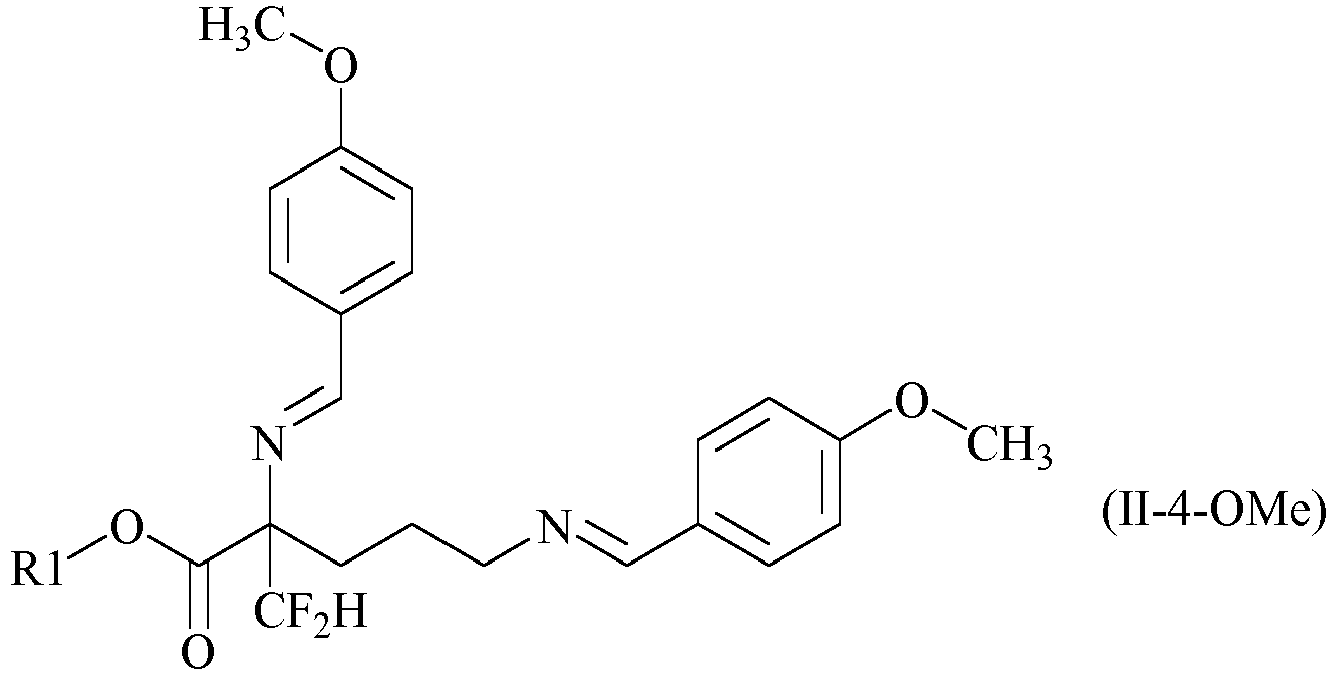


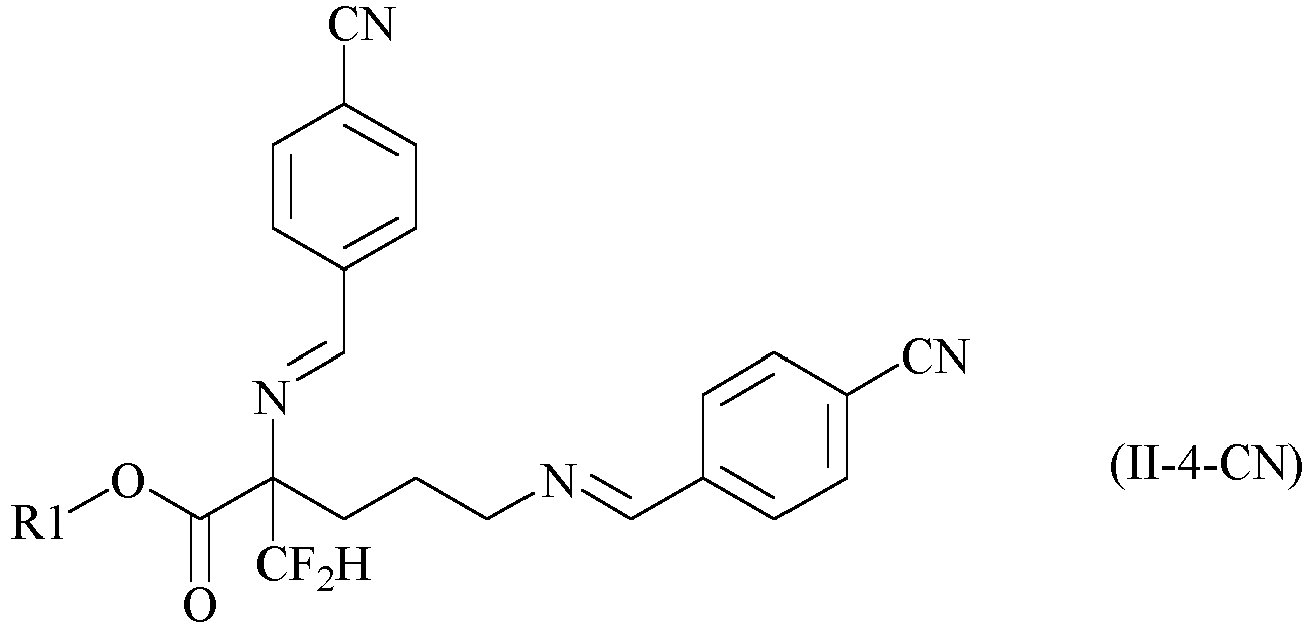


- Particular embodiments of compound of formula (I) are selected from the group consisting of compound of formula (I-H), compound of formula (I-3-OMe), compound of formula (I-4-OMe), compound of formula (I-3-Cl), compound of formula (I-4-Cl), compound of formula (I-2-3-Cl), compound of formula (I-4-CN), compound of formula (I-4-Br), compound of formula (I-4-CF3) and compound of formula (I-4-Me);
more in particular compound of formula (I-H), compound of formula (I-4-Cl), compound of formula (I-4-Br) and compound of formula (I-4-CF3);
even more in particular compound of formula (I-H) and compound of formula (I-4-Cl);
with R1 as defined herein, also with all its embodiments, preferably with R1 being methyl.


- Specific embodiments of compound of formula (II) are compound of formula (2-H), compound of formula (2-4-Cl), compound of formula (2-4-Br) and compound of formula (2-4-CF3);
preferably, compound of formula (2-H) and compound of formula (2-4-Cl).


- Specific embodiments of compound of formula (I) are compound of formula (1-H), compound of formula (1-4-Cl), compound of formula (1-4-Br) and compound of formula (1-4-CF3);
preferably, compound of formula (1-H) and compound of formula (1-4-Cl).


- Preferably, in any of the compounds of formula (I) the alpha C atom next to the carboxy residue has the stereochemistry in analogy to the alpha C atom next to the carboxy residue of compound of formula (I-CHIR).
- Preferably, the molar amount of CHF3 in REAC1 is from 1 to 20 times, more preferably from 1.5 to 15 times, even more preferably from 2 to 15 times, of the molar amount of compound of formula (I).
- In another embodiment, the molar amount of CHF3 in REAC1 is from 1 to 20 times, more preferably from 1 to 15 times, even more preferably from 1 to 10 times, especially from 1 to 5 times, more especially from 1 to 3.5 times, even more especially from 1 to 2 times, in particular from 1 to 1.5 times, more in particular from 1 to 1.2 times, even more in particular from 1 to 1.1 times, of the molar amount of compound of formula (I).
- Preferably, the molar amount of LiHMDS in REAC1 is from 1 to 20 times, more preferably from 1.5 to 15 times, even more preferably from 1.75 to 10 times, especially from 1.75 to 5 times of the molar amount of compound of formula (I).
- REAC1 can be done in a solvent SOLV1, SOLV1 is a solvent that is compatible with LiHMDS (lithium bis(trimethylsilyl)amide), compatible means, that is does not react with LiMHDS, that it is inert towards LiHMDS;
preferably, SOLV1 is selected from the group consisting of THF, dioxane, methyl-THF and toluene; more preferably SOLV1 is THF or methyl-THF, even more preferably, SOLV1 is methyl-THF. - Preferably, methyl-THF is 2-methyl-THF.
- Preferably, the weight of SOLV1 in REAC1 is from 1 to 100 times, more preferably from 2 to 50 times, even more preferably from 3 to 30 times, especially from 4 to 20 times, more especially from 4 to 15 times, of the weight of compound of formula (I).
- Preferably, the reaction temperature of REAC1 is from -70 to 100 °C, more preferably from -50 to 80 °C, even more preferably from -30 to 60 °C, especially from -20 to 50 °C, more especially from -20 to 40 °C.
- Preferably, the reaction time of REAC1 is from 1 min to 1 h, more preferably from 2 min to 45 min, even more preferably from 3 min to 30 min.
- The pressure, under which REAC1 is done, can simply be the vapor pressure of the reaction mixture at the chosen reaction temperature at which REAC1 is done. REAC1 can also be done under elevated pressure, which can be applied by use of an inert gas such as nitrogen or argon, or by charging CHF3 with a respective pressure. In case of a continuous reaction set up elevated pressure can also be realized by feeding the reactants against a back pressure regulation device, or elevated pressure can be realized by a combination of these measures.
- Suitable back pressure regulation devices are known to the skilled person and are available on the market, such as from companies like Swagelok Company, Solon, Ohio, US, or Zaiput Flow Technologies, Scottsdale, Arizona, US. It should be a back pressure regulation device with a small dead volume, precise pressure control and large enough channel width to ensure a smooth flow without clogging.
- Preferably, REAC1 is done under atmospheric pressure or under elevated pressure, such as from atmospheric pressure to 500 bar; more preferably, REAC1 is done at a pressure of from 2 bar to 500 bar, even more preferably of from 3 bar to 250 bar, especially of from 5 bar to 100 bar.
- Preferably, REAC1 is done continuously. Compound of formula (I), LiHMDS and CHF3 can be fed by pumping respective feeds through a respective continuously working mixing device MIXDEV, preferably this pumping is done against a back pressure regulation device, which holds the pressure in MIXDEV at a constant level.
- Preferably, compound of formula (I) is mixed with LiHMDS, for this mixing also a continuously working mixing device can be use, then this mixture is mixed, preferably in in MIXDEV, with CHF3, then REAC1 takes place.
- MIXDEV can be any suitable device or installation which can be used for mixing fluids or for mixing fluids with gases for the case that under the reaction conditions CHF3 is in a gaseous state; such suitable devices or installations are known in the state of the art, such as a common branch connection, e.g. a T or Y piece, a static mixing device or a micro reactor, preferably MIXDEV is a static mixing device or a micro reactor.
- Static mixing devices, e.g. static mixers, are well established and widespread in all fields of chemical process technology. It is characteristically for static mixing devices, that, in contrast to dynamic mixing devices, only the media to be mixed are in motion. The liquids or gases are mixed by pump energy only, while the geometrically strong defined mixing elements in the static mixing devices remain in position. Companies such as Fluitec, Seuzachstrasse, 8413 Neftenbach, Switzerland, or Sulzer Ltd, Neuwiesenstrasse 15, 8401 Winterthur, Switzerland, are well known suppliers among others of such static mixing devices.
- Micro reactors, also called micro structured reactors, are devices in which chemical reactions take place in a confinement with typical lateral dimensions below 1 mm; the most typical form of such confinement are micro channels. A micro reactor is a continuous flow reactor. They have been successfully applied in lab, pilot and production scale. E.g. the Fraunhofer Institute for Chemical Technology ICT, Joseph-von-Fraunhofer Strasse 7, 76327 Pfinztal, Germany, develops and offers such micro reactors.
- Preferably, the static mixing device has the form of a tube or a plate containing means that present obstacles for the flow of the reaction mixture and thereby effecting the mixing of the components.
- Preferably, the micro reactor contains micro channels which are arranged in such a way as to effect the mixing of the components.
- Depending on the geometry of MIXDEV, of the velocity of the flow of the components and of the resulting residence time during which the reaction mixture is in MIXDEV, the reaction mixture exiting from MIXDEV can pass through a further device that is providing additional residence time after the mixing itself, such as a tube, thereby additional residence time, that is additional reaction time, in which REAC1 can take place, can be realized.
- After REAC1, compound of formula (II) can be isolated by standard methods such as evaporation of volatile components, distillation, preferably under reduced pressure, extraction, washing, drying, concentration, crystallization, chromatography and any combination thereof, which are known per se to the person skilled in the art.
- Preferably, compound of formula (I) is prepared by a reaction REAC0, wherein compound of formula (V) is reacted with compound of formula (IV); with R1, R2 and R3 as defined herein, also with all their embodiments.


- Preferably, compound of formula (V) is the respective ester of ornithine.
- Preferably, compound of formula (V) is used in form of its dihydrochloride.
- Preferably, the molar amount of compound of formula (IV) in REAC0 is from 2 to 10 times, more preferably from 2 to 5 times, even more preferably from 2 to 4 times, especially from 2 to 3 times, of the molar amount of compound of formula (V).
- Preferably, REAC0 is done in the presence of a base BASE0; BASE0 is preferably a (C1-4 alkyl)3 amine, more preferably, BASE0 is triethylamine.
- Preferably, the molar amount of BASE0 in REAC0 is from 2 to 5 times, more preferably from 2 to 4 times, even more preferably from 2 to 3 times, of the molar amount of compound of formula (V).
- More preferably, compound of formula (V) is used in form of its dihydrochloride and REAC0 is done in the presence of BASE0.
- REAC0 can be done in a solvent SOLV0;
preferably, SOLV0 is chloroform or dichloromethane, more preferably, SOLV0 is dichloromethane. - Preferably, the weight of SOLV0 in REAC0 is from 4 to 100 times, more preferably from 5 to 50 times, even more preferably from 5 to 40 times, of the weight of compound of formula (V).
- Preferably, the reaction temperature of REAC0 is from -10 to 50 °C, more preferably from -5 to 40 °C, even more preferably from -5 to 30 °C.
- Preferably, the reaction time TIME0 of REAC0 is from 1 to 48 h, more preferably from 5 to 24 h, even more preferably from 10 to 24 h.
- Preferably, REAC0 is done under atmospheric pressure.
- Preferably, REAC0 is done under inert atmosphere, such as nitrogen or argon atmosphere.
- Preferably, when REAC0 is done in the presence of BASE0, BASE0 is mixed with a mixture of compound of formula (IV) and compound of formula (V).
- More preferably, said mixing of BASE0 with the mixture of compound of formula (IV) and compound of formula (V) is done in a mixing time MIXTIME0, MIXTIME0 is from 1 min to 5 h, more preferably from 5 min to 2.5 h, even more preferably from 5 min to 2 h.
- In another embodiment, MIXTIME0 is from 45 min to 5 h, more preferably from 45 min to 2.5 h, even more preferably from 45 min to 2 h, especially from 45 min to 1.5 h.
- Preferably, MIXTIME0 is a part of TIME0; more preferably, said mixing is done at the beginning of TIME0.
- Preferably, the reaction temperature during said mixing, that is during MIXTIME0, is from - 10 to 5 °C, more preferably from -5 to 5 °C, even more preferably from -5 to 2 °C, especially from -2 to 1 °C; and more preferably, after MIXTIME0, that is during the remaining TIME0, the reaction temperature is raised to room temperature.
- REAC0 according to the invention provides for a low content of compound of formula (LACT), with R2 and R3 as defined herein, also with all their preferred embodiments.

- Preferably, compound of formula (LACT) is substituted as desired for REAC1; embodiments of compound of formula (LACT) are compound of formula (LACT-4-H) and compound of formula (LACT-4-Cl).


- After REAC0 compound of formula (I) can be isolated by standard methods known to the skilled person, such a evaporation of solvent, removal of any salt of BASE0 that has formed during REAC0, preferably said removal by precipitation and filtration, concentration of the product in vacuum, crystallization.
- Compound of formula (II) can be converted to compound of formula (3) by a deprotection of compound of formula (II);
preferably by a deprotection of compound formula (II) with an acid in the presence of water. Therefore, further subject of the invention is a method for the preparation of compound of formula (3)
with REAC1 and compound of formula (II) as defined herein, also with all their embodiments. - Preferably, the deprotection is done with an acid and in the presence of water;
preferably, the acid used for the deprotection is ACID2, ACID2 is HCl, H2SO4 or acetic acid; more preferably, ACID2 is HCl. - Compound of formula (3) may be obtained as a salt with one or two equivalents of ACID2, such as compound of formula (III-1ACID2), compound formula (III-2ACID2), in particular compound of formula (3-1HCl), compound formula (3-2HCl).
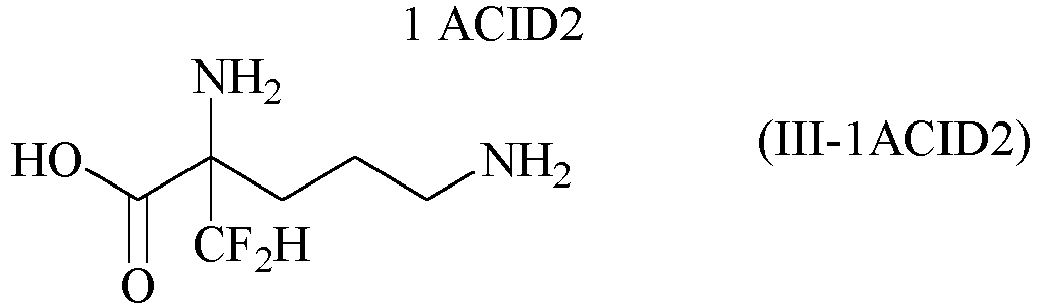


- Compound of formula (3), compound of formula (III-1ACID2) and compound of formula (III-2ACID2) may also crystalize as a hydrate, such as for example as a monohydrate or a dihydrate, for example as compound of formula (3-1HCl-1H2O), the monohydrochloride monohydrate.

- Preferably, Compound of formula (II), that is deprotected, has been prepared by REAC1.
- Compound of formula (II) is protected by three protecting residues, that are the ester residue and the two benzylidene residues. The removal of the three protecting residues by the deprotection can be done consecutively in two or three consecutive deprotection reactions, an example for a consecutive removal of the protecting groups would be the situation when R1 is benzyl and R2 and R3 are benzylidene residues, then R1 can be removed catalytically whereas R2 and R3 can be removed by acidic hydrolysis, or the deprotection of all three protecting residues can be done in one deprotection reaction, for example hen R1 is a C1-4 alkyl residue and R2 and R3 are said benzylidene resisues, then all three protecting group can be removed simultaneously by an acidic hydrolysis. So the deprotection of compound of formula (II) comprises the removal of the alkoxy residue R1-O- in the ester residue to provide the respective acid residue and comprises the removal of the two benzylidene residues from the amino residues.
- Preferably, deprotection is done in one reaction REAC2, that is all protecting residues are removed simultaneously in this one reaction REAC2.
- Preferably, the molar amount of ACID2 for the deprotection is at least 2 times, more preferably at least 3 times, even more preferably at least 4 times, of the molar amount of compound of formula (II).
- Preferably, the molar amount of water for the deprotection is at least 3 times, more preferably at least 4 times, even more preferably at least 5 times, of the molar amount of compound of formula (II).
- Preferably, ACID2 is used in form of an aqueous ACID2;
preferably, the aqueous ACID2 that is used for the deprotection is at least 1 N, more preferably at least 2 N, even more preferably at least 3 N, aqueous ACID2;
preferably, the aqueous ACID2 that is used for the deprotection is from 1 to 13 N, more preferably from 2 to 13 N, even more preferably from 3 to 13 N, aqueous ACID2. - In case that ACID2 is HCl, then preferably HCl conc. is used, such as aqueous HCl 35 wt% or 12 N aqueous HCl.
- Preferably, the reaction temperature of the deprotection is from 50 to 200 °C, more preferably from 75 to 180 °C, even more preferably from 95 to 160 °C.
- In another embodiment, the reaction temperature of the deprotection is preferably from 50 to 200 °C, more preferably from 75 to 180 °C, even more preferably from 95 to 180 °C, especially from 110 to 180 °C, more especially from 130 to 180°C, even more especially from 140 to 180°C, in particular from 140 to 170°C; preferably these ranges of the reaction temperature are applied when the deprotection is done continuously.
- Preferably, the reaction time of the deprotection is from 1 min to 48 h, more preferably from 10 min to 24 h, even more preferably from 30 min to 12 h, especially from 30 min to 6 h, more especially from 30 min to 2 h.
- Preferably, the deprotection is done under atmospheric pressure or under elevated pressure, such as from atmospheric pressure to 500 bar; more preferably such as from atmospheric pressure to to 500 bar, even more preferably such as from atmospheric pressure to 250 bar, especially such as from atmospheric pressure to 100 bar.
- Elevated pressure can be applied by use of an inert gas such as nitrogen or argon.
- The deprotection, in particular REAC2, when the deprotection is done in one reaction REAC2, can be done continuously. REAC1 and the deprotection can both be done continuously and consecutively, this can be done by using the reaction mixture from REAC1 directly as feed for the deprotection.
- The pressure, under which the deprotection is done, can be the vapor pressure of the reaction mixture at the chosen temperature, or, when the deprotection is done continuously, especially when REAC1 and the deprotection are done continuously and consecutively, then the pressure, under which the deprotection is done, can be the pressure chosen and set by the back pressure regulation device against which the pumping of the feeds is done, as described herein.
- After the deprotection, compound of formula (3) can be isolated by standard methods such as evaporation of volatile components, extraction, washing, drying, concentration, crystallization, chromatography and any combination thereof, which are known per se to the person skilled in the art.
- Further subject of the invention are compound of formula (2-4-Cl), compound of formula (2-4-Br) and compound of formula (2-4-CF3).
- L-ornithine methyl ester dihydrochloride: purchased from Fluorochem Ltd, www.fluorochem.co.uk, Catalogue number 429762, (S)-Methyl 2,5-diaminopentanoate dihydrochloride, CAS 40216-82-8
4-chlorobenzaldehyde: 97% purity, Sigma Aldrich
lithium bis(trimethylsilyl)amide: 1 M solution in THF, Sigma Aldrich
fluoroform: 99.995% purity, Messer Group GmbH, Bad Soden, Germany
2 methyltetrahydrofuran anhydrous: ≥99% purity, inhibitor free, Acros Organics BVBA, Belgium
tetrahydrofuran anhydrous: ≥99%, Acros Organics BVBA, Belgium
concentrated HCl: 35% in water, VWR International Ltd., UK
dichloromethane: >98% purity, VWR International Ltd., UK
chloroform: 99.2% purity, VWR International Ltd., UK
trimethylamine: ≥99%, Riedel de Haën (Honeywell Specialty Chemicals Seelze GmbH, Germany) - 1H and 13C NMR spectra were recorded on a 300 MHz instrument. Chemical shifts (delta) are expressed in ppm downfield from TMS as an internal standard. The letters s, d, t, q, and m are used to indicate singlet, doublet, triplet, quadruplet, and multiplet, respectively. Trifluorotoluene was used as internal standard for 19F NMR.
- A dry 20 mL vessel with magnetic stirring bar was charged with 1.530 g (7.00 mmol, 1.0 eq) L-ornithine methyl ester dihydrochloride, sealed and flushed with argon three times. 7 mL CHCl3 was added to afford a 1 M solution followed by the addition of 1.42 mL (13.93 mmol, 1.99 eq) benzaldehyde. The resulting stirred solution was cooled to 0 °C. After adding 2.13 mL (15.4 mmol, 2.2 eq) triethylamine over 10 min, the mixture was gradually warmed to room temperature and stirred for 24 h at RT. The reaction mixture was filtered through Na2SO4 and the obtained light yellow filtrate was concentrated under vacuum and treated with Et2O to precipitate Et3N·HCl. The formed colourless precipitate was filtered off and the obtained filtrate was concentrated in vacuum to give compound of formula (1). Yield: 2.2136 g (6.87 mmol, 98%), yellow viscous oil.
1H-NMR (300 MHz, CDCl3): delta = 7.68-7.56 (m, 4H), 7.47-7.29 (m, 12H), 7.20-7.08 (m, 4H), 4.10 (dd, 3JHH= 8.0 Hz, 3JHH= 5.2 Hz, 1H), 3.71 (s, 3H), 3.33 (t, 3JHH = 6.8 Hz, 2H), 2.07-1.88 (m, 2H), 1.79-1.54 (m, 2H). -
Fig. 1 shows an exemplary reactor set up that can be used to prepare continuously a compound of formula (II). - The complete reactor setup as shown in
Fig 1 was flushed with pure solvent by pumping dry THF with the pump P1 and a flow rate FR1 of 250 microliter/min and with the pump P2 and a flow rate FR2 of 250 microliter/min through respective injection loops FL1 (0.8 mm inner diameter, 1.59 mm outer diameter, internal volume 2.0 mL) and FL2 (0.8 mm inner diameter, 1.59 mm outer diameter, internal volume 2.5 mL) via a first Y shaped connector YSC1 into a first residence loop RL1 (1/16 inch outer diameter; 0.8 mm inner diameter; 2.0 mL residence volume) and onwards through a second residence loop RL2 (1/16 inch outer diameter; 0.8 mm inner diameter; 6.1 mL residence volume), a third residence loop RL3 (1/8 inch outer diameter; 1.6 mm inner diameter; 2.0 mL residence volume) and a device for back pressure regulation BPR, between RL1 and RL2 additionally CHF3 was fed from a pressurized bottle into the stream via a second Y shaped connector YSC2 with a flow rate FR3 of 8.3 mL/min, until the internal pressure of the set up reached 12 bar, this process took ca. 10 min. - Compound of formula (1), prepared according to example 1, (1.00 mmol), was dissolved in neat THF and diluted to 2.00 mL (0.5 mol/L, 1 eq) with THF and served as feed FEED1 via pump P1.
- A LiHMDS solution (1.0 mol/L, 2.5 mL, 2 eq) in THF was used as feed FEED2 via pump P2.
- Pumping of FEED1 was started 1 min prior to FEED2. Both feeds were pumped through their respective FL1 and FL2 through YSC1 which was located in a cooling bath with the temperature of -30 °C.
- Flow rate FR1 and flow rate FR2 were 250 microliter/min.
- The combined mixture then passed through RL1, which was located in a cooling bath having a temperature of -30°C. The resulting reaction mixture stream was brought to contact with a third feed FEED3, which was CHF3, and which was fed at FR3 of 8.3 mL/min (gas flow at normal conditions; corresponds to 3 eq of CHF3) into YSC2, which was located in a cooling bath having a temperature of -15°C, the resulting reaction mixture stream then passed on through RL2, which was located in a cooling bath having a temperature of -15°C, exiting TR2 the reaction mixture stream was then warmed by its passing through RL3, which was located in a bath having a temperature of 25°C, and was collected after having passed through BPR, that held the pressure in the set up at 12 bar. The yield as determined by 19F-NMR in this reaction mixture, which had been collected after having passed through BPR, was > 95%.
- The dimensions of TR1, TR2 and TR3 together with the flow rates FR1, FR2 FR3 resulted in a residence time RES1 in TR1 of 4 min, in a residence time RES2 in TR2 of 12 min and in a residence time RES3 in TR3 of 4 min.
- The reaction mixture comprising compound of formula (2) was dried in vacuum and diluted with 10 mL Et2O. After a filtration the filtrate was concentrated in vacuum and treated with 10 mL 6 N HCl. The reaction mixture was heated to 150 °C for 45 min in the microwave reactor (Biotage Initiator+ single mode microwave instrument) and washed with Et2O (2 times with 20 mL). The aqueous layer was mixed with activated carbon which was subsequently filtered off. After concentrating the crude product in vacuum it was recrystallized from MeOH/EtOH.
- Yield of compound of formula (3-2HCl): 194 mg (0.76 mmol, 76%) colourless powder mp 228 °C
1H-NMR (300.36 MHz, D2O): delta = 6.33 (t, 2JHF = 53.2 Hz, 1H), 3.02 (t, 3JHH = 7.6 Hz, 2H), 2.16-1.53 (m, 4H)
13C NMR (75 MHz, D2O): delta = 168.8(d, 3JCF = 5.9 Hz), 114.9 (dd, 1JCF = 248.4 Hz, 1JCF = 246.0 Hz), 65.1 (dd, 2JCF = 21.3 Hz, 2JCF = 16.6 Hz), 38.7, 27.7 (d, 3JCF = 5.0 Hz), 20.9 19F NMR (282 MHz, D2O): delta = 126.83 (dd, 2JFF = 281.6 Hz, 2JHF = 52.6 Hz), -132.39 (dd, 2JFF = 281.6 Hz, 2JHF = 53.8 Hz) - Example 2 was repeated with the differences as given in Table 1. The yield was determined by 19F-NMR in the reaction mixture which was collected after having passed through BPR. (x) In examples 3 to 7 the FEED1 was 0.25 M N-benzylidene-protected methyl ornithine in THF.
Table 1 Ex FEED1 FEED2 FEED3 RES1/RES2/RES3 T LiHMDS CHF3 Yield ml/min ml/min ml/min min °C eq eq % 2 0.25 0.25 8.3 4/12/4 -15 2 3 >95 3(x) 1.0 1.0 33 1/3/1 -15 4 6 >95 4(x) 0.8 1.2 27 1/3/1 -15 6 6 >95 5(x) 1.0 1.0 22 1/3/1 -15 4 4 >95 6(x) 1.0 1.0 44 1/3/1 -15 4 8 >95 7(x) 1.0 1.0 33 1/3/1 25 4 6 >95 8 0.8 1.2 27 1/3/1 -15 3 3 87 - Various protecting groups for the NH2-residues of ornithine methyl ester were applied using different benzaldehyde analogues. As the obtained bisimines are not stable towards chromatography, the yield and purity was determined through 1H NMR using nitromethane as internal standard.
- A dry 10 mL round bottom flask with magnetic stirring bar was charged with (S)-methyl 2,5-diaminopentanoate dihydrochloride (0.50 g, 2.282 mmol) and the corresponding benzaldehyde derivative compound of formula (IV) (2 equiv, 4.564 mmol), sealed and flushed with argon three times. Chloroform (5 mL) was added and the stirred, colorless reaction mixture was cooled to 0 °C. After addition of triethylamine (632 microliter, 4.564 mmol, 2 equiv) over 10 min the reaction mixture was allowed to warm to room temperature and stirred for 18 h. The solvent was removed under reduced pressure. The slightly yellow residue was treated with Et2O to precipitate Et3N·HCl. The formed colorless precipitate was filtered off and the obtained filtrated was concentrated in vacuo. The residue was checked for yield and purity with 1H NMR. Result are shown on Table 2.
Table 2 Entry Compound of formula (I) with R1 = OMe Melting point [°C] Yield [%](a) 1 R2 = 3-OMe / R3 = H formula (I-3-OMe) (b) 65 2 4-OMe / R3 = H formula (I-4-OMe) (b) 88 3 3-Cl / R3 = H formula (I-3-Cl) (b) 81 4 4-Cl / R3 = H formula (1-4-Cl) 89-91 92 5 R2 = 2-Cl / R3 = 3-Cl formula (I-2-3-Cl) (b) 87 6 4-CN / R3 = H formula (I-4-CN) (b) 82 7 4-Br / R3 = H formula (1-4-Br) 74 to 77 92 8 4-CF3 / R3 = H formula (1-4-CF3) (b) 93 9 4-Me / R3 = H formula (I-4-Me) 66 to 69 85 (a): Analyzed by 1H NMR via internal standard (CH3NO2), corrected for purity
(b) liquid at RT - A dry 2 L round bottom flask with magnetic stirring bar was charged with (S)-methyl 2,5-diaminopentanoate dihydrochloride (25.0 g, 114 mmol) and 4-chlorobenzaldehyde (24.2 g, 240 mmol), sealed and flushed with argon three times. Anhydrous dichloromethane (750 mL) was added and then the reaction mixture was stirred. The colorless reaction mixture was cooled to 0 °C. After addition of triethylamine (33.2 mL, 240 mmol) over 1 h, the reaction mixture was allowed to warm to room temperature and was stirred for 18 h. The solvent was removed under reduced pressure. The off-white residue was treated with Et2O to precipitate Et3N·HCl. The formed colorless precipitate was filtered off and the obtained filtrate was concentrated in vacuo. The obtained off-white residue was recrystallized from petrol ether/EtOAc to provide the desired compound of formula (1-4-Cl) as colorless crystalline solid (41.1 g, 105 mmol, 92% yield)
mp. 89-92 °C
1H NMR (500 MHz, CDCl3) delta 8.26 (dd, J = 11.6, 5.6 Hz, 2H), 7.75-7.70 (m, 2H), 7.67-7.63 (m, 2H), 7.43-7.35 (m, 4H), 4.06 (dd, J = 8.4, 5.3 Hz, 1H), 3.76 (s, 3H), 3.65 (t, J = 6.7 Hz, 2H), 2.16 - 2.07 (m, 1H), 2.06 - 1.94 (m, 1H), 1.81 - 1.66 (m, 2H) ppm
13C NMR (75 MHz, CDCl3) delta 172.4, 162.2, 159.9, 137.3, 136.6, 134.7, 134.2, 129.8, 129.3, 129.0, 128.9, 73.3, 61.2, 52.3, 31.3, 27.4 ppm - To determine stability of compound of formula (1-4-Cl), eight NMR tubes were charged with 100 mg of compound of formula (1-4-Cl) and 10 mg CH3NO2 as internal standard, sealed with a cap and stored at -30 °C. The purity of samples was then determined by 1H NMR over the course of 10 days. There was no significant degradation of compound of formula (1-4-Cl) detected.
- Therefore compound of formula (1-4-Cl) could be stored for prolonged periods of time under argon at low temperatures (-30 °C) without degradation, and it was bench stable at room temperatures for at least 2 weeks.
- Water content was determined by Karl Fischer titration on a Metrohm Coulometer "Aquaster Combi Coulomat fritless", a concentration of 1475 ppm H2O was found.
-
Fig. 2 shows an exemplary reactor set up that can be used to prepare continuously a compound of formula (3). - The reactor set up of
Fig 2 consisted of three continuously working syringe pumps (2 × Asia Syrris, that are pump P1 and pump P2, 1 × HighTec Zang Syrdos, that is pump P4) to introduce a solution of compound of formula (1-4-Cl) in 2-MeTHF (FEED1), a commercial solution of LiHMDS (1.0 M in THF, Sigma-Aldrich) (FEED2) and concentrated HCl (35 wt% in water) (FEED4). FEED1, FEED2 and FEED4 were directly pumped through the syringe pumps. To start the experiment, the complete reactor setup was flushed by pumping dry 2-MeTHF with flow rates of FEED1 = 0.8 mL/min and FEED2 = 1.2 mL/min. HCl was introduced with FEED4 = 1 mL/min. Fluoroform was introduced into the reactor with a flow rate of 9.23 mL/min (1.05 equiv) using a calibrated mass flow controller (MFC) of Bronkhorst. The internal pressure of the reactor reached the target pressure of 12 bar after approximately 10 min. - Compound of formula (1-4-Cl) (100 mmol) was dissolved in neat 2-MeTHF and diluted to 200 mL in two volumetric flasks with 2-MeTHF (FEED1, 0.5 M). A LiHMDS solution (1.0 M, 800 mL) in THF was used as FEED2. FEED1 and FEED2 pumped directly through the syringe pumps were combined in a Y-shaped connector YSC1 (Y Assembly PEEK 1/4-28 0.040 in) in a cooling bath (-30 °C). The combined mixture went through a first residence loop RL1 at -30 °C (1/8 in outer diameter.; 0.8 mm inner diameter; residence volume V1 = 4.0 mL), before the mixture was combined with fluoroform in a Syrris Asia glass static mixer M1 (1 mL internal volume). The mixture then went through a second residence loop RL2 at 25 °C (1/8 in outer diameter; 0.8 mm inner diameter; residence volume V2 = 14 mL) and were mixed with FEED4 in a T-shaped connector TSC1 (T Assembly PTFE 1/4-28 0.040 in). The combined stream then went through a third residence loop RL3 at 160 °C (1/8 in. outer diameter; 0.8 mm inner diameter; residence volume V3 = 40 mL) and left the flow system through an adjustable back pressure regulator BPR (Zaiput BPR-10). The run was conducted for 4 h with a throughput of 24 mmol/h.
- "The employed back pressure rose from 12 to 15 bar.
- Residence time in the total reactor set up was 23 min.
- The biphasic reaction mixture was collected for 3.5 h (84 mmol) and the aqueous phase was washed with Et2O and concentrated under reduced pressure. The crude product was dissolved in a small amount of H2O and the pH was adjusted to 4 with Et3N. The resulting slurry was filtered and washed with cold EtOH abs. and CHCl3. The residue was recrystallized from EtOH/H2O to give alpha difluoromethylornithine monohydrochloride monohydrate as colourless powder. (17.05 g, 72.3 mmol, 86% yield).
Mp. 228 °C
1H NMR (300.36 MHz, D2O): delta = 6.46 (t, 2JHF = 52.8 Hz, 1H), 3.05 (t,3JHH = 7.6 Hz, 2H), 2.25-1.97 (m, 2H), 1.96-1.79 (m, 1H), 1.76-1.59 (m, 1H) ppm
13C NMR (75 MHz, D2O): delta = 167.8 (d, 3JCF = 6.4 Hz), 114.0 (dd, 1JCF = 249.7 Hz, 1JCF = 247.0 Hz), 64.5 (dd, 2JCF = 20.4 Hz, 2JCF = 18.7 Hz), 38.8 (d, 3JCF = 7.3 Hz), 31.6 (d, 4JCF = 3.2 Hz), 20.8 ppm
19F NMR (282 MHz, D2O): delta = -126.28 (dd, 2JFF = 283.5 Hz, 2JHF = 52.4 Hz), -131.76 (dd, 2JFF = 283.5 Hz, 2JHF = 52.4 Hz) ppm - Conversion from compound of formula (2-4-Cl) to its fully deprotected analogue was measured by 1H NMR via integration of base line separated CHF2-peaks of compound of formula (2-4-Cl) and its fully deprotected analogue of dried residue, conversion was > 99%.
Claims (16)
- Method for the preparation of compound of formula (II)

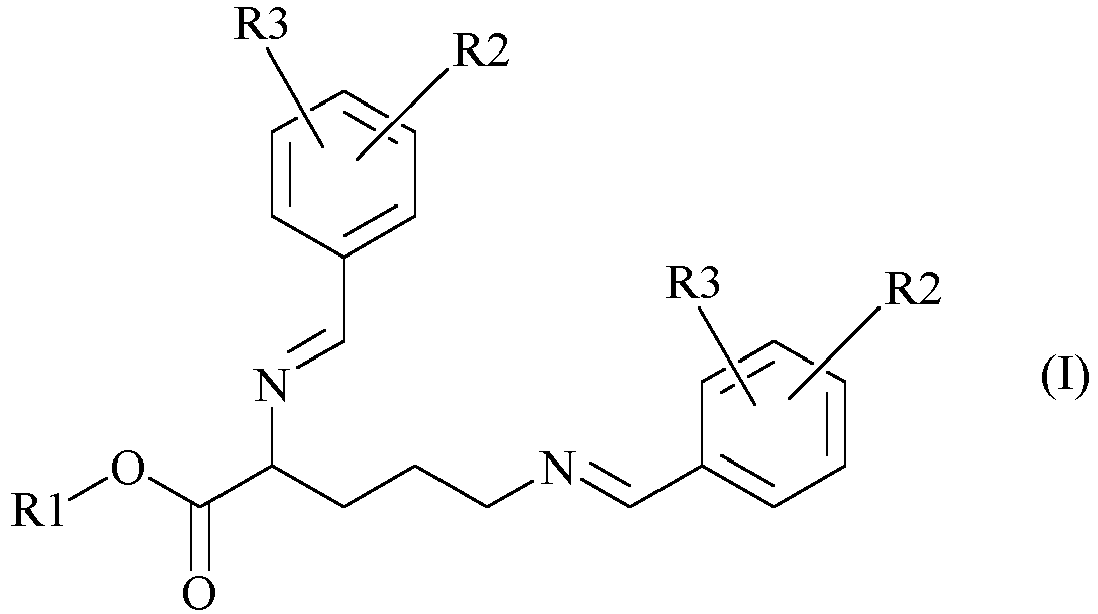 R1 is C1-4 alkyl or benzyl;R2 and R3 are identical or different and are selected from the group consisting of H, C1-4 alkoxy, F, Cl, Br, I, NO2, CN, CF3, OH and C1-4 alkyl.
 - Method according to claim 1, wherein
R1 is methyl, ethyl, isopropyl, n-butyl or benzyl. - Method according to claim 1 or 2, wherein
R2 and R3 are selected from the group consisting of H, C1-4 alkoxy, F, Cl, Br, CN, CF3 and C1-4 alkyl. - Method according to one or more of claims 1 to 3, wherein
REAC1 is done in a solvent SOLV1, SOLV1 is a solvent that is compatible with lithium bis(trimethylsilyl)amide. - Method according to one or more of claims 1 to 4, wherein
REAC1 is done continuously. - Method according to one or more of claims 1 to 5, wherein
compound of formula (I) is prepared by a reaction REAC0, wherein
compound of formula (V) is reacted with compound of formula (IV);
with R1, R2 and R3 as defined in claim 1.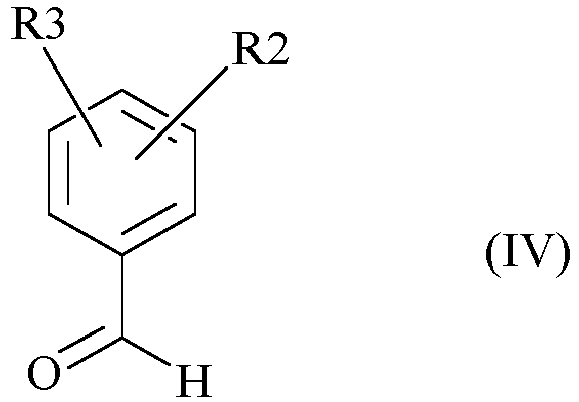

- Method according to claim 6, wherein
REAC0 is done in the presence of a base BASE0. - Method according to claim 7, wherein
BASE0 is a (C1-4 alkyl)3 amine. - Method according to one or more of claims 6 to 8, wherein
REAC0 is done in a solvent SOLV0. - Method according to claim 9, wherein
SOLV0 is chloroform or dichloromethane. - Method for the preparation of compound of formula (3)

with REAC1 and compound of formula (II) as defined in claim 1. - Method according to claim 11, wherein
the deprotection is done with an acid and in the presence of water. - Method according to claim 12, wherein
the acid used for the deprotection is ACID2, ACID2 is HCl, H2SO4 or acetic acid. - Method according to one or more of claims 11 to 13, wherein
the deprotection is done continuously. - Method according to one or more of claims 11 to 14, wherein
REAC1 and the deprotection are both done continuously and consecutively. - Compound of formula (2-4-Cl), compound of formula (2-4-Br) and compound of formula (2-4-CF3).


Applications Claiming Priority (5)
| Application Number | Priority Date | Filing Date | Title |
|---|---|---|---|
| US201762562546P | 2017-09-25 | 2017-09-25 | |
| EP17192830 | 2017-09-25 | ||
| EP18151701 | 2018-01-15 | ||
| EP18194996 | 2018-09-18 | ||
| PCT/EP2018/075724 WO2019057951A1 (en) | 2017-09-25 | 2018-09-24 | Method for preparation of difluoromethylornithine |
Publications (2)
| Publication Number | Publication Date |
|---|---|
| EP3634943A1 EP3634943A1 (en) | 2020-04-15 |
| EP3634943B1 true EP3634943B1 (en) | 2020-09-09 |
Family
ID=63713845
Family Applications (1)
| Application Number | Title | Priority Date | Filing Date |
|---|---|---|---|
| EP18779608.1A Active EP3634943B1 (en) | 2017-09-25 | 2018-09-24 | Method for preparation of difluoromethylornithine |
Country Status (6)
| Country | Link |
|---|---|
| US (1) | US20200148627A1 (en) |
| EP (1) | EP3634943B1 (en) |
| JP (1) | JP6781858B1 (en) |
| CN (1) | CN111094236A (en) |
| TW (1) | TW201927743A (en) |
| WO (1) | WO2019057951A1 (en) |
Families Citing this family (1)
| Publication number | Priority date | Publication date | Assignee | Title |
|---|---|---|---|---|
| CN113072456B (en) * | 2021-04-12 | 2022-04-19 | 中国科学技术大学 | Chiral alpha-difluoromethyl amino acid compound and preparation method thereof |
Family Cites Families (3)
| Publication number | Priority date | Publication date | Assignee | Title |
|---|---|---|---|---|
| US4330559A (en) * | 1977-07-11 | 1982-05-18 | Merrell-Toraude Et Cie | Method of treating benign prostatic hypertrophy |
| US4413141A (en) * | 1977-07-11 | 1983-11-01 | Merrell Toraude Et Compagnie | 2-(Difluoromethyl)-2,5-diaminopentanoic acid |
| US6998502B1 (en) * | 2002-09-05 | 2006-02-14 | Sabinsa Corporation | Convenient process of manufacture for difluoromethylornithine and related compounds |
-
2018
- 2018-09-20 TW TW107133146A patent/TW201927743A/en unknown
- 2018-09-24 WO PCT/EP2018/075724 patent/WO2019057951A1/en not_active Ceased
- 2018-09-24 US US16/631,383 patent/US20200148627A1/en not_active Abandoned
- 2018-09-24 CN CN201880051465.6A patent/CN111094236A/en active Pending
- 2018-09-24 JP JP2020501496A patent/JP6781858B1/en not_active Expired - Fee Related
- 2018-09-24 EP EP18779608.1A patent/EP3634943B1/en active Active
Non-Patent Citations (1)
| Title |
|---|
| None * |
Also Published As
| Publication number | Publication date |
|---|---|
| US20200148627A1 (en) | 2020-05-14 |
| EP3634943A1 (en) | 2020-04-15 |
| JP2020535111A (en) | 2020-12-03 |
| TW201927743A (en) | 2019-07-16 |
| WO2019057951A1 (en) | 2019-03-28 |
| CN111094236A (en) | 2020-05-01 |
| JP6781858B1 (en) | 2020-11-04 |
Similar Documents
| Publication | Publication Date | Title |
|---|---|---|
| GB2048852A (en) | Derivatives of glycinamide | |
| HU227420B1 (en) | Produce for resolving of levobupivacaine and its derivates | |
| EP3652150B1 (en) | Process for preparing n-methyl(meth)acrylamide | |
| US6998502B1 (en) | Convenient process of manufacture for difluoromethylornithine and related compounds | |
| TW201934565A (en) | Process for preparing phosphorus-containing [alpha]-aminonitriles | |
| Im et al. | Nucleophilic behaviour of DBU and DBN toward acetylated Baylis-Hillman adducts | |
| US5554753A (en) | Catalytic enantioselective synthesis of α-amino acid derivatives by phase-transfer catalysis | |
| JPS6228954B2 (en) | ||
| US20200148627A1 (en) | Method for preparation of difluoromethylornithine | |
| Kuźnik et al. | 1-(N-Acylamino)-1-triphenylphosphoniumalkylphosphonates: General synthesis and prospects for further synthetic applications | |
| EP2807145A1 (en) | A method for the preparation of diazoalkanes | |
| US5183915A (en) | Catalyst and process for the production of 3-cyano-3,5,5-trialkylcyclohexanone | |
| JPH07316103A (en) | Preparation of aminomethylene compound | |
| Hassner et al. | Attempted generation of azacyclopropenones a new route to nitriles | |
| US4354029A (en) | Preparation of 2-substituted-2-oxazolines with organic zinc salt catalysts | |
| KR102224090B1 (en) | Improved method for producing specific oximes and oximethers | |
| De Kimpe et al. | Synthesis of 1-amino-2, 2-dialkylcyclopropanecarboxylic acids from β-chloroaldimines | |
| HK40024547A (en) | Method for preparation of difluoromethylornithine | |
| Rouhi-Saadabad et al. | Facile and direct synthesis of symmetrical acid anhydrides using a newly prepared powerful and efficient mixed reagent | |
| WO2010010113A1 (en) | Novel synthesis of substituted 4-amino-pyrimidines | |
| JP2006520345A (en) | Preparation of 2-cyano-3-hydroxy-N- (phenyl) but-2-enamide | |
| US6740774B1 (en) | Preparation of N-acylamino acid esters and N-acylamino acetals | |
| JP2004511548A (en) | Method for preparing N-substituted 2-sulfanilimidazole | |
| White et al. | N-Nitroso-and N-nitrotrialkylureas and their decomposition | |
| EP4450482A1 (en) | Hydrochlorination of alkenes under mild conditions |
Legal Events
| Date | Code | Title | Description |
|---|---|---|---|
| STAA | Information on the status of an ep patent application or granted ep patent |
Free format text: STATUS: UNKNOWN |
|
| STAA | Information on the status of an ep patent application or granted ep patent |
Free format text: STATUS: THE INTERNATIONAL PUBLICATION HAS BEEN MADE |
|
| PUAI | Public reference made under article 153(3) epc to a published international application that has entered the european phase |
Free format text: ORIGINAL CODE: 0009012 |
|
| STAA | Information on the status of an ep patent application or granted ep patent |
Free format text: STATUS: REQUEST FOR EXAMINATION WAS MADE |
|
| 17P | Request for examination filed |
Effective date: 20200109 |
|
| AK | Designated contracting states |
Kind code of ref document: A1 Designated state(s): AL AT BE BG CH CY CZ DE DK EE ES FI FR GB GR HR HU IE IS IT LI LT LU LV MC MK MT NL NO PL PT RO RS SE SI SK SM TR |
|
| AX | Request for extension of the european patent |
Extension state: BA ME |
|
| RIC1 | Information provided on ipc code assigned before grant |
Ipc: C07C 249/02 20060101ALI20200414BHEP Ipc: C07C 227/18 20060101ALI20200414BHEP Ipc: C07C 251/24 20060101ALI20200414BHEP Ipc: C07C 229/26 20060101AFI20200414BHEP |
|
| GRAP | Despatch of communication of intention to grant a patent |
Free format text: ORIGINAL CODE: EPIDOSNIGR1 |
|
| STAA | Information on the status of an ep patent application or granted ep patent |
Free format text: STATUS: GRANT OF PATENT IS INTENDED |
|
| INTG | Intention to grant announced |
Effective date: 20200525 |
|
| GRAS | Grant fee paid |
Free format text: ORIGINAL CODE: EPIDOSNIGR3 |
|
| GRAA | (expected) grant |
Free format text: ORIGINAL CODE: 0009210 |
|
| STAA | Information on the status of an ep patent application or granted ep patent |
Free format text: STATUS: THE PATENT HAS BEEN GRANTED |
|
| AK | Designated contracting states |
Kind code of ref document: B1 Designated state(s): AL AT BE BG CH CY CZ DE DK EE ES FI FR GB GR HR HU IE IS IT LI LT LU LV MC MK MT NL NO PL PT RO RS SE SI SK SM TR |
|
| DAV | Request for validation of the european patent (deleted) | ||
| DAX | Request for extension of the european patent (deleted) | ||
| REG | Reference to a national code |
Ref country code: GB Ref legal event code: FG4D |
|
| REG | Reference to a national code |
Ref country code: AT Ref legal event code: REF Ref document number: 1311393 Country of ref document: AT Kind code of ref document: T Effective date: 20200915 Ref country code: CH Ref legal event code: EP |
|
| REG | Reference to a national code |
Ref country code: IE Ref legal event code: FG4D |
|
| REG | Reference to a national code |
Ref country code: DE Ref legal event code: R096 Ref document number: 602018007740 Country of ref document: DE |
|
| REG | Reference to a national code |
Ref country code: LT Ref legal event code: MG4D |
|
| PG25 | Lapsed in a contracting state [announced via postgrant information from national office to epo] |
Ref country code: HR Free format text: LAPSE BECAUSE OF FAILURE TO SUBMIT A TRANSLATION OF THE DESCRIPTION OR TO PAY THE FEE WITHIN THE PRESCRIBED TIME-LIMIT Effective date: 20200909 Ref country code: LT Free format text: LAPSE BECAUSE OF FAILURE TO SUBMIT A TRANSLATION OF THE DESCRIPTION OR TO PAY THE FEE WITHIN THE PRESCRIBED TIME-LIMIT Effective date: 20200909 Ref country code: NO Free format text: LAPSE BECAUSE OF FAILURE TO SUBMIT A TRANSLATION OF THE DESCRIPTION OR TO PAY THE FEE WITHIN THE PRESCRIBED TIME-LIMIT Effective date: 20201209 Ref country code: GR Free format text: LAPSE BECAUSE OF FAILURE TO SUBMIT A TRANSLATION OF THE DESCRIPTION OR TO PAY THE FEE WITHIN THE PRESCRIBED TIME-LIMIT Effective date: 20201210 Ref country code: BG Free format text: LAPSE BECAUSE OF FAILURE TO SUBMIT A TRANSLATION OF THE DESCRIPTION OR TO PAY THE FEE WITHIN THE PRESCRIBED TIME-LIMIT Effective date: 20201209 Ref country code: FI Free format text: LAPSE BECAUSE OF FAILURE TO SUBMIT A TRANSLATION OF THE DESCRIPTION OR TO PAY THE FEE WITHIN THE PRESCRIBED TIME-LIMIT Effective date: 20200909 Ref country code: SE Free format text: LAPSE BECAUSE OF FAILURE TO SUBMIT A TRANSLATION OF THE DESCRIPTION OR TO PAY THE FEE WITHIN THE PRESCRIBED TIME-LIMIT Effective date: 20200909 |
|
| REG | Reference to a national code |
Ref country code: AT Ref legal event code: MK05 Ref document number: 1311393 Country of ref document: AT Kind code of ref document: T Effective date: 20200909 |
|
| REG | Reference to a national code |
Ref country code: NL Ref legal event code: MP Effective date: 20200909 |
|
| PG25 | Lapsed in a contracting state [announced via postgrant information from national office to epo] |
Ref country code: LV Free format text: LAPSE BECAUSE OF FAILURE TO SUBMIT A TRANSLATION OF THE DESCRIPTION OR TO PAY THE FEE WITHIN THE PRESCRIBED TIME-LIMIT Effective date: 20200909 Ref country code: PL Free format text: LAPSE BECAUSE OF FAILURE TO SUBMIT A TRANSLATION OF THE DESCRIPTION OR TO PAY THE FEE WITHIN THE PRESCRIBED TIME-LIMIT Effective date: 20200909 Ref country code: RS Free format text: LAPSE BECAUSE OF FAILURE TO SUBMIT A TRANSLATION OF THE DESCRIPTION OR TO PAY THE FEE WITHIN THE PRESCRIBED TIME-LIMIT Effective date: 20200909 |
|
| PG25 | Lapsed in a contracting state [announced via postgrant information from national office to epo] |
Ref country code: SM Free format text: LAPSE BECAUSE OF FAILURE TO SUBMIT A TRANSLATION OF THE DESCRIPTION OR TO PAY THE FEE WITHIN THE PRESCRIBED TIME-LIMIT Effective date: 20200909 Ref country code: CZ Free format text: LAPSE BECAUSE OF FAILURE TO SUBMIT A TRANSLATION OF THE DESCRIPTION OR TO PAY THE FEE WITHIN THE PRESCRIBED TIME-LIMIT Effective date: 20200909 Ref country code: RO Free format text: LAPSE BECAUSE OF FAILURE TO SUBMIT A TRANSLATION OF THE DESCRIPTION OR TO PAY THE FEE WITHIN THE PRESCRIBED TIME-LIMIT Effective date: 20200909 Ref country code: PT Free format text: LAPSE BECAUSE OF FAILURE TO SUBMIT A TRANSLATION OF THE DESCRIPTION OR TO PAY THE FEE WITHIN THE PRESCRIBED TIME-LIMIT Effective date: 20210111 Ref country code: EE Free format text: LAPSE BECAUSE OF FAILURE TO SUBMIT A TRANSLATION OF THE DESCRIPTION OR TO PAY THE FEE WITHIN THE PRESCRIBED TIME-LIMIT Effective date: 20200909 |
|
| PG25 | Lapsed in a contracting state [announced via postgrant information from national office to epo] |
Ref country code: AT Free format text: LAPSE BECAUSE OF FAILURE TO SUBMIT A TRANSLATION OF THE DESCRIPTION OR TO PAY THE FEE WITHIN THE PRESCRIBED TIME-LIMIT Effective date: 20200909 Ref country code: AL Free format text: LAPSE BECAUSE OF FAILURE TO SUBMIT A TRANSLATION OF THE DESCRIPTION OR TO PAY THE FEE WITHIN THE PRESCRIBED TIME-LIMIT Effective date: 20200909 Ref country code: ES Free format text: LAPSE BECAUSE OF FAILURE TO SUBMIT A TRANSLATION OF THE DESCRIPTION OR TO PAY THE FEE WITHIN THE PRESCRIBED TIME-LIMIT Effective date: 20200909 Ref country code: IS Free format text: LAPSE BECAUSE OF FAILURE TO SUBMIT A TRANSLATION OF THE DESCRIPTION OR TO PAY THE FEE WITHIN THE PRESCRIBED TIME-LIMIT Effective date: 20210109 |
|
| REG | Reference to a national code |
Ref country code: DE Ref legal event code: R097 Ref document number: 602018007740 Country of ref document: DE |
|
| REG | Reference to a national code |
Ref country code: BE Ref legal event code: MM Effective date: 20200930 |
|
| PG25 | Lapsed in a contracting state [announced via postgrant information from national office to epo] |
Ref country code: SK Free format text: LAPSE BECAUSE OF FAILURE TO SUBMIT A TRANSLATION OF THE DESCRIPTION OR TO PAY THE FEE WITHIN THE PRESCRIBED TIME-LIMIT Effective date: 20200909 Ref country code: LU Free format text: LAPSE BECAUSE OF NON-PAYMENT OF DUE FEES Effective date: 20200924 Ref country code: MC Free format text: LAPSE BECAUSE OF FAILURE TO SUBMIT A TRANSLATION OF THE DESCRIPTION OR TO PAY THE FEE WITHIN THE PRESCRIBED TIME-LIMIT Effective date: 20200909 |
|
| PLBE | No opposition filed within time limit |
Free format text: ORIGINAL CODE: 0009261 |
|
| STAA | Information on the status of an ep patent application or granted ep patent |
Free format text: STATUS: NO OPPOSITION FILED WITHIN TIME LIMIT |
|
| 26N | No opposition filed |
Effective date: 20210610 |
|
| PG25 | Lapsed in a contracting state [announced via postgrant information from national office to epo] |
Ref country code: IE Free format text: LAPSE BECAUSE OF NON-PAYMENT OF DUE FEES Effective date: 20200924 Ref country code: DK Free format text: LAPSE BECAUSE OF FAILURE TO SUBMIT A TRANSLATION OF THE DESCRIPTION OR TO PAY THE FEE WITHIN THE PRESCRIBED TIME-LIMIT Effective date: 20200909 Ref country code: BE Free format text: LAPSE BECAUSE OF NON-PAYMENT OF DUE FEES Effective date: 20200930 |
|
| PG25 | Lapsed in a contracting state [announced via postgrant information from national office to epo] |
Ref country code: IT Free format text: LAPSE BECAUSE OF FAILURE TO SUBMIT A TRANSLATION OF THE DESCRIPTION OR TO PAY THE FEE WITHIN THE PRESCRIBED TIME-LIMIT Effective date: 20200909 |
|
| PG25 | Lapsed in a contracting state [announced via postgrant information from national office to epo] |
Ref country code: TR Free format text: LAPSE BECAUSE OF FAILURE TO SUBMIT A TRANSLATION OF THE DESCRIPTION OR TO PAY THE FEE WITHIN THE PRESCRIBED TIME-LIMIT Effective date: 20200909 Ref country code: MT Free format text: LAPSE BECAUSE OF FAILURE TO SUBMIT A TRANSLATION OF THE DESCRIPTION OR TO PAY THE FEE WITHIN THE PRESCRIBED TIME-LIMIT Effective date: 20200909 Ref country code: CY Free format text: LAPSE BECAUSE OF FAILURE TO SUBMIT A TRANSLATION OF THE DESCRIPTION OR TO PAY THE FEE WITHIN THE PRESCRIBED TIME-LIMIT Effective date: 20200909 |
|
| PG25 | Lapsed in a contracting state [announced via postgrant information from national office to epo] |
Ref country code: MK Free format text: LAPSE BECAUSE OF FAILURE TO SUBMIT A TRANSLATION OF THE DESCRIPTION OR TO PAY THE FEE WITHIN THE PRESCRIBED TIME-LIMIT Effective date: 20200909 |
|
| PG25 | Lapsed in a contracting state [announced via postgrant information from national office to epo] |
Ref country code: NL Free format text: LAPSE BECAUSE OF NON-PAYMENT OF DUE FEES Effective date: 20200923 |
|
| PG25 | Lapsed in a contracting state [announced via postgrant information from national office to epo] |
Ref country code: SI Free format text: LAPSE BECAUSE OF FAILURE TO SUBMIT A TRANSLATION OF THE DESCRIPTION OR TO PAY THE FEE WITHIN THE PRESCRIBED TIME-LIMIT Effective date: 20200909 |
|
| PGFP | Annual fee paid to national office [announced via postgrant information from national office to epo] |
Ref country code: GB Payment date: 20230926 Year of fee payment: 6 |
|
| PGFP | Annual fee paid to national office [announced via postgrant information from national office to epo] |
Ref country code: FR Payment date: 20230926 Year of fee payment: 6 Ref country code: DE Payment date: 20230928 Year of fee payment: 6 |
|
| PGFP | Annual fee paid to national office [announced via postgrant information from national office to epo] |
Ref country code: CH Payment date: 20231001 Year of fee payment: 6 |
|
| REG | Reference to a national code |
Ref country code: DE Ref legal event code: R119 Ref document number: 602018007740 Country of ref document: DE |
|
| REG | Reference to a national code |
Ref country code: CH Ref legal event code: PL |
|
| GBPC | Gb: european patent ceased through non-payment of renewal fee |
Effective date: 20240924 |
|
| PG25 | Lapsed in a contracting state [announced via postgrant information from national office to epo] |
Ref country code: DE Free format text: LAPSE BECAUSE OF NON-PAYMENT OF DUE FEES Effective date: 20250401 |
|
| PG25 | Lapsed in a contracting state [announced via postgrant information from national office to epo] |
Ref country code: GB Free format text: LAPSE BECAUSE OF NON-PAYMENT OF DUE FEES Effective date: 20240924 |
|
| PG25 | Lapsed in a contracting state [announced via postgrant information from national office to epo] |
Ref country code: FR Free format text: LAPSE BECAUSE OF NON-PAYMENT OF DUE FEES Effective date: 20240930 |
|
| PG25 | Lapsed in a contracting state [announced via postgrant information from national office to epo] |
Ref country code: CH Free format text: LAPSE BECAUSE OF NON-PAYMENT OF DUE FEES Effective date: 20240930 |