EP3633919B1 - Control method, related device, and system - Google Patents
Control method, related device, and system Download PDFInfo
- Publication number
- EP3633919B1 EP3633919B1 EP18824127.7A EP18824127A EP3633919B1 EP 3633919 B1 EP3633919 B1 EP 3633919B1 EP 18824127 A EP18824127 A EP 18824127A EP 3633919 B1 EP3633919 B1 EP 3633919B1
- Authority
- EP
- European Patent Office
- Prior art keywords
- context
- aware
- data
- definition information
- function
- Prior art date
- Legal status (The legal status is an assumption and is not a legal conclusion. Google has not performed a legal analysis and makes no representation as to the accuracy of the status listed.)
- Active
Links
Images



Classifications
-
- H—ELECTRICITY
- H04—ELECTRIC COMMUNICATION TECHNIQUE
- H04L—TRANSMISSION OF DIGITAL INFORMATION, e.g. TELEGRAPHIC COMMUNICATION
- H04L41/00—Arrangements for maintenance, administration or management of data switching networks, e.g. of packet switching networks
- H04L41/08—Configuration management of networks or network elements
- H04L41/0895—Configuration of virtualised networks or elements, e.g. virtualised network function or OpenFlow elements
-
- G—PHYSICS
- G05—CONTROLLING; REGULATING
- G05B—CONTROL OR REGULATING SYSTEMS IN GENERAL; FUNCTIONAL ELEMENTS OF SUCH SYSTEMS; MONITORING OR TESTING ARRANGEMENTS FOR SUCH SYSTEMS OR ELEMENTS
- G05B15/00—Systems controlled by a computer
- G05B15/02—Systems controlled by a computer electric
-
- G—PHYSICS
- G05—CONTROLLING; REGULATING
- G05B—CONTROL OR REGULATING SYSTEMS IN GENERAL; FUNCTIONAL ELEMENTS OF SUCH SYSTEMS; MONITORING OR TESTING ARRANGEMENTS FOR SUCH SYSTEMS OR ELEMENTS
- G05B17/00—Systems involving the use of models or simulators of said systems
- G05B17/02—Systems involving the use of models or simulators of said systems electric
-
- G—PHYSICS
- G05—CONTROLLING; REGULATING
- G05B—CONTROL OR REGULATING SYSTEMS IN GENERAL; FUNCTIONAL ELEMENTS OF SUCH SYSTEMS; MONITORING OR TESTING ARRANGEMENTS FOR SUCH SYSTEMS OR ELEMENTS
- G05B19/00—Program-control systems
- G05B19/02—Program-control systems electric
- G05B19/418—Total factory control, i.e. centrally controlling a plurality of machines, e.g. direct or distributed numerical control [DNC], flexible manufacturing systems [FMS], integrated manufacturing systems [IMS] or computer integrated manufacturing [CIM]
-
- G—PHYSICS
- G05—CONTROLLING; REGULATING
- G05B—CONTROL OR REGULATING SYSTEMS IN GENERAL; FUNCTIONAL ELEMENTS OF SUCH SYSTEMS; MONITORING OR TESTING ARRANGEMENTS FOR SUCH SYSTEMS OR ELEMENTS
- G05B19/00—Program-control systems
- G05B19/02—Program-control systems electric
- G05B19/418—Total factory control, i.e. centrally controlling a plurality of machines, e.g. direct or distributed numerical control [DNC], flexible manufacturing systems [FMS], integrated manufacturing systems [IMS] or computer integrated manufacturing [CIM]
- G05B19/4183—Total factory control, i.e. centrally controlling a plurality of machines, e.g. direct or distributed numerical control [DNC], flexible manufacturing systems [FMS], integrated manufacturing systems [IMS] or computer integrated manufacturing [CIM] characterised by data acquisition, e.g. workpiece identification
-
- G—PHYSICS
- G06—COMPUTING OR CALCULATING; COUNTING
- G06F—ELECTRIC DIGITAL DATA PROCESSING
- G06F16/00—Information retrieval; Database structures therefor; File system structures therefor
- G06F16/90—Details of database functions independent of the retrieved data types
- G06F16/95—Retrieval from the web
- G06F16/953—Querying, e.g. by the use of web search engines
-
- H—ELECTRICITY
- H04—ELECTRIC COMMUNICATION TECHNIQUE
- H04L—TRANSMISSION OF DIGITAL INFORMATION, e.g. TELEGRAPHIC COMMUNICATION
- H04L41/00—Arrangements for maintenance, administration or management of data switching networks, e.g. of packet switching networks
- H04L41/08—Configuration management of networks or network elements
- H04L41/0803—Configuration setting
- H04L41/0813—Configuration setting characterised by the conditions triggering a change of settings
- H04L41/0816—Configuration setting characterised by the conditions triggering a change of settings the condition being an adaptation, e.g. in response to network events
-
- H—ELECTRICITY
- H04—ELECTRIC COMMUNICATION TECHNIQUE
- H04L—TRANSMISSION OF DIGITAL INFORMATION, e.g. TELEGRAPHIC COMMUNICATION
- H04L41/00—Arrangements for maintenance, administration or management of data switching networks, e.g. of packet switching networks
- H04L41/16—Arrangements for maintenance, administration or management of data switching networks, e.g. of packet switching networks using machine learning or artificial intelligence
-
- H—ELECTRICITY
- H04—ELECTRIC COMMUNICATION TECHNIQUE
- H04L—TRANSMISSION OF DIGITAL INFORMATION, e.g. TELEGRAPHIC COMMUNICATION
- H04L41/00—Arrangements for maintenance, administration or management of data switching networks, e.g. of packet switching networks
- H04L41/40—Arrangements for maintenance, administration or management of data switching networks, e.g. of packet switching networks using virtualisation of network functions or resources, e.g. SDN or NFV entities
-
- H—ELECTRICITY
- H04—ELECTRIC COMMUNICATION TECHNIQUE
- H04L—TRANSMISSION OF DIGITAL INFORMATION, e.g. TELEGRAPHIC COMMUNICATION
- H04L43/00—Arrangements for monitoring or testing data switching networks
- H04L43/20—Arrangements for monitoring or testing data switching networks the monitoring system or the monitored elements being virtualised, abstracted or software-defined entities, e.g. SDN or NFV
-
- H—ELECTRICITY
- H04—ELECTRIC COMMUNICATION TECHNIQUE
- H04L—TRANSMISSION OF DIGITAL INFORMATION, e.g. TELEGRAPHIC COMMUNICATION
- H04L67/00—Network arrangements or protocols for supporting network services or applications
- H04L67/01—Protocols
- H04L67/02—Protocols based on web technology, e.g. hypertext transfer protocol [HTTP]
- H04L67/025—Protocols based on web technology, e.g. hypertext transfer protocol [HTTP] for remote control or remote monitoring of applications
-
- H—ELECTRICITY
- H04—ELECTRIC COMMUNICATION TECHNIQUE
- H04L—TRANSMISSION OF DIGITAL INFORMATION, e.g. TELEGRAPHIC COMMUNICATION
- H04L41/00—Arrangements for maintenance, administration or management of data switching networks, e.g. of packet switching networks
- H04L41/14—Network analysis or design
- H04L41/145—Network analysis or design involving simulating, designing, planning or modelling of a network
-
- H—ELECTRICITY
- H04—ELECTRIC COMMUNICATION TECHNIQUE
- H04L—TRANSMISSION OF DIGITAL INFORMATION, e.g. TELEGRAPHIC COMMUNICATION
- H04L67/00—Network arrangements or protocols for supporting network services or applications
- H04L67/01—Protocols
- H04L67/12—Protocols specially adapted for proprietary or special-purpose networking environments, e.g. medical networks, sensor networks, networks in vehicles or remote metering networks
Definitions
- This application relates to the field of communications technologies, and in particular, to a control method, a device, and a system.
- the system includes a network device 101, a mobile device 103, a sensor 104, and a sensor signal processor 102.
- a specific process of performing intelligent control by the communications system shown in FIG. 1 includes: The sensor 104 is embedded in the mobile device 103.
- the sensor 104 can collect sensor information, where the sensor information includes time information, location information, and the like.
- the mobile device 103 obtains the sensor information collected by the sensor 104 and sends the sensor information to the sensor signal processor 102.
- the sensor signal processor 102 determines the sensor information collected by the sensor 104, to generate a corresponding instruction based on a determining result, and sends the instruction to the network device 101.
- the network device 101 having a data forwarding and control capability can perform intelligent control on the communications system after analyzing the sensor information according to the instruction.
- the mobile device 103 needs to drive the network device 101.
- the sensor 104 installed in the mobile device 103 drives the network device 101 by using the sensor information.
- the communications system cannot provide a proactive service or adaptively change based on a context, and the network device 101 integrates control and forwarding. Consequently, a network control capability is limited, and an entire network cannot be globally and intelligently controlled.
- US 2013/0254833 A1 refers to methods and systems for fine tuning access control by remote, endpoint systems to host systems. Multiple conditions/states of one or both of the endpoint and host systems are monitored, collected and fed to an analysis engine. Using one or more of many different flexible, adaptable models and algorithms, an analysis engine analyzes the status of the conditions and makes decisions in accordance with pre-established policies and rules regarding the security of the endpoint and host system. Based upon the conditions, the policies, and the analytical results, actions are initiated regarding security and access matters.
- US 2009/0240647 A1 refers to systems, apparatus, techniques, and methods for predictively adapting properties of devices as a function of a user's historical behaviors (e.g., habits) as well as the specific context within which such behaviors are displayed.
- Such context can be virtually anything, such as day of the week, time of day, season, tide, temperature, weather, the user's mood, the score of a particular sporting event from the previous day, the phase of the moon, the user's location, etc.
- the user's habits and the context within which those habits occur are observed and the device is customized based on the user's behavioral patterns and the context thereof
- This application provides a control method, a related device, and a system, so that the system has a context-aware capability, and capability of intelligent control on a network is effectively improved. This problem is solved by the subject matter of the independent claims. Further implementation forms are provided in the dependent claims.
- This application provides a control method, a related device, and a system which construct the context-aware model, so that the context-aware engine obtains the target data based on the context-aware model, and sends, to the controller, the indication information used to indicate that the target data meets the trigger condition.
- the controller can perform the preset control. It can be learned that, when performing the preset control, the controller may provide a proactive service based on the context-aware model, and when the control method provided in this application is applied to different scenarios, the controller may configure different context-aware models to be applied to different application scenarios.
- the controller performs network control, and the context-aware engine obtains and forwards the target data, so that the controller performs centralized network control, to obtain a global intelligent control capability, thereby improving efficiency of performing context-aware control by the controller.
- An embodiment of the present invention provides a control method.
- the control method in this embodiment is based on a context-aware system, and in this embodiment, the context-aware system is described with reference to FIG. 2 .
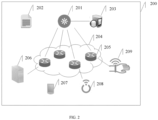
- FIG. 2 is a schematic diagram of a context-aware system according to the present invention.
- the context-aware system 200 shown in FIG. 2 is an internet of things (Internet of Thing, IoT).
- the context-aware system 200 includes, but is not limited to, a controller 201, a context-aware engine 203, an interconnection network 204, a network device 205, a network service device 206, a mobile device 207, a wireless sensor 208, a wearable device 209, and the like.
- the controller 201 in this embodiment of the present invention is described by using a software defined networking (Software Defined Network, SDN) controller as an example.
- SDN Software Defined Network
- the context-aware system 200 in this embodiment of the present invention implements interconnection between things based on the SDN network controller 201. In this way, the context-aware system 200 in this embodiment can sense a data transmission intention more intelligently and more efficiently.
- the SDN network controller 201 in this embodiment of the present invention is a network control device on a network control plane.
- the SDN network controller 201 in this embodiment provides southbound network device management. Specifically, the SDN network controller 201 implements, by using a southbound interface, network device management matters including link discovery, topology management, policy formulation, entry delivery, and the like.
- the SDN network controller 201 in this embodiment provides a northbound network control and orchestration service. Specifically, the SDN network controller 201 enables, through a northbound interface, a network service developer to invoke various network resources in a software programming form, to implement the network control and orchestration service.
- the SDN network controller 201 when the SDN network controller 201 provides the southbound network device management, the SDN network controller 201 communicates with the network device 205 by using a network protocol such as an OpenFlow (OpenFlow, OF) protocol and/or a network configuration protocol (Network Configuration Protocol, NETCONF), to control and configure the network device 205.
- a network protocol such as an OpenFlow (OpenFlow, OF) protocol and/or a network configuration protocol (Network Configuration Protocol, NETCONF)
- the interconnection network 204 included in the context-aware system 200 in this embodiment includes, but is not limited to, a communications network such as a data center network, a wide area network, a wireless network, and the internet of things.
- the interconnection network 204 is configured to provide a basis for communicating with a peripheral system and device.
- the network device 205 included in the context-aware system 200 includes, but is not limited to, a router, a switch, a softswitch, and the like.
- the network device 205 forwards data under control of the SDN network controller 201.
- the SDN network controller 201 serving as the network control plane, intelligently controls forwarding of the network device 205.
- the network service device 206 included in the context-aware system 200 is a device that provides a network data service, and obtains corresponding data information through network access, for example, weather data, traffic information data, and geographic location data of a place.
- the mobile device 207 is not limited to a personal digital assistant (Personal Digital Assistant, PDA), a smartphone, a tablet, a water heater, and the like, and the mobile device 207 interacts with the controller 201 and the context-aware engine 203 by using the interconnection network 204.
- PDA Personal Digital Assistant
- the wireless sensor 208 and the wearable device 209 that are included in the context-aware system 200 may provide sensor data to the context-aware engine 203.
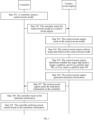
- control method in this embodiment includes the following steps.
- Step 301 A controller creates a context-aware model.
- a defining process of the context-aware model can be implemented in step 301 in this embodiment.
- the context-aware model can be created by using the defining process of the context-aware model.
- the context-aware model in this embodiment models a scenario and a network application by using a domain-specific modeling language, so that the controller having a context-aware capability can proactively drive the network application.
- the network application in this embodiment may be an application on the mobile device 207, or may be an application of the controller.
- the application of the controller may be used to turn on a network, or may be used to turn off a network.
- the network application may be an application used to provide a programming interface to a third party.
- the context-aware model created in this embodiment can enable the context-aware system to have the context-aware capability.
- a specific process of creating the context-aware model may be as follows:
- the controller may first determine a context-aware function that can be supported by the controller, so that the controller may configure the context-aware model based on the context-aware function, and the context-aware system can implement, by using the context-aware model, the context-aware function defined by the context-aware model.
- the context-aware system determines, based on a context-aware model that can clock in/out for a user, whether a current location at which the user is located is in an area in which the company is located. If the current location at which the user is located is in the area in which the company is located, the context-aware system may automatically clock in/out for the user, and in a clock in/out process, the user does not need to perform any operation.
- the controller determines that the context-aware function that can be supported by the controller is: automatically enabling a water heater at a user's home to heat.
- the context-aware system determines, based on a context-aware model that can enable a water heater to heat, whether a distance between a current location of the user and the home is less than a preset value. If yes, the context-aware system can automatically enable the water heater at the user's home to heat, and in a heating process, the user does not need to perform any operation on the water heater.
- This embodiment does not make any limitation on how the controller specifically determines the context-aware function that can be supported by the controller, provided that the controller can configure the context-aware model based on the supported context-aware function.
- the controller in this embodiment may determine a supported context-aware function based on a configuration of the controller.
- the controller may determine a supported context-aware function based on a configuration of a developer.
- the controller may determine a supported context-aware function by using data obtained by a sensor control interface that is of the controller and that is for external exchange.
- the controller needs to exchange information with an external device to create the context-aware model.
- the external device may be the network device 205, the network service device 206, the mobile device 207, the wireless sensor 208, the wearable device 209, or the like.
- a sensor control interface configured to exchange information with the external device is disposed in the controller, so that the controller can receive, by using the sensor control interface, information sent by the external device, and can configure the context-aware model based on the information sent by the external device.
- information that is sent by the external device and that is received by the controller in this embodiment may not be limited in the process of creating the context-aware model. Details are not limited in this embodiment.
- the controller may determine characteristic information used to implement the context-aware function, and set the characteristic information in the context-aware model through text modeling, to be specific, set the characteristic information in a text format in the context-aware model.
- the characteristic information in this embodiment includes any one or more of the following: network entity type definition information, network entity function definition information, data attribute definition information, interface definition information, measurement definition information, data threshold information, frequency definition information, and data precision information.
- the characteristic information includes the network entity type definition information.
- the controller in this embodiment may perform modeling based on an abstract entity, and create a type set, where the type set includes at least one network entity, and all network entities in a same type set have a same network entity type.
- the network entity in this embodiment may be a general name of various devices in the context-aware system, such as a node device, a communications device, a terminal device, a storage device, and other hardware devices that serve the network entity.
- types of all network entities in a type set created by the controller are smartphones, or types of all network entities in a type set are smart televisions, or types of all network entities in a type set are water heaters.
- the controller may determine the network entity type definition information, where the network entity type definition information is used to define a type of a network entity.
- the network entity type definition information defined by the controller can implement the context-aware function.
- the network entity type definition information may be used to define the type of the network entity as a smartphone.
- the network entity type definition information may be used to define the type of the network entity as a wearable device.
- the context-aware engine may collect target data from a target device based on the context-aware model.
- a device type of the target device in this embodiment is consistent with the type defined by the network entity type definition information.
- the network entity type definition information created by the controller may be used to define the type of the network entity as a smartphone carried by a user.
- the context-aware engine can collect, based on the context-aware model, the target data from the smartphone used as the target device.
- the characteristic information includes the network entity function definition information.
- the controller in this embodiment performs modeling based on an attribute of a network entity.
- the controller determines the network entity function definition information, where the network entity function definition information is used to define a function of the network entity.
- the network entity having the function defined by the network entity function definition information may implement the context-aware function in this embodiment.
- the controller can set the network entity function definition information in the context-aware model, so that the context-aware engine collects target data from a target device, where a function of the target device in this embodiment is consistent with the function defined by the network entity function definition information.
- the function defined by the network entity function definition information in this embodiment may be a global positioning system (Global Positioning System, GPS) positioning function, a function of obtaining outdoor temperature data, a function of obtaining a body parameter, or the like.
- the body parameter may be a heartbeat parameter, a body temperature parameter, or the like.
- the controller determines that a context-aware model that can implement a clock in/out function needs to be created, the function defined by the network entity function definition information created by the controller is a GPS positioning function.
- the context-aware engine can collect, based on the context-aware model, data from a target device that has the GPS positioning function.
- the characteristic information includes the data attribute definition information.
- the data attribute definition information in this embodiment is used to define a data type, so that the context-aware engine determines, based on the context-aware model in which the data attribute definition information is set, a data type of the collected target data is consistent with the data type defined by the data attribute definition information.
- the target device may be defined by using the network entity type definition information and/or the network entity function definition information that are/is included in the context-aware model.
- data generated by the target device may include data with a plurality of attributes, such as temperature data, GPS positioning data, signal data, and call data.
- the controller in this embodiment may define, by using the data attribute definition information, an attribute of specific data that needs to be currently collected. For example, in a specific application scenario, if the controller determines that a context-aware model that can implement a clock in/out function needs to be created, the target data defined by the data attribute definition information created by the controller is the GPS positioning data.
- the context-aware engine can collect, from the target device based on the context-aware model, the GPS positioning data generated by the target device.
- the characteristic information includes the interface definition information.
- the controller in this embodiment determines the interface definition information, where the interface definition information is used to define a data interface.
- the interface definition information is used to define a protocol for collecting the target data, such as a wireless fidelity (Wireless-Fidelity, Wi-Fi) protocol, so that the context-aware engine collects the target data based on an interface defined by the interface definition information.
- a protocol for collecting the target data such as a wireless fidelity (Wireless-Fidelity, Wi-Fi) protocol
- the interface definition information created by the controller is the Wi-Fi protocol.
- the context-aware engine can collect the target data based on the context-aware model by using the Wi-Fi protocol.
- the characteristic information includes the measurement definition information.
- the controller in this embodiment determines the measurement definition information, where the measurement definition information is used to define a data measurement unit, so that a measurement unit of the target data collected by the context-aware engine is consistent with the data measurement unit defined by the measurement definition information.
- the measurement definition information created by the controller may be used to define a data unit as degree Celsius.
- the context-aware engine can collect data with a measurement unit of degree Celsius based on the context-aware model.
- the measurement definition information created by the controller may be used to define a data unit as Fahrenheit.
- the context-aware engine can collect, based on the context-aware model, data with a measurement unit of Fahrenheit.
- the characteristic information includes the data threshold information.
- the controller in this embodiment determines the data threshold information, where the data threshold information is used to define a value range of the target data, so that a data range of the target data collected by the context-aware engine is consistent with the data range defined by the data threshold information.
- a value range defined by the data threshold information created by the controller may be higher than 45 degrees Celsius.
- the context-aware engine may determine, based on the data threshold information included in the context-aware model, that the water temperature reported on the water heater is ignored, and the context-aware engine does not analyze the water temperature higher than 45 degrees Celsius based on the context-aware model until when the context-aware engine determines that the water temperature reported on the water heater is higher than 45 degrees Celsius.
- the characteristic information includes the data precision information.
- the controller in this embodiment determines the data precision information, where the data precision information is used to define precision of the target data, so that precision of the target data collected by the context-aware engine is consistent with the data precision defined by the data precision information.
- the data precision defined by the data precision information created by the controller is an integer.
- the context-aware engine can determine, based on the data precision information included in the context-aware model, that the target data is 45, so that precision of the target data is consistent with the data precision defined by the data precision information.
- the controller in this embodiment determines the frequency definition information, where the frequency definition information is used to define frequency of collecting the target data, so that the context-aware engine collects the target data based on the frequency defined by the frequency definition information.
- the frequency definition information created by the controller may be used to define an interval of collecting the target data to be five minutes.
- the context-aware engine can collect, based on the frequency definition information included in the context-aware model, water temperature reported on the water heater once every five minutes.
- the controller further needs to determine a trigger condition and preset control, so that the controller performs the preset control when the target data meets the trigger condition.
- the preset control is a control manner that is defined by the context-aware model and that is used to implement the context-aware function.
- the trigger condition may be: GPS positioning data reported by the terminal device carried by the user indicates that the user is located in an area in which a company is located.
- the preset control may be controlling, by the controller, a server that is configured to clock in/out for an employee and that belongs to the company to perform a clock in/out operation for the user.
- the trigger condition may be: a distance between a location indicated by GPS positioning data reported on the terminal device that is carried by the user and the user's home is less than three kilometers.
- the preset control may be automatically enabling the water heater at the user's home to heat.
- the trigger condition may alternatively be: water temperature reported on the water heater at the user's home is higher than or equal to 45 degrees Celsius. In this case, the preset control may be stopping enabling the water heater at home to heat.
- Step 302. The controller sends the context-aware model to the context-aware engine.
- Step 303 The context-aware engine receives the context-aware model.
- a northbound sensor control interface is disposed in the context-aware engine in this embodiment.
- the context-aware engine exchanges data with the controller through the northbound sensor control interface.
- the context-aware engine receives the context-aware model through the northbound sensor control interface.
- the context-aware engine may parse the context-aware model to read the characteristic information included in the context-aware model. For detailed descriptions of the characteristic information included in the context-aware model, refer to step 301. Details are not described in this embodiment.
- Step 304 The context-aware engine collects the target data based on the context-aware model.
- the context-aware engine may collect the target data based on the characteristic information included in the context-aware model.
- the controller sends the context-aware model to the context-aware engine, so that the context-aware model subscribes to and processes the target data based on the context-aware model.
- a manner in which the context-aware engine processes the target data is not limited in this embodiment, provided that the context-aware system in this embodiment can implement the context-aware function.
- the context-aware engine can parse, filter, and convert the target data based on the context-aware model, so that the target data meets the definition of the context-aware model.
- the context-aware model Based on the characteristic information included in the context-aware model, the following describes how the context-aware model specifically collects the target data.
- the context-aware engine may determine, based on the network entity type definition information, the target device configured to obtain the target data, where the device type of the target device is consistent with the type defined by the network entity type definition information.
- the context-aware engine may determine, based on the network entity function definition information, a function of the target device configured to obtain the target data, where the function of the target device is consistent with the function defined in the network entity function definition information.
- the context-aware engine may collect the target data from the target device based on the data attribute definition information, where the data type of the collected target data is consistent with the data type defined by the data attribute definition information.
- the context-aware engine may collect the target data based on the interface defined by the interface definition information.
- the context-aware engine may collect the target data based on the measurement definition information, so that the measurement unit of the target data collected by the context-aware engine is consistent with the data measurement unit defined by the measurement definition information.
- the context-aware engine may collect the target data based on the data threshold information, so that the data range of the target data collected by the context-aware engine is consistent with the data range defined by the data threshold information.
- the context-aware engine may collect the target data based on the data precision information, so that the precision of the target data collected by the context-aware engine is consistent with the data precision defined by the data precision information.
- the context-aware engine may collect the target data based on the frequency definition information, so that the context-aware engine collects the target data based on the frequency defined by the frequency definition information.
- the context-aware engine can determine, by using the frequency definition information, a time window within which the target data needs to be collected, and the context-aware engine can collect the target data from the target device based on the time window.
- the target data may be streaming sensor data reported by various devices in the context-aware system.
- Step 305 The context-aware engine determines whether the target data meets the trigger condition, and if yes, performs step 306, or if no, returns to perform step 304.
- the trigger condition is a condition created by the context-aware model. For specific descriptions, refer to the foregoing steps. Details are not described in this step.
- the context-aware engine in this embodiment may perform analysis processing on the obtained target data that meets the definition of the context-aware model, to determine whether the target data meets the trigger condition.
- the context-aware engine can calculate the target data based on a preset condition included in the context-aware engine, so that the context-aware engine performs logical reasoning on the target data to determine whether the target data meets the trigger condition.
- the context-aware function implemented by the context-aware model is automatically enabling the water heater at the user's home to heat.
- the trigger condition defined by the context-aware model is reporting indication information when a distance between a geographical location at which the user is currently located and the user's home is less than three kilometers, so that the controller automatically instructs, based on the indication information, the water heater to heat.
- the context-aware engine may obtain, based on information that is used to collect data and that is included in the context-aware model, current geographic location information of the user from a terminal device used by the user, and determine, based on the current geographic location information of the user, whether the distance between a geographic location at which the user is currently located and the user's home is less than three kilometers. If yes, the context-aware engine may determine that the target data meets the trigger condition.
- the context-aware engine determines the target data based not only on the context-aware model but also on data prestored in the context-aware engine.
- the data prestored in the context-aware engine may be a time period within which the user is off duty.
- the context-aware engine may store a time period within which the user is off duty from 7:00 p.m. to 6:00 a.m.
- the context-aware function implemented by the context-aware model is automatically enabling the water heater at the user's home to heat.
- the trigger condition defined by the context-aware model is reporting indication information when a distance between a geographical location at which the user is currently located and the user's home is less than three kilometers, so that the controller automatically instructs, based on the indication information, the water heater to heat.
- the context-aware engine may query data prestored by the context-aware engine to determine whether a current time period is a time period within which the user is off duty. If yes, the context-aware engine may query current geographic location information of the user, or if no, the context-aware engine may not query current geographic location information of the user. It can be learned that when determining that the current time period is the time period within which the user is off duty, the context-aware engine determines whether the target data meets the trigger condition defined by the context-aware model.
- Step 306. The context-aware engine generates the indication information.
- the indication information is used to indicate that the target data obtained by the context-aware engine meets the trigger condition defined by the context-aware model.
- Step 307. The context-aware engine sends the indication information to the controller.
- Step 308. The controller receives the indication information.
- the controller in this embodiment receives, through a northbound sensor control interface, the indication information sent by the context-aware engine.
- Step 309 The controller performs preset control based on the indication information.
- the preset control in this embodiment is a control manner defined by the context-aware model.
- the controller may first generate application configuration information and/or a network control constraint.
- the controller implements the preset control by using the application configuration information and/or the network control constraint.
- the controller may establish, when the context-aware model has been created by the controller, a communication link between a southbound network device interface of the controller and a server configured to clock in/out for the user.
- the controller may determine the preset control that has been defined by the context-aware model.
- the preset control is clocking in/out for the user.
- the controller may send the application configuration information to the server through the established communications link between the controller and the server configured to clock in/out for the user, so that the server can clock in/out for the user.
- the context-aware function implemented by the created context-aware model is data packet transfer, and specifically, the context-aware system includes a plurality of links used to control a network application
- the controller may control the links by using a configured network control constraint.
- the controller may determine the preset control defined by the context-aware model.
- the preset control is transferring a packet on the link to a preset server or discarding a packet on the link, to avoid congestion.
- the controller may control network layer forwarding, a network status, network connectivity, a network device, a device connection, device management, a device protocol, and the like, provided that the context-aware function can be implemented.
- the context-aware model is constructed with reference to a context-aware technology.
- the context-aware model defines the target data that needs to be obtained, the trigger condition, and the preset control, so that the controller can perform the preset control when determining that the target data meets the trigger condition. It can be learned that, when performing the preset control, the controller does not need to be constrained by a driver installed in the terminal device, so that the controller can provide a proactive service based on the context-aware model.
- the controller may configure different context-aware models, so that the controller controls a network to implement different context-aware capabilities, thereby extending an application range of intelligent network control.
- the controller performs network control, and the context-aware engine obtains and forwards the target data, so that the controller performs centralized network control, to obtain a global intelligent control capability.
- the context-aware engine processes data, thereby improving efficiency of performing context-aware control by the controller.
- control method in this embodiment of the present invention describes, with reference to a specific application scenario, a specific application process of the control method in an application scenario of data center migration.
- Various resources are deployed in a data center 400 shown in FIG. 4 , the data center 400 is deployed in a distributed manner, and the resources are decentralized in the data center 400 nearest to a tenant 405.
- the data center 400 coordinates network resource of the tenant 405. For example, when the tenant 405 is at a location A, a tenant resource may be deployed in a data center DC-A currently nearest to the tenant 405. When the tenant 405 is migrated from the location A to a location B, a network resource obtained by the tenant 405 at the location B needs to be obtained from a data center DC-B nearest to the tenant 405. In this case, the resource in the data center DC-A is configured and synchronized to the data center DC-B after a specific delay. In this way, after the tenant 405 is migrated to the location B, data in the data center DC-B can be obtained.
- the following describes a specific process of migrating, by the data center with reference to a context-aware technology, resources in the data center in this application scenario by applying the control method provided in the present invention.
- the SDN network controller 402 may configure a context-aware model 404 for migrating the resources in the data center.
- the context-aware model 404 in this application scenario may include characteristic information used to implement a context-aware function.
- the characteristic information includes network entity type definition information, where the SDN network controller 402 may define the network entity type definition information by using a keyword.
- Types of network entities defined by the network entity type definition information include the data center DC-A and the data center DC-B, and the network entity type definition information further defines a mobile phone 401 carried by the tenant 405.
- the characteristic information may further include interface definition information, where the SDN network controller 402 may define the interface definition information of the mobile phone 401 by using a keyword, so that the context-aware engine 403 obtains, based on the interface definition information, an interface for collecting the target data.
- the characteristic information may further include data attribute definition information, where the SDN network controller 402 may define the data attribute definition information by using a keyword, so that the context-aware engine 403 determines, based on the data attribute definition information, a type of the target data that can be obtained.
- the type of the target data defined by the data attribute definition information is geographic location information of the mobile phone 401.
- the characteristic information may further include frequency definition information, where the frequency definition information may define frequency of obtaining the target data to be one hour.
- the characteristic information may further include operation capability definition information, so that the context-aware engine 403 can perform a derivation operation on the obtained target data by using the operation capability definition information.
- the operation capability definition information defines a binary operation, for example, a logical operation such as an OR operation (OR), an AND operation (AND), or a NOT operation (NOT), for condition triggering.
- the context-aware engine 403 determines, based on the operation capability definition information, whether the indication information needs to be sent to the SDN network controller 402.
- the SDN network controller 402 After the SDN network controller 402 configures the context-aware model, the SDN network controller 402 can send the context-aware model to the context-aware engine 403.
- the mobile phone 401 carried by the tenant 405 may be registered on the context-aware engine 403.
- the context-aware engine 403 can obtain, based on the context-aware model 404 from the registered mobile phone 401, geographic location information of the tenant 405 that is used as the target data.
- the context-aware engine 403 obtains the geographical location information of the tenant 405 based on the context-aware model, and performs a logical operation.
- the SDN network controller 402 is instructed, by using the indication information, to perform preset control on a network of the tenant 405.
- the trigger condition in this application scenario may be that a distance between a current location of the tenant 405 and the data center DC-A is greater than or equal to a first threshold, and a distance between the current location of the tenant 405 and the data center DC-B is less than or equal to a second threshold. This indicates that the user is migrating from the location A to the location B.
- the context-aware engine 403 sends, to the SDN network controller 402, the indication information used to indicate that the target data meets the trigger condition.
- the SDN network controller 402 can determine that the target data meets the trigger condition, and can perform preset control based on the context-aware model, where the preset control is performing virtual machine migration for the tenant 405.
- the SDN network controller 402 can configure and synchronize the resources in the data center DC-A to the data center DC-B in a process in which the tenant 405 is migrated from the location A to the location B, that is, when the tenant 405 has not reached the location B, so that the resources have been migrated when the tenant 405 arrives at the location B.
- the context-aware model 404 in this application scenario is used to migrate a data center, and the control method in this application scenario may also be reused in another application scenario.
- the control method in this application may be applied to an office automation (Office Automation, OA) card swiping system, to implement automatic clocking in/out for an employee, and in an application process, only the context-aware model needs to be changed.
- the target data included in the context-aware model is GPS data of the employee
- the trigger condition is that the GPS data of the employee is within a range of a plant area
- the preset control is clocking in/out for the employee.
- the OA card swiping system may automatically clock in/out for the employee when determining that the GPS data of the employee is within the range of the plant area, and the employee does not need to input a clock in/out operation during a clock in/out process, greatly improving clock in/out efficiency for the employee.
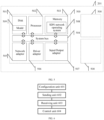
- FIG. 5 is a schematic diagram of a hardware structure of an embodiment of the controller according to the present invention.
- the controller in this embodiment can implement the control method shown in FIG. 3 .
- FIG. 3 For a specific execution process, refer to FIG. 3 . Details are not described again.
- the controller 201 may include one or more controllers running a computer system 500.
- the computer system 500 in this embodiment mainly includes a disk 501, and the disk 501 is used as a persistent data storage medium and is configured to store a context-aware model 509.
- context-aware model 509 may alternatively be stored by using another storage medium. Details are not limited in this embodiment.
- the computer system 500 in this embodiment can read and modify the stored context-aware model 509.
- the computer system 500 in this embodiment further includes a processor 502, and the processor 502 can configure the context-aware model 509 and store the context-aware model 509 on the disk 501.
- the computer system 500 further includes a memory 503, and the memory 503 is configured to cache running data that is used to run an SDN network operating system 508 and model data of the context-aware model 509.
- controller 201 in this embodiment runs the SDN network operating system 508, the controller 201 can perform the control method in the foregoing embodiment.
- the computer system 500 may further perform data communication and exchange data with an external device by using a network adapter 505, a driver adapter 506, and an input/output adapter 507 that are connected to a system bus 504.
- FIG. 5 a specific structure of the controller is described from a perspective of physical hardware. The following describes the specific structure of the controller with reference to FIG. 6 from a perspective of a functional module.
- the controller includes a configuration unit 601, a sending unit 602, a receiving unit 603, and a control unit 604.
- the configuration unit 601 is configured to: determine characteristic information used to implement a context-aware function, and set the characteristic information in the context-aware model, to create the context-aware model.
- the characteristic information includes any one or more of the following: network entity type definition information, network entity function definition information, data attribute definition information, interface definition information, and data threshold information.
- the network entity type definition information is used to define a type of a target device from which the context-aware engine collects the target data
- the sending unit 602 is configured to send the created context-aware model to the context-aware engine, where the context-aware model is used to define preset control performed when target data meets a trigger condition, and the preset control is used to implement the context-aware function; and the context-aware model is further used to instruct the context-aware engine to send indication information to the controller when the context-aware engine determines that the target data meets the trigger condition, where the indication information is used to indicate that the target data meets the trigger condition.
- the receiving unit 603 is configured to receive the indication information.
- the control unit 604 is configured to perform the preset control based on the indication information.
- FIG. 7 is a schematic structural diagram of hardware of an embodiment of the context-aware engine according to the present invention.
- the context-aware engine in this embodiment can implement the control method shown in FIG. 3 .
- FIG. 3 For a specific execution process, refer to FIG. 3 . Details are not described again.
- the context-aware engine 203 is a core component of a development program or system on an electronic platform. By using the context-aware engine 203, a developer may quickly establish and layout a function required by a program, or assist in running of a program.
- the context-aware engine 203 communicates with the network service devices 206, the wireless sensor 208, and the like by using the interconnection network 204.
- the context-aware engine 203 in this embodiment is a data processing device including a computer system 700.
- a disk 701 For specific descriptions of a disk 701, a context-aware model 709, a processor 702, a memory 703, a system bus 704, a network adapter 705, a driver adapter 706, and an input/output adapter 707 that are included in the context-aware engine 203 in this embodiment, refer to FIG. 5 . Details are not described again.
- the context-aware engine 203 in this embodiment further includes the memory 703, and the memory 703 is configured to cache model data used to run a context-aware processing system 710 and the context-aware model 709.
- the context-aware engine 203 when the context-aware engine 203 runs the context-aware processing system 710, the context-aware engine 203 can implement the control method in the embodiment of FIG. 3 .
- the context-aware engine 203 For a specific execution process, refer to FIG. 3 . Details are not described again.
- the disk 701 in the context-aware engine 203 further includes an ontology library 712.
- the processor 702 in this embodiment obtains preset data stored in the ontology library 712, to perform the control method shown in FIG. 3 , where the preset data stored in the ontology library 712 in this embodiment may vary based on different application scenarios.
- the ontology library 702 may provide different preset data.
- the ontology library 712 may provide preset data applied to a financial field, preset data applied to an intelligent control field, preset data applied to a cloud computing field, or the like. This is not specifically limited in this embodiment.
- the ontology library 712 may provide different preset data when the context-aware engine 203 serves devices of different models.
- the preset data stored in the ontology library 712 may be a time period within which the user is off duty.
- a type of the ontology library 712 in this embodiment may be a web ontology language (Web Ontology Language, Owl) database, a sensor database, a historical experience database, or the like.
- Owl Web Ontology Language
- FIG. 7 a specific structure of the context-aware engine is described from a perspective of physical hardware. The following describes the specific structure of the context-aware engine with reference to FIG. 8 from a perspective of a functional module.
- the context-aware engine in this embodiment can implement the control method shown in FIG. 3 .
- FIG. 3 For a specific execution process, refer to FIG. 3 . Details are not described again.
- the context-aware engine includes a receiving unit 801, an obtaining unit 802, a determining unit 803, and a sending unit 804.
- the receiving unit 801 is configured to receive a context-aware model sent by a controller, where the context-aware model is used to define preset control performed when target data meets a trigger condition, and the preset control is used to implement a context-aware function; and the context-aware model is further used to instruct the context-aware engine to send indication information to the controller when the context-aware engine determines that the target data meets the trigger condition, where the indication information is used to indicate that the target data meets the trigger condition.
- the context-aware model includes characteristic information used to implement the context-aware function.
- the characteristic information includes any one or more of the following: network entity type definition information, network entity function definition information, data attribute definition information, interface definition information, and data threshold information.
- the network entity type definition information is used to define a type of a target device from which the context-aware engine collects the target data
- the obtaining unit 802 is configured to obtain, based on the context-aware model, the target data defined by the context-aware model.
- the determining unit 803 is configured to determine whether the target data meets the trigger condition defined by the context-aware model.
- the sending unit 804 is configured to send the indication information to the controller when it is determined that the target data meets the trigger condition defined by the context-aware model.
- the disclosed system, apparatus, and method may be implemented in other manners.
- the described apparatus embodiment is merely an example.
- the unit division is merely logical function division and may be other division in actual implementation.
- a plurality of units or components may be combined or integrated into another system, or some features may be ignored or not performed.
- the displayed or discussed mutual couplings or direct couplings or communication connections may be implemented by using some interfaces.
- the indirect couplings or communication connections between the apparatuses or units may be implemented in electronic, mechanical, or other forms.
- the units described as separate parts may or may not be physically separate, and parts displayed as units may or may not be physical units, may be located in one position, or may be distributed on a plurality of network units. Some or all of the units may be selected based on actual requirements to achieve the objectives of the solutions of the embodiments.
- functional units in the embodiments of the present invention may be integrated into one processing unit, or each of the units may exist alone physically, or two or more units are integrated into one unit.
- the integrated unit may be implemented in a form of hardware, or may be implemented in a form of a software functional unit.
- the integrated unit When the integrated unit is implemented in the form of a software functional unit and sold or used as an independent product, the integrated unit may be stored in a computer-readable storage medium. Based on such an understanding, the technical solutions of the present invention essentially, or the part contributing to the prior art, or all or some of the technical solutions may be implemented in the form of a software product.
- the software product is stored in a storage medium and includes several instructions for instructing a computer device (which may be a personal computer, a server, or a network device) to perform all or some of the steps of the methods described in the embodiments of the present invention.
- the foregoing storage medium includes: any medium that can store program code, such as a USB flash drive, a removable hard disk, a read-only memory (ROM, Read-Only Memory), a random access memory (RAM, Random Access Memory), a magnetic disk, or an optical disc.
- program code such as a USB flash drive, a removable hard disk, a read-only memory (ROM, Read-Only Memory), a random access memory (RAM, Random Access Memory), a magnetic disk, or an optical disc.
Landscapes
- Engineering & Computer Science (AREA)
- Signal Processing (AREA)
- Computer Networks & Wireless Communication (AREA)
- Physics & Mathematics (AREA)
- General Physics & Mathematics (AREA)
- Automation & Control Theory (AREA)
- General Engineering & Computer Science (AREA)
- Databases & Information Systems (AREA)
- Medical Informatics (AREA)
- Theoretical Computer Science (AREA)
- Software Systems (AREA)
- Artificial Intelligence (AREA)
- Quality & Reliability (AREA)
- Manufacturing & Machinery (AREA)
- Evolutionary Computation (AREA)
- Computer Vision & Pattern Recognition (AREA)
- Computing Systems (AREA)
- Health & Medical Sciences (AREA)
- Data Mining & Analysis (AREA)
- General Health & Medical Sciences (AREA)
- Telephone Function (AREA)
- Selective Calling Equipment (AREA)
- Telephonic Communication Services (AREA)
- Mobile Radio Communication Systems (AREA)
Description
- This application relates to the field of communications technologies, and in particular, to a control method, a device, and a system.
- With rapid development of the mobile internet, an increasingly high requirement is imposed on network intelligence. To implement intelligent control on a network, as shown in
FIG. 1 , a commonly used communications system is provided. The system includes anetwork device 101, amobile device 103, asensor 104, and asensor signal processor 102. - A specific process of performing intelligent control by the communications system shown in
FIG. 1 includes: Thesensor 104 is embedded in themobile device 103. Thesensor 104 can collect sensor information, where the sensor information includes time information, location information, and the like. Themobile device 103 obtains the sensor information collected by thesensor 104 and sends the sensor information to thesensor signal processor 102. Thesensor signal processor 102 determines the sensor information collected by thesensor 104, to generate a corresponding instruction based on a determining result, and sends the instruction to thenetwork device 101. Thenetwork device 101 having a data forwarding and control capability can perform intelligent control on the communications system after analyzing the sensor information according to the instruction. - However, in the foregoing intelligent control process, the
mobile device 103 needs to drive thenetwork device 101. Specifically, thesensor 104 installed in themobile device 103 drives thenetwork device 101 by using the sensor information. The communications system cannot provide a proactive service or adaptively change based on a context, and thenetwork device 101 integrates control and forwarding. Consequently, a network control capability is limited, and an entire network cannot be globally and intelligently controlled. -
US 2013/0254833 A1 refers to methods and systems for fine tuning access control by remote, endpoint systems to host systems. Multiple conditions/states of one or both of the endpoint and host systems are monitored, collected and fed to an analysis engine. Using one or more of many different flexible, adaptable models and algorithms, an analysis engine analyzes the status of the conditions and makes decisions in accordance with pre-established policies and rules regarding the security of the endpoint and host system. Based upon the conditions, the policies, and the analytical results, actions are initiated regarding security and access matters. -
US 2009/0240647 A1 refers to systems, apparatus, techniques, and methods for predictively adapting properties of devices as a function of a user's historical behaviors (e.g., habits) as well as the specific context within which such behaviors are displayed. Such context can be virtually anything, such as day of the week, time of day, season, tide, temperature, weather, the user's mood, the score of a particular sporting event from the previous day, the phase of the moon, the user's location, etc. Based on observation by software, the user's habits and the context within which those habits occur are observed and the device is customized based on the user's behavioral patterns and the context thereof - This application provides a control method, a related device, and a system, so that the system has a context-aware capability, and capability of intelligent control on a network is effectively improved. This problem is solved by the subject matter of the independent claims. Further implementation forms are provided in the dependent claims.
- This application provides a control method, a related device, and a system which construct the context-aware model, so that the context-aware engine obtains the target data based on the context-aware model, and sends, to the controller, the indication information used to indicate that the target data meets the trigger condition. In this way, the controller can perform the preset control. It can be learned that, when performing the preset control, the controller may provide a proactive service based on the context-aware model, and when the control method provided in this application is applied to different scenarios, the controller may configure different context-aware models to be applied to different application scenarios. In addition, the controller performs network control, and the context-aware engine obtains and forwards the target data, so that the controller performs centralized network control, to obtain a global intelligent control capability, thereby improving efficiency of performing context-aware control by the controller.
-
-
FIG. 1 is a schematic structural diagram of a communications system according to the prior art; -
FIG. 2 is an example of a structural diagram of a context-aware system according to the present invention; -
FIG. 3 is an example of a procedure flowchart of a control method according to the present invention; -
FIG. 4 is an example of a diagram of an application scenario according to the present invention; -
FIG. 5 is an example of a structural diagram of a controller according to the present invention; -
FIG. 6 is an example of another structural diagram of a controller according to the present invention; -
FIG. 7 is an example of a structural diagram of a context-aware engine according to the present invention; and -
FIG. 8 is an example of another structural diagram of a context-aware engine according to the present invention. - An embodiment of the present invention provides a control method. The control method in this embodiment is based on a context-aware system, and in this embodiment, the context-aware system is described with reference to
FIG. 2 . -
FIG. 2 is a schematic diagram of a context-aware system according to the present invention. - The context-
aware system 200 shown inFIG. 2 is an internet of things (Internet of Thing, IoT). Specifically, the context-aware system 200 includes, but is not limited to, acontroller 201, a context-aware engine 203, aninterconnection network 204, anetwork device 205, anetwork service device 206, amobile device 207, awireless sensor 208, awearable device 209, and the like. - The
controller 201 in this embodiment of the present invention is described by using a software defined networking (Software Defined Network, SDN) controller as an example. - The context-
aware system 200 in this embodiment of the present invention implements interconnection between things based on the SDNnetwork controller 201. In this way, the context-aware system 200 in this embodiment can sense a data transmission intention more intelligently and more efficiently. - The SDN
network controller 201 in this embodiment of the present invention is a network control device on a network control plane. The SDNnetwork controller 201 in this embodiment provides southbound network device management. Specifically, the SDNnetwork controller 201 implements, by using a southbound interface, network device management matters including link discovery, topology management, policy formulation, entry delivery, and the like. - The SDN
network controller 201 in this embodiment provides a northbound network control and orchestration service. Specifically, the SDNnetwork controller 201 enables, through a northbound interface, a network service developer to invoke various network resources in a software programming form, to implement the network control and orchestration service. - Specifically, when the SDN
network controller 201 provides the southbound network device management, theSDN network controller 201 communicates with thenetwork device 205 by using a network protocol such as an OpenFlow (OpenFlow, OF) protocol and/or a network configuration protocol (Network Configuration Protocol, NETCONF), to control and configure thenetwork device 205. - The
interconnection network 204 included in the context-aware system 200 in this embodiment includes, but is not limited to, a communications network such as a data center network, a wide area network, a wireless network, and the internet of things. Theinterconnection network 204 is configured to provide a basis for communicating with a peripheral system and device. - The
network device 205 included in the context-aware system 200 includes, but is not limited to, a router, a switch, a softswitch, and the like. Thenetwork device 205 forwards data under control of theSDN network controller 201. The SDNnetwork controller 201, serving as the network control plane, intelligently controls forwarding of thenetwork device 205. - The
network service device 206 included in the context-aware system 200 is a device that provides a network data service, and obtains corresponding data information through network access, for example, weather data, traffic information data, and geographic location data of a place. - The
mobile device 207 is not limited to a personal digital assistant (Personal Digital Assistant, PDA), a smartphone, a tablet, a water heater, and the like, and themobile device 207 interacts with thecontroller 201 and the context-aware engine 203 by using theinterconnection network 204. - The
wireless sensor 208 and thewearable device 209 that are included in the context-aware system 200 may provide sensor data to the context-aware engine 203. - Based on the foregoing context-aware system, with reference to
FIG. 3 , the following describes in detail a specific execution process of a control method provided in an embodiment. - As shown in
FIG. 3 , the control method in this embodiment includes the following steps. -
Step 301. A controller creates a context-aware model. - A defining process of the context-aware model can be implemented in
step 301 in this embodiment. To be specific, the context-aware model can be created by using the defining process of the context-aware model. - The following first describes the context-aware model in this embodiment:
- The context-aware model in this embodiment models a scenario and a network application by using a domain-specific modeling language, so that the controller having a context-aware capability can proactively drive the network application.
- The network application in this embodiment may be an application on the
mobile device 207, or may be an application of the controller. The application of the controller may be used to turn on a network, or may be used to turn off a network. Alternatively, the network application may be an application used to provide a programming interface to a third party. The context-aware model created in this embodiment can enable the context-aware system to have the context-aware capability. - A specific process of creating the context-aware model may be as follows:
- The controller may first determine a context-aware function that can be supported by the controller, so that the controller may configure the context-aware model based on the context-aware function, and the context-aware system can implement, by using the context-aware model, the context-aware function defined by the context-aware model.
- For example, if the controller determines that the context-aware function that can be supported by the controller is: clocking in/out for a user using the
mobile device 207. Specifically, the context-aware system determines, based on a context-aware model that can clock in/out for a user, whether a current location at which the user is located is in an area in which the company is located. If the current location at which the user is located is in the area in which the company is located, the context-aware system may automatically clock in/out for the user, and in a clock in/out process, the user does not need to perform any operation. - For another example, if the controller determines that the context-aware function that can be supported by the controller is: automatically enabling a water heater at a user's home to heat. Specifically, the context-aware system determines, based on a context-aware model that can enable a water heater to heat, whether a distance between a current location of the user and the home is less than a preset value. If yes, the context-aware system can automatically enable the water heater at the user's home to heat, and in a heating process, the user does not need to perform any operation on the water heater.
- This embodiment does not make any limitation on how the controller specifically determines the context-aware function that can be supported by the controller, provided that the controller can configure the context-aware model based on the supported context-aware function. For example, the controller in this embodiment may determine a supported context-aware function based on a configuration of the controller. For another example, the controller may determine a supported context-aware function based on a configuration of a developer. For still another example, the controller may determine a supported context-aware function by using data obtained by a sensor control interface that is of the controller and that is for external exchange.
- Optionally, the controller needs to exchange information with an external device to create the context-aware model. The external device may be the
network device 205, thenetwork service device 206, themobile device 207, thewireless sensor 208, thewearable device 209, or the like. A sensor control interface configured to exchange information with the external device is disposed in the controller, so that the controller can receive, by using the sensor control interface, information sent by the external device, and can configure the context-aware model based on the information sent by the external device. - It should be noted that, information that is sent by the external device and that is received by the controller in this embodiment may not be limited in the process of creating the context-aware model. Details are not limited in this embodiment.
- The following describes, by using an example, how the controller creates the context-aware model:
- The controller may determine characteristic information used to implement the context-aware function, and set the characteristic information in the context-aware model through text modeling, to be specific, set the characteristic information in a text format in the context-aware model.
- The characteristic information in this embodiment includes any one or more of the following: network entity type definition information, network entity function definition information, data attribute definition information, interface definition information, measurement definition information, data threshold information, frequency definition information, and data precision information.
- Descriptions are provided by using an example in which the characteristic information includes the network entity type definition information.
- Specifically, the controller in this embodiment may perform modeling based on an abstract entity, and create a type set, where the type set includes at least one network entity, and all network entities in a same type set have a same network entity type.
- The network entity in this embodiment may be a general name of various devices in the context-aware system, such as a node device, a communications device, a terminal device, a storage device, and other hardware devices that serve the network entity.
- For example, types of all network entities in a type set created by the controller are smartphones, or types of all network entities in a type set are smart televisions, or types of all network entities in a type set are water heaters.
- The controller may determine the network entity type definition information, where the network entity type definition information is used to define a type of a network entity. In this embodiment, the network entity type definition information defined by the controller can implement the context-aware function.
- For example, the network entity type definition information may be used to define the type of the network entity as a smartphone. For another example, the network entity type definition information may be used to define the type of the network entity as a wearable device.
- Specifically, when the network entity type definition information has been set in the context-aware model created by the controller, the context-aware engine may collect target data from a target device based on the context-aware model. A device type of the target device in this embodiment is consistent with the type defined by the network entity type definition information.
- In a specific application scenario, if the controller determines that a context-aware model that can implement a clock in/out function needs to be created, the network entity type definition information created by the controller may be used to define the type of the network entity as a smartphone carried by a user. In this way, the context-aware engine can collect, based on the context-aware model, the target data from the smartphone used as the target device.
- Descriptions are provided by using an example in which the characteristic information includes the network entity function definition information.
- Specifically, the controller in this embodiment performs modeling based on an attribute of a network entity.
- Specifically, the controller determines the network entity function definition information, where the network entity function definition information is used to define a function of the network entity.
- In this embodiment, the network entity having the function defined by the network entity function definition information may implement the context-aware function in this embodiment.
- In this way, the controller can set the network entity function definition information in the context-aware model, so that the context-aware engine collects target data from a target device, where a function of the target device in this embodiment is consistent with the function defined by the network entity function definition information.
- Specifically, the function defined by the network entity function definition information in this embodiment may be a global positioning system (Global Positioning System, GPS) positioning function, a function of obtaining outdoor temperature data, a function of obtaining a body parameter, or the like. The body parameter may be a heartbeat parameter, a body temperature parameter, or the like.
- In a specific application scenario, if the controller determines that a context-aware model that can implement a clock in/out function needs to be created, the function defined by the network entity function definition information created by the controller is a GPS positioning function. In this way, the context-aware engine can collect, based on the context-aware model, data from a target device that has the GPS positioning function.
- Descriptions are provided by using an example in which the characteristic information includes the data attribute definition information.
- The data attribute definition information in this embodiment is used to define a data type, so that the context-aware engine determines, based on the context-aware model in which the data attribute definition information is set, a data type of the collected target data is consistent with the data type defined by the data attribute definition information.
- It can be learned from the foregoing descriptions that the target device may be defined by using the network entity type definition information and/or the network entity function definition information that are/is included in the context-aware model.
- In a specific application, data generated by the target device may include data with a plurality of attributes, such as temperature data, GPS positioning data, signal data, and call data. The controller in this embodiment may define, by using the data attribute definition information, an attribute of specific data that needs to be currently collected. For example, in a specific application scenario, if the controller determines that a context-aware model that can implement a clock in/out function needs to be created, the target data defined by the data attribute definition information created by the controller is the GPS positioning data. In this case, the context-aware engine can collect, from the target device based on the context-aware model, the GPS positioning data generated by the target device.
- Descriptions are provided by using an example in which the characteristic information includes the interface definition information.
- The controller in this embodiment determines the interface definition information, where the interface definition information is used to define a data interface.
- Specifically, the interface definition information is used to define a protocol for collecting the target data, such as a wireless fidelity (Wireless-Fidelity, Wi-Fi) protocol, so that the context-aware engine collects the target data based on an interface defined by the interface definition information.
- In a specific application scenario, if the controller determines that the context-aware model that can implement the clock in/out function needs to be created, the interface definition information created by the controller is the Wi-Fi protocol. In this case, the context-aware engine can collect the target data based on the context-aware model by using the Wi-Fi protocol.
- Descriptions are provided by using an example in which the characteristic information includes the measurement definition information.
- The controller in this embodiment determines the measurement definition information, where the measurement definition information is used to define a data measurement unit, so that a measurement unit of the target data collected by the context-aware engine is consistent with the data measurement unit defined by the measurement definition information.
- In a specific application scenario, if the controller determines that a context-aware model that can automatically enable a water heater at a user's home to heat needs to be created, the measurement definition information created by the controller may be used to define a data unit as degree Celsius. In this way, the context-aware engine can collect data with a measurement unit of degree Celsius based on the context-aware model. For another example, the measurement definition information created by the controller may be used to define a data unit as Fahrenheit. In this case, the context-aware engine can collect, based on the context-aware model, data with a measurement unit of Fahrenheit.
- Descriptions are provided by using an example in which the characteristic information includes the data threshold information.
- The controller in this embodiment determines the data threshold information, where the data threshold information is used to define a value range of the target data, so that a data range of the target data collected by the context-aware engine is consistent with the data range defined by the data threshold information.
- In a specific application scenario, if the controller determines that a context-aware model that can automatically enable a water heater at a user's home to heat needs to be created, a value range defined by the data threshold information created by the controller may be higher than 45 degrees Celsius. In this case, when water temperature that is reported on the water heater and that is collected by the context-aware engine is 36.7 degrees Celsius, the context-aware engine may determine, based on the data threshold information included in the context-aware model, that the water temperature reported on the water heater is ignored, and the context-aware engine does not analyze the water temperature higher than 45 degrees Celsius based on the context-aware model until when the context-aware engine determines that the water temperature reported on the water heater is higher than 45 degrees Celsius.
- Descriptions are provided by using an example in which the characteristic information includes the data precision information.
- The controller in this embodiment determines the data precision information, where the data precision information is used to define precision of the target data, so that precision of the target data collected by the context-aware engine is consistent with the data precision defined by the data precision information.
- In a specific application scenario, if the controller determines that a context-aware model that can automatically enable a water heater at a user's home to heat needs to be created, the data precision defined by the data precision information created by the controller is an integer. In this case, when water temperature that is reported on the water heater and that is collected by the context-aware engine is 45.7 degrees Celsius, the context-aware engine can determine, based on the data precision information included in the context-aware model, that the target data is 45, so that precision of the target data is consistent with the data precision defined by the data precision information.
- Descriptions are provided by using an example in which the characteristic information includes the frequency definition information:
- The controller in this embodiment determines the frequency definition information, where the frequency definition information is used to define frequency of collecting the target data, so that the context-aware engine collects the target data based on the frequency defined by the frequency definition information.
- In a specific application scenario, if the controller determines that a context-aware model that can automatically enable a water heater at a user's home to heat needs to be created, the frequency definition information created by the controller may be used to define an interval of collecting the target data to be five minutes. In this case, the context-aware engine can collect, based on the frequency definition information included in the context-aware model, water temperature reported on the water heater once every five minutes.
- In a process of creating the context-aware model in this embodiment, the controller further needs to determine a trigger condition and preset control, so that the controller performs the preset control when the target data meets the trigger condition. The preset control is a control manner that is defined by the context-aware model and that is used to implement the context-aware function.
- To better understand the trigger condition and the preset control, the following provides descriptions with reference to a specific application scenario.
- In an optional application scenario, if the context-aware function that can be supported by the controller is clocking in/out for a user who uses a terminal device, the trigger condition may be: GPS positioning data reported by the terminal device carried by the user indicates that the user is located in an area in which a company is located. In this case, the preset control may be controlling, by the controller, a server that is configured to clock in/out for an employee and that belongs to the company to perform a clock in/out operation for the user.
- In an optional application scenario, if the context-aware function that can be supported by the controller is automatically enabling a water heater at a user's home to heat, the trigger condition may be: a distance between a location indicated by GPS positioning data reported on the terminal device that is carried by the user and the user's home is less than three kilometers. In this case, the preset control may be automatically enabling the water heater at the user's home to heat. The trigger condition may alternatively be: water temperature reported on the water heater at the user's home is higher than or equal to 45 degrees Celsius. In this case, the preset control may be stopping enabling the water heater at home to heat.
- The foregoing descriptions of creating the context-aware model are an optional example and are not limited, provided that the controller can configure the context-aware model that can implement the context-aware function.
- To better understand the control method in this embodiment of the present invention, in this embodiment, a function that can be implemented by the controller is described by using an optional example. It should be noted that, in this embodiment, descriptions of the function that can be implemented by the controller is an optional example and is not limited.
-
Step 302. The controller sends the context-aware model to the context-aware engine. -
Step 303. The context-aware engine receives the context-aware model. - Specifically, a northbound sensor control interface is disposed in the context-aware engine in this embodiment. The context-aware engine exchanges data with the controller through the northbound sensor control interface.
- More specifically, the context-aware engine receives the context-aware model through the northbound sensor control interface.
- The context-aware engine may parse the context-aware model to read the characteristic information included in the context-aware model. For detailed descriptions of the characteristic information included in the context-aware model, refer to step 301. Details are not described in this embodiment.
-
Step 304. The context-aware engine collects the target data based on the context-aware model. - After parsing out the characteristic information included in the context-aware model, the context-aware engine may collect the target data based on the characteristic information included in the context-aware model.
- It can be learned that the controller sends the context-aware model to the context-aware engine, so that the context-aware model subscribes to and processes the target data based on the context-aware model.
- A manner in which the context-aware engine processes the target data is not limited in this embodiment, provided that the context-aware system in this embodiment can implement the context-aware function. For example, the context-aware engine can parse, filter, and convert the target data based on the context-aware model, so that the target data meets the definition of the context-aware model.
- Based on the characteristic information included in the context-aware model, the following describes how the context-aware model specifically collects the target data.
- Optionally, when the characteristic information included in the context-aware model is the network entity type definition information, the context-aware engine may determine, based on the network entity type definition information, the target device configured to obtain the target data, where the device type of the target device is consistent with the type defined by the network entity type definition information.
- Optionally, when the characteristic information included in the context-aware model is the network entity function definition information, the context-aware engine may determine, based on the network entity function definition information, a function of the target device configured to obtain the target data, where the function of the target device is consistent with the function defined in the network entity function definition information.
- Optionally, when the characteristic information included in the context-aware model is the data attribute definition information, the context-aware engine may collect the target data from the target device based on the data attribute definition information, where the data type of the collected target data is consistent with the data type defined by the data attribute definition information.
- Optionally, when the characteristic information included in the context-aware model is the interface definition information, the context-aware engine may collect the target data based on the interface defined by the interface definition information.
- Optionally, when the characteristic information included in the context-aware model is the measurement definition information, the context-aware engine may collect the target data based on the measurement definition information, so that the measurement unit of the target data collected by the context-aware engine is consistent with the data measurement unit defined by the measurement definition information.
- Optionally, when the characteristic information included in the context-aware model is the data threshold information, the context-aware engine may collect the target data based on the data threshold information, so that the data range of the target data collected by the context-aware engine is consistent with the data range defined by the data threshold information.
- Optionally, when the characteristic information included in the context-aware model is the data precision information, the context-aware engine may collect the target data based on the data precision information, so that the precision of the target data collected by the context-aware engine is consistent with the data precision defined by the data precision information.
- Optionally, when the characteristic information included in the context-aware model is the frequency definition information, the context-aware engine may collect the target data based on the frequency definition information, so that the context-aware engine collects the target data based on the frequency defined by the frequency definition information.
- It can be learned that the context-aware engine can determine, by using the frequency definition information, a time window within which the target data needs to be collected, and the context-aware engine can collect the target data from the target device based on the time window.
- In a process in which the context-aware system implements the context-aware function, the target data may be streaming sensor data reported by various devices in the context-aware system.
-
Step 305. The context-aware engine determines whether the target data meets the trigger condition, and if yes, performsstep 306, or if no, returns to performstep 304. - The trigger condition is a condition created by the context-aware model. For specific descriptions, refer to the foregoing steps. Details are not described in this step.
- The context-aware engine in this embodiment may perform analysis processing on the obtained target data that meets the definition of the context-aware model, to determine whether the target data meets the trigger condition.
- The following describes how the context-aware engine specifically determines whether the target data meets the trigger condition:
- Optionally, the context-aware engine can calculate the target data based on a preset condition included in the context-aware engine, so that the context-aware engine performs logical reasoning on the target data to determine whether the target data meets the trigger condition.
- For example, the context-aware function implemented by the context-aware model is automatically enabling the water heater at the user's home to heat. In this case, the trigger condition defined by the context-aware model is reporting indication information when a distance between a geographical location at which the user is currently located and the user's home is less than three kilometers, so that the controller automatically instructs, based on the indication information, the water heater to heat. In this application scenario, the context-aware engine may obtain, based on information that is used to collect data and that is included in the context-aware model, current geographic location information of the user from a terminal device used by the user, and determine, based on the current geographic location information of the user, whether the distance between a geographic location at which the user is currently located and the user's home is less than three kilometers. If yes, the context-aware engine may determine that the target data meets the trigger condition.
- Optionally, the context-aware engine determines the target data based not only on the context-aware model but also on data prestored in the context-aware engine.
- For example, when the context-aware model implements a context-aware function of automatically enabling a water heater at a user's home to heat, the data prestored in the context-aware engine may be a time period within which the user is off duty. For example, the context-aware engine may store a time period within which the user is off duty from 7:00 p.m. to 6:00 a.m.
- Specifically, the context-aware function implemented by the context-aware model is automatically enabling the water heater at the user's home to heat. In this case, the trigger condition defined by the context-aware model is reporting indication information when a distance between a geographical location at which the user is currently located and the user's home is less than three kilometers, so that the controller automatically instructs, based on the indication information, the water heater to heat. In this application scenario, the context-aware engine may query data prestored by the context-aware engine to determine whether a current time period is a time period within which the user is off duty. If yes, the context-aware engine may query current geographic location information of the user, or if no, the context-aware engine may not query current geographic location information of the user. It can be learned that when determining that the current time period is the time period within which the user is off duty, the context-aware engine determines whether the target data meets the trigger condition defined by the context-aware model.
-
Step 306. The context-aware engine generates the indication information. - Specifically, it can be learned from
step 305 that the indication information is used to indicate that the target data obtained by the context-aware engine meets the trigger condition defined by the context-aware model. -
Step 307. The context-aware engine sends the indication information to the controller. -
Step 308. The controller receives the indication information. - Specifically, the controller in this embodiment receives, through a northbound sensor control interface, the indication information sent by the context-aware engine.
-
Step 309. The controller performs preset control based on the indication information. - The preset control in this embodiment is a control manner defined by the context-aware model.
- In this embodiment, before performing the preset control, the controller may first generate application configuration information and/or a network control constraint.
- The controller implements the preset control by using the application configuration information and/or the network control constraint.
- For example, if the context-aware function implemented by the created context-aware model is clocking in/out for a user, the controller may establish, when the context-aware model has been created by the controller, a communication link between a southbound network device interface of the controller and a server configured to clock in/out for the user.
- Specifically, when receiving the indication information sent by the context-aware engine, the controller may determine the preset control that has been defined by the context-aware model. In this application scenario, the preset control is clocking in/out for the user. In this case, the controller may send the application configuration information to the server through the established communications link between the controller and the server configured to clock in/out for the user, so that the server can clock in/out for the user.
- For another example, if the context-aware function implemented by the created context-aware model is data packet transfer, and specifically, the context-aware system includes a plurality of links used to control a network application, when the context-aware model has been created, the controller may control the links by using a configured network control constraint.
- Specifically, when the controller receives the indication information sent by the context-aware engine, the target data defined by the context-aware model is bandwidth of a link, and the trigger condition defined by the context-aware model is that bandwidth utilization of the link is greater than or equal to 80%, the controller may determine the preset control defined by the context-aware model. In this application scenario, the preset control is transferring a packet on the link to a preset server or discarding a packet on the link, to avoid congestion.
- A manner of performing preset control by the controller in this embodiment is not described in detail in this embodiment. For example, the controller may control network layer forwarding, a network status, network connectivity, a network device, a device connection, device management, a device protocol, and the like, provided that the context-aware function can be implemented.
- The following describes beneficial effects of the control method in this embodiment:
- In this embodiment of the present invention, the context-aware model is constructed with reference to a context-aware technology. The context-aware model defines the target data that needs to be obtained, the trigger condition, and the preset control, so that the controller can perform the preset control when determining that the target data meets the trigger condition. It can be learned that, when performing the preset control, the controller does not need to be constrained by a driver installed in the terminal device, so that the controller can provide a proactive service based on the context-aware model. In addition, when the control method in this embodiment is applied to different scenarios, the controller may configure different context-aware models, so that the controller controls a network to implement different context-aware capabilities, thereby extending an application range of intelligent network control.
- According to the control method in this embodiment, the controller performs network control, and the context-aware engine obtains and forwards the target data, so that the controller performs centralized network control, to obtain a global intelligent control capability. In addition, in this embodiment, the context-aware engine processes data, thereby improving efficiency of performing context-aware control by the controller.
- To better understand the control method in this embodiment of the present invention, the following describes, with reference to a specific application scenario, a specific application process of the control method in an application scenario of data center migration.
- Various resources are deployed in a
data center 400 shown inFIG. 4 , thedata center 400 is deployed in a distributed manner, and the resources are decentralized in thedata center 400 nearest to atenant 405. - In the prior art, when needing to obtain a network resource of the
tenant 405, thedata center 400 coordinates network resource of thetenant 405. For example, when thetenant 405 is at a location A, a tenant resource may be deployed in a data center DC-A currently nearest to thetenant 405. When thetenant 405 is migrated from the location A to a location B, a network resource obtained by thetenant 405 at the location B needs to be obtained from a data center DC-B nearest to thetenant 405. In this case, the resource in the data center DC-A is configured and synchronized to the data center DC-B after a specific delay. In this way, after thetenant 405 is migrated to the location B, data in the data center DC-B can be obtained. - It can be learned that, in the prior art, a passively triggered resource response is used, to be specific, the resource in the data center DC-A can be triggered, so that the resource is configured and synchronized to the data center DC-B after a specific delay only when it is determined that the
tenant 405 has migrated from the location A to the location B. It can be learned that timeliness of resource configuration is low. - The following describes a specific process of migrating, by the data center with reference to a context-aware technology, resources in the data center in this application scenario by applying the control method provided in the present invention.
- In this application scenario, the
SDN network controller 402 may configure a context-aware model 404 for migrating the resources in the data center. - The context-
aware model 404 in this application scenario may include characteristic information used to implement a context-aware function. - Specifically, the characteristic information includes network entity type definition information, where the
SDN network controller 402 may define the network entity type definition information by using a keyword. Types of network entities defined by the network entity type definition information include the data center DC-A and the data center DC-B, and the network entity type definition information further defines amobile phone 401 carried by thetenant 405. - Specifically, the characteristic information may further include interface definition information, where the
SDN network controller 402 may define the interface definition information of themobile phone 401 by using a keyword, so that the context-aware engine 403 obtains, based on the interface definition information, an interface for collecting the target data. - Specifically, the characteristic information may further include data attribute definition information, where the
SDN network controller 402 may define the data attribute definition information by using a keyword, so that the context-aware engine 403 determines, based on the data attribute definition information, a type of the target data that can be obtained. In this application scenario, the type of the target data defined by the data attribute definition information is geographic location information of themobile phone 401. - Specifically, the characteristic information may further include frequency definition information, where the frequency definition information may define frequency of obtaining the target data to be one hour.
- The characteristic information may further include operation capability definition information, so that the context-
aware engine 403 can perform a derivation operation on the obtained target data by using the operation capability definition information. - Specifically, the operation capability definition information defines a binary operation, for example, a logical operation such as an OR operation (OR), an AND operation (AND), or a NOT operation (NOT), for condition triggering. To be specific, the context-
aware engine 403 determines, based on the operation capability definition information, whether the indication information needs to be sent to theSDN network controller 402. - After the
SDN network controller 402 configures the context-aware model, theSDN network controller 402 can send the context-aware model to the context-aware engine 403. - In this embodiment, the
mobile phone 401 carried by thetenant 405 may be registered on the context-aware engine 403. For specific descriptions of the context-aware engine 403, refer to the foregoing embodiment. Details are not described in this application scenario. The context-aware engine 403 can obtain, based on the context-aware model 404 from the registeredmobile phone 401, geographic location information of thetenant 405 that is used as the target data. - In this application scenario in which the
tenant 405 is from the location A to the location B, the context-aware engine 403 obtains the geographical location information of thetenant 405 based on the context-aware model, and performs a logical operation. When the trigger condition is reached, theSDN network controller 402 is instructed, by using the indication information, to perform preset control on a network of thetenant 405. - The trigger condition in this application scenario may be that a distance between a current location of the
tenant 405 and the data center DC-A is greater than or equal to a first threshold, and a distance between the current location of thetenant 405 and the data center DC-B is less than or equal to a second threshold. This indicates that the user is migrating from the location A to the location B. - The context-
aware engine 403 sends, to theSDN network controller 402, the indication information used to indicate that the target data meets the trigger condition. - When receiving the indication information, the
SDN network controller 402 can determine that the target data meets the trigger condition, and can perform preset control based on the context-aware model, where the preset control is performing virtual machine migration for thetenant 405. - It can be learned that, in this application scenario, the
SDN network controller 402 can configure and synchronize the resources in the data center DC-A to the data center DC-B in a process in which thetenant 405 is migrated from the location A to the location B, that is, when thetenant 405 has not reached the location B, so that the resources have been migrated when thetenant 405 arrives at the location B. - The context-
aware model 404 in this application scenario is used to migrate a data center, and the control method in this application scenario may also be reused in another application scenario. For example, the control method in this application may be applied to an office automation (Office Automation, OA) card swiping system, to implement automatic clocking in/out for an employee, and in an application process, only the context-aware model needs to be changed. For example, the target data included in the context-aware model is GPS data of the employee, the trigger condition is that the GPS data of the employee is within a range of a plant area, and the preset control is clocking in/out for the employee. In this way, the OA card swiping system may automatically clock in/out for the employee when determining that the GPS data of the employee is within the range of the plant area, and the employee does not need to input a clock in/out operation during a clock in/out process, greatly improving clock in/out efficiency for the employee. - With reference to
FIG. 5 , the following describes in detail a specific structure of the controller in this embodiment.FIG. 5 is a schematic diagram of a hardware structure of an embodiment of the controller according to the present invention. - The controller in this embodiment can implement the control method shown in
FIG. 3 . For a specific execution process, refer toFIG. 3 . Details are not described again. - The
controller 201 may include one or more controllers running acomputer system 500. - The
computer system 500 in this embodiment mainly includes adisk 501, and thedisk 501 is used as a persistent data storage medium and is configured to store a context-aware model 509. - It should be noted that descriptions of a storage medium used to store the context-
aware model 509 are an optional example and are not limited in this embodiment. In another application scenario, the context-aware model 509 may alternatively be stored by using another storage medium. Details are not limited in this embodiment. - The
computer system 500 in this embodiment can read and modify the stored context-aware model 509. - The
computer system 500 in this embodiment further includes aprocessor 502, and theprocessor 502 can configure the context-aware model 509 and store the context-aware model 509 on thedisk 501. - The
computer system 500 further includes amemory 503, and thememory 503 is configured to cache running data that is used to run an SDNnetwork operating system 508 and model data of the context-aware model 509. - When the
controller 201 in this embodiment runs the SDNnetwork operating system 508, thecontroller 201 can perform the control method in the foregoing embodiment. - The
computer system 500 may further perform data communication and exchange data with an external device by using anetwork adapter 505, adriver adapter 506, and an input/output adapter 507 that are connected to asystem bus 504. - In
FIG. 5 , a specific structure of the controller is described from a perspective of physical hardware. The following describes the specific structure of the controller with reference toFIG. 6 from a perspective of a functional module. - The controller includes a configuration unit 601, a sending
unit 602, a receivingunit 603, and acontrol unit 604. - The configuration unit 601 is configured to: determine characteristic information used to implement a context-aware function, and set the characteristic information in the context-aware model, to create the context-aware model.
- The characteristic information includes any one or more of the following: network entity type definition information, network entity function definition information, data attribute definition information, interface definition information, and data threshold information.
- The network entity type definition information is used to define a type of a target device from which the context-aware engine collects the target data;
- the network entity function definition information is used to define a function of the target device from which the context-aware engine collects the target data;
- the data attribute definition information is used to define a data type of the target data collected by the context-aware engine;
- the interface definition information is used to define an interface through which the context-aware engine collects the target data; and
- the data threshold information is used to define a value range of the target data collected by the context-aware engine.
- The sending
unit 602 is configured to send the created context-aware model to the context-aware engine, where the context-aware model is used to define preset control performed when target data meets a trigger condition, and the preset control is used to implement the context-aware function; and the context-aware model is further used to instruct the context-aware engine to send indication information to the controller when the context-aware engine determines that the target data meets the trigger condition, where the indication information is used to indicate that the target data meets the trigger condition. - The receiving
unit 603 is configured to receive the indication information. - The
control unit 604 is configured to perform the preset control based on the indication information. - For a specific execution process of performing the control method by the controller shown in
FIG. 6 , refer toFIG. 3 . Details are not described again. - With reference to
FIG. 7 , the following describes in detail a specific structure of the context-aware engine in this embodiment.FIG. 7 is a schematic structural diagram of hardware of an embodiment of the context-aware engine according to the present invention. - The context-aware engine in this embodiment can implement the control method shown in
FIG. 3 . For a specific execution process, refer toFIG. 3 . Details are not described again. - The context-
aware engine 203 is a core component of a development program or system on an electronic platform. By using the context-aware engine 203, a developer may quickly establish and layout a function required by a program, or assist in running of a program. - The context-
aware engine 203 communicates with thenetwork service devices 206, thewireless sensor 208, and the like by using theinterconnection network 204. - The context-
aware engine 203 in this embodiment is a data processing device including acomputer system 700. - For specific descriptions of a
disk 701, a context-aware model 709, aprocessor 702, amemory 703, asystem bus 704, anetwork adapter 705, adriver adapter 706, and an input/output adapter 707 that are included in the context-aware engine 203 in this embodiment, refer toFIG. 5 . Details are not described again. - The context-
aware engine 203 in this embodiment further includes thememory 703, and thememory 703 is configured to cache model data used to run a context-aware processing system 710 and the context-aware model 709. - In this embodiment, when the context-
aware engine 203 runs the context-aware processing system 710, the context-aware engine 203 can implement the control method in the embodiment ofFIG. 3 . For a specific execution process, refer toFIG. 3 . Details are not described again. - The
disk 701 in the context-aware engine 203 further includes anontology library 712. Theprocessor 702 in this embodiment obtains preset data stored in theontology library 712, to perform the control method shown inFIG. 3 , where the preset data stored in theontology library 712 in this embodiment may vary based on different application scenarios. To be specific, if the context-aware engine 203 in this embodiment serves in different application scenarios, theontology library 702 may provide different preset data. For example, theontology library 712 may provide preset data applied to a financial field, preset data applied to an intelligent control field, preset data applied to a cloud computing field, or the like. This is not specifically limited in this embodiment. For another example, theontology library 712 may provide different preset data when the context-aware engine 203 serves devices of different models. - With reference to
FIG. 3 , it can be learned that, when this embodiment is applied to an application scenario in which a water heater at a user's home is automatically enabled to heat, the preset data stored in theontology library 712 may be a time period within which the user is off duty. - Optionally, a type of the
ontology library 712 in this embodiment may be a web ontology language (Web Ontology Language, Owl) database, a sensor database, a historical experience database, or the like. - In
FIG. 7 , a specific structure of the context-aware engine is described from a perspective of physical hardware. The following describes the specific structure of the context-aware engine with reference toFIG. 8 from a perspective of a functional module. - The context-aware engine in this embodiment can implement the control method shown in
FIG. 3 . For a specific execution process, refer toFIG. 3 . Details are not described again. - The context-aware engine includes a receiving
unit 801, an obtainingunit 802, a determiningunit 803, and a sendingunit 804. - The receiving
unit 801 is configured to receive a context-aware model sent by a controller, where the context-aware model is used to define preset control performed when target data meets a trigger condition, and the preset control is used to implement a context-aware function; and the context-aware model is further used to instruct the context-aware engine to send indication information to the controller when the context-aware engine determines that the target data meets the trigger condition, where the indication information is used to indicate that the target data meets the trigger condition. - Specifically, the context-aware model includes characteristic information used to implement the context-aware function.
- More specifically, the characteristic information includes any one or more of the following: network entity type definition information, network entity function definition information, data attribute definition information, interface definition information, and data threshold information.
- The network entity type definition information is used to define a type of a target device from which the context-aware engine collects the target data;
- the network entity function definition information is used to define a function of the target device from which the context-aware engine collects the target data;
- the data attribute definition information is used to define a data type of the target data collected by the context-aware engine;
- the interface definition information is used to define an interface through which the context-aware engine collects the target data; and
- the data threshold information is used to define a value range of the target data collected by the context-aware engine.
- The obtaining
unit 802 is configured to obtain, based on the context-aware model, the target data defined by the context-aware model. - The determining
unit 803 is configured to determine whether the target data meets the trigger condition defined by the context-aware model. - The sending
unit 804 is configured to send the indication information to the controller when it is determined that the target data meets the trigger condition defined by the context-aware model. - For a specific execution process of performing the control method by the context-aware engine shown in
FIG. 8 , refer toFIG. 3 . Details are not described again. - It may be clearly understood by persons skilled in the art that, for the purpose of convenient and brief description, for a specific working process of the foregoing system, apparatus, and unit, refer to a corresponding process in the foregoing method embodiments, and details are not described herein again.
- In the several embodiments provided in this application, it should be understood that the disclosed system, apparatus, and method may be implemented in other manners. For example, the described apparatus embodiment is merely an example. For example, the unit division is merely logical function division and may be other division in actual implementation. For example, a plurality of units or components may be combined or integrated into another system, or some features may be ignored or not performed. In addition, the displayed or discussed mutual couplings or direct couplings or communication connections may be implemented by using some interfaces. The indirect couplings or communication connections between the apparatuses or units may be implemented in electronic, mechanical, or other forms.
- The units described as separate parts may or may not be physically separate, and parts displayed as units may or may not be physical units, may be located in one position, or may be distributed on a plurality of network units. Some or all of the units may be selected based on actual requirements to achieve the objectives of the solutions of the embodiments.
- In addition, functional units in the embodiments of the present invention may be integrated into one processing unit, or each of the units may exist alone physically, or two or more units are integrated into one unit. The integrated unit may be implemented in a form of hardware, or may be implemented in a form of a software functional unit.
- When the integrated unit is implemented in the form of a software functional unit and sold or used as an independent product, the integrated unit may be stored in a computer-readable storage medium. Based on such an understanding, the technical solutions of the present invention essentially, or the part contributing to the prior art, or all or some of the technical solutions may be implemented in the form of a software product. The software product is stored in a storage medium and includes several instructions for instructing a computer device (which may be a personal computer, a server, or a network device) to perform all or some of the steps of the methods described in the embodiments of the present invention. The foregoing storage medium includes: any medium that can store program code, such as a USB flash drive, a removable hard disk, a read-only memory (ROM, Read-Only Memory), a random access memory (RAM, Random Access Memory), a magnetic disk, or an optical disc.
Claims (6)
- A control method performed by a controller, the method comprising:• sending a created context-aware model to a context-aware engine (step 302), wherein:o the context-aware model is used to define a preset control performed when target data meet a trigger condition,o the preset control is used to implement a context-aware function; ando the context-aware model is further used to instruct the context-aware engine to send indication information to the controller when the context-aware engine determines that the target data meet the trigger condition, wherein the indication information is used to indicate that the target data meet the trigger condition,• receiving the indication information (step 308); and• performing the preset control based on the indication information (step 309),• wherein before the sending the created context-aware model to the context-aware engine, the method further comprises:o determining characteristic information used to implement the context-aware function, and setting the characteristic information in the context-aware model, to create the context-aware model,
wherein the characteristic information comprises any one or more of the following: network entity type definition information, network entity function definition information, data attribute definition information, and interface definition information, wherein▪ the network entity type definition information is used to define a type of a target device from which the context-aware engine collects the target data, wherein the type of the target device is a water heater or a wearable device;▪ the network entity function definition information is used to define a function of the target device from which the context-aware engine collects the target data, the function of the target device is a Global Positioning System, GPS, function, a function for obtaining an outdoor temperature, a function for obtaining a heartbeat parameter, or a function for obtaining a body temperature parameter;▪ the data attribute definition information is used to define a data type of the target data collected by the context-aware engine, wherein the data type of the target data are temperature data, GPS positioning data, or call data; and▪ the interface definition information is used to define a protocol for collecting the target data, the protocol being a Wireless Fidelity, Wi-Fi, protocol. - A control method performed by a context-aware engine, the method comprising:• receiving a context-aware model sent by a controller (step 303), wherein:o the context-aware model is used to instruct the context-aware engine to send indication information to the controller when the context-aware engine determines that target data meet a trigger condition, wherein the indication information is used to indicate that the target data meet the trigger condition,• collecting the target data based on the context-aware model (step 304);• generating the indication information when the context-aware engine determines that the target data meet the trigger condition (step 306); and• sending the indication information to the controller (step 307),• wherein the method further comprises:o parsing the context-aware model, and obtaining characteristic information from the context-aware model,
wherein the characteristic information comprises any one or more of the following:▪ network entity type definition information used to define a type of a target device from which the context-aware engine collects the target data, wherein the type of the target device is a water heater or a wearable device;▪ network entity function definition information used to define a function of the target device from which the context-aware engine collects the target data, the function of the target device is a Global Positioning System, GPS, function, a function for obtaining an outdoor temperature, a function for obtaining a heartbeat parameter, or a function for obtaining a body temperature parameter;▪ data attribute definition information used to define a data type of the target data collected by the context-aware engine, wherein the data type of the target data are temperature data, GPS positioning data, or call data; and▪ interface definition information used to define a protocol for collecting the target data, the protocol being a Wireless Fidelity, Wi-Fi, protocol,wherein the collecting the target data based on the context-aware model comprises:▪ if the characteristic information comprises the network entity type definition information, determining, by the context-aware engine based on the network entity type definition information, the target device configured to obtain the target data, wherein a device type of the target device is consistent with the type defined by the network entity type definition information;▪ if the characteristic information comprises the network entity function definition information, determining, by the context-aware engine based on the network entity function definition information, a function of the target device configured to obtain the target data, wherein the function of the target device is consistent with the function defined by the network entity function definition information;▪ if the characteristic information comprises the data attribute definition information, collecting, by the context-aware engine, the target data from the target device based on the data attribute definition information, wherein a data type of the collected target data is consistent with the data type defined by the data attribute definition information;▪ if the characteristic information comprises the interface definition information, collecting, by the context-aware engine, the target data by using the protocol for collecting the target data as defined by the interface definition information. - The method according to claim 2, wherein a northbound sensor control interface is disposed in the context-aware engine; and
the receiving the context-aware model sent by the controller comprises:
receiving, by using the northbound sensor control interface, the context-aware model sent by the controller. - A controller configured to perform the method according to claim 1.
- A context-aware engine configured to perform the method according to anyone of claims 2 - 3.
- A context-aware system comprising a controller and a context-aware engine, wherein the controller is configured to perform the method according to claim 1 and the context-aware engine is configured to perform the method according to anyone of claims 2 - 3.
Applications Claiming Priority (2)
| Application Number | Priority Date | Filing Date | Title |
|---|---|---|---|
| CN201710526866.XA CN109218049B (en) | 2017-06-30 | 2017-06-30 | Control method, related equipment and system |
| PCT/CN2018/076745 WO2019000980A1 (en) | 2017-06-30 | 2018-02-13 | Control method, related device, and system |
Publications (3)
| Publication Number | Publication Date |
|---|---|
| EP3633919A1 EP3633919A1 (en) | 2020-04-08 |
| EP3633919A4 EP3633919A4 (en) | 2020-04-08 |
| EP3633919B1 true EP3633919B1 (en) | 2024-09-04 |
Family
ID=64740974
Family Applications (1)
| Application Number | Title | Priority Date | Filing Date |
|---|---|---|---|
| EP18824127.7A Active EP3633919B1 (en) | 2017-06-30 | 2018-02-13 | Control method, related device, and system |
Country Status (4)
| Country | Link |
|---|---|
| US (1) | US11556100B2 (en) |
| EP (1) | EP3633919B1 (en) |
| CN (1) | CN109218049B (en) |
| WO (1) | WO2019000980A1 (en) |
Families Citing this family (2)
| Publication number | Priority date | Publication date | Assignee | Title |
|---|---|---|---|---|
| CN111245718B (en) * | 2019-12-30 | 2022-03-29 | 浙江工商大学 | A Routing Optimization Method Based on SDN Context Awareness |
| CN116226655A (en) * | 2022-12-05 | 2023-06-06 | 广州视声智能股份有限公司 | Smart home environment perception method, device, storage medium and electronic equipment |
Family Cites Families (29)
| Publication number | Priority date | Publication date | Assignee | Title |
|---|---|---|---|---|
| GB0218713D0 (en) * | 2002-08-12 | 2002-09-18 | Mitel Knowledge Corp | Architecture and Implementation for control of context aware call processing with local feature definition |
| EP1526457B1 (en) | 2003-10-22 | 2013-03-13 | Sony Deutschland GmbH | Context-aware automatic service discovery and execution engine in mobile ad-hoc networks |
| KR100715681B1 (en) | 2005-12-06 | 2007-05-09 | 한국전자통신연구원 | Sensor network based ubiquitous situation or agent device and method |
| US20070143851A1 (en) * | 2005-12-21 | 2007-06-21 | Fiberlink | Method and systems for controlling access to computing resources based on known security vulnerabilities |
| US8204870B2 (en) * | 2007-08-03 | 2012-06-19 | Sybase, Inc. | Unwired enterprise platform |
| WO2009117582A2 (en) * | 2008-03-19 | 2009-09-24 | Appleseed Networks, Inc. | Method and apparatus for detecting patterns of behavior |
| KR100979783B1 (en) * | 2008-06-24 | 2010-09-03 | 메타라이츠(주) | Wens-based context-aware engine |
| CN101782768A (en) * | 2010-02-09 | 2010-07-21 | 华南理工大学 | Smart home system based on context awareness |
| WO2013029233A1 (en) | 2011-08-30 | 2013-03-07 | Nokia Corporation | Method and apparatus for providing recommendations based on context-aware group modeling |
| CN108366436B (en) * | 2012-06-29 | 2023-05-16 | 华为技术有限公司 | Information processing method, forwarding plane device and control plane device |
| CN102915518A (en) * | 2012-08-29 | 2013-02-06 | 太原理工大学 | Context-awareness system for smart campus services |
| CN104885427B (en) | 2012-12-06 | 2018-03-30 | 波音公司 | Context aware type network security monitoring for threat detection |
| US9066153B2 (en) * | 2013-03-15 | 2015-06-23 | Time Warner Cable Enterprises Llc | Apparatus and methods for multicast delivery of content in a content delivery network |
| CN103595657B (en) | 2013-10-25 | 2016-10-12 | 西安电子科技大学 | Layer-stepping network route method based on distributed context aware |
| CN105320082A (en) * | 2014-06-13 | 2016-02-10 | 无锡子宇智业机械有限公司 | Control method of IOT equipment |
| CN105336004A (en) * | 2014-06-27 | 2016-02-17 | 华为技术有限公司 | Curved surface model creating method and device |
| CN104156897B (en) * | 2014-07-24 | 2018-05-29 | 西北工业大学 | Indoor guide system based on context aware |
| US9647894B2 (en) * | 2014-07-30 | 2017-05-09 | International Business Machines Corporation | Mapping relationships among virtual elements across a system |
| US10057156B2 (en) * | 2014-08-08 | 2018-08-21 | At&T Intellectual Property I, L.P. | Hierarchical network configuration |
| US9740462B2 (en) | 2014-08-27 | 2017-08-22 | Sap Se | Adaptive, context-aware, model-based suggestions |
| US9544395B2 (en) * | 2014-10-10 | 2017-01-10 | At&T Intellectual Property I, L.P. | Facilitating quality of service and security via functional classification of devices in networks |
| CN104486416B (en) * | 2014-12-16 | 2018-01-26 | 三星电子(中国)研发中心 | A kind of utilization system and method for smart home service regulation |
| CN104579873B (en) * | 2015-01-27 | 2017-09-22 | 三星电子(中国)研发中心 | The method and system being controlled to intelligent home device |
| US10193919B2 (en) * | 2015-08-24 | 2019-01-29 | Empow Cyber Security, Ltd | Risk-chain generation of cyber-threats |
| CN105227572B (en) * | 2015-10-19 | 2018-04-20 | 武汉大学 | Access control system and method based on context aware on a kind of mobile platform |
| US10225169B2 (en) * | 2015-11-23 | 2019-03-05 | Telefonaktiebolaget L M Ericsson (Publ) | Method and apparatus for autonomously relaying statistics to a network controller in a software-defined networking network |
| CN105812461B (en) | 2016-03-09 | 2019-03-12 | 福州大学 | A context-aware computing migration method for mobile cloud environment |
| US20180006833A1 (en) * | 2016-06-29 | 2018-01-04 | Argela Yazilim ve Bilisim Teknolojileri San. ve Tic. A.S. | System and method for controller-initiated simultaneous discovery of the control tree and data network topology in a software defined network |
| US10505953B2 (en) * | 2017-02-15 | 2019-12-10 | Empow Cyber Security Ltd. | Proactive prediction and mitigation of cyber-threats |
-
2017
- 2017-06-30 CN CN201710526866.XA patent/CN109218049B/en active Active
-
2018
- 2018-02-13 WO PCT/CN2018/076745 patent/WO2019000980A1/en not_active Ceased
- 2018-02-13 EP EP18824127.7A patent/EP3633919B1/en active Active
-
2019
- 2019-12-30 US US16/730,060 patent/US11556100B2/en active Active
Also Published As
| Publication number | Publication date |
|---|---|
| WO2019000980A1 (en) | 2019-01-03 |
| US11556100B2 (en) | 2023-01-17 |
| CN109218049B (en) | 2021-10-26 |
| CN109218049A (en) | 2019-01-15 |
| EP3633919A1 (en) | 2020-04-08 |
| EP3633919A4 (en) | 2020-04-08 |
| US20200133217A1 (en) | 2020-04-30 |
Similar Documents
| Publication | Publication Date | Title |
|---|---|---|
| US10262019B1 (en) | Distributed management optimization for IoT deployments | |
| Kumar et al. | Energy efficient resource migration based load balance mechanism for high traffic applications IoT | |
| JP6441950B2 (en) | Centralized network configuration in distributed systems | |
| Othman et al. | Internet of things & cloud computing internet of things as a service approach | |
| JP7661629B2 (en) | Data transmission control method, device, computer device, and computer program | |
| WO2024011908A1 (en) | Network prediction system and method, and electronic device and storage medium | |
| CN106162639A (en) | Floodlight-based SDN wireless network management platform and authentication method | |
| WO2022001941A1 (en) | Network element management method, network management system, independent computing node, computer device, and storage medium | |
| Farhoudi et al. | Discovery of 6G services and resources in edge-cloud-continuum | |
| CN116016350A (en) | Automatic adjustment method and device for dedicated line rate and electronic equipment | |
| US20170116526A1 (en) | Automatic triggering of linear programming solvers using stream reasoning | |
| US11556100B2 (en) | Control method, related device, and system | |
| CN118709384A (en) | Cross-domain equipment intelligent operation and maintenance scenario modeling method, device, equipment and storage medium | |
| KR20220076028A (en) | Knowledge-defined network system using graph neural network | |
| US12555034B2 (en) | Dynamic topology reconfiguration in federated learning systems | |
| WO2024129064A1 (en) | System and method for ai policy-based auto assurance | |
| Dlamini et al. | Design of an autonomous management and orchestration for fog computing | |
| Montazerolghaem | Energy-efficient Software-defined 5G/6G Multimedia IoV: PID controller-based approach | |
| EP3472973B1 (en) | Method and device for determining resource utilization | |
| US20230385708A1 (en) | Reconciling computing infrastructure and data in federated learning | |
| CN116996546A (en) | Control methods, devices, equipment and storage media for Internet of Things equipment | |
| CN112653717B (en) | Multi-cloud cooperation distributed system and application distribution method | |
| Hu et al. | Intelligent Adaptive Service Grid Architecture Design and Performance Optimization for Future Networks | |
| CN121078497B (en) | Wireless core network-oriented endophytic intelligent network element system and distributed collaboration method | |
| EP4607879A1 (en) | Apparatus and method for federated learning in an open radio access network |
Legal Events
| Date | Code | Title | Description |
|---|---|---|---|
| STAA | Information on the status of an ep patent application or granted ep patent |
Free format text: STATUS: THE INTERNATIONAL PUBLICATION HAS BEEN MADE |
|
| PUAI | Public reference made under article 153(3) epc to a published international application that has entered the european phase |
Free format text: ORIGINAL CODE: 0009012 |
|
| STAA | Information on the status of an ep patent application or granted ep patent |
Free format text: STATUS: REQUEST FOR EXAMINATION WAS MADE |
|
| 17P | Request for examination filed |
Effective date: 20200103 |
|
| A4 | Supplementary search report drawn up and despatched |
Effective date: 20200311 |
|
| AK | Designated contracting states |
Kind code of ref document: A1 Designated state(s): AL AT BE BG CH CY CZ DE DK EE ES FI FR GB GR HR HU IE IS IT LI LT LU LV MC MK MT NL NO PL PT RO RS SE SI SK SM TR |
|
| AX | Request for extension of the european patent |
Extension state: BA ME |
|
| DAV | Request for validation of the european patent (deleted) | ||
| DAX | Request for extension of the european patent (deleted) | ||
| STAA | Information on the status of an ep patent application or granted ep patent |
Free format text: STATUS: EXAMINATION IS IN PROGRESS |
|
| 17Q | First examination report despatched |
Effective date: 20201218 |
|
| REG | Reference to a national code |
Ref country code: DE Ref legal event code: R079 Free format text: PREVIOUS MAIN CLASS: H04L0012240000 Ipc: H04L0041140000 Ref country code: DE Ref legal event code: R079 Ref document number: 602018074042 Country of ref document: DE Free format text: PREVIOUS MAIN CLASS: H04L0012240000 Ipc: H04L0041140000 |
|
| GRAP | Despatch of communication of intention to grant a patent |
Free format text: ORIGINAL CODE: EPIDOSNIGR1 |
|
| STAA | Information on the status of an ep patent application or granted ep patent |
Free format text: STATUS: GRANT OF PATENT IS INTENDED |
|
| RIC1 | Information provided on ipc code assigned before grant |
Ipc: H04L 43/20 20220101ALI20240402BHEP Ipc: H04L 41/40 20220101ALI20240402BHEP Ipc: H04L 41/0895 20220101ALI20240402BHEP Ipc: H04L 41/0816 20220101ALI20240402BHEP Ipc: H04L 41/16 20220101ALI20240402BHEP Ipc: H04L 41/14 20220101AFI20240402BHEP |
|
| INTG | Intention to grant announced |
Effective date: 20240429 |
|
| GRAS | Grant fee paid |
Free format text: ORIGINAL CODE: EPIDOSNIGR3 |
|
| GRAA | (expected) grant |
Free format text: ORIGINAL CODE: 0009210 |
|
| STAA | Information on the status of an ep patent application or granted ep patent |
Free format text: STATUS: THE PATENT HAS BEEN GRANTED |
|
| AK | Designated contracting states |
Kind code of ref document: B1 Designated state(s): AL AT BE BG CH CY CZ DE DK EE ES FI FR GB GR HR HU IE IS IT LI LT LU LV MC MK MT NL NO PL PT RO RS SE SI SK SM TR |
|
| REG | Reference to a national code |
Ref country code: GB Ref legal event code: FG4D |
|
| REG | Reference to a national code |
Ref country code: CH Ref legal event code: EP |
|
| REG | Reference to a national code |
Ref country code: IE Ref legal event code: FG4D |
|
| REG | Reference to a national code |
Ref country code: DE Ref legal event code: R096 Ref document number: 602018074042 Country of ref document: DE |
|
| REG | Reference to a national code |
Ref country code: LT Ref legal event code: MG9D |
|
| REG | Reference to a national code |
Ref country code: NL Ref legal event code: MP Effective date: 20240904 |
|
| PG25 | Lapsed in a contracting state [announced via postgrant information from national office to epo] |
Ref country code: NO Free format text: LAPSE BECAUSE OF FAILURE TO SUBMIT A TRANSLATION OF THE DESCRIPTION OR TO PAY THE FEE WITHIN THE PRESCRIBED TIME-LIMIT Effective date: 20241204 |
|
| PG25 | Lapsed in a contracting state [announced via postgrant information from national office to epo] |
Ref country code: PL Free format text: LAPSE BECAUSE OF FAILURE TO SUBMIT A TRANSLATION OF THE DESCRIPTION OR TO PAY THE FEE WITHIN THE PRESCRIBED TIME-LIMIT Effective date: 20240904 Ref country code: GR Free format text: LAPSE BECAUSE OF FAILURE TO SUBMIT A TRANSLATION OF THE DESCRIPTION OR TO PAY THE FEE WITHIN THE PRESCRIBED TIME-LIMIT Effective date: 20241205 Ref country code: FI Free format text: LAPSE BECAUSE OF FAILURE TO SUBMIT A TRANSLATION OF THE DESCRIPTION OR TO PAY THE FEE WITHIN THE PRESCRIBED TIME-LIMIT Effective date: 20240904 |
|
| PG25 | Lapsed in a contracting state [announced via postgrant information from national office to epo] |
Ref country code: BG Free format text: LAPSE BECAUSE OF FAILURE TO SUBMIT A TRANSLATION OF THE DESCRIPTION OR TO PAY THE FEE WITHIN THE PRESCRIBED TIME-LIMIT Effective date: 20240904 |
|
| PG25 | Lapsed in a contracting state [announced via postgrant information from national office to epo] |
Ref country code: LV Free format text: LAPSE BECAUSE OF FAILURE TO SUBMIT A TRANSLATION OF THE DESCRIPTION OR TO PAY THE FEE WITHIN THE PRESCRIBED TIME-LIMIT Effective date: 20240904 |
|
| PG25 | Lapsed in a contracting state [announced via postgrant information from national office to epo] |
Ref country code: HR Free format text: LAPSE BECAUSE OF FAILURE TO SUBMIT A TRANSLATION OF THE DESCRIPTION OR TO PAY THE FEE WITHIN THE PRESCRIBED TIME-LIMIT Effective date: 20240904 |
|
| PG25 | Lapsed in a contracting state [announced via postgrant information from national office to epo] |
Ref country code: ES Free format text: LAPSE BECAUSE OF FAILURE TO SUBMIT A TRANSLATION OF THE DESCRIPTION OR TO PAY THE FEE WITHIN THE PRESCRIBED TIME-LIMIT Effective date: 20240904 Ref country code: RS Free format text: LAPSE BECAUSE OF FAILURE TO SUBMIT A TRANSLATION OF THE DESCRIPTION OR TO PAY THE FEE WITHIN THE PRESCRIBED TIME-LIMIT Effective date: 20241204 |
|
| PG25 | Lapsed in a contracting state [announced via postgrant information from national office to epo] |
Ref country code: RS Free format text: LAPSE BECAUSE OF FAILURE TO SUBMIT A TRANSLATION OF THE DESCRIPTION OR TO PAY THE FEE WITHIN THE PRESCRIBED TIME-LIMIT Effective date: 20241204 Ref country code: PL Free format text: LAPSE BECAUSE OF FAILURE TO SUBMIT A TRANSLATION OF THE DESCRIPTION OR TO PAY THE FEE WITHIN THE PRESCRIBED TIME-LIMIT Effective date: 20240904 Ref country code: NO Free format text: LAPSE BECAUSE OF FAILURE TO SUBMIT A TRANSLATION OF THE DESCRIPTION OR TO PAY THE FEE WITHIN THE PRESCRIBED TIME-LIMIT Effective date: 20241204 Ref country code: LV Free format text: LAPSE BECAUSE OF FAILURE TO SUBMIT A TRANSLATION OF THE DESCRIPTION OR TO PAY THE FEE WITHIN THE PRESCRIBED TIME-LIMIT Effective date: 20240904 Ref country code: HR Free format text: LAPSE BECAUSE OF FAILURE TO SUBMIT A TRANSLATION OF THE DESCRIPTION OR TO PAY THE FEE WITHIN THE PRESCRIBED TIME-LIMIT Effective date: 20240904 Ref country code: GR Free format text: LAPSE BECAUSE OF FAILURE TO SUBMIT A TRANSLATION OF THE DESCRIPTION OR TO PAY THE FEE WITHIN THE PRESCRIBED TIME-LIMIT Effective date: 20241205 Ref country code: FI Free format text: LAPSE BECAUSE OF FAILURE TO SUBMIT A TRANSLATION OF THE DESCRIPTION OR TO PAY THE FEE WITHIN THE PRESCRIBED TIME-LIMIT Effective date: 20240904 Ref country code: ES Free format text: LAPSE BECAUSE OF FAILURE TO SUBMIT A TRANSLATION OF THE DESCRIPTION OR TO PAY THE FEE WITHIN THE PRESCRIBED TIME-LIMIT Effective date: 20240904 Ref country code: BG Free format text: LAPSE BECAUSE OF FAILURE TO SUBMIT A TRANSLATION OF THE DESCRIPTION OR TO PAY THE FEE WITHIN THE PRESCRIBED TIME-LIMIT Effective date: 20240904 |
|
| REG | Reference to a national code |
Ref country code: AT Ref legal event code: MK05 Ref document number: 1721562 Country of ref document: AT Kind code of ref document: T Effective date: 20240904 |
|
| PG25 | Lapsed in a contracting state [announced via postgrant information from national office to epo] |
Ref country code: NL Free format text: LAPSE BECAUSE OF FAILURE TO SUBMIT A TRANSLATION OF THE DESCRIPTION OR TO PAY THE FEE WITHIN THE PRESCRIBED TIME-LIMIT Effective date: 20240904 |
|
| PG25 | Lapsed in a contracting state [announced via postgrant information from national office to epo] |
Ref country code: PT Free format text: LAPSE BECAUSE OF FAILURE TO SUBMIT A TRANSLATION OF THE DESCRIPTION OR TO PAY THE FEE WITHIN THE PRESCRIBED TIME-LIMIT Effective date: 20250106 Ref country code: IS Free format text: LAPSE BECAUSE OF FAILURE TO SUBMIT A TRANSLATION OF THE DESCRIPTION OR TO PAY THE FEE WITHIN THE PRESCRIBED TIME-LIMIT Effective date: 20250104 |
|
| PG25 | Lapsed in a contracting state [announced via postgrant information from national office to epo] |
Ref country code: RO Free format text: LAPSE BECAUSE OF FAILURE TO SUBMIT A TRANSLATION OF THE DESCRIPTION OR TO PAY THE FEE WITHIN THE PRESCRIBED TIME-LIMIT Effective date: 20240904 Ref country code: SM Free format text: LAPSE BECAUSE OF FAILURE TO SUBMIT A TRANSLATION OF THE DESCRIPTION OR TO PAY THE FEE WITHIN THE PRESCRIBED TIME-LIMIT Effective date: 20240904 |
|
| PG25 | Lapsed in a contracting state [announced via postgrant information from national office to epo] |
Ref country code: EE Free format text: LAPSE BECAUSE OF FAILURE TO SUBMIT A TRANSLATION OF THE DESCRIPTION OR TO PAY THE FEE WITHIN THE PRESCRIBED TIME-LIMIT Effective date: 20240904 Ref country code: AT Free format text: LAPSE BECAUSE OF FAILURE TO SUBMIT A TRANSLATION OF THE DESCRIPTION OR TO PAY THE FEE WITHIN THE PRESCRIBED TIME-LIMIT Effective date: 20240904 |
|
| PG25 | Lapsed in a contracting state [announced via postgrant information from national office to epo] |
Ref country code: CZ Free format text: LAPSE BECAUSE OF FAILURE TO SUBMIT A TRANSLATION OF THE DESCRIPTION OR TO PAY THE FEE WITHIN THE PRESCRIBED TIME-LIMIT Effective date: 20240904 |
|
| PG25 | Lapsed in a contracting state [announced via postgrant information from national office to epo] |
Ref country code: IT Free format text: LAPSE BECAUSE OF FAILURE TO SUBMIT A TRANSLATION OF THE DESCRIPTION OR TO PAY THE FEE WITHIN THE PRESCRIBED TIME-LIMIT Effective date: 20240904 Ref country code: SK Free format text: LAPSE BECAUSE OF FAILURE TO SUBMIT A TRANSLATION OF THE DESCRIPTION OR TO PAY THE FEE WITHIN THE PRESCRIBED TIME-LIMIT Effective date: 20240904 |
|
| REG | Reference to a national code |
Ref country code: DE Ref legal event code: R097 Ref document number: 602018074042 Country of ref document: DE |
|
| PG25 | Lapsed in a contracting state [announced via postgrant information from national office to epo] |
Ref country code: DK Free format text: LAPSE BECAUSE OF FAILURE TO SUBMIT A TRANSLATION OF THE DESCRIPTION OR TO PAY THE FEE WITHIN THE PRESCRIBED TIME-LIMIT Effective date: 20240904 |
|
| PLBE | No opposition filed within time limit |
Free format text: ORIGINAL CODE: 0009261 |
|
| STAA | Information on the status of an ep patent application or granted ep patent |
Free format text: STATUS: NO OPPOSITION FILED WITHIN TIME LIMIT |
|
| 26N | No opposition filed |
Effective date: 20250605 |
|
| PG25 | Lapsed in a contracting state [announced via postgrant information from national office to epo] |
Ref country code: SE Free format text: LAPSE BECAUSE OF FAILURE TO SUBMIT A TRANSLATION OF THE DESCRIPTION OR TO PAY THE FEE WITHIN THE PRESCRIBED TIME-LIMIT Effective date: 20240904 |
|
| PG25 | Lapsed in a contracting state [announced via postgrant information from national office to epo] |
Ref country code: MC Free format text: LAPSE BECAUSE OF FAILURE TO SUBMIT A TRANSLATION OF THE DESCRIPTION OR TO PAY THE FEE WITHIN THE PRESCRIBED TIME-LIMIT Effective date: 20240904 |
|
| REG | Reference to a national code |
Ref country code: CH Ref legal event code: PL |
|
| PG25 | Lapsed in a contracting state [announced via postgrant information from national office to epo] |
Ref country code: LU Free format text: LAPSE BECAUSE OF NON-PAYMENT OF DUE FEES Effective date: 20250213 |
|
| PG25 | Lapsed in a contracting state [announced via postgrant information from national office to epo] |
Ref country code: CH Free format text: LAPSE BECAUSE OF NON-PAYMENT OF DUE FEES Effective date: 20250228 |
|
| GBPC | Gb: european patent ceased through non-payment of renewal fee |
Effective date: 20250213 |
|
| REG | Reference to a national code |
Ref country code: BE Ref legal event code: MM Effective date: 20250228 |
|
| PG25 | Lapsed in a contracting state [announced via postgrant information from national office to epo] |
Ref country code: GB Free format text: LAPSE BECAUSE OF NON-PAYMENT OF DUE FEES Effective date: 20250213 |
|
| PG25 | Lapsed in a contracting state [announced via postgrant information from national office to epo] |
Ref country code: FR Free format text: LAPSE BECAUSE OF NON-PAYMENT OF DUE FEES Effective date: 20250228 |
|
| PG25 | Lapsed in a contracting state [announced via postgrant information from national office to epo] |
Ref country code: BE Free format text: LAPSE BECAUSE OF NON-PAYMENT OF DUE FEES Effective date: 20250228 |
|
| PG25 | Lapsed in a contracting state [announced via postgrant information from national office to epo] |
Ref country code: IE Free format text: LAPSE BECAUSE OF NON-PAYMENT OF DUE FEES Effective date: 20250213 |
|
| PGFP | Annual fee paid to national office [announced via postgrant information from national office to epo] |
Ref country code: DE Payment date: 20251230 Year of fee payment: 9 |