EP3633656A1 - Secret tamper detection system, secret tamper detection device, method for detecting secret tamper, and program - Google Patents
Secret tamper detection system, secret tamper detection device, method for detecting secret tamper, and program Download PDFInfo
- Publication number
- EP3633656A1 EP3633656A1 EP18806480.2A EP18806480A EP3633656A1 EP 3633656 A1 EP3633656 A1 EP 3633656A1 EP 18806480 A EP18806480 A EP 18806480A EP 3633656 A1 EP3633656 A1 EP 3633656A1
- Authority
- EP
- European Patent Office
- Prior art keywords
- vector
- sup
- share
- integer
- sub
- Prior art date
- Legal status (The legal status is an assumption and is not a legal conclusion. Google has not performed a legal analysis and makes no representation as to the accuracy of the status listed.)
- Granted
Links
Images


Classifications
-
- H—ELECTRICITY
- H04—ELECTRIC COMMUNICATION TECHNIQUE
- H04L—TRANSMISSION OF DIGITAL INFORMATION, e.g. TELEGRAPHIC COMMUNICATION
- H04L9/00—Cryptographic mechanisms or cryptographic arrangements for secret or secure communications; Network security protocols
- H04L9/002—Countermeasures against attacks on cryptographic mechanisms
-
- G—PHYSICS
- G06—COMPUTING OR CALCULATING; COUNTING
- G06F—ELECTRIC DIGITAL DATA PROCESSING
- G06F21/00—Security arrangements for protecting computers, components thereof, programs or data against unauthorised activity
- G06F21/50—Monitoring users, programs or devices to maintain the integrity of platforms, e.g. of processors, firmware or operating systems
- G06F21/55—Detecting local intrusion or implementing counter-measures
- G06F21/552—Detecting local intrusion or implementing counter-measures involving long-term monitoring or reporting
-
- G—PHYSICS
- G06—COMPUTING OR CALCULATING; COUNTING
- G06F—ELECTRIC DIGITAL DATA PROCESSING
- G06F21/00—Security arrangements for protecting computers, components thereof, programs or data against unauthorised activity
- G06F21/60—Protecting data
- G06F21/64—Protecting data integrity, e.g. using checksums, certificates or signatures
-
- H—ELECTRICITY
- H04—ELECTRIC COMMUNICATION TECHNIQUE
- H04L—TRANSMISSION OF DIGITAL INFORMATION, e.g. TELEGRAPHIC COMMUNICATION
- H04L9/00—Cryptographic mechanisms or cryptographic arrangements for secret or secure communications; Network security protocols
- H04L9/08—Key distribution or management, e.g. generation, sharing or updating, of cryptographic keys or passwords
- H04L9/0816—Key establishment, i.e. cryptographic processes or cryptographic protocols whereby a shared secret becomes available to two or more parties, for subsequent use
- H04L9/085—Secret sharing or secret splitting, e.g. threshold schemes
-
- G—PHYSICS
- G06—COMPUTING OR CALCULATING; COUNTING
- G06F—ELECTRIC DIGITAL DATA PROCESSING
- G06F2221/00—Indexing scheme relating to security arrangements for protecting computers, components thereof, programs or data against unauthorised activity
- G06F2221/03—Indexing scheme relating to G06F21/50, monitoring users, programs or devices to maintain the integrity of platforms
- G06F2221/033—Test or assess software
-
- H—ELECTRICITY
- H04—ELECTRIC COMMUNICATION TECHNIQUE
- H04L—TRANSMISSION OF DIGITAL INFORMATION, e.g. TELEGRAPHIC COMMUNICATION
- H04L2209/00—Additional information or applications relating to cryptographic mechanisms or cryptographic arrangements for secret or secure communication H04L9/00
- H04L2209/46—Secure multiparty computation, e.g. millionaire problem
Definitions
- the present invention relates to a secure computation technique and particularly relates to a technique for detecting tampering in secure computation while maintaining confidentiality.
- Non-patent literature 1 As a technique for detecting tampering while maintaining confidentiality in secure computation, there is a technique described in Non-patent literature 1 for example.
- the prior art described in Non-patent literature 1 is a technique in which pre-data called a multiplication triple is generated and tampering in secure computation is detected using the multiplication triple.
- Non-patent literature 1 J. Furukawa, Y. Lindell, A. Nof, and O. Weinstein, "High-throughput secure three-party computation for malicious adversaries and an honest majority", IACR Cryptology ePrint Archive, 2016:944, 2016
- An object of the present invention is to provide a secret tampering detection technique that can detect tampering in secure computation while maintaining confidentiality with a little communication traffic.
- a secret tampering detection system of the present invention is a secret tampering detection system, in which ⁇ represents an arbitrary integer of 1 or more, N and D represent predetermined natural numbers, i represents each integer of 0 or more and less than ⁇ , and j represents each integer of 0 or more and less than D, the secret tampering detection system including at least three secret tampering detection apparatuses, the secret tampering detection system inputting a share [ ⁇ x] that becomes a vector ⁇ x with N elements when reconstructed and a share [ ⁇ y] that becomes a vector ⁇ y with N elements when reconstructed, and outputting a share [ ⁇ z] that becomes a vector ⁇ z when reconstructed, the vector ⁇ z being a result of multiplying the vector ⁇ x and the vector ⁇ y for each of the elements.
- Each of the secret tampering detection apparatuses includes a random number generation part that generates, for each integer i, ⁇ shares [ ⁇ r i ] each of which becomes a random number vector ⁇ r i with N+D elements when reconstructed and ⁇ shares [ ⁇ s i ] each of which becomes a random number vector ⁇ s i with N+D elements when reconstructed, a random number multiplication part that multiplies, for each integer i, the share [ ⁇ r i ] and the share [ ⁇ s i ] by secure computation to generate ⁇ shares [ ⁇ t i ] each of which becomes a vector ⁇ t i when reconstructed, the vector ⁇ t i being a result of multiplying the vector ⁇ r i and the vector ⁇ s i for each of the elements, a secret multiplication part that multiplies the share [ ⁇ x] and the share [ ⁇ y] by secure computation to generate the share [
- a right arrow “ ⁇ " as a superscript which is used in the present specification represents a vector.
- " ⁇ " should originally be put immediately above a following character, by limitation of the text notation, " ⁇ " will be put immediately before the character.
- the symbol is put in its original position, namely, directly above the character.
- a text with " ⁇ x” means the same as the following expression in the formula.
- [x] represents that a certain value x has been subjected to secret sharing.
- [X] represents a set of data with all sources of a certain set X subjected to the secret sharing.
- a value subjected to the secret sharing is also referred to as a "share.”
- ⁇ x ⁇ y represents a vector as a result of multiplying a vector ⁇ x and a vector ⁇ y for each element.
- F represents an arbitrary field.
- An embodiment of the present invention is a secret tampering detection system and method which perform multiplication with tampering detection, obtained by improving the secret tampering detection technique described in Non-patent literature 1.
- the secret tampering detection system and method of the embodiment execute a multiplication protocol with tampering detection shown in the following formula.
- the first is a multiplication protocol without tampering detection to be executed in steps 2 and 3.
- the existing multiplication protocol without tampering detection is described in Reference Literature 1 and the like, for example.
- the second is a random number generation protocol with tampering detection to be executed in step 1.
- the existing random number generation protocol with tampering detection is described in Reference Literature 2 and the like, for example.
- the third is a disclosure protocol with tampering detection to be executed in steps 4 and 5.
- the existing disclosure protocol with tampering detection is described in Reference Literature 3 and the like, for example.
- the secret tampering detection system includes K ( ⁇ 3) secret tampering detection apparatuses 1 1 , ..., 1 K .
- each of the secret tampering detection apparatuses 1 1 , ..., 1 K is connected to a communication network 2.
- the communication network 2 is a circuit-switching or packet-switching communication network configured so that each of the connected apparatuses can communicate with each other, and for example, the Internet, a local area network (LAN), a wide area network (WAN), or the like can be used. Note that each apparatus is not necessarily required to be able to communicate online via the communication network 2.
- information to be input into each of the secret tampering detection apparatuses 1 1 , ..., 1 K may be stored into a portable recording medium such as a magnetic tape or a USB memory, and may be input into each of the secret tampering detection apparatuses 1 1 , ..., 1 K offline from the portable recording medium.
- a portable recording medium such as a magnetic tape or a USB memory
- the secret tampering detection apparatus 1 k includes an input part 10, a random number generation part 11, a random number multiplication part 12, a secret multiplication part 13, a random number verification part 14, a random number substitution part 15, a subtraction value disclosure part 16, a verification value computing part 17, a verification value confirmation part 18, and an output part 19.
- the secret tampering detection apparatus 1 k is, for example, a special apparatus configured by reading a special program into a known or dedicated computer having a central processing unit (CPU), a main storage (random access memory: RAM), and the like.
- the secret tampering detection apparatus 1 k executes each processing under the control of the central processing unit, for example.
- Data input into the secret tampering detection apparatus 1 k and data obtained in each processing are stored into, for example, the main storage, and the data stored into the main storage is read out to the central processing unit as required and used for another processing.
- At least a portion of each processing part of the secret tampering detection apparatus 1 k may be formed by hardware such as an integrated circuit.
- step S1 shares [ ⁇ x], [ ⁇ y] ⁇ [F] N to be multiplied are input into the input part 10 of each secret tampering detection apparatus 1 k .
- [ ⁇ x] is a share which becomes a vector ⁇ x with N elements when reconstructed.
- [ ⁇ y] is a share which becomes a vector ⁇ y with N elements when reconstructed.
- the input part 10 inputs the shares [ ⁇ x], [ ⁇ y] into the secret multiplication part 13.
- step S2 for each integer i satisfying 0 ⁇ i ⁇ , the random number generation part 11 of each secret tampering detection apparatus 1 k generates ⁇ shares [ ⁇ r i ] each of which becomes a random number vector ⁇ r i with N+D elements when reconstructed and ⁇ shares [ ⁇ s i ] each of which becomes a random number vector ⁇ s i with N+D elements when reconstructed, by using the random number generation protocol with tampering detection.
- ⁇ is a previously set integer of 1 or more. As ⁇ is greater, the tampering success probability decreases, but the computing amount increases. Therefore, the value of ⁇ may be appropriately set in view of desired safety and convenience.
- the protocol described in above Reference Literature 2 can be applied to the random number generation protocol with tampering detection.
- the random number generation part 11 inputs the shares [ ⁇ r i ], [ ⁇ s i ] into the random number multiplication part 12.
- the protocol described in above Reference Literature 1 can be applied to the multiplication protocol without tampering detection.
- the random number multiplication part 12 inputs the shares [ ⁇ r i ], [ ⁇ s i ], [ ⁇ t i ] as a set into the random number verification part 14.
- the secret multiplication part 13 inputs the shares [ ⁇ x], [ ⁇ y] into the subtraction value disclosure part 16 and inputs the shares [ ⁇ y], [ ⁇ z] into the verification value computing part 17.
- step S5 the random number verification part 14 of each secret tampering detection apparatus 1 k receives the set of the shares [ ⁇ r i ], [ ⁇ s i ], [ ⁇ t i ] from the random number multiplication part 12 and randomly selects D different integers p i,0 , ..., p i,D-1 , D being 0 or more and less than D+N, for each integer i satisfying 0 ⁇ i ⁇ .
- D is a predetermined natural number.
- the random number verification part 14 discloses a p i,j -th element corresponding to each integer j that satisfies 0 ⁇ j ⁇ D out of each of the shares [ ⁇ r i ], [ ⁇ s i ], [ ⁇ t i ] by using the disclosure protocol with tampering detection, to confirm whether a set of the disclosed values corresponding respectively to the shares [ ⁇ r i ], [ ⁇ s i ], [ ⁇ t i ] has integrity as multiplication.
- the protocol described in above Reference Literature 3 can be applied to the disclosure protocol with tampering detection.
- the output part 19 When there is a set of values without integrity as multiplication, the output part 19 outputs information indicating that tampering has been detected, and terminates the processing.
- the random number verification part 14 inputs the shares [ ⁇ r i ], [ ⁇ s i ], [ ⁇ t i ] and the integer p ij into the random number substitution part 15.
- the random number substitution part 15 receives the shares [ ⁇ r i ], [ ⁇ s i ], [ ⁇ t i ] and an integer pij from the random number verification part 14, and for each integer i satisfying 0 ⁇ i ⁇ , the random number substitution part 15 substitutes undisclosed elements (i.e., elements except for the p i,j -th element) of each of the shares [ ⁇ r i ], [ ⁇ s i ], [ ⁇ t i ] by previously set random substitution ⁇ i to generate shares [ ⁇ r' i ], [ ⁇ s' i ], [ ⁇ t' i ] ⁇ [F] N .
- undisclosed elements i.e., elements except for the p i,j -th element
- the random number substitution part 15 inputs the shares [ ⁇ r' i ], [ ⁇ s' i ] into the subtraction value disclosure part 16 and inputs the shares [ ⁇ r' i ], [ ⁇ t' i ] into the verification value computing part 17.
- step S7 the subtraction value disclosure part 16 of each secret tampering detection apparatus 1 k receives the shares [ ⁇ x], [ ⁇ y] from the secret multiplication part 13 and the shares [ ⁇ r' i ], [ ⁇ s' i ] from the random number substitution part 15, and for each integer i satisfying 0 ⁇ i ⁇ , the subtraction value disclosure part 16 computes and discloses [ ⁇ x- ⁇ r' i ], [ ⁇ y- ⁇ s' i ] by using the disclosure protocol with tampering detection.
- the subtraction value disclosure part 16 inputs the disclosed vectors ( ⁇ x- ⁇ r' i ), ( ⁇ y- ⁇ s' i ) into the verification value computing part 17.
- step S8 the verification value computing part 17 of each secret tampering detection apparatus 1 k receives the shares [ ⁇ y], [ ⁇ z] from the secret multiplication part 13, the shares [ ⁇ r' i ], [ ⁇ t' i ] from the random number substitution part 15, and the vectors ( ⁇ x- ⁇ r' i ), ( ⁇ y- ⁇ s' i ) from the subtraction value disclosure part 16, and for each integer i satisfying 0 ⁇ i ⁇ , the verification value computing part 17 computes Formula (1) to generate a share [ ⁇ c i ] which becomes a vector ⁇ c i of a verification value c i when reconstructed.
- the verification value computing part 17 inputs the shares [ ⁇ z], [ ⁇ c i ] into the verification value confirmation part 18.
- c ⁇ i : z ⁇ ⁇ x ⁇ ⁇ r ⁇ i ′ y ⁇ ⁇ y ⁇ ⁇ s ⁇ i ′ r ⁇ i ′ ⁇ t ⁇ i ′
- step S9 the verification value confirmation part 18 of each secret tampering detection apparatus 1 k receives the shares [ ⁇ z], [ ⁇ c i ] from the verification value computing part 17, and for each integer i satisfying 0 ⁇ i ⁇ , the verification value confirmation part 18 discloses the vector ⁇ c i of the verification value c i from the share [ ⁇ c i ] by using the disclosure protocol with tampering detection.
- the verification value confirmation part 18 then confirms that all elements of the disclosed vector ⁇ c i are zero.
- the output part 19 outputs information indicating that tampering has been detected, and terminates the processing.
- the verification value confirmation part 18 inputs the received vector [ ⁇ z] into the output part 19.
- step S10 the output part 19 of the secret tampering detection apparatus 1 k outputs the vector [ ⁇ z] received from the verification value confirmation part 18.
- the tampering success probability can be O(N - ⁇ ).
- the above embodiment can be made further efficient in such a manner as follows.
- the confirmation of whether all the verification values c i are zero in step S9 has been performed by disclosing the verification values c i from the share [ ⁇ c i ] and confirming each of those.
- a checksum formed by a product sum of each element of the share [ ⁇ c i ] of the vector ⁇ c i of the verification value c i with a random number and confirming that the checksum is zero it is possible to confirm the verification values with the communication traffic not depending on the size of N.
- a checksum for example, a checksum described in Reference Literature 4 below can be used.
- Reference Literature 4 International Publication No. WO 2014/112550
- the checksum described in Reference Literature 4 is computed as follows.
- q is an integer of 2 or more
- ⁇ is the minimum integer of (N+D)/q or more
- R is a ring.
- the verification value confirmation part 18 divides the share [ ⁇ c i ], which becomes the vector ⁇ c i of the verification value c i when reconstructed, into q pieces each from the head to generate ⁇ value vectors A 0 , ..., A ⁇ -1 .
- the elements are padded with any value (e.g., 0) so that the number of elements is q.
- the verification value confirmation part 18 selects a random number r ⁇ R q and computes a checksum c by Formula (2).
- c : ⁇ 0 ⁇ i ⁇ ⁇ A i r i + 1
- There can be a plurality of types of parameters ⁇ i,j,k but in consideration of simplifying the computation, it is desirable that q 3 values with the largest number of 0's included therein is selected as the parameter ⁇ i,j,k . For example, when R is a field and the parameter ⁇ i,j,k is determined so that R q is an enlarged field of the field R, it is possible to efficiently detect tampering.
- a result of comparing the communication traffic between the embodiment and the prior art is shown.
- a field F in the embodiment is a finite field GF(2) with the order of 2 and the technique described in Non-patent literature 1, with the same tampering success probability O(N -2 )
- the communication traffic of each party is about 10N bits in Non-patent literature 1
- the communication traffic is only about 7N bits in the embodiment.
- Non-patent literature 1 that is the prior art
- the tampering detection is performed on the multiplication triple.
- the processing is performed with an integer multiple of the number of multiplications to be computed taken as a unit.
- the processing can be performed in parallel in the unit that is the same as the number of multiplications to be computed. Therefore, the multiplication with tampering detection can be performed more efficiently than in the prior art.
- the program describing the processing contents can be recorded in a computer-readable recording medium.
- the computer-readable recording medium may, for example, be a magnetic recording device, an optical disk, a magneto-optical recording medium, a semiconductor memory, or the like.
- the program is distributed by, for example, the sale, transfer, lending, or the like of a portable recording medium such as a DVD or a CD-ROM in which the program is recorded. Further, the program may be previously stored into a storage device of a server computer, and the program may be transferred from the server computer to another computer via the network to distribute the program.
- the computer to execute such a program first stores a program, such as a program recorded in a portable recording medium or a program transferred from the server computer, temporarily into its own storage. Then, at the time of executing the processing, the computer reads the program stored in its own storage and executes the processing in accordance with the read program. As another form of executing the program, the computer may read the program directly from the portable recording medium and executes the processing in accordance with the program, or further, each time the program is transferred from the server computer to the computer, the computer may successively execute the processing in accordance with the received program.
- a program such as a program recorded in a portable recording medium or a program transferred from the server computer, temporarily into its own storage. Then, at the time of executing the processing, the computer reads the program stored in its own storage and executes the processing in accordance with the read program.
- the computer may read the program directly from the portable recording medium and executes the processing in accordance with the program, or further, each time the program is transferred from the server computer to the
- the program may not be transferred from the server computer to the computer, but the processing described above may be executed by a so-called ASP (application service provider) service that realizes the processing functions only by instructing the execution and obtaining the result.
- ASP application service provider
- the program in the present form includes one equivalent to a program, the one being information to be used for processing by an electronic computer (data that is not a direct command to the computer but has the property of defining the processing of the computer).
- the present apparatus has been configured by executing predetermined programs on the computer, but at least some of the processing contents of these may be realized in hardware.
Landscapes
- Engineering & Computer Science (AREA)
- Computer Security & Cryptography (AREA)
- Theoretical Computer Science (AREA)
- Software Systems (AREA)
- General Physics & Mathematics (AREA)
- Computer Hardware Design (AREA)
- Physics & Mathematics (AREA)
- General Engineering & Computer Science (AREA)
- Computer Networks & Wireless Communication (AREA)
- Signal Processing (AREA)
- General Health & Medical Sciences (AREA)
- Bioethics (AREA)
- Health & Medical Sciences (AREA)
- Storage Device Security (AREA)
Abstract
Description
- The present invention relates to a secure computation technique and particularly relates to a technique for detecting tampering in secure computation while maintaining confidentiality.
- As a technique for detecting tampering while maintaining confidentiality in secure computation, there is a technique described in Non-patent literature 1 for example. The prior art described in Non-patent literature 1 is a technique in which pre-data called a multiplication triple is generated and tampering in secure computation is detected using the multiplication triple.
- Non-patent literature 1: J. Furukawa, Y. Lindell, A. Nof, and O. Weinstein, "High-throughput secure three-party computation for malicious adversaries and an honest majority", IACR Cryptology ePrint Archive, 2016:944, 2016
- In the prior art, it is necessary to previously generate the multiplication triple, which may increase a communication traffic.
- An object of the present invention is to provide a secret tampering detection technique that can detect tampering in secure computation while maintaining confidentiality with a little communication traffic.
- In order to solve the above problem, a secret tampering detection system of the present invention is a secret tampering detection system, in which σ represents an arbitrary integer of 1 or more, N and D represent predetermined natural numbers, i represents each integer of 0 or more and less than σ, and j represents each integer of 0 or more and less than D, the secret tampering detection system including at least three secret tampering detection apparatuses, the secret tampering detection system inputting a share [→x] that becomes a vector →x with N elements when reconstructed and a share [→y] that becomes a vector →y with N elements when reconstructed, and outputting a share [→z] that becomes a vector →z when reconstructed, the vector →z being a result of multiplying the vector →x and the vector →y for each of the elements. Each of the secret tampering detection apparatuses includes a random number generation part that generates, for each integer i, σ shares [→ri] each of which becomes a random number vector →ri with N+D elements when reconstructed and σ shares [→si] each of which becomes a random number vector →si with N+D elements when reconstructed, a random number multiplication part that multiplies, for each integer i, the share [→ri] and the share [→si] by secure computation to generate σ shares [→ti] each of which becomes a vector →ti when reconstructed, the vector →ti being a result of multiplying the vector →ri and the vector →si for each of the elements, a secret multiplication part that multiplies the share [→x] and the share [→y] by secure computation to generate the share [→z], a random number verification part that randomly selects, for each integer i, D different integers pij, D being 0 or more and less than D+N, and discloses a pij-th element of each of the shares [→ri], [→si], [→ti], to confirm whether a set of the disclosed values corresponding respectively to the shares [→ri], [→si], [→ti] has integrity as multiplication, a random number substitution part that generates, for each integer i, shares [→r'i], [→s'i], [→t'i] obtained by performing random substitution on elements of each of the shares [→ri], [→si], [→ti] except for the pij-th element, a subtraction value disclosure part that computes and discloses [→x-→r'i], [→y-→s'i] for each integer i, a verification value computing part that computes, for each integer i, [→ci]:=[→z]-(→x-→r'i) [→y]-(→y-→s'i) [→r'i]-[→t'i] to generate a share [→ci] that becomes a vector →ci of a verification value ci when reconstructed, and a verification value confirmation part that confirms, for each integer i, that the verification values ci are all zero by using the share [→ci].
- According to the present invention, it is possible to detect tampering in secure computation while maintaining confidentiality with a little communication traffic.
-
-
Fig. 1 is a diagram illustrating a functional configuration of a secret tampering detection system; -
Fig. 2 is a diagram illustrating a functional configuration of a secret tampering detection apparatus; and -
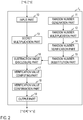
Fig. 3 is a diagram illustrating a processing flow of a secret tampering detection method. - Hereinafter, an embodiment of the present invention will be described in detail. Note that constituent parts having the same function in the drawings are denoted by the same numeral, and the repeated description thereof will be omitted.
- A right arrow "→" as a superscript which is used in the present specification represents a vector. Although "→" should originally be put immediately above a following character, by limitation of the text notation, "→" will be put immediately before the character. In each formula, the symbol is put in its original position, namely, directly above the character. For example, a text with "→x" means the same as the following expression in the formula.
- [x] represents that a certain value x has been subjected to secret sharing. [X] represents a set of data with all sources of a certain set X subjected to the secret sharing. Hereinafter, a value subjected to the secret sharing is also referred to as a "share." →x→y represents a vector as a result of multiplying a vector →x and a vector →y for each element. F represents an arbitrary field.
- An embodiment of the present invention is a secret tampering detection system and method which perform multiplication with tampering detection, obtained by improving the secret tampering detection technique described in Non-patent literature 1. The secret tampering detection system and method of the embodiment execute a multiplication protocol with tampering detection shown in the following formula.
- Scheme 1: Multiplication with tampering detection
Input: [→x], [→y] ∈ [F]N
Output: [→x→y] ∈ [F]N, but no output when tampering is detected
Parameters: σ≥1, D∈N - 1: Generating random number vector [→ri], [→si] ∈ [F]N+D.
- 2: Calculating [→ti]:=[→ri →si] for each 0≤i<σ.
- 3: Calculating [→z]:=[→x→y] and confirming that communication related to the computing has been terminated.
- 4: Randomly selecting positions pi,0, ..., pi,D-1 for each 0≤i<σ.
Disclosing a pi,j-th element corresponding to each 0≤j<D out of each of vectors [→ri], [→si], [→ti] and confirming that its value has integrity as multiplication.
In the case of no integrity, tampering detection terminates.
Substituting the remaining, undisclosed elements by random substitution πi to obtain vectors [→r'i], [→s'i], [→t'i] ∈ [F]N. - 5: Disclosing [→x-→r'i], [→y-→s'i].
- 6: Calculating [→ci]:=[→z]-(→x-→r'i) [→y]-(→y-→s'i) [→r'i]-[→t'i].
- 7: Confirming that all elements of [→ci] are zero for each 0≤i<σ.
When an element which is not zero is present, tampering detection terminates. - In the above multiplication protocol with tampering detection, the following three secure computation protocols are used. The first is a multiplication protocol without tampering detection to be executed in steps 2 and 3. The existing multiplication protocol without tampering detection is described in Reference Literature 1 and the like, for example. The second is a random number generation protocol with tampering detection to be executed in step 1. The existing random number generation protocol with tampering detection is described in Reference Literature 2 and the like, for example. The third is a disclosure protocol with tampering detection to be executed in steps 4 and 5. The existing disclosure protocol with tampering detection is described in Reference Literature 3 and the like, for example.
- Reference Literature 1: D. Ikarashi, R. Kikuchi, K. Hamada, and K. Chida, "Actively private and correct MPC scheme in t<n/2 from passively secure schemes with small overhead", IACR Cryptology ePrint Archive, 2014:304, 2014
- Reference Literature 2: R. Cramer, I. Damgard, and Y. Ishai, "Share conversion, pseudorandom secret-sharing and applications to secure computation", TCC, Vol. 3378 of Lecture Notes in Computer Science, pp. 342-362. Springer, 2005.
- Reference Literature 3: Japanese Patent Application Laid Open No.
2016-146530 - A configuration example of a secret tampering detection system of the embodiment will be described with reference to
Fig. 1 . The secret tampering detection system includes K (≥3) secret tampering detection apparatuses 11, ..., 1K. In the present embodiment, each of the secret tampering detection apparatuses 11, ..., 1K is connected to a communication network 2. The communication network 2 is a circuit-switching or packet-switching communication network configured so that each of the connected apparatuses can communicate with each other, and for example, the Internet, a local area network (LAN), a wide area network (WAN), or the like can be used. Note that each apparatus is not necessarily required to be able to communicate online via the communication network 2. For example, information to be input into each of the secret tampering detection apparatuses 11, ..., 1K may be stored into a portable recording medium such as a magnetic tape or a USB memory, and may be input into each of the secret tampering detection apparatuses 11, ..., 1K offline from the portable recording medium. - A configuration example of a secret tampering detection apparatus 1k (k=1, ..., K) included in the secret tampering detection system will be described with reference to
Fig. 2 . For example, as shown inFig. 2 , the secret tampering detection apparatus 1k includes aninput part 10, a randomnumber generation part 11, a randomnumber multiplication part 12, asecret multiplication part 13, a randomnumber verification part 14, a randomnumber substitution part 15, a subtractionvalue disclosure part 16, a verificationvalue computing part 17, a verificationvalue confirmation part 18, and anoutput part 19. The secret tampering detection apparatus 1k (1≤k≤K) performs processing of each step described below in cooperation with another secret tampering detection apparatus 1k' (k'=1, ..., K, but k ≠ k') to realize a secret tampering detection method according to the embodiment. - The secret tampering detection apparatus 1k is, for example, a special apparatus configured by reading a special program into a known or dedicated computer having a central processing unit (CPU), a main storage (random access memory: RAM), and the like. The secret tampering detection apparatus 1k executes each processing under the control of the central processing unit, for example. Data input into the secret tampering detection apparatus 1k and data obtained in each processing are stored into, for example, the main storage, and the data stored into the main storage is read out to the central processing unit as required and used for another processing. At least a portion of each processing part of the secret tampering detection apparatus 1k may be formed by hardware such as an integrated circuit.
- A processing procedure of the secret tampering detection method, which is executed by the secret tampering detection system of the embodiment, will be described with reference to
Fig. 3 . - In step S1, shares [→x], [→y] ∈ [F]N to be multiplied are input into the
input part 10 of each secret tampering detection apparatus 1k. [→x] is a share which becomes a vector →x with N elements when reconstructed. [→y] is a share which becomes a vector →y with N elements when reconstructed. Theinput part 10 inputs the shares [→x], [→y] into thesecret multiplication part 13. - In step S2, for each integer i satisfying 0≤i<σ, the random
number generation part 11 of each secret tampering detection apparatus 1k generates σ shares [→ri] each of which becomes a random number vector →ri with N+D elements when reconstructed and σ shares [→si] each of which becomes a random number vector →si with N+D elements when reconstructed, by using the random number generation protocol with tampering detection. Here, σ is a previously set integer of 1 or more. As σ is greater, the tampering success probability decreases, but the computing amount increases. Therefore, the value of σ may be appropriately set in view of desired safety and convenience. For example, the protocol described in above Reference Literature 2 can be applied to the random number generation protocol with tampering detection. The randomnumber generation part 11 inputs the shares [→ri], [→si] into the randomnumber multiplication part 12. - In step S3, the random
number multiplication part 12 of each secret tampering detection apparatus 1k receives the shares [→ri], [→si] from the randomnumber generation part 11, and for each integer i satisfying 0≤i<σ, the randomnumber multiplication part 12 multiplies the share [→ri] and the share [→si] by the multiplication protocol without tampering detection to generate σ shares [→ti]:=[→ri →si] each of which becomes a vector →ti when reconstructed, the vector →ti being a result of multiplying the vector →ri and the vector →si for each element. For example, the protocol described in above Reference Literature 1 can be applied to the multiplication protocol without tampering detection. The randomnumber multiplication part 12 inputs the shares [→ri], [→si], [→ti] as a set into the randomnumber verification part 14. - In step S4, the
secret multiplication part 13 of each secret tampering detection apparatus 1k receives the shares [→x], [→y] from theinput part 10, multiplies the share [→x] and the share [→y] by using the multiplication protocol without tampering detection, and computes the share [→z]:=[→x→y] which becomes a vector →z when reconstructed, the vector →z being a result of multiplying the vector →x and the vector →y for each element. Thesecret multiplication part 13 inputs the shares [→x], [→y] into the subtractionvalue disclosure part 16 and inputs the shares [→y], [→z] into the verificationvalue computing part 17. - In step S5, the random
number verification part 14 of each secret tampering detection apparatus 1k receives the set of the shares [→ri], [→si], [→ti] from the randomnumber multiplication part 12 and randomly selects D different integers pi,0, ..., pi,D-1, D being 0 or more and less than D+N, for each integer i satisfying 0≤i<σ. Here, D is a predetermined natural number. Subsequently, the randomnumber verification part 14 discloses a pi,j-th element corresponding to each integer j that satisfies 0≤j<D out of each of the shares [→ri], [→si], [→ti] by using the disclosure protocol with tampering detection, to confirm whether a set of the disclosed values corresponding respectively to the shares [→ri], [→si], [→ti] has integrity as multiplication. For example, the protocol described in above Reference Literature 3 can be applied to the disclosure protocol with tampering detection. When there is a set of values without integrity as multiplication, theoutput part 19 outputs information indicating that tampering has been detected, and terminates the processing. When all the sets of values have integrity as multiplication, the randomnumber verification part 14 inputs the shares [→ri], [→si], [→ti] and the integer pij into the randomnumber substitution part 15. - In step S6, the random
number substitution part 15 receives the shares [→ri], [→si], [→ti] and an integer pij from the randomnumber verification part 14, and for each integer i satisfying 0≤i<σ, the randomnumber substitution part 15 substitutes undisclosed elements (i.e., elements except for the pi,j-th element) of each of the shares [→ri], [→si], [→ti] by previously set random substitution πi to generate shares [→r'i], [→s'i], [→t'i] ∈ [F]N. The randomnumber substitution part 15 inputs the shares [→r'i], [→s'i] into the subtractionvalue disclosure part 16 and inputs the shares [→r'i], [→t'i] into the verificationvalue computing part 17. - In step S7, the subtraction
value disclosure part 16 of each secret tampering detection apparatus 1k receives the shares [→x], [→y] from thesecret multiplication part 13 and the shares [→r'i], [→s'i] from the randomnumber substitution part 15, and for each integer i satisfying 0≤i<σ, the subtractionvalue disclosure part 16 computes and discloses [→x-→r'i], [→y-→s'i] by using the disclosure protocol with tampering detection. The subtractionvalue disclosure part 16 inputs the disclosed vectors (→x-→r'i), (→y-→s'i) into the verificationvalue computing part 17. - In step S8, the verification
value computing part 17 of each secret tampering detection apparatus 1k receives the shares [→y], [→z] from thesecret multiplication part 13, the shares [→r'i], [→t'i] from the randomnumber substitution part 15, and the vectors (→x-→r'i), (→y-→s'i) from the subtractionvalue disclosure part 16, and for each integer i satisfying 0≤i<σ, the verificationvalue computing part 17 computes Formula (1) to generate a share [→ci] which becomes a vector →ci of a verification value ci when reconstructed. The verificationvalue computing part 17 inputs the shares [→z], [→ci] into the verificationvalue confirmation part 18.
- In step S9, the verification
value confirmation part 18 of each secret tampering detection apparatus 1k receives the shares [→z], [→ci] from the verificationvalue computing part 17, and for each integer i satisfying 0≤i<σ, the verificationvalue confirmation part 18 discloses the vector →ci of the verification value ci from the share [→ci] by using the disclosure protocol with tampering detection. The verificationvalue confirmation part 18 then confirms that all elements of the disclosed vector →ci are zero. When an element which is not zero is included in the disclosed vector →ci, theoutput part 19 outputs information indicating that tampering has been detected, and terminates the processing. When all the elements of the disclosed vector →ci are zero, the verificationvalue confirmation part 18 inputs the received vector [→z] into theoutput part 19. - In step S10, the
output part 19 of the secret tampering detection apparatus 1k outputs the vector [→z] received from the verificationvalue confirmation part 18. - Generally, in the multiplication protocol without tampering detection, an attacker would be able to perform tampering. However, in the secret tampering detection system of the embodiment, after the multiplication is performed in step S4, the random number vector is verified in step S5 to prevent the tampering. In order for the attacker to succeed in tampering, the attacker should perform tampering in step S3 as well and perform tampering so as to make the share [→ti] to be used for the verification consistent. However, as the number of times of tampering is increased, the probability of detecting tampering increases due to the disclosure in step S5. Conversely, as the number of times of tampering is decreased, the probability of illegal passage of the verification is decreased. By performing σ times of verification with such properties, the tampering success probability can be O(N-σ).
- The above embodiment can be made further efficient in such a manner as follows. In the above embodiment, the confirmation of whether all the verification values ci are zero in step S9 has been performed by disclosing the verification values ci from the share [→ci] and confirming each of those. Here, by computing a checksum formed by a product sum of each element of the share [→ci] of the vector →ci of the verification value ci with a random number and confirming that the checksum is zero, it is possible to confirm the verification values with the communication traffic not depending on the size of N. As such a checksum, for example, a checksum described in Reference Literature 4 below can be used.
Reference Literature 4: International Publication No.WO 2014/112550 - The checksum described in Reference Literature 4 is computed as follows. In the following description, q is an integer of 2 or more, ρ is the minimum integer of (N+D)/q or more, and R is a ring. The verification
value confirmation part 18 divides the share [→ci], which becomes the vector →ci of the verification value ci when reconstructed, into q pieces each from the head to generate ρ value vectors A0, ..., Aρ-1. When the number of elements of the last value vector Aρ-1 is not q at the time of division, the elements are padded with any value (e.g., 0) so that the number of elements is q. The verificationvalue confirmation part 18 selects a random number r∈Rq and computes a checksum c by Formula (2).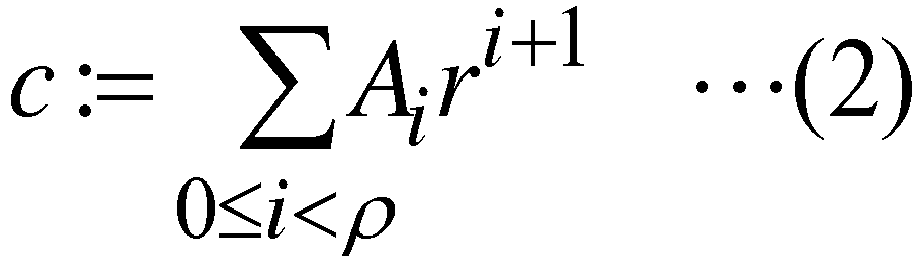
- At this time, the multiplication of the vectors is performed using a function f defined by Formulas (3) and (4).


- Here, αi,j,k (i=0, ..., q-1; j=0, ..., q-1; k=0, ..., q-1) is a parameter for uniform association of the elements of two rings Rq with the elements of one ring Rq. There can be a plurality of types of parameters αi,j,k, but in consideration of simplifying the computation, it is desirable that q3 values with the largest number of 0's included therein is selected as the parameter αi,j,k. For example, when R is a field and the parameter αi,j,k is determined so that Rq is an enlarged field of the field R, it is possible to efficiently detect tampering.
- A result of comparing the communication traffic between the embodiment and the prior art is shown. For example, when the comparison is made between a case where a field F in the embodiment is a finite field GF(2) with the order of 2 and the technique described in Non-patent literature 1, with the same tampering success probability O(N-2), the communication traffic of each party is about 10N bits in Non-patent literature 1, whereas the communication traffic is only about 7N bits in the embodiment.
- The points of the present invention are as follows. At first, in Non-patent literature 1 that is the prior art, the tampering detection is performed on the multiplication triple. On the other hand, in the present invention, from the beginning, the tampering detection using the multiplication triple is performed on the multiplication to be computed. Further, in Non-patent literature 1, the processing is performed with an integer multiple of the number of multiplications to be computed taken as a unit. On the other hand, in the present invention, the processing can be performed in parallel in the unit that is the same as the number of multiplications to be computed. Therefore, the multiplication with tampering detection can be performed more efficiently than in the prior art.
- Although the embodiment of the present invention has been described above, a specific configuration is not limited to these embodiments, and even if there is an appropriate design change or the like without departing from the scope of the invention, it is needless to say that such a change or the like is included in the present invention. Various sorts of processing described in the embodiment are not only executed chronologically in the order described but may be executed in parallel or individually as required or in accordance with the processing capacity of the apparatus that executes the processing.
- In a case where various processing functions in each apparatus described in the above embodiment are realized by a computer, a program describes the processing contents of the functions to be provided in each apparatus. Then, by the computer executing the program, various processing functions in each apparatus described above are realized on the computer.
- The program describing the processing contents can be recorded in a computer-readable recording medium. The computer-readable recording medium may, for example, be a magnetic recording device, an optical disk, a magneto-optical recording medium, a semiconductor memory, or the like.
- The program is distributed by, for example, the sale, transfer, lending, or the like of a portable recording medium such as a DVD or a CD-ROM in which the program is recorded. Further, the program may be previously stored into a storage device of a server computer, and the program may be transferred from the server computer to another computer via the network to distribute the program.
- The computer to execute such a program first stores a program, such as a program recorded in a portable recording medium or a program transferred from the server computer, temporarily into its own storage. Then, at the time of executing the processing, the computer reads the program stored in its own storage and executes the processing in accordance with the read program. As another form of executing the program, the computer may read the program directly from the portable recording medium and executes the processing in accordance with the program, or further, each time the program is transferred from the server computer to the computer, the computer may successively execute the processing in accordance with the received program. The program may not be transferred from the server computer to the computer, but the processing described above may be executed by a so-called ASP (application service provider) service that realizes the processing functions only by instructing the execution and obtaining the result. Note that the program in the present form includes one equivalent to a program, the one being information to be used for processing by an electronic computer (data that is not a direct command to the computer but has the property of defining the processing of the computer).
- Further, in the present form, the present apparatus has been configured by executing predetermined programs on the computer, but at least some of the processing contents of these may be realized in hardware.
Claims (6)
- A secret tampering detection system, in which σ represents an arbitrary integer of 1 or more, N and D represent predetermined natural numbers, i represents each integer of 0 or more and less than σ, and j represents each integer of 0 or more and less than D, the secret tampering detection system including at least three secret tampering detection apparatuses, the secret tampering detection system inputting a share [→x] that becomes a vector →x with N elements when reconstructed and a share [→y] that becomes a vector →y with N elements when reconstructed, and outputting a share [→z] that becomes a vector →z when reconstructed, the vector →z being a result of multiplying the vector →x and the vector →y for each of the elements,
wherein each of the secret tampering detection apparatuses includes:a random number generation part that generates, for each integer i, σ shares [→ri] each of which becomes a random number vector →ri with N+D elements when reconstructed and σ shares [→si] each of which becomes a random number vector →si with N+D elements when reconstructed;a random number multiplication part that multiplies, for each integer i, the share [→ri] and the share [→si] by secure computation to generate σ shares [→ti] each of which becomes a vector →ti when reconstructed, the vector →ti being a result of multiplying the vector →ri and the vector →si for each of the elements;a secret multiplication part that multiplies the share [→x] and the share [→y] by secure computation to generate the share [→z];a random number verification part that randomly selects, for each integer i, D different integers pi,j, D being 0 or more and less than D+N, and discloses a pi,j-th element of each of the shares [→ri], [→si], [→ti], to confirm whether a set of the disclosed values corresponding respectively to the shares [→ri], [→si], [→ti] has integrity as multiplication;a random number substitution part that generates, for each integer i, shares [→r'i], [→s'i], [→t'i] obtained by performing random substitution on elements of each of the shares [→ri], [→si], [→ti] except for the pi,j-th element;a subtraction value disclosure part that computes and discloses [→x-→r'i], [→y-→s'i] for each integer i;a verification value computing part that computes, for each integer i, [→ci]:=[→z]-(→x-→r'i) [→y]-(→y-→s'i) [→r'i]-[→t'i] to generate a share [→ci] that becomes a vector →ci of a verification value ci when reconstructed; anda verification value confirmation part that confirms, for each integer i, that the verification values ci are all zero by using the share [→ci]. - The secret tampering detection system according to claim 1, wherein
the random number generation part generates the share [→ri] and the share [→si] by using a random number generation protocol with tampering detection,
the random number multiplication part multiplies the share [→ri] and the share [→si] by using a multiplication protocol without tampering detection,
the secret multiplication part multiplies the share [→x] and the share [→y] by using the multiplication protocol without tampering detection,
the random number verification part discloses the pi,j-th element of each of the shares [→ri], [→si], [→ti] by using a disclosure protocol with tampering detection, and
the subtraction value disclosure part discloses the [→x-→r'i], [→y-→s'i] by using the disclosure protocol with tampering detection. - The secret tampering detection system according to claim 1, wherein the verification value confirmation part computes a checksum formed by a product sum of each element of the share [→ci] and a power of a random number r, and confirms that all the verification values ci are zero based on whether the checksum c is zero.
- A secret tampering detection apparatus, in which σ represents an arbitrary integer of 1 or more, N and D represent predetermined natural numbers, i represents each integer of 0 or more and less than σ, and j represents each integer of 0 or more and less than D, the secret tampering detection apparatus inputting a share [→x] that becomes a vector →x with N elements when reconstructed and a share [→y] that becomes a vector →y with N elements when reconstructed, and outputting a share [→z] that becomes a vector →z when reconstructed, the vector →z being a result of multiplying the vector →x and the vector →y for each of the elements,
the secret tampering detection apparatus comprising:a random number generation part that generates, for each integer i, σ shares [→ri] each of which becomes a random number vector →ri with N+D elements when reconstructed and σ shares [→si] each of which becomes a random number vector →si with N+D elements when reconstructed;a random number multiplication part that multiplies, for each integer i, the share [→ri] and the share [→si] by secure computation to generate σ shares [→ti] each of which becomes a vector →ti when reconstructed, the vector →ti being a result of multiplying the vector →ri and the vector →si for each of the elements;a secret multiplication part that multiplies the share [→x] and the share [→y] by secure computation to generate the share [→z];a random number verification part that randomly selects, for each integer i, D different integers pi,j, D being 0 or more and less than D+N, and discloses a pi,j-th element of each of the shares [→ri], [→si], [→ti], to confirm whether a set of the disclosed values corresponding respectively to the shares [→ri], [→si], [→ti] has integrity as multiplication;a random number substitution part that generates, for each integer i, shares [→r'i], [→s'i], [→t'i] obtained by performing random substitution on elements of each of the shares [→ri], [→si], [→ti] except for the pij-th element;a subtraction value disclosure part that computes and discloses [→x-→r'i], [→y-→s'i] for each integer i;a verification value computing part that computes, for each integer i, [→ci]:=[→z]-(→x-→r'i) [→y]-(→y-→s'i) [→r'i]-[→t'i] to generate a share [→ci] that becomes a vector →ci of a verification value ci when reconstructed; anda verification value confirmation part that confirms, for each integer i, that the verification values ci are all zero by using the share [→ci]. - A secret tampering detection method, in which σ represents an arbitrary integer of 1 or more, N and D represent predetermined natural numbers, i represents each integer of 0 or more and less than σ, and j represents each integer of 0 or more and less than D, the secret tampering detection method being executed by a secret tampering detection system that includes at least three secret tampering detection apparatuses, the secret tampering detection method inputting a share [→x] that becomes a vector →x with N elements when reconstructed and a share [→y] that becomes a vector →y with N elements when reconstructed, and outputting a share [→z] that becomes a vector →z when reconstructed, the vector →z being a result of multiplying the vector →x and the vector →y for each of the elements,
wherein
each of the secret tampering detection apparatuses generates, for each integer i, σ shares [→ri] each of which becomes a random number vector →ri with N+D elements when reconstructed and σ shares [→si] each of which becomes a random number vector →si with N+D elements when reconstructed,
each of the secret tampering detection apparatuses multiplies, for each integer i, the share [→ri] and the share [→si] by secure computation to generate σ shares [→ti] each of which becomes a vector →ti when reconstructed, the vector →ti being a result of multiplying the vector →ri and the vector →si for each of the elements,
each of the secret tampering detection apparatuses multiplies the share [→x] and the share [→y] by secure computation to generate the share [→z],
each of the secret tampering detection apparatuses randomly selects, for each integer i, D different integers pi,j, D being 0 or more and less than D+N, and discloses a pi,j-th element of each of the shares [→ri], [→si], [→ti], to confirm whether a set of the disclosed values corresponding respectively to the shares [→ri], [→si], [→ti] has integrity as multiplication,
each of the secret tampering detection apparatuses generates, for each integer i, shares [→r'i], [→s'i], [→t'i] obtained by performing random substitution on elements of each of the shares [→ri], [→si], [→ti] except for the pij-th element,
each of the secret tampering detection apparatuses computes and discloses [→x-→r'i], [→y-→s'i] for each integer i,
each of the secret tampering detection apparatuses computes, for each integer i, [→ci]:=[→z]-(→x-→r'i) [→y]-(→y-→s'i) [→r'i]-[→t'i] to generate a share [→ci] that becomes a vector →ci of a verification value ci when reconstructed, and
each of the secret tampering detection apparatuses confirms, for each integer i, that the verification values ci are all zero by using the share [→ci]. - A program for causing a computer to function as the secret tampering detection apparatus according to claim 4.
Applications Claiming Priority (2)
| Application Number | Priority Date | Filing Date | Title |
|---|---|---|---|
| JP2017103292 | 2017-05-25 | ||
| PCT/JP2018/018389 WO2018216512A1 (en) | 2017-05-25 | 2018-05-11 | Secret tamper detection system, secret tamper detection device, method for detecting secret tamper, and program |
Publications (3)
| Publication Number | Publication Date |
|---|---|
| EP3633656A1 true EP3633656A1 (en) | 2020-04-08 |
| EP3633656A4 EP3633656A4 (en) | 2021-02-24 |
| EP3633656B1 EP3633656B1 (en) | 2021-09-08 |
Family
ID=64395497
Family Applications (1)
| Application Number | Title | Priority Date | Filing Date |
|---|---|---|---|
| EP18806480.2A Active EP3633656B1 (en) | 2017-05-25 | 2018-05-11 | Secret tampering detection system, secret tampering detection apparatus, secret tampering detection method, and program |
Country Status (6)
| Country | Link |
|---|---|
| US (1) | US11157612B2 (en) |
| EP (1) | EP3633656B1 (en) |
| JP (1) | JP6777816B2 (en) |
| CN (1) | CN110622232B (en) |
| AU (1) | AU2018271515B2 (en) |
| WO (1) | WO2018216512A1 (en) |
Families Citing this family (4)
| Publication number | Priority date | Publication date | Assignee | Title |
|---|---|---|---|---|
| AU2018295722B2 (en) * | 2017-07-05 | 2020-11-19 | Ntt, Inc. | Secure computation system, secure computation apparatus, secure computation method, program, and recording medium |
| US20220343027A1 (en) * | 2019-09-26 | 2022-10-27 | Nec Corporation | Computation system and computation method |
| WO2022172345A1 (en) * | 2021-02-10 | 2022-08-18 | 日本電気株式会社 | Secure computation system, secure computation server device, secure computation method, and secure computation program |
| WO2022195799A1 (en) * | 2021-03-18 | 2022-09-22 | 日本電気株式会社 | Secure computation system, secure computation server device, secure computation method, and secure computation program |
Family Cites Families (19)
| Publication number | Priority date | Publication date | Assignee | Title |
|---|---|---|---|---|
| JP3604737B2 (en) * | 1994-07-29 | 2004-12-22 | キヤノン株式会社 | Secret information processing method in communication system having a plurality of information processing devices and communication system thereof |
| JP2001222218A (en) * | 2000-02-09 | 2001-08-17 | Nippon Telegr & Teleph Corp <Ntt> | Encryption device, method, decryption device, method, encryption system, and storage medium storing program |
| DK1376922T3 (en) * | 2001-04-03 | 2014-10-27 | Mitsubishi Electric Corp | encryption device |
| AU2003302544A1 (en) * | 2002-12-03 | 2004-06-23 | Matsushita Electric Industrial Co., Ltd. | Key sharing system, shared key creation device, and shared key restoration device |
| JP5118036B2 (en) * | 2006-07-18 | 2013-01-16 | パナソニック株式会社 | Instruction generating apparatus, instruction generating method, program, and integrated circuit |
| US8290146B2 (en) * | 2007-01-19 | 2012-10-16 | Mitsubishi Electric Corporation | Ciphertext generating apparatus, cryptographic communication system, and group parameter generating apparatus |
| CN101729554B (en) * | 2008-11-27 | 2013-05-29 | 北京大学 | Construction method of division protocol based on cryptology in distributed computation |
| WO2011062136A1 (en) * | 2009-11-20 | 2011-05-26 | 三菱電機株式会社 | Cipher processing system, key generating device, key delegating device, encrypting device, decrypting device, cipher processing method, and cipher processing program |
| US20150010144A1 (en) * | 2012-03-02 | 2015-01-08 | Sony Corporation | Information processing apparatus, image processing method, and program |
| EP2947814B1 (en) | 2013-01-17 | 2018-03-14 | Nippon Telegraph and Telephone Corporation | Tampering detection device, tampering detection method, and program |
| WO2014112548A1 (en) * | 2013-01-17 | 2014-07-24 | 日本電信電話株式会社 | Secure-computation system, computing device, secure-computation method, and program |
| JP5907902B2 (en) * | 2013-01-21 | 2016-04-26 | 日本電信電話株式会社 | Table equijoin system by secret calculation, method |
| JP5937556B2 (en) * | 2013-09-30 | 2016-06-22 | 日本電信電話株式会社 | Secret calculation device, secret search system, secret calculation method, secret search method, program |
| CN105900165B (en) * | 2014-01-17 | 2019-03-08 | 日本电信电话株式会社 | Secret computing method, secret computing system, random permutation device, and recording medium |
| JP2016015072A (en) * | 2014-07-03 | 2016-01-28 | 雅紀 廣石 | Photon random number generator |
| JP5860557B1 (en) | 2015-02-06 | 2016-02-16 | 日本電信電話株式会社 | Secret disclosure method, secret disclosure system, secret disclosure device, and program |
| JP5864004B1 (en) * | 2015-03-18 | 2016-02-17 | 日本電信電話株式会社 | Distributed value conversion system, distributed value conversion apparatus, distributed value conversion method, and program |
| EP3389031B1 (en) * | 2015-12-10 | 2021-08-04 | Nec Corporation | Pre-calculation device, method, computer-readable recording medium, vector multiplication device, and method |
| JP6053238B2 (en) * | 2016-01-13 | 2016-12-27 | 日本電信電話株式会社 | Secret falsification detection system, secret calculation device, secret falsification detection method, and program |
-
2018
- 2018-05-11 AU AU2018271515A patent/AU2018271515B2/en active Active
- 2018-05-11 EP EP18806480.2A patent/EP3633656B1/en active Active
- 2018-05-11 JP JP2019519571A patent/JP6777816B2/en active Active
- 2018-05-11 CN CN201880031513.5A patent/CN110622232B/en active Active
- 2018-05-11 US US16/612,549 patent/US11157612B2/en active Active
- 2018-05-11 WO PCT/JP2018/018389 patent/WO2018216512A1/en not_active Ceased
Also Published As
| Publication number | Publication date |
|---|---|
| JP6777816B2 (en) | 2020-10-28 |
| CN110622232A (en) | 2019-12-27 |
| AU2018271515B2 (en) | 2020-09-10 |
| JPWO2018216512A1 (en) | 2020-03-19 |
| WO2018216512A1 (en) | 2018-11-29 |
| US20200125724A1 (en) | 2020-04-23 |
| EP3633656A4 (en) | 2021-02-24 |
| AU2018271515A1 (en) | 2019-12-05 |
| US11157612B2 (en) | 2021-10-26 |
| EP3633656B1 (en) | 2021-09-08 |
| CN110622232B (en) | 2023-01-13 |
Similar Documents
| Publication | Publication Date | Title |
|---|---|---|
| US11895231B2 (en) | Adaptive attack resistant distributed symmetric encryption | |
| EP3096309B1 (en) | Secret calculation method, secret calculation system, sorting device, and program | |
| US10375070B2 (en) | Generating cryptographic function parameters from compact source code | |
| EP2947642B1 (en) | Secret computation system, arithmetic unit, secret computation method and program | |
| EP3893229B1 (en) | Secret parallel processing device, secret parallel processing method, and program | |
| EP3633656B1 (en) | Secret tampering detection system, secret tampering detection apparatus, secret tampering detection method, and program | |
| JP6583970B2 (en) | Secret random number synthesis device, secret random number synthesis method, and program | |
| JP2015184594A (en) | Cryptography processing device, cryptography processing method, cryptography processing program and information processor | |
| JP6585846B2 (en) | Secret calculation system, secret calculation device, secret calculation method, and program | |
| JPWO2019163636A1 (en) | Secret calculation device, secret calculation authentication system, secret calculation method, and program | |
| Zahan et al. | Smart home IoT use case with elliptic curve based digital signature: an evaluation on security and performance analysis | |
| CN103392197B (en) | Act on behalf of computing system, method, trust device | |
| Riasi et al. | Privacy-preserving verifiable neural network inference service | |
| JP2014137474A (en) | Tamper detection device, tamper detection method, and program | |
| EP3364397B1 (en) | Secret authentication code adding device, secret authentification code adding method, and program | |
| Wøien et al. | Neural Networks Meet Elliptic Curve Cryptography: A Novel Approach to Secure Communication | |
| EP4024755A1 (en) | Secured performance of an elliptic curve cryptographic process | |
| CN120238351B (en) | A data processing task result verification method and system based on smart contract | |
| Jaber et al. | Efficient elliptic curve cryptography encryption framework for cloud computing | |
| Carvalho et al. | Using Cryptol to explore elliptic curve-based random-number generators |
Legal Events
| Date | Code | Title | Description |
|---|---|---|---|
| STAA | Information on the status of an ep patent application or granted ep patent |
Free format text: STATUS: THE INTERNATIONAL PUBLICATION HAS BEEN MADE |
|
| PUAI | Public reference made under article 153(3) epc to a published international application that has entered the european phase |
Free format text: ORIGINAL CODE: 0009012 |
|
| STAA | Information on the status of an ep patent application or granted ep patent |
Free format text: STATUS: REQUEST FOR EXAMINATION WAS MADE |
|
| 17P | Request for examination filed |
Effective date: 20200102 |
|
| AK | Designated contracting states |
Kind code of ref document: A1 Designated state(s): AL AT BE BG CH CY CZ DE DK EE ES FI FR GB GR HR HU IE IS IT LI LT LU LV MC MK MT NL NO PL PT RO RS SE SI SK SM TR |
|
| AX | Request for extension of the european patent |
Extension state: BA ME |
|
| DAV | Request for validation of the european patent (deleted) | ||
| DAX | Request for extension of the european patent (deleted) | ||
| A4 | Supplementary search report drawn up and despatched |
Effective date: 20210126 |
|
| RIC1 | Information provided on ipc code assigned before grant |
Ipc: H04L 9/08 20060101ALI20210120BHEP Ipc: H04L 9/00 20060101AFI20210120BHEP |
|
| REG | Reference to a national code |
Ref country code: DE Ref legal event code: R079 Ref document number: 602018023378 Country of ref document: DE Free format text: PREVIOUS MAIN CLASS: G09C0001000000 Ipc: H04L0009000000 |
|
| GRAP | Despatch of communication of intention to grant a patent |
Free format text: ORIGINAL CODE: EPIDOSNIGR1 |
|
| STAA | Information on the status of an ep patent application or granted ep patent |
Free format text: STATUS: GRANT OF PATENT IS INTENDED |
|
| RIC1 | Information provided on ipc code assigned before grant |
Ipc: H04L 9/08 20060101ALI20210323BHEP Ipc: H04L 9/00 20060101AFI20210323BHEP |
|
| INTG | Intention to grant announced |
Effective date: 20210409 |
|
| GRAS | Grant fee paid |
Free format text: ORIGINAL CODE: EPIDOSNIGR3 |
|
| GRAA | (expected) grant |
Free format text: ORIGINAL CODE: 0009210 |
|
| STAA | Information on the status of an ep patent application or granted ep patent |
Free format text: STATUS: THE PATENT HAS BEEN GRANTED |
|
| AK | Designated contracting states |
Kind code of ref document: B1 Designated state(s): AL AT BE BG CH CY CZ DE DK EE ES FI FR GB GR HR HU IE IS IT LI LT LU LV MC MK MT NL NO PL PT RO RS SE SI SK SM TR |
|
| REG | Reference to a national code |
Ref country code: GB Ref legal event code: FG4D |
|
| REG | Reference to a national code |
Ref country code: CH Ref legal event code: EP Ref country code: AT Ref legal event code: REF Ref document number: 1429555 Country of ref document: AT Kind code of ref document: T Effective date: 20210915 |
|
| REG | Reference to a national code |
Ref country code: DE Ref legal event code: R096 Ref document number: 602018023378 Country of ref document: DE |
|
| REG | Reference to a national code |
Ref country code: IE Ref legal event code: FG4D |
|
| REG | Reference to a national code |
Ref country code: LT Ref legal event code: MG9D |
|
| REG | Reference to a national code |
Ref country code: NL Ref legal event code: MP Effective date: 20210908 |
|
| PG25 | Lapsed in a contracting state [announced via postgrant information from national office to epo] |
Ref country code: RS Free format text: LAPSE BECAUSE OF FAILURE TO SUBMIT A TRANSLATION OF THE DESCRIPTION OR TO PAY THE FEE WITHIN THE PRESCRIBED TIME-LIMIT Effective date: 20210908 Ref country code: SE Free format text: LAPSE BECAUSE OF FAILURE TO SUBMIT A TRANSLATION OF THE DESCRIPTION OR TO PAY THE FEE WITHIN THE PRESCRIBED TIME-LIMIT Effective date: 20210908 Ref country code: ES Free format text: LAPSE BECAUSE OF FAILURE TO SUBMIT A TRANSLATION OF THE DESCRIPTION OR TO PAY THE FEE WITHIN THE PRESCRIBED TIME-LIMIT Effective date: 20210908 Ref country code: FI Free format text: LAPSE BECAUSE OF FAILURE TO SUBMIT A TRANSLATION OF THE DESCRIPTION OR TO PAY THE FEE WITHIN THE PRESCRIBED TIME-LIMIT Effective date: 20210908 Ref country code: NO Free format text: LAPSE BECAUSE OF FAILURE TO SUBMIT A TRANSLATION OF THE DESCRIPTION OR TO PAY THE FEE WITHIN THE PRESCRIBED TIME-LIMIT Effective date: 20211208 Ref country code: HR Free format text: LAPSE BECAUSE OF FAILURE TO SUBMIT A TRANSLATION OF THE DESCRIPTION OR TO PAY THE FEE WITHIN THE PRESCRIBED TIME-LIMIT Effective date: 20210908 Ref country code: BG Free format text: LAPSE BECAUSE OF FAILURE TO SUBMIT A TRANSLATION OF THE DESCRIPTION OR TO PAY THE FEE WITHIN THE PRESCRIBED TIME-LIMIT Effective date: 20211208 Ref country code: LT Free format text: LAPSE BECAUSE OF FAILURE TO SUBMIT A TRANSLATION OF THE DESCRIPTION OR TO PAY THE FEE WITHIN THE PRESCRIBED TIME-LIMIT Effective date: 20210908 |
|
| REG | Reference to a national code |
Ref country code: AT Ref legal event code: MK05 Ref document number: 1429555 Country of ref document: AT Kind code of ref document: T Effective date: 20210908 |
|
| PG25 | Lapsed in a contracting state [announced via postgrant information from national office to epo] |
Ref country code: LV Free format text: LAPSE BECAUSE OF FAILURE TO SUBMIT A TRANSLATION OF THE DESCRIPTION OR TO PAY THE FEE WITHIN THE PRESCRIBED TIME-LIMIT Effective date: 20210908 Ref country code: GR Free format text: LAPSE BECAUSE OF FAILURE TO SUBMIT A TRANSLATION OF THE DESCRIPTION OR TO PAY THE FEE WITHIN THE PRESCRIBED TIME-LIMIT Effective date: 20211209 |
|
| PG25 | Lapsed in a contracting state [announced via postgrant information from national office to epo] |
Ref country code: AT Free format text: LAPSE BECAUSE OF FAILURE TO SUBMIT A TRANSLATION OF THE DESCRIPTION OR TO PAY THE FEE WITHIN THE PRESCRIBED TIME-LIMIT Effective date: 20210908 |
|
| PG25 | Lapsed in a contracting state [announced via postgrant information from national office to epo] |
Ref country code: IS Free format text: LAPSE BECAUSE OF FAILURE TO SUBMIT A TRANSLATION OF THE DESCRIPTION OR TO PAY THE FEE WITHIN THE PRESCRIBED TIME-LIMIT Effective date: 20220108 Ref country code: SM Free format text: LAPSE BECAUSE OF FAILURE TO SUBMIT A TRANSLATION OF THE DESCRIPTION OR TO PAY THE FEE WITHIN THE PRESCRIBED TIME-LIMIT Effective date: 20210908 Ref country code: SK Free format text: LAPSE BECAUSE OF FAILURE TO SUBMIT A TRANSLATION OF THE DESCRIPTION OR TO PAY THE FEE WITHIN THE PRESCRIBED TIME-LIMIT Effective date: 20210908 Ref country code: RO Free format text: LAPSE BECAUSE OF FAILURE TO SUBMIT A TRANSLATION OF THE DESCRIPTION OR TO PAY THE FEE WITHIN THE PRESCRIBED TIME-LIMIT Effective date: 20210908 Ref country code: PT Free format text: LAPSE BECAUSE OF FAILURE TO SUBMIT A TRANSLATION OF THE DESCRIPTION OR TO PAY THE FEE WITHIN THE PRESCRIBED TIME-LIMIT Effective date: 20220110 Ref country code: PL Free format text: LAPSE BECAUSE OF FAILURE TO SUBMIT A TRANSLATION OF THE DESCRIPTION OR TO PAY THE FEE WITHIN THE PRESCRIBED TIME-LIMIT Effective date: 20210908 Ref country code: NL Free format text: LAPSE BECAUSE OF FAILURE TO SUBMIT A TRANSLATION OF THE DESCRIPTION OR TO PAY THE FEE WITHIN THE PRESCRIBED TIME-LIMIT Effective date: 20210908 Ref country code: EE Free format text: LAPSE BECAUSE OF FAILURE TO SUBMIT A TRANSLATION OF THE DESCRIPTION OR TO PAY THE FEE WITHIN THE PRESCRIBED TIME-LIMIT Effective date: 20210908 Ref country code: CZ Free format text: LAPSE BECAUSE OF FAILURE TO SUBMIT A TRANSLATION OF THE DESCRIPTION OR TO PAY THE FEE WITHIN THE PRESCRIBED TIME-LIMIT Effective date: 20210908 Ref country code: AL Free format text: LAPSE BECAUSE OF FAILURE TO SUBMIT A TRANSLATION OF THE DESCRIPTION OR TO PAY THE FEE WITHIN THE PRESCRIBED TIME-LIMIT Effective date: 20210908 |
|
| REG | Reference to a national code |
Ref country code: DE Ref legal event code: R097 Ref document number: 602018023378 Country of ref document: DE |
|
| PLBE | No opposition filed within time limit |
Free format text: ORIGINAL CODE: 0009261 |
|
| STAA | Information on the status of an ep patent application or granted ep patent |
Free format text: STATUS: NO OPPOSITION FILED WITHIN TIME LIMIT |
|
| PG25 | Lapsed in a contracting state [announced via postgrant information from national office to epo] |
Ref country code: DK Free format text: LAPSE BECAUSE OF FAILURE TO SUBMIT A TRANSLATION OF THE DESCRIPTION OR TO PAY THE FEE WITHIN THE PRESCRIBED TIME-LIMIT Effective date: 20210908 |
|
| 26N | No opposition filed |
Effective date: 20220609 |
|
| PG25 | Lapsed in a contracting state [announced via postgrant information from national office to epo] |
Ref country code: SI Free format text: LAPSE BECAUSE OF FAILURE TO SUBMIT A TRANSLATION OF THE DESCRIPTION OR TO PAY THE FEE WITHIN THE PRESCRIBED TIME-LIMIT Effective date: 20210908 |
|
| REG | Reference to a national code |
Ref country code: CH Ref legal event code: PL |
|
| REG | Reference to a national code |
Ref country code: BE Ref legal event code: MM Effective date: 20220531 |
|
| PG25 | Lapsed in a contracting state [announced via postgrant information from national office to epo] |
Ref country code: MC Free format text: LAPSE BECAUSE OF FAILURE TO SUBMIT A TRANSLATION OF THE DESCRIPTION OR TO PAY THE FEE WITHIN THE PRESCRIBED TIME-LIMIT Effective date: 20210908 Ref country code: LU Free format text: LAPSE BECAUSE OF NON-PAYMENT OF DUE FEES Effective date: 20220511 Ref country code: LI Free format text: LAPSE BECAUSE OF NON-PAYMENT OF DUE FEES Effective date: 20220531 Ref country code: CH Free format text: LAPSE BECAUSE OF NON-PAYMENT OF DUE FEES Effective date: 20220531 |
|
| PG25 | Lapsed in a contracting state [announced via postgrant information from national office to epo] |
Ref country code: IE Free format text: LAPSE BECAUSE OF NON-PAYMENT OF DUE FEES Effective date: 20220511 |
|
| PG25 | Lapsed in a contracting state [announced via postgrant information from national office to epo] |
Ref country code: BE Free format text: LAPSE BECAUSE OF NON-PAYMENT OF DUE FEES Effective date: 20220531 |
|
| PG25 | Lapsed in a contracting state [announced via postgrant information from national office to epo] |
Ref country code: MK Free format text: LAPSE BECAUSE OF FAILURE TO SUBMIT A TRANSLATION OF THE DESCRIPTION OR TO PAY THE FEE WITHIN THE PRESCRIBED TIME-LIMIT Effective date: 20210908 Ref country code: CY Free format text: LAPSE BECAUSE OF FAILURE TO SUBMIT A TRANSLATION OF THE DESCRIPTION OR TO PAY THE FEE WITHIN THE PRESCRIBED TIME-LIMIT Effective date: 20210908 |
|
| PG25 | Lapsed in a contracting state [announced via postgrant information from national office to epo] |
Ref country code: HU Free format text: LAPSE BECAUSE OF FAILURE TO SUBMIT A TRANSLATION OF THE DESCRIPTION OR TO PAY THE FEE WITHIN THE PRESCRIBED TIME-LIMIT; INVALID AB INITIO Effective date: 20180511 |
|
| PG25 | Lapsed in a contracting state [announced via postgrant information from national office to epo] |
Ref country code: TR Free format text: LAPSE BECAUSE OF FAILURE TO SUBMIT A TRANSLATION OF THE DESCRIPTION OR TO PAY THE FEE WITHIN THE PRESCRIBED TIME-LIMIT Effective date: 20210908 |
|
| PG25 | Lapsed in a contracting state [announced via postgrant information from national office to epo] |
Ref country code: MT Free format text: LAPSE BECAUSE OF FAILURE TO SUBMIT A TRANSLATION OF THE DESCRIPTION OR TO PAY THE FEE WITHIN THE PRESCRIBED TIME-LIMIT Effective date: 20210908 |
|
| PGFP | Annual fee paid to national office [announced via postgrant information from national office to epo] |
Ref country code: DE Payment date: 20250521 Year of fee payment: 8 |
|
| PGFP | Annual fee paid to national office [announced via postgrant information from national office to epo] |
Ref country code: GB Payment date: 20250527 Year of fee payment: 8 |
|
| PGFP | Annual fee paid to national office [announced via postgrant information from national office to epo] |
Ref country code: IT Payment date: 20250527 Year of fee payment: 8 |
|
| PGFP | Annual fee paid to national office [announced via postgrant information from national office to epo] |
Ref country code: FR Payment date: 20250528 Year of fee payment: 8 |
|
| REG | Reference to a national code |
Ref country code: DE Ref legal event code: R081 Ref document number: 602018023378 Country of ref document: DE Owner name: NTT, INC., JP Free format text: FORMER OWNER: NIPPON TELEGRAPH AND TELEPHONE CORPORATION, TOKYO, JP Ref country code: DE Ref legal event code: R082 Ref document number: 602018023378 Country of ref document: DE Representative=s name: DENNEMEYER & ASSOCIATES RECHTSANWALTSGESELLSCH, DE |