EP3633147A1 - Multi-material rotor for attritable engines - Google Patents
Multi-material rotor for attritable engines Download PDFInfo
- Publication number
- EP3633147A1 EP3633147A1 EP19200196.4A EP19200196A EP3633147A1 EP 3633147 A1 EP3633147 A1 EP 3633147A1 EP 19200196 A EP19200196 A EP 19200196A EP 3633147 A1 EP3633147 A1 EP 3633147A1
- Authority
- EP
- European Patent Office
- Prior art keywords
- layer
- airfoil
- blade
- additive manufacturing
- manufacturing process
- Prior art date
- Legal status (The legal status is an assumption and is not a legal conclusion. Google has not performed a legal analysis and makes no representation as to the accuracy of the status listed.)
- Granted
Links
Images
Classifications
-
- F—MECHANICAL ENGINEERING; LIGHTING; HEATING; WEAPONS; BLASTING
- F02—COMBUSTION ENGINES; HOT-GAS OR COMBUSTION-PRODUCT ENGINE PLANTS
- F02C—GAS-TURBINE PLANTS; AIR INTAKES FOR JET-PROPULSION PLANTS; CONTROLLING FUEL SUPPLY IN AIR-BREATHING JET-PROPULSION PLANTS
- F02C3/00—Gas-turbine plants characterised by the use of combustion products as the working fluid
- F02C3/14—Gas-turbine plants characterised by the use of combustion products as the working fluid characterised by the arrangement of the combustion chamber in the plant
- F02C3/145—Gas-turbine plants characterised by the use of combustion products as the working fluid characterised by the arrangement of the combustion chamber in the plant the combustion chamber being in the reverse flow-type
-
- B—PERFORMING OPERATIONS; TRANSPORTING
- B22—CASTING; POWDER METALLURGY
- B22F—WORKING METALLIC POWDER; MANUFACTURE OF ARTICLES FROM METALLIC POWDER; MAKING METALLIC POWDER; APPARATUS OR DEVICES SPECIALLY ADAPTED FOR METALLIC POWDER
- B22F10/00—Additive manufacturing of workpieces or articles from metallic powder
- B22F10/20—Direct sintering or melting
- B22F10/25—Direct deposition of metal particles, e.g. direct metal deposition [DMD] or laser engineered net shaping [LENS]
-
- B—PERFORMING OPERATIONS; TRANSPORTING
- B22—CASTING; POWDER METALLURGY
- B22F—WORKING METALLIC POWDER; MANUFACTURE OF ARTICLES FROM METALLIC POWDER; MAKING METALLIC POWDER; APPARATUS OR DEVICES SPECIALLY ADAPTED FOR METALLIC POWDER
- B22F10/00—Additive manufacturing of workpieces or articles from metallic powder
- B22F10/20—Direct sintering or melting
- B22F10/28—Powder bed fusion, e.g. selective laser melting [SLM] or electron beam melting [EBM]
-
- B—PERFORMING OPERATIONS; TRANSPORTING
- B22—CASTING; POWDER METALLURGY
- B22F—WORKING METALLIC POWDER; MANUFACTURE OF ARTICLES FROM METALLIC POWDER; MAKING METALLIC POWDER; APPARATUS OR DEVICES SPECIALLY ADAPTED FOR METALLIC POWDER
- B22F10/00—Additive manufacturing of workpieces or articles from metallic powder
- B22F10/80—Data acquisition or data processing
-
- B—PERFORMING OPERATIONS; TRANSPORTING
- B22—CASTING; POWDER METALLURGY
- B22F—WORKING METALLIC POWDER; MANUFACTURE OF ARTICLES FROM METALLIC POWDER; MAKING METALLIC POWDER; APPARATUS OR DEVICES SPECIALLY ADAPTED FOR METALLIC POWDER
- B22F5/00—Manufacture of workpieces or articles from metallic powder characterised by the special shape of the product
- B22F5/009—Manufacture of workpieces or articles from metallic powder characterised by the special shape of the product of turbine components other than turbine blades
-
- B—PERFORMING OPERATIONS; TRANSPORTING
- B22—CASTING; POWDER METALLURGY
- B22F—WORKING METALLIC POWDER; MANUFACTURE OF ARTICLES FROM METALLIC POWDER; MAKING METALLIC POWDER; APPARATUS OR DEVICES SPECIALLY ADAPTED FOR METALLIC POWDER
- B22F5/00—Manufacture of workpieces or articles from metallic powder characterised by the special shape of the product
- B22F5/04—Manufacture of workpieces or articles from metallic powder characterised by the special shape of the product of turbine blades
-
- B—PERFORMING OPERATIONS; TRANSPORTING
- B33—ADDITIVE MANUFACTURING TECHNOLOGY
- B33Y—ADDITIVE MANUFACTURING, i.e. MANUFACTURING OF THREE-DIMENSIONAL [3D] OBJECTS BY ADDITIVE DEPOSITION, ADDITIVE AGGLOMERATION OR ADDITIVE LAYERING, e.g. BY 3D PRINTING, STEREOLITHOGRAPHY OR SELECTIVE LASER SINTERING
- B33Y80/00—Products made by additive manufacturing
-
- F—MECHANICAL ENGINEERING; LIGHTING; HEATING; WEAPONS; BLASTING
- F01—MACHINES OR ENGINES IN GENERAL; ENGINE PLANTS IN GENERAL; STEAM ENGINES
- F01D—NON-POSITIVE DISPLACEMENT MACHINES OR ENGINES, e.g. STEAM TURBINES
- F01D5/00—Blades; Blade-carrying members; Heating, heat-insulating, cooling or antivibration means on the blades or the members
- F01D5/02—Blade-carrying members, e.g. rotors
- F01D5/04—Blade-carrying members, e.g. rotors for radial-flow machines or engines
- F01D5/043—Blade-carrying members, e.g. rotors for radial-flow machines or engines of the axial inlet- radial outlet, or vice versa, type
- F01D5/048—Form or construction
-
- F—MECHANICAL ENGINEERING; LIGHTING; HEATING; WEAPONS; BLASTING
- F01—MACHINES OR ENGINES IN GENERAL; ENGINE PLANTS IN GENERAL; STEAM ENGINES
- F01D—NON-POSITIVE DISPLACEMENT MACHINES OR ENGINES, e.g. STEAM TURBINES
- F01D5/00—Blades; Blade-carrying members; Heating, heat-insulating, cooling or antivibration means on the blades or the members
- F01D5/12—Blades
- F01D5/14—Form or construction
- F01D5/147—Construction, i.e. structural features, e.g. of weight-saving hollow blades
-
- F—MECHANICAL ENGINEERING; LIGHTING; HEATING; WEAPONS; BLASTING
- F01—MACHINES OR ENGINES IN GENERAL; ENGINE PLANTS IN GENERAL; STEAM ENGINES
- F01D—NON-POSITIVE DISPLACEMENT MACHINES OR ENGINES, e.g. STEAM TURBINES
- F01D5/00—Blades; Blade-carrying members; Heating, heat-insulating, cooling or antivibration means on the blades or the members
- F01D5/12—Blades
- F01D5/28—Selecting particular materials; Particular measures relating thereto; Measures against erosion or corrosion
-
- F—MECHANICAL ENGINEERING; LIGHTING; HEATING; WEAPONS; BLASTING
- F01—MACHINES OR ENGINES IN GENERAL; ENGINE PLANTS IN GENERAL; STEAM ENGINES
- F01D—NON-POSITIVE DISPLACEMENT MACHINES OR ENGINES, e.g. STEAM TURBINES
- F01D5/00—Blades; Blade-carrying members; Heating, heat-insulating, cooling or antivibration means on the blades or the members
- F01D5/34—Rotor-blade aggregates of unitary construction, e.g. formed of sheet laminae
-
- F—MECHANICAL ENGINEERING; LIGHTING; HEATING; WEAPONS; BLASTING
- F05—INDEXING SCHEMES RELATING TO ENGINES OR PUMPS IN VARIOUS SUBCLASSES OF CLASSES F01-F04
- F05D—INDEXING SCHEME FOR ASPECTS RELATING TO NON-POSITIVE-DISPLACEMENT MACHINES OR ENGINES, GAS-TURBINES OR JET-PROPULSION PLANTS
- F05D2220/00—Application
- F05D2220/30—Application in turbines
- F05D2220/32—Application in turbines in gas turbines
- F05D2220/321—Application in turbines in gas turbines for a special turbine stage
- F05D2220/3216—Application in turbines in gas turbines for a special turbine stage for a special compressor stage
-
- F—MECHANICAL ENGINEERING; LIGHTING; HEATING; WEAPONS; BLASTING
- F05—INDEXING SCHEMES RELATING TO ENGINES OR PUMPS IN VARIOUS SUBCLASSES OF CLASSES F01-F04
- F05D—INDEXING SCHEME FOR ASPECTS RELATING TO NON-POSITIVE-DISPLACEMENT MACHINES OR ENGINES, GAS-TURBINES OR JET-PROPULSION PLANTS
- F05D2220/00—Application
- F05D2220/30—Application in turbines
- F05D2220/32—Application in turbines in gas turbines
- F05D2220/323—Application in turbines in gas turbines for aircraft propulsion, e.g. jet engines
-
- F—MECHANICAL ENGINEERING; LIGHTING; HEATING; WEAPONS; BLASTING
- F05—INDEXING SCHEMES RELATING TO ENGINES OR PUMPS IN VARIOUS SUBCLASSES OF CLASSES F01-F04
- F05D—INDEXING SCHEME FOR ASPECTS RELATING TO NON-POSITIVE-DISPLACEMENT MACHINES OR ENGINES, GAS-TURBINES OR JET-PROPULSION PLANTS
- F05D2230/00—Manufacture
- F05D2230/20—Manufacture essentially without removing material
- F05D2230/22—Manufacture essentially without removing material by sintering
-
- F—MECHANICAL ENGINEERING; LIGHTING; HEATING; WEAPONS; BLASTING
- F05—INDEXING SCHEMES RELATING TO ENGINES OR PUMPS IN VARIOUS SUBCLASSES OF CLASSES F01-F04
- F05D—INDEXING SCHEME FOR ASPECTS RELATING TO NON-POSITIVE-DISPLACEMENT MACHINES OR ENGINES, GAS-TURBINES OR JET-PROPULSION PLANTS
- F05D2230/00—Manufacture
- F05D2230/20—Manufacture essentially without removing material
- F05D2230/23—Manufacture essentially without removing material by permanently joining parts together
- F05D2230/232—Manufacture essentially without removing material by permanently joining parts together by welding
- F05D2230/234—Laser welding
-
- F—MECHANICAL ENGINEERING; LIGHTING; HEATING; WEAPONS; BLASTING
- F05—INDEXING SCHEMES RELATING TO ENGINES OR PUMPS IN VARIOUS SUBCLASSES OF CLASSES F01-F04
- F05D—INDEXING SCHEME FOR ASPECTS RELATING TO NON-POSITIVE-DISPLACEMENT MACHINES OR ENGINES, GAS-TURBINES OR JET-PROPULSION PLANTS
- F05D2230/00—Manufacture
- F05D2230/30—Manufacture with deposition of material
- F05D2230/31—Layer deposition
-
- F—MECHANICAL ENGINEERING; LIGHTING; HEATING; WEAPONS; BLASTING
- F05—INDEXING SCHEMES RELATING TO ENGINES OR PUMPS IN VARIOUS SUBCLASSES OF CLASSES F01-F04
- F05D—INDEXING SCHEME FOR ASPECTS RELATING TO NON-POSITIVE-DISPLACEMENT MACHINES OR ENGINES, GAS-TURBINES OR JET-PROPULSION PLANTS
- F05D2240/00—Components
- F05D2240/20—Rotors
- F05D2240/24—Rotors for turbines
-
- F—MECHANICAL ENGINEERING; LIGHTING; HEATING; WEAPONS; BLASTING
- F05—INDEXING SCHEMES RELATING TO ENGINES OR PUMPS IN VARIOUS SUBCLASSES OF CLASSES F01-F04
- F05D—INDEXING SCHEME FOR ASPECTS RELATING TO NON-POSITIVE-DISPLACEMENT MACHINES OR ENGINES, GAS-TURBINES OR JET-PROPULSION PLANTS
- F05D2260/00—Function
- F05D2260/81—Modelling or simulation
-
- F—MECHANICAL ENGINEERING; LIGHTING; HEATING; WEAPONS; BLASTING
- F05—INDEXING SCHEMES RELATING TO ENGINES OR PUMPS IN VARIOUS SUBCLASSES OF CLASSES F01-F04
- F05D—INDEXING SCHEME FOR ASPECTS RELATING TO NON-POSITIVE-DISPLACEMENT MACHINES OR ENGINES, GAS-TURBINES OR JET-PROPULSION PLANTS
- F05D2300/00—Materials; Properties thereof
- F05D2300/10—Metals, alloys or intermetallic compounds
- F05D2300/17—Alloys
- F05D2300/175—Superalloys
-
- Y—GENERAL TAGGING OF NEW TECHNOLOGICAL DEVELOPMENTS; GENERAL TAGGING OF CROSS-SECTIONAL TECHNOLOGIES SPANNING OVER SEVERAL SECTIONS OF THE IPC; TECHNICAL SUBJECTS COVERED BY FORMER USPC CROSS-REFERENCE ART COLLECTIONS [XRACs] AND DIGESTS
- Y02—TECHNOLOGIES OR APPLICATIONS FOR MITIGATION OR ADAPTATION AGAINST CLIMATE CHANGE
- Y02P—CLIMATE CHANGE MITIGATION TECHNOLOGIES IN THE PRODUCTION OR PROCESSING OF GOODS
- Y02P10/00—Technologies related to metal processing
- Y02P10/25—Process efficiency
-
- Y—GENERAL TAGGING OF NEW TECHNOLOGICAL DEVELOPMENTS; GENERAL TAGGING OF CROSS-SECTIONAL TECHNOLOGIES SPANNING OVER SEVERAL SECTIONS OF THE IPC; TECHNICAL SUBJECTS COVERED BY FORMER USPC CROSS-REFERENCE ART COLLECTIONS [XRACs] AND DIGESTS
- Y02—TECHNOLOGIES OR APPLICATIONS FOR MITIGATION OR ADAPTATION AGAINST CLIMATE CHANGE
- Y02T—CLIMATE CHANGE MITIGATION TECHNOLOGIES RELATED TO TRANSPORTATION
- Y02T50/00—Aeronautics or air transport
- Y02T50/60—Efficient propulsion technologies, e.g. for aircraft
Definitions
- the present disclosure generally relates to engines.
- the present disclosure relates to manufacturing of engine components for attritable propulsion systems.
- Attritable propulsion systems ordinarily have shorter lifespans relative to systems for typical flight applications. Components of such attritable propulsion systems generally require a much lower life cycle fatigue rate as compared to typical propulsion systems. Additionally, attritable propulsion systems generally do not require as high of a level of dimensional accuracy or as low of a level of tolerance allowance as systems for typical flight applications. Regarding the building of engine components for attritable propulsion systems, conventional subtractive manufacturing techniques can be prohibitive in terms of unitizing assembly details, integrating of complex performance-enhancing features, lowering production costs, and reducing time to delivery.
- an assembly for use in an attritable engine includes a hub and a blade.
- the hub is configured to rotate about a centerline axis passing through a center of the hub and is formed with a first type of layer-by-layer additive manufacturing process.
- the blade is connected to and extends radially outward from the hub.
- the blade is formed with a second type of layer-by-layer additive manufacturing process that is different than the first layer-by-layer additive manufacturing process.
- the hub and the blade are integrally formed together as a single piece of material with a layer-by-layer additive manufacturing process.
- the blade includes a root of a first material, a platform connected to the root, an airfoil connected to and extending from the platform, and a tip connected to the airfoil on a distal end of the airfoil that is opposite from the root.
- the platform includes a second material that is different from the first material.
- the present invention provides a method of forming a blade includes creating a three-dimensional model of an airfoil.
- a stress profile of the blade is created with a finite element analysis tool.
- the stress profile is combined with the three-dimensional model of the blade.
- Different materials and different layer-by-layer additive manufacturing processes are assigned to different regions of the blade based upon the stress profile.
- the blade is formed to include a root, a platform, an airfoil, and a tip.
- the root of the airfoil is formed with a first material and with a first layer-by-layer additive manufacturing process.
- the platform is connected to the boot.
- the airfoil is connected to the platform and is formed with a second material and with a second layer-by-layer additive manufacturing process that is different from the first layer-by-layer additive manufacturing process.
- the tip is connected to the airfoil and is formed with a third layer-by-layer additive manufacturing process that is different from the second layer-by-layer additive manufacturing process.
- This disclosure discusses the use of additive manufacturing to build a rotor blade directly up from an additively manufactured rotor hub.
- Different additive manufacturing materials are used in the rotor blade structure as a function of operational stress and performance criteria as determined by a finite element analysis of the rotor blade.
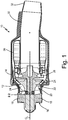
- FIG. 1 is a cross sectional view of engine 10 and shows centerline axis C L , outer case 12, inner case 14, inlet 16, guide vanes 18, compressor 20, compressor rotor hub 22, compressor rotor blades 24, combustion chamber 26, turbine 28, exhaust 30, and nozzle 32.
- an upstream direction of engine 10 is to the left and a downstream direction is to the right.
- This left-to-right downstream orientation applies to FIGS.- 1 and 2.
- An opposite orientation applies to FIGS. 3 , 4A, and 4B (e.g., a downstream direction is to the left).
- Engine 10 is an engine for an attritable, or expendable, propulsion system for an aircraft.
- engine 10 can have a shorter lifespan requirement and requires a lower life cycle fatigue rate relative to systems for typical flight applications.
- engine 10 can be used with a drone, munitions, or other unmanned aerial vehicles.
- Centerline axis C L is an axis passing through a center of rotating components of engine 10 such as compressor rotor hub 22 and turbine 28.
- Outer case 12 and inner case 14 are walls or ducts of solid material.
- Inlet 16 is a fluidic duct or opening.
- Guide vanes 18 are vanes or blades for directing a flow of air.
- Compressor 20 is a portion of engine 10 with compressor rotor hub 22, compressor rotor blades 24, and a duct with a decreasing cross-sectional area in a downstream direction of engine 10 (from left to right as shown in FIG. 1 ).
- Compressor rotor hub 22 is a generally frusto-conically shaped piece of solid material configured to rotate about centerline axis C L .
- a material of compressor rotor hub 22 can include an austenitic nickel-chromium-based superalloy such as Inconel, and in particular Inconel 718.
- a material of compressor rotor hub 22 can include a titanium alloy such as Ti 6- including a chemical composition of approximately 6% aluminum, 4% vanadium, 0.25% iron, 0.2% oxygen, and the remainder titanium.
- Compressor rotor blades 24 are airfoil blades.
- a material of compressor rotor blades 24 can include an austenitic nickel-chromium-based superalloy such as Inconel, and in particular Inconel 625.
- a material of compressor rotor blades 24 can include an age hardened austenitic nickel-based superalloy or a nickel-chromium-iron-molybdenum alloy.
- Combustion chamber 26 is a generally annular compartment with an inner cavity.
- Turbine 28 is a generally conical piece of solid material with airfoil blades that is configured to rotate about centerline axis C L .
- Exhaust 30 is a tube or duct for transporting a fluid.
- Nozzle 32 is a downstream end portion of exhaust 30 with a decreased diameter for directing airflow out of exhaust 30.
- Engine 10 can be mounted and connected to an aircraft (not shown in FIG. 1 ).
- Outer case 12 is disposed around and forms an exterior of engine 10.
- Outer case 12 is in contact with and connects to various portions of inner case 14.
- Inner case 14 is connected to various portions of outer case 12 and houses inlet 16, guide vanes 18, compressor 20, compressor rotor hub 22, compressor rotor blades 24, combustion chamber 26, and turbine 28.
- Inlet 16 is connected to and is formed by an upstream end of inner case 14.
- Guide vanes 18 are attached to inner case 14 at outer ends of guide vanes 18.
- Compressor 20 is disposed within inner case 14 and is positioned downstream of inlet 16 and upstream of both combustion chamber 26 and turbine 28. Compressor 20 is in fluid communication with inlet 16 and with combustion chamber 26.
- Compressor rotor hub 22 is mounted within inner case 14 and is configured to rotate relative to inner case 14.
- Compressor rotor blades 24 are connected to and helically extend radially outward from a radially outer surface of compressor rotor hub 22. The formation and connection of compressor rotor hub 22 and compressor rotor blades 24 will be discussed further with respect to FIGS. 2-4B .
- Combustion chamber 26 is located inside of inner case 14 and is fluidly connected to compressor 20 and to turbine 28.
- Turbine 28 is rotatably mounted within inner case 14 and is positioned downstream from compressor rotor hub 22. Turbine 28 is in fluid communication with combustion chamber 26 and with exhaust 30. Exhaust 30 is contained within portions of outer case 12 and inner case 14 and is in fluid communication with turbine 28. Nozzle 32 is disposed at a downstream end of exhaust 30.
- Outer case 12 contains and provides structural support for the components of engine 10. Portions of outer case 12 are also used as connecting elements that mount to a portion or portions of an aircraft (not shown in FIG. 1 ).
- Inner case 14 contains and guides airflow through portions of engine 10. Air enters engine 10 via inlet 16 and travels to compressor 20. Guide vanes 18 direct the flow of air entering into engine 10, for example by either straightening or imparting swirl into the airflow.
- Compressor 20 constricts as well as increases the velocity and pressure of the airflow passing through combustor 20. Compressor 20 then delivers the pressurized air to combustion chamber 26.
- Compressor rotor blades 24 rotates with compressor rotor hub 22 to increase the velocity of the air through compressor 20 of engine 10. As airfoils, compressor rotor blades 24 impart a swirl, along with an increase in speed, to the air in combustor 20. The air with increased velocity from combustor 20 then enters into combustion chamber 26. Combustion chamber 26 receives the air from combustor 20. In combustion chamber 20, the air is mixed with fuel to create a combustion gas that is ignited in order to drastically increase the pressure of the air output from combustor chamber 26.
- Turbine 28 receives the ignited combustion gas from combustion chamber 26 which causes turbine 28 to rotate. Turbine 28 includes feature that propel the ignited combustion gas into exhaust chamber 30. Exhaust 30 transports the ignited combustion gas to nozzle 32. Nozzle 32 provides a restricted portion of exhaust 30 so as to expel gas from exhaust 30 at a velocity and to determine a direction of the outflow of air from exhaust 30.
- the lower life cycle requirements for engine 10 allows for the traditional manufacturing constraints to be loosened providing more freedoms with design and material choices.
- the components are manufactured with very low tolerance and high precision forms of manufacturing, such as through subtractive manufacturing.
- alternative forms of manufacturing are capable of producing the components of engine 10 to meet the system requirements of engine 10, which can include low-cost, one way trip, and/or low life span.
- additive manufacturing can be used to produce some of the components of engine 10 where low life cycle components are included.
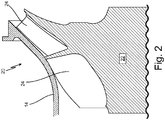
- FIG. 2 is an enlarged cross sectional view of the portion identified as 2-2 in FIG. 1 of engine 10 and shows inner case 14, compressor 20, compressor rotor hub 22, and compressor rotor blades 24.
- FIG. 2 shows compressor rotor blade 24 as being integrally formed with compressor rotor hub 22. As discussed with respect to FIG. 1 , compressor rotor hub 22 and compressor rotor blade 24 rotate relative to inner case 14.
- compressor rotor hub 22 is formed with a first type of layer-by-layer additive manufacturing process.
- compressor rotor hub 22 can be formed by laser powder bed fusion or an electron-beam melting ("e-beam”) additive manufacturing process.
- Compressor rotor blades 24 are connected to and helically extend radially outward from compressor rotor hub 22.
- Compressor rotor blades 24 are formed with a second type of layer-by-layer additive manufacturing process that is different than the first layer-by-layer additive manufacturing process.
- compressor rotor blades 24 can be formed by directed energy deposition (“DED”), cold spray (“CS”), and/or hot isostatic pressing (“HIP”) additive manufacturing process(es), as well as a hybrid additive manufacturing process (e.g., combination of additive and subtractive manufacturing processes).
- DED directed energy deposition
- CS cold spray
- HIP hot isostatic pressing
- Compressor rotor hub 22 and compressor rotor blades 24 are integrally formed together as a single piece of material with a layer-by-layer additive manufacturing process.
- the first and second additive manufacturing process used to build or create compressor rotor hub 22 and compressor rotor blades 24 can be determined based upon stress profiled for each. For example, a stress profile of compressor rotor hub 22 can be used to determine that the first type of layer-by-layer additive manufacturing process should be used to construct compressor rotor hub 22. Likewise, a stress profile of compressor rotor blades 24 can be used to determine which the second type of layer-by-layer additive manufacturing process should be used to construct compressor rotor blade 24 (and as between various regions of compressor rotor blade 24).
- compressor rotor hub 22 and compressor rotor blade 24 are herein described in comparison to the traditional formation of affixing a series of blades to the hub via thermal or mechanical means.
- the present configuration of engine 10, with fully integrally formed compressor rotor hub 22 and compressor rotor blade 24, allows for component reduction in engine 10 thereby reducing potential failure modes due to loose interfaces between components.
- the reduction in component count also reduces a stacking of tolerances between components allowing for a higher degree of manufacturing tolerance control in order to maintain the aerodynamically critical characteristics of compressor rotor hub 22 and compressor rotor blade 24.
- Particular portions of compressor rotor blade 24 and particular manufacturing processes thereof will be discussed with respect to FIGS. 3 , 4A, and 4B .
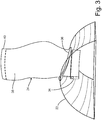
- FIG. 3 is a perspective view of compressor rotor blade 24 shown connected to compressor rotor hub 22, with compressor rotor hub 22 being shown in phantom to provide clarity of compressor rotor blade 24.
- Compressor rotor blade 24 is shown to include root 34, platform 36, airfoil 38, and tip 40.
- compressor rotor hub 22 is shown to include a single compressor rotor blade 24. In other non-limiting examples, more than one compressor rotor blade 24 can be included with compressor rotor hub 22.
- Root 34 is a radially inward end or base of compressor rotor blade 24.
- a material of root 34 includes a wrought titanium material.
- root 34 is formed with a first layer-by-layer additive manufacturing process such as an e-beam or a laser powder bed fusion additive manufacturing process.
- Platform 36 is a generally flat, laterally extending surface or ribbon of solid material.
- Airfoil 38 is a structure with curved surfaces configured to produce an aerodynamic force.
- a material of platform 36 and airfoil 38 can include an austenitic nickel-chromium-based superalloy such as Inconel (e.g., Inconel 625), an age hardened austenitic nickel-based superalloy, or a nickel-chromium-iron-molybdenum alloy.
- platform 36 and airfoil 38 are formed with a second layer-by-layer additive manufacturing process such as a CS, DED, or a hybrid additive manufacturing process.
- Tip 40 is a radially outward end of compressor rotor blade 24.
- a material of tip 40 includes a high hardness material, such as a material with a high Rockwell hardness rating (e.g., HRA, HRB, or HRC).
- tip 40 is formed with a third layer-by-layer additive manufacturing process such as a CS additive manufacturing process.
- tip 40 can include an abrasion surface.
- Root 34 is disposed in and integrally formed with compressor rotor hub 22. Root 34 extends radially inward (relative to rotatable compressor rotor hub 22 and to centerline axis C L ) from platform 36 and into compressor rotor hub 22.
- root 34 is formed with a wrought titanium material with platform 36 and airfoil 38 built up from root 34 using a DED or a hybrid additive manufacturing process.
- Platform 36 is formed with and connected to root 34 and to airfoil 38.
- Airfoil 38 is integrally formed with and extends between platform 36 and tip 40.
- Tip 40 is integrally formed with and extends radially outward from airfoil 38. As between each of root 34, platform 36, airfoil 38, and tip 40, the physical interfaces between each component will largely be unnoticeable outside of subtle witness lines, with slight discolorations between the dissimilar material configurations.
- Root 34 is integrally formed with compressor rotor hub 22 so as to permanently attach compressor rotor blade 24 to compressor rotor hub 22.
- Platform 36 of compressor rotor blade 24 provides structural support for compressor rotor blade 24 as well as comes into contact with platforms of adjoining compressor rotor blades (not shown in FIG. 3 ).
- airfoil 38 creates a suction force to draw air through compressor 20 and into combustor chamber 26.
- Tip 40 is connected to and extends radially outward from airfoil 38.
- tip 40 can be used to abrade a rub strip disposed on a radially inward surface of inner case 14 in order to effectively form a sealed interface (with only a small clearance between tip 40 and the radially inward surface of inner case 14).
- different materials as well as different types of additive manufacturing processes are used in particular areas or zones of compressor rotor hub 22 and compressor rotor blade 24 that relate to the stress levels experienced in a particular zone. Additionally, material selection is based on temperatures experienced by a certain portion or zone of compressor rotor hub 22 or blade 24 to provide a material with a particularly appropriate coefficient of thermal expansion to meet a certain performance requirement.
- an inspection step is used during the building of compressor rotor hub 22 and compressor rotor blade 24.
- Adaptive machining can be used to start with a laser powder bed fusion additive manufacturing process to form compressor rotor hub 22.
- Compressor rotor hub 22 is based off of a first 3D model. Once compressor rotor hub 22 is built, compressor rotor hub 22 is inspected and/or scanned to determine the exact profile of compressor rotor hub 22 as-built. This scan can identify imperfections and deformities that may have arisen if compressor rotor hub 22 was not formed precisely to the exact dimensions of the 3D model of compressor rotor hub 22.
- a 3D scan of compressor rotor hub 22 is performed such as a blue-light scan or other form of 3D optical scanning measurement technology.
- a tool path generation for the construction of compressor rotor blade 24 is determined.
- the 3D scan of the as-built compressor rotor hub 22 is necessary because as compressor rotor hub 22 is removed from the build plate of the laser powder bed fusion build plate, the features (e.g., datums) used to locate the build process of compressor rotor hub 22 are also removed.
- compressor rotor hub 22 includes an undefined series of surfaces that possibly have slight or minimal distortions resulting in deviations from the 3D CAD model.
- the 3D optical scanning measurement e.g., blue-light scan
- This 3D model of the as-built compressor rotor hub 22 is then used as a baseline to drive the tool path generation for the next additive manufacturing process steps. Without these scanning steps, the tool paths for subsequent additive manufacturing process steps would not line up correctly with the features of the as-built compressor rotor hub 22.
- Compressor rotor hub 22 and compressor rotor blades 24 being of dissimilar materials enables compressor rotor blades 24 to be designed specifically for a particular application.
- Compressor rotor blade 24 with tip 40 can be made of a resilient metal which will erode a rub-strip (mounted on the radially inner surface of inner case 14) without degrading performance of compressor rotor blade 24.
- Localized DED and CS depositions also provide superior engineering part performance of compressor rotor hub 22 and compressor rotor blades 24 if applied at strategic locations such as high temperature and/or high stress zones of compressor rotor blades 24.
- designing and building compressor rotor hub 22 and compressor rotor blade 24 includes incorporating a material grading as a function of engineering stress and performance requirements throughout the various zones of each of the components.
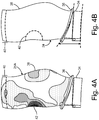
- FIG. 4A is a side view of stress profile 24A of compressor rotor blade 24 and shows root 34, platform 36, airfoil 38, tip 40, and hotspot 42.
- Stress profile 24A shown in FIG. 4A includes different regions or zones of compressor rotor blade 24 identified by an amount of stress experienced by the particular zone of compressor rotor blade 24.
- Hotspot 42 is a portion of stress profile 24A that is representative of a portion of compressor rotor blade 24 that experiences a high degree of stress relative to the other portions of compressor rotor blade 24 during use of engine 10.
- Stress profile 24A of compressor rotor blade 24 is created with a finite element analysis tool. Appropriate maximum operating conditions are applied to a computer aided design ("CAD") three dimensional (“3D") model representative of compressor rotor blade 24 along with accurate boundary conditions. The CAD 3D model and the initial boundary conditions are then processed through a finite element solver which creates stress profile 24A based on an output of the finite element solver. The measurements from the profile (e.g., in particular from the color plot of stress profile 24A) show the stresses across compressor rotor blade 24. In stress profile 24A, stress is represented as a unit of pressure or force/area and is a function of the finite element solver, with stress profile 24A being a function of the finite element analysis inputs.
- CAD computer aided design
- 3D three dimensional
- the measurements from the profile show the stresses across compressor rotor blade 24.
- stress profile 24A stress is represented as a unit of pressure or force/area and is a function of the finite element solve
- the locations and amounts of stresses are located. Once the locations of high stresses are determined, superior alloy(s) can be assigned and applied to those regions to mitigate the stresses experienced there.
- a definition of the particular stress zones of stress profile 24A would be numerically extracted from the output file of the finite element model, which can yield irregular shapes for the different zones of compressor rotor blade 24.
- compressor rotor hub 22 and compressor rotor blade 24 a configuration with more than two materials is used and the material application is not a function of the part definition but rather driven by computation means such as the discussed finite element analysis.
- a first region of airfoil 38 (e.g., hotspot 42) subject to at least one of high stress or high temperature is identified with stress profile 24A.
- a size, a shape, and/or a location of the first region of airfoil 38 is determined from stress profile 24A.
- a second region of airfoil 38 (e.g., root 34, platform 36, airfoil 38, and/or tip 40) subject to at least one of low stress or low temperature is also identified with stress profile 24A.
- a size, a shape, and/or a location of the second region of airfoil 38 is determined from stress profile 24A.
- a first material with which to form the first region of airfoil 38 is determined based on stress profile 24A.
- a second material with which to form the second region of airfoil 38 is determined based on stress profile 24A.
- the first and second regions of airfoil 38 are then formed with layer-by-layer additive manufacturing.
- an additive manufacturing process is used to form compressor rotor hub 22 before forming compressor rotor blade 24.
- FIG. 4B is a side view of compressor rotor blade 24 and shows root 34, platform 36, airfoil 38, tip 40, and hotspot 42.
- a superior alloy is used for root 34 where a large stress concentration will be experienced from a shift in geometry of compressor rotor blade 24 during operation of engine 10.
- a material used here includes a lesser strength alloy than used for root 34 (and/or for tip 40).
- a different additive manufacturing process or processes are used for platform 36 and airfoil 38 to provide different physical and performance characteristics than root 34 or tip 40.
- a different material and layer-by-layer additive manufacturing process are used for hotspot 42 to provide increased stress and temperature capabilities of hotspot 42.
- a composition of airfoil 38 can vary in a blended fashion in a vicinity of hotspot 42.
- tip 40 may rub and wear away more than the other portions of rotor blade 24.
- rotor blade 24 can be re-used up to the portion of tip 40 that was abraded off.
- Tip 40 can be cut and the missing portion of tip 40 can be re-built onto the end of rotor blade 24.
- compressor rotor blade 24 can be built by grading out (e.g., with DED or CS additive manufacturing processes) a material blend that is a function of radial distance away from the axis of rotation (e.g., centerline axis C L ).
- grading out includes varying a distribution of the material and/or structural characteristics (e.g., hardness, coefficient of thermal expansion, material, etc.) to match certain performance specifications of specific portions of compressor rotor blade 24.
- compressor rotor blade 24 is constructed using additive manufacturing processes in accordance with the material grading based on the finite element analysis, subtractive manufacturing processes can be applied to the additive manufactured piece in order to reach the final, critical profile of compressor rotor blade 24.
- a cooling circuit or circuits can be formed into either compressor rotor hub 22 and/or compressor rotor blade 24 during formation of compressor rotor hub 22 and compressor rotor blade 24.
- cooling channels are built up using laser powder bed fusion or e-beam. Once the basic form or structure of the cooling channels are built, then a coating can be applied to the cooling channels using a CS or similar additive manufacturing technique.
- topological optimization can also be used to create the 3D CAD model(s) of compressor rotor hub 22 and or compressor rotor blade 24 in order to remove unnecessary material and weight from the finally built parts.
- boundary conditions such as minimize weight/mass, maximize stiffness, and/or a positive factor of safety can be input into the topological optimization analysis tool.
- the information or modeling output(s) of the topological optimization analysis tool can then provide a modified shape with weight/mass removed some certain portions yet still allowing compressor rotor hub 22 and blade 24 to maintain requisite operational capabilities.
- An assembly for use in an attritable engine includes a hub and a blade.
- the hub is configured to rotate about a centerline axis passing through a center of the hub and is formed with a first type of layer-by-layer additive manufacturing process.
- the blade is connected to and extends radially outward from the hub.
- the blade is formed with a second type of layer-by-layer additive manufacturing process that is different than the first layer-by-layer additive manufacturing process.
- the hub and the blade are integrally formed together as a single piece of material with a layer-by-layer additive manufacturing process.
- the blade includes a root of a first material, a platform connected to the root, an airfoil connected to and extending from the platform, and a tip connected to the airfoil on a distal end of the airfoil that is opposite from the root.
- the platform includes a second material that is different from the first material.
- the assembly of the preceding paragraph can optionally include, additionally and/or alternatively, any one or more of the following features, configurations and/or additional components.
- the second additive manufacturing process can be determined based on a finite element analysis of a three-dimensional model of the blade.
- the airfoil can include a hotspot region, wherein the hotspot region can correspond to a region of the blade that experiences high stress when in use, wherein the hotspot region can include a third material that can be different than other portions of the airfoil, wherein a location, a shape, and/or a size of the hotspot region can be identified by the finite element analysis of the three-dimensional model of the blade.
- a composition of the airfoil can vary in a blended fashion in a vicinity of the hotspot region.
- a method of forming a blade includes creating a three-dimensional model of an airfoil.
- a stress profile of the blade is created with a finite element analysis tool. The stress profile is combined with the three-dimensional model of the blade. Different materials and different layer-by-layer additive manufacturing processes are assigned to different regions of the blade based upon the stress profile.
- the blade is formed to include a root, a platform, an airfoil, and a tip.
- the root of the airfoil is formed with a first material and with a first layer-by-layer additive manufacturing process.
- the platform is connected to the boot.
- the airfoil is connected to the platform and is formed with a second material and with a second layer-by-layer additive manufacturing process that is different from the first layer-by-layer additive manufacturing process.
- the tip is connected to the airfoil and is formed with a third layer-by-layer additive manufacturing process that is different from the second layer-by-layer additive manufacturing process.
- the method of the preceding paragraph can optionally include, additionally and/or alternatively, any one or more of the following steps, features, configurations and/or additional components.
- a first region of the airfoil subject to at least one of high stress or high temperature can be identified with the stress profile; a second region of the airfoil subject to at least one of low stress or low temperature can be identified with the stress profile; a first material with which to form the first region of the airfoil can be determined based on the stress profile; a second material with which to form the second region of the airfoil can be determined based on the stress profile; and/or the first region of the airfoil with the first material and the second region of the airfoil with the second material can be formed with layer-by-layer additive manufacturing.
- the first region of the airfoil can comprise the root, and/or wherein the second region of the airfoil can comprise at least one of the platform, the airfoil, and/or the tip.
- a size, a shape, and/or a location of the first region of the airfoil can be determined from the stress profile; and/or a size, a shape, and/or a location of the second region of the airfoil can be determined from the stress profile.
- the first, second, and/or third layer-by-layer additive manufacturing process can comprise at least one of electron-beam melting, laser powder bed fusion, cold spray, and/or directed energy deposition.
- a fourth additive manufacturing process can be used to form a rotor hub; and/or wherein forming the airfoil further can comprise forming, with the first layer-by-layer additive manufacturing process, the airfoil to the hub such that the hub and the airfoil can be a single piece of material.
- Operating conditions can be applied to the three-dimensional model of the blade; the three-dimensional model of the blade with the applied operating conditions can be processed with a finite element solver; and/or the stress profile of the blade can be determined based on an output of the finite element solver.
- the rotor hub can be scanned with a three dimensional optical scanning tool; measurements of the rotor hub can be determined from a three dimensional scan of the rotor hub; a three dimensional model of the rotor hub can be created; and/or a tool path for the layer-by-layer additive manufacturing process can be generated based on the three dimensional model of the rotor hub.
Landscapes
- Engineering & Computer Science (AREA)
- Chemical & Material Sciences (AREA)
- Mechanical Engineering (AREA)
- Manufacturing & Machinery (AREA)
- General Engineering & Computer Science (AREA)
- Materials Engineering (AREA)
- Ceramic Engineering (AREA)
- Combustion & Propulsion (AREA)
- Physics & Mathematics (AREA)
- Plasma & Fusion (AREA)
- Architecture (AREA)
- Structures Of Non-Positive Displacement Pumps (AREA)
Abstract
Description
- The present disclosure generally relates to engines. In particular, the present disclosure relates to manufacturing of engine components for attritable propulsion systems.
- Attritable (i.e., expendable) propulsion systems ordinarily have shorter lifespans relative to systems for typical flight applications. Components of such attritable propulsion systems generally require a much lower life cycle fatigue rate as compared to typical propulsion systems. Additionally, attritable propulsion systems generally do not require as high of a level of dimensional accuracy or as low of a level of tolerance allowance as systems for typical flight applications. Regarding the building of engine components for attritable propulsion systems, conventional subtractive manufacturing techniques can be prohibitive in terms of unitizing assembly details, integrating of complex performance-enhancing features, lowering production costs, and reducing time to delivery.
- In accordance with a first aspect, the present invention provides, an assembly for use in an attritable engine includes a hub and a blade. The hub is configured to rotate about a centerline axis passing through a center of the hub and is formed with a first type of layer-by-layer additive manufacturing process. The blade is connected to and extends radially outward from the hub. The blade is formed with a second type of layer-by-layer additive manufacturing process that is different than the first layer-by-layer additive manufacturing process. The hub and the blade are integrally formed together as a single piece of material with a layer-by-layer additive manufacturing process. The blade includes a root of a first material, a platform connected to the root, an airfoil connected to and extending from the platform, and a tip connected to the airfoil on a distal end of the airfoil that is opposite from the root. The platform includes a second material that is different from the first material.
- In accordance with a second aspect, the present invention provides a method of forming a blade includes creating a three-dimensional model of an airfoil. A stress profile of the blade is created with a finite element analysis tool. The stress profile is combined with the three-dimensional model of the blade. Different materials and different layer-by-layer additive manufacturing processes are assigned to different regions of the blade based upon the stress profile. The blade is formed to include a root, a platform, an airfoil, and a tip. The root of the airfoil is formed with a first material and with a first layer-by-layer additive manufacturing process. The platform is connected to the boot. The airfoil is connected to the platform and is formed with a second material and with a second layer-by-layer additive manufacturing process that is different from the first layer-by-layer additive manufacturing process. The tip is connected to the airfoil and is formed with a third layer-by-layer additive manufacturing process that is different from the second layer-by-layer additive manufacturing process.
- The present summary is provided only by way of example, and not limitation. Other aspects of the present disclosure will be appreciated in view of the entirety of the present disclosure, including the entire text, claims, and accompanying figures.
-
-
FIG. 1 is a cross sectional view of an attritable engine. -
FIG. 2 is an enlarged cross sectional view of a portion 2-2 ofFIG. 1 illustrating a hub, blades, and a case of the engine. -
FIG. 3 is a perspective view of the blade shown connected to the hub, with the hub being shown in phantom to provide clarity of the blade. -
FIG. 4A is a side view of a stress profile of an airfoil blade of the attritable engine. -
FIG. 4B is a side view of the airfoil showing material composition of different regions of the airfoil. - While the above-identified figures set forth one or more embodiments of the present disclosure, other embodiments are also contemplated, as noted in the discussion. In all cases, this disclosure presents the invention by way of representation and not limitation. It should be understood that numerous other modifications and embodiments can be devised by those skilled in the art, which fall within the scope and spirit of the principles of the invention. The figures may not be drawn to scale, and applications and embodiments of the present invention may include features and components not specifically shown in the drawings.
- This disclosure discusses the use of additive manufacturing to build a rotor blade directly up from an additively manufactured rotor hub. Different additive manufacturing materials are used in the rotor blade structure as a function of operational stress and performance criteria as determined by a finite element analysis of the rotor blade.
-
FIG. 1 is a cross sectional view ofengine 10 and shows centerline axis CL,outer case 12,inner case 14,inlet 16,guide vanes 18,compressor 20,compressor rotor hub 22,compressor rotor blades 24,combustion chamber 26,turbine 28,exhaust 30, andnozzle 32. As shown inFIG. 1 , an upstream direction ofengine 10 is to the left and a downstream direction is to the right. This left-to-right downstream orientation applies to FIGS.- 1 and 2. An opposite orientation applies toFIGS. 3 ,4A, and 4B (e.g., a downstream direction is to the left). -
Engine 10 is an engine for an attritable, or expendable, propulsion system for an aircraft. As an engine for an attritable propulsion system,engine 10 can have a shorter lifespan requirement and requires a lower life cycle fatigue rate relative to systems for typical flight applications. As an example,engine 10 can be used with a drone, munitions, or other unmanned aerial vehicles. Centerline axis CL is an axis passing through a center of rotating components ofengine 10 such ascompressor rotor hub 22 andturbine 28. -
Outer case 12 andinner case 14 are walls or ducts of solid material.Inlet 16 is a fluidic duct or opening.Guide vanes 18 are vanes or blades for directing a flow of air.Compressor 20 is a portion ofengine 10 withcompressor rotor hub 22,compressor rotor blades 24, and a duct with a decreasing cross-sectional area in a downstream direction of engine 10 (from left to right as shown inFIG. 1 ). -
Compressor rotor hub 22 is a generally frusto-conically shaped piece of solid material configured to rotate about centerline axis CL. In one example, a material ofcompressor rotor hub 22 can include an austenitic nickel-chromium-based superalloy such as Inconel, and in particular Inconel 718. In another example, a material ofcompressor rotor hub 22 can include a titanium alloy such as Ti 6- including a chemical composition of approximately 6% aluminum, 4% vanadium, 0.25% iron, 0.2% oxygen, and the remainder titanium.Compressor rotor blades 24 are airfoil blades. In one example, a material ofcompressor rotor blades 24 can include an austenitic nickel-chromium-based superalloy such as Inconel, and in particular Inconel 625. In other example, a material ofcompressor rotor blades 24 can include an age hardened austenitic nickel-based superalloy or a nickel-chromium-iron-molybdenum alloy. -
Combustion chamber 26 is a generally annular compartment with an inner cavity.Turbine 28 is a generally conical piece of solid material with airfoil blades that is configured to rotate about centerline axis CL. Exhaust 30 is a tube or duct for transporting a fluid.Nozzle 32 is a downstream end portion ofexhaust 30 with a decreased diameter for directing airflow out ofexhaust 30. -
Engine 10 can be mounted and connected to an aircraft (not shown inFIG. 1 ).Outer case 12 is disposed around and forms an exterior ofengine 10.Outer case 12 is in contact with and connects to various portions ofinner case 14.Inner case 14 is connected to various portions ofouter case 12 and houses inlet 16,guide vanes 18,compressor 20,compressor rotor hub 22,compressor rotor blades 24,combustion chamber 26, andturbine 28.Inlet 16 is connected to and is formed by an upstream end ofinner case 14.Guide vanes 18 are attached toinner case 14 at outer ends ofguide vanes 18. -
Compressor 20 is disposed withininner case 14 and is positioned downstream ofinlet 16 and upstream of bothcombustion chamber 26 andturbine 28.Compressor 20 is in fluid communication withinlet 16 and withcombustion chamber 26.Compressor rotor hub 22 is mounted withininner case 14 and is configured to rotate relative toinner case 14.Compressor rotor blades 24 are connected to and helically extend radially outward from a radially outer surface ofcompressor rotor hub 22. The formation and connection ofcompressor rotor hub 22 andcompressor rotor blades 24 will be discussed further with respect toFIGS. 2-4B .Combustion chamber 26 is located inside ofinner case 14 and is fluidly connected tocompressor 20 and toturbine 28. -
Turbine 28 is rotatably mounted withininner case 14 and is positioned downstream fromcompressor rotor hub 22.Turbine 28 is in fluid communication withcombustion chamber 26 and withexhaust 30.Exhaust 30 is contained within portions ofouter case 12 andinner case 14 and is in fluid communication withturbine 28.Nozzle 32 is disposed at a downstream end ofexhaust 30. -
Outer case 12 contains and provides structural support for the components ofengine 10. Portions ofouter case 12 are also used as connecting elements that mount to a portion or portions of an aircraft (not shown inFIG. 1 ).Inner case 14 contains and guides airflow through portions ofengine 10. Air entersengine 10 viainlet 16 and travels tocompressor 20.Guide vanes 18 direct the flow of air entering intoengine 10, for example by either straightening or imparting swirl into the airflow.Compressor 20 constricts as well as increases the velocity and pressure of the airflow passing throughcombustor 20.Compressor 20 then delivers the pressurized air tocombustion chamber 26. -
Compressor rotor blades 24 rotates withcompressor rotor hub 22 to increase the velocity of the air throughcompressor 20 ofengine 10. As airfoils,compressor rotor blades 24 impart a swirl, along with an increase in speed, to the air incombustor 20. The air with increased velocity fromcombustor 20 then enters intocombustion chamber 26.Combustion chamber 26 receives the air fromcombustor 20. Incombustion chamber 20, the air is mixed with fuel to create a combustion gas that is ignited in order to drastically increase the pressure of the air output fromcombustor chamber 26.Turbine 28 receives the ignited combustion gas fromcombustion chamber 26 which causesturbine 28 to rotate.Turbine 28 includes feature that propel the ignited combustion gas intoexhaust chamber 30.Exhaust 30 transports the ignited combustion gas tonozzle 32.Nozzle 32 provides a restricted portion ofexhaust 30 so as to expel gas fromexhaust 30 at a velocity and to determine a direction of the outflow of air fromexhaust 30. - The lower life cycle requirements for
engine 10 allows for the traditional manufacturing constraints to be loosened providing more freedoms with design and material choices. With existing propulsion systems, the components are manufactured with very low tolerance and high precision forms of manufacturing, such as through subtractive manufacturing. Here, because the tolerance and material life cycle requirements are significantly lower, alternative forms of manufacturing are capable of producing the components ofengine 10 to meet the system requirements ofengine 10, which can include low-cost, one way trip, and/or low life span. For example, additive manufacturing can be used to produce some of the components ofengine 10 where low life cycle components are included. In addition, different types of additive manufacturing, as well as weaker or stronger materials, can be used throughoutengine 10 to form parts with adequate performance characteristics (e.g., such as strength) based on a stress profile of a given component (e.g.,compressor rotor hub 22 and/or compressor rotor blade 24). -
FIG. 2 is an enlarged cross sectional view of the portion identified as 2-2 inFIG. 1 ofengine 10 and showsinner case 14,compressor 20,compressor rotor hub 22, andcompressor rotor blades 24.FIG. 2 showscompressor rotor blade 24 as being integrally formed withcompressor rotor hub 22. As discussed with respect toFIG. 1 ,compressor rotor hub 22 andcompressor rotor blade 24 rotate relative toinner case 14. - In this example,
compressor rotor hub 22 is formed with a first type of layer-by-layer additive manufacturing process. For example,compressor rotor hub 22 can be formed by laser powder bed fusion or an electron-beam melting ("e-beam") additive manufacturing process.Compressor rotor blades 24 are connected to and helically extend radially outward fromcompressor rotor hub 22.Compressor rotor blades 24 are formed with a second type of layer-by-layer additive manufacturing process that is different than the first layer-by-layer additive manufacturing process. For example,compressor rotor blades 24 can be formed by directed energy deposition ("DED"), cold spray ("CS"), and/or hot isostatic pressing ("HIP") additive manufacturing process(es), as well as a hybrid additive manufacturing process (e.g., combination of additive and subtractive manufacturing processes).Compressor rotor hub 22 andcompressor rotor blades 24 are integrally formed together as a single piece of material with a layer-by-layer additive manufacturing process. - The first and second additive manufacturing process used to build or create
compressor rotor hub 22 andcompressor rotor blades 24 can be determined based upon stress profiled for each. For example, a stress profile ofcompressor rotor hub 22 can be used to determine that the first type of layer-by-layer additive manufacturing process should be used to constructcompressor rotor hub 22. Likewise, a stress profile ofcompressor rotor blades 24 can be used to determine which the second type of layer-by-layer additive manufacturing process should be used to construct compressor rotor blade 24 (and as between various regions of compressor rotor blade 24). - The configuration of
compressor rotor hub 22 andcompressor rotor blade 24 is herein described in comparison to the traditional formation of affixing a series of blades to the hub via thermal or mechanical means. The present configuration ofengine 10, with fully integrally formedcompressor rotor hub 22 andcompressor rotor blade 24, allows for component reduction inengine 10 thereby reducing potential failure modes due to loose interfaces between components. The reduction in component count also reduces a stacking of tolerances between components allowing for a higher degree of manufacturing tolerance control in order to maintain the aerodynamically critical characteristics ofcompressor rotor hub 22 andcompressor rotor blade 24. Particular portions ofcompressor rotor blade 24 and particular manufacturing processes thereof will be discussed with respect toFIGS. 3 ,4A, and 4B . -
FIG. 3 is a perspective view ofcompressor rotor blade 24 shown connected tocompressor rotor hub 22, withcompressor rotor hub 22 being shown in phantom to provide clarity ofcompressor rotor blade 24.Compressor rotor blade 24 is shown to includeroot 34,platform 36,airfoil 38, andtip 40. For clarity,compressor rotor hub 22 is shown to include a singlecompressor rotor blade 24. In other non-limiting examples, more than onecompressor rotor blade 24 can be included withcompressor rotor hub 22. -
Root 34 is a radially inward end or base ofcompressor rotor blade 24. In one example, a material ofroot 34 includes a wrought titanium material. In another example,root 34 is formed with a first layer-by-layer additive manufacturing process such as an e-beam or a laser powder bed fusion additive manufacturing process.Platform 36 is a generally flat, laterally extending surface or ribbon of solid material.Airfoil 38 is a structure with curved surfaces configured to produce an aerodynamic force. In one example, a material ofplatform 36 andairfoil 38 can include an austenitic nickel-chromium-based superalloy such as Inconel (e.g., Inconel 625), an age hardened austenitic nickel-based superalloy, or a nickel-chromium-iron-molybdenum alloy. In another example,platform 36 andairfoil 38 are formed with a second layer-by-layer additive manufacturing process such as a CS, DED, or a hybrid additive manufacturing process.Tip 40 is a radially outward end ofcompressor rotor blade 24. A material oftip 40 includes a high hardness material, such as a material with a high Rockwell hardness rating (e.g., HRA, HRB, or HRC). In one example,tip 40 is formed with a third layer-by-layer additive manufacturing process such as a CS additive manufacturing process. In another example,tip 40 can include an abrasion surface. -
Root 34 is disposed in and integrally formed withcompressor rotor hub 22.Root 34 extends radially inward (relative to rotatablecompressor rotor hub 22 and to centerline axis CL) fromplatform 36 and intocompressor rotor hub 22. In one example,root 34 is formed with a wrought titanium material withplatform 36 andairfoil 38 built up fromroot 34 using a DED or a hybrid additive manufacturing process.Platform 36 is formed with and connected to root 34 and toairfoil 38.Airfoil 38 is integrally formed with and extends betweenplatform 36 andtip 40.Tip 40 is integrally formed with and extends radially outward fromairfoil 38. As between each ofroot 34,platform 36,airfoil 38, andtip 40, the physical interfaces between each component will largely be unnoticeable outside of subtle witness lines, with slight discolorations between the dissimilar material configurations. -
Root 34 is integrally formed withcompressor rotor hub 22 so as to permanently attachcompressor rotor blade 24 tocompressor rotor hub 22.Platform 36 ofcompressor rotor blade 24 provides structural support forcompressor rotor blade 24 as well as comes into contact with platforms of adjoining compressor rotor blades (not shown inFIG. 3 ). Ascompressor rotor hub 22 rotates about centerline axis CL (shown inFIG. 1 ),airfoil 38 creates a suction force to draw air throughcompressor 20 and intocombustor chamber 26.Tip 40 is connected to and extends radially outward fromairfoil 38. During operation ofengine 10,tip 40 can be used to abrade a rub strip disposed on a radially inward surface ofinner case 14 in order to effectively form a sealed interface (with only a small clearance betweentip 40 and the radially inward surface of inner case 14). Here, different materials as well as different types of additive manufacturing processes are used in particular areas or zones ofcompressor rotor hub 22 andcompressor rotor blade 24 that relate to the stress levels experienced in a particular zone. Additionally, material selection is based on temperatures experienced by a certain portion or zone ofcompressor rotor hub 22 orblade 24 to provide a material with a particularly appropriate coefficient of thermal expansion to meet a certain performance requirement. - In one example, an inspection step is used during the building of
compressor rotor hub 22 andcompressor rotor blade 24. Adaptive machining can be used to start with a laser powder bed fusion additive manufacturing process to formcompressor rotor hub 22.Compressor rotor hub 22 is based off of a first 3D model. Oncecompressor rotor hub 22 is built,compressor rotor hub 22 is inspected and/or scanned to determine the exact profile ofcompressor rotor hub 22 as-built. This scan can identify imperfections and deformities that may have arisen ifcompressor rotor hub 22 was not formed precisely to the exact dimensions of the 3D model ofcompressor rotor hub 22. As such, a 3D scan ofcompressor rotor hub 22 is performed such as a blue-light scan or other form of 3D optical scanning measurement technology. From the 3D scan of the as-builtcompressor rotor hub 22, a tool path generation for the construction ofcompressor rotor blade 24 is determined. For example, the 3D scan of the as-builtcompressor rotor hub 22 is necessary because ascompressor rotor hub 22 is removed from the build plate of the laser powder bed fusion build plate, the features (e.g., datums) used to locate the build process ofcompressor rotor hub 22 are also removed. - Once
compressor rotor hub 22 is removed from the laser powder bed fusion build plate,compressor rotor hub 22 includes an undefined series of surfaces that possibly have slight or minimal distortions resulting in deviations from the 3D CAD model. In order to make sure that subsequent additive manufacturing build processes mate correctly with the as-builtcompressor rotor hub 22, the 3D optical scanning measurement (e.g., blue-light scan) is required to create an accurate 3D model of the as-builtcompressor rotor hub 22. This 3D model of the as-builtcompressor rotor hub 22 is then used as a baseline to drive the tool path generation for the next additive manufacturing process steps. Without these scanning steps, the tool paths for subsequent additive manufacturing process steps would not line up correctly with the features of the as-builtcompressor rotor hub 22. -
Compressor rotor hub 22 andcompressor rotor blades 24 being of dissimilar materials enablescompressor rotor blades 24 to be designed specifically for a particular application.Compressor rotor blade 24 withtip 40 can be made of a resilient metal which will erode a rub-strip (mounted on the radially inner surface of inner case 14) without degrading performance ofcompressor rotor blade 24. Localized DED and CS depositions also provide superior engineering part performance ofcompressor rotor hub 22 andcompressor rotor blades 24 if applied at strategic locations such as high temperature and/or high stress zones ofcompressor rotor blades 24. For example, and as will be discussed with respect toFIGS. 4A and 4B , designing and buildingcompressor rotor hub 22 andcompressor rotor blade 24 includes incorporating a material grading as a function of engineering stress and performance requirements throughout the various zones of each of the components. -
FIG. 4A is a side view ofstress profile 24A ofcompressor rotor blade 24 and showsroot 34,platform 36,airfoil 38,tip 40, andhotspot 42.Stress profile 24A shown inFIG. 4A includes different regions or zones ofcompressor rotor blade 24 identified by an amount of stress experienced by the particular zone ofcompressor rotor blade 24.Hotspot 42 is a portion ofstress profile 24A that is representative of a portion ofcompressor rotor blade 24 that experiences a high degree of stress relative to the other portions ofcompressor rotor blade 24 during use ofengine 10. -
Stress profile 24A ofcompressor rotor blade 24 is created with a finite element analysis tool. Appropriate maximum operating conditions are applied to a computer aided design ("CAD") three dimensional ("3D") model representative ofcompressor rotor blade 24 along with accurate boundary conditions. The CAD 3D model and the initial boundary conditions are then processed through a finite element solver which createsstress profile 24A based on an output of the finite element solver. The measurements from the profile (e.g., in particular from the color plot ofstress profile 24A) show the stresses acrosscompressor rotor blade 24. Instress profile 24A, stress is represented as a unit of pressure or force/area and is a function of the finite element solver, withstress profile 24A being a function of the finite element analysis inputs. - Through this finite element analysis, the locations and amounts of stresses (e.g., low and high) are located. Once the locations of high stresses are determined, superior alloy(s) can be assigned and applied to those regions to mitigate the stresses experienced there. In one example, a definition of the particular stress zones of
stress profile 24A would be numerically extracted from the output file of the finite element model, which can yield irregular shapes for the different zones ofcompressor rotor blade 24. In one example ofcompressor rotor hub 22 andcompressor rotor blade 24, a configuration with more than two materials is used and the material application is not a function of the part definition but rather driven by computation means such as the discussed finite element analysis. - With this process, a first region of airfoil 38 (e.g., hotspot 42) subject to at least one of high stress or high temperature is identified with
stress profile 24A. A size, a shape, and/or a location of the first region ofairfoil 38 is determined fromstress profile 24A. A second region of airfoil 38 (e.g.,root 34,platform 36,airfoil 38, and/or tip 40) subject to at least one of low stress or low temperature is also identified withstress profile 24A. A size, a shape, and/or a location of the second region ofairfoil 38 is determined fromstress profile 24A. A first material with which to form the first region ofairfoil 38 is determined based onstress profile 24A. A second material with which to form the second region ofairfoil 38 is determined based onstress profile 24A. The first and second regions ofairfoil 38 are then formed with layer-by-layer additive manufacturing. In this example, an additive manufacturing process is used to formcompressor rotor hub 22 before formingcompressor rotor blade 24. -
FIG. 4B is a side view ofcompressor rotor blade 24 and showsroot 34,platform 36,airfoil 38,tip 40, andhotspot 42. In a typical example, a superior alloy is used forroot 34 where a large stress concentration will be experienced from a shift in geometry ofcompressor rotor blade 24 during operation ofengine 10. For bothplatform 36 andairfoil 38, a material used here includes a lesser strength alloy than used for root 34 (and/or for tip 40). Likewise, a different additive manufacturing process or processes are used forplatform 36 andairfoil 38 to provide different physical and performance characteristics thanroot 34 ortip 40. Similarly, a different material and layer-by-layer additive manufacturing process are used forhotspot 42 to provide increased stress and temperature capabilities ofhotspot 42. Additionally, a composition ofairfoil 38 can vary in a blended fashion in a vicinity ofhotspot 42. In one example,tip 40 may rub and wear away more than the other portions ofrotor blade 24. In such an instance,rotor blade 24 can be re-used up to the portion oftip 40 that was abraded off.Tip 40 can be cut and the missing portion oftip 40 can be re-built onto the end ofrotor blade 24. - By incorporating
stress profile 24A into a 3D model ofcompressor rotor blade 24,compressor rotor blade 24 can be built by grading out (e.g., with DED or CS additive manufacturing processes) a material blend that is a function of radial distance away from the axis of rotation (e.g., centerline axis CL). Here, grading out includes varying a distribution of the material and/or structural characteristics (e.g., hardness, coefficient of thermal expansion, material, etc.) to match certain performance specifications of specific portions ofcompressor rotor blade 24. - In some examples, after
compressor rotor blade 24 is constructed using additive manufacturing processes in accordance with the material grading based on the finite element analysis, subtractive manufacturing processes can be applied to the additive manufactured piece in order to reach the final, critical profile ofcompressor rotor blade 24. - In other examples, a cooling circuit or circuits can be formed into either
compressor rotor hub 22 and/orcompressor rotor blade 24 during formation ofcompressor rotor hub 22 andcompressor rotor blade 24. In such examples, cooling channels are built up using laser powder bed fusion or e-beam. Once the basic form or structure of the cooling channels are built, then a coating can be applied to the cooling channels using a CS or similar additive manufacturing technique. - Additionally, the processes of designing and forming
compressor rotor blade 24 can also be applied to other types of rotational or stationary airfoil structures such as stators or guide vanes. In other examples, topological optimization can also be used to create the 3D CAD model(s) ofcompressor rotor hub 22 and orcompressor rotor blade 24 in order to remove unnecessary material and weight from the finally built parts. For example, similar to finite elements analysis, boundary conditions such as minimize weight/mass, maximize stiffness, and/or a positive factor of safety can be input into the topological optimization analysis tool. The information or modeling output(s) of the topological optimization analysis tool can then provide a modified shape with weight/mass removed some certain portions yet still allowingcompressor rotor hub 22 andblade 24 to maintain requisite operational capabilities. - The following are non-exclusive descriptions of possible embodiments of the present invention.
- An assembly for use in an attritable engine includes a hub and a blade. The hub is configured to rotate about a centerline axis passing through a center of the hub and is formed with a first type of layer-by-layer additive manufacturing process. The blade is connected to and extends radially outward from the hub. The blade is formed with a second type of layer-by-layer additive manufacturing process that is different than the first layer-by-layer additive manufacturing process. The hub and the blade are integrally formed together as a single piece of material with a layer-by-layer additive manufacturing process. The blade includes a root of a first material, a platform connected to the root, an airfoil connected to and extending from the platform, and a tip connected to the airfoil on a distal end of the airfoil that is opposite from the root. The platform includes a second material that is different from the first material.
- The assembly of the preceding paragraph can optionally include, additionally and/or alternatively, any one or more of the following features, configurations and/or additional components.
- The second additive manufacturing process can be determined based on a finite element analysis of a three-dimensional model of the blade.
- The airfoil can include a hotspot region, wherein the hotspot region can correspond to a region of the blade that experiences high stress when in use, wherein the hotspot region can include a third material that can be different than other portions of the airfoil, wherein a location, a shape, and/or a size of the hotspot region can be identified by the finite element analysis of the three-dimensional model of the blade.
- A composition of the airfoil can vary in a blended fashion in a vicinity of the hotspot region.
- A method of forming a blade includes creating a three-dimensional model of an airfoil. A stress profile of the blade is created with a finite element analysis tool. The stress profile is combined with the three-dimensional model of the blade. Different materials and different layer-by-layer additive manufacturing processes are assigned to different regions of the blade based upon the stress profile. The blade is formed to include a root, a platform, an airfoil, and a tip. The root of the airfoil is formed with a first material and with a first layer-by-layer additive manufacturing process. The platform is connected to the boot. The airfoil is connected to the platform and is formed with a second material and with a second layer-by-layer additive manufacturing process that is different from the first layer-by-layer additive manufacturing process. The tip is connected to the airfoil and is formed with a third layer-by-layer additive manufacturing process that is different from the second layer-by-layer additive manufacturing process.
- The method of the preceding paragraph can optionally include, additionally and/or alternatively, any one or more of the following steps, features, configurations and/or additional components.
- A first region of the airfoil subject to at least one of high stress or high temperature can be identified with the stress profile; a second region of the airfoil subject to at least one of low stress or low temperature can be identified with the stress profile; a first material with which to form the first region of the airfoil can be determined based on the stress profile; a second material with which to form the second region of the airfoil can be determined based on the stress profile; and/or the first region of the airfoil with the first material and the second region of the airfoil with the second material can be formed with layer-by-layer additive manufacturing.
- The first region of the airfoil can comprise the root, and/or wherein the second region of the airfoil can comprise at least one of the platform, the airfoil, and/or the tip.
- A size, a shape, and/or a location of the first region of the airfoil can be determined from the stress profile; and/or a size, a shape, and/or a location of the second region of the airfoil can be determined from the stress profile.
- The first, second, and/or third layer-by-layer additive manufacturing process can comprise at least one of electron-beam melting, laser powder bed fusion, cold spray, and/or directed energy deposition.
- A fourth additive manufacturing process can be used to form a rotor hub; and/or wherein forming the airfoil further can comprise forming, with the first layer-by-layer additive manufacturing process, the airfoil to the hub such that the hub and the airfoil can be a single piece of material.
- Operating conditions can be applied to the three-dimensional model of the blade; the three-dimensional model of the blade with the applied operating conditions can be processed with a finite element solver; and/or the stress profile of the blade can be determined based on an output of the finite element solver.
- The rotor hub can be scanned with a three dimensional optical scanning tool; measurements of the rotor hub can be determined from a three dimensional scan of the rotor hub; a three dimensional model of the rotor hub can be created; and/or a tool path for the layer-by-layer additive manufacturing process can be generated based on the three dimensional model of the rotor hub.
- While the invention has been described with reference to an exemplary embodiment(s), it will be understood by those skilled in the art that various changes may be made and equivalents may be substituted for elements thereof without departing from the scope of the invention. In addition, many modifications may be made to adapt a particular situation or material to the teachings of the invention without departing from the essential scope thereof. Therefore, it is intended that the invention not be limited to the particular embodiment(s) disclosed, but that the invention will include all embodiments falling within the scope of the appended claims.
Claims (12)
- An assembly for use in an attritable engine (10), the assembly comprising:a hub (22) configured to rotate about a centerline axis (CL) passing through a center of the hub (22), wherein the hub (22) is formed with a first type of layer-by-layer additive manufacturing process; anda blade (24) connected to and extending radially outward from the hub (22), wherein the blade (24) is formed with a second type of layer-by-layer additive manufacturing process that is different than the first layer-by-layer additive manufacturing process, wherein the hub (22) and the blade (24) are integrally formed together as a single piece of material with a layer-by-layer additive manufacturing process, wherein the blade (24) comprises:a root (34) formed of a first material composition;a platform (36) connected to the root (34);an airfoil (38) connected to and extending from the platform (36), wherein the platform (36) comprises a second material composition that is different from the first material composition; anda tip (40) connected to the airfoil (38) on a distal end of the airfoil (38) that is opposite from the root (34).
- The assembly of claim 1, wherein the second additive manufacturing process is determined based on a finite element analysis of a three-dimensional model of the blade (24).
- The assembly of claim 2, wherein the airfoil (38) includes a hotspot region (42), wherein the hotspot region (42) corresponds to a region of the blade (24) that experiences high stress when in use, wherein the hotspot region (42) includes a third material composition that is different than the first and second material compositions, wherein a location, a shape, and a size of the hotspot region (42) is identified by the finite element analysis of the three-dimensional model of the blade (24).
- The assembly of claim 3, wherein a composition of the airfoil (38) varies in a blended fashion in a vicinity of the hotspot region (42).
- A method of forming a blade (24), the method comprising:creating a three-dimensional model of the blade (24);creating, with a finite element analysis tool, a stress profile (24A) of the blade (24);combining the stress profile (24A) with the three-dimensional model of the blade (24);assigning different materials and different layer-by-layer additive manufacturing processes to different regions of the blade (24) based upon the stress profile (24A);forming the blade (24), wherein forming the blade (24) comprises:forming a root (34) of the blade (24) with a first material composition and with a first layer-by-layer additive manufacturing process;forming a platform (36) connected to the root (34);forming an airfoil (38) connected to the platform (36), wherein the airfoil (38) is formed with a second material composition and with a second layer-by-layer additive manufacturing process that is different from the first layer-by-layer additive manufacturing process; andforming a tip (40) connected to the airfoil (38), wherein the tip (40) is formed with a third layer-by-layer additive manufacturing process that is different from the second layer-by-layer additive manufacturing process.
- The method of claim 5, further comprising:identifying, with the stress profile (24A), a first region of the airfoil (38) subject to at least one of high stress or high temperature;identifying, with the stress profile (24A), a second region of the airfoil (38) subject to at least one of low stress or low temperature;determining, based on the stress profile (24A), a first material composition with which to form the first region of the airfoil (38);determining, based on the stress profile (24A), a second material composition with which to form the second region of the airfoil (38); andforming, with layer-by-layer additive manufacturing, the first region of the airfoil (38) with the first material composition and the second region of the airfoil (38) with the second material composition.
- The method of claim 6, wherein the first region of the airfoil (38) comprises the root (34) and wherein the second region of the airfoil (38) comprises at least one of the platform (36), the airfoil (38), and the tip (40).
- The method of claim 6 or 7, further comprising:determining, from the stress profile (24A), a size, a shape, and a location of the first region of the airfoil (38); anddetermining, from the stress profile (24A), a size, a shape, and a location of the second region of the airfoil (38).
- The method of any of claims 5 to 8, wherein the first, second, or third layer-by-layer additive manufacturing process comprises at least one of electron-beam melting, laser powder bed fusion, cold spray, and directed energy deposition.
- The method of any of claims 5 to 9, wherein creating the stress profile (24A) of the blade (24) comprises:applying operating conditions to the three-dimensional model of the blade (24);processing, with a finite element solver, the three-dimensional model of the blade (24) with the applied operating conditions; anddetermining the stress profile (24A) of the blade (24) based on an output of the finite element solver.
- The method of any of claims 5 to 10, wherein the method further comprises:forming, with a fourth additive manufacturing process, a rotor hub (22) before forming the blade (24); andwherein forming the airfoil (38) further comprises:
forming, with the first layer-by-layer additive manufacturing process, the airfoil (38) to the hub (22) such that the hub (22) and the airfoil (38) are a single piece of material. - The method of claim 11, further comprising:scanning, with a three dimensional optical scanning tool, the rotor hub (22);determining, from a three dimensional scan of the rotor hub (22), measurements of the rotor hub (22);creating a three dimensional model of the rotor hub (22); andgenerating a tool path for the layer-by-layer additive manufacturing process based on the three dimensional model of the rotor hub (22).
Applications Claiming Priority (1)
| Application Number | Priority Date | Filing Date | Title |
|---|---|---|---|
| US16/148,616 US11174744B2 (en) | 2018-10-01 | 2018-10-01 | Multi-material rotor for attritable engines |
Publications (2)
| Publication Number | Publication Date |
|---|---|
| EP3633147A1 true EP3633147A1 (en) | 2020-04-08 |
| EP3633147B1 EP3633147B1 (en) | 2023-08-16 |
Family
ID=68289771
Family Applications (1)
| Application Number | Title | Priority Date | Filing Date |
|---|---|---|---|
| EP19200196.4A Active EP3633147B1 (en) | 2018-10-01 | 2019-09-27 | Method for forming a compressor rotor blade |
Country Status (2)
| Country | Link |
|---|---|
| US (1) | US11174744B2 (en) |
| EP (1) | EP3633147B1 (en) |
Families Citing this family (6)
| Publication number | Priority date | Publication date | Assignee | Title |
|---|---|---|---|---|
| US12163897B2 (en) | 2022-03-23 | 2024-12-10 | Rtx Corporation | Multi-stage inspection systems and methods |
| US12264624B2 (en) * | 2022-06-10 | 2025-04-01 | Rtx Corporation | Build plate integrated into additive manufactured component |
| CN115455605B (en) * | 2022-09-29 | 2025-09-16 | 中国航发动力股份有限公司 | Construction method of cyclone assembly additive manufacturing process model |
| US12055062B2 (en) | 2022-10-28 | 2024-08-06 | Rtx Corporation | Gas turbine engine support structure with internal lattice |
| US20260054314A1 (en) * | 2024-07-03 | 2026-02-26 | Rtx Corporation | Hybrid powered bed fusion/directed energy deposition distortion mitigation structure |
| US20260015945A1 (en) * | 2024-07-09 | 2026-01-15 | Rtx Corporation | Diffuser-turbine flow network |
Citations (4)
| Publication number | Priority date | Publication date | Assignee | Title |
|---|---|---|---|---|
| US20150003997A1 (en) * | 2013-07-01 | 2015-01-01 | United Technologies Corporation | Method of forming hybrid metal ceramic components |
| US20160001509A1 (en) * | 2014-07-03 | 2016-01-07 | United Technologies Corporation | Additive manufacturing system and method of additive manufacture utilizing layer-by-layer thermo-mechanical analysis |
| EP3162472A1 (en) * | 2015-10-20 | 2017-05-03 | General Electric Company | Additively manufactured bladed disk |
| US20170248319A1 (en) * | 2014-02-25 | 2017-08-31 | General Electric Company | System having layered structure and method of making the same |
Family Cites Families (13)
| Publication number | Priority date | Publication date | Assignee | Title |
|---|---|---|---|---|
| US7967924B2 (en) | 2005-05-17 | 2011-06-28 | General Electric Company | Method for making a compositionally graded gas turbine disk |
| US11000899B2 (en) | 2012-01-29 | 2021-05-11 | Raytheon Technologies Corporation | Hollow airfoil construction utilizing functionally graded materials |
| US9752441B2 (en) | 2012-01-31 | 2017-09-05 | United Technologies Corporation | Gas turbine rotary blade with tip insert |
| EP2978952A4 (en) * | 2013-03-28 | 2016-03-23 | United Technologies Corp | Gas turbine component manufacturing |
| US9868155B2 (en) * | 2014-03-20 | 2018-01-16 | Ingersoll-Rand Company | Monolithic shrouded impeller |
| US9914170B2 (en) * | 2014-06-13 | 2018-03-13 | Hamilton Sundstrand Corporation | Method for making an integrally bladed rotor with hollow blades |
| US10082034B2 (en) | 2014-07-03 | 2018-09-25 | United Technologies Corporation | Rotor and gas turbine engine including same |
| GB201414495D0 (en) | 2014-08-15 | 2014-10-01 | Rolls Royce Plc | Blade |
| US10036254B2 (en) | 2015-11-12 | 2018-07-31 | Honeywell International Inc. | Dual alloy bladed rotors suitable for usage in gas turbine engines and methods for the manufacture thereof |
| US10325413B2 (en) | 2017-02-28 | 2019-06-18 | United Technologies Corporation | Generating smooth optimized parts |
| US10718222B2 (en) * | 2017-03-27 | 2020-07-21 | General Electric Company | Diffuser-deswirler for a gas turbine engine |
| US11047240B2 (en) * | 2017-05-11 | 2021-06-29 | General Electric Company | CMC components having microchannels and methods for forming microchannels in CMC components |
| US11401818B2 (en) * | 2018-08-06 | 2022-08-02 | General Electric Company | Turbomachine cooling trench |
-
2018
- 2018-10-01 US US16/148,616 patent/US11174744B2/en not_active Expired - Fee Related
-
2019
- 2019-09-27 EP EP19200196.4A patent/EP3633147B1/en active Active
Patent Citations (4)
| Publication number | Priority date | Publication date | Assignee | Title |
|---|---|---|---|---|
| US20150003997A1 (en) * | 2013-07-01 | 2015-01-01 | United Technologies Corporation | Method of forming hybrid metal ceramic components |
| US20170248319A1 (en) * | 2014-02-25 | 2017-08-31 | General Electric Company | System having layered structure and method of making the same |
| US20160001509A1 (en) * | 2014-07-03 | 2016-01-07 | United Technologies Corporation | Additive manufacturing system and method of additive manufacture utilizing layer-by-layer thermo-mechanical analysis |
| EP3162472A1 (en) * | 2015-10-20 | 2017-05-03 | General Electric Company | Additively manufactured bladed disk |
Also Published As
| Publication number | Publication date |
|---|---|
| US11174744B2 (en) | 2021-11-16 |
| US20200102844A1 (en) | 2020-04-02 |
| EP3633147B1 (en) | 2023-08-16 |
Similar Documents
| Publication | Publication Date | Title |
|---|---|---|
| EP3633147B1 (en) | Method for forming a compressor rotor blade | |
| EP3415718B1 (en) | Gas turbine engine components with air-cooling features, and related methods of manufacturing the same | |
| US10436037B2 (en) | Blade with parallel corrugated surfaces on inner and outer surfaces | |
| CN113153441B (en) | Additively manufactured turbine rotor blade having a platform with nonlinear cooling channels | |
| CN114867930B (en) | Turbine rotor blades with airfoil seals and coolant transfer channels between adjacent wheel space portions, manufactured by additive manufacturing. | |
| US10837287B2 (en) | Mistuned bladed rotor and associated manufacturing method | |
| JP2012026448A (en) | Components with bonded edges | |
| US11033993B2 (en) | Method of forming gas turbine engine components | |
| JP7023628B2 (en) | Turbo machine components with collision heat transfer function, related turbo machines and storage media | |
| EP3854991A2 (en) | Turbine rotor blade | |
| EP4031750B1 (en) | Integrated nozzle and diaphragm with optimized internal vane wall thickness | |
| US11879356B2 (en) | Turbomachine cooling trench | |
| EP3078807A1 (en) | Cooling passages for a gas turbine engine component | |
| EP3623577B1 (en) | Gas turbine engine airfoil tip cooling arrangement with purge partition | |
| CN113153440B (en) | Additively manufactured turbine rotor blade root with hollow mounting frame with grid support structure | |
| EP4361399A1 (en) | Manufacturing method for forming an erosion shield and an erosion-shielded turbine blade | |
| WO2024097458A1 (en) | Turbine nozzle or blade with impingement cooling structure having thermal flex elements | |
| Salpingidou et al. | Mechanical Design in an Interdisciplinary Predesign Tool | |
| US10919116B2 (en) | Installation of laser vent holes into vertical walls of cavity-back airfoils | |
| US12497897B1 (en) | Airfoil component for turbomachine component with platform cooling using airfoil coolant | |
| US12203655B1 (en) | Additively manufactured combustor with adaptive cooling passage | |
| US20190063232A1 (en) | Turbine component with bounded wear coat |
Legal Events
| Date | Code | Title | Description |
|---|---|---|---|
| PUAI | Public reference made under article 153(3) epc to a published international application that has entered the european phase |
Free format text: ORIGINAL CODE: 0009012 |
|
| STAA | Information on the status of an ep patent application or granted ep patent |
Free format text: STATUS: THE APPLICATION HAS BEEN PUBLISHED |
|
| AK | Designated contracting states |
Kind code of ref document: A1 Designated state(s): AL AT BE BG CH CY CZ DE DK EE ES FI FR GB GR HR HU IE IS IT LI LT LU LV MC MK MT NL NO PL PT RO RS SE SI SK SM TR |
|
| AX | Request for extension of the european patent |
Extension state: BA ME |
|
| STAA | Information on the status of an ep patent application or granted ep patent |
Free format text: STATUS: REQUEST FOR EXAMINATION WAS MADE |
|
| 17P | Request for examination filed |
Effective date: 20201008 |
|
| RBV | Designated contracting states (corrected) |
Designated state(s): AL AT BE BG CH CY CZ DE DK EE ES FI FR GB GR HR HU IE IS IT LI LT LU LV MC MK MT NL NO PL PT RO RS SE SI SK SM TR |
|
| RAP1 | Party data changed (applicant data changed or rights of an application transferred) |
Owner name: RAYTHEON TECHNOLOGIES CORPORATION |
|
| STAA | Information on the status of an ep patent application or granted ep patent |
Free format text: STATUS: EXAMINATION IS IN PROGRESS |
|
| 17Q | First examination report despatched |
Effective date: 20210423 |
|
| GRAP | Despatch of communication of intention to grant a patent |
Free format text: ORIGINAL CODE: EPIDOSNIGR1 |
|
| STAA | Information on the status of an ep patent application or granted ep patent |
Free format text: STATUS: GRANT OF PATENT IS INTENDED |
|
| INTG | Intention to grant announced |
Effective date: 20221011 |
|
| GRAJ | Information related to disapproval of communication of intention to grant by the applicant or resumption of examination proceedings by the epo deleted |
Free format text: ORIGINAL CODE: EPIDOSDIGR1 |
|
| STAA | Information on the status of an ep patent application or granted ep patent |
Free format text: STATUS: EXAMINATION IS IN PROGRESS |
|
| GRAP | Despatch of communication of intention to grant a patent |
Free format text: ORIGINAL CODE: EPIDOSNIGR1 |
|
| STAA | Information on the status of an ep patent application or granted ep patent |
Free format text: STATUS: GRANT OF PATENT IS INTENDED |
|
| INTC | Intention to grant announced (deleted) | ||
| GRAS | Grant fee paid |
Free format text: ORIGINAL CODE: EPIDOSNIGR3 |
|
| INTG | Intention to grant announced |
Effective date: 20230320 |
|
| GRAA | (expected) grant |
Free format text: ORIGINAL CODE: 0009210 |
|
| STAA | Information on the status of an ep patent application or granted ep patent |
Free format text: STATUS: THE PATENT HAS BEEN GRANTED |
|
| AK | Designated contracting states |
Kind code of ref document: B1 Designated state(s): AL AT BE BG CH CY CZ DE DK EE ES FI FR GB GR HR HU IE IS IT LI LT LU LV MC MK MT NL NO PL PT RO RS SE SI SK SM TR |
|
| REG | Reference to a national code |
Ref country code: CH Ref legal event code: EP |
|
| REG | Reference to a national code |
Ref country code: DE Ref legal event code: R096 Ref document number: 602019034990 Country of ref document: DE |
|
| REG | Reference to a national code |
Ref country code: IE Ref legal event code: FG4D |
|
| RAP4 | Party data changed (patent owner data changed or rights of a patent transferred) |
Owner name: RTX CORPORATION |
|
| REG | Reference to a national code |
Ref country code: LT Ref legal event code: MG9D |
|
| REG | Reference to a national code |
Ref country code: NL Ref legal event code: MP Effective date: 20230816 |
|
| REG | Reference to a national code |
Ref country code: AT Ref legal event code: MK05 Ref document number: 1600250 Country of ref document: AT Kind code of ref document: T Effective date: 20230816 |
|
| PG25 | Lapsed in a contracting state [announced via postgrant information from national office to epo] |
Ref country code: GR Free format text: LAPSE BECAUSE OF FAILURE TO SUBMIT A TRANSLATION OF THE DESCRIPTION OR TO PAY THE FEE WITHIN THE PRESCRIBED TIME-LIMIT Effective date: 20231117 |
|
| PG25 | Lapsed in a contracting state [announced via postgrant information from national office to epo] |
Ref country code: IS Free format text: LAPSE BECAUSE OF FAILURE TO SUBMIT A TRANSLATION OF THE DESCRIPTION OR TO PAY THE FEE WITHIN THE PRESCRIBED TIME-LIMIT Effective date: 20231216 |
|
| PG25 | Lapsed in a contracting state [announced via postgrant information from national office to epo] |
Ref country code: SE Free format text: LAPSE BECAUSE OF FAILURE TO SUBMIT A TRANSLATION OF THE DESCRIPTION OR TO PAY THE FEE WITHIN THE PRESCRIBED TIME-LIMIT Effective date: 20230816 Ref country code: RS Free format text: LAPSE BECAUSE OF FAILURE TO SUBMIT A TRANSLATION OF THE DESCRIPTION OR TO PAY THE FEE WITHIN THE PRESCRIBED TIME-LIMIT Effective date: 20230816 Ref country code: PT Free format text: LAPSE BECAUSE OF FAILURE TO SUBMIT A TRANSLATION OF THE DESCRIPTION OR TO PAY THE FEE WITHIN THE PRESCRIBED TIME-LIMIT Effective date: 20231218 Ref country code: NO Free format text: LAPSE BECAUSE OF FAILURE TO SUBMIT A TRANSLATION OF THE DESCRIPTION OR TO PAY THE FEE WITHIN THE PRESCRIBED TIME-LIMIT Effective date: 20231116 Ref country code: NL Free format text: LAPSE BECAUSE OF FAILURE TO SUBMIT A TRANSLATION OF THE DESCRIPTION OR TO PAY THE FEE WITHIN THE PRESCRIBED TIME-LIMIT Effective date: 20230816 Ref country code: LV Free format text: LAPSE BECAUSE OF FAILURE TO SUBMIT A TRANSLATION OF THE DESCRIPTION OR TO PAY THE FEE WITHIN THE PRESCRIBED TIME-LIMIT Effective date: 20230816 Ref country code: LT Free format text: LAPSE BECAUSE OF FAILURE TO SUBMIT A TRANSLATION OF THE DESCRIPTION OR TO PAY THE FEE WITHIN THE PRESCRIBED TIME-LIMIT Effective date: 20230816 Ref country code: IS Free format text: LAPSE BECAUSE OF FAILURE TO SUBMIT A TRANSLATION OF THE DESCRIPTION OR TO PAY THE FEE WITHIN THE PRESCRIBED TIME-LIMIT Effective date: 20231216 Ref country code: HR Free format text: LAPSE BECAUSE OF FAILURE TO SUBMIT A TRANSLATION OF THE DESCRIPTION OR TO PAY THE FEE WITHIN THE PRESCRIBED TIME-LIMIT Effective date: 20230816 Ref country code: GR Free format text: LAPSE BECAUSE OF FAILURE TO SUBMIT A TRANSLATION OF THE DESCRIPTION OR TO PAY THE FEE WITHIN THE PRESCRIBED TIME-LIMIT Effective date: 20231117 Ref country code: FI Free format text: LAPSE BECAUSE OF FAILURE TO SUBMIT A TRANSLATION OF THE DESCRIPTION OR TO PAY THE FEE WITHIN THE PRESCRIBED TIME-LIMIT Effective date: 20230816 Ref country code: AT Free format text: LAPSE BECAUSE OF FAILURE TO SUBMIT A TRANSLATION OF THE DESCRIPTION OR TO PAY THE FEE WITHIN THE PRESCRIBED TIME-LIMIT Effective date: 20230816 |
|
| PG25 | Lapsed in a contracting state [announced via postgrant information from national office to epo] |
Ref country code: PL Free format text: LAPSE BECAUSE OF FAILURE TO SUBMIT A TRANSLATION OF THE DESCRIPTION OR TO PAY THE FEE WITHIN THE PRESCRIBED TIME-LIMIT Effective date: 20230816 |
|
| PG25 | Lapsed in a contracting state [announced via postgrant information from national office to epo] |
Ref country code: ES Free format text: LAPSE BECAUSE OF FAILURE TO SUBMIT A TRANSLATION OF THE DESCRIPTION OR TO PAY THE FEE WITHIN THE PRESCRIBED TIME-LIMIT Effective date: 20230816 |
|
| PG25 | Lapsed in a contracting state [announced via postgrant information from national office to epo] |
Ref country code: SM Free format text: LAPSE BECAUSE OF FAILURE TO SUBMIT A TRANSLATION OF THE DESCRIPTION OR TO PAY THE FEE WITHIN THE PRESCRIBED TIME-LIMIT Effective date: 20230816 Ref country code: RO Free format text: LAPSE BECAUSE OF FAILURE TO SUBMIT A TRANSLATION OF THE DESCRIPTION OR TO PAY THE FEE WITHIN THE PRESCRIBED TIME-LIMIT Effective date: 20230816 Ref country code: ES Free format text: LAPSE BECAUSE OF FAILURE TO SUBMIT A TRANSLATION OF THE DESCRIPTION OR TO PAY THE FEE WITHIN THE PRESCRIBED TIME-LIMIT Effective date: 20230816 Ref country code: EE Free format text: LAPSE BECAUSE OF FAILURE TO SUBMIT A TRANSLATION OF THE DESCRIPTION OR TO PAY THE FEE WITHIN THE PRESCRIBED TIME-LIMIT Effective date: 20230816 Ref country code: DK Free format text: LAPSE BECAUSE OF FAILURE TO SUBMIT A TRANSLATION OF THE DESCRIPTION OR TO PAY THE FEE WITHIN THE PRESCRIBED TIME-LIMIT Effective date: 20230816 Ref country code: CZ Free format text: LAPSE BECAUSE OF FAILURE TO SUBMIT A TRANSLATION OF THE DESCRIPTION OR TO PAY THE FEE WITHIN THE PRESCRIBED TIME-LIMIT Effective date: 20230816 Ref country code: SK Free format text: LAPSE BECAUSE OF FAILURE TO SUBMIT A TRANSLATION OF THE DESCRIPTION OR TO PAY THE FEE WITHIN THE PRESCRIBED TIME-LIMIT Effective date: 20230816 |
|
| REG | Reference to a national code |
Ref country code: CH Ref legal event code: PL |
|
| PG25 | Lapsed in a contracting state [announced via postgrant information from national office to epo] |
Ref country code: LU Free format text: LAPSE BECAUSE OF NON-PAYMENT OF DUE FEES Effective date: 20230927 |
|
| REG | Reference to a national code |
Ref country code: DE Ref legal event code: R097 Ref document number: 602019034990 Country of ref document: DE |
|
| REG | Reference to a national code |
Ref country code: BE Ref legal event code: MM Effective date: 20230930 |
|
| PG25 | Lapsed in a contracting state [announced via postgrant information from national office to epo] |
Ref country code: LU Free format text: LAPSE BECAUSE OF NON-PAYMENT OF DUE FEES Effective date: 20230927 Ref country code: MC Free format text: LAPSE BECAUSE OF FAILURE TO SUBMIT A TRANSLATION OF THE DESCRIPTION OR TO PAY THE FEE WITHIN THE PRESCRIBED TIME-LIMIT Effective date: 20230816 |
|
| PLBE | No opposition filed within time limit |
Free format text: ORIGINAL CODE: 0009261 |
|
| STAA | Information on the status of an ep patent application or granted ep patent |
Free format text: STATUS: NO OPPOSITION FILED WITHIN TIME LIMIT |
|
| REG | Reference to a national code |
Ref country code: IE Ref legal event code: MM4A |
|
| PG25 | Lapsed in a contracting state [announced via postgrant information from national office to epo] |
Ref country code: IE Free format text: LAPSE BECAUSE OF NON-PAYMENT OF DUE FEES Effective date: 20230927 |
|
| PG25 | Lapsed in a contracting state [announced via postgrant information from national office to epo] |
Ref country code: CH Free format text: LAPSE BECAUSE OF NON-PAYMENT OF DUE FEES Effective date: 20230930 |
|
| 26N | No opposition filed |
Effective date: 20240517 |
|
| PG25 | Lapsed in a contracting state [announced via postgrant information from national office to epo] |
Ref country code: IT Free format text: LAPSE BECAUSE OF FAILURE TO SUBMIT A TRANSLATION OF THE DESCRIPTION OR TO PAY THE FEE WITHIN THE PRESCRIBED TIME-LIMIT Effective date: 20230816 Ref country code: IE Free format text: LAPSE BECAUSE OF NON-PAYMENT OF DUE FEES Effective date: 20230927 Ref country code: CH Free format text: LAPSE BECAUSE OF NON-PAYMENT OF DUE FEES Effective date: 20230930 Ref country code: SI Free format text: LAPSE BECAUSE OF FAILURE TO SUBMIT A TRANSLATION OF THE DESCRIPTION OR TO PAY THE FEE WITHIN THE PRESCRIBED TIME-LIMIT Effective date: 20230816 |
|
| PG25 | Lapsed in a contracting state [announced via postgrant information from national office to epo] |
Ref country code: BE Free format text: LAPSE BECAUSE OF NON-PAYMENT OF DUE FEES Effective date: 20230930 |
|
| PG25 | Lapsed in a contracting state [announced via postgrant information from national office to epo] |
Ref country code: BG Free format text: LAPSE BECAUSE OF FAILURE TO SUBMIT A TRANSLATION OF THE DESCRIPTION OR TO PAY THE FEE WITHIN THE PRESCRIBED TIME-LIMIT Effective date: 20230816 |
|
| PG25 | Lapsed in a contracting state [announced via postgrant information from national office to epo] |
Ref country code: BG Free format text: LAPSE BECAUSE OF FAILURE TO SUBMIT A TRANSLATION OF THE DESCRIPTION OR TO PAY THE FEE WITHIN THE PRESCRIBED TIME-LIMIT Effective date: 20230816 |
|
| PG25 | Lapsed in a contracting state [announced via postgrant information from national office to epo] |
Ref country code: CY Free format text: LAPSE BECAUSE OF FAILURE TO SUBMIT A TRANSLATION OF THE DESCRIPTION OR TO PAY THE FEE WITHIN THE PRESCRIBED TIME-LIMIT; INVALID AB INITIO Effective date: 20190927 |
|
| PG25 | Lapsed in a contracting state [announced via postgrant information from national office to epo] |
Ref country code: HU Free format text: LAPSE BECAUSE OF FAILURE TO SUBMIT A TRANSLATION OF THE DESCRIPTION OR TO PAY THE FEE WITHIN THE PRESCRIBED TIME-LIMIT; INVALID AB INITIO Effective date: 20190927 |
|
| REG | Reference to a national code |
Ref country code: DE Ref legal event code: R081 Ref document number: 602019034990 Country of ref document: DE Owner name: RTX CORPORATION (N.D.GES.D. STAATES DELAWARE),, US Free format text: FORMER OWNER: RAYTHEON TECHNOLOGIES CORPORATION, FARMINGTON, CT, US |
|
| PGFP | Annual fee paid to national office [announced via postgrant information from national office to epo] |
Ref country code: DE Payment date: 20250820 Year of fee payment: 7 |
|
| PGFP | Annual fee paid to national office [announced via postgrant information from national office to epo] |
Ref country code: GB Payment date: 20250822 Year of fee payment: 7 |
|
| PGFP | Annual fee paid to national office [announced via postgrant information from national office to epo] |
Ref country code: FR Payment date: 20250820 Year of fee payment: 7 |
|
| PG25 | Lapsed in a contracting state [announced via postgrant information from national office to epo] |
Ref country code: TR Free format text: LAPSE BECAUSE OF FAILURE TO SUBMIT A TRANSLATION OF THE DESCRIPTION OR TO PAY THE FEE WITHIN THE PRESCRIBED TIME-LIMIT Effective date: 20230816 |
|
| P01 | Opt-out of the competence of the unified patent court (upc) registered |
Free format text: CASE NUMBER: UPC_APP_0019234_3633147/2025 Effective date: 20251223 |