EP3633003A1 - Layered film - Google Patents
Layered film Download PDFInfo
- Publication number
- EP3633003A1 EP3633003A1 EP18809382.7A EP18809382A EP3633003A1 EP 3633003 A1 EP3633003 A1 EP 3633003A1 EP 18809382 A EP18809382 A EP 18809382A EP 3633003 A1 EP3633003 A1 EP 3633003A1
- Authority
- EP
- European Patent Office
- Prior art keywords
- component
- laminated film
- photopolymerizable
- carbons
- formula
- Prior art date
- Legal status (The legal status is an assumption and is not a legal conclusion. Google has not performed a legal analysis and makes no representation as to the accuracy of the status listed.)
- Withdrawn
Links
- 239000010410 layer Substances 0.000 claims abstract description 66
- 239000000463 material Substances 0.000 claims abstract description 54
- 239000011247 coating layer Substances 0.000 claims abstract description 44
- 229910052731 fluorine Inorganic materials 0.000 claims abstract description 35
- 239000012790 adhesive layer Substances 0.000 claims abstract description 34
- 239000011248 coating agent Substances 0.000 claims abstract description 24
- 238000000576 coating method Methods 0.000 claims abstract description 24
- 125000001153 fluoro group Chemical group F* 0.000 claims abstract description 22
- 239000007788 liquid Substances 0.000 claims abstract description 21
- 239000004433 Thermoplastic polyurethane Substances 0.000 claims abstract description 18
- UHESRSKEBRADOO-UHFFFAOYSA-N ethyl carbamate;prop-2-enoic acid Chemical compound OC(=O)C=C.CCOC(N)=O UHESRSKEBRADOO-UHFFFAOYSA-N 0.000 claims abstract description 18
- 229920002803 thermoplastic polyurethane Polymers 0.000 claims abstract description 18
- JOYRKODLDBILNP-UHFFFAOYSA-N urethane group Chemical group NC(=O)OCC JOYRKODLDBILNP-UHFFFAOYSA-N 0.000 claims abstract description 16
- 239000004820 Pressure-sensitive adhesive Substances 0.000 claims abstract description 12
- NIXOWILDQLNWCW-UHFFFAOYSA-N acrylic acid group Chemical group C(C=C)(=O)O NIXOWILDQLNWCW-UHFFFAOYSA-N 0.000 claims description 22
- 239000011737 fluorine Substances 0.000 claims description 13
- 229910052739 hydrogen Inorganic materials 0.000 claims description 13
- 239000001257 hydrogen Substances 0.000 claims description 13
- UFHFLCQGNIYNRP-UHFFFAOYSA-N Hydrogen Chemical compound [H][H] UFHFLCQGNIYNRP-UHFFFAOYSA-N 0.000 claims description 10
- 125000000725 trifluoropropyl group Chemical group [H]C([H])(*)C([H])([H])C(F)(F)F 0.000 claims description 10
- 125000002947 alkylene group Chemical group 0.000 claims description 8
- 125000003118 aryl group Chemical group 0.000 claims description 8
- 239000003973 paint Substances 0.000 claims description 8
- 125000002023 trifluoromethyl group Chemical group FC(F)(F)* 0.000 claims description 8
- XUIMIQQOPSSXEZ-UHFFFAOYSA-N Silicon Chemical compound [Si] XUIMIQQOPSSXEZ-UHFFFAOYSA-N 0.000 claims description 6
- 229910052710 silicon Inorganic materials 0.000 claims description 6
- 125000000217 alkyl group Chemical group 0.000 claims description 5
- QVGXLLKOCUKJST-UHFFFAOYSA-N atomic oxygen Chemical compound [O] QVGXLLKOCUKJST-UHFFFAOYSA-N 0.000 claims description 4
- 125000003709 fluoroalkyl group Chemical group 0.000 claims description 4
- 125000004407 fluoroaryl group Chemical group 0.000 claims description 4
- 125000000325 methylidene group Chemical group [H]C([H])=* 0.000 claims description 4
- 229910052760 oxygen Inorganic materials 0.000 claims description 4
- 239000001301 oxygen Substances 0.000 claims description 4
- 239000010703 silicon Substances 0.000 claims description 4
- 150000002431 hydrogen Chemical group 0.000 claims description 2
- 229920000058 polyacrylate Polymers 0.000 claims description 2
- PXGOKWXKJXAPGV-UHFFFAOYSA-N Fluorine Chemical compound FF PXGOKWXKJXAPGV-UHFFFAOYSA-N 0.000 claims 2
- -1 acrylic compound Chemical class 0.000 abstract description 53
- 239000002585 base Substances 0.000 description 32
- XLYOFNOQVPJJNP-UHFFFAOYSA-N water Substances O XLYOFNOQVPJJNP-UHFFFAOYSA-N 0.000 description 26
- 150000001875 compounds Chemical class 0.000 description 20
- LYCAIKOWRPUZTN-UHFFFAOYSA-N Ethylene glycol Chemical compound OCCO LYCAIKOWRPUZTN-UHFFFAOYSA-N 0.000 description 15
- 239000000047 product Substances 0.000 description 14
- NIXOWILDQLNWCW-UHFFFAOYSA-M Acrylate Chemical compound [O-]C(=O)C=C NIXOWILDQLNWCW-UHFFFAOYSA-M 0.000 description 13
- 150000002009 diols Chemical class 0.000 description 13
- 239000000203 mixture Substances 0.000 description 13
- 229920000642 polymer Polymers 0.000 description 13
- 239000012948 isocyanate Substances 0.000 description 12
- 229920005862 polyol Polymers 0.000 description 12
- YCKRFDGAMUMZLT-UHFFFAOYSA-N Fluorine atom Chemical compound [F] YCKRFDGAMUMZLT-UHFFFAOYSA-N 0.000 description 11
- IJGRMHOSHXDMSA-UHFFFAOYSA-N Atomic nitrogen Chemical compound N#N IJGRMHOSHXDMSA-UHFFFAOYSA-N 0.000 description 10
- 239000004417 polycarbonate Substances 0.000 description 10
- 229920000515 polycarbonate Polymers 0.000 description 10
- 230000000052 comparative effect Effects 0.000 description 9
- 150000003077 polyols Chemical class 0.000 description 9
- 239000000523 sample Substances 0.000 description 9
- 239000003921 oil Substances 0.000 description 8
- LFQSCWFLJHTTHZ-UHFFFAOYSA-N Ethanol Chemical compound CCO LFQSCWFLJHTTHZ-UHFFFAOYSA-N 0.000 description 7
- 125000002887 hydroxy group Chemical group [H]O* 0.000 description 7
- 238000005259 measurement Methods 0.000 description 7
- 238000000034 method Methods 0.000 description 7
- 239000000178 monomer Substances 0.000 description 7
- 239000007787 solid Substances 0.000 description 7
- YMWUJEATGCHHMB-UHFFFAOYSA-N Dichloromethane Chemical compound ClCCl YMWUJEATGCHHMB-UHFFFAOYSA-N 0.000 description 6
- OKKJLVBELUTLKV-UHFFFAOYSA-N Methanol Chemical compound OC OKKJLVBELUTLKV-UHFFFAOYSA-N 0.000 description 6
- 238000006243 chemical reaction Methods 0.000 description 6
- 125000005442 diisocyanate group Chemical group 0.000 description 6
- 238000010992 reflux Methods 0.000 description 6
- 229920005989 resin Polymers 0.000 description 6
- 239000011347 resin Substances 0.000 description 6
- 239000005057 Hexamethylene diisocyanate Substances 0.000 description 5
- 230000015572 biosynthetic process Effects 0.000 description 5
- 229920001971 elastomer Polymers 0.000 description 5
- RRAMGCGOFNQTLD-UHFFFAOYSA-N hexamethylene diisocyanate Chemical compound O=C=NCCCCCCN=C=O RRAMGCGOFNQTLD-UHFFFAOYSA-N 0.000 description 5
- WGCNASOHLSPBMP-UHFFFAOYSA-N hydroxyacetaldehyde Natural products OCC=O WGCNASOHLSPBMP-UHFFFAOYSA-N 0.000 description 5
- IQPQWNKOIGAROB-UHFFFAOYSA-N isocyanate group Chemical group [N-]=C=O IQPQWNKOIGAROB-UHFFFAOYSA-N 0.000 description 5
- 238000004519 manufacturing process Methods 0.000 description 5
- 229910052757 nitrogen Inorganic materials 0.000 description 5
- 229920001610 polycaprolactone Polymers 0.000 description 5
- 239000004632 polycaprolactone Substances 0.000 description 5
- 238000006116 polymerization reaction Methods 0.000 description 5
- 239000011241 protective layer Substances 0.000 description 5
- OZAIFHULBGXAKX-UHFFFAOYSA-N 2-(2-cyanopropan-2-yldiazenyl)-2-methylpropanenitrile Chemical compound N#CC(C)(C)N=NC(C)(C)C#N OZAIFHULBGXAKX-UHFFFAOYSA-N 0.000 description 4
- ZWEHNKRNPOVVGH-UHFFFAOYSA-N 2-Butanone Chemical compound CCC(C)=O ZWEHNKRNPOVVGH-UHFFFAOYSA-N 0.000 description 4
- UPMLOUAZCHDJJD-UHFFFAOYSA-N 4,4'-Diphenylmethane Diisocyanate Chemical group C1=CC(N=C=O)=CC=C1CC1=CC=C(N=C=O)C=C1 UPMLOUAZCHDJJD-UHFFFAOYSA-N 0.000 description 4
- RTZKZFJDLAIYFH-UHFFFAOYSA-N Diethyl ether Chemical compound CCOCC RTZKZFJDLAIYFH-UHFFFAOYSA-N 0.000 description 4
- 230000006866 deterioration Effects 0.000 description 4
- 150000003377 silicon compounds Chemical class 0.000 description 4
- 230000000638 stimulation Effects 0.000 description 4
- BVKZGUZCCUSVTD-UHFFFAOYSA-L Carbonate Chemical compound [O-]C([O-])=O BVKZGUZCCUSVTD-UHFFFAOYSA-L 0.000 description 3
- XEKOWRVHYACXOJ-UHFFFAOYSA-N Ethyl acetate Chemical compound CCOC(C)=O XEKOWRVHYACXOJ-UHFFFAOYSA-N 0.000 description 3
- KFZMGEQAYNKOFK-UHFFFAOYSA-N Isopropanol Chemical compound CC(C)O KFZMGEQAYNKOFK-UHFFFAOYSA-N 0.000 description 3
- CSNNHWWHGAXBCP-UHFFFAOYSA-L Magnesium sulfate Chemical compound [Mg+2].[O-][S+2]([O-])([O-])[O-] CSNNHWWHGAXBCP-UHFFFAOYSA-L 0.000 description 3
- OFOBLEOULBTSOW-UHFFFAOYSA-N Malonic acid Chemical compound OC(=O)CC(O)=O OFOBLEOULBTSOW-UHFFFAOYSA-N 0.000 description 3
- OAICVXFJPJFONN-UHFFFAOYSA-N Phosphorus Chemical compound [P] OAICVXFJPJFONN-UHFFFAOYSA-N 0.000 description 3
- DNIAPMSPPWPWGF-UHFFFAOYSA-N Propylene glycol Chemical compound CC(O)CO DNIAPMSPPWPWGF-UHFFFAOYSA-N 0.000 description 3
- HEMHJVSKTPXQMS-UHFFFAOYSA-M Sodium hydroxide Chemical compound [OH-].[Na+] HEMHJVSKTPXQMS-UHFFFAOYSA-M 0.000 description 3
- ZMANZCXQSJIPKH-UHFFFAOYSA-N Triethylamine Chemical compound CCN(CC)CC ZMANZCXQSJIPKH-UHFFFAOYSA-N 0.000 description 3
- 239000000853 adhesive Substances 0.000 description 3
- 230000001070 adhesive effect Effects 0.000 description 3
- IISBACLAFKSPIT-UHFFFAOYSA-N bisphenol A Chemical compound C=1C=C(O)C=CC=1C(C)(C)C1=CC=C(O)C=C1 IISBACLAFKSPIT-UHFFFAOYSA-N 0.000 description 3
- WERYXYBDKMZEQL-UHFFFAOYSA-N butane-1,4-diol Chemical compound OCCCCO WERYXYBDKMZEQL-UHFFFAOYSA-N 0.000 description 3
- 239000003795 chemical substances by application Substances 0.000 description 3
- MTHSVFCYNBDYFN-UHFFFAOYSA-N diethylene glycol Chemical compound OCCOCCO MTHSVFCYNBDYFN-UHFFFAOYSA-N 0.000 description 3
- 239000012153 distilled water Substances 0.000 description 3
- 239000003999 initiator Substances 0.000 description 3
- 239000000123 paper Substances 0.000 description 3
- 229910052698 phosphorus Inorganic materials 0.000 description 3
- 239000011574 phosphorus Substances 0.000 description 3
- 239000003505 polymerization initiator Substances 0.000 description 3
- 229920002635 polyurethane Polymers 0.000 description 3
- 239000004814 polyurethane Substances 0.000 description 3
- 239000005060 rubber Substances 0.000 description 3
- 229910001220 stainless steel Inorganic materials 0.000 description 3
- 239000010935 stainless steel Substances 0.000 description 3
- 239000000126 substance Substances 0.000 description 3
- PUPZLCDOIYMWBV-UHFFFAOYSA-N (+/-)-1,3-Butanediol Chemical compound CC(O)CCO PUPZLCDOIYMWBV-UHFFFAOYSA-N 0.000 description 2
- PCTZLSCYMRXUGW-UHFFFAOYSA-N 1,1,1,2,2-pentafluorobutane Chemical group [CH2]CC(F)(F)C(F)(F)F PCTZLSCYMRXUGW-UHFFFAOYSA-N 0.000 description 2
- OZAIFHULBGXAKX-VAWYXSNFSA-N AIBN Substances N#CC(C)(C)\N=N\C(C)(C)C#N OZAIFHULBGXAKX-VAWYXSNFSA-N 0.000 description 2
- OIFBSDVPJOWBCH-UHFFFAOYSA-N Diethyl carbonate Chemical compound CCOC(=O)OCC OIFBSDVPJOWBCH-UHFFFAOYSA-N 0.000 description 2
- 241000238631 Hexapoda Species 0.000 description 2
- QIGBRXMKCJKVMJ-UHFFFAOYSA-N Hydroquinone Chemical compound OC1=CC=C(O)C=C1 QIGBRXMKCJKVMJ-UHFFFAOYSA-N 0.000 description 2
- CERQOIWHTDAKMF-UHFFFAOYSA-N Methacrylic acid Chemical compound CC(=C)C(O)=O CERQOIWHTDAKMF-UHFFFAOYSA-N 0.000 description 2
- ISWSIDIOOBJBQZ-UHFFFAOYSA-N Phenol Chemical compound OC1=CC=CC=C1 ISWSIDIOOBJBQZ-UHFFFAOYSA-N 0.000 description 2
- 239000002202 Polyethylene glycol Substances 0.000 description 2
- KKEYFWRCBNTPAC-UHFFFAOYSA-N Terephthalic acid Chemical compound OC(=O)C1=CC=C(C(O)=O)C=C1 KKEYFWRCBNTPAC-UHFFFAOYSA-N 0.000 description 2
- 125000003647 acryloyl group Chemical group O=C([*])C([H])=C([H])[H] 0.000 description 2
- 239000000654 additive Substances 0.000 description 2
- 230000000996 additive effect Effects 0.000 description 2
- WNLRTRBMVRJNCN-UHFFFAOYSA-N adipic acid Chemical compound OC(=O)CCCCC(O)=O WNLRTRBMVRJNCN-UHFFFAOYSA-N 0.000 description 2
- 125000001931 aliphatic group Chemical group 0.000 description 2
- 229910052783 alkali metal Inorganic materials 0.000 description 2
- 150000001340 alkali metals Chemical group 0.000 description 2
- 230000003796 beauty Effects 0.000 description 2
- 238000005452 bending Methods 0.000 description 2
- 230000001588 bifunctional effect Effects 0.000 description 2
- 150000004649 carbonic acid derivatives Chemical class 0.000 description 2
- 230000006835 compression Effects 0.000 description 2
- 238000007906 compression Methods 0.000 description 2
- 229920001577 copolymer Polymers 0.000 description 2
- 239000003085 diluting agent Substances 0.000 description 2
- ROORDVPLFPIABK-UHFFFAOYSA-N diphenyl carbonate Chemical compound C=1C=CC=CC=1OC(=O)OC1=CC=CC=C1 ROORDVPLFPIABK-UHFFFAOYSA-N 0.000 description 2
- 238000001035 drying Methods 0.000 description 2
- 239000000806 elastomer Substances 0.000 description 2
- 150000002148 esters Chemical class 0.000 description 2
- 239000000706 filtrate Substances 0.000 description 2
- 238000001914 filtration Methods 0.000 description 2
- XXMIOPMDWAUFGU-UHFFFAOYSA-N hexane-1,6-diol Chemical compound OCCCCCCO XXMIOPMDWAUFGU-UHFFFAOYSA-N 0.000 description 2
- 230000003301 hydrolyzing effect Effects 0.000 description 2
- QQVIHTHCMHWDBS-UHFFFAOYSA-N isophthalic acid Chemical compound OC(=O)C1=CC=CC(C(O)=O)=C1 QQVIHTHCMHWDBS-UHFFFAOYSA-N 0.000 description 2
- 239000005001 laminate film Substances 0.000 description 2
- BDJRBEYXGGNYIS-UHFFFAOYSA-N nonanedioic acid Chemical compound OC(=O)CCCCCCCC(O)=O BDJRBEYXGGNYIS-UHFFFAOYSA-N 0.000 description 2
- 230000003287 optical effect Effects 0.000 description 2
- 125000000538 pentafluorophenyl group Chemical group FC1=C(F)C(F)=C(*)C(F)=C1F 0.000 description 2
- 229920001223 polyethylene glycol Polymers 0.000 description 2
- 230000000379 polymerizing effect Effects 0.000 description 2
- 229920001451 polypropylene glycol Polymers 0.000 description 2
- 125000001436 propyl group Chemical group [H]C([*])([H])C([H])([H])C([H])([H])[H] 0.000 description 2
- 239000002994 raw material Substances 0.000 description 2
- CXMXRPHRNRROMY-UHFFFAOYSA-N sebacic acid Chemical compound OC(=O)CCCCCCCCC(O)=O CXMXRPHRNRROMY-UHFFFAOYSA-N 0.000 description 2
- 239000002453 shampoo Substances 0.000 description 2
- 238000003756 stirring Methods 0.000 description 2
- 239000006228 supernatant Substances 0.000 description 2
- CWERGRDVMFNCDR-UHFFFAOYSA-N thioglycolic acid Chemical compound OC(=O)CS CWERGRDVMFNCDR-UHFFFAOYSA-N 0.000 description 2
- DVKJHBMWWAPEIU-UHFFFAOYSA-N toluene 2,4-diisocyanate Chemical compound CC1=CC=C(N=C=O)C=C1N=C=O DVKJHBMWWAPEIU-UHFFFAOYSA-N 0.000 description 2
- VZXPHDGHQXLXJC-UHFFFAOYSA-N 1,6-diisocyanato-5,6-dimethylheptane Chemical compound O=C=NC(C)(C)C(C)CCCCN=C=O VZXPHDGHQXLXJC-UHFFFAOYSA-N 0.000 description 1
- ALVZNPYWJMLXKV-UHFFFAOYSA-N 1,9-Nonanediol Chemical compound OCCCCCCCCCO ALVZNPYWJMLXKV-UHFFFAOYSA-N 0.000 description 1
- 238000005160 1H NMR spectroscopy Methods 0.000 description 1
- KWVGIHKZDCUPEU-UHFFFAOYSA-N 2,2-dimethoxy-2-phenylacetophenone Chemical compound C=1C=CC=CC=1C(OC)(OC)C(=O)C1=CC=CC=C1 KWVGIHKZDCUPEU-UHFFFAOYSA-N 0.000 description 1
- PCKZAVNWRLEHIP-UHFFFAOYSA-N 2-hydroxy-1-[4-[[4-(2-hydroxy-2-methylpropanoyl)phenyl]methyl]phenyl]-2-methylpropan-1-one Chemical compound C1=CC(C(=O)C(C)(O)C)=CC=C1CC1=CC=C(C(=O)C(C)(C)O)C=C1 PCKZAVNWRLEHIP-UHFFFAOYSA-N 0.000 description 1
- XMLYCEVDHLAQEL-UHFFFAOYSA-N 2-hydroxy-2-methyl-1-phenylpropan-1-one Chemical compound CC(C)(O)C(=O)C1=CC=CC=C1 XMLYCEVDHLAQEL-UHFFFAOYSA-N 0.000 description 1
- 125000000954 2-hydroxyethyl group Chemical group [H]C([*])([H])C([H])([H])O[H] 0.000 description 1
- DPNXHTDWGGVXID-UHFFFAOYSA-N 2-isocyanatoethyl prop-2-enoate Chemical compound C=CC(=O)OCCN=C=O DPNXHTDWGGVXID-UHFFFAOYSA-N 0.000 description 1
- SDQROPCSKIYYAV-UHFFFAOYSA-N 2-methyloctane-1,8-diol Chemical compound OCC(C)CCCCCCO SDQROPCSKIYYAV-UHFFFAOYSA-N 0.000 description 1
- SXFJDZNJHVPHPH-UHFFFAOYSA-N 3-methylpentane-1,5-diol Chemical compound OCCC(C)CCO SXFJDZNJHVPHPH-UHFFFAOYSA-N 0.000 description 1
- DOGMJCPBZJUYGB-UHFFFAOYSA-N 3-trichlorosilylpropyl 2-methylprop-2-enoate Chemical compound CC(=C)C(=O)OCCC[Si](Cl)(Cl)Cl DOGMJCPBZJUYGB-UHFFFAOYSA-N 0.000 description 1
- YKXAYLPDMSGWEV-UHFFFAOYSA-N 4-hydroxybutyl 2-methylprop-2-enoate Chemical compound CC(=C)C(=O)OCCCCO YKXAYLPDMSGWEV-UHFFFAOYSA-N 0.000 description 1
- 229930185605 Bisphenol Natural products 0.000 description 1
- GHNBEBDYYSVNEK-XPQLPGEHSA-N Capillone Chemical compound C\C=C\C=C\C(=O)C1=CC=CC=C1 GHNBEBDYYSVNEK-XPQLPGEHSA-N 0.000 description 1
- RAZOKRUZEQERLH-UHFFFAOYSA-N Capillone Natural products CC#CC#CC(=O)C1=CC=CC=C1 RAZOKRUZEQERLH-UHFFFAOYSA-N 0.000 description 1
- OKTJSMMVPCPJKN-UHFFFAOYSA-N Carbon Chemical compound [C] OKTJSMMVPCPJKN-UHFFFAOYSA-N 0.000 description 1
- 229920000298 Cellophane Polymers 0.000 description 1
- 241000196324 Embryophyta Species 0.000 description 1
- 241000282326 Felis catus Species 0.000 description 1
- WOBHKFSMXKNTIM-UHFFFAOYSA-N Hydroxyethyl methacrylate Chemical compound CC(=C)C(=O)OCCO WOBHKFSMXKNTIM-UHFFFAOYSA-N 0.000 description 1
- DGAQECJNVWCQMB-PUAWFVPOSA-M Ilexoside XXIX Chemical compound C[C@@H]1CC[C@@]2(CC[C@@]3(C(=CC[C@H]4[C@]3(CC[C@@H]5[C@@]4(CC[C@@H](C5(C)C)OS(=O)(=O)[O-])C)C)[C@@H]2[C@]1(C)O)C)C(=O)O[C@H]6[C@@H]([C@H]([C@@H]([C@H](O6)CO)O)O)O.[Na+] DGAQECJNVWCQMB-PUAWFVPOSA-M 0.000 description 1
- 239000005058 Isophorone diisocyanate Substances 0.000 description 1
- WHXSMMKQMYFTQS-UHFFFAOYSA-N Lithium Chemical compound [Li] WHXSMMKQMYFTQS-UHFFFAOYSA-N 0.000 description 1
- 241001465754 Metazoa Species 0.000 description 1
- VVQNEPGJFQJSBK-UHFFFAOYSA-N Methyl methacrylate Chemical compound COC(=O)C(C)=C VVQNEPGJFQJSBK-UHFFFAOYSA-N 0.000 description 1
- 239000004698 Polyethylene Substances 0.000 description 1
- ZLMJMSJWJFRBEC-UHFFFAOYSA-N Potassium Chemical compound [K] ZLMJMSJWJFRBEC-UHFFFAOYSA-N 0.000 description 1
- KDYFGRWQOYBRFD-UHFFFAOYSA-N Succinic acid Natural products OC(=O)CCC(O)=O KDYFGRWQOYBRFD-UHFFFAOYSA-N 0.000 description 1
- HVVWZTWDBSEWIH-UHFFFAOYSA-N [2-(hydroxymethyl)-3-prop-2-enoyloxy-2-(prop-2-enoyloxymethyl)propyl] prop-2-enoate Chemical compound C=CC(=O)OCC(CO)(COC(=O)C=C)COC(=O)C=C HVVWZTWDBSEWIH-UHFFFAOYSA-N 0.000 description 1
- UKLDJPRMSDWDSL-UHFFFAOYSA-L [dibutyl(dodecanoyloxy)stannyl] dodecanoate Chemical compound CCCCCCCCCCCC(=O)O[Sn](CCCC)(CCCC)OC(=O)CCCCCCCCCCC UKLDJPRMSDWDSL-UHFFFAOYSA-L 0.000 description 1
- GUCYFKSBFREPBC-UHFFFAOYSA-N [phenyl-(2,4,6-trimethylbenzoyl)phosphoryl]-(2,4,6-trimethylphenyl)methanone Chemical compound CC1=CC(C)=CC(C)=C1C(=O)P(=O)(C=1C=CC=CC=1)C(=O)C1=C(C)C=C(C)C=C1C GUCYFKSBFREPBC-UHFFFAOYSA-N 0.000 description 1
- 239000002253 acid Substances 0.000 description 1
- 239000001361 adipic acid Substances 0.000 description 1
- 235000011037 adipic acid Nutrition 0.000 description 1
- 125000002723 alicyclic group Chemical group 0.000 description 1
- 150000008044 alkali metal hydroxides Chemical class 0.000 description 1
- 229910052782 aluminium Inorganic materials 0.000 description 1
- XAGFODPZIPBFFR-UHFFFAOYSA-N aluminium Chemical compound [Al] XAGFODPZIPBFFR-UHFFFAOYSA-N 0.000 description 1
- 238000004458 analytical method Methods 0.000 description 1
- 150000008064 anhydrides Chemical class 0.000 description 1
- 239000003963 antioxidant agent Substances 0.000 description 1
- 230000003078 antioxidant effect Effects 0.000 description 1
- JKJWYKGYGWOAHT-UHFFFAOYSA-N bis(prop-2-enyl) carbonate Chemical compound C=CCOC(=O)OCC=C JKJWYKGYGWOAHT-UHFFFAOYSA-N 0.000 description 1
- 229920001400 block copolymer Polymers 0.000 description 1
- KDYFGRWQOYBRFD-NUQCWPJISA-N butanedioic acid Chemical compound O[14C](=O)CC[14C](O)=O KDYFGRWQOYBRFD-NUQCWPJISA-N 0.000 description 1
- 229910052792 caesium Inorganic materials 0.000 description 1
- TVFDJXOCXUVLDH-UHFFFAOYSA-N caesium atom Chemical compound [Cs] TVFDJXOCXUVLDH-UHFFFAOYSA-N 0.000 description 1
- 229910052799 carbon Inorganic materials 0.000 description 1
- BVKZGUZCCUSVTD-UHFFFAOYSA-N carbonic acid Chemical compound OC(O)=O BVKZGUZCCUSVTD-UHFFFAOYSA-N 0.000 description 1
- 239000007795 chemical reaction product Substances 0.000 description 1
- HNEGQIOMVPPMNR-IHWYPQMZSA-N citraconic acid Chemical compound OC(=O)C(/C)=C\C(O)=O HNEGQIOMVPPMNR-IHWYPQMZSA-N 0.000 description 1
- 229940018557 citraconic acid Drugs 0.000 description 1
- 238000004132 cross linking Methods 0.000 description 1
- 239000008367 deionised water Substances 0.000 description 1
- 229910021641 deionized water Inorganic materials 0.000 description 1
- 239000011928 denatured alcohol Substances 0.000 description 1
- 238000007607 die coating method Methods 0.000 description 1
- 239000000539 dimer Substances 0.000 description 1
- IEJIGPNLZYLLBP-UHFFFAOYSA-N dimethyl carbonate Chemical compound COC(=O)OC IEJIGPNLZYLLBP-UHFFFAOYSA-N 0.000 description 1
- 125000000118 dimethyl group Chemical group [H]C([H])([H])* 0.000 description 1
- VFHVQBAGLAREND-UHFFFAOYSA-N diphenylphosphoryl-(2,4,6-trimethylphenyl)methanone Chemical compound CC1=CC(C)=CC(C)=C1C(=O)P(=O)(C=1C=CC=CC=1)C1=CC=CC=C1 VFHVQBAGLAREND-UHFFFAOYSA-N 0.000 description 1
- SZXQTJUDPRGNJN-UHFFFAOYSA-N dipropylene glycol Chemical compound OCCCOCCCO SZXQTJUDPRGNJN-UHFFFAOYSA-N 0.000 description 1
- 238000009826 distribution Methods 0.000 description 1
- 239000000428 dust Substances 0.000 description 1
- 230000000694 effects Effects 0.000 description 1
- 230000002708 enhancing effect Effects 0.000 description 1
- 238000011156 evaluation Methods 0.000 description 1
- 230000029142 excretion Effects 0.000 description 1
- 210000003608 fece Anatomy 0.000 description 1
- 230000004927 fusion Effects 0.000 description 1
- 239000011521 glass Substances 0.000 description 1
- 239000011086 glassine Substances 0.000 description 1
- 230000020169 heat generation Effects 0.000 description 1
- 125000004435 hydrogen atom Chemical group [H]* 0.000 description 1
- 238000005342 ion exchange Methods 0.000 description 1
- ZFSLODLOARCGLH-UHFFFAOYSA-N isocyanuric acid Chemical compound OC1=NC(O)=NC(O)=N1 ZFSLODLOARCGLH-UHFFFAOYSA-N 0.000 description 1
- NIMLQBUJDJZYEJ-UHFFFAOYSA-N isophorone diisocyanate Chemical compound CC1(C)CC(N=C=O)CC(C)(CN=C=O)C1 NIMLQBUJDJZYEJ-UHFFFAOYSA-N 0.000 description 1
- 125000003253 isopropoxy group Chemical group [H]C([H])([H])C([H])(O*)C([H])([H])[H] 0.000 description 1
- 238000010030 laminating Methods 0.000 description 1
- 238000003475 lamination Methods 0.000 description 1
- 229910052744 lithium Inorganic materials 0.000 description 1
- 229910052943 magnesium sulfate Inorganic materials 0.000 description 1
- 235000019341 magnesium sulphate Nutrition 0.000 description 1
- VZCYOOQTPOCHFL-UPHRSURJSA-N maleic acid Chemical compound OC(=O)\C=C/C(O)=O VZCYOOQTPOCHFL-UPHRSURJSA-N 0.000 description 1
- 239000011976 maleic acid Substances 0.000 description 1
- 239000003550 marker Substances 0.000 description 1
- 239000012528 membrane Substances 0.000 description 1
- 229910052751 metal Inorganic materials 0.000 description 1
- 239000002184 metal Substances 0.000 description 1
- 244000005700 microbiome Species 0.000 description 1
- 239000003607 modifier Substances 0.000 description 1
- SLCVBVWXLSEKPL-UHFFFAOYSA-N neopentyl glycol Chemical compound OCC(C)(C)CO SLCVBVWXLSEKPL-UHFFFAOYSA-N 0.000 description 1
- 239000004745 nonwoven fabric Substances 0.000 description 1
- 239000003960 organic solvent Substances 0.000 description 1
- NWVVVBRKAWDGAB-UHFFFAOYSA-N p-methoxyphenol Chemical compound COC1=CC=C(O)C=C1 NWVVVBRKAWDGAB-UHFFFAOYSA-N 0.000 description 1
- 125000001997 phenyl group Chemical group [H]C1=C([H])C([H])=C(*)C([H])=C1[H] 0.000 description 1
- 229920003023 plastic Polymers 0.000 description 1
- 239000004033 plastic Substances 0.000 description 1
- 229920006255 plastic film Polymers 0.000 description 1
- 239000002985 plastic film Substances 0.000 description 1
- 229920001225 polyester resin Polymers 0.000 description 1
- 229920000573 polyethylene Polymers 0.000 description 1
- 229920000139 polyethylene terephthalate Polymers 0.000 description 1
- 239000005020 polyethylene terephthalate Substances 0.000 description 1
- 229920005672 polyolefin resin Polymers 0.000 description 1
- 229920001296 polysiloxane Polymers 0.000 description 1
- 239000011148 porous material Substances 0.000 description 1
- 229910052700 potassium Inorganic materials 0.000 description 1
- 239000011591 potassium Substances 0.000 description 1
- 239000000843 powder Substances 0.000 description 1
- 238000002360 preparation method Methods 0.000 description 1
- 230000001681 protective effect Effects 0.000 description 1
- 239000000376 reactant Substances 0.000 description 1
- 239000011541 reaction mixture Substances 0.000 description 1
- 239000013074 reference sample Substances 0.000 description 1
- 239000004576 sand Substances 0.000 description 1
- 229910052708 sodium Inorganic materials 0.000 description 1
- 239000011734 sodium Substances 0.000 description 1
- 238000003892 spreading Methods 0.000 description 1
- 239000003381 stabilizer Substances 0.000 description 1
- 238000003860 storage Methods 0.000 description 1
- 230000003746 surface roughness Effects 0.000 description 1
- VZCYOOQTPOCHFL-UHFFFAOYSA-N trans-butenedioic acid Natural products OC(=O)C=CC(O)=O VZCYOOQTPOCHFL-UHFFFAOYSA-N 0.000 description 1
- 229920011532 unplasticized polyvinyl chloride Polymers 0.000 description 1
- 229940042596 viscoat Drugs 0.000 description 1
- 238000005406 washing Methods 0.000 description 1
Images

Classifications
-
- C—CHEMISTRY; METALLURGY
- C09—DYES; PAINTS; POLISHES; NATURAL RESINS; ADHESIVES; COMPOSITIONS NOT OTHERWISE PROVIDED FOR; APPLICATIONS OF MATERIALS NOT OTHERWISE PROVIDED FOR
- C09J—ADHESIVES; NON-MECHANICAL ASPECTS OF ADHESIVE PROCESSES IN GENERAL; ADHESIVE PROCESSES NOT PROVIDED FOR ELSEWHERE; USE OF MATERIALS AS ADHESIVES
- C09J7/00—Adhesives in the form of films or foils
- C09J7/20—Adhesives in the form of films or foils characterised by their carriers
- C09J7/22—Plastics; Metallised plastics
-
- C—CHEMISTRY; METALLURGY
- C09—DYES; PAINTS; POLISHES; NATURAL RESINS; ADHESIVES; COMPOSITIONS NOT OTHERWISE PROVIDED FOR; APPLICATIONS OF MATERIALS NOT OTHERWISE PROVIDED FOR
- C09D—COATING COMPOSITIONS, e.g. PAINTS, VARNISHES OR LACQUERS; FILLING PASTES; CHEMICAL PAINT OR INK REMOVERS; INKS; CORRECTING FLUIDS; WOODSTAINS; PASTES OR SOLIDS FOR COLOURING OR PRINTING; USE OF MATERIALS THEREFOR
- C09D175/00—Coating compositions based on polyureas or polyurethanes; Coating compositions based on derivatives of such polymers
- C09D175/04—Polyurethanes
- C09D175/14—Polyurethanes having carbon-to-carbon unsaturated bonds
- C09D175/16—Polyurethanes having carbon-to-carbon unsaturated bonds having terminal carbon-to-carbon unsaturated bonds
-
- B—PERFORMING OPERATIONS; TRANSPORTING
- B32—LAYERED PRODUCTS
- B32B—LAYERED PRODUCTS, i.e. PRODUCTS BUILT-UP OF STRATA OF FLAT OR NON-FLAT, e.g. CELLULAR OR HONEYCOMB, FORM
- B32B27/00—Layered products comprising a layer of synthetic resin
- B32B27/06—Layered products comprising a layer of synthetic resin as the main or only constituent of a layer, which is next to another layer of the same or of a different material
- B32B27/08—Layered products comprising a layer of synthetic resin as the main or only constituent of a layer, which is next to another layer of the same or of a different material of synthetic resin
-
- B—PERFORMING OPERATIONS; TRANSPORTING
- B32—LAYERED PRODUCTS
- B32B—LAYERED PRODUCTS, i.e. PRODUCTS BUILT-UP OF STRATA OF FLAT OR NON-FLAT, e.g. CELLULAR OR HONEYCOMB, FORM
- B32B27/00—Layered products comprising a layer of synthetic resin
- B32B27/06—Layered products comprising a layer of synthetic resin as the main or only constituent of a layer, which is next to another layer of the same or of a different material
- B32B27/10—Layered products comprising a layer of synthetic resin as the main or only constituent of a layer, which is next to another layer of the same or of a different material of paper or cardboard
-
- B—PERFORMING OPERATIONS; TRANSPORTING
- B32—LAYERED PRODUCTS
- B32B—LAYERED PRODUCTS, i.e. PRODUCTS BUILT-UP OF STRATA OF FLAT OR NON-FLAT, e.g. CELLULAR OR HONEYCOMB, FORM
- B32B27/00—Layered products comprising a layer of synthetic resin
- B32B27/18—Layered products comprising a layer of synthetic resin characterised by the use of special additives
- B32B27/26—Layered products comprising a layer of synthetic resin characterised by the use of special additives using curing agents
-
- B—PERFORMING OPERATIONS; TRANSPORTING
- B32—LAYERED PRODUCTS
- B32B—LAYERED PRODUCTS, i.e. PRODUCTS BUILT-UP OF STRATA OF FLAT OR NON-FLAT, e.g. CELLULAR OR HONEYCOMB, FORM
- B32B27/00—Layered products comprising a layer of synthetic resin
- B32B27/28—Layered products comprising a layer of synthetic resin comprising synthetic resins not wholly covered by any one of the sub-groups B32B27/30 - B32B27/42
- B32B27/283—Layered products comprising a layer of synthetic resin comprising synthetic resins not wholly covered by any one of the sub-groups B32B27/30 - B32B27/42 comprising polysiloxanes
-
- B—PERFORMING OPERATIONS; TRANSPORTING
- B32—LAYERED PRODUCTS
- B32B—LAYERED PRODUCTS, i.e. PRODUCTS BUILT-UP OF STRATA OF FLAT OR NON-FLAT, e.g. CELLULAR OR HONEYCOMB, FORM
- B32B27/00—Layered products comprising a layer of synthetic resin
- B32B27/30—Layered products comprising a layer of synthetic resin comprising vinyl (co)polymers; comprising acrylic (co)polymers
- B32B27/308—Layered products comprising a layer of synthetic resin comprising vinyl (co)polymers; comprising acrylic (co)polymers comprising acrylic (co)polymers
-
- B—PERFORMING OPERATIONS; TRANSPORTING
- B32—LAYERED PRODUCTS
- B32B—LAYERED PRODUCTS, i.e. PRODUCTS BUILT-UP OF STRATA OF FLAT OR NON-FLAT, e.g. CELLULAR OR HONEYCOMB, FORM
- B32B27/00—Layered products comprising a layer of synthetic resin
- B32B27/32—Layered products comprising a layer of synthetic resin comprising polyolefins
-
- B—PERFORMING OPERATIONS; TRANSPORTING
- B32—LAYERED PRODUCTS
- B32B—LAYERED PRODUCTS, i.e. PRODUCTS BUILT-UP OF STRATA OF FLAT OR NON-FLAT, e.g. CELLULAR OR HONEYCOMB, FORM
- B32B27/00—Layered products comprising a layer of synthetic resin
- B32B27/36—Layered products comprising a layer of synthetic resin comprising polyesters
-
- B—PERFORMING OPERATIONS; TRANSPORTING
- B32—LAYERED PRODUCTS
- B32B—LAYERED PRODUCTS, i.e. PRODUCTS BUILT-UP OF STRATA OF FLAT OR NON-FLAT, e.g. CELLULAR OR HONEYCOMB, FORM
- B32B27/00—Layered products comprising a layer of synthetic resin
- B32B27/40—Layered products comprising a layer of synthetic resin comprising polyurethanes
-
- B—PERFORMING OPERATIONS; TRANSPORTING
- B32—LAYERED PRODUCTS
- B32B—LAYERED PRODUCTS, i.e. PRODUCTS BUILT-UP OF STRATA OF FLAT OR NON-FLAT, e.g. CELLULAR OR HONEYCOMB, FORM
- B32B29/00—Layered products comprising a layer of paper or cardboard
-
- B—PERFORMING OPERATIONS; TRANSPORTING
- B32—LAYERED PRODUCTS
- B32B—LAYERED PRODUCTS, i.e. PRODUCTS BUILT-UP OF STRATA OF FLAT OR NON-FLAT, e.g. CELLULAR OR HONEYCOMB, FORM
- B32B7/00—Layered products characterised by the relation between layers; Layered products characterised by the relative orientation of features between layers, or by the relative values of a measurable parameter between layers, i.e. products comprising layers having different physical, chemical or physicochemical properties; Layered products characterised by the interconnection of layers
- B32B7/04—Interconnection of layers
- B32B7/12—Interconnection of layers using interposed adhesives or interposed materials with bonding properties
-
- C—CHEMISTRY; METALLURGY
- C08—ORGANIC MACROMOLECULAR COMPOUNDS; THEIR PREPARATION OR CHEMICAL WORKING-UP; COMPOSITIONS BASED THEREON
- C08F—MACROMOLECULAR COMPOUNDS OBTAINED BY REACTIONS ONLY INVOLVING CARBON-TO-CARBON UNSATURATED BONDS
- C08F290/00—Macromolecular compounds obtained by polymerising monomers on to polymers modified by introduction of aliphatic unsaturated end or side groups
- C08F290/02—Macromolecular compounds obtained by polymerising monomers on to polymers modified by introduction of aliphatic unsaturated end or side groups on to polymers modified by introduction of unsaturated end groups
- C08F290/06—Polymers provided for in subclass C08G
- C08F290/067—Polyurethanes; Polyureas
-
- C—CHEMISTRY; METALLURGY
- C08—ORGANIC MACROMOLECULAR COMPOUNDS; THEIR PREPARATION OR CHEMICAL WORKING-UP; COMPOSITIONS BASED THEREON
- C08G—MACROMOLECULAR COMPOUNDS OBTAINED OTHERWISE THAN BY REACTIONS ONLY INVOLVING UNSATURATED CARBON-TO-CARBON BONDS
- C08G18/00—Polymeric products of isocyanates or isothiocyanates
- C08G18/06—Polymeric products of isocyanates or isothiocyanates with compounds having active hydrogen
- C08G18/28—Polymeric products of isocyanates or isothiocyanates with compounds having active hydrogen characterised by the compounds used containing active hydrogen
- C08G18/40—High-molecular-weight compounds
- C08G18/42—Polycondensates having carboxylic or carbonic ester groups in the main chain
- C08G18/4266—Polycondensates having carboxylic or carbonic ester groups in the main chain prepared from hydroxycarboxylic acids and/or lactones
- C08G18/4269—Lactones
- C08G18/4277—Caprolactone and/or substituted caprolactone
-
- C—CHEMISTRY; METALLURGY
- C08—ORGANIC MACROMOLECULAR COMPOUNDS; THEIR PREPARATION OR CHEMICAL WORKING-UP; COMPOSITIONS BASED THEREON
- C08G—MACROMOLECULAR COMPOUNDS OBTAINED OTHERWISE THAN BY REACTIONS ONLY INVOLVING UNSATURATED CARBON-TO-CARBON BONDS
- C08G18/00—Polymeric products of isocyanates or isothiocyanates
- C08G18/06—Polymeric products of isocyanates or isothiocyanates with compounds having active hydrogen
- C08G18/28—Polymeric products of isocyanates or isothiocyanates with compounds having active hydrogen characterised by the compounds used containing active hydrogen
- C08G18/40—High-molecular-weight compounds
- C08G18/42—Polycondensates having carboxylic or carbonic ester groups in the main chain
- C08G18/44—Polycarbonates
-
- C—CHEMISTRY; METALLURGY
- C08—ORGANIC MACROMOLECULAR COMPOUNDS; THEIR PREPARATION OR CHEMICAL WORKING-UP; COMPOSITIONS BASED THEREON
- C08G—MACROMOLECULAR COMPOUNDS OBTAINED OTHERWISE THAN BY REACTIONS ONLY INVOLVING UNSATURATED CARBON-TO-CARBON BONDS
- C08G18/00—Polymeric products of isocyanates or isothiocyanates
- C08G18/06—Polymeric products of isocyanates or isothiocyanates with compounds having active hydrogen
- C08G18/70—Polymeric products of isocyanates or isothiocyanates with compounds having active hydrogen characterised by the isocyanates or isothiocyanates used
- C08G18/81—Unsaturated isocyanates or isothiocyanates
- C08G18/8108—Unsaturated isocyanates or isothiocyanates having only one isocyanate or isothiocyanate group
- C08G18/8116—Unsaturated isocyanates or isothiocyanates having only one isocyanate or isothiocyanate group esters of acrylic or alkylacrylic acid having only one isocyanate or isothiocyanate group
-
- C—CHEMISTRY; METALLURGY
- C08—ORGANIC MACROMOLECULAR COMPOUNDS; THEIR PREPARATION OR CHEMICAL WORKING-UP; COMPOSITIONS BASED THEREON
- C08J—WORKING-UP; GENERAL PROCESSES OF COMPOUNDING; AFTER-TREATMENT NOT COVERED BY SUBCLASSES C08B, C08C, C08F, C08G or C08H
- C08J5/00—Manufacture of articles or shaped materials containing macromolecular substances
- C08J5/18—Manufacture of films or sheets
-
- C—CHEMISTRY; METALLURGY
- C08—ORGANIC MACROMOLECULAR COMPOUNDS; THEIR PREPARATION OR CHEMICAL WORKING-UP; COMPOSITIONS BASED THEREON
- C08L—COMPOSITIONS OF MACROMOLECULAR COMPOUNDS
- C08L75/00—Compositions of polyureas or polyurethanes; Compositions of derivatives of such polymers
- C08L75/04—Polyurethanes
- C08L75/06—Polyurethanes from polyesters
-
- C—CHEMISTRY; METALLURGY
- C09—DYES; PAINTS; POLISHES; NATURAL RESINS; ADHESIVES; COMPOSITIONS NOT OTHERWISE PROVIDED FOR; APPLICATIONS OF MATERIALS NOT OTHERWISE PROVIDED FOR
- C09D—COATING COMPOSITIONS, e.g. PAINTS, VARNISHES OR LACQUERS; FILLING PASTES; CHEMICAL PAINT OR INK REMOVERS; INKS; CORRECTING FLUIDS; WOODSTAINS; PASTES OR SOLIDS FOR COLOURING OR PRINTING; USE OF MATERIALS THEREFOR
- C09D133/00—Coating compositions based on homopolymers or copolymers of compounds having one or more unsaturated aliphatic radicals, each having only one carbon-to-carbon double bond, and at least one being terminated by only one carboxyl radical, or of salts, anhydrides, esters, amides, imides, or nitriles thereof; Coating compositions based on derivatives of such polymers
- C09D133/04—Homopolymers or copolymers of esters
- C09D133/14—Homopolymers or copolymers of esters of esters containing halogen, nitrogen, sulfur or oxygen atoms in addition to the carboxy oxygen
- C09D133/16—Homopolymers or copolymers of esters containing halogen atoms
-
- C—CHEMISTRY; METALLURGY
- C09—DYES; PAINTS; POLISHES; NATURAL RESINS; ADHESIVES; COMPOSITIONS NOT OTHERWISE PROVIDED FOR; APPLICATIONS OF MATERIALS NOT OTHERWISE PROVIDED FOR
- C09D—COATING COMPOSITIONS, e.g. PAINTS, VARNISHES OR LACQUERS; FILLING PASTES; CHEMICAL PAINT OR INK REMOVERS; INKS; CORRECTING FLUIDS; WOODSTAINS; PASTES OR SOLIDS FOR COLOURING OR PRINTING; USE OF MATERIALS THEREFOR
- C09D175/00—Coating compositions based on polyureas or polyurethanes; Coating compositions based on derivatives of such polymers
- C09D175/04—Polyurethanes
- C09D175/14—Polyurethanes having carbon-to-carbon unsaturated bonds
-
- C—CHEMISTRY; METALLURGY
- C09—DYES; PAINTS; POLISHES; NATURAL RESINS; ADHESIVES; COMPOSITIONS NOT OTHERWISE PROVIDED FOR; APPLICATIONS OF MATERIALS NOT OTHERWISE PROVIDED FOR
- C09D—COATING COMPOSITIONS, e.g. PAINTS, VARNISHES OR LACQUERS; FILLING PASTES; CHEMICAL PAINT OR INK REMOVERS; INKS; CORRECTING FLUIDS; WOODSTAINS; PASTES OR SOLIDS FOR COLOURING OR PRINTING; USE OF MATERIALS THEREFOR
- C09D4/00—Coating compositions, e.g. paints, varnishes or lacquers, based on organic non-macromolecular compounds having at least one polymerisable carbon-to-carbon unsaturated bond ; Coating compositions, based on monomers of macromolecular compounds of groups C09D183/00 - C09D183/16
- C09D4/06—Organic non-macromolecular compounds having at least one polymerisable carbon-to-carbon unsaturated bond in combination with a macromolecular compound other than an unsaturated polymer of groups C09D159/00 - C09D187/00
-
- C—CHEMISTRY; METALLURGY
- C09—DYES; PAINTS; POLISHES; NATURAL RESINS; ADHESIVES; COMPOSITIONS NOT OTHERWISE PROVIDED FOR; APPLICATIONS OF MATERIALS NOT OTHERWISE PROVIDED FOR
- C09J—ADHESIVES; NON-MECHANICAL ASPECTS OF ADHESIVE PROCESSES IN GENERAL; ADHESIVE PROCESSES NOT PROVIDED FOR ELSEWHERE; USE OF MATERIALS AS ADHESIVES
- C09J133/00—Adhesives based on homopolymers or copolymers of compounds having one or more unsaturated aliphatic radicals, each having only one carbon-to-carbon double bond, and at least one being terminated by only one carboxyl radical, or of salts, anhydrides, esters, amides, imides, or nitriles thereof; Adhesives based on derivatives of such polymers
-
- C—CHEMISTRY; METALLURGY
- C09—DYES; PAINTS; POLISHES; NATURAL RESINS; ADHESIVES; COMPOSITIONS NOT OTHERWISE PROVIDED FOR; APPLICATIONS OF MATERIALS NOT OTHERWISE PROVIDED FOR
- C09J—ADHESIVES; NON-MECHANICAL ASPECTS OF ADHESIVE PROCESSES IN GENERAL; ADHESIVE PROCESSES NOT PROVIDED FOR ELSEWHERE; USE OF MATERIALS AS ADHESIVES
- C09J7/00—Adhesives in the form of films or foils
- C09J7/20—Adhesives in the form of films or foils characterised by their carriers
- C09J7/29—Laminated material
-
- C—CHEMISTRY; METALLURGY
- C09—DYES; PAINTS; POLISHES; NATURAL RESINS; ADHESIVES; COMPOSITIONS NOT OTHERWISE PROVIDED FOR; APPLICATIONS OF MATERIALS NOT OTHERWISE PROVIDED FOR
- C09J—ADHESIVES; NON-MECHANICAL ASPECTS OF ADHESIVE PROCESSES IN GENERAL; ADHESIVE PROCESSES NOT PROVIDED FOR ELSEWHERE; USE OF MATERIALS AS ADHESIVES
- C09J7/00—Adhesives in the form of films or foils
- C09J7/30—Adhesives in the form of films or foils characterised by the adhesive composition
- C09J7/38—Pressure-sensitive adhesives [PSA]
-
- B—PERFORMING OPERATIONS; TRANSPORTING
- B32—LAYERED PRODUCTS
- B32B—LAYERED PRODUCTS, i.e. PRODUCTS BUILT-UP OF STRATA OF FLAT OR NON-FLAT, e.g. CELLULAR OR HONEYCOMB, FORM
- B32B2250/00—Layers arrangement
- B32B2250/04—4 layers
-
- B—PERFORMING OPERATIONS; TRANSPORTING
- B32—LAYERED PRODUCTS
- B32B—LAYERED PRODUCTS, i.e. PRODUCTS BUILT-UP OF STRATA OF FLAT OR NON-FLAT, e.g. CELLULAR OR HONEYCOMB, FORM
- B32B2250/00—Layers arrangement
- B32B2250/24—All layers being polymeric
-
- B—PERFORMING OPERATIONS; TRANSPORTING
- B32—LAYERED PRODUCTS
- B32B—LAYERED PRODUCTS, i.e. PRODUCTS BUILT-UP OF STRATA OF FLAT OR NON-FLAT, e.g. CELLULAR OR HONEYCOMB, FORM
- B32B2255/00—Coating on the layer surface
- B32B2255/10—Coating on the layer surface on synthetic resin layer or on natural or synthetic rubber layer
-
- B—PERFORMING OPERATIONS; TRANSPORTING
- B32—LAYERED PRODUCTS
- B32B—LAYERED PRODUCTS, i.e. PRODUCTS BUILT-UP OF STRATA OF FLAT OR NON-FLAT, e.g. CELLULAR OR HONEYCOMB, FORM
- B32B2255/00—Coating on the layer surface
- B32B2255/26—Polymeric coating
-
- B—PERFORMING OPERATIONS; TRANSPORTING
- B32—LAYERED PRODUCTS
- B32B—LAYERED PRODUCTS, i.e. PRODUCTS BUILT-UP OF STRATA OF FLAT OR NON-FLAT, e.g. CELLULAR OR HONEYCOMB, FORM
- B32B2274/00—Thermoplastic elastomer material
-
- B—PERFORMING OPERATIONS; TRANSPORTING
- B32—LAYERED PRODUCTS
- B32B—LAYERED PRODUCTS, i.e. PRODUCTS BUILT-UP OF STRATA OF FLAT OR NON-FLAT, e.g. CELLULAR OR HONEYCOMB, FORM
- B32B2305/00—Condition, form or state of the layers or laminate
- B32B2305/72—Cured, e.g. vulcanised, cross-linked
-
- B—PERFORMING OPERATIONS; TRANSPORTING
- B32—LAYERED PRODUCTS
- B32B—LAYERED PRODUCTS, i.e. PRODUCTS BUILT-UP OF STRATA OF FLAT OR NON-FLAT, e.g. CELLULAR OR HONEYCOMB, FORM
- B32B2307/00—Properties of the layers or laminate
- B32B2307/40—Properties of the layers or laminate having particular optical properties
- B32B2307/406—Bright, glossy, shiny surface
-
- B—PERFORMING OPERATIONS; TRANSPORTING
- B32—LAYERED PRODUCTS
- B32B—LAYERED PRODUCTS, i.e. PRODUCTS BUILT-UP OF STRATA OF FLAT OR NON-FLAT, e.g. CELLULAR OR HONEYCOMB, FORM
- B32B2307/00—Properties of the layers or laminate
- B32B2307/50—Properties of the layers or laminate having particular mechanical properties
- B32B2307/54—Yield strength; Tensile strength
-
- B—PERFORMING OPERATIONS; TRANSPORTING
- B32—LAYERED PRODUCTS
- B32B—LAYERED PRODUCTS, i.e. PRODUCTS BUILT-UP OF STRATA OF FLAT OR NON-FLAT, e.g. CELLULAR OR HONEYCOMB, FORM
- B32B2307/00—Properties of the layers or laminate
- B32B2307/70—Other properties
- B32B2307/726—Permeability to liquids, absorption
- B32B2307/7265—Non-permeable
-
- B—PERFORMING OPERATIONS; TRANSPORTING
- B32—LAYERED PRODUCTS
- B32B—LAYERED PRODUCTS, i.e. PRODUCTS BUILT-UP OF STRATA OF FLAT OR NON-FLAT, e.g. CELLULAR OR HONEYCOMB, FORM
- B32B2307/00—Properties of the layers or laminate
- B32B2307/70—Other properties
- B32B2307/732—Dimensional properties
-
- B—PERFORMING OPERATIONS; TRANSPORTING
- B32—LAYERED PRODUCTS
- B32B—LAYERED PRODUCTS, i.e. PRODUCTS BUILT-UP OF STRATA OF FLAT OR NON-FLAT, e.g. CELLULAR OR HONEYCOMB, FORM
- B32B2307/00—Properties of the layers or laminate
- B32B2307/70—Other properties
- B32B2307/738—Thermoformability
-
- B—PERFORMING OPERATIONS; TRANSPORTING
- B32—LAYERED PRODUCTS
- B32B—LAYERED PRODUCTS, i.e. PRODUCTS BUILT-UP OF STRATA OF FLAT OR NON-FLAT, e.g. CELLULAR OR HONEYCOMB, FORM
- B32B2307/00—Properties of the layers or laminate
- B32B2307/70—Other properties
- B32B2307/748—Releasability
-
- B—PERFORMING OPERATIONS; TRANSPORTING
- B32—LAYERED PRODUCTS
- B32B—LAYERED PRODUCTS, i.e. PRODUCTS BUILT-UP OF STRATA OF FLAT OR NON-FLAT, e.g. CELLULAR OR HONEYCOMB, FORM
- B32B2375/00—Polyureas; Polyurethanes
-
- B—PERFORMING OPERATIONS; TRANSPORTING
- B32—LAYERED PRODUCTS
- B32B—LAYERED PRODUCTS, i.e. PRODUCTS BUILT-UP OF STRATA OF FLAT OR NON-FLAT, e.g. CELLULAR OR HONEYCOMB, FORM
- B32B2383/00—Polysiloxanes
-
- B—PERFORMING OPERATIONS; TRANSPORTING
- B32—LAYERED PRODUCTS
- B32B—LAYERED PRODUCTS, i.e. PRODUCTS BUILT-UP OF STRATA OF FLAT OR NON-FLAT, e.g. CELLULAR OR HONEYCOMB, FORM
- B32B2419/00—Buildings or parts thereof
-
- B—PERFORMING OPERATIONS; TRANSPORTING
- B32—LAYERED PRODUCTS
- B32B—LAYERED PRODUCTS, i.e. PRODUCTS BUILT-UP OF STRATA OF FLAT OR NON-FLAT, e.g. CELLULAR OR HONEYCOMB, FORM
- B32B2479/00—Furniture
-
- B—PERFORMING OPERATIONS; TRANSPORTING
- B32—LAYERED PRODUCTS
- B32B—LAYERED PRODUCTS, i.e. PRODUCTS BUILT-UP OF STRATA OF FLAT OR NON-FLAT, e.g. CELLULAR OR HONEYCOMB, FORM
- B32B2535/00—Medical equipment, e.g. bandage, prostheses or catheter
-
- B—PERFORMING OPERATIONS; TRANSPORTING
- B32—LAYERED PRODUCTS
- B32B—LAYERED PRODUCTS, i.e. PRODUCTS BUILT-UP OF STRATA OF FLAT OR NON-FLAT, e.g. CELLULAR OR HONEYCOMB, FORM
- B32B2571/00—Protective equipment
-
- B—PERFORMING OPERATIONS; TRANSPORTING
- B32—LAYERED PRODUCTS
- B32B—LAYERED PRODUCTS, i.e. PRODUCTS BUILT-UP OF STRATA OF FLAT OR NON-FLAT, e.g. CELLULAR OR HONEYCOMB, FORM
- B32B2605/00—Vehicles
-
- B—PERFORMING OPERATIONS; TRANSPORTING
- B32—LAYERED PRODUCTS
- B32B—LAYERED PRODUCTS, i.e. PRODUCTS BUILT-UP OF STRATA OF FLAT OR NON-FLAT, e.g. CELLULAR OR HONEYCOMB, FORM
- B32B2605/00—Vehicles
- B32B2605/08—Cars
-
- C—CHEMISTRY; METALLURGY
- C09—DYES; PAINTS; POLISHES; NATURAL RESINS; ADHESIVES; COMPOSITIONS NOT OTHERWISE PROVIDED FOR; APPLICATIONS OF MATERIALS NOT OTHERWISE PROVIDED FOR
- C09J—ADHESIVES; NON-MECHANICAL ASPECTS OF ADHESIVE PROCESSES IN GENERAL; ADHESIVE PROCESSES NOT PROVIDED FOR ELSEWHERE; USE OF MATERIALS AS ADHESIVES
- C09J2203/00—Applications of adhesives in processes or use of adhesives in the form of films or foils
- C09J2203/306—Applications of adhesives in processes or use of adhesives in the form of films or foils for protecting painted surfaces, e.g. of cars
-
- C—CHEMISTRY; METALLURGY
- C09—DYES; PAINTS; POLISHES; NATURAL RESINS; ADHESIVES; COMPOSITIONS NOT OTHERWISE PROVIDED FOR; APPLICATIONS OF MATERIALS NOT OTHERWISE PROVIDED FOR
- C09J—ADHESIVES; NON-MECHANICAL ASPECTS OF ADHESIVE PROCESSES IN GENERAL; ADHESIVE PROCESSES NOT PROVIDED FOR ELSEWHERE; USE OF MATERIALS AS ADHESIVES
- C09J2301/00—Additional features of adhesives in the form of films or foils
- C09J2301/30—Additional features of adhesives in the form of films or foils characterized by the chemical, physicochemical or physical properties of the adhesive or the carrier
- C09J2301/302—Additional features of adhesives in the form of films or foils characterized by the chemical, physicochemical or physical properties of the adhesive or the carrier the adhesive being pressure-sensitive, i.e. tacky at temperatures inferior to 30°C
-
- C—CHEMISTRY; METALLURGY
- C09—DYES; PAINTS; POLISHES; NATURAL RESINS; ADHESIVES; COMPOSITIONS NOT OTHERWISE PROVIDED FOR; APPLICATIONS OF MATERIALS NOT OTHERWISE PROVIDED FOR
- C09J—ADHESIVES; NON-MECHANICAL ASPECTS OF ADHESIVE PROCESSES IN GENERAL; ADHESIVE PROCESSES NOT PROVIDED FOR ELSEWHERE; USE OF MATERIALS AS ADHESIVES
- C09J2301/00—Additional features of adhesives in the form of films or foils
- C09J2301/40—Additional features of adhesives in the form of films or foils characterized by the presence of essential components
- C09J2301/41—Additional features of adhesives in the form of films or foils characterized by the presence of essential components additives as essential feature of the carrier layer
-
- C—CHEMISTRY; METALLURGY
- C09—DYES; PAINTS; POLISHES; NATURAL RESINS; ADHESIVES; COMPOSITIONS NOT OTHERWISE PROVIDED FOR; APPLICATIONS OF MATERIALS NOT OTHERWISE PROVIDED FOR
- C09J—ADHESIVES; NON-MECHANICAL ASPECTS OF ADHESIVE PROCESSES IN GENERAL; ADHESIVE PROCESSES NOT PROVIDED FOR ELSEWHERE; USE OF MATERIALS AS ADHESIVES
- C09J2433/00—Presence of (meth)acrylic polymer
- C09J2433/006—Presence of (meth)acrylic polymer in the substrate
-
- C—CHEMISTRY; METALLURGY
- C09—DYES; PAINTS; POLISHES; NATURAL RESINS; ADHESIVES; COMPOSITIONS NOT OTHERWISE PROVIDED FOR; APPLICATIONS OF MATERIALS NOT OTHERWISE PROVIDED FOR
- C09J—ADHESIVES; NON-MECHANICAL ASPECTS OF ADHESIVE PROCESSES IN GENERAL; ADHESIVE PROCESSES NOT PROVIDED FOR ELSEWHERE; USE OF MATERIALS AS ADHESIVES
- C09J2475/00—Presence of polyurethane
- C09J2475/006—Presence of polyurethane in the substrate
Definitions
- the invention relates to a laminated film usable as a material of a paint protection film.
- a paint protection film is a film-form product used for protecting a surface of an industrial product used outdoors.
- a basic structure of the PPF is a laminate including at least two layers of a base material formed of a flexible and transparent resin film and an adhesive layer.
- the PPF is supplied into a market in a state of a laminated film further having a coating layer for enhancing a stain-proof function and scratch resistance on a surface opposite to the adhesive layer of the base material, and a release layer on a surface opposite to the base material of the adhesive layer.
- the PPF is cut according to a surface site to be protected, and the adhesive layer of the cut PPF is closely adhered to an objective surface.
- a product a surface of which is coated with the PPF is protected from dirt or scratch caused by various stimulations from an external world, for example, weather, dust, sand, river water, microorganisms, contact with animals and plants or insects or excretion therefrom, and so forth, in a state in which a coating, a shape and an appearance are not spoiled.
- the PPF serves as a so-called cushion to interfere pressure or impact blow from the external world or the PPF repels rain water or filth, whereby an influence of the stimulation from the external world on the product itself is suppressed.
- Such a PPF has been initially developed for the industrial product such as an airplane to be used under a severe environment, but is now spreading as a surface protection member of a body of an automobile or a motorbike.
- a roof, a bonnet, a front, a door and a trunk door of the automobile are coated with the PPF, whereby the body can be protected from bird's droppings, insect carcasses, a footprint or a mischief of a cat, a scratch by load carrying out and a scratch by flying stones, and so forth, which tend to bother a driver.
- the dirt on the surface of the PPF can be easily removed by washing a PPF-coated surface with water, and therefore the PPF can exhibit a function thereof over a comparatively long period of time.
- the PPF used for a predetermined period of time is peeled from the body and can be easily exchanged with a new PPF.
- the PPF usable under a wider range of environment, for example, under a severer climate as in a cold district, a tropical zone and a dry land. Furthermore, in association with expansion of a market of the PPF, the PPF that can be further easily and appropriately worked even by an operator having no special skill has been desired. Accordingly, the PPF in recent years has been required to have various performance such as flexibility to be adapted to a varied surface shape of the automobile, the motorbike or the like, durability to withstand the stimulation from the external world over a long period of time, transparency and smoothness without spoiling appearance of the product itself, and good releasability upon replacement.
- Patent literature No. 1 describes provision of a PPF excellent in pasting characteristics and suppressed in an adhesive deposit by laminating a base material film and an adhesive layer in which surface roughness is controlled.
- PPF for example, Patent literature No. 1 describes provision of a PPF excellent in pasting characteristics and suppressed in an adhesive deposit by laminating a base material film and an adhesive layer in which surface roughness is controlled.
- no specific studies have been made on a stain-proof layer to be added on a surface of the base material film, in which a problem has remained on practicality to an automobile or a motorbike appearance of which is emphasized.
- Patent literature No. 2 describes a PPF in which a first layer including polyurethane, a second layer including thermoplastic polyurethane and a third layer including a pressure sensitive adhesive are laminated in the order.
- a first layer including polyurethane a second layer including thermoplastic polyurethane
- a third layer including a pressure sensitive adhesive are laminated in the order.
- the present inventors have diligently searched for a configuration of an optimum laminate by placing further improvement in various performance of a PPF as an object.
- a coating layer formed of a cured material of a specific photopolymerizable coating liquid containing a fluorine atom is formed on a base material layer formed of thermoplastic polyurethane, a PPF having a protection function such as stain-proof properties, stain-proof continuity and water repellency combined with flexibility to easily adhere to a coated surface can be obtained. More specifically, the invention is as described below.
- a laminated film of the invention is excellent in workability, and also has water repellency, stain-proof properties, stain-proof continuity, oil repellency, flexibility, extensibility, squeegee sliding properties and designability (smoothness) with a good balance.
- Such a laminated film of the invention is preferred as a material of a PPF.
- a coating layer In a laminated film of the invention, a coating layer, a base material layer formed of thermoplastic polyurethane and an adhesive layer formed of a pressure sensitive adhesive are in contact with each other in the order.
- the coating layer is a layer formed on the base material layer by applying a specific photopolymerizable coating liquid containing a fluorine atom to a surface of the base material layer, and curing the coating.
- the coating layer constituting the laminated film of the invention is coated with a resin obtained by curing a photopolymerizable coating liquid composed of component (a): urethane acrylate (a photocurable urethane acrylate oligomer) and component (b): photopolymerizable acrylic compounds having no urethane unit and containing a fluorine atom, on the base material layer, in the presence of a polymerization initiator.
- a thickness of the coating layer is generally 1 to 100 micrometers, preferably 5 to 50 micrometers, and further preferably 5 to 30 micrometers.
- the polymer constituting the coating layer is defined by a composition of the photopolymerizable raw material, more specifically, a photopolymerizable monomer or oligomer contained in the photopolymerizable coating liquid, and a quantitative ratio of the above compounds in the raw material.
- the photopolymerizable coating liquid used upon formation of the coating layer contains component (a): urethane acrylate with a concentration of 20% by weight or more and less than 50% by weight, and preferably 30% by weight or more and less than 50% by weight.
- the urethane acrylate is a generic term for an oligomer-like compound having a reactive acryloyl group at a terminal to be obtained by a reaction of an isocyanate compound, polyol, a hydroxyl group-containing (meth)acrylic monomer and an isocyanate group-containing (meth)acrylic monomer.
- the urethane acrylate used in the invention is typically ultraviolet-curable urethane acrylate, and preferably urethane acrylate formed by allowing one or more kinds of polyol compounds selected by (i) an isocyanate compound composed of an aliphatic isocyanate compound and/or an alicyclic isocyanate compound, (ii) ester-based polyol, (iii) ether-based polyol or (iv) polycarbonate-based polyol to react with (v) an acrylate compound having a hydroxyl group.
- polyol compounds selected by (i) an isocyanate compound composed of an aliphatic isocyanate compound and/or an alicyclic isocyanate compound, (ii) ester-based polyol, (iii) ether-based polyol or (iv) polycarbonate-based polyol to react with (v) an acrylate compound having a hydroxyl group.
- the aliphatic isocyanate compound examples include hexamethylene diisocyanate, an isocyanurate modified body of hexamethylene diisocyanate, and trimethylhexamethylene diisocyanate.
- Specific examples of the alicyclic isocyanate compound include isophorone diisocyanate, 4,4'-dicyclohexyl methane isocyanate and hydrogenated xylene diisocyanate.
- the ester-based polyol include an ester compound formed by allowing diols to react with dicarboxylic acid.
- the diols include 3-methyl-1,5-pentanediol, neopentyl glycol, ethylene glycol, diethylene glycol, propylene glycol, dipropylene glycol, 1,3-butanediol, 1,4-butanediol, 1,6-hexandiol, 2-methyl-1,8-octanediol and 1,9-nonanediol.
- dicarboxylic acid examples include sebacic acid, adipic acid, dimer acid, succinic acid, azelaic acid, maleic acid, terephthalic acid, isophthalic acid and citraconic acid, and may include an anhydride thereof.
- the ether-based polyol examples include polyetherdiol, poly(oxytetramethylene)glycol and poly(oxybutylene)glycol.
- Specific examples of the polyetherdiol include polypropylene glycol, polyethylene glycol, polytetramethylene glycol and propylene-modified polytetramethylene glycol.
- the polycarbonate-based polyol include a reaction product between a carbonate derivative and diols.
- the carbonate derivative include diallyl carbonate such as diphenyl carbonate, dimethyl carbonate and diethyl carbonate.
- specific examples of the diols include the compounds described above.
- (v) the acrylate compound having a hydroxyl group examples include 2-hydroxyethyl (meth)acrylate, 2-hydroxypropyl (meth)acrylate, 2-hydroxybutyl (meth)acrylate, 4-hydroxybutyl methacrylate, polyethyleneglycol mono(meth)acrylate and polypropyleneglycol mono(meth)acrylate.
- the isocyanate compound, the polyol compound and the acrylate compound having a hydroxyl group, which are essential components, can be allowed to react by charge in batch.
- the (meth)acrylate compound having the hydroxyl group is allowed to react with the isocyanate compound to once produce a prepolymer having an excessive isocyanate group, and then the residual isocyanate group can be allowed to react with the polyol compound.
- the isocyanate compound is allowed to react with the polyol compound to once produce a prepolymer having an excessive isocyanate group, and then the residual isocyanate group can be allowed to react with the (meth)acrylate compound having the hydroxyl group.
- the urethane acrylate produced by the above techniques preferably has a polyurethane chain.
- SHIKOH UT-5569 made by The Nippon Synthetic Chemical Industry Co., Ltd., AUP-838 made by TOKUSHIKI CO., Ltd., and RUA-062S, RUA-058SY2 made by Asia Chemical Industry Co., Ltd., which are commercially available products, can be used.
- the photopolymerizable coating liquid used upon formation of the coating layer contains, as a component to be photocopolymerized with component (a), component (b): photopolymerizable acrylic compounds having no urethane unit and containing a fluorine atom with a concentration of 50% by weight or more and less than 80% by weight, preferably 50% by weight or more and less than 70% by weight.
- Component (b) may be composed of one kind of photopolymerizable acrylic compound, or may be composed of two or more photopolymerizable acrylic compounds containing at least one kind of fluorine atom-containing photopolymerizable acrylic compound.
- a photocurable acrylic monomer and/or oligomer having a fluorine atom in a molecule for example, a commercially available product of a fluorine-based (meth)acrylate compound such as OPTOOL DAC-HP (made by DAIKIN INDUSTRIES, LTD), MEGAFAC RS-75 (made by DIC Corporation) and VISCOAT V-3F (made by OSAKA ORGANIC CHEMICAL INDUSTRY LTD.) can be used.
- a fluorine-based (meth)acrylate compound is preferably allowed to exist at a proportion of generally 0.1 part by weight to 10 parts by weight, preferably 1 part by weight to 7 parts by weight.
- fluorine atom-containing photopolymerizable acrylic compound a compound further containing a silicon atom can also be used.
- fluorosilsesquioxane derivative (1) represented by general formula (1) can be used as such a photopolymerizable acrylic compound containing the silicon atom and the fluorine atom.
- R f 1 to R f 7 independently represent straight-chain or branched-chain fluoroalkyl having 1 to 20 carbons in which arbitrary methylene may be replaced by oxygen; fluoroaryl having 6 to 20 carbons in which at least one hydrogen is replaced by fluorine or trifluoromethyl; or fluoroarylalkyl having 7 to 20 carbons in which at least one hydrogen in aryl is replaced by fluorine or trifluoromethyl, and A 1 is a group represented by formula (1-1) or formula (1-2) .
- R f 1 to R f 7 in formula (1) preferably independently represent 3,3,3-trifluoropropyl, 3,3,4,4,4-pentafluorobutyl, 3,3,4,4,5,5,6,6,6-nonafluorohexyl, tridecafluoro-1,1,2,2-tetrahydrooctyl, heptadecafluoro-1,1,2,2-tetrahydrodecyl, henicosafluoro-1,1,2,2-tetrahydrododecyl, pentacosafluoro-1,1,2,2-tetrahydrotetradecyl, (3-heptafluoro isopropoxy)propyl, pentafluorophenylpropyl, pentafluorophenyl or ⁇ , ⁇ , ⁇ -trifluoromethylphenyl.
- R f 1 to R f 7 in formula (1) further preferably independently represent 3,3,3-trifluoropropyl or 3,3,4,4,5,5,6,6,6-nonafluorohexyl.
- Y 3 represents alkylene having 2 to 10 carbons, and preferably alkylene having 2 to 6 carbons
- R 6 represents hydrogen or straight-chain or branched-chain alkyl having 1 to 5 carbons or aryl having 6 to 10 carbons, preferably hydrogen or alkyl having 1 to 3 carbons.
- Y 4 is a single bond or alkylene having 1 to 10 carbons.
- Fluorosilsesquioxane derivative (1) is produced by a method described below. First, silicon compound (2) having a trifunctional hydrolytic group represented by formula (2) is hydrolyzed and polycondensed in an oxygenated organic solvent in the presence of an alkali metal hydroxide to produce compound (3) represented by formula (3).
- M is not particularly limited, as long as M is alkali metal.
- alkali metal include lithium, sodium, potassium and cesium.
- R's in formulas (2) and (3) independently correspond to one group selected from R f 1 to R f 7 in formula (1), and represent straight-chain or branched-chain fluoroalkyl having 1 to 20 carbons in which arbitrary methylene may be replaced by oxygen; fluoroaryl having 6 to 20 carbons in which at least one hydrogen is replaced by fluorine or trifluoromethyl; or fluoroarylalkyl having 7 to 20 carbons in which at least one hydrogen in aryl is replaced by fluorine or trifluoromethyl, and X represents a hydrolytic group.
- R's in formulas (2) and (3) preferably independently represent 3,3,3-trifluoropropyl, 3,3,4,4,4-pentafluorobutyl, 3,3,4,4,5,5,6,6,6-nonafluorohexyl, tridecafluoro-1,1,2,2-tetrahydrooctyl, heptadecafluoro-1,1,2,2-tetrahydrodecyl, henicosafluoro-1,1,2,2-tetrahydrododecyl, pentacosafluoro-1,1,2,2-tetrahydrotetradecyl, (3-heptafluoroisopropoxy)propyl, pentafluorophenylpropyl, pentafluorophenyl or ⁇ , ⁇ , ⁇ -trifluoromethylphenyl.
- R's in formula (2) further preferably independently represent 3,3,3-trifluoropropyl or 3,3,4,4,5,5,6,6,6-nonafluorohexyl.
- fluorosilsesquioxane derivative (1) is obtained by allowing compound (3) to react with compound (4) represented by formula (4).
- Group X in formula (4) is a group represented by formula (1-1) or formula (1-2).
- fluorosilsesquioxane derivative (1) such as ⁇ -methacryloxypropylhepta(trifluoropropyl)-T8-silsesquioxane is introduced into the coating layer, a stain-proof function of the coating layer can be further improved.
- fluorosilsesquioxane derivative (1) may be directly mixed with other photopolymerizable acrylic compounds having no urethane unit and containing a fluorine atom, or an oligomer produced by previously crosslinking and/or polymerizing fluorosilsesquioxane derivative (1) with photopolymerizable acrylic compounds having no urethane unit may be mixed with other photopolymerizable acrylic compounds having no urethane unit and containing a fluorine atom.
- fluorosilsesquioxane derivative (1) is copolymerized with one or more kinds of acrylate-based copolymer components selected from the monofunctional acrylate, the bifunctional acrylate and the polyfunctional acrylate to previously produce a polymer having a fluorosilsesquioxane derivative (1) unit, and the polymer is used as a part of the photopolymerizable acrylic compounds having no urethane unit and containing the fluorine atom.
- the polymer having the fluorosilsesquioxane derivative (1) unit is blended so as to have a proportion of 0.01 part by weight to 10 parts by weight, preferably 0.05 part by weight to 5 parts by weight based on 100 parts by weight of the urethane acrylate.
- the photocurable acrylic monomer and/or oligomer having the fluorine atom in the molecule or the photopolymerizable acrylic compounds having no urethane unit and containing the fluorine atom to be used with fluorosilsesquioxane derivative (1) a compound generally called the photocurable acrylic monomer, for example, monofunctional acrylate such as (meth)acrylic acid and (meth)acrylic acid ester, bifunctional acrylate such as (poly)alkylene glycol di(meth)acrylate, and trifunctional or more functional acrylate such as pentaerythritol triacrylate, or the like can be used.
- Such a copolymer component may be the oligomer obtained by polymerizing a reactive compound containing the photocurable acrylic monomer.
- a material being distributed under the name of the photopolymerization initiator can be used without restriction.
- a photopolymerization initiator for example, a polymer body of hydroxy ketone such as oligo ⁇ 2-hydroxy-2-methyl-1-phenylpropaneone ⁇ , 1-hydroxydicyclohexyl phenyl ketone, 2-hydroxy-2-methyl-1-phenylpropane-1-one, 2,2-dimethoxy-1,2-diphenylethane-1-one, 1- ⁇ 4(2-hydroxyethoxy)phenyl ⁇ 2-hydroxy-2-methyl-1-propane-1-one, 2,4,6-trimethylbenzoyldiphenylphosphine oxide and bis(2,4,6-trimethylbenzoyl)phenylphosphine oxide, or the like can be used.
- An additive such as an antioxidant, a weather-resistant stabilizer, a toning agent and a diluent, which are generally blended in the material of the paint or the film, can be blended to the coating layer.
- An amount to be blended is not limited, as long as the amount is in the range within the function of the coating layer is not reduced.
- thermoplastic polyurethane As the base material layer constituting the laminated film of the invention, a film composed of thermoplastic polyurethane is used.
- a publicly-known thermoplastic polyurethane film is used as such a film without restriction, but a film composed of polycarbonate-based thermoplastic polyurethane or a film composed of polycaprolactone-based thermoplastic polyurethane is generally used.
- the polycaprolactone-based thermoplastic polyurethane is thermoplastic polyurethane formed by allowing a polycarbonate compound having a hydroxyl group at a terminal (polycarbonate diol) to react with an isocyanate compound, which is a block copolymer containing a polyurethane component as a hard segment and polycarbonate as a soft segment.
- an isocyanate compound which is a block copolymer containing a polyurethane component as a hard segment and polycarbonate as a soft segment.
- alkanediol carbonate more specifically, carbonate mainly composed of alkanediol having 2 to 10 carbons is generally used, and polyhexandiol carbonate is used, for example.
- the isocyanate compound the above-described compounds are used.
- polycarbonate-based thermoplastic polyurethane for example, a compound having a soft segment block having a polycarbonate diol unit having the number average molecular weight of 500 to 10,000 and an organic diisocyanate unit, and a hard segment block having a chain elongation agent selected from organic diol having the number average molecular weight of 60 to 400 and an organic diisocyanate unit is used.
- polycarbonate-based thermoplastic polyurethane examples include a compound having, as the soft segment block, a long-chain polyol unit composed of polyester-type polyol having a diethyl carbonate unit or a diphenyl carbonate unit, and a 1,6-hexandiol unit, and a 4,4'-diphenylmethane diisocyanate unit, and having, as the hard segment block, a 1,4-butanediol unit and a 4,4'-diphenylmethane diisocyanate unit.
- polycaprolactone-based thermoplastic polyurethane elastomer examples include a compound in which structural units formed of a soft segment composed of polymer (long-chain) diol and a hard segment composed of low-molecular (short-chain) diol and diisocyanate are bonded to each other with organic diisocyanate.
- the polymer diol used in the soft segment is polycaprolactone.
- the number average molecular weight of the polymer diol is preferably 500 to 10,000.
- diol having 2 to 50 carbons for example, aliphatic dihydric alcohol having 2 to 15 carbons, alicyclic dihydric alcohol having 5 to 15 carbons, aromatic dihydric alcohol having 6 to 15 carbons, or the like can be used.
- dihydric alcohol and dihydric phenol are preferred, aliphatic dihydric alcohol, monocycle dihydric phenol and bisphenol are further preferred, and ethylene glycol, hydroquinone and bisphenol A are particularly preferred.
- any of or a mixture of two or more kinds of aromatic diisocyanate having 6 to 20 carbons (excluding a carbon in an isocyanate group NCO, the same hereinafter), aliphatic diisocyanate having 2 to 18 carbons, cycloaliphatic diisocyanate having 4 to 15 carbons and aromatic-aliphatic diisocyanate having 8 to 15 carbons can be used.
- any of or a mixture of aromatic diisocyanate and aliphatic diisocyanate is preferred, any of or a mixture of tolylene diisocyanate (TDI), diphenylmethane diisocyanate (MDI) and hexamethylene diisocyanate (HDI) is further preferred, and HDI is particularly preferred.
- TDI tolylene diisocyanate
- MDI diphenylmethane diisocyanate
- HDI hexamethylene diisocyanate
- a thickness of the base material layer is not particularly limited, and is ordinarily 25 to 300 micrometers, and preferably 100 to 200 micrometers.
- ARGOGUARD registered trademark
- Argotec GmbH can be used, for example.
- the adhesive layer constituting the laminated film of the invention is formed of the pressure sensitive adhesive.
- the pressure sensitive adhesive used in the invention a publicly-known adhesive can be used without restriction, as long as the adhesive exhibits stickiness under a working temperature of the PPF, namely, at a temperature of about 20°C to about 30°C, and is used for adhesion between a molded product formed of a thermoplastic polyurethane-based material and an article such as glass, metal, plastic and paper.
- a pressure sensitive adhesive a commercially available acrylic pressure sensitive adhesive and urethane-based pressure sensitive adhesive can be used, and an acrylic pressure sensitive adhesive is preferably used.
- a thickness of the adhesive layer is not particularly limited, and is ordinarily about 10 to 200 micrometers.
- the release layer is preferably further laminated.
- a material of the release layer a publicly-known release material is used without restriction, and for example, a film made of a resin such as a polyester-based resin and a polyolefin-based resin, cellophane paper, glassine paper, and a material surface-coated with a fluorine-based or silicon-based release agent can be used.
- a thickness of the release layer is not particularly limited, and is ordinarily about 20 to 200 micrometers.
- an outer surface of the coating layer can be coated with the protective layer according to a form of storage, transport or sales thereof.
- a material of such a protective layer is not limited, and a plastic film such as a polyethylene film, release-treated paper sheets or the like, which is generally used, can be appropriately selected.
- the method for producing the laminated film of the invention a method suitable for formation and lamination of each layer can be employed without restriction.
- the laminated film of the invention has the release layer and the protective layer
- the laminated film of the invention can be produced through steps described below.
- an adhesive layer is formed on a release-treated surface of a release layer. Then, an opened surface of the adhesive layer formed is brought into close contact with one surface of a base material layer to produce a laminate in which the base material layer, the adhesive layer and the release layer are in contact with each other in the order. Then, the above-described photopolymerizable coating liquid is applied on an opened surface of the base material layer in the laminate obtained, and the applied surface is irradiated with ultraviolet light to cure the photopolymerizable coating liquid. When curing is completed, a laminate film in which the coating layer, the base material layer, the adhesive layer and the release layer are in contact with each other in the order is obtained. Further, an opened surface of the coating layer is coated with a protective film. Thus, a laminate film in which the protective layer, the coating layer, the base material layer, the adhesive layer and the release layer are in contact with each other in the order is obtained. The laminated film obtained is appropriately cut, wound up and packed.
- the laminated film thus completed is cut in an appropriate length unit, and loaded or wound up, and can be utilized as the PPF.
- the laminated film of the invention is cut into a shape according to a shape and a size of a coated surface, and the cut laminated film is extended with appropriate force, and the adhesive layer is closely adhered to the coated surface.
- the coating layer excellent in strength, smoothness, water repellency and oil repellency relieves stimulation from the external world to a worked surface. Meanwhile, a flexible base material layer is closely adhered to the coated surface through the adhesive layer. After the laminated film is used for a predetermined period of time, the laminated film can be removed without damaging the surface of the coated surface.
- ⁇ -methacryloxypropylhepta(trifluoropropyl)-T8-silsesquioxane was prepared according to a procedure described below.
- trifluoropropyltrimetoxysilane 100 g
- THF 500 mL
- deionized water 10.5 g
- sodium hydroxide 7.9 g
- the flask was pulled up from the oil bath, and left to stand overnight at room temperature, and then the flask was set to the oil bath again, and the mixture was heated and concentrated under constant pressure until a solid precipitated.
- the product precipitated was separated by filtration using a pressure filter provided with a membrane filter having a pore diameter of 0.5 micrometer. Then, the solid obtained was washed once with THF, and dried with a reduced pressure dryer at 80°C for 3 hours to obtain 74 g of a colorless powdery solid.
- the resulting mixture was washed 3 times with ion exchange water, and then a dichloromethane layer was dehydrated over anhydrous magnesium sulfate to remove magnesium sulfate by filtration.
- the resulting filtrate was concentrated with a rotary evaporator until a viscous solid precipitated, and 260 g of methanol was added thereto, and the resulting mixture was stirred until a powdery state was formed.
- the resulting powder was filtrated using a pressure filter provided with 5- ⁇ m filter paper, and the filtrate was dried at 65°C for 3 hours with a reduced pressure dryer to obtain 41.5 g of a colorless powdery solid.
- GPC and 1 H-NMR measurement were carried out on the solid obtained to confirm formation of ⁇ -methacryloxypropylhepta(trifluoropropyl)-T8-silsesquioxane (5) represented by formula (5).
- a polymer including a ⁇ -methacryloxypropylhepta(trifluoropropyl)-T8-silsesquioxane unit was produced according to a procedure described below.
- a four-necked flask having an inner volume of 200 milliliters and equipped with a reflux condenser, a thermometer and a dropping funnel, 36.65 g of ⁇ -methacryloxypropylhepta(trifluoropropyl)-T8-silsesquioxane (5) obtained by the method described above, 18.33 g of methyl methacrylate (MMA), 27.49 g of 2-hydroxyethyl methacrylate (HEMA), 9.16 g of dimethyl silicone modified with a methacryloxy group at one end (FM-0721, molecular weight: about 6,300) and 106.4 g of 2-butanone (MEK) were introduced, and the flask was sealed with nitrogen.
- MMA methyl methacrylate
- HEMA
- the flask was set to an oil bath kept at 95°C to allow the resulting mixture to be refluxed, and then deoxidized for 10 minutes. Then, a solution in which 0.70 g of 2,2'-azobisisobutyronitrile (AIBN) and 0.08 g of mercaptoacetic acid (AcSH) were dissolved in 7.0 g of MEK was introduced thereinto, and polymerization was started while being kept at a reflux temperature. After polymerization was performed for 3 hours, a solution in which 7.00 g of AIBN was dissolved in 7.0 g of MEK was introduced thereinto, and polymerization was further continued for 5 hours.
- AIBN 2,2'-azobisisobutyronitrile
- AcSH mercaptoacetic acid
- a supernatant was removed, and the resulting material was subjected to reduced pressure drying (40°C, 3 hours, 70°C, 3 hours)to obtain 11.8 g of a polymer (XUA008) including a ⁇ -methacryloxypropylhepta(trifluoropropyl)-T8-silsesquioxane unit and having an acryloyl group in a side chain.
- a weight average molecular weight determined by GPC analysis of XUA008 was 45,000, and a molecular weight distribution was 1.7.
- component (a) and component (b) described below were used as a photopolymerizable compound.
- component (a) urethane acrylate
- a ultraviolet-curable resin penentafunctional or more functional
- MEGAFAC RS75 fluorine-containing UV reactive surface modifier
- Component (a) and component (b) were mixed at a quantitative ratio shown in Table 1, in which, in Table 1, an amount of component (a) and component (b) is shown in terms of an amount (% by weight) of a photopolymerizable compound contained therein. A total of the photopolymerizable compound contained in component (a) and component (b) is 100 % by weight.
- a photopolymerization initiator "Irgacure 127" based on 100 parts by weight of the photopolymerizable components (component (a) and component (b)), and 2-propanol as a diluent were further added thereto so as to contain the photopolymerizable compounds with a concentration of 30% by weight.
- photopolymerizable coating liquids A, B, C, D and E shown in Table 1 were obtained.
- a commercially available acrylic pressure sensitive adhesive was applied to one surface of a base material layer (thermoplastic polyurethane film "ARGOGUARD 49510" made by Argotec GmbH) by die coating, and the resulting material was dried at 70°C for 3 minutes. Thus, an adhesive layer having a thickness of 40 micrometers was formed on one surface of the base material layer.
- an opened surface of the adhesive layer was pressure-bonded to a polyethylene terephthalate film having a thickness of 75 micrometers release-treated with a silicon resin by using a rubber roller, and the resulting material was aged at 45°C for one day.
- a laminated film in which the base material layer, the adhesive layer and the release layer were in contact with each other in the order was obtained.
- Part of the above laminated film was used as a reference sample for measurement of a change of Young's modulus to be described later.
- a laminated film for a PPF was produced from the remaining laminated film.
- Any of photopolymerizable coating liquids A, B, C, D and E was applied onto an opened surface of the base material layer by using a wire bar coater No. 24 made by R.D.S. Webster, N.Y., and the resulting material was dried at 90°C for 3 minutes. Then, the photopolymerizable coating liquid was cured with an integrated light amount: 400 mJ/cm 2 by using a fusion UV lamp-mounted belt conveyor curing unit (made by Heraeus K.K.).
- Example 1 a coating layer having a thickness of 11 micrometers was formed on the base material layer, and a laminated film in which the coating layer, the base material layer, the adhesive layer and the release layer were in contact with each other in the order was obtained (Example 1, Example 2, Comparative Example 1, Comparative Example 2 and Comparative Example 3).
- the obtained laminated film was evaluated from viewpoints described below. The results are shown in Table 1.
- a piece having a dimension of 50 mm ⁇ 50 mm was cut out from the laminated film, and a release film was removed from the piece.
- a coated plate an unplasticized polyvinyl chloride resin plate (Capillone, K-5930) coated with a black paint was arranged.
- water in which, a baby shampoo made by Johnson & Johnson K.K.
- An image clarity test of the test sample was conducted with a reflection angle of 45° and an optical comb width of 0.25 millimeters by using Image Clarity Meter ICM-1T (made by Suga Test Instruments Co., Ltd.).
- the optical comb perpendicular to a light beam axis of reflected light from the test sample was moved to determine a maximum light amount (M) and a minimum light amount (m) for a comb width of 0.25 millimeters to calculate image clarity according to the following equation:
- Image clarity % M ⁇ m / M + m ⁇ 100 .
- High image clarity means high smoothness of the surface of the coating layer. Gloss and smooth coating in appearance is generally preferred in exterior components of an automobile. A surface of the laminated film having the image clarity of below 45% is poor in gloss and smoothness in appearance, and in a so-called "orange peel surface” state. The PPF using such a laminated film having poor smoothness spoils beauty of coating of the automobile, and therefore has low desinability and is unsuitable for practical use.
- a piece having a dimension of 20 mm ⁇ 90 mm cut out from the laminated film was pasted to a stainless steel plate having a dimension of 25 mm ⁇ 100 mm, and a water contact angle of the coating layer of the laminated film was measured using Automatic Contact Angle Meter DMs-400 (made by Kyowa Interface Science Co., Ltd.).
- As probe water distilled water for nitrogen and phosphorus measurement (made by KANTO KAGAKU) was used.
- Another piece having a dimension of 20 mm ⁇ 90 mm cut out from the same laminated film was deteriorated with Ultraviolet Fluorescent lamp type Accelerated Weathering Tester QUV (made by Q-Lab Corporation). Deterioration conditions were a cycle including the following steps 1, 2 and 3 according to ASTM G154 CYCLE 2, and 12 cycles in total were performed. A top coating layer side of the sample was irradiated with ultraviolet light.
- the piece after completion of the deterioration treatment was pasted to a stainless steel plate having a dimension of 25 mm ⁇ 100 mm, a water contact angle (after deterioration, ⁇ 2 ) of the coating layer of the laminated film was measured using Automatic Contact Angle Meter DMs-400 (made by Kyowa Interface Science Co., Ltd.).
- As probe water distilled water for nitrogen and phosphorus measurement (made by KANTO KAGAKU) was used.
- ⁇ ⁇ 1 ⁇ ⁇ 2 .
- the laminated film having a small value of ⁇ reasonably has stain-proof properties to withstand longer or severer outdoor use.
- the flexibility of the base material layer is maintained further even in a state in which the coating layer was formed.
- the PPF using such a laminated film tends to be closely adhered to the coated surface having a curved shape, and therefore is particularly suitable for a product having various surface shapes as in the automobile.
- a piece having a dimension of 35 mm ⁇ 200 mm was cut out from the laminated film, and the release layer was removed to prepare a laminated film in which the coating layer, the base material layer and the adhesive layer were in contact with each other in the order.
- the laminated film was pulled and broken by Strograph VG as a tensile, compression and bending tester (made by Toyo Seiki Seisaku-sho, Ltd.) Pulling conditions on the occasion were an initial interchuck distance: 100 mm and a crosshead moving speed: 127 mm/min.
- Elongation at break % crosshead moving distance till break mm / initial interchuck distance 100 mm ⁇ 100 .
- a piece having a dimension of 40 mm ⁇ 130 mm was cut out from the laminated film, and the release layer was removed to prepare a laminated film in which the coating layer, the base material layer and the adhesive layer were in contact with each other in the order.
- an aluminum plate (width: 50 mm, length: 150 mm, thickness: 1.2 mm) coated with a black paint for an automobile was arranged.
- the laminated film of the invention (Example 1 and Example 2) has smoothness, stain-proof properties, stain-proof continuity, flexibility, extensibility and workability with a good balance. If the above laminated films are used for the PPF, manual pasting work is easy to perform, and the coated surface can be protected without spoiling beauty of the coated surface.
- the laminated film of the invention has the coating layer including AUP-838, and therefore has self-healing properties.
- Comparative Example 1 in which the coating layer does not include component (a): urethane acrylate, while smoothness, stain-proof properties and stain-proof continuity on the surface are excellent, flexibility of the base material layer is not maintained and extensibility is poor, and therefore the laminated film has a problem in use as the PPF.
- component (a): urethane acrylate while smoothness, stain-proof properties and stain-proof continuity on the surface are excellent, flexibility of the base material layer is not maintained and extensibility is poor, and therefore the laminated film has a problem in use as the PPF.
- a laminated film having smoothness, stain-proof properties, stain-proof continuity, flexibility, extensibility and workability with a good balance according to the invention has a high value of utilization as a PPF.
- a PPF As an application target of the PPF formed of the laminated film of the invention, a wide range of targets such as, in addition to a vehicle such as an automobile and a motorbike, a vessel, a building, an electrotechnical product, an exhibit, an interior, furniture, a factory facility, industrial equipment and medical equipment can be expected.
Landscapes
- Chemical & Material Sciences (AREA)
- Organic Chemistry (AREA)
- Engineering & Computer Science (AREA)
- Health & Medical Sciences (AREA)
- Chemical Kinetics & Catalysis (AREA)
- Medicinal Chemistry (AREA)
- Polymers & Plastics (AREA)
- Materials Engineering (AREA)
- Wood Science & Technology (AREA)
- Life Sciences & Earth Sciences (AREA)
- Manufacturing & Machinery (AREA)
- Laminated Bodies (AREA)
- Paints Or Removers (AREA)
- Adhesive Tapes (AREA)
Abstract
Description
- The invention relates to a laminated film usable as a material of a paint protection film.
- A paint protection film (PPF) is a film-form product used for protecting a surface of an industrial product used outdoors. A basic structure of the PPF is a laminate including at least two layers of a base material formed of a flexible and transparent resin film and an adhesive layer. In general, the PPF is supplied into a market in a state of a laminated film further having a coating layer for enhancing a stain-proof function and scratch resistance on a surface opposite to the adhesive layer of the base material, and a release layer on a surface opposite to the base material of the adhesive layer. Upon using the PPF, first, the PPF is cut according to a surface site to be protected, and the adhesive layer of the cut PPF is closely adhered to an objective surface. A product a surface of which is coated with the PPF is protected from dirt or scratch caused by various stimulations from an external world, for example, weather, dust, sand, river water, microorganisms, contact with animals and plants or insects or excretion therefrom, and so forth, in a state in which a coating, a shape and an appearance are not spoiled. Specifically, the PPF serves as a so-called cushion to interfere pressure or impact blow from the external world or the PPF repels rain water or filth, whereby an influence of the stimulation from the external world on the product itself is suppressed.
- Such a PPF has been initially developed for the industrial product such as an airplane to be used under a severe environment, but is now spreading as a surface protection member of a body of an automobile or a motorbike. For example, a roof, a bonnet, a front, a door and a trunk door of the automobile are coated with the PPF, whereby the body can be protected from bird's droppings, insect carcasses, a footprint or a mischief of a cat, a scratch by load carrying out and a scratch by flying stones, and so forth, which tend to bother a driver. Ordinarily, the dirt on the surface of the PPF can be easily removed by washing a PPF-coated surface with water, and therefore the PPF can exhibit a function thereof over a comparatively long period of time. The PPF used for a predetermined period of time is peeled from the body and can be easily exchanged with a new PPF.
- Spread of a vehicle such as the automobile and the motorbike in every corner of the world in recent years has required the PPF usable under a wider range of environment, for example, under a severer climate as in a cold district, a tropical zone and a dry land. Furthermore, in association with expansion of a market of the PPF, the PPF that can be further easily and appropriately worked even by an operator having no special skill has been desired. Accordingly, the PPF in recent years has been required to have various performance such as flexibility to be adapted to a varied surface shape of the automobile, the motorbike or the like, durability to withstand the stimulation from the external world over a long period of time, transparency and smoothness without spoiling appearance of the product itself, and good releasability upon replacement.
- As such a PPF, for example, Patent literature No. 1 describes provision of a PPF excellent in pasting characteristics and suppressed in an adhesive deposit by laminating a base material film and an adhesive layer in which surface roughness is controlled. However, in the PPF, no specific studies have been made on a stain-proof layer to be added on a surface of the base material film, in which a problem has remained on practicality to an automobile or a motorbike appearance of which is emphasized.
- Moreover, for example, Patent literature No. 2 describes a PPF in which a first layer including polyurethane, a second layer including thermoplastic polyurethane and a third layer including a pressure sensitive adhesive are laminated in the order. However, further improvement in various performance is required even for the PPF.
-
- Patent literature No. 1:
JP 2016-20079 A - Patent literature No. 2:
JP 2008-539107 A - Then, the present inventors have diligently searched for a configuration of an optimum laminate by placing further improvement in various performance of a PPF as an object.
- As a result, the present inventors have found that a coating layer formed of a cured material of a specific photopolymerizable coating liquid containing a fluorine atom is formed on a base material layer formed of thermoplastic polyurethane, a PPF having a protection function such as stain-proof properties, stain-proof continuity and water repellency combined with flexibility to easily adhere to a coated surface can be obtained. More specifically, the invention is as described below.
-
Item 1. A laminated film, in which a coating layer formed of a cured material of a photopolymerizable coating liquid, a base material layer formed of thermoplastic polyurethane, and an adhesive layer formed of a pressure sensitive adhesive are formed in contact with each other in the order, wherein
the photopolymerizable coating liquid contains, as a photopolymerizable component, component (a): urethane acrylate and component (b): photopolymerizable acrylic compounds having no urethane unit and containing a fluorine atom, and
component (a) and component (b) are mixed at a proportion of (a): 20% by weight or more and less than 50% by weight and (b): 50% by weight or more and less than 80% by weight, based on a total amount of 100 parts by weight of the photopolymerizable component. -
Item 2. The laminated film according toitem 1, wherein component (b) contains a photopolymerizable acrylic polymer containing a fluorine atom and silicon. -
Item 3. The laminated film according toitem 


-
Item 4. The laminated film according to any one ofitems 1 to 3, wherein component (b) contains a structural unit derived from γ-methacryloxypropylhepta(trifluoropropyl)-T8-silsesquioxane represented by formula (1-3):

-
Item 5. A paint protection film (PPF), containing the laminated film according to any one ofitems 1 to 4. - A laminated film of the invention is excellent in workability, and also has water repellency, stain-proof properties, stain-proof continuity, oil repellency, flexibility, extensibility, squeegee sliding properties and designability (smoothness) with a good balance. Such a laminated film of the invention is preferred as a material of a PPF.
-
-
Fig. 1 schematically shows one example of a laminated film of the invention, in which a release layer is provided. -
Fig. 2 schematically shows a state in which the laminated film of the invention is used as a PPF. - In a laminated film of the invention, a coating layer, a base material layer formed of thermoplastic polyurethane and an adhesive layer formed of a pressure sensitive adhesive are in contact with each other in the order. The coating layer is a layer formed on the base material layer by applying a specific photopolymerizable coating liquid containing a fluorine atom to a surface of the base material layer, and curing the coating. Hereinafter, each layer constituting the laminated film of the invention will be described in detail.
- The coating layer constituting the laminated film of the invention is coated with a resin obtained by curing a photopolymerizable coating liquid composed of component (a): urethane acrylate (a photocurable urethane acrylate oligomer) and component (b): photopolymerizable acrylic compounds having no urethane unit and containing a fluorine atom, on the base material layer, in the presence of a polymerization initiator. A thickness of the coating layer is generally 1 to 100 micrometers, preferably 5 to 50 micrometers, and further preferably 5 to 30 micrometers.
- A structure of a polymer constituting such a coating layer is complicated, and cannot be represented by a single repeating unit or a uniform structural formula. In the invention, the polymer constituting the coating layer is defined by a composition of the photopolymerizable raw material, more specifically, a photopolymerizable monomer or oligomer contained in the photopolymerizable coating liquid, and a quantitative ratio of the above compounds in the raw material.
- The photopolymerizable coating liquid used upon formation of the coating layer contains component (a): urethane acrylate with a concentration of 20% by weight or more and less than 50% by weight, and preferably 30% by weight or more and less than 50% by weight.
- The urethane acrylate is a generic term for an oligomer-like compound having a reactive acryloyl group at a terminal to be obtained by a reaction of an isocyanate compound, polyol, a hydroxyl group-containing (meth)acrylic monomer and an isocyanate group-containing (meth)acrylic monomer.
- The urethane acrylate used in the invention is typically ultraviolet-curable urethane acrylate, and preferably urethane acrylate formed by allowing one or more kinds of polyol compounds selected by (i) an isocyanate compound composed of an aliphatic isocyanate compound and/or an alicyclic isocyanate compound, (ii) ester-based polyol, (iii) ether-based polyol or (iv) polycarbonate-based polyol to react with (v) an acrylate compound having a hydroxyl group.
- Specific examples of (i) the aliphatic isocyanate compound include hexamethylene diisocyanate, an isocyanurate modified body of hexamethylene diisocyanate, and trimethylhexamethylene diisocyanate. Specific examples of the alicyclic isocyanate compound include isophorone diisocyanate, 4,4'-dicyclohexyl methane isocyanate and hydrogenated xylene diisocyanate.
- Specific examples of (ii) the ester-based polyol include an ester compound formed by allowing diols to react with dicarboxylic acid. Specific examples of the diols include 3-methyl-1,5-pentanediol, neopentyl glycol, ethylene glycol, diethylene glycol, propylene glycol, dipropylene glycol, 1,3-butanediol, 1,4-butanediol, 1,6-hexandiol, 2-methyl-1,8-octanediol and 1,9-nonanediol. Specific examples of the dicarboxylic acid include sebacic acid, adipic acid, dimer acid, succinic acid, azelaic acid, maleic acid, terephthalic acid, isophthalic acid and citraconic acid, and may include an anhydride thereof.
- Specific examples of (iii) the ether-based polyol include polyetherdiol, poly(oxytetramethylene)glycol and poly(oxybutylene)glycol. Specific examples of the polyetherdiol include polypropylene glycol, polyethylene glycol, polytetramethylene glycol and propylene-modified polytetramethylene glycol.
- Specific examples of (iv) the polycarbonate-based polyol include a reaction product between a carbonate derivative and diols. Specific examples of the carbonate derivative include diallyl carbonate such as diphenyl carbonate, dimethyl carbonate and diethyl carbonate. Moreover, specific examples of the diols include the compounds described above.
- Specific examples of (v) the acrylate compound having a hydroxyl group include 2-hydroxyethyl (meth)acrylate, 2-hydroxypropyl (meth)acrylate, 2-hydroxybutyl (meth)acrylate, 4-hydroxybutyl methacrylate, polyethyleneglycol mono(meth)acrylate and polypropyleneglycol mono(meth)acrylate.
- In production of such urethane acrylate, the isocyanate compound, the polyol compound and the acrylate compound having a hydroxyl group, which are essential components, can be allowed to react by charge in batch. Alternatively, the (meth)acrylate compound having the hydroxyl group is allowed to react with the isocyanate compound to once produce a prepolymer having an excessive isocyanate group, and then the residual isocyanate group can be allowed to react with the polyol compound. Alternatively, the isocyanate compound is allowed to react with the polyol compound to once produce a prepolymer having an excessive isocyanate group, and then the residual isocyanate group can be allowed to react with the (meth)acrylate compound having the hydroxyl group. The urethane acrylate produced by the above techniques preferably has a polyurethane chain.
- In the invention, SHIKOH UT-5569 made by The Nippon Synthetic Chemical Industry Co., Ltd., AUP-838 made by TOKUSHIKI CO., Ltd., and RUA-062S, RUA-058SY2 made by Asia Chemical Industry Co., Ltd., which are commercially available products, can be used.
- The photopolymerizable coating liquid used upon formation of the coating layer contains, as a component to be photocopolymerized with component (a), component (b): photopolymerizable acrylic compounds having no urethane unit and containing a fluorine atom with a concentration of 50% by weight or more and less than 80% by weight, preferably 50% by weight or more and less than 70% by weight.
- Component (b) may be composed of one kind of photopolymerizable acrylic compound, or may be composed of two or more photopolymerizable acrylic compounds containing at least one kind of fluorine atom-containing photopolymerizable acrylic compound.
- As the fluorine atom-containing photopolymerizable acrylic compound, a photocurable acrylic monomer and/or oligomer having a fluorine atom in a molecule, for example, a commercially available product of a fluorine-based (meth)acrylate compound such as OPTOOL DAC-HP (made by DAIKIN INDUSTRIES, LTD), MEGAFAC RS-75 (made by DIC Corporation) and VISCOAT V-3F (made by OSAKA ORGANIC CHEMICAL INDUSTRY LTD.) can be used. Such a fluorine-based (meth)acrylate compound is preferably allowed to exist at a proportion of generally 0.1 part by weight to 10 parts by weight, preferably 1 part by weight to 7 parts by weight.
- Moreover, as the fluorine atom-containing photopolymerizable acrylic compound, a compound further containing a silicon atom can also be used. As such a photopolymerizable acrylic compound containing the silicon atom and the fluorine atom, fluorosilsesquioxane derivative (1) represented by general formula (1) can be used.

- In formula (1), Rf 1 to Rf 7 independently represent straight-chain or branched-chain fluoroalkyl having 1 to 20 carbons in which arbitrary methylene may be replaced by oxygen; fluoroaryl having 6 to 20 carbons in which at least one hydrogen is replaced by fluorine or trifluoromethyl; or fluoroarylalkyl having 7 to 20 carbons in which at least one hydrogen in aryl is replaced by fluorine or trifluoromethyl, and A1 is a group represented by formula (1-1) or formula (1-2) .
- Rf 1 to Rf 7 in formula (1) preferably independently represent 3,3,3-trifluoropropyl, 3,3,4,4,4-pentafluorobutyl, 3,3,4,4,5,5,6,6,6-nonafluorohexyl, tridecafluoro-1,1,2,2-tetrahydrooctyl, heptadecafluoro-1,1,2,2-tetrahydrodecyl, henicosafluoro-1,1,2,2-tetrahydrododecyl, pentacosafluoro-1,1,2,2-tetrahydrotetradecyl, (3-heptafluoro isopropoxy)propyl, pentafluorophenylpropyl, pentafluorophenyl or α,α,α-trifluoromethylphenyl.
- Rf 1 to Rf 7 in formula (1) further preferably independently represent 3,3,3-trifluoropropyl or 3,3,4,4,5,5,6,6,6-nonafluorohexyl.

- In formula (1-1), Y3 represents alkylene having 2 to 10 carbons, and preferably alkylene having 2 to 6 carbons, and R6 represents hydrogen or straight-chain or branched-chain alkyl having 1 to 5 carbons or aryl having 6 to 10 carbons, preferably hydrogen or alkyl having 1 to 3 carbons.


- In formula (1-2), Y4 is a single bond or alkylene having 1 to 10 carbons.
- Fluorosilsesquioxane derivative (1) is produced by a method described below. First, silicon compound (2) having a trifunctional hydrolytic group represented by formula (2) is hydrolyzed and polycondensed in an oxygenated organic solvent in the presence of an alkali metal hydroxide to produce compound (3) represented by formula (3).


- In formula (3), M is not particularly limited, as long as M is alkali metal. Specific examples of such alkali metal include lithium, sodium, potassium and cesium.
- R's in formulas (2) and (3) independently correspond to one group selected from Rf 1 to Rf 7 in formula (1), and represent straight-chain or branched-chain fluoroalkyl having 1 to 20 carbons in which arbitrary methylene may be replaced by oxygen; fluoroaryl having 6 to 20 carbons in which at least one hydrogen is replaced by fluorine or trifluoromethyl; or fluoroarylalkyl having 7 to 20 carbons in which at least one hydrogen in aryl is replaced by fluorine or trifluoromethyl, and X represents a hydrolytic group.
- R's in formulas (2) and (3) preferably independently represent 3,3,3-trifluoropropyl, 3,3,4,4,4-pentafluorobutyl, 3,3,4,4,5,5,6,6,6-nonafluorohexyl, tridecafluoro-1,1,2,2-tetrahydrooctyl, heptadecafluoro-1,1,2,2-tetrahydrodecyl, henicosafluoro-1,1,2,2-tetrahydrododecyl, pentacosafluoro-1,1,2,2-tetrahydrotetradecyl, (3-heptafluoroisopropoxy)propyl, pentafluorophenylpropyl, pentafluorophenyl or α,α,α-trifluoromethylphenyl.
- R's in formula (2) further preferably independently represent 3,3,3-trifluoropropyl or 3,3,4,4,5,5,6,6,6-nonafluorohexyl.
- Next, fluorosilsesquioxane derivative (1) is obtained by allowing compound (3) to react with compound (4) represented by formula (4).

- Group X in formula (4) is a group represented by formula (1-1) or formula (1-2).
- Among such fluorosilsesquioxane derivatives (1), γ-methacryloxypropylhepta(trifluoropropyl)-T8-silsesquioxane represented by formula (5) is preferred.

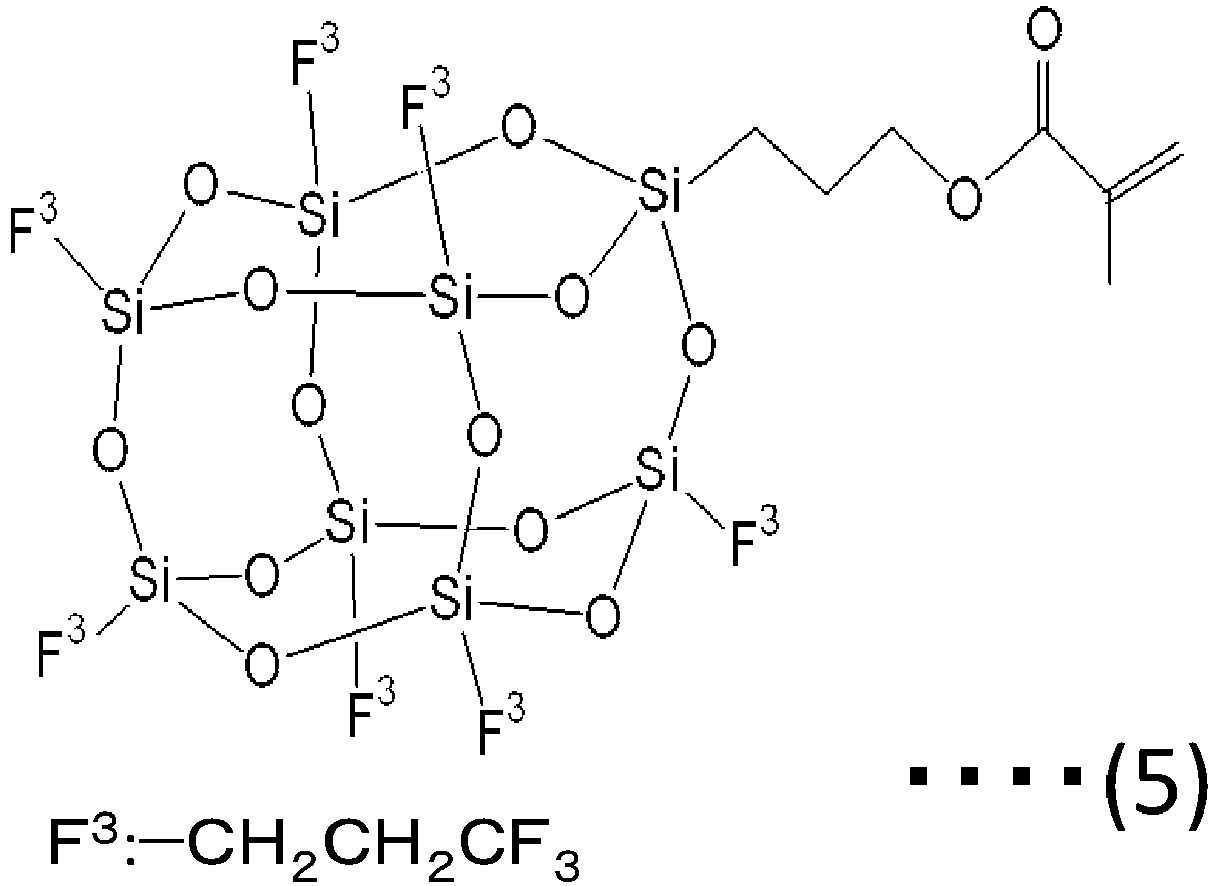
- If fluorosilsesquioxane derivative (1) such as γ-methacryloxypropylhepta(trifluoropropyl)-T8-silsesquioxane is introduced into the coating layer, a stain-proof function of the coating layer can be further improved. Upon incorporating fluorosilsesquioxane derivative (1) into the photopolymerizable acrylic compounds having no urethane unit and containing the fluorine atom, fluorosilsesquioxane derivative (1) may be directly mixed with other photopolymerizable acrylic compounds having no urethane unit and containing a fluorine atom, or an oligomer produced by previously crosslinking and/or polymerizing fluorosilsesquioxane derivative (1) with photopolymerizable acrylic compounds having no urethane unit may be mixed with other photopolymerizable acrylic compounds having no urethane unit and containing a fluorine atom.
- In general, fluorosilsesquioxane derivative (1) is copolymerized with one or more kinds of acrylate-based copolymer components selected from the monofunctional acrylate, the bifunctional acrylate and the polyfunctional acrylate to previously produce a polymer having a fluorosilsesquioxane derivative (1) unit, and the polymer is used as a part of the photopolymerizable acrylic compounds having no urethane unit and containing the fluorine atom. In the above case, the polymer having the fluorosilsesquioxane derivative (1) unit is blended so as to have a proportion of 0.01 part by weight to 10 parts by weight, preferably 0.05 part by weight to 5 parts by weight based on 100 parts by weight of the urethane acrylate.
- As the photocurable acrylic monomer and/or oligomer having the fluorine atom in the molecule or the photopolymerizable acrylic compounds having no urethane unit and containing the fluorine atom to be used with fluorosilsesquioxane derivative (1), a compound generally called the photocurable acrylic monomer, for example, monofunctional acrylate such as (meth)acrylic acid and (meth)acrylic acid ester, bifunctional acrylate such as (poly)alkylene glycol di(meth)acrylate, and trifunctional or more functional acrylate such as pentaerythritol triacrylate, or the like can be used. Such a copolymer component may be the oligomer obtained by polymerizing a reactive compound containing the photocurable acrylic monomer.
- As a polymerization initiator used for curing the photopolymerizable coating liquid containing component (a) and component (b), a material being distributed under the name of the photopolymerization initiator can be used without restriction. As such a photopolymerization initiator, for example, a polymer body of hydroxy ketone such as oligo{2-hydroxy-2-methyl-1-phenylpropaneone}, 1-hydroxydicyclohexyl phenyl ketone, 2-hydroxy-2-methyl-1-phenylpropane-1-one, 2,2-dimethoxy-1,2-diphenylethane-1-one, 1-{4(2-hydroxyethoxy)phenyl}2-hydroxy-2-methyl-1-propane-1-one, 2,4,6-trimethylbenzoyldiphenylphosphine oxide and bis(2,4,6-trimethylbenzoyl)phenylphosphine oxide, or the like can be used.
- An additive such as an antioxidant, a weather-resistant stabilizer, a toning agent and a diluent, which are generally blended in the material of the paint or the film, can be blended to the coating layer. An amount to be blended is not limited, as long as the amount is in the range within the function of the coating layer is not reduced.
- As the base material layer constituting the laminated film of the invention, a film composed of thermoplastic polyurethane is used. A publicly-known thermoplastic polyurethane film is used as such a film without restriction, but a film composed of polycarbonate-based thermoplastic polyurethane or a film composed of polycaprolactone-based thermoplastic polyurethane is generally used.
- The polycaprolactone-based thermoplastic polyurethane is thermoplastic polyurethane formed by allowing a polycarbonate compound having a hydroxyl group at a terminal (polycarbonate diol) to react with an isocyanate compound, which is a block copolymer containing a polyurethane component as a hard segment and polycarbonate as a soft segment. As the polycarbonate, alkanediol carbonate, more specifically, carbonate mainly composed of alkanediol having 2 to 10 carbons is generally used, and polyhexandiol carbonate is used, for example. As the isocyanate compound, the above-described compounds are used.
- As such polycarbonate-based thermoplastic polyurethane, for example, a compound having a soft segment block having a polycarbonate diol unit having the number average molecular weight of 500 to 10,000 and an organic diisocyanate unit, and a hard segment block having a chain elongation agent selected from organic diol having the number average molecular weight of 60 to 400 and an organic diisocyanate unit is used. Specific examples of such polycarbonate-based thermoplastic polyurethane include a compound having, as the soft segment block, a long-chain polyol unit composed of polyester-type polyol having a diethyl carbonate unit or a diphenyl carbonate unit, and a 1,6-hexandiol unit, and a 4,4'-diphenylmethane diisocyanate unit, and having, as the hard segment block, a 1,4-butanediol unit and a 4,4'-diphenylmethane diisocyanate unit.
- Specific examples of the polycaprolactone-based thermoplastic polyurethane elastomer include a compound in which structural units formed of a soft segment composed of polymer (long-chain) diol and a hard segment composed of low-molecular (short-chain) diol and diisocyanate are bonded to each other with organic diisocyanate.
- The polymer diol used in the soft segment is polycaprolactone. The number average molecular weight of the polymer diol is preferably 500 to 10,000. As the low-molecular diol used in the hard segment, diol having 2 to 50 carbons, for example, aliphatic dihydric alcohol having 2 to 15 carbons, alicyclic dihydric alcohol having 5 to 15 carbons, aromatic dihydric alcohol having 6 to 15 carbons, or the like can be used. Among the compounds, dihydric alcohol and dihydric phenol are preferred, aliphatic dihydric alcohol, monocycle dihydric phenol and bisphenol are further preferred, and ethylene glycol, hydroquinone and bisphenol A are particularly preferred.
- As the organic diisocyanate used for the polycaprolactone-based thermoplastic polyurethane elastomer, any of or a mixture of two or more kinds of aromatic diisocyanate having 6 to 20 carbons (excluding a carbon in an isocyanate group NCO, the same hereinafter), aliphatic diisocyanate having 2 to 18 carbons, cycloaliphatic diisocyanate having 4 to 15 carbons and aromatic-aliphatic diisocyanate having 8 to 15 carbons can be used. Among the compounds, any of or a mixture of aromatic diisocyanate and aliphatic diisocyanate is preferred, any of or a mixture of tolylene diisocyanate (TDI), diphenylmethane diisocyanate (MDI) and hexamethylene diisocyanate (HDI) is further preferred, and HDI is particularly preferred.
- In the invention, a thickness of the base material layer is not particularly limited, and is ordinarily 25 to 300 micrometers, and preferably 100 to 200 micrometers. As such a base material layer, ARGOGUARD (registered trademark) made by Argotec GmbH can be used, for example.
- The adhesive layer constituting the laminated film of the invention is formed of the pressure sensitive adhesive. As the pressure sensitive adhesive used in the invention, a publicly-known adhesive can be used without restriction, as long as the adhesive exhibits stickiness under a working temperature of the PPF, namely, at a temperature of about 20°C to about 30°C, and is used for adhesion between a molded product formed of a thermoplastic polyurethane-based material and an article such as glass, metal, plastic and paper. As such a pressure sensitive adhesive, a commercially available acrylic pressure sensitive adhesive and urethane-based pressure sensitive adhesive can be used, and an acrylic pressure sensitive adhesive is preferably used. A thickness of the adhesive layer is not particularly limited, and is ordinarily about 10 to 200 micrometers.
- On the adhesive layer constituting the laminated film of the invention, the release layer is preferably further laminated. As a material of the release layer, a publicly-known release material is used without restriction, and for example, a film made of a resin such as a polyester-based resin and a polyolefin-based resin, cellophane paper, glassine paper, and a material surface-coated with a fluorine-based or silicon-based release agent can be used. A thickness of the release layer is not particularly limited, and is ordinarily about 20 to 200 micrometers.
- In the laminated film of the invention, an outer surface of the coating layer can be coated with the protective layer according to a form of storage, transport or sales thereof. A material of such a protective layer is not limited, and a plastic film such as a polyethylene film, release-treated paper sheets or the like, which is generally used, can be appropriately selected.
- As the method for producing the laminated film of the invention, a method suitable for formation and lamination of each layer can be employed without restriction. For example, when the laminated film of the invention has the release layer and the protective layer, the laminated film of the invention can be produced through steps described below.
- First, an adhesive layer is formed on a release-treated surface of a release layer. Then, an opened surface of the adhesive layer formed is brought into close contact with one surface of a base material layer to produce a laminate in which the base material layer, the adhesive layer and the release layer are in contact with each other in the order. Then, the above-described photopolymerizable coating liquid is applied on an opened surface of the base material layer in the laminate obtained, and the applied surface is irradiated with ultraviolet light to cure the photopolymerizable coating liquid. When curing is completed, a laminate film in which the coating layer, the base material layer, the adhesive layer and the release layer are in contact with each other in the order is obtained. Further, an opened surface of the coating layer is coated with a protective film. Thus, a laminate film in which the protective layer, the coating layer, the base material layer, the adhesive layer and the release layer are in contact with each other in the order is obtained. The laminated film obtained is appropriately cut, wound up and packed.
- The laminated film thus completed is cut in an appropriate length unit, and loaded or wound up, and can be utilized as the PPF. When working on the PPF, the laminated film of the invention is cut into a shape according to a shape and a size of a coated surface, and the cut laminated film is extended with appropriate force, and the adhesive layer is closely adhered to the coated surface.
- In the laminated film of the invention, the coating layer excellent in strength, smoothness, water repellency and oil repellency relieves stimulation from the external world to a worked surface. Meanwhile, a flexible base material layer is closely adhered to the coated surface through the adhesive layer. After the laminated film is used for a predetermined period of time, the laminated film can be removed without damaging the surface of the coated surface.
- First, γ-methacryloxypropylhepta(trifluoropropyl)-T8-silsesquioxane was prepared according to a procedure described below. Into a four-necked flask having an inner volume of 1 litter and equipped with a reflux condenser, a thermometer and a dropping funnel, trifluoropropyltrimetoxysilane (100 g), THF (500 mL), deionized water (10.5 g) and sodium hydroxide (7.9 g) were charged, and the resulting mixture was heated in an oil bath from room temperature to a temperature at which the THF was refluxed while stirring the mixture with a magnetic stirrer. Stirring was continued for 5 hours from reflux start to complete a reaction. Then, the flask was pulled up from the oil bath, and left to stand overnight at room temperature, and then the flask was set to the oil bath again, and the mixture was heated and concentrated under constant pressure until a solid precipitated.
- The product precipitated was separated by filtration using a pressure filter provided with a membrane filter having a pore diameter of 0.5 micrometer. Then, the solid obtained was washed once with THF, and dried with a reduced pressure dryer at 80°C for 3 hours to obtain 74 g of a colorless powdery solid.
- Into a four-necked flask having an inner volume of 1 litter equipped with a reflux condenser, a thermometer and a dropping funnel, the obtained solid (65 g), dichloromethane (491 g) and triethylamine (8.1 g) were charged, and the resulting mixture was cooled down to 3°C in an ice bath. Then, γ-methacryloxypropyltrichlorosilane (21.2 g) was added thereto, and heat generation was confirmed to cease, and then the flask was pulled up from the ice bath, and the resulting mixture was aged as was at room temperature overnight. The resulting mixture was washed 3 times with ion exchange water, and then a dichloromethane layer was dehydrated over anhydrous magnesium sulfate to remove magnesium sulfate by filtration. The resulting filtrate was concentrated with a rotary evaporator until a viscous solid precipitated, and 260 g of methanol was added thereto, and the resulting mixture was stirred until a powdery state was formed. The resulting powder was filtrated using a pressure filter provided with 5-µm filter paper, and the filtrate was dried at 65°C for 3 hours with a reduced pressure dryer to obtain 41.5 g of a colorless powdery solid. GPC and 1H-NMR measurement were carried out on the solid obtained to confirm formation of γ-methacryloxypropylhepta(trifluoropropyl)-T8-silsesquioxane (5) represented by formula (5).

- Next, a polymer including a γ-methacryloxypropylhepta(trifluoropropyl)-T8-silsesquioxane unit was produced according to a procedure described below. Into a four-necked flask having an inner volume of 200 milliliters and equipped with a reflux condenser, a thermometer and a dropping funnel, 36.65 g of γ-methacryloxypropylhepta(trifluoropropyl)-T8-silsesquioxane (5) obtained by the method described above, 18.33 g of methyl methacrylate (MMA), 27.49 g of 2-hydroxyethyl methacrylate (HEMA), 9.16 g of dimethyl silicone modified with a methacryloxy group at one end (FM-0721, molecular weight: about 6,300) and 106.4 g of 2-butanone (MEK) were introduced, and the flask was sealed with nitrogen. The flask was set to an oil bath kept at 95°C to allow the resulting mixture to be refluxed, and then deoxidized for 10 minutes. Then, a solution in which 0.70 g of 2,2'-azobisisobutyronitrile (AIBN) and 0.08 g of mercaptoacetic acid (AcSH) were dissolved in 7.0 g of MEK was introduced thereinto, and polymerization was started while being kept at a reflux temperature. After polymerization was performed for 3 hours, a solution in which 7.00 g of AIBN was dissolved in 7.0 g of MEK was introduced thereinto, and polymerization was further continued for 5 hours. After completion of polymerization, 65 milliliters of denatured alcohol (Solmix AP-1, made by Japan Alcohol Trading Co., Ltd.) was added to the polymerization liquid, and then the resulting mixture was poured into 1300 milliliters of Solmix AP-1 to allow a polymer to precipitate. A supernatant was removed, and a product was separated by reduced pressure drying (40°C, 3 hours, 70°C, 3 hours).
- Into a four-necked flask having an inner volume of 200 milliliters and equipped with a reflux condenser, a thermometer and a septum cap, 15.0 g of the product, 0.015 g of MEHQ, 0.0263 g of DBTDL and 130 g of ethyl acetate were introduced, and the flask was sealed with nitrogen. The flask was set to an oil bath kept at 48°C, and was heated. Then, when a solution temperature reached 45°C, 15.9 g of acryloyloxyethyl isocyanate (AOI, made by Showa Denko K.K.) was introduced thereinto, and a reaction was started. After the reaction was performed for 6 hours, the temperature was reduced to room temperature, and 10.0 g of MeOH was introduced thereinto, and the reaction was completed. After completion of the reaction, 65 milliliters of Solmix AP-1 was added to the reaction mixture, and then 1300 milliliters of Solmix AP-1 was poured thereinto to allow a reactant to precipitate. A supernatant was removed, and the resulting material was subjected to reduced pressure drying (40°C, 3 hours, 70°C, 3 hours)to obtain 11.8 g of a polymer (XUA008) including a γ-methacryloxypropylhepta(trifluoropropyl)-T8-silsesquioxane unit and having an acryloyl group in a side chain. A weight average molecular weight determined by GPC analysis of XUA008 was 45,000, and a molecular weight distribution was 1.7.
- Components (a) and component (b) described below were used as a photopolymerizable compound. As component (a): urethane acrylate, a UV-curable self-healing paint "AUP-838 (a concentration of urethane acrylate being an effective component: 48.0% by weight)" made by TOKUSHIKI CO., Ltd. was used. As component (b): photopolymerizable acrylic compounds urethane acrylate having no urethane unit and containing a fluorine atom, a ultraviolet-curable resin (pentafunctional or more functional) "KAYARAD DPCA-120" (composed of a polymerizable acrylic compound having no urethane unit) made by Nippon Kayaku Co., Ltd., a fluorine-containing UV reactive surface modifier "MEGAFAC RS75" (containing a polymerizable acrylic compound having no urethane unit and containing fluorine with a concentration of 40.0% by weight) made by DIC Corporation, and XUA008 obtained by the above-described method were used.
- Component (a) and component (b) were mixed at a quantitative ratio shown in Table 1, in which, in Table 1, an amount of component (a) and component (b) is shown in terms of an amount (% by weight) of a photopolymerizable compound contained therein. A total of the photopolymerizable compound contained in component (a) and component (b) is 100 % by weight.
- Further, 5 parts by weight of a photopolymerization initiator "Irgacure 127" based on 100 parts by weight of the photopolymerizable components (component (a) and component (b)), and 2-propanol as a diluent were further added thereto so as to contain the photopolymerizable compounds with a concentration of 30% by weight.
- Thus, photopolymerizable coating liquids A, B, C, D and E shown in Table 1 were obtained.
- A commercially available acrylic pressure sensitive adhesive was applied to one surface of a base material layer (thermoplastic polyurethane film "ARGOGUARD 49510" made by Argotec GmbH) by die coating, and the resulting material was dried at 70°C for 3 minutes. Thus, an adhesive layer having a thickness of 40 micrometers was formed on one surface of the base material layer.
- Then, an opened surface of the adhesive layer was pressure-bonded to a polyethylene terephthalate film having a thickness of 75 micrometers release-treated with a silicon resin by using a rubber roller, and the resulting material was aged at 45°C for one day. Thus, a laminated film in which the base material layer, the adhesive layer and the release layer were in contact with each other in the order was obtained. Part of the above laminated film was used as a reference sample for measurement of a change of Young's modulus to be described later.
- A laminated film for a PPF was produced from the remaining laminated film. Any of photopolymerizable coating liquids A, B, C, D and E was applied onto an opened surface of the base material layer by using a wire bar coater No. 24 made by R.D.S. Webster, N.Y., and the resulting material was dried at 90°C for 3 minutes. Then, the photopolymerizable coating liquid was cured with an integrated light amount: 400 mJ/cm2 by using a fusion UV lamp-mounted belt conveyor curing unit (made by Heraeus K.K.). Thus, a coating layer having a thickness of 11 micrometers was formed on the base material layer, and a laminated film in which the coating layer, the base material layer, the adhesive layer and the release layer were in contact with each other in the order was obtained (Example 1, Example 2, Comparative Example 1, Comparative Example 2 and Comparative Example 3).
- The obtained laminated film was evaluated from viewpoints described below. The results are shown in Table 1.
- A piece having a dimension of 50 mm × 50 mm was cut out from the laminated film, and a release film was removed from the piece. As a coated plate, an unplasticized polyvinyl chloride resin plate (Capillone, K-5930) coated with a black paint was arranged. Onto a surface of the adhesive layer of the laminated film piece and a coated surface of the coated plate, water (in which, a baby shampoo made by Johnson & Johnson K.K. was diluted to 10,000 times on volume basis) was sprayed, and then the adhesive layer surface of the laminated film was brought into contact with the coated surface, and the laminated film was pressed with a commercially available rubber squeegee while removing air bubbles and water bubbles generated between the laminated film and the coated surface, and the laminated film was pasted to the coated plate. The coated plate to which the laminated film was pasted was left to stand at room temperature until no air bubbles and water bubbles were visually observed on the surface. Thus, a test sample was completed.
- An image clarity test of the test sample was conducted with a reflection angle of 45° and an optical comb width of 0.25 millimeters by using Image Clarity Meter ICM-1T (made by Suga Test Instruments Co., Ltd.). The optical comb perpendicular to a light beam axis of reflected light from the test sample was moved to determine a maximum light amount (M) and a minimum light amount (m) for a comb width of 0.25 millimeters to calculate image clarity according to the following equation:

- High image clarity means high smoothness of the surface of the coating layer. Gloss and smooth coating in appearance is generally preferred in exterior components of an automobile. A surface of the laminated film having the image clarity of below 45% is poor in gloss and smoothness in appearance, and in a so-called "orange peel surface" state. The PPF using such a laminated film having poor smoothness spoils beauty of coating of the automobile, and therefore has low desinability and is unsuitable for practical use.
- An image was drawn on a surface of the coating layer of the laminated film with a black oily marker (made by Sharpie), and a way of repellency of the oily ink was observed. Further, a drawn part was rubbed with a nonwoven fabric (Dusper K-3 by OZU CORPORATION), and wiping properties of the oily ink were observed. The observation results were judged according to the following criteria:
- +: Ink was repelled and wiped off clean.
- -: Ink was not wiped off.
- A piece having a dimension of 20 mm × 90 mm cut out from the laminated film was pasted to a stainless steel plate having a dimension of 25 mm × 100 mm, and a water contact angle of the coating layer of the laminated film was measured using Automatic Contact Angle Meter DMs-400 (made by Kyowa Interface Science Co., Ltd.). As probe water, distilled water for nitrogen and phosphorus measurement (made by KANTO KAGAKU) was used.
- In the sample that showed stain-proof properties in the test of (2), and high water repellency in the test of (3), stain-proof continuity was evaluated. In a similar manner to the measurement of (3), a piece having a dimension of 20 mm × 90 mm cut out from the laminated film was pasted to a stainless steel plate having a dimension of 25 mm × 100 mm, and a water contact angle (before deterioration, θ1) of the coating layer of the laminated film was measured using Automatic Contact Angle Meter DMs-400 (made by Kyowa Interface Science Co., Ltd.). As probe water, distilled water for nitrogen and phosphorus measurement (made by KANTO KAGAKU) was used.
- Another piece having a dimension of 20 mm × 90 mm cut out from the same laminated film was deteriorated with Ultraviolet Fluorescent lamp type Accelerated Weathering Tester QUV (made by Q-Lab Corporation). Deterioration conditions were a cycle including the following
steps ASTM G154 CYCLE 2, and 12 cycles in total were performed. A top coating layer side of the sample was irradiated with ultraviolet light. - Step 1: irradiation with ultraviolet light (irradiation amount with ultraviolet light: 0.71 W/m2, temperature: 60°C, time: 4 hours)
- Step 2: dew formation (temperature: 50°C, time: 4 hours)
- Step 3: return to
step 1 - The piece after completion of the deterioration treatment was pasted to a stainless steel plate having a dimension of 25 mm × 100 mm, a water contact angle (after deterioration, θ2) of the coating layer of the laminated film was measured using Automatic Contact Angle Meter DMs-400 (made by Kyowa Interface Science Co., Ltd.). As probe water, distilled water for nitrogen and phosphorus measurement (made by KANTO KAGAKU) was used.
- From θ1 and θ2 thus measured, a degree of a change in the stain-proof properties of each laminated film was determined as a change in water contact angle (Δθ) defined by the following equation:

- The laminated film having a small value of Δθ reasonably has stain-proof properties to withstand longer or severer outdoor use.
- From the above-described laminated film in which the base material layer, the adhesive layer and the release layer were in contact with each other in the order and no coating layer was included, a piece having a dimension of 25 mm × 70 mm was cut out and the release layer was removed. A change in stress when the obtained 2-layer laminated film (reference film) in which the base material layer and the adhesive layer were in contact with each other and no coating layer was included was pulled by Strograph VG as a tensile, compression and bending tester (made by Toyo Seiki Seisaku-sho, Ltd.) was measured to obtain a stress (N/mm2)-strain curve. Pulling conditions on the occasion were an initial interchuck distance: 30 mm, a crosshead moving speed: 500 mm/min and a maximum interchuck distance: 90 mm. Young's modulus (E1) (MPa) of the reference film was calculated as an inclination of an initial linear region of the stress (N/mm2)-strain curve, represented by the following equation:

- Also for the laminated film in which the coating layer, the base material layer, the adhesive layer and the release layer were in contact with each other in the order (Example 1, Example 2, Comparative Example 1, Comparative Example 2 and Comparative Example 3), the release layer was removed, and then a stress (N/mm2)-strain curve was obtained under the identical conditions. Young's modulus (E2) (MPa) of each 3-layer laminated film was calculated as an inclination of an initial linear region of the stress (N/mm2)-strain curve, represented by the following formula:

- A degree of contribution of the coating layer in flexibility of each 3-layer laminated film was calculated as a difference (ΔE) between the Young's modulus (E2) of the 3-layer laminated film and the Young's modulus (E1) of the standard film, represented by the following equation:

- In the laminated film having small ΔE, the flexibility of the base material layer is maintained further even in a state in which the coating layer was formed. The PPF using such a laminated film tends to be closely adhered to the coated surface having a curved shape, and therefore is particularly suitable for a product having various surface shapes as in the automobile.
- A piece having a dimension of 35 mm × 200 mm was cut out from the laminated film, and the release layer was removed to prepare a laminated film in which the coating layer, the base material layer and the adhesive layer were in contact with each other in the order. The laminated film was pulled and broken by Strograph VG as a tensile, compression and bending tester (made by Toyo Seiki Seisaku-sho, Ltd.) Pulling conditions on the occasion were an initial interchuck distance: 100 mm and a crosshead moving speed: 127 mm/min. A point at which a crack was generated on a surface of the test sample was visually detected, and extensibility of the laminated film till break was determined as elongation at break (%) represented by the following equation:

- A piece having a dimension of 40 mm × 130 mm was cut out from the laminated film, and the release layer was removed to prepare a laminated film in which the coating layer, the base material layer and the adhesive layer were in contact with each other in the order. Separately, an aluminum plate (width: 50 mm, length: 150 mm, thickness: 1.2 mm) coated with a black paint for an automobile was arranged.
- Onto each of a surface of the adhesive layer of the laminated film and a coated surface of the coated plate, water (in which, a baby shampoo made by Johnson & Johnson K.K. was diluted to 10,000 times on volume basis) was sprayed, and then the adhesive layer surface of the laminated film was brought into contact with the coated surface, and the laminated film was pressed with a commercially available rubber squeegee while removing air bubbles and water bubbles generated between the laminated film and the coated surface, and the laminated film was pasted to the coated plate. Sliding properties (squeegee sliding properties) of the laminated film on the occasion were judged according to the following criteria.
- +: The squeegee slid on the surface of the laminated film and the laminated film was pasted thereto without difficulty.
- -: The squeegee was caught by the surface of the laminated film and the laminated film was hard to paste.
- The laminated film of the invention (Example 1 and Example 2) has smoothness, stain-proof properties, stain-proof continuity, flexibility, extensibility and workability with a good balance. If the above laminated films are used for the PPF, manual pasting work is easy to perform, and the coated surface can be protected without spoiling beauty of the coated surface.
- Moreover, the laminated film of the invention has the coating layer including AUP-838, and therefore has self-healing properties.
- In contrast thereto, in Comparative Example 1 in which the coating layer does not include component (a): urethane acrylate, while smoothness, stain-proof properties and stain-proof continuity on the surface are excellent, flexibility of the base material layer is not maintained and extensibility is poor, and therefore the laminated film has a problem in use as the PPF.
- In Comparative Example 2, an amount of component (b) included in the coating layer is excessively small, and therefore smoothness and stain-proof continuity required for the PPF are poor, and the laminated film is unsuitable for practical use.
- In Comparative Example 3, an amount of component (b) included in the coating layer is excessively large, and therefore flexibility, extensibility and workability required for the PPF are poor, and the laminated film is unsuitable for practical use.
- A laminated film having smoothness, stain-proof properties, stain-proof continuity, flexibility, extensibility and workability with a good balance according to the invention has a high value of utilization as a PPF. As an application target of the PPF formed of the laminated film of the invention, a wide range of targets such as, in addition to a vehicle such as an automobile and a motorbike, a vessel, a building, an electrotechnical product, an exhibit, an interior, furniture, a factory facility, industrial equipment and medical equipment can be expected.
-
- 1
- Coating layer
- 2
- Base material layer
- 3
- Adhesive layer
- 4
- Release layer
- 5
- Laminated film
- 6
- Coated surface
- 7
- PPF


Claims (5)
- A laminated film, in which a coating layer formed of a cured material of a photopolymerizable coating liquid, a base material layer formed of thermoplastic polyurethane, and an adhesive layer formed of a pressure sensitive adhesive are formed in contact with each other in the order, wherein
the photopolymerizable coating liquid contains, as a photopolymerizable component, component (a): urethane acrylate and component (b): photopolymerizable acrylic compounds having no urethane unit and containing a fluorine atom, and
component (a) and component (b) are mixed at a proportion of (a): 20% by weight or more and less than 50% by weight and (b): 50% by weight or more and less than 80% by weight, based on a total amount of 100 parts by weight of the photopolymerizable component. - The laminated film according to claim 1, wherein component (b) contains a photopolymerizable acrylic polymer containing a fluorine atom and silicon.
- The laminated film according to claim 1 or 2, wherein component (b) contains a structural unit derived from a fluorosilsesquioxane derivative represented by formula (1):

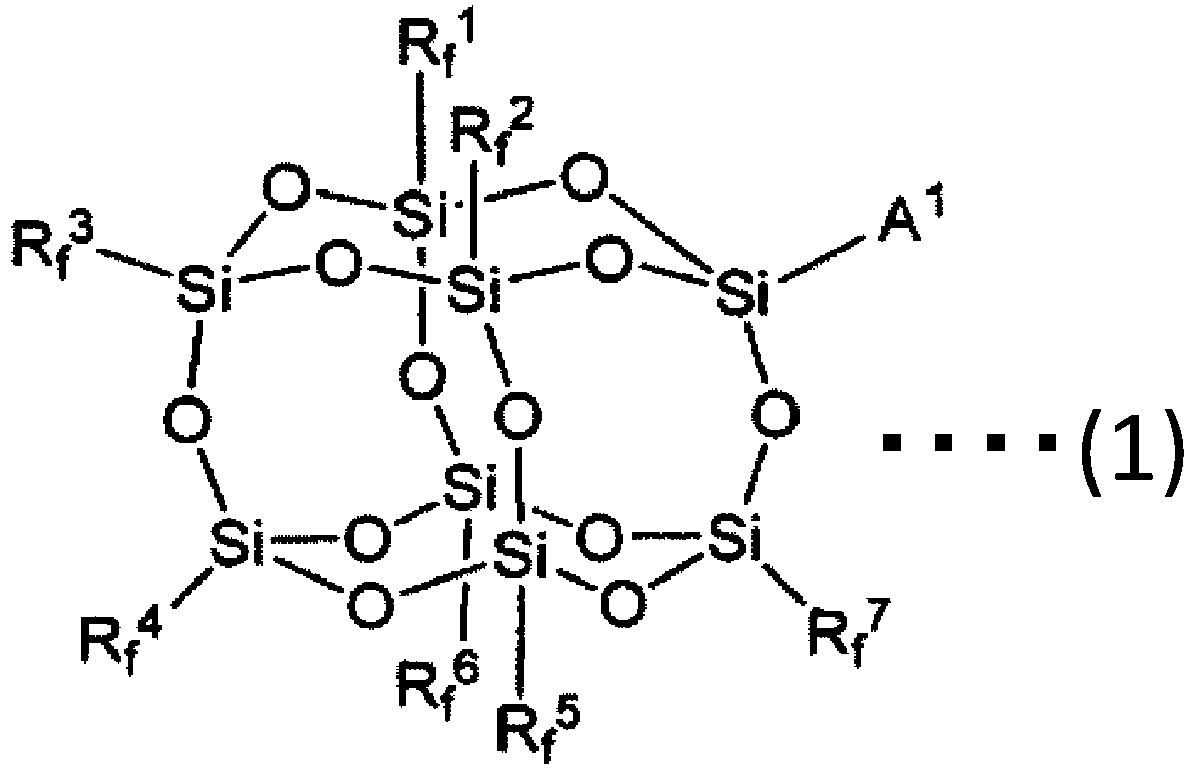


- The laminated film according to any one of claims 1 to 3, wherein component (b) contains a structural unit derived from γ-methacryloxypropylhepta(trifluoropropyl)-T8-silsesquioxane represented by formula (1-3):
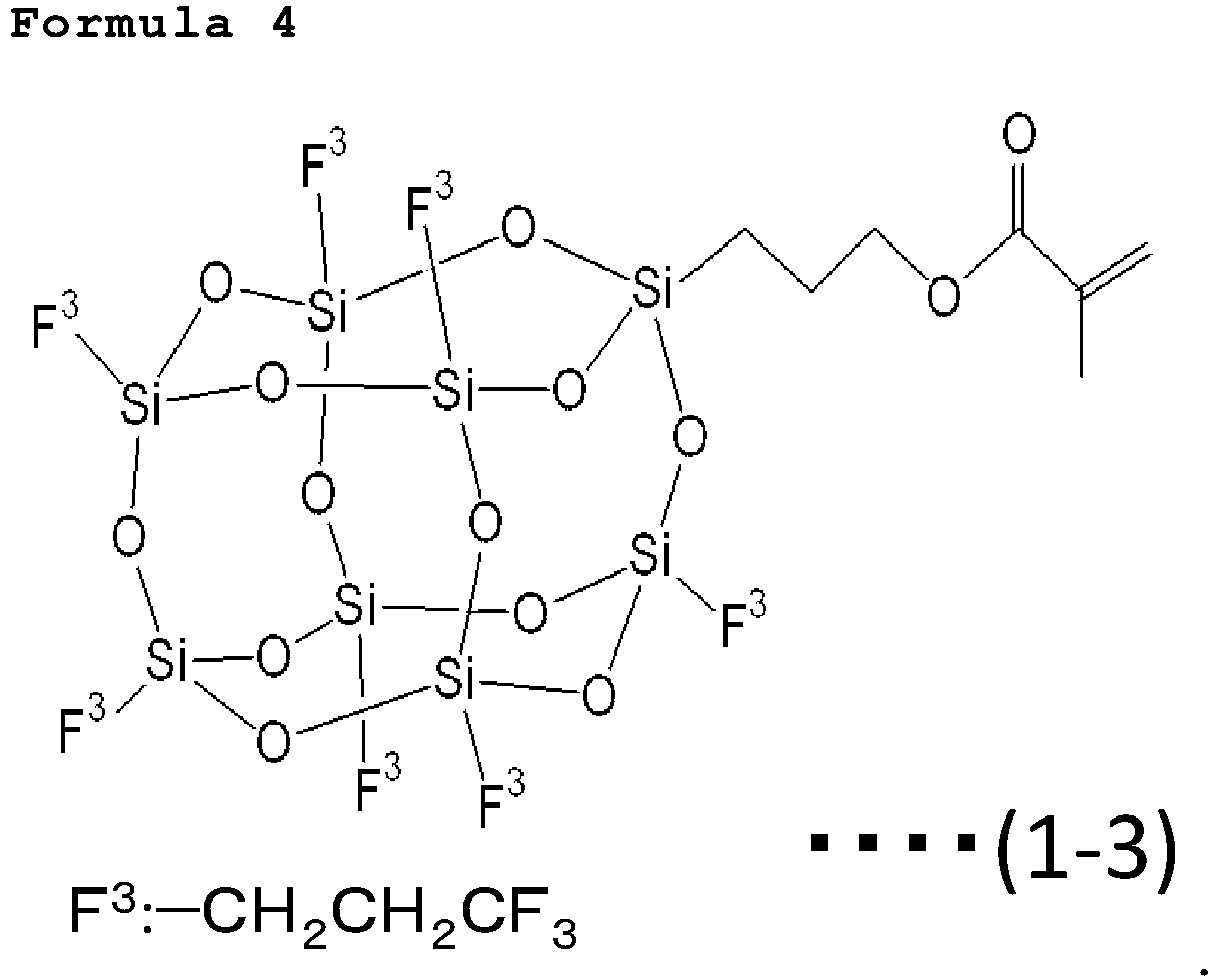
- A paint protection film, containing the laminated film according to any one of claims 1 to 4.
Applications Claiming Priority (2)
| Application Number | Priority Date | Filing Date | Title |
|---|---|---|---|
| JP2017107402 | 2017-05-31 | ||
| PCT/JP2018/020147 WO2018221405A1 (en) | 2017-05-31 | 2018-05-25 | Layered film |
Publications (1)
| Publication Number | Publication Date |
|---|---|
| EP3633003A1 true EP3633003A1 (en) | 2020-04-08 |
Family
ID=64454678
Family Applications (1)
| Application Number | Title | Priority Date | Filing Date |
|---|---|---|---|
| EP18809382.7A Withdrawn EP3633003A1 (en) | 2017-05-31 | 2018-05-25 | Layered film |
Country Status (7)
| Country | Link |
|---|---|
| US (1) | US20210138769A1 (en) |
| EP (1) | EP3633003A1 (en) |
| JP (1) | JP7238772B2 (en) |
| KR (1) | KR20200016280A (en) |
| CN (1) | CN110691829A (en) |
| TW (1) | TW201903082A (en) |
| WO (1) | WO2018221405A1 (en) |
Families Citing this family (5)
| Publication number | Priority date | Publication date | Assignee | Title |
|---|---|---|---|---|
| JP7411374B2 (en) * | 2019-10-09 | 2024-01-11 | リンテック株式会社 | Adhesive film and how to cut it |
| JP6767596B1 (en) * | 2020-03-27 | 2020-10-14 | 日本マタイ株式会社 | Multilayer film |
| CN115232547B (en) * | 2022-07-04 | 2023-04-07 | 浦诺菲新材料有限公司 | Self-cleaning self-repairing coating liquid of car paint protective film, and car paint protective film |
| JPWO2024143072A1 (en) * | 2022-12-28 | 2024-07-04 | ||
| TWI848672B (en) * | 2023-04-26 | 2024-07-11 | 南亞塑膠工業股份有限公司 | Self-healing polyurethane resin coating material for paint protection film and manufacturing method thereof |
Family Cites Families (10)
| Publication number | Priority date | Publication date | Assignee | Title |
|---|---|---|---|---|
| JPH01161010A (en) * | 1987-12-17 | 1989-06-23 | Dainippon Printing Co Ltd | Electron beam curable resin composition |
| JP2005060510A (en) * | 2003-08-12 | 2005-03-10 | Nof Kansai Marine Coatings Co Ltd | Coating composition, antifouling coating film, antifouling underwater structure, and antifouling method |
| US20070014018A1 (en) * | 2004-12-30 | 2007-01-18 | Wheatley John A | Internal components of optical device comprising hardcoat |
| CA2606441A1 (en) | 2005-04-29 | 2006-11-09 | 3M Innovative Properties Company | Multilayer polyurethane protective films |
| KR20190131140A (en) * | 2011-06-20 | 2019-11-25 | 제이엔씨 주식회사 | Transfer film for in-mold molding and method for producing same |
| JP2013076029A (en) * | 2011-09-30 | 2013-04-25 | Tdk Corp | Hard coat agent composition and hard coat film using the same |
| JP6057121B2 (en) * | 2012-11-02 | 2017-01-11 | Dic株式会社 | Active energy ray curable composition, cured product thereof and article having cured coating film thereof |
| CN106794678B (en) * | 2014-07-15 | 2019-02-01 | 捷恩智株式会社 | Laminate, surface protection article, and method for producing the laminate |
| JP6510192B2 (en) | 2014-07-15 | 2019-05-08 | 株式会社スミロン | LAMINATE, SURFACE PROTECTIVE ARTICLE, AND METHOD OF MANUFACTURING LAMINATE |
| US10513586B2 (en) * | 2015-03-31 | 2019-12-24 | Jnc Corporation | Coating agent, coating film, laminate and surface-protected article |
-
2018
- 2018-05-25 CN CN201880035143.2A patent/CN110691829A/en active Pending
- 2018-05-25 KR KR1020197038112A patent/KR20200016280A/en not_active Withdrawn
- 2018-05-25 EP EP18809382.7A patent/EP3633003A1/en not_active Withdrawn
- 2018-05-25 WO PCT/JP2018/020147 patent/WO2018221405A1/en not_active Ceased
- 2018-05-25 US US16/618,160 patent/US20210138769A1/en not_active Abandoned
- 2018-05-25 JP JP2019522189A patent/JP7238772B2/en active Active
- 2018-05-30 TW TW107118486A patent/TW201903082A/en unknown
Also Published As
| Publication number | Publication date |
|---|---|
| TW201903082A (en) | 2019-01-16 |
| JP7238772B2 (en) | 2023-03-14 |
| US20210138769A1 (en) | 2021-05-13 |
| KR20200016280A (en) | 2020-02-14 |
| WO2018221405A1 (en) | 2018-12-06 |
| CN110691829A (en) | 2020-01-14 |
| JPWO2018221405A1 (en) | 2020-04-02 |
Similar Documents
| Publication | Publication Date | Title |
|---|---|---|
| US10696865B2 (en) | Laminated film | |
| US20210138769A1 (en) | Laminated film | |
| US7785713B2 (en) | Active energy ray-curable coating composition and molded article having cured coating film of the composition | |
| KR101015722B1 (en) | Single layer film and hydrophilic material composed of this | |
| JP6673128B2 (en) | Laminated film | |
| TWI691523B (en) | Manufacturing method of polycarbonate diol and polycarbonate diol and polyurethane using the same | |
| EP3279282A1 (en) | Coating agent, coating film, laminate, and surface-protected article | |
| KR101950531B1 (en) | Scratch-prevention film | |
| JP2019203076A (en) | Coating liquid and product using the same | |
| CN102459378A (en) | Stain-proofing composition, stain-proofing film, stain-proofing laminate film, transfer film, resin laminate, and method for producing resin laminate | |
| JP2020164677A (en) | Photopolymerizable coating composition and article obtained using the same | |
| TWI797336B (en) | Photopolymerizable coating composition, article with coating layer, laminated film and paint protection film | |
| JP2021121653A (en) | Coating composition and product using the same | |
| CN104449332B (en) | Hardening resin composition and the coating composition containing it | |
| WO2016194765A1 (en) | Urethane (meth)acrylate resin and laminated film | |
| JP6705276B2 (en) | Urethane (meth)acrylate resin and laminated film | |
| JP3223460B2 (en) | Coating composition | |
| WO2025126876A1 (en) | Photopolymerizable coating composition and product using same | |
| TWI360554B (en) | Active energy ray curable composition | |
| JP2017002104A (en) | Urethane (meth)acrylate resin and laminated film | |
| JPH11124515A (en) | Resin composition and cured substance thereof |
Legal Events
| Date | Code | Title | Description |
|---|---|---|---|
| STAA | Information on the status of an ep patent application or granted ep patent |
Free format text: STATUS: THE INTERNATIONAL PUBLICATION HAS BEEN MADE |
|
| PUAI | Public reference made under article 153(3) epc to a published international application that has entered the european phase |
Free format text: ORIGINAL CODE: 0009012 |
|
| STAA | Information on the status of an ep patent application or granted ep patent |
Free format text: STATUS: REQUEST FOR EXAMINATION WAS MADE |
|
| 17P | Request for examination filed |
Effective date: 20191217 |
|
| AK | Designated contracting states |
Kind code of ref document: A1 Designated state(s): AL AT BE BG CH CY CZ DE DK EE ES FI FR GB GR HR HU IE IS IT LI LT LU LV MC MK MT NL NO PL PT RO RS SE SI SK SM TR |
|
| AX | Request for extension of the european patent |
Extension state: BA ME |
|
| DAV | Request for validation of the european patent (deleted) | ||
| DAX | Request for extension of the european patent (deleted) | ||
| STAA | Information on the status of an ep patent application or granted ep patent |
Free format text: STATUS: THE APPLICATION HAS BEEN WITHDRAWN |
|
| 18W | Application withdrawn |
Effective date: 20200910 |