EP3632903B1 - Compound used as autophagy regulator, and preparation method therefor and uses thereof - Google Patents
Compound used as autophagy regulator, and preparation method therefor and uses thereof Download PDFInfo
- Publication number
- EP3632903B1 EP3632903B1 EP18805508.1A EP18805508A EP3632903B1 EP 3632903 B1 EP3632903 B1 EP 3632903B1 EP 18805508 A EP18805508 A EP 18805508A EP 3632903 B1 EP3632903 B1 EP 3632903B1
- Authority
- EP
- European Patent Office
- Prior art keywords
- mhz
- dione
- ethyl
- methylene
- amino
- Prior art date
- Legal status (The legal status is an assumption and is not a legal conclusion. Google has not performed a legal analysis and makes no representation as to the accuracy of the status listed.)
- Active
Links
Classifications
-
- C—CHEMISTRY; METALLURGY
- C07—ORGANIC CHEMISTRY
- C07D—HETEROCYCLIC COMPOUNDS
- C07D405/00—Heterocyclic compounds containing both one or more hetero rings having oxygen atoms as the only ring hetero atoms, and one or more rings having nitrogen as the only ring hetero atom
- C07D405/02—Heterocyclic compounds containing both one or more hetero rings having oxygen atoms as the only ring hetero atoms, and one or more rings having nitrogen as the only ring hetero atom containing two hetero rings
- C07D405/12—Heterocyclic compounds containing both one or more hetero rings having oxygen atoms as the only ring hetero atoms, and one or more rings having nitrogen as the only ring hetero atom containing two hetero rings linked by a chain containing hetero atoms as chain links
-
- C—CHEMISTRY; METALLURGY
- C07—ORGANIC CHEMISTRY
- C07D—HETEROCYCLIC COMPOUNDS
- C07D319/00—Heterocyclic compounds containing six-membered rings having two oxygen atoms as the only ring hetero atoms
- C07D319/04—1,3-Dioxanes; Hydrogenated 1,3-dioxanes
- C07D319/06—1,3-Dioxanes; Hydrogenated 1,3-dioxanes not condensed with other rings
-
- C—CHEMISTRY; METALLURGY
- C07—ORGANIC CHEMISTRY
- C07C—ACYCLIC OR CARBOCYCLIC COMPOUNDS
- C07C323/00—Thiols, sulfides, hydropolysulfides or polysulfides substituted by halogen, oxygen or nitrogen atoms, or by sulfur atoms not being part of thio groups
- C07C323/22—Thiols, sulfides, hydropolysulfides or polysulfides substituted by halogen, oxygen or nitrogen atoms, or by sulfur atoms not being part of thio groups containing thio groups and doubly-bound oxygen atoms bound to the same carbon skeleton
-
- A—HUMAN NECESSITIES
- A61—MEDICAL OR VETERINARY SCIENCE; HYGIENE
- A61K—PREPARATIONS FOR MEDICAL, DENTAL OR TOILETRY PURPOSES
- A61K31/00—Medicinal preparations containing organic active ingredients
- A61K31/12—Ketones
- A61K31/122—Ketones having the oxygen directly attached to a ring, e.g. quinones, vitamin K1, anthralin
-
- A—HUMAN NECESSITIES
- A61—MEDICAL OR VETERINARY SCIENCE; HYGIENE
- A61K—PREPARATIONS FOR MEDICAL, DENTAL OR TOILETRY PURPOSES
- A61K31/00—Medicinal preparations containing organic active ingredients
- A61K31/33—Heterocyclic compounds
- A61K31/395—Heterocyclic compounds having nitrogen as a ring hetero atom, e.g. guanethidine or rifamycins
- A61K31/435—Heterocyclic compounds having nitrogen as a ring hetero atom, e.g. guanethidine or rifamycins having six-membered rings with one nitrogen as the only ring hetero atom
- A61K31/44—Non condensed pyridines; Hydrogenated derivatives thereof
-
- A—HUMAN NECESSITIES
- A61—MEDICAL OR VETERINARY SCIENCE; HYGIENE
- A61K—PREPARATIONS FOR MEDICAL, DENTAL OR TOILETRY PURPOSES
- A61K31/00—Medicinal preparations containing organic active ingredients
- A61K31/33—Heterocyclic compounds
- A61K31/395—Heterocyclic compounds having nitrogen as a ring hetero atom, e.g. guanethidine or rifamycins
- A61K31/495—Heterocyclic compounds having nitrogen as a ring hetero atom, e.g. guanethidine or rifamycins having six-membered rings with two or more nitrogen atoms as the only ring heteroatoms, e.g. piperazine or tetrazines
- A61K31/496—Non-condensed piperazines containing further heterocyclic rings, e.g. rifampin, thiothixene or sparfloxacin
-
- A—HUMAN NECESSITIES
- A61—MEDICAL OR VETERINARY SCIENCE; HYGIENE
- A61P—SPECIFIC THERAPEUTIC ACTIVITY OF CHEMICAL COMPOUNDS OR MEDICINAL PREPARATIONS
- A61P1/00—Drugs for disorders of the alimentary tract or the digestive system
-
- A—HUMAN NECESSITIES
- A61—MEDICAL OR VETERINARY SCIENCE; HYGIENE
- A61P—SPECIFIC THERAPEUTIC ACTIVITY OF CHEMICAL COMPOUNDS OR MEDICINAL PREPARATIONS
- A61P11/00—Drugs for disorders of the respiratory system
- A61P11/06—Antiasthmatics
-
- A—HUMAN NECESSITIES
- A61—MEDICAL OR VETERINARY SCIENCE; HYGIENE
- A61P—SPECIFIC THERAPEUTIC ACTIVITY OF CHEMICAL COMPOUNDS OR MEDICINAL PREPARATIONS
- A61P13/00—Drugs for disorders of the urinary system
- A61P13/12—Drugs for disorders of the urinary system of the kidneys
-
- A—HUMAN NECESSITIES
- A61—MEDICAL OR VETERINARY SCIENCE; HYGIENE
- A61P—SPECIFIC THERAPEUTIC ACTIVITY OF CHEMICAL COMPOUNDS OR MEDICINAL PREPARATIONS
- A61P19/00—Drugs for skeletal disorders
-
- A—HUMAN NECESSITIES
- A61—MEDICAL OR VETERINARY SCIENCE; HYGIENE
- A61P—SPECIFIC THERAPEUTIC ACTIVITY OF CHEMICAL COMPOUNDS OR MEDICINAL PREPARATIONS
- A61P19/00—Drugs for skeletal disorders
- A61P19/08—Drugs for skeletal disorders for bone diseases, e.g. rachitism, Paget's disease
-
- A—HUMAN NECESSITIES
- A61—MEDICAL OR VETERINARY SCIENCE; HYGIENE
- A61P—SPECIFIC THERAPEUTIC ACTIVITY OF CHEMICAL COMPOUNDS OR MEDICINAL PREPARATIONS
- A61P25/00—Drugs for disorders of the nervous system
-
- A—HUMAN NECESSITIES
- A61—MEDICAL OR VETERINARY SCIENCE; HYGIENE
- A61P—SPECIFIC THERAPEUTIC ACTIVITY OF CHEMICAL COMPOUNDS OR MEDICINAL PREPARATIONS
- A61P25/00—Drugs for disorders of the nervous system
- A61P25/28—Drugs for disorders of the nervous system for treating neurodegenerative disorders of the central nervous system, e.g. nootropic agents, cognition enhancers, drugs for treating Alzheimer's disease or other forms of dementia
-
- A—HUMAN NECESSITIES
- A61—MEDICAL OR VETERINARY SCIENCE; HYGIENE
- A61P—SPECIFIC THERAPEUTIC ACTIVITY OF CHEMICAL COMPOUNDS OR MEDICINAL PREPARATIONS
- A61P27/00—Drugs for disorders of the senses
- A61P27/02—Ophthalmic agents
-
- A—HUMAN NECESSITIES
- A61—MEDICAL OR VETERINARY SCIENCE; HYGIENE
- A61P—SPECIFIC THERAPEUTIC ACTIVITY OF CHEMICAL COMPOUNDS OR MEDICINAL PREPARATIONS
- A61P31/00—Antiinfectives, i.e. antibiotics, antiseptics, chemotherapeutics
-
- A—HUMAN NECESSITIES
- A61—MEDICAL OR VETERINARY SCIENCE; HYGIENE
- A61P—SPECIFIC THERAPEUTIC ACTIVITY OF CHEMICAL COMPOUNDS OR MEDICINAL PREPARATIONS
- A61P35/00—Antineoplastic agents
-
- A—HUMAN NECESSITIES
- A61—MEDICAL OR VETERINARY SCIENCE; HYGIENE
- A61P—SPECIFIC THERAPEUTIC ACTIVITY OF CHEMICAL COMPOUNDS OR MEDICINAL PREPARATIONS
- A61P35/00—Antineoplastic agents
- A61P35/02—Antineoplastic agents specific for leukemia
-
- A—HUMAN NECESSITIES
- A61—MEDICAL OR VETERINARY SCIENCE; HYGIENE
- A61P—SPECIFIC THERAPEUTIC ACTIVITY OF CHEMICAL COMPOUNDS OR MEDICINAL PREPARATIONS
- A61P37/00—Drugs for immunological or allergic disorders
-
- A—HUMAN NECESSITIES
- A61—MEDICAL OR VETERINARY SCIENCE; HYGIENE
- A61P—SPECIFIC THERAPEUTIC ACTIVITY OF CHEMICAL COMPOUNDS OR MEDICINAL PREPARATIONS
- A61P37/00—Drugs for immunological or allergic disorders
- A61P37/02—Immunomodulators
- A61P37/06—Immunosuppressants, e.g. drugs for graft rejection
-
- A—HUMAN NECESSITIES
- A61—MEDICAL OR VETERINARY SCIENCE; HYGIENE
- A61P—SPECIFIC THERAPEUTIC ACTIVITY OF CHEMICAL COMPOUNDS OR MEDICINAL PREPARATIONS
- A61P9/00—Drugs for disorders of the cardiovascular system
-
- A—HUMAN NECESSITIES
- A61—MEDICAL OR VETERINARY SCIENCE; HYGIENE
- A61P—SPECIFIC THERAPEUTIC ACTIVITY OF CHEMICAL COMPOUNDS OR MEDICINAL PREPARATIONS
- A61P9/00—Drugs for disorders of the cardiovascular system
- A61P9/10—Drugs for disorders of the cardiovascular system for treating ischaemic or atherosclerotic diseases, e.g. antianginal drugs, coronary vasodilators, drugs for myocardial infarction, retinopathy, cerebrovascula insufficiency, renal arteriosclerosis
-
- A—HUMAN NECESSITIES
- A61—MEDICAL OR VETERINARY SCIENCE; HYGIENE
- A61P—SPECIFIC THERAPEUTIC ACTIVITY OF CHEMICAL COMPOUNDS OR MEDICINAL PREPARATIONS
- A61P9/00—Drugs for disorders of the cardiovascular system
- A61P9/12—Antihypertensives
-
- C—CHEMISTRY; METALLURGY
- C07—ORGANIC CHEMISTRY
- C07C—ACYCLIC OR CARBOCYCLIC COMPOUNDS
- C07C225/00—Compounds containing amino groups and doubly—bound oxygen atoms bound to the same carbon skeleton, at least one of the doubly—bound oxygen atoms not being part of a —CHO group, e.g. amino ketones
- C07C225/02—Compounds containing amino groups and doubly—bound oxygen atoms bound to the same carbon skeleton, at least one of the doubly—bound oxygen atoms not being part of a —CHO group, e.g. amino ketones having amino groups bound to acyclic carbon atoms of the carbon skeleton
- C07C225/14—Compounds containing amino groups and doubly—bound oxygen atoms bound to the same carbon skeleton, at least one of the doubly—bound oxygen atoms not being part of a —CHO group, e.g. amino ketones having amino groups bound to acyclic carbon atoms of the carbon skeleton the carbon skeleton being unsaturated
- C07C225/16—Compounds containing amino groups and doubly—bound oxygen atoms bound to the same carbon skeleton, at least one of the doubly—bound oxygen atoms not being part of a —CHO group, e.g. amino ketones having amino groups bound to acyclic carbon atoms of the carbon skeleton the carbon skeleton being unsaturated and containing six-membered aromatic rings
- C07C225/18—Compounds containing amino groups and doubly—bound oxygen atoms bound to the same carbon skeleton, at least one of the doubly—bound oxygen atoms not being part of a —CHO group, e.g. amino ketones having amino groups bound to acyclic carbon atoms of the carbon skeleton the carbon skeleton being unsaturated and containing six-membered aromatic rings the carbon skeleton containing also rings other than six-membered aromatic rings
-
- C—CHEMISTRY; METALLURGY
- C07—ORGANIC CHEMISTRY
- C07C—ACYCLIC OR CARBOCYCLIC COMPOUNDS
- C07C225/00—Compounds containing amino groups and doubly—bound oxygen atoms bound to the same carbon skeleton, at least one of the doubly—bound oxygen atoms not being part of a —CHO group, e.g. amino ketones
- C07C225/24—Compounds containing amino groups and doubly—bound oxygen atoms bound to the same carbon skeleton, at least one of the doubly—bound oxygen atoms not being part of a —CHO group, e.g. amino ketones the carbon skeleton containing carbon atoms of quinone rings
-
- C—CHEMISTRY; METALLURGY
- C07—ORGANIC CHEMISTRY
- C07C—ACYCLIC OR CARBOCYCLIC COMPOUNDS
- C07C229/00—Compounds containing amino and carboxyl groups bound to the same carbon skeleton
- C07C229/02—Compounds containing amino and carboxyl groups bound to the same carbon skeleton having amino and carboxyl groups bound to acyclic carbon atoms of the same carbon skeleton
- C07C229/04—Compounds containing amino and carboxyl groups bound to the same carbon skeleton having amino and carboxyl groups bound to acyclic carbon atoms of the same carbon skeleton the carbon skeleton being acyclic and saturated
- C07C229/06—Compounds containing amino and carboxyl groups bound to the same carbon skeleton having amino and carboxyl groups bound to acyclic carbon atoms of the same carbon skeleton the carbon skeleton being acyclic and saturated having only one amino and one carboxyl group bound to the carbon skeleton
- C07C229/10—Compounds containing amino and carboxyl groups bound to the same carbon skeleton having amino and carboxyl groups bound to acyclic carbon atoms of the same carbon skeleton the carbon skeleton being acyclic and saturated having only one amino and one carboxyl group bound to the carbon skeleton the nitrogen atom of the amino group being further bound to acyclic carbon atoms or to carbon atoms of rings other than six-membered aromatic rings
- C07C229/14—Compounds containing amino and carboxyl groups bound to the same carbon skeleton having amino and carboxyl groups bound to acyclic carbon atoms of the same carbon skeleton the carbon skeleton being acyclic and saturated having only one amino and one carboxyl group bound to the carbon skeleton the nitrogen atom of the amino group being further bound to acyclic carbon atoms or to carbon atoms of rings other than six-membered aromatic rings to carbon atoms of carbon skeletons containing rings
-
- C—CHEMISTRY; METALLURGY
- C07—ORGANIC CHEMISTRY
- C07C—ACYCLIC OR CARBOCYCLIC COMPOUNDS
- C07C229/00—Compounds containing amino and carboxyl groups bound to the same carbon skeleton
- C07C229/02—Compounds containing amino and carboxyl groups bound to the same carbon skeleton having amino and carboxyl groups bound to acyclic carbon atoms of the same carbon skeleton
- C07C229/04—Compounds containing amino and carboxyl groups bound to the same carbon skeleton having amino and carboxyl groups bound to acyclic carbon atoms of the same carbon skeleton the carbon skeleton being acyclic and saturated
- C07C229/22—Compounds containing amino and carboxyl groups bound to the same carbon skeleton having amino and carboxyl groups bound to acyclic carbon atoms of the same carbon skeleton the carbon skeleton being acyclic and saturated the carbon skeleton being further substituted by oxygen atoms
-
- C—CHEMISTRY; METALLURGY
- C07—ORGANIC CHEMISTRY
- C07C—ACYCLIC OR CARBOCYCLIC COMPOUNDS
- C07C233/00—Carboxylic acid amides
- C07C233/01—Carboxylic acid amides having carbon atoms of carboxamide groups bound to hydrogen atoms or to acyclic carbon atoms
- C07C233/34—Carboxylic acid amides having carbon atoms of carboxamide groups bound to hydrogen atoms or to acyclic carbon atoms having the nitrogen atom of at least one of the carboxamide groups bound to a carbon atom of a hydrocarbon radical substituted by amino groups
- C07C233/35—Carboxylic acid amides having carbon atoms of carboxamide groups bound to hydrogen atoms or to acyclic carbon atoms having the nitrogen atom of at least one of the carboxamide groups bound to a carbon atom of a hydrocarbon radical substituted by amino groups with the substituted hydrocarbon radical bound to the nitrogen atom of the carboxamide group by an acyclic carbon atom
- C07C233/36—Carboxylic acid amides having carbon atoms of carboxamide groups bound to hydrogen atoms or to acyclic carbon atoms having the nitrogen atom of at least one of the carboxamide groups bound to a carbon atom of a hydrocarbon radical substituted by amino groups with the substituted hydrocarbon radical bound to the nitrogen atom of the carboxamide group by an acyclic carbon atom having the carbon atom of the carboxamide group bound to a hydrogen atom or to a carbon atom of an acyclic saturated carbon skeleton
-
- C—CHEMISTRY; METALLURGY
- C07—ORGANIC CHEMISTRY
- C07C—ACYCLIC OR CARBOCYCLIC COMPOUNDS
- C07C237/00—Carboxylic acid amides, the carbon skeleton of the acid part being further substituted by amino groups
- C07C237/24—Carboxylic acid amides, the carbon skeleton of the acid part being further substituted by amino groups having the carbon atom of at least one of the carboxamide groups bound to a carbon atom of a ring other than a six-membered aromatic ring of the carbon skeleton
-
- C—CHEMISTRY; METALLURGY
- C07—ORGANIC CHEMISTRY
- C07C—ACYCLIC OR CARBOCYCLIC COMPOUNDS
- C07C239/00—Compounds containing nitrogen-to-halogen bonds; Hydroxylamino compounds or ethers or esters thereof
- C07C239/08—Hydroxylamino compounds or their ethers or esters
- C07C239/14—Hydroxylamino compounds or their ethers or esters having nitrogen atoms of hydroxylamino groups further bound to carbon atoms of hydrocarbon radicals substituted by doubly-bound oxygen atoms
-
- C—CHEMISTRY; METALLURGY
- C07—ORGANIC CHEMISTRY
- C07C—ACYCLIC OR CARBOCYCLIC COMPOUNDS
- C07C251/00—Compounds containing nitrogen atoms doubly-bound to a carbon skeleton
- C07C251/02—Compounds containing nitrogen atoms doubly-bound to a carbon skeleton containing imino groups
- C07C251/04—Compounds containing nitrogen atoms doubly-bound to a carbon skeleton containing imino groups having carbon atoms of imino groups bound to hydrogen atoms or to acyclic carbon atoms
- C07C251/06—Compounds containing nitrogen atoms doubly-bound to a carbon skeleton containing imino groups having carbon atoms of imino groups bound to hydrogen atoms or to acyclic carbon atoms to carbon atoms of a saturated carbon skeleton
- C07C251/08—Compounds containing nitrogen atoms doubly-bound to a carbon skeleton containing imino groups having carbon atoms of imino groups bound to hydrogen atoms or to acyclic carbon atoms to carbon atoms of a saturated carbon skeleton being acyclic
-
- C—CHEMISTRY; METALLURGY
- C07—ORGANIC CHEMISTRY
- C07C—ACYCLIC OR CARBOCYCLIC COMPOUNDS
- C07C257/00—Compounds containing carboxyl groups, the doubly-bound oxygen atom of a carboxyl group being replaced by a doubly-bound nitrogen atom, this nitrogen atom not being further bound to an oxygen atom, e.g. imino-ethers, amidines
- C07C257/10—Compounds containing carboxyl groups, the doubly-bound oxygen atom of a carboxyl group being replaced by a doubly-bound nitrogen atom, this nitrogen atom not being further bound to an oxygen atom, e.g. imino-ethers, amidines with replacement of the other oxygen atom of the carboxyl group by nitrogen atoms, e.g. amidines
- C07C257/14—Compounds containing carboxyl groups, the doubly-bound oxygen atom of a carboxyl group being replaced by a doubly-bound nitrogen atom, this nitrogen atom not being further bound to an oxygen atom, e.g. imino-ethers, amidines with replacement of the other oxygen atom of the carboxyl group by nitrogen atoms, e.g. amidines having carbon atoms of amidino groups bound to acyclic carbon atoms
-
- C—CHEMISTRY; METALLURGY
- C07—ORGANIC CHEMISTRY
- C07C—ACYCLIC OR CARBOCYCLIC COMPOUNDS
- C07C271/00—Derivatives of carbamic acids, i.e. compounds containing any of the groups, the nitrogen atom not being part of nitro or nitroso groups
- C07C271/06—Esters of carbamic acids
- C07C271/08—Esters of carbamic acids having oxygen atoms of carbamate groups bound to acyclic carbon atoms
- C07C271/10—Esters of carbamic acids having oxygen atoms of carbamate groups bound to acyclic carbon atoms with the nitrogen atoms of the carbamate groups bound to hydrogen atoms or to acyclic carbon atoms
- C07C271/20—Esters of carbamic acids having oxygen atoms of carbamate groups bound to acyclic carbon atoms with the nitrogen atoms of the carbamate groups bound to hydrogen atoms or to acyclic carbon atoms to carbon atoms of hydrocarbon radicals substituted by nitrogen atoms not being part of nitro or nitroso groups
-
- C—CHEMISTRY; METALLURGY
- C07—ORGANIC CHEMISTRY
- C07C—ACYCLIC OR CARBOCYCLIC COMPOUNDS
- C07C321/00—Thiols, sulfides, hydropolysulfides or polysulfides
- C07C321/12—Sulfides, hydropolysulfides, or polysulfides having thio groups bound to acyclic carbon atoms
- C07C321/20—Sulfides, hydropolysulfides, or polysulfides having thio groups bound to acyclic carbon atoms of an unsaturated carbon skeleton containing rings
-
- C—CHEMISTRY; METALLURGY
- C07—ORGANIC CHEMISTRY
- C07C—ACYCLIC OR CARBOCYCLIC COMPOUNDS
- C07C321/00—Thiols, sulfides, hydropolysulfides or polysulfides
- C07C321/24—Thiols, sulfides, hydropolysulfides, or polysulfides having thio groups bound to carbon atoms of six-membered aromatic rings
- C07C321/28—Sulfides, hydropolysulfides, or polysulfides having thio groups bound to carbon atoms of six-membered aromatic rings
- C07C321/30—Sulfides having the sulfur atom of at least one thio group bound to two carbon atoms of six-membered aromatic rings
-
- C—CHEMISTRY; METALLURGY
- C07—ORGANIC CHEMISTRY
- C07C—ACYCLIC OR CARBOCYCLIC COMPOUNDS
- C07C323/00—Thiols, sulfides, hydropolysulfides or polysulfides substituted by halogen, oxygen or nitrogen atoms, or by sulfur atoms not being part of thio groups
- C07C323/50—Thiols, sulfides, hydropolysulfides or polysulfides substituted by halogen, oxygen or nitrogen atoms, or by sulfur atoms not being part of thio groups containing thio groups and carboxyl groups bound to the same carbon skeleton
- C07C323/51—Thiols, sulfides, hydropolysulfides or polysulfides substituted by halogen, oxygen or nitrogen atoms, or by sulfur atoms not being part of thio groups containing thio groups and carboxyl groups bound to the same carbon skeleton having the sulfur atoms of the thio groups bound to acyclic carbon atoms of the carbon skeleton
- C07C323/57—Thiols, sulfides, hydropolysulfides or polysulfides substituted by halogen, oxygen or nitrogen atoms, or by sulfur atoms not being part of thio groups containing thio groups and carboxyl groups bound to the same carbon skeleton having the sulfur atoms of the thio groups bound to acyclic carbon atoms of the carbon skeleton the carbon skeleton being further substituted by nitrogen atoms, not being part of nitro or nitroso groups
- C07C323/58—Thiols, sulfides, hydropolysulfides or polysulfides substituted by halogen, oxygen or nitrogen atoms, or by sulfur atoms not being part of thio groups containing thio groups and carboxyl groups bound to the same carbon skeleton having the sulfur atoms of the thio groups bound to acyclic carbon atoms of the carbon skeleton the carbon skeleton being further substituted by nitrogen atoms, not being part of nitro or nitroso groups with amino groups bound to the carbon skeleton
-
- C—CHEMISTRY; METALLURGY
- C07—ORGANIC CHEMISTRY
- C07C—ACYCLIC OR CARBOCYCLIC COMPOUNDS
- C07C49/00—Ketones; Ketenes; Dimeric ketenes; Ketonic chelates
- C07C49/385—Saturated compounds containing a keto group being part of a ring
- C07C49/403—Saturated compounds containing a keto group being part of a ring of a six-membered ring
- C07C49/407—Menthones
-
- C—CHEMISTRY; METALLURGY
- C07—ORGANIC CHEMISTRY
- C07C—ACYCLIC OR CARBOCYCLIC COMPOUNDS
- C07C49/00—Ketones; Ketenes; Dimeric ketenes; Ketonic chelates
- C07C49/527—Unsaturated compounds containing keto groups bound to rings other than six-membered aromatic rings
- C07C49/563—Unsaturated compounds containing keto groups bound to rings other than six-membered aromatic rings containing six-membered aromatic rings
-
- C—CHEMISTRY; METALLURGY
- C07—ORGANIC CHEMISTRY
- C07C—ACYCLIC OR CARBOCYCLIC COMPOUNDS
- C07C49/00—Ketones; Ketenes; Dimeric ketenes; Ketonic chelates
- C07C49/527—Unsaturated compounds containing keto groups bound to rings other than six-membered aromatic rings
- C07C49/573—Unsaturated compounds containing keto groups bound to rings other than six-membered aromatic rings containing hydroxy groups
-
- C—CHEMISTRY; METALLURGY
- C07—ORGANIC CHEMISTRY
- C07C—ACYCLIC OR CARBOCYCLIC COMPOUNDS
- C07C49/00—Ketones; Ketenes; Dimeric ketenes; Ketonic chelates
- C07C49/587—Unsaturated compounds containing a keto groups being part of a ring
- C07C49/703—Unsaturated compounds containing a keto groups being part of a ring containing hydroxy groups
- C07C49/747—Unsaturated compounds containing a keto groups being part of a ring containing hydroxy groups containing six-membered aromatic rings
-
- C—CHEMISTRY; METALLURGY
- C07—ORGANIC CHEMISTRY
- C07C—ACYCLIC OR CARBOCYCLIC COMPOUNDS
- C07C49/00—Ketones; Ketenes; Dimeric ketenes; Ketonic chelates
- C07C49/587—Unsaturated compounds containing a keto groups being part of a ring
- C07C49/753—Unsaturated compounds containing a keto groups being part of a ring containing ether groups, groups, groups, or groups
-
- C—CHEMISTRY; METALLURGY
- C07—ORGANIC CHEMISTRY
- C07D—HETEROCYCLIC COMPOUNDS
- C07D207/00—Heterocyclic compounds containing five-membered rings not condensed with other rings, with one nitrogen atom as the only ring hetero atom
- C07D207/02—Heterocyclic compounds containing five-membered rings not condensed with other rings, with one nitrogen atom as the only ring hetero atom with only hydrogen or carbon atoms directly attached to the ring nitrogen atom
- C07D207/04—Heterocyclic compounds containing five-membered rings not condensed with other rings, with one nitrogen atom as the only ring hetero atom with only hydrogen or carbon atoms directly attached to the ring nitrogen atom having no double bonds between ring members or between ring members and non-ring members
- C07D207/08—Heterocyclic compounds containing five-membered rings not condensed with other rings, with one nitrogen atom as the only ring hetero atom with only hydrogen or carbon atoms directly attached to the ring nitrogen atom having no double bonds between ring members or between ring members and non-ring members with hydrocarbon radicals, substituted by hetero atoms, attached to ring carbon atoms
- C07D207/09—Radicals substituted by nitrogen atoms, not forming part of a nitro radical
-
- C—CHEMISTRY; METALLURGY
- C07—ORGANIC CHEMISTRY
- C07D—HETEROCYCLIC COMPOUNDS
- C07D207/00—Heterocyclic compounds containing five-membered rings not condensed with other rings, with one nitrogen atom as the only ring hetero atom
- C07D207/02—Heterocyclic compounds containing five-membered rings not condensed with other rings, with one nitrogen atom as the only ring hetero atom with only hydrogen or carbon atoms directly attached to the ring nitrogen atom
- C07D207/30—Heterocyclic compounds containing five-membered rings not condensed with other rings, with one nitrogen atom as the only ring hetero atom with only hydrogen or carbon atoms directly attached to the ring nitrogen atom having two double bonds between ring members or between ring members and non-ring members
- C07D207/32—Heterocyclic compounds containing five-membered rings not condensed with other rings, with one nitrogen atom as the only ring hetero atom with only hydrogen or carbon atoms directly attached to the ring nitrogen atom having two double bonds between ring members or between ring members and non-ring members with only hydrogen atoms, hydrocarbon or substituted hydrocarbon radicals, directly attached to ring carbon atoms
- C07D207/33—Heterocyclic compounds containing five-membered rings not condensed with other rings, with one nitrogen atom as the only ring hetero atom with only hydrogen or carbon atoms directly attached to the ring nitrogen atom having two double bonds between ring members or between ring members and non-ring members with only hydrogen atoms, hydrocarbon or substituted hydrocarbon radicals, directly attached to ring carbon atoms with substituted hydrocarbon radicals, directly attached to ring carbon atoms
- C07D207/335—Radicals substituted by nitrogen atoms not forming part of a nitro radical
-
- C—CHEMISTRY; METALLURGY
- C07—ORGANIC CHEMISTRY
- C07D—HETEROCYCLIC COMPOUNDS
- C07D207/00—Heterocyclic compounds containing five-membered rings not condensed with other rings, with one nitrogen atom as the only ring hetero atom
- C07D207/02—Heterocyclic compounds containing five-membered rings not condensed with other rings, with one nitrogen atom as the only ring hetero atom with only hydrogen or carbon atoms directly attached to the ring nitrogen atom
- C07D207/30—Heterocyclic compounds containing five-membered rings not condensed with other rings, with one nitrogen atom as the only ring hetero atom with only hydrogen or carbon atoms directly attached to the ring nitrogen atom having two double bonds between ring members or between ring members and non-ring members
- C07D207/34—Heterocyclic compounds containing five-membered rings not condensed with other rings, with one nitrogen atom as the only ring hetero atom with only hydrogen or carbon atoms directly attached to the ring nitrogen atom having two double bonds between ring members or between ring members and non-ring members with hetero atoms or with carbon atoms having three bonds to hetero atoms with at the most one bond to halogen, e.g. ester or nitrile radicals, directly attached to ring carbon atoms
-
- C—CHEMISTRY; METALLURGY
- C07—ORGANIC CHEMISTRY
- C07D—HETEROCYCLIC COMPOUNDS
- C07D209/00—Heterocyclic compounds containing five-membered rings, condensed with other rings, with one nitrogen atom as the only ring hetero atom
- C07D209/02—Heterocyclic compounds containing five-membered rings, condensed with other rings, with one nitrogen atom as the only ring hetero atom condensed with one carbocyclic ring
- C07D209/04—Indoles; Hydrogenated indoles
-
- C—CHEMISTRY; METALLURGY
- C07—ORGANIC CHEMISTRY
- C07D—HETEROCYCLIC COMPOUNDS
- C07D209/00—Heterocyclic compounds containing five-membered rings, condensed with other rings, with one nitrogen atom as the only ring hetero atom
- C07D209/02—Heterocyclic compounds containing five-membered rings, condensed with other rings, with one nitrogen atom as the only ring hetero atom condensed with one carbocyclic ring
- C07D209/04—Indoles; Hydrogenated indoles
- C07D209/08—Indoles; Hydrogenated indoles with only hydrogen atoms or radicals containing only hydrogen and carbon atoms, directly attached to carbon atoms of the hetero ring
-
- C—CHEMISTRY; METALLURGY
- C07—ORGANIC CHEMISTRY
- C07D—HETEROCYCLIC COMPOUNDS
- C07D209/00—Heterocyclic compounds containing five-membered rings, condensed with other rings, with one nitrogen atom as the only ring hetero atom
- C07D209/02—Heterocyclic compounds containing five-membered rings, condensed with other rings, with one nitrogen atom as the only ring hetero atom condensed with one carbocyclic ring
- C07D209/04—Indoles; Hydrogenated indoles
- C07D209/10—Indoles; Hydrogenated indoles with substituted hydrocarbon radicals attached to carbon atoms of the hetero ring
- C07D209/12—Radicals substituted by oxygen atoms
-
- C—CHEMISTRY; METALLURGY
- C07—ORGANIC CHEMISTRY
- C07D—HETEROCYCLIC COMPOUNDS
- C07D209/00—Heterocyclic compounds containing five-membered rings, condensed with other rings, with one nitrogen atom as the only ring hetero atom
- C07D209/02—Heterocyclic compounds containing five-membered rings, condensed with other rings, with one nitrogen atom as the only ring hetero atom condensed with one carbocyclic ring
- C07D209/04—Indoles; Hydrogenated indoles
- C07D209/10—Indoles; Hydrogenated indoles with substituted hydrocarbon radicals attached to carbon atoms of the hetero ring
- C07D209/14—Radicals substituted by nitrogen atoms, not forming part of a nitro radical
-
- C—CHEMISTRY; METALLURGY
- C07—ORGANIC CHEMISTRY
- C07D—HETEROCYCLIC COMPOUNDS
- C07D209/00—Heterocyclic compounds containing five-membered rings, condensed with other rings, with one nitrogen atom as the only ring hetero atom
- C07D209/02—Heterocyclic compounds containing five-membered rings, condensed with other rings, with one nitrogen atom as the only ring hetero atom condensed with one carbocyclic ring
- C07D209/04—Indoles; Hydrogenated indoles
- C07D209/30—Indoles; Hydrogenated indoles with hetero atoms or with carbon atoms having three bonds to hetero atoms with at the most one bond to halogen, directly attached to carbon atoms of the hetero ring
-
- C—CHEMISTRY; METALLURGY
- C07—ORGANIC CHEMISTRY
- C07D—HETEROCYCLIC COMPOUNDS
- C07D209/00—Heterocyclic compounds containing five-membered rings, condensed with other rings, with one nitrogen atom as the only ring hetero atom
- C07D209/02—Heterocyclic compounds containing five-membered rings, condensed with other rings, with one nitrogen atom as the only ring hetero atom condensed with one carbocyclic ring
- C07D209/44—Iso-indoles; Hydrogenated iso-indoles
- C07D209/46—Iso-indoles; Hydrogenated iso-indoles with an oxygen atom in position 1
-
- C—CHEMISTRY; METALLURGY
- C07—ORGANIC CHEMISTRY
- C07D—HETEROCYCLIC COMPOUNDS
- C07D211/00—Heterocyclic compounds containing hydrogenated pyridine rings, not condensed with other rings
- C07D211/04—Heterocyclic compounds containing hydrogenated pyridine rings, not condensed with other rings with only hydrogen or carbon atoms directly attached to the ring nitrogen atom
- C07D211/06—Heterocyclic compounds containing hydrogenated pyridine rings, not condensed with other rings with only hydrogen or carbon atoms directly attached to the ring nitrogen atom having no double bonds between ring members or between ring members and non-ring members
- C07D211/08—Heterocyclic compounds containing hydrogenated pyridine rings, not condensed with other rings with only hydrogen or carbon atoms directly attached to the ring nitrogen atom having no double bonds between ring members or between ring members and non-ring members with hydrocarbon or substituted hydrocarbon radicals directly attached to ring carbon atoms
- C07D211/18—Heterocyclic compounds containing hydrogenated pyridine rings, not condensed with other rings with only hydrogen or carbon atoms directly attached to the ring nitrogen atom having no double bonds between ring members or between ring members and non-ring members with hydrocarbon or substituted hydrocarbon radicals directly attached to ring carbon atoms with substituted hydrocarbon radicals attached to ring carbon atoms
- C07D211/26—Heterocyclic compounds containing hydrogenated pyridine rings, not condensed with other rings with only hydrogen or carbon atoms directly attached to the ring nitrogen atom having no double bonds between ring members or between ring members and non-ring members with hydrocarbon or substituted hydrocarbon radicals directly attached to ring carbon atoms with substituted hydrocarbon radicals attached to ring carbon atoms with hydrocarbon radicals, substituted by nitrogen atoms
-
- C—CHEMISTRY; METALLURGY
- C07—ORGANIC CHEMISTRY
- C07D—HETEROCYCLIC COMPOUNDS
- C07D211/00—Heterocyclic compounds containing hydrogenated pyridine rings, not condensed with other rings
- C07D211/04—Heterocyclic compounds containing hydrogenated pyridine rings, not condensed with other rings with only hydrogen or carbon atoms directly attached to the ring nitrogen atom
- C07D211/06—Heterocyclic compounds containing hydrogenated pyridine rings, not condensed with other rings with only hydrogen or carbon atoms directly attached to the ring nitrogen atom having no double bonds between ring members or between ring members and non-ring members
- C07D211/36—Heterocyclic compounds containing hydrogenated pyridine rings, not condensed with other rings with only hydrogen or carbon atoms directly attached to the ring nitrogen atom having no double bonds between ring members or between ring members and non-ring members with hetero atoms or with carbon atoms having three bonds to hetero atoms with at the most one bond to halogen, e.g. ester or nitrile radicals, directly attached to ring carbon atoms
- C07D211/56—Nitrogen atoms
-
- C—CHEMISTRY; METALLURGY
- C07—ORGANIC CHEMISTRY
- C07D—HETEROCYCLIC COMPOUNDS
- C07D211/00—Heterocyclic compounds containing hydrogenated pyridine rings, not condensed with other rings
- C07D211/04—Heterocyclic compounds containing hydrogenated pyridine rings, not condensed with other rings with only hydrogen or carbon atoms directly attached to the ring nitrogen atom
- C07D211/06—Heterocyclic compounds containing hydrogenated pyridine rings, not condensed with other rings with only hydrogen or carbon atoms directly attached to the ring nitrogen atom having no double bonds between ring members or between ring members and non-ring members
- C07D211/36—Heterocyclic compounds containing hydrogenated pyridine rings, not condensed with other rings with only hydrogen or carbon atoms directly attached to the ring nitrogen atom having no double bonds between ring members or between ring members and non-ring members with hetero atoms or with carbon atoms having three bonds to hetero atoms with at the most one bond to halogen, e.g. ester or nitrile radicals, directly attached to ring carbon atoms
- C07D211/56—Nitrogen atoms
- C07D211/58—Nitrogen atoms attached in position 4
-
- C—CHEMISTRY; METALLURGY
- C07—ORGANIC CHEMISTRY
- C07D—HETEROCYCLIC COMPOUNDS
- C07D213/00—Heterocyclic compounds containing six-membered rings, not condensed with other rings, with one nitrogen atom as the only ring hetero atom and three or more double bonds between ring members or between ring members and non-ring members
- C07D213/02—Heterocyclic compounds containing six-membered rings, not condensed with other rings, with one nitrogen atom as the only ring hetero atom and three or more double bonds between ring members or between ring members and non-ring members having three double bonds between ring members or between ring members and non-ring members
- C07D213/04—Heterocyclic compounds containing six-membered rings, not condensed with other rings, with one nitrogen atom as the only ring hetero atom and three or more double bonds between ring members or between ring members and non-ring members having three double bonds between ring members or between ring members and non-ring members having no bond between the ring nitrogen atom and a non-ring member or having only hydrogen or carbon atoms directly attached to the ring nitrogen atom
- C07D213/06—Heterocyclic compounds containing six-membered rings, not condensed with other rings, with one nitrogen atom as the only ring hetero atom and three or more double bonds between ring members or between ring members and non-ring members having three double bonds between ring members or between ring members and non-ring members having no bond between the ring nitrogen atom and a non-ring member or having only hydrogen or carbon atoms directly attached to the ring nitrogen atom containing only hydrogen and carbon atoms in addition to the ring nitrogen atom
- C07D213/16—Heterocyclic compounds containing six-membered rings, not condensed with other rings, with one nitrogen atom as the only ring hetero atom and three or more double bonds between ring members or between ring members and non-ring members having three double bonds between ring members or between ring members and non-ring members having no bond between the ring nitrogen atom and a non-ring member or having only hydrogen or carbon atoms directly attached to the ring nitrogen atom containing only hydrogen and carbon atoms in addition to the ring nitrogen atom containing only one pyridine ring
-
- C—CHEMISTRY; METALLURGY
- C07—ORGANIC CHEMISTRY
- C07D—HETEROCYCLIC COMPOUNDS
- C07D213/00—Heterocyclic compounds containing six-membered rings, not condensed with other rings, with one nitrogen atom as the only ring hetero atom and three or more double bonds between ring members or between ring members and non-ring members
- C07D213/02—Heterocyclic compounds containing six-membered rings, not condensed with other rings, with one nitrogen atom as the only ring hetero atom and three or more double bonds between ring members or between ring members and non-ring members having three double bonds between ring members or between ring members and non-ring members
- C07D213/04—Heterocyclic compounds containing six-membered rings, not condensed with other rings, with one nitrogen atom as the only ring hetero atom and three or more double bonds between ring members or between ring members and non-ring members having three double bonds between ring members or between ring members and non-ring members having no bond between the ring nitrogen atom and a non-ring member or having only hydrogen or carbon atoms directly attached to the ring nitrogen atom
- C07D213/24—Heterocyclic compounds containing six-membered rings, not condensed with other rings, with one nitrogen atom as the only ring hetero atom and three or more double bonds between ring members or between ring members and non-ring members having three double bonds between ring members or between ring members and non-ring members having no bond between the ring nitrogen atom and a non-ring member or having only hydrogen or carbon atoms directly attached to the ring nitrogen atom with substituted hydrocarbon radicals attached to ring carbon atoms
- C07D213/36—Radicals substituted by singly-bound nitrogen atoms
-
- C—CHEMISTRY; METALLURGY
- C07—ORGANIC CHEMISTRY
- C07D—HETEROCYCLIC COMPOUNDS
- C07D213/00—Heterocyclic compounds containing six-membered rings, not condensed with other rings, with one nitrogen atom as the only ring hetero atom and three or more double bonds between ring members or between ring members and non-ring members
- C07D213/02—Heterocyclic compounds containing six-membered rings, not condensed with other rings, with one nitrogen atom as the only ring hetero atom and three or more double bonds between ring members or between ring members and non-ring members having three double bonds between ring members or between ring members and non-ring members
- C07D213/04—Heterocyclic compounds containing six-membered rings, not condensed with other rings, with one nitrogen atom as the only ring hetero atom and three or more double bonds between ring members or between ring members and non-ring members having three double bonds between ring members or between ring members and non-ring members having no bond between the ring nitrogen atom and a non-ring member or having only hydrogen or carbon atoms directly attached to the ring nitrogen atom
- C07D213/24—Heterocyclic compounds containing six-membered rings, not condensed with other rings, with one nitrogen atom as the only ring hetero atom and three or more double bonds between ring members or between ring members and non-ring members having three double bonds between ring members or between ring members and non-ring members having no bond between the ring nitrogen atom and a non-ring member or having only hydrogen or carbon atoms directly attached to the ring nitrogen atom with substituted hydrocarbon radicals attached to ring carbon atoms
- C07D213/36—Radicals substituted by singly-bound nitrogen atoms
- C07D213/38—Radicals substituted by singly-bound nitrogen atoms having only hydrogen or hydrocarbon radicals attached to the substituent nitrogen atom
-
- C—CHEMISTRY; METALLURGY
- C07—ORGANIC CHEMISTRY
- C07D—HETEROCYCLIC COMPOUNDS
- C07D213/00—Heterocyclic compounds containing six-membered rings, not condensed with other rings, with one nitrogen atom as the only ring hetero atom and three or more double bonds between ring members or between ring members and non-ring members
- C07D213/02—Heterocyclic compounds containing six-membered rings, not condensed with other rings, with one nitrogen atom as the only ring hetero atom and three or more double bonds between ring members or between ring members and non-ring members having three double bonds between ring members or between ring members and non-ring members
- C07D213/04—Heterocyclic compounds containing six-membered rings, not condensed with other rings, with one nitrogen atom as the only ring hetero atom and three or more double bonds between ring members or between ring members and non-ring members having three double bonds between ring members or between ring members and non-ring members having no bond between the ring nitrogen atom and a non-ring member or having only hydrogen or carbon atoms directly attached to the ring nitrogen atom
- C07D213/24—Heterocyclic compounds containing six-membered rings, not condensed with other rings, with one nitrogen atom as the only ring hetero atom and three or more double bonds between ring members or between ring members and non-ring members having three double bonds between ring members or between ring members and non-ring members having no bond between the ring nitrogen atom and a non-ring member or having only hydrogen or carbon atoms directly attached to the ring nitrogen atom with substituted hydrocarbon radicals attached to ring carbon atoms
- C07D213/36—Radicals substituted by singly-bound nitrogen atoms
- C07D213/42—Radicals substituted by singly-bound nitrogen atoms having hetero atoms attached to the substituent nitrogen atom
-
- C—CHEMISTRY; METALLURGY
- C07—ORGANIC CHEMISTRY
- C07D—HETEROCYCLIC COMPOUNDS
- C07D213/00—Heterocyclic compounds containing six-membered rings, not condensed with other rings, with one nitrogen atom as the only ring hetero atom and three or more double bonds between ring members or between ring members and non-ring members
- C07D213/02—Heterocyclic compounds containing six-membered rings, not condensed with other rings, with one nitrogen atom as the only ring hetero atom and three or more double bonds between ring members or between ring members and non-ring members having three double bonds between ring members or between ring members and non-ring members
- C07D213/04—Heterocyclic compounds containing six-membered rings, not condensed with other rings, with one nitrogen atom as the only ring hetero atom and three or more double bonds between ring members or between ring members and non-ring members having three double bonds between ring members or between ring members and non-ring members having no bond between the ring nitrogen atom and a non-ring member or having only hydrogen or carbon atoms directly attached to the ring nitrogen atom
- C07D213/24—Heterocyclic compounds containing six-membered rings, not condensed with other rings, with one nitrogen atom as the only ring hetero atom and three or more double bonds between ring members or between ring members and non-ring members having three double bonds between ring members or between ring members and non-ring members having no bond between the ring nitrogen atom and a non-ring member or having only hydrogen or carbon atoms directly attached to the ring nitrogen atom with substituted hydrocarbon radicals attached to ring carbon atoms
- C07D213/44—Radicals substituted by doubly-bound oxygen, sulfur, or nitrogen atoms, or by two such atoms singly-bound to the same carbon atom
- C07D213/46—Oxygen atoms
- C07D213/50—Ketonic radicals
-
- C—CHEMISTRY; METALLURGY
- C07—ORGANIC CHEMISTRY
- C07D—HETEROCYCLIC COMPOUNDS
- C07D213/00—Heterocyclic compounds containing six-membered rings, not condensed with other rings, with one nitrogen atom as the only ring hetero atom and three or more double bonds between ring members or between ring members and non-ring members
- C07D213/02—Heterocyclic compounds containing six-membered rings, not condensed with other rings, with one nitrogen atom as the only ring hetero atom and three or more double bonds between ring members or between ring members and non-ring members having three double bonds between ring members or between ring members and non-ring members
- C07D213/04—Heterocyclic compounds containing six-membered rings, not condensed with other rings, with one nitrogen atom as the only ring hetero atom and three or more double bonds between ring members or between ring members and non-ring members having three double bonds between ring members or between ring members and non-ring members having no bond between the ring nitrogen atom and a non-ring member or having only hydrogen or carbon atoms directly attached to the ring nitrogen atom
- C07D213/60—Heterocyclic compounds containing six-membered rings, not condensed with other rings, with one nitrogen atom as the only ring hetero atom and three or more double bonds between ring members or between ring members and non-ring members having three double bonds between ring members or between ring members and non-ring members having no bond between the ring nitrogen atom and a non-ring member or having only hydrogen or carbon atoms directly attached to the ring nitrogen atom with hetero atoms or with carbon atoms having three bonds to hetero atoms with at the most one bond to halogen, e.g. ester or nitrile radicals, directly attached to ring carbon atoms
- C07D213/61—Halogen atoms or nitro radicals
-
- C—CHEMISTRY; METALLURGY
- C07—ORGANIC CHEMISTRY
- C07D—HETEROCYCLIC COMPOUNDS
- C07D213/00—Heterocyclic compounds containing six-membered rings, not condensed with other rings, with one nitrogen atom as the only ring hetero atom and three or more double bonds between ring members or between ring members and non-ring members
- C07D213/02—Heterocyclic compounds containing six-membered rings, not condensed with other rings, with one nitrogen atom as the only ring hetero atom and three or more double bonds between ring members or between ring members and non-ring members having three double bonds between ring members or between ring members and non-ring members
- C07D213/04—Heterocyclic compounds containing six-membered rings, not condensed with other rings, with one nitrogen atom as the only ring hetero atom and three or more double bonds between ring members or between ring members and non-ring members having three double bonds between ring members or between ring members and non-ring members having no bond between the ring nitrogen atom and a non-ring member or having only hydrogen or carbon atoms directly attached to the ring nitrogen atom
- C07D213/60—Heterocyclic compounds containing six-membered rings, not condensed with other rings, with one nitrogen atom as the only ring hetero atom and three or more double bonds between ring members or between ring members and non-ring members having three double bonds between ring members or between ring members and non-ring members having no bond between the ring nitrogen atom and a non-ring member or having only hydrogen or carbon atoms directly attached to the ring nitrogen atom with hetero atoms or with carbon atoms having three bonds to hetero atoms with at the most one bond to halogen, e.g. ester or nitrile radicals, directly attached to ring carbon atoms
- C07D213/62—Oxygen or sulfur atoms
- C07D213/63—One oxygen atom
- C07D213/64—One oxygen atom attached in position 2 or 6
-
- C—CHEMISTRY; METALLURGY
- C07—ORGANIC CHEMISTRY
- C07D—HETEROCYCLIC COMPOUNDS
- C07D213/00—Heterocyclic compounds containing six-membered rings, not condensed with other rings, with one nitrogen atom as the only ring hetero atom and three or more double bonds between ring members or between ring members and non-ring members
- C07D213/02—Heterocyclic compounds containing six-membered rings, not condensed with other rings, with one nitrogen atom as the only ring hetero atom and three or more double bonds between ring members or between ring members and non-ring members having three double bonds between ring members or between ring members and non-ring members
- C07D213/04—Heterocyclic compounds containing six-membered rings, not condensed with other rings, with one nitrogen atom as the only ring hetero atom and three or more double bonds between ring members or between ring members and non-ring members having three double bonds between ring members or between ring members and non-ring members having no bond between the ring nitrogen atom and a non-ring member or having only hydrogen or carbon atoms directly attached to the ring nitrogen atom
- C07D213/60—Heterocyclic compounds containing six-membered rings, not condensed with other rings, with one nitrogen atom as the only ring hetero atom and three or more double bonds between ring members or between ring members and non-ring members having three double bonds between ring members or between ring members and non-ring members having no bond between the ring nitrogen atom and a non-ring member or having only hydrogen or carbon atoms directly attached to the ring nitrogen atom with hetero atoms or with carbon atoms having three bonds to hetero atoms with at the most one bond to halogen, e.g. ester or nitrile radicals, directly attached to ring carbon atoms
- C07D213/62—Oxygen or sulfur atoms
- C07D213/63—One oxygen atom
- C07D213/68—One oxygen atom attached in position 4
-
- C—CHEMISTRY; METALLURGY
- C07—ORGANIC CHEMISTRY
- C07D—HETEROCYCLIC COMPOUNDS
- C07D213/00—Heterocyclic compounds containing six-membered rings, not condensed with other rings, with one nitrogen atom as the only ring hetero atom and three or more double bonds between ring members or between ring members and non-ring members
- C07D213/02—Heterocyclic compounds containing six-membered rings, not condensed with other rings, with one nitrogen atom as the only ring hetero atom and three or more double bonds between ring members or between ring members and non-ring members having three double bonds between ring members or between ring members and non-ring members
- C07D213/04—Heterocyclic compounds containing six-membered rings, not condensed with other rings, with one nitrogen atom as the only ring hetero atom and three or more double bonds between ring members or between ring members and non-ring members having three double bonds between ring members or between ring members and non-ring members having no bond between the ring nitrogen atom and a non-ring member or having only hydrogen or carbon atoms directly attached to the ring nitrogen atom
- C07D213/60—Heterocyclic compounds containing six-membered rings, not condensed with other rings, with one nitrogen atom as the only ring hetero atom and three or more double bonds between ring members or between ring members and non-ring members having three double bonds between ring members or between ring members and non-ring members having no bond between the ring nitrogen atom and a non-ring member or having only hydrogen or carbon atoms directly attached to the ring nitrogen atom with hetero atoms or with carbon atoms having three bonds to hetero atoms with at the most one bond to halogen, e.g. ester or nitrile radicals, directly attached to ring carbon atoms
- C07D213/62—Oxygen or sulfur atoms
- C07D213/69—Two or more oxygen atoms
-
- C—CHEMISTRY; METALLURGY
- C07—ORGANIC CHEMISTRY
- C07D—HETEROCYCLIC COMPOUNDS
- C07D213/00—Heterocyclic compounds containing six-membered rings, not condensed with other rings, with one nitrogen atom as the only ring hetero atom and three or more double bonds between ring members or between ring members and non-ring members
- C07D213/02—Heterocyclic compounds containing six-membered rings, not condensed with other rings, with one nitrogen atom as the only ring hetero atom and three or more double bonds between ring members or between ring members and non-ring members having three double bonds between ring members or between ring members and non-ring members
- C07D213/04—Heterocyclic compounds containing six-membered rings, not condensed with other rings, with one nitrogen atom as the only ring hetero atom and three or more double bonds between ring members or between ring members and non-ring members having three double bonds between ring members or between ring members and non-ring members having no bond between the ring nitrogen atom and a non-ring member or having only hydrogen or carbon atoms directly attached to the ring nitrogen atom
- C07D213/60—Heterocyclic compounds containing six-membered rings, not condensed with other rings, with one nitrogen atom as the only ring hetero atom and three or more double bonds between ring members or between ring members and non-ring members having three double bonds between ring members or between ring members and non-ring members having no bond between the ring nitrogen atom and a non-ring member or having only hydrogen or carbon atoms directly attached to the ring nitrogen atom with hetero atoms or with carbon atoms having three bonds to hetero atoms with at the most one bond to halogen, e.g. ester or nitrile radicals, directly attached to ring carbon atoms
- C07D213/72—Nitrogen atoms
- C07D213/74—Amino or imino radicals substituted by hydrocarbon or substituted hydrocarbon radicals
-
- C—CHEMISTRY; METALLURGY
- C07—ORGANIC CHEMISTRY
- C07D—HETEROCYCLIC COMPOUNDS
- C07D213/00—Heterocyclic compounds containing six-membered rings, not condensed with other rings, with one nitrogen atom as the only ring hetero atom and three or more double bonds between ring members or between ring members and non-ring members
- C07D213/02—Heterocyclic compounds containing six-membered rings, not condensed with other rings, with one nitrogen atom as the only ring hetero atom and three or more double bonds between ring members or between ring members and non-ring members having three double bonds between ring members or between ring members and non-ring members
- C07D213/04—Heterocyclic compounds containing six-membered rings, not condensed with other rings, with one nitrogen atom as the only ring hetero atom and three or more double bonds between ring members or between ring members and non-ring members having three double bonds between ring members or between ring members and non-ring members having no bond between the ring nitrogen atom and a non-ring member or having only hydrogen or carbon atoms directly attached to the ring nitrogen atom
- C07D213/60—Heterocyclic compounds containing six-membered rings, not condensed with other rings, with one nitrogen atom as the only ring hetero atom and three or more double bonds between ring members or between ring members and non-ring members having three double bonds between ring members or between ring members and non-ring members having no bond between the ring nitrogen atom and a non-ring member or having only hydrogen or carbon atoms directly attached to the ring nitrogen atom with hetero atoms or with carbon atoms having three bonds to hetero atoms with at the most one bond to halogen, e.g. ester or nitrile radicals, directly attached to ring carbon atoms
- C07D213/78—Carbon atoms having three bonds to hetero atoms, with at the most one bond to halogen, e.g. ester or nitrile radicals
- C07D213/79—Acids; Esters
- C07D213/80—Acids; Esters in position 3
-
- C—CHEMISTRY; METALLURGY
- C07—ORGANIC CHEMISTRY
- C07D—HETEROCYCLIC COMPOUNDS
- C07D213/00—Heterocyclic compounds containing six-membered rings, not condensed with other rings, with one nitrogen atom as the only ring hetero atom and three or more double bonds between ring members or between ring members and non-ring members
- C07D213/02—Heterocyclic compounds containing six-membered rings, not condensed with other rings, with one nitrogen atom as the only ring hetero atom and three or more double bonds between ring members or between ring members and non-ring members having three double bonds between ring members or between ring members and non-ring members
- C07D213/04—Heterocyclic compounds containing six-membered rings, not condensed with other rings, with one nitrogen atom as the only ring hetero atom and three or more double bonds between ring members or between ring members and non-ring members having three double bonds between ring members or between ring members and non-ring members having no bond between the ring nitrogen atom and a non-ring member or having only hydrogen or carbon atoms directly attached to the ring nitrogen atom
- C07D213/60—Heterocyclic compounds containing six-membered rings, not condensed with other rings, with one nitrogen atom as the only ring hetero atom and three or more double bonds between ring members or between ring members and non-ring members having three double bonds between ring members or between ring members and non-ring members having no bond between the ring nitrogen atom and a non-ring member or having only hydrogen or carbon atoms directly attached to the ring nitrogen atom with hetero atoms or with carbon atoms having three bonds to hetero atoms with at the most one bond to halogen, e.g. ester or nitrile radicals, directly attached to ring carbon atoms
- C07D213/78—Carbon atoms having three bonds to hetero atoms, with at the most one bond to halogen, e.g. ester or nitrile radicals
- C07D213/81—Amides; Imides
-
- C—CHEMISTRY; METALLURGY
- C07—ORGANIC CHEMISTRY
- C07D—HETEROCYCLIC COMPOUNDS
- C07D213/00—Heterocyclic compounds containing six-membered rings, not condensed with other rings, with one nitrogen atom as the only ring hetero atom and three or more double bonds between ring members or between ring members and non-ring members
- C07D213/02—Heterocyclic compounds containing six-membered rings, not condensed with other rings, with one nitrogen atom as the only ring hetero atom and three or more double bonds between ring members or between ring members and non-ring members having three double bonds between ring members or between ring members and non-ring members
- C07D213/04—Heterocyclic compounds containing six-membered rings, not condensed with other rings, with one nitrogen atom as the only ring hetero atom and three or more double bonds between ring members or between ring members and non-ring members having three double bonds between ring members or between ring members and non-ring members having no bond between the ring nitrogen atom and a non-ring member or having only hydrogen or carbon atoms directly attached to the ring nitrogen atom
- C07D213/60—Heterocyclic compounds containing six-membered rings, not condensed with other rings, with one nitrogen atom as the only ring hetero atom and three or more double bonds between ring members or between ring members and non-ring members having three double bonds between ring members or between ring members and non-ring members having no bond between the ring nitrogen atom and a non-ring member or having only hydrogen or carbon atoms directly attached to the ring nitrogen atom with hetero atoms or with carbon atoms having three bonds to hetero atoms with at the most one bond to halogen, e.g. ester or nitrile radicals, directly attached to ring carbon atoms
- C07D213/78—Carbon atoms having three bonds to hetero atoms, with at the most one bond to halogen, e.g. ester or nitrile radicals
- C07D213/81—Amides; Imides
- C07D213/82—Amides; Imides in position 3
-
- C—CHEMISTRY; METALLURGY
- C07—ORGANIC CHEMISTRY
- C07D—HETEROCYCLIC COMPOUNDS
- C07D213/00—Heterocyclic compounds containing six-membered rings, not condensed with other rings, with one nitrogen atom as the only ring hetero atom and three or more double bonds between ring members or between ring members and non-ring members
- C07D213/02—Heterocyclic compounds containing six-membered rings, not condensed with other rings, with one nitrogen atom as the only ring hetero atom and three or more double bonds between ring members or between ring members and non-ring members having three double bonds between ring members or between ring members and non-ring members
- C07D213/89—Heterocyclic compounds containing six-membered rings, not condensed with other rings, with one nitrogen atom as the only ring hetero atom and three or more double bonds between ring members or between ring members and non-ring members having three double bonds between ring members or between ring members and non-ring members with hetero atoms directly attached to the ring nitrogen atom
-
- C—CHEMISTRY; METALLURGY
- C07—ORGANIC CHEMISTRY
- C07D—HETEROCYCLIC COMPOUNDS
- C07D215/00—Heterocyclic compounds containing quinoline or hydrogenated quinoline ring systems
- C07D215/02—Heterocyclic compounds containing quinoline or hydrogenated quinoline ring systems having no bond between the ring nitrogen atom and a non-ring member or having only hydrogen atoms or carbon atoms directly attached to the ring nitrogen atom
- C07D215/12—Heterocyclic compounds containing quinoline or hydrogenated quinoline ring systems having no bond between the ring nitrogen atom and a non-ring member or having only hydrogen atoms or carbon atoms directly attached to the ring nitrogen atom with substituted hydrocarbon radicals attached to ring carbon atoms
- C07D215/14—Radicals substituted by oxygen atoms
-
- C—CHEMISTRY; METALLURGY
- C07—ORGANIC CHEMISTRY
- C07D—HETEROCYCLIC COMPOUNDS
- C07D215/00—Heterocyclic compounds containing quinoline or hydrogenated quinoline ring systems
- C07D215/02—Heterocyclic compounds containing quinoline or hydrogenated quinoline ring systems having no bond between the ring nitrogen atom and a non-ring member or having only hydrogen atoms or carbon atoms directly attached to the ring nitrogen atom
- C07D215/16—Heterocyclic compounds containing quinoline or hydrogenated quinoline ring systems having no bond between the ring nitrogen atom and a non-ring member or having only hydrogen atoms or carbon atoms directly attached to the ring nitrogen atom with hetero atoms or with carbon atoms having three bonds to hetero atoms with at the most one bond to halogen, e.g. ester or nitrile radicals, directly attached to ring carbon atoms
- C07D215/20—Oxygen atoms
-
- C—CHEMISTRY; METALLURGY
- C07—ORGANIC CHEMISTRY
- C07D—HETEROCYCLIC COMPOUNDS
- C07D215/00—Heterocyclic compounds containing quinoline or hydrogenated quinoline ring systems
- C07D215/02—Heterocyclic compounds containing quinoline or hydrogenated quinoline ring systems having no bond between the ring nitrogen atom and a non-ring member or having only hydrogen atoms or carbon atoms directly attached to the ring nitrogen atom
- C07D215/16—Heterocyclic compounds containing quinoline or hydrogenated quinoline ring systems having no bond between the ring nitrogen atom and a non-ring member or having only hydrogen atoms or carbon atoms directly attached to the ring nitrogen atom with hetero atoms or with carbon atoms having three bonds to hetero atoms with at the most one bond to halogen, e.g. ester or nitrile radicals, directly attached to ring carbon atoms
- C07D215/20—Oxygen atoms
- C07D215/22—Oxygen atoms attached in position 2 or 4
-
- C—CHEMISTRY; METALLURGY
- C07—ORGANIC CHEMISTRY
- C07D—HETEROCYCLIC COMPOUNDS
- C07D215/00—Heterocyclic compounds containing quinoline or hydrogenated quinoline ring systems
- C07D215/02—Heterocyclic compounds containing quinoline or hydrogenated quinoline ring systems having no bond between the ring nitrogen atom and a non-ring member or having only hydrogen atoms or carbon atoms directly attached to the ring nitrogen atom
- C07D215/16—Heterocyclic compounds containing quinoline or hydrogenated quinoline ring systems having no bond between the ring nitrogen atom and a non-ring member or having only hydrogen atoms or carbon atoms directly attached to the ring nitrogen atom with hetero atoms or with carbon atoms having three bonds to hetero atoms with at the most one bond to halogen, e.g. ester or nitrile radicals, directly attached to ring carbon atoms
- C07D215/20—Oxygen atoms
- C07D215/24—Oxygen atoms attached in position 8
- C07D215/26—Alcohols; Ethers thereof
-
- C—CHEMISTRY; METALLURGY
- C07—ORGANIC CHEMISTRY
- C07D—HETEROCYCLIC COMPOUNDS
- C07D215/00—Heterocyclic compounds containing quinoline or hydrogenated quinoline ring systems
- C07D215/02—Heterocyclic compounds containing quinoline or hydrogenated quinoline ring systems having no bond between the ring nitrogen atom and a non-ring member or having only hydrogen atoms or carbon atoms directly attached to the ring nitrogen atom
- C07D215/16—Heterocyclic compounds containing quinoline or hydrogenated quinoline ring systems having no bond between the ring nitrogen atom and a non-ring member or having only hydrogen atoms or carbon atoms directly attached to the ring nitrogen atom with hetero atoms or with carbon atoms having three bonds to hetero atoms with at the most one bond to halogen, e.g. ester or nitrile radicals, directly attached to ring carbon atoms
- C07D215/48—Carbon atoms having three bonds to hetero atoms with at the most one bond to halogen
- C07D215/54—Carbon atoms having three bonds to hetero atoms with at the most one bond to halogen attached in position 3
- C07D215/56—Carbon atoms having three bonds to hetero atoms with at the most one bond to halogen attached in position 3 with oxygen atoms in position 4
-
- C—CHEMISTRY; METALLURGY
- C07—ORGANIC CHEMISTRY
- C07D—HETEROCYCLIC COMPOUNDS
- C07D217/00—Heterocyclic compounds containing isoquinoline or hydrogenated isoquinoline ring systems
- C07D217/02—Heterocyclic compounds containing isoquinoline or hydrogenated isoquinoline ring systems with only hydrogen atoms or radicals containing only carbon and hydrogen atoms, directly attached to carbon atoms of the nitrogen-containing ring; Alkylene-bis-isoquinolines
-
- C—CHEMISTRY; METALLURGY
- C07—ORGANIC CHEMISTRY
- C07D—HETEROCYCLIC COMPOUNDS
- C07D217/00—Heterocyclic compounds containing isoquinoline or hydrogenated isoquinoline ring systems
- C07D217/12—Heterocyclic compounds containing isoquinoline or hydrogenated isoquinoline ring systems with radicals, substituted by hetero atoms, attached to carbon atoms of the nitrogen-containing ring
- C07D217/14—Heterocyclic compounds containing isoquinoline or hydrogenated isoquinoline ring systems with radicals, substituted by hetero atoms, attached to carbon atoms of the nitrogen-containing ring other than aralkyl radicals
- C07D217/16—Heterocyclic compounds containing isoquinoline or hydrogenated isoquinoline ring systems with radicals, substituted by hetero atoms, attached to carbon atoms of the nitrogen-containing ring other than aralkyl radicals substituted by oxygen atoms
-
- C—CHEMISTRY; METALLURGY
- C07—ORGANIC CHEMISTRY
- C07D—HETEROCYCLIC COMPOUNDS
- C07D221/00—Heterocyclic compounds containing six-membered rings having one nitrogen atom as the only ring hetero atom, not provided for by groups C07D211/00 - C07D219/00
- C07D221/02—Heterocyclic compounds containing six-membered rings having one nitrogen atom as the only ring hetero atom, not provided for by groups C07D211/00 - C07D219/00 condensed with carbocyclic rings or ring systems
- C07D221/04—Ortho- or peri-condensed ring systems
- C07D221/06—Ring systems of three rings
- C07D221/10—Aza-phenanthrenes
-
- C—CHEMISTRY; METALLURGY
- C07—ORGANIC CHEMISTRY
- C07D—HETEROCYCLIC COMPOUNDS
- C07D231/00—Heterocyclic compounds containing 1,2-diazole or hydrogenated 1,2-diazole rings
- C07D231/54—Heterocyclic compounds containing 1,2-diazole or hydrogenated 1,2-diazole rings condensed with carbocyclic rings or ring systems
- C07D231/56—Benzopyrazoles; Hydrogenated benzopyrazoles
-
- C—CHEMISTRY; METALLURGY
- C07—ORGANIC CHEMISTRY
- C07D—HETEROCYCLIC COMPOUNDS
- C07D233/00—Heterocyclic compounds containing 1,3-diazole or hydrogenated 1,3-diazole rings, not condensed with other rings
- C07D233/54—Heterocyclic compounds containing 1,3-diazole or hydrogenated 1,3-diazole rings, not condensed with other rings having two double bonds between ring members or between ring members and non-ring members
- C07D233/56—Heterocyclic compounds containing 1,3-diazole or hydrogenated 1,3-diazole rings, not condensed with other rings having two double bonds between ring members or between ring members and non-ring members with only hydrogen atoms or radicals containing only hydrogen and carbon atoms, attached to ring carbon atoms
- C07D233/61—Heterocyclic compounds containing 1,3-diazole or hydrogenated 1,3-diazole rings, not condensed with other rings having two double bonds between ring members or between ring members and non-ring members with only hydrogen atoms or radicals containing only hydrogen and carbon atoms, attached to ring carbon atoms with hydrocarbon radicals, substituted by nitrogen atoms not forming part of a nitro radical, attached to ring nitrogen atoms
-
- C—CHEMISTRY; METALLURGY
- C07—ORGANIC CHEMISTRY
- C07D—HETEROCYCLIC COMPOUNDS
- C07D233/00—Heterocyclic compounds containing 1,3-diazole or hydrogenated 1,3-diazole rings, not condensed with other rings
- C07D233/54—Heterocyclic compounds containing 1,3-diazole or hydrogenated 1,3-diazole rings, not condensed with other rings having two double bonds between ring members or between ring members and non-ring members
- C07D233/64—Heterocyclic compounds containing 1,3-diazole or hydrogenated 1,3-diazole rings, not condensed with other rings having two double bonds between ring members or between ring members and non-ring members with substituted hydrocarbon radicals attached to ring carbon atoms, e.g. histidine
-
- C—CHEMISTRY; METALLURGY
- C07—ORGANIC CHEMISTRY
- C07D—HETEROCYCLIC COMPOUNDS
- C07D239/00—Heterocyclic compounds containing 1,3-diazine or hydrogenated 1,3-diazine rings
- C07D239/02—Heterocyclic compounds containing 1,3-diazine or hydrogenated 1,3-diazine rings not condensed with other rings
- C07D239/24—Heterocyclic compounds containing 1,3-diazine or hydrogenated 1,3-diazine rings not condensed with other rings having three or more double bonds between ring members or between ring members and non-ring members
- C07D239/26—Heterocyclic compounds containing 1,3-diazine or hydrogenated 1,3-diazine rings not condensed with other rings having three or more double bonds between ring members or between ring members and non-ring members with only hydrogen atoms, hydrocarbon or substituted hydrocarbon radicals, directly attached to ring carbon atoms
-
- C—CHEMISTRY; METALLURGY
- C07—ORGANIC CHEMISTRY
- C07D—HETEROCYCLIC COMPOUNDS
- C07D239/00—Heterocyclic compounds containing 1,3-diazine or hydrogenated 1,3-diazine rings
- C07D239/02—Heterocyclic compounds containing 1,3-diazine or hydrogenated 1,3-diazine rings not condensed with other rings
- C07D239/24—Heterocyclic compounds containing 1,3-diazine or hydrogenated 1,3-diazine rings not condensed with other rings having three or more double bonds between ring members or between ring members and non-ring members
- C07D239/28—Heterocyclic compounds containing 1,3-diazine or hydrogenated 1,3-diazine rings not condensed with other rings having three or more double bonds between ring members or between ring members and non-ring members with hetero atoms or with carbon atoms having three bonds to hetero atoms with at the most one bond to halogen, directly attached to ring carbon atoms
- C07D239/32—One oxygen, sulfur or nitrogen atom
- C07D239/42—One nitrogen atom
-
- C—CHEMISTRY; METALLURGY
- C07—ORGANIC CHEMISTRY
- C07D—HETEROCYCLIC COMPOUNDS
- C07D239/00—Heterocyclic compounds containing 1,3-diazine or hydrogenated 1,3-diazine rings
- C07D239/02—Heterocyclic compounds containing 1,3-diazine or hydrogenated 1,3-diazine rings not condensed with other rings
- C07D239/24—Heterocyclic compounds containing 1,3-diazine or hydrogenated 1,3-diazine rings not condensed with other rings having three or more double bonds between ring members or between ring members and non-ring members
- C07D239/28—Heterocyclic compounds containing 1,3-diazine or hydrogenated 1,3-diazine rings not condensed with other rings having three or more double bonds between ring members or between ring members and non-ring members with hetero atoms or with carbon atoms having three bonds to hetero atoms with at the most one bond to halogen, directly attached to ring carbon atoms
- C07D239/46—Two or more oxygen, sulphur or nitrogen atoms
- C07D239/52—Two oxygen atoms
- C07D239/54—Two oxygen atoms as doubly bound oxygen atoms or as unsubstituted hydroxy radicals
-
- C—CHEMISTRY; METALLURGY
- C07—ORGANIC CHEMISTRY
- C07D—HETEROCYCLIC COMPOUNDS
- C07D239/00—Heterocyclic compounds containing 1,3-diazine or hydrogenated 1,3-diazine rings
- C07D239/02—Heterocyclic compounds containing 1,3-diazine or hydrogenated 1,3-diazine rings not condensed with other rings
- C07D239/24—Heterocyclic compounds containing 1,3-diazine or hydrogenated 1,3-diazine rings not condensed with other rings having three or more double bonds between ring members or between ring members and non-ring members
- C07D239/28—Heterocyclic compounds containing 1,3-diazine or hydrogenated 1,3-diazine rings not condensed with other rings having three or more double bonds between ring members or between ring members and non-ring members with hetero atoms or with carbon atoms having three bonds to hetero atoms with at the most one bond to halogen, directly attached to ring carbon atoms
- C07D239/46—Two or more oxygen, sulphur or nitrogen atoms
- C07D239/60—Three or more oxygen or sulfur atoms
-
- C—CHEMISTRY; METALLURGY
- C07—ORGANIC CHEMISTRY
- C07D—HETEROCYCLIC COMPOUNDS
- C07D239/00—Heterocyclic compounds containing 1,3-diazine or hydrogenated 1,3-diazine rings
- C07D239/70—Heterocyclic compounds containing 1,3-diazine or hydrogenated 1,3-diazine rings condensed with carbocyclic rings or ring systems
- C07D239/72—Quinazolines; Hydrogenated quinazolines
- C07D239/74—Quinazolines; Hydrogenated quinazolines with only hydrogen atoms, hydrocarbon or substituted hydrocarbon radicals, attached to ring carbon atoms of the hetero ring
-
- C—CHEMISTRY; METALLURGY
- C07—ORGANIC CHEMISTRY
- C07D—HETEROCYCLIC COMPOUNDS
- C07D241/00—Heterocyclic compounds containing 1,4-diazine or hydrogenated 1,4-diazine rings
- C07D241/02—Heterocyclic compounds containing 1,4-diazine or hydrogenated 1,4-diazine rings not condensed with other rings
- C07D241/04—Heterocyclic compounds containing 1,4-diazine or hydrogenated 1,4-diazine rings not condensed with other rings having no double bonds between ring members or between ring members and non-ring members
-
- C—CHEMISTRY; METALLURGY
- C07—ORGANIC CHEMISTRY
- C07D—HETEROCYCLIC COMPOUNDS
- C07D241/00—Heterocyclic compounds containing 1,4-diazine or hydrogenated 1,4-diazine rings
- C07D241/36—Heterocyclic compounds containing 1,4-diazine or hydrogenated 1,4-diazine rings condensed with carbocyclic rings or ring systems
- C07D241/38—Heterocyclic compounds containing 1,4-diazine or hydrogenated 1,4-diazine rings condensed with carbocyclic rings or ring systems with only hydrogen or carbon atoms directly attached to the ring nitrogen atoms
- C07D241/40—Benzopyrazines
- C07D241/42—Benzopyrazines with only hydrogen atoms, hydrocarbon or substituted hydrocarbon radicals, directly attached to carbon atoms of the hetero ring
-
- C—CHEMISTRY; METALLURGY
- C07—ORGANIC CHEMISTRY
- C07D—HETEROCYCLIC COMPOUNDS
- C07D257/00—Heterocyclic compounds containing rings having four nitrogen atoms as the only ring hetero atoms
- C07D257/02—Heterocyclic compounds containing rings having four nitrogen atoms as the only ring hetero atoms not condensed with other rings
- C07D257/04—Five-membered rings
-
- C—CHEMISTRY; METALLURGY
- C07—ORGANIC CHEMISTRY
- C07D—HETEROCYCLIC COMPOUNDS
- C07D265/00—Heterocyclic compounds containing six-membered rings having one nitrogen atom and one oxygen atom as the only ring hetero atoms
- C07D265/28—1,4-Oxazines; Hydrogenated 1,4-oxazines
- C07D265/30—1,4-Oxazines; Hydrogenated 1,4-oxazines not condensed with other rings
-
- C—CHEMISTRY; METALLURGY
- C07—ORGANIC CHEMISTRY
- C07D—HETEROCYCLIC COMPOUNDS
- C07D277/00—Heterocyclic compounds containing 1,3-thiazole or hydrogenated 1,3-thiazole rings
- C07D277/02—Heterocyclic compounds containing 1,3-thiazole or hydrogenated 1,3-thiazole rings not condensed with other rings
- C07D277/20—Heterocyclic compounds containing 1,3-thiazole or hydrogenated 1,3-thiazole rings not condensed with other rings having two or three double bonds between ring members or between ring members and non-ring members
- C07D277/22—Heterocyclic compounds containing 1,3-thiazole or hydrogenated 1,3-thiazole rings not condensed with other rings having two or three double bonds between ring members or between ring members and non-ring members with only hydrogen atoms, hydrocarbon or substituted hydrocarbon radicals, directly attached to ring carbon atoms
- C07D277/28—Radicals substituted by nitrogen atoms
-
- C—CHEMISTRY; METALLURGY
- C07—ORGANIC CHEMISTRY
- C07D—HETEROCYCLIC COMPOUNDS
- C07D277/00—Heterocyclic compounds containing 1,3-thiazole or hydrogenated 1,3-thiazole rings
- C07D277/02—Heterocyclic compounds containing 1,3-thiazole or hydrogenated 1,3-thiazole rings not condensed with other rings
- C07D277/20—Heterocyclic compounds containing 1,3-thiazole or hydrogenated 1,3-thiazole rings not condensed with other rings having two or three double bonds between ring members or between ring members and non-ring members
- C07D277/32—Heterocyclic compounds containing 1,3-thiazole or hydrogenated 1,3-thiazole rings not condensed with other rings having two or three double bonds between ring members or between ring members and non-ring members with hetero atoms or with carbon atoms having three bonds to hetero atoms with at the most one bond to halogen, e.g. ester or nitrile radicals, directly attached to ring carbon atoms
- C07D277/34—Oxygen atoms
-
- C—CHEMISTRY; METALLURGY
- C07—ORGANIC CHEMISTRY
- C07D—HETEROCYCLIC COMPOUNDS
- C07D277/00—Heterocyclic compounds containing 1,3-thiazole or hydrogenated 1,3-thiazole rings
- C07D277/02—Heterocyclic compounds containing 1,3-thiazole or hydrogenated 1,3-thiazole rings not condensed with other rings
- C07D277/20—Heterocyclic compounds containing 1,3-thiazole or hydrogenated 1,3-thiazole rings not condensed with other rings having two or three double bonds between ring members or between ring members and non-ring members
- C07D277/32—Heterocyclic compounds containing 1,3-thiazole or hydrogenated 1,3-thiazole rings not condensed with other rings having two or three double bonds between ring members or between ring members and non-ring members with hetero atoms or with carbon atoms having three bonds to hetero atoms with at the most one bond to halogen, e.g. ester or nitrile radicals, directly attached to ring carbon atoms
- C07D277/56—Carbon atoms having three bonds to hetero atoms with at the most one bond to halogen
-
- C—CHEMISTRY; METALLURGY
- C07—ORGANIC CHEMISTRY
- C07D—HETEROCYCLIC COMPOUNDS
- C07D277/00—Heterocyclic compounds containing 1,3-thiazole or hydrogenated 1,3-thiazole rings
- C07D277/02—Heterocyclic compounds containing 1,3-thiazole or hydrogenated 1,3-thiazole rings not condensed with other rings
- C07D277/20—Heterocyclic compounds containing 1,3-thiazole or hydrogenated 1,3-thiazole rings not condensed with other rings having two or three double bonds between ring members or between ring members and non-ring members
- C07D277/32—Heterocyclic compounds containing 1,3-thiazole or hydrogenated 1,3-thiazole rings not condensed with other rings having two or three double bonds between ring members or between ring members and non-ring members with hetero atoms or with carbon atoms having three bonds to hetero atoms with at the most one bond to halogen, e.g. ester or nitrile radicals, directly attached to ring carbon atoms
- C07D277/58—Nitro radicals
-
- C—CHEMISTRY; METALLURGY
- C07—ORGANIC CHEMISTRY
- C07D—HETEROCYCLIC COMPOUNDS
- C07D277/00—Heterocyclic compounds containing 1,3-thiazole or hydrogenated 1,3-thiazole rings
- C07D277/60—Heterocyclic compounds containing 1,3-thiazole or hydrogenated 1,3-thiazole rings condensed with carbocyclic rings or ring systems
- C07D277/62—Benzothiazoles
- C07D277/68—Benzothiazoles with hetero atoms or with carbon atoms having three bonds to hetero atoms with at the most one bond to halogen, e.g. ester or nitrile radicals, directly attached in position 2
- C07D277/82—Nitrogen atoms
-
- C—CHEMISTRY; METALLURGY
- C07—ORGANIC CHEMISTRY
- C07D—HETEROCYCLIC COMPOUNDS
- C07D279/00—Heterocyclic compounds containing six-membered rings having one nitrogen atom and one sulfur atom as the only ring hetero atoms
- C07D279/10—1,4-Thiazines; Hydrogenated 1,4-thiazines
- C07D279/14—1,4-Thiazines; Hydrogenated 1,4-thiazines condensed with carbocyclic rings or ring systems
- C07D279/18—[b, e]-condensed with two six-membered rings
- C07D279/22—[b, e]-condensed with two six-membered rings with carbon atoms directly attached to the ring nitrogen atom
-
- C—CHEMISTRY; METALLURGY
- C07—ORGANIC CHEMISTRY
- C07D—HETEROCYCLIC COMPOUNDS
- C07D295/00—Heterocyclic compounds containing polymethylene-imine rings with at least five ring members, 3-azabicyclo [3.2.2] nonane, piperazine, morpholine or thiomorpholine rings, having only hydrogen atoms directly attached to the ring carbon atoms
- C07D295/04—Heterocyclic compounds containing polymethylene-imine rings with at least five ring members, 3-azabicyclo [3.2.2] nonane, piperazine, morpholine or thiomorpholine rings, having only hydrogen atoms directly attached to the ring carbon atoms with substituted hydrocarbon radicals attached to ring nitrogen atoms
- C07D295/08—Heterocyclic compounds containing polymethylene-imine rings with at least five ring members, 3-azabicyclo [3.2.2] nonane, piperazine, morpholine or thiomorpholine rings, having only hydrogen atoms directly attached to the ring carbon atoms with substituted hydrocarbon radicals attached to ring nitrogen atoms substituted by singly bound oxygen or sulfur atoms
- C07D295/084—Heterocyclic compounds containing polymethylene-imine rings with at least five ring members, 3-azabicyclo [3.2.2] nonane, piperazine, morpholine or thiomorpholine rings, having only hydrogen atoms directly attached to the ring carbon atoms with substituted hydrocarbon radicals attached to ring nitrogen atoms substituted by singly bound oxygen or sulfur atoms with the ring nitrogen atoms and the oxygen or sulfur atoms attached to the same carbon chain, which is not interrupted by carbocyclic rings
- C07D295/088—Heterocyclic compounds containing polymethylene-imine rings with at least five ring members, 3-azabicyclo [3.2.2] nonane, piperazine, morpholine or thiomorpholine rings, having only hydrogen atoms directly attached to the ring carbon atoms with substituted hydrocarbon radicals attached to ring nitrogen atoms substituted by singly bound oxygen or sulfur atoms with the ring nitrogen atoms and the oxygen or sulfur atoms attached to the same carbon chain, which is not interrupted by carbocyclic rings to an acyclic saturated chain
-
- C—CHEMISTRY; METALLURGY
- C07—ORGANIC CHEMISTRY
- C07D—HETEROCYCLIC COMPOUNDS
- C07D295/00—Heterocyclic compounds containing polymethylene-imine rings with at least five ring members, 3-azabicyclo [3.2.2] nonane, piperazine, morpholine or thiomorpholine rings, having only hydrogen atoms directly attached to the ring carbon atoms
- C07D295/04—Heterocyclic compounds containing polymethylene-imine rings with at least five ring members, 3-azabicyclo [3.2.2] nonane, piperazine, morpholine or thiomorpholine rings, having only hydrogen atoms directly attached to the ring carbon atoms with substituted hydrocarbon radicals attached to ring nitrogen atoms
- C07D295/10—Heterocyclic compounds containing polymethylene-imine rings with at least five ring members, 3-azabicyclo [3.2.2] nonane, piperazine, morpholine or thiomorpholine rings, having only hydrogen atoms directly attached to the ring carbon atoms with substituted hydrocarbon radicals attached to ring nitrogen atoms substituted by doubly bound oxygen or sulphur atoms
- C07D295/112—Heterocyclic compounds containing polymethylene-imine rings with at least five ring members, 3-azabicyclo [3.2.2] nonane, piperazine, morpholine or thiomorpholine rings, having only hydrogen atoms directly attached to the ring carbon atoms with substituted hydrocarbon radicals attached to ring nitrogen atoms substituted by doubly bound oxygen or sulphur atoms with the ring nitrogen atoms and the doubly bound oxygen or sulfur atoms separated by carbocyclic rings or by carbon chains interrupted by carbocyclic rings
- C07D295/116—Heterocyclic compounds containing polymethylene-imine rings with at least five ring members, 3-azabicyclo [3.2.2] nonane, piperazine, morpholine or thiomorpholine rings, having only hydrogen atoms directly attached to the ring carbon atoms with substituted hydrocarbon radicals attached to ring nitrogen atoms substituted by doubly bound oxygen or sulphur atoms with the ring nitrogen atoms and the doubly bound oxygen or sulfur atoms separated by carbocyclic rings or by carbon chains interrupted by carbocyclic rings with the doubly bound oxygen or sulfur atoms directly attached to a carbocyclic ring
-
- C—CHEMISTRY; METALLURGY
- C07—ORGANIC CHEMISTRY
- C07D—HETEROCYCLIC COMPOUNDS
- C07D295/00—Heterocyclic compounds containing polymethylene-imine rings with at least five ring members, 3-azabicyclo [3.2.2] nonane, piperazine, morpholine or thiomorpholine rings, having only hydrogen atoms directly attached to the ring carbon atoms
- C07D295/04—Heterocyclic compounds containing polymethylene-imine rings with at least five ring members, 3-azabicyclo [3.2.2] nonane, piperazine, morpholine or thiomorpholine rings, having only hydrogen atoms directly attached to the ring carbon atoms with substituted hydrocarbon radicals attached to ring nitrogen atoms
- C07D295/12—Heterocyclic compounds containing polymethylene-imine rings with at least five ring members, 3-azabicyclo [3.2.2] nonane, piperazine, morpholine or thiomorpholine rings, having only hydrogen atoms directly attached to the ring carbon atoms with substituted hydrocarbon radicals attached to ring nitrogen atoms substituted by singly or doubly bound nitrogen atoms
- C07D295/125—Heterocyclic compounds containing polymethylene-imine rings with at least five ring members, 3-azabicyclo [3.2.2] nonane, piperazine, morpholine or thiomorpholine rings, having only hydrogen atoms directly attached to the ring carbon atoms with substituted hydrocarbon radicals attached to ring nitrogen atoms substituted by singly or doubly bound nitrogen atoms with the ring nitrogen atoms and the substituent nitrogen atoms attached to the same carbon chain, which is not interrupted by carbocyclic rings
- C07D295/13—Heterocyclic compounds containing polymethylene-imine rings with at least five ring members, 3-azabicyclo [3.2.2] nonane, piperazine, morpholine or thiomorpholine rings, having only hydrogen atoms directly attached to the ring carbon atoms with substituted hydrocarbon radicals attached to ring nitrogen atoms substituted by singly or doubly bound nitrogen atoms with the ring nitrogen atoms and the substituent nitrogen atoms attached to the same carbon chain, which is not interrupted by carbocyclic rings to an acyclic saturated chain
-
- C—CHEMISTRY; METALLURGY
- C07—ORGANIC CHEMISTRY
- C07D—HETEROCYCLIC COMPOUNDS
- C07D295/00—Heterocyclic compounds containing polymethylene-imine rings with at least five ring members, 3-azabicyclo [3.2.2] nonane, piperazine, morpholine or thiomorpholine rings, having only hydrogen atoms directly attached to the ring carbon atoms
- C07D295/04—Heterocyclic compounds containing polymethylene-imine rings with at least five ring members, 3-azabicyclo [3.2.2] nonane, piperazine, morpholine or thiomorpholine rings, having only hydrogen atoms directly attached to the ring carbon atoms with substituted hydrocarbon radicals attached to ring nitrogen atoms
- C07D295/12—Heterocyclic compounds containing polymethylene-imine rings with at least five ring members, 3-azabicyclo [3.2.2] nonane, piperazine, morpholine or thiomorpholine rings, having only hydrogen atoms directly attached to the ring carbon atoms with substituted hydrocarbon radicals attached to ring nitrogen atoms substituted by singly or doubly bound nitrogen atoms
- C07D295/135—Heterocyclic compounds containing polymethylene-imine rings with at least five ring members, 3-azabicyclo [3.2.2] nonane, piperazine, morpholine or thiomorpholine rings, having only hydrogen atoms directly attached to the ring carbon atoms with substituted hydrocarbon radicals attached to ring nitrogen atoms substituted by singly or doubly bound nitrogen atoms with the ring nitrogen atoms and the substituent nitrogen atoms separated by carbocyclic rings or by carbon chains interrupted by carbocyclic rings
-
- C—CHEMISTRY; METALLURGY
- C07—ORGANIC CHEMISTRY
- C07D—HETEROCYCLIC COMPOUNDS
- C07D295/00—Heterocyclic compounds containing polymethylene-imine rings with at least five ring members, 3-azabicyclo [3.2.2] nonane, piperazine, morpholine or thiomorpholine rings, having only hydrogen atoms directly attached to the ring carbon atoms
- C07D295/04—Heterocyclic compounds containing polymethylene-imine rings with at least five ring members, 3-azabicyclo [3.2.2] nonane, piperazine, morpholine or thiomorpholine rings, having only hydrogen atoms directly attached to the ring carbon atoms with substituted hydrocarbon radicals attached to ring nitrogen atoms
- C07D295/14—Heterocyclic compounds containing polymethylene-imine rings with at least five ring members, 3-azabicyclo [3.2.2] nonane, piperazine, morpholine or thiomorpholine rings, having only hydrogen atoms directly attached to the ring carbon atoms with substituted hydrocarbon radicals attached to ring nitrogen atoms substituted by carbon atoms having three bonds to hetero atoms with at the most one bond to halogen, e.g. ester or nitrile radicals
- C07D295/145—Heterocyclic compounds containing polymethylene-imine rings with at least five ring members, 3-azabicyclo [3.2.2] nonane, piperazine, morpholine or thiomorpholine rings, having only hydrogen atoms directly attached to the ring carbon atoms with substituted hydrocarbon radicals attached to ring nitrogen atoms substituted by carbon atoms having three bonds to hetero atoms with at the most one bond to halogen, e.g. ester or nitrile radicals with the ring nitrogen atoms and the carbon atoms with three bonds to hetero atoms attached to the same carbon chain, which is not interrupted by carbocyclic rings
- C07D295/15—Heterocyclic compounds containing polymethylene-imine rings with at least five ring members, 3-azabicyclo [3.2.2] nonane, piperazine, morpholine or thiomorpholine rings, having only hydrogen atoms directly attached to the ring carbon atoms with substituted hydrocarbon radicals attached to ring nitrogen atoms substituted by carbon atoms having three bonds to hetero atoms with at the most one bond to halogen, e.g. ester or nitrile radicals with the ring nitrogen atoms and the carbon atoms with three bonds to hetero atoms attached to the same carbon chain, which is not interrupted by carbocyclic rings to an acyclic saturated chain
-
- C—CHEMISTRY; METALLURGY
- C07—ORGANIC CHEMISTRY
- C07D—HETEROCYCLIC COMPOUNDS
- C07D295/00—Heterocyclic compounds containing polymethylene-imine rings with at least five ring members, 3-azabicyclo [3.2.2] nonane, piperazine, morpholine or thiomorpholine rings, having only hydrogen atoms directly attached to the ring carbon atoms
- C07D295/16—Heterocyclic compounds containing polymethylene-imine rings with at least five ring members, 3-azabicyclo [3.2.2] nonane, piperazine, morpholine or thiomorpholine rings, having only hydrogen atoms directly attached to the ring carbon atoms acylated on ring nitrogen atoms
- C07D295/18—Heterocyclic compounds containing polymethylene-imine rings with at least five ring members, 3-azabicyclo [3.2.2] nonane, piperazine, morpholine or thiomorpholine rings, having only hydrogen atoms directly attached to the ring carbon atoms acylated on ring nitrogen atoms by radicals derived from carboxylic acids, or sulfur or nitrogen analogues thereof
- C07D295/182—Radicals derived from carboxylic acids
- C07D295/185—Radicals derived from carboxylic acids from aliphatic carboxylic acids
-
- C—CHEMISTRY; METALLURGY
- C07—ORGANIC CHEMISTRY
- C07D—HETEROCYCLIC COMPOUNDS
- C07D295/00—Heterocyclic compounds containing polymethylene-imine rings with at least five ring members, 3-azabicyclo [3.2.2] nonane, piperazine, morpholine or thiomorpholine rings, having only hydrogen atoms directly attached to the ring carbon atoms
- C07D295/16—Heterocyclic compounds containing polymethylene-imine rings with at least five ring members, 3-azabicyclo [3.2.2] nonane, piperazine, morpholine or thiomorpholine rings, having only hydrogen atoms directly attached to the ring carbon atoms acylated on ring nitrogen atoms
- C07D295/18—Heterocyclic compounds containing polymethylene-imine rings with at least five ring members, 3-azabicyclo [3.2.2] nonane, piperazine, morpholine or thiomorpholine rings, having only hydrogen atoms directly attached to the ring carbon atoms acylated on ring nitrogen atoms by radicals derived from carboxylic acids, or sulfur or nitrogen analogues thereof
- C07D295/182—Radicals derived from carboxylic acids
- C07D295/192—Radicals derived from carboxylic acids from aromatic carboxylic acids
-
- C—CHEMISTRY; METALLURGY
- C07—ORGANIC CHEMISTRY
- C07D—HETEROCYCLIC COMPOUNDS
- C07D295/00—Heterocyclic compounds containing polymethylene-imine rings with at least five ring members, 3-azabicyclo [3.2.2] nonane, piperazine, morpholine or thiomorpholine rings, having only hydrogen atoms directly attached to the ring carbon atoms
- C07D295/16—Heterocyclic compounds containing polymethylene-imine rings with at least five ring members, 3-azabicyclo [3.2.2] nonane, piperazine, morpholine or thiomorpholine rings, having only hydrogen atoms directly attached to the ring carbon atoms acylated on ring nitrogen atoms
- C07D295/20—Heterocyclic compounds containing polymethylene-imine rings with at least five ring members, 3-azabicyclo [3.2.2] nonane, piperazine, morpholine or thiomorpholine rings, having only hydrogen atoms directly attached to the ring carbon atoms acylated on ring nitrogen atoms by radicals derived from carbonic acid, or sulfur or nitrogen analogues thereof
- C07D295/205—Radicals derived from carbonic acid
-
- C—CHEMISTRY; METALLURGY
- C07—ORGANIC CHEMISTRY
- C07D—HETEROCYCLIC COMPOUNDS
- C07D295/00—Heterocyclic compounds containing polymethylene-imine rings with at least five ring members, 3-azabicyclo [3.2.2] nonane, piperazine, morpholine or thiomorpholine rings, having only hydrogen atoms directly attached to the ring carbon atoms
- C07D295/16—Heterocyclic compounds containing polymethylene-imine rings with at least five ring members, 3-azabicyclo [3.2.2] nonane, piperazine, morpholine or thiomorpholine rings, having only hydrogen atoms directly attached to the ring carbon atoms acylated on ring nitrogen atoms
- C07D295/20—Heterocyclic compounds containing polymethylene-imine rings with at least five ring members, 3-azabicyclo [3.2.2] nonane, piperazine, morpholine or thiomorpholine rings, having only hydrogen atoms directly attached to the ring carbon atoms acylated on ring nitrogen atoms by radicals derived from carbonic acid, or sulfur or nitrogen analogues thereof
- C07D295/215—Radicals derived from nitrogen analogues of carbonic acid
-
- C—CHEMISTRY; METALLURGY
- C07—ORGANIC CHEMISTRY
- C07D—HETEROCYCLIC COMPOUNDS
- C07D295/00—Heterocyclic compounds containing polymethylene-imine rings with at least five ring members, 3-azabicyclo [3.2.2] nonane, piperazine, morpholine or thiomorpholine rings, having only hydrogen atoms directly attached to the ring carbon atoms
- C07D295/22—Heterocyclic compounds containing polymethylene-imine rings with at least five ring members, 3-azabicyclo [3.2.2] nonane, piperazine, morpholine or thiomorpholine rings, having only hydrogen atoms directly attached to the ring carbon atoms with hetero atoms directly attached to ring nitrogen atoms
- C07D295/26—Sulfur atoms
-
- C—CHEMISTRY; METALLURGY
- C07—ORGANIC CHEMISTRY
- C07D—HETEROCYCLIC COMPOUNDS
- C07D307/00—Heterocyclic compounds containing five-membered rings having one oxygen atom as the only ring hetero atom
- C07D307/02—Heterocyclic compounds containing five-membered rings having one oxygen atom as the only ring hetero atom not condensed with other rings
- C07D307/34—Heterocyclic compounds containing five-membered rings having one oxygen atom as the only ring hetero atom not condensed with other rings having two or three double bonds between ring members or between ring members and non-ring members
- C07D307/38—Heterocyclic compounds containing five-membered rings having one oxygen atom as the only ring hetero atom not condensed with other rings having two or three double bonds between ring members or between ring members and non-ring members with substituted hydrocarbon radicals attached to ring carbon atoms
- C07D307/52—Radicals substituted by nitrogen atoms not forming part of a nitro radical
-
- C—CHEMISTRY; METALLURGY
- C07—ORGANIC CHEMISTRY
- C07D—HETEROCYCLIC COMPOUNDS
- C07D307/00—Heterocyclic compounds containing five-membered rings having one oxygen atom as the only ring hetero atom
- C07D307/77—Heterocyclic compounds containing five-membered rings having one oxygen atom as the only ring hetero atom ortho- or peri-condensed with carbocyclic rings or ring systems
- C07D307/78—Benzo [b] furans; Hydrogenated benzo [b] furans
- C07D307/79—Benzo [b] furans; Hydrogenated benzo [b] furans with only hydrogen atoms, hydrocarbon or substituted hydrocarbon radicals, directly attached to carbon atoms of the hetero ring
- C07D307/81—Radicals substituted by nitrogen atoms not forming part of a nitro radical
-
- C—CHEMISTRY; METALLURGY
- C07—ORGANIC CHEMISTRY
- C07D—HETEROCYCLIC COMPOUNDS
- C07D307/00—Heterocyclic compounds containing five-membered rings having one oxygen atom as the only ring hetero atom
- C07D307/77—Heterocyclic compounds containing five-membered rings having one oxygen atom as the only ring hetero atom ortho- or peri-condensed with carbocyclic rings or ring systems
- C07D307/78—Benzo [b] furans; Hydrogenated benzo [b] furans
- C07D307/82—Benzo [b] furans; Hydrogenated benzo [b] furans with hetero atoms or with carbon atoms having three bonds to hetero atoms with at the most one bond to halogen, e.g. ester or nitrile radicals, directly attached to carbon atoms of the hetero ring
- C07D307/83—Oxygen atoms
-
- C—CHEMISTRY; METALLURGY
- C07—ORGANIC CHEMISTRY
- C07D—HETEROCYCLIC COMPOUNDS
- C07D307/00—Heterocyclic compounds containing five-membered rings having one oxygen atom as the only ring hetero atom
- C07D307/94—Heterocyclic compounds containing five-membered rings having one oxygen atom as the only ring hetero atom spiro-condensed with carbocyclic rings or ring systems, e.g. griseofulvins
-
- C—CHEMISTRY; METALLURGY
- C07—ORGANIC CHEMISTRY
- C07D—HETEROCYCLIC COMPOUNDS
- C07D309/00—Heterocyclic compounds containing six-membered rings having one oxygen atom as the only ring hetero atom, not condensed with other rings
- C07D309/02—Heterocyclic compounds containing six-membered rings having one oxygen atom as the only ring hetero atom, not condensed with other rings having no double bonds between ring members or between ring members and non-ring members
- C07D309/04—Heterocyclic compounds containing six-membered rings having one oxygen atom as the only ring hetero atom, not condensed with other rings having no double bonds between ring members or between ring members and non-ring members with only hydrogen atoms, hydrocarbon or substituted hydrocarbon radicals, directly attached to ring carbon atoms
- C07D309/06—Radicals substituted by oxygen atoms
-
- C—CHEMISTRY; METALLURGY
- C07—ORGANIC CHEMISTRY
- C07D—HETEROCYCLIC COMPOUNDS
- C07D309/00—Heterocyclic compounds containing six-membered rings having one oxygen atom as the only ring hetero atom, not condensed with other rings
- C07D309/34—Heterocyclic compounds containing six-membered rings having one oxygen atom as the only ring hetero atom, not condensed with other rings having three or more double bonds between ring members or between ring members and non-ring members
- C07D309/36—Heterocyclic compounds containing six-membered rings having one oxygen atom as the only ring hetero atom, not condensed with other rings having three or more double bonds between ring members or between ring members and non-ring members with oxygen atoms directly attached to ring carbon atoms
-
- C—CHEMISTRY; METALLURGY
- C07—ORGANIC CHEMISTRY
- C07D—HETEROCYCLIC COMPOUNDS
- C07D311/00—Heterocyclic compounds containing six-membered rings having one oxygen atom as the only hetero atom, condensed with other rings
- C07D311/02—Heterocyclic compounds containing six-membered rings having one oxygen atom as the only hetero atom, condensed with other rings ortho- or peri-condensed with carbocyclic rings or ring systems
- C07D311/04—Benzo[b]pyrans, not hydrogenated in the carbocyclic ring
- C07D311/42—Benzo[b]pyrans, not hydrogenated in the carbocyclic ring with oxygen or sulfur atoms in positions 2 and 4
- C07D311/56—Benzo[b]pyrans, not hydrogenated in the carbocyclic ring with oxygen or sulfur atoms in positions 2 and 4 without hydrogen atoms in position 3
-
- C—CHEMISTRY; METALLURGY
- C07—ORGANIC CHEMISTRY
- C07D—HETEROCYCLIC COMPOUNDS
- C07D317/00—Heterocyclic compounds containing five-membered rings having two oxygen atoms as the only ring hetero atoms
- C07D317/08—Heterocyclic compounds containing five-membered rings having two oxygen atoms as the only ring hetero atoms having the hetero atoms in positions 1 and 3
- C07D317/44—Heterocyclic compounds containing five-membered rings having two oxygen atoms as the only ring hetero atoms having the hetero atoms in positions 1 and 3 ortho- or peri-condensed with carbocyclic rings or ring systems
- C07D317/46—Heterocyclic compounds containing five-membered rings having two oxygen atoms as the only ring hetero atoms having the hetero atoms in positions 1 and 3 ortho- or peri-condensed with carbocyclic rings or ring systems condensed with one six-membered ring
- C07D317/48—Methylenedioxybenzenes or hydrogenated methylenedioxybenzenes, unsubstituted on the hetero ring
- C07D317/50—Methylenedioxybenzenes or hydrogenated methylenedioxybenzenes, unsubstituted on the hetero ring with only hydrogen atoms, hydrocarbon or substituted hydrocarbon radicals, directly attached to atoms of the carbocyclic ring
- C07D317/54—Radicals substituted by oxygen atoms
-
- C—CHEMISTRY; METALLURGY
- C07—ORGANIC CHEMISTRY
- C07D—HETEROCYCLIC COMPOUNDS
- C07D319/00—Heterocyclic compounds containing six-membered rings having two oxygen atoms as the only ring hetero atoms
- C07D319/10—1,4-Dioxanes; Hydrogenated 1,4-dioxanes
- C07D319/14—1,4-Dioxanes; Hydrogenated 1,4-dioxanes condensed with carbocyclic rings or ring systems
- C07D319/16—1,4-Dioxanes; Hydrogenated 1,4-dioxanes condensed with carbocyclic rings or ring systems condensed with one six-membered ring
- C07D319/18—Ethylenedioxybenzenes, not substituted on the hetero ring
-
- C—CHEMISTRY; METALLURGY
- C07—ORGANIC CHEMISTRY
- C07D—HETEROCYCLIC COMPOUNDS
- C07D333/00—Heterocyclic compounds containing five-membered rings having one sulfur atom as the only ring hetero atom
- C07D333/02—Heterocyclic compounds containing five-membered rings having one sulfur atom as the only ring hetero atom not condensed with other rings
- C07D333/04—Heterocyclic compounds containing five-membered rings having one sulfur atom as the only ring hetero atom not condensed with other rings not substituted on the ring sulphur atom
- C07D333/06—Heterocyclic compounds containing five-membered rings having one sulfur atom as the only ring hetero atom not condensed with other rings not substituted on the ring sulphur atom with only hydrogen atoms, hydrocarbon or substituted hydrocarbon radicals, directly attached to the ring carbon atoms
- C07D333/14—Radicals substituted by singly bound hetero atoms other than halogen
- C07D333/20—Radicals substituted by singly bound hetero atoms other than halogen by nitrogen atoms
-
- C—CHEMISTRY; METALLURGY
- C07—ORGANIC CHEMISTRY
- C07D—HETEROCYCLIC COMPOUNDS
- C07D333/00—Heterocyclic compounds containing five-membered rings having one sulfur atom as the only ring hetero atom
- C07D333/02—Heterocyclic compounds containing five-membered rings having one sulfur atom as the only ring hetero atom not condensed with other rings
- C07D333/04—Heterocyclic compounds containing five-membered rings having one sulfur atom as the only ring hetero atom not condensed with other rings not substituted on the ring sulphur atom
- C07D333/06—Heterocyclic compounds containing five-membered rings having one sulfur atom as the only ring hetero atom not condensed with other rings not substituted on the ring sulphur atom with only hydrogen atoms, hydrocarbon or substituted hydrocarbon radicals, directly attached to the ring carbon atoms
- C07D333/22—Radicals substituted by doubly bound hetero atoms, or by two hetero atoms other than halogen singly bound to the same carbon atom
-
- C—CHEMISTRY; METALLURGY
- C07—ORGANIC CHEMISTRY
- C07D—HETEROCYCLIC COMPOUNDS
- C07D333/00—Heterocyclic compounds containing five-membered rings having one sulfur atom as the only ring hetero atom
- C07D333/02—Heterocyclic compounds containing five-membered rings having one sulfur atom as the only ring hetero atom not condensed with other rings
- C07D333/04—Heterocyclic compounds containing five-membered rings having one sulfur atom as the only ring hetero atom not condensed with other rings not substituted on the ring sulphur atom
- C07D333/26—Heterocyclic compounds containing five-membered rings having one sulfur atom as the only ring hetero atom not condensed with other rings not substituted on the ring sulphur atom with hetero atoms or with carbon atoms having three bonds to hetero atoms with at the most one bond to halogen, e.g. ester or nitrile radicals, directly attached to ring carbon atoms
- C07D333/28—Halogen atoms
-
- C—CHEMISTRY; METALLURGY
- C07—ORGANIC CHEMISTRY
- C07D—HETEROCYCLIC COMPOUNDS
- C07D333/00—Heterocyclic compounds containing five-membered rings having one sulfur atom as the only ring hetero atom
- C07D333/02—Heterocyclic compounds containing five-membered rings having one sulfur atom as the only ring hetero atom not condensed with other rings
- C07D333/04—Heterocyclic compounds containing five-membered rings having one sulfur atom as the only ring hetero atom not condensed with other rings not substituted on the ring sulphur atom
- C07D333/26—Heterocyclic compounds containing five-membered rings having one sulfur atom as the only ring hetero atom not condensed with other rings not substituted on the ring sulphur atom with hetero atoms or with carbon atoms having three bonds to hetero atoms with at the most one bond to halogen, e.g. ester or nitrile radicals, directly attached to ring carbon atoms
- C07D333/30—Hetero atoms other than halogen
- C07D333/36—Nitrogen atoms
-
- C—CHEMISTRY; METALLURGY
- C07—ORGANIC CHEMISTRY
- C07D—HETEROCYCLIC COMPOUNDS
- C07D333/00—Heterocyclic compounds containing five-membered rings having one sulfur atom as the only ring hetero atom
- C07D333/50—Heterocyclic compounds containing five-membered rings having one sulfur atom as the only ring hetero atom condensed with carbocyclic rings or ring systems
- C07D333/52—Benzo[b]thiophenes; Hydrogenated benzo[b]thiophenes
- C07D333/54—Benzo[b]thiophenes; Hydrogenated benzo[b]thiophenes with only hydrogen atoms, hydrocarbon or substituted hydrocarbon radicals, directly attached to carbon atoms of the hetero ring
- C07D333/58—Radicals substituted by nitrogen atoms
-
- C—CHEMISTRY; METALLURGY
- C07—ORGANIC CHEMISTRY
- C07D—HETEROCYCLIC COMPOUNDS
- C07D401/00—Heterocyclic compounds containing two or more hetero rings, having nitrogen atoms as the only ring hetero atoms, at least one ring being a six-membered ring with only one nitrogen atom
- C07D401/02—Heterocyclic compounds containing two or more hetero rings, having nitrogen atoms as the only ring hetero atoms, at least one ring being a six-membered ring with only one nitrogen atom containing two hetero rings
- C07D401/04—Heterocyclic compounds containing two or more hetero rings, having nitrogen atoms as the only ring hetero atoms, at least one ring being a six-membered ring with only one nitrogen atom containing two hetero rings directly linked by a ring-member-to-ring-member bond
-
- C—CHEMISTRY; METALLURGY
- C07—ORGANIC CHEMISTRY
- C07D—HETEROCYCLIC COMPOUNDS
- C07D403/00—Heterocyclic compounds containing two or more hetero rings, having nitrogen atoms as the only ring hetero atoms, not provided for by group C07D401/00
- C07D403/02—Heterocyclic compounds containing two or more hetero rings, having nitrogen atoms as the only ring hetero atoms, not provided for by group C07D401/00 containing two hetero rings
- C07D403/12—Heterocyclic compounds containing two or more hetero rings, having nitrogen atoms as the only ring hetero atoms, not provided for by group C07D401/00 containing two hetero rings linked by a chain containing hetero atoms as chain links
-
- C—CHEMISTRY; METALLURGY
- C07—ORGANIC CHEMISTRY
- C07D—HETEROCYCLIC COMPOUNDS
- C07D403/00—Heterocyclic compounds containing two or more hetero rings, having nitrogen atoms as the only ring hetero atoms, not provided for by group C07D401/00
- C07D403/14—Heterocyclic compounds containing two or more hetero rings, having nitrogen atoms as the only ring hetero atoms, not provided for by group C07D401/00 containing three or more hetero rings
-
- C—CHEMISTRY; METALLURGY
- C07—ORGANIC CHEMISTRY
- C07D—HETEROCYCLIC COMPOUNDS
- C07D409/00—Heterocyclic compounds containing two or more hetero rings, at least one ring having sulfur atoms as the only ring hetero atoms
- C07D409/02—Heterocyclic compounds containing two or more hetero rings, at least one ring having sulfur atoms as the only ring hetero atoms containing two hetero rings
- C07D409/04—Heterocyclic compounds containing two or more hetero rings, at least one ring having sulfur atoms as the only ring hetero atoms containing two hetero rings directly linked by a ring-member-to-ring-member bond
-
- C—CHEMISTRY; METALLURGY
- C07—ORGANIC CHEMISTRY
- C07D—HETEROCYCLIC COMPOUNDS
- C07D409/00—Heterocyclic compounds containing two or more hetero rings, at least one ring having sulfur atoms as the only ring hetero atoms
- C07D409/02—Heterocyclic compounds containing two or more hetero rings, at least one ring having sulfur atoms as the only ring hetero atoms containing two hetero rings
- C07D409/12—Heterocyclic compounds containing two or more hetero rings, at least one ring having sulfur atoms as the only ring hetero atoms containing two hetero rings linked by a chain containing hetero atoms as chain links
-
- C—CHEMISTRY; METALLURGY
- C07—ORGANIC CHEMISTRY
- C07D—HETEROCYCLIC COMPOUNDS
- C07D417/00—Heterocyclic compounds containing two or more hetero rings, at least one ring having nitrogen and sulfur atoms as the only ring hetero atoms, not provided for by group C07D415/00
- C07D417/02—Heterocyclic compounds containing two or more hetero rings, at least one ring having nitrogen and sulfur atoms as the only ring hetero atoms, not provided for by group C07D415/00 containing two hetero rings
- C07D417/12—Heterocyclic compounds containing two or more hetero rings, at least one ring having nitrogen and sulfur atoms as the only ring hetero atoms, not provided for by group C07D415/00 containing two hetero rings linked by a chain containing hetero atoms as chain links
-
- C—CHEMISTRY; METALLURGY
- C07—ORGANIC CHEMISTRY
- C07D—HETEROCYCLIC COMPOUNDS
- C07D471/00—Heterocyclic compounds containing nitrogen atoms as the only ring hetero atoms in the condensed system, at least one ring being a six-membered ring with one nitrogen atom, not provided for by groups C07D451/00 - C07D463/00
- C07D471/02—Heterocyclic compounds containing nitrogen atoms as the only ring hetero atoms in the condensed system, at least one ring being a six-membered ring with one nitrogen atom, not provided for by groups C07D451/00 - C07D463/00 in which the condensed system contains two hetero rings
- C07D471/04—Ortho-condensed systems
-
- C—CHEMISTRY; METALLURGY
- C07—ORGANIC CHEMISTRY
- C07D—HETEROCYCLIC COMPOUNDS
- C07D473/00—Heterocyclic compounds containing purine ring systems
-
- C—CHEMISTRY; METALLURGY
- C07—ORGANIC CHEMISTRY
- C07D—HETEROCYCLIC COMPOUNDS
- C07D473/00—Heterocyclic compounds containing purine ring systems
- C07D473/26—Heterocyclic compounds containing purine ring systems with an oxygen, sulphur, or nitrogen atom directly attached in position 2 or 6, but not in both
- C07D473/28—Oxygen atom
- C07D473/30—Oxygen atom attached in position 6, e.g. hypoxanthine
-
- C—CHEMISTRY; METALLURGY
- C07—ORGANIC CHEMISTRY
- C07D—HETEROCYCLIC COMPOUNDS
- C07D473/00—Heterocyclic compounds containing purine ring systems
- C07D473/26—Heterocyclic compounds containing purine ring systems with an oxygen, sulphur, or nitrogen atom directly attached in position 2 or 6, but not in both
- C07D473/32—Nitrogen atom
- C07D473/34—Nitrogen atom attached in position 6, e.g. adenine
-
- C—CHEMISTRY; METALLURGY
- C07—ORGANIC CHEMISTRY
- C07D—HETEROCYCLIC COMPOUNDS
- C07D487/00—Heterocyclic compounds containing nitrogen atoms as the only ring hetero atoms in the condensed system, not provided for by groups C07D451/00 - C07D477/00
- C07D487/02—Heterocyclic compounds containing nitrogen atoms as the only ring hetero atoms in the condensed system, not provided for by groups C07D451/00 - C07D477/00 in which the condensed system contains two hetero rings
- C07D487/04—Ortho-condensed systems
-
- C—CHEMISTRY; METALLURGY
- C07—ORGANIC CHEMISTRY
- C07D—HETEROCYCLIC COMPOUNDS
- C07D495/00—Heterocyclic compounds containing in the condensed system at least one hetero ring having sulfur atoms as the only ring hetero atoms
- C07D495/02—Heterocyclic compounds containing in the condensed system at least one hetero ring having sulfur atoms as the only ring hetero atoms in which the condensed system contains two hetero rings
- C07D495/04—Ortho-condensed systems
-
- C—CHEMISTRY; METALLURGY
- C07—ORGANIC CHEMISTRY
- C07D—HETEROCYCLIC COMPOUNDS
- C07D519/00—Heterocyclic compounds containing more than one system of two or more relevant hetero rings condensed among themselves or condensed with a common carbocyclic ring system not provided for in groups C07D453/00 or C07D455/00
-
- C—CHEMISTRY; METALLURGY
- C07—ORGANIC CHEMISTRY
- C07H—SUGARS; DERIVATIVES THEREOF; NUCLEOSIDES; NUCLEOTIDES; NUCLEIC ACIDS
- C07H19/00—Compounds containing a hetero ring sharing one ring hetero atom with a saccharide radical; Nucleosides; Mononucleotides; Anhydro-derivatives thereof
- C07H19/02—Compounds containing a hetero ring sharing one ring hetero atom with a saccharide radical; Nucleosides; Mononucleotides; Anhydro-derivatives thereof sharing nitrogen
- C07H19/04—Heterocyclic radicals containing only nitrogen atoms as ring hetero atom
- C07H19/16—Purine radicals
- C07H19/167—Purine radicals with ribosyl as the saccharide radical
-
- C—CHEMISTRY; METALLURGY
- C07—ORGANIC CHEMISTRY
- C07B—GENERAL METHODS OF ORGANIC CHEMISTRY; APPARATUS THEREFOR
- C07B2200/00—Indexing scheme relating to specific properties of organic compounds
- C07B2200/07—Optical isomers
-
- C—CHEMISTRY; METALLURGY
- C07—ORGANIC CHEMISTRY
- C07C—ACYCLIC OR CARBOCYCLIC COMPOUNDS
- C07C2601/00—Systems containing only non-condensed rings
- C07C2601/04—Systems containing only non-condensed rings with a four-membered ring
-
- C—CHEMISTRY; METALLURGY
- C07—ORGANIC CHEMISTRY
- C07C—ACYCLIC OR CARBOCYCLIC COMPOUNDS
- C07C2601/00—Systems containing only non-condensed rings
- C07C2601/12—Systems containing only non-condensed rings with a six-membered ring
- C07C2601/14—The ring being saturated
Definitions
- the present invention relates to the bio-medicine technical field, specifically relating to a type of autophagy modulator, and particularly relates to mammalian ATG8 homologue modulators and the use thereof.
- Autophagy is a cellular degradative pathway whereby dysfunctional proteins or organelles are transported to lysosome and then digested and degraded. It is a universal and conservative process amongst yeast, plants and mammals.
- autophagy not only plays an important part in maintaining physiological functions, such as providing nutrients, eliminating cells contents, antigen presentation, but also has key functions in diseases such as cancers, infectious diseases and neurodegenerative disorders.
- the autophagy functions as a double edged-sword role: in the early stage of tumor development, the autophagy defects may increase genomic instabilities and promote carcinogenesis; in tumor rapidly growing and metastasis stages, autophagy can resist stress conditions to inhibit anoikis and maintain tumor cell survival.
- the relationship between autophagy and tumors varies at different stages of tumor development, the development of autophagy modulators will be of great value for advanced cancers and chemotherapy-resistant cancers.
- Small molecules modulators targeting autophagy are focused in mTOR or lysosome modulators at present.
- Small molecules modulators of autophagy related proteins like the enzymes ATG4 and ULK1, are still at an early development stage.
- the LC3 family has LC3A, LC3B and LC3C;
- the GABARAP family has GABARAP and GABARAPL1;
- the GATE-16 family has GABARAPL2.
- LC3B is undoubtedly the one has been studied most completely among the ATG8 mammalian homologous proteins. It is believed to be a marker of autophagy and it has been no reports on modulators of LC3B at present. Therefore, there is an urgent need for developing LC3B modulators for treating autophagy related deceases.
- WO2011/017809 discloses compounds which can act as inhibitors of autophagy.
- the compounds disclosed are benzoporphyrin derivatives and, as such, have a characteristic and unusual structure which presumably influences or is related to their mode of action.
- the present invention provides a compound of general formula (IVd), or pharmaceutically acceptable salts thereof, as set out in claim 1 of the claims appended hereto.
- R 3 in the general formula (IVd) is selected from the following groups:
- R 3 in the general formula (IVd) is selected from the following groups:
- the compounds of the present invention are preferably selected from the following compounds: No. Structures No. Structures No. Structures No. Structures 1 161 323 4A 162 324 7 163 325 8 164 326 9 165 327 10 169 328 11 170 329 12 171 330 14 172 331 15 173 332 17 174 333 18 175 334 19 176 335 20 177 336 21 178 337 22 180 338 23 182 339 24 183 340 25 184 341 26 185 342 27 186 343 28 187 344 29 188 345 30 189 346 31 190 347 32 191 349 33 192 350 34 193 351 35 194 352 36 195 353 37 196 354 39 197 355 40 200 356 41 201 357 42 202 358 43 203 359 44 204 360 45 205 361 46 206 362 47 207 363 48 208 364 49 209 365 50 210 366 51 211 367 52 212 3
- the invention provides a pharmaceutical composition, comprising a compound or a pharmaceutical acceptable salt thereof, as defined in claim 6 of the claims appended hereto.
- the pharmaceutical composition may also include a pharmaceutical excipient.
- the invention provides use of a compound or a pharmaceutically acceptable salt thereof in manufacturing a medicament for regulating autophagy in a cell, as defined in claim 7 of the claims appended hereto.
- the medicament for regulating autophagy in a cell may be a medicament that can regulate a mammalian ATG8 homologue, such as LC3B.
- the medicament may be useful in preventing or treating diseases associated with autophagy in a cell, particularly diseases associated with mammalian ATG8 homologues.
- diseases associated with autophagy in a cell particularly diseases associated with mammalian ATG8 homologues.
- diseases include: tumor, cardiovascular disease, autoimmune disease, neurodegenerative disease, hypertension, bone tissue and bone-related diseases, Crohn's disease, acute kidney injury, cerebral ischemia, retinal diseases, bronchial asthma, Vici syndrome, and infectious diseases.
- the medicament may be useful in treating the following cancers: liver cancer, lung cancer, pancreatic cancer, breast cancer, cervical cancer, endometrial cancer, colorectal cancer, gastric cancer, lung cancer, nasopharyngeal cancer, ovarian cancer, prostate cancer, leukemia, lymphoma, myeloma.
- certain preferred compounds are selected from the group consisting of the Compound 2, Compound 3, Compound 241, Compound 264, Compound 449, Compound 462, Compound 463 and Compound 464 set out below.
- C1-6 alkyl is applicable to "C1-6 alkyl” as well as the “C1-6 alkyl” portion of "C1-6 hydroxyalkyl", “C1-6 haloalkyl”, “C6-10 aryl C1-6 alkyl”, “C1-6 alkyl C6-10 aryl”, “C1-6 alkoxy” and the like.
- composition refers to a composition suitable for administration to a patient. Such compositions may only contain the neat compound (or compounds) of the invention or mixtures thereof, or salts, solvates, prodrugs, isomers, or tautomers thereof, or they may contain one or more pharmaceutically acceptable carriers or excipients.
- patient includes both human and non-human animals.
- the pharmaceutical composition may be in various forms, such as tablet, capsule, powder, syrup, solution, suspension and aerosol and the like, and may be present in a suitable solid or liquid carrier or diluent and suitable sterilizing device used for injection or infusion.
- a single unit dosage of the prepared formulation comprises 0.05 to 200 mg of the compound of formula (I), preferably comprising 0.1 mg to 100 mg of the compound of formula (I) per unit dosage of the formulation.
- the compounds and pharmaceutical compositions of the present invention can be used clinically in mammals, including humans and animals, by administration routes of mouth, nose, skin, lungs, or gastrointestinal tract, etc. Most preferably is oral administration.
- the best preferred daily dose is 0.01-200 mg/kg body weight, taken at one time, or 0.01-100 mg/kg body weight taken by divided doses. Regardless of the administration route, optimal dosage for an individual should be determined according to particular treatment regime. In general, a small dose is taken at the begining, then the dose is gradually increased until the most suitable dose is found.
- Halogen refers to fluorine, chlorine, bromine, or iodine.
- C1-6 alkyl refers to a straight or branched alkyl group having 1 to 6 carbon atoms, preferably a straight or branched alkyl group having 1 to 4 carbon atoms.
- Branched refers to one or more alkyl group having 1 to 4 carbon atoms, such as methy, ethyl or propyl and the like, is connected to a straight alkyl group.
- the preferred C1-6 alkyl group includes, but not limited to, methyl, ethyl, n-propyl, isopropyl, n-butyl, i-butyl, and t-butyl and the like.
- C1-6 haloalkyl refers to an alkyl as defined above having one or more halo group substituent(s).
- C2-6 alkenyl refers to a straight or branched alkenyl group having 2 to 6 carbon atoms, preferably 2 to 4 carbon atoms. "Branched” refers to one or more lower C1-6 alkyl group is connected to a straight C2-6 alkenyl group chain.
- the preferred C2-6 alkenyl group includes, but not limited to, ethenyl, propenyl, n-butenyl, 3-methylbutenyl, n-pentenyl and the like.
- C1-6 alkylene refers to a bivalent group obtained by removal of a hydrogen atom from an alkyl group as defined above.
- the preferred C1-6 alkylene group includes, but not limited to, methylene, ethylidene and propylidene, etc. Generally, it can be optionally and equivalently expressed herein as -(C1-6 alkyl)-, for example - CH 2 CH 2 - is an ethylidene.
- C2-6 alkynyl refers to a straight or branched alkynyl group having 2 to 6 carbon atoms, preferably 2 to 6 carbon atoms, more preferably having 2 to 4 carbon atoms.
- Branched refers to one or more alkyl group having 2 to 4 carbon atoms is connected to a straight alkynyl group chain.
- the preferred C2-6 alkynyl group includes, but not limited to, ethynyl, propynyl, 2-butynyl and 3-methylbutynyl, etc.
- C2-6 alkenylene refers to a difunctional group obtained by removal of hydrogen from a C2-6 alkenyl group as defined above.
- C6-10 aryl refers to an aromatic monocyclic or multicyclic ring system having 6 to 10 carbon atoms.
- the C6-10 aryl group includes, but not limited to, phenyl and naphthyl.
- C6-10 arylidene refers to a bivalent group obtained by removal of a hydrogen atom from a C6-10 aryl group as defined above, for example is p-phenylene.
- 5-10 membered heteroaryl refers to an aromatic monocyclic or multicyclic ring group having 5 to 10 ring atoms.
- the 5-10 membered heteroaryl group includes 1 to 4 hetero atoms selected from N, O and S.
- Preferred 5-10 membered heteroaryl group includes 5 to 6 ring atoms.
- the term "5-10 membered heteroaryl” also includes a C6-10 aryl fused ring as defined above.
- Preferred 5-10 membered heteroaryl group includes, but not limited to, pyridyl, pyrazinyl, furanyl, thienyl, pyrimidinyl, pyridone, oxazolyl, isothiazolyl, oxazolyl, oxadiazolyl, thiazolyl, thiadiazolyl, pyrazolyl, furazanyl, pyrrolyl, triazolyl, 1,2,4-thiadiazolyl, pyridazinyl, quinoxalinyl, phthalazinyl, oxindolyl, imidazo[1,2-a]pyridinyl, imidazo[2,1-b]thiazolyl, benzofurazanyl, indolyl, azaindolyl, benzimidazolyl, benzothienyl, quinolinyl, imidazolyl, thienopyridyl, quinazolinyl
- C3-10 cycloalkyl refers to a non-aromatic monocyclic or multicyclic ring group having 3 to 10 carbon atoms, preferably 3 to 6 carbon atoms.
- Preferred monocyclic C3-10 cycloalkyl includes, but not limited to, cyclopropyl, cyclopentyl, cyclohexyl, cycloheptyl and the like.
- Preferred multicyclic cycloalkyl includes, but not limited to, [1.1.1]-bicyclopentane, 1-capryl, norbornyl, adamantyl and the like.
- C3-10 cycloalkenyl refers to a non-aromatic monocyclic or multicyclic ring group having 3 to 10 carbon atoms, preferably 3 to 7 ring atoms, most preferably 5 to 7 ring atoms, which contains at least one carbon-carbon double bond within the ring.
- Preferred C3-10 cycloalkenyl includes, but not limited to, cyclopropenyl, cyclobutenyl, cyclopentenyl, cyclohexenyl, cyclohetpenyl, cycloheptane-1,3-dienyl, norbomylenyl and the like.
- 3-10 membered heterocycloalkyl refers to a non-aromatic saturated monocyclic or multicyclic ring group having 3 to 10 ring atoms, preferably 5 to 10 ring atoms, more preferably 5 to 6 ring atoms, in which the 3-10 membered heterocyclyl group includes 1 to 4 hetero atoms selected from N, O and S, and two of the hetero atoms in the ring system are not adjacent.
- the nitrogen or sulfur atom of the heterocyclyl can be optionally oxidized to the corresponding N-oxide, S-oxide or S,S-dioxide.
- oxide refers to the corresponding N-oxide, S-oxide, or S,S-dioxide.
- Preferred monocyclic 3-10 membered heterocycloalkyl includes, but not limited to, piperidyl, oxetanyl, pyrrolyl, piperazinyl, morpholinyl, thiomorpholinyl, thiazolidinyl, 1,4-dioxin C1-6 alkyl, tetrahydrofuranyl, tetrahydrothiophenyl, lactamyl (such as pyrrolidinone), lactone group having 3 to 10 ring atoms and oxides thereof.
- 3-7 membered heterocycloalkenyl refers to a non-aromatic monocyclic or multicyclic ring group having 3 to 7 ring atoms, preferably 5 to 6 ring atoms, in which the 3-10 membered heterocycloalkenyl group includes 1 to 4 hetero atoms selected from N, O and S, and includes at least one carbon-carbon double bond or carbon-nitrogen double bond. There are no adjacent oxygen and/or sulfur atoms present in the ring system.
- the prefix aza, oxa or thia before the 3-7 membered heterocyclenyl group name refers to at least one nitrogen, oxygen or sulfur atom respectively presented as a ring atom.
- the nitrogen or sulfur atom in the 3-7 membered heterocyclenyl group can be optionally oxidized to the corresponding N-oxide, S-oxide or S,S-dioxide.
- Preferred 3-7 membered heterocyclenyl group includes, but not limited to, 1,2,3,4-tetrahydropyridinyl, 1,2-dihydropyridinyl, 1,4-dihydropyridinyl, 1,2,3,6-tetrahydropyridinyl, 1,4,5,6-tetrahydropyrimidinyl, 2-pyrrolinyl, 3-pyrrolinyl, 2-imidazolinyl, 2-pyrazolinyl, dihydroimidazolyl, dihydrooxazolyl, dihydrooxadiazolyl, dihydrothiazolyl, 3,4-dihydro-2H-pyranyl, dihydrofuranyl, fluorodihydrofuranyl, and the oxides thereof, and the like.
- C6-10 aryl C1-6 alkyl refers to a group formed by connecting the C6-10 aryl as defined above to the C1-6 alkyl as defined above.
- Preferred C6-10 aryl C1-6 alkyl includes, but not limited to, benzyl, 2-phenethyl and naphthalenylmethyl.
- the C6-10 aryl C1-6 alkyl is bonded to the parent moiety by a C1-6 alkyl group.
- heteroaryl C1-6 alkyl refers to the 5-10 membered heteroaryl, C2-6 cycloalkenyl, 3-10 membered heterocycloalkyl, 3-7 membered heterocycloalkenyl C1-6 alkyl and the like as described herein are bonded to the parent moiety by a C1-6 alkyl group.
- C1-6 alkyl C6-10 aryl refers to a group formed by connecting the C1-6 alkyl as defined above to the C6-10 aryl as defined above.
- Preferred C1-6 alkyl C6-10 aryl includes, but not limited to, tolyl.
- the C1-6 alkyl C6-10 aryl is boned to the parent moiety by a C6-10 aryl group.
- 5-10 membered heteroaryl C1-6 alkyl refers to a group formed by connecting the 5-10 membered heteroaryl as defined above to the C1-6 alkyl as defined above.
- Preferred C6-10 aryl C1-6 alkyl includes, but not limited to, pyridylmethyl and quinolin-3-ylmethyl.
- the 5-10 membered heteroaryl C1-6 alkyl is boned to the parent moiety by a C1-6 alkyl group.
- C1-6 hydroxyalkyl refers to a hydroxyl-substituted C1-6 alkyl group, wherein the C1-6 alkyl group is described as above.
- Preferred C1-6 hydroxyalkyl includes, but not limited to, hydroxymethyl and 2-hydroxyethyl.
- C1-6 alkoxy refers to a C1-6 alkyl-O- group, which is bonded to the parent moiety by -O-, wherein the C1-6 alkyl group is described as above.
- Preferred C1-6 alkoxy includes, but not limited to, methoxy, ethoxy, n-propoxy, isopropoxy and n-butoxy.
- C1-6 alkyoxyalkyl refers to a group derived from a C1-6 alkoxy and C1-6 alkyl as defined herein, which is bonded to the parent moiety by a C1-6 alkyl group.
- Ester group refers to -C(O)OR x , wherein R x is C1-6 alkyl, C6-10 aryl, C6-10 aryl C1-6 alkyl and C3-10 cycloalkyl.
- Preferred ester group includes, but are not limited to, methoxycarbonyl, ethoxycarbonyl, isopropyl ester group, tert-butyl ester group, phenyl ester group.
- Amide group refers to -C(O)NR y R y' , wherein R y and R y' are hydrogen, C1-6 alkyl, C6-10 aryl, C6-10 aryl C1-6 alkyl or C3-10 cycloalkyl.
- any of the foregoing functional groups may be unsubstituted or substituted as described herein.
- substituted refers to that one or more hydrogens on the designated atom is replaced with a group selected from the indicated groups, provided that not exceeding the designated atom's normal valency and the substitution forms a stable compound. Combinations of substituents and/or variables are permissible only if such combinations result in stable compounds.
- Stable compound or “stable structure” is meant a compound having a sufficient stability that can be separated to a useful purity from a reaction mixture and can be formulated to an efficacious therapeutic agent.
- unsubstituted or substituted refers to a particular group that is unsubstituted or substituted with one or more substituents.
- Substituents include, but not limited to, hydrogen, hydroxyl, amino, cyano, nitro, carboxy, halo, C1-6 alkyl, C1-6 haloalkyl or C1-6 hydroxyalkyl. Two adjacent substituents may be joined to form a C6-10 aryl group, a 5-10 membered heteroaryl group, a C3-10 cycloalkyl group or a 3-10 membered heterocycloalkyl group.
- substitutions on the C6-10 aryl, 5-10 membered heteroaryl, C3-10 cycloalkyl, 3-10 membered heterocycloalkyl, 3-7 membered heterocycloalkenyl groups and the like include, but not limited to, substitution in any ring portion of the groups.
- Tautomers mean compounds produced by the phenomenon wherein a proton of one atom of a molecule shifts to another atom. Tautomers also refer to one of two or more structural isomers that exist in equilibrium and are readily converted from one isomeric form to another. One of ordinary skills in the art would recognize that other tautomeric ring atom arrangements are possible. All such isomeric forms of these compounds are expressly included in the present disclosure.
- the compounds of the present invention include all tautomers thereof, for example, keto-enol tautomers.
- tautomers thereof for example, keto-enol tautomers.
- partial structures of these tautomers and the mixtures thereof are shown below.
- Stereoisomer refers to compounds having identical molecular formulae and identical order of atomic connectivity in molecular but different spatial arrangement of atoms which results the isomerization.
- Stereoisomers include cis-trans isomerization, conformational isomerization, enantiomeric isomerization and diastereomeric isomerization and so on.
- the enantiomer refers to stereoisomers that are mirrored to each other; the diastereomer refers to stereoisomers in which the molecules have two or more chiral centers and the molecules are in a non-mirrored relationship. Unless otherwise indicated, the description is intended to include individual stereoisomers as well as mixtures thereof.
- the compounds of the present invention include all isomers thereof, for example, diastereomers and cis/trans (Z/E) isomers. Examples of the cis/trans isomers of compound 101 disclosed in the present invention are shown below.
- the compounds of the present invention may form metal chelates with one or more metal ions.
- the metal ions include, but not limited to, copper, iron, magnesium, calcium, zinc, nickel and platinum, etc.
- one example of the metal chelates is provided in Example 38. It should be noted the compounds of the present invention include all metal chelates thereof.
- pharmaceutically acceptable salts represent those salts which are suitable for humans and/or animals without undue adverse side effects, such as toxicity, irritation, allergic response and the like, also means materials having a reasonable benefit/risk ratio.
- the pharmaceutically acceptable salts may comprise inorganic and organic salts, which can be obtained during the final isolation and purification of the compounds of the invention, or formed by reacting the free acidic or alkali functional group with a suitable acid or alkali.
- Suitable acids for generating salts include, but not limited to, inorganic acids, such as hydrochloric acid, phosphoric acid, or sulfuric acid; or organic acids, such as citric acid, ascorbic acid, citric acid, tartaric acid, lactic acid, maleic acid, malonic acid, fumaric acid, glycolic acid, succinic acid, propionic acid, acetic acid or methanesulfonic acid, and the like.
- Suitable alkali for generating salts include, but not limited to, inorganic alkali, such as sodium carbonate, sodium hydroxide, potassium carbonate, potassium hydroxide, lithium hydroxide, calcium acetate, calcium chloride, magnesium chloride and the like; organic alkali, such as amino ethanol and the like.
- an effective amount refers to the amount of the compounds of the present invention contained in a composition administered is sufficient to regulate (e.g., inhibit or activate) mammalian ATG8 homologues.
- the compounds of the invention can be prepared by various methods well known in the art, and the following reaction schemes are an optional solution for preparing the compounds of the invention, but may also be used to prepare compounds outside the scope of the present invention.
- the groups and substituents in the general scheme have the same definitions as in the general formula (I) recited above.
- the compounds can be prepared by the methods described in some references known to one of ordinary skills in the art. These references include, for example, Bioorganic & Medicinal Chemistry Letters, 24(16), 3764-3771, 2014 ; Chemistry - A European Journal, 20(9), 2445-2448, 2014 ; Bioorganic & Medicinal Chemistry, 20(2), 1029-1045, 2012 ; Journal of Organic Chemistry, 82(5), 2630-2640, 2017 ; Tetrahedron Letters, 49 (2008), 4725-4727 ; Journal of Organic Chemistry, 78(9), 4563-4567, 2013 ; Heterocycles, 28(2), 1015-35, 1989 ; Journal of Medicinal Chemistry, 57(10), 3924-3938, 2014 ; Journal of Organic Chemistry, 66(24), 8000-8009, 2001 ; and Tetrahedron Letters, 56(45), 6287-6289, 2015
- Mass spectrometry was recorded by liquid chromatography-mass spectrometry (LC-MS) (Agilent 6120B single quadrupole liquid chromatography-mass spectrometer).
- Nuclear magnetic resonance spectroscopy (such as Proton NMR ( 1 H), carbon NMR ( 13 C), phosphorus NMR ( 31 P) and fluorine NMR ( 19 F) and so on) was recorded by Bruker AMX-400, Gemini-300 or AMX-600 nuclear magnetic resonance spectrometer. It is recorded in deuterated solvents, such as deuterated chloroform, deuterated methanol, deuterated water or deuterated dimethyl sulfoxide and the like, and the deuterated solvent peak is used as a reference standard.
- deuterated solvents such as deuterated chloroform, deuterated methanol, deuterated water or deuterated dimethyl sulfoxide and the like, and the deuterated solvent peak is used as a reference standard.
- the unit of chemical shift ⁇ is ppm
- the unit of coupling constant (J or J) is Hertz (Hz, Hertz)
- the coupling split peak in NMR spectrum is expressed as: broadened singlet (brs), singlet (s), doublet (d), doublet of doublets (dd), triplet (t), quartet (q) and multiplet (m).
- Step 1 Synthesis of compound 2-(2-(4-(2-hydroxyethyl)piperazin-1-yl)ethyl)isoindoline-1,3-dione
- Step 1 Synthesis of compound 2-((dimethylamino)methylene)-5-phenylcyclohexane-1,3-dione
- Step 2 Synthesis of compound 2-(((2-(4-(2-hydroxyethyl)piperazin-1-yl)ethyl)amino)methylene) -5- phenylcyclohexane-1,3-dione (Compound 8)
- Example 9-1 Synthesis of intermediate 3-1: (2S, 2'R)-7-chloro-4,6-dimethoxy-2'-methyl-3H-spiro[benzofuran-2, 1'-cyclohexane]-3,4',6'-trione
- Step 1 Synthesis of compound 4-bromo-1-(phenylsulfonyl)-1H-pyrrolo[2,3-b]pyridine
- Step 4 Synthesis of compound 4-(1-(phenylsulfonyl)-1H-pyrrolo[2,3-b]pyridin-4-yl)but-3-en-2-one
- the aqueous phase was acidified with 3N HCl to pH 2-3 and then heated to reflux for 30 min.
- the reaction mixture was cooled to RT an extracted with EA
- the combined organic phase was washed successively with water and saturated brine, then dried and concentrated.
- the crude product was separated by column chromatography to give the desired product (620 mg, yield 58.3%).
- Step 6 Synthesis of compound 2-(((2-(4-(2-hydroxyethyl)piperazin-1-yl)ethyl)amino)methylene) -5-(1H-pyrrolo[2,3-b]pyridin-4-yl)cyclohexane-1,3-dione
- 6-bromoveratraldehyde (1.0 g, 4.08 mmol), cyclopropylboronic acid (515 mg, 6 mmol), Na 2 CO 3 (1.06 g, 10 mmol) and Pd(PPh 3 ) 4 (100 mg, 0.086 mmol) were added into dioxane (15 mL)/H 2 O (5 mL), then refluxed and reacted overnight. After the reaction was completed, the reaction mixture was cooled to RT, poured into ice-water and extracted with EA. The organic phase was successively washed with water and saturated brine, then dried and concentrated. The crude product was separated by column chromatography to give the desired product (560 mg, yield 66%).
- Example 11-4 Synthesis of intermediate 11-4: (3aS,4S,6R,6aR)-2,2-dimethyl-6-(6-morpholino-9H-purin-9-yl)tetrahydrofuro[3,4-D][1,3]dioxole-4-carbaldehyde
- Step 1 Synthesis of compound ((3aR,4R,6R,6aR)-2,2-dimethyl-6-(6-morpholino-9H-purin-9-yl)tetrahydrofuro[3,4-d][1,3]dioxol-4-yl)methanol
- Step 2 Synthesis of compound ((3aR,4R,6R,6aR)-2,2-dimethyl-6-(6-morpholino-9H-purin-9-yl)tetrahydrofuro[3,4-d][1,3]dioxol-4-yl)methanol
- Step 3 Synthesis of compound (3aS,4S,6R,6aR)-2,2-dimethyl-6-(6-morpholino-9H-purin-9-yl)tetrahydrofuro[3,4-d][1,3]dioxole-4-carbaldehyde
- Step 3, 4, & 5 The operation procedures were the same as Example 9.
- Step 6 Synthesis of compound 5-(4-(9H-purin-6-yl)phenyl)-2-(((2-(4-(2-hydroxyethyl)piperazin-1-yl)ethyl)amino)methylene)cyclohexane-1,3-dione
- Example 12A Synthesis of compound 2-(((2-(4-(2-hydroxyethyl)piperazinyl)ethyl)amino) methylene) -5-(3-(2-(2-methoxyethoxy)ethoxy)phenyl)cyclohexane-1,3-dione (Compound 34)
- Step 3 Synthesis of compound 4-(3-(2-(2-methoxyethoxy)ethoxy)phenyl)but-3-en-2-one
- Step 4,5, 6 Synthesis of compound 2-(((2-(4-(2-hydroxyethyl)piperazinyl)ethyl)amino) methylene) -5-(3-(2-(2-methoxyethoxy)ethoxy)phenyl)cyclohexane-1,3-dione
- Step 4,5,6 the operation procedures were the same as Example 9.
- Compounds 35-84 were synthesized by the same procedures as Compound 34 except for using corresponding benzaldehyde, aromatic aldehyde, or substituted cyclohexane-1,3-dione (see, e.g., Examples 13-1 to 13-11), as shown in Table 4.
- methyl 1-Adamantanecarboxylate (3g, 15.5mmol) was dissolved in PhMe (80mL), then cooled down to -78 °C and DIBAL-H (1.5M of toluene solution, 10.3mL) was added dropwise. 4N HCl was carefully added dropwise to carry out a quench reaction, then poured into ice-water and extracted with EA. The combined organic phase was washed with saturated brine, dried and concentrated. The crude product was separated by column chromatography to give the desired product (2.1 g, yield 82%).
- Example 13-8 Synthesis of intermediate 13-8: 10-(2-methoxyethyl)-10H-phenothiazine-3-carbaldehyde
- Example 13-9 Synthesis of intermediate 13-9: tert-butyl (4-formylbenzo[d]thiazol-2-yl)carbamate
- Step 1 Synthesis of compound di- tert-butyl (4-methylbenzo[d]thiazol-2-yl)carbamate
- Step 2 Synthesis of compound di- tert-butyl (4-(dibromomethyl)benzo[d]thiazol-2-yl)carbamate
- Step 3 Synthesis of compound tert-butyl (4-formylbenzo[d]thiazol-2-yl)carbamate
- Example 13-10 Synthesis of intermediate 13-10: (E)-4-(4-(6-ethoxy-9H-purin-9-yl)phenyl)but-3 -en-2-one
- 6-chloro-9H-purine (1.54 g, 10.0 mmol), Cu(OAc) 2 (3.63 g, 20 mmol), (4-(hydroxymethyl)phenyl)boronic acid (3.63g, 20mmol), 1,10-phenanthroline(3.60 g, 20 mmol) and 4A molecular sieve (1.0 g) were placed in dried DMF (50 mL) solution, reacted at 40 °C overnight. After the reaction was completed, the reaction mixture was poured into ice-water and extracted with EA. The organic phase was washed with water, dried with Na 2 SO 4 and concentrated. The crude product was separated by column chromatography to give the desired product (1.49 g, yield 57%).
- Step 2 Synthesis of compound spiro[3.5]nonane-6,8-dione
- Step 3 Synthesis of compound 7-(((2-(4-(2-hydroxyethyl)piperazin-1-yl)ethyl)amino)methylene) spiro[3.5]nonane-6,8-dione
- Example 16-1 Synthesis of intermediate 16-1: ethyl 3-(4-(morpholinosulfonyl)phenyl)-acrylate
- Step 2 Synthesis of compound ethyl 3-(4-(morpholinosulfonyl)phenyl)acrylate
- t-BuONa (3.49g, 36.3mmol) was added to ethane-1,2-diol (30 mL) at RT. After stirring for 30 min, 6-chloronicotinaldehyde (4.0 g, 28.3mmol) was added and the resulting mixture was stirred at RT overnight, then it was heated to 80°C and stirred for additional 2 hours. After the reaction was completed, the reaction mixture was cooled to RT, poured into ice-water and extracted with EA. The organic phase was washed with water, dried and concentrated. The crude product was separated by column chromatography to give the desired product (4.01g, yield 85%).
- Step 2 Synthesis of compound 2-((5-formylpyridin-2-yl)oxy)ethyl methanesulfonate
- 6-(2-hydroxyethoxy)nicotinaldehyde (4.0 g, 24 mmol) and TEA (4.0 mL) were added into DCM (90 mL), then MsCl (3.66 g, 32 mmol) in dichloromethane solution was added dropwise at 0°C. After the addition, the resulting mixture was stirred at 0°C for 30 min. After the reaction was completed, the reaction solution was poured into water and extracted with EA. The combined organic phase was dried with Na 2 SO 4 and concentrated to give 5.21 g of the desired product, which can be directly used in next step without further purification.
- Example 17 Synthesis of compound (3-(((2-(4-(2-hydroxyethyl)piperazin-1-yl)ethyl)amino)methylene)-6-phenyldihydro-2H-pyran-2,4(3H)-dione) ( Compound 95 )
- Step 2 Synthesis of compound 3-(((2-(4-(2-hydroxyethyl)piperazin-1-yl)ethyl)amino)methylene)-6-phenyldihydro-2H-pyran-2,4(3H)-dione
- Example 17A Synthesis of compound 3-(((2-(4-(2-hydroxyethyl)piperazin-1-yl)ethyl)amino)methylene)-6-phenylpiperidine-2,4-dione ( Compound 96 )
- Step 1 Synthesis of compound ethyl 3-((3-ethoxy-3-oxo-1-phenylpropyl)amino)-3-oxopropanoate
- Step 1 Synthesis of ethyl phenylglycinate
- Phenylamine (5.0 g, 53.69 mmol), ethyl bromoacetate (10.76 g, 64.43 mmol) and NaOAc (5.29 g, 64.43 mmol) were dissolved in anhydrous EtOH (120 mL), refluxed and reacted for 2 hours. After the reaction was completed, the reaction mixture was concentrated. The crude product was separated and purified by column chromatography to give the desired product (7.4 g, yield 77%).
- Step 2 Synthesis of compound ethyl N-(2-oxopropyl)-N-phenylglycinate
- Step 4 & step 5
- Step 1 Synthesis of compound ethyl 3-(phenylamino)propanoate
- Phenylamine (2.8 g, 30 mmol) and ethyl acrylate (3.6 g, 36 mmol) were dissolved in HOAc (2 mL), reacted at 95 °C overnight. After the reaction was completed, the reaction mixture was cooled to RT, poured into ice-water, adjusted pH to 9-10 with saturated Na 2 CO 3 solution and extracted with EA. The organic phase was washed with water, dried and concentrated. The crude product was separated by column chromatography to give the desired product (5.3 g, yield 91%).
- Step 2 Synthesis of compound ethyl 3-((3-ethoxy-3-oxopropyl)(phenyl)amino)-3-oxopropanoate
- Step 3 Synthesis of compound ethyl 2,4-dioxo-1-phenylpiperidine-3-carboxylate
- Step 5 Synthesis of compound 3-(((2-(4-(2-hydroxyethyl)piperazin-1-yl)ethyl)amino)methylene)-1-phenylpiperidine-2,4-dione
- Example 20 Synthesis of compound 4-(4-fluorophenyl)-2-(((2-(4-(2-hydroxyethyl)piperazin-1-yl)ethyl)amino)methylene)cyclohexane-1,3-dione ( Compound 100 )
- Step 2 Synthesis of compound 4-(4-fluorophenyl)-2-(((2-(4-(2-hydroxyethyl)piperazin-1-yl)ethyl)amino)methylene)cyclohexane-1,3-dione
- Step 2 Synthesis of compound 4-benzyl-2-(((2-(4-(2-hydroxyethyl)piperazin-1-yl)ethyl)amino)methylene)-6-phenylcyclohexane-1,3-dione
- Step 1 Synthesis of compound ethyl (4-methoxybenzyl)glycinate
- Step 2 Synthesis of compound ethyl N-(4-methoxybenzyl)-N-(2-oxopropyl)glycinate
- Step 4 Synthesis of compound 4-(((2-(4-(2-hydroxyethyl)piperazin-1-yl)ethyl)amino)methylene)-1-(4-methoxybenzyl)piperidine-3,5-dione
- Compound 103 was prepared by the same procedures as Example 22 (Compound 102) except for using BnNH 2 .
- Step 1 Synthesis of compound ethyl (2-oxopropyl)glycinate hydrochloride salt
- Ethyl N-benzyl-N-(2-oxopropyl)glycinate (4.00 g, 16.04 mmol), 10% Pd/C (500 mg) and HCl (5mL) were dissolved in EtOH (100 mL) to replace hydrogen gas, then reacted at RT for 4 hours. After the reaction was completed, Pd/C was removed by filtration and the filtrated residue was washed with EtOH. The filtrate was collected and concentrated to give 3.4 g of the desired product, which can be directly used in next step.
- Step 2 Synthesis of compound ethyl N-benzoyl-N-(2-oxopropyl)glycinate
- Step 4 Synthesis of compound 1-benzoyl-4-(((2-(4-(2-hydroxyethyl)piperazin-1yl)ethyl)amino) methylene)piperidine-3,5-dione
- Step 4 Synthesis of compound 2-(((2-(4-(2-hydroxyethyl)piperazin-1-yl)ethyl)amino)methylene)-5-(morpholine-4-carbonyl)cyclohexane-1,3-dione
- Step 1 Synthesis of compound methyl 3-oxo-3-(phenylamino)propanoate
- Step 4 Synthesis of compound 3-(((2-(4-(2-hydroxyethyl)piperazin-1-yl)ethyl)amino)methylene)quinoline-2,4(1H,3H)-dione
- Acetyl chloride (4.2 g, 53.5 mmol) was added dropwise at RT into the mixture of 5-phenylcyclohexane-1,3-dione (10.0 g, 53.1 mmol), DMAP (2.00 g, 16.4 mmol) and DIPEA (7.75 g, 60 mmol), then refluxed to react for 2 hours. After the reaction was completed, the reaction mixture was cooled to RT, poured into ice-water and extracted with DCM. The organic phase was washed with water, dried with Na 2 SO 4 and concentrated. The crude product was separated and purified by column chromatography to give the desired product (8.51 g, yield 70%).
- Step 2 Synthesis of compound 2-(1-((2-(4-(2-hydroxyethyl)piperazin-1-yl)ethyl)amino)ethylidene)-5-phenylcyclohexane-1,3-dione
- Step 1 Synthesis of compound ethyl 3-(2-bromophenyl)acrylate
- Step 2 Synthesis of compound ethyl 3-(2-(4-oxopentyl)phenyl)acrylate
- the compound ethyl 3-(2-bromophenyl)acrylate (1.00 g, 3.92 mmol), pent-4-en-2-ol (843 mg, 9.8 mmol), Pd(OAc)2 (44 mg, 0.2 mmol), DIPEA (4.00 g, 31 mmol) and LiCl (167mg, 3.94 mmol) were dissolved in anhydrous DMF solution (100 mL), reacted at 80 °C for 48 hours. After the reaction was completed, the reaction mixture was cooled to RT, poured into ice-water and extracted with t-BuOMe. The organic phase was washed with water, dried with Na 2 SO 4 and concentrated. The crude product was separated and purified by column chromatography to give the desired product (612 mg, yield 60%).
- Step 4 Synthesis of compound 2-(((2-(4-(2-hydroxyethyl)piperazin-1-yl)ethyl)amino)methylene)-4a,9,10,10a-tetrahydrophenanthrene-1,3(2H,4H)-dione
- Example 30B Synthesis of compound 5-((2R, 3S, 4R, 5R)-3,4-dihydroxy-5-(6-morpholino-9H-purin-9-yl) tetrahydrofuran-2-yl)-2-(((2-(4-(2-hydroxyethyl)piperazin-1-yl)ethyl)amino)methylene)cyclohexane-1,3-dione (Compound 114)
- reaction mixture was cooled to RT and poured into ice-water, then adjusted to pH 9-10 and extracted with DCM. The organic phase was dried with Na 2 SO 4 and concentrated. The crude product was separated by preparation plate to give the desired product (73 mg, yield 65%).
- Step 3 Synthesis of compound 4-benzyl-2-(((2-(4-(2-hydroxyethyl)piperazin-1-yl)ethyl)amino)methylene)-cyclopentane-1,3-dione
- Step 2 Synthesis of compound 2-(((2-(4-(2-hydroxyethyl)piperazin-1-yl)ethyl)amino)methylene)-4-methyl-5- phenylcyclohexane-1,3-dione
- Example 34 Synthesis of compounds 119-129, 131-143, 145-150, 155-156, 158, 160-165, 169-180, 182-197, 200-233, 236-243, 245-260, 262-274, 276-291, 293-311, 315, 317-318, 320-347 and 349-414.
- the compounds 415-452 were synthesized by the same procedures as Example 4 or Example 8 (e.g., Compounds 3 and 8) except for using corresponding substituted cyclohexane-1,3-dione, as shown in Table 8.
- Step 2 Synthesis of compound 5-(((2-(4-(2-hydroxyethyl)piperazin-1-yl)ethyl)amino)methylene)thiazolidine-2,4-dione
- Step 4 Synthesis of compound 4-((dimethylamino)methylene)-2-methyl-2-phenylcyclobutane-1,3-dione (compound 201)
- Example 38 Synthesis of compound chloride-(2-(((2-(dimethylamino)ethyl)amino)methylene)-5-phenylcyclohexane-1,3-dione) nickel (II) complex
- Example 41 The compounds of the present invention for regulating the autophagy-related protein LC3B were tested by Fluorescence Polarization (FP) Assay. Fluorescence Polarization (FP) Assay Test
- the histone GST-LC3B (final concentration, 180 nM) (SEQ ID NO:1) and N-terminal FITC-labeled peptide ((SEQ ID NO:2, Sequence: FITC-GGDDDWTHLSSKEVD-NH2; final concentration, 18 nM) were placed in the FP buffer solution (50 mM HEPES pH 7.5, 0.1 mg/ml BSA, 1 mM DTT), into which the compound gradually diluted by the FP buffer was added, then the above mixture was incubated in the dark at 25 °C.
- the FP buffer solution 50 mM HEPES pH 7.5, 0.1 mg/ml BSA, 1 mM DTT
- Fluorescence polarization values were monitored (PerkinElmer Envision, wavelength of the emission light, 480 nm; wavelength of the absorption light, 535nm) and IC 50 values were calculated by the GraphPad Prism 6.0 program. The test results were listed in table 8.
- IC 50 value of the compounds "100 ⁇ M ⁇ IC 50 ⁇ 1mM” is considered as having low activity (+) against LC3B. "15 ⁇ M ⁇ IC 50 ⁇ 100 ⁇ M” of the compound is considered as having moderate activity (++) against LC3B. "3 ⁇ M ⁇ IC 50 ⁇ 15 ⁇ M” is considered as having high activity (+++) against LC3B. "IC 50 ⁇ 3 ⁇ M” is considered as having higher activity (++++) against LC3B. IC 50 values of the compounds of the present inventions are shown in Table 10. Table 10: IC 50 values of the compounds No. IC 50 ( ⁇ M) No. IC 50 ( ⁇ M) No. IC 50 ( ⁇ M) No.
- the compounds of the present invention show activities against LC3B, and some compounds have higher activities against LC3B. These compounds also have activities against other mammalian homologues of ATG8. Thus, these compounds can regulate LC3B and other mammalian homologues of ATG8 to treat autophagy related deceases.
Landscapes
- Chemical & Material Sciences (AREA)
- Organic Chemistry (AREA)
- Health & Medical Sciences (AREA)
- General Health & Medical Sciences (AREA)
- Life Sciences & Earth Sciences (AREA)
- Veterinary Medicine (AREA)
- Public Health (AREA)
- Animal Behavior & Ethology (AREA)
- Pharmacology & Pharmacy (AREA)
- Medicinal Chemistry (AREA)
- Chemical Kinetics & Catalysis (AREA)
- General Chemical & Material Sciences (AREA)
- Nuclear Medicine, Radiotherapy & Molecular Imaging (AREA)
- Engineering & Computer Science (AREA)
- Bioinformatics & Cheminformatics (AREA)
- Heart & Thoracic Surgery (AREA)
- Cardiology (AREA)
- Physical Education & Sports Medicine (AREA)
- Oncology (AREA)
- Urology & Nephrology (AREA)
- Pulmonology (AREA)
- Immunology (AREA)
- Epidemiology (AREA)
- Biomedical Technology (AREA)
- Neurology (AREA)
- Neurosurgery (AREA)
- Rheumatology (AREA)
- Orthopedic Medicine & Surgery (AREA)
- Vascular Medicine (AREA)
- Communicable Diseases (AREA)
- Molecular Biology (AREA)
- Hematology (AREA)
- Genetics & Genomics (AREA)
- Biotechnology (AREA)
- Biochemistry (AREA)
- Transplantation (AREA)
- Hospice & Palliative Care (AREA)
- Psychiatry (AREA)
- Ophthalmology & Optometry (AREA)
- Pharmaceuticals Containing Other Organic And Inorganic Compounds (AREA)
Description
- The present invention relates to the bio-medicine technical field, specifically relating to a type of autophagy modulator, and particularly relates to mammalian ATG8 homologue modulators and the use thereof.
- Autophagy is a cellular degradative pathway whereby dysfunctional proteins or organelles are transported to lysosome and then digested and degraded. It is a universal and conservative process amongst yeast, plants and mammals.
- Current studies demonstrate that autophagy not only plays an important part in maintaining physiological functions, such as providing nutrients, eliminating cells contents, antigen presentation, but also has key functions in diseases such as cancers, infectious diseases and neurodegenerative disorders. In the developing process of tumors, the autophagy functions as a double edged-sword role: in the early stage of tumor development, the autophagy defects may increase genomic instabilities and promote carcinogenesis; in tumor rapidly growing and metastasis stages, autophagy can resist stress conditions to inhibit anoikis and maintain tumor cell survival. Although the relationship between autophagy and tumors varies at different stages of tumor development, the development of autophagy modulators will be of great value for advanced cancers and chemotherapy-resistant cancers.
- Currently, there are about 30 clinical trials about autophagy modulation, for example, using hydroxychloroquine alone, chloroquine alone or using combined with other anti-tumor drugs to assess the therapeutic effects of autophagy inhibition mainly on refractory or relapsed solid tumors. Relevant results can be retrieved on the clinicaltrial.gov website. However, the side effects of antilysosomal agents and undetermined directions of chemical space optimization may severely limit further development of these types of autophagy inhibitors, because of a lack of definite molecular targets.
- Small molecules modulators targeting autophagy are focused in mTOR or lysosome modulators at present. Small molecules modulators of autophagy related proteins, like the enzymes ATG4 and ULK1, are still at an early development stage. The modulators for the most important autophagy related proteins, ATG8 and its mammalian homologous family proteins LC3, GABARAP and GATE-16 subfamilies, still have not been reported. In human body, the LC3 family has LC3A, LC3B and LC3C; the GABARAP family has GABARAP and GABARAPL1; and the GATE-16 family has GABARAPL2. LC3B is undoubtedly the one has been studied most completely among the ATG8 mammalian homologous proteins. It is believed to be a marker of autophagy and it has been no reports on modulators of LC3B at present. Therefore, there is an urgent need for developing LC3B modulators for treating autophagy related deceases.
-
WO2011/017809 discloses compounds which can act as inhibitors of autophagy. The compounds disclosed are benzoporphyrin derivatives and, as such, have a characteristic and unusual structure which presumably influences or is related to their mode of action. - Cook et al., (Clinical Cancer Research 2014, 20(12) 3222-3232) discloses chloroquine diphosphate as having an inhibitory effect on autophagy and can potentiate antiestrogen responsiveness in Estrogen Receptor (ER) + breast cancer cells.
- The present invention provides a compound of general formula (IVd), or pharmaceutically acceptable salts thereof, as set out in claim 1 of the claims appended hereto.
- The specification also discloses general formula (I) below, which is not part of the invention. Whilst this general formula encompasses some compounds outside the scope of the invention, the general formula is referred to elsewhere herein and is therefore presented for information purposes:
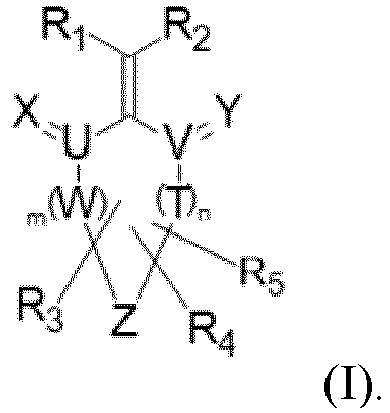
- X and Y are each independently selected from the group consisting of O, S, NRa, NOH, and CH2;
- U and V are each independently selected from the group consisting of C, S, SO, and PORa;
- W, Z, and T are each independently selected from the group consisting of O, S, SO, SO2, N, NRa, CO, C, CRa, and CH2;
- m is 0, 1, 2, or 3, preferably 0 or 1;
- n is 0, 1, 2, or 3, preferably 0 or 1;
- R1 is selected from the group consisting of H, deuterium, C1-6 alkyl, C1-6 hydroxyalkyl, C1-6 haloalkyl, substituted or unsubstituted phenyl;
- R2 is expressed as -J-K-M-Q, wherein:
J is NRa, NORa, O, S or

- K is a covalent bond, NRa, CRcRc' or CRcRc'CRcRc';
- M is a covalent bond, CRcRc', a divalent 3-10 membered heterocycloalkyl group, a divalent 3-7 membered heterocycloalkenyl, or a divalent 5-10 membered heteroaryl group,
- Q is H, C1-6 alkyl, C1-6 hydroxyalkyl, -(CH2)p-C(O)Rb, -(CH2)p-C(O)NHRb, -(CH2)p-C(S)Rb, -(CH2)p-C(S)NHRb, -(CH2)p-SO2Rb, -(CH2)p-SO2NHRb;
- p is 0, 1, 2 or 3, preferably 0 or 1;
- Rc and Rc' are each independently selected from the group consisting of H, hydroxyl, amino group, NRaRa', halogen, cyano, nitro, carboxyl, formyl, amide group, ester group, C1-6 haloalkyl, C1-6 hydroxyalkyl, C1-6 heteroalkyl, C1-6 alkoxy, C1-6 alkoxyalkyl, C2-6 alkenyl, C2-6 alkynyl, C6-10 aryl, 5-10 membered heteroaryl, C3-10 cycloalkyl, 3-10 membered heterocycloalkyl, 3-7 membered heterocycloalkenyl, C1-6 alkyl C6-10 aryl, 5-10 membered heteroaryl C1-6 alkyl or C1-6 alkyl 5-10 membered heteroaryl; preferably selected from the group consisting of H, hydroxyl, amino group, NRaRa', halogen, carboxyl, formyl, amide group, ester group, C1-6 haloalkyl, C1-6 hydroxyalkyl, C1-6 heteroalkyl, C1-6 alkoxyl, C3-10 cycloalkyl, 3-10 membered heterocycloalkyl, substituted or unsubstituted phenyl or pyridyl;
- R3, R4, and R5 are each independently selected from the group consisting of H, hydroxyl, amino group, halogen, cyano, nitro, carboxyl, formyl, amide group, -NH-CORb, ester group, C1-6 alkyl, C1-6 haloalkyl, C1-6 hydroxyalkyl, C1-6 heteroalkyl, C1-6 alkoxy, C1-6 alkoxyalkyl, C2-6 alkenyl, C2-6 alkynyl, unsubstituted or substituted -CONH-(C6-10 aryl), unsubstituted or substituted -CH=CH-(C6-10 aryl), unsubstituted or substituted C6-10 aryl, unsubstituted or substituted 5-10 membered heteroaryl, unsubstituted or substituted C3-10 cycloalkyl, unsubstituted or substituted 3-10 membered heterocycloalkyl, unsubstituted or substituted 3-7 membered heterocycloalkenyl, unsubstituted or substituted C6-10 aryl C1-6 alkyl, unsubstituted or substituted C1-6 alkyl C6-10 aryl, unsubstituted or substituted 5-10 membered heteroaryl C1-6 alkyl, and unsubstituted or substituted C1-6 alkyl 5-10 membered heteroaryl;
- or two adjacent groups in R3, R4 and R5 may be bonded to form an unsubstituted or substituted C6-10 aryl group, an unsubstituted or substituted 5-10 membered heteroaryl group, an unsubstituted or substituted C3-10 cycloalkyl group, or an unsubstituted or substituted 3-10 membered heterocycloalkyl group;
- wherein each Rb is independently C1-6 alkyl, C2-6 alkenyl, NHRa, NRaRa', unsubstituted or substituted phenyl or 3-7 membered heterocyclic group;
- Ra and Ra' are each independently H or C1-6 alkyl;
- unsubstituted or substituted means that the group is unsubstituted or substituted by one or more substituents selected from the group consisting of hydroxyl, amino group, cyano, nitro, carboxyl, halogen, C1-6 alkyl, C1-6 haloalkyl or C1-6 hydroxyalkyl, or two adjacent substituents may be bonded to form a C6-10 aryl group, a C5-10 heteroaryl group, a C3-10 cycloalkyl group or a C3-10 heterocycloalkyl group;
- and meets the following conditions:
- (1) when W, Z or T is substituted by one group of R3, R4 and R5, the W, Z or T is N or CH;
- (2) when W, Z or T is substituted by one group of R3, R4 and R5 and this group is bonded to another adjacent group of R3, R4 and R5 to form an unsubstituted or substituted C6-10 aryl or unsubstituted or substituted 5-10 membered heteroaryl, the W, Z or T is C; for example, when W is substituted by R3 and R3 is bonded to the adjacent R4 group to form an unsubstituted or substituted C6-10 aryl or unsubstituted or substituted 5-10 membered heteroaryl, the W is C;
- (3) when W, Z or T is substituted by two of R3, R4 and R5, the W, Z or T is C.
- Preferably, in the general formula (I):
- X and Y are each independently selected from the group consisting of O, S or NH;
- U and V are each independently selected from the group consisting of C or S;
- W, Z, and T are each independently selected from the group consisting of O, N, NRa, CO, C, CRa, and CH2;
- m is 0, 1 or 2;
- n is 0, 1 or 2;
- R1 is selected from H and deuterium;
- R2 is expressed as -J-K-M-Q, wherein:
J is NRa, NORa, O, S or

- K is a covalent bond, NRa, CRcRc' or CRcRc'CRcRc';
- M is a covalent bond, CRcRc', a divalent 3-10 membered heterocycloalkyl group, a divalent 3-7 membered heterocycloalkenyl, or a divalent 5-10 membered heteroaryl group,
- Q is H, C1-6 alkyl, C1-6 hydroxyalkyl, -(CH2)p-C(O)Rb, -(CH2)p-C(O)NHRb,-(CH2)p-C(S)Rb, -(CH2)p-C(S)NHRb, -(CH2)p-SO2Rb, -(CH2)p-SO2NHRb; wherein
- p is 0, 1, 2 or 3, preferably 0 or 1;
- Rc and Rc' are each independently selected from the group consisting of H, hydroxyl, amino group, NRaRa', halogen, cyano, nitro, carboxyl, formyl, amide group, ester group, C1-6 haloalkyl, C1-6 hydroxyalkyl, C1-6 heteroalkyl, C1-6 alkoxy, C1-6 alkoxyalkyl, C2-6 alkenyl, C2-6 alkynyl, C6-10 aryl, 5-10 membered heteroaryl, C3-10 cycloalkyl, 3-10 membered heterocycloalkyl, 3-7 membered heterocycloalkenyl, C1-6 alkyl C6-10 aryl, 5-10 membered heteroaryl C1-6 alkyl or C1-6 alkyl 5-10 membered heteroaryl; preferably selected from the group consisting of H, hydroxyl, amino group, NRaRa', halogen, carboxyl, formyl, amide group, ester group, C1-6 haloalkyl, C1-6 hydroxyalkyl, C1-6 heteroalkyl, C1-6 alkoxyl, C3-10 cycloalkyl, 3-10 membered heterocycloalkyl, substituted or unsubstituted phenyl or pyridyl;
- R3, R4, and R5 are each independently selected from the group consisting of H, hydroxyl, amino group, halogen, cyano, nitro, carboxyl, formyl, amide group, -NH-CORb, ester group, C1-6 alkyl, C1-6 haloalkyl, C1-6 hydroxyalkyl, C1-6 heteroalkyl, C1-6 alkoxy, C1-6 alkoxyalkyl, C2-6 alkenyl, C2-6 alkynyl, unsubstituted or substituted -CONH-(C6-10 aryl), unsubstituted or substituted -CH=CH-(C6-10 aryl), unsubstituted or substituted C6-10 aryl, unsubstituted or substituted 5-10 membered heteroaryl, unsubstituted or substituted C3-10 cycloalkyl, unsubstituted or substituted 3-10 membered heterocycloalkyl, unsubstituted or substituted 3-7 membered heterocycloalkenyl, unsubstituted or substituted C6-10 aryl C1-6 alkyl, unsubstituted or substituted C1-6 alkyl C6-10 aryl, unsubstituted or substituted 5-10 membered heteroaryl C1-6 alkyl, or unsubstituted or substituted C1-6 alkyl 5-10 membered heteroaryl;
- or two adjacent groups in R3, R4 and R5 may be bonded to form an unsubstituted or substituted C6-10 aryl group, an unsubstituted or substituted 5-10 membered heteroaryl group, an unsubstituted or substituted C3-10 cycloalkyl group, or an unsubstituted or substituted 3-10 membered heterocycloalkyl group;
- wherein each Rb is independently C1-6 alkyl, C2-6 alkenyl, NHRa, NRaRa', unsubstituted or substituted phenyl or 3-7 membered heterocyclic group;
- Ra and Ra' are each independently H or C1-6 alkyl;
- unsubstituted or substituted means that the group is unsubstituted or substituted by one or more substituents selected from the group consisting of hydroxyl, amino group, cyano, nitro, carboxyl, halogen, C1-6 alkyl, C1-6 haloalkyl and C1-6 hydroxyalkyl, or two adjacent substituents may be bonded to form a C6-10 aryl group, a 5-10 membered heteroaryl group, a C3-10 cycloalkyl group or a 3-10 membered heterocycloalkyl group;
- and meets the following conditions:
- (1) when W, Z or T is substituted by one group of R3, R4 and R5, the W, Z or T is N or CH;
- (2) when W, Z or T is substituted by one group of R3, R4 and R5 and this group is bonded to another adjacent group of R3, R4 and R5 to form an unsubstituted or substituted C6-10 aryl or unsubstituted or substituted 5-10 membered heteroaryl, the W, Z or T is C;
- (3) when W, Z or T is substituted by two of R3, R4 and R5, the W, Z or T is C.
- In one embodiment of the invention, R3 in the general formula (IVd) is selected from the following groups:


- wherein, Rc, Rc1, Rc2, Rc' and Rc" are each independently selected from the group consisting of H, hydroxyl, amino group, NRaRa', halogen, cyano, nitro, carboxyl, formyl, amide group, ester group, C1-6 haloalkyl, C1-6 hydroxyalkyl, C1-6 heteroalkyl, C1-6 alkoxy, C1-6 alkoxyalkyl, C2-6 alkenyl, C2-6 alkynyl, C6-10 aryl, 5-10 membered heteroaryl, C3-10 cycloalkyl, 3-10 membered heterocycloalkyl, 3-7 membered heterocycloalkenyl, C1-6 alkyl C6-10 aryl, 5-10 membered heteroaryl C1-6 alkyl or C1-6 alkyl 5-10 membered heteroaryl; preferably selected from the group consisting of H, hydroxyl, amino group, NRaRa', halogen, carboxyl, formyl, amide group, ester group, C1-6 haloalkyl, C1-6 hydroxyalkyl, C1-6 heteroalkyl, C1-6 alkoxyl, C3-10 cycloalkyl, 3-10 membered heterocycloalkyl, substituted or unsubstituted phenyl or pyridyl; and
- Ra and Ra' are each independently H or C1-6 alkyl;
- In another embodiment of the invention, R3 in the general formula (IVd) is selected from the following groups:


- wherein, X1 is F, Cl, Br, I or trifluoromethyl;
- X2 is H, F, Cl, Br, or I;
- Rc1, Rc2, Rc3, or Rc4 is each independently selected from the group consisting of H, hydroxyl, amino group, NRaRa', halogen, cyano, nitro, carboxyl, formyl, amide group, ester group, C1-6 haloalkyl, C1-6 hydroxyalkyl, C1-6 heteroalkyl, C1-6 alkoxy, C1-6 alkoxyalkyl, C2-6 alkenyl, C2-6 alkynyl, C6-10 aryl, 5-10 membered heteroaryl, C3-10 cycloalkyl, 3-10 membered heterocycloalkyl, 3-7 membered heterocycloalkenyl, C1-6 alkyl C6-10 aryl, 5-10 membered heteroaryl C1-6 alkyl or C1-6 alkyl 5-10 membered heteroaryl; preferably selected from the group consisting of H, hydroxyl, amino group, NRaRa', halogen, carboxyl, formyl, amide group, ester group, C1-6 haloalkyl, C1-6 hydroxyalkyl, C1-6 heteroalkyl, C1-6 alkoxyl, C3-10 cycloalkyl, 3-10 membered heterocycloalkyl, substituted or unsubstituted phenyl or pyridyl;
- or Rc1 and Rc2, or Rc2 and Rc3, or Rc3 and Rc4 may be bonded to form C6-10 aryl, 5-10 membered heteroaryl, C3-10 cycloalkyl, and 3-10 membered heterocycloalkyl; and
- Ra and Ra' are each independently H or C1-6 alkyl.
- In one embodiment of the invention, the compounds of the present invention are preferably selected from the following compounds:
No. Structures No. Structures No. Structures 1 
161 
323 
4A 
162 
324 
7 
163 
325 
8 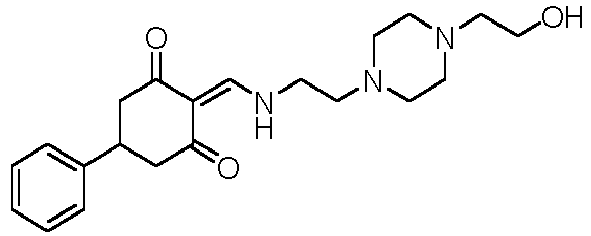
164 
326 
9 
165 
327 
10 
169 
328 
11 
170 
329 
12 
171 
330 
14 
172 
331 
15 
173 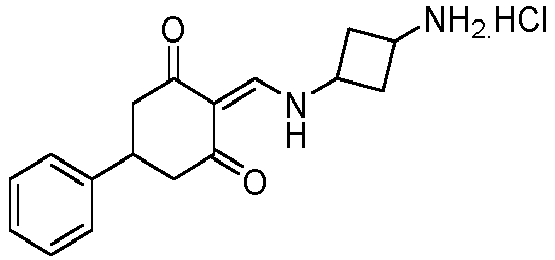
332 
17 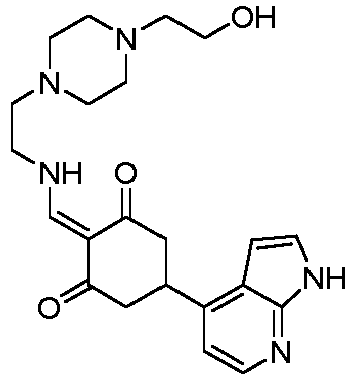
174 
333 
18 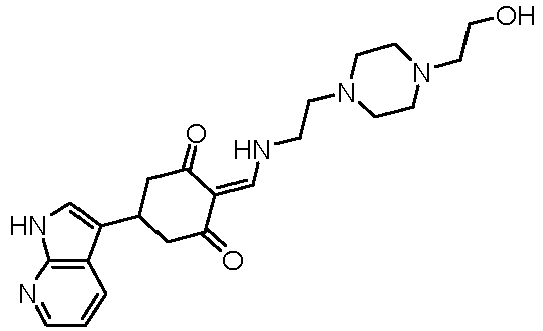
175 
334 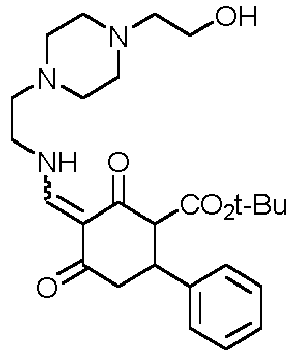
19 
176 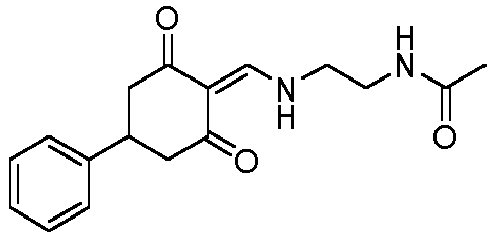
335 
20 
177 
336 
21 
178 
337 
22 
180 
338 
23 
182 
339 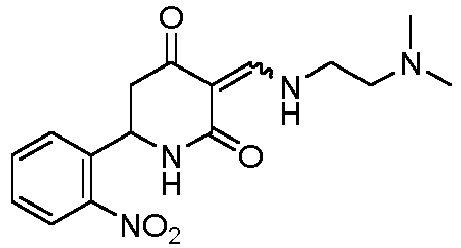
24 
183 
340 
25 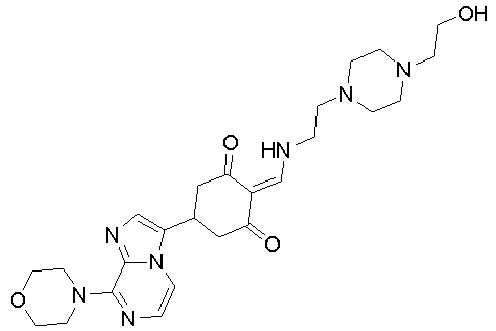
184 
341 
26 
185 
342 
27 
186 
343 
28 
187 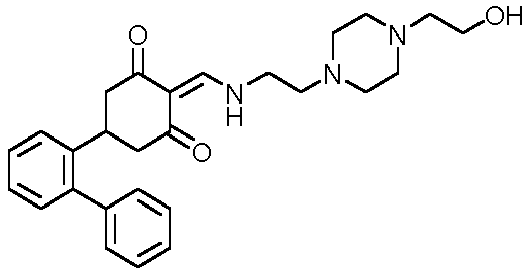
344 
29 
188 
345 
30 
189 
346 
31 
190 
347 
32 
191 
349 
33 
192 
350 
34 
193 
351 
35 
194 
352 
36 
195 
353 
37 
196 
354 
39 
197 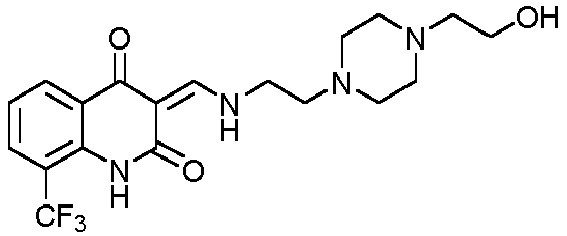
355 
40 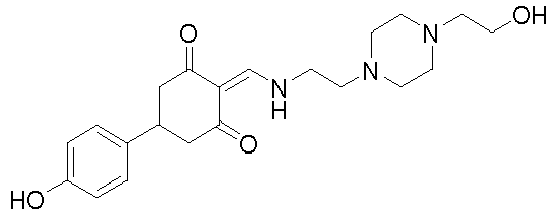
200 
356 
41 
201 
357 
42 
202 
358 
43 
203 
359 
44 
204 
360 
45 
205 
361 
46 
206 
362 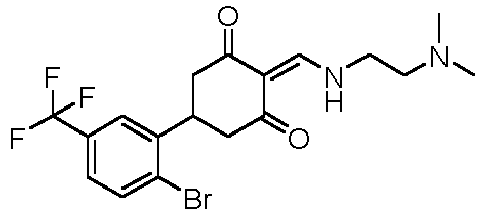
47 
207 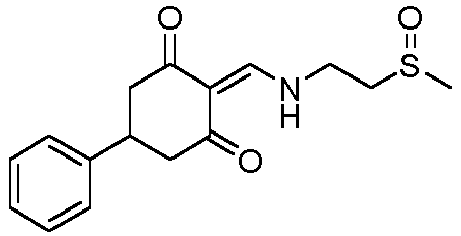
363 
48 
208 
364 
49 
209 
365 
50 
210 
366 
51 
211 
367 
52 
212 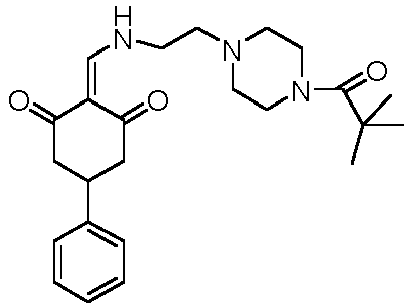
368 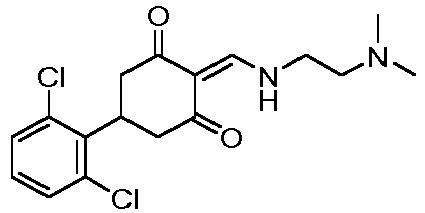
53 
213 
369 
54 
214 
370 
55 
215 
371 
56 
216 
372 
57 
217 
373 
58 
218 
374 
59 
219 
375 
61 
220 
376 
62 
221 
377 
63 
222 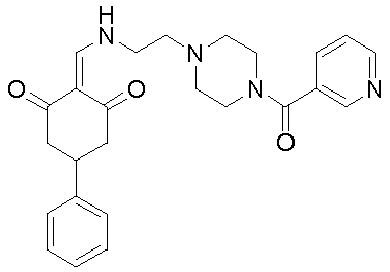
378 
64 
223 
379 
65 
224 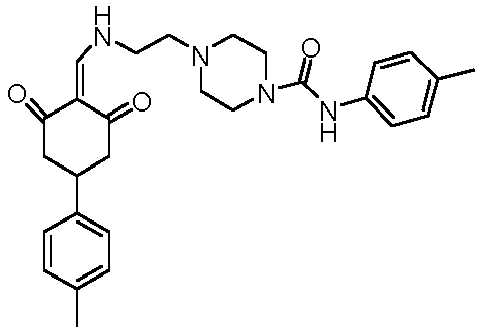
380 
66 
225 
381 
67 
226 
382 
68 
227 
383 
69 
228 
384 
70 
229 
385 
71 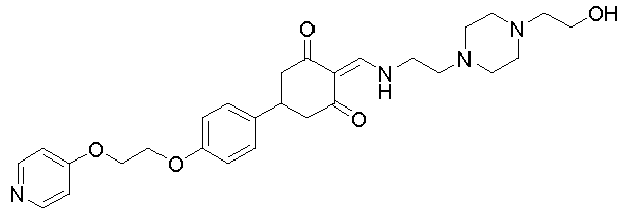
230 
386 
72 
231 
387 
73 
232 
388 
74 
233 
389 
75 
236 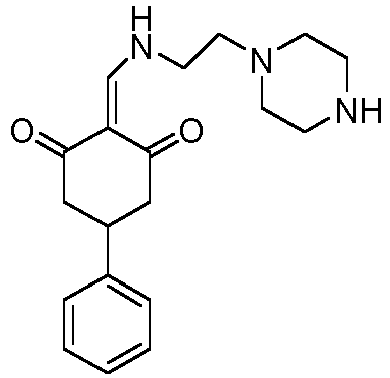
390 
76 
237 
391 
77 
238 
392 
78 
239 
393 
79 
240 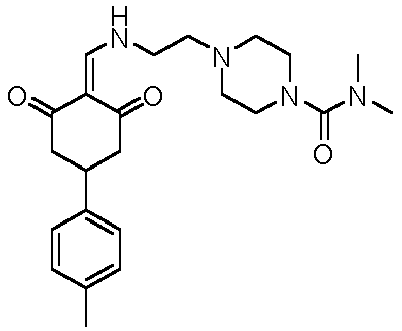
394 
80 
242 
395 
81 
245 
396 
82 
246 
397 
83 
247 
398 
84 
248 
399 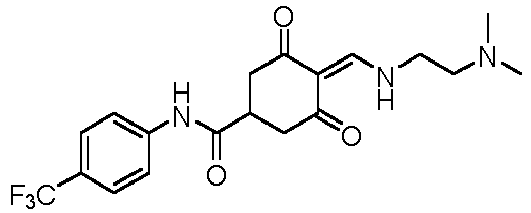
85 
249 
400 
86 
251 
401 
87 
252 
402 
88 
253 
403 
89 
254 
404 
90 
255 
405 
91 
256 
406 
92 
257 
407 
93 
258 
408 
94 
259 
409 
95 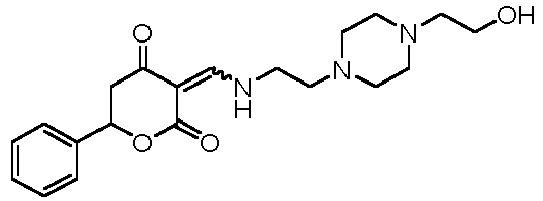
260 
410 
96 
262 
411 
97 
263 
412 
99 
265 
413 
100 
266 
414 
101 
267 
415 
102 
268 
416 
103 
269 
417 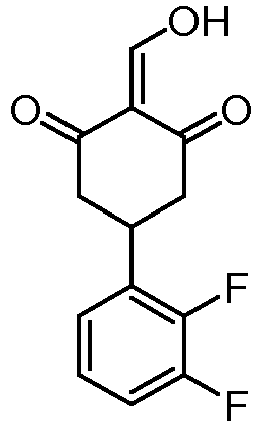
104 
270 
418 
106 
271 
419 
107 
272 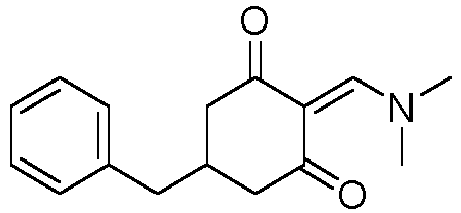
420 
108 
273 
421 
109 
274 
422 
110 
276 
423 
111 
277 
424 
112 
278 
425 
113 
279 
426 
114 
280 
427 
115 
281 
428 
116 
282 
429 
119 
283 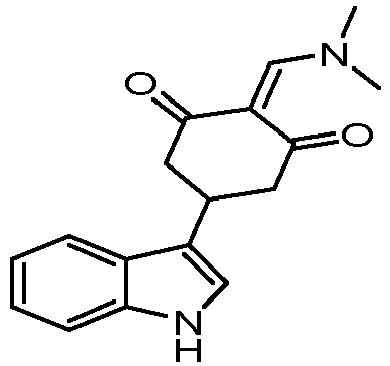
430 
120 
284 
431 
121 
285 
432 
122 
286 
433 
123 
287 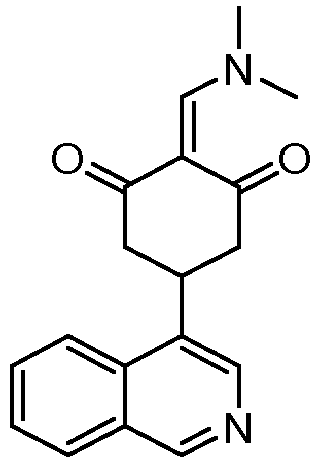
434 
124 
288 
435 
125 
289 
436 
126 
290 
437 
127 
291 
438 
128 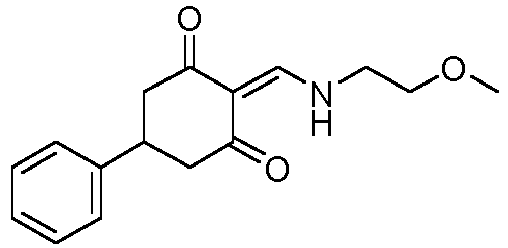
293 
439 
129 
294 
440 
131 
295 
441 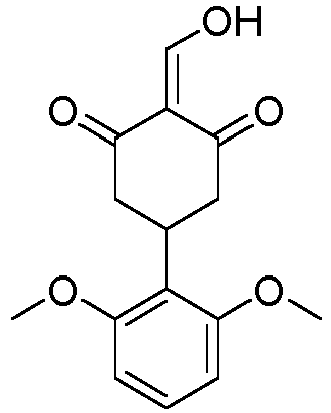
132 
296 
442 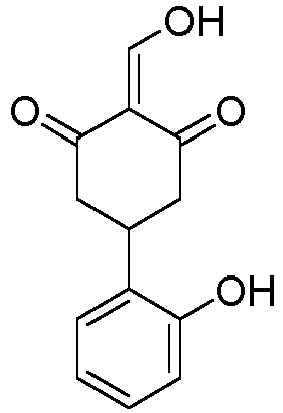
133 
297 
443 
134 
298 
135 
299 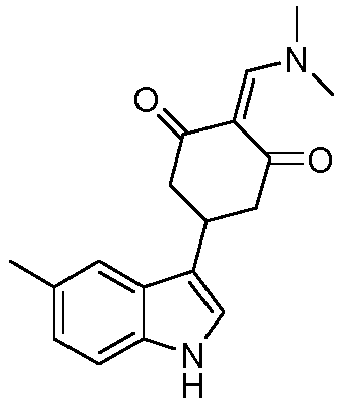
445 
136 
300 
446 
137 
301 
447 
138 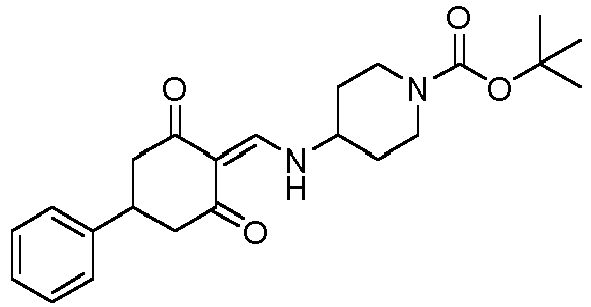
302 
448 
139 
303 
450 
140 
304 
451 
141 
305 
452 
142 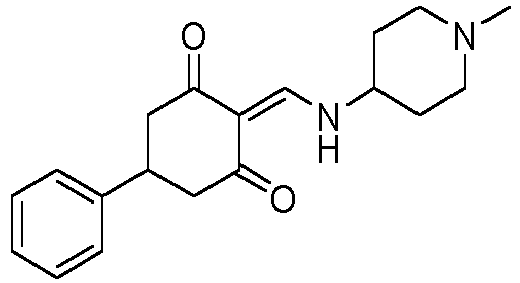
306 
453 
143 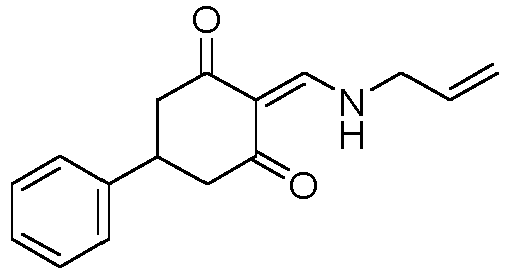
307 
454 
145 
308 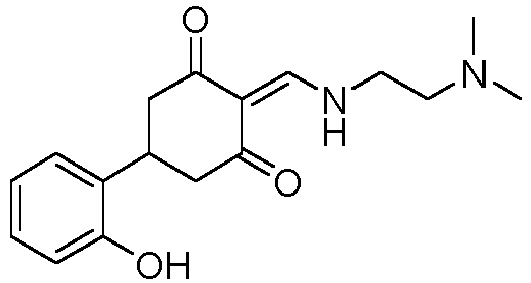
455 
146 
309 
456 
147 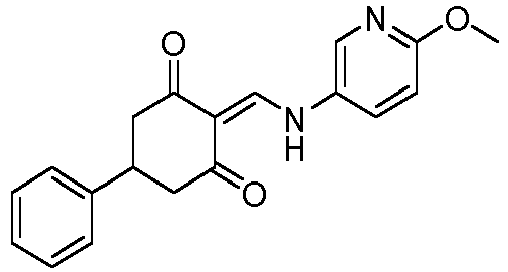
310 
457 
148 
311 
458 
149 
315 
459 
150 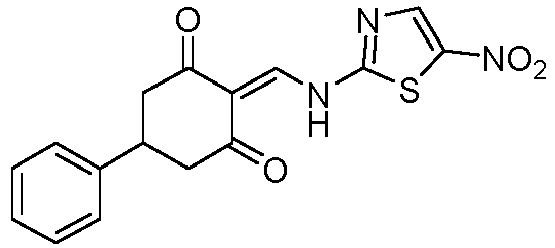
317 
460 
155 
318 
461 
156 
320 
. 158 
321 
160 
322 
- In another aspect, the invention provides a pharmaceutical composition, comprising a compound or a pharmaceutical acceptable salt thereof, as defined in claim 6 of the claims appended hereto. The pharmaceutical composition may also include a pharmaceutical excipient.
- In another aspect, the invention provides use of a compound or a pharmaceutically acceptable salt thereof in manufacturing a medicament for regulating autophagy in a cell, as defined in claim 7 of the claims appended hereto.
- The medicament for regulating autophagy in a cell may be a medicament that can regulate a mammalian ATG8 homologue, such as LC3B.
- Although outside the scope of the invention, the medicament may be useful in preventing or treating diseases associated with autophagy in a cell, particularly diseases associated with mammalian ATG8 homologues. Such diseases include: tumor, cardiovascular disease, autoimmune disease, neurodegenerative disease, hypertension, bone tissue and bone-related diseases, Crohn's disease, acute kidney injury, cerebral ischemia, retinal diseases, bronchial asthma, Vici syndrome, and infectious diseases. In particular, whilst outside the scope of the invention, the medicament may be useful in treating the following cancers: liver cancer, lung cancer, pancreatic cancer, breast cancer, cervical cancer, endometrial cancer, colorectal cancer, gastric cancer, lung cancer, nasopharyngeal cancer, ovarian cancer, prostate cancer, leukemia, lymphoma, myeloma.
- In the invention, certain preferred compounds are selected from the group consisting of the Compound 2, Compound 3, Compound 241, Compound 264, Compound 449, Compound 462, Compound 463 and Compound 464 set out below.
- It is to be understood that both the foregoing general description and the following detailed description are exemplary and explanatory and are intended to provide further explanation of the invention as claimed.
- Reference will now be made in detail to embodiments of the present invention, example of which is illustrated in the accompanying drawings.
- The terms used herein have their ordinary meaning. Chemical names, common names and chemical structures may be used interchangeably to describe that same structure. These definitions apply regardless of whether a term is used by itself or in combination with other terms, unless otherwise indicated. Thus, the definition of "C1-6 alkyl" is applicable to "C1-6 alkyl" as well as the "C1-6 alkyl" portion of "C1-6 hydroxyalkyl", "C1-6 haloalkyl", "C6-10 aryl C1-6 alkyl", "C1-6 alkyl C6-10 aryl", "C1-6 alkoxy" and the like.
- The term "pharmaceutical composition" refers to a composition suitable for administration to a patient. Such compositions may only contain the neat compound (or compounds) of the invention or mixtures thereof, or salts, solvates, prodrugs, isomers, or tautomers thereof, or they may contain one or more pharmaceutically acceptable carriers or excipients. The term "patient" includes both human and non-human animals. The pharmaceutical composition may be in various forms, such as tablet, capsule, powder, syrup, solution, suspension and aerosol and the like, and may be present in a suitable solid or liquid carrier or diluent and suitable sterilizing device used for injection or infusion.
- Various dosage forms of the pharmaceutical composition of the present invention can be prepared by conventional preparation methods in the pharmaceutical field. A single unit dosage of the prepared formulation comprises 0.05 to 200 mg of the compound of formula (I), preferably comprising 0.1 mg to 100 mg of the compound of formula (I) per unit dosage of the formulation.
- The compounds and pharmaceutical compositions of the present invention can be used clinically in mammals, including humans and animals, by administration routes of mouth, nose, skin, lungs, or gastrointestinal tract, etc. Most preferably is oral administration. The best preferred daily dose is 0.01-200 mg/kg body weight, taken at one time, or 0.01-100 mg/kg body weight taken by divided doses. Regardless of the administration route, optimal dosage for an individual should be determined according to particular treatment regime. In general, a small dose is taken at the begining, then the dose is gradually increased until the most suitable dose is found.
- "Halogen" (or "halo") refers to fluorine, chlorine, bromine, or iodine.
- "C1-6 alkyl" refers to a straight or branched alkyl group having 1 to 6 carbon atoms, preferably a straight or branched alkyl group having 1 to 4 carbon atoms. "Branched" refers to one or more alkyl group having 1 to 4 carbon atoms, such as methy, ethyl or propyl and the like, is connected to a straight alkyl group. The preferred C1-6 alkyl group includes, but not limited to, methyl, ethyl, n-propyl, isopropyl, n-butyl, i-butyl, and t-butyl and the like.
- "C1-6 haloalkyl" refers to an alkyl as defined above having one or more halo group substituent(s).
- "C1-6 heteroalkyl" refers to an alkyl as defined above having one or more substituent(s) selected from the group consisting of O, S, N, -(S=O)-, -(O=S=O)-, etc.
- "C2-6 alkenyl" refers to a straight or branched alkenyl group having 2 to 6 carbon atoms, preferably 2 to 4 carbon atoms. "Branched" refers to one or more lower C1-6 alkyl group is connected to a straight C2-6 alkenyl group chain. The preferred C2-6 alkenyl group includes, but not limited to, ethenyl, propenyl, n-butenyl, 3-methylbutenyl, n-pentenyl and the like.
- "C1-6 alkylene" refers to a bivalent group obtained by removal of a hydrogen atom from an alkyl group as defined above. The preferred C1-6 alkylene group includes, but not limited to, methylene, ethylidene and propylidene, etc. Generally, it can be optionally and equivalently expressed herein as -(C1-6 alkyl)-, for example - CH2CH2- is an ethylidene.
- "C2-6 alkynyl" refers to a straight or branched alkynyl group having 2 to 6 carbon atoms, preferably 2 to 6 carbon atoms, more preferably having 2 to 4 carbon atoms. "Branched" refers to one or more alkyl group having 2 to 4 carbon atoms is connected to a straight alkynyl group chain. The preferred C2-6 alkynyl group includes, but not limited to, ethynyl, propynyl, 2-butynyl and 3-methylbutynyl, etc.
- "C2-6 alkenylene" refers to a difunctional group obtained by removal of hydrogen from a C2-6 alkenyl group as defined above. The preferred C2-6 alkenylene group includes, but not limited to, -CH=CH-, -C(CH3)=CH-, -CH=CHCH2-, etc.
- "C6-10 aryl" refers to an aromatic monocyclic or multicyclic ring system having 6 to 10 carbon atoms. Preferably, the C6-10 aryl group includes, but not limited to, phenyl and naphthyl.
- "C6-10 arylidene" refers to a bivalent group obtained by removal of a hydrogen atom from a C6-10 aryl group as defined above, for example is p-phenylene.

- "5-10 membered heteroaryl" refers to an aromatic monocyclic or multicyclic ring group having 5 to 10 ring atoms. The 5-10 membered heteroaryl group includes 1 to 4 hetero atoms selected from N, O and S. Preferred 5-10 membered heteroaryl group includes 5 to 6 ring atoms. The term "5-10 membered heteroaryl" also includes a C6-10 aryl fused ring as defined above. Preferred 5-10 membered heteroaryl group includes, but not limited to, pyridyl, pyrazinyl, furanyl, thienyl, pyrimidinyl, pyridone, oxazolyl, isothiazolyl, oxazolyl, oxadiazolyl, thiazolyl, thiadiazolyl, pyrazolyl, furazanyl, pyrrolyl, triazolyl, 1,2,4-thiadiazolyl, pyridazinyl, quinoxalinyl, phthalazinyl, oxindolyl, imidazo[1,2-a]pyridinyl, imidazo[2,1-b]thiazolyl, benzofurazanyl, indolyl, azaindolyl, benzimidazolyl, benzothienyl, quinolinyl, imidazolyl, thienopyridyl, quinazolinyl, thienopyrimidyl, pyrrolopyridyl, imidazopyridyl, isoquinolinyl, benzoazaindolyl, 1,2,4-triazinyl, benzothiazolyl and the oxides thereof and the like. The term "5-10 membered heteroaryl" also refers to partially saturated 5-10 membered heteroaryl group, such as, for example, tetrahydroisoquinolyl, tetrahydroquinolyl and the like.
- "C3-10 cycloalkyl" refers to a non-aromatic monocyclic or multicyclic ring group having 3 to 10 carbon atoms, preferably 3 to 6 carbon atoms. Preferred monocyclic C3-10 cycloalkyl includes, but not limited to, cyclopropyl, cyclopentyl, cyclohexyl, cycloheptyl and the like. Preferred multicyclic cycloalkyl includes, but not limited to, [1.1.1]-bicyclopentane, 1-capryl, norbornyl, adamantyl and the like.
- "C3-10 cycloalkenyl" refers to a non-aromatic monocyclic or multicyclic ring group having 3 to 10 carbon atoms, preferably 3 to 7 ring atoms, most preferably 5 to 7 ring atoms, which contains at least one carbon-carbon double bond within the ring. Preferred C3-10 cycloalkenyl includes, but not limited to, cyclopropenyl, cyclobutenyl, cyclopentenyl, cyclohexenyl, cyclohetpenyl, cycloheptane-1,3-dienyl, norbomylenyl and the like.
- "3-10 membered heterocycloalkyl" (or "3-10 membered heterocyclyl") refers to a non-aromatic saturated monocyclic or multicyclic ring group having 3 to 10 ring atoms, preferably 5 to 10 ring atoms, more preferably 5 to 6 ring atoms, in which the 3-10 membered heterocyclyl group includes 1 to 4 hetero atoms selected from N, O and S, and two of the hetero atoms in the ring system are not adjacent. The nitrogen or sulfur atom of the heterocyclyl can be optionally oxidized to the corresponding N-oxide, S-oxide or S,S-dioxide. Thus, the term "oxide" of the invention refers to the corresponding N-oxide, S-oxide, or S,S-dioxide. "3-10 membered heterocyclyl" also includes rings in which two available hydrogens on the same carbon atom are simutaneously replaced by one single group =ep(for example, a carbonyl group). Such =O group may be referred as "oxo-" in the present invention. Preferred monocyclic 3-10 membered heterocycloalkyl includes, but not limited to, piperidyl, oxetanyl, pyrrolyl, piperazinyl, morpholinyl, thiomorpholinyl, thiazolidinyl, 1,4-dioxin C1-6 alkyl, tetrahydrofuranyl, tetrahydrothiophenyl, lactamyl (such as pyrrolidinone), lactone group having 3 to 10 ring atoms and oxides thereof.
- "3-7 membered heterocycloalkenyl" refers to a non-aromatic monocyclic or multicyclic ring group having 3 to 7 ring atoms, preferably 5 to 6 ring atoms, in which the 3-10 membered heterocycloalkenyl group includes 1 to 4 hetero atoms selected from N, O and S, and includes at least one carbon-carbon double bond or carbon-nitrogen double bond. There are no adjacent oxygen and/or sulfur atoms present in the ring system. The prefix aza, oxa or thia before the 3-7 membered heterocyclenyl group name refers to at least one nitrogen, oxygen or sulfur atom respectively presented as a ring atom. The nitrogen or sulfur atom in the 3-7 membered heterocyclenyl group can be optionally oxidized to the corresponding N-oxide, S-oxide or S,S-dioxide. Preferred 3-7 membered heterocyclenyl group includes, but not limited to, 1,2,3,4-tetrahydropyridinyl, 1,2-dihydropyridinyl, 1,4-dihydropyridinyl, 1,2,3,6-tetrahydropyridinyl, 1,4,5,6-tetrahydropyrimidinyl, 2-pyrrolinyl, 3-pyrrolinyl, 2-imidazolinyl, 2-pyrazolinyl, dihydroimidazolyl, dihydrooxazolyl, dihydrooxadiazolyl, dihydrothiazolyl, 3,4-dihydro-2H-pyranyl, dihydrofuranyl, fluorodihydrofuranyl, and the oxides thereof, and the like. "3-7 membered heterocyclenyl" may also be rings in which two available hydrogens on the same carbon atom are simultaneously replaced by one single group =O (i.e., forming a carbonyl).
- "C6-10 aryl C1-6 alkyl" (or "C6-10 aryl C1-6 alkyl") refers to a group formed by connecting the C6-10 aryl as defined above to the C1-6 alkyl as defined above. Preferred C6-10 aryl C1-6 alkyl includes, but not limited to, benzyl, 2-phenethyl and naphthalenylmethyl. The C6-10 aryl C1-6 alkyl is bonded to the parent moiety by a C1-6 alkyl group. Similarly, "5-10 membered heteroaryl C1-6 alkyl", "C3-10 cycloalkyl C1-6 alkyl", "C2-6 cycloalkenyl C1-6 alkyl", "3-10 membered heterocycloalkyl C1-6 alkyl", "3-7 membered heterocycloalkenyl C1-6 alkyl" and the like refer to the 5-10 membered heteroaryl, C2-6 cycloalkenyl, 3-10 membered heterocycloalkyl, 3-7 membered heterocycloalkenyl and the like as described herein are bonded to the parent moiety by a C1-6 alkyl group.
- "C1-6 alkyl C6-10 aryl" refers to a group formed by connecting the C1-6 alkyl as defined above to the C6-10 aryl as defined above. Preferred C1-6 alkyl C6-10 aryl includes, but not limited to, tolyl. The C1-6 alkyl C6-10 aryl is boned to the parent moiety by a C6-10 aryl group.
- "5-10 membered heteroaryl C1-6 alkyl" refers to a group formed by connecting the 5-10 membered heteroaryl as defined above to the C1-6 alkyl as defined above. Preferred C6-10 aryl C1-6 alkyl includes, but not limited to, pyridylmethyl and quinolin-3-ylmethyl. The 5-10 membered heteroaryl C1-6 alkyl is boned to the parent moiety by a C1-6 alkyl group.
- "C1-6 hydroxyalkyl" refers to a hydroxyl-substituted C1-6 alkyl group, wherein the C1-6 alkyl group is described as above. Preferred C1-6 hydroxyalkyl includes, but not limited to, hydroxymethyl and 2-hydroxyethyl.
- "C1-6 alkoxy" refers to a C1-6 alkyl-O- group, which is bonded to the parent moiety by -O-, wherein the C1-6 alkyl group is described as above. Preferred C1-6 alkoxy includes, but not limited to, methoxy, ethoxy, n-propoxy, isopropoxy and n-butoxy.
- "C1-6 alkyoxyalkyl" refers to a group derived from a C1-6 alkoxy and C1-6 alkyl as defined herein, which is bonded to the parent moiety by a C1-6 alkyl group.
- "Ester group" refers to -C(O)ORx, wherein Rx is C1-6 alkyl, C6-10 aryl, C6-10 aryl C1-6 alkyl and C3-10 cycloalkyl. Preferred ester group includes, but are not limited to, methoxycarbonyl, ethoxycarbonyl, isopropyl ester group, tert-butyl ester group, phenyl ester group.
- "Amide group" refers to -C(O)NRyRy', wherein Ry and Ry' are hydrogen, C1-6 alkyl, C6-10 aryl, C6-10 aryl C1-6 alkyl or C3-10 cycloalkyl.
- Any of the foregoing functional groups may be unsubstituted or substituted as described herein. The term "substituted" (or substitute) refers to that one or more hydrogens on the designated atom is replaced with a group selected from the indicated groups, provided that not exceeding the designated atom's normal valency and the substitution forms a stable compound. Combinations of substituents and/or variables are permissible only if such combinations result in stable compounds. "Stable compound" or "stable structure" is meant a compound having a sufficient stability that can be separated to a useful purity from a reaction mixture and can be formulated to an efficacious therapeutic agent.
- The term "unsubstituted or substituted" refers to a particular group that is unsubstituted or substituted with one or more substituents. Substituents include, but not limited to, hydrogen, hydroxyl, amino, cyano, nitro, carboxy, halo, C1-6 alkyl, C1-6 haloalkyl or C1-6 hydroxyalkyl. Two adjacent substituents may be joined to form a C6-10 aryl group, a 5-10 membered heteroaryl group, a C3-10 cycloalkyl group or a 3-10 membered heterocycloalkyl group. Substitutions on the C6-10 aryl, 5-10 membered heteroaryl, C3-10 cycloalkyl, 3-10 membered heterocycloalkyl, 3-7 membered heterocycloalkenyl groups and the like include, but not limited to, substitution in any ring portion of the groups.
- In the present application, if a group is a "covalent bond", it means that the group "does not exist" and the two linked groups are joined by a covalent bond. For example, in the substituent "-J-K-M-Q", if K is a covalent bond, then this substituent becomes "-J-M-Q".
- Tautomers mean compounds produced by the phenomenon wherein a proton of one atom of a molecule shifts to another atom. Tautomers also refer to one of two or more structural isomers that exist in equilibrium and are readily converted from one isomeric form to another. One of ordinary skills in the art would recognize that other tautomeric ring atom arrangements are possible. All such isomeric forms of these compounds are expressly included in the present disclosure.
- Specifically, the compounds of the present invention include all tautomers thereof, for example, keto-enol tautomers. For the sake of convenience, in the detailed description and claims of the present invention, partial structures of these tautomers and the mixtures thereof (Examples 11, 112 and 415) are shown below.


- For convenience, only one tautomer for each compound is shown in the present invention. It should be noted the compounds of the present invention include all tautomers.
- Stereoisomer refers to compounds having identical molecular formulae and identical order of atomic connectivity in molecular but different spatial arrangement of atoms which results the isomerization. Stereoisomers include cis-trans isomerization, conformational isomerization, enantiomeric isomerization and diastereomeric isomerization and so on. Wherein the cis-trans isomerization refers to such a cis-trans isomerization that is caused by two carbon atoms connected by a double bond cannot relatively freely rotate about a bond, generally referring to a double bond in an alkene, as well as the cis-trans isomer of compounds having C=N double bond, N=N double bond and cyclic structure and the like. The enantiomer refers to stereoisomers that are mirrored to each other; the diastereomer refers to stereoisomers in which the molecules have two or more chiral centers and the molecules are in a non-mirrored relationship. Unless otherwise indicated, the description is intended to include individual stereoisomers as well as mixtures thereof.
- Specifically, the compounds of the present invention include all isomers thereof, for example, diastereomers and cis/trans (Z/E) isomers. Examples of the cis/trans isomers of compound 101 disclosed in the present invention are shown below.

- For convenience, only one isomer for each compound is shown in the present invention. It should be noted the compounds of the present invention include all isomers.
- The compounds of the present invention may form metal chelates with one or more metal ions. The metal ions include, but not limited to, copper, iron, magnesium, calcium, zinc, nickel and platinum, etc. As described in the invention, one example of the metal chelates is provided in Example 38. It should be noted the compounds of the present invention include all metal chelates thereof.
- The term "pharmaceutically acceptable salts" represent those salts which are suitable for humans and/or animals without undue adverse side effects, such as toxicity, irritation, allergic response and the like, also means materials having a reasonable benefit/risk ratio. The pharmaceutically acceptable salts may comprise inorganic and organic salts, which can be obtained during the final isolation and purification of the compounds of the invention, or formed by reacting the free acidic or alkali functional group with a suitable acid or alkali. Suitable acids for generating salts include, but not limited to, inorganic acids, such as hydrochloric acid, phosphoric acid, or sulfuric acid; or organic acids, such as citric acid, ascorbic acid, citric acid, tartaric acid, lactic acid, maleic acid, malonic acid, fumaric acid, glycolic acid, succinic acid, propionic acid, acetic acid or methanesulfonic acid, and the like. Suitable alkali for generating salts include, but not limited to, inorganic alkali, such as sodium carbonate, sodium hydroxide, potassium carbonate, potassium hydroxide, lithium hydroxide, calcium acetate, calcium chloride, magnesium chloride and the like; organic alkali, such as amino ethanol and the like.
- The term "effective amount" refers to the amount of the compounds of the present invention contained in a composition administered is sufficient to regulate (e.g., inhibit or activate) mammalian ATG8 homologues.
- The compounds of the invention can be prepared by various methods well known in the art, and the following reaction schemes are an optional solution for preparing the compounds of the invention, but may also be used to prepare compounds outside the scope of the present invention.

- The groups and substituents in the general scheme have the same definitions as in the general formula (I) recited above. The compounds can be prepared by the methods described in some references known to one of ordinary skills in the art. These references include, for example, Bioorganic & Medicinal Chemistry Letters, 24(16), 3764-3771, 2014; Chemistry - A European Journal, 20(9), 2445-2448, 2014; Bioorganic & Medicinal Chemistry, 20(2), 1029-1045, 2012; Journal of Organic Chemistry, 82(5), 2630-2640, 2017; Tetrahedron Letters, 49 (2008), 4725-4727; Journal of Organic Chemistry, 78(9), 4563-4567, 2013; Heterocycles, 28(2), 1015-35, 1989; Journal of Medicinal Chemistry, 57(10), 3924-3938, 2014; Journal of Organic Chemistry, 66(24), 8000-8009, 2001; and Tetrahedron Letters, 56(45), 6287-6289, 2015
- The invention is further described with reference to the following examples. Those skilled in the art will readily appreciate that these compounds can be prepared by using known variations in the conditions and procedures of the following preparation methods. The starting materials used in the present invention are commercially available unless otherwise specified. Abbreviations:
- acetonitrile (MeCN, ACN); aqueous solution (aq.); benzyl bromide (BnBr); di-tert-butyl dicarbonate (Boc2O); tert-Butyl methyl ether (t-BuOMe); potassium tert-butoxide (t-BuOK); sodium tert-butoxide (t-BuONa); ceric ammonium nitrate (CAN); concentrated/high concentration (con.); dichloromethane (DCM);
- diisobutylaluminum hydride (DIBAL-H); diisopropylethylamine (DI(P)EA); 4-dimethylaminopyridine (DMAP); N,N-dimethylformamide dimethyl acetal (DMFDMA); dimethylformamide (DMF); dimethylsulfoxide (DMSO); ethyl acetate (EA or EtOAc); equivalent (eq.); ethanol (EtOH); sodium ethoxide (EtONa);
- gram/milligram (g/mg); 2-(7-azabenzotriazol)-N,N,N',N'-tetramethyluronium hexafluorophosphate (HATU); hour(s) (h, hr, hrs); acetic acid (HOAc);
- liter/milliliter (L/mL); liquid chromatography-mass spectrometer (LCMS); lithium diisopropylamide (LDA); methanol (MeOH); mole/millimole (mol/mmol); mass spectroscopy (MS); methanesulfonyl chloride (MsCl); minute(s) (min(s)); sodium acetate (NaOAc); nitrogen (N2); N-bromosuccinimide (NBS); 4-methylmorpholine N-oxide (NMO); nuclear magnetic resonance (NMR); palladium on carbon (Pd/C);
- petroleum ether (PE); benzoyl chloride (PhCOCI); toluene (PhMe);
- triphenylphosphine (PPh3); pyridine (Py) ; 1H-benzotriazol-1-yloxytrispyrrolidinophosphonium hexafluorophosphate (PyBOP); preparative thin layer chromatography (Pre-TLC); room temperature (RT, rt); triethylamine (TEA);
- tetrahydrofuran (THF); thin layer chromatography (TLC); trimethylsilyl chloride (TMSC1); 1,1'- bis(diphenylphosphino)ferrocene]dichloropalladium (Pd(dppf)2Cl2).
- Unless otherwise specified, all reactions were carried out under inert atmosphere (e.g. argon or nitrogen) using commercially available reagents and anhydrous solvents without further treatment.
- Mass spectrometry was recorded by liquid chromatography-mass spectrometry (LC-MS) (Agilent 6120B single quadrupole liquid chromatography-mass spectrometer). Nuclear magnetic resonance spectroscopy (such as Proton NMR (1H), carbon NMR (13C), phosphorus NMR (31P) and fluorine NMR (19F) and so on) was recorded by Bruker AMX-400, Gemini-300 or AMX-600 nuclear magnetic resonance spectrometer. It is recorded in deuterated solvents, such as deuterated chloroform, deuterated methanol, deuterated water or deuterated dimethyl sulfoxide and the like, and the deuterated solvent peak is used as a reference standard. The unit of chemical shift δ is ppm, the unit of coupling constant (J or J) is Hertz (Hz, Hertz), and the coupling split peak in NMR spectrum is expressed as: broadened singlet (brs), singlet (s), doublet (d), doublet of doublets (dd), triplet (t), quartet (q) and multiplet (m).
-

- The compound 2-(2-bromoethyl)isoindoline-1,3-dione (20.0 g, 78 mmol), the compound 2-(piperazin-1-yl)ethan-1-ol (10.2 g, 78 mmol) and potassium carbonate (22.0 g, 156 mmol) were dissolved in 100 mL acetonitrile, the mixture of which was refluxed for 3 hours. After finishing the reaction, the mixture was cooled to room temperature, then filtered, and the residue was washed with acetonitrile (20 mL). The filtrate was collected, concentrated, and purified and separated by column chromatography to give 13.45 g of the desired compound with a yield of 57%.
- The compound 2-{2-[4-(2-Hydroxy-ethyl)-piperazin-1-yl]-ethyl}-isoindole-1,3-dione (13.45 g, 43.67 mmol) and hydrazine hydrate (80%, 6 mL) were dissolved in EtOH (130 mL) and then refluxed for 4 hours. After finishing the reaction, the mixture was cooled to room temperature, then filtered, and the residue was washed with cold EtOH (20 mL x 2). The filtrate was collected, concentrated to give 6.5g of crude product which can be directly used in the next following step without further purification.
-

- The compound 5-(methoxymethylene)-2,2-dimethyl-1,3-dioxane-4,6-dione (186 mg,1 mmol) was dissolved in EtOH (5 mL) and 2-(4-(2-aminoethyl)piperazin-1-yl)ethan-1-ol (259.5 mg, 1.5 mmol) was added, then reacting at RT for 15min. A crude product was obtained by concentration and then purified and separated by column chromatography to give 220mg of the desired product with a yield of 67.2%. 1H NMR (400 MHz, CD3OD) δ 8.22 (s, 1H), 3.67 (t, J= 6.0 Hz, 1H), 3.58 (t, J= 5.9 Hz, 1H), 2.57 (dt, J= 24.7, 6.0 Hz, 1H), 1.66 (s, 1H); LCMS: 328.4 (M+1).
-

- The compound 2-dimethylaminomethylene-5-phenyl-cyclohexane-1,3-dione (1.1 g, 4.52 mmol) was dissolved in ammonia-methanol solution (7 N, 50 mL), stirring at RT for 1h. A crude product was obtained by concentration and then separated by column chromatography to give 900mg of the desired product with a yield of 93%. Compound 2: 1H NMR (400 MHz, CD3OD) δ 10.12 (br, 1H), 8.24 (br, 1H), 8.02 (q, J = 8.8 Hz, 1H), 7.32-7.29 (m, 4H), 7.23-7.17 (m, 1H), 3.31-3.25 (m, 1H), 2.77-2.63 (m, 2H), 2.51-2.45 (m, 2H); MS: 216.1 [M+1].
-

- The compound 2-((dimethylamino)methylene)-5-phenylcyclohexane-1,3-dione (244 mg, 1 mmol) was dissolved in MeOH (5 mL) and concentrated HCl (1 mL) was added dropwise, then reacting at RT for 30 min. A crude product was obtained by concentration and then separated by column chromatography to give 162mg of the desired product with a yield of 75%. Compound 3:. 1H NMR (400 MHz, DMSO-d6) δ 9.58 (s, 1H), 7.27-7.30 (m, 4H), 7.16-7.19 (m, 1H), 3.14-3.20 (m, 1H), 2.51 (d, J = 16.8Hz, 1H), 2.47 (d, J = 9.2Hz, 1H), 2.31(dd, J = 16.0, 4.0Hz, 2H); LCMS: 217.1 [M+1].
-

-

- The compound 2-((dimethylamino)methylene)-5-phenylcyclohexane-1,3-dione (200 mg, 0.823 mmol) was dissolved in anhydrous EtOH (5 mL) and DCM (5 mL), followed by addition of HOAc (1 mL) and MeSNa (115mg, 1.64mmol) at RT. The reaction mixture was stirred at RT in sealed tube for 16 hrs. Then HOAc (1 mL) and MeSNa (115mg, 1.64mmol) were added, the resulting mixture was stirred for additional 16 hrs. After finishing the reaction, the reaction solution was poured into water, and extracted with dichloromethane (DCM). The organic phases were combined and washed successively with water and saturated brine, dried with anhydrous Na2SO4 and concentrated to give a crude product, which was separated by column chromatography to give the desired product (15mg, yield 7%). Compound 4A: 1H NMR (400 MHz, DMSO-d6) δ 8.75 (s, 1H), 7.33-7.19 (m, 5H), 3.46-3.37 (m, 1H), 2.95-2.86 (m, 2H), 2.72-2.64 (m, 2H), 2.60(s, 3H); MS: 247.1 [M+1].
-

- The compound 2-((dimethylamino)methylene)-5-phenylcyclohexane-1,3-dione (200 mg, 0.82 mmol), aniline (60 mg, 0.65 mmol) and HOAc (0.5 mL) were dissolved in EtOH (10 mL) and refluxed for 1 hour. The reaction mixture was cooled to RT and concentrated to give a crude product, which was separated by column chromatography to give the desired product (150 mg, yield 79%). Compound 5: 1H NMR (400 MHz, DMSO-d6) δ 8.72 (s, 1H), 7.49-7.41 (m, 4H), 7.35-7.28 (m, 5H), 7.25-7.22 (m, 1H), 3.46-3.40 (m, 1H), 2.95-2.70 (m, 4H); MS: 292.1 [M+1].
- Compounds 6 and 7 were synthesized by the same procedures as Compound 5, as shown in Table 1.
Table 1: Compound 6 and 7 # Structure Name Proton NMR (1HNMR), Mass Spectrum (MS) 6 
5-phenyl-2-((pyridin-2-ylamino) methylene) c yclohexane-1,3-dione 1H NMR (400 MHz, CD3OD) δ 9.27(s, 1H), 8.43 (dd, J = 4.8, 1.2Hz, 1H), 7.88-7.84 (m ,1H), 7.35-7.21 (m, 8H), 3.50-3.40 (m, 1H), 2.96-2.72 (m, 4H); MS: 293.1 [M+1] 7 
5-phenyl-2-((pyridin-3-ylamino) methylene) c yclohexane-1,3-dione 1H NMR (400 MHz, CD3OD) δ 8.72 (s, 1H), 8.68 (d, J = 3.2Hz, 1H), 8.45 (d, J = 4.4Hz, 1H), 7.99-7.96 (m, 1H), 7.55-7.51 (m, 1H), 7.63-7.31 (m, 4H), 7.26-7.22 (m, 1H), 3.47-3.41 (m, 1H), 2.97-2.76 (m, 4H); MS: 293.1 [M+1] -

- The compound 5-phenylcyclohexane-1,3-dione (5.0 g, 26.6 mmol) was dissolved in CHCl3 (25 mL) and then N,N-dimethylformamide dimethyl acetal (DMFDMA) (5 mL) was added. The mixture was reacted at RT for 1h. After the reaction was completed, the reaction solution was concentrated, and the condensed concentrate was homogenized and precipitated by using 10% ethyl acetate (EA)/petroleum ether (PE), the resulting precipitate was filtered to give a residue, which was dried to give the desired product (4.81 g, yield 74%).
- The compound 2-(4-(2-aminoethyl)piperazin-1-yl)ethan-1-ol (200 mg, 1.15 mmol) was dissolved in EtOH (5 mL) and then 2-((dimethylamino)methylene)-5-phenylcyclohexane-1,3-dione (365 mg, 1.5 mmol) was added. The mixture was reacted at room temperature for 30 min to produce a solid, then filtered. The residue was washed by EtOH, then collected and dried to give the desired product (312 mg, yield 73%). Compound 8: 1HNMR (400 MHz, CD3OD) δ 8.25 (s, 1H), 7.34-7.20 (m, 5H), 3.80 (t, J = 5.6 Hz, 2H), 3.61 (t, J = 5.6 Hz, 2H), 3.40 - 3.30 (m, 1H), 3.06 (br, 4H), 2.98 (t, J = 4.4 Hz, 2H), 2.85-2.64 (m, 10H); MS: 372.3 [M+1].
- Compounds 9-16 were synthesized by the same procedures as Compound 8 using corresponding substituted cyclohexane-1,3-dione, or other ketones with active methylene (see, e.g, Example 9-1), and are shown in Table 2.
Table 2: Compounds 9-12 and 14-15 # Structure Name Proton NMR (1HNMR), Mass Spectrum (MS) 9 
2-(((2-(4-(2-hydroxyethyl)piperazin-1-yl)ethyl)amino)methylene)-1H-indene-1,3(2H)-dione 1H NMR (400 MHz, CD3OD) δ 7.85 (s, 1H), 7.66 (d, J = 2.4 Hz, 4H), 3.72 (t, J = 5.9 Hz, 2H), 3.59 (t, J = 5.9 Hz, 2H), 2.78 - 2.60 (m, 12H); MS: 330.3 [M+1]. 10 
5-(((2-(4-(2-hydroxyethyl)piperazin-1-yl)ethyl)amino)methylene)-1,3-dimethylpyrimidine-2,4,6(1H,3H,5H)-trione 1H NMR (400 MHz, CD3OD) δ 8.25 (s, 1H), 3.72 (t, J = 5.9 Hz, 2H), 3.62 (t, J = 5.8 Hz, 2H), 3.39 - 3.08 (m, 6H), 2.97-2.31 (m, 12H); MS: 400.2 [M+1]. 11 
2-(((2-(4-(2-hydroxyethyl)piperazin-1-yl)ethyl)amino)methylene)c yclohexane-1,3-dione 1H NMR (400 MHz, CD3OD) δ 8.21 (s, 1H), 3.68 (t, J = 6.0 Hz, 2H), 3.57 (t, J = 5.9 Hz, 2H), 2.61 (dd, J = 15.9, 10.1 Hz, 12H), 2.44 (dd, J = 9.5, 6.6 Hz, 4H), 2.04 - 1.85 (m, 2H); MS: 296.2 [M+1]. 12 
4-(((2-(4-(2-hydroxyethyl)piperazin-1-yl)ethyl)amino)methylene)-2H-pyran-3,5(4H,6H)-dione 1H NMR (400 MHz, CD3OD) δ 8.24 (s, 1H), 4.17 (s, 4H), 3.74 (t,J = 5.9 Hz, 2H), 3.64 (t, J = 5.9 Hz, 2H), 2.96 - 2.41 (m, 12H); MS: 298.2 [M+1]. 14 
2-(((2-(4-(2-hydroxyethyl)piperazin-1-yl)ethyl)amino)methylene)-5-methylcyclohexane-1,3-dione 1H NMR (400 MHz, CD3OD) δ 8.19 (s, 1H), 3.71 (t, J = 5.9 Hz, 2H), 3.57 (t, J = 5.9 Hz, 2H), 2.84 - 2.54 (m, 12H), 2.49 (d, J = 15.5 Hz, 2H), 2.24-2.02 (m, 3H), 1.05 (d, J = 5.6 Hz, 3H); MS: 310.3 [M+1]. 15 
(2R,6'R)-7-chloro-3'-(((2-(4-(2-hydroxyethyl)piperazin-1-yl)ethyl)amino)methylene)-4,6-dimethoxy-6'-methyl-3H-spiro[benzofuran-2,1'-cyclohexane]-2',3,4'-trione 1HNMR (400 MHz, CD3OD) δ 8.25 (d, J =13.6 Hz, 1H), 6.39 (s, 1H), 4.05(s, 3H), 3.95(s, 3H), 3.71 (t,J=6.0 Hz, 2H), 3.61 (d, J = 4.8 Hz, 2H), 3.17-3.06 (m, 1H), 2.84-2.49(m, 14H), 0.94 (d, J = 6.8Hz, 3H); MS: 522.2 [M+1]. -

- The compound (2S, 6'R)-7-chloro-2',4,6-trimethoxy-6'-methyl-3H-spiro[benzofuran-2,1'-cyclohexan]-2'-ene-3,4'-dione (1.0 g , 2.84 mmol) and ceric ammonium nitrate (1.55 g, 2.84 mmol) were dissolved in the mixed solvent of CH3CN(40 mL)/H2O (40 mL), then heated to reflux for 6 hours. After the reaction was completed, the reaction mixture was cooled to RT and poured into water, extracted with EA. The organic phase was washed successively with water, and saturated brine, dried with anhydrous Na2SO4 and concentrated to give a crude product, which was separated by column chromatography to give the desired product (880 mg, yield 91%).
-

- Under the protection of nitrogen atmosphere, the compound 4-bromo-1H-pyrrolo[2,3-b]pyridine (3.0 g, 15.23 mmol) was dissolved in anhydrous tetrahydrofuran (THF) (50 mL), then 60% NaH (800 mg, 20 mmol) was added portionwise into the above mixed solution at 0°C. After stirring at this temperature for 30 min, benzenesulfonyl chloride (3.53 g, 20 mmol) was added, the resulting mixture was reacted at RT for 1h. After the reaction was completed, the reaction mixture was carefully quenched by ice-water at 0°C and extracted with EA. The organic phase was washed with water, dried with anhydrous Na2SO4 and concentrated to give a crude product, which was separated by column chromatography to give the desired product (4.3 g, yield 84%).
- Under the protection of nitrogen atmosphere, the compound 4-bromo-1-(phenylsulfonyl)-1H-pyrrolo[2,3-b]pyridine (4.3 g, 12.8 mmol) was dissolved in dioxane (50 mL) and H2O (10 mL), then Pd(dppf)Cl2 (470 mg, 0.64 mmol), potassium vinyltrifluoroborate (2.57 g, 19.2 mmol) and N,N-diisopropylethylamine (DIPEA) (3.23 g, 25 mmol) were added successively. The above mixture was reacted and refluxed for 2 hours. After the reaction was completed, the reaction mixture was cooled to RT, poured into ice-water, extracted with EA. The organic phase was washed with water and saturated brine, then dried and concentrated to give a crude product, which was separated by column chromatography to give the desired product (2.52 g, yield 70%).
- The compound 1-(phenylsulfonyl)-4-C2-6 vinyl-1H-pyrrolo[2,3-b]pyridine (2.52 g, 8.86 mmol) was dissolved in acetone (50 mL) and H2O (10 mL), then NMO (1.56 g, 13.3 mmol) and K2OSO4·2H2O (100 mg) were added and reacted at RT for 2 hours. Then NaIO4 (7.56 g, 35.44 mmol) was added portionwise into the above reaction solution at RT, then reacted continuously at RT for 1 hour. After the reaction was completed, the reaction mixture was poured into water and extracted with EA. The organic phase was washed with water and saturated brine, then dried and concentrated to give a crude product, which was separated by column chromatography to give the desired product (1.52 g, yield 60%).
- The compounds 1-(phenylsulfonyl)-1H-pyrrolo[2,3-b]pyridine-4-carbaldehyde (1.52 g, 5.3 mmol) and (acetylmethyene)triphenylphosphorane (2.55 g, 8 mmol) were respectively added into anhydrous THF (30 mL), then reacted and refluxed for 2 hours. After the reaction was completed, the reaction mixture was cooled to RT and concentrated to give a crude product, which was separated by column chromatography to give the desired product (1.52 g, yield 88%).
- The compound diethyl malonate (970 mg, 6.06 mmol) was added into the solution of EtONa (412 mg, 6.06 mmol) in EtOH (20 mL). After stirring at RT for 10 min, the solution of 4-(1-(phenylsulfonyl)-1H-pyrrolo[2,3-b]pyridin-4-yl)but-3-en-2-one (1.52 g, 4.66 mmol) in anhydrous EtOH (10 mL) was added, the resulting mixture was heated and refluxed for 1 hour. The reaction mixture was cooled to room temperature and added with H2O (50 mL) and then extracted with EA (50 mL). The aqueous phase was acidified with 3N HCl to pH 2-3 and then heated to reflux for 30 min. The reaction mixture was cooled to RT an extracted with EA The combined organic phase was washed successively with water and saturated brine, then dried and concentrated. The crude product was separated by column chromatography to give the desired product (620 mg, yield 58.3%).
- The operation procedure was the same as that of Example 2. Compound 17: 1H NMR (400 MHz, CDCl3) δ 11.31 - 11.15 (m, 1H), 9.81 (s, 1H), 8.27 (dd, J = 18.6, 9.6 Hz, 2H), 7.35 (d, J = 3.4 Hz, 1H), 6.95 (d, J = 50 Hz, 1H), 6.56 (d, J = 3.5 Hz, 1H), 3.92 - 3.77 (m, 1H), 3.73 - 3.64 (m, 2H), 3.60 - 3.46 (m, 2H), 3.07 - 2.53 (m, 17H); MS: 412.4 [M+1].
- Compounds 18-32 were synthesized by the same procedures as Compound 17 except for using corresponding bromine-substituted C6-10 aryl or aldehyde (see, e.g, Examples 11-1 to 11-5), the results are shown in Table 3.
Table 3: Compounds 18-32 # Structure Name Proton NMR (1HNMR), Mass Spectrum (MS) 18 
2-(((2-(4-(2-hydroxyethyl)piperazin-1-yl)ethyl)amino)methylene)-5-(1H-pyrrolo[2,3-b]pyridin-3-yl)cyclohexane-1,3-dione 1H NMR (400 MHz, CDCl3) δ 11.28-11.08 (m, 1H), 9.50 (s, 1H), 8.32 (dd, J = 4.6, 0.6 Hz, 1H), 8.20 (d, J = 14.3 Hz, 1H), 7.97 (dd, J = 7.9, 1.3 Hz, 1H), δ 7.14 - 7.07 (m, 1H), 3.85 - 3.62 (m, 2H), 3.52 (d, J = 5.9 Hz, 3H), 3.12-2.51 (m, 2H); MS: 412.2 [M+1]. 19 
2-(((2-(4-(2-hydroxyethyl)piperazin-1-yl)ethyl)amino)methylene)-5-(1-(2-methoxyethyl)-1H-pyrrolo[2,3-b]pyridin-4-yl)cyclohexane-1,3-dione 1H NMR (400 MHz, DMSO-d 6) δ 11.03 - 10.91 (m, 1H), 8.34 - 8.01 (m, 2H), 7.51 (d, J = 3.5 Hz, 1H), 7.00 (d, J = 5.0 Hz, 1H), 6.64 (d, J = 3.5 Hz, 1H), 4.40 (t, J = 5.4 Hz, 3H), 3.83-3.65 (m, 3H), 3.58 (dd, J = 11.6, 5.8 Hz, 4H), 3.49 (dd, J = 11.4, 5.9 Hz, 3H), 3.23 (s, 2H), 2.97 - 2.76 (m, 2H), 2.69 - 2.23 (m, 12H); MS: 470.1 [M+1]. 20 
2-(((2-(4-(2-hydroxyethyl)piperazin-1-yl)ethyl)amino)methylene)-5-(1,10-phenanthrolin-3-yl)cyclohexane-1,3-dione 1H NMR (400 MHz, DMSO-d 6) δ 11.09 - 10.83 (m, 1H), 9.09 (dd, J = 2.0, 1.0 Hz, 1H), 8.47 (dd, J = 12.3, 4.7 Hz, 2H), 8.17 (d, J = 14.6 Hz, 1H), 7.95 (s, 2H), 7.77 (dd, J = 7.6, 6.9 Hz, 2H), 5.20 - 4.90 (m, 1H), 3.94 - 3.52 (m, 6H), 3.14 - 2.83 (m, 7H), 2.85-2.62 (m, 4H), 2.57 (s, 4H); MS: 474.3 [M+1]. 21 
2-(((2-(4-(2-hydroxyethyl)piperazin- 1-yl)ethyl)amino)methylene)-5-(4-(phenylthio)phenyl)cyclohex ane-1,3-dione 1H NMR (400 MHz, CD3OD) δ 8.24 (s, 1H), 7.49 - 6.95 (m, 9H), 3.79 (t, J = 5.4 Hz, 2H), 3.61 (t, J = 5.3 Hz, 2H), 3.43 - 3.32 (m, 1H), 3.11 - 2.87 (m, 6H), 2.85 - 2.58 (m, 10H); MS: 480.2 [M+1]. 22 
2-(((2-(4-(2-hydroxyethyl)piperazin- 1-yl)ethyl)amino)methylene) -5-(4-(2-methyl-2H-tetrazol-5-yl)phenyl)cyclohexane-1,3-dione 1H NMR (400 MHz, DMSO-d 6) δ 11.01 - 10.86 (m, 1H), 8.12 (d, J = 14.6 Hz, 1H), 7.98 (d, J = 8.3 Hz, 2H), 7.49 (d, J = 8.3 Hz, 2H), 4.40(s, 4H), 3.63 - 3.51 (m, 2H), 3.51 - 3.42 (m, 2H), 3.43 - 3.34 (m, 1H), 2.86 - 2.62 (m, 3H), 2.60 - 2.51 (m, 3H), 2.51-2.24 (m, 10H); MS: 454.3 [M+1]. 23 
5-(2-cyclopropyl-4,5-dimethoxyphenyl)-2-(((2-(4-(2-hydroxyethyl)piperazin-1-yl)ethyl)amino)methylene)cy clohexane-1,3-dione 1H NMR (400 MHz, CD3OD) δ 8.28 (s, 1H), 6.88 (s, 1H), 6.67 (s, 1H), 3.99 (dd, J = 10.1, 6.2 Hz, 1H), 3.80 (t, J = 4.0 Hz, 8H), 3.63 (t, J = 5.7 Hz, 2H), 3.18 - 2.39 (m, 16H), 2.01 - 1.78 (m, 1H), 0.90 (dd, J = 8.3, 1.5 Hz, 2H), 0.61 (d, J = 4.0 Hz, 2H); MS: 472.2 [M+1]. 24 
5-(4-fluoro-1H-indol-3-yl)-2-(((2-(4-(2-hydroxyethyl)piperazin-1-yl)ethyl)amino)methylene)cy clohexane-1,3-dione 1H NMR (400 MHz, CD3OD) δ 8.29 (s, 1H), 7.18 (d, J = 8.1 Hz, 1H), 7.11-6.99 (m, 2H), 6.71 (dd, J = 11.7, 7.8 Hz, 1H), 3.85 - 3.69 (m, 3H), 3.64 (t, J = 5.7 Hz, 2H), 3.03 - 2.52 (m, 16H); MS: 430.4 [M+1]. 25 
2-(((2-(4-(2-hydroxyethyl)piperazin-1-yl)ethyl)amino)methylene)-5-(8-morpholinoimidazo[1,2-a]pyrazin-3-yl)cyclohexane-1,3-dione 1HNMR (400 MHz, CD3OD) δ 8.28 (s, 1H), 7.77 (d, J = 4.7 Hz, 1H), 7.43 (d, J = 4.6 Hz, 1H), 7.37 (s, 1H), 4.18-4.06 (m, 4H), 3.90 - 3.78 (m, 5H), 3.69 (t, J = 6.0 Hz, 2H), 3.62 (t, J = 5.8 Hz, 2H), 3.01 - 2.73 (m, 5H), 2.59 (m, 11H). 26 
5-(6,7-dimethoxyquinazolin-4-yl)-2-(((2-(4-(2-hydroxyethyl)piperazin-1-yl)ethyl)amino)methylene)cy clohexane-1,3-dione 1HNMR (400 MHz, DMSO-d6) δ 11.00 - 10.90 (m, 1H), 9.00 (s, 1H), 8.17 (d, J = 14.6 Hz, 1H), 7.59 (s, 1H), 7.35 (s, 1H), 4.59 - 4.45 (m, 1H), 3.97 (d, J = 4.0 Hz, 6H), 3.74 - 3.52 (m, 4H), 2.85 (ddd, / = 22.8, 16.8, 10.8 Hz, 7H), 2.71 - 2.53 (m, 6H). 27 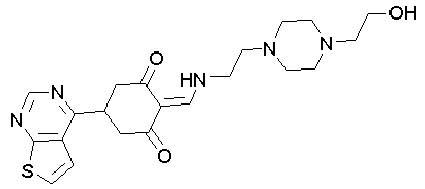
2-(((2-(4-(2-hydroxyethyl)piperazin-1-yl)ethyl)amino)methylene)-5-(thieno[2,3-d]pyrimidin-4-yl)cyclohexane-1,3-dione 1HNMR (400 MHz,CD3OD) δ 8.96 (s, 1H), 8.28 (s, 1H), 7.83 (d, J = 6.1 Hz, 1H), 7.68 (d, J = 6.1 Hz, 1H), 4.22 (td, J = 10.5, 5.2 Hz, 1H), 3.84 - 3.76 (m, 2H), 3.63 (t, J = 5.7 Hz, 2H), 3.15-2.87 (m, 8H), 2.85 - 2.59 (m, 8H). 28 
2-(((2-(4-(2-hydroxyethyl)piperazin-1-yl)ethyl)amino)methylene)-5-(o-tolyl)cyclohexane-1,3-dione 1HNMR (400 MHz, CD3OD) δ 8.27 (s, 1H), 7.27-7.11 (m, 4H), 3.69 (t, J =6.0Hz, 2H), 3.63-3.55 (m,3H), 2.78-2.56(m, 16H), 3.34 (s, 3H); MS: 386.2 [M+1]. 29 
2-(((2-(4-(2-hydroxyethyl)piperazin-1-yl)ethyl)amino)methylene)-5-methyl-5-phenylcyclohexane-1,3-dione 1H NMR (400 MHz, CD3OD) δ 8.07(s, 1H), 7.34-7.25(m, 4H), 7.18-7.14(m, 1H), 3.79(t, J = 5.6Hz, 2H), 3.53-3.49 (m, 2H), 3.06-2.96(m, 8H), 2.77-2.58 (m, 8H), 1.36 (s, 3H) 30 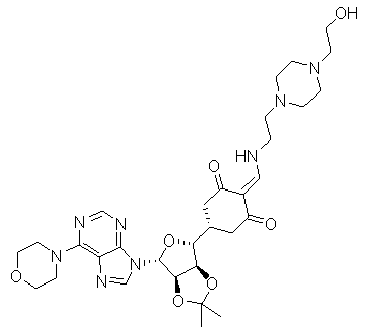
5-((3aR,4R,6R,6aR)-2,2-dimethyl-6-(6-morpholino-9H-purin-9-yl)tetrahydrofuro[3,4-d][1,3]dioxol-4-yl)-2-(((2-(4-(2-hydroxyethyl)piperazin-1-yl)ethyl)amino)methylene)cy clohexane-1,3-dione 1HNMR (400 MHz, CD3OD) δ 8.25 (s, 1H), 8.17 (m, 2H), 6.14 (d, J = 2.6 Hz, 1H), 5.42 - 5.31 (m, 1H), 5.08 - 4.99 (m, 1H), 4.26 (s, 4H), 3.95 (m, 1H), 3.84 - 3.68 (m, 6H), 3.57 (m, 2H), 2.90 - 2.70 (m, 6H), 2.61 (s, 7H), 2.46 (m, 5H), 1.57 (s, 3H), 1.37 (s, 3H) 31 
2-(((2-(4-(2-hydroxyethyl)piperazin-1-yl)ethyl)amino)methylene)-5-(phenoxymethyl)cyclohexane -1,3-dione 1HNMR (400 MHz, CD3OD) δ 8.26 (s, 1H), 7.41 - 7.14 (m, 2H), 7.03 - 6.88 (m, 3H), 3.97 (d, J = 5.1 Hz, 2H), 3.75 (t, J = 5.8 Hz, 2H), 3.63 (t, J = 5.8 Hz, 2H), 2.92 - 2.41 (m, 17H); MS: 402.4 [M+1]. 32 
5-((3-fluorophenoxy)methyl)-2-(((2-(4-(2-hydroxyethyl)piperazin-1-yl)ethyl)amino)methylene)cy clohexane-1,3-dione 1HNMR (400 MHz, CD3OD) δ 8.22 (s, 1H), 7.24 (dd, J = 15.2, 8.1 Hz, 1H), 6.73 (d, J = 8.2 Hz, 1H), 6.70 - 6.59 (m, 2H), 3.94 (d, J = 5.1 Hz, 2H), 3.77 (t, J = 5.6 Hz, 2H), 3.59 (t, J = 5.7 Hz, 2H), 2.98-2.91 (m, 5H), 2.79 - 2.32 (m, 12H); MS: 420.4 [M+1]. -
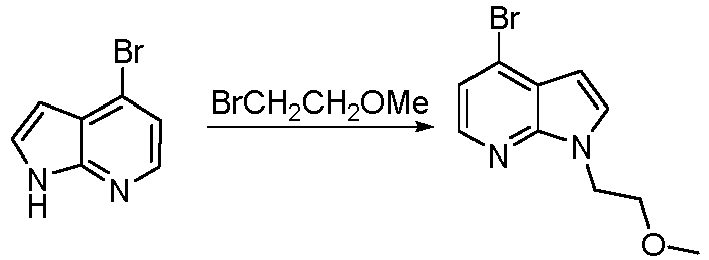
- 4-bromo-1H-pyrrolo[2,3-b]pyridine (3.0 g, 15.2 mmol) was dissolved in anhydrous N,N-dimethylformamide (DMF) (30 mL), into which was slowly added NaH (60% , 800 mg, 20 mmol) at 0°C and was reacted at this temperature for 30 min. Then 1-bromo-2-methoxyethane (2.78 g, 20 mmol) was added and the reaction was warmed to RT and reacted for additional 4 hours. After the reaction was completed, the reaction mixture was carefully poured into ice-water and extracted with EA. The organic phase was successively washed with water and saturated brine, then dried and concentrated. The crude product was separated by column chromatography to give the desired product (3.12g, yield 80%).
-

- Under the protection of nitrogen atmosphere, 6-bromoveratraldehyde (1.0 g, 4.08 mmol), cyclopropylboronic acid (515 mg, 6 mmol), Na2 CO3 (1.06 g, 10 mmol) and Pd(PPh3)4 (100 mg, 0.086 mmol) were added into dioxane (15 mL)/H2O (5 mL), then refluxed and reacted overnight. After the reaction was completed, the reaction mixture was cooled to RT, poured into ice-water and extracted with EA. The organic phase was successively washed with water and saturated brine, then dried and concentrated. The crude product was separated by column chromatography to give the desired product (560 mg, yield 66%).
-

- A aqueous solution of 2-bromo-1,1-diethoxyethane (22.7 g, 0.115 mol) in 48% hydrogen bromide (4.45 mL) was heated under reflux for 2 hours and then poured into a solution of NaHCO3 (74.5 g) in isopropanol (200 mL). The mixture was stirred for 30 minutes and then filtered. 3-Chloropyrazin-2-amine (5.0 g, 38.6 mmol) was added into the filtrate and the mixture was stirred at 85dded rred for and then concentrated. The resulted product was added into a saturated solution of Na2CO3 and extracted with DCM. The combined organic layers were dried and concentrated. The crude product was recrystallized with ether to give the desired product (5.7 g, crude) which was used in next step without further purification.
- NBS (6.6 g, 37 mmol) was added portionwise to a solution of 8-chloroimidazo[1,2-a]pyrazine (5.7 g) in DCM (100 mL) at RT and reacted for 2hours, After the reaction was completed, the reaction mixture was poured into water and extracted with DCM. The organic phase was washed with water, brine, then dried and concentrated to give the crude product (8.0 g) which was used in next step without further purification.
- The mixture of 3-bromo-8-chloroimidazo[1,2-a]pyrazine (8.0 g), DIPEA (5.7 g, 44 mmol) and morpholine (6.44 g, 74 mmol) was reacted at 80 °C for 4 hours. After the reaction was completed, the reaction mixture was poured into water and extracted with DCM. The organic phase was washed with water, brine, then dried, concentrated and separated by column chromatography to give the desired product (5.71 g, yield 52%).
-

- The solution of 6-chloropurine riboside (3.0 g, 10.46 mmol), 2,2-dimethoxypropane (5.2 g, 50 mmol) and TSOH-H2O (1.99g, 10.46mmol) in acetone (120 ml) was refluxed for 2 hours. After the reaction was completed, the reaction mixture was poured into ice-water and adjusted pH to 8-9, then extracted with DCM. The organic phase was washed with water, dried with Na2SO4 and concentrated to give the desired product (3.31 g, yield 96%).
- The compounds ((3aR,4R,6R,6aR)-6-(6-chloro-9H-purin-9-yl)-2,2-dimethyl-tetrahydrofuro[3,4-D][1,3]dioxol-4-yl)methanol (1.00 g, 3.06 mmol), morpholine (610 mg, 7.0 mmol) and DIPEA (900 mg, 7.0 mmol) were dissolved in CH3CN (20 mL), then refluxed and reacted for 2 hours. After the reaction was completed, the reaction mixture was cooled to RT, poured into ice-water and extracted with EA. The organic phase was washed with water, dried with Na2SO4 and concentrated. The crude product was purified and separated by column chromatography to give the desired product (912 mg, yield 80%).
- ((3aR,4R,6R,6aR)-2,2-dimethyl-6-(6-morpholino-9H-purin-9-yl)-tetrahydrofuro[3,4-d][1,3]dioxol-4-yl)methanol (700 mg, 1.85 mmol) was dissolved in DCM, Dess-Martin reagent (2.5 mmol) was slowly added at 0 °C. The reaction solution was then heated to RT and stirred at RT for 2hours, then diluted by adding water and extracted with DCM. The organic phase was washed with saturated brine, dried and concentrated. The crude product was separated by column chromatography to give the desired product (508 mg, yield 73%).
-

- Phenol (0.94 g, 10 mmol), chloroacetaldehyde diethyl acetal (1.52 g, 10 mmol), K2CO3 (2.77 g, 20 mmol) and KI (500 mg) were dissolved in DMF (15 mL). The above mixture was stirred at 100°C overnight. After the reaction was completed, the reaction mixture was cooled to RT, poured into ice-water and extracted with EA. The organic phase was washed with water, dried with Na2SO4 and concentrated. The crude product was separated by column chromatography to give the desired product (1.21g, yield 58%).
- (2,2-diethoxyethoxy)benzene (0.84 g, 4 mmol) was dissolved in the mixed solution of HOAc (5 mL),1N aqueous HCl (2.5 mL) and EtOH (20 mL), then heated and refluxed for 3 hours. After the reaction was completed, the reaction mixture was cooled to RT, poured into ice-water and extracted with EA. The organic phase was washed with water, dried with Na2SO4 and concentrated. The crude product was separated by column chromatography to give the desired product (468 mg, yield 86%).
-

- The solution of 6-chloro-9H-purine (4.50g, 30mmol), TSOH-H2O (1.14g, 6.0 mmol) and 3,4-dihydro-2H-pyran(5.05g, 60mmol) in EA (200mL) was heated to reflux for 5 hours. After the reaction was completed, the reaction mixture was cooled to RT, poured into ice-water and extracted with EA. The organic phase was washed with water, dried with Na2SO4 and concentrated. The crude product was purified and separated by column chromatography to give the desired product (5.72g, yield 80%).
- 6-chloro-9-(tetrahydro-2H-pyran-2-yl)-9H-purine (5.7g, 24 mmol), Na2CO3 (5.3 g, 50 mmol), 4-formylphenylboronic acid (7.5 g, 50 mmol) and Pd(PPh3)4 (690 mg, 0.6mmol) were dissolved in the mixed solution of dioxane (200mL) and water (20mL), then refluxed and reacted overnight. After the reaction was completed, the reaction mixture was cooled to RT, poured into ice-water and extracted with EA. The organic phase was washed with water, dried with Na2SO4 and concentrated. The crude product was purified and separated by column chromatography to give the desired product (5.51g, yield 74%).
- 2-(((2-(4-(2-hydroxyethyl)piperazin-1-yl)ethyl)amino)methylene)-5-(4-(9-(tetrahydro-2H-pyran-2-yl)-9H-purin-6-yl)phenyl)cyclohexane-1,3-dione (160.0mg, 0.28 mmol) was dissolved in EtOH (3mL)/DCM(5mL), into which aqueous HCl (1M, 2.0mL) was added dropwise at RT. After the dropwise addition, the reaction solution was stirred at RT for 6 hours. After the reaction was completed, the pH was adjusted to basicity with aqueous NaHCO3 solution and extracted with DCM. The organic phase was washed with saturated brine, dried and concentrated. The crude product was separated by preparation plate to give the desired product (46 mg, yield 33%). Compound 33: 1H NMR (400 MHz, DMSO-d 6) δ 13.59 (s, 1H), 11.20 - 10.79 (m, 1H), 9.08 - 8.52 (m, 4H), 8.13 (d, J = 14.6 Hz, 1H), 7.53 (d, J = 8.0 Hz, 2H), 4.55-4.21 (m, 1H), 3.70 - 3.12 (m, 8H), 2.95 - 2.66 (m, 2H), 2.62 - 2.10 (m, 11H); MS: 490.3 [M+1].
-

- 3-hydroxybenzaldehyde (2.00 g, 16.4 mmol), 2-(2-methoxyethoxy)ethyl 4-methylbenzenesulfonate (4.94 g, 18 mmol) and K2CO3 (4.53 g, 32. 8mmol) were dissolved in CH3CN (50 mL), refluxed and reacted for 3 hours. After the reaction was completed, the reaction mixture was cooled to RT, poured into ice-water and extracted with EA. The organic phase was washed with water, dried with Na2SO4, and concentrated. The crude product was separated by column chromatography to give the desired product (1.7 g, yield 46%).
- 3-(2-(2-methoxyethoxy)ethoxy)benzaldehyde (7.0 g, 31.21 mmol) was dissolved in acetone (20 mL) and water (10mL) to which 1% NaOH solution (20 mL) was added. Then the above mixture was heated to reflux for 2 hours, then cooled to RT, poured into ice-water and extracted with EA. The combined organic phase was washed with water and saturated brine, dried, and concentrated. The crude product was separated by column chromatography to give the desired product (6.16 g, yield 75%).
- Step 4,5,6: the operation procedures were the same as Example 9. Compound 34: 1HNMR (400 MHz, CD3OD): δ 8.24 (s, 1H), 7.23(t, J = 8.0 Hz, 1H), 6.88-6.80 (m, 3H), 4.11 (t, J = 4.8 Hz, 2H), 3.82 (t, J = 4.8 Hz, 2H), 3.74 (t, J = 5.6 Hz, 2H), 3.70-3.67 (m, 2H), 3.60 (t, J= 5.6 Hz, 2H), 3.57-3.55(m, 2H), 3.36 (m, 3H), 3.35-3.34 (m, 1H), 2.81-2.61(m, 16H); MS: 491.6 [M+1].
- Compounds 35-84 were synthesized by the same procedures as Compound 34 except for using corresponding benzaldehyde, aromatic aldehyde, or substituted cyclohexane-1,3-dione (see, e.g., Examples 13-1 to 13-11), as shown in Table 4.
Table 4: Compounds 35-59 and 61-84 # Structure Name Proton NMR (1HNMR), Mass Spectrum (MS) 35 
2-(((2-(4-(2-hydroxyethyl)piperazin-1-yl)ethyl)amino)methylene)-5-(4-morpholinophenyl)cyclohexan e-1,3-dione 1HNMR (400 MHz, CD3OD) δ 8.27 (s, 1H), 7.21 (d, J = 8.1 Hz, 2H), 6.97 (d, J = 8.2 Hz, 2H), 3.86 (s, 4H), 3.75 (t, J = 5.5 Hz, 2H), 3.64 (s, 2H), 3.14 (s, 4H), 2.88 - 2.49 (m, 17H); MS: 457.4 [M+1]. 36 
2-(((2-(4-(2-hydroxyethyl)piperazin-1-yl)ethyl)amino)methylene)-5-(4-(4-methylpiperazin-1-yl)phenyl)cyclohexane-1,3-dione 1HNMR (400 MHz, CD3OD) δ 8.27 (s, 1H), 7.21 (d, J = 8.6 Hz, 2H), 6.98 (d, J = 8.7 Hz, 2H), 3.79 (t, J = 5.7 Hz, 2H), 3.63 (t, J = 5.7 Hz, 2H), 2.92 (s, 4H), 2.89-2.59 (m, 21H), 2.52 (s, 3H); MS: 470.2 [M+1]. 37 
2-(((2-(4-(2-hydroxyethyl)piperazin-1-yl)ethyl)amino)methylene)-5-(thiophen-2-yl)cyclohexane-1,3-dione 1HNMR (400 MHz, CD3OD): δ 8.26 (d, J = 14.4Hz, 1H), 7.27 (br, 1H), 6.95 (br, 1H), 4.09-3.30 (m, 7H), 2.50 - 2.84 (m, 14H); MS: 378.5 [M+1]. 38 
2-(((2-(4-(2-hydroxyethyl)piperazin-1-yl)ethyl)amino)methylene)-5-(tetrahydro-2H-thiopyran-4-yl)cyclohexane-1,3-dione 1H NMR (400 MHz, CD3OD) δ 8.10 (s, 1H), 3.70 (t, J = 5.5 Hz, 2H), 3.50 (t, J = 5.7 Hz, 2H), 2.92 (d, J = 29.8 Hz, 5H), 2.69 - 2.42 (m, 8H), 2.44 - 2.12 (m, 4H), 2.05 - 1.72 (m, 3H), 1.52 - 1.07 (m, 6H); MS: 396.1 [M+1]. 39 
2-(((2-(4-(2-hydroxyethyl)piperazin-1-yl)ethyl)amino)methylene)-5-(1H-indol-3-yl)cyclohexane-1,3-dione 1H NMR (400 MHz, CD3OD): δ 8.23 (s, 1H), 7.56 (d, J = 7.8 Hz, 1H), 7.32 (d, J = 8.1 Hz, 1H), 7.08 (t, J = 7.1 Hz, 1H), 7.03 - 6.94 (m, 2H), 3.78 - 3.61 (m, 3H), 3.57 (t, J = 5.7 Hz, 2H), 2.95 - 2.49 (m, 16H); MS: 411.4 [M+1]. 40 
2-(((2-(4-(2-hydroxyethyl)piperazin-1-yl)ethyl)amino)methylene)-5-(4-hydroxyphenyl) cyclohexane-1,3-dione 1HNMR (400 MHz, CD3OD): δ 8.27 (s, 1H), 7.13 (d, J = 8.5 Hz, 2H), 6.77 (d, J = 8.6 Hz, 2H), 3.81 (t, J = 5.6 Hz, 2H), 3.64 (t, J = 5.7 Hz, 2H), 3.14 - 2.57 (m, 16H) 41 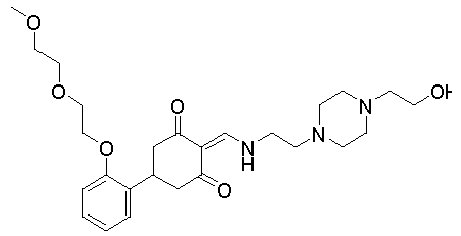
2-(((2-(4-(2-hydroxyethyl)piperazin-1-yl)ethyl)amino)methylene)-5-(3-(2-(2-methoxyethoxy)ethoxy)phenyl )cyclohexane-1,3-dione 1HNMR (400 MHz, CD3OD): δ 8.26 (s, 1H), 7.23-7.17 (m, 2H), 6.97 (d, J =8.0 Hz, 1H), 6.92 (t, J = 7.2 Hz, 1H), 4.16 (t, J = 4.4 Hz, 2H), 3.84 (q, J = 4.8 Hz, 4H), 3.73-3.61 (m, 5H), 3.54-3.52 (m, 2H), 3.32-3.26 (m, 9H), 2.93-2.61(m, 10H); MS: 490.2 [M+1]. 42 
2-(((2-(4-(2-hydroxyethyl)piperazin-1-yl)ethyl)amino)methylene)-5-(2-(2-methoxyethoxy)phenyl)cycloh exane-1,3-dione 1HNMR (400 MHz, CD3OD): δ 8.27 (s, 1H), 7.24-7.19 (m, 2H), 7.00-6.92 (m, 2H), 4.17 (t, J = 4.0Hz, 2H), 3.78-3.70 (m, 5H), 3.63 (t, J = 5.2Hz, 2H), 3.32 (s,3H), 2.88-2.64 (m, 16H); MS: 446.9 [M+1] 43 
5-(furan-2-yl)-2-(((2-(4-(2-hydroxyethy])piperazin-1-yl)ethyl)amino)methylene)cyc lohexane-1,3-dione 1HNMR (400 MHz, CD3OD): δ 8.20 (s, 1H), 7.38 (s, 1H), 7.29 (s, 1H), 6.08 (d, J=3.2Hz, 1H), 3.76 (t, J=6.4 Hz, 2H), 3.58 (t, J=6.4Hz, 2H), 3.50-3.44 (m, 1H), 2.94-2.62 (m, 16H). MS: 362.5 [M+1] 44 
2-(((2-(4-(2-hydroxyethyl)piperazin-1-yl)ethyl)amino)methylene)-5-(4-(2-methoxyethoxy)phenyl)cycloh exane-1,3-dione 1HNMR (400 MHz, CD3OD): δ 8.23 (s, 1H), 7.19 (t, J=8.4Hz, 2H), 6.89 (t, J=8.8Hz, 2H), 4.09-4.06 (m, 2H), 3.60 (tJ=5.6Hz, 2H), 3.40 (s, 3H), 3.30-3.27 (m, 1H), 3.07 (br, 4H), 2.99 (t, J=5.6Hz, 2H), 2.82-2.61 (m, 16H); MS: 446.6 [M+1]. 45 
2-(((2-(4-(2-hydroxyethy])piperazin-1-yl)ethyl)amino)methylene)-5-(4-(2-(2-methoxyethoxy)ethoxy)phenyl )cyclohexane-1,3-dione 1HNMR (400 MHz, CD3OD): δ 8.27 (s, 1H), 7.23 (t, J=8.8Hz, 2H), 6.93 (t, J=8.8Hz, 2H), 4.14-4.12 (m, 2H), 3.86-3.83 (m, 2H), 3.73-3.70 (m, 4H), 3.39(s, 3H), 3.33-3.27 (m, 1H), 3.07 (br, 4H), 2.99 (t, J=5.6Hz, 2H), 2.83-2.56 (m, 16H). MS: 490.6 [M+1]. 46 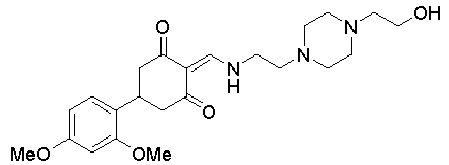
5-(2,4-dimethoxyphenyl)-2-(((2-(4-(2-hydroxyethy])piperazin-1-yl)ethyl)amino)methylene)cyc lohexane-1,3-dione 1H NMR (400 MHz, CD3OD) δ 8.12 (d, J = 14.6 Hz, 1H), 7.08 (d, J = 8.4 Hz, 1H), 6.54 (d, J = 2.3 Hz, 1H), 6.48 (dd, J = 8.4, 2.3 Hz, 1H), 4.77 (s, 1H), 3.78 (s, 3H), 3.74 (s, 3H), 3.64 - 3.52 (m, 4H), 3.52 - 3.41 (m, 1H), 2.74 - 2.52 (m, 12H), 2.49 - 2.37 (m, 4H); MS: 432.5 [M+1]. 47 
2-(((2-(4-(2-hydroxyethyl)piperazin-1-yl)ethyl)amino)methylene)-5-C2-6 styrylcyclohexane-1,3-dione 1H NMR (400 MHz, CD3OD) δ 8.21 (s, 1H), 7.35 (d, J = 7.3 Hz, 2H), 7.26 (t, J = 7.5 Hz, 2H), 7.18 (t, J = 7.3 Hz, 1H), 6.46 (d,J = 15.9 Hz, 1H), 6.23 (dd, J = 15.9, 6.8 Hz, 1H), 3.74 - 3.65 (m, 3H), 3.63 - 3.53 (m, 2H), 3.04-2.90 (m, 1H), 2.88 (s, 1H), 2.77 - 2.39 (m, 14H); MS: 398.3 [M+1]. 48 
2-(((2-(4-(2-hydroxyethyl)piperazin-1-yl)ethyl)amino)methylene)-5-(4-(trifluoromethyl)phenyl)cyclohexane-1,3-dione 1HNMR (400 MHz, CD3OD): δ 9.29 (s, 1H), 7.66 (d, J=8.0Hz, 2H), 7.54 (d, J=8.0Hz, 2H), 3.73 (t, J=5.6Hz, 2H), 3.64 (t, J=5.6Hz, 2H), 3.55-3.47 (m, 1H), 2.91-2.83 (m, 16H); MS: 440.6 [M+1]. 49 
5-(4-fluorophenyl)-2-(((2-(4-(2-hydroxyethyl)piperazin-1-yl)ethyl)amino)methylene)cyc lohexane-1,3-dione 1HNMR (400 MHz, CD3OD): δ 8.28 (s, 1H), 7.36-7.32 (m, 2H), 7.10-7.01 (m, 2H), 3.75 (t, J=5.6Hz, 2H), 3.64 (t, J=5.6Hz, 2H), 3.44-3.36 (m, 1H), 2.87-2.65(m, 16H); MS: 390.5 [M+1]. 50 
2-(((2-(4-(2-hydroxyethyl)piperazin-1-yl)ethyl)amino)methylene)-5-(4-(trifluoromethoxy)phenyl)cycl ohexane-1,3-dione 1H NMR (400 MHz, CD3OD) δ 8.24 (s, 1H), 7.39 (d, J = 8.6 Hz, 2H), 7.22 (d, J = 8.1 Hz, 2H), 3.67 (t, J = 6.0 Hz, 2H), 3.59 (t, J = 5.8 Hz, 2H), 3.49 - 3.33 (m, 1H), 2.93 - 2.39 (m, 16H); MS: 456.2 [M+1]. 51 
2-(((2-(4-(2-hydroxyethyl)piperazin-1-yl)ethyl)amino)methylene)-5-(4-(cyano)phenyl)cyclohexane-1,3-dione 1H NMR (400 MHz, CD3OD) δ 8.28 (s, 1H), 7.72 (d, J = 8.3 Hz, 2H), 7.53 (d, J = 8.2 Hz, 2H), 3.75 (t, J = 5.8 Hz, 2H), 3.63 (t, J = 5.8 Hz, 2H), 3.56 - 3.40 (m, 1H), 3.00 - 2.49 (m, 16H); MS: 397.2 [M+1]. 52 
2-(((2-(4-(2-hydroxyethyl)piperazin-1-yl)ethyl)amino)methylene)-5-(4-(trifluoromethoxy)phenyl)cycl ohexane-1,3-dione 1HNMR (400 MHz, CD3OD) δ 8.742 (d, J = 6.0 Hz, 2H), 8.253 (s, 1H), 7.396 (d, J = 6.0 Hz, 2H), 3.712 (t, J = 6.0 Hz, 2H), 3.606 (d, J = 5.6 Hz, 2H), 3.419-3.496 (m, 1H), 2.873-2.610 (m, 16H); MS: 373.2 [M+1]. 53 
2-(((2-(4-(2-hydroxyethyl)piperazin-1-yl)ethyl)amino)methylene)-5-(pyridin-2-yl)cyclohexane-1,3-dione 1HNMR (400 MHz, CD3OD): δ 8.49 (d, J = 4.0 Hz, 1H), 8.25(s, 1H), 7.80-7.76 (m, 1H), 7.37 (d, J = 7.2Hz, 1H), 7.29-7.26(m, 1H), 3.68 (t, J = 6.0 Hz, 2H), 3.60 (t, J = 6.4 Hz, 2H), 3.56-3.49 (m, 1H), 2.93-2.82 (m, 2H), 2.71-2.54 (m, 14H); MS: 373.5 [M+1]. 54 
2-(((2-(4-(2-hydroxyethyl)piperazin-1-yl)ethyl)amino)methylene)-5-(4-methoxynaphthalen-1-yl)cyclohexane-1,3-dione 1H NMR (400 MHz, CD3OD) δ 8.27 (d, J = 6.9 Hz, 2H), 8.02 (d, J = 8.5 Hz, 1H), 7.54 (t, J = 7.0 Hz, 1H), 7.49 - 7.40 (m, 1H), 7.31 (d, J = 8.0 Hz, 1H), 6.86 (d, J = 8.1 Hz, 1H), 4.19 - 4.05 (m, 1H), 3.98 (s, 3H), 3.67 (t, J = 6.0 Hz, 2H), 3.64 - 3.53 (m, 2H), 2.92 - 2.47 (m, 16H); MS: 452.3 [M+1]. 55 
2-(((2-(4-(2-hydroxyethyl)piperazin-1-yl)ethyl)amino)methylene)-5-(1-methyl-1H-pyrrol-2-yl)cyclohexane-1,3-dione 1H NMR (400 MHz, CD3OD) δ 8.22 (s, 1H), 6.77 - 6.27 (m, 1H), 6.05 - 5.83 (m, 1H), 5.85 - 5.76 (m, 1H), 3.74 (t, J = 5.7 Hz, 2H), 3.64 - 3.53 (m, 5H), 3.50 - 3.37 (m, 1H), 3.06 - 2.45 (m, 16H); MS: 375.3 [M+1]. 56 
5-(2,3-dihydrobenzo [b] [1,4]dioxin-5-yl)-2-(((2-(4-(2-hydroxyethyl)piperazin-1-yl)ethyl)amino)methylene)cyc lohexane-1,3-dione 1H NMR (400 MHz, CD3OD) δ 8.24 (s, 1H), 6.83 - 6.51 (m, 3H), 4.24 (dd, J = 16.6, 5.0 Hz, 4H), 3.73 (t, J = 5.8 Hz, 2H), 3.64 - 3.47 (m, 3H), 3.05 - 2.32 (m, 16H); MS: 430.2 [M+1]. 57 
2-(((2-(4-(2-hydroxyethyl)piperazin-1-yl)ethyl)amino)methylene)-5-(thiazol-2-yl)cyclohexane-1,3-dione 1H NMR (400 MHz, CD3OD) δ 8.26 (s, 1H), 7.74 (d, J = 3.3 Hz, 1H), 7.53 (d, J = 3.3 Hz, 1H), 3.97 - 3.83 (m, 2H), 3.74 (t, J = 5.9 Hz, 2H), 3.62 (t, J = 5.8 Hz, 2H), 2.95 (dd, J = 14.4, 6.0 Hz, 4H), 2.80 - 2.54 (m, 12H); MS: 379.3 [M+1]. 58 
2-(((2-(4-(2-hydroxyethyl)piperazin-1-yl)ethyl)amino)methylene)-5-(isoquinolin-5-yl)cyclohexane-1,3-dione 1H NMR (400 MHz, CD3OD) δ 9.25 (s, 1H), 8.49 (d, J = 6.1 Hz, 1H), 8.31 (s, 1H), 8.06 (d, J = 6.2 Hz, 1H), 8.03 (d, J = 8.1 Hz, 1H), 7.77 (d, J = 7.2 Hz, 1H), 7.72 - 7.64 (m, 1H), 4.30 - 4.19 (m, 1H), 3.72 (t, J = 5.9 Hz, 2H), 3.64 (t, J = 5.8 Hz, 2H), 2.98 - 2.58 (m, 16H); MS: 423.4 [M+1]. 59 
2-(((2-(4-(2-hydroxyethyl)piperazin-1-yl)ethyl)amino)methylene)-5-(1H-imidazol-4-yl)cyclohexane-1,3-dione 1H NMR (400 MHz, CDCl3) δ 11.39 - 10.87 (m, 1H), 9.33 - 8.87 (m, 1H), 8.15 (d, J = 14.4 Hz, 1H), 7.60 (s, 1H), 6.80 (s, 1H), 3.61 (t, J = 5.3 Hz, 2H), 3.55-3.47 (m, 3H), 3.05 - 2.30 (m, 17H); MS: 362.3 [M+1]. 61 
5-(anthracen-9-yl)-2-(((2-(4-(2-hydroxyethyl)piperazin-1-yl)ethyl)amino)methylene)cyc lohexane-1,3-dione 1H NMR (400 MHz, CD3OD) δ 8.54 - 8.42 (m, 3H), 8.40 (s, 1H), 8.06 (d, J = 8.0 Hz, 2H), 7.57 - 7.39 (m, 4H), 5.09 - 4.94 (m, 1H), 3.90 - 3.59 (m, 6H), 2.73 - 2.52 (m, 14H); MS: 472.2 [M+1]. 62 
2-(((2-(4-(2-hydroxyethyl)piperazin-1-yl)ethyl)amino)methylene)-5-(quinolin-4-yl)cyclohexane-1,3-dione 1H NMR (400 MHz, CD3OD) δ 8.80 (d, J = 4.7 Hz, 1H), 8.30 (s, 1H), 8.23 (d, J = 8.4 Hz, 1H), 8.06 (d, J = 8.4 Hz, 1H), 7.78 (d, J = 7.3 Hz, 1H), 7.73 - 7.62 (m, 1H), 7.49 (d, J = 4.8 Hz, 1H), 4.34 (s, 1H), 3.72 (t, J = 5.8 Hz, 2H), 3.63 (t, J = 5.7 Hz, 2H), 3.01 - 2.51 (m, 16H); MS: 423.3 [M+1]. 63 
2-(((2-(4-(2-hydroxyethyl)piperazin-1-yl)ethyl)amino)methylene)-5-(pentan-3-yl)cyclohexane-1,3-dione 1H NMR (400 MHz, DMSO-d 6) δ 11.17 - 10.13 (m, 1H), 8.06 (d, J = 14.6 Hz, 1H), 4.82 (s, 1H), 3.74 - 3.46 (m, 5H), 3.38 (dd, J = 14.0, 7.0 Hz, 2H), 2.74 (s, 5H), 2.57 (s, 3H), 2.36 - 2.09 (m, 4H), 2.01 (s, 1H), 1.91 (s, 1H), 1.46 - 1.13 (m, 4H), 1.05 (t, J = 21.2 Hz, 1H), 0.83 (t, J = 7.3 Hz, 6H); MS: 366.2 [M+1]. 64 
2-(((2-(4-(2-hydroxyethyl)piperazin-1-yl)ethyl)amino)methylene)-5-(tetrahydro-2H-pyran-4-yl)cyclohexane-1,3-dione 1H NMR (400 MHz, CD3OD) δ 8.18 (s, 1H), 3.95 (dd, J = 11.1, 3.8 Hz, 2H), 3.69 (t, J = 5.9 Hz, 2H), 3.57 (t, J = 5.8 Hz, 2H), 3.37 (t, J = 11.0 Hz, 2H), 2.90 - 2.43 (m, 13H), 2.41 - 2.15 (m, 2H), 1.89 - 1.78 (m, 1H), 1.65 (d, J = 12.2 Hz, 2H), 1.59 - 1.10 (m, 4H); MS: 380.2 [M+1]. 65 
2-(((2-(4-(2-hydroxyethyl)piperazin-1-yl)ethyl)amino)methylene)-5-(4-(methylsulfonyl)phenyl)cycloh exane-1,3-dione 1H NMR (400 MHz, CD3OD) δ 8.29 (s, 1H), 7.95 (d, J = 8.4 Hz, 2H), 7.62 (d, J = 8.4 Hz, 2H), 3.71 (t, J = 6.1 Hz, 2H), 3.64 (t, J = 5.9 Hz, 2H), 3.61 - 3.47 (m, 1H), 3.14 (s, 3H), 3.00 - 2.44 (m, 16H); MS: 450.2 [M+1]. 66 
5-(benzo[b]thiophen-3-yl)-2-(((2-(4-(2-hydroxyethyl)piperazin-1-yl)ethyl)amino)methylene)cyc lohexane-1,3-dione 1H NMR (400 MHz, CD3OD) δ 8.27 (s, 1H), 7.95 - 7.78 (m, 2H), 7.37 (dt, J = 19.3, 7.1 Hz, 2H), 7.30 (s, 1H), 3.89 - 3.79 (m, 1H), 3.77 (t, J = 5.6 Hz, 2H), 3.61 (t, J = 5.8 Hz, 2H), 3.09 - 2.57 (m, 16H); MS: 428.2 [M+1]. 67 
5-cyclopropyl-2-(((2-(4-(2-hydroxyethyl)piperazin-1-yl)ethyl)amino)methylene)cyc lohexane-1,3-dione 1H NMR (400 MHz, CD3OD) δ 8.19 (s, 1H), 3.70 (t, J = 5.9 Hz, 2H), 3.57 (t, J = 5.8 Hz, 2H), 2.76 - 2.51 (m, 13H), 2.49 - 2.30 (m, 2H), 1.31 - 1.18 (m, 2H), 0.77 - 0.59 (m, 1H), 0.47 (dd, J = 5.1, 2.7 Hz, 2H), 0.14 (d, J = 4.9 Hz, 2H); MS: 336.2 [M+1]. 68 
2-(((2-(4-(2-hydroxyethyl)piperazin-1-yl)ethyl)amino)methylene)-5-(1H-indol-4-yl)cyclohexane-1,3-dione 1H NMR (400 MHz, CD3OD) δ 8.26 (s, 1H), 7.25 (dd, J = 14.5, 5.7 Hz, 2H), 7.05 (t, J = 7.7 Hz, 1H), 6.87 (d, J = 7.2 Hz, 1H), 6.52 (d, J = 2.5 Hz, 1H), 3.85 - 3.74 (m, 1H), 3.71 (t, J = 5.8 Hz, 2H), 3.59 (t, J = 5.8 Hz, 2H), 3.05 - 2.38 (m, 16H); MS: 411.4 [M+1]. 69 
2-(((2-(4-(2-hydroxyethyl)piperazin-1-yl)ethyl)amino)methylene)-5-(1-phenylethyl)cyclohexane-1,3-dione 1H NMR (400 MHz, CD3OD) δ 8.16 (d, J = 10.5 Hz, 1H), 7.28 (t, J = 7.4 Hz, 2H), 7.18 (t, J = 8.3 Hz, 3H), 3.78 (t, J = 5.4 Hz, 2H), 3.57 (t, J = 5.6 Hz, 2H), 3.15 - 2.85 (m, 5H), 2.82 - 2.52 (m, 8H), 2.46 - 1.90 (m, 5H), 1.29 (d, J = 7.0 Hz, 3H); MS: 400.2 [M+1]. 70 
2-(((2-(4-(2-hydroxyethyl)piperazin-1-yl)ethyl)amino)methylene)-5-(piperidin-4-yl)cyclohexane-1,3-dione HCl salt 1H NMR (400 MHz, D2O) δ 8.09 (s, 1H), 3.88 - 3.74 (m, 3H), 3.68 - 3.26 (m, 15H), 2.91 - 2.74 (m, 2H), 2.45 (dd, J = 17.1, 3.9 Hz, 2H), 2.27 (s, 2H), 2.02 - 1.75 (m, 3H), 1.59 - 1.44 (m, 1H), 1.43 - 1.21 (m, 2H); MS: 379.2 [M+1]. 71 
2-(((2-(4-(2-hydroxyethyl)piperazin-1-yl)ethyl)amino)methylene)-5-(4-(2-(pyridin-4-yloxy)ethoxy)phenyl)cyclohex ane-1,3-dione 1H NMR (400 MHz, DMSO-d6) δ10.92 (d, J = 14.7 Hz, 1H), 8.38 (d, J = 6.2 Hz, 2H), 8.11 (d, J = 14.6 Hz, 1H), 7.21 (d, J = 8.7 Hz, 2H), 7.00 (dd, J = 4.8, 1.5 Hz, 2H), 6.91 (d, J = 8.7 Hz, 2H), 4.69 (s, 1H), 4.38 (dd, J = 5.6, 2.9 Hz, 2H), 4.29 (dd, J = 5.5, 3.1 Hz, 2H), 3.55 (d, J = 5.4 Hz, 4H), 3.28 - 2.31 (m, 17H); MS: 510.2 [M+1]. 72 
2-(((2-(4-(2-hydroxyethyl)piperazin-1-yl)ethyl)amino)methylene)-5-(5-(pyridin-4-yl)thiophen-2-yl)cyclohexane-1,3-dione 1H NMR (400 MHz, CD3OD) δ 8.47 (dd, J = 4.8, 1.5 Hz, 2H), 8.23 (s, 1H), 7.61 (dd, J = 4.7, 1.6 Hz, 2H), 7.55 (d, J = 3.8 Hz, 1H), 7.00 (d, J = 3.1 Hz, 1H), 3.83 - 3.69 (m, 1H), 3.66 (t, J = 6.0 Hz, 2H), 3.59 (t, J = 5.8 Hz, 2H), 3.00 - 2.71 (m, 4H), 2.66 - 2.42 (m, 12H); MS: 455.3 [M+1]. 73 
2-(((2-(4-(2-hydroxyethyl)piperazin-1-yl)ethyl)amino)methylene)-5-(4-(pyridin-4-yl)phenyl)cyclohexane-1,3-dione 1H NMR (400 MHz, CD3OD) δ 8.55 (dd, J = 4.7, 1.6 Hz, 2H), 8.25 (s, 1H), 7.77 - 7.66 (m, 4H), 7.46 (d, J = 8.3 Hz, 2H), 3.67 (t, J = 6.0 Hz, 2H), 3.60 (t, J = 6.0 Hz, 2H), 3.45 (m, 1H), 2.67 (m, 16H); MS: 449.5 [M+1]. 74 
N'-(4-(4-(((2-(4-(2-hydroxyethyl)piperazin-1-yl)ethyl)amino)methylene)-3,5-dioxocyclohexyl)benzo[d]thiaz ol-2-yl)-N,N-dimethylformimidamide 1HNMR (400 MHz, CD3OD) δ 8.35 (s, 1H), 8.26 (s, 1H), 7.64 - 7.52 (m, 1H), 7.21 (d, J = 6.8 Hz, 1H), 7.15 (t, J = 7.7 Hz, 1H), 4.06 (t, J = 11.6 Hz, 1H), 3.74 (t, J = 5.7 Hz, 2H), 3.61 (t, J = 5.6 Hz, 2H), 3.19 (s, 3H), 3.11 (s, 3H), 3.09 - 2.54 (m, 16H).; MS: 499.3 [M+1]. 75 
2-(((2-(4-(2-hydroxyethyl)piperazin-1-yl)ethyl)amino)methylene)-5-(3-(pyridin-4-yloxy)phenyl)cyclohexane-1,3-dione 1HNMR (400 MHz, CD3OD) δ 8.41 (dd, J = 5.0, 1.4 Hz, 2H), 8.26 (s, 1H), 7.47 (t, J = 7.9 Hz, 1H), 7.28 (d, J = 7.8 Hz, 1H), 7.14 (s, 1H), 7.04 (dd, J = 8.1, 1.5 Hz, 1H), 6.95 (dd, J = 4.9, 1.5 Hz, 2H), 3.70 (t, J = 6.0 Hz, 2H), 3.62 (t, J = 5.9 Hz, 2H), 3.52 - 3.39 (m, 1H), 2.91 - 2.47 (m, 16H); MS: 465.4 [M+1]. 76 
5-(4-(6-ethoxy-9H-purin-9-yl)phenyl)-2-(((2-(4-(2-hydroxyethyl)piperazin-1-yl)ethyl)amino)methylene)cyc lohexane-1,3-dione 1HNMR (400 MHz, CD3OD) δ 8.48 (s, 1H), 8.43 (s, 1H), 8.18 (s, 1H), 7.69 (d, J = 8.5 Hz, 2H), 7.47 (d, J = 8.5 Hz, 2H), 4.60 (q, J = 7.1 Hz, 2H), 3.67 (t, J = 5.6 Hz, 2H), 3.53 (t, J = 5.7 Hz, 2H), 3.46 - 3.37 (m, 1H), 2.89 - 2.52 (m, 16H), 1.42 (t, J = 7.1 Hz, 3H); MS: 534.3 [M+1]. 77 
2-(((2-(4-(2-hydroxyethyl)piperazin-1-yl)ethyl)amino)methylene)-5-(4-(morpholine-4-carbonyl)phenyl)cyclohexane-1,3-dione 1HNMR (400 MHz, CD3OD) δ 8.29 (s, 1H), 7.45 (s, 4H), 3.84 - 3.38 (m, 13H), 2.93 - 2.50 (m, 16H); MS: 485.3 [M+1]. 78 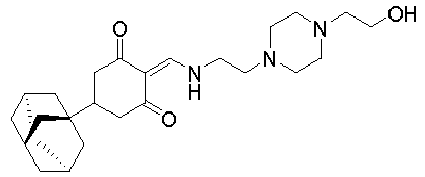
5-adamantan-1-yl)-2-(((2-(4-(2 -hydroxyethyl)piperazin-1-yl)ethyl)amino)methylene)cyc lohexane-1,3-dione 1HNMR (400 MHz, CD3OD) δ 8.21 (s, 1H), 3.73 (t, J = 5.9 Hz, 2H), 3.61 (t, J = 5.8 Hz, 2H), 3.37 (d, J = 5.3 Hz, 2H), 2.84 - 2.47 (m, 12H), 2.40 - 2.19 (m, 2H), 2.09 - 1.88 (m, 4H), 1.86 - 1.54 (m, 12H); MS: 430.2 [M+1]. 79 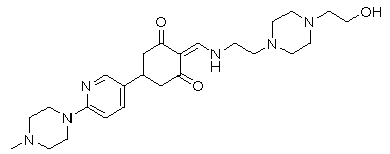
2-(((2-(4-(2-hydroxyethyl)piperazin-1-yl)ethyl)amino)methylene)-5-(6-(4-methylpiperazin-1-yl)pyridin-3-yl)cyclohexane-1,3-dione 1HNMR (400 MHz, CD3OD) δ 8.24 (s, 1H), 8.02 (d, J = 2.2 Hz, 1H), 7.55 (dd, J = 8.8, 2.4 Hz, 1H), 6.82 (d, J = 8.9 Hz, 1H), 3.68 (t, J = 6.0 Hz, 2H), 3.60 (t, J = 5.8 Hz, 2H), 3.53 - 3.49 (m, 4H), 2.76 - 2.50 (m, 21H), 2.34 (s, 3H); MS: 471.3 [M+1]. 80 
2-(((2-(4-(2-hydroxyethyl)piperazin-1-yl)ethyl)amino)methylene)-5-(4-methoxy-3-(2-methoxyethoxy)phenyl)cycloh exane-1,3-dione 1H NMR (400 MHz, CD3OD) δ 8.24(s, 1H), 6.92-6.83(m, 3H), 4.13-4.11(m, 2H), 3.82(s, 3H), 3.76-3.72(m, 4H), 3.60(t, J=5.6Hz, 2H), 3.42(s, 3H), 2.87-2.61(m, 17H); MS: 476.2 [M+1]. 81 
2-(((2-(4-(2-hydroxyethyl)piperazin-1-yl)ethyl)amino)methylene)-5-(4-(thiazol-2-yl)phenyl)cyclohexane-1,3-dione 1H NMR (400 MHz, CD3OD) δ 8.26 (s, 1H), 7.92 (d, J = 8.3 Hz, 2H), 7.85 (d, J = 3.2 Hz, 1H), 7.59 (d, J = 3.3 Hz, 1H), 7.44 (d, J = 8.2 Hz, 2H), 3.68 (t, J = 6.2 Hz, 2H), 3.61 (t, J = 9.1 Hz, 2H), 3.45 (m, 2H), 2.62 (m, 15H). 82 
5-(6-(1H-imidazol-1-yl)pyridin-3-yl)-2-(((2-(4-(2-hydroxyethyl)piperazin-1-yl)ethyl)amino)methylene)cyc lohexane-1,3-dione 1H NMR (400 MHz, CD3OD) δ 8.50 (s, 1H), 8.44 (d, J = 1.8 Hz, 1H), 8.26 (s, 1H), 7.94 (dd, J = 8.5, 2.1 Hz, 1H), 7.87 (s, 1H), 7.66 (d, J = 8.4 Hz, 1H), 7.14 (s, 1H), 3.67 (t, J = 6.0 Hz, 2H), 3.61 (t, J = 5.9 Hz, 2H), 3.52 (m, 1H), 2.94 - 2.67 (m, 5H), 2.66 - 2.43 (m, 11H) 83 
2-(((2-(4-(2-hydroxyethyl)piperazin-1-yl)ethyl)amino)methylene)-5-(6-(thiazol-2-ylamino)pyridin-3-yl)cyclohexane-1,3-dione 1HNMR (400 MHz, CD3OD) δ 8.28 - 8.20 (m, 2H), 7.66 (dd, J = 8.6, 2.4 Hz, 1H), 7.31 (d, J = 3.7 Hz, 1H), 7.00 (d, J = 8.6 Hz, 1H), 6.89 (d, J = 3.7 Hz, 1H), 3.82 - 3.77 (m, 2H), 3.60-3.63 (m, 2H), 3.39 (m, 1H), 3.14 - 2.89 (m, 6H), 2.87 - 2.61 (m, 10H). 84 2-(((2-(4-(2-hydroxyethyl)piperazin-1-yl)ethyl)amino)methylene)-5-(10-(2-methoxyethyl)-10H-phenothiazin-3-yl)cyclohexane-1,3-dione 1HNMR (400 MHz, CD3OD) δ 8.24 (s, 1H), 7.16 (m, 1H), 7.10 (d, J = 7.9 Hz, 2H), 7.05 (s, 1H), 7.00 - 6.88 (m, 3H), 4.08 (t, J = 5.7 Hz, 2H), 3.72 (q, J = 5.8 Hz, 4H), 3.60 (t, J = 5.7 Hz, 2H), 3.32 (s, 5H), 2.83 - 2.49 (m, 15H) 
-

- The solution of 6-chloronicotinaldehyde (5.00g, 35.32mmol) and N-methylpiperazine (15.68 mL, 141.28mmol) in DMF (20 mL) was heated to 100 °C and reacted for 1h. After the reaction was completed, the reaction mixture was cooled to room temperature, poured into ice-water and extracted with EA. The combined organic phase was washed successively with water and saturated brine, then dried and concentrated. The crude product was separated by column chromatography to give the desired product (6.32g, yield 87%).
-

- 1-Adamantanecarboxylic acid (5.00g, 27.74mmol) and concentrated H2SO4 (0.5ml) were dissolved in MeOH (50 ml), refluxed and reacted overnight. After the reaction was completed, the reaction mixture was cooled to room temperature, poured into ice-water and extracted with DCM. The organic phase was washed with saturated NaHCO3, water, brine, dried with Na2SO4 and concentrated to give the crude desired product (4.8g, yield 89%).
- Under the protection of nitrogen atmosphere, methyl 1-Adamantanecarboxylate (3g, 15.5mmol) was dissolved in PhMe (80mL), then cooled down to -78 °C and DIBAL-H (1.5M of toluene solution, 10.3mL) was added dropwise. 4N HCl was carefully added dropwise to carry out a quench reaction, then poured into ice-water and extracted with EA. The combined organic phase was washed with saturated brine, dried and concentrated. The crude product was separated by column chromatography to give the desired product (2.1 g, yield 82%).
-

- 4-formylbenzoic acid (5.0 g, 33.3 mmol) was dissolved in anhydrous DMF (10 mL), to which 2-(7-azabenzotriazol)-N,N,N',N'-tetramethyluronium hexafluorophosphate (HATU) (17.12g, 45 mmol) and DIPEA (6.45g, 50 mmol) were added sequentially and reacted at RT for 30 min. Then morpholine (3.92g, 45 mmol) was added and the above mixture was continuously reacted at RT for additional 1hour. After the reaction was completed, the reaction mixture was poured into ice-water and extracted with EA. The organic phase was washed with water, dried with Na2SO4 and concentrated. The crude product was separated by column chromatography to give the desired product (5.0 g, yield 68%).
-

- 4-bromopyridine (3.1g, 40 mmol), 3-hydroxybenzaldehyde (40 mmol) and Cs2CO3 (26.1g, 80 mmol) were dissolved in DMF (80mL) and reacted at100 °C overnight. After the reaction was completed, the reaction mixture was cooled to RT, poured into ice-water and extracted with EA. The organic phase was successively washed with water, brine, then dried and concentrated. The crude product was separated by column chromatography to give the desired product (1.99g, yield 25%).
-

- Under the protection of nitrogen atmosphere, 5-bromo-2-thiophenecarboxaldehyde (3.80g, 20.0mmol), pyridine-4-boronic acid (3.0g, 24.0mmol), Na2CO3 (3.18g, 30.0mmol), Pd(OAc)2 (224.0mg, 1.0mmol) and PPh3 (520.0 mg, 2.0 mmol) were dissolved in the mixed solvent of dioxane and water (v/v = 3:1, 80 mL), then refluxed and reacted overnight. After the reaction was completed, the reaction mixture was cooled to RT, poured into ice-water and extracted with EA. The combined organic phase was washed with water, dried with Na2SO4. The crude product was separated by column chromatography to give the desired product (3.2g, yield 85.0%).
-

- Under the protection of nitrogen atmosphere, 4-bromobenzaldehyde (2.78g, 15mmol), pyridine-4-boronic acid (2.46g, 20 mmol), Na2CO3 (3.18g, 30 mmol) and Pd(PPh3)4 (722mg, 0.62 mmol) were dissolved in dioxane (40mL) and water (10mL). The mixture was refluxed and reacted overnight. After the reaction was completed, the reaction mixture was cooled to RT, poured into ice-water and extracted with EA. The organic phase was washed with water, dried and concentrated. The crude product was separated by column chromatography to give the desired product (2.23g, yield 81%).
-

- Under the protection of nitrogen atmosphere, 2-bromothiazole (3.0 g, 18.3 mmol), (4-formylphenyl)boronic acid (3.3 g, 22 mmol), sodium carbonate (3.88 g, 36.6 mmol) and tetrakis(triphenylphosphine)palladium (1.0 g, 0.865 mmol) were dissolved in the mixed solvent of toluene/ethanol/water (50 mL, v:v=3:1:1), then refluxed and reacted overnight. After the reaction was completed, the reaction mixture was cooled to room temperature, poured into water and extracted with EA. The organic layers were dried with sodium sulfate, concentrated and separated by column chromatography to give the desired compound (2.24 g, yield 65%).
-

- Under the protection of nitrogen atmosphere, NaH (2.4 g, 2 eq.) was added portionwise into a solution of 10H-phenothiazine (6 g, 1 eq.) in DMF (60 mL) at 0 °C and the resulting mixture was stirred for 30 minutes, 1-bromo-2-methoxyethane (6.3 g, 1.5 eq.) was added and the mixture was stirred at RT for 2 hours. Water was added to quench the reaction, extracted with DCM. The organic layers were dried with Na2SO4 and concentrated. The crude product was separated by column chromatography to give 9g of the desired compound.
- Under the protection of nitrogen atmosphere, POCl3 (10.2 mL, 5 eq.) was added dropwise into anhydrous DMF (8 g, 5 eq.) at 0 e -3-carbaldehydetion, the mixture was stirred until a colorless solid formed. 1,2-dichloroethane (50 mL) was added to dissolve the solid and stirring was continued for 1 hour. A solution of 10-(2-methoxyethyl)-10H-phenothiazine (5.6 g, 1 eq.) in 1,2-dichloroethane was added dropwise and stirred at 90 °C for 2 hours. After the reaction was completed, the reaction mixture was cooled to room temperature. An aqueous solution of 20% NaOH was added to adjust to pH 7 and the aqueous phase was extracted with DCM. The combined organic phase was dried with Na2SO4 and concentrated. The crude product was separated by column chromatography to give 5.3g of the desired compound.
-

- 4-methylbenzo[d]thiazol-2-amine (3.0 g, 18.3 mmol), di-tert-butyl dicarbonate (10.0 g, 45.7 mmol) and DMAP (0.67 g, 5.5 mmol) were dissolved in DCM (80 mL) and reacted at RT overnight. After the reaction was completed, the reaction mixture was poured into ice-water and extracted with DCM. The combined organic phase was washed with water, dried with Na2SO4 and concentrated. The crude product was separated by column chromatography to give the desired product (5.2 g, yield 78%).
- Di-tert-butyl (4-methylbenzo[d]thiazol-2-yl)carbamate (5.2 g, 14.3 mmol), NBS (5.08 g, 28.5 mmol) and AIBN (330 mg, 2mmol) were dissolved in CCl4 (30 mL), then refluxed and reacted overnight. After the reaction was completed, the reaction mixture was poured into ice-water and extracted with DCM. The combined organic phase was washed with water, dried with sulfate and concentrated to give the crude product (4.5 g), which can be used directly in next step without further purification.
- Tert-butyl (4-(dibromomethyl)benzo[d]thiazol-2-yl)carbamate (4.5 g, crude) and AgNO3 (12.2 g, 71.5 mmol) in the mixed solvent of PhMe(50 mL) and DMSO (5 mL), reacted at 60 °C for 2hs. After the reaction was completed, the reaction mixture was poured into ice-water and extracted with EA. The combined organic phase was washed with water, dried with Na2SO4 and concentrated. The crude product was separated by column chromatography to give the desired product (1.8 g, yield 45.2%).
-

- 6-chloro-9H-purine (1.54 g, 10.0 mmol), Cu(OAc)2 (3.63 g, 20 mmol), (4-(hydroxymethyl)phenyl)boronic acid (3.63g, 20mmol), 1,10-phenanthroline(3.60 g, 20 mmol) and 4A molecular sieve (1.0 g) were placed in dried DMF (50 mL) solution, reacted at 40 °C overnight. After the reaction was completed, the reaction mixture was poured into ice-water and extracted with EA. The organic phase was washed with water, dried with Na2SO4 and concentrated. The crude product was separated by column chromatography to give the desired product (1.49 g, yield 57%).
- (4-(6-chloro-9H-purin-9-yl)phenyl)methanol (900 mg, 3.5mmol) and MnO2 (6.1 g, 70 mmol) were placed in DCM (80 ml) and stirred at RT for 1h, then filtered, the residue was washed with DCM. The filtrate was collected and concentrated to give the crude product (900 mg), which can be directly used in next step without further purification.
- 4-(6-chloro-9H-purin-9-yl)benzaldehyde (900 mg, 3.5 mmol) and saturated NaHCO3 (5 mL) were added into acetone (30 mL) and EtOH (20 mL), then heated to reflux for 5 hours. After the reaction was completed, the reaction mixture was cooled to RT, poured into ice-water and extracted with DCM. The combined organic phase was dried with Na2SO4 and concentrated. The crude product was separated by column chromatography to give the desired product (490 mg, yield 46%).
-

- 4-hydroxybenzaldehyde (3.0 g, 24.6 mmol), K2CO3 (6.90 g, 50 mmol) and 1,2-dibromoethane (9.4 g, 50 mmol) were dissolved in EtOH (85mL), then refluxed and reacted overnight. After the reaction was completed, the reaction mixture was poured into ice-water and extracted with EA. The combined organic phase was washed with water, dried with Na2SO4 and concentrated. The crude product was separated by column chromatography to give the desired product (1.8 g, yield 32%).
- 4-(2-bromoethoxy)benzaldehyde (1.80 g, 7.86 mmol), Cs2CO3 (4.89 g, 15 mmol) and 4-hydroxypyridine (950 mg, 10 mmol) were dissolved in EtOH (125 mL), then refluxed and reacted overnight. After the reaction was completed, the reaction mixture was cooled to RT, poured into ice-water and extracted with EA. The combined organic phase was dried with Na2SO4 and concentrated. The crude product was separated by column chromatography to give the desired product (400 mg, yield 21%).
-

- N'-(4-(4-(((2-(4-(2-hydroxyethyl)piperazin-1-yl)ethyl)amino)methylene)-3,5-dioxocyclohexyl)benzo[d]thiazol-2-yl)-N,N-dimethylformimidamide (100 mg, 2 mmol) and ZnCl2 (1.36 g, 10 mmol) were dissolved in anhydrous EtOH (5mL), then refluxed and reacted overnight. After the reaction was completed, the reaction mixture was cooled to RT, poured into ice-water and extracted with EA. The combined organic phase was dried with Na2SO4 and concentrated. The crude product was separated by column chromatography to give the desired product (40 mg, yield 45%). Compound 85: 1H NMR (400 MHz, CD3OD) δ 8.27 (s, 1H), 7.48 (d, J = 7.7 Hz, 1H), 7.14 (d, J = 7.4 Hz, 1H), 7.03 (t, J = 7.7 Hz, 1H), 3.92 (s, 1H), 3.75 (t, J = 5.6 Hz, 2H), 3.62 (t, J = 5.8 Hz, 2H), 3.10 - 2.49 (m, 16H); MS: 444.2 [M+1].
-

- Under the protection of nitrogen atmosphere, NaH (60%, 1.60 g, 40 mmol) was added portionwise at 0 °C to a solution of ethyl 3-(diethoxyphosphanyl)-3-oxopropanoate (8.96 g, 40 mmol) in anhydrous THF (50 mL) and stirred at this temperature for 30 mins, cyclobutanone (2.8 g, 40 mmol) in anhydrous THF (10 mL) solution was then added. The above mixture was stirred at this temperature for 2 hs, then water (10 mL) was added carefully, the resulting mixture was stirred at RT for additional 30 min. After the reaction was completed, the reaction mixture was poured into ice-water and extracted with EA. The combined organic phase was washed with water, dried with Na2SO4 and concentrated. The crude product was separated by column chromatography to give the desired product (4.62g, yield 82.5%).
- Under the protection of nitrogen atmosphere, NaH (60%, 960 mg, 24 mmol) was added portionwise at 0°C to a solution of diethyl 3-oxopentanedioate (2.53 g, 12.5 mmol) in anhydrous THF (50 mL) and stirred at this temperature for 30 mins, ethyl 2-cyclobutylideneacetate (1.4 g, 10 mmol) in anhydrous THF (10 mL) solution was then added, reacted at RT for 2hours, then EtONa (816 mg, 12 mmol) in anhydrous EtOH (5 mL) solution was added. The above mixture was refluxed and reacted for 5 hours, then cooled to 50°C, 20% KOH solution (10 mL) was added. The resulting mixture was stirred at this temperature overnight. After the reaction was completed, the reaction mixture was cooled to RT and extracted with EA, the aqueous phase was adjusted to 1-2 and stirred at 70°C for 2 hours. The reaction mixture was cooled to RT and extracted with DCM. The combined organic phase was washed with water, dried with sulfate and concentrated. The crude product was separated and purified by column chromatography to give the desired product (483mg, yield 32%).
- The operation procedures were the same as Example 2. Compound 86: 1HNMR (CD3OD, 400MHz) δ 8.16 (s, 1H), 3.67 (t, J = 6.0Hz, 2H), 3.56 (t, J = 6.0Hz, 2H), 2.59-2.53 (m, 16H), 1.95-1.82 (m, 6H); MS: 336.5 [M+1].
- Compounds 87-94 were synthesized by the same procedures as Compound 86 except for using corresponding aldehyde, ketone or substituted acrylate ester (see, e.g, Examples 16-1 and 16-2), as shown in Table 5.
Table 5: Compounds 87-94 # Structure Name Proton NMR (1HNMR), Mass Spectrum (MS) 87 
5-(4-(1H-imidazol-1-yl)phenyl)-2-(((2-(4-(2-hydroxyethyl)piperazin-1-yl) ethyl) amino) methylene) cyclohexane-1,3-dione 1HNMR (CD3OD, 400MHz) δ 8.25 (s, 1H), 8.10 (s, 1H), 7.54-7.45 (m, 5H), 7.13 (s, 1H), 3.67 (t, J =6.0Hz, 2H), 3.60 (t, J =6.0Hz, 2H), 3.49-3.41 (m, 1H), 2.87-2.52(m, 16H); MS: 438.6 [M+1]. 88 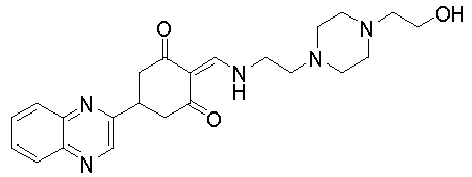
2-(((2-(4-(2-hydroxyethyl)piperazin-1-yl) ethyl) amino) methylene) -5-(quinoxalin-2-yl)cyclohexane-1,3-dione 1HNMR (CD3OD, 400MHz): δ 8.89 (s, 1H), 8.24 (s, 1H), 8.07-8.05 (m, 2H), 7.83-7.76 (m, 2H), 3.93-3.88 (m, 1H), 3.67-3.57 (m, 2H), 3.30-3.28 (m, 2H), 3.11-2.91 (m, 2H), 2.88-2.81 (m, 2H), 2.61-2.50 (m, 12H). 89 
2-(((2-(4-(2-hydroxyethyl)piperazin-1-yl) ethyl) amino) methylene) -5-(6-(2-morpholinoethoxy)pyridin-3-yl)cyclohexane-1,3-dione 1HNMR (400 MHz, CD3OD) δ 8.25 (s, 1H), 7.57 (d, J = 9.2 Hz, 1H), 7.52 (s, 1H), 6.53 (d, J = 9.3 Hz, 1H), 4.09 (t, J = 6.4 Hz, 2H), 3.72 (t, J = 5.5 Hz, 2H), 3.67 - 3.56 (m, 6H), 3.26 - 3.17 (m, 1H), 2.93 - 2.43 (m, 22H); MS: 502.3 [M+1] 90 
2-(((2-(4-(2-hydroxyethyl)piperazin-1-yl) ethyl) amino) methylene) -5-(pyrimidin-5-yl)cyclohexane-1,3-dione 1HNMR (400 MHz, DMSO-J6) δ 10.97 (dd, J = 7.9, 6.7 Hz, 1H), 9.07 (s, 1H), 8.80 (s, 2H), 8.15 (d, J = 14.7 Hz, 1H), 4.35 (t, J = 5.3 Hz, 1H), 3.57 (d, J = 5.7 Hz, 2H), 3.53 - 3.35 (m, 3H), 2.93 - 2.67 (m, 2H), 2.65 - 2.23 (m, 14H); MS: 374.2 [M+1]. 91 
2-(((2-(4-(2-hydroxyethyl)piperazin-1-yl) ethyl) amino) methylene) -5-(2-morpholinopyrimidin-5-yl)cyclohexane-1,3-dione 1HNMR (400 MHz, CD3OD) δ 8.29 (s, 2H), 8.23 (s, 1H), 3.67 (t, J = 6.1 Hz, 11H), 3.59 (t, J = 5.9 Hz, 2H), 2.95 - 2.45 (m, 16H); MS: 459.3 [M+1]. 92 
2-(((2-(4-(2-hydroxyethyl)piperazin-1-yl)ethyl)amino)methylene) -5-(4-(morpholino)phenyl)cycloh exane-1,3-dione 1HNMR (400 MHz, CD3OD) δ 8.32 (s, 1H), 7.80 (d, J = 8.3 Hz, 2H), 7.64 (d, J = 8.4 Hz, 2H), 3.83 (t, J = 5.6 Hz, 2H), 3.77 - 3.72 (m, 4H), 3.67 (t, J = 5.8 Hz, 2H), 3.63 - 3.51 (m, 1H), 3.05 - 2.97 (m, 6H), 2.97 - 2.67 (m, 14H); MS: 521.3 [M+1]. 93 
2-(((2-(4-(2-hydroxyethyl)piperazin-1-yl) ethyl) amino) methylene) -5-(1H-indazol-4-yl)cyclohexane-1,3-dione 1H NMR (400 MHz, CD3OD) δ 8.32 (s, 1H), 8.23 (s, 1H), 7.47 (d, J = 8.4 Hz, 1H), 7.41 - 7.33 (m, 1H), 7.06 (d, J = 7.1 Hz, 1H), 3.92 (t, J = 11.0 Hz, 1H), 3.82 (t, J = 5.4 Hz, 2H), 3.66 (t, J = 5.7 Hz, 2H), 3.17 - 2.62 (m, 16H); MS: 412.4 [M+1]. 94 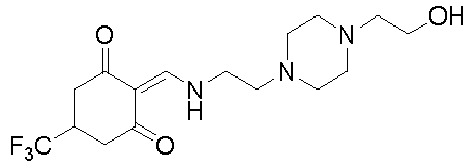
2-(((2-(4-(2-hydroxyethyl)piperazin-1-yl) ethyl) amino) methylene) -5-(trifluoromethyl)cyclohexa ne-1,3-dione 1H NMR (400 MHz, CD3OD) δ 8.22 (s, 1H), 3.69 (t, J = 5.9 Hz, 2H), 3.59 (t, J = 5.8 Hz, 2H), 3.02 (d, J = 8.2 Hz, 1H), 2.77 - 2.51 (m, 16H); MS: 364.0 [M+1]. -

- 4-bromobenzenesulfonyl chloride (5.0 g, 19.6 mmol), triethylamine (TEA) (2.98 mL) and morpholine (1.88 g, 21.53 mmol) were dissolved in DCM (50 mL) and reacted at RT for 30 min. After the reaction was completed, the reaction mixture was poured into water and extracted with DCM. The combined organic phase was washed with 1N HCl, water, brine, dried and concentrated to give 5.21 g of the desired product, which can be directly used in next step without further purification.
- Under the protection of nitrogen atmosphere, 4-((4-bromophenyl)sulfonyl)morpholine (2.0 g, 6.53 mmol), ethyl acrylate (849 mg, 8.49 mmol), Pd(OAc)2 (43.88 mg, 0.2 mmol) and PPh3 (68.89 mg, 0.26 mmol) were added in TEA (3 mL) and stirred at 150 °C for 6 hours in sealed tube. The reaction mixture was cooled, poured into ice-water and extracted with EA. The combined organic phase was dried with Na2SO4 and concentrated. The crude product was separated by column chromatography to give the desired product (1.8 g, yield 85%).
-

- t-BuONa (3.49g, 36.3mmol) was added to ethane-1,2-diol (30 mL) at RT. After stirring for 30 min, 6-chloronicotinaldehyde (4.0 g, 28.3mmol) was added and the resulting mixture was stirred at RT overnight, then it was heated to 80°C and stirred for additional 2 hours. After the reaction was completed, the reaction mixture was cooled to RT, poured into ice-water and extracted with EA. The organic phase was washed with water, dried and concentrated. The crude product was separated by column chromatography to give the desired product (4.01g, yield 85%).
- 6-(2-hydroxyethoxy)nicotinaldehyde (4.0 g, 24 mmol) and TEA (4.0 mL) were added into DCM (90 mL), then MsCl (3.66 g, 32 mmol) in dichloromethane solution was added dropwise at 0°C. After the addition, the resulting mixture was stirred at 0°C for 30 min. After the reaction was completed, the reaction solution was poured into water and extracted with EA. The combined organic phase was dried with Na2SO4 and concentrated to give 5.21 g of the desired product, which can be directly used in next step without further purification.
- 2-((5-formylpyridin-2-yl)oxy)ethyl methanesulfonate (5.21 g, crude), morpholine (4.35 g, 50 mmol) and K2CO3 (6.91 g, 50 mmol) were added into CH3CN (80 mL), then refluxed and reacted overnight. The reaction mixture was cooled, poured into ice-water and extracted with EA. The organic phase was dried with Na2SO4 and concentrated. The crude product was separated by column chromatography to give the desired product (2.92g, yield 51%).
-
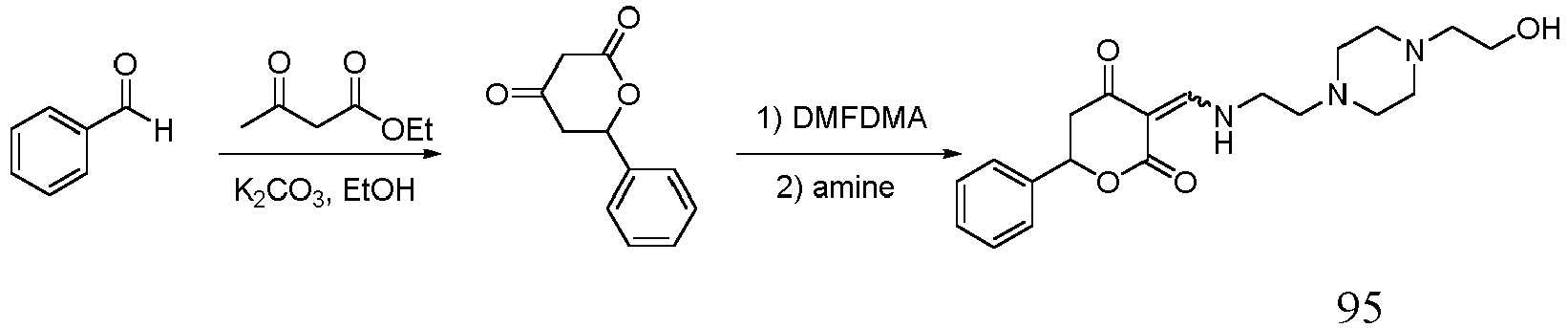
- Ethyl acetoacetate (13.01 g, 0.1 mol), K2CO3 (27.64 g, 0.2 mol) and benzaldehyde (10.1 mL, 0.1 mol) were dissolved in EtOH (100 mL) and stirred at 45 °C for 22 hrs, then it was filtered and the residue was washed with EtOH. The collected filtrate was poured into water and washed with PE. The aqueous phase was collected, acidified to pH 2-3 by 6N HCl and extracted with EA. The organic phase was washed with water, dried with Na2SO4 and concentrated. The crude product was separated and purified by column chromatography to give the desired product (8.87 g, yield 46.7%).
- The synthesis procedure was the same as example 2. Compound 95: 1HNMR (400 MHz, CD3OD) δ 8.31 (s, 0.33H), 8.18 (s, 0.67H), 7.46-7.32 (m, 5H), 5.53 (dd, J = 7.2 Hz, 2.4Hz, 1H), 3.68 (t, J = 6.0Hz, 2H), 3.61-3.58 (m, 2H), 2.98-2.86 (m, 1H), 2.72-2.54 (m, 14H); MS: 374.4 [M+1].
-


- Ethyl 3-amino-3-phenylpropanoate (4.31g, 22.23mmol), 3-ethoxy-3-oxopropanoic acid (4.47 g, 33.84 mmol), DIPEA (7.7 g, 55.8 mmol) and (benzotriazol-1-yloxy)tripyrrolidinophosphonium hexafluorophosphate (PyBOP) (17.42 g, 33.84 mmol) were added into DMF (30 mL) and reacted at RT for 2hours. After the reaction was completed, the reaction mixture was poured into water and extracted with EA. The organic phase was dried with Na2SO4 and concentrated. The crude product was separated by column chromatography to give the desired product (6.05 g, yield 88%).
- The solution of compound ethyl 3-((3-ethoxy-3-oxo-1-phenylpropyl)amino)-3-oxopropanoate (2.0 g, 6.51 mmol) in toluene (16 mL) was added dropwise at 0 °C into the solution of EtONa (0.66 g, 9.77 mmol) in anhydrous EtOH (16 mL), then refluxed and reacted for 1 hour. After the reaction was completed, the reaction mixture was poured into water, adjusted to pH 1-2 and extracted with EA. The organic phase was washed with water and brine, then dried and concentrated. The resulting residue was dissolved in the mixed solvent of CH3CN/H2O (v/v=100:1, 16 mL) and refluxed overnight. After the reaction was completed, the reaction mixture was cooled to RT, poured into ice-water and extracted with EA. The organic phase was washed with water, dried with Na2SO4 and concentrated. The resulting crude product was separated and purified by column chromatography to give the desired product (622 mg, yield 50%). Compound 96: 1HNMR (400 MHz, CD3OD) δ 8.09 (s, 0.3H), 8.04 (s, 0.7H), 7.34-7.24 (m, 5H), 4.75-4.72 (m, 1H), 3.72 (t, J =5.6Hz, 2H), 3.55-3.52 (m, 2H), 2.87-2.57 (m, 15H), MS: 373.3 [M+1].
-

- Phenylamine (5.0 g, 53.69 mmol), ethyl bromoacetate (10.76 g, 64.43 mmol) and NaOAc (5.29 g, 64.43 mmol) were dissolved in anhydrous EtOH (120 mL), refluxed and reacted for 2 hours. After the reaction was completed, the reaction mixture was concentrated. The crude product was separated and purified by column chromatography to give the desired product (7.4 g, yield 77%).
- Ethyl phenylglycinate (2.30 g, 12.83 mmol), 1-bromopropan-2-one (2.11 g, 25.67 mmol) and DIPEA (4.57 mL, 25.67 mmol) were added into DMF (50 mL) and reacted at 110 °C for 4 hours, then 1-bromopropan-2-one (1.06 g, 12.8 mmol) was additionally added and further reacted at 110 °C for 4 hours. The reaction mixture was cooled to RT, poured into water and extracted with EA. The combined organic phase was dried with Na2SO4 and concentrated. The crude product was separated by column chromatography to give the desired product (1.30 g, yield 43%).
- The solution of t-BuOK in THF (2 mol/L, 3.8 mL) was added dropwise at 0 °C into the solution of compound ethyl N-(2-oxopropyl)-N-phenylglycinate (1.2 g, 5.1 mmol) in anhydrous THF (50mL). The above reaction solution was stirred at room temperature for 3 hours. After the reaction was completed, the reaction mixture was added dropwise with 20% HOAc to quench the reaction, then poured into ice-water and extracted with EA. The organic phase was dried with Na2SO4. The crude product was separated by column chromatography to give the desired product (600 mg, yield 62%).
- The operation procedures were the same as example 2. Compound 97: 1HNMR (400 MHz, CD3OD) δ 8.22 (s, 1H), 7.26 (t, J = 8.0 Hz, 2H), 6.98 (d, J = 8.0 Hz, 2H), 6.88 (t, J = 7.3 Hz, 1H), 4.03 (d, J = 10.9 Hz, 4H), 3.75 (t, J = 5.8 Hz, 2H), 3.61 (t, J = 5.7 Hz, 2H), 2.66 (dd, J = 23.9, 18.2 Hz, 12H); MS: 373.3 [M+1].
-

- Phenylamine (2.8 g, 30 mmol) and ethyl acrylate (3.6 g, 36 mmol) were dissolved in HOAc (2 mL), reacted at 95 °C overnight. After the reaction was completed, the reaction mixture was cooled to RT, poured into ice-water, adjusted pH to 9-10 with saturated Na2CO3 solution and extracted with EA. The organic phase was washed with water, dried and concentrated. The crude product was separated by column chromatography to give the desired product (5.3 g, yield 91%).
- Ethyl 3-(phenylamino)propanoate (5.3 g, 27.4 mmol), ethyl 3-chloro-3-oxopropanoate (5.35g, 35.6mmol) and DIPEA (7.09 g, 54.8 mmol) were dissolved in DCM (35 mL), reacted at RT for 1 hour. After the reaction was completed, the reaction mixture was poured into ice-water and extracted with EA. The organic phase was washed with water, dried and concentrated. The crude product was separated by column chromatography to give the desired product (2.1 g, yield 25%).
- The compound ethyl 3-((3-ethoxy-3-oxopropyl)(phenyl)amino)-3-oxopropanoate (2.00 g, 6.5 mmol) and EtONa (0.88g, 13mmol) were dissolved in anhydrous EtOH (15 mL), reacted at RT for 2 hours. After the reaction was completed, the reaction mixture was poured into ice-water and the aqueous phase was adjusted to pH 3-4 by 2N HCl and extracted with EA. The organic phase was washed with water, dried with Na2SO4 and concentrated. The crude product was separated and purified by column chromatography to give the desired product (780 mg, yield 46%).
- The aqueous solution (7 mL) of ethyl 2,4-dioxo-1-phenylpiperidine-3-carboxylate (780 mg, 3.0 mmol) and HOAc (0.7 mL) was reacted at 90 °C for 18 hours. After the reaction was completed, the reaction mixture was poured into ice-water and extracted with EA. The organic phase was washed with water, dried and concentrated. The crude product was separated by column chromatography to give the desired product (510 mg, yield 90%).
- The operation procedures in this step were the same as Example 2. Compound 99: 1H NMR (400 MHz, CD3OD) δ 8.13 (d, J = 7.1 Hz, 1H), 7.48 - 7.33 (m, 2H), 7.34 - 7.15 (m, 3H), 3.90 - 3.72 (m, 2H), 3.71 - 3.61 (m, 2H), 3.60 - 3.46 (m, 2H), 2.83 - 2.38 (m, 14H); MS: 373.3 [M+1].
-

- The compound 1-(4-fluorophenyl)propan-2-one (2.0g, 13.14mmol), ethyl acrylate (1.45g, 14.46mmol) and EtONa (893.5mg, 13.14mmol) were dissolved in anhydrous EtOH (20mL), refluxed and reacted overnight. After the reaction was completed, the reaction mixture was cooled to RT and poured into ice-water, then adjusted to pH 3-4 with 2N HCl and extracted with EA. The organic phase was washed with water, dried with Na2SO4 and concentrated. The crude product was separated and purified by column chromatography to give the desired product (620 mg, yield 23%).
- The operation procedures were the same as Example 2.. Compound 100: 1H NMR (400 MHz, CD3OD) δ 8.30 (d, J = 8.8 Hz, 1H), 7.28 - 7.16 (m, 2H), 7.06 (t, J = 8.0 Hz, 2H), 3.81 - 3.66 (m, 3H), 3.62 (t, J = 5.8 Hz, 2H), 2.86 - 2.43 (m, 14H), 2.27 - 2.15 (m, 2H). MS: 390.4 [M+1].
-

- Under the protection of nitrogen atmosphere, t-BuOK (1.61g, 14.3 mmol) was added at 0 °C into a solution of 4-phenylbutan-2-one (2.5mL, 15.5mmol) in anhydrous THF (20 mL). After stirring for 10 min, methyl cinnamate (2.0 g, 12.3 mmol) was added, then keep stirring for 30 min. After the reaction was completed, the reaction mixture was poured into water, adjusted to pH 6-7 with 2N HCl and extracted with EA. The organic phase was dried and concentrated to give 3.61 g of the desired product, which can be directly used in the following reactions.
- The operation procedures were the same as Example 2. Compound 101: 1H NMR (400 MHz, CD3OD) δ 8.24 (d, J = 5.6 Hz, 1H), 7.39 - 6.98 (m, 9H), 6.91 (d, J = 7.4 Hz, 1H), 3.72 (t, J = 5.8 Hz, 2H), 3.60 (t, J = 5.7 Hz, 2H), 3.46-3.40 (m, 1H), 3.24 - 3.01 (m, 3H), 2.95 - 2.56 (m, 13H), 2.49 (dd, J = 13.8, 7.6 Hz, 1H); MS: 462.3 [M+1].
-

- The solution of ethyl 2-bromoacetate (5.00 g, 29.94 mmol) in anhydrous THF (20 mL) was added dropwise at RT into the solution of (4-methoxyphenyl)methanamine (9.04 g, 66 mmol) in anhydrous THF (120 mL), reacted at RT overnight. After the reaction was completed, the reaction mixture was poured into water, adjusted to pH 9-10 with saturated NaHCO3 and extracted with EA. The organic phase was washed with water, dried with Na2SO4 and concentrated. The crude product was separated and purified by column chromatography to give the desired product (3.12 g, yield 47%).
- Ethyl (4-methoxybenzyl)glycinate (3g, 13.44 mmol), 1-bromopropan-2-one (7.36g, 53.75 mmol) and NaHCO3 (2.26g, 26.87 mmol) were added into anhydrous EtOH (50 mL), heated to reflux for 4 hours. The reaction mixture was cooled to RT and concentrated. The crude product was separated by column chromatography to give the desired product (700 mg, yield 19%).
- The solution of t-BuOK in THF (1 mol/L, 4 mL) was added dropwise at 0°C into the solution of ethyl N-(4-methoxybenzyl)-N-(2-oxopropyl)glycinate (700 mg, 2.51 mmol) in anhydrous THF (30 ml), reacted at RT for 3 hours. After the reaction was completed, the reaction solution was poured into 10% aqueous HOAc solution and extracted with EA. The organic phase was dried with Na2SO4 and concentrated. The crude product was separated by column chromatography to give the desired product (220 mg, yield 38%).
- The operation procedures were the same as Example 2. Compound 102: 1H NMR (400 MHz, CD3OD) δ 8.19 (s, 1H), 7.24 (d, J = 8.2 Hz, 2H), 6.89 (d, J = 8.3 Hz, 2H), 3.86 - 3.73 (m, 5H), 3.60 (s, 4H), 3.31 (s, 2H), 3.14 (d, J = 33.6 Hz, 8H), 2.72 (m, 6H); MS: 417.4 [M+1].
-

- Compound 103 was prepared by the same procedures as Example 22 (Compound 102) except for using BnNH2. Compound 103: 1H NMR (400 MHz, CD3OD) δ 8.22 (s, 1H), 7.40 - 7.26 (m, 5H), 3.72 (t, J = 5.9 Hz, 2H), 3.69 (s, 2H), 3.62 (t, J = 5.8 Hz, 2H), 3.34(s, 2H), 3.23 (d, J = 6.6 Hz, 1H), 2.80 - 2.54 (m, 10H); MS: 387.4 [M+1].
-

- Ethyl N-benzyl-N-(2-oxopropyl)glycinate (4.00 g, 16.04 mmol), 10% Pd/C (500 mg) and HCl (5mL) were dissolved in EtOH (100 mL) to replace hydrogen gas, then reacted at RT for 4 hours. After the reaction was completed, Pd/C was removed by filtration and the filtrated residue was washed with EtOH. The filtrate was collected and concentrated to give 3.4 g of the desired product, which can be directly used in next step.
- TEA (4 mL, 29 mmol) was added at RT into the solution of ethyl (2-oxopropyl)glycinate hydrochloride salt (2.78 g, crude) in DCM (100 mL), followed by adding PhCOCl (1.65 mL, 14.23 mmol) to the above mixed solution, then reacted at RT for 4 hours. After the reaction was completed, the reaction mixture was poured into water and extracted with DCM. The organic phase was washed with water, dried with Na2SO4 and concentrated. The crude product was separated and purified by column chromatography to give the desired product (1.92 g, yield 56%).
- The solution of t-BuOK in THF (1 mol/L, 11 mL) was added dropwise at 0 °C into the solution of ethyl N-benzoyl-N-(2-oxopropyl)glycinate (1.90 g, 7.22 mmol)in anhydrous THF (60 mL), reacting at RT for 3 hours. After the reaction was completed, the reaction solution was poured into 10% aqueous HOAc solution and extracted with EA. The organic phase was dried with Na2SO4 and concentrated. The crude product was separated by column chromatography to give the desired product (1.03 g, yield 66%).
- The operation procedures in the final step were the same as Example 8. Compound 104: 1H NMR (400 MHz, CD3OD) δ 8.25 (s, 1H), 7.57 - 7.45 (m, 3H), 7.42 (dd, J = 8.0, 1.5 Hz, 2H), 4.47 (s, 2H), 4.18 (s, 2H), 3.73 (t, J = 5.8 Hz, 2H), 3.62 (t, J = 5.8 Hz, 2H), 2.83 - 2.58 (m, 12H); MS: 401.4 [M+1].
-

- The compounds 3,5-dioxocyclohexane-1-carboxylic acid (780 mg, 5 mmol) and TsOH-H2O (95 mg, 0.5 mmol) were dissolved in MeOH (6 mL), then refluxed and reacted for 2 hours. After the reaction was completed, the reaction mixture was cooled to RT and added with EA, then precipitated and filtrated to give 420 mg of crude product, which was directly used in next step without further purification.
- 3-methoxy-5-oxocyclohex-3-ene-1-carboxylic acid (340 mg, crude), morpholine (310 mg, 2.4 mmol), DIPEA (390mg, 3 mmol) and HATU (1.14 g, 3 mmol) were added into anhydrous DMF (12 mL), stirring at RT overnight. After the reaction was completed, the reaction mixture was poured into water and extracted with EA. The organic phase was dried with Na2SO4 and concentrated. The crude product was separated by column chromatography to give the desired product (140 mg, yield 15%).
- 3-methoxy-5-(morpholine-4-carbonyl)cyclohex-2-en-1-one (132 mg, 0.55 mmol) and ceric ammonium nitrate (110 mg, 0.2 mmol) were added into acetonitrile(4 mL) and water (4 mL), then heated to reflux for 3 hours. After the reaction was completed, the reaction solution was cooled to RT, poured into water and extracted with EA. The combined organic phase was dried with Na2SO4 and concentrated. The crude product was separated by column chromatography to give the desired product (112mg, yield 90%).
- The operation procedures were the same as Example 2. Compound 106: 1H NMR (400 MHz, CD3OD) δ 8.19 (s, 1H), 3.75 (t, J = 5.7 Hz, 2H), 3.65 (dd, J = 13.9, 4.5 Hz, 4H), 3.61 - 3.47 (m, 7H), 2.88 (s, 3H), 2.81 (t, J = 5.8 Hz, 2H), 2.75 - 2.42 (m, 10H).
-

- Methyl 3-chloro-3-oxopropanoate (1.84 g, 13.5 mmol) was added dropwise at 0 °C into the solution of phenylamine (1.00 g, 10.74 mmol) and TEA (1.42 g, 14 mmol) in EtOAc, stirred at RT for 30 min, After the reaction was completed, the reaction mixture was poured into water and extracted with EA. The organic phase was washed with water, dried with Na2SO4 and concentrated. The crude product was separated by column chromatograph to give the desired product (1.75 g, yield 85%).
- The mixed solution of methyl 3-oxo-3-(phenylamino)propanoate (1.00 g, 5.18 mmol) and NaOH (415 mg, 10.37 mmol) in MeOH/H2O (v/v=3/1, 20 mL) was stirred at RT for 1hour. After the reaction was completed, the reaction mixture was poured into water and extracted with EA. The aqueous phase was adjusted to pH 5-6 and extracted with DCM. The combined organic phase was washed with water, dried with Na2SO4 and concentrated to give 820 mg of the crude product, which was directly used in next step.
- 3-oxo-3-(phenylamino)propanoic acid (537mg, crude) was added into MeSO3H (6 mL) and heated to 50 °C, then P2O5 (852 mg) was added portionwise. The reaction solution was then heated to 75 °C and stirred for 2 hours. After cooling to RT, the reaction mixture was carefully poured into ice-water, the aqueous phase was adjusted to pH 7-8 with aq Na2CO3. The precipitated solid was collected by filtration and concentrated to give the crude product (220 mg, yield 40%), which can be directly used in next step without further purification.
- The operation procedures were the same as Example 2. Compound 107: 1H NMR (400 MHz, CD3OD) δ 8.57 (d, J = 36.5 Hz, 1H), 8.04 (d, J = 7.5 Hz, 1H), 7.53 (t, J = 6.9 Hz, 1H), 7.16 (t, J = 8.7 Hz, 2H), 3.73 (m, 4H), 2.69 (m, 11H).
-

- Acetyl chloride (4.2 g, 53.5 mmol) was added dropwise at RT into the mixture of 5-phenylcyclohexane-1,3-dione (10.0 g, 53.1 mmol), DMAP (2.00 g, 16.4 mmol) and DIPEA (7.75 g, 60 mmol), then refluxed to react for 2 hours. After the reaction was completed, the reaction mixture was cooled to RT, poured into ice-water and extracted with DCM. The organic phase was washed with water, dried with Na2SO4 and concentrated. The crude product was separated and purified by column chromatography to give the desired product (8.51 g, yield 70%).
- 2-acetyl-5-phenylcyclohexane-1,3-dione (90mg, 0.39mmol) and 2-(4-(2-aminoethyl)piperazin-1-yl)ethan-1-ol (81 mg, 0.47 mmol) were dissolved in EtOH (5 mL), then heated to reflux for 1 hour, cooled and concentrated. The crude product was separated by preparation plate to give the desired product (80 mg, yield 44%). Compound 108: 1H NMR (400 MHz, DMSO-d6) δ 13.18 (s, 1H), 7.37 - 7.26 (m, 4H), 7.26 - 7.19 (m, 1H), 5.00 (s, 1H), 3.68 (s, 2H), 3.57 (d, J = 5.4 Hz, 2H), 3.31 - 3.18 (m, 2H), 2.91 (s, 4H), 2.77 - 2.58 (m, 7H), 2.56 (d, J = 4.1 Hz, 2H), 2.53 (s, 3H).
- Compounds 109-112 were synthesized by the same procedures as Compound 107, as shown in Table 6.
Table 6: Compounds 109-112 # Structure Name Proton NMR (1HNMR), Mass Spectrum (MS) 109 
2-(2,6-dioxo-4-phenylcyclohexylidene) -2((2-(4-(2-hydroxy ethyl) piperazin-1-yl)ethyl )amino)ethyl acetate 1HNMR (400 MHz, DMSO-d6) δ 13.13 (s, 1H), 7.29 (s, 4H), 7.20 (s, 1H), 5.33 (s, 2H), 4.82 (s, 1H), 3.60 (d, J = 5.0 Hz, 4H), 3.24 (d, J = 11.9 Hz, 2H), 2.98 - 2.66 (m, 8H), 2.66 - 2.52 (m, 7H), 2.04 (s, 3H). 110 
2-(((2-(4-(2-hydroxyethyl) piperazin-1-yl) ethyl) amino) (phenyl) met hylene)-5-phenylcyclohexane-1,3-dione 1HNMR (400 MHz, DMSO-d6) δ 13.07 (s, 1H), 7.42 (m, 3H), 7.31 (m, 4H), 7.26 - 7.14 (m, 3H), 4.91 (s, 1H), 3.62 (s, 2H), 3.32 (m, 5H), 3.12 - 2.57 (m, 10H), 2.43 (m, 4H). 111 
2-(5-hydroxy-3-oxo-1,2,3,6-tetrahydro-[1,1'-biphenyl]-4-yl)-2-oxoethyl acetate 1HNMR (DMSO-d6) δ 16.58(s, 1H), 7.22-7.34 (m, 5H), 5.20 (s, 2H), 3.32-3.46 (m, 1H), 2.68-3.10 (m, 4H), 2.11 (s, 3H); LCMS: 289.1 [M+1]. 112 
2-(hydroacetyl)-5-pheylcyclohexane-1,3-dione 1HNMR (CD3OD) δ 7.24-7.36 (m, 6H), 4.73 (s, 2H), 3.35-3.44 (m, 1H), 2.66-2.95 (m, 4H); LCMS: 247.2 [M+1]. -

- 2-bromobenzaldehyde (2.0 g, 10.8 mmol), ethyl 2-(diethoxyphosphoryl)acetate (2.66 g, 11.9 mmol) and LiOH (285 mg, 11.9 mmol) were dissolved in anhydrous THF solution (14 mL), reacted at RT for 3.5 hours. After the reaction was completed, the reaction mixture was poured into ice-water and extracted with DCM. The organic phase was washed with water, dried with Na2SO4 and concentrated. The crude product was separated and purified by column chromatography to give the desired product (2.59 g, yield 94%).
- Under the protection of nitrogen atmosphere, the compound ethyl 3-(2-bromophenyl)acrylate (1.00 g, 3.92 mmol), pent-4-en-2-ol (843 mg, 9.8 mmol), Pd(OAc)2 (44 mg, 0.2 mmol), DIPEA (4.00 g, 31 mmol) and LiCl (167mg, 3.94 mmol) were dissolved in anhydrous DMF solution (100 mL), reacted at 80 °C for 48 hours. After the reaction was completed, the reaction mixture was cooled to RT, poured into ice-water and extracted with t-BuOMe. The organic phase was washed with water, dried with Na2SO4 and concentrated. The crude product was separated and purified by column chromatography to give the desired product (612 mg, yield 60%).
- Ethyl 3-(2-(4-oxopentyl)phenyl)acrylate (195 mg, 0.75 mmol) and NaH (60%, 100 mg, 2.5 mmol) were dissolved in anhydrous THF solution (12 mL), reacted at RT overnight. After the reaction was completed, the reaction mixture was carefully poured into 1N HCl (20 mL) at 0 °C and extracted with EA. The organic phase was washed with water, dried with Na2SO4 and concentrated. The crude product was separated and purified by column chromatography to give the desired product (74 mg, yield 46%).
- The operation procedures were the same as Example 2. Compound 113: 1H NMR (400 MHz, CD3OD) δ 8.26 (s, 1H), 7.30 (d, J = 7.6 Hz, 1H), 7.13 (m, 3H), 3.88 - 3.77 (m, 2H), 3.63 (t, J = 5.7 Hz, 2H), 3.28 - 2.72 (m, 12H), 2.72 - 2.64 (m, 2H), 2.61 - 2.35 (m, 3H), 1.62 - 1.47 (m, 1H).
-

- 5-((3AR, 4R, 6R, 6AR)-2,2-dimethyl-6-(6-morpholino-9H-purin-9-yl)tetrahydrofuro[3,4-D][1,3]dioxol-4-yl)-2-(((2-(4-(2-hydroxyethyl)piperazin-1-yl)ethyl)amino)methylene)cyclohexane-1,3-dione (120 mg, 0.187 mmol) was dissolved in HCO2H (1 mL) and water (1 mL), reacted at 50 °C for 4 hours. After the reaction was completed, the reaction mixture was cooled to RT and poured into ice-water, then adjusted to pH 9-10 and extracted with DCM. The organic phase was dried with Na2SO4 and concentrated. The crude product was separated by preparation plate to give the desired product (73 mg, yield 65%). Compound 114: 1H NMR (400 MHz, CD3OD) δ 8.24 (s, 1H), 8.19 (s, 1H), 8.15 (s, 1H), 5.94 (d, J = 4.9 Hz, 1H), 4.72 (t, J = 5.3 Hz, 1H), 4.38 (s, 1H), 4.26 (s, 4H), 3.88 (t, J = 5.7 Hz, 1H), 3.82 - 3.75 (m, 4H), 3.70 (t, J = 5.9 Hz, 2H), 3.57 (t, J = 5.8 Hz, 2H), 2.71 - 2.36 (m, 17H).
-

- Under the protection of nitrogen atmosphere, LDA (1 mol/L THF solution, 5 mL, 5 mmol) was added dropwise at -60 °C into a solution of 3-ethoxycyclopent-2-en-1-one (500 mg, 4 mmol) in anhydrous THF (15 mL), the mixture was stirred at this temperature for 30 min and then added with BnBr (855 mg, 5 mmol) to further react for 3 hrs. After the reaction was completed, the reaction mixture was poured into saturated NH4Cl aqueous solution and extracted with DCM. The organic phase was washed with water, dried with Na2SO4 and concentrated. The crude product was separated and purified by column chromatography to give the desired product (540 mg, yield 63%).
- 5-benzyl-3-ethoxycyclopent-2-en-1-one (300mg, 1.38mmol) and CAN (152mg, 0.27mmol) were added into CH3CN (5 mL) and water (5 mL), then heated to reflux for 4 hours. After the reaction was completed, the reaction mixture was cooled to RT, poured into water and extracted with DCM. The organic phase was dried and concentrated. The crude product was separated by column chromatography to give the desired product (160 mg, yield 62%).
- The operation procedures were the same as Example 2. Compound 115: 1H NMR (400 MHz, CD3OD) δ 7.86 (s, 1H), 7.27-7.17 (m, 5H), 3.71 (t, J = 6.0Hz, 2H), 3.59 (t, J = 6.0Hz, 2H), 3.18-3.14 (m, 1H), 2.94-2.88 (m, 1H), 2.74-2.60 (m, 13H), 2.51-2.45 (m, 1H), 2.24-2.18 (m, 1H); MS: 372.2 [M+1].
-

- Under the protection of nitrogen atmosphere, t-BuOK (831mg, 7.4mmol) was added portionwise to butan-2-one (5mL) at 0 °C. After stirring at this temperature for 10min, methyl cinnamate (1.00g, 6.17 mmol) was added. The reaction mixture was heated to RT to react for 30 min. After the reaction was completed, the reaction mixture was poured into ice-water, adjusted to pH 7 with 1N HCl, and extracted with EA. The organic phase was washed with water, dried and concentrated. The crude product was separated by column chromatography to give the desired product (510 mg, yield 41%).
- The operation procedures were the same as Example 2. Compound 116: 1H NMR (400 MHz, CD3OD) δ 8.35 - 8.13 (m, 1H), 7.44 - 7.08 (m, 5H), 3.67 (t, J = 6.0 Hz, 2H), 3.63 - 3.55 (m, 2H), 3.06 - 2.43 (m, 16H), 0.97 (dd, J = 12.6, 6.6 Hz, 3H); MS: 386.2 [M+1].
-

- The mixture of 3-phenylpentanedioic acid (5.0 g, 24 mmol) and urea (25 g) was reacted at 160°C for 3 hours. After the reaction was completed, the reaction mixture was carefully poured into ice-water and extracted with EA. The organic phase was washed with water, dried with Na2SO4 and concentrated. The crude product was separated by column chromatography to give the desired product (3.6 g, yield 79%).
- The mixture of 4-phenylpiperidine-2,6-dione (800 mg, 4.22mmol) and 35% HCHO solution (10mL) was heated to 100°C until all solids were dissolved. After the reaction was completed, the reaction mixture was cooled to RT, poured into water and extracted with EA. The combined organic phase was dried with Na2SO4 and concentrated. The crude product was separated by column chromatography to give the desired product (513 mg, yield 55%). Compound 117: 1HNMR (DMSO-d6) δ 7.31-7.34(m, 5H), 6.10(t, J =7.6Hz, 1H), 5.06(d, J =7.6Hz, 2H), 3.41-3.33(m, 1H), 2.97-2.90(m, 2H), 2.82-2.77(m, 2H); MS: 220.1 [M+1].
- Example 34: Synthesis of compounds 119-129, 131-143, 145-150, 155-156, 158, 160-165, 169-180, 182-197, 200-233, 236-243, 245-260, 262-274, 276-291, 293-311, 315, 317-318, 320-347 and 349-414.
- The compounds listed below were synthesized by the same procedures as the compounds above (e.g., Compound 8) except for using corresponding substituted cyclohexane-1,3-dione, or other similar compounds having active methylene (e.g., Example 9-1), as shown in Table 7.
Table 7: Compounds 119-355 # Structure Name Proton NMR(1HNMR), Mass Spectrum( MS) 119 
2-(((2-(dimethylamino)ethyl)ami no)methylene)-5-phenylcyclohexane-1,3-dione 1H NMR (400 MHz, CDCl3) δ 11.20 (s, 1H), 8.17 (d, J = 14.3 Hz, 1H), 7.34 (t, J = 7.5 Hz, 2H), 7.23 (d, J = 8.3 Hz, 3H), 3.51 (q, J = 6.1 Hz, 2H), 3.36 (ddd, J = 15.7, 10.4, 5.1 Hz, 1H), 2.80 - 2.60 (m, 4H), 2.55 (t, J = 6.2 Hz, 2H), 2.29 (s, 6H). 120 
2-(((2-(diethylamino)ethyl)amino )methylene)-5-phenylcyclohexane-1,3-dione 1H NMR (400 MHz, CDCl3) δ 11.19 (s, 1H), 8.17 (d, J = 14.4 Hz, 1H), 7.33 (t, J = 7.6 Hz, 2H), 7.23 (d, J = 8.0 Hz, 3H), 3.48 (q, J = 6.0 Hz, 2H), 3.36 (ddd, J = 15.7, 10.3, 5.1 Hz, 1H), 2.80 - 2.52 (m, 10H), 1.04 (t, J = 7.1 Hz, 6H). 121 
((2,6-dioxo-4-phenylcyclohexylidene)me thyl)-L-alanine 1H NMR (400 MHz, DMSO-d6) δ 11.34 (s, 1H), 9.35 (s, 1H), 8.07 (s, 1H), 7.35 - 7.24 (m, 4H), 7.20 (dd, J = 8.1, 3.8 Hz, 1H), 3.93 (q, J = 6.8 Hz, 1H), 3.34 - 3.22 (m, 1H), 2.77 - 2.58 (m, 2H), 2.47 - 2.40 (m, 2H), 1.32 (d, J = 7.1 Hz, 3H). 122 
benzyl ((2,6-dioxo-4-phenylcyclohexylidene)me thyl)-L-alaninate 1HNMR (400 MHz, DMSO-d6) δ 11.27 - 11.19 (m, 1H), 8.21 (d, J = 14.1 Hz, 1H), 7.48 - 7.26 (m, 9H), 7.22 (dt, J = 8.5, 4.1 Hz, 1H), 5.22 (d, J = 13.0 Hz, 2H), 4.79 - 4.69 (m, 1H), 2.84 - 2.68 (m, 2H), 2.60 - 2.51 (m, 2H), 1.50 (d, J = 7.2 Hz, 3H). 123 
((2,6-dioxo-4-phenylcyclohexylidene)me thyl)phenylalanine 1HNMR (400 MHz, CD3OD) δ 7.87 (d, J = 5.7 Hz, 1H), 7.34 - 7.15 (m, 10H), 4.60 - 4.52 (m, 1H), 3.39 - 3.31 (m, 2H), 3.16 - 3.06 (m, 1H), 2.76 (dt, J = 8.9, 5.0 Hz, 1H), 2.70 - 2.56 (m, 3H). 124 
(l)-ethyl ((2,6-dioxo-4-phenylcyclohexylidene)me thyl)phenylalaninate 1HNMR (400 MHz, CDCl3) δ 11.38 (s, 1H), 7.84 (dd, J = 13.8, 4.7 Hz, 1H), 7.38 - 7.27 (m, 5H), 7.19 (d, J = 31.7 Hz, 5H), 4.24 (d, J = 6.1 Hz, 3H), 3.30 (dd, J = 18.9, 8.0 Hz, 2H), 3.15 - 3.06 (m, 1H), 2.80 - 2.57 (m, 4H), 1.27 (td, J = 7.1, 3.5 Hz, 3H). 125 
benzyl ((2,6-dioxo-4-phenylcyclohexylidene)me thyl)-L-phenylalaninate 1HNMR (400 MHz, DMSO-d6) δ 11.12 (dd, J = 13.7, 9.1 Hz, 1H), 8.03 (d, J = 14.0 Hz, 1H), 7.40 - 7.30 (m, 5H), 7.31 - 7.16 (m, 8H), 7.11 (t, J = 6.4 Hz, 2H), 5.18 (d, J = 3.0 Hz, 2H), 4.99 (dd, J = 14.3, 8.0 Hz, 1H), 3.28 - 3.14 (m, 3H), 2.78 - 2.61 (m, 2H), 2.52 (s, 1H). 126 
((2,6-dioxo-4-phenylcyclohexylidene)me thyl)-L-histidine 1HNMR (400 MHz, DMSO-d6) δ 11.27 - 11.09 (m, 1H), 7.95 (d, J = 14.6 Hz, 1H), 7.69 (s, 1H), 7.24 (d, J = 34.3 Hz, 4H), 6.86 (s, 1H), 4.67 (s, 1H), 3.27 (s, 1H), 3.08 (s, 2H), 2.81 - 2.56 (m, 2H), 2.41 (s, 2H). 127 
methyl ((2,6-dioxo-4-phenylcyclohexylidene)me thyl)methioninate 1HNMR (400 MHz, CDCl3) δ 11.37 (s, 1H), 8.14 (d, J = 13.6 Hz, 1H), 7.35 (t, J = 7.4 Hz, 2H), 7.23 (d, J = 7.1 Hz, 3H), 4.35 (td, J = 8.9, 4.9 Hz, 1H), 3.81 (d, J = 1.8 Hz, 3H), 3.44 - 3.31 (m, 1H), 2.85 - 2.57 (m, 5H), 2.50 (dd, J = 7.2, 3.5 Hz, 1H), 2.27 (dt, J = 13.2, 7.5 Hz, 1H), 2.19 - 2.02 (m, 4H). 128 
2-(((2-methoxyethyl) amino) meth ylene)-5-phenylcyclohexane-1,3-dione 1HNMR (400 MHz, CDCl3) δ 11.23 (s, 1H), 8.18 (d, J = 14.2 Hz, 1H), 7.34 (t, J = 7.4 Hz, 2H), 7.23 (d, J = 8.3 Hz, 3H), 3.62 - 3.51 (m, 4H), 3.42 - 3.30 (m, 4H), 2.81 - 2.60 (m, 4H). 129 
methyl ((2,6-dioxo-4-phenylcyclohexylidene)me thyl)glycinate 1H NMR (400 MHz, CDCl3) δ 11.27 (s, 1H), 8.10 (d, J = 13.8 Hz, 1H), 7.35 (t, J = 7.4 Hz, 2H), 7.24 (dd, J = 6.5, 5.1 Hz, 3H), 4.20 (d, J = 6.1 Hz, 2H), 3.82 (s, 3H), 3.38 (dd, J = 14.4, 8.2 Hz, 1H), 2.82 - 2.65 (m, 4H). 131 
4-(((2,6-dioxo-4-phenylcyclohexylidene)me thyl)amino)butanoic acid 1H NMR (400 MHz, DMSO-d6) δ 12.17 (s, 1H), 10.91 (d, J = 14.6 Hz, 1H), 8.08 (d, J = 14.6 Hz, 1H), 7.34 - 7.14 (m, 5H), 3.46 (q, J = 6.7 Hz, 2H), 3.31 - 3.22 (m, 1H), 2.70 (ddd, J = 33.3, 16.6, 11.8 Hz, 2H), 2.51 (d, J = 3.9 Hz, 1H), 2.44 (s, 1H), 2.21 (t, J = 7.4 Hz, 2H), 1.78 (dd, J = 14.2, 7.0 Hz, 2H). 132 
2-(((4-hydroxybutyl)amino)meth ylene)-5-phenylcyclohexane-1,3-dione 1HNMR (400 MHz, CDCl3) δ 11.23 (s, 1H), 8.17 (d, J = 14.2 Hz, 1H), 7.33 (t, J = 7.4 Hz, 2H), 7.23 (d, J = 8.2 Hz, 3H), 3.70 (t, J = 6.1 Hz, 2H), 3.50 (q, J = 6.7 Hz, 2H), 3.35 (td, J = 10.8, 5.7 Hz, 1H), 2.82 - 2.58 (m, 4H), 1.84 - 1.71 (m, 2H), 1.68 - 1.56 (m, 2H). 133 
2-(((3-chloropropyl)amino)meth ylene)-5-phenylcyclohexane-1,3-dione 1HNMR (400 MHz, CDCl3) δ 11.22 (s, 1H), 8.19 (d, J = 14.0 Hz, 1H), 7.34 (t, J = 7.4 Hz, 2H), 7.26 - 7.20 (m, 3H), 3.63 (dt, J = 12.1, 6.3 Hz, 4H), 3.42 - 3.30 (m, 1H), 2.82 - 2.60 (m, 4H), 2.18 - 2.06 (m, 2H). 134 
2-(((2-(2-hydroxyethoxy) ethyl) amin o)methylene)-5-phenylcyclohexane-1,3-dione 1HNMR (400 MHz, CDCl3) δ 11.32 (s, 1H), 8.24 (d, J = 14.2 Hz, 1H), 7.34 (t, J = 7.4 Hz, 2H), 7.23 (dd, J = 5.9, 4.7 Hz, 3H), 3.80 - 3.73 (m, 2H), 3.69 (t, J = 4.7 Hz, 2H), 3.61 (dd, J = 8.7, 4.4 Hz, 4H), 3.36 (ddd, J = 15.8, 10.6, 5.3 Hz, 1H), 2.82 - 2.58 (m, 4H). 135 
2-(((2-(1H-indol-3-yl)ethyl)amino)methylene) -5-phenylcyclohexane-1,3-dione 1HNMR (400 MHz, DMSO-d6) δ 11.01 (d, J = 14.2 Hz, 1H), 10.87 (s, 1H), 8.03 (d, J = 14.6 Hz, 1H), 7.58 (d, J = 7.8 Hz, 1H), 7.35 - 7.25 (m, 5H), 7.22 - 7.17 (m, 1H), 7.15 (d, J = 2.1 Hz, 1H), 7.06 (t, J = 7.5 Hz, 1H), 6.96 (t, J = 7.5 Hz, 1H), 3.74 (dd, J = 13.4, 6.8 Hz, 2H), 3.25 (dd, J = 13.7, 9.9 Hz, 1H), 2.98 (t, J = 7.0 Hz, 2H), 2.74 - 2.58 (m, 2H), 2.46 - 2.38 (m, 2H). 136 
2-(((4-hydroxycyclohexyl) amino) methylene)-5-phenylcyclohexane-1,3-dione 1HNMR (400 MHz, DMSO-d6) δ 11.03 (dd, J = 14.4, 8.1 Hz, 1H), 8.16 (d, J = 14.3 Hz, 1H), 7.35 - 7.25 (m, 4H), 7.24 - 7.16 (m, 1H), 4.60 (d, J = 4.4 Hz, 1H), 3.57 - 3.35 (m, 2H), 3.28 (dt, J = 11.7, 4.0 Hz, 1H), 2.69 (ddd, J = 33.9, 16.6, 11.8 Hz, 2H), 2.54 - 2.50 (m, 1H), 2.47 - 2.41 (m, 1H), 1.82 (t, J = 13.1 Hz, 4H), 1.55 - 1.38 (m, 2H), 1.22 (dd, J = 21.5, 11.0 Hz, 2H). 137 
2-(((2-oxotetrahydrothiophen-3-yl)amino)methylene)-5-phenylcyclohexane-1,3-dione 1HNMR (400 MHz, DMSO-d6) δ 10.86 - 10.73 (m, 1H), 8.05 (d, J = 14.5 Hz, 1H), 7.36 - 7.25 (m, 4H), 7.21 (dd, J = 8.3, 4.0 Hz, 1H), 4.74 (dt, J = 12.9, 6.6 Hz, 1H), 3.35 - 3.25 (m, 2H), 2.87 - 2.58 (m, 3H), 2.58 - 2.50 (m, 1H), 2.45 - 2.37 (m, 1H). 138 
tert-butyl 4-(((2,6-dioxo-4-phenylcyclohexylidene)me thyl)amino)piperidine-1-carboxylate 1HNMR (400 MHz, CDCl3) δ 11.29 (s, 1H), 8.23 (d, J = 14.0 Hz, 1H), 7.34 (t, J = 7.5 Hz, 2H), 7.25 - 7.20 (m, 3H), 4.08 (s, 2H), 3.48 (d, J = 7.1 Hz, 1H), 3.35 (dd, J = 13.5, 8.2 Hz, 1H), 2.91 (t, J = 11.7 Hz, 2H), 2.79 - 2.61 (m, 4H), 1.97 (d, J = 11.0 Hz, 2H), 1.61 (d, J = 8.1 Hz, 2H), 1.46 (s, 9H). 139 
tert-butyl 4-((((2,6-dioxo-4-phenylcyclohexylidene)me thyl)amino)methyl)piperid ine-1-carboxylate 1HNMR (400 MHz, DMSO-d6) δ 11.01 - 10.91 (m, 1H), 8.08 (d, J = 14.4 Hz, 1H), 7.30 (dd, J = 7.0, 6.1 Hz, 4H), 7.23 - 7.16 (m, 1H), 3.92 (d, J = 12.4 Hz, 2H), 3.38 (t, J = 6.5 Hz, 2H), 3.30 - 3.25 (m, 1H), 2.70 (ddd, J = 34.4, 16.6, 11.8 Hz, 4H), 2.44 (s, 1H), 1.70 (s, 1H), 1.53 (d, J = 11.4 Hz, 2H), 1.37 (s, 9H), 0.99 (dt, J = 12.0, 8.1 Hz, 2H). 140 
5-phenyl-2-((piperidin-4-ylamino)methylene)cycloh exane-1,3-dione hydrochloride 1HNMR (400 MHz,CD3OD) δ 8.32 (s, 1H), 7.35 - 7.26 (m, 4H), 7.23 (dd, J = 11.2, 4.3 Hz, 1H), 3.84 (t, J = 11.3 Hz, 1H), 3.49 (d, J = 13.3 Hz, 2H), 3.40 - 3.32 (m, 1H), 3.13 (t, J = 11.6 Hz, 2H), 2.85 - 2.74 (m, 2H), 2.67 (dd, J = 16.7, 4.1 Hz, 2H), 2.25 (d, J = 11.9 Hz, 2H), 1.90 (td, J = 14.1, 4.2 Hz, 2H). 141 
5-phenyl-2-((piperidin-3-ylamino)methylene)cycloh exane-1,3-dione hydrochloride 1HNMR (400 MHz, DMSO-d6) δ 10.88 (dd, J = 14.1, 8.4 Hz, 1H), 9.54 (s, 1H), 9.35 (d, J = 10.1 Hz, 1H), 8.14 (d, J = 14.2 Hz, 1H), 7.33 (dd, J = 7.2, 6.1 Hz, 3H), 7.27 - 7.18 (m, 1H), 5.92 (s, 3H), 3.89 (s, 1H), 3.34 (d, J = 11.7 Hz, 1H), 3.19 - 3.05 (m, 2H), 2.72 (d, J = 12.7 Hz, 3H), 2.55 (s, 1H), 1.98 (s, 1H), 1.79 (m, 3H). 142 
2-(((1-methylpiperidin-4-yl)amino)methylene)-5-phenylcyclohexane-1,3-dione 1HNMR (400 MHz, CDCl3) δ 11.30 (s, 1H), 8.23 (d, J = 14.1 Hz, 1H), 7.34 (t, J = 7.4 Hz, 2H), 7.23 (d, J = 8.2 Hz, 3H), 3.36 (dd, J = 19.1, 13.2 Hz, 2H), 2.87 - 2.61 (m, 6H), 2.30 (s, 3H), 2.16 (t, J = 10.6 Hz, 2H), 2.00 (d, J = 13.2 Hz, 2H), 1.76 (q, J = 13.7 Hz, 2H). 143 
2-((allylamino)methylene)-5-phenylcyclohexane-1,3-dione 1HNMR (400 MHz, CDCl3) δ 11.21 (s, 1H), 8.17 (d, J = 14.1 Hz, 1H), 7.34 (t, J = 7.4 Hz, 2H), 7.26 - 7.20 (m, 3H), 5.89 (ddd, J = 22.2, 11.0, 5.6 Hz, 1H), 5.34 - 5.26 (m, 2H), 4.04 (t, J = 5.7 Hz, 2H), 3.44 - 3.28 (m, 1H), 2.83 - 2.59 (m, 4H). 145 
2-(((4-methoxybenzyl)amino)met hylene)-5-phenylcyclohexane-1,3-dione 1HNMR (400 MHz, CDCl3) δ 11.39 (s, 1H), 8.24 (d, J = 14.1 Hz, 1H), 7.34 (t, J = 7.4 Hz, 2H), 7.26 - 7.14 (m, 5H), 6.93 - 6.86 (m, 2H), 4.53 (d, J = 6.0 Hz, 2H), 3.81 (s, 3H), 3.41 - 3.31 (m, 1H), 2.82 - 2.60 (m, 4H). 146 
methyl 6-(((2,6-dioxo-4-phenylcyclohexylidene)me thyl)amino)nicotinate 1HNMR (400 MHz, DMSO-d6) δ 12.44 (d, J = 10.9 Hz, 1H), 9.07 (d, J = 10.8 Hz, 1H), 8.93 (d, J = 2.0 Hz, 1H), 8.30 (dd, J = 8.6, 2.1 Hz, 1H), 7.68 (d, J = 8.6 Hz, 1H), 7.37 - 7.16 (m, 5H), 3.86 (s, 3H), 3.44 (t, J = 11.4 Hz, 1H), 3.03 - 2.79 (m, 2H), 2.67 (t, J = 16.8 Hz, 2H). 147 
2-(((6-methoxypyridin-3-yl)amino)methylene)-5-phenylcyclohexane-1,3-dione 1HNMR (400 MHz, DMSO-d6) δ 12.63 (d, J = 13.6 Hz, 1H), 8.40 (d, J = 13.7 Hz, 1H), 8.33 (d, J = 2.8 Hz, 1H), 7.96 (dd, J = 9.0, 2.9 Hz, 1H), 7.38 - 7.25 (m, 4H), 7.25 - 7.18 (m, 1H), 6.87 (d, J = 8.9 Hz, 1H), 3.84 (s, 3H), 3.38 (ddd, J = 15.4, 7.6, 3.9 Hz, 1H), 2.82 (ddd, J = 41.2, 16.4, 11.6 Hz, 2H), 2.61 (dd, J = 20.6, 16.8 Hz, 2H). 148 
2-(((2,6-dioxo-4-phenylcyclohexylidene)me thyl)amino)thiazole-4-carboxylic acid 1HNMR (400 MHz, DMSO-d6) δ 8.71 (s, 1H), 7.87 (s, 1H), 7.28 (t, J = 21.9 Hz, 5H), 3.40 (s, 1H), 2.92 - 2.76 (m, 2H), 2.61 (d, J = 17.2 Hz, 2H). 149 
ethyl 2-(((2,6-dioxo-4-phenylcyclohexylidene)me thyl)amino)thiazole-4-carboxylate 1HNMR (400 MHz, CDCl3) δ 13.15 (d, J = 12.3 Hz, 1H), 8.71 (d, J = 12.4 Hz, 1H), 7.89 (s, 1H), 7.36 (t, J = 7.4 Hz, 2H), 7.31 - 7.18 (m, 3H), 4.42 (q, J = 7.1 Hz, 2H), 3.43 (s, 1H), 2.82 (m, 4H), 1.42 (t, J = 7.1 Hz, 3H). 150 
2-(((5-nitrothiazol-2-yl)amino)methylene)-5-phenylcyclohexane-1,3-dione 1HNMR (400 MHz, DMSO-d6) δ 12.88 (s, 1H), 8.71 (s, 1H), 8.62 (s, 1H), 7.38 - 7.15 (m, 5H), 3.46 (t, J = 11.6 Hz, 1H), 3.03 - 2.82 (m, 2H), 2.71 (s, 2H). 155 
3-(((2-(4-(2-hydroxyethyl)piperazin-1-yl)ethyl)amino)methylene) chromanone-2,4-dione 1HNMR (400 MHz, DMSO-d6) δ 11.54 (s, 1H), 10.29 (s, 1H), 8.49 (dd, J = 8.2, 5.7 Hz, 1H), 7.92 (t, J = 7.5 Hz, 1H), 7.63 (t, J = 6.9 Hz, 1H), 7.28 (dd, J = 8.4, 5.2 Hz, 2H), 4.60 (s, 1H), 3.68 (d, J = 5.5 Hz, 2H), 3.53 (s, 2H), 3.32 (s, 2H), 2.57 - 2.31 (m, 10H). 156 
3-(((2-(4-(2-hydroxyethyl)piperazin-1-yl)ethyl)amino)methylene) -6-phenylchromane-2,4-dione 1HNMR (400 MHz, DMSO-d6) δ 11.57 (s, 1H), 10.33 (s, 1H), 8.52 (dd, J = 53.2, 15.2 Hz, 1H), 8.16 - 8.07 (m, 1H), 7.93 (d, J = 8.4 Hz, 1H), 7.68 (d, J = 7.3 Hz, 2H), 7.48 (t, J = 7.6 Hz, 2H), 7.38 (t, J = 8.6 Hz, 2H), 4.55 (s, 1H), 3.69 (d, J = 5.5 Hz, 2H), 3.52 (s, 2H), 2.56 (s, 8H). 158 
2-(((2,6-dioxo-4-phenylcyclohexylidene)me thyl)amino)-3-hydroxybutanoic acid 1HNMR (400 MHz, DMSO-d6) δ 11.15 (dd, J = 14.6, 8.6 Hz, 1H), 9.29 (s, 1H), 8.02 (d, J = 15.0 Hz, 1H), 7.39 - 7.11 (m, 5H), 3.87 (d, J = 5.1 Hz, 1H), 3.71 (s, 1H), 3.33 - 3.24 (m, 1H), 2.77 - 2.59 (m, 2H), 2.46 (s, 2H), 1.02 (dd, J = 6.1, 2.6 Hz, 3H). 160 
5-phenyl-2-(((1-(pyridin-2-yl)ethyl)amino)methylene) cyclohexane-1,3-dione 1HNMR (400 MHz, DMSO-d6) δ 11.59 (s, 1H), 8.59 (d, J = 4.0 Hz, 1H), 8.31 (d, J = 14.4 Hz, 1H), 7.82 (t, J = 7.7 Hz, 1H), 7.41 (d, J = 7.6 Hz, 1H), 7.37 - 7.31 (m, 1H), 7.28 (s, 4H), 7.21 (d, J = 3.3 Hz, 1H), 5.13 - 5.03 (m, 1H), 3.27 (d, J = 11.7 Hz, 1H), 2.80 - 2.62 (m, 2H), 2.52 (s, 1H), 1.54 (d, J = 6.8 Hz, 3H). 161 
5-phenyl-2-(((piperidin-4-ylmethyl)amino)methylen e)cyclohexane-1,3-dione hydrochloride 1HNMR (400 MHz, CD3OD) δ 8.21 (s, 1H), 7.35 - 7.19 (m, 5H), 3.50 - 3.32 (m, 5H), 3.00 (td, J = 12.9, 2.8 Hz, 2H), 2.74 (dtd, J = 22.9,17.0,12.0 Hz, 4H), 1.96 (t, J = 10.0 Hz, 3H), 1.47 (dd, J = 23.9, 10.8 Hz, 2H). 162 
ethyl ((2,6-dioxo-4-phenylcyclohexylidene)me thyl)-L-alaninate 1HNMR (400 MHz, CDCl3) δ 11.45 (s, 1H), 8.16 (d, J = 13.9 Hz, 1H), 7.34 (t, J = 7.4 Hz, 2H), 7.24 (d, J = 8.2 Hz, 3H), 4.30 - 4.15 (m, 3H), 3.42 - 3.32 (m, 1H), 2.82 - 2.64 (m, 4H), 1.61 (dd, J = 7.2, 1.1 Hz, 3H), 1.31 (td, J = 7.1, 1.5 Hz, 3H). 163 
2-((((2R,3S,4S,5S)-2,3,4,5,6-pentahydroxyhexyl)amino) methylene)-5-phenylcyclohexane-1,3-dione 1HNMR (400 MHz, DMSO-d6) δ 11.05 - 10.96 (m, 1H), 8.08 (d, J = 14.4 Hz, 1H), 7.30 (d, J = 4.4 Hz, 4H), 7.23 - 7.17 (m, 1H), 5.02 (d, J = 4.2 Hz, 1H), 4.50 (d, J = 5.3 Hz, 1H), 4.44 (dd, J = 12.3, 6.3 Hz, 2H), 4.34 (t, J = 5.4 Hz, 1H), 3.68 - 3.53 (m, 4H), 3.50 - 3.36 (m, 4H), 3.28 (d, J = 11.5 Hz, 1H), 2.69 (ddd, J = 31.9, 16.6, 11.8 Hz, 2H). 164 
2-(((2-(methylamino) ethyl) amino )methylene)-5-phenylcyclohexane-1,3-dione hydrochloride 1HNMR (400 MHz, D2O) δ 8.23 (s, 1H), 7.40 (t, J = 7.4 Hz, 2H), 7.31 (dd, J = 15.6, 7.6 Hz, 3H), 3.88 (t, J = 5.8 Hz, 2H), 3.46 (td, J = 9.8, 4.5 Hz, 1H), 3.37 (t, J = 5.9 Hz, 2H), 2.92 - 2.64 (m, 7H). 165 
tert-butyl (6-(((2,6-dioxo-4-phenylcyclohexylidene)me thyl)amino)hexyl)carbama te 1HNMR (400 MHz, CDCl3) δ 11.21 (s, 1H), 8.16 (d, J = 14.1 Hz, 1H), 7.34 (t, J = 7.4 Hz, 2H), 7.26 - 7.20 (m, 3H), 4.53 (s, 1H), 3.43 (dd, J = 13.4, 6.8 Hz, 2H), 3.39 - 3.31 (m, 1H), 3.11 (d, J = 6.7 Hz, 2H), 2.81 - 2.61 (m, 4H), 1.66 (dd, J = 13.9, 6.4 Hz, 3H), 1.55 - 1.23 (m, 14H). 169 
ethyl ((2,6-dioxo-4-phenylcyclohexylidene)me thyl)cysteinate 1HNMR (400 MHz, CDCl3) δ 11.52 (s, 1H), 8.16 (dd, J = 13.7, 0.7 Hz, 1H), 7.35 (t, J = 7.4 Hz, 2H), 7.25 (dd, J = 6.3, 4.9 Hz, 3H), 4.34 - 4.20 (m, 3H), 3.44 - 3.33 (m, 1H), 3.13 - 2.98 (m, 2H), 2.85 - 2.74 (m, 3H), 2.69 (dd, J = 16.9, 12.1 Hz, 1H), 1.56 (td, J = 9.1, 2.7 Hz, 1H), 1.33 (td, J = 7.1, 2.6 Hz, 3H). 170 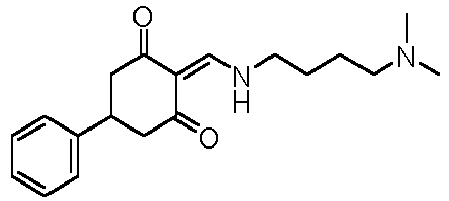
2-(((4-(dimethylamino)butyl)ami no)methylene)-5-phenylcyclohexane-1,3-dione 1HNMR (400 MHz, CD3OD) δ 8.24 (s, 1H), 7.35 - 7.18 (m, 5H), 3.53 (t, J = 6.9 Hz,2H), 3.35 (ddd, J = 11.6, 8.0, 4.3 Hz, 1H), 2.75 (d, J = 12.0 Hz, 2H), 2.64 (dd, J = 16.8, 4.2 Hz, 2H), 2.42 - 2.34 (m, 2H), 2.26 (s, 6H), 1.68 (dt, J = 14.1, 6.9 Hz, 2H), 1.59 - 1.51 (m, 2H). 171 
2-(((((S)-1-ethylpyrrolidin-2-yl)methyl)amino)methylen e)-5-phenylcyclohexane-1,3-dione 1HNMR (400 MHz, CDCl3) δ 11.19 (s, 1H), 8.17 (d, J = 14.3 Hz, 1H), 7.34 (t, J = 7.5 Hz, 2H), 7.24 (d, J = 8.0 Hz, 3H), 3.54 - 3.46 (m, 1H), 3.37 (dt, J = 15.7, 5.4 Hz, 2H), 3.24 - 3.17 (m, 1H), 2.85 - 2.61 (m, 6H), 2.35 (dq, J = 13.8, 7.0 Hz, 1H), 2.23 (dt, J = 16.4, 8.3 Hz, 1H), 1.93 (ddd, J = 17.2, 12.5, 8.6 Hz, 1H), 1.79 - 1.63 (m, 2H), 1.60 - 1.49 (m, 1H), 1.13 (t, J = 7.2 Hz, 3H). 172 
2-(((2,6-dioxo-4-phenylcyclohexylidene)me thyl)amino)acetimidamide 1HNMR (400 MHz, DMSO-d6) δ 10.83 (s, 1H), 8.89 (s, 4H), 8.16 (s, 1H), 7.33 (d, J = 4.4 Hz, 4H), 7.27 - 7.20 (m, 1H), 4.44 (s, 2H), 3.34 - 3.27 (m, 1H), 2.84 - 2.67 (m, 2H), 2.56 (d, J = 16.3 Hz, 2H). 173 
2-(((3-aminocyclobutyl)amino)m ethylene)-5-phenylcyclohexane-1,3-dione hydrochloride 1HNMR (400 MHz, D2O) δ 8.01 (s, 1H), 7.27 - 7.20 (m, 2H), 7.19 - 7.11 (m, 3H), 4.32 (dt, J = 15.1, 7.4 Hz, 1H), 3.82 (td, J = 8.6, 4.5 Hz, 1H), 3.28 (ddd, J = 15.0, 10.2, 4.6 Hz, 1H), 2.71 - 2.46 (m, 8H). 174 
((2,6-dioxo-4-phenylcyclohexylidene)me thyl)-L-alaninate hydrochloride 1HNMR (400 MHz, DMSO-d6) δ 11.24 - 11.13 (m, 1H), 8.31 (s, 2H), 8.21 (d, J = 14.2 Hz, 1H), 8.00 (s, 1H), 7.32 (d, J = 4.4 Hz, 4H), 7.27 - 7.19 (m, 1H), 4.70 (p, J = 7.2 Hz, 1H), 4.45 - 4.35 (m, 1H), 4.33 - 4.24 (m, 1H), 3.58 (dd, J = 9.2, 3.7 Hz, 1H), 3.35 - 3.30 (m, 1H), 3.10 (d, J = 4.5 Hz, 2H), 2.93 - 2.66 (m, 3H), 2.59 - 2.53 (m, 1H), 1.53 (d, J = 7.1 Hz, 3H). 175 
2-(((2-aminoethyl) amino) methyl ene)-5-phenylcyclohexane-1,3-dione hydrochloride 1HNMR (400 MHz, DMSO-d6) δ 10.88 - 10.77 (m, 1H), 8.32 (s, 3H), 8.10 (d, J = 14.4 Hz, 1H), 7.32 (d, J = 4.3 Hz, 4H), 7.28 (dd, J = 37.6, 4.3 Hz, 5H), 7.23 (d, J = 4.3 Hz, 1H), 3.73 (d, J = 6.1 Hz, 2H), 3.31 (tt, J = 11.5, 4.0 Hz, 1H), 3.06 (dd, J = 11.4, 5.6 Hz, 2H), 2.73 (dt, J = 28.6, 14.1 Hz, 2H), 2.53 (d, J = 13.3 Hz, 2H). 176 
N-(2-(((2,6-dioxo-4-phenylcyclohexylidene)me thyl)amino)ethyl)acetamid e 1HNMR (400 MHz, CDCl3) δ 11.21 (s, 1H), 8.14 (d, J = 14.0 Hz, 1H), 7.35 (t, J = 7.4 Hz, 2H), 7.24 (t, J = 6.7 Hz, 3H), 6.03 (s, 1H), 3.59 (dd, J = 11.7, 5.8 Hz, 2H), 3.49 (dd, J = 11.5, 5.7 Hz, 2H), 3.42 - 3.30 (m, 1H), 2.82 - 2.59 (m, 4H), 2.02 (s, 3H). 177 
tert-butyl (2-(((2,6-dioxo-4-phenylcyclohexylidene)me thyl) amino) ethyl) (methyl) carbamate 1HNMR (400 MHz, CDCl3) δ 11.22 (s, 1H), 8.12 (d, J = 13.9 Hz, 1H), 7.34 (t, J = 7.4 Hz, 2H), 7.27 - 7.20 (m, 3H), 3.58 (s, 2H), 3.46 (t, J = 5.7 Hz, 2H), 3.41 - 3.29 (m, 1H), 2.89 (s, 3H), 2.81 - 2.60 (m, 4H), 1.46 (s, 9H). 178 
2-aminoethyl ((2,6-dioxo-4-phenylcyclohexylidene)me thyl)-L-phenylalaninate hydrochloride 1HNMR (400 MHz, DMSO-d6) δ 11.14 - 11.02 (m, 1H), 8.31 (s, 3H), 7.97 (d, J = 14.0 Hz, 1H), 7.40 - 7.06 (m, 10H), 4.94 (td, J = 8.9, 4.6 Hz, 1H), 4.41 (dd, J = 12.1, 3.2 Hz, 1H), 4.29 (dd, J = 12.1, 2.6 Hz, 1H), 3.26 (ddd, J = 19.7, 11.0, 3.5 Hz, 2H), 3.13 (s, 2H), 2.82 - 2.61 (m, 2H), 2.54 (s, 1H), 2.44 (s, 2H). 180 
2-((methoxyamino)methylen e)-5-phenylcyclohexane-1,3-dione 1H NMR (400 MHz, DMSO_d6) δ12.36(br, 1H), 8.16(s, 1H), 7.32-7.20(m, 5H), 3.83(s, 3H), 3.41-3.33(m, 1H), 2.84-2.77(m, 2H), 2.61-2.57(m, 2H); MS: 246.1 [M+1]. 182 
2-(((2-(4-(2-hydroxyethyl)piperazin-1-yl)ethyl)amino)methylene) -5,5-dimethylcyclohexane-1,3-dione 1H NMR (400 MHz, CD3OD) δ 8.19(s, 1H), 3.68 (t, J = 6.1 Hz, 2H), 3.58 ((t, J = 5.9 Hz, 2H), 2.94 (m, 1H), 2.67-2.47(m, 11H), 2.35 (d, J = 14.8 Hz, 4H) 1.04 (s, 6H); MS: 324.2 [M+1]. 183 
2-(((2-(4-(2-hydroxyethyl)piperazin-1-yl)ethyl)amino)methylene) benzofuran-3(2H)-one 1HNMR (400 MHz, CD3OD) δ 7.73 (d, J = 7.4 Hz, 1H), 7.57 (m, 2H), 7.31 (d, J = 8.8 Hz, 1H), 7.20 (t, J = 7.3 Hz, 1H), 3.77 (t, J = 5.5 Hz, 2H), 3.53 (t, 2H), 2.81 (m, 11H). 184 
2-(((2-(4-(2-hydroxyethyl)piperazin-1-yl)ethyl)amino)methylene) -5-(4-methyl-1H-indol-3-yl)cyclohexane-1,3-dione 1HNMR (400 MHz, CD3OD) δ 8.26 (s, 1H), 7.16 (d, J = 8.0 Hz, 1H), 7.03 (s, 1H), 6.99 - 6.91 (m, 1H), 6.74 (d, J = 7.2 Hz, 1H), 3.94 (m, 1H), 3.73 (t, J = 5.8 Hz, 2H), 3.61 (t, J = 5.6 Hz, 2H), 2.95 - 2.55 (m, 19H). MS: 426.2 [M+1]. 185 
5-(3-cyclopropyl-1H-indol-4-yl)-2-(((2-(4-(2-hydroxyethyl)piperazin-1-yl)ethyl)amino)methylene) cyclohexane-1,3-dione 1H NMR (400 MHz, CD3OD) δ 8.28 (s, 1H), 7.20 (d, J = 8.0 Hz, 1H), 7.05 (t, J = 7.6 Hz, 1H), 6.96 - 6.87 (m, 2H), 4.65 (s, 1H), 3.71 (dt, J = 25.1, 5.8 Hz, 2H), 3.61 (t, J = 5.7 Hz, 2H), 3.50 (m, 1H), 2.96 - 2.44 (m, 16H), 1.94 (m, 1H), 0.77 (d, J = 7.9 Hz, 2H), 0.61 (d, J = 3.5 Hz, 2H); MS: 451.2 [M+1]. 186 
2-(((2-(4-(2-hydroxyethyl)piperazin-1-yl)ethyl)amino)methylene) -5-(5-methoxy-1H-indol-3-yl)cyclohexane-1,3-dione 1H NMR (400 MHz, CD3OD) δ 8.24(s, 1H), 7.23 (d, J = 8.8Hz, 1H), 7.04(s, 1H), 6.98(s, 1H), 6.77 (d, J = 8.8Hz, 1H) , 3.81-3.76 (m, 5H), 3.66-3.59 (m, 3H), 3.05-2.65 (m, 16H); MS: 441.2 [M+1]. 187 
5-([1,1'-biphenyl]-2-yl)-2-(((2-(4-(2-hydroxyethyl)piperazin-1-yl)ethyl)amino)methylene) cyclohexane-1,3-dione 1H NMR (400 MHz, DMSO-d6) δ 10.93 - 10.77 (m, 1H), 8.03 (d, J = 14.7 Hz, 1H), 7.54 (d, J = 7.9 Hz, 1H), 7.44 - 7.23 (m, 6H), 7.14 (d, J = 7.5 Hz, 1H), 3.60 (s, 2H), 3.51 (d, J = 5.8 Hz, 2H), 3.30 (m, 4H), 2.73 (m, 5H), 2.28 (d, J = 14.1 Hz, 2H); MS: 448.2 [M+1]. 188 
2-(((2-(4-(2-hydroxyethyl)piperazin-1-yl)ethyl)amino)methylene) -5-(2-(pyridin-4-yl)phenyl)cyclohexane-1,3-dione 1H NMR (400 MHz, DMSO-d6) δ 10.87 (m, 1H), 8.60 (d, J = 5.5 Hz, 2H), 8.03 (d, J = 14.7 Hz, 1H), 7.59 (d, J = 7.7 Hz, 1H), 7.44 (t, J = 7.1 Hz, 1H), 7.33 (m, 3H), 7.16 (dd, J = 7.5, 0.7 Hz, 1H), 4.35 (ds, 1H), 3.45 (m, 5H), 3.20 (m, 1H), 2.86 - 2.58 (m, 3H), 2.34 (m, 12H); MS: 449.2 [M+1]. 189 
5-(2-cyclopropylphenyl)-2-(((2-(4-(2-hydroxyethyl)piperazin-1-yl)ethyl)amino)methylene) cyclohexane-1,3-dione 1HNMR (400 MHz, DMSO-d6) δ 10.94 (d, J = 14.6 Hz, 1H), 8.13 (d, J = 14.6 Hz, 1H), 7.30 (d, J = 7.5 Hz, 1H), 7.13 (dt, J = 18.7, 7.2 Hz, 2H), 6.98 (d, J = 7.0 Hz, 1H), 4.39 (s, 1H), 3.87 (t, J = 12.3 Hz, 1H), 3.56 (d, J = 5.5 Hz, 2H), 3.46 (d, J = 5.9 Hz, 2H), 3.35 (s, 1H), 2.81 - 2.57 (m, 3H), 2.46 - 2.26 (m, 12H), 1.96 (m, 1H), 0.86 (m, 2H), 0.58 (m, 2H). 190 
2-(((2-(4-(2-hydroxyethyl)piperazin-1-yl)ethyl)amino)methylene) -4-(morpholine-4-carbonyl)-5-phenylcyclohexane-1,3-dione 1HNMR (400 MHz, CDCl3) δ 8.29, 8.23 (two singles, 1H), 7.38-7.22 (m, 5H), 4.46-4.35 (m, 1H), 3.78-3.35 (m, 10H), 3.20-2.55 (m, 16H); MS: 485.3 [M+1]. 191 
ethyl -6-(2-bromophenyl)-3-(((2-(4-(2-hydroxyethyl)piperazin-1-yl)ethyl)amino)methylene) -2,4-dioxocyclohexane-1-carboxylate 1HNMR (400 MHz, DMSO-d6) δ 11.08 - 10.77 (m, 1H), 8.16 (dd, J = 15.0, 6.9 Hz, 1H), 7.60 - 7.51 (m, 2H), 7.37 (t, J = 7.5 Hz, 1H), 7.18 - 7.09 (m, 1H), 4.41 - 4.13 (m, 2H), 4.04 - 3.76 (m, 3H), 3.64 - 3.52 (m, 2H), 3.45 (d, J = 5.0 Hz, 2H), 2.78 - 2.54 (m, 2H), 2.46 - 2.29 (m, 9H), 1.31 - 1.03 (m, 2H), 0.90 (m, 3H); MS: 524.1 [M+1] 192 
6-chloro-3-(((2-(4-(2-hydroxyethyl)piperazin-1-yl)ethyl)amino)methylene) quinoline-2,4(1H,3H)-dione 1HNMR (400 MHz, CD3OD) δ 8.55 (d, J = 32.6 Hz, 1H), 7.97 (d, J = 2.5 Hz, 1H), 7.49 (d, J = 6.5 Hz, 1H), 7.16 (d, J = 8.7 Hz, 1H), 3.71 (t, J = 5.4 Hz, 4H), 2.67 (m, 12H); MS: 379.1 [M+1]. 193 
3-(((2-(4-(2-hydroxyethyl)piperazin-1-yl)ethyl)amino)methylene) -1-methylquinoline-2,4(1H,3H)-dione 1HNMR (400 MHz, CD3OD) δ 8.59 (d, J = 18.0 Hz, 1H), 8.14 (m, 1H), 7.65 (t, J = 7.1 Hz, 1H), 7.42 (d, J = 8.5 Hz, 1H), 7.23 (t, J = 7.6 Hz, 1H), 3.82 - 3.76 (m, 2H), 3.73 (m, 2H), 3.57 (d, J = 3.4 Hz, 3H), 3.02 (m, 6H), 2.84 - 2.61 (m, 6H); MS: 359.2 [M+1]. 194 
3-(((2-(4-(2-hydroxyethyl)piperazin-1-yl)ethyl)amino)methylene) -8-methoxyquinoline-2,4(1H,3H)-dione 1HNMR (400 MHz, CD3OD) δ 8.56 (d, J = 32.3 Hz, 1H), 7.61 (d, J = 7.7 Hz, 1H), 7.23 - 7.06 (m, 2H), 3.97 (s, 3H), 3.81 - 3.66 (m, 4H), 2.99 - 2.57 (m, 12H); MS: 375.2 [M+1]. 195 
8-fluoro-3-(((2-(4-(2-hydroxyethyl)piperazin-1-yl)ethyl)amino)methylene) quinoline-2,4(1H,3H)-dione 1H NMR (400 MHz, CD3OD) δ 8.57 (d, J = 30.8 Hz, 1H), 7.88 - 7.78 (m, 1H), 7.42 - 7.30 (m, 1H), 7.12 (m, 1H), 3.81 (m, 2H), 3.73 (m, 2H), 3.35 (s, 1H), 3.24 (s, 1H), 3.07 (d, J = 43.1 Hz, 5H), 2.75 (m, 5H); MS: 363.1 [M+1] 196 
3-(((2-(4-(2-hydroxyethyl)piperazin-1-yl)ethyl)amino)methylene) -6-methoxyquinoline-2,4(1H,3H)-dione 1H NMR (400 MHz, DMSO-d6) δ 11.68-10.99 (m, 1H), 10.52 (d, J = 29.2 Hz, 1H), 8.43 (t, J = 14.5 Hz, 1H), 7.33 (t, J = 9.2 Hz, 1H), 7.23 - 7.01 (m, 2H), 4.66 (s, 1H), 3.77 (d, J = 19.5 Hz, 3H), 3.65 (m, 2H), 3.55 (s, 2H), 3.35 (s, 4H), 2.55 (m, 8H); MS: 375.2 [M+1]. 197 
3-(((2-(4-(2-hydroxyethyl)piperazin-1-yl)ethyl)amino)methylene) -8-(trifluoromethyl)quinoline -2,4(1H,3H)-dione 1HNMR (400 MHz, CD3OD) δ 8.54 (m, 1H), 8.35 (d, J = 7.1 Hz, 1H), 7.89 (d, J = 7.4 Hz, 1H), 7.31 (t, J = 7.9 Hz, 1H), 3.73 (m, 4H), 2.93 - 2.58 (m, 12H). 202 
2-(((3-(dimethylamino) propyl) a mino)methylene)-5-phenylcyclohexane-1,3-dione 1HNMR (400 MHz, CDCl3) δ 11.28 (s, 1H), 8.17 (s, 1H), 7.34 (t, J = 7.5 Hz, 2H), 7.24 (dd, J = 8.5, 7.1 Hz, 3H), 3.52 (t, J = 6.6 Hz, 2H), 3.43 - 3.30 (m, 1H), 2.81 - 2.61 (m, 4H), 2.43 (t, J = 6.9 Hz, 2H), 2.28 (s, 6H), 1.84 (p, J = 6.8 Hz, 2H). 203 
2-((((6-methylpyridin-2-yl)methyl)amino)methylen e)-5-phenylcyclohexane-1,3-dione 1HNMR (400 MHz, CDCl3) δ 11.58 (s, 1H), 8.31 (d, J = 14.2 Hz, 1H), 7.59 (t, J = 7.7 Hz, 1H), 7.34 (t, J = 7.4 Hz, 2H), 7.27 - 7.18 (m, 3H), 7.11 (d, J = 7.7 Hz, 1H), 7.04 (d, J = 7.6 Hz, 1H), 4.68 (d, J = 6.1 Hz, 2H), 3.43 - 3.32 (m, 1H), 2.82 - 2.63 (m, 4H), 2.57 (s, 3H). 204 
2-((((5-chloropyridin-2-yl)methyl)amino)methylen e)-5-phenylcyclohexane-1,3-dione 1HNMR (400 MHz, CDCl3) δ 11.59 (s, 1H), 8.58 (d, J = 2.2 Hz, 1H), 8.30 (d, J = 14.0 Hz, 1H), 7.70 (dd, J = 8.3, 2.5 Hz, 1H), 7.35 (t, J = 7.4 Hz, 2H), 7.27 - 7.19 (m, 4H), 4.71 (d, J = 6.2 Hz, 2H), 3.42 - 3.33 (m, 1H), 2.83 - 2.64 (m, 4H) 205 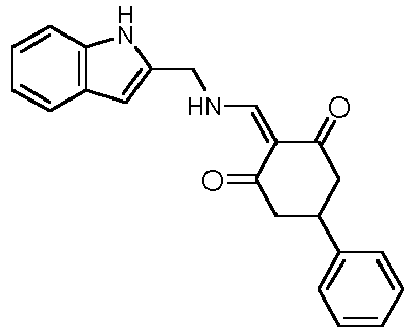
2-((((1H-indol-2-yl)methyl)amino)methylen e)-5-phenylcyclohexane-1,3-dione 1HNMR (400 MHz,DMSO-d6) δ 11.22 (s, 2H), 8.27 (d, J = 14.1 Hz, 1H), 7.51 (d, J = 7.8 Hz, 1H), 7.39 - 7.35 (m, 1H), 7.33 - 7.28 (m, 4H), 7.24 - 7.17 (m, 1H), 7.13 - 7.05 (m, 1H), 7.01 - 6.96 (m, 1H), 6.39 (d, J = 1.1 Hz, 1H), 4.81 (d, J = 4.7 Hz, 2H), 3.31 (td, J = 7.6, 3.8 Hz, 1H), 2.72 (ddd, J = 31.1, 16.6, 11.7 Hz, 2H), 2.55 - 2.50 (m, 2H) 206 
2-(((2-(methylthio)ethyl)amino) methylene)-5-phenylcyclohexane-1,3-dione 1HNMR (400 MHz, CDCl3) δ 11.32 (s, 1H), 8.19 (d, J = 14.0 Hz, 1H), 7.34 (t, J = 7.4 Hz, 2H), 7.24 (d, J = 8.1 Hz, 3H), 3.63 (q, J = 6.4 Hz, 2H), 3.42 - 3.31 (m, 1H), 2.81 - 2.62 (m, 6H), 2.15 (s, 3H) 207 
2-(((2-(methylsulfinyl) ethyl) amin o)methylene)-5-phenylcyclohexane-1,3-dione 1HNMR (400 MHz, CDCl3) δ 11.35 (s, 1H), 8.21 (d, J = 13.8 Hz, 1H), 7.34 (t, J = 7.4 Hz, 2H), 7.24 (t, J = 6.4 Hz, 3H), 4.06 - 3.89 (m, 2H), 3.36 (dd, J = 11.8, 8.7 Hz, 1H), 3.08 - 2.94 (m, 2H), 2.82 - 2.61 (m, 7H). 208 
2-(((2-(methylsulfonyl)ethyl)ami no)methylene)-5-phenylcyclohexane-1,3-dione 1HNMR (400 MHz, CDCl3) δ 11.37 (s, 1H), 8.18 (d, J = 13.7 Hz, 1H), 7.34 (t, J = 7.4 Hz, 2H), 7.23 (d, J = 7.2 Hz, 3H), 3.98 (dd, J = 12.8, 6.4 Hz, 2H), 3.36 (dd, J = 14.2, 8.1 Hz, 3H), 3.00 (s, 3H), 2.83 - 2.63 (m, 4H) 209 
2-(((2-(dimethylamino) ethyl) ami no)methylene)-4-fluoro-5-phenylcyclohexane-1,3-dione 1H NMR (400 MHz, cdcl3) δ 11.31, 11.13 (2s, 1H), 8.24, 8.17(2d, J = 14.7 Hz, 1H), 7.37 - 7.27 (m, 5H), 5.08, 4.96 (2dd, J = 8.6, 2.8 Hz, 1H), 3.65 - 3.48 (m, 3H), 3.18 - 3.07 (m, 1H), 2.81 - 2.69 (m, 1H), 2.55 (t, J = 6.1 Hz, 2H), 2.28 (d, J = 2.1 Hz, 6H) 210 
((2,6-dioxo-4-phenylcyclohexylidene)me thyl) glycylglycine 1HNMR (400 MHz, CD3OD) δ 8.22 (s, 1H), 7.37 - 7.26 (m, 4H), 7.26 - 7.19 (m, 1H), 4.29 (s, 2H), 3.96 (s, 2H), 3.42 - 3.33 (m, 1H), 2.80 (ddd, J = 23.7, 16.8, 11.6 Hz, 2H), 2.71-2.63 (m,2H) 211 
2-(((2-(4-isobutyrylpiperazin-1-yl)ethyl)amino)methylene) -5-phenylcyclohexane-1,3-dione 1HNMR (300 MHz, CDCl3) δ 11.24 (s, 1H), 8.19 (d, J = 14.4 Hz, 1H), 7.38 - 7.29 (m, 2H), 7.26 (s, 1H), 7.23 (d, J = 8.0 Hz, 2H), 3.67 (s, 2H), 3.60 - 3.47 (m, 4H), 3.35 (s, 1H), 2.83 - 2.70 (m, 4H), 2.64 (dd, J = 11.8, 5.7 Hz, 2H), 2.49 (s, 4H), 1.12 (d, J = 6.7 Hz, 6H) 212 
5-phenyl-2-(((2-(4-pivaloylpiperazin-1-yl)ethyl)amino)methylene) cyclohexane-1,3-dione 1HNMR (300 MHz, CDCl3) δ 11.26 (s, 1H), 8.19 (d, J = 14.4 Hz, 1H), 7.34 (t, J = 7.3 Hz, 2H), 7.23 (d, J = 8.4 Hz, 3H), 3.69 (s, 4H), 3.52 (d, J = 5.9 Hz, 2H), 3.35 (s, 1H), 2.75 (q, J = 8.6 Hz, 4H), 2.63 (dd, J = 13.9, 7.8 Hz, 2H), 2.49 (s, 4H), 1.27 (s, 9H). 213 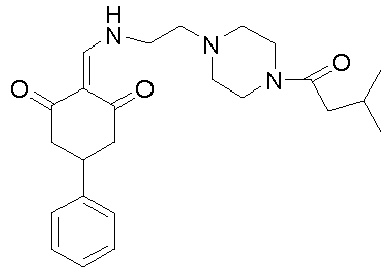
2-(((2-(4-(3-methylbutanoyl)piperazin-1-yl)ethyl)amino)methylene) -5-phenylcyclohexane-1,3-dione 1HNMR (300 MHz, CDCl3) δ 11.39 (s, 1H), 8.19 (d, J = 14.7 Hz, 1H), 7.33 (d, J = 7.3 Hz, 2H), 7.26 (s, 1H), 7.23 (d, J = 7.8 Hz, 2H), 3.67 (s, 2H), 3.53 (s, 4H), 3.36 (s, 1H), 2.77 - 2.69 (m, 2H), 2.69 - 2.58 (m, 2H), 2.49 (s, 4H), 2.20 (d, J = 6.7 Hz, 2H), 2.15 - 2.03 (m, 1H), 1.77 - 1.51 (m, 2H), 0.96 (d, J = 6.3 Hz, 6H) 214 
4-(2-(((2,6-dioxo-4-phenylcyclohexylidene)me thyl)amino)ethyl)-N,N-dimethylpiperazine-1-carboxamide 1HNMR (300 MHz, CDCl3) δ 11.30(m, 1H), 8.17 (d, J = 14.9 Hz, 1H), 7.26 - 7.24 (m, 1H), 7.13 (s, 4H), 3.51 (d, J = 6.0 Hz, 2H), 3.30 (s, 5H), 2.81 (s, 6H), 2.72 (d, J = 6.8 Hz, 3H), 2.66 - 2.57 (m, 2H), 2.49 (s, 4H), 2.33 (s, 2 H) 215 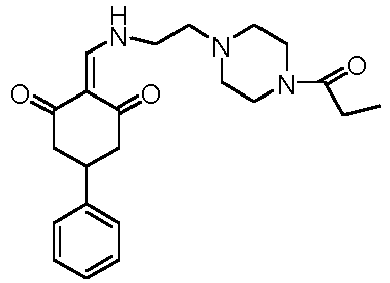
5-phenyl-2-(((2-(4-propionylpiperazin-1-yl)ethyl)amino)methylene) cyclohexane-1,3-dione 1HNMR (300 MHz, CDCl3) δ 11.25 (s, 1H), 8.19 (d, J = 14.3 Hz, 1H), 7.40 - 7.29 (m, 2H), 7.23 (d, J = 8.2 Hz, 3H), 3.66 (s, 2H), 3.51 (s, 4H), 3.36 (s, 1H), 2.75 (d, J = 7.3 Hz, 2H), 2.64 (dd, J = 12.2, 6.2 Hz, 2H), 2.49 (s, 4H), 2.34 (q, J = 7.5 Hz, 2H), 1.25 (s, 2H), 1.14 (t, J = 7.4 Hz, 3H) 216 
2-(((2-(4-benzoylpiperazin-1-yl)ethyl)amino)methylene) -5-phenylcyclohexane-1,3-dione 1HNMR (300 MHz, CDCl3) δ 11.25 (s, 1H), 8.21 (d, J = 14.7 Hz, 1H), 8.10 (d, J = 7.6 Hz, 2H), 7.48 (d, J = 7.7 Hz, 1H), 7.40 (s, 4H), 7.32 (d, J = 7.1 Hz, 1H), 7.23 (d, J = 7.7 Hz, 2H), 3.85 (s, 2H), 3.54 (d, J = 5.8 Hz, 4H), 3.36 (s, 1H), 2.84 - 2.69 (m, 4H), 2.64 (d, J = 13.3 Hz, 4H), 2.48 (s, 2H) 217 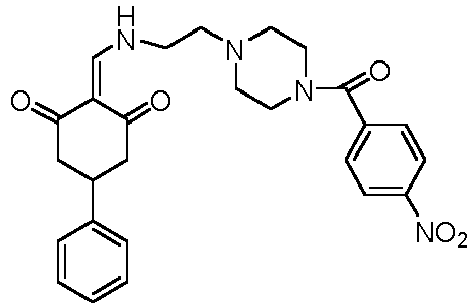
2-(((2-(4-(4-nitrobenzoyl)piperazin-1-yl)ethyl)amino)methylene) -5-phenylcyclohexane-1,3-dione 1HNMR (300 MHz, CDCl3) δ 11.26 (s, 1H), 8.29 (d, J = 8.4 Hz, 2H), 8.19 (d, J = 14.3 Hz, 1H), 7.57 (d, J = 8.5 Hz, 2H), 7.33 (d, J = 7.1 Hz, 2H), 7.22 (s, 3H), 3.86 (s, 2H), 3.53 (d, J = 5.8 Hz, 4H), 3.42 (s, 2H), 3.38 - 3.28 (m, 1H), 2.83 - 2.69 (m, 4H), 2.65 (d, J = 6.0 Hz, 4H), 2.47 (s, 2H) 218 
2-(((2-(4-(methylsulfonyl)piperazin-1-yl)ethyl)amino)methylene) -5-phenylcyclohexane-1,3-dione 1HNMR (300 MHz, CDCl3) δ 11.22 (s, 1H), 8.18 (d, J = 14.3 Hz, 1H), 7.37 - 7.30 (m, 2H), 7.23 (d, J = 7.9 Hz, 3H), 3.60 - 3.46 (m, 2H), 3.36 (d, J = 5.5 Hz, 1H), 3.28 (s, 4H), 2.79 (s, 3H), 2.75 (d, J = 7.5 Hz, 2H), 2.72 - 2.63 (m, 4H), 2.67 - 2.59 (m, 4H) 219 
2-(((2-(4-(4-chlorobenzoyl)piperazin-1-yl)ethyl)amino)methylene) -5-phenylcyclohexane-1,3-dione 1HNMR (300 MHz, CDCl3) δ 11.25 (s, 1H), 8.18 (d, J = 14.3 Hz, 1H), 7.37 (d, J = 6.6 Hz, 5H), 7.24 (d, J = 12.4 Hz, 4H), 3.81 (s, 2H), 3.51 (s, 4H), 3.40 - 3.29 (m, 1H), 2.83 - 2.67 (m, 4H), 2.65 (s, 2H), 2.62 - 2.35 (m, 4H) 220 
2-(((2-(4-(4-bromobenzoyl)piperazin-1-yl)ethyl)amino)methylene) -5-phenylcyclohexane-1,3-dione 1HNMR (300 MHz, CDCl3) δ 11.26 (s, 1H), 8.18 (d, J = 14.1 Hz, 1H), 7.55 (d, J = 7.7 Hz, 2H), 7.38 - 7.27 (m, 4H), 7.23 (d, J = 7.4 Hz, 3H), 3.81 (s, 2H), 3.52 (d, J = 5.7 Hz, 4H), 3.36 (s, 1H), 2.82 - 2.68 (m, 4H), 2.65 (d, J = 6.4 Hz, 2H), 2.51 (d, J = 29.1 Hz, 4H) 221 
5-phenyl-2-(((2-(4-(2-phenylacetyl)piperazin-1-yl)ethyl)amino)methylene) cyclohexane-1,3-dione 1HNMR (300 MHz, CDCl3) δ 11.19 (s, 1H), 8.16 (d, J = 14.4 Hz, 1H), 7.38 - 7.28 (m, 5H), 7.23 (d, J = 7.7 Hz, 5H), 3.73 (s, 2H), 3.69 (s, 2H), 3.48 (d, J = 5.4 Hz, 4H), 3.35 (s, 1H), 2.81 - 2.63 (m, 4H), 2.57 (t, J = 5.6 Hz, 2H), 2.45 (s, 2H), 2.30 (s, 2H) 222 
2-(((2-(4-nicotinoylpiperazin-1-yl)ethyl)amino)methylene) -5-phenylcyclohexane-1,3-dione 1HNMR (300 MHz, CDCl3) δ 11.26 (s, 1H), 8.66 (s, 2H), 8.18 (d, J = 14.4 Hz, 1H), 7.75 (d, J = 7.9 Hz, 1H), 7.35 (dd, J = 15.1, 7.6 Hz, 4H), 7.25 - 7.19 (m, 2H), 3.86 (s, 2H), 3.52 (d, J = 5.4 Hz, 4H), 3.38 (s, 1H), 2.85 - 2.70 (m, 4H), 2.65 (d, J = 6.0 Hz, 4H), 2.51 (t, J = 29.8 Hz, 2H) 223 
4-(2-(((2,6-dioxo-4-(p-tolyl)cyclohexylidene)met hyl)amino)ethyl)-N-(4-fluorophenyl)piperazine-1-carbothioamide 1HNMR (300 MHz, DMSO) δ 10.93 (s, 1H), 9.28 (s, 1H), 8.14 (d, J = 14.5 Hz, 1H), 7.30 - 7.22 (m, 2H), 7.17 (d, J = 7.8 Hz, 2H), 7.11 (t, J = 7.2 Hz, 4H), 3.85 (s, 2H), 3.59 (s, 4H), 3.31 (s, 3H), 3.27 - 3.17 (m, 1H), 2.79(m, 4H), 2.65 (d, J = 6.4 Hz, 2H), 2.22 (d, J = 13.5 Hz, 4H) 224 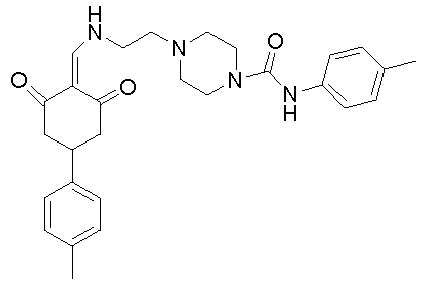
4-(2-(((2,6-dioxo-4-(p-tolyl)cyclohexylidene)met hyl)amino)ethyl)-N-(p-tolyl)piperazine-1-carboxamide 1HNMR (300 MHz, CDCl3) δ 11.43 - 10.70 (m, 2H), 8.18 (d, J = 14.1 Hz, 1H), 7.26 (s, 1H), 7.21 (d, J = 8.4 Hz, 1H), 7.17 - 7.05 (m, 3H), 6.26 (s, 1H), 3.54 (s, 2H), 3.40 - 3.26 (m, 1H), 2.70 (dd, J = 18.3, 9.0 Hz, 3H), 2.55 (s, 2H), 2.31 (d, J = 11.6 Hz, 3H) 225 
2-(((2-(4-acetylpiperazin-1-yl)ethyl)amino)methylene) -5-(p-tolyl)cyclohexane-1,3-dione 1HNMR (300 MHz, CDCl3) δ 11.31 - 11.12 (m, 1H), 8.18 (d, J = 14.2 Hz, 1H), 7.13 (d, J = 2.6 Hz, 4H), 3.65 (s, 2H), 3.50 (d, J = 5.7 Hz, 3H), 3.42 (m, 2H), 3.33 (s, 1H), 2.73 (q, J = 9.0 Hz, 4H), 2.62 (d, J = 5.1 Hz, 2H), 2.55 - 2.42 (m, 4H), 2.30 (d, J = 13.6 Hz, 2H), 2.08 (s, 3H) 226 
2-(((2-(4-(morpholine-4-carbonyl)piperazin-1-yl)ethyl)amino)methylene) -5-(p-tolyl)cyclohexane-1,3-dione 1HNMR (300 MHz, CDCl3) δ 11.25 (m, 1H), 8.17 (d, J = 14.3 Hz, 1H), 7.18 - 6.89 (m, 4H), 3.69 - 3.62 (m, 5H), 3.51 (d, J= 5.8 Hz, 2H), 3.34 (s, 4H), 3.28 - 3.20 (m, 4H), 2.77 - 2.58 (m, 6H), 2.49 (s, 4H), 2.32 (s, 3H) 227 
5-(p-tolyl)-2-(((2-(4-tosylpiperazin-1-yl)ethyl)amino)methylene) cyclohexane-1,3-dione 1HNMR (300 MHz, CDCl3) δ 11.05 (s, 1H), 8.09 (d, J = 14.2 Hz, 1H), 7.62 (d, J = 7.5 Hz, 2H), 7.44 - 7.24 (m, 2H), 7.11 (d, J = 6.1 Hz, 4H), 3.45 (d, J = 4.5 Hz, 2H), 3.27 (s, 1H), 3.05 (s, 4H), 2.73 - 2.53 (m, 8H), 2.37 (d, J = 31.3 Hz, 6H) 228 
4-(2-(((2,6-dioxo-4-(p-tolyl)cyclohexylidene)met hyl)amino)ethyl)-N-propylpiperazine-1-carboxamide 1HNMR (300 MHz, CDCl3) δ 11.23 (s, 1H), 8.17 (d, J = 14.3 Hz, 1H), 7.20 - 7.07 (m, 4H), 4.47 (s, 1H), 3.49 (dd, J = 13.7, 8.2 Hz, 2H), 3.46 - 3.34 (m, 4H), 3.36 - 3.22 (m, 1H), 3.18 (dd, J = 13.0, 6.6 Hz, 2H), 2.79 - 2.60 (m, 6H), 2.46 (t, J = 16.1 Hz, 4H), 2.32 (s, 3H), 1.62 - 1.38 (m, 2H), 0.89 (dd, J = 16.1, 8.7 Hz, 3H) 229 
2-(((2-(4-(2-hydroxyethyl)piperazin-1-yl)ethyl)amino)methylene) -5-(p-tolyl)cyclohexane-1,3-dione 1HNMR (300 MHz, CDCl3) δ 11.20 (s, 1H), 8.17 (d, J = 14.3 Hz, 1H), 7.14 (d, J = 8.6 Hz, 4H), 3.71 - 3.63 (m, 2H), 3.55 - 3.29 (m, 5H), 2.73 - 2.59 (m, 14H), 2.32 (s, 3H) 230 
2-(((2-(4-(3-hydroxypropyl)piperazin-1-yl)ethyl)amino)methylene) -5-(p-tolyl)cyclohexane-1,3-dione 1HNMR (300 MHz, CDCl3) δ 11.20 (s, 2H), 8.16 (d, J = 14.4 Hz, 1H), 7.18 - 7.06 (m, 4H), 3.84 - 3.72 (m, 2H), 3.49 (dd, J = 11.6, 5.8 Hz, 2H), 3.31 (d, J = 5.9 Hz, 1H), 2.87 - 2.50 (m, 14H), 2.33 (s, 3H), 1.85 - 1.72 (m, 2H) 231 
4-(2-(((2,6-dioxo-4-(p-tolyl)cyclohexylidene)met hyl)amino)ethyl)-N-phenylpiperazine-1-carbothioamide 1HNMR (300 MHz, CDCl3) δ 11.28 (m, 1H), 8.17 (d, J = 14.2 Hz, 1H), 7.32 (d, J = 7.8 Hz, 3H), 7.13 (d, J = 3.2 Hz, 6H), 3.87 (s, 4H), 3.50 (s, 2H), 3.36 - 3.26 (m, 1H), 2.81 - 2.65 (m, 4H), 2.64 (s, 2H), 2.57 (s, 4H), 2.33 (s, 3H) 232 
2-(((2-(4-acryloylpiperazin-1-yl)ethyl)amino)methylene) -5-(p-tolyl)cyclohexane-1,3-dione 1HNMR (300 MHz, CDCl3) δ 11.21 (s, 1H), 8.18 (d, J = 14.4 Hz, 1H), 7.14 (d, J = 10.6 Hz, 4H), 6.55 (dd, J = 16.4, 10.9 Hz, 1H), 6.28 (d, J = 16.8 Hz, 1H), 5.69 (d, J = 10.5 Hz, 1H), 3.73 (s, 2H), 3.57 (d, J = 22.5 Hz, 2H), 3.57 - 3.43 (m, 1H), 3.30 (d, J = 6.0 Hz, 2H), 2.83 - 2.65 (m, 4H), 2.63 (t, J = 5.4 Hz, 2H), 2.55 - 2.42 (m, 4H), 2.33 (s, 3H) 233 
2-(((2-(4-methacryloylpiperazin-1-yl)ethyl)amino)methylene) -5-(p-tolyl)cyclohexane-1,3-dione 1H NMR (300 MHz, CDCl3) δ 11.28 (m, 1H), 8.18 (d, J = 14.0 Hz, 1H), 7.15 (d, J = 10.7 Hz, 4H), 5.19 (s, 1H), 5.02 (s, 1H), 3.63 (s, 4H), 3.52 (d, J = 5.8 Hz, 2H), 3.31 (s, 1H), 2.80 - 2.69 (m, 4H), 2.62 (d, J = 5.6 Hz, 2H), 2.49 (s, 4H), 2.33 (s, 3H), 1.94 (s, 3H) 236 
5-phenyl-2-(((2-(piperazin-1-yl)ethyl)amino)methylene) cyclohexane-1,3-dione 1HNMR (300 MHz, CDCl3) δ 11.20 (s, 1H), 8.17 (d, J = 14.0 Hz, 1H), 7.32 (d, J = 7.3 Hz, 2H), 7.24 (t, J = 6.7 Hz, 3H), 3.48 (d, J = 7.0 Hz, 2H), 3.41 (s, 4H), 3.41 (s, 2H), 3.08 (s, 2H), 2.74 (d, J = 7.1 Hz, 2H), 2.64 (s, 4H), 2.52 (s, 1H) 237 
2-(((2-(piperazin-1-yl)ethyl)amino)methylene) -5-(p-tolyl)cyclohexane-1,3-dione 1HNMR (300 MHz, CDCl3) δ 11.31 - 11.16 (m, 2H), 8.14 (s, 1H), 7.13 (s, 4H), 3.51 (s, 3H), 3.38 - 3.27 (m, 2H), 3.12 (s, 4H), 2.71 (s, 4H), 2.43 (s, 6H), 2.33 (s, 3H) 238 
2-(((2-(4-ethylpiperazin-1-yl)ethyl)amino)methylene) -5-(p-tolyl)cyclohexane-1,3-dione 1HNMR (300 MHz, CDCl3) δ 11.20 (s, 1H), 8.16 (d, J = 14.3 Hz, 1H), 7.13 (s, 4H), 3.45 (t, J = 23.7 Hz, 2H), 3.31 (d, J = 5.3 Hz, 1H), 2.83 - 2.53 (m, 16H), 2.32 (s, 3H), 1.20 (t, J = 7.2 Hz, 3H) 239 
methyl 4-(2-(((2,6-dioxo-4-(p-tolyl)cyclohexylidene)met hyl)amino)ethyl)piperazin e-1-carboxylate 1HNMR (300 MHz, CDCl3) δ 11.22 (s, 1H), 8.17 (d, J = 14.3 Hz, 1H), 7.13 (s, 4H), 3.69 (s, 3H), 3.50 (d, J = 4.2 Hz, 6H), 3.29 (d, J = 5.0 Hz, 1H), 2.77 - 2.53 (m, 6H), 2.45 (s, 4H), 2.32 (s, 3H) 240 
4-(2-(((2,6-dioxo-4-(p-tolyl)cyclohexylidene)met hyl)amino)ethyl)-N,N-dimethylpiperazine-1-carboxamide 1HNMR (300 MHz, CDCl3) δ 11.26 (m, 1H), 8.17 (d, J = 14.2 Hz, 1H), 7.13 (s, 4H), 3.51 (d, J = 6.0 Hz, 2H), 3.30 (s, 5H), 2.81 (s, 4H), 2.72 (d, J = 6.8 Hz, 6H), 2.66 - 2.56 (m, 4H), 2.49 (s, 4H), 2.33 (s, 3H) 241 
2-((dimethylamino)methylen e)-5-(4-methoxyphenyl)cyclohexa ne-1,3-dione 1HNMR (300 MHz, CDCl3) δ 8.04 (d, J = 16.8 Hz, 1H), 7.16 (d, J = 8.4 Hz, 2H), 6.86 (d, J = 8.5 Hz, 2H), 3.79 (s, 3H), 3.41 (s, 3H), 3.30 (td, J = 11.3, 5.7 Hz, 1H), 3.19 (d, J = 11.1 Hz, 3H), 2.69 (qd, J = 16.7, 8.1 Hz, 4H) 242 
2-((dimethylamino)methylen e)-5-(4-(dimethylamino)phenyl)cy clohexane-1,3-dione 1HNMR (300 MHz, CDCl3) δ 8.07 (s, 1H), 7.12 (d, J = 8.4 Hz, 2H), 6.72 (d, J = 8.6 Hz, 2H), 3.41 (s, 3H), 3.27 (s, 1H), 3.21 (s, 3H), 2.93 (s, 6H), 2.78 - 2.59 (m, 4H) 245 
4-(2-(((4-(4-methoxyphenyl)-2,6-dioxocyclohexylidene)met hyl)amino)ethyl)-N,N-dimethylpiperazine-1-carboxamide 1HNMR (300 MHz, CDCl3) δ 11.27 (m, 1H), 8.17 (d, J = 14.4 Hz, 1H), 7.13 (s, 4H), 3.51 (d, J = 5.1 Hz, 2H), 3.30 (s, 5H), 3.10 (q, J = 7.2 Hz, 4H), 2.81 (s, 6H), 2.65 (dd, J = 32.5, 10.9 Hz, 6H), 2.49 (s, 4H), 2.33 (s, 3H) 246 
5-(4-methoxyphenyl)-2-(((2-(4-(morpholine-4-carbonyl)piperazin-1-yl)ethyl)amino)-methylene)cyclohexane-1,3-dione 1HNMR (300 MHz, CDCl3) δ 11.26 (m, 1H), 8.17 (d, J = 14.4 Hz, 1H), 7.13 (s, 4H), 3.72 (s, 2H), 3.67 (t, 8H), 3.52 (s, 1H), 3.35 (s, 4H), 3.27 (d, J = 11.8 Hz, 4H), 2.79 - 2.67 (m, 2H), 2.63 (d, J = 6.2 Hz, 2H), 2.50 (s, 4H), 2.33 (s, 3H) 247 
2-((dimethylamino)methylen e)-5-(pyridin-4-yl)cyclohexane-1,3-dione 1HNMR (300 MHz, CDCl3) δ 8.18 (s,1H), 7.35 (d, J = 8.3 Hz, 2H), 7.21 (d, J = 8.3 Hz, 2H), 3.38 (s, 3H), 3.39 - 3.28 (m, 1H), 3.11 (s, 3H), 2.63 (qd, J = 16.5, 8.0 Hz, 4H) 248 
4-(2-(((4-(4-chlorophenyl)-2,6-dioxocyclohexylidene)met hyl)amino)ethyl)-N,N-dimethylpiperazine-1-carboxamide 1HNMR (300 MHz, CDCl3) δ 11.26 (m, 1H), 8.17 (d, J = 14.3 Hz, 1H), 7.29 (t, J = 7.2 Hz, 2H), 7.16 (d, J = 8.1 Hz, 2H), 3.52 (d, J = 6.1 Hz, 2H), 3.30 (s, 5H), 2.81 (s, 6H), 2.78 - 2.64 (m, 4H), 2.64 - 2.58 (m, 2H), 2.49 (s, 4H) 249 
5-(4-chlorophenyl)-2-(((2-(4-(morpholine-4-carbonyl)piperazin-1-yl)ethyl)amino)methylene) cyclohexane-1,3-dione 1HNMR (300 MHz, CDCl3) δ 11.22 (s, 1H), 8.17 (d, J = 14.5 Hz, 1H), 7.29 (t, J = 7.7 Hz, 2H), 7.15 (d, J = 8.4 Hz, 2H), 3.66 (d, J = 4.4 Hz, 4H), 3.51 (d, J = 6.0 Hz, 2H), 3.34 (s, 5H), 3.25 (d, J = 4.3 Hz, 4H), 2.79 - 2.55 (m, 6H), 2.49 (s, 4H) 251 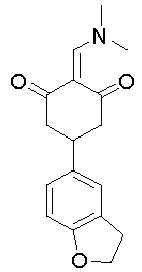
5-(2,3-dihydrobenzofuran-5-yl)-2-((dimethylamino)methylen e) cyclohexane-1,3-dione 1HNMR (400 MHz, CDCl3) δ 8.09 (s, 1H), 7.09 (s, 1H), 6.99 (d, J = 8.1 Hz, 1H), 6.75 (d, J = 8.2 Hz, 1H), 4.58 (t, J = 8.7 Hz, 2H), 3.44 (d, J = 5.0 Hz, 3H), 3.31 (ddd, J = 16.2, 11.6, 4.4 Hz, 1H), 3.26 - 3.16 (m, 5H), 2.70 (qd, J = 16.6, 8.1 Hz, 4H) 252 
methyl 4-(4-((dimethylamino)methylen e)-3,5-dioxocyclohexyl)benzoate 1HNMR (400 MHz, CDCl3) δ 8.10 (d, J = 5.5 Hz, 1H), 8.02 (d, J = 7.9, 6.1 Hz, 2H), 7.37 - 7.30 (d, 2H), 3.96 - 3.84 (s, 3H), 3.44 (t, J = 8.5 Hz, 4H), 3.24 (s, J = 5.6 Hz, 3H), 2.74 (m, J = 16.9, 5.3 Hz, 4H) 253 
methyl 3-(4-((dimethylamino)methylen e)-3,5-dioxocyclohexyl)benzoate 1HNMR (400 MHz, CDCl3) δ 8.11 (s, 1H), 7.97 (s, 1H), 7.94 (d, J = 7.1 Hz, 1H), 7.49 - 7.40 (m, 2H), 3.94 (s, 3H), 3.52 - 3.35 (m, 4H), 3.25 (s, 3H), 2.84 - 2.63 (m, 4H) 254 
2-((dimethylamino)methylen e)-5-(4-(trifluoromethyl)phenyl)cy clohexane-1,3-dione 1HNMR (400 MHz, CDCl3) δ 8.10 (s, 1H), 7.61 (d, J = 8.0 Hz, 2H), 7.38 (d, J = 7.9 Hz, 2H), 3.45 (s, 4H), 3.24 (s, 3H), 2.84 - 2.62 (m, 5H) 255 
2-((dimethylamino)methylen e)-5-(3-(trifluoromethyl)phenyl)cy clohexane-1,3-dione 1HNMR (400 MHz, CDCl3) δ 8.10 (s, 1H), 7.54 - 7.49 (m, 2H), 7.48 (d, J = 7.8 Hz, 1H), 7.46 (s, 1H), 3.51 - 3.35 (m, 4H), 3.24 (s, 3H), 2.75 (qd, J = 16.5, 8.1 Hz, 4H) 256 
N-(4-(4-((dimethylamino)methylen e)-3,5-dioxocyclohexyl)phenyl)ac etamide 1HNMR (400 MHz, CDCl3) δ 8.07 (s, 1H), 7.94 (s, 1H), 7.47 (d, J = 6.8 Hz, 2H), 7.18 (d, J = 6.1 Hz, 2H), 3.40 (s, 3H), 3.33 (m, 1H), 3.21 (s, 3H), 2.69 (q, J = 15.7 Hz, 4H), 2.16 (s, 3H) 257 
2-((dimethylamino)methylen e)-5-(pyridin-3-yl)cyclohexane-1,3-dione 1HNMR (400 MHz, CDCl3) δ 8.56 (s, 1H), 8.53 (d, J = 4.5 Hz, 1H), 8.11 (s, 1H), 7.59 (d, J = 7.9 Hz, 1H), 7.32 - 7.29 (m, 1H), 3.46 (s, 3H), 3.41 (dd, J = 11.2, 4.8 Hz, 1H), 3.25 (s, 3H), 2.82 - 2.71 (m, 4H) 258 
methyl 4-(4-(((2-morpholinoethyl)amino)m ethylene)-3,5-dioxocyclohexyl)benzoate 1HNMR (400 MHz, CDCl3) δ 11.26 (s, 1H), 8.21 (d, J = 14.4 Hz, 1H), 8.03 (d, J = 8.2 Hz, 2H), 7.33 (d, J = 8.2 Hz, 2H), 3.93 (s, 3H), 3.80 - 3.72 (m, 4H), 3.55 (dd, J = 11.9, 6.0 Hz, 2H), 3.46 (dd, J = 10.8, 5.8 Hz, 1H), 2.84 - 2.66 (m, 4H), 2.63 (t, J = 5.9 Hz, 2H), 2.53 (d, J = 4.1 Hz, 4H) 259 
2-((dimethylamino)methylen e)-5-(1H-indazol-5-yl)cyclohexane-1,3-dione 1HNMR (400 MHz, CDCl3) δ 10.85 - 10.35 (m, 1H), 8.14 (s, 1H), 8.06 (s, 1H), 7.74 (d, J = 8.5 Hz, 1H), 7.38 (s, 1H), 7.11 (d, J = 8.0 Hz, 1H), 3.52 (s, 1H), 3.46 (s, 2H), 3.26 (s, 2H), 2.93 - 2.73 (m, 3H) 260 
4-(4-(((2-morpholinoethyl)amino)m ethylene)-3,5-dioxocyclohexyl)benzoic acid 1HNMR (400 MHz, CDCl3) δ 11.23 (s, 1H), 9.09 - 8.95 (m, 1H), 8.26 (d, J = 14.4 Hz, 1H), 8.06 (d, J = 8.2 Hz, 2H), 7.33 (d, J = 8.0 Hz, 2H), 3.79 (s, 3H), 3.79 (s, 3H), 3.61 (d, J = 5.9 Hz, 2H), 3.42 (s, 1H), 2.84 - 2.62 (m, 5H), 2.60 (s, 3H) 262 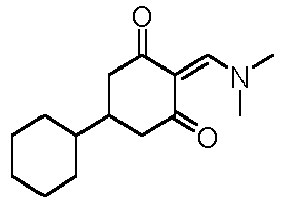
4-((dimethylamino)methylen e)-[1,1'-bi(cyclohexane)]-3,5-dione 1HNMR (400 MHz, CDCl3) δ 8.02 (s, 1H), 3.39 (s, 3H), 3.19 (s, 3H), 2.55 (dd, J = 16.7, 3.8 Hz, 2H), 2.25 (dd, J = 16.6, 12.1 Hz, 2H), 1.94 - 1.83 (m, 1H), 1.75 (d, J = 10.1 Hz, 4H), 1.67 (d, J = 12.0 Hz, 1H), 1.28 - 1.13 (m, 4H), 0.98 (dd, J = 23.2, 12.7 Hz, 2H) 263 
methyl 3-(4-(((2-morpholinoethyl)amino)m ethylene)-3,5-dioxocyclohexyl)benzoate 1HNMR (400 MHz, CDCl3) δ 11.26 (s, 1H), 8.21 (d, J = 14.4 Hz, 1H), 8.03 (d, J = 8.2 Hz, 2H), 7.33 (d, J = 8.2 Hz, 2H), 3.93 (s, 3H), 3.76 (dd, J = 9.4, 4.8 Hz, 4H), 3.55 (dd, J = 11.9, 6.0 Hz, 2H), 3.49 - 3.39 (m, 1H), 2.87 - 2.68 (m, 4H), 2.63 (t, J = 5.9 Hz, 2H), 2.52 (dd, J = 10.3,5.9 Hz, 4H) 264 
2-((dimethylamino)methylen e)-5-(thiophen-2-yl) cyclohexane-1,3-dione 1HNMR (400 MHz, CDCl3) δ 8.08 (s, 1H), 7.19 (d, J = 5.1 Hz, 1H), 6.99 - 6.92 (m, 1H), 6.88 (d, J = 3.4 Hz, 1H), 3.71 - 3.59 (m, 1H), 3.43 (s, 3H), 3.22 (s, 3H), 2.92 (dd, J = 16.8, 4.2 Hz, 2H), 2.74 (dd, J = 16.8, 10.9 Hz, 2H) 265 
5-((dimethylamino)methylen e)-2-phenyldihydropyrimidine-4,6(1H,5H)-dione 1HNMR (400 MHz, DMSO) δ 11.53 (s, 2H), 8.34 (s, 1H), 8.06 (t, J = 9.1 Hz, 2H), 7.59 (t, J = 7.1 Hz, 1H), 7.51 (t, J = 7.3 Hz, 2H), 3.51 (s, 3H), 3.29 (s, 3H) 266 
5-(6-chloropyridin-3-yl)-2-((dimethylamino)methylen e) cyclohexane-1,3-dione 1HNMR (400 MHz, CDCl3) δ 8.32 (d, J = 2.2 Hz, 1H), 8.10 (s, 1H), 7.56 (dd, J = 8.2, 2.2 Hz, 1H), 7.32 (d, J = 8.3 Hz, 1H), 3.45 (s, 3H), 3.44 - 3.37 (m, 1H), 3.24 (s, 3H), 2.73 (qd, J = 16.6, 7.9 Hz, 4H) 267 
3-(4-((dimethylamino)methylen e)-3,5-dioxocyclohexyl)-N-phenethylbenzamide 1HNMR (400 MHz, CDCl3) δ 8.09 (s, 1H), 7.64 (s, 1H), 7.56 - 7.48 (m, 1H), 7.39 - 7.32 (m, 4H), 7.28 - 7.23 (m, 3H), 3.73 (dd, J = 12.9, 6.9 Hz, 2H), 3.44 (d, J = 5.0 Hz, 3H), 3.41 - 3.35 (m, 1H), 3.24 (s, 3H), 2.97 (t, J = 3.4 Hz, 2H), 2.78 - 2.68 (m, 4H) 268 
3-(4-((dimethylamino)methylen e)-3,5-dioxocyclohexyl)-N-(3-phenylpropyl)benzamide 1HNMR (400 MHz, CDCl3) δ 8.09 (s, 1H), 7.61 (s, 1H), 7.53 - 7.48 (m, 1H), 7.40 - 7.34 (m, 2H), 7.31 (dd, J = 12.5, 5.2 Hz, 2H), 7.25 - 7.21 (m, 3H), 3.52 (dd, J = 12.9, 6.8 Hz, 2H), 3.43 (s, 3H), 3.38 (dd, J = 10.7, 5.5 Hz, 1H), 3.23 (s, 4H), 2.74 (dd, J = 13.9, 9.1 Hz, 6H), 1.99 (dd, J = 14.5, 7.3 Hz,2H) 269 
3-(4-((dimethylamino)methylen e)-3,5-dioxocyclohexyl)-N-(4-phenylbutyl)-benzamide 1HNMR (400 MHz, CDCl3) δ 8.10 (s, 1H), 7.68 (s, 1H), 7.61 - 7.57 (m, 1H), 7.41 (dd, J = 8.7, 5.0 Hz, 2H), 7.31 (d, J = 7.5 Hz, 1H), 7.23 - 7.17 (m, 4H), 3.53 - 3.48 (m, 2H), 3.46 - 3.43 (m, 3H), 3.42 - 3.35 (m, 1H), 3.24 (s, 3H), 2.82 - 2.64 (m, 8H), 1.73 (dd, J = 8.7, 5.8 Hz, 2H) 270 
3-(4-((dimethylamino)methylen e)-3,5-dioxocyclohexyl)benzamid e 1HNMR (400 MHz, CDCl3) δ 8.66 (d, J = 5.1 Hz, 1H), 8.22 - 8.12 (m, 1H), 8.11 (s, 1H), 7.41 (dd, J = 12.1, 6.1 Hz, 3H), 3.44 (s, 4H), 3.20 (d, J = 15.1 Hz, 3H), 2.80 - 2.75 (m, 4H) 271 
2-((dimethylamino)methylen e)-5-(1H-indol-4-yl)cyclohexane-1,3-dione 1HNMR (400 MHz, CDCl3) δ 8.35 (s, 1H), 8.14 (s, 1H), 7.33 (d, J = 8.2 Hz, 1H), 7.26 - 7.23 (m, 1H), 7.22 - 7.17 (m, 1H), 7.00 (d, J = 7.3 Hz, 1H), 6.63 (ddd, J = 3.1, 2.0, 0.9 Hz, 1H), 3.84 (ddd, J = 16.6, 10.8, 5.8 Hz, 1H), 3.44 (s, 3H), 3.27 (s, 3H), 2.95 - 2.85 (m, 4H) 272 
5-benzyl-2-((dimethylamino)methylen e) cyclohexane-1,3-dione 1HNMR (400 MHz, CDCl3) δ 8.03 (s, 1H), 7.33 - 7.29 (m, 2H), 7.22 (ddd, J = 7.4, 3.9, 1.3 Hz, 1H), 7.16 (dd, J = 5.2, 3.1 Hz, 2H), 3.40 (s, 3H), 3.18 (s, 3H), 2.68 (d,J = 6.8 Hz, 2H), 2.55 (dt, J = 16.3, 2.7 Hz, 2H), 2.36 (tdd, J = 9.9, 7.1, 3.3 Hz, 1H), 2.30 - 2.20 (m, 2H) 273 
4-((dimethylamino)methylen e)-N-isobutyl-3,5-dioxocyclohexane-1-carboxamide 1HNMR (400 MHz, CDCl3) δ 8.05 (s, 1H), 3.42 (s, 3H), 3.21 (s, 3H), 3.16 - 3.06 (m, 2H), 2.88 - 2.73 (m, 3H), 2.70 - 2.55 (m, 2H), 1.79 (dt, J = 13.5, 6.8 Hz, 1H), 0.92 (t, J = 6.9 Hz, 6H) 274 
4-((dimethylamino)methylen e)-3,5-dioxo-N-propylcyclohexane-1-carboxamide 1HNMR (400 MHz, CDCl3) δ 8.05 (s, 1H), 3.42 (s, 3H), 3.26 (dd, J = 13.0, 7.1 Hz, 2H), 3.21 (s, 3H), 2.85 - 2.74 (m, 3H), 2.67 - 2.57 (m, 2H), 1.59 - 1.47 (m, 2H), 0.94 (t, J = 7.4 Hz, 3H) 276 
2-((dimethylamino)methylen e)-5-isobutylcyclohexane-1,3-dione 1HNMR (400 MHz, CDCl3) δ 8.03 (s, 1H), 3.40 (s, 3H), 3.20 (s, 3H), 2.61 - 2.43 (m, 2H), 2.21 - 2.07 (m, 3H), 1.69 (td, J = 13.5, 6.8 Hz, 1H), 1.24 (dd, J = 12.4, 5.7 Hz, 3H), 0.90 (d, J = 6.6 Hz, 6H) 277 
2-((dimethylamino)methylen e)-5-(naphthalen-1-yl)cyclohexane-1,3-dione 1HNMR (400 MHz, CDCl3) δ 8.15 (s, 1H), 8.09 (d, J = 8.1 Hz, 1H), 7.92 - 7.88 (m, 1H), 7.78 (d, J = 8.1 Hz, 1H), 7.58 - 7.45 (m, 3H), 7.41 (d, J = 7.0 Hz, 1H), 4.21 (tt, J = 11.9, 4.2 Hz, 1H), 3.46 (d,J = 8.5 Hz, 3H), 3.30 (s, 3H), 2.89 (ddd, J = 28.4, 16.7, 12.3 Hz, 4H) 278 
2-((dimethylamino)methylen e)-5-(naphthalen-2-yl)cyclohexane-1,3-dione 1HNMR (400 MHz, CDCl3) δ 8.12 (s, 1H), 7.87 - 7.80 (m, 3H), 7.69 (s, 1H), 7.53 - 7.45 (m, 2H), 7.42 (dd, J = 8.5, 1.8 Hz, 1H), 3.64 - 3.49 (m, 1H), 3.45 (s, 3H), 3.26 (s, 3H), 2.90 - 2.78 (m, 4H) 279 
5-(1-butyl-1H-pyrrol-2-yl)-2-((dimethylamino)methylen e) cyclohexane-1,3-dione 1HNMR (400 MHz, CDCl3) δ 8.10 (d, J = 10.7 Hz, 1H), 6.67 - 6.53 (m, 1H), 6.11 (dd, J = 6.8, 3.6 Hz, 1H), 6.00 (d, J = 37.2 Hz, 1H), 3.87 - 3.79 (m, 2H), 3.41 (d, J = 24.1 Hz, 3H), 3.39 - 3.31 (m, 1H), 3.26 (s, 3H), 2.92 - 2.73 (m, 2H), 2.66 (ddd, J = 23.2, 11.9, 6.0 Hz, 2H), 1.80 - 1.64 (m, 2H), 1.41 - 1.32 (m, 2H), 0.99 - 0.87 (m, 3H) 280 
2-((dimethylamino)methylen e)-5-(5,6,7,8-tetrahydronaphthalen-1-yl)cyclohexane-1,3-dione 1HNMR (400 MHz, CDCl3) δ 8.10 (s, 1H), 7.15 (t, J = 7.5 Hz, 1H), 7.08 (d, J = 6.7 Hz, 1H), 7.00 (d, J = 7.3 Hz, 1H), 3.59 (p, J = 8.3 Hz, 1H), 3.44 (s, 3H), 3.26 (s, 3H), 2.82 (t, J = 6.2 Hz, 2H), 2.77 (t, J = 6.2 Hz, 2H), 2.67 (d, J = 8.2 Hz, 4H), 1.86 - 1.76 (m, 4H) 281 
2-((dimethylamino)methylen e)-5-(1H-indol-5-yl)cyclohexane-1,3-dione 1HNMR (400 MHz, CDCl3) δ 8.20 (s, 1H), 8.11 (s, 1H), 7.53 (s, 1H), 7.39 (d, J = 8.6 Hz, 1H), 7.26 - 7.21 (m, 1H), 7.12 (d, J = 8.6 Hz, 1H), 6.55 (s, 1H), 3.47 (dd, J = 11.1, 5.6 Hz, 1H), 3.44 (s, 3H), 3.25 (s, 3H), 2.83 (dd, J = 16.4, 11.2 Hz, 4H) 282 
5-(benzo[b]thiophen-3-yl)-2-((dimethylamino)methylen e) cyclohexane-1,3-dione 1HNMR (400 MHz, CDCl3) δ 8.13 (s, 1H), 7.89 (dd, J = 7.2, 1.9 Hz, 1H), 7.80 (dd, J = 7.0, 1.6 Hz, 1H), 7.45 - 7.33 (m, 2H), 7.18 (s, 1H), 3.85 - 3.74 (m, 1H), 3.46 (s, 3H), 3.27 (s, 3H), 2.99 (dd, J = 16.9, 4.1 Hz, 2H), 2.79 (dd, J = 16.8, 11.1 Hz, 2H) 283 
2-((dimethylamino)methylen e)-5-(1H-indol-3-yl)cyclohexane-1,3-dione 1HNMR (400 MHz, DMSO) δ 10.85 (s, 1H), 8.04 (s, 1H), 7.57 (d, J = 7.8 Hz, 1H), 7.35 (d, J = 8.1 Hz, 1H), 7.15 - 7.03 (m, 2H), 7.03 - 6.89 (m, 1H), 3.61 - 3.49 (m, 1H), 3.42 (s, 3H), 3.10 (s, 3H), 2.68 (qd, J = 16.2, 7.4 Hz, 4H) 284 
2-((dimethylamino)methylen e)-5-(1-isobutyl-1H-pyrrol-2-yl)cyclohexane-1,3-dione 1HNMR (400 MHz, CDCl3) δ 8.08 (s, 1H), 6.66 - 6.51 (m, 1H), 6.10 (t, J = 3.1 Hz, 1H), 6.02 - 5.85 (m, 1H), 3.63 (d, J = 7.5 Hz, 2H), 3.43 (s, 3H), 3.32 (ddd, J = 15.7, 7.8, 4.0 Hz, 1H), 3.25 (s, 3H), 2.76 (dd, J = 16.9, 4.1 Hz, 2H), 2.68 - 2.58 (m, 2H), 2.02 - 1.98 (m, 1H), 0.96 (dd, J = 15.8, 5.9 Hz, 2H), 0.90 (d, J = 6.6 Hz, 6H) 285 
2-((dimethylamino)methylen e)-5-(quinolin-4-yl)cyclohexane-1,3-dione 1HNMR (400 MHz, CDCl3) δ 8.92 (dd, J = 10.6, 4.4 Hz, 1H), 8.22 - 8.15 (m, 2H), 8.08 (d, J = 8.3 Hz, 1H), 7.76 (dd, J = 16.9, 8.7 Hz, 1H), 7.69 - 7.57 (m, 1H), 4.25 - 4.16 (m, 1H), 3.48 (s, 3H), 3.29 (s, 3H), 2.94 (dd, J = 16.7, 4.1 Hz, 2H), 2.82 (dd, J = 16.6, 11.5 Hz, 2H) 286 
2-((dimethylamino)methylen e)-5-(1H-indazol-3-yl)cyclohexane-1,3-dione 1HNMR (400 MHz, CDCl3) δ 10.35 (s, 1H), 8.12 (s, 1H), 7.76 (d, J = 8.1 Hz, 1H), 7.50 (d, J = 8.3 Hz, 1H), 7.42 - 7.35 (m, 1H), 7.16 (t, J = 7.5 Hz, 1H), 3.91 (dt, J = 14.7, 4.8 Hz, 1H), 3.41 (s, 3H), 3.23 (s, 3H), 3.05 - 2.95 (m, 4H) 287 
2-((dimethylamino)methylen e)-5-(isoquinolin-4-yl)cyclohexane-1,3-dione 1HNMR (400 MHz, CDCl3) δ 9.29 (d, J = 4.3 Hz, 1H), 8.58 (t, J = 6.4 Hz, 1H), 8.16 (s, 1H), 7.91 (dd, J = 8.4, 4.6 Hz, 1H), 7.84 (d, J = 6.1 Hz, 1H), 7.63 (s, 1H), 7.61 (t, J = 2.6 Hz, 1H), 4.14 (tt, J = 11.4, 4.1 Hz, 1H), 3.48 (s, 3H), 3.30 (s, 3H), 2.92 (dd, J = 16.6, 4.2 Hz, 2H), 2.83 (dt, J = 16.6, 8.5 Hz, 2H) 288 
5-(1-benzyl-1H-pyrrol-2-yl)-2-((dimethylamino)methylen e) cyclohexane-1,3-dione 1HNMR (400 MHz, CDCl3) δ 8.03 (d, J = 6.4 Hz, 1H), 7.31 (dd, J = 13.0, 5.6 Hz, 1H), 7.29 - 7.23 (m, 1H), 6.96 (d, J = 6.9 Hz, 2H), 6.69 - 6.60 (m, 1H), 6.22 - 6.12 (m, 1H), 6.05 (dd, J = 3.4, 1.5 Hz, 1H), 5.10 (d, J = 6.7 Hz, 1H), 3.41 (s, 3H), 3.27 - 3.21 (m, 1H), 3.20 (s, 3H), 2.64 (dd, J = 17.9, 5.9 Hz, 4H) 289 
2-((dimethylamino)methylen e)-5-(2-(2-methylbenzyl)phenyl)cyclo hexane-1,3-dione 1H NMR (400 MHz, CDCl3) δ 8.07 (s, 1H), 7.33 - 7.29 (m, 2H), 7.25 - 7.19 (m, 1H), 7.15 (t, J = 7.3 Hz, 2H), 7.01 (d, J = 7.5 Hz, 1H), 6.91 - 6.83 (m, 2H), 4.04 (s, 2H), 3.60 (tt, J = 12.5, 4.0 Hz, 1H), 3.41 (d, J = 14.6 Hz, 3H), 3.21 (s, 3H), 2.64 (dt, J = 27.4, 13.7 Hz, 2H), 2.52 (dd, J = 16.9, 4.0 Hz, 2H), 2.29 (s, 3H) 290 
2-((dimethylamino)methylen e)-5-(2-(3-methylbenzyl)phenyl)cyclo hexane-1,3-dione 1HNMR (400 MHz, CDCl3) δ 8.09 (d, J = 11.8 Hz, 1H), 7.41 - 7.30 (m, 2H), 7.18 (t, J = 7.6 Hz, 2H), 7.14 - 7.06 (m, 1H), 6.96 (d, J = 7.5 Hz, 1H), 6.85 (d, J = 7.1 Hz, 1H), 4.01 (s, 2H), 3.59 - 3.50 (m, 2H), 3.44 (d, J = 4.8 Hz, 3H), 3.22 (s, 3H), 2.72 (dd, J = 16.7, 12.1 Hz, 2H), 2.65 - 2.58 (m, 2H), 2.27 (s, 3H) 291 
2-((dimethylamino)methylen e)-5-(2-(4-methylbenzyl)phenyl)cyclo hexane-1,3-dione 1HNMR (400 MHz, CDCl3) δ 8.07 (s, 1H), 7.30 (t, J = 6.1 Hz, 2H), 7.24 - 7.18 (m, 1H), 7.16 (d, J = 7.2 Hz, 1H), 7.07 (d, J = 7.9 Hz, 2H), 6.96 (d, J = 8.0 Hz, 2H), 4.04 (s, 2H), 3.60 (tt, J = 12.5, 4.2 Hz, 1H), 3.43 (s, 3H), 3.22 (s, 3H), 2.66 (dd,J = 16.8, 12.5 Hz, 2H), 2.53 (dd,J = 17.0, 4.1 Hz, 2H), 2.31 (s, 3H) 293 
2-((dimethylamino)methylen e)-5-(6-methyl-1H-indol-3-yl)cyclohexane-1,3-dione 1HNMR (400 MHz, CDCl3) δ 8.11 (s, 1H), 8.03 (s, 1H), 7.54 (d, J = 8.1 Hz, 1H), 7.18 (s, 1H), 6.98 (d, J = 8.2 Hz, 1H), 6.94 (d, J = 2.0 Hz, 1H), 3.67 (td, J = 11.0, 5.4 Hz, 1H), 3.41 (s, 3H), 3.24 (s, 3H), 2.99 (dd, J = 16.9, 4.0 Hz, 2H), 2.77 (dd, J = 16.8, 11.1 Hz, 2H), 2.48 (s, 3H) 294 
2-((dimethylamino)methylen e)-5-(1-methyl-1H-indol-3-yl)cyclohexane-1,3-dione 1HNMR (400 MHz, CDCl3) δ 8.12 (s, 1H), 7.67 - 7.63 (m, 1H), 7.32 (dt, J = 8.2, 0.9 Hz, 1H), 7.27 - 7.23 (m, 1H), 7.13 (ddd, J = 8.0, 6.9, 1.1 Hz, 1H), 6.87 (d, J = 0.7 Hz, 1H), 3.77 (s, 3H), 3.70 (ddt, J = 8.5, 4.3, 3.4 Hz, 1H), 3.43 (t, J = 2.1 Hz, 3H), 3.25 (d, J = 0.6 Hz, 3H), 3.02 - 2.94 (m, 2H), 2.77 (dd, J = 16.9, 11.0 Hz, 2H) 295 
2-((dimethylamino)methylen e)-5-(1-methyl-1H-indol-4-yl)cyclohexane-1,3-dione 1HNMR (400 MHz, CDCl3) δ 8.14 (s, 1H), 7.28 - 7.21 (m, 2H), 7.09 (d, J = 3.2 Hz, 1H), 7.00 (dd, J = 6.6, 1.0 Hz, 1H), 6.55 (dd, J = 3.2, 0.7 Hz, 1H), 3.87 - 3.76 (m, 4H), 3.47 - 3.41 (m, 3H), 3.27 (t, J= 4.2 Hz, 3H), 2.88 (dd, J = 15.1, 11.4 Hz, 4H). 296 
2-((dimethylamino)methylen e)-5-(2-methyl-1H-indol-3-yl)cyclohexane-1,3-dione 1HNMR (400 MHz, CDCl3) δ 8.14 (s, 1H), 7.98 (s, 1H), 7.63 (d, J = 7.9 Hz, 1H), 7.35 - 7.29 (m, 1H), 7.13 (tt, J = 6.4, 1.8 Hz, 1H), 7.07 (ddd, J = 9.2, 5.2, 1.6 Hz, 1H), 3.63 - 3.54 (m, 1H), 3.41 (s, 3H), 3.26 (d, J = 0.5 Hz, 3H), 3.19 (dd, J = 17.2, 13.4 Hz, 2H), 2.72 - 2.65 (m, 2H), 2.40 (d, J = 6.1 Hz, 3H). 297 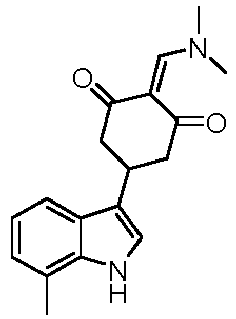
2-((dimethylamino)methylen e)-5-(7-methyl-1H-indol-3-yl)cyclohexane-1,3-dione 1HNMR (400 MHz, CDCl3) δ 8.12 (s, 1H), 8.07 (s, 1H), 7.52 (d, J = 7.7 Hz, 1H), 7.10 - 7.05 (m, 1H), 7.05 - 7.01 (m, 2H), 3.79 - 3.64 (m, 1H), 3.42 (s, 3H), 3.25 (s, 3H), 3.00 (dd, J = 16.9, 4.2 Hz, 2H), 2.79 (dd, J = 16.9, 11.2 Hz, 2H), 2.50 (s, 3H) 298 
2-((dimethylamino)methylen e)-5-(4-methyl-1H-indol-3-yl)cyclohexane-1,3-dione 1HNMR (400 MHz, CDCl3) δ 8.11 (s, 2H), 7.23 (d, J = 7.9 Hz, 1H), 7.13 - 7.06 (m, 1H), 7.03 (d, J = 2.0 Hz, 1H), 6.91 - 6.86 (m, 1H), 3.97 (tt, J = 11.2, 3.7 Hz, 1H), 3.43 (d, J = 0.4 Hz, 3H), 3.26 (d, J = 0.5 Hz, 3H), 3.02 - 2.95 (m, 2H), 2.79 - 2.64 (m, 6H) 299 
2-((dimethylamino)methylen e)-5-(5-methyl-1H-indol-3-yl)cyclohexane-1,3-dione 1HNMR (400 MHz, CDCl3) δ 8.11 (d, J = 5.2 Hz, 2H), 7.45 (d, J = 0.7 Hz, 1H), 7.28 (d, J = 6.6 Hz, 1H), 7.05 (dd, J = 8.3, 1.4 Hz, 1H), 6.97 (d, J = 1.8 Hz, 1H), 3.67 (tt, J = 11.1, 4.2 Hz, 1H), 3.42 (s, 3H), 3.30 - 3.23 (m, 3H), 3.00 (dd, J = 17.0, 4.2 Hz, 2H), 2.77 (dd, J = 16.9, 11.2 Hz, 2H), 2.48 (d, J = 5.1 Hz, 3H) 300 
2-(((2-(dimethylamino)ethyl)ami no)methylene)-5-(2-iodophenyl)cyclohexane-1,3-dione 1H NMR (400 MHz, CDCl3) δ 11.22 (s, 1H), 8.20 (d, J = 14.4 Hz, 1H), 7.86 (dd, J = 7.9, 1.0 Hz, 1H), 7.35 (t, J = 7.6 Hz, 1H), 7.21 (dd, J = 7.8, 1.3 Hz, 1H), 6.98 - 6.91 (m, 1H), 3.66 (tt, J = 12.1, 4.1 Hz, 1H), 3.51 (q, J = 6.0 Hz, 2H), 2.77 (dd, J = 16.7, 4.0 Hz, 2H), 2.69 - 2.52 (m, 4H), 2.29 (s, 6H). 301 
5-(2,4-difluorophenyl)-2-(((2-(dimethylamino)ethyl)ami no)methylene)cyclohexane -1,3-dione 1H NMR (400 MHz, CDCl3) δ 11.22 (s, 1H), 8.18 (d, J = 14.4 Hz, 1H), 7.16 (dd, J = 14.8, 8.5 Hz, 1H), 6.88 - 6.77 (m, 2H), 3.60 (d, J = 9.8 Hz, 1H), 3.51 (q,J = 6.1 Hz, 2H), 2.71 (dd, J = 14.9, 9.7 Hz, 4H), 2.55 (t, J = 6.1 Hz, 2H), 2.29 (s, 6H). 302 
5-(2,5-difluorophenyl)-2-(((2-(dimethylamino)ethyl)ami no)methylene)cyclohexane -1,3-dione 1H NMR (400 MHz, cdcl3) δ 11.22 (s, 1H), 8.19 (d, J = 14.4 Hz, 1H), 7.01 (td, J = 9.6, 4.5 Hz, 1H), 6.95 - 6.87 (m, 2H), 3.64 (ddd, J = 15.7, 10.7, 5.2 Hz, 1H), 3.51 (q,J = 6.0 Hz, 2H), 2.77 - 2.61 (m, 4H), 2.55 (t, J = 6.1 Hz, 2H), 2.29 (s, 6H). 303 
2-(((2-(dimethylamino)ethyl)ami no)methylene)-5-(2-fluorophenyl)cyclohexane-1,3-dione 1H NMR (400 MHz, DMSO-d6) δ 10.99 - 10.88 (m, 1H), 8.13 (d, J = 14.7 Hz, 1H), 7.35 (t, J = 7.7 Hz, 1H), 7.32 - 7.23 (m, 1H), 7.16 (d, J = 7.2 Hz, 1H), 7.13 (d, J = 8.2 Hz, 1H), 3.54 (dt, J = 9.1, 4.6 Hz, 3H), 2.70 (ddd, J = 31.8, 16.5, 11.7 Hz, 2H), 2.54 - 2.49 (m, 1H), 2.45 (dd, J = 5.7, 3.7 Hz, 1H), 2.40 (t, J = 5.9 Hz, 2H), 2.15 (s, 6H). 304 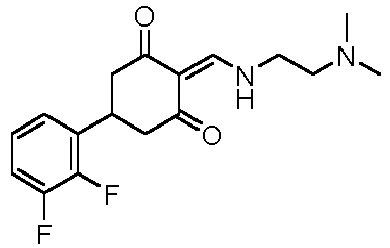
5-(2,3-difluorophenyl)-2-(((2-(dimethylamino)ethyl)ami no)methylene)cyclohexane -1,3-dione 1H NMR (400 MHz, CDCl3) δ 11.22 (s, 1H), 8.19 (d, J = 14.4 Hz, 1H), 7.06 (t, J = 6.2 Hz, 2H), 6.97 (dd, J = 5.4, 3.2 Hz, 1H), 3.75 - 3.63 (m, 1H), 3.51 (q, J = 6.0 Hz, 2H), 2.79 - 2.67 (m, 4H), 2.55 (t, J = 6.1 Hz, 2H), 2.29 (s, 6H). 305 
5-(2-bromo-4-fluorophenyl)-2-(((2-(dimethylamino)ethyl)ami no)methylene)cyclohexane -1,3-dione 1H NMR (400 MHz, CDCl3) δ 11.21 (s, 1H), 8.19 (d, J = 14.4 Hz, 1H), 7.33 (dd, J = 8.2, 2.6 Hz, 1H), 7.21 (dd, J = 8.7, 5.9 Hz, 1H), 7.04 (td, J = 8.3, 2.6 Hz, 1H), 3.77 (dd, J = 10.0, 5.9 Hz, 1H), 3.51 (q, J = 6.0 Hz, 2H), 2.77 (d, J = 2.6 Hz, 1H), 2.73 (d, J = 3.1 Hz, 1H), 2.68 - 2.56 (m, 2H), 2.55 (dd, J = 11.4, 5.3 Hz, 2H), 2.29 (s, 6H). 306 
5-(2-bromo-6-fluorophenyl)-2-(((2-(dimethylamino)ethyl)ami no)methylene)cyclohexane -1,3-dione 1H NMR (400 MHz, CDCl3) δ 11.24 (s, 1H), 8.22 (d, J = 14.4 Hz, 1H), 7.38 (d, J = 7.9 Hz, 1H), 7.10 (td, J = 8.1, 5.9 Hz, 1H), 7.06 - 6.98 (m, 1H), 4.00 (tt, J = 13.5, 3.5 Hz, 1H), 3.56 - 3.47 (m, 2H), 3.10 (ddd, J = 30.3, 16.6, 13.7 Hz, 2H), 2.60 (ddd, J = 14.7, 3.9, 2.0 Hz, 2H), 2.54 (t, J = 6.1 Hz, 2H), 2.29 (s, 6H). 307 
N-((2,6-dioxo-4-phenylcyclohexylidene)me thyl)picolinamide 1H NMR (400 MHz, CDCl3) δ 13.92 (d, J = 12.5 Hz, 1H), 8.88 (d, J = 12.9 Hz, 1H), 8.79 (d, J = 4.7 Hz, 1H), 8.29 (d, J = 7.8 Hz, 1H), 7.95 (td, J = 7.7, 1.6 Hz, 1H), 7.62 - 7.55 (m, 1H), 7.36 (t, J = 7.4 Hz, 2H), 7.28 (d, J = 7.3 Hz, 1H), 7.24 (s, 2H), 3.50 - 3.40 (m, 1H), 3.01 - 2.77 (m, 4H). 308 
2-(((2-(dimethylamino)ethyl)ami no)methylene)-5-(2-hydroxyphenyl)cyclohexan e-1,3-dione 1H NMR (400 MHz, CDCl3) δ 11.25 (d,/ = 14.2 Hz, 1H), 8.23 (d, J = 14.5 Hz, 1H), 7.07 (t, J = 6.9 Hz, 2H), 6.88 - 6.81 (m, 2H), 3.69 (s, 1H), 3.53 (q, J = 6.0 Hz, 2H), 2.95 - 2.85 (m, 2H), 2.81 - 2.62 (m, 2H), 2.57 (t, J = 6.1 Hz, 2H), 2.30 (s, 6H). 309 
5-(2-chlorophenyl)-2-(((2-(dimethylamino)ethyl)ami no)methylene)cyclohexane -1,3-dione 1H NMR (400 MHz, CDCl3) δ 11.20 (s, 1H), 8.19 (d, J = 14.3 Hz, 1H), 7.38 (d, J = 7.7 Hz, 1H), 7.25 (s, 2H), 7.21 - 7.14 (m, 1H), 3.85 (s, 1H), 3.51 (d, J = 6.0 Hz, 2H), 2.70 (ddd, J = 23.0, 16.8, 9.6 Hz, 4H), 2.55 (t, J = 5.9 Hz, 2H), 2.29 (s, 6H). 310 
2-(((2-(dimethylamino)ethyl)ami no)methylene)-5-(2-methoxyphenyl)cyclohexa ne-1,3-dione 1H NMR (400 MHz, CDCl3) δ 11.21 (s, 1H), 8.18 (d, J = 14.3 Hz, 1H), 7.23 (td, J = 8.2, 1.6 Hz, 1H), 7.15 (dd, J = 7.6, 1.3 Hz, 1H), 6.94 (td, J = 7.5, 0.9 Hz, 1H), 6.87 (d, J = 8.2 Hz, 1H), 3.82 (s, 3H), 3.77 - 3.67 (m, 1H), 3.49 (q, J = 6.1 Hz, 2H), 2.77 - 2.66 (m, 4H), 2.53 (t, J = 6.2 Hz, 2H), 2.28 (s, 6H). 311 
2-(((2-(dimethylamino)ethyl)ami no)methylene)-5-(3-nitrophenyl)cyclohexane-1,3-dione 1H NMR (400 MHz, CDCl3) δ 11.21 (s, 1H), 8.20 (d, J = 14.5 Hz, 1H), 8.12 (dd, J = 4.3, 2.0 Hz, 2H), 7.61 - 7.48 (m, 2H), 3.55 - 3.44 (m, 3H), 2.80 - 2.76 (m, 2H), 2.74 (d, J = 12.4 Hz, 1H), 2.71 - 2.65 (m, 1H), 2.55 (t, J = 6.1 Hz, 2H), 2.29 (s, 6H). 315 
2-(((2-(4-(2-hydroxyethyl)piperazin-1-yl)ethyl)amino)methylene) -5-(1H-indol-6-yl)cyclohexane-1,3-dione 1H NMR (400 MHz, CD3OD) δ 8.24 (s, 1H), 7.49 (d, J = 8.2 Hz, 1H), 7.27 (s, 1H), 7.19 (d, J = 3.1 Hz, 1H), 6.96 (dd, 1H), 6.39 (dd, 1H), 3.81 (t, J = 5.4 Hz, 2H), 3.61 (m, 2H), 3.45 (m, 1H), 3.34 (s, 2H), 3.06 (m, 4H), 2.93 - 2.62 (m, 10H); MS: 411.2 [M+1]. 317 
3-(((2-(4-(2-hydroxyethyl)piperazin-1-yl)ethyl)amino)methylene) -6-(trifluoromethyl)quinoline -2,4(1H,3H)-dione 1H NMR (400 MHz, CD3OD) δ 8.58 (d, J = 32.5 Hz, 1H), 8.31 (s, 1H), 7.77 (d, J = 8.3 Hz, 1H), 7.32 (d, J = 8.6 Hz, 1H), 3.87 - 3.67 (m, 4H), 3.02 (d, J = 40.0 Hz, 6H), 2.74 (m, 6H). 318 
3-(((2-(4-(2-hydroxyethyl)piperazin-1-yl)ethyl)amino)methylene) -8-nitroquinoline-2,4(1H,3H)-dione 1H NMR (400 MHz, CD3OD) δ 8.47 (m, 3H), 7.27 (m, 1H), 3.81 (m, 4H), 3.10 (d, J = 45.3 Hz, 6H), 2.89 - 2.66 (m, 6H). 320 
2-(((2-(4-(2-hydroxyethyl)piperazin-1-yl)ethyl)amino)methylene) -5-(2-(trifluoromethyl)phenyl)cy clohexane-1,3-dione 1H NMR (400 MHz, DMSO-d6) δ 11.05 - 10.84 (m, 1H), 8.15 (d, J = 14.8 Hz, 1H), 7.81 (d, J = 8.2 Hz, 1H), 7.67 (t, J = 7.2 Hz, 2H), 7.44 (t, J = 7.6 Hz, 1H), 4.80 (s, 1H), 3.58 - 3.12 (m, 9H), 3.00 - 2.50 (m, 10H), 2.34 (d, J = 16.5 Hz, 2H). 321 
3-(((2-(4-(2-hydroxyethyl)piperazin-1-yl)ethyl)amino)methylene) -8-phenylquinoline-2,4(1H,3H)-dione 1H NMR (400 MHz, CD3OD) δ 8.54 (d, J = 47.0 Hz, 1H), 8.09 (d, J = 7.8 Hz, 1H), 7.63 - 7.37 (m, 6H), 7.25 (t, J = 7.7 Hz, 1H), 3.74 (m, 4H), 3.04 - 2.57 (m, 12H). 322 
5-(3-chloro-1H-indol-4-yl)-2-(((2-(4-(2-hydroxyethyl)piperazin-1-yl)ethyl)amino)methylene) cyclohexane-1,3-dione 1H NMR (400 MHz, CD3OD) δ 8.27 (s, 1H), 7.32 - 7.19 (m, 2H), 7.12 (t, J = 7.8 Hz, 1H), 6.96 (d, J = 7.2 Hz, 1H), 3.71 (t, J = 5.9 Hz, 2H), 3.61 (t, J = 5.9 Hz, 2H), 2.92 - 2.48 (m, 17H). 323 
2-(((2-(4-(2-hydroxyethyl)piperazin-1-yl)ethyl)amino)methylene) -4,5-diphenylcyclohexane-1,3-dione 1H NMR (400 MHz, CD3OD) δ 8.30(d, J = 24.8Hz, 1H), 7.16-7.05(m, 10H), 4.04-3.93(m, 1H), 3.70-3.56(m, 5H), 3.04-2.99(m, 1H), 2.69-2.61(m, 1H); MS: 448.2 [M+1]. 324 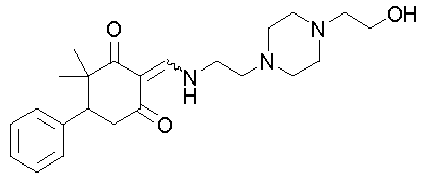
2-(((2-(4-(2-hydroxyethyl)piperazin-1-yl)ethyl)amino)methylene) -4,4-dimethyl-5-phenylcyclohexane-1,3-dione 1H NMR (400 MHz, CD3OD) δ 8.27(d, J =20.4Hz, 7.29-7.21(m, 5H), 3.72 (t, J =5.6Hz, 2H), 3.62(t, J =5.6Hz, 2H), 3.22-3.17 (m, 1H), 3.09-3.00(m, 1H), 2.77-2.56 (m, 12H); MS: 400.2 [M+1]. 325 
5-hydroxy-2-(((2-(4-(2-hydroxyethyl)piperazin-1-yl)ethyl)amino)methylene) -4-methyl-5-phenylcyclohexane-1,3-dione 1H NMR (400 MHz, DMSO-d6) δ 10.76 (s, 1H), 8.08 (d, J = 14.8 Hz, 1H), 7.71 (s, 1H), 7.47 (d, J = 7.7 Hz, 2H), 7.32 (t, J = 7.5 Hz, 2H), 7.20 (t, J = 7.2 Hz, 1H), 3.72 (s, 3H), 3.60 (s, 2H), 3.22 - 2.85 (m, 10H), 2.71 (s, 2H), 2.56 (m, 1H), 2.43 (s, 1H), 1.92 (d, J = 12.3 Hz, 1H), 1.07 - 0.71 (m, 3H). 326 
N-(2-(4-(2-hydroxyethyl)piperazin-1-yl)ethyl)-2,4-dioxo-1,2,3,4-tetrahydroquinoline-3-carboxamide 1H NMR (400 MHz, CD3OD) δ 8.06 (d, J = 8.0 Hz, 1H), 7.64 (t, J = 7.3 Hz, 1H), 7.29 (dd, J = 14.9, 7.7 Hz, 2H), 3.68 (t, J = 6.0 Hz, 2H), 3.57 (t, J = 6.4 Hz, 2H), 2.59 m, 12H). 327 
2-(((2-(4-(2-hydroxyethyl)piperazin-1-yl)ethyl)amino)methylene) - 4-cyano-5-phenylcyclohexane-1,3-dione 1H NMR (400 MHz, CD3OD) δ8.35-8.32(m, 1H), 7.40-7.31(m, 5H), 3.84-3.82(m, 2H), 3.66-3.53(m, 3H), 3.28-3.12(m, 6H), 2.88-2.63(m, 10H); MS: 397.2 [M+1]. 328 
3-(((2-(4-(2-hydroxyethyl)piperazin-1-yl)ethyl)amino)methylene) -6-phenylquinoline-2,4(1H,3H)-dione 1H NMR (400 MHz, DMSO-d6) δ 11.93 - 11.64 (m, 1H), 10.72-10.02 (m, 2H), 8.48 (m, 1H), 8.23 - 7.16 (m, 7H), 3.67 - 3.31 (m, 10H), 2.94 (m, 6H). 329 
5-(2-bromo-4-methylphenyl)-2-(((2-(4-(2-hydroxyethyl)piperazin-1-yl)ethyl)amino)methylene) cyclohexane-1,3-dione 1H NMR (400 MHz, CD3OD) δ 8.26 (s, 1H), 7.43 (s, 1H), 7.24 (d, J = 8.0 Hz, 1H), 7.17 (d, J = 8.0 Hz, 1H), 3.71 (m, 3H), 3.61 (t, J = 5.9 Hz, 2H), 2.81 - 2.52 (m, 16H), 2.30 (s, 3H). 330 
ethyl 3-(((2-(4-(2-hydroxyethyl)piperazin-1-yl)ethyl)amino)methylene) -6-(1H-indol-4-yl)-2,4-dioxocyclohexane-1-carboxylate 1H NMR (400 MHz, CD3OD) δ 8.30 (d, J = 18.1 Hz, 1H), 7.26 (dd, J = 14.0, 5.6 Hz, 2H), 7.05 (t, J = 7.8 Hz, 1H), 6.94 (d, J = 7.3 Hz, 1H), 6.56 (d, J = 3.1 Hz, 1H), 4.09 (m, 2H), 3.96 - 3.83 (m, 2H), 3.77 (t, J = 5.6 Hz, 2H), 3.62 (m, 2H), 2.92 (m, 6H), 2.80 - 2.45 (m, 8H), 0.90 (t, J = 7.1 Hz, 3H). 331 
3-(((2-(4-(2-hydroxyethyl)piperazin-1-yl)ethyl)amino)methylene) benzo[h]quinoline-2,4(1H,3H)-dione 1H NMR (400 MHz, CD3OD) δ 8.61 (d, J = 34.9 Hz, 1H), 8.47 (d, J = 8.1 Hz, 1H), 8.06 (d, J = 8.7 Hz, 1H), 7.91 (d, J = 7.4 Hz, 1H), 7.71 - 7.54 (m, 3H), 3.73 (m, 4H), 2.92 - 2.53 (m, 12H). 332 
5-(2-bromo-5-(dimethylamino)phenyl)-2-(((2-(4-(2-hydroxyethyl)piperazin-1-yl) ethyl) amino) methylene) cyclohexane-1,3-dione 1H NMR (400 MHz, CD3OD) δ 8.26 (s, 1H), 7.34 (d, J = 8.9 Hz, 1H), 6.66 (d, J = 3.0 Hz, 1H), 6.56 (dd, J = 8.9, 3.0 Hz, 1H), 3.76 (t, J = 5.7 Hz, 2H), 3.70 (m, 1H), 3.62 (t, J = 5.8 Hz, 2H), 2.99 - 2.56 (m, 22H). 333 
3-(((2-(4-(2-hydroxyethyl)piperazin-1-yl)ethyl)amino)methylene) -2,4-dioxo-6-phenylcyclohexane-1-carboxamide 1H NMR (400 MHz, CD3OD) δ 8.27(d, J =16.8Hz 1H), 7.31-7.25(m, 5H), 3.84-3.72(m, 3H), 3.66-3.59(m, 3H), 3.16-3.04(m, 6H), 2.86-2.59(m, 12H); MS: 415.2 [M+1]. 334 
tert-butyl 3-(((2-(4-(2-hydroxyethyl)piperazin-1-yl)ethyl)amino)methylene) -2,4-dioxo-6-phenylcyclohexane-1-carboxylate 1H NMR (400 MHz, CD3OD) δ 8.28-8.24(m,1H), 7.31-7.20(m, 5H), 3.89-3.27(m, 12H), 2.90-2.55(m, 8H), 1.20-1.17 (m, 9H); MS: 472.2 [M+1]. 335 
ethyl 3-(((2-(4-(2-hydroxyethyl)piperazin-1-yl)ethyl)amino)methylene) -2,4-dioxo-6-phenylcyclohexane-1-carboxylate 1H NMR (400 MHz, CD3OD) δ 8.30-8.25(m, 1H), 7.46-7.12(m, 5H), 4.00-3.87(m, 5H), 3.86-3.11(m,9H), 2.87-2.57 (m, 8H), 1.01-0.90(m, 3H); MS: 444.2 [M+1]. 336 
3-(((2-(4-(2-hydroxyethyl)piperazin-1-yl)ethyl)amino)methylene) -1-methyl-2,4-dioxo-6-phenylcyclohexane-1-carbonitrile 1H NMR (400 MHz, CD3OD) δ 8.37-8.31(m, 1H), 7.43-7.33(m, 5H), 3.70(t, J= 6.0Hz, 2H), 3.64(t, J= 5.6Hz, 2H), 3.11-3.33(m, 2H), 2.77-2.60(m, 13H), 1.37(br, 3H); MS: 411.2 [M+1]. 337 
2-(((2-(dimethylamino)ethyl)ami no)methylene)-5-(3-methoxyphenyl)cyclohexa ne-1,3-dione 1H NMR (400 MHz, CDCl3) δ 11.21 (s, 1H), 8.18 (d, J = 14.3 Hz, 1H), 7.24 (d, J = 7.6 Hz, 1H), 6.80 (dd, J = 15.9, 7.6 Hz, 3H), 3.80 (s, 3H), 3.52 (dd, J = 12.1, 6.0 Hz, 2H), 3.38 - 3.27 (m, 1H), 2.80 - 2.69 (m, 3H), 2.70 - 2.61 (m, 1H), 2.57 (t, J = 6.1 Hz, 2H), 2.30 (s, 6H). 338 
5-(2-bromopyridin-3-yl)-2-(((2-(dimethylamino)ethyl)ami no)methylene)cyclohexane -1,3-dione 1H NMR (400 MHz, CDCl3) δ 11.22 (s, 1H), 8.28 (d, J = 3.0 Hz, 1H), 8.20 (d, J = 14.4 Hz, 1H), 7.54 (d, J = 7.6 Hz, 1H), 7.29 (s, 1H), 3.84 - 3.74 (m, 1H), 3.57 - 3.47 (m, 2H), 2.81 (d, J = 6.7 Hz, 2H), 2.70 - 2.59 (m, 2H), 2.56 (d, J = 6.0 Hz, 2H), 2.31 (s, 6H). 339 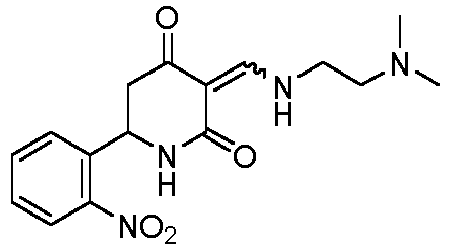
3-(((2-(dimethylamino)ethyl)ami no)methylene)-6-(2-nitrophenyl)piperidine-2,4-dione 1H NMR (400 MHz, CDCl3) δ 10.70 (s, 1H), 8.09 (d, J = 14.3 Hz, 1H), 7.96 (d, J = 8.0 Hz, 1H), 7.70 (t, J = 7.8 Hz, 1H), 7.64 (t, J = 7.6 Hz, 1H), 7.47 (t, J = 7.5 Hz, 1H), 5.65 (s, 1H), 5.35 (d, J = 8.3 Hz, 1H), 3.47 (dd, J = 6.7, 5.8 Hz, 2H), 3.17 - 3.03 (m, 1H), 2.70 (dd, J = 6.7, 6.9 Hz, 1H), 2.53 (t, J = 6.1 Hz, 2H), 2.28 (s, 6H). 340 
2-(((2-(dimethylamino)ethyl)ami no)methylene)-5-(4-nitrophenyl)cyclohexane-1,3-dione 1H NMR (400 MHz, CDCl3) δ 11.21 (s, 1H), 8.20 (dd, J = 11.7, 6.2 Hz, 3H), 7.40 (d, J = 8.5 Hz, 2H), 3.56 - 3.43 (m, 3H), 2.82 - 2.62 (m, 4H), 2.54 (t, J = 6.0 Hz, 2H), 2.29 (s, 6H). 341 
5-(3-bromophenyl)-2-(((2-(dimethylamino)ethyl)ami no)methylene)cyclohexane -1,3-dione 1H NMR (400 MHz, CDCl3) δ 11.18 (s, 1H), 8.16 (d, J = 14.4 Hz, 1H), 7.37 (dd, J = 4.7, 1.4 Hz, 2H), 7.17 (dt, J = 19.2, 7.8 Hz, 2H), 3.48 (q, J = 6.0 Hz, 2H), 3.37 - 3.26 (m, 1H), 2.77 - 2.56 (m, 4H), 2.52 (t, J = 6.1 Hz, 2H), 2.27 (s, 6H). 342 
5-(4-bromophenyl)-2-(((2-(dimethylamino)ethyl)ami no)methylene)cyclohexane -1,3-dione 1H NMR (400 MHz, CDCl3) δ 11.21 (s, 1H), 8.18 (d, J = 14.4 Hz, 1H), 7.47 (d, J = 8.4 Hz, 2H), 7.12 (d, J = 8.3 Hz, 2H), 3.51 (q, J = 6.0 Hz, 2H), 3.34 (ddd, J = 15.9, 11.1, 4.6 Hz, 1H), 2.80 - 2.58 (m, 4H), 2.55 (t, J = 6.1 Hz, 2H), 2.29 (s, 6H). 343 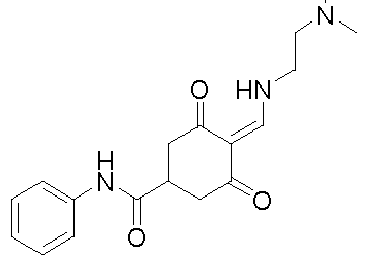
4-(((2-(dimethylamino)ethyl)ami no)methylene)-3,5-dioxo-N-phenylcyclohexane-1-carboxamide 1H NMR (400 MHz, CDCl3) δ 11.16 (s, 1H), 8.12 (d, J = 14.6 Hz, 1H), 7.92 (s, 1H), 7.56 (d, J = 7.8 Hz, 2H), 7.32 (t, J = 7.8 Hz, 2H), 7.11 (t, J = 7.5 Hz, 1H), 3.45 (d, J = 6.0 Hz, 2H), 3.03 - 2.76 (m, 3H), 2.69 (d, J = 17.1 Hz, 2H), 2.51 (t, J = 6.1 Hz, 2H), 2.25 (s, 6H). 344 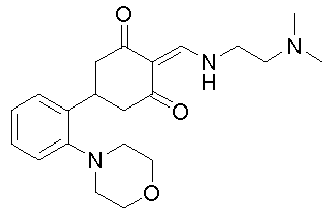
2-(((2-(dimethylamino)ethyl)ami no)methylene)-5-(2-morpholinophenyl) cyclohe xane-1,3-dione 1H NMR (400 MHz, CDCl3) δ 11.21 (s, 1H), 8.21 (d, J = 14.4 Hz, 1H), 7.27 - 7.12 (m, 4H), 3.96 (dd, J = 9.8, 5.9 Hz, 1H), 3.88 - 3.72 (m, 4H), 3.52 (q, J = 6.0 Hz, 2H), 2.85 (s, 4H), 2.78 - 2.61 (m, 4H), 2.55 (t, J = 6.1 Hz, 2H), 2.29 (s, 6H). 345 
N-(2-(4-(((2-(dimethylamino) ethyl) ami no)methylene)-3,5-dioxocyclohexyl)phenyl)ac etamide 1H NMR (400 MHz, CDCl3) δ 11.15 (s, 1H), 8.12 (d, J = 14.3 Hz, 1H), 7.66 (s, 1H), 7.57 (d, J = 7.4 Hz, 1H), 7.25 (d, J = 4.9 Hz, 3H), 3.51 (t, J = 17.7 Hz, 3H), 2.64 (dd, J = 24.2, 10.9 Hz, 4H), 2.53 (t, J = 5.9 Hz, 2H), 2.27 (s, 6H), 2.18 (s, 3H). 346 
5-(3-chlorophenyl)-2-(((2-(dimethylamino)ethyl)ami no)methylene)cyclohexane -1,3-dione 1H NMR (400 MHz, CDCl3) δ 11.21 (s, 1H), 8.18 (d, J = 14.4 Hz, 1H), 7.26 - 7.19 (m, 3H), 7.11 (d, J = 7.3 Hz, 1H), 3.53 - 3.47 (m, 2H), 3.39 - 3.28 (m, 1H), 2.70 (dt, J = 33.1, 12.1 Hz, 4H), 2.54 (t, J = 6.1 Hz, 2H), 2.28 (s, 6H). 347 
2-(((2-(dimethylamino)ethyl)ami no)methylene)-5-(3-fluorophenyl)cyclohexane-1,3-dione 1H NMR (400 MHz, CDCl3) δ 11.21 (s, 1H), 8.18 (d, J = 14.4 Hz, 1H), 7.31 (dd, J = 9.5, 7.0 Hz, 1H), 7.01 (d, J = 7.7 Hz, 1H), 6.97 - 6.91 (m, 2H), 3.51 (q, J = 6.0 Hz, 2H), 3.41 - 3.31 (m, 1H), 2.79 - 2.59 (m, 4H), 2.55 (t, J = 6.1 Hz, 2H), 2.29 (s, 6H). 349 
5-(2-bromo-5-fluorophenyl)-2-(((2-(dimethylamino)ethyl)ami no)methylene)cyclohexane -1,3-dione 1H NMR (400 MHz, CDCl3) δ 11.21 (s, 1H), 8.20 (d, J = 14.4 Hz, 1H), 7.53 (dd, J = 8.8, 5.5 Hz, 1H), 6.97 (dd, J = 9.8, 2.9 Hz, 1H), 6.89 - 6.81 (m, 1H), 3.84 - 3.73 (m, 1H), 3.52 (q, J = 6.0 Hz, 2H), 2.77 (dd, J = 16.5, 3.8 Hz, 2H), 2.67 - 2.50 (m, 4H), 2.29 (s, 6H). 350 
5-(2-bromo-3-fluorophenyl)-2-(((2-(dimethylamino)ethyl)ami no)methylene)cyclohexane -1,3-dione 1H NMR (400 MHz, CDCl3) δ 11.21 (s, 1H), 8.20 (d, J = 14.4 Hz, 1H), 7.32 - 7.27 (m, 1H), 7.03 (t, J = 7.2 Hz, 2H), 3.85 (ddd, J = 15.7, 7.8, 4.1 Hz, 1H), 3.52 (q, J = 6.0 Hz, 2H), 2.81 - 2.59 (m, 4H), 2.56 (t, J = 6.1 Hz, 2H), 2.29 (s, 6H). 351 
5-(2-chloro-5-fluorophenyl)-2-(((2-(dimethylamino)ethyl)ami no)methylene)cyclohexane -1,3-dione 1H NMR (400 MHz, CDCl3) δ 11.22 (s, 1H), 8.20 (d, J = 14.4 Hz, 1H), 7.34 (dd, J = 8.8, 5.3 Hz, 1H), 6.99 - 6.88 (m, 2H), 3.86 - 3.76 (m, 1H), 3.52 (q, J = 6.0 Hz, 2H), 2.76 (dd, J = 16.6, 3.3 Hz, 2H), 2.68 - 2.52 (m, 4H), 2.29 (s, 6H). 352 
2-(((2-(4-(2-hydroxyethyl)piperazin-1-yl)ethyl)amino)methylene) cycloheptane-1,3-dione 1H NMR (400 MHz, CD3OD) δ 8.08 (s, 1H), 3.72 (t, J = 5.9 Hz, 2H), 3.55 (t, J = 5.9 Hz, 2H), 2.87 - 2.52 (m, 15H), 1.90 - 1.75 (m, 4H). MS: 310.2 [M+1]. 353 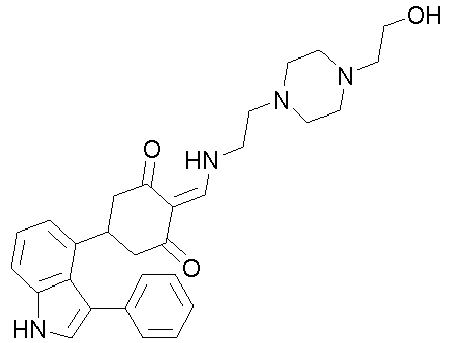
2-(((2-(4-(2-hydroxyethyl)piperazin-1-yl)ethyl)amino)methylene) -5-(3-phenyl-1H-indol-4-yl)cyclohexane-1,3-dione 1H NMR (400 MHz, CD3OD) δ 8.10 (s, 1H), 7.39 (dd, J = 8.2, 1.3 Hz, 2H), 7.30 (m, 3H), 7.22 (m, 1H), 7.15 - 7.09 (m, 2H), 6.94 (d, J = 7.3 Hz, 1H), 3.81 - 3.76 (m, 2H), 3.74 (m, 1H), 3.55 (t, J = 5.8 Hz, 2H), 2.97 (m, 6H), 2.76 - 2.57 (m, 8H), 2.48 (m, 2H). MS: 487.2 [M+1]. 354 
3-(((2-(4-(2-hydroxyethyl)piperazin-1-yl)ethyl)amino)methylene) -7-(trifluoromethyl)quinoline -2,4(1H,3H)-dione 1H NMR (400 MHz, CD3OD) δ 8.54 (m, 1H), 8.19 (d, J = 8.0 Hz, 1H), 7.48 (s, 1H), 7.39 (d, J = 7.8 Hz, 1H), 3.81 - 3.68 (m, 4H), 2.88 (d, J = 34.6 Hz, 6H), 2.72 (s, 6H). MS: 413.1 [M+1]. 355 
2-(((1-oxoisoindolin-4-yl)amino)methylene)-5-phenylcyclohexane-1,3-dione 1H NMR (400 MHz, DMSO-d6) δ 12.87 (s, 1H), 8.73 (s, 1H), 8.63 (m, 1H), 7.86 (m, 1H), 7.56 (s, 2H), 7.33 (s, 4H), 7.24 - 7.18 (m, 1H), 4.50 (s, 2H), 3.43 - 3.39 (m, 1H), 2.97 - 2.89 (m, 1H), 2.86 - 2.77 (m, 1H), 2.65 (m, 2H). MS: 347.1 [M+1] 356 
5-(2,3-dichlorophenyl)-2-(((2-(dimethylamino)ethyl)ami no)methylene)cyclohexane -1,3-dione 1H NMR (400 MHz, CDCl3) δ 11.20 (s, 1H), 8.19 (d, J = 14.4 Hz, 1H), 7.38 (dd, J = 7.7, 1.3 Hz, 1H), 7.19 (dt, J = 7.8, 7.1 Hz, 2H), 3.95 - 3.84 (m, 1H), 3.51 (q, J = 6.0 Hz, 2H), 2.77 (m, 2H), 2.63 (m, 2H), 2.54 (t, J = 6.1 Hz, 2H), 2.28 (s, 6H). 357 
5-(2,5-dichlorophenyl)-2-(((2-(dimethylamino)ethyl)ami no)methylene)cyclohexane -1,3-dione 1H NMR (400 MHz, CDCl3) δ 11.20 (s, 1H), 8.20 (d, J = 14.4 Hz, 1H), 7.32 (d, J = 8.5 Hz, 1H), 7.23 (d, J = 2.3 Hz, 1H), 7.17 (dd, J = 8.4, 2.2 Hz, 1H), 3.80 (m, 1H), 3.51 (q, J = 6.0 Hz, 2H), 2.79 - 2.51 (m, 6H), 2.29 (s, 6H). 358 
5-(2-chloro-6-(trifluoromethyl)phenyl)-2-(((2-(dimethylamino)ethyl)ami no)methylene)cyclohexane -1,3-dione 1H NMR (400 MHz, CDCl3) δ 11.27 (s, 1H), 8.22 (d, J = 14.4 Hz, 1H), 7.63 (d, J = 7.8 Hz, 1H), 7.56 (d, J = 7.9 Hz, 1H), 7.31 (t, J = 8.0 Hz, 1H), 3.96 (m, 1H), 3.75 - 3.56 (m, 2H), 3.51 (q, J = 6.1 Hz, 2H), 2.61 - 2.41 (m, 4H), 2.29 (s, 6H). 359 
N-benzyl-4-(((2-(dimethylamino)ethyl)ami no)methylene)-3,5-dioxocyclohexane-1-carboxamide 1H NMR (400 MHz, CDCl3) δ 11.15 (s, 1H), 8.12 (d, J = 14.5 Hz, 1H), 7.36 - 7.26 (m, 3H), 7.24 (s, 2H), 5.84 (s, 1H), 4.45 (d, J = 5.5 Hz, 2H), 3.49 (dd, J = 12.1, 6.0 Hz, 2H), 2.89 - 2.50 (m, 7H), 2.29 (s, 6H). 360 
N-(4-bromophenyl)-4-(((2-(dimethylamino)ethyl)ami no)methylene)-3,5-dioxocyclohexane-1-carboxamide 1H NMR (400 MHz, DMSO-d6) δ 10.89 (d, J = 14.7 Hz, 1H), 10.13 (s, 1H), 8.09 (d, J = 14.7 Hz, 1H), 7.57 (d, J = 8.9 Hz, 2H), 7.51 - 7.44 (m, 2H), 3.54 (dt, J = 14.5, 7.3 Hz, 2H), 3.15 - 3.04 (m, 1H), 2.64 (m, 1H), 2.55 (m, 3H), 2.42 (t, J = 5.8 Hz, 2H), 2.17 (s, 6H). 361 
5-(2-chloro-6-fluorophenyl)-2-(((2-(dimethylamino)ethyl)ami no)methylene)cyclohexane -1,3-dione 1H NMR (400 MHz, CDCl3) δ 11.22 (s, 1H), 8.21 (d, J = 14.4 Hz, 1H), 7.17 (dd, J = 7.5, 5.1 Hz, 2H), 7.01 - 6.94 (m, 1H), 4.02 (t, J = 13.3 Hz, 1H), 3.51 (q, J = 6.1 Hz, 2H), 3.22 - 3.02 (m, 2H), 2.56 (m, 4H), 2.29 (s, 6H). 362 
5-(2-bromo-5-(trifluoromethyl)phenyl)-2-(((2-(dimethylamino)ethyl)ami no)methylene)cyclohexane -1,3-dione 1H NMR (400 MHz, CDCl3) δ 11.21 (s, 1H), 8.20 (d, J = 14.4 Hz, 1H), 7.71 (d, J = 8.2 Hz, 1H), 7.48 (s, 1H), 7.38 (d, J = 8.3 Hz, 1H), 3.86 (s, 1H), 3.52 (q, J = 6.0 Hz, 2H), 2.79 (m, 2H), 2.74 - 2.60 (m, 2H), 2.57 (m, 2H), 2.30 (s, 6H). 363 
N-(4-chlorophenyl)-4-(((2-(dimethylamino)ethyl)ami no)methylene)-3,5-dioxocyclohexane-1-carboxamide 1H NMR (400 MHz, CDCl3) δ 11.17 (s, 1H), 8.38 (s, 1H), 8.12 (d, J = 14.4 Hz, 1H), 7.54 (d, J = 8.5 Hz, 2H), 7.28 (s, 1H), 3.51 - 3.42 (m, 2H), 3.00 - 2.76 (m, 3H), 2.68 (m, 2H), 2.52 (t, J = 6.0 Hz, 2H), 2.25 (s, 6H). 364 
2-(((2-(dimethylamino)ethyl)ami no)methylene)-5-(2,3,5-trichlorophenyl)cyclohexa ne-1,3-dione 1H NMR (400 MHz, CDCl3) δ 11.20 (s, 1H), 8.19 (d, J = 14.5 Hz, 1H), 7.40 (d, J = 2.3 Hz, 1H), 7.15 (d, J = 2.3 Hz, 1H), 3.86 (s, 1H), 3.51 (q, J = 5.9 Hz, 2H), 2.84 - 2.69 (m, 2H), 2.69 - 2.48 (m, 4H), 2.29 (s, 6H). 365 
methyl 2-(4-(((2-(dimethylamino)ethyl)ami no)methylene)-3,5-dioxocyclohexyl)benzoate 1H NMR (400 MHz, CDCl3) δ 11.18 (s, 1H), 8.18 (d, J = 14.3 Hz, 1H), 7.85 (d, J = 7.7 Hz, 1H), 7.51 (t, J = 7.6 Hz, 1H), 7.39 (d, J = 7.7 Hz, 1H), 7.31 (d, J = 7.6 Hz, 1H), 4.35 - 4.25 (m, 1H), 3.88 (s, 3H), 3.50 (q, J = 6.1 Hz, 2H), 2.80 - 2.71 (m, 2H), 2.71 - 2.60 (m, 2H), 2.54 (t, J = 6.1 Hz, 2H), 2.28 (s, 6H). 366 
5-(5-bromothiophen-2-yl)-2-(((2-(dimethylamino)ethyl)ami no)methylene)cyclohexane -1,3-dione 1H NMR (400 MHz, CDCl3) δ 11.19 (s, 1H), 8.15 (d, J = 14.4 Hz, 1H), 6.87 (d, J = 3.7 Hz, 1H), 6.61 (d, J = 3.7 Hz, 1H), 3.55 (td, J = 10.6, 5.4 Hz, 1H), 3.48 (q, J = 6.0 Hz, 2H), 2.90 - 2.80 (m, 2H), 2.66 (m, 2H), 2.53 (t, J = 6.1 Hz, 2H), 2.27 (s, 6H). 367 
2-(((2-(dimethylamino)ethyl)ami no)methylene)-5-(5-phenylthiophen-2-yl)cyclohexane-1,3-dione 1H NMR (400 MHz, CDCl3) δ 11.19 (s, 1H), 8.17 (d, J = 14.4 Hz, 1H), 7.58 - 7.52 (m, 2H), 7.35 (t, J = 7.6 Hz, 2H), 7.27 (s, 1H), 7.13 (d, J = 3.6 Hz, 1H), 6.82 (dd, J = 3.6, 0.8 Hz, 1H), 3.63 (m, 1H), 3.49 (q, J = 6.1 Hz, 2H), 2.96 - 2.87 (m, 2H), 2.74 (m, 2H), 2.53 (m, 2H), 2.28 (s, 6H). 368 
5-(2,6-dichlorophenyl)-2-(((2-(dimethylamino)ethyl)ami no)methylene)cyclohexane -1,3-dione 1H NMR (400 MHz, CDCl3) δ 11.25 (s, 1H), 8.22 (d, J = 14.4 Hz, 1H), 7.32 (s, 2H), 7.12 (t, J = 8.0 Hz, 1H), 4.37 (m, 1H), 3.65 - 3.47 (m, 4H), 2.56 (t, J = 6.1 Hz, 2H), 2.53 - 2.49 (m, 1H), 2.49 - 2.45 (m, 1H), 2.30 (s, 6H). 369 
5-(2,4-dichlorophenyl)-2-(((2-(dimethylamino)ethyl)ami no)methylene)cyclohexane -1,3-dione 1H NMR (400 MHz, CDCl3) δ 11.21 (s, 1H), 8.19 (d, J = 14.4 Hz, 1H), 7.40 (d, J = 2.1 Hz, 1H), 7.25 (dd, J = 8.4, 2.1 Hz, 1H), 7.18 (d, J = 8.4 Hz, 1H), 3.80 (m, 1H), 3.51 (q, J = 6.0 Hz, 2H), 2.78 - 2.70 (m, 2H), 2.69 - 2.58 (m, 2H), 2.55 (t, J = 6.0 Hz, 2H), 2.29 (s, 6H). 370 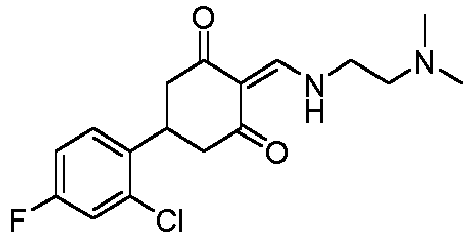
5-(2-chloro-4-fluorophenyl)-2-(((2-(dimethylamino)ethyl)ami no)methylene)cyclohexane -1,3-dione 1H NMR (400 MHz, CDCl3) δ 11.21 (s, 1H), 8.19 (d, J = 14.4 Hz, 1H), 7.22 (dd, J = 8.7, 5.9 Hz, 1H), 7.14 (dd, J = 8.5, 2.7 Hz, 1H), 6.99 (td, J = 8.3, 2.7 Hz, 1H), 3.80 (m, 1H), 3.51 (q, J = 6.1 Hz, 2H), 2.79 - 2.70 (m, 2H), 2.69 - 2.58 (m, 2H), 2.55 (t, J = 6.1 Hz, 2H), 2.29 (s, 6H). 371 
2-(((2-(dimethylamino)ethyl)ami no)methylene)-5-(4-phenylthiophen-3-yl)cyclohexane-1,3-dione 1H NMR (400 MHz, CDCl3) δ 11.12 (s, 1H), 8.10 (d, J = 14.4 Hz, 1H), 7.38 (dd, J = 7.8, 6.2 Hz, 2H), 7.34 (dd, J = 5.1, 3.6 Hz, 1H), 7.32 - 7.27 (m, 2H), 7.16 (d, J = 3.2 Hz, 1H), 7.13 - 7.09 (m, 1H), 3.56 - 3.48 (m, 1H), 3.45 (m, 2H), 2.70 - 2.61 (m, 2H), 2.58 (m, 2H), 2.50 (dd, J = 7.3, 4.9 Hz, 2H), 2.25 (s, 6H). 372 
2-(4-(2-(((4-(2-bromophenyl)-2,6-dioxocyclohexylidene)met hyl)amino)ethyl)piperazin -1-yl)-N-(p-tolyl)acetamide 1H NMR (400 MHz, CD3OD) δ 8.28 (s, 1H), 7.60 (d, J = 7.8 Hz, 1H), 7.40 (m, 4H), 7.13 (m, 3H), 3.80 (m, 1H), 3.62 (m, 2H), 3.16 (s, 2H), 2.65 (m, 13H), 2.29 (s, 3H). 373 
2-(4-(2-(((4-(3-chloro-1H-indol-4-yl)-2,6-dioxocyclohexylidene)met hyl)amino)ethyl)piperazin -1-yl)-N-(p-tolyl)acetamide 1H NMR (400 MHz, CD3OD) δ 8.27 (s, 1H), 7.43 (d, J = 8.4 Hz, 2H), 7.30 - 7.20 (m, 2H), 7.11 (t, J = 7.8 Hz, 3H), 6.95 (d, J = 7.3 Hz, 1H), 4.54 (m, 1H), 3.62 (t, J = 5.8 Hz, 2H), 3.16 (s, 2H), 2.83 (m, 4H), 2.65 (s, 9H), 2.29 (s, 3H). 374 
5-(2-bromo-3-(methylamino)phenyl)-2-(((2-(4-(2-hydroxyethyl)piperazin-1-yl)ethyl)amino)methylene) cyclohexane-1,3-dione 1H NMR (400 MHz, CD3OD) δ 8.26 (s, 1H), 7.19 (t, J = 7.9 Hz, 1H), 6.61 (dd, J = 24.0, 7.7 Hz, 2H), 3.79 (m, 1H), 3.73 (t, J = 5.8 Hz, 2H), 3.62 (t, J = 5.8 Hz, 2H), 3.35 (s, 1H), 2.86 (s, 3H), 2.70 (m, 15H). 375 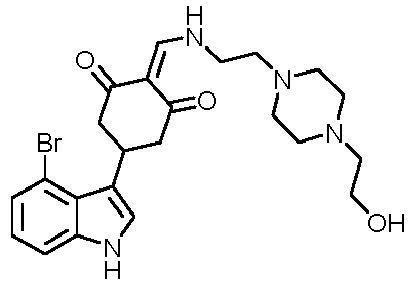
5-(4-bromo-1H-indol-3-yl)-2-(((2-(4-(2-hydroxyethyl)piperazin-1-yl)ethyl)amino)methylene) cyclohexane-1,3-dione 1H NMR (400 MHz, CD3OD) δ 8.26 (s, 1H), 7.34 (dd, J = 8.1, 0.7 Hz, 1H), 7.21 - 7.14 (m, 2H), 6.96 (t, J = 7.9 Hz, 1H), 4.28 (m, 1H), 3.78 (t, J = 5.6 Hz, 2H), 3.61 (t, J = 5.7 Hz, 2H), 2.91 (m, 8H), 2.71 (m, 8H). 376 
2-(((2-(dimethylamino)ethyl)ami no)methylene)-5-(2-fluoro-5-(trifluoromethyl)phenyl) cyclohexane-1,3-dione 1H NMR (400 MHz, CDCl3) δ 11.22 (s, 1H), 8.20 (d, J = 14.4 Hz, 1H), 7.56 - 7.45 (m, 2H), 7.19 (s, 1H), 3.69 (ddd, J = 16.3, 10.8, 5.8 Hz, 1H), 3.52 (q, J = 6.0 Hz, 2H), 2.74 (td, J = 10.9, 6.3 Hz, 4H), 2.55 (t, J = 6.1 Hz, 2H), 2.29 (s, 6H). 377 
5-(2,3-dichloro-6-(trifluoromethyl)phenyl)-2-(((2-(dimethylamino)ethyl)ami no)methylene)cyclohexane -1,3-dione 1H NMR (400 MHz, CDCl3) δ 11.28 (s, 1H), 8.23 (d, J = 14.4 Hz, 1H), 7.55 (q, J = 8.6 Hz, 2H), 4.00 (dd, J = 11.2, 6.8 Hz, 1H), 3.75 - 3.57 (m, 2H), 3.52 (q, J = 6.0 Hz, 2H), 2.56 (t, J = 6.1 Hz, 2H), 2.49 (d, J = 15.5 Hz, 2H), 2.30 (s, 6H). 378 
5-(3-chloro-2-fluoro-6-(trifluoromethyl)phenyl)-2-(((2-(dimethylamino)ethyl)ami no)methylene)cyclohexane -1,3-dione 1H NMR (400 MHz, CDCl3) δ 11.24 (s, 1H), 8.22 (d, J = 14.4 Hz, 1H), 7.48 - 7.41 (m, 2H), 3.77 (t, J = 13.2 Hz, 1H), 3.52 (q, J = 6.0 Hz, 2H), 3.20 - 3.01 (m, 2H), 2.64 - 2.60 (m, 1H), 2.59 - 2.53 (m, 3H), 2.29 (s, 6H). 379 
5-(2-bromo-4,5-dimethoxyphenyl)- 2- (((2-(dimethylamino)ethyl)ami no)methylene)cyclohexane -1,3-dione 1H NMR (400 MHz, CDCl3) δ 11.20 (s, 1H), 8.19 (d, J = 14.4 Hz, 1H), 7.04 (s, 1H), 6.73 (s, 1H), 3.86 (d, J = 1.9 Hz, 6H), 3.74 (tt, J = 11.9, 4.1 Hz, 1H), 3.51 (q, J = 6.1 Hz, 2H), 2.80 - 2.70 (m, 2H), 2.69 - 2.58 (m, 2H), 2.55 (t, J = 6.1 Hz, 2H), 2.29 (s, 6H). 380 
4-(((2-(dimethylamino)ethyl)ami no)methylene)-N-(3-fluoro-4-methylphenyl)-3,5-dioxocyclohexane-1-carboxamide 1H NMR (400 MHz, CDCl3) δ 11.24 - 11.12 (m, 1H), 8.16 - 8.06 (m, 2H), 7.44 (d, J = 13.2 Hz, 1H), 7.15 - 7.05 (m, 2H), 3.50 - 3.41 (m, 2H), 2.97 - 2.75 (m, 3H), 2.72 - 2.62 (m, 2H), 2.51 (t, J = 6.0 Hz, 2H), 2.25 (s, 6H), 2.22 (d, J = 1.5 Hz, 3H). 381 
5-(2-chloro-5-(trifluoromethyl)phenyl)-2-(((2-(dimethylamino)ethyl)ami no)methylene)cyclohexane -1,3-dione 1H NMR (400 MHz, CDCl3) δ 11.22 (s, 1H), 8.20 (d, J = 14.5 Hz, 1H), 7.49 (dt, j = 8.4, 7.5 Hz, 3H), 3.93 - 3.84 (m, 1H), 3.52 (q, J = 6.1 Hz, 2H), 2.71 (tdd, J = 19.8, 12.2, 4.2 Hz, 4H), 2.56 (t, J = 6.1 Hz, 2H), 2.30 (s, 6H). 382 
5-(4-chloro-2-fluorophenyl)-2-(((2-(dimethylamino)ethyl)ami no)methylene)cyclohexane -1,3-dione 1H NMR (400 MHz, CDCl3) δ 11.20 (s, 1H), 8.18 (d, J = 14.4 Hz, 1H), 7.11 (dd, J = 18.1, 8.6 Hz, 3H), 3.62 (s, 1H), 3.51 (q, J = 6.0 Hz, 2H), 2.70 (dd, J = 14.9, 9.5 Hz, 4H), 2.55 (t, J = 6.1 Hz, 2H), 2.29 (s, 6H). 383 
5-(2,6-difluorophenyl)-2-(((2-(dimethylamino)ethyl)ami no)methylene)cyclohexane -1,3-dione 1H NMR (400 MHz, cdcl3) δ 11.21 (s, 1H), 8.19 (d, J = 14.4 Hz, 1H), 7.23 - 7.10 (m, 1H), 6.87 (t, J = 8.5 Hz, 2H), 3.80 (s, 1H), 3.50 (q, J = 6.1 Hz, 2H), 3.05 (ddd, J = 30.5, 16.9, 13.5 Hz, 2H), 2.65 - 2.50 (m, 4H), 2.28 (s, 6H). 384 
5-(3-chloro-2-fluorophenyl)-2-(((2-(dimethylamino)ethyl)ami no)methylene)cyclohexane -1,3-dione 1H NMR (400 MHz, CDCl3) δ 11.21 (s, 1H), 8.19 (d, J = 14.4 Hz, 1H), 7.30 (d, J = 7.5 Hz, 1H), 7.15 - 7.02 (m, 2H), 3.68 (s, 1H), 3.51 (q, J = 6.0 Hz, 2H), 2.72 (dd, J = 14.7, 9.5 Hz, 4H), 2.54 (t, J = 6.1 Hz, 2H), 2.28 (s, 6H). 385 
tert-butyl (2-(4-(((2-(dimethylamino)ethyl)ami no)methylene)-3,5-dioxocyclohexyl)phenyl) carbamate 1H NMR (400 MHz, CDCl3) δ 11.19 (s, 1H), 8.19 (d, J = 14.4 Hz, 1H), 7.62 (d, J = 7.2 Hz, 1H), 7.23 (d, J = 7.3 Hz, 2H), 7.16 (t, J = 6.9 Hz, 1H), 6.27 (s, 1H), 3.51 (dd, J = 11.9, 5.9 Hz, 3H), 2.73 - 2.60 (m, 4H), 2.54 (t, J = 6.1 Hz, 2H), 2.28 (s, 6H), 1.50 (s, 9H). 386 
5-(2-aminophenyl)-2-(((2-(dimethylamino)ethyl)ami no)methylene)cyclohexane -1,3-dione 1H NMR (400 MHz, CDCl3) δ 11.20 (s, 1H), 8.18 (d, J = 14.4 Hz, 1H), 7.07 (t, J = 7.8 Hz, 2H), 6.79 (t, J = 7.5 Hz, 1H), 6.70 (d, J = 7.9 Hz, 1H), 3.64 (s, 2H), 3.50 (dd, J = 12.0, 6.0 Hz, 2H), 3.38 - 3.28 (m, 1H), 2.81 - 2.50 (m, 6H), 2.28 (s, 6H). 387 
5-(2,3-difluorophenyl)-2-(((2-(4-(2-ethoxyl)piperazin-1-yl)ethyl)amino)methylene) cyclohexane-1,3-dione 1H NMR (400 MHz, CDCl3) δ 11.18 (s, 1H), 8.20 (d, J = 14.5 Hz, 1H), 7.13 - 7.01 (m, 2H), 6.96 (s, 1H), 3.69 (s, 1H), 3.62 (t, J = 5.3 Hz, 2H), 3.56 - 3.47 (m, 2H), 2.73 (dd, J = 15.9, 9.4 Hz, 4H), 2.68 - 2.34 (m, 13H). 388 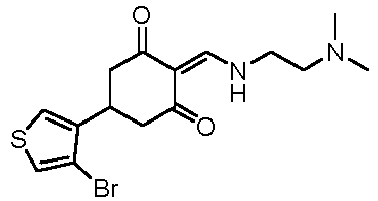
5-(4-bromothiophen-3-yl)-2-(((2-(dimethylamino)ethyl)ami no)methylene)cyclohexane -1,3-dione 1H NMR (400 MHz, CDCl3) δ 11.20 (s, 1H), 8.18 (d, J = 14.3 Hz, 1H), 7.28 (d, J = 3.3 Hz, 1H), 7.00 (d, J = 3.0 Hz, 1H), 3.50 (t, J = 5.9 Hz, 3H), 2.84 (t, J = 10.5 Hz, 2H), 2.60 (ddd, J = 22.3, 14.3, 8.4 Hz, 4H), 2.29 (s, 6H). 389 
N-([1,1'-biphenyl]-4-yl)-4-((((2-(dimethylamino)ethyl)ami no)methylene)-3,5-dioxocyclohexane-1-carboxamide 1H NMR (400 MHz, DMSO-d6) δ 10.88 (s, 1H), 10.11 (s, 1H), 8.10 (d, J = 14.5 Hz, 1H), 7.74 - 7.57 (m, 6H), 7.43 (t, J = 7.4 Hz, 2H), 7.33 (d, J = 7.3 Hz, 1H), 3.55 (d, J = 5.6 Hz, 2H), 3.13 (s, 1H), 2.56 (d, J = 5.1 Hz, 4H), 2.43 (s, 2H), 2.18 (s, 6H). 390 
5-(5-chloro-2-fluorophenyl)-2-(((2-(dimethylamino)ethyl)ami no)methylene)cyclohexane -1,3-dione 1H NMR (400 MHz, CDCl3) δ 11.20 (s, 1H), 8.19 (d, J = 14.4 Hz, 1H), 7.19 (t, J = 6.7 Hz, 2H), 6.99 (t, J = 9.1 Hz, 1H), 3.61 (s, 1H), 3.51 (dd, J = 12.0, 6.0 Hz, 2H), 2.70 (dd, J = 17.2, 10.2 Hz, 4H), 2.55 (t, J = 6.0 Hz, 2H), 2.29 (s, 6H). 391 
4-(hydroxy(phenyl)methyl)-2-(((2-(4-(2-ethoxyl)piperazin-1-yl)ethyl)amino)methylene) cyclopentane-1,3-dione 1HNMR (400 MHz, CD3OD ) δ 7.77 (s, 1H), 7.26 (m, 5H), 5.13 (d, J = 6.0 Hz, 1H), 3.69 (t, J = 6.0 Hz, 2H), 3.55 (t, J = 5.7 Hz, 2H), 3.13 (m, 1H), 2.69 - 2.46 (m, 12H), 2.33 (m, 2H); MS: 388.2 [M+1]. 392 
5-(5-bromo-1H-indol-6-yl)-2-(((2-(4-(2-ethoxyl)piperazin-1-yl)ethyl)amino)methylene) cyclohexane-1,3-dione 1H NMR (400 MHz, CD3OD) δ 8.27 (s, 1H), 7.78 (s, 1H), 7.37 (s, 1H), 7.25 (d, J = 3.2 Hz, 1H), 6.38 (d, J = 2.4 Hz, 1H), 3.90 - 3.81 (m, 1H), 3.72 (t, J = 5.9 Hz, 2H), 3.62 (t, J = 5.6 Hz, 2H), 2.72 (m, 16H); MS: 491.1 [M+1]. 393 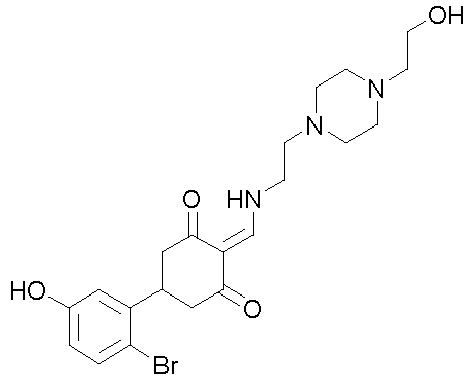
5-(2-bromo-5-hydroxyphenyl)-2-(((2-(4-(2-ethoxyl)piperazin-1-yl)ethyl)amino)methylene) cyclohexane-1,3-dione 1H NMR (400 MHz, CD3OD) δ 8.27 (s, 1H), 7.36 (d, J = 8.6 Hz, 1H), 6.78 (d, J = 2.9 Hz, 1H), 6.60 (dd, J = 8.7, 2.8 Hz, 1H), 3.80 - 3.57 (m, 4H), 2.77 (m, 13H); MS: 467.0 [M+1]. 394 
5-(4-chloro-1H-indol-3-yl)-2-(((2-(4-(2-ethoxyl)piperazin-1-yl)ethyl)amino)methylene) cyclohexane-1,3-dione 1H NMR (400 MHz, CD3OD) δ 8.27 (s, 1H), 7.36 - 7.26 (m, 1H), 7.14 (s, 1H), 7.03 (m, 2H), 4.22 - 4.12 (m, 1H), 3.77 (t, J = 5.7 Hz, 2H), 3.63 (m, 2H), 3.03 - 2.63 (m, 16H); MS: 445.1 [M+1]. 395 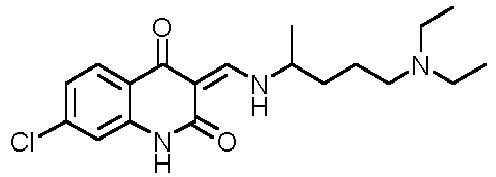
7-chloro-3-(((5-(diethylamino)penta-2-yl)amino)methylene)quino line-2,4(1H, 3H)-dione 1H NMR (400 MHz, CD3OD) δ 8.55 (s, 1H), 7.97 (d, J = 8.5 Hz, 1H), 7.18 (d, J = 1.7 Hz, 1H), 7.12 (dd, J = 8.5, 1.8 Hz, 1H), 3.81 (s, 1H), 3.06 (m, 6H), 1.75 (d, J = 5.6 Hz, 4H), 1.43 (d, J = 6.6 Hz, 3H), 1.30 - 1.18 (m, 6H); MS: 364.1 [M+1]. 396 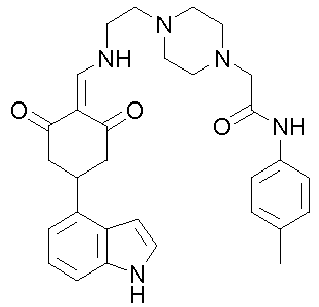
2-(4-(2-(((4-(1H-indol-4-yl)-2,6-dioxocyclohexylidene)met hyl)amino)ethyl)piperazin -1-yl)-N-(p-tolyl)acetamide 1H NMR (400 MHz, CD3OD) δ 8.28 (s, 1H), 7.43 (d, J = 8.4 Hz, 2H), 7.26 (dd, J = 14.2, 5.7 Hz, 2H), 7.13 (d, J = 8.0 Hz, 2H), 7.06 (t, J = 7.7 Hz, 1H), 6.88 (d, J = 7.3 Hz, 1H), 6.53 (d, J = 2.6 Hz, 1H), 3.79 (m, 1H), 3.63 (m, 2H), 3.16 (s, 2H), 2.99 - 2.85 (m, 2H), 2.82 (m, 2H), 2.65 (s, 9H), 2.29 (s, 3H). 397 
2-(((2-(dimethylamino)ethyl)ami no)methylene)-5-(2,3,6-trichlorophenyl)cyclohexa ne-1,3-dione 1H NMR (400 MHz, CDCl3) δ 11.25 (s, 1H), 8.21 (d, J = 14.4 Hz, 1H), 7.31 (s, 1H), 7.25 - 7.17 (m, 1H), 4.41 (s, 1H), 3.68 - 3.43 (m, 4H), 2.58 (t, J = 5.9 Hz, 2H), 2.48 (d, J = 16.7 Hz, 2H), 2.31 (s, 6H). 398 
5-(6-chloro-2,3-difluorophenyl)-2-(((2-(dimethylamino)ethyl)ami no)methylene)cyclohexane -1,3-dione 1H NMR (400 MHz, CDCl3) δ 11.24 (s, 1H), 8.22 (d, J = 14.4 Hz, 1H), 7.15 (ddd, J = 9.0, 4.6, 2.0 Hz, 1H), 7.04 (dd, J = 17.4, 9.0 Hz, 1H), 4.06 - 3.93 (m, 1H), 3.53 (q, J = 6.0 Hz, 2H), 3.20 - 3.02 (m, 2H), 2.66 - 2.54 (m, 4H), 2.30 (s, 6H). 399 
4-(((2-(dimethylamino)ethyl)ami no)methylene)-3,5-dioxo-N-(4-(trifluoromethyl)phenyl)cy clohexane-1-carboxamide 1H NMR (400 MHz, CDCl3) δ 11.16 (s, 1H), 8.14 (d, J = 14.5 Hz, 2H), 7.70 (d, J = 8.3 Hz, 2H), 7.57 (d, J = 8.7 Hz, 2H), 3.49 (d, J = 6.1 Hz, 2H), 2.97 - 2.66 (m, 5H), 2.53 (t, J = 6.0 Hz, 2H), 2.26 (s, 6H). 400 
5-(2,3-dichlorophenyl)-2-(((2-(4-(2-ethoxyl)piperazin-1-yl)ethyl)amino)methylene) cyclohexane-1,3-dione 1H NMR (400 MHz, CDCl3) δ 11.17 (s, 1H), 8.20 (d, J = 14.4 Hz, 1H), 7.40 - 7.36 (m, 1H), 7.24 - 7.14 (m, 2H), 3.95 - 3.85 (m, 1H), 3.62 (t, J = 5.3 Hz, 2H), 3.52 (dd, J = 11.9, 6.0 Hz, 2H), 2.78 (dt, J = 18.6, 4.2 Hz, 2H), 2.71 - 2.45 (m, 14H). 401 
2-(((2-(dimethylamino) ethyl) ami no)methylene)-5-(2,3,4-trifluorophenyl)cyclohexan e-1,3-dione 1H NMR (400 MHz, CDCl3) δ 11.21 (s, 1H), 8.19 (d, J = 14.4 Hz, 1H), 6.94 (dd, J = 8.4, 6.0 Hz, 2H), 3.68 - 3.59 (m, 1H), 3.52 (q, J = 6.0 Hz, 2H), 2.70 (m, 4H), 2.56 (t, J = 6.1 Hz, 2H). 402 
2-(((2-(dimethylamino)ethyl)ami no)methylene)-5-(2,3,5,6-tetrafluorophenyl)cyclohex ane-1,3-dione 1H NMR (400 MHz, CDCl3) δ 11.23 (s, 1H), 8.21 (d, J = 14.4 Hz, 1H), 7.04 - 6.94 (m, 1H), 3.84 (m, 1H), 3.54 (q, J = 6.0 Hz, 2H), 3.12 - 2.94 (m, 2H), 2.67 - 2.53 (m, 4H), 2.31 (s, 6H). 403 
5-(2,3-difluoro-4-methoxyphenyl)- 2- (((2-(dimethylamino)ethyl)ami no)methylene)cyclohexane -1,3-dione 1H NMR (400 MHz, CDCl3) δ 11.21 (s, 1H), 8.18 (d, J = 14.4 Hz, 1H), 6.86 (t, J = 8.2 Hz, 1H), 6.71 (t, J = 7.6 Hz, 1H), 3.89 (s, 3H), 3.64 - 3.54 (m, 1H), 3.50 (q, J = 6.0 Hz, 2H), 2.70 (m, 4H), 2.54 (t, J = 6.1 Hz, 2H), 2.28 (s, 6H). 404 
5-(2-(1,1-difluoroethyl)phenyl)-2-(((2-(4-(2-ethoxyl)piperazin-1-yl)ethyl)amino)methylene) cyclohexane-1,3-dione 1H NMR (400 MHz, CD3OD) δ 8.28 (s, 1H), 7.60 (d, J = 8.0 Hz, 1H), 7.53 (d, J = 7.7 Hz, 1H), 7.48 (t, J = 7.7 Hz, 1H), 7.32 (t, J = 7.7 Hz, 1H), 3.85 (t, J = 12.7 Hz, 1H), 3.77 (t, J = 5.7 Hz, 2H), 3.63 (t, J = 5.7 Hz, 2H), 3.07 - 2.59 (m, 14H), 2.54 (dd, J = 17.0, 3.6 Hz, 2H), 1.98 (t, J = 18.6 Hz, 3H). 405 
5-(2-bromo-3-chloro-1H-indol-4-yl)-2-(((2-(4-(2-ethoxyl)piperazin-1-yl)ethyl)amino)methylene) cyclohexane-1-1,3-dione 1H NMR (400 MHz, DMSO-d6) δ 12.37 (s, 1H), 10.95 (m, 1H), 8.13 (d, J = 14.6 Hz, 1H), 7.23 (d, J = 8.2 Hz, 1H), 7.12 (t, J = 7.8 Hz, 1H), 6.98 (d, J = 7.3 Hz, 1H), 4.29 (m, 1H), 3.57 (m, 3H), 3.16 (m, 3H), 2.84 - 2.50 (m, 15H). 406 
5-(2', 6'-dichloro-[1,1'-biphenyl] -2-yl)-2-(((2-(4-(2-ethoxyl)piperazin-1-yl)ethyl)amino)methylene) cyclohexane-1,3-dione 1H NMR (400 MHz, CD3OD) δ 8.17 (s, 1H), 7.55 (d, J = 7.6 Hz, 1H), 7.47 (m, 3H), 7.39 - 7.30 (m, 2H), 7.09 - 7.02 (m, 1H), 3.75 (t, J = 5.7 Hz, 2H), 3.56 (t, J = 5.9 Hz, 2H), 2.97 - 2.72 (m, 9H), 2.62 (m, 6H), 2.53 (dd, J = 16.3, 3.1 Hz, 2H). 407 
4-benzylidene-2-(((2-(4-(2-ethoxyl)piperazin-1-yl)ethyl)amino)methylene) cyclopentane-1,3-dione 1H NMR (400 MHz, CD3OD) δ 8.08 (d, J = 0.5 Hz, 1H), 7.57 (d, J = 7.7 Hz, 2H), 7.40 (m, 4H), 3.97 - 3.86 (m, 4H), 3.39 (m, 10H), 3.28 - 3.13 (m, 4H). 408 
5-(2,3-dichlorophenyl)-2-(piperidine-1-ylmethylene)cyclohexane-1,3-dione 1H NMR (400 MHz, CDCl3) δ 8.04 (s, 1H), 7.37 (dd, J = 7.5, 1.9 Hz, 1H), 7.23 - 7.11 (m, 2H), 3.91 - 3.80 (m, 1H), 3.80 - 3.55 (m, 4H), 2.77 (m, 2H), 2.60 (m, 2H), 1.84 (m, 4H), 1.74 (m, 2H). 409 
5-(6-bromo-2,3-difluorophenyl)-2 - ((((2-(dimethylamino)ethyl)ami no)methylene)cyclohexane -1,3-dione 1H NMR (400 MHz, CDCl3) δ 11.24 (s, 1H), 8.22 (d, J = 14.4 Hz, 1H), 7.37 - 7.31 (m, 1H), 6.98 (dd, J = 17.5, 9.0 Hz, 1H), 3.96 (t, J = 13.6 Hz, 1H), 3.53 (q, J = 6.1 Hz, 2H), 3.19 - 2.99 (m, 2H), 2.67 - 2.53 (m, 4H), 2.30 (s, 6H). 410 
5-(2-chloro-3-fluorophenyl)-2-((((2-(dimethylamino)ethyl)ami no)methylene)cyclohexane -1,3-dione 1H NMR (400 MHz, CDCl3) δ 11.22 (s, 1H), 8.20 (d, J = 14.4 Hz, 1H), 7.26 - 7.20 (m, 1H), 7.06 (t, J = 7.8 Hz, 2H), 3.86 (td, J = 11.6, 5.8 Hz, 1H), 3.52 (q, J = 6.0 Hz, 2H), 2.80 - 2.60 (m, 4H), 2.56 (t, J = 6.1 Hz, 2H), 2.30 (s, 6H). 411 
5-(2,6-dichloro-3-fluorophenyl)-2-(((2-(dimethylamino)ethyl)ami no)methylene)cyclohexane -1,3-dione 1H NMR (400 MHz, CDCl3) δ 11.25 (s, 1H), 8.22 (d, J = 14.4 Hz, 1H), 7.32 (s, 1H), 7.04 (dd, J = 8.8, 8.0 Hz, 1H), 4.35 (s, 1H), 3.66 - 3.45 (m, 4H), 2.55 (t, J = 6.1 Hz, 2H), 2.48 (m, 2H), 2.29 (s, 6H). 412 
2-(((2-(dimethylamino)ethyl)ami no)methylene)-5-(perfluorophenyl)cyclohex ane-1,3-dione 1H NMR (400 MHz, CDCl3) δ 11.23 (s, 1H), 8.21 (d, J = 14.5 Hz, 1H), 3.84 - 3.73 (m, 1H), 3.51 (q, J = 5.9 Hz, 2H), 3.09 - 2.90 (m, 2H), 2.61 (dd, J = 16.6, 2.1 Hz, 2H), 2.54 (t, J = 6.0 Hz, 2H), 2.29 (s, 6H). 413 
5-(4-bromo-1H-pyrrole-3-yl)-2-(((2-(dimethylamino)ethyl)ami no)methylene)cyclohexane -1,3-dione 1H NMR (400 MHz, CD3OD) δ 8.23 (s, 1H), 6.72 (d, J = 1.8 Hz, 1H), 6.54 (d, J = 1.9 Hz, 1H), 3.61 (t, J = 6.2 Hz, 2H), 3.26 (m, 1H), 2.74 (m, 2H), 2.62 (t, J = 6.2 Hz, 4H), 2.32 (s, 6H). 414 
2-(((2-(dimethylamino)ethyl)ami no)methylene)-5-(5-phenyl-1H-pyrrole-3-yl)cyclohexane-1,3-dione 1H NMR (400 MHz, CDCl3) δ 11.26 - 11.10 (m, 1H), 8.52 (s, 1H), 8.14 (d, J = 14.3 Hz, 1H), 7.49 - 7.40 (m, 2H), 7.34 (t, J = 7.8 Hz, 2H), 7.19 (t, J = 7.4 Hz, 1H), 6.65 (s, 1H), 6.45 - 6.38 (m, 1H), 3.45 (q, J = 6.1 Hz, 2H), 3.35 (m, 1H), 2.84 (m, 2H), 2.66 (m, 2H), 2.51 (t, J = 6.2 Hz, 2H), 2.26 (s, 6H). - The compounds 415-452 were synthesized by the same procedures as Example 4 or Example 8 (e.g., Compounds 3 and 8) except for using corresponding substituted cyclohexane-1,3-dione, as shown in Table 8.
Table 8: Compounds 415-452 # Structure Name Proton NMR(1HNMR), Mass Spectrum( MS) 415 
2-(hydroxymethylene) - 5-(4-methylphenyl)cyclo hexane-1,3-dione 1H NMR (400 MHz, DMSO-d6) δ 9.52 (s, 1H), 7.22 (d, J = 8.1 Hz, 2H), 7.14 (d, J = 8.0 Hz, 2H), 3.46-3.38 (m, 1H), 2.99 - 2.86 (m, 2H), 2.71 - 2.59 (m, 2H), 2.27 (s, 3H); MS: 229.1 [M-1]. 416 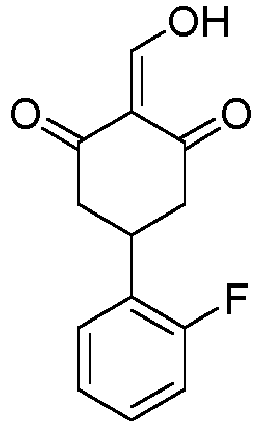
2-(hydroxymethylene) - 5-(2-fluorophenyl)cycloh exane-1,3-dione 1H NMR (400 MHz, DMSO-d6) δ 9.52 (s, 1H), 7.42 (td, J = 8.0, 1.7 Hz, 1H), 7.37 - 7.29 (m, 1H), 7.25 - 7.16 (m, 2H), 3.78-3.70 (m, 1H), 3.01-2.94 (m, 2H), 2.70-2.64 (m, 2H); MS: 235.1 [M+1]. 417 
2-(hydroxymethylene) - 5-(2,3-difluorophenyl)cycl ohexane-1,3 -dione 1H NMR (400 MHz, DMSO-d6 ) δ 9.51 (s, 1H), 7.39-7.32 (m, 1H), 7.29 - 7.19 (m, 2H), 3.85 - 3.71 (m, 1H), 3.03-2.95 (m, 2H), 2.71-2.66 (m, 2H); MS: 253.1 [M+1]. 418 
2-(hydroxymethylene) - 5-(2-chlorophenyl)cyclo hexane-1,3-dione 1H NMR (400 MHz, DMSO-d6 ) δ 9.51 (s, 1H), 7.48 (t, J = 6.9 Hz, 2H), 7.38 (t, J = 7.6 Hz, 1H), 7.31 (m, 1H), 3.88 - 3.78 (m, 1H), 3.07 - 2.93 (m, 2H), 2.67 (m, 2H); MS: 249.1 [M-1]. 419 
2-(hydroxymethylene) - 5-(3-chlorophenyl)cyclo hexane-1,3-dione 1H NMR (400 MHz, DMSO-d6 ) δ 9.52 (s, 1H), 7.45 (s, 1H), 7.35 (m, 3H), 3.50 (m, 1H), 3.03 - 2.92 (m, 2H), 2.67 (d, J = 13.5 Hz, 2H); MS: 249.1 [M-1]. 420 
2-(hydroxymethylene) - 5-(2,6-dichlorophenyl)cycl ohexane-1,3 -dione 1H NMR (400 MHz, DMSO-d6 ) δ 9.51 (s, 1H), 7.51 (t, J = 6.9 Hz, 1H), 7.33 (m, 2H), 4.02 - 3.89 (m, 1H), 3.27 - 3.13 (m, 2H), 2.67 (m, 2H); MS: 283.1 [M-1]. 421 
2-(hydroxymethylene) - 5-(2,3-dichlorophenyl)cycl ohexane-1,3 -dione 1H NMR (400 MHz, CDCl3) δ 15.89 (s, 1H), 9.66 (s, 1H), 7.43 (dd, J = 8.0, 1.5 Hz, 1H), 7.25 (t, J = 7.9 Hz, 1H), 7.16 (dd, J = 7.8, 1.4 Hz, 1H), 4.01-3.93 (m, 1H), 3.00-2.94 (m, 1H), 2.91 - 2.75 (m, 2H), 2.71-2.64 (m, 1H); MS: 285.0 [M+1]. 422 
2-(hydroxymethylene) - 5-(2-bromophenyl)cyclo hexane-1,3-dione 1H NMR (400 MHz, DMSO-d6 ) δ 9.52 (s, 1H), 7.65 (d, J = 7.2 Hz, 1H), 7.52 - 7.47 (m, 1H), 7.43 (t, J = 7.3 Hz, 1H), 7.27 - 7.20 (m, 1H), 3.81 - 3.73 (m, 2H), 3.05 - 2.91 (m, 2H), 2.70-2.65 (m, 2H); MS: 293.0 [M-1]. 423 
2-(hydroxymethylene) - 5-(2-methoxyphenyl)cyc lohexane-1,3 -dione 1H NMR (400 MHz, CDCl3) δ 15.90 (s, 1H), 9.68 (s, 1H), 7.31-7.27 (m, 0.8H), 7.26 - 7.24 (m, 0.2H), 7.15-7.10 (m, 1H), 6.99 - 6.88 (m, 2H), 3.85 (s, 3H), 3.79 - 3.69 (m, 1H), 3.05 - 2.94 (m, 1H), 2.93 - 2.67 (m, 3H) ; MS: 247.1 [M+1]. 424 
2-(hydroxymethylene) - 5-(2,4-dimethoxyphenyl)c yclohexane-1,3-dione 1H NMR (400 MHz, CD3OD) δ 9.63 (s, 1H), 7.08 (d, J = 8.8 Hz, 1H), 6.53 - 6.55 (m, 1H), 6.51 - 6.45 (m, 1H), 5.49 (s, 1H), 3.82 (d, J = 2.4 Hz, 3H), 3.78 (d, J = 2.4 Hz, 3H), 3.69 - 3.53 (m, 1H), 3.00 - 2.83 (m, 1H), 2.80 - 2.62 (m, 2H), 2.60 - 2.46 (m, 1H); MS: 277.1 [M+1]. 425 
2-(hydroxymethylene) -5 -(4-cyanophenyl)cycloh exane-1,3-dione 1H NMR (400 MHz, DMSO-d6 ) δ 9.52 (s, 1H), 7.83 (d, J = 8.0 Hz, 2H), 7.58 (d, J = 8.0 Hz, 2H), 3.65 - 3.55 (m, 1H), 3.05-2.96 (m, 2H), 2.73.-2.64 (m, 2H) ; MS: 242.0 [M+1]. 426 
2-(hydroxymethylene) - 5-(2-trifluoromethylphen yl)cyclohexane-1,3-dione 1H NMR (400 MHz, DMSO-d6 ): δ 9.52 (s, 1H), 7.87 (d, J = 8.2 Hz, 1H), 7.79 - 7.68 (m, 2H), 7.50 (t, J = 7.7 Hz, 1H), 3.75-3.61 (m, 1H), 3.25-3.06 (m, 2H), 2.56 (d, J = 3.8 Hz, 1H). MS: 283.1 [M-1]. 427 
2-(hydroxymethylene) - 5-(2-thiophen)cyclohexa ne-1,3-dione 1H NMR (400 MHz, CDCl3) δ 15.87 (s, 1H), 9.64 (s, 1H), 7.23 (dd, J = 5.1, 1.1 Hz, 1H), 6.98-6.96 (m, 1H), 6.89 (dt, J = 3.5, 1.0 Hz, 1H), 3.79 - 3.68 (m, 1H), 3.10-3.04 (m, 1H), 2.99 - 2.88 (m, 2H), 2.76-2.69 (m, 1H); MS: 221.1 [M-1]. 428 
2-(hydroxymethylene) -5 -(3-thiophen)cyclohexa ne-1,3-dione 1H NMR (400 MHz, CDCl3) δ 15.86 (s, 1H), 9.63 (s, 1H), 7.35 (dd, J = 4.8, 2.0 Hz, 1H), 7.06 - 7.03 (m, 1H), 7.00 (dd, J = 5.2, 1.2 Hz, 1H), 3.59-3.50 (m, 1H), 3.05-2.96 (m, 1H), 2.93 - 2.81 (m, 2H), 2.72-2.62 (m, 1H) ; MS: 223.0 [M+1]. 429 
2-(hydroxymethylene) - 5-(1H-indol-4-yl)cyclohexane-1,3-dione 1H NMR (400 MHz, DMSO-d6 ) δ 11.17 (s, 1H), 9.55 (s, 1H), 7.35 (t, J = 2.8 Hz, 1H), 7.30 (d, J = 8.0 Hz, 1H), 7.05 (t, J = 7.7 Hz, 1H), 6.89 (d, J = 7.2 Hz, 1H), 6.61 (s, 1H), 3.94 - 3.81 (m, 1H), 3.14 - 3.00 (m, 2H), 2.7-2.73 (m, 2H); MS: 254.1 [M-H]. 430 
2-(hydroxymethylene) - 5-(1H-indol-3-yl)cyclohexane-1,3-dione 1H NMR (400 MHz, DMSO-d6 ) δ 9.55 (s, 1H), 7.37 (s, 1H), 7.30 -7.05 (m, 4H), 3.96 - 3.83 (m, 1H), 3.15 - 3.01 (m, 2H), 2.71-2.74 (m, 2H); MS: 254.1 [M-H]. 431 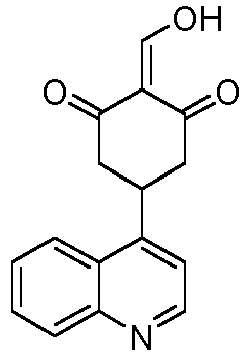
2-(hydroxymethylene) - 5-(4-quinoline)cyclohexa ne-1,3-dione 1H NMR (400 MHz, DMSO-d6 ): δ 9.56 (s, 1H), 8.91 (d, J = 4.6 Hz, 1H), 8.34 (d, J = 8.1 Hz, 1H), 8.07 (d, J = 8.4 Hz, 1H), 7.81 (t, J = 7.0 Hz, 1H), 7.68 (t, J = 7.0 Hz, 1H), 7.55 (d, J = 4.7 Hz, 1H), 4.51-4.39 (m, 1H), 3.15-3.01 (m, 2H), 2.82-2.70 (m, 2H). MS: 266.1 [M-1] 432 
2-(hydroxymethylene) - 5-(2-bromo-5-methoxyphenyl)cyc lohexane-1,3 -dione 1H NMR (400 MHz, DMSO-d6 ) δ 9.51 (s, 1H), 7.52 (d, J = 8.8 Hz, 1H), 7.06 (d, J = 3.0 Hz, 1H), 6.83 (dd, J = 8.8, 3.0 Hz, 1H), 3.81-3.66 (m, 4H), 3.03-2.96 (m, 2H), 2.66-2.60 (m, 2H). MS: 325.0 [M-1]. 433 
2-(hydroxymethylene) - 5-(2-bromo-4,5-dimethoxyphenyl)c yclohexane-1,3-dione 1H NMR (400 MHz, DMSO-d6 ) δ 9.53 (s, 1H), 7.14 (s, 1H), 7.08 (s, 1H), 3.78 (s, 3H), 3.76 (s, 3H),3.70-3.65 (m, 1H), 3.08-2.98 (m, 2H), 2.58-2.55 (m, 2H). MS: 357.1 [M+1]. 434 
2-(hydroxymethylene) - 5-(2-nitrophenyl)cyclohe xane-1,3-dione 1H NMR (400 MHz, DMSO-d6 ) δ 9.53 (s, 1H), 7.91 (s, 1H), 7.80-7.66 (m, 3H), 3.66-3.56 (m, 1H), 3.06-2.95 (m, 2H), 2.76-2.70 (m, 2H). MS: 260.1 [M-1]. 435 
2-(hydroxymethylene) - 5-(3-nitrophenyl)cyclohe xane-1,3-dione 1H NMR (400 MHz, DMSO-d6 ) δ 9.55 (s, 1H), 7.88 (s, 1H), 7.83-7.62 (m, 3H), 3.67-3.57 (m, 1H), 3.07-2.96 (m, 2H), 2.75-2.69 (m, 2H). MS: 260.1 [M-1]. 436 
2-(hydroxymethylene) - 5-(4-nitrophenyl)cyclohe xane-1,3-dione 1H NMR (400 MHz, DMSO-d6 ) δ 9.55 (s, 1H), 7.82 (d, J = 8.1 Hz, 2H), 7.69 (d, J= 8.4 Hz, 2H), 3.67-3.57 (m, 1H), 3.07-2.96 (m, 2H), 2.75-2.69 (m, 2H). MS: 260.1 [M-1]. 437 
2-(hydroxymethylene) - 5-(4-trifluoromethylphen yl)cyclohexane-1,3-dione 1H NMR (400 MHz, DMSO-d6 ) δ 9.53 (s, 1H), 7.72 (d, J = 8.1 Hz, 2H), 7.59 (d, J = 8.4 Hz, 2H), 3.65-3.55 (m, 1H), 3.05-2.94 (m, 2H), 2.73-2.67 (m, 2H). MS: 283.1 [M-1]. 438 
2-(hydroxymethylene) - 5-(4-bromophenyl)cyclo hexane-1,3-dione 1H NMR (400 MHz, DMSO-d6 ) δ 9.55 (s, 1H), 7.68 - 7.75 (m, 2H), 7.47 - 7.40 (m, 2H), 3.81 - 3.73 (m, 1H), 3.08 - 2.94 (m, 2H), 2.73-2.68 (m, 2H); MS: 293.0 [M-1]. 439 
2-(hydroxymethylene) - 5-(3-bromophenyl)cyclo hexane-1,3-dione 1H NMR (400 MHz, DMSO-d6 ) δ 9.52 (s, 1H), 7.65 (s, 1H), 7.65 - 7.58 (m, 3H), 3.81 - 3.73 (m, 1H), 3.07 - 2.91 (m, 2H), 2.70-2.62 (m, 2H); M: 293.0 [M-1]. 440 
5-(4-methylthiophenyl)-2-(hydroxymethylene) cyclohexane-1,3-dione 1H NMR (400 MHz, CDCl3) δ 9.68 (s, 1H), 7.28 (d, J = 8.5 Hz, 2H), 7.18 (d, J = 8.3 Hz, 2H), 3.45-3.80 (m, 1H), 2.91 (d, J = 8.3 Hz, 2H), 2.81-2.76 (m, 1H), 2.71-2.64 (m, 1H), 2.51 (s, 3H); MS: 263.1 [M+1]. 441 
2-(hydroxymethylene) - 5-(2,6-dimethoxyphenyl)c yclohexane-1,3-dione 1H NMR (400 MHz, CDCl3) δ 9.65 (s, 1H), 7.31-7.10 (m, 3H), 3.88 (s, 3H), 3.86 (s, 3H), 3.79 - 3.69 (m, 1H), 3.05 - 2.94 (m, 1H), 2.93 - 2.67 (m, 3H) ; MS: 277.1 [M+1]. 442 
2-(hydroxymethylene) - 5-(2-hydroxyphenyl)cycl ohexane-1,3 -dione 1H NMR (400 MHz, CDCl3) δ 9.68 (s, 1H), 7.36-7.11 (m, 4H), 3.75-3.62 (m, 1H), 2.81 (m, 1H), 2.68-2.36 (m, 3H); MS: 233.1 [M+1]. 443 
2-(hydroxymethylene) - 5-(4-hydroxyphenyl)cycl ohexane-1,3 -dione 1H NMR (400 MHz, CDCl3) δ 9.68 (s, 1H), 7.36 (d, J = 8.5 Hz, 2H), 7.29 (d, J = 8.3 Hz, 2H), 3.55-3.80 (m, 1H), 2.81 (d, J = 8.3 Hz, 2H), 2.71-2.65 (m, 1H), 2.60-2.56 (m, 1H); MS: 233.1 [M+1]. 444 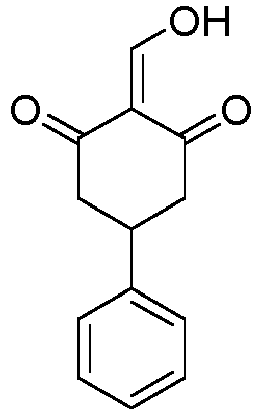
2-(hydroxymethylene) -5-phenylcyclohexane-1,3-dione (Outside the scope of the invention) 1H NMR (400 MHz, CDCl3) δ 15.86 (s, 1H), 9.67 (s, 1H), 7.39-7.35 (m, 2H), 7.32 - 7.27 (m, 1H), 7.25 - 7.21 (m, 2H), 3.49 - 3.38 (m, 1H), 2.95 - 2.89 (m, 2H), 2.82 - 2.63 (m, 2H); MS: 217.1 [M+1]. 445 
2-(hydroxymethylene) -5-(2 -(benzo[d] [1,3]dioxo-5-yl)ethyl)-cyclohexane-1,3-dione 1H NMR (400 MHz, DMSO-d6 ) δ 9.48 (s, 1H), 6.86 - 6.73 (m, 2H), 6.66 (dd, J = 7.9, 1.5 Hz, 1H), 5.95 (s, 2H), 2.69 - 2.52 (m, 4H), 2.48 - 2.30 (m, 2H), 2.13 - 2.01 (m, 1H), 1.64-1.59 (m, 2H); MS: 289.1 [M+1]. 446 
2-(hydroxymethylene) - 5-(3-fluorophenyl)cycloh exane-1,3-dione 1H NMR (400 MHz, CDCl3) δ 15.88 (s, 1H), 9.66 (s, 1H), 7.37-7.27 (m, 1H), 7.06 - 6.89 (m, 3H), 3.48-3.40 (m, 1H), 2.92-2.89 (m, 2H), 2.83 - 2.74 (m, 1H), 2.70-2.62 (m, 1H); MS: 235.1 [M+1]. 447 
2-(hydroxymethylene) - 5-((2-fluoro-3-chloro-6-trifluoromethyl)phe nyl)cyclohexane-1,3-dione 1H NMR (400 MHz, CDCl3) δ 15.93 (s, 1H), 9.69 (s, 1H), 7.55 - 7.45 (m, 2H), 3.87 - 3.75 (m, 1H), 3.39-3.31 (m, 1H), 3.11-3.03 (m, 1H), 2.78-2.63 (m, 2H); MS: 337.0 [M+1]. 448 
3-(hydroxymethylene) -6-phenyl-2H-pyran-2,4(3H)-dione 1H NMR (400 MHz, CDCl3) δ 14.46 (s, 1H), 9.97 (s, 1H), 7.94 - 7.85 (m, 2H), 7.61-7.50 (m, 3H), 6.59 (s, 1H); MS: 217.1 [M+1]. 449 
2-(1-hydroxyethylidene)-5-phenylcyclohexane-1,3-dione 1H NMR (400 MHz, DMSO-d6 ) δ 18.06 (s, 1H), 7.37 - 7.30 (m, 4H), 7.29 - 7.21 (m, 1H), 3.44-3.37 (m, 1H), 2.96 (br, 2H), 2.71 (br, 2H), 2.55 (s, 3H); MS: 231.1 [M+1]. 450 
3-(hydroxymethylene) -N-phenylpiperidine-2,4-dione 1H NMR (400 MHz, DMSO-d6 ) δ 10.00 (s, 1H), 8.03 (t, J = 14.5 Hz, 1H), 7.40 - 7.32 (m, 2H), 7.29 (t, J = 7.4 Hz, 2H), 7.17 (q, J = 14.0, 7.3 Hz, 1H), 3.83 - 3.73 (m, 2H), 3.46 - 3.34 (m, 2H), 2.59 (t, J = 6.5 Hz, 1H), 2.54 (t, J = 6.6 Hz, 1H). 451 
2-(hydroxymethylene) - 4-fluoro-5-(phenyl)cyclohexan e-1,3-dione 1H NMR (400 MHz, DMSO-d6 ) δ 8.26 - 8.07 (m, 1H), 7.40 - 7.12 (m, 4H), 5.29 - 5.04 (m, 1H), 3.83 - 3.69 (m, 1H), 2.92 - 2.63 (m, 2H). 452 
2-(hydroxymethylene) - 4,4-difluoro-5-(phenyl)cyclohexan e-1,3-dione 1H NMR (400 MHz, CD3OD) δ 9.84 (s, 1H), 7.58 (s, 1H), 7.41 - 7.29 (m, 5H), 3.79 - 3.64 (m, 1H), 3.12-3.02 (m, 1H), 2.72 - 2.63 (m, 1H) ; MS: 253.1 [M+1]+ -

- The mixture of thiazolidine-2,4-dione (2.8 g, 23.93 mmol), triethoxymethane (4 mL) and acetic anhydride (6 mL) was heated under reflux overnight. After the reaction was completed, the reaction mixture was cooled to RT to precipitate solid and then filtered. The filtrate was collected and concentrated to give a crude product of the desired compound, which can be directly used in the next step without further purification.
- The operation procedures were the same as Example 2 (Compound 1).
-

- Under the protection of nitrogen atmosphere, SOCl2 (4.8 g, 40.3 mmol) was added dropwise at 0 °C into the solution of 2-phenylpropanoic acid (2 g, 13.3 mmol) in DCM (20 mL). After the addition, a catalytic amount of DMF was added. The mixture was refluxed and reacted for 2 hrs and concentrated to give a crude product of 2-phenylpropanoyl chloride, which can be directly used in the next step.
- Under the protection of nitrogen atmosphere, ethoxyacetylene (3.72 g, 26.6 mmol, 50% w/w of hexane solution) was added dropwise into the solution of 2-phenylpropanoyl chloride (13.3 mmol) in ether (40 mL). The above mixture was added dropwise with TEA (2 g, 19.8 mmol), then stirred at RT for 30min. The suspension was heated to reflux and reacted for 24hrs. After the reaction was completed, the resulting mixture was cooled and filtrated. The filtrate was concentrated, separated and purified by column chromatography to give 600 mg of the desired product.
- The compound 3-ethoxy-4-methyl-4-phenylcyclobut-2-en-1-one (350 mg, 1.73mmol) was dissolved in the mixed solution of 2M hydrochloric acid (5 mL) and THF (3 mL), stirred vigorously at RT for 48 hrs. After the reaction was completed, the reaction mixture was extracted with DCM. The combined organic layers were dried and concentrated to give 250 mg of the crude product, which can be directly used in the next step.
- The operation procedures were the same as Example 8 (compound 8). Compound 201: 1H NMR (400 MHz, CDCl3) δ 7.56 - 7.48 (m, 2H), 7.31 (m, 2H), 7.21 (m, 1H), 7.04 (s, 1H), 3.64 (s, 3H), 3.27 (s, 3H), 1.59 (s, 3H).
-

- The solution compound 119 (2.86 g, 10 mmol) in MeOH(7.5 mL) was added dorpwise to a solution of sodium(264 mg, 11 mmol) in MeOH (20 mL), stirred at room temperature for 10 min, followed by adding nickel (II) chloride-1,2-dimethoxyethane (2.63 g, 12 mmol) in MeOH (10 mL) into the mixed solution. The mixture was heated to 40 °C and stirred for 2 h. Then concentrated and the concentrated crude product was diluted with acetone and refluxed for 1h, then cooled, the solid substance was filtered off, the residue was washed with acetone and dried to give 1.1 g of the desired compound with a yield of 29%. MS (ESI): [M-Cl] +: 343.3; [M+Cl]-: 413.2
-

- Compound 3 (294mg) was added into water (8ml), followed by adding NaOH solid (57mg), stirred at RT overnight. The reaction solution was concentrated and beat with ether, then filtrated to give a yellow solid product: Compound 463 (267mg, yield 83%).
- The coordination bond of Na with carbonyl was formed in Compound 463.
- Compounds 453-462 and 464 were synthesized by the same procedures as Example 39, except for using corresponding diketone compounds and alkali, as shown in table 9.
Table 9: Compounds 453-464 # Structure Name Proton NMR(1HNMR), Mass Spectrum (MS) 453 
2-(hydroxymethylene) - 5-(2-thiophen)cyclohexa ne-1,3-dione lithium salt 1H NMR (400 MHz, DMSO-d6 ) δ 9.43 (s, 1H), 7.35 (d, J = 5.0, 1H), 6.97 - 6.93 (m, 1H), 6.92-6.91 (m, 1H), 3.58 - 3.49 (m, 1H), 2.65 - 2.51 (m, 4H); MS: 221.1 [M-Li]. 454 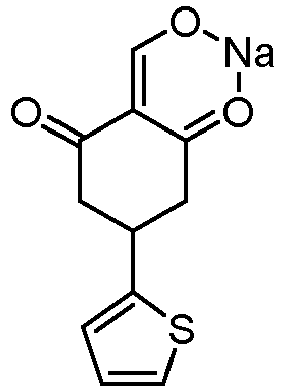
2-(hydroxymethylene) - 5-(2-thiophen)cyclohexa ne-1,3-dione sodium salt 1H NMR (400 MHz, DMSO-d6 ) δ 9.59 (s, 1H), 7.33 (d, J = 4.9 Hz, 1H), 6.97 - 6.92 (m, 1H), 6.91-6.90 (m, 1H), 3.51-3.43 (m, 1H), 2.54-2.40 (m, 4H, Part of the peak is contained in solvent residual peak of DMSO-d6); MS: 221.1 [M-Na]. 455 
2-(hydroxymethylene) - 5-(2-thiophen)cyclohexa ne-1,3-dione potassium salt 1H NMR (400 MHz, DMSO-d6 ) δ 9.65 (s, 1H), 7.32 (dd, J = 5.1, 1.2 Hz, 1H), 6.94 (dd, J = 5.1, 3.5 Hz, 1H), 6.89 (dt, J = 3.5, 1.1 Hz, 1H), 3.47 - 3.38 (m, 1H), 2.48-2.33 (m, 4H); MS: 221.1 [M-K]. 456 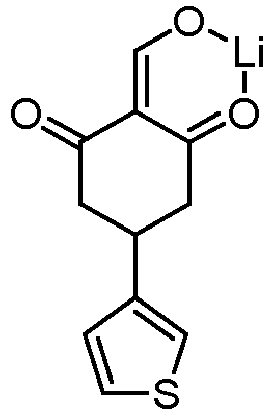
2-(hydroxymethylene) - 5 -(3-thiophen)cyclohexa ne-1,3-dione lithium salt 1H NMR (400 MHz, DMSO-d6 ) δ 9.43 (s, 1H), 7.49-7.45 (m, 1H), 7.24-7.20 (m, 1H), 7.14-7.10 (m, 1H), 3.34 - 3.25 (m, 1H), 2.52-2.48 (m, 4H) ; MS: 223.0 [M+1]. 457 
2-(hydroxymethylene) -5 -(3-thiophen)cyclohexa ne-1,3-dione sodium salt 1H NMR (400 MHz, DMSO-d6 ) δ 9.59 (s, 1H), 7.47-7.44 (m, 1H), 7.20 (d, J = 2.8 Hz, 1H), 7.12-7.09 (m, 1H), 3.30-3.21 (m, 1H), 2.46-2.40 (m, 4H) ; MS: 223.0 [M+1]. 458 
2-(hydroxymethylene) -5 -(3-thiophen)cyclohexa ne-1,3-dione potassium salt 1H NMR (400 MHz, DMSO-d6 ) δ 9.64 (s, 1H), 7.47-7.42 (m, 1H), 7.20-7.17 (m, 1H), 7.10-7.06 (m, 1H), 3.28-3.16 (m, 1H), 2.42-2.30 (m, 4H) ; MS: 223.0 [M+1]. 459 
2-(hydroxymethylene) - 5-(1H-indol-4-yl)cyclohexane-1,3-dione lithium salt 1H NMR (400 MHz, DMSO-d6 ) δ 9.35 (s, 1H), 7.45 (t, J = 2.8 Hz, 1H), 7.50 (d, J = 8.0 Hz, 1H), 7.15 (t, J = 7.7 Hz, 1H), 7.09 (d, J = 7.2 Hz, 1H), 6.71 (s, 1H), 3.74 - 3.56 (m, 1H), 2.50 - 2.46 (m, 4H); MS: 254.1 [M-H]. 460 
2-(hydroxymethylene) - 5-(1H-indol-4-yl)cyclohexane-1,3-dione sodium salt 1H NMR (400 MHz, DMSO-d6 ) δ 9.51 (s, 1H), 7.47 (t, J = 2.8 Hz, 1H), 7.34 (d, J = 8.0 Hz, 1H), 7.09 (t, J = 7.7 Hz, 1H), 6.93 (d, J = 7.2 Hz, 1H), 6.65 (s, 1H), 3.66 - 3.53 (m, 1H), 2.44 - 2.40 (m, 4H); MS: 254.1 [M-H]. 461 
2-(hydroxymethylene) - 5-(1H-indol-4-yl)cyclohexane-1,3-dione potassium salt 1H NMR (400 MHz, DMSO-d6 ) δ 9.56 (s, 1H), 7.45 (t, J = 2.8 Hz, 1H), 7.44 (d, J = 8.0 Hz, 1H), 7.09 (t, J = 7.7 Hz, 1H), 6.93 (d, J = 7.2 Hz, 1H), 6.65 (s, 1H), 3.63 - 3.50 (m, 1H), 2.40 - 2.36 (m, 4H); MS: 254.1 [M-H]. 462 
2-(hydroxymethylene) -5-phenylcyclohexane-1,3-dione lithium salt 1H NMR (400 MHz, DMSO-d6 ) δ 9.45 (s, 1H), 7.35 - 7.26 (m, 4H), 7.25 - 7.17 (m, 1H), 3.29 - 3.14 (m, 1H), 2.67 - 2.53 (m, 2H), 2.46 - 2.33 (m, 2H). 463 
2-(hydroxymethylene) -5-phenylcyclohexane-1,3-dione sodium salt 1H NMR (400 MHz, DMSO-d6 ) δ 9.61 (s, 1H), 7.35 - 7.25 (m, 4H), 7.22 - 7.14 (m, 1H), 3.24 - 3.12 (m, 1H), 2.56 - 2.45 (m, 2H), 2.37 - 2.25 (m, 2H). 464 
2-(hydroxymethylene) -5-phenylcyclohexane-1,3-dione potassium salt 1H NMR (400 MHz, DMSO-d6 ) δ 9.66 (s, 1H), 7.33 - 7.24 (m, 4H), 7.22 - 7.13 (m, 1H), 3.17 - 3.09 (m, 1H), 2.48 - 2.37 (m, 2H), 2.31 - 2.22 (m, 2H). - The coordination bonds of Li, Na or K with carbonyl were formed in the above compounds.
- The histone GST-LC3B (final concentration, 180 nM) (SEQ ID NO:1)and N-terminal FITC-labeled peptide ((SEQ ID NO:2, Sequence: FITC-GGDDDWTHLSSKEVD-NH2; final concentration, 18 nM) were placed in the FP buffer solution (50 mM HEPES pH 7.5, 0.1 mg/ml BSA, 1 mM DTT), into which the compound gradually diluted by the FP buffer was added, then the above mixture was incubated in the dark at 25 °C. Fluorescence polarization values were monitored (PerkinElmer Envision, wavelength of the emission light, 480 nm; wavelength of the absorption light, 535nm) and IC50 values were calculated by the GraphPad Prism 6.0 program. The test results were listed in table 8.
- Representation of IC50 value of the compounds: "100µM < IC50 ≤ 1mM" is considered as having low activity (+) against LC3B. "15µM < IC50 ≤ 100µM" of the compound is considered as having moderate activity (++) against LC3B. "3µM < IC50 ≤ 15µM" is considered as having high activity (+++) against LC3B. "IC50 ≤ 3µM" is considered as having higher activity (++++) against LC3B. IC50 values of the compounds of the present inventions are shown in Table 10.
Table 10: IC50 values of the compounds No. IC50 (µM) No. IC50 (µM) No. IC50 (µM) No. IC50 (µM) No. IC50 (µM) No. IC50 (µM) 1 + 2 +++ 4A +++ 7 +++ 8 ++++ 9 + 10 + 11 + 12 + 14 + 15 +++ 17 +++ 18 +++ 19 ++ 20 + 21 ++ 22 + 23 +++ 24 ++++ 25 + 26 ++ 27 ++ 28 +++ 29 + 30 + 31 +++ 32 +++ 33 ++ 34 ++++ 35 ++ 36 + 37 ++++ 39 ++++ 40 ++++ 41 +++ 42 +++ 43 +++ 44 ++ 45 ++ 46 ++++ 47 +++ 48 ++++ 49 ++++ 50 ++++ 51 ++ 52 ++ 53 ++ 54 ++++ 55 ++ 56 +++ 57 ++ 58 ++ 59 + 61 ++++ 62 +++ 63 ++ 64 + 65 + 66 ++++ 67 + 68 ++++ 69 ++ 70 + 71 ++ 72 ++++ 73 ++++ 74 ++++ 75 +++ 76 ++ 77 ++ 78 ++ 79 + 80 ++ 81 ++ 82 ++ 83 ++ 84 ++ 85 ++ 86 ++ 87 ++ 88 +++ 89 + 90 + 91 ++ 92 ++ 93 +++ 94 ++ 95 ++ 96 + 97 ++ 99 + 100 ++ 101 ++ 102 ++ 103 ++ 104 ++ 106 + 107 ++ 108 + 109 + 110 + 111 + 112 ++ 113 + 114 + 115 +++ 116 ++++ 119 ++++ 120 ++++ 121 ++ 122 + 123 + 124 + 125 + 126 ++ 127 ++ 128 + 129 ++ 131 ++ 132 + 133 + 134 + 135 + 136 + 137 +++ 138 + 139 + 140 ++ 141 +++ 142 ++ 143 ++ 145 + 146 ++ 147 ++ 148 ++++ 149 ++++ 150 ++++ 155 ++ 156 +++ 158 + 160 ++ 161 + 162 ++ 163 + 164 +++ 165 + 169 +++ 170 +++ 171 +++ 172 +++ 173 ++ 174 ++ 175 +++ 176 + 177 + 178 ++ 180 + 182 + 183 + 184 + 185 ++++ 186 +++ 187 ++++ 188 +++ 189 ++++ 190 ++ 191 ++++ 192 +++ 193 ++ 194 ++ 195 +++ 196 +++ 197 ++++ 198 ++ 200 + 201 + 202 ++ 203 +++ 204 + 205 + 206 ++ 207 ++ 208 ++ 209 ++++ 210 ++ 211 ++++ 212 ++++ 213 ++++ 214 ++++ 215 ++++ 216 ++++ 217 +++ 218 ++++ 219 ++++ 220 +++ 221 ++++ 222 ++++ 223 +++ 224 ++++ 225 ++++ 226 ++++ 227 + 228 ++++ 229 ++++ 230 ++++ 231 ++++ 232 ++++ 233 ++++ 236 +++ 237 +++ 238 ++++ 239 ++++ 240 ++++ 241 ++++ 242 +++ 245 ++++ 246 ++++ 247 ++ 248 ++++ 249 ++++ 251 ++++ 252 ++++ 253 ++++ 254 ++++ 255 ++++ 256 ++++ 257 ++ 258 ++++ 259 ++++ 260 ++++ 262 ++++ 263 ++++ 264 ++++ 265 +++ 266 +++ 267 +++ 268 +++ 269 +++ 270 +++ 271 ++++ 272 +++ 273 ++ 274 ++ 276 ++ 277 ++++ 278 ++++ 279 +++ 280 ++++ 281 ++++ 282 ++++ 283 ++++ 284 +++ 285 +++ 286 ++++ 287 +++ 288 +++ 289 +++ 290 +++ 291 +++ 293 +++ 294 ++++ 295 +++ 296 ++++ 297 ++++ 298 ++++ 299 +++ 300 ++++ 301 ++++ 302 ++++ 303 ++++ 304 ++++ 305 ++++ 306 ++++ 307 +++ 308 +++ 309 ++++ 310 ++++ 311 ++++ 315 ++++ 317 +++ 318 ++++ 320 ++++ 321 +++ 322 ++++ 323 +++ 324 +++ 325 ++ 326 + 327 ++++ 328 +++ 329 ++++ 330 +++ 331 ++++ 332 ++++ 333 ++ 334 +++ 335 +++ 336 +++ 337 ++++ 338 ++++ 339 ++ 340 ++++ 341 ++++ 342 ++++ 343 +++ 344 +++ 345 +++ 346 ++++ 347 ++++ 349 ++++ 350 ++++ 351 ++++ 352 + 353 ++++ 354 ++++ 355 ++++ 356 ++++ 357 ++++ 358 ++++ 359 ++ 360 +++ 361 ++++ 362 ++++ 363 +++ 364 ++++ 365 ++++ 366 ++++ 367 ++++ 368 ++++ 369 ++++ 370 ++++ 371 ++++ 372 ++++ 373 ++++ 374 ++++ 375 ++++ 376 ++++ 377 ++++ 378 ++++ 379 ++++ 380 +++ 381 ++++ 382 ++++ 383 ++++ 384 ++++ 385 ++++ 386 ++++ 387 ++++ 388 ++++ 389 ++++ 390 ++++ 391 ++ 392 ++++ 393 ++++ 394 ++++ 395 +++ 396 ++++ 397 ++++ 398 ++++ 399 +++ 400 ++++ 401 ++++ 402 ++++ 403 ++++ 404 ++++ 405 ++++ 406 ++++ 407 ++ 408 +++ 409 ++++ 410 ++++ 411 ++++ 412 ++++ 413 +++ 414 +++ 415 +++ 416 ++++ 417 ++++ 418 ++++ 419 ++++ 420 ++++ 421 ++++ 422 ++++ 423 +++ 424 +++ 425 ++ 426 ++++ 427 +++ 428 +++ 429 ++++ 430 ++++ 431 +++ 432 ++++ 433 ++++ 434 +++ 435 +++ 436 +++ 437 +++ 438 +++ 439 +++ 440 +++ 441 ++ 442 ++ 443 ++ 444 +++ 445 ++ 446 +++ 447 ++++ 448 +++ 449 ++ 450 ++ 451 +++ 452 +++ 453 +++ 454 +++ 455 +++ 456 +++ 457 +++ 458 +++ 459 ++++ 460 ++++ 461 ++++ 462 +++ 463 +++ 464 +++ - The compounds of the present invention show activities against LC3B, and some compounds have higher activities against LC3B. These compounds also have activities against other mammalian homologues of ATG8. Thus, these compounds can regulate LC3B and other mammalian homologues of ATG8 to treat autophagy related deceases.
Claims (7)
- A compound of general formula (IVd), or pharmaceutically acceptable salts thereof:
 R1 is H;R3 is selected from the group consisting of [[H,]] hydroxyl, amino group, halogen, cyano, nitro, carboxyl, formyl, amide group, -NH-CORb, ester group, C1-6 alkyl, C1-6 haloalkyl, C1-6 hydroxyalkyl, C1-6 heteroalkyl, C1-6 alkoxy, C1-6 alkoxyalkyl, C2-6 alkenyl, C2-6 alkynyl, unsubstituted or substituted -CONH-(C6-10 aryl), unsubstituted or substituted -CH=CH-(C6-10 aryl), substituted C6-10 aryl, unsubstituted or substituted 5-10 membered heteroaryl, unsubstituted or substituted C3-10 cycloalkyl, unsubstituted or substituted 3-10 membered heterocycloalkyl, unsubstituted or substituted 3-7 membered heterocycloalkenyl, unsubstituted or substituted C6-10 aryl C1-6 alkyl, unsubstituted or substituted C1-6 alkyl C6-10 aryl, unsubstituted or substituted 5-10 membered heteroaryl C1-6 alkyl, and unsubstituted or substituted C1-6 alkyl 5-10 membered heteroaryl;R4 is H;wherein each Rb is independently C1-6 alkyl, C2-6 alkenyl, NHRa, NRaRa', unsubstituted or substituted phenyl or 3-7 membered heterocyclic group;Ra and Ra' are each independently H or C1-6 alkyl;unsubstituted or substituted means that the group is unsubstituted or substituted by one or more substituents selected from the group consisting of hydroxyl, amino group, cyano, nitro, carboxyl, halogen, C1-6 alkyl, C1-6 haloalkyl or C1-6 hydroxyalkyl, or two adjacent substituents may be bonded to form a C6-10 aryl group, a C5-10 heteroaryl group, a C3-10 cycloalkyl group or a C3-10 heterocycloalkyl group.
 - The compound or pharmaceutically acceptable salts thereof according to claim 1, wherein R3 is selected from the following groups:





Ra and Ra' are each independently H or C1-6 alkyl. - The compound or pharmaceutically acceptable salts thereof according to claim 1, wherein R3 is selected from the following groups:


 wherein, X1 is F, Cl, Br, I or trifluoromethyl;X2 is H, F, Cl, Br, or I;Rc1, Rc2, Rc3, or Rc4 is each independently selected from the group consisting of H, hydroxyl, amino group, NRaRa', halogen, cyano, nitro, carboxyl, formyl, amide group, ester group, C1-6 haloalkyl, C1-6 hydroxyalkyl, C1-6 heteroalkyl, C1-6 alkoxy, C1-6 alkoxyalkyl, C2-6 alkenyl, C2-6 alkynyl, C6-10 aryl, 5-10 membered heteroaryl, C3-10 cycloalkyl, 3-10 membered heterocycloalkyl, 3-7 membered heterocycloalkenyl, C1-6 alkyl C6-10 aryl, 5-10 membered heteroaryl C1-6 alkyl or C1-6 alkyl 5-10 membered heteroaryl; preferably selected from the group consisting of H, hydroxyl, amino group, NRaRa', halogen, carboxyl, formyl, amide group, ester group, C1-6 haloalkyl, C1-6 hydroxyalkyl, C1-6 heteroalkyl, C1-6 alkoxyl, C3-10 cycloalkyl, 3-10 membered heterocycloalkyl, substituted or unsubstituted phenyl or pyridyl; or Rc1 and Rc2, or Rc2 and Rc3, or Rc3 and Rc4 may be bonded to form C6-10 aryl, 5-10 membered heteroaryl, C3-10 cycloalkyl, and 3-10 membered heterocycloalkyl;and Ra and Ra' are each independently H or C1-6 alkyl.
 - The compound or pharmaceutically acceptable salts thereof according to claim 1, wherein R3 is

and Ra and Ra' are each independently H or C1-6 alkyl. - A compound selected from the following compounds or salts:
No. Structures No. Structures No. Structures 1 
161 
323 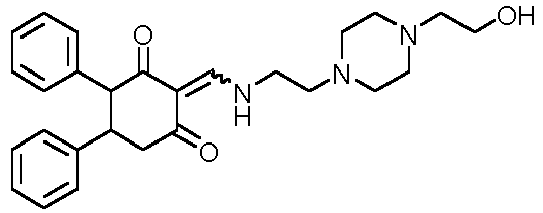
4A 
162 
324 
7 
163 
325 
8 
164 
326 
9 
165 
327 
10 
169 
328 
11 
170 
329 
12 
171 
330 
14 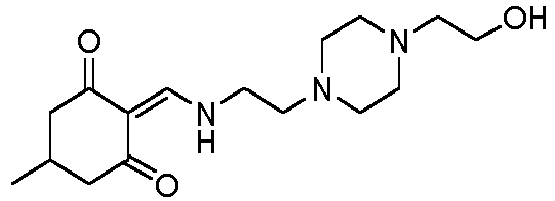
172 
331 
15 
173 
332 
17 
174 
333 
18 
175 
334 
19 
176 
335 
20 
177 
336 
21 
178 
337 
22 
180 
338 
23 
182 
339 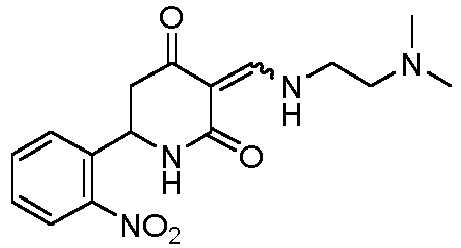
24 
183 
340 
25 
184 
341 
26 
185 
342 
27 
186 
343 
28 
187 
344 
29 
188 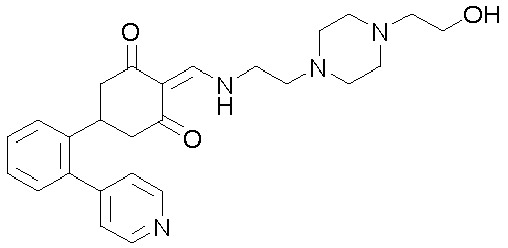
345 
30 
189 
346 
31 
190 
347 
32 
191 
349 
33 
192 
350 
34 
193 
351 
35 
194 
352 
36 
195 
353 
37 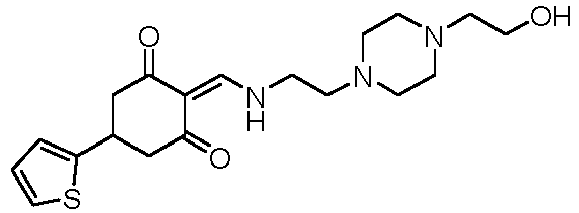
196 
354 
39 
197 
355 
40 
200 
356 
41 
201 
357 
42 
202 
358 
43 
203 
359 
44 
204 
360 
45 
205 
361 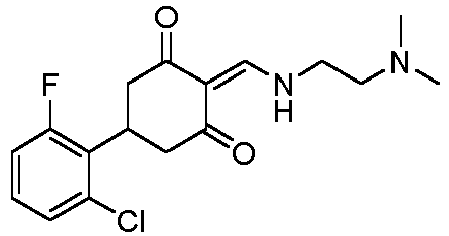
46 
206 
362 
47 
207 
363 
48 
208 
364 
49 
209 
365 
50 
210 
366 
51 
211 
367 
52 
212 
368 
53 
213 
369 
54 
214 
370 
55 
215 
371 
56 
216 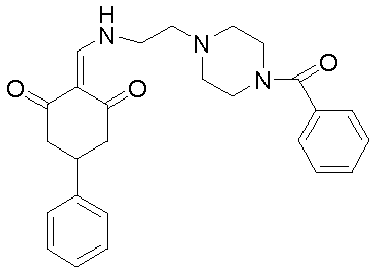
372 
57 
217 
373 
58 
218 
374 
59 
219 
375 
61 
220 
376 
62 
221 
377 
63 
222 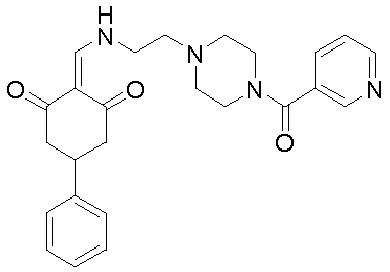
378 
64 
223 
379 
65 
224 
380 
66 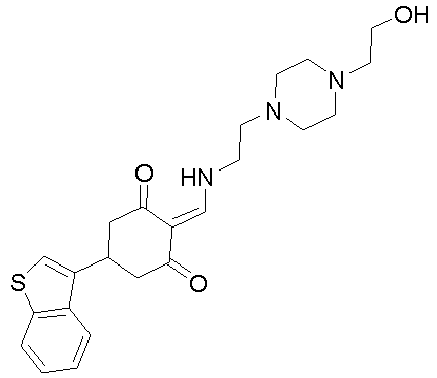
225 
381 
67 
226 
382 
68 
227 
383 
69 
228 
384 
70 
229 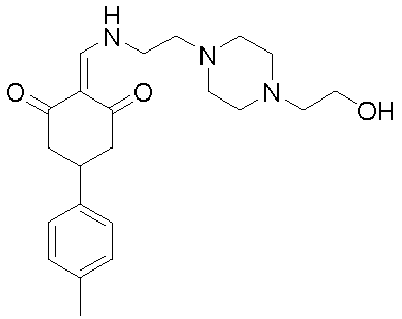
385 
71 
230 
386 
72 
231 
387 
73 
232 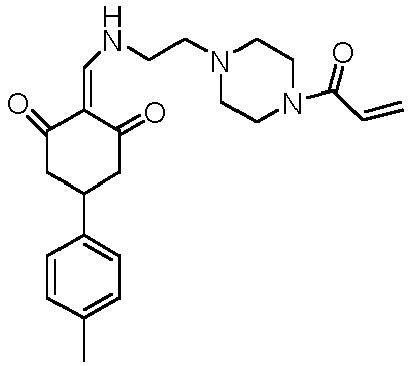
388 
74 
233 
389 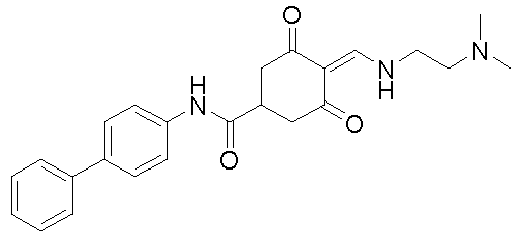
75 
236 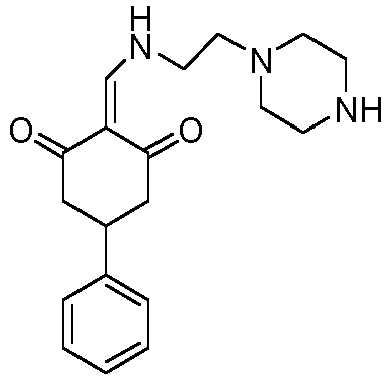
390 
76 
237 
391 
77 
238 
392 
78 
239 
393 
79 
240 
394 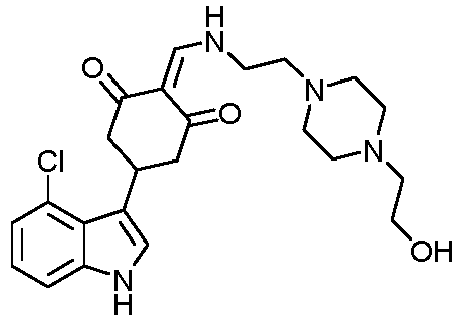
80 
242 
395 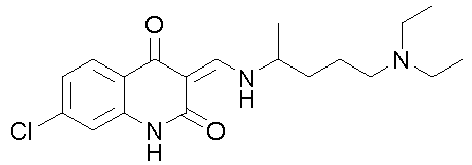
81 
245 
396 
82 
246 
397 
83 
247 
398 
84 
248 
399 
85 
249 
400 
86 
251 
401 
87 
252 
402 
88 
253 
403 
89 
254 
404 
90 
255 
405 
91 
256 
406 
92 
257 
407 
93 
258 
408 
94 
259 
409 
95 
260 
410 
96 
262 
411 
97 
263 
412 
99 
265 
413 
100 
266 
414 
101 
267 
415 
102 
268 
416 
103 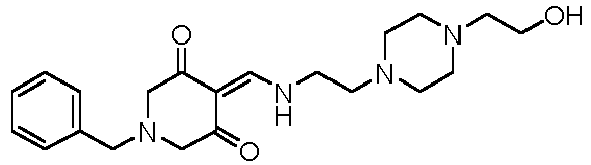
269 
417 
104 
270 
418 
106 
271 
419 
107 
272 
420 
108 
273 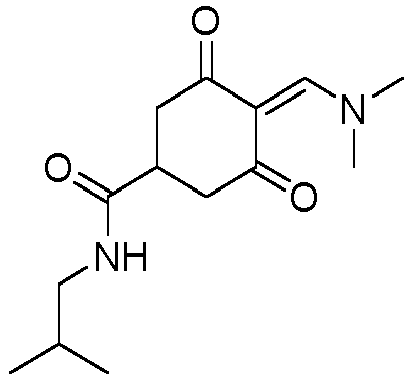
421 
109 
274 
422 
110 
276 
423 
111 
277 
424 
112 
278 
425 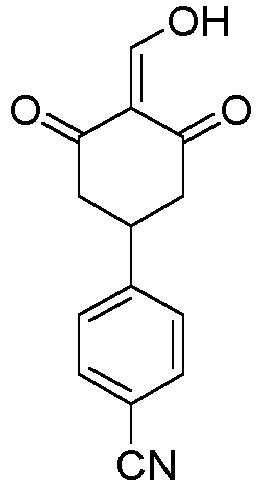
113 
279 
426 
114 
280 
427 
115 
281 
428 
116 
282 
429 
119 
283 
430 
120 
284 
431 
121 
285 
432 
122 
286 
433 
123 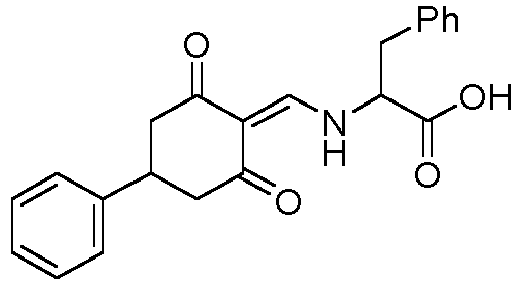
287 
434 
124 
288 
435 
125 
289 
436 
126 
290 
437 
127 
291 
438 
128 
293 
439 
129 
294 
440 
131 
295 
441 
132 
296 
442 
133 
297 
443 
134 
298 
135 
299 
445 
136 
300 
446 
137 
301 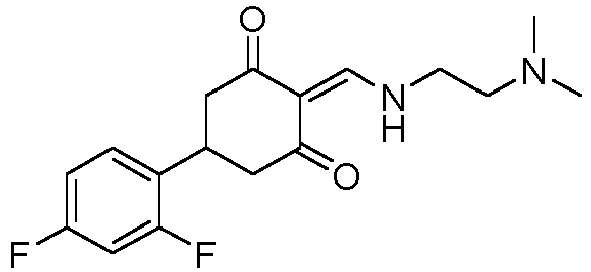
447 
138 
302 
448 
139 
303 
450 
140 
304 
451 
141 
305 
452 
142 
306 
453 
143 
307 
454 
145 
308 
455 
146 
309 
456 
147 
310 
457 
148 
311 
458 
149 
315 
459 
150 
317 
460 
155 
318 
461 
156 
320 
158 
321 
160 
322 
- A pharmaceutical composition, comprising the compounds or pharmaceutically acceptable salts thereof according to any of claims 1-3.
- Use of the compounds or pharmaceutically acceptable salts thereof according to any of claims 1 -3 in manufacturing a medicament for regulating autophagy in a cell.
Applications Claiming Priority (2)
| Application Number | Priority Date | Filing Date | Title |
|---|---|---|---|
| CN201710364986.4A CN108947985A (en) | 2017-05-22 | 2017-05-22 | Compound and its preparation method and application as autophagy regulator |
| PCT/CN2018/087446 WO2018214812A1 (en) | 2017-05-22 | 2018-05-18 | Compound used as autophagy regulator, and preparation method therefor and uses thereof |
Publications (3)
| Publication Number | Publication Date |
|---|---|
| EP3632903A1 EP3632903A1 (en) | 2020-04-08 |
| EP3632903A4 EP3632903A4 (en) | 2021-03-17 |
| EP3632903B1 true EP3632903B1 (en) | 2023-10-11 |
Family
ID=64396259
Family Applications (1)
| Application Number | Title | Priority Date | Filing Date |
|---|---|---|---|
| EP18805508.1A Active EP3632903B1 (en) | 2017-05-22 | 2018-05-18 | Compound used as autophagy regulator, and preparation method therefor and uses thereof |
Country Status (9)
| Country | Link |
|---|---|
| US (1) | US11319303B2 (en) |
| EP (1) | EP3632903B1 (en) |
| JP (1) | JP7237017B2 (en) |
| KR (1) | KR102580087B1 (en) |
| CN (3) | CN108947985A (en) |
| AU (1) | AU2018274378B2 (en) |
| CA (1) | CA3061209A1 (en) |
| MX (1) | MX2019013816A (en) |
| WO (1) | WO2018214812A1 (en) |
Families Citing this family (9)
| Publication number | Priority date | Publication date | Assignee | Title |
|---|---|---|---|---|
| CN108929373A (en) * | 2017-05-22 | 2018-12-04 | 苏州偶领生物医药有限公司 | A kind of method of covalent bond modification mammal ATG8 homologue |
| CN112898316A (en) * | 2019-12-03 | 2021-06-04 | 微境生物医药科技(上海)有限公司 | Novel pyrrole compounds |
| CN111187153B (en) * | 2020-01-10 | 2022-09-13 | 山东亘元生物科技有限公司 | Preparation method of 1, 3-cyclohexanedione |
| CN117440954A (en) * | 2021-04-20 | 2024-01-23 | 田纳西大学研究基金会 | Metabolically stable pyrimidinyldihydroquinoxalinone as a tubulin polymerization inhibitor |
| IL307700A (en) * | 2021-04-20 | 2023-12-01 | Univ Tennessee Res Found | Metabolically stable pyrimidinyl dihydroquinoxalinones as tubulin polymerization inhibitors |
| CN113956215B (en) * | 2021-07-15 | 2022-08-12 | 暨南大学附属第一医院 | Application of polycyclic aryl compound in preparation of antifungal drugs |
| US20250144110A1 (en) * | 2022-01-28 | 2025-05-08 | Washington University | Compositions of autophagy modulating agents and uses thereof |
| CN114870569B (en) * | 2022-04-11 | 2023-04-07 | 合肥工业大学 | Synthetic method of piperazine-based carbon trapping agent |
| KR102800732B1 (en) | 2022-08-04 | 2025-05-13 | 신은식 | Egg packing container guide apparatus for strip packing |
Family Cites Families (18)
| Publication number | Priority date | Publication date | Assignee | Title |
|---|---|---|---|---|
| EP0137963B1 (en) * | 1983-09-16 | 1988-09-28 | Stauffer Chemical Company | Certain 2-(2-substituted benzoyl)-1,3-cyclohexanediones |
| SU1715189A3 (en) * | 1983-09-16 | 1992-02-23 | Стауффер Кемикал Компани (Фирма) | Undesirable vegetation control method |
| IL77349A (en) * | 1984-12-20 | 1990-07-12 | Stauffer Chemical Co | 2-(2'-nitrobenzoyl)-1,3-cyclohexanediones,their preparation and their use as herbicides |
| JPS62123145A (en) * | 1985-11-22 | 1987-06-04 | Otsuka Chem Co Ltd | 1,3-cyclohexanedione derivative and herbicide for paddy field containing said derivative as active component |
| WO2006007864A1 (en) | 2004-07-17 | 2006-01-26 | Max Planck Geselllschaft Zur Förderung Der Wissenschaft | Treating neurodegenerative conditions |
| NZ568656A (en) * | 2005-12-23 | 2011-03-31 | Basf Se | A method for controlling aquatic weeds of the genus hydrilla with topramezone ([3-(4,5-dihydro-isoxazol-3-yl)-4-methylsulfonyl-2-methylphenyl](5-hydroxy-1-methyl-1H-pyrazol-4-yl)methanone) |
| GB2449293A (en) * | 2007-05-17 | 2008-11-19 | Evotec | Compounds having Hsp90 inhibitory activity |
| US8642660B2 (en) * | 2007-12-21 | 2014-02-04 | The University Of Rochester | Method for altering the lifespan of eukaryotic organisms |
| WO2011017809A1 (en) * | 2009-08-11 | 2011-02-17 | The University Of British Columbia | Autophagy inhibitor compounds, compositions and methods for the use thereof in the treatment of cancer |
| EP2301347A1 (en) * | 2009-09-17 | 2011-03-30 | Commissariat à l'Énergie Atomique et aux Énergies Alternatives | Plant additives and uses thereof to modulate the synthesis of membrane glycerolipids in planta |
| EP2501229A4 (en) * | 2009-11-17 | 2014-08-06 | Univ Rochester | COMPOUNDS AND METHODS FOR MODIFYING THE LIFETIME OF EUKARYOTIC ORGANISMS |
| EP2508607A1 (en) * | 2011-04-07 | 2012-10-10 | Helmholtz-Zentrum für Infektionsforschung GmbH | Medicament for liver regeneration and for treatment of liver failure |
| EP2882726A4 (en) * | 2012-08-09 | 2016-04-06 | Neuropore Therapies Inc | Aryl-and heteroaryl-substituted benzene derivatives as modulators of pi3-kinase signalling pathways |
| CA2922925A1 (en) * | 2013-09-05 | 2015-03-12 | Genentech, Inc. | Antiproliferative compounds |
| HK1246288A1 (en) | 2015-06-01 | 2018-09-07 | Dalhousie University | S1pr2 antagonists and uses therefor |
| US20200123127A1 (en) | 2016-04-25 | 2020-04-23 | Everon Biosciences, Inc. | Removal of senescence-associated macrophages |
| CN108929373A (en) * | 2017-05-22 | 2018-12-04 | 苏州偶领生物医药有限公司 | A kind of method of covalent bond modification mammal ATG8 homologue |
| CN108938612A (en) * | 2017-05-22 | 2018-12-07 | 苏州偶领生物医药有限公司 | The purposes of aminomethylene hexamethylene 1,3- dione compounds |
-
2017
- 2017-05-22 CN CN201710364986.4A patent/CN108947985A/en not_active Withdrawn
-
2018
- 2018-05-18 JP JP2019565459A patent/JP7237017B2/en active Active
- 2018-05-18 KR KR1020197036203A patent/KR102580087B1/en active Active
- 2018-05-18 EP EP18805508.1A patent/EP3632903B1/en active Active
- 2018-05-18 CN CN202310882957.2A patent/CN116969904B/en active Active
- 2018-05-18 US US16/614,465 patent/US11319303B2/en active Active
- 2018-05-18 AU AU2018274378A patent/AU2018274378B2/en active Active
- 2018-05-18 WO PCT/CN2018/087446 patent/WO2018214812A1/en not_active Ceased
- 2018-05-18 CA CA3061209A patent/CA3061209A1/en active Pending
- 2018-05-18 MX MX2019013816A patent/MX2019013816A/en unknown
- 2018-05-18 CN CN201880033785.9A patent/CN111148740B/en active Active
Non-Patent Citations (1)
| Title |
|---|
| JUNEK HANS: "Synthesen von Alkyl -bzw. Cycloalkylpyridinen und Naphthyridinen", MONATSHEFTE FÜR CHEMIE, 1 January 1977 (1977-01-01), pages 689 - 702, XP093003055, Retrieved from the Internet <URL:https://link.springer.com/article/10.1007/BF00912814> [retrieved on 20221129] * |
Also Published As
| Publication number | Publication date |
|---|---|
| KR20200008573A (en) | 2020-01-28 |
| CN111148740A (en) | 2020-05-12 |
| CN116969904A (en) | 2023-10-31 |
| CN108947985A (en) | 2018-12-07 |
| EP3632903A4 (en) | 2021-03-17 |
| WO2018214812A1 (en) | 2018-11-29 |
| US11319303B2 (en) | 2022-05-03 |
| US20200190066A1 (en) | 2020-06-18 |
| CA3061209A1 (en) | 2019-10-23 |
| AU2018274378A1 (en) | 2019-12-12 |
| CN116969904B (en) | 2026-01-02 |
| AU2018274378B2 (en) | 2022-08-04 |
| MX2019013816A (en) | 2020-01-15 |
| BR112019024376A2 (en) | 2020-07-14 |
| EP3632903A1 (en) | 2020-04-08 |
| JP2020521772A (en) | 2020-07-27 |
| JP7237017B2 (en) | 2023-03-10 |
| KR102580087B1 (en) | 2023-09-20 |
| CN111148740B (en) | 2023-08-25 |
Similar Documents
| Publication | Publication Date | Title |
|---|---|---|
| US11319303B2 (en) | Compound used as autophagy regulator, and preparation method therefor and uses thereof | |
| TWI527800B (en) | 1-(arylmethyl)quinazoline-2,4(1h,3h)-diones as parp inhibitors and the use thereof | |
| CN106220635B (en) | Fused tetracyclic or pentacyclic dihydrodiaza*carbazolones as PARP inhibitors | |
| EP4140997A1 (en) | Pyridine acetamide derivative serving as cdk inhibitor, and preparation method therefor and use thereof | |
| EP4389738A1 (en) | Sos1 inhibitor and use thereof | |
| WO2020156243A1 (en) | Shp2 inhibitor and application thereof | |
| EP3523292B1 (en) | Heteroaryl compounds and their use as mer inhibitors | |
| EP3302484B1 (en) | 6-alkyl dihydropyrazolopyrimidinone compounds as pde2 inhibitors | |
| EP4055013B1 (en) | Wdr5 inhibitors and modulators | |
| KR20150114575A (en) | Substituted bicyclic dihydropyrimidinones and their use as inhibitors of neutrophil elastase activity | |
| CN113508109A (en) | Substituted heterocyclic amide compound, its preparation method and medical use | |
| EP2976341A1 (en) | Acyclic cyanoethylpyrazolo pyridones as janus kinase inhibitors | |
| TW201319067A (en) | Triazolopyridine compounds | |
| EP2976338B1 (en) | N-(2-cyano heterocyclyl)pyrazolo pyridones as janus kinase inhibitors | |
| WO2022257581A1 (en) | A class of imidazolidinopyrimidone compounds and use thereof in treatment of hsclpp-mediated diseases | |
| KR20190138661A (en) | Fluorine-substituted indazole compounds and uses thereof | |
| CN117561058A (en) | CDK2 inhibitors and methods of use | |
| CN116600808A (en) | Tetrahydronaphthyridine derivative serving as KRAS mutant G12C inhibitor, and preparation method and application thereof | |
| US20230303569A1 (en) | Heterocyclic compounds as therapeutic agents | |
| CN114478537A (en) | Cyclic amide-fused ring compound and medical use thereof | |
| WO2023046030A1 (en) | Egfr small-molecule inhibitor, pharmaceutical composition containing same, and use thereof | |
| WO2022171126A1 (en) | Fused ring compound used as wee-1 inhibitor | |
| JP2026516333A (en) | Isoquinolinone derivatives and 4H-quinolidinone derivatives and their pharmaceutical compositions for the treatment of diseases | |
| WO2025108342A1 (en) | Aromatic ring-fused thiazine derivative and pharmaceutical use thereof | |
| TWI690528B (en) | Ring-fused bicyclic pyridyl derivatives |
Legal Events
| Date | Code | Title | Description |
|---|---|---|---|
| STAA | Information on the status of an ep patent application or granted ep patent |
Free format text: STATUS: THE INTERNATIONAL PUBLICATION HAS BEEN MADE |
|
| PUAI | Public reference made under article 153(3) epc to a published international application that has entered the european phase |
Free format text: ORIGINAL CODE: 0009012 |
|
| STAA | Information on the status of an ep patent application or granted ep patent |
Free format text: STATUS: REQUEST FOR EXAMINATION WAS MADE |
|
| 17P | Request for examination filed |
Effective date: 20191125 |
|
| AK | Designated contracting states |
Kind code of ref document: A1 Designated state(s): AL AT BE BG CH CY CZ DE DK EE ES FI FR GB GR HR HU IE IS IT LI LT LU LV MC MK MT NL NO PL PT RO RS SE SI SK SM TR |
|
| AX | Request for extension of the european patent |
Extension state: BA ME |
|
| DAV | Request for validation of the european patent (deleted) | ||
| DAX | Request for extension of the european patent (deleted) | ||
| A4 | Supplementary search report drawn up and despatched |
Effective date: 20210215 |
|
| RIC1 | Information provided on ipc code assigned before grant |
Ipc: C07D 231/56 20060101ALI20210209BHEP Ipc: C07C 49/573 20060101ALI20210209BHEP Ipc: C07D 209/04 20060101ALI20210209BHEP Ipc: C07D 295/088 20060101AFI20210209BHEP Ipc: C07D 295/205 20060101ALI20210209BHEP Ipc: C07C 49/577 20060101ALI20210209BHEP Ipc: C07C 49/567 20060101ALI20210209BHEP Ipc: C07D 213/16 20060101ALI20210209BHEP Ipc: C07C 49/563 20060101ALI20210209BHEP |
|
| STAA | Information on the status of an ep patent application or granted ep patent |
Free format text: STATUS: EXAMINATION IS IN PROGRESS |
|
| 17Q | First examination report despatched |
Effective date: 20221207 |
|
| GRAP | Despatch of communication of intention to grant a patent |
Free format text: ORIGINAL CODE: EPIDOSNIGR1 |
|
| STAA | Information on the status of an ep patent application or granted ep patent |
Free format text: STATUS: GRANT OF PATENT IS INTENDED |
|
| RIC1 | Information provided on ipc code assigned before grant |
Ipc: C07D 207/09 20060101ALI20230515BHEP Ipc: C07C 225/24 20060101ALI20230515BHEP Ipc: A61P 37/00 20060101ALI20230515BHEP Ipc: A61P 35/02 20060101ALI20230515BHEP Ipc: A61P 35/00 20060101ALI20230515BHEP Ipc: A61P 31/00 20060101ALI20230515BHEP Ipc: A61P 25/00 20060101ALI20230515BHEP Ipc: A61P 19/08 20060101ALI20230515BHEP Ipc: A61P 19/00 20060101ALI20230515BHEP Ipc: A61P 9/06 20060101ALI20230515BHEP Ipc: A61P 9/00 20060101ALI20230515BHEP Ipc: A61P 9/12 20060101ALI20230515BHEP Ipc: C07C 49/577 20060101ALI20230515BHEP Ipc: C07C 49/573 20060101ALI20230515BHEP Ipc: C07C 49/567 20060101ALI20230515BHEP Ipc: C07C 49/563 20060101ALI20230515BHEP Ipc: C07D 231/56 20060101ALI20230515BHEP Ipc: C07D 213/16 20060101ALI20230515BHEP Ipc: C07D 209/04 20060101ALI20230515BHEP Ipc: C07D 295/205 20060101ALI20230515BHEP Ipc: C07D 295/088 20060101AFI20230515BHEP |
|
| INTG | Intention to grant announced |
Effective date: 20230612 |
|
| GRAS | Grant fee paid |
Free format text: ORIGINAL CODE: EPIDOSNIGR3 |
|
| GRAA | (expected) grant |
Free format text: ORIGINAL CODE: 0009210 |
|
| STAA | Information on the status of an ep patent application or granted ep patent |
Free format text: STATUS: THE PATENT HAS BEEN GRANTED |
|
| AK | Designated contracting states |
Kind code of ref document: B1 Designated state(s): AL AT BE BG CH CY CZ DE DK EE ES FI FR GB GR HR HU IE IS IT LI LT LU LV MC MK MT NL NO PL PT RO RS SE SI SK SM TR |
|
| REG | Reference to a national code |
Ref country code: GB Ref legal event code: FG4D |
|
| REG | Reference to a national code |
Ref country code: CH Ref legal event code: EP |
|
| REG | Reference to a national code |
Ref country code: DE Ref legal event code: R096 Ref document number: 602018059252 Country of ref document: DE |
|
| REG | Reference to a national code |
Ref country code: IE Ref legal event code: FG4D |
|
| REG | Reference to a national code |
Ref country code: LT Ref legal event code: MG9D |
|
| REG | Reference to a national code |
Ref country code: NL Ref legal event code: MP Effective date: 20231011 |
|
| REG | Reference to a national code |
Ref country code: AT Ref legal event code: MK05 Ref document number: 1620130 Country of ref document: AT Kind code of ref document: T Effective date: 20231011 |
|
| PG25 | Lapsed in a contracting state [announced via postgrant information from national office to epo] |
Ref country code: NL Free format text: LAPSE BECAUSE OF FAILURE TO SUBMIT A TRANSLATION OF THE DESCRIPTION OR TO PAY THE FEE WITHIN THE PRESCRIBED TIME-LIMIT Effective date: 20231011 |
|
| PG25 | Lapsed in a contracting state [announced via postgrant information from national office to epo] |
Ref country code: GR Free format text: LAPSE BECAUSE OF FAILURE TO SUBMIT A TRANSLATION OF THE DESCRIPTION OR TO PAY THE FEE WITHIN THE PRESCRIBED TIME-LIMIT Effective date: 20240112 |
|
| PG25 | Lapsed in a contracting state [announced via postgrant information from national office to epo] |
Ref country code: IS Free format text: LAPSE BECAUSE OF FAILURE TO SUBMIT A TRANSLATION OF THE DESCRIPTION OR TO PAY THE FEE WITHIN THE PRESCRIBED TIME-LIMIT Effective date: 20240211 |
|
| PG25 | Lapsed in a contracting state [announced via postgrant information from national office to epo] |
Ref country code: LT Free format text: LAPSE BECAUSE OF FAILURE TO SUBMIT A TRANSLATION OF THE DESCRIPTION OR TO PAY THE FEE WITHIN THE PRESCRIBED TIME-LIMIT Effective date: 20231011 |
|
| PG25 | Lapsed in a contracting state [announced via postgrant information from national office to epo] |
Ref country code: AT Free format text: LAPSE BECAUSE OF FAILURE TO SUBMIT A TRANSLATION OF THE DESCRIPTION OR TO PAY THE FEE WITHIN THE PRESCRIBED TIME-LIMIT Effective date: 20231011 |
|
| PG25 | Lapsed in a contracting state [announced via postgrant information from national office to epo] |
Ref country code: ES Free format text: LAPSE BECAUSE OF FAILURE TO SUBMIT A TRANSLATION OF THE DESCRIPTION OR TO PAY THE FEE WITHIN THE PRESCRIBED TIME-LIMIT Effective date: 20231011 |
|
| PG25 | Lapsed in a contracting state [announced via postgrant information from national office to epo] |
Ref country code: LT Free format text: LAPSE BECAUSE OF FAILURE TO SUBMIT A TRANSLATION OF THE DESCRIPTION OR TO PAY THE FEE WITHIN THE PRESCRIBED TIME-LIMIT Effective date: 20231011 Ref country code: IS Free format text: LAPSE BECAUSE OF FAILURE TO SUBMIT A TRANSLATION OF THE DESCRIPTION OR TO PAY THE FEE WITHIN THE PRESCRIBED TIME-LIMIT Effective date: 20240211 Ref country code: GR Free format text: LAPSE BECAUSE OF FAILURE TO SUBMIT A TRANSLATION OF THE DESCRIPTION OR TO PAY THE FEE WITHIN THE PRESCRIBED TIME-LIMIT Effective date: 20240112 Ref country code: ES Free format text: LAPSE BECAUSE OF FAILURE TO SUBMIT A TRANSLATION OF THE DESCRIPTION OR TO PAY THE FEE WITHIN THE PRESCRIBED TIME-LIMIT Effective date: 20231011 Ref country code: BG Free format text: LAPSE BECAUSE OF FAILURE TO SUBMIT A TRANSLATION OF THE DESCRIPTION OR TO PAY THE FEE WITHIN THE PRESCRIBED TIME-LIMIT Effective date: 20240111 Ref country code: AT Free format text: LAPSE BECAUSE OF FAILURE TO SUBMIT A TRANSLATION OF THE DESCRIPTION OR TO PAY THE FEE WITHIN THE PRESCRIBED TIME-LIMIT Effective date: 20231011 Ref country code: PT Free format text: LAPSE BECAUSE OF FAILURE TO SUBMIT A TRANSLATION OF THE DESCRIPTION OR TO PAY THE FEE WITHIN THE PRESCRIBED TIME-LIMIT Effective date: 20240212 |
|
| PG25 | Lapsed in a contracting state [announced via postgrant information from national office to epo] |
Ref country code: SE Free format text: LAPSE BECAUSE OF FAILURE TO SUBMIT A TRANSLATION OF THE DESCRIPTION OR TO PAY THE FEE WITHIN THE PRESCRIBED TIME-LIMIT Effective date: 20231011 Ref country code: RS Free format text: LAPSE BECAUSE OF FAILURE TO SUBMIT A TRANSLATION OF THE DESCRIPTION OR TO PAY THE FEE WITHIN THE PRESCRIBED TIME-LIMIT Effective date: 20231011 Ref country code: PL Free format text: LAPSE BECAUSE OF FAILURE TO SUBMIT A TRANSLATION OF THE DESCRIPTION OR TO PAY THE FEE WITHIN THE PRESCRIBED TIME-LIMIT Effective date: 20231011 Ref country code: NO Free format text: LAPSE BECAUSE OF FAILURE TO SUBMIT A TRANSLATION OF THE DESCRIPTION OR TO PAY THE FEE WITHIN THE PRESCRIBED TIME-LIMIT Effective date: 20240111 Ref country code: LV Free format text: LAPSE BECAUSE OF FAILURE TO SUBMIT A TRANSLATION OF THE DESCRIPTION OR TO PAY THE FEE WITHIN THE PRESCRIBED TIME-LIMIT Effective date: 20231011 Ref country code: HR Free format text: LAPSE BECAUSE OF FAILURE TO SUBMIT A TRANSLATION OF THE DESCRIPTION OR TO PAY THE FEE WITHIN THE PRESCRIBED TIME-LIMIT Effective date: 20231011 |
|
| PG25 | Lapsed in a contracting state [announced via postgrant information from national office to epo] |
Ref country code: DK Free format text: LAPSE BECAUSE OF FAILURE TO SUBMIT A TRANSLATION OF THE DESCRIPTION OR TO PAY THE FEE WITHIN THE PRESCRIBED TIME-LIMIT Effective date: 20231011 |
|
| REG | Reference to a national code |
Ref country code: DE Ref legal event code: R097 Ref document number: 602018059252 Country of ref document: DE |
|
| PG25 | Lapsed in a contracting state [announced via postgrant information from national office to epo] |
Ref country code: CZ Free format text: LAPSE BECAUSE OF FAILURE TO SUBMIT A TRANSLATION OF THE DESCRIPTION OR TO PAY THE FEE WITHIN THE PRESCRIBED TIME-LIMIT Effective date: 20231011 |
|
| PG25 | Lapsed in a contracting state [announced via postgrant information from national office to epo] |
Ref country code: SK Free format text: LAPSE BECAUSE OF FAILURE TO SUBMIT A TRANSLATION OF THE DESCRIPTION OR TO PAY THE FEE WITHIN THE PRESCRIBED TIME-LIMIT Effective date: 20231011 |
|
| PG25 | Lapsed in a contracting state [announced via postgrant information from national office to epo] |
Ref country code: SM Free format text: LAPSE BECAUSE OF FAILURE TO SUBMIT A TRANSLATION OF THE DESCRIPTION OR TO PAY THE FEE WITHIN THE PRESCRIBED TIME-LIMIT Effective date: 20231011 Ref country code: SK Free format text: LAPSE BECAUSE OF FAILURE TO SUBMIT A TRANSLATION OF THE DESCRIPTION OR TO PAY THE FEE WITHIN THE PRESCRIBED TIME-LIMIT Effective date: 20231011 Ref country code: RO Free format text: LAPSE BECAUSE OF FAILURE TO SUBMIT A TRANSLATION OF THE DESCRIPTION OR TO PAY THE FEE WITHIN THE PRESCRIBED TIME-LIMIT Effective date: 20231011 Ref country code: IT Free format text: LAPSE BECAUSE OF FAILURE TO SUBMIT A TRANSLATION OF THE DESCRIPTION OR TO PAY THE FEE WITHIN THE PRESCRIBED TIME-LIMIT Effective date: 20231011 Ref country code: EE Free format text: LAPSE BECAUSE OF FAILURE TO SUBMIT A TRANSLATION OF THE DESCRIPTION OR TO PAY THE FEE WITHIN THE PRESCRIBED TIME-LIMIT Effective date: 20231011 Ref country code: DK Free format text: LAPSE BECAUSE OF FAILURE TO SUBMIT A TRANSLATION OF THE DESCRIPTION OR TO PAY THE FEE WITHIN THE PRESCRIBED TIME-LIMIT Effective date: 20231011 Ref country code: CZ Free format text: LAPSE BECAUSE OF FAILURE TO SUBMIT A TRANSLATION OF THE DESCRIPTION OR TO PAY THE FEE WITHIN THE PRESCRIBED TIME-LIMIT Effective date: 20231011 |
|
| PLBE | No opposition filed within time limit |
Free format text: ORIGINAL CODE: 0009261 |
|
| STAA | Information on the status of an ep patent application or granted ep patent |
Free format text: STATUS: NO OPPOSITION FILED WITHIN TIME LIMIT |
|
| 26N | No opposition filed |
Effective date: 20240712 |
|
| PG25 | Lapsed in a contracting state [announced via postgrant information from national office to epo] |
Ref country code: SI Free format text: LAPSE BECAUSE OF FAILURE TO SUBMIT A TRANSLATION OF THE DESCRIPTION OR TO PAY THE FEE WITHIN THE PRESCRIBED TIME-LIMIT Effective date: 20231011 |
|
| PG25 | Lapsed in a contracting state [announced via postgrant information from national office to epo] |
Ref country code: SI Free format text: LAPSE BECAUSE OF FAILURE TO SUBMIT A TRANSLATION OF THE DESCRIPTION OR TO PAY THE FEE WITHIN THE PRESCRIBED TIME-LIMIT Effective date: 20231011 |
|
| REG | Reference to a national code |
Ref country code: CH Ref legal event code: PL |
|
| PG25 | Lapsed in a contracting state [announced via postgrant information from national office to epo] |
Ref country code: MC Free format text: LAPSE BECAUSE OF FAILURE TO SUBMIT A TRANSLATION OF THE DESCRIPTION OR TO PAY THE FEE WITHIN THE PRESCRIBED TIME-LIMIT Effective date: 20231011 |
|
| PG25 | Lapsed in a contracting state [announced via postgrant information from national office to epo] |
Ref country code: LU Free format text: LAPSE BECAUSE OF NON-PAYMENT OF DUE FEES Effective date: 20240518 |
|
| PG25 | Lapsed in a contracting state [announced via postgrant information from national office to epo] |
Ref country code: MC Free format text: LAPSE BECAUSE OF FAILURE TO SUBMIT A TRANSLATION OF THE DESCRIPTION OR TO PAY THE FEE WITHIN THE PRESCRIBED TIME-LIMIT Effective date: 20231011 Ref country code: LU Free format text: LAPSE BECAUSE OF NON-PAYMENT OF DUE FEES Effective date: 20240518 Ref country code: CH Free format text: LAPSE BECAUSE OF NON-PAYMENT OF DUE FEES Effective date: 20240531 |
|
| REG | Reference to a national code |
Ref country code: BE Ref legal event code: MM Effective date: 20240531 |
|
| PG25 | Lapsed in a contracting state [announced via postgrant information from national office to epo] |
Ref country code: IE Free format text: LAPSE BECAUSE OF NON-PAYMENT OF DUE FEES Effective date: 20240518 |
|
| PG25 | Lapsed in a contracting state [announced via postgrant information from national office to epo] |
Ref country code: BE Free format text: LAPSE BECAUSE OF NON-PAYMENT OF DUE FEES Effective date: 20240531 |
|
| PGFP | Annual fee paid to national office [announced via postgrant information from national office to epo] |
Ref country code: DE Payment date: 20250528 Year of fee payment: 8 |
|
| PGFP | Annual fee paid to national office [announced via postgrant information from national office to epo] |
Ref country code: GB Payment date: 20250407 Year of fee payment: 8 |
|
| PGFP | Annual fee paid to national office [announced via postgrant information from national office to epo] |
Ref country code: FR Payment date: 20250527 Year of fee payment: 8 |
|
| PG25 | Lapsed in a contracting state [announced via postgrant information from national office to epo] |
Ref country code: CY Free format text: LAPSE BECAUSE OF FAILURE TO SUBMIT A TRANSLATION OF THE DESCRIPTION OR TO PAY THE FEE WITHIN THE PRESCRIBED TIME-LIMIT; INVALID AB INITIO Effective date: 20180518 |
|
| PG25 | Lapsed in a contracting state [announced via postgrant information from national office to epo] |
Ref country code: HU Free format text: LAPSE BECAUSE OF FAILURE TO SUBMIT A TRANSLATION OF THE DESCRIPTION OR TO PAY THE FEE WITHIN THE PRESCRIBED TIME-LIMIT; INVALID AB INITIO Effective date: 20180518 |
|
| PG25 | Lapsed in a contracting state [announced via postgrant information from national office to epo] |
Ref country code: FI Free format text: LAPSE BECAUSE OF FAILURE TO SUBMIT A TRANSLATION OF THE DESCRIPTION OR TO PAY THE FEE WITHIN THE PRESCRIBED TIME-LIMIT Effective date: 20231011 |