EP3632479A1 - Nanoporous coating of titanium dioxide on titanium alloy and the method of manufacturing - Google Patents
Nanoporous coating of titanium dioxide on titanium alloy and the method of manufacturing Download PDFInfo
- Publication number
- EP3632479A1 EP3632479A1 EP18020481.0A EP18020481A EP3632479A1 EP 3632479 A1 EP3632479 A1 EP 3632479A1 EP 18020481 A EP18020481 A EP 18020481A EP 3632479 A1 EP3632479 A1 EP 3632479A1
- Authority
- EP
- European Patent Office
- Prior art keywords
- minutes
- implant
- titanium alloy
- layer
- hydroxyapatite
- Prior art date
- Legal status (The legal status is an assumption and is not a legal conclusion. Google has not performed a legal analysis and makes no representation as to the accuracy of the status listed.)
- Withdrawn
Links
- GWEVSGVZZGPLCZ-UHFFFAOYSA-N Titan oxide Chemical compound O=[Ti]=O GWEVSGVZZGPLCZ-UHFFFAOYSA-N 0.000 title claims abstract description 59
- 229910001069 Ti alloy Inorganic materials 0.000 title claims abstract description 41
- 239000004408 titanium dioxide Substances 0.000 title claims abstract description 29
- 238000000576 coating method Methods 0.000 title claims abstract description 22
- 239000011248 coating agent Substances 0.000 title claims abstract description 15
- 238000004519 manufacturing process Methods 0.000 title claims description 6
- 238000000034 method Methods 0.000 claims abstract description 83
- 239000007943 implant Substances 0.000 claims abstract description 40
- 229910052588 hydroxylapatite Inorganic materials 0.000 claims abstract description 31
- XYJRXVWERLGGKC-UHFFFAOYSA-D pentacalcium;hydroxide;triphosphate Chemical compound [OH-].[Ca+2].[Ca+2].[Ca+2].[Ca+2].[Ca+2].[O-]P([O-])([O-])=O.[O-]P([O-])([O-])=O.[O-]P([O-])([O-])=O XYJRXVWERLGGKC-UHFFFAOYSA-D 0.000 claims abstract description 31
- VTYYLEPIZMXCLO-UHFFFAOYSA-L Calcium carbonate Chemical compound [Ca+2].[O-]C([O-])=O VTYYLEPIZMXCLO-UHFFFAOYSA-L 0.000 claims abstract description 28
- XLYOFNOQVPJJNP-UHFFFAOYSA-N water Chemical compound O XLYOFNOQVPJJNP-UHFFFAOYSA-N 0.000 claims abstract description 23
- KRHYYFGTRYWZRS-UHFFFAOYSA-N Fluorane Chemical compound F KRHYYFGTRYWZRS-UHFFFAOYSA-N 0.000 claims abstract description 22
- 239000012153 distilled water Substances 0.000 claims abstract description 18
- LYCAIKOWRPUZTN-UHFFFAOYSA-N Ethylene glycol Chemical compound OCCO LYCAIKOWRPUZTN-UHFFFAOYSA-N 0.000 claims abstract description 17
- 229910000883 Ti6Al4V Inorganic materials 0.000 claims abstract description 17
- LFQSCWFLJHTTHZ-UHFFFAOYSA-N Ethanol Chemical compound CCO LFQSCWFLJHTTHZ-UHFFFAOYSA-N 0.000 claims abstract description 14
- 229910000019 calcium carbonate Inorganic materials 0.000 claims abstract description 14
- 238000000151 deposition Methods 0.000 claims abstract description 13
- 230000008021 deposition Effects 0.000 claims abstract description 13
- CSCPPACGZOOCGX-UHFFFAOYSA-N Acetone Chemical compound CC(C)=O CSCPPACGZOOCGX-UHFFFAOYSA-N 0.000 claims abstract description 12
- 230000003647 oxidation Effects 0.000 claims abstract description 12
- 238000007254 oxidation reaction Methods 0.000 claims abstract description 12
- 239000011575 calcium Substances 0.000 claims abstract description 11
- 238000007654 immersion Methods 0.000 claims abstract description 11
- 239000002243 precursor Substances 0.000 claims abstract description 11
- 238000000231 atomic layer deposition Methods 0.000 claims abstract description 10
- 230000008020 evaporation Effects 0.000 claims abstract description 7
- 238000001704 evaporation Methods 0.000 claims abstract description 7
- 239000002253 acid Substances 0.000 claims abstract description 6
- PNEYBMLMFCGWSK-UHFFFAOYSA-N aluminium oxide Inorganic materials [O-2].[O-2].[O-2].[Al+3].[Al+3] PNEYBMLMFCGWSK-UHFFFAOYSA-N 0.000 claims abstract description 6
- 229910052593 corundum Inorganic materials 0.000 claims abstract description 6
- 235000019441 ethanol Nutrition 0.000 claims abstract description 6
- 239000000203 mixture Substances 0.000 claims abstract description 6
- 239000000843 powder Substances 0.000 claims abstract description 6
- 229910001845 yogo sapphire Inorganic materials 0.000 claims abstract description 6
- MNNHAPBLZZVQHP-UHFFFAOYSA-N diammonium hydrogen phosphate Chemical compound [NH4+].[NH4+].OP([O-])([O-])=O MNNHAPBLZZVQHP-UHFFFAOYSA-N 0.000 claims abstract description 5
- 229910000388 diammonium phosphate Inorganic materials 0.000 claims abstract description 5
- 235000019838 diammonium phosphate Nutrition 0.000 claims abstract description 5
- 239000011148 porous material Substances 0.000 claims abstract description 5
- 238000005238 degreasing Methods 0.000 claims abstract description 4
- YRAJNWYBUCUFBD-UHFFFAOYSA-N 2,2,6,6-tetramethylheptane-3,5-dione Chemical compound CC(C)(C)C(=O)CC(=O)C(C)(C)C YRAJNWYBUCUFBD-UHFFFAOYSA-N 0.000 claims abstract description 3
- 239000002052 molecular layer Substances 0.000 claims abstract description 3
- 238000002604 ultrasonography Methods 0.000 claims abstract description 3
- 238000006056 electrooxidation reaction Methods 0.000 claims description 4
- 239000010410 layer Substances 0.000 claims 5
- XKRFYHLGVUSROY-UHFFFAOYSA-N Argon Chemical compound [Ar] XKRFYHLGVUSROY-UHFFFAOYSA-N 0.000 claims 2
- IJGRMHOSHXDMSA-UHFFFAOYSA-N Atomic nitrogen Chemical compound N#N IJGRMHOSHXDMSA-UHFFFAOYSA-N 0.000 claims 2
- BASFCYQUMIYNBI-UHFFFAOYSA-N platinum Chemical compound [Pt] BASFCYQUMIYNBI-UHFFFAOYSA-N 0.000 claims 2
- 239000002344 surface layer Substances 0.000 claims 2
- 230000004913 activation Effects 0.000 claims 1
- 229910052786 argon Inorganic materials 0.000 claims 1
- 239000012159 carrier gas Substances 0.000 claims 1
- 229910052757 nitrogen Inorganic materials 0.000 claims 1
- 229910052697 platinum Inorganic materials 0.000 claims 1
- 239000000758 substrate Substances 0.000 description 16
- 230000015572 biosynthetic process Effects 0.000 description 10
- 239000002071 nanotube Substances 0.000 description 9
- 241000191967 Staphylococcus aureus Species 0.000 description 6
- 230000004048 modification Effects 0.000 description 6
- 238000012986 modification Methods 0.000 description 6
- 239000012620 biological material Substances 0.000 description 5
- 229910045601 alloy Inorganic materials 0.000 description 4
- 239000000956 alloy Substances 0.000 description 4
- 210000002950 fibroblast Anatomy 0.000 description 4
- 210000000963 osteoblast Anatomy 0.000 description 4
- 241000894006 Bacteria Species 0.000 description 3
- 230000000844 anti-bacterial effect Effects 0.000 description 3
- 210000000988 bone and bone Anatomy 0.000 description 3
- 238000006243 chemical reaction Methods 0.000 description 3
- 239000003792 electrolyte Substances 0.000 description 3
- 239000013074 reference sample Substances 0.000 description 3
- 238000003980 solgel method Methods 0.000 description 3
- 239000000126 substance Substances 0.000 description 3
- 238000012360 testing method Methods 0.000 description 3
- 235000017166 Bambusa arundinacea Nutrition 0.000 description 2
- 235000017491 Bambusa tulda Nutrition 0.000 description 2
- 241001330002 Bambuseae Species 0.000 description 2
- MHAJPDPJQMAIIY-UHFFFAOYSA-N Hydrogen peroxide Chemical compound OO MHAJPDPJQMAIIY-UHFFFAOYSA-N 0.000 description 2
- 235000015334 Phyllostachys viridis Nutrition 0.000 description 2
- BQCADISMDOOEFD-UHFFFAOYSA-N Silver Chemical compound [Ag] BQCADISMDOOEFD-UHFFFAOYSA-N 0.000 description 2
- RTAQQCXQSZGOHL-UHFFFAOYSA-N Titanium Chemical compound [Ti] RTAQQCXQSZGOHL-UHFFFAOYSA-N 0.000 description 2
- 239000004411 aluminium Substances 0.000 description 2
- XAGFODPZIPBFFR-UHFFFAOYSA-N aluminium Chemical compound [Al] XAGFODPZIPBFFR-UHFFFAOYSA-N 0.000 description 2
- 229910052782 aluminium Inorganic materials 0.000 description 2
- 230000003110 anti-inflammatory effect Effects 0.000 description 2
- 239000011425 bamboo Substances 0.000 description 2
- 201000010099 disease Diseases 0.000 description 2
- 208000037265 diseases, disorders, signs and symptoms Diseases 0.000 description 2
- 230000000694 effects Effects 0.000 description 2
- 230000002349 favourable effect Effects 0.000 description 2
- 230000004968 inflammatory condition Effects 0.000 description 2
- 230000002906 microbiologic effect Effects 0.000 description 2
- SOQBVABWOPYFQZ-UHFFFAOYSA-N oxygen(2-);titanium(4+) Chemical compound [O-2].[O-2].[Ti+4] SOQBVABWOPYFQZ-UHFFFAOYSA-N 0.000 description 2
- 230000035755 proliferation Effects 0.000 description 2
- 239000004332 silver Substances 0.000 description 2
- 229910052709 silver Inorganic materials 0.000 description 2
- 238000001356 surgical procedure Methods 0.000 description 2
- 238000003786 synthesis reaction Methods 0.000 description 2
- 239000010936 titanium Substances 0.000 description 2
- 229910052719 titanium Inorganic materials 0.000 description 2
- 229910052720 vanadium Inorganic materials 0.000 description 2
- LEONUFNNVUYDNQ-UHFFFAOYSA-N vanadium atom Chemical compound [V] LEONUFNNVUYDNQ-UHFFFAOYSA-N 0.000 description 2
- 208000035143 Bacterial infection Diseases 0.000 description 1
- 206010012335 Dependence Diseases 0.000 description 1
- 230000002378 acidificating effect Effects 0.000 description 1
- 230000002730 additional effect Effects 0.000 description 1
- 230000000845 anti-microbial effect Effects 0.000 description 1
- 208000022362 bacterial infectious disease Diseases 0.000 description 1
- 230000003115 biocidal effect Effects 0.000 description 1
- 230000004071 biological effect Effects 0.000 description 1
- 210000004027 cell Anatomy 0.000 description 1
- 230000021164 cell adhesion Effects 0.000 description 1
- 238000005229 chemical vapour deposition Methods 0.000 description 1
- 238000001816 cooling Methods 0.000 description 1
- 238000005260 corrosion Methods 0.000 description 1
- 230000007797 corrosion Effects 0.000 description 1
- 238000000354 decomposition reaction Methods 0.000 description 1
- 238000001652 electrophoretic deposition Methods 0.000 description 1
- -1 fluoride ions Chemical class 0.000 description 1
- 239000007792 gaseous phase Substances 0.000 description 1
- 210000000987 immune system Anatomy 0.000 description 1
- 238000002513 implantation Methods 0.000 description 1
- 230000005764 inhibitory process Effects 0.000 description 1
- 238000000869 ion-assisted deposition Methods 0.000 description 1
- 150000002500 ions Chemical class 0.000 description 1
- 230000001788 irregular Effects 0.000 description 1
- 238000000608 laser ablation Methods 0.000 description 1
- 238000003754 machining Methods 0.000 description 1
- 239000007769 metal material Substances 0.000 description 1
- 238000005289 physical deposition Methods 0.000 description 1
- 238000005498 polishing Methods 0.000 description 1
- 238000005488 sandblasting Methods 0.000 description 1
- 238000002207 thermal evaporation Methods 0.000 description 1
- 238000012876 topography Methods 0.000 description 1
Images
Classifications
-
- A—HUMAN NECESSITIES
- A61—MEDICAL OR VETERINARY SCIENCE; HYGIENE
- A61L—METHODS OR APPARATUS FOR STERILISING MATERIALS OR OBJECTS IN GENERAL; DISINFECTION, STERILISATION OR DEODORISATION OF AIR; CHEMICAL ASPECTS OF BANDAGES, DRESSINGS, ABSORBENT PADS OR SURGICAL ARTICLES; MATERIALS FOR BANDAGES, DRESSINGS, ABSORBENT PADS OR SURGICAL ARTICLES
- A61L27/00—Materials for grafts or prostheses or for coating grafts or prostheses
- A61L27/28—Materials for coating prostheses
- A61L27/30—Inorganic materials
- A61L27/306—Other specific inorganic materials not covered by A61L27/303 - A61L27/32
-
- A—HUMAN NECESSITIES
- A61—MEDICAL OR VETERINARY SCIENCE; HYGIENE
- A61C—DENTISTRY; APPARATUS OR METHODS FOR ORAL OR DENTAL HYGIENE
- A61C8/00—Means to be fixed to the jaw-bone for consolidating natural teeth or for fixing dental prostheses thereon; Dental implants; Implanting tools
- A61C8/0012—Means to be fixed to the jaw-bone for consolidating natural teeth or for fixing dental prostheses thereon; Dental implants; Implanting tools characterised by the material or composition, e.g. ceramics, surface layer, metal alloy
- A61C8/0013—Means to be fixed to the jaw-bone for consolidating natural teeth or for fixing dental prostheses thereon; Dental implants; Implanting tools characterised by the material or composition, e.g. ceramics, surface layer, metal alloy with a surface layer, coating
-
- A—HUMAN NECESSITIES
- A61—MEDICAL OR VETERINARY SCIENCE; HYGIENE
- A61C—DENTISTRY; APPARATUS OR METHODS FOR ORAL OR DENTAL HYGIENE
- A61C8/00—Means to be fixed to the jaw-bone for consolidating natural teeth or for fixing dental prostheses thereon; Dental implants; Implanting tools
- A61C8/0012—Means to be fixed to the jaw-bone for consolidating natural teeth or for fixing dental prostheses thereon; Dental implants; Implanting tools characterised by the material or composition, e.g. ceramics, surface layer, metal alloy
- A61C8/0013—Means to be fixed to the jaw-bone for consolidating natural teeth or for fixing dental prostheses thereon; Dental implants; Implanting tools characterised by the material or composition, e.g. ceramics, surface layer, metal alloy with a surface layer, coating
- A61C8/0015—Means to be fixed to the jaw-bone for consolidating natural teeth or for fixing dental prostheses thereon; Dental implants; Implanting tools characterised by the material or composition, e.g. ceramics, surface layer, metal alloy with a surface layer, coating being a conversion layer, e.g. oxide layer
-
- A—HUMAN NECESSITIES
- A61—MEDICAL OR VETERINARY SCIENCE; HYGIENE
- A61L—METHODS OR APPARATUS FOR STERILISING MATERIALS OR OBJECTS IN GENERAL; DISINFECTION, STERILISATION OR DEODORISATION OF AIR; CHEMICAL ASPECTS OF BANDAGES, DRESSINGS, ABSORBENT PADS OR SURGICAL ARTICLES; MATERIALS FOR BANDAGES, DRESSINGS, ABSORBENT PADS OR SURGICAL ARTICLES
- A61L27/00—Materials for grafts or prostheses or for coating grafts or prostheses
- A61L27/02—Inorganic materials
- A61L27/04—Metals or alloys
- A61L27/06—Titanium or titanium alloys
-
- A—HUMAN NECESSITIES
- A61—MEDICAL OR VETERINARY SCIENCE; HYGIENE
- A61L—METHODS OR APPARATUS FOR STERILISING MATERIALS OR OBJECTS IN GENERAL; DISINFECTION, STERILISATION OR DEODORISATION OF AIR; CHEMICAL ASPECTS OF BANDAGES, DRESSINGS, ABSORBENT PADS OR SURGICAL ARTICLES; MATERIALS FOR BANDAGES, DRESSINGS, ABSORBENT PADS OR SURGICAL ARTICLES
- A61L27/00—Materials for grafts or prostheses or for coating grafts or prostheses
- A61L27/28—Materials for coating prostheses
- A61L27/30—Inorganic materials
- A61L27/32—Phosphorus-containing materials, e.g. apatite
-
- A—HUMAN NECESSITIES
- A61—MEDICAL OR VETERINARY SCIENCE; HYGIENE
- A61L—METHODS OR APPARATUS FOR STERILISING MATERIALS OR OBJECTS IN GENERAL; DISINFECTION, STERILISATION OR DEODORISATION OF AIR; CHEMICAL ASPECTS OF BANDAGES, DRESSINGS, ABSORBENT PADS OR SURGICAL ARTICLES; MATERIALS FOR BANDAGES, DRESSINGS, ABSORBENT PADS OR SURGICAL ARTICLES
- A61L2400/00—Materials characterised by their function or physical properties
- A61L2400/12—Nanosized materials, e.g. nanofibres, nanoparticles, nanowires, nanotubes; Nanostructured surfaces
-
- A—HUMAN NECESSITIES
- A61—MEDICAL OR VETERINARY SCIENCE; HYGIENE
- A61L—METHODS OR APPARATUS FOR STERILISING MATERIALS OR OBJECTS IN GENERAL; DISINFECTION, STERILISATION OR DEODORISATION OF AIR; CHEMICAL ASPECTS OF BANDAGES, DRESSINGS, ABSORBENT PADS OR SURGICAL ARTICLES; MATERIALS FOR BANDAGES, DRESSINGS, ABSORBENT PADS OR SURGICAL ARTICLES
- A61L2420/00—Materials or methods for coatings medical devices
- A61L2420/02—Methods for coating medical devices
-
- A—HUMAN NECESSITIES
- A61—MEDICAL OR VETERINARY SCIENCE; HYGIENE
- A61L—METHODS OR APPARATUS FOR STERILISING MATERIALS OR OBJECTS IN GENERAL; DISINFECTION, STERILISATION OR DEODORISATION OF AIR; CHEMICAL ASPECTS OF BANDAGES, DRESSINGS, ABSORBENT PADS OR SURGICAL ARTICLES; MATERIALS FOR BANDAGES, DRESSINGS, ABSORBENT PADS OR SURGICAL ARTICLES
- A61L2420/00—Materials or methods for coatings medical devices
- A61L2420/08—Coatings comprising two or more layers
-
- A—HUMAN NECESSITIES
- A61—MEDICAL OR VETERINARY SCIENCE; HYGIENE
- A61L—METHODS OR APPARATUS FOR STERILISING MATERIALS OR OBJECTS IN GENERAL; DISINFECTION, STERILISATION OR DEODORISATION OF AIR; CHEMICAL ASPECTS OF BANDAGES, DRESSINGS, ABSORBENT PADS OR SURGICAL ARTICLES; MATERIALS FOR BANDAGES, DRESSINGS, ABSORBENT PADS OR SURGICAL ARTICLES
- A61L2430/00—Materials or treatment for tissue regeneration
- A61L2430/02—Materials or treatment for tissue regeneration for reconstruction of bones; weight-bearing implants
-
- A—HUMAN NECESSITIES
- A61—MEDICAL OR VETERINARY SCIENCE; HYGIENE
- A61L—METHODS OR APPARATUS FOR STERILISING MATERIALS OR OBJECTS IN GENERAL; DISINFECTION, STERILISATION OR DEODORISATION OF AIR; CHEMICAL ASPECTS OF BANDAGES, DRESSINGS, ABSORBENT PADS OR SURGICAL ARTICLES; MATERIALS FOR BANDAGES, DRESSINGS, ABSORBENT PADS OR SURGICAL ARTICLES
- A61L2430/00—Materials or treatment for tissue regeneration
- A61L2430/12—Materials or treatment for tissue regeneration for dental implants or prostheses
-
- A—HUMAN NECESSITIES
- A61—MEDICAL OR VETERINARY SCIENCE; HYGIENE
- A61L—METHODS OR APPARATUS FOR STERILISING MATERIALS OR OBJECTS IN GENERAL; DISINFECTION, STERILISATION OR DEODORISATION OF AIR; CHEMICAL ASPECTS OF BANDAGES, DRESSINGS, ABSORBENT PADS OR SURGICAL ARTICLES; MATERIALS FOR BANDAGES, DRESSINGS, ABSORBENT PADS OR SURGICAL ARTICLES
- A61L2430/00—Materials or treatment for tissue regeneration
- A61L2430/24—Materials or treatment for tissue regeneration for joint reconstruction
Definitions
- This invention relates to a nanoporous coating on the surface of titanium alloy, particularly on the surface of Ti6Al4V titanium alloy and the method of manufacturing with a strictly defined structure and morphology, for the production of 3D implants used in orthopaedics, maxillo-facial surgery and dentistry, for the best possible osteointegration, i.e. the process of connection between the implant and a patient's bones.
- Implants made of Ti6Al4V titanium alloy for orthopaedics, maxillo-facial surgery and dentistry in comparison with other metallic materials feature very good biocompatibility and, in addition, good corrosion resistance, the lowest Young's module, high relative strength and low specific weight.
- TiO 2 nanotubes of titanium dioxide (TiO 2 ) with controlled morphology.
- the diameter of the TiO 2 nanotubes is a derivative of the voltage applied during the oxidation process and their length (or layer thickness) depends on the duration of the electrochemical oxidation process.
- This process is performed in the presence of anhydrous electrolyte - ethylene glycol.
- High voltage creates favourable conditions for the formation of smooth well-separated nanotubes, while lowering the potential creates favourable conditions for growth, the inhibition of nanotubes growth and the formation of nodules around the base of the formed nanotubes.
- This stage must be sufficiently long, at least 30 minutes, to be able to observe the successful formation of connections. Following a voltage jump, the production of smooth structures continues.
- Obtaining compact porous coatings as well as amorphous and crystalline coatings with a layer thickness of 0.05-5 ⁇ m is made possible by laser ablation.
- a method that can be used to obtain hydroxyapatite layers at a high speed, with a uniform thickness of 0.1-2.0 mm on substrates of irregular shape and morphology, is electrophoretic deposition.
- the sol-gel method is most often used due to a number of advantages: low process temperature, relatively low costs and the possibility of obtaining coatings with a thickness of less than 1 ⁇ m.
- the microstructure of coatings can be shaped by the selection of chemical parameters or process conditions.
- the essence of the invention is that the nanoporous coating of titanium dioxide, enriched with a layer of hydroxyapatite on the surface of titanium alloy, has a morphology of nanoteeth.
- the method of producing a nanoporous coating with nanotooth morphology, enriched with a nanometre layer of hydroxyapatite, on the surface of the Ti6Al4V titanium alloy implant consists in degreasing the surface of the implant by immersion for 2 to 8 minutes in acetone using an ultrasonic cleaner, followed by immersion in ethyl alcohol for 2 to 8 minutes and rinsing for 2 to 8 minutes in distilled water using an ultrasonic cleaner for 2 to 8 minutes.
- the titanium alloy implant is immersed in a mixture of hydrofluoric acid, nitric(V) acid and distilled water, mixed in a volume ratio of 1:4:5, for 20 to 40 seconds, during pulsed anodic oxidation of the surface of the titanium alloy implant in a solution of ethylene glycol containing 0.3 to 2% by weight of water and 0.2 to 0.4% hydrofluoric acid, wherein the process is performed in two steps: first for 60 minutes at 30 V and 10 V by changing one voltage value to the other every 5 minutes, and then by carrying out six cycles at 30 V and without voltage (0 V), changing one value to the other so that the process at 30 V lasts 50 seconds and the process without voltage lasts 10 minutes, followed by rinsing in distilled water with Al 2 O 3 powder in the ultrasonic cleaner.
- a hydroxyapatite layer is applied in a two-stage process: first, a thin layer of calcium carbonate is produced using the Atomic Layer Deposition (ALD) method, using the Ca(thd) as the precursor, where thd means 2,2,6,6-tetramethyl-3,5-heptanedione, in the presence of O 3 , with the precursor evaporation temperature of 185-195°C, with the deposition temperature of 240-260°C, with the number of cycles being 500 (deposition programme: pulse Ca(thd) 2 - 1 second, pulse N 2 - 1 second, pulse O 3 - 1 second, and pulse N 2 - 1 second); and the CaCO 3 nanolayer produced is converted into a nanocrystalline layer of hydroxyapatite by placing in 0.2 M alkaline diammonium hydrogen phosphate in
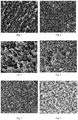
- the structure of the obtained titanium dioxide nanolayers is shown on Figs. 1, Fig. 2, Fig. 2 and Fig. 4 , coated with CaCO 3 in Fig. 5 , with hydroxyapatite in Fig. 6 .
- the obtained coatings showed 2-fold higher cell adhesion after 24 hours with the presence of the TiO 2 nanoteeth enriched with 200 nm HA and 40 nm HA on the surface, as compared to the reference sample, i.e. the titanium alloy implant without any TiO 2 coating.
- the testing of proliferation (growth) of fibroblast and osteoblast cells after 72 hours showed four times more fibroblasts in the presence of about 100 nm by mass silver nanograins on the surface of the TiO 2 nanotube layer and 6 times more cells in the presence of about 40 nm of the HA layer, as compared to the reference sample, i.e. the titanium alloy implant without TiO 2 nanotube coating with silver.
- the above values were 3 and 4, respectively.
- the produced coatings inhibited the development of biofilm by about 50% for Staphylococcus aureus ATCC 29213 and 65% for Staphylococcus aureus H9 bacteria, with the presence of about 200 nm HA on the surface of the TiO 2 nanoteeth layer.
- the biofilm development was inhibited by about 55% for Staphylococcus aureus ATCC 29213 and 69% for Staphylococcus aureus H9 bacteria.
- the microbiological examination was performed compared to the reference sample, i.e. the Ti6Al4V titanium alloy 3D implant without any TiO 2 nanotooth layer enriched with hydroxyapatite (TiO 2 /HA).
- the tests performed showed that the obtained layer of titanium dioxide with hydroxyapatite featuring the structure and morphology of nanoteeth significantly improves the osteointegration process (the process of connection between the implant and a patient's bone) and provides the 3D implant with antimicrobial properties.
Landscapes
- Health & Medical Sciences (AREA)
- Chemical & Material Sciences (AREA)
- Animal Behavior & Ethology (AREA)
- Veterinary Medicine (AREA)
- Oral & Maxillofacial Surgery (AREA)
- Public Health (AREA)
- Epidemiology (AREA)
- Life Sciences & Earth Sciences (AREA)
- General Health & Medical Sciences (AREA)
- Inorganic Chemistry (AREA)
- Dermatology (AREA)
- Medicinal Chemistry (AREA)
- Transplantation (AREA)
- Engineering & Computer Science (AREA)
- Dentistry (AREA)
- Orthopedic Medicine & Surgery (AREA)
- Ceramic Engineering (AREA)
- Materials For Medical Uses (AREA)
- Prostheses (AREA)
Abstract
The method of producing a nanoporous coating with nanotooth morphology, enriched with a nanometre layer of hydroxyapatite, on the surface of the Ti6Al4V titanium alloy implant, characterised in that the method consists in degreasing the surface of the implant by immersion for 2 to 8 minutes in acetone using an ultrasonic cleaner, followed by immersion in ethyl alcohol for 2 to 8 minutes and rinsing for 2 to 8 minutes in distilled water using an ultrasonic cleaner for 2 to 8 minutes; and once removed from the ultrasound cleaner, the titanium alloy implant is immersed in a mixture of hydrofluoric acid, nitric(V) acid and distilled water, mixed in a volume ratio of 1:4:5, for 20 to 40 seconds, during the pulsed anodic oxidation of the surface of the titanium alloy implant in a solution of ethylene glycol containing 0.3 to 2% by weight of water and 0.2 to 0.4% hydrofluoric acid, wherein the process is performed in two steps: first for 60 minutes at 30 V and 10 V by changing one voltage value to the other every 5 minutes, and then by carrying out six cycles at 30 V and without voltage (0 V), changing one value to the other so that the process at 30 V lasts 50 seconds and the process without voltage lasts 10 minutes, followed by rinsing in distilled water with Al2O3 powder in the ultrasonic cleaner; wherein, on the produced titanium dioxide layers featuring the morphology of nanoteeth, with a thickness of approx. 100 nm, with the 300-600 nm dia. pores visible under the electron microscope, a hydroxyapatite layer is applied in a two-stage process: first, a thin layer of calcium carbonate is produced using the Atomic Layer Deposition (ALD) method, using the Ca(thd) as the precursor, where thd means 2,2,6,6-tetramethyl-3,5-heptanedione, in the presence of O3, with the precursor evaporation temperature of 180-195°C, with a deposition temperature of 240-260°C, with the number of cycles 100 to 500 (deposition programme: pulse Ca(thd)2 - 1 second, pulse N2 - 1 second, pulse O3 - 1 second, and pulse N2 - 1 second); and the CaCO3 nanolayer produced is converted into a nanocrystalline layer of hydroxyapatite by placing in 0.2 M alkaline diammonium hydrogen phosphate in 1 M NH3 at 95°C for 0.5 to 2 minutes.
Description
- This invention relates to a nanoporous coating on the surface of titanium alloy, particularly on the surface of Ti6Al4V titanium alloy and the method of manufacturing with a strictly defined structure and morphology, for the production of 3D implants used in orthopaedics, maxillo-facial surgery and dentistry, for the best possible osteointegration, i.e. the process of connection between the implant and a patient's bones.
- Implants made of Ti6Al4V titanium alloy for orthopaedics, maxillo-facial surgery and dentistry in comparison with other metallic materials feature very good biocompatibility and, in addition, good corrosion resistance, the lowest Young's module, high relative strength and low specific weight.
- There are known methods of surface modification of metallic biomaterials, including Ti6Al4V titanium alloy. These methods are mechanical (sandblasting, machining, polishing) and physical (physical deposition from the gaseous phase, ion-assisted deposition, evaporation, plasma discharge). Their main objective is to obtain a specific topography and roughness of the implant surface, i.e. the surface of better adhesion to the bone.
- There are also known chemical methods of modification of the substrate of metallic biomaterial, such as Ti6Al4V alloy. These methods may include chemical vapour deposition, electrochemical oxidation, sol-gel method as well as chemical reactions in acidic, alkaline or hydrogen peroxide environments. All of these methods lead to the formation of a layer of titanium dioxide on the surface of the implant, featuring varied structure and morphology that provide the original surface of the Ti6Al4V alloy with better biocompatibility and bioactivity.
- There is also a known method of an electrochemical oxidation of the substrate of metallic biomaterial, such as the Ti6Al4V alloy. This method is used to obtain a layer of nanotubes of titanium dioxide (TiO2) with controlled morphology. The diameter of the TiO2 nanotubes is a derivative of the voltage applied during the oxidation process and their length (or layer thickness) depends on the duration of the electrochemical oxidation process.
- There are known various conditions for the process of oxidation of metallic substrate, such as the Ti6Al4V alloy, meaning the process voltage ranges from 1 V to 150 V, the process lasts for a few minutes to several hours, type of electrolyte (aqueous or anhydrous), concentration of fluoride ions directly attributable for the formation of the TiO2 nanotubes ranging from 0.05 M to 0.5 M. There are also known modifications of the oxidation process of titanium alloy substrate through the use of variable voltage to form the so-called bamboo nanotubes. These nanotubes are interconnected by crosswise elements, as is the case in bamboo shoots, with a smooth inside. They are created using a relatively high voltage, for example 120 V, alternately with a lower voltage (40 V). This process is performed in the presence of anhydrous electrolyte - ethylene glycol. High voltage creates favourable conditions for the formation of smooth well-separated nanotubes, while lowering the potential creates favourable conditions for growth, the inhibition of nanotubes growth and the formation of nodules around the base of the formed nanotubes. This stage must be sufficiently long, at least 30 minutes, to be able to observe the successful formation of connections. Following a voltage jump, the production of smooth structures continues.
- All the above parameters (potential value, process duration, electrolyte, fixed/variable potential) influence the structure, morphology and biological properties of the resulting layers of titanium dioxide nanotubes.
- There are known methods of modification of the titanium dioxide layer with hydroxyapatite in order to increase biointegration activity of the system. These methods may include thermal deposition, an inexpensive method used to achieve a high rate of 30-200 µm thick layer deposition. The disadvantages of this method are the high temperature of the process, as it can cause decomposition, and rapid cooling that results in the formation of an amorphous coating. Another method is ion deposition that is suitable to obtain a compact coating of uniform thickness within the range of 0.5 - 3 µm. Unfortunately, this method can only be used to obtain amorphous coatings; its high cost and time-consuming nature are also a disadvantage. Obtaining compact porous coatings as well as amorphous and crystalline coatings with a layer thickness of 0.05-5 µm is made possible by laser ablation. a method that can be used to obtain hydroxyapatite layers at a high speed, with a uniform thickness of 0.1-2.0 mm on substrates of irregular shape and morphology, is electrophoretic deposition. However, the sol-gel method is most often used due to a number of advantages: low process temperature, relatively low costs and the possibility of obtaining coatings with a thickness of less than 1 µm. The microstructure of coatings can be shaped by the selection of chemical parameters or process conditions. However, all the above mentioned methods lead to the formation of hydroxyapatite layers characterised by high brittleness and relatively weak adhesion to the surface, i.e. they are easily detached. In turn, this is the cause for which their applicability loses its value, although biocompatibility is exceptionally good.
- The inconvenience of using implants made of the Ti6Al4V titanium alloy is that there are cases of rejection of the implant by the recipient's body, despite the relatively high biocompatibility of titanium alloy, and inflammatory conditions after the implantation process require antibiotic treatment. Moreover, there is a group of patients who, due to their age or disease, are excluded from the group of people who undergo the implant process, as they are particularly susceptible to bacterial infections leading to local inflammatory conditions. These are children, people over 60 years of age, diabetics, people with diseases of the immune system and people with addictions. For this reason, methods are being sought to modify the surface of the titanium alloy in order to provide it with additional properties - better osteointegration and antibacterial action.
- The inconvenience of using mechanical and physical modification of the surface of metallic biomaterials, including the Ti6Al4V titanium alloy, is that they fail to improve the anti-inflammatory and antibacterial properties of their surfaces, despite the increased porosity of the coating to improve the osteointegration properties of the implant.
- The inconvenience of using chemical and electrochemical modification of the surface of metallic biomaterials, including the Ti6Al4V titanium alloy, is that they fail to have an effect on the modified anti-inflammatory and antibacterial properties of the implant, despite the possibility of controlling the surface morphology of the coating improving the osteointegration properties of the implant.
- The inconvenience of using the sol-gel method for the enrichment of the TiO2 layer with hydroxyapatite grains lies with the limited possibility of obtaining a permanent connection between TiO2 and hydroxyapatite, and hence the production of systems with low application potential for implantology.
- The essence of the invention is that the nanoporous coating of titanium dioxide, enriched with a layer of hydroxyapatite on the surface of titanium alloy, has a morphology of nanoteeth.
- The method of producing a nanoporous coating with nanotooth morphology, enriched with a nanometre layer of hydroxyapatite, on the surface of the Ti6Al4V titanium alloy implant consists in degreasing the surface of the implant by immersion for 2 to 8 minutes in acetone using an ultrasonic cleaner, followed by immersion in ethyl alcohol for 2 to 8 minutes and rinsing for 2 to 8 minutes in distilled water using an ultrasonic cleaner for 2 to 8 minutes. Once removed from the ultrasound cleaner, the titanium alloy implant is immersed in a mixture of hydrofluoric acid, nitric(V) acid and distilled water, mixed in a volume ratio of 1:4:5, for 20 to 40 seconds, during pulsed anodic oxidation of the surface of the titanium alloy implant in a solution of ethylene glycol containing 0.3 to 2% by weight of water and 0.2 to 0.4% hydrofluoric acid, wherein the process is performed in two steps: first for 60 minutes at 30 V and 10 V by changing one voltage value to the other every 5 minutes, and then by carrying out six cycles at 30 V and without voltage (0 V), changing one value to the other so that the process at 30 V lasts 50 seconds and the process without voltage lasts 10 minutes, followed by rinsing in distilled water with Al2O3 powder in the ultrasonic cleaner.
- On the produced titanium dioxide layers featuring the morphology of nanoteeth, with a thickness of about 100 nm, with the 300-600 nm dia. pores visible under the electron microscope, a hydroxyapatite layer is applied in a two-stage process: first, a thin layer of calcium carbonate is produced using the Atomic Layer Deposition (ALD) method, using the Ca(thd) as the precursor, where thd means 2,2,6,6-tetramethyl-3,5-heptanedione, in the presence of O3, with the precursor evaporation temperature of 185-195°C, with the deposition temperature of 240-260°C, with the number of cycles being 500 (deposition programme: pulse Ca(thd)2 - 1 second, pulse N2 - 1 second, pulse O3 - 1 second, and pulse N2 - 1 second); and the CaCO3 nanolayer produced is converted into a nanocrystalline layer of hydroxyapatite by placing in 0.2 M alkaline diammonium hydrogen phosphate in 1 M NH3 at 95°C for 0.5 to 2 minutes.
- The structure of the obtained titanium dioxide nanolayers is shown on
Figs. 1, Fig. 2, Fig. 2 and Fig. 4 , coated with CaCO3 inFig. 5 , with hydroxyapatite inFig. 6 . - The object of the invention is further illustrated by embodiments, without limiting the scope of invention protection.
- Embodiment One. a method of producing nanoporous coating with nanotooth morphology, enriched with a 200 nanometre layer of hydroxyapatite, on the surface of the substrate being an implant made of the grade 5 Ti6Al4V titanium alloy that contain 90% titanium, 6% aluminium and 4% vanadium.
- Stage 1. The titanium alloy substrate was degreased by immersion in acetone for 5 minutes using an ultrasonic cleaner, then immersion in ethanol for 5 minutes, and rinsed for 5 minutes in distilled water using the ultrasonic cleaner again. Once removed from the ultrasonic cleaner, the titanium alloy substrate was immersed in a mixture of hydrofluoric acid, nitric(V) acid and distilled water (mixed in a volume ratio of 1:4:5) for 30 seconds.
- Stage 2. The process of the pulse anodic oxidation of the surface of the titanium alloy substrate was carried out in two steps: first at 30 V and 10 V for 60 minutes, by changing one voltage to the other every 5 minutes, followed by six cycles at 30 V and without voltage (0 V), by changing one voltage to the other so that the process at 30 V lasted for 50 seconds and the process without voltage lasted for 10 minutes. The procedure takes place in the presence of ethylene glycol solution containing 0.2 M hydrofluoric acid and water in the amount of 0.3-2% by weight. After the anodic oxidation process, the surface of the titanium alloy substrate is rinsed in distilled water in an ultrasonic bath with the addition of Al2O3 powder. The whole of the operations associated with the pulse anodic oxidation process leads to the formation of a 100 nm thick titanium dioxide nanotooth layer on the titanium alloy substrate, with 300-600 nm dia. pores visible under the electron microscope.
- Stage 3. a two-stage process is used to apply a hydroxyapatite layer on the titanium dioxide layer: first, a thin layer of calcium carbonate is produced using the Atomic Layer Deposition (ALD) method, and then the produced CaCO3 is converted into crystalline hydroxyapatite, using Ca(thd)2 and O3 as the precursor, whereas the process temperatures amounted to 188°C as the evaporation temperature of the precursor and 250°C as the deposition temperature, with the number of cycles of 500 (deposition programme: pulse Ca(thd)2 - 1 second, pulse N2 - 1 second, pulse O3 - 1 second, and pulse N2 - 1 second). The conversion of CaCO3 into nanocrystalline hydroxyapatite is carried out by wet synthesis, by placing the implant in an environment of 0.2 M of alkaline diammonium hydrogen phosphate in 1 M NH3 at 95°C.
- Embodiment Two. a method of producing nanoporous coating with nanotooth morphology, enriched with a 40 nanometre layer of hydroxyapatite, on the surface of the substrate being an implant made of the grade 5 Ti6Al4V titanium alloy that contain 90% titanium, 6% aluminium and 4% vanadium.
- Stage 1. The titanium alloy substrate was degreased by immersion in acetone for 5 minutes using an ultrasonic cleaner, then immersion in ethanol for 5 minutes, and rinsed for 5 minutes in distilled water using the ultrasonic cleaner again. Once removed from the ultrasonic cleaner, the titanium alloy substrate was immersed in a mixture of hydrofluoric acid, nitric(V) acid and distilled water (mixed in a volume ratio of 1:4:5) for 30 seconds.
- Stage 2. The process of pulse anodic oxidation of the surface of the titanium alloy substrate was carried out in two steps: first at 30 V and 10 V for 60 minutes, by changing one voltage to the other every 5 minutes, followed by six cycles at 30 V and without voltage (0 V), by changing one voltage to the other so that the process at 30 V lasted for 50 seconds and the process without voltage lasted for 10 minutes. The process is carried out in ethylene glycol solution containing water in the amount of 0.3-2% by weight and hydrofluoric acid in the amount of 0.3%. After the anodic oxidation process, the surface of the titanium alloy substrate is rinsed in distilled water in the ultrasonic cleaner with the addition of Al2O3 powder. a layer of titanium dioxide in the form of nanoteeth, 100 nm thick, with 300-600 nm dia. pores visible under the electron microscope, is produced on the surface of the titanium alloy.
- Stage 3. a two-stage process is used to apply a hydroxyapatite layer on the titanium dioxide layer: first, a thin layer of calcium carbonate is produced using the Atomic Layer Deposition (ALD) method, and then the produced CaCO3 is converted into crystalline hydroxyapatite, using Ca(thd)2 and O3 as the precursor, whereas the process temperatures amounted to 188°C as the evaporation temperature of the precursor and 250°C as the deposition temperature, with the number of cycles of 100 (deposition programme for one cycle: pulse Ca(thd)2 - 1 second, pulse N2 - 1 second, pulse O3 - 1 second, and pulse N2 - 1 second). The conversion of CaCO3 into nanocrystalline hydroxyapatite is carried out by wet synthesis, by placing the implant in an environment of 0.2 M of alkaline diammonium hydrogen phosphate in 1 M NH3 at 95°C for 1 minute.
- The testing of adhesion and proliferation of fibroblast and osteoblast cells on the surface of TiO2 nanotooth layers, enriched with hydroxyapatite (TiO2/HA), produced on the surface of the implant, was conducted with the use of the fibroblast cell line L929 and the osteoblast cell line M63. The obtained coatings showed 2-fold higher cell adhesion after 24 hours with the presence of the TiO2 nanoteeth enriched with 200 nm HA and 40 nm HA on the surface, as compared to the reference sample, i.e. the titanium alloy implant without any TiO2 coating. The testing of proliferation (growth) of fibroblast and osteoblast cells after 72 hours showed four times more fibroblasts in the presence of about 100 nm by mass silver nanograins on the surface of the TiO2 nanotube layer and 6 times more cells in the presence of about 40 nm of the HA layer, as compared to the reference sample, i.e. the titanium alloy implant without TiO2 nanotube coating with silver. For the osteoblasts, the above values were 3 and 4, respectively.
- Microbiological examination of the nanotooth layers enriched with HA (hydroxyapatite)TiO2/HA, produced on the surface of the implant, was performed with the use of Staphylococcus aureus ATCC 29213 and Staphylococcus aureus H9 bacteria. The produced coatings inhibited the development of biofilm by about 50% for Staphylococcus aureus ATCC 29213 and 65% for Staphylococcus aureus H9 bacteria, with the presence of about 200 nm HA on the surface of the TiO2 nanoteeth layer. With the presence of about 45 nm HA layer on the surface of the TiO2 nanoteeth, the biofilm development was inhibited by about 55% for Staphylococcus aureus ATCC 29213 and 69% for Staphylococcus aureus H9 bacteria. The microbiological examination was performed compared to the reference sample, i.e. the Ti6Al4V titanium alloy 3D implant without any TiO2 nanotooth layer enriched with hydroxyapatite (TiO2/HA).
- The tests performed showed that the obtained layer of titanium dioxide with hydroxyapatite featuring the structure and morphology of nanoteeth significantly improves the osteointegration process (the process of connection between the implant and a patient's bone) and provides the 3D implant with antimicrobial properties.
Claims (10)
- A nanoporous coating of titanium dioxide on the surface of titanium alloy, particularly on the surface of a 3D made of the Ti6Al4V titanium alloy, with a thickness of about 100 nm, featuring the morphology of nanoteeth, enriched with hydroxyapatite nanograins.
- The method of producing a nanoporous coating with nanotooth morphology, enriched with a nanometre layer of hydroxyapatite, on the surface of the Ti6Al4V titanium alloy implant, characterised in that the method consists in degreasing the surface of the implant by immersion for 2 to 8 minutes in acetone using an ultrasonic cleaner, followed by immersion in ethyl alcohol for 2 to 8 minutes and rinsing for 2 to 8 minutes in distilled water using an ultrasonic cleaner for 2 to 8 minutes; and once removed from the ultrasound cleaner, the titanium alloy implant is immersed in a mixture of hydrofluoric acid, nitric(V) acid and distilled water, mixed in a volume ratio of 1:4:5, for 20 to 40 seconds, during the pulsed anodic oxidation of the surface of the titanium alloy implant in a solution of ethylene glycol containing 0.3 to 2% by weight of water and 0.2 to 0.4% hydrofluoric acid, wherein the process is performed in two steps: first for 60 minutes at 30 V and 10 V by changing one voltage value to the other every 5 minutes, and then by carrying out six cycles at 30 V and without voltage (0 V), changing one value to the other so that the process at 30 V lasts 50 seconds and the process without voltage lasts 10 minutes, followed by rinsing in distilled water with Al2O3 powder in the ultrasonic cleaner; wherein, on the produced titanium dioxide layers featuring the morphology of nanoteeth, with a thickness of approx. 100 nm, with the 300-600 nm dia. pores visible under the electron microscope, a hydroxyapatite layer is applied in a two-stage process: first, a thin layer of calcium carbonate is produced using the Atomic Layer Deposition (ALD) method, using the Ca(thd) as the precursor, where thd means 2,2,6,6-tetramethyl-3,5-heptanedione, in the presence of O3, with the precursor evaporation temperature of 180-195°C, with a deposition temperature of 240-260°C, with the number of cycles 100 to 500 (deposition programme: pulse Ca(thd)2 - 1 second, pulse N2 - 1 second, pulse O3 - 1 second, and pulse N2 - 1 second); and the CaCO3 nanolayer produced is converted into a nanocrystalline layer of hydroxyapatite by placing in 0.2 M alkaline diammonium hydrogen phosphate in 1 M NH3 at 95°C for 0.5 to 2 minutes.
- The method according to claim 2, characterised in that the degreasing of the 3D implant takes place with the use of an ultrasonic cleaner and acetone (pure for analysis grade), ethyl alcohol (pure for analysis grade) and distilled water.
- The method according to claim 2, characterised in that the activation of the implant surface consists in a 30-second immersion of the implant in a mixture of hydrofluoric acid (pure for analysis grade), nitric(V) acid (pure for analysis grade) and distilled water, mixed in a volume ratio of 1:4:5.
- The method according to claim 2, characterised in that, in the process of production of titanium dioxide nanoteeth on the surface of titanium alloy in pulse electrochemical oxidation of the implant surface, the distance between the cathode made of platinum and the anode being the modified surface of the implant ranges from 1.5 to 2.5 cm.
- The method according to claim 5, characterised in that, after the anodic oxidation process, the implant is rinsed in an ultrasonic cleaner in distilled water with the addition of Al2O3 powder whose grain sizes are at the level of 50 nm, and then dried in a stream of argon.
- The method according to claim 2, characterised in that the temperature of Ca(thd)2 precursor evaporation is 188°C.
- The method according to claim 2, characterised in that the temperature of CaCO3 deposition is 250°C.
- The method according to claim 2, characterised in that nitrogen is used as the carrier gas in the process of enrichment of the surface layer of the titanium alloy with hydroxyapatite nanograins.
- The method according to claim 2, characterised in that the process of enrichment of the surface layer of the titanium alloy with hydroxyapatite nanograins lasts 100 or 500 cycles.
Priority Applications (1)
| Application Number | Priority Date | Filing Date | Title |
|---|---|---|---|
| EP18020481.0A EP3632479A1 (en) | 2018-10-04 | 2018-10-04 | Nanoporous coating of titanium dioxide on titanium alloy and the method of manufacturing |
Applications Claiming Priority (1)
| Application Number | Priority Date | Filing Date | Title |
|---|---|---|---|
| EP18020481.0A EP3632479A1 (en) | 2018-10-04 | 2018-10-04 | Nanoporous coating of titanium dioxide on titanium alloy and the method of manufacturing |
Publications (1)
| Publication Number | Publication Date |
|---|---|
| EP3632479A1 true EP3632479A1 (en) | 2020-04-08 |
Family
ID=64017235
Family Applications (1)
| Application Number | Title | Priority Date | Filing Date |
|---|---|---|---|
| EP18020481.0A Withdrawn EP3632479A1 (en) | 2018-10-04 | 2018-10-04 | Nanoporous coating of titanium dioxide on titanium alloy and the method of manufacturing |
Country Status (1)
| Country | Link |
|---|---|
| EP (1) | EP3632479A1 (en) |
Cited By (4)
| Publication number | Priority date | Publication date | Assignee | Title |
|---|---|---|---|---|
| CN114432500A (en) * | 2022-01-20 | 2022-05-06 | 南京医科大学附属口腔医院 | CeO (CeO)2Modified TiO2Bionic porous titanium stent of variable nanotube array and preparation method thereof |
| CN115958206A (en) * | 2022-11-28 | 2023-04-14 | 广州先进技术研究所 | Method for constructing bionic nano structure on surface of 3D printed titanium alloy implant |
| CN117661063A (en) * | 2024-01-31 | 2024-03-08 | 四川大学 | Lead-free piezoelectric nano coating modified titanium alloy bracket and preparation method thereof |
| CN119161798A (en) * | 2024-11-20 | 2024-12-20 | 四川海纳协同科技有限公司 | Antibacterial solvent-free coating and preparation method thereof |
Citations (3)
| Publication number | Priority date | Publication date | Assignee | Title |
|---|---|---|---|---|
| WO2009017945A2 (en) * | 2007-08-01 | 2009-02-05 | Chameleon Scientific Corporation | Hydroxyapatite coated nanostructured titanium surfaces |
| WO2009029507A1 (en) * | 2007-08-24 | 2009-03-05 | Nanovis, Inc. | A method for producing nanostructures on a surface of a medical implant |
| KR20130053954A (en) * | 2011-11-16 | 2013-05-24 | 전북대학교산학협력단 | Titanium implant and preparation method thereof |
-
2018
- 2018-10-04 EP EP18020481.0A patent/EP3632479A1/en not_active Withdrawn
Patent Citations (3)
| Publication number | Priority date | Publication date | Assignee | Title |
|---|---|---|---|---|
| WO2009017945A2 (en) * | 2007-08-01 | 2009-02-05 | Chameleon Scientific Corporation | Hydroxyapatite coated nanostructured titanium surfaces |
| WO2009029507A1 (en) * | 2007-08-24 | 2009-03-05 | Nanovis, Inc. | A method for producing nanostructures on a surface of a medical implant |
| KR20130053954A (en) * | 2011-11-16 | 2013-05-24 | 전북대학교산학협력단 | Titanium implant and preparation method thereof |
Non-Patent Citations (1)
| Title |
|---|
| JANI HOLOPAINEN ET AL: "Preparation and bioactive properties of nanocrystalline hydroxyapatite thin films obtained by conversion of atomic layer deposited calcium carbonate", BIOINTERPHASES, vol. 9, no. 3, 1 September 2014 (2014-09-01), US, pages 031008, XP055572840, ISSN: 1934-8630, DOI: 10.1116/1.4889975 * |
Cited By (6)
| Publication number | Priority date | Publication date | Assignee | Title |
|---|---|---|---|---|
| CN114432500A (en) * | 2022-01-20 | 2022-05-06 | 南京医科大学附属口腔医院 | CeO (CeO)2Modified TiO2Bionic porous titanium stent of variable nanotube array and preparation method thereof |
| CN114432500B (en) * | 2022-01-20 | 2022-09-16 | 南京医科大学附属口腔医院 | CeO (CeO) 2 Modified TiO 2 2 Bionic porous titanium stent of variable nanotube array and preparation method thereof |
| CN115958206A (en) * | 2022-11-28 | 2023-04-14 | 广州先进技术研究所 | Method for constructing bionic nano structure on surface of 3D printed titanium alloy implant |
| CN117661063A (en) * | 2024-01-31 | 2024-03-08 | 四川大学 | Lead-free piezoelectric nano coating modified titanium alloy bracket and preparation method thereof |
| CN117661063B (en) * | 2024-01-31 | 2024-04-09 | 四川大学 | A lead-free piezoelectric nano-coating modified titanium alloy bracket and preparation method thereof |
| CN119161798A (en) * | 2024-11-20 | 2024-12-20 | 四川海纳协同科技有限公司 | Antibacterial solvent-free coating and preparation method thereof |
Similar Documents
| Publication | Publication Date | Title |
|---|---|---|
| Mokhtari et al. | Chitosan-58S bioactive glass nanocomposite coatings on TiO2 nanotube: Structural and biological properties | |
| Kodama et al. | Bioactivation of titanium surfaces using coatings of TiO2 nanotubes rapidly pre-loaded with synthetic hydroxyapatite | |
| EP3632479A1 (en) | Nanoporous coating of titanium dioxide on titanium alloy and the method of manufacturing | |
| KR100714244B1 (en) | Osseoinductive metal implants for a living body and producing method thereof | |
| US20100092537A1 (en) | Surgical implant composite materials and kits and methods of manufacture | |
| US20020018798A1 (en) | Coating for metallic implant materials | |
| Jamesh et al. | Evaluation of corrosion resistance and cytocompatibility of graded metal carbon film on Ti and NiTi prepared by hybrid cathodic arc/glow discharge plasma-assisted chemical vapor deposition | |
| KR20080108687A (en) | Electrolyte solution, preparation method of implant material using the same, and implant material having excellent antimicrobial and biocompatibility | |
| US20140308628A1 (en) | Metal materials having a surface layer of calcium phosphate, and methods for preparing same | |
| US20110171600A1 (en) | Bio-Implant Having a Screw Body with Nanoporous Spiral Groove and the Method of Making the Same | |
| US9119687B2 (en) | Method of manufacturing a functionalized implant, and functionalized implant | |
| US6544288B2 (en) | Biocompatible titanium implant for medical use | |
| RU2554819C1 (en) | Method for producing bioactive coating on titanium implant implanted into human bone tissue | |
| KR101283780B1 (en) | Titanium implant and preparation method thereof | |
| Topuz et al. | Synthesis of implantable ceramic coatings and their properties | |
| Kim et al. | The release behavior of CHX from polymer‐coated titanium surfaces | |
| CN110042392A (en) | Preparation method of composite coating with excellent biocompatibility and antibacterial property on surface of medical implant | |
| Pogrebjak et al. | Research of the relief and element composition of the surface coatings based on hydroxyapatite implants from titanium alloys | |
| Hsu et al. | Fabrication of nanotube arrays on commercially pure titanium and their apatite-forming ability in a simulated body fluid | |
| Al-Swayih | The electrochemical behavior of titanium improved by nanotubular oxide formed by anodization for biomaterial applications: A review | |
| CN103046101B (en) | Preparation method of two-stage hole micro-arc oxidization biological coating with bacteriostatic effect | |
| EP3195825B1 (en) | Dental implant | |
| Sun et al. | Surface modification of Ti6Al4V alloy for implants by anodization and electrodeposition. | |
| KR20200104121A (en) | dental implant having dual function surface using electrochemical treatment and manufacturing method thereof | |
| Sunija | Biomaterials and biotechnological schemes utilizing TiO2 nanotube arrays—A review |
Legal Events
| Date | Code | Title | Description |
|---|---|---|---|
| PUAI | Public reference made under article 153(3) epc to a published international application that has entered the european phase |
Free format text: ORIGINAL CODE: 0009012 |
|
| STAA | Information on the status of an ep patent application or granted ep patent |
Free format text: STATUS: THE APPLICATION HAS BEEN PUBLISHED |
|
| AK | Designated contracting states |
Kind code of ref document: A1 Designated state(s): AL AT BE BG CH CY CZ DE DK EE ES FI FR GB GR HR HU IE IS IT LI LT LU LV MC MK MT NL NO PL PT RO RS SE SI SK SM TR |
|
| AX | Request for extension of the european patent |
Extension state: BA ME |
|
| STAA | Information on the status of an ep patent application or granted ep patent |
Free format text: STATUS: THE APPLICATION IS DEEMED TO BE WITHDRAWN |
|
| 18D | Application deemed to be withdrawn |
Effective date: 20201009 |