EP3632439A1 - Dementia therapeutic agent combining pyrazoloquinoline derivative and donepezil - Google Patents
Dementia therapeutic agent combining pyrazoloquinoline derivative and donepezil Download PDFInfo
- Publication number
- EP3632439A1 EP3632439A1 EP18810578.7A EP18810578A EP3632439A1 EP 3632439 A1 EP3632439 A1 EP 3632439A1 EP 18810578 A EP18810578 A EP 18810578A EP 3632439 A1 EP3632439 A1 EP 3632439A1
- Authority
- EP
- European Patent Office
- Prior art keywords
- pharmaceutically acceptable
- acceptable salt
- donepezil
- disease
- therapeutic agent
- Prior art date
- Legal status (The legal status is an assumption and is not a legal conclusion. Google has not performed a legal analysis and makes no representation as to the accuracy of the status listed.)
- Granted
Links
- VESOJVQFQKULBK-FVWXCPNNSA-N Cc(c(-c1cc(NC(C2C=NN([C@@H]3COCC3)C22)=O)c2cc1)c1C)cnc1OC Chemical compound Cc(c(-c1cc(NC(C2C=NN([C@@H]3COCC3)C22)=O)c2cc1)c1C)cnc1OC VESOJVQFQKULBK-FVWXCPNNSA-N 0.000 description 2
- LJTJIJLMMVRTTM-FVWXCPNNSA-N Cc(c(-c1cc(NC(C(C2N[C@@H]3COCC3)C=N)=O)c2cc1)c1C)cnc1OC Chemical compound Cc(c(-c1cc(NC(C(C2N[C@@H]3COCC3)C=N)=O)c2cc1)c1C)cnc1OC LJTJIJLMMVRTTM-FVWXCPNNSA-N 0.000 description 1
- VESOJVQFQKULBK-RQFJBDDASA-N Cc(c(-c1ccc(C2N([C@@H]3COCC3)N=C[C@@H]2C(N2)=O)c2c1)c1C)cnc1OC Chemical compound Cc(c(-c1ccc(C2N([C@@H]3COCC3)N=C[C@@H]2C(N2)=O)c2c1)c1C)cnc1OC VESOJVQFQKULBK-RQFJBDDASA-N 0.000 description 1
Classifications
-
- A—HUMAN NECESSITIES
- A61—MEDICAL OR VETERINARY SCIENCE; HYGIENE
- A61K—PREPARATIONS FOR MEDICAL, DENTAL OR TOILETRY PURPOSES
- A61K31/00—Medicinal preparations containing organic active ingredients
- A61K31/33—Heterocyclic compounds
- A61K31/395—Heterocyclic compounds having nitrogen as a ring hetero atom, e.g. guanethidine or rifamycins
- A61K31/435—Heterocyclic compounds having nitrogen as a ring hetero atom, e.g. guanethidine or rifamycins having six-membered rings with one nitrogen as the only ring hetero atom
- A61K31/47—Quinolines; Isoquinolines
- A61K31/4738—Quinolines; Isoquinolines ortho- or peri-condensed with heterocyclic ring systems
- A61K31/4745—Quinolines; Isoquinolines ortho- or peri-condensed with heterocyclic ring systems condensed with ring systems having nitrogen as a ring hetero atom, e.g. phenantrolines
-
- A—HUMAN NECESSITIES
- A61—MEDICAL OR VETERINARY SCIENCE; HYGIENE
- A61K—PREPARATIONS FOR MEDICAL, DENTAL OR TOILETRY PURPOSES
- A61K31/00—Medicinal preparations containing organic active ingredients
- A61K31/33—Heterocyclic compounds
- A61K31/395—Heterocyclic compounds having nitrogen as a ring hetero atom, e.g. guanethidine or rifamycins
- A61K31/435—Heterocyclic compounds having nitrogen as a ring hetero atom, e.g. guanethidine or rifamycins having six-membered rings with one nitrogen as the only ring hetero atom
- A61K31/44—Non condensed pyridines; Hydrogenated derivatives thereof
- A61K31/445—Non condensed piperidines, e.g. piperocaine
-
- A—HUMAN NECESSITIES
- A61—MEDICAL OR VETERINARY SCIENCE; HYGIENE
- A61P—SPECIFIC THERAPEUTIC ACTIVITY OF CHEMICAL COMPOUNDS OR MEDICINAL PREPARATIONS
- A61P25/00—Drugs for disorders of the nervous system
- A61P25/28—Drugs for disorders of the nervous system for treating neurodegenerative disorders of the central nervous system, e.g. nootropic agents, cognition enhancers, drugs for treating Alzheimer's disease or other forms of dementia
-
- A—HUMAN NECESSITIES
- A61—MEDICAL OR VETERINARY SCIENCE; HYGIENE
- A61K—PREPARATIONS FOR MEDICAL, DENTAL OR TOILETRY PURPOSES
- A61K2300/00—Mixtures or combinations of active ingredients, wherein at least one active ingredient is fully defined in groups A61K31/00 - A61K41/00
Definitions
- the present invention relates to a therapeutic agent for dementia combining a pyrazoloquinoline derivative having phosphodiesterase 9 (PDE9) inhibitory action or a pharmaceutically acceptable salt thereof, and donepezil or a pharmaceutically acceptable salt thereof
- PDE9 phosphodiesterase 9
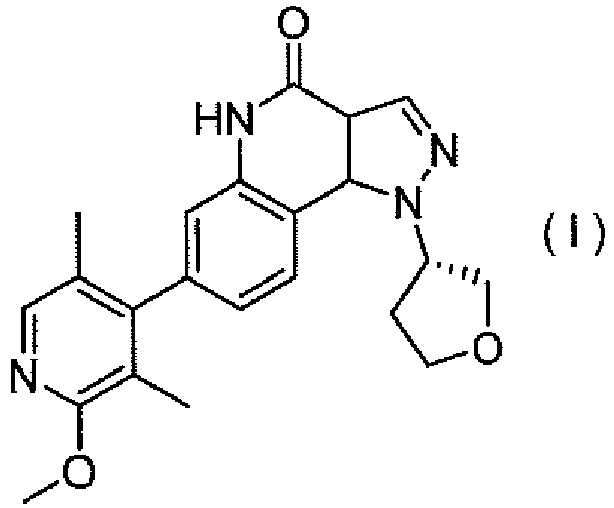
- Pyrazoloquinoline derivatives represented by formula (I) (hereunder referred to as “compound (I)”) have phosphodiesterase 9 (PDE9) inhibitory action, and are considered to have promising ameliorative effects on cognitive function in Alzheimer's disease (PTL 1).
- Donepezil represented by formula (II) (hereunder referred to as “compound (II)”) has acetylcholine esterase-inhibitory action, and has been reported to exhibit an effect against Alzheimer's disease and Lewy body dementia (see NPLs 1, 2 and 3).
- acetylcholine esterase inhibitors galantamine and rivastigmine and the NMDA receptor antagonist memantine have been approved as therapeutic agents for Alzheimer's disease.
- Donepezil is indicated for mild to severe Alzheimer's disease, and has been reported to have, in addition to a cognitive function-ameliorating effect, also an effect against peripheral symptoms such as agitation, anxiety, apathy, delusion, depression, disinhibition, hallucination, irritability, aberrant motor behavior and apathy (BPSD: Behavioral and Psychological Symptoms of Dementia) (see NPLs 4 and 5).
- Galantamine and rivastigmine are indicated for mild to moderate Alzheimer's disease (see NPLs 6 and 7).
- Memantine has been reported to have efficacy for ameliorating cognitive function, and for BPSD (agitation, irritability, aggression and behavioral disorder) in moderate to severe Alzheimer's disease (see NPLs 8 and 9). Combined use of different acetylcholine esterase inhibitors is contraindicated, but any acetylcholine esterase inhibitor may be used in combination with memantine.
- acetylcholine esterase inhibitors are recommended for the core symptoms of Alzheimer's disease, with one of donepezil, galantamine or rivastigmine being selected first, and then switching to another acetylcholine esterase inhibitor if a problem arises in terms of effect or tolerance. When the effect of the acetylcholine esterase inhibitor is inadequate or a problem arises in terms of tolerance, combination with memantine or switching to memantine may be considered.
- Acetylcholine esterase inhibitors have been reported to have digestive system side-effects, and to aggravate Parkinson's symptoms (see NPL 10).
- memantine may be selected if the patient has moderate to severe Alzheimer's disease, but at the current time no effective method of treatment exists for other patients.
- the combined use of acetylcholine esterase inhibitors with memantine is possible in patients that experience inadequate effects, but opinions are divided since some reports have indicated an effect by their combined use (see NPL 11) while other reports have indicated no effect (see NPL 12).
- the invention relates to the following ⁇ 1> to ⁇ 19.3>.
- the present invention provides a therapeutic agent for Alzheimer's disease and Lewy body dementia, combining a pyrazoloquinoline derivative represented by formula (I) having PDE9 inhibitory action, or a pharmaceutically acceptable salt thereof, and donepezil having acetylcholine esterase inhibitory action, or a pharmaceutically acceptable salt thereof.
- the therapeutic agent using this combination exhibits a more notable ameliorative effect on cognitive function in animal models compared to their uses alone, and it has potential for use as a therapeutic agent for Alzheimer's disease and Lewy body dementia.
- a "pharmaceutically acceptable salt” as referred to throughout the present specification is not particularly limited as long as it is a salt formed with the compound of the invention, and specific examples include acid addition salts such as inorganic acid salts, organic acid salts or acidic amino acid salts.
- the number of acid molecules per one molecule of the compound in a formed salt is not particularly limited as long as the salt is formed in an appropriate ratio.
- the number of acid molecules per one molecule of the compound is about 0.1 to about 5; in another embodiment, the number of acid molecules per one molecule of the compound is about 0.5 to about 2; and in still another embodiment, the number of acid molecules per one molecule of the compound is about 0.5, about 1 or about 2.
- an inorganic acid salt examples include hydrochloride, hydrobromide, sulfate, nitrate and phosphate
- specific examples of an organic acid salt include acetate, succinate, fumarate, maleate, tartrate, citrate, lactate, stearate, benzoate, methanesulfonate, p-toluenesulfonate and benzenesulfonate.
- an acidic amino acid salt examples include aspartate and glutamate.
- the pharmaceutical composition of the invention can be produced by mixing a pharmaceutically acceptable additive with compound (I) or a pharmaceutically acceptable salt thereof, and/or compound (II) or a pharmaceutically acceptable salt thereof.
- the pharmaceutical composition of the invention can be produced by a known method, such as the method described in the General Rules for Preparations of the Japanese Pharmacopoeia, 16th Editi on.
- the pharmaceutical composition of the invention can be appropriately administered to a patient according to the dosage form.
- the dose of compound (I) or a pharmaceutically acceptable salt thereof and compound (II) or a pharmaceutically acceptable salt thereof according to the invention will vary depending on the severity of symptoms, the patient age, gender and body weight, the form of administration and type of salt, and the specific type of disease, and the like; but usually, in adult, about 30 ⁇ g to 10 g, in one embodiment 100 ⁇ g to 5 g, and in another embodiment 100 ⁇ g to 1 g is administered orally per day, in a single dose or in several divided doses; or about 30 ⁇ g to 1 g, in one embodiment 100 ⁇ g to 500 mg, and in another embodiment 100 ⁇ g to 300 mg is administered by injection per day, in a single dose or in several divided doses.
- Compound (I) can be produced by the method described in PTL 1, for example.
- the present inventors confirmed the combined effects of compound (I) and donepezil hydrochloride using the following animal model.
- Acetylcholine nervous system disorder has been reported in Alzheimer's disease and Lewy body dementia ( Whitehouse et al., Science, 1982, vol.215, p.1237 , Shimada et al., Neurology, vol.73, p.273, 2009 , Tiraboschi et al., Neurology 54(2000) 407-411 , Perry et. al., NeuroReport, vol.5, pp.747-749(1994 )), and scopolamine-administered animals are utilizable as an animal model for Alzheimer's disease and Lewy body dementia.
- Scopolamine is a muscarine receptor inhibitor which blocks acetylcholine nervous system transmission.
- the acetylcholine nervous system is involved in memory and attention, and healthy humans or animals administered scopolamine exhibit dementia-like amnesia symptoms which are attenuated by drugs used for treatment of cognitive impairment in Alzheimer's disease and Lewy body dementia ( Snyder et al., Alzheimer's & Dementia 1(2005)126-135 , Sambeth et al., European Journal of Pharmacology, vol.572(2007) pp.151-159 ).
- 6-week-old male Long Evans rats (Institute for Animal Reproduction) were subjected to the test.
- a habituation process to the experimental procedure was carried out once per day for 2 days prior to the test.
- a vehicle was administered to the rats, and then the rats were placed in an empty test apparatus (40 cm ⁇ 30 cm ⁇ 45 cm height) and allowed to explore for 3 minutes, and after then placed in a waiting chamber (13 cm ⁇ 30 cm ⁇ 45 cm height) for about 1 minute, they were returned to the empty test apparatus again and left for 5 minutes.
- T1 An acquisition trial (T1) was carried out on the day of the test.
- Compound (I) was orally administered 2 hours before T1.
- Donepezil hydrochloride was orally administered 1 hour before T1.
- Scopolamine (Wako Pure Chemical Industries, Ltd.) was subcutaneously administered 30 minutes before T1 at a dose of 0.7 mg/kg.
- T1 the rats were habituated to the empty test apparatus for 3 minutes and then placed in the waiting chamber. After setting two identical objects in the test apparatus, the rats were returned into the test apparatus again and allowed to freely explore the two identical objects for 5 minutes. The rats were then returned into their rearing cages. After 2 hours, a retention trial (T2) was carried out.
- the rats were placed in the empty test apparatus for 3 minutes for habituation, and were then transferred into the waiting chamber. After setting an object used in T1 ("familiar" object) and an object not used in T1 ("novel” object) in the test apparatus, the rats were again returned into the test apparatus and allowed to freely explore these objects for 3 minutes. The objects were wiped with a wet wipe impregnated with ethanol after each experiment so as to leave no trace of odor. The behaviors of the rats during T1 and T2 were recorded by a digital video camera, and the total exploration time for each object was manually measured using a stopwatch. Exploratory behavior was defined as the behavior in which the rat brings its nose within 2 cm of the object and directs its nose toward the object.
- the percentage of exploration of the novel object in T2 is considered to be an index for amnesia, reflecting discrimination between the familiar object and the novel object
- the percentage of exploration of the novel object was calculated by the following formula.
- the percentage of exploration of the novel object % N / N + F ⁇ 100
- results were expressed as mean ⁇ standard error.
- the difference between the normal control group untreated with scopolamine and the disease control group treated with scopolamine was analyzed by an unpaired t-test (significant difference: *).
- the difference between the disease control group and the single drug-treated group was analyzed by Dunnett-type multiple comparison test (significant difference: #).
- the difference between the combined treatment group and the single drug-treated group was analyzed by Dunnett-type multiple comparison test (significant difference: ).
- a value of p ⁇ 0.05 was judged to be a statistically significant difference.
- Statistical analysis was conducted using GraphPad Prism version 5.04 or 6.02. The results are shown in Tables 1 to 5.
- the rats of the disease control group exhibited a significantly lower percentage of exploration of the novel object than the rats of the normal control group. This means that memory impairment was induced in the rats by scopolamine.
- Compound (I) exhibited a significant ameliorative effect on the percentage of exploration of the novel object at 3.3 mg/kg (Table 2), but did not exhibit a significant effect at 1 mg/kg (Table 1).
- Donepezil hydrochloride exhibited a significant ameliorative effect on the percentage of exploration of the novel object at 0.3 mg/kg (Table 4), but did not exhibit a significant effect at 0.03 mg/kg (Table 3).
Landscapes
- Health & Medical Sciences (AREA)
- Veterinary Medicine (AREA)
- Chemical & Material Sciences (AREA)
- Medicinal Chemistry (AREA)
- Pharmacology & Pharmacy (AREA)
- Life Sciences & Earth Sciences (AREA)
- Animal Behavior & Ethology (AREA)
- General Health & Medical Sciences (AREA)
- Public Health (AREA)
- Engineering & Computer Science (AREA)
- Neurosurgery (AREA)
- Bioinformatics & Cheminformatics (AREA)
- Biomedical Technology (AREA)
- Epidemiology (AREA)
- Neurology (AREA)
- Psychiatry (AREA)
- Hospice & Palliative Care (AREA)
- Chemical Kinetics & Catalysis (AREA)
- General Chemical & Material Sciences (AREA)
- Nuclear Medicine, Radiotherapy & Molecular Imaging (AREA)
- Organic Chemistry (AREA)
- Pharmaceuticals Containing Other Organic And Inorganic Compounds (AREA)
- Nitrogen Condensed Heterocyclic Rings (AREA)
Abstract
Description
- The present invention relates to a therapeutic agent for dementia combining a pyrazoloquinoline derivative having phosphodiesterase 9 (PDE9) inhibitory action or a pharmaceutically acceptable salt thereof, and donepezil or a pharmaceutically acceptable salt thereof
-
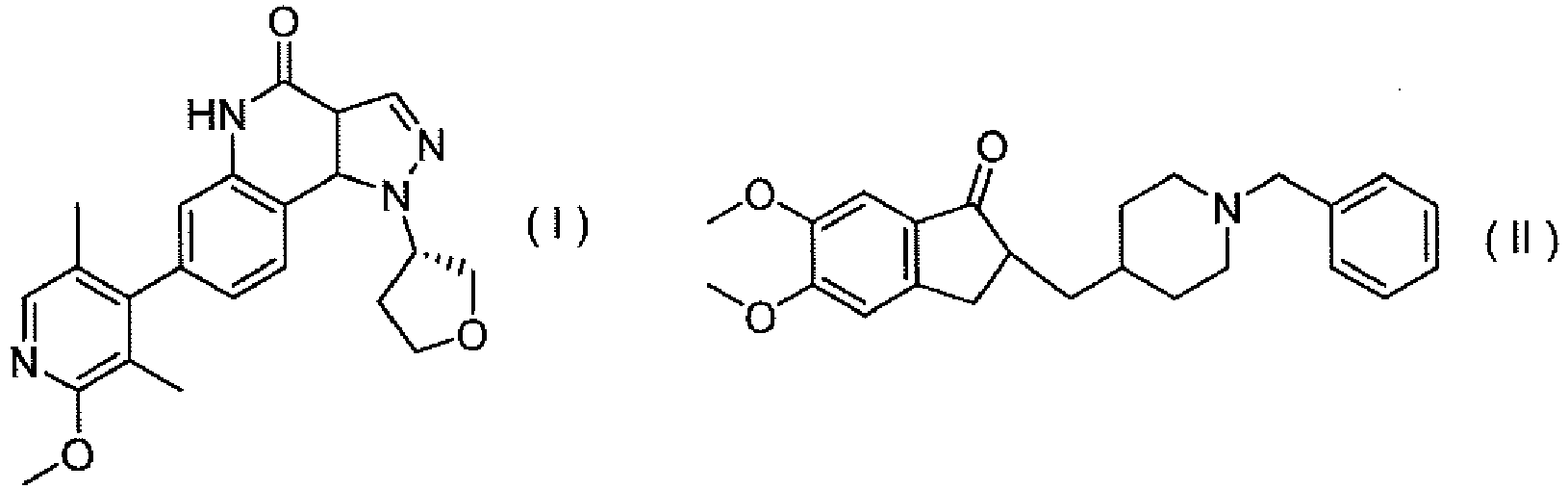
- Pyrazoloquinoline derivatives represented by formula (I) (hereunder referred to as "compound (I)") have phosphodiesterase 9 (PDE9) inhibitory action, and are considered to have promising ameliorative effects on cognitive function in Alzheimer's disease (PTL 1).
- Donepezil, represented by formula (II) (hereunder referred to as "compound (II)") has acetylcholine esterase-inhibitory action, and has been reported to exhibit an effect against Alzheimer's disease and Lewy body dementia (see NPLs 1, 2 and 3).
- In addition, the acetylcholine esterase inhibitors galantamine and rivastigmine and the NMDA receptor antagonist memantine have been approved as therapeutic agents for Alzheimer's disease. Donepezil is indicated for mild to severe Alzheimer's disease, and has been reported to have, in addition to a cognitive function-ameliorating effect, also an effect against peripheral symptoms such as agitation, anxiety, apathy, delusion, depression, disinhibition, hallucination, irritability, aberrant motor behavior and apathy (BPSD: Behavioral and Psychological Symptoms of Dementia) (see NPLs 4 and 5). Galantamine and rivastigmine are indicated for mild to moderate Alzheimer's disease (see NPLs 6 and 7). Memantine has been reported to have efficacy for ameliorating cognitive function, and for BPSD (agitation, irritability, aggression and behavioral disorder) in moderate to severe Alzheimer's disease (see NPLs 8 and 9). Combined use of different acetylcholine esterase inhibitors is contraindicated, but any acetylcholine esterase inhibitor may be used in combination with memantine. According to the 2010 Dementia Disease Treatment Guidelines, acetylcholine esterase inhibitors are recommended for the core symptoms of Alzheimer's disease, with one of donepezil, galantamine or rivastigmine being selected first, and then switching to another acetylcholine esterase inhibitor if a problem arises in terms of effect or tolerance. When the effect of the acetylcholine esterase inhibitor is inadequate or a problem arises in terms of tolerance, combination with memantine or switching to memantine may be considered.
- Acetylcholine esterase inhibitors, however, have been reported to have digestive system side-effects, and to aggravate Parkinson's symptoms (see NPL 10). In cases where acetylcholine esterase inhibitors cannot be used due to side-effects or tolerance, memantine may be selected if the patient has moderate to severe Alzheimer's disease, but at the current time no effective method of treatment exists for other patients. The combined use of acetylcholine esterase inhibitors with memantine is possible in patients that experience inadequate effects, but opinions are divided since some reports have indicated an effect by their combined use (see NPL 11) while other reports have indicated no effect (see NPL 12).
- [PTL 1]
US Patent No. 8563565 -
- [NPL 1] Homma et al., Dement. Geriatr. Cogn. Disord., 2000, vol.11, p.299
- [NPL 2] Homma et al., Dement. Geriatr. Cogn. Disord., 2008, vol.25, p.399
- [NPL 3] Mori et al., Ann. Neurol, vol.72, p.41 2012
- [NPL 4] Holmes at al., Neurology, 2004, vol.63, p.214
- [NPL 5] Gauthier et al., Int Psychogeriatr, 2002, vol.14, p.389
- [NPL 6] Raskind et al., Neurology, 2000, vol.54, p.226
- [NPL 7] Winblad et al., Neurology, 2007, vol.69, p.S14
- [NPL 8] Mecocci et al., Int J Geriatr Psychiatry, vol.24, p.532
- [NPL 9] Grossberg et al., Dement Geriatr Cogn Disord, 2009, vol.27, p.164
- [NPL 10] Bourke et al., Ann. Pharmacother., 1998, vol.32, p.610
- [NPL 11] Lopez et al., J Neurol Neurosurg Psychiatry, 2009, vol.80, p.600
- [NPL 12] Howard et al., New Eng J. Med., 2012, vol.366, p.893
- It is currently the case that no satisfactory method of treatment exists for Alzheimer's disease or Lewy body dementia, while an effective anti-dementia agent is also yet to be developed.
- In order to solve this problem, the present inventors have carried out much ardent research using a scopolamine-induced cognitive impairment rat model, and as a result we have completed this invention upon finding that the combined use of compound (I) or a pharmaceutically acceptable salt thereof with compound (II) or a pharmaceutically acceptable salt thereof surprisingly exhibits an effect of inhibiting scopolamine-induced cognitive impairment, in doses that are ineffective with each alone.
- Specifically, the invention relates to the following <1> to <19.3>.
- <1> A therapeutic agent for Alzheimer's disease or Lewy body dementia, for combined use of
(S)-7-(2-methoxy-3,5-dimethylpyridin-4-yl)-1-(tetrahydrofuran-3-yl)-1H-pyrazolo[4,3-c]qui noline4(5H)-one represented by formula (I):

- <2> The therapeutic agent according to <1>, wherein the donepezil or pharmaceutically acceptable salt thereof is donepezil hydrochloride.
- <3> The therapeutic agent according to <1> or <2>, wherein the (S)-7-(2-methoxy-3,5-dimethylpyridin-4-yl)-1-(tetrahydrofuran-3-yl)-1H-pyrazolo[4,3-c]qui noline-4(5H)-one or pharmaceutically acceptable salt thereof is (S)-7-(2-methoxy-3,5-dimethylpyridin-4-yl)-1-(tetrahydrofuran-3-yl)-1H-pyrazolo[4,3-c]qui noline-4(5H)-one maleate.
- <4> The therapeutic agent according to any one of <1> to <3>, wherein the Alzheimer's disease is mild, moderate or severe Alzheimer's disease.
- <5> A therapeutic agent for Alzheimer's disease or Lewy body dementia for simultaneous or separate administration of (S)-7-(2-methoxy-3,5-dimethylpyridin-4-yl)-1-(tetrahydrofuran-3-yl)-1H-pyrazolo[4,3-c]qui notine-4(5H)-one represented by formula (I):


- <6> The therapeutic agent according to <5>, wherein the donepezil or pharmaceutically acceptable salt thereof is donepezil hydrochloride.
- <7> The therapeutic agent according to <5> or <6>, wherein the (S)-7-(2-methoxy-3,5-dimethylpyridin-4-yl)-1-(tetrahydrofuran-3-yl)-1H-pyrazolo[4,3-c]qui noline-4(5H)-one or pharmaceutically acceptable salt thereof is (S)-7-(2-methoxy-3,5-dimethylpyridin-4-yl)-1-(tetrahydrofuran-3-yl)-1H-pyrazolo[4,3-c]qui noline-4(5H)-one maleate.
- <8> The therapeutic agent according to any one of <5> to <7>, wherein the Alzheimer's disease is mild, moderate or severe Alzheimer's disease.
- <9> A therapeutic agent for Alzheimer's disease or Lewy body dementia, comprising (S)-7-(2-methoxy-3,5-dimethylpyridin-4-yl)-1-(tetrahydrofuran-3-yl)-1H-pyrazolo[4,3-c]qui noline-4(5H)-one represented by formula (I):


- <10> The therapeutic agent according to <9>, wherein the donepezil or pharmaceutically acceptable salt thereof is donepezil hydrochloride.
- <11> The therapeutic agent according to <9> or <10>, wherein the (S)-7-(2-methoxy-3,5-dimethylpyridin4-yl)-1-(tetrahydrofuran-3-yl)-1H-pyrazolo[4,3-c]qui noline-4(5H)-one or pharmaceutically acceptable salt thereof is (S)-7-(2-methoxy-3,5-dimethylpyridin-4-yl)-1-(tetrahydrofuran-3-yl)-1H-pyrazolo[4,3-c]qui noline-4(5H)-one maleate.
- <12> The therapeutic agent according to any one of <9> to <11>, wherein the Alzheimer's disease is mild, moderate or severe Alzheimer's disease.
- <13> Donepezil represented by formula (II):


- <13.1> Donepezil or a pharmaceutically acceptable salt thereof according to <13>, wherein the donepezil or pharmaceutically acceptable salt thereof is donepezil hydrochloride.
- <13.2> Donepezil or a pharmaceutically acceptable salt thereof according to <13> or <13.1>, wherein the (S)-7-(2-methoxy-3,5-dimethylpyridin-4-yl)-1-(tetrahydrofuran-3-yl)-1H-pyrazolo[4,3-c]qui noline-4(5H)-one or pharmaceutically acceptable salt thereof is (S)-7-(2-methoxy-3,5-dimethylpyridin-4-yl)-1-(tetrahydrofuran-3-yl)-1H-pyrazolo[4,3-c]qui noline4(5H)-one maleate.
- <13.3> Donepezil or a pharmaceutically acceptable salt thereof according to any one of <13> to <13.2>, wherein the Alzheimer's disease is mild, moderate or severe Alzheimer's disease.
- <14> (S)-7-(2-methoxy-3,5-dimethylpyridin-4-yl)-1-(tetrahydrofuran-3-yl)-1H-pyrazolo[4,3-c]qui noline-4(5H)-one represented by formula (I):


- <14.1> A compound represented by formula (I) or a pharmaceutically acceptable salt thereof according to <14>, wherein the donepezil or pharmaceutically acceptable salt thereof is donepezil hydrochloride.
- <14.2> A compound represented by formula (I) or a pharmaceutically acceptable salt thereof according to <14> or <14.1>, wherein the (S)-7-(2-methoxy-3,5-dimethylpyridin-4-yl)-1-(tetrahydrofuran-3-yl)-1H-pyrazolo[4,3-c]qui noline-4(5H)-one or pharmaceutically acceptable salt thereof is (S)-7-(2-methoxy-3,5-dimethylpyridin-4-yl)-1-(tetrahydrofuran-3-yl)-1H-pyrazolo[4,3-c]qui noline-4(5H)-one maleate.
- <14.3> A compound represented by formula (I) or a pharmaceutically acceptable salt thereof according to any one of <14> to <14.2>, wherein the Alzheimer's disease is mild, moderate or severe Alzheimer's disease.
- <15> A method for treating Alzheimer's disease or Lewy body dementia for combined use of (S)-7-(2-methoxy-3,5-dimethylpyridin-4-yl)-1-(tetrahydrofuran-3-yl)-1H-pyrazolo[4,3-c]qui noline4(5H)-one represented by formula (I):


- <15.1> The method according to <15>, wherein the donepezil or pharmaceutically acceptable salt thereof is donepezil hydrochloride.
- <15.2> The method according to <15> or <15.1>, wherein the (S)-7-(2-methoxy-3,5-dimethylpyridin-4-yl)-1-(tetrahydrofuran-3-yl)-1H-pyrazolo[4,3-c]qui noline-4(5H)-one or pharmaceutically acceptable salt thereof is (S)-7-(2-methoxy-3,5-dimethylpyridin-4-yl)-1-(tetrahydrofuran-3-yl)-1H-pyrazolo[4,3-c]qui noline-4(5H)-one maleate.
- <15.3> The method according to any one of <15> to <15.2>, wherein the Alzheimer's disease is mild, moderate or severe Alzheimer's disease.
- <16> A pharmaceutical composition comprising (S)-7-(2-methoxy-3,5-dimethylpyridin4-yl)-1-(tetrahydrofuran-3-yl)-1H-pyrazolo[4,3-c]qui noline-4(5H)-one represented by formula (I):


- <16.1> The pharmaceutical composition according to <16>, wherein the donepezil or pharmaceutically acceptable salt thereof is donepezil hydrochloride.
- <16.2> The medical composition according to <16> or <16.1>, wherein the (S)-7-(2-methoxy-3,5-dimethylpyridin-4-yl)-1-(tetrahydrofuran-3-yl)-1H-pyrazolo[4,3-c]qui noline-4(5H)-one or pharmaceutically acceptable salt thereof is (S)-7-(2-methoxy-3,5-dimethylpyridin-4-yl)-1-(tetrahydrofuran-3-yl)-1H-pyrazolo[4,3-c]qui noline-4(5H)-one maleate.
- <17> A kit comprising:
a pharmaceutical composition comprising (S)-7-(2-methoxy-3,5-dimethylpyridin-4-yl)-1-(tetrahydrofuran-3-yl)-1H-pyrazolo[4,3-c]qui noline4(5H)-one represented by formula (I):
a pharmaceutical composition comprising donepezil represented by formula (II):
- <17.1> The kit according to <17>, wherein the donepezil or pharmaceutically acceptable salt thereof is donepezil hydrochloride.
- <17.2> The kit according to <17> or <17.1>, wherein the (S)-7-(2-methoxy-3,5-dimethylpyridin-4-yl)-1-(tetrahydrofuran-3-yl)-1H-pyrazolo[4,3-c]qui noline-4(5H)-one or pharmaceutically acceptable salt thereof is (S)-7-(2-methoxy-3,5-dimethylpyridin-4-yl)-1-(tetrahydrofuran-3-yl)-1H-pyrazolo[4,3-c]qui noline-4(5H)-one maleate.
- <18> The use of donepezil represented by formula (II):


- <18.1> The use of donepezil or a pharmaceutically acceptable salt thereof according to <18>, wherein the donepezil or pharmaceutically acceptable salt thereof is donepezil hydrochloride.
- <18.2> The use of donepezil or a pharmaceutically acceptable salt thereof according to <18> or <18.1>, wherein the (S)-7-(2-methoxy-3,5-dimethylpyridin-4-yl)-1-(tetrahydrofuran-3-yl)-1H-pyrazolo[4,3-c]qui noline-4(5H)-one or pharmaceutically acceptable salt thereof is (S)-7-(2-methoxy-3,5-dimethylpyridin-4-yl)-1-(tetrahydrofuran-3-yl)-1H-pyrazolo[4,3-c]qui noline-4(5H)-one maleate.
- <18.3> The use of donepezil or a pharmaceutically acceptable salt thereof according to any one of <18> to <18.2>, wherein the Alzheimer's disease is mild, moderate or severe Alzheimer's disease.
- <19> The use of (S)-7-(2-methoxy-3,5-dimethylpyridin-4-yl)-1-(tetrahydrofuran-3-yl)-1H-pyrazolo[4,3-c]qui noline-4(5H)-one represented by formula (I):


- <19.1> The use of a compound represented by formula (I) or a pharmaceutically acceptable salt thereof according to <19>, wherein the donepezil or pharmaceutically acceptable salt thereof is donepezil hydrochloride.
- <19.2> The use of a compound represented by formula (I) or a pharmaceutically acceptable salt thereof according to <19> or <19.1>, wherein the (S)-7-(2-methoxy-3,5-dimethylpyridin-4-yl)-1-(tetrahydrofuran-3-yl)-1H-pyrazolo[4,3-c]qui noline-4(5H)-one or pharmaceutically acceptable salt thereof is (S)-7-(2-methoxy-3,5-dimethylpyridin-4-yl)-1-(tetrahydrofuran-3-yl)-1H-pyrazolo[4,3-c]qui noline-4(5H)-one maleate.
- <19.3> The use of a compound represented by formula (I) or a pharmaceutically acceptable salt thereof according to any one of <19> to <19.2>, wherein the Alzheimer's disease is mild, moderate or severe Alzheimer's disease.
- The present invention provides a therapeutic agent for Alzheimer's disease and Lewy body dementia, combining a pyrazoloquinoline derivative represented by formula (I) having PDE9 inhibitory action, or a pharmaceutically acceptable salt thereof, and donepezil having acetylcholine esterase inhibitory action, or a pharmaceutically acceptable salt thereof. The therapeutic agent using this combination exhibits a more notable ameliorative effect on cognitive function in animal models compared to their uses alone, and it has potential for use as a therapeutic agent for Alzheimer's disease and Lewy body dementia.
- The present invention will now be explained in detail.
- A "pharmaceutically acceptable salt" as referred to throughout the present specification is not particularly limited as long as it is a salt formed with the compound of the invention, and specific examples include acid addition salts such as inorganic acid salts, organic acid salts or acidic amino acid salts.
- Unless otherwise specified, in the context of "pharmaceutically acceptable salt" as used herein, the number of acid molecules per one molecule of the compound in a formed salt is not particularly limited as long as the salt is formed in an appropriate ratio. In one embodiment, the number of acid molecules per one molecule of the compound is about 0.1 to about 5; in another embodiment, the number of acid molecules per one molecule of the compound is about 0.5 to about 2; and in still another embodiment, the number of acid molecules per one molecule of the compound is about 0.5, about 1 or about 2.
- Specific examples of an inorganic acid salt include hydrochloride, hydrobromide, sulfate, nitrate and phosphate, and specific examples of an organic acid salt include acetate, succinate, fumarate, maleate, tartrate, citrate, lactate, stearate, benzoate, methanesulfonate, p-toluenesulfonate and benzenesulfonate.
- Specific examples of an acidic amino acid salt include aspartate and glutamate.
- The pharmaceutical composition of the invention can be produced by mixing a pharmaceutically acceptable additive with compound (I) or a pharmaceutically acceptable salt thereof, and/or compound (II) or a pharmaceutically acceptable salt thereof. The pharmaceutical composition of the invention can be produced by a known method, such as the method described in the General Rules for Preparations of the Japanese Pharmacopoeia, 16th Edition.
- The pharmaceutical composition of the invention can be appropriately administered to a patient according to the dosage form.
- The dose of compound (I) or a pharmaceutically acceptable salt thereof and compound (II) or a pharmaceutically acceptable salt thereof according to the invention will vary depending on the severity of symptoms, the patient age, gender and body weight, the form of administration and type of salt, and the specific type of disease, and the like; but usually, in adult, about 30 µg to 10 g, in one embodiment 100 µg to 5 g, and in another embodiment 100 µg to 1 g is administered orally per day, in a single dose or in several divided doses; or about 30 µg to 1 g, in one embodiment 100 µg to 500 mg, and in another embodiment 100 µg to 300 mg is administered by injection per day, in a single dose or in several divided doses.
- Compound (I) can be produced by the method described in PTL 1, for example.
- The present inventors confirmed the combined effects of compound (I) and donepezil hydrochloride using the following animal model.
- Acetylcholine nervous system disorder has been reported in Alzheimer's disease and Lewy body dementia (Whitehouse et al., Science, 1982, vol.215, p.1237, Shimada et al., Neurology, vol.73, p.273, 2009, Tiraboschi et al., Neurology 54(2000) 407-411, Perry et. al., NeuroReport, vol.5, pp.747-749(1994)), and scopolamine-administered animals are utilizable as an animal model for Alzheimer's disease and Lewy body dementia. Scopolamine is a muscarine receptor inhibitor which blocks acetylcholine nervous system transmission. The acetylcholine nervous system is involved in memory and attention, and healthy humans or animals administered scopolamine exhibit dementia-like amnesia symptoms which are attenuated by drugs used for treatment of cognitive impairment in Alzheimer's disease and Lewy body dementia (Snyder et al., Alzheimer's & Dementia 1(2005)126-135, Sambeth et al., European Journal of Pharmacology, vol.572(2007) pp.151-159).
- 6-week-old male Long Evans rats (Institute for Animal Reproduction) were subjected to the test. A habituation process to the experimental procedure was carried out once per day for 2 days prior to the test. In the habituation process, a vehicle was administered to the rats, and then the rats were placed in an empty test apparatus (40 cm × 30 cm × 45 cm height) and allowed to explore for 3 minutes, and after then placed in a waiting chamber (13 cm × 30 cm × 45 cm height) for about 1 minute, they were returned to the empty test apparatus again and left for 5 minutes.
- An acquisition trial (T1) was carried out on the day of the test. Compound (I) was orally administered 2 hours before T1. Donepezil hydrochloride was orally administered 1 hour before T1. Scopolamine (Wako Pure Chemical Industries, Ltd.) was subcutaneously administered 30 minutes before T1 at a dose of 0.7 mg/kg. In T1, the rats were habituated to the empty test apparatus for 3 minutes and then placed in the waiting chamber. After setting two identical objects in the test apparatus, the rats were returned into the test apparatus again and allowed to freely explore the two identical objects for 5 minutes. The rats were then returned into their rearing cages. After 2 hours, a retention trial (T2) was carried out.
- The rats were placed in the empty test apparatus for 3 minutes for habituation, and were then transferred into the waiting chamber. After setting an object used in T1 ("familiar" object) and an object not used in T1 ("novel" object) in the test apparatus, the rats were again returned into the test apparatus and allowed to freely explore these objects for 3 minutes. The objects were wiped with a wet wipe impregnated with ethanol after each experiment so as to leave no trace of odor. The behaviors of the rats during T1 and T2 were recorded by a digital video camera, and the total exploration time for each object was manually measured using a stopwatch. Exploratory behavior was defined as the behavior in which the rat brings its nose within 2 cm of the object and directs its nose toward the object.
- In the novel object recognition test, the percentage of exploration of the novel object in T2 is considered to be an index for amnesia, reflecting discrimination between the familiar object and the novel object The percentage of exploration of the novel object was calculated by the following formula.

- F: time spent in exploring the familiar object
- N: time spent in exploring the novel object
- Rats whose total time spent in exploring the objects during T1 or T2 was 10 seconds or less or rats whose percentage of the time spent in exploring either of the objects during T1 was not less than 70% or not more than 30% of the total exploration time were excluded from the data analysis.
- The results were expressed as mean ± standard error. The difference between the normal control group untreated with scopolamine and the disease control group treated with scopolamine was analyzed by an unpaired t-test (significant difference: *). The difference between the disease control group and the single drug-treated group was analyzed by Dunnett-type multiple comparison test (significant difference: #). The difference between the combined treatment group and the single drug-treated group was analyzed by Dunnett-type multiple comparison test (significant difference:). A value of p < 0.05 was judged to be a statistically significant difference. Statistical analysis was conducted using GraphPad Prism version 5.04 or 6.02. The results are shown in Tables 1 to 5.

[Table 1] Normal control group Scopolamine-administered group Disease control group Compound (I) Compound (I) 0.3 mg/kg 1 mg/kg 71.3±3.1 54.4±2.8* 58.7±3.2 59.9±3.4 [Table 2] Normal control group Scopolamine-administered group Disease control group Compound (I) Compound (I) 3.3 mg/kg 10 mg/kg 73.8±3.0 53.3±2.2* 68.5±2.0# 68.5±1.6# [Table 3] Normal control group Scopolamine-administered group Disease control group Donepezil 0.03 mg/kg 71.1±3.3 55.0±2.3* 62.7±3.6 [Table 4] Normal control group Scopolamine-administered group Disease control group Donepezil Donepezil 0.1 mg/kg 0.3 mg/kg 71.5±4.8 53.9±2.7* 66.2±4.0 70.4±4.8# [Table 5] Normal control group Scopolamine-administered group Disease control group Donepezil Compound (I) Donepezil 0.03 mg/kg and Compound (I) 1 mg/kg 0.03 mg/kg 1 mg/kg 76.4±2.3 54.8±3.8* 57.8±4.0 64.9±2.2 73.1±2.3 - In T2, the rats of the disease control group exhibited a significantly lower percentage of exploration of the novel object than the rats of the normal control group. This means that memory impairment was induced in the rats by scopolamine.
- Compound (I) exhibited a significant ameliorative effect on the percentage of exploration of the novel object at 3.3 mg/kg (Table 2), but did not exhibit a significant effect at 1 mg/kg (Table 1). Donepezil hydrochloride exhibited a significant ameliorative effect on the percentage of exploration of the novel object at 0.3 mg/kg (Table 4), but did not exhibit a significant effect at 0.03 mg/kg (Table 3). When the effects of compound (I) and donepezil hydrochloride alone were compared with the effect of their use in combination, in doses that are ineffective with each alone, it was found that the combined treatment group with compound (I) (1 mg/kg) and donepezil hydrochloride (0.03 mg/kg) exhibited a significantly higher percentage of exploration of the novel object than the donepezil hydrochloride (0.03 mg/kg) single drug-treated group (Table 5). This result indicates an augmenting effect on cognitive function by compound (I) when in combination with donepezil hydrochloride.
Claims (12)
- A therapeutic agent for Alzheimer's disease or Lewy body dementia for combined use of (S)-7-(2-methoxy-3,5-dimethylpyridin-4-yl)-1-(tetrahydrofuran-3-yl)-1H-pyrazolo[4,3-c]qui noline-4(5H)-one represented by formula (I):


- The therapeutic agent according to claim 1, wherein the donepezil or pharmaceutically acceptable salt thereof is donepezil hydrochloride.
- The therapeutic agent according to claim 1 or 2, wherein the (S)-7-(2-methoxy-3,5-dimethylpyridin-4-yl)-1-(tetrahydrofuran-3-yl)-1H-pyrazolo[4,3-c]qui noline-4(5H)-one or pharmaceutically acceptable salt thereof is (S)-7-(2-methoxy-3,5-dimethylpyridin-4-yl)-1-(tetrahydrofuran-3-yl)-1H-pyrazolo[4,3-c]qui noline-4(5H)-one maleate.
- The therapeutic agent according to any one of claims 1 to 3, wherein the Alzheimer's disease is mild, moderate or severe Alzheimer's disease.
- A therapeutic agent for Alzheimer's disease or Lewy body dementia for simultaneous or separate administration of (S)-7-(2-methoxy-3,5-dimethylpyridin-4-yl)-1-(tetrahydrofuran-3-yl)-1H-pyrazolo[4,3-c]qui noline-4(5H)-one represented by formula (I):


- The therapeutic agent according to claim 5, wherein the donepezil or pharmaceutically acceptable salt thereof is donepezil hydrochloride.
- The therapeutic agent according to claim 5 or 6, wherein the (S)-7-(2-methoxy-3,5-dimethylpyridin-4-yl)-1-(tetrahydrofuran-3-yl)-1H-pyrazolo[4,3-c]qui noline-4(5H)-one or pharmaceutically acceptable salt thereof is (S)-7-(2-methoxy-3,5-dimethylpyridin-4-yl)-1-(tetrahydrofuran-3-yl)-1H-pyrazolo[4,3-c]qui noline-4(5H)-one maleate.
- The therapeutic agent according to any one of claims 5 to 7, wherein the Alzheimer's disease is mild, moderate or severe Alzheimer's disease.
- A therapeutic agent for Alzheimer's disease or Lewy body dementia, comprising (S)-7-(2-methoxy-3,5-dimethylpyridin-4-yl)-1-(tetrahydrofuran-3-yl)-1H-pyrazolo[4,3-c]qui noline-4(5H)-one represented by formula (I):

- The therapeutic agent according to claim 9, wherein the donepezil or pharmaceutically acceptable salt thereof is donepezil hydrochloride.
- The therapeutic agent according to claim 9 or 10, wherein the (S)-7-(2-methoxy-3,5-dimethylpyridin-4-yl)-1-(tetrahydrofuran-3-yl)-1H-pyrazolo[4,3-c]qui noline-4(5H)-one or pharmaceutically acceptable salt thereof is (S)-7-(2-methoxy-3,5-dimethylpyridin-4-yl)-1-(tetrahydrofuran-3-yl)-1H-pyrazolo[4,3-c]qui noline-4(5H)-one maleate.
- The therapeutic agent according to any one of claims 9 to 11, wherein the Alzheimer's disease is mild, moderate or severe Alzheimer's disease.
Applications Claiming Priority (2)
| Application Number | Priority Date | Filing Date | Title |
|---|---|---|---|
| US201762513692P | 2017-06-01 | 2017-06-01 | |
| PCT/JP2018/020638 WO2018221545A1 (en) | 2017-06-01 | 2018-05-30 | Dementia therapeutic agent combining pyrazoloquinoline derivative and donepezil |
Publications (3)
| Publication Number | Publication Date |
|---|---|
| EP3632439A1 true EP3632439A1 (en) | 2020-04-08 |
| EP3632439A4 EP3632439A4 (en) | 2021-02-17 |
| EP3632439B1 EP3632439B1 (en) | 2024-03-27 |
Family
ID=64455958
Family Applications (1)
| Application Number | Title | Priority Date | Filing Date |
|---|---|---|---|
| EP18810578.7A Active EP3632439B1 (en) | 2017-06-01 | 2018-05-30 | Dementia therapeutic agent combining pyrazoloquinoline derivative and donepezil |
Country Status (13)
| Country | Link |
|---|---|
| US (1) | US11833146B2 (en) |
| EP (1) | EP3632439B1 (en) |
| JP (2) | JP7079777B2 (en) |
| KR (1) | KR102627787B1 (en) |
| CN (1) | CN110603040B (en) |
| AU (1) | AU2018276565A1 (en) |
| BR (1) | BR112019023569A2 (en) |
| CA (1) | CA3060030A1 (en) |
| ES (1) | ES2980131T3 (en) |
| IL (1) | IL270395B (en) |
| RU (1) | RU2019135834A (en) |
| SG (2) | SG11201909595VA (en) |
| WO (1) | WO2018221545A1 (en) |
Families Citing this family (10)
| Publication number | Priority date | Publication date | Assignee | Title |
|---|---|---|---|---|
| KR20200010220A (en) | 2017-06-01 | 2020-01-30 | 에자이 알앤드디 매니지먼트 가부시키가이샤 | Treatment for Lewy Body Disease Containing Pyrazoloquinoline Derivatives |
| KR20200010211A (en) | 2017-06-01 | 2020-01-30 | 에자이 알앤드디 매니지먼트 가부시키가이샤 | Pharmaceutical composition comprising a PDE9 inhibitor |
| SG10202113199RA (en) | 2017-06-01 | 2021-12-30 | Eisai R&D Man Co Ltd | Dementia therapeutic agent combining pyrazoloquinoline derivative and memantine |
| KR102271305B1 (en) | 2020-05-21 | 2021-06-30 | 주식회사 아리바이오 | Composition for preventing and treating dementia |
| KR102272907B1 (en) | 2020-11-05 | 2021-07-05 | 주식회사 아리바이오 | Composition for preventing and treating dementia |
| KR102272910B1 (en) | 2021-01-28 | 2021-07-06 | 주식회사 아리바이오 | Composition for prevention and treating dementia with diabetes |
| KR20220140960A (en) | 2021-04-12 | 2022-10-19 | 주식회사 아리바이오 | Composition for prevention and treating dementia with diabetes |
| KR20220146095A (en) | 2021-04-23 | 2022-11-01 | 주식회사 아리바이오 | Composition for prevention and treating dementia through the combination of PDE5 inhibitors and glucocorticoid receptor antagonists |
| KR102311224B1 (en) | 2021-04-23 | 2021-10-13 | 주식회사 아리바이오 | Composition for prevention and treating dementia through the combination of PDE5 inhibitors and glucocorticoid receptor antagonists |
| CA3235146A1 (en) | 2021-10-14 | 2023-04-20 | Incyte Corporation | Quinoline compounds as inhibitors of kras |
Family Cites Families (35)
| Publication number | Priority date | Publication date | Assignee | Title |
|---|---|---|---|---|
| JPH05132484A (en) | 1991-04-26 | 1993-05-28 | Otsuka Pharmaceut Factory Inc | Pyrazoloquinoline and pyrazolonaphthyridine derivatives |
| EP0760819B1 (en) | 1994-05-24 | 2000-07-19 | F. Hoffmann-La Roche Ag | Tricyclic dicarbonyl derivatives |
| GB9612710D0 (en) * | 1996-06-18 | 1996-08-21 | Pfizer Ltd | Method of treatment |
| AU5716898A (en) * | 1997-01-08 | 1998-08-03 | Warner-Lambert Company | Acetylcholinesterase inhibitors in combination with muscarinic agonists for the treatment of alzheimer's disease |
| US5962535A (en) * | 1997-01-17 | 1999-10-05 | Takeda Chemical Industries, Ltd. | Composition for alzheimer's disease |
| HN2002000317A (en) | 2001-11-02 | 2003-05-21 | Pfizer | PDE9 INHIBITORS FOR TREATMENT OF CARDIOVASCULAR DISORDERS |
| AU2003250539A1 (en) | 2002-08-07 | 2004-02-25 | Mitsubishi Pharma Corporation | Dihydropyrazolopyridine compounds |
| DE10238722A1 (en) | 2002-08-23 | 2004-03-11 | Bayer Ag | Improving attention, concentration, cognition, learning and/or memory performance, using selective phosphodiesterase 9A inhibitors, preferably 4H-pyrazolo-(3,4-d)-pyrimidin-4-one derivatives |
| DE102004004142A1 (en) | 2003-05-09 | 2004-11-25 | Bayer Healthcare Ag | 6-Cyclylmethyl- and 6-alkylmethyl-substituted pyrazolopyrimidines |
| RU2426734C2 (en) | 2003-10-03 | 2011-08-20 | Зм Инновейтив Пропертиз Компани | Pyrazolopyridines and analogues thereof |
| US20060035920A1 (en) | 2004-05-28 | 2006-02-16 | Millennium Pharmaceuticals, Inc. | Chk-1 inhibitors |
| JP2006045118A (en) | 2004-08-04 | 2006-02-16 | Mochida Pharmaceut Co Ltd | New pyrazoloquinolone derivatives |
| KR20080046728A (en) | 2005-09-15 | 2008-05-27 | 아스카 세이야쿠 가부시키가이샤 | Heterocyclic Compounds, Methods for Making And Uses thereof |
| US8299080B2 (en) | 2006-12-13 | 2012-10-30 | Aska Pharmaceutical Co., Ltd. | Substituted imidazo[1,5-A] quinoxalines as a PDE9 inhibitor |
| WO2008072778A1 (en) | 2006-12-13 | 2008-06-19 | Aska Pharmaceutical Co., Ltd. | Therapeutic agent for urinary tract disease |
| RS52166B (en) | 2007-05-11 | 2012-08-31 | Pfizer Inc. | AMINO-HETEROCYCLIC COMPOUNDS |
| UA105362C2 (en) | 2008-04-02 | 2014-05-12 | Бьорингер Ингельхайм Интернациональ Гмбх | 1-heterocyclyl-1, 5-dihydro-pyrazolo [3, 4-d] pyrimidin-4-one derivatives and their use as pde9a modulators |
| KR20110063447A (en) | 2008-09-08 | 2011-06-10 | 베링거 인겔하임 인터내셔날 게엠베하 | Pyrazolopyrimidines and Their Uses for the Treatment of CNS Disorders |
| TWI404721B (en) | 2009-01-26 | 2013-08-11 | Pfizer | Amino-heterocyclic compounds |
| MX2011009314A (en) | 2009-03-05 | 2011-10-11 | Astellas Pharma Inc | Quinoxaline compounds. |
| PT2414363E (en) | 2009-03-31 | 2014-02-26 | Boehringer Ingelheim Int | 1-heterocyclyl-1,5-dihydro-pyrazolo[3,4-d]pyrimidin-4-one derivatives and their use as pde9a modulators |
| US8880976B2 (en) | 2009-09-25 | 2014-11-04 | Stmicroelectronics, Inc. | Method and apparatus for encoding LBA information into the parity of a LDPC system |
| EP2603511B1 (en) | 2010-08-12 | 2017-03-15 | Boehringer Ingelheim International GmbH | 6-cycloalkyl-1, 5-dihydro-pyrazolo [3, 4-d] pyrimidin-4-one derivatives and their use as pde9a inhibitors |
| RS54834B1 (en) | 2010-09-07 | 2016-10-31 | Astellas Pharma Inc | Pyrazoloquinoline compounds |
| US20130040971A1 (en) | 2011-02-14 | 2013-02-14 | Boehringer Ingelheim International Gmbh | 6-cycloalkyl-pyrazolopyrimidinones for the treatment of cns disorders |
| US8809345B2 (en) | 2011-02-15 | 2014-08-19 | Boehringer Ingelheim International Gmbh | 6-cycloalkyl-pyrazolopyrimidinones for the treatment of CNS disorders |
| JP2013051639A (en) | 2011-08-31 | 2013-03-14 | Kyocera Document Solutions Inc | Image formation means |
| SI2573073T1 (en) | 2011-09-26 | 2015-02-27 | Sanofi | Pyrazoloquinolinone derivatives, preparation thereof and therapeutic use thereof |
| JP6042060B2 (en) | 2011-09-26 | 2016-12-14 | サノフイ | Pyrazoloquinolinone derivatives, their preparation and therapeutic use |
| JO3116B1 (en) * | 2011-10-07 | 2017-09-20 | Eisai R&D Man Co Ltd | Pyrazolokinoline is derived as inhibitors for PDE9 |
| US9573947B2 (en) | 2013-04-05 | 2017-02-21 | Eisai R&D Management Co., Ltd. | Salt of pyrazoloquinoline derivative, and crystal thereof |
| KR20200010220A (en) | 2017-06-01 | 2020-01-30 | 에자이 알앤드디 매니지먼트 가부시키가이샤 | Treatment for Lewy Body Disease Containing Pyrazoloquinoline Derivatives |
| SG10202113199RA (en) | 2017-06-01 | 2021-12-30 | Eisai R&D Man Co Ltd | Dementia therapeutic agent combining pyrazoloquinoline derivative and memantine |
| KR20200010211A (en) | 2017-06-01 | 2020-01-30 | 에자이 알앤드디 매니지먼트 가부시키가이샤 | Pharmaceutical composition comprising a PDE9 inhibitor |
| CN108563565B (en) | 2018-04-08 | 2021-12-17 | 中国人民解放军海军工程大学 | Method for establishing reliability quantitative analysis model of flight landing guidance system |
-
2018
- 2018-05-30 RU RU2019135834A patent/RU2019135834A/en unknown
- 2018-05-30 AU AU2018276565A patent/AU2018276565A1/en not_active Abandoned
- 2018-05-30 JP JP2019521248A patent/JP7079777B2/en active Active
- 2018-05-30 IL IL270395A patent/IL270395B/en unknown
- 2018-05-30 CA CA3060030A patent/CA3060030A1/en active Pending
- 2018-05-30 CN CN201880030220.5A patent/CN110603040B/en active Active
- 2018-05-30 SG SG11201909595V patent/SG11201909595VA/en unknown
- 2018-05-30 KR KR1020197033197A patent/KR102627787B1/en active Active
- 2018-05-30 US US16/607,402 patent/US11833146B2/en active Active
- 2018-05-30 WO PCT/JP2018/020638 patent/WO2018221545A1/en not_active Ceased
- 2018-05-30 SG SG10202113198TA patent/SG10202113198TA/en unknown
- 2018-05-30 EP EP18810578.7A patent/EP3632439B1/en active Active
- 2018-05-30 BR BR112019023569-8A patent/BR112019023569A2/en not_active IP Right Cessation
- 2018-05-30 ES ES18810578T patent/ES2980131T3/en active Active
-
2022
- 2022-05-23 JP JP2022083947A patent/JP7288999B2/en active Active
Also Published As
| Publication number | Publication date |
|---|---|
| EP3632439B1 (en) | 2024-03-27 |
| RU2019135834A3 (en) | 2021-10-15 |
| KR20200010224A (en) | 2020-01-30 |
| IL270395A (en) | 2020-02-27 |
| IL270395B (en) | 2022-08-01 |
| BR112019023569A2 (en) | 2020-06-02 |
| JP7288999B2 (en) | 2023-06-08 |
| CA3060030A1 (en) | 2018-12-06 |
| EP3632439A4 (en) | 2021-02-17 |
| CN110603040B (en) | 2023-02-28 |
| SG11201909595VA (en) | 2019-11-28 |
| AU2018276565A1 (en) | 2019-11-07 |
| CN110603040A (en) | 2019-12-20 |
| ES2980131T3 (en) | 2024-09-30 |
| US20200129501A1 (en) | 2020-04-30 |
| RU2019135834A (en) | 2021-07-13 |
| SG10202113198TA (en) | 2021-12-30 |
| US11833146B2 (en) | 2023-12-05 |
| JP7079777B2 (en) | 2022-06-02 |
| WO2018221545A1 (en) | 2018-12-06 |
| JP2022110143A (en) | 2022-07-28 |
| JPWO2018221545A1 (en) | 2020-04-02 |
| KR102627787B1 (en) | 2024-01-23 |
Similar Documents
| Publication | Publication Date | Title |
|---|---|---|
| EP3632439B1 (en) | Dementia therapeutic agent combining pyrazoloquinoline derivative and donepezil | |
| EP3632437B1 (en) | Dementia therapeutic agent combining pyrazoloquinoline derivative and memantine | |
| US11311530B2 (en) | Lewy body disease therapeutic agent containing pyrazoloquinoline derivative | |
| RU2784428C2 (en) | Therapeutic agent for treatment of dementia, which is combination of pyrazoloquinoline derivative and memantine | |
| RU2856074C1 (en) | Use of 5,7-dimethyl-1,3-diazaadamantan-6-one as modulator of neurotransmitter systems in central nervous system, reducing neurological deficit and demyelination of axons caused by neurotoxic effects |
Legal Events
| Date | Code | Title | Description |
|---|---|---|---|
| STAA | Information on the status of an ep patent application or granted ep patent |
Free format text: STATUS: THE INTERNATIONAL PUBLICATION HAS BEEN MADE |
|
| PUAI | Public reference made under article 153(3) epc to a published international application that has entered the european phase |
Free format text: ORIGINAL CODE: 0009012 |
|
| STAA | Information on the status of an ep patent application or granted ep patent |
Free format text: STATUS: REQUEST FOR EXAMINATION WAS MADE |
|
| 17P | Request for examination filed |
Effective date: 20191025 |
|
| AK | Designated contracting states |
Kind code of ref document: A1 Designated state(s): AL AT BE BG CH CY CZ DE DK EE ES FI FR GB GR HR HU IE IS IT LI LT LU LV MC MK MT NL NO PL PT RO RS SE SI SK SM TR |
|
| AX | Request for extension of the european patent |
Extension state: BA ME |
|
| DAV | Request for validation of the european patent (deleted) | ||
| DAX | Request for extension of the european patent (deleted) | ||
| A4 | Supplementary search report drawn up and despatched |
Effective date: 20210120 |
|
| RIC1 | Information provided on ipc code assigned before grant |
Ipc: A61P 43/00 20060101ALI20210114BHEP Ipc: A61P 25/28 20060101ALI20210114BHEP Ipc: A61K 31/4745 20060101AFI20210114BHEP Ipc: A61K 31/445 20060101ALI20210114BHEP Ipc: A61P 25/16 20060101ALI20210114BHEP |
|
| GRAP | Despatch of communication of intention to grant a patent |
Free format text: ORIGINAL CODE: EPIDOSNIGR1 |
|
| STAA | Information on the status of an ep patent application or granted ep patent |
Free format text: STATUS: GRANT OF PATENT IS INTENDED |
|
| INTG | Intention to grant announced |
Effective date: 20230522 |
|
| P01 | Opt-out of the competence of the unified patent court (upc) registered |
Effective date: 20230510 |
|
| GRAJ | Information related to disapproval of communication of intention to grant by the applicant or resumption of examination proceedings by the epo deleted |
Free format text: ORIGINAL CODE: EPIDOSDIGR1 |
|
| STAA | Information on the status of an ep patent application or granted ep patent |
Free format text: STATUS: REQUEST FOR EXAMINATION WAS MADE |
|
| INTC | Intention to grant announced (deleted) | ||
| GRAP | Despatch of communication of intention to grant a patent |
Free format text: ORIGINAL CODE: EPIDOSNIGR1 |
|
| STAA | Information on the status of an ep patent application or granted ep patent |
Free format text: STATUS: GRANT OF PATENT IS INTENDED |
|
| INTG | Intention to grant announced |
Effective date: 20231110 |
|
| GRAS | Grant fee paid |
Free format text: ORIGINAL CODE: EPIDOSNIGR3 |
|
| GRAA | (expected) grant |
Free format text: ORIGINAL CODE: 0009210 |
|
| STAA | Information on the status of an ep patent application or granted ep patent |
Free format text: STATUS: THE PATENT HAS BEEN GRANTED |
|
| AK | Designated contracting states |
Kind code of ref document: B1 Designated state(s): AL AT BE BG CH CY CZ DE DK EE ES FI FR GB GR HR HU IE IS IT LI LT LU LV MC MK MT NL NO PL PT RO RS SE SI SK SM TR |
|
| REG | Reference to a national code |
Ref country code: GB Ref legal event code: FG4D |
|
| REG | Reference to a national code |
Ref country code: CH Ref legal event code: EP |
|
| REG | Reference to a national code |
Ref country code: DE Ref legal event code: R096 Ref document number: 602018067239 Country of ref document: DE |
|
| REG | Reference to a national code |
Ref country code: IE Ref legal event code: FG4D |
|
| REG | Reference to a national code |
Ref country code: SE Ref legal event code: TRGR |
|
| PG25 | Lapsed in a contracting state [announced via postgrant information from national office to epo] |
Ref country code: LT Free format text: LAPSE BECAUSE OF FAILURE TO SUBMIT A TRANSLATION OF THE DESCRIPTION OR TO PAY THE FEE WITHIN THE PRESCRIBED TIME-LIMIT Effective date: 20240327 |
|
| REG | Reference to a national code |
Ref country code: LT Ref legal event code: MG9D |
|
| PG25 | Lapsed in a contracting state [announced via postgrant information from national office to epo] |
Ref country code: GR Free format text: LAPSE BECAUSE OF FAILURE TO SUBMIT A TRANSLATION OF THE DESCRIPTION OR TO PAY THE FEE WITHIN THE PRESCRIBED TIME-LIMIT Effective date: 20240628 |
|
| REG | Reference to a national code |
Ref country code: NL Ref legal event code: FP |
|
| PG25 | Lapsed in a contracting state [announced via postgrant information from national office to epo] |
Ref country code: HR Free format text: LAPSE BECAUSE OF FAILURE TO SUBMIT A TRANSLATION OF THE DESCRIPTION OR TO PAY THE FEE WITHIN THE PRESCRIBED TIME-LIMIT Effective date: 20240327 Ref country code: RS Free format text: LAPSE BECAUSE OF FAILURE TO SUBMIT A TRANSLATION OF THE DESCRIPTION OR TO PAY THE FEE WITHIN THE PRESCRIBED TIME-LIMIT Effective date: 20240627 |
|
| PG25 | Lapsed in a contracting state [announced via postgrant information from national office to epo] |
Ref country code: RS Free format text: LAPSE BECAUSE OF FAILURE TO SUBMIT A TRANSLATION OF THE DESCRIPTION OR TO PAY THE FEE WITHIN THE PRESCRIBED TIME-LIMIT Effective date: 20240627 Ref country code: NO Free format text: LAPSE BECAUSE OF FAILURE TO SUBMIT A TRANSLATION OF THE DESCRIPTION OR TO PAY THE FEE WITHIN THE PRESCRIBED TIME-LIMIT Effective date: 20240627 Ref country code: LT Free format text: LAPSE BECAUSE OF FAILURE TO SUBMIT A TRANSLATION OF THE DESCRIPTION OR TO PAY THE FEE WITHIN THE PRESCRIBED TIME-LIMIT Effective date: 20240327 Ref country code: HR Free format text: LAPSE BECAUSE OF FAILURE TO SUBMIT A TRANSLATION OF THE DESCRIPTION OR TO PAY THE FEE WITHIN THE PRESCRIBED TIME-LIMIT Effective date: 20240327 Ref country code: GR Free format text: LAPSE BECAUSE OF FAILURE TO SUBMIT A TRANSLATION OF THE DESCRIPTION OR TO PAY THE FEE WITHIN THE PRESCRIBED TIME-LIMIT Effective date: 20240628 Ref country code: FI Free format text: LAPSE BECAUSE OF FAILURE TO SUBMIT A TRANSLATION OF THE DESCRIPTION OR TO PAY THE FEE WITHIN THE PRESCRIBED TIME-LIMIT Effective date: 20240327 Ref country code: BG Free format text: LAPSE BECAUSE OF FAILURE TO SUBMIT A TRANSLATION OF THE DESCRIPTION OR TO PAY THE FEE WITHIN THE PRESCRIBED TIME-LIMIT Effective date: 20240327 |
|
| PG25 | Lapsed in a contracting state [announced via postgrant information from national office to epo] |
Ref country code: LV Free format text: LAPSE BECAUSE OF FAILURE TO SUBMIT A TRANSLATION OF THE DESCRIPTION OR TO PAY THE FEE WITHIN THE PRESCRIBED TIME-LIMIT Effective date: 20240327 |
|
| REG | Reference to a national code |
Ref country code: AT Ref legal event code: MK05 Ref document number: 1669265 Country of ref document: AT Kind code of ref document: T Effective date: 20240327 |
|
| REG | Reference to a national code |
Ref country code: ES Ref legal event code: FG2A Ref document number: 2980131 Country of ref document: ES Kind code of ref document: T3 Effective date: 20240930 |
|
| PG25 | Lapsed in a contracting state [announced via postgrant information from national office to epo] |
Ref country code: IS Free format text: LAPSE BECAUSE OF FAILURE TO SUBMIT A TRANSLATION OF THE DESCRIPTION OR TO PAY THE FEE WITHIN THE PRESCRIBED TIME-LIMIT Effective date: 20240727 |
|
| PG25 | Lapsed in a contracting state [announced via postgrant information from national office to epo] |
Ref country code: PT Free format text: LAPSE BECAUSE OF FAILURE TO SUBMIT A TRANSLATION OF THE DESCRIPTION OR TO PAY THE FEE WITHIN THE PRESCRIBED TIME-LIMIT Effective date: 20240729 Ref country code: SM Free format text: LAPSE BECAUSE OF FAILURE TO SUBMIT A TRANSLATION OF THE DESCRIPTION OR TO PAY THE FEE WITHIN THE PRESCRIBED TIME-LIMIT Effective date: 20240327 |
|
| PG25 | Lapsed in a contracting state [announced via postgrant information from national office to epo] |
Ref country code: CZ Free format text: LAPSE BECAUSE OF FAILURE TO SUBMIT A TRANSLATION OF THE DESCRIPTION OR TO PAY THE FEE WITHIN THE PRESCRIBED TIME-LIMIT Effective date: 20240327 Ref country code: EE Free format text: LAPSE BECAUSE OF FAILURE TO SUBMIT A TRANSLATION OF THE DESCRIPTION OR TO PAY THE FEE WITHIN THE PRESCRIBED TIME-LIMIT Effective date: 20240327 |
|
| PG25 | Lapsed in a contracting state [announced via postgrant information from national office to epo] |
Ref country code: AT Free format text: LAPSE BECAUSE OF FAILURE TO SUBMIT A TRANSLATION OF THE DESCRIPTION OR TO PAY THE FEE WITHIN THE PRESCRIBED TIME-LIMIT Effective date: 20240327 |
|
| PG25 | Lapsed in a contracting state [announced via postgrant information from national office to epo] |
Ref country code: PL Free format text: LAPSE BECAUSE OF FAILURE TO SUBMIT A TRANSLATION OF THE DESCRIPTION OR TO PAY THE FEE WITHIN THE PRESCRIBED TIME-LIMIT Effective date: 20240327 |
|
| PG25 | Lapsed in a contracting state [announced via postgrant information from national office to epo] |
Ref country code: SK Free format text: LAPSE BECAUSE OF FAILURE TO SUBMIT A TRANSLATION OF THE DESCRIPTION OR TO PAY THE FEE WITHIN THE PRESCRIBED TIME-LIMIT Effective date: 20240327 |
|
| PG25 | Lapsed in a contracting state [announced via postgrant information from national office to epo] |
Ref country code: SM Free format text: LAPSE BECAUSE OF FAILURE TO SUBMIT A TRANSLATION OF THE DESCRIPTION OR TO PAY THE FEE WITHIN THE PRESCRIBED TIME-LIMIT Effective date: 20240327 Ref country code: SK Free format text: LAPSE BECAUSE OF FAILURE TO SUBMIT A TRANSLATION OF THE DESCRIPTION OR TO PAY THE FEE WITHIN THE PRESCRIBED TIME-LIMIT Effective date: 20240327 Ref country code: RO Free format text: LAPSE BECAUSE OF FAILURE TO SUBMIT A TRANSLATION OF THE DESCRIPTION OR TO PAY THE FEE WITHIN THE PRESCRIBED TIME-LIMIT Effective date: 20240327 Ref country code: PT Free format text: LAPSE BECAUSE OF FAILURE TO SUBMIT A TRANSLATION OF THE DESCRIPTION OR TO PAY THE FEE WITHIN THE PRESCRIBED TIME-LIMIT Effective date: 20240729 Ref country code: PL Free format text: LAPSE BECAUSE OF FAILURE TO SUBMIT A TRANSLATION OF THE DESCRIPTION OR TO PAY THE FEE WITHIN THE PRESCRIBED TIME-LIMIT Effective date: 20240327 Ref country code: IS Free format text: LAPSE BECAUSE OF FAILURE TO SUBMIT A TRANSLATION OF THE DESCRIPTION OR TO PAY THE FEE WITHIN THE PRESCRIBED TIME-LIMIT Effective date: 20240727 Ref country code: EE Free format text: LAPSE BECAUSE OF FAILURE TO SUBMIT A TRANSLATION OF THE DESCRIPTION OR TO PAY THE FEE WITHIN THE PRESCRIBED TIME-LIMIT Effective date: 20240327 Ref country code: CZ Free format text: LAPSE BECAUSE OF FAILURE TO SUBMIT A TRANSLATION OF THE DESCRIPTION OR TO PAY THE FEE WITHIN THE PRESCRIBED TIME-LIMIT Effective date: 20240327 Ref country code: AT Free format text: LAPSE BECAUSE OF FAILURE TO SUBMIT A TRANSLATION OF THE DESCRIPTION OR TO PAY THE FEE WITHIN THE PRESCRIBED TIME-LIMIT Effective date: 20240327 |
|
| REG | Reference to a national code |
Ref country code: DE Ref legal event code: R097 Ref document number: 602018067239 Country of ref document: DE |
|
| PG25 | Lapsed in a contracting state [announced via postgrant information from national office to epo] |
Ref country code: MC Free format text: LAPSE BECAUSE OF FAILURE TO SUBMIT A TRANSLATION OF THE DESCRIPTION OR TO PAY THE FEE WITHIN THE PRESCRIBED TIME-LIMIT Effective date: 20240327 |
|
| PG25 | Lapsed in a contracting state [announced via postgrant information from national office to epo] |
Ref country code: DK Free format text: LAPSE BECAUSE OF FAILURE TO SUBMIT A TRANSLATION OF THE DESCRIPTION OR TO PAY THE FEE WITHIN THE PRESCRIBED TIME-LIMIT Effective date: 20240327 |
|
| PG25 | Lapsed in a contracting state [announced via postgrant information from national office to epo] |
Ref country code: LU Free format text: LAPSE BECAUSE OF NON-PAYMENT OF DUE FEES Effective date: 20240530 |
|
| PG25 | Lapsed in a contracting state [announced via postgrant information from national office to epo] |
Ref country code: MC Free format text: LAPSE BECAUSE OF FAILURE TO SUBMIT A TRANSLATION OF THE DESCRIPTION OR TO PAY THE FEE WITHIN THE PRESCRIBED TIME-LIMIT Effective date: 20240327 Ref country code: LU Free format text: LAPSE BECAUSE OF NON-PAYMENT OF DUE FEES Effective date: 20240530 Ref country code: DK Free format text: LAPSE BECAUSE OF FAILURE TO SUBMIT A TRANSLATION OF THE DESCRIPTION OR TO PAY THE FEE WITHIN THE PRESCRIBED TIME-LIMIT Effective date: 20240327 |
|
| PLBE | No opposition filed within time limit |
Free format text: ORIGINAL CODE: 0009261 |
|
| STAA | Information on the status of an ep patent application or granted ep patent |
Free format text: STATUS: NO OPPOSITION FILED WITHIN TIME LIMIT |
|
| REG | Reference to a national code |
Ref country code: BE Ref legal event code: MM Effective date: 20240531 |
|
| 26N | No opposition filed |
Effective date: 20250103 |
|
| PG25 | Lapsed in a contracting state [announced via postgrant information from national office to epo] |
Ref country code: IE Free format text: LAPSE BECAUSE OF NON-PAYMENT OF DUE FEES Effective date: 20240530 |
|
| PG25 | Lapsed in a contracting state [announced via postgrant information from national office to epo] |
Ref country code: SI Free format text: LAPSE BECAUSE OF FAILURE TO SUBMIT A TRANSLATION OF THE DESCRIPTION OR TO PAY THE FEE WITHIN THE PRESCRIBED TIME-LIMIT Effective date: 20240327 Ref country code: BE Free format text: LAPSE BECAUSE OF NON-PAYMENT OF DUE FEES Effective date: 20240531 |
|
| PGFP | Annual fee paid to national office [announced via postgrant information from national office to epo] |
Ref country code: NL Payment date: 20250521 Year of fee payment: 8 |
|
| PGFP | Annual fee paid to national office [announced via postgrant information from national office to epo] |
Ref country code: DE Payment date: 20250521 Year of fee payment: 8 |
|
| PGFP | Annual fee paid to national office [announced via postgrant information from national office to epo] |
Ref country code: GB Payment date: 20250527 Year of fee payment: 8 |
|
| PGFP | Annual fee paid to national office [announced via postgrant information from national office to epo] |
Ref country code: IT Payment date: 20250527 Year of fee payment: 8 |
|
| PGFP | Annual fee paid to national office [announced via postgrant information from national office to epo] |
Ref country code: FR Payment date: 20250528 Year of fee payment: 8 |
|
| PGFP | Annual fee paid to national office [announced via postgrant information from national office to epo] |
Ref country code: CH Payment date: 20250601 Year of fee payment: 8 |
|
| PGFP | Annual fee paid to national office [announced via postgrant information from national office to epo] |
Ref country code: SE Payment date: 20250521 Year of fee payment: 8 |
|
| PG25 | Lapsed in a contracting state [announced via postgrant information from national office to epo] |
Ref country code: CY Free format text: LAPSE BECAUSE OF FAILURE TO SUBMIT A TRANSLATION OF THE DESCRIPTION OR TO PAY THE FEE WITHIN THE PRESCRIBED TIME-LIMIT; INVALID AB INITIO Effective date: 20180530 |
|
| PGFP | Annual fee paid to national office [announced via postgrant information from national office to epo] |
Ref country code: ES Payment date: 20250630 Year of fee payment: 8 |
|
| PG25 | Lapsed in a contracting state [announced via postgrant information from national office to epo] |
Ref country code: HU Free format text: LAPSE BECAUSE OF FAILURE TO SUBMIT A TRANSLATION OF THE DESCRIPTION OR TO PAY THE FEE WITHIN THE PRESCRIBED TIME-LIMIT; INVALID AB INITIO Effective date: 20180530 |