EP3632362A1 - Route selection assist system, recording medium for recording route selection assist program, route selection assist method, and diagnosis method - Google Patents
Route selection assist system, recording medium for recording route selection assist program, route selection assist method, and diagnosis method Download PDFInfo
- Publication number
- EP3632362A1 EP3632362A1 EP18810020.0A EP18810020A EP3632362A1 EP 3632362 A1 EP3632362 A1 EP 3632362A1 EP 18810020 A EP18810020 A EP 18810020A EP 3632362 A1 EP3632362 A1 EP 3632362A1
- Authority
- EP
- European Patent Office
- Prior art keywords
- route
- medical instrument
- routes
- living body
- patient
- Prior art date
- Legal status (The legal status is an assumption and is not a legal conclusion. Google has not performed a legal analysis and makes no representation as to the accuracy of the status listed.)
- Granted
Links
Images




Classifications
-
- A—HUMAN NECESSITIES
- A61—MEDICAL OR VETERINARY SCIENCE; HYGIENE
- A61B—DIAGNOSIS; SURGERY; IDENTIFICATION
- A61B34/00—Computer-aided surgery; Manipulators or robots specially adapted for use in surgery
- A61B34/10—Computer-aided planning, simulation or modelling of surgical operations
-
- A—HUMAN NECESSITIES
- A61—MEDICAL OR VETERINARY SCIENCE; HYGIENE
- A61B—DIAGNOSIS; SURGERY; IDENTIFICATION
- A61B5/00—Measuring for diagnostic purposes; Identification of persons
- A61B5/48—Other medical applications
- A61B5/4887—Locating particular structures in or on the body
- A61B5/489—Blood vessels
-
- A—HUMAN NECESSITIES
- A61—MEDICAL OR VETERINARY SCIENCE; HYGIENE
- A61B—DIAGNOSIS; SURGERY; IDENTIFICATION
- A61B5/00—Measuring for diagnostic purposes; Identification of persons
- A61B5/103—Measuring devices for testing the shape, pattern, colour, size or movement of the body or parts thereof, for diagnostic purposes
- A61B5/107—Measuring physical dimensions, e.g. size of the entire body or parts thereof
- A61B5/1075—Measuring physical dimensions, e.g. size of the entire body or parts thereof for measuring dimensions by non-invasive methods, e.g. for determining thickness of tissue layer
-
- A—HUMAN NECESSITIES
- A61—MEDICAL OR VETERINARY SCIENCE; HYGIENE
- A61M—DEVICES FOR INTRODUCING MEDIA INTO, OR ONTO, THE BODY; DEVICES FOR TRANSDUCING BODY MEDIA OR FOR TAKING MEDIA FROM THE BODY; DEVICES FOR PRODUCING OR ENDING SLEEP OR STUPOR
- A61M25/00—Catheters; Hollow probes
- A61M25/01—Introducing, guiding, advancing, emplacing or holding catheters
-
- G—PHYSICS
- G06—COMPUTING OR CALCULATING; COUNTING
- G06T—IMAGE DATA PROCESSING OR GENERATION, IN GENERAL
- G06T19/00—Manipulating three-dimensional [3D] models or images for computer graphics
- G06T19/003—Navigation within 3D models or images
-
- G—PHYSICS
- G06—COMPUTING OR CALCULATING; COUNTING
- G06T—IMAGE DATA PROCESSING OR GENERATION, IN GENERAL
- G06T7/00—Image analysis
- G06T7/0002—Inspection of images, e.g. flaw detection
- G06T7/0012—Biomedical image inspection
-
- A—HUMAN NECESSITIES
- A61—MEDICAL OR VETERINARY SCIENCE; HYGIENE
- A61B—DIAGNOSIS; SURGERY; IDENTIFICATION
- A61B17/00—Surgical instruments, devices or methods
- A61B2017/00743—Type of operation; Specification of treatment sites
- A61B2017/00778—Operations on blood vessels
-
- A—HUMAN NECESSITIES
- A61—MEDICAL OR VETERINARY SCIENCE; HYGIENE
- A61B—DIAGNOSIS; SURGERY; IDENTIFICATION
- A61B34/00—Computer-aided surgery; Manipulators or robots specially adapted for use in surgery
- A61B34/10—Computer-aided planning, simulation or modelling of surgical operations
- A61B2034/101—Computer-aided simulation of surgical operations
- A61B2034/102—Modelling of surgical devices, implants or prosthesis
-
- A—HUMAN NECESSITIES
- A61—MEDICAL OR VETERINARY SCIENCE; HYGIENE
- A61B—DIAGNOSIS; SURGERY; IDENTIFICATION
- A61B34/00—Computer-aided surgery; Manipulators or robots specially adapted for use in surgery
- A61B34/10—Computer-aided planning, simulation or modelling of surgical operations
- A61B2034/107—Visualisation of planned trajectories or target regions
-
- A—HUMAN NECESSITIES
- A61—MEDICAL OR VETERINARY SCIENCE; HYGIENE
- A61B—DIAGNOSIS; SURGERY; IDENTIFICATION
- A61B34/00—Computer-aided surgery; Manipulators or robots specially adapted for use in surgery
- A61B34/10—Computer-aided planning, simulation or modelling of surgical operations
- A61B2034/108—Computer aided selection or customisation of medical implants or cutting guides
-
- A—HUMAN NECESSITIES
- A61—MEDICAL OR VETERINARY SCIENCE; HYGIENE
- A61B—DIAGNOSIS; SURGERY; IDENTIFICATION
- A61B34/00—Computer-aided surgery; Manipulators or robots specially adapted for use in surgery
- A61B34/25—User interfaces for surgical systems
-
- G—PHYSICS
- G06—COMPUTING OR CALCULATING; COUNTING
- G06T—IMAGE DATA PROCESSING OR GENERATION, IN GENERAL
- G06T2207/00—Indexing scheme for image analysis or image enhancement
- G06T2207/30—Subject of image; Context of image processing
- G06T2207/30004—Biomedical image processing
- G06T2207/30048—Heart; Cardiac
-
- G—PHYSICS
- G06—COMPUTING OR CALCULATING; COUNTING
- G06T—IMAGE DATA PROCESSING OR GENERATION, IN GENERAL
- G06T2207/00—Indexing scheme for image analysis or image enhancement
- G06T2207/30—Subject of image; Context of image processing
- G06T2207/30004—Biomedical image processing
- G06T2207/30101—Blood vessel; Artery; Vein; Vascular
-
- G—PHYSICS
- G06—COMPUTING OR CALCULATING; COUNTING
- G06T—IMAGE DATA PROCESSING OR GENERATION, IN GENERAL
- G06T2210/00—Indexing scheme for image generation or computer graphics
- G06T2210/41—Medical
Definitions
- the present invention relates to a route selection assistance system assisting in selecting a route of a living body lumen for delivering a medical instrument to a site within a living body via the living body lumen, a recording medium on which a route selection assistance program is recorded, a route selection assistance method, and a diagnosis method.
- a procedure which performs treatment (expansion of a constriction of a blood vessel or the like), examination (imaging of an inside region of a blood vessel or the like), or the like by delivering a medical instrument to a site within a living body via the blood vessel (living body lumen) (see Patent Document 1, for example).
- the medical instrument is introduced from the outside of the living body via a site as an access point to the blood vessel (which site will hereinafter be an introduction site) into the blood vessel, and is delivered to a target site as a target of the procedure via a plurality of sites of the blood vessel.
- a site as an access point to the blood vessel (which site will hereinafter be an introduction site) into the blood vessel, and is delivered to a target site as a target of the procedure via a plurality of sites of the blood vessel.
- TRI trans radial intervention
- the medical instrument is introduced from a radial artery or the like into the blood vessel, and delivered to the target site of the lower limb via an aortic arch, an aorta (descending aorta), an iliac artery, and the like.
- TRI is a procedure that has recently been performed extensively because of a small burden on a patient or the like as compared with trans femoral intervention (TFI) that introduces a medical instrument from a f
- Patent Document 1 JP 2014-230710A
- the magnitude of bending and curvature of sites of the blood vessel differs for each target patient.
- the operator needs to perform the work of checking the magnitude of bending and curvature of sites of the blood vessel or the like by visually recognizing an image of the inside of the living body of the target patient, and selecting an appropriate blood vessel route.
- the work greatly depends on many years of experience of the operator, and is a great burden on the operator.
- the number of sites of the blood vessel to be passed is increased as compared with TFI.
- TFI when a retrograde puncture is performed from an ipsilateral femoral artery, the femoral artery and an iliac artery as a target of treatment are reached, and when a crossover approach is performed from a contralateral femoral artery, an aortailiac bifurcation is passed from the femoral artery and an iliac artery, and an iliac artery or a femoral artery on an opposite side is reached.
- an aortic arch is generally passed from the right radial artery, a right brachial artery, a right axillary artery, a right subclavian artery, and a brachiocephalic artery.
- the aortic arch is generally passed from the left radial artery, a left brachial artery, a left axillary artery, the right subclavian artery, and the brachiocephalic artery.
- a thoracic aorta and an abdominal aorta (descending aorta) are passed, and the aortailiac bifurcation is reached.
- a lower limb artery Further reached to treat a lower limb artery are left or right one of common iliac arteries, external iliac arteries, internal iliac arteries, common femoral arteries, superficial femoral arteries, and deep femoral arteries, and further, as required, popliteal arteries, anterior tibial arteries, posterior tibial arteries, peroneal arteries, dorsalis pedis arteries, plantar arteries, and other arteries of the lower limbs, peripheral blood vessels connected thereto, and the like.
- the magnitude of bending and curvature of sites of these blood vessels or the like differs greatly for each target patient depending on age, a medical history, and the like.
- the blood vessel of the introduction site is thin as compared with a brachial artery puncture and TFI, and the radial arteries are muscular arteries and thus tend to cause spasm (angiospasm). Therefore, in the case of performing treatment of the blood vessel of a lower limb or the like by using TRI, there is a particularly great burden of the work of selecting the route of an appropriate blood vessel as described above.
- the present invention has been made in view of the above-described problems, and it is an object of the present invention to provide a route selection assistance system enabling easy selection of a route of a living body lumen for delivering a medical instrument to a site within a living body via the living body lumen, a recording medium on which a route selection assistance program is recorded, a route selection assistance method, and a diagnosis method.
- a route selection assistance system for achieving the above-described object is a route selection assistance system for assisting in selecting a route of a living body lumen for delivering a medical instrument to a site within a living body via the living body lumen, the route selection assistance system including: a receiving section configured to receive an input of site information specifying a target site within the living body as a target of delivering the medical instrument; an image obtaining section configured to obtain image information on an inside of the living body of a target patient as the target of delivering the medical instrument; a route extracting section configured to extract a plurality of routes of the living body lumen, the plurality of routes allowing the medical instrument to be delivered to the target site on a basis of the image information obtained by the image obtaining section; a ranking assigning section including a route score calculating section configured to calculate route scores determined according to ease of delivery of the medical instrument at a time of delivery of the medical instrument via the routes and a patient score calculating section configured to calculate patient scores determined according to magnitude of a burden
- a computer readable recording medium on which a route selection assistance program according to the present invention for achieving the above-described object is recorded is a computer readable recording medium on which a route selection assistance program assisting in selecting a route of a living body lumen for delivering a medical instrument to a site within a living body via the living body lumen is recorded, the route selection assistance program making a computer perform: receiving an input of site information specifying a target site within the living body as a target of delivering the medical instrument; obtaining image information on an inside of the living body of a target patient as a target of delivering the medical instrument; extracting a plurality of routes of the living body lumen, the plurality of routes allowing the medical instrument to be delivered to the target site, on a basis of the obtained image information; calculating route scores determined according to ease of delivery of the medical instrument at a time of delivery of the medical instrument via the routes, calculating patient scores determined according to magnitude of a burden imposed on the target patient, and assigning rankings to the extracted plurality of routes using the calculated
- a route selection assistance method for achieving the above-described object is a method of assisting in selecting a route of a living body lumen for delivering a medical instrument to a site within a living body via the living body lumen, the method including: receiving an input of site information specifying a target site within the living body as a target of delivering the medical instrument; obtaining image information on an inside of the living body of a target patient as the target of delivering the medical instrument; extracting a plurality of routes of the living body lumen, the plurality of routes allowing the medical instrument to be delivered to the target site, on a basis of the obtained image information; assigning rankings to the extracted plurality of routes by using route scores determined according to ease of delivery of the medical instrument at a time of delivery of the medical instrument via the routes and patient scores determined according to magnitude of a burden imposed on the target patient; and outputting the extracted plurality of routes and the assigned rankings.
- a diagnosis method for achieving the above-described object is a method for diagnosing a route of a living body lumen for delivering a medical instrument to a site within a living body via the living body lumen, the method including: receiving an input of site information specifying a target site within the living body as a target of delivering the medical instrument; obtaining image information on an inside of the living body of a target patient as the target of delivering the medical instrument; extracting a plurality of routes of the living body lumen, the plurality of routes allowing the medical instrument to be delivered to the target site, on a basis of the obtained image information; assigning rankings to the extracted plurality of routes by using route scores determined according to ease of delivery of the medical instrument at a time of delivery of the medical instrument via the routes and patient scores determined according to magnitude of a burden imposed on the target patient; and diagnosing the route from the extracted plurality of routes and the assigned rankings.
- the ranking assigning section assigns rankings to the plurality of routes extracted by the route extracting section by using route scores determined according to ease of delivery of the medical instrument at a time of delivery of the medical instrument and patient scores determined according to the magnitude of a burden imposed on the target patient.
- the output section then outputs the plurality of routes extracted by the route extracting section and the rankings assigned by the ranking assigning section.
- An operator such as a doctor can thereby select an appropriate route easily from among the plurality of routes of living body lumens through which the medical instrument can be delivered to the target site as a target of a procedure in consideration of the ease of delivery of the medical instrument at a time of delivery of the medical instrument and the magnitude of a burden imposed on the target patient.
- the route selection assistance system the recording medium on which the route selection assistance program is recorded, the route selection assistance method, and the diagnosis method in accordance with the present invention, it is possible to easily select a route of a living body lumen for delivering the medical instrument to a site within the living body via the living body lumen.
- a route selection assistance system 1 is a route selection assistance system that assists in selecting a route RT of a blood vessel BV (corresponding to a living body lumen) for delivering a medical instrument to a site within a living body BD via the blood vessel BV.
- FIG. 1 is a schematic diagram of assistance in explaining a device configuration of the route selection assistance system 1.
- FIG. 2 is a block diagram of assistance in explaining a functional configuration of the route selection assistance system 1.
- FIGS. 3 to 9 are diagrams of assistance in explaining various functions of the route selection assistance system 1.
- a device configuration of the route selection assistance system 1 will be described.
- the route selection assistance system 1 includes a computer main unit 10 and a display 20.
- the computer main unit 10 is connected to an external server 30.
- the computer main unit 10 includes an arithmetic unit 50, a storage device 60, and a reading device 70.
- the arithmetic unit 50 performs operation on the basis of a program and data stored in the storage device 60.
- the arithmetic unit 50 is formed by using a publicly known central processing unit (CPU).
- the storage device 60 includes a memory circuit 61 and a hard disk drive 65.
- the memory circuit 61 includes a read only memory (ROM) and a random access memory (RAM).
- the storage device 60 stores a basic program such as an operating system, a route selection assistance program PR making the arithmetic unit 50 perform functions of the route selection assistance system 1, and data processed by the route selection assistance program PR.
- a basic program such as an operating system
- a route selection assistance program PR making the arithmetic unit 50 perform functions of the route selection assistance system 1, and data processed by the route selection assistance program PR.
- the reading device 70 reads information recorded on a computer readable recording medium MD.
- the computer readable recording medium MD is for example an optical disk such as a compact disk (CD)-ROM, or a digital video disk (DVD)-ROM, a universal serial bus (USB) memory, or a secure digital (SD) memory card.
- the reading device 70 is for example a CD-ROM drive, or a DVD-ROM drive.
- the route selection assistance program PR is provided in a state of being recorded on the computer readable recording medium MD.
- the reading device 70 reads the route selection assistance program PR recorded on the computer readable recording medium MD.
- the route selection assistance program PR read by the reading device 70 is stored on the hard disk drive 65.
- the display 20 is connected to the computer main unit 10.
- the display 20 transmits and receives information to and from the computer main unit 10.
- the display 20 includes a screen 21 that inputs and outputs information.
- the display 20 outputs information received from the computer main unit 10 on the screen 21.
- the display 20 transmits information input via the screen 21 to the computer main unit 10.
- the display 20 is formed by using a publicly known touch panel display.
- the computer main unit 10 transmits and receives information to and from the external server 30.
- the computer main unit 10 and the external server 30 are connected to each other via a network.
- the kind of the network is not particularly limited.
- the network may be a network of a wired system using a local area network (LAN) cable or the like, or may be a network of a radio system using wireless fidelity (Wi-Fi) or the like.
- LAN local area network
- Wi-Fi wireless fidelity
- the route selection assistance system 1 includes a receiving section 110, an image obtaining section 120, a route extracting section 130, a ranking assigning section 140, and an output section 150.
- Operation related to processing of the receiving section 110, the image obtaining section 120, the route extracting section 130, the ranking assigning section 140, and the output section 150 is performed by the arithmetic unit 50.
- Data processed by the receiving section 110, the image obtaining section 120, the route extracting section 130, the ranking assigning section 140, and the output section 150 is stored in the storage device 60.
- the receiving section 110 receives an input of site information specifying a target site RG as a target of a procedure to be performed by delivering a medical instrument.
- the receiving section 110 receives the input of the site information via the display 20.
- the receiving section 110 displays one or a plurality of sites to be received as the target site RG as alternatives on the display 20, and receives a selection of a displayed site.
- the target site RG is for example a left and a right common iliac artery, external iliac arteries, internal iliac arteries, common femoral arteries, superficial femoral arteries, deep femoral arteries, popliteal arteries, anterior tibial arteries, posterior tibial arteries, peroneal arteries, dorsalis pedis arteries, plantar arteries, and other arteries of lower limbs, or collateral circulations, peripheral blood vessels connected thereto.
- the image obtaining section 120 obtains image information DT1 within the living body BD of a target patient as a target of a procedure to be performed by delivering a medical instrument.
- the image information DT1 includes image data DT2 within the living body BD of the target patient which living body is photographed by a medical image photographing device.
- the image data DT2 of the living body BD is three-dimensional image data.
- the medical image photographing device is for example an X-ray computed tomography (CT) device or a magnetic resonance imaging (MRI) device.
- CT computed tomography
- MRI magnetic resonance imaging
- the data format of the image information DT1 is for example digital imaging and communication in medicine (DICOM).
- DICOM digital imaging and communication in medicine
- the image information DT1 is stored in the external server 30.
- the image obtaining section 120 obtains the image information DT1 from the external server 30 via the network.
- the route extracting section 130 extracts a plurality of routes RT of blood vessels BV through which a medical instrument can be delivered to the target site RG on the basis of the image information DT1 obtained by the image obtaining section 120.
- the number of routes RT of blood vessels BV extracted by the route extracting section 130 is for example 12, preferably 8, more preferably 6.
- the route extracting section 130 extracts the route RT of the blood vessel BV leading from the target site RG to the introduction site RS.
- candidates for the introduction site RS are for example a right radial artery, a right brachial artery, a right subclavian artery, a right carotid artery, a right femoral artery, a left radial artery, a left brachial artery, a left subclavian artery, a left carotid artery, and a left femoral artery.
- Candidates for the introduction site RS may also be a popliteal artery, an anterior tibial artery, a posterior tibial artery, a peroneal artery, a dorsalis pedis artery, a plantar artery, and other blood vessels of an ankle.
- the radial artery may be a distal radial artery or a radial artery located in a snuff box.
- the route extracting section 130 extracts the route RT of the blood vessel BV leading from the target site RG to the introduction site RS by using an introduction site list LS1 in which candidates for the introduction site RS are recorded.
- the introduction site list LS1 is stored in the external server 30.
- the route extracting section 130 obtains the introduction site list LS1 from the external server 30 via the network. Details of processing in the route extracting section 130 will be described later.
- the ranking assigning section 140 includes a route score calculating section 141 that calculates a route score SR determined according to ease of delivery of a medical instrument and a patient score calculating section 145 that calculates a patient score SP determined according to the magnitude of a burden imposed on the target patient.
- the ranking assigning section 140 assigns rankings to the plurality of routes RT extracted by the route extracting section 130 by using the route score SR calculated by the route score calculating section 141 and the patient score SP calculated by the patient score calculating section 145.
- the ranking assigning section 140 assigns rankings to the plurality of routes RT extracted by the route extracting section 130 in increasing order of a product SR ⁇ SP of the route score SR calculated by the route score calculating section 141 and the patient score SP calculated by the patient score calculating section 145.
- the route score calculating section 141 calculates the route score SR on the basis of a length L of the route RT and a bending degree P of the route RT.
- the route score calculating section 141 calculates, as the route score SR, a product L ⁇ P of the length L of the route RT and the bending degree P of the route RT.
- the route score calculating section 141 includes a center line deriving section 142 that calculates a center line CL of the route RT extracted by the route extracting section 130, a route length calculating section 143 that calculates the length L of the route RT, and a bending degree calculating section 144 that calculates the bending degree P of the route RT.
- the image data DT2 includes a boundary marker MK indicating a boundary between an inside region BVa1 of the blood vessel BV and an outside region BVa2 of the blood vessel BV.
- the center line deriving section 142 calculates a center of the blood vessel BV on the basis of the boundary marker MK included in the image data DT2, and derives the center line CL of the blood vessel BV by connecting centers of the blood vessel BV leading from the target site RG to the introduction site RS to each other.
- a center of the blood vessel BV refers to a center of a region enclosed by a blood vessel wall in a cross section of the blood vessel BV.
- the route length calculating section 143 calculates the length of the center line CL calculated by the center line deriving section 142 as the length L of the route RT.
- the bending degree calculating section 144 calculates the bending degree of the center line CL derived by the center line deriving section 142 as the bending degree P of the route RT.
- the "bending degree” is a sum total of the magnitude of bendings or curves calculated for respective parts bent or curved in the center line CL of the blood vessel BV.
- the magnitude of bendings is a curvature or the like.
- the patient score calculating section 145 calculates the patient score SP by using an invasion degree of the route RT extracted by the route extracting section 130.
- the invasion degree is for example determined according to an amount of bleeding at a time of introduction of a medical instrument into the blood vessel BV via the introduction site RS, a time from an end of the procedure to the stopping of the bleeding, or the like.
- the invasion degree of the route RT whose introduction site RS is a radial artery for example, is smaller than the invasion degree of the route RT whose introduction site RS is a femoral artery.
- recorded in the introduction site list LS1 for each candidate for the introduction site RS is the invasion degree at a time of introduction of a medical instrument into the blood vessel BV via the corresponding introduction site RS.
- the patient score calculating section 145 calculates the invasion degree of the route RT extracted by the route extracting section 130 by using the invasion degree recorded in the introduction site list LS1.
- the patient score calculating section 145 obtains the introduction site list LS1 from the external server 30 via the network.
- the output section 150 outputs, to the display 20, the plurality of routes RT extracted by the route extracting section 130, the rankings assigned by the ranking assigning section 140, the route score SR, and the patient score SP.
- the output section 150 outputs the plurality of routes RT extracted by the route extracting section 130 on the display 20 together with an image GR of the living body BD of the target patient.
- the output section 150 displays the plurality of routes RT extracted by the route extracting section 130 in a route display region AR1 of the display 20.
- the output section 150 displays an enlarged image of the plurality of routes RT extracted by the route extracting section 130 in a detailed display region AR2.
- the receiving section 110 receives a selection of a route RT output to the display 20 by the output section 150.
- the output section 150 displays, on the display 20, one route RT of the plurality of routes RT extracted by the route extracting section 130, a ranking corresponding to the one route RT, a route score SR, and a patient score SP.
- the image information DT1 includes divided image data DT3 obtained by dividing the image data DT2 into a plurality of pieces and supplementary information DT4 recorded as information about the divided image data DT3.
- the divided image data DT3 is data generated by dividing the image data DT2 according to sites of the blood vessel BV.
- the divided image data DT3 is data generated by dividing the image data DT2 for each site of a right subclavian artery, a brachiocephalic artery, an aortic arch, a thoracic aorta, an abdominal aorta, a left common iliac artery, a left external iliac artery, a left femoral artery, or the like.
- Divided images are identified by unique identifiers (hereinafter IDs) .
- supplementary information DT4 for each piece of divided image data DT3 are site information specifying a site of the blood vessel BV included in the corresponding divided image data DT3 and link information bidirectionally linking adjacent pieces of divided image data DT3 to each other.
- the route extracting section 130 includes: a target site image specifying section 131 that specifies the ID of a piece of divided image data DT3 including the target site RG from among the plurality of pieces of divided image data DT3 included in the image information DT1; an introduction site image specifying section 132 that specifies the ID of a piece of divided image data DT3 including a candidate for the introduction site RS from among the plurality of pieces of divided image data DT3 included in the image information DT1; and a route searching section 133 that searches for the route RT of the blood vessel BV leading from the target site RG to the introduction site RS.
- the target site image specifying section 131 specifies the ID of the piece of divided image data DT3 including the target site RG by using the site information received by the receiving section 110 and the site information included in the supplementary information DT4.
- the introduction site image specifying section 132 specifies the ID of a piece of divided image data DT3 including a candidate for the introduction site RS by using the introduction site list LS1 and the site information included in the supplementary information DT4.
- the route searching section 133 searches for the route RT of the blood vessel BV leading from the target site RG to the introduction site RS by using the ID of a divided image specified by the target site image specifying section 131, the ID of a divided image specified by the introduction site image specifying section 132, and the link information included in the supplementary information DT4.
- the route selection assistance method includes: step S1 of receiving an input of site information; step S2 of obtaining the image information DT1; step S3 of extracting the routes RT of blood vessels BV; step S4 of calculating route scores SR; step S5 of calculating patient scores SP; step S6 of assigning rankings to the extracted routes RT; and step S7 of outputting the extracted routes RT and the rankings.
- Step S1 of receiving an input of site information receives the input of the site information specifying the target site RG as a target of a procedure performed by delivering a medical instrument. Step S1 of receiving the input of the site information is performed by the receiving section 110.
- Step S2 of obtaining the image information DT1 obtains the image information DT1 of the living body BD of the target patient as a target of a procedure performed by delivering a medical instrument.
- Step S2 of obtaining the image information DT1 is performed by the image obtaining section 120.
- Step S3 of extracting the routes RT of blood vessels BV extracts a plurality of routes RT of living body lumens through which a medical instrument can be delivered to the target site RG on the basis of the obtained image information DT1.
- Step S3 of extracting the routes RT of the blood vessels BV is performed by the route extracting section 130.
- Step S4 of calculating route scores SR calculates the route scores SR determined according to ease of delivery of a medical instrument at a time of delivery of the medical instrument via the routes RT. Step S4 of calculating the route scores SR is performed by the route score calculating section 141.
- Step S5 of calculating patient scores SP calculates the patient scores SP determined according to the magnitude of a burden imposed on the target patient. Step S5 of calculating the patient scores SP is performed by the patient score calculating section 145.
- Step S6 of assigning rankings assigns rankings to the plurality of extracted routes RT on the basis of the calculated route scores SR and the calculated patient scores SP. Step S6 of assigning the rankings is performed by the ranking assigning section 140.
- Outputting step S7 outputs, to the display 20, the plurality of routes RT extracted in step S3 of extracting the routes RT of the blood vessels BV, the rankings assigned in step S6 of assigning the rankings, the route scores SR calculated in step S4 of calculating the route scores SR, and the patient scores SP calculated in step S5 of calculating the patient scores SP.
- Outputting step S7 outputs, to the display 20, the routes RT, the rankings, the route scores SR, and the patient scores SP in order to assist an operator such as a doctor in selecting the route RT of a blood vessel BV for delivering a medical instrument to the target site RG within the living body BD via the blood vessel BV.
- Outputting step S7 outputs the plurality of routes RT extracted by the route extracting section 130 to the display 20 together with the image GR of the living body BD of the target patient.
- Outputting step S7 is performed by the output section 150.
- the diagnosis method includes a step of diagnosing a route RT from the plurality of routes RT extracted in step S3 of extracting the routes RT of the blood vessels BV and the rankings assigned in step S6 of assigning the rankings in addition to steps S1 to S6 of the route selection assistance method described above.
- the step of diagnosing a route RT diagnoses a route RT assigned a high ranking in step S6 of assigning the rankings as a more appropriate route RT as compared with a route RT having a low ranking from a viewpoint of the ease of delivering a medical instrument at a time of delivery of the medical instrument via the route RT and the magnitude of a burden imposed on the target patient.
- an operator inputs a "left superficial femoral artery" as site information specifying the target site RG as a target of a procedure performed by delivering a medical instrument.
- the image obtaining section 120 obtains the image information DT1 on the inside of the living body BD of the target patient as a target of a procedure performed by delivering a medical instrument from the external server 30 (see FIG. 1 ) via the network.
- the route extracting section 130 extracts six routes RT of blood vessels BV corresponding to six candidates for the introduction site RS, the six candidates being a right radial artery, a right brachial artery, a right femoral artery, a left radial artery, a left brachial artery, and a left femoral artery recorded in the introduction site list LS1 (see FIG. 4 ).
- the route score calculating section 141 calculates a route score SR on the basis of the length L of the route RT and the bending degree P of the route RT.
- the patient score calculating section 145 calculates a patient score SP by using an invasion degree.
- the route score SR is decreased in order of the route RT whose introduction site RS is a right radial artery (left radial artery), the route RT whose introduction site RS is a right brachial artery (left brachial artery), and the route RT whose introduction site RS is a right femoral artery (left femoral artery).
- the patient score SP is decreased in order of the route RT whose introduction site RS is the right femoral artery (left femoral artery), the route RT whose introduction site RS is the right brachial artery (left brachial artery), and the route RT whose introduction site RS is the right radial artery (left radial artery).
- the product SR ⁇ SP of the route score SR and the patient score SP is decreased in order of the route RT whose introduction site RS is the right femoral artery (left femoral artery), the route RT whose introduction site RS is the right brachial artery (left radial artery), and the route RT whose introduction site RS is the right radial artery (left radial artery).
- the ranking assigning section 140 assigns rankings to the plurality of routes RT extracted by the route extracting section 130 in increasing order of the product SR ⁇ SP of the route score SR calculated by the route score calculating section 141 and the patient score SP calculated by the patient score calculating section 145.
- the output section 150 outputs, to the display 20, the plurality of routes RT extracted by the route extracting section 130, the rankings assigned by the ranking assigning section 140, and the route scores SR and the patient scores SP (see FIG. 7(A) and FIG. 7(B) ).
- the operator such as a doctor refers to the routes RT of the blood vessels BV, the rankings, and the route scores SR and the patient scores SP output to the display 20, and thereby selects an appropriate route RT with consideration given to the ease of delivery of a medical instrument at a time of delivery of the medical instrument and the magnitude of a burden imposed on the target patient.
- the ranking assigning section 140 assigns rankings to the plurality of routes RT extracted by the route extracting section 130 by using the route scores SR determined according to the ease of delivery of a medical instrument at a time of delivery of the medical instrument and the patient scores SP determined according to the magnitude of a burden imposed on the target patient.
- the output section 150 then outputs the plurality of routes RT extracted by the route extracting section 130 and the rankings assigned by the ranking assigning section 140.
- the operator such as a doctor can thereby select an appropriate route RT easily from among the plurality of routes RT of blood vessels BV through which a medical instrument can be delivered to the target site RG as a target of a procedure in consideration of the ease of delivery of the medical instrument at a time of the delivery of the medical instrument and the magnitude of a burden imposed on the target patient.
- the route selection assistance system 1 the recording medium MD on which the route selection assistance program PR is recorded, and the route selection assistance method in accordance with the present invention, it is possible to easily select the route RT of a blood vessel BV for delivering a medical instrument to a site within the living body BD via the blood vessel BV.
- Such an effect is particularly remarkable in a case where the number of sites of the blood vessel BV which sites are to be passed is increased, that is, in a case where the blood vessel BV of a lower limb is treated by using TRI or the like.
- the route score calculating section 141 calculates a route score SR by using the length of a route RT and the bending degree P of the route RT.
- the ranking assigning section 140 can thereby evaluate the ease of delivery of a medical instrument at a time of delivery of the medical instrument more appropriately, and rank the routes RT. Therefore, the operator can easily select a more appropriate route RT from among the plurality of routes RT of the blood vessels BV through which a medical instrument can be delivered to the target site RG in consideration of the ease of delivery of the medical instrument at a time of delivery of the medical instrument.
- an appropriate route RT is selected from among the plurality of routes RT including sites greatly differing in the magnitude of bending or curvature for each target patient, the sites being a right radial artery, a right brachial artery, a right axillary artery, a right subclavian artery, a right brachiocephalic artery, a left radial artery, a left brachial artery, a left axillary artery, a right subclavian artery, a brachiocephalic artery, an aortic arch, a thoracic aorta, an abdominal aorta (descending aorta), an aortailiac bifurcation, left or right one or both of common iliac arteries, external iliac arteries, internal iliac arteries, common femoral arteries, superficial femoral arteries, and deep femoral arteries, and further, as required,
- the patient score calculating section 145 calculates a patient score SP by using the invasion degree of a route RT.
- the ranking assigning section 140 can thereby evaluate the magnitude of a burden imposed on the target patient more appropriately, and rank the routes RT. Therefore, the operator can easily select a more appropriate route RT from among the plurality of routes RT of the blood vessels BV through which a medical instrument can be delivered to the target site RG in consideration of the magnitude of a burden imposed on the target patient.
- a route selection assistance system 200 includes a medical instrument extracting section 160 that extracts a kind of medical instrument to be used for a procedure and a device extracting section 170 that extracts useable device candidates according to the kind of medical instrument extracted by the medical instrument extracting section 160, in addition to the functional configuration of the route selection assistance system 1 according to the foregoing embodiment.
- a device configuration of the route selection assistance system 200 according to the present embodiment is the same as the device configuration of the route selection assistance system 1 according to the foregoing embodiment.
- a functional configuration of the route selection assistance system 200 according to the present embodiment is the same as the functional configuration of the route selection assistance system 1 according to the foregoing embodiment except that the functional configuration of the route selection assistance system 200 according to the present embodiment further includes the medical instrument extracting section 160 and the device extracting section 170.
- the same devices and functional blocks as in the route selection assistance system 1 according to the foregoing embodiment are identified by the same reference numerals, and description thereof will be omitted.
- the receiving section 110 receives an input of procedure information specifying a kind of procedure to be performed by delivering a medical instrument to the target site RG via a blood vessel BV (corresponding to a living body lumen).
- the kinds of procedure is for example expansion or piercing of a constriction in the blood vessel BV, excavation of the constriction of the blood vessel BV, imaging of the inside region BVa1 of the blood vessel BV, or releasing of a drug within the blood vessel BV.
- functions of the receiving section 110 are the same as the functions of the receiving section 110 in the route assistance system according to the foregoing embodiment.
- the medical instrument extracting section 160 extracts one or a plurality of kinds of medical instruments to be used for the kind of procedure specified by the procedure information.
- the kinds of medical instruments are for example an introducer sheath, a guide wire, an imaging catheter, a micro-catheter, an angiographic catheter, a guide wire support catheter, a guiding catheter, a balloon catheter, a balloon-expandable stent, a self-expandable stent, a drug releasing stent, a drug releasing balloon, a directional coronary atherectomy (DCA) catheter, a microdissection catheter, a laser ablation catheter, and a catheter for image diagnosis.
- DCA directional coronary atherectomy
- the catheter for image diagnosis is for example a catheter for obtaining an image by using an intravascular ultrasound diagnosis method (IVUS) or an optical coherence tomography diagnosis method (OCT).
- IVUS intravascular ultrasound diagnosis method
- OCT optical coherence tomography diagnosis method
- the device extracting section 170 extracts a useable device candidate for each kind of medical instrument extracted by the medical instrument extracting section 160.
- the device extracting section 170 extracts the useable device candidate on the basis of the presence or absence of stock of a device.
- the device extracting section 170 extracts the plurality of device candidates within a range not exceeding an upper limit number.
- the upper limit number is for example about 10 for each device.
- the number of device candidates extracted by the device extracting section 170 is zero.
- the external server 30 stores a medical instrument list LS2 recording kinds of medical instruments to be used for each kind of procedure, a device list LS3 recording device candidates for each kind of medical instrument, and a device information list LS4 recording the presence or absence of stock of a device for each device candidate.
- the device list LS3 records commercially available devices for each kind of medical instrument.
- the devices are identified by unique device identifiers.
- the unique device identifiers are for example the manufacturer name of a manufacturer selling devices, a model name, a pharmaceutical approval number, a product code, bar code data, a product name, and a lot number.
- the device information list LS4 records the presence or absence of stock of devices in a facility in which the route selection assistance system 200 is used.
- the medical instrument extracting section 160 extracts kinds of medical instruments by using the medical instrument list LS2.
- the device extracting section 170 extracts useable device candidates by using the device list LS3 and the device information list LS4.
- the ranking assigning section 140 adjusts rankings assigned to the plurality of routes RT extracted by the route extracting section 130 on the basis of a result of the device extraction by the device extracting section 170.
- the ranking assigning section 140 decreases the ranking of a route RT for which no useable device is extracted in the device extracting section 170.
- the output section 150 outputs the device candidates extracted by the device extracting section 170 to the display 20 in addition to information output by the output section 150 of the route selection assistance system 1 according to the foregoing embodiment.
- the output section 150 outputs, to the display 20, the routes RT, the rankings, the route scores SR, and the patient scores SP in order to assist an operator such as a doctor in selecting a device to be used for a procedure performed by delivering a medical instrument to the target site RG within the living body BD via the blood vessel BV.
- the receiving section 110 receives an input of procedure information specifying a kind of procedure to be performed by delivering a medical instrument via the blood vessel BV.
- the route selection assistance system 200 includes the medical instrument extracting section 160 that extracts kinds of medical instruments to be used for the procedure specified by the procedure information and the device extracting section 170 that extracts useable device candidates for each kind of medical instrument extracted by the medical instrument extracting section 160.
- the output section 150 then outputs a result of the extraction of the device candidates by the device extracting section 170.
- the ranking assigning section 140 adjusts the rankings assigned to the plurality of routes RT extracted by the route extracting section 130 on the basis of a result of extraction of device candidates by the device extracting section 170.
- the operator can easily select a more appropriate route RT from among the plurality of routes RT of blood vessels BV through which a medical instrument can be delivered to the target site RG according to the useable device candidates.
- the patient score calculating section 145 calculates the magnitude of a burden imposed on the target patient by using an invasion degree.
- the patient score calculating section 145 may also calculate a patient score SP using patient information recording characteristics of the target patient.
- the patient information can be stored in the external server 30.
- the patient score calculating section 145 obtains the patient information from the external server 30 via the network.
- the patient information includes information about the anamnesis of the target patient.
- the information about the anamnesis of the target patient includes procedure history information recording history information about a procedure on the blood vessel BV.
- the procedure on the blood vessel BV is for example placement of a stent or a graft.
- the procedure history information includes information specifying a site of the blood vessel BV on which site the procedure is performed.
- the patient score calculating section 145 calculates a patient score SP using the information about the anamnesis of the target patient. Using the procedure history information, the patient score calculating section 145 calculates that a patient score SP for a route RT including the blood vessel BV on which the procedure is performed is high as compared with a route RT not including the blood vessel BV on which the procedure is performed.
- the patient score calculating section 145 calculates a patient score SP using information about the characteristics of the target patient.
- the ranking assigning section 140 can thereby evaluate the magnitude of a burden imposed on the target patient even more appropriately, and rank the routes RT. Therefore, the operator can easily select an even more appropriate route RT from among the plurality of routes RT of the blood vessels BV through which a medical instrument can be delivered to the target site RG in consideration of the magnitude of a burden imposed on the target patient.
- the receiving section 110 displays one or a plurality of sites to be received as the target site RG as alternatives on the display 20, and receives a selection of a displayed site.
- the receiving section 110 may further receive a selection of a range of the site as a target of delivering a medical instrument.
- the operator such as a doctor can select the target site RG in a more detailed and accurate manner by selecting the range of the site as a target of delivering a medical instrument.
- the receiving section 110 may display the image GR of the living body BD of the target patient on the display 20, and display the range selected as the site as a target of delivering a medical instrument in the image GR by a distinguishable marker MK2.
- the receiving section 110 may display the image GR of the living body BD of the target patient on the display 20, and receive a selection of the target site RG in the image GR.
- the operator such as a doctor can select the target site RG by tracing the target site RG by a finger or the like on the image GR displayed on the display 20. Therefore, according to the route selection assistance system in accordance with the present modification, the selection of the target site RG is facilitated, and the selection of the target site RG can be made in a more detailed and accurate manner.
- the device extracting section 170 extracts useable device candidates on the basis of the presence or absence of stock of devices.
- the device extracting section 170 may further narrow down the useable device candidates extracted on the basis of the presence or absence of stock of devices by using characteristics of the devices.
- the device extracting section 170 may exclude a device whose device length is less than the length L of the route RT from the useable device candidates extracted on the basis of the presence or absence of stock of devices.
- the route selection assistance system, the recording medium on which the route selection assistance program is recorded, and the route selection assistance method have been described above through embodiments and modifications thereof.
- the present invention is not limited to only configurations described in the embodiments, but can be changed as appropriate on the basis of the description of claims.
- a blood vessel of a lower limb is illustrated as the target site.
- the target site is not particularly limited.
- the target site may be a blood vessel in a brain, a heart, or the like.
- description has been made by taking as an example a case where the living body lumen is a blood vessel.
- the living body lumen is not limited to a blood vessel, but may be a vessel, a bile duct, an oviduct, a hepatic duct, a trachea, an esophagus, a urethra, or the like.
- the patient score calculating section calculates a patient score using history information about a procedure on a blood vessel as information about the characteristics of the target patient.
- the patient score calculating section may calculate a patient score using information such as a tendency toward spasm (abnormal contraction of a blood vessel which contraction accompanies convulsion) because of a tendency toward tonus or an onset history of constriction, occlusion, or the like as the information about the characteristics of the target patient.
- the patient score calculating section calculates that the patient score of a route including a blood vessel site where there is an onset history of spasm or the like is high as compared with the patient score of a route not including a blood vessel site where there is an onset history of spasm or the like.
- the patient score calculating section may calculate a patient score by combining the information about the characteristics of the target patient and an invasion degree with each other.
- the output section outputs, to the display, the plurality of routes extracted by the route extracting section, the rankings assigned by the ranking assigning section, the route scores, and the patient scores.
- the output section may output the plurality of routes extracted by the route extracting section, the rankings assigned by the ranking assigning section, the route scores, and the patient scores as data to the external server.
- the route of a living body lumen can be expressed as a set of coordinates with the target site as an origin.
- the output section displays one of the plurality of routes extracted by the route extracting section on the display in response to a selection of the route which selection is received by the receiving section.
- the output section may simultaneously display the plurality of routes extracted by the route extracting section on the display. In this case, the output section may display the plurality of routes extracted by the route extracting section on the display in different colors.
- the image information includes image data and supplementary information.
- the image information it suffices for the image information to include at least image data of the living body lumen of the target patient, and the supplementary information is not an essential requirement.
- the image data does not have to include a boundary marker.
- the center line calculating section of the route score calculating section can derive the center line of the blood vessel on the basis of the image data by using a publicly known image processing technology or the like.
- the route extracting section can extract the route of the living body lumen through which a medical instrument can be delivered to the target site by using a publicly known image processing technology or the like on the basis of the image data.
- the route selection assistance program recorded on the computer readable recording medium is read by the reading device and stored in the storage device, and thereby the route selection assistance system functions.
- the route selection assistance system may be provided in a state in which the route selection assistance program is stored in the storage device in advance.
- a part or all of the functions of the route selection assistance system may be implemented by a programmable circuit structure such as a field programmable gate array (FPGA). In this case, a part or the whole of the route selection assistance program is described in a hardware description language such as Verilog.
- the receiving section receives an input of site information or the like via the touch panel display.
- an input device is not limited to the touch panel display, but a publicly known input device can be used.
- the route selection assistance system may include a mouse or a pen tablet as the input device in addition to a display that is not the touch panel display. The operator such as a doctor can input site information by operating the mouse or the pen tablet.
- the computer main unit and the display are configured as separate parts.
- the computer main unit and the display may be configured integrally with each other, or the display may be incorporated in the computer main unit.
- the image obtaining section obtains image information from the external server.
- the image obtaining section may be configured by using an image photographing device for medical use such as an X-ray CT device, or an MRI device.
Landscapes
- Health & Medical Sciences (AREA)
- Engineering & Computer Science (AREA)
- Life Sciences & Earth Sciences (AREA)
- General Health & Medical Sciences (AREA)
- Physics & Mathematics (AREA)
- Medical Informatics (AREA)
- Public Health (AREA)
- Veterinary Medicine (AREA)
- Biomedical Technology (AREA)
- Heart & Thoracic Surgery (AREA)
- Surgery (AREA)
- Animal Behavior & Ethology (AREA)
- Biophysics (AREA)
- Molecular Biology (AREA)
- General Physics & Mathematics (AREA)
- Software Systems (AREA)
- Theoretical Computer Science (AREA)
- Pathology (AREA)
- Nuclear Medicine, Radiotherapy & Molecular Imaging (AREA)
- Computer Hardware Design (AREA)
- Computer Vision & Pattern Recognition (AREA)
- Radar, Positioning & Navigation (AREA)
- Remote Sensing (AREA)
- Dentistry (AREA)
- Computer Graphics (AREA)
- Oral & Maxillofacial Surgery (AREA)
- General Engineering & Computer Science (AREA)
- Vascular Medicine (AREA)
- Quality & Reliability (AREA)
- Radiology & Medical Imaging (AREA)
- Pulmonology (AREA)
- Anesthesiology (AREA)
- Hematology (AREA)
- Robotics (AREA)
- Apparatus For Radiation Diagnosis (AREA)
- Measuring And Recording Apparatus For Diagnosis (AREA)
Abstract
Description
- The present invention relates to a route selection assistance system assisting in selecting a route of a living body lumen for delivering a medical instrument to a site within a living body via the living body lumen, a recording medium on which a route selection assistance program is recorded, a route selection assistance method, and a diagnosis method.
- A procedure is known which performs treatment (expansion of a constriction of a blood vessel or the like), examination (imaging of an inside region of a blood vessel or the like), or the like by delivering a medical instrument to a site within a living body via the blood vessel (living body lumen) (see
Patent Document 1, for example). - The medical instrument is introduced from the outside of the living body via a site as an access point to the blood vessel (which site will hereinafter be an introduction site) into the blood vessel, and is delivered to a target site as a target of the procedure via a plurality of sites of the blood vessel. For example, in a case where a blood vessel of a lower limb is treated by using trans radial intervention (TRI), the medical instrument is introduced from a radial artery or the like into the blood vessel, and delivered to the target site of the lower limb via an aortic arch, an aorta (descending aorta), an iliac artery, and the like. TRI is a procedure that has recently been performed extensively because of a small burden on a patient or the like as compared with trans femoral intervention (TFI) that introduces a medical instrument from a femoral artery or the like.
- There are a plurality of routes of blood vessels leading from the introduction site to the target site depending on the introduction site. An operator such as a doctor needs to select an appropriate route in consideration of the ease of delivery of a medical instrument at a time of delivery of the medical instrument, a burden on the patient, and the like. The ease of delivery of the medical instrument changes according to the magnitude of bending and curvature of sites of the blood vessel constituting a route, for example.
- Patent Document 1:
JP 2014-230710A - However, the magnitude of bending and curvature of sites of the blood vessel differs for each target patient. Before starting the above-described procedure, the operator needs to perform the work of checking the magnitude of bending and curvature of sites of the blood vessel or the like by visually recognizing an image of the inside of the living body of the target patient, and selecting an appropriate blood vessel route. The work greatly depends on many years of experience of the operator, and is a great burden on the operator.
- In a case of performing treatment of the blood vessel of a lower limb or the like by using TRI, in particular, the number of sites of the blood vessel to be passed is increased as compared with TFI.
- In the case of TFI, when a retrograde puncture is performed from an ipsilateral femoral artery, the femoral artery and an iliac artery as a target of treatment are reached, and when a crossover approach is performed from a contralateral femoral artery, an aortailiac bifurcation is passed from the femoral artery and an iliac artery, and an iliac artery or a femoral artery on an opposite side is reached.
- On the other hand, in a case of performing treatment of a blood vessel of a lower limb or the like from TRI, at a time of insertion from a right radial artery, an aortic arch is generally passed from the right radial artery, a right brachial artery, a right axillary artery, a right subclavian artery, and a brachiocephalic artery. At a time of insertion from a left radial artery, the aortic arch is generally passed from the left radial artery, a left brachial artery, a left axillary artery, the right subclavian artery, and the brachiocephalic artery. After the aortic arch is reached, a thoracic aorta and an abdominal aorta (descending aorta) are passed, and the aortailiac bifurcation is reached.
- Further reached to treat a lower limb artery are left or right one of common iliac arteries, external iliac arteries, internal iliac arteries, common femoral arteries, superficial femoral arteries, and deep femoral arteries, and further, as required, popliteal arteries, anterior tibial arteries, posterior tibial arteries, peroneal arteries, dorsalis pedis arteries, plantar arteries, and other arteries of the lower limbs, peripheral blood vessels connected thereto, and the like.
- The magnitude of bending and curvature of sites of these blood vessels or the like differs greatly for each target patient depending on age, a medical history, and the like. Further, in TRI, the blood vessel of the introduction site is thin as compared with a brachial artery puncture and TFI, and the radial arteries are muscular arteries and thus tend to cause spasm (angiospasm). Therefore, in the case of performing treatment of the blood vessel of a lower limb or the like by using TRI, there is a particularly great burden of the work of selecting the route of an appropriate blood vessel as described above.
- The present invention has been made in view of the above-described problems, and it is an object of the present invention to provide a route selection assistance system enabling easy selection of a route of a living body lumen for delivering a medical instrument to a site within a living body via the living body lumen, a recording medium on which a route selection assistance program is recorded, a route selection assistance method, and a diagnosis method.
- A route selection assistance system according to the present invention for achieving the above-described object is a route selection assistance system for assisting in selecting a route of a living body lumen for delivering a medical instrument to a site within a living body via the living body lumen, the route selection assistance system including: a receiving section configured to receive an input of site information specifying a target site within the living body as a target of delivering the medical instrument; an image obtaining section configured to obtain image information on an inside of the living body of a target patient as the target of delivering the medical instrument; a route extracting section configured to extract a plurality of routes of the living body lumen, the plurality of routes allowing the medical instrument to be delivered to the target site on a basis of the image information obtained by the image obtaining section; a ranking assigning section including a route score calculating section configured to calculate route scores determined according to ease of delivery of the medical instrument at a time of delivery of the medical instrument via the routes and a patient score calculating section configured to calculate patient scores determined according to magnitude of a burden imposed on the target patient, the ranking assigning section assigning rankings to the plurality of routes extracted by the route extracting section by using the route scores and the patient scores; and an output section configured to output the plurality of routes extracted by the route extracting section and the rankings assigned by the ranking assigning section.
- A computer readable recording medium on which a route selection assistance program according to the present invention for achieving the above-described object is recorded is a computer readable recording medium on which a route selection assistance program assisting in selecting a route of a living body lumen for delivering a medical instrument to a site within a living body via the living body lumen is recorded, the route selection assistance program making a computer perform: receiving an input of site information specifying a target site within the living body as a target of delivering the medical instrument; obtaining image information on an inside of the living body of a target patient as a target of delivering the medical instrument; extracting a plurality of routes of the living body lumen, the plurality of routes allowing the medical instrument to be delivered to the target site, on a basis of the obtained image information; calculating route scores determined according to ease of delivery of the medical instrument at a time of delivery of the medical instrument via the routes, calculating patient scores determined according to magnitude of a burden imposed on the target patient, and assigning rankings to the extracted plurality of routes using the calculated route scores and the calculated patient scores; and outputting the extracted plurality of routes and the assigned rankings.
- A route selection assistance method according to the present invention for achieving the above-described object is a method of assisting in selecting a route of a living body lumen for delivering a medical instrument to a site within a living body via the living body lumen, the method including: receiving an input of site information specifying a target site within the living body as a target of delivering the medical instrument; obtaining image information on an inside of the living body of a target patient as the target of delivering the medical instrument; extracting a plurality of routes of the living body lumen, the plurality of routes allowing the medical instrument to be delivered to the target site, on a basis of the obtained image information; assigning rankings to the extracted plurality of routes by using route scores determined according to ease of delivery of the medical instrument at a time of delivery of the medical instrument via the routes and patient scores determined according to magnitude of a burden imposed on the target patient; and outputting the extracted plurality of routes and the assigned rankings.
- A diagnosis method according to the present invention for achieving the above-described object is a method for diagnosing a route of a living body lumen for delivering a medical instrument to a site within a living body via the living body lumen, the method including: receiving an input of site information specifying a target site within the living body as a target of delivering the medical instrument; obtaining image information on an inside of the living body of a target patient as the target of delivering the medical instrument; extracting a plurality of routes of the living body lumen, the plurality of routes allowing the medical instrument to be delivered to the target site, on a basis of the obtained image information; assigning rankings to the extracted plurality of routes by using route scores determined according to ease of delivery of the medical instrument at a time of delivery of the medical instrument via the routes and patient scores determined according to magnitude of a burden imposed on the target patient; and diagnosing the route from the extracted plurality of routes and the assigned rankings.
- According to the route selection assistance system, the recording medium on which the route selection assistance program is recorded, the route selection assistance method, and the diagnosis method in accordance with the present invention, the ranking assigning section assigns rankings to the plurality of routes extracted by the route extracting section by using route scores determined according to ease of delivery of the medical instrument at a time of delivery of the medical instrument and patient scores determined according to the magnitude of a burden imposed on the target patient. The output section then outputs the plurality of routes extracted by the route extracting section and the rankings assigned by the ranking assigning section. An operator such as a doctor can thereby select an appropriate route easily from among the plurality of routes of living body lumens through which the medical instrument can be delivered to the target site as a target of a procedure in consideration of the ease of delivery of the medical instrument at a time of delivery of the medical instrument and the magnitude of a burden imposed on the target patient. Hence, according to the route selection assistance system, the recording medium on which the route selection assistance program is recorded, the route selection assistance method, and the diagnosis method in accordance with the present invention, it is possible to easily select a route of a living body lumen for delivering the medical instrument to a site within the living body via the living body lumen.
-
- [
FIG. 1 ]
FIG. 1 is a schematic diagram depicting a device configuration of a route selection assistance system according to a first embodiment. - [
FIG. 2 ]
FIG. 2 is a block diagram depicting a functional configuration of the route selection assistance system according to the first embodiment. - [
FIG. 3 ]
FIG. 3 is a schematic diagram depicting a screen of a display of the route selection assistance system according to the first embodiment. - [
FIG. 4 ]
FIG. 4 is a diagram schematically depicting a data structure of an introduction site list. - [
FIG. 5 ]
FIG. 5 is a block diagram depicting a functional configuration of a route score calculating section of the route selection assistance system according to the first embodiment. - [
FIG. 6 ]
FIG. 6(A) is a diagram schematically depicting an image of a living body of a target patient, andFIG. 6(B) is an enlarged view of a region enclosed by a broken line part 6B inFIG. 6(A) . - [
FIG. 7 ]
FIG. 7(A) is a schematic diagram depicting the screen of the display of the route selection assistance system according to the first embodiment, andFIG. 7(B) is a schematic diagram depicting a route display region of the screen. - [
FIG. 8 ]
FIG. 8(A) is a diagram schematically depicting a data structure of image information, andFIG. 8(B) is a diagram schematically depicting a data structure of supplementary information. - [
FIG. 9 ]
FIG. 9 is a block diagram depicting a functional configuration of a route extracting section of the route selection assistance system according to the first embodiment. - [
FIG. 10 ]
FIG. 10 is a flowchart of assistance in explaining a route selection assistance method according to the first embodiment. - [
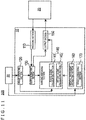
FIG. 11 ]
FIG. 11 is a block diagram depicting a functional configuration of a route selection assistance system according to a second embodiment. - [
FIG. 12 ]
FIG. 12 is a schematic diagram depicting a screen of a display of the route selection assistance system according to the second embodiment. - [
FIG. 13 ]
FIG. 13(A) is a diagram schematically depicting a data structure of a medical instrument list,FIG. 13(B) is a diagram schematically depicting a data structure of a device list, andFIG. 13(C) is a diagram schematically depicting a data structure of a device information list. - [
FIG. 14 ]
FIG. 14 is a schematic diagram depicting the screen of the display of the route selection assistance system according to the second embodiment. - [
FIG. 15 ]
FIG. 15(A) is a schematic diagram depicting a screen of a display of a route selection assistance system according to one mode of a second modification, andFIG. 15(B) is a schematic diagram depicting a screen of a display of a route selection assistance system according to another mode of the second modification. - Embodiments of the present invention will hereinafter be described with reference to the drawings. It is to be noted that the dimensional ratios in the drawings are exaggerated for the convenience of description, and may be different from actual ratios.
- A route
selection assistance system 1 according to the present embodiment is a route selection assistance system that assists in selecting a route RT of a blood vessel BV (corresponding to a living body lumen) for delivering a medical instrument to a site within a living body BD via the blood vessel BV. -
FIG. 1 is a schematic diagram of assistance in explaining a device configuration of the routeselection assistance system 1.FIG. 2 is a block diagram of assistance in explaining a functional configuration of the routeselection assistance system 1.FIGS. 3 to 9 are diagrams of assistance in explaining various functions of the routeselection assistance system 1. - A device configuration of the route
selection assistance system 1 will be described. - Referring to
FIG. 1 , the routeselection assistance system 1 includes a computermain unit 10 and adisplay 20. The computermain unit 10 is connected to anexternal server 30. - The computer
main unit 10 includes anarithmetic unit 50, astorage device 60, and areading device 70. - The
arithmetic unit 50 performs operation on the basis of a program and data stored in thestorage device 60. Thearithmetic unit 50 is formed by using a publicly known central processing unit (CPU). - The
storage device 60 includes amemory circuit 61 and ahard disk drive 65. Thememory circuit 61 includes a read only memory (ROM) and a random access memory (RAM). - The
storage device 60 stores a basic program such as an operating system, a route selection assistance program PR making thearithmetic unit 50 perform functions of the routeselection assistance system 1, and data processed by the route selection assistance program PR. - The
reading device 70 reads information recorded on a computer readable recording medium MD. The computer readable recording medium MD is for example an optical disk such as a compact disk (CD)-ROM, or a digital video disk (DVD)-ROM, a universal serial bus (USB) memory, or a secure digital (SD) memory card. Thereading device 70 is for example a CD-ROM drive, or a DVD-ROM drive. - The route selection assistance program PR is provided in a state of being recorded on the computer readable recording medium MD. The
reading device 70 reads the route selection assistance program PR recorded on the computer readable recording medium MD. The route selection assistance program PR read by thereading device 70 is stored on thehard disk drive 65. - The
display 20 is connected to the computermain unit 10. Thedisplay 20 transmits and receives information to and from the computermain unit 10. - The
display 20 includes ascreen 21 that inputs and outputs information. Thedisplay 20 outputs information received from the computermain unit 10 on thescreen 21. Thedisplay 20 transmits information input via thescreen 21 to the computermain unit 10. Thedisplay 20 is formed by using a publicly known touch panel display. - The computer
main unit 10 transmits and receives information to and from theexternal server 30. - The computer
main unit 10 and theexternal server 30 are connected to each other via a network. The kind of the network is not particularly limited. The network may be a network of a wired system using a local area network (LAN) cable or the like, or may be a network of a radio system using wireless fidelity (Wi-Fi) or the like. - A functional configuration of the route
selection assistance system 1 will next be described. - Referring to
FIG. 2 , the routeselection assistance system 1 includes a receivingsection 110, animage obtaining section 120, aroute extracting section 130, aranking assigning section 140, and anoutput section 150. - Operation related to processing of the receiving
section 110, theimage obtaining section 120, theroute extracting section 130, theranking assigning section 140, and theoutput section 150 is performed by thearithmetic unit 50. Data processed by the receivingsection 110, theimage obtaining section 120, theroute extracting section 130, theranking assigning section 140, and theoutput section 150 is stored in thestorage device 60. - Referring to
FIG. 3 , the receivingsection 110 receives an input of site information specifying a target site RG as a target of a procedure to be performed by delivering a medical instrument. The receivingsection 110 receives the input of the site information via thedisplay 20. - The receiving
section 110 displays one or a plurality of sites to be received as the target site RG as alternatives on thedisplay 20, and receives a selection of a displayed site. - Though not particularly limited, the target site RG is for example a left and a right common iliac artery, external iliac arteries, internal iliac arteries, common femoral arteries, superficial femoral arteries, deep femoral arteries, popliteal arteries, anterior tibial arteries, posterior tibial arteries, peroneal arteries, dorsalis pedis arteries, plantar arteries, and other arteries of lower limbs, or collateral circulations, peripheral blood vessels connected thereto.
- The
image obtaining section 120 obtains image information DT1 within the living body BD of a target patient as a target of a procedure to be performed by delivering a medical instrument. - Referring to
FIG. 6(A) andFIG. 8(A) , the image information DT1 includes image data DT2 within the living body BD of the target patient which living body is photographed by a medical image photographing device. The image data DT2 of the living body BD is three-dimensional image data. - Though not particularly limited, the medical image photographing device is for example an X-ray computed tomography (CT) device or a magnetic resonance imaging (MRI) device.
- Though not particularly limited, the data format of the image information DT1 is for example digital imaging and communication in medicine (DICOM).
- The image information DT1 is stored in the
external server 30. Theimage obtaining section 120 obtains the image information DT1 from theexternal server 30 via the network. - The
route extracting section 130 extracts a plurality of routes RT of blood vessels BV through which a medical instrument can be delivered to the target site RG on the basis of the image information DT1 obtained by theimage obtaining section 120. Though not particularly limited, the number of routes RT of blood vessels BV extracted by theroute extracting section 130 is for example 12, preferably 8, more preferably 6. - For each candidate for a site as an access point at a time of introduction of a medical instrument from the outside of the living body BD to a blood vessel BV (which site will hereinafter be an introduction site RS), the
route extracting section 130 extracts the route RT of the blood vessel BV leading from the target site RG to the introduction site RS. - Though not particularly limited, candidates for the introduction site RS are for example a right radial artery, a right brachial artery, a right subclavian artery, a right carotid artery, a right femoral artery, a left radial artery, a left brachial artery, a left subclavian artery, a left carotid artery, and a left femoral artery. Candidates for the introduction site RS may also be a popliteal artery, an anterior tibial artery, a posterior tibial artery, a peroneal artery, a dorsalis pedis artery, a plantar artery, and other blood vessels of an ankle.
- In addition, the radial artery may be a distal radial artery or a radial artery located in a snuff box.
- Referring to
FIG. 4 , theroute extracting section 130 extracts the route RT of the blood vessel BV leading from the target site RG to the introduction site RS by using an introduction site list LS1 in which candidates for the introduction site RS are recorded. The introduction site list LS1 is stored in theexternal server 30. Theroute extracting section 130 obtains the introduction site list LS1 from theexternal server 30 via the network. Details of processing in theroute extracting section 130 will be described later. - Referring to
FIG. 2 , theranking assigning section 140 includes a routescore calculating section 141 that calculates a route score SR determined according to ease of delivery of a medical instrument and a patientscore calculating section 145 that calculates a patient score SP determined according to the magnitude of a burden imposed on the target patient. - The
ranking assigning section 140 assigns rankings to the plurality of routes RT extracted by theroute extracting section 130 by using the route score SR calculated by the routescore calculating section 141 and the patient score SP calculated by the patientscore calculating section 145. - The
ranking assigning section 140 assigns rankings to the plurality of routes RT extracted by theroute extracting section 130 in increasing order of a product SR × SP of the route score SR calculated by the routescore calculating section 141 and the patient score SP calculated by the patientscore calculating section 145. - The route
score calculating section 141 calculates the route score SR on the basis of a length L of the route RT and a bending degree P of the route RT. The routescore calculating section 141 calculates, as the route score SR, a product L × P of the length L of the route RT and the bending degree P of the route RT. - Referring to
FIG. 5 , the routescore calculating section 141 includes a centerline deriving section 142 that calculates a center line CL of the route RT extracted by theroute extracting section 130, a routelength calculating section 143 that calculates the length L of the route RT, and a bendingdegree calculating section 144 that calculates the bending degree P of the route RT. - Referring to
FIG. 6(B) , the image data DT2 includes a boundary marker MK indicating a boundary between an inside region BVa1 of the blood vessel BV and an outside region BVa2 of the blood vessel BV. The centerline deriving section 142 calculates a center of the blood vessel BV on the basis of the boundary marker MK included in the image data DT2, and derives the center line CL of the blood vessel BV by connecting centers of the blood vessel BV leading from the target site RG to the introduction site RS to each other. Incidentally, "a center of the blood vessel BV" refers to a center of a region enclosed by a blood vessel wall in a cross section of the blood vessel BV. - The route
length calculating section 143 calculates the length of the center line CL calculated by the centerline deriving section 142 as the length L of the route RT. - The bending
degree calculating section 144 calculates the bending degree of the center line CL derived by the centerline deriving section 142 as the bending degree P of the route RT. Incidentally, the "bending degree" is a sum total of the magnitude of bendings or curves calculated for respective parts bent or curved in the center line CL of the blood vessel BV. "The magnitude of bendings" is a curvature or the like. - The patient
score calculating section 145 calculates the patient score SP by using an invasion degree of the route RT extracted by theroute extracting section 130. - The invasion degree is for example determined according to an amount of bleeding at a time of introduction of a medical instrument into the blood vessel BV via the introduction site RS, a time from an end of the procedure to the stopping of the bleeding, or the like. The invasion degree of the route RT whose introduction site RS is a radial artery, for example, is smaller than the invasion degree of the route RT whose introduction site RS is a femoral artery.
- Referring to
FIG. 4 , recorded in the introduction site list LS1 for each candidate for the introduction site RS is the invasion degree at a time of introduction of a medical instrument into the blood vessel BV via the corresponding introduction site RS. - The patient
score calculating section 145 calculates the invasion degree of the route RT extracted by theroute extracting section 130 by using the invasion degree recorded in the introduction site list LS1. The patientscore calculating section 145 obtains the introduction site list LS1 from theexternal server 30 via the network. - Referring to
FIG. 7(A) and FIG. 7(B) , theoutput section 150 outputs, to thedisplay 20, the plurality of routes RT extracted by theroute extracting section 130, the rankings assigned by theranking assigning section 140, the route score SR, and the patient score SP. Theoutput section 150 outputs the plurality of routes RT extracted by theroute extracting section 130 on thedisplay 20 together with an image GR of the living body BD of the target patient. - The
output section 150 displays the plurality of routes RT extracted by theroute extracting section 130 in a route display region AR1 of thedisplay 20. Theoutput section 150 displays an enlarged image of the plurality of routes RT extracted by theroute extracting section 130 in a detailed display region AR2. - The receiving
section 110 receives a selection of a route RT output to thedisplay 20 by theoutput section 150. In response to the selection of the route RT which selection is received by the receivingsection 110, theoutput section 150 displays, on thedisplay 20, one route RT of the plurality of routes RT extracted by theroute extracting section 130, a ranking corresponding to the one route RT, a route score SR, and a patient score SP. - Processing in the
route extracting section 130 will next be explained in detail. - Referring to
FIG. 8(A) and FIG. 8(B) , the image information DT1 includes divided image data DT3 obtained by dividing the image data DT2 into a plurality of pieces and supplementary information DT4 recorded as information about the divided image data DT3. - The divided image data DT3 is data generated by dividing the image data DT2 according to sites of the blood vessel BV. For example, the divided image data DT3 is data generated by dividing the image data DT2 for each site of a right subclavian artery, a brachiocephalic artery, an aortic arch, a thoracic aorta, an abdominal aorta, a left common iliac artery, a left external iliac artery, a left femoral artery, or the like. Divided images are identified by unique identifiers (hereinafter IDs) .
- Recorded as the supplementary information DT4 for each piece of divided image data DT3 are site information specifying a site of the blood vessel BV included in the corresponding divided image data DT3 and link information bidirectionally linking adjacent pieces of divided image data DT3 to each other.
- Referring to
FIG. 9 , theroute extracting section 130 includes: a target siteimage specifying section 131 that specifies the ID of a piece of divided image data DT3 including the target site RG from among the plurality of pieces of divided image data DT3 included in the image information DT1; an introduction siteimage specifying section 132 that specifies the ID of a piece of divided image data DT3 including a candidate for the introduction site RS from among the plurality of pieces of divided image data DT3 included in the image information DT1; and aroute searching section 133 that searches for the route RT of the blood vessel BV leading from the target site RG to the introduction site RS. - The target site
image specifying section 131 specifies the ID of the piece of divided image data DT3 including the target site RG by using the site information received by the receivingsection 110 and the site information included in the supplementary information DT4. - The introduction site
image specifying section 132 specifies the ID of a piece of divided image data DT3 including a candidate for the introduction site RS by using the introduction site list LS1 and the site information included in the supplementary information DT4. - The
route searching section 133 searches for the route RT of the blood vessel BV leading from the target site RG to the introduction site RS by using the ID of a divided image specified by the target siteimage specifying section 131, the ID of a divided image specified by the introduction siteimage specifying section 132, and the link information included in the supplementary information DT4. - Description will next be made of a method of assisting in selecting the route RT of the blood vessel BV (corresponding to a living body lumen) for delivering a medical instrument to a site within a living body via the living body lumen (which method will hereinafter be a route selection assistance method).
- Referring to
FIG. 10 , the route selection assistance method includes: step S1 of receiving an input of site information; step S2 of obtaining the image information DT1; step S3 of extracting the routes RT of blood vessels BV; step S4 of calculating route scores SR; step S5 of calculating patient scores SP; step S6 of assigning rankings to the extracted routes RT; and step S7 of outputting the extracted routes RT and the rankings. - Step S1 of receiving an input of site information receives the input of the site information specifying the target site RG as a target of a procedure performed by delivering a medical instrument. Step S1 of receiving the input of the site information is performed by the receiving
section 110. - Step S2 of obtaining the image information DT1 obtains the image information DT1 of the living body BD of the target patient as a target of a procedure performed by delivering a medical instrument. Step S2 of obtaining the image information DT1 is performed by the
image obtaining section 120. - Step S3 of extracting the routes RT of blood vessels BV extracts a plurality of routes RT of living body lumens through which a medical instrument can be delivered to the target site RG on the basis of the obtained image information DT1. Step S3 of extracting the routes RT of the blood vessels BV is performed by the
route extracting section 130. - Step S4 of calculating route scores SR calculates the route scores SR determined according to ease of delivery of a medical instrument at a time of delivery of the medical instrument via the routes RT. Step S4 of calculating the route scores SR is performed by the route
score calculating section 141. - Step S5 of calculating patient scores SP calculates the patient scores SP determined according to the magnitude of a burden imposed on the target patient. Step S5 of calculating the patient scores SP is performed by the patient
score calculating section 145. - Step S6 of assigning rankings assigns rankings to the plurality of extracted routes RT on the basis of the calculated route scores SR and the calculated patient scores SP. Step S6 of assigning the rankings is performed by the
ranking assigning section 140. - Outputting step S7 outputs, to the
display 20, the plurality of routes RT extracted in step S3 of extracting the routes RT of the blood vessels BV, the rankings assigned in step S6 of assigning the rankings, the route scores SR calculated in step S4 of calculating the route scores SR, and the patient scores SP calculated in step S5 of calculating the patient scores SP. - Outputting step S7 outputs, to the
display 20, the routes RT, the rankings, the route scores SR, and the patient scores SP in order to assist an operator such as a doctor in selecting the route RT of a blood vessel BV for delivering a medical instrument to the target site RG within the living body BD via the blood vessel BV. - Outputting step S7 outputs the plurality of routes RT extracted by the
route extracting section 130 to thedisplay 20 together with the image GR of the living body BD of the target patient. - Outputting step S7 is performed by the
output section 150. - Description will next be made of a method of diagnosing the route RT of a blood vessel BV for delivering a medical instrument to a site within the living body BD via the blood vessel BV (corresponding to a living body lumen) (which method will hereinafter be a diagnosis method).
- The diagnosis method according to the present embodiment includes a step of diagnosing a route RT from the plurality of routes RT extracted in step S3 of extracting the routes RT of the blood vessels BV and the rankings assigned in step S6 of assigning the rankings in addition to steps S1 to S6 of the route selection assistance method described above.
- The step of diagnosing a route RT diagnoses a route RT assigned a high ranking in step S6 of assigning the rankings as a more appropriate route RT as compared with a route RT having a low ranking from a viewpoint of the ease of delivering a medical instrument at a time of delivery of the medical instrument via the route RT and the magnitude of a burden imposed on the target patient.
- Description will next be made of an example of usage of the route assistance system according to the present embodiment. In the following, description will be made by taking as an example a case where six sites of a right radial artery, a right brachial artery, a right femoral artery, a left radial artery, a left brachial artery, and a left femoral artery are recorded in the introduction site list LS1 (see
FIG. 4 ). In the following, description will be made by taking as an example a case where a left superficial femoral artery (SFA) is to be treated. - Referring to
FIG. 3 , by operating thedisplay 20, an operator inputs a "left superficial femoral artery" as site information specifying the target site RG as a target of a procedure performed by delivering a medical instrument. - The
image obtaining section 120 obtains the image information DT1 on the inside of the living body BD of the target patient as a target of a procedure performed by delivering a medical instrument from the external server 30 (seeFIG. 1 ) via the network. - The
route extracting section 130 extracts six routes RT of blood vessels BV corresponding to six candidates for the introduction site RS, the six candidates being a right radial artery, a right brachial artery, a right femoral artery, a left radial artery, a left brachial artery, and a left femoral artery recorded in the introduction site list LS1 (seeFIG. 4 ). - For each of the six routes RT extracted by the
route extracting section 130, the routescore calculating section 141 calculates a route score SR on the basis of the length L of the route RT and the bending degree P of the route RT. For each of the six routes RT extracted by theroute extracting section 130, the patientscore calculating section 145 calculates a patient score SP by using an invasion degree. - In the present usage example, the route score SR is decreased in order of the route RT whose introduction site RS is a right radial artery (left radial artery), the route RT whose introduction site RS is a right brachial artery (left brachial artery), and the route RT whose introduction site RS is a right femoral artery (left femoral artery). In contrast to this, the patient score SP is decreased in order of the route RT whose introduction site RS is the right femoral artery (left femoral artery), the route RT whose introduction site RS is the right brachial artery (left brachial artery), and the route RT whose introduction site RS is the right radial artery (left radial artery).
- In the present usage example, the product SR × SP of the route score SR and the patient score SP is decreased in order of the route RT whose introduction site RS is the right femoral artery (left femoral artery), the route RT whose introduction site RS is the right brachial artery (left radial artery), and the route RT whose introduction site RS is the right radial artery (left radial artery).
- The
ranking assigning section 140 assigns rankings to the plurality of routes RT extracted by theroute extracting section 130 in increasing order of the product SR × SP of the route score SR calculated by the routescore calculating section 141 and the patient score SP calculated by the patientscore calculating section 145. - The
output section 150 outputs, to thedisplay 20, the plurality of routes RT extracted by theroute extracting section 130, the rankings assigned by theranking assigning section 140, and the route scores SR and the patient scores SP (seeFIG. 7(A) and FIG. 7(B) ). - The operator such as a doctor refers to the routes RT of the blood vessels BV, the rankings, and the route scores SR and the patient scores SP output to the
display 20, and thereby selects an appropriate route RT with consideration given to the ease of delivery of a medical instrument at a time of delivery of the medical instrument and the magnitude of a burden imposed on the target patient. - According to the route
selection assistance system 1, the recording medium MD on which the route selection assistance program PR is recorded, the route selection assistance method, and the diagnosis method in accordance with the present embodiment, theranking assigning section 140 assigns rankings to the plurality of routes RT extracted by theroute extracting section 130 by using the route scores SR determined according to the ease of delivery of a medical instrument at a time of delivery of the medical instrument and the patient scores SP determined according to the magnitude of a burden imposed on the target patient. Theoutput section 150 then outputs the plurality of routes RT extracted by theroute extracting section 130 and the rankings assigned by theranking assigning section 140. The operator such as a doctor can thereby select an appropriate route RT easily from among the plurality of routes RT of blood vessels BV through which a medical instrument can be delivered to the target site RG as a target of a procedure in consideration of the ease of delivery of the medical instrument at a time of the delivery of the medical instrument and the magnitude of a burden imposed on the target patient. Hence, according to the routeselection assistance system 1, the recording medium MD on which the route selection assistance program PR is recorded, and the route selection assistance method in accordance with the present invention, it is possible to easily select the route RT of a blood vessel BV for delivering a medical instrument to a site within the living body BD via the blood vessel BV. Such an effect is particularly remarkable in a case where the number of sites of the blood vessel BV which sites are to be passed is increased, that is, in a case where the blood vessel BV of a lower limb is treated by using TRI or the like. - In addition, according to the route
selection assistance system 1, the recording medium MD on which the route selection assistance program PR is recorded, the route selection assistance method, and the diagnosis method in accordance with the present embodiment, the routescore calculating section 141 calculates a route score SR by using the length of a route RT and the bending degree P of the route RT. Theranking assigning section 140 can thereby evaluate the ease of delivery of a medical instrument at a time of delivery of the medical instrument more appropriately, and rank the routes RT. Therefore, the operator can easily select a more appropriate route RT from among the plurality of routes RT of the blood vessels BV through which a medical instrument can be delivered to the target site RG in consideration of the ease of delivery of the medical instrument at a time of delivery of the medical instrument. Such an effect is particularly remarkable in a case where an appropriate route RT is selected from among the plurality of routes RT including sites greatly differing in the magnitude of bending or curvature for each target patient, the sites being a right radial artery, a right brachial artery, a right axillary artery, a right subclavian artery, a right brachiocephalic artery, a left radial artery, a left brachial artery, a left axillary artery, a right subclavian artery, a brachiocephalic artery, an aortic arch, a thoracic aorta, an abdominal aorta (descending aorta), an aortailiac bifurcation, left or right one or both of common iliac arteries, external iliac arteries, internal iliac arteries, common femoral arteries, superficial femoral arteries, and deep femoral arteries, and further, as required, popliteal arteries, anterior tibial arteries, posterior tibial arteries, peroneal arteries, dorsalis pedis arteries, plantar arteries, collateral circulations, or the like. - In addition, according to the route
selection assistance system 1, the recording medium MD on which the route selection assistance program PR is recorded, the route selection assistance method, and the diagnosis method in accordance with the present embodiment, the patientscore calculating section 145 calculates a patient score SP by using the invasion degree of a route RT. Theranking assigning section 140 can thereby evaluate the magnitude of a burden imposed on the target patient more appropriately, and rank the routes RT. Therefore, the operator can easily select a more appropriate route RT from among the plurality of routes RT of the blood vessels BV through which a medical instrument can be delivered to the target site RG in consideration of the magnitude of a burden imposed on the target patient. - Referring to
FIG. 11 , a routeselection assistance system 200 according to a present embodiment includes a medicalinstrument extracting section 160 that extracts a kind of medical instrument to be used for a procedure and adevice extracting section 170 that extracts useable device candidates according to the kind of medical instrument extracted by the medicalinstrument extracting section 160, in addition to the functional configuration of the routeselection assistance system 1 according to the foregoing embodiment. - The route
selection assistance system 200 according to the present embodiment will be described in the following. Incidentally, a device configuration of the routeselection assistance system 200 according to the present embodiment is the same as the device configuration of the routeselection assistance system 1 according to the foregoing embodiment. A functional configuration of the routeselection assistance system 200 according to the present embodiment is the same as the functional configuration of the routeselection assistance system 1 according to the foregoing embodiment except that the functional configuration of the routeselection assistance system 200 according to the present embodiment further includes the medicalinstrument extracting section 160 and thedevice extracting section 170. The same devices and functional blocks as in the routeselection assistance system 1 according to the foregoing embodiment are identified by the same reference numerals, and description thereof will be omitted. - Referring to
FIG. 12 , the receivingsection 110 receives an input of procedure information specifying a kind of procedure to be performed by delivering a medical instrument to the target site RG via a blood vessel BV (corresponding to a living body lumen). The kinds of procedure is for example expansion or piercing of a constriction in the blood vessel BV, excavation of the constriction of the blood vessel BV, imaging of the inside region BVa1 of the blood vessel BV, or releasing of a drug within the blood vessel BV. Except for receiving an input of procedure information, functions of the receivingsection 110 are the same as the functions of the receivingsection 110 in the route assistance system according to the foregoing embodiment. - The medical
instrument extracting section 160 extracts one or a plurality of kinds of medical instruments to be used for the kind of procedure specified by the procedure information. The kinds of medical instruments are for example an introducer sheath, a guide wire, an imaging catheter, a micro-catheter, an angiographic catheter, a guide wire support catheter, a guiding catheter, a balloon catheter, a balloon-expandable stent, a self-expandable stent, a drug releasing stent, a drug releasing balloon, a directional coronary atherectomy (DCA) catheter, a microdissection catheter, a laser ablation catheter, and a catheter for image diagnosis. - The catheter for image diagnosis is for example a catheter for obtaining an image by using an intravascular ultrasound diagnosis method (IVUS) or an optical coherence tomography diagnosis method (OCT).
- The
device extracting section 170 extracts a useable device candidate for each kind of medical instrument extracted by the medicalinstrument extracting section 160. Thedevice extracting section 170 extracts the useable device candidate on the basis of the presence or absence of stock of a device. - In a case where there are a plurality of useable device candidates, the
device extracting section 170 extracts the plurality of device candidates within a range not exceeding an upper limit number. Though not particularly limited, the upper limit number is for example about 10 for each device. - In a case where there is no useable device, the number of device candidates extracted by the
device extracting section 170 is zero. - Referring to
FIGS. 13(A) to (C) , theexternal server 30 stores a medical instrument list LS2 recording kinds of medical instruments to be used for each kind of procedure, a device list LS3 recording device candidates for each kind of medical instrument, and a device information list LS4 recording the presence or absence of stock of a device for each device candidate. - The device list LS3 records commercially available devices for each kind of medical instrument. The devices are identified by unique device identifiers. The unique device identifiers are for example the manufacturer name of a manufacturer selling devices, a model name, a pharmaceutical approval number, a product code, bar code data, a product name, and a lot number.
- The device information list LS4 records the presence or absence of stock of devices in a facility in which the route
selection assistance system 200 is used. - The medical
instrument extracting section 160 extracts kinds of medical instruments by using the medical instrument list LS2. Thedevice extracting section 170 extracts useable device candidates by using the device list LS3 and the device information list LS4. - The
ranking assigning section 140 adjusts rankings assigned to the plurality of routes RT extracted by theroute extracting section 130 on the basis of a result of the device extraction by thedevice extracting section 170. - The
ranking assigning section 140 decreases the ranking of a route RT for which no useable device is extracted in thedevice extracting section 170. - Referring to
FIG. 14 , theoutput section 150 outputs the device candidates extracted by thedevice extracting section 170 to thedisplay 20 in addition to information output by theoutput section 150 of the routeselection assistance system 1 according to the foregoing embodiment. - The
output section 150 outputs, to thedisplay 20, the routes RT, the rankings, the route scores SR, and the patient scores SP in order to assist an operator such as a doctor in selecting a device to be used for a procedure performed by delivering a medical instrument to the target site RG within the living body BD via the blood vessel BV. - According to the route
selection assistance system 200 in accordance with the present embodiment, the receivingsection 110 receives an input of procedure information specifying a kind of procedure to be performed by delivering a medical instrument via the blood vessel BV. The routeselection assistance system 200 according to the present embodiment includes the medicalinstrument extracting section 160 that extracts kinds of medical instruments to be used for the procedure specified by the procedure information and thedevice extracting section 170 that extracts useable device candidates for each kind of medical instrument extracted by the medicalinstrument extracting section 160. Theoutput section 150 then outputs a result of the extraction of the device candidates by thedevice extracting section 170. Thus, the operator can more easily select a device to be used for a procedure performed by delivering a medical instrument via the blood vessel BV. Therefore, a burden on the operator at a time of performing a procedure by delivering a medical instrument via the blood vessel BV is reduced more. - In addition, according to the route
selection assistance system 200, the recording medium MD on which the route selection assistance program PR is recorded, and the route selection assistance method in accordance with the present embodiment, theranking assigning section 140 adjusts the rankings assigned to the plurality of routes RT extracted by theroute extracting section 130 on the basis of a result of extraction of device candidates by thedevice extracting section 170. Thus, the operator can easily select a more appropriate route RT from among the plurality of routes RT of blood vessels BV through which a medical instrument can be delivered to the target site RG according to the useable device candidates. - In the foregoing first and second embodiments, the patient
score calculating section 145 calculates the magnitude of a burden imposed on the target patient by using an invasion degree. However, the patientscore calculating section 145 may also calculate a patient score SP using patient information recording characteristics of the target patient. - The patient information can be stored in the
external server 30. The patientscore calculating section 145 obtains the patient information from theexternal server 30 via the network. - The patient information includes information about the anamnesis of the target patient. The information about the anamnesis of the target patient includes procedure history information recording history information about a procedure on the blood vessel BV. The procedure on the blood vessel BV is for example placement of a stent or a graft. The procedure history information includes information specifying a site of the blood vessel BV on which site the procedure is performed.
- The patient
score calculating section 145 calculates a patient score SP using the information about the anamnesis of the target patient. Using the procedure history information, the patientscore calculating section 145 calculates that a patient score SP for a route RT including the blood vessel BV on which the procedure is performed is high as compared with a route RT not including the blood vessel BV on which the procedure is performed. - According to the route selection assistance system, the recording medium MD on which the route selection assistance program PR is recorded, and the route selection assistance method in accordance with the present modification, the patient
score calculating section 145 calculates a patient score SP using information about the characteristics of the target patient. Theranking assigning section 140 can thereby evaluate the magnitude of a burden imposed on the target patient even more appropriately, and rank the routes RT. Therefore, the operator can easily select an even more appropriate route RT from among the plurality of routes RT of the blood vessels BV through which a medical instrument can be delivered to the target site RG in consideration of the magnitude of a burden imposed on the target patient. - In the foregoing first and second embodiments, the receiving
section 110 displays one or a plurality of sites to be received as the target site RG as alternatives on thedisplay 20, and receives a selection of a displayed site. - Referring to
FIG. 15(A) , for the site displayed on thedisplay 20 as an alternative, the receivingsection 110 may further receive a selection of a range of the site as a target of delivering a medical instrument. The operator such as a doctor can select the target site RG in a more detailed and accurate manner by selecting the range of the site as a target of delivering a medical instrument. - At this time, the receiving
section 110 may display the image GR of the living body BD of the target patient on thedisplay 20, and display the range selected as the site as a target of delivering a medical instrument in the image GR by a distinguishable marker MK2. - In addition, referring to
FIG. 15(B) , the receivingsection 110 may display the image GR of the living body BD of the target patient on thedisplay 20, and receive a selection of the target site RG in the image GR. In this case, the operator such as a doctor can select the target site RG by tracing the target site RG by a finger or the like on the image GR displayed on thedisplay 20. Therefore, according to the route selection assistance system in accordance with the present modification, the selection of the target site RG is facilitated, and the selection of the target site RG can be made in a more detailed and accurate manner. - In the foregoing second embodiment, the
device extracting section 170 extracts useable device candidates on the basis of the presence or absence of stock of devices. - The
device extracting section 170 may further narrow down the useable device candidates extracted on the basis of the presence or absence of stock of devices by using characteristics of the devices. - For example, the
device extracting section 170 may exclude a device whose device length is less than the length L of the route RT from the useable device candidates extracted on the basis of the presence or absence of stock of devices. - The route selection assistance system, the recording medium on which the route selection assistance program is recorded, and the route selection assistance method have been described above through embodiments and modifications thereof. However, the present invention is not limited to only configurations described in the embodiments, but can be changed as appropriate on the basis of the description of claims.
- For example, in the foregoing embodiments and the modifications thereof, a blood vessel of a lower limb is illustrated as the target site. However, the target site is not particularly limited. For example, the target site may be a blood vessel in a brain, a heart, or the like. Further, in the foregoing embodiments and the modifications thereof, description has been made by taking as an example a case where the living body lumen is a blood vessel. However, the living body lumen is not limited to a blood vessel, but may be a vessel, a bile duct, an oviduct, a hepatic duct, a trachea, an esophagus, a urethra, or the like.
- In addition, the patient score calculating section calculates a patient score using history information about a procedure on a blood vessel as information about the characteristics of the target patient. However, the patient score calculating section may calculate a patient score using information such as a tendency toward spasm (abnormal contraction of a blood vessel which contraction accompanies convulsion) because of a tendency toward tonus or an onset history of constriction, occlusion, or the like as the information about the characteristics of the target patient. In this case, the patient score calculating section calculates that the patient score of a route including a blood vessel site where there is an onset history of spasm or the like is high as compared with the patient score of a route not including a blood vessel site where there is an onset history of spasm or the like. In addition, the patient score calculating section may calculate a patient score by combining the information about the characteristics of the target patient and an invasion degree with each other.
- In the foregoing embodiments and the modifications thereof, the output section outputs, to the display, the plurality of routes extracted by the route extracting section, the rankings assigned by the ranking assigning section, the route scores, and the patient scores. However, the output section may output the plurality of routes extracted by the route extracting section, the rankings assigned by the ranking assigning section, the route scores, and the patient scores as data to the external server. In this case, the route of a living body lumen can be expressed as a set of coordinates with the target site as an origin.
- In addition, in the foregoing embodiments and the modifications thereof, the output section displays one of the plurality of routes extracted by the route extracting section on the display in response to a selection of the route which selection is received by the receiving section. However, the output section may simultaneously display the plurality of routes extracted by the route extracting section on the display. In this case, the output section may display the plurality of routes extracted by the route extracting section on the display in different colors.
- In addition, in the foregoing embodiments and the modifications thereof, the image information includes image data and supplementary information. However, it suffices for the image information to include at least image data of the living body lumen of the target patient, and the supplementary information is not an essential requirement.
- In addition, the image data does not have to include a boundary marker. Even in this case, the center line calculating section of the route score calculating section can derive the center line of the blood vessel on the basis of the image data by using a publicly known image processing technology or the like.
- In addition, the image data does not need to be divided for each site of the living body lumen. Even when the image data is not divided for each site of the living body lumen, the route extracting section can extract the route of the living body lumen through which a medical instrument can be delivered to the target site by using a publicly known image processing technology or the like on the basis of the image data.
- In addition, in the foregoing embodiments and the modifications thereof, the route selection assistance program recorded on the computer readable recording medium is read by the reading device and stored in the storage device, and thereby the route selection assistance system functions. However, the route selection assistance system may be provided in a state in which the route selection assistance program is stored in the storage device in advance. In addition, a part or all of the functions of the route selection assistance system may be implemented by a programmable circuit structure such as a field programmable gate array (FPGA). In this case, a part or the whole of the route selection assistance program is described in a hardware description language such as Verilog.
- In addition, in the foregoing embodiments and the modifications thereof, the receiving section receives an input of site information or the like via the touch panel display. However, in the route selection assistance system, an input device is not limited to the touch panel display, but a publicly known input device can be used. For example, the route selection assistance system may include a mouse or a pen tablet as the input device in addition to a display that is not the touch panel display. The operator such as a doctor can input site information by operating the mouse or the pen tablet.
- In addition, in the foregoing embodiments and the modifications thereof, the computer main unit and the display are configured as separate parts. However, the computer main unit and the display may be configured integrally with each other, or the display may be incorporated in the computer main unit.
- In addition, in the foregoing embodiments and the modifications thereof, the image obtaining section obtains image information from the external server. However, the image obtaining section may be configured by using an image photographing device for medical use such as an X-ray CT device, or an MRI device.
- The present application is based on Japanese Patent Application No.
2017-110378 filed on June 2, 2017 -
- 1, 200
- Route selection assistance system
- 10
- Computer main unit
- 20
- Display
- 30
- External server
- 50
- Arithmetic unit
- 60
- Storage device
- 70
- Reading device
- 110
- Receiving section
- 120
- Image obtaining section
- 130
- Route extracting section
- 140
- Ranking assigning section
- 141
- Route score calculating section
- 145
- Patient score calculating section
- 150
- Output section
- 160
- Medical instrument extracting section
- 170
- Device extracting section
- BD
- Living body,
- BV
- Blood vessel (living body lumen)
- DT1
- Image information
- MD
- Recording medium
- PR
- Route selection assistance program
- RG
- Target site
- RS
- Introduction site
- RT
- Route
- SP
- Patient score
- SR
- Route score
- L
- Length of a route
- P
- Bending degree of a route
Claims (9)
- A route selection assistance system for assisting in selecting a route of a living body lumen for delivering a medical instrument to a site within a living body via the living body lumen, the route selection assistance system comprising:a receiving section configured to receive an input of site information specifying a target site within the living body as a target of delivering the medical instrument;an image obtaining section configured to obtain image information on an inside of the living body of a target patient as the target of delivering the medical instrument;a route extracting section configured to extract a plurality of routes of the living body lumen, the plurality of routes allowing the medical instrument to be delivered to the target site on a basis of the image information obtained by the image obtaining section;a ranking assigning section including a route score calculating section configured to calculate route scores determined according to ease of delivery of the medical instrument at a time of delivery of the medical instrument via the routes and a patient score calculating section configured to calculate patient scores determined according to magnitude of a burden imposed on the target patient, the ranking assigning section assigning rankings to the plurality of routes extracted by the route extracting section by using the route scores and the patient scores; andan output section configured to output the plurality of routes extracted by the route extracting section and the rankings assigned by the ranking assigning section.
- The route selection assistance system according to claim 1, wherein
the receiving section receives an input of procedure information specifying a kind of procedure to be performed by delivering the medical instrument to the target site via the living body lumen,
the route selection assistance system further comprisesa medical instrument extracting section configured to extract kinds of medical instruments used for the procedure specified by the procedure information, anda device extracting section configured to extract a useable device candidate for each kind of medical instrument extracted by the medical instrument extracting section, andthe output section outputs a result of extraction of the device candidate by the device extracting section. - The route selection assistance system according to claim 2, wherein
the ranking assigning section adjusts the rankings assigned to the plurality of routes extracted by the route extracting section on a basis of the result of extraction of the device candidate by the device extracting section. - The route selection assistance system according to any one of claims 1 to 3, wherein
the route score calculating section calculates lengths of the routes extracted by the route extracting section and bending degrees of the routes on a basis of the image information on the inside of the living body of the target patient, and calculates the route scores using the calculated lengths of the routes and the calculated bending degrees of the routes. - The route selection assistance system according to any one of claims 1 to 4, wherein
the patient score calculating section calculates invasion degrees of the routes extracted by the route extracting section, and calculates the patient scores using the calculated invasion degrees of the routes. - The route selection assistance system according to any one of claims 1 to 5, wherein
the patient score calculating section obtains patient information related to a characteristic of the target patient, and calculates the patient scores on a basis of the patient information. - A computer readable recording medium on which a route selection assistance program assisting in selecting a route of a living body lumen for delivering a medical instrument to a site within a living body via the living body lumen is recorded, the route selection assistance program making a computer perform:receiving an input of site information specifying a target site within the living body as a target of delivering the medical instrument;obtaining image information on an inside of the living body of a target patient as a target of delivering the medical instrument;extracting a plurality of routes of the living body lumen, the plurality of routes allowing the medical instrument to be delivered to the target site, on a basis of the obtained image information;calculating route scores determined according to ease of delivery of the medical instrument at a time of delivery of the medical instrument via the routes, calculating patient scores determined according to magnitude of a burden imposed on the target patient, and assigning rankings to the extracted plurality of routes using the calculated route scores and the calculated patient scores; andoutputting the extracted plurality of routes and the assigned rankings.
- A method of assisting in selecting a route of a living body lumen for delivering a medical instrument to a site within a living body via the living body lumen, the method comprising:receiving an input of site information specifying a target site within the living body as a target of delivering the medical instrument;obtaining image information on an inside of the living body of a target patient as the target of delivering the medical instrument;extracting a plurality of routes of the living body lumen, the plurality of routes allowing the medical instrument to be delivered to the target site, on a basis of the obtained image information;assigning rankings to the extracted plurality of routes by using route scores determined according to ease of delivery of the medical instrument at a time of delivery of the medical instrument via the routes and patient scores determined according to magnitude of a burden imposed on the target patient; andoutputting the extracted plurality of routes and the assigned rankings.
- A diagnosis method for diagnosing a route of a living body lumen for delivering a medical instrument to a site within a living body via the living body lumen, the diagnosis method comprising:receiving an input of site information specifying a target site within the living body as a target of delivering the medical instrument;obtaining image information on an inside of the living body of a target patient as the target of delivering the medical instrument;extracting a plurality of routes of the living body lumen, the plurality of routes allowing the medical instrument to be delivered to the target site, on a basis of the obtained image information;assigning rankings to the extracted plurality of routes by using route scores determined according to ease of delivery of the medical instrument at a time of delivery of the medical instrument via the routes and patient scores determined according to magnitude of a burden imposed on the target patient; anddiagnosing the route from the extracted plurality of routes and the assigned rankings.
Applications Claiming Priority (2)
| Application Number | Priority Date | Filing Date | Title |
|---|---|---|---|
| JP2017110378 | 2017-06-02 | ||
| PCT/JP2018/020530 WO2018221508A1 (en) | 2017-06-02 | 2018-05-29 | Route selection assist system, recording medium for recording route selection assist program, route selection assist method, and diagnosis method |
Publications (3)
| Publication Number | Publication Date |
|---|---|
| EP3632362A1 true EP3632362A1 (en) | 2020-04-08 |
| EP3632362A4 EP3632362A4 (en) | 2021-03-10 |
| EP3632362B1 EP3632362B1 (en) | 2025-05-14 |
Family
ID=64455350
Family Applications (1)
| Application Number | Title | Priority Date | Filing Date |
|---|---|---|---|
| EP18810020.0A Active EP3632362B1 (en) | 2017-06-02 | 2018-05-29 | Route selection assistance system, method and recording medium |
Country Status (5)
| Country | Link |
|---|---|
| US (1) | US11596352B2 (en) |
| EP (1) | EP3632362B1 (en) |
| JP (1) | JP7144408B2 (en) |
| CN (1) | CN110636813B (en) |
| WO (1) | WO2018221508A1 (en) |
Families Citing this family (3)
| Publication number | Priority date | Publication date | Assignee | Title |
|---|---|---|---|---|
| CN114600198A (en) * | 2019-10-21 | 2022-06-07 | 皇家飞利浦有限公司 | Interventional procedure optimization |
| CN111596242B (en) * | 2020-06-04 | 2022-07-01 | 京东方科技集团股份有限公司 | Sample simulation scanning device and use method |
| CN113876420B (en) * | 2021-09-08 | 2024-04-26 | 上海微创微航机器人有限公司 | Path planning method, system, device and medium for planning surgical path |
Family Cites Families (19)
| Publication number | Priority date | Publication date | Assignee | Title |
|---|---|---|---|---|
| SG64340A1 (en) * | 1996-02-27 | 1999-04-27 | Inst Of Systems Science Nation | Curved surgical instruments and methods of mapping a curved path for stereotactic surgery |
| JP2000113086A (en) | 1998-10-09 | 2000-04-21 | Olympus Optical Co Ltd | Operation route setting device and recording medium recording operation route setting processing program |
| JP3453603B2 (en) * | 2001-07-17 | 2003-10-06 | 独立行政法人通信総合研究所 | Surgical path automatic search program and device |
| EP1937178B1 (en) | 2005-10-11 | 2011-12-14 | Koninklijke Philips Electronics N.V. | 3d tool path planning, simulation and control system |
| US8116847B2 (en) * | 2006-10-19 | 2012-02-14 | Stryker Corporation | System and method for determining an optimal surgical trajectory |
| US9037215B2 (en) | 2007-01-31 | 2015-05-19 | The Penn State Research Foundation | Methods and apparatus for 3D route planning through hollow organs |
| US8073221B2 (en) * | 2008-05-12 | 2011-12-06 | Markus Kukuk | System for three-dimensional medical instrument navigation |
| US8218846B2 (en) | 2008-05-15 | 2012-07-10 | Superdimension, Ltd. | Automatic pathway and waypoint generation and navigation method |
| CN103458764B (en) * | 2011-03-31 | 2017-05-03 | 皇家飞利浦有限公司 | Shape sensing assisted medical procedure |
| DE102011076188B4 (en) * | 2011-05-20 | 2013-03-21 | Siemens Aktiengesellschaft | Apparatus and method for planning an endovascular procedure with a medical instrument |
| JP5934071B2 (en) * | 2012-09-27 | 2016-06-15 | 富士フイルム株式会社 | Apparatus, method and program for searching for shortest path of tubular structure |
| JP6030435B2 (en) | 2012-12-25 | 2016-11-24 | 富士フイルム株式会社 | Image processing apparatus, image processing method, and image processing program |
| US9436349B2 (en) * | 2013-03-12 | 2016-09-06 | Microsoft Technology Licensing, Llc | Business solution user interface enabling interaction with reports |
| US9639666B2 (en) * | 2013-03-15 | 2017-05-02 | Covidien Lp | Pathway planning system and method |
| US9600138B2 (en) | 2013-03-15 | 2017-03-21 | Synaptive Medical (Barbados) Inc. | Planning, navigation and simulation systems and methods for minimally invasive therapy |
| JP2014230710A (en) | 2013-05-30 | 2014-12-11 | テルモ株式会社 | Therapeutic method |
| US10398509B2 (en) * | 2015-09-18 | 2019-09-03 | General Electric Company | System and method for optimal catheter selection for individual patient anatomy |
| JP2017110378A (en) | 2015-12-15 | 2017-06-22 | アイシン精機株式会社 | Control method for slide door, and slide door device for vehicle |
| WO2017139894A1 (en) * | 2016-02-16 | 2017-08-24 | Goyal Mayank | Systems and methods for routing a vessel line such as a catheter within a vessel |
-
2018
- 2018-05-29 CN CN201880032097.0A patent/CN110636813B/en active Active
- 2018-05-29 WO PCT/JP2018/020530 patent/WO2018221508A1/en not_active Ceased
- 2018-05-29 EP EP18810020.0A patent/EP3632362B1/en active Active
- 2018-05-29 JP JP2019521231A patent/JP7144408B2/en active Active
-
2019
- 2019-11-26 US US16/695,250 patent/US11596352B2/en active Active
Also Published As
| Publication number | Publication date |
|---|---|
| EP3632362A4 (en) | 2021-03-10 |
| CN110636813B (en) | 2023-04-25 |
| CN110636813A (en) | 2019-12-31 |
| EP3632362B1 (en) | 2025-05-14 |
| US11596352B2 (en) | 2023-03-07 |
| JPWO2018221508A1 (en) | 2020-04-02 |
| US20200093421A1 (en) | 2020-03-26 |
| WO2018221508A1 (en) | 2018-12-06 |
| JP7144408B2 (en) | 2022-09-29 |
Similar Documents
| Publication | Publication Date | Title |
|---|---|---|
| US11490963B2 (en) | Route selection assistance system, recording medium on which route selection assistance program is recorded, route selection assistance method, and diagnosis method | |
| JP7486626B2 (en) | Systems and methods for routing conduit lines, such as catheters, within a vessel - Patents.com | |
| US20250195032A1 (en) | Intraluminal ultrasound navigation guidance and associated devices, systems, and methods | |
| Kaymaz et al. | Influence of carotid tortuosity on internal carotid artery access time in the treatment of acute ischemic stroke | |
| JP4824146B1 (en) | Medical device and method for controlling medical device | |
| US11596352B2 (en) | Route selection assistance system, recording medium on which route selection assistance program is recorded, route selection assistance method, and diagnosis method | |
| US10390786B2 (en) | X-ray diagnostic apparatus | |
| CN102871729A (en) | Device and method for planning an endovascular procedure with a medical instrument | |
| CN117958965A (en) | Preoperative path planning method and device for vascular intervention operation | |
| Merkle et al. | Central vascular complications following elective catheterization using transradial percutaneous coronary intervention | |
| JP6929687B2 (en) | Medical image processing equipment, medical image processing methods, and medical image processing programs | |
| Hertault et al. | Translumbar puncture for retrograde catheterization of a kinked left renal stent after fenestrated endograft repair | |
| Jongkind et al. | Direct videoscopic approach to the thoracic aorta for aortic endograft delivery: evaluation in a human cadaver circulation model | |
| JP2023130134A (en) | Program, information processing method, and information processing device | |
| JP7262923B2 (en) | MEDICAL IMAGE PROCESSING APPARATUS, CONTROL METHOD THEREOF, AND PROGRAM | |
| Chang et al. | Practical tips for performing resuscitative endovascular balloon occlusion of the aorta | |
| EP4625434A1 (en) | Supporting an interventional procedure | |
| EP4623833A1 (en) | Providing feedback during balloon angioplasty | |
| Zhu et al. | Clinical use of reserved guide wire fenestration and Viabahn-covered stent in Stanford type B aortic dissection with left subclavian artery involvement | |
| Wheatley III | Rise of the machines: the evolution of cardiovascular imaging for aortic disease | |
| Vincent et al. | Double guide double wrist 5F left coronary artery transradial percutaneous coronary intervention and the X-Kiss technique | |
| Nagatomi et al. | Endovascular Fenestration Using a Coaxial Wingman Catheter Through Preshaped Guiding Catheter for Revascularization of Abdominal Visceral Branches Originating From False Lumen in Aortic Dissection | |
| WO2020013198A1 (en) | Image diagnosis support device, method and program, and heart simulation system | |
| Piazza et al. | Customized CT angiogram planning for intraoperative transesophageal echography-guided endovascular exclusion of thoracic aorta penetrating ulcer | |
| Augustyn | Intravascular Sonography Assessment of a Type III Endoleak of an Aortic Endograft |
Legal Events
| Date | Code | Title | Description |
|---|---|---|---|
| STAA | Information on the status of an ep patent application or granted ep patent |
Free format text: STATUS: THE INTERNATIONAL PUBLICATION HAS BEEN MADE |
|
| PUAI | Public reference made under article 153(3) epc to a published international application that has entered the european phase |
Free format text: ORIGINAL CODE: 0009012 |
|
| STAA | Information on the status of an ep patent application or granted ep patent |
Free format text: STATUS: REQUEST FOR EXAMINATION WAS MADE |
|
| 17P | Request for examination filed |
Effective date: 20191107 |
|
| AK | Designated contracting states |
Kind code of ref document: A1 Designated state(s): AL AT BE BG CH CY CZ DE DK EE ES FI FR GB GR HR HU IE IS IT LI LT LU LV MC MK MT NL NO PL PT RO RS SE SI SK SM TR |
|
| AX | Request for extension of the european patent |
Extension state: BA ME |
|
| DAV | Request for validation of the european patent (deleted) | ||
| DAX | Request for extension of the european patent (deleted) | ||
| A4 | Supplementary search report drawn up and despatched |
Effective date: 20210205 |
|
| RIC1 | Information provided on ipc code assigned before grant |
Ipc: A61B 17/00 20060101ALI20210201BHEP Ipc: A61B 34/10 20160101AFI20210201BHEP Ipc: A61M 25/01 20060101ALI20210201BHEP |
|
| STAA | Information on the status of an ep patent application or granted ep patent |
Free format text: STATUS: EXAMINATION IS IN PROGRESS |
|
| 17Q | First examination report despatched |
Effective date: 20230328 |
|
| GRAP | Despatch of communication of intention to grant a patent |
Free format text: ORIGINAL CODE: EPIDOSNIGR1 |
|
| STAA | Information on the status of an ep patent application or granted ep patent |
Free format text: STATUS: GRANT OF PATENT IS INTENDED |
|
| INTG | Intention to grant announced |
Effective date: 20250211 |
|
| GRAS | Grant fee paid |
Free format text: ORIGINAL CODE: EPIDOSNIGR3 |
|
| GRAA | (expected) grant |
Free format text: ORIGINAL CODE: 0009210 |
|
| STAA | Information on the status of an ep patent application or granted ep patent |
Free format text: STATUS: THE PATENT HAS BEEN GRANTED |
|
| AK | Designated contracting states |
Kind code of ref document: B1 Designated state(s): AL AT BE BG CH CY CZ DE DK EE ES FI FR GB GR HR HU IE IS IT LI LT LU LV MC MK MT NL NO PL PT RO RS SE SI SK SM TR |
|
| REG | Reference to a national code |
Ref country code: GB Ref legal event code: FG4D |
|
| REG | Reference to a national code |
Ref country code: CH Ref legal event code: EP |
|
| REG | Reference to a national code |
Ref country code: IE Ref legal event code: FG4D |
|
| REG | Reference to a national code |
Ref country code: DE Ref legal event code: R096 Ref document number: 602018081958 Country of ref document: DE |
|
| PGFP | Annual fee paid to national office [announced via postgrant information from national office to epo] |
Ref country code: DE Payment date: 20250611 Year of fee payment: 8 |
|
| PGFP | Annual fee paid to national office [announced via postgrant information from national office to epo] |
Ref country code: FR Payment date: 20250623 Year of fee payment: 8 |
|
| REG | Reference to a national code |
Ref country code: NL Ref legal event code: MP Effective date: 20250514 |
|
| PG25 | Lapsed in a contracting state [announced via postgrant information from national office to epo] |
Ref country code: FI Free format text: LAPSE BECAUSE OF FAILURE TO SUBMIT A TRANSLATION OF THE DESCRIPTION OR TO PAY THE FEE WITHIN THE PRESCRIBED TIME-LIMIT Effective date: 20250514 Ref country code: ES Free format text: LAPSE BECAUSE OF FAILURE TO SUBMIT A TRANSLATION OF THE DESCRIPTION OR TO PAY THE FEE WITHIN THE PRESCRIBED TIME-LIMIT Effective date: 20250514 Ref country code: PT Free format text: LAPSE BECAUSE OF FAILURE TO SUBMIT A TRANSLATION OF THE DESCRIPTION OR TO PAY THE FEE WITHIN THE PRESCRIBED TIME-LIMIT Effective date: 20250915 |
|
| REG | Reference to a national code |
Ref country code: LT Ref legal event code: MG9D |
|
| PG25 | Lapsed in a contracting state [announced via postgrant information from national office to epo] |
Ref country code: NO Free format text: LAPSE BECAUSE OF FAILURE TO SUBMIT A TRANSLATION OF THE DESCRIPTION OR TO PAY THE FEE WITHIN THE PRESCRIBED TIME-LIMIT Effective date: 20250814 Ref country code: GR Free format text: LAPSE BECAUSE OF FAILURE TO SUBMIT A TRANSLATION OF THE DESCRIPTION OR TO PAY THE FEE WITHIN THE PRESCRIBED TIME-LIMIT Effective date: 20250815 |
|
| PG25 | Lapsed in a contracting state [announced via postgrant information from national office to epo] |
Ref country code: PL Free format text: LAPSE BECAUSE OF FAILURE TO SUBMIT A TRANSLATION OF THE DESCRIPTION OR TO PAY THE FEE WITHIN THE PRESCRIBED TIME-LIMIT Effective date: 20250514 Ref country code: NL Free format text: LAPSE BECAUSE OF FAILURE TO SUBMIT A TRANSLATION OF THE DESCRIPTION OR TO PAY THE FEE WITHIN THE PRESCRIBED TIME-LIMIT Effective date: 20250514 |
|
| REG | Reference to a national code |
Ref country code: AT Ref legal event code: MK05 Ref document number: 1794175 Country of ref document: AT Kind code of ref document: T Effective date: 20250514 |
|
| PG25 | Lapsed in a contracting state [announced via postgrant information from national office to epo] |
Ref country code: BG Free format text: LAPSE BECAUSE OF FAILURE TO SUBMIT A TRANSLATION OF THE DESCRIPTION OR TO PAY THE FEE WITHIN THE PRESCRIBED TIME-LIMIT Effective date: 20250514 |
|
| PG25 | Lapsed in a contracting state [announced via postgrant information from national office to epo] |
Ref country code: HR Free format text: LAPSE BECAUSE OF FAILURE TO SUBMIT A TRANSLATION OF THE DESCRIPTION OR TO PAY THE FEE WITHIN THE PRESCRIBED TIME-LIMIT Effective date: 20250514 |
|
| PG25 | Lapsed in a contracting state [announced via postgrant information from national office to epo] |
Ref country code: AT Free format text: LAPSE BECAUSE OF FAILURE TO SUBMIT A TRANSLATION OF THE DESCRIPTION OR TO PAY THE FEE WITHIN THE PRESCRIBED TIME-LIMIT Effective date: 20250514 |
|
| PG25 | Lapsed in a contracting state [announced via postgrant information from national office to epo] |
Ref country code: RS Free format text: LAPSE BECAUSE OF FAILURE TO SUBMIT A TRANSLATION OF THE DESCRIPTION OR TO PAY THE FEE WITHIN THE PRESCRIBED TIME-LIMIT Effective date: 20250814 |
|
| PG25 | Lapsed in a contracting state [announced via postgrant information from national office to epo] |
Ref country code: IS Free format text: LAPSE BECAUSE OF FAILURE TO SUBMIT A TRANSLATION OF THE DESCRIPTION OR TO PAY THE FEE WITHIN THE PRESCRIBED TIME-LIMIT Effective date: 20250914 |
|
| PG25 | Lapsed in a contracting state [announced via postgrant information from national office to epo] |
Ref country code: LV Free format text: LAPSE BECAUSE OF FAILURE TO SUBMIT A TRANSLATION OF THE DESCRIPTION OR TO PAY THE FEE WITHIN THE PRESCRIBED TIME-LIMIT Effective date: 20250514 |
|
| REG | Reference to a national code |
Ref country code: CH Ref legal event code: H13 Free format text: ST27 STATUS EVENT CODE: U-0-0-H10-H13 (AS PROVIDED BY THE NATIONAL OFFICE) Effective date: 20251223 |
|
| PG25 | Lapsed in a contracting state [announced via postgrant information from national office to epo] |
Ref country code: SM Free format text: LAPSE BECAUSE OF FAILURE TO SUBMIT A TRANSLATION OF THE DESCRIPTION OR TO PAY THE FEE WITHIN THE PRESCRIBED TIME-LIMIT Effective date: 20250514 Ref country code: DK Free format text: LAPSE BECAUSE OF FAILURE TO SUBMIT A TRANSLATION OF THE DESCRIPTION OR TO PAY THE FEE WITHIN THE PRESCRIBED TIME-LIMIT Effective date: 20250514 |
|
| PG25 | Lapsed in a contracting state [announced via postgrant information from national office to epo] |
Ref country code: LU Free format text: LAPSE BECAUSE OF NON-PAYMENT OF DUE FEES Effective date: 20250529 |
|
| PG25 | Lapsed in a contracting state [announced via postgrant information from national office to epo] |
Ref country code: CH Free format text: LAPSE BECAUSE OF NON-PAYMENT OF DUE FEES Effective date: 20250531 |
|
| PG25 | Lapsed in a contracting state [announced via postgrant information from national office to epo] |
Ref country code: CZ Free format text: LAPSE BECAUSE OF FAILURE TO SUBMIT A TRANSLATION OF THE DESCRIPTION OR TO PAY THE FEE WITHIN THE PRESCRIBED TIME-LIMIT Effective date: 20250514 |
|
| PG25 | Lapsed in a contracting state [announced via postgrant information from national office to epo] |
Ref country code: EE Free format text: LAPSE BECAUSE OF FAILURE TO SUBMIT A TRANSLATION OF THE DESCRIPTION OR TO PAY THE FEE WITHIN THE PRESCRIBED TIME-LIMIT Effective date: 20250514 |
|
| PG25 | Lapsed in a contracting state [announced via postgrant information from national office to epo] |
Ref country code: RO Free format text: LAPSE BECAUSE OF FAILURE TO SUBMIT A TRANSLATION OF THE DESCRIPTION OR TO PAY THE FEE WITHIN THE PRESCRIBED TIME-LIMIT Effective date: 20250514 Ref country code: SK Free format text: LAPSE BECAUSE OF FAILURE TO SUBMIT A TRANSLATION OF THE DESCRIPTION OR TO PAY THE FEE WITHIN THE PRESCRIBED TIME-LIMIT Effective date: 20250514 |
|
| PG25 | Lapsed in a contracting state [announced via postgrant information from national office to epo] |
Ref country code: IT Free format text: LAPSE BECAUSE OF FAILURE TO SUBMIT A TRANSLATION OF THE DESCRIPTION OR TO PAY THE FEE WITHIN THE PRESCRIBED TIME-LIMIT Effective date: 20250514 |
|
| REG | Reference to a national code |
Ref country code: BE Ref legal event code: MM Effective date: 20250531 |
|
| REG | Reference to a national code |
Ref country code: DE Ref legal event code: R097 Ref document number: 602018081958 Country of ref document: DE |
|
| PG25 | Lapsed in a contracting state [announced via postgrant information from national office to epo] |
Ref country code: MC Free format text: LAPSE BECAUSE OF FAILURE TO SUBMIT A TRANSLATION OF THE DESCRIPTION OR TO PAY THE FEE WITHIN THE PRESCRIBED TIME-LIMIT Effective date: 20250514 |
|
| PLBE | No opposition filed within time limit |
Free format text: ORIGINAL CODE: 0009261 |
|
| STAA | Information on the status of an ep patent application or granted ep patent |
Free format text: STATUS: NO OPPOSITION FILED WITHIN TIME LIMIT |
|
| REG | Reference to a national code |
Ref country code: CH Ref legal event code: L10 Free format text: ST27 STATUS EVENT CODE: U-0-0-L10-L00 (AS PROVIDED BY THE NATIONAL OFFICE) Effective date: 20260325 |
|
| PGFP | Annual fee paid to national office [announced via postgrant information from national office to epo] |
Ref country code: GB Payment date: 20260323 Year of fee payment: 9 |
|
| PG25 | Lapsed in a contracting state [announced via postgrant information from national office to epo] |
Ref country code: IE Free format text: LAPSE BECAUSE OF NON-PAYMENT OF DUE FEES Effective date: 20250529 |
|
| PG25 | Lapsed in a contracting state [announced via postgrant information from national office to epo] |
Ref country code: BE Free format text: LAPSE BECAUSE OF NON-PAYMENT OF DUE FEES Effective date: 20250531 |
|
| 26N | No opposition filed |
Effective date: 20260217 |