EP3630780B1 - 1,3-diazo-4-oxa-[3.3.1]-bicyclic derivatives, process for their manufacture and their use as a medicament, in particular for treating diabetes - Google Patents
1,3-diazo-4-oxa-[3.3.1]-bicyclic derivatives, process for their manufacture and their use as a medicament, in particular for treating diabetes Download PDFInfo
- Publication number
- EP3630780B1 EP3630780B1 EP18733343.0A EP18733343A EP3630780B1 EP 3630780 B1 EP3630780 B1 EP 3630780B1 EP 18733343 A EP18733343 A EP 18733343A EP 3630780 B1 EP3630780 B1 EP 3630780B1
- Authority
- EP
- European Patent Office
- Prior art keywords
- group
- phenyl
- halogen
- methyl
- optionally substituted
- Prior art date
- Legal status (The legal status is an assumption and is not a legal conclusion. Google has not performed a legal analysis and makes no representation as to the accuracy of the status listed.)
- Active
Links
- 0 *=CC(C(C1)C(C=*)O*1C(Cc1ccccc1)=O)c1ccccc1 Chemical compound *=CC(C(C1)C(C=*)O*1C(Cc1ccccc1)=O)c1ccccc1 0.000 description 12
- NAKAVXCPUDDFMB-UHFFFAOYSA-O CC=CC(Cc1ccccc1)ON(C(Cc1ccccc1)=O)[NH3+] Chemical compound CC=CC(Cc1ccccc1)ON(C(Cc1ccccc1)=O)[NH3+] NAKAVXCPUDDFMB-UHFFFAOYSA-O 0.000 description 1
- DTGVTINFXGKSFX-UHFFFAOYSA-N COc1ccc(C2N3CN(C(Cc4c[nH]c5ccccc45)=O)OC2C=CC3)cc1 Chemical compound COc1ccc(C2N3CN(C(Cc4c[nH]c5ccccc45)=O)OC2C=CC3)cc1 DTGVTINFXGKSFX-UHFFFAOYSA-N 0.000 description 1
- IEINQPWBFVNORT-UHFFFAOYSA-N COc1ccc(C2N3CN(C(Cc4cc(F)ccc4)=O)OC2C=CC3)cc1 Chemical compound COc1ccc(C2N3CN(C(Cc4cc(F)ccc4)=O)OC2C=CC3)cc1 IEINQPWBFVNORT-UHFFFAOYSA-N 0.000 description 1
- BIWGSQARJNDNRH-UHFFFAOYSA-N COc1ccc(CC(N(C2)OC3C=CCN2C3c(cc2)ccc2Cl)=O)cc1 Chemical compound COc1ccc(CC(N(C2)OC3C=CCN2C3c(cc2)ccc2Cl)=O)cc1 BIWGSQARJNDNRH-UHFFFAOYSA-N 0.000 description 1
- OPEKNOJGZXWXAD-UHFFFAOYSA-N O=C(Cc(cc1)ccc1F)N(C1)OC2C=CCN1C2c1ccccc1 Chemical compound O=C(Cc(cc1)ccc1F)N(C1)OC2C=CCN1C2c1ccccc1 OPEKNOJGZXWXAD-UHFFFAOYSA-N 0.000 description 1
- UOWWHSCLEAISJF-UHFFFAOYSA-N O=C(Cc1ccccc1)N(C1)OC2C=CCN1C2c1ccccc1 Chemical compound O=C(Cc1ccccc1)N(C1)OC2C=CCN1C2c1ccccc1 UOWWHSCLEAISJF-UHFFFAOYSA-N 0.000 description 1
Images

Classifications
-
- C—CHEMISTRY; METALLURGY
- C07—ORGANIC CHEMISTRY
- C07D—HETEROCYCLIC COMPOUNDS
- C07D498/00—Heterocyclic compounds containing in the condensed system at least one hetero ring having nitrogen and oxygen atoms as the only ring hetero atoms
- C07D498/02—Heterocyclic compounds containing in the condensed system at least one hetero ring having nitrogen and oxygen atoms as the only ring hetero atoms in which the condensed system contains two hetero rings
- C07D498/08—Bridged systems
-
- A—HUMAN NECESSITIES
- A61—MEDICAL OR VETERINARY SCIENCE; HYGIENE
- A61P—SPECIFIC THERAPEUTIC ACTIVITY OF CHEMICAL COMPOUNDS OR MEDICINAL PREPARATIONS
- A61P3/00—Drugs for disorders of the metabolism
-
- A—HUMAN NECESSITIES
- A61—MEDICAL OR VETERINARY SCIENCE; HYGIENE
- A61P—SPECIFIC THERAPEUTIC ACTIVITY OF CHEMICAL COMPOUNDS OR MEDICINAL PREPARATIONS
- A61P3/00—Drugs for disorders of the metabolism
- A61P3/08—Drugs for disorders of the metabolism for glucose homeostasis
- A61P3/10—Drugs for disorders of the metabolism for glucose homeostasis for hyperglycaemia, e.g. antidiabetics
Definitions
- the present invention relates to 1,3-diazo-4-oxa-[3.3.1]-bicyclic derivatives, a process for their manufacture and their use as a medicament, in particular for treating diabetes and pathologies or conditions correlated thereto.
- the Diels-Alder reaction has long been widely used in organic synthesis and consists in a cycloaddition between a conjugated diene and a dienophile, which leads to the formation of substituted cyclohexanes.
- Incretins are a group of peptide hormones that stimulate a reduction in blood glucose levels. Incretins are produced by the enteroendocrine cells located in the gastrointestinal tract (in particular in the ileum, colon and duodenum) in response to the ingestion of nutrients and introduced into the bloodstream. These hormones have the function of controlling the blood glucose level (glycaemia) in various ways, in particular (i) by increasing the secretion of insulin by the beta cells of the pancreas; (ii) by decreasing the secretion of glucagon by the alpha cells of the pancreas; and (iii) by slowing motility and hence gastric emptying and decreasing appetite.
- GLP-1 glycopeptide-1
- L-cells L-type enteroendocrine cells
- GLP-1 integrates the signals deriving from nutrients in order to control food intake, energy absorption and assimilation.
- Several recently approved drugs based on enhancement of the action of incretins provide new approaches for the physiological treatment of type 2 diabetes and problems such as obesity associated with the use of traditional antidiabetics like insulin, sulphonylureas or thiazolidinediones.
- Exenatide and liraglutide are first-generation GLP-1 receptor agonists which, being peptides, require parenteral administration once or twice a day.
- Application WO 2014/193832 discloses tricyclic small molecules that are modulators of the GLP-1 receptor.
- the present invention thus aims to provide new compounds that are effective in the treatment of diabetes and pathologies or conditions correlated thereto.
- the invention pursues the object of providing new compounds capable of modulating the GLP-1 receptor; another object of the invention is to provide compounds capable of modulating the GLP-1 receptor and which can be orally administered.
- the invention has the object of providing a process for the manufacture of such compounds and in particular it aims to define the reaction conditions for carrying out the process in a rapid, simple and economically advantageous manner.
- the present invention relates to compounds having the following structural formula (I): wherein:
- the invention also relates to a process for the manufacture of the compounds having the aforesaid formula (I) by reaction of a 4a,7,8,8a-tetrahydropyrido[4,3-e]-1,4,2-dioxazine having formula (2): wherein R 1 and R 2 are as defined for the structure (I) and PG is a protective group comprising a carboxylic functional group, with a hydride selected from the group consisting of: lithium triethylborohydride (LiBHEt 3 ), sodium triethylborohydride (NaBHEt 3 ), and lithium tetrahydroaluminate (LiAIH 4 ), in the presence of tetrahydrofuran, at a temperature comprised between 0°C and room temperature for a time comprised between 15 minutes and 4 hours.
- the invention further relates to the compounds of the aforesaid formula (I), and the pharmaceutically acceptable salts thereof, for use as a medicament, in
- Figure 1 shows the measurement by ELISA assay of the biological activity of the bicyclic compound with structure (Ib) as a GLP-1 receptor agonist (mSTC-1 GLP1 sec CRC).
- the compounds of formula (I) according to the present invention are 1,3-diazo-4-oxa-[3.3.1]-bicyclic derivatives.
- R 1 can preferably be selected from the group consisting of hydrogen and phenyl, optionally substituted by a halogen or by a methoxy functional group.
- R 1 can be selected from the group consisting of vinyl, allyl and cyclohexyl.
- R 1 is selected from the group consisting of C 1 -C 6 alkyl, preferably C 1 -C 3 alkyl.
- R 1 is 1,2,3-triazole.
- said halogen when R 1 is a phenyl substituted by a halogen, said halogen can preferably be selected between chlorine and fluorine. Furthermore, said halogen can preferably be in the para ( p -) position of the phenyl relative to the core of the molecule.
- R 1 is a phenyl substituted by a methoxy group
- said methoxy group can preferably be in the para ( p -) position of the aromatic ring.
- R 2 can preferably be a phenyl or a benzyl and said phenyl or benzyl can optionally be substituted by one or more functional groups independently selected from among: a halogen, a methoxy functional group and -CF 3 .
- R 2 can be an unsubstituted phenyl or benzyl.
- R 2 can be a phenyl or a benzyl, wherein said phenyl or benzyl are substituted by a single functional group selected from among: halogen, methoxy and -CF 3 ; more preferably, the functional group is selected from among: halogen, methoxy and -CF 3 can be in the position para ( p -) or in the position meta (m-) of the aromatic ring.
- R 2 when R 2 is a phenyl or a benzyl substituted by a halogen, said halogen can preferably be selected between chlorine and fluorine.
- R 2 can have a structural formula selected from the group consisting of: and wherein R' is H or methyl.
- R' when R 2 has a structural formula selected from among (vii), (viii), (ix) and (x) as defined above, R' can preferably be hydrogen. More preferably, when R 2 has a structural formula selected from among (vii), (ix) and (x) as defined above, R' can preferably be hydrogen.
- R 1 can be phenyl, optionally substituted by a halogen or by the methoxy functional group
- R 2 can be selected from the group consisting of phenyl and benzyl, wherein said phenyl or benzyl are optionally substituted by a halogen or by the methoxy functional group. More preferably, R 2 can be benzyl, optionally substituted by a halogen or by the methoxy functional group.
- Ft 1 can be phenyl, optionally substituted by a halogen or by the methoxy functional group, and R 2 can be selected from the group consisting of: and wherein R' is H or methyl (preferably H).
- R 1 can be phenyl, optionally substituted by a halogen or by the methoxy functional group, and R 2 can be pyrrole.
- R 1 can preferably be unsubstituted phenyl or phenyl substituted by a halogen.
- the compounds of formula (I) can be selected from among those having the following formulas:
- the compounds of formula (I) can be selected from among those having the following formulas:
- the compound of formula (I) can have the following formula:
- the substituent R 1 is an unsubstituted phenyl and the substituent R 2 is an unsubstituted benzyl; this compound corresponds to the structure indicated in the present description as (Ib).
- Another aspect of the invention relates to a process for the manufacture of the compounds of formula (I) disclosed herein, wherein a 4a,7,8,8a-tetrahydropyrido[4,3-e]-1,4,2-dioxazine having formula (2): wherein R 1 and R 2 are as defined in reference to the structure (I) and PG is a protective group comprising a carboxylic functional group (COO-), is reacted with a hydride selected from the group consisting of: lithium triethylborohydride (LiBHEt 3 ), sodium triethylborohydride (NaBHEt 3 ), and lithium tetrahydroaluminate (LiAIH 4 ), in the presence of tetrahydrofuran, at a temperature comprised between 0°C and room temperature for a time comprised between 15 minutes and 4 hours.
- a hydride selected from the group consisting of: lithium triethylborohydride (LiBHEt 3
- the process can be carried out at a temperature of 0°C ( ⁇ 1°C). In another preferred embodiment, the process can be carried out at room or ambient temperature: standard ambient temperature (SAT) means a temperature of 25°C ( ⁇ 1°C), as is well known in the field of chemistry.
- SAT standard ambient temperature
- the hydride which reacts with the dioxazine can be lithium triethylborohydride (LiBHEt 3 or LiTEBH); lithium triethylborohydride is a commercially available hydride known by the trade name Super-hydride®.
- the process of the invention can take place in the presence of a palladium-based catalyst comprising at least one triphenylphosphine group.
- the catalyst can be selected from the group consisting of: tetrakis(triphenylphosphine)palladium(0) (Pd(PPh 3 ) 4 ) and bis(triphenylphosphine)palladium(II) dichloride ((PPh 3 ) 2 PdCl 2 ). More preferably, the catalyst can be (PPh 3 ) 2 PdCl 2 .
- the process can take place using the hydride LiBHEt 3 , in the absence of a catalyst and at a temperature of 0°C ( ⁇ 1°C). In another embodiment, the process can take place in the absence of a catalyst and at room temperature. In another embodiment, the process can take place in the presence of a catalyst and at a temperature of 0°C ( ⁇ 1°C).
- the reaction time can range between about 15 minutes and about 4 hours, depending on the other reaction conditions (above all temperature and the presence or absence of a catalyst) and the hydride used.
- the time taken can preferably be comprised between about 20 minutes and about 60 minutes when LiBHEt 3 is used, irrespective of whether the catalyst is present.
- NaBHEt 3 is less effective and when it is used in the process longer reaction times are necessary, preferably comprised between 2 hours and 30 min and 3 hours and 30 min, depending on whether the catalyst is present or not.
- Table 1 Example Hydride Catalyst Temperature Time Ib/4b/5b a (%) 1 (comparative) NaBH 4 none 0°C 12 h no reaction 2 (comparative) LiBH 4 none room 18 h 0/100/0 b 3 LiBHEt 3 none 0°C 20 min 100/0/0 4 NaBHEt 3 none room 3.5 h 100/0/0 5 (comparative) NaBH 4 (PPh 3 ) 2 PdCl 2 0°C 21 h 0/50/50 6 C (comparative) NaBH 4 (PPh 3 ) 2 PdCl 2 60°C 24 h no reaction 7 (comparative) LiBH 4 (PPh 3 ) 2 PdCl 2 0°C 1h 0/72/28 8 LiBHEt 3 (PPh 3 ) 2 PdCl 2 0°C 30 min 95/5/0 9 LiAIH 4 (PPh 3 )
- the first hydride examined was sodium borohydride; the dioxazine (2b) treated with sodium borohydride in THF for 12 hours did not undergo any reaction.
- the use of lithium borohydride resulted in the obtainment of a secondary product, a piperidine of structure (4b) (see reaction Diagram 2 above).
- the reaction led to the obtainment of the 1,3-diazo-4-oxa-[3.3.1]-bicyclic derivative of structure (Ib).
- the reaction mechanism seems to involve a non-catalysed initial S N 2' type reaction of the hydride at the C6 position of the dioxazine, which is followed by the opening of the dioxazine structure and subsequent intramolecular amination, as shown in diagram 3 below, which makes reference to the reaction of the dioxazine (2b).
- the solvent is also essential in order for the reaction to take place: carrying out the reaction in methanol does not lead to any product, even when the temperature is raised to 60°C (example 6).
- the reaction conditions provide for a lithium-based hydride and a palladium-based catalyst
- the two reactions compete for the substrate (2b) and, as a consequence, the ratio of the products obtained ((Ib) and (4b)/(5b)) depends on the respective speed of the two reactions.
- the protective group PG bonded to nitrogen has an important role in the preparation of 1,3-diazo-4-oxa-[3.3.1]-bicyclic derivatives with the process according to the invention.
- the protective group must be such as to form a carbamate following the formation of the bond with the nitrogen atom present on the oxazolic ring of the dioxazine, according to the mechanism shown above in reaction diagram 3.
- the presence of the carbamate is in fact an essential condition in order to have reactivity with the hydrides.
- the protective group In order for the protective group to form a carbamate by reacting with the nitrogen of the oxazolic ring, it must comprise a carboxylic group (COO-).
- some appropriate protective groups can be -COOMe, - COOPh and -CBz.
- Table 2 shows the results of the rearrangement, according to the invention, of several dioxazines, achieved using LiBHEt 3 as a hydride and working in THF at 0°C.
- dioxazines indicated in table 2 were prepared in accordance with the invention, as described further below, and their structural formulas are shown in section 2.1 of the examples.
- the process of the invention can also comprise a step, preceding the reaction of the dioxazine of formula (2) with the hydride, wherein the dioxazine itself is obtained by a [3,3]-sigmatropic type rearrangment starting from the corresponding reverse cycleadduct.
- the cycleadducts corresponding to the dioxazines of formula (2) which react in the process of the invention have the formula (1) shown below in reaction diagram 4, wherein R 1 and R 2 have the meanings previously defined for the compounds of formula (I) and the dioxazines of formula (2).
- the rearrangement of the cycleadduct according to the present invention takes place in dichloroethane, at a temperature of 75°C ( ⁇ 2°C) and in the presence of CuCI as a catalyst.
- the amount of CuCI can be comprised between 18 mol% and 22 mol%, more preferably it can be equal to 20 mol%.
- the invention relates to the compounds having structural formula (I), wherein R 1 and R 2 are defined as set forth above, or pharmaceutically acceptable salts thereof, for use as a medicament.
- the inventors have in fact found that the compounds of formula (I) are capable of modulating, in a direct or indirect manner, the GLP-1 receptor.
- the compounds of the invention thus act upon the mechanism of signal transmission (pathway) mediated by the GLP-1 receptor.
- the compounds of the invention or the pharmaceutically acceptable salts thereof can be used in particular to treat diabetes, preferably type 2 diabetes.
- the compounds of the invention or the pharmaceutically acceptable salts thereof can be used in the treatment of several pathologies correlated to diabetes, such as obesity and dyslipidaemic syndromes.
- dyslipidaemic syndromes refers generically to conditions in which the amount of lipids (in particular cholesterol, triglycerides and/or phospholipids) in the bloodstream is altered compared to the normal physiological condition; in dyslipidaemias the amount of lipids is increased (hypercholesterolaemia, hypertriglyceridaemia, hyperphospholipidaemia), but there also exist dyslipidaemias in which the amount of lipids is lower than in normal physiological condition.
- hepatic steatosis commonly called "fatty liver”
- fatty liver in which there is an intracellular accumulation of lipids in hepatic tissue: hepatic steatosis can be treated by means of the compounds of the present invention or the pharmaceutically acceptable salts thereof.
- the compounds of the invention or the pharmaceutically acceptable salts thereof can also be used to regulate the sense of satiety or appetite.
- the TLC analyses were carried out on Alugram SIL G/UV254 silica gel sheets with detection by exposure to ultraviolet light (254 nm) and/or per immersion in an acid staining solution of p -anisaldehyde in EtOH.
- silica gel 60 was used (Macherey-Nagel 230-400 mesh).
- the 1 H NMR spectra were recorded on a Bruker Avance II 250 spectrometer.
- the chemical shifts are reported in ppm relative to tetramethylsilane considering the resonance of the solvent as an internal standard (deuterochloroform: ⁇ 7.26, deuteroacetonitrile: 51.94).
- the 13 C NMR spectra were recorded on a Bruker Avance II 250 spectrometer (62.5 MHz) with complete proton decoupling.
- the chemical shifts are reported in ppm relative to tetramethylsilane considering the resonance of the solvent as an internal standard (deuterochloroform: ⁇ 77.16, deuteroacetonitrile: ⁇ 1.32).
- the melting points were determined with a Kofler unit and were not corrected.
- the HRMS (ESI) mass spectra were measured with a Q-TOF spectrometer with a nanoelectrospray ion source.
- the biological activity of the synthesised compounds was measured with an ELISA assay.
- the dioxazine, the palladium-based catalyst (0.05 equivalents) and the freshly distilled THF were introduced into a 5 ml oven-dried Schlenk tube, in an argon atmosphere.
- the resulting mixture was cooled to 0°C and the hydride source was added slowly. Once the dioxazine had disappeared, the reaction was quenched with water, and the aqueous phase was extracted with Et 2 O.
- the combined organic layers were dried on MgSO 4 , concentrated and purified by flash chromatography.
- the dioxazine and the freshly distilled THF were introduced into a 5 ml oven-dried Schlenk tube, in an argon atmosphere.
- the resulting mixture was cooled to 0°C and a solution of LiBHEt 3 (1.0 M in THF, 6.0 equivalents) was added dropwise. Once the dioxazine had disappeared, the reaction was quenched with water, and the aqueous phase was extracted with Et 2 O. The combined organic layers were dried on MgSO 4 , concentrated and purified by flash chromatography.
- the biological activity of the compound (5S*,9R*)-9-phenyl-3-phenylacetyl-4-oxa-1,3-diazabicyclo[3.3.1]non-6-ene (Ib) as a GLP-1 receptor agonist was measured via an ELISA assay specifically modified in order to identify the forms of GLP-1 secreted.
- the action of the compound of formula Ib (11 ⁇ M) as a GLP-1 receptor agonist (mSTC-1 GLP-1 sec CRC) is shown in Figure 1 .
Landscapes
- Chemical & Material Sciences (AREA)
- Organic Chemistry (AREA)
- Health & Medical Sciences (AREA)
- Engineering & Computer Science (AREA)
- Bioinformatics & Cheminformatics (AREA)
- Diabetes (AREA)
- Hematology (AREA)
- Obesity (AREA)
- Chemical Kinetics & Catalysis (AREA)
- General Chemical & Material Sciences (AREA)
- Medicinal Chemistry (AREA)
- Nuclear Medicine, Radiotherapy & Molecular Imaging (AREA)
- Pharmacology & Pharmacy (AREA)
- Life Sciences & Earth Sciences (AREA)
- Animal Behavior & Ethology (AREA)
- General Health & Medical Sciences (AREA)
- Public Health (AREA)
- Veterinary Medicine (AREA)
- Pharmaceuticals Containing Other Organic And Inorganic Compounds (AREA)
Description
- The present invention relates to 1,3-diazo-4-oxa-[3.3.1]-bicyclic derivatives, a process for their manufacture and their use as a medicament, in particular for treating diabetes and pathologies or conditions correlated thereto.
- The Diels-Alder reaction has long been widely used in organic synthesis and consists in a cycloaddition between a conjugated diene and a dienophile, which leads to the formation of substituted cyclohexanes. Diels-Alder reactions that involve at least one heteroatom are collectively called "hetero-Diels-Alder" reactions; in particular, in a "nitroso-Diels-Alder" reaction (NDA) the nitroso group (R-N=O) acts as a dienophile and the cycloaddition leads to the introduction of nitrogen and oxygen at the 1-4 positions of a 1,3-diene, with the formation of oxazines.
- The use of 1,2-dihydropyridine as conjugated dienes in the acyl-nitroso-Diels-Alder reaction has never received particular attention, although it offers the advantage of stereoselectively introducing a new carbon-oxygen bond and a new carbon-nitrogen bond on the pyridine skeleton, thus regioselectively forming the corresponding reverse nitroso cycloadduct of the general formula (1), as shown in diagram 1 below (PG=protective group).
- In some studies (Knaus et al., J. Org. Chem, 1985; Streith et al., Tetrahedron Lett., 1990) it was reported that the hetero-Cope [3,3] rearrangement of benzoylnitroso cycloadducts ((1), where R1=H, R2=Ph, PG=COOMe) led to the corresponding 4a,7,8a-tetrahydropyrido[4,3-e]-1,4,2-dioxazine ((2), where R2=Ph, diagram 1). However, in such studies the reaction conditions of the rearrangement were either not very well defined (Streith et al.) or very long reaction times were necessary in order for the rearrangement to take place (up to 15 days, Knaus et al.). Precisely because of this difficulty in synthesising them, despite the potential usefulness for purposes of chemical synthesis, dioxazines (2) have not been particularly exploited as building blocks.
-

- Incretins are a group of peptide hormones that stimulate a reduction in blood glucose levels. Incretins are produced by the enteroendocrine cells located in the gastrointestinal tract (in particular in the ileum, colon and duodenum) in response to the ingestion of nutrients and introduced into the bloodstream. These hormones have the function of controlling the blood glucose level (glycaemia) in various ways, in particular (i) by increasing the secretion of insulin by the beta cells of the pancreas; (ii) by decreasing the secretion of glucagon by the alpha cells of the pancreas; and (iii) by slowing motility and hence gastric emptying and decreasing appetite.
- The therapeutic relevance of incretins has grown rapidly in recent years and one of the most studied incretins is GLP-1 (glucagon-like peptide-1), produced by L-type enteroendocrine cells (L-cells). GLP-1 integrates the signals deriving from nutrients in order to control food intake, energy absorption and assimilation. Several recently approved drugs based on enhancement of the action of incretins provide new approaches for the physiological treatment of type 2 diabetes and problems such as obesity associated with the use of traditional antidiabetics like insulin, sulphonylureas or thiazolidinediones. Exenatide and liraglutide are first-generation GLP-1 receptor agonists which, being peptides, require parenteral administration once or twice a day.
- Therefore, research in this field is still constantly active.
- Application
WO 2014/193832 discloses tricyclic small molecules that are modulators of the GLP-1 receptor. - The present invention thus aims to provide new compounds that are effective in the treatment of diabetes and pathologies or conditions correlated thereto. In particular, the invention pursues the object of providing new compounds capable of modulating the GLP-1 receptor; another object of the invention is to provide compounds capable of modulating the GLP-1 receptor and which can be orally administered. Moreover, the invention has the object of providing a process for the manufacture of such compounds and in particular it aims to define the reaction conditions for carrying out the process in a rapid, simple and economically advantageous manner.
- The present invention relates to compounds having the following structural formula (I):
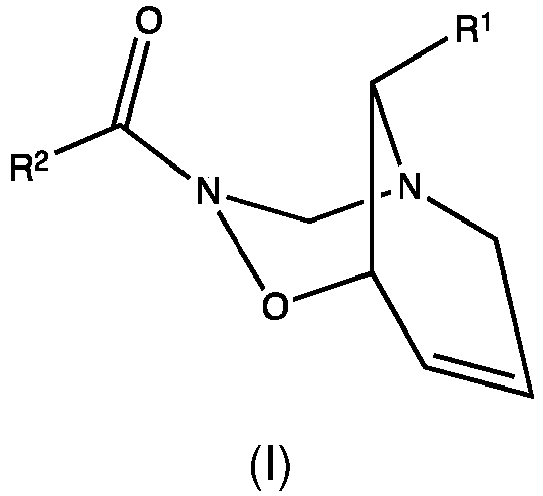
- R1 is selected from the group consisting of: H, C1-C6 alkyl, vinyl, allyl, cyclohexyl, 1,2,3-triazole, phenyl optionally substituted by a halogen or by a methoxy functional group, C=C-Ph, and -CH2-COOCH3; and
- R2 is selected from the group consisting of:
- (i) phenyl or benzyl, optionally substituted by one or more functional groups independently selected from the group consisting of a halogen, a methoxy functional group and -CF3;
- (ii) isoxazole;
- (iii) pyrrole;
- (iv)

- (v)

- (vi)

- (vii)

- (viii)

- (ix)

- (x)

- The invention also relates to a process for the manufacture of the compounds having the aforesaid formula (I) by reaction of a 4a,7,8,8a-tetrahydropyrido[4,3-e]-1,4,2-dioxazine having formula (2):

-
Figure 1 shows the measurement by ELISA assay of the biological activity of the bicyclic compound with structure (Ib) as a GLP-1 receptor agonist (mSTC-1 GLP1 sec CRC). - From a chemical standpoint, the compounds of formula (I) according to the present invention are 1,3-diazo-4-oxa-[3.3.1]-bicyclic derivatives.
- In one embodiment of the compounds of formula (I) disclosed herein, R1 can preferably be selected from the group consisting of hydrogen and phenyl, optionally substituted by a halogen or by a methoxy functional group.
- In another embodiment, R1 can be selected from the group consisting of vinyl, allyl and cyclohexyl.
- In another embodiment, R1 is selected from the group consisting of C1-C6 alkyl, preferably C1-C3 alkyl.
- In another embodiment, R1 is 1,2,3-triazole.
- In a preferred embodiment, when R1 is a phenyl substituted by a halogen, said halogen can preferably be selected between chlorine and fluorine. Furthermore, said halogen can preferably be in the para (p-) position of the phenyl relative to the core of the molecule.
- Similarly, when R1 is a phenyl substituted by a methoxy group, said methoxy group can preferably be in the para (p-) position of the aromatic ring.
- In one embodiment of the compounds of formula (I) disclosed herein, R2 can preferably be a phenyl or a benzyl and said phenyl or benzyl can optionally be substituted by one or more functional groups independently selected from among: a halogen, a methoxy functional group and -CF3.
- In a preferred embodiment, R2 can be an unsubstituted phenyl or benzyl.
- In another preferred embodiment, R2 can be a phenyl or a benzyl, wherein said phenyl or benzyl are substituted by a single functional group selected from among: halogen, methoxy and -CF3; more preferably, the functional group is selected from among: halogen, methoxy and -CF3 can be in the position para (p-) or in the position meta (m-) of the aromatic ring.
- In another preferred embodiment, when R2 is a phenyl or a benzyl substituted by a halogen, said halogen can preferably be selected between chlorine and fluorine.
- In another embodiment, R2 can have a structural formula selected from the group consisting of:


wherein R' is H or methyl. - The structural formulas indicated here as (vii), (viii) and (ix) all refer to an indole, optionally substituted by a methyl on the nitrogen atom.
- In a preferred embodiment, when R2 has a structural formula selected from among (vii), (viii), (ix) and (x) as defined above, R' can preferably be hydrogen. More preferably, when R2 has a structural formula selected from among (vii), (ix) and (x) as defined above, R' can preferably be hydrogen.
- In one embodiment of the compounds of formula (I), R1 can be phenyl, optionally substituted by a halogen or by the methoxy functional group, and R2 can be selected from the group consisting of phenyl and benzyl, wherein said phenyl or benzyl are optionally substituted by a halogen or by the methoxy functional group. More preferably, R2 can be benzyl, optionally substituted by a halogen or by the methoxy functional group.
- In another embodiment of the compounds of formula (I), Ft1 can be phenyl, optionally substituted by a halogen or by the methoxy functional group, and R2 can be selected from the group consisting of:


- In another embodiment of the compounds of formula (I), R1 can be phenyl, optionally substituted by a halogen or by the methoxy functional group, and R2 can be pyrrole. In this embodiment, R1 can preferably be unsubstituted phenyl or phenyl substituted by a halogen.
- In one particularly preferred embodiment, the compounds of formula (I) can be selected from among those having the following formulas:


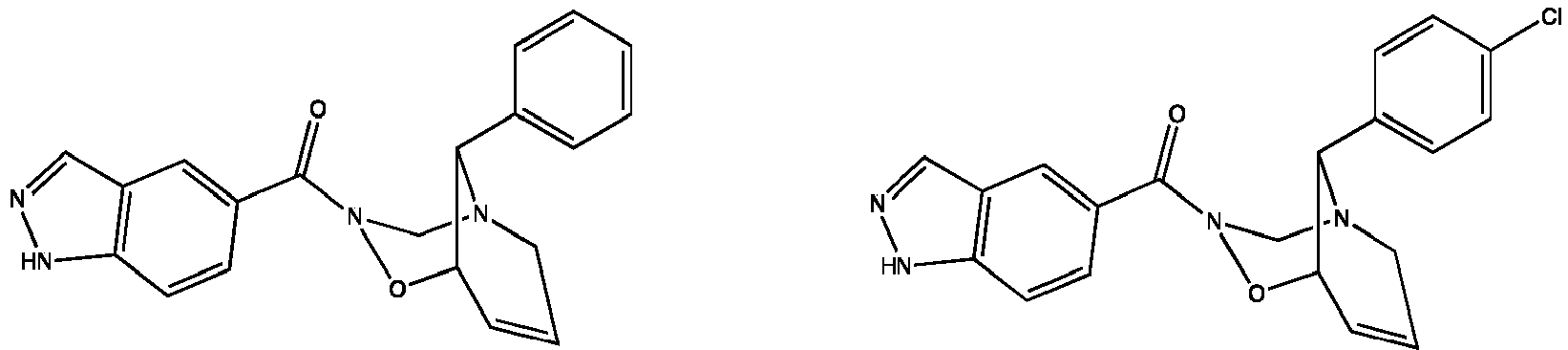


- In an even more preferred embodiment, the compounds of formula (I) can be selected from among those having the following formulas:


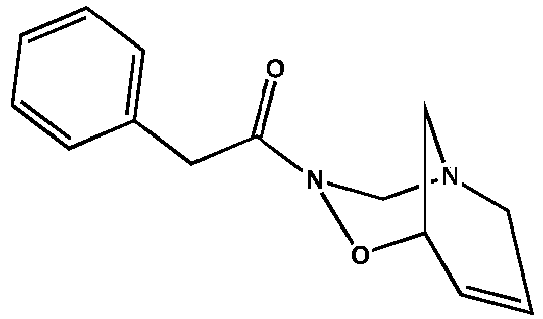

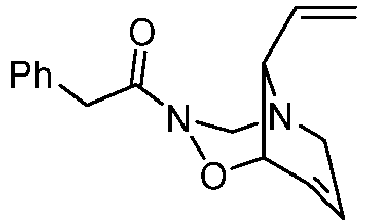


- These compounds correspond respectively (in the listed order) to the ones indicated in the examples that follow as (Ib), (If), (Ia), (Im), (In), (Io), (Ip).
- Even more preferably, the compound of formula (I) can have the following formula:

- In this structure, the substituent R1 is an unsubstituted phenyl and the substituent R2 is an unsubstituted benzyl; this compound corresponds to the structure indicated in the present description as (Ib).
- Another aspect of the invention relates to a process for the manufacture of the compounds of formula (I) disclosed herein, wherein a 4a,7,8,8a-tetrahydropyrido[4,3-e]-1,4,2-dioxazine having formula (2):

- In a preferred embodiment, the process can be carried out at a temperature of 0°C (± 1°C). In another preferred embodiment, the process can be carried out at room or ambient temperature: standard ambient temperature (SAT) means a temperature of 25°C (± 1°C), as is well known in the field of chemistry.
- In a preferred embodiment, the hydride which reacts with the dioxazine can be lithium triethylborohydride (LiBHEt3 or LiTEBH); lithium triethylborohydride is a commercially available hydride known by the trade name Super-hydride®.
- In another preferred embodiment, the process of the invention can take place in the presence of a palladium-based catalyst comprising at least one triphenylphosphine group. Advantageously, the catalyst can be selected from the group consisting of: tetrakis(triphenylphosphine)palladium(0) (Pd(PPh3)4) and bis(triphenylphosphine)palladium(II) dichloride ((PPh3)2PdCl2). More preferably, the catalyst can be (PPh3)2PdCl2.
- In one embodiment, the process can take place using the hydride LiBHEt3, in the absence of a catalyst and at a temperature of 0°C (± 1°C). In another embodiment, the process can take place in the absence of a catalyst and at room temperature. In another embodiment, the process can take place in the presence of a catalyst and at a temperature of 0°C (± 1°C).
- The reaction time can range between about 15 minutes and about 4 hours, depending on the other reaction conditions (above all temperature and the presence or absence of a catalyst) and the hydride used. The time taken can preferably be comprised between about 20 minutes and about 60 minutes when LiBHEt3 is used, irrespective of whether the catalyst is present. NaBHEt3 is less effective and when it is used in the process longer reaction times are necessary, preferably comprised between 2 hours and 30 min and 3 hours and 30 min, depending on whether the catalyst is present or not.
- In order to succeed in defining the conditions of the process of the invention, the inventors assessed the behaviour of the dioxazine of formula (2) where R1 = Ph, R2 = CH2Ph and PG = COOMe under reducing conditions and different reaction conditions. This dioxazine will hereinafter be indicated as (2b).
- The reaction of the dioxazine (2b) is shown in Diagram 2 below.
-

- The various experimental conditions examined and the respective results obtained in terms of products are shown in Table 1 below.
Table 1: Example Hydride Catalyst Temperature Time Ib/4b/5ba (%) 1 (comparative) NaBH4 none 0°C 12 h no reaction 2 (comparative) LiBH4 none room 18 h 0/100/0 b 3 LiBHEt3 none 0°C 20 min 100/0/0 4 NaBHEt3 none room 3.5 h 100/0/0 5 (comparative) NaBH4 (PPh3)2PdCl2 0°C 21 h 0/50/50 6 C (comparative) NaBH4 (PPh3)2PdCl2 60°C 24 h no reaction 7 (comparative) LiBH4 (PPh3)2PdCl2 0°C 1h 0/72/28 8 LiBHEt3 (PPh3)2PdCl2 0°C 30 min 95/5/0 9 LiAIH4 (PPh3)2PdCl2 0°C 30 min 95/5/0 10 NaBHEt3 (PPh3)2PdCl2 0°C 3 h 95/5/0 11 LiBHEt3 Pd(PPh3)4 0°C 30 min 95/5/0 12 (comparative) LiBHEt3 Pd(dba)2 0°C 1h 37/63/0 13 (comparative) LiBHEt3 Pd(CH3CN)2Cl2 0°C 30 min 0/100/0 b 14 (comparative) LiBHEt3 Pd(CH3CN)2Cl2 -78°C 2 h no reaction 15 (comparative) NaBHEt3 Pd(CH3CN)2Cl2 0°C 40 min 0/100/0 b 16 d (comparative) NaBH4 Pd(CH3CN)2Cl2 0°C 48 h 0/100/0 a. determined by NMR analysis; b. a further unidentified product was recovered; c. reaction conducted in MeOH d. the conversion was 60% - With reference to the test results shown in table 1 above, an assessment was first made of the effects of using hydrides having a different strength and of the presence or absence of palladium-based catalysts having different electronic characteristics.
- Reactions were initially conducted in the absence of a palladium-based catalyst in order to exclude the triggering of secondary reactions promoted by the hydrides.
- The first hydride examined was sodium borohydride; the dioxazine (2b) treated with sodium borohydride in THF for 12 hours did not undergo any reaction. The use of lithium borohydride resulted in the obtainment of a secondary product, a piperidine of structure (4b) (see reaction Diagram 2 above). When lithium borohydride was replaced with 6 equivalents of lithium triethylborohydride (Super-hydride®, a stronger hydride), the reaction led to the obtainment of the 1,3-diazo-4-oxa-[3.3.1]-bicyclic derivative of structure (Ib). Furthermore, it was noted that it was also possible to obtain the derivative of structure (Ib) using sodium triethylborohydride, though a longer reaction time and higher temperature were necessary than when lithium triethylborohydride was used.
- The reaction mechanism seems to involve a non-catalysed initial SN2' type reaction of the hydride at the C6 position of the dioxazine, which is followed by the opening of the dioxazine structure and subsequent intramolecular amination, as shown in diagram 3 below, which makes reference to the reaction of the dioxazine (2b).
-

- It should be said that, whilst the allylic deoxygenation reaction catalysed by palladium is known in the prior art, a non-catalysed SN2' type reaction between a hydride and a substrate, such as the dioxazine of structure (2), which comprises a piperidine bearing a leaving allyl group has not been reported to date.
- An assessment was thus made of how palladium could influence the reaction. It was observed from the tests carried out, the results of which are likewise shown in table 1, that 6 equivalents of sodium borohydride gave a mixture of unsaturated piperidine having structures (4b) and (5b) in a ratio similar to that resulting from the use of the catalyst bis(triphenylphosphine)palladium(II) dichloride (example 5). This different result compared with the control reaction supports the formation of a β-allyl complex.
- The solvent is also essential in order for the reaction to take place: carrying out the reaction in methanol does not lead to any product, even when the temperature is raised to 60°C (example 6).
- When the dioxazine (2b) is treated with lithium borohydride, the ratio between the piperidine of structures (4b) and (5b) varies slightly (example 7). In contrast, the compound (Ib) according to the invention proved to be the predominant product when the reaction was carried out with bis(triphenylphosphine)palladium(II) dichloride and lithium triethylborohydride (example 8). Analogously, the lithium tetrahydroaluminate reacted rapidly with the dioxazine (2b) to yield the compounds of structures (Ib) and (4b) in a 95:5 ratio (example 9). The same regioselectivity was obtained using sodium triethylborohydride (example 10).
- Based on the data provided in table 1, which show that the regioselectivity of the reaction leads to compound (Ib) or products (4b) and/or (5b) depending on the reaction conditions, the inventors have concluded that two distinct reactions can take place. The first is an SN2/SN2' reaction mediated by hydrides comprising lithium as the counterion; the second is an allylic substitution catalysed by palladium. Both reactions take place starting from an initial addition on the enecarbamate portion of the dioxazine (2b).
- Therefore, when the reaction conditions provide for a lithium-based hydride and a palladium-based catalyst, the two reactions compete for the substrate (2b) and, as a consequence, the ratio of the products obtained ((Ib) and (4b)/(5b)) depends on the respective speed of the two reactions.
- The protective group PG bonded to nitrogen has an important role in the preparation of 1,3-diazo-4-oxa-[3.3.1]-bicyclic derivatives with the process according to the invention.
- The inventors have determined that the protective group must be such as to form a carbamate following the formation of the bond with the nitrogen atom present on the oxazolic ring of the dioxazine, according to the mechanism shown above in reaction diagram 3. The presence of the carbamate is in fact an essential condition in order to have reactivity with the hydrides. In order for the protective group to form a carbamate by reacting with the nitrogen of the oxazolic ring, it must comprise a carboxylic group (COO-). By way of example, some appropriate protective groups can be -COOMe, - COOPh and -CBz.
- Table 2 below shows the results of the rearrangement, according to the invention, of several dioxazines, achieved using LiBHEt3 as a hydride and working in THF at 0°C.
- The dioxazines indicated in table 2 were prepared in accordance with the invention, as described further below, and their structural formulas are shown in section 2.1 of the examples.
- As may be observed, the reaction of the dioxazine (2f), wherein the substituent R1 is an ethyl group, gave the corresponding compound (If) (example 1), even though a lower yield was found compared to the previously reported reaction of the dioxazine (2b). In contrast, the dioxazine (2h), where the protective group used was an acetyl, did not result in the expected compound (Ih): rather, a complex mixture of products was recovered (example 2). These results have thus demonstrated the necessary presence of a carbamate group (which forms when the protective group PG comprises a carboxyl) in order for the rearrangement leading to the corresponding 1,3-diazo-4-oxa-[3.3.1]-bicyclo to take place.
- Furthermore, it was found that the dioxazines wherein R2 is phenyl also underwent a rearrangement with the formation of the respective bicyclo of structure (I) (see example 5, where the dioxazine is (2m)): this result therefore offers the possibility of exploiting different dioxazines bearing an aryl group as the substituent R2.
Table 2: Example PG R1 R2 dioxazine product 1 COOMe Et CH2Ph 2f If 2 (comparative) COMe Ph CH2Ph 2h Complex mixture 3 COOPh H CH2Ph 2a Ia 4 CBz H CH2Ph 2d Ia 5 COOMe Ph Ph 2m Im 6 COOMe (Vinyl) C2H3 CH2Ph 2n In 7 COOMe (Cyclohexyl) Chx CH2Ph 2o Io 8 COOMe (Allyl) CH2=CH-CH2- CH2Ph 2p Ip - In one embodiment, the process of the invention can also comprise a step, preceding the reaction of the dioxazine of formula (2) with the hydride, wherein the dioxazine itself is obtained by a [3,3]-sigmatropic type rearrangment starting from the corresponding reverse cycleadduct. The cycleadducts corresponding to the dioxazines of formula (2) which react in the process of the invention have the formula (1) shown below in reaction diagram 4, wherein R1 and R2 have the meanings previously defined for the compounds of formula (I) and the dioxazines of formula (2).
-

- Although this reaction is known in the prior art, the inventors were able to define conditions that allow the reaction to take place effectively and with reasonable reaction times. Therefore, the rearrangement of the cycleadduct according to the present invention takes place in dichloroethane, at a temperature of 75°C (± 2°C) and in the presence of CuCI as a catalyst. Preferably, the amount of CuCI can be comprised between 18 mol% and 22 mol%, more preferably it can be equal to 20 mol%.
- In another aspect, the invention relates to the compounds having structural formula (I), wherein R1 and R2 are defined as set forth above, or pharmaceutically acceptable salts thereof, for use as a medicament. The inventors have in fact found that the compounds of formula (I) are capable of modulating, in a direct or indirect manner, the GLP-1 receptor. The compounds of the invention thus act upon the mechanism of signal transmission (pathway) mediated by the GLP-1 receptor. By virtue of this action, the compounds of the invention or the pharmaceutically acceptable salts thereof can be used in particular to treat diabetes, preferably type 2 diabetes. Furthermore, the compounds of the invention or the pharmaceutically acceptable salts thereof can be used in the treatment of several pathologies correlated to diabetes, such as obesity and dyslipidaemic syndromes. The term "dyslipidaemic syndromes" (or "dyslipidaemias") refers generically to conditions in which the amount of lipids (in particular cholesterol, triglycerides and/or phospholipids) in the bloodstream is altered compared to the normal physiological condition; in dyslipidaemias the amount of lipids is increased (hypercholesterolaemia, hypertriglyceridaemia, hyperphospholipidaemia), but there also exist dyslipidaemias in which the amount of lipids is lower than in normal physiological condition. One complication typical of dyslipidaemic syndromes is represented by hepatic steatosis (commonly called "fatty liver"), in which there is an intracellular accumulation of lipids in hepatic tissue: hepatic steatosis can be treated by means of the compounds of the present invention or the pharmaceutically acceptable salts thereof. Moreover, the compounds of the invention or the pharmaceutically acceptable salts thereof can also be used to regulate the sense of satiety or appetite.
- The compounds of formula (I) according to the present invention, the process for their manufacture and their use for treating diabetes and the pathologies or conditions associated therewith, conceived as described herein, are susceptible of numerous modifications and variants, all falling within the scope of the inventive concept; furthermore, all of the details may be replaced by other equivalent elements whose correspondence is known to the person skilled in the art.
- Furthermore, it is to be understood that the characteristics of the embodiments described with reference to one aspect of the invention are to be considered valid also in relation to other aspects of the invention, even if not explicitly repeated.
- The invention will now be illustrated by some examples whose purpose is absolutely not to be construed as limiting the scope of protection.
- All the commercially available reagents were purchased except where specified otherwise. The solvents for extraction and chromatography were distilled prior to use.
- All of the reactions involving compounds sensitive to air or humidity were carried out in an argon atmosphere in 10 ml or 25 ml Schlenk tubes oven dried in advance.
- The TLC analyses were carried out on Alugram SIL G/UV254 silica gel sheets with detection by exposure to ultraviolet light (254 nm) and/or per immersion in an acid staining solution of p-anisaldehyde in EtOH. For the flash chromatography, silica gel 60 was used (Macherey-Nagel 230-400 mesh).
- The 1H NMR spectra were recorded on a Bruker Avance II 250 spectrometer. The chemical shifts are reported in ppm relative to tetramethylsilane considering the resonance of the solvent as an internal standard (deuterochloroform: δ7.26, deuteroacetonitrile: 51.94). The 13C NMR spectra were recorded on a Bruker Avance II 250 spectrometer (62.5 MHz) with complete proton decoupling. The chemical shifts are reported in ppm relative to tetramethylsilane considering the resonance of the solvent as an internal standard (deuterochloroform: δ77.16, deuteroacetonitrile: δ1.32).
- The melting points were determined with a Kofler unit and were not corrected.
- The HRMS (ESI) mass spectra were measured with a Q-TOF spectrometer with a nanoelectrospray ion source.
- The biological activity of the synthesised compounds was measured with an ELISA assay.
- The specific reverse cycleadduct of formula (1), copper chloride (I) (CuCI, 0.20 equivalents) and 1,2-dichloroethane (DCE, 0.15 M) were introduced into a 10 ml oven-dried Pyrex vial. The resulting mixture was left to react until the TLC analysis no longer revealed any starting reagent. The reaction was quenched with water, the aqueous phase was extracted with CH2Cl2 and the combined organic layers were dried on MgSO4. The removal of the solvent gave a residue that was purified by flash chromatography.
- Shown below are some dioxazines (2a-2p) prepared starting from a corresponding reverse cycleadduct of formula (1) according to the reaction shown in diagram 4.


- As described in the general procedure, the cycleadduct (1a) (70.1 mg, 0.20 mmol) and CuCI (4.0 mg, 0.04 mmol) reacted in DCE (1.32 ml) at 75°C for 18 h. The subsequent flash chromatography (hexane/AcOEt 7:3, Rf = 0.34) led to the above compound, in semisolid form (40 mg, 59%).
1H NMR (250 MHz, CD3CN, 65 °C) δ 7.47 - 7.23 (m, 8H), 7.22 - 7.14 (m, 2H), 7.06 (d, 1H, J = 6.3 Hz), 4.95 - 4.86 (m, 2H), 4.26 - 4.19 (m, 1H), 4.11 - 3.98 (m, 1H), 3.85 - 3.69 (m, 1H), 3.51 (s, 2H).
13C NMR (62.5 MHz, CD3CN) δ 156.0, 153.1, 152.5* and 152.0, 136.9, 130.4, 129.7, 129.5, 128.7* and 128.6, 127.9, 126.9, 122.8, 103.9* and 103.3, 67.3 and 67.2*, 65.3* and 65.2, 44.0* and 43.7, 38.7. [*minor rotamer].
HRMS (ESI) m/z [M + Na+] calculated for C20H18N2O4Na 373.1164, found 373.1161. - As described in the general procedure, the cycleadduct (1b) (73 mg, 0.20 mmol) and CuCI (4.0 mg, 0.04 mmol) reacted in DCE (1,32 mL) at 75°C for 15 h. The subsequent flash chromatography (hexane/AcOEt 8:2 + 1% Et3N, Rf = 0.11) led to the above compound, in white solid form (55 mg, 75%). Melting point = 45-48°C.
1H NMR (250 MHz, CD3CN, 65°C) δ 7.42 - 7.21 (m, 10H), 7.17 - 7.10 (m, 1H), 5.46 (d, 1H, J = 2.9 Hz), 4.77 - 4.70 (m, 1H), 4.55 - 4.50 (m, 1H), 4.19 - 4.14 (m, 1H), 3.70 (s, 3H), 3.48 (s, 2H).
13C NMR (62.5 MHz, CD3CN) 13C NMR (62.5 MHz, CDCl3) δ 156.5, 151.2, 136.9 and 136.8*, 130.1, 130.0, 129.6, 129.5, 129.1, 128.1* and 127.9, 126.6, 122.4, 102.4, 69.0, 66.4, 58.7, 54.2.
HRMS (ESI) m/z [M + Na+] calculated for C21H20N2O4Na 387.1321 found 387.1322. - As described in the general procedure, the cycleadduct (1c) (85 mg, 0.20 mmol) and CuCI (4.0 mg, 0.04 mmol) reacted in DCE (1.32 ml) at 75°C for 18 h. The subsequent flash chromatography (hexane/AcOEt 7:3, Rf = 0.12) led to the above compound, in semisolid form (36 mg, 42%).
1H NMR (250 MHz, CD3CN) δ 7.47 - 7.19 (m, 14H), 7.03 (d, 2H, J = 7.3 Hz), 5.62 (d, 1H, J = 2.7 Hz), 4.88 (dt, 1H, J = 8.6, 2.1 Hz), 4.61 (dt, 1H, J = 3.6, 1.9 Hz), 4.28 - 4.22 (m, 1H), 3.51 (s, 2H).
13C NMR (62.5 MHz, CD3CN) δ 156.9, 152.3, 137.2, 137.1, 130.6, 130.3, 129.9, 129.7, 129.5, 128.3, 128. 1, 127.1, 127.0, 122.7, 104.2, 69.6, 66.8, 59.8, 38.8.
HRMS (ESI) m/z [M + Na+] calculated for C26H22N2O4Na 449.1477 found 449.1479. - As described in the general procedure, the cycleadduct (1d) (845 mg, 2.3 mmol) and CuCI (45.5 mg, 0.46 mmol) reacted in DCE (15.2 mL) at 75°C for 18 h. The subsequent flash chromatography (hexane/AcOEt 7:3, Rf = 0.28) led to the above compound, in white solid form (268 mg, 32%). Melting point = 68-72°C.
1H NMR (250 MHz, CD3CN, 65 °C) δ 7.46 - 7.25 (m, 10H), 6.92 (s, 1H), 5.17 (s, 2H), 4.91 - 4.69 (m, 2H), 4.12 (s, 1H), 3.94 (dd, 1H, J = 14.0, 5.4 Hz), 3.60 (t, 1H, J = 13.8Hz), 3.46 (s, 2H).
13C NMR (62.5 MHz, CD3CN) δ 155.8, 137.3, 136.9, 129.6, 129.5, 129.5, 129.2, 129.0, 128.6, 127.9, 102.7* and 102.2, 68.7, 67.3, 65.2, 43.4, 38.7. [*minor rotamer].
HRMS (ESI) m/z [M + Na+] calculated for C21H20N2NaO4 387.1321 found 387.1325. - As described in the general procedure, the cycleadduct (1e) (54.0 mg, 0.19 mmol) and CuCl (3.7 mg, 0.037 mmol) reacted in DCE (1.23 ml) at 75°C for 18 h. The subsequent flash chromatography (hexane/AcOEt 7:3 + 2% Et3N Rf = 0.20) led to the above compound, in white solid form (18 mg, 33%). Melting point = 82-85°C.
1H NMR (250 MHz, CDCl3) δ 7.44 - 7.21 (m, 5H), 7.06 (d, 1H, J = 7.7 Hz)* and 6.90 (d, 1H, J = 7.8 Hz), 4.92 - 4.69 (m, 2H), 4.25-4.10 (m, 1H), 4.05 - 3.87 (m, 1H), 3.80 (s, 3H), 3.67 (d, J = 13.9 Hz, 1H), 3.52 (s, 2H).
13C NMR (62.5 MHz, CDCl3) δ 155.0, 153.9 and 153.6*, 135.4, 128.9, 128.7, 128.3, 127.2, 101.0 and 100.8*, 66.2 and 66.0, 64.9, 53.6, 42.2, 38.4. [*minor rotamer]. HRMS (ESI) m/z [M + Na+] calculated for C15H16N2O4Na 311.1008 found 311.1007. - As described in the general procedure, the cycleadduct (1f) (63.3 mg, 0.20 mmol) and CuCl (4.0 mg, 0.04 mmol) reacted in DCE (1.32 ml) at 75°C for 15 h. The subsequent flash chromatography (hexane/AcOEt 8:2 + 2% Et3N, Rf = 0.22) led to the above compound, in the form of an oil (33 mg, 52%).
1H NMR (250 MHz, CD3CN, 65°C) δ 7.39 - 7.22 (m, 5H), 6.82 (d, 1H, J = 8.5 Hz,), 4.93 -4.88 (m, 1H), 4.67 (dt, J = 8.5, 2.1 Hz, 1H), 4.36 - 4.25 (m, 1H), 3.98 (dd, 1H, J = 5.8, 3.3 Hz), 3.75 (s, 3H), 3.48 (s, 2H), 1.63 - 1.43 (m, 2H), 0.96 (t, 3H, J = 7.5 Hz).
13C NMR (62.5 MHz, CD3CN, 65°C) δ 156.6, 154.8, 137.0, 129.7, 129.5, 127.9, 126.9, 101.9, 67.3, 66.5, 56.8, 53.9, 38.7, 23.2, 10.6.
HRMS (ESI) m/z [M + Na+] calculated for C17H20N2O4Na 339.1321 found 339.1318. - As described in the general procedure, the cycleadduct (1g) (33 mg, 0.075 mmol) and CuCl (1.5 mg, 0.015 mmol) reacted in DCE (0.50 ml) at 75°C for 15 h. The subsequent preparation TLC (hexane/AcOEt 7:3, 2 runs) led to the above compound, in yellowish solid form (17 mg, 52%). Melting point = 50-55°C.
1H NMR (250 MHz, CD3CN, 65°C) δ 7.63 - 7.23 (m, 15H), 6.71 (d, 1H, J = 8.3 Hz), 5.55 (bs, 1H), 5.34 - 5.25 (m, 1H), 4.83 (dt, 1H, J = 8.6, 2.0 Hz,), 4.33 - 4.23 (m, 1H), 3.53 (s, 2H).
13C NMR (62.5 MHz, CD3CN) δ 170.1, 156.8, 136.72, 134.9, 132.8, 132.0, 130.3, 129.7, 129.7, 129.6(x2), 128.8, 128.0, 122.4, 104.1, 85.6, 83.2, 67.6, 66.9, 47.5, 38.5.
HRMS (ESI) m/z [M + Na+] calculated for C2sH22N2O3Na 457.1528 found 457.1528. - As described in the general procedure, the cycleadduct (1h) (52 mg, 0.15 mmol) and CuCl (3.0 mg, 0.03 mmol) reacted in DCE (1.00 mL) at 75°C for 16 h. The subsequent flash chromatography (hexane/AcOEt 6:4, Rf = 0.26) led to the above compound, in white amorphous solid form (36 mg, 68%).
1H NMR (250 MHz, CDCl3) Major rotamer: δ 1H NMR (250 MHz, CDCl3) δ 7.59 (d, 1H, J = 9.1 Hz)* and 6.89 (d, 1H, J = 8.9 Hz), 7.42 - 7.11 (m, 10H), 5.81 (d, 1H, J = 2.5 Hz) and 5.23 (d, 1H, J = 2.5 Hz)*, 4.80 (dd, J = 22.5, 8.6 Hz, 1H), 4.55 (d, J = 18.3 Hz, 1H), 4.84 (d, 1H, J = 8.7 Hz)* and 4.75 (d, 1H, J = 8.5 Hz), 4.58 (s, 1H) and 4.51 (s, 1H)*, 4.09 (bs, 1H), 3.48 (s, 2H), 2.28 (s, 3H) and 2.03 (s, 3H)*.
13C NMR (62.5 MHz, CD3CN) δ 169.9, 156.6, 137.0* and 136.8, 130.3, 129.9, 129.6, 129.5, 129.3, 128.9, 127.9, 126.8 and 126.6*, 103.8* and 102.7, 69.2, 66.9 and 66.6*, 56.9, 38.5, 21.9.
HRMS (ESI) m/z [M + Na+] calculated for C21H20N2O3Na 371.1372 found 371.1374. - As described in the general procedure, the cycleadduct (1i) (29 mg, 0.09 mmol) and CuCl (1.7 mg, 0.017 mmol) reacted in DCE (0.57 ml) at 75°C for 17 h. The subsequent chromatography led to the above compound in almost pure form (23 mg, 75%).
1H NMR (250 MHz, CDCl3) δ 7.81 - 7.75 (m, 2H), 7.66 (d, 1H, J = 8.7 Hz)* and 6.97 (d, 1H, J = 8.6 Hz), 7.47 - 7.18 (m, 8H), 5.92 (d, 1H, J = 2.8 Hz) and 5.33 (d, 1H, J = 2.8 Hz)*, 5.06 (dt, 1H, J = 8.8, 2.0 Hz)* and 4.97 (dt, 1H, J = 8.7, 2.0 Hz), 4.88 - 4.84 (m, 1H) and 4.81 - 4.76 (m, 1H)*, 4.32 - 4.26 (m, 1H), 2.31 (s, 3H) and 2.06 (s, 3H)*.
13C NMR (62.5 MHz, CDCl3) δ 169.0* and 168.5, 153.1* and 152.9, 135.7, 135.2, 130.7* and 130.7, 130.2 and 130.1*, 129.7, 129.3, 129.0, 128.4 and 128.3*, 126.3* and 125.8, 102.7* and 102.2, 69.2* and 69.0, 65.9* and 65.7, 59.8, 56.4, 21.8 and 21.7*.
HRMS (ESI) m/z [M + Na+] calculated for C20H18N2NaO3 357.1215 found 357.1215. - As described in the general procedure, the cycleadduct (1j) (71 mg, 0.20 mmol) and CuCl (4.0 mg, 0.04 mmol) reacted in DCE (1.32 ml) at 75°C for 15 h. The subsequent flash chromatography (hexane/AcOEt 3:7, Rf = 0.54) led to the above compound, in amorphous solid form (21 mg, 30%).
1H NMR (250 MHz, CDCl3) major rotamer δ: 7.38-7.22 (m, 5H); 6.67 (dt, 1H, J = 1.25, 8.5 Hz); 4.97-4.88 (m, 1H); 4.77-4.62 (m, 2H); 3.96 (q, 1H, J = 2.75, 6 Hz); 3.46 (s, 2H); 2.21 (s, 3H); 1.39-1.21 (m, 10H); 0.92-0.80 (m, 3H).
13C NMR (62.5 MHz, CD3CN) major rotamer δ:169.7; 156.7; 128.1; 127.5; 103.4; 12.3; 67.7; 66.7; 53.0; 50.2; 38.6; 32.3, 29.7; 26.4; 24.5; 14.4.
HRMS (ESI) m/z [M + Na+] calculated for C21H28N2O3Na 379.1998 found 379.2000. - As described in the general procedure, the cycleadduct (1k) (66 mg, 0.20 mmol) and CuCl (4.0 mg, 0.04 mmol) reacted in DCE (1.32 ml) at 75°C for 15 h. The subsequent flash chromatography (hexane/AcOEt 4:6, Rf = 0.35) led to the above compound, in amorphous solid form (28 mg, 42%). Melting point =119-121°C
1H NMR (250 MHz, CDCl3), major rotamer δ 7.79 (dd, 2H, J = 7.9, 1.6 Hz), 7.49 - 7.32 (m, 3H), 6.65 (d, 1H, J = 8.6 Hz), 5.30 - 5.15 (m, 2H), 4.93 (dt, 1H, J = 8.5, 2.1 Hz), 4.26 (dd, 1H, J = 5.8, 3.0 Hz), 3.71 (s, 3H), 2.73 (dd, 1H, J = 15.0, 5.7 Hz), 2.43 (dd, 1H, J = 15.0, 9.7 Hz), 2.22 (s, 3H).
13C NMR (62.5 MHz, CDCl3) δ 170.0, 168.6, 152.9, 130.7, 130.1, 128.4, 127.0, 125.8, 101.7, 66.2 and 66.1*, 52.4, 49.5, 33.9, 21.7. [*minor rotamer].
HRMS (ESI) m/z [M + Na+] calculated for C17H18N2O5Na 353.1113 found 353.1113. - As described in the general procedure, the cycleadduct (1I) (67 mg, 0.20 mmol) and CuCl (4.0 mg, 0.04 mmol) reacted in DCE (1.32 ml) at 75°C for 18 h. The subsequent flash chromatography (hexane/AcOEt 7:3, Rf = 0.22) led to the above compound, in white solid form (40 mg, 59%). Melting point = 130-131°C.
1H NMR (250 MHz, CDCl3) δ 7.90 - 7.80 (m, 2H), 7.51 - 7.34 (m, 5H), 7.30 - 7.10 (m, 4H), 5.18 (dd, 1H, J = 8.3, 3.0 Hz)*, 5.12 - 5.02 (m, 1H and major rotamer of 5.18), 4.48 - 4.35 (m, 1H), 4.24 - 4.11 (m, 1H), 4.01 (dd, 1H, J = 14.0, 3.1 Hz)* and 3.83 (dd, 1H, J = 14.1, 2.9 Hz).
13C NMR (62.5 MHz, CDCl3) δ 152.1, 151.5, 150.8 and 150.6*, 130.7 and 130.2*, 129.6 and 129.1*, 128.4, 126.1* and 125.9, 121.6 and 121.6*, 102.3* and 101.9, 66.1 and 65.8*, 65.4* and 65.2, 42.6. [*minor rotamer].
ESI-MS = 359.09 (M+Na+).
HRMS (ESI) m/z [M + Na+] calculated for C19H16N2O4Na 359.1008 found 359.1005. - As described in the general procedure, the cycleadduct (1m) (50 mg, 0.14 mmol) and CuCl (3.0 mg, 0.03 mmol) reacted in DCE (0.95 ml) at 75°C for 60 h. The subsequent flash chromatography (hexane/AcOEt 7:3, Rf = 0.22) led to the above compound, in yellowish amorphous solid form (40 mg), which was used in the subsequent step without any further purification.
1H NMR (250 MHz, CD3CN) δ 7.81-7.65 (m, 2H), 7.47-7.12 (m, 9H), 5.57 (d, 1H, J = 2.5 Hz), 5.05-4.93 (m, 1H), 4.76 (bs, 1H), 4.34 (d, 1H, J = 2.8 Hz), 3.76 (bs, 3H).
13C NMR (62.5 MHz, CD3CN) δ 153.6, 137.0, 131.5, 131.5, 130.0, 129.4, 129.2, 128.3, 126.7, 126.5, 69.4, 66.6, 58.7, 54.2. - As described in the general procedure, the cycleadduct (1n) (193 mg, 0.61 mmol) and CuCl (12.2 mg, 0.123 mmol) reacted in DCE (4.10 ml) at 75°C for 17 hours. The subsequent flash chromatography (petroleum ether/AcOEt 7:3, Rf = 0.23) led to the above compound, in the form of a colourless oil (140 mg, 72.5%).
1H NMR (250 MHz, CD3CN, 65 °C) δ 7.39 - 7.18 (m, 5H), 6.91 (d, J = 8.5 Hz, 1H), 5.74 (ddd, J = 15.7, 10.6, 4.8 Hz, 1H), 5.26 (d, J = 10.5 Hz, 1H), 5.18 (d, J = 17.4 Hz, 1H), 4.94 (bs, 1H), 4.79 (bs, 1H), 4.66 (d, J = 8.3 Hz, 1H), 4.06 - 3.98 (m, 1H), 3.75 (s, 3H) 3.48 (s, 2H).
13C NMR (62.5 MHz, CD3CN) δ 156.5, 154.6, 136.9, 131.5, 129.6, 129.5, 127.9, 127.1, 117.9, 102.1, 67.1, 66.7, 57.3, 54.1, 38.6. - As described in the general procedure, the cycleadduct (1o) (69 mg, 0.186 mmol) and CuCl (3.7 mg, 0.0373 mmol) reacted in DCE (1.30 ml) at 75°C for 2 hours. The subsequent flash chromatography (petroleum ether/AcOEt 8:2, Rf = 0.25) led to the above compound, in white solid form (40 mg, 58%).
1H NMR (250 MHz, CD3CN) δ 7.39 - 7.20 (m, 5H), 6.83 (d, J = 7.7 Hz, 1H), 4.92 (bs, 1H), 4.70 (d, J = 7.5 Hz, 1H), 4.19 (d, J = 8.9 Hz, 1H), 4.07 (s, 1H), 3.73 (s, 3H), 3.47 (s, 2H), 1.82 - 1.40 (m, 6H), 1.32 - 0.98 (m, 5H).
13C NMR (63 MHz, CD3CN) δ 156.6, 155.3 and 155.2*, 136.9, 129.6, 129.5, 127.8, 127.6 and 127.3*, 103.2* and 102.7, 67.5, 65.5, 60.0, 54.0 and 53.7*, 38.6, 37.9, 30.3, 26.8, 26.6, 26.5. [* minor rotamer] - As described in the general procedure, the cycleadduct (1p) (70 mg, 0.213 mmol) and CuCl (4.2 mg, 0.043 mmol) reacted in DCE (1.4 ml) at 75°C for 18 hours. The subsequent flash chromatography (hexane/AcOEt 7:3, Rf = 0.25) led to the above compound, in the form of a colourless oil (40.4 mg, 57.7%).
1H NMR (250 MHz, CD3CN, 65 °C) δ 7.42 - 7.20 (m, 5H), 6.85 (d, J = 8.4 Hz, 1H), 5.96 - 5.69 (m, 1H), 5.21 - 5.02 (m, 2H), 4.97 - 4.92 (m, 1H), 4.74 - 4.65 (m, 1H), 4.46 (td, J = 7.4, 3.0 Hz, 1H), 3.96 (dd, J = 5.9, 3.0 Hz, 1H), 3.75 (s, 3H), 3.49 (s, 2H), 2.43 - 2.18 (m, 2H).
13C NMR (62.5 MHz, CD3CN) δ 156.4, 154.6* and 154.3, 136.8, 134.2, 129.6, 129.4, 127.8, 126.7, 118.8, 102.1* and 101.7, 67.0, 66.4, 54.7, 53.9, 38.6, 34.7* and 34.3. [* minor rotamer]. - The dioxazine, the palladium-based catalyst (0.05 equivalents) and the freshly distilled THF were introduced into a 5 ml oven-dried Schlenk tube, in an argon atmosphere. The resulting mixture was cooled to 0°C and the hydride source was added slowly. Once the dioxazine had disappeared, the reaction was quenched with water, and the aqueous phase was extracted with Et2O. The combined organic layers were dried on MgSO4, concentrated and purified by flash chromatography.
- As described in the general procedure, the dioxazine (2b) (54.7 mg, 0.15 mmol), Pd(CH3CN)2Cl2 (2.0 mg, 0.0075 mmol), LiBHEt3 (0.9 ml, 0.9 mmol) and THF (0.26 mL) were reacted at 0°C for 30 minutes. The subsequent flash chromatography (hexane/AcOEt 6:4 Rf = 0.15) led to the above compound, in the form of a sticky oil (20 mg, 37%).
1H NMR (250 MHz, CDCl3) 9.04 (bs, 1H) and 8.60* (bs, 1H) (replaceable with D2O), 7.43 - 6.96 (m, 11H), 5.59 (s, 1H) and 5.44* (s, 1H), 4.77 (d, 1H, J = 26.7 Hz), 4.44 (s, 1H), 3.74 (s, 3H), 3.60 - 3.48 (m, 2H), 2.38 - 2.11 (m, 1H), 1.94 (dd, 1H, J = 39.4, 18.4 Hz).
13C NMR (62.5 MHz, CDCl3) δ 169.5, 154.7 and 154.4*, 138.4 and 138.2*, 134.2, 129.3, 129.0, 128.9, 127.8, 127.4, 125.7, 125.3, 124.7, 102.6 and 102.0*, 79.9 and 79.4*, 56.4 and 55.8*, 53.5, 31.0, 22.0 and 21.3*. [*minor rotamer].
HRMS (ESI) m/z [M + Na+] calculated for C21H22N2O4Na 389.1477 found 389.1478. - As described in the general procedure, the dioxazine (2b) (54.7 mg, 0.15 mmol), Pd(CH3CN)2Cl2 (2.0 mg, 0.0075 mmol), NaBH4 (35 mg, 0.9 mmol) and THF (0.71 ml) were reacted at 0°C for 30 minutes. The subsequent flash chromatography (hexane/AcOEt 6:4) led to compound 4b (Rf = 0.15) and the above compound, in the form of a sticky oil (Rf = 0.22, 7 mg, 13%).
1H NMR (250 MHz, CD3CN, 65 °C) δ 9.21 (bs, 1H), 7.40 - 7.23 (m, 10H), 7.21 - 7.14 (m, 2H), 6.16 - 6.12 (m, 1H), 6.10 (dd, 1H, J = 3.5, 2.7 Hz), 6.03 - 5.93 (m, 1H), 5.67 (s, 1H), 4.63 (d, 1H J = 5.7 Hz), 4.41 - 4.38 (m, 1H), 4.34 - 4.29 (m, 1H), 3.71 (s, 3H), 3.69 - 3.65 (m, 1H), 3.59 (dd, 1H, J = 4.3, 2.2 Hz), 3.48 (s, 2H).
13C NMR (62.5 MHz, CDCl3) δ 169.1, 134.1, 132.3, 129.3, 129.0, 128.7, 127.9, 127.4, 127.2, 121.1, 77.4, 53.2, 41.3, 31.0, 29.8.
HRMS (ESI) m/z [M + Na+] calculated for C21H22N2O4Na 389.1477 found 389.1478. - The dioxazine and the freshly distilled THF were introduced into a 5 ml oven-dried Schlenk tube, in an argon atmosphere. The resulting mixture was cooled to 0°C and a solution of LiBHEt3 (1.0 M in THF, 6.0 equivalents) was added dropwise. Once the dioxazine had disappeared, the reaction was quenched with water, and the aqueous phase was extracted with Et2O. The combined organic layers were dried on MgSO4, concentrated and purified by flash chromatography.
- As described in the general procedure, the dioxazine (2b) (54.7 mg, 0.15 mmol), LiBHEt3 (0.90 ml, 0.90 mmol) and THF (0.26 ml) were reacted at 0°C for 25 minutes. The subsequent flash chromatography (hexane/AcOEt 8:2, Rf = 0.17) led to the above compound, in white solid form (47 mg, 98%). Melting point = 156-159°C.
1H NMR (250 MHz, CDCl3) δ 7.39 - 7.20 (m, 10H), 6.07 - 5.95 (m, 2H), 5.61 (d, 1H, J = 13.2 Hz), 4.99 - 4.89 (m, 1H), 4.57 (d, 1H, J = 2.2 Hz), 4.48 (d, 1H, J = 13.2 Hz), 3.82 (d, 1H, J = 14.7 Hz), 3.55 (d, 1H, J = 14.7 Hz), 3.45 -3.18 (m, 2H).
13C NMR (62.5 MHz, CDCl3) δ 172.3, 137.0, 129.7, 128.7, 128.5, 128.4, 128.0, 127.7, 126.9, 126.8, 119.4, 72.3, 65.7, 59.6, 47.6, 39.8.
HRMS (ESI) m/z [M + Na+] calculated for C20H20N2O2Na 343.1422 found 343.1421. - As described in the general procedure, the dioxazine (2f) (50 mg, 0.15 mmol), LiBHEt3 (0.90 ml, 0.90 mmol) and THF (0.26 ml) were reacted at 0°C for 30 minutes. The subsequent flash chromatography (hexane/AcOEt 5:5, Rf = 0.30) led to the above compound, in white solid form (20 mg, 50%). Melting point = 68-70°C.
1H NMR (250 MHz, CDCl3) δ 7.45 - 7.10 (m, 5H), 6.20 - 6.13 (m, 1H), 5.91 - 5.77 (m, 1H), 5.48 (d, 1H, J = 13.1 Hz), 4.33-4.19 (m, 2H), 3.77 (d, 1H, J = 14.7 Hz), 3.52 (dd, 2H, J = 17.3, 8.0 Hz), 3.45 - 3.31 (m, 2H), 3.25 (t, 1H, J = 7.4 Hz), 1.41 (ddd, 2H, J = 9.5,7.4,2.7 Hz), 0.99 (t, 3H J = 7.4 Hz).
13C NMR (62.5 MHz, CDCl3) δ 172.2, 136.5, 135.1, 129.6, 128.5, 126.8, 119.0, 73.6, 65.9, 59.5, 47.5, 39.6, 22.7, 10.6.
FT-IR v (cm-1) 3270.7, 3066.9, 3030.5, 2957.9, 2933.3, 2871.7, 1731.1, 1638.6, 1453.3, 1418.9, 1338.6, 1195.1, 1151.9, 1119.3, 1092.2, 882.3, 704.7.
HRMS (ESI) m/z [M + Na+] calculated for C16H20N2O2Na 295.1422 found 295.1421. - As described in the general procedure, the dioxazine (2a) (53 mg, 0.15 mmol), LiBHEt3 (0.90 ml, 0.90 mmol) and THF (0.26 mL) were reacted at 0°C for 30 minutes. The subsequent flash chromatography (hexane/AcOEt 5:5 + 5% Et3N, Rf = 0.20) led to the above compound, in white solid form (20 mg, 31%). Melting point = 95-98°C.
1H NMR (250 MHz, CDCl3) δ 7.39 - 7.18 (m, 5H), 6.22 (dt, 1H J =10.0, 5.4 Hz), 6.03 - 5.91 (m , 1H), 5.44 - 5.31 (m, 1H), 4.40 - 4.33 (m, 1H), 3.88 - 3.42 (m, 5H) 3.0 (d, 1H, J= 13.5 Hz).
13C NMR (62.5 MHz, CDCl3) δ 172.1, 136.8, 135.0, 129.6, 128.5, 126.8, 121.1, 70.1, 64.4, 2.0, 50.1, 39.6.
FT-IR v (cm-1) 3033.1, 2929.6, 2893.2, 2857.1, 1653.0, 1453.3, 1415.2, 1386.3, 1337.1, 1278.9, 1217.3, 1145.8, 1012.5, 783.9, 698.6.
HRMS (ESI) m/z [M + Na+] calculated for C14H1sN2O2Na 267.1109 found 267.1110. - As described in the general procedure, the dioxazine (2m) (30 mg, 0.085 mmol), LiBHEt3 (0.51 ml, 0.51 mmol) and THF (0.15 ml) were reacted starting from 0°C up to room temperature per 18 hours. The subsequent flash chromatography (hexane/AcOEt 5:5, Rf = 0.52) led to the above compound in white amorphous solid form (15 mg, 55%). Melting point = 98-108°C.
1H NMR (250 MHz, CD3CN, 60 °C) δ 7.65-7.22 (m, 10H), 5.96 (dt, 1H, J = 10.0 and 2.8 Hz), 5.72-5.55 (m, 2H), 4.81 (d, 1H, J= 6.3 Hz), 4.71-4.59 (m, 2H), 3.43-3.19 (m, 2H).
13C NMR (250 MHz, CD3CN, 60 °C) δ 137.5, 131.4, 130.1, 129.2, 129.0, 128.4, 127.0, 121.7, 118.5, 73.5, 60.6, 48.7. - As described in the general procedure, the dioxazine (2n) (110 mg, 0.35 mmol), LiBHEt3 (2.1 ml, 2.1 mmol) and THF (0.6 ml) were reacted at 0°C for 7 hours. The subsequent flash chromatography (petroleum ether/AcOEt 5:5, Rf = 0.20) led to the above compound in the form of a colourless oil (27 mg, 27%).
1H NMR (250 MHz, CDCl3) δ 7.36 - 7.17 (m, 5H), 6.18 - 6.08 (m, 1H), 5.94 - 5.83 (m, 1H), 5.69 (ddd, J = 17.4, 10.6, 5.4 Hz, 1H), 5.47 (d, J = 13.3 Hz, 1H), 5.36 - 5.21 (m, 2H), 4.37 - 4.32 (m, 1H), 4.29 (d, J = 13.1 Hz, 1H), 3.96 (dd, J = 3.4, 1.4 Hz, 1H), 3.75 (d, J = 14.8 Hz, 1H), 3.65 - 3.53 (m, 1H), 3.48 (d, J = 14.7 Hz, 1H), 3.44 - 3.31 (m, 1H).
13C NMR (63 MHz, CDCl3) δ 172.2, 136.7, 135.0, 133.2, 129.6, 128.5, 126.8, 119.0, 118.7, 72.9, 65.2, 59.5, 47.9, 39.6. - As described in the general procedure, the dioxazine (2o) (155 mg, 0.42 mmol), LiBHEt3 (2.5 ml, 2.5 mmol) and THF (0.72 ml) were reacted at 0°C for 6.5 hours. The subsequent flash chromatography (petroleum ether/AcOEt 7:3, Rf = 0.17) led to the above compound in white solid form (19.3 mg, 14%, melting point = 139-142 °C) and to the starting material 1o (conversion about 50%, Rf = 0.23).
1H NMR (250 MHz, CDCl3) δ 7.36 - 7.19 (m, 5H), 6.20 - 6.10 (m, 1H), 5.90 - 5.78 (m, 1H), 5.45 (d, J = 13.0 Hz, 1H), 4.41 (d, J = 5.9 Hz, 1H), 4.19 (d, J = 13.1 Hz, 1H), 3.75 (d, J = 14.7 Hz, 1H), 3.55 - 3.26 (m, 3H), 2.95 (d, J = 10.3 Hz, 1H), 1.96 (d, J = 12.5 Hz, 1H), 1.80 - 1.56 (m, 4H), 1.38 - 1.09 (m, 4H), 1.06 - 0.78 (m, 2H).
13C NMR (63 MHz, CDCl3) δ 172.1, 137.0, 135.2, 129.6, 128.4, 126.7, 118.9, 72.5, 66.2, 63.0, 47.6, 39.6, 36.3, 30.2, 29.1, 26.5, 25.9, 25.9. - As described in the general procedure, the dioxazine (2p) (115 mg, 0.35 mmol), LiBHEt3 (2.1 ml, 2.1 mmol) and THF (0.6 ml) were reacted at 0°C for 1.5 hours. The subsequent flash chromatography (hexane/AcOEt 6:4, Rf = 0.13) led to the above compound in amorphous solid form (48 mg, 48.2%).
1H NMR (250 MHz, CDCl3) δ 7.36 - 7.13 (m, 5H), 6.17 (dt, J = 10.0, 2.6 Hz, 1H), 5.91 - 5.72 (m, 2H), 5.45 (d, J = 13.1 Hz, 1H), 5.18 - 5.04 (m, 2H), 4.30 - 4.15 (m, 2H), 3.74 (d, J = 14.7 Hz, 1H), 3.59 - 3.32 (m, 4H), 2.27 - 2.02 (m, 2H).
13C NMR (63 MHz, CDCl3) δ 172.1, 136.5, 135.0, 134.3, 129.6, 128.4, 126.7, 118.7, 117.6, 73.1, 65.8, 57.5, 47.5, 39.6, 34.4. - The biological activity of the compound (5S*,9R*)-9-phenyl-3-phenylacetyl-4-oxa-1,3-diazabicyclo[3.3.1]non-6-ene (Ib) as a GLP-1 receptor agonist was measured via an ELISA assay specifically modified in order to identify the forms of GLP-1 secreted. The action of the compound of formula Ib (11 µM) as a GLP-1 receptor agonist (mSTC-1 GLP-1 sec CRC) is shown in
Figure 1 .
Claims (15)
- Compound having structural formula (I):
 R1 is selected from the group consisting of: H, C1-C6 alkyl, vinyl, allyl, cyclohexyl, 1,2,3-triazole, phenyl optionally substituted by a halogen or by a methoxy functional group, C=C-Ph, and -CH2-COOCH3; andR2 is selected from the group consisting of:(i) phenyl or benzyl, optionally substituted by one or more functional groups independently selected from the group consisting of a halogen, a methoxy functional group and -CF3;(ii) isoxazole;(iii) pyrrole:(iv)
 (v)
(v) (vi)
(vi) (vii)
(vii) (viii)
 (ix)
(ix) (x)
(x)
- The compound according to claim 1, wherein R1 is selected from the group consisting of hydrogen and phenyl optionally substituted by a halogen or by a methoxy functional group.
- The compound according to claim 1 or claim 2, wherein R2 is selected from the group consisting of a phenyl or a benzyl, wherein said phenyl or benzyl are optionally substituted by one or more functional groups independently selected from: a halogen, a methoxy functional group and -CF3.
- The compound according to claim 1 or claim 2, wherein R2 is selected from the group consisting of:


- The compound according to any one of claims 1, 2 or 3, wherein R1 is phenyl, optionally substituted by a halogen or by the methoxy functional group, and R2 is selected from the group consisting of phenyl and benzyl, wherein said phenyl or benzyl are optionally substituted by a halogen or by the methoxy functional group.
- The compound according to any one of claims 1, 2 or 4, wherein R1 is phenyl, optionally substituted by a halogen or by the methoxy functional group, and R2 is selected from the group consisting of:


- The compound according to claim 1 or claim 2, wherein R1 is phenyl, optionally substituted by a halogen or by the methoxy functional group, and R2 is pyrrole.
- The compound according to claim 1, selected from the group consisting of:


- The compound according to claim 1, selected from the group consisting of:


- The compound according to claim 1 having the structure:

- A process for the manufacture of a compound of formula (I) according to any one of claims 1-10, wherein a 4a,7,8,8a-tetrahydropyrido[4,3-e]-1,4,2-dioxazine having formula (2):
 R1 is selected from the group consisting of: H, C1-C6 alkyl, vinyl, allyl, cyclohexyl, 1,2,3-triazole, phenyl optionally substituted by a halogen or by a methoxy functional group, C=C-Ph, and -CH2-COOCH3; andR2 is selected from the group consisting of:and PG is a protective group comprising a carboxylic functional group, is reacted with a hydride selected from the group consisting of: lithium triethylborohydride (LiBHEt3), sodium triethylborohydride (NaBHEt3), and lithium tetrahydroaluminate (LiAIH4), in the presence of tetrahydrofuran, at a temperature comprised between 0°C and room temperature for a time comprised between 15 minutes and 4 hours.(i) phenyl or benzyl, optionally substituted by one or more functional groups independently selected from the group consisting of a halogen, a methoxy functional group and -CF3;(ii) isoxazole;(iii) pyrrole:(iv)
 (v)
(v) (vi)
(vi) (vii)
(vii) (viii)
 (ix)
(ix) (x)
(x)
- The process according to claim 11, wherein the dioxazine of formula (2) is reacted in the presence of a catalyst selected from the group consisting of: tetrakis(triphenylphosphine)palladium(0) (Pd(PPh3)4) and bis(triphenylphosphine)palladium(ll) dichloride ((PPh3)2PdCl2).
- The process according to claim 11 or claim 12, wherein the dioxazine of formula (2) is prepared by reaction of the corresponding compound of formula (1),

- The compound according to any one of claims 1-10 or a pharmaceutically acceptable salt thereof, for use as a medicament.
- The compound for use according to claim 14, wherein said use is in the treatment of a pathology or condition selected from the group consisting of: diabetes, obesity, dyslipidaemic syndromes, hepatic steatosis and regulation of the sense of satiety.
Applications Claiming Priority (2)
| Application Number | Priority Date | Filing Date | Title |
|---|---|---|---|
| IT102017000059292A IT201700059292A1 (en) | 2017-05-31 | 2017-05-31 | 1,3-diaza-4-oxa-derivatives [3.3.1] -bicyclics, their preparation and use as a medicine, in particular for the treatment of diabetes |
| PCT/IB2018/053834 WO2018220542A1 (en) | 2017-05-31 | 2018-05-30 | 1,3-diazo-4-oxa-[3.3.1]-bicyclic derivatives, process for their manufacture and their use as a medicament, in particular for treating diabetes |
Publications (2)
| Publication Number | Publication Date |
|---|---|
| EP3630780A1 EP3630780A1 (en) | 2020-04-08 |
| EP3630780B1 true EP3630780B1 (en) | 2021-06-30 |
Family
ID=60294070
Family Applications (1)
| Application Number | Title | Priority Date | Filing Date |
|---|---|---|---|
| EP18733343.0A Active EP3630780B1 (en) | 2017-05-31 | 2018-05-30 | 1,3-diazo-4-oxa-[3.3.1]-bicyclic derivatives, process for their manufacture and their use as a medicament, in particular for treating diabetes |
Country Status (4)
| Country | Link |
|---|---|
| US (1) | US10913751B2 (en) |
| EP (1) | EP3630780B1 (en) |
| IT (1) | IT201700059292A1 (en) |
| WO (1) | WO2018220542A1 (en) |
Families Citing this family (1)
| Publication number | Priority date | Publication date | Assignee | Title |
|---|---|---|---|---|
| IT202300017019A1 (en) * | 2023-08-09 | 2025-02-09 | Univ Pisa | 1,3-DIAZA-4-OXA-[3.3.1]-BICICLIC DERIVATIVES, THEIR PREPARATION AND USE AS A MEDICINAL PRODUCT, IN PARTICULAR FOR THE TREATMENT OF OBESITY, DIABETES AND/OR NEURODEGENERATIVE DISEASES |
Family Cites Families (3)
| Publication number | Priority date | Publication date | Assignee | Title |
|---|---|---|---|---|
| ES2275808T3 (en) * | 2001-02-06 | 2007-06-16 | Pfizer Products Inc. | PHARMACEUTICAL COMPOSITIONS FOR THE TREATMENT OF CNS DISORDERS AND OTHER DISORDERS. |
| TW200528440A (en) * | 2003-10-31 | 2005-09-01 | Fujisawa Pharmaceutical Co | 2-cyanopyrrolidinecarboxamide compound |
| TWI516474B (en) * | 2013-05-27 | 2016-01-11 | 中央研究院 | Synthesis of galanal compounds and analogues thereof |
-
2017
- 2017-05-31 IT IT102017000059292A patent/IT201700059292A1/en unknown
-
2018
- 2018-05-30 WO PCT/IB2018/053834 patent/WO2018220542A1/en not_active Ceased
- 2018-05-30 US US16/616,119 patent/US10913751B2/en active Active
- 2018-05-30 EP EP18733343.0A patent/EP3630780B1/en active Active
Also Published As
| Publication number | Publication date |
|---|---|
| US20200172552A1 (en) | 2020-06-04 |
| WO2018220542A1 (en) | 2018-12-06 |
| US10913751B2 (en) | 2021-02-09 |
| IT201700059292A1 (en) | 2018-12-01 |
| EP3630780A1 (en) | 2020-04-08 |
Similar Documents
| Publication | Publication Date | Title |
|---|---|---|
| KR102548191B1 (en) | Targeted proteolytic compounds, their antitumor applications, their intermediates and applications of intermediates | |
| JP6637136B2 (en) | 2,2-Difluoropropionamide derivatives of bardoxolone methyl, polymorphs and methods of use | |
| EP3675848B1 (en) | Spirocycle compounds and methods of making and using same | |
| Boger et al. | Synthesis of N-(tert-Butyloxycarbonyl)-CBI, CBI, CBI-CDPI1, and CBI-CDPI2: Enhanced Functional Analogs of CC-1065 Incorporating the 1, 2, 9, 9a-Tetrahydrocyclopropa [c] benz [e] indol-4-one (CBI) Left-Hand Subunit | |
| Sundberg et al. | Diels-Alder adducts of 1-benzenesulfonylindole-2-acrylates and 1-(alkoxycarbonyl)-1, 2-dihydropyridines. Intermediates for synthesis of iboga alkaloid analogs | |
| CA3020870A1 (en) | Inhibitors of activin receptor-like kinase | |
| FR2926556A1 (en) | N-AZABICYCLIC CARBOXAMIDE DERIVATIVES, THEIR PREPARATION AND THEIR THERAPEUTIC APPLICATION | |
| WO2014106238A1 (en) | Heterocyclic compounds and methods of use thereof | |
| EP3510027B1 (en) | Di-substituted pyrazole compounds for the treatment of diseases | |
| JP2022003057A (en) | Treprostinil derivatives and compositions and uses thereof | |
| KR20100044197A (en) | Tetrahydropyranochromene gamma secretase inhibitors | |
| EP4364804A2 (en) | Inhibitors of keap1-nrf2 protein-protein interaction | |
| EP4458823A1 (en) | Menin inhibitor and use thereof | |
| EP4112614A1 (en) | Glutarimide skeleton-based compounds and application thereof | |
| CN107253933B (en) | Substituted bicyclic dihydropyrimidinones and their use as inhibitors of neutrophil elastase activity | |
| Heapy et al. | Synthesis and cytotoxicity of pyranonaphthoquinone natural product analogues under bioreductive conditions | |
| WO2014000629A1 (en) | Hexahydropentaleno derivatives, preparation method and use in medicine thereof | |
| Augustin et al. | C-Glycoside analogues of β-galactosylceramide with a simple ceramide substitute: Synthesis and binding to HIV-1 gp120 | |
| US10913751B2 (en) | 1,3-diazo-4-oxa-[3.3.1]-bicyclic derivatives, process for their manufacture and their use as a medicament, in particular for treating diabetes | |
| Kaneko et al. | Synthetic studies of huperzine A and its fluorinated analogues. 2. Synthesis and acetylcholinesterase inhibitory activity of novel fluorinated huperzine A analogues | |
| WO2023178302A1 (en) | Parthenolide derivatives and use thereof | |
| Harit et al. | A common strategy towards the synthesis of 1, 4-dideoxy-1, 4-imino-l-xylitol, deacetyl (+)-anisomycin and amino-substituted piperidine iminosugars | |
| RU2448957C2 (en) | Fluorinated catharantine derivatives, their obtaining and application as precursors of dimeric vinca alkaloids | |
| AU2024375166A1 (en) | Fused ring derivative, preparation method therefor and use thereof in medicine | |
| NL2031175B1 (en) | Dhcr24 inhibitory compounds |
Legal Events
| Date | Code | Title | Description |
|---|---|---|---|
| STAA | Information on the status of an ep patent application or granted ep patent |
Free format text: STATUS: UNKNOWN |
|
| STAA | Information on the status of an ep patent application or granted ep patent |
Free format text: STATUS: THE INTERNATIONAL PUBLICATION HAS BEEN MADE |
|
| PUAI | Public reference made under article 153(3) epc to a published international application that has entered the european phase |
Free format text: ORIGINAL CODE: 0009012 |
|
| STAA | Information on the status of an ep patent application or granted ep patent |
Free format text: STATUS: REQUEST FOR EXAMINATION WAS MADE |
|
| 17P | Request for examination filed |
Effective date: 20191219 |
|
| AK | Designated contracting states |
Kind code of ref document: A1 Designated state(s): AL AT BE BG CH CY CZ DE DK EE ES FI FR GB GR HR HU IE IS IT LI LT LU LV MC MK MT NL NO PL PT RO RS SE SI SK SM TR |
|
| AX | Request for extension of the european patent |
Extension state: BA ME |
|
| DAV | Request for validation of the european patent (deleted) | ||
| DAX | Request for extension of the european patent (deleted) | ||
| GRAP | Despatch of communication of intention to grant a patent |
Free format text: ORIGINAL CODE: EPIDOSNIGR1 |
|
| STAA | Information on the status of an ep patent application or granted ep patent |
Free format text: STATUS: GRANT OF PATENT IS INTENDED |
|
| INTG | Intention to grant announced |
Effective date: 20210310 |
|
| RAP3 | Party data changed (applicant data changed or rights of an application transferred) |
Owner name: UNIVERSITA DI PISA |
|
| GRAS | Grant fee paid |
Free format text: ORIGINAL CODE: EPIDOSNIGR3 |
|
| GRAA | (expected) grant |
Free format text: ORIGINAL CODE: 0009210 |
|
| STAA | Information on the status of an ep patent application or granted ep patent |
Free format text: STATUS: THE PATENT HAS BEEN GRANTED |
|
| AK | Designated contracting states |
Kind code of ref document: B1 Designated state(s): AL AT BE BG CH CY CZ DE DK EE ES FI FR GB GR HR HU IE IS IT LI LT LU LV MC MK MT NL NO PL PT RO RS SE SI SK SM TR |
|
| REG | Reference to a national code |
Ref country code: CH Ref legal event code: EP |
|
| REG | Reference to a national code |
Ref country code: AT Ref legal event code: REF Ref document number: 1406273 Country of ref document: AT Kind code of ref document: T Effective date: 20210715 |
|
| REG | Reference to a national code |
Ref country code: DE Ref legal event code: R096 Ref document number: 602018019412 Country of ref document: DE |
|
| REG | Reference to a national code |
Ref country code: IE Ref legal event code: FG4D |
|
| REG | Reference to a national code |
Ref country code: LT Ref legal event code: MG9D |
|
| PG25 | Lapsed in a contracting state [announced via postgrant information from national office to epo] |
Ref country code: FI Free format text: LAPSE BECAUSE OF FAILURE TO SUBMIT A TRANSLATION OF THE DESCRIPTION OR TO PAY THE FEE WITHIN THE PRESCRIBED TIME-LIMIT Effective date: 20210630 Ref country code: HR Free format text: LAPSE BECAUSE OF FAILURE TO SUBMIT A TRANSLATION OF THE DESCRIPTION OR TO PAY THE FEE WITHIN THE PRESCRIBED TIME-LIMIT Effective date: 20210630 Ref country code: BG Free format text: LAPSE BECAUSE OF FAILURE TO SUBMIT A TRANSLATION OF THE DESCRIPTION OR TO PAY THE FEE WITHIN THE PRESCRIBED TIME-LIMIT Effective date: 20210930 |
|
| REG | Reference to a national code |
Ref country code: AT Ref legal event code: MK05 Ref document number: 1406273 Country of ref document: AT Kind code of ref document: T Effective date: 20210630 |
|
| PG25 | Lapsed in a contracting state [announced via postgrant information from national office to epo] |
Ref country code: GR Free format text: LAPSE BECAUSE OF FAILURE TO SUBMIT A TRANSLATION OF THE DESCRIPTION OR TO PAY THE FEE WITHIN THE PRESCRIBED TIME-LIMIT Effective date: 20211001 Ref country code: LV Free format text: LAPSE BECAUSE OF FAILURE TO SUBMIT A TRANSLATION OF THE DESCRIPTION OR TO PAY THE FEE WITHIN THE PRESCRIBED TIME-LIMIT Effective date: 20210630 Ref country code: NO Free format text: LAPSE BECAUSE OF FAILURE TO SUBMIT A TRANSLATION OF THE DESCRIPTION OR TO PAY THE FEE WITHIN THE PRESCRIBED TIME-LIMIT Effective date: 20210930 Ref country code: SE Free format text: LAPSE BECAUSE OF FAILURE TO SUBMIT A TRANSLATION OF THE DESCRIPTION OR TO PAY THE FEE WITHIN THE PRESCRIBED TIME-LIMIT Effective date: 20210630 Ref country code: RS Free format text: LAPSE BECAUSE OF FAILURE TO SUBMIT A TRANSLATION OF THE DESCRIPTION OR TO PAY THE FEE WITHIN THE PRESCRIBED TIME-LIMIT Effective date: 20210630 |
|
| REG | Reference to a national code |
Ref country code: NL Ref legal event code: FP |
|
| PG25 | Lapsed in a contracting state [announced via postgrant information from national office to epo] |
Ref country code: SK Free format text: LAPSE BECAUSE OF FAILURE TO SUBMIT A TRANSLATION OF THE DESCRIPTION OR TO PAY THE FEE WITHIN THE PRESCRIBED TIME-LIMIT Effective date: 20210630 Ref country code: ES Free format text: LAPSE BECAUSE OF FAILURE TO SUBMIT A TRANSLATION OF THE DESCRIPTION OR TO PAY THE FEE WITHIN THE PRESCRIBED TIME-LIMIT Effective date: 20210630 Ref country code: EE Free format text: LAPSE BECAUSE OF FAILURE TO SUBMIT A TRANSLATION OF THE DESCRIPTION OR TO PAY THE FEE WITHIN THE PRESCRIBED TIME-LIMIT Effective date: 20210630 Ref country code: SM Free format text: LAPSE BECAUSE OF FAILURE TO SUBMIT A TRANSLATION OF THE DESCRIPTION OR TO PAY THE FEE WITHIN THE PRESCRIBED TIME-LIMIT Effective date: 20210630 Ref country code: RO Free format text: LAPSE BECAUSE OF FAILURE TO SUBMIT A TRANSLATION OF THE DESCRIPTION OR TO PAY THE FEE WITHIN THE PRESCRIBED TIME-LIMIT Effective date: 20210630 Ref country code: PT Free format text: LAPSE BECAUSE OF FAILURE TO SUBMIT A TRANSLATION OF THE DESCRIPTION OR TO PAY THE FEE WITHIN THE PRESCRIBED TIME-LIMIT Effective date: 20211102 Ref country code: AT Free format text: LAPSE BECAUSE OF FAILURE TO SUBMIT A TRANSLATION OF THE DESCRIPTION OR TO PAY THE FEE WITHIN THE PRESCRIBED TIME-LIMIT Effective date: 20210630 Ref country code: CZ Free format text: LAPSE BECAUSE OF FAILURE TO SUBMIT A TRANSLATION OF THE DESCRIPTION OR TO PAY THE FEE WITHIN THE PRESCRIBED TIME-LIMIT Effective date: 20210630 |
|
| PG25 | Lapsed in a contracting state [announced via postgrant information from national office to epo] |
Ref country code: PL Free format text: LAPSE BECAUSE OF FAILURE TO SUBMIT A TRANSLATION OF THE DESCRIPTION OR TO PAY THE FEE WITHIN THE PRESCRIBED TIME-LIMIT Effective date: 20210630 |
|
| REG | Reference to a national code |
Ref country code: DE Ref legal event code: R097 Ref document number: 602018019412 Country of ref document: DE |
|
| PG25 | Lapsed in a contracting state [announced via postgrant information from national office to epo] |
Ref country code: DK Free format text: LAPSE BECAUSE OF FAILURE TO SUBMIT A TRANSLATION OF THE DESCRIPTION OR TO PAY THE FEE WITHIN THE PRESCRIBED TIME-LIMIT Effective date: 20210630 |
|
| PLBE | No opposition filed within time limit |
Free format text: ORIGINAL CODE: 0009261 |
|
| STAA | Information on the status of an ep patent application or granted ep patent |
Free format text: STATUS: NO OPPOSITION FILED WITHIN TIME LIMIT |
|
| PG25 | Lapsed in a contracting state [announced via postgrant information from national office to epo] |
Ref country code: AL Free format text: LAPSE BECAUSE OF FAILURE TO SUBMIT A TRANSLATION OF THE DESCRIPTION OR TO PAY THE FEE WITHIN THE PRESCRIBED TIME-LIMIT Effective date: 20210630 |
|
| 26N | No opposition filed |
Effective date: 20220331 |
|
| REG | Reference to a national code |
Ref country code: BE Ref legal event code: MM Effective date: 20220531 |
|
| PG25 | Lapsed in a contracting state [announced via postgrant information from national office to epo] |
Ref country code: MC Free format text: LAPSE BECAUSE OF FAILURE TO SUBMIT A TRANSLATION OF THE DESCRIPTION OR TO PAY THE FEE WITHIN THE PRESCRIBED TIME-LIMIT Effective date: 20210630 Ref country code: LU Free format text: LAPSE BECAUSE OF NON-PAYMENT OF DUE FEES Effective date: 20220530 |
|
| PG25 | Lapsed in a contracting state [announced via postgrant information from national office to epo] |
Ref country code: LT Free format text: LAPSE BECAUSE OF FAILURE TO SUBMIT A TRANSLATION OF THE DESCRIPTION OR TO PAY THE FEE WITHIN THE PRESCRIBED TIME-LIMIT Effective date: 20210630 Ref country code: IE Free format text: LAPSE BECAUSE OF NON-PAYMENT OF DUE FEES Effective date: 20220530 |
|
| PG25 | Lapsed in a contracting state [announced via postgrant information from national office to epo] |
Ref country code: BE Free format text: LAPSE BECAUSE OF NON-PAYMENT OF DUE FEES Effective date: 20220531 |
|
| PG25 | Lapsed in a contracting state [announced via postgrant information from national office to epo] |
Ref country code: MK Free format text: LAPSE BECAUSE OF FAILURE TO SUBMIT A TRANSLATION OF THE DESCRIPTION OR TO PAY THE FEE WITHIN THE PRESCRIBED TIME-LIMIT Effective date: 20210630 Ref country code: CY Free format text: LAPSE BECAUSE OF FAILURE TO SUBMIT A TRANSLATION OF THE DESCRIPTION OR TO PAY THE FEE WITHIN THE PRESCRIBED TIME-LIMIT Effective date: 20210630 |
|
| PG25 | Lapsed in a contracting state [announced via postgrant information from national office to epo] |
Ref country code: HU Free format text: LAPSE BECAUSE OF FAILURE TO SUBMIT A TRANSLATION OF THE DESCRIPTION OR TO PAY THE FEE WITHIN THE PRESCRIBED TIME-LIMIT; INVALID AB INITIO Effective date: 20180530 |
|
| PG25 | Lapsed in a contracting state [announced via postgrant information from national office to epo] |
Ref country code: MT Free format text: LAPSE BECAUSE OF FAILURE TO SUBMIT A TRANSLATION OF THE DESCRIPTION OR TO PAY THE FEE WITHIN THE PRESCRIBED TIME-LIMIT Effective date: 20210630 |
|
| PGFP | Annual fee paid to national office [announced via postgrant information from national office to epo] |
Ref country code: NL Payment date: 20250526 Year of fee payment: 8 |
|
| PGFP | Annual fee paid to national office [announced via postgrant information from national office to epo] |
Ref country code: DE Payment date: 20250528 Year of fee payment: 8 |
|
| PGFP | Annual fee paid to national office [announced via postgrant information from national office to epo] |
Ref country code: GB Payment date: 20250520 Year of fee payment: 8 |
|
| PGFP | Annual fee paid to national office [announced via postgrant information from national office to epo] |
Ref country code: IT Payment date: 20250530 Year of fee payment: 8 |
|
| PGFP | Annual fee paid to national office [announced via postgrant information from national office to epo] |
Ref country code: FR Payment date: 20250526 Year of fee payment: 8 |
|
| PGFP | Annual fee paid to national office [announced via postgrant information from national office to epo] |
Ref country code: CH Payment date: 20250601 Year of fee payment: 8 |
|
| PG25 | Lapsed in a contracting state [announced via postgrant information from national office to epo] |
Ref country code: TR Free format text: LAPSE BECAUSE OF FAILURE TO SUBMIT A TRANSLATION OF THE DESCRIPTION OR TO PAY THE FEE WITHIN THE PRESCRIBED TIME-LIMIT Effective date: 20210630 |