EP3630771B1 - 5,6-fused-bicyclic compounds and compositions for the treatment of parasitic diseases - Google Patents
5,6-fused-bicyclic compounds and compositions for the treatment of parasitic diseases Download PDFInfo
- Publication number
- EP3630771B1 EP3630771B1 EP18734297.7A EP18734297A EP3630771B1 EP 3630771 B1 EP3630771 B1 EP 3630771B1 EP 18734297 A EP18734297 A EP 18734297A EP 3630771 B1 EP3630771 B1 EP 3630771B1
- Authority
- EP
- European Patent Office
- Prior art keywords
- pyridin
- pyrazolo
- carboxamide
- fluoro
- phenyl
- Prior art date
- Legal status (The legal status is an assumption and is not a legal conclusion. Google has not performed a legal analysis and makes no representation as to the accuracy of the status listed.)
- Active
Links
Classifications
-
- A—HUMAN NECESSITIES
- A61—MEDICAL OR VETERINARY SCIENCE; HYGIENE
- A61K—PREPARATIONS FOR MEDICAL, DENTAL OR TOILETRY PURPOSES
- A61K31/00—Medicinal preparations containing organic active ingredients
- A61K31/33—Heterocyclic compounds
- A61K31/395—Heterocyclic compounds having nitrogen as a ring hetero atom, e.g. guanethidine or rifamycins
- A61K31/435—Heterocyclic compounds having nitrogen as a ring hetero atom, e.g. guanethidine or rifamycins having six-membered rings with one nitrogen as the only ring hetero atom
- A61K31/4353—Heterocyclic compounds having nitrogen as a ring hetero atom, e.g. guanethidine or rifamycins having six-membered rings with one nitrogen as the only ring hetero atom ortho- or peri-condensed with heterocyclic ring systems
- A61K31/437—Heterocyclic compounds having nitrogen as a ring hetero atom, e.g. guanethidine or rifamycins having six-membered rings with one nitrogen as the only ring hetero atom ortho- or peri-condensed with heterocyclic ring systems the heterocyclic ring system containing a five-membered ring having nitrogen as a ring hetero atom, e.g. indolizine, beta-carboline
-
- A—HUMAN NECESSITIES
- A61—MEDICAL OR VETERINARY SCIENCE; HYGIENE
- A61K—PREPARATIONS FOR MEDICAL, DENTAL OR TOILETRY PURPOSES
- A61K31/00—Medicinal preparations containing organic active ingredients
- A61K31/13—Amines
- A61K31/155—Amidines (), e.g. guanidine (H2N—C(=NH)—NH2), isourea (N=C(OH)—NH2), isothiourea (—N=C(SH)—NH2)
-
- A—HUMAN NECESSITIES
- A61—MEDICAL OR VETERINARY SCIENCE; HYGIENE
- A61K—PREPARATIONS FOR MEDICAL, DENTAL OR TOILETRY PURPOSES
- A61K31/00—Medicinal preparations containing organic active ingredients
- A61K31/33—Heterocyclic compounds
- A61K31/395—Heterocyclic compounds having nitrogen as a ring hetero atom, e.g. guanethidine or rifamycins
- A61K31/41—Heterocyclic compounds having nitrogen as a ring hetero atom, e.g. guanethidine or rifamycins having five-membered rings with two or more ring hetero atoms, at least one of which being nitrogen, e.g. tetrazole
- A61K31/4164—1,3-Diazoles
- A61K31/417—Imidazole-alkylamines, e.g. histamine, phentolamine
-
- A—HUMAN NECESSITIES
- A61—MEDICAL OR VETERINARY SCIENCE; HYGIENE
- A61K—PREPARATIONS FOR MEDICAL, DENTAL OR TOILETRY PURPOSES
- A61K31/00—Medicinal preparations containing organic active ingredients
- A61K31/70—Carbohydrates; Sugars; Derivatives thereof
- A61K31/7042—Compounds having saccharide radicals and heterocyclic rings
- A61K31/7048—Compounds having saccharide radicals and heterocyclic rings having oxygen as a ring hetero atom, e.g. leucoglucosan, hesperidin, erythromycin, nystatin, digitoxin or digoxin
-
- A—HUMAN NECESSITIES
- A61—MEDICAL OR VETERINARY SCIENCE; HYGIENE
- A61P—SPECIFIC THERAPEUTIC ACTIVITY OF CHEMICAL COMPOUNDS OR MEDICINAL PREPARATIONS
- A61P33/00—Antiparasitic agents
- A61P33/02—Antiprotozoals, e.g. for leishmaniasis, trichomoniasis, toxoplasmosis
-
- C—CHEMISTRY; METALLURGY
- C07—ORGANIC CHEMISTRY
- C07D—HETEROCYCLIC COMPOUNDS
- C07D471/00—Heterocyclic compounds containing nitrogen atoms as the only ring hetero atoms in the condensed system, at least one ring being a six-membered ring with one nitrogen atom, not provided for by groups C07D451/00 - C07D463/00
- C07D471/02—Heterocyclic compounds containing nitrogen atoms as the only ring hetero atoms in the condensed system, at least one ring being a six-membered ring with one nitrogen atom, not provided for by groups C07D451/00 - C07D463/00 in which the condensed system contains two hetero rings
- C07D471/04—Ortho-condensed systems
-
- C—CHEMISTRY; METALLURGY
- C07—ORGANIC CHEMISTRY
- C07D—HETEROCYCLIC COMPOUNDS
- C07D487/00—Heterocyclic compounds containing nitrogen atoms as the only ring hetero atoms in the condensed system, not provided for by groups C07D451/00 - C07D477/00
- C07D487/02—Heterocyclic compounds containing nitrogen atoms as the only ring hetero atoms in the condensed system, not provided for by groups C07D451/00 - C07D477/00 in which the condensed system contains two hetero rings
- C07D487/04—Ortho-condensed systems
-
- C—CHEMISTRY; METALLURGY
- C07—ORGANIC CHEMISTRY
- C07D—HETEROCYCLIC COMPOUNDS
- C07D519/00—Heterocyclic compounds containing more than one system of two or more relevant hetero rings condensed among themselves or condensed with a common carbocyclic ring system not provided for in groups C07D453/00 or C07D455/00
-
- A—HUMAN NECESSITIES
- A61—MEDICAL OR VETERINARY SCIENCE; HYGIENE
- A61K—PREPARATIONS FOR MEDICAL, DENTAL OR TOILETRY PURPOSES
- A61K31/00—Medicinal preparations containing organic active ingredients
- A61K31/185—Acids; Anhydrides, halides or salts thereof, e.g. sulfur acids, imidic, hydrazonic or hydroximic acids
- A61K31/19—Carboxylic acids, e.g. valproic acid
- A61K31/195—Carboxylic acids, e.g. valproic acid having an amino group
- A61K31/197—Carboxylic acids, e.g. valproic acid having an amino group the amino and the carboxyl groups being attached to the same acyclic carbon chain, e.g. gamma-aminobutyric acid [GABA], beta-alanine, epsilon-aminocaproic acid or pantothenic acid
-
- A—HUMAN NECESSITIES
- A61—MEDICAL OR VETERINARY SCIENCE; HYGIENE
- A61K—PREPARATIONS FOR MEDICAL, DENTAL OR TOILETRY PURPOSES
- A61K31/00—Medicinal preparations containing organic active ingredients
- A61K31/33—Heterocyclic compounds
- A61K31/395—Heterocyclic compounds having nitrogen as a ring hetero atom, e.g. guanethidine or rifamycins
- A61K31/54—Heterocyclic compounds having nitrogen as a ring hetero atom, e.g. guanethidine or rifamycins having six-membered rings with at least one nitrogen and one sulfur as the ring hetero atoms, e.g. sulthiame
- A61K31/541—Non-condensed thiazines containing further heterocyclic rings
-
- A—HUMAN NECESSITIES
- A61—MEDICAL OR VETERINARY SCIENCE; HYGIENE
- A61K—PREPARATIONS FOR MEDICAL, DENTAL OR TOILETRY PURPOSES
- A61K31/00—Medicinal preparations containing organic active ingredients
- A61K31/33—Heterocyclic compounds
- A61K31/555—Heterocyclic compounds containing heavy metals, e.g. hemin, hematin, melarsoprol
-
- Y—GENERAL TAGGING OF NEW TECHNOLOGICAL DEVELOPMENTS; GENERAL TAGGING OF CROSS-SECTIONAL TECHNOLOGIES SPANNING OVER SEVERAL SECTIONS OF THE IPC; TECHNICAL SUBJECTS COVERED BY FORMER USPC CROSS-REFERENCE ART COLLECTIONS [XRACs] AND DIGESTS
- Y02—TECHNOLOGIES OR APPLICATIONS FOR MITIGATION OR ADAPTATION AGAINST CLIMATE CHANGE
- Y02A—TECHNOLOGIES FOR ADAPTATION TO CLIMATE CHANGE
- Y02A50/00—TECHNOLOGIES FOR ADAPTATION TO CLIMATE CHANGE in human health protection, e.g. against extreme weather
- Y02A50/30—Against vector-borne diseases, e.g. mosquito-borne, fly-borne, tick-borne or waterborne diseases whose impact is exacerbated by climate change
Definitions
- the present invention relates to compounds having antiparasitic activity against kinatoplastid protozoa.
- Leishmaniasis is a disease caused by protozoan parasites that belong to the genus Leishmania and is transmitted by the bite of certain species of sand fly. There are four main forms of Leishmaniasis. Cutaneous leishmaniasis is the most common form of leishmaniasis. Visceral leishmaniasis, the most serious form in which the parasites migrate to the vital organs, is caused by the parasite Leishmania donovani, and is potentially fatal if untreated. It affects as many as 12 million people worldwide, with 1.5-2 million new cases each year. The visceral form of leishmaniasis has an estimated incidence of 500,000 new cases and 60,000 deaths each year.
- the two main therapies for visceral leishmaniasis are the antimony derivatives sodium stibogluconate (Pentostam ® ) and meglumine antimoniate (Glucantim ® ).
- Sodium stibogluconate has been used for about 70 years and resistance to this drug is a growing problem.
- the treatment is relatively long and painful, and can cause undesirable side effects.
- Amphotericin Amphotericin (AmBisome ® ) is now the treatment of choice.
- Miltefosine (Impavido ® ) and paromomycin are the other treatment alternatives.
- Amphotericin (AmBisome) is expensive and has to be given intravenously. Paromomycin requires intramuscular injections for 3 weeks; compliance is a major issue. Miltefosine is an oral drug and has shown to be more effective and better tolerated than other drugs. However, there are problems associated with the use of miltefosine that arise from its teratogenicity and pharmacokinetics. Miltefosine was shown to be much slower eliminated from the body and was still detectable five months after the end of treatment.
- Chagas disease also called American trypanosomiasis, is a tropical parasitic disease caused by the flagellate protozoan Trypanosoma cruzi. T. cruzi is commonly transmitted to humans and other mammals by the blood-sucking "kissing bugs" of the subfamily Triatominae (family Reduviidae). Each year, an estimated 10 to 15 million people across the world are infected with Chagas disease, most of whom do not know they are infected. Every year, 14,000 people die as a consequence of the disease. In Central and South America, Chagas kills more people than any other parasite-borne disease, including malaria. The CDC estimates that more than 300,000 persons with Trypanosoma cruzi infection live in the United States.
- Chagas disease The symptoms of Chagas disease vary over the course of an infection. In the early, acute stage, symptoms are mild and usually produce no more than local swelling at the site of infection. The initial acute phase is responsive to antiparasitic treatments, with 60-90% cure rates. After 4-8 weeks, individuals with active infections enter the chronic phase of Chagas disease that is asymptomatic for 60-80% of chronically infected individuals through their lifetime. However, the remaining 20-40% of infected people will develop debilitating and sometimes life-threatening medical problems over the course of their lives.
- Chagas disease Treatment for Chagas disease focuses on killing the parasite and managing signs and symptoms.
- the drugs currently available for treatment are benznidazole and nifurtimox. Once Chagas disease reaches the chronic phase, medications are not effective for curing the disease. Instead, treatment depends on the specific signs and symptoms.
- problems with these current therapies include their diverse side effects, the length of treatment, and the requirement for medical supervision during treatment. Resistance to the two frontline drugs has already occurred.
- the antifungal agent Amphotericin b has been proposed as a second-line drug, but is costly and relatively toxic. There is no vaccine against Chagas disease.
- HAT Human African trypanosomiasis
- T.b. gambiense and T.b. rhodesiense, with the former accounting for over 95% of reported cases and the latter accounting for the remaining reported cases.
- the parasites are transmitted to humans by tsetse fly ( Glossina genus) bites, which have acquired their infection from human beings or from animals harboring the human pathogenic parasites. About 48,000 people died of sleeping sickness in 2008. Public health efforts in prevention and the eradication of the tsetse fly population have been successful in controlling the spread of the disease; under 10,000 new cases were reported in 2009 according to WHO figures, which represents a huge decrease from the estimated 300,000 new cases in 1998.
- tsetse fly Glossina genus
- African trypanosomiasis symptoms occur in two stages. In the first stage, known as the haemolymphatic phase, the trypanosomes multiply in subcutaneous tissues, blood and lymph. The haemolymphatic phase is characterized by bouts of fever, headaches, joint pains and itching. In the second stage, the neurological phase, the parasites cross the blood-brain barrier to infect the central nervous system. It is in this stage when more obvious signs and symptoms of the disease appear (e.g., changes of behavior, confusion, sensory disturbances and poor coordination). Disturbance of the sleep cycle, which gives the disease its name, is an important feature of the second stage of the disease. Without treatment, the disease is invariably fatal, with progressive mental deterioration leading to coma, systemic organ failure, and death.
- the protocol depends on the stage of the disease.
- the current standard treatment for first-stage disease is intravenous or intramuscular pentamidine (for T.b. gambiense ), or intravenous suramin (for T.b. rhodesiense ).
- the current standard treatment for second-stage disease is intravenous melarsoprol, or interavenous melarsoprol in combination with oral nifurtimox, intravenous eflornithine only or eflornithine in combination with nifurtimox. All of the drugs have undesirable or potentially serious side effects. For example, 3-10% of patients those injected with melarsoprol (Arsobal ® ), developed reactive encephalopathy (convulsions, progressive coma, or psychotic reactions), and 10-70% of such cases result in death.
- the invention provides a pharmaceutical composition
- a pharmaceutical composition comprising a therapeutically effective amount of a compound of Formula (I) or subformulae thereof, or a pharmaceutically acceptable salt or stereoisomer thereof; and one or more pharmaceutically acceptable carriers.
- the invention provides a combination, in particular a pharmaceutical combination, comprising a therapeutically effective amount of a compound of Formula (I) or subformulae thereof, or a pharmaceutically acceptable salt or stereoisomer thereof; and one or more therapeutically active agent(s).
- Compounds of Formula (I) or subformulae thereof, in free form or in pharmaceutically acceptable salt form, may be useful as a therapy for a disease or condition that can be benefit from inhibition of growth and proliferation of kinetoplastid parasites.
- the present invention provides a compound of Formula (I) or subformulae thereof, a pharmaceutically acceptable salt thereof, or a stereoisomer thereof, for use in treating, preventing, inhibiting, ameliorating, or eradicating the pathology and/or symptomology of a disease caused by a kinetoplastid parasite.
- the present invention provides the use of a compound selected from Formula (I), or subformulae thereof, or a pharmaceutically acceptable salt or stereoisomer thereof, in the manufacture of a medicament for treating a disease in a subject caused by a kinetoplastid parasite.
- the kinetoplastid parasites include, but is not limited to, a parasite of the Leishmania genus, for example, Leishmania donovani, Leishmania infantum, Leishmania braziliensis, Leishmania panamensis, Leishmania guayanensis, Leishmania amazonensis, Leishmania mexicana, Leishmania tropica, Leishmania major ; or a parasite of the Trypanosoma genus, for example, Trypanosoma cruzi and Trypanosoma brucei.
- a parasite of the Leishmania genus for example, Leishmania donovani, Leishmania infantum, Leishmania braziliensis, Leishmania panamensis, Leishmania guayanensis, Leishmania amazonensis, Leishmania mexicana, Leishmania tropica, Leishmania major ; or a parasite of the Trypanosoma genus, for example, Trypanosom
- compounds of the invention may be useful in the treatment of an indication selected from: leishmaniasis, Chagas disease (also call American Trypanosomiasis), more particularly, Chagas disease caused by the protozoa Trypanosoma cruzi ; and human African trypanosomiasis, more particularly, Human African Trypanosomiasis caused by the protozoa Trypanosoma brucei.
- compounds of the present invention refers to compounds of Formula I and subformulae thereof, salts of the compound, hydrates or solvates of the compounds, salts, as well as all stereoisomers (including diastereoisomers and enantiomers), tautomers and isotopically labeled compounds (including deuterium substitutions).
- Compounds of the present invention further comprise polymorphs of compounds of Formula (I) (or subformulae thereof) and salts thereof.
- C 1-6 alkyl refers to a straight or branched hydrocarbon chain radical consisting solely of carbon and hydrogen atoms, containing no unsaturation, having from one to six carbon atoms, and which is attached to the rest of the molecule by a single bond.
- C 1-4 alkyl is to be construed accordingly.
- n -alkyl refers to straight chain (un-branched) alkyl radical as defined herein.
- C 1-6 alkyl examples include, but are not limited to, methyl, ethyl, n-propyl, iso -propyl, n-butyl, isobutyl (-CH- 2 CH(CH 3 ) 2 ), sec-butyl (-CH(CH 3 )CH 2 CH 3 ), t -butyl (-C(CH 3 ) 3 ), n -pentyl, isopentyl (-(CH- 2 ) 2 CH(CH 3 ) 2 ), neopentyl (-CH 2 C(CH 3 ) 3 ), tert -pentyl (-C(CH 3 ) 2 CH 2 CH 3 ), 2-pentan-yl (-CH(CH 3 )(CH 2 ) 2 CH 3 ), n-hexyl, and the like.
- C 1-4 alkylamino refers to a radical of the formula -NH-R a , where R a is a C 1-4 alkyl radical as defined above.
- di-(C 1-4 alkyl)amino refers to a radical of the formula -N(R a )-R a , where each R a is a C 1-4 alkyl radical, which may be the same or different, as defined above.
- C 1-6 alkoxy refers to a radical of the formula -OR a , where R a is a C 1-6 alkyl radical as generally defined above.
- Examples of C 1-6 alkoxy include, but are not limited to, methoxy, ethoxy, propoxy, isopropoxy, butoxy, isobutoxy, pentoxy, and hexoxy
- C 1-4 alkoxyC 1-4 alkyl refers to a radical of the formula -R a -O-R a where each R a is independently a C 1-6 alkyl radical as defined above.
- the oxygen atom may be bonded to any carbon atom in either alkyl radical.
- Examples of C 1-4 alkoxyC 1-4 alkyl include, but are not limited to, methoxy-methyl, methoxy-ethyl, ethoxy-ethyl, 1-ethoxy-propyl and 2-methoxybutyl.
- Aryl refers to a 6-14 membered monocyclic or polycyclic aromatic ring assembly where all the ring atoms are carbon atoms. Typically, the aryl is a 6 membered monocyclic, a 10-12 membered bicyclic or a 14-membered fused tricyclic aromatic ring system.
- Cxaryl and C X-Y aryl as used herein describe an aryl group where X and Y indicate the number of carbon atoms in the ring system.
- C 6-14 aryls include, but are not limited to, phenyl, biphenyl, naphthyl, azulenyl, and anthracenyl.
- “Bridging ring” or “bridged rings” as used herein refers to a polycyclic ring system where two ring atoms that are common to two rings are not directly bound to each other.
- One or more rings of the ring system may include C 3-6 cycloalkyl or 4- to 6-membered heterocyclic rings comprising heteroatoms selecting from N, O and S as ring atoms.
- Non-exclusive examples of bridging rings include adamantanyl, azabicyclo[3.2.1]oct-3-en-3-yl, and the like.
- cyano means the radical ⁇ -C ⁇ N.
- cycloalkyl refers to nonaromatic carbocyclic ring that is a fully hydrogenated ring, including mono-, bi- or poly-cyclic, fused, bridged or spiro, ring systems.
- cycloalkyl groups include, but are not limited to, cyclopropyl, cyclobutyl, cyclopentyl, bicyclo[1,1,1]pentanyl, cyclohexyl, norbornyl, and cubanyl.
- fused ring refers to a multi-ring assembly wherein the rings comprising the ring assembly are so linked that the ring atoms that are common to two rings are directly bound to each other.
- the fused ring assemblies may be saturated, partially saturated, aromatics, carbocyclics, heterocyclics, and the like.
- Non-exclusive examples of common fused rings include decalin, naphthalene, anthracene, phenanthrene, indole, benzofuran, purine, quinoline, and the like.
- Halogen or “halo” refers to bromo, chloro, fluoro or iodo; preferably fluoro, chloro or bromo.
- C 1-6 haloalkyl refers to a C 1-6 alkyl radical as defined above, substituted by one or more halo radicals as defined above.
- Examples of C 1-6 haloalkyl include, but are not limited to, trifluoromethyl, difluoromethyl, fluoromethyl, trichloromethyl, 2,2,2-trifluoroethyl, 1,3-dibromopropan-2-yl, 3-bromo-2-fluoropropyl and 1,4,4-trifluorobutan-2-yl.
- heteroaryl refers to aromatic moieties containing at least one heteroatom (e.g., oxygen, sulfur, nitrogen or combinations thereof) within a 5- to 10-membered aromatic ring system.
- heteroaryl include, but are not limited to pyrrolyl, pyrazolyl, indolyl, indazolyl, thienyl, furanyl, benzofuranyl, oxazolyl, isoxazolyl, imidazolyl, triazolyl, tetrazolyl, triazinyl, pyridyl, pyrimidinyl, pyrazinyl, thiazolyl, purinyl, benzimidazolyl, quinolinyl, isoquinolinyl, quinoxalinyl, benzopyranyl, benzothiophenyl, benzoimidazolyl, benzoxazolyl and 1H-benzo[d][1,2,3]triazolyl.
- the heteroaromatic moiety may consist of a single or fused ring system.
- a typical single heteroaryl ring is a 5- to 6-membered ring containing one to four heteroatoms independently selected from N, O and S and a typical fused heteroaryl ring system is a 9- to 10-membered ring system containing one to four heteroatoms independently selected from N, O and S.
- the fused heteroaryl ring system may consist of two heteroaryl rings fused together or a heteroaryl fused to an aryl (e.g., phenyl).
- heteroatoms refers to nitrogen (N), oxygen (O) or sulfur (S) atoms. Unless otherwise indicated, any heteroatom with unsatisfied valences is assumed to have hydrogen atoms sufficient to satisfy the valences, and when the heteroatom is sulfur, it can be unoxidized (S) or oxidized to S(O) or S(O) 2 .
- hydroxyl or "hydroxy”, as used herein, refers to the radical -OH.
- 3 to 8 membered heterocycloalkyl include, but are not limited to oxiranyl, aziridinyl, azetidinyl, imidazolidinyl, pyrazolidinyl, tetrahydrofuranyl, tetrahydrothienyl, tetrahydrothienyl 1,1-dioxide, oxazolidinyl, thiazolidinyl, pyrrolidinyl, pyrrolidinyl-2-one, morpholinyl, piperazinyl, piperidinyl, pyrazolidinyl, hexahydropyrimidinyl, 1,4-dioxa-8-aza-spiro[4.5]dec-8-yl, thiomorpholinyl, sulfanomorpholinyl, sulfonomorpholinyl and octahydropyrrolo[3,2-b]pyrrolyl.
- spiro as used herein includes C 3-6 cycloalkyl or 4- to 6-membered heterocyclic rings having one or two heteroatoms selected from N, O and S as ring members, wherein the spiro ring is fused onto a single carbon atom of a non-aromatic ring, making the carbon atom shared by both rings a spirocyclic center.
- the spiro ring can optionally be substituted as defined, e.g.. halo, hydroxyl or C 1-4 alkyl.
- Illustrative examples of spiro groups are: where the dashed bonds in each structure represent bonds of a non-aromatic ring with which the spirocyclic group shares one atom.
- substituted means that at least one hydrogen atom is replaced with a non-hydrogen group, provided that normal valencies are maintained and that the substitution results in a stable compound.
- nitrogen atoms e.g., amines
- these may be converted to N-oxides by treatment with an oxidizing agent (e.g., mCPBA and/or hydrogen peroxides) to give other compounds of the invention.
- an oxidizing agent e.g., mCPBA and/or hydrogen peroxides
- this invention is intended to cover all possible tautomers even when a structure depicts only one of them.
- any variable occurs more than one time in any constituent or formula for a compound, its definition at each occurrence is independent of its definition at every other occurrence.
- a group is shown to be substituted with 0-3 R groups, then said group may be unsubstituted or substituted with up to three R groups, and at each occurrence R is selected independently from the definition of R.
- IC 50 refers to the molar concentration of an inhibitor that produces 50% of the inhibition effect.
- EC 50 refers to the molar concentration of an inhibitor or modulator that produces 50% efficacy.
- composition refers to a compound of the invention, or a pharmaceutically acceptable salt thereof, together with at least one pharmaceutically acceptable carrier, in a form suitable for topical or parenteral administration.
- the term "pharmaceutically acceptable carrier” refers to a substance useful in the preparation or use of a pharmaceutical composition and includes, for example, suitable diluents, solvents, dispersion media, surfactants, antioxidants, preservatives, isotonic agents, buffering agents, emulsifiers, absorption delaying agents, salts, drug stabilizers, binders, excipients, disintegration agents, lubricants, wetting agents, sweetening agents, flavoring agents, dyes, and combinations thereof, as would be known to those skilled in the art (see, for example, Remington The Science and Practice of Pharmacy, 22nd Ed. Pharmaceutical Press, 2013, pp. 1049-1070 ).
- the term “inhibit”, “inhibition” or “inhibiting” refers to the reduction or suppression of a given condition, symptom, or disorder, or disease, or a significant decrease in the baseline activity of a biological activity or process.
- the term “prevent”, “preventing” or “prevention” of any disease or disorder refers to the prophylactic treatment of the disease or disorder; or delaying the onset or progression of the disease or disorder.
- the term "subject” refers to primates (e.g., humans, male or female, dogs, rabbits, guinea pigs, pigs, rats and mice).
- the subject is a primate.
- the subject is a human.
- a therapeutically effective amount of a compound of the present invention refers to an amount of the compound of the present invention that will elicit the biological or medical response of a subject, for example, reduction or inhibition of an enzyme or a protein activity, or ameliorate symptoms, alleviate conditions, slow or delay disease progression, or prevent a disease, etc.
- the term "a therapeutically effective amount” refers to the amount of the compound of the present invention that, when administered to a subject, is effective to (1) at least partially alleviate, inhibit, prevent and/or ameliorate a condition, or a disorder or a disease caused by the proliferation of a kinetoplastid parasite; or (2) reduce or inhibit the proliferation of a kinetoplastid parasite.
- treat refers to alleviating or ameliorating the disease or disorder (i.e., slowing or arresting the development of the disease or at least one of the clinical symptoms thereof); or alleviating or ameliorating at least one physical parameter or biomarker associated with the disease or disorder, including those which may not be discernible to the patient.
- the present invention relates to compounds having antiparasitic activity against kinatoplastid protozoa. It relates particularly to compounds that inhibit growth of kinatoplastid parasite cells through inhibition of the parasitic proteasome, and thereof useful as a therapy for leishmaniasis, Chagas disease and African sleeping sickness.
- Embodiment 1 A compound of Formula (I) or a pharmaceutically acceptable salt thereof, as described in the Summary of the Invention.
- Embodiment 2 The compound according to Embodiment 1 or a pharmaceutically acceptable salt thereof, wherein Ring A is phenyl.
- Embodiment 3 The compound according to Embodiment 1 or a pharmaceutically acceptable salt thereof, wherein Ring A is pyridinyl.
- Embodiment 4 The compound according to any one of Embodiments 1-3 or a pharmaceutically acceptable salt thereof, wherein R 1 is selected from -(CH 2 ) 1-3 CF 3 , -(CH 2 )-CH(CH 3 )-CF 3 , -(CH 2 )-C(CH 3 ) 3 , -O(CH 2 ) 2 CF 3 , -(CH 2 ) 0-2 -cyclopropyl, -(CH 2 ) 0-2 -cyclobutyl, -NHCH 3 , -N(CH 3 ) 2 , -N(CD 3 ) 2 , -N(CH 3 )(CH 2 CH 3 ), -N(CH 3 )(CH 2 CF 3 ),
- Embodiment 5 The compound according to any one of Embodiments 1-3 or a pharmaceutically acceptable salt thereof, wherein R 1 is azetidinyl, which is unsubstituted or substituted by 1 to 2 substituents independently selected from halogen and C 1-4 alkyl; or two substituents on the same ring atom of the azetidinyl, together with the ring atom to which both are attached, form a spiro cyclopropyl or spiro tetrahydrofuranyl attached to the azetidinyl ring.
- R 1 is azetidinyl, which is unsubstituted or substituted by 1 to 2 substituents independently selected from halogen and C 1-4 alkyl; or two substituents on the same ring atom of the azetidinyl, together with the ring atom to which both are attached, form a spiro cyclopropyl or spiro tetra
- Embodiment 6 The compound according to any one of Embodiments 1-3 or a pharmaceutically acceptable salt thereof, wherein R 1 is selected from
- Embodiment 7 The compound according to any one of Embodiments 1-6 or a pharmaceutically acceptable salt thereof, wherein R 3 is halo and n is 1.
- Embodiment 8 The compound according to Embodiment 7 or a pharmaceutically acceptable salt thereof, wherein R 3 is fluoro.
- Embodiment 9 The compound according to any one of Embodiments 1-8 or a pharmaceutically acceptable salt thereof, wherein R 4 is selected from_hydrogen, chloro, bromo, methyl, iso -propyl, -(CH 2 ) 1-2 CH(CH 3 ) 2 , -(CH 2 ) 0-1 C(CH 3 ) 3 , -C(CH 3 ) 2 CH 2 CH 3 , -CH(CH 3 )(CH 2 ) 1-2 CH 3 , -CH 2 -cyclobutyl, -(CH 2 ) 0-1 CF 3 , -NH-(CH 2 ) 0-1 CH 3 , -N-(CD 3 ) 2 , -N(CH 3 ) 2 , -NH-CH-(CH 3 ) 2 , -NH-(CH 2 )-CH-(CH 3 ) 2 , -NHC(O)OCH(CH 3 ) 2 , -NH(CH 2 ) 2 O
- Embodiment 10 The compound according to any one of Embodiments 1-8 or a pharmaceutically acceptable salt thereof, wherein R 4 is -NR 6a R 6b ;
- Embodiment 11 The compound according to any one of Embodiments 1-8 or a pharmaceutically acceptable salt thereof, wherein R 4 is selected from
- Embodiment 12 The compound according to any one of Embodiments 1-3 or a pharmaceutically acceptable salt thereof;
- Embodiment 13 The compound according to any one of Embodiments 1-12 or a pharmaceutically acceptable salt thereof, wherein R 4 is selected from
- Embodiment 14 The compound according to any one of Embodiments 1-12 or a pharmaceutically acceptable salt thereof, wherein R 4 is selected from
- Embodiment 15 A compound of Formula (I) or a pharmaceutically acceptable salt thereof as part of the general disclosure: : or a pharmaceutically acceptable salt, or stereoisomer thereof; wherein
- Embodiment 16 A compound of Formula (I) or a pharmaceutically acceptable salt thereof, according to Embodiment 15, wherein the compound is of Formula (I-B):
- Embodiment 17 A compound or a pharmaceutically acceptable salt thereof, according to Embodiment 15 or 16, wherein Ring A is phenyl.
- Embodiment 18 A compound or a pharmaceutically acceptable salt thereof, according to Embodiment 15 or 16, wherein Ring A is pyridinyl.
- Embodiment 19 A compound or a pharmaceutically acceptable salt thereof, according to any one of Embodiments 15-18, wherein X is -C(O)-.
- Embodiment 20 A compound of Formula (I) or a pharmaceutically acceptable salt thereof, according to any one of Embodiments 15-19, wherein R 1 is azetidinyl, which is unsubstituted or substituted by 1 to 2 substituents independently selected from halogen and C 1-4 alkyl; or two substituents on the same ring atom of the azetidinyl, together with the ring atom to which both are attached, form a spiro cyclopropyl or spiro tetrahydrofuranyl attached to the azetidinyl ring.
- R 1 is azetidinyl, which is unsubstituted or substituted by 1 to 2 substituents independently selected from halogen and C 1-4 alkyl; or two substituents on the same ring atom of the azetidinyl, together with the ring atom to which both are attached, form a spiro cyclopropyl or s
- Embodiment 21 A compound of Formula (I) or a pharmaceutically acceptable salt thereof, according to Embodiment 20, wherein R 1 is
- Embodiment 22 A compound of Formula (I) or a pharmaceutically acceptable salt thereof, according to Embodiment 20, wherein R 1 is
- Embodiment 23 A compound of Formula (I) or a pharmaceutically acceptable salt thereof, according to Embodiment 20, wherein R 1 is
- Embodiment 24 A compound of Formula (I) or a pharmaceutically acceptable salt thereof, according to any one of Embodiments 15-23, wherein R 3 is selected from halo or C 1-4 alkyl, and n is 1.
- Embodiment 25 A compound of Formula (I) or a pharmaceutically acceptable salt thereof, according to Embodiment 24, wherein R 3 is halo.
- Embodiment 26 A compound of Formula (I) or a pharmaceutically acceptable salt thereof, according to Embodiment 25, wherein R 3 is fluoro.
- Embodiment 27 A compound of Formula (I) or a pharmaceutically acceptable salt thereof, according to any one of Embodiments 15-26, wherein R 4 is -NR 6a R 6b ; wherein R 6a is hydrogen or C 1-4 alkyl; and R 6b is hydrogen or C 1-4 alkyl that is unsubstituted or substituted by C 1-4 alkoxy or C 1-4 alkoxycarbonyl; or wherein R 6a and R 6b together with the nitrogen atom to which both are attached form a 4- to 6-membered heterocycloalkyl optionally comprising 1 to 2 additional heteroatoms independently selected from N, O and S as ring atoms;
- Embodiment 28 A compound of Formula (I) or a pharmaceutically acceptable salt thereof, according to any one of Embodiments 15-27, wherein R 4 is selected from
- Embodiment 29 A compound of Formula (I) or a pharmaceutically acceptable salt thereof, according to Embodiment 15, wherein the compound is of Formula (I)D: wherein
- Embodiment 30 The compound according to Embodiment 29, wherein R 1 is selected from
- Embodiment 31 A compound of Formula (I)D or a pharmaceutically acceptable salt thereof, according to Embodiments 29 or 30, wherein R 3 is fluoro or chloro, and n is 1.
- Embodiment 32 A compound of Formula (I)D or a pharmaceutically acceptable salt thereof, according to any one of Embodiments 29-31, wherein R 4 is selected from
- Embodiment 33 A compound of Formula (I)D or a pharmaceutically acceptable salt thereof, according to any one of Embodiments 29-31 wherein R 4 is selected from
- Embodiment 34 A compound of Formula (I) or a pharmaceutically acceptable salt thereof, selected from Table 1.
- Table 1 N- ⁇ 4-fluoro-3-[5-(3-methylpyridin-2-yl)-2H-pyrazolo[3,4-b]pyridin-2-yl]phenyl ⁇ -2,4-dimethyl-1,3-oxazole-5-carboxamide 2 N- ⁇ 4-fluoro-3-[5-(3-methylpyridin-2-yl)-2H-pyrazolo[3,4-b]pyridin-2-yl]phenyl ⁇ furan-2-carboxamide 3 N- ⁇ 4-fluoro-3-[5-(3-methylpyridin-2-yl)-2H-pyrazolo[3,4-b]pyridin-2-yl]phenyl ⁇ azetidine-1-carboxamide 4 (3R)-3-fluoro-N- ⁇ 4-fluoro-3-[5-(3-methylpyridin-2-yl)-2H
- Embodiment 35 A compound of Formula (I) or a pharmaceutically acceptable salt thereof according to Embodiment 34, wherein said compound is selected from compounds 1-76, 78-79, 81-87, 89-115, 117-118 and 121-353 of Table 1.
- Embodiment 36 A pharmaceutical composition comprising a compound of Formula (I) or a pharmaceutically acceptable salt thereof according to any one of Embodiments 1-35, and at least one excipient.
- Embodiment 37 A combination comprising a compound of Formula (I) or a pharmaceutically acceptable salt thereof according to any one of Embodiments 1-35, or a pharmaceutical composition thereof according to Embodiment 36, and one or more therapeutically active agents.
- Embodiment 38 A compound according to any one of Embodiments 1-35, or a pharmaceutical composition according to Embodiment 36, for use in therapy.
- Embodiment 39 A compound according to any one of Embodiments 1-35, or a pharmaceutical composition according to Embodiment 36, for use in the treatment of a disease selected from leishmaniasis, Chagas diseases and human African trypanosomiasis.
- the compounds can be present in the form of one of the possible stereoisomers or as mixtures thereof, for example as pure optical isomers, or as stereoisomer mixtures, such as racemates and diastereoisomer mixtures, depending on the number of asymmetric carbon atoms.
- the present invention is meant to include all such possible stereoisomers, including racemic mixtures, diasteriomeric mixtures and optically pure forms.
- Optically active (R)- and (S)- stereoisomers may be prepared using chiral synthons or chiral reagents, or resolved using conventional techniques. If the compound contains a double bond, the substituent may be E or Z configuration. If the compound contains a disubstituted cycloalkyl, the cycloalkyl substituent may have a cis- or trans-configuration. All tautomeric forms are also intended to be included.
- salt refers to an acid addition or base addition salt of a compound of the invention.
- Salts include in particular “pharmaceutical acceptable salts”.
- pharmaceutically acceptable salts refers to salts that retain the biological effectiveness and properties of the compounds of this invention and, which typically are not biologically or otherwise undesirable.
- the compounds of the present invention are capable of forming acid and/or base salts by virtue of the presence of amino and/or carboxyl groups or groups similar thereto.
- Pharmaceutically acceptable acid addition salts can be formed with inorganic acids and organic acids.
- Inorganic acids from which salts can be derived include, for example, hydrochloric acid, hydrobromic acid, sulfuric acid, nitric acid, phosphoric acid, and the like.
- Organic acids from which salts can be derived include, for example, acetic acid, propionic acid, glycolic acid, oxalic acid, maleic acid, malonic acid, succinic acid, fumaric acid, tartaric acid, citric acid, benzoic acid, mandelic acid, methanesulfonic acid, ethanesulfonic acid, toluenesulfonic acid, sulfosalicylic acid, and the like.
- Pharmaceutically acceptable base addition salts can be formed with inorganic and organic bases.
- Inorganic bases from which salts can be derived include, for example, ammonium salts and metals from columns I to XII of the periodic table.
- the salts are derived from sodium, potassium, ammonium, calcium, magnesium, iron, silver, zinc, and copper; particularly suitable salts include ammonium, potassium, sodium, calcium and magnesium salts.
- Organic bases from which salts can be derived include, for example, primary, secondary, and tertiary amines, substituted amines including naturally occurring substituted amines, cyclic amines, basic ion exchange resins, and the like.
- Certain organic amines include isopropylamine, benzathine, cholinate, diethanolamine, diethylamine, lysine, meglumine, piperazine and tromethamine.
- the present invention provides compounds of Formula (I) or subformulae thereof, in acetate, ascorbate, adipate, aspartate, benzoate, besylate, bromide/hydrobromide, bicarbonate/carbonate, bisulfate/sulfate, camphorsulfonate, caprate, chloride/hydrochloride, chlortheophyllonate, citrate, ethandisulfonate, fumarate, gluceptate, gluconate, glucuronate, glutamate, glutarate, glycolate, hippurate, hydroiodide/iodide, isethionate, lactate, lactobionate, laurylsulfate, malate, maleate, malonate, mandelate, mesylate, methylsulphate, mucate, naphthoate, napsylate, nicotinate, nitrate, octadecanoate, oleate, oxa
- the present invention provides compounds of Formula (I) or subformulae thereof, in sodium, potassium, ammonium, calcium, magnesium, iron, silver, zinc, copper, isopropylamine, benzathine, cholinate, diethanolamine, diethylamine, lysine, meglumine, piperazine or tromethamine salt form.
- any formula given herein represent unlabeled forms as well as isotopically labeled forms of the compounds.
- Isotopically labeled compounds have structures depicted by the formulas given herein except that one or more atoms are replaced by an atom having a selected atomic mass or mass number.
- Isotopes that can be incorporated into compounds of the invention include, for example, isotopes of hydrogen.
- isotopes particularly deuterium (i.e., 2 H or D) may afford certain therapeutic advantages resulting from greater metabolic stability, for example increased in vivo half-life or reduced dosage requirements or an improvement in therapeutic index or tolerability.
- deuterium in this context is regarded as a substituent of a compound of Formula (I).
- concentration of deuterium may be defined by the isotopic enrichment factor.
- isotopic enrichment factor as used herein means the ratio between the isotopic abundance and the natural abundance of a specified isotope.
- a substituent in a compound of this invention is denoted as being deuterium, such compound has an isotopic enrichment factor for each designated deuterium atom of at least 3500 (52.5% deuterium incorporation at each designated deuterium atom), at least 4000 (60% deuterium incorporation), at least 4500 (67.5% deuterium incorporation), at least 5000 (75% deuterium incorporation), at least 5500 (82.5% deuterium incorporation), at least 6000 (90% deuterium incorporation), at least 6333.3 (95% deuterium incorporation), at least 6466.7 (97% deuterium incorporation), at least 6600 (99% deuterium incorporation), or at least 6633.3 (99.5% deuterium incorporation).
- isotopic enrichment factor can be applied to any isotope in the same manner as described for deuterium.
- isotopes that can be incorporated into compounds of the invention include isotopes of hydrogen, carbon, nitrogen, oxygen, phosphorous, fluorine, and chlorine, such as 3 H, 11 C, 13 C, 14 C, 15 N, 18 F 31 P, 32 P, 35 S, 36 Cl, 123 I, 124 I, 125 I respectively. Accordingly it should be understood that the invention includes compounds that incorporate one or more of any of the aforementioned isotopes, including for example, radioactive isotopes, such as 3 H and 14 C, or those into which non-radioactive isotopes, such as 2 H and 13 C are present.
- Such isotopically labelled compounds are useful in metabolic studies (with 14 C), reaction kinetic studies (with, for example 2 H or 3 H), detection or imaging techniques, such as positron emission tomography (PET) or single-photon emission computed tomography (SPECT) including drug or substrate tissue distribution assays, or in radioactive treatment of patients.
- PET positron emission tomography
- SPECT single-photon emission computed tomography
- an 18 F or labeled compound may be particularly desirable for PET or SPECT studies.
- Isotopically-labeled compounds of formula (I) can generally be prepared by conventional techniques known to those skilled in the art or by processes analogous to those described in the accompanying Examples and Preparations using an appropriate isotopically-labeled reagents in place of the non-labeled reagent previously employed.
- any asymmetric atom (e.g., carbon or the like) of the compound(s) of the present invention can be present in racemic or enantiomerically enriched, for example the ( R )-, (S)- or ( R , S )-configuration.
- each asymmetric atom has at least 50 % enantiomeric excess, at least 60 % enantiomeric excess, at least 70 % enantiomeric excess, at least 80 % enantiomeric excess, at least 90 % enantiomeric excess, at least 95 % enantiomeric excess, or at least 99 % enantiomeric excess in the ( R )- or (S)- configuration.
- Substituents at atoms with unsaturated double bonds may, if possible, be present in cis- ( Z )- or trans- ( E )- form.
- a compound of the present invention can be in the form of one of the possible stereoisomers, rotamers, atropisomers, tautomers or mixtures thereof, for example, as substantially pure geometric ( cis or trans ) stereoisomers, diastereomers, optical isomers (antipodes), racemates or mixtures thereof.
- Any resulting mixtures of stereoisomers can be separated on the basis of the physicochemical differences of the constituents, into the pure or substantially pure geometric or optical isomers, diastereomers, racemates, for example, by chromatography and/or fractional crystallization.
- any resulting racemates of final products or intermediates can be resolved into the optical antipodes by known methods, e.g., by separation of the diastereomeric salts thereof, obtained with an optically active acid or base, and liberating the optically active acidic or basic compound.
- a basic moiety may thus be employed to resolve the compounds of the present invention into their optical antipodes, e.g., by fractional crystallization of a salt formed with an optically active acid, e.g. , tartaric acid, dibenzoyl tartaric acid, diacetyl tartaric acid, di -O,O'-p- toluoyl tartaric acid, mandelic acid, malic acid or camphor-10-sulfonic acid.
- Racemic products can also be resolved by chiral chromatography, e.g., high pressure liquid chromatography (HPLC) using a chiral adsorbent.
- HPLC high pressure liquid chromatography
- the invention relates to small molecules compounds of Formula (I) that target the proteasome of kinetoplastid parasites and are useful as a therapy; particularly, for preventing and treating diseases and conditions that are caused by the infection of kinetoplastid parasites.
- the activity of a compound according to the present invention can be assessed by the in vitro and in vivo methods described in the Biological Assay section infra. It is understood that the assays illustrate the invention without in any way limiting the scope of the invention.
- the present invention provides for the use of a compound of Formula (I) or subformulae thereof, or a pharmaceutically acceptable salt thereof, or a stereoisomer thereof, as a therapy for a disease or condition that can benefit from inhibition of growth and proliferation of kinetoplastid parasites; and for the manufacture of a medicament, such as for the treatment of a disease caused by the growth and proliferation of a kinetoplastid parasite.
- the disease being treated is selected from leishmaniasis, Chagas disease and Human African trypanosomiasis.
- the disease being treated is Leishmaniasis caused by the parasite including, but is not limited to, Leishmania donovani, Leishmania infantum, Leishmania braziliensis, Leishmania panamensis, Leishmania guayanensis, Leishmania amazonensis, Leishmania mexicana, Leishmania tropica, Leishmania major.
- the disease being treated is visceral leishmaniasis.
- the disease being treated is cutaneous leishmaniasis.
- the disease being treated is Chagas disease caused by Trypanosoma cruzi.
- the disease being treated is human African trypanosomiasis caused by Trypanosoma brucei, Trypanosoma brucei gambiense or Trypanosoma brucei rhodesiense.
- the present invention further provides a method for preventing or treating leishmaniasis, Chagas disease or Human African trypanosomiasis in a subject in need of such treatment, comprising administering to said subject a therapeutically effective amount of a compound selected from Formula (I) or subformulae thereof, a pharmaceutically acceptable salt or stereoisomer thereof.
- a therapeutically effective amount of a compound selected from Formula (I) or subformulae thereof, a pharmaceutically acceptable salt or stereoisomer thereof comprising administering to said subject a therapeutically effective amount of a compound selected from Formula (I) or subformulae thereof, a pharmaceutically acceptable salt or stereoisomer thereof.
- the required dosage will vary depending on the mode of administration, the particular condition to be treated and the effect desired.
- the present invention provides a pharmaceutical composition
- a pharmaceutical composition comprising a compound of the present invention, or a pharmaceutically acceptable salt thereof, and a pharmaceutically acceptable carrier.
- the composition comprises at least two pharmaceutically acceptable carriers, such as those described herein.
- the pharmaceutical composition can be formulated for particular routes of administration such as oral administration, parenteral administration (e.g. by injection, infusion, transdermal or topical administration), and rectal administration. Topical administration may also pertain to inhalation or intranasal application.
- compositions of the present invention can be made up in a solid form (including, without limitation, capsules, tablets, pills, granules, powders or suppositories), or in a liquid form (including, without limitation, solutions, suspensions or emulsions). Tablets may be either film coated or enteric coated according to methods known in the art.
- the pharmaceutical compositions are tablets or gelatin capsules comprising the active ingredient together with one or more of:
- the pharmaceutical composition or combination of the present invention can be in unit dosage of about 1-1000 mg of active ingredient(s) for a subject of about 50-70 kg, or about 1-500 mg or about 1-250 mg or about 1-150 mg or about 0.5-100 mg, or about 1-50 mg of active ingredients.
- the therapeutically effective dosage of a compound, the pharmaceutical composition, or the combinations thereof is dependent on the species of the subject, the body weight, age and individual condition, the disorder or disease or the severity thereof being treated. A physician, clinician or veterinarian of ordinary skill can readily determine the effective amount of each of the active ingredients necessary to prevent, treat or inhibit the progress of the disorder or disease.
- the above-cited dosage properties are demonstrable in vitro and in vivo tests using advantageously mammals, e.g., mice, rats, dogs, monkeys or isolated organs, tissues and preparations thereof.
- the compounds of the present invention can be applied in vitro in the form of solutions, e.g. , aqueous solutions, and in vivo either enterally, parenterally, advantageously intravenously, e.g. , as a suspension or in aqueous solution.
- the dosage in vitro may range between about 10 -3 molar and 10 -9 molar concentrations.
- a therapeutically effective amount in vivo may range depending on the route of administration, between about 0.1-500 mg/kg, or between about 1-100 mg/kg.
- Compounds of the invention can be administered in therapeutically effective amounts in combination with one or more therapeutic agents (pharmaceutical combinations).
- the compound of the present invention may be administered either simultaneously with, or before or after, one or more other therapeutic agent.
- the compound of the present invention may be administered separately, by the same or different route of administration, or together in the same pharmaceutical composition as the other agents.
- a therapeutic agent is, for example, a chemical compound, peptide, antibody, antibody fragment or nucleic acid, which is therapeutically active or enhances the therapeutic activity when administered to a patient in combination with a compound of the invention.
- Products provided as a combined preparation include a composition comprising the compound of Formula (I) or subformulae thereof, a pharmaceutically acceptable salt thereof, or a stereoisomer thereof, and the other therapeutic agent(s) together in the same pharmaceutical composition, or the compound of Formula (I) and the other therapeutic agent(s) in separate form, e.g. in the form of a kit.
- the invention provides a pharmaceutical composition comprising a compound of Formula (I) or subformulae thereof, a pharmaceutically acceptable salt thereof, or a stereoisomer thereof, and another therapeutic agent(s).
- the pharmaceutical composition may comprise a pharmaceutically acceptable carrier, as described above.
- the invention provides a product comprising a compound of Formula (I) and at least one other therapeutic agent as a combined preparation for simultaneous, separate or sequential use in therapy.
- the invention provides a kit comprising two or more separate pharmaceutical compositions, at least one of which contains a compound of Formula (I) or subformulae thereof, a pharmaceutically acceptable salt thereof, or a stereoisomer thereof.
- the kit comprises means for separately retaining said compositions, such as a container, divided bottle, or divided foil packet.
- An example of such a kit is a blister pack, as typically used for the packaging of tablets, capsules and the like.
- the kit of the invention may be used for administering different dosage forms, for example, oral and parenteral, for administering the separate compositions at different dosage intervals, or for titrating the separate compositions against one another.
- the kit of the invention typically comprises directions for administration.
- the compound of the invention and the other therapeutic agent may be manufactured and/or formulated by the same or different manufacturers. Moreover, the compound of the invention and the other therapeutic may be brought together into a combination therapy: (i) prior to release of the combination product to physicians (e.g. in the case of a kit comprising the compound of the invention and the other therapeutic agent); (ii) by the physician themselves (or under the guidance of the physician) shortly before administration; (iii) in the patient themselves, e.g. during sequential administration of the compound of the invention and the other therapeutic agent.
- the invention provides a compound of Formula (I) for use in treating a disease or condition caused by the growth and proliferation of a kinetoplastid parasite, wherein the medicament is prepared for administration with another therapeutic agent.
- the invention also provides the use of another therapeutic agent for treating a disease or condition caused by the growth and proliferation of a kinetoplastid parasite, wherein the medicament is administered with a compound of Formula (I).
- the invention also provides a compound of Formula (I) for use in treating a disease or condition caused by the growth and proliferation of a kinetoplastid parasite, wherein the patient has previously (e.g. within 24 hours) been treated with another therapeutic agent.
- the invention also provides the use of another therapeutic agent for treating a disease or condition caused by the growth and proliferation of a kinetoplastid parasite, wherein the patient has previously (e.g. within 24 hours) been treated with a compound of Formula (I).
- the other therapeutic agent for the treatment of Leishmaniasis, is selected from tstibogluconate, meglumine antimoniate, Amphotericin, Miltefosine and paromomycin.
- the other therapeutic agent for the treatment of Chagas disease, is selected from benznidazole, nifurtimox and/or Amphotericin.
- the other therapeutic agent for treatment of human African trypanosomiasis, is selected from pentamidine, suramin, melarsoprol, eflornithine, and/or nifurtimox.
- dosages of the co-administered compounds will of course vary depending on the type of co-drug employed, on the specific drug employed, on the condition being treated and so forth.
- the compounds of the present invention can be prepared in a number of ways known to one skilled in the art of organic synthesis in view of the methods, reaction schemes and examples provided herein.
- the reaction schemes depicted below provide potential routes for synthesizing the compounds of the present invention as well as key intermediates.
- Examples section below For a more detailed description of the individual reaction steps, see the Examples section below.
- Those skilled in the art will appreciate that other synthetic routes may be used to synthesize the inventive compounds.
- specific starting materials and reagents are depicted in the schemes and discussed below, other starting materials and reagents can be substituted to provide a variety of derivatives and/or reaction conditions.
- many of the compounds prepared by the methods described below can be further modified in light of this disclosure using conventional chemistry well known to those skilled in the art. All methods described herein can be performed in any suitable order, unless otherwise indicated or otherwise clearly contradicted by context.
- Formula (I) can be prepared from intermediate (1d) following the procedures in Scheme 2.
- Formula (I) can be prepared from intermediate (1e) following the procedures in Scheme 3.
- the invention further includes any variant of the present processes, in which an intermediate product obtainable at any stage thereof is used as starting material and the remaining steps are carried out, or in which the starting materials are formed in situ under the reaction conditions, or in which the reaction components are used in the form of their salts or optically pure material.
- Compounds of the invention and intermediates can also be converted into each other according to methods generally known to those skilled in the art.
- the starting materials are generally available from nonexcluding commercial sources such as Aldrich Chemicals (Milwaukee, Wis.), TCI Fine Chemicals (Japan), Shanghai Chemhere Co., Ltd.(Shanghai, China), Aurora Fine Chemicals LLC (San Diego, CA), FCH Group (Ukraine), Lancaster Synthesis, Inc. (Windham, N.H.), Acros Organics (Fairlawn, N.J.), Maybridge Chemical Company, Ltd.
- Step A The reaction mixture of NaN 3 (8 g, 122.5 mmol, 1 eq), 5-bromo-2-fluoro-pyridine-3-carbaldehyde (25 g, 122.5 mmol, 1 eq) in DMF (250 mL) was stirred at 70 °C for 1 hour. The reaction mixture was diluted with ethyl acetate (500 mL) and poured into ice-water (500 mL). The water layer was separated and extracted with ethyl acetate (500 mL*6). The combined organic layers were washed with brine (300 mL*3), dried over sodium sulfate and concentrated.
- Step B The reaction mixture of 1-1a (30 g, 132.1 mmol, 1 eq) and 2-fluoro-5-nitro-aniline (20.6 g, 132.1 mmol, 1 eq) in EtOH (500 mL) was stirred at 85°C for 4 hours under a N2 atmosphere. The reaction mixture was concentrated in vacuo. Toluene (700 mL) was added to the crude material and the reaction mixture was refluxed for 16 hr. The reaction mixture was concentrated and the material was purified by silica gel chromatography eluting with 0-50% EtOAc in DCM. The resulting material was triturated with EtOAc (100 mL) to give 1-1b as a yellow solid.
- Step C The reaction mixture of compound 1-1b (25 g, 74.2 mmol, 1 eq), diiodozinc (9.5 g, 29.7 mmol, 0.4 eq) and Raney-Ni (50 g, 583.6 mmol, 7.9 eq) in THF (500 mL) was stirred at 20 °C for 12 hour under 15 psi of H 2 .
- the reaction mixture was diluted with MeOH (450 mL), filtered and the filter cake was washed with MeOH (200 mL*3). The filtrate was concentrated and triturated with water (500 mL) and dried in vacuo to give I-1 as a yellow solid.
- the intermediate I-5 was prepared in a similar manner as intermediate I-3 using (R)-3-fluoropyrrolidine HCl as a starting material.
- the intermediate I-8 was prepared in a similar manner as intermediate I-7 using furan-2-carboxylic acid as a starting material.
- Step A To a solution of intermediate I-1 (4 g, 13.0 mmol, 1 eq) in THF (60 mL) and H 2 O (9 mL) was added Cs 2 CO 3 (12.7 g, 39.1 mmol, 3 eq), Pd(dppf)Cl 2 .CH 2 Cl 2 (531.8 mg, 651.2 ⁇ mol, 0.05 eq) and potassium trifluoro(prop-1-en-2-yl)borate (2.2 g, 14.7 mmol, 1.1 eq). The mixture was stirred at 80 °C for 16 hr. The reaction mixture was extracted with EtOAc (100 mL * 2).
- Step B To a solution of intermediate I-9a (3.4 g, 12.7 mmol, 1 eq) in EtOH (216 mL) was added 20% Pd(OH) 2 /C (5.3 g, 7.60 mmol, 0.6 eq) and the mixture was stirred at 25 °C for 4 hr under a 15 psi H 2 atmosphere. The reaction mixture was filtered through celite and the filter cake was washed with ethanol (30 mL). The filtrate was concentrated, the resulting residue was dissolved in EtOAc (10 mL) and 4M HCl in EtOAc (2 mL) was added. The solid was collected by filtration and dried under vacuo to give the HCl salt of I-9 as a yellow solid.
- Step C The reaction mixture of I-25b (0.4 g, 1.0 mmol, 1 eq) in HCl/dioxane (10 mL) was stirred at 25 °C for 12 hr.
- the reaction mixture was concentrated and purified by prep-HPLC (Phenomenex Gemini 150*25 mm*10 um; mobile phase: [water (0.05% ammonia hydroxide v/v)-acetonitrile]; B%: 18%-48%,12 min) to give I-25 as a yellow solid.
- the intermediate I-27 was prepared in a similar manner as intermediate I-3 using pyrrolidine as a starting material.
- the intermediate I-28 was prepared in a similar manner as intermediate I-11 using (3-methylpyridin-2-yl)zinc(II) bromide as a starting material.
- Step B This step was performed in a similar manner as I-25 step C to give I-29.
- 1 H NMR 400 MHz, DMSO
- the reaction was diluted with ethyl acetate (150 mL) and was washed with saturated NaHCO 3 (50 mL) and brine 100 mL (50 mL * 2), dried over Na 2 SO 4 , filtered and concentrated under reduced pressure to give a residue.
- the residue was triturated in tert-butyl methyl ether (20 mL) and collected by filtration to give I-31 as a yellow solid.
- Step A Acetamide (1.7 g, 28.6 mmol, 4 eq) and 2-hydroxy-N,N,N-trimethylethan-1-aminium chloride (1 g, 7.2 mmol, 1 eq) were combined and heated to 60 °C for 30 min. NBS (2.5 g, 14.3 mmol, 2 eq) and methyl 4-methoxy-3-oxo-butanoate (2.1 g, 14.3 mmol, 2 eq) were added to the reaction and heated to 60 °C for 1 h. The reaction mixture was purified by prep-TLC eluting with 50% ethyl acetate in petroleum either to give I-32a as a light yellow oil.
- Step B A mixture of I-32a (60 mg, 324.01 ⁇ mol, 1 eq) and LiOH.H 2 O (27.2 mg, 648.0 ⁇ mol, 2 eq) in THF (1 mL), MeOH (1 mL) and H 2 O (0.5 mL) was stirred at 25 °C for 16 hr under a N 2 atmosphere. The reaction mixture was concentrated under vacuo to give 60mg of a lithium salt of I-32 as a yellow solid.
- Step A To a solution of methyl 3-oxobutanoate (900 mg, 7.7 mmol, 833 uL, 1 eq) in toluene (15 mL) was added 2,2,2-trideuterioacetamide (962 mg, 15.5 mmol, 2 eq) and TsOH (13.3 mg, 77.5 ⁇ mol, 0.01 eq). The mixture was stirred at 120°C for 12 h. The mixture was concentrated under vacuum to give a residue which was purified by silica chromatography eluting with petroleum ether:ethyl acetate in a 30:1 -10:1 gradient to give I-34a as a white solid.
- 1 H NMR 400 MHz, DMSO-d6) ⁇ ppm 10.88 (br s, 1 H), 5.02 (s, 1 H), 3.63 (s, 3 H), 2.29 (s, 3 H).
- Step B To a solution of I-34a (250 mg, 1.6 mmol, 1 eq) in DCE (8 mL) was added (diacetoxyiodo)benzene (654 mg, 2.0 mmol, 1.3 eq) and BF 3 .Et 2 O (443 mg, 3.1 mmol, 385 uL, 2 eq). The mixture was stirred at 90°C for 2 h. The mixture was concentrated under vacuum to give a residue which was purified by silica chromatography eluting with petroleum ether:ethyl acetate in a 30:1-10:1 gradient to give I-34b as a white solid.
- Step C To a solution of I-34b (100 mg, 632 ⁇ mol, 1 eq ) in THF (1 mL) and H 2 O (1 mL) was added a 15% aqueous NaOH (1 mL) solution. The mixture was stirred at 70°C for 2 h. The pH was adjusted to 5 by addition of aqueous HCl solution (1 M) and a white solid was formed. The suspension was filtered and the filter cake was washed with H 2 O (5 mL). The filter cake was dried under reduced pressure to give I-34 as a white solid.
- Step A A 100 ml sealed tube containing I-1b (500 mg, 1.483 mmol) and Phenyl boronic acid (181 mg, 1.483 mmol) in DME:H 2 O (8:2) (15 mL) was purged with Argon gas for 15 min. NaHCO 3 (249 mg, 2.966 mmol) and Pd(dppf)Cl 2 .DCM (61 mg, 0.074 mmol) were added and the reaction was stirred at 80°C for 1 h. The reaction mixture was diluted with water, extracted with EtOAc (100 mL X 2).
- Step B To a flask containing I-36a (150 mg, 0.449 mmol) in EtOH:H 2 O (8:2) (20 mL) was added Iron powder (370 mg, 6.730 mmol) and CaCl 2 (995 mg, 8.973 mmol) and the reaction was stirred at 65°C for 2 h. The reaction mixture was diluted with water and extracted with EtOAc (100 mL X 2). The combined organic layers were washed 1x with water (100 mL) and 1x with brine (100 mL) and then dried over sodium sulphate and concentrated invacuo. The crude compound was purified by n-Pentane washings to afford I-36 .
- Compound 318 was synthesized according to the protocol described above using dimethylzinc.
- Step A To a solution of I-12 (0.5 g, 1.8 mmol, 1 eq) in ethyl acetate (5 mL) and saturated aqueous NaHCO 3 (5 mL) was added 2,2,2-trichloroethyl carbonochloridate (585.7 mg, 2.8 mmol, 370.7 uL, 1.5 eq) at 0°C and the reaction was stirred at 0°C for 1 hr. The reaction mixture was extracted with EtOAc (30 mL*3) and the combined organics were dried over sodium sulfate and concentrated. The resulting residue was purified by silica chromatography eluting with 20% EtOAc and 20% DCM in petroleum ether to give I-13 as a yellow solid.
- Step B The reaction mixture of I-13 (60 mg, 134.3 ⁇ mol, 1 eq), 3,3-difluoroazetidine HCl (25 mg, 268.6 ⁇ mol, 2 eq), DIEA (34.6 mg, 268.6 ⁇ mol, 46.7 ⁇ L, 2 eq ), DMAP (1.6 mg, 13.4 ⁇ mol, 0.1 eq) in DMSO (1 mL) was stirred at 60°C for 12 hours and at 70 °C for another 12 hours.
- reaction mixture was purified by Prep-HPLC column: Phenomenex Gemini C18 250*50mm*10 um; mobile phase: [water (0.05% ammonia hydroxide v/v)-acetonitrile]; B%: 25%-55%,12 min to give 9 as a yellow solid.
- reaction was quenched with 1 M HOAc and purified by prep-HPLC (column: Phenomenex Gemini C18 250*50mm*10 ⁇ m; mobile phase: [water (0.05% ammonia hydroxide v/v)-acetonitrile]; B%: 28%-58%,12 min) to give 10 as a yellow solid.
- Compound 278 was synthesized according to the protocol described above using I-28 and I-34 as starting materials.
- reaction mixture was concentrated under reduced pressure and purified by prep-HPLC (column: Boston Green ODS 150*30 5u; mobile phase: [water(0.225%FA)-acetonitrile]; B%: 35%-65%,10 min) to give compound 187 as a yellow solid.
- Compound 350 was synthesized according to the protocol described above using the corresponding carboxylic acid and I-28.
- Step B To a mixture of I-14 (85 mg, 199.8 ⁇ mol, 1 eq) in methanol (10 mL) was added Pd/C (30 mg, 10% purity). The suspension was degassed under vacuum and purged with H 2 several times. The mixture was stirred under H 2 (15 psi) at 10°C for 1 h. The mixture was filtered and the filtrate was concentrated to give a residue. The residue was purified by prep-HPLC (column: Boston Green ODS 150*30 5u; mobile phase: [water(0.225%FA)-acetonitrile]; B%: 27%-51%,10 min) to give compound 150 as a yellow solid.
- Step A To a solution I-17 (2.5 g, 8.6 mmol, 1 eq) in pyridine (30 mL) was added 2,2,2-trichloroethyl carbonochloridate (3.6 g, 17.2 mmol, 2.3 mL, 2 eq). The mixture was stirred at 30°C for 22 hr. The reaction mixture was precipitated by addition water 100 mL, and then filtered. The filter cake was washed with water 50 mL and dried under reduced pressure. The precipitate was then triturated in tert-butyl methyl ether (20 mL) and collected by filtration to give I-20 as a brown solid.
- Step B To a solution of I-20 (1.2 g, 2.6 mmol, 1 eq) and azetidine hydrochloride (482 mg, 5.2 mmol, 2 eq) in DMSO (12 mL) was added DMAP (31 mg, 257.8 ⁇ mol, 0.10 eq) and DIEA (666 mg, 5.2 mmol, 898.0 uL, 2 eq). The mixture was stirred at 60 °C for 144 hr. The reaction mixture was precipitated by addition water 100 mL and then filtered. The filter cake was washed with water 50 mL, dried under reduced pressure to give I-21 as a brown solid.
- Step C A mixture of I-21 (180 mg, 482.3 ⁇ mol, 1 eq), 3,3-difluoroazetidine (125 mg, 964.6 ⁇ mol, 2 eq, HCl), XantPhos (56 mg, 96.5 ⁇ mol, 0.20 eq), Pd 2 (dba) 3 (44 mg, 48.2 ⁇ mol, 0.10 eq) and NaOBu-t (2 M, 964.6 uL, 4 eq) in dioxane (3 mL) was stirred at 90°C for 16 hr under N 2 atmosphere. The reaction mixture was concentrated under reduced pressure to remove solvent.
- Compound 340 was synthesized according to the protocol described in Step A and Step B using (R)-3-fluoropyrrolidine.
- Step A To a solution of I-20 (800 mg, 1.7 mmol, 1 eq) and 3,3-difluoroazetidine HCl salt (445 mg, 3.4 mmol, 2 eq) in DMSO (10 mL) was added DMAP (21 mg, 171.8 ⁇ mol, 0.1 eq) and DIEA (444 mg, 3.4 mmol, 598.7 uL, 2 eq). The mixture was stirred at 60°C for 320 hr. The reaction mixture was precipitated by addition water (100 mL) and then filtered. The filter cake was washed with water 50 mL, dried under reduced pressure to give I-22 as a brown solid.
- Step B To a solution of I-22 (460 mg, 1.12 mmol, 1 eq) and tributyl(2-pyridyl)stannane (497 mg, 1.3 mmol, 1.2 eq) in DMF (10 mL) was added Pd(PPh 3 ) 4 (130 mg, 112.4 ⁇ mol, 0.1 eq) and CuI (21 mg, 112.4 ⁇ mol, 0.1 eq). The mixture was stirred at 85°C for 16 hr under a N 2 atmosphere. The reaction mixture was concentrated under reduced pressure to remove solvent.
- Step A 1-(tert-butoxycarbonyl)azetidine-2-carboxylic acid (394 mg, 2 mmol), I-4 (400 mg, 1 mmol), 1,1,3,3-tetramethylguanidine (226 mg, 1.96 mmol), NiCl 2 (dme) (22 mg, 0.1 mmol), 4,4'-di-tert-butyl-2,2'-bipyridine (26 mg, 0.1 mol) and 2,4,5,6-tetra(9H-carbazol-9-yl)isophthalonitrile (23 mg, 0.03 mmol) were dissolved in DMSO (9.8 mL) upon heating and sonication.
- the solution was pumped (0.10 mL/min) via photoreactor (reactor volume - 0.9 mL; PFA tubing 0.04" ID, 0.0625" ID; irradiated area 20 cm 2 ; 1 cm distance to LED board; 400-750 nm LED; 8800 Im brightness) and collected in a vial.
- the reaction was purified by C18 flash chromatography eluting with 15-85% acetonitrile in water and concentrated.
- the material was further purified by silica chromatography eluting with 40-100% EtOAc in heptane to give I-30 .
- Step B I-30 (83 mg, 0.171 mmol) was dissolved in DCM (1 mL) and TFA (0.5 mL) was added. The reaction was stirred for 3 hrs and concentrated, dissolved in MeOH and purified by C18 flash chromatography eluting with 5-40% acetonitrile in water. Lyophilization gave compound 264 as a white solid.
- Step C Compound 264 (20 mg, 0.052 mmol) was dissolved in DCM (Volume: 1 mL) and DIEA (0.027 mL, 0.16 mmol) and acetyl chloride (5.55 ⁇ l, 0.078 mmol) were added and stirred for 60 hrs.
- the reaction was purified by SFC on Princeton PPU 250 ⁇ 21.2mm column eluting with 20-60% MeOH in liquid CO 2 to give compound 267.
- Compound 247 was synthesized according the above protocol in Step A using 1-(tert-butoxycarbonyl)pyrrolidine-2-carboxylic acid as a starting material.
- the solution was added into 0.3 mL well of 96 Teflon well-plate and irradiated for 3 hours (irradiated area 20 cm 2 ; 10 cm distance to LED board; 400-750 nm LED; 7600 lm brightness).
- the resulting solution was purified by prep-HPLC (Waters Atlantis T3 C18 19*50mm*10 um column) eluting with acetonitrile (0.035% TFA) in water (0.05% TFA) to give compound 288.
- Compound 289 was synthesized according the above protocol in using 1,4-dioxane-2-carboxylic acid as a starting material.
- Example 26A and B (1 S ,2 R )-2-fluoro-N-(4-fluoro-3-(5-(pyridin-2-yl)-2H-pyrazolo[3,4-b]pyridin-2-yl)phenyl)cyclopropane-1-carboxamide or (1 R ,2 S )-2-fluoro-N-(4-fluoro-3-(5-(pyridin-2-yl)-2H-pyrazolo[3,4-b]pyridin-2-yl)phenyl)cyclopropane-1-carboxamide (Compounds 269 and 273)
- Example 27A and B (1 S ,2 R )-N-(3-(5-(3,3-difluoroazetidin-1-yl)-2H-pyrazolo[3,4-b]pyridin-2-yl)-4-fluorophenyl)-2-fluorocyclopropane-1-carboxamide or (1 R ,2 S )-N-(3-(5-(3,3-difluoroazetidin-1-yl)-2H-pyrazolo[3,4-b]pyridin-2-yl)-4-fluorophenyl)-2-fluorocyclopropane-1-carboxamide (Compounds 268 and 271)
- Step A Intermediate I-33 was prepared in a similar manner to Example 12 using I-28 and I-32 as starting materials.
- Step B To a solution of I-33 (15 mg, 28.9 ⁇ mol, 1 eq, FA) in DCM (1mL) was added dropwise BBr 3 (14.5 mg, 57.9 ⁇ mol, 5.6 uL, 2 eq) in DCM (0.5 mL) at -78°C. The mixture was stirred at 20°C for 18 hr under a N 2 atmosphere. Saturated NaHCO 3 (3 mL) was added and the mixture was extracted with DCM (10 mL). The organic layer was dried over Na 2 SO 4 , filtered and concentrated under reduced pressure to give a residue.
- the residue was purified by prep-HPLC (column: Phenomenex Gemini 150*25 mm*10 um; mobile phase: [water (0.05% ammonia hydroxide v/v)-acetonitrile]; B%: 30%-60%, 12 min) and lyophilized to give compound 277 as a white solid.
- Step A Intermediate I-35 was prepared in a similar manner to Example 12 using I-28 and 2-(tert-butoxymethyl)-4-methyloxazole-5-carboxylic acid as starting materials.
- Step B To a solution of I-35 (70 mg, 136.04 ⁇ mol, 1 eq) in DCM (2 mL) was added TFA (0.5mL, 6.75 mmol, 49.6 eq). The mixture was stirred at 25 °C for 3 hr. The reaction mixture was concentrated under reduced pressure to remove solvent. The pH was adjusted to 7 with TEA. The residue was purified by prep-HPLC (column: Phenomenex Gemini 150*25 mm*10 um; mobile phase: [water (0.05% ammonia hydroxide v/v)-acetonitrile]; B%: 20%-50%, 12 min) and lyophilized to give compound 334 as a white solid.
- Leishmania donovani axenic amastigote parasites are grown at 37 °C, 5% CO 2 in media made of RPMI 1640, 4mM L-glutamine, 20% heat inactivated FBS, 100 units/ml of penicillin and 100 ⁇ g/ml of streptomycin, 23 ⁇ M folic acid, 100 ⁇ M adenosine, 22 mM D-glucose, 25 mM MES.
- the pH of media is adjusted to 5.5 at 37 °C using HCl. 20 ⁇ L of media is first dispensed into 384 well plates and 100 nL of the compounds of invention in DMSO are added to the plate wells.
- control compounds and DMSO are added to plates to serve as the positive and negative controls, respectively.
- 40 ⁇ L of parasite culture (9600 parasites) are then added to the plate wells.
- the plates are then placed into incubators.
- 20 ⁇ L of Cell TiterGlo ® (Promega) is added to the plate wells.
- the luminescence signal of each well is measured using the Envision reader (Perkin Elmer).
- the assay measures the increase in the parasite number in the assayed plate well using a DNA intercalating dye, SYBR Green I ® dye (INVITROGEN) to stain Leishmania cell nuclei.
- L.donovani HU3 strain is propagated by infecting BALB/c mice through tail vein injection with 10 7 Leishmania parasites. Infected mice are allowed to develop infection during 9-11 weeks post-infection. During this time, the parasites accumulate in the infected mouse spleens to large numbers, and the infected mice serve as the source of parasites for the in vitro measurement of compound efficacies.
- peritoneal macrophages isolated from non-infected BALB/c mice are seeded into 384-well plates at density 2x10 4 macrophages per well in 25 mL of medium (RPMI1640, 10% fetal serum albumin, 10 mM HEPES, 1 mM sodium pyruvate, 1% Pen/Strep). Subsequently, the seeded plates are placed into an incubator set to maintain 37 °C temperature and atmosphere with 5% CO 2 .
- Leishmania parasites are isolated from the spleens of mice infected for 9-11 weeks and 4 ⁇ 10 5 isolated parasites in 10 mL of the above media are added to each plate well. Plates are then returned into incubators and infection is allowed to proceed for 24 hours. After the infection of macrophages is completed, 5 mL of compounds of the invention in the above medium, which also contains 5% DMSO, are added to plate wells containing infected macrophages. At the same time control compounds (miltefosine and amphotericin B) and DMSO are added to plates to serve as the positive and negative controls, respectively. After the compound addition, the plates are returned into incubator and cells infected with parasites are cultured for 5 days.
- Compounds of the invention can be assayed for inhibitor activity against Trypanosoma cruzi amastigotes cultured in 3T3 fibroblast cells.
- the assay is done using the mammalian stage (amastigotes) of T. cruzi that replicates in the intracellular space of host cells.
- the host cells are initially infected with the culture-derived trypomastigotes that rapidly invade and then divide as amastigotes.
- the protocol uses the Tulahuen strain of T. cruzi that has been engineered to express the E. coli beta-galactosidase gene (Lac-Z) (Antimicr. Agents Chemoth. 40:2592, 1996). This allows for a colorimetric readout by using the substrate CPRG and an absorbance plate reader.
- 3T3 fibroblast cells are re-suspended in RPMI-1640 medium without phenol red medium supplemented with 10% FBS (heat inactivated), 100 ⁇ g/ml penicillin, and 100 ⁇ g /ml streptomycin. Forty ⁇ L of suspension (1,000 cells) is dispensed into 384-well plates and incubated overnight at 37 °C temperature and in atmosphere containing 5% CO 2 . The following day, 100 nL of compounds of the invention in DMSO are added to plate wells containing 3T3 cells. At the same time control compounds (benznidazole and nifurtimox) and DMSO are added to plates to serve as the positive and negative controls, respectively.
- the proliferation is quantified by the addition of Cell TiterGlo ® (Promega ® ) a luminescent cell viability assay that measures the number of viable cells in culture based on the quantification of cellular ATP amount, which is an indicator of metabolically active cells.
- Cell TiterGlo ® Promega ®
- a luminescent cell viability assay that measures the number of viable cells in culture based on the quantification of cellular ATP amount, which is an indicator of metabolically active cells.
- Trypanosoma brucei brucei (Lister 427) strain was grown in Hirumi 9 (HMI-9) media supplemented with 10% v/v fetal bovine serum (FBS) and 10% v/v serum plus.
- HMI-9 Hirumi 9
- FBS fetal bovine serum
- test compounds were three fold serially diluted in duplicates to 384-well white plates, resulting in 10 dilutions for each compound.
- a volume of 40 ⁇ L of T. b. brucei culture 10,000 parasites/mL was added to each well, and the assay plates were incubated at 37°C for 2 days in a CO 2 incubator. Growth inhibition was monitored by measuring ATP levels, which, is used as a surrogate marker for growth.
- IC 50 values were determined by analyzing the data using HELIOS software. IC 50 is defined as the lowest concentration of the compound that inhibited 50% growth of the T. b. brucei wild type strain compared to untreated controls.
- Table 3 shows the inhibitory efficacy of the compounds (EC 50 ) against L. donovani axenic amastigotes in vitro (column 2); L. donovani in mouse peritoneal macrophages (column 3); T cruzi (column 4); and T. brucei brucei (column 5).
- Compounds of the invention have an EC 50 ranging from >10 ⁇ M to ⁇ 0.01 ⁇ M. In particular embodiments, compounds of the invention have an EC 50 ⁇ 1 ⁇ M, ⁇ 500 nM, ⁇ 100 nM or ⁇ 50 nM.
- Table 3 Cpd. No. L. donovani amastigotes EC 50 ( ⁇ M) L.
- Table 4 compares the activity of a compound of Formula (I) with compounds having a different core. EC 50 values are obtained from assays described above unless otherwise indicated. Table 4 L. donovani amastigotes EC 50 (nM) Buckner infectious T. cruzi EC 50 (nM) 18 nM 15 nM 180 nM 48 nM 210 nM 45 nM 80 nM 22 nM 367 nM 57 nM
Landscapes
- Chemical & Material Sciences (AREA)
- Organic Chemistry (AREA)
- Health & Medical Sciences (AREA)
- Veterinary Medicine (AREA)
- Life Sciences & Earth Sciences (AREA)
- General Health & Medical Sciences (AREA)
- Animal Behavior & Ethology (AREA)
- Pharmacology & Pharmacy (AREA)
- Public Health (AREA)
- Medicinal Chemistry (AREA)
- Epidemiology (AREA)
- Chemical Kinetics & Catalysis (AREA)
- Tropical Medicine & Parasitology (AREA)
- General Chemical & Material Sciences (AREA)
- Nuclear Medicine, Radiotherapy & Molecular Imaging (AREA)
- Molecular Biology (AREA)
- Pharmaceuticals Containing Other Organic And Inorganic Compounds (AREA)
- Nitrogen Condensed Heterocyclic Rings (AREA)
- Nitrogen And Oxygen Or Sulfur-Condensed Heterocyclic Ring Systems (AREA)
Description
- The application claims the benefit of
U.S. provisional application serial no. 62/513,211 filed 31 May 2017 U.S. provisional serial no. 62/581,919 filed 6 November 2017 - The present invention relates to compounds having antiparasitic activity against kinatoplastid protozoa.
- Leishmaniasis is a disease caused by protozoan parasites that belong to the genus Leishmania and is transmitted by the bite of certain species of sand fly. There are four main forms of Leishmaniasis. Cutaneous leishmaniasis is the most common form of leishmaniasis. Visceral leishmaniasis, the most serious form in which the parasites migrate to the vital organs, is caused by the parasite Leishmania donovani, and is potentially fatal if untreated. It affects as many as 12 million people worldwide, with 1.5-2 million new cases each year. The visceral form of leishmaniasis has an estimated incidence of 500,000 new cases and 60,000 deaths each year.
- The two main therapies for visceral leishmaniasis are the antimony derivatives sodium stibogluconate (Pentostam®) and meglumine antimoniate (Glucantim®). Sodium stibogluconate has been used for about 70 years and resistance to this drug is a growing problem. In addition, the treatment is relatively long and painful, and can cause undesirable side effects. Amphotericin (AmBisome®) is now the treatment of choice. Miltefosine (Impavido®) and paromomycin are the other treatment alternatives.
- Amphotericin (AmBisome) is expensive and has to be given intravenously. Paromomycin requires intramuscular injections for 3 weeks; compliance is a major issue. Miltefosine is an oral drug and has shown to be more effective and better tolerated than other drugs. However, there are problems associated with the use of miltefosine that arise from its teratogenicity and pharmacokinetics. Miltefosine was shown to be much slower eliminated from the body and was still detectable five months after the end of treatment. The presence of subtherapeutic miltefosine concentrations in the blood beyond five months after treatment might contribute to the selection of resistant parasites; moreover, the measures for preventing the teratogenic risks of miltefosine must be reconsidered. Currently, no vaccines are in routine use.
- Chagas disease, also called American trypanosomiasis, is a tropical parasitic disease caused by the flagellate protozoan Trypanosoma cruzi. T. cruzi is commonly transmitted to humans and other mammals by the blood-sucking "kissing bugs" of the subfamily Triatominae (family Reduviidae). Each year, an estimated 10 to 15 million people across the world are infected with Chagas disease, most of whom do not know they are infected. Every year, 14,000 people die as a consequence of the disease. In Central and South America, Chagas kills more people than any other parasite-borne disease, including malaria. The CDC estimates that more than 300,000 persons with Trypanosoma cruzi infection live in the United States.
- The symptoms of Chagas disease vary over the course of an infection. In the early, acute stage, symptoms are mild and usually produce no more than local swelling at the site of infection. The initial acute phase is responsive to antiparasitic treatments, with 60-90% cure rates. After 4-8 weeks, individuals with active infections enter the chronic phase of Chagas disease that is asymptomatic for 60-80% of chronically infected individuals through their lifetime. However, the remaining 20-40% of infected people will develop debilitating and sometimes life-threatening medical problems over the course of their lives.
- Treatment for Chagas disease focuses on killing the parasite and managing signs and symptoms. During the acute phase of Chagas disease, the drugs currently available for treatment are benznidazole and nifurtimox. Once Chagas disease reaches the chronic phase, medications are not effective for curing the disease. Instead, treatment depends on the specific signs and symptoms. However, problems with these current therapies include their diverse side effects, the length of treatment, and the requirement for medical supervision during treatment. Resistance to the two frontline drugs has already occurred. The antifungal agent Amphotericin b has been proposed as a second-line drug, but is costly and relatively toxic. There is no vaccine against Chagas disease.
- Human African trypanosomiasis (HAT), also known as African sleeping sickness, is a vector-borne parasitic disease caused by the protozoa Trypanosoma brucei. There are two subspecies that infect humans, T.b. gambiense and T.b. rhodesiense, with the former accounting for over 95% of reported cases and the latter accounting for the remaining reported cases. The parasites are transmitted to humans by tsetse fly (Glossina genus) bites, which have acquired their infection from human beings or from animals harboring the human pathogenic parasites. About 48,000 people died of sleeping sickness in 2008. Public health efforts in prevention and the eradication of the tsetse fly population have been successful in controlling the spread of the disease; under 10,000 new cases were reported in 2009 according to WHO figures, which represents a huge decrease from the estimated 300,000 new cases in 1998.
- African trypanosomiasis symptoms occur in two stages. In the first stage, known as the haemolymphatic phase, the trypanosomes multiply in subcutaneous tissues, blood and lymph. The haemolymphatic phase is characterized by bouts of fever, headaches, joint pains and itching. In the second stage, the neurological phase, the parasites cross the blood-brain barrier to infect the central nervous system. It is in this stage when more obvious signs and symptoms of the disease appear (e.g., changes of behavior, confusion, sensory disturbances and poor coordination). Disturbance of the sleep cycle, which gives the disease its name, is an important feature of the second stage of the disease. Without treatment, the disease is invariably fatal, with progressive mental deterioration leading to coma, systemic organ failure, and death.
- Four drugs are registered for the treatment of sleeping sickness. The protocol depends on the stage of the disease. The current standard treatment for first-stage disease is intravenous or intramuscular pentamidine (for T.b. gambiense), or intravenous suramin (for T.b. rhodesiense). The current standard treatment for second-stage disease is intravenous melarsoprol, or interavenous melarsoprol in combination with oral nifurtimox, intravenous eflornithine only or eflornithine in combination with nifurtimox. All of the drugs have undesirable or potentially serious side effects. For example, 3-10% of patients those injected with melarsoprol (Arsobal®), developed reactive encephalopathy (convulsions, progressive coma, or psychotic reactions), and 10-70% of such cases result in death.
- Thus, there remains a need for new and better treatments and therapies for leishmaniasis, Chagas disease and HAT.
- Within certain aspects, provided herein is a compound of Formula (I) or subformulae thereof:

- Ring A is phenyl or pyridinyl;
- R1 is selected from:
- (a) C1-6alkyl that is unsubstituted or substituted by 1 to 3 substituents independently selected from halogen and C3-6cycloalkyl; and said C3-6cycloalkyl is unsubstituted or substituted by 1 to 2 substituents independently selected from halogen and C1-4alkyl;
- (b) C1-4alkoxy that is unsubstituted or substituted by C1-4haloalkyl;
- (c) -NR5aR5b wherein R5a and R5b are independently hydrogen, C1-4alkyl or C1-4 haloalkyl; or R5a and R5b together with the nitrogen atom to which both are attached form a 4- to 7-membered heterocycloalkyl comprising 1 to 3 heteroatoms independently selected from N, O and S as ring atoms;
- wherein the 4 to 7-membered heterocycloalkyl is unsubstituted or substituted by 1 to 2 substituents independently selected from halogen, C1-4alkyl, and C1-4alkoxy; or two substituents on the same or different ring atoms of the 4- to 7-membered heterocycloalkyl, together with the atoms to which they are attached, form a spiro, bridged or fused Ring B attached to the 4- to 7-membered heterocycloalkyl;
- wherein Ring B is C3-6cycloalkyl or a 3- to 7-membered heterocycloalkyl comprising 1 to 3 heteroatoms independently selected from N, O or S as ring atoms;
- (d) monocyclic C3-6cycloalkyl, C3-6cycloalkenyl or spiropentyl; each of which is unsubstituted or substituted by 1 to 3 substituents independently selected from halogen, cyano, C1-4alkyl, and C1-4haloalkyl, and C1-4alkoxy;
- (e) phenyl or a 5-6 membered heteroaryl comprising 1 to 2 heteroatoms independently selected from N, O and S as ring atoms; each of which is unsubstituted or substituted by 1 to 2 substituents independently selected from halogen, cyano, C1-4alkyl, C1-4haloalkyl, di-C1-4alkylamino-C1-4alkyl, C1-4alkoxyC1-4alkyl, C1-4 hydroxyalkyl, C1-4alkoxy, and C3-6cycloalkyl;
- R2 and R7 are independently hydrogen or C1-4alkyl;
- R3 is hydrogen or halogen, and n is 0 or 1; and
- R4 is selected from
- (a) hydrogen;
- (b) halogen;
- (c) C1-6haloalkyl or C1-6alkyl that is unsubstituted or substituted by C3-6cycloalkyl; and said C3-6cycloalkyl is unsubstituted or substituted by 1 to 2 substituents independently selected from halogen and C1-4alkyl;
- (d) -NR6aR6b wherein R6a is hydrogen or C1-4alkyl; R6b is hydrogen, C1-4alkoxycarbonyl, C1-4 haloalkyl, C3-6cycloalkyl, or C1-4alkyl that is unsubstituted or substituted by C1-4alkoxy; or R6a and R6b together with the nitrogen atom to which both are attached form a 4- to 7-membered heterocycloalkyl comprising 1 to 2 heteroatoms independently selected from N, O and S as ring atoms;
- wherein the 4- to 7-membered heterocycloalkyl is unsubstituted or substituted by 1 to 2 substituents independently selected from halogen, cyano, hydroxyl, C1-4alkyl, C1-4haloalkyl, C1-4alkoxyC1-4alkyl, C1-4alkoxy, oxo, 1,1-dioxo, -C(O)-OR7 or a 4-6 membered heterocycloalkyl comprising 1-2 heteroatoms independently selected from N, O and S; or two substituents on the same or different ring atoms of the 4- to 7-membered heterocycloalkyl, together with the atoms to which they are attached, form a spiro, bridged or fused Ring C attached to the 4- to 7-membered heterocycloalkyl;
- wherein Ring C is selected from C3-6cycloalkyl, and 3- to 7-membered heterocycloalkyl comprising 1 to 3 heteroatoms independently selected from N, O or S as ring atoms; and is independently unsubstituted or substituted by 1 to 2 substituents independently selected from halogen, and oxo;
- (e) C3-6cycloalkyl;
- (f) 4- to 6-membered heterocycloalkyl comprising 1 to 2 heteroatoms independently selected from N, O and S as ring atoms; and is unsubstituted or substituted by -C(O)OR8, -C(O)R8 wherein R8 is C1-4alkyl, and arylC1-4alkyl that is unsubstituted or substituted by 1 to 2 halo substituents; and
- (g) 5- to 6-membered heteroaryl comprising 1 to 2 heteroatoms independently selected from N, O and S as ring atoms; which is unsubstituted or substituted by 1 to 2 substituents independently selected from halogen, C1-4alkyl, C1-4 hydroxyalkyl, and C3-6cycloalkyl.
- In another aspect, the invention provides a pharmaceutical composition comprising a therapeutically effective amount of a compound of Formula (I) or subformulae thereof, or a pharmaceutically acceptable salt or stereoisomer thereof; and one or more pharmaceutically acceptable carriers.
- In yet another aspect, the invention provides a combination, in particular a pharmaceutical combination, comprising a therapeutically effective amount of a compound of Formula (I) or subformulae thereof, or a pharmaceutically acceptable salt or stereoisomer thereof; and one or more therapeutically active agent(s).
- Compounds of Formula (I) or subformulae thereof, in free form or in pharmaceutically acceptable salt form, may be useful as a therapy for a disease or condition that can be benefit from inhibition of growth and proliferation of kinetoplastid parasites. In one aspect, the present invention provides a compound of Formula (I) or subformulae thereof, a pharmaceutically acceptable salt thereof, or a stereoisomer thereof, for use in treating, preventing, inhibiting, ameliorating, or eradicating the pathology and/or symptomology of a disease caused by a kinetoplastid parasite. In another aspect, the present invention provides the use of a compound selected from Formula (I), or subformulae thereof, or a pharmaceutically acceptable salt or stereoisomer thereof, in the manufacture of a medicament for treating a disease in a subject caused by a kinetoplastid parasite. The kinetoplastid parasites include, but is not limited to, a parasite of the Leishmania genus, for example, Leishmania donovani, Leishmania infantum, Leishmania braziliensis, Leishmania panamensis, Leishmania guayanensis, Leishmania amazonensis, Leishmania mexicana, Leishmania tropica, Leishmania major; or a parasite of the Trypanosoma genus, for example, Trypanosoma cruzi and Trypanosoma brucei. Accordingly, compounds of the invention may be useful in the treatment of an indication selected from: leishmaniasis, Chagas disease (also call American Trypanosomiasis), more particularly, Chagas disease caused by the protozoa Trypanosoma cruzi; and human African trypanosomiasis, more particularly, Human African Trypanosomiasis caused by the protozoa Trypanosoma brucei.
- Unless specified otherwise, the term "compounds of the present invention" refers to compounds of Formula I and subformulae thereof, salts of the compound, hydrates or solvates of the compounds, salts, as well as all stereoisomers (including diastereoisomers and enantiomers), tautomers and isotopically labeled compounds (including deuterium substitutions). Compounds of the present invention further comprise polymorphs of compounds of Formula (I) (or subformulae thereof) and salts thereof.
- As used herein, the term "a," "an," "the" and similar terms used in the context of the present invention (especially in the context of the claims) are to be construed to cover both the singular and plural unless otherwise indicated herein or clearly contradicted by the context.
- As used herein, the term "C1-6alkyl" refers to a straight or branched hydrocarbon chain radical consisting solely of carbon and hydrogen atoms, containing no unsaturation, having from one to six carbon atoms, and which is attached to the rest of the molecule by a single bond. The term "C1-4alkyl" is to be construed accordingly. As used herein, the term "n-alkyl" refers to straight chain (un-branched) alkyl radical as defined herein. Examples of C1-6alkyl include, but are not limited to, methyl, ethyl, n-propyl, iso-propyl, n-butyl, isobutyl (-CH-2CH(CH3)2), sec-butyl (-CH(CH3)CH2CH3), t-butyl (-C(CH3)3), n-pentyl, isopentyl (-(CH-2)2CH(CH3)2), neopentyl (-CH2C(CH3)3), tert-pentyl (-C(CH3)2CH2CH3), 2-pentan-yl (-CH(CH3)(CH2)2CH3), n-hexyl, and the like.
- As used herein, the term "C1-4alkylamino" refers to a radical of the formula -NH-Ra, where Ra is a C1-4alkyl radical as defined above.
- As used herein, the term "di-(C1-4alkyl)amino" refers to a radical of the formula -N(Ra)-Ra, where each Ra is a C1-4alkyl radical, which may be the same or different, as defined above.
- As used herein, the term "C1-6alkoxy" refers to a radical of the formula -ORa, where Ra is a C1-6alkyl radical as generally defined above. Examples of C1-6alkoxy include, but are not limited to, methoxy, ethoxy, propoxy, isopropoxy, butoxy, isobutoxy, pentoxy, and hexoxy
- As used herein, the term "C1-4alkoxyC1-4alkyl" refers to a radical of the formula -Ra-O-Ra where each Ra is independently a C1-6alkyl radical as defined above. The oxygen atom may be bonded to any carbon atom in either alkyl radical. Examples of C1-4alkoxyC1-4alkyl include, but are not limited to, methoxy-methyl, methoxy-ethyl, ethoxy-ethyl, 1-ethoxy-propyl and 2-methoxybutyl.
- As used herein, the term "C1-6alkoxycarbonyl" refers to a radical of the formula -C(=O)-ORa where Ra is a C1-6alkyl radical as defined above.
- "Aryl" as used herein refers to a 6-14 membered monocyclic or polycyclic aromatic ring assembly where all the ring atoms are carbon atoms. Typically, the aryl is a 6 membered monocyclic, a 10-12 membered bicyclic or a 14-membered fused tricyclic aromatic ring system. Cxaryl and CX-Yaryl as used herein describe an aryl group where X and Y indicate the number of carbon atoms in the ring system. C6-14aryls include, but are not limited to, phenyl, biphenyl, naphthyl, azulenyl, and anthracenyl.
- "Bridging ring" or "bridged rings" as used herein refers to a polycyclic ring system where two ring atoms that are common to two rings are not directly bound to each other. One or more rings of the ring system may include C3-6cycloalkyl or 4- to 6-membered heterocyclic rings comprising heteroatoms selecting from N, O and S as ring atoms. Non-exclusive examples of bridging rings include adamantanyl, azabicyclo[3.2.1]oct-3-en-3-yl,

- As used herein, the term "cyano" means the radical ∗-C≡N.
- The term "cycloalkyl" refers to nonaromatic carbocyclic ring that is a fully hydrogenated ring, including mono-, bi- or poly-cyclic, fused, bridged or spiro, ring systems. Examples of cycloalkyl groups include, but are not limited to, cyclopropyl, cyclobutyl, cyclopentyl, bicyclo[1,1,1]pentanyl, cyclohexyl, norbornyl, and cubanyl.
- "Fused ring", as used herein, refers to a multi-ring assembly wherein the rings comprising the ring assembly are so linked that the ring atoms that are common to two rings are directly bound to each other. The fused ring assemblies may be saturated, partially saturated, aromatics, carbocyclics, heterocyclics, and the like. Non-exclusive examples of common fused rings include decalin, naphthalene, anthracene, phenanthrene, indole, benzofuran, purine, quinoline, and the like.
- "Halogen" or "halo" refers to bromo, chloro, fluoro or iodo; preferably fluoro, chloro or bromo.
- As used herein,"C1-6haloalkyl" refers to a C1-6alkyl radical as defined above, substituted by one or more halo radicals as defined above. Examples of C1-6haloalkyl include, but are not limited to, trifluoromethyl, difluoromethyl, fluoromethyl, trichloromethyl, 2,2,2-trifluoroethyl, 1,3-dibromopropan-2-yl, 3-bromo-2-fluoropropyl and 1,4,4-trifluorobutan-2-yl.
- The term "heteroaryl" refers to aromatic moieties containing at least one heteroatom (e.g., oxygen, sulfur, nitrogen or combinations thereof) within a 5- to 10-membered aromatic ring system. Examples of heteroaryl include, but are not limited to pyrrolyl, pyrazolyl, indolyl, indazolyl, thienyl, furanyl, benzofuranyl, oxazolyl, isoxazolyl, imidazolyl, triazolyl, tetrazolyl, triazinyl, pyridyl, pyrimidinyl, pyrazinyl, thiazolyl, purinyl, benzimidazolyl, quinolinyl, isoquinolinyl, quinoxalinyl, benzopyranyl, benzothiophenyl, benzoimidazolyl, benzoxazolyl and 1H-benzo[d][1,2,3]triazolyl. The heteroaromatic moiety may consist of a single or fused ring system. A typical single heteroaryl ring is a 5- to 6-membered ring containing one to four heteroatoms independently selected from N, O and S and a typical fused heteroaryl ring system is a 9- to 10-membered ring system containing one to four heteroatoms independently selected from N, O and S. The fused heteroaryl ring system may consist of two heteroaryl rings fused together or a heteroaryl fused to an aryl (e.g., phenyl).
- As used herein, the term "heteroatoms" refers to nitrogen (N), oxygen (O) or sulfur (S) atoms. Unless otherwise indicated, any heteroatom with unsatisfied valences is assumed to have hydrogen atoms sufficient to satisfy the valences, and when the heteroatom is sulfur, it can be unoxidized (S) or oxidized to S(O) or S(O)2.
- The term "hydroxyl" or "hydroxy", as used herein, refers to the radical -OH.
- "Heterocycloalkyl" means cycloalkyl, as defined in this application, provided that one or more of the ring carbons indicated, are replaced by a moiety selected from -O-, -N=, -NH-, -S-, -S(O)- and -S(O)2-. Examples of 3 to 8 membered heterocycloalkyl include, but are not limited to oxiranyl, aziridinyl, azetidinyl, imidazolidinyl, pyrazolidinyl, tetrahydrofuranyl, tetrahydrothienyl, tetrahydrothienyl 1,1-dioxide, oxazolidinyl, thiazolidinyl, pyrrolidinyl, pyrrolidinyl-2-one, morpholinyl, piperazinyl, piperidinyl, pyrazolidinyl, hexahydropyrimidinyl, 1,4-dioxa-8-aza-spiro[4.5]dec-8-yl, thiomorpholinyl, sulfanomorpholinyl, sulfonomorpholinyl and octahydropyrrolo[3,2-b]pyrrolyl.
- The term "oxo", as used herein, refers to the divalent radical =O.
- The term "spiro" as used herein includes C3-6cycloalkyl or 4- to 6-membered heterocyclic rings having one or two heteroatoms selected from N, O and S as ring members, wherein the spiro ring is fused onto a single carbon atom of a non-aromatic ring, making the carbon atom shared by both rings a spirocyclic center. The spiro ring can optionally be substituted as defined, e.g.. halo, hydroxyl or C1-4alkyl. Illustrative examples of spiro groups are:


- As referred to herein, the term "substituted" means that at least one hydrogen atom is replaced with a non-hydrogen group, provided that normal valencies are maintained and that the substitution results in a stable compound. When a substituent is oxo (i.e., =O), then 2 hydrogens on the atom are replaced. In cases wherein there are nitrogen atoms (e.g., amines) present in compounds of the present invention, these may be converted to N-oxides by treatment with an oxidizing agent (e.g., mCPBA and/or hydrogen peroxides) to give other compounds of the invention.
- As a person of ordinary skill in the art would be able to understand, for example, a ketone (-CH-C(=O)-) group in a molecule may tautomerize to its enol form(-C=C(OH)-). Thus, this invention is intended to cover all possible tautomers even when a structure depicts only one of them.
- When any variable occurs more than one time in any constituent or formula for a compound, its definition at each occurrence is independent of its definition at every other occurrence. Thus, for example, if a group is shown to be substituted with 0-3 R groups, then said group may be unsubstituted or substituted with up to three R groups, and at each occurrence R is selected independently from the definition of R.
- As used herein,

- The term "IC50", as used herein, refers to the molar concentration of an inhibitor that produces 50% of the inhibition effect.
- The term "EC50", as used herein, refers to the molar concentration of an inhibitor or modulator that produces 50% efficacy.
- As used herein, the term "pharmaceutical composition" refers to a compound of the invention, or a pharmaceutically acceptable salt thereof, together with at least one pharmaceutically acceptable carrier, in a form suitable for topical or parenteral administration.
- As used herein, the term "pharmaceutically acceptable carrier" refers to a substance useful in the preparation or use of a pharmaceutical composition and includes, for example, suitable diluents, solvents, dispersion media, surfactants, antioxidants, preservatives, isotonic agents, buffering agents, emulsifiers, absorption delaying agents, salts, drug stabilizers, binders, excipients, disintegration agents, lubricants, wetting agents, sweetening agents, flavoring agents, dyes, and combinations thereof, as would be known to those skilled in the art (see, for example, Remington The Science and Practice of Pharmacy, 22nd Ed. Pharmaceutical Press, 2013, pp. 1049-1070).
- As used herein, the term "inhibit", "inhibition" or "inhibiting" refers to the reduction or suppression of a given condition, symptom, or disorder, or disease, or a significant decrease in the baseline activity of a biological activity or process.
- As used herein, the term "prevent", "preventing" or "prevention" of any disease or disorder refers to the prophylactic treatment of the disease or disorder; or delaying the onset or progression of the disease or disorder.
- As used herein, the term "subject" refers to primates (e.g., humans, male or female, dogs, rabbits, guinea pigs, pigs, rats and mice). In certain embodiments, the subject is a primate. In yet other embodiments, the subject is a human.
- The term "a therapeutically effective amount" of a compound of the present invention refers to an amount of the compound of the present invention that will elicit the biological or medical response of a subject, for example, reduction or inhibition of an enzyme or a protein activity, or ameliorate symptoms, alleviate conditions, slow or delay disease progression, or prevent a disease, etc. In one non-limiting embodiment, the term "a therapeutically effective amount" refers to the amount of the compound of the present invention that, when administered to a subject, is effective to (1) at least partially alleviate, inhibit, prevent and/or ameliorate a condition, or a disorder or a disease caused by the proliferation of a kinetoplastid parasite; or (2) reduce or inhibit the proliferation of a kinetoplastid parasite.
- As used herein, the term "treat", "treating" or "treatment" of any disease or disorder refers to alleviating or ameliorating the disease or disorder (i.e., slowing or arresting the development of the disease or at least one of the clinical symptoms thereof); or alleviating or ameliorating at least one physical parameter or biomarker associated with the disease or disorder, including those which may not be discernible to the patient.
- The present invention relates to compounds having antiparasitic activity against kinatoplastid protozoa. It relates particularly to compounds that inhibit growth of kinatoplastid parasite cells through inhibition of the parasitic proteasome, and thereof useful as a therapy for leishmaniasis, Chagas disease and African sleeping sickness.
- Various (enumerated) embodiments of the invention are described herein. Features specified in each embodiment may be combined with other specified features to provide further embodiments of the present invention.
- Embodiment 1. A compound of Formula (I) or a pharmaceutically acceptable salt thereof, as described in the Summary of the Invention.
- Embodiment 2. The compound according to Embodiment 1 or a pharmaceutically acceptable salt thereof, wherein Ring A is phenyl.
- Embodiment 3. The compound according to Embodiment 1 or a pharmaceutically acceptable salt thereof, wherein Ring A is pyridinyl.
- Embodiment 4. The compound according to any one of Embodiments 1-3 or a pharmaceutically acceptable salt thereof, wherein R1 is selected from -(CH2)1-3CF3, -(CH2)-CH(CH3)-CF3, -(CH2)-C(CH3)3, -O(CH2)2CF3, -(CH2)0-2-cyclopropyl, -(CH2)0-2-cyclobutyl, -NHCH3, -N(CH3)2, -N(CD3)2, -N(CH3)(CH2CH3), -N(CH3)(CH2CF3),


- Embodiment 5. The compound according to any one of Embodiments 1-3 or a pharmaceutically acceptable salt thereof, wherein R1 is azetidinyl, which is unsubstituted or substituted by 1 to 2 substituents independently selected from halogen and C1-4alkyl; or two substituents on the same ring atom of the azetidinyl, together with the ring atom to which both are attached, form a spiro cyclopropyl or spiro tetrahydrofuranyl attached to the azetidinyl ring.
- Embodiment 6. The compound according to any one of Embodiments 1-3 or a pharmaceutically acceptable salt thereof, wherein R1 is selected from

- Embodiment 7. The compound according to any one of Embodiments 1-6 or a pharmaceutically acceptable salt thereof, wherein R3 is halo and n is 1.
- Embodiment 8. The compound according to Embodiment 7 or a pharmaceutically acceptable salt thereof, wherein R3 is fluoro.
- Embodiment 9. The compound according to any one of Embodiments 1-8 or a pharmaceutically acceptable salt thereof, wherein R4 is selected from_hydrogen, chloro, bromo, methyl, iso-propyl, -(CH2)1-2CH(CH3)2, -(CH2)0-1C(CH3)3, -C(CH3)2CH2CH3, -CH(CH3)(CH2)1-2CH3, -CH2-cyclobutyl, -(CH2)0-1CF3, -NH-(CH2)0-1CH3, -N-(CD3)2, -N(CH3)2, -NH-CH-(CH3)2, -NH-(CH2)-CH-(CH3)2, -NHC(O)OCH(CH3)2, -NH(CH2)2OCH3,


- Embodiment 10. The compound according to any one of Embodiments 1-8 or a pharmaceutically acceptable salt thereof, wherein R4 is -NR6aR6b;
- R6a is hydrogen or C1-4alkyl;
- R6b is hydrogen, C1-4alkoxycarbonyl or C1-4alkyl that is unsubstituted or substituted by C1-4alkoxy; or R6a and R6b together with the nitrogen atom to which both are attached form a 4- to 6-membered heterocycloalkyl optionally comprising 1 to 2 additional heteroatoms independently selected from N, O and S as ring atoms;
- wherein the 4- to 6-membered heterocycloalkyl is unsubstituted or substituted by 1 to 2 substituents independently selected from halogen, cyano, hydroxyl, C1-4alkyl, C1-4haloalkyl, C1-4alkoxyC1-4alkyl, C1-4alkoxy, and oxo; or two substituents on the same or different ring atoms of the 4- to 6-membered heterocycloalkyl, together with the atoms to which they are attached, form a spiro, bridged or fused, Ring C attached to the 4- to 6-membered heterocycloalkyl;
- wherein Ring C is selected from C3-6cycloalkyl; and 3- to 5-membered heterocycloalkyl comprising 1 to 3 heteroatoms independently selected from N, O or S as ring atoms; and Ring C is independently unsubstituted or substituted by 1 to 2 substituents independently selected from halogen, and oxo.
- Embodiment 11. The compound according to any one of Embodiments 1-8 or a pharmaceutically acceptable salt thereof, wherein R4 is selected from


- Embodiment 12. The compound according to any one of Embodiments 1-3 or a pharmaceutically acceptable salt thereof;
- wherein R1 is azetidinyl, which is unsubstituted or substituted by 1 to 2 substituents independently selected from halogen and C1-4alkyl; or two substituents on the same ring atom of the azetidinyl, together with the ring atom to which both are attached, form a spiro cyclopropyl or spiro tetrahydrofuranyl attached to the azetidinyl ring;
- R2 is hydrogen or C1-4alkyl;
- R3 is selected from halo, and n is 1; and
- R4 is -NR6aR6b wherein R6a is hydrogen or C1-4alkyl; R6b is hydrogen, C1-4alkoxycarbonyl, or C1-4alkyl that is unsubstituted or substituted by C1-4alkoxy; or R6a and R6b together with the nitrogen atom to which both are attached form a 4- to 6-membered heterocycloalkyl optionally comprising 1 to 2 additional heteroatoms independently selected from N, O and S as ring atoms;
- wherein the 4- to 6-membered heterocycloalkyl is unsubstituted or substituted by 1 to 2 substituents independently selected from halogen, cyano, hydroxyl, C1-4alkyl, C1-4haloalkyl, C1-4alkoxyC1-4alkyl, C1-4alkoxy, and oxo; or two substituents on the same or different ring atoms of the 4- to 6-membered heterocycloalkyl, together with the atoms to which they are attached, form a spiro, bridged or fused, Ring C attached to the 4- to 6-membered heterocycloalkyl;
- wherein Ring C is selected from C3-6cycloalkyl; 3- to 5-membered heterocycloalkyl comprising 1 to 3 heteroatoms independently selected from N, O or S as ring atoms; and Ring C is independently unsubstituted or substituted by 1 to 2 substituents independently selected from halogen and oxo.
- Embodiment 13. The compound according to any one of Embodiments 1-12 or a pharmaceutically acceptable salt thereof, wherein R4 is selected from


- Embodiment 14. The compound according to any one of Embodiments 1-12 or a pharmaceutically acceptable salt thereof, wherein R4 is selected from


- Embodiment 15. A compound of Formula (I) or a pharmaceutically acceptable salt thereof as part of the general disclosure: :

- W1 and W2 are each independently CH or N;
- Ring A is phenyl or pyridyl;
- X is -C(O)- or -S(O)2-;
- R1 is selected from
- (a) C1-4alkyl that is unsubstituted or substituted by 1 to 3 substituents independently selected from halogen and C3-6cycloalkyl, wherein the C3-6cycloalkyl substituent is unsubstituted or substituted by 1 to 2 substituents independently selected from halogen and C1-4alkyl;
- (b) C1-4alkoxy that is unsubstituted or substituted by C1-4haloalkyl;
- (c) -NR5aR5b, wherein
- (1) R5a and R5b are each independently hydrogen or C1-4alkyl; or
- (2) R5a and R5b together with the nitrogen atom to which both are attached form a 4- to 6-membered heterocycloalkyl optionally comprising 1 to 3 additional heteroatoms independently selected from N, O and S as ring atoms, wherein
- the 4 to 6-membered heterocycloalkyl is unsubstituted or substituted by 1 to 2 substituents independently selected from halogen, cyano, hydroxyl, C1-4alkyl, C1-4haloalkyl, C1-4 alkoxy, and oxo; or
- two substituents on the same or different ring atoms of the 4- to 6-membered heterocycloalkyl, together with the atoms to which they are attached, form a spiro, bridged or fused Ring B attached to the 4- to 6-membered heterocycloalkyl; wherein Rng B is selected from
- (i) C3-6cycloalkyl,
- (ii) 3- to 5-membered heterocycloalkyl comprising 1 to 3 heteroatoms independently selected from N, O or S as ring atoms; and
- (iii) 5- to 6-membered heteroaryl comprising 1 to 3 heteroatoms independently selected from N or O as ring atoms;
- (d) monocyclic C3-6cycloalkyl and polycyclic C5-9cycloalkyl, each of which is unsubstituted or substituted by 1 to 3 substituents independently selected from halogen, cyano, C1-4alkyl, C1-4haloalkyl, and C1-4alkoxycarbonyl;
- (e) 4- to 6-membered heterocycloalkyl comprising 1 to 2 heteroatoms independently selected from N, O and S as ring atoms, which is unsubstituted or substituted by 1 to 2 substituents independently selected from halogen, cyano, hydroxyl, C1-4alkyl, C1-4haloalkyl, C1-4 alkoxy, oxo, and C1-4alkylcarbonyl;
- (f) phenyl that is unsubstituted or substituted by 1 to 2 substituents independently select from halogen, cyano, C1-4alkyl, C1-4haloalkyl, C1-4alkoxyC1-4alkyl, C1-4alkylamino-C1-4alkyl, di-C1-4alkylamino-C1-4alkyl, C1-4alkoxy, and C3-6cycloalkyl;
- (g) monocyclic 5- to 6-membered heteroaryl and polycyclic 7- to 10-membered heteroaryl, each of which comprises 1 to 2 heteroatoms independently selected from N, O and S as ring atoms, and each of which is unsubstituted or substituted by 1 to 2 substituents independently selected from halogen, cyano, C1-4alkyl, C1-4haloalkyl, C1-4alkylamino-C1-4alkyl, di-C1-4alkylamino-C1-4alkyl, C1-4alkoxyC1-4alkyl, C1-4alkoxy, and C3-6cycloalkyl;
- R2 is hydrogen or C1-4alkyl;
- R3 is halogen or C1-4alkyl, and n is 0, 1 or 2;
- R4 is selected from
- (a) halogen;
- (b) C1-6alkyl that is unsubstituted or substituted by 1 to 3 substituents independently selected halogen and C3-6cycloalkyl, wherein the C3-6cycloalkyl substituent is unsubstituted or substituted by 1 to 2 substituents independently selected from halogen and C1-4alkyl;
- (c) -NR6aR6b, wherein
- (1) R6a is hydrogen or C1-4alkyl;
- (2) R6b is hydrogen or C1-4alkyl that is unsubstituted or substituted by C1-4alkoxy or C1-4alkoxycarbonyl;
- (3) or R6a and R6b together with the nitrogen atom to which both are attached form a 4-to 6-membered heterocycloalkyl optionally comprising 1 to 2 additional heteroatoms independently selected from N, O and S as ring atoms, wherein
- the 4- to 6-membered heterocycloalkyl is unsubstituted or substituted by 1 to 2 substituents independently selected from halogen, cyano, hydroxyl, C1-4alkyl, C1-4haloalkyl, C1-4alkoxyC1-4alkyl, C1-4alkoxy, and oxo; or
- two substituents on the same or different ring atoms of the 4- to 6-membered heterocycloalkyl, together with the atoms to which they are attached, form a spiro, bridged or fused Ring C attached to the 4- to 6-membered heterocycloalkyl; wherein Ring C is selected from
- (i) C3-6cycloalkyl,
- (ii) 3- to 5-membered heterocycloalkyl comprising 1 to 3 heteroatoms independently selected from N, O or S as ring atoms; and
- (iii) 5- to 6-membered heteroaryl comprising 1 to 3 heteroatoms independently selected from N or O as ring atoms;
- (d) C3-6cycloalkyl that is unsubstituted or substituted by 1 to 2 substituents selected from halogen, cyano, C1-4alkyl, and C1-4haloalkyl;
- (e) 4- to 6-membered heterocycloalkyl comprising 1 to 2 heteroatoms independently selected from N, O and S as ring atoms, which is unsubstituted or substituted by 1 to 2 substituents independently selected from halogen, cyano, hydroxyl, C1-4alkyl, C1-4haloalkyl, and oxo;
- (f) phenyl that is unsubstituted or substituted by 1 to 2 subsituents independently selected from halogen, cyano, C1-4alkyl, C1-4haloalkyl, C1-4alkoxyC1-4alkyl, C1-4alkylamino-C1-4alkyl, di-C1-4alkylamino-C1-4alkyl, C1-4alkoxy, and C3-6cycloalkyl;
- (g) 5- to 6-membered heteroaryl comprising 1 to 2 heteroatoms independently selected from N, O and S as ring atoms, which is unsubstituted or substituted by 1 to 2 substituents independently selected from halogen, cyano, C1-4alkyl, C1-4haloalkyl, C1-4alkylaminoC1-4alkyl, di-C1-4alkylaminoC1-4alkyl, C1-4alkoxyC1-4alkyl, C1-4alkoxy, and C3-6cycloalkyl.
- Embodiment 16. A compound of Formula (I) or a pharmaceutically acceptable salt thereof, according to Embodiment 15, wherein the compound is of Formula (I-B):

- Embodiment 17. A compound or a pharmaceutically acceptable salt thereof, according to Embodiment 15 or 16, wherein Ring A is phenyl.
- Embodiment 18. A compound or a pharmaceutically acceptable salt thereof, according to Embodiment 15 or 16, wherein Ring A is pyridinyl.
- Embodiment 19. A compound or a pharmaceutically acceptable salt thereof, according to any one of Embodiments 15-18, wherein X is -C(O)-.
- Embodiment 20. A compound of Formula (I) or a pharmaceutically acceptable salt thereof, according to any one of Embodiments 15-19, wherein R1 is azetidinyl, which is unsubstituted or substituted by 1 to 2 substituents independently selected from halogen and C1-4alkyl; or two substituents on the same ring atom of the azetidinyl, together with the ring atom to which both are attached, form a spiro cyclopropyl or spiro tetrahydrofuranyl attached to the azetidinyl ring.
- Embodiment 21. A compound of Formula (I) or a pharmaceutically acceptable salt thereof, according to Embodiment 20, wherein R1 is

- Embodiment 22. A compound of Formula (I) or a pharmaceutically acceptable salt thereof, according to Embodiment 20, wherein R1 is

- Embodiment 23. A compound of Formula (I) or a pharmaceutically acceptable salt thereof, according to Embodiment 20, wherein R1 is

- Embodiment 24. A compound of Formula (I) or a pharmaceutically acceptable salt thereof, according to any one of Embodiments 15-23, wherein R3 is selected from halo or C1-4 alkyl, and n is 1.
- Embodiment 25. A compound of Formula (I) or a pharmaceutically acceptable salt thereof, according to Embodiment 24, wherein R3 is halo.
- Embodiment 26. A compound of Formula (I) or a pharmaceutically acceptable salt thereof, according to Embodiment 25, wherein R3 is fluoro.
- Embodiment 27. A compound of Formula (I) or a pharmaceutically acceptable salt thereof, according to any one of Embodiments 15-26, wherein R4 is -NR6aR6b; wherein R6a is hydrogen or C1-4alkyl; and R6b is hydrogen or C1-4alkyl that is unsubstituted or substituted by C1-4alkoxy or C1-4alkoxycarbonyl; or wherein R6a and R6b together with the nitrogen atom to which both are attached form a 4- to 6-membered heterocycloalkyl optionally comprising 1 to 2 additional heteroatoms independently selected from N, O and S as ring atoms;
- wherein the 4- to 6-membered heterocycloalkyl is unsubstituted or substituted by 1 to 2 substituents independently selected from halogen, cyano, hydroxyl, C1-4alkyl, C1-4haloalkyl, C1-4alkoxyC1-4alkyl, C1-4alkoxy, and oxo; or two substituents on the same or different ring atoms of the 4- to 6-membered heterocycloalkyl together with the atoms to which they are attached form a spiro, bridged or fused Ring C attached to the 4- to 6-membered heterocycloalkyl;
- wherein Ring C is selected from C3-6cycloalkyl; 3- to 5-membered heterocycloalkyl comprising 1 to 3 heteroatoms independently selected from N, O or S as ring atoms; and 5-membered heteroaryl comprising 1 to 3 heteroatoms independently selected from N or O as ring atoms; and Ring C is unsubstituted or substituted by 1 to 2 substituents independently selected from halogen, cyano, C1-4alkyl, C1-4haloalkyl, and oxo.
- Embodiment 28. A compound of Formula (I) or a pharmaceutically acceptable salt thereof, according to any one of Embodiments 15-27, wherein R4 is selected from

- Embodiment 29. A compound of Formula (I) or a pharmaceutically acceptable salt thereof, according to Embodiment 15, wherein the compound is of Formula (I)D:

- R1 is selected from
- (a) -NR5aR5b, wherein R5a and R5b together with the nitrogen atom to which both are attached form a 4- to 5-membered heterocycloalkyl, which is unsubstituted or substituted by 1 to 2 substituents independently selected from halogen and C1-4alkyl; and
- (b) monocyclic 5-membered heteroaryl comprising 1 to 2 heteroatoms independently selected from N and O as ring atoms, and each of which is unsubstituted or substituted by 1 to 2 substituents independently selected from halogen and C1-4alkyl;
- R3 is halogen or C1-4alkyl, and n is 0 or 1;
- R4 is selected from
- (a) -NR6aR6b, wherein R6a and R6b together with the nitrogen atom to which both are attached form a 4- or 5-membered heterocycloalkyl, which is unsubstituted or substituted by 1 to 2 substituents independently selected from halogen, hydroxyl and C1-4alkyl; or 2 substituents on the same or different ring atoms of the 4- or 5-membered heterocycloalkyl together with the atoms to which they are attached form a spiro Ring C attached to the 4- to 5-membered heterocycloalkyl, wherein Ring C is C3-6cycloalkyl; and
- (b) 6-membered heteroaryl comprising 1 to 2 nitrogen atoms as ring atoms, which is unsubstituted or substituted by 1 to 2 substituents independently selected from halogen and C1-4alkyl.
- Embodiment 30. The compound according to Embodiment 29, wherein R1 is selected from

- Embodiment 31. A compound of Formula (I)D or a pharmaceutically acceptable salt thereof, according to Embodiments 29 or 30, wherein R3 is fluoro or chloro, and n is 1.
- Embodiment 32. A compound of Formula (I)D or a pharmaceutically acceptable salt thereof, according to any one of Embodiments 29-31, wherein R4 is selected from

- Embodiment 33. A compound of Formula (I)D or a pharmaceutically acceptable salt thereof, according to any one of Embodiments 29-31 wherein R4 is selected from

- Embodiment 34. A compound of Formula (I) or a pharmaceutically acceptable salt thereof, selected from Table 1.
Table 1 1 N-{4-fluoro-3-[5-(3-methylpyridin-2-yl)-2H-pyrazolo[3,4-b]pyridin-2-yl]phenyl}-2,4-dimethyl-1,3-oxazole-5-carboxamide 2 N-{4-fluoro-3-[5-(3-methylpyridin-2-yl)-2H-pyrazolo[3,4-b]pyridin-2-yl]phenyl}furan-2-carboxamide 3 N-{4-fluoro-3-[5-(3-methylpyridin-2-yl)-2H-pyrazolo[3,4-b]pyridin-2-yl]phenyl}azetidine-1-carboxamide 4 (3R)-3-fluoro-N-{4-fluoro-3-[5-(3-methylpyridin-2-yl)-2H-pyrazolo[3,4-b]pyridin-2-yl]phenyl}pyrrolidine-1-carboxamide 5 3,3-difluoro-N-{4-fluoro-3-[5-(3-methylpyridin-2-yl)-2H-pyrazolo[3,4-b]pyridin-2-yl]phenyl}azetidine-1-carboxamide 6 3-fluoro-N-{4-fluoro-3-[5-(3-methylpyridin-2-yl)-2H-pyrazolo[3,4-b]pyridin-2-yl]phenyl}azetidine-1-carboxamide 7 N-{ 4- fl uo ro-3-[5-(2-methylpropyl)-2H-pyrazolo[3,4-b]pyridin-2-yl]phenyl}azetidine-1-carboxamide 8 3,3-difluoro-N-{4-fluoro-3-[5-(2-methylpropyl)-2H-pyrazolo[3,4-b]pyridin-2-yl]phenyl}azetidine-1-carboxamide 9 N-{3-[5-(dimethylamino)-2H-pyrazolo[3,4-b]pyridin-2-yl]-4-fluorophenyl}-3,3-difluoroazetidine-1-carboxamide 10 N-{3-[5-(azetidin-1-yl)-2H-pyrazolo[3,4-b]pyridin-2-yl]-4-fluorophenyl}azetidine-1-carboxamide 11 5-fluoro-N-{4-fluoro-3-[5-(pyridin-2-yl)-2H-pyrazolo[3,4-b]pyridin-2-yl]phenyl}furan-2-carboxamide 12 N-{4-fluoro-3-[5-(pyridin-2-yl)-2H-pyrazolo[3,4-b]pyridin-2-yl]phenyl}cyclopropanecarboxamide 13 2-cyclopropyl-N-{4-fluoro-3-[5-(pyridin-2-yl)-2H-pyrazolo[3,4-b]pyridin-2-yl]phenyl}acetamide 14 3- fl uoro-N-{ 4-fluoro-3-[5-(2-methylpropyl)-2H-pyrazolo[3,4-b]pyridin-2-yl]phenyl}azetidine-1-carboxamide 15 N-(3-{5-cyclopropyl-2H-pyrazolo[3,4-b]pyridin-2-yl}-4-fluorophenyl)-3-fluoroazetidine-1-carboxamide 16 N-{4-fluoro-3-[5-(2-methylpropyl)-2H-pyrazolo[3,4-b]pyridin-2-yl]phenyl}-2,4-dimethyl-1,3-oxazole-5-carboxamide 17 N-(3-{5-cyclopropyl-2H-pyrazolo[3,4-b]pyridin-2-yl}-4-fluorophenyl)-2,4-dimethyl-1,3-oxazole-5-carboxamide 18 N-(3-{5-cyclopentyl-2H-pyrazolo[3,4-b]pyridin-2-yl}-4-fluorophenyl)-3-fluoroazetidine-1-carboxamide 19 N-(3-{5-cyclohexyl-2H-pyrazolo[3,4-b]pyridin-2-yl}-4-fluorophenyl)-3-fluoroazetidine-1-carboxamide 20 N-(3-{5-cyclobutyl-2H-pyrazolo[3,4-b]pyridin-2-yl}-4-fluorophenyl)-3-fluoroazetidine-1-carboxamide 21 N-{3-[5-(2,2-dimethylpropyl)-2H-pyrazolo[3,4-b]pyridin-2-yl]-4-fluorophenyl}-3-fluoroazetidine-1-carboxamide 22 N-(3-{5-tert-butyl-2H-pyrazolo[3,4-b]pyridin-2-yl}-4-fluorophenyl)-3-fluoroazetidine-1-carboxamide 23 3-fluoro-N-{4-fluoro-3-[5-(pentan-2-yl)-2H-pyrazolo[3,4-b]pyridin-2-yl]phenyl}azetidine-1-carboxamide 24 3-fluoro-N-{4-fluoro-3-[5-(2-methylbutan-2-yl)-2H-pyrazolo[3,4-b]pyridin-2-yl]phenyl}azetidine-1-carboxamide 25 N-{3-[5-(butan-2-yl)-2H-pyrazolo[3,4-b]pyridin-2-yl]-4-fluorophenyl}-3-fluoroazetidine-1-carboxamide 26 N-{3-[5-(cyclobutylmethyl)-2H-pyrazolo[3,4-b]pyridin-2-yl]-4-fluorophenyl}-3-fluoroazetidine-1-carboxamide 27 3-fluoro-N-{4-fluoro-3-[5-(3-methylbutyl)-2H-pyrazolo[3,4-b]pyridin-2-yl]phenyl}azetidine-1-carboxamide 28 3-fluoro-N-{4-fluoro-3-[5-(pyridin-2-yl)-2H-pyrazolo[3,4-b]pyridin-2-yl]phenyl}azetidine-1-carboxamide 29 N-(3-{5-cyclopropyl-2H-pyrazolo[3,4-b]pyridin-2-yl}-4-fluorophenyl)-3,3-difluoroazetidine-1-carboxamide 30 N-(3-{5-cyclopentyl-2H-pyrazolo[3,4-b]pyridin-2-yl}-4-fluorophenyl)-3,3-difluoroazetidine-1-carboxamide 31 N-(3-{5-cyclobutyl-2H-pyrazolo[3,4-b]pyridin-2-yl}-4-fluorophenyl)-3,3-difluoroazetidine-1-carboxamide 32 N-{3-[5-(2,2-dimethylpropyl)-2H-pyrazolo[3,4-b]pyridin-2-yl]-4-fluorophenyl}-3,3-difluoroazetidine-1-carboxamide 33 N-(3-{5-tert-butyl-2H-pyrazolo[3,4-b]pyridin-2-yl}-4-fluorophenyl)-3,3-difluoroazetidine-1-carboxamide 34 3,3-difluoro-N-{4-fluoro-3-[5-(pentan-2-yl)-2H-pyrazolo[3,4-b]pyridin-2-yl]phenyl}azetidine-1-carboxamide 35 3,3-difluoro-N-{4-fluoro-3-[5-(2-methylbutan-2-yl)-2H-pyrazolo[3,4-b]pyridin-2-yl]phenyl}azetidine-1-carboxamide 36 N-{3-[5-(butan-2-yl)-2H-pyrazolo[3,4-b]pyridin-2-yl]-4-fluorophenyl}-3,3-difluoroazetidine-1-carboxamide 37 N-{3-[5-(cyclobutylmethyl)-2H-pyrazolo[3,4-b]pyridin-2-yl]-4-fluorophenyl}-3,3-difluoroazetidine-1-carboxamide 38 3,3-difluoro-N-{4-fluoro-3-[5-(3-methylbutyl)-2H-pyrazolo[3,4-b]pyridin-2-yl]phenyl}azetidine-1-carboxamide 39 3,3-difluoro-N-{4-fluoro-3-[5-(pyridin-2-yl)-2H-pyrazolo[3,4-b]pyridin-2-yl]phenyl}azetidine-1-carboxamide 40 N-{4-fluoro-3-[5-(3-fluoroazetidin-1-yl)-2H-pyrazolo[3,4-b]pyridin-2-yl]phenyl}azetidine-1-carboxamide 41 (3R)-3-fluoro-N-{4-fluoro-3-[5-(2-methylpropyl)-2H-pyrazolo[3,4-b]pyridin-2-yl]phenyl}pyrrolidine-1-carboxamide 42 (3R)-N-(3-{5-cyclopropyl-2H-pyrazolo[3,4-b]pyridin-2-yl}-4-fluorophenyl)-3-fluoropyrrolidine-1-carboxamide 43 (3R)-N-(3-{5-cyclopentyl-2H-pyrazolo[3,4-b]pyridin-2-yl}-4-fluorophenyl)-3-fluoropyrrolidine-1-carboxamide 44 (3R)-N-(3-{5-cyclohexyl-2H-pyrazolo[3,4-b]pyridin-2-yl}-4-fluorophenyl)-3-fluoropyrrolidine-1-carboxamide 45 (3R)-N-(3-{5-cyclobutyl-2H-pyrazolo[3,4-b]pyridin-2-yl}-4-fluorophenyl)-3-fluoropyrrolidine-1-carboxamide 46 (3R)-N-{3-[5-(2,2-dimethylpropyl)-2H-pyrazolo[3,4-b]pyridin-2-yl]-4-fluorophenyl}-3-fluoropyrrolidine-1-carboxamide 47 (3R)-N-(3-{5-tert-butyl-2H-pyrazolo[3,4-b]pyridin-2-yl}-4-fluorophenyl)-3-fluoropyrrolidine-1-carboxamide 48 (3R)-3-fluoro-N-{4-fluoro-3-[5-(pentan-2-yl)-2H-pyrazolo[3,4-b]pyridin-2-yl]phenyl}pyrrolidine-1-carboxamide 49 (3R)-3-fluoro-N-{4-fluoro-3-[5-(2-methylbutan-2-yl)-2H-pyrazolo[3,4-b]pyridin-2-yl]phenyl}pyrrolidine-1-carboxamide 50 (3R)-N-{3-[5-(butan-2-yl)-2H-pyrazolo[3,4-b]pyridin-2-yl]-4-fluorophenyl}-3-fluoropyrrolidine-1-carboxamide 51 (3R)-N-{3-[5-(cyclobutylmethyl)-2H-pyrazolo[3,4-b]pyridin-2-yl]-4-fluorophenyl}-3-fluoropyrrolidine-1-carboxamide 52 (3R)-3-fluoro-N-{4-fluoro-3-[5-(3-methylbutyl)-2H-pyrazolo[3,4-b]pyridin-2-yl]phenyl}pyrrolidine-1-carboxamide 53 (3R)-3-fluoro-N-{4-fluoro-3-[5-(pyridin-2-yl)-2H-pyrazolo[3,4-b]pyridin-2-yl]phenyl}pyrrolidine-1-carboxamide 54 N-{4-fluoro-3-[5-(2-methylpropyl)-2H-pyrazolo[3,4-b]pyridin-2-yl]phenyl}furan-2-carboxamide 55 N-(3-{5-cyclopropyl-2H-pyrazolo[3,4-b]pyridin-2-yl}-4-fluorophenyl)furan-2-carboxamide 56 N-(3-{5-cyclopentyl-2H-pyrazolo[3,4-b]pyridin-2-yl}-4-fluorophenyl)furan-2-carboxamide 57 N-(3-{5-cyclohexyl-2H-pyrazolo[3,4-b]pyridin-2-yl}-4-fluorophenyl)furan-2-carboxamide 58 3-fluoro-N-{4-fluoro-3-[5-(3-fluoroazetidin-1-yl)-2H-pyrazolo[3,4-b]pyridin-2-yl]phenyl}azetidine-1-carboxamide 59 N-{3-[5-(2,2-dimethylpropyl)-2H-pyrazolo[3,4-b]pyridin-2-yl]-4-fluorophenyl}furan-2-carboxamide 60 N-{4-fluoro-3-[5-(2-methylbutan-2-yl)-2H-pyrazolo[3,4-b]pyridin-2-yl]phenyl}furan-2-carboxamide 61 N-{3-[5-(butan-2-yl)-2H-pyrazolo[3,4-b]pyridin-2-yl]-4-fluorophenyl}furan-2-carboxamide 62 N-{3-[5-(cyclobutylmethyl)-2H-pyrazolo[3,4-b]pyridin-2-yl]-4-fluorophenyl}furan-2-carboxamide 63 N-{4-fluoro-3-[5-(3-methylbutyl)-2H-pyrazolo[3,4-b]pyridin-2-yl]phenyl}furan-2-carboxamide 64 N-{4-fluoro-3-[5-(pyridin-2-yl)-2H-pyrazolo[3,4-b]pyridin-2-yl]phenyl}furan-2-carboxamide 65 N-{4-fluoro-3-[5-(propan-2-yl)-2H-pyrazolo[3,4-b]pyridin-2-yl]phenyl}-5-methylpyrazine-2-carboxamide 66 N-{4-fluoro-3-[5-(propan-2-yl)-2H-pyrazolo[3,4-b]pyridin-2-yl]phenyl}-3-methylcyclopentane-1-carboxamide 67 5-fluoro-N-{4-fluoro-3-[5-(propan-2-yl)-2H-pyrazolo[3,4-b]pyridin-2-yl]phenyl}pyridine-2-carboxamide 68 N-{4-fluoro-3-[5-(propan-2-yl)-2H-pyrazolo[3,4-b]pyridin-2-yl]phenyl}-2-methyl-5-(trifluoromethyl)-1,3-oxazole-4-carboxamide 69 2-cyclopropyl-N-{4-fluoro-3-[5-(propan-2-yl)-2H-pyrazolo[3,4-b]pyridin-2-yl]phenyl}acetamide 70 3,5-difluoro-N-{4-fiuoro-3-[5-(propan-2-yl)-2H-pyrazolo[3,4-b]pyridin-2-yl]phenyl}pyridine-2-carboxamide 71 N-{4-fluoro-3-[5-(propan-2-yl)-2H-pyrazolo[3,4-b]pyridin-2-yl]phenyl}-3-(trifluoromethyl)cyclopentane-1-carboxamide 72 N-{4-fluoro-3-[5-(propan-2-yl)-2H-pyrazolo[3,4-b]pyridin-2-yl]phenyl}-2,5-dimethylfuran-3-carboxamide 73 N-{4-fluoro-3-[5-(propan-2-yl)-2H-pyrazolo[3,4-b]pyridin-2-yl]phenyl}-4-methyl-1,3-oxazole-5-carboxamide 74 N-{4-fluoro-3-[5-(propan-2-yl)-2H-pyrazolo[3,4-b]pyridin-2-yl]phenyl}-2,5-dimethyl-1,3-oxazole-4-carboxamide 75 2-cyclopropyl-N-{4-fluoro-3-[5-(propan-2-yl)-2H-pyrazolo[3,4-b]pyridin-2-yl]phenyl}-1,3-oxazole-5-carboxamide 76 2-cyclopropyl-N-{4-fluoro-3-[5-(propan-2-yl)-2H-pyrazolo[3,4-b]pyridin-2-yl]phenyl}-4-methyl-1,3-oxazole-5-carboxamide 77 N-{4-fluoro-3-[5-(propan-2-yl)-2H-pyrazolo[3,4-b]pyridin-2-yl]phenyl}-2-methyloxolane-2-carboxamide 78 N-{4-fluoro-3-[5-(propan-2-yl)-2H-pyrazolo[3,4-b]pyridin-2-yl]phenyl}-4-methyl-2-(trifluoromethyl)-1,3-oxazole-5-carboxamide 79 2-[(tert-butoxy)methyl]-N-{4-fluoro-3-[5-(propan-2-yl)-2H-pyrazolo[3,4-b]pyridin-2-yl]phenyl}-4-methyl-1,3-oxazole-5-carboxamide 80 N-{4-fluoro-3-[5-(propan-2-yl)-2H-pyrazolo[3,4-b]pyridin-2-yl]phenyl}oxane-2-carboxamide 81 N-{4-fluoro-3-[5-(propan-2-yl)-2H-pyrazolo[3,4-b]pyridin-2-yl]phenyl}-4,5-dimethyl-1,3-oxazole-2-carboxamide 82 N-{4-fluoro-3-[5-(propan-2-yl)-2H-pyrazolo[3,4-b]pyridin-2-yl]phenyl}pyridine-2-carboxamide 83 N-{4-fluoro-3-[5-(propan-2-yl)-2H-pyrazolo[3,4-b]pyridin-2-yl]phenyl}-2-methyl-1,3-oxazole-5-carboxamide 84 5-cyano-N-{4-fluoro-3-[5-(propan-2-yl)-2H-pyrazolo[3,4-b]pyridin-2-yl]phenyl}pyridine-2-carboxamide 85 N-{4-fluoro-3-[5-(propan-2-yl)-2H-pyrazolo[3,4-b]pyridin-2-yl]phenyl}-2-methyl-1,3-oxazole-4-carboxamide 86 6-chloro-3-fluoro-N-{4-fluoro-3-[5-(propan-2-yl)-2H-pyrazolo[3,4-b]pyridin-2-yl]phenyl}pyridine-2-carboxamide 87 N-{4-fluoro-3-[5-(propan-2-yl)-2H-pyrazolo[3,4-b]pyridin-2-yl]phenyl}pyrazine-2-carboxamide 88 N-{4-fluoro-3-[5-(propan-2-yl)-2H-pyrazolo[3,4-b]pyridin-2-yl]phenyl}oxolane-2-carboxamide 89 5-chloro-2-fluoro-N-{4-fluoro-3-[5-(propan-2-yl)-2H-pyrazolo[3,4-b]pyridin-2-yl]phenyl}benzamide 90 N-{4-fluoro-3-[5-(propan-2-yl)-2H-pyrazolo[3,4-b]pyridin-2-yl]phenyl}cyclopropanecarboxamide 91 N-(3-{ 5-cyclopropyl-2H-pyrazolo[3,4-b]pyridin-2-yl}-4-fluorophenyl)azetidine-1-carboxamide 92 N-{3-[5-(3,3-difluoroazetidin-1-yl)-2H-pyrazolo[3,4-b]pyridin-2-yl]-4-fluorophenyl}azetidine-1-carboxamide 93 N-(3-{5-cyclobutyl-2H-pyrazolo[3,4-b]pyridin-2-yl}-4-fluorophenyl)azetidine-1-carboxamide 94 N-{3-[5-(2,2-dimethylpropyl)-2H-pyrazolo[3,4-b]pyridin-2-yl]-4-fluorophenyl}azetidine-1-carboxamide 95 N-{4-fluoro-3-[5-(pentan-2-yl)-2H-pyrazolo[3,4-b]pyridin-2-yl]phenyl}azetidine-1-carboxamide 96 N-{3-[5-(butan-2-yl)-2H-pyrazolo[3,4-b]pyridin-2-yl]-4-fluorophenyl}azetidine-1-carboxamide 97 N-{3-[5-(cyclobutylmethyl)-2H-pyrazolo[3,4-b]pyridin-2-yl]-4-fluorophenyl}azetidine-1-carboxamide 98 N-{4-fluoro-3-[5-(3-methylbutyl)-2H-pyrazolo[3,4-b]pyridin-2-yl]phenyl}azetidine-1-carboxamide 99 N-{4-fluoro-3-[5-(pyridin-2-yl)-2H-pyrazolo[3,4-b]pyridin-2-yl]phenyl}azetidine-1-carboxamide 100 N-{4-fluoro-3-[5-(propan-2-yl)-2H-pyrazolo[3,4-b]pyridin-2-yl]phenyl}azetidine-1-carboxamide 101 N-(3-{5-cyclobutyl-2H-pyrazolo[3,4-b]pyridin-2-yl}-4-fluorophenyl)-2,4-dimethyl-1,3-oxazole-5-carboxamide 102 N-{3-[5-(2,2-dimethylpropyl)-2H-pyrazolo[3,4-b]pyridin-2-yl]-4-fluorophenyl}-2,4-dimethyl-1,3-oxazole-5-carboxamide 103 N-(3-{5-tert-butyl-2H-pyrazolo[3,4-b]pyridin-2-yl}-4-fluorophenyl)-2,4-dimethyl-1,3-oxazole-5-carboxamide 104 N-{4-fluoro-3-[5-(2-methylbutan-2-yl)-2H-pyrazolo[3,4-b]pyridin-2-yl]phenyl}-2,4-dimethyl-1,3-oxazole-5-carboxamide 105 N-{3-[5-(butan-2-yl)-2H-pyrazolo[3,4-b]pyridin-2-yl]-4-fluorophenyl}-2,4-dimethyl-1,3-oxazole-5-carboxamide 106 N-{3-[5-(cyclobutylmethyl)-2H-pyrazolo[3,4-b]pyridin-2-yl]-4-fluorophenyl}-2,4-dimethyl-1,3-oxazole-5-carboxamide 107 N-{4-fluoro-3-[5-(3-methylbutyl)-2H-pyrazolo[3,4-b]pyridin-2-yl]phenyl}-2,4-dimethyl-1,3-oxazole-5-carboxamide 108 N-{4-fluoro-3-[5-(pyridin-2-yl)-2H-pyrazolo[3,4-b]pyridin-2-yl]phenyl}-2,4-dimethyl-1,3-oxazole-5-carboxamide 109 N-{4-fluoro-3-[5-(propan-2-yl)-2H-pyrazolo[3,4-b]pyridin-2-yl]phenyl}-5-methylfuran-2-carboxamide 110 N-{4-fluoro-3-[5-(propan-2-yl)-2H-pyrazolo[3,4-b]pyridin-2-yl]phenyl}-5-methoxyfuran-2-carboxamide 111 5-[(dimethylamino)methyl]-N-{4-fluoro-3-[5-(propan-2-yl)-2H-pyrazolo[3,4-b]pyridin-2-yl]phenyl}furan-2-carboxamide 112 5-cyano-N-{4-fluoro-3-[5-(propan-2-yl)-2H-pyrazolo[3,4-b]pyridin-2-yl]phenyl}furan-2-carboxamide 113 5-fluoro-N-{4-fluoro-3-[5-(propan-2-yl)-2H-pyrazolo[3,4-b]pyridin-2-yl]phenyl}furan-2-carboxamide 114 N-{4-fluoro-3-[5-(propan-2-yl)-2H-pyrazolo[3,4-b]pyridin-2-yl]phenyl}-4,5-dimethylfuran-2-carboxamide 115 N-{4-fluoro-3-[5-(propan-2-yl)-2H-pyrazolo[3,4-b]pyridin-2-yl]phenyl}-3-methylfuran-2-carboxamide 116 N-{4-fluoro-3-[5-(propan-2-yl)-2H-pyrazolo[3,4-b]pyridin-2-yl]phenyl}-1-benzofuran-2-carboxamide 117 3,3-difluoro-N-{4-fluoro-3-[5-(propan-2-yl)-2H-pyrazolo[3,4-b]pyridin-2-yl]phenyl}-1 - methylcyclobutane-1-carboxamide 118 3,3-difluoro-N-{4-fluoro-3-[5-(propan-2-yl)-2H-pyrazolo[3,4-b]pyridin-2-yl]phenyl}cyclobutane-1-carboxamide 119 methyl8-({4-fluoro-3-[5-(propan-2-yl)-2H-pyrazolo[3,4-b]pyridin-2-yl]phenyl}carbamoyl)cubane-1-carboxylate 120 methyl 3-({4-fluoro-3-[5-(propan-2-yl)-2H-pyrazolo[3,4-b]pyridin-2-yl]phenyl}carbamoyl)bicyclo[1.1.1]pentane-1-carboxylate 121 3-fluoro-N-{4-fluoro-3-[5-(propan-2-yl)-2H-pyrazolo[3,4-b]pyridin-2-yl]phenyl}cyclobutane-1-carboxamide 122 N-{4-fluoro-3-[5-(morpholin-4-yl)-2H-pyrazolo[3,4-b]pyridin-2-yl]phenyl}furan-2-carboxamide 123 propan-2-yl N-{2-[2-fluoro-5-(furan-2-amido)phenyl]-2H-pyrazolo[3,4-b]pyridin-5-yl}carbamate 124 3,3-difluoro-N-{4-fluoro-3-[5-(propan-2-yl)-2H-pyrazolo[3,4-b]pyridin-2-yl]phenyl}azetidine-1-carboxamide 125 N-(3-{5-bromo-2H-pyrazolo[3,4-b]pyridin-2-yl}-4-fluorophenyl)-3,3-difluoroazetidine-1-carboxamide 126 N-(3-{5-bromo-2H-pyrazolo[3,4-b]pyridin-2-yl}-4-fluorophenyl)-3-f luoroazetidine-1-carboxamide 127 (3R)-N-(3-{5-bromo-2H-pyrazolo[3,4-b]pyridin-2-yl}-4-fluorophenyl)-3-fluoropyrrolidine-1-carboxamide 128 N-(3-{5-bromo-2H-pyrazolo[3,4-b]pyridin-2-yl}-4-fluorophenyl)-2,4-dimethyl-1,3-oxazole-5-carboxamide 129 N-(3-{5-bromo-2H-pyrazolo[3,4-b]pyridin-2-yl}-4-fluorophenyl)azetidine-1-carboxamide 130 N-(3-{5-bromo-2H-pyrazolo[3,4-b]pyridin-2-yl}-4-fluorophenyl)furan-2-carboxamide 131 3-fluoro-N-{4-fluoro-3-[5-(pyrrolidin-1-yl)-2H-pyrazolo[3,4-b]pyridin-2-yl]phenyl}azetidine-1-carboxamide 132 3-fluoro-N-{4-fluoro-3-[5-(morpholin-4-yl)-2H-pyrazolo[3,4-b]pyridin-2-yl]phenyl}azetidine-1-carboxamide 133 (3R)-N-{3-[5-(dimethylamino)-2H-pyrazolo[3,4-b]pyridin-2-yl]-4-fluorophenyl}-3-fluoropyrrolidine-1-carboxamide 134 (3R)-3-fluoro-N-{4-fluoro-3-[5-(pyrrolidin-1-yl)-2H-pyrazolo[3,4-b]pyridin-2-yl]phenyl}pyrrolidine-1-carboxamide 135 (3R)-3-fluoro-N-{4-fluoro-3-[5-(morpholin-4-yl)-2H-pyrazolo[3,4-b]pyridin-2-yl]phenyl}pyrrolidine-1-carboxamide 136 propan-2-yl N-[2-(2-fluoro-5-{[(3R)-3-fluoropyrrolidine-1-carbonyl]amino}phenyl)-2H-pyrazolo[3,4-b]pyridin-5-yl]carbamate 137 N-{4-fluoro-3-[5-(morpholin-4-yl)-2H-pyrazolo[3,4-b]pyridin-2-yl]phenyl}azetidine-1-carboxamide 138 propan-2-yl N-(2-{5-[(azetidine-1-carbonyl)amino]-2-fluorophenyl}-2H-pyrazolo[3,4-b]pyridin-5-yl)carbamate 139 N-{4-fluoro-3-[5-(methylamino)-2H-pyrazolo[3,4-b]pyridin-2-yl]phenyl}furan-2-carboxamide 140 N-{3-[5-(dimethylamino)-2H-pyrazolo[3,4-b]pyridin-2-yl]-4-fluorophenyl}furan-2-carboxamide 141 N-{4-fluoro-3-[5-(pyrrolidin-1-yl)-2H-pyrazolo[3,4-b]pyridin-2-yl]phenyl}furan-2-carboxamide 142 1-{4-fluoro-3-[5-(methylamino)-2H-pyrazolo[3,4-b]pyridin-2-yl]phenyl}-3-methylurea 143 1-{3-[5-(dimethylamino)-2H-pyrazolo[3,4-b]pyridin-2-yl]-4-fluorophenyl}-3,3-dimethylurea 144 N-{3-[5-(azetidin-1-yl)-2H-pyrazolo[3,4-b]pyridin-2-yl]-4-fluorophenyl}-3,3-difluoroazetidine-1-carboxamide 145 3,3-difluoro-N-{4-fluoro-3-[5-(morpholin-4-yl)-2H-pyrazolo[3,4-b]pyridin-2-yl]phenyl}azetidine-1-carboxamide 146 propan-2-yl N-(2-{5-[(3,3-difluoroazetidine-1-carbonyl)amino]-2-fluorophenyl}-2H-pyrazolo[3,4-b]pyridin-5-yl)carbamate 147 N-{3-[5-(azetidin-1-yl)-2H-pyrazolo[3,4-b]pyridin-2-yl]-4-fluorophenyl}-3-fluoroazetidine-1-carboxamide 148 3-fluoro-N-{4-fluoro-3-[5-(oxan-4-yl)-2H-pyrazolo[3,4-b]pyridin-2-yl]phenyl}azetidine-1-carboxamide 149 (3R)-N-{3-[5-(azetidin-1-yl)-2H-pyrazolo[3,4-b]pyridin-2-yl]-4-fluorophenyl}-3-fluoropyrrolidine-1-carboxamide 150 (3R)-3-fluoro-N-{4-fluoro-3-[5-(oxan-4-yl)-2H-pyrazolo[3,4-b]pyridin-2-yl]phenyl}pyrrolidine-1-carboxamide 151 N-{3-[5-(azetidin-1-yl)-2H-pyrazolo[3,4-b]pyridin-2-yl]-4-fluorophenyl}furan-2-carboxamide 152 3-fluoro-N-{4-fluoro-3-[5-(2,2,2-trifluoroethyl)-2H-pyrazolo[3,4-b]pyridin-2-yl]phenyl}azetidine-1-carboxamide 153 N-{4-fluoro-3-[5-(methylamino)-2H-pyrazolo[3,4-b]pyridin-2-yl]phenyl}-2,4-dimethyl-1,3-oxazole-5-carboxamide 154 N-{3-[5-(dimethylamino)-2H-pyrazolo[3,4-b]pyridin-2-yl]-4-fluorophenyl}-2,4-dimethyl-1,3-oxazole-5-carboxamide 155 N-{3-[5-(azetidin-1-yl)-2H-pyrazolo[3,4-b]pyridin-2-yl]-4-fluorophenyl}-2,4-dimethyl-1,3-oxazole-5-carboxamide 156 3-fluoro-N-{4-fluoro-3-[5-(propan-2-yl)-2H-pyrazolo[3,4-b]pyridin-2-yl]phenyl}azetidine-1-carboxamide 157 N-{4-fluoro-3-[5-(pyrrolidin-1-yl)-2H-pyrazolo[3,4-b]pyridin-2-yl]phenyl}-2,4-dimethyl-1,3-oxazole-5-carboxamide 158 N-{4-fluoro-3-[5-(morpholin-4-yl)-2H-pyrazolo[3,4-b]pyridin-2-yl]phenyl}-2,4-dimethyl-1,3-oxazole-5-carboxamide 159 propan-2-yl N-{2-[5-(dimethyl-1,3-oxazole-5-amido)-2-fluorophenyl]-2H-pyrazolo[3,4-b]pyridin-5-yl}carbamate 160 N-{4-fluoro-3-[5-(oxan-4-yl)-2H-pyrazolo[3,4-b]pyridin-2-yl]phenyl}azetidine-1-carboxamide 161 3,3-difluoro-N-{ 4-fluoro-3-[5-(pyrrolidin-1-yl)-2 H-pyrazolo[3,4-b] pyridin-2-yl]phenyl}azetidine-1-carboxamide 162 (3R)-3-fluoro-N-{4-fluoro-3-[5-(2,2,2-trifluoroethyl)-2H-pyrazolo[3,4-b]pyridin-2-yl]phenyl}pyrrolidine-1-carboxamide 163 N-{4-fluoro-3-[5-(pyrrolidin-1-yl)-2H-pyrazolo[3,4-b]pyridin-2-yl]phenyl}azetidine-1-carboxamide 164 N-{4-fluoro-3-[5-(2,2,2-trifluoroethyl)-2H-pyrazolo[3,4-b]pyridin-2-yl]phenyl}azetidine-1-carboxamide 165 3,3-difluoro-N-{4-fluoro-3-[5-(oxan-4-yl)-2H-pyrazolo[3,4-b]pyridin-2-yl]phenyl}azetidine-1-carboxamide 166 3,3-difluoro-N-{4-fluoro-3-[5-(2,2,2-trifluoroethyl)-2H-pyrazolo[3,4-b]pyridin-2-yl]phenyl}azetidine-1-carboxamide 167 N-{3-[5-(dimethylamino)-2H-pyrazolo[3,4-b]pyridin-2-yl]-4-fluorophenyl}-3-fluoroazetidine-1-carboxamide 168 propan-2-yl N-(2-{2-fluoro-5-[(3-fluoroazetidine-1-carbonyl)amino]phenyl}-2H-pyrazolo[3,4-b]pyridin-5-yl)carbamate 169 N-{4-fluoro-3-[5-(oxan-4-yl)-2H-pyrazolo[3,4-b]pyridin-2-yl]phenyl}-2,4-dimethyl-1,3-oxazole-5-carboxamide 170 N-{3-[5-(dimethylamino)-2H-pyrazolo[3,4-b]pyridin-2-yl]-4-fluorophenyl}azetidine-1-carboxamide 171 3-fluoro-N-[4-fluoro-3-(5-{2-oxa-6-azaspiro[3.3]heptan-6-yl}-2H-pyrazolo[3,4-b]pyridin-2-yl)phenyl]azetidine-1-carboxamide 172 3-fluoro-N-(4-fluoro-3-{5-[(1S,4S)-2-oxa-5-azabicyclo[2.2.1]heptan-5-yl]-2H-pyrazolo[3,4-b]pyridin-2-yl}phenyl)azetidine-1-carboxamide 173 4,4,4-trifluoro-N-{4-fluoro-3-[5-(propan-2-yl)-2H-pyrazolo[3,4-b]pyridin-2-yl]phenyl}butanamide 174 3,3, 3-trifl uoropro pyl N-{4-fluoro-3-[5-(propan-2-yl)-2H-pyrazolo[3,4-b]pyridin-2-yl]phenyl}carbamate 175 N-{4-fluoro-3-[5-(2,2,2-trifluoroethyl)-2H-pyrazolo[3,4-b]pyridin-2-yl]phenyl}-2,4-dimethyl-1,3-oxazole-5-carboxamide 176 N-{4-fluoro-3-[5-(2,2,2-trifluoroethyl)-2H-pyrazolo[3,4-b]pyridin-2-yl]phenyl}furan-2-carboxamide 177 N-(3-{5-[(2S,6S)-2,6-dimethylmorpholin-4-yl]-2H-pyrazolo[3,4-b]pyridin-2-yl}-4-fluorophenyl)-3-fluoroazetidine-1-carboxamide 179 3-fluoro-N-{4-fluoro-3-[5-(4-methylpiperazin-1-yl)-2H-pyrazolo[3,4-b]pyridin-2-yl]phenyl}azetidine-1-carboxamide 180 3-fluoro-N-[4-fluoro-3-(5-{5H,6H,7H,8H-imidazo[1,2-a]pyrazin-7-yl}-2H-pyrazolo[3,4-b]pyridin-2-yl)phenyl]azetidine-1-carboxamide 181 3-fluoro-N-{4-fluoro-3-[5-(3-hydroxyazetidin-1-yl)-2H-pyrazolo[3,4-b]pyridin-2-yl]phenyl}azetidine-1-carboxamide 182 3-fluoro-N-{4-fluoro-3-[5-(pyridin-4-yl)-2H-pyrazolo[3,4-b]pyridin-2-yl]phenyl}azetidine-1-carboxamide 183 3-fluoro-N-[4-fluoro-3-(5-{2-oxa-6-azaspiro[3.4]octan-6-yl}-2H-pyrazolo[3,4-b]pyridin-2-yl)phenyl]azetidine-1-carboxamide 184 3-fluoro-N-[4-fluoro-3-(5-{8-oxa-3-azabicyclo[3.2.1]octan-3-yl}-2H-pyrazolo[3,4-b]pyridin-2-yl)phenyl]azetidine-1-carboxamide 185 3-fluoro-N-(4-fluoro-3-{5-[(2-methoxyethyl)amino]-2H-pyrazolo[3,4-b]pyridin-2-yl}phenyl)azetidine-1-carboxamide 186 3-fluoro-N-[4-fluoro-3-(5-{5H,6H,7H,8H-[1,2,4]triazolo[4,3-a]pyrazin-7-yl}-2H-pyrazolo[3,4-b]pyridin-2-yl)phenyl]azetidine-1-carboxamide 187 3-fluoro-N-{4-fluoro-3-[5-(3-fluoropyridin-2-yl)-2H-pyrazolo[3,4-b]pyridin-2-yl]phenyl}azetidine-1-carboxamide 188 N-{3-[5-(3-chloropyridin-2-yl)-2H-pyrazolo[3,4-b]pyridin-2-yl]-4-fluorophenyl}-3-fluoroazetidine-1-carboxamide 189 3-fluoro-N-{4-fluoro-3-[5-(pyridin-3-yl)-2H-pyrazolo[3,4-b]pyridin-2-yl]phenyl}azetidine-1-carboxamide 190 N-(3-{5-[(2R,6S)-2,6-dimethylmorpholin-4-yl]-2H-pyrazolo[3,4-b]pyridin-2-yl}-4-fluorophenyl)-3-fluoroazetidine-1-carboxamide 191 3-fluoro-N-[4-fluoro-3-(5-{6-oxa-1-azaspiro[3.3]heptan-1-yl}-2H-pyrazolo[3,4-b]pyridin-2-yl)phenyl]azetidine-1-carboxamide 192 3-fluoro-N-(4-fluoro-3-{5-[3-(methoxymethyl)azetidin-1-yl]-2H-pyrazolo[3,4-b]pyridin-2-yl}phenyl)azetidine-1-carboxamide 193 N-[3-(5-{5-azaspiro[2.3]hexan-5-yl}-2H-pyrazolo[3,4-b]pyridin-2-yl)-4-fluorophenyl]-3-fluoroazetidine-1-carboxamide 194 N-(3-{5-[(3R,4R)-3,4-difluoropyrrolidin-1-yl]-2H-pyrazolo[3,4-b]pyridin-2-yl}-4-fluorophenyl)-3-fluoroazetidine-1-carboxamide 195 (3R)-3-fluoro-N-{4-fluoro-3-[5-(propan-2-yl)-2H-pyrazolo[3,4-b]pyridin-2-yl]phenyl}pyrrolidine-1-carboxamide 196 N-{4-fluoro-3-[5-(propan-2-yl)-2H-pyrazolo[3,4-b]pyridin-2-yl]phenyl}furan-2-carboxamide 197 3-fluoro-N-[4-fluoro-3-(5-{2-oxa-5-azabicyclo[2.2.2]octan-5-yl}-2H-pyrazolo[3,4-b]pyridi n-2-yl)phenyl]azetidine-1-carboxamide 198 3-fluoro-N-(4-fluoro-3-{5-[(2-methylpropyl)amino]-2H-pyrazolo[3,4-b]pyridin-2-yl}phenyl)azetidine-1-carboxamide 199 N-{3-[5-(ethylamino)-2H-pyrazolo[3,4-b]pyridin-2-yl]-4-fluorophenyl}-3-fluoroazetidine-1-carboxamide 200 3-fluoro-N-(4-fluoro-3-{5-[(propan-2-yl)amino]-2H-pyrazolo[3,4-b]pyridin-2-yl}phenyl)azetidine-1-carboxamide 201 3-fluoro-N-[4-fluoro-3-(5-{1-oxa-6-azaspiro[3.3]heptan-6-yl}-2H-pyrazolo[3,4-b]pyridin-2-yl)phenyl]azetidine-1-carboxamide 202 3-fluoro-N-[4-fluoro-3-(5-{6-oxa-2-azaspiro[3.4]octan-2-yl}-2H-pyrazolo[3,4-b]pyridin-2-yl)phenyl]azetidine-1-carboxamide 203 3-fluoro-N-[4-fluoro-3-(5-{7-oxa-2-azaspiro[3.5]nonan-2-yl}-2H-pyrazolo[3,4-b]pyridin-2-yl)phenyl]azetidine-1-carboxamide 204 N-[3-(5-{6,6-difluoro-3-azabicyclo[3.1.0]hexan-3-yl}-2H-pyrazolo[3,4-b]pyridin-2-yl)-4-fluorophenyl]-3-fluoroazetidine-1-carboxamide 205 3-fluoro-N-{4-fluoro-3-[5-(3-methoxyazetidin-1-yl)-2H-pyrazolo[3,4-b]pyridin-2-yl]phenyl}azetidine-1-carboxamide 206 5-cyano-N-{4-fluoro-3-[5-(pyridin-2-yl)-2H-pyrazolo[3,4-b]pyridin-2-yl]phenyl}furan-2-carboxamide 207 2-ethoxy-N-{4-fluoro-3-[5-(propan-2-yl)-2H-pyrazolo[3,4-b]pyridin-2-yl]phenyl}cyclopropane-1-carboxamide 208 2,2-difluoro-N-{4-fluoro-3-[5-(propan-2-yl)-2H-pyrazolo[3,4-b]pyridin-2-yl]phenyl}cyclopropane-1-carboxamide 209 N-{4-fluoro-3-[5-(propan-2-yl)-2H-pyrazolo[3,4-b]pyridin-2-yl]phenyl}-1-(trifluoromethyl)cyclopropane-1-carboxamide 210 N-{4-fluoro-3-[5-(propan-2-yl)-2H-pyrazolo[3,4-b]pyridin-2-yl]phenyl}cyclobutanecarboxamide 211 N-{4-fluoro-3-[5-(propan-2-yl)-2H-pyrazolo[3,4-b]pyridin-2-yl]phenyl}-2-methylcyclopropane-1-carboxamide 212 3,3,3- trifl uoro-N-{4-fluoro-3-[5-(propan-2-yl)-2H-pyrazolo[3,4-b]pyridin-2-yl]phenyl}propanamide 213 4,4,4-trifiuoro-N-{4-fluoro-3-[5-(propan-2-yl)-2H-pyrazolo[3,4-b]pyridin-2-yl]phenyl}-3-methylbutanamide 214 5,5,5-trifluoro-N-{4-fluoro-3-[5-(propan-2-yl)-2H-pyrazolo[3,4-b]pyridin-2-yl]phenyl}pentanamide 215 3-cyclopropyl-N-{4-fluoro-3-[5-(propan-2-yl)-2H-pyrazolo[3,4-b]pyridin-2-yl]phenyl}propanamide 216 2-cyclobutyl-N-{4-fluoro-3-[5-(propan-2-yl)-2H-pyrazolo[3,4-b]pyridin-2-yl]phenyl}acetamide 217 N-{4-fluoro-3-[5-(propan-2-yl)-2H-pyrazolo[3,4-b]pyridin-2-yl]phenyl}-3,3-dimethylbutanamide 218 N-{4-fluoro-3-[5-(pyridin-2-yl)-2H-pyrazolo[3,4-b]pyridin-2-yl]phenyl}cyclobut-1-ene-1-carboxamide 219 1-{4-fluoro-3-[5-(propan-2-yl)-2H-pyrazolo[3,4-b]pyridin-2-yl]phenyl}-3,3-bis(2H3)methylurea 220 N-{4-fluoro-3-[5-(propan-2-yl)-2H-pyrazolo[3,4-b]pyridin-2-yl]phenyl}-5-azaspiro[2.4]heptane-5-carboxamide 221 (3R)-N-{4-fluoro-3-[5-(propan-2-yl)-2H-pyrazolo[3,4-b]pyridin-2-yl]phenyl}-3-methylpyrrolidine-1-carboxamide 222 N-{4-fluoro-3-[5-(propan-2-yl)-2H-pyrazolo[3,4-b]pyridin-2-yl]phenyl}-5-azaspiro[2.3]hexane-5-carboxamide 223 (1R,5S)-N-{4-fluoro-3-[5-(propan-2-yl)-2H-pyrazolo[3,4-b]pyridin-2-yl]phenyl}-3-azabicyclo[3.1.0]hexane-3-carboxamide 224 3-ethyl-1-{4-fluoro-3-[5-(propan-2-yl)-2H-pyrazolo[3,4-b]pyridin-2-yl]phenyl}-3-methylurea 225 (3R)-N-{4-fluoro-3-[5-(propan-2-yl)-2H-pyrazolo[3,4-b]pyridin-2-yl]phenyl}-3-methoxypyrrolidine-1-carboxamide 226 N-{4-fluoro-3-[5-(propan-2-yl)-2H-pyrazolo[3,4-b]pyridin-2-yl]phenyl}-2-azaspiro[3.3]heptane-2-carboxamide 227 1-{4-fluoro-3-[5-(propan-2-yl)-2H-pyrazolo[3,4-b]pyridin-2-yl]phenyl}-3-methyl-3-(2,2,2-trifluoroethyl)urea 228 1-{4-fluoro-3-[5-(propan-2-yl)-2H-pyrazolo[3,4-b]pyridin-2-yl]phenyl}-3,3-dimethylurea 229 N-{4-fluoro-3-[5-(propan-2-yl)-2H-pyrazolo[3,4-b]pyridin-2-yl]phenyl}-1,4-diazabicyclo[3.2.2]nonane-4-carboxamide 230 N-(3-{5-[(2R,6S)-2,6-dimethylmorpholin-4-yl]-2H-pyrazolo[3,4-b]pyridin-2-yl}-4-fluorophenyl)-3-fluoroazetidine-1-carboxamide 231 3-fluoro-N-[4-fluoro-3-(5-{6-oxa-1-azaspiro[3.3]heptan-1-yl}-2H-pyrazolo[3,4-b]pyridin-2-yl)phenyl]azetidine-1-carboxamide 232 3-fluoro-N-(4-fluoro-3-{5-[3-(methoxymethyl)azetidin-1-yl]-2H-pyrazolo[3,4-b]pyridin-2-yl}phenyl)azetidine-1-carboxamide 233 N-[3-(5-{5-azaspiro[2.3]hexan-5-yl}-2H-pyrazolo[3,4-b]pyridin-2-yl)-4-fluorophenyl]-3-fluoroazetidine-1-carboxamide 234 N-(3-{5-[(3R,4R)-3,4-difluoropyrrolidin-1-yl]-2H-pyrazolo[3,4-b]pyridin-2-yl}-4-fluorophenyl)-3-fluoroazetidine-1-carboxamide 235 3-fluoro-N-[4-fluoro-3-(5-{3-oxa-8-azabicyclo[3.2.1]octan-8-yl}-2H-pyrazolo[3,4-b]pyridin-2-yl)phenyl]azetidine-1-carboxamide 236 1-(2-{2-fluoro-5-[(3-fluoroazetidine-1-carbonyl)amino]phenyl}-2H-pyrazolo[3,4-b]pyridin-5-yl)piperidine-4-carboxylic acid 237 3-fluoro-N-(4-fluoro-3-{5-[4-(2,2,2-trifluoroethyl)piperazin-1-yl]-2H-pyrazolo[3,4-b]pyridin-2-yl}phenyl)azetidine-1-carboxamide 238 3-fluoro-N-(4-fluoro-3-{5-[4-(oxetan-3-yl)piperidin-1-yl]-2H-pyrazolo[3,4-b]pyridin-2-yl}phenyl)azetidine-1-carboxamide 239 3-fluoro-N-[4-fluoro-3-(5-{2-thia-6-azaspiro[3.3]heptan-6-yl}-2H-pyrazolo[3,4-b]pyridin-2-yl)phenyl]azetidine-1-carboxamide 240 3-fluoro-N-[4-fluoro-3-(5-{6-oxa-3-azabicyclo[3.1.1]heptan-3-yl}-2H-pyrazolo[3,4-b]pyridin-2-yl)phenyl]azetidine-1-carboxamide 241 N-[3-(5-{5-azaspiro[2.4]heptan-5-yl}-2H-pyrazolo[3,4-b]pyridin-2-yl)-4-fluorophenyl]-3-fluoroazetidine-1-carboxamide 242 N-[3-(5-{5-azaspiro[2.4]heptan-5-yl}-2H-pyrazolo[3,4-b]pyridin-2-yl)-4-fluorophenyl]-5-azaspiro[2.4]heptane-5-carboxamide 243 N-[3-(5-{2-azaspiro[3.3]heptan-2-yl}-2H-pyrazolo[3,4-b]pyridin-2-yl)-4-fluorophenyl]-3-fluoroazetidine-1-carboxamide 244 3-fluoro-N-[4-fluoro-3-(5-{8-oxa-2-azaspiro[4.5]decan-2-yl}-2H-pyrazolo[3,4-b]pyridin-2-yl)phenyl]azetidine-1-carboxamide 245 3-fluoro-N-[4-fluoro-3-(5-{6-oxo-2,5-diazaspiro[3.4]octan-2-yl}-2H-pyrazolo[3,4-b]pyridin-2-yl)phenyl]azetidine-1-carboxamide 246 N-[4-fluoro-3-(5-{6-oxa-2-azaspiro[3.4]octan-2-yl}-2H-pyrazolo[3,4-b]pyridin-2-yl)phenyl]-6-oxa-2-azaspiro[3.4]octane-2-carboxamide 247 tert-butyl 2-(2-{5-[(azetidine-1-carbonyl)amino]-2-fluorophenyl}-2H-pyrazolo[3,4-b]pyridin-5-yl)pyrrolidine-1-carboxylate 248 3-fluoro-N-[4-fluoro-3-(5-{2-oxa-7-azaspiro[3.5]nonan-7-yl}-2H-pyrazolo[3,4-b]pyridin-2-yl)phenyl]azetidine-1-carboxamide 249 N-{3-[5-(cyclopropylamino)-2H-pyrazolo[3,4-b]pyridin-2-yl]-4-fluorophenyl}-3-fluoroazetidine-1-carboxamide 250 N-(4-fluoro-3-{5-[4-(2,2,2-trifluoroethyl)piperazin-1-yl]-2H-pyrazolo[3,4-b]pyridin-2-yl}phenyl)azetidine-1-carboxamide 251 3-fluoro-N-{4-fluoro-3-[5-(3-hydroxy-3-methylazetidin-1-yl)-2H-pyrazolo[3,4-b]pyridin-2-yl]phenyl}azetidine-1-carboxamide 252 3,3-difluoro-N-(4-fluoro-3-{5-[4-(2,2,2-trifluoroethyl)piperazin-1-yl]-2H-pyrazolo[3,4-b]pyridin-2-yl}phenyl)azetidine-1-carboxamide 253 (3R)-3-fluoro-N-(4-fluoro-3-{5-[4-(2,2,2-trifluoroethyl)piperazin-1-yl]-2H-pyrazolo[3,4-b]pyridin-2-yl}phenyl)pyrrolidine-1-carboxamide 254 N-(3-{5-bromo-2H-pyrazolo[3,4-b]pyridin-2-yl}-4-fluorophenyl)-5-azaspiro[2.3]hexane-5-carboxamide 255 N-{3-[5-(3,3-dimethylazetidin-1-yl)-2H-pyrazolo[3,4-b]pyridin-2-yl]-4-fluorophenyl}-3-fluoroazetidine-1-carboxamide 256 (1S,2R)-2-fluoro-N-{4-fluoro-3-[5-(pyridin-2-yl)-2H-pyrazolo[3,4-b]pyridin-2-yl]phenyl}cyclopropane-1-carboxamide 257 N-[3-(5-{5-azaspiro[2.3]hexan-5-yl}-2H-pyrazolo[3,4-b]pyridin-2-yl)-4-fluorophenyl]azetidine-1-carboxamide 258 N-[3-(5-{5-azaspiro[2.3]hexan-5-yl}-2H-pyrazolo[3,4-b]pyridin-2-yl)-4-fluorophenyl]-3,3-difluoroazetidine-1-carboxamide 259 (3R)-N-[3-(5-{5-azaspiro[2.3]hexan-5-yl}-2H-pyrazolo[3,4-b]pyridin-2-yl)-4-fluorophenyl]-3-fluoropyrrolidine-1-carboxamide 260 N-{3-[5-(dimethylamino)-2H-pyrazolo[3,4-b]pyridin-2-yl]-4-fluorophenyl}-5-azaspiro[2.3]hexane-5-carboxamide 261 N-[3-(5-{1,1-difluoro-5-azaspiro[2.3]hexan-5-yl}-2H-pyrazolo[3,4-b]pyridin-2-yl)-4-fluorophenyl]-3-fluoroazetidine-1-carboxamide 262 N-{3-[5-(3,3-difluoropyrrolidin-1-yl)-2H-pyrazolo[3,4-b]pyridin-2-yl]-4-fluorophenyl}-3-fluoroazetidine-1-carboxamide 263 3-fluoro-N-[4-fluoro-3-(5-{3-oxa-6-azabicyclo[3.1.1]heptan-6-yl}-2H-pyrazolo[3,4-b]pyridin-2-yl)phenyl]azetidine-1-carboxamide 264 N-{3-[5-(azetidin-2-yl)-2H-pyrazolo[3,4-b]pyridin-2-yl]-4-fluorophenyl}-3-fluoroazetidine-1-carboxamide 265 3-fluoro-N-(4-fluoro-3-{5-[3-(trifluoromethyl)azetidin-1-yl]-2H-pyrazolo[3,4-b]pyridin-2-yl}phenyl)azetidine-1-carboxamide 266 N-{3-[5-(3-cyanoazetidin-1-yl)-2H-pyrazolo[3,4-b]pyridin-2-yl]-4-fluorophenyl}-3-fluoroazetidine-1-carboxamide 267 N-{3-[5-(1-acetylazetidin-2-yl)-2H-pyrazolo[3,4-b]pyridin-2-yl]-4-fluorophenyl}-3-fluoroazetidine-1-carboxamide 268 (1S,2R)-N-{3-[5-(3,3-difluoroazetidin-1-yl)-2H-pyrazolo[3,4-b]pyridin-2-yl]-4-fluorophenyl}-2-fluorocyclopropane-1-carboxamide 269 (1R,2S)-2-fluoro-N-{4-fluoro-3-[5-(pyridin-2-yl)-2H-pyrazolo[3,4-b]pyridin-2-yl]phenyl}cyclopropane-1-carboxamide 270 3-fluoro-N-{4-fluoro-3-[5-(piperazin-1-yl)-2H-pyrazolo[3,4-b]pyridin-2-yl]phenyl}azetidine-1-carboxamide 271 (1R,2S)-N-{3-[5-(3,3-difluoroazetidin-1-yl)-2H-pyrazolo[3,4-b]pyridin-2-yl]-4-fluorophenyl}-2-fluorocyclopropane-1-carboxamide 272 (1R,2S)-N-[3-(5-{5-azaspiro[2.3]hexan-5-yl}-2H-pyrazolo[3,4-b]pyridin-2-yl)-4-fluorophenyl]-2-fluorocyclopropane-1-carboxamide 273 (1S,2R)-2-fluoro-N-{4-fluoro-3-[5-(pyridin-2-yl)-2H-pyrazolo[3,4-b]pyridin-2-yl]phenyl}cyclopropane-1-carboxamide 274 N-(4-fluoro-3-{5-[3-(trifluoromethyl)azetidin-1-yl]-2H-pyrazolo[3,4-b]pyridin-2-yl}phenyl)azetidine-1-carboxamide 275 (3R)-3-fluoro-N-(4-fluoro-3-{5-[3-(trifluoromethyl)azetidin-1-yl]-2H-pyrazolo[3,4-b]pyridin-2-yl}phenyl)pyrrolidine-1-carboxamide 276 N-(3-{5-chloro-2H-pyrazolo[3,4-b]pyridin-2-yl}-4-fluorophenyl)-3-fluoroazetidine-1-carboxamide 277 N-{4-fluoro-3-[5-(3-methylpyridin-2-yl)-2H-pyrazolo[3,4-b]pyridin-2-yl]phenyl}-4-(hydroxymethyl)-2-methyl-1,3-oxazole-5-carboxamide 278 N-{4-fluoro-3-[5-(3-methylpyridin-2-yl)-2H-pyrazolo[3,4-b]pyridin-2-yl]phenyl}-2-(2H3)methyl-4-methyl-1,3-oxazole-5-carboxamide 279 N-(4-fluoro-3-{5-[3-(trifluoromethyl)azetidin-1-yl]-2H-pyrazolo[3,4-b]pyridin-2-yl}phenyl)-2,4-dimethyl-1,3-oxazole-5-carboxamide 280 N-{2-[5-(3,3-difluoroazetidin-1-yl)-2H-pyrazolo[3,4-b]pyridin-2-yl]pyridin-4-yl}azetidine-1-carboxamide 281 3,3-difluoro-N-{2-[5-(pyridin-2-yl)-2H-pyrazolo[3,4-b]pyridin-2-yl]pyridin-4-yl}azetidine-1-carboxamide 282 N-[2-(5-{5-azaspiro[2.3]hexan-5-yl}-2H-pyrazolo[3,4-b]pyridin-2-yl)pyridin-4-yl]azetidine-1-carboxamide 283 N-{4-chloro-3-[5-(pyridin-2-yl)-2H-pyrazolo[3,4-b]pyridin-2-yl]phenyl}-3-fluoroazetidine-1-carboxamide 284 N-{4-chloro-3-[5-(3,3-difluoroazetidin-1-yl)-2H-pyrazolo[3,4-b]pyridin-2-yl]phenyl}azetidine-1-carboxamide 285 N-{4-chloro-3-[5-(pyridin-2-yl)-2H-pyrazolo[3,4-b]pyridin-2-yl]phenyl}azetidine-1-carboxamide 286 N-[3-(5-{5-azaspiro[2.3]hexan-5-yl}-2H-pyrazolo[3,4-b]pyridin-2-yl)-4-chlorophenyl]azetidine-1-carboxamide 287 N-[3-(5-{5-azaspiro[2.3]hexan-5-yl}-2H-pyrazolo[3,4-b]pyridin-2-yl)phenyl]azetidine-1-carboxamide 288 N-{4-fluoro-3-[5-(oxan-2-yl)-2H-pyrazolo[3,4-b]pyridin-2-yl]phenyl}azetidine-1-carboxamide 289 N-{3-[5-(1,4-dioxan-2-yl)-2H-pyrazolo[3,4-b]pyridin-2-yl]-4-fluorophenyl}azetidine-1-carboxamide 290 N-{3-[5-(3,3-difluoroazetidin-1-yl)-2H-pyrazolo[3,4-b]pyridin-2-yl]-4-fluorophenyl}azetidine-1-carboxamide 291 3-fluoro-N-{4-fluoro-3-[5-(3-fluoroazetidin-1-yl)-2H-pyrazolo[3,4-b]pyridin-2-yl]phenyl}azetidine-1-carboxamide 292 N-{4-fluoro-3-[5-(3-fluoroazetidin-1-yl)-2H-pyrazolo[3,4-b]pyridin-2-yl]phenyl}azetidine-1-carboxamide 293 3-fluoro-N-{4-fluoro-3-[5-(piperidin-4-yl)-2H-pyrazolo[3,4-b]pyridin-2-yl]phenyl}azetidine-1-carboxamide 294 3-fluoro-N-{4-fluoro-3-[5-(pyrazin-2-yl)-2H-pyrazolo[3,4-b]pyridin-2-yl]phenyl}azetidine-1-carboxamide 295 3-fluoro-N-{4-fluoro-3-[5-(1H-imidazol-4-yl)-2H-pyrazolo[3,4-b]pyridin-2-yl]phenyl}azetidine-1-carboxamide 296 N-{3-[5-(1-benzylpiperidin-4-yl)-2H-pyrazolo[3,4-b]pyridin-2-yl]-4-fluorophenyl}-3-fluoroazetidine-1-carboxamide 297 3-fluoro-N-{4-fluoro-3-[5-(1H-pyrazol-4-yl)-2H-pyrazolo[3,4-b]pyridin-2-yl]phenyl}azetidine-1-carboxamide 298 N-{3-[5-(3,3-difluoroazetidin-1-yl)-2H-pyrazolo[3,4-b]pyridin-2-yl]-4-fluorophenyl}-3-fluoroazetidine-1-carboxamide 299 N-{3-[5-(3,3-difluoroazetidin-1-yl)-2H-pyrazolo[3,4-b]pyridin-2-yl]-4-fluorophenyl}-3,3-difluoroazetidine-1-carboxamide 300 (3R)-N-{3-[5-(3,3-difluoroazetidin-1-yl)-2H-pyrazolo[3,4-b]pyridin-2-yl]-4-fluorophenyl}-3-fluoropyrrolidine-1-carboxamide 301 3-fluoro-N-{4-fluoro-3-[5-(1-methyl-1H-imidazol-4-yl)-2H-pyrazolo[3,4-b]pyridin-2-yl]phenyl}azetidine-1-carboxamide 302 (3R)-3-fluoro-N-{4-fluoro-3-[5-(3-fluoroazetidin-1-yl)-2H-pyrazolo[3,4-b]pyridin-2-yl]phenyl}pyrrolidine-1-carboxamide 303 3,3-difluoro-N-{4-fluoro-3-[5-(3-fluoroazetidin-1-yl)-2H-pyrazolo[3,4-b]pyridin-2-yl]phenyl}azetidine-1-carboxamide 304 3-fluoro-N-{4-fluoro-3-[5-(1-methyl-1H-pyrazol-4-yl)-2H-pyrazolo[3,4-b]pyridin-2-yl]phenyl}azetidine-1-carboxamide 305 3-fluoro-N-[4-fluoro-3-(5-{1-[(4-fluorophenyl)methyl]piperidin-4-yl}-2H-pyrazolo[3,4-b]pyridin-2-yl)phenyl]azetidine-1-carboxamide 306 N-(3-{5-[bis(2H3)methylamino]-2H-pyrazolo[3,4-b]pyridin-2-yl}-4-fluorophenyl)azetidine-1-carboxamide 307 N-(3-{5-[bis(2H3)methylamino]-2H-pyrazolo[3,4-b]pyridin-2-yl}-4-fluorophenyl)-3,3-difluoroazetidine-1-carboxamide 308 (3R)-N-(3-{5-[bis(2H3)methylamino]-2H-pyrazolo[3,4-b]pyridin-2-yl}-4-fluorophenyl)-3-fluoropyrrolidine-1-carboxamide 309 3,3-difluoro-N-{4-fluoro-3-[5-(3-fluoropyridin-2-yl)-2H-pyrazolo[3,4-b]pyridin-2-yl]phenyl}azetidine-1-carboxamide 310 N-{3-[5-(3-chioropyridin-2-yl)-2H-pyrazolo[3,4-b]pyridin-2-yl]-4-fluorophenyl}-3,3-difluoroazetidine-1-carboxamide 311 3-fluoro-N-(4-fluoro-3-{2H-pyrazolo[3,4-b]pyridin-2-yl}phenyl)azetidine-1-carboxamide 312 3-fluoro-N-{4-fiuoro-3-[5-(3-methylpyrazin-2-yl)-2H-pyrazolo[3,4-b]pyridin-2-yl]phenyl}azetidine-1-carboxamide 313 N-{4-fluoro-3-[5-(3-fluoropyridin-2-yl)-2H-pyrazolo[3,4-b]pyridin-2-yl]phenyl}azetidine-1-carboxamide 314 N-(3-{5-[bis(2H3)methylamino]-2H-pyrazolo[3,4-b]pyridin-2-yl}-4-fluorophenyl)-3-fluoroazetidine-1-carboxamide 315 N-{3-[5-(3-chloropyridin-2-yl)-2H-pyrazolo[3,4-b]pyridin-2-yl]-4-fluorophenyl}azetidine-1-carboxamide 316 (3R)-N-{3-[5-(3-chioropyridin-2-yl)-2H-pyrazolo[3,4-b]pyridin-2-yl]-4-fluorophenyl}-3-fluoropyrrolidine-1-carboxamide 317 (3R)-3-fluoro-N-{4-fluoro-3-[5-(3-fluoropyridin-2-yl)-2H-pyrazolo[3,4-b]pyridin-2-yl]phenyl}pyrrolidine-1-carboxamide 318 3-fluoro-N-(4-fluoro-3-{5-methyl-2H-pyrazolo[3,4-b]pyridin-2-yl}phenyl)azetidine-1-carboxamide 319 3-fluoro-N-{4-fluoro-3-[5-(1H-pyrazol-1-yl)-2H-pyrazolo[3,4-b]pyridin-2-yl]phenyl}azetidine-1-carboxamide 320 N-{4-fluoro-3-[5-(trifluoromethyl)-2H-pyrazolo[3,4-b]pyridin-2-yl]phenyl}azetidine-1-carboxamide 321 3-fluoro-N-{4-fluoro-3-[5-(trifluoromethyl)-2H-pyrazolo[3,4-b]pyridin-2-yl]phenyl}azetidine-1-carboxamide 322 (3R)-3-fluoro-N-{4-fluoro-3-[5-(trifluoromethyl)-2H-pyrazolo[3,4-b]pyridin-2-yl]phenyl}pyrrolidine-1-carboxamide 323 3-fluoro-N-{4-fluoro-3-[5-(1H-imidazol-1-yl)-2H-pyrazolo[3,4-b]pyridin-2-yl]phenyl}azetidine-1-carboxamide 324 3,3-difluoro-N-{4-fluoro-3-[5-(trifluoromethyl)-2H-pyrazolo[3,4-b]pyridin-2-yl]phenyl}azetidine-1-carboxamide 325 N-{3-[5-(1-cyclopropyl-1H-pyrazol-4-yl)-2H-pyrazolo[3,4-b]pyridin-2-yl]-4-fluorophenyl}-3-fluoroazetidine-1-carboxamide 326 N-{3-[5-(3,3-difluoroazetidin-1-yl)-2H-pyrazolo[3,4-b]pyridin-2-yl]-4-fluorophenyl}cyclopropanecarboxamide 327 N-{4-fluoro-3-[5-(3-fluoroazetidin-1-yl)-2H-pyrazolo[3,4-b]pyridin-2-yl]phenyl}cyclopropanecarboxamide 328 3-fluoro-N-{4-fluoro-3-[5-(4-methyl-1H-imidazol-1-yl)-2H-pyrazolo[3,4-b]pyridin-2-yl]phenyl}azetidine-1-carboxamide 329 3-fluoro-N-{4-fluoro-3-[5-(5-fluoropyridin-2-yl)-2H-pyrazolo[3,4-b]pyridin-2-yl]phenyl}azetidine-1-carboxamide 330 N-{4-fluoro-3-[5-(5-fluoropyridin-2-yl)-2H-pyrazolo[3,4-b]pyridin-2-yl]phenyl}azetidine-1-carboxamide 331 N-{3-[5-(dimethylamino)-2H-pyrazolo[3,4-b]pyridin-2-yl]-4-fluorophenyl}cyclopropanecarboxamide 332 N-{4-fluoro-3-[5-(3-fluoropyridin-2-yl)-2H-pyrazolo[3,4-b]pyridin-2-yl]phenyl}cyclopropanecarboxamide 333 N-{3-[5-(3-chloropyridin-2-yl)-2H-pyrazolo[3,4-b]pyridin-2-yl]-4-fluorophenyl}cyclopropanecarboxamide 334 N-{4-fluoro-3-[5-(3-methylpyridin-2-yl)-2H-pyrazolo[3,4-b]pyridin-2-yl]phenyl}-2-(hydroxymethyl)-4-methyl-1,3-oxazole-5-carboxamide 335 N-(4-fluoro-3-{5-[3-(hydroxymethyl)pyridin-2-yl]-2H-pyrazolo[3,4-b]pyridin-2-yl}phenyl)-2,4-dimethyl-1,3-oxazole-5-carboxamide 336 N-{4-fluoro-3-[5-(pyridin-2-yl)-2H-pyrazolo[3,4-b]pyridin-2-yl]phenyl}pyrrolidine-1-carboxamide 337 N-[3-(5-{5-azaspiro[2.3]hexan-5-yl}-2H-pyrazolo[3,4-b]pyridin-2-yl)-4-fluorophenyl]pyrrolidine-1-carboxamide 338 N-{3-[5-(3,3-difluoroazetidin-1-yl)-2H-pyrazolo[3,4-b]pyridin-2-yl]-4-fluorophenyl}pyrrolidine-1-carboxamide 339 (1R,2S)-N-{3-[5-(3,3-difluoroazetidin-1-yl)-2H-pyrazolo[3,4-b]pyridin-2-yl]-4-fluorophenyl}-2-fluorocyclopropane-1-carboxamide 340 (3R)-N-(2-{5-bromo-2H-pyrazolo[3,4-b]pyridin-2-yl}pyridin-4-yl)-3-fluoropyrrolidine-1-carboxamide 341 N-{2-[5-(pyridin-2-yl)-2H-pyrazolo[3,4-b]pyridin-2-yl]pyridin-4-yl}azetidine-1-carboxamide 342 3-fluoro-N-{2-[5-(pyridin-2-yl)-2H-pyrazolo[3,4-b]pyridin-2-yl]pyridin-4-yl}azetidine-1-carboxamide 343 N-{3-[5-(3,3-difluoroazetidin-1-yl)-2H-pyrazolo[3,4-b]pyridin-2-yl]phenyl}azetidine-1-carboxamide 344 N-{3-[5-(pyridin-2-yl)-2H-pyrazolo[3,4-b]pyridin-2-yl]phenyl}azetidine-1-carboxamide 345 N-{4-fluoro-3-[5-(pyridin-2-yl)-2H-pyrazolo[3,4-b]pyridin-2-yl]phenyl}pyrazine-2-carboxamide 346 N-{4-fluoro-3-[5-(pyridin-2-yl)-2H-pyrazolo[3,4-b]pyridin-2-yl]phenyl}spiro[2.2]pentane-1-carboxamide 347 N-{4-fluoro-3-[5-(pyridin-2-yl)-2H-pyrazolo[3,4-b]pyridin-2-yl]phenyl}-3,3-dimethylcyclobut-1-ene-1-carboxamide 348 1-cyano-N-{4-fluoro-3-[5-(pyridin-2-yl)-2H-pyrazolo[3,4-b]pyridin-2-yl]phenyl}cyclopropane-1-carboxamide 349 (1S,2S)-2-fluoro-N-{4-fluoro-3-[5-(pyridin-2-yl)-2H-pyrazolo[3,4-b]pyridin-2-yl]phenyl}cyclopropane-1-carboxamide 350 N-{4-fluoro-3-[5-(3-methylpyridin-2-yl)-2H-pyrazolo[3,4-b]pyridin-2-yl]phenyl}-3,3-dimethylcyclobut-1-ene-1-carboxamide 351 N-(4-fluoro-3-(5-isopropyl-2H-pyrazolo[3,4-b]pyridin-2-yl)phenyl)-2,4-dimethyloxazole-5-carboxamide 352 N-(4-fluoro-3-(5-phenyl-2H-pyrazolo[3,4-b]pyridin-2-yl)phenyl)-2,4-dimethyloxazole-5-carboxamide 353 3,3-difluoro-N-(4-fluoro-3-(5-phenyl-2H-pyrazolo[3,4-b]pyridin-2-yl)phenyl)azetidine-1-carboxamide 
- Embodiment 35. A compound of Formula (I) or a pharmaceutically acceptable salt thereof according to Embodiment 34, wherein said compound is selected from compounds 1-76, 78-79, 81-87, 89-115, 117-118 and 121-353 of Table 1.
- Embodiment 36. A pharmaceutical composition comprising a compound of Formula (I) or a pharmaceutically acceptable salt thereof according to any one of Embodiments 1-35, and at least one excipient.
- Embodiment 37. A combination comprising a compound of Formula (I) or a pharmaceutically acceptable salt thereof according to any one of Embodiments 1-35, or a pharmaceutical composition thereof according to Embodiment 36, and one or more therapeutically active agents.
- Embodiment 38. A compound according to any one of Embodiments 1-35, or a pharmaceutical composition according to Embodiment 36, for use in therapy.
- Embodiment 39. A compound according to any one of Embodiments 1-35, or a pharmaceutical composition according to Embodiment 36, for use in the treatment of a disease selected from leishmaniasis, Chagas diseases and human African trypanosomiasis.
- Depending on the choice of the starting materials and procedures, the compounds can be present in the form of one of the possible stereoisomers or as mixtures thereof, for example as pure optical isomers, or as stereoisomer mixtures, such as racemates and diastereoisomer mixtures, depending on the number of asymmetric carbon atoms. The present invention is meant to include all such possible stereoisomers, including racemic mixtures, diasteriomeric mixtures and optically pure forms. Optically active (R)- and (S)- stereoisomers may be prepared using chiral synthons or chiral reagents, or resolved using conventional techniques. If the compound contains a double bond, the substituent may be E or Z configuration. If the compound contains a disubstituted cycloalkyl, the cycloalkyl substituent may have a cis- or trans-configuration. All tautomeric forms are also intended to be included.
- As used herein, the terms "salt" or "salts" refers to an acid addition or base addition salt of a compound of the invention. "Salts" include in particular "pharmaceutical acceptable salts". The term "pharmaceutically acceptable salts" refers to salts that retain the biological effectiveness and properties of the compounds of this invention and, which typically are not biologically or otherwise undesirable. In many cases, the compounds of the present invention are capable of forming acid and/or base salts by virtue of the presence of amino and/or carboxyl groups or groups similar thereto.
- Pharmaceutically acceptable acid addition salts can be formed with inorganic acids and organic acids. Inorganic acids from which salts can be derived include, for example, hydrochloric acid, hydrobromic acid, sulfuric acid, nitric acid, phosphoric acid, and the like. Organic acids from which salts can be derived include, for example, acetic acid, propionic acid, glycolic acid, oxalic acid, maleic acid, malonic acid, succinic acid, fumaric acid, tartaric acid, citric acid, benzoic acid, mandelic acid, methanesulfonic acid, ethanesulfonic acid, toluenesulfonic acid, sulfosalicylic acid, and the like.
- Pharmaceutically acceptable base addition salts can be formed with inorganic and organic bases. Inorganic bases from which salts can be derived include, for example, ammonium salts and metals from columns I to XII of the periodic table. In certain embodiments, the salts are derived from sodium, potassium, ammonium, calcium, magnesium, iron, silver, zinc, and copper; particularly suitable salts include ammonium, potassium, sodium, calcium and magnesium salts. Organic bases from which salts can be derived include, for example, primary, secondary, and tertiary amines, substituted amines including naturally occurring substituted amines, cyclic amines, basic ion exchange resins, and the like. Certain organic amines include isopropylamine, benzathine, cholinate, diethanolamine, diethylamine, lysine, meglumine, piperazine and tromethamine.
- In another aspect, the present invention provides compounds of Formula (I) or subformulae thereof, in acetate, ascorbate, adipate, aspartate, benzoate, besylate, bromide/hydrobromide, bicarbonate/carbonate, bisulfate/sulfate, camphorsulfonate, caprate, chloride/hydrochloride, chlortheophyllonate, citrate, ethandisulfonate, fumarate, gluceptate, gluconate, glucuronate, glutamate, glutarate, glycolate, hippurate, hydroiodide/iodide, isethionate, lactate, lactobionate, laurylsulfate, malate, maleate, malonate, mandelate, mesylate, methylsulphate, mucate, naphthoate, napsylate, nicotinate, nitrate, octadecanoate, oleate, oxalate, palmitate, pamoate, phosphate/hydrogen phosphate/dihydrogen phosphate, polygalacturonate, propionate, sebacate, stearate, succinate, sulfosalicylate, sulfate, tartrate, tosylate trifenatate, trifluoroacetate or xinafoate salt form.
- In another aspect, the present invention provides compounds of Formula (I) or subformulae thereof, in sodium, potassium, ammonium, calcium, magnesium, iron, silver, zinc, copper, isopropylamine, benzathine, cholinate, diethanolamine, diethylamine, lysine, meglumine, piperazine or tromethamine salt form.
- Any formula given herein represent unlabeled forms as well as isotopically labeled forms of the compounds. Isotopically labeled compounds have structures depicted by the formulas given herein except that one or more atoms are replaced by an atom having a selected atomic mass or mass number. Isotopes that can be incorporated into compounds of the invention include, for example, isotopes of hydrogen.
- Further, incorporation of certain isotopes, particularly deuterium (i.e., 2H or D) may afford certain therapeutic advantages resulting from greater metabolic stability, for example increased in vivo half-life or reduced dosage requirements or an improvement in therapeutic index or tolerability. It is understood that deuterium in this context is regarded as a substituent of a compound of Formula (I). The concentration of deuterium, may be defined by the isotopic enrichment factor. The term "isotopic enrichment factor" as used herein means the ratio between the isotopic abundance and the natural abundance of a specified isotope. If a substituent in a compound of this invention is denoted as being deuterium, such compound has an isotopic enrichment factor for each designated deuterium atom of at least 3500 (52.5% deuterium incorporation at each designated deuterium atom), at least 4000 (60% deuterium incorporation), at least 4500 (67.5% deuterium incorporation), at least 5000 (75% deuterium incorporation), at least 5500 (82.5% deuterium incorporation), at least 6000 (90% deuterium incorporation), at least 6333.3 (95% deuterium incorporation), at least 6466.7 (97% deuterium incorporation), at least 6600 (99% deuterium incorporation), or at least 6633.3 (99.5% deuterium incorporation). It should be understood that the term "isotopic enrichment factor" can be applied to any isotope in the same manner as described for deuterium.
- Other examples of isotopes that can be incorporated into compounds of the invention include isotopes of hydrogen, carbon, nitrogen, oxygen, phosphorous, fluorine, and chlorine, such as 3H, 11C, 13C, 14C, 15N, 18F 31P, 32P, 35S, 36Cl, 123I, 124I, 125I respectively. Accordingly it should be understood that the invention includes compounds that incorporate one or more of any of the aforementioned isotopes, including for example, radioactive isotopes, such as 3H and 14C, or those into which non-radioactive isotopes, such as 2H and 13C are present. Such isotopically labelled compounds are useful in metabolic studies (with 14C), reaction kinetic studies (with, for example 2H or 3H), detection or imaging techniques, such as positron emission tomography (PET) or single-photon emission computed tomography (SPECT) including drug or substrate tissue distribution assays, or in radioactive treatment of patients. In particular, an 18F or labeled compound may be particularly desirable for PET or SPECT studies. Isotopically-labeled compounds of formula (I) can generally be prepared by conventional techniques known to those skilled in the art or by processes analogous to those described in the accompanying Examples and Preparations using an appropriate isotopically-labeled reagents in place of the non-labeled reagent previously employed.
- Any asymmetric atom (e.g., carbon or the like) of the compound(s) of the present invention can be present in racemic or enantiomerically enriched, for example the (R)-, (S)- or (R,S)-configuration. In certain embodiments, each asymmetric atom has at least 50 % enantiomeric excess, at least 60 % enantiomeric excess, at least 70 % enantiomeric excess, at least 80 % enantiomeric excess, at least 90 % enantiomeric excess, at least 95 % enantiomeric excess, or at least 99 % enantiomeric excess in the (R)- or (S)- configuration. Substituents at atoms with unsaturated double bonds may, if possible, be present in cis- (Z)- or trans- (E)- form.
- Accordingly, as used herein a compound of the present invention can be in the form of one of the possible stereoisomers, rotamers, atropisomers, tautomers or mixtures thereof, for example, as substantially pure geometric (cis or trans) stereoisomers, diastereomers, optical isomers (antipodes), racemates or mixtures thereof.
- Any resulting mixtures of stereoisomers can be separated on the basis of the physicochemical differences of the constituents, into the pure or substantially pure geometric or optical isomers, diastereomers, racemates, for example, by chromatography and/or fractional crystallization.
- Any resulting racemates of final products or intermediates can be resolved into the optical antipodes by known methods, e.g., by separation of the diastereomeric salts thereof, obtained with an optically active acid or base, and liberating the optically active acidic or basic compound. In particular, a basic moiety may thus be employed to resolve the compounds of the present invention into their optical antipodes, e.g., by fractional crystallization of a salt formed with an optically active acid, e.g., tartaric acid, dibenzoyl tartaric acid, diacetyl tartaric acid, di-O,O'-p-toluoyl tartaric acid, mandelic acid, malic acid or camphor-10-sulfonic acid. Racemic products can also be resolved by chiral chromatography, e.g., high pressure liquid chromatography (HPLC) using a chiral adsorbent.
- In one aspect, the invention relates to small molecules compounds of Formula (I) that target the proteasome of kinetoplastid parasites and are useful as a therapy; particularly, for preventing and treating diseases and conditions that are caused by the infection of kinetoplastid parasites. The activity of a compound according to the present invention can be assessed by the in vitro and in vivo methods described in the Biological Assay section infra. It is understood that the assays illustrate the invention without in any way limiting the scope of the invention.
- Thus, as a further aspect, the present invention provides for the use of a compound of Formula (I) or subformulae thereof, or a pharmaceutically acceptable salt thereof, or a stereoisomer thereof, as a therapy for a disease or condition that can benefit from inhibition of growth and proliferation of kinetoplastid parasites; and for the manufacture of a medicament, such as for the treatment of a disease caused by the growth and proliferation of a kinetoplastid parasite. In one embodiment, the disease being treated is selected from leishmaniasis, Chagas disease and Human African trypanosomiasis. In another embodiment, the disease being treated is Leishmaniasis caused by the parasite including, but is not limited to, Leishmania donovani, Leishmania infantum, Leishmania braziliensis, Leishmania panamensis, Leishmania guayanensis, Leishmania amazonensis, Leishmania mexicana, Leishmania tropica, Leishmania major. In one embodiment, the disease being treated is visceral leishmaniasis. In another embodiment, the disease being treated is cutaneous leishmaniasis. In another embodiment, the disease being treated is Chagas disease caused by Trypanosoma cruzi. In yet another embodiment, the disease being treated is human African trypanosomiasis caused by Trypanosoma brucei, Trypanosoma brucei gambiense or Trypanosoma brucei rhodesiense.
- In accordance with the foregoing, the present invention further provides a method for preventing or treating leishmaniasis, Chagas disease or Human African trypanosomiasis in a subject in need of such treatment, comprising administering to said subject a therapeutically effective amount of a compound selected from Formula (I) or subformulae thereof, a pharmaceutically acceptable salt or stereoisomer thereof. The required dosage will vary depending on the mode of administration, the particular condition to be treated and the effect desired.
- In another aspect, the present invention provides a pharmaceutical composition comprising a compound of the present invention, or a pharmaceutically acceptable salt thereof, and a pharmaceutically acceptable carrier. In a further embodiment, the composition comprises at least two pharmaceutically acceptable carriers, such as those described herein. The pharmaceutical composition can be formulated for particular routes of administration such as oral administration, parenteral administration (e.g. by injection, infusion, transdermal or topical administration), and rectal administration. Topical administration may also pertain to inhalation or intranasal application. The pharmaceutical compositions of the present invention can be made up in a solid form (including, without limitation, capsules, tablets, pills, granules, powders or suppositories), or in a liquid form (including, without limitation, solutions, suspensions or emulsions). Tablets may be either film coated or enteric coated according to methods known in the art. Typically, the pharmaceutical compositions are tablets or gelatin capsules comprising the active ingredient together with one or more of:
- a) diluents, e.g., lactose, dextrose, sucrose, mannitol, sorbitol, cellulose and/or glycine;
- b) lubricants, e.g., silica, talcum, stearic acid, its magnesium or calcium salt and/or polyethyleneglycol; for tablets also
- c) binders, e.g., magnesium aluminum silicate, starch paste, gelatin, tragacanth, methylcellulose, sodium carboxymethylcellulose and/or polyvinylpyrrolidone; if desired
- d) disintegrants, e.g., starches, agar, alginic acid or its sodium salt, or effervescent mixtures; and
- e) absorbents, colorants, flavors and sweeteners.
- The pharmaceutical composition or combination of the present invention can be in unit dosage of about 1-1000 mg of active ingredient(s) for a subject of about 50-70 kg, or about 1-500 mg or about 1-250 mg or about 1-150 mg or about 0.5-100 mg, or about 1-50 mg of active ingredients. The therapeutically effective dosage of a compound, the pharmaceutical composition, or the combinations thereof, is dependent on the species of the subject, the body weight, age and individual condition, the disorder or disease or the severity thereof being treated. A physician, clinician or veterinarian of ordinary skill can readily determine the effective amount of each of the active ingredients necessary to prevent, treat or inhibit the progress of the disorder or disease.
- The above-cited dosage properties are demonstrable in vitro and in vivo tests using advantageously mammals, e.g., mice, rats, dogs, monkeys or isolated organs, tissues and preparations thereof. The compounds of the present invention can be applied in vitro in the form of solutions, e.g., aqueous solutions, and in vivo either enterally, parenterally, advantageously intravenously, e.g., as a suspension or in aqueous solution. The dosage in vitro may range between about 10-3 molar and 10-9 molar concentrations. A therapeutically effective amount in vivo may range depending on the route of administration, between about 0.1-500 mg/kg, or between about 1-100 mg/kg.
- Compounds of the invention can be administered in therapeutically effective amounts in combination with one or more therapeutic agents (pharmaceutical combinations). The compound of the present invention may be administered either simultaneously with, or before or after, one or more other therapeutic agent. The compound of the present invention may be administered separately, by the same or different route of administration, or together in the same pharmaceutical composition as the other agents. A therapeutic agent is, for example, a chemical compound, peptide, antibody, antibody fragment or nucleic acid, which is therapeutically active or enhances the therapeutic activity when administered to a patient in combination with a compound of the invention.
- Products provided as a combined preparation include a composition comprising the compound of Formula (I) or subformulae thereof, a pharmaceutically acceptable salt thereof, or a stereoisomer thereof, and the other therapeutic agent(s) together in the same pharmaceutical composition, or the compound of Formula (I) and the other therapeutic agent(s) in separate form, e.g. in the form of a kit. In one embodiment, the invention provides a pharmaceutical composition comprising a compound of Formula (I) or subformulae thereof, a pharmaceutically acceptable salt thereof, or a stereoisomer thereof, and another therapeutic agent(s). Optionally, the pharmaceutical composition may comprise a pharmaceutically acceptable carrier, as described above. In another embodiment, the invention provides a product comprising a compound of Formula (I) and at least one other therapeutic agent as a combined preparation for simultaneous, separate or sequential use in therapy.
- In one embodiment, the invention provides a kit comprising two or more separate pharmaceutical compositions, at least one of which contains a compound of Formula (I) or subformulae thereof, a pharmaceutically acceptable salt thereof, or a stereoisomer thereof. In one embodiment, the kit comprises means for separately retaining said compositions, such as a container, divided bottle, or divided foil packet. An example of such a kit is a blister pack, as typically used for the packaging of tablets, capsules and the like. The kit of the invention may be used for administering different dosage forms, for example, oral and parenteral, for administering the separate compositions at different dosage intervals, or for titrating the separate compositions against one another. To assist compliance, the kit of the invention typically comprises directions for administration.
- In the combination therapies of the invention, the compound of the invention and the other therapeutic agent may be manufactured and/or formulated by the same or different manufacturers. Moreover, the compound of the invention and the other therapeutic may be brought together into a combination therapy: (i) prior to release of the combination product to physicians (e.g. in the case of a kit comprising the compound of the invention and the other therapeutic agent); (ii) by the physician themselves (or under the guidance of the physician) shortly before administration; (iii) in the patient themselves, e.g. during sequential administration of the compound of the invention and the other therapeutic agent.
- Accordingly, the invention provides a compound of Formula (I) for use in treating a disease or condition caused by the growth and proliferation of a kinetoplastid parasite, wherein the medicament is prepared for administration with another therapeutic agent. The invention also provides the use of another therapeutic agent for treating a disease or condition caused by the growth and proliferation of a kinetoplastid parasite, wherein the medicament is administered with a compound of Formula (I).
- The invention also provides a compound of Formula (I) for use in treating a disease or condition caused by the growth and proliferation of a kinetoplastid parasite, wherein the patient has previously (e.g. within 24 hours) been treated with another therapeutic agent. The invention also provides the use of another therapeutic agent for treating a disease or condition caused by the growth and proliferation of a kinetoplastid parasite, wherein the patient has previously (e.g. within 24 hours) been treated with a compound of Formula (I).
- In one embodiment, for the treatment of Leishmaniasis, the other therapeutic agent is selected from tstibogluconate, meglumine antimoniate, Amphotericin, Miltefosine and paromomycin. In one embodiment, for the treatment of Chagas disease, the other therapeutic agent is selected from benznidazole, nifurtimox and/or Amphotericin. In another embodiment, for treatment of human African trypanosomiasis, the other therapeutic agent is selected from pentamidine, suramin, melarsoprol, eflornithine, and/or nifurtimox. Where the compounds of the invention are administered in conjunction with other therapies, dosages of the co-administered compounds will of course vary depending on the type of co-drug employed, on the specific drug employed, on the condition being treated and so forth.
- The compounds of the present invention can be prepared in a number of ways known to one skilled in the art of organic synthesis in view of the methods, reaction schemes and examples provided herein. For illustrative purposes, the reaction schemes depicted below provide potential routes for synthesizing the compounds of the present invention as well as key intermediates. For a more detailed description of the individual reaction steps, see the Examples section below. Those skilled in the art will appreciate that other synthetic routes may be used to synthesize the inventive compounds. Although specific starting materials and reagents are depicted in the schemes and discussed below, other starting materials and reagents can be substituted to provide a variety of derivatives and/or reaction conditions. In addition, many of the compounds prepared by the methods described below can be further modified in light of this disclosure using conventional chemistry well known to those skilled in the art. All methods described herein can be performed in any suitable order, unless otherwise indicated or otherwise clearly contradicted by context.
- Compounds of Formula (I) can be prepared as generally illustrated in Schemes 1-3 below, wherein R1, R2, R3, R4 and n are as defined in the Summary of the Invention.
- Compounds of Formula (I) can be prepared as generally illustrated in Schemes 1-3 below, wherein X is chloro, bromo or trifluoromethyl; and R1, R2, R3, R4 and n are as defined in the Summary of the Invention.


- Alternatively, Formula (I) can be prepared from intermediate (1d) following the procedures in Scheme 2.

- Alternatively, Formula (I) can be prepared from intermediate (1e) following the procedures in Scheme 3.

- The invention further includes any variant of the present processes, in which an intermediate product obtainable at any stage thereof is used as starting material and the remaining steps are carried out, or in which the starting materials are formed in situ under the reaction conditions, or in which the reaction components are used in the form of their salts or optically pure material. Compounds of the invention and intermediates can also be converted into each other according to methods generally known to those skilled in the art.
- The Examples herein merely illuminate the invention and does not limit the scope of the invention otherwise claimed.
- Temperatures are given in degrees Celsius. If not mentioned otherwise, all evaporations are performed under reduced pressure, typically between about 15 mm Hg and 100 mm Hg (= 20-133 mbar). The structure of final products, intermediates and starting materials is confirmed by standard analytical methods, e.g., microanalysis and spectroscopic characteristics, e.g., MS, IR, NMR.
- All starting materials, building blocks, reagents, acids, bases, dehydrating agents, solvents, and catalysts utilized to synthesis the compounds of the present invention are either commercially available or can be produced by organic synthesis methods known to one of ordinary skill in the art (Houben-Weyl 4th Ed. 1952, Methods of Organic Synthesis, Thieme, Volume 21). Further, the compounds of the present invention can be produced by organic synthesis methods known to one of ordinary skill in the art as shown in the following examples. Where desired, conventional protecting groups are used to protect reactive functional groups in accordance with standard practice, for example, see T.W. Greene and P.G.M. Wuts in "Protecting Groups in Organic Synthesis", John Wiley and Sons, 1991.
- Unless specified otherwise, the starting materials are generally available from nonexcluding commercial sources such as Aldrich Chemicals (Milwaukee, Wis.), TCI Fine Chemicals (Japan), Shanghai Chemhere Co., Ltd.(Shanghai, China), Aurora Fine Chemicals LLC (San Diego, CA), FCH Group (Ukraine), Lancaster Synthesis, Inc. (Windham, N.H.), Acros Organics (Fairlawn, N.J.), Maybridge Chemical Company, Ltd. (Cornwall, England), Tyger Scientific (Princeton, N.J.), AstraZeneca Pharmaceuticals (London, England), Chembridge Corporation (USA), Matrix Scientific (USA), Conier Chem & Pharm Co., Ltd (China), Enamine Ltd (Ukraine), Combi-Blocks, Inc. (San Diego, USA), Oakwood Products, Inc. (USA), Apollo Scientific Ltd. (UK), Allichem LLC. (USA), Rieke Metals (USA), Silicycle Inc (Canada) and Ukrorgsyntez Ltd (Latvia); or are readily prepared using methods well known to those skilled in the art (e.g., prepared by methods generally described in Louis F. Fieser and Mary Fieser, Reagents for Organic Synthesis, v. 1-19, Wiley, New York (1967-1999 ed.), Larock, R.C., Comprehensive Organic Transformations, 2nd-ed., Wiley-VCH Weinheim, Germany (1999), or Beilsteins Handbuch der organischen Chemie, 4, Aufl. ed. Springer-Verlag, Berlin, including supplements (also available via the Beilstein online database).
- Abbreviations as used herein, are defined as follows: "1x" for once, "2x" for twice, "3x" for thrice, "ºC" for degrees Celsius, "aq" for aqueous, "Col" for column, "eq" for equivalent or equivalents, "g" for gram or grams, "mg" for milligram or milligrams, "L" for liter or liters, "mL" or "ml" for milliliter or milliliters, "µL" or "µl for microliter or microliters, "N" for normal, "M" for molar, "µM" for micromolar, "nM" for nanomolar, "mol" for mole or moles, "mmol" for millimole or millimoles, "min" for minute or minutes, "h" or "hrs" for hour or hours, "RT" for room temperature, "ON" for overnight, "atm" for atmosphere, "psi" for pounds per square inch, "conc." for concentrate, "aq" for aqueous, "sat" or "sat'd" for saturated, "MW" for molecular weight, "mw" or "µwave" for microwave, "mp" for melting point, "Wt" for weight, "MS" or "Mass Spec" for mass spectrometry, "ESI" for electrospray ionization mass spectroscopy, "HR" for high resolution, "HRMS" for high resolution mass spectrometry, "LCMS" for liquid chromatography mass spectrometry, "HPLC" for high pressure liquid chromatography, "RP HPLC" for reverse phase HPLC, "TLC" or "tlc" for thin layer chromatography, "NMR" for nuclear magnetic resonance spectroscopy, "nOe" for nuclear Overhauser effect spectroscopy, "1H" for proton, "δ " for delta, "s" for singlet, "d" for doublet, "t" for triplet, "q" for quartet, "m" for multiplet, "br" for broad, "Hz" for hertz, "ee" for "enantiomeric excess" and "α", "β", "R","r", "S", "s", "E", and "Z" are stereochemical designations familiar to one skilled in the art.
- The following abbreviations used herein below have the corresponding meanings:
- AIBN
- azobisisobutyronitrile
- Bn
- benzyl
- Boc
- tert-butoxy carbonyl
- Boc2O
- di-tert-butyl dicarbonate
- Bu
- butyl
- Cs2CO3
- cesium carbonate anhydrous
- CHCl3
- chloroform
- DAST
- diethylaminosulfurtrifluoride
- DBA
- dibenzylideneacetone
- DBU
- 2,3,4,6,7,8,9,10-octahydropyrimido[1,2-a]azepine
- DCM
- dichloromethane
- DIEA
- N,N-Diisopropylethylamine
- DMAP
- 4-dimethylaminopyridine
- DMF
- dimethylformamide
- DMSO
- dimethylsulfoxide
- DPP
- diphenylphosphine
- DPPA
- diphenylphosphoryl azide
- Dppf
- 1,1'-Bis(diphenylphosphino)ferrocene
- EA
- ethyl acetate
- Equiv.
- equivalence
- Et
- ethyl
- Et2O
- diethyl ether
- EtOH
- ethanol
- EtOAc
- ethyl acetate
- FA
- formic acid
- HATU
- 2-(7-Aza-1H-benzotriazole-1-yl)-1,1,3,3-tetramethyluronium hexafluorophosphate
- HCl
- hydrochloric acid
- i-Bu
- isobutyl
- i-Pr
- isopropyl
- KOAc
- potassium acetate
- LiAlH4
- lithium aluminium hydride
- Me
- methyl
- mCPBA
- 3-chloroperoxybenzoic acid
- MeCN
- acetonitrile
- MnO2
- manganese dioxide
- N2
- nitrogen
- NaBH4
- sodium borohydride
- NaHCO3
- sodium bicarbonate
- Na2SO4
- sodium sulfate
- NBS
- N-Bromosuccinimide
- Ph
- phenyl
- PPh3
- triphenylphosphine
- Ph3P=O
- triphenylphosphine oxide
- Rf
- retention factor
- RT
- room temperature (°C)
- SFC
- supercritical fluid chromatography
- t-Bu or But
- tert-butyl
- T3P®
- Propane phosphonic acid anhydride
- TEA
- triethylamine
- TFA
- trifluoroacetic acid
- THF
- tetrahydrofuran
- Troc
- 2,2,2-Trichloroethyl
- Waters Acquity UPLC system:
- Acquity Binary Gradient Manager with Degasser
- Acquity Column Compartment set at 50°C
- Acquity Diode Array Detector
- Leap Technologies HTS Pal Autosampler
- Antek Chemiluminescent Nitrogen Detector (CLND)
- Waters 3100 Mass Spectrometer
- HPLC Column: Thermo Syncronis C18 30×2.1 mm
- Mobile Phase: (A)95% H2O/5% MeOH/IPA (75/25, v/v) + 0.05% formic acid, (B) MeOH/IPA (75/25, v/v) + 0.035% formic acid
- Gradient: 0.4 mL/minute, initial 2% B for 1.0 minutes, ramp to 95% B over 2.5 minutes, until 4.0 minutes, return to 2% B to at 4.25 minutes until end of run at 5.0.
- MS Scan: 150 to 1000amu in 1 second
- Diode Array Detector: 190nm -400nm
- Waters Acquity UPLC system:
- Acquity Binary Gradient Manager with Degasser
- Acquity Column Compartment set at 50°C
- Acquity Diode Array Detector
- Acquity ELSD
- Leap Technologies HTS Pal Autosampler
- Waters Qda Mass Detector
- HPLC Column: Waters Acquity C18 1.7 µm 2.1 × 30 mm
- Mobile Phase: (A)H2O + 0.05%TFA and (B)Acetonitrile + 0.05%TFA
- Gradient: 1 mL/minute, initial 5% B for 0.1 minutes, ramp to 95% B over 1.5 minutes,hold until 1.6 minutes then to 100%B at 1.7 and return to 5% B to at 1.9 minutes until end of run at 2.25.
- MS Scan: 160 to 1000 amu in 0.4 seconds
- Diode Array Detector: 214 nm - 400nm
- NMR. Proton spectra are recorded on a Bruker AVANCE II 400 MHz with 5 mm QNP Cryoprobe or a Bruker AVANCE III 500 MHz with 5 mm QNP probe unless otherwise noted. Chemical shifts are reported in ppm relative to dimethyl sulfoxide (δ 2.50), chloroform (δ 7.26), methanol (δ 3.34), or dichloromethane (δ 5.32). A small amount of the dry sample (2-5 mg) is dissolved in an appropriate deuterated solvent (1 mL).
-

- Step A: The reaction mixture of NaN3 (8 g, 122.5 mmol, 1 eq), 5-bromo-2-fluoro-pyridine-3-carbaldehyde (25 g, 122.5 mmol, 1 eq) in DMF (250 mL) was stirred at 70 °C for 1 hour. The reaction mixture was diluted with ethyl acetate (500 mL) and poured into ice-water (500 mL). The water layer was separated and extracted with ethyl acetate (500 mL*6). The combined organic layers were washed with brine (300 mL*3), dried over sodium sulfate and concentrated. The residue was triturated with Et2O (100 mL) to give compound I-1a as a yellow solid. 1H NMR: (400 MHz, DMSO-d6 ) δ ppm 10.26 - 10.46 (m, 1 H), 10.12 (d, J=1.51 Hz, 1 H), 8.64 (d, J=1.51 Hz, 1 H). For safe handling of low molecular weight azides, several batches of this reaction were carried out and combined for use in Step B.
- Step B: The reaction mixture of 1-1a (30 g, 132.1 mmol, 1 eq) and 2-fluoro-5-nitro-aniline (20.6 g, 132.1 mmol, 1 eq) in EtOH (500 mL) was stirred at 85°C for 4 hours under a N2 atmosphere. The reaction mixture was concentrated in vacuo. Toluene (700 mL) was added to the crude material and the reaction mixture was refluxed for 16 hr. The reaction mixture was concentrated and the material was purified by silica gel chromatography eluting with 0-50% EtOAc in DCM. The resulting material was triturated with EtOAc (100 mL) to give 1-1b as a yellow solid. 1H NMR: (400 MHz, DMSO-d6) δ ppm 9.04 (d, J=2.26 Hz, 1 H), 8.85 (dd, J=6.53, 3.01 Hz, 1 H), 8.79 (d, J=2.26 Hz, 1 H), 8.60 - 8.71 (m, 1 H), 8.47 (dt, J=9.03, 3.39 Hz, 1 H), 7.92 (dd, J=10.54, 9.29 Hz, 1 H).
- Step C: The reaction mixture of compound 1-1b (25 g, 74.2 mmol, 1 eq), diiodozinc (9.5 g, 29.7 mmol, 0.4 eq) and Raney-Ni (50 g, 583.6 mmol, 7.9 eq) in THF (500 mL) was stirred at 20 °C for 12 hour under 15 psi of H2. The reaction mixture was diluted with MeOH (450 mL), filtered and the filter cake was washed with MeOH (200 mL*3). The filtrate was concentrated and triturated with water (500 mL) and dried in vacuo to give I-1 as a yellow solid. 1H NMR (400 MHz, DMSO-d6) δ ppm 8.81 (br d, J=1.51 Hz, 1 H), 8.71 (br d, J=1.76 Hz, 1 H), 8.58 (br d, J=1.76 Hz, 1 H), 7.10 - 7.41 (m, 2 H), 6.56 - 6.85 (m, 1 H), 5.45 (br s, 2 H).
-

- To a solution I-1 (5 g, 16.3 mmol, 1 eq) in EtOAc (150 mL) was added saturated aqueous NaHCO3 (150 mL). The reaction mixture was cooled to 0°C followed by dropwise addition of 2,2,2-trichloroethyl carbonochloridate (6.9 g, 32.6 mmol, 2 eq). The mixture was stirred at 0°C for 2 hr and then stirred at 25°C for 20hr. The solid was collected by filtration and washed with water (150 mL) and ethyl acetate (20 mL) to give compound I-2 as a yellow solid. 1H NMR (400 MHz, DMSO-d 6), δ ppm, 10.57 (br s, 1 H), 8.92 (d, J=2.51 Hz, 1 H), 8.76 (d, J=2.26 Hz, 1 H), 8.63 (d, J=2.51 Hz, 1 H), 8.27 (br d, J=4.52 Hz, 1 H), 7.62 - 7.67 (m, 1 H), 7.55 - 7.61 (m, 1 H), 4.99 (s, 2 H).
-

- To a solution of I-2 (2 g, 4.14 mmol, 1 eq) and 3,3-difluoroazetidine HCl (1.1 g, 8.3 mmol, 2 eq) in DMSO (15 mL) was added DMAP (25.3 mg, 207 µmol, 0.05 eq) and DIEA (1.1 g, 8.3 mmol, 1.45 mL, 2 eq). The mixture was stirred at 60 °C for 15 hrs. The product was precipitated out by addition of 60 mL water and 10 mL ethyl acetate and collected by filtration. The filter cake was washed with 40 mL of water and 10 mL of ethyl acetate and the resulting solid was dried under reduced pressure to give a I-3 as a white solid. 1H NMR (400 MHz, DMSO-d 6), δ ppm, 9.25 (s, 1 H), 8.91 (br s, 1 H), 8.76 (br s, 1 H), 8.63 (br s, 1 H), 8.25 (br s, 1 H), 7.69 (br s, 1 H), 7.51 (br t, J=10.16 Hz, 1 H), 4.41 (br t, J=12.67 Hz, 4 H).
-

- To a solution of I-2 (2 g, 4.14 mmol, 1 eq) and 3-fluoroazetidine HCl (924 mg, 8.28 mmol, 2 eq) in DMSO (15 mL) was added DMAP (25.3 mg, 207 µmol, 0.05 eq) and DIEA (1.07 g, 8.28 mmol, 1.45 mL, 2 eq). The mixture was stirred at 60 °C for 15 hrs. The product was precipitated out by addition of 60 mL water and 10 mL ethyl acetate and collected by filtration. The filter cake was washed with 40 mL of water and 10 mL of ethyl acetate and the resulting solid was dried under reduced pressure to give a I-4 as a solid. 1H NMR (400 MHz, DMSO-d 6), δ ppm, 8.98 (s, 1 H), 8.90 (d, J=2.51 Hz, 1 H), 8.76 (d, J=2.51 Hz, 1 H), 8.63 (d, J=2.51 Hz, 1 H), 8.24 (dd, J=7.03, 2.76 Hz, 1 H), 7.67 - 7.74 (m, 1 H), 7.49 (dd, J=11.17, 9.16 Hz, 1 H), 5.29 - 5.51 (m, 1 H), 4.25 - 4.39 (m, 2 H), 3.96 - 4.10 (m, 2 H).
-

- The intermediate I-5 was prepared in a similar manner as intermediate I-3 using (R)-3-fluoropyrrolidine HCl as a starting material. 1H NMR (400 MHz, DMSO-d 6), δ ppm, 8.90 (d, J=2.26 Hz, 1 H), 8.76 (d, J=2.51 Hz, 1 H), 8.66 (s, 1 H), 8.63 (d, J=2.26 Hz, 1 H), 8.27 (dd, J=7.03, 2.76 Hz, 1 H), 7.71 - 7.77 (m, 1 H), 7.48 (dd, J=11.17, 9.16 Hz, 1 H), 5.28 - 5.48 (m, 1 H), 3.40 - 3.78 (m, 4 H), 2.01 - 2.27 (m, 2 H).
-

- To a solution of I-2 (1.6 g, 3.32 mmol, 1 eq) and azetidine (379 mg, 6.63 mmol, 2 eq) in DMSO (15 mL) was added DMAP (20.3 mg, 166 µmol, 0.05 eq) and DIEA (857 mg, 6.63 mmol, 2 eq). The mixture was stirred at 60 °C for 15 hrs. The product was precipitated out by addition of 60 mL water and 10 mL ethyl acetate and collected by filtration. The filter cake was washed with 40 mL of water and 10 mL of ethyl acetate and the resulting solid was dried under reduced pressure. The resulting solid was trituated with 10mL of ethyl acetate to give a I-6 as a yellow solid.. 1H NMR (400 MHz, DMSO-d6), δ ppm, 8.89 (d, J=2.01 Hz, 1 H), 8.70 - 8.80 (m, 2 H), 8.62 (d, J=2.26 Hz, 1 H), 8.25 (dd, J=6.90, 2.38 Hz, 1 H), 7.72 (br d, J=9.03 Hz, 1 H), 7.46 (br t, J=10.16 Hz, 1 H), 3.98 (br t, J=7.53 Hz, 4 H), 2.20 (quin, J=7.59 Hz, 2 H).
-

- To a solution of I-1 (1 g, 3.3 mmol, 1 eq) and 2,4-dimethyloxazole-5-carboxylic acid (552.1 mg, 3.9 mmol, 1.2 eq) in DMF (15 mL) was added HATU (1.5 g, 3.9 mmol, 1.2 eq) and DIEA (632 mg, 4.9 mmol, 854 uL, 1.50 eq). The mixture was stirred at 25 °C for 13 hours. Saturated aqueous NaHCO3 (40 mL) was added to the reaction mixture and the solid was collected by filtration. The filter cake was washed with water (30 mL) and ethyl acetate (10 mL). The resulting solid was triturated in water (20 mL) to give I-7 as a brown solid. 1H NMR (400 MHz, DMSO-d 6), δ ppm, 10.53 (s, 1 H), 8.94 (d, J=2.51 Hz, 1 H), 8.77 (d, J=2.26 Hz, 1 H), 8.64 (d, J=2.26 Hz, 1 H), 8.58 (dd, J=7.15, 2.64 Hz, 1 H), 7.89 - 7.97 (m, 1 H), 7.59 (dd, J=11.17, 9.16 Hz, 1 H), 2.52 - 2.53 (s, 3 H), 2.40 (s, 3 H).
-

- The intermediate I-8 was prepared in a similar manner as intermediate I-7 using furan-2-carboxylic acid as a starting material. 1H NMR (400 MHz, DMSO-d 6), δ ppm, 10.58 (br s, 1 H), 8.94 (d, J=2.26 Hz, 1 H), 8.77 (d, J=2.26 Hz, 1 H), 8.64 (d, J=2.26 Hz, 1 H), 8.53 (dd, J=7.03, 2.51 Hz, 1 H), 7.92 - 8.02 (m, 2 H), 7.60 (dd, J=11.04, 9.29 Hz, 1 H), 7.40 (d, J=3.26 Hz, 1 H), 6.74 (dd, J=3.26, 1.51 Hz, 1 H).
-

- Step A: To a solution of intermediate I-1 (4 g, 13.0 mmol, 1 eq) in THF (60 mL) and H2O (9 mL) was added Cs2CO3 (12.7 g, 39.1 mmol, 3 eq), Pd(dppf)Cl2.CH2Cl2(531.8 mg, 651.2 µmol, 0.05 eq) and potassium trifluoro(prop-1-en-2-yl)borate (2.2 g, 14.7 mmol, 1.1 eq). The mixture was stirred at 80 °C for 16 hr. The reaction mixture was extracted with EtOAc (100 mL * 2). The combined organic layers were washed with brine (100 mL), dried over Na2SO4, filtered and concentrated under reduced pressure to give a residue. The residue was purified by silica chromatography eluting with petroleum ether: EtOAc = 1:2) to give compound I-9a as a white solid. 1H NMR (400 MHz, DMSO-d 6) δ ppm 9.00 (d, J=2.26 Hz, 1 H), 8.78 (d, J=2.38 Hz, 1 H), 8.23 (d, J=2.26 Hz, 1 H), 7.09 - 7.29 (m, 2 H), 6.68 (dt, J=8.88, 3.34 Hz, 1 H), 5.64 (s, 1 H), 5.44 (s, 2 H), 5.22 (s, 1 H), 2.18 (s, 3 H), M+H = 269.1.
- Step B: To a solution of intermediate I-9a (3.4 g, 12.7 mmol, 1 eq) in EtOH (216 mL) was added 20% Pd(OH)2/C (5.3 g, 7.60 mmol, 0.6 eq) and the mixture was stirred at 25 °C for 4 hr under a 15 psi H2 atmosphere. The reaction mixture was filtered through celite and the filter cake was washed with ethanol (30 mL). The filtrate was concentrated, the resulting residue was dissolved in EtOAc (10 mL) and 4M HCl in EtOAc (2 mL) was added. The solid was collected by filtration and dried under vacuo to give the HCl salt of I-9 as a yellow solid. 1H NMR (400 MHz, DMSO-d 6) δ ppm 9.10 (d, J=2.26 Hz, 1 H), 8.90 (d, J=2.01 Hz, 1 H), 8.47 (br d, J=1.63 Hz, 1 H), 8.07 (br dd, J=6.46, 2.45 Hz, 1 H), 7.72 (br dd, J=10.85, 9.10 Hz, 1 H), 7.58 (dt, J=8.50, 3.28 Hz, 1 H), 3.07 - 3.25 (m, 1 H), 1.32 (d, J=6.78 Hz, 6 H), M+H =271.1.
-

- To a solution of intermediate I-4 (300 mg, 734.9 µmol, 1 eq) in dioxane (18 mL) was added 4,4,4',4',5,5,5',5'-octamethyl-2,2'-bi(1,3,2-dioxaborolane) (223.9 mg, 881.9 µmol, 1.2 eq), Pd(dppf)Cl2 (53.8 mg, 73.5 µmol, 0.1 eq) and KOAc (144.3 mg, 1.5 mmol, 2 eq). The mixture was stirred at 100 °C for 16 hr. The reaction mixture was concentrated and the residue was washed with EtOAc (5 mL), water (5 mL), and dried under reduced pressure to give compound I-10 as a black solid. 1H NMR (400 MHz, DMSO-d 6) δ ppm 9.00 (br s, 2 H), 8.70 (br s, 1 H), 8.45 (br s, 1 H), 8.24 (br s, 1 H), 7.69 (br s, 1 H), 7.56 (br s, 1 H), 7.50 (br s, 1 H), 6.59 (br s, 1 H), 5.25 - 5.56 (m, 1 H), 4.33 (br s, 2 H), 3.90 - 4.13 (m, 2 H), M+H =374.2.
-

- I-1 (947 mg, 3.1 mmol) and Pd(Ph3P)4 (178 mg, 0.15 mmol) were combined in a flask and placed under a nitrogen atmosphere. Pyridin-2-ylzinc(II) bromide 0.5 M in THF (24.7 mL, 12.3 mmol) was added and the reaction was heated to 65 °C for 4 hrs. The reaction was quenched with water and concentrated. The crude material was purified by C18 flash chromotagraphy eluting with 10-80% acetonitrile in water to give I-11 as a pale yellow solid. 1H NMR (400 MHz, DMSO-d6) δ 9.45 (d, J = 2.3 Hz, 1H), 8.93 (dd, J = 3.4, 2.4 Hz, 2H), 8.73 (ddd, J = 4.8, 1.8, 0.9 Hz, 1H), 8.12 (dt, J = 8.0, 1.0 Hz, 1H), 7.95 (td, J = 7.7, 1.8 Hz, 1H), 7.46-7.40 (m, 1H), 7.26 - 7.16 (m, 2H), 6.69 (ddd, J = 8.9, 3.9, 2.9 Hz, 1H), 5.46 (s, 2H).
-

- The reaction mixture of N-methylmethanamine (4.4 g, 98.7 mmol, 5 mL, 50.5 eq), I-1 (0.6 g, 1.9 mmol, 1 eq), L-proline (22.5 mg, 195.4 µmol, 0.1 eq), CuI (37.2 mg, 195.4 µmol, 0.1 eq) and K2CO3 (540 mg, 3.9 mmol, 2 eq) in DMSO (5 mL) was stirred at 90 °C for 12 hrs. The reaction was quenched with 10% aqueous NH4OH (20 mL) and extracted with ethyl acetate (25 mL*4). The combined ethyl acetate layers were washed with brine (15 mL*3), dried over sodium sulfate and concentrated. The residue was purified by silica chromatography eluting with 20% ethyl acetate and 20% DCM in petroleum ether to give I-12 as a yellow solid. 1H NMR: (400 MHz, DMSO-d 6) δ ppm 8.68 (br s, 1 H), 8.48 (br s, 1 H), 7.16 (br s, 3 H), 6.63 (br s, 1 H), 5.38 (br s, 2 H), 2.95 (br s, 6 H). M+H = 391.1.
-

- The synthesis of I-13 is described in Example 9.
-

- The synthesis of I-14 is described in Example 18.
-

- Intermediate I-15 (compound 254) was prepared in a similar manner as intermediate I-3 using 5-azaspiro[2.3]hexane hemioxalate as a starting material. 1H NMR (400 MHz, DMSO-d 6), δ ppm, 8.90 (d, J=2.45 Hz, 1 H), 8.85 (s, 1 H), 8.74 - 8.78 (m, 1 H), 8.61 - 8.65 (m, 1 H), 8.26 (dd, J=7.09, 2.69 Hz, 1 H), 7.69 - 7.76 (m, 1 H), 7.47 (dd, J=11.25, 9.29 Hz, 1 H), 4.05 (s, 4 H), 0.66 (s, 4 H). Method 1: RT = 2.95 min.; M+H = 416.0, 418.0.
-
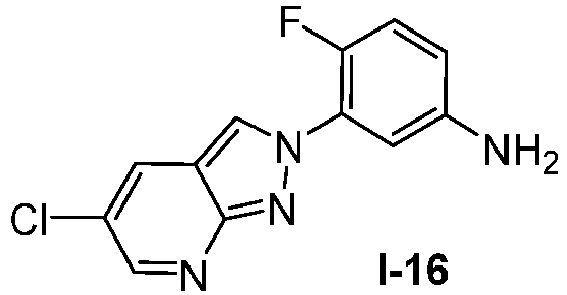
- Intermediate I-16 was prepared in a similar manner as intermediate I-1 using 5-chloro-2-fluoronicotinaldehyde as the starting material. 1H NMR (400 MHz, DMSO-d 6) δ ppm 8.82 (d, J=2.26 Hz, 1 H), 8.67 (d, J=2.51 Hz, 1 H), 8.44 (d, J=2.51 Hz, 1 H), 7.12 - 7.28 (m, 2 H), 6.61 - 6.75 (m, 1 H), 5.44 (br s, 2 H).
-

- Intermediate I-17 was prepared in a similar manner as intermediate I-1 using 4-nitropyridin-2-amine as a starting material in Step B. 1H NMR (400 MHz, DMSO) δ ppm 9.19 (br s, 1 H), 8.73 (br s, 1 H), 8.59 (br s, 1 H), 8.01 (br d, J= 5.27 Hz, 1 H), 7.42 (br s, 1 H), 6.54 - 6.74 (m, 3 H).
-

- Intermediate I-18 was prepared in a similar manner as intermediate I-1 using 2-chloro-5-nitro-aniline as a starting material in Step B. M+H=325.0.
-

- Intermediate I-19 was prepared in a similar manner as intermediate I-1 using 3-nitroaniline as a starting material in Step B. 1H NMR (400 MHz, DMSO-d 6) δ ppm 8.99 (s, 1 H), 8.69 (d, J=2.44 Hz, 1 H), 8.56 (d, J=2.45 Hz, 1 H), 7.31 (t, J=2.08 Hz, 1 H), 7.12 - 7.26 (m, 2 H), 6.61 - 6.72 (m, 1 H), 5.56 (br s, 2 H).
-

- The synthesis of I-20 is described in Example 21.
-

- The synthesis of I-21 is described in Example 21.
-

- The synthesis of I-22 is described in Example 22.
-

- Intermediate I-23 was prepared in a similar manner as intermediate I-1 using 2-fluoro-5-(trifluoromethyl)nicotinaldehyde as a starting material. 1H NMR (400 MHz, DMSO), δ ppm, 9.06 (d, J= 2.01 Hz, 1 H), 8.98 (d, J= 2.26 Hz, 1 H), 8.85 (s, 1 H), 7.16 - 7.30 (m, 2 H), 6.72 (dt, J= 8.91, 3.33 Hz, 1 H), 5.48 (s, 2 H).
-

- Intermediate I-24 was prepared in a similar manner as intermediate I-7 using cyclopropanecarboxylic acid as a starting material. 1H NMR (400 MHz, DMSO-d6) δ ppm 8.90 (d, J= 2.38 Hz, 1 H), 8.75 (d, J= 2.38 Hz, 1 H), 8.62 (d, J= 2.38 Hz, 1 H), 8.38 (dd, J= 7.03, 2.51 Hz, 1 H), 8.25-8.30 (m, 1H), 7.66 - 7.75 (m, 1 H), 7.53 (dd, J= 11.17, 9.16 Hz, 1 H), 1.72 - 1.83 (m, 1 H), 0.83 (d, J= 6.15 Hz, 4 H).
-

- Step A: The reaction mixture of I-1 (10 g, 32.6 mmol, 1 eq) and Boc2O (21.3 g, 97.7 mmol, 22.4 mL, 3 eq) in THF (100 mL) was stirred at 76 °C for 12 hr. The reaction mixture was concentrated and the residue was triturated with petroleum ether (100 mL) to give I-25a as a brown solid. M+H = 408.9.
- Step B: The reaction mixture of I-25a (0.5 g, 1.2 mmol, 1 eq), 1H-pyrazole (126 mg, 1.8 mmol, 1.5 eq), CuI (35 mg, 184.5 µmol, 0.15 eq), quinolin-8-ol (27 mg, 184.5 µmol, 31.9 uL, 0.15 eq) and K2CO3 (221 mg, 1.6 mmol, 1.3 eq) in DMSO (5 mL) was stirred at 120 °C for 12 hr. The reaction mixture was poured into water 20 mL, extracted with DCM (20 mLx3). The combined organic layers were washed with brine (10 mL), dried over Na2SO4 and concentrated to give I-25b as a black solid. M+H =395.3.
- Step C: The reaction mixture of I-25b (0.4 g, 1.0 mmol, 1 eq) in HCl/dioxane (10 mL) was stirred at 25 °C for 12 hr. The reaction mixture was concentrated and purified by prep-HPLC (Phenomenex Gemini 150*25 mm*10 um; mobile phase: [water (0.05% ammonia hydroxide v/v)-acetonitrile]; B%: 18%-48%,12 min) to give I-25 as a yellow solid. 1H NMR (400 MHz, DMSO) δ ppm 9.28 (d, J = 2.69 Hz, 1 H), 8.90 (d, J = 2.45 Hz, 1 H), 8.61 (dd, J = 10.64, 2.57 Hz, 2 H), 7.84 (d, J= 1.47 Hz, 1 H), 7.14-7.31 (m, 2 H), 6.66-6.75 (m, 1 H), 6.57-6.65 (m, 1 H), 5.45 (s, 2 H).
-

- Intermediate I-26 was prepared in a similar manner as intermediate I-25 using 4-methyl-1H-imidazole as a starting material in Step B. 1H NMR: (400 MHz, DMSO) δ ppm 9.00 (d, J= 2.69 Hz, 1 H), 8.89 (d, J= 2.20 Hz, 1 H), 8.37 - 8.49 (m, 1 H), 8.20 (s, 1 H), 7.53 (s, 1 H), 7.13 - 7.30 (m, 3 H), 6.61 - 6.80 (m, 1 H), 5.45 (s, 2 H), 2.21 (s, 3 H).
-

- The intermediate I-27 was prepared in a similar manner as intermediate I-3 using pyrrolidine as a starting material. 1H NMR (400 MHz, DMSO-d 6) δ ppm 8.89 (d, J=2.26 Hz, 1 H), 8.75 (d, J=2.26 Hz, 1 H), 8.62 (d, J=2.51 Hz, 1 H), 8.51 (s, 1 H), 8.28 (dd, J=7.03, 2.51 Hz, 1 H), 7.74 (dt, J=9.10, 3.48 Hz, 1 H), 7.46 (dd, J=11.29, 9.29 Hz, 1 H), 3.39 (br s, 4 H), 1.87 (br t, J=6.40 Hz, 4 H).
-

- The intermediate I-28 was prepared in a similar manner as intermediate I-11 using (3-methylpyridin-2-yl)zinc(II) bromide as a starting material. 1H NMR (400 MHz, DMSO-d6) 8.89 (dd, J= 8.2, 2.4 Hz, 2H), 8.56 (dd, J= 4.6, 1.7 Hz, 1H), 8.47 (d, J= 2.2 Hz, 1H), 7.80 (ddd, J= 7.7, 1.7, 0.8 Hz, 1H), 7.40 - 7.32 (m, 1H), 7.24-7.14 (m, 2H), 6.69 (ddd, J= 9.0, 3.9, 2.8 Hz, 1H), 5.46 (s, 2H), 2.44 (s, 3H).
-

- Step A: A mixture of I-25a (100 mg, 245.6 µmol, 1 eq), 3-(trifluoromethyl)azetidine (48 mg, 294.7 µmol, 1.2 eq, HCI), NaOBu-t (2 M, 368.3 uL, 3 eq), XantPhos (28 mg, 49.11 µmol, 0.2 eq) and Pd2(dba)3 (22 mg, 24.6 µmol, 0.1 eq) in dioxane (2 mL) was de-gassed and then stirred at 80 °C for 1 hour under N2. The mixture was quenched and adjusted to pH=7 with 1 M HOAc. The mixture was purified by silica chromatography (Petroleum ether/Ethyl acetate=1/1) to give I-29a as a yellow solid. M+H = 452.3.
- Step B: This step was performed in a similar manner as I-25 step C to give I-29. 1H NMR (400 MHz, DMSO) δ ppm 8.49 (d, J= 2.45 Hz, 1 H), 8.29 (d, J= 2.81 Hz, 1 H), 7.09 - 7.22 (m, 2 H), 7.02 (d, J= 2.69 Hz, 1 H), 6.63 (dt, J= 8.74, 3.33 Hz, 1 H), 5.38 (s, 2 H), 4.07 - 4.23 (m, 2 H), 3.98 (dd, J= 7.95, 5.38 Hz, 2 H), 3.66 - 3.83 (m, 1 H).
-

- The synthesis of I-30 is described in Example 24.
-
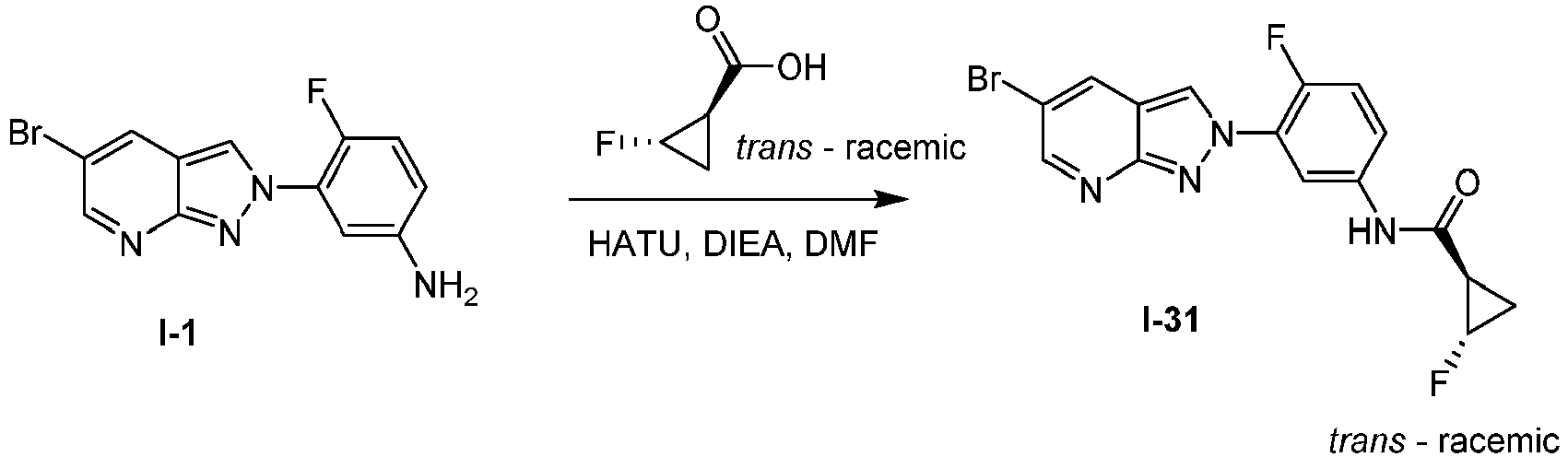
- To a solution of I-1 (2.5 g, 8.1 mmol, 1 eq) and trans-2-fluorocyclopropanecarboxylic acid (1.0 g, 9.8 mmol, 1.2 eq) in DMF (20 mL) was added HATU (3.7 g, 9.8 mmol, 1.2 eq) and DIEA (1.6 g, 12.2 mmol, 2.1 mL, 1.5 eq). The mixture was stirred at 25 °C for 16 hr. The reaction was diluted with ethyl acetate (150 mL) and was washed with saturated NaHCO3 (50 mL) and brine 100 mL (50 mL * 2), dried over Na2SO4, filtered and concentrated under reduced pressure to give a residue. The residue was triturated in tert-butyl methyl ether (20 mL) and collected by filtration to give I-31 as a yellow solid. 1H NMR (400 MHz, DMSO-d 6) δ ppm 10.74 (s, 1 H), 8.91 (d, J=2.51 Hz, 1 H), 8.75 (d, J=2.26 Hz, 1 H), 8.62 (d, J=2.26 Hz, 1 H), 8.36 (dd, J=7.03, 2.51 Hz, 1 H), 7.60-7.74 (m, 1 H), 7.55 (dd, J=11.17, 9.16 Hz, 1 H), 4.70 - 5.12 (m, 1 H), 2.89 (s, 1 H), 2.23 - 2.41 (m, 1 H), 1.46 - 1.66 (m, 1 H).
-

- Step A: Acetamide (1.7 g, 28.6 mmol, 4 eq) and 2-hydroxy-N,N,N-trimethylethan-1-aminium chloride (1 g, 7.2 mmol, 1 eq) were combined and heated to 60 °C for 30 min. NBS (2.5 g, 14.3 mmol, 2 eq) and methyl 4-methoxy-3-oxo-butanoate (2.1 g, 14.3 mmol, 2 eq) were added to the reaction and heated to 60 °C for 1 h. The reaction mixture was purified by prep-TLC eluting with 50% ethyl acetate in petroleum either to give I-32a as a light yellow oil. 1HNMR: (400 MHz, CDCl3) δ ppm 4.66 (s, 2 H), 3.94 (s, 3 H), 3.47 (s, 3 H), 2.55 (s, 3 H).
- Step B: A mixture of I-32a (60 mg, 324.01 µmol, 1 eq) and LiOH.H2O (27.2 mg, 648.0 µmol, 2 eq) in THF (1 mL), MeOH (1 mL) and H2O (0.5 mL) was stirred at 25 °C for 16 hr under a N2 atmosphere. The reaction mixture was concentrated under vacuo to give 60mg of a lithium salt of I-32 as a yellow solid.
-

- The synthesis of I-33 is described in Example 28.
-

- Step A: To a solution of methyl 3-oxobutanoate (900 mg, 7.7 mmol, 833 uL, 1 eq) in toluene (15 mL) was added 2,2,2-trideuterioacetamide (962 mg, 15.5 mmol, 2 eq) and TsOH (13.3 mg, 77.5 µmol, 0.01 eq). The mixture was stirred at 120°C for 12 h. The mixture was concentrated under vacuum to give a residue which was purified by silica chromatography eluting with petroleum ether:ethyl acetate in a 30:1 -10:1 gradient to give I-34a as a white solid. 1H NMR (400 MHz, DMSO-d6) δ ppm 10.88 (br s, 1 H), 5.02 (s, 1 H), 3.63 (s, 3 H), 2.29 (s, 3 H).
- Step B: To a solution of I-34a (250 mg, 1.6 mmol, 1 eq) in DCE (8 mL) was added (diacetoxyiodo)benzene (654 mg, 2.0 mmol, 1.3 eq) and BF3.Et2O (443 mg, 3.1 mmol, 385 uL, 2 eq). The mixture was stirred at 90°C for 2 h. The mixture was concentrated under vacuum to give a residue which was purified by silica chromatography eluting with petroleum ether:ethyl acetate in a 30:1-10:1 gradient to give I-34b as a white solid. 1H NMR: (400 MHz, DMSO-d6) δ ppm 3.81 (s, 3 H), 2.33 (s, 3 H).
- Step C: To a solution of I-34b (100 mg, 632 µmol, 1 eq) in THF (1 mL) and H2O (1 mL) was added a 15% aqueous NaOH (1 mL) solution. The mixture was stirred at 70°C for 2 h. The pH was adjusted to 5 by addition of aqueous HCl solution (1 M) and a white solid was formed. The suspension was filtered and the filter cake was washed with H2O (5 mL). The filter cake was dried under reduced pressure to give I-34 as a white solid. 1H NMR: (400 MHz, DMSO-d6) δ ppm 13.30 (br s, 1 H), 2.32 (s, 3 H).
-

- The synthesis of I-35 is described in Example 29.
-

- Step A: A 100 ml sealed tube containing I-1b (500 mg, 1.483 mmol) and Phenyl boronic acid (181 mg, 1.483 mmol) in DME:H2O (8:2) (15 mL) was purged with Argon gas for 15 min. NaHCO3 (249 mg, 2.966 mmol) and Pd(dppf)Cl2.DCM (61 mg, 0.074 mmol) were added and the reaction was stirred at 80°C for 1 h. The reaction mixture was diluted with water, extracted with EtOAc (100 mL X 2). The combined organic layers were washed with 1x with water (150 mL) an 1x with brine (100 mL) and then dried over sodium sulphate and concentrated in vacuo. The crude compound was purified by silica gel chromotagraphy eluting with 25% EtOAc in n-Hexane to afford I-36a. 1H NMR (300 MHz, CDCl3): δ 9.32-9.29 (m, 1H), 9.10 (s, 1H), 8.69 (s, 1H), 8.34-8.29 (m, 1H), 8.23 (s, 1H), 7.65 (d, J=6.9 Hz, 2H), 7.55-7.41 (m, 4H).; M+H = 335.2
- Step B: To a flask containing I-36a (150 mg, 0.449 mmol) in EtOH:H2O (8:2) (20 mL) was added Iron powder (370 mg, 6.730 mmol) and CaCl2 (995 mg, 8.973 mmol) and the reaction was stirred at 65°C for 2 h. The reaction mixture was diluted with water and extracted with EtOAc (100 mL X 2). The combined organic layers were washed 1x with water (100 mL) and 1x with brine (100 mL) and then dried over sodium sulphate and concentrated invacuo. The crude compound was purified by n-Pentane washings to afford I-36. 1H NMR (300 MHz, CDCl3): δ 9.04 (s, 1H), 8.61 (s, 1H), 8.22 (s, 1H), 7.70-7.40 (m, 6H), 7.20-7.00 (m, 1H), 6.75-6.60 (m, 1H); M+H = 305.30.
-

- To a mixture of I-7 (30 mg, 0.070 mmol) and Siliacat DPP-Pd 0.25 mmol/g (0.014 g, 3.52 µmol, 0.05 eq) was added 0.5 mL anhydrous THF. The reaction mixture was placed under a nitrogen atmosphere and (3-methylpyridin-2-yl)zinc(II) bromide (0.5M in THF, 0.56 mL, 0.28 mmol, 4 eq) was added and the reaction was stirred at 65 °C overnight. The reaction was quenched with 0.2 mL water and purified by prep-HPLC (Waters Atlantis T3 C18 19*50mm*10 um column) eluting with 20-80% acetonitrile (0.035% TFA) in water (0.05% TFA ) to give compound 1. 1H NMR (400 MHz, Methanol-d 4) δ 8.90 (dd, J= 13.2, 2.3 Hz, 2H), 8.59-8.43 (m, 3H), 7.97 - 7.81 (m, 2H), 7.55 - 7.35 (m, 2H), 2.56 (s, 3H), 2.48 - 2.45 (m, 6H). Method 1: RT = 2.69 min.; M+H = 443.1.
- Compounds 16, 17, 101, 102, 103, 104, 105, 106, 107 and 108 were synthesized according to the protocol described above using the corresponding zinc(II) bromides.
-

- Compound 2 was prepared in a similar manner as compound 1 utilizing I-8 as a starting material. 1H NMR (400 MHz, Methanol-d4) δ 8.92 (d, J = 2.4 Hz, 1H), 8.88 (d, J = 2.2 Hz, 1H), 8.55 - 8.45 (m, 3H), 7.96 (m, 1H), 7.87 (m, 1H), 7.78 (m, 1H), 7.52 - 7.39 (m, 2H), 7.32 (m, 1H), 6.68 (m, 1H), 2.46 (s, 3H). Method 2: RT = 0.89 min.; M+H = 414.3.
- Compounds 54, 55, 56, 57, 59, 60, 61, 62, 63 and 64 were synthesized according to the protocol described above using the corresponding zinc(II) bromides.
-

- Compound 3 was prepared in a similar manner as compound 1 utilizing I-6 as a starting material. 1H NMR (400 MHz, Methanol-d4) δ 8.89-8.84 (m, 2H), 8.52 (m, 1H), 8.48 (m, 1H), 8.18 (m, 1H), 7.86 (m, 1H), 7.67 (m, 1H), 7.44-7.32 (m, 2H), 4.18 - 4.06 (m, 4H), 2.46 (s, 3H), 2.41 - 2.26 (m, 2H). Method 1: RT = 2.41 min.; M+H = 403.3.
- Compound 99 was synthesized according to the protocol described above using the corresponding zinc(II) bromide.
-

- Compounds 41, 42, 43, 44, 45, 46, 47, 48, 49, 50, 51, 52 and 53 were synthesized according to the protocol described above using the corresponding zinc(II) bromides.
-

- Compound 5 was prepared in a similar manner as compound 1 utilizing I-3 as a starting material. 1H NMR (400 MHz, Methanol-d4) δ 8.88 (dd, J = 5.4, 2.3 Hz, 2H), 8.52 (m, 1H), 8.48 (m, 1H), 8.22 (m, 1H), 7.86 (m, 1H), 7.69 (m, 1H), 7.45 - 7.36 (m, 2H), 4.44 (m, 4H), 2.46 (s, 3H). Method 2: RT = 0.76 min.; M+H = 439.1.
-

- Compound 6 was prepared in a similar manner as compound 1 utilizing I-4 as a starting material. 1H NMR (500 MHz, DMSO-d6) δ 8.98 (s, 1H), 8.94 (dd, J = 16.9, 2.3 Hz, 2H), 8.57 (ddd, J = 4.8, 1.7, 0.7 Hz, 1H), 8.49 (d, J = 2.3 Hz, 1H), 8.28 (dd, J = 7.0, 2.7 Hz, 1H), 7.80 (ddd, J = 7.7, 1.7, 0.8 Hz, 1H), 7.72 (ddd, J = 9.1, 4.1, 2.7 Hz, 1H), 7.49 (dd, J = 11.2, 9.1 Hz, 1H), 7.37 (dd, J = 7.7, 4.7 Hz, 1H), 5.41 (dtt, J = 57.5, 6.1, 3.1 Hz, 1H), 4.34 (dddd, J = 21.7, 10.4, 6.0, 1.4 Hz, 2H), 4.04 (dddd, J = 24.9, 10.4, 3.1, 1.4 Hz, 2H), 2.44 (s, 3H). Method 1: RT = 2.39 min.; M+H = 421.1.
- Compounds 14, 15, 18, 19, 20, 21, 23, 24, 25, 26, 27 and 28 were synthesized according to the protocol described above using the corresponding zinc(II) bromides.
- Compound 318 was synthesized according to the protocol described above using dimethylzinc.
-

- Compound 7 was prepared in a similar manner as compound 1 utilizing I-6 and isobutylzinc(II) bromide as starting materials. 1H NMR (400 MHz, Methanol-d4) δ 8.66 (d, J = 2.4 Hz, 1H), 8.56 (d, J = 2.2 Hz, 1H), 8.12 (m, 1H), 8.07 (m, 1H), 7.64 (m, 1H), 7.34 (m, 1H), 4.19-4.01 (m, 4H), 2.67 (m, 2H), 2.41 -2.24(m, 2H), 1.97 (m, 1H), 0.99 (m, 6H). Method 1: RT = 3.11 min.; M+H = 368.3.
- Compounds 91, 93, 94, 95, 96, 97 and 98 were synthesized according to the protocol described above using the corresponding zinc(II) bromides.
-

- Compound 8 was prepared in a similar manner as compound 1 utilizing I-3 and isobutylzinc(II) bromide as starting materials. 1H NMR (400 MHz, Methanol-d4) δ 8.59 (d, J = 2.5 Hz, 1H), 8.46 (d, J = 2.2 Hz, 1H), 8.06 (m, 1H), 7.97 (m, 1H), 7.56 (m, 1H), 7.30 - 7.24 (m, 1H), 4.33 (m, 4H), 2.57 (m, 2H), 1.92 - 1.81 (m, 1H), 0.89 (m, 6H). Method 2: RT = 1.09 min. M+H = 404.1.
- Compounds 29, 30, 31, 32, 33, 34, 35, 36, 37 and 38 were synthesized according to the protocol described above using the corresponding zinc(II) bromides.
-

- Step A: To a solution of I-12 (0.5 g, 1.8 mmol, 1 eq) in ethyl acetate (5 mL) and saturated aqueous NaHCO3 (5 mL) was added 2,2,2-trichloroethyl carbonochloridate (585.7 mg, 2.8 mmol, 370.7 uL, 1.5 eq) at 0°C and the reaction was stirred at 0°C for 1 hr. The reaction mixture was extracted with EtOAc (30 mL*3) and the combined organics were dried over sodium sulfate and concentrated. The resulting residue was purified by silica chromatography eluting with 20% EtOAc and 20% DCM in petroleum ether to give I-13 as a yellow solid. 1H NMR (400 MHz, DMSO-d 6) δ ppm 10.52 (br s, 1 H), 8.71 (d, J=2.93 Hz, 1 H), 8.57 (d, J=2.69 Hz, 1 H), 8.25 (br d, J=5.14 Hz, 1 H), 7.44 - 7.64 (m, 2 H), 7.16 (d, J=2.69 Hz, 1 H), 4.99 (s, 2 H), 2.96 (s, 6 H).
- Step B: The reaction mixture of I-13 (60 mg, 134.3 µmol, 1 eq), 3,3-difluoroazetidine HCl (25 mg, 268.6 µmol, 2 eq), DIEA (34.6 mg, 268.6 µmol, 46.7 µL, 2 eq), DMAP (1.6 mg, 13.4 µmol, 0.1 eq) in DMSO (1 mL) was stirred at 60°C for 12 hours and at 70 °C for another 12 hours. The reaction mixture was purified by Prep-HPLC column: Phenomenex Gemini C18 250*50mm*10 um; mobile phase: [water (0.05% ammonia hydroxide v/v)-acetonitrile]; B%: 25%-55%,12 min to give 9 as a yellow solid. 1H NMR (400 MHz, DMSO-d6) δ ppm 9.18 (s, 1 H), 8.70 (d, J=3.01 Hz, 1 H), 8.55 (d, J=2.76 Hz, 1 H), 8.20 (dd, J=6.90, 2.64 Hz, 1 H), 7.56 - 7.78 (m, 1 H), 7.45 (dd, J=11.42, 9.16 Hz, 1 H), 7.15 (d, J=3.01 Hz, 1 H), 4.41 (t, J=12.67 Hz, 4 H), 2.95 (s, 6 H). Method 1: RT = 2.84 min.; M+H = 391.1.
- Compounds 100, 124, 133, 142, 143, 156, 167, 170 195, 219, 220, 221, 222, 223, 224, 225, 226, 227, 228, 229, 260, 276, 319, 320, 321, 322, 323, 324, and 328, were synthesized according to the protocol described above using intermediates I-9, I-12, I-16, I-23, I-25 or I-26 and the corresponding amine.
-

- Compounds 40, 58, 92, 122, 131, 132, 134,135,137, 141,144, 145, 147,149, 151, 155, 157, 158, 161, 163, 171, 172, 177, 178, 179, 180, 181, 183, 184, 185, 186, 190, 191, 192, 193, 194, 197, 198, 199, 200, 201, 202, 203, 204, 205, 230, 231, 232, 234, 235, 236 237, 238, 239, 240, 241, 243, 244, 245, 248, 249, 250, 251, 252, 253, 255, 263, 266, 272 290, 291, 292, 298, 299, 300, 302, 303, 306, 307, 308, 314, 326, 327, 338 and 339 were synthesized according to the protocol described above using the corresponding intermediate I-3, I-4, I-5, I-6, I-7, I-8, I-24, I-27 or I-31 and the corresponding amines.
- Compounds 242 was isolated in addition to compound 241 using the above reaction conditions. Similarly compound 246 was isolated in addition to compound 202 using the above reaction conditions.
- Compound 270 was synthesized using the protocol described above using Boc-piperidine after which the Boc group was removed using 0.36:1 ratio of TFA in DCM followed by neutralization to pH = 7 with Et3N and then prep-HPLC purification (column: Phenomenex Synergi C18 150*25*10 um; mobile phase: [water(0.225%FA)-acetonitrile]; B%: 3%-30%,10 min) to give compound 270.
-

- To a solution of I-9 (25mg, 0.092 mmol) in DMF (1.5 ml) and DIEA (0.040 ml, 0.23 mmol) was added 4,4,4-trifluorobutanoyl chloride (14.9 mg, 0.092 mmol) and the reaction was stirred for 12 hrs at room temperature. The crude reaction mixture was purified directly on a 15 g C18 flash chromatography column eluting with 20-90% acetonitrile in water to give compound 173 as a white solid. 1H NMR (400 MHz, DMSO-d6) δ 10.45 (s, 1H), 8.81 (d, J = 2.7 Hz, 1H), 8.69 (d, J = 2.3 Hz, 1H), 8.36 (dd, J = 7.0, 2.7 Hz, 1H), 8.05 (dd, J = 2.3, 0.8 Hz, 1H), 7.68 (ddd, J = 9.1, 4.2, 2.7 Hz, 1H), 7.54 (dd, J = 11.2, 9.0 Hz, 1H), 3.08 (pd, J = 6.9, 0.8 Hz, 1H), 2.72 - 2.55 (m, 4H), 1.30 (d, J = 6.9 Hz, 6H). Method 1: RT = 3.19 min.; M+H = 395.2.
- Compound 174 was synthesized according to the protocol described above using the corresponding chloroformate in place of the acid chloride.
-

- Pyrazine-2-carboxylic acid (16.5 mg, 0.13 mmol) was added to a flask followed by I-9 (30 mg, 0.11 mmol) dissolved in 0.25mL DMF. A solution of DIEA (0.058 mL, 0.33 mmol) and HATU (50.6 mg, 0.13 mmol) in 0.25mL DMF was added to the reaction and the resulting mixture was stirred overnight. The reaction was filtered through a 0.2 micron syringe filter and the material was purified by prep-HPLC (Waters Atlantis T3 C18 19*50mm*10 um column) eluting with 20-80% acetonitrile (0.035% TFA) in water (0.05% TFA) to give compound 87. 1H NMR (400 MHz, Methanol-d4) δ 9.36 (m, 1H), 8.84 (m, 1H), 8.76 (m, 1H), 8.72 (m, 1H), 8.66 (m, 1H), 8.57 (m, 1H), 8.13 (m, 1H), 7.99 (m, 1H), 7.46 (m, 1H), 3.13 (m, 1H), 1.38 (2s, 6H). Method 1: RT = 3.05 min.; M+H = 377.3.
- Compounds 65, 67, 68, 69, 70, 71, 72, 73, 74, 75, 76, 77, 78, 79, 80, 81, 82, 83, 84, 85, 86, 87, 88, 89, 90, 109, 110, 111, 112, 113, 114, 115, 116, 117, 118, 119, 120, 196, 207, 208, 209, 210, 211, 212, 213, 214, 215, 216, 217, 261, 262 and 351 were synthesized according to the protocol described above using the corresponding carboxylic acids.
- Compounds 139, 140, 153, 154, 279, 330 and 352 were synthesized according to the protocol described above using I-12, I-29 or I-36 and the corresponding carboxylic acids.
- Compound 278 was synthesized according to the protocol described above using I-28 and I-34 as starting materials.
-

- To a solution of I-10 (106 mg, 285.6 µmol, 1 eq) in dioxane (1 mL) was added 1,1,1-trifluoro-2-iodo-ethane (119.9 mg, 571.10 µmol, 56.03 uL, 2 eq), Pd2(dba)3 (13.1 mg, 14.3 µmol, 0.05 eq), XantPhos (28.1 mg, 48.5 µmol, 0.2 eq) and Cs2CO3 (372.15 mg, 1.1 mmol, 4 eq) under a N2 atmosphere. After 1 min. water (92.6 mg, 5.1 mmol, 92.6 uL, 18 eq) was added and the mixture was stirred at 80 °C for 16 hr. The reaction mixture was concentrated under reduced pressure. The residue was diluted with DCM (30 mL) and the organic layer was washed with water (10 mL*2), dried over Na2SO4, filtered and concentrated to give a residue. The residue was purified by prep-TLC (SiO2, DCM : Methanol=10:1) and further purified by prep-HPLC (column: Phenomenex Gemini C18 250*50mm*10 um; mobile phase: [water (0.05% ammonia hydroxide v/v)-acetonitrile]; B%: 28%-58%,12 min) to give compound 152 as a yellow solid. 1H NMR (400 MHz, DMSO-d6), δ ppm, 8.98 (s, 1 H), 8.95 (d, J=2.51 Hz, 1 H), 8.69 (d, J=2.01 Hz, 1 H), 8.33 (d, J=1.76 Hz, 1 H), 8.24 (dd, J=6.90, 2.63 Hz, 1 H), 7.67 - 7.74 (m, 1 H), 7.48 (dd, J=11.29, 9.29 Hz, 1 H), 5.30 - 5.52 (m, 1 H), 4.26 - 4.39 (m, 2 H), 3.97 - 4.09 (m, 2 H), 3.87 (q, J=11.71 Hz, 2 H). Method 1: RT = 2.76 min.; M+H = 412.2.
- Compounds 162, 164, 166, 175 and 176 were synthesized according to the protocol described above using the corresponding boronic acid prepared from intermediate I-3, I-5, I-6, I-7 or I-8 prepared in the same manner as I-10.
-

- To a mixture of I-4 (120 mg, 294 µmol, 1 eq), isopropyl carbamate (45.5 mg, 441 µmol, 1.5 eq) and Cs2CO3 (287.3 mg, 881.9 µmol, 3 eq) in dioxane (3 mL) was added XantPhos (34.0 mg, 58.8 µmol, 0.20 eq) and Pd2(dba)3 (26.9 mg, 29.4 µmol, 0.10 eq) under an Argon atmosphere. The mixture was heated to 90°C and stirred for 4 hours. The mixture was quenched by addition of 1 M HOAc and purified by prep-HPLC (column: Boston pH-lex 150*25 10um; mobile phase: [water(0.225%Formic Acid)-acetonitrile]; B%: 33%-63%,10 min followed by further purification on column: Phenomenex Gemini C18 250*50mm*10 um; mobile phase: [water (0.05% ammonia hydroxide v/v)-acetonitrile]; B%: 28%-58%,12 min). Compound 168 was obtained as a yellow solid. 1H NMR (400 MHz, Methanol-d4), δ ppm, 8.64 (br d, J = 2.26 Hz, 1 H), 8.61 (br d, J = 2.64 Hz, 1 H), 8.44 (br s, 1 H), 8.10 (dd, J = 6.71, 2.70 Hz, 1 H), 7.60 - 7.67 (m, 1 H), 7.33 (dd, J = 10.92, 9.16 Hz, 1 H), 5.25 - 5.47 (m, 1 H), 5.01 (dt, J = 12.52, 6.23 Hz, 1 H), 4.32 - 4.43 (m, 2 H), 4.07-4.19 (m, 2 H), 1.33 (d, J = 6.27 Hz, 6 H). Method 1: RT = 2.88 min.; M+H = 431.1.
- Compounds 123, 136, 138, 146 and 159 were synthesized according to the protocol described above using the corresponding intermediate I-3, I-5, I-6, I-7 or I-8.
-

- To a solution of intermediate I-10 (95 mg, 254.6 µmol, 1 eq) in DMF (3mL) was added Pd(dppf)Cl2 (18.6 mg, 25.5 µmol, 0.1 eq), Na2CO3 (81 mg, 763.8 µmol, 3 eq) and 2-bromo-3-fluoropyridine (89.5 mg, 509.2 µmol, 2 eq). The mixture was stirred at 90 °C for 16 hr. The reaction mixture was concentrated under reduced pressure and purified by prep-HPLC (column: Boston Green ODS 150*30 5u; mobile phase: [water(0.225%FA)-acetonitrile]; B%: 35%-65%,10 min) to give compound 187 as a yellow solid. 1H NMR (400 MHz, DMSO-d6) δ ppm 9.27 (s, 1 H), 9.00 - 9.09 (m, 2 H), 8.82 (s, 1 H), 8.63 (br d, J=4.39 Hz, 1 H), 8.29 (dd, J=6.90, 2.51 Hz, 1 H), 7.93 (dd, J=10.73, 8.47 Hz, 1 H), 7.72 (dt, J=8.60, 3.48 Hz, 1 H), 7.52 - 7.58 (m, 1 H), 7.46 - 7.51 (m, 1 H), 5.28 - 5.55 (m, 1 H), 4.25 - 4.44 (m, 2 H), 3.93 - 4.14 (m, 2 H). Method 1: RT = 2.74 min.; M+H = 425.1.
- Compounds 188, 294, 295, 297, 301, 304, 312, 325, 329, 330, and 335 were synthesized according to the protocol described above using the corresponding bromides.
-

- I-11 (40 mg, 0.131 mmol) was dissolved in 2 mL of DMF. 5-fluorofuran-2-carboxylic acid (25.6 mg, 0.20 mmol), DIEA (0.058 mL, 0.33 mmol) and HATU (50.6 mg, 0.13 mmol) were added to the reaction and the resulting mixture was stirred overnight. The reaction was diluted with EtOAc and washed 1x with sat. aq Na2CO3 solution and 1x with water. The organics were dried over Na2SO4 and concentrated. The crude material was purified on silica chromatography eluting with 0 - 100% 3:1 EtOAc:EtOH in heptanes to give compound 11. 1H NMR (400 MHz, DMSO-d 6) δ 10.53 (s, 1H), 9.49 (d, J = 2.3 Hz, 1H), 9.06 (d, J = 2.6 Hz, 1H), 8.96 (d, J = 2.3 Hz, 1H), 8.74 (ddd, J = 4.8, 1.9, 0.9 Hz, 1H), 8.53 (dd, J = 7.0, 2.7 Hz, 1H), 8.14 (dt, J = 8.0, 1.1 Hz, 1H), 8.01 - 7.91 (m, 2H), 7.62 (dd, J = 11.2, 9.1 Hz, 1H), 7.50 - 7.38 (m, 2H), 6.14(dd, J = 7.0, 3.7 Hz, 1H). Method 2: RT = 0.91 min.; M+H =418.1.
- Compounds 12, 13, 206, 218, 345, 346, 347, 348, and 349 were synthesized according to the protocol described above using the corresponding carboxylic acid.
- Compound 350 was synthesized according to the protocol described above using the corresponding carboxylic acid and I-28.
-

- To a solution of I-4 (80 mg, 196 µmol, 1 eq) and 4-(4,4,5,5-tetramethyl-1,3,2-dioxaborolan-2-yl)pyridine (60.3 mg, 294 µmol, 1.5 eq) in DME (3 mL) was added Pd(dppf)Cl2 (14.34 mg, 19.6 µmol, 0.1 eq) and Na2CO3 (2 M, 294 uL, 3 eq) under a N2 atmosphere. The mixture was stirred at 90 °C for 20 hrs. The reaction mixture was concentrated and the residue was diluted with EtOAc (30 mL). The organic layer was washed with water (10 mL * 2), dried over anhydrous Na2SO4, filtered and concentrated. The residue was purified by prep-HPLC (column: Phenomenex Gemini C18 250*50mm*10 um; mobile phase: [water (0.05% ammonia hydroxide v/v)-acetonitrile]; B%: 18%-48%,12 min) to give compound 182 as a white solid. 1H NMR (400 MHz, DMSO-d6), δ ppm, 9.17 (d, J=2.26 Hz, 1 H), 9.03 (d, J=2.51 Hz, 1 H), 9.00 (s, 1 H), 8.75 (d, J=2.51 Hz, 1 H), 8.67 - 8.73 (m, 2 H), 8.28 (dd, J=6.90, 2.64 Hz, 1 H), 7.84 - 7.90 (m, 2 H), 7.68 - 7.75 (m, 1 H), 7.50 (dd, J=11.29, 9.03 Hz, 1 H), 5.30 - 5.52 (m, 1 H), 4.27 - 4.40 (m, 2 H), 3.97 - 4.10 (m, 2 H). Method 2: RT = 0.58 min.; M+H = 407.1.
- Compound 189 was synthesized according to the protocol described above using the corresponding boronic ester.
-

- Step A: To a mixture of 2-(3,6-dihydro-2H-pyran-4-yl)-4,4,5,5-tetramethyl-1,3,2-dioxaborolane (65.7 mg, 312.6 µmol, 1.1 eq), I-5 (120 mg, 284.2 µmol, 1 eq) and Na2CO3 (2 M, 426.3 uL, 3 eq) in DME (3 mL) and water (0.5 mL) under an Argon atmosphere was added Pd(dppf)Cl2 (20.8 mg, 28.4 µmol, 0.1 eq). The mixture was heated to 90°C for 4 hrs. The mixture was purified by prep-TLC eluting with 90% EtOAc in petroleum ether to give I-14 as white solid. M+H = 426.2.
- Step B: To a mixture of I-14 (85 mg, 199.8 µmol, 1 eq) in methanol (10 mL) was added Pd/C (30 mg, 10% purity). The suspension was degassed under vacuum and purged with H2 several times. The mixture was stirred under H2 (15 psi) at 10°C for 1 h. The mixture was filtered and the filtrate was concentrated to give a residue. The residue was purified by prep-HPLC (column: Boston Green ODS 150*30 5u; mobile phase: [water(0.225%FA)-acetonitrile]; B%: 27%-51%,10 min) to give compound 150 as a yellow solid. 1H NMR (400 MHz, Methanol-d 4), δ ppm, 9.15 ((d, J = 2.01 Hz, 1 H)), 8.98 (s, 1 H), 8.85 (d, J = 1.88 Hz, 1 H), 8.33 (dd, J = 6.78, 9.16 Hz, 1 H), 7.61 - 7.65 (m, 1 H), 7.42 (dd, J = 11.04, 9.16 Hz, 1 H), 5.28 - 5.41 (m, 1 H), 4.11 - 4.14 (m, 2 H), 3.57 - 3.85 (m, 6 H), 3.14 - 3.20 (m, 1 H), 2.11 - 2.32 (m, 2 H), 1.91 - 1.97 (m, 4 H). Method 1: RT = 2.60 min.; M+H = 428.2.
- Compounds 148, 160, 165, 169, 296, and 305 were synthesized according to the protocol described above using intermediates I-3, I-4, I-6 or I-7 and the corresponding boronic acid or boronic ester.
- Compound 293 was synthesized using the protocol described above using I-4 and tert-butyl 4-(4,4,5,5-tetramethyl-1,3,2-dioxaborolan-2-yl)-3,6-dihydropyridine-1(2H)-carboxylate after which the Boc group was removed using 1:5 ratio of TFA in DCM followed by concentration and then prep-HPLC purification (column: Phenomenex Synergi C18 150*25*10 um; mobile phase: [water(0.225%FA)-acetonitrile]; B%: 2%-22%,10 min) to give compound 293.
-

- A mixture of I-6 (400 mg, 1.0 mmol, 1 eq), 5-azaspiro[2.3]hexane hemioxalate (128 mg, 1.0 mmol, 1 eq), NaOBu-t (2 M in THF, 1.5 mL, 3 eq) and Xphos Pd G3 (87 mg, 102.5 µmol, 0.1 eq) in dioxane (10 mL) was de-gassed, placed under an Argon atmosphere and heated to 90°C for 1 hour. The reaction was quenched by addition of saturated NH4Cl (40 mL). The resulting mixture was extracted by dichloromethane (30 mL×6) and the organic phase was dried over Na2SO4 and filtered. The filtrate was concentrated and the residue was purified by silica gel chromatography eluting with 50% MeOH in DCM followed by prep-HPLC purification (column: Phenomenex Synergi C18 150*25*10 um; mobile phase: [water(0.225%FA)-acetonitrile]; B%: 30%-60%,10 min) to give compound 257 as a yellow solid. 1H NMR (400 MHz, DMSO) δ ppm 8.69 (s, 1 H), 8.52 (d, J = 2.63 Hz, 1 H), 8.28 (d, J = 2.76 Hz, 1 H), 8.20 (dd, J = 7.03, 2.63 Hz, 1 H), 7.62 - 7.69 (m, 1 H), 7.40 (dd, J= 11.29, 9.16 Hz, 1 H), 6.91 (d, J = 2.76 Hz, 1 H), 4.01 (s, 4 H), 3.97 (t, J = 7.53 Hz, 4 H), 2.19 (quin, J = 7.56 Hz, 2 H), 0.68 (s, 4 H). Method 1: RT = 2.90 min.; M+H = 393.2.
- Compounds 233, 258, 259, and 337 were synthesized according to the protocol described above using the corresponding intermediates I-3, I-4, I-5 or I-27.
-

- A mixture of I-4 (3.5 g, 8.6 mmol, 1 eq), 3-(trifluoromethyl)azetidine HCl salt (1.7 g, 10.3 mmol, 1.2 eq), Pd2(dba)3 (785 mg, 857.4 µmol, 0.1 eq), XantPhos (992 mg, 1.7 mmol, 0.2 eq) and Cs2CO3 (8.4 g, 25.7 mmol, 3 eq) in dioxane (60 mL) was de-gassed and then heated to 85 °C for 1.2 hr under a N2 atmosphere. The reaction mixture was quenched with sat NH4Cl solution (400 mL) and extracted with EtOAc (300 mL×2). The combined organic layers were washed with brine (200 mL), dried over Na2SO4 and concentrated. The residue was purified by silica chromatography eluting with MeOH/Ethyl acetate/DCM = 0:1:1 to 1:5:1 to give a yellow solid, which was further purified by prep HPLC; column: Phenomenex Synergi Max-RP 250*80mm*10 um; mobile phase: [water(0.225%FA)-acetonitrile]; B%: 30%-60%,35 min. The pH of the solution was adjusted to pH = 7 by 20 % NH3 in H2O and acetonitrile was removed under vacuo at 30°C. The resulting yellow solid was collected by filtration, washed with water 100 mL×4, and lyophilized to give compound 265 as yellow solid. 1H NMR (400 MHz, DMSO) δ ppm 8.93 (s, 1 H), 8.58 (d, J = 2.76 Hz, 1 H), 8.32 (d, J = 2.76 Hz, 1 H), 8.20 (dd, J = 7.03, 2.64 Hz, 1 H), 7.65 (dd, J = 7.34, 4.58 Hz, 1 H), 7.44 (dd, J = 11.17, 9.16 Hz, 1 H), 7.03 (d, J = 2.89 Hz, 1 H), 5.29 - 5.51 (m, 1 H), 4.24 - 4.38 (m, 2 H), 4.18 (t, J = 8.34 Hz, 2 H), 3.95 - 4.10 (m, 4 H), 3.65 - 3.85 (m, 1 H). Method 1: RT = 2.86 min.; M+H =453.1.
- Compounds 274 and 275 were synthesized according to the protocol described above using the corresponding intermediates I-5 or 1-6.
-

- Step A: To a solution I-17 (2.5 g, 8.6 mmol, 1 eq) in pyridine (30 mL) was added 2,2,2-trichloroethyl carbonochloridate (3.6 g, 17.2 mmol, 2.3 mL, 2 eq). The mixture was stirred at 30°C for 22 hr. The reaction mixture was precipitated by addition water 100 mL, and then filtered. The filter cake was washed with water 50 mL and dried under reduced pressure. The precipitate was then triturated in tert-butyl methyl ether (20 mL) and collected by filtration to give I-20 as a brown solid. 1H NMR (400 MHz, DMSO) δ ppm 11.08 (s, 1 H), 9.32 (s, 1 H), 8.77 (d, J = 1.71 Hz, 1 H), 8.62 (d, J = 1.96 Hz, 1 H), 8.52 (d, J = 1.71 Hz, 1 H), 8.49 (d, J = 3.91 Hz, 1 H), 7.75 (dd, J = 5.38, 1.71 Hz, 1 H), 5.05 (s, 2 H).
- Step B: To a solution of I-20 (1.2 g, 2.6 mmol, 1 eq) and azetidine hydrochloride (482 mg, 5.2 mmol, 2 eq) in DMSO (12 mL) was added DMAP (31 mg, 257.8 µmol, 0.10 eq) and DIEA (666 mg, 5.2 mmol, 898.0 uL, 2 eq). The mixture was stirred at 60 °C for 144 hr. The reaction mixture was precipitated by addition water 100 mL and then filtered. The filter cake was washed with water 50 mL, dried under reduced pressure to give I-21 as a brown solid. 1H NMR (400 MHz, DMSO) δ ppm 9.24 (s, 2 H), 8.75 (d, J = 2 .45 Hz, 1 H), 8.60 (d, J = 2.20 Hz, 1 H), 8.49 (d, J = 1.71 Hz, 1 H), 8.35 (d, J = 5.62 Hz, 1 H), 7.73 (dd, J = 5.75, 1.83 Hz, 1 H), 4.04 (br t, J = 7.58 Hz, 4 H), 2.23 (quin, J = 7.64 Hz, 2 H).
- Step C: A mixture of I-21 (180 mg, 482.3 µmol, 1 eq), 3,3-difluoroazetidine (125 mg, 964.6 µmol, 2 eq, HCl), XantPhos (56 mg, 96.5 µmol, 0.20 eq), Pd2(dba)3 (44 mg, 48.2 µmol, 0.10 eq) and NaOBu-t (2 M, 964.6 uL, 4 eq) in dioxane (3 mL) was stirred at 90°C for 16 hr under N2 atmosphere. The reaction mixture was concentrated under reduced pressure to remove solvent. The residue was purified by silica chromatography eluting with 10-100% petroleum ether in Ethyl acetate to give 65 mg of a residue. The residue was triturated in MeOH (3 mL) and the solid collected by filtration to give compound 280 as a yellow solid. 1H NMR (400 MHz, DMSO-d6) δ ppm 9.18 (s, 1 H), 8.99 (s, 1 H), 8.44 (d, J=1.76 Hz, 1 H), 8.36 (d, J=2.76 Hz, 1 H), 8.31 (d, J=5.77 Hz, 1 H), 7.67 (dd, J=5.52, 2.01 Hz, 1 H), 7.14 (d, J=2.76 Hz, 1 H), 4.42 (t, J=12.17 Hz, 4 H), 4.04 (t, J=7.53 Hz, 4 H), 2.16 - 2.29 (m, 2 H). Method 1: RT = 2.76 min.; M+H = 386.0.
- Compounds 282, 284, 286, 287, and 343 were synthesized according to the protocol described above using intermediates I-17, I-18, or I-19 and the corresponding amines.
- Compound 340 was synthesized according to the protocol described in Step A and Step B using (R)-3-fluoropyrrolidine.
-

- Step A: To a solution of I-20 (800 mg, 1.7 mmol, 1 eq) and 3,3-difluoroazetidine HCl salt (445 mg, 3.4 mmol, 2 eq) in DMSO (10 mL) was added DMAP (21 mg, 171.8 µmol, 0.1 eq) and DIEA (444 mg, 3.4 mmol, 598.7 uL, 2 eq). The mixture was stirred at 60°C for 320 hr. The reaction mixture was precipitated by addition water (100 mL) and then filtered. The filter cake was washed with water 50 mL, dried under reduced pressure to give I-22 as a brown solid. 1H NMR (400 MHz, DMSO-d 6) δ ppm 9.69 (s, 1 H), 9.23 - 9.27 (m, 1 H), 8.75 (d, J = 2.45 Hz, 1 H), 8.61 (d, J = 2.44 Hz, 1 H), 8.47 (d, J = 1.96 Hz, 1 H), 8.41 (d, J = 5.62 Hz, 1 H), 7.71 (dd, J = 5.62, 1.96 Hz, 1 H), 4.48 (t, J = 12.72 Hz, 4 H).
- Step B: To a solution of I-22 (460 mg, 1.12 mmol, 1 eq) and tributyl(2-pyridyl)stannane (497 mg, 1.3 mmol, 1.2 eq) in DMF (10 mL) was added Pd(PPh3)4 (130 mg, 112.4 µmol, 0.1 eq) and CuI (21 mg, 112.4 µmol, 0.1 eq). The mixture was stirred at 85°C for 16 hr under a N2 atmosphere. The reaction mixture was concentrated under reduced pressure to remove solvent. The residue was purified by silica eluting with 10-100% petroleum ether in ethyl acetate to give a solid, which was triturated in DCM (3 mL). The resulting solid was collected by filtration to give compound 281 as an off-white solid. 1H NMR (400 MHz, DMSO-d6) δ ppm 9.70 (s, 1 H), 9.47 (d, J=2.20 Hz, 1 H), 9.38 (s, 1 H), 8.95 (d, J=2.20 Hz, 1 H), 8.71 - 8.77 (m, 1 H), 8.49 (d, J=1.71 Hz, 1 H), 8.42 (d, J=5.62 Hz, 1 H), 8.12 (d, J=8.07 Hz, 1 H), 7.96 (td, J=7.76, 1.83 Hz, 1 H), 7.72 (dd, J=5.62, 1.96 Hz, 1 H), 7.39-7.47 (m, 1 H), 4.49 (t, J=12.72 Hz, 4 H). Method 1: RT = 2.81 min.; M+H = 408.0.
- Compounds 283, 285, 309, 310, 313, 315, 317, 341, 342, and 344 were synthesized according to the protocol described above using intermediate I-1, I-17, I-18 or I-19 and the corresponding amine and corresponding organotin.
- Compounds 256, 332, 333, and 336 was synthesized according the protocol in Step B using I-24, I-27 or I-31 and the corresponding organotins.
-

- To a solution of I-4 (100 mg, 245 µmol, 1 eq) in EtOH (2 mL) was added TEA (25 mg, 245 µmol, 34.1 uL, 1 eq) and Pd(OH)2/C (34 mg, 24.5 µmol, 10% purity, 0.1 eq) under N2 atmosphere. The suspension was degassed and purged with H2 3 times. The mixture was stirred under H2 (15 Psi) at 25 °C for 3 hrs. The reaction mixture was filtered and concentrated under reduced pressure to give a residue. The residue was purified by prep-HPLC (column: Luna C18 150*25*5um; mobile phase: [water(0.225%FA)-acetonitrile]; B%: 17%-44%,10 min) and lyophilized to give compound 311 as a white solid. 1H NMR (400 MHz, DMSO-d6 ), ppm, 8.98 (s, 1 H), 8.90 (d, J=2.26 Hz, 1 H), 8.72 (d, J=3.01 Hz, 1 H), 8.31 (d, J=8.28 Hz, 1 H), 8.25 (dd, J=7.03, 2.51 Hz, 1 H), 7.66-7.73 (m, 1 H), 7.43-7.51 (m, 1 H), 7.20 (dd, J=8.41, 4.14 Hz, 1 H), 5.29-5.51 (m, 1 H), 4.24-4.39 (m, 2 H), 3.96 -4.10 (m, 2 H). Method 1: RT = 2.41 min.; M+H = 330.1.
-

- Step A: 1-(tert-butoxycarbonyl)azetidine-2-carboxylic acid (394 mg, 2 mmol), I-4 (400 mg, 1 mmol), 1,1,3,3-tetramethylguanidine (226 mg, 1.96 mmol), NiCl2(dme) (22 mg, 0.1 mmol), 4,4'-di-tert-butyl-2,2'-bipyridine (26 mg, 0.1 mol) and 2,4,5,6-tetra(9H-carbazol-9-yl)isophthalonitrile (23 mg, 0.03 mmol) were dissolved in DMSO (9.8 mL) upon heating and sonication. The solution was pumped (0.10 mL/min) via photoreactor (reactor volume - 0.9 mL; PFA tubing 0.04" ID, 0.0625" ID; irradiated area 20 cm2; 1 cm distance to LED board; 400-750 nm LED; 8800 Im brightness) and collected in a vial. The reaction was purified by C18 flash chromatography eluting with 15-85% acetonitrile in water and concentrated. The material was further purified by silica chromatography eluting with 40-100% EtOAc in heptane to give I-30. 1H NMR (400 MHz, DMSO-d6) δ 8.98 (s, 1H), 8.94 (d, J = 2.3 Hz, 1H), 8.71 (d, J = 4.3 Hz, 1H), 8.22 (dd, J = 7.0, 2.7 Hz, 1H), 7.70 (ddd, J = 9.1, 4.1, 2.8 Hz, 1H), 7.48 (dd, J = 11.1, 9.1 Hz, 1H), 7.13 (d, J = 4.4 Hz, 1H), 5.55 (dd, J = 9.0, 6.4 Hz, 1H), 5.48-5.30 (m, 1H), 4.32 (dddd, J = 21.7, 10.4, 6.0, 1.4 Hz, 2H), 4.11 -3.94 (m, 6H), 1.27 (s, 9H).
- Step B: I-30 (83 mg, 0.171 mmol) was dissolved in DCM (1 mL) and TFA (0.5 mL) was added. The reaction was stirred for 3 hrs and concentrated, dissolved in MeOH and purified by C18 flash chromatography eluting with 5-40% acetonitrile in water. Lyophilization gave compound 264 as a white solid. 1H NMR (400 MHz, DMSO-d6) δ 9.38 (s, 1H), 9.07 - 8.96 (m, 2H), 8.84 (d, J = 4.3 Hz, 1H), 8.30 (dd, J = 7.0, 2.7 Hz, 1H), 7.72 - 7.62 (m, 1H), 7.52 (dd, J = 11.2, 9.1 Hz, 1H), 7.33 (dd, J = 4.4, 1.2 Hz, 1H), 6.04 (s, 1H), 5.41 (dtt, J = 57.4, 6.1, 3.1 Hz, 1H), 4.40 - 4.25 (m, 2H), 4.27 - 4.16 (m, 1H), 4.10 - 3.94 (m, 2H), 3.90 - 3.77 (m, 1H), 3.06 - 2.94 (m, 1H), 2.86 (dtd, J = 11.7, 8.7, 4.4 Hz, 1H). Method 1: RT = 1.69 min.; M+H = 385.2.
- Step C: Compound 264 (20 mg, 0.052 mmol) was dissolved in DCM (Volume: 1 mL) and DIEA (0.027 mL, 0.16 mmol) and acetyl chloride (5.55 µl, 0.078 mmol) were added and stirred for 60 hrs. The reaction was purified by SFC on Princeton PPU 250 × 21.2mm column eluting with 20-60% MeOH in liquid CO2 to give compound 267. 1H NMR (400 MHz, Methanol-d4) δ 8.86 (dd, J = 3.4, 2.2 Hz, 1H), 8.74 (d, J = 4.4 Hz, 0.5H), 8.67 (d, J = 4.5 Hz, 0.5H), 8.17 (dd, J = 6.8, 2.7 Hz, 0.5H), 8.13 (dd, J = 6.8, 2.7 Hz, 0.5H), 7.66 (dddd, J = 8.8, 4.3, 2.7, 1.7 Hz, 1H), 7.37 (ddd, J = 10.9, 9.1, 3.7 Hz, 1H), 7.28 (dd, J = 4.4, 0.8 Hz, 0.5H), 7.18 (dd, J = 4.5, 0.9 Hz, 0.5H), 5.93 (dd, J = 9.2, 5.6 Hz, 0.5H), 5.73 (dd, J = 9.3, 6.1 Hz, 0.5H), 5.37 (dtt, J = 57.1, 6.1, 3.2 Hz, 1H), 4.48-4.32 (m, 3H), 4.24 - 4.15 (m, 2H), 4.11 (ddd, J = 10.3, 3.2, 1.4 Hz, 1H), 3.05 - 2.91 (m, 1H), 2.34 - 2.21 (m, 1H), 2.03 (s, 1.5H), 1.71 (s, 1.5H). Method 2: RT = 0.66 min.; M+H = 427.2.
- Compound 247 was synthesized according the above protocol in Step A using 1-(tert-butoxycarbonyl)pyrrolidine-2-carboxylic acid as a starting material.
-

- I-6 (30 mg, 0.077 mmol), Nickel(II) chloride ethylene glycol dimethyl ether complex (1.7 mg, 7.8 µmol), 1,1,3,3-tetramethylguanidine (53 mg, 0.46 mmol), 4,4'-di-tert-butyl-3,3'-bipyridine (2.1 mg, 7.7 µmol), tetrahydro-2H-pyran-2-carboxylic acid (60 mg, 0.46 mmol) and [4,4'-bis(tert-butyl)-2,2'-bipyridine]bis[3,5-difluoro-2-[5-methyl-2-pyridinyl]phenyl]iridium(III) hexafluorophosphate (3.90 mg, 3.84 µmol) were dissolved in DMSO (769 µL) upon heating and sonication. The solution was added into 0.3 mL well of 96 Teflon well-plate and irradiated for 3 hours (irradiated area 20 cm2; 10 cm distance to LED board; 400-750 nm LED; 7600 lm brightness). The resulting solution was purified by prep-HPLC (Waters Atlantis T3 C18 19*50mm*10 um column) eluting with acetonitrile (0.035% TFA) in water (0.05% TFA) to give compound 288. 1H NMR (400 MHz, Methanol-d4) δ 9.03 (d, J = 2.2 Hz, 1H), 8.73 (d, J = 4.9 Hz, 1H), 8.19 (dd, J = 6.8, 2.7 Hz, 1H), 7.63 (ddd, J = 9.1, 4.2, 2.7 Hz, 1H), 7.37 (dd, J = 10.9, 9.1 Hz, 1H), 7.32 (dd, J = 5.0, 0.9 Hz, 1H), 4.92 (ddt, J = 2.7, 1.4, 0.7 Hz, 1H), 4.23 (d, J = 10.3 Hz, 1H), 4.17 - 4.07 (m, 2H), 3.74 (td, J = 11.6, 2.5 Hz, 1H), 3.37 - 3.32 (m, 2H), 2.33 (p, J = 7.6 Hz, 2H), 2.15-1.98 (m, 2H), 1.92 - 1.57 (m, 4H). Method 2: RT = 0.89 min.; M+H = 396.0.
- Compound 289 was synthesized according the above protocol in using 1,4-dioxane-2-carboxylic acid as a starting material.
-

- Compound 256 (170 mg) was separated by SFC (column: CHIRALCEL® OJ-H (250mm*25 mm, 10 um); mobile phase: [CO2 - MeOH (0.1%NH3H2O]; B%: 50%) to give compound 269 (peak 1, RT = 5.42 min) as a yellow solid and compound 273 (peak 2, RT = 6.75 min) as an off-white solid.
- 269 (peak 1): SFC RT: 5.42 min. 1H NMR (400 MHz, DMSO-d6) δ ppm 10.75 (s, 1 H), 9.48 (d, J=2.26 Hz, 1 H), 9.03 (d, J=2.38 Hz, 1 H), 8.95 (d, J=2.26 Hz, 1 H), 8.74 (d, J=4.14 Hz, 1 H), 8.39 (dd, J=6.96, 2.57 Hz, 1 H), 8.13 (d, J=8.03 Hz, 1 H), 7.96 (td, J=7.75, 1.69 Hz, 1 H), 7.65-7.74 (m, 1 H), 7.57 (dd, J=11.11, 9.10 Hz, 1 H), 7.42 (dd, J=7.22, 5.21 Hz, 1 H), 4.78 - 5.06 (m, 1 H), 2.26 - 2.35 (m, 1 H), 1.49 - 1.66 (m, 1 H), 1.24 - 1.33 (m, 1 H). Method 1: RT = 2.80 min.; M+H = 392.2.
- 273 (peak 2): SFC RT: 6.75 min. 1H NMR (400 MHz, DMSO-d6) δ ppm 10.75 (s, 1 H), 9.48 (d, J=2.08 Hz, 1 H), 9.03 (d, J=2.32 Hz, 1 H), 8.95 (d, J=2.20 Hz, 1 H), 8.74 (d, J=4.52 Hz, 1 H), 8.40 (dd, J=7.03, 2.51 Hz, 1 H), 8.13 (d, J=8.07 Hz, 1 H), 7.96 (td, J=7.79, 1.77 Hz, 1 H), 7.69 (dt, J=8.47, 3.53 Hz, 1 H), 7.57 (dd, J=11.00, 9.17 Hz, 1 H), 7.42 (dd, J=7.09, 5.14 Hz, 1 H), 4.80 -5.05 (m, 1 H), 2.25-2.34 (m, 1 H), 1.48 - 1.67 (m, 1 H), 1.28 (dq, J=13.13, 6.67 Hz, 1 H). Method 1: RT = 2.82 min.; M+H = 392.2.
-

- Compound 339 (130 mg) was separated by SFC (column: CHIRALCEL® OD-H (250mm*25 mm, 10 um); mobile phase: [CO2 - MeOH (0.1%NH3H2O]; B%: 50%) to give compound 271 (peak 1, RT = 4.58 min) as a yellow solid and compound 268 (peak 2, RT = 8.01 min) as a yellow solid.
- 268 (peak 2): SFC RT: 8.01 min. 1H NMR (400 MHz, DMSO-d6) δ ppm 10.69 (s, 1 H), 8.64 (d, J=2.69 Hz, 1 H), 8.37 (d, J=2.81 Hz, 1 H), 8.32 (dd, J=7.03, 2.51 Hz, 1 H), 7.61 - 7.67 (m, 1 H), 7.52 (dd, J=11.19, 9.11 Hz, 1 H), 7.15 (d, J=2.81 Hz, 1 H), 4.80 - 5.03 (m, 1 H), 4.41 (t, J=12.29 Hz, 4 H), 2.24-2.33 (m, 1 H), 1.46 - 1.67 (m, 1 H), 1.27 (dd, J=13.27, 6.54 Hz, 1 H). Method 1: RT = 2.89 min.; M+H = 406.0.
- 271 (peak 1): SFC RT: 4.58 min. 1H NMR (400 MHz, DMSO-d6) δ ppm 10.75 (s, 1 H), 8.70 (d, J=2.69 Hz, 1 H), 8.43 (d, J=2.81 Hz, 1 H), 8.38 (dd, J=6.97, 2.57 Hz, 1 H), 7.66 - 7.77 (m, 1 H), 7.52 - 7.63 (m, 1 H), 7.20 (d, J=2.81 Hz, 1 H), 4.85 - 5.08 (m, 1 H), 4.47 (t, J=12.23 Hz, 4 H), 2.27 - 2.39 (m, 1 H), 1.52 - 1.72 (m, 1 H), 1.33 (dq, J=13.11, 6.43 Hz, 1 H). Method 1: RT = 2.89 min.; M+H = 406.0.
-

- Step A: Intermediate I-33 was prepared in a similar manner to Example 12 using I-28 and I-32 as starting materials. 1H NMR (400 MHz, DMSO-d 6) δ ppm 10.70 (s, 1 H), 9.04 (d, J=2.45 Hz, 1 H), 8.95 (d, J=2.20 Hz, 1 H), 8.60 - 8.66 (m, 2 H), 8.55 (d, J=2.20 Hz, 1 H), 7.89 - 7.96 (m, 2 H), 7.62 (dd, J=11.00, 9.29 Hz, 1 H), 7.44 - 7.52 (m, 1 H), 4.64 (s, 2 H), 3.31 (s, 3 H), 2.57 (s, 3 H), 2.46 (s, 3 H). M+H = 473.0.
- Step B: To a solution of I-33 (15 mg, 28.9 µmol, 1 eq, FA) in DCM (1mL) was added dropwise BBr3 (14.5 mg, 57.9 µmol, 5.6 uL, 2 eq) in DCM (0.5 mL) at -78°C. The mixture was stirred at 20°C for 18 hr under a N2 atmosphere. Saturated NaHCO3 (3 mL) was added and the mixture was extracted with DCM (10 mL). The organic layer was dried over Na2SO4, filtered and concentrated under reduced pressure to give a residue. The residue was purified by prep-HPLC (column: Phenomenex Gemini 150*25 mm*10 um; mobile phase: [water (0.05% ammonia hydroxide v/v)-acetonitrile]; B%: 30%-60%, 12 min) and lyophilized to give compound 277 as a white solid. 1H NMR (400 MHz, DMSO-d6) δ ppm 9.00 (d, J=2.20 Hz, 1 H), 8.94 (d, J=1.96 Hz, 1 H), 8.53 - 8.63 (m, 2 H), 8.51 (d, J=2.20 Hz, 1 H), 7.85 - 7.95 (m, 1 H), 7.81 (br d, J=7.34 Hz, 1 H), 7.55 - 7.67 (m, 1 H), 7.37 (dd, J=7.46, 4.77 Hz, 1 H), 4.69 (s, 2 H), 2.55 (s, 3 H), 2.45 (s, 3 H). Method 1: RT = 2.50 min.; M+H = 459.0.
-

- Step A: Intermediate I-35 was prepared in a similar manner to Example 12 using I-28 and 2-(tert-butoxymethyl)-4-methyloxazole-5-carboxylic acid as starting materials. 1H NMR (400 MHz, DMSO-d 6) δ ppm 10.55 - 10.67 (m, 1 H) 9.00 (d, J=2.45 Hz, 1 H) 8.91 - 8.97 (m, 1 H) 8.54 - 8.65 (m, 2 H) 8.47 - 8.53 (m, 1 H) 7.96 (s, 1 H) 7.80 (dd, J=7.70, 0.86 Hz, 1 H) 7.55 - 7.65 (m, 1 H) 7.37 (dd, J=7.70, 4.77 Hz, 1 H) 4.54 (s, 2 H) 2.69 (s, 3 H) 2.44 (s, 3 H) 1.24 (s, 9 H).
- Step B: To a solution of I-35 (70 mg, 136.04 µmol, 1 eq) in DCM (2 mL) was added TFA (0.5mL, 6.75 mmol, 49.6 eq). The mixture was stirred at 25 °C for 3 hr. The reaction mixture was concentrated under reduced pressure to remove solvent. The pH was adjusted to 7 with TEA. The residue was purified by prep-HPLC (column: Phenomenex Gemini 150*25 mm*10 um; mobile phase: [water (0.05% ammonia hydroxide v/v)-acetonitrile]; B%: 20%-50%, 12 min) and lyophilized to give compound 334 as a white solid. 1H NMR (400 MHz, DMSO-d6) δ ppm, 10.63 (s, 1 H), 9.00 (d, J=2.20 Hz, 1 H), 8.94 (d, J=2.20 Hz, 1 H), 8.62 (dd, J=7.09, 2.45 Hz, 1 H), 8.57 (d, J=3.67 Hz, 1 H), 8.51 (d, J=2.20 Hz, 1 H), 7.91 - 8.01 (m, 1 H), 7.81 (d, J=7.34 Hz, 1 H), 7.60 (dd, J=11.00, 9.05 Hz, 1 H), 7.37 (dd, J=7.70, 4.77 Hz, 1 H), 5.83 (t, J=5.99 Hz, 1 H), 4.60 (d, J=6.11 Hz, 2 H), 2.45 (s, 6 H). Method 1: RT = 2.57 min.; M+H = 459.0.
-

- To a solution of I-3 (3.00 g, 7.04 mmol, 1 eq) and tributyl(2-pyridyl)stannane (3.4 g, 9.1 mmol, 1.3 eq) in DMF (40 mL) was added Pd(PPh3)4 (813 mg, 703.9 µmol, 0.1 eq) and Cul (134 mg, 703.9 µmol, 0.1 eq) under a N2 atmosphere. The mixture was stirred at 85 °C for 2 hr. The reaction mixture was concentrated under reduced pressure to remove solvent. The residue was purified by silica chromatography eluting with petroleum ether/ Ethyl acetate = 2:1 to 0:1 to give compound 39 as a white solid. 1H NMR (400 MHz, Methanol-d4) δ 9.36 (d, J = 2.3 Hz, 1H), 9.00 -8.93 (m, 2H), 8.79-8.75 (m, 1H), 8.26 (dd, J = 6.8, 2.7 Hz, 1H), 8.19 -8.14 (m, 2H), 7.70-7.64 (m, 1H), 7.64-7.56 (m, 1H), 7.46-7.35 (m, 1H), 4.44 (td, J = 12.3, 3.0 Hz, 4H). Method 2: RT = 0.99 min.; M+H = 425.0.
-

- To a stirred solution of triphosgene (23 mg, 0.079 mmol) in dry THF (1 mL) was added I-36 (40 mg, 0.131 mmol) in dry THF (2 mL) at -5°C - 0°C and stirred at RT for 10 min. 3,3-difluoroazetidine hydrochloride (34 mg, 0.263 mmol) and DIEA (51 mg, 0.394 mmol) in dry THF (2 mL) were added dropwise at 0°C and the reaction was stirred at RT for 1 h. The reaction mixture was quenched with saturated NH4CI solution and extracted with EtOAc (50 mL X 2). The combined organic layers were washed with water (20 mL), brine (10 mL) and dried over sodium sulphate and concentrated in vacuo. The crude compound was purified by silica gel chromatography eluting with 50% EtOAc in n-Hexane to afford compound 353 as an off-white solid. 1H NMR (400 MHz, DMSO-d6) 9.25 (s, 1H), 9.06-9.05 (d, J=2.8, 1H), 8.96-8.95 (d, J=2.0, 1H), 8.52-8.51 (d, J=2.4, 1H), 8.27-8.25 (m, 1H), 7.80-7.78 (d, J=7.2, 2H), 7.72-7.67 (m, 1H), 7.56-7.48 (m, 3H), 7.44-7.41 (m, 1H), 4.44-4.38 (t, J=16.4, 4H).
- Table 2 lists compounds prepared according to the Examples above.
Table 2 Cpd No. Structure 1HNMR and HPLC retention time and/or MS 1 
1H NMR (400 MHz, Methanol-d 4) δ 8.90 (dd, J = 13.2, 2.3 Hz, 2H), 8.59-8.43 (m, 3H), 7.97-7.81 (m, 2H), 7.55-7.35 (m, 2H), 2.56 (s, 3H), 2.48 - 2.45 (m, 6H). Method 1: RT = 2.69 min.; M+H = 443.1 2 
1H NMR (400 MHz, Methanol-d4) δ 8.92 (d, J = 2.4 Hz, 1H), 8.88 (d, J = 2.2 Hz, 1H), 8.55 - 8.45 (m, 3H), 7.96 (m, 1H), 7.87 (m, 1H), 7.78 (m, 1H), 7.52 - 7.39 (m, 2H), 7.32 (m, 1H), 6.68 (m, 1H), 2.46 (s, 3H). Method 2: RT = 0.89 min.; M+H = 414.3 3 
1H NMR (400 MHz, Methanol-d 4) δ 8.89-8.84 (m, 2H), 8.52 (m, 1H), 8.48 (m, 1H), 8.18 (m, 1H), 7.86 (m, 1H), 7.67 (m, 1H), 7.44-7.32 (m, 2H), 4.18-4.06 (m, 4H), 2.46 (s, 3H), 2.41 - 2.26 (m, 2H). Method 1: RT = 2.41 min.; M+H = 403.3 4 
1H NMR (400 MHz, Methanol-d 4) δ 8.87 (dd, J = 4.7, 2.3 Hz, 2H), 8.52 (m, 1H), 8.49 (m, 1H), 8.19 (m, 1H), 7.86 (m, 1H), 7.67 (m, 1H), 7.45 - 7.34 (m, 2H), 5.42 - 5.25 (m, 1H), 3.85 - 3.55 (m, 4H), 2.46 (s, 3H), 2.39 -2.19 (m, 2H). Method 1: RT = 2.41 min.; M+H = 435.3 5 
1H NMR (400 MHz, Methanol-d 4) δ 8.88 (dd, J = 5.4, 2.3 Hz, 2H), 8.52 (m, 1H), 8.48 (m, 1H), 8.22 (m, 1H), 7.86 (m, 1H), 7.69 (m, 1H), 7.45 - 7.36 (m, 2H), 4.44 (m, 4H), 2.46 (s, 3H). Method 2: RT = 0.76 min.; M+H = 439.1 6 
1H NMR (500 MHz, DMSO-d6) δ 8.98 (s, 1H), 8.94 (dd, J = 16.9, 2.3 Hz, 2H), 8.57 (ddd, J = 4.8, 1.7, 0.7 Hz, 1H), 8.49 (d, J = 2.3 Hz, 1H), 8.28 (dd, J = 7.0, 2.7 Hz, 1H), 7.80 (ddd, J = 7.7, 1.7, 0.8 Hz, 1H), 7.72 (ddd, J = 9.1, 4.1, 2.7 Hz, 1H), 7.49 (dd, J = 11.2, 9.1 Hz, 1H), 7.37 (dd, J = 7.7, 4.7 Hz, 1H), 5.41 (dtt, J = 57.5, 6.1, 3.1 Hz, 1H), 4.34 (dddd, J = 21.7, 10.4, 6.0, 1.4 Hz, 2H), 4.04 (dddd, J = 24.9, 10.4, 3.1, 1.4 Hz, 2H), 2.44 (s, 3H). Method 1: RT = 2.39 min.; M+H = 421.1 7 
1H NMR (400 MHz, Methanol-d 4) δ 8.66 (d, J = 2.4 Hz, 1H), 8.56 (d, J = 2.2 Hz, 1H), 8.12 (m, 1H), 8.07 (m, 1H), 7.64 (m, 1H), 7.34 (m, 1H), 4.19 - 4.01 (m, 4H), 2.67 (m, 2H), 2.41 -2.24 (m, 2H), 1.97 (m, 1H), 0.99 (m, 6H). Method 1: RT = 3.11 min.; M+H = 368.3 8 
1H NMR (400 MHz, Methanol-d 4) δ 8.59 (d, J = 2.5 Hz, 1H), 8.46 (d, J = 2.2 Hz, 1H), 8.06 (m, 1H), 7.97 (m, 1H), 7.56 (m, 1H), 7.30 - 7.24 (m, 1H), 4.33 (m, 4H), 2.57 (m, 2H), 1.92 - 1.81 (m, 1H), 0.89 (m, 6H). Method 2: RT = 1.09 min. M+H = 404.1 9 
1H NMR (400 MHz, DMSO-d6) δ 9.18 (s, 1 H), 8.70 (d, J=3.01 Hz, 1 H), 8.55 (d, J=2.76 Hz, 1 H), 8.20 (dd, J=6.90, 2.64 Hz, 1 H), 7.56 - 7.78 (m, 1 H), 7.45 (dd, J=11.42, 9.16 Hz, 1 H), 7.15 (d, J=3.01 Hz, 1 H), 4.41 (t, J=12.67 Hz, 4 H), 2.95 (s, 6 H). Method 1: RT = 2.84 min.; M+H = 391.1 10 
1H NMR (400 MHz, Methanol-d 4), δ 8.42 (d, J = 2.51 Hz, 1 H), 8.22 (d, J = 2.76 Hz, 1 H), 8.05 (dd, J=6.78, 2.76 Hz, 1 H), 7.58 - 7.62 (m, 1 H), 7.30 (dd, J = 11.04, 9.16 Hz, 1 H), 7.01 (d, J = 2.64 Hz, 1 H), 4.10 (t, J = 7.65 Hz, 4 H), 3.99 (t, J = 7.22 Hz, 4 H), 2.41 - 2.49 (m, 2 H), 2.27 - 2.35 (m, 2 H). Method 1: RT = 2.80 min.; M+H = 367.1 11 
1H NMR (400 MHz, DMSO-d 6) δ 10.53 (s, 1H), 9.49 (d, J = 2.3 Hz, 1H), 9.06 (d, J = 2.6 Hz, 1H), 8.96 (d, J = 2.3 Hz, 1H), 8.74 (ddd, J = 4.8, 1.9, 0.9 Hz, 1H), 8.53 (dd, J = 7.0, 2.7 Hz, 1H), 8.14 (dt, J = 8.0, 1.1 Hz, 1H), 8.01 - 7.91 (m, 2H), 7.62 (dd, J = 11.2, 9.1 Hz, 1H), 7.50 - 7.38 (m, 2H), 6.14 (dd, J = 7.0, 3.7 Hz, 1H). Method 2: RT = 0.91 min.; M+H =418.1 12 
1H NMR (400 MHz, DMSO-d 6) δ 10.59 (s, 1H), 9.48 (d, J = 2.3 Hz, 1H), 9.03 (d, J = 2.5 Hz, 1H), 8.95 (d, J= 2.3 Hz, 1H), 8.74 (ddd, J = 4.8, 1.9, 0.9 Hz, 1H), 8.42 (dd, J = 7.0, 2.7 Hz, 1H), 8.13 (dt, J = 8.1, 1.0 Hz, 1H), 7.96 (td, J = 7.7, 1.9 Hz, 1H), 7.73 (ddd, J = 9.0, 4.2, 2.7 Hz, 1H), 7.55 (dd, J = 11.2, 9.1 Hz, 1H), 7.42 (ddd, J = 7.5, 4.8, 1.0 Hz, 1H), 3.17 (d, J = 5.3 Hz, 1H), 0.85 (d, J = 5.9 Hz, 4H). Method 1: RT = 2.74 min.; M+H =374.1 13 
1H NMR (400 MHz, DMSO-d 6) δ 9.99 (s, 1H), 9.26 (d, J = 2.3 Hz, 1H), 8.82 (d, J = 2.5 Hz, 1H), 8.73 (d, J = 2.4 Hz, 1H), 8.52 (ddd, J = 4.8, 1.8, 1.0 Hz, 1H), 8.22 (dd, J = 7.1, 2.7 Hz, 1H), 7.91 (dt, J = 8.0, 1.1 Hz, 1H), 7.74 (td, J = 7.7, 1.8 Hz, 1H), 7.52 (ddd, J = 9.0, 4.2, 2.7 Hz, 1H), 7.34 (dd, J = 11.2, 9.1 Hz, 1H), 7.21 (ddd, J = 7.5, 4.8, 1.0 Hz, 1H), 2.04 (d, J = 7.0 Hz, 2H), 0.92 - 0.80 (m, 1H), 0.37- 0.22 (m, 2H), 0.01 (dd, J = 4.8, 1.6 Hz, 2H). Method 1: RT = 2.80 min.; M+H =388.1 14 
1H NMR (400 MHz, Methanol-d4) δ 8.67 (m, 1H), 8.56 (m, 1H), 8.13 (m, 1H), 8.08 - 8.04 (m, 1H), 7.65 (m, 1H), 7.35 (m, 1H), 5.44 - 5.30 (m, 1H), 4.39 (m, 2H), 4.14 (m, 2H), 2.67 (m, 2H), 1.97 (m, 1H), 0.99 (m, 6H). Method 1: RT = 3.15 min.; M+H = 386.1 15 
1H NMR (400 MHz, Methanol-d4) δ 8.61 (m, 2H), 8.12 (m, 1H), 7.92 (m, 1H), 7.64 (m, 1H), 7.35 (m, 1H), 5.44 - 5.29 (m, 1H), 4.39 (m, 2H), 4.14 (m, 2H), 2.15 - 2.08 (m, 1H), 1.15 - 1.03 (m, 2H), 0.88 - 0.77 (m, 2H). Method 1: RT = 2.79 min.; M+H = 370.1 16 
1H NMR (400 MHz, Methanol-d4) δ 8.72 (m, 1H), 8.57 (m, 1H), 8.43 (m, 1H), 8.13-8.06 (m, 1H), 7.89 (m, 1H), 7.45 (m, 1H), 2.67 (m, 2H), 2.55 (s, 3H), 2.47 (s, 3H), 1.98 (dt, J = 13.5, 6.8 Hz, 1H), 1.00 (s, 3H), 0.98 (s, 3H). Method 1: RT = 3.21 min.; M+H = 408.1 17 
1H NMR (400 MHz, Methanol-d 4) δ 8.67 (m, 1H), 8.61 (m, 1H), 8.42 (m, 1H), 7.93 (m, 1H), 7.88 (m, 1H), 7.44 (m, 1H), 2.55 (s, 3H), 2.47 (s, 3H), 2.18-2.07 (m, 1H), 1.13 - 1.06 (m, 2H), 0.87-0.79 (m, 2H). Method 1: RT = 3.03 min.; M+H = 392.1 18 
1H NMR (400 MHz, Methanol-d4) δ 8.77 (m, 1H), 8.49 (m, 1H), 8.02 (m, 1H), 7.56 (m, 1H), 7.29 - 7.24 (m, 1H), 7.01 (m, 1H), 5.35 - 5.20 (m, 1H), 4.30 (m, 2H), 4.04 (m, 2H), 2.16 (m, 1H), 1.85 - 1.67 (m, 4H), 1.56 (m, 2H), 0.81 (m, 2H) . Method 1: RT = 3.03 min.; M+H = 398.1 19 
1H NMR (400 MHz, Methanol-d4) δ 8.75 - 8.47 (m, 2H), 8.16 - 8.07 (m, 1H), 7.74 - 7.61 (m, 1H), 7.41 - 7.31 (m, 1H), 7.24 - 7.01 (m, 1H), 5.47 - 5.26 (m, 1H), 4.46 - 4.31 (m, 2H), 4.21 - 4.06 (m, 2H), 2.10 - 1.31 (m, 10H), 0.96 - 0.83 (m, 1H). Method 1: RT = 2.99 min.; M+H = 412.1 20 
1H NMR (400 MHz, Methanol-d 4) δ 8.70 (m, 1H), 8.60 (m, 1H), 8.16-8.08 (m, 1H), 7.63 (m, 1H), 7.38 - 7.30 (m, 1H), 7.06 (m, 1H), 5.44 - 5.29 (m, 1H), 4.46 - 4.31 (m, 2H), 4.20 - 4.06 (m, 2H), 2.61 - 2.51 (m, 1H), 2.46 (m, 1H), 2.41 - 2.31 (m, 1H), 2.32 - 2.20 (m, 1H), 2.20 - 2.05 (m, 1H), 2.05 - 1.91 (m, 1H), 1.84 - 1.57 (m, 1H). Method 1: RT = 2.92 min.; M+H = 384.1 21 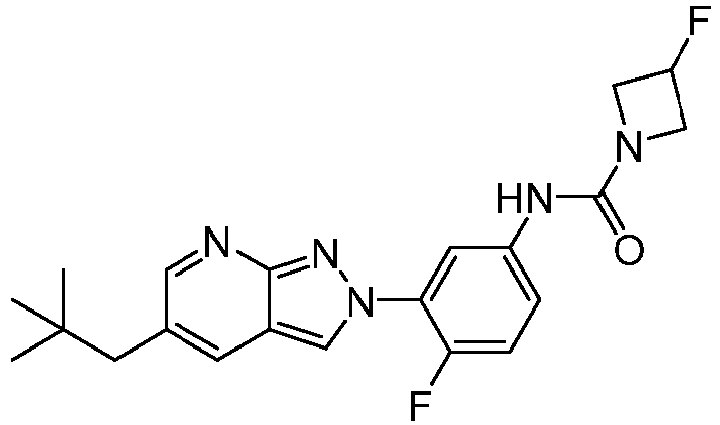
1H NMR (400 MHz, Methanol-d 4) δ 8.69 (m, 1H), 8.54 (m, 1H), 8.16-8.10 (m, 1H), 8.07 (m, 1H), 7.68 - 7.61 (m, 1H), 7.39 - 7.32 (m, 1H), 5.44-5.30 (m, 1H), 4.39 (m, 2H), 4.14 (m, 2H), 2.70 (s, 2H), 0.99 (s, 9H). Method 1: RT = 2.62 min.; M+H = 400.2 22 
1H NMR (400 MHz, Methanol-d 4) δ 8.69-8.54 (m, 2H), 7.83 (m, 1H), 7.66 (m, 1H), 7.40-7.25 (m, 1H), 7.20 - 7.10 (m, 1H), 5.43-5.28 (m, 1H), 4.43 - 4.31 (m, 2H), 4.20-4.05 (m, 2H), 1.49 (s, 9H). Method 1: RT = 2.72 min.; M+H = 386.1 23 
1H NMR (400 MHz, Methanol-d 4) δ 8.76-8.57 (m, 2H), 8.16-8.06 (m, 1H), 7.65 (m, 1H), 7.44-7.31 (m, 2H), 5.44-5.30 (m, 1H), 4.44 - 4.34 (m, 2H), 4.21 - 4.08 (m, 2H), 2.85 - 2.72 (m, 1H), 1.87 - 1.57 (m, 3H), 1.46 - 1.33 (m, 3H), 0.98-0.67 (m, 4H). Method 1: RT = 3.13 min.; M+H = 400.1 24 
1H NMR (400 MHz, Methanol-d4) δ 8.55 (m, 1H), 8.45 (m, 1H), 7.73 (m, 1H), 7.56 (m, 1H), 7.19 (m, 1H), 7.07 (m, 1H), 5.33 - 5.18 (m, 1H), 4.33 - 4.21 (m, 2H), 4.10-3.96 (m, 2H), 1.90 - 1.67 (m, 2H), 1.39 (s, 3H), 1.27 (s, 3H), 0.66 (t, J = 7.4 Hz, 3H). Method 1: RT = 2.89 min.; M+H = 400.1 25 
1H NMR (400 MHz, Methanol-d4) δ 8.74 - 8.63 (m, 1H), 8.62 - 8.52 (m, 1H), 8.16 - 8.05 (m, 1H), 7.73 - 7.59 (m, 1H), 7.40 - 7.29 (m, 1H), 7.08 (m, 1H), 5.44 - 5.26 (m, 1H), 4.39 (m, 2H), 4.20 - 4.06 (m, 2H), 1.90 - 1.61 (m, 2H), 1.52 - 1.30 (m, 3H), 1.03 - 0.81 (m, 3H), 0.77 (m, 1H). Method 1: RT = 2.78 min.; M+H = 386.1 26 
1H NMR (400 MHz, Methanol-d 4) δ 8.67 (m, 1H), 8.58 (m, 1H), 8.16-8.08 (m, 1H), 8.05 (m, 1H), 7.64 (m, 1H), 7.38 - 7.31 (m, 1H), 5.44 - 5.30 (m, 1H), 4.39 (m, 2H), 4.14 (m, 2H), 2.87 (m, 1H), 2.68 (m, 1H), 2.19-2.04 (m, 2H), 1.98 - 1.66 (m, 4H), 0.91 (m, 1H). Method 1: RT = 3.10 min.; M+H = 398.1 27 
1H NMR (400 MHz, Methanol-d4) δ 8.67 (m, 1H), 8.57 (m, 1H), 8.13 (m, 1H), 8.11 - 8.05 (m, 1H), 7.65 (m, 1H), 7.39 - 7.31 (m, 1H), 5.44-5.30 (m, 1H), 4.39 (m, 2H), 4.14 (m, 2H), 2.87 - 2.76 (m, 2H), 1.69 - 1.57 (m, 2H), 1.04 - 0.85 (m, 6H), 0.76 (m, 1H). Method 1: RT = 3.18 min.; M+H = 400.1 28 
1H NMR (400 MHz, Methanol-d4) δ 9.37 (m, 1H), 8.86 (m, 2H), 8.70 (m, 1H), 8.19 (m, 1H), 8.04 - 7.92 (m, 2H), 7.66 (m, 1H), 7.45 - 7.31 (m, 2H), 5.45 - 5.30 (m, 1H), 4.46 - 4.34 (m, 2H), 4.21 - 4.08 (m, 2H). Method 1: RT = 2.67 min.; M+H = 407.1 29 
1H NMR (400 MHz, Methanol-d 4) δ 8.53 (m, 1H), 8.49 (m, 1H), 8.04 (m, 1H), 7.85 - 7.79 (m, 1H), 7.54 (m, 1H), 7.29-7.22 (m, 1H), 4.32 (t, J = 12.3 Hz, 4H), 2.07 - 1.95 (m, 1H), 0.98 (m, 2H), 0.71 (m, 2H). Method 2: RT = 1.10 min.; M+H = 388.1 30 
1H NMR (400 MHz, Methanol-d 4) δ 8.71 - 8.62 (m, 1H), 8.25-8.12 (m, 1H), 7.94 (m, 1H), 7.73 - 7.60 (m, 1H), 7.45 - 7.29 (m, 2H), 4.44 (m, 4H), 2.19 (m, 1H), 1.97 - 1.49 (m, 6H), 0.90 (m, 2H). Method 2: RT = 1.09 min.; M+H = 416.1 31 
1H NMR (400 MHz, Methanol-d 4) δ 8.59 (m, 1H), 8.50 (m, 1H), 8.05 (m, 1H), 8.02 (m, 1H), 7.55 (m, 1H), 7.29-7.23 (m, 1H), 4.32 (t, J = 12.3 Hz, 4H), 2.37 (m, 2H), 2.27-1.98 (m, 4H), 1.91 - 1.83 (m, 1H). Method 1: RT = 3.16 min.; M+H = 402.1 32 
1H NMR (400 MHz, Methanol-d 4) δ 8.70 (m, 1H), 8.54 (m, 1H), 8.16 (m, 1H), 8.07 (m, 1H), 7.66 (m, 1H), 7.41 - 7.34 (m, 1H), 4.43 (t, J = 12.3 Hz, 4H), 2.69 (s, 2H), 0.99 (s, 9H). Method 2: RT = 1.27 min.; M+H = 418.1 33 
1H NMR (400 MHz, Methanol-d 4) δ 8.64 (m, 1H), 8.61 - 8.55 (m, 1H), 7.84 (m, 1H), 7.71 - 7.64 (m, 1H), 7.37 - 7.28 (m, 1H), 7.17 (m, 1H), 4.42 (m, 4H), 1.52 (m, 9H). Method 2: RT = 1.04 min.; M+H = 404.1 34 
1H NMR (400 MHz, Methanol-d 4) δ 8.68 (m, 1H), 8.63-8.57 (m, 1H), 8.15 (m, 1H), 7.98 - 7.91 (m, 1H), 7.69 - 7.62 (m, 1H), 7.39 - 7.32 (m, 1H), 4.42 (m, 4H), 1.53 - 1.33 (m, 5H), 1.00 - 0.72 (m, 6H). Method 2: RT = 1.14 min.; M+H = 418.1 35 
1H NMR (400 MHz, Methanol-d 4) δ 8.65 (m, 1H), 8.55 (m, 1H), 7.84 (m, 1H), 7.67 (m, 1H), 7.40 - 7.31 (m, 1H), 7.17 (m, 1H), 4.42 (m, 4H), 1.93 - 1.79 (m, 2H), 1.50 (m, 3H), 1.37 (m, 3H), 0.81 - 0.66 (m, 3H). Method 2: RT = 1.10 min.; M+H = 418.1 36 
1H NMR (400 MHz, Methanol-d 4) δ 8.68 (m, 1H), 8.46 (m, 1H), 8.14 (m, 1H), 7.70-7.63 (m, 1H), 7.39-7.33 (m, 1H), 7.18 (m, 1H), 4.43 (m, 4H), 1.91 - 1.79 (m, 2H), 1.54 - 1.36 (m, 4H), 0.92 (m, 3H). Method 2: RT = 1.14 min.; M+H = 404.1 37 
1H NMR (400 MHz, Methanol-d 4) δ 8.59 - 8.54 (m, 1H), 8.45 (m, 1H), 8.07 - 8.00 (m, 1H), 7.96 - 7.92 (m, 1H), 7.55 (m, 1H), 7.29 - 7.23 (m, 1H), 4.32 (t, J= 12.3 Hz, 4H), 2.76 (m, 2H), 2.63 - 2.51 (m, 1H), 2.04 - 1.93 (m, 2H), 1.87 - 1.64 (m, 4H). Method 1: RT = 3.26 min.; M+H = 416.1 38 
1H NMR (400 MHz, Methanol-d 4) δ 8.67 (m, 1H), 8.58 (m, 1H), 8.16 (m, 1H), 8.10-8.04 (m, 1H), 7.69 - 7.62 (m, 1H), 7.40 - 7.33 (m, 1H), 4.43 (t, J = 12.3 Hz, 4H), 2.89 - 2.78 (m, 2H), 1.72 - 1.53 (m, 3H), 1.04 - 0.86 (m, 6H). Method 2: RT = 1.30 min.; M+H = 418.1 39 
1H NMR (400 MHz, Methanol-d4) δ 9.36 (d, J = 2.3 Hz, 1H), 9.00 -8.93 (m, 2H), 8.79 - 8.75 (m, 1H), 8.26 (dd, J = 6.8, 2.7 Hz, 1H), 8.19-8.14 (m, 2H), 7.70-7.64 (m, 1H), 7.64 - 7.56 (m, 1H), 7.46 - 7.35 (m, 1H), 4.44 (td, J = 12.3, 3.0 Hz, 4H). Method 2: RT = 0.99 min.; M+H = 425.0 40 
1H NMR (400 MHz, DMSO) δ 8.70 (s, 1 H), 8.56 (d, J = 2.76 Hz, 1 H), 8.31 (d, J = 2.76 Hz, 1 H), 8.21 (dd, J = 7.03, 2.64 Hz, 1 H), 7.59-7.72 (m, 1 H), 7.41 (dd, J = 11.36, 9.10 Hz, 1 H), 7.01 (d, J = 2.76 Hz, 1 H), 5.39 - 5.66 (m, 1 H), 4.20 - 4.36 (m, 2 H), 3.89 - 4.09 (m, 6 H), 2.12 - 2.28 (m, 2 H). Method 1: RT = 2.66 min. M+H =385.3 41 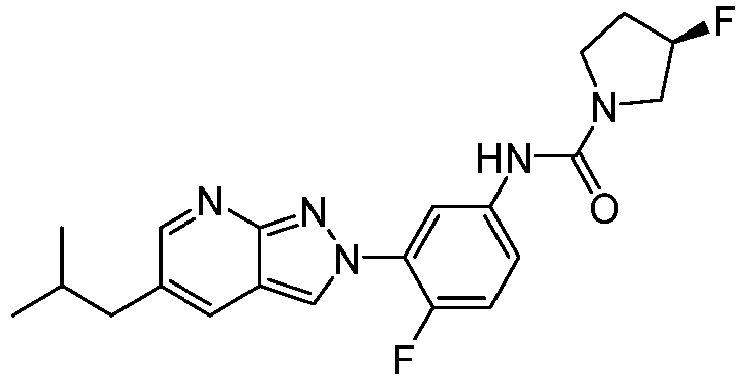
1H NMR (400 MHz, Methanol-d4) δ 8.68 (m, 1H), 8.56 (m, 1H), 8.12 (m, 1H), 8.07 (m, 1H), 7.65 (m, 1H), 7.36 (m, 1H), 5.40 - 5.27 (m, 1H), 3.85 - 3.68 (m, 2H), 3.59 (m, 2H), 2.67 (m, 2H), 2.28 (m, 2H), 1.97 (m, 1H), 0.99 (d, J = 6.6 Hz, 6H). M+H = 400.3 42 
1H NMR (400 MHz, Methanol-d4) δ 8.63 (m, 1H), 8.59 (m, 1H), 8.11 (m, 1H), 7.92 (m, 1H), 7.63 (m, 1H), 7.34 (m, 1H), 5.40 - 5.26 (m, 1H), 3.80 - 3.67 (m, 2H), 3.59 (m, 2H), 2.37 - 2.18 (m, 2H), 2.12 (m, 1H), 1.08 (m, 2H), 0.85 - 0.79 (m, 2H). Method 2: RT = 1.03 min.; M+H = 384.3 43 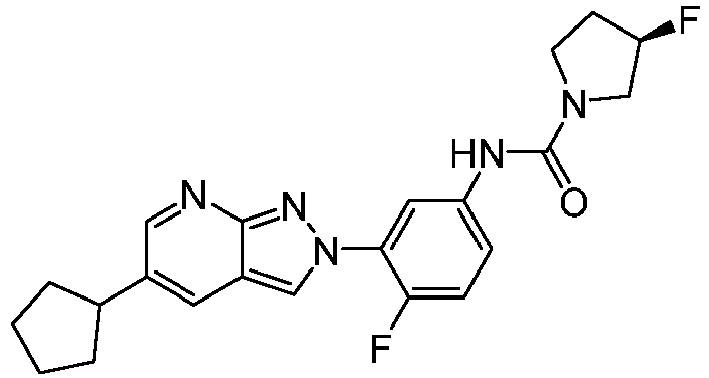
1H NMR (400 MHz, Methanol-d 4) δ 8.77 - 8.54 (m, 2H), 8.27 - 8.07 (m, 2H), 7.64 (m, 1H), 7.36 (m, 1H), 5.40 - 5.23 (m, 1H), 3.87 - 3.51 (m, 4H), 3.20 (m, 1H), 2.46 - 1.96 (m, 5H), 1.98 - 1.56 (m, 5H). Method 2: RT = 1.04 min.; M+H = 412.3 44 
1H NMR (400 MHz, Methanol-d 4) δ 8.67 (m, 1H), 8.65 - 8.57 (m, 1H), 8.26 - 8.08 (m, 2H), 7.64 (m, 1H), 7.35 (m, 1H), 5.40 - 5.26 (m, 1H), 3.84 - 3.54 (m, 4H), 2.79 - 2.68 (m, 1H), 2.39 - 1.92 (m, 6H), 1.82 (m, 1H), 1.66 -1.19 (m, 5H). Method 2: RT = 1.26 min.; M+H =426.4 45 
1H NMR (400 MHz, Methanol-d 4) δ 8.77 (m, 1H), 8.69 (m, 1H), 8.61 (m, 1H), 8.17 - 8.09 (m, 1H), 7.63 (m, 1H), 7.40 - 7.32 (m, 1H), 5.42 - 5.25 (m, 1H), 3.82 - 3.53 (m, 4H), 2.63 - 2.07 (m, 6H), 1.90 - 1.89 (m, 3H). Method 1: RT = 2.93 min.; M+H = 398.3 46 
1H NMR (400 MHz, Methanol-d 4) δ 8.69 (m, 1H), 8.54 (m, 1H), 8.12 (m, 1H), 8.07 (m, 1H), 7.64 (m, 1H), 7.35 (m, 1H), 5.39 - 5.26 (m, 1H), 3.82 - 3.70 (m, 2H), 3.59 (m, 2H), 2.69 (s, 2H), 2.33 - 2.09 (m, 2H), 0.99 (s, 9H). Method 2: RT = 1.21 min.; M+H = 414.4 47 
1H NMR (400 MHz, Methanol-d 4) δ 8.69 - 8.62 (m, 1H), 8.58 (m, 1H), 7.81 (m, 1H), 7.69 (m, 1H), 7.30 (m, 1H), 7.17 (m, 1H), 5.38 - 5.23 (m, 1H), 3.78 - 3.66 (m, 2H), 3.57 (m, 2H), 2.35 - 2.11 (m, 2H), 1.71 - 1.22 (m, 9H). Method 2: RT = 0.98 min.; M+H = 400.3 48 
1H NMR (400 MHz, Methanol-d 4) δ 8.72 - 8.65 (m, 1H), 8.47 (m, 1H), 8.18-8.08 (m, 1H), 7.74 - 7.60 (m, 1H), 7.43 - 7.33 (m, 1H), 7.26 - 7.14 (m, 1H), 5.39 - 5.26 (m, 1H), 3.83-3.53 (m, 4H), 3.16 - 3.01 (m, 1H), 2.85 - 2.72 (m, 1H), 2.40 - 2.05 (m, 4H), 1.54 - 1.15 (m, 4H), 1.03 - 0.88 (m, 2H), 0.84 - 0.74 (m, 1H). Method 2: RT = 1.08 min.; M+H = 414.4 49 
1H NMR (400 MHz, Methanol-d 4) δ 8.65 (m, 1H), 8.56 (m, 1H), 7.82 (m, 1H), 7.69 (m, 1H), 7.30 (m, 1H), 7.19 (m, 1H), 5.40 - 5.26 (m, 1H), 3.81 - 3.69 (m, 2H), 3.58 (m, 2H), 2.35-2.19 (m, 2H), 1.87- 1.79 (m, 2H), 1.55 - 1.43 (s, 3H), 1.39 (s, 3H), 0.85 - 0.68 (m, 3H). Method 2: RT = 1.04 min.; M+H = 414.3 50 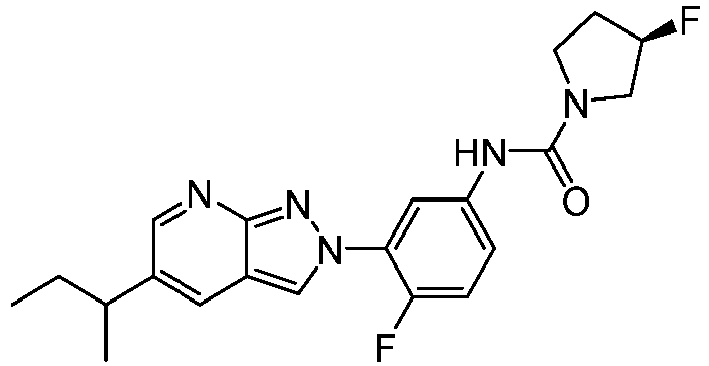
1H NMR (400 MHz, Methanol-d 4) δ 8.67 (m, 1H), 8.64-8.56 (m, 1H), 8.12 (m, 1H), 7.69 -7.59(m, 1H), 7.41 - 7.30 (m, 1H), 7.22 - 7.14 (m, 1H), 5.40 - 5.26 (m, 1H), 3.82-3.55 (m, 4H), 2.97 - 2.77 (m, 2H), 2.37 - 2.21 (m, 2H), 1.75 - 1.65 (m, 1H), 1.52 - 1.21 (m, 3H), 1.11 - 0.82 (m, 3H). Method 2: RT = 1.18 min.; M+H =400.3 51 
1H NMR (400 MHz, Methanol-d 4) δ 8.66 (m, 1H), 8.55 (m, 1H), 8.13 (m, 1H), 8.07-8.03 (m, 1H), 7.62 (m, 1H), 7.35 (m, 1H), 5.40 - 5.25 (m, 1H), 3.83 - 3.69 (m, 2H), 3.66 - 3.50 (m, 2H), 2.90 - 2.78 (m, 2H), 2.73 - 2.62 (m, 1H), 2.59 - 2.45 (m, 1H), 2.39 - 2.18 (m, 2H), 2.15-2.04 (m, 2H), 1.89 - 1.78 (m, 3H). Method 1: RT = 3.16 min.; M+H =412.3 52 
1H NMR (400 MHz, Methanol-d 4) δ 8.67 (m, 1H), 8.57 (m, 1H), 8.12 (m, 1H), 8.10-8.05 (m, 1H), 7.64 (m, 1H), 7.35 (m, 1H), 5.40 - 5.26 (m, 1H), 3.83 - 3.69 (m, 2H), 3.59 (m, 2H), 2.89 - 2.77 (m, 2H), 2.38 - 2.05 (m, 3H), 1.70 - 1.57 (m, 2H), 1.04 - 0.88 (m, 6H). Method 2: RT = 1.25 min.; M+H =414.4 53 
1H NMR (400 MHz, Methanol-d 4) δ 9.37 (m, 1H), 8.88 (m, 1H), 8.86 (m, 1H), 8.70 (m, 1H), 8.17 (m, 1H), 8.05-7.92 (m, 2H), 7.66 (m, 1H), 7.43 (m, 1H), 7.37 (m, 1H), 5.40 - 5.27 (m, 1H), 3.85 - 3.70 (m, 2H), 3.60 (m, 2H), 2.38 - 2.09 (m, 2H). Method 2: RT = 0.93 min.; M+H =421.3 54 
1H NMR (400 MHz, Methanol-d 4) δ 8.72 (m, 1H), 8.58 (m, 1H), 8.43 (m, 1H), 8.08 (m, 1H), 7.93 (m, 1H), 7.78 (m, 1H), 7.46 (m, 1H), 7.31 (m, 1H), 6.71 - 6.63 (m, 1H), 2.68 (d, J = 7.1 Hz, 2H), 1.98 (m, 1H), 0.99 (2s, 6H). Method 1: RT = 3.20 min.; M+H = 379.3 55 
1H NMR (400 MHz, Methanol-d 4) δ 8.67 (m, 1H), 8.61 (m, 1H), 8.42 (m, 1H), 7.95-7.87 (m, 2H), 7.78 (m, 1H), 7.44 (m, 1H), 7.31 (m, 1H), 6.67 (m, 1H), 2.17-2.08 (m, 1H), 1.09 (m, 2H), 0.86 - 0.79 (m, 2H). Method 2: RT = 1.11 min.; M+H = 363.3 56 
1H NMR (400 MHz, Methanol-d 4) δ 8.71 (m, 1H), 8.69-8.65 (m, 1H), 8.43 (m, 1H), 8.15 (m, 1H), 7.92 (m, 1H), 7.80 - 7.76 (m, 1H), 7.46 (m, 1H), 7.33 - 7.29 (m, 1H), 6.67 (m, 1H), 3.25-3.18 (m, 1H), 2.27-2.14 (m, 3H), 1.85 - 1.66 (m, 5H). Method 2: RT = 1.27 min.; M+H = 391.3 57 
1H NMR (400 MHz, Methanol-d 4) δ 8.67 (m, 1H), 8.53 (m, 1H), 8.07 (m, 1H), 8.00 (m, 1H), 7.77 (m, 1H), 7.47 (m, 1H), 7.34 - 7.29 (m, 1H), 7.19 (m, 1H), 6.67 (m, 1H), 2.88 (m, 2H), 1.98 (m, 3H), 1.88 - 1.72 (m, 3H), 1.40 - 1.28 (m, 3H). M+H = 405.3 58 
1H NMR (400 MHz, DMSO) δ 8.95 (s, 1 H), 8.56 (d, J= 2.63 Hz, 1 H), 8.30 (d, J = 2.89 Hz, 1 H), 8.19 (dd, J = 7.09, 2.70 Hz, 1 H), 7.60 - 7.69 (m, 1 H), 7.42 (dd, J = 11.36, 9.10 Hz, 1 H), 7.00 (d, J = 2.76 Hz, 1 H), 5.28-5.63 (m, 2 H), 4.20 - 4.37 (m, 4 H), 3.93 - 4.09 (m, 4 H). Method 1: RT = 2.61 min. M+H =403.2 59 
1H NMR (400 MHz, Methanol-d 4) δ 8.73 (m, 1H), 8.55 (m, 1H), 8.43 (m, 1H), 8.09 (m, 1H), 7.93 (m, 1H), 7.78 (m, 1H), 7.45 (m, 1H), 7.31 (m, 1H), 6.70 - 6.64 (m, 1H), 2.70 (s, 2H), 0.99 (s, 9H). Method 2: RT = 1.29 min.; M+H = 393.3 60 
1H NMR (400 MHz, Methanol-d 4) δ 8.66 (m, 1H), 8.64-8.54 (m, 1H), 8.12 (m, 1H), 7.94 (m, 1H), 7.77 (m, 1H), 7.40 (m, 1H), 7.30 (m, 1H), 7.18 (m, 1H), 6.67 (m, 1H), 2.03 - 1.79 (m, 2H), 1.51 (s, 3H), 1.39 (s, 3H), 0.75 (m, 3H). Method 2: RT = 1.11 min.; M+H = 393.3 61 
1H NMR (400 MHz, Methanol-d 4) δ 8.61 (m, 1H), 8.48 - 8.38 (m, 1H), 8.15 - 8.04 (m, 1H), 7.93 (m, 1H), 7.81 -7.74 (m, 1H), 7.53 -7.43 (m, 1H), 7.31 (m, 1H), 7.10 (m, 1H), 6.67 (m, 1H), 2.86 - 2.75 (m, 1H), 1.89 - 1.66 (m, 2H), 1.54 - 1.27 (m, 3H), 1.06 - 0.82 (m, 3H). Method 1: RT = 3.09 min.; M+H = 379.3 62 
1H NMR (400 MHz, Methanol-d 4) δ 8.74-8.66 (m, 1H), 8.58 (m, 1H), 8.42 (m, 1H), 8.12-8.04 (m, 1H), 7.92 (m, 1H), 7.78 (m, 1H), 7.45 (m, 1H), 7.31 (m, 1H), 6.67 (m, 1H), 2.84 (m, 2H), 2.69 (m, 1H), 2.15-2.05 (m, 1H), 1.98 - 1.67 (m, 3H), 1.51 - 1.35 (m, 1H), 1.00 (m, 1H). Method 1: RT = 3.26 min.; M+H = 391.3 63 
1H NMR (400 MHz, Methanol-d 4) δ 8.71 (m, 1H), 8.59 (m, 1H), 8.42 (m, 1H), 8.12 - 8.05 (m, 1H), 7.95 - 7.88 (m, 1H), 7.78 (m, 1H), 7.45 (m, 1H), 7.31 (m, 1H), 6.70 - 6.64 (m, 1H), 2.87 - 2.75 (m, 2H), 1.82 - 1.56 (m, 3H), 1.05 - 0.82 (m, 6H). Method 2: RT = 1.32 min.; M+H =393.3 64 
1H NMR (400 MHz, Methanol-d 4) δ 9.42-9.35 (m, 1H), 8.94 - 8.90 (m, 1H), 8.89 - 8.85 (m, 1H), 8.73 - 8.66 (m, 1H), 8.51 - 8.45 (m, 1H), 8.06 - 7.89 (m, 3H), 7.81 - 7.76 (m, 1H), 7.51 - 7.40 (m, 2H), 7.35 - 7.29 (m, 1H), 6.70 - 6.64 (m, 1H). Method 2: RT = 1.01 min.; M+H = 400.3 65 
1H NMR (400 MHz, Methanol-d 4) δ 9.21 (m, 1H), 8.73 (m, 1H), 8.67 (m, 2H), 8.56 (m, 1H), 8.14 (m, 1H), 8.00 (m, 1H), 7.47 (m, 1H), 3.14 (m, 1H), 2.68 (s, 3H), 1.39 (2s, 6H). Method 1: RT = 3.11 min.; M+H = 391.3 66 
1H NMR (400 MHz, Methanol-d 4) δ 8.69 (m, 1H), 8.66 (m, 1H), 8.31 - 8.26 (m, 1H), 8.13 (m, 1H), 7.76 (m, 1H), 7.39 (m, 1H), 3.13 (m, 1H), 3.03 - 2.84 (m, 1H), 2.35 - 1.70 (m, 6H), 1.38 (m, 7H), 1.06 (m, 3H). Method 1: RT = 3.36 min.; M+H = 381.4 67 
1H NMR (400 MHz, Methanol-d 4) δ 8.74 - 8.69 (m, 1H), 8.69 - 8.64 (m, 1H), 8.64 - 8.59 (m, 1H), 8.59 - 8.53 (m, 1H), 8.33 - 8.26 (m, 1H), 8.16-8.10 (m, 1H), 8.01 - 7.94 (m, 1H), 7.86 - 7.77 (m, 1H), 7.51 - 7.41 (m, 1H), 3.14 (m, 1H), 1.39 (2s, 6H). Method 1: RT = 3.22 min.; M+H = 394.3 68 
1H NMR (400 MHz, Methanol-d 4) δ 8.73 (m, 1H), 8.67 (m, 1H), 8.48 (m, 1H), 8.14 (m, 1H), 7.91 (m, 1H), 7.47 (m, 1H), 3.19 - 3.09 (m, 1H), 2.62 (s, 3H), 1.39 (2s, 6H). Method 1: RT = 3.29 min.; M+H = 448.3 69 
1H NMR (400 MHz, Methanol-d 4) δ 8.45 (m, 1H), 8.41 (m, 1H), 8.05 (m, 1H), 7.88 (m, 1H), 7.52 (m, 1H), 7.15 (m, 1H), 2.89 (m, 1H), 2.09 - 2.01 (m, 2H), 1.13 (2s, 6H), 0.96 - 0.83 (m, 1H), 0.42 - 0.29 (m, 2H), 0.08 - - 0.05 (m, 2H). Method 1: RT = 3.06 min.; M+H = 353.3 70 
1H NMR (400 MHz, Methanol-d 4) δ 8.72 (m, 1H), 8.67 (m, 1H), 8.56-8.48 (m, 2H), 8.14 (m, 1H), 7.96 (m, 1H), 7.80 (m, 1H), 7.47 (m, 1H), 3.14 (m, 1H), 1.39 (2s, 6H). Method 1: RT = 3.12 min.; M+H = 412.3 71 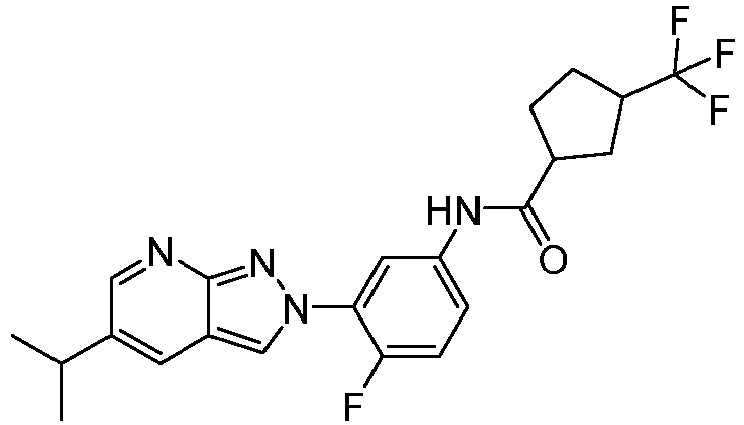
1H NMR (400 MHz, Methanol-d 4) δ 8.69 (m, 1H), 8.66 (m, 1H), 8.30 (m, 1H), 8.15 - 8.09 (m, 1H), 7.76 (m, 1H), 7.40 (m, 1H), 3.18 - 3.07 (m, 1H), 3.07 - 2.74 (m, 2H), 2.27 - 1.73 (m, 6H), 1.56 - 1.17 (2s, 6H). Method 1: RT = 3.35 min.; M+H = 435.3 72 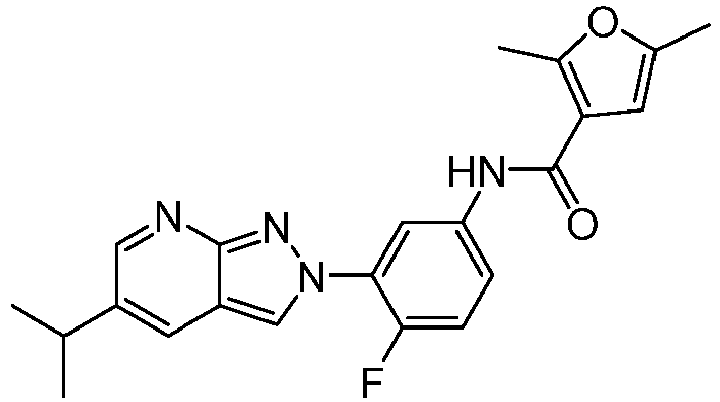
1H NMR (400 MHz, Methanol-d 4) δ 8.71 (m, 1H), 8.66 (m, 1H), 8.36 (m, 1H), 8.14 (m, 1H), 7.84 (m, 1H), 7.46 - 7.38 (m, 1H), 6.53 - 6.45 (m, 1H), 3.14 (m, 1H), 2.54 (s, 3H), 2.29 (s, 3H), 1.39 (2s, 6H). Method 1: RT = 3.31 min.; M+H = 393.3 73 
1H NMR (400 MHz, Methanol-d 4) δ 8.72 (m, 1H), 8.67 (m, 1H), 8.44 (m, 1H), 8.28 (m, 1H), 8.14 (m, 1H), 7.90 (m, 1H), 7.45 (m, 1H), 3.14 (m, 1H), 2.53 (s, 3H), 1.39 (2s, 6H). Method 1: RT = 3.00 min.; M+H = 380.3 74 
1H NMR (400 MHz, Methanol-d 4) δ 8.70 (m, 1H), 8.66 (m, 1H), 8.46 (m, 1H), 8.13 (m, 1H), 7.85 (m, 1H), 7.47 - 7.36 (m, 1H), 3.14 (m, 1H), 2.62 (s, 3H), 2.46 (s, 3H), 1.49 - 1.19 (2s, 6H). Method 1: RT = 3.23 min.; M+H = 394.3 75 
1H NMR (400 MHz, Methanol-d 4) δ 8.75 - 8.69 (m, 1H), 8.69 - 8.63 (m, 1H), 8.45 - 8.39 (m, 1H), 8.16 - 8.09 (m, 1H), 7.95 - 7.87 (m, 1H), 7.51 - 7.41 (m, 1H), 3.20 - 3.06 (m, 1H), 2.29 - 2.19 (m, 1H), 1.39 (2s, 6H), 1.27 - 1.14 (m, 4H). Method 1: RT = 3.15 min.; M+H = 406.3 76 
1H NMR (400 MHz, Methanol-d 4) δ 8.74 - 8.68 (m, 1H), 8.69 - 8.62 (m, 1H), 8.46 - 8.39 (m, 1H), 8.16 - 8.09 (m, 1H), 7.92 - 7.83 (m, 1H), 7.48 - 7.38 (m, 1H), 3.20 - 3.08 (m, 1H), 2.49 - 2.39 (m, 3H), 2.23 - 2.12 (m, 1H), 1.38 (2s, 6H), 1.29 - 1.12 (m, 4H). Method 1: RT = 3.24 min.; M+H = 420.3 77 
1H NMR (400 MHz, Methanol-d 4) δ 8.72 - 8.67 (m, 1H), 8.67 - 8.63 (m, 1H), 8.39 - 8.33 (m, 1H), 8.15 - 8.09 (m, 1H), 7.85 - 7.77 (m, 1H), 7.45 - 7.37 (m, 1H), 4.13 - 3.97 (m, 2H), 3.22 - 3.09 (m, 1H), 2.47 - 2.31 (m, 1H), 2.09 - 1.77 (m, 4H), 1.50 (s, 3H), 1.38 (2s, 6H). Method 1: RT = 3.10 min.; M+H = 383.3 78 
1H NMR (400 MHz, Methanol-d 4) δ 8.72 (m, 1H), 8.66 (m, 1H), 8.47 (m, 1H), 8.13 (m, 1H), 7.89 (m, 1H), 7.49 - 7.41 (m, 1H), 3.14 (m, 1H), 2.63 - 2.47 (s, 3H), 1.38 (2s, 6H). Method 1: RT = 3.39 min.; M+H = 448.3 79 
1H NMR (400 MHz, Methanol-d 4) δ 8.72 (m, 1H), 8.66 (m, 1H), 8.43 (m, 1H), 8.13 (m, 1H), 7.89 (m, 1H), 7.45 (m, 1H), 4.61 (s, 2H), 3.14 (m, 1H), 2.50 (s, 3H), 1.49 - 1.34 (2s, 6H), 1.34 - 1.20 (s, 9H). Method 1: RT = 3.36 min.; M+H = 466.4 80 
1H NMR (400 MHz, Methanol-d 4) δ 8.69 (m, 1H), 8.66 (m, 1H), 8.36 (m, 1H), 8.13 (m, 1H), 7.80 (m, 1H), 7.41 (m, 1H), 4.16 (m, 1H), 3.97 (m, 1H), 3.60 (m, 1H), 3.13 (m, 1H), 2.12 - 2.04 (m, 1H), 2.01 - 1.92 (m, 1H), 1.75 - 1.49 (m, 4H), 1.38 (2s, 6H). Method 1: RT = 3.17 min.; M+H = 383.3 81 
1H NMR (400 MHz, Methanol-d 4) δ 8.74 - 8.68 (m, 1H), 8.68 - 8.63 (m, 1H), 8.49 - 8.44 (m, 1H), 8.16 - 8.09 (m, 1H), 7.95 - 7.87 (m, 1H), 7.50 - 7.39 (m, 1H), 3.21 - 3.06 (m, 1H), 2.39 (s, 3H), 2.19 (s, 3H), 1.38 (2s, 6H). Method 1: RT = 3.18 min.; M+H = 394.3 82 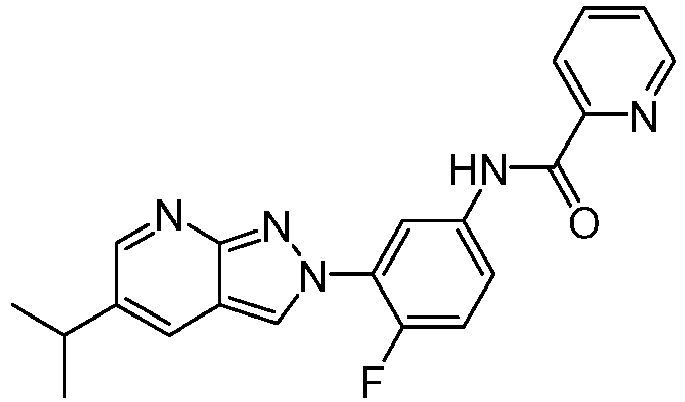
1H NMR (400 MHz, Methanol-d 4) δ 8.76 - 8.69 (m, 2H), 8.67 (m, 1H), 8.59 (m, 1H), 8.24 (m, 1H), 8.14 (m, 1H), 8.07 - 7.96 (m, 2H), 7.62 (m, 1H), 7.47 (m, 1H), 3.14 (m, 1H), 1.57 - 1.21 (2s, 6H). Method 1: RT = 3.18 min.; M+H = 376.3 83 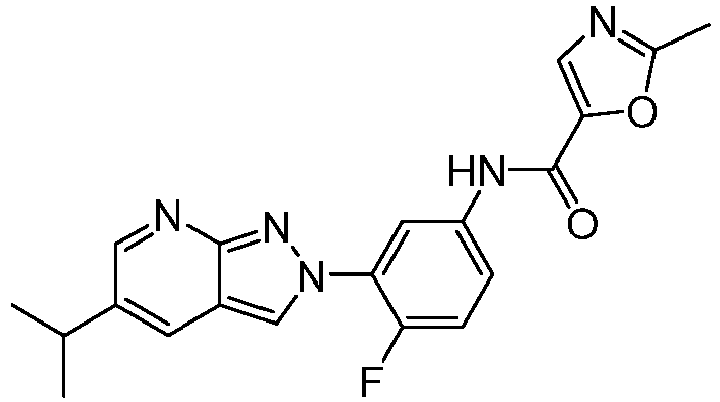
1H NMR (400 MHz, Methanol-d 4) δ 8.74 - 8.69 (m, 1H), 8.68 - 8.63 (m, 1H), 8.46 - 8.40 (m, 1H), 8.16 - 8.11 (m, 1H), 7.94 - 7.87 (m, 1H), 7.79 - 7.75 (m, 1H), 7.50 - 7.41 (m, 1H), 3.21 - 3.07 (m, 1H), 2.59 (s, 3H), 1.39 (2s, 6H). Method 1: RT = 3.01 min.; M+H = 380.3 84 
1H NMR (400 MHz, Methanol-d 4) δ 9.06 (m, 1H), 8.73 (m, 1H), 8.67 (m, 1H), 8.60 (m, 1H), 8.45 - 8.34 (m, 2H), 8.17 - 8.12 (m, 1H), 8.01 (m, 1H), 7.48 (m, 1H), 3.14 (m, 1H), 1.39 (2s, 6H). Method 1: RT = 3.15 min.; M+H = 401.3 85 
1H NMR (400 MHz, Methanol-d 4) δ 8.71 (m, 1H), 8.66 (m, 1H), 8.47 (m, 1H), 8.41 (m, 1H), 8.14 (m, 1H), 7.90 (m, 1H), 7.45 (m, 1H), 3.14 m, 1H), 1.39 (2s, 6H). Method 1: RT = 3.08 min.; M+H = 380.3 86 
1H NMR (400 MHz, Methanol-d 4) δ 8.73 (m, 1H), 8.67 (m, 1H), 8.51 (m, 1H), 8.14 (m, 1H), 7.95 (m, 1H), 7.86 (m, 1H), 7.73 (m, 1H), 7.48 (m, 1H), 3.20 - 3.08 (m, 1H), 1.45 - 1.20 (2s, 6H). Method 1: RT = 3.22 min.; M+H = 428.3 87 
1H NMR (400 MHz, Methanol-d 4) δ 9.36 (m, 1H), 8.84 (m, 1H), 8.76 (m, 1H), 8.72 (m, 1H), 8.66 (m, 1H), 8.57 (m, 1H), 8.13 (m, 1H), 7.99 (m, 1H), 7.46 (m, 1H), 3.13 (m, 1H), 1.38 (2s, 6H). Method 1: RT = 3.05 min.; M+H = 377.3 88 
1H NMR (400 MHz, Methanol-d 4) δ 8.69 (m, 1H), 8.66 (m, 1H), 8.36 (m, 1H), 8.12 (m, 1H), 7.81 (m, 1H), 7.41 (m, 1H), 4.46 (m, 1H), 4.12 (m, 1H), 3.94 (m, 1H), 3.13 (m, 1H), 2.36 (m, 1H), 2.10 (m, 1H), 1.97 (m, 2H), 1.38 (2s, 6H). Method 1: RT = 2.93 min.; M+H = 369.3 89 
1H NMR (400 MHz, Methanol-d4) δ 8.73 (m, 1H), 8.66 (m, 1H), 8.43 (m, 1H), 8.14 (m, 1H), 7.92 - 7.85 (m, 1H), 7.76 (m, 1H), 7.59 (m, 1H), 7.46 (m, 1H), 7.30 (m, 1H), 3.14 (m, 1H), 1.38 (d, J = 6.9 Hz, 6H). Method 1: RT = 3.35 min.; M+H = 427.3 90 
1H NMR (400 MHz, Methanol-d 4) δ 8.69 (m, 1H), 8.65 (m, 1H), 8.28 (m, 1H), 8.13 (m, 1H), 7.74 (m, 1H), 7.39 (m, 1H), 3.13 (m, 1H), 1.79 (m, 1H), 1.38 (2s, 6H), 1.01 - 0.84 (m, 4H). Method 1: RT = 3.07 min.; M+H = 339.3 91 
1H NMR (400 MHz, Methanol-d 4) δ 8.64 - 8.57 (m, 2H), 8.14-8.09 (m, 1H), 7.94 - 7.89 (m, 1H), 7.66 - 7.59 (m, 1H), 7.36 - 7.29 (m, 1H), 4.17 - 4.05 (m, 4H), 2.39 - 2.26 (m, 2H), 2.17 - 2.06 (m, 1H), 1.13 - 1.04 (m, 2H), 0.87 - 0.77 (m, 2H). Method 1: RT = 2.82 min.; M+H =352.3 92 
, 1H NMR (400 MHz, DMSO) δ 8.69 (s, 1 H), 8.62 (d, J = 2.64 Hz, 1 H), 8.36 (d, J = 2.76 Hz, 1 H), 8.22 (dd, J = 7.09, 2.70 Hz, 1 H), 7.65 - 7.72 (m, 1 H), 7.42 (dd, J = 11.29, 9.16 Hz, 1 H), 7.15 (d, J= 2.89 Hz, 1 H), 4.41 (t, J = 12.23 Hz, 4 H), 3.98 (t, J = 7.53 Hz, 4 H), 2.20 (quin, J = 7.56 Hz, 2 H). Method 1: RT = 2.81 min. M+H = 403.2, 93 
1H NMR (400 MHz, Methanol-d 4) δ 8.76-8.65 (m, 1H), 8.64 - 8.58 (m, 1H), 8.14-8.06 (m, 1H), 7.67 - 7.60 (m, 1H), 7.38 - 7.30 (m, 1H), 7.18 - 7.01 (m, 1H), 4.17-3.96 (m, 4H), 3.84 - 3.69 (m, 1H), 2.62 - 2.09 (m, 7H), 2.04 - 1.93 (m, 1H). Method 1: RT = 2.94 min.; M+H = 366.3 94 
1H NMR (400 MHz, Methanol-d 4) δ 8.71 - 8.66 (m, 1H), 8.56 - 8.50 (m, 1H), 8.15 - 8.09 (m, 1H), 8.09 - 8.04 (m, 1H), 7.68 - 7.60 (m, 1H), 7.38 - 7.30 (m, 1H), 4.18 - 4.04 (m, 4H), 2.69 (s, 2H), 2.40 - 2.27 (m, 2H), 0.99 (s, 9H). Method 1: RT = 3.19 min.; M+H = 382.4 95 
1H NMR (400 MHz, Methanol-d 4) δ 8.69-8.64 (m, 1H), 8.62-8.56 (m, 1H), 8.15 - 8.05 (m, 2H), 7.67 - 7.61 (m, 1H), 7.37 - 7.30 (m, 1H), 4.17 - 4.05 (m, 4H), 2.84 - 2.75 (m, 2H), 2.39 - 2.26 (m, 2H), 1.80 - 1.66 (m, 2H), 1.48 - 1.34 (m, 4H), 1.01 - 0.87 (m, 3H). Method 1: RT = 3.22 min.; M+H = 382.4 96 
1H NMR (400 MHz, Methanol-d 4) δ 8.65 (m, 1H), 8.59 (m, 1H), 8.15 - 8.06 (m, 2H), 7.64 (m, 1H), 7.34 (m, 1H), 4.17 - 4.05 (m, 4H), 2.85 - 2.76 (m, 2H), 2.32 (m, 2H), 1.78 - 1.64 (m, 2H), 1.43 (m, 3H), 1.00 (m, 3H). Method 1: RT = 3.13 min.; M+H = 368.3 97 
1H NMR (400 MHz, Methanol-d 4) δ 8.71 - 8.62 (m, 1H), 8.63 - 8.52 (m, 1H), 8.14 - 8.07 (m, 1H), 8.07 - 8.01 (m, 1H), 7.64 (m, 1H), 7.33 (m, 1H), 4.19 - 4.04 (m, 4H), 2.87 (m, 2H), 2.68 (m, 1H), 2.39 - 2.27 (m, 2H), 2.16 - 2.03 (m, 2H), 1.99 - 1.76 (m, 4H). Method 1: RT = 3.11 min.; M+H = 380.3 98 
1H NMR (400 MHz, Methanol-d 4) δ 8.65 (m, 1H), 8.57 (m, 1H), 8.15 - 8.02 (m, 2H), 7.64 (m, 1H), 7.33 (m, 1H), 4.18 - 4.01 (m, 4H), 2.92 - 2.69 (m, 2H), 2.32 (m, 2H), 1.84 - 1.53 (m, 3H), 1.06 - 0.89 (m, 6H). Method 1: RT = 3.18 min.; M+H = 382.4 99 
1H NMR (400 MHz, Methanol-d 4) δ 9.37 (m, 1H), 8.87 (m, 2H), 8.70 (m, 1H), 8.17 (m, 1H), 8.05 - 7.92 (m, 2H), 7.66 (m, 1H), 7.43 (m, 1H), 7.36 (m, 1H), 4.17 - 4.07 (m, 4H), 2.33 (m, 2H). Method 1: RT = 2.66 min.; M+H = 389.3 100 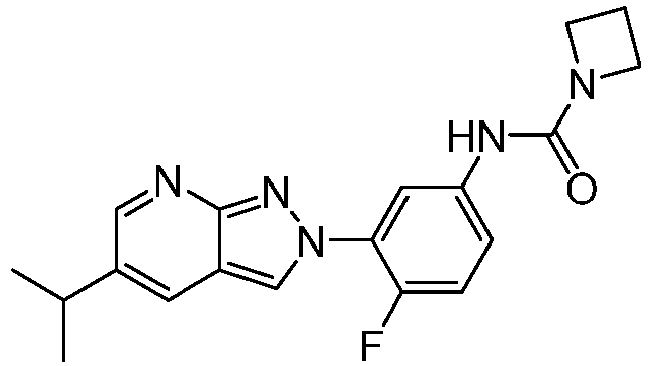
1H NMR (400 MHz, DMSO-d6) δ 8.78 (d, J=2.63 Hz, 1 H), 8.73 (s, 1 H), 8.68 (d, J=2.38 Hz, 1 H), 8.24 (dd, J=7.03, 2.76 Hz, 1 H), 8.05 (d, J=1.88 Hz, 1 H), 7.66 - 7.73 (m, 1 H), 7.44 (dd, J=11.29, 9.16 Hz, 1 H), 3.98 (t, J=7.59 Hz, 4 H), 3.02 - 3.14 (m, 1 H), 2.10 - 2.27 (m, 2 H), 1.30 (d, J=6.90 Hz, 6 H). Method 2: RT = 0.94 min.; M+H = 354.1 101 
1H NMR (400 MHz, Methanol-d 4) δ 9.07 (m, 1H), 8.79 (m, 1H), 8.49 (m, 1H), 7.87 (m, 1H), 7.52 - 7.43 (m, 1H), 7.36 - 7.29 (m, 1H), 2.69 - 2.56 (m, 2H), 2.55 (m, 3H), 2.46 (m, 3H), 2.34 - 2.12 (m, 3H), 2.07 - 1.93 (m, 2H). Method 1: RT = 3.08 min.; M+H = 406.3 102 
1H NMR (400 MHz, Methanol-d 4) δ 8.83 (m, 1H), 8.62 (m, 1H), 8.48 (m, 1H), 8.25 - 8.20 (m, 1H), 7.92 - 7.86 (m, 1H), 7.50 - 7.43 (m, 1H), 2.73 (s, 2H), 2.55 (m, 3H), 2.46 (m, 3H), 1.00 (m, 9H). Method 1: RT = 3.28 min.; M+H = 422.3 103 
1H NMR (400 MHz, Methanol-d 4) δ 8.79 - 8.68 (m, 2H), 8.13 (m, 1H), 7.98 - 7.91 (m, 1H), 7.47 - 7.38 (m, 1H), 7.31 - 7.24 (m, 1H), 2.55 (m, 3H), 2.46 (m, 3H), 1.55 (m, 9H). Method 1: RT = 2.90 min.; M+H = 408.3 104 
1H NMR (400 MHz, Methanol-d 4) δ 8.86 (m, 1H), 8.78 (m, 1H), 8.14 (m, 1H), 7.94 (m, 1H), 7.42 (m, 1H), 7.38 - 7.32 (m, 1H), 2.54 (m, 3H), 2.46 (m, 3H), 1.98 - 1.81 (m, 2H), 1.53 (s, 3H), 1.42 (s, 3H), 0.84 - 0.74 (m, 3H). Method 1: RT = 2.96 min.; M+H = 422.4 105 
1H NMR (400 MHz, Methanol-d4) δ 8.78 - 8.70 (m, 1H), 8.67 - 8.58 (m, 1H), 8.52 - 8.42 (m, 1H), 7.92 - 7.84 (m, 1H), 7.52 - 7.44 (m, 1H), 7.27 (m, 1H), 2.55 (m, 3H), 2.46 (m, 3H), 1.89 (m, 2H), 1.53 - 1.40 (m, 3H), 1.04 - 0.89 (m, 3H), 0.80 (m, 1H). Method 1: RT = 3.13 min.; M+H = 408.3 106 
1H NMR (400 MHz, Methanol-d4) δ 8.77 (m, 1H), 8.62 (m, 1H), 8.45 (m, 1H), 8.17 (m, 1H), 7.88 (m, 1H), 7.45 (m, 1H), 2.90 (m, 2H), 2.74 - 2.65 (m, 1H), 2.55 (s, 3H), 2.46 (s, 3H), 2.10 (m, 2H), 1.96 - 1.80 (m, 4H). Method 1: RT = 3.24 min.; M+H = 420.3 107 
1H NMR (400 MHz, Methanol-d 4) δ 8.85 (m, 1H), 8.73 - 8.66 (m, 1H), 8.49 (m, 1H), 8.31 (m, 1H), 7.87 (m, 1H), 7.46 (m, 1H), 2.88 - 2.80 (m, 2H), 2.55 (s, 3H), 2.46 (s, 3H), 1.72 - 1.59 (m, 3H), 1.03 - 0.92 (m, 6H). Method 1: RT = 3.30 min.; M+H = 422.4 108 
1H NMR (400 MHz, Methanol-d 4) δ 9.38 (m, 1H), 8.96 (m, 1H), 8.92 (m, 1H), 8.79 - 8.71 (m, 1H), 8.50 (m, 1H), 8.12 - 8.04 (m, 2H), 7.90 (m, 1H), 7.56 - 7.42 (m, 2H), 2.55 (m, 3H), 2.47 (m, 3H). Method 1: RT = 2.78 min.; M+H = 429.3 109 
1H NMR (400 MHz, Methanol-d 4) δ 8.71 (m, 1H), 8.66 (m, 1H), 8.42 (m, 1H), 8.14 (dd, J = 2.2, 0.7 Hz, 1H), 7.91 (ddd, J = 9.1, 4.2, 2.7 Hz, 1H), 7.44 (dd, J = 11.0, 9.1 Hz, 1H), 7.21 (d, J = 3.4 Hz, 1H), 6.31 - 6.24 (m, 1H), 3.14 (p, J = 6.9 Hz, 1H), 2.44 (s, 3H), 1.49 - 1.29 (m, 6H). Method 2: RT = 1.07 min.; M+H = 379.3 110 
400 MHz, Methanol-d 4) δ 8.71 (m, 1H), 8.66 (m, 1H), 8.38 (m, 1H), 8.14 (m, 1H), 7.87 (m, 1H), 7.43 (m, 1H), 7.29 (m, 1H), 7 (m, 1H), 4.02 - 3.89 (m, 3H), 3.18 - 3.10 m, 1H), 1.39 (2s, 6H). Method 2: RT = 1.05 min.; M+H = 395.3 111 
1H NMR (400 MHz, Methanol-d4) δ 8.73 (m, 1H), 8.66 (m, 1H), 8.45 (m, 1H), 8.14 (m, 1H), 7.92 (m, 1H), 7.46 (m, 1H), 7.23 (m, 1H), 6.55 (m, 1H), 3.65 (s, 2H), 3.14 (m, 1H), 2.37 (2s, 6H), 1.47 - 1.31 (2s, 6H). Method 2: RT = 0.74 min.; M+H = 422.3 112 
1H NMR (400 MHz, Methanol-d 4) δ 8.73 (m, 1H), 8.67 (m, 1H), 8.47 (m, 1H), 8.14 (m, 1H), 7.93 (m, 1H), 7.54 - 7.40 (m, 3H), 3.16 - 3.09 (m, 1H), 1.39 (2s, 6H). Method 2: RT = 1.08 min.; M+H = 390.3 113 
1H NMR (400 MHz, Methanol-d4) δ 8.72 (m, 1H), 8.67 (m, 1H), 8.40 (m, 1H), 8.14 (m, 1H), 7.89 (m, 1H), 7.45 (m, 1H), 7.31 (m, 1H), 5.90 (m, 1H), 3.19 - 3.10 (m, 1H), 1.39 (2s, 6H). Method 2: RT = 1.07 min.; M+H = 383.3 114 
1H NMR (400 MHz, Methanol-d 4) δ 8.70 (m, 1H), 8.66 (m, 1H), 8.40 (m, 1H), 8.13 (m, 1H), 7.89 (m, 1H), 7.48 - 7.38 (m, 1H), 7.09 (m, 1H), 3.14 (m, 1H), 2.40 - 2.21 (m, 3H), 2.03 (m, 3H), 1.62 - 1.15 (2s, 6H). Method 2: RT = 1.13 min.; M+H = 393.3 115 
1H NMR (400 MHz, Methanol-d 4) δ 8.71 (m, 1H), 8.66 (m, 1H), 8.42 (m, 1H), 8.13 (m, 1H), 7.87 (m, 1H), 7.60 (m, 1H), 7.42 (m, 1H), 6.51 (m, 1H), 3.14 (m, 1H), 2.41 (s, 3H), 1.44 - 1.26 (2s, 6H). Method 2: RT = 1.11 min.; M+H = 379.3 116 
1H NMR (400 MHz, Methanol-d 4) δ 8.72 (m, 1H), 8.66 (m, 1H), 8.50 (m, 1H), 8.13 (m, 1H), 7.97 (m, 1H), 7.79 - 7.74 (m, 1H), 7.69 - 7.62 (m, 2H), 7.53 - 7.42 (m, 2H), 7.39 - 7.31 (m, 1H), 3.13 (m, 1H), 1.38 (2s, 6H). Method 2: RT = 1.17 min.; M+H = 415.3 117 
1H NMR (400 MHz, Methanol-d 4) δ 8.70 (m, 1H), 8.66 (m, 1H), 8.32 (m, 1H), 8.13 (m, 1H), 7.79 (m, 1H), 7.41 (m, 1H), 3.19 - 3.04 (m, 3H), 2.60 - 2.47 (m, 2H), 1.61 (s, 3H), 1.38 (2s, 6H). Method 2: RT = 1.12 min.; M+H = 403.3 118 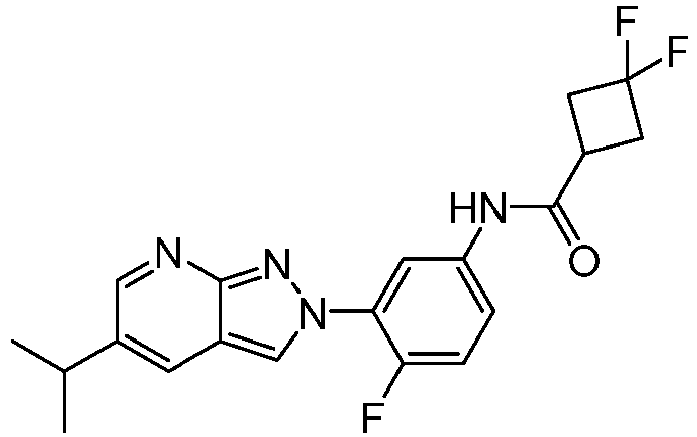
1H NMR (400 MHz, Methanol-d 4) δ 8.70 (m, 1H), 8.66 (m, 1H), 8.32 (m, 1H), 8.13 (m, 1H), 7.77 (m, 1H), 7.41 (m, 1H), 3.21 - 3.05 (m, 2H), 2.98 - 2.72 (m, 4H), 1.57 - 1.19 (2s, 6H). Method 2: RT = 1.08 min.; M+H = 389.3 119 
1H NMR (400 MHz, Methanol-d 4) δ 8.69 (m, 1H), 8.66 (m, 1H), 8.35 (m, 1H), 8.13 (m, 1H), 7.82 (m, 1H), 7.40 (m, 1H), 4.33 (m, 3H), 4.25 (m, 3H), 3.73 (s, 3H), 3.13 (m, 1H), 1.43 - 1.28 (2s, 6H). Method 2: RT = 1.07 min.; M+H = 459.3 120 
1H NMR (400 MHz, Methanol-d 4) δ 8.69 (m, 1H), 8.66 (m, 1H), 8.33 (m, 1H), 8.13 (m, 1H), 7.81 (m, 1H), 7.41 (m, 1H), 3.76 - 3.64 (m, 3H), 3.13 (m, 1H), 2.48 - 2.26 (m, 6H), 1.48 - 1.17 (2s, 6H). Method 2: RT = 1.04 min.; M+H = 423.3 121 
1H NMR (400 MHz, Methanol-d 4) δ 8.70 (m, 1H), 8.66 (m, 1H), 8.31 (m, 1H), 8.13 (m, 1H), 7.75 (m, 1H), 7.40 (m, 1H), 5.37 - 5.12 (m, 1H), 3.29 - 3.22 (m, 1H), 3.14 (m, 1H), 2.73 - 2.41 (m, 4H), 1.60 - 1.16 (2s, 6H). Method 1: RT = 3.06 min.; M+H = 371.3 122 
1H NMR (400 MHz, Methanol-d 4), δ 8.86 (s, 1 H), 8.81 (s, 1 H), 7.63 - 7.67 (m, 1 H), 8.51 (dd, J=6.72, 2.45 Hz, 1 H), 7.92 (brs, 1 H), 7.85 - 7.89 (m, 1 H), 7.77 (s, 1 H), 7.46 (dd, J= 11.07, 9.11 Hz, 1 H), 7.31 (d, J= 3.55 Hz, 1 H), 6.67 (dd, J=3.48, 1.77 Hz, 1 H), 3.90 - 3.93(m, 4 H), 3.25 - 3.28 (m, 4 H).Method 1: RT = 2.65 min.; M+H = 408.1 123 
1H NMR (400 MHz, Methanol-d 4), δ 8.91 - 8.94 (m, 2 H), 8.73 (brs, 1 H), 8.54 (dd, J=6.78, 2.64 Hz, 1 H), 7.87 - 7.91 (m, 1 H), 7.78 (s, 1 H),.7.47 (dd, J = 10.85, 9.10 Hz, 1 H), 7.32 (d, J = 3.14 Hz, 1 H), 6.67 (dd, J=3.51, 1.76 Hz, 1 H), 5.01 - 5.09 (m, 1 H), 1.35 (d, J = 6.15 Hz, 6 H). Method 1: RT = 3.03 min.; M+H = 424.1 124 
1H NMR (400 MHz, DMSO-d6) δ 9.24 (br s, 1 H), 8.80 (d, J=2.51 Hz, 1 H), 8.69 (d, J=2.13 Hz, 1 H), 8.22 (dd, J=7.03, 2.64 Hz, 1 H), 8.05 (d, J=2.01 Hz, 1 H), 7.63 - 7.74 (m, 1 H), 7.49 (dd, J=11.17, 9.29 Hz, 1 H), 4.41 (t, J=12.74 Hz, 4 H), 3.08 (quin, J=6.81 Hz, 1 H), 1.30 (d, J=6.90 Hz, 6 H). Method 1: RT = 3.07 min.; M+H = 390.1 125 
1H NMR (400 MHz, DMSO-d6 ), δ 9.25 (s, 1 H), 8.91 (br s, 1 H), 8.76 (br s, 1 H), 8.63 (br s, 1 H), 8.25 (br s, 1 H), 7.69 (br s, 1 H), 7.51 (br t, J= 10.16 Hz, 1 H), 4.41 (br t, J=12.67 Hz, 4 H). Method 1: RT = 2.98 min. 126 
1H NMR (400 MHz, DMSO-d6 ), δ 8.98 (s, 1 H), 8.90 (d, J=2.51 Hz, 1 H), 8.76 (d, J=2.51 Hz, 1 H), 8.63 (d, J=2.51 Hz, 1 H), 8.24 (dd, J=7.03, 2.76 Hz, 1 H), 7.67 - 7.74 (m, 1 H), 7.49 (dd, J=11.17, 9.16 Hz, 1 H), 5.29 - 5.51 (m, 1 H), 4.25 - 4.39 (m, 2 H), 3.96 - 4.10 (m, 2 H). Method 1: RT = 2.82 min. 127 
1H NMR (400 MHz, DMSO-d 6), δ 8.90 (d, J=2.26 Hz, 1 H), 8.76 (d, J=2.51 Hz, 1 H), 8.66 (s, 1 H), 8.63 (d, J=2.26 Hz, 1 H), 8.27 (dd, J=7.03, 2.76 Hz, 1 H), 7.71 - 7.77 (m, 1 H), 7.48 (dd, J=11.17, 9.16 Hz, 1 H), 5.28 - 5.48 (m, 1 H), 3.40 - 3.78 (m, 4 H), 2.01 - 2.27 (m, 2 H). Method 1: RT = 2.89 min. 128 
1H NMR (400 MHz, DMSO-d 6), δ 10.53 (s, 1 H), 8.94 (d, J=2.51 Hz, 1 H), 8.77 (d, J=2.26 Hz, 1 H), 8.64 (d, J=2.26 Hz, 1 H), 8.58 (dd, J=7.15, 2.64 Hz, 1 H), 7.89 - 7.97 (m, 1 H), 7.59 (dd, J=11.17, 9.16 Hz, 1 H), 2.52 - 2.53 (s, 3 H), 2.40 (s, 3 H). Method 1: RT = 3.03 min 129 
1H NMR (400 MHz, DMSO-d6), δ 8.89 (d, J=2.01 Hz, 1 H), 8.70 - 8.80 (m, 2 H), 8.62 (d, J=2.26 Hz, 1 H), 8.25 (dd, J=6.90, 2.38 Hz, 1 H), 7.72 (br d, J=9.03 Hz, 1 H), 7.46 (br t, J=10.16 Hz, 1 H), 3.98 (br t, J=7.53 Hz, 4 H), 2.20 (quin, J=7.59 Hz, 2 H). Method 1: RT = 2.82 min. 130 
1H NMR (400 MHz, DMSO-d6 ), δ 10.58 (br s, 1 H), 8.94 (d, J=2.26 Hz, 1 H), 8.77 (d, J=2.26 Hz, 1 H), 8.64 (d, J=2.26 Hz, 1 H), 8.53 (dd, J=7.03, 2.51 Hz, 1 H), 7.92 - 8.02 (m, 2 H), 7.60 (dd, J=11.04, 9.29 Hz, 1 H), 7.40 (d, J=3.26 Hz, 1 H), 6.74 (dd, J=3.26, 1.51 Hz, 1 H). Method 1: RT = 2.98 min. 131 
1H NMR (400 MHz, Methanol-d 4), δ 8.47 (d, J = 2.89 Hz, 1 H), 8.38 (d, J = 2.63 Hz, 1 H), 8.07 (dd, J=6.84, 2.70 Hz, 1 H), 7.58 - 7.62 (m, 1 H), 7.31 (dd, J= 11.11, 9.10 Hz, 1 H), 7.00 (d, J = 2.76 Hz, 1 H), 5.27 - 5.46 (m, 1 H), 4.33 - 4.43 (m, 2H), 4.08 - 4.18 (m, 2H), 3.40 (t, J = 6.53 Hz, 4 H), 2.05 - 2.12 (m, 4 H). Method 1: RT = 3.01 min.; M+H = 399.1 132 
1H NMR (400 MHz, Methanol-d 4), δ 8.47 (d, J = 2.89 Hz, 1 H), 8.38 (d, J = 2.63 Hz, 1 H), 8.07 (dd, J=6.84, 2.70 Hz, 1 H), 7.58 - 7.62 (m, 1 H), 7.31 (dd, J= 11.11, 9.10 Hz, 1 H), 7.00 (d, J = 2.76 Hz, 1 H), 5.27 - 5.46 (m, 1 H), 4.33 - 4.43 (m, 2H), 4.08 - 4.18 (m, 2H), 3.40 (t, J = 6.53 Hz, 4 H), 2.05 - 2.12 (m, 4 H). Method 1: RT = 2.65 min.; M+H =415.2 133 
1H NMR (400 MHz, METHANOL-d4) δ 8.96 (br s, 1 H), 8.87 (s, 1 H), 8.32 (dd, J=6.27, 2.01 Hz, 1 H), 8.21 (br d, J=4.27 Hz, 1 H), 7.54 - 7.71 (m, 1 H), 7.41 (dd, J=10.92, 9.16 Hz, 1 H), 5.22 - 5.49 (m, 1 H), 3.52 - 3.89 (m, 4 H), 3.21 (d, J=1.25 Hz, 6 H), 2.03 - 2.46 (m, 2 H). Method 1: RT = 2.75 min.; M+H = 387.1 134 
1H NMR (400 MHz, Methanol-d 4), δ 8.69 (d, J = 2.26 Hz, 1 H), 8.58 (d, J = 2.51 Hz, 1 H), 8.21 (dd, J=6.84, 2.70 Hz, 1 H), 7.57 - 7.61 (m, 1 H), 7.51 (d, J = 2.64 Hz, 1 H), 7.36 (dd, J = 10.98, 9.10 Hz, 1 H), 5.27 - 5.40 (m, 1 H), 3.43 - 3.84 (m, 8H), 1.99 - 2.37 (m, 6 H). Method 1: RT = 2.98 min.; M+H = 413.1 135 
1H NMR (400 MHz, Methanol-d 4), δ 8.97 - 9.03 (m, 2 H), 8.26 - 8.31 (m, 2 H), 7.58 - 7.62 (m, 1 H), 7.37 (dd, J = 10.92, 9.16 Hz, 1 H), 5.27 - 5.40 (m, 1 H), 3.90 - 3.93 (m, 4H), 3.55 - 3.84 (m, 4H), 3.31 - 3.33 (m, 4H), 1.97 - 2.36 (m, 2 H). Method 1: RT = 2.58 min.; M+H = 429.1 136 
1H NMR (400 MHz, Methanol-d 4), δ 8.62 (dd, J = 9.10, 2.32 Hz, 2 H), 8.44 (brs, 1 H), 8.10 (dd, J=6.78, 2.64 Hz, 1 H), 7.60 - 7.64 (m, 1 H), 7.34 (dd, J = 10.92, 9.16 Hz, 1 H), 5.26 - 5.39 (m, 1 H), 4.98 - 5.04 (m, 1H), 3.53 - 3.82 (m, 4H), 2.07 - 2.35 (m, 2 H), 1.33 (d, J = 2.67 Hz, 6 H).Method 1: RT = 2.92 min.; M+H = 445.1 137 
1H NMR (400 MHz, Methanol-d 4), δ 8.68 (d, J = 2.76 Hz, 1 H), 8.54 (d, J = 2.38 Hz, 1 H), 8.09 (dd, J=6.84, 2.70 Hz, 1 H), 7.60 - 7.64 (m, 1 H), 7.53 (d, J = 2.64 Hz, 1 H), 7.32 (dd, J = 10.98, 9.10 Hz, 1 H), 4.11 (t, J = 7.65 Hz, 4 H), 3.90 - 3.92 (m, 4 H), 3.19 - 3.21 (m, 4 H), 2.29 - 2.36 (m, 2 H). Method 1: RT = 2.58 min.; M+H = 397.2 138 
1H NMR (400 MHz, Methanol-d 4), δ 8.61 - 8.63 (m, 2 H), 8.45 (brs, 1 H), 8.09 (dd, J=6.78, 2.64 Hz, 1 H), 7.62 - 7.64 (m, 1 H), 7.30 - 7.35 (m, 1 H), 7.30 - 7.35 (m, 1 H), 4.98 - 5.04 (m, 1H), 4.11 (t, J = 7.65 Hz, 4 H), 2.32 (t, J = 7.62 Hz, 2 H), 1.33 (d, J = 6.15 Hz, 6 H). Method 1: RT = 2.87 min.; M+H = 413.1 139 
1H NMR (400 MHz, DMSO-d6) δ 10.49 (s, 1 H), 8.43 - 8.63 (m, 2 H), 8.35 (d, J=2.76 Hz, 1 H), 7.98 (d, J=1.00 Hz, 1 H), 7.82 - 7.94 (m, 1 H), 7.53 (dd, J=11.29, 9.03 Hz, 1 H), 7.39 (d, J=3.01 Hz, 1 H), 6.67 - 6.84 (m, 2 H), 6.09 (q, J=4.77 Hz, 1 H), 2.73 (d, J=5.02 Hz, 3 H). Method 1: RT = 2.67 min.; M+H = 352.0 140 
1H NMR (400 MHz, DMSO-d6) δ 10.51 (s, 1 H), 8.71 (d, J=3.01 Hz, 1 H), 8.58 (d, J=2.76 Hz, 1 H), 8.49 (dd, J=7.15, 2.64 Hz, 1 H), 7.98 (d, J=1.00 Hz, 1 H), 7.86 - 7.94 (m, 1 H), 7.54 (dd, J=11.42, 9.16 Hz, 1 H), 7.39 (d, J=3.51 Hz, 1 H), 7.16 (d, J=2.76 Hz, 1 H), 6.73 (dd, J=3.39, 1.63 Hz, 1 H), 2.96 (s, 6 H).Method 1: RT = 2.82 min.; M+H = 366.1 141 
1H NMR (400 MHz, Methanol-d 4), δ 8.48 (d, J = 2.89 Hz, 1 H), 8.42 (d, J = 2.51 Hz, 1 H), 8.35 (dd, J = 6.90, 2.64 Hz, 1 H), 7.76 - 7.89 (m, 1 H), 7.76 (d, J = 0.88 Hz, 1 H), 7.40 (dd, J = 11.04, 9.03 Hz, 1 H), 7.30 (d, J = 3.26 Hz, 1 H), 7.01 (d, J = 2.76 Hz, 1 H), 6.66 (dd, J = 3.45, 1.69 Hz, 1 H), 3.39 - 3.42 (m, 4 H), 2.07 - 2.10 (m, 4 H). Method 1: RT = 3.18 min.; M+H = 392.2 142 
1H NMR (400 MHz, METHANOL-d4) δ 8.68 (d, J=2.45 Hz, 1 H), 8.52 (br s, 1 H), 8.17 (dd, J=6.85, 2.69 Hz, 1 H), 7.54 (d, J=2.45 Hz, 1 H), 7.42 - 7.50 (m, 1 H), 7.35 (dd, J=11.00, 9.05 Hz, 1 H), 2.95 (s, 3 H), 2.80 (s, 3 H). Method 1: RT = 2.56 min.; M+H = 315.1 143 
1H NMR (400 MHz, METHANOL-d4) δ 9.00 (d, J=2.01 Hz, 1 H), 8.91 (d, J=2.76 Hz, 1 H), 8.31 (d, J=2.76 Hz, 1 H), 8.25 (dd, J=6.78, 2.51 Hz, 1 H), 7.54 - 7.62 (m, 1 H), 7.40 (dd, J=10.92, 9.16 Hz, 1 H), 3.24 (s, 6 H), 3.07 (s, 6 H). Method 1: RT = 2.60 min.; M+H = 343.1 144 
1H NMR (400 MHz, DMSO), δ 9.19 (s, 1 H), 8.53 (d, J = 2.69 Hz, 1 H), 8.26 (d, J = 2.69 Hz, 1 H), 8.19 (dd, J = 6.97, 2.69 Hz, 1 H), 7.61 - 7.65 (m, 1 H), 7.45 (dd, J = 11.37, 9.17 Hz, 1 H), 6.88 (d, J = 2.81 Hz, 1 H), 4.40 (t, J= 12.65 Hz, 4 H), 3.91 (d, J = 7.15 Hz, 4 H), 2.32 - 2.39 (m, 2 H). Method 1: RT = 2.82 min.; M+H = 403.1 145 
1H NMR (400 MHz, DMSO), δ 9.20 (s, 1 H), 8.74 (d, J = 2.81 Hz, 1 H), 8.65 (d, J = 2.69 Hz, 1 H), 8.21 (dd, J = 7.09, 2.69 Hz, 1 H), 7.64 - 7.68 (m, 1 H), 7.47 (dd, J = 11.31, 9.11 Hz, 1 H), 7.40 (d, J = 2.81 Hz, 1 H), 4.41 (t, J= 12.65 Hz, 4 H), 3.79 - 3.82 (m, 4 H), 3.14 - 3.16 (m, 4 H). Method 1: RT = 2.65 min.; M+H = 433.1 146 
1H NMR (400 MHz, DMSO), δ 9.89(s, 1 H), 9.20 (s, 1 H), 8.79 (d, J= 2.57 Hz, 1 H), 8.65 (d, J= 2.45 Hz, 1 H), 8.36 (s, 1 H), 8.20 (dd, J = 7.03, 2.75 Hz, 1 H), 7.63 - 7.67 (m, 1 H), 7.47 (dd, J = 11.25, 9.05 Hz, 1 H), 4.92 - 4.96 (m, 1H), 4.40 (t, J = 12.72 Hz, 4 H), 1.28 (d, J = 6.36 Hz, 6 H). Method 1: RT = 2.89 min.; M+H = 449.1 147 
1H NMR (400 MHz, DMSO), δ 8.92 (s, 1 H), 8.52 (d, J = 2.76 Hz, 1 H), 8.25 (d, J = 2.76 Hz, 1 H), 8.19 (dd, J = 7.09, 2.70 Hz, 1 H) 7.61 - 7.69 (m, 1 H), 7.42 (dd, J = 11.36, 9.10 Hz, 1 H), 6.88 (d, J= 2.76 Hz, 1 H), 5.28 - 5.49 (m, 1 H), 4.24 - 4.38 (m, 2 H), 3.95 - 4.08 (m, 2 H), 3.91 (t, J = 7.15 Hz, 4 H), 2.33 - 2.41 (m, 2 H). Method 1: RT = 2.75 min.; M+H = 385.2 148 
1H NMR (400 MHz, DMSO-d6), δ 8.98 (s, 1 H), 8.81 (d, J=2.76 Hz, 1 H), 8.70 (d, J=2.26 Hz, 1 H), 8.23 (dd, J=7.03, 2.76 Hz, 1 H), 8.07 (d, J=1.76 Hz, 1 H), 7.65 - 7.72 (m, 1 H), 7.47 (dd, J=11.29, 9.29 Hz, 1 H), 5.29 - 5.51 (m, 1 H), 4.25 - 4.39 (m, 2 H), 3.96 - 4.09 (m, 4 H), 3.44 - 3.54 (m, 2 H), 2.91 - 3.02 (m, 1 H), 1.68 - 1.86 (m, 4 H). Method 1: RT = 2.65 min.; M+H = 414.2 149 
1H NMR (400 MHz, DMSO), δ 8.60 (s, 1 H), 8.53 (d, J = 2.76 Hz, 1 H), 8.25 (d, J = 2.76 Hz, 1 H), 8.21 (dd, J = 7.03, 2.76 Hz, 1 H), 7.64 - 7.71 (m, 1 H), 7.41 (dd, J = 11.29, 9.16 Hz, 1 H), 6.88 (d, J = 2.76 Hz, 1 H), 5.28 - 5.46 (m, 1 H), 3.91 (t, J = 7.22 Hz, 4 H), 3.62 - 3.73 (m, 2 H), 3.39 - 3.55 (m, 2 H), 2.32 - 2.40 (m, 2 H), 1.99 - 2.22 (m, 2 H). Method 1: RT = 2.76 min.; M+H = 399.2 150 
1H NMR (400 MHz, Methanol-d 4), δ 9.15 ( (d, J= 2.01 Hz, 1 H)), 8.98 (s, 1 H), 8.85 (d, J = 1.88 Hz, 1 H), 8.33 (dd, J = 6.78, 9.16 Hz, 1 H), 7.61 - 7.65 (m, 1 H), 7.42 (dd, J = 11.04, 9.16 Hz, 1 H), 5.28 - 5.41 (m, 1 H), 4.11 - 4.14 (m, 2 H), 3.57 - 3.85 (m, 6 H), 3.14 - 3.20 (m, 1 H), 2.11 - 2.32 (m, 2 H), 1.91 - 1.97 (m, 4 H). Method 1: RT = 2.60 min.; M+H = 428.2 151 
1H NMR (400 MHz, DMSO), δ 10.52 (s, 1 H), 8.56 (d, J= 2.76 Hz, 1 H), 8.48 (dd, J = 7.03, 2.63 Hz, 1 H), 8.27 (d, J = 2.76 Hz, 1 H), 7.97 (dd, J = 1.69, 0.82 Hz, 1 H), 7.86 - 7.91 (m, 1 H), 7.54 (dd, J = 11.36, 9.10 Hz, 1 H), 7.38 (dd, J = 3.51, 0.75 Hz, 1 H), 6.89 (d, J = 2.76 Hz, 1 H), 6.73 (dd, J = 3.51, 1.76 Hz, 1 H), 3.91 (t, J = 7.22 Hz, 4 H), 2.33 - 2.39 (m, 2 H) Method 1: RT = 2.90 min.; M+H = 378.2 152 
1H NMR (400 MHz, DMSO-d6), δ 8.98 (s, 1 H), 8.95 (d, J=2.51 Hz, 1 H), 8.69 (d, J=2.01 Hz, 1 H), 8.33 (d, J=1.76 Hz, 1 H), 8.24 (dd, J=6.90, 2.63 Hz, 1 H), 7.67 - 7.74 (m, 1 H), 7.48 (dd, J=11.29, 9.29 Hz, 1 H), 5.30 - 5.52 (m, 1 H), 4.26 - 4.39 (m, 2 H), 3.97 - 4.09 (m, 2 H), 3.87 (q, J=11.71 Hz, 2 H). Method 1: RT = 2.76 min.; M+H = 412.2 153 
1H NMR (400 MHz, METHANOL-d4), δ 8.99 (d, J=2.20 Hz, 1 H), 8.71 (d, J=2.69 Hz, 1 H), 8.62 (dd, J=6.85, 2.69 Hz, 1 H), 8.07 (d, J=2.44 Hz, 1 H), 7.82 - 7.88 (m, 1 H), 7.51 (dd, J=10.88, 9.17 Hz, 1 H), 3.04 (s, 3 H), 2.58 (s, 3 H), 2.49 (s, 3 H). Method 1: RT = 2.76 min.; M+H = 381.1 154 
1H NMR (400 MHz, METHANOL-d4), δ 8.92 (d, J=2.20 Hz, 1 H), 8.80 (d, J=2.69 Hz, 1 H), 8.53 (dd, J=6.85, 2.69 Hz, 1 H), 8.17 (d, J=2.93 Hz, 1 H), 7.69 - 7.77 (m, 1 H), 7.40 (dd, J=11.00, 9.29 Hz, 1 H), 3.12 (s, 6 H), 2.46 (s, 3 H), 2.37 (s, 3 H). Method 1: RT = 2.84 min.; M+H = 395.1 155 
1NMR (400 MHz, DMSO-d6) δ 10.48 (s, 1 H), 8.57 (d, J=2.64 Hz, 1 H), 8.54 (dd, J=7.15, 2.64 Hz, 1 H), 8.28 (d, J=2.76 Hz, 1 H), 7.84 - 7.90 (m, 1 H), 7.54 (dd, J=11.29, 9.03 Hz, 1 H), 6.90 (d, J=2.76 Hz, 1 H), 3.93 (t, J=7.15 Hz, 4 H), 2.50 - 2.50 (m, 3 H), 2.40 (s, 3 H), 2.33 - 2.39 (m, 2 H). Method 1: RT = 2.89 min.; M+H = 407.1 156 
1H NMR (400 MHz, DMSO-d6) δ 8.96 (br s, 1 H), 8.79 (d, J=2.57 Hz, 1 H), 8.69 (d, J=2.32 Hz, 1 H), 8.23 (dd, J=6.97, 2.69 Hz, 1 H), 8.05 (d, J=1.96 Hz, 1 H), 7.64 - 7.73 (m, 1 H), 7.46 (dd, J=11.25, 9.17 Hz, 1 H), 5.28 - 5.52 (m, 1 H), 4.26 - 4.39 (m, 2 H), 3.96 - 4.10 (m, 2 H), 3.03 - 3.14 (m, 1 H), 1.30 (d, J=6.97 Hz, 6 H). Method 2: RT = 0.95 min.; M+H =372.2 157 
1H NMR (400 MHz, DMSO-d6) δ 10.51 (s, 1 H), 8.65 (d, J=2.64 Hz, 1 H), 8.59 (d, J=2.89 Hz, 1 H), 8.55 - 8.58 (m, 1 H), 7.83 - 7.90 (m, 1 H), 7.55 (dd, J=11.29, 9.16 Hz, 1 H), 7.12 (br s, 1 H), 3.38 (br t, J=6.40 Hz, 4 H), 2.50 (br s, 3 H), 2.40 (s, 3 H), 1.97 - 2.06 (m, 4 H). Method 1: RT = 3.12 min.; M+H = 421.1 158 
1H NMR (400 MHz, DMSO-d6) δ 10.52 (s, 1 H), 8.81 (d, J=2.76 Hz, 1 H), 8.73 (d, J=2.64 Hz, 1 H), 8.55 (dd, J=7.03, 2.64 Hz, 1 H), 7.86 - 7.92 (m, 1 H), 7.54 - 7.59 (m, 1 H), 7.50 - 7.54 (m, 1 H), 3.79 - 3.84 (m, 4 H), 3.15 - 3.21 (m, 4 H), 2.49 - 2.50 (m, 3 H), 2.40 (s, 3 H). Method 1: RT = 2.79 min.; M+H = 437.1 159 
1H NMR (400 MHz, DMSO-d6) δ 10.52 (s, 1 H), 9.95 (br s, 1 H), 8.85 (d, J=2.38 Hz, 1 H), 8.69 (d, J=2.51 Hz, 1 H), 8.56 (dd, J=7.03, 2.63 Hz, 1 H), 8.40 (br s, 1 H), 7.86 - 7.93 (m, 1 H), 7.57 (dd, J=11.04, 9.16 Hz, 1 H), 4.95 (dt, J=12.55, 6.27 Hz, 1 H), 2.50 - 2.50 (m, 3 H), 2.40 (s, 3 H), 1.30 (d, J=6.27 Hz, 6 H). Method 1: RT = 2.97 min.; M+H = 453.2 160 
1H NMR (400 MHz, METHANOL-d4), δ 8.71 (d, J=2.26 Hz, 1 H), 8.68 (d, J=2.26 Hz, 1 H), 8.17 (d, J=2.01 Hz, 1 H), 8.14 (dd, J=7.03, 2.51 Hz, 1 H), 7.65 (dt, J=9.29, 3.39 Hz, 1 H), 7.32 - 7.39 (m, 1 H), 4.09 - 4.16 (m, 6 H), 3.61 - 3.69 (m, 2 H), 3.05 (br s, 1 H), 2.34 (quin, J=7.65 Hz, 2 H), 1.86 - 1.95 (m, 4 H). Method 1: RT = 2.68 min.; M+H = 396.2 161 
1H NMR (400 MHz, DMSO), δ 9.19 (s, 1 H), 8.50 (dd, J = 6.59, 2.82 Hz, 2 H), 8.20 (dd, J = 7.03, 2.76 Hz, 1 H), 7.58 - 7.66 (m, 1 H), 7.44 (dd, J = 11.42, 9.16 Hz, 1 H), 6.88 (d, J = 2.76 Hz, 1 H), 4.40 (t, J = 12.67 Hz, 4 H), 3.35 (br s, 4 H), 1.93 - 2.03 (m, 4 H), Method 1: RT = 3.16 min.; M+H = 417.2 162 
1H NMR (400 MHz,Methanol-d 4), δ 9.09 (d, J = 2.01 Hz, 1 H,) 8.91 (s, 1 H), 8.78 (s, 1 H), 8.27 (dd, J = 6.78, 2.76 Hz, 1 H), 7.65 (ddd, J = 9.07, 4.11, 2.76 Hz, 1 H), 7.41 (dd, J = 10.92, 9.03 Hz, 1 H), 5.24 - 5.43 (m, 1 H), 3.54 - 3.91 (m, 6 H), 2.07 - 2.37 (m, 2 H) Method 1: RT = 2.82 min.; M+H = 426.2 163 
1H NMR (400 MHz, Methanol-d 4), δ 8.68 (s, 1 H), 8.50 (dd, J = 12.61, 2.82 Hz, 2 H), 8.21 (dd, J = 7.09, 2.70 Hz, 1 H), 7.61 - 7.67 (m, 1 H), 7.40 (dd, J = 11.36, 9.10 Hz, 1 H), 6.89 (d, J = 2.76 Hz, 1 H), 3.97 (t, J = 7.53 Hz, 4 H), 3.36 (br s, 4 H), 2.19 (quin, J=7.56 Hz, 2 H), 1.95 - 2.04 (m, 4 H) Method 1: RT = 2.95 min.; M+H = 381.2 164 
1H NMR (400 MHz, DMSO-d6) δ 8.79 (d, J=2.26 Hz, 1 H) 8.68 (d, J=2.01 Hz, 1 H) 8.36 (d, J=1.51 Hz, 1 H) 8.15 (dd, J=6.65, 2.64 Hz, 1 H) 7.67 (ddd, J=9.10, 4.20, 2.76 Hz, 1 H) 7.35 - 7.36 (m, 1 H) 7.26 - 7.47 (m, 1 H) 4.13 (t, J=7.65 Hz, 4 H) 3.74 (q, J=10.88 Hz, 2 H) 2.34 (quin, J=7.65 Hz, 2 H) Method 1: RT = 2.75 min.; M+H = 394.2 165 
1H NMR (400 MHz, DMSO-d6), δ 9.24 (s, 1 H), 8.82 (d, J=2.51 Hz, 1 H), 8.70 (d, J=2.26 Hz, 1 H), 8.23 (dd, J=6.90, 2.89 Hz, 1 H), 8.07 (d, J=2.01 Hz, 1 H), 7.65 - 7.71 (m, 1 H), 7.49 (dd, J=11.29, 9.03 Hz, 1 H), 4.41 (t, J=12.67 Hz, 4 H), 4.00 (dd, J=10.54, 3.76 Hz, 2 H), 3.45 - 3.54 (m, 2 H), 2.92 - 3.01 (m, 1 H), 1.69 - 1.86 (m, 4 H). Method 1: RT = 2.81 min.; M+H = 432.2 166 
1H NMR (400 MHz, DMSO-d6), δ 9.24 (s, 1 H), 8.96 (d, J=2.51 Hz, 1 H), 8.69 (d, J=2.01 Hz, 1 H), 8.34 (s, 1 H), 8.24 (dd, J=7.03, 2.51 Hz, 1 H), 7.66 - 7.73 (m, 1 H), 7.51 (dd, J=11.29, 9.29 Hz, 1 H), 4.42 (t, J=12.80 Hz, 4 H), 3.87 (q, J=11.46 Hz, 2 H). Method 1: RT = 2.85 min.; M+H = 430.1 167 
1H NMR (400 MHz, DMSO-d6) δ 8.92 (s, 1 H), 8.70 (d, J=2.93 Hz, 1 H), 8.55 (d, J=2.93 Hz, 1 H), 8.21 (dd, J=6.97, 2.57 Hz, 1 H), 7.56 - 7.74 (m, 1 H), 7.43 (dd, J=11.49, 9.05 Hz, 1 H), 7.16 (d, J=2.93 Hz, 1 H), 5.25 - 5.57 (m, 1 H), 4.22 - 4.40 (m, 2 H), 3.87 - 4.12 (m, 2 H), 2.96 (s, 6 H) Method 1: RT = 2.69 min.; M+H = 373.1 168 
1H NMR (400 MHz, Methanol-d 4), δ 8.64 (br d, J = 2.26 Hz, 1 H), 8.61 (br d, J = 2.64 Hz, 1 H), 8.44 (br s, 1 H), 8.10 (dd, J = 6.71, 2.70 Hz, 1 H), 7.60 - 7.67 (m, 1 H), 7.33 (dd, J = 10.92, 9.16 Hz, 1 H), 5.25 - 5.47 (m, 1 H), 5.01 (dt, J = 12.52, 6.23 Hz, 1 H), 4.32 - 4.43 (m, 2 H), 4.07 - 4.19 (m, 2 H), 1.33 (d, J = 6.27 Hz, 6 H). Method 1: RT = 2.88 min.; M+H = 431.1 169 
1H NMR (400 MHz, DMSO-d6), δ 10.57 (s, 1 H), 9.05 (d, J=2.51 Hz, 1 H), 8.88 (d, J=2.01 Hz, 1 H), 8.59 (dd, J=7.03, 2.51 Hz, 1 H), 8.43 (d, J=1.76 Hz, 1 H), 7.89 - 7.99 (m, 1 H), 7.59 (dd, J=11.04, 9.03 Hz, 1 H), 4.00 (br dd, J=10.79, 3.26 Hz, 2 H), 3.48 (td, J=11.36, 2.38 Hz, 2 H), 2.98 - 3.10 (m, 1 H), 2.50 (br s, 3 H), 2.39 (s, 3 H), 1.70 - 1.89 (m, 4 H). Method 1: RT = 2.77 min.; M+H = 436.2 170 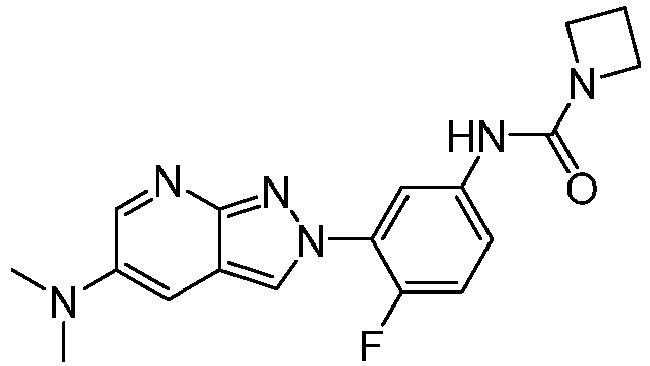
1H NMR (400 MHz, DMSO-d6) δ 8.69 (d, J=3.01 Hz, 1 H), 8.66 - 8.68 (m, 1 H), 8.53 (d, J=2.76 Hz, 1 H), 8.21 (dd, J=7.03, 2.76 Hz, 1 H), 7.57 - 7.77 (m, 1 H), 7.40 (dd, J=11.29, 9.03 Hz, 1 H), 7.15 (d, J=2.76 Hz, 1 H), 3.98 (t, J=7.53 Hz, 4 H), 2.95 (s, 6H), 2.20 (quin, J=7.59 Hz, 2 H). Method 1: RT = 2.62 min.; M+H = 355.2 171 
1H NMR (400 MHz, DMSO-d6) δ 8.93 (s, 1H), 8.55 (d, J = 2.7 Hz, 1H), 8.27 (d, J = 2.8 Hz, 1H), 8.20 (dd, J = 7.1, 2.7 Hz, 1H), 7.64 (ddd, J = 9.1, 4.1, 2.7 Hz, 1H), 7.43 (dd, J = 11.4, 9.1 Hz, 1H), 6.94 (d, J = 2.8 Hz, 1H), 5.40 (dtt, J = 57.5, 6.1, 3.1 Hz, 1H), 4.75 (s, 4H), 4.31 (dddd, J = 21.8, 10.4, 6.0, 1.4 Hz, 2H), 4.10 (s, 4H), 4.08 - 3.96 (m, 2H). Method 1: RT = 2.55 min.; M+H = 427.2 172 
1H NMR (400 MHz, DMSO-d6) δ 8.93 (s, 1H), 8.54 (d, J = 2.9 Hz, 1H), 8.51 (d, J = 2.8 Hz, 1H), 8.20 (dd, J = 7.1, 2.7 Hz, 1H), 7.64 (ddd, J = 9.0, 4.1, 2.7 Hz, 1H), 7.43 (dd, J = 11.4, 9.1 Hz, 1H), 7.07 (d, J = 2.9 Hz, 1H), 5.40 (ddq, J = 57.5, 6.1, 3.0 Hz, 1H), 4.69 (d, J = 23.8 Hz, 2H), 4.40 - 4.23 (m, 2H), 4.09 - 4.05 (m, 1H), 4.04 - 3.95 (m, 1 H), 3.82 - 3.70 (m, 2H), 3.70 - 3.58 (m, 1 H), 3.08 (ddd, J = 9.6, 1.4, 0.7 Hz, 1H), 1.99 - 1.84 (m, 2H). Method 2: RT = 0.90 min.; M+H = 427.2 173 
1H NMR (400 MHz, DMSO-d6) δ 10.45 (s, 1H), 8.81 (d, J = 2.7 Hz, 1H), 8.69 (d, J = 2.3 Hz, 1H), 8.36 (dd, J = 7.0, 2.7 Hz, 1H), 8.05 (dd, J = 2.3, 0.8 Hz, 1H), 7.68 (ddd, J = 9.1, 4.2, 2.7 Hz, 1H), 7.54 (dd, J = 11.2, 9.0 Hz, 1H), 3.08 (pd, J = 6.9, 0.8 Hz, 1H), 2.72 - 2.55 (m, 4H), 1.30 (d, J = 6.9 Hz, 6H). Method 1: RT = 3.19 min.; M+H = 395.2 174 
1H NMR (400 MHz, DMSO-d6) δ 10.13 (s, 1H), 8.80 (d, J = 2.7 Hz, 1H), 8.69 (d, J = 2.3 Hz, 1H), 8.26 - 8.15 (m, 1H), 8.05 (dd, J = 2.3, 0.8 Hz, 1H), 7.65 - 7.45 (m, 2H), 4.35 (t, J = 6.0 Hz, 2H), 3.18 - 3.00 (m, 1H), 2.74 (qt, J = 11.5, 5.9 Hz, 2H), 1.30 (d, J = 6.9 Hz, 6H). Method 1: RT = 3.25 min.; M+H = 411.2 175 
1H NMR (400 MHz, DMSO-d6) δ 10.54 (s, 1 H), 9.00 (d, J=2.51 Hz, 1 H), 8.71 (d, J=2.01 Hz, 1 H), 8.58 (dd, J=7.03, 2.51 Hz, 1 H), 8.36 (s, 1 H), 7.86 - 7.97 (m, 1 H), 7.52 - 7.67 (m, 1 H), 3.88 (q, J=11.13 Hz, 2 H), 2.40 (s, 6 H). Method 1: RT = 2.88 min.; M+H = 434.1 176 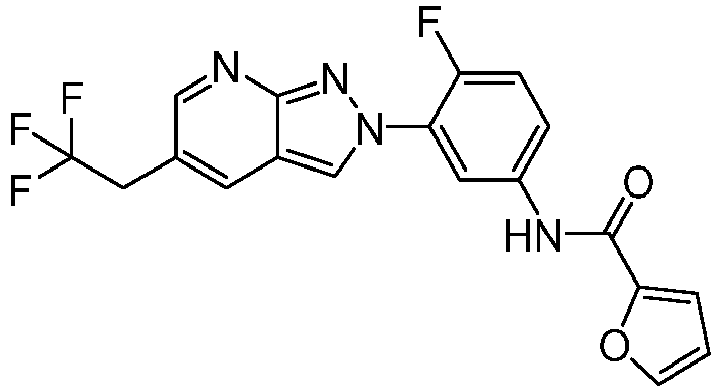
1H NMR (400 MHz, Methanol-d 4), δ 8.91 (d, J = 1.88 Hz, 1 H), 8.74 (s, 1 H), 8.44 - 8.51 (m, 2 H), 7.93 (dt, J = 7.18, 4.44 Hz, 1 H), 7.78 (d, J = 1.13 Hz, 1 H), 7.48 (dd, J = 11.11, 9.22 Hz, 1 H), 7.32 (d, J = 3.51 Hz, 1 H), 6.68 (dd, J = 3.58, 1.69 Hz, 1 H), 3.77 (q, J= 10.75 Hz, 2 H) Method 1: RT = 2.86 min.; M+H = 405.1 177 
1H NMR (400 MHz, DMSO-d6), δ 8.94 (s, 1 H), 8.71 (d, J=2.76 Hz, 1 H), 8.61 (d, J=2.51 Hz, 1 H), 8.21 (dd, J=7.03, 2.51 Hz, 1 H), 7.65 (dt, J=8.60, 3.61 Hz, 1 H), 7.44 (dd, J=11.17, 9.16 Hz, 1 H), 7.37 (d, J=2.51 Hz, 1 H) ,5.28 - 5.54 (m, 1 H), 4.24 - 4.40 (m, 2 H), 3.93 - 4.19 (m, 4 H), 3.18 (dd, J=11.67, 2.89 Hz, 2 H), 2.87 (dd, J=11.67, 5.90 Hz, 2 H), 1.26 (d, J=6.27 Hz, 6 H). Method 2: RT = 0.92 min.; M+H = 443.2 178 
1H NMR (400 MHz, DMSO-d6), δ 8.95 (s, 1 H), 8.76 (d, J=2.76 Hz, 1 H), 8.64 (d, J=2.76 Hz, 1 H), 8.20 (dd, J=7.03, 2.51 Hz, 1 H), 7.62 - 7.69 (m, 1 H), 7.60 (d, J=3.01 Hz, 1 H), 7.45 (dd, J=11.29, 9.03 Hz, 1 H), 5.28 - 5.55 (m, 1 H), 4.24 - 4.41 (m, 2 H), 3.94 - 4.10 (m, 2 H), 3.67 - 3.82 (m, 4 H), 3.25 - 3.31 (m, 4 H). Method 2: RT = 0.72 min.; M+H = 463.1 179 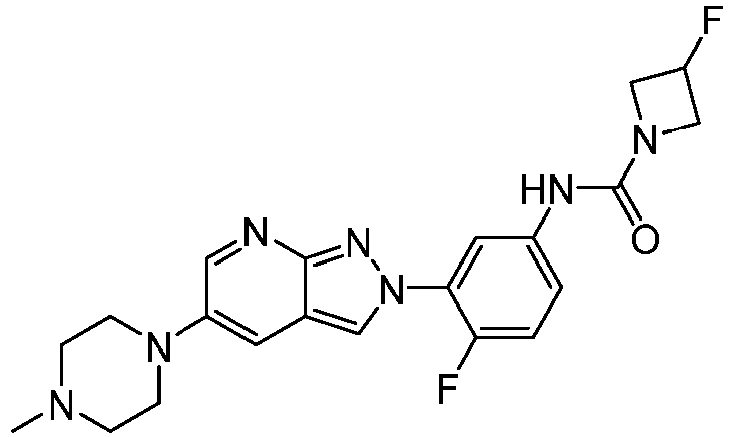
1H NMR (400 MHz, METHANOL-d4), δ 8.68 (d, J=2.76 Hz, 1 H), 8.55 (d, J=2.26 Hz, 1 H), 8.11 (dd, J=6.78, 2.76 Hz, 1 H), 7.60 - 7.67 (m, 1 H), 7.55 (d, J=2.76 Hz, 1 H), 7.35 (dd, J=10.92, 9.16 Hz, 1 H), 5.27 - 5.49 (m, 1 H), 4.34 - 4.47 (m, 2 H), 4.08 - 4.21 (m, 2 H), 3.22 - 3.31 (m, 4 H), 2.68 - 2.76 (m, 4 H), 2.41 (s, 3 H). Method 2: RT = 0.51 min.; M+H = 428.2 180 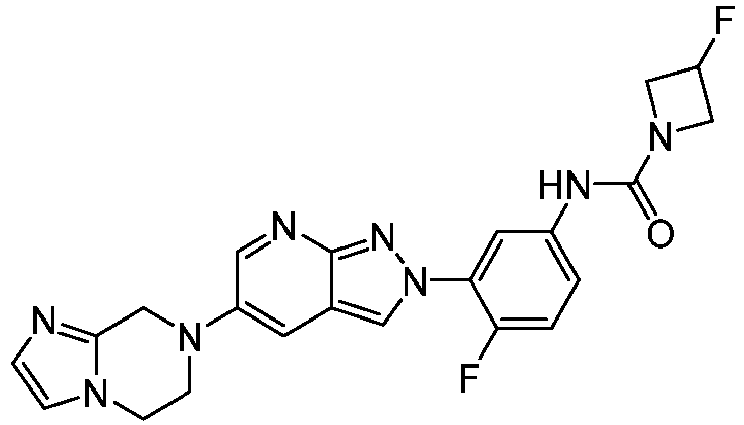
1H NMR (400 MHz, DMSO-d6), δ 8.95 (s, 1 H), 8.87 (d, J=3.01 Hz, 1 H), 8.66 (d, J=2.76 Hz, 1 H), 8.21 (dd, J=7.15, 2.64 Hz, 1 H), 7.66 (dt, J=8.85, 3.48 Hz, 1 H), 7.54 (d, J=3.01 Hz, 1 H), 7.45 (dd, J=11.29, 9.29 Hz, 1 H), 7.14 (d, J=1.00 Hz, 1 H), 6.92 (d, J=1.00 Hz, 1 H), 5.30 - 5.51 (m, 1 H), 4.40 (s, 2 H), 4.26 - 4.38 (m, 2 H), 4.15 (t, J=5.40 Hz, 2 H), 3.97 - 4.09 (m, 2 H), 3.76 (t, J=5.40 Hz, 2 H). Method 2: RT = 0.53 min.; M+H = 451.2 181 
1H NMR (400 MHz, DMSO-d6), δ 8.93 (s, 1 H), 8.54 (d, J=2.76 Hz, 1 H), 8.28 (d, J=2.76 Hz, 1 H), 8.20 (dd, J=7.15, 2.64 Hz, 1 H), 7.61 - 7.70 (m, 1 H), 7.43 (dd, J=11.42, 9.16 Hz, 1 H), 6.92 (d, J=2.76 Hz, 1 H), 5.68 (d, J=6.78 Hz, 1 H), 5.28 - 5.51 (m, 1 H), 4.57 - 4.67 (m, 1 H), 4.25 - 4.40 (m, 2 H), 4.20 (t, J=7.15 Hz, 2 H), 3.94 - 4.11 (m, 2 H), 3.56 - 3.65 (m, 2 H). Method 2: RT = 0.70 min.; M+H = 401.1 182 
1H NMR (400 MHz, DMSO-d6), δ 9.17 (d, J=2.26 Hz, 1 H), 9.03 (d, J=2.51 Hz, 1 H), 9.00 (s, 1 H), 8.75 (d, J=2.51 Hz, 1 H), 8.67 - 8.73 (m, 2 H), 8.28 (dd, J=6.90, 2.64 Hz, 1 H), 7.84 - 7.90 (m, 2 H), 7.68 - 7.75 (m, 1 H), 7.50 (dd, J=11.29, 9.03 Hz, 1 H), 5.30 - 5.52 (m, 1 H), 4.27 - 4.40 (m, 2 H), 3.97 - 4.10 (m, 2 H). Method 2: RT = 0.58 min.; M+H = 407.1 183 
1H NMR (400 MHz, METHANOL-d4), δ 8.50 (d, J=2.76 Hz, 1 H), 8.44 (d, J=2.51 Hz, 1 H), 8.10 (dd, J=6.78, 2.76 Hz, 1 H), 7.59 - 7.65 (m, 1 H), 7.34 (dd, J=10.79, 9.03 Hz, 1 H), 7.09 (d, J=2.76 Hz, 1 H), 5.28 - 5.49 (m, 1 H), 4.77 - 4.82 (m, 2 H), 4.70 - 4.74 (m, 2 H), 4.34 - 4.46 (m, 2 H), 4.09 - 4.21 (m, 2 H), 3.71 (s, 2 H), 3.48 (t, J=6.78 Hz, 2 H), 2.42 (t, J=6.78 Hz, 2 H). Method 2: RT = 0.82 min.; M+H = 441.2 184 
1H NMR (400 MHz, DMSO), δ 8.93 (s, 1 H), 8.73 (d, J= 2.81 Hz, 1 H), 8.57 (d, J = 2.69 Hz, 1 H), 8.19 (dd, J = 7.03, 2.63 Hz, 1 H), 7.60 - 7.68 (m, 1 H), 7.42 (dd, J = 11.31, 9.11 Hz, 1 H), 7.23 (d, J = 2.81 Hz, 1 H), 5.27 - 5.50 (m, 1 H), 4.44 (br s, 2 H), 4.24 - 4.37 (m, 2 H), 3.94 - 4.07 (m, 2 H), 3.42 (br d, J = 10.88 Hz, 2 H), 2.81 - 2.92 (m, 2 H), 1.80 - 1.99 (m, 4 H) Method 1: RT = 2.70 min.; M+H = 441.3 185 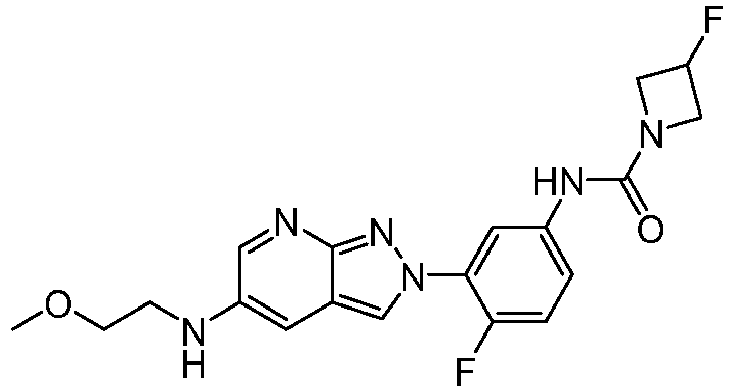
1H NMR (400 MHz, DMSO) δ 8.90 (s, 1 H), 8.33 - 8.47 (m, 2 H), 8.17 (dd, J = 6.96, 2.57 Hz, 1 H), 7.62 (dt, J = 8.78, 3.51 Hz, 1 H), 7.41 (dd, J= 11.29, 9.16 Hz, 1 H), 6.83 (d, J = 2.51 Hz, 1 H), 6.02 (br t, J = 5.14 Hz, 1 H), 5.24 - 5.51 (m, 1 H), 4.21 - 4.40 (m, 2 H), 3.92 - 4.09 (m, 2 H), 3.57 (br t, J = 5.52 Hz, 2 H), 3.31 (s, 3 H), 3.20 - 3.25 (m, 2 H) Method 1: RT = 2.60 min.; M+H = 403.2 186 
1H NMR (400 MHz, DMSO) δ 8.95 (s, 1 H), 8.86 (d, J = 2.76 Hz, 1 H), 8.66 (d, J = 2.51 Hz, 1 H), 8.51 (s, 1 H), 8.21 (dd, J = 6.90, 2.64 Hz, 1 H), 7.62 - 7.69 (m, 1 H), 7.57 (d, J = 2.76 Hz, 1 H), 7.44 (dd, J = 10.98, 9.22 Hz, 1 H), 5.29 - 5.50 (m, 1 H), 4.57 (s, 2 H), 4.26 - 4.37 (m, 2 H), 4.21 (br t, J = 5.40 Hz, 2 H), 3.95 - 4.09 (m, 2 H), 3.76 (br t, J = 5.33 Hz, 2 H) Method 1: RT = 2.27 min.; M+H = 452.2 187 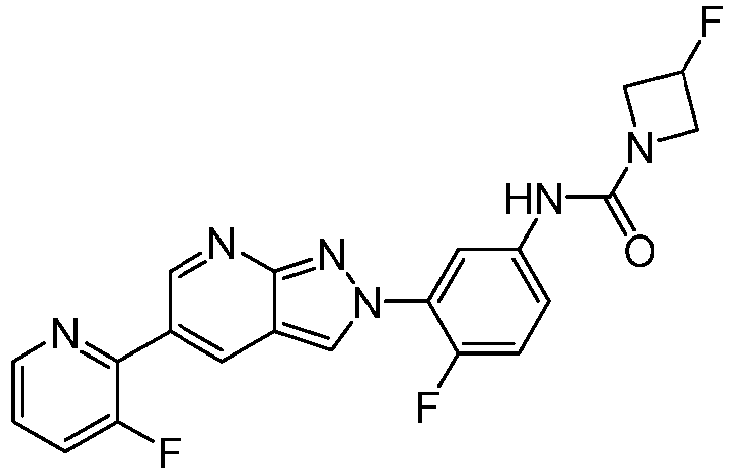
1H NMR (400 MHz, DMSO-d6) δ 9.27 (s, 1 H), 9.00 - 9.09 (m, 2 H), 8.82 (s, 1 H), 8.63 (br d, J=4.39 Hz, 1 H), 8.29 (dd, J=6.90, 2.51 Hz, 1 H), 7.93 (dd, J=10.73, 8.47 Hz, 1 H), 7.72 (dt, J=8.60, 3.48 Hz, 1 H), 7.52 - 7.58 (m, 1 H), 7.46 - 7.51 (m, 1 H), 5.28 - 5.55 (m, 1 H), 4.25 - 4.44 (m, 2 H), 3.93 - 4.14 (m, 2 H). Method 1: RT = 2.74 min.; M+H = 425.1 188 
1H NMR (400 MHz, DMSO-d6) δ 9.02 - 9.05 (m, 2 H), 9.00 (d, J=2.38 Hz, 1 H), 8.72 (dd, J=4.64, 1.38 Hz, 1 H), 8.69 (d, J=2.26 Hz, 1 H), 8.29 (dd, J=6.96, 2.70 Hz, 1 H), 8.14 (dd, J=8.16, 1.38 Hz, 1 H), 7.69 - 7.76 (m, 1 H), 7.52 - 7.55 (m, 1 H), 7.47 - 7.51 (m, 1 H), 5.28 - 5.53 (m, 1 H), 4.28 - 4.39 (m, 2 H), 3.97 - 4.10 (m, 2 H). Method 1: RT = 2.76 min.; M+H = 441.0 189 
1H NMR (400 MHz, DMSO-d6) δ 9.11 (d, J=2.38 Hz, 1 H), 9.03 (d, J=1.88 Hz, 1 H), 9.01 (s, 1 H), 8.99 (d, J=2.51 Hz, 1 H), 8.62 - 8.66 (m, 2 H), 8.28 (dd, J=6.90, 2.64 Hz, 1 H), 8.24 (dt, J=8.22, 1.79 Hz, 1 H), 7.69 - 7.75 (m, 1 H), 7.56 (dd, J=7.40, 4.77 Hz, 1 H), 7.50 (dd, J=11.17, 9.16 Hz, 1 H), 5.23 - 5.56 (m, 1 H), 4.27 - 4.41 (m, 2 H), 3.97 - 4.11 (m, 2 H). Method 1: RT = 2.40 min.; M+H = 407.1 190 
1H NMR (400 MHz, DMSO) δ 8.91 (s, 1 H), 8.73 (d, J = 2.76 Hz, 1 H), 8.58 (d, J = 2.64 Hz, 1 H), 8.18 (dd, J=7.03, 2.64 Hz, 1 H), 7.57 - 7.68 (m, 1 H), 7.41 (dd, J=11.29, 9.03 Hz, 1 H), 7.35 (d, J = 2.76 Hz, 1 H), 5.25 - 5.49 (m, 1 H), 4.23 - 4.36 (m, 2 H), 3.93 - 4.07 (m, 2 H), 3.69 - 3.84 (m, 2 H), 3.56 (br d, J = 10.92 Hz, 2 H), 2.24 - 2.32 (m, 2 H), 1.15 (d, J = 6.15 Hz, 6 H). Method 1: RT = 2.77 min. M+H = 443.3 191 
1H NMR (400 MHz, DMSO) δ 8.94 (s, 1 H) 8.60,(d, J = 2.76 Hz, 1 H), 8.56 (d, J = 2.76 Hz, 1 H), 8.22 (dd, J = 7.09, 2.70 Hz, 1 H), 7.62 - 7.69 (m, 1 H), 7.44 (dd, J = 11.29, 9.16 Hz, 1 H), 7.18 (d, J = 2.76 Hz, 1 H), 5.30 - 5.51 (m, 1 H), 5.10 (d, J = 8.28 Hz, 2 H), 4.75 (d, J = 8.28 Hz, 2 H), 4.26 - 4.38 (m, 2 H), 3.96 - 4.09 (m, 2 H), 3.74 (t, J = 6.96 Hz, 2 H), 2.58 (br s, 2 H). Method 1: RT = 2.65 min. M+H = 427.2 192 
1H NMR (400 MHz, DMSO) δ 8.94 (s, 1 H), 8.52 (d, J = 2.69 Hz, 1 H), 8.26 (d, J = 2.81 Hz, 1 H), 8.19 (dd, J = 7.03, 2.63 Hz, 1 H), 7.60 - 7.68 (m, 1 H), 7.42 (dd, J = 11.37, 9.17 Hz, 1 H), 6.88 (d, J = 2.69 Hz, 1 H), 5.28 - 5.50 (m, 1 H), 4.24 - 4.37 (m, 2 H), 4.02 - 4.08 (m, 1 H), 3.98 (t, J = 7.64 Hz, 3 H), 3.65 (dd, J = 7.15, 5.69 Hz, 2 H), 3.56 (d, J=6.60 Hz, 2 H), 3.29 (s, 3 H), 2.96 (m, 1 H). Method 1: RT = 2.76 min. M+H = 429.3 193 
1H NMR (400 MHz, DMSO) δ 8.92 (s, 1 H) , 8.52 (d, J = 2.76 Hz, 1 H), 8.28 (d, J = 2.76 Hz, 1 H), 8.19 (dd, J = 7.03, 2.64 Hz, 1 H), 7.59 - 7.67 (m, 1 H), 7.42 (dd, J = 11.36, 9.10 Hz, 1 H), 6.91 (d, J = 2.89 Hz, 1 H), 5.27 - 5.50 (m, 1 H), 4.23 - 4.38 (m, 2 H), 3.94 - 4.10 (m, 6 H), 0.68 (s, 4 H). Method 1: RT = 2.92 min. M+H = 411.3 + 194 
1H NMR (400 MHz, DMSO) δ 8.88 (s, 1 H), 8.48 - 8.59 (m, 2 H), 8.17 (dd, J=7.03, 2.64 Hz, 1 H), 7.54 - 7.67 (m, 1 H), 7.39 (dd, J = 11.36, 9.10 Hz, 1 H), 7.03 (d, J = 2.89 Hz, 1 H), 5.19 - 5.63 (m, 3 H), 4.19 - 4.40 (m, 2 H), 3.93 - 4.06 (m, 2 H), 3.57 - 3.87 (m, 4 H). Method 1: RT = 2.77 min. M+H = 435.1 195 
1H NMR (400 MHz, DMSO-d6) δ 8.79 (d, J=2.51 Hz, 1 H), 8.69 (d, J=2.13 Hz, 1 H), 8.64 (s, 1 H), 8.26 (dd, J=6.96, 2.57 Hz, 1 H), 8.05 (d, J=2.01 Hz, 1 H), 7.68 - 7.76 (m, 1 H), 7.46 (dd, J=11.17, 9.16 Hz, 1 H), 5.27 - 5.49 (m, 1 H), 3.62 - 3.77 (m, 2 H), 3.40 - 3.59 (m, 2 H), 3.08 (dt, J=13.61, 6.74 Hz, 1 H), 2.02 - 2.25 (m, 2 H), 1.31 (d, J=6.90 Hz, 6 H). Method 1: RT = 2.95 min.; M+H =386.1, 196 
1H NMR (400 MHz, DMSO-d6) δ 10.54 (br s, 1 H), 8.83 (d, J=2.51 Hz, 1 H), 8.70 (d, J=2.26 Hz, 1 H), 8.51 (dd, J=7.03, 2.64 Hz, 1 H), 8.07 (d, J=2.01 Hz, 1 H), 7.98 (d, J=0.88 Hz, 1 H), 7.91 - 7.96 (m, 1 H), 7.57 (dd, J=11.17, 9.16 Hz, 1 H), 7.40 (d, J=3.14 Hz, 1 H), 6.74 (dd, J=3.45, 1.69 Hz, 1 H), 3.04 - 3.14 (m, 1 H), 1.31 (d, J=6.90 Hz, 6 H). Method 1: RT = 3.04 min.; M+H =365.0 197 
1H NMR (400 MHz, DMSO) δ 8.87 - 8.98 (m, 1 H), 8.60 (d, J = 2.89 Hz, 1 H), 8.48 (d, J = 2.76 Hz, 1 H), 8.18 (dd, J = 7.03, 2.64 Hz, 1 H), 7.58 - 7.65 (m, 1 H), 7.41 (dd, J = 11.42, 9.16 Hz, 1 H), 7.04 (d, J = 3.01 Hz, 1 H), 5.26 - 5.49 (m, 1 H), 4.23 - 4.36 (m, 2 H), 3.91 - 4.10 (m, 5 H), 3.73 (br d, J = 10.42 Hz, 1 H), 3.40 (br d, J = 9.66 Hz, 2 H), 1.65 - 2.09 (m, 4 H). Method 1: RT = 2.69 min.; M+H = 441.3 198 
1H NMR (400 MHz, DMSO-d 6) δ 8.92 (s, 1 H), 8.40 (dd, J=2.64, 1.88 Hz, 2 H), 8.17 (dd, J=7.03, 2.76 Hz, 1 H), 7.57 - 7.72 (m, 1 H), 7.37 - 7.46 (m, 1 H), 6.76 (d, J=2.76 Hz, 1 H), 6.05 (t, J=5.52 Hz, 1 H), 5.29 - 5.57 (m, 1 H), 4.24 - 4.40 (m, 2 H), 3.94 - 4.11 (m, 2 H), 2.85 (t, J=6.02 Hz, 2 H), 1.93 (dquin, J=13.35, 6.58, 6.58, 6.58, 6.58 Hz, 1 H), 0.99 (d, J=6.53 Hz, 6 H) Method 1: RT = 3.00 min.; M+H = 401.4 199 
1H NMR (400 MHz, DMSO-d 6) δ 8.93 (s, 1 H), 8.34 - 8.43 (m, 2 H), 8.17 (dd, J=7.03, 2.51 Hz, 1 H), 7.59 - 7.68 (m, 1 H), 7.41 (dd, J=11.42, 9.16 Hz, 1 H), 6.77 (d, J=2.76 Hz, 1 H), 5.97 (t, J=5.02 Hz, 1 H), 5.27 - 5.53 (m, 1 H), 4.24 - 4.40 (m, 2 H), 3.93 - 4.10 (m, 2 H), 3.01 - 3.10 (m, 2 H), 1.24 (t, J=7.15 Hz, 3 H). Method 2: RT = 0.80 min.; M+H = 373.4 200 
1H NMR (400 MHz, DMSO) δ 8.93 (s, 1 H), 8.40 (d, J = 2.81 Hz, 1 H), 8.33 (d, J = 2.81 Hz, 1 H), 8.15 - 8.21 (m, 1 H), 7.60 - 7.71 (m, 1 H), 7.37 - 7.48 (m, 1 H), 6.79 (d, J = 2.69 Hz, 1 H), 5.84 (br d, J = 7.58 Hz, 1 H), 5.27 - 5.52 (m, 1 H), 4.26 - 4.38 (m, 2 H), 3.96 - 4.09 (m, 2 H), 3.44 - 3.57 (m, 1 H), 1.19 (d, J=6.24 Hz, 6 H). Method 1: RT = 2.78 min.; M+H = 387.2 201 
1H NMR (400 MHz, DMSO) δ 8.94 (s, 1 H), 8.55 (d, J = 2.64 Hz, 1 H), 8.28 (d, J = 2.76 Hz, 1 H), 8.19 (dd, J = 7.03, 2.76 Hz, 1 H), 7.62 - 7.70 (m, 1 H), 7.43 (dd, J = 11.29, 9.16 Hz, 1 H), 6.95 (d, J = 2.76 Hz, 1 H), 5.26 - 5.51 (m, 1 H), 4.47 (t, J = 7.53 Hz, 2 H), 4.18 - 4.37 (m, 4 H), 3.92 - 4.08 (m, 4 H), 2.91 (t, J=7.53 Hz, 2 H). Method 2: RT = 0.78 min.; M+H = 427.3 202 
1H NMR (400 MHz, DMSO) δ 8.92 (s, 1 H), 8.54 (d, J = 2.64 Hz, 1 H), 8.28 (d, J = 2.76 Hz, 1 H), 8.19 (dd, J = 7.03, 2.64 Hz, 1 H), 7.61 - 7.69 (m, 1 H), 7.42 (dd, J = 11.36, 9.10 Hz, 1 H), 6.93 (d, J = 2.76 Hz, 1 H), 5.24 - 5.50 (m, 1 H), 4.23 - 4.38 (m, 2 H), 3.86 - 4.06 (m, 6 H), 3.83 (s, 2 H), 3.74 (t, J = 6.96 Hz, 2 H), 2.16 (t, J = 6.96 Hz, 2 H). Method 2: RT = 0.80 min.; M+H = 441.3 203 
1H NMR (400 MHz, DMSO) δ 8.93 (s, 1 H), 8.53 (d, J = 2.64 Hz, 1 H), 8.28 (d, J = 2.76 Hz, 1 H), 8.15 - 8.24 (m, 1 H), 7.60 - 7.67 (m, 1 H), 7.42 (dd, J = 11.36, 9.10 Hz, 1 H), 6.89 (d, J = 2.76 Hz, 1 H), 5.28 - 5.50 (m, 1 H), 4.24 - 4.37 (m, 2 H), 3.89 - 4.08 (m, 2 H), 3.72 (s, 4 H), 3.43 - 3.62 (m, 4 H), 1.73 - 1.84 (m, 4 H). Method 2: RT = 0.85 min.; M+H = 455.3 204 
1H NMR (400 MHz, DMSO-d6) δ 8.92 (s, 1 H), 8.53 (br d, J = 2.76 Hz, 1 H), 8.50 (br d, J = 2.76 Hz, 1 H), 8.19 - 8.28 (m, 1 H), 7.62 - 7.71 (m, 1 H), 7.43 (dd, J = 11.29, 9.16 Hz, 1 H), 6.96 (d, J = 2.76 Hz, 1 H), 5.29 - 5.50 (m, 1 H), 4.21 - 4.45 (m, 2 H), 3.89 - 4.13 (m, 2 H), 3.77 (d, J = 10.04 Hz, 2 H), 3.65 (br d, J = 8.91 Hz, 2 H), 2.68 - 2.80 (m, 2 H). Method 1: RT = 2.84 min.; M+H = 447.3 205 
1H NMR (400 MHz, DMSO) δ 8.92 (s, 1 H), 8.51 (d, J = 2.76 Hz, 1 H), 8.26 (d, J = 2.76 Hz, 1 H), 8.17 (dd, J = 7.09, 2.70 Hz, 1 H), 7.58 - 7.65 (m, 1 H), 7.40 (dd, J = 11.36, 9.10 Hz, 1 H), 6.91 (d, J = 2.76 Hz, 1 H), 5.23 - 5.50 (m, 1 H), 4.23 - 4.37 (m, 3 H), 4.10 - 4.19 (m, 2 H), 3.93 - 4.07 (m, 2 H), 3.68 (dd, J = 8.22, 4.33 Hz, 2 H), 3.20 - 3.27 (m, 3 H). Method 1: RT = 2.59 min.; M+H = 415.2 206 
1H NMR (400 MHz, DMSO-d6) δ 10.94 (s, 1H), 9.49 (d, J=2.3 Hz, 1H), 9.08 (d, J=2.5 Hz, 1H), 8.97 (d, J=2.3 Hz, 1H), 8.75 (ddd, J=0.9, 1.9, 4.8 Hz, 1H), 8.56 (dd, J=2.7, 7.0 Hz, 1H), 8.15 (dt, J=1.1, 8.1 Hz, 1H), 8.07-7.92 (m, 2H), 7.82 (d, J=3.8 Hz, 1H), 7.65 (dd, J=9.1, 11.2 Hz, 1H), 7.59 (d, J=3.8 Hz, 1H), 7.45 (ddd, J=1.1, 4.8, 7.5 Hz, 1H). Method 1: RT = 2.83 min.; M+H = 425.4 207 
1H NMR (400 MHz, Methylene Chloride-d 2) δ 8.67 (m, 1H), 8.48 (m, 1H), 8.19 (m, 1H), 7.93 - 7.83 (m, 2H), 7.26 (m, 1H), 3.68 - 3.49 (m, 3H), 3.08 (m, 1H), 1.90 - 1.76 (m, 2H), 1.37 - 1.32 (m, 6H), 1.28 - 1.07 (m, 4H). Method 1: RT = 3.08 min.; M+H = 383.3 208 
1H NMR (400 MHz, Methylene Chloride-d 2) δ 9.91 (s, 1H), 8.68 (m, 1H), 8.47 (m, 1H), 8.19 (m, 1H), 8.11 - 8.02 (m, 1H), 7.97 (m, 1H), 7.27 (m, 1H), 3.09 (m, 1H), 2.63 (m, 1H), 2.16 (m, 1H), 1.70 (m, 1H), 1.33 (m, 6H). Method 1: RT = 3.04 min.; M+H = 375.3 209 
1H NMR (400 MHz, Methylene Chloride-d 2) δ 8.78 (m, 2H), 8.35 (m, 1H), 8.30 (m, 1H), 7.99 (m, 1H), 7.81 (m, 1H), 7.36 (m, 1H), 3.19 (m, 1H), 2.30 - 2.18 (m, 2H), 2.03 - 1.95 (m, 2H), 1.42 - 1.34 (m, 6H). Method 1: RT = 3.14 min.; M+H = 407.2 210 
1H NMR (400 MHz, Methylene Chloride-d2) δ 8.66 (m, 1H), 8.48 (m, 1H), 8.18 (m, 1H), 7.92 - 7.88 (m, 2H), 7.27 (m, 1H), 3.24 - 3.13 (m, 1H), 3.08 (m, 1H), 2.41 - 2.29 (m, 2H), 2.25 - 2.12 (m, 2H), 2.05 - 1.89 (m, 2H), 1.37 - 1.31 (m, 6H). Method 1: RT = 3.14 min.; M+H = 353.3 211 
1H NMR (400 MHz, Methylene Chloride-d2) δ 8.66 (m, 1H), 8.49 - 8.40 (m, 2H), 8.17 (m, 1H), 7.92 - 7.84 (m, 2H), 7.24 (m, 1H), 3.07 (m, 1H), 1.46 - 1.36 (m, 1H), 1.36 - 1.30 (m, 6H), 1.30 - 1.24 (m, 1H), 1.24- 1.15 (m, 1H), 1.10 (m, 3H), 0.65 (m, 1H). Method 1: RT = 3.16 min.; M+H = 353.3 212 
1H NMR (400 MHz, Methylene Chloride-d2) δ 9.74 (m, 1H), 8.64 (m, 1H), 8.44 (m, 1H), 8.15 (m, 1H), 8.05 (m, 1H), 7.93 (m, 1H), 7.31 (m, 1H), 3.30 (m, 2H), 3.08 (m, 1H), 1.46 - 1.17 (m, 6H). Method 1: RT = 3.08 min.; M+H = 381.2 213 
1H NMR (400 MHz, Methylene Chloride-d2) δ 9.14 (m, 1H), 8.64 (m, 1H), 8.45 (m, 1H), 8.22 (m, 1H), 8.00 (m, 1H), 7.91 (m, 1H), 7.28 (m, 1H), 3.07 (m, 1H), 2.96 - 2.84 (m, 1H), 2.71 (m, 1H), 2.27 (m, 1H), 1.33 (m, 6H), 1.15 (m, 3H). Method 1: RT = 3.27 min.; M+H = 409.3 214 
1H NMR (400 MHz, Methylene Chloride-d2) δ 8.88 (m, 1H), 8.64 (m, 1H), 8.45 (m, 1H), 8.19 (m, 1H), 7.99 - 7.92 (m, 1H), 7.90 (m, 1H), 7.27 (m, 1H), 3.07 (m, 1H), 2.43 (m, 2H), 2.24 - 2.07 (m, 2H), 1.97 - 1.86 (m, 2H), 1.33 (m, 6H). Method 1: RT = 3.23 min.; M+H = 409.3 215 
1H NMR (400 MHz, Methylene Chloride-d2) δ 8.66 (m, 1H), 8.47 (m, 1H), 8.19 (m, 2H), 7.92 - 7.86 (m, 2H), 7.27 (m, 1H), 3.08 (m, 1H), 2.47 - 2.39 (m, 2H), 1.58 (m, 2H), 1.38 - 1.29 (m, 6H), 0.78 - 0.66 (m, 1H), 0.45 - 0.38 (m, 2H), 0.07 - 0.01 (m, 2H). Method 1: RT = 3.23 min.; M+H = 367.3 216 
1H NMR (400 MHz, Methylene Chloride-d2) δ 8.66 (m, 1H), 8.47 (m, 1H), 8.18 (m, 1H), 8.05 (m, 1H), 7.91 - 7.83 (m, 2H), 7.26 (m, 1H), 3.08 (m, 1H), 2.74 (m, 1H), 2.44 (m, 2H), 2.17 - 2.10 (m, 2H), 1.94 - 1.78 (m, 2H), 1.78 - 1.66 (m, 2H), 1.37 - 1.30 (m, 6H). Method 1: RT = 3.19 min.; M+H = 367.3 217 
1H NMR (400 MHz, Methylene Chloride-d2) δ 8.66 (m, 1H), 8.48 (m, 1H), 8.21 (m, 1H), 7.89 (m, 1H), 7.84 (m, 1H), 7.79 (m, 1H), 7.27 (m, 1H), 3.08 (m, 1H), 2.20 (m, 2H), 1.38 - 1.21 (m, 6H), 1.11 - 0.89 (m, 9H). Method 1: RT = 3.29 min.; M+H = 369.3 218 
1H NMR (400 MHz, DMSO-d 6) δ 10.13 (s, 1H), 9.48 (d, J = 2.3 Hz, 1H), 9.04 (d, J = 2.5 Hz, 1H), 8.95 (d, J = 2.3 Hz, 1H), 8.77 - 8.70 (m, 1H), 8.64 - 8.58 (m, 1H), 8.40 (d, J = 8.4 Hz, 1H), 7.58 (dd, J = 11.2, 9.1 Hz, 1H), 7.46 - 7.37 (m, 3H), 6.86 (d, J = 1.3 Hz, 1H), 2.77 - 2.72 (m, 2H), 2.48 - 2.42 (m, 2H). Method 1: RT = 2.80 min.; M+H = 386.1 219 
1H NMR (400 MHz, Chloroform-d) δ 8.70 (m, 1H), 8.51 (m, 1H), 7.96 (m, 1H), 7.90 - 7.81 (m, 2H), 7.27 - 7.19 (m, 1H), 6.73 (m, 1H), 3.08 (m, 1H), 1.43 - 1.28 (m, 6H). Method 2: RT = 0.90 min.; M+H = 348.3 220 
1H NMR (400 MHz, Chloroform-d) δ 8.71 (m, 1H), 8.52 (m, 1H), 8.14 - 7.90 (m, 2H), 7.87 (m, 1H), 7.28 - 7.20 (m, 1H), 6.44 (m, 1H), 3.76 - 3.57 (m, 2H), 3.46 - 3.31 (m, 2H), 3.08 (m, 1H), 1.98 - 1.78 (m, 2H), 1.54 - 1.18 (m, 6H), 0.74 - 0.54 (m, 4H). Method 2: RT = 1.05 min.; M+H = 394.3 221 
1H NMR (400 MHz, Chloroform-d) δ 8.71 (m, 1H), 8.49 (m, 1H), 8.15 - 7.89 (m, 2H), 7.89 - 7.84 (m, 1H), 7.24 (m, 1H), 6.50 (m, 1H), 3.63 (m, 2H), 3.50 - 3.38 (m, 1H), 3.16 - 2.93 (m, 2H), 2.46 - 2.04 (m, 2H), 1.68 - 1.56 (m, 1H), 1.51 - 1.20 (m, 6H), 1.12 (m, 3H). Method 2: RT = 1.02 min.; M+H = 382.3 222 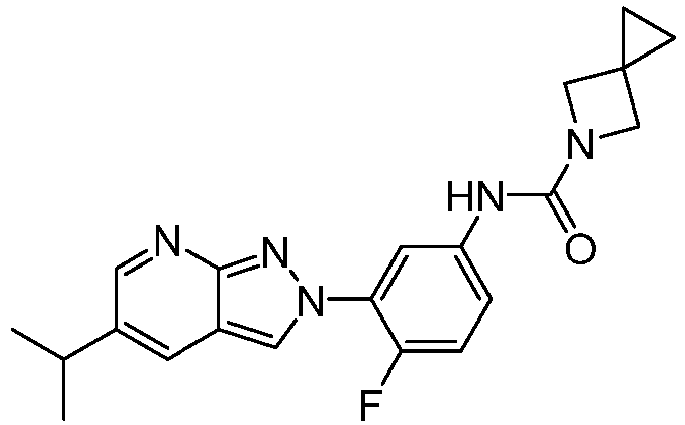
1H NMR (400 MHz, Chloroform-d) δ 8.70 (m, 1H), 8.51 (m, 1H), 7.99 - 7.91 (m, 2H), 7.87 (m, 1H), 7.28 - 7.21 (m, 1H), 6.52 (m, 1H), 4.15 (m, 4H), 3.08 (m, 1H), 1.53 - 1.18 (m, 6H), 0.70 (m, 4H). Method 2: RT = 1.01 min.; M+H = 380.3 223 
1H NMR (400 MHz, Chloroform-d) δ 8.71 (m, 1H), 8.51 (m, 1H), 8.13 - 7.80 (m, 3H), 7.27 - 7.19 (m, 1H), 6.38 (m, 1H), 3.71 - 3.51 (m, 4H), 3.08 (m, 1H), 1.61 - 1.31 (m, 6H), 1.24 (m, 2H), 0.81 (m, 1H), 0.31 (m, 1H). Method 2: RT = 0.99 min.; M+H = 380.3 224 
1H NMR (400 MHz, Chloroform-d) δ 8.71 (m, 1H), 8.53 (m, 1H), 7.96 (m, 1H), 7.92 - 7.83 (m, 2H), 7.27 - 7.21 (m, 1H), 6.55 (m, 1H), 3.45 (m, 2H), 3.10 (m, 1H), 3.06 - 2.98 (m, 3H), 1.37 (m, 6H), 1.26 - 1.22 (m, 3H). Method 2: RT = 0.96 min.; M+H = 356.3 225 
1H NMR (400 MHz, Chloroform-d) δ 8.71 (m, 1H), 8.53 - 8.45 (m, 1H), 8.17 - 7.84 (m, 3H), 7.27 - 7.19 (m, 1H), 6.60 (m, 1H), 4.12 - 3.95 (m, 1H), 3.69 - 3.50 (m, 4H), 3.44 - 3.29 (m, 3H), 3.09 (m, 1H), 2.24 - 2.01 (m, 2H), 1.54 - 1.18 (m, 6H). Method 2: RT = 0.92 min.; M+H = 398.3 226 
1H NMR (400 MHz, Chloroform-d) δ 8.71 (m, 1H), 8.51 (m, 1H), 7.97 - 7.89 (m, 2H), 7.87 (m, 1H), 7.28 - 7.19 (m, 1H), 6.28 (m, 1H), 4.04 (m, 4H), 3.09 (m, 1H), 2.22 (m, 4H), 1.94 - 1.83 (m, 2H), 1.49 - 1.14 (m, 6H). Method 2: RT = 1.06 min.; M+H = 394.3 227 
1H NMR (400 MHz, Chloroform-d) δ 8.71 (m, 1H), 8.49 (m, 1H), 8.09 (m, 1H), 7.87 (m, 1H), 7.81 (m, 1H), 7.28 - 7.20 (m, 1H), 7.09 (m, 1H), 4.08 (m, 2H), 3.19 (m, 3H), 3.09 (m, 1H), 1.37 (m, 6H). Method 2: RT = 1.04 min.; M+H = 410.3 228 
1H NMR (400 MHz, Chloroform-d) δ 8.71 (m, 1H), 8.51 (m, 1H), 7.96 (m, 1H), 7.89 - 7.81 (m, 2H), 7.24 (m, 1H), 6.71 (m, 1H), 3.51 (m, 1H), 3.09 - 3.03 (m, 6H), 1.42 - 1.28 (m, 6H). Method 2: RT = 0.90 min.; M+H = 342.3 229 
1H NMR (400 MHz, Chloroform-d) δ 8.62 (m, 1H), 8.44 (m, 1H), 7.89 (m, 1H), 7.81 - 7.77 (m, 1H), 7.75 (m, 1H), 7.18 - 7.12 (m, 1H), 6.61 (m, 1H), 4.13 (m, 1H), 3.73 - 3.62 (m, 2H), 3.13 - 2.90 (m, 6H), 2.06 - 1.97 (m, 3H), 1.77 - 1.74 (m, 2H), 1.28 (m, 6H). Method 1: RT = 2.42 min.; M+H = 423.3 230 
1H NMR (400 MHz, DMSO) δ ppm 8.91 (s, 1 H), 8.73 (d, J = 2.76 Hz, 1 H), 8.58 (d, J = 2.64 Hz, 1 H), 8.18 (dd, J=7.03, 2.64 Hz, 1 H), 7.57 - 7.68 (m, 1 H), 7.41 (dd, J=11.29, 9.03 Hz, 1 H), 7.35 (d, J = 2.76 Hz, 1 H), 5.25 - 5.49 (m, 1 H), 4.23 - 4.36 (m, 2 H), 3.93 - 4.07 (m, 2 H), 3.69 - 3.84 (m, 2 H), 3.56 (br d, J = 10.92 Hz, 2 H), 2.24 - 2.32 (m, 2 H), 1.15 (d, J = 6.15 Hz, 6 H). Method 1: RT = 2.79 min.; M+H = 433.3 231 
1H NMR (400 MHz, DMSO) δ ppm 8.94 (s, 1 H) 8.60,(d, J = 2.76 Hz, 1 H), 8.56 (d, J = 2.76 Hz, 1 H), 8.22 (dd, J = 7.09, 2.70 Hz, 1 H), 7.62 - 7.69 (m, 1 H), 7.44 (dd, J = 11.29, 9.16 Hz, 1 H), 7.18 (d, J= 2.76 Hz, 1 H), 5.30 - 5.51 (m, 1 H), 5.10 (d, J = 8.28 Hz, 2 H), 4.75 (d, J = 8.28 Hz, 2 H), 4.26 - 4.38 (m, 2 H), 3.96 - 4.09 (m, 2 H), 3.74 (t, J = 6.96 Hz, 2 H), 2.58 (br s, 2 H). Method 1: RT = 2.65 min.; M+H = 427.2 232 
1H NMR (400 MHz, DMSO) δ ppm 8.94 (s, 1 H), 8.52 (d, J = 2.69 Hz, 1 H), 8.26 (d, J = 2.81 Hz, 1 H), 8.19 (dd, J = 7.03, 2.63 Hz, 1 H), 7.60 - 7.68 (m, 1 H), 7.42 (dd, J = 11.37, 9.17 Hz, 1 H), 6.88 (d, J = 2.69 Hz, 1 H), 5.28 - 5.50 (m, 1 H), 4.24 - 4.37 (m, 2 H), 4.02 - 4.08 (m, 1 H), 3.98 (t, J = 7.64 Hz, 3 H), 3.65 (dd, J = 7.15, 5.69 Hz, 2 H), 3.56 (d, J=6.60 Hz, 2 H), 3.29 (s, 3 H), 2.96 (m, 1 H). Method 1: RT = 2.70 min.; M+H = 429.3 233 
1H NMR (400 MHz, DMSO) δ ppm 8.92 (s, 1 H), 8.52 (d, J = 2.76 Hz, 1 H), 8.28 (d, J = 2.76 Hz, 1 H), 8.19 (dd, J = 7.03, 2.64 Hz, 1 H), 7.59 - 7.67 (m, 1 H), 7.42 (dd, J = 11.36, 9.10 Hz, 1 H), 6.91 (d, J = 2.89 Hz, 1 H), 5.27 - 5.50 (m, 1 H), 4.23 - 4.38 (m, 2 H), 3.94 - 4.10 (m, 6 H), 0.68 (s, 4 H). Method 1: RT = 2.92 min.; M+H = 411.3 234 
1H NMR (400 MHz, DMSO) δ 8.88 (s, 1 H), 8.48 - 8.59 (m, 2 H), 8.17 (dd, J=7.03, 2.64 Hz, 1 H), 7.54 - 7.67 (m, 1 H), 7.39 (dd, J = 11.36, 9.10 Hz, 1 H), 7.03 (d, J = 2.89 Hz, 1 H), 5.19 - 5.63 (m, 3 H), 4.19 - 4.40 (m, 2 H), 3.93 - 4.06 (m, 2 H), 3.57 - 3.87 (m, 4 H). Method 1: RT = 2.77 min.; M+H = 435.1 235 
1H NMR (400 MHz, DMSO) δ 8.93 - 9.02 (m, 1 H), 8.68 (d, J= 2.76 Hz, 1 H), 8.53 (d, J = 2.76 Hz, 1 H), 8.20 (dd, J = 7.03, 2.64 Hz, 1 H), 7.62 - 7.69 (m, 1 H), 7.43 (dd, J = 11.36, 9.10 Hz, 1 H), 7.35 (d, J = 2.76 Hz, 1 H), 5.28 - 5.51 (m, 1 H), 4.20 - 4.38 (m, 4 H), 3.94-4.14 (m, 2 H), 3.79 (d, J= 10.79 Hz, 2 H), 3.50 (br d, J = 10.67 Hz, 2 H), 1.88 - 2.01 (m, 4 H). Method 1: RT = 2.63 min.; M+H = 441.3 236 
1H NMR (400 MHz, DMSO) δ 8.96 (s, 1 H), 8.69 (d, J = 2.69 Hz, 1 H), 8.59 (d, J = 2.57 Hz, 1 H), 8.19 (dd, J = 7.03, 2.63 Hz, 1 H), 7.61 - 7.70 (m, 1 H), 7.31 - 7.47 (m, 2 H), 5.27 - 5.50 (m, 1 H), 4.23 - 4.39 (m, 2 H), 3.93 - 4.08 (m, 2 H), 3.56 (br d, J = 11.98 Hz, 2 H), 2.74 (br t, J = 10.45 Hz, 2 H), 2.23 - 2.33 (m, 1 H), 1.94 (br d, J= 10.76 Hz, 2 H), 1.65 - 1.80 (m, 2 H). Method 1: RT = 2.55 min.; M+H = 457.3 237 
1H NMR (400 MHz, DMSO) δ 8.96 (s, 1 H), 8.72 (d, J = 2.76 Hz, 1 H), 8.62 (d, J = 2.76 Hz, 1 H), 8.20 (dd, J = 7.03, 2.76 Hz, 1 H), 7.59 - 7.72 (m, 1 H), 7.44 (t, J = 10.41 Hz, 1 H), 7.38 (s, 1 H), 5.26 - 5.52 (m, 1 H), 4.25 - 4.39 (m, 2 H), 3.96 - 4.10 (m, 2 H), 3.23 - 3.31 (m, 2 H), 3.12 - 3.21 (m, 4 H), 2.76 - 2.90 (m, 4 H). Method 1: RT = 2.88 min.; M+H = 496.4 238 
1H NMR (400 MHz, DMSO) δ 8.89 - 8.98 (m, 1 H), 8.71 (d, J= 2.89 Hz, 1 H), 8.62 (d, J= 2.64 Hz, 1 H), 8.19 (dd, J= 7.03, 2.64 Hz, 1 H), 7.58 - 7.70 (m, 1 H), 7.36 - 7.51 (m, 2 H), 5.22 - 5.54 (m, 1 H), 4.63 (dd, J = 7.84, 5.96 Hz, 2 H), 4.22 - 4.46 (m, 4 H), 3.92 - 4.11 (m, 2 H), 3.58 - 3.76 (m, 2 H), 2.60 - 2.84 (m, 3 H), 1.65 - 1.85 (m, 3 H), 1.17 - 1.32 (m, 2 H). Method 1: RT = 2.74 min.; M+H = 469.3 239 
1H NMR (400 MHz, DMSO) δ 8.93 (s, 1 H) 8.54 (d, J = 2.76 Hz, 1 H), 8.26 (d, J=2.76 Hz, 1 H), 8.19 (dd, J = 7.09, 2.70 Hz, 1 H), 7.60 - 7.67 (m, 1 H), 7.42 (dd, J = 11.36, 9.10 Hz, 1 H), 6.93 (d, J = 2.76 Hz, 1 H), 5.29 - 5.51 (m, 1 H), 4.23 - 4.38 (m, 2 H), 3.92 - 4.09 (m, 6 H), 3.41 (s, 4 H). Method 1: RT = 2.84 min.; M+H = 443.3 240 
1H NMR (400 MHz, DMSO) δ 8.93 (s, 1 H), 8.68 (d, J = 2.89 Hz, 1 H), 8.53 (d, J = 2.76 Hz, 1 H), 8.20 (dd, J = 7.09, 2.70 Hz, 1 H), 7.59 - 7.65 (m, 1 H), 7.41 (dd, J = 11.36, 9.10 Hz, 1 H), 7.11 (d, J = 3.01 Hz, 1 H), 5.27 - 5.48 (m, 1 H), 4.73 (d, J = 6.27 Hz, 2 H) 4.23 - 4.36 (m, 2 H), 3.93 - 4.06 (m, 2 H), 3.70 (d, J = 11.29 Hz, 2 H) 3.48 (br d, J = 10.92 Hz, 2 H), 3.08 - 3.16 (m, 1 H), 1.99 (d, J = 8.53 Hz, 1 H). Method 1: RT = 2.52 min.; M+H = 427.3 241 
1H NMR (400 MHz, DMSO-d6) δ 8.91 (s, 1 H), 8.49 (dd, J = 7.09, 2.82 Hz, 2 H), 8.20 (dd, J = 7.03, 2.64 Hz, 1 H), 7.60 - 7.67 (m, 1 H), 7.42 (dd, J = 11.48, 9.10 Hz, 1 H), 6.88 (d, J = 2.89 Hz, 1 H), 5.28 - 5.50 (m, 1 H), 4.24 - 4.39 (m, 2 H), 3.97 - 4.08 (m, 2 H), 3.51 (t, J = 6.78 Hz, 2 H), 3.30 (s, 2 H), 1.96 (t, J = 6.78 Hz, 2 H), 0.60 - 0.71 (m, 4 H). Method 1: RT = 3.16 min.; M+H = 425.3 242 
1H NMR (400 MHz, DMSO) δ 8.41 - 8.52 (m, 3 H), 8.23 (dd, J = 7.09, 2.70 Hz, 1 H), 7.60 - 7.69 (m, 1 H), 7.38 (dd, J = 11.42, 9.16 Hz, 1 H), 6.86 (d, J = 2.89 Hz, 1 H), 3.52 (dt, J = 15.34, 6.89 Hz, 3 H), 3.28 (s, 5 H), 1.95 (t, J = 6.78 Hz, 2 H), 1.81 (t, J = 6.78 Hz, 2 H), 0.52 - 0.71 (m, 8 H). Method 1: RT = 3.26 min.; M+H = 447.3 243 
1H NMR (400 MHz, DMSO) δ 8.89 (s, 1 H), 8.50 (d, J = 2.76 Hz, 1 H), 8.22 (s, 1 H), 8.16 (d, J = 6.68 Hz, 1 H), 7.59 - 7.64 (m, 1 H), 7.40 (dd, J = 11.36, 9.10 Hz, 1 H), 6.85 (d, J = 2.76 Hz, 1 H), 5.25 - 5.49 (m, 1 H), 4.14 - 4.36 (m, 2 H), 3.93 - 4.05 (m, 2 H), 3.86 (s, 4 H), 2.18 (t, J = 7.59 Hz, 4 H), 1.82 (quin, J = 7.53 Hz, 2 H). Method 1: RT = 3.06 min.; M+H = 425.3 244 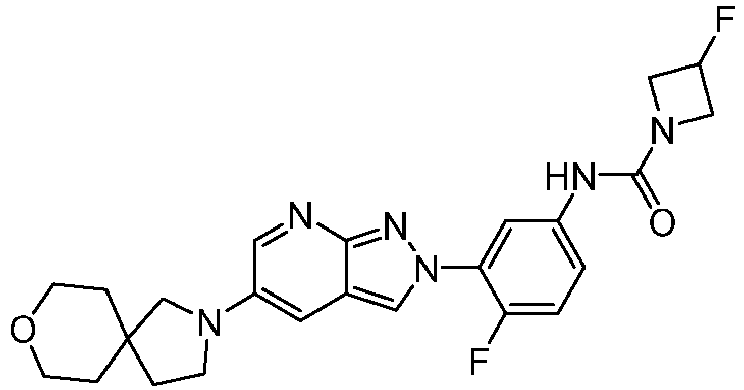
1H NMR (400 MHz, DMSO) δ 8.92 (s, 1 H), 8.49 (dd, J= 9.47, 2.82 Hz, 2 H), 8.20 (dd, J = 7.03, 2.64 Hz, 1 H), 7.60 - 7.67 (m, 1 H), 7.41 (dd, J= 11.36, 9.10 Hz, 1 H), 6.88 (d, J = 2.89 Hz, 1 H), 5.27 - 5.50 (m, 1 H), 4.24 - 4.37 (m, 2 H), 3.94 - 4.08 (m, 2 H), 3.55 - 3.69 (m, 4 H), 3.41 - 3.46 (m, 2 H), 3.28 (s, 2 H), 1.92 (t, J = 6.96 Hz, 2 H), 1.46 - 1.63 (m, 4 H). Method 1: RT = 2.86 min.; M+H = 469.3 245 
1H NMR (400 MHz, DMSO) δ 8.91 (s, 1 H), 8.55 (d, J = 2.64 Hz, 1 H), 8.29 (d, J = 2.89 Hz, 2 H), 8.19 (dd, J = 7.03, 2.76 Hz, 1 H), 7.60 - 7.66 (m, 1 H), 7.42 (dd, J = 11.29, 9.16 Hz, 1 H), 6.98 (d, J = 2.76 Hz, 1 H), 5.27 - 5.49 (m, 1 H), 4.23 - 4.36 (m, 2 H), 3.94 - 4.09 (m, 4 H), 3.86 (d, J = 7.78 Hz, 2 H), 2.38 (br d, J = 7.78 Hz, 2 H), 2.21 - 2.28 (m, 2 H). Method 1: RT = 2.41 min.; M+H = 454.3 246 
1H NMR (400 MHz, DMSO-d6) δ 8.78 (s, 1 H), 8.53 (d, J = 2.76 Hz, 1 H), 8.28 (d, J = 2.76 Hz, 1 H), 8.21 (dd, J = 7.15, 2.64 Hz, 1 H), 7.60 - 7.71 (m, 1 H), 7.41 (dd, J = 11.36, 9.10 Hz, 1 H), 6.94 (d, J = 2.76 Hz, 1 H), 3.93 (d, J = 12.05 Hz, 8 H), 3.84 (s, 2 H), 3.67 - 3.80 (m, 6 H), 2.09 - 2.21 (m, 4 H). Method 1: RT = 2.64 min.; M+H = 479.4 247 
1H NMR (400 MHz, Methanol-d4) δ 8.83 - 8.71 (m, 1H), 8.64 (d, J = 4.8 Hz, 1H), 8.12 (dd, J = 6.8, 2.7 Hz, 1H), 7.65 (dt, J = 9.3, 3.6 Hz, 1H), 7.35 (dd, J = 10.9, 9.1 Hz, 1H), 7.09 - 6.97 (m, 1H), 5.32 - 5.14 (m, 1H), 4.17 - 4.01 (m, 4H), 3.83 - 3.56 (m, 2H), 2.63 - 2.44 (m, 1H), 2.39 - 2.25 (m, 2H), 2.09 - 1.93 (m, 3H), 1.47 (s, 3H), 1.07 (s, 6H). Method 2: RT = 0.93 min.; M+H = 481.3 248 
1H NMR (400 MHz, DMSO) δ 8.95 (s, 1 H) 8.70 (d, J = 2.76 Hz, 1 H), 8.60 (d, J = 2.76 Hz, 1 H), 8.19 (dd, J = 7.09, 2.70 Hz, 1 H), 7.61 - 7.69 (m, 1 H), 7.44 (dd, J = 11.23, 9.10 Hz, 1 H), 7.37 (d, J = 2.76 Hz, 1 H), 5.27 - 5.51 (m, 1 H), 4.25 - 4.40 (m, 6 H), 3.96 - 4.09 (m, 2 H), 3.02 - 3.10 (m, 4 H), 1.91 - 2.00 (m, 4 H). Method 1: RT = 2.65 min.; M+H = 455.3 249 
1H NMR (400 MHz, DMSO-d6) δ 8.93 (s, 1 H), 8.48 (d, J = 2.89 Hz, 1 H), 8.29 (d, J = 2.76 Hz, 1 H), 8.17 (dd, J = 7.15, 2.64 Hz, 1 H), 7.59 - 7.66 (m, 1 H), 7.41 (dd, J = 11.42, 9.16 Hz, 1 H), 7.09 (d, J = 2.64 Hz, 1 H), 6.47 (s, 1 H), 5.28 - 5.50 (m, 1 H), 4.24 - 4.38 (m, 2 H), 3.94 - 4.08 (m, 2 H), 2.37 (br s, 1 H), 0.70 - 0.77 (m, 2 H), 0.39 - 0.47 (m, 2 H).Method 1: RT = 2.78 min.; M+H = 385.1 250 
1H NMR (400 MHz, DMSO) δ 8.66 - 8.73 (m, 2 H), 8.60 (d, J= 2.76 Hz, 1 H), 8.20 (dd, J= 7.03, 2.64 Hz, 1 H), 7.62 - 7.69 (m, 1 H), 7.35 - 7.45 (m, 2 H), 3.96 (t, J = 7.53 Hz, 4 H), 3.22 - 3.30 (m, 2 H), 3.11 - 3.19 (m, 4 H), 2.78 - 2.86 (m, 4 H), 2.19 (quin, J = 7.56 Hz, 2 H). Method 1: RT = 2.95 min.; M+H = 478.1 251 
1H NMR (400 MHz, DMSO) δ 8.87 - 8.99 (m, 1 H), 8.52 (d, J = 2.51 Hz, 1 H), 8.28 (d, J = 2.64 Hz, 1 H), 8.20 (dd, J = 6.96, 2.45 Hz, 1 H), 7.64 (dt, J = 8.72, 3.36 Hz, 1 H), 7.42 (dd, J = 11.17, 9.29 Hz, 1 H), 6.92 (d, J = 2.64 Hz, 1 H), 5.28 - 5.69 (m, 2 H), 4.22 - 4.42 (m, 2 H), 3.94 - 4.10 (m, 2 H), 3.87 (d, J = 7.40 Hz, 2 H), 3.69 (d, J = 7.28 Hz, 2 H), 1.49 (s, 3 H). Method 1: RT = 2.53 min.; M+H = 415.3 252 
1H NMR (400 MHz, DMSO) δ 9.20 (s, 1 H), 8.72 (d, J = 2.76 Hz, 1 H), 8.62 (d, J = 2.64 Hz, 1 H), 8.30 (d, J = 2.38 Hz, 1 H), 7.59 - 7.68 (m, 1 H), 7.46 (dd, J = 11.23, 9.22 Hz, 1 H), 7.38 (d, J = 2.13 Hz, 1 H), 4.40 (t, J = 12.74 Hz, 4 H), 3.21 - 3.27 (m, 2 H), 3.12 - 3.18 (m, 4 H), 2.78 - 2.86 (m, 4 H). Method 1: RT = 2.99 min.; M+H = 514.3 253 
1H NMR (400 MHz, DMSO) δ 8.72 (d, J = 2.76 Hz, 1 H), 8.54 - 8.64 (m, 2 H), 8.22 (dd, J = 7.03, 2.64 Hz, 1 H), 7.68 (dt, J = 8.97, 3.48 Hz, 1 H), 7.33 - 7.49 (m, 2 H), 5.25 - 5.49 (m, 1 H), 3.38 - 3.79 (m, 6 H), 3.16 (br d, J = 4.89 Hz, 4 H), 2.83 (br d, J = 4.27 Hz, 4 H), 2.00 - 2.26 (m, 2 H). Method 1: RT = 2.95 min.; M+H = 510.3 254 
1H NMR (400 MHz, DMSO-d6), δ 8.90 (d, J=2.45 Hz, 1 H), 8.85 (s, 1 H), 8.74 - 8.78 (m, 1 H), 8.61 - 8.65 (m, 1 H), 8.26 (dd, J=7.09, 2.69 Hz, 1 H), 7.69 - 7.76 (m, 1 H), 7.47 (dd, J=11.25, 9.29 Hz, 1 H), 4.05 (s, 4 H), 0.66 (s, 4 H). Method 1: RT = 2.95 min.; M+H = 416.0, 418.0 255 
1H NMR (500 MHz, DMSO-d6) δ 8.91 (s, 1H), 8.52 (d, J = 2.7 Hz, 1H), 8.26 (d, J = 2.8 Hz, 1H), 8.20 (dd, J = 7.0, 2.7 Hz, 1H), 7.65 (ddd, J = 9.1, 4.1, 2.7 Hz, 1H), 7.43 (dd, J = 11.4, 9.1 Hz, 1H), 6.87 (d, J = 2.8 Hz, 1H), 5.51 - 5.26 (m, 1H), 4.39 - 4.23 (m, 2H), 4.09 - 3.94 (m, 2H), 3.65 (s, 4H), 1.32 (s, 6H). Method 1: RT = 3.08 min.; M+H = 413.2 256 
1H NMR (500 MHz, DMSO-d6) δ 10.74 (s, 1H), 9.48 (d, J = 2.3 Hz, 1H), 9.03 (d, J = 2.4 Hz, 1H), 8.94 (d, J = 2.3 Hz, 1H), 8.74 (ddd, J = 4.8, 1.9, 0.9 Hz, 1H), 8.39 (dd, J = 7.0, 2.7 Hz, 1H), 8.21 - 8.10 (m, 1H), 7.96 (td, J = 7.7, 1.8 Hz, 1H), 7.75 - 7.62 (m, 1H), 7.57 (dd, J = 11.1, 9.0 Hz, 1H), 7.42 (ddd, J = 7.5, 4.8, 1.1 Hz, 1H), 4.92 (dddd, J = 64.6, 6.3, 3.3, 1.6 Hz, 1H), 2.41 - 2.24 (m, 1H), 1.57 (dddd, J = 22.4, 10.3, 6.6, 3.3 Hz, 1H), 1.28 (dq, J = 13.0, 6.5 Hz, 1H). Method 1: RT = 2.79 min.; M+H = 392.1 257 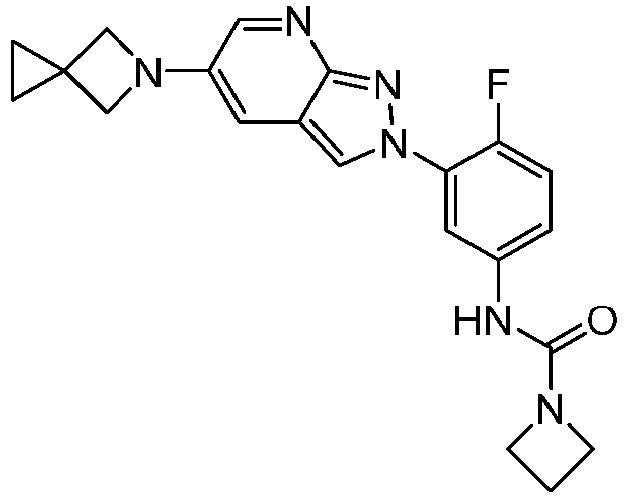
1H NMR (400 MHz, DMSO) δ 8.69 (s, 1 H), 8.52 (d, J = 2.63 Hz, 1 H), 8.28 (d, J = 2.76 Hz, 1 H), 8.20 (dd, J = 7.03, 2.63 Hz, 1 H), 7.62 - 7.69 (m, 1 H), 7.40 (dd, J = 11.29, 9.16 Hz, 1 H), 6.91 (d, J = 2.76 Hz, 1 H), 4.01 (s, 4 H), 3.97 (t, J= 7.53 Hz, 4 H), 2.19 (quin, J = 7.56 Hz, 2 H), 0.68 (s, 4 H). Method 1: RT = 2.90 min.; M+H = 393.2 258 
1H NMR (400 MHz, DMSO) δ 9.21 (br s, 1 H), 8.54 (s, 1 H), 8.28 (d, J = 1.63 Hz, 1 H), 8.20 (br d, J = 6.65 Hz, 1 H), 7.63 (br d, J = 8.41 Hz, 1 H), 7.45 (t, J = 9.91 Hz, 1 H), 6.92 (d, J= 2.01 Hz, 1 H), 4.40 (t, J = 12.86 Hz, 4 H), 4.02 (s, 4 H), 0.68 (s, 4 H). Method 1: RT = 3.03 min.; M+H = 429.2 259 
1H NMR (400 MHz, DMSO) δ 8.60 (s, 1 H), 8.54 (br s, 1 H), 8.28 (d, J = 2.76 Hz, 1 H), 8.22 (dd, J = 7.03, 2.76 Hz, 1 H), 7.64 - 7.72 (m, 1 H), 7.41 (dd, J= 11.17, 9.16 Hz, 1 H), 6.92 (d, J = 2.76 Hz, 1 H), 5.27 - 5.48 (m, 1 H), 4.02 (s, 4 H), 3.57 - 3.77 (m, 4 H), 2.03 - 2.24 (m, 2 H), 0.68 (s, 4 H). Method 1: RT = 2.93 min.; M+H = 425.2 260 
1H NMR (400 MHz, DMSO-d6), δ 8.81 (s, 1 H), 8.70 (d, J=2.93 Hz, 1 H), 8.55 (d, J=2.69 Hz, 1 H), 8.22 (dd, J=7.09, 2.69 Hz, 1 H), 7.63 - 7.72 (m, 1 H), 7.42 (dd, J=11.37, 9.17 Hz, 1 H), 7.15 (d, J=2.93 Hz, 1 H), 3.97 - 4.14 (m, 4 H), 2.95 (s, 6 H), 0.65 (s, 4 H). Method 1: RT = 2.87 min.; M+H = 381.0 261 
1H NMR (400 MHz, DMSO) δ 8.94 (s, 1 H), 8.56 (dd, J = 8.28, 2.38 Hz, 2 H), 8.21 (dd, J = 6.96, 2.57 Hz, 1 H), 7.64 (dt, J = 8.91, 3.26 Hz, 1 H), 7.43 (dd, J = 10.79, 9.54 Hz, 1 H), 7.08 (d, J = 2.51 Hz, 1 H), 5.27 - 5.50 (m, 1 H), 4.24 - 4.39 (m, 2 H), 3.92 - 4.11 (m, 2 H), 3.83 (br t, J = 13.30 Hz, 2 H), 3.59 (br t, J = 7.15 Hz, 2 H), 2.60 (br d, J = 7.53 Hz, 2 H), Method 1: RT = 2.67 min.; M+H = 447.2 262 
1H NMR (400 MHz, DMSO) δ 8.95 (s, 1 H), 8.58 (d, J = 2.76 Hz, 1 H), 8.35 (d, J = 2.76 Hz, 1 H), 8.20 (dd, J = 7.03, 2.64 Hz, 1 H), 7.60 - 7.68 (m, 1 H), 7.44 (dd, J = 11.36, 9.10 Hz, 1 H), 7.05 (d, J = 2.76 Hz, 1 H), 5.28 - 5.51 (m, 1 H), 4.24 - 4.38 (m, 2 H), 4.10 - 4.17 (m, 2 H), 3.95 - 4.10 (m, 4 H), 1.79 (t, J = 8.91 Hz, 2 H). Method 1: RT = 2.84 min.; M+H = 434.9 263 
1H NMR (400 MHz, DMSO) δ 8.96 (s, 1 H), 8.53 (d, J = 1.88 Hz, 1 H), 8.37 (d, J = 1.88 Hz, 1 H), 8.19 (dd, J = 6.96, 2.45 Hz, 1 H), 7.62 - 7.69 (m, 1 H), 7.39 - 7.50 (m, 1 H), 7.14 (d, J= 2.01 Hz, 1 H), 5.28 - 5.52 (m, 1 H), 4.41 (br d, J = 6.02 Hz, 2 H), 4.26 - 4.38 (m, 2 H), 4.21 (br d, J = 10.92 Hz, 2 H), 3.96 -4.10 (m, 2 H), 3.70 (br d, J= 10.92 Hz, 2 H), 2.72 - 2.76 (m, 1 H), 1.88 (d, J = 8.03 Hz, 1 H). Method 1: RT = 2.49 min.; M+H = 427.3 264 
1H NMR (400 MHz, DMSO-d6) δ 9.38 (s, 1H), 9.07 - 8.96 (m, 2H), 8.84 (d, J = 4.3 Hz, 1H), 8.30 (dd, J = 7.0, 2.7 Hz, 1H), 7.72 - 7.62 (m, 1H), 7.52 (dd, J = 11.2, 9.1 Hz, 1H), 7.33 (dd, J = 4.4, 1.2 Hz, 1H), 6.04 (s, 1H), 5.41 (dtt, J = 57.4, 6.1, 3.1 Hz, 1H), 4.40 - 4.25 (m, 2H), 4.27 - 4.16 (m, 1H), 4.10 - 3.94 (m, 2H), 3.90 - 3.77 (m, 1H), 3.06 - 2.94 (m, 1H), 2.86 (dtd, J = 11.7, 8.7, 4.4 Hz, 1H). Method 1: RT = 1.69 min.; M+H = 385.2 265 
1H NMR (400 MHz, DMSO) δ 8.93 (s, 1 H), 8.58 (d, J = 2.76 Hz, 1 H), 8.32 (d, J = 2.76 Hz, 1 H), 8.20 (dd, J = 7.03, 2.64 Hz, 1 H), 7.65 (dd, J = 7.34, 4.58 Hz, 1 H), 7.44 (dd, J = 11.17, 9.16 Hz, 1 H), 7.03 (d, J = 2.89 Hz, 1 H), 5.29 - 5.51 (m, 1 H), 4.24 - 4.38 (m, 2 H), 4.18 (t, J = 8.34 Hz, 2 H), 3.95 - 4.10 (m, 4 H), 3.65 - 3.85 (m, 1 H). Method 1: RT = 2.86 min.; M+H =453.1 266 
1H NMR (400 MHz, DMSO) δ 8.93 (s, 1 H), 8.60 (d, J= 2.76 Hz, 1 H), 8.31 (d, J= 2.76 Hz, 1 H), 8.20 (dd, J= 6.96, 2.57 Hz, 1 H), 7.60 - 7.69 (m, 1 H), 7.44 (dd, J= 11.04, 9.16 Hz, 1 H), 7.04 (d, J= 2.76 Hz, 1 H), 5.27 - 5.54 (m, 1 H), 4.26 - 4.38 (m, 2 H), 4.17 - 4.24 (m, 2 H), 3.95 - 4.13 (m, 4 H), 3.85 - 3.94 (m, 1 H). Method 1: RT = 2.44 min.; M+H = 410.3 267 
1H NMR (400 MHz, Methanol-d4) δ 8.86 (dd, J = 3.4, 2.2 Hz, 1H), 8.74 (d, J = 4.4 Hz, 0.5H), 8.67 (d, J = 4.5 Hz, 0.5H), 8.17 (dd, J = 6.8, 2.7 Hz, 0.5H), 8.13 (dd, J = 6.8, 2.7 Hz, 0.5H), 7.66 (dddd, J = 8.8, 4.3, 2.7, 1.7 Hz, 1H), 7.37 (ddd, J = 10.9, 9.1, 3.7 Hz, 1H), 7.28 (dd, J = 4.4, 0.8 Hz, 0.5H), 7.18 (dd, J = 4.5, 0.9 Hz, 0.5H), 5.93 (dd, J = 9.2, 5.6 Hz, 0.5H), 5.73 (dd, J = 9.3, 6.1 Hz, 0.5H), 5.37 (dtt, J = 57.1, 6.1, 3.2 Hz, 1H), 4.48 - 4.32 (m, 3H), 4.24 - 4.15 (m, 2H), 4.11 (ddd, J = 10.3, 3.2, 1.4 Hz, 1H), 3.05 - 2.91 (m, 1H), 2.34 - 2.21 (m, 1H), 2.03 (s, 1.5H), 1.71 (s, 1.5H). Method 2: RT = 0.66 min.; M+H = 427.2 268 
1H NMR (400 MHz, DMSO-d6) δ 10.69 (s, 1 H), 8.64 (d, J=2.69 Hz, 1 H), 8.37 (d, J=2.81 Hz, 1 H), 8.32 (dd, J=7.03, 2.51 Hz, 1 H), 7.61 - 7.67 (m, 1 H), 7.52 (dd, J=11.19, 9.11 Hz, 1 H), 7.15 (d, J=2.81 Hz, 1 H), 4.80 - 5.03 (m, 1 H), 4.41 (t, J=12.29 Hz, 4 H), 2.24 - 2.33 (m, 1 H), 1.46 - 1.67 (m, 1 H), 1.27 (dd, J=13.27, 6.54 Hz, 1 H). Method 1: RT = 2.89 min.; M+H = 406.0 269 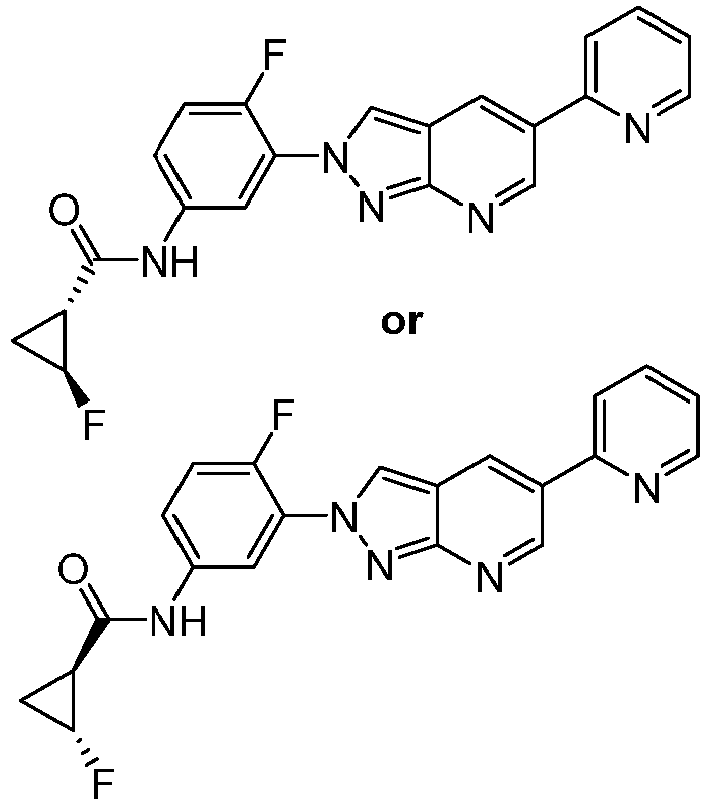
1H NMR (400 MHz, DMSO-d6) δ 10.75 (s, 1 H), 9.48 (d, J=2.26 Hz, 1 H), 9.03 (d, J=2.38 Hz, 1 H), 8.95 (d, J=2.26 Hz, 1 H), 8.74 (d, J=4.14 Hz, 1 H), 8.39 (dd, J=6.96, 2.57 Hz, 1 H), 8.13 (d, J=8.03 Hz, 1 H), 7.96 (td, J=7.75, 1.69 Hz, 1 H), 7.65 - 7.74 (m, 1 H), 7.57 (dd, J=11.11, 9.10 Hz, 1 H), 7.42 (dd, J=7.22, 5.21 Hz, 1 H), 4.78 - 5.06 (m, 1 H), 2.26 - 2.35 (m, 1 H), 1.49 - 1.66 (m, 1 H), 1.24 - 1.33 (m, 1 H). Method 1: RT = 2.80 min.; M+H = 392.2 270 
1H NMR (400 MHz, DMSO) δ 8.94 (s, 1 H), 8.72 (d, J= 2.81 Hz, 1 H), 8.63 (d, J= 2.57 Hz, 1 H), 8.16 - 8.27 (m, 1 H), 7.61 - 7.67 (m, 1 H), 7.40 - 7.47 (m, 2 H), 5.26 - 5.54 (m, 1 H), 4.24 - 4.40 (m, 2 H), 3.96 - 4.08 (m, 2 H), 3.29 - 3.33 (m, 1 H), 3.21 (br d, J = 5.01 Hz, 4 H), 3.11 (br d, J = 4.40 Hz, 4 H). Method 1: RT = 1.86 min.; M+H = 414.3 271 
1H NMR (400 MHz, DMSO-d6) δ 10.75 (s, 1 H), 8.70 (d, J=2.69 Hz, 1 H), 8.43 (d, J=2.81 Hz, 1 H), 8.38 (dd, J=6.97, 2.57 Hz, 1 H), 7.66 - 7.77 (m, 1 H), 7.52 - 7.63 (m, 1 H), 7.20 (d, J=2.81 Hz, 1 H), 4.85 - 5.08 (m, 1 H), 4.47 (t, J=12.23 Hz, 4 H), 2.27 - 2.39 (m, 1 H), 1.52 - 1.72 (m, 1 H), 1.33 (dq, J=13.11, 6.43 Hz, 1 H). Method 1: RT = 2.89 min.; M+H = 406.0 272 
1H NMR (400 MHz, DMSO-d6) δ 10.74 (s, 1 H), 8.56 (d, J=2.57 Hz, 1 H), 8.25 - 8.37 (m, 2 H), 7.58 - 7.68 (m, 1 H), 7.45 - 7.56 (m, 1 H), 6.92 (d, J=2.69 Hz, 1 H), 4.78 - 5.05 (m, 1 H), 4.03 (s, 4 H), 2.23 - 2.33 (m, 1 H), 1.48 - 1.63 (m, 1 H), 1.23 - 1.33 (m, 1 H), 0.69 (s, 4 H). Method 1: RT = 3.13 min.; M+H = 396.3 273 
1H NMR (400 MHz, DMSO-d6) δ 10.75 (s, 1 H), 9.48 (d, J=2.08 Hz, 1 H), 9.03 (d, J=2.32 Hz, 1 H), 8.95 (d, J=2.20 Hz, 1 H), 8.74 (d, J=4.52 Hz, 1 H), 8.40 (dd, J=7.03, 2.51 Hz, 1 H), 8.13 (d, J=8.07 Hz, 1 H), 7.96 (td, J=7.79, 1.77 Hz, 1 H), 7.69 (dt, J=8.47, 3.53 Hz, 1 H), 7.57 (dd, J=11.00, 9.17 Hz, 1 H), 7.42 (dd, J=7.09, 5.14 Hz, 1 H), 4.80 - 5.05 (m, 1 H), 2.25 - 2.34 (m, 1 H), 1.48 - 1.67 (m, 1 H), 1.28 (dq, J=13.13, 6.67 Hz, 1 H). Method 1: RT = 2.82 min.; M+H = 392.2 274 
1H NMR (400 MHz, DMSO) δ 8.68 (s, 1 H), 8.57 (d, J = 2.57 Hz, 1 H), 8.32 (d, J = 2.69 Hz, 1 H), 8.20 (dd, J = 7.09, 2.69 Hz, 1 H), 7.62 - 7.69 (m, 1 H), 7.41 (dd, J = 11.25, 9.17 Hz, 1 H), 7.03 (d, J= 2.81 Hz, 1 H), 4.13 - 4.22 (m, 2 H), 3.98 (q, J = 7.78 Hz, 6 H), 3.76 (br dd, J = 9.54, 4.77 Hz, 1 H), 2.19 (quin, J = 7.55 Hz, 2 H). Method 1: RT = 2.87 min.; M+H = 435.3 275 
1H NMR (400 MHz, DMSO) δ 8.52 - 8.66 (m, 2 H), 8.32 (d, J = 2.81 Hz, 1 H), 8.23 (dd, J = 6.97, 2.57 Hz, 1 H), 7.68 (dt, J = 9.08, 3.35 Hz, 1 H), 7.42 (dd, J = 11.19, 9.23 Hz, 1 H), 7.03 (d, J = 2.69 Hz, 1 H), 5.24 - 5.50 (m, 1 H), 4.09 - 4.26 (m, 2 H), 3.99 (dd, J = 8.01, 5.44 Hz, 2 H), 3.50 - 3.84 (m, 4 H), 3.38 - 3.47 (m, 1 H), 1.97 - 2.29 (m, 2 H). Method 1: RT = 2.86 min.; M+H = 467.3 276 
1H NMR (400 MHz, DMSO-d6) δ 8.99 (s, 1 H), 8.90 (d, J=2.51 Hz, 1 H), 8.70 (d, J=2.51 Hz, 1 H), 8.47 (d, J=2.51 Hz, 1 H), 8.24 (dd, J=7.03, 2.76 Hz, 1 H), 7.64 - 7.76 (m, 1 H), 7.48 (dd, J=11.17, 9.16 Hz, 1 H), 5.26 - 5.53 (m, 1 H), 4.23 - 4.40 (m, 2 H), 3.94 - 4.12 (m, 2 H). Method 1: RT = 2.76 min.; M+H = 364.0 277 
1H NMR (400 MHz, DMSO-d6) δ ppm 9.00 (d, J=2.20 Hz, 1 H), 8.94 (d, J=1.96 Hz, 1 H), 8.53 - 8.63 (m, 2 H), 8.51 (d, J=2.20 Hz, 1 H), 7.85 - 7.95 (m, 1 H), 7.81 (br d, J=7.34 Hz, 1 H), 7.55 - 7.67 (m, 1 H), 7.37 (dd, J=7.46, 4.77 Hz, 1 H), 4.69 (s, 2 H), 2.55 (s, 3 H), 2.45 (s, 3 H). Method 1: RT = 2.50 min.; M+H = 459.0 278 
1H NMR (400 MHz, DMSO-d6) δ 10.54 (s, 1 H), 9.00 (d, J=2.32 Hz, 1 H), 8.93 (d, J=2.20 Hz, 1 H), 8.60 (td, J=6.91, 3.30 Hz, 2 H), 8.51 (d, J=2.20 Hz, 1 H), 7.89 - 7.97 (m, 1 H), 7.84 (d, J=7.46 Hz, 1 H), 7.60 (dd, J=11.07, 9.23 Hz, 1 H), 7.40 (dd, J=7.58, 4.77 Hz, 1 H), 2.45 (s, 3 H), 2.41 (s, 3 H). Method 1: RT = 2.61 min.; M+H = 446.1 279 
1H NMR (400 MHz, Methanol-d4) δ 8.51 (d, J = 2.6 Hz, 1H), 8.38 (dd, J = 6.9, 2.7 Hz, 1H), 8.28 (d, J = 2.8 Hz, 1H), 7.85 (ddd, J = 9.1, 4.2, 2.7 Hz, 1H), 7.41 (dd, J = 11.1, 9.1 Hz, 1H), 7.10 (d, J = 2.8 Hz, 1H), 4.23 (t, J = 8.2 Hz, 2H), 4.08 (dd, J = 8.0, 5.4 Hz, 2H), 3.64 (qt, J = 8.8, 5.4 Hz, 1H), 2.55 (s, 3H), 2.46 (s, 3H). 280 
1H NMR (400 MHz, DMSO-d6) δ 9.18 (s, 1 H), 8.99 (s, 1 H), 8.44 (d, J=1.76 Hz, 1 H), 8.36 (d, J=2.76 Hz, 1 H), 8.31 (d, J=5.77 Hz, 1 H), 7.67 (dd, J=5.52, 2.01 Hz, 1 H), 7.14 (d, J=2.76 Hz, 1 H), 4.42 (t, J=12.17 Hz, 4 H), 4.04 (t, J=7.53 Hz, 4 H), 2.16 - 2.29 (m, 2 H). Method 1: RT = 2.76 min.; M+H = 386.0 281 
1H NMR (400 MHz, DMSO-d6) δ 9.70 (s, 1 H), 9.47 (d, J=2.20 Hz, 1 H), 9.38 (s, 1 H), 8.95 (d, J=2.20 Hz, 1 H), 8.71 - 8.77 (m, 1 H), 8.49 (d, J=1.71 Hz, 1 H), 8.42 (d, J=5.62 Hz, 1 H), 8.12 (d, J=8.07 Hz, 1 H), 7.96 (td, J=7.76, 1.83 Hz, 1 H), 7.72 (dd, J=5.62, 1.96 Hz, 1 H), 7.39 - 7.47 (m, 1 H), 4.49 (t, J=12.72 Hz, 4 H). Method 1: RT = 2.81 min.; M+H = 408.0 282 
1H NMR (400 MHz, DMSO-d6) δ 9.16 (s, 1 H), 8.91 (s, 1 H), 8.42 (d, J=1.76 Hz, 1 H), 8.26 - 8.32 (m, 2 H), 7.66 (dd, J=5.77, 2.01 Hz, 1 H), 6.91 (d, J=2.76 Hz, 1 H), 4.00 - 4.08 (m, 8 H), 2.17 - 2.28 (m, 2 H), 0.68 (s, 4 H). Method 1: RT = 2.93 min.; M+H = 376.0 283 
1H NMR (400 MHz, DMSO-d6), δ 9.47 (d, J=2.26 Hz, 1 H), 9.08 (br s, 1 H), 8.90 - 9.00 (m, 2 H), 8.70 - 8.79 (m, 1 H), 8.13 (d, J=8.03 Hz, 1 H), 8.03 (d, J=2.51 Hz, 1 H), 7.96 (td, J=7.72, 1.88 Hz, 1 H), 7.72 - 7.78 (m, 1 H), 7.66 (d, J=9.03 Hz, 1 H), 7.42 (ddd, J=7.53, 4.77, 1.00 Hz, 1 H), 5.28 - 5.53 (m, 1 H), 4.25 - 4.42 (m, 2 H), 3.95 - 4.11 (m, 2 H). Method 1: RT = 2.69 min.; M+H = 423.0 284 
1H NMR (400 MHz, DMSO) δ 8.80 (s, 1 H), 8.55 (s, 1 H), 8.35 (d, J = 2.81 Hz, 1 H), 7.96 (d, J = 2.45 Hz, 1 H), 7.71 (dd, J = 8.99, 2.51 Hz, 1 H), 7.58 (d, J = 9.05 Hz, 1 H), 7.16 (d, J = 2.81 Hz, 1 H), 4.40 (br t, J = 12.23 Hz, 4 H), 3.96 (br t, J = 7.52 Hz, 4 H), 2.08 - 2.32 (m, 2 H). Method 1: RT = 2.81 min.; M+H = 419.2 285 
1H NMR (400 MHz, DMSO) δ 9.46 (d, J = 1.96 Hz, 1 H), 8.93 (s, 2 H), 8.82 (s, 1 H), 8.73 (br d, J= 4.04 Hz, 1 H), 8.12 (br d, J = 8.07 Hz, 1 H) 8.04 (d, J = 2.20 Hz, 1 H) 7.94 (br t, J = 7.15 Hz, 1 H) 7.75 (dd, J = 8.86, 2.26 Hz, 1 H), 7.62 (d, J = 8.93 Hz, 1 H), 7.41 (dd, J = 6.97, 5.01 Hz, 1 H), 3.97 (br t, J= 7.46 Hz, 4 H), 2.19 (quin, J = 7.55 Hz, 2 H). Method 1: RT = 2.69 min.; M+H = 405.2 286 
1H NMR (400 MHz, DMSO) δ 8.79 (s, 1 H), 8.45 (s, 1 H), 8.27 (d, J = 2.57 Hz, 1 H), 7.96 (d, J = 2.32 Hz, 1 H), 7.71 (dd, J = 8.86, 2.38 Hz, 1 H), 7.57 (d, J = 8.80 Hz, 1 H), 6.93 (d, J = 2.69 Hz, 1 H), 4.01 (s, 4 H), 3.96 (br t, J = 7.58 Hz, 4 H), 2.19 (quin, J = 7.61 Hz, 2 H), 0.68 (s, 4 H). Method 1: RT = 2.98 min.; M+H = 409.3 287 
1H NMR (400 MHz, DMSO-d6) δ 8.70 (s, 1 H), 8.68 (s, 1 H), 8.29 (s, 1 H), 8.25 (d, J=2.81 Hz, 1 H), 7.52 - 7.66 (m, 2 H), 7.37 - 7.45 (m, 1 H), 6.90 (d, J=2.69 Hz, 1 H), 3.97 - 4.05 (m, 8 H), 2.18 - 2.23 (m, 2 H), 0.69 (s, 4 H). Method 1: RT = 2.82 min.; M+H = 375.1 288 
1H NMR (400 MHz, Methanol-d4) δ 9.03 (d, J = 2.2 Hz, 1H), 8.73 (d, J = 4.9 Hz, 1H), 8.19 (dd, J = 6.8, 2.7 Hz, 1H), 7.63 (ddd, J = 9.1, 4.2, 2.7 Hz, 1H), 7.37 (dd, J = 10.9, 9.1 Hz, 1H), 7.32 (dd, J = 5.0, 0.9 Hz, 1H), 4.92 (ddt, J = 2.7, 1.4, 0.7 Hz, 1H), 4.23 (d, J = 10.3 Hz, 1H), 4.17 - 4.07 (m, 2H), 3.74 (td, J = 11.6, 2.5 Hz, 1H), 3.37 - 3.32 (m, 2H), 2.33 (p, J = 7.6 Hz, 2H), 2.15 - 1.98 (m, 2H), 1.92 - 1.57 (m, 4H). Method 2: RT = 0.89 min.; M+H = 396.0 289 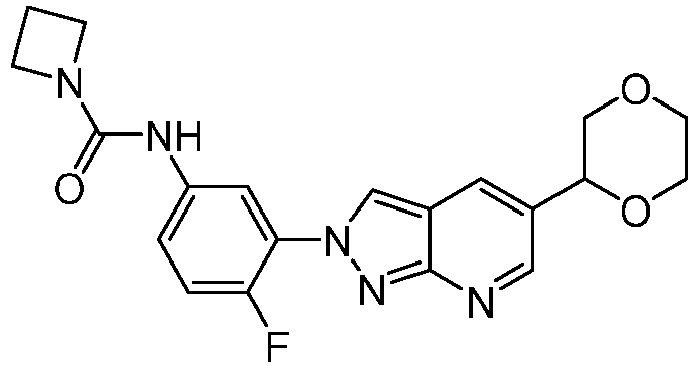
1H NMR (400 MHz, Methanol-d4) δ 9.05 (d, J = 2.2 Hz, 1H), 8.73 (d, J = 4.8 Hz, 1H), 8.18 (dd, J = 6.8, 2.7 Hz, 1H), 7.63 (ddd, J = 9.1,4.1,2.7 Hz, 1H), 7.37 (dd, J = 10.9, 9.1 Hz, 1H), 7.32 (dd, J = 4.8, 0.9 Hz, 1H), 5.20 - 5.12 (m, 1H), 4.17-4.04 (m, 4H), 3.99 (ddd, J = 11.8, 10.6, 3.0 Hz, 1H), 3.89 - 3.75 (m, 2H), 3.59 (dd, J = 11.5, 9.9 Hz, 1H), 3.40 - 3.32 (m, 2H), 2.33 (p, J = 7.7 Hz, 2H). Method 2: RT = 0.74 min.; M+H = 398.0 290 
1H NMR (400 MHz, DMSO) δ 8.69 (s, 1 H), 8.62 (d, J = 2.64 Hz, 1 H), 8.36 (d, J = 2.76 Hz, 1 H), 8.22 (dd, J = 7.09, 2.70 Hz, 1 H), 7.65 - 7.72 (m, 1 H), 7.42 (dd, J = 11.29, 9.16 Hz, 1 H), 7.15 (d, J= 2.89 Hz, 1 H), 4.41 (t, J = 12.23 Hz, 4 H), 3.98 (t, J = 7.53 Hz, 4 H), 2.20 (quin, J = 7.56 Hz, 2 H). Method 1: RT = 2.73 min.; LCMS: M+H =403.2 291 
1H NMR (400 MHz, DMSO) δ 8.95 (s, 1 H), 8.56 (d, J = 2.63 Hz, 1 H), 8.30 (d, J = 2.89 Hz, 1 H), 8.19 (dd, J = 7.09, 2.70 Hz, 1 H), 7.60 - 7.69 (m, 1 H), 7.42 (dd, J = 11.36, 9.10 Hz, 1 H), 7.00 (d, J = 2.76 Hz, 1 H), 5.28 - 5.63 (m, 2 H), 4.20 - 4.37 (m, 4 H), 3.93 - 4.09 (m, 4 H). Method 1: RT = 2.63 min.; M+H =403.2 292 
1H NMR (400 MHz, DMSO) δ 8.70 (s, 1 H), 8.56 (d, J = 2.76 Hz, 1 H), 8.31 (d, J = 2.76 Hz, 1 H), 8.21 (dd, J = 7.03, 2.64 Hz, 1 H), 7.59 - 7.72 (m, 1 H), 7.41 (dd, J = 11.36, 9.10 Hz, 1 H), 7.01 (d, J = 2.76 Hz, 1 H), 5.39 - 5.66 (m, 1 H), 4.20 - 4.36 (m, 2 H), 3.89 - 4.09 (m, 6 H), 2.12 - 2.28 (m, 2 H). Method 1: RT = 2.63 min.; M+H = 385.3 293 
1H NMR (400 MHz, DMSO-d6) δ 9.05 (s, 1 H), 8.83 (d, J=2.26 Hz, 1 H), 8.66 (s, 1 H), 8.44 (br s, 1 H), 8.24 (dd, J=7.03, 2.51 Hz, 1 H), 8.05 (s, 1 H), 7.64 - 7.73 (m, 1 H), 7.47 (dd, J=11.17, 9.16 Hz, 1 H), 5.28 - 5.52 (m, 1 H), 4.25 - 4.41 (m, 2 H), 3.96 - 4.11 (m, 2 H), 3.29 (br d, J=9.03 Hz, 2 H), 2.91 (br d, J=8.28 Hz, 3 H), 1.96 (br d, J=12.55 Hz, 2 H), 1.82 (br d, J=11.04 Hz, 2 H). Method 2: RT = 0.51 min.; M+H = 413.2 294 
1H NMR (400 MHz, DMSO-d6) δ 9.48 (d, J=2.26 Hz, 1 H), 9.42 (d, J=1.25 Hz, 1 H), 9.01 - 9.13 (m, 3 H), 8.76 - 8.83 (m, 1 H), 8.68 (d, J=2.51 Hz, 1 H), 8.29 (dd, J=7.03, 2.51 Hz, 1 H), 7.67 - 7.78 (m, 1 H), 7.50 (dd, J=11.17, 9.16 Hz, 1 H), 5.26 - 5.57 (m, 1 H), 4.21 - 4.46 (m, 2 H), 3.92 - 4.15 (m, 2 H). Method 1: RT = 2.53 min.; M+H = 408.1 295 
1H NMR (400 MHz, METHANOL-d4) δ 9.14 (d, J=2.26 Hz, 1 H), 8.77 (d, J=2.26 Hz, 1 H), 8.57 (d, J=2.26 Hz, 1 H), 8.17 (dd, J=6.78, 2.76 Hz, 1 H), 7.85 (d, J=1.00 Hz, 1 H), 7.64 - 7.71 (m, 2 H), 7.38 (dd, J=11.04, 9.03 Hz, 1 H), 5.27 - 5.51 (m, 1 H), 4.35 - 4.47 (m, 2 H), 4.09 - 4.23 (m, 2 H). Method 1: RT= 1.95 min.; M+H = 396.1 296 
1H NMR (400 MHz, METHANOL-d4) δ 8.69 (d, J=2.45 Hz, 1 H), 8.65 (d, J=2.20 Hz, 1 H), 8.11 - 8.18 (m, 2 H), 7.61 - 7.69 (m, 1 H), 7.27 - 7.43 (m, 6 H), 5.26 - 5.49 (m, 1 H), 4.33 - 4.46 (m, 2 H), 4.08 - 4.21 (m, 2 H), 3.63 (s, 2 H), 3.11 (br d, J=11.74 Hz, 2 H), 2.72 - 2.85 (m, 1 H), 2.20 - 2.31 (m, 2 H), 1.82 - 2.01 (m, 4 H). Method 1: RT = 2.16 min.; M+H = 503.2 297 
1H NMR (400 MHz, DMSO-d6) δ 13.13 (br s, 1 H), 9.08 (d, J=2.26 Hz, 1 H), 9.02 (s, 1 H), 8.84 (d, J=2.51 Hz, 1 H), 8.47 (s, 1 H), 8.40 (d, J=2.26 Hz, 1 H), 8.26 (dd, J=7.03, 2.76 Hz, 2 H), 7.69 (ddd, J=9.16, 4.14, 2.76 Hz, 1 H), 7.48 (dd, J=11.17, 9.16 Hz, 1 H), 5.30 - 5.51 (m, 1 H), 4.26 - 4.40 (m, 2 H), 3.97 - 4.10 (m, 2 H). Method 2: RT = 0.69 min.; M+H = 396.1 298 
1H NMR (400 MHz, DMSO), δ 8.94 (s, 1 H), 8.62 (d, J = 2.57 Hz, 1 H), 8.36 (d, J = 2.81 Hz, 1 H), 8.20 (dd, J = 7.03, 2.63 Hz, 1 H), 7.57 - 7.71 (m, 1 H), 7.44 (dd, J = 11.19, 9.11 Hz, 1 H), 7.14 (d, J = 2.81 Hz, 1 H), 5.26 - 5.53 (m, 1 H), 4.22 - 4.51 (m, 6 H), 3.91 - 4.11 (m, 2 H). Method 1: RT = 2.74 min.; M+H = 421.2 299 
1H NMR (400 MHz, DMSO) δ 9.19 (s, 1 H) 8.62 (d, J = 2.76 Hz, 1 H), 8.35 (d, J = 2.89 Hz, 1 H), 8.19 (dd, J = 7.03, 2.64 Hz, 1 H), 7.61 - 7.67 (m, 1 H), 7.45 (dd, J = 11.36, 9.10 Hz, 1 H), 7.13 (d, J= 2.76 Hz, 1 H), 4.35 - 4.45 (m, 8 H) Method 1: RT = 2.90 min.; M+H = 439.2 300 
1H NMR (400 MHz, DMSO) δ 8.57 - 8.65 (m, 2 H) 8.35 (d, J=2.76 Hz, 1 H) 8.22 (dd, J=7.09, 2.70 Hz, 1 H) 7.64 - 7.72 (m, 1 H) 7.42 (dd, J=11.29, 9.16 Hz, 1 H) 7.14 (d, J=2.76 Hz, 1 H) 5.27 - 5.47 (m, 1 H) 4.40 (t, J=12.23 Hz, 4 H) 3.39 - 3.76 (m, 4 H) 1.98 - 2.25 (m, 2 H). Method 1: RT = 2.73 min.; M+H = 435.3 301 
1H NMR (400 MHz, METHANOL-d4) δ 9.11 (d, J=1.96 Hz, 1 H), 8.76 (d, J=2.20 Hz, 1 H), 8.54 (d, J=1.96 Hz, 1 H), 8.16 (dd, J=6.72, 2.57 Hz, 1 H), 7.76 (s, 1 H), 7.63 - 7.70 (m, 2 H), 7.37 (dd, J=11.00, 9.29 Hz, 1 H), 5.27 - 5.50 (m, 1 H), 4.33 - 4.48 (m, 2 H), 4.09 - 4.22 (m, 2 H), 3.84 (s, 3 H).Method 1: RT = 1.97 min.; M+H = 410.2 302 
1H NMR (400 MHz, DMSO), δ 8.55 - 8.62 (m, 2 H), 8.31 (d, J = 2.76 Hz, 1 H), 8.22 (dd, J= 7.03, 2.76 Hz, 1 H), 7.68 (dt, J = 8.97, 3.42 Hz, 1 H), 7.42 (dd, J = 11.29, 9.16 Hz, 1 H), 7.01 (d, J = 2.76 Hz, 1 H), 5.28 - 5.64 (m, 2 H), 4.20 - 4.33 (m, 2 H), 3.93 - 4.07 (m, 2 H), 3.60 - 3.76 (m, 4 H), 2.10 - 2.22 (m, 2 H). Method 2: RT = 0.83 min.; M+H = 417.1 303 
1H NMR (400 MHz, DMSO) δ 9.22 (s, 1 H), 8.58 (d, J = 2.64 Hz, 1 H), 8.31 (d, J = 2.76 Hz, 1 H), 8.20 (dd, J = 6.96, 2.70 Hz, 1 H), 7.61 - 7.68 (m, 1 H), 7.46 (dd, J = 11.29, 9.16 Hz, 1 H), 7.01 (d, J = 2.89 Hz, 1 H), 5.42 - 5.64 (m, 1 H), 4.41 (t, J = 12.67 Hz, 4 H), 4.21 - 4.33 (m, 2 H), 3.93 - 4.06 (m, 2 H). Method 1: RT = 2.74 min.; M+H = 421.3 304 
1H NMR (400 MHz, DMSO-d6) δ 9.02 (d, J=2.26 Hz, 1 H), 8.98 (s, 1 H), 8.84 (d, J=2.76 Hz, 1 H), 8.36 (d, J=2.26 Hz, 1 H), 8.31 (s, 1 H), 8.25 (dd, J=7.03, 2.76 Hz, 1 H), 8.02 (s, 1 H), 7.65 - 7.73 (m, 1 H), 7.48 (dd, J=11.17, 9.16 Hz, 1 H), 5.29 - 5.52 (m, 1 H), 4.26 - 4.39 (m, 2 H), 3.97 - 4.10 (m, 2 H), 3.91 (s, 3 H). Method 2: RT = 0.75 min.; M+H = 410.2 305 
1H NMR (400 MHz, METHANOL-d4) δ 8.69 (d, J=2.51 Hz, 1 H), 8.65 (d, J=2.26 Hz, 1 H), 8.12 - 8.17 (m, 2 H), 7.62 - 7.68 (m, 1 H), 7.32 - 7.45 (m, 3 H), 7.06 - 7.13 (m, 2 H), 5.27 - 5.48 (m, 1 H), 4.33 - 4.46 (m, 2 H), 4.07 - 4.23 (m, 2 H), 3.61 (s, 2 H), 3.08 (br d, J=11.80 Hz, 2 H), 2.70 - 2.86 (m, 1 H), 2.24 (td, J=11.86, 2.38 Hz, 2 H), 1.93 - 2.01 (m, 2 H), 1.81 - 1.93 (m, 2 H). Method 2: RT = 0.64 min.; M+H = 521.2 306 
1H NMR (400 MHz, DMSO-d6) δ 8.67 - 8.74 (m, 2 H), 8.54 (d, J=2.69 Hz, 1 H), 8.22 (dd, J=7.21, 2.81 Hz, 1 H), 7.59 - 7.77 (m, 1 H), 7.41 (dd, J=11.37, 9.17 Hz, 1 H), 7.14 (d, J=2.93 Hz, 1 H), 3.98 (t, J=7.58 Hz, 4 H), 2.20 (t, J=7.58 Hz, 2 H). Method 1: RT = 2.62 min.; M+H = 361.2 307 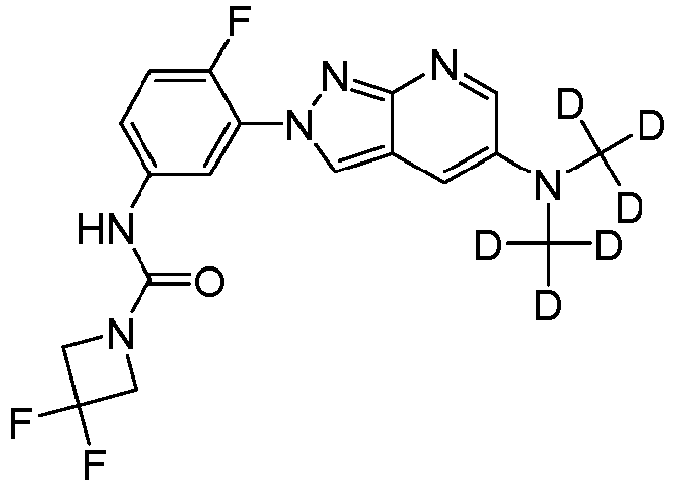
1H NMR1H NMR (400 MHz, DMSO-d6) δ 9.23 (s, 1 H), 8.69 (d, J=2.93 Hz, 1 H), 8.56 (d, J=2.93 Hz, 1 H), 8.21 (dd, J=6.85, 2.69 Hz, 1 H), 7.60 - 7.72 (m, 1 H), 7.46 (dd, J=11.37, 9.17 Hz, 1 H), 7.14 (d, J=2.93 Hz, 1 H), 4.41 (t, J=12.72 Hz, 4 H). Method 1: RT = 2.73 min.; M+H = 397.2 308 
1H NMR (400 MHz, DMSO-d6) δ 8.69 (d, J=2.93 Hz, 1 H), 8.62 (s, 1 H) 8.55 (d, J=2.69 Hz, 1 H), 8.24 (dd, J=7.21, 2.81 Hz, 1 H), 7.64 - 7.74 (m, 1 H), 7.43 (dd, J=11.25, 9.05 Hz, 1 H), 7.14 (d, J=2.93 Hz, 1 H), 5.27 - 5.50 (m, 1 H), 3.51 - 3.77 (m, 4 H), 2.04 - 2.25 (m, 2 H). Method 2: RT = 0.79 min.; M+H = 393.2 309 
1H NMR (400 MHz, DMSO-d6) δ 9.27 (s, 2 H), 9.06 (d, J=2.01 Hz, 1 H), 8.82 (s, 1 H), 8.63 (br d, J=4.27 Hz, 1 H), 8.28 (dd, J=6.78, 2.51 Hz, 1 H), 7.93 (dd, J=11.42, 8.41 Hz, 1 H), 7.67 - 7.76 (m, 1 H), 7.47 - 7.59 (m, 2 H), 4.42 (t, J=12.67 Hz, 4 H). Method 1: RT = 2.85 min.; M+H = 443.1 310 
1H NMR (400 MHz, DMSO-d6) δ 9.28 (s, 1 H), 9.02 (dd, J=16.81, 2.01 Hz, 2 H), 8.64 - 8.75 (m, 2 H), 8.28 (dd, J=6.78, 2.51 Hz, 1 H), 8.14 (d, J=8.28 Hz, 1 H), 7.67 - 7.77 (m, 1 H), 7.45 - 7.57 (m, 2 H), 4.43 (t, J=12.67 Hz, 4 H). Method 1: RT = 2.86 min.; M+H = 459.1 311 
1H NMR (400 MHz, DMSO-d6) δ 8.98 (s, 1 H), 8.90 (d, J=2.26 Hz, 1 H), 8.72 (d, J=3.01 Hz, 1 H), 8.31 (d, J=8.28 Hz, 1 H), 8.25 (dd, J=7.03, 2.51 Hz, 1 H), 7.66 - 7.73 (m, 1 H), 7.43 - 7.51 (m, 1 H), 7.20 (dd, J=8.41, 4.14 Hz, 1 H), 5.29 - 5.51 (m, 1 H), 4.24 - 4.39 (m, 2 H), 3.96 - 4.10 (m, 2 H). Method 1: RT = 2.41 min.; M+H = 330.1 312 
1H NMR (400 MHz, DMSO-d6) δ 8.93 - 9.06 (m, 3 H), 8.54 - 8.68 (m, 3 H), 8.29 (dd, J=6.90, 2.38 Hz, 1 H), 7.67 - 7.76 (m, 1 H), 7.49 (t, J=10.16 Hz, 1 H), 5.27 - 5.55 (m, 1 H), 4.25 - 4.42 (m, 2 H), 3.94 - 4.14 (m, 2 H), 2.68 (s, 3 H). Method 1: RT = 2.48 min.; M+H = 422.1 313 
1H NMR (400 MHz, DMSO-d6) δ 9.27 (s, 1 H), 9.04 (d, J=2.26 Hz, 1 H), 8.82 (d, J=1.51 Hz, 1 H), 8.75 (s, 1 H), 8.63 (br d, J=4.52 Hz, 1 H), 8.30 (dd, J=6.90, 2.64 Hz, 1 H), 7.93 (dd, J=10.92, 8.91 Hz, 1 H), 7.73 (dt, J=9.03, 3.39 Hz, 1 H), 7.55 (dt, J=8.34, 4.24 Hz, 1 H), 7.48 (dd, J=11.29, 9.03 Hz, 1 H), 3.91 - 4.07 (m, 4 H), 2.21 (quin, J=7.53 Hz, 2 H). Method 2: RT = 0.85 min.; M+H = 407.1 314 
1H NMR (400 MHz, DMSO-d6) δ 8.94 (s, 1 H), 8.69 (d, J=3.01 Hz, 1 H), 8.54 (d, J=2.76 Hz, 1 H), 8.21 (dd, J=7.03, 2.76 Hz, 1 H), 7.61 - 7.71 (m, 1 H), 7.43 (dd, J=11.42, 9.16 Hz, 1 H), 7.14 (d, J=3.01 Hz, 1 H), 5.28 - 5.53 (m, 1 H), 4.22 - 4.43 (m, 2 H), 3.92 - 4.11 (m, 2 H). Method 1: RT = 2.63 min.; M+H = 379.3 315 
1H NMR (400 MHz, DMSO-d6) δ 9.02 (d, J=2.51 Hz, 1 H), 9.00 (d, J=2.26 Hz, 1 H), 8.76 (s, 1 H), 8.72 (dd, J=4.64, 1.38 Hz, 1 H), 8.68 (d, J=2.26 Hz, 1 H), 8.29 (dd, J=6.90, 2.64 Hz, 1 H), 8.14 (dd, J=8.16, 1.38 Hz, 1 H), 7.68 - 7.82 (m, 1 H), 7.40 - 7.55 (m, 2 H), 3.99 (t, J=7.53 Hz, 4 H), 2.21 (quin, J=7.59 Hz, 2 H). Method 1: RT = 2.73 min.; M+H = 423.1 316 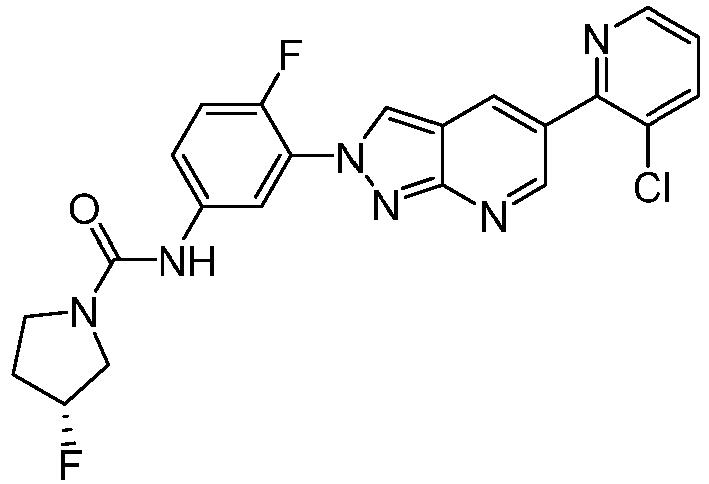
1H NMR (400 MHz, DMSO-d6) δ 9.04 (d, J=2.45 Hz, 1 H), 9.00 (d, J=2.20 Hz, 1 H), 8.72 (dd, J=4.65, 1.47 Hz, 1 H), 8.65 - 8.70 (m, 2 H), 8.32 (dd, J=6.85, 2.69 Hz, 1 H), 8.14 (dd, J=8.19, 1.35 Hz, 1 H), 7.71 - 7.80 (m, 1 H), 7.45 - 7.56 (m, 2 H), 5.26 - 5.52 (m, 1 H), 3.40 - 3.81 (m, 4 H), 2.01 - 2.28 (m, 2 H). Method 2: RT = 0.89 min.; M+H = 455.2 317 
1H NMR (400 MHz, DMSO-d6) δ 9.27 (dd, J=2.20, 1.22 Hz, 1 H), 9.05 (d, J=2.45 Hz, 1 H), 8.80 - 8.86 (m, 1 H), 8.67 (s, 1 H), 8.63 (dt, J=4.65, 1.71 Hz, 1 H), 8.31 (dd, J=7.09, 2.69 Hz, 1 H), 7.93 (ddd, J=11.68, 8.38, 1.22 Hz, 1 H), 7.71 - 7.79 (m, 1 H), 7.55 (dt, J=8.38, 4.25 Hz, 1 H), 7.49 (dd, J=11.25, 9.05 Hz, 1 H), 5.26 - 5.54 (m, 1 H), 3.42 - 3.80 (m, 4 H), 2.01 - 2.27 (m, 2 H). Method 2: RT = 0.87 min.; M+H = 439.1 318 
1H NMR (400 MHz, METHANOL-d4) δ 8.65 (d, J=2.45 Hz, 1 H), 8.60 (d, J=2.20 Hz, 1 H), 8.14 (dd, J=6.72, 2.81 Hz, 1 H), 8.09 (dd, J=2.08, 1.10 Hz, 1 H), 7.62 - 7.70 (m, 1 H), 7.36 (dd, J=11.00, 9.05 Hz, 1 H), 5.26 - 5.51 (m, 1 H), 4.33 - 4.48 (m, 2 H), 4.06 - 4.23 (m, 2 H), 2.50 (d, J=0.98 Hz, 3 H). Method 1: RT = 2.62 min.; M+H = 344.1 319 
1H NMR (400 MHz, DMSO-d6) δ 9.29 - 9.35 (m, 1 H), 8.94 - 9.07 (m, 2 H), 8.64 (d, J=2.51 Hz, 1 H), 8.62 (d, J=2.76 Hz, 1 H), 8.27 (dd, J=7.03, 2.76 Hz, 1 H), 7.85 (d, J=1.76 Hz, 1 H), 7.67 - 7.75 (m, 1 H), 7.67 - 7.75 (m, 1 H), 7.50 (dd, J=11.17, 9.16 Hz, 1 H), 6.61 - 6.68 (m, 1 H), 5.27 - 5.61 (m, 1 H), 4.23 - 4.43 (m, 2 H), 3.95 - 4.14 (m, 2 H). Method 1: RT = 2.59 min.; M+H = 396.1 320 
1H NMR (400 MHz, DMSO-d6) δ 9.14 (d, J=2.26 Hz, 1 H), 9.01 (d, J=2.51 Hz, 1 H), 8.86 - 8.91 (m, 1 H), 8.78 (s, 1 H), 8.30 (dd, J=6.90, 2.64 Hz, 1 H), 7.70 - 7.78 (m, 1 H), 7.49 (dd, J=11.17, 9.16 Hz, 1 H), 3.98 (t, J=7.53 Hz, 4 H), 2.15 - 2.27 (m, 2 H). Method 1: RT = 2.82 min.; M+H = 380.1 321 
1H NMR (400 MHz, DMSO-d6) δ 9.14 (d, J=2.45 Hz, 1 H), 8.94 - 9.07 (m, 2 H), 8.88 (d, J=1.22 Hz, 1 H), 8.28 (dd, J=6.85, 2.69 Hz, 1 H), 7.67 - 7.80 (m, 1 H), 7.51 (dd, J=11.13, 9.17 Hz, 1 H), 5.27-5.56 (m, 1 H), 4.23 - 4.44 (m, 2 H), 3.93 - 4.13 (m, 2 H). Method 1: RT = 2.83 min.; M+H = 398.0 322 
1H NMR (400 MHz, DMSO-d6) δ 9.14 (d, J=2.20 Hz, 1 H), 9.01 (d, J=2.20 Hz, 1 H), 8.88 (d, J=1.22 Hz, 1 H), 8.67 (s, 1 H), 8.32 (dd, J=7.09, 2.69 Hz, 1 H), 7.73 - 7.81 (m, 1 H), 7.50 (dd, J=11.13, 9.17 Hz, 1 H), 5.28 - 5.51 (m, 1 H), 3.41 - 3.78 (m, 4 H), 1.98 - 2.30 (m, 2 H). Method 1: RT = 2.83 min.; M+H = 412.1 323 
1H NMR (400 MHz, DMSO-d6) δ 9.06 (d, J=2.51 Hz, 1 H), 9.00 (d, J=2.26 Hz, 2 H), 8.51 (d, J=2.51 Hz, 1 H), 8.27 (dd, J=7.03, 2.76 Hz, 1 H), 7.86 (br s, 1 H), 7.64 - 7.77 (m, 1 H), 7.50 (dd, J=11.04, 9.29 Hz, 1 H), 7.19 (br s, 1 H) 5.26 - 5.57 (m, 1 H), 4.26 - 4.44 (m, 2 H), 3.94 - 4.14 (m, 2 H). Method 1: RT = 1.83 min.; M+H = 396.1 324 
1H NMR (400 MHz, DMSO-d6), δ 9.27 (br s, 1 H), 9.15 (d, J=2.26 Hz, 1 H), 9.01 (d, J=2.26 Hz, 1 H), 8.89 (dd, J=2.26, 1.00 Hz, 1 H), 8.28 (dd, J=6.90, 2.63 Hz, 1 H), 7.69 - 7.76 (m, 1 H), 7.54 (dd, J=11.17, 9.16 Hz, 1 H), 4.42 (t, J=12.67 Hz, 4 H). Method 2: RT = 0.98 min.; M+H = 416.0 325 
1H NMR (400 MHz, DMSO-d6), δ 9.04 (d, J=2.45 Hz, 1 H), 8.97 (s, 1 H), 8.84 (d, J=2.44 Hz, 1 H), 8.42 (s, 1 H), 8.37 (d, J=2.20 Hz, 1 H), 8.24 (dd, J=7.09, 2.69 Hz, 1 H), 8.02 (s, 1 H), 7.63 - 7.73 (m, 1 H), 7.47 (dd, J=11.13, 9.17 Hz, 1 H), 5.28 - 5.53 (m, 1 H), 4.24 - 4.41 (m, 2 H), 3.95 - 4.11 (m, 2 H), 3.78 (tt, J=7.34, 3.79 Hz, 1 H), 0.96 - 1.17 (m, 4 H). Method 1: RT = 2.73 min.; M+H = 436.1 326 
1H NMR (400 MHz, DMSO) δ 10.54 (s, 1 H), 8.63 (d, J = 2.38 Hz, 1 H), 8.29 - 8.41 (m, 2 H), 7.66 (br d, J = 9.29 Hz, 1 H), 7.40 - 7.55 (m, 1 H), 7.14 (d, J = 2.64 Hz, 1 H), 4.40 (t, J= 12.17 Hz, 4 H), 1.72 - 1.85 (m, 1 H), 0.83 (br d, J = 6.02 Hz, 4 H). Method 2: RT = 0.93 min.; M+H = 388.2 327 
1H NMR (400 MHz, DMSO) δ 10.53 (s, 1 H), 8.58 (d, J = 2.51 Hz, 1 H), 8.26 - 8.39 (m, 2 H), 7.60 - 7.71 (m, 1 H), 7.40 - 7.55 (m, 1 H), 7.00 (d, J= 2.76 Hz, 1 H), 5.39 - 5.67 (m, 1 H), 4.19 - 4.35 (m, 2 H), 3.92 - 4.09 (m, 2 H), 1.74 - 1.82 (m, 1 H), 0.83 (br d, J = 5.90 Hz, 4 H). Method 1: RT = 2.79 min.; M+H = 370.2 328 
1H NMR (400 MHz, DMSO-d6) δ 9.02 (d, J=2.69 Hz, 1 H), 8.97 (d, J=2.44 Hz, 1 H), 8.44 (d, J=2.69 Hz, 1 H), 8.26 (dd, J=7.09, 2.69 Hz, 1 H), 8.20 (d, J=1.47 Hz, 1 H), 7.67 - 7.74 (m, 1 H), 7.44 - 7.56 (m, 2 H), 5.29 - 5.52 (m, 1 H), 4.26 - 4.39 (m, 2 H), 3.96 - 4.11 (m, 2 H), 2.21 (s, 3 H). Method 1: RT = 1.87 min.; M+H = 410.1 329 
1H NMR (400 MHz, DMSO-d6) δ 9.43 (d, J=2.20 Hz, 1 H), 8.97 - 9.05 (m, 2 H), 8.91 (d, J=2.45 Hz, 1 H), 8.74 (d, J=3.18 Hz, 1 H) ,8.28 (dd, J=7.09, 2.69 Hz, 1 H), 8.21 (dd, J=8.93, 4.28 Hz, 1 H), 7.92 (td, J=8.80, 2.93 Hz, 1 H), 7.68 - 7.75 (m, 1 H), 7.50 (dd, J=11.25, 9.05 Hz, 1 H), 5.29 - 5.53 (m, 1 H), 4.25 - 4.41 (m, 2 H), 3.95 - 4.12 (m, 2 H). Method 2: RT = 0.88 min.; M+H = 425.0 330 
1H NMR (400 MHz, DMSO-d6) δ 9.43 (d, J=2.20 Hz, 1 H), 9.00 (d, J=2.45 Hz, 1 H), 8.90 (d, J=2.20 Hz, 1 H), 8.70 - 8.81 (m, 2 H), 8.29 (dd, J=7.09, 2.69 Hz, 1 H), 8.21 (dd, J=8.80, 4.16 Hz, 1 H), 7.91 (td, J=8.68, 2.93 Hz, 1 H), 7.68 - 7.77 (m, 1 H), 7.47 (dd, J=11.13, 9.17 Hz, 1 H), 3.99 (t, J=7.58 Hz, 4 H), 2.21 (quin, J=7.52 Hz, 2 H). Method 1: RT = 2.82 min.; M+H = 407.0 331 
1H NMR (400 MHz, DMSO) δ 10.53 (s, 1 H), 8.70 (d, J = 2.93 Hz, 1 H), 8.56 (d, J = 2.69 Hz, 1 H), 8.35 (dd, J = 7.15, 2.63 Hz, 1 H), 7.63 - 7.71 (m, 1 H), 7.48 (dd, J = 11.31, 9.11 Hz, 1 H), 7.15 (d, J = 2.93 Hz, 1 H), 2.95 (s, 6 H), 1.79 (quin, J=6.24 Hz, 1 H) 0.79 - 0.87 (m, 4 H). Method 2: RT = 0.85 min.; M+H = 340.2 332 
1H NMR (400 MHz, DMSO) δ 10.50 (s, 1 H), 9.18 (d, J = 0.88 Hz, 1 H), 8.97 (d, J = 2.51 Hz, 1 H) 8.69 - 8.81 (m, 1 H) 8.54 (dd, J = 4.52, 1.88 Hz, 1 H), 8.33 (dd, J= 7.09, 2.57 Hz, 1 H), 7.84 (dd, J = 10.98, 8.85 Hz, 1 H), 7.57 - 7.69 (m, 1 H), 7.38 - 7.53 (m, 2 H), 1.61 - 1.75 (m, 1 H), 0.67 - 0.85 (m, 4 H). Method 1: RT = 2.85 min.; M+H = 392.2 333 
1H NMR (400 MHz, DMSO) δ 10.57 (s, 1 H), 9.03 (d, J = 2.26 Hz, 1 H), 8.99 (d, J = 2.38 Hz, 1 H), 8.65 - 8.73 (m, 2 H), 8.41 (br d, J = 7.28 Hz, 1 H), 8.13 (d, J= 8.16 Hz, 1 H), 7.71 (br s, 1 H), 7.48 - 7.58 (m, 2 H), 1.73 - 1.83 (m, 1 H), 0.80 - 0.88 (m, 4 H). Method 1: RT = 2.87 min.; M+H = 408.2 334 
1H NMR (400 MHz, DMSO-d6) δ 10.63 (s, 1 H), 9.00 (d, J=2.20 Hz, 1 H), 8.94 (d, J=2.20 Hz, 1 H), 8.62 (dd, J=7.09, 2.45 Hz, 1 H), 8.57 (d, J=3.67 Hz, 1 H), 8.51 (d, J=2.20 Hz, 1 H), 7.91 - 8.01 (m, 1 H), 7.81 (d, J=7.34 Hz, 1 H), 7.60 (dd, J=11.00, 9.05 Hz, 1 H), 7.37 (dd, J=7.70, 4.77 Hz, 1 H), 5.83 (t, J=5.99 Hz, 1 H), 4.60 (d, J=6.11 Hz, 2 H), 2.45 (s, 6 H). Method 1: RT = 2.57 min.; M+H = 459.0 335 
1H NMR (400 MHz, DMSO-d6) δ 10.55 (s, 1 H), 9.03 (d, J=2.20 Hz, 1 H), 8.98 (d, J=2.20 Hz, 1 H), 8.65 (dd, J=4.65, 1.71 Hz, 1 H), 8.61 (dd, J=7.09, 2.45 Hz, 1 H), 8.57 (d, J=2.20 Hz, 1 H), 8.00 - 8.07 (m, 1 H), 7.94 (dt, J=9.05, 3.42 Hz, 1 H), 7.60 (dd, J=11.00, 9.29 Hz, 1 H), 7.48 (dd, J=7.70, 4.77 Hz, 1 H), 5.55 (br s, 1 H), 4.60 (s, 2 H), 2.52 (br s, 3 H), 2.41 (s, 3 H). Method 1: RT = 2.49 min.; M+H = 458.9 336 
1H NMR (400 MHz, DMSO) δ 9.46 (d, J= 2.32 Hz, 1 H), 8.99 (d, J = 2.32 Hz, 1 H), 8.93 (d, J = 2.32 Hz, 1 H), 8.73 (d, J = 4.04 Hz, 1 H), 8.51 (s, 1 H), 8.30 (dd, J = 6.97, 2.57 Hz, 1 H), 8.11 (d, J = 7.95 Hz, 1 H), 7.95 (td, J = 7.76, 1.71 Hz, 1 H), 7.74 (dt, J = 8.99, 3.45 Hz, 1 H), 7.37 - 7.50 (m, 2 H), 3.42 - 3.48 (m, 4 H), 1.86 (br s, 4 H) Method 1: RT = 2.67 min.; M+H = 403.3 337 
1H NMR (400 MHz, DMSO) δ 8.52 (d, J = 2.64 Hz, 1 H), 8.46 (s, 1 H), 8.28 (d, J= 2.76 Hz, 1 H), 8.23 (dd, J = 7.09, 2.57 Hz, 1 H), 7.67 (dt, J = 8.60, 3.54 Hz, 1 H), 7.40 (dd, J = 11.29, 9.16 Hz, 1 H), 6.92 (d, J= 2.76 Hz, 1 H), 4.02 (s, 4 H), 3.46 - 3.49 (m, 4 H), 1.86 (br t, J = 6.34 Hz, 4 H), 0.68 (s, 4 H), M+H = 407.3 338 
1H NMR (400 MHz, DMSO) δ 8.62 (d, J = 2.69 Hz, 1 H), 8.47 (s, 1 H), 8.36 (d, J = 2.81 Hz, 1 H), 8.23 (dd, J = 7.09, 2.69 Hz, 1 H), 7.65 - 7.73 (m, 1 H), 7.41 (dd, J = 11.25, 9.17 Hz, 1 H), 7.14 (d, J = 2.81 Hz, 1 H), 4.40 (t, J = 12.23 Hz, 4 H), 3.38 - 3.41 (m, 4 H), 1.86 (br t, J = 6.48 Hz, 4 H) Method 1: RT = 2.86 min.; M+H = 417.0 339 
1H NMR (400 MHz, DMSO-d6) δ 10.69 (s, 1 H), 8.64 (d, J=2.64 Hz, 1 H), 8.37 (d, J=2.89 Hz, 1 H), 8.32 (dd, J=7.03, 2.63 Hz, 1 H), 7.59 - 7.69 (m, 1 H), 7.51 (dd, J=11.11, 9.10 Hz, 1 H), 7.14 (d, J=2.76 Hz, 1 H), 4.79 - 5.06 (m, 1 H), 4.41 (t, J=12.23 Hz, 4 H), 2.23 - 2.33 (m, 1 H), 1.49 - 1.64 (m, 1 H), 1.27 (dq, J=13.11, 6.46 Hz, 1 H). Method 2: RT = 0.97 min.; M+H = 406.2 340 
1H NMR (400 MHz, METHANOL-d4) δ 9.12 (s, 1 H), 8.59 (d, J=2.20 Hz, 1 H), 8.41 - 8.47 (m, 1 H), 8.33 (d, J=1.96 Hz, 1 H), 8.24 (d, J=5.62 Hz, 1 H), 7.64 (dd, J=5.75, 2.08 Hz, 1 H), 5.13 - 5.36 (m, 1 H), 3.48 - 3.79 (m, 4 H), 1.99 - 2.28 (m, 2 H). Method 2: RT = 0.90 min.; M+H = 405.1, 407.1 341 
1H NMR (400 MHz, DMSO-d6), δ 9.46 (d, J=2.20 Hz, 1 H), 9.37 (s, 1 H), 9.26 (s, 1 H), 8.95 (d, J=2.45 Hz, 1 H), 8.74 (d, J=3.91 Hz, 1 H), 8.52 (d, J=1.71 Hz, 1 H), 8.37 (d, J=5.62 Hz, 1 H), 8.12 (d, J=8.07 Hz, 1 H), 7.96 (td, J=7.70, 1.71 Hz, 1 H), 7.74 (dd, J=5.62, 1.96 Hz, 1 H), 7.42 (dd, J=7.09, 5.14 Hz, 1 H), 4.05 (t, J=7.58 Hz, 4 H), 2.23 (quin, J=7.58 Hz, 2 H). Method 1: RT = 2.67 min.; M+H = 372.0 342 
1H NMR (400 MHz, DMSO-d6), δ 9.43 - 9.50 (m, 2 H), 9.38 (s, 1 H), 8.95 (d, J=2.26 Hz, 1 H), 8.74 (d, J=4.02 Hz, 1 H), 8.50 (d, J=1.76 Hz, 1 H), 8.39 (d, J=5.77 Hz, 1 H), 8.13 (d, J=8.03 Hz, 1 H), 7.97 (td, J=7.78, 1.76 Hz, 1 H), 7.73 (dd, J=5.65, 1.88 Hz, 1 H), 7.43 (dd, J=6.78, 4.77 Hz, 1 H), 5.31 - 5.54 (m, 1 H), 4.32 - 4.48 (m, 2 H), 4.01 - 4.17 (m, 2 H). Method 1: RT = 2.67 min.; M+H = 390.0 343 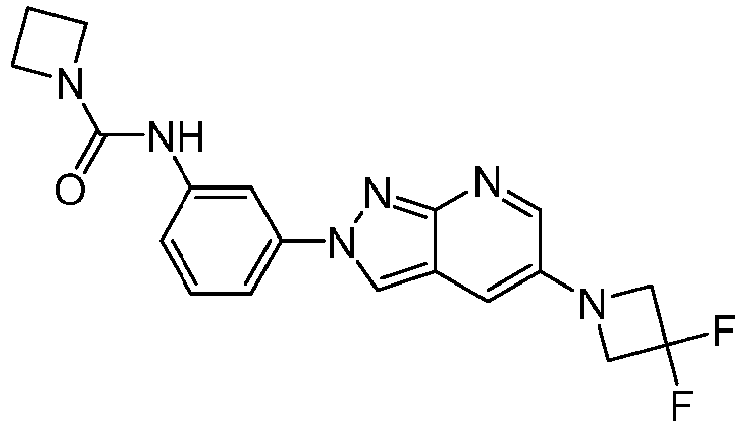
1H NMR (400 MHz, DMSO-d6) δ 8.80 (s, 1 H), 8.68 (s, 1 H), 8.30 - 8.35 (m, 2 H), 7.63 (br d, J=8.41 Hz, 1 H), 7.59 (br d, J=8.03 Hz, 1 H), 7.39 - 7.47 (m, 1 H), 7.13 (d, J=2.76 Hz, 1 H), 4.41 (t, J=12.23 Hz, 4 H), 3.99 (t, J=7.53 Hz, 4 H), 2.21 (quin, J=7.56 Hz, 2 H). Method 2: RT = 0.84 min.; M+H = 385.2 344 
1H NMR (400 MHz, DMSO-d6) δ 9.44 (d, J=2.20 Hz, 1 H), 9.18 (s, 1 H), 8.91 (d, J=2.32 Hz, 1 H), 8.70 - 8.78 (m, 2 H), 8.36 - 8.42 (m, 1 H), 8.14 (d, J=8.07 Hz, 1 H), 7.95 (td, J=7.73, 1.77 Hz, 1 H), 7.65 - 7.71 (m, 2 H), 7.44 - 7.51 (m, 1 H), 7.42 (dd, J=7.15, 5.20 Hz, 1 H), 4.01 (t, J=7.58 Hz, 4 H), 2.22 (quin, J=7.58 Hz, 2 H), 1.47 - 1.61 (m, 1 H), 1.19 - 1.34 (m, 1 H), 1.00 - 1.08 (m, 1 H), 0.85 (t, J=7.40 Hz, 1 H). Method 2: RT = 0.74 min.; M+H = 371.0 345 
1H NMR (400 MHz, DMSO-d 6) δ 11.31 (s, 1H), 9.60 (d, J = 2.3 Hz, 1H), 9.45 (d, J = 1.5 Hz, 1H), 9.18 (d, J = 2.5 Hz, 1 H), 9.08 (t, J = 2.1 Hz, 2H), 8.97 (dd, J = 2.5, 1.5 Hz, 1H), 8.92 - 8.79 (m, 2H), 8.31 - 8.15 (m, 2H), 8.08 (td, J = 7.7, 1.9 Hz, 1H), 7.76 (dd, J = 11.1, 9.1 Hz, 1H), 7.54 (ddd, J = 7.5, 4.8, 1.0 Hz, 1H). Method 1: RT = 2.71 min.; M+H = 412.10 346 
1H NMR (400 MHz, DMSO-d 6) δ 10.52 (s, 1H), 9.59 (d, J = 2.3 Hz, 1H), 9.13 (d, J = 2.5 Hz, 1H), 9.05 (d, J = 2.3 Hz, 1H), 8.85 (ddd, J = 4.8, 1.9, 0.9 Hz, 1 H), 8.55 (dd, J = 7.0, 2.7 Hz, 1H), 8.24 (dt, J= 8.1, 1.1 Hz, 1H), 8.07 (td, J = 7.7, 1.8 Hz, 1H), 7.81 (ddd, J = 9.1, 4.2, 2.7 Hz, 1H), 7.65 (dd, J= 11.1, 9.1 Hz, 1H), 7.53 (ddd, J = 7.5, 4.8, 1.0 Hz, 1H), 2.26 (dd, J = 7.4, 4.3 Hz, 1 H), 1.59 - 1.44 (m, 2H), 1.12- 0.84 (m, 4H). Method 1: RT = 2.85 min.; M+H = 400.1 347 
1H NMR (400 MHz, DMSO-d 6) δ 10.12 (s, 1H), 9.48 (d, J = 2.3 Hz, 1H), 9.04 (d, J = 2.5 Hz, 1H), 8.95 (d, J = 2.3 Hz, 1H), 8.74 (ddd, J = 4.8, 1.8, 0.9 Hz, 1 H), 8.48 (dd, J = 7.1, 2.7 Hz, 1H), 8.13 (dt, J= 8.0, 1.1 Hz, 1H), 8.02 - 7.87 (m, 2H), 7.57 (dd, J = 11.2, 9.1 Hz, 1H), 7.43 (ddd, J = 7.5, 4.8, 1.0 Hz, 1H), 6.93 (s, 1H), 2.47 (s, 2H), 1.24 (s, 6H). Method 1: RT = 3.08 min.; M+H = 414.1 348 
1H NMR (400 MHz, DMSO-d 6) δ 10.38 (s, 1H), 9.48 (d, J = 2.3 Hz, 1H), 9.04 (d, J = 2.5 Hz, 1H), 8.95 (d, J = 2.3 Hz, 1H), 8.74 (ddd, J = 4.8, 1.9, 1.0 Hz, 1 H), 8.41 (dd, J= 7.0, 2.7 Hz, 1H), 8.13 (dt, J = 8.0, 1.1 Hz, 1H), 7.96 (td, J = 7.7, 1.9 Hz, 1H), 7.80 (ddd, J = 9.1, 4.2, 2.7 Hz, 1H), 7.59 (dd, J = 11.2, 9.1 Hz, 1H), 7.43 (ddd, J = 7.5, 4.8, 1.0 Hz, 1H), 1.73 (d, J = 1.0 Hz, 4H). Method 2: RT = 0.83 min.; M+H = 399.1 349 
1H NMR (400 MHz, DMSO-d 6) δ 10.65 (s, 1H), 9.48 (d, J = 2.3 Hz, 1H), 9.04 (d, J = 2.5 Hz, 1H), 8.95 (d, J = 2.3 Hz, 1H), 8.74 (ddd, J= 4.8, 1.8, 1.0 Hz, 1 H), 8.43 (dd, J= 7.0, 2.7 Hz, 1H), 8.13 (dt, J= 8.0, 1.1 Hz, 1H), 7.96 (td, J = 7.7, 1.8 Hz, 1H), 7.74 (ddd, J = 9.1, 4.2, 2.7 Hz, 1H), 7.57 (dd, J= 11.2, 9.1 Hz, 1H), 7.42 (ddd, J = 7.5, 4.8, 1.1 Hz, 1H), 4.98 (dtd, J = 66.2, 6.2, 3.7 Hz, 1H), 2.04 (ddt, J = 9.2, 7.0, 3.6 Hz, 1H), 1.67 (dtd, J = 23.2, 6.7, 3.6 Hz, 1H), 1.19 (ddt, J= 12.5, 9.2, 6.4 Hz, 1H). Method 2: RT = 0.80 min.; M+H = 392.1 350 
1H NMR (400 MHz, Methanol-d 4) δ 8.78 (d, J = 2.4 Hz, 1H), 8.76 (d, J = 2.3 Hz, 1H), 8.44 - 8.39 (m, 1H), 8.38 (d, J = 2.2 Hz, 1 H), 8.32 (dd, J = 6.8, 2.7 Hz, 1H), 7.88 (s, 1H), 7.81 - 7.72 (m, 2H), 7.39 - 7.26 (m, 2H), 6.83 (s, 1H), 2.43 (s, 2H), 2.35 (s, 3H), 1.19 (s, 6H). Method 2: RT = 0.90 min.; M+H = 428.1 351 
1H NMR (400 MHz, DMSO-d 6) δ ppm 10.52 (br s, 1 H), 8.83 (d, J=2.64 Hz, 1 H), 8.70 (d, J=2.26 Hz, 1 H), 8.56 (dd, J=7.03, 2.64 Hz, 1 H), 8.07 (d, J=1.76 Hz, 1 H), 7.86 - 7.94 (m, 1 H), 7.56 (dd, J=11.11, 9.10 Hz, 1 H), 3.04 - 3.15 (m, 1 H), 2.50 - 2.51 (m, 3 H), 2.40 (s, 3 H), 1.31 (d, J=6.90 Hz, 6 H); M+H = 394.1 352 
1H NMR (400 MHz, CD3OD) 9.00-8.99 (d, J=2.4, 1H), 8.84-8.83 (d, J=2.4, 1H), 8.50-8.49 (d, J=2.0, 1H), 8.47-8.45 (dd, J=2.4, 6.8, 1H), 7.90-7.86 (m, 1H), 7.74-7.71 (m, 2H), 7.53-7.50 (m, 2H), 7.47-7.42 (m, 2H), 2.54 (s, 3H), 2.45 (s, 3H).; M+H = 428.1 353 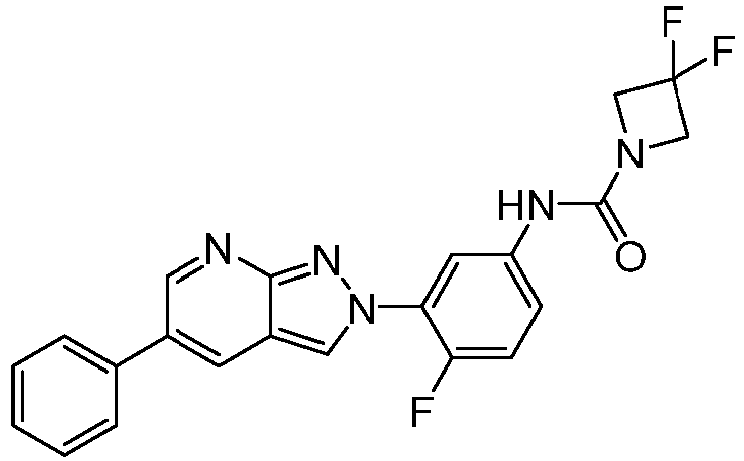
1H NMR (400 MHz, DMSO-d 6) 9.25 (s, 1H), 9.06-9.05 (d, J=2.8, 1H), 8.96-8.95 (d, J=2.0, 1H), 8.52-8.51 (d, J=2.4, 1H), 8.27-8.25 (m, 1H), 7.80-7.78 (d, J=7.2, 2H), 7.72-7.67 (m, 1H), 7.56-7.48 (m, 3H), 7.44-7.41 (m, 1 H), 4.44-4.38 (t, J=16.4, 4H). - The assays described herein illustrate and do not limit the scope of the invention.
- Abbreviations as used herein below have the corresponding meaning:
- CPRG
- Chlorophenol Red-β-D-galactopyranoside
- ATP
- adenosine triphosphate
- BSA
- bovine serum albumin
- DMSO
- dimethyl sulfoxide
- FBS
- fetal bovine serum
- PBS
- phosphate buffered saline
- RPMI 1640
- Roswell Park Memorial Institute (RPMI) 1640 medium
- Leishmania donovani axenic amastigote parasites are grown at 37 °C, 5% CO2 in media made of RPMI 1640, 4mM L-glutamine, 20% heat inactivated FBS, 100 units/ml of penicillin and 100 µg/ml of streptomycin, 23 µM folic acid, 100 µM adenosine, 22 mM D-glucose, 25 mM MES. The pH of media is adjusted to 5.5 at 37 °C using HCl. 20 µL of media is first dispensed into 384 well plates and 100 nL of the compounds of invention in DMSO are added to the plate wells. At the same time control compounds and DMSO are added to plates to serve as the positive and negative controls, respectively. 40 µL of parasite culture (9600 parasites) are then added to the plate wells. The plates are then placed into incubators. After two days incubation, 20 µL of Cell TiterGlo® (Promega) is added to the plate wells. The luminescence signal of each well is measured using the Envision reader (Perkin Elmer).
- The assay measures the increase in the parasite number in the assayed plate well using a DNA intercalating dye, SYBR Green I® dye (INVITROGEN) to stain Leishmania cell nuclei. L.donovani HU3 strain is propagated by infecting BALB/c mice through tail vein injection with 107 Leishmania parasites. Infected mice are allowed to develop infection during 9-11 weeks post-infection. During this time, the parasites accumulate in the infected mouse spleens to large numbers, and the infected mice serve as the source of parasites for the in vitro measurement of compound efficacies. To assay a compound for anti-leishmanial activity, peritoneal macrophages isolated from non-infected BALB/c mice are seeded into 384-well plates at density 2x10⁴ macrophages per well in 25 mL of medium (RPMI1640, 10% fetal serum albumin, 10 mM HEPES, 1 mM sodium pyruvate, 1% Pen/Strep). Subsequently, the seeded plates are placed into an incubator set to maintain 37 °C temperature and atmosphere with 5% CO2.
- The next day, Leishmania parasites are isolated from the spleens of mice infected for 9-11 weeks and 4×10⁵ isolated parasites in 10 mL of the above media are added to each plate well. Plates are then returned into incubators and infection is allowed to proceed for 24 hours. After the infection of macrophages is completed, 5 mL of compounds of the invention in the above medium, which also contains 5% DMSO, are added to plate wells containing infected macrophages. At the same time control compounds (miltefosine and amphotericin B) and DMSO are added to plates to serve as the positive and negative controls, respectively. After the compound addition, the plates are returned into incubator and cells infected with parasites are cultured for 5 days. At the end of cultivation, 40 mL of 8% paraformaldehyde is added to plate wells and incubated for 15 min at room temperature. Following the incubation, the paraformaldehyde from plate wells is aspirated, and 40 mL of PBS containing 0.2% Triton X-100 is added to wells. After 15 min incubation, the solution is aspirated from wells again, and replaced with Sybr® Green Dye solution in PBS (1:125,000 dilution). Infected cells are imaged with Evotec Opera high-content microscope, and the number of parasites in well is determined by counting parasite nuclei visualized by staining with Sybr® Green dye.
- Compounds of the invention can be assayed for inhibitor activity against Trypanosoma cruzi amastigotes cultured in 3T3 fibroblast cells. The assay is done using the mammalian stage (amastigotes) of T. cruzi that replicates in the intracellular space of host cells. The host cells are initially infected with the culture-derived trypomastigotes that rapidly invade and then divide as amastigotes. The protocol uses the Tulahuen strain of T. cruzi that has been engineered to express the E. coli beta-galactosidase gene (Lac-Z) (Antimicr. Agents Chemoth. 40:2592, 1996). This allows for a colorimetric readout by using the substrate CPRG and an absorbance plate reader.
- 3T3 fibroblast cells are re-suspended in RPMI-1640 medium without phenol red medium supplemented with 10% FBS (heat inactivated), 100 µg/ml penicillin, and 100 µg /ml streptomycin. Forty µL of suspension (1,000 cells) is dispensed into 384-well plates and incubated overnight at 37 °C temperature and in atmosphere containing 5% CO2. The following day, 100 nL of compounds of the invention in DMSO are added to plate wells containing 3T3 cells. At the same time control compounds (benznidazole and nifurtimox) and DMSO are added to plates to serve as the positive and negative controls, respectively. After that, 10 µL of media containing 10,000 T. cruzi trypomastigotes are added to each plate well and plates are placed back into incubators. After 6 day incubation, 10 µL of reagent solution (0.6 mM CPRG, 0.6% NP-40 in PBS) is added to plates and incubated at room temperature for 2 hours. Absorbance is then measured on SpectraMax GEMINI fluorimeter to determine relative number of T. cruzi cells present in each plate well.
- The proliferation is quantified by the addition of Cell TiterGlo® (Promega®) a luminescent cell viability assay that measures the number of viable cells in culture based on the quantification of cellular ATP amount, which is an indicator of metabolically active cells.
- Trypanosoma brucei brucei (Lister 427) strain was grown in Hirumi 9 (HMI-9) media supplemented with 10% v/v fetal bovine serum (FBS) and 10% v/v serum plus. For measurement of cell proliferation inhibition, test compounds were three fold serially diluted in duplicates to 384-well white plates, resulting in 10 dilutions for each compound. A volume of 40 µL of T. b. brucei culture (10,000 parasites/mL) was added to each well, and the assay plates were incubated at 37°C for 2 days in a CO2 incubator. Growth inhibition was monitored by measuring ATP levels, which, is used as a surrogate marker for growth. Relative luminescence units were measured using TECAN® M1000 after 30min of adding 40µl of Cell TiterGlo®. IC50 values were determined by analyzing the data using HELIOS software. IC50 is defined as the lowest concentration of the compound that inhibited 50% growth of the T. b. brucei wild type strain compared to untreated controls.
- Table 3 shows the inhibitory efficacy of the compounds (EC50) against L. donovani axenic amastigotes in vitro (column 2); L. donovani in mouse peritoneal macrophages (column 3); T cruzi (column 4); and T. brucei brucei (column 5). Compounds of the invention have an EC50 ranging from >10 µM to <0.01 µM. In particular embodiments, compounds of the invention have an EC50 <1 µM, <500 nM, <100 nM or < 50 nM.
Table 3 Cpd. No. L. donovani amastigotes EC50 (µM) L. donovani in Mouse Macrophages EC50 (µM) Buckner infectious T. cruzi EC50 (µM) T. Brucei (HAT) EC50 (µM) 1 0.0071 n.d. 0.0052 <0.023 2 0.003 0.0044 0.0010 <0.023 3 0.0018 0.0020 0.0016 <0.023 4 0.0013 n.d. 0.0010 <0.023 5 0.0036 n.d. 0.0053 <0.023 6 0.012 n.d. 0.0099 <0.023 7 0.0077 0.004 0.0016 <0.023 8 0.0077 0.0033 0.0045 <0.023 9 0.0087 0.011 0.0098 0.035 10 0.016 0.0078 0.0048 <0.023 11 0.0028 n.d. 0.0010 >50 12 0.041 n.d. n.d. <0.023 13 0.071 n.d. n.d. <0.023 14 0.012 0.0097 0.0020 <0.023 15 0.013 0.017 0.005 <0.023 16 0.089 n.d. 0.012 n.d. 17 0.064 n.d. 0.016 n.d. 18 0.29 n.d. 0.16 n.d. 19 0.011 0.081 0.011 <0.023 20 0.010 0.037 0.0042 <0.023 21 0.0077 0.0065 0.0017 <0.023 22 0.028 21 0.0072 <0.023 23 0.14 0.11 0.078 <0.023 24 0.88 1.0 0.44 0.61 25 0.021 0.047 0.017 <0.023 26 0.0096 n.d. 0.012 <0.023 27 0.033 0.015 0.038 <0.023 28 0.0013 0.0020 0.0010 <0.023 29 0.0082 0.0097 0.011 <0.023 30 0.59 n.d. n.d. n.d. 31 0.0062 n.d. 0.0083 <0.023 32 0.012 0.013 0.005 <0.023 33 0.29 0.56 0.72 0.28 34 0.20 0.27 0.16 0.15 35 0.58 0.52 0.38 0.85 36 0.21 0.25 n.d. n.d. 37 0.023 n.d. 0.026 <0.023 38 0.031 0.033 0.062 0.024 39 0.0024 0.0038 0.0020 <0.023 40 n.d. n.d. n.d. <0.023 41 0.02 n.d. n.d. n.d. 42 0.0030 0.006 0.0018 <0.023 43 0.0047 n.d. 0.0052 n.d. 44 0.029 0.032 0.022 n.d. 45 0.04 n.d. 0.028 <0.023 46 0.0084 0.0035 0.0017 <0.023 47 0.023 0.027 0.0028 n.d. 48 0.35 0.33 0.29 0.050 49 25 12 12 3.4 50 0.078 0.10 0.079 <0.023 51 0.015 n.d. 0.019 <0.023 52 0.019 0.011 0.013 <0.023 53 0.0013 0.0020 0.0010 <0.023 54 0.028 n.d. 0.0041 n.d. 55 0.057 0.035 0.0063 n.d. 56 0.24 0.55 n.d. n.d. 57 0.71 n.d. 0.36 n.d. 58 n.d. n.d. n.d. <0.023 59 0.068 0.021 0.0047 <0.023 60 2.0 2.4 0.44 1.3 61 0.24 n.d. 0.052 n.d. 62 0.039 n.d. 0.0051 <0.023 63 0.089 0.09 0.014 n.d. 64 0.0022 0.0039 0.0010 <0.023 65 1.0 1.2 0.96 1.4 66 0.74 0.87 0.15 0.12 67 0.21 0.31 0.042 >50 68 2.2 2.8 0.16 0.51 69 0.17 0.15 0.068 0.04 70 0.14 0.10 0.022 0.038 71 4.8 2.8 1.4 3.0 72 2.1 1.4 0.18 0.42 73 0.10 0.22 0.057 0.037 74 0.76 0.82 0.057 0.11 75 0.20 0.17 0.12 0.17 76 1.1 0.93 0.41 0.48 77 17 n.d. 6.5 8.5 78 0.80 0.87 0.45 0.53 79 3.0 2.4 0.14 0.35 80 0.41 0.41 0.092 0.17 81 3.16 3.6 0.42 0.36 82 0.47 0.31 0.059 0.054 83 0.014 0.0070 0.0073 <0.023 84 2.4 6.9 3.7 2.03 85 1.2 0.75 0.15 0.18 86 0.13 0.12 0.014 <0.023 87 0.062 0.071 0.016 <0.023 88 5.3 3.2 1.8 1.5 89 0.47 0.27 0.032 0.033 90 0.28 0.31 0.14 0.077 91 0.0087 0.0086 0.0041 <0.023 92 n.d. n.d. n.d. <0.023 93 0.034 0.032 0.0070 <0.023 94 0.012 0.0081 0.0018 <0.023 95 0.42 0.35 0.17 0.085 96 0.023 0.021 0.018 <0.023 97 0.012 0.44 0.0088 <0.023 98 0.025 0.023 0.015 <0.023 99 0.0013 0.0020 0.0010 >50 100 0.0092 n.d. 0.0042 <0.023 101 0.30 0.31 0.13 0.15 102 0.11 n.d. 0.046 n.d. 103 0.68 0.40 0.15 0.31 104 3.1 2.1 1.2 4.2 105 0.72 0.89 0.43 0.38 106 0.13 0.085 0.061 >50 107 0.22 0.13 0.077 0.088 108 0.0033 0.004 0.0038 <0.023 109 0.074 n.d. 0.015 n.d. 110 0.64 n.d. 0.15 n.d. 111 8.7 n.d. 2.9 10 112 0.016 n.d. 0.0028 <0.023 113 0.037 n.d. 0.00522 n.d. 114 0.31 n.d. 0.045 0.054 115 0.15 n.d. 0.014 <0.023 116 3.1 n.d. 0.88 1.5 117 9.3 n.d. 5.5 13 118 0.69 n.d. 1.1 1.4 119 1.6 n.d. 4.5 13 120 5.2 n.d. 4.3 1.8 121 0.21 n.d. n.d. 0.12 122 0.015 n.d. 0.0042 n.d. 123 0.0094 0.0089 0.0044 <0.023 124 0.018 n.d. 0.016 n.d. 125 0.044 0.031 0.034 <0.023 126 0.024 0.014 0.014 <0.023 127 0.025 0.017 0.0068 <0.023 128 0.38 0.19 0.14 0.18 129 0.029 0.031 0.015 <0.023 130 0.19 0.16 0.036 0.040 131 0.007 0.0051 0.0052 <0.023 132 0.011 0.007 0.013 <0.023 133 0.012 0.0080 0.0059 <0.023 134 0.023 0.0054 0.02 <0.023 135 0.0046 0.0086 0.0066 <0.023 136 0.030 0.019 0.17 <0.023 137 0.0088 0.0060 0.0051 <0.023 138 0.011 0.0057 0.047 <0.023 139 0.74 0.32 3.0 <0.023 140 0.10 0.041 0.023 <0.023 141 0.08 0.012 0.022 <0.023 142 7.8 9.2 11 4.3 143 0.15 0.11 n.d. <0.023 144 0.023 0.023 0.017 <0.023 145 0.0054 0.0047 0.018 <0.023 146 0.026 0.012 0.085 <0.023 147 0.0061 0.026 0.0048 <0.023 148 0.0081 0.012 0.014 <0.023 149 0.011 0.0079 0.0054 <0.023 150 0.014 0.025 0.021 <0.023 151 0.06 0.013 0.012 <0.023 152 0.0037 0.0053 0.0017 <0.023 153 0.21 27 0.15 0.50 154 0.053 0.078 0.023 0.037 155 0.053 0.022 0.018 <0.023 156 0.0093 n.d. 0.0051 <0.023 157 0.025 0.018 0.013 <0.023 158 0.016 0.016 0.015 <0.023 159 0.013 0.017 0.037 <0.023 160 0.0043 0.0098 0.0051 <0.023 161 0.0077 0.0073 0.0098 <0.023 162 0.007 0.0045 0.0018 <0.023 163 0.0058 0.0041 0.0027 <0.023 164 0.006 0.01 0.0017 <0.023 165 0.010 0.010 0.04 <0.023 166 0.0025 0.0037 0.0017 <0.023 167 0.0029 0.0082 0.0022 <0.023 168 0.0032 0.0082 0.027 <0.023 169 0.010 0.030 0.014 <0.023 170 0.008 0.011 0.0046 <0.023 171 0.0095 0.016 0.047 <0.023 172 0.0067 0.011 0.033 <0.023 173 0.41 0.50 0.14 0.12 174 2 2.7 0.72 1.0 175 0.024 0.0081 0.0049 <0.023 176 0.071 0.069 0.0095 n.d. 177 0.027 n.d. 0.055 <0.023 178 0.16 n.d. 1.6 0.036 179 0.41 n.d. 0.043 <0.023 180 0.55 n.d. 3.9 0.038 181 0.025 n.d. 0.82 <0.023 182 0.0076 n.d. 0.0067 <0.023 183 0.012 n.d. 0.055 <0.023 184 0.0073 n.d. n.d. <0.023 185 0.2 n.d. n.d. <0.023 186 0.46 n.d. n.d. 0.24 187 0.0013 n.d. n.d. <0.023 188 0.0024 n.d. n.d. <0.023 189 0.003 n.d. n.d. <0.023 190 n.d. n.d. n.d. >50 191 n.d. n.d. n.d. <0.023 192 n.d. n.d. n.d. <0.023 193 n.d. n.d. n.d. <0.023 194 n.d. n.d. n.d. <0.023 195 0.010 0.0064 0.004 <0.023 196 0.076 27 0.012 <0.023 197 0.199 0.013 0.037 0.005 198 0.546 0.049 0.023 0.005 199 0.502 0.021 0.024 0.005 200 0.974 0.007 0.015 0.005 201 0.192 0.004 0.02 0.005 202 0.463 0.01 0.025 0.005 203 0.49 0.009 0.02 0.005 204 0.074 0.004 0.002 0.005 205 0.197 0.011 0.015 0.005 206 0.002 0.013 0.001 0.005 207 1.827 2.062 1.271 1.821 208 0.921 1.918 0.358 0.375 209 25.0 0.381 5.09 6.538 210 0.494 n.d. 0.079 n.d. 211 0.496 0.302 0.072 0.035 212 11.31 8.86 1.753 2.027 213 1.561 n.d. 0.363 n.d. 214 4.6 0.658 1.415 1.056 215 4.7 2.975 0.738 0.947 216 3.7 4.67 0.435 0.620 217 14.46 n.d. 4.35 n.d. 218 0.004 0.212 0.038 0.003 219 0.034 n.d. 0.015 0.017 220 0.015 n.d. 0.006 0.042 221 0.003 n.d. 0.001 0.009 222 0.08 n.d. 0.045 0.073 223 0.082 n.d. 0.037 0.064 224 0.111 n.d. 0.046 0.067 225 0.037 n.d. 0.05 0.238 226 0.134 n.d. 0.129 0.343 227 0.03 n.d. 0.011 0.059 228 0.031 n.d. 0.01 0.030 229 25.0 n.d. 15.55 12.500 230 0.037 0.022 0.047 0.005 231 0.034 0.113 0.126 0.006 232 0.012 0.01 0.012 0.005 233 0.013 0.01 0.005 0.004 234 0.027 0.003 0.009 0.005 235 0.011 0.01 0.011 0.005 236 0.264 29.67 20.0 1.463 237 0.016 0.009 0.021 0.005 238 0.025 0.032 0.033 0.005 239 1.761 0.009 0.01 0.005 240 0.579 0.027 0.021 0.005 241 1.191 0.006 0.003 0.005 242 1.972 0.106 0.007 0.013 243 2.105 0.065 0.082 0.005 244 0.55 0.021 0.014 0.005 245 0.311 1.491 0.951 0.062 246 0.535 0.379 2.845 0.396 247 0.04 0.023 0.014 0.005 248 0.117 0.008 0.011 0.005 249 0.864 0.125 0.11 0.005 250 0.043 0.01 0.001 0.005 251 0.024 n.d. 0.367 0.005 252 0.183 n.d. 0.022 0.005 253 0.003 n.d. 0.004 0.005 254 0.091 0.673 0.05 0.259 255 0.042 0.028 0.015 0.005 256 0.011 0.038 0.005 0.027 257 0.014 0.007 0.002 0.004 258 0.023 0.039 0.012 0.028 259 0.012 0.016 0.003 0.004 260 0.221 0.224 0.049 0.043 261 0.004 n.d. 0.002 n.d. 262 0.033 n.d. 0.004 n.d. 263 0.012 0.068 0.045 0.010 264 0.357 13.68 0.48 0.384 265 0.003 0.004 0.002 0.001 266 0.008 0.029 0.065 0.005 267 1.713 13.83 9.4 0.081 268 0.084 0.273 0.082 0.116 269 0.019 0.032 0.009 0.020 270 0.233 2.174 1.703 0.079 271 0.12 0.003 0.144 0.388 272 0.131 0.085 0.114 0.351 273 0.027 0.006 0.017 0.045 274 0.002 0.003 0.001 0.001 275 0.003 0.003 0.001 0.001 276 0.029 0.1 0.021 0.033 277 0.04 0.138 0.144 0.082 278 0.007 n.d. n.d. 0.013 279 0.01 n.d. 0.003 n.d. 280 0.033 0.028 0.048 0.040 281 0.009 0.026 0.015 0.014 282 0.034 0.07 0.04 0.027 283 0.007 0.019 0.005 0.008 284 0.027 0.056 0.015 0.015 285 0.004 0.009 0.003 0.004 286 0.025 0.047 0.014 0.030 287 0.021 0.03 0.021 0.010 288 0.176 n.d. n.d. 0.260 289 0.199 n.d. n.d. 0.208 290 0.007 0.004 0.004 0.004 291 0.01 0.005 0.005 0.005 292 0.005 0.008 0.003 0.005 293 6.82 17.61 1.207 0.167 294 0.004 0.004 0.005 0.005 295 0.292 1.973 4.29 0.038 296 0.216 0.002 0.005 0.005 297 0.105 0.472 0.73 0.005 298 0.014 0.004 0.004 0.004 299 0.029 0.007 0.014 0.005 300 0.022 0.006 0.004 0.003 301 0.073 0.097 0.472 0.008 302 0.118 0.015 0.002 0.005 303 0.49 0.015 0.01 0.005 304 0.004 0.003 0.03 0.005 305 0.11 0.003 0.001 0.005 306 0.09 0.004 0.002 0.005 307 0.281 0.012 0.016 0.005 308 0.568 0.002 0.004 0.005 309 0.001 0.002 0.001 0.005 310 0.002 0.002 0.001 0.005 311 0.058 0.033 0.031 0.027 312 0.003 0.002 0.004 0.033 313 0.001 0.002 0.001 0.005 314 0.242 0.006 0.005 n.d. 315 0.002 0.002 0.001 0.005 316 0.002 0.002 0.001 0.005 317 0.002 0.002 0.001 0.005 318 0.027 0.032 0.013 0.015 319 0.001 n.d. 0.001 0.005 320 0.008 n.d. 0.002 0.005 321 0.018 n.d. 0.011 0.005 322 0.012 n.d. 0.003 0.005 323 0.012 0.113 0.062 0.015 324 0.015 0.045 0.016 0.037 325 0.008 0.05 0.036 0.011 326 0.189 0.761 0.119 0.236 327 0.351 1.205 0.149 0.232 328 0.023 0.16 0.083 0.017 329 0.001 0.002 0.001 0.002 330 0.001 0.002 0.001 0.001 331 0.217 0.91 0.138 0.206 332 0.028 0.075 0.015 0.038 333 0.043 n.d. 0.016 n.d. 334 0.236 1.866 1.459 0.269 335 0.013 0.111 0.47 0.036 336 0.002 0.004 0.001 0.001 337 n.d. 0.013 0.004 0.007 338 0.005 0.002 0.003 0.003 339 1.586 0.31 0.112 0.163 340 0.225 0.087 0.061 0.035 341 0.006 0.033 0.01 0.009 342 0.007 0.024 0.017 0.010 343 0.01 0.032 0.014 0.009 344 0.002 0.005 0.003 0.001 345 0.011 0.033 0.004 0.005 346 0.239 0.155 0.034 0.041 347 0.007 0.015 0.002 0.007 348 0.347 0.963 0.142 0.112 349 0.096 0.102 0.085 0.043 350 0.016 0.058 0.016 0.028 351 0.049 0.024 0.015 0.031 352 0.017 0.031 n.d. 0.039 353 0.005 0.004 n.d. 0.013 - Table 4 compares the activity of a compound of Formula (I) with compounds having a different core. EC50 values are obtained from assays described above unless otherwise indicated.
Table 4 L. donovani amastigotes EC50 (nM) Buckner infectious T. cruzi EC50 (nM) 
18 nM 15 nM 
180 nM 48 nM 
210 nM 45 nM 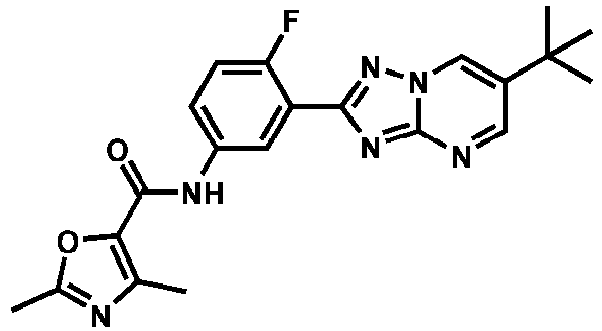
80 nM 22 nM 
367 nM 57 nM - It is understood that the examples and embodiments described herein are for illustrative purposes only and that various modifications or changes in light thereof will be suggested to persons skilled in the art and are to be included within the spirit and purview of this application and scope of the appended claims.
Claims (21)
- A compound of Formula (I):
 or a pharmaceutically acceptable salt, or stereoisomer thereof; whereinRing A is phenyl or pyridinyl;R1 is selected from:(a) C1-6alkyl that is unsubstituted or substituted by 1 to 3 substituents independently selected from halogen and C3-6cycloalkyl; and said C3-6cycloalkyl is unsubstituted or substituted by 1 to 2 substituents independently selected from halogen and C1-4alkyl;(b) C1-4alkoxy that is unsubstituted or substituted by C1-4haloalkyl;(c) -NR5aR5b wherein R5a and R5b are independently hydrogen, C1-4alkyl or C1-4 haloalkyl; or R5a and R5b together with the nitrogen atom to which both are attached form a 4- to 7-membered heterocycloalkyl comprising 1 to 3 heteroatoms independently selected from N, O and S as ring atoms;wherein the 4 to 7-membered heterocycloalkyl is unsubstituted or substituted by 1 to 2 substituents independently selected from halogen, C1-4alkyl, and C1-4 alkoxy; or two substituents on the same or different ring atoms of the 4- to 7-membered heterocycloalkyl, together with the atoms to which they are attached, form a spiro, bridged or fused Ring B attached to the 4- to 7-membered heterocycloalkyl;wherein Ring B is C3-6cycloalkyl or a 3- to 7-membered heterocycloalkyl comprising 1 to 3 heteroatoms independently selected from N, O or S as ring atoms;(d) monocyclic C3-6cycloalkyl, C3-6 cycloalkenyl or spiropentyl; each of which is unsubstituted or substituted by 1 to 3 substituents independently selected from halogen, cyano, C1-4alkyl, and C1-4haloalkyl, and C1-4alkoxy;(e) phenyl or a 5-6 membered heteroaryl comprising 1 to 2 heteroatoms independently selected from N, O and S as ring atoms; each of which is unsubstituted or substituted by 1 to 2 substituents independently selected from halogen, cyano, C1-4alkyl, C1-4haloalkyl, di-C1-4alkylamino-C1-4alkyl, C1-4alkoxyC1-4alkyl, C1-4 hydroxyalkyl, C1-4alkoxy, and C3-6cycloalkyl;R2 and R7 are independently hydrogen or C1-4alkyl;R3 is hydrogen or halogen, and n is 0 or 1; andR4 is selected from(a) hydrogen;(b) halogen;(c) C1-6haloalkyl or C1-6alkyl that is unsubstituted or substituted by C3-6cycloalkyl; and said C3-6cycloalkyl is unsubstituted or substituted by 1 to 2 substituents independently selected from halogen and C1-4alkyl;(d) -NR6aR6b wherein R6a is hydrogen or C1-4alkyl; R6b is hydrogen, C1-4alkoxycarbonyl, C1-4 haloalkyl, C3-6 cycloalkyl, or C1-4alkyl that is unsubstituted or substituted by C1-4alkoxy; or R6a and R6b together with the nitrogen atom to which both are attached form a 4- to 7-membered heterocycloalkyl comprising 1 to 2 heteroatoms independently selected from N, O and S as ring atoms;wherein the 4- to 7-membered heterocycloalkyl is unsubstituted or substituted by 1 to 2 substituents independently selected from halogen, cyano, hydroxyl, C1-4alkyl, C1-4haloalkyl, C1-4alkoxyC1-4alkyl, C1-4alkoxy, oxo, 1,1-dioxo, -C(O)-OR7 or a 4-6 membered heterocycloalkyl comprising 1-2 heteroatoms independently selected from N, O and S; or two substituents on the same or different ring atoms of the 4- to 7-membered heterocycloalkyl, together with the atoms to which they are attached, form a spiro, bridged or fused Ring C attached to the 4- to 7-membered heterocycloalkyl;wherein Ring C is selected from C3-6cycloalkyl, and 3- to 7-membered heterocycloalkyl comprising 1 to 3 heteroatoms independently selected from N, O or S as ring atoms; and is independently unsubstituted or substituted by 1 to 2 substituents independently selected from halogen, and oxo;(e) C3-6cycloalkyl;(f) 4- to 6-membered heterocycloalkyl comprising 1 to 2 heteroatoms independently selected from N, O and S as ring atoms; and is unsubstituted or substituted by -C(O)OR8, -C(O)R8 wherein R8 is C1-4 alkyl, and arylC1-4 alkyl that is unsubstituted or substituted by 1 to 2 halo substituents; and(g) 5- to 6-membered heteroaryl comprising 1 to 2 heteroatoms independently selected from N, O and S as ring atoms; which is unsubstituted or substituted by 1 to 2 substituents independently selected from halogen, C1-4alkyl, C1-4 hydroxyalkyl, and C3-6cycloalkyl.
 - The compound according to claim 1 or a pharmaceutically acceptable salt thereof, wherein Ring A is phenyl.
- The compound according to claim 1 or claim 2 or a pharmaceutically acceptable salt thereof, wherein R1 is selected from -(CH2)1-3CF3, -(CH2)-CH(CH3)-CF3, -(CH2)-C(CH3)3, -O(CH2)2CF3, -(CH2)0-2-cyclopropyl, -(CH2)0-2-cyclobutyl, -NHCH3, -N(CH3)2, -N(CD3)2, -N(CH3)(CH2CH3), -N(CH3)(CH2CF3),





- The compound according to claim 1 or claim 2 or a pharmaceutically acceptable salt thereof, wherein R1 is azetidinyl, which is unsubstituted or substituted by 1 to 2 substituents independently selected from halogen and C1-4alkyl;or two substituents on the same ring atom of the azetidinyl, together with the ring atom to which both are attached, form a spiro cyclopropyl or spiro tetrahydrofuranyl attached to the azetidinyl ring.
- The compound according to claim 1 or claim 2 or a pharmaceutically acceptable salt thereof, wherein R1 is selected from
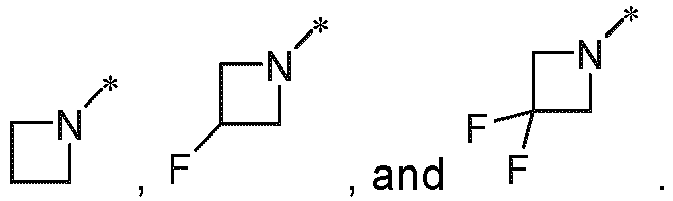
- The compound according to any one of claims 1-5 or a pharmaceutically acceptable salt thereof, wherein R3 is halo and n is 1.
- The compound according to any one of claims 1-6 or a pharmaceutically acceptable salt thereof, wherein R4 is selected from hydrogen, chloro, bromo, methyl, iso-propyl, -(CH2)1-2CH(CH3)2, -(CH2)0-1C(CH3)3, -C(CH3)2CH2CH3, -CH(CH3)(CH2)1-2CH3, -CH2-cyclobutyl, -(CH2)0-1CF3, -NH-(CH2)0-1CH3, -N-(CD3)2, -N(CH3)2, -NH-CH-(CH3)2, -NH-(CH2)-CH-(CH3)2, -NHC(O)OCH(CH3)2, -NH(CH2)2OCH3,






- The compound according to any one of claims 1-6 or a pharmaceutically acceptable salt thereof, wherein R4 is selected from

- The compound according to claim 1, wherein said compound is selected from:N-{4-fluoro-3-[5-(3-methylpyridin-2-yl)-2H-pyrazolo[3,4-b]pyridin-2-yl]phenyl}-2,4-dimethyl-1,3-oxazole-5-carboxamide;N-{4-fluoro-3-[5-(3-methylpyridin-2-yl)-2H-pyrazolo[3,4-b]pyridin-2-yl]phenyl}furan-2-carboxamide;N-{4-fluoro-3-[5-(3-methylpyridin-2-yl)-2H-pyrazolo[3,4-b]pyridin-2-yl]phenyl}azetidine-1-carboxamide;(3R)-3-fluoro-N-{4-fluoro-3-[5-(3-methylpyridin-2-yl)-2H-pyrazolo[3,4-b]pyridin-2-yl]phenyl}pyrrolidine-1-carboxamide;3,3-difluoro-N-{4-fluoro-3-[5-(3-methylpyridin-2-yl)-2H-pyrazolo[3,4-b]pyridin-2-yl]phenyl}azetidine-1-carboxamide;3-fluoro-N-{4-fluoro-3-[5-(3-methylpyridin-2-yl)-2H-pyrazolo[3,4-b]pyridin-2-yl]phenyl}azetidine-1-carboxamide;N-{4-fluoro-3-[5-(2-methylpropyl)-2H-pyrazolo[3,4-b]pyridin-2-yl]phenyl}azetidine-1-carboxamide;3,3-difluoro-N-{4-fluoro-3-[5-(2-methylpropyl)-2H-pyrazolo[3,4-b]pyridin-2-yl]phenyl}azetidine-1-carboxamide;N-{3-[5-(dimethylamino)-2H-pyrazolo[3,4-b]pyridin-2-yl]-4-fluorophenyl}-3,3-difluoroazetidine-1-carboxamide;N-{3-[5-(azetidin-1-yl)-2H-pyrazolo[3,4-b]pyridin-2-yl]-4-fluorophenyl}azetidine-1-carboxamide;5-fluoro-N-{4-fluoro-3-[5-(pyridin-2-yl)-2H-pyrazolo[3,4-b]pyridin-2-yl]phenyl}furan-2-carboxamide;N-{4-fluoro-3-[5-(pyridin-2-yl)-2H-pyrazolo[3,4-b]pyridin-2-yl]phenyl}cyclopropanecarboxamide;2-cyclopropyl-N-{4-fluoro-3-[5-(pyridin-2-yl)-2H-pyrazolo[3,4-b]pyridin-2-yl]phenyl}acetamide;3-fluoro-N-{4-fluoro-3-[5-(2-methylpropyl)-2H-pyrazolo[3,4-b]pyridin-2-yl]phenyl}azetidine-1-carboxamide;N-(3-{5-cyclopropyl-2H-pyrazolo[3,4-b]pyridin-2-yl}-4-fluorophenyl)-3-fluoroazetidine-1-carboxamide;N-{4-fluoro-3-[5-(2-methylpropyl)-2H-pyrazolo[3,4-b]pyridin-2-yl]phenyl}-2,4-dimethyl-1,3-oxazole-5-carboxamide;N-(3-{5-cyclopropyl-2H-pyrazolo[3,4-b]pyridin-2-yl}-4-fluorophenyl)-2,4-dimethyl-1,3-oxazole-5-carboxamide;N-(3-{5-cyclopentyl-2H-pyrazolo[3,4-b]pyridin-2-yl}-4-fluorophenyl)-3-fluoroazetidine-1-carboxamide;N-(3-{5-cyclohexyl-2H-pyrazolo[3,4-b]pyridin-2-yl}-4-fluorophenyl)-3-fluoroazetidine-1-carboxamide;N-(3-{5-cyclobutyl-2H-pyrazolo[3,4-b]pyridin-2-yl}-4-fluorophenyl)-3-fluoroazetidine-1-carboxamide;N-{3-[5-(2,2-dimethylpropyl)-2H-pyrazolo[3,4-b]pyridin-2-yl]-4-fluorophenyl}-3-fluoroazetidine-1-carboxamide;N-(3-{5-tert-butyl-2H-pyrazolo[3,4-b]pyridin-2-yl}-4-fluorophenyl)-3-fluoroazetidine-1-carboxamide;3-fluoro-N-{4-fluoro-3-[5-(pentan-2-yl)-2H-pyrazolo[3,4-b]pyridin-2-yl]phenyl}azetidine-1-carboxamide;3-fluoro-N-{4-fluoro-3-[5-(2-methylbutan-2-yl)-2H-pyrazolo[3,4-b]pyridin-2-yl]phenyl}azetidine-1-carboxamide;N-{3-[5-(butan-2-yl)-2H-pyrazolo[3,4-b]pyridin-2-yl]-4-fluorophenyl}-3-fluoroazetidine-1-carboxamide;N-{3-[5-(cyclobutylmethyl)-2H-pyrazolo[3,4-b]pyridin-2-yl]-4-fluorophenyl}-3-fluoroazetidine-1-carboxamide;3-fluoro-N-{4-fluoro-3-[5-(3-methylbutyl)-2H-pyrazolo[3,4-b]pyridin-2-yl]phenyl}azetidine-1-carboxamide;3-fluoro-N-{4-fluoro-3-[5-(pyridin-2-yl)-2H-pyrazolo[3,4-b]pyridin-2-yl]phenyl}azetidine-1-carboxamide;N-(3-{5-cyclopropyl-2H-pyrazolo[3,4-b]pyridin-2-yl}-4-fluorophenyl)-3,3-difluoroazetidine-1-carboxamide;N-(3-{5-cyclopentyl-2H-pyrazolo[3,4-b]pyridin-2-yl}-4-fluorophenyl)-3,3-difluoroazetidine-1-carboxamide;N-(3-{5-cyclobutyl-2H-pyrazolo[3,4-b]pyridin-2-yl}-4-fluorophenyl)-3,3-difluoroazetidine-1-carboxamide;N-{3-[5-(2,2-dimethylpropyl)-2H-pyrazolo[3,4-b]pyridin-2-yl]-4-fluorophenyl}-3,3-difluoroazetidine-1-carboxamide;N-(3-{5-tert-butyl-2H-pyrazolo[3,4-b]pyridin-2-yl}-4-fluorophenyl)-3,3-difluoroazetidine-1-carboxamide;3,3-difluoro-N-{4-fluoro-3-[5-(pentan-2-yl)-2H-pyrazolo[3,4-b]pyridin-2-yl]phenyl}azetidine-1-carboxamide;3,3-difluoro-N-{4-fluoro-3-[5-(2-methylbutan-2-yl)-2H-pyrazolo[3,4-b]pyridin-2-yl]phenyl}azetidine-1-carboxamide;N-{3-[5-(butan-2-yl)-2H-pyrazolo[3,4-b]pyridin-2-yl]-4-fluorophenyl}-3,3-difluoroazetidine-1-carboxamide;N-{3-[5-(cyclobutylmethyl)-2H-pyrazolo[3,4-b]pyridin-2-yl]-4-fluorophenyl}-3,3-difluoroazetidine-1-carboxamide;3,3-difluoro-N-{4-fluoro-3-[5-(3-methylbutyl)-2H-pyrazolo[3,4-b]pyridin-2-yl]phenyl}azetidine-1-carboxamide;3,3-difluoro-N-{4-fluoro-3-[5-(pyridin-2-yl)-2H-pyrazolo[3,4-b]pyridin-2-yl]phenyl}azetidine-1-carboxamide;N-{4-fluoro-3-[5-(3-fluoroazetidin-1-yl)-2H-pyrazolo[3,4-b]pyridin-2-yl]phenyl}azetidine-1-carboxamide;(3R)-3-fluoro-N-{4-fluoro-3-[5-(2-methylpropyl)-2H-pyrazolo[3,4-b]pyridin-2-yl]phenyl}pyrrolidine-1-carboxamide;(3R)-N-(3-{5-cyclopropyl-2H-pyrazolo[3,4-b]pyridin-2-yl}-4-fluorophenyl)-3-fluoropyrrolidine-1-carboxamide;(3R)-N-(3-{5-cyclopentyl-2H-pyrazolo[3,4-b]pyridin-2-yl}-4-fluorophenyl)-3-fluoropyrrolidine-1-carboxamide;(3R)-N-(3-{5-cyclohexyl-2H-pyrazolo[3,4-b]pyridin-2-yl}-4-fluorophenyl)-3-fluoropyrrolidine-1-carboxamide;(3R)-N-(3-{5-cyclobutyl-2H-pyrazolo[3,4-b]pyridin-2-yl}-4-fluorophenyl)-3-fluoropyrrolidine-1-carboxamide;(3R)-N-{3-[5-(2,2-dimethylpropyl)-2H-pyrazolo[3,4-b]pyridin-2-yl]-4-fluorophenyl}-3-fluoropyrrolidine-1-carboxamide;(3R)-N-(3-{5-tert-butyl-2H-pyrazolo[3,4-b]pyridin-2-yl}-4-fluorophenyl)-3-fluoropyrrolidine-1-carboxamide;(3R)-3-fluoro-N-{4-fluoro-3-[5-(pentan-2-yl)-2H-pyrazolo[3,4-b]pyridin-2-yl]phenyl}pyrrolidine-1-carboxamide;(3R)-3-fluoro-N-{4-fluoro-3-[5-(2-methylbutan-2-yl)-2H-pyrazolo[3,4-b]pyridin-2-yl]phenyl}pyrrolidine-1-carboxamide;(3R)-N-{3-[5-(butan-2-yl)-2H-pyrazolo[3,4-b]pyridin-2-yl]-4-fluorophenyl}-3-fluoropyrrolidine-1-carboxamide;(3R)-N-{3-[5-(cyclobutylmethyl)-2H-pyrazolo[3,4-b]pyridin-2-yl]-4-fluorophenyl}-3-fluoropyrrolidine-1-carboxamide;(3R)-3-fluoro-N-{4-fluoro-3-[5-(3-methylbutyl)-2H-pyrazolo[3,4-b]pyridin-2-yl]phenyl}pyrrolidine-1-carboxamide;(3R)-3-fluoro-N-{4-fluoro-3-[5-(pyridin-2-yl)-2H-pyrazolo[3,4-b]pyridin-2-yl]phenyl}pyrrolidine-1-carboxamide;N-{4-fluoro-3-[5-(2-methylpropyl)-2H-pyrazolo[3,4-b]pyridin-2-yl]phenyl}furan-2-carboxamide;N-(3-{5-cyclopropyl-2H-pyrazolo[3,4-b]pyridin-2-yl}-4-fluorophenyl)furan-2-carboxamide;N-(3-{5-cyclopentyl-2H-pyrazolo[3,4-b]pyridin-2-yl}-4-fluorophenyl)furan-2-carboxamide;N-(3-{5-cyclohexyl-2H-pyrazolo[3,4-b]pyridin-2-yl}-4-fluorophenyl)furan-2-carboxamide;3-fluoro-N-{4-fluoro-3-[5-(3-fluoroazetidin-1-yl)-2H-pyrazolo[3,4-b]pyridin-2-yl]phenyl}azetidine-1-carboxamide;N-{3-[5-(2,2-dimethylpropyl)-2H-pyrazolo[3,4-b]pyridin-2-yl]-4-fluorophenyl}furan-2-carboxamide;N-{4-fluoro-3-[5-(2-methylbutan-2-yl)-2H-pyrazolo[3,4-b]pyridin-2-yl]phenyl}furan-2-carboxamide;N-{3-[5-(butan-2-yl)-2H-pyrazolo[3,4-b]pyridin-2-yl]-4-fluorophenyl}furan-2-carboxamide;N-{3-[5-(cyclobutylmethyl)-2H-pyrazolo[3,4-b]pyridin-2-yl]-4-fluorophenyl}furan-2-carboxamide;N-{4-fluoro-3-[5-(3-methylbutyl)-2H-pyrazolo[3,4-b]pyridin-2-yl]phenyl}furan-2-carboxamide;N-{4-fluoro-3-[5-(pyridin-2-yl)-2H-pyrazolo[3,4-b]pyridin-2-yl]phenyl}furan-2-carboxamide;N-{4-fluoro-3-[5-(propan-2-yl)-2H-pyrazolo[3,4-b]pyridin-2-yl]phenyl}-5-methylpyrazine-2-carboxamide;N-{4-fluoro-3-[5-(propan-2-yl)-2H-pyrazolo[3,4-b]pyridin-2-yl]phenyl}-3-methylcyclopentane-1-carboxamide;5-fluoro-N-{4-fluoro-3-[5-(propan-2-yl)-2H-pyrazolo[3,4-b]pyridin-2-yl]phenyl}pyridine-2-carboxamide;N-{4-fluoro-3-[5-(propan-2-yl)-2H-pyrazolo[3,4-b]pyridin-2-yl]phenyl}-2-methyl-5-(trifluoromethyl)-1,3-oxazole-4-carboxamide;2-cyclopropyl-N-{4-fluoro-3-[5-(propan-2-yl)-2H-pyrazolo[3,4-b]pyridin-2-yl]phenyl}acetamide;N-{4-fluoro-3-[5-(propan-2-yl)-2H-pyrazolo[3,4-b]pyridin-2-yl]phenyl}-3-(trifluoromethyl)cyclopentane-1-carboxamide;N-{4-fluoro-3-[5-(propan-2-yl)-2H-pyrazolo[3,4-b]pyridin-2-yl]phenyl}-2,5-dimethylfuran-3-carboxamide;N-{4-fluoro-3-[5-(propan-2-yl)-2H-pyrazolo[3,4-b]pyridin-2-yl]phenyl}-4-methyl-1,3-oxazole-5-carboxamide;N-{4-fluoro-3-[5-(propan-2-yl)-2H-pyrazolo[3,4-b]pyridin-2-yl]phenyl}-2,5-dimethyl-1,3-oxazole-4-carboxamide;2-cyclopropyl-N-{4-fluoro-3-[5-(propan-2-yl)-2H-pyrazolo[3,4-b]pyridin-2-yl]phenyl}-1,3-oxazole-5-carboxamide;2-cyclopropyl-N-{4-fluoro-3-[5-(propan-2-yl)-2H-pyrazolo[3,4-b]pyridin-2-yl]phenyl}-4-methyl-1,3-oxazole-5-carboxamide;N-{4-fluoro-3-[5-(propan-2-yl)-2H-pyrazolo[3,4-b]pyridin-2-yl]phenyl}-2-methyloxolane-2-carboxamide;N-{4-fluoro-3-[5-(propan-2-yl)-2H-pyrazolo[3,4-b]pyridin-2-yl]phenyl}-4-methyl-2-(trifluoromethyl)-1,3-oxazole-5-carboxamide;2-[(tert-butoxy)methyl]-N-{4-fluoro-3-[5-(propan-2-yl)-2H-pyrazolo[3,4-b]pyridin-2-yl]phenyl}-4-methyl-1,3-oxazole-5-carboxamide;N-{4-fluoro-3-[5-(propan-2-yl)-2H-pyrazolo[3,4-b]pyridin-2-yl]phenyl}-4,5-dimethyl-1,3-oxazole-2-carboxamide;N-{4-fluoro-3-[5-(propan-2-yl)-2H-pyrazolo[3,4-b]pyridin-2-yl]phenyl}pyridine-2-carboxamide;N-{4-fluoro-3-[5-(propan-2-yl)-2H-pyrazolo[3,4-b]pyridin-2-yl]phenyl}-2-methyl-1,3-oxazole-5-carboxamide;5-cyano-N-{4-fluoro-3-[5-(propan-2-yl)-2H-pyrazolo[3,4-b]pyridin-2-yl]phenyl}pyridine-2-carboxamide;N-{4-fluoro-3-[5-(propan-2-yl)-2H-pyrazolo[3,4-b]pyridin-2-yl]phenyl}-2-methyl-1,3-oxazole-4-carboxamide;6-chloro-3-fluoro-N-{4-fluoro-3-[5-(propan-2-yl)-2H-pyrazolo[3,4-b]pyridin-2-yl]phenyl}pyridine-2-carboxamide;N-{4-fluoro-3-[5-(propan-2-yl)-2H-pyrazolo[3,4-b]pyridin-2-yl]phenyl}pyrazine-2-carboxamide;5-chloro-2-fluoro-N-{4-fluoro-3-[5-(propan-2-yl)-2H-pyrazolo[3,4-b]pyridin-2-yl]phenyl}benzamide;N-{4-fluoro-3-[5-(propan-2-yl)-2H-pyrazolo[3,4-b]pyridin-2-yl]phenyl}cyclopropanecarboxamide;N-(3-{5-cyclopropyl-2H-pyrazolo[3,4-b]pyridin-2-yl}-4-fluorophenyl)azetidine-1-carboxamide;N-{3-[5-(3,3-difluoroazetidin-1-yl)-2H-pyrazolo[3,4-b]pyridin-2-yl]-4-fluorophenyl}azetidine-1-carboxamide;N-(3-{5-cyclobutyl-2H-pyrazolo[3,4-b]pyridin-2-yl}-4-fluorophenyl)azetidine-1-carboxamide;N-{3-[5-(2,2-dimethylpropyl)-2H-pyrazolo[3,4-b]pyridin-2-yl]-4-fluorophenyllazetidine-1-carboxamide;N-{4-fluoro-3-[5-(pentan-2-yl)-2H-pyrazolo[3,4-b]pyridin-2-yl]phenyl}azetidine-1-carboxamide;N-{3-[5-(butan-2-yl)-2H-pyrazolo[3,4-b]pyridin-2-yl]-4-fluorophenyl}azetidine-1-carboxamide;N-{3-[5-(cyclobutylmethyl)-2H-pyrazolo[3,4-b]pyridin-2-yl]-4-fluorophenyl}azetidine-1-carboxamide;N-{4-fluoro-3-[5-(3-methylbutyl)-2H-pyrazolo[3,4-b]pyridin-2-yl]phenyl}azetidine-1-carboxamide;N-{4-fluoro-3-[5-(pyridin-2-yl)-2H-pyrazolo[3,4-b]pyridin-2-yl]phenyl}azetidine-1-carboxamide;N-{4-fluoro-3-[5-(propan-2-yl)-2H-pyrazolo[3,4-b]pyridin-2-yl]phenyl}azetidine-1-carboxamide;N-(3-{5-cyclobutyl-2H-pyrazolo[3,4-b]pyridin-2-yl}-4-fluorophenyl)-2,4-dimethyl-1,3-oxazole-5-carboxamide;N-{3-[5-(2,2-dimethylpropyl)-2H-pyrazolo[3,4-b]pyridin-2-yl]-4-fluorophenyl}-2,4-dimethyl-1,3-oxazole-5-carboxamide;N-(3-{5-tert-butyl-2H-pyrazolo[3,4-b]pyridin-2-yl}-4-fluorophenyl)-2,4-dimethyl-1,3-oxazole-5-carboxamide;N-{4-fluoro-3-[5-(2-methylbutan-2-yl)-2H-pyrazolo[3,4-b]pyridin-2-yl]phenyl}-2,4-dimethyl-1,3-oxazole-5-carboxamide;N-{3-[5-(butan-2-yl)-2H-pyrazolo[3,4-b]pyridin-2-yl]-4-fluorophenyl}-2,4-dimethyl-1,3-oxazole-5-carboxamide;N-{3-[5-(cyclobutylmethyl)-2H-pyrazolo[3,4-b]pyridin-2-yl]-4-fluorophenyl}-2,4-dimethyl-1,3-oxazole-5-carboxamide;N-{4-fluoro-3-[5-(3-methylbutyl)-2H-pyrazolo[3,4-b]pyridin-2-yl]phenyl}-2,4-dimethyl-1,3-oxazole-5-carboxamide;N-{4-fluoro-3-[5-(pyridin-2-yl)-2H-pyrazolo[3,4-b]pyridin-2-yl]phenyl}-2,4-dimethyl-1,3-oxazole-5-carboxamide;N-{4-fluoro-3-[5-(propan-2-yl)-2H-pyrazolo[3,4-b]pyridin-2-yl]phenyl}-5-methylfuran-2-carboxamide;N-{4-fluoro-3-[5-(propan-2-yl)-2H-pyrazolo[3,4-b]pyridin-2-yl]phenyl}-5-methoxyfuran-2-carboxamide;5-[(dimethylamino)methyl]-N-{4-fluoro-3-[5-(propan-2-yl)-2H-pyrazolo[3,4-b]pyridin-2-yl]phenyl}furan-2-carboxamide;5-cyano-N-{4-fluoro-3-[5-(propan-2-yl)-2H-pyrazolo[3,4-b]pyridin-2-yl]phenyl}furan-2-carboxamide;5-fluoro-N-{4-fluoro-3-[5-(propan-2-yl)-2H-pyrazolo[3,4-b]pyridin-2-yl]phenyl}furan-2-carboxamide;N-{4-fluoro-3-[5-(propan-2-yl)-2H-pyrazolo[3,4-b]pyridin-2-yl]phenyl}-4,5-dimethylfuran-2-carboxamide;N-{4-fluoro-3-[5-(propan-2-yl)-2H-pyrazolo[3,4-b]pyridin-2-yl]phenyl}-3-methylfuran-2-carboxamide;3,3-difluoro-N-{4-fluoro-3-[5-(propan-2-yl)-2H-pyrazolo[3,4-b]pyridin-2-yl]phenyl}-1-methylcyclobutane-1-carboxamide;3,3-difluoro-N-{4-fluoro-3-[5-(propan-2-yl)-2H-pyrazolo[3,4-b]pyridin-2-yl]phenyl}cyclobutane-1-carboxamide;3-fluoro-N-{4-fluoro-3-[5-(propan-2-yl)-2H-pyrazolo[3,4-b]pyridin-2-yl]phenyl}cyclobutane-1-carboxamide;N-{4-fluoro-3-[5-(morpholin-4-yl)-2H-pyrazolo[3,4-b]pyridin-2-yl]phenyl}furan-2-carboxamide;propan-2-yl N-{2-[2-fluoro-5-(furan-2-amido)phenyl]-2H-pyrazolo[3,4-b]pyridin-5-yl}carbamate;3,3-difluoro-N-{4-fluoro-3-[5-(propan-2-yl)-2H-pyrazolo[3,4-b]pyridin-2-yl]phenyl}azetidine-1-carboxamide;N-(3-{5-bromo-2H-pyrazolo[3,4-b]pyridin-2-yl}-4-fluorophenyl)-3,3-difluoroazetidine-1-carboxamide;N-(3-{5-bromo-2H-pyrazolo[3,4-b]pyridin-2-yl}-4-fluorophenyl)-3-fluoroazetidine-1-carboxamide;(3R)-N-(3-{5-bromo-2H-pyrazolo[3,4-b]pyridin-2-yl}-4-fluorophenyl)-3-fluoropyrrolidine-1-carboxamide;N-(3-{5-bromo-2H-pyrazolo[3,4-b]pyridin-2-yl}-4-fluorophenyl)-2,4-dimethyl-1,3-oxazole-5-carboxamide;N-(3-{5-bromo-2H-pyrazolo[3,4-b]pyridin-2-yl}-4-fluorophenyl)azetidine-1-carboxamide;N-(3-{5-bromo-2H-pyrazolo[3,4-b]pyridin-2-yl}-4-fluorophenyl)furan-2-carboxamide;3-fluoro-N-{4-fluoro-3-[5-(pyrrolidin-1-yl)-2H-pyrazolo[3,4-b]pyridin-2-yl]phenyl}azetidine-1-carboxamide;3-fluoro-N-{4-fluoro-3-[5-(morpholin-4-yl)-2H-pyrazolo[3,4-b]pyridin-2-yl]phenyl}azetidine-1-carboxamide;(3R)-N-{3-[5-(dimethylamino)-2H-pyrazolo[3,4-b]pyridin-2-yl]-4-fluorophenyl}-3-fluoropyrrolidine-1-carboxamide;(3R)-3-fluoro-N-{4-fluoro-3-[5-(pyrrolidin-1-yl)-2H-pyrazolo[3,4-b]pyridin-2-yl]phenyl}pyrrolidine-1-carboxamide;(3R)-3-fluoro-N-{4-fluoro-3-[5-(morpholin-4-yl)-2H-pyrazolo[3,4-b]pyridin-2-yl]phenyl}pyrrolidine-1-carboxamide;propan-2-yl N-[2-(2-fluoro-5-{[(3R)-3-fluoropyrrolidine-1-carbonyl]amino}phenyl)-2H-pyrazolo[3,4-b]pyridin-5-yl]carbamate;N-{4-fluoro-3-[5-(morpholin-4-yl)-2H-pyrazolo[3,4-b]pyridin-2-yl]phenyl}azetidine-1-carboxamide;propan-2-yl N-(2-{5-[(azetidine-1-carbonyl)amino]-2-fluorophenyl}-2H-pyrazolo[3,4-b]pyridin-5-yl)carbamate;N-{4-fluoro-3-[5-(methylamino)-2H-pyrazolo[3,4-b]pyridin-2-yl]phenyl}furan-2-carboxamide;N-{3-[5-(dimethylamino)-2H-pyrazolo[3,4-b]pyridin-2-yl]-4-fluorophenyl}furan-2-carboxamide;N-{4-fluoro-3-[5-(pyrrolidin-1-yl)-2H-pyrazolo[3,4-b]pyridin-2-yl]phenyl}furan-2-carboxamide;1-{4-fluoro-3-[5-(methylamino)-2H-pyrazolo[3,4-b]pyridin-2-yl]phenyl}-3-methylurea;1-{3-[5-(dimethylamino)-2H-pyrazolo[3,4-b]pyridin-2-yl]-4-fluorophenyl}-3,3-dimethylurea;N-{3-[5-(azetidin-1-yl)-2H-pyrazolo[3,4-b]pyridin-2-yl]-4-fluorophenyl}-3,3-difluoroazetidine-1-carboxamide;3,3-difluoro-N-{4-fluoro-3-[5-(morpholin-4-yl)-2H-pyrazolo[3,4-b]pyridin-2-yl]phenyl}azetidine-1-carboxamide;propan-2-yl N-(2-{5-[(3,3-difluoroazetidine-1-carbonyl)amino]-2-fluorophenyl}-2H-pyrazolo[3,4-b]pyridin-5-yl)carbamate;N-{3-[5-(azetidin-1-yl)-2H-pyrazolo[3,4-b]pyridin-2-yl]-4-fluorophenyl}-3-fluoroazetidine-1-carboxamide;3-fluoro-N-{4-fluoro-3-[5-(oxan-4-yl)-2H-pyrazolo[3,4-b] pyridin-2-yl]phenyl}azetidine-1-carboxamide;(3R)-N-{3-[5-(azetidin-1-yl)-2H-pyrazolo[3,4-b]pyridin-2-yl]-4-fluorophenyl}-3-fluoropyrrolidine-1-carboxamide;(3R)-3-fluoro-N-{4-fluoro-3-[5-(oxan-4-yl)-2H-pyrazolo[3,4-b]pyridin-2-yl]phenyl}pyrrolidine-1-carboxamide;N-{3-[5-(azetidin-1-yl)-2H-pyrazolo[3,4-b]pyridin-2-yl]-4-fluorophenyl}furan-2-carboxamide;3-fluoro-N-{4-fluoro-3-[5-(2,2,2-trifluoroethyl)-2H-pyrazolo[3,4-b]pyridin-2-yl]phenyl}azetidine-1-carboxamide;N-{4-fluoro-3-[5-(methylamino)-2H-pyrazolo[3,4-b]pyridin-2-yl]phenyl}-2,4-dimethyl-1,3-oxazole-5-carboxamide;N-{3-[5-(dimethylamino)-2H-pyrazolo[3,4-b]pyridin-2-yl]-4-fluorophenyl}-2,4-dimethyl-1,3-oxazole-5-carboxamide;N-{3-[5-(azetidin-1-yl)-2H-pyrazolo[3,4-b]pyridin-2-yl]-4-fluorophenyl}-2,4-dimethyl-1,3-oxazole-5-carboxamide;3-fluoro-N-{4-fluoro-3-[5-(propan-2-yl)-2H-pyrazolo[3,4-b]pyridin-2-yl]phenyl}azetidine-1-carboxamide;N-{4-fluoro-3-[5-(pyrrolidin-1-yl)-2H-pyrazolo[3,4-b]pyridin-2-yl]phenyl}-2,4-dimethyl-1,3-oxazole-5-carboxamide;N-{4-fluoro-3-[5-(morpholin-4-yl)-2H-pyrazolo[3,4-b]pyridin-2-yl]phenyl}-2,4-dimethyl-1,3-oxazole-5-carboxamide;propan-2-yl N-{2-[5-(dimethyl-1,3-oxazole-5-amido)-2-fluorophenyl]-2H-pyrazolo[3,4-b]pyridin-5-yl}carbamate;N-{4-fluoro-3-[5-(oxan-4-yl)-2H-pyrazolo[3,4-b]pyridin-2-yl]phenyl}azetidine-1-carboxamide;3,3-difluoro-N-{4-fluoro-3-[5-(pyrrolidin-1-yl)-2H-pyrazolo[3,4-b]pyridin-2-yl]phenyl}azetidine-1-carboxamide;(3R)-3-fluoro-N-{4-fluoro-3-[5-(2,2,2-trifluoroethyl)-2H-pyrazolo[3,4-b]pyridin-2-yl]phenyl}pyrrolidine-1-carboxamide;N-{4-fluoro-3-[5-(pyrrolidin-1-yl)-2H-pyrazolo[3,4-b]pyridin-2-yl]phenyl}azetidine-1-carboxamide;N-{4-fluoro-3-[5-(2,2,2-trifluoroethyl)-2H-pyrazolo[3,4-b]pyridin-2-yl]phenyl}azetidine-1-carboxamide;3,3-difluoro-N-{4-fluoro-3-[5-(oxan-4-yl)-2H-pyrazolo[3,4-b]pyridin-2-yl]phenyl}azetidine-1-carboxamide;3,3-difluoro-N-{4-fluoro-3-[5-(2,2,2-trifluoroethyl)-2H-pyrazolo[3,4-b]pyridin-2-yl]phenyl}azetidine-1-carboxamide;N-{3-[5-(dimethylamino)-2H-pyrazolo[3,4-b]pyridin-2-yl]-4-fluorophenyl}-3-fluoroazetidine-1-carboxamide;propan-2-yl N-(2-{2-fluoro-5-[(3-fluoroazetidine-1-carbonyl)amino]phenyl}-2H-pyrazolo[3,4-b]pyridin-5-yl)carbamate;N-{4-fluoro-3-[5-(oxan-4-yl)-2H-pyrazolo[3,4-b]pyridin-2-yl]phenyl}-2,4-dimethyl-1,3-oxazole-5-carboxamide;N-{3-[5-(dimethylamino)-2H-pyrazolo[3,4-b]pyridin-2-yl]-4-fluorophenyl}azetidine-1-carboxamide;3-fluoro-N-[4-fluoro-3-(5-{2-oxa-6-azaspiro[3.3]heptan-6-yl}-2H-pyrazolo[3,4-b]pyridin-2-yl)phenyl]azetidine-1-carboxamide;3-fluoro-N-(4-fluoro-3-{5-[(1S,4S)-2-oxa-5-azabicyclo[2.2.1]heptan-5-yl]-2H-pyrazolo[3,4-b]pyridin-2-yl}phenyl)azetidine-1-carboxamide;4,4,4-trifluoro-N-{4-fluoro-3-[5-(propan-2-yl)-2H-pyrazolo[3,4-b]pyridin-2-yl]phenyl}butanamide;3,3,3-trifluoropropyl N-{4-fluoro-3-[5-(propan-2-yl)-2H-pyrazolo[3,4-b]pyridin-2-yl]phenyl}carbamate;N-{4-fluoro-3-[5-(2,2,2-trifluoroethyl)-2H-pyrazolo[3,4-b]pyridin-2-yl]phenyl}-2,4-dimethyl-1,3-oxazole-5-carboxamide;N-{4-fluoro-3-[5-(2,2,2-trifluoroethyl)-2H-pyrazolo[3,4-b]pyridin-2-yl]phenyl}furan-2-carboxamide;N-(3-{5-[(2S,6S)-2,6-dimethylmorpholin-4-yl]-2H-pyrazolo[3,4-b]pyridin-2-yl}-4-fluorophenyl)-3-fluoroazetidine-1-carboxamide;3-fluoro-N-{4-fluoro-3-[5-(4-methylpiperazin-1-yl)-2H-pyrazolo[3,4-b]pyridin-2-yl]phenyl}azetidine-1-carboxamide;3-fluoro-N-[4-fluoro-3-(5-{5H,6H,7H,8H-imidazo[1,2-a]pyrazin-7-yl}-2H-pyrazolo[3,4-b]pyridin-2-yl)phenyl]azetidine-1-carboxamide;3-fluoro-N-{4-fluoro-3-[5-(3-hydroxyazetidin-1-yl)-2H-pyrazolo[3,4-b]pyridin-2-yl]phenyl}azetidine-1-carboxamide;3-fluoro-N-{4-fluoro-3-[5-(pyridin-4-yl)-2H-pyrazolo[3,4-b]pyridin-2-yl]phenyl}azetidine-1-carboxamide;3-fluoro-N-[4-fluoro-3-(5-{2-oxa-6-azaspiro[3.4]octan-6-yl}-2H-pyrazolo[3,4-b]pyridin-2-yl)phenyl]azetidine-1-carboxamide;3-fluoro-N-[4-fluoro-3-(5-{8-oxa-3-azabicyclo[3.2.1]octan-3-yl}-2H-pyrazolo[3,4-b]pyridin-2-yl)phenyl]azetidine-1-carboxamide;3-fluoro-N-(4-fluoro-3-{5-[(2-methoxyethyl)amino]-2H-pyrazolo[3,4-b]pyridin-2-yl}phenyl)azetidine-1-carboxamide;3-fluoro-N-[4-fluoro-3-(5-{5H,6H,7H,8H-[1,2,4]triazolo[4,3-a]pyrazin-7-yl}-2H-pyrazolo[3,4-b]pyridin-2-yl)phenyl]azetidine-1-carboxamide;3-fluoro-N-{4-fluoro-3-[5-(3-fluoropyridin-2-yl)-2H-pyrazolo[3,4-b]pyridin-2-yl]phenyl}azetidine-1-carboxamide;N-{3-[5-(3-chloropyridin-2-yl)-2H-pyrazolo[3,4-b]pyridin-2-yl]-4-fluorophenyl}-3-fluoroazetidine-1-carboxamide;3-fluoro-N-{4-fluoro-3-[5-(pyridin-3-yl)-2H-pyrazolo[3,4-b]pyridin-2-yl]phenyl}azetidine-1-carboxamide;N-(3-{5-[(2R,6S)-2,6-dimethylmorpholin-4-yl]-2H-pyrazolo[3,4-b]pyridin-2-yl}-4-fluorophenyl)-3-fluoroazetidine-1-carboxamide;3-fluoro-N-[4-fluoro-3-(5-{6-oxa-1-azaspiro[3.3]heptan-1-yl}-2H-pyrazolo[3,4-b]pyridin-2-yl)phenyl]azetidine-1-carboxamide;3-fluoro-N-(4-fluoro-3-{5-[3-(methoxymethyl)azetidin-1-yl]-2H-pyrazolo[3,4-b]pyridin-2-yl}phenyl)azetidine-1-carboxamide;N-[3-(5-{5-azaspiro[2.3]hexan-5-yl}-2H-pyrazolo[3,4-b]pyridin-2-yl)-4-fluorophenyl]-3-fluoroazetidine-1-carboxamide;N-(3-{5-[(3R,4R)-3,4-difluoropyrrolidin-1-yl]-2H-pyrazolo[3,4-b]pyridin-2-yl}-4-fluorophenyl)-3-fluoroazetidine-1-carboxamide;(3R)-3-fluoro-N-{4-fluoro-3-[5-(propan-2-yl)-2H-pyrazolo[3,4-b]pyridin-2-yl]phenyl}pyrrolidine-1-carboxamide;N-{4-fluoro-3-[5-(propan-2-yl)-2H-pyrazolo[3,4-b]pyridin-2-yl]phenyl}furan-2-carboxamide;3-fluoro-N-[4-fluoro-3-(5-{2-oxa-5-azabicyclo[2.2.2]octan-5-yl}-2H-pyrazolo[3,4-b]pyridin-2-yl)phenyl]azetidine-1-carboxamide;3-fluoro-N-(4-fluoro-3-{5-[(2-methylpropyl)amino]-2H-pyrazolo[3,4-b]pyridin-2-yl}phenyl)azetidine-1-carboxamide;N-{3-[5-(ethylamino)-2H-pyrazolo[3,4-b]pyridin-2-yl]-4-fluorophenyl}-3-fluoroazetidine-1-carboxamide;3-fluoro-N-(4-fluoro-3-{5-[(propan-2-yl)amino]-2H-pyrazolo[3,4-b]pyridin-2-yl}phenyl)azetidine-1-carboxamide;3-fluoro-N-[4-fluoro-3-(5-{1-oxa-6-azaspiro[3.3]heptan-6-yl}-2H-pyrazolo[3,4-b]pyridin-2-yl)phenyl]azetidine-1-carboxamide;3-fluoro-N-[4-fluoro-3-(5-{6-oxa-2-azaspiro[3.4]octan-2-yl}-2H-pyrazolo[3,4-b]pyridin-2-yl)phenyl]azetidine-1-carboxamide;3-fluoro-N-[4-fluoro-3-(5-{7-oxa-2-azaspiro[3.5]nonan-2-yl}-2H-pyrazolo[3,4-b]pyridin-2-yl)phenyl]azetidine-1-carboxamide;N-[3-(5-{6,6-difluoro-3-azabicyclo[3.1.0]hexan-3-yl}-2H-pyrazolo[3,4-b]pyridin-2-yl)-4-fluorophenyl]-3-fluoroazetidine-1-carboxamide;3-fluoro-N-{4-fluoro-3-[5-(3-methoxyazetidin-1-yl)-2H-pyrazolo[3,4-b]pyridin-2-yl]phenyl}azetidine-1-carboxamide;5-cyano-N-{4-fluoro-3-[5-(pyridin-2-yl)-2H-pyrazolo[3,4-b]pyridin-2-yl]phenyl}furan-2-carboxamide;2-ethoxy-N-{4-fluoro-3-[5-(propan-2-yl)-2H-pyrazolo[3,4-b]pyridin-2-yl]phenyl}cyclopropane-1-carboxamide;2,2-difluoro-N-{4-fluoro-3-[5-(propan-2-yl)-2H-pyrazolo[3,4-b]pyridin-2-yl]phenyl}cyclopropane-1-carboxamide;N-{4-fluoro-3-[5-(propan-2-yl)-2H-pyrazolo[3,4-b]pyridin-2-yl]phenyl}-1-(trifluoromethyl)cyclopropane-1-carboxamide;N-{4-fluoro-3-[5-(propan-2-yl)-2H-pyrazolo[3,4-b]pyridin-2-yl]phenyl}cyclobutanecarboxamide;N-{4-fluoro-3-[5-(propan-2-yl)-2H-pyrazolo[3,4-b]pyridin-2-yl]phenyl}-2-methylcyclopropane-1-carboxamide;3,3,3-trifluoro-N-{4-fluoro-3-[5-(propan-2-yl)-2H-pyrazolo[3,4-b]pyridin-2-yl]phenyllpropanamide;4,4,4-trifluoro-N-{4-fluoro-3-[5-(propan-2-yl)-2H-pyrazolo[3,4-b]pyridin-2-yl]phenyll-3-methylbutanamide;5,5,5-trifluoro-N-{4-fluoro-3-[5-(propan-2-yl)-2H-pyrazolo[3,4-b]pyridin-2-yl]phenyl}pentanamide;3-cyclopropyl-N-{4-fluoro-3-[5-(propan-2-yl)-2H-pyrazolo[3,4-b]pyridin-2-yl]phenyl}propanamide;2-cyclobutyl-N-{4-fluoro-3-[5-(propan-2-yl)-2H-pyrazolo[3,4-b]pyridin-2-yl]phenyl}acetamide;N-{4-fluoro-3-[5-(propan-2-yl)-2H-pyrazolo[3,4-b]pyridin-2-yl]phenyl}-3,3-dimethylbutanamide;N-{4-fluoro-3-[5-(pyridin-2-yl)-2H-pyrazolo[3,4-b]pyridin-2-yl]phenyl}cyclobut-1-ene-1-carboxamide;1-{4-fluoro-3-[5-(propan-2-yl)-2H-pyrazolo[3,4-b]pyridin-2-yl]phenyl}-3,3-bis(2H3)methylurea;N-{4-fluoro-3-[5-(propan-2-yl)-2H-pyrazolo[3,4-b]pyridin-2-yl]phenyl}-5-azaspiro[2.4]heptane-5-carboxamide;(3R)-N-{4-fluoro-3-[5-(propan-2-yl)-2H-pyrazolo[3,4-b]pyridin-2-yl]phenyl}-3-methylpyrrolidine-1-carboxamide;N-{4-fluoro-3-[5-(propan-2-yl)-2H-pyrazolo[3,4-b]pyridin-2-yl]phenyl}-5-azaspiro[2.3]hexane-5-carboxamide;(1R,5S)-N-{4-fluoro-3-[5-(propan-2-yl)-2H-pyrazolo[3,4-b]pyridin-2-yl]phenyl}-3-azabicyclo[3.1.0]hexane-3-carboxamide;3-ethyl-1-{4-fluoro-3-[5-(propan-2-yl)-2H-pyrazolo[3,4-b]pyridin-2-yl]phenyl}-3-methylurea;(3R)-N-{4-fluoro-3-[5-(propan-2-yl)-2H-pyrazolo[3,4-b]pyridin-2-yl]phenyl}-3-methoxypyrrolidine-1-carboxamide;N-{4-fluoro-3-[5-(propan-2-yl)-2H-pyrazolo[3,4-b]pyridin-2-yl]phenyl}-2-azaspiro[3.3]heptane-2-carboxamide;1-{4-fluoro-3-[5-(propan-2-yl)-2H-pyrazolo[3,4-b]pyridin-2-yl]phenyl}-3-methyl-3-(2,2,2-trifluoroethyl)urea;1-{4-fluoro-3-[5-(propan-2-yl)-2H-pyrazolo[3,4-b]pyridin-2-yl]phenyl}-3,3-dimethylurea;N-{4-fluoro-3-[5-(propan-2-yl)-2H-pyrazolo[3,4-b]pyridin-2-yl]phenyl}-1,4-diazabicyclo[3.2.2]nonane-4-carboxamide;N-(3-{5-[(2R,6S)-2,6-dimethylmorpholin-4-yl]-2H-pyrazolo[3,4-b]pyridin-2-yl}-4-fluorophenyl)-3-fluoroazetidine-1-carboxamide;3-fluoro-N-[4-fluoro-3-(5-{6-oxa-1-azaspiro[3.3]heptan-1-yl}-2H-pyrazolo[3,4-b]pyridin-2-yl)phenyl]azetidine-1-carboxamide;3-fluoro-N-(4-fluoro-3-{5-[3-(methoxymethyl)azetidin-1-yl]-2H-pyrazolo[3,4-b]pyridin-2-yl}phenyl)azetidine-1-carboxamide;N-[3-(5-{5-azaspiro[2.3]hexan-5-yl}-2H-pyrazolo[3,4-b]pyridin-2-yl)-4-fluorophenyl]-3-fluoroazetidine-1-carboxamide;N-(3-{5-[(3R,4R)-3,4-difluoropyrrolidin-1-yl]-2H-pyrazolo[3,4-b]pyridin-2-yl}-4-fluorophenyl)-3-fluoroazetidine-1-carboxamide;3-fluoro-N-[4-fluoro-3-(5-{3-oxa-8-azabicyclo[3.2.1]octan-8-yl}-2H-pyrazolo[3,4-b]pyridin-2-yl)phenyl]azetidine-1-carboxamide;1-(2-{2-fluoro-5-[(3-fluoroazetidine-1-carbonyl)amino]phenyl}-2H-pyrazolo[3,4-b]pyridin-5-yl)piperidine-4-carboxylic acid;3-fluoro-N-(4-fluoro-3-{5-[4-(2,2,2-trifluoroethyl)piperazin-1-yl]-2H-pyrazolo[3,4-b]pyridin-2-yl}phenyl)azetidine-1-carboxamide;3-fluoro-N-(4-fluoro-3-{5-[4-(oxetan-3-yl)piperidin-1-yl]-2H-pyrazolo[3,4-b]pyridin-2-yl}phenyl)azetidine-1-carboxamide;3-fluoro-N-[4-fluoro-3-(5-{2-thia-6-azaspiro[3.3]heptan-6-yl}-2H-pyrazolo[3,4-b]pyridin-2-yl)phenyl]azetidine-1-carboxamide;3-fluoro-N-[4-fluoro-3-(5-{6-oxa-3-azabicyclo[3.1.1]heptan-3-yl}-2H-pyrazolo[3,4-b]pyridin-2-yl)phenyl]azetidine-1-carboxamide;N-[3-(5-{5-azaspiro[2.4]heptan-5-yl}-2H-pyrazolo[3,4-b]pyridin-2-yl)-4-fluorophenyl]-3-fluoroazetidine-1-carboxamide;N-[3-(5-{5-azaspiro[2.4]heptan-5-yl}-2H-pyrazolo[3,4-b]pyridin-2-yl)-4-fluorophenyl]-5-azaspiro[2.4]heptane-5-carboxamide;N-[3-(5-{2-azaspiro[3.3]heptan-2-yl}-2H-pyrazolo[3,4-b]pyridin-2-yl)-4-fluorophenyl]-3-fluoroazetidine-1-carboxamide;3-fluoro-N-[4-fluoro-3-(5-{8-oxa-2-azaspiro[4.5]decan-2-yl}-2H-pyrazolo[3,4-b]pyridin-2-yl)phenyl]azetidine-1-carboxamide;3-fluoro-N-[4-fluoro-3-(5-{6-oxo-2,5-diazaspiro[3.4]octan-2-yl}-2H-pyrazolo[3,4-b]pyridin-2-yl)phenyl]azetidine-1-carboxamide;N-[4-fluoro-3-(5-{6-oxa-2-azaspiro[3.4]octan-2-yl}-2H-pyrazolo[3,4-b]pyridin-2-yl)phenyl]-6-oxa-2-azaspiro[3.4]octane-2-carboxamide;tert-butyl 2-(2-{5-[(azetidine-1-carbonyl)amino]-2-fluorophenyl}-2H-pyrazolo[3,4-b]pyridin-5-yl)pyrrolidine-1-carboxylate;3-fluoro-N-[4-fluoro-3-(5-{2-oxa-7-azaspiro[3.5]nonan-7-yl}-2H-pyrazolo[3,4-b]pyridin-2-yl)phenyl]azetidine-1-carboxamide;N-{3-[5-(cyclopropylamino)-2H-pyrazolo[3,4-b]pyridin-2-yl]-4-fluorophenyl}-3-fluoroazetidine-1-carboxamide;N-(4-fluoro-3-{5-[4-(2,2,2-trifluoroethyl)piperazin-1-yl]-2H-pyrazolo[3,4-b]pyridin-2-yl}phenyl)azetidine-1-carboxamide;3-fluoro-N-{4-fluoro-3-[5-(3-hydroxy-3-methylazetidin-1-yl)-2H-pyrazolo[3,4-b]pyridin-2-yl]phenyl}azetidine-1-carboxamide;3,3-difluoro-N-(4-fluoro-3-{5-[4-(2,2,2-trifluoroethyl)piperazin-1-yl]-2H-pyrazolo[3,4-b]pyridin-2-yl}phenyl)azetidine-1-carboxamide;(3R)-3-fluoro-N-(4-fluoro-3-{5-[4-(2,2,2-trifluoroethyl)piperazin-1-yl]-2H-pyrazolo[3,4-b]pyridin-2-yl}phenyl)pyrrolidine-1-carboxamide;N-(3-{5-bromo-2H-pyrazolo[3,4-b]pyridin-2-yl}-4-fluorophenyl)-5-azaspiro[2.3]hexane-5-carboxamide;N-{3-[5-(3,3-dimethylazetidin-1-yl)-2H-pyrazolo[3,4-b]pyridin-2-yl]-4-fluorophenyl}-3-fluoroazetidine-1-carboxamide;(1S,2R)-2-fluoro-N-{4-fluoro-3-[5-(pyridin-2-yl)-2H-pyrazolo[3,4-b]pyridin-2-yl]phenyl}cyclopropane-1-carboxamide;N-[3-(5-{5-azaspiro[2.3]hexan-5-yl}-2H-pyrazolo[3,4-b]pyridin-2-yl)-4-fluorophenyl]azetidine-1-carboxamide;N-[3-(5-{5-azaspiro[2.3]hexan-5-yl}-2H-pyrazolo[3,4-b]pyridin-2-yl)-4-fluorophenyl]-3,3-difluoroazetidine-1-carboxamide;(3R)-N-[3-(5-{5-azaspiro[2.3]hexan-5-yl}-2H-pyrazolo[3,4-b]pyridin-2-yl)-4-fluorophenyl]-3-fluoropyrrolidine-1-carboxamide;N-{3-[5-(dimethylamino)-2H-pyrazolo[3,4-b]pyridin-2-yl]-4-fluorophenyl}-5-azaspiro[2.3]hexane-5-carboxamide;N-[3-(5-{1,1-difluoro-5-azaspiro[2.3]hexan-5-yl}-2H-pyrazolo[3,4-b]pyridin-2-yl)-4-fluorophenyl]-3-fluoroazetidine-1-carboxamide;N-{3-[5-(3,3-difluoropyrrolidin-1-yl)-2H-pyrazolo[3,4-b]pyridin-2-yl]-4-fluorophenyl}-3-fluoroazetidine-1-carboxamide;3-fluoro-N-[4-fluoro-3-(5-{3-oxa-6-azabicyclo[3.1.1]heptan-6-yl}-2H-pyrazolo[3,4-b]pyridin-2-yl)phenyl]azetidine-1-carboxamide;N-{3-[5-(azetidin-2-yl)-2H-pyrazolo[3,4-b]pyridin-2-yl]-4-fluorophenyl}-3-fluoroazetidine-1-carboxamide;3-fluoro-N-(4-fluoro-3-{5-[3-(trifluoromethyl)azetidin-1-yl]-2H-pyrazolo[3,4-b]pyridin-2-yl}phenyl)azetidine-1-carboxamide;N-{3-[5-(3-cyanoazetidin-1-yl)-2H-pyrazolo[3,4-b]pyridin-2-yl]-4-fluorophenyl}-3-fluoroazetidine-1-carboxamide;N-{3-[5-(1-acetylazetidin-2-yl)-2H-pyrazolo[3,4-b]pyridin-2-yl]-4-fluorophenyl}-3-fluoroazetidine-1-carboxamide;(1S,2R)-N-{3-[5-(3,3-difluoroazetidin-1-yl)-2H-pyrazolo[3,4-b]pyridin-2-yl]-4-fluorophenyl}-2-fluorocyclopropane-1-carboxamide;(1R,2S)-2-fluoro-N-{4-fluoro-3-[5-(pyridin-2-yl)-2H-pyrazolo[3,4-b]pyridin-2-yl]phenyl}cyclopropane-1-carboxamide;3-fluoro-N-{4-fluoro-3-[5-(piperazin-1-yl)-2H-pyrazolo[3,4-b]pyridin-2-yl]phenyl}azetidine-1-carboxamide;(1R,2S)-N-{3-[5-(3,3-difluoroazetidin-1-yl)-2H-pyrazolo[3,4-b]pyridin-2-yl]-4-fluorophenyl}-2-fluorocyclopropane-1-carboxamide;(1R,2S)-N-[3-(5-{5-azaspiro[2.3]hexan-5-yl}-2H-pyrazolo[3,4-b]pyridin-2-yl)-4-fluorophenyl]-2-fluorocyclopropane-1-carboxamide;(1S,2R)-2-fluoro-N-{4-fluoro-3-[5-(pyridin-2-yl)-2H-pyrazolo[3,4-b]pyridin-2-yl]phenyl}cyclopropane-1-carboxamide;N-(4-fluoro-3-{5-[3-(trifluoromethyl)azetidin-1-yl]-2H-pyrazolo[3,4-b]pyridin-2-yl}phenyl)azetidine-1-carboxamide;(3R)-3-fluoro-N-(4-fluoro-3-{5-[3-(trifluoromethyl)azetidin-1-yl]-2H-pyrazolo[3,4-b]pyridin-2-yl}phenyl)pyrrolidine-1-carboxamide;N-(3-{5-chloro-2H-pyrazolo[3,4-b]pyridin-2-yl}-4-fluorophenyl)-3-fluoroazetidine-1-carboxamide;N-{4-fluoro-3-[5-(3-methylpyridin-2-yl)-2H-pyrazolo[3,4-b]pyridin-2-yl]phenyl}-4-(hydroxymethyl)-2-methyl-1,3-oxazole-5-carboxamide;N-{4-fluoro-3-[5-(3-methylpyridin-2-yl)-2H-pyrazolo[3,4-b]pyridin-2-yl]phenyl}-2-(2H3)methyl-4-methyl-1,3-oxazole-5-carboxamide;N-(4-fluoro-3-{5-[3-(trifluoromethyl)azetidin-1-yl]-2H-pyrazolo[3,4-b]pyridin-2-yl}phenyl)-2,4-dimethyl-1,3-oxazole-5-carboxamide;N-{2-[5-(3,3-difluoroazetidin-1-yl)-2H-pyrazolo[3,4-b]pyridin-2-yl]pyridin-4-yl}azetidine-1-carboxamide;3,3-difluoro-N-{2-[5-(pyridin-2-yl)-2H-pyrazolo[3,4-b]pyridin-2-yl]pyridin-4-yl}azetidine-1-carboxamide;N-[2-(5-{5-azaspiro[2.3]hexan-5-yl}-2H-pyrazolo[3,4-b]pyridin-2-yl)pyridin-4-yl]azetidine-1-carboxamide;N-{4-chloro-3-[5-(pyridin-2-yl)-2H-pyrazolo[3,4-b]pyridin-2-yl]phenyl}-3-fluoroazetidine-1-carboxamide;N-{4-chloro-3-[5-(3,3-difluoroazetidin-1-yl)-2H-pyrazolo[3,4-b]pyridin-2-yl]phenyl}azetidine-1-carboxamide;N-{4-chloro-3-[5-(pyridin-2-yl)-2H-pyrazolo[3,4-b]pyridin-2-yl]phenyl}azetidine-1-carboxamide;N-[3-(5-{5-azaspiro[2.3]hexan-5-yl}-2H-pyrazolo[3,4-b]pyridin-2-yl)-4-chlorophenyl]azetidine-1-carboxamide;N-[3-(5-{5-azaspiro[2.3]hexan-5-yl}-2H-pyrazolo[3,4-b]pyridin-2-yl)phenyl]azetidine-1-carboxamide;N-{4-fluoro-3-[5-(oxan-2-yl)-2H-pyrazolo[3,4-b]pyridin-2-yl]phenyl}azetidine-1-carboxamide;N-{3-[5-(1,4-dioxan-2-yl)-2H-pyrazolo[3,4-b]pyridin-2-yl]-4-fluorophenyl}azetidine-1-carboxamide;N-{3-[5-(3,3-difluoroazetidin-1-yl)-2H-pyrazolo[3,4-b]pyridin-2-yl]-4-fluorophenyl}azetidine-1-carboxamide;3-fluoro-N-{4-fluoro-3-[5-(3-fluoroazetidin-1-yl)-2H-pyrazolo[3,4-b]pyridin-2-yl]phenyl}azetidine-1-carboxamide;N-{4-fluoro-3-[5-(3-fluoroazetidin-1-yl)-2H-pyrazolo[3,4-b]pyridin-2-yl]phenyl}azetidine-1-carboxamide;3-fluoro-N-{4-fluoro-3-[5-(piperidin-4-yl)-2H-pyrazolo[3,4-b]pyridin-2-yl]phenyl}azetidine-1-carboxamide;3-fluoro-N-{4-fluoro-3-[5-(pyrazin-2-yl)-2H-pyrazolo[3,4-b]pyridin-2-yl]phenyl}azetidine-1-carboxamide;3-fluoro-N-{4-fluoro-3-[5-(1H-imidazol-4-yl)-2H-pyrazolo[3,4-b]pyridin-2-yl]phenyl}azetidine-1-carboxamide;N-{3-[5-(1-benzylpiperidin-4-yl)-2H-pyrazolo[3,4-b]pyridin-2-yl]-4-fluorophenyl}-3-fluoroazetidine-1-carboxamide;3-fluoro-N-{4-fluoro-3-[5-(1H-pyrazol-4-yl)-2H-pyrazolo[3,4-b]pyridin-2-yl]phenyl}azetidine-1 - carboxamide;N-{3-[5-(3,3-difluoroazetidin-1-yl)-2H-pyrazolo[3,4-b]pyridin-2-yl]-4-fluorophenyl}-3-fluoroazetidine-1-carboxamide;N-{3-[5-(3,3-difluoroazetidin-1-yl)-2H-pyrazolo[3,4-b]pyridin-2-yl]-4-fluorophenyl}-3,3-difluoroazetidine-1-carboxamide;(3R)-N-{3-[5-(3,3-difluoroazetidin-1-yl)-2H-pyrazolo[3,4-b]pyridin-2-yl]-4-fluorophenyl}-3-fluoropyrrolidine-1-carboxamide;3-fluoro-N-{4-fluoro-3-[5-(1-methyl-1H-imidazol-4-yl)-2H-pyrazolo[3,4-b]pyridin-2-yl]phenyl}azetidine-1-carboxamide;(3R)-3-fluoro-N-{4-fluoro-3-[5-(3-fluoroazetidin-1-yl)-2H-pyrazolo[3,4-b]pyridin-2-yl]phenyl}pyrrolidine-1-carboxamide;3,3-difluoro-N-{4-fluoro-3-[5-(3-fluoroazetidin-1-yl)-2H-pyrazolo[3,4-b]pyridin-2-yl]phenyl}azetidine-1-carboxamide;3-fluoro-N-{4-fluoro-3-[5-(1-methyl-1H-pyrazol-4-yl)-2H-pyrazolo[3,4-b]pyridin-2-yl]phenyl}azetidine-1-carboxamide;3-fluoro-N-[4-fluoro-3-(5-{1-[(4-fluorophenyl)methyl]piperidin-4-yl}-2H-pyrazolo[3,4-b]pyridin-2-yl)phenyl]azetidine-1-carboxamide;N-(3-{5-[bis(2H3)methylamino]-2H-pyrazolo[3,4-b]pyridin-2-yl}-4-fluorophenyl)azetidine-1-carboxamide;N-(3-{5-[bis(2H3)methylamino]-2H-pyrazolo[3,4-b]pyridin-2-yl}-4-fluorophenyl)-3,3-difluoroazetidine-1-carboxamide;(3R)-N-(3-{5-[bis(2H3)methylamino]-2H-pyrazolo[3,4-b]pyridin-2-yl}-4-fluorophenyl)-3-fluoropyrrolidine-1-carboxamide;3,3-difluoro-N-{4-fluoro-3-[5-(3-fluoropyridin-2-yl)-2H-pyrazolo[3,4-b]pyridin-2-yl]phenyl}azetidine-1-carboxamide;N-{3-[5-(3-chloropyridin-2-yl)-2H-pyrazolo[3,4-b]pyridin-2-yl]-4-fluorophenyl}-3,3-difluoroazetidine-1-carboxamide;3-fluoro-N-(4-fluoro-3-{2H-pyrazolo[3,4-b]pyridin-2-yl}phenyl)azetidine-1-carboxamide;3-fluoro-N-{4-fluoro-3-[5-(3-methylpyrazin-2-yl)-2H-pyrazolo[3,4-b]pyridin-2-yl]phenyl}azetidine-1-carboxamide;N-{4-fluoro-3-[5-(3-fluoropyridin-2-yl)-2H-pyrazolo[3,4-b]pyridin-2-yl]phenyl}azetidine-1-carboxamide;N-(3-{5-[bis(2H3)methylamino]-2H-pyrazolo[3,4-b]pyridin-2-yl}-4-fluorophenyl)-3-fluoroazetidine-1-carboxamide;N-{3-[5-(3-chloropyridin-2-yl)-2H-pyrazolo[3,4-b]pyridin-2-yl]-4-fluorophenyl}azetidine-1-carboxamide;(3R)-N-{3-[5-(3-chloropyridin-2-yl)-2H-pyrazolo[3,4-b]pyridin-2-yl]-4-fluorophenyl}-3-fluoropyrrolidine-1-carboxamide;(3R)-3-fluoro-N-{4-fluoro-3-[5-(3-fluoropyridin-2-yl)-2H-pyrazolo[3,4-b]pyridin-2-yl]phenyl}pyrrolidine-1-carboxamide;3-fluoro-N-(4-fluoro-3-{5-methyl-2H-pyrazolo[3,4-b]pyridin-2-yl}phenyl)azetidine-1-carboxamide;3-fluoro-N-{4-fluoro-3-[5-(1H-pyrazol-1-yl)-2H-pyrazolo[3,4-b]pyridin-2-yl]phenyl}azetidine-1-carboxamide;N-{4-fluoro-3-[5-(trifluoromethyl)-2H-pyrazolo[3,4-b]pyridin-2-yl]phenyl}azetidine-1-carboxamide;3-fluoro-N-{4-fluoro-3-[5-(trifluoromethyl)-2H-pyrazolo[3,4-b]pyridin-2-yl]phenyl}azetidine-1-carboxamide;(3R)-3-fluoro-N-{4-fluoro-3-[5-(trifluoromethyl)-2H-pyrazolo[3,4-b]pyridin-2-yl]phenyl}pyrrolidine-1-carboxamide;3-fluoro-N-{4-fluoro-3-[5-(1H-imidazol-1-yl)-2H-pyrazolo[3,4-b]pyridin-2-yl]phenyl}azetidine-1-carboxamide;3,3-difluoro-N-{4-fluoro-3-[5-(trifluoromethyl)-2H-pyrazolo[3,4-b]pyridin-2-yl]phenyl}azetidine-1-carboxamide;N-{3-[5-(1-cyclopropyl-1H-pyrazol-4-yl)-2H-pyrazolo[3,4-b]pyridin-2-yl]-4-fluorophenyl}-3-fluoroazetidine-1-carboxamide;N-{3-[5-(3,3-difluoroazetidin-1-yl)-2H-pyrazolo[3,4-b]pyridin-2-yl]-4-fluorophenyl}cyclopropanecarboxamide;N-{4-fluoro-3-[5-(3-fluoroazetidin-1-yl)-2H-pyrazolo[3,4-b]pyridin-2-yl]phenyl}cyclopropanecarboxamide;3-fluoro-N-{4-fluoro-3-[5-(4-methyl-1H-imidazol-1-yl)-2H-pyrazolo[3,4-b]pyridin-2-yl]phenyl}azetidine-1-carboxamide;3-fluoro-N-{4-fluoro-3-[5-(5-fluoropyridin-2-yl)-2H-pyrazolo[3,4-b]pyridin-2-yl]phenyl}azetidine-1-carboxamide;N-{4-fluoro-3-[5-(5-fluoropyridin-2-yl)-2H-pyrazolo[3,4-b]pyridin-2-yl]phenyl}azetidine-1-carboxamide;N-{3-[5-(dimethylamino)-2H-pyrazolo[3,4-b]pyridin-2-yl]-4-fluorophenyl}cyclopropanecarboxamide;N-{4-fluoro-3-[5-(3-fluoropyridin-2-yl)-2H-pyrazolo[3,4-b]pyridin-2-yl]phenyl}cyclopropanecarboxamide;N-{3-[5-(3-chloropyridin-2-yl)-2H-pyrazolo[3,4-b]pyridin-2-yl]-4-fluorophenyl}cyclopropanecarboxamide;N-{4-fluoro-3-[5-(3-methylpyridin-2-yl)-2H-pyrazolo[3,4-b]pyridin-2-yl]phenyl}-2-(hydroxymethyl)-4-methyl-1,3-oxazole-5-carboxamide;N-(4-fluoro-3-{5-[3-(hydroxymethyl)pyridin-2-yl]-2H-pyrazolo[3,4-b]pyridin-2-yl}phenyl)-2,4-dimethyl-1,3-oxazole-5-carboxamide;N-{4-fluoro-3-[5-(pyridin-2-yl)-2H-pyrazolo[3,4-b]pyridin-2-yl]phenyl}pyrrolidine-1-carboxamide; N-[3-(5-{5-azaspiro[2.3]hexan-5-yl}-2H-pyrazolo[3,4-b]pyridin-2-yl)-4-fluorophenyl]pyrrolidine-1-carboxamide;N-{3-[5-(3,3-difluoroazetidin-1-yl)-2H-pyrazolo[3,4-b]pyridin-2-yl]-4-fluorophenyl}pyrrolidine-1-carboxamide;(1R,2S)-N-{3-[5-(3,3-difluoroazetidin-1-yl)-2H-pyrazolo[3,4-b]pyridin-2-yl]-4-fluorophenyl}-2-fluorocyclopropane-1-carboxamide;(3R)-N-(2-{5-bromo-2H-pyrazolo[3,4-b]pyridin-2-yl}pyridin-4-yl)-3-fluoropyrrolidine-1-carboxamide;N-{2-[5-(pyridin-2-yl)-2H-pyrazolo[3,4-b]pyridin-2-yl]pyridin-4-yl}azetidine-1-carboxamide;3-fluoro-N-{2-[5-(pyridin-2-yl)-2H-pyrazolo[3,4-b]pyridin-2-yl]pyridin-4-yl}azetidine-1-carboxamide;N-{3-[5-(3,3-difluoroazetidin-1-yl)-2H-pyrazolo[3,4-b]pyridin-2-yl]phenyl}azetidine-1-carboxamide;N-{3-[5-(pyridin-2-yl)-2H-pyrazolo[3,4-b]pyridin-2-yl]phenyl}azetidine-1-carboxamide;N-{4-fluoro-3-[5-(pyridin-2-yl)-2H-pyrazolo[3,4-b]pyridin-2-yl]phenyl}pyrazine-2-carboxamide;N-{4-fluoro-3-[5-(pyridin-2-yl)-2H-pyrazolo[3,4-b]pyridin-2-yl]phenyl}spiro[2.2]pentane-1-carboxamide;N-{4-fluoro-3-[5-(pyridin-2-yl)-2H-pyrazolo[3,4-b]pyridin-2-yl]phenyl}-3,3-dimethylcyclobut-1-ene-1-carboxamide;1-cyano-N-{4-fluoro-3-[5-(pyridin-2-yl)-2H-pyrazolo[3,4-b]pyridin-2-yl]phenyl}cyclopropane-1-carboxamide;(1S,2S)-2-fluoro-N-{4-fluoro-3-[5-(pyridin-2-yl)-2H-pyrazolo[3,4-b]pyridin-2-yl]phenyl}cyclopropane-1-carboxamide;N-{4-fluoro-3-[5-(3-methylpyridin-2-yl)-2H-pyrazolo[3,4-b]pyridin-2-yl]phenyl}-3,3-dimethylcyclobut-1-ene-1-carboxamide;N-(4-fluoro-3-(5-isopropyl-2H-pyrazolo[3,4-b]pyridin-2-yl)phenyl)-2,4-dimethyloxazole-5-carboxamide; and

- The compound according to claim 1, wherein said compound is selected from:N-(3-(5-bromo-2H-pyrazolo[3,4-b]pyridin-2-yl)-4-fluorophenyl)-3-fluoroazetidine-1-carboxamide;N-(3-(5-bromo-2H-pyrazolo[3,4-b]pyridin-2-yl)-4-fluorophenyl)azetidine-1-carboxamide; and3-(2-(5-bromo-2H-pyrazolo[3,4-b]pyridin-2-yl)pyridin-4-yl)-1,1-dimethylurea.
- The compound according to claim 1, wherein said compound is 3-fluoro-N-(4-fluoro-3-(5-(3-(trifluoromethyl)azetidin-1-yl)-2H-pyrazolo[3,4-b]pyridin-2-yl)phenyl)azetidine-1-carboxamide, or a pharmaceutically acceptable salt thereof.
- The compound according to claim 1, wherein said compound is N-(3-(5-(5-azaspiro[2.3]hexan-5-yl)-2H-pyrazolo[3,4-b]pyridin-2-yl)-4-fluorophenyl)azetidine-1-carboxamide, or a pharmaceutically acceptable salt thereof.
- The compound according to claim 1, wherein said compound is N-(2-(5-(3,3-difluoroazetidin-1-yl)-2H-pyrazolo[3,4-b]pyridin-2-yl)pyridin-4-yl)azetidine-1-carboxamide, or a pharmaceutically acceptable salt thereof.
- A pharmaceutical composition comprising a compound according to any one of claims 1-13 or a pharmaceutically acceptable salt thereof, and at least one excipient.
- A combination comprising a compound according to any one of claims 1-13 or a pharmaceutically acceptable salt thereof, and one or more therapeutically active agents.
- A compound according to any one of claims 1-13, the pharmaceutical composition according to claim 14, or the combination according to claim 15, for use in the treatment of a disorder or disease selected from leishmaniasis, Chagas diseases and human African trypanosomiasis.
- The compound for use, the pharmaceutical composition for use, or the combination for use according to claim 16, wherein said disease is leishmaniasis selected from visceral leishmaniasis and cutaneous leishmaniasis.
- The combination for use according to claim 17, wherein the one or more therapeutically active agent is selected from stibogluconate, meglumine antimoniate, amphotericin, miltefosine, and paromomycin.
- The compound for use, the pharmaceutical composition for use, or the combination for use according to claim 16, wherein said disease is Chagas disease, and wherein in the combination for use the one or more therapeutically active agent is selected from benznidazole, nifurtimox and amphotericin.
- The compound for use, the pharmaceutical composition for use, or the combination for use according to claim 16, wherein said disease is human African trypanosomiasis; and wherein in the combination for use the one or more therapeutically active agent is selected from pentamidine, suramin, melarsoprol, eflornithine, and nifurtimox.
- The compound according to claim 11, for use in the treatment of Chagas disease.
Applications Claiming Priority (3)
| Application Number | Priority Date | Filing Date | Title |
|---|---|---|---|
| US201762513211P | 2017-05-31 | 2017-05-31 | |
| US201762581919P | 2017-11-06 | 2017-11-06 | |
| PCT/IB2018/053818 WO2018220531A1 (en) | 2017-05-31 | 2018-05-29 | 5,6-fused-bicyclic compounds and compositions for the treatment of parasitic diseases |
Publications (2)
| Publication Number | Publication Date |
|---|---|
| EP3630771A1 EP3630771A1 (en) | 2020-04-08 |
| EP3630771B1 true EP3630771B1 (en) | 2022-06-29 |
Family
ID=62749123
Family Applications (1)
| Application Number | Title | Priority Date | Filing Date |
|---|---|---|---|
| EP18734297.7A Active EP3630771B1 (en) | 2017-05-31 | 2018-05-29 | 5,6-fused-bicyclic compounds and compositions for the treatment of parasitic diseases |
Country Status (26)
| Country | Link |
|---|---|
| US (2) | US11384078B2 (en) |
| EP (1) | EP3630771B1 (en) |
| JP (1) | JP7187490B2 (en) |
| KR (1) | KR20200010275A (en) |
| CN (1) | CN110678468B (en) |
| AR (1) | AR111826A1 (en) |
| AU (1) | AU2018276190B2 (en) |
| BR (1) | BR112019024804A2 (en) |
| CA (1) | CA3060990A1 (en) |
| CL (1) | CL2019003467A1 (en) |
| CO (1) | CO2019013254A2 (en) |
| CR (1) | CR20190545A (en) |
| CU (1) | CU24543B1 (en) |
| DO (1) | DOP2019000299A (en) |
| EC (1) | ECSP19084722A (en) |
| ES (1) | ES2927207T3 (en) |
| IL (1) | IL270927B (en) |
| JO (1) | JOP20190278A1 (en) |
| MA (1) | MA50495A (en) |
| MX (1) | MX389106B (en) |
| PE (1) | PE20201148A1 (en) |
| PH (1) | PH12019502652A1 (en) |
| RU (1) | RU2738647C1 (en) |
| TW (1) | TW201902894A (en) |
| UY (1) | UY37745A (en) |
| WO (1) | WO2018220531A1 (en) |
Families Citing this family (3)
| Publication number | Priority date | Publication date | Assignee | Title |
|---|---|---|---|---|
| JOP20190278A1 (en) * | 2017-05-31 | 2019-11-28 | Novartis Ag | Combined 5, 6-bicyclic compounds and formulations for treating parasitic diseases |
| EP4136066A1 (en) * | 2020-04-17 | 2023-02-22 | DSM IP Assets B.V. | A process for preparation of substituted enamine compounds |
| EP4155302A4 (en) * | 2020-06-23 | 2023-11-22 | Shanghai Meiyue Biotech Development Co., Ltd. | METHOD FOR PREPARING A CONDENSED PYRAZOLE-TYPE COMPOUND |
Family Cites Families (15)
| Publication number | Priority date | Publication date | Assignee | Title |
|---|---|---|---|---|
| DE10053275A1 (en) * | 2000-10-27 | 2002-05-02 | Dresden Arzneimittel | New 7-aza-indole-3-carboxamides or glyoxylamides, useful e.g. for treating rheumatoid arthritis, osteoporosis, sepsis, asthma or multiple sclerosis are phosphodiesterase-4 and tumor necrosis factor-alpha inhibitors |
| NZ541836A (en) | 2003-02-27 | 2008-12-24 | Palau Pharma Sa | Pyrazolopyridine derivatives |
| BR102012004142A2 (en) | 2011-02-25 | 2015-04-07 | Dow Agrosciences Llc | Pesticide compositions and processes related thereto |
| WO2013067302A1 (en) | 2011-11-04 | 2013-05-10 | Glaxosmithkline Intellectual Property (No. 2) Limited | Method of treatment |
| WO2013106254A1 (en) | 2012-01-11 | 2013-07-18 | Dow Agrosciences Llc | Pesticidal compositions and processes related thereto |
| SI2925757T1 (en) | 2012-11-19 | 2018-01-31 | Novartis Ag | Compounds and compositions for the treatment of parasitic diseases |
| UY35400A (en) | 2013-03-15 | 2014-10-31 | Novartis Ag | COMPOUNDS AND COMPOSITIONS FOR THE TREATMENT OF PARASITARY DISEASES |
| WO2014151729A1 (en) | 2013-03-15 | 2014-09-25 | Irm Llc | Compounds and compositions for the treatment of parasitic diseases |
| MY175865A (en) * | 2013-12-19 | 2020-07-14 | Novartis Ag | [1,2,4]triazolo[1,5-a]pyrimidine derivatives as protozoan proteasome inhibitors for the treatment of parasitic diseases such as leishmaniasis |
| EP3227288B1 (en) | 2014-12-02 | 2018-08-29 | Bayer CropScience AG | Bicyclic compounds as pest control agents |
| CN112608300B (en) | 2015-03-11 | 2024-04-26 | Fmc公司 | Heterocyclic substituted bicyclic azole pesticides |
| BR112017025668A2 (en) * | 2015-05-29 | 2018-08-07 | Glaxosmithkline Ip Dev Ltd | imidazo [1,2-b] [1,2,4] triazine derivatives as antiparasitic agents |
| US10479792B2 (en) * | 2015-08-07 | 2019-11-19 | GiaxoSmithKline Intellectual Property Development Limited | Compounds |
| US10844016B2 (en) | 2016-05-03 | 2020-11-24 | Bayer Pharma Aktiengesellschaft | Aromatic sulfonamide derivatives |
| JOP20190278A1 (en) * | 2017-05-31 | 2019-11-28 | Novartis Ag | Combined 5, 6-bicyclic compounds and formulations for treating parasitic diseases |
-
2017
- 2017-06-16 JO JOP/2019/0278A patent/JOP20190278A1/en unknown
-
2018
- 2018-05-23 UY UY0001037745A patent/UY37745A/en not_active Application Discontinuation
- 2018-05-24 AR ARP180101377A patent/AR111826A1/en unknown
- 2018-05-29 JP JP2019565535A patent/JP7187490B2/en active Active
- 2018-05-29 MA MA050495A patent/MA50495A/en unknown
- 2018-05-29 CU CU2019000095A patent/CU24543B1/en unknown
- 2018-05-29 BR BR112019024804A patent/BR112019024804A2/en not_active Application Discontinuation
- 2018-05-29 US US16/615,749 patent/US11384078B2/en active Active
- 2018-05-29 CR CR20190545A patent/CR20190545A/en unknown
- 2018-05-29 CA CA3060990A patent/CA3060990A1/en active Pending
- 2018-05-29 PE PE2019002477A patent/PE20201148A1/en unknown
- 2018-05-29 TW TW107118305A patent/TW201902894A/en unknown
- 2018-05-29 MX MX2019014321A patent/MX389106B/en unknown
- 2018-05-29 RU RU2019138326A patent/RU2738647C1/en active
- 2018-05-29 WO PCT/IB2018/053818 patent/WO2018220531A1/en not_active Ceased
- 2018-05-29 AU AU2018276190A patent/AU2018276190B2/en not_active Ceased
- 2018-05-29 CN CN201880034658.0A patent/CN110678468B/en not_active Expired - Fee Related
- 2018-05-29 EP EP18734297.7A patent/EP3630771B1/en active Active
- 2018-05-29 KR KR1020197034689A patent/KR20200010275A/en not_active Withdrawn
- 2018-05-29 ES ES18734297T patent/ES2927207T3/en active Active
-
2019
- 2019-11-25 PH PH12019502652A patent/PH12019502652A1/en unknown
- 2019-11-26 IL IL270927A patent/IL270927B/en unknown
- 2019-11-26 CO CONC2019/0013254A patent/CO2019013254A2/en unknown
- 2019-11-27 DO DO2019000299A patent/DOP2019000299A/en unknown
- 2019-11-27 CL CL2019003467A patent/CL2019003467A1/en unknown
- 2019-11-27 EC ECSENADI201984722A patent/ECSP19084722A/en unknown
-
2022
- 2022-05-13 US US17/744,432 patent/US20220324863A1/en not_active Abandoned
Also Published As
Similar Documents
| Publication | Publication Date | Title |
|---|---|---|
| KR102946008B1 (en) | Piperidinyl-methyl-purinamine as an NSD2 inhibitor and anticancer agent | |
| EP4626555A1 (en) | Glutarimide-containing pan-kras-mutant degrader compounds and uses thereof | |
| KR20180094939A (en) | Polycyclic TLR7 / 8 antagonists and their use in the treatment of immune disorders | |
| JP7253086B2 (en) | Aminopyridine derivatives and their use as selective ALK-2 inhibitors | |
| US20220324863A1 (en) | 5,6-fused-bicyclic compounds and compositions for the treatment of parasitic diseases | |
| KR102902295B1 (en) | Pyrazolopyridine derivatives and uses thereof | |
| CA2920537C (en) | Piperidine urea derivatives as inhibitors of tankyrase | |
| US20200352931A1 (en) | Oxalamides as modulators of indoleamine 2,3-dioxygenase | |
| JP2019520397A (en) | Tyrosine kinase inhibitor | |
| JP2024509625A (en) | Benzisoxazole derivatives and their uses | |
| JP2025530793A (en) | EGFR inhibitors and their uses | |
| BR112020026434A2 (en) | amino-pyrimidonyl derivatives, a process for their preparation and pharmaceutical compositions containing them | |
| EA039324B1 (en) | 5,6-fused-bicyclic compounds and compositions for the treatment of parasitic diseases | |
| WO2025222078A1 (en) | Smpd1 inhibitors and uses thereof | |
| WO2025146502A1 (en) | Coronavirus inhibiting compounds | |
| JP2026502170A (en) | Substituted imidazo compounds as ligand-targeted IRAK3 degraders | |
| HK40078454B (en) | Novel heterocyclic compounds |
Legal Events
| Date | Code | Title | Description |
|---|---|---|---|
| STAA | Information on the status of an ep patent application or granted ep patent |
Free format text: STATUS: UNKNOWN |
|
| STAA | Information on the status of an ep patent application or granted ep patent |
Free format text: STATUS: THE INTERNATIONAL PUBLICATION HAS BEEN MADE |
|
| PUAI | Public reference made under article 153(3) epc to a published international application that has entered the european phase |
Free format text: ORIGINAL CODE: 0009012 |
|
| STAA | Information on the status of an ep patent application or granted ep patent |
Free format text: STATUS: REQUEST FOR EXAMINATION WAS MADE |
|
| 17P | Request for examination filed |
Effective date: 20200102 |
|
| AK | Designated contracting states |
Kind code of ref document: A1 Designated state(s): AL AT BE BG CH CY CZ DE DK EE ES FI FR GB GR HR HU IE IS IT LI LT LU LV MC MK MT NL NO PL PT RO RS SE SI SK SM TR |
|
| AX | Request for extension of the european patent |
Extension state: BA ME |
|
| RAV | Requested validation state of the european patent: fee paid |
Extension state: MA Effective date: 20200102 |
|
| REG | Reference to a national code |
Ref country code: HK Ref legal event code: DE Ref document number: 40019754 Country of ref document: HK |
|
| GRAP | Despatch of communication of intention to grant a patent |
Free format text: ORIGINAL CODE: EPIDOSNIGR1 |
|
| STAA | Information on the status of an ep patent application or granted ep patent |
Free format text: STATUS: GRANT OF PATENT IS INTENDED |
|
| INTG | Intention to grant announced |
Effective date: 20201029 |
|
| GRAJ | Information related to disapproval of communication of intention to grant by the applicant or resumption of examination proceedings by the epo deleted |
Free format text: ORIGINAL CODE: EPIDOSDIGR1 |
|
| STAA | Information on the status of an ep patent application or granted ep patent |
Free format text: STATUS: REQUEST FOR EXAMINATION WAS MADE |
|
| GRAP | Despatch of communication of intention to grant a patent |
Free format text: ORIGINAL CODE: EPIDOSNIGR1 |
|
| STAA | Information on the status of an ep patent application or granted ep patent |
Free format text: STATUS: GRANT OF PATENT IS INTENDED |
|
| INTC | Intention to grant announced (deleted) | ||
| INTG | Intention to grant announced |
Effective date: 20210330 |
|
| GRAJ | Information related to disapproval of communication of intention to grant by the applicant or resumption of examination proceedings by the epo deleted |
Free format text: ORIGINAL CODE: EPIDOSDIGR1 |
|
| STAA | Information on the status of an ep patent application or granted ep patent |
Free format text: STATUS: REQUEST FOR EXAMINATION WAS MADE |
|
| GRAP | Despatch of communication of intention to grant a patent |
Free format text: ORIGINAL CODE: EPIDOSNIGR1 |
|
| STAA | Information on the status of an ep patent application or granted ep patent |
Free format text: STATUS: GRANT OF PATENT IS INTENDED |
|
| INTC | Intention to grant announced (deleted) | ||
| INTG | Intention to grant announced |
Effective date: 20210825 |
|
| GRAJ | Information related to disapproval of communication of intention to grant by the applicant or resumption of examination proceedings by the epo deleted |
Free format text: ORIGINAL CODE: EPIDOSDIGR1 |
|
| STAA | Information on the status of an ep patent application or granted ep patent |
Free format text: STATUS: REQUEST FOR EXAMINATION WAS MADE |
|
| GRAP | Despatch of communication of intention to grant a patent |
Free format text: ORIGINAL CODE: EPIDOSNIGR1 |
|
| STAA | Information on the status of an ep patent application or granted ep patent |
Free format text: STATUS: GRANT OF PATENT IS INTENDED |
|
| INTC | Intention to grant announced (deleted) | ||
| INTG | Intention to grant announced |
Effective date: 20220125 |
|
| GRAS | Grant fee paid |
Free format text: ORIGINAL CODE: EPIDOSNIGR3 |
|
| GRAA | (expected) grant |
Free format text: ORIGINAL CODE: 0009210 |
|
| STAA | Information on the status of an ep patent application or granted ep patent |
Free format text: STATUS: THE PATENT HAS BEEN GRANTED |
|
| AK | Designated contracting states |
Kind code of ref document: B1 Designated state(s): AL AT BE BG CH CY CZ DE DK EE ES FI FR GB GR HR HU IE IS IT LI LT LU LV MC MK MT NL NO PL PT RO RS SE SI SK SM TR |
|
| REG | Reference to a national code |
Ref country code: CH Ref legal event code: EP |
|
| REG | Reference to a national code |
Ref country code: AT Ref legal event code: REF Ref document number: 1501298 Country of ref document: AT Kind code of ref document: T Effective date: 20220715 |
|
| REG | Reference to a national code |
Ref country code: IE Ref legal event code: FG4D |
|
| REG | Reference to a national code |
Ref country code: DE Ref legal event code: R096 Ref document number: 602018037319 Country of ref document: DE |
|
| REG | Reference to a national code |
Ref country code: LT Ref legal event code: MG9D |
|
| PG25 | Lapsed in a contracting state [announced via postgrant information from national office to epo] |
Ref country code: SE Free format text: LAPSE BECAUSE OF FAILURE TO SUBMIT A TRANSLATION OF THE DESCRIPTION OR TO PAY THE FEE WITHIN THE PRESCRIBED TIME-LIMIT Effective date: 20220629 Ref country code: NO Free format text: LAPSE BECAUSE OF FAILURE TO SUBMIT A TRANSLATION OF THE DESCRIPTION OR TO PAY THE FEE WITHIN THE PRESCRIBED TIME-LIMIT Effective date: 20220929 Ref country code: LT Free format text: LAPSE BECAUSE OF FAILURE TO SUBMIT A TRANSLATION OF THE DESCRIPTION OR TO PAY THE FEE WITHIN THE PRESCRIBED TIME-LIMIT Effective date: 20220629 Ref country code: HR Free format text: LAPSE BECAUSE OF FAILURE TO SUBMIT A TRANSLATION OF THE DESCRIPTION OR TO PAY THE FEE WITHIN THE PRESCRIBED TIME-LIMIT Effective date: 20220629 Ref country code: GR Free format text: LAPSE BECAUSE OF FAILURE TO SUBMIT A TRANSLATION OF THE DESCRIPTION OR TO PAY THE FEE WITHIN THE PRESCRIBED TIME-LIMIT Effective date: 20220930 Ref country code: FI Free format text: LAPSE BECAUSE OF FAILURE TO SUBMIT A TRANSLATION OF THE DESCRIPTION OR TO PAY THE FEE WITHIN THE PRESCRIBED TIME-LIMIT Effective date: 20220629 Ref country code: BG Free format text: LAPSE BECAUSE OF FAILURE TO SUBMIT A TRANSLATION OF THE DESCRIPTION OR TO PAY THE FEE WITHIN THE PRESCRIBED TIME-LIMIT Effective date: 20220929 |
|
| REG | Reference to a national code |
Ref country code: NL Ref legal event code: MP Effective date: 20220629 |
|
| REG | Reference to a national code |
Ref country code: ES Ref legal event code: FG2A Ref document number: 2927207 Country of ref document: ES Kind code of ref document: T3 Effective date: 20221103 |
|
| REG | Reference to a national code |
Ref country code: AT Ref legal event code: MK05 Ref document number: 1501298 Country of ref document: AT Kind code of ref document: T Effective date: 20220629 |
|
| PG25 | Lapsed in a contracting state [announced via postgrant information from national office to epo] |
Ref country code: RS Free format text: LAPSE BECAUSE OF FAILURE TO SUBMIT A TRANSLATION OF THE DESCRIPTION OR TO PAY THE FEE WITHIN THE PRESCRIBED TIME-LIMIT Effective date: 20220629 Ref country code: LV Free format text: LAPSE BECAUSE OF FAILURE TO SUBMIT A TRANSLATION OF THE DESCRIPTION OR TO PAY THE FEE WITHIN THE PRESCRIBED TIME-LIMIT Effective date: 20220629 |
|
| PG25 | Lapsed in a contracting state [announced via postgrant information from national office to epo] |
Ref country code: NL Free format text: LAPSE BECAUSE OF FAILURE TO SUBMIT A TRANSLATION OF THE DESCRIPTION OR TO PAY THE FEE WITHIN THE PRESCRIBED TIME-LIMIT Effective date: 20220629 |
|
| PG25 | Lapsed in a contracting state [announced via postgrant information from national office to epo] |
Ref country code: SM Free format text: LAPSE BECAUSE OF FAILURE TO SUBMIT A TRANSLATION OF THE DESCRIPTION OR TO PAY THE FEE WITHIN THE PRESCRIBED TIME-LIMIT Effective date: 20220629 Ref country code: SK Free format text: LAPSE BECAUSE OF FAILURE TO SUBMIT A TRANSLATION OF THE DESCRIPTION OR TO PAY THE FEE WITHIN THE PRESCRIBED TIME-LIMIT Effective date: 20220629 Ref country code: RO Free format text: LAPSE BECAUSE OF FAILURE TO SUBMIT A TRANSLATION OF THE DESCRIPTION OR TO PAY THE FEE WITHIN THE PRESCRIBED TIME-LIMIT Effective date: 20220629 Ref country code: PT Free format text: LAPSE BECAUSE OF FAILURE TO SUBMIT A TRANSLATION OF THE DESCRIPTION OR TO PAY THE FEE WITHIN THE PRESCRIBED TIME-LIMIT Effective date: 20221031 Ref country code: EE Free format text: LAPSE BECAUSE OF FAILURE TO SUBMIT A TRANSLATION OF THE DESCRIPTION OR TO PAY THE FEE WITHIN THE PRESCRIBED TIME-LIMIT Effective date: 20220629 Ref country code: AT Free format text: LAPSE BECAUSE OF FAILURE TO SUBMIT A TRANSLATION OF THE DESCRIPTION OR TO PAY THE FEE WITHIN THE PRESCRIBED TIME-LIMIT Effective date: 20220629 |
|
| PG25 | Lapsed in a contracting state [announced via postgrant information from national office to epo] |
Ref country code: PL Free format text: LAPSE BECAUSE OF FAILURE TO SUBMIT A TRANSLATION OF THE DESCRIPTION OR TO PAY THE FEE WITHIN THE PRESCRIBED TIME-LIMIT Effective date: 20220629 Ref country code: IS Free format text: LAPSE BECAUSE OF FAILURE TO SUBMIT A TRANSLATION OF THE DESCRIPTION OR TO PAY THE FEE WITHIN THE PRESCRIBED TIME-LIMIT Effective date: 20221029 |
|
| REG | Reference to a national code |
Ref country code: DE Ref legal event code: R097 Ref document number: 602018037319 Country of ref document: DE |
|
| PG25 | Lapsed in a contracting state [announced via postgrant information from national office to epo] |
Ref country code: AL Free format text: LAPSE BECAUSE OF FAILURE TO SUBMIT A TRANSLATION OF THE DESCRIPTION OR TO PAY THE FEE WITHIN THE PRESCRIBED TIME-LIMIT Effective date: 20220629 |
|
| PG25 | Lapsed in a contracting state [announced via postgrant information from national office to epo] |
Ref country code: DK Free format text: LAPSE BECAUSE OF FAILURE TO SUBMIT A TRANSLATION OF THE DESCRIPTION OR TO PAY THE FEE WITHIN THE PRESCRIBED TIME-LIMIT Effective date: 20220629 Ref country code: CZ Free format text: LAPSE BECAUSE OF FAILURE TO SUBMIT A TRANSLATION OF THE DESCRIPTION OR TO PAY THE FEE WITHIN THE PRESCRIBED TIME-LIMIT Effective date: 20220629 |
|
| PLBE | No opposition filed within time limit |
Free format text: ORIGINAL CODE: 0009261 |
|
| STAA | Information on the status of an ep patent application or granted ep patent |
Free format text: STATUS: NO OPPOSITION FILED WITHIN TIME LIMIT |
|
| 26N | No opposition filed |
Effective date: 20230330 |
|
| P01 | Opt-out of the competence of the unified patent court (upc) registered |
Effective date: 20230514 |
|
| PGFP | Annual fee paid to national office [announced via postgrant information from national office to epo] |
Ref country code: IE Payment date: 20230425 Year of fee payment: 6 |
|
| PG25 | Lapsed in a contracting state [announced via postgrant information from national office to epo] |
Ref country code: SI Free format text: LAPSE BECAUSE OF FAILURE TO SUBMIT A TRANSLATION OF THE DESCRIPTION OR TO PAY THE FEE WITHIN THE PRESCRIBED TIME-LIMIT Effective date: 20220629 |
|
| PG25 | Lapsed in a contracting state [announced via postgrant information from national office to epo] |
Ref country code: MC Free format text: LAPSE BECAUSE OF FAILURE TO SUBMIT A TRANSLATION OF THE DESCRIPTION OR TO PAY THE FEE WITHIN THE PRESCRIBED TIME-LIMIT Effective date: 20220629 |
|
| REG | Reference to a national code |
Ref country code: BE Ref legal event code: MM Effective date: 20230531 |
|
| PG25 | Lapsed in a contracting state [announced via postgrant information from national office to epo] |
Ref country code: MC Free format text: LAPSE BECAUSE OF FAILURE TO SUBMIT A TRANSLATION OF THE DESCRIPTION OR TO PAY THE FEE WITHIN THE PRESCRIBED TIME-LIMIT Effective date: 20220629 Ref country code: LU Free format text: LAPSE BECAUSE OF NON-PAYMENT OF DUE FEES Effective date: 20230529 |
|
| PG25 | Lapsed in a contracting state [announced via postgrant information from national office to epo] |
Ref country code: BE Free format text: LAPSE BECAUSE OF NON-PAYMENT OF DUE FEES Effective date: 20230531 |
|
| PGFP | Annual fee paid to national office [announced via postgrant information from national office to epo] |
Ref country code: GB Payment date: 20240418 Year of fee payment: 7 |
|
| PGFP | Annual fee paid to national office [announced via postgrant information from national office to epo] |
Ref country code: DE Payment date: 20240416 Year of fee payment: 7 |
|
| PGFP | Annual fee paid to national office [announced via postgrant information from national office to epo] |
Ref country code: CH Payment date: 20240602 Year of fee payment: 7 |
|
| PGFP | Annual fee paid to national office [announced via postgrant information from national office to epo] |
Ref country code: ES Payment date: 20240612 Year of fee payment: 7 |
|
| PGFP | Annual fee paid to national office [announced via postgrant information from national office to epo] |
Ref country code: IT Payment date: 20240426 Year of fee payment: 7 Ref country code: FR Payment date: 20240422 Year of fee payment: 7 |
|
| PG25 | Lapsed in a contracting state [announced via postgrant information from national office to epo] |
Ref country code: BG Free format text: LAPSE BECAUSE OF FAILURE TO SUBMIT A TRANSLATION OF THE DESCRIPTION OR TO PAY THE FEE WITHIN THE PRESCRIBED TIME-LIMIT Effective date: 20220629 |
|
| PG25 | Lapsed in a contracting state [announced via postgrant information from national office to epo] |
Ref country code: BG Free format text: LAPSE BECAUSE OF FAILURE TO SUBMIT A TRANSLATION OF THE DESCRIPTION OR TO PAY THE FEE WITHIN THE PRESCRIBED TIME-LIMIT Effective date: 20220629 |
|
| PG25 | Lapsed in a contracting state [announced via postgrant information from national office to epo] |
Ref country code: IE Free format text: LAPSE BECAUSE OF NON-PAYMENT OF DUE FEES Effective date: 20240529 |
|
| PG25 | Lapsed in a contracting state [announced via postgrant information from national office to epo] |
Ref country code: CY Free format text: LAPSE BECAUSE OF FAILURE TO SUBMIT A TRANSLATION OF THE DESCRIPTION OR TO PAY THE FEE WITHIN THE PRESCRIBED TIME-LIMIT; INVALID AB INITIO Effective date: 20180529 |
|
| PG25 | Lapsed in a contracting state [announced via postgrant information from national office to epo] |
Ref country code: HU Free format text: LAPSE BECAUSE OF FAILURE TO SUBMIT A TRANSLATION OF THE DESCRIPTION OR TO PAY THE FEE WITHIN THE PRESCRIBED TIME-LIMIT; INVALID AB INITIO Effective date: 20180529 |
|
| VS25 | Lapsed in a validation state [announced via postgrant information from nat. office to epo] |
Ref country code: MA Free format text: FAILURE TO ELECT DOMICILE IN THE NATIONAL COUNTRY Effective date: 20220930 |
|
| REG | Reference to a national code |
Ref country code: DE Ref legal event code: R119 Ref document number: 602018037319 Country of ref document: DE |
|
| PG25 | Lapsed in a contracting state [announced via postgrant information from national office to epo] |
Ref country code: TR Free format text: LAPSE BECAUSE OF FAILURE TO SUBMIT A TRANSLATION OF THE DESCRIPTION OR TO PAY THE FEE WITHIN THE PRESCRIBED TIME-LIMIT Effective date: 20220629 |
|
| REG | Reference to a national code |
Ref country code: CH Ref legal event code: H13 Free format text: ST27 STATUS EVENT CODE: U-0-0-H10-H13 (AS PROVIDED BY THE NATIONAL OFFICE) Effective date: 20251223 |
|
| PG25 | Lapsed in a contracting state [announced via postgrant information from national office to epo] |
Ref country code: CH Free format text: LAPSE BECAUSE OF NON-PAYMENT OF DUE FEES Effective date: 20250531 |
|
| GBPC | Gb: european patent ceased through non-payment of renewal fee |
Effective date: 20250529 |
|
| PG25 | Lapsed in a contracting state [announced via postgrant information from national office to epo] |
Ref country code: GB Free format text: LAPSE BECAUSE OF NON-PAYMENT OF DUE FEES Effective date: 20250529 |
|
| PG25 | Lapsed in a contracting state [announced via postgrant information from national office to epo] |
Ref country code: DE Free format text: LAPSE BECAUSE OF NON-PAYMENT OF DUE FEES Effective date: 20251202 |
|
| PG25 | Lapsed in a contracting state [announced via postgrant information from national office to epo] |
Ref country code: IT Free format text: LAPSE BECAUSE OF NON-PAYMENT OF DUE FEES Effective date: 20250529 |
|
| PG25 | Lapsed in a contracting state [announced via postgrant information from national office to epo] |
Ref country code: FR Free format text: LAPSE BECAUSE OF NON-PAYMENT OF DUE FEES Effective date: 20250531 |