EP3630738B1 - Process for the production of ozanimod - Google Patents
Process for the production of ozanimod Download PDFInfo
- Publication number
- EP3630738B1 EP3630738B1 EP18806925.6A EP18806925A EP3630738B1 EP 3630738 B1 EP3630738 B1 EP 3630738B1 EP 18806925 A EP18806925 A EP 18806925A EP 3630738 B1 EP3630738 B1 EP 3630738B1
- Authority
- EP
- European Patent Office
- Prior art keywords
- group
- compound
- formula
- general formula
- butyldimethylsilyl
- Prior art date
- Legal status (The legal status is an assumption and is not a legal conclusion. Google has not performed a legal analysis and makes no representation as to the accuracy of the status listed.)
- Active
Links
Images


Classifications
-
- C—CHEMISTRY; METALLURGY
- C07—ORGANIC CHEMISTRY
- C07D—HETEROCYCLIC COMPOUNDS
- C07D271/00—Heterocyclic compounds containing five-membered rings having two nitrogen atoms and one oxygen atom as the only ring hetero atoms
- C07D271/02—Heterocyclic compounds containing five-membered rings having two nitrogen atoms and one oxygen atom as the only ring hetero atoms not condensed with other rings
- C07D271/06—1,2,4-Oxadiazoles; Hydrogenated 1,2,4-oxadiazoles
-
- A—HUMAN NECESSITIES
- A61—MEDICAL OR VETERINARY SCIENCE; HYGIENE
- A61P—SPECIFIC THERAPEUTIC ACTIVITY OF CHEMICAL COMPOUNDS OR MEDICINAL PREPARATIONS
- A61P1/00—Drugs for disorders of the alimentary tract or the digestive system
- A61P1/04—Drugs for disorders of the alimentary tract or the digestive system for ulcers, gastritis or reflux esophagitis, e.g. antacids, inhibitors of acid secretion, mucosal protectants
-
- A—HUMAN NECESSITIES
- A61—MEDICAL OR VETERINARY SCIENCE; HYGIENE
- A61P—SPECIFIC THERAPEUTIC ACTIVITY OF CHEMICAL COMPOUNDS OR MEDICINAL PREPARATIONS
- A61P25/00—Drugs for disorders of the nervous system
- A61P25/28—Drugs for disorders of the nervous system for treating neurodegenerative disorders of the central nervous system, e.g. nootropic agents, cognition enhancers, drugs for treating Alzheimer's disease or other forms of dementia
-
- C—CHEMISTRY; METALLURGY
- C07—ORGANIC CHEMISTRY
- C07C—ACYCLIC OR CARBOCYCLIC COMPOUNDS
- C07C311/00—Amides of sulfonic acids, i.e. compounds having singly-bound oxygen atoms of sulfo groups replaced by nitrogen atoms, not being part of nitro or nitroso groups
- C07C311/01—Sulfonamides having sulfur atoms of sulfonamide groups bound to acyclic carbon atoms
- C07C311/02—Sulfonamides having sulfur atoms of sulfonamide groups bound to acyclic carbon atoms of an acyclic saturated carbon skeleton
- C07C311/07—Sulfonamides having sulfur atoms of sulfonamide groups bound to acyclic carbon atoms of an acyclic saturated carbon skeleton having the nitrogen atom of at least one of the sulfonamide groups bound to a carbon atom of a ring other than a six-membered aromatic ring
-
- C—CHEMISTRY; METALLURGY
- C07—ORGANIC CHEMISTRY
- C07F—ACYCLIC, CARBOCYCLIC OR HETEROCYCLIC COMPOUNDS CONTAINING ELEMENTS OTHER THAN CARBON, HYDROGEN, HALOGEN, OXYGEN, NITROGEN, SULFUR, SELENIUM OR TELLURIUM
- C07F7/00—Compounds containing elements of Groups 4 or 14 of the Periodic Table
- C07F7/02—Silicon compounds
- C07F7/08—Compounds having one or more C—Si linkages
- C07F7/18—Compounds having one or more C—Si linkages as well as one or more C—O—Si linkages
- C07F7/1804—Compounds having Si-O-C linkages
-
- C—CHEMISTRY; METALLURGY
- C07—ORGANIC CHEMISTRY
- C07B—GENERAL METHODS OF ORGANIC CHEMISTRY; APPARATUS THEREFOR
- C07B2200/00—Indexing scheme relating to specific properties of organic compounds
- C07B2200/13—Crystalline forms, e.g. polymorphs
-
- C—CHEMISTRY; METALLURGY
- C07—ORGANIC CHEMISTRY
- C07C—ACYCLIC OR CARBOCYCLIC COMPOUNDS
- C07C2602/00—Systems containing two condensed rings
- C07C2602/02—Systems containing two condensed rings the rings having only two atoms in common
- C07C2602/04—One of the condensed rings being a six-membered aromatic ring
- C07C2602/08—One of the condensed rings being a six-membered aromatic ring the other ring being five-membered, e.g. indane
-
- Y—GENERAL TAGGING OF NEW TECHNOLOGICAL DEVELOPMENTS; GENERAL TAGGING OF CROSS-SECTIONAL TECHNOLOGIES SPANNING OVER SEVERAL SECTIONS OF THE IPC; TECHNICAL SUBJECTS COVERED BY FORMER USPC CROSS-REFERENCE ART COLLECTIONS [XRACs] AND DIGESTS
- Y02—TECHNOLOGIES OR APPLICATIONS FOR MITIGATION OR ADAPTATION AGAINST CLIMATE CHANGE
- Y02P—CLIMATE CHANGE MITIGATION TECHNOLOGIES IN THE PRODUCTION OR PROCESSING OF GOODS
- Y02P20/00—Technologies relating to chemical industry
- Y02P20/50—Improvements relating to the production of bulk chemicals
- Y02P20/55—Design of synthesis routes, e.g. reducing the use of auxiliary or protecting groups
Definitions
- Our invention relates to a process for the production of formula ( I ) ozanimod and its salts and to the novel pharmaceutical industry intermediate products used during the process.
- Ozanimod is a second-generation sphingosine-1-phosphate (S1P) receptor modulator, which is being developed for the treatment of multiple sclerosis, ulcerative colitis and Crohn's disease.
- Ozanimod is an optically active substance, the absolute configuration of its asymmetric carbon atom is S.
- the (D) amide produced in this way is alkylated with (2-bromoethoxy)- t -butyldimethylsilane. Following hydroxylamine is added to the nitrile group, then the 1,2,4-oxadiazole ring is formed using the appropriate benzoic acid derivative. During this operation the t -butyldimethylsilyl group partially cleaves. Then ozanimod is obtained by removing the still remaining t- butyldimethylsilyl group and the Boc protective group from the mixture obtained in this way.
- Chiral chromatography is only economical in the case of the purification of smaller amounts, and purification via diastereomer salts may demand the use of expensive resolving agents, and/or multiple recrystallization steps, which may increase the length of the outlined process with further operation steps.
- the objective of the invention is to overcome the disadvantages of the known processes and to elaborate a process for the production of the ozanimod of formula ( I ) and its salts that can be implemented simply and economically at industrial scales, with fewer synthesis steps.
- the objective was achieved by elaborating a synthesis pathway in which the tert -butylsulfinyl group is maintained on the amino group on the chiral carbon atom of the intermediates until the final step of the synthesis, in this way making the introduction and removal of the Boc protective group unnecessary and the side-products with unwanted stereochemistry created as a result of incomplete chiral induction of the tert -butylsulfinyl exhibited during the borohydride reduction appear in the following steps of the synthesis pathway not as enantiomer but as diastereomer contaminants, due to which they are easier to analyse and it is easier to remove them through purification operations.
- the essence of the invention is a novel process for the production of ozanimod of formula ( I ) and its acid addition salts in such a way that the protective group/protective groups that may be removed in an acidic medium are cleaved in an organic solvent
- substituted methyl ether type groups preferably a methoxymethyl, benzyloxymethyl, p-methoxybenzyloxymethyl, or [(3,4-dimethoxybenzyl)oxy]methyl group, a tetrahydropyranyl group, or a substituted ethyl ether type group, preferably an ethoxyethyl, or 1-[2-(trimethylsilyl)ethoxy]ethyl group, a silyl type group, preferably a trimethylsilyl, triisopropylsilyl, t-butyldimethylsilyl or triphenylsilyl group is used as the protective group that may be removed in an acidic medium serving for the temporary protection of the hydroxyl group in the compound of general formula ( IV ).
- An ether type solvent such as dioxane, a 1 to 4 carbon atom alcohol, preferably 2-propanol, ethanol or methanol, most preferably 2-propanol, or an aromatic solvent, preferably toluene or xylene as the aromatic solvent, more preferably toluene is used as the organic solvent.
- an acidic medium serving for the temporary protection of the hydroxyl group acid is used, preferably hydrochloric acid, hydrogen bromide, hydrogen iodide, hydrogen fluoride (HF), sulphuric acid, nitric acid, or their salts, tetrabutylammonium fluoride (TBAF), a mixture of TBAF and acetic acid, an aqueous mixture of HF and THF, or 1 M aqueous HIO 4 dissolved in THF.
- hydrochloric acid hydrogen bromide, hydrogen iodide, hydrogen fluoride (HF), sulphuric acid, nitric acid, or their salts, tetrabutylammonium fluoride (TBAF), a mixture of TBAF and acetic acid, an aqueous mixture of HF and THF, or 1 M aqueous HIO 4 dissolved in THF.
- Our invention then is a process for the production of ozanimod of formula ( I ) and its acid addition salts, characterised by that the protective group or protective groups that may be removed in an acidic medium are removed in an organic solvent from the compound of general formula ( IV ), in which R represents a hydrogen or a protective group that may be removed in an acidic medium serving for the temporary protection of the hydroxyl group, or from the compound of formula ( V ), or from a mixture of any ratio of these, and the ozanimod of formula ( I ) obtained in this way is optionally transformed, if necessary, into an acid addition salt.
- the ozanimod of formula (I) is transformed into a salt.
- the ozanimod is transformed into its hydrochloride salt of formula ( IA ).
- substituted methyl ether type compounds preferably a methoxymethyl, benzyloxymethyl, p-methoxybenzyloxymethyl, or [(3,4-dimethoxybenzyl)oxy]methyl group, a tetrahydropyranyl group, or a substituted ethyl ether type group, preferably an ethoxyethyl, or 1-[2-(trimethylsilyl)ethoxy]ethyl group, a silyl type group, preferably a trimethylsilyl, triisopropylsilyl, t -butyldimethylsilyl or triphenylsilyl group is used as the protective group that may be removed in an acidic medium serving for the temporary protection of the hydroxyl group in the compound of general formula ( IV ).
- a mixture of compound of general formula ( IV ) and formula ( V ) is used in the process.
- An ether type solvent preferably dioxane, a 1 to 4 carbon atom alcohol, preferably 2-propanol, ethanol or methanol, most preferably 2-propanol, or an aromatic solvent, preferably toluene or xylene, more preferably toluene is used as the organic solvent in the process.
- the acid used to implement the process is an inorganic acid such as hydrochloric acid, hydrogen bromide, hydrogen iodide, hydrogen fluoride (HF), or their salts: tetrabutylammonium fluoride (TBAF), a mixture of TBAF and acetic acid, aqueous HF and THF, 1 M aqueous HIO 4 in THF, etc. (see Peter G. M. Wuts; Theodora W. Greene, Greene's protective groups in Organic Synthesis, Fourth Edition, Wiley Interscience, 2007 ), preferably hydrochloric acid.
- hydrochloric acid such as hydrochloric acid, hydrogen bromide, hydrogen iodide, hydrogen fluoride (HF), or their salts: tetrabutylammonium fluoride (TBAF), a mixture of TBAF and acetic acid, aqueous HF and THF, 1 M aqueous HIO 4 in THF, etc.
- the acid is used in a concentrated aqueous solution, in a mixture of organic solvent and water or dissolved in an organic solvent, preferably using dioxane, 2-propanol, ethanol or methanol as the solvent.
- the 1,2,4-oxadiazole ring is closed by activating the formula ( VIII ) 3-cyano-4-( i -propoxy)benzoic acid in an organic solvent, then reacted with the compound of general formula ( III ).
- amide, aromatic, ether, ester, nitrile or sulfoxide type solvents are used as the organic solvent, most preferably dimethylformamide is used as the amide type solvent, preferably xylene or toluene is used as the aromatic solvent, most preferably toluene, most preferably tetrahydrofuran or dioxane is used as the ether type solvent, acetonitrile is used as the nitrile type solvent, dimethyl sulfoxide is used as the sulfoxide type solvent, and preferably toluene or ester type solvents are used, most preferably ethyl acetate is used.
- the benzoic acid of formula ( VIII ) is preferably activated in the presence of an organic base, more preferably in the presence of DIPEA (diisopropylethylamine), TEA (triethylamine) with disubstituted carbodiimide, preferably with dicyclohexylcarbodiimide, 1-ethyl-3-(3-dimethylaminopropyl)carbodiimide, or with carbonyl-diimidazole in the presence of hydroxybenzotriazole or with ethyl cyano glyoxylate-2-oxime, or with propanephosphonic acid anhydride (T3P). Most preferably it is activated with propanephosphonic acid anhydride (T3P).
- the protective group R may partially or completely cleave. Therefore, depending on the conditions, after ring closure, either a product is obtained in which the protective group R remains unchanged (compound of general formula IV ), or the protective group is cleaved and the compound of formula ( V ) is formed. If the protective group is only partially cleaved, a mixture of the above is obtained.
- the protective groups still on them are cleaved from the product obtained in this way, or from the compounds forming the mixture, which mixture consists of the component of the compound of general formula ( IV ) and of the component of the compound of formula ( V ) and in this way the acid addition salt of ozanimod is obtained directly. So if the protective group R partially cleaves during ring closure it is possible to proceed by leaving this fact out of consideration and subject the mixture to acidic hydrolysis, but it is also possible to separate the compound of general formula ( IV ) from compound of formula ( V ), and cleave the protective groups separately after separation.
- the ozanimod acid addition salt obtained in this way e.g. ozanimod hydrochloride
- the crystalline base obtained or the salt obtained from it by using hydrochloric acid has greater chemical purity than the raw ozanimod hydrochloride.
- the process involves transforming the raw ozanimod hydrochloride into a base by adding preferably an inorganic base in an organic solvent, or in a mixture of an organic solvent and water, then by separating the ozanimod base from the organic phase.
- the base obtained in this way is dissolved in an organic solvent, and separated using hydrochloric acid, preferably 37% aqueous hydrochloric acid.
- a halogenated hydrocarbon preferably dichloromethane, aromatic solvent, preferably toluene or a nitrile type solvent, preferably acetonitrile is used as the solvent.
- Alkaline metal hydroxides, carbonates or hydrocarbonates, preferably potassium or sodium hydroxides, carbonates or hydrogen carbonates may be used as the base.
- the compound of general formula ( III ), preferably the compound with formula ( III/A ) is reacted with the compound of formula ( VIII ) in an aromatic solvent, preferably toluene or xylene, most preferably toluene, so that the compound of formula ( VIII ) is preferably activated with disubstituted carbodiimide, preferably with dicyclohexylcarbodiimide, 1-ethyl-3-(3-dimethylaminopropyl)carbodiimide in the presence of an organic base, more preferably in the presence of DIPEA (diisopropylethylamine), TEA (triethylamine), or with carbonyl-diimidazole in the presence of hydroxybenzotriazole or with ethyl cyano glyoxylate-2-oxime, or with propanephosphonic acid anhydride (T3P), most preferably with propanephosphonic acid anhydride (T3P), most preferably with propanephosphonic acid an
- the compound of general formula ( III ), preferably the compound of formula ( III/A ) and the compound of formula ( VIII ), the base and the activating reagents are combined at a temperature between 20-30 °C, preferably between 20-25 °C, then the temperature of the reaction mixture is raised preferably to between 60 °C and the boiling point of the solvent, preferably to between 65-100 °C, most preferably to between 80-85 °C and maintained at that temperature until the reaction is complete, then the reaction mixture is cooled and then, if necessary, washed with an aqueous alkali, preferably with sodium or potassium hydrocarbonate solution, and, if necessary, with saturated sodium chloride solution, then the organic phase is reacted with concentrated hydrochloric acid solution (37%) preferably at a temperature of between 60 °C and the boiling point of the solvent, preferably between 65-85 °C, most preferably between 70-75 °C, then following this the reaction mixture is cooled, the precipitated crystals are filtered out, dried and optional
- Transformation into a base and the recrystallization of the base if this is necessary, significantly increase the purity of the active substance.
- transforming the hydrochloride salt into a base is a very preferable method for the purification of the active substance.
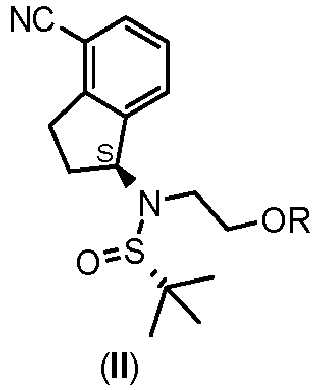
- the compound of general formula ( III ) used in the process according to the invention in which formula R represents a protective group that may be removed in an acidic medium serving for the temporary protection of the hydroxyl group, preferably a substituted methyl ether type group, more preferably a methoxymethyl, benzyloxymethyl, p-methoxybenzyloxymethyl, or [(3,4-dimethoxybenzyl)oxy]methyl group, a tetrahydropyranyl group, or a substituted ethyl ether type group, preferably an ethoxyethyl, or 1-[2-(trimethylsilyl)ethoxy]ethyl group, a silyl type group, preferably a trimethylsilyl, triisopropylsilyl, t-butyldimethylsilyl or triphenylsilyl group, most preferably a t-butyldimethylsilyl group, is produced so that the compound of general formula ( II ), in which R
- the compound of formula ( II ) used in the process according to the invention is produced by reacting the compound of formula ( VI ) in an organic solvent with a base, then reacting it with the compound of formula ( VII ), in which formula R represents the same as the above, and X represents Cl, Br or I. Most preferably (2-bromoethoxy)- t -butyldimethylsilane is used as compound ( VII ).
- an amide type solvent more preferably dimethylformamide, an ether type solvent, preferably tetrahydrofuran, acetonitrile or a mixture of the solvents listed, most preferably dimethylformamide is used as the solvent in the reaction of compound of formula ( II ) and the compound of general formula ( VII ).
- the derivative of general formula ( III ) may also be produced from the compound of formula ( VI ) so that the compound of general formula ( II ) is not isolated.
- the process preferably involves that when producing the compound of general formula ( II ), after the reaction has completed, when the compound of formula ( VI ) has run out, the reaction mixture containing the DMF and the surplus alkylating agent is extracted with a mixture of water and an ester type solvent, preferably water and ethyl acetate and the oil obtained by evaporating the ethyl acetate phase is, without further purification, dissolved in an alcohol type solvent, preferably a 1 to 4 carbon atom alcohol, most preferably ethanol and then reacted with hydroxylamine in the presence of a base.
- a mixture of water and ice is used as the water for the extraction.
- the process involves that (2-bromoethoxy)-t-butyldimethylsilane is used as the alkylating agent.
- Sodium hydride is used as the base during the alkylating process.
- the obtained compound of formula ( II/A ) is dissolved in ethanol and reacted with hydroxylamine hydrochloride in the presence of triethylamine.
- the object of the disclosure also relates to a process for the purification of the ozanimod salts of formula ( I ), preferably hydrochloride salt in such a way that ozanimod of formula ( I ) is isolated from the reaction mixture as a base, or its acid addition salt, preferably hydrochloride salt, is transformed into a base, if necessary the base is recrystallized, then the purified base obtained is crystalized, and if necessary transformed into an acid addition salt, preferably into hydrochloride salt by using hydrochloric acid.
- a halogenated hydrocarbon, preferably dichloromethane, an aromatic solvent, most preferably toluene, or a nitrile type solvent, preferably acetonitrile is used as the solvent.
- the ozanimod base Form I is as follows [°2 ⁇ ⁇ 0.2 ⁇ ]: 5.77; 11.56; 15.36; 19.54; 27.00, preferably [°2 ⁇ 0.2 ⁇ ]: 5.77; 11.56; 12.98; 13.38; 13.90; 15.36; 16.23; 19.54; 25.37; 27.00, even more preferably [°2 ⁇ 0.2 ⁇ ]: 2.86; 5.77; 8.66; 10.77; 10.87; 11.14; 11.56; 12,20; 12.98; 13.38; 13.90; 14.59; 15.36; 16.23; 17.19; 17.43; 17.73; 18.44; 18.94; 19.54; 20.28; 20.41; 21.10; 21.65; 21.87; 22.10; 22.43; 22.79; 23.36; 23.75; 23.95; 24.
- Figure 3 shows the x-ray powder diffractogram of the Form I polymorph ozanimod base according to the invention.
- the Form I polymorph ozanimod base according to the disclosure has sufficient stability for even long-term storage, or as raw material for a pharmaceutical preparation. According to our tests the humidity of the air does not influence the stability of the crystals, their polymorphic nature does not change, so in the case the product is used as an active substance the polymorphic nature, and so the dissolution and absorption conditions, biological efficacy are not expected to change.
- the Form I polymorph ozanimod base according to the disclosure may be most preferably produced by suspending ozanimod in acetonitrile, then by heating the suspension obtained the ozanimod base is dissolved, any solid contaminants are optionally filtered out, if necessary the solution is allowed to settle, then the solution obtained is cooled and the precipitated crystals are preferably redissolved by repeated heating, then after cooling the solution once again the precipitated ozanimod Form I polymorph is filtered, and optionally washed with cold acetonitrile.
- the monitoring of the reactions disclosed in the invention and the testing of the intermediate products is performed using flash chromatography, with a Shimadzu LC-MS device.
- the samples were dissolved in a water-acetonitrile 80:20 mixture, and tested using a neutral (in an ammonium-acetate buffer solution), and an acidic (in a formic acid solution) method.
- the compound of formula ( VI ) is transformed into the compound of formula ( II ) in the presence of a base, in which R represents that given above.
- the compound of general formula ( II ) is reacted with hydroxylamine, preferably hydroxylamine hydrochloride in the presence of a base, then the compound of general formula ( II ) obtained is reacted with the compound of formula ( VIII ), and the compounds of general formula ( IV ) and ( V ) formed under the reaction conditions, or a mixture of these are transformed into ozanimod hydrochloride of formula ( IA ) by the cleaving of the protective groups.
- the synthesis pathway according to the invention is significantly more efficient, and from the point of view of industrial implementation it is more preferably than the processes in the literature for the production of the ozanimod active substance.
- the replacement of the ( S )-2-methylpropane-2-sulfinyl group for the t-butoxycarbonyl group has been rendered unnecessary in the process, thereby making the synthesis pathway significantly shorter.
- the yield of the process is significantly greater, and the energy demand drops.
- Another advantage of the invention is that corresponding diastereomer contaminants are also formed from the undesired diastereomer formed during the reduction of the Schiff base ( B ) in the course of the following synthesis steps, the purification and analytical testing of which is significantly simpler than that of the known enantiomer mixtures known of from the processes in the literature.
- a further advantage of the process is that if the compounds of formulas ( I ) and ( IA ) are produced from the compound of general formula ( III ), preferably from the compound of formula ( III/A ) and the compound of formula ( VIII ), then it is surprising to experience that by using an aromatic solvent, preferably toluene or xylene, most preferably toluene the ring closure and the removal of the protective groups may be performed in the same reaction mixture without changing the solvent, which, on the one part, reduces costs, and, on the other part, significantly reduces the load on the environment as well.
- an aromatic solvent preferably toluene or xylene
- Another advantage of the invention is that the use of the base according to the invention, preferably the Form I polymorphic base, makes it possible to extract a product of a purity that is appropriate for use as a medicine without any further purification steps being necessary.
- the chromatographic purification method used The extraction of the individual components from the mixtures was performed using a column chromatography method, with a Teledyne ISCO CombiFlash Rf chromatograph, in RediSep Rf columns with a hexane-ethyl acetate eluent mixture, gradient used: 0-140 min. hexane: ethyl-acetate 100:0-34:66; 140-160 min. 34:66-0:100.
- the 1 H NMR spectra were recorded using a Varian Gemini 200, Bruker Avance III, and an Inova 500 spectrometer in CDCl 3 or DMSO- d 6 solvents, using the tetramethylsilane (TMS) internal standard.
- TMS tetramethylsilane
- the chemical displacements ( ⁇ ) were given in parts per million (ppm) units, and the coupling constants (J) were given in hertz (Hz).
- At least 95% pure standards were made of the diastereomer contaminants using similar processes to those used when producing the ozanimod intermediates.
- the monitoring of the reactions and the testing of the intermediates were performed using a flash chromatography method, on a Shimadzu LC-MS device.
- the samples were dissolved in a water-acetonitrile 80:20 mixture, and tested using a neutral (in an ammonium-acetate buffer solution), and an acidic (in a formic acid solution) method.
- X-ray powder diffraction measurement conditions Device: PANalytical Empyrean x-ray powder diffractometer Measurement alignment: Transmission X-ray tube Type: Empyrean long fine focussing, high resolution tube Anode: Cu Wavelength: K ⁇ (1.541874 ⁇ ) Focus: line focus Source-side optical elements Divergence slit: Fixed slit 1/2 ° Mirror: Focussing elliptical mirror Seller slit: 0.04 rad Diffusion inhibitor slit: Fixed slit 1/2 ° Diffracted side optical elements Diffusion inhibitor slit: Programmable slit in fixed mode: 1/2 ° Soller slit: 0.04 rad Sample table Type: Reflection-transmission, with rotatable sample holders Sample rotation speed: 1 rotation/second Direct beam catcher ("beam knife”): Transmission Detector Type: PIXcel 3D 1 ⁇ 1 area detector Operation mode: Scanning line detector (1D) operation mode Active detector window
- the IVA compound comes at a retention time of RT: 6.31 min, and the V compound at a retention time RT: 4.24 min.
- V sample purified with chromatographic process: according to the method given in the descriptive part, the retention time of the V compound: 145 min.
- the gross yield of the synthesis performed without extracting the intermediate products ( B ), ( IIA ), ( IVA ) and ( V ) calculated for the initial material 1-oxo-2,3-dihydro-1H-indene-4-carbonitrile ( A ) is 26.6%.
- the solution obtained is heated to 90 °C, and then stirred at this temperature until the compound of formula ( III/A ), the precursor of compound of formula ( IV/A ) and the precursor of compound of formula ( V ) can be detected in the reaction mixture on the basis of LC-MS.
- the reaction mixture is allowed to cool to room temperature.
- the phases are then separated, and the organic phase is washed with 2 ⁇ 70 ml saturated NaCl solution.
- the toluene phase is heated to 85 °C, and during intensive stirring 10.0 ml (4 equiv., 121.2 mmol) 37% aqueous hydrochloric acid solution is added drop by drop.
- the temperature increases to 90 °C, and within a short time the crystals start to precipitate.
- Stirring is continued at this temperature until the compound of formula ( IV/A ) (M+H: 623), the compound of formula ( V ) (M+H: 509), and the O-silylated ozanimod derivative (M+H: 519) can be detected on the basis of LC-MS.
- the reaction mixture is left to cool to room temperature while being stirred, then cooled to 0-5 °C with the stirring being continued for 1 hour.
- the crystalline product is filtered, and washed with 3 ⁇ 10 ml cold toluene. Thereby producing 8.5 g (63.6%) ozanimod hydrochloride.
- the production of the Form I polymorph of ozanimod base 3.60 g raw ozanimod hydrochloride is suspended in a mixture of 58 ml dichloromethane and 35 ml water, while stirring 9 ml 2M NaHCOs solution is added drop by drop. The phases are separated, and the organic phase is evaporated until dry.
- the 1.85 g raw ozanimod base obtained in this way is suspended in 36 ml acetonitrile. The mixture is kept at boiling point until a homogenous solution is obtained. The solution is boiled for 5 minutes with 0.2 g active carbon, then filtered. The crystal mass precipitating from the filtrate is heated back up to the boiling point of the solvent, then the solution obtained in this way is left to cool to room temperature.
- the characteristic x-ray powder diffractogram of this corresponds to figure 3 .
- the ozanimod base Form I polymorph is slightly hygroscopic.
- the mass of the sample increased by 0.6% under 95% relative humidity.
- the sorption isotherm of the first cycle is shown in figure 4 .
- the sorption isotherm did not change.
- the unchanged nature of the crystal structure is proved by the x-ray power diffractogram shown in figure 5 , which is the same as the diffractogram of the initial crystals shown in figure 3 . From this it can be seen that the ozanimod base Form I polymorph form is stable at 25 °C, and not sensitive to humidity.
Landscapes
- Chemical & Material Sciences (AREA)
- Organic Chemistry (AREA)
- Health & Medical Sciences (AREA)
- Engineering & Computer Science (AREA)
- Bioinformatics & Cheminformatics (AREA)
- General Chemical & Material Sciences (AREA)
- Nuclear Medicine, Radiotherapy & Molecular Imaging (AREA)
- Veterinary Medicine (AREA)
- Neurology (AREA)
- Chemical Kinetics & Catalysis (AREA)
- Public Health (AREA)
- Medicinal Chemistry (AREA)
- Neurosurgery (AREA)
- Biomedical Technology (AREA)
- Pharmacology & Pharmacy (AREA)
- Life Sciences & Earth Sciences (AREA)
- Animal Behavior & Ethology (AREA)
- General Health & Medical Sciences (AREA)
- Hospice & Palliative Care (AREA)
- Psychiatry (AREA)
- Organic Low-Molecular-Weight Compounds And Preparation Thereof (AREA)
Description
- Our invention relates to a process for the production of

- Ozanimod is a second-generation sphingosine-1-phosphate (S1P) receptor modulator, which is being developed for the treatment of multiple sclerosis, ulcerative colitis and Crohn's disease. Ozanimod is an optically active substance, the absolute configuration of its asymmetric carbon atom is S.
- International patent application number
WO 2009151529 discloses the production of a racemic compound that corresponds to ozanimod (figure 1 ). As the ozanimod active substance is an optically active compound, the racemic mixture should be resolved for its production. Patent application numberWO 2009151529 does not provide a solution for this.
- International patent application number
WO 2011060392 discloses the production of ozanimod by chiral synthesis (figure 2 ):
- During the synthesis 1-oxo-2,3-dihydro-1H-indene-4-carbonitrile (A) is reacted with the optically active (S)-2-methylpropane-2-sulfinamide, then the C=N bond of the Schiff base (B) formed is reduced with sodium borohydride in this way obtaining the formula (VI) key intermediate. The novel asymmetric carbon atom formed during the reaction, as a consequence of the asymmetric induction created by the previously introduced chiral group, mainly has an S absolute configuration. Following this the (S)-2-methylpropane-2-sulfinyl group is removed and the protecting group t-butoxycarbonyl (Boc) is introduced to the primary amine obtained. The (D) amide produced in this way is alkylated with (2-bromoethoxy)-t-butyldimethylsilane. Following hydroxylamine is added to the nitrile group, then the 1,2,4-oxadiazole ring is formed using the appropriate benzoic acid derivative. During this operation the t-butyldimethylsilyl group partially cleaves. Then ozanimod is obtained by removing the still remaining t-butyldimethylsilyl group and the Boc protective group from the mixture obtained in this way.
- A similar procedure is described in the specification with publication number
WO 2016164180 , which discloses the production of deuterated derivatives. - In other words during the process described in patent applications numbers
WO 2011060392 andWO 2016164180 the chiral centre is established in the initial phase of the synthesis. Asymmetrical induction occurs during the sodium borohydride reduction, and so compound (VI) is created in the large majority.
- On the other hand selectivity is not necessarily complete and the other diastereomer is expected to also appear as a contaminant. This was worded in paragraph 263 of patent application publication number
WO 2011060392 as follows: the presented process results in a final product enriched with the desired enantiomer. Neither patent application publication numberWO 2011060392 , norWO 2016164180 includes an example which gives the enantiomer purity of the intermediate (VI) or teaching on its purification. In the course of the embodiments, in both cases, the oily or solid product obtained following reduction is used in the following steps of the synthesis without purification. In the syntheses according to documentsWO 2011060392 andWO 2016164180 the following step removes the sulfinyl group and the synthesis is continued using the obtained "enantiomer rich" but not pure formula (C) amine. - During the approval procedure of active substances in the pharmaceutical industry they have to comply with increasingly strict requirements in terms of all their physical and chemical characteristics. Therefore enantiomer purity is also of outstanding importance in the case of chiral active substances. It is obvious for a person skilled in the art that in the phase of the synthesis following this the enantiomer contaminants of the individual phase products can only be detected using chiral chromatography, and if the enantiomer purity of the individual intermediate products or of the ozanimod final product is insufficient, they can only be purified by interposing further purification steps, such as chiral chromatography or a process based on diastereomer salt formation. Chiral chromatography is only economical in the case of the purification of smaller amounts, and purification via diastereomer salts may demand the use of expensive resolving agents, and/or multiple recrystallization steps, which may increase the length of the outlined process with further operation steps.
- The objective of the invention is to overcome the disadvantages of the known processes and to elaborate a process for the production of the ozanimod of formula (I) and its salts that can be implemented simply and economically at industrial scales, with fewer synthesis steps.
- The objective was achieved by elaborating a synthesis pathway in which the tert-butylsulfinyl group is maintained on the amino group on the chiral carbon atom of the intermediates until the final step of the synthesis, in this way making the introduction and removal of the Boc protective group unnecessary and the side-products with unwanted stereochemistry created as a result of incomplete chiral induction of the tert-butylsulfinyl exhibited during the borohydride reduction appear in the following steps of the synthesis pathway not as enantiomer but as diastereomer contaminants, due to which they are easier to analyse and it is easier to remove them through purification operations.
- The essence of the invention is a novel process for the production of

the protective group/protective groups that may be removed in an acidic medium are cleaved in an organic solvent - a.)

- b.)

- c.)
from the compounds in a mixture of any ratio of the compounds of general formula (IV) and formula (V), and the formula (I) ozanimod obtained in this way is optionally transformed into an acid addition salt. Preferably the formula (I) ozanimod is transformed into a salt simultaneously with the removal of the protective groups. Most preferably the ozanimod is transformed into
- According to one of the preferable embodiments of our invention substituted methyl ether type groups, preferably a methoxymethyl, benzyloxymethyl, p-methoxybenzyloxymethyl, or [(3,4-dimethoxybenzyl)oxy]methyl group, a tetrahydropyranyl group, or a substituted ethyl ether type group, preferably an ethoxyethyl, or 1-[2-(trimethylsilyl)ethoxy]ethyl group, a silyl type group, preferably a trimethylsilyl, triisopropylsilyl, t-butyldimethylsilyl or triphenylsilyl group is used as the protective group that may be removed in an acidic medium serving for the temporary protection of the hydroxyl group in the compound of general formula (IV).
- According to another preferable embodiment of our invention a mixture of compound of general formula (IV) and formula (V) is used in the reaction.
- An ether type solvent, such as dioxane, a 1 to 4 carbon atom alcohol, preferably 2-propanol, ethanol or methanol, most preferably 2-propanol, or an aromatic solvent, preferably toluene or xylene as the aromatic solvent, more preferably toluene is used as the organic solvent.
- According to a preferable embodiment of our invention to cleave the protective group that may be removed in an acidic medium serving for the temporary protection of the hydroxyl group acid is used, preferably hydrochloric acid, hydrogen bromide, hydrogen iodide, hydrogen fluoride (HF), sulphuric acid, nitric acid, or their salts, tetrabutylammonium fluoride (TBAF), a mixture of TBAF and acetic acid, an aqueous mixture of HF and THF, or 1 M aqueous HIO4 dissolved in THF.
- It was surprising to find that if the (S)-2-methylpropane-2-sulfinyl group is not removed from the compound of formula (VI), it operates as a suitable protective group during the further reaction steps. Therefore, throughout the entire synthesis, in addition to the desired (S,S) diastereomer, the undesired (R) configuration 1H-indene derivative is present in the form of the (S,R) diastereomer. In general, the different physical characteristics of diastereomers make it possible to separate them via crystallization. As a consequence of the different physical properties (solubility, adsorption characteristics) they may be detected and separated from each other without chiral chromatography. Therefore, there is no need to remove the (S)-2-methylpropane-2-sulfinyl group and introduce a t-butoxycarbonyl (Boc) protective group in its place. Through this, the synthesis pathway leading to ozanimod is significantly shortened.
- Our invention then is a process for the production of ozanimod of formula (I) and its acid addition salts, characterised by that the protective group or protective groups that may be removed in an acidic medium are removed in an organic solvent


- According to a preferable embodiment of our invention substituted methyl ether type compounds, preferably a methoxymethyl, benzyloxymethyl, p-methoxybenzyloxymethyl, or [(3,4-dimethoxybenzyl)oxy]methyl group, a tetrahydropyranyl group, or a substituted ethyl ether type group, preferably an ethoxyethyl, or 1-[2-(trimethylsilyl)ethoxy]ethyl group, a silyl type group, preferably a trimethylsilyl, triisopropylsilyl, t-butyldimethylsilyl or triphenylsilyl group is used as the protective group that may be removed in an acidic medium serving for the temporary protection of the hydroxyl group in the compound of general formula (IV). According to one of the preferable embodiments of our invention a mixture of compound of general formula (IV) and formula (V) is used in the process. An ether type solvent, preferably dioxane, a 1 to 4 carbon atom alcohol, preferably 2-propanol, ethanol or methanol, most preferably 2-propanol, or an aromatic solvent, preferably toluene or xylene, more preferably toluene is used as the organic solvent in the process. The acid used to implement the process is an inorganic acid such as hydrochloric acid, hydrogen bromide, hydrogen iodide, hydrogen fluoride (HF), or their salts: tetrabutylammonium fluoride (TBAF), a mixture of TBAF and acetic acid, aqueous HF and THF, 1 M aqueous HIO4 in THF, etc. (see Peter G. M. Wuts; Theodora W. Greene, Greene's protective groups in Organic Synthesis, Fourth Edition, Wiley Interscience, 2007), preferably hydrochloric acid. According to a preferable embodiment of the invention, the acid is used in a concentrated aqueous solution, in a mixture of organic solvent and water or dissolved in an organic solvent, preferably using dioxane, 2-propanol, ethanol or methanol as the solvent.
- It was surprising to find that if the (S)-2-methylpropane-2-sulfinyl group is not removed from the compound of formula (VI), it operates as a suitable protective group during the further reaction steps. Therefore, there is no need to remove the (S)-2-methylpropane-2-sulfinyl group and introduce Boc protective group in its place. Through this the synthesis pathway leading to ozanimod is significantly shortened.
- In the process according to the invention the production of the compound of general formula (IV), in which R represents a hydrogen or a protective group that may be removed in an acidic medium serving for the temporary protection of the hydroxyl group, and the compound of formula (V) or mixture thereof is prepared so that
- a.) the formula


- b.) the obtained compound of general formula (IV) and the compound of formula (V) are isolated from each other.
- The amounts and proportions of the compound of general formula (IV) and of the compound of formula (V) vary. These proportions depend on the temperature of the reaction and the reaction duration. However, as in the following step both compounds are transformed into the ozanimod of formula (I), there is no special significance to these proportions from the point of view of the invention. Both components of the mixture are transformed into ozanimod acid addition salt through the cleaving of the protective group/groups, depending on the acid used.
- According to a preferable embodiment of the invention the 1,2,4-oxadiazole ring is closed by activating the formula (VIII) 3-cyano-4-(i-propoxy)benzoic acid in an organic solvent, then reacted with the compound of general formula (III). Preferably amide, aromatic, ether, ester, nitrile or sulfoxide type solvents are used as the organic solvent, most preferably dimethylformamide is used as the amide type solvent, preferably xylene or toluene is used as the aromatic solvent, most preferably toluene, most preferably tetrahydrofuran or dioxane is used as the ether type solvent, acetonitrile is used as the nitrile type solvent, dimethyl sulfoxide is used as the sulfoxide type solvent, and preferably toluene or ester type solvents are used, most preferably ethyl acetate is used. In the process according to the invention the benzoic acid of formula (VIII) is preferably activated in the presence of an organic base, more preferably in the presence of DIPEA (diisopropylethylamine), TEA (triethylamine) with disubstituted carbodiimide, preferably with dicyclohexylcarbodiimide, 1-ethyl-3-(3-dimethylaminopropyl)carbodiimide, or with carbonyl-diimidazole in the presence of hydroxybenzotriazole or with ethyl cyano glyoxylate-2-oxime, or with propanephosphonic acid anhydride (T3P). Most preferably it is activated with propanephosphonic acid anhydride (T3P).
- Under the conditions used during the production of the 1,2,4-oxadiazole ring, the protective group R, depending on the protective group selected and the conditions used, may partially or completely cleave. Therefore, depending on the conditions, after ring closure, either a product is obtained in which the protective group R remains unchanged (compound of general formula IV), or the protective group is cleaved and the compound of formula (V) is formed. If the protective group is only partially cleaved, a mixture of the above is obtained. The protective groups still on them are cleaved from the product obtained in this way, or from the compounds forming the mixture, which mixture consists of the component of the compound of general formula (IV) and of the component of the compound of formula (V) and in this way the acid addition salt of ozanimod is obtained directly. So if the protective group R partially cleaves during ring closure it is possible to proceed by leaving this fact out of consideration and subject the mixture to acidic hydrolysis, but it is also possible to separate the compound of general formula (IV) from compound of formula (V), and cleave the protective groups separately after separation.
- According to a very preferable embodiment of the invention there is no need to isolate the intermediates with formulas (IV) or (V) or a mixture of these. It is possible to proceed by reacting the compound of general formula (III) in a solvent not miscible with water with the compound of formula (VIII) in the presence of a base, then when ring closure is complete, and the reaction mixture contains the compound of formula (IV) or (V), or a mixture of these in any proportion and optionally ozanimod base, the reaction mixture is washed with an aqueous base, preferably with sodium or potassium hydrocarbonate solution and salt solution, then the toluene solution obtained is reacted with concentrated hydrochloric acid solution, as a result of which the protective groups are cleaved and the ozanimod hydrochloride precipitates in the form of crystals.
- If necessary the ozanimod acid addition salt obtained in this way, e.g. ozanimod hydrochloride, is transformed into a base and recrystallized. The advantage of this is that the crystalline base obtained or the salt obtained from it by using hydrochloric acid has greater chemical purity than the raw ozanimod hydrochloride. In this case the process involves transforming the raw ozanimod hydrochloride into a base by adding preferably an inorganic base in an organic solvent, or in a mixture of an organic solvent and water, then by separating the ozanimod base from the organic phase. The base obtained in this way is dissolved in an organic solvent, and separated using hydrochloric acid, preferably 37% aqueous hydrochloric acid. A halogenated hydrocarbon, preferably dichloromethane, aromatic solvent, preferably toluene or a nitrile type solvent, preferably acetonitrile is used as the solvent. Alkaline metal hydroxides, carbonates or hydrocarbonates, preferably potassium or sodium hydroxides, carbonates or hydrogen carbonates may be used as the base.
- Therefore, according to a very preferable embodiment of the invention the compound of general formula (III), preferably the compound with formula

- The compound of general formula (III), preferably the compound of formula (III/A) and the compound of formula (VIII), the base and the activating reagents are combined at a temperature between 20-30 °C, preferably between 20-25 °C, then the temperature of the reaction mixture is raised preferably to between 60 °C and the boiling point of the solvent, preferably to between 65-100 °C, most preferably to between 80-85 °C and maintained at that temperature until the reaction is complete, then the reaction mixture is cooled and then, if necessary, washed with an aqueous alkali, preferably with sodium or potassium hydrocarbonate solution, and, if necessary, with saturated sodium chloride solution, then the organic phase is reacted with concentrated hydrochloric acid solution (37%) preferably at a temperature of between 60 °C and the boiling point of the solvent, preferably between 65-85 °C, most preferably between 70-75 °C, then following this the reaction mixture is cooled, the precipitated crystals are filtered out, dried and optionally transformed into a base. In a preferable embodiment of the invention the ozanimod is precipitated in the form of hydrochloride salt, and transformed into crystalline ozanimod base.
- Transformation into a base and the recrystallization of the base, if this is necessary, significantly increase the purity of the active substance. In other words transforming the hydrochloride salt into a base is a very preferable method for the purification of the active substance.
- According to another embodiment of the invention, after being recrystallized from acetonitrile the very pure and stable Form I polymorph form of ozanimod is obtained.
- The compound of general formula (III) used in the process according to the invention, in which formula R represents a protective group that may be removed in an acidic medium serving for the temporary protection of the hydroxyl group, preferably a substituted methyl ether type group, more preferably a methoxymethyl, benzyloxymethyl, p-methoxybenzyloxymethyl, or [(3,4-dimethoxybenzyl)oxy]methyl group, a tetrahydropyranyl group, or a substituted ethyl ether type group, preferably an ethoxyethyl, or 1-[2-(trimethylsilyl)ethoxy]ethyl group, a silyl type group, preferably a trimethylsilyl, triisopropylsilyl, t-butyldimethylsilyl or triphenylsilyl group, most preferably a t-butyldimethylsilyl group, is produced so that
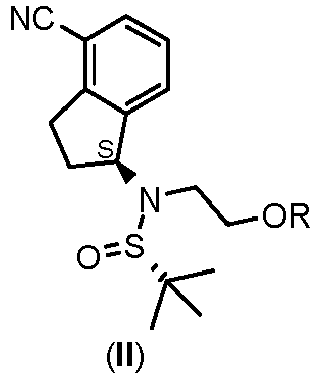
- The compound of formula (II) used in the process according to the invention is produced by reacting


- According to a very preferable embodiment of the invention the derivative of general formula (III) may also be produced from the compound of formula (VI) so that the compound of general formula (II) is not isolated.

- In this case the process preferably involves that when producing the compound of general formula (II), after the reaction has completed, when the compound of formula (VI) has run out, the reaction mixture containing the DMF and the surplus alkylating agent is extracted with a mixture of water and an ester type solvent, preferably water and ethyl acetate and the oil obtained by evaporating the ethyl acetate phase is, without further purification, dissolved in an alcohol type solvent, preferably a 1 to 4 carbon atom alcohol, most preferably ethanol and then reacted with hydroxylamine in the presence of a base. A mixture of water and ice is used as the water for the extraction.
- Most preferably the process involves that (2-bromoethoxy)-t-butyldimethylsilane is used as the alkylating agent. Sodium hydride is used as the base during the alkylating process. The obtained

- Therefore, according to a very preferably embodiment of the process according to the invention mixture of a compound of general formula (IV), in which R represents a t-butyldimethylsilyl group as a protective group that may be removed in an acidic medium serving for the temporary protection of the hydroxyl group, and the compound of formula (V) are reacted in a 1 to 4 carbon atom alcohol, preferably 2-propanol, or in an aromatic solvent, preferably toluene with an inorganic acid, preferably hydrochloric acid and the ozanimod obtained is optionally transformed into a salt, preferably hydrochloride salt.
- The compound of general formula (IV) used in the process, in which R represents a t-butyldimethylsilyl group, or the compound of formula (V) or a mixture of these is produced so that
- a.)


- b.) The obtained
- c.) the obtained

- The object of the disclosure also relates to a process for the purification of the ozanimod salts of formula (I), preferably hydrochloride salt in such a way that ozanimod of formula (I) is isolated from the reaction mixture as a base, or its acid addition salt, preferably hydrochloride salt, is transformed into a base, if necessary the base is recrystallized, then the purified base obtained is crystalized, and if necessary transformed into an acid addition salt, preferably into hydrochloride salt by using hydrochloric acid. A halogenated hydrocarbon, preferably dichloromethane, an aromatic solvent, most preferably toluene, or a nitrile type solvent, preferably acetonitrile is used as the solvent.
- By using acetonitrile, in an exceptionally preferable way a novel crystalline polymorph form of ozanimod is precipitated. The positions of the characteristic x-ray powder diffraction peaks of the novel crystalline polymorphic form, the ozanimod base Form I are as follows [°2θ ±0.2θ]: 5.77; 11.56; 15.36; 19.54; 27.00, preferably [°2θ±0.2θ]: 5.77; 11.56; 12.98; 13.38; 13.90; 15.36; 16.23; 19.54; 25.37; 27.00, even more preferably [°2θ±0.2θ]: 2.86; 5.77; 8.66; 10.77; 10.87; 11.14; 11.56; 12,20; 12.98; 13.38; 13.90; 14.59; 15.36; 16.23; 17.19; 17.43; 17.73; 18.44; 18.94; 19.54; 20.28; 20.41; 21.10; 21.65; 21.87; 22.10; 22.43; 22.79; 23.36; 23.75; 23.95; 24.62; 25.37; 26.16; 27.00; 27.90; 28.86; 29.20; 29.85; 31.00; 31.62; 32.85; 33.13; 34.33.
- The characteristic x-ray powder diffraction peaks are summarised in the following table:
Peak 2θ (°) d (Å) Relative intensity (%) Peak 2θ (°) d (Å) Relative intensity (%) 1 2.86 30.90 28 21 20.28 4.38 8 2 5.77 15.32 100 22 20.41 4.35 2 3 8.66 10.22 21 23 21.10 4.21 4 4 10.77 8.22 13 24 21.65 4.11 24 5 10.87 8.14 8 25 21.87 4.07 6 6 11.14 7.94 14 26 22.10 4.02 11 7 11.56 7.65 28 27 22.43 3.97 19 8 12.20 7.25 9 28 22.79 3.90 6 9 12.98 6.82 42 29 23.36 3.81 31 10 13.38 6.62 97 30 23.75 3.75 11 11 13.90 6.37 34 31 23.95 3.72 16 12 14.59 6.07 24 32 24.62 3.62 61 13 15.36 5.77 14 33 25.37 3.51 55 14 16.23 5.46 45 34 26.16 3.41 28 15 17.19 5.16 12 35 27.00 3.30 41 16 17.43 5.09 4 36 27.90 3.20 26 17 17.73 5.00 9 37 28.86 3.09 12 18 18.44 4.81 6 38 29.20 3.06 2 19 18.94 4.69 13 39 29.85 2.99 1 20 19.54 4.54 37 40 31.00 2.89 2 -
Figure 3 shows the x-ray powder diffractogram of the Form I polymorph ozanimod base according to the invention. - The Form I polymorph ozanimod base according to the disclosure has sufficient stability for even long-term storage, or as raw material for a pharmaceutical preparation. According to our tests the humidity of the air does not influence the stability of the crystals, their polymorphic nature does not change, so in the case the product is used as an active substance the polymorphic nature, and so the dissolution and absorption conditions, biological efficacy are not expected to change.
- The Form I polymorph ozanimod base according to the disclosure may be most preferably produced by suspending ozanimod in acetonitrile, then by heating the suspension obtained the ozanimod base is dissolved, any solid contaminants are optionally filtered out, if necessary the solution is allowed to settle, then the solution obtained is cooled and the precipitated crystals are preferably redissolved by repeated heating, then after cooling the solution once again the precipitated ozanimod Form I polymorph is filtered, and optionally washed with cold acetonitrile.
- The monitoring of the reactions disclosed in the invention and the testing of the intermediate products is performed using flash chromatography, with a Shimadzu LC-MS device. The samples were dissolved in a water-acetonitrile 80:20 mixture, and tested using a neutral (in an ammonium-acetate buffer solution), and an acidic (in a formic acid solution) method.
- The process according to the invention is summarised in the following figure:

- According to the most general form of implementation of the invention, the compound of formula (VI) is transformed into the compound of formula (II) in the presence of a base, in which R represents that given above. Following this, the compound of general formula (II) is reacted with hydroxylamine, preferably hydroxylamine hydrochloride in the presence of a base, then the compound of general formula (II) obtained is reacted with the compound of formula (VIII), and the compounds of general formula (IV) and (V) formed under the reaction conditions, or a mixture of these are transformed into ozanimod hydrochloride of formula (IA) by the cleaving of the protective groups.
- Therefore the object of the invention relates to the process presented in
figure 3 overall and to each step as well, as well as to the following novel intermediates: - Compound of general formula (IV), in which R represents a protective group that may be removed in an acidic medium serving for the temporary protection of the hydroxyl group, preferably R is a substituted methyl ether type compound, such as a methoxymethyl, benzyloxymethyl, p-methoxybenzyloxymethyl, [(3,4-dimethoxybenzyl)oxy]methyl group, a tetrahydropyranyl group, or a substituted ethyl ether type group, such as an ethoxyethyl, or 1-[2-(trimethylsilyl)ethoxy]ethyl group, a silyl type group, such as a trimethylsilyl, triisopropylsilyl, t-butyldimethylsilyl or triphenylsilyl group, most preferably a t-butyldimethylsilyl group.
- Compound of general formula (II), in which R represents a protective group that may be removed in an acidic medium serving for the temporary protection of the hydroxyl group, preferably a substituted methyl ether type group, more preferably a methoxymethyl, benzyloxymethyl, p-methoxybenzyloxymethyl, or [(3,4-dimethoxybenzyl)oxy]methyl group, a tetrahydropyranyl group, or a substituted ethyl ether type group, preferably an ethoxyethyl, a 1-[2-(trimethylsilyl)ethoxy]ethyl group, a silyl type group, preferably a trimethylsilyl, triisopropylsilyl, t-butyldimethylsilyl or triphenylsilyl group, most preferably a t-butyldimethylsilyl group.
- The compound of formula

- The compound of formula

- The compound of general formula

- The compound of formula (IIIA)

- The compound of formula (IV):

- The compound of formula

- The compound of formula

- The synthesis pathway according to the invention is significantly more efficient, and from the point of view of industrial implementation it is more preferably than the processes in the literature for the production of the ozanimod active substance. The replacement of the (S)-2-methylpropane-2-sulfinyl group for the t-butoxycarbonyl group has been rendered unnecessary in the process, thereby making the synthesis pathway significantly shorter.
- Furthermore by using the process according to the invention, the yield of the process is significantly greater, and the energy demand drops.
- Another advantage of the invention is that corresponding diastereomer contaminants are also formed from the undesired diastereomer formed during the reduction of the Schiff base (B) in the course of the following synthesis steps, the purification and analytical testing of which is significantly simpler than that of the known enantiomer mixtures known of from the processes in the literature.
- A further advantage of the process is that if the compounds of formulas (I) and (IA) are produced from the compound of general formula (III), preferably from the compound of formula (III/A) and the compound of formula (VIII), then it is surprising to experience that by using an aromatic solvent, preferably toluene or xylene, most preferably toluene the ring closure and the removal of the protective groups may be performed in the same reaction mixture without changing the solvent, which, on the one part, reduces costs, and, on the other part, significantly reduces the load on the environment as well.
- Another advantage of the invention is that the use of the base according to the invention, preferably the Form I polymorphic base, makes it possible to extract a product of a purity that is appropriate for use as a medicine without any further purification steps being necessary.
-
-
Figure 1 and2 : the formulas of the intermediates and reagents of the present process -
Figure 3 : The x-ray powder diffractogram of the ozanimod base Form I form -
Figure 4 : The water sorption isotherm of the ozanimod base Form I form at 25 °C -
Figure 5 : The x-ray powder diffractogram of the ozanimod base Form I form after two DVS cycles (see example 6). - The invention is henceforward illustrated with the following examples without limiting the scope of protection to the examples.
- The chromatographic purification method used: The extraction of the individual components from the mixtures was performed using a column chromatography method, with a Teledyne ISCO CombiFlash Rf chromatograph, in RediSep Rf columns with a hexane-ethyl acetate eluent mixture, gradient used: 0-140 min. hexane: ethyl-acetate 100:0-34:66; 140-160 min. 34:66-0:100.
- The 1H NMR spectra were recorded using a
Varian Gemini 200, Bruker Avance III, and anInova 500 spectrometer in CDCl3 or DMSO-d 6 solvents, using the tetramethylsilane (TMS) internal standard. The chemical displacements (δ) were given in parts per million (ppm) units, and the coupling constants (J) were given in hertz (Hz). - At least 95% pure standards were made of the diastereomer contaminants using similar processes to those used when producing the ozanimod intermediates. The monitoring of the reactions and the testing of the intermediates were performed using a flash chromatography method, on a Shimadzu LC-MS device. The samples were dissolved in a water-acetonitrile 80:20 mixture, and tested using a neutral (in an ammonium-acetate buffer solution), and an acidic (in a formic acid solution) method.
- The x-ray powder diffraction measurements were performed as follows:
X-ray powder diffraction measurement conditionsDevice: PANalytical Empyrean x-ray powder diffractometer Measurement alignment: Transmission
X-ray tubeType: Empyrean long fine focussing, high resolution tube Anode: Cu Wavelength: Kα (1.541874 Å) Focus: line focus
Source-side optical elementsDivergence slit: Fixed slit 1/2 °Mirror: Focussing elliptical mirror Seller slit: 0.04 rad Diffusion inhibitor slit: Fixed slit 1/2 °
Diffracted side optical elementsDiffusion inhibitor slit: Programmable slit in fixed mode: 1/2 ° Soller slit: 0.04 rad
Sample tableType: Reflection-transmission, with rotatable sample holders Sample rotation speed: 1 rotation/second Direct beam catcher ("beam knife"): Transmission
DetectorType: PIXcel 3D 1×1 area detectorOperation mode: Scanning line detector (1D) operation mode Active detector window size: 3.3473° Sample preparation: samples placed between two Mylar sheets, without pulverising
Measurement conditionsTemperature: room temperature Accelerating voltage: 45 kV Anode heating current: 40 mA Scanning method: continuous (θ/θ) scanning Measurement range: 2.0000 - 34.9964° 2θ Step gap: 0.0131° 2θ Step duration: 109.650 seconds No of measurement cycles: 1 Measurement duration: ∼20 minutes
Dynamic vapour sorption (DVS)Device: TA Q5000SA dynamic vapour sorption analyser (DVS) Atmosphere: Flowing nitrogen Carrier gas flow rate: 200 mL/min N2 Solvent: Water Balance house flow rate: 10 mL/min N2 Temperature maintained in balance house: 35 °C Crucible type: Platinum 100 µl, openMeasuring method: Custom Predrying: None Measuring temperature: 25 °C, isotherm Measurement range: Between 0% and 95% RH Initial relative humidity: 20% RH Measurement phases: Desorption - adsorption - desorption Step size: 5% RH Mass constant criterion: ≤ 0.01% for 5 minutes Maximum step length: 360 minutes Sampling frequency: 5 sec / point Number of cycles: 2 -

- Sodium hydride (4.85 g; 60% dispersion in oil; 121.2 mmol) is measured into a 500 ml multi-neck flask in an argon atmosphere, dimethylformamide is added at room temperature (30 ml), then cooled to 0 °C, and a dimethylformamide (30 ml) solution of (S)-N-[(1S)-4-cyano-2,3-dihydro-1H-inden-1-yl]-2-methylpropane-2-sulfinamide (VI (see
WO 2011060392 ) 7.96 g; 30.3 mmol) is added to it drop by drop; is added to it drop by drop. (2-Bromoethoxy)(tert-butyl)dimethylsilane ((VIIA), 30.0 g 97%; 33.0 ml; 121.6 mmol) is added to it drop by drop. Then the mixture is left to warm up to room temperature and stirred. Then saturated sodium hydrogen carbonate solution is added to the reaction mixture. While being stirred it is diluted with water and ethyl acetate, the phases are separated, the organic phase is washed with water (2×150 ml), and dried on magnesium sulphate, and evaporated in a vacuum. The oil obtained in this way is used in the following synthesis step without purification. - 1H NMR (CDCl3, 400 MHz) δ7.58 (1H, d, J=7.6 Hz), 7.54 (1H, d, J=7.6 Hz), 7.32 (1H, t, J=7.6 Hz), 5.15 (1H, t, J=7.6 Hz), 3.58-3.72 (2H, m), 3.18-3.26 (1H, ddd, J=12.3, 9.3, 3.9 Hz), 3.08-3.16 (1H, m), 3.05 (1H, t, J=8.4 Hz), 2.92-3.02 (1H, m), 2.47-2.57 (1H, m), 2.25-2.36 (1H, m), 1.23 (9H, s), 0.85 (9H, s), 0.05 (6H, s).
-

- In a 500 ml single-neck flask under an argon atmosphere at 25 °C ethanol (128 ml), triethylamine (12.5 ml; 9.1 g; 91.0 mmol), and hydroxylamine hydrochloride (6.32 g; 91.0 mmol) are added to the (S)-N-{2-[(tert-Butyldimethylsilyl)oxy]ethyl}-N-[(1S)-4-cyano-2,3-dihydro-1H-inden-1-yl]-2-methylpropan-2-sulfinamide (IIA) obtained in the previous step, the mixture is heated to 50 °C, then stirred at this temperature for approximately 6 hours. The reaction mixture is evaporated, then water and dichloromethane are added to the evaporation residue, the phases are then separated, the organic phase is washed with water (200 ml), and then with saturated sodium chloride solution, and then dried and evaporated. The evaporation residue is washed with diisopropylether (60 ml), the crystalline material is filetered off, washed with cold diisopropylether (10 ml), thereby producing 14.7 g (82%, yield calculated for (VI) (S)-N-[(1S)-4-cyano-2,3-dihydro-1H-inden-1-yl]-2-methylpropane-2-sulfinamide) of white crystals.
- 1H NMR (CDCl3, 400 MHz) δ7.43 (1H, d, J=7.6 Hz), 7.41 (1H, d, J=7.6 Hz), 7.27 (1H, m), 5.11 (1H, t, J=7.6 Hz), 4.82 (2H, bs), 3.58-3.72 (2H, m), 3.20-3.30 (1H, ddd, J=12.3, 9.3, 3.9 Hz), 3.10-3.20 (1H, m), 2.95-3.05 (2H, m), 2.38-2.48 (1H, m), 2.14-2.26 (1H, m), 1.25 (9H, s), 0.86 (9H, s), 0.01 (6H, s).
- The production of the mixture of (S)-N-{2-[(tert-butyldimethylsilyl)oxy]ethyl}-N-[(1S)-4-{5-[3-cyano-4-(propan-2-yloxy)phenyl]-1,2,4-oxadiazol-3-yl}-2,3-dihydro-1H-inden-1-yl]-2-methylpropane-2-sulfinamide (IVA) and ((S)-N-[(1S)-4-{5-[3-cyano-4-(propan-2-yloxy)phenyl]-1,2,4-oxadiazol-3-yl}-2,3-dihydro-1H-inden-1-yl]-N-(2-hydroxyethyl)-2-methylpropane-2-sulfinamide (V)
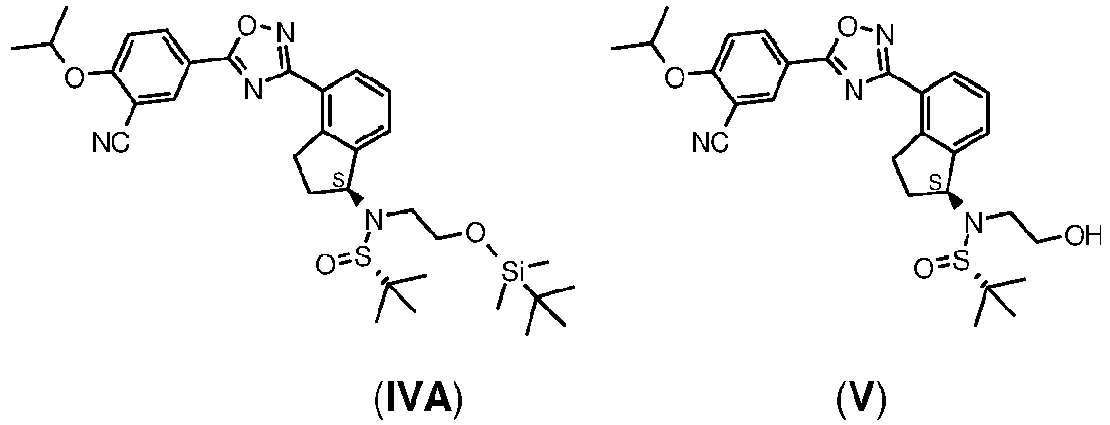
- The (S)-N-{2-[(tert-butyldimethylsilyl)oxy]ethyl}-N-[(1S)-4-{5-[3-cyano-4-(propan-2-yloxy)phenyl]-1,2,4-oxadiazol-3-yl}-2,3-dihydro-1H-inden-1-yl]-2-methylpropane-2-sulfinamide ((IIIA); 12.25 g; 27.0 mmol) is added to a multi-neck 500 ml device in an argon atmosphere at 25 °C, while being stirred it is dissolved with toluene (220 ml), and 3-cyano-4-(propan-2-yloxy)benzoic acid ((VIII); 8.31 g; 40.5 mmol) and triethylamine (13.65 g; 18.7 ml; 135 mmol) are added, and then the T3P is added drop by drop (17.16 g 50% solution; 16.0 ml; 27.0 mmol). The reaction mixture obtained in this way is stirred at 85-90 °C, then cooled to room temperature, then water is added and the phases are separated. The organic phase is washed with saturated sodium hydrogen carbonate solution, dried and then evaporated in a vacuum. The mixture obtained in this way, which contains the (S)-N-{2-[(tert-butyldimethylsilyl)oxy]ethyl}-N-[(1S)-4-{5-[3-cyano-4-(propan-2-yloxy)phenyl]-1,2,4-oxadiazol-3-yl}-2,3-dihydro-1H-inden-1-yl]-2-methylpropane-2-sulfinamide (IVA) and the (S)-N-[(1S)-4-{5-[3-cyano-4-(propan-2-yloxy)phenyl]-1,2,4-oxadiazol-3-yl}-2,3-dihydro-1H-inden-1-yl]-N-(2-hydroxyethyl)-2-methylpropan-2-sulfinamide (V) formed from it, is used in the next synthesis step without purification.
- Using the acidic method disclosed in the descriptive part, in a Shimadzu LC-MS device the IVA compound comes at a retention time of RT: 6.31 min, and the V compound at a retention time RT: 4.24 min.
- Column chromatography separation was used to identify the components of the mixture, according to the method given in the descriptive part, the retention time of the (IVA) compound: 56 min.
- 1H NMR (CDCl3, 400 MHz) δ8.44 (1H, d, J=2.1 Hz), 8.35 (1H, dd, J=8.9, 2.2 Hz), 8.11 (1H d, J=7.6 Hz), 7.53 (1H, d, J=7.6 Hz), 7.39 (1H, t, J=7.6 Hz), 7.17 (1H, d, J=8.9 Hz), 5.18 (1H, t, J=7.6 Hz), 4.80 (1H, quint, J=6.0 Hz), 3.58-3.72 (2H, m), 3.20-3.30 (1H, ddd, J=12.3, 9.3, 3.9 Hz), 3.10-3.20 (1H, m), 2.95-3.05 (2H, m), 2.50-2.60 (1H, m), 2.25-2.38 (1H, m), 1.48 (6H, d,
- J=6.0 Hz), 1.25 (9H, s), 0.86 (9H, s), 0.01 (6H, s).
- (V) (sample purified with chromatographic process): according to the method given in the descriptive part, the retention time of the V compound: 145 min.
- 1H NMR (CDCl3, 400 MHz) δ8.43 (1H, d, J=1.8 Hz), 8.33 (1H, dd, J=8.8, 1.9 Hz), 8.13 (1H d, J=7.5 Hz), 7.58 (1H, d, J=7.1 Hz), 7.42 (1H, t, J=7.5 Hz), 7.13 (1H, d, J=8.8 Hz), 5.11 (1H, t, J=7.6 Hz), 4.80 (1H, quint, J=6.0 Hz), 3.46-3.50 (5H, m), 3.25-3.29 (2H, m), 2.55-2.59 (1H, m), 2.35-2.38 (1H, m), 1.53 (1H, s); 1.48 (5H, d, J=6.0 Hz), 1.26 (9H, s).
- 5-{3-[(1S)-1-[(2-Hydroxyethyl)amino]-2,3-dihydro-1H-inden-4-yl]-1,2,4-oxadiazol-5-yl}-2-(propan-2-yloxy)benzonitrile hydrochloride (ozanimod hydrochloride, hydrochloride salt of compound (I))

- The mixture (11.2 g) obtained according to example 3 is stirred with 2-propanol (80 ml) until a homogenous solution is obtained, then 2-propanol hydrogen chloride solution (20.25 ml; 6.35 mmol/ml; 128.6 mmol) at room temperature is added to it drop by drop, the mixture is then stirred at 50 °C, then cooled, then stirred again for 2 hours at 0-5 °C. The precipitated crystals are filtered out, washed with 2-propanol, thereby 6.2 g (yield calculated for IIIA (S)-N-{2-[(tert-butyldimethylsilyl)oxy]ethyl}-N-[(1S)-4-{5-[3-cyano-4-(propan-2-yloxy)phenyl]-1,2,4-oxadiazol-3-yl}-2,3-dihydro-1H-inden-1-il]-2-methylpropane-2-sulfinamide is 52%) ozanimod hydrochloride is obtained. The gross yield of the synthesis performed without extracting the intermediate products (B), (IIA), (IVA) and (V) calculated for the initial material 1-oxo-2,3-dihydro-1H-indene-4-carbonitrile (A) is 26.6%.
- 1H NMR (DMSO-d6 , 400 MHz) δ9.19 (2H, bs), 8.53 (1H, d, J=2,3 Hz), 8.41 (1H, dd, J=9.9, 2.3 Hz), 8.16 (1H, d, J=7.2 Hz), 7.95 (1H, d, J=7.5 Hz), 7,58 (2H, m), 5.28 (1H, t, J=5.0 Hz), 4.99 (1H, quint, J=6.0 Hz), 4.90 (1H, m), 3.71 (2H, q, J=5.0 Hz), 3.47 (1H, m), 3.35 (2H, m), 3.05 (1H, m), 3.00 (1H, m), 2.32 (1H, m), 1.39 (6H, d, J=6.0 Hz).
- The (S)-N-{ 2-[(tert-butyldimethylsilyl)oxy]ethyl}-N-[(1S)-4-{5-[3-cyano-4-(propan-2-yloxy)phenyl]-1,2,4-oxadiazol-3-yl}-2,3-dihydro-1H-inden-1-yl]-2-methylpropane-2-sulfinamide (IVA; 220 mg; 0.353 mmol) is stirred with 2-propanol (1.5 ml) until a homogenous solution is obtained, then concentrated hydrochloride acid solution (37%; 0.1 ml) is added to it drop by drop at room temperature, the reaction mixture is then stirred at 50 °C and cooled, and once again stirred for 2 hours at 0-5 °C. The precipitated crystals are filtered out, washed with 2-propanol, thereby producing 120 mg (77%) ozanimod hydrochloride.
- The (S)-N-[(1S)-4-{5-[3-cyano-4-(propan-2-yloxy)phenyl]-1,2,4-oxadiazol-3-yl}-2,3-dihydro-1H-inden-1-yl]-N-(2-hydroxyethyl)-2-methylpropane-2-sulfinamide (V; 114 mg; 0.224 mmol) is stirred with 2-propanol (1.0 ml) until a homogenous solution is obtained, then concentrated hydrochloric acid (37%; 0.05 ml) is added to it at room temperature, and then the reaction mixture is stirred at room temperature, then cooled and stirred once again for 2 hours at 0-5 °C. The precipitated crystals are filtered out, washed with 2-propanol, thereby producing 89 mg (90%) ozanimod hydrochloride.
- The production of ozanimod hydrochloride (one pot process):

- 13.75 g (30.3 mmol) compound of formula (III/A) is measured into a 500-ml multi-neck flask fitted with a gas inlet, cooler, bubbler, dropper funnel and thermometer at 25 °C in an argon atmosphere in 80.0 ml of absolute toluene, 6.22 g (30.3 mmol) compound of formula (VIII) and 21.0 ml (15.33 g; 151.5 mmol) Et3N are added to the suspension obtained while stirring and 9.0 ml (15.15 mmol) T3P 50% in ethyl acetate solution is added to it drop by drop. The solution obtained is heated to 90 °C, and then stirred at this temperature until the compound of formula (III/A), the precursor of compound of formula (IV/A) and the precursor of compound of formula (V) can be detected in the reaction mixture on the basis of LC-MS.
- The reaction mixture is allowed to cool to room temperature. The phases are then separated, and the organic phase is washed with 2×70 ml saturated NaCl solution. The toluene phase is heated to 85 °C, and during intensive stirring 10.0 ml (4 equiv., 121.2 mmol) 37% aqueous hydrochloric acid solution is added drop by drop. The temperature increases to 90 °C, and within a short time the crystals start to precipitate. Stirring is continued at this temperature until the compound of formula (IV/A) (M+H: 623), the compound of formula (V) (M+H: 509), and the O-silylated ozanimod derivative (M+H: 519) can be detected on the basis of LC-MS. Following this the reaction mixture is left to cool to room temperature while being stirred, then cooled to 0-5 °C with the stirring being continued for 1 hour.
- The crystalline product is filtered, and washed with 3×10 ml cold toluene. Thereby producing 8.5 g (63.6%) ozanimod hydrochloride.
- The production of the Form I polymorph of ozanimod base: 3.60 g raw ozanimod hydrochloride is suspended in a mixture of 58 ml dichloromethane and 35 ml water, while stirring 9 ml 2M NaHCOs solution is added drop by drop. The phases are separated, and the organic phase is evaporated until dry. The 1.85 g raw ozanimod base obtained in this way is suspended in 36 ml acetonitrile. The mixture is kept at boiling point until a homogenous solution is obtained. The solution is boiled for 5 minutes with 0.2 g active carbon, then filtered. The crystal mass precipitating from the filtrate is heated back up to the boiling point of the solvent, then the solution obtained in this way is left to cool to room temperature. Then maintaining it at a temperature between 0-5 °C the mixture is stirred for a further 1 hour. Following this the mixture is filtered, and the crystals washed with 2×3 ml cold acetonitrile. In this way 1.51 g Form I polymorph crystalline product is obtained, the x-ray powder diffraction lines of which are summarised in the following table:
Peak 2θ (°) d (Å) Relative intensity (%) Peak 2θ (°) d (Å) Relative intensity (%) 1 2.86 30.90 28 21 20.28 4.38 8 2 5.77 15.32 100 22 20.41 4.35 2 3 8.66 10.22 21 23 21.10 4.21 4 4 10.77 8.22 13 24 21.65 4.11 24 5 10.87 8.14 8 25 21.87 4.07 6 6 11.14 7.94 14 26 22.10 4.02 11 7 11.56 7.65 28 27 22.43 3.97 19 8 12.20 7.25 9 28 22.79 3.90 6 9 12.98 6.82 42 29 23.36 3.81 31 10 13.38 6.62 97 30 23.75 3.75 11 11 13.90 6.37 34 31 23.95 3.72 16 12 14.59 6.07 24 32 24.62 3.62 61 13 15.36 5.77 14 33 25.37 3.51 55 14 16.23 5.46 45 34 26.16 3.41 28 15 17.19 5.16 12 35 27.00 3.30 41 16 17.43 5.09 4 36 27.90 3.20 26 17 17.73 5.00 9 37 28.86 3.09 12 18 18.44 4.81 6 38 29.20 3.06 2 19 18.94 4.69 13 39 29.85 2.99 1 20 19.54 4.54 37 40 31.00 2.89 2 - The characteristic x-ray powder diffractogram of this corresponds to
figure 3 . - The dynamic vapour sorption (DVS) measurement of the ozanimod base Form I polymorph according to example 6
- The ozanimod base Form I polymorph is slightly hygroscopic. The mass of the sample increased by 0.6% under 95% relative humidity. The sorption isotherm of the first cycle is shown in
figure 4 . On repeating the cycle the sorption isotherm did not change. What is more is that after the two cycles the unchanged nature of the crystal structure is proved by the x-ray power diffractogram shown infigure 5 , which is the same as the diffractogram of the initial crystals shown infigure 3 . From this it can be seen that the ozanimod base Form I polymorph form is stable at 25 °C, and not sensitive to humidity.
Claims (15)
- Process for the production of formula
 a.) the compound of general formula
 b.) from the compound of formula
 c.)
c.)
from a mixture of any ratio of the compound of general formula (IV) and the compound of formula (V), and the formula (I) ozanimod obtained in this way is optionally transformed into an acid addition salt. - Process according to claim 1, characterised in that substituted methyl ether type compounds, preferably a methoxymethyl, benzyloxymethyl, p-methoxybenzyloxymethyl, or a [(3,4-dimethoxybenzyl)oxy]methyl group, a tetrahydropyranyl group, or a substituted ethyl ether type group, preferably an ethoxyethyl, or 1-[2-(trimethylsilyl)ethoxy]ethyl group, a silyl type group, preferably a trimethylsilyl, triisopropylsilyl, t-butyldimethylsilyl or triphenylsilyl group are used as the protective group that may be removed in an acidic medium serving for the temporary protection of the hydroxyl group in the compound of general formula (IV).
- Process according to any of claims 1 or 2, characterised in that an ether type solvent, preferably dioxane, a 1 to 4 carbon atom alcohol, preferably 2-propanol, ethanol or methanol, most preferably 2-propanol, or an aromatic solvent, preferably toluene or xylene, more preferably toluene is used as the organic solvent, and/or characterised in that an acid is used to cleave the protective group that may be removed in an acidic medium serving for the temporary protection of the hydroxyl group, preferably aqueous hydrochloric acid, hydrochloric acid, hydrogen bromide, hydrogen iodide, hydrogen fluoride (HF), sulphuric acid, nitric acid, or their salts, tetrabutylammonium fluoride (TBAF), a mixture of TBAF and acetic acid, an aqueous mixture of HF and THF, or 1 M aqueous HIO4 dissolved in THF, wherein the acid is preferably used in an aqueous solution, in a mixture of organic solvent and water or dissolved in a solvent, preferably using dioxane, 2-propanol, ethanol or methanol, preferably 2-propanol, ethanol or methanol, most preferably 2-propanol as the solvent.
- Process according to any of claims 1 to 3, characterised by that the production of the compound of general formula
 a.) a compound of general formula
 b.) the obtained compound of general formula (IV) and the compound of formula (V) are isolated from each other.
 - Process according to claim 4, characterised in that amide, preferably dimethylformamide, aromatic, preferably xylene or toluene, most preferably toluene, ether, preferably tetrahydrofuran or dioxane, ester, nitrile, preferably acetonitrile, or sulfoxide, preferably dimethyl sulfoxide type solvents are used as the organic solvent, preferably toluene or ester type solvents are used, most preferably ethyl acetate is used as the organic solvent, and/or
characterised in that the benzoic acid of formula (VIII) is preferably activated with disubstituted carbodiimide, preferably with dicyclohexylcarbodiimide, 1-ethyl-3-(3-dimethylaminopropyl)carbodiimide in the presence of an organic base, more preferably in the presence of DIPEA, TEA, or with carbonyl-diimidazole in the presence of hydroxybenzotriazole or ethyl cyano glyoxylate-2-oxime, or with propanephosphonic acid anhydride (T3P), most preferably activated with propanephosphonic acid anhydride (T3P). - Process according to any of claims 4 to 5, characterised in that the compounds of general formula (IV) or (V), or a mixture of these are transformed into ozanimod without isolation or any further purification.
- Process according to claim 6, characterised in that the compound of general formula (III), preferably the compound with general formula (III/A) is reacted with the compound of formula (VIII) in an aromatic solvent, preferably toluene or xylene, most preferably toluene, so that the compound of formula (VIII) is preferably activated with disubstituted carbodiimide, preferably with dicyclohexylcarbodiimide, 1-ethyl-3-(3-dimethylaminopropyl)carbodiimide in the presence of an organic base, more preferably in the presence of DIPEA, TEA, or with carbonyl-diimidazole in the presence of hydroxybenzotriazole or ethyl cyano glyoxylate-2-oxime, or with propanephosphonic acid anhydride (T3P), most preferably with propanephosphonic acid anhydride (T3P), then after the reaction has completed the reaction mixture is washed if necessary with an aqueous base and/or saturated salt solution, then concentrated hydrochloric acid is added to the aromatic solvent, preferably toluene solution and the precipitating ozanimod hydrochloride is isolated, and optionally purified.
- Process according to claim 7, characterised in that the compound of general formula (III), preferably the compound of formula (III/A) and the compound of formula (VIII), the base and the activating reagents are combined at a temperature between 20-30 °C, preferably between 20-25 °C, then the temperature of the reaction mixture is raised preferably to between 60 °C and the boiling point of the solvent, preferably to between 65-100 °C, most preferably to between 80-85 °C and maintained at that temperature until the reaction is complete, then the reaction mixture is cooled and then, if necessary, washed with an aqueous alkali, preferably with sodium or potassium hydrocarbonate solution, and, if necessary, with saturated sodium chloride solution, then the organic phase is reacted with concentrated aqueous hydrochloric acid solution (37%) preferably at a temperature of between 60 °C and the boiling point of the solvent, preferably between 65-85 °C, most preferably between 70-75 °C, then following this the reaction mixture is cooled, the precipitated crystals are filtered out, dried and optionally transformed into a base.
- Process according to any of claims 1 to 8, characterised in that the ozanimod is precipitated in the form of hydrochloride salt, and the crystalline ozanimod is transformed into a base.
- Process according to any of claims 4 to 6, characterised in that the compound of general formula (III) used in the process, in which formula R is defined as in claim 4 and most preferably represents a t-butyldimethylsilyl group, is produced so that the compound of general formula

- Process according to claim 10, characterised in that the compound of general formula (II) is produced so that the compound of formula


- Process according to claim 1, characterised in thata.) the compound or compounds of general formula
 b.) the compound of formula
 c.) a mixture at any proportion of the compound of general formula (IV) (R represents a t-butyldimethylsilyl group) and the compound of formula (V) are reacted in a 1 to 4 carbon atom alcohol, preferably 2-propanol, with an inorganic acid, preferably hydrochloric acid and the ozanimod obtained is optionally transformed into a salt, preferably hydrochloride salt.
 - Process according to claim 1, characterised in that the compound of general formula (IV), in which R represents a substituted methyl ether type group, more preferably a methoxymethyl, benzyloxymethyl, p-methoxybenzyloxymethyl, or [(3,4-dimethoxybenzyl)oxy]methyl group, a tetrahydropyranyl group, or a substituted ethyl ether type group, preferably an ethoxyethyl, or 1-[2-(trimethylsilyl)ethoxy]ethyl group, a silyl type group, preferably a trimethylsilyl, triisopropylsilyl, t-butyldimethylsilyl or triphenylsilyl group, most preferably a t-butyldimethylsilyl group, or the compound of formula (V) or a mixture of these is produced so thata.) the compound of formula

 b.) the obtained compound of formula
 c.) the obtained compound of general formula
- A compound of general formula


- A mixture of compounds having formula (IV) according to claim 14 and compounds having formula (V)

Priority Applications (2)
| Application Number | Priority Date | Filing Date | Title |
|---|---|---|---|
| SI201831007T SI3630738T1 (en) | 2017-05-22 | 2018-05-18 | Process for the production of ozanimod |
| HRP20231308TT HRP20231308T1 (en) | 2017-05-22 | 2018-05-18 | PROCEDURE FOR THE PRODUCTION OF OZANIMOD |
Applications Claiming Priority (2)
| Application Number | Priority Date | Filing Date | Title |
|---|---|---|---|
| HUP1700216 | 2017-05-22 | ||
| PCT/HU2018/050019 WO2018215807A1 (en) | 2017-05-22 | 2018-05-18 | Process for the production of ozanimod |
Publications (3)
| Publication Number | Publication Date |
|---|---|
| EP3630738A1 EP3630738A1 (en) | 2020-04-08 |
| EP3630738A4 EP3630738A4 (en) | 2021-03-10 |
| EP3630738B1 true EP3630738B1 (en) | 2023-07-19 |
Family
ID=89720175
Family Applications (1)
| Application Number | Title | Priority Date | Filing Date |
|---|---|---|---|
| EP18806925.6A Active EP3630738B1 (en) | 2017-05-22 | 2018-05-18 | Process for the production of ozanimod |
Country Status (12)
| Country | Link |
|---|---|
| US (1) | US12459907B2 (en) |
| EP (1) | EP3630738B1 (en) |
| CN (1) | CN110997645B (en) |
| EA (1) | EA201992421A1 (en) |
| ES (1) | ES2960051T3 (en) |
| HR (1) | HRP20231308T1 (en) |
| HU (1) | HUE064642T2 (en) |
| MA (1) | MA48798B1 (en) |
| PL (1) | PL3630738T3 (en) |
| PT (1) | PT3630738T (en) |
| SI (1) | SI3630738T1 (en) |
| WO (1) | WO2018215807A1 (en) |
Families Citing this family (8)
| Publication number | Priority date | Publication date | Assignee | Title |
|---|---|---|---|---|
| WO2019094409A1 (en) * | 2017-11-07 | 2019-05-16 | Teva Pharmaceuticals International Gmbh | Salts and solid state forms of ozanimod |
| EP3891133B1 (en) | 2018-12-07 | 2023-06-07 | Synthon B.V. | Improved process for preparing ozanimod |
| WO2020152718A1 (en) * | 2019-01-25 | 2020-07-30 | Mylan Laboratories Limited | Polymorphic forms 5-[3-[(1s)-2,3-dihydro-1-[(2-hydroxyethyl) amino]-1h-inden-4-yl]-1,2,4-oxadiazol-5-yl]-2-(1-methylethoxy)benzonitrile |
| CN112062785B (en) * | 2019-06-11 | 2023-06-27 | 广东东阳光药业有限公司 | Preparation method of Ozamod and its intermediate |
| MX2022000651A (en) | 2019-07-16 | 2022-03-11 | Synthon Bv | IMPROVED PROCESS FOR PREPARING OZANIMOD. |
| TW202131921A (en) | 2019-10-31 | 2021-09-01 | 瑞士商愛杜西亞製藥有限公司 | Combination of a cxcr7 antagonist with an s1p1 receptor modulator |
| EP4126826A1 (en) * | 2020-04-02 | 2023-02-08 | Synthon B.V. | Crystalline form of ozanimod hydrochloride |
| EP4212156A1 (en) | 2022-01-13 | 2023-07-19 | Abivax | Combination of 8-chloro-n-(4-(trifluoromethoxy)phenyl)quinolin-2-amine and its derivatives with a s1p receptor modulator |
Family Cites Families (7)
| Publication number | Priority date | Publication date | Assignee | Title |
|---|---|---|---|---|
| BR112012007635B1 (en) | 2009-10-08 | 2019-07-09 | Sanofi | PHENYLOXADIAZOL DERIVATIVE COMPOUNDS AS PGDS INHIBITORS, PHARMACEUTICAL COMPOSITION UNDERSTANDING THE SAME AND ITS PREPARATION PROCESSES |
| SI2498610T2 (en) | 2009-11-13 | 2024-10-30 | Receptos Llc | Selective sphingosine 1 phosphate receptor modulators and methods of chiral synthesis |
| WO2015066515A1 (en) * | 2013-11-01 | 2015-05-07 | Receptos, Inc. | Selective sphingosine 1 phosphate receptor modulators and combination therapy therewith |
| FI3470400T3 (en) | 2016-06-14 | 2025-06-13 | Receptos Llc | CRYSTAL FORM OF OTAZANIMOD, CRYSTAL FORM OF ITS HYDROCHLORIDE AND METHOD OF PREPARATION THEREOF |
| US11028060B2 (en) * | 2016-08-19 | 2021-06-08 | Receptos Llc | Crystalline forms of ozanimod and processes for preparation thereof |
| US11117875B2 (en) | 2016-09-14 | 2021-09-14 | Hangzhou Solipharma Co., Ltd. | Crystalline forms, preparation methods and pharmaceutical compositions of ozanimod |
| EP3518922B1 (en) * | 2016-09-29 | 2026-02-11 | Receptos LLC | Compounds and methods for treating lupus |
-
2018
- 2018-05-18 EP EP18806925.6A patent/EP3630738B1/en active Active
- 2018-05-18 CN CN201880049683.6A patent/CN110997645B/en active Active
- 2018-05-18 PT PT188069256T patent/PT3630738T/en unknown
- 2018-05-18 EA EA201992421A patent/EA201992421A1/en unknown
- 2018-05-18 HR HRP20231308TT patent/HRP20231308T1/en unknown
- 2018-05-18 SI SI201831007T patent/SI3630738T1/en unknown
- 2018-05-18 HU HUE18806925A patent/HUE064642T2/en unknown
- 2018-05-18 WO PCT/HU2018/050019 patent/WO2018215807A1/en not_active Ceased
- 2018-05-18 US US16/615,468 patent/US12459907B2/en active Active
- 2018-05-18 ES ES18806925T patent/ES2960051T3/en active Active
- 2018-05-18 MA MA48798A patent/MA48798B1/en unknown
- 2018-05-18 PL PL18806925.6T patent/PL3630738T3/en unknown
Also Published As
| Publication number | Publication date |
|---|---|
| ES2960051T3 (en) | 2024-02-29 |
| WO2018215807A1 (en) | 2018-11-29 |
| CN110997645A (en) | 2020-04-10 |
| MA48798B1 (en) | 2023-10-31 |
| SI3630738T1 (en) | 2024-02-29 |
| PL3630738T3 (en) | 2024-04-08 |
| HUE064642T2 (en) | 2024-04-28 |
| EP3630738A4 (en) | 2021-03-10 |
| PT3630738T (en) | 2023-10-24 |
| US20200087269A1 (en) | 2020-03-19 |
| EP3630738A1 (en) | 2020-04-08 |
| US12459907B2 (en) | 2025-11-04 |
| CN110997645B (en) | 2023-10-10 |
| HRP20231308T1 (en) | 2024-04-26 |
| MA48798A (en) | 2020-04-08 |
| EA201992421A1 (en) | 2020-03-27 |
Similar Documents
| Publication | Publication Date | Title |
|---|---|---|
| US12459907B2 (en) | Process for the production of ozanimod | |
| EP3765452B1 (en) | Preparative process of two 4-{[(2s)-2-{4-[5-chloro-2-(1h-1,2,3-triazol-1-yl)phenyl]-5-methoxy-2-oxopyridin-1(2h)-yl}butanoyl]amino}-2-fluorobenzamide derivatives | |
| JP5680624B2 (en) | 7-aza-spiro [3.5] nonane-7-carboxylic acid ester derivatives, their preparation and their therapeutic use | |
| EP3580219B1 (en) | Process for the preparation of remimazolam and solid state forms of remimazolam salts | |
| EP3376870B1 (en) | Process for the preparation of kinase inhibitors and intermediates thereof | |
| JP6858560B2 (en) | Substituted thiazole or oxazole P2X7 receptor antagonist | |
| EP3481200B1 (en) | Processes for the preparation of 4-alkoxy-3-(acyl or alkyl)oxypicolinamides | |
| US20170137384A1 (en) | Process for the preparation of kinase inhibitors and intermediates thereof | |
| CA2914415A1 (en) | Chromane and chromene derivatives and their use as crac modulators | |
| EP3095777B1 (en) | Linezolid intermediate and method for synthesizing linezolid | |
| Glenny et al. | Improved synthetic methods to mixed-donor thiacrown ethers | |
| KR20080094736A (en) | Hydride Reduction Method for Preparation of Quinolone Intermediates | |
| RU2512591C2 (en) | Method of producing pleuromutilins | |
| EP3892615A1 (en) | Process for the preparation of silodosin | |
| JP5017101B2 (en) | Preparation of asymmetric tetrasubstituted carbon atom-containing compounds | |
| EP2072505A2 (en) | A process for the preparation of oxazolidinone derivatives | |
| EA040642B1 (en) | METHOD FOR OZANIMOD PRODUCTION | |
| HU231112B1 (en) | Method for the preparation of ozanimod | |
| HU1800169A2 (en) | Process for the preparation of ozanimod | |
| Welschoff et al. | Practical synthesis of optically pure menthylamines starting from racemic neomenthol | |
| KR102060318B1 (en) | Novel intermediate, processes for preparing the same, and processes for preparing rosuvastatin calcium salt using the same | |
| JP2000026408A (en) | Antipodally pure pyrrolidine derivative, its salt and their production | |
| KR101009467B1 (en) | Taxane derivatives useful for the synthesis of docetaxel and preparation methods thereof | |
| EP4219443A1 (en) | Method for preparing intermediate for synthesis of sphingosine-1-phosphate receptor agonist | |
| RU2040526C1 (en) | Bicyclic 1-aza-cycloalkanes, mixture of their isomers or separate isomers, or their pharmacologically tolerated acid-additive salts |
Legal Events
| Date | Code | Title | Description |
|---|---|---|---|
| STAA | Information on the status of an ep patent application or granted ep patent |
Free format text: STATUS: THE INTERNATIONAL PUBLICATION HAS BEEN MADE |
|
| PUAI | Public reference made under article 153(3) epc to a published international application that has entered the european phase |
Free format text: ORIGINAL CODE: 0009012 |
|
| STAA | Information on the status of an ep patent application or granted ep patent |
Free format text: STATUS: REQUEST FOR EXAMINATION WAS MADE |
|
| 17P | Request for examination filed |
Effective date: 20191220 |
|
| AK | Designated contracting states |
Kind code of ref document: A1 Designated state(s): AL AT BE BG CH CY CZ DE DK EE ES FI FR GB GR HR HU IE IS IT LI LT LU LV MC MK MT NL NO PL PT RO RS SE SI SK SM TR |
|
| AX | Request for extension of the european patent |
Extension state: BA ME |
|
| A4 | Supplementary search report drawn up and despatched |
Effective date: 20210205 |
|
| RIC1 | Information provided on ipc code assigned before grant |
Ipc: C07D 271/06 20060101AFI20210201BHEP Ipc: C07C 311/07 20060101ALI20210201BHEP |
|
| GRAP | Despatch of communication of intention to grant a patent |
Free format text: ORIGINAL CODE: EPIDOSNIGR1 |
|
| STAA | Information on the status of an ep patent application or granted ep patent |
Free format text: STATUS: GRANT OF PATENT IS INTENDED |
|
| INTG | Intention to grant announced |
Effective date: 20220401 |
|
| RIN1 | Information on inventor provided before grant (corrected) |
Inventor name: HALASZ, JUDIT Inventor name: SZABO, EVA Inventor name: SZLAVIK, LASZLO Inventor name: VOLK, BALAZS Inventor name: PETHOE, JANOS Inventor name: MOLNAR, ENIKO Inventor name: SIMIG, GYULA Inventor name: PORCS-MAKKAY, MARTA |
|
| GRAS | Grant fee paid |
Free format text: ORIGINAL CODE: EPIDOSNIGR3 |
|
| GRAJ | Information related to disapproval of communication of intention to grant by the applicant or resumption of examination proceedings by the epo deleted |
Free format text: ORIGINAL CODE: EPIDOSDIGR1 |
|
| GRAL | Information related to payment of fee for publishing/printing deleted |
Free format text: ORIGINAL CODE: EPIDOSDIGR3 |
|
| STAA | Information on the status of an ep patent application or granted ep patent |
Free format text: STATUS: REQUEST FOR EXAMINATION WAS MADE |
|
| GRAP | Despatch of communication of intention to grant a patent |
Free format text: ORIGINAL CODE: EPIDOSNIGR1 |
|
| STAA | Information on the status of an ep patent application or granted ep patent |
Free format text: STATUS: GRANT OF PATENT IS INTENDED |
|
| INTC | Intention to grant announced (deleted) | ||
| INTG | Intention to grant announced |
Effective date: 20220902 |
|
| GRAJ | Information related to disapproval of communication of intention to grant by the applicant or resumption of examination proceedings by the epo deleted |
Free format text: ORIGINAL CODE: EPIDOSDIGR1 |
|
| GRAL | Information related to payment of fee for publishing/printing deleted |
Free format text: ORIGINAL CODE: EPIDOSDIGR3 |
|
| STAA | Information on the status of an ep patent application or granted ep patent |
Free format text: STATUS: REQUEST FOR EXAMINATION WAS MADE |
|
| GRAP | Despatch of communication of intention to grant a patent |
Free format text: ORIGINAL CODE: EPIDOSNIGR1 |
|
| STAA | Information on the status of an ep patent application or granted ep patent |
Free format text: STATUS: GRANT OF PATENT IS INTENDED |
|
| INTC | Intention to grant announced (deleted) | ||
| INTG | Intention to grant announced |
Effective date: 20230207 |
|
| GRAA | (expected) grant |
Free format text: ORIGINAL CODE: 0009210 |
|
| STAA | Information on the status of an ep patent application or granted ep patent |
Free format text: STATUS: THE PATENT HAS BEEN GRANTED |
|
| AK | Designated contracting states |
Kind code of ref document: B1 Designated state(s): AL AT BE BG CH CY CZ DE DK EE ES FI FR GB GR HR HU IE IS IT LI LT LU LV MC MK MT NL NO PL PT RO RS SE SI SK SM TR |
|
| REG | Reference to a national code |
Ref country code: GB Ref legal event code: FG4D |
|
| REG | Reference to a national code |
Ref country code: CH Ref legal event code: EP |
|
| REG | Reference to a national code |
Ref country code: DE Ref legal event code: R096 Ref document number: 602018053717 Country of ref document: DE |
|
| REG | Reference to a national code |
Ref country code: IE Ref legal event code: FG4D |
|
| REG | Reference to a national code |
Ref country code: PT Ref legal event code: SC4A Ref document number: 3630738 Country of ref document: PT Date of ref document: 20231024 Kind code of ref document: T Free format text: AVAILABILITY OF NATIONAL TRANSLATION Effective date: 20231018 |
|
| REG | Reference to a national code |
Ref country code: MA Ref legal event code: VAGR Ref document number: 48798 Country of ref document: MA Kind code of ref document: B1 |
|
| REG | Reference to a national code |
Ref country code: LT Ref legal event code: MG9D |
|
| REG | Reference to a national code |
Ref country code: SE Ref legal event code: TRGR |
|
| REG | Reference to a national code |
Ref country code: NL Ref legal event code: MP Effective date: 20230719 |
|
| PG25 | Lapsed in a contracting state [announced via postgrant information from national office to epo] |
Ref country code: NL Free format text: LAPSE BECAUSE OF FAILURE TO SUBMIT A TRANSLATION OF THE DESCRIPTION OR TO PAY THE FEE WITHIN THE PRESCRIBED TIME-LIMIT Effective date: 20230719 |
|
| REG | Reference to a national code |
Ref country code: GR Ref legal event code: EP Ref document number: 20230401927 Country of ref document: GR Effective date: 20231211 |
|
| REG | Reference to a national code |
Ref country code: SK Ref legal event code: T3 Ref document number: E 42707 Country of ref document: SK |
|
| PG25 | Lapsed in a contracting state [announced via postgrant information from national office to epo] |
Ref country code: RS Free format text: LAPSE BECAUSE OF FAILURE TO SUBMIT A TRANSLATION OF THE DESCRIPTION OR TO PAY THE FEE WITHIN THE PRESCRIBED TIME-LIMIT Effective date: 20230719 Ref country code: NO Free format text: LAPSE BECAUSE OF FAILURE TO SUBMIT A TRANSLATION OF THE DESCRIPTION OR TO PAY THE FEE WITHIN THE PRESCRIBED TIME-LIMIT Effective date: 20231019 Ref country code: LV Free format text: LAPSE BECAUSE OF FAILURE TO SUBMIT A TRANSLATION OF THE DESCRIPTION OR TO PAY THE FEE WITHIN THE PRESCRIBED TIME-LIMIT Effective date: 20230719 Ref country code: LT Free format text: LAPSE BECAUSE OF FAILURE TO SUBMIT A TRANSLATION OF THE DESCRIPTION OR TO PAY THE FEE WITHIN THE PRESCRIBED TIME-LIMIT Effective date: 20230719 Ref country code: FI Free format text: LAPSE BECAUSE OF FAILURE TO SUBMIT A TRANSLATION OF THE DESCRIPTION OR TO PAY THE FEE WITHIN THE PRESCRIBED TIME-LIMIT Effective date: 20230719 |
|
| REG | Reference to a national code |
Ref country code: ES Ref legal event code: FG2A Ref document number: 2960051 Country of ref document: ES Kind code of ref document: T3 Effective date: 20240229 |
|
| REG | Reference to a national code |
Ref country code: DE Ref legal event code: R097 Ref document number: 602018053717 Country of ref document: DE |
|
| REG | Reference to a national code |
Ref country code: HR Ref legal event code: T1PR Ref document number: P20231308 Country of ref document: HR |
|
| REG | Reference to a national code |
Ref country code: HU Ref legal event code: AG4A Ref document number: E064642 Country of ref document: HU |
|
| PG25 | Lapsed in a contracting state [announced via postgrant information from national office to epo] |
Ref country code: SM Free format text: LAPSE BECAUSE OF FAILURE TO SUBMIT A TRANSLATION OF THE DESCRIPTION OR TO PAY THE FEE WITHIN THE PRESCRIBED TIME-LIMIT Effective date: 20230719 Ref country code: RO Free format text: LAPSE BECAUSE OF FAILURE TO SUBMIT A TRANSLATION OF THE DESCRIPTION OR TO PAY THE FEE WITHIN THE PRESCRIBED TIME-LIMIT Effective date: 20230719 Ref country code: EE Free format text: LAPSE BECAUSE OF FAILURE TO SUBMIT A TRANSLATION OF THE DESCRIPTION OR TO PAY THE FEE WITHIN THE PRESCRIBED TIME-LIMIT Effective date: 20230719 Ref country code: DK Free format text: LAPSE BECAUSE OF FAILURE TO SUBMIT A TRANSLATION OF THE DESCRIPTION OR TO PAY THE FEE WITHIN THE PRESCRIBED TIME-LIMIT Effective date: 20230719 |
|
| VS25 | Lapsed in a validation state [announced via postgrant information from nat. office to epo] |
Ref country code: MD Free format text: LAPSE BECAUSE OF FAILURE TO SUBMIT A TRANSLATION OF THE DESCRIPTION OR TO PAY THE FEE WITHIN THE PRESCRIBED TIME-LIMIT Effective date: 20230719 |
|
| PLBE | No opposition filed within time limit |
Free format text: ORIGINAL CODE: 0009261 |
|
| STAA | Information on the status of an ep patent application or granted ep patent |
Free format text: STATUS: NO OPPOSITION FILED WITHIN TIME LIMIT |
|
| 26N | No opposition filed |
Effective date: 20240422 |
|
| REG | Reference to a national code |
Ref country code: AT Ref legal event code: UEP Ref document number: 1589364 Country of ref document: AT Kind code of ref document: T Effective date: 20230719 |
|
| PG25 | Lapsed in a contracting state [announced via postgrant information from national office to epo] |
Ref country code: BG Free format text: LAPSE BECAUSE OF FAILURE TO SUBMIT A TRANSLATION OF THE DESCRIPTION OR TO PAY THE FEE WITHIN THE PRESCRIBED TIME-LIMIT Effective date: 20230719 |
|
| REG | Reference to a national code |
Ref country code: HR Ref legal event code: ODRP Ref document number: P20231308 Country of ref document: HR Payment date: 20241014 Year of fee payment: 7 |
|
| PG25 | Lapsed in a contracting state [announced via postgrant information from national office to epo] |
Ref country code: BG Free format text: LAPSE BECAUSE OF FAILURE TO SUBMIT A TRANSLATION OF THE DESCRIPTION OR TO PAY THE FEE WITHIN THE PRESCRIBED TIME-LIMIT Effective date: 20230719 |
|
| PG25 | Lapsed in a contracting state [announced via postgrant information from national office to epo] |
Ref country code: MC Free format text: LAPSE BECAUSE OF FAILURE TO SUBMIT A TRANSLATION OF THE DESCRIPTION OR TO PAY THE FEE WITHIN THE PRESCRIBED TIME-LIMIT Effective date: 20230719 |
|
| PG25 | Lapsed in a contracting state [announced via postgrant information from national office to epo] |
Ref country code: LU Free format text: LAPSE BECAUSE OF NON-PAYMENT OF DUE FEES Effective date: 20240518 |
|
| PG25 | Lapsed in a contracting state [announced via postgrant information from national office to epo] |
Ref country code: MC Free format text: LAPSE BECAUSE OF FAILURE TO SUBMIT A TRANSLATION OF THE DESCRIPTION OR TO PAY THE FEE WITHIN THE PRESCRIBED TIME-LIMIT Effective date: 20230719 Ref country code: LU Free format text: LAPSE BECAUSE OF NON-PAYMENT OF DUE FEES Effective date: 20240518 |
|
| REG | Reference to a national code |
Ref country code: HR Ref legal event code: ODRP Ref document number: P20231308 Country of ref document: HR Payment date: 20250422 Year of fee payment: 8 |
|
| PGFP | Annual fee paid to national office [announced via postgrant information from national office to epo] |
Ref country code: PL Payment date: 20250519 Year of fee payment: 8 Ref country code: DE Payment date: 20250520 Year of fee payment: 8 |
|
| PGFP | Annual fee paid to national office [announced via postgrant information from national office to epo] |
Ref country code: GB Payment date: 20250519 Year of fee payment: 8 Ref country code: ES Payment date: 20250611 Year of fee payment: 8 |
|
| PGFP | Annual fee paid to national office [announced via postgrant information from national office to epo] |
Ref country code: IS Payment date: 20250523 Year of fee payment: 8 Ref country code: HU Payment date: 20250505 Year of fee payment: 8 |
|
| PGFP | Annual fee paid to national office [announced via postgrant information from national office to epo] |
Ref country code: IT Payment date: 20250520 Year of fee payment: 8 Ref country code: BE Payment date: 20250522 Year of fee payment: 8 |
|
| PGFP | Annual fee paid to national office [announced via postgrant information from national office to epo] |
Ref country code: HR Payment date: 20250422 Year of fee payment: 8 |
|
| PGFP | Annual fee paid to national office [announced via postgrant information from national office to epo] |
Ref country code: PT Payment date: 20250424 Year of fee payment: 8 |
|
| PGFP | Annual fee paid to national office [announced via postgrant information from national office to epo] |
Ref country code: FR Payment date: 20250516 Year of fee payment: 8 |
|
| PGFP | Annual fee paid to national office [announced via postgrant information from national office to epo] |
Ref country code: MT Payment date: 20250506 Year of fee payment: 8 Ref country code: GR Payment date: 20250521 Year of fee payment: 8 |
|
| PGFP | Annual fee paid to national office [announced via postgrant information from national office to epo] |
Ref country code: CH Payment date: 20250601 Year of fee payment: 8 |
|
| PGFP | Annual fee paid to national office [announced via postgrant information from national office to epo] |
Ref country code: AT Payment date: 20250520 Year of fee payment: 8 |
|
| PGFP | Annual fee paid to national office [announced via postgrant information from national office to epo] |
Ref country code: TR Payment date: 20250429 Year of fee payment: 8 Ref country code: SK Payment date: 20250422 Year of fee payment: 8 |
|
| PGFP | Annual fee paid to national office [announced via postgrant information from national office to epo] |
Ref country code: CZ Payment date: 20250422 Year of fee payment: 8 |
|
| PGFP | Annual fee paid to national office [announced via postgrant information from national office to epo] |
Ref country code: IE Payment date: 20250522 Year of fee payment: 8 |
|
| PGFP | Annual fee paid to national office [announced via postgrant information from national office to epo] |
Ref country code: SE Payment date: 20250520 Year of fee payment: 8 Ref country code: SI Payment date: 20250424 Year of fee payment: 8 |
|
| VSFP | Annual fee paid to validation state [announced via postgrant information from national office to epo] |
Ref country code: MA Payment date: 20241015 Year of fee payment: 7 |
|
| VSFP | Annual fee paid to validation state [announced via postgrant information from national office to epo] |
Ref country code: MA Payment date: 20250521 Year of fee payment: 8 |
|
| PGFP | Annual fee paid to national office [announced via postgrant information from national office to epo] |
Ref country code: CY Payment date: 20250423 Year of fee payment: 8 |