EP3630620B1 - A method for controlling a packing machine manufacturing packets of smoking articles, each containing two distinct groups of smoking articles - Google Patents
A method for controlling a packing machine manufacturing packets of smoking articles, each containing two distinct groups of smoking articles Download PDFInfo
- Publication number
- EP3630620B1 EP3630620B1 EP18732897.6A EP18732897A EP3630620B1 EP 3630620 B1 EP3630620 B1 EP 3630620B1 EP 18732897 A EP18732897 A EP 18732897A EP 3630620 B1 EP3630620 B1 EP 3630620B1
- Authority
- EP
- European Patent Office
- Prior art keywords
- smoking articles
- output mouth
- wrapping
- cigarettes
- output
- Prior art date
- Legal status (The legal status is an assumption and is not a legal conclusion. Google has not performed a legal analysis and makes no representation as to the accuracy of the status listed.)
- Active
Links
Images


Classifications
-
- B—PERFORMING OPERATIONS; TRANSPORTING
- B65—CONVEYING; PACKING; STORING; HANDLING THIN OR FILAMENTARY MATERIAL
- B65B—MACHINES, APPARATUS OR DEVICES FOR, OR METHODS OF, PACKAGING ARTICLES OR MATERIALS; UNPACKING
- B65B19/00—Packaging rod-shaped or tubular articles susceptible to damage by abrasion or pressure, e.g. cigarettes, cigars, macaroni, spaghetti, drinking straws or welding electrodes
- B65B19/02—Packaging cigarettes
- B65B19/04—Arranging, feeding, or orientating the cigarettes
-
- B—PERFORMING OPERATIONS; TRANSPORTING
- B65—CONVEYING; PACKING; STORING; HANDLING THIN OR FILAMENTARY MATERIAL
- B65B—MACHINES, APPARATUS OR DEVICES FOR, OR METHODS OF, PACKAGING ARTICLES OR MATERIALS; UNPACKING
- B65B19/00—Packaging rod-shaped or tubular articles susceptible to damage by abrasion or pressure, e.g. cigarettes, cigars, macaroni, spaghetti, drinking straws or welding electrodes
- B65B19/02—Packaging cigarettes
- B65B19/22—Wrapping the cigarettes; Packaging the cigarettes in containers formed by folding wrapping material around formers
- B65B19/223—Wrapping the cigarettes; Packaging the cigarettes in containers formed by folding wrapping material around formers in a curved path; in a combination of straight and curved paths, e.g. on rotary tables or other endless conveyors
- B65B19/225—Wrapping the cigarettes; Packaging the cigarettes in containers formed by folding wrapping material around formers in a curved path; in a combination of straight and curved paths, e.g. on rotary tables or other endless conveyors the conveyors having continuous movement
-
- B—PERFORMING OPERATIONS; TRANSPORTING
- B65—CONVEYING; PACKING; STORING; HANDLING THIN OR FILAMENTARY MATERIAL
- B65B—MACHINES, APPARATUS OR DEVICES FOR, OR METHODS OF, PACKAGING ARTICLES OR MATERIALS; UNPACKING
- B65B19/00—Packaging rod-shaped or tubular articles susceptible to damage by abrasion or pressure, e.g. cigarettes, cigars, macaroni, spaghetti, drinking straws or welding electrodes
- B65B19/28—Control devices for cigarette or cigar packaging machines
- B65B19/30—Control devices for cigarette or cigar packaging machines responsive to presence of faulty articles, e.g. incorrectly filled cigarettes
-
- B—PERFORMING OPERATIONS; TRANSPORTING
- B65—CONVEYING; PACKING; STORING; HANDLING THIN OR FILAMENTARY MATERIAL
- B65B—MACHINES, APPARATUS OR DEVICES FOR, OR METHODS OF, PACKAGING ARTICLES OR MATERIALS; UNPACKING
- B65B19/00—Packaging rod-shaped or tubular articles susceptible to damage by abrasion or pressure, e.g. cigarettes, cigars, macaroni, spaghetti, drinking straws or welding electrodes
- B65B19/28—Control devices for cigarette or cigar packaging machines
- B65B19/32—Control devices for cigarette or cigar packaging machines responsive to incorrect grouping of articles or to incorrect filling of packages
-
- B—PERFORMING OPERATIONS; TRANSPORTING
- B65—CONVEYING; PACKING; STORING; HANDLING THIN OR FILAMENTARY MATERIAL
- B65B—MACHINES, APPARATUS OR DEVICES FOR, OR METHODS OF, PACKAGING ARTICLES OR MATERIALS; UNPACKING
- B65B57/00—Automatic control, checking, warning, or safety devices
- B65B57/10—Automatic control, checking, warning, or safety devices responsive to absence, presence, abnormal feed, or misplacement of articles or materials to be packaged
- B65B57/12—Automatic control, checking, warning, or safety devices responsive to absence, presence, abnormal feed, or misplacement of articles or materials to be packaged and operating to control, or stop, the feed of wrapping materials, containers, or packages
-
- B—PERFORMING OPERATIONS; TRANSPORTING
- B65—CONVEYING; PACKING; STORING; HANDLING THIN OR FILAMENTARY MATERIAL
- B65B—MACHINES, APPARATUS OR DEVICES FOR, OR METHODS OF, PACKAGING ARTICLES OR MATERIALS; UNPACKING
- B65B57/00—Automatic control, checking, warning, or safety devices
- B65B57/10—Automatic control, checking, warning, or safety devices responsive to absence, presence, abnormal feed, or misplacement of articles or materials to be packaged
- B65B57/14—Automatic control, checking, warning, or safety devices responsive to absence, presence, abnormal feed, or misplacement of articles or materials to be packaged and operating to control, or stop, the feed of articles or material to be packaged
-
- B—PERFORMING OPERATIONS; TRANSPORTING
- B65—CONVEYING; PACKING; STORING; HANDLING THIN OR FILAMENTARY MATERIAL
- B65B—MACHINES, APPARATUS OR DEVICES FOR, OR METHODS OF, PACKAGING ARTICLES OR MATERIALS; UNPACKING
- B65B57/00—Automatic control, checking, warning, or safety devices
- B65B57/10—Automatic control, checking, warning, or safety devices responsive to absence, presence, abnormal feed, or misplacement of articles or materials to be packaged
- B65B57/16—Automatic control, checking, warning, or safety devices responsive to absence, presence, abnormal feed, or misplacement of articles or materials to be packaged and operating to stop, or to control the speed of, the machine as a whole
Definitions
- the present invention relates to a method for controlling a packing machine manufacturing packets of smoking articles, each containing two distinct groups of smoking articles.
- the present invention finds advantageous application to a cigarette packing machine which manufactures so-called “twin" packets of cigarettes each containing two distinct groups of cigarettes, wrapped in separate wrappers, to which the following discussion will make explicit reference without thereby incurring any loss of generality.
- a packet of cigarettes commercially called a "twin" packet has been known, the packet comprising a rigid outer container which houses within it two identical groups of cigarettes (i.e. "twins” from which the commercial name of the packet of cigarettes derives), which are arranged side by side and wrapped in corresponding wrappers.
- the patent US4258528A1 describes part of a packing machine for producing a "twin" packet of cigarettes; this packing machine comprises two rectilinear wrapping lines, twin and side by side, to manufacture in parallel two inner wraps (each consisting of a group of cigarettes wrapped in a wrapper of metallised paper) which are then coupled to a common blank which is folded around the two inner wraps to form a corresponding rigid external container.
- Each rectilinear wrapping line originates at a hopper from whose mouths the groups of cigarettes are extracted and ends at a wrapping drum provided with pockets suitable for storing the blanks.
- the hopper has an upper inlet portion connected with a feeding channel for a mass of cigarettes and a lower portion with a plurality of output mouths.
- Each output mouth is associated with a predefined number of vertical channels (or veins) along each of which a row of cigarettes falls by gravity and is cyclically engaged by a respective extractor which extracts an ordered group of cigarettes from the bottom of the hopper and feeds the group of cigarettes to a pocket of a forming conveyor which is stationary in front of the output mouth.
- Each extractor is comb-shaped and has a number of teeth which go through the grooves of the output mouth transversely to push a group of cigarettes out of the channels and feed the group of cigarettes to the pocket of the forming conveyor.
- the hopper In use, the hopper is completely filled with a mass of cigarettes, which are fed from the feeding channel, fall down through the hopper by gravity, and all have the same longitudinal orientation which is necessary to allow the cigarettes to enter the vertical channels which lead to the output mouths; as the groups of cigarettes are extracted from the output mouths, the cigarettes fall down through the hopper by gravity and new cigarettes are fed into the hopper through the feeding channel. It can happen that during the fall down through the hopper by gravity a cigarette gets "crossed up ", i.e.
- the patent application EP1020357A1 describes a cigarette packing machine, wherein a group of cigarettes is formed by picking the cigarettes from one or more output mouths of a hopper; the shutting-off, in response to a control signal, of the flow of cigarettes fed from any output mouth of the hopper involves the simultaneous shutting-off of the flow from all the output mouths competing with the shut-off output mouth for forming the group, without causing a simultaneous stoppage of the entire packing machine.
- the patent US4528801A describes a device for forming groups of cigarettes in a packing machine, wherein an exit hopper of a cigarette feeder has a plurality of output mouths positioned side by side, each suitable to deliver successive layers of cigarettes. Pushing elements arranged under each output mouth insert these layers, overlapping them with each other, in drawers evenly distributed along a conveyor which is stepwise mobile near the bottom of the hopper; each pusher can be operated independently of the others, and can be deactivated following the detection of certain abnormal situations within the drawers or during the starting or stopping phases of the packing machine.
- the object of this invention is to provide a method of controlling a packing machine which manufactures packets of smoking articles each containing two distinct groups of smoking articles, said control method making it possible to increase the productivity of the packing machine without, at the same time, increasing the quantity of cigarettes and wrapping material which is discarded.
- a method for controlling a packing machine manufacturing packets of smoking articles, each containing two distinct groups of smoking articles, as claimed in the attached Claims.
- the number 1 indicates, in its entirety, a rigid "twin" packet of cigarettes comprising a rigid outer container 2 provided with a hinged lid and a pair of inner wraps 3, which are arranged side by side and are housed in the outer container 2.
- Each inner wrap 3 (better shown in Figure 3 ) contains a parallelepipedshaped group 4 of cigarettes (shown in Figure 4 ) and has a removable tear-off portion at the top that is removed to allow access to the cigarettes.
- Each inner wrap 3 is manufactured by folding a rectangular-shaped wrapper 5 (schematically illustrated in Figure 5 ) around the group 4 of cigarettes in a known manner.
- Each inner wrap 3 can be free of stabilisation (i.e. the corresponding wrapper 5 has no connections between the overlapping parts and therefore must always be firmly held to prevent the folds from unfolding by elastic return), can be stabilised by the use of glue, or can be stabilised by heat-sealing (in the latter case the inner wrap 3 is normally tightly sealed).
- the inner wraps 3 are absent and each group 4 of cigarettes is directly housed in the outer container 2 without the interposition of the corresponding inner wrap 3.
- Each rigid outer container 2 is provided with a hinged lid manufactured in a known way by folding an elongated rectangular-shaped blank 6 around a side by side pair of inner wraps 3.
- the rigid outer container 2 comprises two collars 7, each of which is folded in a "U" to envelop a corresponding inner wrap 3 and connected (by gluing) to the outer container 2 to partially protrude outwards from an open top end of the outer container 2 and engage a corresponding inner surface of the lid when the lid is in the aforementioned closed position.
- the rigid outer container 2 comprises a single collar 7, which is folded in a "U” to envelop both inner wraps 3.
- the number 8 indicates in its entirety a packing machine (only partially shown in Figure 5 ) which is suitable for manufacturing the above described packet 1 of cigarettes.
- the packing machine 8 comprises a forming unit 9 (shown only schematically in Figure 5 ) wherein groups 4 of cigarettes are formed in succession, a wrapping unit 10 wherein the wrapper 5 is folded around each group 4 of cigarettes to form the corresponding inner wrap 3, a coupling unit 11 wherein the inner wraps 3 (i.e. groups 4 of cigarettes contained in the inner wraps 3) are coupled two by two to form the contents of the packets 1 of cigarettes, and a wrapping unit 12 wherein the collar 7 and the blank 6 are folded around each pair of inner wraps 3 (i.e. around each pair of groups 4 of cigarettes contained in the inner wraps 3) to form the corresponding outer container 2.
- a forming unit 9 shown only schematically in Figure 5
- a wrapping unit 10 wherein the wrapper 5 is folded around each group 4 of cigarettes to form the corresponding inner wrap 3
- a coupling unit 11 wherein the inner wraps 3 (i.e. groups 4 of cigarettes contained in the inner wraps 3) are coupled two by two to form the contents of the packets 1 of cigarettes
- the wrapping unit 10 comprises a wrapping drum 13 which is mounted so it can rotate continuously (i.e. with a motion in which the various moving parts move at a constant speed without any resting phases) around a horizontal axis of rotation 14 perpendicular to the plane of Figure 5 and supports a plurality of (in particular twelve) wrapping heads 15 (only one of which, for simplicity, is shown in Figure 5 ).
- the rotation of the wrapping drum 13 around the axis of rotation 14 carries each wrapping head 15 through a feeding station S1 wherein the wrapping head 15 receives a wrapper 5, a transfer station S2 where the wrapping head 15 receives a group 4 of cigarettes from the forming unit 9, and a transfer station S3 where the wrapping head 15 dispenses an inner wrap 3 to the coupling unit 11. Between the feeding station S1 and the transfer station S3, each wrapper 5 is folded around a group 4 of cigarettes to form a corresponding inner wrap 3.
- the coupling unit 11 comprises a coupling drum 16 which is mounted so that it can rotate continuously around an axis of rotation 17 parallel to the axis of rotation 14 and supports a plurality of (in particular six) support bodies 18 (only one of which, for simplicity, is shown in Figure 5 ).
- Each support body 18 is mounted so that it can rotate on the coupling drum 16 and supports a pair of housing heads 19, which in turn are mounted so that they can rotate on the support body 18 and are arranged side by side; each housing head 19 supports a corresponding coupling pocket which is suitable to accommodate (contain) an inner wrap 3 (i.e. a group 4 of cigarettes contained in an inner wrap 3).
- the rotation of the coupling drum 16 around the axis of rotation 17 carries each support body 18 through the transfer station S3 wherein the two corresponding housing heads 19 receive in succession two respective inner wraps 3 and through a transfer station S4 wherein both housing heads 19 simultaneously dispense the two inner wraps 3 side by side; in the transfer station S3, the two housing heads 19 of the same support body 18 are (relatively) far from each other to receive the two inner wraps 3 in succession, and then the two housing heads 19 come together to provide the two nearby (side by side) inner wraps 3 so that the two coupled inner wraps 3 are transferred together in the S4 transfer station (i.e. they leave the two housing heads 19 of the same support body 18 together).
- the wrapping unit 12 comprises a wrapping drum 20 which is mounted so that it can rotate continuously around an axis of rotation 21 parallel to the axis of rotation 17 and supports a plurality of (in particular six) wrapping heads 22 (only one of which, for simplicity, is shown in Figure 5 ).
- the rotation of the wrapping drum 20 around the axis of rotation 21 carries each wrapping head 22 through a feeding station S5 where the wrapping head 22 receives the collar 7 (or alternatively a pair of collars 7), through the transfer station S4 where the wrapping head 22 receives two coupled inner wraps 3, and through a transfer station S6 where the wrapping head 22 dispenses the pair of inner wraps 3 together with the collar 7.
- the wrapping unit 12 comprises a feeding drum 23 which is mounted so that it can rotate continuously around an axis of rotation 24 axis of rotation parallel to the axis of rotation 21 and supports a plurality of (in particular three) feeding heads 25 (only one of which, for simplicity, is shown in Figure 5 ).
- the rotation of the feeding drum 23 around the axis of rotation 24 carries each feeding head 25 through the feeding station S5 where the feeding head 25 dispenses the collar 7 and a wrapping head 22 to the wrapping drum 20.
- the wrapping unit 12 comprises a wrapping drum 26 which is mounted so that it can rotate continuously around an axis of rotation 27 parallel to the axis of rotation 21 and supports a plurality of (in particular six) wrapping heads 28 (only one of which, for simplicity, is shown in Figure 5 ).
- the rotation of the wrapping drum 26 around the axis of rotation 27 carries each wrapping head 28 through a feeding station S7 wherein the wrapping head 28 receives a blank 6, through the transfer station S6 wherein the wrapping head 28 receives the inner wraps 3 together with the collar 7, and through the transfer station S8 wherein the wrapping head 28 dispenses the packet 1 of cigarettes to a drying conveyor 29 which carries the packets 1 of cigarettes towards the output of the packing machine 8.
- each blank 6 is folded around two inner wraps 3 coupled together with a collar 7 to form a corresponding outer container 2.
- the "even" wrapping heads 15 of the wrapping drum 13 follow a different course of motion to that of the "odd” wrapping heads 15 of the wrapping drum 13: in other words, in order to dispense two internal wrappings 3 (which will then be coupled to be put into the same packet 1 of cigarettes) to the two housing heads 19 of the same support body 18, the "even" wrapping head 15 which dispenses the first inner wrap 3 into a housing head 19 follows a different course of motion with respect to the "odd” wrapping head 15 which dispenses the second inner wrap 3 into the other housing head 19; obviously, the course of motion of the "even” wrapping heads 15 of the wrapping drum 13 differs from the course of motion of the "odd” wrapping heads 15 of the wrapping drum 13 only at the transfer station S3 where the inner wraps 3 pass from the wrapping heads 15 of the wrapping drum 13 to the housing heads 19 of the wrapping drum 20. Similarly and necessarily, in each support body 18 of the coupling drum 16, the "left" housing head 19 follows a different course of motion to that
- the forming unit 9 for groups 4 of cigarettes comprises a hopper 30 (better shown in Figure 7 ) provided with six output mouths 31 (identified by the letters A-F) from which groups 4 of cigarettes are extracted in succession.
- the forming unit 9 further comprises a forming conveyor belt 32 (only partially illustrated) which supports a series of drawers 33, each of which is suitable to receive and house a corresponding group 4 of cigarettes.
- the forming unit 9 further comprises six extraction devices 34, each of which is coupled to a corresponding output mouth 31 of the hopper 30 and is suitable to cyclically extract a group 4 of cigarettes from the output mouth 31 to insert the group 4 of cigarettes into a corresponding drawer 33 which is stationary in front of the output mouth 31.
- each extraction device 34 comprises a comb pusher 35 which is suitable to fit inside a corresponding output mouth 31 and a linear electric motor 36 which moves the pusher 35 cyclically by imparting an alternating motion to it.
- each output mouth 31 has an associated output mouth 31, so that two output mouths 31 are associated with each another when the two output mouths 31 are used to extract two corresponding groups 4 of cigarettes which will be coupled to one another so as to be part of the same packet 1 of cigarettes.
- the hopper 30 comprises an upper part 37 and a lower part 38, both of which are delimited at the front and rear by respective vertical walls.
- the lower part 38 of the hopper 30 comprises the six equidistant lower output mouths 31, which are internally subdivided by a plurality of defining walls or baffles of the channels within which the cigarettes are arranged in essentially vertical stacks.
- the upper part 37 of the hopper 30 is subdivided, starting from the upper inlet, into two separate channels 39 which are mirror images of each other, arranged respectively on the right and left and discharging into an empty chamber belonging to the lower part 38 of the hopper 30 and positioned immediately above the output mouths 31.
- the hopper 30 is provided with sensors 40 (for example, optical sensors 40), each of which is coupled to a corresponding output mouth 31 and is suitable to detect the presence of cigarettes along the channels of the output mouth 31 (each output mouth 31 may comprise a single sensor 40 or several sensors 40 arranged in line).
- sensors 40 for example, optical sensors 40
- each output mouth 31 may comprise a single sensor 40 or several sensors 40 arranged in line).
- the function of the sensors 40 is to detect an occlusion (typically due to a "crossed-up” cigarette) in an output mouth 31 which prevents the correct flow of cigarettes along the output mouth 31; in other words, a "crossed-up” cigarette (i.e., positioned transversely with respect to the other cigarettes) may arrive over an output mouth 31 and rest on top of the corresponding channels constituting a "bridge" which thus prevents other properly aligned cigarettes from entering the channels and in this case the output mouth 31 becomes empty (at least partially, or at least in one of the channels) of cigarettes since it can no longer receive new cigarettes.
- an occlusion typically due to a "crossed-up" cigarette
- a (normally optical) sensor 41 is provided downstream of the output mouths 31, which checks each group 4 of cigarettes carried by a corresponding drawer 33 in order to verify both the completeness of the group 4 of cigarettes (i.e. that the group 4 of cigarettes has all the cigarettes provided), and the degree of filling of the tips of the cigarettes (i.e. that in each cigarette the corresponding tip is sufficiently "full” of tobacco); defective (incomplete or containing at least one cigarette with an "empty” tip) groups 4 of cigarettes are discarded by a discarding device (known and not shown) located downstream of sensor 41.
- each output mouth 31 can be identified as correctly functioning when complete groups 4 of cigarettes (i.e. those having all the foreseen cigarettes) are extracted from the output mouth 31 or it can be identified as malfunctioning when incomplete groups 4 of cigarettes (i.e. those lacking at least one of the foreseen cigarettes) are extracted from the output mouth 31.
- Each output mouth 31 can be identified as malfunctioning when at least one of the corresponding channels is devoid of cigarettes (i.e. when the respective sensor 40 detects that at least one of the corresponding channels is devoid of cigarettes); this type of identification is "preventive", in that it can identify an output mouth 31 as malfunctioning before an incomplete group 4 of cigarettes is actually extracted from the exit port 31 (if at least one of the channels is empty or is emptying, it is clear that in the short term only incomplete groups 4 of cigarettes can be extracted from the output mouth 31).
- each output mouth 31 may be identified as malfunctioning when the sensor 41 detects that incomplete groups 4 of cigarettes (generally several consecutive incomplete groups 4 of cigarettes or a high percentage of incomplete groups 4 of cigarettes in a given time window) are being extracted from the output mouth 31; this type of identification is "final", since it can only identify an output mouth 31 as malfunctioning only after the exit mouth 31 has actually extracted incomplete groups 4 of cigarettes.
- the following describes the operation of the packing machine 8 with reference to the management of an occlusion in an output mouth 31 detected by a corresponding sensor 40.
- the packing machine 8 When all the output mouths 31 are working correctly (i.e. when all the sensors 40 detect the presence of cigarettes in all the output mouths 31), the packing machine 8 is operating in normal conditions, all the drawers 33 of the forming conveyor 32 are always filled (i.e. they always receive corresponding groups 4 of cigarettes from the corresponding output mouths 31), all the wrapping heads 15 always receive a corresponding wrapper 5 and a corresponding group 4 of cigarettes, all the support bodies 18 always receive a pair of inner wraps 3, all the wrapping heads 22 always receive a corresponding collar 7 and a corresponding pair of side by side inner wraps 3, and all the wrapping heads 28 always receive a corresponding blank 6 and a corresponding pair of side by side inner wraps 3 together with a collar 7. In other words, in normal conditions, the entire packing machine 8, without exception, is involved in the manufacture of packets 1 of cigarettes.
- a malfunctioning output mouth 31 i.e. one that is occluded and therefore prevented from receiving cigarettes with the necessary continuity
- the corresponding extraction devices 34 are disabled (i.e. not operated); in this regard, it is important to note that the extraction devices 34 are independent from each other and therefore can be individually activated/deactivated.
- the empty drawers 33 are cyclically formed and thus cyclically some wrapping heads 15 in the transfer station S2 do not receive the corresponding groups 4 of cigarettes; to avoid wasting wrapping material, in the feeding station S1 the feeding of wrappers 5 to the wrapping heads 15 is suspended (avoided), which will not receive the corresponding groups 4 of cigarettes in the transfer station S2.
- This operating method makes it possible not to completely stop the packing machine 8 when a malfunctioning output mouth 31 is detected (i.e. one that is occluded and therefore prevented from receiving cigarettes with the necessary continuity); in fact, the packing machine 8 continues to operate normally with a penalty due to the temporary "loss " of two output mouths 31 (the malfunctioning output mouth 31 and the output mouth 31 associated with it) which, as a knock-on effect, causes a momentary "loss" of at least two wrapping heads 15 of the wrapping drum 13, at least one support body 18 of the coupling drum 16, at least one wrapping head 22 of the wrapping drum 20, and least one wrapping head 28 of the wrapping drum 26. It is thus possible to significantly increase the long-term productivity of the packing machine 8.
- control method described above has numerous benefits.
- the control method described above makes it possible to significantly increase the long-term productivity of the packing machine 8 because when the malfunction (occlusion) of an output mouth 31 occurs, the packing machine 8 is not completely stopped, instead the packing machine 8 is kept in operation with a penalty due to the temporary "loss " of two output mouths 31 (the malfunctioning output mouth 31 and the output mouth 31 associated with it).
- an operator can easily intervene in the hopper 30 to eliminate an occlusion without having to stop the packing machine 8 and therefore the full functionality of the packing machine 8 can be resumed without ever stopping the packing machine 8; in fact, the area of the hopper 30 in which the occlusions (i.e. the "crossed-up" cigarettes) occur is free of moving parts that could constitute a danger for the operator.
- the control method described above does not lead to an increase in the number of cigarettes which are discarded, since blocking the malfunctioning (occluded) output mouth 31 together with the associated output mouth 31 avoids forming groups 4 of cigarettes destined to be discarded as "orphans" (i.e. not associated with another group 4 of cigarettes to form the contents of a packet 1 of cigarettes).
- the control method described above does not lead to an increase in the quantity of discarded wrapping material, as the feeding of the wrapping material (wrappers 5, blanks 6, and collars 7) to the wrapping heads 15, 22 and 28 without groups 4 of cigarettes is interrupted.
- control method described above is simple and cost-efficient to implement since it does not require major changes to the physical structure of the packing machine 8.
- the embodiment shown in the attached Figures refers to the manufacture of a packet of cigarettes, but the present invention is also applicable without substantial modification to the manufacture of any other type of packet of cylindrical smoking articles (for example, a packet of cigars, a packet of liquid vaporised electronic cigarettes, a packet of new generation cigarettes without tobacco combustion).
Landscapes
- Engineering & Computer Science (AREA)
- Mechanical Engineering (AREA)
- Wrapping Of Specific Fragile Articles (AREA)
Description
- This application claims priority from
Italian Patent Application No. 102017000055610 .filed on May 23, 2017 - The present invention relates to a method for controlling a packing machine manufacturing packets of smoking articles, each containing two distinct groups of smoking articles.
- The present invention finds advantageous application to a cigarette packing machine which manufactures so-called "twin" packets of cigarettes each containing two distinct groups of cigarettes, wrapped in separate wrappers, to which the following discussion will make explicit reference without thereby incurring any loss of generality.
- For several years, a packet of cigarettes commercially called a "twin" packet has been known, the packet comprising a rigid outer container which houses within it two identical groups of cigarettes (i.e. "twins" from which the commercial name of the packet of cigarettes derives), which are arranged side by side and wrapped in corresponding wrappers. The patent
US4258528A1 describes part of a packing machine for producing a "twin" packet of cigarettes; this packing machine comprises two rectilinear wrapping lines, twin and side by side, to manufacture in parallel two inner wraps (each consisting of a group of cigarettes wrapped in a wrapper of metallised paper) which are then coupled to a common blank which is folded around the two inner wraps to form a corresponding rigid external container. Each rectilinear wrapping line originates at a hopper from whose mouths the groups of cigarettes are extracted and ends at a wrapping drum provided with pockets suitable for storing the blanks. - A packing machine for producing a "twin" packet of cigarettes is also described in the patent application
WO2017064659A1 (corresponding to theItalian patent application 102015000062561 - The hopper has an upper inlet portion connected with a feeding channel for a mass of cigarettes and a lower portion with a plurality of output mouths. Each output mouth is associated with a predefined number of vertical channels (or veins) along each of which a row of cigarettes falls by gravity and is cyclically engaged by a respective extractor which extracts an ordered group of cigarettes from the bottom of the hopper and feeds the group of cigarettes to a pocket of a forming conveyor which is stationary in front of the output mouth. Each extractor is comb-shaped and has a number of teeth which go through the grooves of the output mouth transversely to push a group of cigarettes out of the channels and feed the group of cigarettes to the pocket of the forming conveyor.
- In use, the hopper is completely filled with a mass of cigarettes, which are fed from the feeding channel, fall down through the hopper by gravity, and all have the same longitudinal orientation which is necessary to allow the cigarettes to enter the vertical channels which lead to the output mouths; as the groups of cigarettes are extracted from the output mouths, the cigarettes fall down through the hopper by gravity and new cigarettes are fed into the hopper through the feeding channel. It can happen that during the fall down through the hopper by gravity a cigarette gets "crossed up ", i.e. it is arranged transversely with respect to the other cigarettes; a possible "crossed up" cigarette cannot enter a vertical channel which leads to an output mouth and remains lodged over the entrance of some adjacent vertical channels, constituting a barrier which also prevents other correctly aligned cigarettes from entering these vertical channels. When a cigarette is crossed up it is often necessary to interrupt the operation of the packing machine and it is always necessary for an operator to intervene, who must manually eliminate the "crossed up" cigarette; as a result, "crossed up" cigarettes tend to decrease the long-term productivity of the packing machine, i.e. the number of packets of cigarettes correctly produced over a long period of time (for example an 8-hour conventional work shift, 1-day work shift, 1-week work shift, 1-month work shift, 1-year work shift, etc.).
- It has been observed that the number of "crossed up" cigarettes tends to increase as the length of the cigarettes decreases and tends to increase when the cigarettes have a slightly conical (i.e. not perfectly cylindrical) shape.
- The patent application
EP1020357A1 describes a cigarette packing machine, wherein a group of cigarettes is formed by picking the cigarettes from one or more output mouths of a hopper; the shutting-off, in response to a control signal, of the flow of cigarettes fed from any output mouth of the hopper involves the simultaneous shutting-off of the flow from all the output mouths competing with the shut-off output mouth for forming the group, without causing a simultaneous stoppage of the entire packing machine. - The patent
US4528801A describes a device for forming groups of cigarettes in a packing machine, wherein an exit hopper of a cigarette feeder has a plurality of output mouths positioned side by side, each suitable to deliver successive layers of cigarettes. Pushing elements arranged under each output mouth insert these layers, overlapping them with each other, in drawers evenly distributed along a conveyor which is stepwise mobile near the bottom of the hopper; each pusher can be operated independently of the others, and can be deactivated following the detection of certain abnormal situations within the drawers or during the starting or stopping phases of the packing machine. - The object of this invention is to provide a method of controlling a packing machine which manufactures packets of smoking articles each containing two distinct groups of smoking articles, said control method making it possible to increase the productivity of the packing machine without, at the same time, increasing the quantity of cigarettes and wrapping material which is discarded.
- In accordance with the present invention, a method is provided for controlling a packing machine manufacturing packets of smoking articles, each containing two distinct groups of smoking articles, as claimed in the attached Claims.
- The dependent claims describe preferred embodiments of the present invention and form an integral part of the present description.
- The present invention will now be described with reference to the accompanying drawings which illustrate a non-limiting embodiment example, wherein:
-
Figure 1 is a front perspective view of a "twin" packet of cigarettes in a closed configuration; -
Figure 2 is a front perspective view of the "twin" packet of cigarettes ofFigure 1 in an open configuration; -
Figure 3 is a perspective view of an inner wrap of the "twin" packet of cigarettes ofFigure 1 ; -
Figure 4 is a perspective view of a group of cigarettes contained in the inner wrap ofFigure 3 ; -
Figure 5 is a schematic front view of part of a packing machine which produces the "twin " packet of cigarettes ofFigure 1 and is controlled in accordance with the control method of the present invention; -
Figure 6 is a schematic plan view of a forming unit for groups of cigarettes of the packing machine ofFigure 5 ; -
Figure 7 is a schematic front view of a hopper of the forming unit ofFigure 6 ; and -
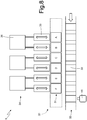
Figure 8 is a schematic plan view of a variant of the forming unit ofFigure 6 . - In
Figures 1 and 2 , thenumber 1 indicates, in its entirety, a rigid "twin" packet of cigarettes comprising a rigidouter container 2 provided with a hinged lid and a pair ofinner wraps 3, which are arranged side by side and are housed in theouter container 2. Each inner wrap 3 (better shown inFigure 3 ) contains aparallelepipedshaped group 4 of cigarettes (shown inFigure 4 ) and has a removable tear-off portion at the top that is removed to allow access to the cigarettes. - Each
inner wrap 3 is manufactured by folding a rectangular-shaped wrapper 5 (schematically illustrated inFigure 5 ) around thegroup 4 of cigarettes in a known manner. Eachinner wrap 3 can be free of stabilisation (i.e. thecorresponding wrapper 5 has no connections between the overlapping parts and therefore must always be firmly held to prevent the folds from unfolding by elastic return), can be stabilised by the use of glue, or can be stabilised by heat-sealing (in the latter case theinner wrap 3 is normally tightly sealed). According to an alternative embodiment, theinner wraps 3 are absent and eachgroup 4 of cigarettes is directly housed in theouter container 2 without the interposition of the correspondinginner wrap 3. - Each rigid
outer container 2 is provided with a hinged lid manufactured in a known way by folding an elongated rectangular-shaped blank 6 around a side by side pair ofinner wraps 3. - According to a possible embodiment shown in
Figure 2 , the rigidouter container 2 comprises twocollars 7, each of which is folded in a "U" to envelop a correspondinginner wrap 3 and connected (by gluing) to theouter container 2 to partially protrude outwards from an open top end of theouter container 2 and engage a corresponding inner surface of the lid when the lid is in the aforementioned closed position. According to an alternative non-illustrated embodiment, the rigidouter container 2 comprises asingle collar 7, which is folded in a "U" to envelop bothinner wraps 3. - In
Figure 5 , the number 8 indicates in its entirety a packing machine (only partially shown inFigure 5 ) which is suitable for manufacturing the above describedpacket 1 of cigarettes. - The packing machine 8 comprises a forming unit 9 (shown only schematically in
Figure 5 ) whereingroups 4 of cigarettes are formed in succession, awrapping unit 10 wherein thewrapper 5 is folded around eachgroup 4 of cigarettes to form the correspondinginner wrap 3, acoupling unit 11 wherein the inner wraps 3 (i.e. groups 4 of cigarettes contained in the inner wraps 3) are coupled two by two to form the contents of thepackets 1 of cigarettes, and awrapping unit 12 wherein thecollar 7 and the blank 6 are folded around each pair of inner wraps 3 (i.e. around each pair ofgroups 4 of cigarettes contained in the inner wraps 3) to form the correspondingouter container 2. - As shown in
Figure 5 , thewrapping unit 10 comprises awrapping drum 13 which is mounted so it can rotate continuously (i.e. with a motion in which the various moving parts move at a constant speed without any resting phases) around a horizontal axis ofrotation 14 perpendicular to the plane ofFigure 5 and supports a plurality of (in particular twelve) wrapping heads 15 (only one of which, for simplicity, is shown inFigure 5 ). The rotation of the wrappingdrum 13 around the axis ofrotation 14 carries each wrappinghead 15 through a feeding station S1 wherein the wrappinghead 15 receives awrapper 5, a transfer station S2 where the wrappinghead 15 receives agroup 4 of cigarettes from the formingunit 9, and a transfer station S3 where the wrappinghead 15 dispenses aninner wrap 3 to thecoupling unit 11. Between the feeding station S1 and the transfer station S3, eachwrapper 5 is folded around agroup 4 of cigarettes to form a correspondinginner wrap 3. - As shown in
Figure 5 , thecoupling unit 11 comprises acoupling drum 16 which is mounted so that it can rotate continuously around an axis ofrotation 17 parallel to the axis ofrotation 14 and supports a plurality of (in particular six) support bodies 18 (only one of which, for simplicity, is shown inFigure 5 ). Eachsupport body 18 is mounted so that it can rotate on thecoupling drum 16 and supports a pair ofhousing heads 19, which in turn are mounted so that they can rotate on thesupport body 18 and are arranged side by side; eachhousing head 19 supports a corresponding coupling pocket which is suitable to accommodate (contain) an inner wrap 3 (i.e. agroup 4 of cigarettes contained in an inner wrap 3). The rotation of thecoupling drum 16 around the axis ofrotation 17 carries eachsupport body 18 through the transfer station S3 wherein the twocorresponding housing heads 19 receive in succession two respectiveinner wraps 3 and through a transfer station S4 wherein bothhousing heads 19 simultaneously dispense the twoinner wraps 3 side by side; in the transfer station S3, the twohousing heads 19 of thesame support body 18 are (relatively) far from each other to receive the twoinner wraps 3 in succession, and then the twohousing heads 19 come together to provide the two nearby (side by side)inner wraps 3 so that the two coupledinner wraps 3 are transferred together in the S4 transfer station (i.e. they leave the twohousing heads 19 of thesame support body 18 together). - As shown in
Figure 5 , thewrapping unit 12 comprises awrapping drum 20 which is mounted so that it can rotate continuously around an axis ofrotation 21 parallel to the axis ofrotation 17 and supports a plurality of (in particular six) wrapping heads 22 (only one of which, for simplicity, is shown inFigure 5 ). The rotation of the wrappingdrum 20 around the axis ofrotation 21 carries each wrappinghead 22 through a feeding station S5 where the wrappinghead 22 receives the collar 7 (or alternatively a pair of collars 7), through the transfer station S4 where the wrappinghead 22 receives two coupledinner wraps 3, and through a transfer station S6 where the wrappinghead 22 dispenses the pair ofinner wraps 3 together with thecollar 7. - The
wrapping unit 12 comprises afeeding drum 23 which is mounted so that it can rotate continuously around an axis ofrotation 24 axis of rotation parallel to the axis ofrotation 21 and supports a plurality of (in particular three) feeding heads 25 (only one of which, for simplicity, is shown inFigure 5 ). The rotation of thefeeding drum 23 around the axis ofrotation 24 carries eachfeeding head 25 through the feeding station S5 where thefeeding head 25 dispenses thecollar 7 and a wrappinghead 22 to the wrappingdrum 20. - As shown in
Figure 5 , thewrapping unit 12 comprises awrapping drum 26 which is mounted so that it can rotate continuously around an axis ofrotation 27 parallel to the axis ofrotation 21 and supports a plurality of (in particular six) wrapping heads 28 (only one of which, for simplicity, is shown inFigure 5 ). The rotation of the wrappingdrum 26 around the axis ofrotation 27 carries each wrappinghead 28 through a feeding station S7 wherein the wrappinghead 28 receives a blank 6, through the transfer station S6 wherein the wrappinghead 28 receives theinner wraps 3 together with thecollar 7, and through the transfer station S8 wherein the wrappinghead 28 dispenses thepacket 1 of cigarettes to a dryingconveyor 29 which carries thepackets 1 of cigarettes towards the output of the packing machine 8. Between the feeding station S7 and the transfer station S8, each blank 6 is folded around twoinner wraps 3 coupled together with acollar 7 to form a correspondingouter container 2. - According to a preferred embodiment, the "even" wrapping
heads 15 of the wrappingdrum 13 follow a different course of motion to that of the "odd" wrappingheads 15 of the wrapping drum 13: in other words, in order to dispense two internal wrappings 3 (which will then be coupled to be put into thesame packet 1 of cigarettes) to the twohousing heads 19 of thesame support body 18, the "even" wrappinghead 15 which dispenses the firstinner wrap 3 into ahousing head 19 follows a different course of motion with respect to the "odd" wrappinghead 15 which dispenses the secondinner wrap 3 into theother housing head 19; obviously, the course of motion of the "even"wrapping heads 15 of the wrappingdrum 13 differs from the course of motion of the "odd" wrappingheads 15 of the wrappingdrum 13 only at the transfer station S3 where theinner wraps 3 pass from the wrappingheads 15 of the wrappingdrum 13 to thehousing heads 19 of the wrappingdrum 20. Similarly and necessarily, in eachsupport body 18 of thecoupling drum 16, the "left"housing head 19 follows a different course of motion to that of the "right"housing head 19 since they must interact withrespective heads 15 of the wrappingdrum 13 which follow different courses of motion from each other. - As shown in
Figure 6 , the formingunit 9 forgroups 4 of cigarettes comprises a hopper 30 (better shown inFigure 7 ) provided with six output mouths 31 (identified by the letters A-F) from whichgroups 4 of cigarettes are extracted in succession. The formingunit 9 further comprises a forming conveyor belt 32 (only partially illustrated) which supports a series of drawers 33, each of which is suitable to receive and house acorresponding group 4 of cigarettes. The formingunit 9 further comprises sixextraction devices 34, each of which is coupled to acorresponding output mouth 31 of thehopper 30 and is suitable to cyclically extract agroup 4 of cigarettes from theoutput mouth 31 to insert thegroup 4 of cigarettes into a corresponding drawer 33 which is stationary in front of theoutput mouth 31. In the embodiment shown inFigure 6 , eachextraction device 34 comprises acomb pusher 35 which is suitable to fit inside acorresponding output mouth 31 and a linearelectric motor 36 which moves thepusher 35 cyclically by imparting an alternating motion to it. - As will be better explained below, each
output mouth 31 has anassociated output mouth 31, so that twooutput mouths 31 are associated with each another when the twooutput mouths 31 are used to extract twocorresponding groups 4 of cigarettes which will be coupled to one another so as to be part of thesame packet 1 of cigarettes. - As shown in
Figure 7 , thehopper 30 comprises anupper part 37 and alower part 38, both of which are delimited at the front and rear by respective vertical walls. Thelower part 38 of thehopper 30 comprises the six equidistantlower output mouths 31, which are internally subdivided by a plurality of defining walls or baffles of the channels within which the cigarettes are arranged in essentially vertical stacks. - The
upper part 37 of thehopper 30 is subdivided, starting from the upper inlet, into twoseparate channels 39 which are mirror images of each other, arranged respectively on the right and left and discharging into an empty chamber belonging to thelower part 38 of thehopper 30 and positioned immediately above theoutput mouths 31. - As shown in
Figure 7 , thehopper 30 is provided with sensors 40 (for example, optical sensors 40), each of which is coupled to acorresponding output mouth 31 and is suitable to detect the presence of cigarettes along the channels of the output mouth 31 (eachoutput mouth 31 may comprise asingle sensor 40 orseveral sensors 40 arranged in line). The function of thesensors 40 is to detect an occlusion (typically due to a "crossed-up" cigarette) in anoutput mouth 31 which prevents the correct flow of cigarettes along theoutput mouth 31; in other words, a "crossed-up" cigarette (i.e., positioned transversely with respect to the other cigarettes) may arrive over anoutput mouth 31 and rest on top of the corresponding channels constituting a "bridge" which thus prevents other properly aligned cigarettes from entering the channels and in this case theoutput mouth 31 becomes empty (at least partially, or at least in one of the channels) of cigarettes since it can no longer receive new cigarettes. - According to one embodiment, a (normally optical)
sensor 41 is provided downstream of theoutput mouths 31, which checks eachgroup 4 of cigarettes carried by a corresponding drawer 33 in order to verify both the completeness of thegroup 4 of cigarettes (i.e. that thegroup 4 of cigarettes has all the cigarettes provided), and the degree of filling of the tips of the cigarettes (i.e. that in each cigarette the corresponding tip is sufficiently "full" of tobacco); defective (incomplete or containing at least one cigarette with an "empty" tip)groups 4 of cigarettes are discarded by a discarding device (known and not shown) located downstream ofsensor 41. - In use, each
output mouth 31 can be identified as correctly functioning whencomplete groups 4 of cigarettes (i.e. those having all the foreseen cigarettes) are extracted from theoutput mouth 31 or it can be identified as malfunctioning whenincomplete groups 4 of cigarettes (i.e. those lacking at least one of the foreseen cigarettes) are extracted from theoutput mouth 31. - Each
output mouth 31 can be identified as malfunctioning when at least one of the corresponding channels is devoid of cigarettes (i.e. when therespective sensor 40 detects that at least one of the corresponding channels is devoid of cigarettes); this type of identification is "preventive", in that it can identify anoutput mouth 31 as malfunctioning before anincomplete group 4 of cigarettes is actually extracted from the exit port 31 (if at least one of the channels is empty or is emptying, it is clear that in the short term onlyincomplete groups 4 of cigarettes can be extracted from the output mouth 31). - Alternatively or in addition to the above, each
output mouth 31 may be identified as malfunctioning when thesensor 41 detects thatincomplete groups 4 of cigarettes (generally several consecutiveincomplete groups 4 of cigarettes or a high percentage ofincomplete groups 4 of cigarettes in a given time window) are being extracted from theoutput mouth 31; this type of identification is "final", since it can only identify anoutput mouth 31 as malfunctioning only after theexit mouth 31 has actually extractedincomplete groups 4 of cigarettes. - The following describes the operation of the packing machine 8 with reference to the management of an occlusion in an
output mouth 31 detected by a correspondingsensor 40. - When all the
output mouths 31 are working correctly (i.e. when all thesensors 40 detect the presence of cigarettes in all the output mouths 31), the packing machine 8 is operating in normal conditions, all the drawers 33 of the formingconveyor 32 are always filled (i.e. they always receive correspondinggroups 4 of cigarettes from the corresponding output mouths 31), all the wrapping heads 15 always receive acorresponding wrapper 5 and acorresponding group 4 of cigarettes, all thesupport bodies 18 always receive a pair ofinner wraps 3, all the wrapping heads 22 always receive acorresponding collar 7 and a corresponding pair of side by sideinner wraps 3, and all the wrapping heads 28 always receive a corresponding blank 6 and a corresponding pair of side by sideinner wraps 3 together with acollar 7. In other words, in normal conditions, the entire packing machine 8, without exception, is involved in the manufacture ofpackets 1 of cigarettes. - When a malfunctioning
output mouth 31 is detected (i.e. one that is occluded and therefore prevented from receiving cigarettes with the necessary continuity), it is possible to stop the packing machine 8, completely stopping the production ofpackets 1 of cigarettes and waiting for a technical intervention (cleaning and resetting of the hopper). This option is certainly simple, but on the other hand it significantly reduces the long-term productivity of the packing machine,8 i.e. the number ofpackets 1 of cigarettes correctly produced in a long period of time (for example, a conventional 8-hour work shift, a working day, a working week, a working month, a working year...). - Whereas, according to the present invention, when a malfunctioning
output mouth 31 is detected (i.e. one that is occluded and therefore prevented from receiving cigarettes with the necessary continuity) it is possible to keep the packing machine 8 running by using only the correctly functioningoutput mouths 31, and not those associated with the malfunctioningoutput mouth 31, for forming thegroups 4 of cigarettes. In this regard, it is important to note that twogroups 4 of cigarettes, necessarily coming from two associatedoutput mouths 31, are inserted into eachpacket 1 of cigarettes therefore thegroups 4 of cigarettes flowing out of two associatedoutput mouths 31 are destined to be coupled together to be inserted into thesame packet 1 of cigarettes: when anoutput mouth 31 is no longer in use due to an occlusion, it is convenient to no longer use the associated output mouth 31 (even if it is functioning correctly) in order to avoid forming an "orphan"group 4 of cigarettes which would necessarily have to be discarded (thus with an obvious waste of cigarettes). - In order not to use the malfunctioning output mouth 31 (i.e. the one that is occluded and therefore prevented from receiving cigarettes with the necessary continuity) and the associated
output mouth 31, thecorresponding extraction devices 34 are disabled (i.e. not operated); in this regard, it is important to note that theextraction devices 34 are independent from each other and therefore can be individually activated/deactivated. - For example, if an occlusion occurs in the
output mouth 31 indicated with the letter "A", theextraction device 34 of theoutput mouth 31 indicated with the letter "A" is deactivated together with theextraction device 34 of theoutput mouth 31 indicated with the letter "B", which is associated with theoutput mouth 31 indicated with the letter "A"; therefore, only theextraction devices 34 of theoutput mouths 31 indicated with the letters "C-F" remain in operation. - Operating as described above, i.e. disabling the
extraction devices 34 of the malfunctioningoutput mouth 31 and the associatedoutput mouth 31, the empty drawers 33 are cyclically formed and thus cyclically some wrapping heads 15 in the transfer station S2 do not receive thecorresponding groups 4 of cigarettes; to avoid wasting wrapping material, in the feeding station S1 the feeding ofwrappers 5 to the wrapping heads 15 is suspended (avoided), which will not receive thecorresponding groups 4 of cigarettes in the transfer station S2. In the same way, in the transfer station S4 some wrapping heads 22 do not receive the corresponding pairs ofinner wraps 3; in order to avoid wasting wrapping material, in the feeding station S5 the feeding of thecollars 7 to the wrapping heads 22 is suspended (avoided), which will not receive the corresponding pairs ofinner wraps 3 in the transfer station S4. In the same way, cyclically in the transfer station S6 some wrapping heads 28 do not receive the corresponding pairs ofinner wraps 3 together with thecollar 7; in order to avoid wasting wrapping material, in the feeding station S7 the feeding of theblanks 6 to the wrapping heads 28 is suspended (avoided), which will not receive the corresponding pairs ofinner wraps 3 together with thecollar 7 in the transfer station S6. - This operating method makes it possible not to completely stop the packing machine 8 when a malfunctioning
output mouth 31 is detected (i.e. one that is occluded and therefore prevented from receiving cigarettes with the necessary continuity); in fact, the packing machine 8 continues to operate normally with a penalty due to the temporary "loss " of two output mouths 31 (the malfunctioningoutput mouth 31 and theoutput mouth 31 associated with it) which, as a knock-on effect, causes a momentary "loss" of at least two wrapping heads 15 of the wrappingdrum 13, at least onesupport body 18 of thecoupling drum 16, at least onewrapping head 22 of the wrappingdrum 20, and least onewrapping head 28 of the wrappingdrum 26. It is thus possible to significantly increase the long-term productivity of the packing machine 8. - In the embodiment shown in
Figure 6 , six fullyindependent pushers 35 are provided, i.e. driven by six corresponding linearelectric motors 36. In the embodiment shown inFigure 8 , only three linearelectric motors 36 are provided, each of which drives a pair ofpushers 35 together, so that a single linearelectric motor 36 drives the twopushers 35 of twooutput mouths 31 associated with each other. - The embodiments described herein can be combined with each other without departing from the protective scope of the present invention.
- The control method described above has numerous benefits.
- Firstly, the control method described above makes it possible to significantly increase the long-term productivity of the packing machine 8 because when the malfunction (occlusion) of an
output mouth 31 occurs, the packing machine 8 is not completely stopped, instead the packing machine 8 is kept in operation with a penalty due to the temporary "loss " of two output mouths 31 (the malfunctioningoutput mouth 31 and theoutput mouth 31 associated with it). In this regard, it is important to note that an operator can easily intervene in thehopper 30 to eliminate an occlusion without having to stop the packing machine 8 and therefore the full functionality of the packing machine 8 can be resumed without ever stopping the packing machine 8; in fact, the area of thehopper 30 in which the occlusions (i.e. the "crossed-up" cigarettes) occur is free of moving parts that could constitute a danger for the operator. - The control method described above does not lead to an increase in the number of cigarettes which are discarded, since blocking the malfunctioning (occluded)
output mouth 31 together with the associatedoutput mouth 31 avoids forminggroups 4 of cigarettes destined to be discarded as "orphans" (i.e. not associated with anothergroup 4 of cigarettes to form the contents of apacket 1 of cigarettes). The control method described above does not lead to an increase in the quantity of discarded wrapping material, as the feeding of the wrapping material (wrappers 5,blanks 6, and collars 7) to the wrapping heads 15, 22 and 28 withoutgroups 4 of cigarettes is interrupted. - Finally, the control method described above is simple and cost-efficient to implement since it does not require major changes to the physical structure of the packing machine 8.
- The embodiment shown in the attached Figures refers to the manufacture of a packet of cigarettes, but the present invention is also applicable without substantial modification to the manufacture of any other type of packet of cylindrical smoking articles (for example, a packet of cigars, a packet of liquid vaporised electronic cigarettes, a packet of new generation cigarettes without tobacco combustion...).
-
- 1
- packet of cigarettes
- 2
- outer container
- 3
- inner wrap
- 4
- group of cigarettes
- 5
- wrapper
- 6
- blank
- 7
- collar
- 8
- packing machine
- 9
- forming unit
- 10
- wrapping unit
- 11
- coupling unit
- 12
- wrapping unit
- 13
- wrapping drum
- 14
- axis of rotation
- 15
- wrapping head
- 16
- coupling drum
- 17
- axis of rotation
- 18
- support body
- 19
- housing heads
- 20
- wrapping drum
- 21
- axis of rotation
- 22
- wrapping head
- 23
- feeding drum
- 24
- axis of rotation
- 25
- feeding head
- 26
- wrapping drum
- 27
- axis of rotation
- 28
- wrapping head
- 29
- drying conveyor
- 30
- hopper
- 31
- output mouth
- 32
- forming conveyor
- 33
- drawers
- 34
- extraction devices
- 35
- pusher
- 36
- linear electric motor
- 37
- upper part
- 38
- lower part
- 39
- channels
- 40
- sensors
- 41
- sensor
- S1
- feeding station
- S2
- transfer station
- S3
- transfer station
- S4
- transfer station
- S5
- feeding station
- S6
- transfer station
- S7
- feeding station
Claims (5)
- A method for controlling a packing machine (8) manufacturing packets (1) of smoking articles, each containing two distinct inner wraps (3) each realized by folding a wrapper (5) around a group (4) of smoking articles; the packing machine (8) comprises:a forming unit (9), where the groups (4) of smoking articles are formed in succession and which comprises a hopper (30), which is provided with at least four output mouths (31), each used to extract a group (4) of smoking articles by means of a corresponding extraction device (34); anda first wrapping unit (10), wherein each wrapper (5) is folded around each group (4) of smoking articles so as to form a corresponding inner wrap (3);a coupling unit (11), wherein the inner wraps (3) are coupled so as to form the content of the packets (1) of smoking articles;a second wrapping unit (12), wherein a blank (6) is folded around each pair of inner wraps (3) so as to form an outer container (2); anda plurality of wrapping drums (13, 20, 26) which are part of the two wrapping units (10, 12) and each of which has a plurality of wrapping heads (15, 22, 28), which are suitable to receive the groups (4) of smoking articles together with corresponding wrapping materials (5, 6, 7);wherein each output mouth (31) has an associated output mouth (31), so that two output mouths (31) are associated with each another when the two output mouths (31) are used to extract two corresponding groups (4) of smoking articles which will be coupled to one another so as to be part of the same packet (1) of smoking articles;the control method comprises the steps of:detecting the correct operation of each output mouth (31) of the hopper (30), so as to identify a possibly faulty output mouth (31);using, for the formation of the groups (4) of smoking articles and in the absence of faulty output mouths (31), all the output mouths (31), always extracting from each output mouth (31) a corresponding group (4) of smoking articles; andusing, to manufacture the packets (1) of smoking articles and in the absence of faulty output mouths (31), all the wrapping heads (15, 22, 28), always supplying all the wrapping heads (15, 22, 28) with the corresponding wrapping materials (5, 6, 7);the control method is characterised in that it comprises the further steps of:avoiding using, for the formation of the groups (4) of smoking articles and in the presence of a faulty output mouth (31), the faulty output mouth (31) as well as the output mouth (31) associated with the faulty output mouth (31), thus avoiding extracting the corresponding groups (4) of smoking articles from the two output mouths (31);avoiding using, to manufacture the packets (1) of smoking articles and in the presence of a faulty output mouth (31), the wrapping heads (15, 22, 28) that are supposed to receive the groups (4) of smoking articles from the faulty output mouth (31) and from the output mouth (31) associated therewith; andavoiding supplying the corresponding wrapping materials (5, 6, 7) to the wrapping heads (15, 22, 28) that are supposed to receive the groups (4) of smoking articles from the faulty output mouth (31) and from the output mouth (31) associated therewith.
- The control method according to Claim 1, wherein the faulty output mouth (31) and the output mouth (31) associated therewith are prevented from being used by disabling the corresponding extraction devices (34).
- The control method according to Claim 1 or 2, wherein:each output mouth (31) of the hopper (30) is associated with a plurality of walls defining small channels where the smoking articles are arranged in substantially vertical piles; andeach output mouth (31) of the hopper (30) is provided with at least one sensor (40),which is suitable to detect the presence of smoking articles along the corresponding small channels.
- The control method according to Claim 3 and comprising the further step of identifying an output mouth (31) as faulty when at least one of the corresponding small channels has no smoking articles.
- The control method according to one of the Claims 1 to 4 and comprising the further steps of:checking whether the groups (4) of smoking articles are complete downstream of the output mouths (31); andidentifying an output mouth (31) as faulty when one or more groups (4) of smoking articles extracted from the output mouth (31) are incomplete.
Priority Applications (1)
| Application Number | Priority Date | Filing Date | Title |
|---|---|---|---|
| PL18732897T PL3630620T3 (en) | 2017-05-23 | 2018-05-23 | A method for controlling a packing machine manufacturing packets of smoking articles, each containing two distinct groups of smoking articles |
Applications Claiming Priority (2)
| Application Number | Priority Date | Filing Date | Title |
|---|---|---|---|
| IT102017000055610A IT201700055610A1 (en) | 2017-05-23 | 2017-05-23 | Control method of a packaging machine which produces packets of smoking articles each containing two groups of smoking articles each other distinct. |
| PCT/IB2018/053654 WO2018215950A1 (en) | 2017-05-23 | 2018-05-23 | A method for controlling a packing machine manufacturing packets of smoking articles, each containing two distinct groups of smoking articles |
Publications (2)
| Publication Number | Publication Date |
|---|---|
| EP3630620A1 EP3630620A1 (en) | 2020-04-08 |
| EP3630620B1 true EP3630620B1 (en) | 2021-12-15 |
Family
ID=60182853
Family Applications (1)
| Application Number | Title | Priority Date | Filing Date |
|---|---|---|---|
| EP18732897.6A Active EP3630620B1 (en) | 2017-05-23 | 2018-05-23 | A method for controlling a packing machine manufacturing packets of smoking articles, each containing two distinct groups of smoking articles |
Country Status (4)
| Country | Link |
|---|---|
| EP (1) | EP3630620B1 (en) |
| IT (1) | IT201700055610A1 (en) |
| PL (1) | PL3630620T3 (en) |
| WO (1) | WO2018215950A1 (en) |
Families Citing this family (3)
| Publication number | Priority date | Publication date | Assignee | Title |
|---|---|---|---|---|
| CN113753293B (en) * | 2021-09-01 | 2023-02-28 | 红云红河烟草(集团)有限责任公司 | Auxiliary machine quality self-checking method for GDX1 soft box packaging machine |
| IT202200026232A1 (en) * | 2022-12-21 | 2024-06-21 | Gd Spa | HOPPER FOR A SMOKING ARTICLE PACKING MACHINE AND METHOD OF CONTROLLING A HOPPER FOR A SMOKING ARTICLE PACKING MACHINE |
| DE102023126975A1 (en) * | 2023-10-04 | 2025-04-10 | Focke & Co. (Gmbh & Co. Kg) | Method and device for feeding groups of cigarette industry products to pockets of a conveyor |
Citations (6)
| Publication number | Priority date | Publication date | Assignee | Title |
|---|---|---|---|---|
| US4528801A (en) | 1982-05-28 | 1985-07-16 | G.D. Societa Per Azioni | Device for forming groups of cigarettes in a cigarette packaging machine |
| DE19501306A1 (en) | 1994-01-20 | 1995-07-27 | Gd Spa | Conveyor device for the gradual conveying of half-packs for the production of twin cigarette packs |
| EP1020357A1 (en) | 1999-01-15 | 2000-07-19 | G.D Societa' Per Azioni | Method of forming groups of cigarettes on a cigarette packing machine |
| US20010047923A1 (en) | 2000-05-30 | 2001-12-06 | Mario Spatafora | Cigarette packing machine |
| DE60120539T2 (en) | 2000-04-04 | 2007-05-31 | G.D Società per Azioni | Machine for producing cigarette packs and the method for controlling the machine |
| WO2017064659A1 (en) | 2015-10-16 | 2017-04-20 | G.D Societa' Per Azioni | Packer machine and wrapping method to manufacture a packet of tobacco articles containing two distinct groups of tobacco articles |
-
2017
- 2017-05-23 IT IT102017000055610A patent/IT201700055610A1/en unknown
-
2018
- 2018-05-23 WO PCT/IB2018/053654 patent/WO2018215950A1/en not_active Ceased
- 2018-05-23 EP EP18732897.6A patent/EP3630620B1/en active Active
- 2018-05-23 PL PL18732897T patent/PL3630620T3/en unknown
Patent Citations (6)
| Publication number | Priority date | Publication date | Assignee | Title |
|---|---|---|---|---|
| US4528801A (en) | 1982-05-28 | 1985-07-16 | G.D. Societa Per Azioni | Device for forming groups of cigarettes in a cigarette packaging machine |
| DE19501306A1 (en) | 1994-01-20 | 1995-07-27 | Gd Spa | Conveyor device for the gradual conveying of half-packs for the production of twin cigarette packs |
| EP1020357A1 (en) | 1999-01-15 | 2000-07-19 | G.D Societa' Per Azioni | Method of forming groups of cigarettes on a cigarette packing machine |
| DE60120539T2 (en) | 2000-04-04 | 2007-05-31 | G.D Società per Azioni | Machine for producing cigarette packs and the method for controlling the machine |
| US20010047923A1 (en) | 2000-05-30 | 2001-12-06 | Mario Spatafora | Cigarette packing machine |
| WO2017064659A1 (en) | 2015-10-16 | 2017-04-20 | G.D Societa' Per Azioni | Packer machine and wrapping method to manufacture a packet of tobacco articles containing two distinct groups of tobacco articles |
Also Published As
| Publication number | Publication date |
|---|---|
| PL3630620T3 (en) | 2022-03-21 |
| IT201700055610A1 (en) | 2018-11-23 |
| EP3630620A1 (en) | 2020-04-08 |
| WO2018215950A1 (en) | 2018-11-29 |
Similar Documents
| Publication | Publication Date | Title |
|---|---|---|
| US4330976A (en) | Packing machines | |
| EP2626305B1 (en) | Packing machine and method for producing rigid packets, each comprising at least two containers one inside the other | |
| EP3630620B1 (en) | A method for controlling a packing machine manufacturing packets of smoking articles, each containing two distinct groups of smoking articles | |
| CN101641259B (en) | Packaging machine and method | |
| CN101454207B (en) | Automatic machine for making filter bags for infusion products | |
| US4607477A (en) | Cigarette packing machines | |
| CN103702904B (en) | For the production of wrapping machine and the method for hard packing | |
| KR102586941B1 (en) | Packer machine and wrapping method to manufacture a packet of tobacco articles containing two distinct groups of tobacco articles | |
| EP3487767B1 (en) | Machine for producing filter-bags with infusion products and with an overwrap envelope | |
| EP3222532B2 (en) | Orientation unit and method for causing a change in orientation of a parallelepiped-shaped article in a packing machine | |
| US9221227B2 (en) | Method and machine for producing bags containing fiber material | |
| EP4289752A1 (en) | Packer machine and wrapping method to couple an inner frame to two groups of smoking articles | |
| US3553925A (en) | Cigarette packer | |
| IT9003441A1 (en) | EQUIPMENT FOR FEEDING PRODUCTS. | |
| EP3639680B1 (en) | Production line and method for the production of rod-shaped articles of the tobacco industry | |
| ITBO20110726A1 (en) | METHOD AND MACHINE FOR THE PRODUCTION OF ENVELOPES CONTAINING FIBER MATERIAL. | |
| EP2604530A1 (en) | Method and machine for producing bags containing fibre material | |
| EP3630621B1 (en) | A packer machine for cylindrical smoking articles and provided with an hopper | |
| ITBO20110724A1 (en) | METHOD AND MACHINE FOR THE PRODUCTION OF ENVELOPES CONTAINING FIBER MATERIAL. | |
| EP4046924B1 (en) | Packer machine and wrapping method to produce a pack using at least one wrapping material | |
| EP2060494B1 (en) | Packet wrapping systems | |
| EP4574691A1 (en) | Packer machine and wrapping method to produce a pack for smoking articles | |
| US3121301A (en) | Direct feed mechanism interconnecting cigarette packer and cellophane wrapper apparatus | |
| EP4647351A2 (en) | Cartoning machine and wrapping method to produce a carton of packs for smoking articles | |
| KR200288725Y1 (en) | Former machine for bellows at the straw having packing apparatus |
Legal Events
| Date | Code | Title | Description |
|---|---|---|---|
| STAA | Information on the status of an ep patent application or granted ep patent |
Free format text: STATUS: UNKNOWN |
|
| STAA | Information on the status of an ep patent application or granted ep patent |
Free format text: STATUS: THE INTERNATIONAL PUBLICATION HAS BEEN MADE |
|
| PUAI | Public reference made under article 153(3) epc to a published international application that has entered the european phase |
Free format text: ORIGINAL CODE: 0009012 |
|
| STAA | Information on the status of an ep patent application or granted ep patent |
Free format text: STATUS: REQUEST FOR EXAMINATION WAS MADE |
|
| 17P | Request for examination filed |
Effective date: 20191111 |
|
| AK | Designated contracting states |
Kind code of ref document: A1 Designated state(s): AL AT BE BG CH CY CZ DE DK EE ES FI FR GB GR HR HU IE IS IT LI LT LU LV MC MK MT NL NO PL PT RO RS SE SI SK SM TR |
|
| AX | Request for extension of the european patent |
Extension state: BA ME |
|
| DAV | Request for validation of the european patent (deleted) | ||
| DAX | Request for extension of the european patent (deleted) | ||
| STAA | Information on the status of an ep patent application or granted ep patent |
Free format text: STATUS: EXAMINATION IS IN PROGRESS |
|
| 17Q | First examination report despatched |
Effective date: 20201222 |
|
| GRAP | Despatch of communication of intention to grant a patent |
Free format text: ORIGINAL CODE: EPIDOSNIGR1 |
|
| STAA | Information on the status of an ep patent application or granted ep patent |
Free format text: STATUS: GRANT OF PATENT IS INTENDED |
|
| GRAS | Grant fee paid |
Free format text: ORIGINAL CODE: EPIDOSNIGR3 |
|
| GRAA | (expected) grant |
Free format text: ORIGINAL CODE: 0009210 |
|
| STAA | Information on the status of an ep patent application or granted ep patent |
Free format text: STATUS: THE PATENT HAS BEEN GRANTED |
|
| INTG | Intention to grant announced |
Effective date: 20211019 |
|
| AK | Designated contracting states |
Kind code of ref document: B1 Designated state(s): AL AT BE BG CH CY CZ DE DK EE ES FI FR GB GR HR HU IE IS IT LI LT LU LV MC MK MT NL NO PL PT RO RS SE SI SK SM TR |
|
| REG | Reference to a national code |
Ref country code: GB Ref legal event code: FG4D Ref country code: CH Ref legal event code: EP |
|
| REG | Reference to a national code |
Ref country code: IE Ref legal event code: FG4D Ref country code: DE Ref legal event code: R096 Ref document number: 602018028198 Country of ref document: DE |
|
| REG | Reference to a national code |
Ref country code: AT Ref legal event code: REF Ref document number: 1455336 Country of ref document: AT Kind code of ref document: T Effective date: 20220115 |
|
| REG | Reference to a national code |
Ref country code: LT Ref legal event code: MG9D |
|
| REG | Reference to a national code |
Ref country code: NL Ref legal event code: MP Effective date: 20211215 |
|
| PG25 | Lapsed in a contracting state [announced via postgrant information from national office to epo] |
Ref country code: RS Free format text: LAPSE BECAUSE OF FAILURE TO SUBMIT A TRANSLATION OF THE DESCRIPTION OR TO PAY THE FEE WITHIN THE PRESCRIBED TIME-LIMIT Effective date: 20211215 Ref country code: LT Free format text: LAPSE BECAUSE OF FAILURE TO SUBMIT A TRANSLATION OF THE DESCRIPTION OR TO PAY THE FEE WITHIN THE PRESCRIBED TIME-LIMIT Effective date: 20211215 Ref country code: FI Free format text: LAPSE BECAUSE OF FAILURE TO SUBMIT A TRANSLATION OF THE DESCRIPTION OR TO PAY THE FEE WITHIN THE PRESCRIBED TIME-LIMIT Effective date: 20211215 Ref country code: BG Free format text: LAPSE BECAUSE OF FAILURE TO SUBMIT A TRANSLATION OF THE DESCRIPTION OR TO PAY THE FEE WITHIN THE PRESCRIBED TIME-LIMIT Effective date: 20220315 |
|
| REG | Reference to a national code |
Ref country code: AT Ref legal event code: MK05 Ref document number: 1455336 Country of ref document: AT Kind code of ref document: T Effective date: 20211215 |
|
| PG25 | Lapsed in a contracting state [announced via postgrant information from national office to epo] |
Ref country code: SE Free format text: LAPSE BECAUSE OF FAILURE TO SUBMIT A TRANSLATION OF THE DESCRIPTION OR TO PAY THE FEE WITHIN THE PRESCRIBED TIME-LIMIT Effective date: 20211215 Ref country code: NO Free format text: LAPSE BECAUSE OF FAILURE TO SUBMIT A TRANSLATION OF THE DESCRIPTION OR TO PAY THE FEE WITHIN THE PRESCRIBED TIME-LIMIT Effective date: 20220315 Ref country code: LV Free format text: LAPSE BECAUSE OF FAILURE TO SUBMIT A TRANSLATION OF THE DESCRIPTION OR TO PAY THE FEE WITHIN THE PRESCRIBED TIME-LIMIT Effective date: 20211215 Ref country code: HR Free format text: LAPSE BECAUSE OF FAILURE TO SUBMIT A TRANSLATION OF THE DESCRIPTION OR TO PAY THE FEE WITHIN THE PRESCRIBED TIME-LIMIT Effective date: 20211215 Ref country code: GR Free format text: LAPSE BECAUSE OF FAILURE TO SUBMIT A TRANSLATION OF THE DESCRIPTION OR TO PAY THE FEE WITHIN THE PRESCRIBED TIME-LIMIT Effective date: 20220316 |
|
| PG25 | Lapsed in a contracting state [announced via postgrant information from national office to epo] |
Ref country code: NL Free format text: LAPSE BECAUSE OF FAILURE TO SUBMIT A TRANSLATION OF THE DESCRIPTION OR TO PAY THE FEE WITHIN THE PRESCRIBED TIME-LIMIT Effective date: 20211215 |
|
| PG25 | Lapsed in a contracting state [announced via postgrant information from national office to epo] |
Ref country code: SM Free format text: LAPSE BECAUSE OF FAILURE TO SUBMIT A TRANSLATION OF THE DESCRIPTION OR TO PAY THE FEE WITHIN THE PRESCRIBED TIME-LIMIT Effective date: 20211215 Ref country code: SK Free format text: LAPSE BECAUSE OF FAILURE TO SUBMIT A TRANSLATION OF THE DESCRIPTION OR TO PAY THE FEE WITHIN THE PRESCRIBED TIME-LIMIT Effective date: 20211215 Ref country code: RO Free format text: LAPSE BECAUSE OF FAILURE TO SUBMIT A TRANSLATION OF THE DESCRIPTION OR TO PAY THE FEE WITHIN THE PRESCRIBED TIME-LIMIT Effective date: 20211215 Ref country code: PT Free format text: LAPSE BECAUSE OF FAILURE TO SUBMIT A TRANSLATION OF THE DESCRIPTION OR TO PAY THE FEE WITHIN THE PRESCRIBED TIME-LIMIT Effective date: 20220418 Ref country code: ES Free format text: LAPSE BECAUSE OF FAILURE TO SUBMIT A TRANSLATION OF THE DESCRIPTION OR TO PAY THE FEE WITHIN THE PRESCRIBED TIME-LIMIT Effective date: 20211215 Ref country code: EE Free format text: LAPSE BECAUSE OF FAILURE TO SUBMIT A TRANSLATION OF THE DESCRIPTION OR TO PAY THE FEE WITHIN THE PRESCRIBED TIME-LIMIT Effective date: 20211215 Ref country code: CZ Free format text: LAPSE BECAUSE OF FAILURE TO SUBMIT A TRANSLATION OF THE DESCRIPTION OR TO PAY THE FEE WITHIN THE PRESCRIBED TIME-LIMIT Effective date: 20211215 |
|
| PG25 | Lapsed in a contracting state [announced via postgrant information from national office to epo] |
Ref country code: AT Free format text: LAPSE BECAUSE OF FAILURE TO SUBMIT A TRANSLATION OF THE DESCRIPTION OR TO PAY THE FEE WITHIN THE PRESCRIBED TIME-LIMIT Effective date: 20211215 |
|
| REG | Reference to a national code |
Ref country code: DE Ref legal event code: R026 Ref document number: 602018028198 Country of ref document: DE |
|
| PLBI | Opposition filed |
Free format text: ORIGINAL CODE: 0009260 |
|
| PLAX | Notice of opposition and request to file observation + time limit sent |
Free format text: ORIGINAL CODE: EPIDOSNOBS2 |
|
| PG25 | Lapsed in a contracting state [announced via postgrant information from national office to epo] |
Ref country code: IS Free format text: LAPSE BECAUSE OF FAILURE TO SUBMIT A TRANSLATION OF THE DESCRIPTION OR TO PAY THE FEE WITHIN THE PRESCRIBED TIME-LIMIT Effective date: 20220415 |
|
| 26 | Opposition filed |
Opponent name: FOCKE & CO. (GMBH & CO. KG) Effective date: 20220909 |
|
| PG25 | Lapsed in a contracting state [announced via postgrant information from national office to epo] |
Ref country code: DK Free format text: LAPSE BECAUSE OF FAILURE TO SUBMIT A TRANSLATION OF THE DESCRIPTION OR TO PAY THE FEE WITHIN THE PRESCRIBED TIME-LIMIT Effective date: 20211215 Ref country code: AL Free format text: LAPSE BECAUSE OF FAILURE TO SUBMIT A TRANSLATION OF THE DESCRIPTION OR TO PAY THE FEE WITHIN THE PRESCRIBED TIME-LIMIT Effective date: 20211215 |
|
| PG25 | Lapsed in a contracting state [announced via postgrant information from national office to epo] |
Ref country code: SI Free format text: LAPSE BECAUSE OF FAILURE TO SUBMIT A TRANSLATION OF THE DESCRIPTION OR TO PAY THE FEE WITHIN THE PRESCRIBED TIME-LIMIT Effective date: 20211215 |
|
| REG | Reference to a national code |
Ref country code: CH Ref legal event code: PL |
|
| REG | Reference to a national code |
Ref country code: BE Ref legal event code: MM Effective date: 20220531 |
|
| GBPC | Gb: european patent ceased through non-payment of renewal fee |
Effective date: 20220523 |
|
| PLBB | Reply of patent proprietor to notice(s) of opposition received |
Free format text: ORIGINAL CODE: EPIDOSNOBS3 |
|
| PG25 | Lapsed in a contracting state [announced via postgrant information from national office to epo] |
Ref country code: MC Free format text: LAPSE BECAUSE OF FAILURE TO SUBMIT A TRANSLATION OF THE DESCRIPTION OR TO PAY THE FEE WITHIN THE PRESCRIBED TIME-LIMIT Effective date: 20211215 Ref country code: LU Free format text: LAPSE BECAUSE OF NON-PAYMENT OF DUE FEES Effective date: 20220523 Ref country code: LI Free format text: LAPSE BECAUSE OF NON-PAYMENT OF DUE FEES Effective date: 20220531 Ref country code: CH Free format text: LAPSE BECAUSE OF NON-PAYMENT OF DUE FEES Effective date: 20220531 |
|
| PG25 | Lapsed in a contracting state [announced via postgrant information from national office to epo] |
Ref country code: IE Free format text: LAPSE BECAUSE OF NON-PAYMENT OF DUE FEES Effective date: 20220523 Ref country code: FR Free format text: LAPSE BECAUSE OF NON-PAYMENT OF DUE FEES Effective date: 20220531 |
|
| PG25 | Lapsed in a contracting state [announced via postgrant information from national office to epo] |
Ref country code: IT Free format text: LAPSE BECAUSE OF FAILURE TO SUBMIT A TRANSLATION OF THE DESCRIPTION OR TO PAY THE FEE WITHIN THE PRESCRIBED TIME-LIMIT Effective date: 20211215 Ref country code: GB Free format text: LAPSE BECAUSE OF NON-PAYMENT OF DUE FEES Effective date: 20220523 Ref country code: BE Free format text: LAPSE BECAUSE OF NON-PAYMENT OF DUE FEES Effective date: 20220531 |
|
| P01 | Opt-out of the competence of the unified patent court (upc) registered |
Effective date: 20230529 |
|
| PG25 | Lapsed in a contracting state [announced via postgrant information from national office to epo] |
Ref country code: MK Free format text: LAPSE BECAUSE OF FAILURE TO SUBMIT A TRANSLATION OF THE DESCRIPTION OR TO PAY THE FEE WITHIN THE PRESCRIBED TIME-LIMIT Effective date: 20211215 Ref country code: CY Free format text: LAPSE BECAUSE OF FAILURE TO SUBMIT A TRANSLATION OF THE DESCRIPTION OR TO PAY THE FEE WITHIN THE PRESCRIBED TIME-LIMIT Effective date: 20211215 |
|
| PG25 | Lapsed in a contracting state [announced via postgrant information from national office to epo] |
Ref country code: HU Free format text: LAPSE BECAUSE OF FAILURE TO SUBMIT A TRANSLATION OF THE DESCRIPTION OR TO PAY THE FEE WITHIN THE PRESCRIBED TIME-LIMIT; INVALID AB INITIO Effective date: 20180523 |
|
| PG25 | Lapsed in a contracting state [announced via postgrant information from national office to epo] |
Ref country code: TR Free format text: LAPSE BECAUSE OF FAILURE TO SUBMIT A TRANSLATION OF THE DESCRIPTION OR TO PAY THE FEE WITHIN THE PRESCRIBED TIME-LIMIT Effective date: 20211215 |
|
| PLCK | Communication despatched that opposition was rejected |
Free format text: ORIGINAL CODE: EPIDOSNREJ1 |
|
| APBP | Date of receipt of notice of appeal recorded |
Free format text: ORIGINAL CODE: EPIDOSNNOA2O |
|
| APAH | Appeal reference modified |
Free format text: ORIGINAL CODE: EPIDOSCREFNO |
|
| PG25 | Lapsed in a contracting state [announced via postgrant information from national office to epo] |
Ref country code: MT Free format text: LAPSE BECAUSE OF FAILURE TO SUBMIT A TRANSLATION OF THE DESCRIPTION OR TO PAY THE FEE WITHIN THE PRESCRIBED TIME-LIMIT Effective date: 20211215 |
|
| APBQ | Date of receipt of statement of grounds of appeal recorded |
Free format text: ORIGINAL CODE: EPIDOSNNOA3O |
|
| PGFP | Annual fee paid to national office [announced via postgrant information from national office to epo] |
Ref country code: DE Payment date: 20250529 Year of fee payment: 8 Ref country code: PL Payment date: 20250505 Year of fee payment: 8 |