EP3629524A1 - Method and network node for communicating over a token passing network - Google Patents
Method and network node for communicating over a token passing network Download PDFInfo
- Publication number
- EP3629524A1 EP3629524A1 EP18196658.1A EP18196658A EP3629524A1 EP 3629524 A1 EP3629524 A1 EP 3629524A1 EP 18196658 A EP18196658 A EP 18196658A EP 3629524 A1 EP3629524 A1 EP 3629524A1
- Authority
- EP
- European Patent Office
- Prior art keywords
- token
- node
- txb
- packets
- parameter
- Prior art date
- Legal status (The legal status is an assumption and is not a legal conclusion. Google has not performed a legal analysis and makes no representation as to the accuracy of the status listed.)
- Granted
Links
Images



Classifications
-
- H—ELECTRICITY
- H04—ELECTRIC COMMUNICATION TECHNIQUE
- H04L—TRANSMISSION OF DIGITAL INFORMATION, e.g. TELEGRAPHIC COMMUNICATION
- H04L12/00—Data switching networks
- H04L12/28—Data switching networks characterised by path configuration, e.g. LAN [Local Area Networks] or WAN [Wide Area Networks]
- H04L12/40—Bus networks
-
- H—ELECTRICITY
- H04—ELECTRIC COMMUNICATION TECHNIQUE
- H04L—TRANSMISSION OF DIGITAL INFORMATION, e.g. TELEGRAPHIC COMMUNICATION
- H04L12/00—Data switching networks
- H04L12/28—Data switching networks characterised by path configuration, e.g. LAN [Local Area Networks] or WAN [Wide Area Networks]
- H04L12/40—Bus networks
- H04L12/407—Bus networks with decentralised control
- H04L12/417—Bus networks with decentralised control with deterministic access, e.g. token passing
-
- H—ELECTRICITY
- H04—ELECTRIC COMMUNICATION TECHNIQUE
- H04L—TRANSMISSION OF DIGITAL INFORMATION, e.g. TELEGRAPHIC COMMUNICATION
- H04L12/00—Data switching networks
- H04L12/28—Data switching networks characterised by path configuration, e.g. LAN [Local Area Networks] or WAN [Wide Area Networks]
- H04L12/42—Loop networks
- H04L12/427—Loop networks with decentralised control
- H04L12/433—Loop networks with decentralised control with asynchronous transmission, e.g. token ring, register insertion
-
- H—ELECTRICITY
- H04—ELECTRIC COMMUNICATION TECHNIQUE
- H04L—TRANSMISSION OF DIGITAL INFORMATION, e.g. TELEGRAPHIC COMMUNICATION
- H04L12/00—Data switching networks
- H04L12/28—Data switching networks characterised by path configuration, e.g. LAN [Local Area Networks] or WAN [Wide Area Networks]
- H04L12/40—Bus networks
- H04L2012/4026—Bus for use in automation systems
Definitions
- the disclosed embodiments generally relate to a method and a network node for communicating over a token passing network. Specifically, the disclosed embodiments relate to a token passing network formed by a plurality of network nodes and interconnected by a communications media on a Media Access Control or MAC layer.
- IoT Internet of Things
- WoT Web of Things
- time-critical traffic such as communications for controlling devices has to be transmitted with a deterministic maximum latency. This means that control data packets have to arrive within a certain time. For some control tasks, time critical traffic is also periodic.
- burst traffic such as IoT communications for transmitting sensor values or larger documents in machine-readable format or the retrieval of webpages occurs.
- This kind of traffic happens rather sporadically and may include a data volume incurring several packets for completion, which is referred to as packet burst.
- a known token passing MAC (Media Access Control) protocol is well-suited to deal with time-critical traffic of single packets.
- a node can send a packet only if it is in possession of the token thereby eliminating interfering media accesses.
- token passing networks are designed for supporting highly time-critical data traffic with low data volume rather than supporting burst traffic.
- Embodiments for communicating over a token passing network as described herein generally extend the traditional functionality of a token - which is to assign a network node a right to send when it has possession of the token - by a novel functionality of offering and distributing a »budget « amongst the network nodes.
- this budget is specifying a number of packets which the node possessing the token is allowed for sending.
- the budget is delivered by the token and may be partially or fully used by the network node or not.
- the embodiments thereby support an unhampered exchange of time-critical traffic while occasionally granting network nodes to utilize the commonly shared budget in order to send burst traffic.
- the embodiments according to the invention provide for an effective, yet simple method for transferring unused transmission opportunities in token passing networks to nodes which have to send multiple packets only occasionally.
- By replacing at least one of said at least one token parameter within the token by at least one modified token parameter transmission opportunities remaining unused by the node currently possessing the token are delivered as a budget to the next node.
- An occasional multiplicity of packets to send is often referred to as »burst «.
- Nodes willing to send a burst receive transmission opportunities by a preceding node in the predetermined order.
- unused transmission opportunities are available to the other nodes of the token passing network.
- the embodiments according to the invention provide significant improvements compared to known token passing networks with respect to a required time for completing a transmission of bursts or request/reply exchanges on higher layers such as HTTP/TCP (Hypertext Transfer Protocol/Transmission Control Protocol).
- HTTP/TCP Hypertext Transfer Protocol/Transmission Control Protocol
- the embodiments according to the invention advantageously do not require a synchronized time between the nodes.
- the embodiments can be used without any explicit or relative timing.
- the independence of a global time, a synchronized network time, or other timing requirements makes the embodiments especially suitable for constraint network node devices.
- the number of packets specified by the token parameter is determined by an integer expressing the number of packets.
- the number of packets specified by the token parameter is determined by a value expressing a time interval for sending said number of packets.
- all other relevant parameters such as the maximum number of packets which the node possessing the token is allowed to send are expressed by time values instead of packet counts.
- a determination of the available number of packets currently made available for sending by the node possessing the token is determined using a defined waiting time interval after reception of the token.
- Such guard intervals or small processing times between sending packets are advantageous applied in order to allow the processing of the packets according to a protocol supporting such timing.
- a local parameter locally stored in each of the plurality of nodes is provided.
- This local parameter specifies a number of packets which a node possessing the token is allowed for sending.
- the local parameter is optionally adjusted individually for each node.
- the maximum number of packets is then determined by the number of packets specified by the token parameter in addition to the number of packets specified by the local parameter.
- the modified token parameter is a sum of the value of the token parameter and the value of the local parameter deducted by the value of the scheduled number of packets.
- This modified token parameter is modified by the current node possessing the token and passed to the subsequent token of the plurality of nodes in the predetermined order. Summing the value of the local parameter deducted by the value of the scheduled number of packets to this modified parameter grants for the advantageous effect stated above: in cases where the node has less or no scheduled packets to send, the local parameter will serve as an additional budget for sending packets by subsequent nodes.
- the value of the local parameter is included in the token as a second token parameter.
- This embodiment advantageously enables any node to gain knowledge of the local parameter of another node. Since the medium is shared amongst the nodes - note that the ring structure is a logical ring structure within a shared medium, not a physical ring structure - any node is able to listen to the token even though not being the intended recipient to which the token is to be passed.
- an accumulation or sum of values of the local parameters from nodes preceding the node possessing the token is included in the token as a third parameter.
- This embodiment is advantageous for deriving a maximum limit for the modified token parameter according to an embodiment described below, particularly including scenarios in which the token passing network is affected by changes due to new nodes or nodes leaving the token passing network.
- knowledge of the third parameter transported by the token is advantageous for determining a maximum number of packets which the node possessing the token is allowed for sending. Further on, an adaptation to changing network members is advantageously supported by the third parameter. Applying this embodiment supports the usage of differing local parameter for specifying the number of packets allowed for sending. Differing local parameters for different nodes are advantageous for traffic engineering purposes, for instance, in order to support time-sensitive, periodic, or data-intense traffic flows.
- a maximum limit for the modified token parameter is included in the token as a fourth parameter.
- This embodiment is particularly advantageous for adjusting the network traffic in order to grant for a higher threshold for downloads or updates, when latency requirements are currently of lower importance. Such adjustments are advantageously arranged by a network management.
- the modified token parameter is restricted to an upper value. This measure advantageously supports the object of the invention guaranteeing the time-critical traffic while still allowing for temporary burst traffic.
- factors or combinations thereof can be considered, including the number of nodes in the network, the second token parameter, the third token parameter, the fourth token parameter, and/or a token sequence number assigned to the token.
- FIG. 8 a schematic diagram of an exemplary token passing network is depicted.
- the token passing network includes a shared communications media on a Media Access Control (MAC) layer.
- Five network nodes A,B,C,D,E are interconnected with each other by the network.
- MAC Media Access Control
- a - not shown - token is passed to each of the five network nodes A,B,C,D,E in a predetermined order, enabling each network node A,B,C,D,E to send a predetermined number of packets on the network when it has possession of the token, thus eliminating interfering media accesses.
- the transmission of the token in the predetermined order is cyclically repeated, wherein a time span within one cycle - i.e. the time span which the token needs to pass through every network node A,B,C,D,E in the network - is referred to as token round time.
- a delay time for sending packets is bound by the token round time which includes an associated transmission time of the data packets.
- a single TCP packet (Transmission Control Protocol) with a size of 1,500 bytes might be fragmented in 18 packets using this communication protocol 6LoWPAN.
- a relatively small burst of five IPv6 (Internet Protocol Version 6) packets would then have to be transmitted by a burst of 90 6LoWPAN packets which requires an amount of 90 token round times. Bursts with such an amount of data packets are far beyond reasonable limits in a time-critical traffic network.
- a delay caused by such an amount of token round times may subsequently result in timeouts of the TCP acknowledgment mechanism leading to a breakdown of the HTTP/TCP (Hypertext Transfer Protocol/Transmission Control Protocol) communication.
- HTTP/TCP Hypertext Transfer Protocol/Transmission Control Protocol
- time synchronization between network nodes might fail in resource-constraint networks with embedded and/or resource-constraint devices.
- TTRT Target Token Rotation Time
- the actual token rotation time is compared to the target token rotation time, or maximum token rotation time, and the difference is the interval for sending messages by the node.
- the Timed Token Protocol requires at least several timers at the nodes. Resource-constraint nodes, however, might not have a concept of absolute time and synchronization between them is not possible.
- embedded devices may have only a very limited number of timers.
- the communication distance between nodes may vary between a few centimeters up to more than 1 kilometer, resulting in a wide range of transmission times.
- Embodiments for communicating over a token passing network as described herein generally extend the traditional functionality of a token - of assigning a network node a right to send when it has possession of the token - by a novel functionality of distributing a »budget « amongst the network nodes by the token.
- this budget is specified by a number of packets which the node possessing the token is allowed for sending.
- the budget is delivered by the token and may be partially or fully used by the network node or not.
- the embodiments thereby support an unhampered exchange of time-critical traffic while occasionally granting network nodes to utilize the commonly shared budget in order to send burst traffic.
- a parameter for specifying a number of packets which a current node i is allowed to send is a parameter for specifying a number of packets which a current node i is allowed to send.
- the current node is allowed to send a data packet.
- One transmission opportunity corresponds to being allowed to send one data packet.
- each node i is allowed to send a certain number of local allowed packets p_i if it is in possession of the token.
- the number of local allowed packets p_i is usually individually adjusted for each node and stored by a parameter on each node. A usual value for this parameter is 1, meaning that each node is allowed to send one packet.
- the token is extended by at least one field for providing at least one token parameter within the token.
- At least one token parameter is specifying a number of packets which the node possessing the token is allowed for sending. This parameter is also referred to as Token Transmission Budget, or TXB.
- FIG. 1 shows a general format of a token including a Token Transmission Budget field TXB according to an embodiment.
- a Token Header HD contains addressing information and control information for the correct recognition of the MAC frame as token.
- the Token Payload PLD contains token-specific information that is distributed between the nodes in the token passing network.
- the Token Transmission Budget TXB is part of the token payload PLD.
- the Token Payload PLD may contain other Token fields OTH with further information.
- a specific token format can specify any order of the Token fields in the Token Payload.
- the preferred size of the Token Transmission Budget TXB field is 1 byte or 1 octet. Other sizes of the Token Transmission Budget TXB field are possible, both smaller and larger. A size of 1 byte/octet allows for a maximum Token Transmission Budget TXB of 255 packets, which is sufficient for the usual maximum size of networks including around 50 nodes.
- the Token Footer FT contains fields that are relevant after the reception of the octets of the token. This is usually, for example, a Frame Check Sequence. Alternatively, the Token Footer FT may be empty or the Token Footer FT may be completely omitted.
- FIG. 2 shows a flowchart representing a token processing routine according to an embodiment.
- a current node interconnected by a communications media on a Media Access Control (MAC) layer is receiving a token including a token parameter stored in a Token Transmission Budget field TXB.
- the maximum number of packets which the node possessing the token is allowed for sending is a sum of the value of the token parameter TXB and the value of the local parameter p_i.
- Immediately sending its allowed packets particularly means that the current node should not wait for packets to become available.
- the current node is allowed to send packets that have been available when receiving the token, or packets that become available while sending available packets.
- guard intervals or small processing times between sending the packets are applied in order to allow the processing of the packets and according to a protocol supporting such timing.
- the current node i is sending s_i data packets.
- the number of data packets actually sent by the current node i is determined as sent packets s_i.
- sent packets s_i are also referred to as scheduled number of packets s_i - which means packets scheduled for sending - further down below.
- the number of sent packets s_i is smaller than or equal to (p_i + TXB) depending on how many packets v_i are actually available for sending: 0 ⁇ s_i ⁇ p_i + TXB
- the scheduled number of packets s_i is determined as a subset of an available number v_i of packets currently made available for sending by the node possessing the token.
- the given numbers of sent packets s_i stated above are upper limits. Sending less packets than available, even if v_i ⁇ (p_i + TXB), is possible.
- the token transmission budget TXB is delimited according to an embodiment.
- TXB_max sum_j p_j ⁇ p_ i + 1
- Formula (2) requires the knowledge of p_(i+1) at a current node i, especially if the nodes have different p_j. If p_(i+1) is not known at current node i, some sensible value p' for p_(i+1) can be assumed, for instance,
- TXB_max is necessary in order to delimit the time between two subsequent transmission opportunities of any node in the token transmission network. It ensures that a node k in the token passing network can transmit its next data packet after 2 * TXB_max data transmissions (and n-1 token transmissions) at the latest.
- TXB : min p_i + TXB ⁇ s_i TXB_max
- step S3 the token is forwarded with an amended parameter for the Token Transmission Budget TXB as stated above.
- TXB_max there might be no need for an explicit TXB_max in some implementations.
- some protocol stack implementations on constrained devices might only provide a limited number of data packets to be sent during the possession of the token due to memory constraints and program flow constraints. In such a case, the token will be forwarded in due time.
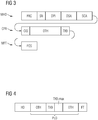
- FIG. 3 shows a possible token frame format with token transmission budget TXB based on the frame format and extension mechanisms of an IEEE 802.15.4 command frame.
- the frame format according to IEEE 802.15.4 can be used in both, wireless and wired, communication networks. Furthermore, there are many possible variants for a token frame format with token transmission budget TXB even on the basis of the IEEE 802.15.4 frame formats.
- the IEEE 802.15.4 frame consists of an IEEE 802.15.4 MAC Header MHD, an IEEE 802.15.4 command frame CFR and an IEEE 802.15.4 MAC footer MFT.
- the IEEE 802.15.4 MAC Header MHD includes a frame control field FRC which contains a frame type and control information about the presence of the source and destination addresses.
- the frame type in the current example is set to Command Frame.
- the IEEE 802.15.4 MAC Header MHD further includes a sequence number field SN which contains a sequence number over all IEEE 802.15.4 frames generated by a source node.
- a Destination Personal Area Network Identification Number or PAN ID field DPI a Destination Personal Area Network Identification Number or PAN ID field DPI
- a Destination Address field DSA a Destination Address field DSA
- a Source Address field SCA within the IEEE 802.15.4 MAC Header MHD contain addressing information of destination node and source node.
- a Presence of the Destination PAN ID field DPI and the Address fields DSA,SCA is determined by the control information contained in the Frame Control field FRC.
- the first field in the payload of an IEEE 802.15.4 command frame CFR is the Command ID field CID.
- the Command ID identifies the type of a command frame.
- the Command ID for a token with token transmission budget TXB can be, for instance, chosen to a value of 25 which is the first unused Command ID according to the standard IEEE 802.15.4.
- the Command ID field CID is followed by Information fields specific to the given Command type which follow the Command ID field, in this case, one or several Token fields.
- the Transmission Budget field TXB is one of said Token fields. It can be specified at any position in the Token fields followed, encompassed or preceded by other token fields OTH. In the example of FIG. 3 the Transmission Budget field TXB is positioned to be the last specific field of the Token fields within the IEEE 802.15.4 command frame CFR.
- the Transmission Budget field TXB contains the Token Transmission Budget for the node receiving the Token Command frame.
- the Token Transmission Budget is the number of frames/packets the node possessing the token is allowed to send or allowed to send in addition to a local parameter locally stored in the node possessing the token, which is above referred to as local allowed packets p_i.
- the size of the Transmission Budget field TXB field is 1 byte or octet. It contains a positive integer value.
- the size of 1 byte/octet is the preferred size. Other sizes are possible, both smaller and larger. 1 byte/octet allows for a maximum Transmission Budget of 255, which is sufficient for the usual maximum size of networks of around 50 nodes.
- TXB field contains an actual Token Transmission Budget rather than an additionally allowed Token Transmission Budget as described above for the preferred embodiment.
- the actual number of allowed packet transmissions TXB.a at the current node is determined.
- the above described method will change as follows with this alternative definition of the content of the Token Transmission Budget field TXB.
- step S2 the number of data packets actually sent by current node i is s_i, and s_i is smaller than or equal to TXB.a depending on how many packets v_i are actually available for sending (0 ⁇ s_i ⁇ TXB.a)
- the current node i sets the token transmission budget to (p_(i+1)+TXB.a-s_i) before forwarding the token to the next node in the token passing order.
- TXB . a TXB . a ⁇ s_i + p_ i + 1
- TXB.a_max is necessary in order to delimit the time between two subsequent transmission opportunities of any node in the token transmission network.
- step S3 the token is forwarded with an amended parameter for the actual Token Transmission Budget TXB.a as stated above.
- the value of the Token Transmission Budget TXB field in the token to be forwarded is delimited by TXB_max, which requires a knowledge of the number of transmission opportunities p_(i+1) of the next node. This knowledge is difficult to obtain, particularly for the case where nodes in the token passing network have differing transmission opportunities.
- the current node i possessing the token sets the Token Transmission Budget TXB field to the number of excess transmission opportunities w_i - s_i, and the node receiving the token restricts the number of allowed packets to send to TXB_max, which is in this case the sum of all p_j.
- the method of the invention will change as follows with this alternative of delimiting TXB_max.
- step S2 the number of data packets actually sent by current node i is s_i and s_i is smaller than or equal to w_i depending on how many packets v_i are actually available for sending (0 ⁇ s_i ⁇ w_i)
- the given s_i above are the upper limits. Sending fewer packets than available, even if v_i ⁇ w_i, is possible. This might be used due to some local policies.
- the current node i sets the token transmission budget to (w_i - s_i) before forwarding the token to the next node in the token passing order.
- TXB_max ⁇ s_i max p_i + TXB , sum_j p_j ⁇ s_i
- the number of packets specified by parameters is determined by a value expressing a time interval for sending the packets rather than by parameters expressing the number of packets itself.
- this alternative embodiment provides a duration or a time interval - time value - as a token transmission budget TXB.
- all other relevant parameters such as p_i are time values instead of packet counts.
- the formulas given above for the computation of the actual transmission budget and TXB_max still apply, but now with time values.
- the actual Token Transmission Budget specifies the duration or interval the current node is allowed to send available data packets after receiving the token.
- Being allowed to send available data packets « may include the following requirements:
- the Token Transmission Budget field TXB when applying this embodiment needs to be large enough in order to accommodate the occurring time values.
- the network nodes in the network need to be able to handle time durations, time intervals and/or relative timing.
- a waiting time for making packets available is provided.
- the token triggers the making available of the data packets.
- a further token parameter is introduced in addition to the Token Transmission Budget field TXB containing the token parameter specifying the number of packets which the node possessing the token is allowed for sending.
- This further token parameter is also referred to as fourth token parameter within the description and the claims.
- the fourth token parameter specifies a Maximum Token Transmission Budget and is included in the token as shown in FIG. 4 .
- FIG. 4 shows a general format of a token including a Token Transmission Budget field TXB and a Maximum Token Transmission Budget field TXB_max for providing the fourth token parameter within the token according to this embodiment.
- the structure of this token differs from the token structure shown in FIG. 1 only by an additional field TXB_max.
- Like reference signs in the drawing represent like parts of exemplary embodiments.
- the Maximum Token Transmission Budget field TXB_max is part of the token payload PLD.
- the Token Payload PLD may contain other Token fields OTH with further information.
- a specific token format can specify any order of the Token fields in the Token Payload.
- a Maximum Token Transmission Budget field TXB_max following the Token Transmission Budget field TXB is the preferred order of the two fields TXB, TXB_max.
- the preferred size of the Maximum Token Transmission Budget field TXB_max is 1 byte/octet. Other sizes of the Maximum Token Transmission Budget field TXB_max field are possible, both smaller and larger. A size of 1 byte/octet allows for a Maximum Token Transmission Budget TXB_max of 255, which is sufficient for the usual maximum size of networks including around 50 network nodes.
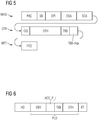
- FIG. 5 shows a possible token frame format with token transmission budget TXB and the Maximum Token Transmission Budget TXB_max based on the frame format and extension mechanisms of an IEEE 802.15.4 command frame. Except of the amended token as shown in FIG. 4 within the command frame CFR, the detailed structure of this IEEE 802.15.4 command frame according to FIG. 5 is generally in accordance with the description for FIG. 3 .
- the Maximum Token Transmission Budget field TXB_max and the Transmission Budget field TXB can be located at any position within the token fields. Neither their order, nor their position next to each other is of any relevance. Their position and and/or order can be chosen arbitrarily.
- TXB_max the position of the Transmission Budget field TXB within the command frame CFR shown in FIG.5 has been shifted to the penultimate position in contrast to FIG. 4 .
- the Maximum Token Transmission Budget field TXB_max within the command frame CFR shown in FIG. 5 has been shifted to the last position in contrast to the Maximum Token Transmission Budget field TXB_max shown in FIG. 4 .
- the position and the orders of the Maximum Token Transmission Budget field TXB_max and the Transmission Budget field TXB have to be consistent with the operational expectations of all nodes exchanging the token within the network.
- p_(i+1) has to be known at the current node i. If the network nodes have different p_i, this might not be so easy to achieve.
- This embodiment provides a method to distribute p_(i+1) to node i.
- the token is extended by a My Transmission Opportunities field my_TXOP - not shown in the drawing.
- the My Transmission Opportunities field my_TXOP includes a token parameter specifying the value of the local parameter of a node or, equally, its transmission opportunities. This further token parameter is also referred to as second token parameter within the description and the claims.
- the My Transmission Opportunities field my_TXOP contains the number of locally allowed packets p_i of the current node i, the source of the token. However, the token with the p_i of source i (current node i) is sent to node (i+1), but the information on p_i of current node i has to be given to node (i-1). (Node i is node (i+1) to node (i-1).) This can be achieved with one of the following methods described from the point of view of a node i that needs p_(i+1) :
- TXB_max is determined by an accumulated local parameter, which is referred to as ACC_P_i.
- TXB_max is closely related to sum_j(p_j) for all j indicating a node in the token passing network, the sum of all p_j in the token passing network.
- This embodiment provides a method, how the sum_j(p_j) can be determined automatically by every node in the token passing network.
- the token contains an additional token field called Accumulated p_i field ACC_P_i.
- the current node When receiving the token, the current node adds its local parameter local allowed packets p_i specifying the number of packets which the current node is allowed for sending to the received value of ACC_P_i before forwarding the token.
- sum(p_j) can now be used in the calculation of TXB_max in most of the embodiments described above.
- the most direct use is an embodiment described above in relation to formulas (1b) and (2b) wherein TXB_max is set identically to the sum (p_j).
- This embodiment of accumulating the locally allowed packets p_i - or, in other words, the local parameters individually specifying a number of packets which a node possessing the token is allowed for sending - is especially useful in situations, where sum_j(p_j) and therefore the Maximum Token Transmission Budget TXB_max change due to new nodes entering the token passing network or existing nodes leaving the token passing network.
- this embodiment supports the use of different locally allowed packets p_i at the nodes in the token passing network. Differing locally allowed packets p_i of different nodes might be necessary for traffic engineering purposes, for instance, in order to support time-sensitive, periodic, or data-intense traffic flows.
- FIG. 6 shows a general format of a token including a Token Transmission Budget field TXB and an accumulated local parameter field ACC_P_i according to this embodiment.
- This further token parameter in the accumulated local parameter field ACC_P_i is also referred to as third token parameter within the description and the claims.
- the third parameter specifies, in other words, an accumulation of values of the local parameter from nodes preceding the node possessing the token in the predetermined order.
- the structure of the token shown in FIG. 6 differs from the token structure shown in FIG. 1 only by an additional accumulated local parameter field ACC_P_i.
- the token may additionally include the Maximum Token Transmission Budget TXB_max as shown in FIG. 4 .
- the accumulated local parameter field ACC_P_i expressing the accumulated locally allowed packets, is part of the Token Payload PLD.
- the Token Payload PLD may contain other Token fields OTH with further information.
- a specific token format can specify any order of the Token fields in the Token Payload.
- An accumulated local parameter field ACC_P_i preceeding the Token Transmission Budget field TXB is the preferred order of the two fields TXB, ACC_P_i.
- the preferred size of the accumulated local parameter field ACC_P_i is 1 byte/octet. Other sizes of the accumulated local parameter field ACC_P_i are possible, both smaller and larger.
- a size of 1 byte/octet allows for a Maximum Token Transmission Budget TXB_max of 255, which is sufficient for the usual maximum size of networks including around 50 network nodes.
- Both token fields TXB, ACC_P_i can be arranged in any order and at any position in the token fields area of the general token frame format. They do not necessarily have to be arranged next to each other.
- FIG. 7 shows a possible token frame format including the Transmission Budget field TXB and the Accumulated Local Parameter field ACC_P_i by extension mechanisms of an IEEE 802.15.4 command frame CFR. Except of the amended token as shown in FIG. 6 within the command frame CFR, the detailed structure of this IEEE 802.15.4 command frame according to FIG. 7 is generally in accordance with the description for FIG. 3 .
- the Accumulated Local Parameter field ACC_P_i and the Transmission Budget field TXB can be located at any position within the token fields. Neither their order, nor their position next to each other is of any relevance. Optionally, their position and and/or order can be chosen arbitrarily.
- the position of the Accumulated Local Parameter field ACC_P_i within the command frame CFR shown in FIG. 7 has been shifted to the first position in succession to the Command ID field CID in contrast to FIG. 6 .
- the Transmission Budget field TXB within the command frame CFR shown in FIG. 7 has been shifted to the second position in contrast to the Transmission Budget field TXB shown in FIG. 6 .
- the positions and the orders of the Accumulated Local Parameter field ACC_P_i and the Transmission Budget field TXB have to be consistent with the operational expectations of all nodes exchanging the token within the network.
- sum_ p_j TSN @t_i ⁇ TSN @ t_ i ⁇ 1 * p_i if p_i > 1
- IPv6 6LoWPAN
- IPv6 6LoWPAN
- the embodiments are particularly suitable to keep delays in higher layer communication such as HTTP/TCP as low as possible. This is all the more important, as HTTP/TCP protocols use timeouts in their communication. Long delays of the transmission of the HTTP/TCP packets in the token passing network would trigger these timeouts and would subsequently make further HTTP/TCP communications impossible.
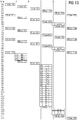
- FIG. 9 - 13 show chronological flowcharts for a schematic representation of an exchange of control messages and data packets amongst network nodes.
- a time line (time) is illustrated at the left side of each FIG. 9 - 13 in which sequential points in time range from a starting time on the top to an end time at the bottom so that later points in time lie further down than earlier points in time.
- the points in time are accordingly expressed by a two-digit number which is incrementing from top to bottom.
- network node D is assumed to send period traffic every tenth time step (time step 7, 17, and so on) that has to be sent within the next 9 time steps (by time step 16, 26, and so on).
- the other nodes A, B, C, and E do not have data packets to send.
- FIG. 10 shows the corresponding packet flow.
- the packet is made available and sent at time 07 (no delay for waiting for a transmission opportunity).
- the packet is made available at the same relative time (time 17) but it is only sent at a relatively later time (time 20, delay for waiting for a transmission opportunity of 3 time steps).
- FIG. 11 shows a different situation in the example token passing network.
- Node D is continuously sending a regular data packet at relative times 7. Additionally, node C wants to send a burst of 4 data packets.
- FIG. 11 shows the packet flow for a burst of four packets in an almost empty token passing network.
- the token transmission budget is at its maximum when node C receives the token.
- node C can transmit the 4 available data packets in a single burst.
- node C would need more than a single token passing round in order to send its burst of 4 data packets.
- TXB >0 the method according the present embodiments provides a benefit for node C.
- TXB 0, the method according the present embodiments corresponds to the token passing of the state of the art.
- FIG. 12 shows an example packet flow for a token passing network making use of a dynamic configuration of TXB_max according to an embodiment described above. It is assumed that node A sends a small HTTP or CoAP request - exemplarily comprising an amount of three packets - for some web document such as the device configuration to node C. Node C sends the requested web document as reply which is exemplarily comprising an amount of seven packets. Node D continues to send its regular packet at relative times 7.
- the request-reply exchange between nodes A and C needs 26 time steps - including received and forwarded tokens - from time 32 to time 57.
- such an exchange would have last for 59 time steps, from time 32 to time 90.
- the method according to the present embodiments provides an improvement of 33 time steps which is a remarkable improvement of 56 percent.
- FIG. 13 a flowchart depicted by FIG. 13 , wherein a scenario of a token passing network is assumed which is located in an office building wherein offices are unstaffed at night.
- a building management downloads logfiles and performs software updates automatically when necessary during night hours.
- Time-sensitive communications might have relaxed latency requirements while offices are unstaffed. This is the case for the time-sensitive communication of node D.
- the building management reconfigures the TXB_max value of the example token passing network in order to achieve a higher threshold.
- the building management accordingly allows nodes to send five times more data packets than in normal daily operation after receiving the token.
- this increase of TXB_max is achieved by instructing node A to set TXB_max to the new value of 24 once in the token to be forwarded.
- FIG.13 shows the example packet flow making use of a dynamic configuration of TXB_max according to an embodiment described above including an amended - or specifically substantially increased - TXB_max.
- node A sends a small HTTP or CoAP request (three packets in the example) for some web document such as a logfile to node C.
- Node C sends the requested web document as reply (19 packets in the example).
Landscapes
- Engineering & Computer Science (AREA)
- Computer Networks & Wireless Communication (AREA)
- Signal Processing (AREA)
- Data Exchanges In Wide-Area Networks (AREA)
Abstract
Description
- The disclosed embodiments generally relate to a method and a network node for communicating over a token passing network. Specifically, the disclosed embodiments relate to a token passing network formed by a plurality of network nodes and interconnected by a communications media on a Media Access Control or MAC layer.
- In a world of ever increasing smart devices and smarter technologies, concepts of Internet of Things (IoT) or Web of Things (WoT) propose that everyday objects and devices are to have a network connection, where these objects are enabled to trans-ceive data with other devices, thus forming a network of connected things. Accordingly, a prevalence of communications between devices over communication networks is further increasing.
- In order to connect devices and objects general-purpose communication networks are needed that can carry a variety of traffic types. The two extremes are small, deterministic packets having a limited allowed latency with only a few bytes of information on one side, and non-deterministic bursts of several packets with a relaxed latency requirement but with relatively large data volume on the other side.
- In the fields of industrial automation and building automation time-critical traffic such as communications for controlling devices has to be transmitted with a deterministic maximum latency. This means that control data packets have to arrive within a certain time. For some control tasks, time critical traffic is also periodic.
- On the other side, burst traffic such as IoT communications for transmitting sensor values or larger documents in machine-readable format or the retrieval of webpages occurs. This kind of traffic happens rather sporadically and may include a data volume incurring several packets for completion, which is referred to as packet burst.
- A known token passing MAC (Media Access Control) protocol is well-suited to deal with time-critical traffic of single packets. A node can send a packet only if it is in possession of the token thereby eliminating interfering media accesses.
- Presently known token passing networks are designed for supporting highly time-critical data traffic with low data volume rather than supporting burst traffic.
- Accordingly there is a need in the art for dynamically supporting burst traffic in token passing networks while not compromising time-critical traffic.
- Embodiments for communicating over a token passing network as described herein generally extend the traditional functionality of a token - which is to assign a network node a right to send when it has possession of the token - by a novel functionality of offering and distributing a »budget« amongst the network nodes. According to some embodiments, this budget is specifying a number of packets which the node possessing the token is allowed for sending. The budget is delivered by the token and may be partially or fully used by the network node or not. The embodiments thereby support an unhampered exchange of time-critical traffic while occasionally granting network nodes to utilize the commonly shared budget in order to send burst traffic.
- In one embodiment a method is proposed including the steps of:
- a) passing a token to each of the plurality of nodes in a predetermined order;
- b) enabling each node to send a scheduled number of packets on the network when it has possession of the token;
- c) providing at least one token parameter within the token, the at least one token parameter at least specifying a number of packets which the node possessing the token is allowed for sending;
- d) determining a maximum number of packets which the node possessing the token is allowed for sending using said at least one token parameter;
- e) determining the scheduled number of packets to be scheduled for sending by the node possessing the token, the scheduled number of packets being determined as a subset of an available number of packets currently made available for sending by the node possessing the token, wherein the scheduled number of packets is determined equal to or less than the maximum number of packets determined for the node possessing the token;
- f) sending, by the node possessing the token, the scheduled number of packets to the network;
- g) replacing at least one of said at least one token parameter within the token by at least one modified token parameter, at least one modified token parameter being at least dependent on the scheduled number of packets sent by the node possessing the token; and;
- h) passing the token to a next node in the predetermined order of the plurality of nodes.
- The embodiments according to the invention provide for an effective, yet simple method for transferring unused transmission opportunities in token passing networks to nodes which have to send multiple packets only occasionally. By replacing at least one of said at least one token parameter within the token by at least one modified token parameter, transmission opportunities remaining unused by the node currently possessing the token are delivered as a budget to the next node. An occasional multiplicity of packets to send is often referred to as »burst«. Nodes willing to send a burst receive transmission opportunities by a preceding node in the predetermined order. With the embodiment, unused transmission opportunities are available to the other nodes of the token passing network.
- The embodiments according to the invention provide significant improvements compared to known token passing networks with respect to a required time for completing a transmission of bursts or request/reply exchanges on higher layers such as HTTP/TCP (Hypertext Transfer Protocol/Transmission Control Protocol).
- The embodiments according to the invention advantageously do not require a synchronized time between the nodes. In fact, the embodiments can be used without any explicit or relative timing. The independence of a global time, a synchronized network time, or other timing requirements makes the embodiments especially suitable for constraint network node devices.
- According to an embodiment, the number of packets specified by the token parameter is determined by an integer expressing the number of packets. According to an alternative embodiment, the number of packets specified by the token parameter is determined by a value expressing a time interval for sending said number of packets. Correspondingly, all other relevant parameters such as the maximum number of packets which the node possessing the token is allowed to send are expressed by time values instead of packet counts.
- According to an embodiment, a determination of the available number of packets currently made available for sending by the node possessing the token is determined using a defined waiting time interval after reception of the token. Such guard intervals or small processing times between sending packets are advantageous applied in order to allow the processing of the packets according to a protocol supporting such timing.
- According to a preferred embodiment, a local parameter locally stored in each of the plurality of nodes is provided. This local parameter specifies a number of packets which a node possessing the token is allowed for sending. The local parameter is optionally adjusted individually for each node. The maximum number of packets is then determined by the number of packets specified by the token parameter in addition to the number of packets specified by the local parameter. This embodiment has the advantage that the local »budget«, when not used by the current node possessing the token, may be transferred to subsequent nodes.
- According to an embodiment, the modified token parameter is a sum of the value of the token parameter and the value of the local parameter deducted by the value of the scheduled number of packets. This modified token parameter is modified by the current node possessing the token and passed to the subsequent token of the plurality of nodes in the predetermined order. Summing the value of the local parameter deducted by the value of the scheduled number of packets to this modified parameter grants for the advantageous effect stated above: in cases where the node has less or no scheduled packets to send, the local parameter will serve as an additional budget for sending packets by subsequent nodes.
- According to an embodiment, the value of the local parameter is included in the token as a second token parameter. This embodiment advantageously enables any node to gain knowledge of the local parameter of another node. Since the medium is shared amongst the nodes - note that the ring structure is a logical ring structure within a shared medium, not a physical ring structure - any node is able to listen to the token even though not being the intended recipient to which the token is to be passed.
- According to an embodiment, an accumulation or sum of values of the local parameters from nodes preceding the node possessing the token is included in the token as a third parameter. This embodiment is advantageous for deriving a maximum limit for the modified token parameter according to an embodiment described below, particularly including scenarios in which the token passing network is affected by changes due to new nodes or nodes leaving the token passing network.
- As will be shown further down below, knowledge of the third parameter transported by the token is advantageous for determining a maximum number of packets which the node possessing the token is allowed for sending. Further on, an adaptation to changing network members is advantageously supported by the third parameter. Applying this embodiment supports the usage of differing local parameter for specifying the number of packets allowed for sending. Differing local parameters for different nodes are advantageous for traffic engineering purposes, for instance, in order to support time-sensitive, periodic, or data-intense traffic flows.
- According to an embodiment, a maximum limit for the modified token parameter is included in the token as a fourth parameter. This embodiment is particularly advantageous for adjusting the network traffic in order to grant for a higher threshold for downloads or updates, when latency requirements are currently of lower importance. Such adjustments are advantageously arranged by a network management.
- According to an embodiment, the modified token parameter is restricted to an upper value. This measure advantageously supports the object of the invention guaranteeing the time-critical traffic while still allowing for temporary burst traffic. Several factors or combinations thereof can be considered, including the number of nodes in the network, the second token parameter, the third token parameter, the fourth token parameter, and/or a token sequence number assigned to the token.
- Specific configurations for special traffic mixes can be made
- by configuring the local parameter locally stored in each of the plurality of nodes, the number of packets to be sent by a node in any case. Nodes with special traffic mixes may get a different, probably larger local parameter.
- by configuring the fourth parameter - i.e. the maximum limit for the modified token parameter - that limits the number of packets to be sent be a single node in a token passing round.
- both, the local parameter and the maximum limit for the modified token parameter can be dynamically configured. This allows the adaptation to dynamically changing traffic mixes and communication requirements.
- The objects as well as further advantages of the present embodiments will become more apparent and readily appreciated from the following description of the preferred embodiments, taken in conjunction with the accompanying drawing in which:
- FIG. 1
- shows a general format of a token including a Token Transmission Budget field according to an embodiment;
- FIG. 2
- shows a flowchart representing a token processing routine according to an embodiment;
- FIG. 3
- shows a token frame format including a Token Transmission Budget field based on a command frame according to the standard IEEE 802.15.4;
- FIG. 4
- shows a general format of a token including a Token Transmission Budget field and a Maximum Token Transmission Budget field according to an embodiment;
- FIG. 5
- shows a token frame format including a Token Transmission Budget field and a Maximum Token Transmission Budget field based on a command frame according to the standard IEEE 802.15.4;
- FIG. 6
- shows a general format of a token including a Token Transmission Budget field and an Accumulated Number of Allowed Packets field according to an embodiment;
- FIG. 7
- shows a token frame format including a Token Transmission Budget field and an Accumulated Number of Allowed Packets field based on a command frame according to the standard IEEE 802.15.4;
- FIG. 8
- shows a schematic diagram of an exemplary token passing network;
- FIG. 9
- shows a first chronological flowchart for a schematic representation of an exchange of control messages and data packets amongst network nodes according to an embodiment;
- FIG. 10
- shows a second chronological flowchart for a schematic representation of an exchange of control messages and data packets amongst network nodes according to an embodiment;
- FIG. 11
- shows a third chronological flowchart for a schematic representation of an exchange of control messages and data packets amongst network nodes according to an embodiment;
- FIG. 12
- shows a fourth chronological flowchart for a schematic representation of an exchange of control messages and data packets amongst network nodes according to an embodiment; and;
- FIG. 13
- shows a fifth chronological flowchart for a schematic representation of an exchange of control messages and data packets amongst network nodes according to an embodiment.
- Like reference signs in the drawing generally represent like parts of exemplary embodiments of the invention.
- In
FIG. 8 a schematic diagram of an exemplary token passing network is depicted. The token passing network includes a shared communications media on a Media Access Control (MAC) layer. Five network nodes A,B,C,D,E are interconnected with each other by the network. - A - not shown - token is passed to each of the five network nodes A,B,C,D,E in a predetermined order, enabling each network node A,B,C,D,E to send a predetermined number of packets on the network when it has possession of the token, thus eliminating interfering media accesses. The transmission of the token in the predetermined order is cyclically repeated, wherein a time span within one cycle - i.e. the time span which the token needs to pass through every network node A,B,C,D,E in the network - is referred to as token round time. A delay time for sending packets is bound by the token round time which includes an associated transmission time of the data packets.
- In traditional token passing networks a mechanism is lacking which would dynamically support burst traffic in the token passing network while not compromising the time-critical traffic. This need is even bigger in resource-constraint networks - characterized by a rather low bandwidth and small packet size - which are frequently used in Internet of Things applications. One exemplary communication protocol used for an implementation of such resource-constraint networks is known as 6LoWPAN or »IPv6 over Low-Power Wireless Personal Area Network«
- A single TCP packet (Transmission Control Protocol) with a size of 1,500 bytes might be fragmented in 18 packets using this communication protocol 6LoWPAN. A relatively small burst of five IPv6 (Internet Protocol Version 6) packets would then have to be transmitted by a burst of 90 6LoWPAN packets which requires an amount of 90 token round times. Bursts with such an amount of data packets are far beyond reasonable limits in a time-critical traffic network.
- A delay caused by such an amount of token round times may subsequently result in timeouts of the TCP acknowledgment mechanism leading to a breakdown of the HTTP/TCP (Hypertext Transfer Protocol/Transmission Control Protocol) communication.
- Furthermore, time synchronization between network nodes might fail in resource-constraint networks with embedded and/or resource-constraint devices.
- Attempts in the art of supporting burst traffic in a token passing network while not compromising the time-critical traffic have been made. One approach is to configure a network node of a token passing network statically to send multiple packets. Such an attempt is referred to as multiple transmission opportunities. However, there are several drawbacks to this static configuration:
- It reduces the capacity of the network: In order to limit the token round time at the same maximal value, a node that is allowed to send m packets reduces the maximum number of nodes in the network by (m-1);
- It extends the token round time if the number of nodes in the network is the same;
- Since burst traffic is predominantly sporadic, the assigned transmission opportunities are only used rarely;
- Another known attempt in the art introduces a concept of a Timed Token Protocol using a Target Token Rotation Time, or TTRT, which is a time interval during which a node is allowed to send packets, a so-called sending dead line. The actual token rotation time is compared to the target token rotation time, or maximum token rotation time, and the difference is the interval for sending messages by the node. Furthermore, there is a strict separation between synchronous and asynchronous traffic. The Timed Token Protocol requires at least several timers at the nodes. Resource-constraint nodes, however, might not have a concept of absolute time and synchronization between them is not possible. Furthermore, embedded devices may have only a very limited number of timers. Moreover, the communication distance between nodes may vary between a few centimeters up to more than 1 kilometer, resulting in a wide range of transmission times.
- These known concepts are, therefore, not capable of dynamically supporting burst traffic in token passing networks while not compromising the time-critical traffic in a satisfying manner.
- In the following, some embodiments according to the present invention along with their advantages for improving present drawbacks in the art will be described.
- Embodiments for communicating over a token passing network as described herein generally extend the traditional functionality of a token - of assigning a network node a right to send when it has possession of the token - by a novel functionality of distributing a »budget« amongst the network nodes by the token. According to some embodiments this budget is specified by a number of packets which the node possessing the token is allowed for sending. The budget is delivered by the token and may be partially or fully used by the network node or not. The embodiments thereby support an unhampered exchange of time-critical traffic while occasionally granting network nodes to utilize the commonly shared budget in order to send burst traffic.
- For a compact representation the following terminology is introduced which will be used hereinafter.
- is a network node i currently in possession of the token.
- are to be understood as data packets at the Token Passing MAC layer.
- a parameter for specifying a number of packets that are available for sending at the current node while in possession of the token.
- a parameter for specifying a number of packets which a current node i is always allowed to send according to a parameter locally stored on the current node i.
- a parameter for specifying a number of packets which a current node i is allowed to send.
- a parameter for specifying a number of packets sent by current node i.
- The current node is allowed to send a data packet. One transmission opportunity corresponds to being allowed to send one data packet.
- In an exemplary token passing network, each node i is allowed to send a certain number of local allowed packets p_i if it is in possession of the token. The number of local allowed packets p_i is usually individually adjusted for each node and stored by a parameter on each node. A usual value for this parameter is 1, meaning that each node is allowed to send one packet.
- According to an embodiment, the token is extended by at least one field for providing at least one token parameter within the token. At least one token parameter is specifying a number of packets which the node possessing the token is allowed for sending. This parameter is also referred to as Token Transmission Budget, or TXB. The token Transmission Budget Field contains the number of packets which the node receiving or possessing the token is allowed to send in addition to its local allowed packets p_i. The total amount of allowed packets w_i is therefore a sum of the local allowed packets and the token transmission budget TXB:

-
FIG. 1 shows a general format of a token including a Token Transmission Budget field TXB according to an embodiment. A Token Header HD contains addressing information and control information for the correct recognition of the MAC frame as token. The Token Payload PLD contains token-specific information that is distributed between the nodes in the token passing network. - The Token Transmission Budget TXB is part of the token payload PLD. The Token Payload PLD may contain other Token fields OTH with further information. A specific token format can specify any order of the Token fields in the Token Payload.
- The preferred size of the Token Transmission Budget TXB field is 1 byte or 1 octet. Other sizes of the Token Transmission Budget TXB field are possible, both smaller and larger. A size of 1 byte/octet allows for a maximum Token Transmission Budget TXB of 255 packets, which is sufficient for the usual maximum size of networks including around 50 nodes.
- The Token Footer FT contains fields that are relevant after the reception of the octets of the token. This is usually, for example, a Frame Check Sequence. Alternatively, the Token Footer FT may be empty or the Token Footer FT may be completely omitted.
-
FIG. 2 shows a flowchart representing a token processing routine according to an embodiment. By a first step S1 a current node interconnected by a communications media on a Media Access Control (MAC) layer is receiving a token including a token parameter stored in a Token Transmission Budget field TXB. After receiving the token, the current node i is allowed to immediately send its allowed packets:
- Immediately sending its allowed packets particularly means that the current node should not wait for packets to become available. The current node is allowed to send packets that have been available when receiving the token, or packets that become available while sending available packets. Optionally, guard intervals or small processing times between sending the packets are applied in order to allow the processing of the packets and according to a protocol supporting such timing.
- By a second step S2 the current node i is sending s_i data packets. The number of data packets actually sent by the current node i is determined as sent packets s_i. These sent packets s_i are also referred to as scheduled number of packets s_i - which means packets scheduled for sending - further down below. The number of sent packets s_i is smaller than or equal to (p_i + TXB) depending on how many packets v_i are actually available for sending:

- with (s_i = v_i) for (v_i ≤ (p_i+TXB)); and;
- (s_i = (p_i+TXB)) for (v_i > (p_i+TXB)).
- In other words, the scheduled number of packets s_i is determined as a subset of an available number v_i of packets currently made available for sending by the node possessing the token. The given numbers of sent packets s_i stated above are upper limits. Sending less packets than available, even if v_i ≤ (p_i + TXB), is possible.
- By a third step S3 the current node i sets the new Token Transmission Budget TXB to a sum of the value of the received token parameter TXB and the value of the local parameter p_i of locally allowed packets, deducted by the sent packets s_i - or synonym: the scheduled number of packets s_i - before forwarding the token to the next node in the token passing order:

- Especially in networks with event-driven communication, current nodes frequently have no data packets available for sending, when receiving the token. However, each time the local allowed packets p_i would be added on top of token transmission budget TXB, so that token transmission budget would increase to a high value over time. A current node would be able to use this high budget on reception of the token for sending a huge amount of packets in one burst, thereby blocking the communication medium for a long time. This might be too long for time-critical traffic of other nodes, since these other nodes cannot access the communication medium as long as the current node is transmitting its packet burst due to the available high token transmission budget.
- In view of this undesired blocking of the communication medium, the token transmission budget TXB is delimited according to an embodiment. Preferably, the Token Transmission Budget TXB is delimited by TXB ≤ sum_j (p_j) - p_(i+1), the sum of all p_j in the network minus the p_j = p_(i+1) of the next node (i+1). Or as formula,

- The use of a Maximum Token Transmission Budget TXB_max based on formula (2) ensures that the time of transmission opportunities of a node i is no later than in a full network where each node j sends p_j packets when it is in possession of the token.
- Formula (2) requires the knowledge of p_(i+1) at a current node i, especially if the nodes have different p_j. If p_(i+1) is not known at current node i, some sensible value p' for p_(i+1) can be assumed, for instance,
- p' = 1 - very conservative with respect to time
- p' = min(p_j) - conservative with respect to time, less strict if min(p_j) > 1
- p' = max(p_j) - relaxed with respect to time, time of transmission opportunity might be later than in a full network.
- In general and for a non-full network with restricting TXB to TXB_max and having a node sending a burst,
- a value of p' < p_(i+1) is conservative with respect to time, the next transmission opportunity will be earlier than in a full network.
- a value of p' = p_(i+1) is exact and provides some opportunistic benefits: the next transmission opportunity will be no later than in a full network, but it might be earlier.
- a value of p' > p_(i+1) is relaxed with respect to time, the next transmission opportunity will be later for some node.
- Having the same p_j (or p') at all nodes in the token passing network simplifies formula (2) to:

- If each node in the token passing network is allowed to send one packet per token possession (p_j = 1 for all j), TXB_max is the number of nodes n in the token passing
network minus 1.
- TXB_max is necessary in order to delimit the time between two subsequent transmission opportunities of any node in the token transmission network. It ensures that a node k in the token passing network can transmit its next data packet after 2 * TXB_max data transmissions (and n-1 token transmissions) at the latest. The resulting formula for the calculation of TXB is then:

- In step S3, the token is forwarded with an amended parameter for the Token Transmission Budget TXB as stated above.
- Note, there might be no need for an explicit TXB_max in some implementations. For instance, some protocol stack implementations on constrained devices might only provide a limited number of data packets to be sent during the possession of the token due to memory constraints and program flow constraints. In such a case, the token will be forwarded in due time.
- There are many possibilities to specify a format of a token with the token transmission budget TXB or to extend an existing token frame format with the token transmission budget TXB according to the present embodiments.
-
FIG. 3 shows a possible token frame format with token transmission budget TXB based on the frame format and extension mechanisms of an IEEE 802.15.4 command frame. The frame format according to IEEE 802.15.4 can be used in both, wireless and wired, communication networks. Furthermore, there are many possible variants for a token frame format with token transmission budget TXB even on the basis of the IEEE 802.15.4 frame formats. - The IEEE 802.15.4 frame consists of an IEEE 802.15.4 MAC Header MHD, an IEEE 802.15.4 command frame CFR and an IEEE 802.15.4 MAC footer MFT.
- The IEEE 802.15.4 MAC Header MHD includes a frame control field FRC which contains a frame type and control information about the presence of the source and destination addresses. The frame type in the current example is set to Command Frame.
- The IEEE 802.15.4 MAC Header MHD further includes a sequence number field SN which contains a sequence number over all IEEE 802.15.4 frames generated by a source node. Three further fields, a Destination Personal Area Network Identification Number or PAN ID field DPI, a Destination Address field DSA and a Source Address field SCA within the IEEE 802.15.4 MAC Header MHD contain addressing information of destination node and source node. A Presence of the Destination PAN ID field DPI and the Address fields DSA,SCA is determined by the control information contained in the Frame Control field FRC.
- The first field in the payload of an IEEE 802.15.4 command frame CFR is the Command ID field CID. The Command ID identifies the type of a command frame. The Command ID for a token with token transmission budget TXB can be, for instance, chosen to a value of 25 which is the first unused Command ID according to the standard IEEE 802.15.4.
- The Command ID field CID is followed by Information fields specific to the given Command type which follow the Command ID field, in this case, one or several Token fields. The Transmission Budget field TXB is one of said Token fields. It can be specified at any position in the Token fields followed, encompassed or preceded by other token fields OTH. In the example of
FIG. 3 the Transmission Budget field TXB is positioned to be the last specific field of the Token fields within the IEEE 802.15.4 command frame CFR. - The Transmission Budget field TXB contains the Token Transmission Budget for the node receiving the Token Command frame. The Token Transmission Budget is the number of frames/packets the node possessing the token is allowed to send or allowed to send in addition to a local parameter locally stored in the node possessing the token, which is above referred to as local allowed packets p_i.
- The size of the Transmission Budget field TXB field is 1 byte or octet. It contains a positive integer value. The size of 1 byte/octet is the preferred size. Other sizes are possible, both smaller and larger. 1 byte/octet allows for a maximum Transmission Budget of 255, which is sufficient for the usual maximum size of networks of around 50 nodes.
- In the following, an alternative embodiment is described wherein the Transmission Budget field TXB field contains an actual Token Transmission Budget rather than an additionally allowed Token Transmission Budget as described above for the preferred embodiment.
- According to this alternative realization of the Token Transmission Budget field TXB, the actual number of allowed packet transmissions TXB.a at the current node is determined. The above described method will change as follows with this alternative definition of the content of the Token Transmission Budget field TXB. Referring again to
FIG. 2 , in step S1 according to the alternative embodiment, the current node i, after receiving the token, is allowed to send immediately w_i = TXB.a available packets before it has to forward the token to the next node in the token passing order. - In step S2 according to this alternative embodiment, the number of data packets actually sent by current node i is s_i, and s_i is smaller than or equal to TXB.a depending on how many packets v_i are actually available for sending (0 ≤ s_i ≤ TXB.a)
- with (s_i = v_i) for (v_i ≤ TXB.a); and;
- (s_i = TXB.a)) for (v_i > TXB.a).
- By a third step S3 according to the alternative embodiment the current node i sets the token transmission budget to (p_(i+1)+TXB.a-s_i) before forwarding the token to the next node in the token passing order.

- Preferably, TXB.a is delimited by TXB.a ≤ sum_j (p_j), the sum of all p_j in the network. Or as formula,

- Formula (1a) requires the knowledge of p_(i+1) at current node i, especially if the nodes have different p_j. Hence, p_(i+1) should be known at current node i in order to provide the correct number of transmission opportunities to node (i+1). Providing a different value p" for p_(i+1), the available transmission opportunities for node (i+1) are not correct and may seriously impact the (real-time) communication of node (i+1). The following lists the consequences for different p" assuming TXB.a = p", which means that no additional token transmission budget is provided.
- p" = 0: The node (i+1) will not be able to communicate since there is no transmission opportunity (serious problem) ;
- p" < p_(i+1): The node (i+1) has a disadvantage in its share of transmission opportunities, since it has less transmission opportunities then needed (p_(i+1))
- p" > p_(i+1) - node (i+1) has an advantage in its share of transmission opportunities, since it has more transmission opportunities then requested (p_(i+1)). Additional, this will increase the token roundtrip time in a full network above the anticipated value. This might negatively impact real-time traffic of other nodes in the network.
- Having the same p_j at all nodes in the token passing network simplifies formula (2a) to:

- If each node in the token passing network is allowed to send one packet per token possession (p_j = 1 for all j), TXB.a_max is the number of nodes n in the token passing network.

- TXB.a_max is necessary in order to delimit the time between two subsequent transmission opportunities of any node in the token transmission network. The resulting formula for the calculation of TXB.a is then:

- In step S3, the token is forwarded with an amended parameter for the actual Token Transmission Budget TXB.a as stated above.
- In the following, an alternative embodiment is described wherein an implementation of the delimited Transmission Budget TXB_max does not necessarily require a knowledge of the locally allowed number of packets p_(i+1) - or in other words: transmission opportunities - of a node i+1 following the current node i in the token passing order.
- According to the embodiment as described above, the value of the Token Transmission Budget TXB field in the token to be forwarded is delimited by TXB_max, which requires a knowledge of the number of transmission opportunities p_(i+1) of the next node. This knowledge is difficult to obtain, particularly for the case where nodes in the token passing network have differing transmission opportunities.
- The alternative embodiment described hereinafter provides a solution for delimiting the Transmission Budget TXB which does not require a knowledge of p_(i+1).
- The current node i possessing the token sets the Token Transmission Budget TXB field to the number of excess transmission opportunities w_i - s_i, and the node receiving the token restricts the number of allowed packets to send to TXB_max, which is in this case the sum of all p_j. The method of the invention will change as follows with this alternative of delimiting TXB_max.
- Referring again to
FIG. 2 , in step S1 according to the alternative embodiment, the current node i, after receiving the token, is allowed to send immediately

- In step S2 according to the alternative embodiment, the number of data packets actually sent by current node i is s_i and s_i is smaller than or equal to w_i depending on how many packets v_i are actually available for sending (0 ≤ s_i ≤ w_i)
- with (s_i = v_i) for (v_i ≤ w_i); and;
- (s_i = w_i) for (v_i > w_i).
- The given s_i above are the upper limits. Sending fewer packets than available, even if v_i ≤ w_i, is possible. This might be used due to some local policies.
- By a third step S3 according to the alternative embodiment the current node i sets the token transmission budget to (w_i - s_i) before forwarding the token to the next node in the token passing order.

- Having the same p_j (or p') at all nodes in the token passing network simplifies formula (2b) to:

- If each node in the token passing network is allowed to send one packet per token possession (p_j = 1 for all j), TXB_max is the number of nodes n in the token passing network:

- In the following, an alternative embodiment is described wherein the number of packets specified by parameters is determined by a value expressing a time interval for sending the packets rather than by parameters expressing the number of packets itself.
- Instead of specifying the actual number or the additional number of packet transmissions in the Token Transmission Budget field TXB, this alternative embodiment provides a duration or a time interval - time value - as a token transmission budget TXB. Correspondingly, all other relevant parameters such as p_i are time values instead of packet counts. The formulas given above for the computation of the actual transmission budget and TXB_max still apply, but now with time values.
- The actual Token Transmission Budget specifies the duration or interval the current node is allowed to send available data packets after receiving the token. »Being allowed to send available data packets« may include the following requirements:
- the beginning of the transmission of the data packet is within the given interval; or;
- the transmission of the data packet needs to be finished within the given interval.
- The Token Transmission Budget field TXB when applying this embodiment needs to be large enough in order to accommodate the occurring time values. The network nodes in the network need to be able to handle time durations, time intervals and/or relative timing.
- In the following, an embodiment is described wherein a waiting time for making packets available is provided. There might be use cases where data packets are made available not until the receipt of the token. The token triggers the making available of the data packets. In such a case it is preferable to include some waiting time interval after the receipt of the token in order to allow the node to make data packets available that should be send after the receipt of the token.
- In the following, an embodiment is described wherein a further token parameter is introduced in addition to the Token Transmission Budget field TXB containing the token parameter specifying the number of packets which the node possessing the token is allowed for sending. This further token parameter is also referred to as fourth token parameter within the description and the claims. The fourth token parameter specifies a Maximum Token Transmission Budget and is included in the token as shown in
FIG. 4 . -
FIG. 4 shows a general format of a token including a Token Transmission Budget field TXB and a Maximum Token Transmission Budget field TXB_max for providing the fourth token parameter within the token according to this embodiment. The structure of this token differs from the token structure shown inFIG. 1 only by an additional field TXB_max. Like reference signs in the drawing represent like parts of exemplary embodiments. - The Maximum Token Transmission Budget field TXB_max is part of the token payload PLD. The Token Payload PLD may contain other Token fields OTH with further information. A specific token format can specify any order of the Token fields in the Token Payload. A Maximum Token Transmission Budget field TXB_max following the Token Transmission Budget field TXB is the preferred order of the two fields TXB, TXB_max.
- The preferred size of the Maximum Token Transmission Budget field TXB_max is 1 byte/octet. Other sizes of the Maximum Token Transmission Budget field TXB_max field are possible, both smaller and larger. A size of 1 byte/octet allows for a Maximum Token Transmission Budget TXB_max of 255, which is sufficient for the usual maximum size of networks including around 50 network nodes.
-
FIG. 5 shows a possible token frame format with token transmission budget TXB and the Maximum Token Transmission Budget TXB_max based on the frame format and extension mechanisms of an IEEE 802.15.4 command frame. Except of the amended token as shown inFIG. 4 within the command frame CFR, the detailed structure of this IEEE 802.15.4 command frame according toFIG. 5 is generally in accordance with the description forFIG. 3 . - The Maximum Token Transmission Budget field TXB_max and the Transmission Budget field TXB can be located at any position within the token fields. Neither their order, nor their position next to each other is of any relevance. Their position and and/or order can be chosen arbitrarily. In order to demonstrate the arbitrary design of order and positon of said fields TXB, TXB_max the position of the Transmission Budget field TXB within the command frame CFR shown in
FIG.5 has been shifted to the penultimate position in contrast toFIG. 4 . Similarly the Maximum Token Transmission Budget field TXB_max within the command frame CFR shown inFIG. 5 has been shifted to the last position in contrast to the Maximum Token Transmission Budget field TXB_max shown inFIG. 4 . Of course the position and the orders of the Maximum Token Transmission Budget field TXB_max and the Transmission Budget field TXB have to be consistent with the operational expectations of all nodes exchanging the token within the network. - In the following, an embodiment is described wherein a local parameter locally stored on a node succeeding a current node is received at the current node.
- In order to calculate the TXB of the forwarded Token exactly, p_(i+1) has to be known at the current node i. If the network nodes have different p_i, this might not be so easy to achieve. This embodiment provides a method to distribute p_(i+1) to node i. The token is extended by a My Transmission Opportunities field my_TXOP - not shown in the drawing. The My Transmission Opportunities field my_TXOP includes a token parameter specifying the value of the local parameter of a node or, equally, its transmission opportunities. This further token parameter is also referred to as second token parameter within the description and the claims. The My Transmission Opportunities field my_TXOP contains the number of locally allowed packets p_i of the current node i, the source of the token. However, the token with the p_i of source i (current node i) is sent to node (i+1), but the information on p_i of current node i has to be given to node (i-1). (Node i is node (i+1) to node (i-1).) This can be achieved with one of the following methods described from the point of view of a node i that needs p_(i+1) :
- Node i listens to control messages exchanged on the shared communication medium after it has forwarded the token to node (i+1). Node i waits for the next token on the shared communication medium. This token is from node (i+1), and node i can extract the my_TXOP value from the token and has its p_(i+1) for its computations of TXB. A missing token transmission by node (i+1) can be detected by a timeout.
- Alternatively, node i listens to control messages exchanged on the shared communication medium after it has forwarded the token to node (i+1). Node i waits for the next token on the shared communication medium. This token contains a source address. Node i can determine whether this token is from node (i+1). If it is from node (i+1), node i can extract the my_TXOP value from the token and has its p_(i+1) for its computations of TXB.
- In the following, an embodiment is described wherein a delimited Transmission Budget TXB_max is determined by an accumulated local parameter, which is referred to as ACC_P_i. TXB_max is closely related to sum_j(p_j) for all j indicating a node in the token passing network, the sum of all p_j in the token passing network.
- This embodiment provides a method, how the sum_j(p_j) can be determined automatically by every node in the token passing network. According to this embodiment the token contains an additional token field called Accumulated p_i field ACC_P_i.
- When receiving the token, the current node adds its local parameter local allowed packets p_i specifying the number of packets which the current node is allowed for sending to the received value of ACC_P_i before forwarding the token. The sum of the p_i is the difference between the values of ACC_P_i of the current and previously received tokens:

- A possible integer rollover needs to be taken into account. sum(p_j) can now be used in the calculation of TXB_max in most of the embodiments described above. The most direct use is an embodiment described above in relation to formulas (1b) and (2b) wherein TXB_max is set identically to the sum (p_j).
- This embodiment of accumulating the locally allowed packets p_i - or, in other words, the local parameters individually specifying a number of packets which a node possessing the token is allowed for sending - is especially useful in situations, where sum_j(p_j) and therefore the Maximum Token Transmission Budget TXB_max change due to new nodes entering the token passing network or existing nodes leaving the token passing network.
- Moreover, this embodiment supports the use of different locally allowed packets p_i at the nodes in the token passing network. Differing locally allowed packets p_i of different nodes might be necessary for traffic engineering purposes, for instance, in order to support time-sensitive, periodic, or data-intense traffic flows.
-
FIG. 6 shows a general format of a token including a Token Transmission Budget field TXB and an accumulated local parameter field ACC_P_i according to this embodiment. This further token parameter in the accumulated local parameter field ACC_P_i is also referred to as third token parameter within the description and the claims. The third parameter specifies, in other words, an accumulation of values of the local parameter from nodes preceding the node possessing the token in the predetermined order. - The structure of the token shown in
FIG. 6 differs from the token structure shown inFIG. 1 only by an additional accumulated local parameter field ACC_P_i. Again, like reference signs in the drawing represent like parts of exemplary embodiments. Of course, the token may additionally include the Maximum Token Transmission Budget TXB_max as shown inFIG. 4 . - The accumulated local parameter field ACC_P_i, expressing the accumulated locally allowed packets, is part of the Token Payload PLD. The Token Payload PLD may contain other Token fields OTH with further information. A specific token format can specify any order of the Token fields in the Token Payload. An accumulated local parameter field ACC_P_i preceeding the Token Transmission Budget field TXB is the preferred order of the two fields TXB, ACC_P_i.
- The preferred size of the accumulated local parameter field ACC_P_i is 1 byte/octet. Other sizes of the accumulated local parameter field ACC_P_i are possible, both smaller and larger. A size of 1 byte/octet allows for a Maximum Token Transmission Budget TXB_max of 255, which is sufficient for the usual maximum size of networks including around 50 network nodes.
- Both token fields TXB, ACC_P_i can be arranged in any order and at any position in the token fields area of the general token frame format. They do not necessarily have to be arranged next to each other.
-
FIG. 7 shows a possible token frame format including the Transmission Budget field TXB and the Accumulated Local Parameter field ACC_P_i by extension mechanisms of an IEEE 802.15.4 command frame CFR. Except of the amended token as shown inFIG. 6 within the command frame CFR, the detailed structure of this IEEE 802.15.4 command frame according toFIG. 7 is generally in accordance with the description forFIG. 3 . - The Accumulated Local Parameter field ACC_P_i and the Transmission Budget field TXB can be located at any position within the token fields. Neither their order, nor their position next to each other is of any relevance. Optionally, their position and and/or order can be chosen arbitrarily. In order to demonstrate the arbitrary design of order and positon of said fields ACC_P_i, TXB the position of the Accumulated Local Parameter field ACC_P_i within the command frame CFR shown in
FIG. 7 has been shifted to the first position in succession to the Command ID field CID in contrast toFIG. 6 . Similarly the Transmission Budget field TXB within the command frame CFR shown inFIG. 7 has been shifted to the second position in contrast to the Transmission Budget field TXB shown inFIG. 6 . Of course the positions and the orders of the Accumulated Local Parameter field ACC_P_i and the Transmission Budget field TXB have to be consistent with the operational expectations of all nodes exchanging the token within the network. - If all locally allowed packets p_i are the same and the token contains a token sequence number - not shown in the figures - said token sequence number or TSN can be used for determining Maximum Token Transmission Budget TXB_max, so that the ACC_P_i field is remissible in this case.
- The calculation of sum(p_j) is in this case


- The specific configurations of p_i and TXB_max and their dynamic adaptation, allow configurations where, for instance, all MAC-layer fragments of a 6LoWPAN (IPv6) packet with maximum length can be sent within a single token passing round, i.e. within one go after reception of the token. This is the most efficient and fastest way to transmit the 6LoWPAN (IPv6) packet. This is particularly important in token passing networks based on an IEEE 802.15.4 frame format, where a single 6LoWPAN (IPv6) packet may be as large as a burst of 19 fragments.
- Hence, the embodiments are particularly suitable to keep delays in higher layer communication such as HTTP/TCP as low as possible. This is all the more important, as HTTP/TCP protocols use timeouts in their communication. Long delays of the transmission of the HTTP/TCP packets in the token passing network would trigger these timeouts and would subsequently make further HTTP/TCP communications impossible.
-
FIG. 9 - 13 show chronological flowcharts for a schematic representation of an exchange of control messages and data packets amongst network nodes. A time line (time) is illustrated at the left side of eachFIG. 9 - 13 in which sequential points in time range from a starting time on the top to an end time at the bottom so that later points in time lie further down than earlier points in time. The points in time are accordingly expressed by a two-digit number which is incrementing from top to bottom. For each of the network nodes A,B,C,D,E a respective vertical line is plotted in order to show a message exchange of the respective node in relation to the point in time. -
FIG. 9 shows the packet transfers for a token passing round in a full network with p_i = 1 for all nodes:
- In this application example node B is assumed to provide a mini burst of two available data packets. Since TXB = 0, node B is allowed to send a single data packet only. The second available data packet has to be sent in the next token passing round, which is described later down below in the description of
FIG. 10 . If TXB had been larger than zero, node B could have sent its mini burst in the same token passing round. - The following table details the message flow as depicted by
FIG. 9 for the full token passing network in the particular points in time:time actions at network node 00 node A receives token with TXB = 0 node A computes w_a = p_a + TXB = 1 + 0 = 1 01 node A has 1 data packet available node A sends s_a = 1 data packet (= w_a) node A has no more data packets available 02 node A computes new TXB = min (w_a - s_a, TXB_max) = min (1 - 1, 4) = 0 node A forwards token with TXB = 0 02 node B receives token with TXB = 0 node B computes w_b = p_b + TXB = 1 + 0 = 1 03 node B has 2 data packets available node B sends s_b = 1 data packet (= w_b) node B has still 1 data packet available 04 node B computes new TXB = min ( w_b - s_b, TXB_max) = min (1 - 1, 4) = 0 node B forwards token with TXB = 0 04 node C receives token with TXB = 0 node C computes w_c = p_c + TXB = 1 + 0 = 1 05 node C has 1 data packet available node C sends s_c = 1 data packet (= w_c) node C has no more data packets available 06 node C computes new TXB = min (w_c - s_c, TXB_max) = min (1 - 1, 4) = 0 node C forwards token with TXB = 0 06 node D receives token with TXB = 0 node D computes w_d = p_d + TXB = 1 + 0 = 1 07 node D has 1 data packet available (made available at time 07) node D sends s_d = 1 data packet (= w_d) node D has no more data packets available 08 node D computes new TXB = min ( w_d - s_d, TXB_max) = min (1 - 1, 4) = 0 node D forwards token with TXB = 0 08 node E receives token with TXB = 0 node E computes w_e = p_e + TXB = 1 + 0 = 1 09 node E has 1 data packet available node E sends s_e = 1 data packet (= w_e) node E has no more data packets available 10 node E computes new TXB = min (w_e - s_e, TXB_max) = min (1 - 1, 4) = 0 node E forwards token with TXB = 0 - In a following application example according to
FIG. 10 , network node D is assumed to send period traffic every tenth time step (time step time step FIG. 10 shows the corresponding packet flow. - In
FIG. 9 (full network), the packet is made available and sent at time 07 (no delay for waiting for a transmission opportunity). InFIG. 10 (almost empty network), the packet is made available at the same relative time (time 17) but it is only sent at a relatively later time (time 20, delay for waiting for a transmission opportunity of 3 time steps). - On first sight, this behavior looks disadvantageously. However, this is simply caused by the time a packet is made available. The relevant limit is the delay for waiting for the next transmission opportunity in a full token passing network when the packet is made available right after a transmission opportunity. In our example, a data packet would be made available at node D at time 08 in
FIG. 9 . The method of the embodiments will never be worse than this limit. - The following table details the message flow as depicted by
FIG. 10 .time actions at network node 10 node A receives token with TXB = 0 node A computes w_a = p_a + TXB = 1 + 0 = 1 11 node A has no data packet available node A sends s_a = 0 data packet (< w_a = 1) node A has no data packets available node A computes new TXB = min (w_a - s_a, TXB_max) = min (1 - 0, 4) = 1 node A forwards token with TXB = 1 11 node B receives token with TXB = 1 node B computes w_b = p_b + TXB = 1 + 1 = 2 12 node B has 1 data packet available node B sends s_b = 1 data packet (< w_b = 2) node B has no more data packets available 13 node B computes new TXB = min ( w_b - s_b, TXB_max) = min (2 - 1, 4) = 1 node B forwards token with TXB = 1 13 node C receives token with TXB = 1 node C computes w_c = p_c + TXB = 1 + 1 = 2 14 node C has no data packet available node C sends s_c = 0 data packets (< w_c = 2) node C has no data packets available node C computes new TXB = min (w_c - s_c, TXB_max) = min (2 - 0, 4) = 2 node C forwards token with TXB = 2 14 node D receives token with TXB = 2 node D computes w_d = p_d + TXB = 1 + 2 = 3 15 node D has no data packet available (next will be made available at time 17) node D sends s_d = 0 data packets (< w_d = 3) node D has no data packets available node D computes new TXB = min ( w_d - s_d, TXB_max) = min (3 - 0, 4) = 3 node D forwards token with TXB = 3 15 node E receives token with TXB = 3 node E computes w_e = p_e + TXB = 1 + 3 = 4 16 node E has no data packet available node E sends s_e = 0 data packets (< w_e = 4) node E has no data packets available node E computes new TXB = min (w_e - s_e), TXB_max) = min (4 - 0, 4) = 4 node E forwards token with TXB = 4 16 node A receives token with TXB = 4 node A computes w_a = p_a + TXB = 1 + 4 = 5 17 node A has no data packet available node A sends s_a = 0 data packet (< w_a = 5) node A has no data packets available node A computes new TXB = min (w_a - s_a, TXB_max) = min (5 - 0, 4) = 4 node A forwards token with TXB = 4 (limited by TXB_max) 17 node B receives token with TXB = 4 node B computes w_b = p_b + TXB = 1 + 4 = 5 18 node B has no data packet available node B sends s_b = 0 data packet (< w_b = 5) node B has no data packets available node B computes new TXB = min ( w_b - s_b, TXB_max) = min (5 - 0, 4) = 4 node B forwards token with TXB = 4 (limited by TXB_max) 18 node C receives token with TXB = 4 node C computes w_c = p_c + TXB = 1 + 4 = 5 19 node C has no data packet available node C sends s_c = 0 data packet (< w_c = 5) node C has no data packets available node C computes new TXB = min (w_c - s_c, TXB_max) = min (5 - 0, 4) = 4 node C forwards token with TXB = 4 (limited by TXB_max) 19 node D receives token with TXB = 4 node D computes w_d = p_d + TXB = 1 + 4 = 5 20 node D has 1 data packet available (made available at time 17) node D sends s_d = 1 data packet (< w_d = 5) node D has no more data packets available 21 node D computes new TXB = min ( w_d - s_d, TXB_max) = min (5 - 1, 4) = 4 node D forwards token with TXB = 4 21 node E receives token with TXB = 4 node E computes w_e = p_e + TXB = 1 + 4 = 5 22 node E has no data packet available node E sends s_e = 0 data packet (< w_e = 5) node E has no data packets available node E computes new TXB = min (w_e - s_e, TXB_max) = min (5 - 0, 4) = 4 node E forwards token with TXB = 4 (limited by TXB_max) -
FIG. 11 shows a different situation in the example token passing network. Node D is continuously sending a regular data packet atrelative times 7. Additionally, node C wants to send a burst of 4 data packets. - The example in
FIG. 11 shows the packet flow for a burst of four packets in an almost empty token passing network. The advantages of the present embodiments are even more apparent in almost empty token passing networks. InFIG. 11 , the token transmission budget is at its maximum when node C receives the token. In this case, node C can transmit the 4 available data packets in a single burst. For TXB values smaller than 3, node C would need more than a single token passing round in order to send its burst of 4 data packets. For TXB > 0, the method according the present embodiments provides a benefit for node C. For TXB = 0, the method according the present embodiments corresponds to the token passing of the state of the art. - The following table details the message flow as depicted by
FIG. 11 .time actions at network node 22 node A receives token with TXB = 4 node A computes w_a = p_a + TXB = 1 + 4 = 5 23 node A has no data packet available node A sends s_a = 0 data packet (< w_a = 5) node A has no data packets available node A computes new TXB = min (w_a - s_a, TXB_max) = min (5 - 0, 4) = 4 node A forwards token with TXB = 4 (limited by TXB_max) 23 node B receives token with TXB = 4 node B computes w_b = p_b + TXB = 1 + 4 = 5 24 node B has no data packet available node B sends s_b = 0 data packet (< w_b = 5) node B has no data packets available node B computes new TXB = min ( w_b - s_b, TXB_max) = min (5 - 0, 4) = 4 node B forwards token with TXB = 4 (limited by TXB_max) 24 node C receives token with TXB = 4 node C computes w_c = p_c + TXB = 1 + 4 = 5 25-28 node C has 4 data packets available node C sends s_c = 4 data packets (< w_c = 5) node C has no more data packets available 29 node C computes new TXB = min (w_c - s_c, TXB_max) = min (5 - 4, 4) = 1 node C forwards token with TXB = 1 29 node D receives token with TXB = 1 node D computes w_d = p_d + TXB = 1 + 1 = 2 30 node D has 1 data packet available (made available at time 27) node D sends s_d = 1 data packet (< w_d = 2) node D has no more data packets available 31 node D computes new TXB = min ( w_d - s_d, TXB_max) = min (2 - 1, 4) = 1 node D forwards token with TXB = 1 31 node E receives token with TXB = 1 node E computes w_e = p_e + TXB = 1 + 1 = 2 32 node E has no data packet available node E sends s_e = 0 data packets (< w_e = 2) node E has no data packets available node E computes new TXB = min (w_e - s_e), TXB_max) = min (2 - 0, 4) = 2 node E forwards token with TXB = 2 -
FIG. 12 shows an example packet flow for a token passing network making use of a dynamic configuration of TXB_max according to an embodiment described above. It is assumed that node A sends a small HTTP or CoAP request - exemplarily comprising an amount of three packets - for some web document such as the device configuration to node C. Node C sends the requested web document as reply which is exemplarily comprising an amount of seven packets. Node D continues to send its regular packet atrelative times 7. - Applying a method according to the present embodiments, the request-reply exchange between nodes A and C needs 26 time steps - including received and forwarded tokens - from
time 32 totime 57. In contrast, applying a method according to the state of the art, such an exchange would have last for 59 time steps, fromtime 32 totime 90. In this example, the method according to the present embodiments provides an improvement of 33 time steps which is a remarkable improvement of 56 percent. - The following table details the message flow as depicted by
FIG. 12 .time actions at network node 32 node A receives token with TXB = 2, TXB_max = 4 node A computes w_a = p_a + TXB = 1 + 2 = 3 33-35 node A has 3 data packet available (small HTTP or CoAP request to node C for web document (device configuration)) node A sends s_a = 3 data packet (= w_a = 3) node A has no more data packets available 36 node A computes new TXB = min (w_a - s_a, TXB_max) = min (3 - 3, 4) = 0 node A sets TXB_max to the received TXB_max = 4 node A forwards token with TXB = 0, TXB_max = 4 36 node B receives token with TXB = 0, TXB_max = 4 node B computes w_b = p_b + TXB = 1 + 0 = 1 37 node B has no data packet available node B sends s_b = 0 data packet (< w_b = 1) node B has no data packets available node B computes new TXB = min ( w_b - s_b, TXB_max) = min (1 - 0, 4) = 1 node B sets TXB_max to the received TXB_max = 4 node B forwards token with TXB = 1, TXB_max = 4 37 node C receives token with TXB = 1, TXB_max = 4 node C computes w_c = p_c + TXB = 1 + 1 = 2 38-39 node C has 7 data packets available node C sends s_c = 2 data packets (= w_c = 2) (limited by w_c) node C has 5 more data packets available 40 node C computes new TXB = min (w_c - s_c, TXB_max) = min (2 - 2, 4) = 0 node C sets TXB_max to the received TXB_max = 4 node C forwards token with TXB = 0, TXB_max = 4 40 node D receives token with TXB = 0, TXB_max = 4 node D computes w_d = p_d + TXB = 1 + 0 = 1 41 node D has 1 data packet available (made available at time 37) node D sends s_d = 1 data packet (= w_d = 1) node D has no more data packets available 42 node D computes new TXB = min ( w_d - s_d, TXB_max) = min (1 - 1, 4) = 0 node D sets TXB_max to the received TXB_max = 4 node D forwards token with TXB = 0, TXB_max = 4 42 node E receives token with TXB = 0, TXB_max = 4 node E computes w_e = p_e + TXB = 1 + 0 = 1 43 node E has no data packet available node E sends s_e = 0 data packets (< w_e = 1) node E has no data packets available node E computes new TXB = min (w_e - s_e), TXB_max) = min (1 - 0, 4) = 1 node E sets TXB_max to the received TXB_max = 4 node E forwards token with TXB = 1, TXB_max = 4 43 node A receives token with TXB = 1, TXB_max = 4 node A computes w_a = p_a + TXB = 1 + 1 = 2 44 node A has no data packet available node A sends s_a = 0 data packets (< w_a = 2) node A has no data packets available node A computes new TXB = min (w_e - s_e), TXB_max) = min (2 - 0, 4) = 2 node A sets TXB_max to the received TXB_max = 4 node A forwards token with TXB = 2, TXB_max = 4 44 node B receives token with TXB = 2, TXB_max = 4 node B computes w_b = p_b + TXB = 1 + 2 = 3 45 node B has no data packet available node B sends s_b = 0 data packet (< w_b = 3) node B has no data packets available node B computes new TXB = min ( w_b - s_b, TXB_max) = min (3 - 0, 4) = 3 node B sets TXB_max to the received TXB_max = 4 node B forwards token with TXB = 3, TXB_max = 4 45 node C receives token with TXB = 3, TXB_max = 4 node C computes w_c = p_c + TXB = 1 + 3 = 4 46-49 node C has 5 data packets available node C sends s_c = 4 data packets (= w_c = 4) (limited by w_c) node C has 1 more data packet available 50 node C computes new TXB = min (w_c - s_c, TXB_max) = min (4 - 4, 4) = 0 node C sets TXB_max to the received TXB_max = 4 node C forwards token with TXB = 0, TXB_max = 4 50 node D receives token with TXB = 0, TXB_max = 4 node D computes w_d = p_d + TXB = 1 + 0 = 1 51 node D has 1 data packet available (made available at time 47) node D sends s_d = 1 data packet (= w_d = 1) node D has no more data packets available 52 node D computes new TXB = min ( w_d - s_d, TXB_max) = min (1 - 1, 4) = 0 node D sets TXB_max to the received TXB_max = 4 node D forwards token with TXB = 0, TXB_max = 4 52 node E receives token with TXB = 0, TXB_max = 4 node E computes w_e = p_e + TXB = 1 + 0 = 1 53 node E has no data packet available node E sends s_e = 0 data packets (< w_e = 1) node E has no data packets available node E computes new TXB = min (w_e - s_e), TXB_max) = min (1 - 0, 4) = 1 node E sets TXB_max to the received TXB_max = 4 node E forwards token with TXB = 1, TXB_max = 4 53 node A receives token with TXB = 1, TXB_max = 4 node A computes w_a = p_a + TXB = 1 + 1 = 2 54 node A has no data packet available node A sends s_a = 0 data packets (< w_a = 2) node A has no data packets available node A computes new TXB = min (w_e - s_e), TXB_max) = min (2 - 0, 4) = 2 node A sets TXB_max to the received TXB_max = 4 node A forwards token with TXB = 2, TXB_max = 4 54 node B receives token with TXB = 2, TXB_max = 4 node B computes w_b = p_b + TXB = 1 + 2 = 3 55 node B has no data packet available node B sends s_b = 0 data packet (< w_b = 3) node B has no data packets available node B computes new TXB = min ( w_b - s_b, TXB_max) = min (3 - 0, 4) = 3 node B sets TXB_max to the received TXB_max = 4 node B forwards token with TXB = 3, TXB_max = 4 55 node C receives token with TXB = 3, TXB_max = 4 node C computes w_c = p_c + TXB = 1 + 3 = 4 56 node C has 1 data packet available node C sends s_c = 1 data packets (< w_c = 4) node C has no more data packet available 57 node C computes new TXB = min (w_c - s_c, TXB_max) = min (4 - 1, 4) = 3 node C sets TXB_max to the received TXB_max = 4 node C forwards token with TXB = 3, TXB_max = 4 57 node D receives token with TXB = 3, TXB_max = 4 node D computes w_d = p_d + TXB = 1 + 3 = 4 58 node D has 1 data packet available (made available at time 57) node D sends s_d = 1 data packet (< w_d = 4) node D has no more data packets available 59 node D computes new TXB = min ( w_d - s_d, TXB_max) = min (4 - 1, 4) = 3 node D sets TXB_max to the received TXB_max = 4 node D forwards token with TXB = 3, TXB_max = 4 59 node E receives token with TXB = 3, TXB_max = 4 node E computes w_e = p_e + TXB = 1 + 3 = 4 60 node E has no data packet available node E sends s_e = 0 data packets (< w_e = 4) node E has no data packets available node E computes new TXB = min (w_e - s_e), TXB_max) = min (4 - 0, 4) = 4 node E sets TXB_max to the received TXB_max = 4 node E forwards token with TXB = 4, TXB_max = 4 - Turning now to a flowchart depicted by
FIG. 13 , wherein a scenario of a token passing network is assumed which is located in an office building wherein offices are unstaffed at night. A building management downloads logfiles and performs software updates automatically when necessary during night hours. Time-sensitive communications might have relaxed latency requirements while offices are unstaffed. This is the case for the time-sensitive communication of node D. - In order to have efficient data communication for downloading logfiles and performing software updates, the building management reconfigures the TXB_max value of the example token passing network in order to achieve a higher threshold. The building management accordingly allows nodes to send five times more data packets than in normal daily operation after receiving the token. TXB_max is increased from 4 (TXB_max=4 + p_i=1 = 5 packets to be sent) to 24 (TXB_max=24 + p_i=1 = 25 packets to be sent).
- In the example, this increase of TXB_max is achieved by instructing node A to set TXB_max to the new value of 24 once in the token to be forwarded.
-
FIG.13 shows the example packet flow making use of a dynamic configuration of TXB_max according to an embodiment described above including an amended - or specifically substantially increased - TXB_max. Again, node A sends a small HTTP or CoAP request (three packets in the example) for some web document such as a logfile to node C. - Node C sends the requested web document as reply (19 packets in the example). Node D continues to send its regular packet at
times 7, but with relaxed latency requirements (5 times longer latency is tolerated = 45 time steps). - The following table details the message flow as depicted by
FIG. 13 .time actions at network node 60 node A receives token with TXB = 4, TXB_max = 4 node A computes w_a = p_a + TXB = 1 + 4 = 5 61 node A has no data packet available node A sends s_a = 0 data packets (< w_a = 5) node A has no data packets available node A reconfigures TXB_max to 24 as instructed node A computes new TXB = min (w_e - s_e), TXB_max) = min (5 - 0, 24) = 5 node A sets TXB_max to the reconfigured value TXB_max = 24 node A forwards token with TXB = 5, TXB_max = 24 61 node B receives token with TXB = 5, TXB_max = 24 node B computes w_b = p_b + TXB = 1 + 5 = 6 62 node B has no data packet available node B sends s_b = 0 data packet (< w_b = 6) node B has no data packets available node B computes new TXB = min ( w_b - s_b, TXB_max) = min (6 - 0, 24) = 6 node B sets TXB_max to the received TXB_max = 24 node B forwards token with TXB = 6, TXB_max = 24 62-82 nodes C, D, E, A, B receive tokens with TXB = txb, TXB_max = 24 nodes C, D, E, A, B compute w_n = p_n + TXB = 1 + txb = (txb+1) nodes C, D, E, A, B have no data packets available (except node D in times 69, 80) nodes C, D, E, A, B send s_n = 0 data packets (< w_n = (txb+1)) nodes C, D, E, A, B have no data packets available nodes C, D, E, A, B compute new TXB = min ( w_n - s_n, TXB_max) = min ( w_n - 0, 24) = w_n nodes C, D, E, A, B set TXB_max to the received TXB_max = 24 69, 80 node D has 1 data packet available (made available at times 67, 77) node D sends s_d = 1 data packet (< w_d = {13; 22}) node D has no more data packets available 70, 81 node D computes new TXB = min ( w_d - s_d, TXB_max) = min ({13; 22} - 1, 24) = {12; 21} node D sets TXB_max to the received TXB_max = 24 node D forwards token with TXB = {12;21}, TXB_max = 24 82 node A receives token with TXB = 22, TXB_max = 24 node A computes w_a = p_a + TXB = 1 + 22 = 23 83-85 node A has 3 data packets available (small HTTP or CoAP request to node C for web document (log file)) node A sends s_a = 3 data packets (< w_a = 23) node A has no more data packets available 86 node A computes new TXB = min (w_a - s_a, TXB_max) = min (23 - 3, 24) = 20 node A sets TXB_max to the received TXB_max = 24 node A forwards token with TXB = 20, TXB_max = 24 86 node B receives token with TXB = 20, TXB_max = 24 node B computes w_b = p_b + TXB = 1 + 20 = 21 87 node B has no data packet available node B sends s_b = 0 data packets (< w_b = 21) node B has no data packets available node B computes new TXB = min ( w_b - s_b, TXB_max) = min (21 - 0, 24) = 21 node B sets TXB_max to the received TXB_max = 24 node B forwards token with TXB = 21, TXB_max = 24 87 node C receives token with TXB = 21, TXB_max = 24 node C computes w_c = p_c + TXB = 1 + 21 = 22 88-106 node C has 19 data packets available (web document (log file) ) node C sends s_c = 19 data packets (< w_c = 22) node C has no more data packets available 107 node C computes new TXB = min (w_c - s_c, TXB_max) = min (22 - 19, 24) = 3 node C sets TXB_max to the received TXB_max = 24 node C forwards token with TXB = 3, TXB_max = 24 107 node D receives token with TXB = 3, TXB_max = 24 node D computes w_d = p_d + TXB = 1 + 2 = 4 108-110 node D has 3 data packets available (made available at times 87, 97, 107) node D sends s_d = 3 data packets (< w_d = 4) node D has no more data packets available 111 node D computes new TXB = min ( w_d - s_d, TXB_max) = min (4 - 3, 24) = 1 node D sets TXB_max to the received TXB_max = 24 node D forwards token with TXB = 1, TXB_max = 24 111 node E receives token with TXB = 1, TXB_max = 24 node E computes w_e = p_e + TXB = 1 + 1 = 2 112 node E has no data packet available node E sends s_e = 0 data packets (< w_e = 2) node E has no data packets available node E computes new TXB = min (w_e - s_e), TXB_max) = min (2 - 0, 24) = 2 node E sets TXB_max to the received TXB_max = 24 node E forwards token with TXB = 2, TXB_max = 24 - It is to be understood that the elements and features recited in the appended claims may be combined in different ways to produce new claims that likewise fall within the scope of the present invention. Thus, whereas the dependent claims appended below depend from only a single independent or dependent claim, it is to be understood that these dependent claims can, alternatively, be made to depend in the alternative from any preceding or following claim, whether independent or dependent, and that such new combinations are to be understood as forming a part of the present specification.
- While the present invention has been described above by reference to various embodiments, it should be understood that many changes and modifications can be made to the described embodiments. It is therefore intended that the foregoing description be regarded as illustrative rather than limiting, and that it be understood that all equivalents and/or combinations of embodiments are intended to be included in this description.
Claims (14)
- A method for communicating over a token passing network formed by a plurality of network nodes interconnected by a communications media on a Media Access Control (MAC) layer, the method including the steps of:a) passing a token to each of the plurality of nodes in a predetermined order;b) enabling each node to send a scheduled number of packets on the network when it has possession of the token;c) providing at least one token parameter within the token, the at least one token parameter at least specifying a number of packets which the node possessing the token is allowed for sending;d) determining a maximum number of packets which the node possessing the token is allowed for sending using said at least one token parameter;e) determining the scheduled number of packets to be scheduled for sending by the node possessing the token, the scheduled number of packets being determined as a subset of an available number of packets currently made available for sending by the node possessing the token, wherein the scheduled number of packets is determined equal to or less than the maximum number of packets determined for the node possessing the token;f) sending, by the node possessing the token, the scheduled number of packets to the network;g) replacing at least one of said at least one token parameter within the token by at least one modified token parameter, at least one modified token parameter being at least dependent on the scheduled number of packets sent by the node possessing the token; and;h) passing the token to a next node in the predetermined order of the plurality of nodes.
- The method according to claim 1, wherein the number of packets specified by the token parameter is determined by an integer expressing the number of packets.
- The method according to claim 1, wherein the number of packets specified by the token parameter is determined by a value expressing a time interval for sending said number of packets.
- The method according to one of the aforementioned claims, wherein a determination of the available number of packets currently made available for sending by the node possessing the token uses a defined waiting time interval after reception of the token.
- The method according to one of the aforementioned claims, including the step of providing a local parameter locally stored in each of the plurality of nodes, the local parameter individually specifying a number of packets which a node possessing the token is allowed for sending, wherein the maximum number of packets is determined by the number of packets specified by the token parameter in addition to the number of packets specified by the local parameter.
- The method according to claim 5, wherein at least one of the modified token parameters is a sum of the value of the token parameter and the value of the local parameter deducted by the value of the scheduled number of packets.
- The method according to one of the aforementioned claims 5 and 6, providing a second token parameter within the token, the second token parameter specifying the value of the local parameter.
- The method according to one of the aforementioned claims 5-7, providing a third token parameter within the token, the third token parameter specifying an accumulation of values of the local parameter from nodes preceding the node possessing the token in the predetermined order.
- The method according to one of the aforementioned claims 5-8, providing a fourth token parameter within the token, the fourth token parameter specifying a maximum limit for the modified token parameter.
- The method according to one of the aforementioned claims, wherein the modified token parameter is restricted to an upper value depending on- the number of nodes in the network;- the second token parameter;- the third token parameter;- the fourth token parameter; and/or- a token sequence number assigned to the token.
- The method according to one of the aforementioned claims, wherein the token is embedded in a control frame of a control message on the Media Access Control (MAC) layer.
- The method according to claim 11, wherein the token has a format according to the standard IEEE 802.15.4.
- A network node in a token passing network formed by a plurality of such network nodes interconnected by a communications media on a Media Access Control (MAC) layer, the combination comprising- at least one processor; and- a non-transitory computer-readable storage medium storing instructions for:a) passing a token to each of the plurality of nodes in a predetermined order;b) enabling each node to send a scheduled number of packets on the network when it has possession of the token;c) providing at least one token parameter within the token, the at least one token parameter at least specifying a number of packets which the node possessing the token is allowed for sending;d) determining a maximum number of packets which the node possessing the token is allowed for sending using said at least one token parameter;e) determining the scheduled number of packets to be scheduled for sending by the node possessing the token, the scheduled number of packets being determined as a subset of an available number of packets currently made available for sending by the node possessing the token, wherein the scheduled number of packets is determined equal to or less than the maximum number of packets determined for the node possessing the token;f) sending, by the node possessing the token, the scheduled number of packets to the network;g) replacing at least one of said at least one token parameter within the token by at least one modified token parameter, at least one modified token parameter being at least dependent on the scheduled number of packets sent by the node possessing the token; and;h) passing the token to a next node in the predetermined order of the plurality of nodes.
- The network node according to claim 12, the non-transitory computer-readable storage medium storing instructions for executing a method according to one of the aforementioned claims 1-12.
Priority Applications (2)
| Application Number | Priority Date | Filing Date | Title |
|---|---|---|---|
| ES18196658T ES2942150T3 (en) | 2018-09-25 | 2018-09-25 | Method and network node for communicating over a token passing network |
| EP18196658.1A EP3629524B1 (en) | 2018-09-25 | 2018-09-25 | Method and network node for communicating over a token passing network |
Applications Claiming Priority (1)
| Application Number | Priority Date | Filing Date | Title |
|---|---|---|---|
| EP18196658.1A EP3629524B1 (en) | 2018-09-25 | 2018-09-25 | Method and network node for communicating over a token passing network |
Publications (2)
| Publication Number | Publication Date |
|---|---|
| EP3629524A1 true EP3629524A1 (en) | 2020-04-01 |
| EP3629524B1 EP3629524B1 (en) | 2023-04-05 |
Family
ID=63861967
Family Applications (1)
| Application Number | Title | Priority Date | Filing Date |
|---|---|---|---|
| EP18196658.1A Active EP3629524B1 (en) | 2018-09-25 | 2018-09-25 | Method and network node for communicating over a token passing network |
Country Status (2)
| Country | Link |
|---|---|
| EP (1) | EP3629524B1 (en) |
| ES (1) | ES2942150T3 (en) |
Citations (4)
| Publication number | Priority date | Publication date | Assignee | Title |
|---|---|---|---|---|
| US4926418A (en) * | 1989-04-11 | 1990-05-15 | International Business Machines Corporation | Fairness algorithm for full-duplex buffer insertion ring |
| US20110255549A1 (en) * | 2008-12-25 | 2011-10-20 | Mitsubishi Electric Corporation | Communication management apparatus, communication apparatus, and communication method |
| WO2013143285A1 (en) * | 2012-03-28 | 2013-10-03 | 华为技术有限公司 | Flow control method and device as well as clustering system |
| EP2712227A1 (en) * | 2011-08-26 | 2014-03-26 | Huawei Technologies Co., Ltd | Network traffic control method, node and system based on token-ring |
-
2018
- 2018-09-25 EP EP18196658.1A patent/EP3629524B1/en active Active
- 2018-09-25 ES ES18196658T patent/ES2942150T3/en active Active
Patent Citations (4)
| Publication number | Priority date | Publication date | Assignee | Title |
|---|---|---|---|---|
| US4926418A (en) * | 1989-04-11 | 1990-05-15 | International Business Machines Corporation | Fairness algorithm for full-duplex buffer insertion ring |
| US20110255549A1 (en) * | 2008-12-25 | 2011-10-20 | Mitsubishi Electric Corporation | Communication management apparatus, communication apparatus, and communication method |
| EP2712227A1 (en) * | 2011-08-26 | 2014-03-26 | Huawei Technologies Co., Ltd | Network traffic control method, node and system based on token-ring |
| WO2013143285A1 (en) * | 2012-03-28 | 2013-10-03 | 华为技术有限公司 | Flow control method and device as well as clustering system |
Non-Patent Citations (1)
| Title |
|---|
| WOLF-BASTIAN PÖTTNER ET AL: "Flow control mechanisms for the bundle protocol in IEEE 802.15.4 low-power networks", CHALLENGED NETWORKS, ACM, 2 PENN PLAZA, SUITE 701 NEW YORK NY 10121-0701 USA, 22 August 2012 (2012-08-22), pages 65 - 68, XP058009261, ISBN: 978-1-4503-1284-4, DOI: 10.1145/2348616.2348630 * |
Also Published As
| Publication number | Publication date |
|---|---|
| EP3629524B1 (en) | 2023-04-05 |
| ES2942150T3 (en) | 2023-05-30 |
Similar Documents
| Publication | Publication Date | Title |
|---|---|---|
| Farag et al. | A delay-bounded MAC protocol for mission-and time-critical applications in industrial wireless sensor networks | |
| EP3905620B1 (en) | Message scheduling method, scheduler, network device and network system | |
| US20200252346A1 (en) | Method for Transmitting Service Stream in Flexible Ethernet and Apparatus | |
| EP1415433B1 (en) | Use of frame descriptor in the scheduler of an ad hoc network node | |
| CN103326913B (en) | Definitiveness back-off method and device for peer-to-peer communications | |
| US6847653B1 (en) | Protocol for voice and data priority virtual channels in a wireless local area networking system | |
| CN102223693B (en) | Systems and methods for multi-channel medium access control | |
| US20050002372A1 (en) | Method of and system for intra-piconet scheduling | |
| US20190124006A1 (en) | Latency correction between transport layer host and deterministic interface circuit | |
| CN106535343A (en) | Channel access method and device of wireless sensor network | |
| EP3582455B1 (en) | Method and apparatus for multiple subflows network transmission | |
| US20150003468A1 (en) | Dynamic Bandwidth Allocation in TDMA Communication Systems | |
| WO2012083512A1 (en) | Methods and apparatuses for communication in a personal area network | |
| CN106102096A (en) | System and method for ultra low-power mode transmission | |
| EP3304996B1 (en) | Adaptive time slot allocation in tsch wireless communication network | |
| EP3952233B1 (en) | Tcp congestion control method, apparatus, terminal, and readable storage medium | |
| Aad et al. | Priorities in wlans | |
| Souil et al. | Efficient QoS provisioning at the MAC layer in heterogeneous wireless sensor networks | |
| CN112242966B (en) | Data forwarding method and device | |
| Khan et al. | FROG-MAC: A fragmentation based MAC scheme for prioritized heterogeneous traffic in wireless sensor networks | |
| CN109314630B (en) | Link processing method, device and storage medium | |
| JP2005522946A (en) | Scheduling shared resources between synchronous and asynchronous packet flow technology sectors | |
| EP3629524B1 (en) | Method and network node for communicating over a token passing network | |
| Meyer et al. | Sending multiple packets per guaranteed time slot in IEEE 802.15. 4 DSME: Analysis and evaluation | |
| US20190059017A1 (en) | Communications resource control by a network node |
Legal Events
| Date | Code | Title | Description |
|---|---|---|---|
| PUAI | Public reference made under article 153(3) epc to a published international application that has entered the european phase |
Free format text: ORIGINAL CODE: 0009012 |
|
| STAA | Information on the status of an ep patent application or granted ep patent |
Free format text: STATUS: THE APPLICATION HAS BEEN PUBLISHED |
|
| AK | Designated contracting states |
Kind code of ref document: A1 Designated state(s): AL AT BE BG CH CY CZ DE DK EE ES FI FR GB GR HR HU IE IS IT LI LT LU LV MC MK MT NL NO PL PT RO RS SE SI SK SM TR |
|
| AX | Request for extension of the european patent |
Extension state: BA ME |
|
| STAA | Information on the status of an ep patent application or granted ep patent |
Free format text: STATUS: REQUEST FOR EXAMINATION WAS MADE |
|
| 17P | Request for examination filed |
Effective date: 20200420 |
|
| RBV | Designated contracting states (corrected) |
Designated state(s): AL AT BE BG CH CY CZ DE DK EE ES FI FR GB GR HR HU IE IS IT LI LT LU LV MC MK MT NL NO PL PT RO RS SE SI SK SM TR |
|
| GRAP | Despatch of communication of intention to grant a patent |
Free format text: ORIGINAL CODE: EPIDOSNIGR1 |
|
| STAA | Information on the status of an ep patent application or granted ep patent |
Free format text: STATUS: GRANT OF PATENT IS INTENDED |
|
| INTG | Intention to grant announced |
Effective date: 20221125 |
|
| GRAS | Grant fee paid |
Free format text: ORIGINAL CODE: EPIDOSNIGR3 |
|
| GRAA | (expected) grant |
Free format text: ORIGINAL CODE: 0009210 |
|
| STAA | Information on the status of an ep patent application or granted ep patent |
Free format text: STATUS: THE PATENT HAS BEEN GRANTED |
|
| AK | Designated contracting states |
Kind code of ref document: B1 Designated state(s): AL AT BE BG CH CY CZ DE DK EE ES FI FR GB GR HR HU IE IS IT LI LT LU LV MC MK MT NL NO PL PT RO RS SE SI SK SM TR |
|
| REG | Reference to a national code |
Ref country code: GB Ref legal event code: FG4D |
|
| REG | Reference to a national code |
Ref country code: CH Ref legal event code: EP |
|
| REG | Reference to a national code |
Ref country code: AT Ref legal event code: REF Ref document number: 1559101 Country of ref document: AT Kind code of ref document: T Effective date: 20230415 |
|
| REG | Reference to a national code |
Ref country code: DE Ref legal event code: R096 Ref document number: 602018047977 Country of ref document: DE |
|
| REG | Reference to a national code |
Ref country code: IE Ref legal event code: FG4D |
|
| REG | Reference to a national code |
Ref country code: NL Ref legal event code: FP |
|
| REG | Reference to a national code |
Ref country code: ES Ref legal event code: FG2A Ref document number: 2942150 Country of ref document: ES Kind code of ref document: T3 Effective date: 20230530 |
|
| REG | Reference to a national code |
Ref country code: LT Ref legal event code: MG9D |
|
| PG25 | Lapsed in a contracting state [announced via postgrant information from national office to epo] |
Ref country code: SE Free format text: LAPSE BECAUSE OF FAILURE TO SUBMIT A TRANSLATION OF THE DESCRIPTION OR TO PAY THE FEE WITHIN THE PRESCRIBED TIME-LIMIT Effective date: 20230405 Ref country code: PT Free format text: LAPSE BECAUSE OF FAILURE TO SUBMIT A TRANSLATION OF THE DESCRIPTION OR TO PAY THE FEE WITHIN THE PRESCRIBED TIME-LIMIT Effective date: 20230807 Ref country code: NO Free format text: LAPSE BECAUSE OF FAILURE TO SUBMIT A TRANSLATION OF THE DESCRIPTION OR TO PAY THE FEE WITHIN THE PRESCRIBED TIME-LIMIT Effective date: 20230705 |
|
| PG25 | Lapsed in a contracting state [announced via postgrant information from national office to epo] |
Ref country code: RS Free format text: LAPSE BECAUSE OF FAILURE TO SUBMIT A TRANSLATION OF THE DESCRIPTION OR TO PAY THE FEE WITHIN THE PRESCRIBED TIME-LIMIT Effective date: 20230405 Ref country code: PL Free format text: LAPSE BECAUSE OF FAILURE TO SUBMIT A TRANSLATION OF THE DESCRIPTION OR TO PAY THE FEE WITHIN THE PRESCRIBED TIME-LIMIT Effective date: 20230405 Ref country code: LV Free format text: LAPSE BECAUSE OF FAILURE TO SUBMIT A TRANSLATION OF THE DESCRIPTION OR TO PAY THE FEE WITHIN THE PRESCRIBED TIME-LIMIT Effective date: 20230405 Ref country code: LT Free format text: LAPSE BECAUSE OF FAILURE TO SUBMIT A TRANSLATION OF THE DESCRIPTION OR TO PAY THE FEE WITHIN THE PRESCRIBED TIME-LIMIT Effective date: 20230405 Ref country code: IS Free format text: LAPSE BECAUSE OF FAILURE TO SUBMIT A TRANSLATION OF THE DESCRIPTION OR TO PAY THE FEE WITHIN THE PRESCRIBED TIME-LIMIT Effective date: 20230805 Ref country code: HR Free format text: LAPSE BECAUSE OF FAILURE TO SUBMIT A TRANSLATION OF THE DESCRIPTION OR TO PAY THE FEE WITHIN THE PRESCRIBED TIME-LIMIT Effective date: 20230405 Ref country code: GR Free format text: LAPSE BECAUSE OF FAILURE TO SUBMIT A TRANSLATION OF THE DESCRIPTION OR TO PAY THE FEE WITHIN THE PRESCRIBED TIME-LIMIT Effective date: 20230706 |
|
| PG25 | Lapsed in a contracting state [announced via postgrant information from national office to epo] |
Ref country code: FI Free format text: LAPSE BECAUSE OF FAILURE TO SUBMIT A TRANSLATION OF THE DESCRIPTION OR TO PAY THE FEE WITHIN THE PRESCRIBED TIME-LIMIT Effective date: 20230405 |
|
| REG | Reference to a national code |
Ref country code: DE Ref legal event code: R097 Ref document number: 602018047977 Country of ref document: DE |
|
| PG25 | Lapsed in a contracting state [announced via postgrant information from national office to epo] |
Ref country code: SK Free format text: LAPSE BECAUSE OF FAILURE TO SUBMIT A TRANSLATION OF THE DESCRIPTION OR TO PAY THE FEE WITHIN THE PRESCRIBED TIME-LIMIT Effective date: 20230405 |
|
| PG25 | Lapsed in a contracting state [announced via postgrant information from national office to epo] |
Ref country code: SM Free format text: LAPSE BECAUSE OF FAILURE TO SUBMIT A TRANSLATION OF THE DESCRIPTION OR TO PAY THE FEE WITHIN THE PRESCRIBED TIME-LIMIT Effective date: 20230405 Ref country code: SK Free format text: LAPSE BECAUSE OF FAILURE TO SUBMIT A TRANSLATION OF THE DESCRIPTION OR TO PAY THE FEE WITHIN THE PRESCRIBED TIME-LIMIT Effective date: 20230405 Ref country code: RO Free format text: LAPSE BECAUSE OF FAILURE TO SUBMIT A TRANSLATION OF THE DESCRIPTION OR TO PAY THE FEE WITHIN THE PRESCRIBED TIME-LIMIT Effective date: 20230405 Ref country code: EE Free format text: LAPSE BECAUSE OF FAILURE TO SUBMIT A TRANSLATION OF THE DESCRIPTION OR TO PAY THE FEE WITHIN THE PRESCRIBED TIME-LIMIT Effective date: 20230405 Ref country code: DK Free format text: LAPSE BECAUSE OF FAILURE TO SUBMIT A TRANSLATION OF THE DESCRIPTION OR TO PAY THE FEE WITHIN THE PRESCRIBED TIME-LIMIT Effective date: 20230405 Ref country code: CZ Free format text: LAPSE BECAUSE OF FAILURE TO SUBMIT A TRANSLATION OF THE DESCRIPTION OR TO PAY THE FEE WITHIN THE PRESCRIBED TIME-LIMIT Effective date: 20230405 |
|
| PLBE | No opposition filed within time limit |
Free format text: ORIGINAL CODE: 0009261 |
|
| STAA | Information on the status of an ep patent application or granted ep patent |
Free format text: STATUS: NO OPPOSITION FILED WITHIN TIME LIMIT |
|
| 26N | No opposition filed |
Effective date: 20240108 |
|
| PG25 | Lapsed in a contracting state [announced via postgrant information from national office to epo] |
Ref country code: SI Free format text: LAPSE BECAUSE OF FAILURE TO SUBMIT A TRANSLATION OF THE DESCRIPTION OR TO PAY THE FEE WITHIN THE PRESCRIBED TIME-LIMIT Effective date: 20230405 |
|
| PG25 | Lapsed in a contracting state [announced via postgrant information from national office to epo] |
Ref country code: LU Free format text: LAPSE BECAUSE OF NON-PAYMENT OF DUE FEES Effective date: 20230925 |
|
| REG | Reference to a national code |
Ref country code: BE Ref legal event code: MM Effective date: 20230930 |
|
| PG25 | Lapsed in a contracting state [announced via postgrant information from national office to epo] |
Ref country code: SI Free format text: LAPSE BECAUSE OF FAILURE TO SUBMIT A TRANSLATION OF THE DESCRIPTION OR TO PAY THE FEE WITHIN THE PRESCRIBED TIME-LIMIT Effective date: 20230405 Ref country code: LU Free format text: LAPSE BECAUSE OF NON-PAYMENT OF DUE FEES Effective date: 20230925 Ref country code: MC Free format text: LAPSE BECAUSE OF FAILURE TO SUBMIT A TRANSLATION OF THE DESCRIPTION OR TO PAY THE FEE WITHIN THE PRESCRIBED TIME-LIMIT Effective date: 20230405 |
|
| REG | Reference to a national code |
Ref country code: IE Ref legal event code: MM4A |
|
| PG25 | Lapsed in a contracting state [announced via postgrant information from national office to epo] |
Ref country code: IE Free format text: LAPSE BECAUSE OF NON-PAYMENT OF DUE FEES Effective date: 20230925 |
|
| PG25 | Lapsed in a contracting state [announced via postgrant information from national office to epo] |
Ref country code: IE Free format text: LAPSE BECAUSE OF NON-PAYMENT OF DUE FEES Effective date: 20230925 |
|
| PG25 | Lapsed in a contracting state [announced via postgrant information from national office to epo] |
Ref country code: BE Free format text: LAPSE BECAUSE OF NON-PAYMENT OF DUE FEES Effective date: 20230930 |
|
| PG25 | Lapsed in a contracting state [announced via postgrant information from national office to epo] |
Ref country code: BG Free format text: LAPSE BECAUSE OF FAILURE TO SUBMIT A TRANSLATION OF THE DESCRIPTION OR TO PAY THE FEE WITHIN THE PRESCRIBED TIME-LIMIT Effective date: 20230405 |
|
| PG25 | Lapsed in a contracting state [announced via postgrant information from national office to epo] |
Ref country code: BG Free format text: LAPSE BECAUSE OF FAILURE TO SUBMIT A TRANSLATION OF THE DESCRIPTION OR TO PAY THE FEE WITHIN THE PRESCRIBED TIME-LIMIT Effective date: 20230405 |
|
| PG25 | Lapsed in a contracting state [announced via postgrant information from national office to epo] |
Ref country code: CY Free format text: LAPSE BECAUSE OF FAILURE TO SUBMIT A TRANSLATION OF THE DESCRIPTION OR TO PAY THE FEE WITHIN THE PRESCRIBED TIME-LIMIT; INVALID AB INITIO Effective date: 20180925 |
|
| PG25 | Lapsed in a contracting state [announced via postgrant information from national office to epo] |
Ref country code: HU Free format text: LAPSE BECAUSE OF FAILURE TO SUBMIT A TRANSLATION OF THE DESCRIPTION OR TO PAY THE FEE WITHIN THE PRESCRIBED TIME-LIMIT; INVALID AB INITIO Effective date: 20180925 |
|
| PGFP | Annual fee paid to national office [announced via postgrant information from national office to epo] |
Ref country code: IT Payment date: 20250924 Year of fee payment: 8 Ref country code: NL Payment date: 20250902 Year of fee payment: 8 |
|
| PGFP | Annual fee paid to national office [announced via postgrant information from national office to epo] |
Ref country code: AT Payment date: 20250818 Year of fee payment: 8 Ref country code: FR Payment date: 20250915 Year of fee payment: 8 |
|
| REG | Reference to a national code |
Ref country code: CH Ref legal event code: U11 Free format text: ST27 STATUS EVENT CODE: U-0-0-U10-U11 (AS PROVIDED BY THE NATIONAL OFFICE) Effective date: 20251210 |
|
| PG25 | Lapsed in a contracting state [announced via postgrant information from national office to epo] |
Ref country code: TR Free format text: LAPSE BECAUSE OF FAILURE TO SUBMIT A TRANSLATION OF THE DESCRIPTION OR TO PAY THE FEE WITHIN THE PRESCRIBED TIME-LIMIT Effective date: 20230405 |
|
| PGFP | Annual fee paid to national office [announced via postgrant information from national office to epo] |
Ref country code: DE Payment date: 20251120 Year of fee payment: 8 |
|
| PGFP | Annual fee paid to national office [announced via postgrant information from national office to epo] |
Ref country code: GB Payment date: 20251002 Year of fee payment: 8 |
|
| PGFP | Annual fee paid to national office [announced via postgrant information from national office to epo] |
Ref country code: CH Payment date: 20251210 Year of fee payment: 8 |
|
| PGFP | Annual fee paid to national office [announced via postgrant information from national office to epo] |
Ref country code: ES Payment date: 20251219 Year of fee payment: 8 |
|
| REG | Reference to a national code |
Ref country code: AT Ref legal event code: UEP Ref document number: 1559101 Country of ref document: AT Kind code of ref document: T Effective date: 20230405 |