EP3628658A1 - Synthesis of substituted enones - Google Patents
Synthesis of substituted enones Download PDFInfo
- Publication number
- EP3628658A1 EP3628658A1 EP19199427.6A EP19199427A EP3628658A1 EP 3628658 A1 EP3628658 A1 EP 3628658A1 EP 19199427 A EP19199427 A EP 19199427A EP 3628658 A1 EP3628658 A1 EP 3628658A1
- Authority
- EP
- European Patent Office
- Prior art keywords
- branched
- substituted
- groups
- alkyl
- alkylcycloalkenyl
- Prior art date
- Legal status (The legal status is an assumption and is not a legal conclusion. Google has not performed a legal analysis and makes no representation as to the accuracy of the status listed.)
- Withdrawn
Links
- 238000003786 synthesis reaction Methods 0.000 title abstract description 5
- 230000015572 biosynthetic process Effects 0.000 title description 3
- 150000001875 compounds Chemical class 0.000 claims abstract description 81
- 238000000034 method Methods 0.000 claims abstract description 43
- 239000003205 fragrance Substances 0.000 claims abstract description 23
- -1 ketone compound Chemical class 0.000 claims abstract description 21
- 238000005406 washing Methods 0.000 claims abstract description 21
- 239000012459 cleaning agent Substances 0.000 claims abstract description 18
- 239000000126 substance Substances 0.000 claims abstract description 18
- 239000007800 oxidant agent Substances 0.000 claims abstract description 13
- 230000001590 oxidative effect Effects 0.000 claims abstract description 13
- 239000000077 insect repellent Substances 0.000 claims abstract description 12
- 239000012847 fine chemical Substances 0.000 claims abstract description 8
- 125000000217 alkyl group Chemical group 0.000 claims description 39
- 239000003054 catalyst Substances 0.000 claims description 29
- 229910052760 oxygen Inorganic materials 0.000 claims description 28
- 125000005842 heteroatom Chemical group 0.000 claims description 25
- 229910052757 nitrogen Inorganic materials 0.000 claims description 23
- 125000004432 carbon atom Chemical group C* 0.000 claims description 21
- 229910052717 sulfur Inorganic materials 0.000 claims description 21
- 125000005907 alkyl ester group Chemical group 0.000 claims description 20
- 150000005215 alkyl ethers Chemical class 0.000 claims description 20
- 229910052698 phosphorus Inorganic materials 0.000 claims description 20
- 239000000203 mixture Substances 0.000 claims description 19
- 125000003342 alkenyl group Chemical group 0.000 claims description 18
- 125000005119 alkyl cycloalkyl group Chemical group 0.000 claims description 18
- 125000000304 alkynyl group Chemical group 0.000 claims description 18
- 125000001424 substituent group Chemical group 0.000 claims description 17
- 238000006243 chemical reaction Methods 0.000 claims description 15
- 125000006732 (C1-C15) alkyl group Chemical group 0.000 claims description 12
- 239000002841 Lewis acid Substances 0.000 claims description 10
- KDLHZDBZIXYQEI-UHFFFAOYSA-N Palladium Chemical compound [Pd] KDLHZDBZIXYQEI-UHFFFAOYSA-N 0.000 claims description 10
- 150000007517 lewis acids Chemical class 0.000 claims description 10
- 229910052751 metal Inorganic materials 0.000 claims description 10
- 239000002184 metal Substances 0.000 claims description 10
- 125000002496 methyl group Chemical group [H]C([H])([H])* 0.000 claims description 10
- 239000007858 starting material Substances 0.000 claims description 10
- 125000004209 (C1-C8) alkyl group Chemical group 0.000 claims description 9
- PXHVJJICTQNCMI-UHFFFAOYSA-N Nickel Chemical compound [Ni] PXHVJJICTQNCMI-UHFFFAOYSA-N 0.000 claims description 9
- BASFCYQUMIYNBI-UHFFFAOYSA-N platinum Chemical compound [Pt] BASFCYQUMIYNBI-UHFFFAOYSA-N 0.000 claims description 9
- 239000007848 Bronsted acid Substances 0.000 claims description 8
- QVGXLLKOCUKJST-UHFFFAOYSA-N atomic oxygen Chemical compound [O] QVGXLLKOCUKJST-UHFFFAOYSA-N 0.000 claims description 8
- 239000001301 oxygen Substances 0.000 claims description 8
- 229910052723 transition metal Inorganic materials 0.000 claims description 8
- 150000003624 transition metals Chemical class 0.000 claims description 8
- RWRDLPDLKQPQOW-UHFFFAOYSA-N Pyrrolidine Chemical group C1CCNC1 RWRDLPDLKQPQOW-UHFFFAOYSA-N 0.000 claims description 7
- 125000004435 hydrogen atom Chemical class [H]* 0.000 claims description 7
- 239000008194 pharmaceutical composition Substances 0.000 claims description 7
- 239000010949 copper Substances 0.000 claims description 6
- 239000011572 manganese Substances 0.000 claims description 6
- 239000010955 niobium Substances 0.000 claims description 6
- 125000003837 (C1-C20) alkyl group Chemical group 0.000 claims description 5
- 125000003358 C2-C20 alkenyl group Chemical group 0.000 claims description 5
- 125000003118 aryl group Chemical group 0.000 claims description 5
- 229910052739 hydrogen Inorganic materials 0.000 claims description 5
- 239000001257 hydrogen Substances 0.000 claims description 5
- 125000006649 (C2-C20) alkynyl group Chemical group 0.000 claims description 4
- 125000006717 (C3-C10) cycloalkenyl group Chemical group 0.000 claims description 4
- 125000006376 (C3-C10) cycloalkyl group Chemical group 0.000 claims description 4
- 229910052782 aluminium Inorganic materials 0.000 claims description 4
- XAGFODPZIPBFFR-UHFFFAOYSA-N aluminium Chemical compound [Al] XAGFODPZIPBFFR-UHFFFAOYSA-N 0.000 claims description 4
- JOXIMZWYDAKGHI-UHFFFAOYSA-N toluene-4-sulfonic acid Chemical compound CC1=CC=C(S(O)(=O)=O)C=C1 JOXIMZWYDAKGHI-UHFFFAOYSA-N 0.000 claims description 4
- VYZAMTAEIAYCRO-UHFFFAOYSA-N Chromium Chemical compound [Cr] VYZAMTAEIAYCRO-UHFFFAOYSA-N 0.000 claims description 3
- RYGMFSIKBFXOCR-UHFFFAOYSA-N Copper Chemical compound [Cu] RYGMFSIKBFXOCR-UHFFFAOYSA-N 0.000 claims description 3
- XEEYBQQBJWHFJM-UHFFFAOYSA-N Iron Chemical compound [Fe] XEEYBQQBJWHFJM-UHFFFAOYSA-N 0.000 claims description 3
- PWHULOQIROXLJO-UHFFFAOYSA-N Manganese Chemical compound [Mn] PWHULOQIROXLJO-UHFFFAOYSA-N 0.000 claims description 3
- ZOKXTWBITQBERF-UHFFFAOYSA-N Molybdenum Chemical compound [Mo] ZOKXTWBITQBERF-UHFFFAOYSA-N 0.000 claims description 3
- BQCADISMDOOEFD-UHFFFAOYSA-N Silver Chemical compound [Ag] BQCADISMDOOEFD-UHFFFAOYSA-N 0.000 claims description 3
- 239000003153 chemical reaction reagent Substances 0.000 claims description 3
- 229910017052 cobalt Inorganic materials 0.000 claims description 3
- 239000010941 cobalt Substances 0.000 claims description 3
- GUTLYIVDDKVIGB-UHFFFAOYSA-N cobalt atom Chemical compound [Co] GUTLYIVDDKVIGB-UHFFFAOYSA-N 0.000 claims description 3
- 229910052802 copper Inorganic materials 0.000 claims description 3
- 229910052741 iridium Inorganic materials 0.000 claims description 3
- GKOZUEZYRPOHIO-UHFFFAOYSA-N iridium atom Chemical compound [Ir] GKOZUEZYRPOHIO-UHFFFAOYSA-N 0.000 claims description 3
- 229910052748 manganese Inorganic materials 0.000 claims description 3
- 229910052750 molybdenum Inorganic materials 0.000 claims description 3
- 239000011733 molybdenum Substances 0.000 claims description 3
- 229910052759 nickel Inorganic materials 0.000 claims description 3
- 229910052758 niobium Inorganic materials 0.000 claims description 3
- GUCVJGMIXFAOAE-UHFFFAOYSA-N niobium atom Chemical compound [Nb] GUCVJGMIXFAOAE-UHFFFAOYSA-N 0.000 claims description 3
- 229910052763 palladium Inorganic materials 0.000 claims description 3
- 229910052697 platinum Inorganic materials 0.000 claims description 3
- 150000003235 pyrrolidines Chemical group 0.000 claims description 3
- VSZWPYCFIRKVQL-UHFFFAOYSA-N selanylidenegallium;selenium Chemical compound [Se].[Se]=[Ga].[Se]=[Ga] VSZWPYCFIRKVQL-UHFFFAOYSA-N 0.000 claims description 3
- 229910052709 silver Inorganic materials 0.000 claims description 3
- 239000004332 silver Substances 0.000 claims description 3
- JBQYATWDVHIOAR-UHFFFAOYSA-N tellanylidenegermanium Chemical compound [Te]=[Ge] JBQYATWDVHIOAR-UHFFFAOYSA-N 0.000 claims description 3
- WFKWXMTUELFFGS-UHFFFAOYSA-N tungsten Chemical compound [W] WFKWXMTUELFFGS-UHFFFAOYSA-N 0.000 claims description 3
- 229910052721 tungsten Inorganic materials 0.000 claims description 3
- 239000010937 tungsten Substances 0.000 claims description 3
- LEONUFNNVUYDNQ-UHFFFAOYSA-N vanadium atom Chemical compound [V] LEONUFNNVUYDNQ-UHFFFAOYSA-N 0.000 claims description 3
- 125000001183 hydrocarbyl group Chemical group 0.000 claims 6
- 150000002430 hydrocarbons Chemical group 0.000 description 15
- 239000003795 chemical substances by application Substances 0.000 description 9
- HEDRZPFGACZZDS-MICDWDOJSA-N Trichloro(2H)methane Chemical compound [2H]C(Cl)(Cl)Cl HEDRZPFGACZZDS-MICDWDOJSA-N 0.000 description 8
- ZMANZCXQSJIPKH-UHFFFAOYSA-N Triethylamine Chemical compound CCN(CC)CC ZMANZCXQSJIPKH-UHFFFAOYSA-N 0.000 description 7
- 239000003112 inhibitor Substances 0.000 description 6
- 150000002576 ketones Chemical class 0.000 description 6
- VLKZOEOYAKHREP-UHFFFAOYSA-N n-Hexane Chemical compound CCCCCC VLKZOEOYAKHREP-UHFFFAOYSA-N 0.000 description 6
- XEKOWRVHYACXOJ-UHFFFAOYSA-N Ethyl acetate Chemical compound CCOC(C)=O XEKOWRVHYACXOJ-UHFFFAOYSA-N 0.000 description 5
- 125000004429 atom Chemical group 0.000 description 5
- VSCWAEJMTAWNJL-UHFFFAOYSA-K aluminium trichloride Chemical compound Cl[Al](Cl)Cl VSCWAEJMTAWNJL-UHFFFAOYSA-K 0.000 description 4
- 239000007844 bleaching agent Substances 0.000 description 4
- IJGRMHOSHXDMSA-UHFFFAOYSA-N nitrogen Substances N#N IJGRMHOSHXDMSA-UHFFFAOYSA-N 0.000 description 4
- 125000000008 (C1-C10) alkyl group Chemical group 0.000 description 3
- YXFVVABEGXRONW-UHFFFAOYSA-N Toluene Chemical compound CC1=CC=CC=C1 YXFVVABEGXRONW-UHFFFAOYSA-N 0.000 description 3
- 239000002253 acid Substances 0.000 description 3
- 150000007513 acids Chemical class 0.000 description 3
- 239000000654 additive Substances 0.000 description 3
- 239000003599 detergent Substances 0.000 description 3
- 238000004817 gas chromatography Methods 0.000 description 3
- 239000007787 solid Substances 0.000 description 3
- XLYOFNOQVPJJNP-UHFFFAOYSA-N water Substances O XLYOFNOQVPJJNP-UHFFFAOYSA-N 0.000 description 3
- FVUGZKDGWGKCFE-UHFFFAOYSA-N 1-(2,3,8,8-tetramethyl-1,3,4,5,6,7-hexahydronaphthalen-2-yl)ethanone Chemical compound CC1(C)CCCC2=C1CC(C(C)=O)(C)C(C)C2 FVUGZKDGWGKCFE-UHFFFAOYSA-N 0.000 description 2
- 125000004214 1-pyrrolidinyl group Chemical group [H]C1([H])N(*)C([H])([H])C([H])([H])C1([H])[H] 0.000 description 2
- 238000001644 13C nuclear magnetic resonance spectroscopy Methods 0.000 description 2
- 238000005160 1H NMR spectroscopy Methods 0.000 description 2
- CHPRFKYDQRKRRK-UHFFFAOYSA-N 2-(methoxymethyl)pyrrolidine Chemical compound COCC1CCCN1 CHPRFKYDQRKRRK-UHFFFAOYSA-N 0.000 description 2
- DNRJTBAOUJJKDY-UHFFFAOYSA-N 2-Acetyl-3,5,5,6,8,8-hexamethyl-5,6,7,8- tetrahydronaphthalene Chemical compound CC(=O)C1=C(C)C=C2C(C)(C)C(C)CC(C)(C)C2=C1 DNRJTBAOUJJKDY-UHFFFAOYSA-N 0.000 description 2
- KNHGOYVXAHUDHP-UHFFFAOYSA-N 2-[2-(4-methylcyclohex-3-en-1-yl)propyl]cyclopentan-1-one Chemical compound C1CC(C)=CCC1C(C)CC1CCCC1=O KNHGOYVXAHUDHP-UHFFFAOYSA-N 0.000 description 2
- RQXTZKGDMNIWJF-UHFFFAOYSA-N 2-butan-2-ylcyclohexan-1-one Chemical compound CCC(C)C1CCCCC1=O RQXTZKGDMNIWJF-UHFFFAOYSA-N 0.000 description 2
- PJXHBTZLHITWFX-UHFFFAOYSA-N 2-heptylcyclopentan-1-one Chemical compound CCCCCCCC1CCCC1=O PJXHBTZLHITWFX-UHFFFAOYSA-N 0.000 description 2
- VNWOJVJCRAHBJJ-UHFFFAOYSA-N 2-pentylcyclopentan-1-one Chemical compound CCCCCC1CCCC1=O VNWOJVJCRAHBJJ-UHFFFAOYSA-N 0.000 description 2
- AGUBPWKXGCPVKB-UHFFFAOYSA-N 3-heptyl-2-[2-(methoxymethyl)pyrrolidin-1-yl]cyclopent-2-en-1-one Chemical compound COCC1N(CCC1)C=1C(CCC=1CCCCCCC)=O AGUBPWKXGCPVKB-UHFFFAOYSA-N 0.000 description 2
- TZJLGGWGVLADDN-UHFFFAOYSA-N 4-(3,4-Methylenedioxyphenyl)-2-butanone Chemical group CC(=O)CCC1=CC=C2OCOC2=C1 TZJLGGWGVLADDN-UHFFFAOYSA-N 0.000 description 2
- NTPLXRHDUXRPNE-UHFFFAOYSA-N 4-methoxyacetophenone Chemical compound COC1=CC=C(C(C)=O)C=C1 NTPLXRHDUXRPNE-UHFFFAOYSA-N 0.000 description 2
- QTBSBXVTEAMEQO-UHFFFAOYSA-N Acetic acid Chemical compound CC(O)=O QTBSBXVTEAMEQO-UHFFFAOYSA-N 0.000 description 2
- KWOLFJPFCHCOCG-UHFFFAOYSA-N Acetophenone Chemical compound CC(=O)C1=CC=CC=C1 KWOLFJPFCHCOCG-UHFFFAOYSA-N 0.000 description 2
- ZOXJGFHDIHLPTG-UHFFFAOYSA-N Boron Chemical compound [B] ZOXJGFHDIHLPTG-UHFFFAOYSA-N 0.000 description 2
- RTZKZFJDLAIYFH-UHFFFAOYSA-N Diethyl ether Chemical compound CCOCC RTZKZFJDLAIYFH-UHFFFAOYSA-N 0.000 description 2
- 102000004190 Enzymes Human genes 0.000 description 2
- 108090000790 Enzymes Proteins 0.000 description 2
- LHXDLQBQYFFVNW-UHFFFAOYSA-N Fenchone Chemical compound C1CC2(C)C(=O)C(C)(C)C1C2 LHXDLQBQYFFVNW-UHFFFAOYSA-N 0.000 description 2
- 238000005033 Fourier transform infrared spectroscopy Methods 0.000 description 2
- VYPSYNLAJGMNEJ-UHFFFAOYSA-N Silicium dioxide Chemical compound O=[Si]=O VYPSYNLAJGMNEJ-UHFFFAOYSA-N 0.000 description 2
- 150000001412 amines Chemical class 0.000 description 2
- 229910052796 boron Inorganic materials 0.000 description 2
- 239000011575 calcium Substances 0.000 description 2
- SWUIQEBPZIHZQS-UHFFFAOYSA-N calone Chemical compound O1CC(=O)COC2=CC(C)=CC=C21 SWUIQEBPZIHZQS-UHFFFAOYSA-N 0.000 description 2
- ULDHMXUKGWMISQ-UHFFFAOYSA-N carvone Chemical compound CC(=C)C1CC=C(C)C(=O)C1 ULDHMXUKGWMISQ-UHFFFAOYSA-N 0.000 description 2
- BZKFMUIJRXWWQK-UHFFFAOYSA-N cyclopenten-2-one Natural products O=C1CCC=C1 BZKFMUIJRXWWQK-UHFFFAOYSA-N 0.000 description 2
- 239000000975 dye Substances 0.000 description 2
- 235000019439 ethyl acetate Nutrition 0.000 description 2
- 238000002290 gas chromatography-mass spectrometry Methods 0.000 description 2
- 239000007788 liquid Substances 0.000 description 2
- 239000011777 magnesium Substances 0.000 description 2
- KVWWIYGFBYDJQC-UHFFFAOYSA-N methyl dihydrojasmonate Chemical compound CCCCCC1C(CC(=O)OC)CCC1=O KVWWIYGFBYDJQC-UHFFFAOYSA-N 0.000 description 2
- QJGQUHMNIGDVPM-UHFFFAOYSA-N nitrogen group Chemical group [N] QJGQUHMNIGDVPM-UHFFFAOYSA-N 0.000 description 2
- 239000003921 oil Substances 0.000 description 2
- 125000000962 organic group Chemical group 0.000 description 2
- QJJDNZGPQDGNDX-UHFFFAOYSA-N oxidized Latia luciferin Chemical compound CC(=O)CCC1=C(C)CCCC1(C)C QJJDNZGPQDGNDX-UHFFFAOYSA-N 0.000 description 2
- 239000002304 perfume Substances 0.000 description 2
- 229920000642 polymer Polymers 0.000 description 2
- KRIOVPPHQSLHCZ-UHFFFAOYSA-N propiophenone Chemical compound CCC(=O)C1=CC=CC=C1 KRIOVPPHQSLHCZ-UHFFFAOYSA-N 0.000 description 2
- 125000001436 propyl group Chemical group [H]C([*])([H])C([H])([H])C([H])([H])[H] 0.000 description 2
- 239000011734 sodium Substances 0.000 description 2
- 241000894007 species Species 0.000 description 2
- 239000003381 stabilizer Substances 0.000 description 2
- PSQYTAPXSHCGMF-BQYQJAHWSA-N β-ionone Chemical compound CC(=O)\C=C\C1=C(C)CCCC1(C)C PSQYTAPXSHCGMF-BQYQJAHWSA-N 0.000 description 2
- SFEOKXHPFMOVRM-UHFFFAOYSA-N (+)-(S)-gamma-ionone Natural products CC(=O)C=CC1C(=C)CCCC1(C)C SFEOKXHPFMOVRM-UHFFFAOYSA-N 0.000 description 1
- LHXDLQBQYFFVNW-XCBNKYQSSA-N (+)-Fenchone Natural products C1C[C@]2(C)C(=O)C(C)(C)[C@H]1C2 LHXDLQBQYFFVNW-XCBNKYQSSA-N 0.000 description 1
- NFLGAXVYCFJBMK-RKDXNWHRSA-N (+)-isomenthone Natural products CC(C)[C@H]1CC[C@@H](C)CC1=O NFLGAXVYCFJBMK-RKDXNWHRSA-N 0.000 description 1
- 239000001674 (E)-1-(2,6,6-trimethyl-1-cyclohexenyl)but-2-en-1-one Substances 0.000 description 1
- DSSYKIVIOFKYAU-XCBNKYQSSA-N (R)-camphor Chemical compound C1C[C@@]2(C)C(=O)C[C@@H]1C2(C)C DSSYKIVIOFKYAU-XCBNKYQSSA-N 0.000 description 1
- XEJGJTYRUWUFFD-FNORWQNLSA-N (e)-1-(2,6,6-trimethyl-1-cyclohex-3-enyl)but-2-en-1-one Chemical compound C\C=C\C(=O)C1C(C)C=CCC1(C)C XEJGJTYRUWUFFD-FNORWQNLSA-N 0.000 description 1
- JRJBVWJSTHECJK-LUAWRHEFSA-N (z)-3-methyl-4-(2,6,6-trimethylcyclohex-2-en-1-yl)but-3-en-2-one Chemical compound CC(=O)C(\C)=C/C1C(C)=CCCC1(C)C JRJBVWJSTHECJK-LUAWRHEFSA-N 0.000 description 1
- CRIGTVCBMUKRSL-FNORWQNLSA-N 1-(2,6,6-trimethylcyclohex-2-en-1-yl)but-2-enone Chemical compound C\C=C\C(=O)C1C(C)=CCCC1(C)C CRIGTVCBMUKRSL-FNORWQNLSA-N 0.000 description 1
- FXCYGAGBPZQRJE-UHFFFAOYSA-N 1-(2,6,6-trimethylcyclohex-2-en-1-yl)hepta-1,6-dien-3-one Chemical compound CC1=CCCC(C)(C)C1C=CC(=O)CCC=C FXCYGAGBPZQRJE-UHFFFAOYSA-N 0.000 description 1
- BGTBFNDXYDYBEY-UHFFFAOYSA-N 1-(2,6,6-trimethylcyclohexen-1-yl)but-2-en-1-one Chemical compound CC=CC(=O)C1=C(C)CCCC1(C)C BGTBFNDXYDYBEY-UHFFFAOYSA-N 0.000 description 1
- NGTMQRCBACIUES-UHFFFAOYSA-N 1-(3,3-dimethyl-2-bicyclo[2.2.1]heptanyl)ethanone Chemical compound C1CC2C(C)(C)C(C(=O)C)C1C2 NGTMQRCBACIUES-UHFFFAOYSA-N 0.000 description 1
- OEVIJAZJVZDBQL-UHFFFAOYSA-N 1-(5,5-dimethylcyclohexen-1-yl)pent-4-en-1-one Chemical compound CC1(C)CCC=C(C(=O)CCC=C)C1 OEVIJAZJVZDBQL-UHFFFAOYSA-N 0.000 description 1
- DZSVIVLGBJKQAP-RYUDHWBXSA-N 1-[(1s,5s)-2-methyl-5-propan-2-ylcyclohex-2-en-1-yl]propan-1-one Chemical compound CCC(=O)[C@H]1C[C@@H](C(C)C)CC=C1C DZSVIVLGBJKQAP-RYUDHWBXSA-N 0.000 description 1
- XDFCZUMLNOYOCH-UHFFFAOYSA-N 1-hydroxydecan-3-one Chemical compound CCCCCCCC(=O)CCO XDFCZUMLNOYOCH-UHFFFAOYSA-N 0.000 description 1
- PUKWIVZFEZFVAT-UHFFFAOYSA-N 2,2,5-trimethyl-5-pentylcyclopentan-1-one Chemical compound CCCCCC1(C)CCC(C)(C)C1=O PUKWIVZFEZFVAT-UHFFFAOYSA-N 0.000 description 1
- MHFNHNREPYZMIV-UHFFFAOYSA-N 2,3-dihydroinden-1-one 1,1,2,3,3-pentamethyl-2,5,6,7-tetrahydroinden-4-one Chemical compound C1=CC=C2C(=O)CCC2=C1.CC1(C)C(C)C(C)(C)C2=C1C(=O)CCC2 MHFNHNREPYZMIV-UHFFFAOYSA-N 0.000 description 1
- CTLDWNVYXLHMAS-UHFFFAOYSA-N 2,4,4,7-tetramethyloct-6-en-3-one Chemical compound CC(C)C(=O)C(C)(C)CC=C(C)C CTLDWNVYXLHMAS-UHFFFAOYSA-N 0.000 description 1
- LBLYYCQCTBFVLH-UHFFFAOYSA-N 2-Methylbenzenesulfonic acid Chemical compound CC1=CC=CC=C1S(O)(=O)=O LBLYYCQCTBFVLH-UHFFFAOYSA-N 0.000 description 1
- XSAYZAUNJMRRIR-UHFFFAOYSA-N 2-acetylnaphthalene Chemical compound C1=CC=CC2=CC(C(=O)C)=CC=C21 XSAYZAUNJMRRIR-UHFFFAOYSA-N 0.000 description 1
- IXIYWQIFBRZMNR-UHFFFAOYSA-N 3,4,5,6,6-pentamethylhept-3-en-2-one Chemical compound CC(C)(C)C(C)C(C)=C(C)C(C)=O IXIYWQIFBRZMNR-UHFFFAOYSA-N 0.000 description 1
- YXRXDZOBKUTUQZ-UHFFFAOYSA-N 3,4-dimethyloct-3-en-2-one Chemical compound CCCCC(C)=C(C)C(C)=O YXRXDZOBKUTUQZ-UHFFFAOYSA-N 0.000 description 1
- URQMEZRQHLCJKR-UHFFFAOYSA-N 3-Methyl-5-propyl-2-cyclohexen-1-one Chemical compound CCCC1CC(C)=CC(=O)C1 URQMEZRQHLCJKR-UHFFFAOYSA-N 0.000 description 1
- YCIXWYOBMVNGTB-UHFFFAOYSA-N 3-methyl-2-pentylcyclopent-2-en-1-one Chemical compound CCCCCC1=C(C)CCC1=O YCIXWYOBMVNGTB-UHFFFAOYSA-N 0.000 description 1
- YLNYLLVKHRZLGO-UHFFFAOYSA-N 4-(1-ethoxyethenyl)-3,3,5,5-tetramethylcyclohexan-1-one Chemical compound CCOC(=C)C1C(C)(C)CC(=O)CC1(C)C YLNYLLVKHRZLGO-UHFFFAOYSA-N 0.000 description 1
- DCSKAMGZSIRJAQ-UHFFFAOYSA-N 4-(2-methylbutan-2-yl)cyclohexan-1-one Chemical compound CCC(C)(C)C1CCC(=O)CC1 DCSKAMGZSIRJAQ-UHFFFAOYSA-N 0.000 description 1
- HOXDFZBDPOCFGM-UHFFFAOYSA-N 6,10-dimethylundec-3-en-2-one Chemical compound CC(C)CCCC(C)CC=CC(C)=O HOXDFZBDPOCFGM-UHFFFAOYSA-N 0.000 description 1
- MLCAHODFHRYKHV-UHFFFAOYSA-N COC1=CC=C(C=C1)CCC(C)=O.COC Chemical compound COC1=CC=C(C=C1)CCC(C)=O.COC MLCAHODFHRYKHV-UHFFFAOYSA-N 0.000 description 1
- OYPRJOBELJOOCE-UHFFFAOYSA-N Calcium Chemical compound [Ca] OYPRJOBELJOOCE-UHFFFAOYSA-N 0.000 description 1
- OKTJSMMVPCPJKN-UHFFFAOYSA-N Carbon Chemical compound [C] OKTJSMMVPCPJKN-UHFFFAOYSA-N 0.000 description 1
- 241000723346 Cinnamomum camphora Species 0.000 description 1
- 241000402754 Erythranthe moschata Species 0.000 description 1
- GYHNNYVSQQEPJS-UHFFFAOYSA-N Gallium Chemical compound [Ga] GYHNNYVSQQEPJS-UHFFFAOYSA-N 0.000 description 1
- UFHFLCQGNIYNRP-UHFFFAOYSA-N Hydrogen Chemical compound [H][H] UFHFLCQGNIYNRP-UHFFFAOYSA-N 0.000 description 1
- DGAQECJNVWCQMB-PUAWFVPOSA-M Ilexoside XXIX Chemical compound C[C@@H]1CC[C@@]2(CC[C@@]3(C(=CC[C@H]4[C@]3(CC[C@@H]5[C@@]4(CC[C@@H](C5(C)C)OS(=O)(=O)[O-])C)C)[C@@H]2[C@]1(C)O)C)C(=O)O[C@H]6[C@@H]([C@H]([C@@H]([C@H](O6)CO)O)O)O.[Na+] DGAQECJNVWCQMB-PUAWFVPOSA-M 0.000 description 1
- XMLSXPIVAXONDL-PLNGDYQASA-N Jasmone Chemical compound CC\C=C/CC1=C(C)CCC1=O XMLSXPIVAXONDL-PLNGDYQASA-N 0.000 description 1
- WHXSMMKQMYFTQS-UHFFFAOYSA-N Lithium Chemical compound [Li] WHXSMMKQMYFTQS-UHFFFAOYSA-N 0.000 description 1
- FYYHWMGAXLPEAU-UHFFFAOYSA-N Magnesium Chemical compound [Mg] FYYHWMGAXLPEAU-UHFFFAOYSA-N 0.000 description 1
- NFLGAXVYCFJBMK-UHFFFAOYSA-N Menthone Chemical compound CC(C)C1CCC(C)CC1=O NFLGAXVYCFJBMK-UHFFFAOYSA-N 0.000 description 1
- KVWWIYGFBYDJQC-GHMZBOCLSA-N Methyl dihydrojasmonate Chemical compound CCCCC[C@@H]1[C@@H](CC(=O)OC)CCC1=O KVWWIYGFBYDJQC-GHMZBOCLSA-N 0.000 description 1
- 239000006001 Methyl nonyl ketone Substances 0.000 description 1
- 239000007832 Na2SO4 Substances 0.000 description 1
- OAICVXFJPJFONN-UHFFFAOYSA-N Phosphorus Chemical compound [P] OAICVXFJPJFONN-UHFFFAOYSA-N 0.000 description 1
- ZLMJMSJWJFRBEC-UHFFFAOYSA-N Potassium Chemical compound [K] ZLMJMSJWJFRBEC-UHFFFAOYSA-N 0.000 description 1
- 229910003910 SiCl4 Inorganic materials 0.000 description 1
- XUIMIQQOPSSXEZ-UHFFFAOYSA-N Silicon Chemical compound [Si] XUIMIQQOPSSXEZ-UHFFFAOYSA-N 0.000 description 1
- PMZURENOXWZQFD-UHFFFAOYSA-L Sodium Sulfate Chemical compound [Na+].[Na+].[O-]S([O-])(=O)=O PMZURENOXWZQFD-UHFFFAOYSA-L 0.000 description 1
- NINIDFKCEFEMDL-UHFFFAOYSA-N Sulfur Chemical compound [S] NINIDFKCEFEMDL-UHFFFAOYSA-N 0.000 description 1
- QAOWNCQODCNURD-UHFFFAOYSA-N Sulfuric acid Chemical compound OS(O)(=O)=O QAOWNCQODCNURD-UHFFFAOYSA-N 0.000 description 1
- ATJFFYVFTNAWJD-UHFFFAOYSA-N Tin Chemical compound [Sn] ATJFFYVFTNAWJD-UHFFFAOYSA-N 0.000 description 1
- KMPQYAYAQWNLME-UHFFFAOYSA-N Undecanal Natural products CCCCCCCCCCC=O KMPQYAYAQWNLME-UHFFFAOYSA-N 0.000 description 1
- 239000000370 acceptor Substances 0.000 description 1
- 239000002535 acidifier Substances 0.000 description 1
- 229940095602 acidifiers Drugs 0.000 description 1
- 239000012190 activator Substances 0.000 description 1
- 239000013543 active substance Substances 0.000 description 1
- 150000001299 aldehydes Chemical class 0.000 description 1
- 230000003113 alkalizing effect Effects 0.000 description 1
- CRIGTVCBMUKRSL-UHFFFAOYSA-N alpha-Damascone Natural products CC=CC(=O)C1C(C)=CCCC1(C)C CRIGTVCBMUKRSL-UHFFFAOYSA-N 0.000 description 1
- UZFLPKAIBPNNCA-BQYQJAHWSA-N alpha-ionone Chemical compound CC(=O)\C=C\C1C(C)=CCCC1(C)C UZFLPKAIBPNNCA-BQYQJAHWSA-N 0.000 description 1
- UZFLPKAIBPNNCA-UHFFFAOYSA-N alpha-ionone Natural products CC(=O)C=CC1C(C)=CCCC1(C)C UZFLPKAIBPNNCA-UHFFFAOYSA-N 0.000 description 1
- 150000001408 amides Chemical class 0.000 description 1
- 239000002280 amphoteric surfactant Substances 0.000 description 1
- 239000003945 anionic surfactant Substances 0.000 description 1
- 230000000844 anti-bacterial effect Effects 0.000 description 1
- 230000000845 anti-microbial effect Effects 0.000 description 1
- 239000003963 antioxidant agent Substances 0.000 description 1
- 239000002216 antistatic agent Substances 0.000 description 1
- 239000012752 auxiliary agent Substances 0.000 description 1
- 238000010533 azeotropic distillation Methods 0.000 description 1
- TXHIDIHEXDFONW-UHFFFAOYSA-N benzene;propan-2-one Chemical compound CC(C)=O.C1=CC=CC=C1 TXHIDIHEXDFONW-UHFFFAOYSA-N 0.000 description 1
- RWCCWEUUXYIKHB-UHFFFAOYSA-N benzophenone Chemical compound C=1C=CC=CC=1C(=O)C1=CC=CC=C1 RWCCWEUUXYIKHB-UHFFFAOYSA-N 0.000 description 1
- 239000012965 benzophenone Substances 0.000 description 1
- 229910052790 beryllium Inorganic materials 0.000 description 1
- ATBAMAFKBVZNFJ-UHFFFAOYSA-N beryllium atom Chemical compound [Be] ATBAMAFKBVZNFJ-UHFFFAOYSA-N 0.000 description 1
- POIARNZEYGURDG-FNORWQNLSA-N beta-damascenone Chemical compound C\C=C\C(=O)C1=C(C)C=CCC1(C)C POIARNZEYGURDG-FNORWQNLSA-N 0.000 description 1
- POIARNZEYGURDG-UHFFFAOYSA-N beta-damascenone Natural products CC=CC(=O)C1=C(C)C=CCC1(C)C POIARNZEYGURDG-UHFFFAOYSA-N 0.000 description 1
- WTEOIRVLGSZEPR-UHFFFAOYSA-N boron trifluoride Chemical compound FB(F)F WTEOIRVLGSZEPR-UHFFFAOYSA-N 0.000 description 1
- 229910052791 calcium Inorganic materials 0.000 description 1
- 229930008380 camphor Natural products 0.000 description 1
- 229960000846 camphor Drugs 0.000 description 1
- 229910052799 carbon Inorganic materials 0.000 description 1
- 125000003178 carboxy group Chemical group [H]OC(*)=O 0.000 description 1
- 239000000969 carrier Substances 0.000 description 1
- MIZGSAALSYARKU-UHFFFAOYSA-N cashmeran Chemical compound CC1(C)C(C)C(C)(C)C2=C1C(=O)CCC2 MIZGSAALSYARKU-UHFFFAOYSA-N 0.000 description 1
- 239000003093 cationic surfactant Substances 0.000 description 1
- 150000001768 cations Chemical class 0.000 description 1
- IVLCENBZDYVJPA-ARJAWSKDSA-N cis-Jasmone Natural products C\C=C/CC1=C(C)CCC1=O IVLCENBZDYVJPA-ARJAWSKDSA-N 0.000 description 1
- 238000004140 cleaning Methods 0.000 description 1
- GKIRPKYJQBWNGO-OCEACIFDSA-N clomifene Chemical compound C1=CC(OCCN(CC)CC)=CC=C1C(\C=1C=CC=CC=1)=C(\Cl)C1=CC=CC=C1 GKIRPKYJQBWNGO-OCEACIFDSA-N 0.000 description 1
- 239000003086 colorant Substances 0.000 description 1
- 238000004440 column chromatography Methods 0.000 description 1
- 239000008139 complexing agent Substances 0.000 description 1
- 238000005260 corrosion Methods 0.000 description 1
- 230000007797 corrosion Effects 0.000 description 1
- 239000002537 cosmetic Substances 0.000 description 1
- YKFKEYKJGVSEIX-UHFFFAOYSA-N cyclohexanone, 4-(1,1-dimethylethyl)- Chemical compound CC(C)(C)C1CCC(=O)CC1 YKFKEYKJGVSEIX-UHFFFAOYSA-N 0.000 description 1
- 229940042399 direct acting antivirals protease inhibitors Drugs 0.000 description 1
- 238000002845 discoloration Methods 0.000 description 1
- 238000004851 dishwashing Methods 0.000 description 1
- 239000003814 drug Substances 0.000 description 1
- 239000003792 electrolyte Substances 0.000 description 1
- 239000012039 electrophile Substances 0.000 description 1
- 239000003995 emulsifying agent Substances 0.000 description 1
- 150000002148 esters Chemical class 0.000 description 1
- OAYLNYINCPYISS-UHFFFAOYSA-N ethyl acetate;hexane Chemical compound CCCCCC.CCOC(C)=O OAYLNYINCPYISS-UHFFFAOYSA-N 0.000 description 1
- 125000001495 ethyl group Chemical group [H]C([H])([H])C([H])([H])* 0.000 description 1
- 239000002979 fabric softener Substances 0.000 description 1
- 229930006735 fenchone Natural products 0.000 description 1
- 239000007850 fluorescent dye Substances 0.000 description 1
- 239000006260 foam Substances 0.000 description 1
- 239000000417 fungicide Substances 0.000 description 1
- 229910052733 gallium Inorganic materials 0.000 description 1
- 239000007789 gas Substances 0.000 description 1
- 230000014509 gene expression Effects 0.000 description 1
- 229910052732 germanium Inorganic materials 0.000 description 1
- GNPVGFCGXDBREM-UHFFFAOYSA-N germanium atom Chemical compound [Ge] GNPVGFCGXDBREM-UHFFFAOYSA-N 0.000 description 1
- 230000002070 germicidal effect Effects 0.000 description 1
- 150000004820 halides Chemical class 0.000 description 1
- 229910052736 halogen Inorganic materials 0.000 description 1
- 150000002367 halogens Chemical class 0.000 description 1
- 230000003165 hydrotropic effect Effects 0.000 description 1
- 125000002887 hydroxy group Chemical group [H]O* 0.000 description 1
- 229910052738 indium Inorganic materials 0.000 description 1
- APFVFJFRJDLVQX-UHFFFAOYSA-N indium atom Chemical compound [In] APFVFJFRJDLVQX-UHFFFAOYSA-N 0.000 description 1
- 239000004615 ingredient Substances 0.000 description 1
- 150000002500 ions Chemical class 0.000 description 1
- 238000010409 ironing Methods 0.000 description 1
- 125000000468 ketone group Chemical group 0.000 description 1
- 229910052744 lithium Inorganic materials 0.000 description 1
- 239000002932 luster Substances 0.000 description 1
- 229910052749 magnesium Inorganic materials 0.000 description 1
- 229930007503 menthone Natural products 0.000 description 1
- 150000002739 metals Chemical class 0.000 description 1
- JPTOCTSNXXKSSN-UHFFFAOYSA-N methylheptenone Chemical compound CCCC=CC(=O)CC JPTOCTSNXXKSSN-UHFFFAOYSA-N 0.000 description 1
- 238000007040 multi-step synthesis reaction Methods 0.000 description 1
- 239000002736 nonionic surfactant Substances 0.000 description 1
- 230000003287 optical effect Effects 0.000 description 1
- 239000003960 organic solvent Substances 0.000 description 1
- 230000003647 oxidation Effects 0.000 description 1
- 238000007254 oxidation reaction Methods 0.000 description 1
- 239000000137 peptide hydrolase inhibitor Substances 0.000 description 1
- 230000000737 periodic effect Effects 0.000 description 1
- 239000011591 potassium Substances 0.000 description 1
- 229910052700 potassium Inorganic materials 0.000 description 1
- 239000003755 preservative agent Substances 0.000 description 1
- 239000011541 reaction mixture Substances 0.000 description 1
- 239000005871 repellent Substances 0.000 description 1
- 239000003352 sequestering agent Substances 0.000 description 1
- 150000004760 silicates Chemical class 0.000 description 1
- 229910052710 silicon Inorganic materials 0.000 description 1
- 239000010703 silicon Substances 0.000 description 1
- 239000000377 silicon dioxide Substances 0.000 description 1
- FDNAPBUWERUEDA-UHFFFAOYSA-N silicon tetrachloride Chemical compound Cl[Si](Cl)(Cl)Cl FDNAPBUWERUEDA-UHFFFAOYSA-N 0.000 description 1
- 229920002545 silicone oil Polymers 0.000 description 1
- 229910052708 sodium Inorganic materials 0.000 description 1
- 229910052938 sodium sulfate Inorganic materials 0.000 description 1
- 239000002689 soil Substances 0.000 description 1
- 239000002904 solvent Substances 0.000 description 1
- 239000011593 sulfur Substances 0.000 description 1
- 230000008961 swelling Effects 0.000 description 1
- 238000001308 synthesis method Methods 0.000 description 1
- 239000002562 thickening agent Substances 0.000 description 1
- XMLSXPIVAXONDL-UHFFFAOYSA-N trans-jasmone Natural products CCC=CCC1=C(C)CCC1=O XMLSXPIVAXONDL-UHFFFAOYSA-N 0.000 description 1
- ITMCEJHCFYSIIV-UHFFFAOYSA-M triflate Chemical compound [O-]S(=O)(=O)C(F)(F)F ITMCEJHCFYSIIV-UHFFFAOYSA-M 0.000 description 1
- KYWIYKKSMDLRDC-UHFFFAOYSA-N undecan-2-one Chemical compound CCCCCCCCCC(C)=O KYWIYKKSMDLRDC-UHFFFAOYSA-N 0.000 description 1
- 239000011782 vitamin Substances 0.000 description 1
- 229940088594 vitamin Drugs 0.000 description 1
- 229930003231 vitamin Natural products 0.000 description 1
- 235000013343 vitamin Nutrition 0.000 description 1
- OJYLAHXKWMRDGS-UHFFFAOYSA-N zingerone Chemical compound COC1=CC(CCC(C)=O)=CC=C1O OJYLAHXKWMRDGS-UHFFFAOYSA-N 0.000 description 1
- 229930007850 β-damascenone Natural products 0.000 description 1
Classifications
-
- C—CHEMISTRY; METALLURGY
- C07—ORGANIC CHEMISTRY
- C07C—ACYCLIC OR CARBOCYCLIC COMPOUNDS
- C07C221/00—Preparation of compounds containing amino groups and doubly-bound oxygen atoms bound to the same carbon skeleton
-
- C—CHEMISTRY; METALLURGY
- C07—ORGANIC CHEMISTRY
- C07D—HETEROCYCLIC COMPOUNDS
- C07D207/00—Heterocyclic compounds containing five-membered rings not condensed with other rings, with one nitrogen atom as the only ring hetero atom
- C07D207/02—Heterocyclic compounds containing five-membered rings not condensed with other rings, with one nitrogen atom as the only ring hetero atom with only hydrogen or carbon atoms directly attached to the ring nitrogen atom
- C07D207/04—Heterocyclic compounds containing five-membered rings not condensed with other rings, with one nitrogen atom as the only ring hetero atom with only hydrogen or carbon atoms directly attached to the ring nitrogen atom having no double bonds between ring members or between ring members and non-ring members
- C07D207/08—Heterocyclic compounds containing five-membered rings not condensed with other rings, with one nitrogen atom as the only ring hetero atom with only hydrogen or carbon atoms directly attached to the ring nitrogen atom having no double bonds between ring members or between ring members and non-ring members with hydrocarbon radicals, substituted by hetero atoms, attached to ring carbon atoms
Definitions
- the present invention is in the field of basic and fine chemical synthesis and washing or cleaning agents and relates to a method for preparing an enone compound of formula (I). Furthermore, the invention refers to the enone compound of formula (I) obtained by the method according to the invention and to a washing or cleaning agent comprising the enone compound of formula (I) obtained by the method according to the invention. In addition, use of the enone compound of formula (I) as fine chemical, basic chemical, insect repellant, pharmaceutical compound, fragrance or pro-fragrance is part of the invention.
- Enones especially alpha substituted enones, are valuable building blocks for fine and basic chemicals, which are applied in a wide field ranging from pharmaceuticals, fragrances, perfumes, performance polymers, ingredients for washing or cleaning compositions and many others.
- enones with a nitrogen bearing substituent in alpha-position are difficult to synthesize. Often, they are only obtainable by complex and multi-step synthesis methods.
- alpha-substituted enones can be produced by direct synthesis of simple amines and ketones in the presence of an oxidant, preferably in the presence of a Br ⁇ nsted acid or Lewis acid, more preferably at elevated temperatures.
- the invention relates to a method for preparing an enone compound of formula (I) by reacting a ketone compound of formula (II) with an amine compound of formula (III) in the presence of at least one oxidant, preferably at a temperature in the range of 0 to 300 °C, more preferably in the range of 30 to 100 °C; wherein
- the invention claims the enone compound of formula (I) obtained by the method according to the invention.
- the invention relates to a washing or cleaning agent comprising the enone compound of formula (I) according to the invention.
- the invention relates to an insect repellent composition
- an insect repellent composition comprising the enone compound of formula (I) according to the invention.
- the invention pertains to a pharmaceutical composition
- a pharmaceutical composition comprising the enone compound of formula (I) according to the invention.
- the invention relates to a use of the enone compound of formula (I) according to the invention as fine chemical, basic chemical, insect repellant, pharmaceutical compound, fragrance or pro-fragrance compound.
- “One or more”, as used herein, relates to “at least one” and comprises 1, 2, 3, 4, 5, 6, 7, 8, 9 or more of the referenced species. Similarly, “at least one” means “one or more”, i.e. 1, 2, 3, 4, 5, 6, 7, 8, 9 or more. "At least one”, as used herein in relation to any component, refers to the number of chemically different atoms or molecules, i.e. to the number of different types of the referenced species, but not to the total number of atoms or molecules.
- At least one oxidant means that at least one type of oxidant falling within the definition can be used in the method, but that also two or more different oxidant types falling within this definition can be present, but does not mean that several molecules of only one type of oxidant may be present.
- All mol% employed herein relate to the total amount of the respective starting materials, if not explicitly stated otherwise.
- the amount of the enone compound of formula (I) in washing or cleaning agents is indicated in weight percent (wt.-%), based on the total weight of the respective composition, if not explicitly stated otherwise.
- the invention pertains to:
- each of the groups of R, R 1 , R 2 , R 3 , R 4 , R 5 and R 6 may independently of each other contain 1 to 10 of one or more of the following substituents: halogen, ester, ether, hydroxyl, amine, amide, ketone, aldehyde, carboxyl, linear C1-C20 alkyl, branched C3-C20 alkyl, linear C2-C20 alkenyl, branched C3-C20 alkenyl, linear C2-C20 alkynyl, branched C4-C20 alkynyl; C3-C20 cycloalkyl, C3-C20 cycloalkenyl, or aryl; linear C4-C20 alkylcyclo
- the substituents may contain one or more heteroatom(s), such as, O, N, S, and P.
- the substituents may replace one or more of -H, -C-, -CH-, -CH 2 - and/or -CH 3 in the groups of R, R 1 , R 2 , R 3 , R 4 , R 5 and R 6 or in the formed rings of R and R 2 and/or R 3 and R 4 .
- Preferred substituents are linear C1-C10 alkyl, preferably methyl and ethyl, methylmethoxy (-CH 2 -O-CH 3 ), and linear C4-C20 alkylcycloalkenyl(alkyl) or branched C5-C20 alkylcycloalkenyl(alkyl) groups.
- the pyrrolidine ring is substituted by a methylmethoxy group (-CH 2 -O-CH 3 ).
- the substituent cannot be the same group as the group being substituted.
- the minimum and maximum limit of carbon atoms (CX-CX) of a group of R, R 1 , R 2 , R 3 , R 4 , R 5 and R 6 relates to the total amount of carbon atoms of a group of R, R 1 , R 2 , R 3 , R 4 , R 5 and R 6 without any optional substituent. That means that optional present substituents of a group of R, R 1 , R 2 , R 3 , R 4 , R 5 and R 6 may increase the total number of carbon atoms over the indicated minimum and maximum limit of carbon atoms of the respective group. In various other embodiments, the given number of carbon atoms also includes all potential substituents.
- the reaction is conducted in the presence of an oxidant, which is preferably any compound, which is able to act as oxygen transfer reagent, more preferably oxygen or air, more preferably air, most preferably air at atmospheric pressure.
- an oxidant which is preferably any compound, which is able to act as oxygen transfer reagent, more preferably oxygen or air, more preferably air, most preferably air at atmospheric pressure.
- the reaction is further conducted at temperatures in the range of 0 to 300 °C, more preferably in the range of 30 to 100 °C, most preferably in the range of 50 to 80 °C.
- reaction of the method according to the invention is conducted in the presence of at least one Br ⁇ nsted acid or Lewis acid.
- Lewis acids are electrophile electron pair acceptors, for example compounds with incomplete or unstable electron octets, such as B(CH 3 ) 3 , BF 3 , or AlCl 3 , or compounds which are not present in nobel gas configuration. Furthermore, Lewis acids can be metal cations, which can be used as central atom in complex compounds, or molecules with polarized double bonds, such as CO 2 or SO 3 , or unsaturated halides, such as SiCl 4 .
- Br ⁇ nsted acids are proton donors. These acids release protons to a corresponding base.
- Preferred Br ⁇ nsted acids are CH 3 COOH, H 2 SO 4 , HSO 4 , toluene sulfonic acid, HPO 4 2- , H 2 PO 4 - , HCl, H 2 O, NH 3 and NH 4 + .
- a preferred Br ⁇ nsted acid is para-toluene sulfonic acid.
- the at least one Br ⁇ nsted acid or Lewis acid is present in amounts of from 0.001 to 75 mol%, more preferably in amounts of from 0.01 to 5 mol%, based on the total amount of starting materials.
- the reaction is conducted in the presence of at least one catalyst, preferably in the presence of at least one main group metal based catalyst, transition metal based catalyst, organo catalyst, or mixtures thereof.
- Metals which can be used for main group metal based catalysts are preferably from Groups 1, 2, 13, and 14 (periodic table of elements) and may be in its highest state of oxidation.
- the metal atom is selected from the group comprising lithium (Li), beryllium (Be), sodium (Na), magnesium (Mg), potassium (K), calcium (Ca), boron (B), aluminum (Al), gallium (Ga), indium (In), silicon (Si), germanium (Ge), and tin (Sn).
- the metal is boron and aluminum.
- Suitable transition metal based catalyst are based on transition metals from the group of vanadium (V), chrome (Cr), manganese (Mn), iron (Fe), cobalt (Co), nickel (Ni), copper (Cu), zinc (Zn), zirconium (Zr), niobium (Nb), molybdenum (Mo), palladium (Pd), silver (Ag), tungsten (W), iridium (Ir), or platinum (Pt).
- Suitable organo catalysts are catalysts, which do not contain metal atoms.
- these catalysts are based on phosphor (P), sulfur (S), nitrogen (N), oxygen (O), carbon (C) and hydrogen (H).
- the at least one catalyst used in the reaction is a transition metal based catalyst.
- Suitable catalysts are for example solid supported Cu-catalysts as disclosed in RSC Advances, 5(106), 87221-87227; 2015 , silica supported strong Lewis acid AlCl 3 for example disclosed in RSC Advances, 6(14), 11528-11535; 2016 ); Pd 2 (dba) 3 via a triflate for example disclosed in Macromolecular Chemistry and Physics, 211(21), 2339-2346; 2010 , Co(OAc) 2 on 1,4 benzochinone for example disclosed in Angewandte Chemie, International Edition, 57(31), 9805-9809; 2018 .
- the at least one catalyst is present in amounts of from 0.001 to 75 mol%, more preferably in amounts of from 0.01 to 5 mol%, based on the total amount of starting materials.
- R and R 2 of the enone compound of formula (I) form a substituted or unsubstituted hydrocarbon ring with 4 to 6 carbon atoms, preferably with 5 carbon atoms, wherein the hydrocarbon ring may contain at least one heteroatom selected from O, N, S, and P, and/or wherein the hydrocarbon ring may further contain at least one double bond; and wherein R 1 is preferably a substituted or unsubstituted linear C1-C15 alkyl, C2-C15 alkenyl, C2-C15 alkynyl, C4-C15 alkylcycloalkyl, C4-C15 alkylcycloalkenyl, C1-C15 alkylester, C1-C15 alkylether, or C1-C15 alkylmethoxy group, or branched C3-C15 alkyl, C3-C15 alkenyl, C4-C15 alkynyl, C5-C15 alkylcycloal
- R 1 is substituted or unsubstituted linear C1-C10 alkyl or branched C3-C10 alkyl, substituted or unsubstituted linear C4-C15 alkylcycloalkenyl or branched C5-C15 alkylcycloalkenyl. Most preferably, R 1 is unsubstituted linear C1-C10 alkyl or branched C5-C15 alkylcycloalkenyl(alkyl), in particular 2-(4-methylcyclohex-3-enyl)propyl.
- R 3 and R 4 of the enone compound of formula (I) form a substituted or unsubstituted pyrrolidine group; wherein preferably at least one hydrogen atom of the pyrrolidine ring is substituted with substituted or unsubstituted linear C1-C15 alkyl, C2-C15 alkenyl, C2-C15 alkynyl, C4-C15 alkylcycloalkyl, C4-C15 alkylcycloalkenyl, C1-C15 alkylester, C1-C15 alkylether, or C1-C15 alkylmethoxy groups, or branched C3-C15 alkyl, C3-C15 alkenyl, C4-C15 alkynyl, C5-C15 alkylcycloalkyl, C5-C15 alkylcycloalkenyl, C2-C15 alkylester, C2-C15 alkylether, or C2-C15 alkylmethoxy groups
- the enone compound of formula (I) according to the invention is an enone compound of formula (IV) wherein
- the enone compound of formula (I) according to the invention is an enone compound of formula (V) or (VI) or
- a washing or cleaning agent comprising the enone compound of formula (I) obtained by the method according to the invention is claimed.
- the washing or cleaning agent can be a solid or liquid composition at 20 °C and atmospheric pressure.
- washing or cleaning agents comprise laundry detergents, laundry after treatment agents, home care products, such as dishwashing detergent, floor cleaning agent or window cleaner, air care products, or cosmetic products.
- the washing or cleaning agents may contain at least one further component, preferably selected from the group of anionic surfactants, cationic surfactants, amphoteric surfactants, nonionic surfactants, acidifiers, alkalizing agents, anti-crease compounds, antibacterial/antimicrobial substances, antioxidants, anti-deposition agents, antistatic agents, bitter substances, bleaching agents, bleach activators, bleach stabilizers, bleach catalysts, builder substances, corrosion inhibitors, ironing aids, co-builders, further fragrances or pro-fragrances, shrinkage inhibitors, electrolytes, emulsifiers, enzymes, enzyme stabilizers, protease inhibitors, colorants, dyes, dye transfer inhibitors, fluorescent agents, fungicides, germicides, metal sequestering agents, odor-complexing substances, auxiliary agents, hydrotropics, rinse aids, complexing agents, preservatives, optical brighteners, perfume carriers, pearl-luster agents, pH control agents, phobing and impregnating agents, polymers, swelling and
- the enone compound of formula (I) obtained by the method according to the invention can be used as fine chemical, basic chemical, pharmaceutical compound, fragrance or pro-fragrance compound.
- the enone compound of formula (I) is a fragrance or pro-fragrance compound, in particular when used in washing or cleaning agents according to the invention.
- Pro-fragrance compounds are able to release a fragrance compound, which provides a pleasant scent.
- the fragrance compound is a ketone or diketone compound derived from formula (II) according to the invention.
- Suitable ketones are known to those skilled in the art and include those satisfying the struictural requirements of formula (II) and being described in US 2003/0158079 A1 , paragraphs [0154] and [0155] as well as in Steffen Arctander, Aroma Chemicals Vol. 1 and Vol. 2 (published 1960 and 1969, new edition 2000; ISBN: 0-931710-37-5 und 0-931710-38-3 ).
- fragrance ketones include those that satisfy the structural criteria of formula (II) and are selected from, but not limited to, the following: methyl beta naphthyl ketone, musk indanon (1,2,3,5,6,7-hexahydro-1,1,2,3,3-pentamethyl-4H-indene-4-on), calone (methylbenzodioxepinone), tonalid (6-acetyl-1,1,2,4,4,7-hexamethyltetraline), alpha-damascone, beta-damascone, delta-damascone, iso-damascone, damascenone, methyl dihydrojasmonate (Hedion), menthone, carvon, camphor, coavon (3,4,5,6,6-pentamethylhept-3-en-2-on), fenchone, alpha-ionone, beta-ionone, dihydro-beta-ionone, gamma-methyl-ionone
- the fragrance compound is released from the pro-fragrance compound of formula (I) by contact with water, oxygen, sunlight, elevated temperatures or by contact with the skin.
- enone compound of formula (I) and of further components for the compositions are based on the application of the washing or cleaning agent according to the invention and are known to the skilled person.
- the enone compound of formula (I) may be present in the washing agent in amounts of from 0.001 to 5 wt.-%, more preferably of from 0.01 to 2 wt.-%, based on the total weight of the composition.
- the enone compound of formula (I) may be present in the washing agent in amounts of from 0.001 to 99.9 wt.-%, more preferably of from 0.01 to 50 wt.-%, based on the total weight of the composition.
- the invention pertains to an insect repellant composition
- an insect repellant composition comprising the enone compound of formula (I) obtained by the method according to the invention.
- the amount of enone compound of formula (I) according to the present invention is in the range of 0.001 to 99.9 wt.-%, more preferably in the range of 0.01 to 85 wt.-%, more preferably in the range of 0.1 to 70 wt.-%, most preferably in the range of 1 to 50 wt.-%, based on the total weight of the insect repellant composition.
- the insect repellent composition can comprise further additives, which are common in the field of insect repellant.
- the additives which are disclosed for washing or cleaning agents can be employed as well.
- the invention pertains to a pharmaceutical composition
- a pharmaceutical composition comprising the enone compound of formula (I) obtained by the method according to the invention.
- the amount of enone compound of formula (I) according to the present invention is in the range of 0.001 to 99.9 wt.-%, more preferably in the range of 0.01 to 85 wt.-%, more preferably in the range of 0.1 to 50 wt.-%, most preferably in the range of 1 to 15 wt.-%, based on the total weight of the pharmaceutical composition.
- the pharmaceutical composition can comprise further additives, which are common in the field of pharmaceutical compositions.
- enone compounds of formula (I) are used as fine or basic chemicals.
- they are contained in the chemical composition in amounts of at least 90 weight-%, preferably of at least 95 wt.-%, more preferably of at least 99 wt.-%, more preferably of at least 99.5 wt.-%, most preferably of at least 99.9 wt.-%, based on the total weight of the fine or basic chemical.
- the chemical composition may be a solid or a liquid composition at 20 °C and atmospheric pressure.
- FTIR (film): ⁇ 2924, 2855, 1696, 1635, 1612, 1458, 1376, 1300, 1254, 1221, 1198, 1109, 1014, 972, 916, 819, 724, 675, 573 cm -1 .
Landscapes
- Chemical & Material Sciences (AREA)
- Organic Chemistry (AREA)
- Organic Low-Molecular-Weight Compounds And Preparation Thereof (AREA)
Abstract

Description
- The present invention is in the field of basic and fine chemical synthesis and washing or cleaning agents and relates to a method for preparing an enone compound of formula (I). Furthermore, the invention refers to the enone compound of formula (I) obtained by the method according to the invention and to a washing or cleaning agent comprising the enone compound of formula (I) obtained by the method according to the invention. In addition, use of the enone compound of formula (I) as fine chemical, basic chemical, insect repellant, pharmaceutical compound, fragrance or pro-fragrance is part of the invention.
- Enones, especially alpha substituted enones, are valuable building blocks for fine and basic chemicals, which are applied in a wide field ranging from pharmaceuticals, fragrances, perfumes, performance polymers, ingredients for washing or cleaning compositions and many others. In particular, enones with a nitrogen bearing substituent in alpha-position are difficult to synthesize. Often, they are only obtainable by complex and multi-step synthesis methods.
- Therefore, there is a need for new and simple synthesis methods to produce valuable enones with nitrogen bearing substituents in alpha-position. Especially, a low number of synthesis steps and high atom-economic use of starting materials are desired.
- Surprisingly, the inventors of the present invention found that alpha-substituted enones can be produced by direct synthesis of simple amines and ketones in the presence of an oxidant, preferably in the presence of a Brønsted acid or Lewis acid, more preferably at elevated temperatures.
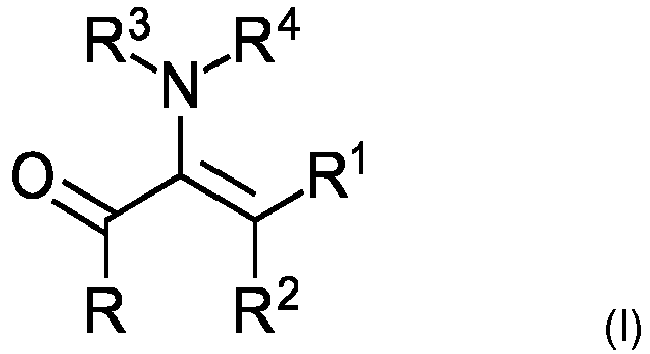
- Therefore, in a first aspect, the invention relates to a method for preparing an enone compound of formula (I)


- (1) R, R1, R2, R3 and R4 are independently of each other selected from hydrogen, substituted or unsubstituted linear C1-C20 alkyl groups or branched C3-C20 alkyl groups; substituted or unsubstituted linear C2-C20 alkenyl groups or branched C3-C20 alkenyl groups; substituted or unsubstituted linear C2-C20 alkynyl groups or branched C4-C20 alkynyl groups; substituted or unsubstituted C3-C10 cycloalkyl, C3-C10 cycloalkenyl or aryl groups; substituted or unsubstituted, linear C4-C20 alkylcycloalkyl, C4-C20 alkylcycloalkenyl, C4-C20 alkenylcycloalkyl, C4-C20 alkenylcycloalkenyl, C5-C20 alkynylcycloalkyl or C5-C20 alkynylcycloalkenyl groups, or branched C5-C20 alkylcycloalkyl, C5-C20 alkylcycloalkenyl, C5-C20 alkenylcycloalkyl, C5-C20 alkenylcycloalkenyl, C6-C20 alkynylcycloalkyl or C6-C20 alkynylcycloalkenyl groups, or substituted or unsubstituted linear C7-C20 alkylaryl, C8-C20 alkenylaryl or C8-C20 alkynylaryl groups, or branched C8-C20 alkylaryl, C8-C20 alkenylaryl or C9-C20 alkynylaryl groups; or substituted or unsubstituted linear C1-C20 alkylester, C1-C20 alkylether, or C1-C20 alkylmethoxy, or branched C2-C20 alkylester, C2-C20 alkylether, or C2-C20 alkylmethoxy groups; wherein each of the groups of R, R1, R2, R3 and R4 may further contain 1 to 6 heteroatoms, or wherein
- (2) R and R2 and/or R3 and R4 each form a substituted or unsubstituted hydrocarbon ring with 3 to 12 carbon atoms, wherein each of the hydrocarbon rings may further contain at least one heteroatom, selected from O, N, S, and P, and/or wherein each of the hydrocarbon rings may further contain at least one double bond; and
wherein the remaining groups are as defined above. - In a second aspect, the invention claims the enone compound of formula (I) obtained by the method according to the invention.
- In addition, in a third aspect, the invention relates to a washing or cleaning agent comprising the enone compound of formula (I) according to the invention.
- Furthermore, in a fourth aspect, the invention relates to an insect repellent composition comprising the enone compound of formula (I) according to the invention.
- In addition, in a fifth aspect, the invention pertains to a pharmaceutical composition comprising the enone compound of formula (I) according to the invention.
- Finally, in a sixth aspect, the invention relates to a use of the enone compound of formula (I) according to the invention as fine chemical, basic chemical, insect repellant, pharmaceutical compound, fragrance or pro-fragrance compound.
- "One or more", as used herein, relates to "at least one" and comprises 1, 2, 3, 4, 5, 6, 7, 8, 9 or more of the referenced species. Similarly, "at least one" means "one or more", i.e. 1, 2, 3, 4, 5, 6, 7, 8, 9 or more. "At least one", as used herein in relation to any component, refers to the number of chemically different atoms or molecules, i.e. to the number of different types of the referenced species, but not to the total number of atoms or molecules. For example, "at least one oxidant" means that at least one type of oxidant falling within the definition can be used in the method, but that also two or more different oxidant types falling within this definition can be present, but does not mean that several molecules of only one type of oxidant may be present.
- Numeric values specified without decimal places refer to the full value specified with one decimal place. For example, "99 %" means "99.0 %", if not stated otherwise.
- The expressions "approx." or "about", in conjunction with a numerical value, refer to a variance of ± 10 % relative to the given numerical value, preferably ± 5 %, more preferably ± 1 %, if not explicitly stated otherwise.
- All mol% employed herein relate to the total amount of the respective starting materials, if not explicitly stated otherwise. The amount of the enone compound of formula (I) in washing or cleaning agents is indicated in weight percent (wt.-%), based on the total weight of the respective composition, if not explicitly stated otherwise.
- These and other aspects, features and advantages of the invention become apparent to the skilled person in the following detailed description and claims. Each feature from one aspect of the invention can be used in any other aspect of the invention. Furthermore, the examples contained herein are intended to describe and illustrate the invention, but do not restrict it and in particular, the invention is not limited to these examples.
- In particular, the invention pertains to:
- 1. A method for preparing an enone compound of formula (I)


wherein- (1) R, R1, R2, R3 and R4 are independently of each other selected from hydrogen, substituted or unsubstituted linear C1-C20 alkyl groups or branched C3-C20 alkyl groups; substituted or unsubstituted linear C2-C20 alkenyl groups or branched C3-C20 alkenyl groups; substituted or unsubstituted linear C2-C20 alkynyl groups or branched C4-C20 alkynyl groups; substituted or unsubstituted C3-C10 cycloalkyl, C3-C10 cycloalkenyl or aryl groups; substituted or unsubstituted, linear C4-C20 alkylcycloalkyl, C4-C20 alkylcycloalkenyl, C4-C20 alkenylcycloalkyl, C4-C20 alkenylcycloalkenyl, C5-C20 alkynylcycloalkyl or C5-C20 alkynylcycloalkenyl groups, or branched C5-C20 alkylcycloalkyl, C5-C20 alkylcycloalkenyl, C5-C20 alkenylcycloalkyl, C5-C20 alkenylcycloalkenyl, C6-C20 alkynylcycloalkyl or C6-C20 alkynylcycloalkenyl groups; or substituted or unsubstituted linear C7-C20 alkylaryl, C8-C20 alkenylaryl or C8-C20 alkynylaryl groups, or branched C8-C20 alkylaryl, C8-C20 alkenylaryl or C9-C20 alkynylaryl groups; or substituted or unsubstituted linear C1-C20 alkylester, C1-C20 alkylether, or C1-C20 alkylmethoxy, or branched C2-C20 alkylester, C2-C20 alkylether, or C2-C20 alkylmethoxy groups; wherein each of the groups of R, R1, R2, R3 and R4 may further contain 1 to 6 heteroatoms, preferably 1, 2, 3, or 4 heteroatoms selected from O, N, S, and P, more preferably no heteroatom is present; or
wherein - (2) R and R2 and/or R3 and R4 each form a substituted or unsubstituted hydrocarbon ring with 3 to 12 carbon atoms, preferably with 4 to 6 carbon atoms, more preferably with 4 or 5 carbon atoms,
wherein each of the hydrocarbon rings may further contain at least one heteroatom, selected from O, N, S, and P, and/or wherein each of the hydrocarbon rings may further contain at least one double bond; and
wherein the remaining groups are as defined above.
- (1) R, R1, R2, R3 and R4 are independently of each other selected from hydrogen, substituted or unsubstituted linear C1-C20 alkyl groups or branched C3-C20 alkyl groups; substituted or unsubstituted linear C2-C20 alkenyl groups or branched C3-C20 alkenyl groups; substituted or unsubstituted linear C2-C20 alkynyl groups or branched C4-C20 alkynyl groups; substituted or unsubstituted C3-C10 cycloalkyl, C3-C10 cycloalkenyl or aryl groups; substituted or unsubstituted, linear C4-C20 alkylcycloalkyl, C4-C20 alkylcycloalkenyl, C4-C20 alkenylcycloalkyl, C4-C20 alkenylcycloalkenyl, C5-C20 alkynylcycloalkyl or C5-C20 alkynylcycloalkenyl groups, or branched C5-C20 alkylcycloalkyl, C5-C20 alkylcycloalkenyl, C5-C20 alkenylcycloalkyl, C5-C20 alkenylcycloalkenyl, C6-C20 alkynylcycloalkyl or C6-C20 alkynylcycloalkenyl groups; or substituted or unsubstituted linear C7-C20 alkylaryl, C8-C20 alkenylaryl or C8-C20 alkynylaryl groups, or branched C8-C20 alkylaryl, C8-C20 alkenylaryl or C9-C20 alkynylaryl groups; or substituted or unsubstituted linear C1-C20 alkylester, C1-C20 alkylether, or C1-C20 alkylmethoxy, or branched C2-C20 alkylester, C2-C20 alkylether, or C2-C20 alkylmethoxy groups; wherein each of the groups of R, R1, R2, R3 and R4 may further contain 1 to 6 heteroatoms, preferably 1, 2, 3, or 4 heteroatoms selected from O, N, S, and P, more preferably no heteroatom is present; or
- 2. The method according to item 1, wherein R and R2 form a substituted or unsubstituted hydrocarbon ring with 4 to 6 carbon atoms, preferably with 5 carbon atoms, wherein the hydrocarbon ring may contain at least one heteroatom selected from O, N, S, and P, and/or wherein the hydrocarbon ring may further contain at least one double bond; and
wherein R1 is preferably a substituted or unsubstituted linear C1-C15 alkyl, C2-C15 alkenyl, C2-C15 alkynyl, C4-C15 alkylcycloalkyl, C4-C15 alkylcycloalkenyl, C1-C15 alkylester, C1-C15 alkylether, or C1-C15 alkylmethoxy group, or branched C3-C15 alkyl, C3-C15 alkenyl, C4-C15 alkynyl, C5-C15 alkylcycloalkyl, C5-C15 alkylcycloalkenyl, C2-C15 alkylester, C2-C15 alkylether, or C2-C15 alkylmethoxy group, more preferably a substituted or unsubstituted linear C1-C8 alkyl, branched C3-C10 alkyl, linear C4-C15 alkylcycloalkenyl, branched C5-C15 alkylcycloalkenyl, linear C1-C15 alkylmethoxy, or branched C2-C15 alkylmethoxy group, wherein R1 may further contain at least one heteroatom selected from O, N, S, and P; and wherein R3 and R4 are as defined in item 1. - 3. The method according to item 1 and 2, wherein R3 and R4 form a substituted or unsubstituted pyrrolidine group;
wherein preferably at least one hydrogen atom of the pyrrolidine ring is substituted with substituted or unsubstituted linear C1-C15 alkyl, C2-C15 alkenyl, C2-C15 alkynyl, C4-C15 alkylcycloalkyl, C4-C15 alkylcycloalkenyl, C1-C15 alkylester, C1-C15 alkylether, or C1-C15 alkylmethoxy groups, or branched C3-C15 alkyl, C3-C15 alkenyl, C4-C15 alkynyl, C5-C15 alkylcycloalkyl, C5-C15 alkylcycloalkenyl, C2-C15 alkylester, C2-C15 alkylether, or C2-C15 alkylmethoxy groups, more preferably with substituted or unsubstituted, linear C1-C8 alkyl, branched C3-C10 alkyl, linear C4-C15 alkylcycloalkenyl, branched C5-C15 alkylcycloalkenyl, linear C1-C15 alkylmethoxy, or branched C2-C15 alkylmethoxy groups, most preferably with -CH2-O-CH3,
wherein the at least one substituent may further contain at least one heteroatom selected from O, N, S, and P. - 4. The method according to any one of items 1 to 3, wherein the enone compound of formula (I) is an enone compound of formula (IV)

- (1) R5 and R6 are independently of each other selected from substituted or unsubstituted linear C1-C15 alkyl, C2-C15 alkenyl, C2-C15 alkynyl, C4-C15 alkylcycloalkyl, C4-C15 alkylcycloalkenyl, C1-C15 alkylester, C1-C15 alkylether, or C1-C15 alkylmethoxy groups, or branched C3-C15 alkyl, C3-C15 alkenyl, C4-C15 alkynyl, C5-C15 alkylcycloalkyl, C5-C15 alkylcycloalkenyl, C2-C15 alkylester, C2-C15 alkylether, or C2-C15 alkylmethoxy groups, preferably from substituted or unsubstituted, linear C1-C8 alkyl, branched C3-C10 alkyl, linear C4-C15 alkylcycloalkenyl, branched C5-C15 alkylcycloalkenyl, linear C1-C15 alkylmethoxy, or branched C2-C15 alkylmethoxy groups, wherein R5 and R6 may further contain independently of each other at least one heteroatom selected from O, N, S, and P; or wherein
- (2) R5 is a substituted or unsubstituted linear C1-C15 alkyl, branched C3-C15 alkyl, linear C4-C15 alkylcycloalkenyl, or branched C5-C15 alkylcycloalkenyl group; and
wherein R6 is a substituted or unsubstituted linear C1-C15 alkylmethoxy, or branched C2-C15 alkylmethoxy group, preferably -CH2-O-CH3.
- 5. The method according to any one of items 1 to 4, wherein the enone compound of formula (I) is an enone compound of formula (V) or (VI)


- 6. The method according to any one of items 1 to 5, wherein the reaction is conducted in the presence of at least one Bronsted acid or Lewis acid, preferably in the presence of para-toluene sulfonic acid.
- 7. The method according to any one of items 1 to 6, wherein the reaction is conducted in the presence of at least one catalyst, preferably in the presence of at least one main group metal based catalyst, transition metal based catalyst, organo-catalyst, or mixtures thereof, more preferably in the presence of at least one transition metal based catalyst, most preferably in the presence of at least one catalyst, which is based on Aluminum (Al), vanadium (V), chrome (Cr), manganese (Mn), iron (Fe), cobalt (Co), nickel (Ni), copper (Cu), zinc (Zn), zirconium (Zr), niobium (Nb), molybdenum (Mo), palladium (Pd), silver (Ag), tungsten (W), iridium (Ir), or platinum (Pt).
- 8. The method according to any one of items 1 to 7, wherein the oxidant is any compound, which is able to act as oxygen transfer reagent, preferably oxygen or air, more preferably air, most preferably air at atmospheric pressure.
- 9. The method according to any one of items 1 to 8, wherein the at least one catalyst is present in amounts of from 0.001 to 75 mol%, preferably in amounts of from 0.01 to 5 mol%, based on the total amount of starting materials.
- 10. The method according to any one of items 1 to 9, wherein the at least one Bronsted acid or Lewis acid is present in amounts of from 0.001 to 75 mol%, preferably in amounts of from 0.01 to 5 mol%, based on the total amount of starting materials.
- 11. An enone compound of formula (I) obtained by the method according to any one of items 1 to 10.
- 12. A washing or cleaning agent comprising the enone compound of formula (I) according to item 11.
- 13. An insect repellant composition comprising the enone compound of formula (I) according to item 11.
- 14. A pharmaceutical composition comprising the enone compound of formula (I) according to item 11.
- 15. Use of the enone compound of formula (I) according to item 11 as fine chemical, basic chemical, insect repellant, pharmaceutical compound, fragrance or pro-fragrance compound.
- According to the invention, when one or more groups of R, R1, R2, R3, R4, R5 and R6 are substituted, the substituent can be chosen from every suitable substituent, which is known to the skilled person. Preferably, each of the groups of R, R1, R2, R3, R4, R5 and R6 may independently of each other contain 1 to 10 of one or more of the following substituents: halogen, ester, ether, hydroxyl, amine, amide, ketone, aldehyde, carboxyl, linear C1-C20 alkyl, branched C3-C20 alkyl, linear C2-C20 alkenyl, branched C3-C20 alkenyl, linear C2-C20 alkynyl, branched C4-C20 alkynyl; C3-C20 cycloalkyl, C3-C20 cycloalkenyl, or aryl; linear C4-C20 alkylcycloalkyl(alkyl), C4-C20 alkylcycloalkenyl(alkyl), C4-C20 alkenylcycloalkyl(alkyl), C4-C20 alkenylcycloalkenyl(alkyl), C5-C20 alkynylcycloalkyl(alkyl) or C5-C20 alkynylcycloalkenyl(alkyl), or branched C5-C20 alkylcycloalkyl(alkyl), C5-C20 alkylcycloalkenyl(alkyl), C5-C20 alkenylcycloalkyl(alkyl), C5-C20 alkenylcycloalkenyl(alkyl), C6-C20 alkynylcycloalkyl(alkyl) or C6-C20 alkynylcycloalkenyl(alkyl); or linear C7-C20 alkylaryl(alkyl), C8-C20 alkenylaryl(alkyl) or C8-C20 alkynylaryl(alkyl), or branched C8-C20 alkylaryl(alkyl), C8-C20 alkenylaryl(alkyl) or C9-C20 alkynylaryl(alkyl), or linear C1-C15 alkylester(alkyl), C1-C15 alkylether(alkyl), or C1-C15 alkylmethoxy groups, or branched C2-C15 alkylester(alkyl), C2-C15 alkylether(alkyl), or C2-C15 alkylmethoxy groups, or combinations thereof. The substituents may contain one or more heteroatom(s), such as, O, N, S, and P. The substituents may replace one or more of -H, -C-, -CH-, -CH2- and/or -CH3 in the groups of R, R1, R2, R3, R4, R5 and R6 or in the formed rings of R and R2 and/or R3 and R4. Preferred substituents are linear C1-C10 alkyl, preferably methyl and ethyl, methylmethoxy (-CH2-O-CH3), and linear C4-C20 alkylcycloalkenyl(alkyl) or branched C5-C20 alkylcycloalkenyl(alkyl) groups. Most preferably, the pyrrolidine ring is substituted by a methylmethoxy group (-CH2-O-CH3).
- In various embodiments, the substituent cannot be the same group as the group being substituted. For example, this means when the substituted group is an alkyl group, the substituent is not itself an alkyl group. This similarly applies to all other combinations of substituted group and substituent.
- The minimum and maximum limit of carbon atoms (CX-CX) of a group of R, R1, R2, R3, R4, R5 and R6 relates to the total amount of carbon atoms of a group of R, R1, R2, R3, R4, R5 and R6 without any optional substituent. That means that optional present substituents of a group of R, R1, R2, R3, R4, R5 and R6 may increase the total number of carbon atoms over the indicated minimum and maximum limit of carbon atoms of the respective group. In various other embodiments, the given number of carbon atoms also includes all potential substituents.
- The method for preparing an enone compound of formula (I) according to the invention is exemplarily shown in the following reaction scheme:
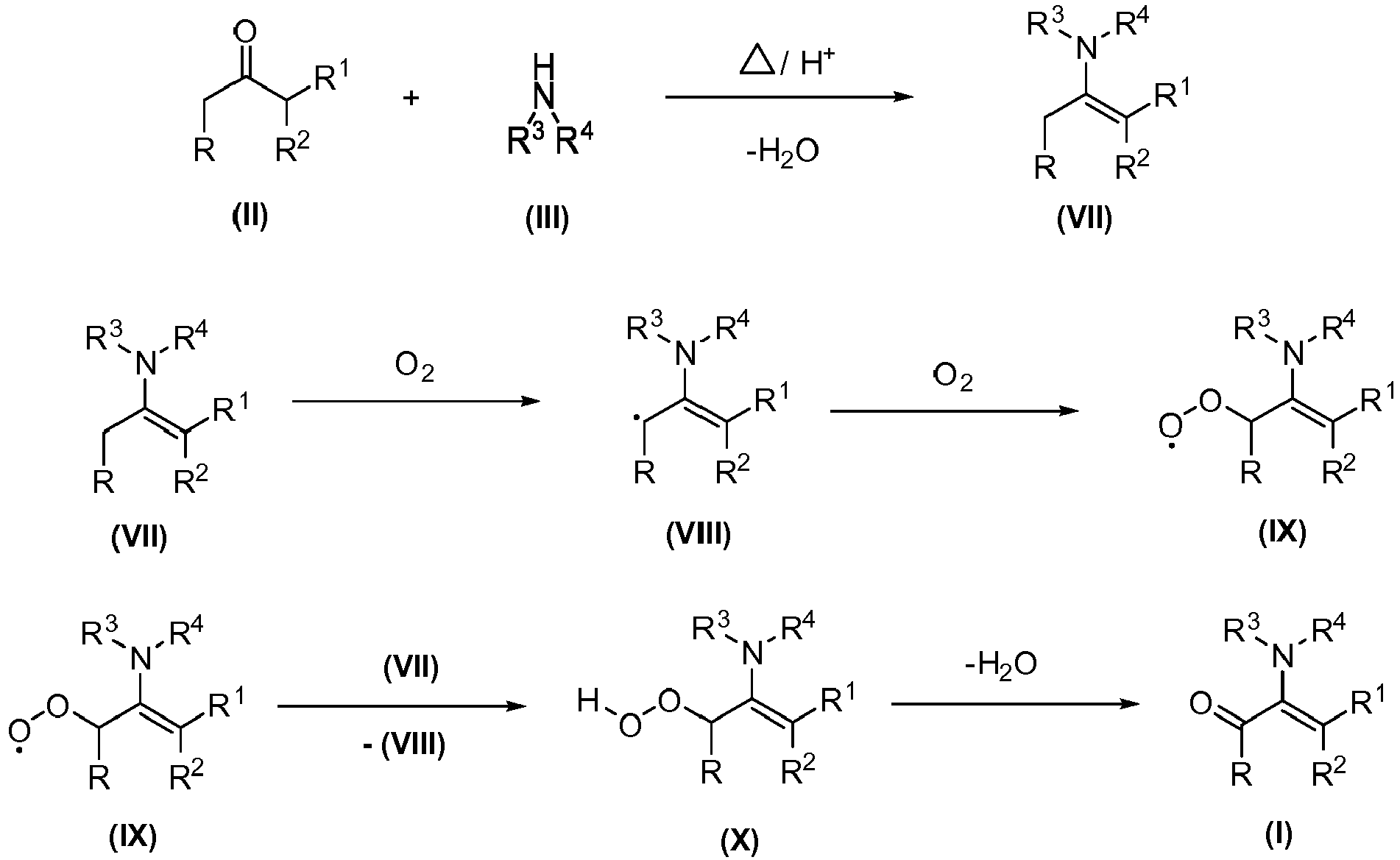
- Starting from a ketone compound of formula (II) and an amine compound of formula (III) in the presence of at least one oxidant, the enone compound of formula (I) is formed. Not to be bound to any theory, it is believed that this reaction takes place, since the ketone compound of formula (II) contains a CH2 group in alpha position to the ketone group.
- The reaction is conducted in the presence of an oxidant, which is preferably any compound, which is able to act as oxygen transfer reagent, more preferably oxygen or air, more preferably air, most preferably air at atmospheric pressure.
- In another preferred embodiment, the reaction is further conducted at temperatures in the range of 0 to 300 °C, more preferably in the range of 30 to 100 °C, most preferably in the range of 50 to 80 °C.
- In a further preferred embodiment, the reaction of the method according to the invention is conducted in the presence of at least one Brønsted acid or Lewis acid.
- Lewis acids are electrophile electron pair acceptors, for example compounds with incomplete or unstable electron octets, such as B(CH3)3, BF3, or AlCl3, or compounds which are not present in nobel gas configuration. Furthermore, Lewis acids can be metal cations, which can be used as central atom in complex compounds, or molecules with polarized double bonds, such as CO2 or SO3, or unsaturated halides, such as SiCl4.
- Brønsted acids are proton donors. These acids release protons to a corresponding base. Preferred Brønsted acids are CH3COOH, H2SO4, HSO4, toluene sulfonic acid, HPO4 2-, H2PO4 -, HCl, H2O, NH3 and NH4 +.
- A preferred Brønsted acid is para-toluene sulfonic acid.
- In a further preferred embodiment, the at least one Brønsted acid or Lewis acid is present in amounts of from 0.001 to 75 mol%, more preferably in amounts of from 0.01 to 5 mol%, based on the total amount of starting materials.
- In a further preferred embodiment, the reaction is conducted in the presence of at least one catalyst, preferably in the presence of at least one main group metal based catalyst, transition metal based catalyst, organo catalyst, or mixtures thereof.
- Metals, which can be used for main group metal based catalysts are preferably from Groups 1, 2, 13, and 14 (periodic table of elements) and may be in its highest state of oxidation. In preferred embodiments, the metal atom is selected from the group comprising lithium (Li), beryllium (Be), sodium (Na), magnesium (Mg), potassium (K), calcium (Ca), boron (B), aluminum (Al), gallium (Ga), indium (In), silicon (Si), germanium (Ge), and tin (Sn). In more preferred embodiments, the metal is boron and aluminum.
- Suitable transition metal based catalyst, are based on transition metals from the group of vanadium (V), chrome (Cr), manganese (Mn), iron (Fe), cobalt (Co), nickel (Ni), copper (Cu), zinc (Zn), zirconium (Zr), niobium (Nb), molybdenum (Mo), palladium (Pd), silver (Ag), tungsten (W), iridium (Ir), or platinum (Pt).
- Suitable organo catalysts are catalysts, which do not contain metal atoms. Preferably, these catalysts are based on phosphor (P), sulfur (S), nitrogen (N), oxygen (O), carbon (C) and hydrogen (H).
- In preferred embodiments, the at least one catalyst used in the reaction is a transition metal based catalyst.
- Suitable catalysts are for example solid supported Cu-catalysts as disclosed in RSC Advances, 5(106), 87221-87227; 2015, silica supported strong Lewis acid AlCl3 for example disclosed in RSC Advances, 6(14), 11528-11535; 2016); Pd2(dba)3 via a triflate for example disclosed in Macromolecular Chemistry and Physics, 211(21), 2339-2346; 2010, Co(OAc)2 on 1,4 benzochinone for example disclosed in Angewandte Chemie, International Edition, 57(31), 9805-9809; 2018.
- Further preferred, the at least one catalyst is present in amounts of from 0.001 to 75 mol%, more preferably in amounts of from 0.01 to 5 mol%, based on the total amount of starting materials.
- According to the second aspect of the invention, the enone compound of formula (I)

- (1) R, R1, R2, R3 and R4 are independently of each other selected from hydrogen, substituted or unsubstituted linear C1-C20 alkyl groups or branched C3-C20 alkyl groups; substituted or unsubstituted linear C2-C20 alkenyl groups or branched C3-C20 alkenyl groups; substituted or unsubstituted linear C2-C20 alkynyl groups or branched C4-C20 alkynyl groups; substituted or unsubstituted C3-C10 cycloalkyl, C3-C10 cycloalkenyl or aryl groups; substituted or unsubstituted, linear C4-C20 alkylcycloalkyl, C4-C20 alkylcycloalkenyl, C4-C20 alkenylcycloalkyl, C4-C20 alkenylcycloalkenyl, C5-C20 alkynylcycloalkyl or C5-C20 alkynylcycloalkenyl groups, or branched C5-C20 alkylcycloalkyl, C5-C20 alkylcycloalkenyl, C5-C20 alkenylcycloalkyl, C5-C20 alkenylcycloalkenyl, C6-C20 alkynylcycloalkyl or C6-C20 alkynylcycloalkenyl groups; or substituted or unsubstituted linear C7-C20 alkylaryl, C8-C20 alkenylaryl or C8-C20 alkynylaryl groups, or branched C8-C20 alkylaryl, C8-C20 alkenylaryl or C9-C20 alkynylaryl groups; or substituted or unsubstituted linear C1-C20 alkylester, C1-C20 alkylether, or C1-C20 alkylmethoxy, or branched C2-C20 alkylester, C2-C20 alkylether, or C2-C20 alkylmethoxy groups; wherein each of the groups of R, R1, R2, R3 and R4 may further contain 1 to 6 heteroatoms, preferably 1, 2, 3, or 4 heteroatoms selected from O, N, S, and P; or
wherein - (2) R and R2 and/or R3 and R4 each form a substituted or unsubstituted hydrocarbon ring with 3 to 12 carbon atoms, preferably with 4 to 6 carbon atoms, more preferably with 4 or 5 carbon atoms,
wherein each of the hydrocarbon rings may further contain at least one heteroatom, selected from O, N, S, and P, and/or wherein each of the hydrocarbon rings may further contain at least one double bond; and
wherein the remaining groups are as defined above. - In a preferred embodiment, R and R2 of the enone compound of formula (I) form a substituted or unsubstituted hydrocarbon ring with 4 to 6 carbon atoms, preferably with 5 carbon atoms, wherein the hydrocarbon ring may contain at least one heteroatom selected from O, N, S, and P, and/or wherein the hydrocarbon ring may further contain at least one double bond; and
wherein R1 is preferably a substituted or unsubstituted linear C1-C15 alkyl, C2-C15 alkenyl, C2-C15 alkynyl, C4-C15 alkylcycloalkyl, C4-C15 alkylcycloalkenyl, C1-C15 alkylester, C1-C15 alkylether, or C1-C15 alkylmethoxy group, or branched C3-C15 alkyl, C3-C15 alkenyl, C4-C15 alkynyl, C5-C15 alkylcycloalkyl, C5-C15 alkylcycloalkenyl, C2-C15 alkylester, C2-C15 alkylether, or C2-C15 alkylmethoxy group, more preferably a substituted or unsubstituted linear C1-C8 alkyl, branched C3-C10 alkyl, linear C4-C15 alkylcycloalkenyl, branched C5-C15 alkylcycloalkenyl, linear C1-C15 alkylmethoxy, or branched C2-C15 alkylmethoxy group, wherein R1 may further contain at least one heteroatom selected from O, N, S, and P; and wherein R3 and R4 are as defined in aspect 2. - In a preferred embodiment, R1 is substituted or unsubstituted linear C1-C10 alkyl or branched C3-C10 alkyl, substituted or unsubstituted linear C4-C15 alkylcycloalkenyl or branched C5-C15 alkylcycloalkenyl. Most preferably, R1 is unsubstituted linear C1-C10 alkyl or branched C5-C15 alkylcycloalkenyl(alkyl), in particular 2-(4-methylcyclohex-3-enyl)propyl.
- In another preferred embodiment, R3 and R4 of the enone compound of formula (I) form a substituted or unsubstituted pyrrolidine group;
wherein preferably at least one hydrogen atom of the pyrrolidine ring is substituted with substituted or unsubstituted linear C1-C15 alkyl, C2-C15 alkenyl, C2-C15 alkynyl, C4-C15 alkylcycloalkyl, C4-C15 alkylcycloalkenyl, C1-C15 alkylester, C1-C15 alkylether, or C1-C15 alkylmethoxy groups, or branched C3-C15 alkyl, C3-C15 alkenyl, C4-C15 alkynyl, C5-C15 alkylcycloalkyl, C5-C15 alkylcycloalkenyl, C2-C15 alkylester, C2-C15 alkylether, or C2-C15 alkylmethoxy groups, more preferably with substituted or unsubstituted, linear C1-C8 alkyl, branched C3-C10 alkyl, linear C4-C15 alkylcycloalkenyl, branched C5-C15 alkylcycloalkenyl, linear C1-C15 alkylmethoxy, or branched C2-C15 alkylmethoxy groups, most preferably with -CH2-O-CH3,
wherein the at least one substituent may further contain at least one heteroatom selected from O, N, S, and P. - In a further preferred embodiment, the enone compound of formula (I) according to the invention is an enone compound of formula (IV)

- (1) R5 and R6 are independently of each other selected from substituted or unsubstituted linear C1-C15 alkyl, C2-C15 alkenyl, C2-C15 alkynyl, C4-C15 alkylcycloalkyl, C4-C15 alkylcycloalkenyl, C1-C15 alkylester, C1-C15 alkylether, or C1-C15 alkylmethoxy groups, or branched C3-C15 alkyl, C3-C15 alkenyl, C4-C15 alkynyl, C5-C15 alkylcycloalkyl, C5-C15 alkylcycloalkenyl, C2-C15 alkylester, C2-C15 alkylether, or C2-C15 alkylmethoxy groups, preferably from substituted or unsubstituted, linear C1-C8 alkyl, branched C3-C10 alkyl, linear C4-C15 alkylcycloalkenyl, branched C5-C15 alkylcycloalkenyl, linear C1-C15 alkylmethoxy, or branched C2-C15 alkylmethoxy groups, wherein R5 and R6 may further contain independently of each other at least one heteroatom selected from O, N, S, and P; or
wherein - (2) R5 is a substituted or unsubstituted linear C1-C15 alkyl, branched C3-C15 alkyl, linear C4-C15 alkylcycloalkenyl, or branched C5-C15 alkylcycloalkenyl group; and
wherein R6 is a substituted or unsubstituted linear C1-C15 alkylmethoxy, or branched C2-C15 alkylmethoxy group, preferably -CH2-O-CH3. - In a more preferred embodiment, the enone compound of formula (I) according to the invention is an enone compound of formula (V) or (VI)


- According to aspect 3 of the invention, a washing or cleaning agent comprising the enone compound of formula (I) obtained by the method according to the invention is claimed.
- The washing or cleaning agent can be a solid or liquid composition at 20 °C and atmospheric pressure.
- Preferably, washing or cleaning agents comprise laundry detergents, laundry after treatment agents, home care products, such as dishwashing detergent, floor cleaning agent or window cleaner, air care products, or cosmetic products.
- The washing or cleaning agents may contain at least one further component, preferably selected from the group of anionic surfactants, cationic surfactants, amphoteric surfactants, nonionic surfactants, acidifiers, alkalizing agents, anti-crease compounds, antibacterial/antimicrobial substances, antioxidants, anti-deposition agents, antistatic agents, bitter substances, bleaching agents, bleach activators, bleach stabilizers, bleach catalysts, builder substances, corrosion inhibitors, ironing aids, co-builders, further fragrances or pro-fragrances, shrinkage inhibitors, electrolytes, emulsifiers, enzymes, enzyme stabilizers, protease inhibitors, colorants, dyes, dye transfer inhibitors, fluorescent agents, fungicides, germicides, metal sequestering agents, odor-complexing substances, auxiliary agents, hydrotropics, rinse aids, complexing agents, preservatives, optical brighteners, perfume carriers, pearl-luster agents, pH control agents, phobing and impregnating agents, polymers, swelling and sliding fasteners, foam inhibitors, layered silicates, dirt-repellent substances, organic solvents, silicone oils, soil-release active substances, UV-protective substances, viscosity regulators, thickeners, discoloration inhibitors, greying inhibitors, vitamins, fabric softeners and water, with the proviso that the at least one further component is different from the enone compound of formula (I) according to the invention.
- Referring to aspect 6 of the invention, the enone compound of formula (I) obtained by the method according to the invention, can be used as fine chemical, basic chemical, pharmaceutical compound, fragrance or pro-fragrance compound.
- In preferred embodiments, the enone compound of formula (I) is a fragrance or pro-fragrance compound, in particular when used in washing or cleaning agents according to the invention.
- Pro-fragrance compounds are able to release a fragrance compound, which provides a pleasant scent. In some embodiments, the fragrance compound is a ketone or diketone compound derived from formula (II) according to the invention. Suitable ketones are known to those skilled in the art and include those satisfying the struictural requirements of formula (II) and being described in
US 2003/0158079 A1 , paragraphs [0154] and [0155] as well as in Steffen Arctander, Aroma Chemicals Vol. 1 and Vol. 2 (published 1960 and 1969, new edition 2000; ISBN: 0-931710-37-5 und 0-931710-38-3). - Further suitable fragrance ketones include those that satisfy the structural criteria of formula (II) and are selected from, but not limited to, the following: methyl beta naphthyl ketone, musk indanon (1,2,3,5,6,7-hexahydro-1,1,2,3,3-pentamethyl-4H-indene-4-on), calone (methylbenzodioxepinone), tonalid (6-acetyl-1,1,2,4,4,7-hexamethyltetraline), alpha-damascone, beta-damascone, delta-damascone, iso-damascone, damascenone, methyl dihydrojasmonate (Hedion), menthone, carvon, camphor, coavon (3,4,5,6,6-pentamethylhept-3-en-2-on), fenchone, alpha-ionone, beta-ionone, dihydro-beta-ionone, gamma-methyl-ionone, fleuramone (2-heptylcyclopentanone), frambinon methyl ether (4-(4-methoxyphenyl)butane-2-one), dihydrojasmone, cis-jasmone, 1-(1,2,3,4,5,6,7,8-octahydro-2,3,8,8-tetramethyl-2-naphthalenyl)-ethane-1-one and isomers thereof, methylcedrenylketone, acetophenone, methylacetophenone, para-methoxyacetophenone, methyl-beta-naphtylketone, benzeneacetone, benzophenone, para-hydroxyphenylbutanone, 3-methyl-5-propyl-2-cyclohexenone, 6-isopropyldeca-hydro-2-naphtone, dimethyloctenone, frescomenthe (2-butane-2-ylcyclohexane-1-one), 4-(1-ethoxyvinyl)-3,3,5,5-tetramethylcyclohexanone, methylheptenone, 2-(2-(4-methyl-3-cyclohexene-1-yl)propyl)cyclopentanone, 1-(p-menthen-6(2)yl)-1-propanone, 4-(4-hydroxy-3-methoxyphenyl)-2-butanone, 2-acetyl-3,3-dimethylnorbornane, 6,7-dihydro-1,1,2,3,3-pentamethyl-4(5H)indanone, 4-damascol, dulcinyl (4-(1,3-Benzodioxol-5-yl)butane-2-one), hexalone (1-(2,6,6-trimethyl-2-cyclohexene-1-yl)-1,6-heptadiene-3-one), isocyclemon E (2-acetonaphthone-1,2,3,4,5,6,7,8-octahydro-2,3,8,8-tetramethyl), methylnonylketone, methylcyclocitrone, methyllavenderketone, orivon (4-tert-amylcyclohexanone), 4-tert-butylcyclohexanone, delphon (2-pentylcyclopentanone), muscon (CAS 541 -91 -3), neobutenone (1-(5,5-dimethyl-1-cyclo-hexenyl)pent-4-ene-1-one), Plicaton (CAS 41724-19-0), Velouton (2,2,5-trimethyl-5-pentylcyclopentane-1-one), 2,4,4,7-tetramethyl-oct-6-ene-3-one, tetrameran (6,10-dimethylundecene-2-one) and mixtures thereof.
- In a preferred embodiment, the fragrance compound is released from the pro-fragrance compound of formula (I) by contact with water, oxygen, sunlight, elevated temperatures or by contact with the skin.
- Suitable amounts of the enone compound of formula (I) and of further components for the compositions are based on the application of the washing or cleaning agent according to the invention and are known to the skilled person.
- If the washing agent according to the invention is a laundry detergent, the enone compound of formula (I) may be present in the washing agent in amounts of from 0.001 to 5 wt.-%, more preferably of from 0.01 to 2 wt.-%, based on the total weight of the composition.
- In case the washing or cleaning agent is an air care product, the enone compound of formula (I) may be present in the washing agent in amounts of from 0.001 to 99.9 wt.-%, more preferably of from 0.01 to 50 wt.-%, based on the total weight of the composition.
- According to a fourth aspect, the invention pertains to an insect repellant composition comprising the enone compound of formula (I) obtained by the method according to the invention.
- In one preferred embodiment, the amount of enone compound of formula (I) according to the present invention is in the range of 0.001 to 99.9 wt.-%, more preferably in the range of 0.01 to 85 wt.-%, more preferably in the range of 0.1 to 70 wt.-%, most preferably in the range of 1 to 50 wt.-%, based on the total weight of the insect repellant composition.
- In various embodiments the insect repellent composition can comprise further additives, which are common in the field of insect repellant. For examples the additives which are disclosed for washing or cleaning agents can be employed as well.
- In a fifth aspect, the invention pertains to a pharmaceutical composition comprising the enone compound of formula (I) obtained by the method according to the invention.
- In one preferred embodiment, the amount of enone compound of formula (I) according to the present invention is in the range of 0.001 to 99.9 wt.-%, more preferably in the range of 0.01 to 85 wt.-%, more preferably in the range of 0.1 to 50 wt.-%, most preferably in the range of 1 to 15 wt.-%, based on the total weight of the pharmaceutical composition.
- In various embodiments the pharmaceutical composition can comprise further additives, which are common in the field of pharmaceutical compositions.
- In a preferred embodiment, enone compounds of formula (I) are used as fine or basic chemicals. Preferably, they are contained in the chemical composition in amounts of at least 90 weight-%, preferably of at least 95 wt.-%, more preferably of at least 99 wt.-%, more preferably of at least 99.5 wt.-%, most preferably of at least 99.9 wt.-%, based on the total weight of the fine or basic chemical.
- The chemical composition may be a solid or a liquid composition at 20 °C and atmospheric pressure.
- The invention will now be described in greater detail, with reference to the accompanying non-limiting examples. It is understood that all embodiments disclosed herein in relation to the method according to the invention are similarly applicable to the enone compound of formula (I), to the washing or cleaning agents according to the invention and to the use of the enone compound of formula (I), and vice versa. Specific embodiments and features of the embodiments are to be seen as disclosed for each and every embodiment so that features disclosed in the specification can be combined with each other with the embodiment still being within the scope of the present invention.
- In the following examples, the present invention is further described in preferred embodiments but it is understood that it is not limited thereto.
- The respective ketone (1 eq.), the respective pyrrolidine (1.9 eq - 2.5 eq.), and para-toluene sulfonic acid (0.1 mol%) in toluene (150 mL) were refluxed with azeotropic removal of H2O in a Dean-Stark trap over time. The reaction mixture was then cooled to room temperature, washed with water and dried over Na2SO4, filtered and the solvent was evaporated under reduced pressure. The pure products were isolated via column chromatography (hexane - ethyl acetate - 1 % triethylamine) unless otherwise noted.
-

- 2-[2-(methoxymethyl)pyrrolidin-1-yl]-3-heptylcyclopent-2-en-1-one was prepared following the aforementioned method using 2-heptylcyclopentanone (3.27 g, 18 mmol) and 2-methoxymethylpyrrolidine (4.05 g, 35 mmol). Until full conversion of the starting material (approx. 120 hours), the reaction was monitored by gas chromatography (GC).
Pale yellow oil, 11 % yield. Rf = 0.19 (10 % ethyl acetate in hexane +1 % Et3N). FTIR (film): ṽ = 2924, 2855, 1696, 1635, 1612, 1458, 1376, 1300, 1254, 1221, 1198, 1109, 1014, 972, 916, 819, 724, 675, 573 cm-1. 1H NMR (400 MHz, CDCl3): δ = 0.89 (t, J = 7.0 Hz, 3H), 1.22-1.38 (m, 8H), 1.45-1.55 (m, 2H), 1.64-1.72 (m, 1H), 1.80-1.89 (pseudo-quint, J = 6.6 Hz, 7.0 Hz, 2H), 1.99-2.09 (m, 1H), 2.30-2.34 (bd*, J = 4.9 Hz, 2H), 2.41-2.48 (m, 4H), 3.02 (q*, J = 7.1 Hz, 1H), 3.10 (dd, J = 6.9 Hz, 9.3 Hz, 1H), 3.18 (dd, J = 4.7 Hz, 9.3 Hz, 1H), 3.26 (q, J = 6.3 Hz, 1H), 3.28 (s, 3H), 4.04-4.11 (m, 1H).
13C-NMR (CDCl3, 125.8 MHz): δ = 14.1 (q), 22.6 (t), 24.5 (t), 27.0 (t), 27.7 (t), 28.9 (t), 29.1 (t), 29.7 (t), 30.7 (t), 31.8 (t), 34.0 (t), 51.9 (t), 57.8 (d), 58.9 (q), 76.3 (t), 144.2 (s), 165.0 (s), 207.5 (s). GC-MS: Optima 5 Accent 815, He, Split 1:10; 50°C-12°C/min-320°C; tR = 16.1 min. MS (EI, 70 eV) m/z (%) at 16.1 min: 293 (1) [M]+, 248 (100) [M-C2H5O]+, 190 (4), 176 (5), 134 (5), 120 (4), 41 (5).
* shows fine structure. -

- 2-[2-(methoxymethyl)pyrrolidin-1-yl]-3-{2-[2-(4-methylcyclohex-3-en-1-yl)propyl]}cyclopent-2-en-1-one was prepared following the aforementioned method using 2-[2-(4-methylcyclohex-3-en-1-yl)propyl]cyclopentanone (6.4 g, 29 mmol) and 2-methoxymethylpyrrolidine (8.0 g, 69 mmol). Until full conversion of the starting material (approx. 175 hours), the reaction was monitored by GC.
Pale yellow oil, 11 % yield. Rf = 0.19 (10 % EtOAc in hexane +1% Et3N). FTIR (film) 2 diastereoisomers: ṽ = 2959, 2916, 2872, 2834, 1696, 1633, 1448, 1377, 1198, 1109, 972, 913, 798, 673, 575, 427 cm-1.
1H NMR (400 MHz, CDCl3) 2 diastereoisomers: δ = 0.82 (d, J = 6.8 Hz, 10.2 Hz, isomer A, 3H)/ 0.84 (d, J = 6.8 Hz, 10.2 Hz, isomer B, 3H), 1.18-1.48 (m, 3H), 1.62 (s, 3H), 1.60-1.70 (m, 2H), 1.70-1.88 (m, 2H), 1.84 (t, J = 7.1 Hz, 3H), 1.88-2.10 (m, 4H), 2.28-2.52 (m, 6H), 3.02 (q, J = 7.1 Hz, 1H), 3.04-3.24 (m, 3H), 3.24 (s, 3H), 4.01-4.09 (m, 1H), 5.36 (bs, 1H).
13C-NMR (CDCl3, 125.8 MHz) 2 diastereoisomers: δ = 16.0 (q)/ 16.2 (q), 23.4 (2 isomers, q), 24.5 (t)/ 24.6 (t), 24.9 (t), 27.0 (t)/ 27.2 (t), 27.4/ 27.5 (t), 29.0 (2 isomers, t), 29.7 (t), 30.7 (t)/ 30.8 (t), 34.0 (2 isomers, t), 35.0 (t)/ 35.3 (t), 35.6 (d)/ 35.8 (d), 38.3 (d)/ 38.5 (d), 52.0 (2 isomers, t), 57.8 (2 isomers, d), 58.9 (q)/ 58.9 (q), 76.4 (t)/ 76.5 (t), 120.7 (2 isomers, d), 133.9 (s)/ 134.1 (s), 145.4 (s)/ 145.5 (s), 165.3 (s)/ 165.7 (s), 207.5 (2 isomers, s). ESI (positive ion) m/z (%): 408 (40), 354 (16), 332 (100) [M+H]+, 300 (53). GC-MS: Optima 5 Accent 815, He, Split 1:10; 50°C-12°C/min-320°C; tR = 18.69 min, 18.76 min. MS (EI, 70 eV) m/z (%) for both isomers similar: 331 (6) [M]+, 286 (100) [M-C2H5O]+, 204 (9), 164 (26), 121 (19), 95 (9) [M-C14H22NO2]+, 67 (13), 41 (10).
Claims (15)
- A method for preparing an enone compound of formula (I)


wherein(1) R, R1, R2, R3 and R4 are independently of each other selected from hydrogen, substituted or unsubstituted linear C1-C20 alkyl groups or branched C3-C20 alkyl groups; substituted or unsubstituted linear C2-C20 alkenyl groups or branched C3-C20 alkenyl groups; substituted or unsubstituted linear C2-C20 alkynyl groups or branched C4-C20 alkynyl groups; substituted or unsubstituted C3-C10 cycloalkyl, C3-C10 cycloalkenyl or aryl groups; substituted or unsubstituted, linear C4-C20 alkylcycloalkyl, C4-C20 alkylcycloalkenyl, C4-C20 alkenylcycloalkyl, C4-C20 alkenylcycloalkenyl, C5-C20 alkynylcycloalkyl or C5-C20 alkynylcycloalkenyl groups, or branched C5-C20 alkylcycloalkyl, C5-C20 alkylcycloalkenyl, C5-C20 alkenylcycloalkyl, C5-C20 alkenylcycloalkenyl, C6-C20 alkynylcycloalkyl or C6-C20 alkynylcycloalkenyl groups; or substituted or unsubstituted linear C7-C20 alkylaryl, C8-C20 alkenylaryl or C8-C20 alkynylaryl groups, or branched C8-C20 alkylaryl, C8-C20 alkenylaryl or C9-C20 alkynylaryl groups; or substituted or unsubstituted linear C1-C20 alkylester, C1-C20 alkylether, or C1-C20 alkylmethoxy, or branched C2-C20 alkylester, C2-C20 alkylether, or C2-C20 alkylmethoxy groups; wherein each of the groups of R, R1, R2, R3 and R4 may further contain 1 to 6 heteroatoms, preferably 1, 2, 3, or 4 heteroatoms selected from O, N, S, and P; or
wherein(2) R and R2 and/or R3 and R4 each form a substituted or unsubstituted hydrocarbon ring with 3 to 12 carbon atoms, preferably with 4 to 6 carbon atoms, more preferably with 4 or 5 carbon atoms,
wherein each of the hydrocarbon rings may further contain at least one heteroatom, selected from O, N, S, and P, and/or wherein each of the hydrocarbon rings may further contain at least one double bond; and
wherein the remaining groups are as defined above. - The method according to claim 1, wherein R and R2 form a substituted or unsubstituted hydrocarbon ring with 4 to 6 carbon atoms, preferably with 5 carbon atoms, wherein the hydrocarbon ring may contain at least one heteroatom selected from O, N, S, and P, and/or wherein the hydrocarbon ring may further contain at least one double bond; and
wherein R1 is preferably a substituted or unsubstituted linear C1-C15 alkyl, C2-C15 alkenyl, C2-C15 alkynyl, C4-C15 alkylcycloalkyl, C4-C15 alkylcycloalkenyl, C1-C15 alkylester, C1-C15 alkylether, or C1-C15 alkylmethoxy group, or branched C3-C15 alkyl, C3-C15 alkenyl, C4-C15 alkynyl, C5-C15 alkylcycloalkyl, C5-C15 alkylcycloalkenyl, C2-C15 alkylester, C2-C15 alkylether, or C2-C15 alkylmethoxy group, more preferably a substituted or unsubstituted linear C1-C8 alkyl, branched C3-C10 alkyl, linear C4-C15 alkylcycloalkenyl, branched C5-C15 alkylcycloalkenyl, linear C1-C15 alkylmethoxy, or branched C2-C15 alkylmethoxy group, wherein R1 may further contain at least one heteroatom selected from O, N, S, and P; and wherein R3 and R4 are as defined in claim 1. - The method according to claim 1 and 2, wherein R3 and R4 form a substituted or unsubstituted pyrrolidine group;
wherein preferably at least one hydrogen atom of the pyrrolidine ring is substituted with substituted or unsubstituted linear C1-C15 alkyl, C2-C15 alkenyl, C2-C15 alkynyl, C4-C15 alkylcycloalkyl, C4-C15 alkylcycloalkenyl, C1-C15 alkylester, C1-C15 alkylether, or C1-C15 alkylmethoxy groups, or branched C3-C15 alkyl, C3-C15 alkenyl, C4-C15 alkynyl, C5-C15 alkylcycloalkyl, C5-C15 alkylcycloalkenyl, C2-C15 alkylester, C2-C15 alkylether, or C2-C15 alkylmethoxy groups, more preferably with substituted or unsubstituted, linear C1-C8 alkyl, branched C3-C10 alkyl, linear C4-C15 alkylcycloalkenyl, branched C5-C15 alkylcycloalkenyl, linear C1-C15 alkylmethoxy, or branched C2-C15 alkylmethoxy groups, most preferably with -CH2-O-CH3,
wherein the at least one substituent may further contain at least one heteroatom selected from O, N, S, and P. - The method according to any one of claims 1 to 3, wherein the enone compound of formula (I) is an enone compound of formula (IV)
 (1) R5 and R6 are independently of each other selected from substituted or unsubstituted linear C1-C15 alkyl, C2-C15 alkenyl, C2-C15 alkynyl, C4-C15 alkylcycloalkyl, C4-C15 alkylcycloalkenyl, C1-C15 alkylester, C1-C15 alkylether, or C1-C15 alkylmethoxy groups, or branched C3-C15 alkyl, C3-C15 alkenyl, C4-C15 alkynyl, C5-C15 alkylcycloalkyl, C5-C15 alkylcycloalkenyl, C2-C15 alkylester, C2-C15 alkylether, or C2-C15 alkylmethoxy groups, preferably from substituted or unsubstituted, linear C1-C8 alkyl, branched C3-C10 alkyl, linear C4-C15 alkylcycloalkenyl, branched C5-C15 alkylcycloalkenyl, linear C1-C15 alkylmethoxy, or branched C2-C15 alkylmethoxy groups, wherein R5 and R6 may further contain independently of each other at least one heteroatom selected from O, N, S, and P; or
wherein(2) R5 is a substituted or unsubstituted linear C1-C15 alkyl, branched C3-C15 alkyl, linear C4-C15 alkylcycloalkenyl, or branched C5-C15 alkylcycloalkenyl group; and
wherein R6 is a substituted or unsubstituted linear C1-C15 alkylmethoxy, or branched C2-C15 alkylmethoxy group, preferably -CH2-O-CH3. - The method according to any one of claims 1 to 4, wherein the enone compound of formula (I) is an enone compound of formula (V) or (VI)


- The method according to any one of claims 1 to 5, wherein the reaction is conducted in the presence of at least one Brønsted acid or Lewis acid, preferably in the presence of para-toluene sulfonic acid.
- The method according to any one of claims 1 to 6, wherein the reaction is conducted in the presence of at least one catalyst, preferably in the presence of at least one main group metal based catalyst, transition metal based catalyst, organo-catalyst, or mixtures thereof, more preferably in the presence of at least one transition metal based catalyst, most preferably in the presence of at least one catalyst, which is based on Aluminum (Al), vanadium (V), chrome (Cr), manganese (Mn), iron (Fe), cobalt (Co), nickel (Ni), copper (Cu), zinc (Zn), zirconium (Zr), niobium (Nb), molybdenum (Mo), palladium (Pd), silver (Ag), tungsten (W), iridium (Ir), or platinum (Pt).
- The method according to any one of claims 1 to 7, wherein the oxidant is any compound, which is able to act as oxygen transfer reagent, preferably oxygen or air, more preferably air, most preferably air at atmospheric pressure.
- The method according to any one of claims 1 to 8, wherein the at least one catalyst is present in amounts of from 0.001 to 75 mol%, preferably in amounts of from 0.01 to 5 mol%, based on the total amount of starting materials.
- The method according to any one of claims 1 to 9, wherein the at least one Bronsted acid or Lewis acid is present in amounts of from 0.001 to 75 mol%, preferably in amounts of from 0.01 to 5 mol%, based on the total amount of starting materials.
- An enone compound of formula (I) obtained by the method according to any one of claims 1 to 10.
- A washing or cleaning agent comprising the enone compound of formula (I) according to claim 11.
- An insect repellant composition comprising the enone compound of formula (I) according to claim 11.
- A pharmaceutical composition comprising the enone compound of formula (I) according to claim 11.
- Use of the enone compound of formula (I) according to claim 11 as fine chemical, basic chemical, insect repellant, pharmaceutical compound, fragrance or pro-fragrance compound.
Applications Claiming Priority (1)
| Application Number | Priority Date | Filing Date | Title |
|---|---|---|---|
| DE102018124026 | 2018-09-28 |
Publications (1)
| Publication Number | Publication Date |
|---|---|
| EP3628658A1 true EP3628658A1 (en) | 2020-04-01 |
Family
ID=68208246
Family Applications (1)
| Application Number | Title | Priority Date | Filing Date |
|---|---|---|---|
| EP19199427.6A Withdrawn EP3628658A1 (en) | 2018-09-28 | 2019-09-25 | Synthesis of substituted enones |
Country Status (2)
| Country | Link |
|---|---|
| US (1) | US20200102272A1 (en) |
| EP (1) | EP3628658A1 (en) |
Families Citing this family (1)
| Publication number | Priority date | Publication date | Assignee | Title |
|---|---|---|---|---|
| DE102017127776A1 (en) * | 2017-11-24 | 2019-05-29 | Henkel Ag & Co. Kgaa | Hydrolysis-labile heterocycles of perfume ketones or aldehydes |
Citations (1)
| Publication number | Priority date | Publication date | Assignee | Title |
|---|---|---|---|---|
| US20030158079A1 (en) | 2001-10-19 | 2003-08-21 | The Procter & Gamble Company | Controlled benefit agent delivery system |
-
2019
- 2019-09-20 US US16/576,880 patent/US20200102272A1/en not_active Abandoned
- 2019-09-25 EP EP19199427.6A patent/EP3628658A1/en not_active Withdrawn
Patent Citations (1)
| Publication number | Priority date | Publication date | Assignee | Title |
|---|---|---|---|---|
| US20030158079A1 (en) | 2001-10-19 | 2003-08-21 | The Procter & Gamble Company | Controlled benefit agent delivery system |
Non-Patent Citations (10)
| Title |
|---|
| ANGEWANDTE CHEMIE, INTERNATIONAL EDITION, vol. 57, no. 31, 2018, pages 9805 - 9809 |
| CHEMICAL ABSTRACTS, Columbus, Ohio, US; abstract no. 41724-19-0 |
| D. LANKRI, ET AL.: "Multifaceted .alpha.-enaminone: adaptable building block for synthesis of heterocyclic scaffolds through conceptually distinct 1,2-, 1,3-, 1,4- and C-O bond forming annulations", JOURNAL OF ORGANIC CHEMISTRY, vol. 82, no. 14, 19 June 2017 (2017-06-19), American Chemical Society, Washington, DC, US, pages 7101 - 7113, XP055477827, ISSN: 0022-3263, DOI: 10.1021/acs.joc.7b00516 * |
| H. OTTINGER, ET AL.: "Systematic studies on structure and physiological activity of cyclic .alpha.-keto enamines, a novel class of "cooling" compounds", JOURNAL OF AGRICULTURAL AND FOOD CHEMISTRY, vol. 49, no. 11, 6 November 2001 (2001-11-06), American Chemical Society, Washington, DC, US, pages 5383 - 5390, XP002205560, ISSN: 0021-8561, DOI: 10.1021/jf010857v * |
| L.J. PEREZ, ET AL.: "Highly potent, chemically stable quorum sensing agonists for vibrio Cholerae", CHEMICAL SCIENCE, vol. 5, no. 1, 9 October 2014 (2014-10-09), Royal Society of Chemistry, Cambridge, GB, pages 151 - 155, XP055466547, ISSN: 2041-6520, DOI: 10.1039/c3sc52572d * |
| MACROMOLECULAR CHEMISTRY AND PHYSICS, vol. 211, no. 21, 2010, pages 2339 - 2346 |
| RSC ADVANCES, vol. 5, no. 106, 2015, pages 87221 - 87227 |
| RSC ADVANCES, vol. 6, no. 14, 2016, pages 11528 - 11535 |
| STEFFEN ARCTANDER, AROMA CHEMICALS, vol. 1, 2, 1960 |
| V. TOUM, ET AL.: "N-Bromosuccinimide-promoted cyclisation of [beta]-carboxymethyl enamino esters; synthesis of functionalised 4-amino-2(5H)-furanones", SYNTHESIS, vol. 2011, no. 17, 21 July 2011 (2011-07-21), Georg Thieme Verlag, Stuttgart, DE, pages 2781 - 2788, XP055664468, ISSN: 0039-7881, DOI: 10.1055/s-0030-1260132 * |
Also Published As
| Publication number | Publication date |
|---|---|
| US20200102272A1 (en) | 2020-04-02 |
Similar Documents
| Publication | Publication Date | Title |
|---|---|---|
| US9926258B2 (en) | Photolabile pro-fragrances | |
| EP2364186B1 (en) | Photolabile fragrance storage substances | |
| US8604250B2 (en) | Photolabile pro-fragrances | |
| US10941156B2 (en) | Cyclic ketals as fragrance precursor compounds | |
| CN105189432A (en) | Improvements in or relating to organic compounds | |
| EP3628658A1 (en) | Synthesis of substituted enones | |
| US6489273B1 (en) | Fragrance compositions containing 2-cyclohexyl-1,1-dimethyl ethanol esters | |
| US10053412B2 (en) | Photolabile pro-fragrances | |
| US9730875B2 (en) | Photolabile pro-fragrances | |
| US9885008B2 (en) | Photolabile pro-fragrances | |
| US9068151B2 (en) | Photolabile pro-fragrances | |
| EP3853203A1 (en) | HYDROLYTICALLY LABILE PRO-FRAGRANCES CONTAINING alfa, beta UNSATURATED ESTERS | |
| US20170349858A1 (en) | Photolabile fragrance precursor compound | |
| DE102015217978A1 (en) | Diazirines as photocages that release double bond-containing molecules | |
| US10392579B2 (en) | Photolabile pro-fragrances | |
| US9458081B2 (en) | Photolabile pro-fragrances | |
| US20180327695A1 (en) | Photolabile pro-fragrances | |
| DE102015220926A1 (en) | Ketone releasing photocages | |
| DE102015224955A1 (en) | Synthesis of ketone-releasing photocages |
Legal Events
| Date | Code | Title | Description |
|---|---|---|---|
| PUAI | Public reference made under article 153(3) epc to a published international application that has entered the european phase |
Free format text: ORIGINAL CODE: 0009012 |
|
| STAA | Information on the status of an ep patent application or granted ep patent |
Free format text: STATUS: THE APPLICATION HAS BEEN PUBLISHED |
|
| AK | Designated contracting states |
Kind code of ref document: A1 Designated state(s): AL AT BE BG CH CY CZ DE DK EE ES FI FR GB GR HR HU IE IS IT LI LT LU LV MC MK MT NL NO PL PT RO RS SE SI SK SM TR |
|
| AX | Request for extension of the european patent |
Extension state: BA ME |
|
| STAA | Information on the status of an ep patent application or granted ep patent |
Free format text: STATUS: REQUEST FOR EXAMINATION WAS MADE |
|
| 17P | Request for examination filed |
Effective date: 20200930 |
|
| RBV | Designated contracting states (corrected) |
Designated state(s): AL AT BE BG CH CY CZ DE DK EE ES FI FR GB GR HR HU IE IS IT LI LT LU LV MC MK MT NL NO PL PT RO RS SE SI SK SM TR |
|
| STAA | Information on the status of an ep patent application or granted ep patent |
Free format text: STATUS: EXAMINATION IS IN PROGRESS |
|
| 17Q | First examination report despatched |
Effective date: 20211129 |
|
| P01 | Opt-out of the competence of the unified patent court (upc) registered |
Effective date: 20230531 |
|
| GRAP | Despatch of communication of intention to grant a patent |
Free format text: ORIGINAL CODE: EPIDOSNIGR1 |
|
| STAA | Information on the status of an ep patent application or granted ep patent |
Free format text: STATUS: GRANT OF PATENT IS INTENDED |
|
| INTG | Intention to grant announced |
Effective date: 20230925 |
|
| STAA | Information on the status of an ep patent application or granted ep patent |
Free format text: STATUS: THE APPLICATION IS DEEMED TO BE WITHDRAWN |
|
| 18D | Application deemed to be withdrawn |
Effective date: 20240206 |