EP3626512A1 - Charging arrangement for an electrical vehicle and respective method - Google Patents
Charging arrangement for an electrical vehicle and respective method Download PDFInfo
- Publication number
- EP3626512A1 EP3626512A1 EP18195688.9A EP18195688A EP3626512A1 EP 3626512 A1 EP3626512 A1 EP 3626512A1 EP 18195688 A EP18195688 A EP 18195688A EP 3626512 A1 EP3626512 A1 EP 3626512A1
- Authority
- EP
- European Patent Office
- Prior art keywords
- charging
- charging connector
- vehicle
- parts
- electrical
- Prior art date
- Legal status (The legal status is an assumption and is not a legal conclusion. Google has not performed a legal analysis and makes no representation as to the accuracy of the status listed.)
- Granted
Links
- 238000000034 method Methods 0.000 title claims description 33
- 238000003825 pressing Methods 0.000 claims abstract description 6
- 238000005096 rolling process Methods 0.000 claims description 2
- 238000003780 insertion Methods 0.000 description 4
- 230000037431 insertion Effects 0.000 description 4
- 239000007788 liquid Substances 0.000 description 4
- 239000004020 conductor Substances 0.000 description 2
- 238000001816 cooling Methods 0.000 description 2
- 230000001419 dependent effect Effects 0.000 description 2
- 230000007613 environmental effect Effects 0.000 description 2
- 229910052751 metal Inorganic materials 0.000 description 2
- 239000002184 metal Substances 0.000 description 2
- 239000004033 plastic Substances 0.000 description 2
- 229920003023 plastic Polymers 0.000 description 2
- RYGMFSIKBFXOCR-UHFFFAOYSA-N Copper Chemical compound [Cu] RYGMFSIKBFXOCR-UHFFFAOYSA-N 0.000 description 1
- 241000282372 Panthera onca Species 0.000 description 1
- 239000004411 aluminium Substances 0.000 description 1
- 229910052782 aluminium Inorganic materials 0.000 description 1
- XAGFODPZIPBFFR-UHFFFAOYSA-N aluminium Chemical compound [Al] XAGFODPZIPBFFR-UHFFFAOYSA-N 0.000 description 1
- 229910052802 copper Inorganic materials 0.000 description 1
- 239000010949 copper Substances 0.000 description 1
- 239000000463 material Substances 0.000 description 1
- 230000013011 mating Effects 0.000 description 1
Images


Classifications
-
- B—PERFORMING OPERATIONS; TRANSPORTING
- B60—VEHICLES IN GENERAL
- B60L—PROPULSION OF ELECTRICALLY-PROPELLED VEHICLES; SUPPLYING ELECTRIC POWER FOR AUXILIARY EQUIPMENT OF ELECTRICALLY-PROPELLED VEHICLES; ELECTRODYNAMIC BRAKE SYSTEMS FOR VEHICLES IN GENERAL; MAGNETIC SUSPENSION OR LEVITATION FOR VEHICLES; MONITORING OPERATING VARIABLES OF ELECTRICALLY-PROPELLED VEHICLES; ELECTRIC SAFETY DEVICES FOR ELECTRICALLY-PROPELLED VEHICLES
- B60L53/00—Methods of charging batteries, specially adapted for electric vehicles; Charging stations or on-board charging equipment therefor; Exchange of energy storage elements in electric vehicles
- B60L53/10—Methods of charging batteries, specially adapted for electric vehicles; Charging stations or on-board charging equipment therefor; Exchange of energy storage elements in electric vehicles characterised by the energy transfer between the charging station and the vehicle
- B60L53/14—Conductive energy transfer
- B60L53/16—Connectors, e.g. plugs or sockets, specially adapted for charging electric vehicles
-
- B—PERFORMING OPERATIONS; TRANSPORTING
- B60—VEHICLES IN GENERAL
- B60L—PROPULSION OF ELECTRICALLY-PROPELLED VEHICLES; SUPPLYING ELECTRIC POWER FOR AUXILIARY EQUIPMENT OF ELECTRICALLY-PROPELLED VEHICLES; ELECTRODYNAMIC BRAKE SYSTEMS FOR VEHICLES IN GENERAL; MAGNETIC SUSPENSION OR LEVITATION FOR VEHICLES; MONITORING OPERATING VARIABLES OF ELECTRICALLY-PROPELLED VEHICLES; ELECTRIC SAFETY DEVICES FOR ELECTRICALLY-PROPELLED VEHICLES
- B60L53/00—Methods of charging batteries, specially adapted for electric vehicles; Charging stations or on-board charging equipment therefor; Exchange of energy storage elements in electric vehicles
- B60L53/30—Constructional details of charging stations
- B60L53/35—Means for automatic or assisted adjustment of the relative position of charging devices and vehicles
-
- Y—GENERAL TAGGING OF NEW TECHNOLOGICAL DEVELOPMENTS; GENERAL TAGGING OF CROSS-SECTIONAL TECHNOLOGIES SPANNING OVER SEVERAL SECTIONS OF THE IPC; TECHNICAL SUBJECTS COVERED BY FORMER USPC CROSS-REFERENCE ART COLLECTIONS [XRACs] AND DIGESTS
- Y02—TECHNOLOGIES OR APPLICATIONS FOR MITIGATION OR ADAPTATION AGAINST CLIMATE CHANGE
- Y02T—CLIMATE CHANGE MITIGATION TECHNOLOGIES RELATED TO TRANSPORTATION
- Y02T10/00—Road transport of goods or passengers
- Y02T10/60—Other road transportation technologies with climate change mitigation effect
- Y02T10/70—Energy storage systems for electromobility, e.g. batteries
-
- Y—GENERAL TAGGING OF NEW TECHNOLOGICAL DEVELOPMENTS; GENERAL TAGGING OF CROSS-SECTIONAL TECHNOLOGIES SPANNING OVER SEVERAL SECTIONS OF THE IPC; TECHNICAL SUBJECTS COVERED BY FORMER USPC CROSS-REFERENCE ART COLLECTIONS [XRACs] AND DIGESTS
- Y02—TECHNOLOGIES OR APPLICATIONS FOR MITIGATION OR ADAPTATION AGAINST CLIMATE CHANGE
- Y02T—CLIMATE CHANGE MITIGATION TECHNOLOGIES RELATED TO TRANSPORTATION
- Y02T10/00—Road transport of goods or passengers
- Y02T10/60—Other road transportation technologies with climate change mitigation effect
- Y02T10/7072—Electromobility specific charging systems or methods for batteries, ultracapacitors, supercapacitors or double-layer capacitors
-
- Y—GENERAL TAGGING OF NEW TECHNOLOGICAL DEVELOPMENTS; GENERAL TAGGING OF CROSS-SECTIONAL TECHNOLOGIES SPANNING OVER SEVERAL SECTIONS OF THE IPC; TECHNICAL SUBJECTS COVERED BY FORMER USPC CROSS-REFERENCE ART COLLECTIONS [XRACs] AND DIGESTS
- Y02—TECHNOLOGIES OR APPLICATIONS FOR MITIGATION OR ADAPTATION AGAINST CLIMATE CHANGE
- Y02T—CLIMATE CHANGE MITIGATION TECHNOLOGIES RELATED TO TRANSPORTATION
- Y02T90/00—Enabling technologies or technologies with a potential or indirect contribution to GHG emissions mitigation
- Y02T90/10—Technologies relating to charging of electric vehicles
- Y02T90/12—Electric charging stations
-
- Y—GENERAL TAGGING OF NEW TECHNOLOGICAL DEVELOPMENTS; GENERAL TAGGING OF CROSS-SECTIONAL TECHNOLOGIES SPANNING OVER SEVERAL SECTIONS OF THE IPC; TECHNICAL SUBJECTS COVERED BY FORMER USPC CROSS-REFERENCE ART COLLECTIONS [XRACs] AND DIGESTS
- Y02—TECHNOLOGIES OR APPLICATIONS FOR MITIGATION OR ADAPTATION AGAINST CLIMATE CHANGE
- Y02T—CLIMATE CHANGE MITIGATION TECHNOLOGIES RELATED TO TRANSPORTATION
- Y02T90/00—Enabling technologies or technologies with a potential or indirect contribution to GHG emissions mitigation
- Y02T90/10—Technologies relating to charging of electric vehicles
- Y02T90/14—Plug-in electric vehicles
Definitions
- the invention relates to a charging arrangement for an electrical vehicle comprising the electrical vehicle and a charger component, whereby the electrical vehicle comprises a first charging connector arranged underneath the electrical vehicle for receiving electrical energy to charge the electrical vehicle.
- the invention further relates to a method for charging an electrical vehicle with electrical energy by a charger component, whereby the electrical vehicle comprises a first charging connector arranged underneath the electrical vehicle for receiving the electrical energy to charge the electrical vehicle.
- Electric vehicle, EV, direct current, DC, fast charging systems and methods often use a so-called Combined Charging System, CCS, protocol according to IEC 61851-23 and SAE J1772 standard for charging electrical vehicles both in the US and in the European Union, EU.
- CCS Combined Charging System
- liquid cooling allows conductors within the charge cable to become thinner, and thereby less stiff and easier to use, because excessive heat due to high charge currents and charge cable internal resistances is taken care of.
- liquid cooling increases weight of the charge cable and makes handling due to the additional weight difficult.
- a charging arrangement for an electrical vehicle comprising the electrical vehicle and a charger component, whereby
- the object of the invention is further solved by a method for charging an electrical vehicle with electrical energy by a charger component, whereby
- an electrical connection for charging the electrical vehicle can be simply accomplished by driving the electrical vehicle above the charger component such that the first charging connector becomes inserted into the second charging connector, or alternatively by a simple translation of the second charging connector to a stationary electrical vehicle.
- an actuation for connecting the electrical vehicle and the charger component is actually done by moving respectively driving the electrical vehicle. Therefore, the proposed solution can be implemented in a very cheap manner without the need for an expensive and support intensive actuator for connecting the charger component to the electrical vehicle.
- the proposed solution does not need complex guidance systems but only a linear actuator.
- the springs allow a vertical, horizontal and rotational movement of the second charging connector within a certain range, a great degree of flexibility exists for positioning the electrical vehicle above the charger component. In other words, even if the electrical vehicle with its first charging connector is not fully correctly inserted into the second charging connector, the springs allow movement of the second charging connector in vertical, horizontal and rotational direction thereby facilitating the connection of the charging connectors.
- the springs may be made of metal, or any flexible material, such as rubber. Inserting shall be preferably understood as movement in horizontal direction.
- the first charging connector corresponds to the second charging connector in such a way that the first charging connector can be slided onto the second charging connector by an horizontal movement and/or that the second charging connector can be connected to the firs charging connector by a vertical movement away from ground.
- the charging connectors are preferably configured for having a form-locking connection once connected.
- the electrical vehicle can be provided as an electrical car, an ebus, a truck or any other electrical vehicle means.
- Providing the first charging connector underneath the electrical vehicle reduces cabling, weight of the electrical vehicle and respective costs, as a vehicle battery is usually provided on the bottom of the electrical vehicle due to weight distribution and therefore close to said first charging connector.
- the first charging connector and/or the second charging connector respectively the vehicle contacts and/or the charging contacts are preferably configured respectively dimensioned for charging currents of 63 A, 80 A, 125 A or more.
- Providing the first charging interface underneath the electrical vehicle shall preferably be understood that use other charging interfaces for example on a side of the electrical vehicle is not excluded.
- the electrical vehicle may comprise a vehicle body made of plastics, aluminium and/or metal to which the first charging connector can be attached, for example by means of screws.
- the charger component may be part of an Electric Vehicle Supply Equipment, EVSE, for charging the electrical vehicle according to a called Combined Charging System, CCS, protocol according to IEC 61851-23 and SAE J1772.
- the Combined Charging System, CCS, protocol is a fast charging method for charging electric vehicles delivering high-voltage direct current via a charging connector derived from SAE J1772 standard (IEC Type 1) or IEC Type 2 connector.
- Automobile manufactures that support CCS include Jaguar, Volkswagen, General Motors, BMW, Daimler, Ford, FCA, Tesla and Hyundai.
- the CSS standard is controlled by the so called CharIN consortium.
- the EVSE may comprise a transformer and/or a converter for connecting to respectively receiving electrical energy from an AC grid, which is transformed and/or converted to DC for being supplied to the first charging connector via a charging cable attached thereto.
- the springs are preferably firmly attached to ground.
- the two parts preferably comprise an elongated and/or bar-like shape corresponding to the charging contacts.
- the charging contacts are arranged completely within the parts and/or that the parts are configured such that the charging contacts are touch safe arranged inside the parts while being connectable by the vehicle contacts when moving the parts apart from each other against the spring forces.
- the charging contacts are, if the first charging connector is not inserted within the second charging connector, preferably completely encased or at least partially encased by the two parts.
- the parts preferably comprise a corresponding facing flat surface at which the charging contacts are provided, thereby facing each other.
- inserting the first charging connector into the second charging connector for establishing electrical connection between the first charging connector and the second charging connector comprises inserting the vehicle contacts between the parts against the spring forces for establishing electrical contact between a respective vehicle contact and a charging contact.
- the vehicle contacts and/or the first charging connector comprises an elongated shape in longitudinal direction of the electrical vehicle.
- the electrical vehicle comprises a backseat and/or a rear axle and the first charging connector is arranged underneath the backseat and/or adjacent to the rear axle of the electrical vehicle.
- the vehicle battery is preferably arranged on the bottom of the vehicle for receiving an optimal weight distribution and in particular underneath the backseat. If the first charging connector and the vehicle battery are provided in equal manner underneath the backseat and/or adjacent to the rear axle thick cables/busbars required for connecting the first charging connector to the vehicle battery can be very short in length and thus light in weight.
- the charging contacts and/or the second charging connector comprise an elongated shape, if the vehicle contacts are inserted between the parts, in longitudinal direction of the electrical vehicle.
- the vehicle contacts and/or the charging contacts preferably comprise copper, comprise an elongated extension, for example in form of a bar, and/or are provided with a flat, corresponding surface for establishing electrical contact.
- the first charging connector comprises, in direction of the longitudinal extension of the electrical vehicle, an inverted T-shape with the vehicle contacts attached to the opposite vertical parts of the T-shape and/or with rounded edges at the horizontal part.
- the first charging connector comprises a base plate mountable to a vehicle chassis of the electrical vehicle.
- the inverted T-shape is preferably attached with its horizontal upper end to the base plate.
- the inverted T-shape and/or the base plate are preferably made of a non-conducting material, such as a hard plastic.
- the inverted T-shape preferably comprises, in longitudinal extension of the electrical vehicle, an elongated shape such that elongated vehicle contacts can be attached to the vertical parts of the T-shape.
- the at least one of the two parts comprises a wheel for rolling the first charging connector and/or the base plate according to the previous claim.
- each one wheel is attached to each one end of the parts such that four wheels are provided. The wheel facilitates insertion of the first charging connector into respectively between the parts of the second charging connector as the first charging connector may glide and/or slide with its base plate onto the wheel, thereby avoiding any disturbing friction between the charging connectors.
- the two parts each comprise, in direction of the longitudinal direction of the electrical vehicle, a U-shape that is rotated by 90 degrees with the hollow parts of the U-shapes facing each other, in particular if the charging connectors are not connected respectively inserted, and the charging contacts are arranged inside the hollow parts.
- the U-shape parts are pressed together by the springs. Such way the charging contacts can be fully encased by the U-shape parts and thereby touch safe against unintended contact, dirt, environmental influences etc.
- the springs are provided as semi-circular arch or as bow spring with respective ends attached to ground and the second charging connector attached distant to ground between the ends to the semi-circular arch or bow spring.
- the springs are preferably arranged and installed on ground such that the semi-circular arches are parallel and distant to each other.
- the distance is preferably 5 to 10 cm.
- the second charging connector is preferably arranged around 20 to 30 cm above ground such that the electrical vehicle driving over the charger component contacts with its first charging connector the second charger connector for inserting the vehicle contacts between the charging contacts.
- the second connector comprises a funnel shaped end, if the vehicle contacts are inserted between the parts, in longitudinal direction of the electrical vehicle.
- Such funnel shaped end advantageously simplifies insertion of the first charging connector into the second charging connector respectively of the vehicle contacts between the parts respectively the charging contacts.
- a funnel shaped end is attached to each end and each part such that four funnel shaped ends are provided.
- the funnel shaped end preferably comprises, in top view, an arc of one-fourth or one-eight of a circle, in extension of the longitudinal extension of the respective part,
- the springs are preferably configured to apply such spring forces for pressing the parts gap-free together. Pushed gap-free together by the springs comprises the advantage that the charging contacts are effectively protected against unintended contact, dirt, environmental influences etc.
- inserting the first charging connector into the second charging connector comprises pushing the parts apart, sliding the vehicle contacts between the parts, and/or sliding the first charging connector into the second charging connector and/or the vehicle contacts between the parts respectively the charging contacts by a horizontal movement.
- the method comprises said pushing step.
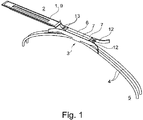
- Figs. 1 and 3 show a first charging connector 1 of an electrical vehicle, implied by reference numeral 2, and a charger component 3 to which the first charging connector 1 is unconnected according to a preferred embodiment in a first and a third schematic view, respectively.
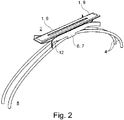
- Figs. 2 and 4 show the same embodiment with the first charging connector 1 electrically connected to the charger component 3 in a second and fourth schematic view, respectively.
- the charger component 3 comprise two springs 4 which are provided as semi-circular bow springs and arranged distant by 5 to 10 cm and parallel to each other. Respective ends of the semi-circular bow springs 4 are attached adjacent to each other to ground 5.
- the charger component 3 further comprises a second charging connector 6, which is arranged and attached to the springs 4 in the middle between the respective ends thereby holding the second charging connector 6 distant to ground 5.
- the second charging connector 6 comprises two parts 7, which are each attached to one of the springs 4. While the spring forces on one hand allow vertical, horizontal and rotational movement of the parts 7 relative to ground 5, on the other hand the spring forces press the parts 7 gap-free together.
- the parts 7 comprise an elongated shape which extends along its longitudinal axis parallel to ground 5. In transverse direction the parts 7 each comprise a U-shape that is rotated by 90 degrees such that the hollow parts of the U-shapes face each other along the elongated extension.
- Each part 7 comprises a charging contact 8, which is arranged touch-safe within the hollow part of the respective U-shape and extends in longitudinal direction parallel to ground 5.
- the U-shape is dimensioned such that human fingers cannot touch the charging contacts 8, for example by comprising an opening height of the horizontally extending U-shape of 1 cm or 0,8 cm. Such way the charging contacts 8 are arranged opposite to and face each other.
- the first charging connector 1 comprises a flat base plate 9, which is mounted underneath a vehicle body of the electrical vehicle 2. Attached to the base plate 9 is, in direction of the longitudinal direction of the electrical vehicle 2, an inverted T-shape 10.
- the inverted T-shape 10 comprises an elongated extension in longitudinal direction of the electrical vehicle 2. While the horizontal part of the inverted T-shape 10 comprises rounded edges, vehicle contacts 11 are attached to the opposite vertical parts of the inverted T-shape 10. Such way the vehicle contacts 11 extend away from each other in opposite and traverse direction of the electrical vehicle 2, and also extend in longitudinal direction of the electrical vehicle 2, as can be seen from Fig. 3 .
- the charger component 3 comprises in top-view at each of its longitudinal ends to respective funnel shaped ends 12, whereby each one funnel shaped end 12 is attached to one end of a respective part 7 of the charger component 3.
- the funnel shaped ends 12 facilitate insertion of the first charging connector 1 between the parts 7.
- a respective wheel 13 is attached two each one end of the parts 7 such that the base plate 9 can glide over the parts 7.
- the electrical vehicle 2 For establishing a conductive connection between the second charging connector 2 of the charger component 3 arranged on ground 5 the electrical vehicle 2 needs to drive if it's first charging connector 1 attached underneath the electrical vehicle 2 into the funnel shaped ends 12. Such way the parts 7 are pushed apart from each other against the spring forces so that the inverted T-shape 10 glides between the parts 7, facilitated by the wheels 13. Finally, the vehicle contacts 11 contact the respective charging contacts 8 such that the electrical vehicle 2 can be charged with electrical energy via the so established connection.
Landscapes
- Engineering & Computer Science (AREA)
- Power Engineering (AREA)
- Transportation (AREA)
- Mechanical Engineering (AREA)
- Charge And Discharge Circuits For Batteries Or The Like (AREA)
- Electric Propulsion And Braking For Vehicles (AREA)
Abstract
Description
- The invention relates to a charging arrangement for an electrical vehicle comprising the electrical vehicle and a charger component, whereby the electrical vehicle comprises a first charging connector arranged underneath the electrical vehicle for receiving electrical energy to charge the electrical vehicle. The invention further relates to a method for charging an electrical vehicle with electrical energy by a charger component, whereby the electrical vehicle comprises a first charging connector arranged underneath the electrical vehicle for receiving the electrical energy to charge the electrical vehicle.
- Electric vehicle, EV, direct current, DC, fast charging systems and methods often use a so-called Combined Charging System, CCS, protocol according to IEC 61851-23 and SAE J1772 standard for charging electrical vehicles both in the US and in the European Union, EU. As charge currents increase, liquid cooled charge cables for connecting an Electric Vehicle Supply Equipment, EVSE, via a charge connector with the electrical vehicle are becoming more commonly used. The liquid cooling allows conductors within the charge cable to become thinner, and thereby less stiff and easier to use, because excessive heat due to high charge currents and charge cable internal resistances is taken care of. On the other side liquid cooling increases weight of the charge cable and makes handling due to the additional weight difficult.
- Even though, as charge currents are still going up, cables are becoming thicker. In turn weight of the cables and in particular of liquid cooled conductive cables are increasing and are becoming too much for an ordinary person to handle. Besides that, connectors are venerable components that are easily damaged if dropped or handled incorrectly and cooled cables only offer limited extensions to those power levels. Therefore, robotic systems have been developed for overcoming these disadvantages. However, such robotic systems are expensive and potentially dangerous for humans being too close to such robotic arms.
- It is therefore an object of the invention to provide a charging arrangement and a respective method for charging an electrical vehicle in a simple and automated manner.
- The object of the invention is solved by the features of the independent claims. Preferred embodiments are described in the dependent claims.
- Thus, the object is solved by a charging arrangement for an electrical vehicle comprising the electrical vehicle and a charger component, whereby
- the electrical vehicle comprises a first charging connector arranged underneath the electrical vehicle for receiving electrical energy to charge the electrical vehicle, whereby the first charging connector comprises two vehicle contacts which extend away from each other in opposite and traverse direction of the electrical vehicle, and
- the charger component comprises two springs attached to ground and a second charging connector for providing electrical energy to the electrical vehicle, whereby the second charging connector comprises two parts each attached to one of the springs, the spring forces allowing a vertical, horizontal and rotational movement of the parts relative to ground and pressing the parts together and each part comprises a charging contact arranged opposite to and facing each other for establishing, by inserting the first charging connector into the second charging connector against the spring forces, electrical connection between the first charging connector and the second charging connector.
- The object of the invention is further solved by a method for charging an electrical vehicle with electrical energy by a charger component, whereby
- the electrical vehicle comprises a first charging connector arranged underneath the electrical vehicle for receiving the electrical energy to charge the electrical vehicle, whereby the first charging connector comprises two vehicle contacts which extend away from each other in opposite and traverse direction of the electrical vehicle, and
- the charger component comprises two springs attached to ground and a second charging connector for providing electrical energy to the electrical vehicle, whereby the second charging connector comprises two parts each attached to one of the springs, the spring forces allowing a vertical, horizontal and rotational movement of the parts relative to ground and pressing the parts together, each part comprises a charging contact arranged opposite to and facing each,
- the method comprising the step of
- Inserting the first charging connector into the second charging connector against the spring forces for establishing electrical connection between the first charging connector and the second charging connector.
- It is therefore a key point of the invention that an electrical connection for charging the electrical vehicle can be simply accomplished by driving the electrical vehicle above the charger component such that the first charging connector becomes inserted into the second charging connector, or alternatively by a simple translation of the second charging connector to a stationary electrical vehicle. Thus, an actuation for connecting the electrical vehicle and the charger component is actually done by moving respectively driving the electrical vehicle. Therefore, the proposed solution can be implemented in a very cheap manner without the need for an expensive and support intensive actuator for connecting the charger component to the electrical vehicle. In the case of moving the second charging connector the proposed solution does not need complex guidance systems but only a linear actuator. As the springs allow a vertical, horizontal and rotational movement of the second charging connector within a certain range, a great degree of flexibility exists for positioning the electrical vehicle above the charger component. In other words, even if the electrical vehicle with its first charging connector is not fully correctly inserted into the second charging connector, the springs allow movement of the second charging connector in vertical, horizontal and rotational direction thereby facilitating the connection of the charging connectors. The springs may be made of metal, or any flexible material, such as rubber. Inserting shall be preferably understood as movement in horizontal direction. Preferably the first charging connector corresponds to the second charging connector in such a way that the first charging connector can be slided onto the second charging connector by an horizontal movement and/or that the second charging connector can be connected to the firs charging connector by a vertical movement away from ground. The charging connectors are preferably configured for having a form-locking connection once connected.
- The electrical vehicle can be provided as an electrical car, an ebus, a truck or any other electrical vehicle means. Providing the first charging connector underneath the electrical vehicle reduces cabling, weight of the electrical vehicle and respective costs, as a vehicle battery is usually provided on the bottom of the electrical vehicle due to weight distribution and therefore close to said first charging connector. The first charging connector and/or the second charging connector respectively the vehicle contacts and/or the charging contacts are preferably configured respectively dimensioned for charging currents of 63 A, 80 A, 125 A or more. Providing the first charging interface underneath the electrical vehicle shall preferably be understood that use other charging interfaces for example on a side of the electrical vehicle is not excluded. The electrical vehicle may comprise a vehicle body made of plastics, aluminium and/or metal to which the first charging connector can be attached, for example by means of screws.
- The charger component may be part of an Electric Vehicle Supply Equipment, EVSE, for charging the electrical vehicle according to a called Combined Charging System, CCS, protocol according to IEC 61851-23 and SAE J1772. The Combined Charging System, CCS, protocol is a fast charging method for charging electric vehicles delivering high-voltage direct current via a charging connector derived from SAE J1772 standard (IEC Type 1) or IEC
Type 2 connector. Automobile manufactures that support CCS include Jaguar, Volkswagen, General Motors, BMW, Daimler, Ford, FCA, Tesla and Hyundai. The CSS standard is controlled by the so called CharIN consortium. Besides other protocols such as, for example, CHAdeMO, as abbreviation of CHArge de Move, or GB/T, in particular according to 20234.3-2011 standard, can be used in connection with the proposed arrangement and/or method. Such way, the EVSE may comprise a transformer and/or a converter for connecting to respectively receiving electrical energy from an AC grid, which is transformed and/or converted to DC for being supplied to the first charging connector via a charging cable attached thereto. - The springs are preferably firmly attached to ground. The two parts preferably comprise an elongated and/or bar-like shape corresponding to the charging contacts. Preferably, the charging contacts are arranged completely within the parts and/or that the parts are configured such that the charging contacts are touch safe arranged inside the parts while being connectable by the vehicle contacts when moving the parts apart from each other against the spring forces. Thus, due to the spring force, the charging contacts are, if the first charging connector is not inserted within the second charging connector, preferably completely encased or at least partially encased by the two parts. The parts preferably comprise a corresponding facing flat surface at which the charging contacts are provided, thereby facing each other.
- In a preferred implementation of the charging arrangement or of the method inserting the first charging connector into the second charging connector for establishing electrical connection between the first charging connector and the second charging connector comprises inserting the vehicle contacts between the parts against the spring forces for establishing electrical contact between a respective vehicle contact and a charging contact. By said inserting, in particular by driving the electrical vehicle "into" the charger component, or alternatively to a platform which can translate in the mating direction but is otherwise restrained or by moving the second charging connector into a vehicle outlet formed by the first charging connector, conductive connection is established between the electrical vehicle and the charger component in a simple manner without a need for an automated actuation system.
- In another preferred implementation of the charging arrangement or of the method the vehicle contacts and/or the first charging connector comprises an elongated shape in longitudinal direction of the electrical vehicle. Preferably, the electrical vehicle comprises a backseat and/or a rear axle and the first charging connector is arranged underneath the backseat and/or adjacent to the rear axle of the electrical vehicle. The vehicle battery is preferably arranged on the bottom of the vehicle for receiving an optimal weight distribution and in particular underneath the backseat. If the first charging connector and the vehicle battery are provided in equal manner underneath the backseat and/or adjacent to the rear axle thick cables/busbars required for connecting the first charging connector to the vehicle battery can be very short in length and thus light in weight.
- In a further preferred implementation of the charging arrangement or of the method the charging contacts and/or the second charging connector comprise an elongated shape, if the vehicle contacts are inserted between the parts, in longitudinal direction of the electrical vehicle. The vehicle contacts and/or the charging contacts preferably comprise copper, comprise an elongated extension, for example in form of a bar, and/or are provided with a flat, corresponding surface for establishing electrical contact.
- In a further preferred implementation of the charging arrangement or of the method the first charging connector comprises, in direction of the longitudinal extension of the electrical vehicle, an inverted T-shape with the vehicle contacts attached to the opposite vertical parts of the T-shape and/or with rounded edges at the horizontal part. In another preferred implementation of the charging arrangement or of the method the first charging connector comprises a base plate mountable to a vehicle chassis of the electrical vehicle. The inverted T-shape is preferably attached with its horizontal upper end to the base plate. The inverted T-shape and/or the base plate are preferably made of a non-conducting material, such as a hard plastic. The inverted T-shape preferably comprises, in longitudinal extension of the electrical vehicle, an elongated shape such that elongated vehicle contacts can be attached to the vertical parts of the T-shape.
- In a further preferred implementation of the charging arrangement or of the method the at least one of the two parts comprises a wheel for rolling the first charging connector and/or the base plate according to the previous claim. Preferably, each one wheel is attached to each one end of the parts such that four wheels are provided. The wheel facilitates insertion of the first charging connector into respectively between the parts of the second charging connector as the first charging connector may glide and/or slide with its base plate onto the wheel, thereby avoiding any disturbing friction between the charging connectors.
- In another preferred implementation of the charging arrangement or of the method the two parts each comprise, in direction of the longitudinal direction of the electrical vehicle, a U-shape that is rotated by 90 degrees with the hollow parts of the U-shapes facing each other, in particular if the charging connectors are not connected respectively inserted, and the charging contacts are arranged inside the hollow parts. The U-shape parts are pressed together by the springs. Such way the charging contacts can be fully encased by the U-shape parts and thereby touch safe against unintended contact, dirt, environmental influences etc.
- In a further preferred implementation of the charging arrangement or of the method the springs are provided as semi-circular arch or as bow spring with respective ends attached to ground and the second charging connector attached distant to ground between the ends to the semi-circular arch or bow spring. The springs are preferably arranged and installed on ground such that the semi-circular arches are parallel and distant to each other. The distance is preferably 5 to 10 cm. The second charging connector is preferably arranged around 20 to 30 cm above ground such that the electrical vehicle driving over the charger component contacts with its first charging connector the second charger connector for inserting the vehicle contacts between the charging contacts.
- In another preferred implementation of the charging arrangement or of the method the second connector comprises a funnel shaped end, if the vehicle contacts are inserted between the parts, in longitudinal direction of the electrical vehicle. Such funnel shaped end advantageously simplifies insertion of the first charging connector into the second charging connector respectively of the vehicle contacts between the parts respectively the charging contacts. Preferably, a funnel shaped end is attached to each end and each part such that four funnel shaped ends are provided. The funnel shaped end preferably comprises, in top view, an arc of one-fourth or one-eight of a circle, in extension of the longitudinal extension of the respective part,
- In a further preferred implementation of the charging arrangement or of the method, if the vehicle contacts are not inserted between the parts, the spring forces press the parts gap-free together. Therefore, the springs are preferably configured to apply such spring forces for pressing the parts gap-free together. Pushed gap-free together by the springs comprises the advantage that the charging contacts are effectively protected against unintended contact, dirt, environmental influences etc.
- In another preferred implementation of the charging arrangement or of the method inserting the first charging connector into the second charging connector comprises pushing the parts apart, sliding the vehicle contacts between the parts, and/or sliding the first charging connector into the second charging connector and/or the vehicle contacts between the parts respectively the charging contacts by a horizontal movement. Preferably the method comprises said pushing step. By pushing the parts apart, by inserting the first charging connector into the second charging connector by driving the electrical vehicle "into" the charger component, the parts are preferably moved in traverse direction apart from each other.
- These and other aspects of the invention will be apparent from and elucidated with reference to the embodiments described hereinafter.
- In the drawings:
-
Fig. 1 shows a first charging connector of an electrical vehicle unconnected to a charger component having a second charging connector and two springs attached to ground according to a preferred embodiment in a first schematic view, -
Fig. 2 shows the first charging connector of the electrical vehicle connected to the charger component having the second charging connector and the springs attached to ground according to the preferred embodiment in a second schematic view, -
Fig. 3 shows the first charging connector of the electrical vehicle unconnected to the charger component having the second charging connector and the springs attached to ground according to the preferred embodiment in a third schematic view, and -
Fig. 4 shows the first charging connector of the electrical vehicle connected to the charger component having the second charging connector and the springs attached to ground according to the preferred embodiment in a second schematic view. -
Figs. 1 and3 show a first charging connector 1 of an electrical vehicle, implied byreference numeral 2, and a charger component 3 to which the first charging connector 1 is unconnected according to a preferred embodiment in a first and a third schematic view, respectively.Figs. 2 and4 show the same embodiment with the first charging connector 1 electrically connected to the charger component 3 in a second and fourth schematic view, respectively. - The charger component 3 comprise two
springs 4 which are provided as semi-circular bow springs and arranged distant by 5 to 10 cm and parallel to each other. Respective ends of the semi-circular bow springs 4 are attached adjacent to each other toground 5. The charger component 3 further comprises a second charging connector 6, which is arranged and attached to thesprings 4 in the middle between the respective ends thereby holding the second charging connector 6 distant toground 5. - The second charging connector 6 comprises two parts 7, which are each attached to one of the
springs 4. While the spring forces on one hand allow vertical, horizontal and rotational movement of the parts 7 relative toground 5, on the other hand the spring forces press the parts 7 gap-free together. The parts 7 comprise an elongated shape which extends along its longitudinal axis parallel toground 5. In transverse direction the parts 7 each comprise a U-shape that is rotated by 90 degrees such that the hollow parts of the U-shapes face each other along the elongated extension. Each part 7 comprises a chargingcontact 8, which is arranged touch-safe within the hollow part of the respective U-shape and extends in longitudinal direction parallel toground 5. The U-shape is dimensioned such that human fingers cannot touch the chargingcontacts 8, for example by comprising an opening height of the horizontally extending U-shape of 1 cm or 0,8 cm. Such way the chargingcontacts 8 are arranged opposite to and face each other. - The first charging connector 1 comprises a flat base plate 9, which is mounted underneath a vehicle body of the
electrical vehicle 2. Attached to the base plate 9 is, in direction of the longitudinal direction of theelectrical vehicle 2, an inverted T-shape 10. The inverted T-shape 10 comprises an elongated extension in longitudinal direction of theelectrical vehicle 2. While the horizontal part of the inverted T-shape 10 comprises rounded edges,vehicle contacts 11 are attached to the opposite vertical parts of the inverted T-shape 10. Such way thevehicle contacts 11 extend away from each other in opposite and traverse direction of theelectrical vehicle 2, and also extend in longitudinal direction of theelectrical vehicle 2, as can be seen fromFig. 3 . - The charger component 3 comprises in top-view at each of its longitudinal ends to respective funnel shaped ends 12, whereby each one funnel shaped
end 12 is attached to one end of a respective part 7 of the charger component 3. Such way the funnel shaped ends 12 facilitate insertion of the first charging connector 1 between the parts 7. For further facilitating such insertion arespective wheel 13 is attached two each one end of the parts 7 such that the base plate 9 can glide over the parts 7. - For establishing a conductive connection between the
second charging connector 2 of the charger component 3 arranged onground 5 theelectrical vehicle 2 needs to drive if it's first charging connector 1 attached underneath theelectrical vehicle 2 into the funnel shaped ends 12. Such way the parts 7 are pushed apart from each other against the spring forces so that the inverted T-shape 10 glides between the parts 7, facilitated by thewheels 13. Finally, thevehicle contacts 11 contact therespective charging contacts 8 such that theelectrical vehicle 2 can be charged with electrical energy via the so established connection. - While the invention has been illustrated and described in detail in the drawings and foregoing description, such illustration and description are to be considered illustrative or exemplary and not restrictive; the invention is not limited to the disclosed embodiments. Other variations to be disclosed embodiments can be understood and effected by those skilled in the art in practicing the claimed invention, from a study of the drawings, the disclosure, and the appended claims. In the claims, the word "comprising" does not exclude other elements or steps, and the indefinite article "a" or "an" does not exclude a plurality. The mere fact that certain measures are recited in mutually different dependent claims does not indicate that a combination of these measures cannot be used to advantage. Any reference signs in the claims should not be construed as limiting scope.
-
- 1
- first charging connector
- 2
- electrical vehicle
- 3
- charger component
- 4
- spring
- 5
- ground
- 6
- second charging connector
- 7
- part
- 8
- charging contact
- 9
- base plate
- 10
- inverted T-shape
- 11
- vehicle contact
- 12
- funnel shaped end
- 13
- wheel
Claims (13)
- Charging arrangement for an electrical vehicle (2), comprising the electrical vehicle (2) and a charger component (3), whereby
the electrical vehicle (2) comprises a first charging connector (1) arranged underneath the electrical vehicle (2) for receiving electrical energy to charge the electrical vehicle (2), whereby the first charging connector (1) comprises two vehicle contacts (11) which extend away from each other in opposite and traverse direction of the electrical vehicle (2), and
the charger component (3) comprises two springs (4) attached to ground (5) and a second charging connector (6) for providing electrical energy to the electrical vehicle (2), whereby the second charging connector (6) comprises two parts (7) each attached to one of the springs (4), the spring forces allowing a vertical, horizontal and rotational movement of the parts (7) relative to ground (5) and pressing the parts (7) together and each part (7) comprises a charging contact (8) arranged opposite to and facing each other for establishing, by inserting the first charging connector (1) into the second charging connector (6) against the springs (4) forces, electrical connection between the first charging connector (1) and the second charging connector (6). - Method for charging an electrical vehicle (2) with electrical energy by a charger component (3), whereby
the electrical vehicle (2) comprises a first charging connector (1) arranged underneath the electrical vehicle (2) for receiving the electrical energy to charge the electrical vehicle (2), whereby the first charging connector (1) comprises two vehicle contacts (11) which extend away from each other in opposite and traverse direction of the electrical vehicle (2), and
the charger component (3) comprises two springs (4) attached to ground (5) and a second charging connector (6) for providing electrical energy to the electrical vehicle (2), whereby the second charging connector (6) comprises two parts (7) each attached to one of the springs (4), the spring forces allowing a vertical, horizontal and rotational movement of the parts (7) relative to ground (5) and pressing the parts (7) together, each part (7) comprises a charging contact (8) arranged opposite to and facing each,
the method comprising the step of
Inserting the first charging connector (1) into the second charging connector (6) against the springs (4) forces for establishing electrical connection between the first charging connector (1) and the second charging connector (6). - Charging arrangement or method according to the previous claims, whereby inserting the first charging connector (1) into the second charging connector (6) for establishing electrical connection between the first charging connector (1) and the second charging connector (6) comprises inserting the vehicle contacts (11) between the parts (7) against the spring forces for establishing electrical contact between a respective vehicle contact (11) and a charging contact (8).
- Charging arrangement or method according to any of the previous claims, whereby the vehicle contacts (11) and/or the first charging connector (1) comprise an elongated shape in longitudinal direction of the electrical vehicle (2).
- Charging arrangement or method according to the previous claims, whereby the charging contacts (8) and/or the second charging connector (6) comprise an elongated shape, if the vehicle contacts (11) are inserted between the parts (7), in longitudinal direction of the electrical vehicle (2).
- Charging arrangement or method according to any of the previous claims, whereby the first charging connector (1) comprises, in direction of the longitudinal direction of the electrical vehicle (2), an inverted T-shape (10) with the vehicle contacts (11) attached to the opposite vertical parts (7) of the T-shape (10) and/or with rounded edges at the horizontal part.
- Charging arrangement or method according to any of the previous claims, whereby the first charging connector (1) comprises a base plate (9) mountable to a vehicle chassis of the electrical vehicle (2).
- Charging arrangement or method according to any of the previous claims, whereby the at least one of the two parts (7) comprises a wheel (13) for rolling the first charging connector (1) and/or the base plate (9) according to the previous claim.
- Charging arrangement or method according to any of the previous claims, whereby the two parts (7) each comprise, in direction of the longitudinal direction of the electrical vehicle (2), a U-shape that is rotated by 90 degrees with the hollow parts of the U-shapes facing each other and the charging contacts (8) are arranged inside the hollow parts.
- Charging arrangement or method according to any of the previous claims, whereby the springs (4) are provided as semi-circular arch or as bow spring with respective ends attached to ground (5) and the second charging connector (6) is attached distant to ground (5) between the ends to the semi-circular arch or bow spring.
- Charging arrangement or method according to any of the previous claims, whereby the second charging connector (6) comprises a funnel shaped end (12), if the vehicle contacts (11) are inserted between the parts (7), extending in longitudinal direction of the electrical vehicle (2).
- Charging arrangement or method according to any of the previous claims, whereby, if the vehicle contacts (11) are not inserted between the parts (7), the spring forces press the parts (7) gap-free together.
- Charging arrangement or method according to any of the previous claims, whereby inserting the first charging connector (1) into the second charging connector (6) comprises pushing the parts (7) apart,sliding the vehicle contacts (11) between the parts (7) and/or sliding the first charging connector (1) into the second charging connector (6) and/or the vehicle contacts (11) between the parts (7) respectively the charging contacts by a horizontal movement.
Priority Applications (2)
| Application Number | Priority Date | Filing Date | Title |
|---|---|---|---|
| EP18195688.9A EP3626512B1 (en) | 2018-09-20 | 2018-09-20 | Charging arrangement for an electrical vehicle and respective method |
| PCT/EP2019/075398 WO2020058501A1 (en) | 2018-09-20 | 2019-09-20 | Charging arrangement for an electrical vehicle and respective method |
Applications Claiming Priority (1)
| Application Number | Priority Date | Filing Date | Title |
|---|---|---|---|
| EP18195688.9A EP3626512B1 (en) | 2018-09-20 | 2018-09-20 | Charging arrangement for an electrical vehicle and respective method |
Publications (2)
| Publication Number | Publication Date |
|---|---|
| EP3626512A1 true EP3626512A1 (en) | 2020-03-25 |
| EP3626512B1 EP3626512B1 (en) | 2022-02-23 |
Family
ID=63667764
Family Applications (1)
| Application Number | Title | Priority Date | Filing Date |
|---|---|---|---|
| EP18195688.9A Active EP3626512B1 (en) | 2018-09-20 | 2018-09-20 | Charging arrangement for an electrical vehicle and respective method |
Country Status (2)
| Country | Link |
|---|---|
| EP (1) | EP3626512B1 (en) |
| WO (1) | WO2020058501A1 (en) |
Citations (3)
| Publication number | Priority date | Publication date | Assignee | Title |
|---|---|---|---|---|
| GB2185866A (en) * | 1985-12-20 | 1987-07-29 | City Wheels Ltd | Charging battery-powered vehicles |
| WO2011079215A2 (en) * | 2009-12-23 | 2011-06-30 | Proterra Inc. | Charging stations for electric vehicles |
| WO2014078456A1 (en) * | 2012-11-13 | 2014-05-22 | Proterra Inc. | Systems and methods for enabling fast charging of an electric vehicle at a charging station |
-
2018
- 2018-09-20 EP EP18195688.9A patent/EP3626512B1/en active Active
-
2019
- 2019-09-20 WO PCT/EP2019/075398 patent/WO2020058501A1/en not_active Ceased
Patent Citations (3)
| Publication number | Priority date | Publication date | Assignee | Title |
|---|---|---|---|---|
| GB2185866A (en) * | 1985-12-20 | 1987-07-29 | City Wheels Ltd | Charging battery-powered vehicles |
| WO2011079215A2 (en) * | 2009-12-23 | 2011-06-30 | Proterra Inc. | Charging stations for electric vehicles |
| WO2014078456A1 (en) * | 2012-11-13 | 2014-05-22 | Proterra Inc. | Systems and methods for enabling fast charging of an electric vehicle at a charging station |
Also Published As
| Publication number | Publication date |
|---|---|
| WO2020058501A1 (en) | 2020-03-26 |
| EP3626512B1 (en) | 2022-02-23 |
Similar Documents
| Publication | Publication Date | Title |
|---|---|---|
| US10828770B2 (en) | Power delivery system for electric vehicle charging station | |
| KR102902131B1 (en) | High-power shielded busbars for electric vehicle charging and power distribution | |
| JP6797282B2 (en) | Power connector system | |
| US8419450B2 (en) | Conductor line, collector and conductor system | |
| US20200361326A1 (en) | Electric charging connection for heavy vehicles | |
| US10173537B2 (en) | Charging device for an electric vehicle | |
| EP3626513B1 (en) | Charging arrangement for an electrical vehicle and respective method | |
| CN107298023B (en) | Vehicle charging connector | |
| CN103842203B (en) | Charging device for a vehicle with seven electrical contacts | |
| EP0924835A3 (en) | Charging station and method | |
| US20220016992A1 (en) | Charging arrangement and method for charging an electrical vehicle | |
| EP3626512B1 (en) | Charging arrangement for an electrical vehicle and respective method | |
| CN115003546A (en) | Electric vehicle charging apparatus and corresponding method | |
| WO2009038976A2 (en) | Widely deployable charging system for vehicles | |
| US20220001760A1 (en) | Charging arrangement for supplying electrical energy to an electrical vehicle | |
| US20200144759A1 (en) | Self-Cleaning Electrical Connector Having Pins with Insulated Ends | |
| EP3626511B1 (en) | Automatic connection system | |
| EP3626510A1 (en) | Electrical vehicle and method for charging an electrical vehicle | |
| US20260014882A1 (en) | Power Line Assembly and Motor Vehicle | |
| CN211869170U (en) | Electric bow device for electric automobile, charging pile and electric automobile | |
| US20250368064A1 (en) | Angled charging adapter for uni-directional and bidirectional ev charging cables | |
| CA3171756C (en) | High power shielded busbar for electric vehicle charging and power distribution | |
| WO2024210891A1 (en) | Frame electric vehicle (ev) connector with overmolding | |
| JP2024169410A (en) | In-line power connector for power connector systems | |
| CN112002464A (en) | Insulated cable and connector thereof |
Legal Events
| Date | Code | Title | Description |
|---|---|---|---|
| PUAI | Public reference made under article 153(3) epc to a published international application that has entered the european phase |
Free format text: ORIGINAL CODE: 0009012 |
|
| STAA | Information on the status of an ep patent application or granted ep patent |
Free format text: STATUS: THE APPLICATION HAS BEEN PUBLISHED |
|
| AK | Designated contracting states |
Kind code of ref document: A1 Designated state(s): AL AT BE BG CH CY CZ DE DK EE ES FI FR GB GR HR HU IE IS IT LI LT LU LV MC MK MT NL NO PL PT RO RS SE SI SK SM TR |
|
| AX | Request for extension of the european patent |
Extension state: BA ME |
|
| STAA | Information on the status of an ep patent application or granted ep patent |
Free format text: STATUS: REQUEST FOR EXAMINATION WAS MADE |
|
| 17P | Request for examination filed |
Effective date: 20200924 |
|
| RBV | Designated contracting states (corrected) |
Designated state(s): AL AT BE BG CH CY CZ DE DK EE ES FI FR GB GR HR HU IE IS IT LI LT LU LV MC MK MT NL NO PL PT RO RS SE SI SK SM TR |
|
| GRAP | Despatch of communication of intention to grant a patent |
Free format text: ORIGINAL CODE: EPIDOSNIGR1 |
|
| STAA | Information on the status of an ep patent application or granted ep patent |
Free format text: STATUS: GRANT OF PATENT IS INTENDED |
|
| INTG | Intention to grant announced |
Effective date: 20210922 |
|
| GRAS | Grant fee paid |
Free format text: ORIGINAL CODE: EPIDOSNIGR3 |
|
| GRAA | (expected) grant |
Free format text: ORIGINAL CODE: 0009210 |
|
| STAA | Information on the status of an ep patent application or granted ep patent |
Free format text: STATUS: THE PATENT HAS BEEN GRANTED |
|
| AK | Designated contracting states |
Kind code of ref document: B1 Designated state(s): AL AT BE BG CH CY CZ DE DK EE ES FI FR GB GR HR HU IE IS IT LI LT LU LV MC MK MT NL NO PL PT RO RS SE SI SK SM TR |
|
| RAP3 | Party data changed (applicant data changed or rights of an application transferred) |
Owner name: ABB SCHWEIZ AG |
|
| REG | Reference to a national code |
Ref country code: GB Ref legal event code: FG4D |
|
| REG | Reference to a national code |
Ref country code: CH Ref legal event code: EP |
|
| REG | Reference to a national code |
Ref country code: AT Ref legal event code: REF Ref document number: 1470208 Country of ref document: AT Kind code of ref document: T Effective date: 20220315 |
|
| REG | Reference to a national code |
Ref country code: IE Ref legal event code: FG4D |
|
| REG | Reference to a national code |
Ref country code: DE Ref legal event code: R096 Ref document number: 602018031141 Country of ref document: DE |
|
| REG | Reference to a national code |
Ref country code: LT Ref legal event code: MG9D |
|
| REG | Reference to a national code |
Ref country code: NL Ref legal event code: MP Effective date: 20220223 |
|
| REG | Reference to a national code |
Ref country code: AT Ref legal event code: MK05 Ref document number: 1470208 Country of ref document: AT Kind code of ref document: T Effective date: 20220223 |
|
| PG25 | Lapsed in a contracting state [announced via postgrant information from national office to epo] |
Ref country code: SE Free format text: LAPSE BECAUSE OF FAILURE TO SUBMIT A TRANSLATION OF THE DESCRIPTION OR TO PAY THE FEE WITHIN THE PRESCRIBED TIME-LIMIT Effective date: 20220223 Ref country code: RS Free format text: LAPSE BECAUSE OF FAILURE TO SUBMIT A TRANSLATION OF THE DESCRIPTION OR TO PAY THE FEE WITHIN THE PRESCRIBED TIME-LIMIT Effective date: 20220223 Ref country code: PT Free format text: LAPSE BECAUSE OF FAILURE TO SUBMIT A TRANSLATION OF THE DESCRIPTION OR TO PAY THE FEE WITHIN THE PRESCRIBED TIME-LIMIT Effective date: 20220623 Ref country code: NO Free format text: LAPSE BECAUSE OF FAILURE TO SUBMIT A TRANSLATION OF THE DESCRIPTION OR TO PAY THE FEE WITHIN THE PRESCRIBED TIME-LIMIT Effective date: 20220523 Ref country code: NL Free format text: LAPSE BECAUSE OF FAILURE TO SUBMIT A TRANSLATION OF THE DESCRIPTION OR TO PAY THE FEE WITHIN THE PRESCRIBED TIME-LIMIT Effective date: 20220223 Ref country code: LT Free format text: LAPSE BECAUSE OF FAILURE TO SUBMIT A TRANSLATION OF THE DESCRIPTION OR TO PAY THE FEE WITHIN THE PRESCRIBED TIME-LIMIT Effective date: 20220223 Ref country code: HR Free format text: LAPSE BECAUSE OF FAILURE TO SUBMIT A TRANSLATION OF THE DESCRIPTION OR TO PAY THE FEE WITHIN THE PRESCRIBED TIME-LIMIT Effective date: 20220223 Ref country code: ES Free format text: LAPSE BECAUSE OF FAILURE TO SUBMIT A TRANSLATION OF THE DESCRIPTION OR TO PAY THE FEE WITHIN THE PRESCRIBED TIME-LIMIT Effective date: 20220223 Ref country code: BG Free format text: LAPSE BECAUSE OF FAILURE TO SUBMIT A TRANSLATION OF THE DESCRIPTION OR TO PAY THE FEE WITHIN THE PRESCRIBED TIME-LIMIT Effective date: 20220523 |
|
| PG25 | Lapsed in a contracting state [announced via postgrant information from national office to epo] |
Ref country code: PL Free format text: LAPSE BECAUSE OF FAILURE TO SUBMIT A TRANSLATION OF THE DESCRIPTION OR TO PAY THE FEE WITHIN THE PRESCRIBED TIME-LIMIT Effective date: 20220223 Ref country code: LV Free format text: LAPSE BECAUSE OF FAILURE TO SUBMIT A TRANSLATION OF THE DESCRIPTION OR TO PAY THE FEE WITHIN THE PRESCRIBED TIME-LIMIT Effective date: 20220223 Ref country code: GR Free format text: LAPSE BECAUSE OF FAILURE TO SUBMIT A TRANSLATION OF THE DESCRIPTION OR TO PAY THE FEE WITHIN THE PRESCRIBED TIME-LIMIT Effective date: 20220524 Ref country code: FI Free format text: LAPSE BECAUSE OF FAILURE TO SUBMIT A TRANSLATION OF THE DESCRIPTION OR TO PAY THE FEE WITHIN THE PRESCRIBED TIME-LIMIT Effective date: 20220223 Ref country code: AT Free format text: LAPSE BECAUSE OF FAILURE TO SUBMIT A TRANSLATION OF THE DESCRIPTION OR TO PAY THE FEE WITHIN THE PRESCRIBED TIME-LIMIT Effective date: 20220223 |
|
| PG25 | Lapsed in a contracting state [announced via postgrant information from national office to epo] |
Ref country code: IS Free format text: LAPSE BECAUSE OF FAILURE TO SUBMIT A TRANSLATION OF THE DESCRIPTION OR TO PAY THE FEE WITHIN THE PRESCRIBED TIME-LIMIT Effective date: 20220623 |
|
| PG25 | Lapsed in a contracting state [announced via postgrant information from national office to epo] |
Ref country code: SM Free format text: LAPSE BECAUSE OF FAILURE TO SUBMIT A TRANSLATION OF THE DESCRIPTION OR TO PAY THE FEE WITHIN THE PRESCRIBED TIME-LIMIT Effective date: 20220223 Ref country code: SK Free format text: LAPSE BECAUSE OF FAILURE TO SUBMIT A TRANSLATION OF THE DESCRIPTION OR TO PAY THE FEE WITHIN THE PRESCRIBED TIME-LIMIT Effective date: 20220223 Ref country code: RO Free format text: LAPSE BECAUSE OF FAILURE TO SUBMIT A TRANSLATION OF THE DESCRIPTION OR TO PAY THE FEE WITHIN THE PRESCRIBED TIME-LIMIT Effective date: 20220223 Ref country code: EE Free format text: LAPSE BECAUSE OF FAILURE TO SUBMIT A TRANSLATION OF THE DESCRIPTION OR TO PAY THE FEE WITHIN THE PRESCRIBED TIME-LIMIT Effective date: 20220223 Ref country code: DK Free format text: LAPSE BECAUSE OF FAILURE TO SUBMIT A TRANSLATION OF THE DESCRIPTION OR TO PAY THE FEE WITHIN THE PRESCRIBED TIME-LIMIT Effective date: 20220223 Ref country code: CZ Free format text: LAPSE BECAUSE OF FAILURE TO SUBMIT A TRANSLATION OF THE DESCRIPTION OR TO PAY THE FEE WITHIN THE PRESCRIBED TIME-LIMIT Effective date: 20220223 |
|
| RAP2 | Party data changed (patent owner data changed or rights of a patent transferred) |
Owner name: ABB-E-MOBILITY B.V. |
|
| REG | Reference to a national code |
Ref country code: DE Ref legal event code: R097 Ref document number: 602018031141 Country of ref document: DE |
|
| PG25 | Lapsed in a contracting state [announced via postgrant information from national office to epo] |
Ref country code: AL Free format text: LAPSE BECAUSE OF FAILURE TO SUBMIT A TRANSLATION OF THE DESCRIPTION OR TO PAY THE FEE WITHIN THE PRESCRIBED TIME-LIMIT Effective date: 20220223 |
|
| PLBE | No opposition filed within time limit |
Free format text: ORIGINAL CODE: 0009261 |
|
| STAA | Information on the status of an ep patent application or granted ep patent |
Free format text: STATUS: NO OPPOSITION FILED WITHIN TIME LIMIT |
|
| 26N | No opposition filed |
Effective date: 20221124 |
|
| PG25 | Lapsed in a contracting state [announced via postgrant information from national office to epo] |
Ref country code: SI Free format text: LAPSE BECAUSE OF FAILURE TO SUBMIT A TRANSLATION OF THE DESCRIPTION OR TO PAY THE FEE WITHIN THE PRESCRIBED TIME-LIMIT Effective date: 20220223 |
|
| PG25 | Lapsed in a contracting state [announced via postgrant information from national office to epo] |
Ref country code: MC Free format text: LAPSE BECAUSE OF FAILURE TO SUBMIT A TRANSLATION OF THE DESCRIPTION OR TO PAY THE FEE WITHIN THE PRESCRIBED TIME-LIMIT Effective date: 20220223 |
|
| REG | Reference to a national code |
Ref country code: CH Ref legal event code: PL |
|
| GBPC | Gb: european patent ceased through non-payment of renewal fee |
Effective date: 20220920 |
|
| REG | Reference to a national code |
Ref country code: BE Ref legal event code: MM Effective date: 20220930 |
|
| REG | Reference to a national code |
Ref country code: DE Ref legal event code: R081 Ref document number: 602018031141 Country of ref document: DE Owner name: ABB E-MOBILITY B.V., NL Free format text: FORMER OWNER: ABB SCHWEIZ AG, BADEN, CH Ref country code: DE Ref legal event code: R082 Ref document number: 602018031141 Country of ref document: DE Representative=s name: DENNEMEYER & ASSOCIATES S.A., DE Ref country code: DE Ref legal event code: R082 Ref document number: 602018031141 Country of ref document: DE Representative=s name: ZIMMERMANN & PARTNER PATENTANWAELTE MBB, DE Ref country code: DE Ref legal event code: R082 Ref document number: 602018031141 Country of ref document: DE Representative=s name: MAIWALD GMBH, DE |
|
| PG25 | Lapsed in a contracting state [announced via postgrant information from national office to epo] |
Ref country code: LU Free format text: LAPSE BECAUSE OF NON-PAYMENT OF DUE FEES Effective date: 20220920 |
|
| PG25 | Lapsed in a contracting state [announced via postgrant information from national office to epo] |
Ref country code: LI Free format text: LAPSE BECAUSE OF NON-PAYMENT OF DUE FEES Effective date: 20220930 Ref country code: IT Free format text: LAPSE BECAUSE OF FAILURE TO SUBMIT A TRANSLATION OF THE DESCRIPTION OR TO PAY THE FEE WITHIN THE PRESCRIBED TIME-LIMIT Effective date: 20220223 Ref country code: IE Free format text: LAPSE BECAUSE OF NON-PAYMENT OF DUE FEES Effective date: 20220920 Ref country code: FR Free format text: LAPSE BECAUSE OF NON-PAYMENT OF DUE FEES Effective date: 20220930 Ref country code: CH Free format text: LAPSE BECAUSE OF NON-PAYMENT OF DUE FEES Effective date: 20220930 |
|
| PG25 | Lapsed in a contracting state [announced via postgrant information from national office to epo] |
Ref country code: BE Free format text: LAPSE BECAUSE OF NON-PAYMENT OF DUE FEES Effective date: 20220930 |
|
| PG25 | Lapsed in a contracting state [announced via postgrant information from national office to epo] |
Ref country code: GB Free format text: LAPSE BECAUSE OF NON-PAYMENT OF DUE FEES Effective date: 20220920 |
|
| REG | Reference to a national code |
Ref country code: DE Ref legal event code: R082 Ref document number: 602018031141 Country of ref document: DE Representative=s name: ZIMMERMANN & PARTNER PATENTANWAELTE MBB, DE Ref country code: DE Ref legal event code: R082 Ref document number: 602018031141 Country of ref document: DE Representative=s name: MAIWALD GMBH, DE |
|
| PG25 | Lapsed in a contracting state [announced via postgrant information from national office to epo] |
Ref country code: HU Free format text: LAPSE BECAUSE OF FAILURE TO SUBMIT A TRANSLATION OF THE DESCRIPTION OR TO PAY THE FEE WITHIN THE PRESCRIBED TIME-LIMIT; INVALID AB INITIO Effective date: 20180920 |
|
| PG25 | Lapsed in a contracting state [announced via postgrant information from national office to epo] |
Ref country code: CY Free format text: LAPSE BECAUSE OF FAILURE TO SUBMIT A TRANSLATION OF THE DESCRIPTION OR TO PAY THE FEE WITHIN THE PRESCRIBED TIME-LIMIT Effective date: 20220223 |
|
| PG25 | Lapsed in a contracting state [announced via postgrant information from national office to epo] |
Ref country code: MK Free format text: LAPSE BECAUSE OF FAILURE TO SUBMIT A TRANSLATION OF THE DESCRIPTION OR TO PAY THE FEE WITHIN THE PRESCRIBED TIME-LIMIT Effective date: 20220223 |
|
| PG25 | Lapsed in a contracting state [announced via postgrant information from national office to epo] |
Ref country code: TR Free format text: LAPSE BECAUSE OF FAILURE TO SUBMIT A TRANSLATION OF THE DESCRIPTION OR TO PAY THE FEE WITHIN THE PRESCRIBED TIME-LIMIT Effective date: 20220223 |
|
| PG25 | Lapsed in a contracting state [announced via postgrant information from national office to epo] |
Ref country code: MT Free format text: LAPSE BECAUSE OF FAILURE TO SUBMIT A TRANSLATION OF THE DESCRIPTION OR TO PAY THE FEE WITHIN THE PRESCRIBED TIME-LIMIT Effective date: 20220223 |
|
| PGFP | Annual fee paid to national office [announced via postgrant information from national office to epo] |
Ref country code: DE Payment date: 20240918 Year of fee payment: 7 |
|
| REG | Reference to a national code |
Ref country code: DE Ref legal event code: R082 Ref document number: 602018031141 Country of ref document: DE Representative=s name: ZIMMERMANN & PARTNER PATENTANWAELTE MBB, DE |