EP3625229B1 - Solid forms of berberine ursodeoxycholate and compositions and methods thereof - Google Patents
Solid forms of berberine ursodeoxycholate and compositions and methods thereof Download PDFInfo
- Publication number
- EP3625229B1 EP3625229B1 EP18798004.0A EP18798004A EP3625229B1 EP 3625229 B1 EP3625229 B1 EP 3625229B1 EP 18798004 A EP18798004 A EP 18798004A EP 3625229 B1 EP3625229 B1 EP 3625229B1
- Authority
- EP
- European Patent Office
- Prior art keywords
- bbr
- udca
- xrpd
- certain embodiments
- berberine ursodeoxycholate
- Prior art date
- Legal status (The legal status is an assumption and is not a legal conclusion. Google has not performed a legal analysis and makes no representation as to the accuracy of the status listed.)
- Active
Links
Images









Classifications
-
- A—HUMAN NECESSITIES
- A61—MEDICAL OR VETERINARY SCIENCE; HYGIENE
- A61K—PREPARATIONS FOR MEDICAL, DENTAL OR TOILETRY PURPOSES
- A61K31/00—Medicinal preparations containing organic active ingredients
- A61K31/33—Heterocyclic compounds
- A61K31/395—Heterocyclic compounds having nitrogen as a ring hetero atom, e.g. guanethidine or rifamycins
- A61K31/435—Heterocyclic compounds having nitrogen as a ring hetero atom, e.g. guanethidine or rifamycins having six-membered rings with one nitrogen as the only ring hetero atom
- A61K31/47—Quinolines; Isoquinolines
- A61K31/4738—Quinolines; Isoquinolines ortho- or peri-condensed with heterocyclic ring systems
- A61K31/4745—Quinolines; Isoquinolines ortho- or peri-condensed with heterocyclic ring systems condensed with ring systems having nitrogen as a ring hetero atom, e.g. phenantrolines
-
- A—HUMAN NECESSITIES
- A61—MEDICAL OR VETERINARY SCIENCE; HYGIENE
- A61K—PREPARATIONS FOR MEDICAL, DENTAL OR TOILETRY PURPOSES
- A61K31/00—Medicinal preparations containing organic active ingredients
- A61K31/33—Heterocyclic compounds
- A61K31/395—Heterocyclic compounds having nitrogen as a ring hetero atom, e.g. guanethidine or rifamycins
- A61K31/435—Heterocyclic compounds having nitrogen as a ring hetero atom, e.g. guanethidine or rifamycins having six-membered rings with one nitrogen as the only ring hetero atom
- A61K31/4353—Heterocyclic compounds having nitrogen as a ring hetero atom, e.g. guanethidine or rifamycins having six-membered rings with one nitrogen as the only ring hetero atom ortho- or peri-condensed with heterocyclic ring systems
- A61K31/437—Heterocyclic compounds having nitrogen as a ring hetero atom, e.g. guanethidine or rifamycins having six-membered rings with one nitrogen as the only ring hetero atom ortho- or peri-condensed with heterocyclic ring systems the heterocyclic ring system containing a five-membered ring having nitrogen as a ring hetero atom, e.g. indolizine, beta-carboline
-
- A—HUMAN NECESSITIES
- A61—MEDICAL OR VETERINARY SCIENCE; HYGIENE
- A61K—PREPARATIONS FOR MEDICAL, DENTAL OR TOILETRY PURPOSES
- A61K31/00—Medicinal preparations containing organic active ingredients
- A61K31/56—Compounds containing cyclopenta[a]hydrophenanthrene ring systems; Derivatives thereof, e.g. steroids
- A61K31/575—Compounds containing cyclopenta[a]hydrophenanthrene ring systems; Derivatives thereof, e.g. steroids substituted in position 17 beta by a chain of three or more carbon atoms, e.g. cholane, cholestane, ergosterol, sitosterol
-
- A—HUMAN NECESSITIES
- A61—MEDICAL OR VETERINARY SCIENCE; HYGIENE
- A61K—PREPARATIONS FOR MEDICAL, DENTAL OR TOILETRY PURPOSES
- A61K45/00—Medicinal preparations containing active ingredients not provided for in groups A61K31/00 - A61K41/00
- A61K45/06—Mixtures of active ingredients without chemical characterisation, e.g. antiphlogistics and cardiaca
-
- A—HUMAN NECESSITIES
- A61—MEDICAL OR VETERINARY SCIENCE; HYGIENE
- A61P—SPECIFIC THERAPEUTIC ACTIVITY OF CHEMICAL COMPOUNDS OR MEDICINAL PREPARATIONS
- A61P1/00—Drugs for disorders of the alimentary tract or the digestive system
- A61P1/16—Drugs for disorders of the alimentary tract or the digestive system for liver or gallbladder disorders, e.g. hepatoprotective agents, cholagogues, litholytics
-
- A—HUMAN NECESSITIES
- A61—MEDICAL OR VETERINARY SCIENCE; HYGIENE
- A61P—SPECIFIC THERAPEUTIC ACTIVITY OF CHEMICAL COMPOUNDS OR MEDICINAL PREPARATIONS
- A61P25/00—Drugs for disorders of the nervous system
- A61P25/28—Drugs for disorders of the nervous system for treating neurodegenerative disorders of the central nervous system, e.g. nootropic agents, cognition enhancers, drugs for treating Alzheimer's disease or other forms of dementia
-
- A—HUMAN NECESSITIES
- A61—MEDICAL OR VETERINARY SCIENCE; HYGIENE
- A61P—SPECIFIC THERAPEUTIC ACTIVITY OF CHEMICAL COMPOUNDS OR MEDICINAL PREPARATIONS
- A61P3/00—Drugs for disorders of the metabolism
-
- A—HUMAN NECESSITIES
- A61—MEDICAL OR VETERINARY SCIENCE; HYGIENE
- A61P—SPECIFIC THERAPEUTIC ACTIVITY OF CHEMICAL COMPOUNDS OR MEDICINAL PREPARATIONS
- A61P3/00—Drugs for disorders of the metabolism
- A61P3/04—Anorexiants; Antiobesity agents
-
- A—HUMAN NECESSITIES
- A61—MEDICAL OR VETERINARY SCIENCE; HYGIENE
- A61P—SPECIFIC THERAPEUTIC ACTIVITY OF CHEMICAL COMPOUNDS OR MEDICINAL PREPARATIONS
- A61P3/00—Drugs for disorders of the metabolism
- A61P3/06—Antihyperlipidemics
-
- A—HUMAN NECESSITIES
- A61—MEDICAL OR VETERINARY SCIENCE; HYGIENE
- A61P—SPECIFIC THERAPEUTIC ACTIVITY OF CHEMICAL COMPOUNDS OR MEDICINAL PREPARATIONS
- A61P3/00—Drugs for disorders of the metabolism
- A61P3/08—Drugs for disorders of the metabolism for glucose homeostasis
- A61P3/10—Drugs for disorders of the metabolism for glucose homeostasis for hyperglycaemia, e.g. antidiabetics
-
- A—HUMAN NECESSITIES
- A61—MEDICAL OR VETERINARY SCIENCE; HYGIENE
- A61P—SPECIFIC THERAPEUTIC ACTIVITY OF CHEMICAL COMPOUNDS OR MEDICINAL PREPARATIONS
- A61P9/00—Drugs for disorders of the cardiovascular system
-
- C—CHEMISTRY; METALLURGY
- C07—ORGANIC CHEMISTRY
- C07D—HETEROCYCLIC COMPOUNDS
- C07D455/00—Heterocyclic compounds containing quinolizine ring systems, e.g. emetine alkaloids, protoberberine; Alkylenedioxy derivatives of dibenzo [a, g] quinolizines, e.g. berberine
- C07D455/03—Heterocyclic compounds containing quinolizine ring systems, e.g. emetine alkaloids, protoberberine; Alkylenedioxy derivatives of dibenzo [a, g] quinolizines, e.g. berberine containing quinolizine ring systems directly condensed with at least one six-membered carbocyclic ring, e.g. protoberberine; Alkylenedioxy derivatives of dibenzo [a, g] quinolizines, e.g. berberine
-
- C—CHEMISTRY; METALLURGY
- C07—ORGANIC CHEMISTRY
- C07D—HETEROCYCLIC COMPOUNDS
- C07D491/00—Heterocyclic compounds containing in the condensed ring system both one or more rings having oxygen atoms as the only ring hetero atoms and one or more rings having nitrogen atoms as the only ring hetero atoms, not provided for by groups C07D451/00 - C07D459/00, C07D463/00, C07D477/00 or C07D489/00
- C07D491/12—Heterocyclic compounds containing in the condensed ring system both one or more rings having oxygen atoms as the only ring hetero atoms and one or more rings having nitrogen atoms as the only ring hetero atoms, not provided for by groups C07D451/00 - C07D459/00, C07D463/00, C07D477/00 or C07D489/00 in which the condensed system contains three hetero rings
- C07D491/14—Ortho-condensed systems
- C07D491/147—Ortho-condensed systems the condensed system containing one ring with oxygen as ring hetero atom and two rings with nitrogen as ring hetero atom
-
- C—CHEMISTRY; METALLURGY
- C07—ORGANIC CHEMISTRY
- C07J—STEROIDS
- C07J9/00—Normal steroids containing carbon, hydrogen, halogen or oxygen substituted in position 17 beta by a chain of more than two carbon atoms, e.g. cholane, cholestane, coprostane
-
- C—CHEMISTRY; METALLURGY
- C07—ORGANIC CHEMISTRY
- C07J—STEROIDS
- C07J9/00—Normal steroids containing carbon, hydrogen, halogen or oxygen substituted in position 17 beta by a chain of more than two carbon atoms, e.g. cholane, cholestane, coprostane
- C07J9/005—Normal steroids containing carbon, hydrogen, halogen or oxygen substituted in position 17 beta by a chain of more than two carbon atoms, e.g. cholane, cholestane, coprostane containing a carboxylic function directly attached or attached by a chain containing only carbon atoms to the cyclopenta[a]hydrophenanthrene skeleton
-
- C—CHEMISTRY; METALLURGY
- C07—ORGANIC CHEMISTRY
- C07B—GENERAL METHODS OF ORGANIC CHEMISTRY; APPARATUS THEREFOR
- C07B2200/00—Indexing scheme relating to specific properties of organic compounds
- C07B2200/13—Crystalline forms, e.g. polymorphs
Definitions
- the invention generally relates to solid forms of berberine ursodeoxycholate, and to pharmaceutical compositions and methods of preparation and therapeutic uses thereof.
- the invention relates to solid forms (e . g ., crystalline or amorphous forms) of berberine ursodeoxycholate and pharmaceutical compositions thereof useful in treating and/or preventing various diseases or disorders, including metabolic disorders, heart diseases, neurodegenerative diseases and liver diseases.
- BBR-UDCA The compound berberine ursodeoxycholate "BBR-UDCA”, represented by was disclosed in WO 2016/015634A1 ( PCT/CN2015/085350, filed July 28, 2015 , priority date July 29, 2014).
- Solid forms are of particular interest in the development of suitable dosage forms of pharmaceuticals. It is desirable to have processes for producing a compound with the selected solid form in high purity when the compound is used in clinical studies or commercial products since impurities present may produce undesired toxicological effects. If a solid form is not held constant during clinical or stability studies, the exact dosage form used or studied may not be comparable from one lot to another.
- Certain solid forms may also exhibit enhanced thermodynamic stability or may be more readily manufactured in high purity in large quantities, and thus are more suitable for inclusion in pharmaceutical formulations.
- Different solid forms of an active pharmaceutical ingredient can lead to changes in the drug's solubility, dissolution rate, pharmacokinetics and ultimately its bioavailability and efficacy in patients.
- Certain solid forms may display other advantageous physical properties such as lack of hygroscopic tendencies, filterability, improved solubility, and enhanced rates of dissolution due to different lattice energies.
- the present invention provides novel solid form A of BBR-UDCA as defined in claims 1-10, having one or more desirable properties, such as high stability, high crystallinity, high purity, low hygroscopicity, favorable dissolution and/or favorable mechanical properties.
- solid forms of BBR-UDCA disclosed herein provide improved physical stability and/or physicochemical properties suitable for clinical studies, product manufacture and therapeutic use.
- the solid forms disclosed herein can be utilized to treat various diseases or disorders, such as diabetes, diabetic complications, dyslipidemia, dyslipidemia in statin-intolerance patients, hyperlipidemia, hypercholesterolemia, hypertriglyceridemia, diabetic dyslipidemia, obesity, metabolic syndromes, pre-diabetes, heart diseases, neurodegenerative diseases, sarcopenia, muscle atrophy, inflammation, and cancers as well as various liver diseases or disorders, such as fatty liver, non-alcoholic fatty liver disease, non-alcoholic steatohepatitis, cholestatic liver diseases or graft-versus-host disease of the liver.
- the compounds of this invention are also useful in improving liver functions in chronic viral associated liver diseases and alcohol-related liver diseases.
- the invention relates to a solid form, which is Form A of BBR-UDCA, having an X-ray powder diffraction (XRPD) pattern as defined in claims 1-10.
- XRPD X-ray powder diffraction
- XRPD X-ray powder diffraction
- XRPD X-ray powder diffraction
- XRPD X-ray powder diffraction
- XRPD X-ray powder diffraction
- XRPD X-ray powder diffraction
- XRPD X-ray powder diffraction
- XRPD X-ray powder diffraction
- XRPD X-ray powder diffraction
- XRPD X-ray powder diffraction
- XRPD X-ray powder diffraction
- Form A of the invention relates to a solid form of hemi-nonahydrate of BBR-UDCA.
- the invention generally relates to a composition comprising the solid form A of the invention.
- the invention generally relates to a composition comprising two or more solid forms disclosed herein (i.e. Form A and one or more of or more of Forms B, C, D, E, H, I, J, P, W, and X).
- the invention generally relates to a pharmaceutical composition
- a pharmaceutical composition comprising Form A of BBR-UDCA and a pharmaceutically acceptable excipient, carrier, or diluent.
- composition comprising Form B of BBR-UDCA and a pharmaceutically acceptable excipient, carrier, or diluent.
- composition comprising Form C of BBR-UDCA and a pharmaceutically acceptable excipient, carrier, or diluent.
- a pharmaceutical composition comprising Form D of BBR-UDCA and a pharmaceutically acceptable excipient, carrier, or diluent.
- a pharmaceutical composition comprising Form E of BBR-UDCA and a pharmaceutically acceptable excipient, carrier, or diluent.
- a pharmaceutical composition comprising Form H of BBR-UDCA and a pharmaceutically acceptable excipient, carrier, or diluent.
- composition comprising Form I of BBR-UDCA and a pharmaceutically acceptable excipient, carrier, or diluent.
- composition comprising Form J of BBR-UDCA and a pharmaceutically acceptable excipient, carrier, or diluent.
- a pharmaceutical composition comprising Form P of BBR-UDCA and a pharmaceutically acceptable excipient, carrier, or diluent.
- a pharmaceutical composition comprising Form W of BBR-UDCA and a pharmaceutically acceptable excipient, carrier, or diluent.
- composition comprising Form X of BBR-UDCA and a pharmaceutically acceptable excipient, carrier, or diluent.
- the invention generally relates to a unit dosage form comprising a pharmaceutical composition of the invention.
- the invention generally relates to Form A for use in a method for treating, reducing, or preventing a metabolic disorder, a heart disease, a neurodegenerative disease, or a liver disease, comprising administering to a subject in need thereof a therapeutically effective amount of a pharmaceutical composition of the invention.
- the invention generally relates to form A for use in a method for treating, reducing, or preventing a disease or disorder, comprising administering to a subject in need thereof a therapeutically effective amount of a pharmaceutical composition of the invention or a unit dosage form of the invention, effective to treat, prevent, or reduce one or more diseases or disorders selected from fatty liver, non-alcoholic fatty liver disease (NAFLD) and non-alcoholic steatohepatitis (NASH), cholestatic liver diseases, graft-versus-host disease of the liver, primary sclerosing cholangitis, chronic viral associated liver diseases, alcohol-related liver diseases, metabolic diseases or disorders such as pre-diabetes, diabetes, hyperlipidemia, hypercholesterolemia, diabetic dyslipidemia, dyslipidemia in statin-intolerant patients, obesity, or a related disease or disorder thereof in a mammal, including a human.
- diseases or disorders selected from fatty liver, non-alcoholic fatty liver disease (NAFLD) and non-alcoholic steatohepatit
- the invention generally relates to a method for preparing Form A of berberine ursodeoxycholate.
- the method includes: forming a mixture of a crystalline and/or amorphous form of berberine ursodeoxycholate with co-solvents of an organic solvent and H 2 O, wherein the water activity is greater than about 0.4; stirring the mixture at room temperature; filtering the mixture to obtain a filter cake; washing the filter cake with distilled water; and removing water to obtain Form A of berberine ursodeoxycholate.
- Disclosed herein, but not forming part of the present invention is a method for preparing Form B of berberine ursodeoxycholate.
- the method includes: forming a mixture of a crystalline and/or amorphous form of berberine ursodeoxycholate with acetonitrile/H 2 O, wherein the acetonitrile : H 2 O (v/v) is from about 1:2 to about 2:1; and slowly evaporating to remove acetonitrile /H 2 O to obtain Form B of berberine ursodeoxycholate.
- Disclosed herein, but not forming part of the present invention is a method for preparing Form C of berberine ursodeoxycholate.
- the method includes: forming a mixture of a crystalline and/or amorphous form of berberine ursodeoxycholate with isopropyl alcohol / isopropyl acetate, wherein the isopropyl alcohol: isopropyl acetate (v/v) is from about 1:2 to about 2:1; and slowly evaporating to remove isopropyl alcohol / isopropyl acetate to obtain Form C of berberine ursodeoxycholate.
- Disclosed herein, but not forming part of the present invention is a method for preparing Form D of berberine ursodeoxycholate.
- the method includes: forming a mixture of crystalline and/or amorphous form of berberine ursodeoxycholate with an organic solvent or an organic solvent/water co-solvents having a water activity less than about 0.2; stirring the mixture at room temperature; and filtering the mixture to obtain Form D of berberine ursodeoxycholate.
- Disclosed herein, but not forming part of the present invention is a method for preparing Form E of berberine ursodeoxycholate.
- the method includes: providing Form A of berberine ursodeoxycholate; and performing solid vapor diffusion in a dichloromethane atmosphere to obtain Form E of berberine ursodeoxycholate.
- Disclosed herein, but not forming part of the present invention is a method for preparing Form H of berberine ursodeoxycholate.
- the method includes: dissolving a crystalline and/or amorphous form of berberine ursodeoxycholate in acetonitrile/H 2 O, wherein the acetonitrile : H 2 O (v/v) is from about 1:2 to about 2:1; slowly evaporating acetonitrile/H 2 O; collecting precipitate by filtration; heating the obtained precipitate to about 100°C; and cooling heated precipitate to room temperature to obtain Form H of berberine ursodeoxycholate.
- Disclosed herein, but not forming part of the present invention is a method for preparing Form I of berberine ursodeoxycholate.
- the method includes: dissolving a crystalline and/or amorphous form of berberine ursodeoxycholate in tetrahydrofuran/H 2 O, wherein the tetrahydrofuran : H 2 O (v/v) is from about 1:2 to about 2:1; slowly evaporating tetrahydrofuran/H 2 O; and collecting the precipitate by filtration to obtain Form I of berberine ursodeoxycholate.
- Disclosed herein, but not forming part of the present invention is a method for preparing Form J of berberine ursodeoxycholate.
- the method includes: providing Form A of berberine ursodeoxycholate; heating Form A of berberine ursodeoxycholate to about 100°C in N 2 ; and cooling the heated berberine ursodeoxycholate under N 2 to room temperature to obtain Form J of berberine ursodeoxycholate.
- the method includes: providing Form A of berberine ursodeoxycholate; slurrying Form A of berberine ursodeoxycholate in MeOH / methyl ethyl ketone or MeOH/methy tert-butyl ether, wherein the MeOH : methyl ethyl ketone (v/v) is from about 1:8 to about 1:10 or MeOH : methyl tert-butyl ether (v/v) is from about 1:8 to about 1:10 at about 50°C; and collecting the solid to obtain Form P of berberine ursodeoxycholate.
- the method includes: providing Form A of berberine ursodeoxycholate; slurrying Form A of berberine ursodeoxycholate in cyclohexanone/n-butylacetate, wherein the cyclohexanone : n-butylacetate (v/v) is from about 1:3 to about 1:5 at room temperature; and collecting the solid to obtain Form W of berberine ursodeoxycholate.
- Disclosed herein, but not forming part of the present invention is a method for preparing Form X of berberine ursodeoxycholate.
- the method includes: providing Form A of berberine ursodeoxycholate; dissolving Form A of berberine ursodeoxycholate in n-butanol; slowly evaporating n-butanol at room temperature; and collecting the precipitate by filtration to obtain Form X of berberine ursodeoxycholate.
- the term "essentially the same” with reference to X-ray diffraction peak positions means that typical peak position and intensity variability are taken into account.
- the peak positions (2 ⁇ ) will show some variability, typically as much as 0.1 to 0.2 degrees, as well as on the apparatus being used to measure the diffraction.
- relative peak intensities will show inter-apparatus variability as well as variability due to degree of crystallinity, preferred orientation, prepared sample surface, and other factors known to those skilled in the art, and should be taken as qualitative measures only.
- DSC differential scanning calorimetry
- stable refers to a compound that is not substantially altered when subjected to conditions to allow for its production, detection, recovery, purification, and use for one or more of the purposes disclosed herein.
- a stable compound or chemically feasible compound is one that is not substantially altered when kept at a temperature of 40 °C or less, in the absence of moisture or other chemically reactive conditions, for at least a week, preferably for at least a month, more preferably for at least six months, even more preferably for at least one year.
- solvate refers to a crystalline solid adduct containing either stoichiometric or nonstoichiometric amounts of a solvent incorporated within the crystal structure.
- the solvent When the solvent is tightly bound to the drug the resulting complex will have a well-defined stoichiometry that is independent of humidity.
- the solvent When, however, the solvent is weakly bound, as in channel solvates and hygroscopic compounds, the solvent content will be dependent on humidity and drying conditions. In such cases, the complex will often be non-stoichiometric.
- the incorporated solvent is water, such adduct is referred to as a "hydrate”.
- hydrate describes a solvate comprising the drug substance and a stoichiometric or non-stoichiometric amount of water.
- a compound of the present invention is, subsequent to its preparation, preferably isolated and purified to obtain a composition containing an amount by weight equal to or greater than 95%, which is then used or formulated as described herein.
- a compound of the invention is more than 99% pure.
- substantially pure with reference to a particular crystalline or amorphous form means that the crystalline or amorphous form includes less than 10%, preferably less than 5%, more preferably less than 3%, even more preferably less than 1% by weight of any other physical forms of the compound.
- crystalline refers to any solid substance exhibiting three-dimensional order, which in contrast to an amorphous solid substance, gives a distinctive X-ray powder diffraction (XRPD) pattern with sharply defined peaks.
- XRPD X-ray powder diffraction
- amorphous refers to any solid substance that lacks order in three dimensions.
- amorphous solids may be characterized by known techniques, including X-ray powder diffraction (XRPD) crystallography, solid-state nuclear magnet resonance (ssNMR) spectroscopy, differential scanning calorimetry (DSC), or some combination of these techniques.
- XRPD X-ray powder diffraction
- ssNMR solid-state nuclear magnet resonance
- DSC differential scanning calorimetry
- polymorph refers to different crystalline forms of the same compound and includes, but is not limited to, other solid state molecular forms including hydrates (e.g., bound water present in the crystalline structure) and solvates (e.g., bound solvents other than water) of the same compound.
- X-ray powder diffraction pattern or "XRPD pattern” refers to the experimentally observed diffractogram or parameters derived therefrom. X-Ray powder diffraction patterns are characterized by peak position (abscissa) and peak intensities (ordinate).
- the term "2 theta value” or "2 ⁇ ” refers to the peak position in degrees based on the experimental setup of the X-ray diffraction experiment and is a common abscissa unit in diffraction patterns.
- the experimental setup requires that if a reflection is diffracted when the incoming beam forms an angle theta ( ⁇ ) with a certain lattice plane, the reflected beam is recorded at an angle 2 theta (2 ⁇ ).
- the term "effective amount" of an active agent refers to an amount sufficient to elicit the desired biological response.
- the effective amount of a compound of the invention may vary depending on such factors as the desired biological endpoint, the pharmacokinetics of the compound, the disease being treated, the mode of administration, and the patient.
- the term "treating, reducing, or preventing a disease or disorder” refers to ameliorating such a condition before or after it has occurred. As compared with an equivalent untreated control, such reduction or degree of prevention is at least 5%, 10%, 20%, 40%, 50%, 60%, 80%, 90%, 95%, or 100% as measured by any standard technique.
- the term "pharmaceutically acceptable excipient, carrier, or diluent” refers to a pharmaceutically acceptable material, composition or vehicle, such as a liquid or solid filler, diluent, excipient, solvent or encapsulating material, involved in carrying or transporting the subject pharmaceutical agent from one organ, or portion of the body, to another organ, or portion of the body.
- a pharmaceutically acceptable material, composition or vehicle such as a liquid or solid filler, diluent, excipient, solvent or encapsulating material, involved in carrying or transporting the subject pharmaceutical agent from one organ, or portion of the body, to another organ, or portion of the body.
- Each carrier must be “acceptable” in the sense of being compatible with the other ingredients of the formulation and not injurious to the patient.
- materials which can serve as pharmaceutically-acceptable carriers include: sugars, such as lactose, glucose and sucrose; starches, such as corn starch and potato starch; cellulose, and its derivatives, such as sodium carboxymethyl cellulose, ethyl cellulose and cellulose acetate; powdered tragacanth; malt; gelatin; talc; excipients, such as cocoa butter and suppository waxes; oils, such as peanut oil, cottonseed oil, safflower oil, sesame oil, olive oil, corn oil and soybean oil; glycols, such as propylene glycol; polyols, such as glycerin, sorbitol, mannitol and polyethylene glycol; esters, such as ethyl oleate and ethyl laurate; agar; buffering agents, such as magnesium hydroxide and aluminum hydroxide; alginic acid; pyrogen-free water; isotonic saline; Ring
- wetting agents such as sodium lauryl sulfate, magnesium stearate, and polyethylene oxide-polypropylene oxide copolymer as well as coloring agents, release agents, coating agents, sweetening, flavoring and perfuming agents, preservatives and antioxidants can also be present in the compositions.
- an amount sufficient refers to the amount of a compound, alone or in combination with another therapeutic regimen, required to treat, prevent, or reduce a metabolic disorder such as diabetes in a clinically relevant manner.
- a sufficient amount of an active compound used to practice the present invention for therapeutic treatment of conditions varies depending upon the manner of administration, the age, body weight, and general health of the mammal or patient. Ultimately, the prescribers will decide the appropriate amount and dosage regimen. Additionally, an effective amount may be an amount of compound that is safe and efficacious in the treatment of a patient as determined and approved by a regulatory authority (such as the U.S. Food and Drug Administration).
- the "low dosage” refers to at least 5% less (e.g., at least 10%, 20%, 50%, 80%, 90%, or even 95%) than the lowest standard recommended dosage of a particular compound formulated for a given route of administration for treatment of any human disease or condition.
- a low dosage of an agent that reduces glucose levels and that is formulated for administration by inhalation will differ from a low dosage of the same agent formulated for oral administration.
- the "high dosage” is meant at least 5% ( e.g., at least 10%, 20%, 50%, 100%, 200%, or even 300%) more than the highest standard recommended dosage of a particular compound for treatment of any human disease or condition.
- the term “subject” refers to any animal (e.g., a mammal), including, but not limited to humans, non-human primates, rodents, and the like, which is to be the recipient of a particular treatment.
- the terms “subject” and “patient” are used interchangeably herein in reference to a human subject.
- the present invention is based in part on the unexpected discovery of novel solid form A of berberine ursodeoxycholate (BBR-UDCA) having one or more desirable properties, such as high stability, high crystallinity, high purity, low hygroscopicity, favorable dissolution and/or favorable mechanical properties.
- BBR-UDCA berberine ursodeoxycholate
- solid forms of BBR-UDCA disclosed herein provide improved physical stability and/or physicochemical properties suitable for clinical studies, product manufacture and therapeutic use.
- each solid form can be uniquely identified by different analytical parameters, alone or in combination, such as, but not limited to: X-ray powder diffraction pattern (XRPD) peaks or combinations of two or more peaks; thermo gravimetric analysis (TGA); differential scanning calorimetry (DSC); dynamic vapor sorption (DVS); polarized light microscope (PLM); high-performance liquid chromatography (HPLC); and nuclear magnetic resonance (NMR).
- XRPD X-ray powder diffraction pattern
- TGA thermo gravimetric analysis
- DSC differential scanning calorimetry
- DVS dynamic vapor sorption
- PLM polarized light microscope
- HPLC high-performance liquid chromatography
- NMR nuclear magnetic resonance
- compositions and methods disclosed herein include such as diabetes, diabetic complications, dyslipidemia, dyslipidemia in statin-intolerance patients, hyperlipidemia, hypercholesterolemia, hypertriglyceridemia, diabetic dyslipidemia, obesity, metabolic syndromes, pre-diabetes, atherosclerosis, heart diseases, neurodegenerative diseases, sarcopenia, muscle atrophy, inflammation, cancer and liver diseases and conditions such as fatty liver, non-alcoholic fatty liver disease, non-alcoholic steatohepatitis, cholestatic liver diseases or graft-versus-host disease of the liver.
- the compounds of this invention are also useful in improving liver functions in chronic viral associated liver diseases and alcohol-related liver diseases.
- the invention generally relates to a solid form, which is Form A of BBR-UDCA, having an X-ray powder diffraction (XRPD) pattern as defined in claims 1-10.
- XRPD X-ray powder diffraction
- the solid form (Form A of BBR-UDCA) is a hemi-nonahydrate of BBR-UDCA.
- the solid form (Form A of BBR-UDCA) is crystalline.
- the crystalline form is characterized in a monoclinic crystal system and P2 1 space group.
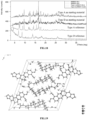
- each unit cell contains two asymmetric units and there are two BBR cations, two UDCA anions and nine H 2 O molecules per asymmetric unit, and four BBR cations, four UDCA anions and eighteen H 2 O molecules per unit cell. ( FIG. 19 .)
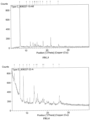
- the solid form (Form A of BBR-UDCA) is characterized by an X-ray powder diffraction (XRPD) pattern comprising peaks at diffraction angles 20 essentially the same as the one presented in FIG. 1 .
- XRPD X-ray powder diffraction
- the solid form (Form A of BBR-UDCA) is characterized by a purity of 70% or higher.
- the solid form (Form A of BBR-UDCA) is characterized by a purity of 95% or higher.
- XRPD X-ray powder diffraction
- the solid form (Form B of BBR-UDCA) has an X-ray powder diffraction (XRPD) pattern comprising peaks at 20 values of 9.31, 12.41, 15.53, 18.65, 21.79, 22.87, and 25.53 ° ( ⁇ 0.2°).
- XRPD X-ray powder diffraction
- the solid form (Form B of BBR-UDCA) has an X-ray powder diffraction (XRPD) pattern comprising peaks at 20 values of 7.39, 9.31, 12.41, 13.14, 14.37, 14.76, 15.53, 18.65, 21.79, 22.87, 25.27, 25.53 and 28.12 ° ( ⁇ 0.2°).
- XRPD X-ray powder diffraction
- the solid form (Form B of BBR-UDCA) is a hydrate of berberine ursodeoxycholate.
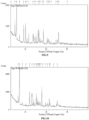
- the solid form (Form B of BBR-UDCA) is characterized by an X-ray powder diffraction (XRPD) pattern comprising peaks at diffraction angles 20 essentially the same as the one presented in FIG. 2 .
- XRPD X-ray powder diffraction
- the solid form (Form B of BBR-UDCA) is characterized by a differential scanning calorimetry (DSC) curve comprising an endotherm at about 78.1 °C (onset temperature) and an endotherm at about 91.2 °C (onset temperature).
- DSC differential scanning calorimetry
- the solid form (Form B of BBR-UDCA) is characterized by a differential scanning calorimetry (DSC) curve essentially the same as the one presented in FIG.20 .
- DSC differential scanning calorimetry
- the solid form (Form B of BBR-UDCA) is characterized by a purity of 70% or higher.
- the solid form (Form B of BBR-UDCA) is characterized by a purity of 95% or higher.
- XRPD X-ray powder diffraction
- the solid form (Form C of BBR-UDCA) has an X-ray powder diffraction (XRPD) pattern comprising peaks at 20 values of 7.23, 12.10, 13.37, 15.28, 18.17 and 21.77 ° ( ⁇ 0.2 °).
- XRPD X-ray powder diffraction
- the solid form (Form C of BBR-UDCA) has an X-ray powder diffraction (XRPD) pattern comprising peaks at 20 values of 7.23, 10.42, 12.10, 13.37, 14.24, 14.48, 15.28, 15.95, 17.00, 18.17, 20.12, 21.77 and 25.47 ° ( ⁇ 0.2 °).
- XRPD X-ray powder diffraction
- the solid form (Form C of BBR-UDCA) is a hydrate of berberine ursodeoxycholate.
- the solid form (Form C of BBR-UDCA) is characterized by an X-ray powder diffraction (XRPD) pattern comprising peaks at diffraction angles 20 essentially the same as the one presented in FIG. 3 .
- XRPD X-ray powder diffraction
- the solid form (Form C of BBR-UDCA) is characterized by a differential scanning calorimetry (DSC) curve comprising an endotherm at about 68.4 °C (onset temperature) and an endotherm at about 183.3 °C (onset temperature).
- DSC differential scanning calorimetry
- the solid form (Form C of BBR-UDCA) is characterized by a differential scanning calorimetry (DSC) curve essentially the same as the one presented in FIG. 21 .
- DSC differential scanning calorimetry
- the solid form (Form C of BBR-UDCA) is characterized by a purity of 70% or higher.
- the solid form (Form C of BBR-UDCA) is characterized by a purity of 95% or higher.
- XRPD X-ray powder diffraction
- the solid form (Form D of BBR-UDCA) has an X-ray powder diffraction (XRPD) pattern comprising peaks at 20 values of 4.24, 6.79, 8.50, 13.62 and 15.20 ° ( ⁇ 0.2 °).
- XRPD X-ray powder diffraction
- the solid form (Form D of BBR-UDCA) has an X-ray powder diffraction (XRPD) pattern comprising peaks at 20 values of 4.24, 6.79, 8.50, 10.25, 11.50, 13.62, 14.74, 15.20, 17.92 and 25.73 ° ⁇ (0.2°).
- XRPD X-ray powder diffraction
- the solid form (Form D of BBR-UDCA) has an X-ray powder diffraction (XRPD) pattern comprising peaks at 20 values of 4.24, 6.79, 8.50, 10.25, 11.50, 13.62, 14.74, 15.20, 17.92, 18.39, 22.91 and 25.73 ° ( ⁇ 0.2 °).
- XRPD X-ray powder diffraction
- the solid form (Form D of BBR-UDCA) is an anhydrous berberine ursodeoxycholate.
- the solid form (Form D of BBR-UDCA) is crystalline.
- the solid form (Form D of BBR-UDCA) is characterized by an X-ray powder diffraction (XRPD) pattern comprising peaks at diffraction angles 20 essentially the same as the one presented in FIG. 4 .
- XRPD X-ray powder diffraction
- the solid form (Form D of BBR-UDCA) is characterized by a differential scanning calorimetry (DSC) curve comprising an endotherm at about 185.2 °C (onset temperature).
- DSC differential scanning calorimetry
- the solid form (Form D of BBR-UDCA) is characterized by a differential scanning calorimetry (DSC) curve essentially the same as the one presented in FIG. 22 .
- the solid form (Form D of BBR-UDCA) is characterized by a purity of 70% or higher.
- the solid form (Form D of BBR-UDCA) is characterized by a purity of 95% or higher.
- XRPD X-ray powder diffraction
- the solid form (Form E of BBR-UDCA) has an X-ray powder diffraction (XRPD) pattern comprising peaks at 20 values of 11.36, 17.24, 17.72 and 20.91° ( ⁇ 0.2 °).
- XRPD X-ray powder diffraction
- the solid form (Form E of BBR-UDCA) has an X-ray powder diffraction (XRPD) pattern comprising peaks at 20 values of 10.55, 11.36, 12.46, 13.08, 13.38, 14.34, 17.24, 17.72, 19.66, 19.84, 20.35, 20.91, 21.36 and 21.95° ( ⁇ 0.2 °).
- XRPD X-ray powder diffraction
- XRPD X-ray powder diffraction
- the solid form (Form E of BBR-UDCA) is crystalline.
- the solid form (Form E of BBR-UDCA) is characterized by an X-ray powder diffraction (XRPD) pattern comprising peaks at diffraction angles 20 essentially the same as the one presented in FIG. 5 .
- XRPD X-ray powder diffraction
- the solid form (Form E of BBR-UDCA) is characterized by a purity of 70% or higher.
- the solid form (Form E of BBR-UDCA) is characterized by a purity of 95% or higher.
- XRPD X-ray powder diffraction
- the solid form (Form H of BBR-UDCA) has an X-ray powder diffraction (XRPD) pattern comprising peaks at 20 values of 13.05, 14.63 and 25.46 ° ( ⁇ 0.2 °).
- XRPD X-ray powder diffraction
- the solid form (Form H of BBR-UDCA) is a hydrate of berberine ursodeoxycholate.
- the solid form (Form H of BBR-UDCA) is characterized by an X-ray powder diffraction (XRPD) pattern comprising peaks at diffraction angles 20 essentially the same as the one presented in FIG. 6 .
- XRPD X-ray powder diffraction
- the solid form (Form H of BBR-UDCA) is characterized by a differential scanning calorimetry (DSC) curve comprising an endotherm at about 97.1 °C (peak temperature) and an endotherm at about 138.3 °C (onset temperature).
- DSC differential scanning calorimetry
- the solid form (Form H of BBR-UDCA) is characterized by a differential scanning calorimetry (DSC) curve essentially the same as the one presented in FIG. 23 .
- DSC differential scanning calorimetry
- the solid form (Form H of BBR-UDCA) is characterized by a purity of 70% or higher.
- the solid form (Form H of BBR-UDCA) is characterized by a purity of 95% or higher.
- XRPD X-ray powder diffraction
- the solid form (Form I of BBR-UDCA) has an X-ray powder diffraction (XRPD) pattern comprising peaks at 20 values of 7.64, 10.03, 13.32, 16.73 and 22.73° ( ⁇ 0.2 °).
- XRPD X-ray powder diffraction
- the solid form (Form I of BBR-UDCA) has an X-ray powder diffraction (XRPD) pattern comprising peaks at 20 values of 4.19, 7.64, 10.03, 13.32, 13.84, 14.83, 16.73, 22.73, 25.61 and 28.57 ° ( ⁇ 0.2 °).
- XRPD X-ray powder diffraction
- the solid form (Form I of BBR-UDCA) is a hydrate of berberine ursodeoxycholate.
- the solid form (Form I of BBR-UDCA) is characterized by an X-ray powder diffraction (XRPD) pattern comprising peaks at diffraction angles 20 essentially the same as the one presented in FIG. 7 .
- XRPD X-ray powder diffraction
- the solid form (Form I of BBR-UDCA) is characterized by a differential scanning calorimetry (DSC) curve comprising an endotherm at about 56.2 °C (onset temperature) and an endotherm at about 79.6 °C (onset temperature).
- DSC differential scanning calorimetry
- the solid form (Form I of BBR-UDCA) is characterized by a differential scanning calorimetry (DSC) curve essentially the same as the one presented in FIG. 24 .
- DSC differential scanning calorimetry
- the solid form (Form I of BBR-UDCA) is characterized by a purity of 70% or higher.
- the solid form (Form I of BBR-UDCA) is characterized by a purity of 95% or higher.
- XRPD X-ray powder diffraction
- the solid form (Form J of BBR-UDCA) has an X-ray powder diffraction (XRPD) pattern comprising peaks at 20 values of 4.61, 10.57, 14.78, 19.01 and 26.31 ° ( ⁇ 0.2 °).
- XRPD X-ray powder diffraction
- the solid form (Form J of BBR-UDCA) has an X-ray powder diffraction (XRPD) pattern comprising peaks at 20 values of 4.61, 7.38, 8.22, 9.21, 10.57, 14.55, 14.78, 16.48, 17.69, 19.01, 20.06, 24.47 and 26.31 ° ( ⁇ 0.2 °).
- XRPD X-ray powder diffraction
- the solid form (Form J of BBR-UDCA) has an X-ray powder diffraction (XRPD) pattern comprising peaks at 20 values of 4.61, 6.32, 7.38, 8.22, 9.21, 10.57, 11.73, 12.13, 12.62, 12.96, 13.87, 14.55, 14.78, 15.81, 16.48, 17.69, 18.39, 19.01, 20.06, 21.25, 22.13, 23.20, 24.47, 24.89, 26.31, 27.98, 30.25 and 33.35 ° ( ⁇ 0.2 °).
- XRPD X-ray powder diffraction
- the solid form (Form J of BBR-UDCA) is an anhydrous berberine ursodeoxycholate.
- the solid form (Form J of BBR-UDCA) is characterized by an X-ray powder diffraction (XRPD) pattern comprising peaks at diffraction angles 20 essentially the same as the one presented in FIG. 8 .
- XRPD X-ray powder diffraction
- the solid form (Form J of BBR-UDCA) is characterized by a purity of 70% or higher.
- the solid form (Form J of BBR-UDCA) is characterized by a purity of 95% or higher.
- the solid form (Form P of BBR-UDCA) has an X-ray powder diffraction (XRPD) pattern comprising peaks at 20 values of 5.01,5.78, 11.65, 17.05, 18.68 and 20.52 ° ( ⁇ 0.2 °).
- XRPD X-ray powder diffraction
- the solid form (Form P of BBR-UDCA) has an X-ray powder diffraction (XRPD) pattern comprising peaks at 20 values of 5.01,5.78, 7.26, 9.20, 10.10, 10.79, 11.65, 13.70, 14.59, 15.22, 16.19, 16.54, 17.05, 18.68, 20.52 and 25.94 ° ( ⁇ 0.2 °).
- XRPD X-ray powder diffraction
- the solid form (Form P of BBR-UDCA) has an X-ray powder diffraction (XRPD) pattern comprising peaks at 20 values of 3.11, 5.01, 5.78, 7.26, 9.20, 10.10, 10.79, 11.65, 13.70, 14.59, 15.22, 16.19, 16.54, 17.05, 18.06, 18.68, 20.52, 21.09, 21.73, 22.49, 24.73, 25.42, 25.94 and 30.11° ( ⁇ 0.2 °).
- XRPD X-ray powder diffraction
- the solid form (Form P of BBR-UDCA) is a hydrate of berberine ursodeoxycholate.
- the solid form (Form P of BBR-UDCA) is characterized by an X-ray powder diffraction (XRPD) pattern comprising peaks at diffraction angles 20 essentially the same as the one presented in FIG. 9 .
- XRPD X-ray powder diffraction
- the solid form (Form P of BBR-UDCA) is characterized by a differential scanning calorimetry (DSC) curve comprising an endotherm at about 100.3 °C (peak temperature), an endotherm at about 122.5 °C (peak temperature) and an endotherm at about 168.7 °C (peak temperature).
- DSC differential scanning calorimetry
- the solid form (Form P of BBR-UDCA) is characterized by a differential scanning calorimetry (DSC) curve essentially the same as the one presented in FIG. 25 .
- DSC differential scanning calorimetry
- the solid form (Form P of BBR-UDCA) is characterized by a purity of 70% or higher.
- the solid form (Form P of BBR-UDCA) is characterized by a purity of 95% or higher.
- XRPD X-ray powder diffraction
- the solid form (Form W of BBR-UDCA) has an X-ray powder diffraction (XRPD) pattern comprising peaks at 20 values of 6.49, 7.16, 12.01, 13.13, 15.18, 16.45, 17.85, 21.39 and 25.21° ( ⁇ 0.2 °).
- XRPD X-ray powder diffraction
- the solid form (Form W of BBR-UDCA) has an X-ray powder diffraction (XRPD) pattern comprising peaks at 20 values of 6.49, 7.16, 8.51, 10.21, 12.01, 13.13, 13.90, 14.42, 15.18, 15.57, 16.03, 16.45, 16.74, 17.08, 17.85, 18.39, 19.61, 20.43, 21.39, 21.70, 23.51 and 25.21° ( ⁇ 0.2 °).
- XRPD X-ray powder diffraction
- the solid form (Form W of BBR-UDCA) is a hydrate of berberine ursodeoxycholate.
- the solid form (Form W of BBR-UDCA) is characterized by an X-ray powder diffraction (XRPD) pattern comprising peaks at diffraction angles 20 essentially the same as the one presented in FIG.10 .
- XRPD X-ray powder diffraction
- the solid form (Form W of BBR-UDCA) is characterized by a differential scanning calorimetry (DSC) curve comprising an endotherm at about 82.1°C (peak temperature) and an endotherm at about 106.4 °C (peak temperature).
- DSC differential scanning calorimetry
- the solid form (Form W of BBR-UDCA) is characterized by a differential scanning calorimetry (DSC) curve essentially the same as the one presented in FIG. 26 .
- DSC differential scanning calorimetry
- the solid form (Form W of BBR-UDCA) is characterized by a purity of 70% or higher.
- the solid form (Form W of BBR-UDCA) is characterized by a purity of 95% or higher.
- XRPD X-ray powder diffraction
- the solid form (Form X of BBR-UDCA) has an X-ray powder diffraction (XRPD) pattern comprising peaks at 20 values of 3.63, 7.24, 11.95, 13.51, 14.54, 15.14, 18.28, 21.90 and 25.60 ° ( ⁇ 0.2 °).
- XRPD X-ray powder diffraction
- the solid form (Form X of BBR-UDCA) has an X-ray powder diffraction (XRPD) pattern comprising peaks at 20 values of 3.63, 6.61, 7.24, 10.49, 11.95, 13.51, 14.26, 14.54, 15.14, 16.01, 16.82, 18.28, 20.26, 21.08, 21.49, 21.90, 25.60, 26.40, 27.31, 29.34, 30.59, 31.01, 34.04, 34.68 and 36.91° ( ⁇ 0.2 °).
- XRPD X-ray powder diffraction
- the solid form (Form X of BBR-UDCA) is a hydrate of berberine ursodeoxycholate.
- the solid form (Form X of BBR-UDCA) is characterized by an X-ray powder diffraction (XRPD) pattern comprising peaks at diffraction angles 20 essentially the same as the one presented in FIG. 11 .
- XRPD X-ray powder diffraction
- the solid form (Form X of BBR-UDCA) is characterized by a differential scanning calorimetry (DSC) curve comprising an endotherm at about 86.7°C (peak temperature) and an endotherm at about 189.1°C (peak temperature).
- DSC differential scanning calorimetry
- the solid form (Form X of BBR-UDCA) is characterized by a differential scanning calorimetry (DSC) curve essentially the same as the one presented in FIG. 27 .
- DSC differential scanning calorimetry
- the solid form (Form X of BBR-UDCA) is characterized by a purity of 70% or higher.
- the solid form (Form X of BBR-UDCA) is characterized by a purity of 95% or higher.
- the invention generally relates to a composition comprising the solid form of the invention.
- the invention generally relates to a composition comprising two or more solid forms disclosed herein (i.e. Form A and one or more of Forms B, C, D, E, H, I, J, P, W, and X).
- composition of comprising one or more (or two or more) solid forms disclosed herein may include further agents as needed.
- the composition further includes, in addition to berberine ursodeoxycholate, one or more other therapeutically effective agents.
- the composition further includes one or more agents selected from the group consisting of vitamin D, vitamin C, vitamin E, vitamin B12, vitamin A, benfotiamine, chromium picolinate and vanadium.
- the composition further includes one or more agents selected from the group consisting of omega-3 fatty acids, S-adenosylmethionine, N-acetyl cysteine, silymarin, polyenylphosphatidylcholine, and resveratrol.
- the invention generally relates to a pharmaceutical composition
- a pharmaceutical composition comprising Form A of BBR-UDCA and a pharmaceutically acceptable excipient, carrier, or diluent.
- composition comprising Form B of BBR-UDCA and a pharmaceutically acceptable excipient, carrier, or diluent.
- composition comprising Form C of BBR-UDCA and a pharmaceutically acceptable excipient, carrier, or diluent.
- a pharmaceutical composition comprising Form D of BBR-UDCA and a pharmaceutically acceptable excipient, carrier, or diluent.
- a pharmaceutical composition comprising Form E of BBR-UDCA and a pharmaceutically acceptable excipient, carrier, or diluent.
- a pharmaceutical composition comprising Form H of BBR-UDCA and a pharmaceutically acceptable excipient, carrier, or diluent.
- composition comprising Form I of BBR-UDCA and a pharmaceutically acceptable excipient, carrier, or diluent.
- composition comprising Form J of BBR-UDCA and a pharmaceutically acceptable excipient, carrier, or diluent.
- a pharmaceutical composition comprising Form P of BBR-UDCA and a pharmaceutically acceptable excipient, carrier, or diluent.
- a pharmaceutical composition comprising Form W of BBR-UDCA and a pharmaceutically acceptable excipient, carrier, or diluent.
- composition comprising Form X of BBR-UDCA and a pharmaceutically acceptable excipient, carrier, or diluent.
- the pharmaceutical composition further includes, in addition to berberine ursodeoxycholate, one or more other therapeutically effective agents.
- the pharmaceutical composition of the invention further includes one or more agents selected from the group consisting of vitamin D, vitamin C, vitamin E, vitamin B12, vitamin A, benfotiamine, chromium picolinate and vanadium.
- the pharmaceutical composition of the invention further includes one or more agents selected from the group consisting of omega-3 fatty acids, S-adenosylmethionine, N-acetyl cysteine, silymarin, polyenylphosphatidylcholine, and resveratrol.
- the invention generally relates to a unit dosage form comprising a pharmaceutical composition disclosed herein.
- the unit dosage form is an oral dosage form.
- the unit dosage form is a tablet. In certain embodiments, the unit dosage form is a capsule. In certain embodiments, the unit dosage form is a certain volume of suspension.
- the invention provides a tablet comprising solid form A of BBR-UDCA or pharmaceutical compositions disclosed herein.
- the tablet comprises from about 1 to about 1,000 mg of solid form A of BBR-UDCA.
- the tablet comprises from about 50 to about 500 mg of solid form A of BBR-UDCA.
- the tablet comprises about 500 to 1,000 mg of solid form A of BBR-UDCA.
- the tablet comprises about 50 mg, about 100 mg, about 150 mg, about 200 mg, about 250 mg, about 300 mg, about 350 mg, or about 400 mg, about 450 mg, about 500 mg, about 550 mg, about 600 mg, about 650 mg, about 700 mg, about 750 mg, about 800 mg, about 850 mg, about 900 mg, about 950 mg, about 1,000 mg of solid form A of BBR-UDCA.
- the invention provides a soft gelatin capsule comprising solid form A of BBR-UDCA or pharmaceutical compositions disclosed herein.
- the soft gelatin capsule comprises from about 1 to about 1,000 mg of solid form A of BBR-UDCA.
- the soft gelatin capsule comprises from about 50 to about 500 mg of solid form A of BBR-UDCA.
- the soft gelatin capsule comprises about 500 to 1,000 mg of solid form A of BBR-UDCA.
- the soft gelatin capsule comprises about 50 mg, about 100 mg, about 150 mg, about 200 mg, about 250 mg, about 300 mg, about 350 mg, or about 400 mg, about 450 mg, about 500 mg, about 550 mg, about 600 mg, about 650 mg, about 700 mg, about 750 mg, about 800 mg, about 850 mg, about 900 mg, about 950 mg, about 1,000 mg of solid form A of BBR-UDCA.
- the invention generally relates to the claimed solid form A for use in a method for treating, reducing, or preventing a metabolic disorder, a heart disease, a neurodegenerative disease, or a liver disease, comprising administering to a subject in need thereof a therapeutically effective amount of a pharmaceutical composition of the invention.
- the invention generally relates to the claimed solid form A for use in method for treating, reducing, or preventing a disease or disorder, comprising administering to a subject in need thereof a therapeutically effective amount of a pharmaceutical composition disclosed herein or a unit dosage form disclosed herein, effective to treat, prevent, or reduce one or more diseases or disorders selected from fatty liver, non-alcoholic fatty liver disease (NAFLD) and non-alcoholic steatohepatitis (NASH), cholestatic liver diseases, graft-versus-host disease of the liver, primary sclerosing cholangitis, chronic viral associated liver diseases, alcohol-related liver diseases, metabolic diseases or disorders such as pre-diabetes, diabetes, hyperlipidemia, hypercholesterolemia, diabetic dyslipidemia, dyslipidemia in statin-intolerant patients, obesity, or a related disease or disorder thereof in a mammal, including a human.
- a pharmaceutical composition disclosed herein or a unit dosage form disclosed herein effective to treat, prevent, or reduce one or more diseases or disorders selected
- the disease or disorder is cholestatic liver diseases, graft-versus-host disease of the liver, chronic viral associated liver diseases or alcohol-related liver diseases, or a related disease or disorder.
- the disease or disorder is fatty liver, NAFLD or NASH, or a related disease or disorder.
- the disease or disorder is NAFLD, or a related disease or disorder.
- the disease or disorder is NASH, or a related disease or disorder.
- the disease or disorder is primary sclerosing cholangitis, or a related disease or disorder.
- the disease or disorder is hypercholesterolemia, or a related disease or disorder.
- the disease or disorder is pre-diabetes, diabetes or hyperlipidemia, diabetic dyslipidemia, or dyslipidemia, or a related disease or disorder, in statin-intolerant patients.
- the disease or disorder is obesity, or a related disease or disorder.
- the subject is administered, in addition to berberine ursodeoxycholate, one or more other therapeutically effective agents.
- the invention relates to a solid form of BBR-UDCA, wherein the solid form is non-hygroscopic.
- the invention relates to a solid form of BBR-UDCA, wherein the solid form comprises a plurality of small crystallites of BBR-UDCA.
- the invention generally relates to a method for preparing Form A of berberine ursodeoxycholate.
- the method includes: forming a mixture of a crystalline and/or amorphous form of berberine ursodeoxycholate with co-solvents of an organic solvent and H 2 O, wherein the water activity is greater than about 0.4; stirring the mixture at room temperature, filtering the mixture to obtain a filter cake; washing the filter cake with distilled water; and removing water to obtain Form A of berberine ursodeoxycholate.
- the organic solvent is EtOH.
- the EtOH : H 2 O (v/v) is from about 1:5 to about 1: 30. In certain embodiments, the EtOH : H 2 O (v/v) is from about 1:10 to about 1: 20. In certain embodiments, the EtOH : H 2 O (v/v) is about 1:10.
- the mixture is stirred at room temperature for about 3 to about 7 hours.
- Removing water is performed until the water content is about 10% or less to obtain Form A of berberine ursodeoxycholate.
- Disclosed herein, but not forming part of the present invention is a method for preparing Form B of berberine ursodeoxycholate.
- the method includes: forming a mixture of a crystalline and/or amorphous form of berberine ursodeoxycholate with acetonitrile/H 2 O, wherein the acetonitrile : H 2 O (v/v) is from about 1:2 to about 2:1; and slowly evaporating to remove acetonitrile /H 2 O to obtain Form B of berberine ursodeoxycholate.
- the acetonitrile: H 2 O (v/v) is about 1:1.
- Disclosed herein, but not forming part of the present invention is a method for preparing Form C of berberine ursodeoxycholate.
- the method includes: forming a mixture of a crystalline and/or amorphous form of berberine ursodeoxycholate with isopropyl alcohol / isopropyl acetate, wherein the isopropyl alcohol: isopropyl acetate (v/v) is from about 1:2 to about 2:1; and slowly evaporating to remove isopropyl alcohol / isopropyl acetate to obtain Form C of berberine ursodeoxycholate.
- the isopropyl alcohol: isopropyl acetate (v/v) is about 1:1.
- Disclosed herein, but not forming part of the present invention is a method for preparing Form D of berberine ursodeoxycholate.
- the method includes: forming a mixture of crystalline and/or amorphous form of berberine ursodeoxycholate with an organic solvent or an organic solvent/water co-solvents having a water activity less than about 0.2; stirring the mixture at room temperature; and filtering the mixture to obtain Form D of berberine ursodeoxycholate.
- a mixture of crystalline and/or amorphous form of berberine ursodeoxycholate with ethyl acetate is formed.
- the mixture is stirred at room temperature for about 1 to about 24 hours. In certain embodiments, the mixture is stirred at room temperature for about 2 to about 7 hours. In certain embodiments, the mixture is stirred at room temperature for about 3 to about 5 hours.
- Disclosed herein, but not forming part of the present invention is a method for preparing Form E of berberine ursodeoxycholate.
- the method includes: providing Form A of berberine ursodeoxycholate; and performing solid vapor diffusion in a dichloromethane atmosphere to obtain Form E of berberine ursodeoxycholate.
- Disclosed herein, but not forming part of the present invention is a method for preparing Form H of berberine ursodeoxycholate.
- the method includes: dissolving a crystalline and/or amorphous form of berberine ursodeoxycholate in acetonitrile/H 2 O, wherein the acetonitrile : H 2 O (v/v) is from about 1:2 to about 2:1; slowly evaporating acetonitrile/H 2 O; collecting precipitate by filtration; heating the obtained precipitate to about 100°C; and cooling heated precipitate to room temperature to obtain Form H of berberine ursodeoxycholate.
- the acetonitrile: H 2 O (v/v) is about 1:1.
- the obtained precipitate is heated for about 0.5 to about 2 hours.
- Disclosed herein, but not forming part of the present invention is a method for preparing Form I of berberine ursodeoxycholate.
- the method includes: dissolving a crystalline and/or amorphous form of berberine ursodeoxycholate in tetrahydrofuran/H 2 O, wherein the tetrahydrofuran : H 2 O (v/v) is from about 1:2 to about 2:1; slowly evaporating tetrahydrofuran/H 2 O; and collecting the precipitate by filtration to obtain Form I of berberine ursodeoxycholate.
- the tetrahydrofuran: H 2 O (v/v) is about 1:1.
- Disclosed herein, but not forming part of the present invention is a method for preparing Form J of berberine ursodeoxycholate.
- the method includes: providing Form A of berberine ursodeoxycholate; heating Form A of berberine ursodeoxycholate to about 100°C in N 2 ; and cooling the heated berberine ursodeoxycholate under N 2 to room temperature to obtain Form J of berberine ursodeoxycholate.
- the Form A of berberine ursodeoxycholate is heated in N 2 for about 0.5 to about 2 hours.
- the method includes: providing Form A of berberine ursodeoxycholate; slurrying Form A of berberine ursodeoxycholate in MeOH / methyl ethyl ketone or MeOH/methy tert-butyl ether, wherein the MeOH : methyl ethyl ketone (v/v) is from about 1:8 to about 1:10 or MeOH: methyl tert-butyl ether (v/v) is from about 1:8 to about 1:10 at about 50°C; and collecting the solid to obtain Form P of berberine ursodeoxycholate.
- the slurrying is performed for about 6 to about 36 hours.
- the MeOH: methyl tert-butyl ether (v/v) is 1:9.
- the MeOH : methyl ethyl ketone (v/v) is 1:9.
- the method includes: providing Form A of berberine ursodeoxycholate; slurrying Form A of berberine ursodeoxycholate in cyclohexanone/n-butylacetate, wherein the cyclohexanone : n-butylacetate (v/v) is from about 1:3 to about 1:5 at room temperature; and collecting the solid to obtain Form W of berberine ursodeoxycholate.
- the cyclohexanone : n-butylacetate (v/v) is about 1:4.
- the slurrying is performed for about 6 to about 36 hours.
- Disclosed herein, but not forming part of the present invention is a method for preparing Form X of berberine ursodeoxycholate.
- the method includes: providing Form A of berberine ursodeoxycholate; dissolving Form A of berberine ursodeoxycholate in n-butanol; slowly evaporating n-butanol at room temperature; and collecting the precipitate by filtration to obtain Form X of berberine ursodeoxycholate.
- evaporating n-butanol at room temperature is performed for about 6 to about 36 hours.
- any one of the solid forms of BBR-UDCA as disclosed herein can exist in the presence of the any other of the physical forms or mixtures thereof. Accordingly, there is provided the crystalline form or the amorphous form of BBR-UDCA or a pharmaceutical composition comprising the crystalline form or the amorphous form of BBR-UDCA as described herein, wherein the crystalline or amorphous form is present in a solid form that includes less than 95%, less than 90%, less than 80%, less than 70%, less than 60%, less than 50%, less than 40%, less than 30%, less than 20%, less than 10%, less than 5%, less than 3%, or less than 1% by weight of any other physical forms of BBR-UDCA.
- a solid form of BBR-UDCA comprising a crystalline form of BBR-UDCA that has any one of the powder X-ray diffraction patterns disclosed herein, wherein the solid form includes less than 95%, less than 90%, less than 80%, less than 70%, less than 60%, less than 50%, less than 40%, less than 30%, less than 20%, less than 10%, less than 5%, less than 3%, or less than 1% by weight of any other physical forms of BBR-UDCA.
- the invention relates to form A of BBR-UDCA, wherein the form is substantially pure.
- a further aspect of the invention provides a pharmaceutical composition comprising the crystalline form A of BBR-UDCA as disclosed herein.
- the invention provides a pharmaceutical composition comprising crystalline form A of BBR-UDCA as disclosed herein wherein the crystalline form is substantially pure.
- the invention provides a method of preparing a pharmaceutical composition comprising combining crystalline form A of BBR-UDCA as disclosed herein and a pharmaceutically acceptable excipient, carrier, or diluent.
- the invention provides a method of preparing a pharmaceutical composition comprising combining crystalline form A of BBR-UDCA as disclosed herein and a pharmaceutically acceptable excipient, carrier, or diluent, wherein the crystalline form is substantially pure.
- the invention provides a pharmaceutical composition prepared by combining crystalline form A of BBR-UDCA as disclosed herein and a pharmaceutically acceptable excipient, carrier, or diluent.
- the invention provides a pharmaceutical composition prepared by combining crystalline form A of BBR-UDCA as disclosed herein and a pharmaceutically acceptable excipient, carrier, or diluent wherein the crystalline form is substantially pure.
- the invention provides an oral dosage form comprising the crystalline form A of BBR-UDCA or pharmaceutical compositions disclosed herein.
- the oral dosage form is a tablet or capsule.
- Isotopically-labeled compounds are also within the scope of the present disclosure.
- an "isotopically-labeled compound” refers to a presently disclosed compound in which one or more atoms are replaced by an atom having an atomic mass or mass number different from the atomic mass or mass number usually found in nature.
- isotopes that can be incorporated into compounds presently disclosed include isotopes of hydrogen, carbon, nitrogen, oxygen, phosphorous, fluorine and chlorine, such as 2 H, 3 H, 13 C, 14 C, 15 N, 18 O, 17 O, 31 P, 32 P, 35 S, 18 F, and 36 Cl, respectively.
- the compounds may be useful in drug and/or substrate tissue distribution assays.
- Tritiated ( 3 H) and carbon-14 ( 14 C) labeled compounds are particularly preferred for their ease of preparation and detectability.
- substitution with heavier isotopes such as deuterium ( 2 H) can afford certain therapeutic advantages resulting from greater metabolic stability, for example increased in vivo half-life or reduced dosage requirements and, hence, may be preferred in some circumstances.
- Isotopically labeled compounds presently disclosed, including pharmaceutical salts, esters, and prodrugs thereof, can be prepared by any means known in the art.
- Possible formulations include those suitable for oral, sublingual, buccal, parenteral (for example subcutaneous, intramuscular, or intravenous), rectal, topical including transdermal, intranasal and inhalation administration. Most suitable means of administration for a particular patient will depend on the nature and severity of the disease or condition being treated or the nature of the therapy being used and on the nature of the active compound.
- the XRPD data were collected according to the following general protocol.
- XRPD patterns were collected on a PANalytical X-ray powder diffractometer fitted with an automatic sample changer, a theta-theta goniometer, automatic beam divergence slit and a PSD Vantec-1 detector.
- the X-ray tube voltage and amperage were set to 45 kV and 40 mA respectively.
- the diffractometer was aligned and a calibration check performed using a corundum reference material on the day of data collection.
- XRPD parameters used are listed in Table 1. Data were collected and analyzed by the software Data Viewer. Table 1.
- the polarized light microscopic picture was captured using Shanghai Cewei PXS9-T stereomicroscope.
- DSC was performed using a TA Q200/Q2000 from TA Instruments. Detailed parameters used are listed in Table 2. Table 2. Parameters for DSC Tests Parameters DSC Method Ramp Sample pan Aluminum, sealed/open Temperature 25 °C - Setting temperature Heating rate 10 °C/min Purge gas N 2
- TGA data were collected using a TA Q500/Q5000 TGA from TA Instruments. Detailed parameters used are listed in Table 3. Table 3. Parameters for TGA Tests Parameters TGA Method Ramp Sample pan Aluminum, open Temperature Room temperature - Setting temperature Heating rate 10 °C/min Purge gas N 2
- DVS was measured via a SMS (Surface Measurement Systems) DVS Intrinsic. Parameters for DVS test are listed in Table 4. Table 4. Parameters for DVS Tests Parameters Values Temperature 25°C Sample size 10-20 mg Gas and flow rate N 2 , 200 mL/min dm/dt 0.002%/min Min.dm/dt stability duration 10 min Max. equilibrium time 360 min RH range 0%RH-95%RH-0%RH for anhydrous forms 60%RH-95%RH-0%RH-95%RH for hydrous forms RH step size 10% for 90%RH-0%RH and 0%RH-90%RH 5% for 95%RH-90%RH and 90%RH-95%RH
- the XRPD ( FIG. 1 ) pattern comprised peaks at 20 values of 3.98, 7.06, 7.34, 7.93, 8.79, 9.47, 11.70, 11.94, 12.34, 12.55, 13.90, 14.17, 15.14, 15.50, 16.16, 16.54, 16.78, 17.53, 17.67, 18.23, 19.03, 19.98, 20.87, 21.13, 21.96, 23.49, 24.24, 24.97, 25.50, 26.63, 27.60, 28.06, 28.63, 29.40 and 30.49 °.
- the XRPD overlay FIG.
- BBR-UDCA 5 g BBR-UDCA was dissolved in ACN/H 2 O (1:1, v/v) solution.
- Type B 1.6 g was obtained via slow evaporation from ACN/H 2 O (1:1, v/v) solution.
- the XRPD ( FIG. 2 ) pattern comprised peaks at 20 values of 7.39, 9.31, 12.41, 13.14, 14.37, 14.76, 15.53, 18.65, 21.79, 22.87, 25.27, 25.53 and 28.12 °.
- TGA/DSC data was shown in FIG. 20 .
- a weight loss of 12.2% was found when heated up to 150°C.
- Two endotherms at 78.1°C and 91.2°C (onset temperatures) were observed.
- Type C of BBR-UDCA (1.8 g) was obtained via slow evaporation from isopropyl alcohol / isopropyl acetate (IPA/IPAc) (1:1, v/v) solution of 5 g BBR-UDCA.
- IPA/IPAc isopropyl alcohol / isopropyl acetate
- the XRPD ( FIG. 3 ) pattern comprised peaks at 20 values of 7.23, 10.42, 12.10, 13.37, 14.24, 14.48, 15.28, 15.95, 17.00, 18.17, 20.12, 21.77 and 25.47 °.
- TGA/DSC data ( FIG. 21 ) showed a weight loss of 11.6% when being heated up to 150°C with two endotherms at 68.4°C and 183.3°C (onset temperatures).
- the XRPD ( FIG. 4 ) pattern comprised peaks at 20 values of 4.24, 6.79, 8.50, 10.25, 11.50, 13.62, 14.74, 15.20, 17.92, 18.39, 22.91 and 25.73 °.
- TGA/DSC data FIG. 22 ) showed a weight loss of 2.2% after heating to 150°C and an endotherm at 185.2°C (onset temperature).
- the XRPD ( FIG. 5 ) pattern comprised peaks at 20 values of 8.59, 10.55, 11.36, 11.86, 12.46, 13.08, 13.38, 14.34, 15.57, 17.24, 17.72, 18.43, 19.66, 19.84, 20.35, 20.91, 21.36, 21.95, 23.21, 24.67, 25.04, 25.82, 26.12, 27.01, 27.84, 28.97, 30.35, 33.33, 34.54 and 36.06 °.
- BBR-UDCA 5 g was dissolved into acetonitrile/H 2 O (1:1, v/v). After slow evaporation of the solvents, the precipitate was collected by filtration. The obtained solid was heated to 100°C for 0.5-2 hours, and then it was cooled to room temperature. Form H of BBR-UDCA (0.8 g) was obtained.
- the XRPD ( FIG. 6 ) pattern comprised peaks at 20 values of 13.05, 14.63 and 25.46 °.
- TGA/DSC data ( FIG. 23 ) showed a weight loss of 7.9% after heating to 150°C, with an endotherm at 97.1°C (peak temperature) and an endotherm at 138.3°C (onset temperature).
- BBR-UDCA 5 g was dissolved into tetrahydrofuran/H 2 O (1:1, v/v). After slow evaporation of the solvents for 24 hours, the precipitate was collected by filtration. Form I of BBR-UDCA (0.9 g) was obtained.
- the XRPD ( FIG. 7 ) pattern comprised peaks at 20 values of 4.19, 7.64, 10.03, 13.32, 13.84, 14.83, 16.73, 22.73, 25.61 and 28.57 °.
- TGA/DSC data ( FIG. 24 ) showed a weight loss of 10.7% after heating to 150°C, with an endotherm at 56.2°C (onset temperature) and an endotherm at 79.6°C (onset temperature).
- the XRPD ( FIG. 8 ) pattern comprised peaks at 20 values of 4.61, 6.32, 7.38, 8.22, 9.21, 10.57, 11.73, 12.13, 12.62, 12.96, 13.87, 14.55, 14.78, 15.81, 16.48, 17.69, 18.39, 19.01, 20.06, 21.25, 22.13, 23.20, 24.47, 24.89, 26.31, 27.98, 30.25 and 33.35 °.
- Form J converts to Form A with air exposure.
- Form P of BBR-UDCA (3.8 g) was obtained via slurrying 5 g Form A of BBR-UDCA in MeOH/methyl ethyl ketone (1:9, v/v) at 50 °C for one day.
- the XRPD ( FIG. 9 ) pattern comprised peaks at 20 values of 3.11, 5.01, 5.78, 7.26, 9.20, 10.10, 10.79, 11.65, 13.70, 14.59, 15.22, 16.19, 16.54, 17.05, 18.06, 18.68, 20.52, 21.09, 21.73, 22.49, 24.73, 25.42, 25.94 and 30.11 °.
- TGA/DSC data FIG. 25 ) showed a weight loss of 8.8% after heating to 150°C, with an endotherm at 100.3°C (peak temperature), an endotherm at 122.5°C (peak temperature), and 168.7°C (peak temperature).
- Form W of BBR-UDCA (4.0 g) was obtained via slurrying 5.0 g Form A of BBR-UDCA in cyclohexanone/n-butylacetate (1:4, v/v) at room temperature for one day.
- the XRPD ( FIG. 10 ) pattern comprised peaks at 20 values of 6.49, 7.16, 8.51, 10.21, 12.01, 13.13, 13.90, 14.42, 15.18, 15.57, 16.03, 16.45, 16.74, 17.08, 17.85, 18.39, 19.61, 20.43, 21.39, 21.70, 23.51 and 25.21 °.
- TGA/DSC data FIG. 26 ) showed a weight loss of 7.2% after heating to 110°C, with an endotherm at 82.1 °C (peak temperature) and an endotherm at 106.4°C (peak temperature).
- the XRPD ( FIG. 11 ) pattern comprised peaks at 20 values of 3.63, 6.61, 7.24, 10.49, 11.95, 13.51, 14.26, 14.54, 15.14, 16.01, 16.82, 18.28, 20.26, 21.08, 21.49, 21.90, 25.60, 26.40, 27.31, 29.34, 30.59, 31.01, 34.04, 34.68 and 36.91°.
- TGA/DSC data ( FIG. 27 ) showed a weight loss of 17.0% after heating to 140°C, and an endotherm at 86.7°C (peak temperature) and an endotherm at 189.1°C (peak temperature) were observed.
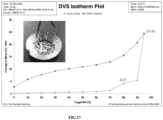
- DVS isotherm plot of Form D was collected at 25°C between 0 and 95%RH. The result is shown in FIG. 17 . A water uptake of 4.1% was observed at 25°C/80%RH, while obvious increase was observed over 90% RH and 24.5% water uptake at 95%RH. The result of DVS test indicated Form D was deliquesced in high humidity.
- PLM characterizations of Form A of BBR-UDCA and Form D of BBR-UDCA were performed for observation of the morphology of the samples. Needle-like particles were observed in Form A sample and the particle size was 20 ⁇ m to 50 ⁇ m. For Type D sample, the particle size was approximately 10 ⁇ m.
- the crystal type of both residual solids after solubility test was Form A, indicating that Form D converted to Form A during solubility experiment.
- the solubility of BBR was 0.35 mg/mL or 0.33 mg/mL using DAD or ELSD as detectors, respectively.
- the solubility of UDCA was 0.42 mg/mL, indicating the molar ratio was 0.94:1 (BBR: UDCA).
- the solubility of BBR was 0.42 mg/mL or 0.41 mg/mL using DAD or ELSD as detectors, respectively.
- the solubility of UDCA was 0.52 mg/mL, indicating the molar ratio was 0.93:1 (BBR: UDCA).
- the reason of the deviation from 1: 1 may be that after HTD 1801 dissolving in water, a small amount of disproportionation occurred and it was hardly detected by XRPD due to its limited amount.
- Form D gave a better solubility in water than Form A.
- Table 9 Summary of Solubility Evaluation Starting material Form of residual solid Solubility of BBR Solubility of BBR Solubility of UDCA (mg/mL)* (mg/mL)# (mg/mL)# Type A Type A 0.35 0.33 0.42 Type D Type A 0.42 0.41 0.52 *: using DAD as detector; # : using ELSD as detector.
- Adjacent UDCA anions and H 2 O molecules are connected to each other to form the 3-D supramolecular framework structure with 1-D linear channels by intermolecular hydrogen bonding (O-H ⁇ O) while the BBR cations are stacked orderly in the channels by ⁇ - ⁇ interaction to form the 3-D crystal structure of the crystal eventually.
- Table_10 Adjacent UDCA anions and H 2 O molecules are connected to each other to form the 3-D supramolecular framework structure with 1-D linear channels by intermolecular hydrogen bonding (O-H ⁇ O) while the BBR cations are stacked orderly in the channels by ⁇ - ⁇ interaction to form the 3-D crystal structure of the crystal eventually.
- the XRPD overlay ( FIG. 12 ) showed that the XRPD pattern of Form A matched well with the XRPD pattern of the obtained single crystal.
- the TGA data of Form A showed that a weight loss of 9.4% was observed, while the theoretical weight loss of hemi-nonahydrate was 10.0%. All these results indicated that Form A was a hemi-nonahydrate of BBR-UDCA.
Landscapes
- Health & Medical Sciences (AREA)
- Chemical & Material Sciences (AREA)
- Organic Chemistry (AREA)
- General Health & Medical Sciences (AREA)
- Public Health (AREA)
- Pharmacology & Pharmacy (AREA)
- Life Sciences & Earth Sciences (AREA)
- Animal Behavior & Ethology (AREA)
- Veterinary Medicine (AREA)
- Medicinal Chemistry (AREA)
- Bioinformatics & Cheminformatics (AREA)
- Engineering & Computer Science (AREA)
- Epidemiology (AREA)
- Nuclear Medicine, Radiotherapy & Molecular Imaging (AREA)
- Chemical Kinetics & Catalysis (AREA)
- General Chemical & Material Sciences (AREA)
- Diabetes (AREA)
- Obesity (AREA)
- Hematology (AREA)
- Neurology (AREA)
- Neurosurgery (AREA)
- Biomedical Technology (AREA)
- Gastroenterology & Hepatology (AREA)
- Heart & Thoracic Surgery (AREA)
- Hospice & Palliative Care (AREA)
- Cardiology (AREA)
- Psychiatry (AREA)
- Child & Adolescent Psychology (AREA)
- Emergency Medicine (AREA)
- Endocrinology (AREA)
- Pharmaceuticals Containing Other Organic And Inorganic Compounds (AREA)
- Nitrogen Condensed Heterocyclic Rings (AREA)
- Steroid Compounds (AREA)
- Medicines That Contain Protein Lipid Enzymes And Other Medicines (AREA)
- Organic Low-Molecular-Weight Compounds And Preparation Thereof (AREA)
Description
- This application claims the benefit of priority to
Chinese Application No. 201710335467.5, filed May 12, 2017 - The invention generally relates to solid forms of berberine ursodeoxycholate, and to pharmaceutical compositions and methods of preparation and therapeutic uses thereof. In particular, the invention relates to solid forms (e.g., crystalline or amorphous forms) of berberine ursodeoxycholate and pharmaceutical compositions thereof useful in treating and/or preventing various diseases or disorders, including metabolic disorders, heart diseases, neurodegenerative diseases and liver diseases.
- The compound berberine ursodeoxycholate "BBR-UDCA", represented by
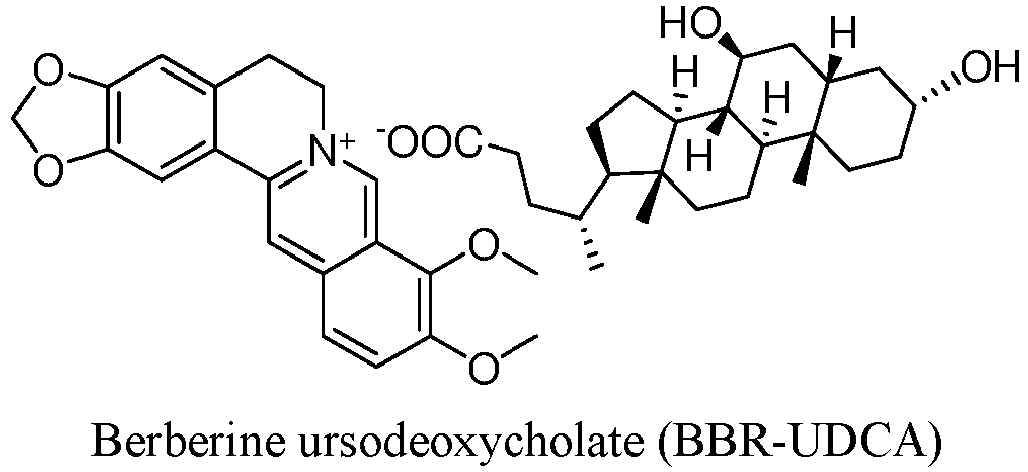
WO 2016/015634A1PCT/CN2015/085350, filed July 28, 2015 - Preparation of the compound was disclosed therein as were certain beneficial biological activities of the compound.
- Solid forms are of particular interest in the development of suitable dosage forms of pharmaceuticals. It is desirable to have processes for producing a compound with the selected solid form in high purity when the compound is used in clinical studies or commercial products since impurities present may produce undesired toxicological effects. If a solid form is not held constant during clinical or stability studies, the exact dosage form used or studied may not be comparable from one lot to another.
- Certain solid forms may also exhibit enhanced thermodynamic stability or may be more readily manufactured in high purity in large quantities, and thus are more suitable for inclusion in pharmaceutical formulations. Different solid forms of an active pharmaceutical ingredient can lead to changes in the drug's solubility, dissolution rate, pharmacokinetics and ultimately its bioavailability and efficacy in patients. Certain solid forms may display other advantageous physical properties such as lack of hygroscopic tendencies, filterability, improved solubility, and enhanced rates of dissolution due to different lattice energies.
- Thus, finding which solid form is the most stable under each condition of interest and the processes that lead to changes in a solid form is crucial to the design of the drug manufacturing process in order to ensure that the final product is in its preferred solid form. There remains an ongoing need to identify novel solid forms having desirable physicochemical properties suitable for preparation and therapeutic use.
- The present invention provides novel solid form A of BBR-UDCA as defined in claims 1-10, having one or more desirable properties, such as high stability, high crystallinity, high purity, low hygroscopicity, favorable dissolution and/or favorable mechanical properties. In particular, solid forms of BBR-UDCA disclosed herein provide improved physical stability and/or physicochemical properties suitable for clinical studies, product manufacture and therapeutic use.
- The solid forms disclosed herein can be utilized to treat various diseases or disorders, such as diabetes, diabetic complications, dyslipidemia, dyslipidemia in statin-intolerance patients, hyperlipidemia, hypercholesterolemia, hypertriglyceridemia, diabetic dyslipidemia, obesity, metabolic syndromes, pre-diabetes, heart diseases, neurodegenerative diseases, sarcopenia, muscle atrophy, inflammation, and cancers as well as various liver diseases or disorders, such as fatty liver, non-alcoholic fatty liver disease, non-alcoholic steatohepatitis, cholestatic liver diseases or graft-versus-host disease of the liver. The compounds of this invention are also useful in improving liver functions in chronic viral associated liver diseases and alcohol-related liver diseases.
- The invention relates to a solid form, which is Form A of BBR-UDCA, having an X-ray powder diffraction (XRPD) pattern as defined in claims 1-10.
- Disclosed herein, but not forming part of the present invention is Form B of BBR-UDCA, having an X-ray powder diffraction (XRPD) pattern comprising one or more peaks at 20 values selected from the group consisting of: 7.39, 9.31, 12.41, 13.14, 14.37, 14.76, 15.53, 18.65, 21.79, 22.87, 25.27, 25.53 and 28.12 ° (± 0.2°) obtained using Cu Kα radiation (λ1 = 1.540598 Å, λ2 = 1.544426 Å, intensity ratio λ2/λ1 = 0.50).
- Disclosed herein, but not forming part of the present invention is Form C of BBR-UDCA, having an X-ray powder diffraction (XRPD) pattern comprising one or more peaks at 20 values selected from the group consisting of: 7.23, 10.42, 12.10, 13.37, 14.24, 14.48, 15.28, 15.95, 17.00, 18.17, 20.12, 21.77 and 25.47 ° (± 0.2°) obtained using Cu Kα radiation (λ1 = 1.540598 Å, λ2 = 1.544426 Å, intensity ratio λ2/λ1 = 0.50).
- Disclosed herein, but not forming part of the present invention is Form D of BBR-UDCA, having an X-ray powder diffraction (XRPD) pattern comprising one or more peaks at 20 values selected from the group consisting of: 4.24, 6.79, 8.50, 10.25, 11.50, 13.62, 14.74, 15.20, 17.92, 18.39, 22.91 and 25.73 ° (± 0.2°) obtained using Cu Kα radiation (λ1 = 1.540598 Å, λ2 = 1.544426 Å, intensity ratio λ2/λ1 = 0.50).
- Disclosed herein, but not forming part of the present invention is Form E of BBR-UDCA, having an X-ray powder diffraction (XRPD) pattern comprising one or more peaks at 20 values selected from the group consisting of: 8.59, 10.55, 11.36, 11.86, 12.46, 13.08, 13.38, 14.34, 15.57, 17.24, 17.72, 18.43, 19.66, 19.84, 20.35, 20.91, 21.36, 21.95, 23.21, 24.67, 25.04, 25.82, 26.12, 27.01, 27.84, 28.97, 30.35, 33.33, 34.54 and 36.06 ° (± 0.2°) obtained using Cu Kα radiation (λ1 = 1.540598 Å, λ2 = 1.544426 Å, intensity ratio λ2/λ1 = 0.50).
- Disclosed herein, but not forming part of the present invention is Form H of BBR-UDCA, having an X-ray powder diffraction (XRPD) pattern comprising one or more peaks at 20 values selected from the group consisting of: 13.05, 14.63 and 25.46 ° (± 0.2°) obtained using Cu Kα radiation (λ1 = 1.540598 Å, λ2 = 1.544426 Å, intensity ratio λ2/λ1 = 0.50).
- Disclosed herein, but not forming part of the present invention is Form I of BBR-UDCA, having an X-ray powder diffraction (XRPD) pattern comprising one or more peaks at 20 values selected from the group consisting of: 4.19, 7.64, 10.03, 13.32, 13.84, 14.83, 16.73, 22.73, 25.61 and 28.57 ° (± 0.2°) obtained using Cu Kα radiation (λ1 = 1.540598 Å, λ2 = 1.544426 Å, intensity ratio λ2/λ1 = 0.50).
- Disclosed herein, but not forming part of the present invention is Form J of BBR-UDCA, having an X-ray powder diffraction (XRPD) pattern comprising one or more peaks at 20 values selected from the group consisting of: 4.61, 6.32, 7.38, 8.22, 9.21, 10.57, 11.73, 12.13, 12.62, 12.96, 13.87, 14.55, 14.78, 15.81, 16.48, 17.69, 18.39, 19.01, 20.06, 21.25, 22.13, 23.20, 24.47, 24.89, 26.31, 27.98, 30.25 and 33.35 ° (± 0.2°) obtained using Cu Kα radiation (λ1 = 1.540598 Å, λ2 = 1.544426 Å, intensity ratio λ2/λ1 = 0.50).
- Disclosed herein, but not forming part of the present invention is Form P of BBR-UDCA, having an X-ray powder diffraction (XRPD) pattern comprising one or more peaks at 20 values selected from the group consisting of: 3.11, 5.01, 5.78, 7.26, 9.20, 10.10, 10.79, 11.65, 13.70, 14.59, 15.22, 16.19, 16.54, 17.05, 18.06, 18.68, 20.52, 21.09, 21.73, 22.49, 24.73, 25.42, 25.94 and 30.11 ° (± 0.2°) obtained using Cu Kα radiation (λ1 = 1.540598 Å, λ2 = 1.544426 Å, intensity ratio λ2/λ1 = 0.50).
- Disclosed herein, but not forming part of the present invention is Form W of BBR-UDCA, having an X-ray powder diffraction (XRPD) pattern comprising one or more peaks at 20 values selected from the group consisting of: 6.49, 7.16, 8.51, 10.21, 12.01, 13.13, 13.90, 14.42, 15.18, 15.57, 16.03, 16.45, 16.74, 17.08, 17.85, 18.39, 19.61, 20.43, 21.39, 21.70, 23.51 and 25.21° (± 0.2°) obtained using Cu Kα radiation (λ1 = 1.540598 Å, λ2 = 1.544426 Å, intensity ratio λ2/λ1 = 0.50).
- Disclosed herein, but not forming part of the present invention is Form X of BBR-UDCA, having an X-ray powder diffraction (XRPD) pattern comprising one or more peaks at 20 values selected from the group consisting of: 3.63, 6.61, 7.24, 10.49, 11.95, 13.51, 14.26, 14.54, 15.14, 16.01, 16.82, 18.28, 20.26, 21.08, 21.49, 21.90, 25.60, 26.40, 27.31, 29.34, 30.59, 31.01, 34.04, 34.68 and 36.91° (± 0.2°) obtained using Cu Kα radiation (λ1 = 1.540598 Å, λ2 = 1.544426 Å, intensity ratio λ2/λ1 = 0.50).
- Form A of the invention relates to a solid form of hemi-nonahydrate of BBR-UDCA.
- In yet another aspect, the invention generally relates to a composition comprising the solid form A of the invention.
- In yet another aspect, the invention generally relates to a composition comprising two or more solid forms disclosed herein (i.e. Form A and one or more of or more of Forms B, C, D, E, H, I, J, P, W, and X).
- In yet another aspect, the invention generally relates to a pharmaceutical composition comprising Form A of BBR-UDCA and a pharmaceutically acceptable excipient, carrier, or diluent.
- Disclosed herein, but not forming part of the present invention is a pharmaceutical composition comprising Form B of BBR-UDCA and a pharmaceutically acceptable excipient, carrier, or diluent.
- Disclosed herein, but not forming part of the present invention is a pharmaceutical composition comprising Form C of BBR-UDCA and a pharmaceutically acceptable excipient, carrier, or diluent.
- Disclosed herein, but not forming part of the present invention is a pharmaceutical composition comprising Form D of BBR-UDCA and a pharmaceutically acceptable excipient, carrier, or diluent.
- Disclosed herein, but not forming part of the present invention is a pharmaceutical composition comprising Form E of BBR-UDCA and a pharmaceutically acceptable excipient, carrier, or diluent.
- Disclosed herein, but not forming part of the present invention is a pharmaceutical composition comprising Form H of BBR-UDCA and a pharmaceutically acceptable excipient, carrier, or diluent.
- Disclosed herein, but not forming part of the present invention is a pharmaceutical composition comprising Form I of BBR-UDCA and a pharmaceutically acceptable excipient, carrier, or diluent.
- Disclosed herein, but not forming part of the present invention is a pharmaceutical composition comprising Form J of BBR-UDCA and a pharmaceutically acceptable excipient, carrier, or diluent.
- Disclosed herein, but not forming part of the present invention is a pharmaceutical composition comprising Form P of BBR-UDCA and a pharmaceutically acceptable excipient, carrier, or diluent.
- Disclosed herein, but not forming part of the present invention is a pharmaceutical composition comprising Form W of BBR-UDCA and a pharmaceutically acceptable excipient, carrier, or diluent.
- Disclosed herein, but not forming part of the present invention is a pharmaceutical composition comprising Form X of BBR-UDCA and a pharmaceutically acceptable excipient, carrier, or diluent.
- In yet another aspect, the invention generally relates to a unit dosage form comprising a pharmaceutical composition of the invention.
- In yet another aspect, the invention generally relates to Form A for use in a method for treating, reducing, or preventing a metabolic disorder, a heart disease, a neurodegenerative disease, or a liver disease, comprising administering to a subject in need thereof a therapeutically effective amount of a pharmaceutical composition of the invention.
- In yet another aspect, the invention generally relates to form A for use in a method for treating, reducing, or preventing a disease or disorder, comprising administering to a subject in need thereof a therapeutically effective amount of a pharmaceutical composition of the invention or a unit dosage form of the invention, effective to treat, prevent, or reduce one or more diseases or disorders selected from fatty liver, non-alcoholic fatty liver disease (NAFLD) and non-alcoholic steatohepatitis (NASH), cholestatic liver diseases, graft-versus-host disease of the liver, primary sclerosing cholangitis, chronic viral associated liver diseases, alcohol-related liver diseases, metabolic diseases or disorders such as pre-diabetes, diabetes, hyperlipidemia, hypercholesterolemia, diabetic dyslipidemia, dyslipidemia in statin-intolerant patients, obesity, or a related disease or disorder thereof in a mammal, including a human.
- In yet another aspect, the invention generally relates to a method for preparing Form A of berberine ursodeoxycholate. The method includes: forming a mixture of a crystalline and/or amorphous form of berberine ursodeoxycholate with co-solvents of an organic solvent and H2O, wherein the water activity is greater than about 0.4; stirring the mixture at room temperature; filtering the mixture to obtain a filter cake; washing the filter cake with distilled water; and removing water to obtain Form A of berberine ursodeoxycholate.
- Disclosed herein, but not forming part of the present invention is a method for preparing Form B of berberine ursodeoxycholate. The method includes: forming a mixture of a crystalline and/or amorphous form of berberine ursodeoxycholate with acetonitrile/H2O, wherein the acetonitrile : H2O (v/v) is from about 1:2 to about 2:1; and slowly evaporating to remove acetonitrile /H2O to obtain Form B of berberine ursodeoxycholate.
- Disclosed herein, but not forming part of the present invention is a method for preparing Form C of berberine ursodeoxycholate. The method includes: forming a mixture of a crystalline and/or amorphous form of berberine ursodeoxycholate with isopropyl alcohol / isopropyl acetate, wherein the isopropyl alcohol: isopropyl acetate (v/v) is from about 1:2 to about 2:1; and slowly evaporating to remove isopropyl alcohol / isopropyl acetate to obtain Form C of berberine ursodeoxycholate.
- Disclosed herein, but not forming part of the present invention is a method for preparing Form D of berberine ursodeoxycholate. The method includes: forming a mixture of crystalline and/or amorphous form of berberine ursodeoxycholate with an organic solvent or an organic solvent/water co-solvents having a water activity less than about 0.2; stirring the mixture at room temperature; and filtering the mixture to obtain Form D of berberine ursodeoxycholate.
- Disclosed herein, but not forming part of the present invention is a method for preparing Form E of berberine ursodeoxycholate. The method includes: providing Form A of berberine ursodeoxycholate; and performing solid vapor diffusion in a dichloromethane atmosphere to obtain Form E of berberine ursodeoxycholate.
- Disclosed herein, but not forming part of the present invention is a method for preparing Form H of berberine ursodeoxycholate. The method includes: dissolving a crystalline and/or amorphous form of berberine ursodeoxycholate in acetonitrile/H2O, wherein the acetonitrile : H2O (v/v) is from about 1:2 to about 2:1; slowly evaporating acetonitrile/H2O; collecting precipitate by filtration; heating the obtained precipitate to about 100°C; and cooling heated precipitate to room temperature to obtain Form H of berberine ursodeoxycholate.
- Disclosed herein, but not forming part of the present invention is a method for preparing Form I of berberine ursodeoxycholate. The method includes: dissolving a crystalline and/or amorphous form of berberine ursodeoxycholate in tetrahydrofuran/H2O, wherein the tetrahydrofuran : H2O (v/v) is from about 1:2 to about 2:1; slowly evaporating tetrahydrofuran/H2O; and collecting the precipitate by filtration to obtain Form I of berberine ursodeoxycholate.
- Disclosed herein, but not forming part of the present invention is a method for preparing Form J of berberine ursodeoxycholate. The method includes: providing Form A of berberine ursodeoxycholate; heating Form A of berberine ursodeoxycholate to about 100°C in N2; and cooling the heated berberine ursodeoxycholate under N2 to room temperature to obtain Form J of berberine ursodeoxycholate.
- Disclosed herein, but not forming part of the present invention is a method for preparing Form P of berberine ursodeoxycholate. The method includes: providing Form A of berberine ursodeoxycholate; slurrying Form A of berberine ursodeoxycholate in MeOH / methyl ethyl ketone or MeOH/methy tert-butyl ether, wherein the MeOH : methyl ethyl ketone (v/v) is from about 1:8 to about 1:10 or MeOH : methyl tert-butyl ether (v/v) is from about 1:8 to about 1:10 at about 50°C; and collecting the solid to obtain Form P of berberine ursodeoxycholate.
- Disclosed herein, but not forming part of the present invention is a method for preparing Form W of berberine ursodeoxycholate. The method includes: providing Form A of berberine ursodeoxycholate; slurrying Form A of berberine ursodeoxycholate in cyclohexanone/n-butylacetate, wherein the cyclohexanone : n-butylacetate (v/v) is from about 1:3 to about 1:5 at room temperature; and collecting the solid to obtain Form W of berberine ursodeoxycholate.
- Disclosed herein, but not forming part of the present invention is a method for preparing Form X of berberine ursodeoxycholate. The method includes: providing Form A of berberine ursodeoxycholate; dissolving Form A of berberine ursodeoxycholate in n-butanol; slowly evaporating n-butanol at room temperature; and collecting the precipitate by filtration to obtain Form X of berberine ursodeoxycholate.
-
-
FIG. 1 shows an embodiment of XRPD pattern of Form A of BBR-UDCA. -
FIG. 2 shows an embodiment of XRPD pattern of Form B of BBR-UDCA. -
FIG. 3 shows an embodiment of XRPD pattern of Form C of BBR-UDCA. -
FIG. 4 shows an embodiment of XRPD pattern of Form D of BBR-UDCA. -
FIG. 5 shows an embodiment of XRPD pattern of Form E of BBR-UDCA. -
FIG. 6 shows an embodiment of XRPD pattern of Form H of BBR-UDCA. -
FIG. 7 shows an embodiment of XRPD pattern of Form I of BBR-UDCA. -
FIG. 8 shows an embodiment of XRPD pattern of Form J of BBR-UDCA. -
FIG. 9 shows an embodiment of XRPD pattern of Form P of BBR-UDCA. -
FIG. 10 shows an embodiment of XRPD pattern of Form W of BBR-UDCA. -
FIG. 11 shows an embodiment of XRPD pattern of Form X of BBR-UDCA. -
FIG. 12 shows an overlay of XRPD patterns of Form A of BBR-UDCA and hemi-nonahydrate single crystal of BBR-UDCA. -
FIG. 13 shows an overlay of XRPD patterns of Form A of BBR-UDCA after stability evaluation. -
FIG. 14 shows an overlay of XRPD patterns of Form D of BBR-UDCA after stability evaluation. -
FIG. 15 shows an embodiment of a DVS graph of Form A of BBR-UDCA. -
FIG. 16 shows an embodiment of an overlay of XRPD patterns of Form A of BBR-UDCA before and after DVS testing. -
FIG. 17 shows an embodiment of a DVS graph of Form D of BBR-UDCA. -
FIG. 18 shows an overlay of XRPD patterns of residual solid after solubility tests. -
FIG. 19 depicts a unit cell of single crystalline Form A of BBR-UDCA. -
FIG. 20 shows an embodiment of a TGA/DSC graph of Form B of BBR-UDCA. -
FIG. 21 shows an embodiment of a TGA/DSC graph of Form C of BBR-UDCA. -
FIG. 22 shows an embodiment of a TGA/DSC graph of Form D of BBR-UDCA. -
FIG. 23 shows an embodiment of a TGA/DSC graph of Form H of BBR-UDCA. -
FIG. 24 shows an embodiment of a TGA/DSC graph of Form I of BBR-UDCA. -
FIG. 25 shows an embodiment of a TGA/DSC graph of Form P of BBR-UDCA. -
FIG. 26 shows an embodiment of a TGA/DSC graph of Form W of BBR-UDCA. -
FIG. 27 shows an embodiment of a TGA/DSC graph of Form X of BBR-UDCA. -
FIG. 28 shows an embodiment of a TGA graph of Form A of BBR-UDCA. -
FIG. 29 shows an embodiment of microscopic photo of single crystalline Form A of BBR-UDCA. -
FIG. 30 shows an embodiment of 1H NMR spectra of Form A of BBR-UDCA (bottom) and Form B of BBR-UDCA (top). -
FIG. 31 shows an embodiment of 1H NMR spectra of Form A of BBR-UDCA (bottom) and Form C of BBR-UDCA (top). -
FIG. 32 shows an embodiment of 1H NMR spectra of Form A of BBR-UDCA (bottom) and Form H of BBR-UDCA (top). -
FIG. 33 shows an embodiment of 1H NMR spectra of Form A of BBR-UDCA (bottom) and Form I of BBR-UDCA (top). -
FIG. 34 shows an embodiment of 1H NMR spectra of Form W of BBR-UDCA. -
FIG. 35 shows an embodiment of 1H NMR spectra of Form X of BBR-UDCA. - The terms used herein have their ordinary meaning and the meaning of such terms is independent at each occurrence thereof. That notwithstanding and except where stated otherwise, the following definitions apply throughout the specification and claims.
- As used herein, the term "essentially the same" with reference to X-ray diffraction peak positions means that typical peak position and intensity variability are taken into account. For example, one skilled in the art will appreciate that the peak positions (2θ) will show some variability, typically as much as 0.1 to 0.2 degrees, as well as on the apparatus being used to measure the diffraction. Further, one skilled in the art will appreciate that relative peak intensities will show inter-apparatus variability as well as variability due to degree of crystallinity, preferred orientation, prepared sample surface, and other factors known to those skilled in the art, and should be taken as qualitative measures only. Similarly, as used herein, "essentially the same" with reference to differential scanning calorimetry (DSC) is intended to also encompass the variability associated with these analytical techniques, which are known to those of skill in the art.
- As used herein, the term "stable" refers to a compound that is not substantially altered when subjected to conditions to allow for its production, detection, recovery, purification, and use for one or more of the purposes disclosed herein. In some embodiments, a stable compound or chemically feasible compound is one that is not substantially altered when kept at a temperature of 40 °C or less, in the absence of moisture or other chemically reactive conditions, for at least a week, preferably for at least a month, more preferably for at least six months, even more preferably for at least one year.
- As used herein, the term "solvate" refers to a crystalline solid adduct containing either stoichiometric or nonstoichiometric amounts of a solvent incorporated within the crystal structure. When the solvent is tightly bound to the drug the resulting complex will have a well-defined stoichiometry that is independent of humidity. When, however, the solvent is weakly bound, as in channel solvates and hygroscopic compounds, the solvent content will be dependent on humidity and drying conditions. In such cases, the complex will often be non-stoichiometric. If the incorporated solvent is water, such adduct is referred to as a "hydrate". Thus, the term "hydrate" describes a solvate comprising the drug substance and a stoichiometric or non-stoichiometric amount of water.
- A compound of the present invention is, subsequent to its preparation, preferably isolated and purified to obtain a composition containing an amount by weight equal to or greater than 95%, which is then used or formulated as described herein. In certain embodiments, a compound of the invention is more than 99% pure. As used herein, the term "substantially pure" with reference to a particular crystalline or amorphous form means that the crystalline or amorphous form includes less than 10%, preferably less than 5%, more preferably less than 3%, even more preferably less than 1% by weight of any other physical forms of the compound.
- As used herein, the term "crystalline" refers to any solid substance exhibiting three-dimensional order, which in contrast to an amorphous solid substance, gives a distinctive X-ray powder diffraction (XRPD) pattern with sharply defined peaks.
- As used herein, the term "amorphous" refers to any solid substance that lacks order in three dimensions. In some instances, amorphous solids may be characterized by known techniques, including X-ray powder diffraction (XRPD) crystallography, solid-state nuclear magnet resonance (ssNMR) spectroscopy, differential scanning calorimetry (DSC), or some combination of these techniques. Amorphous solids give diffuse XRPD patterns, typically comprised of one or two broad peaks (i.e., peaks having base widths of about 5° 2 θ. or greater).
- As used herein, the term "polymorph" refers to different crystalline forms of the same compound and includes, but is not limited to, other solid state molecular forms including hydrates (e.g., bound water present in the crystalline structure) and solvates (e.g., bound solvents other than water) of the same compound.
- As used herein, the term "X-ray powder diffraction pattern" or "XRPD pattern" refers to the experimentally observed diffractogram or parameters derived therefrom. X-Ray powder diffraction patterns are characterized by peak position (abscissa) and peak intensities (ordinate).
- As used herein, the term "2 theta value" or "2θ" refers to the peak position in degrees based on the experimental setup of the X-ray diffraction experiment and is a common abscissa unit in diffraction patterns. The experimental setup requires that if a reflection is diffracted when the incoming beam forms an angle theta (θ) with a certain lattice plane, the reflected beam is recorded at an
angle 2 theta (2θ). It should be understood that reference herein to specific 20 values for a specific solid form is intended to mean the 20 values (in degrees) as measured using the X-ray diffraction experimental conditions as described herein. For example, as described herein, CuKα (wavelength : λ1 = 1.540598 Å, λ2 = 1.544426 Å, intensity ratio λ2/λ1 = 0.50) was used as the source of radiation. - As used herein, the term "effective amount" of an active agent refers to an amount sufficient to elicit the desired biological response. As will be appreciated by those of ordinary skill in this art, the effective amount of a compound of the invention may vary depending on such factors as the desired biological endpoint, the pharmacokinetics of the compound, the disease being treated, the mode of administration, and the patient.
- As used herein, the term "treating, reducing, or preventing a disease or disorder" refers to ameliorating such a condition before or after it has occurred. As compared with an equivalent untreated control, such reduction or degree of prevention is at least 5%, 10%, 20%, 40%, 50%, 60%, 80%, 90%, 95%, or 100% as measured by any standard technique.
- As used herein, the term "pharmaceutically acceptable excipient, carrier, or diluent" refers to a pharmaceutically acceptable material, composition or vehicle, such as a liquid or solid filler, diluent, excipient, solvent or encapsulating material, involved in carrying or transporting the subject pharmaceutical agent from one organ, or portion of the body, to another organ, or portion of the body. Each carrier must be "acceptable" in the sense of being compatible with the other ingredients of the formulation and not injurious to the patient. Some examples of materials which can serve as pharmaceutically-acceptable carriers include: sugars, such as lactose, glucose and sucrose; starches, such as corn starch and potato starch; cellulose, and its derivatives, such as sodium carboxymethyl cellulose, ethyl cellulose and cellulose acetate; powdered tragacanth; malt; gelatin; talc; excipients, such as cocoa butter and suppository waxes; oils, such as peanut oil, cottonseed oil, safflower oil, sesame oil, olive oil, corn oil and soybean oil; glycols, such as propylene glycol; polyols, such as glycerin, sorbitol, mannitol and polyethylene glycol; esters, such as ethyl oleate and ethyl laurate; agar; buffering agents, such as magnesium hydroxide and aluminum hydroxide; alginic acid; pyrogen-free water; isotonic saline; Ringer's solution; ethyl alcohol; phosphate buffer solutions; and other non-toxic compatible substances employed in pharmaceutical formulations. Wetting agents, emulsifiers and lubricants, such as sodium lauryl sulfate, magnesium stearate, and polyethylene oxide-polypropylene oxide copolymer as well as coloring agents, release agents, coating agents, sweetening, flavoring and perfuming agents, preservatives and antioxidants can also be present in the compositions.
- As used herein, the "an amount sufficient" refers to the amount of a compound, alone or in combination with another therapeutic regimen, required to treat, prevent, or reduce a metabolic disorder such as diabetes in a clinically relevant manner. A sufficient amount of an active compound used to practice the present invention for therapeutic treatment of conditions varies depending upon the manner of administration, the age, body weight, and general health of the mammal or patient. Ultimately, the prescribers will decide the appropriate amount and dosage regimen. Additionally, an effective amount may be an amount of compound that is safe and efficacious in the treatment of a patient as determined and approved by a regulatory authority (such as the U.S. Food and Drug Administration).
- As used herein, the "low dosage" refers to at least 5% less (e.g., at least 10%, 20%, 50%, 80%, 90%, or even 95%) than the lowest standard recommended dosage of a particular compound formulated for a given route of administration for treatment of any human disease or condition. For example, a low dosage of an agent that reduces glucose levels and that is formulated for administration by inhalation will differ from a low dosage of the same agent formulated for oral administration.
- As used herein, the "high dosage" is meant at least 5% (e.g., at least 10%, 20%, 50%, 100%, 200%, or even 300%) more than the highest standard recommended dosage of a particular compound for treatment of any human disease or condition.
- As used herein, the term "subject" refers to any animal (e.g., a mammal), including, but not limited to humans, non-human primates, rodents, and the like, which is to be the recipient of a particular treatment. Typically, the terms "subject" and "patient" are used interchangeably herein in reference to a human subject.
- When using the term "solid form" with reference to form A, this is synonymous with "crystalline form".
- The present invention is based in part on the unexpected discovery of novel solid form A of berberine ursodeoxycholate (BBR-UDCA) having one or more desirable properties, such as high stability, high crystallinity, high purity, low hygroscopicity, favorable dissolution and/or favorable mechanical properties. In particular, solid forms of BBR-UDCA disclosed herein provide improved physical stability and/or physicochemical properties suitable for clinical studies, product manufacture and therapeutic use.
- While multiple solid forms of BBR-UDCA have been identified, each solid form can be uniquely identified by different analytical parameters, alone or in combination, such as, but not limited to: X-ray powder diffraction pattern (XRPD) peaks or combinations of two or more peaks; thermo gravimetric analysis (TGA); differential scanning calorimetry (DSC); dynamic vapor sorption (DVS); polarized light microscope (PLM); high-performance liquid chromatography (HPLC); and nuclear magnetic resonance (NMR).
- Diseases and disorders that may be treated and/or prevented by the compounds, pharmaceutical compositions and methods disclosed herein include such as diabetes, diabetic complications, dyslipidemia, dyslipidemia in statin-intolerance patients, hyperlipidemia, hypercholesterolemia, hypertriglyceridemia, diabetic dyslipidemia, obesity, metabolic syndromes, pre-diabetes, atherosclerosis, heart diseases, neurodegenerative diseases, sarcopenia, muscle atrophy, inflammation, cancer and liver diseases and conditions such as fatty liver, non-alcoholic fatty liver disease, non-alcoholic steatohepatitis, cholestatic liver diseases or graft-versus-host disease of the liver. The compounds of this invention are also useful in improving liver functions in chronic viral associated liver diseases and alcohol-related liver diseases.
- The invention generally relates to a solid form, which is Form A of BBR-UDCA, having an X-ray powder diffraction (XRPD) pattern as defined in claims 1-10.
- The solid form (Form A of BBR-UDCA) is a hemi-nonahydrate of BBR-UDCA.

- The solid form (Form A of BBR-UDCA) is crystalline. In certain embodiments, the crystalline form is characterized in a monoclinic crystal system and P21 space group. In certain embodiments of the crystalline form, each unit cell contains two asymmetric units and there are two BBR cations, two UDCA anions and nine H2O molecules per asymmetric unit, and four BBR cations, four UDCA anions and eighteen H2O molecules per unit cell. (
FIG. 19 .) - In certain embodiments, the solid form (Form A of BBR-UDCA) is characterized by an X-ray powder diffraction (XRPD) pattern comprising peaks at diffraction angles 20 essentially the same as the one presented in
FIG. 1 . - In certain embodiments, the solid form (Form A of BBR-UDCA) is characterized by a purity of 70% or higher.
- In certain embodiments, the solid form (Form A of BBR-UDCA) is characterized by a purity of 95% or higher.
- Disclosed herein, but not forming part of the present invention is a solid form, which is Form B of BBR-UDCA, having an X-ray powder diffraction (XRPD) pattern comprising one or more peaks at 20 values selected from the group consisting of: 7.39, 9.31, 12.41, 13.14, 14.37, 14.76, 15.53, 18.65, 21.79, 22.87, 25.27, 25.53 and 28.12 ° (±0.2 °) obtained using Cu Kα radiation (λ1 = 1.540598 Å, λ2 = 1.544426 Å, intensity ratio λ2/λ1 = 0.50).
- In certain embodiments, the solid form (Form B of BBR-UDCA) has an X-ray powder diffraction (XRPD) pattern comprising peaks at 20 values of 9.31, 12.41, 15.53, 18.65, 21.79, 22.87, and 25.53 ° (±0.2°).
- In certain embodiments, the solid form (Form B of BBR-UDCA) has an X-ray powder diffraction (XRPD) pattern comprising peaks at 20 values of 7.39, 9.31, 12.41, 13.14, 14.37, 14.76, 15.53, 18.65, 21.79, 22.87, 25.27, 25.53 and 28.12 ° (±0.2°).
- In certain embodiments, the solid form (Form B of BBR-UDCA) is a hydrate of berberine ursodeoxycholate.
- In certain embodiments, the solid form (Form B of BBR-UDCA) is characterized by an X-ray powder diffraction (XRPD) pattern comprising peaks at diffraction angles 20 essentially the same as the one presented in
FIG. 2 . - In certain embodiments, the solid form (Form B of BBR-UDCA) is characterized by a differential scanning calorimetry (DSC) curve comprising an endotherm at about 78.1 °C (onset temperature) and an endotherm at about 91.2 °C (onset temperature).
- In certain embodiments, the solid form (Form B of BBR-UDCA) is characterized by a differential scanning calorimetry (DSC) curve essentially the same as the one presented in
FIG.20 . - In certain embodiments, the solid form (Form B of BBR-UDCA) is characterized by a purity of 70% or higher.
- In certain embodiments, the solid form (Form B of BBR-UDCA) is characterized by a purity of 95% or higher.
- Disclosed herein, but not forming part of the present invention is a solid form, which is Form C of BBR-UDCA, having an X-ray powder diffraction (XRPD) pattern comprising one or more peaks at 20 values selected from the group consisting of: 7.23, 10.42, 12.10, 13.37, 14.24, 14.48, 15.28, 15.95, 17.00, 18.17, 20.12, 21.77 and 25.47 ° (±0.2 °) obtained using Cu Kα radiation (λ1 = 1.540598 Å, λ2 = 1.544426 Å, intensity ratio λ2/λ1 = 0.50).
- In certain embodiments, the solid form (Form C of BBR-UDCA) has an X-ray powder diffraction (XRPD) pattern comprising peaks at 20 values of 7.23, 12.10, 13.37, 15.28, 18.17 and 21.77 ° (±0.2 °).
- In certain embodiments, the solid form (Form C of BBR-UDCA) has an X-ray powder diffraction (XRPD) pattern comprising peaks at 20 values of 7.23, 10.42, 12.10, 13.37, 14.24, 14.48, 15.28, 15.95, 17.00, 18.17, 20.12, 21.77 and 25.47 ° (±0.2 °).
- In certain embodiments, the solid form (Form C of BBR-UDCA) is a hydrate of berberine ursodeoxycholate.
- In certain embodiments, the solid form (Form C of BBR-UDCA) is characterized by an X-ray powder diffraction (XRPD) pattern comprising peaks at diffraction angles 20 essentially the same as the one presented in
FIG. 3 . - In certain embodiments, the solid form (Form C of BBR-UDCA) is characterized by a differential scanning calorimetry (DSC) curve comprising an endotherm at about 68.4 °C (onset temperature) and an endotherm at about 183.3 °C (onset temperature).
- In certain embodiments, the solid form (Form C of BBR-UDCA) is characterized by a differential scanning calorimetry (DSC) curve essentially the same as the one presented in
FIG. 21 . - In certain embodiments, the solid form (Form C of BBR-UDCA) is characterized by a purity of 70% or higher.
- In certain embodiments, the solid form (Form C of BBR-UDCA) is characterized by a purity of 95% or higher.
- Disclosed herein, but not forming part of the present invention is Form D of BBR-UDCA, having an X-ray powder diffraction (XRPD) pattern comprising one or more peaks at 20 values selected from the group consisting of: 4.24, 6.79, 8.50, 10.25, 11.50, 13.62, 14.74, 15.20, 17.92, 18.39, 22.91 and 25.73 ° (±0.2 °) obtained using Cu Kα radiation (λ1 = 1.540598 Å, λ2 = 1.544426 Å, intensity ratio λ2/λ1 = 0.50).
- In certain embodiments, the solid form (Form D of BBR-UDCA) has an X-ray powder diffraction (XRPD) pattern comprising peaks at 20 values of 4.24, 6.79, 8.50, 13.62 and 15.20 ° (±0.2 °).
- In certain embodiments, the solid form (Form D of BBR-UDCA) has an X-ray powder diffraction (XRPD) pattern comprising peaks at 20 values of 4.24, 6.79, 8.50, 10.25, 11.50, 13.62, 14.74, 15.20, 17.92 and 25.73 ° ± (0.2°).
- In certain embodiments, the solid form (Form D of BBR-UDCA) has an X-ray powder diffraction (XRPD) pattern comprising peaks at 20 values of 4.24, 6.79, 8.50, 10.25, 11.50, 13.62, 14.74, 15.20, 17.92, 18.39, 22.91 and 25.73 ° (± 0.2 °).
- In certain embodiments, the solid form (Form D of BBR-UDCA) is an anhydrous berberine ursodeoxycholate.
- In certain embodiments, the solid form (Form D of BBR-UDCA) is crystalline.
- In certain embodiments, the solid form (Form D of BBR-UDCA) is characterized by an X-ray powder diffraction (XRPD) pattern comprising peaks at diffraction angles 20 essentially the same as the one presented in
FIG. 4 . - In certain embodiments, the solid form (Form D of BBR-UDCA) is characterized by a differential scanning calorimetry (DSC) curve comprising an endotherm at about 185.2 °C (onset temperature).
- In certain embodiments, the solid form (Form D of BBR-UDCA) is characterized by a differential scanning calorimetry (DSC) curve essentially the same as the one presented in
FIG. 22 . - In certain embodiments, the solid form (Form D of BBR-UDCA) is characterized by a purity of 70% or higher.
- In certain embodiments, the solid form (Form D of BBR-UDCA) is characterized by a purity of 95% or higher.
- Disclosed herein, but not forming part of the present invention is a solid form, which is Form E of BBR-UDCA, having an X-ray powder diffraction (XRPD) pattern comprising one or more peaks at 20 values selected from the group consisting of: 8.59, 10.55, 11.36, 11.86, 12.46, 13.08, 13.38, 14.34, 15.57, 17.24, 17.72, 18.43, 19.66, 19.84, 20.35, 20.91, 21.36, 21.95, 23.21, 24.67, 25.04, 25.82, 26.12, 27.01, 27.84, 28.97, 30.35, 33.33, 34.54 and 36.06 ° (±0.2 °) obtained using Cu Kα radiation (λ1 = 1.540598 Å, λ2 = 1.544426 Å, intensity ratio λ2/λ1 = 0.50).
- In certain embodiments, the solid form (Form E of BBR-UDCA) has an X-ray powder diffraction (XRPD) pattern comprising peaks at 20 values of 11.36, 17.24, 17.72 and 20.91° (± 0.2 °).
- In certain embodiments, the solid form (Form E of BBR-UDCA) has an X-ray powder diffraction (XRPD) pattern comprising peaks at 20 values of 10.55, 11.36, 12.46, 13.08, 13.38, 14.34, 17.24, 17.72, 19.66, 19.84, 20.35, 20.91, 21.36 and 21.95° (± 0.2 °).
- In certain embodiments, the solid form (Form E of BBR-UDCA) has an X-ray powder diffraction (XRPD) pattern comprising peaks at 20 values of: 8.59, 10.55, 11.36, 11.86, 12.46, 13.08, 13.38, 14.34, 15.57, 17.24, 17.72, 18.43, 19.66, 19.84, 20.35, 20.91, 21.36, 21.95, 23.21, 24.67, 25.04, 25.82, 26.12, 27.01, 27.84, 28.97, 30.35, 33.33, 34.54 and 36.06 ° (± 0.2°) obtained using Cu Kα radiation (λ1 = 1.540598 Å, λ2 = 1.544426 Å, intensity ratio λ2/λ1 = 0.50).
- In certain embodiments, the solid form (Form E of BBR-UDCA) is crystalline.
- In certain embodiments, the solid form (Form E of BBR-UDCA) is characterized by an X-ray powder diffraction (XRPD) pattern comprising peaks at diffraction angles 20 essentially the same as the one presented in
FIG. 5 . - In certain embodiments, the solid form (Form E of BBR-UDCA) is characterized by a purity of 70% or higher.
- In certain embodiments, the solid form (Form E of BBR-UDCA) is characterized by a purity of 95% or higher.
- Disclosed herein, but not forming part of the present invention is a solid form, which is Form H of BBR-UDCA, having an X-ray powder diffraction (XRPD) pattern comprising one or more peaks at 20 values selected from the group consisting of: 13.05, 14.63 and 25.46 ° (± 0.2 °) obtained using Cu Kα radiation (λ1 = 1.540598 Å, λ2 = 1.544426 Å, intensity ratio λ2/λ1 = 0.50).
- In certain embodiments, the solid form (Form H of BBR-UDCA) has an X-ray powder diffraction (XRPD) pattern comprising peaks at 20 values of 13.05, 14.63 and 25.46 ° (± 0.2 °).
- In certain embodiments, the solid form (Form H of BBR-UDCA) is a hydrate of berberine ursodeoxycholate.
- In certain embodiments, the solid form (Form H of BBR-UDCA) is characterized by an X-ray powder diffraction (XRPD) pattern comprising peaks at diffraction angles 20 essentially the same as the one presented in
FIG. 6 . - In certain embodiments, the solid form (Form H of BBR-UDCA) is characterized by a differential scanning calorimetry (DSC) curve comprising an endotherm at about 97.1 °C (peak temperature) and an endotherm at about 138.3 °C (onset temperature).
- In certain embodiments, the solid form (Form H of BBR-UDCA) is characterized by a differential scanning calorimetry (DSC) curve essentially the same as the one presented in
FIG. 23 . - In certain embodiments, the solid form (Form H of BBR-UDCA) is characterized by a purity of 70% or higher.
- In certain embodiments, the solid form (Form H of BBR-UDCA) is characterized by a purity of 95% or higher.
- Disclosed herein, but not forming part of the present invention is a solid form, which is Form I of BBR-UDCA, having an X-ray powder diffraction (XRPD) pattern comprising one or more peaks at 20 values selected from the group consisting of: 4.19, 7.64, 10.03, 13.32, 13.84, 14.83, 16.73, 22.73, 25.61 and 28.57 ° (± 0.2 °) obtained using Cu Kα radiation (λ1 = 1.540598 Å, λ2 = 1.544426 Å, intensity ratio λ2/λ1 = 0.50).
- In certain embodiments, the solid form (Form I of BBR-UDCA) has an X-ray powder diffraction (XRPD) pattern comprising peaks at 20 values of 7.64, 10.03, 13.32, 16.73 and 22.73° (± 0.2 °).
- In certain embodiments, the solid form (Form I of BBR-UDCA) has an X-ray powder diffraction (XRPD) pattern comprising peaks at 20 values of 4.19, 7.64, 10.03, 13.32, 13.84, 14.83, 16.73, 22.73, 25.61 and 28.57 ° (± 0.2 °).
- In certain embodiments, the solid form (Form I of BBR-UDCA) is a hydrate of berberine ursodeoxycholate.
- In certain embodiments, the solid form (Form I of BBR-UDCA) is characterized by an X-ray powder diffraction (XRPD) pattern comprising peaks at diffraction angles 20 essentially the same as the one presented in
FIG. 7 . - In certain embodiments, the solid form (Form I of BBR-UDCA) is characterized by a differential scanning calorimetry (DSC) curve comprising an endotherm at about 56.2 °C (onset temperature) and an endotherm at about 79.6 °C (onset temperature).
- In certain embodiments, the solid form (Form I of BBR-UDCA) is characterized by a differential scanning calorimetry (DSC) curve essentially the same as the one presented in
FIG. 24 . - In certain embodiments, the solid form (Form I of BBR-UDCA) is characterized by a purity of 70% or higher.
- In certain embodiments, the solid form (Form I of BBR-UDCA) is characterized by a purity of 95% or higher.
- Disclosed herein, but not forming part of the present invention is a solid form, which is Form J of BBR-UDCA, having an X-ray powder diffraction (XRPD) pattern comprising one or more peaks at 20 values selected from the group consisting of: 4.61, 6.32, 7.38, 8.22, 9.21, 10.57, 11.73, 12.13, 12.62, 12.96, 13.87, 14.55, 14.78, 15.81, 16.48, 17.69, 18.39, 19.01, 20.06, 21.25, 22.13, 23.20, 24.47, 24.89, 26.31, 27.98, 30.25 and 33.35 ° (± 0.2 °) obtained using Cu Kα radiation (λ1 = 1.540598 Å, λ2 = 1.544426 Å, intensity ratio λ2/λ1 = 0.50).
- In certain embodiments, the solid form (Form J of BBR-UDCA) has an X-ray powder diffraction (XRPD) pattern comprising peaks at 20 values of 4.61, 10.57, 14.78, 19.01 and 26.31 ° (± 0.2 °).
- In certain embodiments, the solid form (Form J of BBR-UDCA) has an X-ray powder diffraction (XRPD) pattern comprising peaks at 20 values of 4.61, 7.38, 8.22, 9.21, 10.57, 14.55, 14.78, 16.48, 17.69, 19.01, 20.06, 24.47 and 26.31 ° (± 0.2 °).
- In certain embodiments, the solid form (Form J of BBR-UDCA) has an X-ray powder diffraction (XRPD) pattern comprising peaks at 20 values of 4.61, 6.32, 7.38, 8.22, 9.21, 10.57, 11.73, 12.13, 12.62, 12.96, 13.87, 14.55, 14.78, 15.81, 16.48, 17.69, 18.39, 19.01, 20.06, 21.25, 22.13, 23.20, 24.47, 24.89, 26.31, 27.98, 30.25 and 33.35 ° (± 0.2 °).
- In certain embodiments, the solid form (Form J of BBR-UDCA) is an anhydrous berberine ursodeoxycholate.
- In certain embodiments, the solid form (Form J of BBR-UDCA) is characterized by an X-ray powder diffraction (XRPD) pattern comprising peaks at diffraction angles 20 essentially the same as the one presented in
FIG. 8 . - In certain embodiments, the solid form (Form J of BBR-UDCA) is characterized by a purity of 70% or higher.
- In certain embodiments, the solid form (Form J of BBR-UDCA) is characterized by a purity of 95% or higher.
- Disclosed herein, but not forming part of the present invention is Form P of BBR-UDCA, having an X-ray powder diffraction (XRPD) pattern comprising one or more peaks at 20 values selected from the group consisting of: 3.11, 5.01, 5.78, 7.26, 9.20, 10.10, 10.79, 11.65, 13.70, 14.59, 15.22, 16.19, 16.54, 17.05, 18.06, 18.68, 20.52, 21.09, 21.73, 22.49, 24.73, 25.42, 25.94 and 30.11 ° (± 0.2 °) obtained using Cu Kα radiation (λ1 = 1.540598 Å, λ2 = 1.544426 Å, intensity ratio λ2/λ1 = 0.50)
- In certain embodiments, the solid form (Form P of BBR-UDCA) has an X-ray powder diffraction (XRPD) pattern comprising peaks at 20 values of 5.01,5.78, 11.65, 17.05, 18.68 and 20.52 ° (± 0.2 °).
- In certain embodiments, the solid form (Form P of BBR-UDCA) has an X-ray powder diffraction (XRPD) pattern comprising peaks at 20 values of 5.01,5.78, 7.26, 9.20, 10.10, 10.79, 11.65, 13.70, 14.59, 15.22, 16.19, 16.54, 17.05, 18.68, 20.52 and 25.94 ° (± 0.2 °).
- In certain embodiments, the solid form (Form P of BBR-UDCA) has an X-ray powder diffraction (XRPD) pattern comprising peaks at 20 values of 3.11, 5.01, 5.78, 7.26, 9.20, 10.10, 10.79, 11.65, 13.70, 14.59, 15.22, 16.19, 16.54, 17.05, 18.06, 18.68, 20.52, 21.09, 21.73, 22.49, 24.73, 25.42, 25.94 and 30.11° (± 0.2 °).
- In certain embodiments, the solid form (Form P of BBR-UDCA) is a hydrate of berberine ursodeoxycholate.
- In certain embodiments, the solid form (Form P of BBR-UDCA) is characterized by an X-ray powder diffraction (XRPD) pattern comprising peaks at diffraction angles 20 essentially the same as the one presented in
FIG. 9 . - In certain embodiments, the solid form (Form P of BBR-UDCA) is characterized by a differential scanning calorimetry (DSC) curve comprising an endotherm at about 100.3 °C (peak temperature), an endotherm at about 122.5 °C (peak temperature) and an endotherm at about 168.7 °C (peak temperature).
- In certain embodiments, the solid form (Form P of BBR-UDCA) is characterized by a differential scanning calorimetry (DSC) curve essentially the same as the one presented in
FIG. 25 . - In certain embodiments, the solid form (Form P of BBR-UDCA) is characterized by a purity of 70% or higher.
- In certain embodiments, the solid form (Form P of BBR-UDCA) is characterized by a purity of 95% or higher.
- Disclosed herein, but not forming part of the present invention is a solid form, which is Form W of BBR-UDCA, having an X-ray powder diffraction (XRPD) pattern comprising one or more peaks at 20 values selected from the group consisting of: 6.49, 7.16, 8.51, 10.21, 12.01, 13.13, 13.90, 14.42, 15.18, 15.57, 16.03, 16.45, 16.74, 17.08, 17.85, 18.39, 19.61, 20.43, 21.39, 21.70, 23.51 and 25.21° (± 0.2 °) obtained using Cu Kα radiation (λ1 = 1.540598 Å, λ2 = 1.544426 Å, intensity ratio λ2/λ1 = 0.50).
- In certain embodiments, the solid form (Form W of BBR-UDCA) has an X-ray powder diffraction (XRPD) pattern comprising peaks at 20 values of 6.49, 7.16, 12.01, 13.13, 15.18, 16.45, 17.85, 21.39 and 25.21° (± 0.2 °).
- In certain embodiments, the solid form (Form W of BBR-UDCA) has an X-ray powder diffraction (XRPD) pattern comprising peaks at 20 values of 6.49, 7.16, 8.51, 10.21, 12.01, 13.13, 13.90, 14.42, 15.18, 15.57, 16.03, 16.45, 16.74, 17.08, 17.85, 18.39, 19.61, 20.43, 21.39, 21.70, 23.51 and 25.21° (± 0.2 °).
- In certain embodiments, the solid form (Form W of BBR-UDCA) is a hydrate of berberine ursodeoxycholate.
- In certain embodiments, the solid form (Form W of BBR-UDCA) is characterized by an X-ray powder diffraction (XRPD) pattern comprising peaks at diffraction angles 20 essentially the same as the one presented in
FIG.10 . - In certain embodiments, the solid form (Form W of BBR-UDCA) is characterized by a differential scanning calorimetry (DSC) curve comprising an endotherm at about 82.1°C (peak temperature) and an endotherm at about 106.4 °C (peak temperature).
- In certain embodiments, the solid form (Form W of BBR-UDCA) is characterized by a differential scanning calorimetry (DSC) curve essentially the same as the one presented in
FIG. 26 . - In certain embodiments, the solid form (Form W of BBR-UDCA) is characterized by a purity of 70% or higher.
- In certain embodiments, the solid form (Form W of BBR-UDCA) is characterized by a purity of 95% or higher.
- Disclosed herein, but not forming part of the present invention is a solid form, which is Form X of BBR-UDCA, having an X-ray powder diffraction (XRPD) pattern comprising one or more peaks at 20 values selected from the group consisting of: 3.63, 6.61, 7.24, 10.49, 11.95, 13.51, 14.26, 14.54, 15.14, 16.01, 16.82, 18.28, 20.26, 21.08, 21.49, 21.90, 25.60, 26.40, 27.31, 29.34, 30.59, 31.01, 34.04, 34.68 and 36.91° (± 0.2 °) obtained using Cu Kα radiation of (λ1 = 1.540598 Å, λ2 = 1.544426 Å, intensity ratio λ2/λ1 = 0.50).
- In certain embodiments, the solid form (Form X of BBR-UDCA) has an X-ray powder diffraction (XRPD) pattern comprising peaks at 20 values of 3.63, 7.24, 11.95, 13.51, 14.54, 15.14, 18.28, 21.90 and 25.60 ° (± 0.2 °).
- In certain embodiments, the solid form (Form X of BBR-UDCA) has an X-ray powder diffraction (XRPD) pattern comprising peaks at 20 values of 3.63, 6.61, 7.24, 10.49, 11.95, 13.51, 14.26, 14.54, 15.14, 16.01, 16.82, 18.28, 20.26, 21.08, 21.49, 21.90, 25.60, 26.40, 27.31, 29.34, 30.59, 31.01, 34.04, 34.68 and 36.91° (± 0.2 °).
- In certain embodiments, the solid form (Form X of BBR-UDCA) is a hydrate of berberine ursodeoxycholate.
- In certain embodiments, the solid form (Form X of BBR-UDCA) is characterized by an X-ray powder diffraction (XRPD) pattern comprising peaks at diffraction angles 20 essentially the same as the one presented in
FIG. 11 . - In certain embodiments, the solid form (Form X of BBR-UDCA) is characterized by a differential scanning calorimetry (DSC) curve comprising an endotherm at about 86.7°C (peak temperature) and an endotherm at about 189.1°C (peak temperature).
- In certain embodiments, the solid form (Form X of BBR-UDCA) is characterized by a differential scanning calorimetry (DSC) curve essentially the same as the one presented in
FIG. 27 . - In certain embodiments, the solid form (Form X of BBR-UDCA) is characterized by a purity of 70% or higher.
- In certain embodiments, the solid form (Form X of BBR-UDCA) is characterized by a purity of 95% or higher.
- In yet another aspect, the invention generally relates to a composition comprising the solid form of the invention.
- In yet another aspect, the invention generally relates to a composition comprising two or more solid forms disclosed herein (i.e. Form A and one or more of Forms B, C, D, E, H, I, J, P, W, and X).
- The composition of comprising one or more (or two or more) solid forms disclosed herein may include further agents as needed.
- In certain embodiments, the composition further includes, in addition to berberine ursodeoxycholate, one or more other therapeutically effective agents.
- In certain embodiments, the composition further includes one or more agents selected from the group consisting of vitamin D, vitamin C, vitamin E, vitamin B12, vitamin A, benfotiamine, chromium picolinate and vanadium.
- In certain embodiments, the composition further includes one or more agents selected from the group consisting of omega-3 fatty acids, S-adenosylmethionine, N-acetyl cysteine, silymarin, polyenylphosphatidylcholine, and resveratrol.
- In yet another aspect, the invention generally relates to a pharmaceutical composition comprising Form A of BBR-UDCA and a pharmaceutically acceptable excipient, carrier, or diluent.
- Disclosed herein, but not forming part of the present invention is a pharmaceutical composition comprising Form B of BBR-UDCA and a pharmaceutically acceptable excipient, carrier, or diluent.
- Disclosed herein, but not forming part of the present invention is a pharmaceutical composition comprising Form C of BBR-UDCA and a pharmaceutically acceptable excipient, carrier, or diluent.
- Disclosed herein, but not forming part of the present invention is a pharmaceutical composition comprising Form D of BBR-UDCA and a pharmaceutically acceptable excipient, carrier, or diluent.
- Disclosed herein, but not forming part of the present invention is a pharmaceutical composition comprising Form E of BBR-UDCA and a pharmaceutically acceptable excipient, carrier, or diluent.
- Disclosed herein, but not forming part of the present invention is a pharmaceutical composition comprising Form H of BBR-UDCA and a pharmaceutically acceptable excipient, carrier, or diluent.
- Disclosed herein, but not forming part of the present invention is a pharmaceutical composition comprising Form I of BBR-UDCA and a pharmaceutically acceptable excipient, carrier, or diluent.
- Disclosed herein, but not forming part of the present invention is a pharmaceutical composition comprising Form J of BBR-UDCA and a pharmaceutically acceptable excipient, carrier, or diluent.
- Disclosed herein, but not forming part of the present invention is a pharmaceutical composition comprising Form P of BBR-UDCA and a pharmaceutically acceptable excipient, carrier, or diluent.
- Disclosed herein, but not forming part of the present invention is a pharmaceutical composition comprising Form W of BBR-UDCA and a pharmaceutically acceptable excipient, carrier, or diluent.
- Disclosed herein, but not forming part of the present invention is a pharmaceutical composition comprising Form X of BBR-UDCA and a pharmaceutically acceptable excipient, carrier, or diluent.
- In certain embodiments, the pharmaceutical composition further includes, in addition to berberine ursodeoxycholate, one or more other therapeutically effective agents.
- In certain embodiments, the pharmaceutical composition of the invention further includes one or more agents selected from the group consisting of vitamin D, vitamin C, vitamin E, vitamin B12, vitamin A, benfotiamine, chromium picolinate and vanadium.
- In certain embodiments, the pharmaceutical composition of the invention further includes one or more agents selected from the group consisting of omega-3 fatty acids, S-adenosylmethionine, N-acetyl cysteine, silymarin, polyenylphosphatidylcholine, and resveratrol.
- In yet another aspect, the invention generally relates to a unit dosage form comprising a pharmaceutical composition disclosed herein.
- In certain embodiments, the unit dosage form is an oral dosage form.
- Any suitable dosage forms may be utilized. In certain embodiments, the unit dosage form is a tablet. In certain embodiments, the unit dosage form is a capsule. In certain embodiments, the unit dosage form is a certain volume of suspension.
- In certain embodiments, the invention provides a tablet comprising solid form A of BBR-UDCA or pharmaceutical compositions disclosed herein. For example, in one embodiment the tablet comprises from about 1 to about 1,000 mg of solid form A of BBR-UDCA. Further, for example, the tablet comprises from about 50 to about 500 mg of solid form A of BBR-UDCA. Even further, for example, the tablet comprises about 500 to 1,000 mg of solid form A of BBR-UDCA. Even further, for example, the tablet comprises about 50 mg, about 100 mg, about 150 mg, about 200 mg, about 250 mg, about 300 mg, about 350 mg, or about 400 mg, about 450 mg, about 500 mg, about 550 mg, about 600 mg, about 650 mg, about 700 mg, about 750 mg, about 800 mg, about 850 mg, about 900 mg, about 950 mg, about 1,000 mg of solid form A of BBR-UDCA.
- In certain embodiments, the invention provides a soft gelatin capsule comprising solid form A of BBR-UDCA or pharmaceutical compositions disclosed herein. For example, in one embodiment the soft gelatin capsule comprises from about 1 to about 1,000 mg of solid form A of BBR-UDCA. Further, for example, the soft gelatin capsule comprises from about 50 to about 500 mg of solid form A of BBR-UDCA. Even further, for example, the soft gelatin capsule comprises about 500 to 1,000 mg of solid form A of BBR-UDCA. Even further, for example, the soft gelatin capsule comprises about 50 mg, about 100 mg, about 150 mg, about 200 mg, about 250 mg, about 300 mg, about 350 mg, or about 400 mg, about 450 mg, about 500 mg, about 550 mg, about 600 mg, about 650 mg, about 700 mg, about 750 mg, about 800 mg, about 850 mg, about 900 mg, about 950 mg, about 1,000 mg of solid form A of BBR-UDCA.
- In yet another aspect, the invention generally relates to the claimed solid form A for use in a method for treating, reducing, or preventing a metabolic disorder, a heart disease, a neurodegenerative disease, or a liver disease, comprising administering to a subject in need thereof a therapeutically effective amount of a pharmaceutical composition of the invention.
- In yet another aspect, the invention generally relates to the claimed solid form A for use in method for treating, reducing, or preventing a disease or disorder, comprising administering to a subject in need thereof a therapeutically effective amount of a pharmaceutical composition disclosed herein or a unit dosage form disclosed herein, effective to treat, prevent, or reduce one or more diseases or disorders selected from fatty liver, non-alcoholic fatty liver disease (NAFLD) and non-alcoholic steatohepatitis (NASH), cholestatic liver diseases, graft-versus-host disease of the liver, primary sclerosing cholangitis, chronic viral associated liver diseases, alcohol-related liver diseases, metabolic diseases or disorders such as pre-diabetes, diabetes, hyperlipidemia, hypercholesterolemia, diabetic dyslipidemia, dyslipidemia in statin-intolerant patients, obesity, or a related disease or disorder thereof in a mammal, including a human.
- In certain embodiments, the disease or disorder is cholestatic liver diseases, graft-versus-host disease of the liver, chronic viral associated liver diseases or alcohol-related liver diseases, or a related disease or disorder.
- In certain embodiments, the disease or disorder is fatty liver, NAFLD or NASH, or a related disease or disorder.
- In certain embodiments, the disease or disorder is NAFLD, or a related disease or disorder.
- In certain embodiments, the disease or disorder is NASH, or a related disease or disorder.
- In certain embodiments, the disease or disorder is primary sclerosing cholangitis, or a related disease or disorder.
- In certain embodiments, the disease or disorder is hypercholesterolemia, or a related disease or disorder.
- In certain embodiments, the disease or disorder is pre-diabetes, diabetes or hyperlipidemia, diabetic dyslipidemia, or dyslipidemia, or a related disease or disorder, in statin-intolerant patients.
- In certain embodiments, the disease or disorder is obesity, or a related disease or disorder.
- In certain embodiments, the subject is administered, in addition to berberine ursodeoxycholate, one or more other therapeutically effective agents.
- In certain embodiments, the invention relates to a solid form of BBR-UDCA, wherein the solid form is non-hygroscopic.
- In certain embodiments, the invention relates to a solid form of BBR-UDCA, wherein the solid form comprises a plurality of small crystallites of BBR-UDCA.
- In yet another aspect, the invention generally relates to a method for preparing Form A of berberine ursodeoxycholate. The method includes: forming a mixture of a crystalline and/or amorphous form of berberine ursodeoxycholate with co-solvents of an organic solvent and H2O, wherein the water activity is greater than about 0.4; stirring the mixture at room temperature, filtering the mixture to obtain a filter cake; washing the filter cake with distilled water; and removing water to obtain Form A of berberine ursodeoxycholate.
- The organic solvent is EtOH.
- The EtOH : H2O (v/v) is from about 1:5 to about 1: 30. In certain embodiments, the EtOH : H2O (v/v) is from about 1:10 to about 1: 20. In certain embodiments, the EtOH : H2O (v/v) is about 1:10.
- The mixture is stirred at room temperature for about 3 to about 7 hours.
- Removing water is performed until the water content is about 10% or less to obtain Form A of berberine ursodeoxycholate..
- Disclosed herein, but not forming part of the present invention is a method for preparing Form B of berberine ursodeoxycholate. The method includes: forming a mixture of a crystalline and/or amorphous form of berberine ursodeoxycholate with acetonitrile/H2O, wherein the acetonitrile : H2O (v/v) is from about 1:2 to about 2:1; and slowly evaporating to remove acetonitrile /H2O to obtain Form B of berberine ursodeoxycholate.
- In certain embodiments, the acetonitrile: H2O (v/v) is about 1:1.
- Disclosed herein, but not forming part of the present invention is a method for preparing Form C of berberine ursodeoxycholate. The method includes: forming a mixture of a crystalline and/or amorphous form of berberine ursodeoxycholate with isopropyl alcohol / isopropyl acetate, wherein the isopropyl alcohol: isopropyl acetate (v/v) is from about 1:2 to about 2:1; and slowly evaporating to remove isopropyl alcohol / isopropyl acetate to obtain Form C of berberine ursodeoxycholate.
- In certain embodiments, the isopropyl alcohol: isopropyl acetate (v/v) is about 1:1.
- Disclosed herein, but not forming part of the present invention is a method for preparing Form D of berberine ursodeoxycholate. The method includes: forming a mixture of crystalline and/or amorphous form of berberine ursodeoxycholate with an organic solvent or an organic solvent/water co-solvents having a water activity less than about 0.2; stirring the mixture at room temperature; and filtering the mixture to obtain Form D of berberine ursodeoxycholate.
- In certain embodiments, a mixture of crystalline and/or amorphous form of berberine ursodeoxycholate with ethyl acetate is formed.
- In certain embodiments, the mixture is stirred at room temperature for about 1 to about 24 hours. In certain embodiments, the mixture is stirred at room temperature for about 2 to about 7 hours. In certain embodiments, the mixture is stirred at room temperature for about 3 to about 5 hours.
- Disclosed herein, but not forming part of the present invention is a method for preparing Form E of berberine ursodeoxycholate. The method includes: providing Form A of berberine ursodeoxycholate; and performing solid vapor diffusion in a dichloromethane atmosphere to obtain Form E of berberine ursodeoxycholate.
- Disclosed herein, but not forming part of the present invention is a method for preparing Form H of berberine ursodeoxycholate. The method includes: dissolving a crystalline and/or amorphous form of berberine ursodeoxycholate in acetonitrile/H2O, wherein the acetonitrile : H2O (v/v) is from about 1:2 to about 2:1; slowly evaporating acetonitrile/H2O; collecting precipitate by filtration; heating the obtained precipitate to about 100°C; and cooling heated precipitate to room temperature to obtain Form H of berberine ursodeoxycholate.
- In certain embodiments, the acetonitrile: H2O (v/v) is about 1:1.
- In certain embodiments, the obtained precipitate is heated for about 0.5 to about 2 hours.
- Disclosed herein, but not forming part of the present invention is a method for preparing Form I of berberine ursodeoxycholate. The method includes: dissolving a crystalline and/or amorphous form of berberine ursodeoxycholate in tetrahydrofuran/H2O, wherein the tetrahydrofuran : H2O (v/v) is from about 1:2 to about 2:1; slowly evaporating tetrahydrofuran/H2O; and collecting the precipitate by filtration to obtain Form I of berberine ursodeoxycholate.
- In certain embodiments, the tetrahydrofuran: H2O (v/v) is about 1:1.
- Disclosed herein, but not forming part of the present invention is a method for preparing Form J of berberine ursodeoxycholate. The method includes: providing Form A of berberine ursodeoxycholate; heating Form A of berberine ursodeoxycholate to about 100°C in N2; and cooling the heated berberine ursodeoxycholate under N2 to room temperature to obtain Form J of berberine ursodeoxycholate.
- In certain embodiments, the Form A of berberine ursodeoxycholate is heated in N2 for about 0.5 to about 2 hours.
- Disclosed herein, but not forming part of the present invention is a method for preparing Form P of berberine ursodeoxycholate. The method includes: providing Form A of berberine ursodeoxycholate; slurrying Form A of berberine ursodeoxycholate in MeOH / methyl ethyl ketone or MeOH/methy tert-butyl ether, wherein the MeOH : methyl ethyl ketone (v/v) is from about 1:8 to about 1:10 or MeOH: methyl tert-butyl ether (v/v) is from about 1:8 to about 1:10 at about 50°C; and collecting the solid to obtain Form P of berberine ursodeoxycholate.
- In certain embodiments, the slurrying is performed for about 6 to about 36 hours.
- In certain embodiments, the MeOH: methyl tert-butyl ether (v/v) is 1:9.
- In certain embodiments, the MeOH : methyl ethyl ketone (v/v) is 1:9.
- Disclosed herein, but not forming part of the present invention is a method for preparing Form W of berberine ursodeoxycholate. The method includes: providing Form A of berberine ursodeoxycholate; slurrying Form A of berberine ursodeoxycholate in cyclohexanone/n-butylacetate, wherein the cyclohexanone : n-butylacetate (v/v) is from about 1:3 to about 1:5 at room temperature; and collecting the solid to obtain Form W of berberine ursodeoxycholate.
- In certain embodiments, the cyclohexanone : n-butylacetate (v/v) is about 1:4.
- In certain embodiments, the slurrying is performed for about 6 to about 36 hours.
- Disclosed herein, but not forming part of the present invention is a method for preparing Form X of berberine ursodeoxycholate. The method includes: providing Form A of berberine ursodeoxycholate; dissolving Form A of berberine ursodeoxycholate in n-butanol; slowly evaporating n-butanol at room temperature; and collecting the precipitate by filtration to obtain Form X of berberine ursodeoxycholate.
- In certain embodiments, evaporating n-butanol at room temperature is performed for about 6 to about 36 hours.
- It is contemplated that any one of the solid forms of BBR-UDCA as disclosed herein can exist in the presence of the any other of the physical forms or mixtures thereof. Accordingly, there is provided the crystalline form or the amorphous form of BBR-UDCA or a pharmaceutical composition comprising the crystalline form or the amorphous form of BBR-UDCA as described herein, wherein the crystalline or amorphous form is present in a solid form that includes less than 95%, less than 90%, less than 80%, less than 70%, less than 60%, less than 50%, less than 40%, less than 30%, less than 20%, less than 10%, less than 5%, less than 3%, or less than 1% by weight of any other physical forms of BBR-UDCA. For example, there is disclosed a solid form of BBR-UDCA comprising a crystalline form of BBR-UDCA that has any one of the powder X-ray diffraction patterns disclosed herein, wherein the solid form includes less than 95%, less than 90%, less than 80%, less than 70%, less than 60%, less than 50%, less than 40%, less than 30%, less than 20%, less than 10%, less than 5%, less than 3%, or less than 1% by weight of any other physical forms of BBR-UDCA.
- In certain embodiments, the invention relates to form A of BBR-UDCA, wherein the form is substantially pure.
- A further aspect of the invention provides a pharmaceutical composition comprising the crystalline form A of BBR-UDCA as disclosed herein. In a further aspect, the invention provides a pharmaceutical composition comprising crystalline form A of BBR-UDCA as disclosed herein wherein the crystalline form is substantially pure. In a further aspect, the invention provides a method of preparing a pharmaceutical composition comprising combining crystalline form A of BBR-UDCA as disclosed herein and a pharmaceutically acceptable excipient, carrier, or diluent. In a further aspect, the invention provides a method of preparing a pharmaceutical composition comprising combining crystalline form A of BBR-UDCA as disclosed herein and a pharmaceutically acceptable excipient, carrier, or diluent, wherein the crystalline form is substantially pure. In a further aspect, the invention provides a pharmaceutical composition prepared by combining crystalline form A of BBR-UDCA as disclosed herein and a pharmaceutically acceptable excipient, carrier, or diluent. In a further aspect, the invention provides a pharmaceutical composition prepared by combining crystalline form A of BBR-UDCA as disclosed herein and a pharmaceutically acceptable excipient, carrier, or diluent wherein the crystalline form is substantially pure. In a further aspect, the invention provides an oral dosage form comprising the crystalline form A of BBR-UDCA or pharmaceutical compositions disclosed herein. For example, in one embodiment, the oral dosage form is a tablet or capsule.
- Isotopically-labeled compounds are also within the scope of the present disclosure. As used herein, an "isotopically-labeled compound" refers to a presently disclosed compound in which one or more atoms are replaced by an atom having an atomic mass or mass number different from the atomic mass or mass number usually found in nature. Examples of isotopes that can be incorporated into compounds presently disclosed include isotopes of hydrogen, carbon, nitrogen, oxygen, phosphorous, fluorine and chlorine, such as 2H, 3H, 13C, 14C, 15N, 18O, 17O, 31P, 32P, 35S, 18F, and 36Cl, respectively.
- By isotopically-labeling the presently disclosed compounds, the compounds may be useful in drug and/or substrate tissue distribution assays. Tritiated (3H) and carbon-14 (14C) labeled compounds are particularly preferred for their ease of preparation and detectability. Further, substitution with heavier isotopes such as deuterium (2H) can afford certain therapeutic advantages resulting from greater metabolic stability, for example increased in vivo half-life or reduced dosage requirements and, hence, may be preferred in some circumstances. Isotopically labeled compounds presently disclosed, including pharmaceutical salts, esters, and prodrugs thereof, can be prepared by any means known in the art.
- Further, substitution of normally abundant hydrogen (1H) with heavier isotopes such as deuterium can afford certain therapeutic advantages, e.g., resulting from improved absorption, distribution, metabolism and/or excretion (ADME) properties, creating drugs with improved efficacy, safety, and/or tolerability. Benefits may also be obtained from replacement of normally abundant 12C with 13C. See,
WO 2007/005643 ,WO 2007/005644 ,WO 2007/016361 , andWO 2007/016431 . - Possible formulations include those suitable for oral, sublingual, buccal, parenteral (for example subcutaneous, intramuscular, or intravenous), rectal, topical including transdermal, intranasal and inhalation administration. Most suitable means of administration for a particular patient will depend on the nature and severity of the disease or condition being treated or the nature of the therapy being used and on the nature of the active compound.
- The following examples are meant to be illustrative of the practice of the invention, and not limiting in any way.
- The examples below, including preparation and analysis, further illustrate and exemplify particular aspects and embodiments of the invention. The following examples are only examples of the present invention in as far as they relate to crystalline Form A as defined in claims 1-10.
- The XRPD data were collected according to the following general protocol.
- XRPD patterns were collected on a PANalytical X-ray powder diffractometer fitted with an automatic sample changer, a theta-theta goniometer, automatic beam divergence slit and a PSD Vantec-1 detector. The X-ray tube voltage and amperage were set to 45 kV and 40 mA respectively. The diffractometer was aligned and a calibration check performed using a corundum reference material on the day of data collection. XRPD parameters used are listed in Table 1. Data were collected and analyzed by the software Data Viewer.
Table 1. Parameters for XRPD Tests Parameters Model Empyrean X' Pert3 Mode Reflection Reflection X-Ray wavelength Cu, kα Kα1 (Å): 1.540598, Kα2 (Å): 1.544426, Kα2/Kα1 intensity ratio: 0.50 X-Ray tube setting 45 kV, 40 mA Divergence slit Automatic Fixed 1/8° Scan mode Continuous Scan range (° 2Theta) 3-40 Scan step time (s) 17.8 46.7 Step size (° 2Theta) 0.0167 0.0263 Test Time ∼5min 30s ∼5min 4s - The SCXRD data were collected at 153 K using BRUKER D8 VENTURE diffractometer (Mo/Kα radiation, λ = 0.710Å). The polarized light microscopic picture was captured using Shanghai Cewei PXS9-T stereomicroscope.
- DSC was performed using a TA Q200/Q2000 from TA Instruments. Detailed parameters used are listed in Table 2.
Table 2. Parameters for DSC Tests Parameters DSC Method Ramp Sample pan Aluminum, sealed/ open Temperature 25 °C - Setting temperature Heating rate 10 °C/min Purge gas N2 - The TGA data were collected using a TA Q500/Q5000 TGA from TA Instruments. Detailed parameters used are listed in Table 3.
Table 3. Parameters for TGA Tests Parameters TGA Method Ramp Sample pan Aluminum, open Temperature Room temperature - Setting temperature Heating rate 10 °C/min Purge gas N2 - DVS was measured via a SMS (Surface Measurement Systems) DVS Intrinsic. Parameters for DVS test are listed in Table 4.
Table 4. Parameters for DVS Tests Parameters Values Temperature 25°C Sample size 10-20 mg Gas and flow rate N2, 200 mL/min dm/dt 0.002%/min Min.dm/dt stability duration 10 min Max. equilibrium time 360 min RH range 0%RH-95%RH-0%RH for anhydrous forms 60%RH-95%RH-0%RH-95%RH for hydrous formsRH step size 10% for 90%RH-0%RH and 0%RH-90 %RH 5% for 95%RH-90%RH and 90%RH-95%RH - Solution NMR was collected on Bruker 400M NMR Spectrometer using DMSO-d 6.
- Agilent 1260/1100 HPLC was utilized and detailed chromatographic conditions for purity and solubility measurement are listed in Table 5.
Table 5. HPLC-DAD Methods for Purity and Solubility Tests Parameters Agilent 1260/1100 DAD Detector Column Cosmosil C18 5um 150×4.6mmMobile phase A: 10 mM NaH2PO4 in H2O (pH 2.2) B: Acetonitrile Purity Solubility Time (min) %B Time (min) %B Gradient table 0.0 20 0.0 20 15.0 45 6.0 60 25.0 90 7.0 60 30.0 90 7.1 20 Parameters Agilent 1260/1100 DAD Detector 30.1 20 10.0 20 35.0 20 - - Run time 35.0 min 10.0 min Post time 0.0 min Flow rate 1.0 mL/ min Injection volume 5 µL Detector wavelength UV at 220 nm, reference 500nm Column temperature 30 ºC Sampler temperature RT Diluent Acetonitrile : H2O (1:1, v/v) Table 6. HPLC-ELSD Methods for Solubility Tests Parameters Agilent 1100 ELSD Detector Column Waters symmetry shield RP18 3.5um 150×4.6mm A: 0.1%TFA in H2O Mobile phase B: 0.1%TFA in acetonitrile Time (min) %B 0.0 25 Gradient table 10.0 90 11.0 90 11.1 25 15.0 25 Run time 15.0 min Flow rate 1.0 mL/ min Injection volume 5 µL Detector ELSD Column temperature 40 °C Sampler temperature RT Parameters Agilent 1100 ELSD Detector Diluent Acetonitrile:H2O (1:1, v/v) ELSD Alltech 3300 Temperature 50 ° C Gain 2 gas flow 3.0 L/min - 5 g BBR-UDCA (mixed crystal or amorphous form) was added into 20 mL EtOH/H2O (1:10, v/v). The mixture was stirred at room temperature for 5 hours, and then the mixture was filtered. The filter cake was washed with distilled water. Form A (4.3 g) was obtained.
- The XRPD (
FIG. 1 ) pattern comprised peaks at 20 values of 3.98, 7.06, 7.34, 7.93, 8.79, 9.47, 11.70, 11.94, 12.34, 12.55, 13.90, 14.17, 15.14, 15.50, 16.16, 16.54, 16.78, 17.53, 17.67, 18.23, 19.03, 19.98, 20.87, 21.13, 21.96, 23.49, 24.24, 24.97, 25.50, 26.63, 27.60, 28.06, 28.63, 29.40 and 30.49 °. The XRPD overlay (FIG. 12 ) showed the experimental XRPD pattern of this sample matched well with the calculate pattern derived from the single crystal structure, indicating the sample was a hemi-nonahydrate. The TGA data was shown inFIG. 28 . A weight loss of 9.4% was observed (theoretical weight loss of hemi-nonahydrate was 10.0%) up to 100°C. - 5 g BBR-UDCA was dissolved in ACN/H2O (1:1, v/v) solution. Type B (1.6 g) was obtained via slow evaporation from ACN/H2O (1:1, v/v) solution.
- The XRPD (
FIG. 2 ) pattern comprised peaks at 20 values of 7.39, 9.31, 12.41, 13.14, 14.37, 14.76, 15.53, 18.65, 21.79, 22.87, 25.27, 25.53 and 28.12 °. TGA/DSC data was shown inFIG. 20 . A weight loss of 12.2% was found when heated up to 150°C. Two endotherms at 78.1°C and 91.2°C (onset temperatures) were observed. - Type C of BBR-UDCA (1.8 g) was obtained via slow evaporation from isopropyl alcohol / isopropyl acetate (IPA/IPAc) (1:1, v/v) solution of 5 g BBR-UDCA.
- The XRPD (
FIG. 3 ) pattern comprised peaks at 20 values of 7.23, 10.42, 12.10, 13.37, 14.24, 14.48, 15.28, 15.95, 17.00, 18.17, 20.12, 21.77 and 25.47 °. TGA/DSC data (FIG. 21 ) showed a weight loss of 11.6% when being heated up to 150°C with two endotherms at 68.4°C and 183.3°C (onset temperatures). - 5 g Form A of BBR-UDCA was added into ethyl acetate (aw ≦ 0.2). The obtained suspension was stirred at room temperature for 5 hours, and then the mixture was filtered. Form D of BBR-UDCA (4.3 g) was obtained.
- The XRPD (
FIG. 4 ) pattern comprised peaks at 20 values of 4.24, 6.79, 8.50, 10.25, 11.50, 13.62, 14.74, 15.20, 17.92, 18.39, 22.91 and 25.73 °. TGA/DSC data (FIG. 22 ) showed a weight loss of 2.2% after heating to 150°C and an endotherm at 185.2°C (onset temperature). - 5 g Form A of BBR-UDCA was added into dichloromethane (DCM) atmosphere. Type E (4.5 g) was obtained via solid vapor diffusion in DCM after 24 hours.
- The XRPD (
FIG. 5 ) pattern comprised peaks at 20 values of 8.59, 10.55, 11.36, 11.86, 12.46, 13.08, 13.38, 14.34, 15.57, 17.24, 17.72, 18.43, 19.66, 19.84, 20.35, 20.91, 21.36, 21.95, 23.21, 24.67, 25.04, 25.82, 26.12, 27.01, 27.84, 28.97, 30.35, 33.33, 34.54 and 36.06 °. - 5 g BBR-UDCA was dissolved into acetonitrile/H2O (1:1, v/v). After slow evaporation of the solvents, the precipitate was collected by filtration. The obtained solid was heated to 100°C for 0.5-2 hours, and then it was cooled to room temperature. Form H of BBR-UDCA (0.8 g) was obtained.
- The XRPD (
FIG. 6 ) pattern comprised peaks at 20 values of 13.05, 14.63 and 25.46 °. TGA/DSC data (FIG. 23 ) showed a weight loss of 7.9% after heating to 150°C, with an endotherm at 97.1°C (peak temperature) and an endotherm at 138.3°C (onset temperature). - 5 g BBR-UDCA was dissolved into tetrahydrofuran/H2O (1:1, v/v). After slow evaporation of the solvents for 24 hours, the precipitate was collected by filtration. Form I of BBR-UDCA (0.9 g) was obtained.
- The XRPD (
FIG. 7 ) pattern comprised peaks at 20 values of 4.19, 7.64, 10.03, 13.32, 13.84, 14.83, 16.73, 22.73, 25.61 and 28.57 °. TGA/DSC data (FIG. 24 ) showed a weight loss of 10.7% after heating to 150°C, with an endotherm at 56.2°C (onset temperature) and an endotherm at 79.6°C (onset temperature). - 5 g Form A of BBR-UDCA was heated to 100°C in N2 for 0.5-2 hours, and then it was cooled to room temperature with N2 protection. Form J of BBR-UDCA (4.4 g) was obtained.
- The XRPD (
FIG. 8 ) pattern comprised peaks at 20 values of 4.61, 6.32, 7.38, 8.22, 9.21, 10.57, 11.73, 12.13, 12.62, 12.96, 13.87, 14.55, 14.78, 15.81, 16.48, 17.69, 18.39, 19.01, 20.06, 21.25, 22.13, 23.20, 24.47, 24.89, 26.31, 27.98, 30.25 and 33.35 °. - Form J converts to Form A with air exposure.
- Form P of BBR-UDCA (3.8 g) was obtained via slurrying 5 g Form A of BBR-UDCA in MeOH/methyl ethyl ketone (1:9, v/v) at 50 °C for one day.
- The XRPD (
FIG. 9 ) pattern comprised peaks at 20 values of 3.11, 5.01, 5.78, 7.26, 9.20, 10.10, 10.79, 11.65, 13.70, 14.59, 15.22, 16.19, 16.54, 17.05, 18.06, 18.68, 20.52, 21.09, 21.73, 22.49, 24.73, 25.42, 25.94 and 30.11 °. TGA/DSC data (FIG. 25 ) showed a weight loss of 8.8% after heating to 150°C, with an endotherm at 100.3°C (peak temperature), an endotherm at 122.5°C (peak temperature), and 168.7°C (peak temperature). - Form W of BBR-UDCA (4.0 g) was obtained via slurrying 5.0 g Form A of BBR-UDCA in cyclohexanone/n-butylacetate (1:4, v/v) at room temperature for one day.
- The XRPD (
FIG. 10 ) pattern comprised peaks at 20 values of 6.49, 7.16, 8.51, 10.21, 12.01, 13.13, 13.90, 14.42, 15.18, 15.57, 16.03, 16.45, 16.74, 17.08, 17.85, 18.39, 19.61, 20.43, 21.39, 21.70, 23.51 and 25.21 °. TGA/DSC data (FIG. 26 ) showed a weight loss of 7.2% after heating to 110°C, with an endotherm at 82.1 °C (peak temperature) and an endotherm at 106.4°C (peak temperature). - 5 g Form A of BBR-UDCA was dissolved in n-butanol. After slow evaporation of the solvent at room temperature for 24 hours, the precipitate was collected by filtration. Form X of BBR-UDCA (0.8 g) was obtained.
- The XRPD (
FIG. 11 ) pattern comprised peaks at 20 values of 3.63, 6.61, 7.24, 10.49, 11.95, 13.51, 14.26, 14.54, 15.14, 16.01, 16.82, 18.28, 20.26, 21.08, 21.49, 21.90, 25.60, 26.40, 27.31, 29.34, 30.59, 31.01, 34.04, 34.68 and 36.91°. TGA/DSC data (FIG. 27 ) showed a weight loss of 17.0% after heating to 140°C, and an endotherm at 86.7°C (peak temperature) and an endotherm at 189.1°C (peak temperature) were observed. - To evaluate the physical and chemical stability of Form A of BBR-UDCA and Form D of BBR-UDCA, samples were stored at 80°C (sealed) for 24 hours, 25°C/60% RH (open) and 40°C/75%RH (open) for one week. Both the samples were characterized using XRPD and HPLC, with the results summarized in the following table. XRPD results in
FIG. 13 and FIG. 14 showed no crystal-form change for both Form A and D under all three conditions. The physical stability of Form A was better than Form D based on the 1-week stability results at 25°C/60%RH (open) and 40°C/75%RH (open). - With the HPLC-DAD result, no HPLC purity decrease was observed for Form A and a decrease of purity (0.5-1.7 area%) was observed for Form D under all three conditions, which indicated the slight degradation of Form D.
Table 7. Accelerated Stability Evaluation Summary of Form A and D Starting Material Time point Condition Form Purity (Area%) Purity/ Initial purity(%) Form A Initial - Form A 99.5 - 24 hours 80°C Form A 99.3 99.8 1 week 25°C/60%RH Form A 99.4 99.9 1 week 40°C/75%RH Form A 99.4 99.8 Form D Initial - Form D 99.6 - 24 hours 80°C Form D 99.0 99.5 1 week 25°C/60%RH Form D* 98.9 99.3 1 week 40°C/75%RH Form D* 97.9 98.3 *According to FIG. 14 , degree of crystallinity decreased. - Samples of Form A of BBR-UDCA, Form D of BBR-UDCA and BBR-UDCA (mixed crystals without quality control on crystal forms) were stored 25°C/60%RH (sealed) and 40°C/75%RH (sealed) for one month. All the samples were characterized using XRPD and HPLC, with the results summarized in the following table. No crystal-form change for both Form A and D under all three conditions. Both Form A and Form D showed better chemical stability compared to the mixed crystals of BBR-UDCA
Table 8. 1-Month Stability Evaluation Summary Starting Material Time Point Condition Crystal Form Purity (Area%) Purity/ Initial Purity(%) Form A Initial - Form A 99.5 - 1 Month 25°C/60%RH Form A 99.3 99.8 1 Month 40°C/75%RH Form A 99.4 99.9 Form D Initial - Form D 99.6 - 1 Month 25°C/60%RH Form D 97.2 97.6 1 Month 40°C/75%RH Form D 94.7 95.1 Mixed crystal Initial - Mixed 99.0 - 1 Month 25°C/60%RH Mixed 90.8 91.7 1 Month 40°C/75%RH Mixed 88.7 89.6 - Dynamic Vapor Sorption (DVS) isotherm plot of Form A of BBR-UDCA was collected at 25°C with the various humidity, 60%RH-95%RH-0%RH-95%RH (60%RH was the ambient humidity). The result is shown in
FIG. 15 . As the DVS plot shown, a step-like weight loss was observed between 10%RH and 20%RH. A water uptake of 9.9% was observed at 25°C/80%RH, which matched to the TGA weight loss. The XRPD overlay shown inFIG. 16 indicated that there was no crystal-form change after DVS, which indicated the good physical stability of Form A. - To investigate the hygroscopicity of Form D of BBR-UDCA, DVS isotherm plot of Form D was collected at 25°C between 0 and 95%RH. The result is shown in
FIG. 17 . A water uptake of 4.1% was observed at 25°C/80%RH, while obvious increase was observed over 90% RH and 24.5% water uptake at 95%RH. The result of DVS test indicated Form D was deliquesced in high humidity. - PLM characterizations of Form A of BBR-UDCA and Form D of BBR-UDCA were performed for observation of the morphology of the samples. Needle-like particles were observed in Form A sample and the particle size was 20 µm to 50 µm. For Type D sample, the particle size was approximately 10 µm.
- About 5 mg of each crystal type of solid (Form A of BBR-UDCA and Form D of BBR-UDCA, respectively) was weighed in separate 3-mL bottle, suspended into 1 mL of water, slurried (1000 rpm) at RT for 24 hours, and then centrifuged at 10000 rpm for 3 minutes. The resulting residual solids were characterized by XRPD and supernatant was measured by HPLC-DAD/ELSD. Due to the poor UV absorption of UDCA, DAD was used as the detector only for BBR and ELSD was used for both BBR and UDCA. As shown in
FIG. 18 , no matter the initial crystal types, the crystal type of both residual solids after solubility test was Form A, indicating that Form D converted to Form A during solubility experiment. With Form A as the starting material, the solubility of BBR was 0.35 mg/mL or 0.33 mg/mL using DAD or ELSD as detectors, respectively. The solubility of UDCA was 0.42 mg/mL, indicating the molar ratio was 0.94:1 (BBR: UDCA). With Form D as the starting material, the solubility of BBR was 0.42 mg/mL or 0.41 mg/mL using DAD or ELSD as detectors, respectively. The solubility of UDCA was 0.52 mg/mL, indicating the molar ratio was 0.93:1 (BBR: UDCA). The reason of the deviation from 1: 1 may be that after HTD 1801 dissolving in water, a small amount of disproportionation occurred and it was hardly detected by XRPD due to its limited amount. - According to the results, Form D gave a better solubility in water than Form A.
Table 9. Summary of Solubility Evaluation Starting material Form of residual solid Solubility of BBR Solubility of BBR Solubility of UDCA (mg/mL)* (mg/mL)# (mg/mL)# Type A Type A 0.35 0.33 0.42 Type D Type A 0.42 0.41 0.52 *: using DAD as detector;
#: using ELSD as detector. - Single crystals of compound HTD1801 hemi-nonahydrate were obtained by liquid vapor diffusion in ACN/H2O (1:5, v:v)/MTBE mixture solvent system. The SCXRD characterization and structure analysis of the single crystal confirmed that it is in monoclinic crystal system and P21 space group. There are two BBR cations, two UDCA anions and nine H2O molecules per asymmetric unit while each unit cell contains two asymmetric units, which means that there are four BBR cations, four UDCA anions and eighteen H2O molecules per unit cell. Adjacent UDCA anions and H2O molecules are connected to each other to form the 3-D supramolecular framework structure with 1-D linear channels by intermolecular hydrogen bonding (O-H···O) while the BBR cations are stacked orderly in the channels by π-π interaction to form the 3-D crystal structure of the crystal eventually.
Table_10. Structural Information and Refinement Parameters for HTD1801 Hemi-nonahydrate Single Crystal Identification code CP2276 Empirical formula C44H66 NO12.5 Formula weight 808.97 Temperature 153.15K Wavelength Mo Kα (0.71073Å) Crystal system, space group Monoclinic, P21 Unit cell dimensions a = 23.5456(12)Å b = 7.4294(4) Å c = 25.3314(13)Å α = 90° β = 109.860(2)° γ = 90° Volume 4167.7(4)Å3 Z, Calculated density 4, 1.289 g/cm3 Absorption coefficient 0.093 mm-1 F(000) 1748.0 Crystal size 0.1 × 0.025 × 0.01 mm 2 Theta range for data collection 4.826° to 55.266° Limiting indices -30 ≤ h ≤ 30 -9 ≤ k ≤ 9 -33 ≤ 1 ≤ 32 Reflections collected / unique 89416/ 19234 [R(int) = 0.2125] Completeness 99.00 % Refinement method Full-matrix least-squares on F 2 Data / restraints / parameters 19234 / 19 / 1097 Goodness-of-fit on F 2 1.006 Final R indices [I>2sigma(I)] R1 = 0.0881, wR2 = 0.1238 Largest diff. peak and hole 0.28 and -0.30e.A-3 - The XRPD overlay (
FIG. 12 ) showed that the XRPD pattern of Form A matched well with the XRPD pattern of the obtained single crystal. In addition, the TGA data of Form A showed that a weight loss of 9.4% was observed, while the theoretical weight loss of hemi-nonahydrate was 10.0%. All these results indicated that Form A was a hemi-nonahydrate of BBR-UDCA.
Claims (11)
- A crystalline form, which is Form A of berberine ursodeoxycholate, having an X-ray powder diffraction (XRPD) pattern comprising peaks at 20 values of the group consisting of: 7.06, 7.34, 8.79, 9.47, 11.94, 14.17, 15.50, 16.54 and 16.78, 17.53, 17.67, 18.23, 19.03, 19.98, 20.87, 21.13, 21.96, 23.49, 24.24, 24.97, 25.50, 26.63, 27.60, 28.06, 28.63, 29.40 and 30.49 ° ±0.2° obtained using Cu Kα radiation (λ1 = 1.540598 Å, λ2 = 1.544426 Å, intensity ratio λ2/λ1 = 0.50), wherein the Form A of berberine ursodeoxycholate has the formula:

- The crystalline form of claim 1, having an X-ray powder diffraction (XRPD) pattern that further comprises one or more peaks at 20 values of 3.98, 7.93, 11.70, 12.34, 12.55, 13.90, 15.14 and 16.16° ± 0.2 °.
- The crystalline form of claim 1 or 2, having an X-ray powder diffraction (XRPD) pattern comprising peaks at 20 values of 3.98, 7.06, 7.34, 7.93, 8.79, 9.47, 11.70, 11.94, 12.34, 12.55, 13.90, 14.17, 15.14, 15.50, 16.16, 16.54, 16.78, 17.53, 17.67, 18.23, 19.03, 19.98, 20.87, 21.13, 21.96, 23.49, 24.24, 24.97, 25.50, 26.63, 27.60, 28.06, 28.63, 29.40 and 30.49 ° ± 0.2 °.
- The crystalline form of any of claims 1 to 3, wherein the crystalline form is characterized by a monoclinic crystal system and P21 space group.
- The crystalline form of any of claims 1 to 4, wherein each unit cell contains two asymmetric units and there are two BBR cations, two UDCA anions and nine H2O molecules per asymmetric unit, and four BBR cations, four UDCA anions and eighteen H2O molecules per unit cell.
- The crystalline form of any of claims 1-5, wherein the solid form is characterized by a purity of 70% or higher.
- A pharmaceutical composition comprising Form A of berberine ursodeoxycholate according to any of claims 1-6 and a pharmaceutically acceptable excipient, carrier, or diluent.
- A crystalline form of any of claims 1-6 or the pharmaceutical composition of claim 7 for use in treating a disease or disorder selected from fatty liver, non-alcoholic fatty liver disease (NAFLD) and non-alcoholic steatohepatitis (NASH), cholestatic liver diseases, graft-versus-host disease of the liver, primary sclerosing cholangitis, chronic viral associated liver diseases, alcohol-related liver diseases, metabolic diseases or disorders such as pre-diabetes, diabetes, hyperlipidemia, hypercholesterolemia, diabetic dyslipidemia, dyslipidemia in statin-intolerant patients, obesity, or a related disease or disorder thereof in a mammal, including a human.
- A crystalline form of any of claims 1 to 6 or the pharmaceutical composition according to claim 7 for use according to claim 8, wherein the disease or disorder is fatty liver, NAFLD or NASH.
- A crystalline form of any of claims 1 to 6 or the pharmaceutical composition according to claim 7 for use according to claim 8, wherein the disease or disorder is cholestatic liver diseases, graft-versus-host disease of the liver, chronic viral associated liver diseases or alcohol-related liver diseases.
- A method for preparing Form A of any of claims 1-6, comprising:forming a mixture of a crystalline and/or amorphous form of berberine ursodeoxycholate with a co-solvent of EtOH and H2O, wherein the water activity is greater than about 0.4;stirring the mixture at room temperature for about 3 to about 7 hours;filtering the mixture to obtain a filter cake;washing the filter cake with distilled water; andremoving water to until the water content is about 10% or less to obtain Form A of berberine ursodeoxycholate,wherein EtOH : H2O v/v is from about 1:5 to about 1: 30.
Priority Applications (1)
| Application Number | Priority Date | Filing Date | Title |
|---|---|---|---|
| EP23167629.7A EP4234568A3 (en) | 2017-05-12 | 2018-05-11 | Solid forms of berberine ursodeoxycholate and compositions and methods thereof |
Applications Claiming Priority (2)
| Application Number | Priority Date | Filing Date | Title |
|---|---|---|---|
| CN201710335467.5A CN108864077B (en) | 2017-05-12 | 2017-05-12 | Solid form of berberine organic acid salt and preparation method thereof |
| PCT/CN2018/086461 WO2018205987A1 (en) | 2017-05-12 | 2018-05-11 | Solid forms of berberine ursodeoxycholate and compositions and methods thereof |
Related Child Applications (2)
| Application Number | Title | Priority Date | Filing Date |
|---|---|---|---|
| EP23167629.7A Division EP4234568A3 (en) | 2017-05-12 | 2018-05-11 | Solid forms of berberine ursodeoxycholate and compositions and methods thereof |
| EP23167629.7A Division-Into EP4234568A3 (en) | 2017-05-12 | 2018-05-11 | Solid forms of berberine ursodeoxycholate and compositions and methods thereof |
Publications (5)
| Publication Number | Publication Date |
|---|---|
| EP3625229A1 EP3625229A1 (en) | 2020-03-25 |
| EP3625229A4 EP3625229A4 (en) | 2021-03-03 |
| EP3625229C0 EP3625229C0 (en) | 2024-07-31 |
| EP3625229B1 true EP3625229B1 (en) | 2024-07-31 |
| EP3625229B9 EP3625229B9 (en) | 2024-10-09 |
Family
ID=64105207
Family Applications (2)
| Application Number | Title | Priority Date | Filing Date |
|---|---|---|---|
| EP18798004.0A Active EP3625229B9 (en) | 2017-05-12 | 2018-05-11 | Solid forms of berberine ursodeoxycholate and compositions and methods thereof |
| EP23167629.7A Pending EP4234568A3 (en) | 2017-05-12 | 2018-05-11 | Solid forms of berberine ursodeoxycholate and compositions and methods thereof |
Family Applications After (1)
| Application Number | Title | Priority Date | Filing Date |
|---|---|---|---|
| EP23167629.7A Pending EP4234568A3 (en) | 2017-05-12 | 2018-05-11 | Solid forms of berberine ursodeoxycholate and compositions and methods thereof |
Country Status (11)
| Country | Link |
|---|---|
| US (3) | US10959999B2 (en) |
| EP (2) | EP3625229B9 (en) |
| JP (3) | JP7685314B2 (en) |
| KR (2) | KR102761338B1 (en) |
| CN (1) | CN108864077B (en) |
| AU (2) | AU2018264384B2 (en) |
| CA (1) | CA3062833A1 (en) |
| EA (1) | EA201992607A1 (en) |
| ES (1) | ES2988672T3 (en) |
| NZ (1) | NZ799031A (en) |
| WO (1) | WO2018205987A1 (en) |
Families Citing this family (17)
| Publication number | Priority date | Publication date | Assignee | Title |
|---|---|---|---|---|
| CN108864077B (en) * | 2017-05-12 | 2020-05-22 | 深圳君圣泰生物技术有限公司 | Solid form of berberine organic acid salt and preparation method thereof |
| CN110954645B (en) * | 2019-09-09 | 2020-09-29 | 山东琪康生物技术有限公司 | Detection method of high-quality Sihuang dysentery stopping granules |
| CN112851660B (en) * | 2019-11-12 | 2022-03-18 | 广东药科大学 | Acid-base addition salts containing berberine, method for preparing same and use thereof as medicaments |
| CN111920777A (en) * | 2020-09-18 | 2020-11-13 | 四川迪菲特药业有限公司 | Berberine hydrochloride tablet and preparation method thereof |
| KR102636847B1 (en) * | 2020-09-18 | 2024-02-19 | 경북대학교 산학협력단 | Pharmaceutical composition for preventing or treating of Graft Versus Host Disease comprising thiamine derivative |
| US20230112845A1 (en) * | 2020-10-23 | 2023-04-13 | Shenzhen Hightide Biopharmaceutical Ltd. | Compositions of berberine ursodeoxycholate and methods thereof for treating fatty liver disease, diabetes and hyperlipidemia |
| CN116782898A (en) * | 2020-10-23 | 2023-09-19 | 深圳君圣泰生物技术有限公司 | Compositions of berberine ursodeoxycholate and methods for treating fatty liver disease, diabetes and hyperlipidemia |
| US20230346803A1 (en) * | 2021-01-28 | 2023-11-02 | Shenzhen Hightide Biopharmaceutical Ltd. | Compositions of berberine ursodeoxycholate and methods thereof for treating primary sclerosing cholangitis |
| WO2022161468A1 (en) * | 2021-01-28 | 2022-08-04 | Shenzhen Hightide Biopharmaceutical Ltd. | Compositions of berberine ursodeoxycholate and methods thereof for treating primary sclerosing cholangitis |
| WO2023088463A1 (en) * | 2021-11-22 | 2023-05-25 | Shenzhen Hightide Biopharmaceutical Ltd. | Compositions and methods of berberine ursodeoxycholate for modulating gut microbiome compositions |
| CN115710263A (en) * | 2021-12-02 | 2023-02-24 | 山西医科大学 | Crystal form of berberine new salt and preparation method thereof |
| CN114716498B (en) * | 2022-01-20 | 2024-01-23 | 成都贝诺科成生物科技有限公司 | High-stability carbon-loss ursodeoxycholic acid berberine salt crystal form and preparation method thereof |
| CN115477647A (en) * | 2022-10-26 | 2022-12-16 | 山西医科大学 | Berberine fumarate crystal form, preparation method, composition and application thereof |
| WO2024120452A1 (en) * | 2022-12-07 | 2024-06-13 | Shenzhen Hightide Biopharmaceutical Ltd. | Compositions and methods for prophylaxis and treatment of covid-19 |
| EP4642454A1 (en) * | 2022-12-30 | 2025-11-05 | Shenzhen Hightide Biopharmaceutical Ltd. | Pharmaceutical combinations and compositions, and methods of use thereof |
| AU2024222862A1 (en) * | 2023-02-15 | 2025-09-11 | Shenzhen Hightide Biopharmaceutical Ltd. | Berberine tauroursodeoxycholate compositions and methods thereof |
| WO2024179570A1 (en) * | 2023-03-01 | 2024-09-06 | Shenzhen Hightide Biopharmaceutical Ltd. | Compositions and methods for treating severe hypertriglyceridemia |
Family Cites Families (9)
| Publication number | Priority date | Publication date | Assignee | Title |
|---|---|---|---|---|
| WO2007005643A2 (en) | 2005-07-01 | 2007-01-11 | Concert Pharmaceuticals Inc. | Novel aryloxyphenylpropanamines |
| US20070116643A1 (en) | 2005-07-01 | 2007-05-24 | Concert Pharmaceuticals Inc. | Novel aryloxypropanamines |
| JP2009502961A (en) | 2005-07-29 | 2009-01-29 | コンサート ファーマシューティカルズ インコーポレイテッド | Novel pharmaceutical composition |
| CN101273024A (en) | 2005-07-29 | 2008-09-24 | 康瑟特制药公司 | Novel Benzo[D][1,3]-Dioxole Derivatives |
| CN102229636A (en) * | 2011-04-21 | 2011-11-02 | 东北林业大学 | New derivatives of berberine coupled with cholic acid at ninth position through ester bond and preparation methods thereof |
| US9597337B2 (en) * | 2014-04-04 | 2017-03-21 | North American Biomedical Research Center Usa, Inc. | Berberine-ursodeoxycholic acid conjugate for treating the liver |
| CA3194562C (en) | 2014-07-29 | 2026-03-17 | Shenzhen Hightide Biopharmaceutical, Ltd. | Berberine-ursodeoxycholic salt, method of preparation and application therof |
| CN105693805A (en) * | 2016-03-15 | 2016-06-22 | 合肥华方医药科技有限公司 | Preparation and medical application of cholic acid berberine conjugate |
| CN108864077B (en) * | 2017-05-12 | 2020-05-22 | 深圳君圣泰生物技术有限公司 | Solid form of berberine organic acid salt and preparation method thereof |
-
2017
- 2017-05-12 CN CN201710335467.5A patent/CN108864077B/en active Active
-
2018
- 2018-05-11 EP EP18798004.0A patent/EP3625229B9/en active Active
- 2018-05-11 CA CA3062833A patent/CA3062833A1/en active Pending
- 2018-05-11 KR KR1020197036227A patent/KR102761338B1/en active Active
- 2018-05-11 AU AU2018264384A patent/AU2018264384B2/en active Active
- 2018-05-11 US US16/608,457 patent/US10959999B2/en active Active
- 2018-05-11 JP JP2019562655A patent/JP7685314B2/en active Active
- 2018-05-11 EA EA201992607A patent/EA201992607A1/en unknown
- 2018-05-11 NZ NZ799031A patent/NZ799031A/en unknown
- 2018-05-11 ES ES18798004T patent/ES2988672T3/en active Active
- 2018-05-11 KR KR1020257002617A patent/KR20250017765A/en active Pending
- 2018-05-11 EP EP23167629.7A patent/EP4234568A3/en active Pending
- 2018-05-11 WO PCT/CN2018/086461 patent/WO2018205987A1/en not_active Ceased
-
2021
- 2021-02-23 US US17/182,715 patent/US12138258B2/en active Active
-
2022
- 2022-07-18 AU AU2022206685A patent/AU2022206685B2/en active Active
-
2023
- 2023-02-13 JP JP2023020228A patent/JP7728295B2/en active Active
-
2024
- 2024-10-02 US US18/904,564 patent/US20250099456A1/en active Pending
-
2025
- 2025-08-12 JP JP2025134447A patent/JP2025183212A/en active Pending
Also Published As
| Publication number | Publication date |
|---|---|
| JP2025183212A (en) | 2025-12-16 |
| AU2022206685A1 (en) | 2022-08-11 |
| KR102761338B1 (en) | 2025-02-04 |
| EP3625229C0 (en) | 2024-07-31 |
| AU2018264384B2 (en) | 2022-05-19 |
| KR20250017765A (en) | 2025-02-04 |
| EP3625229A1 (en) | 2020-03-25 |
| JP7685314B2 (en) | 2025-05-29 |
| CN108864077B (en) | 2020-05-22 |
| EP4234568A2 (en) | 2023-08-30 |
| US10959999B2 (en) | 2021-03-30 |
| AU2022206685B2 (en) | 2024-05-02 |
| WO2018205987A1 (en) | 2018-11-15 |
| JP2020519654A (en) | 2020-07-02 |
| ES2988672T3 (en) | 2024-11-21 |
| JP7728295B2 (en) | 2025-08-22 |
| US20250099456A1 (en) | 2025-03-27 |
| US20200188387A1 (en) | 2020-06-18 |
| NZ799031A (en) | 2026-02-27 |
| NZ759154A (en) | 2024-07-26 |
| AU2018264384A1 (en) | 2019-12-12 |
| US12138258B2 (en) | 2024-11-12 |
| KR20230017930A (en) | 2023-02-07 |
| EP4234568A3 (en) | 2024-01-03 |
| JP2023104925A (en) | 2023-07-28 |
| EA201992607A1 (en) | 2020-06-29 |
| US20210251981A1 (en) | 2021-08-19 |
| EP3625229B9 (en) | 2024-10-09 |
| EP3625229A4 (en) | 2021-03-03 |
| CN108864077A (en) | 2018-11-23 |
| CA3062833A1 (en) | 2018-11-15 |
Similar Documents
| Publication | Publication Date | Title |
|---|---|---|
| EP3625229B9 (en) | Solid forms of berberine ursodeoxycholate and compositions and methods thereof | |
| TWI874490B (en) | Novel salt of terphenyl compound | |
| KR101917557B1 (en) | Determination of 3,5-substituted benzene alkynyl compound | |
| EP2635580B1 (en) | Hydrate of 1-{(2s)-2-amino-4-[2,4-bis(trifluoromethyl)-5,8-di- hydropyrido[3,4-d]pyrimidin-7(6h)-yl]-4-oxobutyl}-5,5-difluoro-piperidin-2-one tartrate | |
| EP3283483B1 (en) | Crystalline eliglustat hydrochloride | |
| EP4177257B1 (en) | Succinate of octahydrothienoquinoline compound, and crystals thereof | |
| HK40092147A (en) | Solid forms of berberine ursodeoxycholate and compositions and methods thereof | |
| EP4553078A1 (en) | 5h-pyrrolo[2,3-d]pyrimidin-6(7h)-one and crystal of salt thereof | |
| EA041133B1 (en) | SOLID FORMS OF BERBERINE URSODESOXYCHOLATE, THEIR COMPOSITIONS AND METHODS | |
| HK40076742A (en) | Novel salt of terphenyl compound | |
| KR101781352B1 (en) | Crystalline forms of novel varenicline salts, preparation methods thereof and pharmaceutical compositions comprising thereof | |
| WO2014147641A2 (en) | Sitagliptin pterostilbene phosphate salt, process for the preparation and pharmaceutical composition thereof | |
| HK40076742B (en) | Novel salt of terphenyl compound |
Legal Events
| Date | Code | Title | Description |
|---|---|---|---|
| STAA | Information on the status of an ep patent application or granted ep patent |
Free format text: STATUS: THE INTERNATIONAL PUBLICATION HAS BEEN MADE |
|
| PUAI | Public reference made under article 153(3) epc to a published international application that has entered the european phase |
Free format text: ORIGINAL CODE: 0009012 |
|
| STAA | Information on the status of an ep patent application or granted ep patent |
Free format text: STATUS: REQUEST FOR EXAMINATION WAS MADE |
|
| 17P | Request for examination filed |
Effective date: 20191128 |
|
| AK | Designated contracting states |
Kind code of ref document: A1 Designated state(s): AL AT BE BG CH CY CZ DE DK EE ES FI FR GB GR HR HU IE IS IT LI LT LU LV MC MK MT NL NO PL PT RO RS SE SI SK SM TR |
|
| AX | Request for extension of the european patent |
Extension state: BA ME |
|
| DAV | Request for validation of the european patent (deleted) | ||
| DAX | Request for extension of the european patent (deleted) | ||
| REG | Reference to a national code |
Ref country code: DE Ref legal event code: R079 Free format text: PREVIOUS MAIN CLASS: C07D0455030000 Ipc: C07J0009000000 Ref country code: DE Ref legal event code: R079 Ref document number: 602018072483 Country of ref document: DE Free format text: PREVIOUS MAIN CLASS: C07D0455030000 Ipc: C07J0009000000 |
|
| A4 | Supplementary search report drawn up and despatched |
Effective date: 20210201 |
|
| RIC1 | Information provided on ipc code assigned before grant |
Ipc: A61P 3/04 20060101ALI20210126BHEP Ipc: C07D 455/03 20060101ALI20210126BHEP Ipc: A61P 3/10 20060101ALI20210126BHEP Ipc: A61P 3/06 20060101ALI20210126BHEP Ipc: A61K 31/437 20060101ALI20210126BHEP Ipc: A61P 1/16 20060101ALI20210126BHEP Ipc: C07J 9/00 20060101AFI20210126BHEP Ipc: A61K 31/575 20060101ALI20210126BHEP |
|
| STAA | Information on the status of an ep patent application or granted ep patent |
Free format text: STATUS: EXAMINATION IS IN PROGRESS |
|
| 17Q | First examination report despatched |
Effective date: 20230424 |
|
| GRAP | Despatch of communication of intention to grant a patent |
Free format text: ORIGINAL CODE: EPIDOSNIGR1 |
|
| STAA | Information on the status of an ep patent application or granted ep patent |
Free format text: STATUS: GRANT OF PATENT IS INTENDED |
|
| INTG | Intention to grant announced |
Effective date: 20240226 |
|
| GRAS | Grant fee paid |
Free format text: ORIGINAL CODE: EPIDOSNIGR3 |
|
| GRAA | (expected) grant |
Free format text: ORIGINAL CODE: 0009210 |
|
| STAA | Information on the status of an ep patent application or granted ep patent |
Free format text: STATUS: THE PATENT HAS BEEN GRANTED |
|
| AK | Designated contracting states |
Kind code of ref document: B1 Designated state(s): AL AT BE BG CH CY CZ DE DK EE ES FI FR GB GR HR HU IE IS IT LI LT LU LV MC MK MT NL NO PL PT RO RS SE SI SK SM TR |
|
| REG | Reference to a national code |
Ref country code: CH Ref legal event code: EP Ref country code: GB Ref legal event code: FG4D |
|
| REG | Reference to a national code |
Ref country code: DE Ref legal event code: R096 Ref document number: 602018072483 Country of ref document: DE |
|
| REG | Reference to a national code |
Ref country code: IE Ref legal event code: FG4D |
|
| REG | Reference to a national code |
Ref country code: CH Ref legal event code: PK Free format text: BERICHTIGUNG B9 |
|
| U01 | Request for unitary effect filed |
Effective date: 20240830 |
|
| U07 | Unitary effect registered |
Designated state(s): AT BE BG DE DK EE FI FR IT LT LU LV MT NL PT RO SE SI Effective date: 20240905 |
|
| REG | Reference to a national code |
Ref country code: ES Ref legal event code: FG2A Ref document number: 2988672 Country of ref document: ES Kind code of ref document: T3 Effective date: 20241121 |
|
| PG25 | Lapsed in a contracting state [announced via postgrant information from national office to epo] |
Ref country code: GR Free format text: LAPSE BECAUSE OF FAILURE TO SUBMIT A TRANSLATION OF THE DESCRIPTION OR TO PAY THE FEE WITHIN THE PRESCRIBED TIME-LIMIT Effective date: 20241101 |
|
| PG25 | Lapsed in a contracting state [announced via postgrant information from national office to epo] |
Ref country code: IS Free format text: LAPSE BECAUSE OF FAILURE TO SUBMIT A TRANSLATION OF THE DESCRIPTION OR TO PAY THE FEE WITHIN THE PRESCRIBED TIME-LIMIT Effective date: 20241130 |
|
| PG25 | Lapsed in a contracting state [announced via postgrant information from national office to epo] |
Ref country code: HR Free format text: LAPSE BECAUSE OF FAILURE TO SUBMIT A TRANSLATION OF THE DESCRIPTION OR TO PAY THE FEE WITHIN THE PRESCRIBED TIME-LIMIT Effective date: 20240731 |
|
| PG25 | Lapsed in a contracting state [announced via postgrant information from national office to epo] |
Ref country code: RS Free format text: LAPSE BECAUSE OF FAILURE TO SUBMIT A TRANSLATION OF THE DESCRIPTION OR TO PAY THE FEE WITHIN THE PRESCRIBED TIME-LIMIT Effective date: 20241031 |
|
| PG25 | Lapsed in a contracting state [announced via postgrant information from national office to epo] |
Ref country code: RS Free format text: LAPSE BECAUSE OF FAILURE TO SUBMIT A TRANSLATION OF THE DESCRIPTION OR TO PAY THE FEE WITHIN THE PRESCRIBED TIME-LIMIT Effective date: 20241031 Ref country code: IS Free format text: LAPSE BECAUSE OF FAILURE TO SUBMIT A TRANSLATION OF THE DESCRIPTION OR TO PAY THE FEE WITHIN THE PRESCRIBED TIME-LIMIT Effective date: 20241130 Ref country code: HR Free format text: LAPSE BECAUSE OF FAILURE TO SUBMIT A TRANSLATION OF THE DESCRIPTION OR TO PAY THE FEE WITHIN THE PRESCRIBED TIME-LIMIT Effective date: 20240731 Ref country code: GR Free format text: LAPSE BECAUSE OF FAILURE TO SUBMIT A TRANSLATION OF THE DESCRIPTION OR TO PAY THE FEE WITHIN THE PRESCRIBED TIME-LIMIT Effective date: 20241101 |
|
| PG25 | Lapsed in a contracting state [announced via postgrant information from national office to epo] |
Ref country code: SM Free format text: LAPSE BECAUSE OF FAILURE TO SUBMIT A TRANSLATION OF THE DESCRIPTION OR TO PAY THE FEE WITHIN THE PRESCRIBED TIME-LIMIT Effective date: 20240731 |
|
| PG25 | Lapsed in a contracting state [announced via postgrant information from national office to epo] |
Ref country code: CZ Free format text: LAPSE BECAUSE OF FAILURE TO SUBMIT A TRANSLATION OF THE DESCRIPTION OR TO PAY THE FEE WITHIN THE PRESCRIBED TIME-LIMIT Effective date: 20240731 |
|
| PG25 | Lapsed in a contracting state [announced via postgrant information from national office to epo] |
Ref country code: SK Free format text: LAPSE BECAUSE OF FAILURE TO SUBMIT A TRANSLATION OF THE DESCRIPTION OR TO PAY THE FEE WITHIN THE PRESCRIBED TIME-LIMIT Effective date: 20240731 |
|
| PLBE | No opposition filed within time limit |
Free format text: ORIGINAL CODE: 0009261 |
|
| STAA | Information on the status of an ep patent application or granted ep patent |
Free format text: STATUS: NO OPPOSITION FILED WITHIN TIME LIMIT |
|
| U20 | Renewal fee for the european patent with unitary effect paid |
Year of fee payment: 8 Effective date: 20250528 |
|
| 26N | No opposition filed |
Effective date: 20250501 |
|
| PGFP | Annual fee paid to national office [announced via postgrant information from national office to epo] |
Ref country code: PL Payment date: 20250505 Year of fee payment: 8 |
|
| PGFP | Annual fee paid to national office [announced via postgrant information from national office to epo] |
Ref country code: NO Payment date: 20250523 Year of fee payment: 8 |
|
| PGFP | Annual fee paid to national office [announced via postgrant information from national office to epo] |
Ref country code: CH Payment date: 20250601 Year of fee payment: 8 |
|
| PGFP | Annual fee paid to national office [announced via postgrant information from national office to epo] |
Ref country code: IE Payment date: 20250521 Year of fee payment: 8 |
|
| PGFP | Annual fee paid to national office [announced via postgrant information from national office to epo] |
Ref country code: ES Payment date: 20250630 Year of fee payment: 8 |
|
| PG25 | Lapsed in a contracting state [announced via postgrant information from national office to epo] |
Ref country code: MC Free format text: LAPSE BECAUSE OF FAILURE TO SUBMIT A TRANSLATION OF THE DESCRIPTION OR TO PAY THE FEE WITHIN THE PRESCRIBED TIME-LIMIT Effective date: 20240731 |
|
| PGFP | Annual fee paid to national office [announced via postgrant information from national office to epo] |
Ref country code: GB Payment date: 20260306 Year of fee payment: 9 |