EP3624548A1 - Wireless communication device and method - Google Patents
Wireless communication device and method Download PDFInfo
- Publication number
- EP3624548A1 EP3624548A1 EP19197016.9A EP19197016A EP3624548A1 EP 3624548 A1 EP3624548 A1 EP 3624548A1 EP 19197016 A EP19197016 A EP 19197016A EP 3624548 A1 EP3624548 A1 EP 3624548A1
- Authority
- EP
- European Patent Office
- Prior art keywords
- data
- priority
- wireless communication
- transmission
- unit
- Prior art date
- Legal status (The legal status is an assumption and is not a legal conclusion. Google has not performed a legal analysis and makes no representation as to the accuracy of the status listed.)
- Granted
Links
Images




Classifications
-
- H—ELECTRICITY
- H04—ELECTRIC COMMUNICATION TECHNIQUE
- H04W—WIRELESS COMMUNICATION NETWORKS
- H04W28/00—Network traffic management; Network resource management
- H04W28/02—Traffic management, e.g. flow control or congestion control
- H04W28/0231—Traffic management, e.g. flow control or congestion control based on communication conditions
- H04W28/0236—Traffic management, e.g. flow control or congestion control based on communication conditions radio quality, e.g. interference, losses or delay
-
- H—ELECTRICITY
- H04—ELECTRIC COMMUNICATION TECHNIQUE
- H04W—WIRELESS COMMUNICATION NETWORKS
- H04W76/00—Connection management
- H04W76/10—Connection setup
- H04W76/15—Setup of multiple wireless link connections
-
- H—ELECTRICITY
- H04—ELECTRIC COMMUNICATION TECHNIQUE
- H04B—TRANSMISSION
- H04B17/00—Monitoring; Testing
- H04B17/30—Monitoring; Testing of propagation channels
- H04B17/309—Measuring or estimating channel quality parameters
- H04B17/345—Interference values
-
- H—ELECTRICITY
- H04—ELECTRIC COMMUNICATION TECHNIQUE
- H04W—WIRELESS COMMUNICATION NETWORKS
- H04W28/00—Network traffic management; Network resource management
- H04W28/02—Traffic management, e.g. flow control or congestion control
- H04W28/0231—Traffic management, e.g. flow control or congestion control based on communication conditions
- H04W28/0242—Determining whether packet losses are due to overload or to deterioration of radio communication conditions
-
- H—ELECTRICITY
- H04—ELECTRIC COMMUNICATION TECHNIQUE
- H04W—WIRELESS COMMUNICATION NETWORKS
- H04W28/00—Network traffic management; Network resource management
- H04W28/02—Traffic management, e.g. flow control or congestion control
- H04W28/0268—Traffic management, e.g. flow control or congestion control using specific QoS parameters for wireless networks, e.g. QoS class identifier [QCI] or guaranteed bit rate [GBR]
-
- H—ELECTRICITY
- H04—ELECTRIC COMMUNICATION TECHNIQUE
- H04W—WIRELESS COMMUNICATION NETWORKS
- H04W28/00—Network traffic management; Network resource management
- H04W28/16—Central resource management; Negotiation of resources or communication parameters, e.g. negotiating bandwidth or QoS [Quality of Service]
- H04W28/18—Negotiating wireless communication parameters
- H04W28/20—Negotiating bandwidth
-
- H—ELECTRICITY
- H04—ELECTRIC COMMUNICATION TECHNIQUE
- H04W—WIRELESS COMMUNICATION NETWORKS
- H04W72/00—Local resource management
- H04W72/50—Allocation or scheduling criteria for wireless resources
- H04W72/54—Allocation or scheduling criteria for wireless resources based on quality criteria
- H04W72/541—Allocation or scheduling criteria for wireless resources based on quality criteria using the level of interference
-
- H—ELECTRICITY
- H04—ELECTRIC COMMUNICATION TECHNIQUE
- H04W—WIRELESS COMMUNICATION NETWORKS
- H04W72/00—Local resource management
- H04W72/50—Allocation or scheduling criteria for wireless resources
- H04W72/54—Allocation or scheduling criteria for wireless resources based on quality criteria
- H04W72/542—Allocation or scheduling criteria for wireless resources based on quality criteria using measured or perceived quality
-
- H—ELECTRICITY
- H04—ELECTRIC COMMUNICATION TECHNIQUE
- H04W—WIRELESS COMMUNICATION NETWORKS
- H04W72/00—Local resource management
- H04W72/50—Allocation or scheduling criteria for wireless resources
- H04W72/56—Allocation or scheduling criteria for wireless resources based on priority criteria
-
- H—ELECTRICITY
- H04—ELECTRIC COMMUNICATION TECHNIQUE
- H04W—WIRELESS COMMUNICATION NETWORKS
- H04W72/00—Local resource management
- H04W72/50—Allocation or scheduling criteria for wireless resources
- H04W72/56—Allocation or scheduling criteria for wireless resources based on priority criteria
- H04W72/566—Allocation or scheduling criteria for wireless resources based on priority criteria of the information or information source or recipient
-
- H—ELECTRICITY
- H04—ELECTRIC COMMUNICATION TECHNIQUE
- H04W—WIRELESS COMMUNICATION NETWORKS
- H04W16/00—Network planning, e.g. coverage or traffic planning tools; Network deployment, e.g. resource partitioning or cells structures
- H04W16/14—Spectrum sharing arrangements between different networks
-
- H—ELECTRICITY
- H04—ELECTRIC COMMUNICATION TECHNIQUE
- H04W—WIRELESS COMMUNICATION NETWORKS
- H04W72/00—Local resource management
- H04W72/50—Allocation or scheduling criteria for wireless resources
- H04W72/56—Allocation or scheduling criteria for wireless resources based on priority criteria
- H04W72/566—Allocation or scheduling criteria for wireless resources based on priority criteria of the information or information source or recipient
- H04W72/569—Allocation or scheduling criteria for wireless resources based on priority criteria of the information or information source or recipient of the traffic information
-
- H—ELECTRICITY
- H04—ELECTRIC COMMUNICATION TECHNIQUE
- H04W—WIRELESS COMMUNICATION NETWORKS
- H04W8/00—Network data management
- H04W8/18—Processing of user or subscriber data, e.g. subscribed services, user preferences or user profiles; Transfer of user or subscriber data
- H04W8/183—Processing at user equipment or user record carrier
-
- H—ELECTRICITY
- H04—ELECTRIC COMMUNICATION TECHNIQUE
- H04W—WIRELESS COMMUNICATION NETWORKS
- H04W88/00—Devices specially adapted for wireless communication networks, e.g. terminals, base stations or access point devices
- H04W88/02—Terminal devices
- H04W88/06—Terminal devices adapted for operation in multiple networks or having at least two operational modes, e.g. multi-mode terminals
Definitions
- the present invention relates to a wireless communication device and a method which performs communication through a plurality of lines at the same time.
- SIMs subscriber identity modules
- DSDA dual SIM dual active
- the downlink throughput can be improved at the time of interference, but the uplink throughput of the transmission side is lowered. In a case where important data is transmitted, there is an adverse effect such as delaying.
- the invention has been made in view of the above problem, and an object is to provide a wireless communication device and a method which can prevent the delaying in transmission of important data by adjusting communication restriction according to the importance of the transfer data.
- a wireless communication device of the invention includes two wireless communication units configured to transfer data, a communication priority storage unit configured to store priority information indicating priorities of transmission and reception of each data type to be transmitted, a priority comparison unit configured to compare a priority of the data type of a transmission target with a priority of the data type of a reception target on the basis of the priority information in a case where data is transmitted by one wireless communication unit and data is received by the other wireless communication unit at the same time, and a transmission restriction unit configured to restrict a communication volume of data transmission in the one wireless communication unit when the priority comparison unit obtains a comparison result that the priority of the data type of the reception target is higher than the priority of the data type of the transmission target.
- the communication volume of the data transmission is restricted in a case where the priority of the reception data is high. Therefore, in a case where the important data is transmitted, the restriction of the communication volume of the data transmission may be nullified, so that it is possible to prevent that the transmission of the important data is delayed.
- an interference detection unit which detects whether interference occurs in a transferring operation of data of the above-described two wireless communication units.
- the transmission restriction unit may restrict the communication volume of data transmission when the interference detection unit detects that the interference occurs.
- the above-described transmission restriction unit may restrict the communication volume of data transmission in the one wireless communication unit to eliminate the difficult situation.
- the interference detection unit may detect that the interference occurs when a combination of the transmission and reception states of data of the two wireless communication units satisfies an interference occurrence condition which is set in advance. With this configuration, it is possible to easily detect that the interference occurs without a complicate process or a complicate detection operation.
- a large total volume of communication may be performed with priority when the above-described priority comparison unit obtains a comparison result that the priority of the data type of the transmission target and the priority of the data of the reception target are equal. With this configuration, it is possible to shorten the communication time of the data having a large total volume of communication.
- the two wireless communication units may perform communication through two lines at the same time by a dual SIM dual active (DSDA).
- DSDA dual SIM dual active
- the functions of the DSDA are configured by one chip in many cases, and the antennas are also closely disposed. Therefore, the interference occurs easily in a case where the transmission and the reception are performed using two lines at the same time. However, even in this case, the data of high importance can be transmitted with priority, and the delay of the transmission of the important data can be securely prevented.
- the above-described transmission restriction unit may lower an intensity of a signal output from an antenna to restrict the communication volume of data transmission. With this configuration, it is possible to eliminate the caused interference.
- data transmitted by the wireless communication unit may be data related to an emergency call which is performed by a telematics control unit.
- a wireless communication method of the invention includes an interference detecting step of detecting, by an interference detection unit, whether interference occurs in a data transferring operation of the two wireless communication units which transfer data, a priority comparing step of comparing, by a priority comparison unit, a priority of a data type of a transmission target with a priority of a data type of a reception target in a case where data is transmitted by one wireless communication unit, data is received by the other wireless communication unit at the same time, and the interference detection unit detects that interference occurs, and a transmission restricting step of restricting, by a transmission restriction unit, a communication volume of data transmission in the one wireless communication unit when the priority comparison unit obtains a comparison result that the priority of the data type of the reception target is higher.
- the communication volume of the data transmission is restricted in a case where the priority of the reception data is high. Therefore, in a case where the important data is transmitted, the restriction of the communication volume of the data transmission may be nullified, so that it is possible to prevent that the transmission of the important data is delayed.
- Fig. 1 is a diagram illustrating the wireless communication device of an embodiment.
- a wireless communication device 100 illustrated in Fig. 1 is a telematics control unit (TCU) to be mounted in a vehicle, for example, and has a function of relaying data transfer in a wireless connection between other in-vehicle devices (navigation device, etc.) and an external server besides a function of making an emergency call in a wireless connection to a call center (not illustrated) when a user (a driver of the vehicle) meets with a trouble.
- TCU telematics control unit
- the wireless communication device 100 includes an RF front end 110, a base band processing unit 120, an audio processing unit 130, an interface unit (I/F) 140, an application processing unit (AP processing unit) 150, and a communication priority storage unit 160.
- the RF front end 110 modulates a base band signal to a frequency band of a carrier wave and transmits the signal from an antenna, and also demodulates a signal of the frequency band of the carrier wave received by the antenna into the base band signal.
- the communication can be performed at the same time using two lines, so that there are provided two antennas 112 and 114 in the RF front end 110.
- the base band processing unit 120 performs a data transferring process in conformity with a predetermined communication protocol.
- DSDA dual SIM dual active
- the audio processing unit 130 is configured to perform a process related to audio signals. For example, the audio processing unit 130 decodes audio data into an analog audio signal and outputs the signal from a speaker 132, or encodes a user's voice collected by a microphone 134 and converts the voice into digital audio data.
- the interface unit 140 inputs and outputs data with respect to other in-vehicle devices (for example, a head unit which includes an operation unit and a display unit, a navigation device, an in-vehicle camera, etc.).
- in-vehicle devices for example, a head unit which includes an operation unit and a display unit, a navigation device, an in-vehicle camera, etc.
- the application processing unit 150 is configured to control the entire wireless communication device 100, and is realized by executing a predetermined application program stored in a ROM or a RAM by a CPU.
- an interference detection unit 152 In the application processing unit 150, an interference detection unit 152, a priority comparison unit 154, and a transmission restriction unit 156 are included.
- the interference detection unit 152 detects whether there is interference in a data transferring operation in each of two lines. If a strong output (strong electric field) of transmission is performed by one line and a weak input (weak electric field) of reception is performed by the other line, a downlink throughput of the reception side is lowered by the interference. For example, information (interference occurrence condition) of a combination of a transfer frequency and a transfer electric field intensity at which the interference occurs is stored in a table. It is determined whether a combination of actual transmission and reception states corresponds to the interference occurrence condition which is set in advance and stored in the table, so that the interference occurrence can be detected. Further, other methods may be performed to detect the interference occurrence.
- the priority comparison unit 154 compares a priority of a data type of a transmission target and a priority of a data type of a reception target on the basis of priority information stored in the communication priority storage unit 160.
- the priority information is stored which indicates priorities of transmission and reception for each data type of the communication target.
- Fig. 2 is a diagram illustrating an example of the priority information which is stored in the communication priority storage unit 160.
- "UL" represents an uplink to perform the data transmission
- “DL” represents a downlink to perform the data reception.
- “emergency call” represents data to be transferred in the emergency call at the time of accident of the vehicle where the wireless communication device 100 is mounted
- "running history” represents data to be transmitted after detecting a running state of the vehicle
- map update represents data to be received to update map information which is used in a navigation process
- camera data represents data to be received when a running lane tracking or an autonomous driving
- “user data” represents data related to an individual which is transmitted according to a user's command.
- an UL (uplink) priority and a DL (downlink) priority of the data type "emergency call” and a DL priority of "camera data” of the data type are highest, and are set to "1".
- the UL priority of the data type "running history” is set to the next highest value "2”.
- the DL priority of the data type "map update” and the UL priority of the data type "user data” are set to the lowest value "3".
- the data types and the values (order) of the UL priority and the DL priority may be arbitrarily set at the time of manufacturing a product.
- the transmission restriction unit 156 restricts a communication volume of the data transmission when a comparison result showing that the priority of the data type of the reception target is determined high by the priority comparison unit 154.
- the above-described RF front end 110, the antennas 112 and 114, the base band processing unit 120, and the SIMs 122 and 124 correspond to two wireless communication units, the communication priority storage unit 160 to the communication priority storage unit, the priority comparison unit 154 to the priority comparison unit, the transmission restriction unit 156 to the transmission restriction unit, and the interference detection unit 152 to the interference detection unit, respectively.
- the wireless communication device 100 of this embodiment is configured as described above. Next, communication restriction at the time of interference will be described.
- Fig. 3 is a flowchart illustrating an operation procedure which performs the communication restriction at the time of interference.
- the interference detection unit 152 determines whether the interference occurring between two lines is detected (Step 100). If any one of the base band units 126 and 128 performs the data transmission and the other one performs the data reception in parallel, and a combination of a transfer frequency and a transfer electric field intensity satisfies the interference occurrence condition, the interference is detected. Therefore, in other cases, the interference is not detected, the negative determination is made in the determination of Step 100, and the determination is repeatedly performed.
- the transmission restriction unit 156 determines whether a downlink communication (data reception operation) is possible in the reception side where the interference occurs (Step 102). In a case where the degree of interference is large and the data reception is difficult, the negative determination is made. In this case, the transmission restriction unit 156 restricts the uplink communication (data transmission operation) until the reception side becomes a communicable level (a level where an expected lowest communication volume of data can be maintained) (Step 104). For example, the transmission restriction unit 156 sends a command to the RF front end 110 to lower a signal intensity (transmission power) output from the antenna 112 (or 114) until the reception side becomes the communicable level.
- a communicable level a level where an expected lowest communication volume of data can be maintained
- the priority comparison unit 154 compares the priority (DL priority) of the data type in the data reception through one line and the priority (UL priority) of the data type in the data transmission through the other line after the uplink communication in Step 104 is restricted, and determines whether the DL priority is higher than the UL priority (Step 106). In other words, it is determined whether the data of the reception target is more important than the data of the transmission target and to be processed with priority.
- the transmission restriction unit 156 restricts the uplink communication (data transmission operation) (Step 108). For example, similarly to the communication restriction of Step 104, the transmission restriction unit 156 sends a command to the RF front end 110 to lower the signal intensity (transmission power) which is output from the antenna. Thereafter, the process returns to Step 100, and the determination on whether the interference occurs is repeatedly performed.
- the negative determination is made in the determination of Step 106.
- the process returns to Step 100 without performing the communication restriction of Step 108, the determination on whether the interference occurs is repeatedly performed.
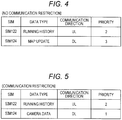
- Fig. 4 is a diagram illustrating a specific example of a case where the communication restriction is not performed.
- the data transmission of the data type "running history" is performed using the line on a side of the SIM 122, and the corresponding UL priority becomes "2".
- the data reception of the data type "map update” is performed using the line on a side of the SIM 124, and the corresponding DL priority becomes "3".
- the UL priority is higher than the DL priority, and the negative determination is made in the determination of Step 106 of Fig. 3 . Therefore, the uplink communication (data transmission operation) of Step 108 is not restricted.
- Fig. 5 is a diagram illustrating a specific example of a case where the communication restriction is performed.
- the data transmission of the data type "running history" is performed using the line on a side of the SIM 122, and the corresponding UL priority becomes "2".
- the data reception of the data type "camera data” is performed using the line on a side of the SIM 124, and the corresponding DL priority becomes "1".
- the DL priority is higher than the UL priority, and the positive determination is made in the determination of Step 106 of Fig. 3 . Therefore, the uplink communication (data transmission operation) of Step 108 is restricted.
- Fig. 6 is a diagram illustrating an outline of a communication operation of this embodiment when the communication restriction is not performed at the time of interference. It is assumed that the content of the transfer data is illustrated in Fig. 4 , 500 MB data of the data type "running history" is transmitted, and 1 GB data of the data type "map update" is received in parallel. In this case, even if the interference occurs, the communication restriction is not performed. Therefore, the more important data type "running history" (high priority) can be transmitted to be completed earlier.
- Fig. 7 is a diagram illustrating an outline of the communication operation of the related art when the communication restriction is performed at the time of interference. Similarly to the example illustrated in Fig. 6 , it is assumed that 500 MB data of the data type "running history" is transmitted, and 1 GB data of the data type "map update” is received in parallel. In the related art, if the interference is detected, the communication of the uplink side is restricted. Therefore, the data reception of the data type "map update" is processed with priority, and the data transmission of the more important data type "running history” is performed later.
- the communication volume of the data transmission is restricted in a case where the priority of the reception data is high. Therefore, in a case where the important data is transmitted, the restriction of the communication volume of the data transmission may be nullified, so that it is possible to prevent that the transmission of the important data is delayed.
- the data can be transmitted according to the importance and the priority without uniformly restricting the communication volume of the data transmission at the time of interference.
- the communication volume of the data transmission is restricted in order to release the difficult state. Therefore, even in a case where the priority of the transmission data is high, the concurrent data reception can be maintained.
- the interference occurrence condition set in advance when a combination of the transmission and reception states of data of two lines satisfies the interference occurrence condition set in advance, the interference occurrence is detected. Therefore, the interference can be detected easily without performing a complicate process and a detection operation.
- the functions of the DSDA are configured by one chip in many cases, and the antennas 112 and 114 are also closely disposed. Therefore, the interference occurs easily in a case where the transmission and the reception are performed using two lines at the same time. However, even in this case, the data of high importance can be transmitted with priority, and the delay of the transmission of the important data can be securely prevented.
- the communication volume of the data transmission is restricted by lowering the intensity (transmission power) of the signal output from the antenna, so that the caused interference can be eliminated.
- the data related to the emergency call performed by the TCU is included as data to be transmitted. Even in a case where the interference occurs, the data related to the more important emergency call can be sent with priority.
- the uplink communication restriction is not performed in a case where the UL priority is higher than the DL priority.
- the uplink communication restriction is performed in a case where the DL priority is higher than the UL priority.
- the communication which has a large total volume of communication and requires a communication time may be performed with priority. With this configuration, it is possible to shorten the communication time of the data having a large total volume of communication.
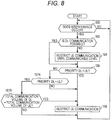
- Fig. 8 is a flowchart illustrating an operation procedure of a modification which additionally includes an operation in a case where the UL priority and the DL priority are equal.
- the operation procedure illustrated in Fig. 8 is different from the operation procedure illustrated in Fig. 3 in that the operations of Steps 107A and 107B are added next to Step 106. In the following, the description will be given focusing on these added Steps 107A and 107B.
- Step 106 the negative determination is made in the determination of Step 106.
- the priority comparison unit 154 determines whether the DL priority and the UL priority are equal (Step 107A). In a case where these priorities are not equal (a case where the UL priority is higher than the DL priority), the negative determination is made, and the process proceeds to Step 108 to restrict the uplink communication. In addition, in a case where the priorities are equal, the positive determination is made in the determination of Step 107A.
- the transmission restriction unit 156 determines whether the total volume of downlink communication of data reception is larger than the total volume of uplink communication of data transmission (Step 107B). In a case where the total volume of downlink communication is large, and a time required for data reception becomes long, the positive determination is made. In this case, the process proceeds to Step 108 to restrict the uplink communication. With this configuration, the interference can be eliminated, and the communication time required for data reception can be shortened. On the contrary, in a case where the total volume of uplink communication is large, and the time required for data transmission becomes long, the negative determination is made in the determination of Step 107B. In this case, the restriction of the uplink communication is not performed. With this configuration, the interference is not eliminated, but the communication time required for the data transmission can be shortened.
- Fig. 9 is a diagram illustrating a specific example in a case where the DL priority and the UL priority are equal, the total volume of uplink communication is large, and thus the communication restriction is not performed.
- the data reception of the data type "map update" is performed using the line on a side of the SIM 122, and the corresponding DL priority becomes "3".
- the data transmission of the data type "user data” is performed using the line on a side of the SIM 124, and the corresponding UL priority becomes "3".
- Step 108 the restriction of the uplink communication (data transmission operation) of Step 108 is not performed.
- the invention may be applied even to a case where the communication is performed without SIM as long as the transmission operation and the reception operation can be performed at the same time through two lines.
- the wireless communication device 100 has been described as the TCU mounted in the vehicle, but the invention is not limited thereto, and may be applied to a wireless communication device 100 other than the TCU.
- the communication volume of the data transmission is restricted in a case where the priority of the reception data is high. Therefore, in a case where the important data is transmitted, the restriction of the communication volume of the data transmission may be nullified, so that it is possible to prevent that the transmission of the important data is delayed.
Landscapes
- Engineering & Computer Science (AREA)
- Computer Networks & Wireless Communication (AREA)
- Signal Processing (AREA)
- Quality & Reliability (AREA)
- Physics & Mathematics (AREA)
- Electromagnetism (AREA)
- Mobile Radio Communication Systems (AREA)
Abstract
Description
- The present invention relates to a wireless communication device and a method which performs communication through a plurality of lines at the same time.
- Recently, wireless communication devices to be connected to two lines of mobile network corresponding to two subscriber identity modules (SIMs) are on the market for the connection to two mobile networks. Among them, a device which can communicate through two lines at the same time is called a dual SIM dual active (DSDA).
- In particular, in the case of the DSDA, a configuration is known which includes RF circuits for two lines which are closely disposed in one chip. Therefore, if an intensive output is transmitted through one line, and a weak input is received through the other line, a downlink throughput of the reception side is lowered due to interference. There has been known a technique that an uplink transmission power of the transmission side is reduced by detecting the interference in such a case so as to improve the downlink throughput (for example, see
JP 2016-511578 A - By the way, in the technique disclosed in
JP 2016-511578 A - The invention has been made in view of the above problem, and an object is to provide a wireless communication device and a method which can prevent the delaying in transmission of important data by adjusting communication restriction according to the importance of the transfer data.
- The invention relates to a wireless communication device and method according to the appended claims. Embodiments are disclosed in the dependent claims. According to an aspect of the invention, a wireless communication device of the invention includes two wireless communication units configured to transfer data, a communication priority storage unit configured to store priority information indicating priorities of transmission and reception of each data type to be transmitted,
a priority comparison unit configured to compare a priority of the data type of a transmission target with a priority of the data type of a reception target on the basis of the priority information in a case where data is transmitted by one wireless communication unit and data is received by the other wireless communication unit at the same time, and a transmission restriction unit configured to restrict a communication volume of data transmission in the one wireless communication unit when the priority comparison unit obtains a comparison result that the priority of the data type of the reception target is higher than the priority of the data type of the transmission target. - The communication volume of the data transmission is restricted in a case where the priority of the reception data is high. Therefore, in a case where the important data is transmitted, the restriction of the communication volume of the data transmission may be nullified, so that it is possible to prevent that the transmission of the important data is delayed.
- In addition, preferably there is provided an interference detection unit which detects whether interference occurs in a transferring operation of data of the above-described two wireless communication units. The transmission restriction unit may restrict the communication volume of data transmission when the interference detection unit detects that the interference occurs. With this configuration, the data can be transmitted according to the importance and the priority without uniformly restricting the communication volume of the data transmission at the time of interference.
- In addition, in a case where data reception of the other wireless communication unit is difficult due to the interference occurring in the transferring operation, the above-described transmission restriction unit may restrict the communication volume of data transmission in the one wireless communication unit to eliminate the difficult situation. With this configuration, even in a case where the priority of the transmission data is high, the data reception can be continuously performed at the same time.
- In addition, the interference detection unit may detect that the interference occurs when a combination of the transmission and reception states of data of the two wireless communication units satisfies an interference occurrence condition which is set in advance. With this configuration, it is possible to easily detect that the interference occurs without a complicate process or a complicate detection operation.
- In addition, a large total volume of communication may be performed with priority when the above-described priority comparison unit obtains a comparison result that the priority of the data type of the transmission target and the priority of the data of the reception target are equal. With this configuration, it is possible to shorten the communication time of the data having a large total volume of communication.
- In addition, the two wireless communication units may perform communication through two lines at the same time by a dual SIM dual active (DSDA). The functions of the DSDA are configured by one chip in many cases, and the antennas are also closely disposed. Therefore, the interference occurs easily in a case where the transmission and the reception are performed using two lines at the same time. However, even in this case, the data of high importance can be transmitted with priority, and the delay of the transmission of the important data can be securely prevented.
- In addition, the above-described transmission restriction unit may lower an intensity of a signal output from an antenna to restrict the communication volume of data transmission. With this configuration, it is possible to eliminate the caused interference.
- In addition, data transmitted by the wireless communication unit may be data related to an emergency call which is performed by a telematics control unit. With this configuration, even in a case where the interference occurs, it is possible to transmit data related to the important emergency call with priority.
- In addition, in another aspect a wireless communication method of the invention includes an interference detecting step of detecting, by an interference detection unit, whether interference occurs in a data transferring operation of the two wireless communication units which transfer data, a priority comparing step of comparing, by a priority comparison unit, a priority of a data type of a transmission target with a priority of a data type of a reception target in a case where data is transmitted by one wireless communication unit, data is received by the other wireless communication unit at the same time, and the interference detection unit detects that interference occurs, and a transmission restricting step of restricting, by a transmission restriction unit, a communication volume of data transmission in the one wireless communication unit when the priority comparison unit obtains a comparison result that the priority of the data type of the reception target is higher.
- At the time of interference, the communication volume of the data transmission is restricted in a case where the priority of the reception data is high. Therefore, in a case where the important data is transmitted, the restriction of the communication volume of the data transmission may be nullified, so that it is possible to prevent that the transmission of the important data is delayed.
-
Fig. 1 is a diagram illustrating a wireless communication device of an embodiment. -
Fig. 2 is a diagram illustrating an example of priority information which is stored in a communication priority storage unit. -
Fig. 3 is a flowchart illustrating an exemplary operation procedure of communication restriction at the time of interference. -
Fig. 4 is a diagram illustrating a specific example of a case where the communication restriction is not performed. -
Fig. 5 is a diagram illustrating a specific example of a case where the communication restriction is performed. -
Fig. 6 is a diagram illustrating an outline of a communication operation of this embodiment when the communication restriction is not performed at the time of interference. -
Fig. 7 is a diagram illustrating an outline of the communication operation of the related art when the communication restriction is performed at the time of interference. -
Fig. 8 is a flowchart illustrating an exemplary operation procedure of a modification which additionally includes an operation in a case where a UL priority and a DL priority are equal. -
Fig. 9 is a diagram illustrating a specific example of a case where the DL priority and the UL priority are equal, a total volume of uplink communication is large, and thus the communication restriction is not performed. - Hereinbelow, a wireless communication device of an embodiment to which the invention is applied will be described with reference to the drawings.
-
Fig. 1 is a diagram illustrating the wireless communication device of an embodiment. Awireless communication device 100 illustrated inFig. 1 is a telematics control unit (TCU) to be mounted in a vehicle, for example, and has a function of relaying data transfer in a wireless connection between other in-vehicle devices (navigation device, etc.) and an external server besides a function of making an emergency call in a wireless connection to a call center (not illustrated) when a user (a driver of the vehicle) meets with a trouble. - The
wireless communication device 100 includes anRF front end 110, a baseband processing unit 120, anaudio processing unit 130, an interface unit (I/F) 140, an application processing unit (AP processing unit) 150, and a communicationpriority storage unit 160. - The
RF front end 110 modulates a base band signal to a frequency band of a carrier wave and transmits the signal from an antenna, and also demodulates a signal of the frequency band of the carrier wave received by the antenna into the base band signal. In this embodiment, the communication can be performed at the same time using two lines, so that there are provided twoantennas RF front end 110. - The base
band processing unit 120 performs a data transferring process in conformity with a predetermined communication protocol. In this embodiment, there are included twobase band units SIMs - The
audio processing unit 130 is configured to perform a process related to audio signals. For example, theaudio processing unit 130 decodes audio data into an analog audio signal and outputs the signal from aspeaker 132, or encodes a user's voice collected by amicrophone 134 and converts the voice into digital audio data. - The
interface unit 140 inputs and outputs data with respect to other in-vehicle devices (for example, a head unit which includes an operation unit and a display unit, a navigation device, an in-vehicle camera, etc.). - The
application processing unit 150 is configured to control the entirewireless communication device 100, and is realized by executing a predetermined application program stored in a ROM or a RAM by a CPU. In theapplication processing unit 150, aninterference detection unit 152, apriority comparison unit 154, and atransmission restriction unit 156 are included. - In a case where two lines are used at the same time such that one line is for data transmission and the other line is for data reception, the
interference detection unit 152 detects whether there is interference in a data transferring operation in each of two lines. If a strong output (strong electric field) of transmission is performed by one line and a weak input (weak electric field) of reception is performed by the other line, a downlink throughput of the reception side is lowered by the interference. For example, information (interference occurrence condition) of a combination of a transfer frequency and a transfer electric field intensity at which the interference occurs is stored in a table. It is determined whether a combination of actual transmission and reception states corresponds to the interference occurrence condition which is set in advance and stored in the table, so that the interference occurrence can be detected. Further, other methods may be performed to detect the interference occurrence. - In a case where two lines are used at the same time such that one line is for data transmission and the other line is for data reception, the
priority comparison unit 154 compares a priority of a data type of a transmission target and a priority of a data type of a reception target on the basis of priority information stored in the communicationpriority storage unit 160. In the communicationpriority storage unit 160, the priority information is stored which indicates priorities of transmission and reception for each data type of the communication target. -
Fig. 2 is a diagram illustrating an example of the priority information which is stored in the communicationpriority storage unit 160. InFig. 2 , "UL" represents an uplink to perform the data transmission, and "DL" represents a downlink to perform the data reception. In addition, "emergency call" represents data to be transferred in the emergency call at the time of accident of the vehicle where thewireless communication device 100 is mounted, "running history" represents data to be transmitted after detecting a running state of the vehicle, "map update" represents data to be received to update map information which is used in a navigation process, "camera data" represents data to be received when a running lane tracking or an autonomous driving, and "user data" represents data related to an individual which is transmitted according to a user's command. - In the example illustrated in
Fig. 2 , an UL (uplink) priority and a DL (downlink) priority of the data type "emergency call" and a DL priority of "camera data" of the data type are highest, and are set to "1". In addition, the UL priority of the data type "running history" is set to the next highest value "2". In addition, the DL priority of the data type "map update" and the UL priority of the data type "user data" are set to the lowest value "3". Further, the specific example is given in order to help with understanding on the explanation. The data types and the values (order) of the UL priority and the DL priority may be arbitrarily set at the time of manufacturing a product. - The
transmission restriction unit 156 restricts a communication volume of the data transmission when a comparison result showing that the priority of the data type of the reception target is determined high by thepriority comparison unit 154. - The above-described RF
front end 110, theantennas band processing unit 120, and theSIMs priority storage unit 160 to the communication priority storage unit, thepriority comparison unit 154 to the priority comparison unit, thetransmission restriction unit 156 to the transmission restriction unit, and theinterference detection unit 152 to the interference detection unit, respectively. - The
wireless communication device 100 of this embodiment is configured as described above. Next, communication restriction at the time of interference will be described. -
Fig. 3 is a flowchart illustrating an operation procedure which performs the communication restriction at the time of interference. Theinterference detection unit 152 determines whether the interference occurring between two lines is detected (Step 100). If any one of thebase band units Step 100, and the determination is repeatedly performed. - In addition, if the interference is detected, the positive determination is made in the determination of
Step 100. Next, thetransmission restriction unit 156 determines whether a downlink communication (data reception operation) is possible in the reception side where the interference occurs (Step 102). In a case where the degree of interference is large and the data reception is difficult, the negative determination is made. In this case, thetransmission restriction unit 156 restricts the uplink communication (data transmission operation) until the reception side becomes a communicable level (a level where an expected lowest communication volume of data can be maintained) (Step 104). For example, thetransmission restriction unit 156 sends a command to the RFfront end 110 to lower a signal intensity (transmission power) output from the antenna 112 (or 114) until the reception side becomes the communicable level. - In addition, in a case where the downlink communication is possible on the reception side without performing the communication restriction, the positive determination is performed in
Step 102. Next, alternatively, in a case where the communication restriction is required, thepriority comparison unit 154 compares the priority (DL priority) of the data type in the data reception through one line and the priority (UL priority) of the data type in the data transmission through the other line after the uplink communication inStep 104 is restricted, and determines whether the DL priority is higher than the UL priority (Step 106). In other words, it is determined whether the data of the reception target is more important than the data of the transmission target and to be processed with priority. In a case where the DL priority is higher than the UL priority (a case where the data of the reception target is more important), the positive determination is performed. In this case, thetransmission restriction unit 156 restricts the uplink communication (data transmission operation) (Step 108). For example, similarly to the communication restriction ofStep 104, thetransmission restriction unit 156 sends a command to the RFfront end 110 to lower the signal intensity (transmission power) which is output from the antenna. Thereafter, the process returns to Step 100, and the determination on whether the interference occurs is repeatedly performed. - In addition, in a case where the UL priority is higher than the DL priority (a case where the data of the transmission target is more important), the negative determination is made in the determination of
Step 106. In this case, the process returns to Step 100 without performing the communication restriction ofStep 108, the determination on whether the interference occurs is repeatedly performed. -
Fig. 4 is a diagram illustrating a specific example of a case where the communication restriction is not performed. In this example, the data transmission of the data type "running history" is performed using the line on a side of theSIM 122, and the corresponding UL priority becomes "2". In addition, the data reception of the data type "map update" is performed using the line on a side of theSIM 124, and the corresponding DL priority becomes "3". In such a case, the UL priority is higher than the DL priority, and the negative determination is made in the determination ofStep 106 ofFig. 3 . Therefore, the uplink communication (data transmission operation) ofStep 108 is not restricted. -
Fig. 5 is a diagram illustrating a specific example of a case where the communication restriction is performed. In this example, the data transmission of the data type "running history" is performed using the line on a side of theSIM 122, and the corresponding UL priority becomes "2". In addition, the data reception of the data type "camera data" is performed using the line on a side of theSIM 124, and the corresponding DL priority becomes "1". In such a case, the DL priority is higher than the UL priority, and the positive determination is made in the determination ofStep 106 ofFig. 3 . Therefore, the uplink communication (data transmission operation) ofStep 108 is restricted. -
Fig. 6 is a diagram illustrating an outline of a communication operation of this embodiment when the communication restriction is not performed at the time of interference. It is assumed that the content of the transfer data is illustrated inFig. 4 , 500 MB data of the data type "running history" is transmitted, and 1 GB data of the data type "map update" is received in parallel. In this case, even if the interference occurs, the communication restriction is not performed. Therefore, the more important data type "running history" (high priority) can be transmitted to be completed earlier. -
Fig. 7 is a diagram illustrating an outline of the communication operation of the related art when the communication restriction is performed at the time of interference. Similarly to the example illustrated inFig. 6 , it is assumed that 500 MB data of the data type "running history" is transmitted, and 1 GB data of the data type "map update" is received in parallel. In the related art, if the interference is detected, the communication of the uplink side is restricted. Therefore, the data reception of the data type "map update" is processed with priority, and the data transmission of the more important data type "running history" is performed later. - In this way, in the
wireless communication device 100 of this embodiment, the communication volume of the data transmission is restricted in a case where the priority of the reception data is high. Therefore, in a case where the important data is transmitted, the restriction of the communication volume of the data transmission may be nullified, so that it is possible to prevent that the transmission of the important data is delayed. In addition, the data can be transmitted according to the importance and the priority without uniformly restricting the communication volume of the data transmission at the time of interference. - In addition, in a case where the data reception is difficult as the interference occurs in the transfer operation, the communication volume of the data transmission is restricted in order to release the difficult state. Therefore, even in a case where the priority of the transmission data is high, the concurrent data reception can be maintained.
- In addition, when a combination of the transmission and reception states of data of two lines satisfies the interference occurrence condition set in advance, the interference occurrence is detected. Therefore, the interference can be detected easily without performing a complicate process and a detection operation.
- In addition, the functions of the DSDA are configured by one chip in many cases, and the
antennas - In addition, the communication volume of the data transmission is restricted by lowering the intensity (transmission power) of the signal output from the antenna, so that the caused interference can be eliminated.
- In addition, the data related to the emergency call performed by the TCU is included as data to be transmitted. Even in a case where the interference occurs, the data related to the more important emergency call can be sent with priority.
- Further, the invention is not limited to the above embodiment, and various modifications can be made within a scope of the spirit of the invention. For example, in the above embodiment, the uplink communication restriction is not performed in a case where the UL priority is higher than the DL priority. On the contrary, in a case where the DL priority is higher than the UL priority, the uplink communication restriction is performed. However, in a case where the UL priority and the DL priority are equal, the communication which has a large total volume of communication and requires a communication time may be performed with priority. With this configuration, it is possible to shorten the communication time of the data having a large total volume of communication.
-
Fig. 8 is a flowchart illustrating an operation procedure of a modification which additionally includes an operation in a case where the UL priority and the DL priority are equal. The operation procedure illustrated inFig. 8 is different from the operation procedure illustrated inFig. 3 in that the operations ofSteps Steps - In a case where the DL priority is not higher than the UL priority, the negative determination is made in the determination of
Step 106. Next, thepriority comparison unit 154 determines whether the DL priority and the UL priority are equal (Step 107A). In a case where these priorities are not equal (a case where the UL priority is higher than the DL priority), the negative determination is made, and the process proceeds to Step 108 to restrict the uplink communication. In addition, in a case where the priorities are equal, the positive determination is made in the determination ofStep 107A. - Next, the
transmission restriction unit 156 determines whether the total volume of downlink communication of data reception is larger than the total volume of uplink communication of data transmission (Step 107B). In a case where the total volume of downlink communication is large, and a time required for data reception becomes long, the positive determination is made. In this case, the process proceeds to Step 108 to restrict the uplink communication. With this configuration, the interference can be eliminated, and the communication time required for data reception can be shortened. On the contrary, in a case where the total volume of uplink communication is large, and the time required for data transmission becomes long, the negative determination is made in the determination ofStep 107B. In this case, the restriction of the uplink communication is not performed. With this configuration, the interference is not eliminated, but the communication time required for the data transmission can be shortened. -
Fig. 9 is a diagram illustrating a specific example in a case where the DL priority and the UL priority are equal, the total volume of uplink communication is large, and thus the communication restriction is not performed. In this example, the data reception of the data type "map update" is performed using the line on a side of theSIM 122, and the corresponding DL priority becomes "3". In addition, the data transmission of the data type "user data" is performed using the line on a side of theSIM 124, and the corresponding UL priority becomes "3". In such a case, the UL priority and the DL priority are equal, the total volume "500 MB" of uplink communication of the data transmission is larger than the total volume "1 MB" of downlink communication of the data reception, and the negative determination is made in the determination ofStep 107B ofFig. 8 . Therefore the restriction of the uplink communication (data transmission operation) ofStep 108 is not performed. - In addition, in the above embodiment, the description has been given about the case of the DSDA using two SIMs. However, the invention may be applied even to a case where the communication is performed without SIM as long as the transmission operation and the reception operation can be performed at the same time through two lines.
- In addition, in the above embodiment, the
wireless communication device 100 has been described as the TCU mounted in the vehicle, but the invention is not limited thereto, and may be applied to awireless communication device 100 other than the TCU. - As described above, according to the invention, the communication volume of the data transmission is restricted in a case where the priority of the reception data is high. Therefore, in a case where the important data is transmitted, the restriction of the communication volume of the data transmission may be nullified, so that it is possible to prevent that the transmission of the important data is delayed.
-
- 100
- Wireless communication device
- 110
- RF front end
- 112, 114
- Antenna
- 120
- Base band processing unit
- 122, 124
- SIM
- 126, 128
- Base band unit
- 130
- Audio processing unit
- 140
- Interface unit (I/F)
- 150
- Application processing unit (AP processing unit)
- 152
- Interference detection unit
- 154
- Priority comparison unit
- 156
- Transmission restriction unit
- 160
- Communication priority storage unit
Claims (9)
- A wireless communication device (100) which includes two wireless communication units configured to transfer data, comprising:a communication priority storage unit (160) configured to store priority information indicating priorities of transmission and reception of each data type to be transmitted;a priority comparison unit (154) configured to compare a priority of the data type of a transmission target with a priority of the data type of a reception target on a basis of the priority information in a case where data is transmitted by one wireless communication unit and data is received by another wireless communication unit at the same time; anda transmission restriction unit (156) configured to restrict a communication volume of data transmission in the one wireless communication unit when the priority comparison unit (154) obtains a comparison result that the priority of the data type of the reception target is higher than the priority of the data type of the transmission target.
- The wireless communication device (100) according to claim 1, characterized by further comprising:an interference detection unit (152) configured to detect whether interference occurs in a transferring operation of data of the two wireless communication units,wherein the transmission restriction unit (156) restricts the communication volume of data transmission when the interference detection unit (152) detects that the interference occurs.
- The wireless communication device (100) according to claim 2, characterized in that
in a case where data reception of the other wireless communication unit is difficult due to the interference occurring in the transferring operation, the transmission restriction unit (156) restricts the communication volume of data transmission in the one wireless communication unit to eliminate the difficult situation. - The wireless communication device (100) according to claim 2 or 3, characterized in that
the interference detection unit (152) is configured to detect that the interference occurs when a combination of transmission and reception states of data of the two wireless communication units satisfies an interference occurrence condition which is set in advance. - The wireless communication device (100) according to any one of claims 1 to 4, characterized in that
a large total volume of communication is performed with priority when the priority comparison unit (154) obtains a comparison result that the priority of the data type of the transmission target is equal to the priority of the data type of the reception target. - The wireless communication device (100) according to any one of claims 1 to 5, characterized in that
the two wireless communication units are configured to perform communication through two lines at the same time by a dual SIM dual active (DSDA). - The wireless communication device (100) according to any one of claims 1 to 6, characterized in that
the transmission restriction unit (156) is configured to lower an intensity of a signal output from an antenna to restrict the communication volume of data transmission. - The wireless communication device (100) according to any one of claims 1 to 7, characterized in that
data transmitted by the wireless communication unit is data related to an emergency call which is performed by a telematics control unit. - A wireless communication method of a wireless communication device (100) which includes two wireless communication units configured to transfer data, characterized by comprising:an interference detecting step of detecting, by an interference detection unit (152), whether interference occurs in a data transferring operation of the two wireless communication units;a priority comparing step of comparing, by a priority comparison unit (154), a priority of a data type of a transmission target with a priority of a data type of a reception target in a case where data is transmitted by one wireless communication unit, data is received by the other wireless communication unit at the same time, and the interference detection unit (152) detects that interference occurs; anda transmission restricting step of restricting, by a transmission restriction unit (156), a communication volume of data transmission in the one wireless communication unit when the priority comparison unit (154) obtains a comparison result that the priority of the data type of the reception target is higher than the priority of the data type of the transmission target.
Applications Claiming Priority (1)
| Application Number | Priority Date | Filing Date | Title |
|---|---|---|---|
| JP2018171519A JP2020043536A (en) | 2018-09-13 | 2018-09-13 | Radio communication device, method and program |
Publications (2)
| Publication Number | Publication Date |
|---|---|
| EP3624548A1 true EP3624548A1 (en) | 2020-03-18 |
| EP3624548B1 EP3624548B1 (en) | 2022-03-30 |
Family
ID=67988864
Family Applications (1)
| Application Number | Title | Priority Date | Filing Date |
|---|---|---|---|
| EP19197016.9A Not-in-force EP3624548B1 (en) | 2018-09-13 | 2019-09-12 | Wireless communication device and method |
Country Status (4)
| Country | Link |
|---|---|
| US (1) | US10959249B2 (en) |
| EP (1) | EP3624548B1 (en) |
| JP (1) | JP2020043536A (en) |
| CN (1) | CN110896551B (en) |
Families Citing this family (3)
| Publication number | Priority date | Publication date | Assignee | Title |
|---|---|---|---|---|
| US12143882B2 (en) * | 2021-09-09 | 2024-11-12 | Qualcomm Incorporated | Intelligent transmission selection for enhancing uplink performance |
| WO2024000144A1 (en) * | 2022-06-28 | 2024-01-04 | Qualcomm Incorporated | Full concurrency reception in co-band dual subscriber identification module dual active mode |
| WO2025221131A1 (en) * | 2024-04-18 | 2025-10-23 | 삼성전자 주식회사 | Electronic device supporting plurality of subscriber identity modules, operating method thereof, and storage medium |
Citations (2)
| Publication number | Priority date | Publication date | Assignee | Title |
|---|---|---|---|---|
| US20150071088A1 (en) * | 2013-09-06 | 2015-03-12 | Qualcomm Incorporated | Pipelining Registration and Conflict Detection in Dual-SIM-Dual-Active Communication Device Coexistence |
| JP2016511578A (en) | 2013-01-31 | 2016-04-14 | クアルコム,インコーポレイテッド | Robust receive (Rx) processing method for radio frequency coexistence management in dual-SIM-dual-active communication devices |
Family Cites Families (11)
| Publication number | Priority date | Publication date | Assignee | Title |
|---|---|---|---|---|
| CN100574485C (en) * | 2007-12-13 | 2009-12-23 | 展讯通信(上海)有限公司 | A method for solving service conflicts of dual-card dual-standby mobile phones |
| JP5265453B2 (en) * | 2009-06-01 | 2013-08-14 | 三菱電機ビルテクノサービス株式会社 | Wireless LAN communication system |
| US9026125B2 (en) * | 2013-01-16 | 2015-05-05 | Qualcomm Incorporated | System and methods for mitigating receiver desense caused by simultaneous transmission on multi-SIM wireless communications devices |
| EP2947856B1 (en) * | 2013-01-17 | 2018-11-07 | Clarion Co., Ltd. | Telematics controller and telematics control method |
| US20150031408A1 (en) * | 2013-07-25 | 2015-01-29 | Qualcomm Incorporated | System and Methods for Controlling Transmit Power on Multi-SIM Devices in Compliance with Specific Absorption Rate Limits |
| US9307512B2 (en) * | 2014-04-07 | 2016-04-05 | Qualcomm Incorporated | Systems and methods for optimizing network registration for all SIMs of a multi-SIM device using criticality-based prioritization schemes |
| US9167588B1 (en) * | 2014-04-15 | 2015-10-20 | Qualcomm Incorporated | Enhanced mobile standby performance during simultaneous dual-technology communication by avoiding interference scenarios |
| US9461685B2 (en) * | 2014-10-19 | 2016-10-04 | Intel IP Corporation | Controlling subscriber identity module (SIM) active state in a multiple SIMs radio |
| US9848354B2 (en) * | 2015-09-23 | 2017-12-19 | Qualcomm Incorporated | Systems and methods for uplink activity management |
| CN105554884A (en) * | 2015-12-10 | 2016-05-04 | 小米科技有限责任公司 | Method and device for paging response |
| CN105472760B (en) * | 2016-01-29 | 2018-10-09 | 深圳市桑达无线通讯技术有限公司 | A kind of double card bilateral method of calling and GSM-R double card bilateral mobile phones for GSM-R |
-
2018
- 2018-09-13 JP JP2018171519A patent/JP2020043536A/en active Pending
-
2019
- 2019-09-10 US US16/566,177 patent/US10959249B2/en not_active Expired - Fee Related
- 2019-09-12 EP EP19197016.9A patent/EP3624548B1/en not_active Not-in-force
- 2019-09-12 CN CN201910861664.XA patent/CN110896551B/en active Active
Patent Citations (2)
| Publication number | Priority date | Publication date | Assignee | Title |
|---|---|---|---|---|
| JP2016511578A (en) | 2013-01-31 | 2016-04-14 | クアルコム,インコーポレイテッド | Robust receive (Rx) processing method for radio frequency coexistence management in dual-SIM-dual-active communication devices |
| US20150071088A1 (en) * | 2013-09-06 | 2015-03-12 | Qualcomm Incorporated | Pipelining Registration and Conflict Detection in Dual-SIM-Dual-Active Communication Device Coexistence |
Also Published As
| Publication number | Publication date |
|---|---|
| US10959249B2 (en) | 2021-03-23 |
| US20200092898A1 (en) | 2020-03-19 |
| CN110896551B (en) | 2023-10-13 |
| JP2020043536A (en) | 2020-03-19 |
| CN110896551A (en) | 2020-03-20 |
| EP3624548B1 (en) | 2022-03-30 |
Similar Documents
| Publication | Publication Date | Title |
|---|---|---|
| US11777535B2 (en) | Radio frequency circuit and terminal device | |
| US11641614B2 (en) | Data transmission method, terminal device and network device | |
| US11201651B2 (en) | Electronic apparatus and server in wireless communication system, and wireless communication method | |
| EP3624548A1 (en) | Wireless communication device and method | |
| WO2004008794A3 (en) | Cellular communications systems | |
| US10321508B2 (en) | Establishing short range wireless communication between a vehicle and a mobile device | |
| US10887914B2 (en) | Electronic device, information processing apparatus, and information processing method | |
| US20170070976A1 (en) | Portable terminal and control method for portable terminal | |
| US11412491B2 (en) | Communication control device, communication control method, and terminal device | |
| US20160345276A1 (en) | Methods and electronic devices for controlling transmission power | |
| US20220124630A1 (en) | Method and device for activating or updating pusch pathloss rs | |
| KR20230125315A (en) | BEAM INDICATIONMETHOD AND APPARATUS, AND COMMUNICATION DEVICE | |
| US11632811B2 (en) | Extended narrowband internet-of-things (NB-IoT) carrier-based IAB coverage | |
| JP2016163232A (en) | Radio base station device, baseband unit, and base station system | |
| WO2023082276A1 (en) | Beam capability reporting method and apparatus, device, and storage medium | |
| EP3203672A1 (en) | Tm9-based carrier aggregation method and device | |
| US11310794B2 (en) | Data transmission method in internet of vehicles and terminal | |
| EP4376319A2 (en) | Enhanced beam selection for nr sidelink communication in fr2 | |
| US10638425B2 (en) | Adaptive out of service scan for modem power optimization in a wireless communication system | |
| WO2019029017A1 (en) | Method, user equipment, base station, and device with storage function for communication | |
| US9853710B2 (en) | Relay apparatus specifying frequency offset based on connection history and method thereof | |
| WO2022001667A1 (en) | Antenna determination method and apparatus, terminal, electronic device, and storage medium | |
| WO2023287226A3 (en) | Method and device for transmitting or receiving channel state information in wireless communication system | |
| US20220124837A1 (en) | Extended frequency division duplex (fdd) carrier-based iab coverage | |
| US10721694B2 (en) | Methods and electronic devices for controlling transmission power |
Legal Events
| Date | Code | Title | Description |
|---|---|---|---|
| PUAI | Public reference made under article 153(3) epc to a published international application that has entered the european phase |
Free format text: ORIGINAL CODE: 0009012 |
|
| STAA | Information on the status of an ep patent application or granted ep patent |
Free format text: STATUS: THE APPLICATION HAS BEEN PUBLISHED |
|
| AK | Designated contracting states |
Kind code of ref document: A1 Designated state(s): AL AT BE BG CH CY CZ DE DK EE ES FI FR GB GR HR HU IE IS IT LI LT LU LV MC MK MT NL NO PL PT RO RS SE SI SK SM TR |
|
| AX | Request for extension of the european patent |
Extension state: BA ME |
|
| STAA | Information on the status of an ep patent application or granted ep patent |
Free format text: STATUS: REQUEST FOR EXAMINATION WAS MADE |
|
| 17P | Request for examination filed |
Effective date: 20200721 |
|
| RBV | Designated contracting states (corrected) |
Designated state(s): AL AT BE BG CH CY CZ DE DK EE ES FI FR GB GR HR HU IE IS IT LI LT LU LV MC MK MT NL NO PL PT RO RS SE SI SK SM TR |
|
| GRAP | Despatch of communication of intention to grant a patent |
Free format text: ORIGINAL CODE: EPIDOSNIGR1 |
|
| RIC1 | Information provided on ipc code assigned before grant |
Ipc: H04W 72/12 20090101ALN20210923BHEP Ipc: H04W 8/18 20090101ALN20210923BHEP Ipc: H04W 88/06 20090101ALN20210923BHEP Ipc: H04W 16/14 20090101ALN20210923BHEP Ipc: H04W 76/15 20180101AFI20210923BHEP |
|
| STAA | Information on the status of an ep patent application or granted ep patent |
Free format text: STATUS: GRANT OF PATENT IS INTENDED |
|
| INTG | Intention to grant announced |
Effective date: 20211028 |
|
| GRAS | Grant fee paid |
Free format text: ORIGINAL CODE: EPIDOSNIGR3 |
|
| GRAA | (expected) grant |
Free format text: ORIGINAL CODE: 0009210 |
|
| STAA | Information on the status of an ep patent application or granted ep patent |
Free format text: STATUS: THE PATENT HAS BEEN GRANTED |
|
| AK | Designated contracting states |
Kind code of ref document: B1 Designated state(s): AL AT BE BG CH CY CZ DE DK EE ES FI FR GB GR HR HU IE IS IT LI LT LU LV MC MK MT NL NO PL PT RO RS SE SI SK SM TR |
|
| REG | Reference to a national code |
Ref country code: GB Ref legal event code: FG4D |
|
| REG | Reference to a national code |
Ref country code: CH Ref legal event code: EP |
|
| REG | Reference to a national code |
Ref country code: AT Ref legal event code: REF Ref document number: 1480371 Country of ref document: AT Kind code of ref document: T Effective date: 20220415 |
|
| REG | Reference to a national code |
Ref country code: DE Ref legal event code: R096 Ref document number: 602019013002 Country of ref document: DE |
|
| REG | Reference to a national code |
Ref country code: IE Ref legal event code: FG4D |
|
| REG | Reference to a national code |
Ref country code: LT Ref legal event code: MG9D |
|
| PG25 | Lapsed in a contracting state [announced via postgrant information from national office to epo] |
Ref country code: SE Free format text: LAPSE BECAUSE OF FAILURE TO SUBMIT A TRANSLATION OF THE DESCRIPTION OR TO PAY THE FEE WITHIN THE PRESCRIBED TIME-LIMIT Effective date: 20220330 Ref country code: RS Free format text: LAPSE BECAUSE OF FAILURE TO SUBMIT A TRANSLATION OF THE DESCRIPTION OR TO PAY THE FEE WITHIN THE PRESCRIBED TIME-LIMIT Effective date: 20220330 Ref country code: NO Free format text: LAPSE BECAUSE OF FAILURE TO SUBMIT A TRANSLATION OF THE DESCRIPTION OR TO PAY THE FEE WITHIN THE PRESCRIBED TIME-LIMIT Effective date: 20220630 Ref country code: LT Free format text: LAPSE BECAUSE OF FAILURE TO SUBMIT A TRANSLATION OF THE DESCRIPTION OR TO PAY THE FEE WITHIN THE PRESCRIBED TIME-LIMIT Effective date: 20220330 Ref country code: HR Free format text: LAPSE BECAUSE OF FAILURE TO SUBMIT A TRANSLATION OF THE DESCRIPTION OR TO PAY THE FEE WITHIN THE PRESCRIBED TIME-LIMIT Effective date: 20220330 Ref country code: BG Free format text: LAPSE BECAUSE OF FAILURE TO SUBMIT A TRANSLATION OF THE DESCRIPTION OR TO PAY THE FEE WITHIN THE PRESCRIBED TIME-LIMIT Effective date: 20220630 |
|
| REG | Reference to a national code |
Ref country code: NL Ref legal event code: MP Effective date: 20220330 |
|
| REG | Reference to a national code |
Ref country code: AT Ref legal event code: MK05 Ref document number: 1480371 Country of ref document: AT Kind code of ref document: T Effective date: 20220330 |
|
| PG25 | Lapsed in a contracting state [announced via postgrant information from national office to epo] |
Ref country code: LV Free format text: LAPSE BECAUSE OF FAILURE TO SUBMIT A TRANSLATION OF THE DESCRIPTION OR TO PAY THE FEE WITHIN THE PRESCRIBED TIME-LIMIT Effective date: 20220330 Ref country code: GR Free format text: LAPSE BECAUSE OF FAILURE TO SUBMIT A TRANSLATION OF THE DESCRIPTION OR TO PAY THE FEE WITHIN THE PRESCRIBED TIME-LIMIT Effective date: 20220701 Ref country code: FI Free format text: LAPSE BECAUSE OF FAILURE TO SUBMIT A TRANSLATION OF THE DESCRIPTION OR TO PAY THE FEE WITHIN THE PRESCRIBED TIME-LIMIT Effective date: 20220330 |
|
| PG25 | Lapsed in a contracting state [announced via postgrant information from national office to epo] |
Ref country code: NL Free format text: LAPSE BECAUSE OF FAILURE TO SUBMIT A TRANSLATION OF THE DESCRIPTION OR TO PAY THE FEE WITHIN THE PRESCRIBED TIME-LIMIT Effective date: 20220330 |
|
| PG25 | Lapsed in a contracting state [announced via postgrant information from national office to epo] |
Ref country code: SM Free format text: LAPSE BECAUSE OF FAILURE TO SUBMIT A TRANSLATION OF THE DESCRIPTION OR TO PAY THE FEE WITHIN THE PRESCRIBED TIME-LIMIT Effective date: 20220330 Ref country code: SK Free format text: LAPSE BECAUSE OF FAILURE TO SUBMIT A TRANSLATION OF THE DESCRIPTION OR TO PAY THE FEE WITHIN THE PRESCRIBED TIME-LIMIT Effective date: 20220330 Ref country code: RO Free format text: LAPSE BECAUSE OF FAILURE TO SUBMIT A TRANSLATION OF THE DESCRIPTION OR TO PAY THE FEE WITHIN THE PRESCRIBED TIME-LIMIT Effective date: 20220330 Ref country code: PT Free format text: LAPSE BECAUSE OF FAILURE TO SUBMIT A TRANSLATION OF THE DESCRIPTION OR TO PAY THE FEE WITHIN THE PRESCRIBED TIME-LIMIT Effective date: 20220801 Ref country code: ES Free format text: LAPSE BECAUSE OF FAILURE TO SUBMIT A TRANSLATION OF THE DESCRIPTION OR TO PAY THE FEE WITHIN THE PRESCRIBED TIME-LIMIT Effective date: 20220330 Ref country code: EE Free format text: LAPSE BECAUSE OF FAILURE TO SUBMIT A TRANSLATION OF THE DESCRIPTION OR TO PAY THE FEE WITHIN THE PRESCRIBED TIME-LIMIT Effective date: 20220330 Ref country code: CZ Free format text: LAPSE BECAUSE OF FAILURE TO SUBMIT A TRANSLATION OF THE DESCRIPTION OR TO PAY THE FEE WITHIN THE PRESCRIBED TIME-LIMIT Effective date: 20220330 Ref country code: AT Free format text: LAPSE BECAUSE OF FAILURE TO SUBMIT A TRANSLATION OF THE DESCRIPTION OR TO PAY THE FEE WITHIN THE PRESCRIBED TIME-LIMIT Effective date: 20220330 |
|
| PG25 | Lapsed in a contracting state [announced via postgrant information from national office to epo] |
Ref country code: PL Free format text: LAPSE BECAUSE OF FAILURE TO SUBMIT A TRANSLATION OF THE DESCRIPTION OR TO PAY THE FEE WITHIN THE PRESCRIBED TIME-LIMIT Effective date: 20220330 Ref country code: IS Free format text: LAPSE BECAUSE OF FAILURE TO SUBMIT A TRANSLATION OF THE DESCRIPTION OR TO PAY THE FEE WITHIN THE PRESCRIBED TIME-LIMIT Effective date: 20220730 Ref country code: AL Free format text: LAPSE BECAUSE OF FAILURE TO SUBMIT A TRANSLATION OF THE DESCRIPTION OR TO PAY THE FEE WITHIN THE PRESCRIBED TIME-LIMIT Effective date: 20220330 |
|
| REG | Reference to a national code |
Ref country code: DE Ref legal event code: R097 Ref document number: 602019013002 Country of ref document: DE |
|
| PG25 | Lapsed in a contracting state [announced via postgrant information from national office to epo] |
Ref country code: DK Free format text: LAPSE BECAUSE OF FAILURE TO SUBMIT A TRANSLATION OF THE DESCRIPTION OR TO PAY THE FEE WITHIN THE PRESCRIBED TIME-LIMIT Effective date: 20220330 |
|
| PLBE | No opposition filed within time limit |
Free format text: ORIGINAL CODE: 0009261 |
|
| STAA | Information on the status of an ep patent application or granted ep patent |
Free format text: STATUS: NO OPPOSITION FILED WITHIN TIME LIMIT |
|
| 26N | No opposition filed |
Effective date: 20230103 |
|
| PG25 | Lapsed in a contracting state [announced via postgrant information from national office to epo] |
Ref country code: MC Free format text: LAPSE BECAUSE OF FAILURE TO SUBMIT A TRANSLATION OF THE DESCRIPTION OR TO PAY THE FEE WITHIN THE PRESCRIBED TIME-LIMIT Effective date: 20220330 |
|
| REG | Reference to a national code |
Ref country code: CH Ref legal event code: PL |
|
| REG | Reference to a national code |
Ref country code: BE Ref legal event code: MM Effective date: 20220930 |
|
| PG25 | Lapsed in a contracting state [announced via postgrant information from national office to epo] |
Ref country code: SI Free format text: LAPSE BECAUSE OF FAILURE TO SUBMIT A TRANSLATION OF THE DESCRIPTION OR TO PAY THE FEE WITHIN THE PRESCRIBED TIME-LIMIT Effective date: 20220330 |
|
| PG25 | Lapsed in a contracting state [announced via postgrant information from national office to epo] |
Ref country code: LU Free format text: LAPSE BECAUSE OF NON-PAYMENT OF DUE FEES Effective date: 20220912 |
|
| PG25 | Lapsed in a contracting state [announced via postgrant information from national office to epo] |
Ref country code: LI Free format text: LAPSE BECAUSE OF NON-PAYMENT OF DUE FEES Effective date: 20220930 Ref country code: IT Free format text: LAPSE BECAUSE OF FAILURE TO SUBMIT A TRANSLATION OF THE DESCRIPTION OR TO PAY THE FEE WITHIN THE PRESCRIBED TIME-LIMIT Effective date: 20220330 Ref country code: IE Free format text: LAPSE BECAUSE OF NON-PAYMENT OF DUE FEES Effective date: 20220912 Ref country code: CH Free format text: LAPSE BECAUSE OF NON-PAYMENT OF DUE FEES Effective date: 20220930 |
|
| PG25 | Lapsed in a contracting state [announced via postgrant information from national office to epo] |
Ref country code: BE Free format text: LAPSE BECAUSE OF NON-PAYMENT OF DUE FEES Effective date: 20220930 |
|
| PGFP | Annual fee paid to national office [announced via postgrant information from national office to epo] |
Ref country code: GB Payment date: 20230920 Year of fee payment: 5 |
|
| PGFP | Annual fee paid to national office [announced via postgrant information from national office to epo] |
Ref country code: FR Payment date: 20230928 Year of fee payment: 5 Ref country code: DE Payment date: 20230920 Year of fee payment: 5 |
|
| PG25 | Lapsed in a contracting state [announced via postgrant information from national office to epo] |
Ref country code: HU Free format text: LAPSE BECAUSE OF FAILURE TO SUBMIT A TRANSLATION OF THE DESCRIPTION OR TO PAY THE FEE WITHIN THE PRESCRIBED TIME-LIMIT; INVALID AB INITIO Effective date: 20190912 |
|
| PG25 | Lapsed in a contracting state [announced via postgrant information from national office to epo] |
Ref country code: CY Free format text: LAPSE BECAUSE OF FAILURE TO SUBMIT A TRANSLATION OF THE DESCRIPTION OR TO PAY THE FEE WITHIN THE PRESCRIBED TIME-LIMIT Effective date: 20220330 |
|
| PG25 | Lapsed in a contracting state [announced via postgrant information from national office to epo] |
Ref country code: MK Free format text: LAPSE BECAUSE OF FAILURE TO SUBMIT A TRANSLATION OF THE DESCRIPTION OR TO PAY THE FEE WITHIN THE PRESCRIBED TIME-LIMIT Effective date: 20220330 |
|
| PG25 | Lapsed in a contracting state [announced via postgrant information from national office to epo] |
Ref country code: TR Free format text: LAPSE BECAUSE OF FAILURE TO SUBMIT A TRANSLATION OF THE DESCRIPTION OR TO PAY THE FEE WITHIN THE PRESCRIBED TIME-LIMIT Effective date: 20220330 |
|
| PG25 | Lapsed in a contracting state [announced via postgrant information from national office to epo] |
Ref country code: MT Free format text: LAPSE BECAUSE OF FAILURE TO SUBMIT A TRANSLATION OF THE DESCRIPTION OR TO PAY THE FEE WITHIN THE PRESCRIBED TIME-LIMIT Effective date: 20220330 |
|
| REG | Reference to a national code |
Ref country code: DE Ref legal event code: R119 Ref document number: 602019013002 Country of ref document: DE |
|
| GBPC | Gb: european patent ceased through non-payment of renewal fee |
Effective date: 20240912 |
|
| PG25 | Lapsed in a contracting state [announced via postgrant information from national office to epo] |
Ref country code: DE Free format text: LAPSE BECAUSE OF NON-PAYMENT OF DUE FEES Effective date: 20250401 |
|
| PG25 | Lapsed in a contracting state [announced via postgrant information from national office to epo] |
Ref country code: GB Free format text: LAPSE BECAUSE OF NON-PAYMENT OF DUE FEES Effective date: 20240912 |
|
| PG25 | Lapsed in a contracting state [announced via postgrant information from national office to epo] |
Ref country code: FR Free format text: LAPSE BECAUSE OF NON-PAYMENT OF DUE FEES Effective date: 20240930 |