EP3624346A1 - Ogm compression circuit, ogm compression/decompression system, and mobile system - Google Patents
Ogm compression circuit, ogm compression/decompression system, and mobile system Download PDFInfo
- Publication number
- EP3624346A1 EP3624346A1 EP19159668.3A EP19159668A EP3624346A1 EP 3624346 A1 EP3624346 A1 EP 3624346A1 EP 19159668 A EP19159668 A EP 19159668A EP 3624346 A1 EP3624346 A1 EP 3624346A1
- Authority
- EP
- European Patent Office
- Prior art keywords
- ogm
- grids
- obstacle
- moving body
- grid
- Prior art date
- Legal status (The legal status is an assumption and is not a legal conclusion. Google has not performed a legal analysis and makes no representation as to the accuracy of the status listed.)
- Withdrawn
Links
- 238000007906 compression Methods 0.000 title claims description 47
- 230000006835 compression Effects 0.000 title claims description 39
- 230000006837 decompression Effects 0.000 title claims description 14
- 238000012986 modification Methods 0.000 claims abstract description 47
- 230000004048 modification Effects 0.000 claims abstract description 47
- 238000000034 method Methods 0.000 claims abstract description 45
- 238000012545 processing Methods 0.000 description 23
- 230000006870 function Effects 0.000 description 16
- 230000010365 information processing Effects 0.000 description 16
- 238000004891 communication Methods 0.000 description 12
- 238000010586 diagram Methods 0.000 description 12
- 230000001133 acceleration Effects 0.000 description 4
- 239000000872 buffer Substances 0.000 description 4
- 230000000694 effects Effects 0.000 description 2
- 238000005516 engineering process Methods 0.000 description 2
- 230000005540 biological transmission Effects 0.000 description 1
- 238000001514 detection method Methods 0.000 description 1
- 238000003384 imaging method Methods 0.000 description 1
- 238000012905 input function Methods 0.000 description 1
- 239000004973 liquid crystal related substance Substances 0.000 description 1
- 238000005259 measurement Methods 0.000 description 1
- 230000003287 optical effect Effects 0.000 description 1
- 239000004065 semiconductor Substances 0.000 description 1
Images



Classifications
-
- G—PHYSICS
- G05—CONTROLLING; REGULATING
- G05D—SYSTEMS FOR CONTROLLING OR REGULATING NON-ELECTRIC VARIABLES
- G05D1/00—Control of position, course, altitude or attitude of land, water, air or space vehicles, e.g. using automatic pilots
- G05D1/02—Control of position or course in two dimensions
- G05D1/021—Control of position or course in two dimensions specially adapted to land vehicles
- G05D1/0268—Control of position or course in two dimensions specially adapted to land vehicles using internal positioning means
- G05D1/0274—Control of position or course in two dimensions specially adapted to land vehicles using internal positioning means using mapping information stored in a memory device
-
- H—ELECTRICITY
- H04—ELECTRIC COMMUNICATION TECHNIQUE
- H04N—PICTORIAL COMMUNICATION, e.g. TELEVISION
- H04N19/00—Methods or arrangements for coding, decoding, compressing or decompressing digital video signals
- H04N19/42—Methods or arrangements for coding, decoding, compressing or decompressing digital video signals characterised by implementation details or hardware specially adapted for video compression or decompression, e.g. dedicated software implementation
-
- H—ELECTRICITY
- H03—ELECTRONIC CIRCUITRY
- H03M—CODING; DECODING; CODE CONVERSION IN GENERAL
- H03M7/00—Conversion of a code where information is represented by a given sequence or number of digits to a code where the same, similar or subset of information is represented by a different sequence or number of digits
- H03M7/30—Compression; Expansion; Suppression of unnecessary data, e.g. redundancy reduction
- H03M7/3066—Compression; Expansion; Suppression of unnecessary data, e.g. redundancy reduction by means of a mask or a bit-map
-
- G—PHYSICS
- G01—MEASURING; TESTING
- G01C—MEASURING DISTANCES, LEVELS OR BEARINGS; SURVEYING; NAVIGATION; GYROSCOPIC INSTRUMENTS; PHOTOGRAMMETRY OR VIDEOGRAMMETRY
- G01C21/00—Navigation; Navigational instruments not provided for in groups G01C1/00 - G01C19/00
- G01C21/005—Navigation; Navigational instruments not provided for in groups G01C1/00 - G01C19/00 with correlation of navigation data from several sources, e.g. map or contour matching
-
- G—PHYSICS
- G01—MEASURING; TESTING
- G01C—MEASURING DISTANCES, LEVELS OR BEARINGS; SURVEYING; NAVIGATION; GYROSCOPIC INSTRUMENTS; PHOTOGRAMMETRY OR VIDEOGRAMMETRY
- G01C21/00—Navigation; Navigational instruments not provided for in groups G01C1/00 - G01C19/00
- G01C21/26—Navigation; Navigational instruments not provided for in groups G01C1/00 - G01C19/00 specially adapted for navigation in a road network
- G01C21/28—Navigation; Navigational instruments not provided for in groups G01C1/00 - G01C19/00 specially adapted for navigation in a road network with correlation of data from several navigational instruments
-
- G—PHYSICS
- G05—CONTROLLING; REGULATING
- G05D—SYSTEMS FOR CONTROLLING OR REGULATING NON-ELECTRIC VARIABLES
- G05D1/00—Control of position, course, altitude or attitude of land, water, air or space vehicles, e.g. using automatic pilots
- G05D1/02—Control of position or course in two dimensions
- G05D1/021—Control of position or course in two dimensions specially adapted to land vehicles
- G05D1/0231—Control of position or course in two dimensions specially adapted to land vehicles using optical position detecting means
- G05D1/0238—Control of position or course in two dimensions specially adapted to land vehicles using optical position detecting means using obstacle or wall sensors
-
- H—ELECTRICITY
- H03—ELECTRONIC CIRCUITRY
- H03M—CODING; DECODING; CODE CONVERSION IN GENERAL
- H03M7/00—Conversion of a code where information is represented by a given sequence or number of digits to a code where the same, similar or subset of information is represented by a different sequence or number of digits
- H03M7/30—Compression; Expansion; Suppression of unnecessary data, e.g. redundancy reduction
- H03M7/3059—Digital compression and data reduction techniques where the original information is represented by a subset or similar information, e.g. lossy compression
Definitions
- Embodiments described herein relate generally to an OGM compression circuit, an OGM compression/decompression system, and a mobile system.
- a technology for searching for a route candidate of a moving body such as a vehicle or a robot using an occupancy grid map (OGM) binarized according to the presence or absence of an obstacle which hinders movement of the moving body has been developed.
- OGM occupancy grid map
- all the plurality of cores read the OGM from a memory and search for the route candidate of the moving body, and thus a bus bandwidth of a bus used for reading the OGM from the memory is pressed.
- the bus bandwidth of the bus used for reading the OGM from the memory by the plurality of cores may be reduced by compressing the OGM saved in the memory.
- the OGM includes a fine part, it is difficult to increase a compression ratio of the OGM.
- An object of one embodiment is to provide an OGM compression circuit, an OGM compression/decompression system, and a mobile system capable of reducing a bus bandwidth of a bus used for reading an OGM from a memory by a core by increasing a compression ratio of the OGM.
- an acquisition circuit acquires an OGM containing a grid binarized into first and second grids according to presence or absence of an obstacle.
- the modification circuit executes a modification process of modifying first consecutive grids, the number of which is smaller than a preset threshold value in a preset linear scanning direction, among first grids indicating that the obstacle is absent to second grids.
- the compressor continuously scans the OGM undergoing the modification process in the scanning direction and encodes the grids in a scanning order.
- Fig. 1 is a diagram illustrating an example of a schematic configuration of a moving body to which a mobile system according to a first embodiment is applied.
- Fig. 2 is a diagram illustrating an example of a hardware configuration of the moving body to which the mobile system of the first embodiment is applied.
- a moving body 10 includes an information processing device 101, an output unit 102, a sensor 103, an input device 104, a power controller 105, and a power output section 106.
- the information processing device 101, the output unit 102, the sensor 103, the input device 104, and the power controller 105 are connected via a bus 107.
- the power output section 106 is connected to the power controller 105.
- At least one of the output unit 102 (a communication unit 102a, a display 102b, and a speaker 102c), the sensor 103, the input device 104, and the power controller 105 may be connected to the information processing device 101 by wire or wirelessly.
- at least one of the output unit 102 (the communication unit 102a, the display 102b, and the speaker 102c), the sensor 103, the input device 104, and the power controller 105 may be connected to the information processing device 101 via a network.
- the information processing device 101 is mounted in the moving body 10.
- the embodiments are not limited thereto, and the information processing device 101 may be provided in an external device (for example, a stationary object) capable of communicating with the moving body 10.
- the stationary object corresponds to an object that may not be moved or an object in a stationary state with respect to a ground.
- the stationary object corresponds to a guardrail, a pole, a parked vehicle, or a road sign.
- the information processing device 101 may be mounted in a cloud server that executes processing on a cloud.
- the moving body 10 is a movable object.
- the moving body 10 is a vehicle (a motorcycle, a four-wheeled automobile, or a bicycle), a bogie, a robot, a ship, or a flying object (an airplane or an unmanned aerial vehicle (UAV)).
- the moving body 10 is a moving body traveling through a driving operation by a person or a moving body capable of automatically traveling (so-called autonomous traveling) without involving a driving operation by a person.
- the moving body capable of performing autonomous traveling is an automatically driven vehicle.
- a case in which the moving body 10 is an automatically driven vehicle will be described as an example.
- the output unit 102 outputs output information such as execution results of various processes executed in the moving body 10.
- the output unit 102 has a communication function of transmitting output information to the external device, a display function of displaying output information, and a sound output function of outputting sound indicating output information.
- the output unit 102 includes the communication unit 102a, the display 102b, and the speaker 102c.
- the communication unit 102a communicates with the external device.
- the communication unit 102a is a VICS (registered trademark) communication circuit or a dynamic map communication circuit.
- the communication unit 102a transmits the output information to the external device.
- the communication unit 102a receives road information, etc. from the external device.
- the road information corresponds to a signal, a sign, a surrounding building, a road width of each lane, a lane center line, etc.
- the road information may be stored in a memory 202 (see Fig. 3 ) such as a random access memory (RAM) or a read only memory (ROM) provided in the information processing device 101, or may be stored in a memory other than the memory 202 (see Fig. 2 ) included in the moving body 10.
- RAM random access memory
- ROM read only memory
- the display 102b is a display unit that displays output information.
- the display 102b is a liquid crystal display (LCD), a projection device, or a light.
- the speaker 102c outputs sound indicating output information.
- the sensor 103 is a sensor that acquires traveling environment of the moving body 10.
- the traveling environment is observation information of the moving body 10 or surrounding information of the moving body 10.
- the sensor 103 is an external sensor or an internal sensor.
- the internal sensor is a sensor that acquires the observation information.
- the observation information corresponds to acceleration, velocity, or angular velocity of the moving body 10.
- the internal sensor is an inertial measurement unit (IMU), an acceleration sensor, a velocity sensor, or a rotary encoder.
- the IMU acquires observation information including triaxial acceleration and triaxial angular velocity of the moving body 10.
- the external sensor is a sensor that acquires the surrounding information of the moving body 10.
- the external sensor may be mounted in the moving body 10 or may be mounted on the outside of the moving body 10 (for example, another moving body or an external device).
- the surrounding information is information indicating a situation of surroundings of the moving body 10.
- the surroundings of the moving body 10 corresponds to a region within a range set in advance from the moving body 10, and corresponds to a range in which the surrounding information can be acquired by the external sensor.
- the surrounding information is a captured image, distance information, or position information.
- the captured image corresponds to data of an image obtained by capturing the surroundings of the moving body 10.
- the captured image corresponds to digital image data defining a pixel value for each pixel, a depth map defining a distance from the sensor 103 for each pixel, etc.
- the distance information corresponds to a distance between the moving body 10 and a target present outside the moving body 10.
- the target present outside the moving body 10 is an object present outside the moving body 10, and is an object present within a range in which the distance information can be acquired by the external sensor.
- the position information may correspond to a relative position of the moving body 10 with respect to a preset reference position or an absolute position of the moving body 10.
- the external sensor corresponds to an image capturing device that captures the surroundings of the moving body 10 to obtain a captured image, a distance sensor (a millimeter wave radar, a laser sensor, or a distance image sensor) that acquires distance information, a position sensor (a global navigation satellite system (GNSS), a global positioning system (GPS), or a radio communication device) that acquires position information, etc.
- a distance sensor a millimeter wave radar, a laser sensor, or a distance image sensor
- GNSS global navigation satellite system
- GPS global positioning system
- radio communication device that acquires position information
- the laser sensor corresponds to a two-dimensional laser imaging detection and ranging (LIDAR) sensor installed parallel to a horizontal plane or a three-dimensional LIDAR sensor.
- LIDAR laser imaging detection and ranging
- the input device 104 can input various instructions and various pieces of information from a user.
- the input device 104 corresponds to a pointing device such as a mouse or a track ball, or an input device such as a keyboard.
- the input device 104 may correspond to an input function in a touch panel provided integrally with the display 102b.
- the information processing device 101 searches for a route on which the moving body 10 moves based on the OGM described below.
- the power controller 105 controls the power output section 106 based on a search result of the route by the information processing device 101 such that the moving body 10 autonomously travels. Specifically, the power controller 105 determines a situation of the surroundings based on information generated by the information processing device 101, information obtained from the sensor 103, etc. and controls the amount of acceleration, the amount of brake, a steering angle, etc.
- the power output section 106 is a device driven by control of the power controller 105. For example, the power output section 106 corresponds to an engine, a motor, or a wheel.
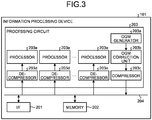
- FIG. 3 is a block diagram illustrating the example of the hardware configuration of the information processing device included in the moving body according to the first embodiment.
- the information processing device 101 includes an I/F 201, a memory 202, and a processing circuit 203.
- the I/F 201, the memory 202, and the processing circuit 203 are connected via a bus 204.
- the I/F 201 is connected to a network (N/W), etc. with another system.
- the I/F 201 manages transmission and reception of information to and from the communication unit 102a.
- the memory 202 stores various pieces of data.
- the memory 202 corresponds to a random access memory (RAM), a semiconductor memory element such as a flash memory, a hard disk, an optical disc, etc.
- the memory 202 may be provided outside the information processing device 101.
- the ROM holds a program to be executed by the processing circuit 203 or necessary data.
- the RAM functions as a work area when a program is executed in the processing circuit 203.
- the memory 202 may be provided outside the moving body 10. Further, the memory 202 may be disposed in a server device installed on the cloud.
- the memory 202 may correspond to a storage medium.
- the storage medium may download a program or various pieces of information via a local area network (LAN), an internet, etc. and store or temporarily store the program or various pieces of information.
- the memory 202 may include a plurality of storage media.
- the processing circuit 203 includes an OGM generator 203a, an OGM modification unit 203b, a compressor 203c, a plurality of decompressors 203d, and a plurality of processors 203e.
- Various processing function units functions units of the OGM generator 203a, the OGM modification unit 203b, the compressor 203c, the plurality of decompressors 203d, and the plurality of processors 203e) in processors included in the processing circuit 203 (including the plurality of processors 203e) are stored in the memory 202 in the form of programs executable by a computer. Further, the processors read and execute the programs from the memory 202, thereby realizing the various processing function units corresponding to the respective programs.
- the function units of the OGM generator 203a, the OGM modification unit 203b, the compressor 203c, the decompressor 203d, and the processor 203e are realized by programs.
- the function units may be realized by hardware (circuit).
- the processing circuit 203 may be configured by combining a plurality of independent processors for realizing each of the various processing function units in the processors included in the processing circuit 203.
- the various processing function units are realized by the respective processors executing the programs.
- the various processing function units may be configured as a program, and one processing circuit 203 may executes each program, or an image processing accelerator may be provided as a dedicated circuit, and a specific function may be implemented in an independent program execution circuit.
- processor used in the present embodiment and an embodiment described below means a central processing unit (CPU), a graphical processing unit (GPU), an application specific integrated circuit (ASIC), and a circuit of a programmable logic device (for example, a simple programmable logic device (SPLD), a complex programmable logic device (CPLD), and a field programmable gate array (FPGA)).
- CPU central processing unit
- GPU graphical processing unit
- ASIC application specific integrated circuit
- SPLD simple programmable logic device
- CPLD complex programmable logic device
- FPGA field programmable gate array
- the processors included in the processing circuit 203 realize the various processing function units by reading and executing the programs saved in the memory 202. Instead of saving the programs in the memory 202, the programs may be directly incorporated in circuits of the processors. In this case, the processors realize the various processing function units by reading and executing the programs incorporated in the circuits.
- the OGM generator 203a functions as an example of an acquisition unit that generates (acquires) an occupancy grid map (OGM).
- the OGM corresponds to map information including a grid binarized according to the presence or absence of an obstacle that hinders movement of the moving body 10.
- the OGM generator 203a generates the OGM each time a traveling environment of the moving body 10 is acquired by the sensor 103.
- an example of generating the OGM in the moving body 10 is described.
- the embodiments are not limited thereto, and it is possible to acquire an OGM generated in the external device.
- the OGM generator 203a generates an OGM containing a grid binarized according to the presence or absence of an obstacle that hinders movement of the moving body 10.
- the OGM generator 203a may generate an OGM containing a grid binarized according to whether the moving body 10 is movable. That is, the OGM generator 203a may generate an OGM containing a grid binarized according to not only the presence or absence of an obstacle but also whether the moving body 10 is movable depending on the circumstances around the moving body 10.
- the OGM modification unit 203b executes a modification process of modifying consecutive obstacle-free grids, the number of which is smaller than a preset threshold value in a preset scanning direction, among obstacle-free grids contained in the OGM generated by the OGM generator 203a to obstacle-containing grids.
- a modification process of modifying consecutive obstacle-free grids, the number of which is smaller than a preset threshold value in a preset scanning direction, among obstacle-free grids contained in the OGM generated by the OGM generator 203a to obstacle-containing grids.
- an obstacle-free grid is a grid (cell) contained in the OGM and is a grid indicating that there is no obstacle (that is, a grid indicating that the moving body 10 is movable).
- the obstacle-free grid indicates 0.
- an obstacle-containing grid is a grid (cell) contained in the OGM and is a grid indicating that there is an obstacle (that is, a grid indicating that the moving body 10 is immovable).
- the obstacle-containing grid indicates 1.
- the obstacle includes not only a physical obstacle but also a case in which the moving body 10 may not be moved due to a legal restriction, etc., that is, a virtual obstacle.
- the scanning direction is a direction in which a grid contained in the OGM is scanned when the OGM is compressed by the compressor 203c described below, and is a linear scanning direction.
- the compressor 203c raster-scans the grid contained in the OGM, and thus the scanning direction is a horizontal direction.
- the scanning direction is set to the horizontal direction.
- the scanning direction is not limited as long as the scanning direction is a linear scanning direction. For example, it is possible to adopt a vertical direction or an oblique direction.
- the preset threshold value is a lower limit of the number of consecutive obstacle-free grids corresponding to a route of the moving body 10 in the scanning direction.
- the preset threshold value is the number of grids in a width direction of the moving body 10 on the OGM.
- the preset threshold value is the number of grids larger than the number of grids of noise originally contained in the OGM.
- the preset threshold value may be changeable or may be changeable according to a moving speed of a moving body.
- the modification process is executed on the OGM generated by the OGM generator 203a.
- the OGM may be generated by changing an obstacle-free grid not corresponding to the route of the moving body 10 to an obstacle-containing grid.
- the OGM generator 203a performs linear scanning in a preset direction with reference to an obstacle-containing grid in the OGM and counts the number of consecutive obstacle-free grids until a subsequent obstacle-containing grid. Then, when the counted number is less than the preset threshold value, the OGM generator 203a changes the scanned obstacle-free grid to an obstacle-containing grid.
- the OGM generator 203a performs linear scanning in all directions with reference to an obstacle-containing grid and counts the number of consecutive obstacle-free grids until a subsequent obstacle-containing grid. Then, when the counted number of the consecutive obstacle-free grids is less than the preset threshold value, the OGM generator 203a changes an obstacle-free grid between the reference obstacle-containing grid and the subsequent obstacle-containing grid to an obstacle-containing grid.
- the compressor 203c continuously scans grids in the OGM modified by the OGM modification unit 203b in a preset scanning direction, and executes a compression process of performing encoding such as differential encoding in an order of scanning the grids in the OGM.
- the compressor 203c raster-scans the grids in the OGM and performs differential encoding in an order of scanning the grids in the OGM. Then, the compressor 203c saves the OGM undergoing the compression process in the memory 202 via the bus 204.
- the decompressor 203d reads the OGM from the memory 202 via the bus 204. Then, the decompressor 203d executes a decompression process on the read OGM. In the present embodiment, the decompressor 203d is provided for each processor 203e, executes the decompression process on the OGM read from the memory 202, and outputs the OGM undergoing the decompression process to the processor 203e.
- the compression ratio of the OGM can be increased, it is possible to decrease a bus bandwidth of the bus 204 required for saving the OGM in the memory 202 and reading the OGM from the memory 202, and to reduce pressure of the bus bandwidth of the bus 204 due to saving of the OGM in the memory 202 and reading of the OGM from the memory 202.
- the processor 203e searches for a candidate (hereinafter referred to as a route candidate) for a route on which the moving body 10 moves based on the OGM on which the decompression process has been executed by the decompressor 203d.
- the plurality of processors 203e corresponds to multi-core processors, and searches for a route candidate allocated to each processor 203e in advance with respect to an OGM input from the decompressor 203d.
- the plurality of processors 203e can search for the route candidate of the moving body 10 based on the OGM in parallel, and thus it is possible to speed up the search for the route candidate of the moving body 10.
- the route candidate searched for by the processors 203e is a route candidate on which the moving body 10 can move without contact with an obstacle among route candidates allocated to the respective processors 203e.
- the route candidate of the moving body 10 is searched for by the plurality of processors 203e.
- the embodiments are not limited thereto, and the route candidate of the moving body 10 may be searched for by one processor 203e.
- the processing circuit 203 may not have the plurality of decompressors 203d, and it is sufficient to have one decompressor 203d.
- the display 102b may display the route candidate searched for by the processor 203e.
- FIG. 4 is a diagram for description of an example of the modification process in the moving body according to the first embodiment.
- the OGM modification unit 203b raster-scans grids in an OGM 401 generated by the OGM generator 203a in a scanning direction X (horizontal direction) by the compressor 203c. Then, as illustrated in Fig. 4 , the OGM modification unit 203b modifies consecutive obstacle-free grids G1 to G9, the number of which is smaller than a preset threshold value N (the number Z of grids of a vehicle width of the moving body 10 in the OGM 401, for example, 2.5 grids) in a raster-scanning direction, among obstacle-free grids in the OGM 401 to obstacle-containing grids.
- N the number Z of grids of a vehicle width of the moving body 10 in the OGM 401, for example, 2.5 grids
- Fig. 5 is a flowchart illustrating an example of a flow of a process of saving an OGM used for searching for a route candidate in a memory in the moving body according to the first embodiment.
- the OGM generator 203a When an instruction to search for a route candidate of the moving body 10 is input from the input device 104, etc., the OGM generator 203a generates an OGM (Step S501). Then, the OGM generator 203a buffers the generated OGM in a buffer in the processing circuit 203 (Step S502).
- the OGM generator 203a saves consecutive grids greater than or equal to a preset threshold value in a buffer according to an order of scanning grids in the generated OGM by the OGM modification unit 203b, and outputs the grids to the OGM modification unit 203b in an order of saving the grids in the buffer.
- the OGM modification unit 203b scans grids in the OGM in an order of input from the OGM generator 203a, and counts the number of consecutive obstacle-free grids (Step S503). Subsequently, the OGM modification unit 203b determines whether the number of consecutive obstacle-free grids in the scanning direction in the OGM is less than a preset threshold value (Step S504).
- Step S504 modifies the consecutive obstacle-free grids, the counted number of which is less than the preset threshold value, to obstacle-containing grids (Step S505).
- the OGM modification unit 203b leaves the consecutive obstacle-free grids, the counted number of which is greater than or equal to the preset threshold value, unchanged.
- the compressor 203c linearly and continuously scans the grids in the OGM modified by the OGM modification unit 203b in a preset scanning direction to execute a compression process of performing encoding such as differential encoding (Step S506). Thereafter, the compressor 203c saves the OGM undergoing the compression process in the memory 202 (Step S507).
- the display 102b may display the OGM modified by the OGM modification unit 203b.
- Fig. 6 is a diagram for description of an example of the compression process on the OGM in the moving body according to the first embodiment.
- a pattern of grids in which a compression ratio by a compression process on the OGM by the compressor 203c is lowest corresponds to a loop of a pattern 601 illustrated in Fig. 6 .
- the compressor 203c compresses the OGM into a flag of one bit (hereinafter referred to as a 1-bit flag) indicating whether a certain grid is either an obstacle-free grid or an obstacle-containing grid, and a bit indicating the number of consecutive grids of the same value continuing to the certain grid (hereinafter consecutive number bit).
- the consecutive number bit corresponds to a preset number of bits.
- the consecutive number bit corresponds to M bits when the certain grid is an obstacle-free grid and corresponds to N bits when the certain grid is an obstacle-containing grid.
- the certain grid is a grid disposed for each number of grids corresponding to an upper limit of the number of consecutive grids which can be represented by the consecutive number bit.
- the compressor 203c compresses the pattern 601 of 17 bits into a pattern 602 of 8 bits. That is, since data of 4 bits increases each time the certain grid is scanned regardless of whether the certain grid is an obstacle-free grid or an obstacle-containing grid, the compressor 203c can guarantee a compression ratio of 1/2. Here, it is presumed that a grid at an end of the OGM is not compressed.
- the compressor 203c compresses the pattern 601 of 17 bits into a pattern 603 of 10 bits. That is, since data of 5 bits increases each time the certain grid is scanned regardless of whether the certain grid is an obstacle-free grid or an obstacle-containing grid, the compressor 203c can guarantee a compression ratio of 10/17.
- the modification process is executed to modify consecutive obstacle-free grids, the number of which is smaller than the preset threshold value in the preset scanning direction, among obstacle-free grids contained in the OGM generated by the OGM generator 203a to obstacle-containing grids.
- the modification process is executed to modify consecutive obstacle-free grids, the number of which is smaller than the preset threshold value in the preset scanning direction, among obstacle-free grids contained in the OGM generated by the OGM generator 203a to obstacle-containing grids.
- the present embodiment corresponds to an example of executing a margin assigning process in which an obstacle-free grid adjacent to an obstacle-containing grid in an OGM is filled with an obstacle-containing grid and executing a process in which an obstacle-free grid is modified to an obstacle-containing grid with respect to the OGM undergoing the margin assigning process.
- description below description of the same configuration as that of the first embodiment will be omitted.
- the OGM modification unit 203b executes a margin assigning process of filling an obstacle-free grid adjacent to an obstacle-containing grid with an obstacle-containing grid in an OGM generated by the OGM generator 203a.
- Fig. 7 is a diagram for description of an example of a margin assigning process in a moving body according to a second embodiment.
- the OGM modification unit 203b executes a margin assigning process of filling obstacle-free grids G10 to G63 adjacent to an obstacle-containing grid in all directions with obstacle-containing grids with reference to the obstacle-containing grid in an OGM 701 generated by the OGM generator 203a. Thereafter, as illustrated in Fig. 7 , similarly to the first embodiment, among obstacle-free grids in the OGM 701 undergoing the margin assigning process, the OGM modification unit 203b modifies consecutive obstacle-free grids G64 and G65, the number of which is smaller than a preset threshold value in a scanning direction of raster-scan, to obstacle-containing grids.
- the OGM modification unit 203b executes the margin assigning process of filling obstacle-free grids adjacent to an obstacle-containing grid with obstacle-containing grids with reference to the obstacle-containing grid.
- the range of the preset number of grids may be arbitrarily set by the user.
- the range of the preset number of grids may be changed according to a moving speed of the moving body 10. For example, the range of the preset number of grids is increased as the moving speed of the moving body 10 increases.
- the margin assigning process of filling obstacle-free grids adjacent to an obstacle-containing grid with obstacle-containing grids is executed in the OGM generated by the OGM generator 203a.
- the processor 203e it is possible to search for the route candidate of the moving body 10 by assigning a margin to an existence area of an obstacle.
Landscapes
- Engineering & Computer Science (AREA)
- Radar, Positioning & Navigation (AREA)
- Remote Sensing (AREA)
- Physics & Mathematics (AREA)
- General Physics & Mathematics (AREA)
- Automation & Control Theory (AREA)
- Theoretical Computer Science (AREA)
- Aviation & Aerospace Engineering (AREA)
- Electromagnetism (AREA)
- Multimedia (AREA)
- Signal Processing (AREA)
- Traffic Control Systems (AREA)
- Control Of Position, Course, Altitude, Or Attitude Of Moving Bodies (AREA)
- Compression, Expansion, Code Conversion, And Decoders (AREA)
Abstract
According to one embodiment, an acquisition circuit, a modification circuit, and a compressor are included. The modification circuit executes a modification process of modifying first consecutive grids, the number of which is smaller than a preset threshold value in a preset linear scanning direction, among first grids indicating that the obstacle is absent to the second grids. The compressor continuously scans the OGM undergoing the modification process in the scanning direction and encodes the grids in a scanning order.
Description
- Embodiments described herein relate generally to an OGM compression circuit, an OGM compression/decompression system, and a mobile system.
- A technology for searching for a route candidate of a moving body such as a vehicle or a robot using an occupancy grid map (OGM) binarized according to the presence or absence of an obstacle which hinders movement of the moving body has been developed. In this instance, it is possible to speed up the search for the route candidate of the moving body by allocating the search for the route candidate of the moving body to a plurality of cores possessed by Many-Core Engine.
- However, in a technology of allocating the search for the route candidate of the moving body to the plurality of cores in the Many-Core Engine, all the plurality of cores read the OGM from a memory and search for the route candidate of the moving body, and thus a bus bandwidth of a bus used for reading the OGM from the memory is pressed. The bus bandwidth of the bus used for reading the OGM from the memory by the plurality of cores may be reduced by compressing the OGM saved in the memory. However, when the OGM includes a fine part, it is difficult to increase a compression ratio of the OGM.
- An object of one embodiment is to provide an OGM compression circuit, an OGM compression/decompression system, and a mobile system capable of reducing a bus bandwidth of a bus used for reading an OGM from a memory by a core by increasing a compression ratio of the OGM.
-
-
Fig. 1 is a diagram illustrating an example of a schematic configuration of a moving body to which a mobile system according to a first embodiment is applied; -
Fig. 2 is a diagram illustrating an example of a hardware configuration of the moving body to which the mobile system of the first embodiment is applied; -
Fig. 3 is a block diagram illustrating an example of a hardware configuration of an information processing device included in the moving body according to the first embodiment; -
Fig. 4 is a diagram for description of an example of a modification process in the moving body according to the first embodiment; -
Fig. 5 is a flowchart illustrating an example of a flow of a process of saving an OGM used for searching for a route candidate in a memory in the moving body according to the first embodiment; -
Fig. 6 is a diagram for description of an example of a compression process of the OGM in the moving body according to the first embodiment; and -
Fig. 7 is a diagram for description of an example of a margin assigning process in a moving body according to a second embodiment. - In general, according to one embodiment, an acquisition circuit, a modification circuit, and a compressor are included. The acquisition circuit acquires an OGM containing a grid binarized into first and second grids according to presence or absence of an obstacle. The modification circuit executes a modification process of modifying first consecutive grids, the number of which is smaller than a preset threshold value in a preset linear scanning direction, among first grids indicating that the obstacle is absent to second grids. The compressor continuously scans the OGM undergoing the modification process in the scanning direction and encodes the grids in a scanning order.
- Hereinafter, a detailed description will be given of a mobile system to which an OGM compression circuit and an OGM compression/decompression system are applied according to embodiments with reference to accompanying drawings. It should be noted that the invention is not limited by these embodiments.
-
Fig. 1 is a diagram illustrating an example of a schematic configuration of a moving body to which a mobile system according to a first embodiment is applied.Fig. 2 is a diagram illustrating an example of a hardware configuration of the moving body to which the mobile system of the first embodiment is applied. As illustrated inFig. 1 and Fig. 2 , a movingbody 10 includes aninformation processing device 101, anoutput unit 102, asensor 103, aninput device 104, apower controller 105, and apower output section 106. As illustrated inFig. 2 , theinformation processing device 101, theoutput unit 102, thesensor 103, theinput device 104, and thepower controller 105 are connected via abus 107. Thepower output section 106 is connected to thepower controller 105. - At least one of the output unit 102 (a
communication unit 102a, adisplay 102b, and aspeaker 102c), thesensor 103, theinput device 104, and thepower controller 105 may be connected to theinformation processing device 101 by wire or wirelessly. Alternatively, at least one of the output unit 102 (thecommunication unit 102a, thedisplay 102b, and thespeaker 102c), thesensor 103, theinput device 104, and thepower controller 105 may be connected to theinformation processing device 101 via a network. - In the present embodiment, a description is given of an example in which the
information processing device 101 is mounted in themoving body 10. However, the embodiments are not limited thereto, and theinformation processing device 101 may be provided in an external device (for example, a stationary object) capable of communicating with themoving body 10. The stationary object corresponds to an object that may not be moved or an object in a stationary state with respect to a ground. For example, the stationary object corresponds to a guardrail, a pole, a parked vehicle, or a road sign. In addition, theinformation processing device 101 may be mounted in a cloud server that executes processing on a cloud. - The
moving body 10 is a movable object. For example, the movingbody 10 is a vehicle (a motorcycle, a four-wheeled automobile, or a bicycle), a bogie, a robot, a ship, or a flying object (an airplane or an unmanned aerial vehicle (UAV)). For example, the movingbody 10 is a moving body traveling through a driving operation by a person or a moving body capable of automatically traveling (so-called autonomous traveling) without involving a driving operation by a person. Here, for example, the moving body capable of performing autonomous traveling is an automatically driven vehicle. In the present embodiment, a case in which the movingbody 10 is an automatically driven vehicle will be described as an example. - The
output unit 102 outputs output information such as execution results of various processes executed in themoving body 10. For example, theoutput unit 102 has a communication function of transmitting output information to the external device, a display function of displaying output information, and a sound output function of outputting sound indicating output information. In the present embodiment, theoutput unit 102 includes thecommunication unit 102a, thedisplay 102b, and thespeaker 102c. - The
communication unit 102a communicates with the external device. Thecommunication unit 102a is a VICS (registered trademark) communication circuit or a dynamic map communication circuit. Thecommunication unit 102a transmits the output information to the external device. - In addition, the
communication unit 102a receives road information, etc. from the external device. Here, the road information corresponds to a signal, a sign, a surrounding building, a road width of each lane, a lane center line, etc. The road information may be stored in a memory 202 (seeFig. 3 ) such as a random access memory (RAM) or a read only memory (ROM) provided in theinformation processing device 101, or may be stored in a memory other than the memory 202 (seeFig. 2 ) included in the movingbody 10. - The
display 102b is a display unit that displays output information. For example, thedisplay 102b is a liquid crystal display (LCD), a projection device, or a light. Thespeaker 102c outputs sound indicating output information. - The
sensor 103 is a sensor that acquires traveling environment of the movingbody 10. Here, for example, the traveling environment is observation information of the movingbody 10 or surrounding information of the movingbody 10. Specifically, thesensor 103 is an external sensor or an internal sensor. - The internal sensor is a sensor that acquires the observation information. For example, the observation information corresponds to acceleration, velocity, or angular velocity of the
moving body 10. For example, the internal sensor is an inertial measurement unit (IMU), an acceleration sensor, a velocity sensor, or a rotary encoder. The IMU acquires observation information including triaxial acceleration and triaxial angular velocity of the movingbody 10. - The external sensor is a sensor that acquires the surrounding information of the moving
body 10. The external sensor may be mounted in the movingbody 10 or may be mounted on the outside of the moving body 10 (for example, another moving body or an external device). The surrounding information is information indicating a situation of surroundings of the movingbody 10. Here, the surroundings of the movingbody 10 corresponds to a region within a range set in advance from the movingbody 10, and corresponds to a range in which the surrounding information can be acquired by the external sensor. - For example, the surrounding information is a captured image, distance information, or position information. The captured image corresponds to data of an image obtained by capturing the surroundings of the moving
body 10. For example, the captured image corresponds to digital image data defining a pixel value for each pixel, a depth map defining a distance from thesensor 103 for each pixel, etc. - The distance information corresponds to a distance between the moving
body 10 and a target present outside the movingbody 10. Here, the target present outside the movingbody 10 is an object present outside the movingbody 10, and is an object present within a range in which the distance information can be acquired by the external sensor. The position information may correspond to a relative position of the movingbody 10 with respect to a preset reference position or an absolute position of the movingbody 10. - For example, the external sensor corresponds to an image capturing device that captures the surroundings of the moving
body 10 to obtain a captured image, a distance sensor (a millimeter wave radar, a laser sensor, or a distance image sensor) that acquires distance information, a position sensor (a global navigation satellite system (GNSS), a global positioning system (GPS), or a radio communication device) that acquires position information, etc. Here, for example, the laser sensor corresponds to a two-dimensional laser imaging detection and ranging (LIDAR) sensor installed parallel to a horizontal plane or a three-dimensional LIDAR sensor. - The
input device 104 can input various instructions and various pieces of information from a user. For example, theinput device 104 corresponds to a pointing device such as a mouse or a track ball, or an input device such as a keyboard. Further, theinput device 104 may correspond to an input function in a touch panel provided integrally with thedisplay 102b. - The information processing device 101 (in the present embodiment, a
processor 203e illustrated inFig. 3 ) searches for a route on which the movingbody 10 moves based on the OGM described below. Thepower controller 105 controls thepower output section 106 based on a search result of the route by theinformation processing device 101 such that the movingbody 10 autonomously travels. Specifically, thepower controller 105 determines a situation of the surroundings based on information generated by theinformation processing device 101, information obtained from thesensor 103, etc. and controls the amount of acceleration, the amount of brake, a steering angle, etc. Thepower output section 106 is a device driven by control of thepower controller 105. For example, thepower output section 106 corresponds to an engine, a motor, or a wheel. - Next, a detailed description will be given of an example of a hardware configuration of the
information processing device 101 included in the movingbody 10 according to the present embodiment.Fig. 3 is a block diagram illustrating the example of the hardware configuration of the information processing device included in the moving body according to the first embodiment. - The
information processing device 101 includes an I/F 201, amemory 202, and aprocessing circuit 203. The I/F 201, thememory 202, and theprocessing circuit 203 are connected via abus 204. The I/F 201 is connected to a network (N/W), etc. with another system. In addition, the I/F 201 manages transmission and reception of information to and from thecommunication unit 102a. - The
memory 202 stores various pieces of data. For example, thememory 202 corresponds to a random access memory (RAM), a semiconductor memory element such as a flash memory, a hard disk, an optical disc, etc. Thememory 202 may be provided outside theinformation processing device 101. The ROM holds a program to be executed by theprocessing circuit 203 or necessary data. The RAM functions as a work area when a program is executed in theprocessing circuit 203. Further, thememory 202 may be provided outside the movingbody 10. Further, thememory 202 may be disposed in a server device installed on the cloud. - In addition, the
memory 202 may correspond to a storage medium. Specifically, the storage medium may download a program or various pieces of information via a local area network (LAN), an internet, etc. and store or temporarily store the program or various pieces of information. In addition, thememory 202 may include a plurality of storage media. - The
processing circuit 203 includes an OGM generator 203a, anOGM modification unit 203b, acompressor 203c, a plurality ofdecompressors 203d, and a plurality ofprocessors 203e. Various processing function units (function units of the OGM generator 203a, theOGM modification unit 203b, thecompressor 203c, the plurality ofdecompressors 203d, and the plurality ofprocessors 203e) in processors included in the processing circuit 203 (including the plurality ofprocessors 203e) are stored in thememory 202 in the form of programs executable by a computer. Further, the processors read and execute the programs from thememory 202, thereby realizing the various processing function units corresponding to the respective programs. In the present embodiment, the function units of the OGM generator 203a, theOGM modification unit 203b, thecompressor 203c, thedecompressor 203d, and theprocessor 203e are realized by programs. However, the function units may be realized by hardware (circuit). - The
processing circuit 203 may be configured by combining a plurality of independent processors for realizing each of the various processing function units in the processors included in theprocessing circuit 203. In this case, the various processing function units are realized by the respective processors executing the programs. In addition, the various processing function units may be configured as a program, and oneprocessing circuit 203 may executes each program, or an image processing accelerator may be provided as a dedicated circuit, and a specific function may be implemented in an independent program execution circuit. - For example, the term "processor" used in the present embodiment and an embodiment described below means a central processing unit (CPU), a graphical processing unit (GPU), an application specific integrated circuit (ASIC), and a circuit of a programmable logic device (for example, a simple programmable logic device (SPLD), a complex programmable logic device (CPLD), and a field programmable gate array (FPGA)).
- The processors included in the
processing circuit 203 realize the various processing function units by reading and executing the programs saved in thememory 202. Instead of saving the programs in thememory 202, the programs may be directly incorporated in circuits of the processors. In this case, the processors realize the various processing function units by reading and executing the programs incorporated in the circuits. - The OGM generator 203a functions as an example of an acquisition unit that generates (acquires) an occupancy grid map (OGM). The OGM corresponds to map information including a grid binarized according to the presence or absence of an obstacle that hinders movement of the moving
body 10. In the present embodiment, the OGM generator 203a generates the OGM each time a traveling environment of the movingbody 10 is acquired by thesensor 103. In the present embodiment, an example of generating the OGM in the movingbody 10 is described. However, the embodiments are not limited thereto, and it is possible to acquire an OGM generated in the external device. In addition, in the present embodiment, the OGM generator 203a generates an OGM containing a grid binarized according to the presence or absence of an obstacle that hinders movement of the movingbody 10. However, the OGM generator 203a may generate an OGM containing a grid binarized according to whether the movingbody 10 is movable. That is, the OGM generator 203a may generate an OGM containing a grid binarized according to not only the presence or absence of an obstacle but also whether the movingbody 10 is movable depending on the circumstances around the movingbody 10. - The
OGM modification unit 203b executes a modification process of modifying consecutive obstacle-free grids, the number of which is smaller than a preset threshold value in a preset scanning direction, among obstacle-free grids contained in the OGM generated by the OGM generator 203a to obstacle-containing grids. In this way, when grids in the OGM are continuously scanned in a preset linear scanning direction, and encoding such as differential encoding is performed in an order of scanning the grids in the OGM, it is possible to increase a compression ratio of the OGM, and to reduce a storage capacity required for storing the OGM in thememory 202. - Here, an obstacle-free grid is a grid (cell) contained in the OGM and is a grid indicating that there is no obstacle (that is, a grid indicating that the moving
body 10 is movable). In the present embodiment, the obstacle-free grid indicates 0. In addition, an obstacle-containing grid is a grid (cell) contained in the OGM and is a grid indicating that there is an obstacle (that is, a grid indicating that the movingbody 10 is immovable). In the present embodiment, the obstacle-containing grid indicates 1. Here, the obstacle includes not only a physical obstacle but also a case in which the movingbody 10 may not be moved due to a legal restriction, etc., that is, a virtual obstacle. - The scanning direction is a direction in which a grid contained in the OGM is scanned when the OGM is compressed by the
compressor 203c described below, and is a linear scanning direction. In the present embodiment, thecompressor 203c raster-scans the grid contained in the OGM, and thus the scanning direction is a horizontal direction. In the present embodiment, since thecompressor 203c performs raster-scanning, the scanning direction is set to the horizontal direction. However, the scanning direction is not limited as long as the scanning direction is a linear scanning direction. For example, it is possible to adopt a vertical direction or an oblique direction. - In addition, the preset threshold value is a lower limit of the number of consecutive obstacle-free grids corresponding to a route of the moving
body 10 in the scanning direction. In the present embodiment, the preset threshold value is the number of grids in a width direction of the movingbody 10 on the OGM. Here, the preset threshold value is the number of grids larger than the number of grids of noise originally contained in the OGM. In addition, the preset threshold value may be changeable or may be changeable according to a moving speed of a moving body. - In the present embodiment, the modification process is executed on the OGM generated by the OGM generator 203a. However, when an OGM is generated, the OGM may be generated by changing an obstacle-free grid not corresponding to the route of the moving
body 10 to an obstacle-containing grid. - Specifically, the OGM generator 203a performs linear scanning in a preset direction with reference to an obstacle-containing grid in the OGM and counts the number of consecutive obstacle-free grids until a subsequent obstacle-containing grid. Then, when the counted number is less than the preset threshold value, the OGM generator 203a changes the scanned obstacle-free grid to an obstacle-containing grid.
- For example, the OGM generator 203a performs linear scanning in all directions with reference to an obstacle-containing grid and counts the number of consecutive obstacle-free grids until a subsequent obstacle-containing grid. Then, when the counted number of the consecutive obstacle-free grids is less than the preset threshold value, the OGM generator 203a changes an obstacle-free grid between the reference obstacle-containing grid and the subsequent obstacle-containing grid to an obstacle-containing grid.
- In this way, similarly to a case in which a grid in the OGM is modified to an obstacle-containing grid by the
OGM modification unit 203b, when grids in the OGM are continuously scanned in a preset linear scanning direction, and encoding such as differential encoding is performed in an order of scanning the grids in the OGM, it is possible to increase a compression ratio of the OGM, and to reduce a storage capacity required for storing the OGM in thememory 202. - The
compressor 203c continuously scans grids in the OGM modified by theOGM modification unit 203b in a preset scanning direction, and executes a compression process of performing encoding such as differential encoding in an order of scanning the grids in the OGM. In the present embodiment, thecompressor 203c raster-scans the grids in the OGM and performs differential encoding in an order of scanning the grids in the OGM. Then, thecompressor 203c saves the OGM undergoing the compression process in thememory 202 via thebus 204. - The
decompressor 203d reads the OGM from thememory 202 via thebus 204. Then, thedecompressor 203d executes a decompression process on the read OGM. In the present embodiment, thedecompressor 203d is provided for eachprocessor 203e, executes the decompression process on the OGM read from thememory 202, and outputs the OGM undergoing the decompression process to theprocessor 203e. - In the present embodiment, as described above, since the compression ratio of the OGM can be increased, it is possible to decrease a bus bandwidth of the
bus 204 required for saving the OGM in thememory 202 and reading the OGM from thememory 202, and to reduce pressure of the bus bandwidth of thebus 204 due to saving of the OGM in thememory 202 and reading of the OGM from thememory 202. - The
processor 203e searches for a candidate (hereinafter referred to as a route candidate) for a route on which the movingbody 10 moves based on the OGM on which the decompression process has been executed by thedecompressor 203d. In the present embodiment, for example, the plurality ofprocessors 203e corresponds to multi-core processors, and searches for a route candidate allocated to eachprocessor 203e in advance with respect to an OGM input from thedecompressor 203d. As a result, the plurality ofprocessors 203e can search for the route candidate of the movingbody 10 based on the OGM in parallel, and thus it is possible to speed up the search for the route candidate of the movingbody 10. Here, it is presumed that the route candidate searched for by theprocessors 203e is a route candidate on which the movingbody 10 can move without contact with an obstacle among route candidates allocated to therespective processors 203e. - In the present embodiment, the route candidate of the moving
body 10 is searched for by the plurality ofprocessors 203e. However, the embodiments are not limited thereto, and the route candidate of the movingbody 10 may be searched for by oneprocessor 203e. In this case, theprocessing circuit 203 may not have the plurality ofdecompressors 203d, and it is sufficient to have onedecompressor 203d. In addition, thedisplay 102b may display the route candidate searched for by theprocessor 203e. - Next, a description will be given of an example of a modification process in which an obstacle-free grid in an OGM is modified to an obstacle-containing grid.
Fig. 4 is a diagram for description of an example of the modification process in the moving body according to the first embodiment. - As illustrated in
Fig. 4 , theOGM modification unit 203b raster-scans grids in anOGM 401 generated by the OGM generator 203a in a scanning direction X (horizontal direction) by thecompressor 203c. Then, as illustrated inFig. 4 , theOGM modification unit 203b modifies consecutive obstacle-free grids G1 to G9, the number of which is smaller than a preset threshold value N (the number Z of grids of a vehicle width of the movingbody 10 in theOGM 401, for example, 2.5 grids) in a raster-scanning direction, among obstacle-free grids in theOGM 401 to obstacle-containing grids. - In this way, since the number of consecutive obstacle-containing grids can be increased in the
OGM 401, when encoding such as differential encoding is performed in an order of scanning the grids in theOGM 401, it is possible to reduce redundancy of data, and to increase a compression ratio of theOGM 401. In addition, it is possible to reduce a storage capacity required for storing theOGM 401 in thememory 202. - Next, a description will be given of an example of a flow of a process of saving an OGM used for searching for a route candidate of the moving
body 10 in thememory 202.Fig. 5 is a flowchart illustrating an example of a flow of a process of saving an OGM used for searching for a route candidate in a memory in the moving body according to the first embodiment. - When an instruction to search for a route candidate of the moving
body 10 is input from theinput device 104, etc., the OGM generator 203a generates an OGM (Step S501). Then, the OGM generator 203a buffers the generated OGM in a buffer in the processing circuit 203 (Step S502). - For example, the OGM generator 203a saves consecutive grids greater than or equal to a preset threshold value in a buffer according to an order of scanning grids in the generated OGM by the
OGM modification unit 203b, and outputs the grids to theOGM modification unit 203b in an order of saving the grids in the buffer. - The
OGM modification unit 203b scans grids in the OGM in an order of input from the OGM generator 203a, and counts the number of consecutive obstacle-free grids (Step S503). Subsequently, theOGM modification unit 203b determines whether the number of consecutive obstacle-free grids in the scanning direction in the OGM is less than a preset threshold value (Step S504). - Then, when the counted number is less than the preset threshold value (Step S504: Yes), the
OGM modification unit 203b modifies the consecutive obstacle-free grids, the counted number of which is less than the preset threshold value, to obstacle-containing grids (Step S505). On the other hand, when the counted number of consecutive obstacle-free grids is greater than or equal to the preset threshold value (Step S504: No), theOGM modification unit 203b leaves the consecutive obstacle-free grids, the counted number of which is greater than or equal to the preset threshold value, unchanged. - Subsequently, the
compressor 203c linearly and continuously scans the grids in the OGM modified by theOGM modification unit 203b in a preset scanning direction to execute a compression process of performing encoding such as differential encoding (Step S506). Thereafter, thecompressor 203c saves the OGM undergoing the compression process in the memory 202 (Step S507). In addition, thedisplay 102b may display the OGM modified by theOGM modification unit 203b. - Next, a description will be given of an example of the compression process on the OGM modified by the
OGM modification unit 203b.Fig. 6 is a diagram for description of an example of the compression process on the OGM in the moving body according to the first embodiment. - For example, when the number of grids of the vehicle width of the moving body 10 (for example, the vehicle) on the OGM generated by the OGM generator 203a is 16, a pattern of grids in which a compression ratio by a compression process on the OGM by the
compressor 203c is lowest corresponds to a loop of apattern 601 illustrated inFig. 6 . Then, thecompressor 203c compresses the OGM into a flag of one bit (hereinafter referred to as a 1-bit flag) indicating whether a certain grid is either an obstacle-free grid or an obstacle-containing grid, and a bit indicating the number of consecutive grids of the same value continuing to the certain grid (hereinafter consecutive number bit). - Here, the consecutive number bit corresponds to a preset number of bits. In the present embodiment, the consecutive number bit corresponds to M bits when the certain grid is an obstacle-free grid and corresponds to N bits when the certain grid is an obstacle-containing grid. In addition, the certain grid is a grid disposed for each number of grids corresponding to an upper limit of the number of consecutive grids which can be represented by the consecutive number bit.
- For example, when the M bits corresponds to 3 bits and the N bits corresponds to 3 bits, as illustrated in
Fig. 6 , thecompressor 203c compresses thepattern 601 of 17 bits into apattern 602 of 8 bits. That is, since data of 4 bits increases each time the certain grid is scanned regardless of whether the certain grid is an obstacle-free grid or an obstacle-containing grid, thecompressor 203c can guarantee a compression ratio of 1/2. Here, it is presumed that a grid at an end of the OGM is not compressed. - In addition, for example, when the M bits corresponds to 4 bits and the N bits corresponds to 4 bits, as illustrated in
Fig. 6 , thecompressor 203c compresses thepattern 601 of 17 bits into apattern 603 of 10 bits. That is, since data of 5 bits increases each time the certain grid is scanned regardless of whether the certain grid is an obstacle-free grid or an obstacle-containing grid, thecompressor 203c can guarantee a compression ratio of 10/17. - As described above, according to the first embodiment, the modification process is executed to modify consecutive obstacle-free grids, the number of which is smaller than the preset threshold value in the preset scanning direction, among obstacle-free grids contained in the OGM generated by the OGM generator 203a to obstacle-containing grids. As a result, when grids in the OGM is continuously scanned in a preset linear scanning direction, and encoding such as differential encoding is performed in an order of scanning the grids in the OGM, it is possible to obtain effects that a compression ratio of the OGM can be increased, and a storage capacity required for storing the OGM in the
memory 202 can be reduced. - The present embodiment corresponds to an example of executing a margin assigning process in which an obstacle-free grid adjacent to an obstacle-containing grid in an OGM is filled with an obstacle-containing grid and executing a process in which an obstacle-free grid is modified to an obstacle-containing grid with respect to the OGM undergoing the margin assigning process. In description below, description of the same configuration as that of the first embodiment will be omitted.
- In the present embodiment, prior to a modification process of modifying an obstacle-free grid in an OGM to an obstacle-containing grid, the
OGM modification unit 203b executes a margin assigning process of filling an obstacle-free grid adjacent to an obstacle-containing grid with an obstacle-containing grid in an OGM generated by the OGM generator 203a. - In this way, at the time of searching for a route candidate of the moving
body 10 by theprocessor 203e based on an OGM, it is possible to search for the route candidate of the movingbody 10 by assigning a margin to an existence area of an obstacle. Thus, it is possible to search for a route candidate on which the movingbody 10 is less likely to come into contact with the obstacle. - Next, a description will be given of an example of a margin assigning process by the
OGM modification unit 203b.Fig. 7 is a diagram for description of an example of a margin assigning process in a moving body according to a second embodiment. - As illustrated in
Fig. 7 , theOGM modification unit 203b executes a margin assigning process of filling obstacle-free grids G10 to G63 adjacent to an obstacle-containing grid in all directions with obstacle-containing grids with reference to the obstacle-containing grid in anOGM 701 generated by the OGM generator 203a. Thereafter, as illustrated inFig. 7 , similarly to the first embodiment, among obstacle-free grids in theOGM 701 undergoing the margin assigning process, theOGM modification unit 203b modifies consecutive obstacle-free grids G64 and G65, the number of which is smaller than a preset threshold value in a scanning direction of raster-scan, to obstacle-containing grids. - In the present embodiment, the
OGM modification unit 203b executes the margin assigning process of filling obstacle-free grids adjacent to an obstacle-containing grid with obstacle-containing grids with reference to the obstacle-containing grid. However, it is possible to execute a margin assigning process of filling consecutive obstacle-free grids within a range of a preset number of grids from an obstacle-containing grid with obstacle-containing grids with reference to the obstacle-containing grid. - Here, the range of the preset number of grids may be arbitrarily set by the user. Alternatively, the range of the preset number of grids may be changed according to a moving speed of the moving
body 10. For example, the range of the preset number of grids is increased as the moving speed of the movingbody 10 increases. - As described above, according to the second embodiment, prior to the modification process of modifying an obstacle-free grid in an OGM to an obstacle-containing grid, the margin assigning process of filling obstacle-free grids adjacent to an obstacle-containing grid with obstacle-containing grids is executed in the OGM generated by the OGM generator 203a. As a result, at the time of searching for a route candidate of the moving
body 10 based on the OGM by theprocessor 203e, it is possible to search for the route candidate of the movingbody 10 by assigning a margin to an existence area of an obstacle. Thus, it is possible to obtain an effect that it is possible to search for a route candidate on which the movingbody 10 is less likely to come into contact with the obstacle.
Claims (21)
- An occupancy grid map (OGM) compression circuit (101) comprising:an acquisition circuit (203a) that acquires an OGM containing grids binarized into first and second grids according to presence or absence of an obstacle;a modification circuit (203b) that executes a modification process of modifying first consecutive grids, the number of which is smaller than a preset threshold value in a preset linear scanning direction, among first grids indicating that the obstacle is absent to the second grids; anda compressor (203c) that continuously scans the OGM undergoing the modification process in the scanning direction and encodes the grids in a scanning order.
- The OGM compression circuit (101) according to claim 1, wherein the modification circuit (203b) executes a margin assigning process of filling a first grid adjacent to the second grid in the OGM with the second grid and executes the modification process on the OGM undergoing the margin assigning process.
- The OGM compression circuit (101) according to claim 1, wherein the compressor (203c) raster-scans the OGM undergoing the modification process.
- The OGM compression circuit (101) according to claim 1, wherein the modification circuit (203b) executes a margin assigning process of filling the first consecutive grids within a range of a preset number of grids from the second grid in the OGM with the second grids and executes the modification process on the OGM undergoing the margin assigning process.
- The OGM compression circuit (101) according to claim 4, wherein the range of the preset number of grids is changeable according to a moving speed of a moving body (10) .
- The OGM compression circuit (101) according to claim 1, wherein the threshold value is changeable.
- The OGM compression circuit (101) according to claim 1, wherein the threshold value is changeable according to a moving speed of a moving body (10).
- The OGM compression circuit (101) according to claim 1, wherein the obstacle includes a physical obstacle and a virtual obstacle.
- An OGM compression circuit (101) comprising:a generation circuit (203a) that generates an occupancy grid map (OGM) containing grids binarized presence or absence of an obstacle, first consecutive grids, the number of which is smaller than a preset threshold value in a preset linear scanning direction, among first grids indicating that the obstacle is absent being changed to the second grids; anda compressor (203e) that continuously scans the generated OGM in the scanning direction and encodes the grids in a scanning order.
- The OGM compression circuit (101) according to claim 9, wherein the compressor (203e) raster-scans the generated OGM.
- The OGM compression circuit (101) according to claim 9, wherein the generation circuit (203a) generates an OGM obtained by filling a first grid adjacent to the second grid in the first and second grids binarized according to presence or absence of the obstacle with the second grid, and then changing the first consecutive grids, the number of which is smaller than a preset threshold value in a preset linear scanning direction, among the first grids to the second grids.
- The OGM compression circuit (101) according to claim 9, wherein the generation circuit (203a) generates an OGM obtained by filling the first consecutive grids within a range of a preset number of grids from the second grid in the first and second grids binarized according to presence or absence of the obstacle with the second grids, and then changing the first consecutive grids, the number of which is smaller than the preset threshold value in the preset linear scanning direction, among the first grids to the second grids.
- The OGM compression circuit (101) according to claim 12, wherein the range of the preset number of grids is changeable according to a moving speed of a moving body (10) .
- The OGM compression circuit (101) according to claim 9, wherein the threshold value is changeable.
- The OGM compression circuit (101) according to claim 9, wherein the threshold value is changeable according to a moving speed of a moving body (10).
- The OGM compression circuit (101) according to claim 9, wherein the obstacle includes a physical obstacle and a virtual obstacle.
- The OGM compression circuit (101) according to claim 1, further comprising
a memory (202) that stores the encoded OGM. - An OGM compression/decompression system (101) comprising:the OGM compression circuit (101) according to claim 17;a decompressor (203d) that reads the OGM from the memory (202) and executes a decompression process on the read OGM; anda processor (203e) that searches for a candidate for a route on which the moving body (10) moves based on the OGM undergoing the decompression process.
- The OGM compression/decompression system (101) according to claim 18, wherein the processor (203e) corresponds to a multi-core processor to which search for a candidate for a route on which the moving body (10) moves is allocated based on the OGM undergoing the decompression process.
- A mobile system comprising:a power output secion (106) of a moving body (10);the OGM compression/decompression system (101) according to claim 18; anda power control circuit (105) that controls the power output section (106) based on a result of searching for the candidate for the route by the processor (203e) so that the moving body (10) automatically travels.
- The mobile system according to claim 20, further comprising:
a display (102b) that displays the OGM undergoing the modification process.
Applications Claiming Priority (1)
| Application Number | Priority Date | Filing Date | Title |
|---|---|---|---|
| JP2018171674A JP2020042726A (en) | 2018-09-13 | 2018-09-13 | Ogm compression circuit, ogm compression extension system, and moving body system |
Publications (1)
| Publication Number | Publication Date |
|---|---|
| EP3624346A1 true EP3624346A1 (en) | 2020-03-18 |
Family
ID=65635448
Family Applications (1)
| Application Number | Title | Priority Date | Filing Date |
|---|---|---|---|
| EP19159668.3A Withdrawn EP3624346A1 (en) | 2018-09-13 | 2019-02-27 | Ogm compression circuit, ogm compression/decompression system, and mobile system |
Country Status (4)
| Country | Link |
|---|---|
| US (1) | US20200089254A1 (en) |
| EP (1) | EP3624346A1 (en) |
| JP (1) | JP2020042726A (en) |
| CN (1) | CN110896482A (en) |
Families Citing this family (6)
| Publication number | Priority date | Publication date | Assignee | Title |
|---|---|---|---|---|
| US11815897B2 (en) | 2020-05-11 | 2023-11-14 | Huawei Technologies Co., Ltd. | Method and system for generating an importance occupancy grid map |
| US12314184B2 (en) * | 2021-05-19 | 2025-05-27 | Pony Ai Inc. | Efficient retrieval of sensor data while ensuring atomicity |
| CN113225090B (en) * | 2021-05-19 | 2024-03-22 | 上海高仙自动化科技发展有限公司 | Compression method, compression device, electronic equipment and storage medium |
| JP7524833B2 (en) * | 2021-06-03 | 2024-07-30 | 株式会社豊田自動織機 | Route Generation Device |
| CN113834494B (en) * | 2021-10-15 | 2024-06-14 | 珠海一微半导体股份有限公司 | A grid map processing method and chip based on template coverage |
| CN116804554A (en) * | 2022-03-16 | 2023-09-26 | 华为技术有限公司 | Occupancy grid map generation method and device |
Citations (1)
| Publication number | Priority date | Publication date | Assignee | Title |
|---|---|---|---|---|
| EP2078996A2 (en) * | 2008-01-11 | 2009-07-15 | Samsung Electronics Co., Ltd. | Method and apparatus for planning path of mobile robot |
Family Cites Families (14)
| Publication number | Priority date | Publication date | Assignee | Title |
|---|---|---|---|---|
| JPH07129238A (en) * | 1993-11-01 | 1995-05-19 | Fujitsu Ltd | Obstacle avoidance route generation method |
| JP2004298975A (en) * | 2003-03-28 | 2004-10-28 | Sony Corp | Robot device, obstacle search method |
| JP2004333157A (en) * | 2003-04-30 | 2004-11-25 | Matsushita Electric Ind Co Ltd | Route information transmission method and device |
| JP2006239844A (en) * | 2005-03-04 | 2006-09-14 | Sony Corp | Obstacle avoidance device, obstacle avoidance method, obstacle avoidance program, and mobile robot device |
| JP4368317B2 (en) * | 2005-03-11 | 2009-11-18 | セコム株式会社 | Mobile robot |
| US8577538B2 (en) * | 2006-07-14 | 2013-11-05 | Irobot Corporation | Method and system for controlling a remote vehicle |
| KR101037421B1 (en) * | 2006-05-17 | 2011-05-30 | 후지쯔 가부시끼가이샤 | Recording medium recording image data compression apparatus, compression method and program and Recording medium recording image data decompression apparatus, restoration method and program |
| JP5349804B2 (en) * | 2008-01-10 | 2013-11-20 | 株式会社日立産機システム | Mobile robot system and control method thereof |
| CN101650890A (en) * | 2009-09-18 | 2010-02-17 | 西安煤航信息产业有限公司 | Method for expressing processing of roads on map |
| US8798840B2 (en) * | 2011-09-30 | 2014-08-05 | Irobot Corporation | Adaptive mapping with spatial summaries of sensor data |
| JP5817611B2 (en) * | 2012-03-23 | 2015-11-18 | トヨタ自動車株式会社 | Mobile robot |
| CN114675671B (en) * | 2014-09-05 | 2025-10-21 | 深圳市大疆创新科技有限公司 | Multi-sensor environment map construction |
| US9868211B2 (en) * | 2015-04-09 | 2018-01-16 | Irobot Corporation | Restricting movement of a mobile robot |
| JP6941916B2 (en) * | 2015-12-28 | 2021-09-29 | 凸版印刷株式会社 | Scanning headlights, scanning headlight control methods and programs |
-
2018
- 2018-09-13 JP JP2018171674A patent/JP2020042726A/en active Pending
-
2019
- 2019-01-10 CN CN201910022227.9A patent/CN110896482A/en active Pending
- 2019-02-27 EP EP19159668.3A patent/EP3624346A1/en not_active Withdrawn
- 2019-03-01 US US16/290,852 patent/US20200089254A1/en not_active Abandoned
Patent Citations (1)
| Publication number | Priority date | Publication date | Assignee | Title |
|---|---|---|---|---|
| EP2078996A2 (en) * | 2008-01-11 | 2009-07-15 | Samsung Electronics Co., Ltd. | Method and apparatus for planning path of mobile robot |
Non-Patent Citations (6)
| Title |
|---|
| ANONYMOUS: "Data differencing", WIKIPEDIA, 28 June 2018 (2018-06-28), XP055615515, Retrieved from the Internet <URL:https://en.wikipedia.org/w/index.php?title=Data_differencing&oldid=846643478> [retrieved on 20190827] * |
| ANONYMOUS: "Differential coding", WIKIPEDIA, 21 June 2017 (2017-06-21), XP055615516, Retrieved from the Internet <URL:https://en.wikipedia.org/w/index.php?title=Differential_coding&oldid=786729010> [retrieved on 20190827] * |
| ANONYMOUS: "Lossy compression", WIKIPEDIA, 3 August 2018 (2018-08-03), pages 1 - 9, XP055614947, Retrieved from the Internet <URL:https://en.wikipedia.org/w/index.php?title=Lossy_compression&oldid=853201917> [retrieved on 20190823] * |
| ANONYMOUS: "Run-length encoding", WIKIPEDIA, 23 July 2018 (2018-07-23), XP055615528, Retrieved from the Internet <URL:https://en.wikipedia.org/w/index.php?title=Run-length_encoding&oldid=851611215> [retrieved on 20190827] * |
| LI YOU ET AL: "Building variable resolution occupancy grid map from stereoscopic system - A quadtree based appr", 2013 IEEE INTELLIGENT VEHICLES SYMPOSIUM (IV), IEEE, 23 June 2013 (2013-06-23), pages 744 - 749, XP032502099, ISSN: 1931-0587, [retrieved on 20131010], DOI: 10.1109/IVS.2013.6629556 * |
| NELSON ERIK ET AL: "Information-theoretic occupancy grid compression for high-speed information-based exploration", 2015 IEEE/RSJ INTERNATIONAL CONFERENCE ON INTELLIGENT ROBOTS AND SYSTEMS (IROS), IEEE, 28 September 2015 (2015-09-28), pages 4976 - 4982, XP032832298, DOI: 10.1109/IROS.2015.7354077 * |
Also Published As
| Publication number | Publication date |
|---|---|
| JP2020042726A (en) | 2020-03-19 |
| US20200089254A1 (en) | 2020-03-19 |
| CN110896482A (en) | 2020-03-20 |
Similar Documents
| Publication | Publication Date | Title |
|---|---|---|
| EP3624346A1 (en) | Ogm compression circuit, ogm compression/decompression system, and mobile system | |
| EP3361278B1 (en) | Autonomous vehicle localization based on walsh kernel projection technique | |
| US11378956B2 (en) | Perception and planning collaboration framework for autonomous driving | |
| CN108089572B (en) | Method and device for vehicle positioning | |
| US11520347B2 (en) | Comprehensive and efficient method to incorporate map features for object detection with LiDAR | |
| US10769793B2 (en) | Method for pitch angle calibration based on 2D bounding box and its 3D distance for autonomous driving vehicles (ADVs) | |
| EP3245614B1 (en) | Object detection using location data and scale space representations of image data | |
| EP3553752A1 (en) | Information processing apparatus, information processing method, and computer-readable medium for generating an obstacle map | |
| US10860868B2 (en) | Lane post-processing in an autonomous driving vehicle | |
| US10921143B2 (en) | Information processing device, mobile object, information processing method, and computer program product | |
| CN111316285A (en) | Object detection method, electronic device and computer storage medium | |
| JP7376992B2 (en) | Information processing device, information processing method, and program | |
| US11069080B1 (en) | Collaborative airborne object tracking systems and methods | |
| US11662726B2 (en) | Controlling movement of a device | |
| US11055857B2 (en) | Compressive environmental feature representation for vehicle behavior prediction | |
| US10898804B2 (en) | Image processing device and image processing method | |
| WO2020220199A1 (en) | Multiple sensor data storage with compressed video stream in autonomous driving vehicles | |
| JP2018206038A (en) | Point group data processing device, mobile robot, mobile robot system, and point group data processing method | |
| US11132561B2 (en) | Information processing device, information processing method, and non-transitory computer-readable recording medium | |
| US11391590B2 (en) | Methods and apparatus for selecting a map for a moving object, system, and vehicle/robot | |
| CN116569070A (en) | Method and system for analyzing dynamic LiDAR point cloud data | |
| WO2018218506A1 (en) | Method and apparatus for constructing an environment model | |
| KR102091648B1 (en) | Image processing apparatus, image processing method, and drive assistance system | |
| CN113177427A (en) | Road prediction method, autonomous driving method, vehicle and equipment | |
| CN112116698B (en) | Method and device for point cloud fusion |
Legal Events
| Date | Code | Title | Description |
|---|---|---|---|
| PUAI | Public reference made under article 153(3) epc to a published international application that has entered the european phase |
Free format text: ORIGINAL CODE: 0009012 |
|
| STAA | Information on the status of an ep patent application or granted ep patent |
Free format text: STATUS: REQUEST FOR EXAMINATION WAS MADE |
|
| 17P | Request for examination filed |
Effective date: 20190227 |
|
| AK | Designated contracting states |
Kind code of ref document: A1 Designated state(s): AL AT BE BG CH CY CZ DE DK EE ES FI FR GB GR HR HU IE IS IT LI LT LU LV MC MK MT NL NO PL PT RO RS SE SI SK SM TR |
|
| AX | Request for extension of the european patent |
Extension state: BA ME |
|
| STAA | Information on the status of an ep patent application or granted ep patent |
Free format text: STATUS: THE APPLICATION HAS BEEN WITHDRAWN |
|
| 18W | Application withdrawn |
Effective date: 20210115 |