EP3624226A1 - Separator for lithium-sulfur battery, manufacturing method therefor, and lithium-sulfur battery comprising same - Google Patents
Separator for lithium-sulfur battery, manufacturing method therefor, and lithium-sulfur battery comprising same Download PDFInfo
- Publication number
- EP3624226A1 EP3624226A1 EP19754162.6A EP19754162A EP3624226A1 EP 3624226 A1 EP3624226 A1 EP 3624226A1 EP 19754162 A EP19754162 A EP 19754162A EP 3624226 A1 EP3624226 A1 EP 3624226A1
- Authority
- EP
- European Patent Office
- Prior art keywords
- separator
- group
- lithium
- sulfur battery
- sulfonic acid
- Prior art date
- Legal status (The legal status is an assumption and is not a legal conclusion. Google has not performed a legal analysis and makes no representation as to the accuracy of the status listed.)
- Granted
Links
Images


Classifications
-
- H—ELECTRICITY
- H01—ELECTRIC ELEMENTS
- H01M—PROCESSES OR MEANS, e.g. BATTERIES, FOR THE DIRECT CONVERSION OF CHEMICAL ENERGY INTO ELECTRICAL ENERGY
- H01M50/00—Constructional details or processes of manufacture of the non-active parts of electrochemical cells other than fuel cells, e.g. hybrid cells
- H01M50/40—Separators; Membranes; Diaphragms; Spacing elements inside cells
- H01M50/409—Separators, membranes or diaphragms characterised by the material
- H01M50/44—Fibrous material
-
- H—ELECTRICITY
- H01—ELECTRIC ELEMENTS
- H01M—PROCESSES OR MEANS, e.g. BATTERIES, FOR THE DIRECT CONVERSION OF CHEMICAL ENERGY INTO ELECTRICAL ENERGY
- H01M50/00—Constructional details or processes of manufacture of the non-active parts of electrochemical cells other than fuel cells, e.g. hybrid cells
- H01M50/40—Separators; Membranes; Diaphragms; Spacing elements inside cells
- H01M50/409—Separators, membranes or diaphragms characterised by the material
- H01M50/411—Organic material
-
- H—ELECTRICITY
- H01—ELECTRIC ELEMENTS
- H01M—PROCESSES OR MEANS, e.g. BATTERIES, FOR THE DIRECT CONVERSION OF CHEMICAL ENERGY INTO ELECTRICAL ENERGY
- H01M10/00—Secondary cells; Manufacture thereof
- H01M10/05—Accumulators with non-aqueous electrolyte
- H01M10/052—Li-accumulators
-
- H—ELECTRICITY
- H01—ELECTRIC ELEMENTS
- H01M—PROCESSES OR MEANS, e.g. BATTERIES, FOR THE DIRECT CONVERSION OF CHEMICAL ENERGY INTO ELECTRICAL ENERGY
- H01M10/00—Secondary cells; Manufacture thereof
- H01M10/05—Accumulators with non-aqueous electrolyte
- H01M10/052—Li-accumulators
- H01M10/0525—Rocking-chair batteries, i.e. batteries with lithium insertion or intercalation in both electrodes; Lithium-ion batteries
-
- H—ELECTRICITY
- H01—ELECTRIC ELEMENTS
- H01M—PROCESSES OR MEANS, e.g. BATTERIES, FOR THE DIRECT CONVERSION OF CHEMICAL ENERGY INTO ELECTRICAL ENERGY
- H01M4/00—Electrodes
- H01M4/02—Electrodes composed of, or comprising, active material
- H01M4/36—Selection of substances as active materials, active masses, active liquids
- H01M4/38—Selection of substances as active materials, active masses, active liquids of elements or alloys
-
- H—ELECTRICITY
- H01—ELECTRIC ELEMENTS
- H01M—PROCESSES OR MEANS, e.g. BATTERIES, FOR THE DIRECT CONVERSION OF CHEMICAL ENERGY INTO ELECTRICAL ENERGY
- H01M4/00—Electrodes
- H01M4/02—Electrodes composed of, or comprising, active material
- H01M4/36—Selection of substances as active materials, active masses, active liquids
- H01M4/38—Selection of substances as active materials, active masses, active liquids of elements or alloys
- H01M4/381—Alkaline or alkaline earth metals elements
- H01M4/382—Lithium
-
- H—ELECTRICITY
- H01—ELECTRIC ELEMENTS
- H01M—PROCESSES OR MEANS, e.g. BATTERIES, FOR THE DIRECT CONVERSION OF CHEMICAL ENERGY INTO ELECTRICAL ENERGY
- H01M50/00—Constructional details or processes of manufacture of the non-active parts of electrochemical cells other than fuel cells, e.g. hybrid cells
- H01M50/40—Separators; Membranes; Diaphragms; Spacing elements inside cells
- H01M50/403—Manufacturing processes of separators, membranes or diaphragms
-
- H—ELECTRICITY
- H01—ELECTRIC ELEMENTS
- H01M—PROCESSES OR MEANS, e.g. BATTERIES, FOR THE DIRECT CONVERSION OF CHEMICAL ENERGY INTO ELECTRICAL ENERGY
- H01M50/00—Constructional details or processes of manufacture of the non-active parts of electrochemical cells other than fuel cells, e.g. hybrid cells
- H01M50/40—Separators; Membranes; Diaphragms; Spacing elements inside cells
- H01M50/409—Separators, membranes or diaphragms characterised by the material
- H01M50/411—Organic material
- H01M50/414—Synthetic resins, e.g. thermoplastics or thermosetting resins
-
- H—ELECTRICITY
- H01—ELECTRIC ELEMENTS
- H01M—PROCESSES OR MEANS, e.g. BATTERIES, FOR THE DIRECT CONVERSION OF CHEMICAL ENERGY INTO ELECTRICAL ENERGY
- H01M50/00—Constructional details or processes of manufacture of the non-active parts of electrochemical cells other than fuel cells, e.g. hybrid cells
- H01M50/40—Separators; Membranes; Diaphragms; Spacing elements inside cells
- H01M50/409—Separators, membranes or diaphragms characterised by the material
- H01M50/411—Organic material
- H01M50/414—Synthetic resins, e.g. thermoplastics or thermosetting resins
- H01M50/417—Polyolefins
-
- H—ELECTRICITY
- H01—ELECTRIC ELEMENTS
- H01M—PROCESSES OR MEANS, e.g. BATTERIES, FOR THE DIRECT CONVERSION OF CHEMICAL ENERGY INTO ELECTRICAL ENERGY
- H01M50/00—Constructional details or processes of manufacture of the non-active parts of electrochemical cells other than fuel cells, e.g. hybrid cells
- H01M50/40—Separators; Membranes; Diaphragms; Spacing elements inside cells
- H01M50/409—Separators, membranes or diaphragms characterised by the material
- H01M50/449—Separators, membranes or diaphragms characterised by the material having a layered structure
-
- H—ELECTRICITY
- H01—ELECTRIC ELEMENTS
- H01M—PROCESSES OR MEANS, e.g. BATTERIES, FOR THE DIRECT CONVERSION OF CHEMICAL ENERGY INTO ELECTRICAL ENERGY
- H01M50/00—Constructional details or processes of manufacture of the non-active parts of electrochemical cells other than fuel cells, e.g. hybrid cells
- H01M50/40—Separators; Membranes; Diaphragms; Spacing elements inside cells
- H01M50/409—Separators, membranes or diaphragms characterised by the material
- H01M50/449—Separators, membranes or diaphragms characterised by the material having a layered structure
- H01M50/457—Separators, membranes or diaphragms characterised by the material having a layered structure comprising three or more layers
-
- H—ELECTRICITY
- H01—ELECTRIC ELEMENTS
- H01M—PROCESSES OR MEANS, e.g. BATTERIES, FOR THE DIRECT CONVERSION OF CHEMICAL ENERGY INTO ELECTRICAL ENERGY
- H01M50/00—Constructional details or processes of manufacture of the non-active parts of electrochemical cells other than fuel cells, e.g. hybrid cells
- H01M50/40—Separators; Membranes; Diaphragms; Spacing elements inside cells
- H01M50/46—Separators, membranes or diaphragms characterised by their combination with electrodes
-
- H—ELECTRICITY
- H01—ELECTRIC ELEMENTS
- H01M—PROCESSES OR MEANS, e.g. BATTERIES, FOR THE DIRECT CONVERSION OF CHEMICAL ENERGY INTO ELECTRICAL ENERGY
- H01M50/00—Constructional details or processes of manufacture of the non-active parts of electrochemical cells other than fuel cells, e.g. hybrid cells
- H01M50/40—Separators; Membranes; Diaphragms; Spacing elements inside cells
- H01M50/489—Separators, membranes, diaphragms or spacing elements inside the cells, characterised by their physical properties, e.g. swelling degree, hydrophilicity or shut down properties
- H01M50/491—Porosity
-
- H—ELECTRICITY
- H01—ELECTRIC ELEMENTS
- H01M—PROCESSES OR MEANS, e.g. BATTERIES, FOR THE DIRECT CONVERSION OF CHEMICAL ENERGY INTO ELECTRICAL ENERGY
- H01M4/00—Electrodes
- H01M4/02—Electrodes composed of, or comprising, active material
- H01M2004/026—Electrodes composed of, or comprising, active material characterised by the polarity
- H01M2004/027—Negative electrodes
-
- H—ELECTRICITY
- H01—ELECTRIC ELEMENTS
- H01M—PROCESSES OR MEANS, e.g. BATTERIES, FOR THE DIRECT CONVERSION OF CHEMICAL ENERGY INTO ELECTRICAL ENERGY
- H01M4/00—Electrodes
- H01M4/02—Electrodes composed of, or comprising, active material
- H01M2004/026—Electrodes composed of, or comprising, active material characterised by the polarity
- H01M2004/028—Positive electrodes
-
- Y—GENERAL TAGGING OF NEW TECHNOLOGICAL DEVELOPMENTS; GENERAL TAGGING OF CROSS-SECTIONAL TECHNOLOGIES SPANNING OVER SEVERAL SECTIONS OF THE IPC; TECHNICAL SUBJECTS COVERED BY FORMER USPC CROSS-REFERENCE ART COLLECTIONS [XRACs] AND DIGESTS
- Y02—TECHNOLOGIES OR APPLICATIONS FOR MITIGATION OR ADAPTATION AGAINST CLIMATE CHANGE
- Y02E—REDUCTION OF GREENHOUSE GAS [GHG] EMISSIONS, RELATED TO ENERGY GENERATION, TRANSMISSION OR DISTRIBUTION
- Y02E60/00—Enabling technologies; Technologies with a potential or indirect contribution to GHG emissions mitigation
- Y02E60/10—Energy storage using batteries
-
- Y—GENERAL TAGGING OF NEW TECHNOLOGICAL DEVELOPMENTS; GENERAL TAGGING OF CROSS-SECTIONAL TECHNOLOGIES SPANNING OVER SEVERAL SECTIONS OF THE IPC; TECHNICAL SUBJECTS COVERED BY FORMER USPC CROSS-REFERENCE ART COLLECTIONS [XRACs] AND DIGESTS
- Y02—TECHNOLOGIES OR APPLICATIONS FOR MITIGATION OR ADAPTATION AGAINST CLIMATE CHANGE
- Y02P—CLIMATE CHANGE MITIGATION TECHNOLOGIES IN THE PRODUCTION OR PROCESSING OF GOODS
- Y02P70/00—Climate change mitigation technologies in the production process for final industrial or consumer products
- Y02P70/50—Manufacturing or production processes characterised by the final manufactured product
Definitions
- the present invention relates to a separator for a lithium-sulfur battery, a method for preparing the same, and a lithium-sulfur battery comprising the same.
- lithium secondary batteries have received considerable attention as a high-performance battery due to their high energy density and high standard electrode potential.
- lithium-sulfur (Li-S) batteries are a secondary battery using a sulfur series material having sulfur-sulfur (S-S) bonds as a positive electrode active material, and using lithium metal as a negative electrode active material.
- Sulfur a main material of a positive electrode active material, has advantages of being very abundant in resources, having no toxicity and having a low atomic weight.
- a lithium-sulfur battery has theoretical discharge capacity of 1,675 mAh/g-sulfur and theoretical energy density of 2,600 Wh/kg, which is very high compared to theoretical energy density of other battery systems (Ni-MH battery: 450 Wh/kg, Li-FeS battery: 480 Wh/kg, Li-MnO 2 battery: 1,000 Wh/kg, Na-S battery: 800 Wh/kg) currently studied, and therefore, is known to be a most promising battery among batteries that have been developed so far.
- lithium-sulfur battery During a discharge reaction of a lithium-sulfur battery, an oxidation reaction of lithium occurs in a negative electrode (anode), and a reduction reaction of sulfur occurs in a positive electrode (cathode).
- the lithium polysulfide causes a shuttle reaction during a charging process, thereby significantly reducing charge and discharge efficiency.
- the present invention has been made in view of the problems of existing technologies as above, and an aspect of the present invention provides a separator for a lithium-sulfur battery capable of resolving problems caused by lithium polysulfide, and a method for preparing the same.
- Another aspect of the present invention provides a lithium-sulfur battery having improved charge and discharge efficiency and lifetime properties by being provided with the separator.
- a separator for a lithium-sulfur battery comprising a separator base; and a coating layer present on one or more surfaces of the separator base, wherein the coating layer comprises a structural unit (A) derived from one or more compound comprising (i) one or more group selected from the group consisting of a catechol group and a pyrogallol group, and (ii) one or more sulfonic acid group; and a structural unit (B) derived from dopamine, and wherein the coating layer comprises a sulfonic acid anion group.
- a coating composition comprising:
- a lithium-sulfur battery comprising a positive electrode; a negative electrode; a separator provided between the positive electrode and the negative electrode; and an electrolyte, wherein the separator is the separator of the present invention.
- a separator for a lithium-sulfur battery of the present invention provides an effect of resolving problems caused by lithium polysulfide by introducing a sulfonic acid anion group (SO 3 - ) on the separator surface to give a negative charge.
- the present invention provides a method for preparing a separator for a lithium-sulfur battery capable of readily introducing a sulfonic acid anion group (SO 3 - ) on the separator surface.
- the present invention provides a lithium-sulfur battery having improved charge and discharge efficiency and lifetime properties by being provided with the separator.
- the present invention relates to a separator for a lithium-sulfur battery comprising a separator base; and a coating layer present on one or more surfaces of the separator base, wherein the coating layer comprises a structural unit (A) derived from one or more compound comprising (i) one or more group selected from the group consisting of a catechol group and a pyrogallol group, and (ii) one or more sulfonic acid group; and a structural unit (B) derived from dopamine, and wherein the coating layer comprises a sulfonic acid anion group.
- A structural unit derived from one or more compound comprising (i) one or more group selected from the group consisting of a catechol group and a pyrogallol group, and (ii) one or more sulfonic acid group
- B structural unit derived from dopamine
- the separator for a lithium-sulfur battery of the present invention has a coating layer formed comprising polydopamine and a sulfonic acid anion group (-SO 3 - ) on the surface.
- the coating layer Since the coating layer is negatively charged, it pushes and thereby blocks negatively charged soluble polysulfide generated in a positive electrode and moving toward a negative electrode by a repulsive force as illustrated in FIG. 2 . Therefore, problems caused by polysulfide are resolved.
- a ratio of a total molar number of the structural unit (A) to a molar number of the structural unit (B) may be from 1:0.1 to 5, more preferably from 1:0.5 to 2, and even more preferably from 1:0.7 to 1.3.
- the coating layer may be formed by polymerization through an oxidation reaction between the catechol or pyrogallol group comprised in structural unit (A) and catechol group comprised in structural unit (B).
- the one or more compound comprising (i) one or more group selected from the group consisting of a catechol group and a pyrogallol group, and (ii) one or more sulfonic acid group may be selected from the group consisting of, for example, pyrogallol red, pyrocatechol violet, catechol-4-sulfonic acid, 1,2-dihydroxybenzene-3,5-disulfonic acid, 3,4-dihydroxybenzenesulfonic acid, 2,3-dihydroxynaphthalene-6-sulfonic acid and the like, but are not limited thereto.
- the separator base is not particularly limited, and those known in the art may be used without limit.
- films formed with one or more compound selected from the group consisting of polyolefin, polyester such as polyethylene terephthalate, polybutylene terephthalate, polyacetal, polyamide, polycarbonate, polyimide, polyetheretherketone, polyethersulfone, polyphenylene oxide, polyphenylene sulfide, polyethylene naphthalene and the like may be used.
- the present invention also relates to a method for preparing a separator for a lithium-sulfur battery comprising:
- a ratio of a total molar number of (a) to a molar number of (b) may be from 1:0.1 to 5, more preferably from 1:0.5 to 2, and even more preferably from 1:0.7 to 1.3.
- the coating composition may further include a solvent, and in this case, a total molar concentration of (a) may be from 1 mM to 500 mM.
- the solvent those capable of dissolving the above-mentioned components may be used, and specifically, one or more selected from among a buffer solution; a C1 to C5 alcohol such as methanol or ethanol; water and the like may be used.
- a buffer solution a C1 to C5 alcohol such as methanol or ethanol
- water and the like may be used.
- distilled water may be preferably used.
- the solvent may have a pH of 8 to 10 for polymerization of the dopamine.
- the buffer solution may be prepared using, for example, tris HCl and/or tris base.
- the buffer solution may have its pH adjusted to 8 to 10, and without being limited thereto, may have its pH adjusted to a pH at which the dopamine is able to produce an autoxidation polymerization reaction.
- the coating rate and/or the coating thickness may increase.
- the mixture solution may have a concentration of 1 mM to 20 mM, and a pH of 8.5.
- a total molar concentration of each of the components other than water may be from 1 mM to 1 M.
- the coating composition may further include an oxidizer for facilitating oxidation.
- an oxidizer for facilitating oxidation.
- the oxidizer those known in the art may be used without limit, and for example, NaIO 4 , piperidine and the like may be used.
- the coating composition may be prepared by mixing (a) and (b).
- the coating method is not particularly limited, and methods known in the art may be used.
- dipping time of the separator base may be from 5 minutes to 60 minutes and more preferably from 15 minutes to 30 minutes when using pyrogallol red.
- dipping time of the separator base may be from 0.5 hours to 8 hours and more preferably from 50 minutes to 120 minutes.
- the dipping time in the present invention may be shortened by an addition of the oxidizer.
- Pyrogallol red has a high reaction rate, and when the coating is performed for a long period of time outside the above-mentioned coating time range, performance may decline.
- the catechol functional group has a lower reaction rate than the gallol functional group, and therefore, the coating needs to be performed for a relatively long period of time, and when the coating is performed for a shorter period of time than the above-described range, performance declines.
- the present invention also relates to a lithium-sulfur battery including a positive electrode; a negative electrode; a separator provided between the positive electrode and the negative electrode; and an electrolyte, wherein the separator is the separator of the present invention described above.
- the positive electrode of the present invention those known in the art may be used. Particularly, a sulfur-carbon composite may be preferably used.
- negative electrodes known in the art as a negative electrode including lithium metal or a lithium alloy as a negative electrode active material may be used without limit.
- lithium alloy As the lithium alloy as the negative electrode active material, alloys of lithium and metals selected from the group consisting of Na, K, Rb, Cs, Fr, Be, Mg, Ca, Sr, Ba, Ra, Al, Sn and the like may be used.
- the separator of the present invention may be used.
- electrolyte those known in the art may be used, and for example, electrolytes having a form including a lithium salt and an organic solvent may be used.
- the electrolyte may have a form of being impregnated into the negative electrode, the positive electrode and the separator.
- organic solvent included in the electrolyte for example, single solvent or mixed organic solvents of two or more may be used.
- the mixed organic solvents of two or more one or more solvents selected from two or more groups among a weak polar solvent group, a strong polar solvent group and a lithium metal protecting solvent group may be used.
- the weak polar solvent is defined by a solvent having a dielectric constant of less than 15 capable of dissolving a sulfur element among aryl compounds, bicyclic ether, and non-cyclic carbonate
- the strong polar solvent is defined by a solvent having a dielectric constant of greater than 15 capable of dissolving lithium polysulfide among bicyclic carbonate, sulfoxide compounds, lactone compounds, ketone compounds, ester compounds, sulfate compounds and sulfite compounds
- a lithium metal protecting solvent is defined by a solvent having charge and discharge cycle efficiency of 50% or greater forming a stable solid electrolyte interface (SEI) on lithium metal such as saturated ether compounds, unsaturated ether compounds, heterocyclic compounds including N, O, S or a combination thereof.
- SEI stable solid electrolyte interface
- the weak polar solvent may include xylene, dimethoxyethane, 2-methyltetrahydrofuran, diethyl carbonate, dimethyl carbonate, toluene, dimethyl ether, diethyl ether, diglyme, tetraglyme and the like, but are not limited thereto.
- the strong polar solvent may include hexamethyl phosphoric triamide, ⁇ -butyrolactone, acetonitrile, ethylene carbonate, propylene carbonate, N-methyl pyrrolidone, 3-methyl-2-oxazolidone, dimethylformamide, sulfolane, dimethylacetamide, dimethyl sulfoxide, dimethyl sulfate, ethylene glycol diacetate, dimethyl sulfite, ethylene glycol sulfite and the like, but are not limited thereto.
- lithium metal protecting solvent may include tetrahydrofuran, ethylene oxide, dioxolane, 3,5-dimethylisoxazole, furan, 2-methylfuran, 1,4-dioxane, 4-methyldioxolane and the like, but are not limited thereto.
- the battery may be formed using technologies known in the art except for characteristic technologies of the present invention described above.
- a polyethylene (porosity 50%) film having a thickness of 20 pm was prepared.
- Trizma HCl and Trizma base manufactured by Sigma-Aldrich were purchased and dissolved in 2.21 g/L, 4.36 g/L, respectively, to prepare a buffer solution of 50 mM and pH 8.5, and the buffer solution was diluted to 10 mM using distilled water to prepare a tris butter solution.
- pyrogallol red and dopamine were added in a molar ratio of 1:1 so that the pyrogallol red has a molar concentration of 10 mM, and a coating composition was prepared therefrom.
- the separator base was dipped for 20 minutes through dip coating while stirring the coating composition at 80 rpm using a shaker to prepare a separator.
- a separator was prepared in the same manner as in Example 1 except that the pyrogallol red and the dopamine were added in a molar ratio of 1:0.5.
- a separator was prepared in the same manner as in Example 1 except that the pyrogallol red and the dopamine were added in a molar ratio of 1:2.
- a separator was prepared in the same manner as in Example 1 except that pyrocatechol violet was used instead of pyrogallol red.
- a separator was prepared in the same manner as in Example 1 except that pyrocatechol violet was used instead of pyrogallol red, and the dip coating was performed for 60 minutes.
- a separator was prepared in the same manner as in Example 1 except that the dip coating was performed for 60 minutes instead of 20 minutes.
- a commercially available polyethylene (porosity 50%) separator having a thickness of 20 pm was prepared as a separator of Comparative Example 1.
- a positive electrode a having a composition of 85% by weight of a positive electrode active material prepared by mixing sulfur and carbon nanotubes (CNT) in a weight ratio of 7:3, 5% by weight of carbon nanofibers as a conductor, and 10% by weight of a binder was added to D.I water to prepare positive electrode slurry, and the slurry was coated on an aluminum current collector to prepare a positive electrode.
- CNT carbon nanotubes
- each of lithium-sulfur batteries of Examples 7 to 12 and Comparative Example 2 was manufactured.
- a charge and discharge cycle was repeated to measure a lifetime of the battery. Specifically, capacity of each of the batteries for each cycle was measured while repeating charge/discharge at 0.1 C/0.1 C for the first 3 cycles, repeating charge/discharge at 0.2 C/0.2 C for the next 3 cycles, and repeating charge/discharge at 0.3 C/0.5 C for cycles after that.
- the lithium-sulfur batteries of Examples 7 to 12 using the separator of the present invention exhibited excellent lifetime properties compared to the lithium-sulfur battery of Comparative Example 2 using a commercially available PE separator.
- the lithium-sulfur battery of Example 10 using the separator (Example 4, coating for 20 minutes) prepared using pyrocatechol violet exhibited inferior lifetime properties compared to the batteries using pyrogallol red (Examples 7 to 9), although the lifetime properties were more superior than the lithium-sulfur battery of Comparative Example 2.
- Such a result is considered to be due to the fact that the catechol functional group has a lower reaction rate than the gallol functional group, and therefore, when coating for the same 20 minutes, relatively low lifetime performance was obtained compared to the batteries using the separator using pyrogallol red (Examples 7 to 9).
- the battery of Comparative Example 2 shown in FIG. 3 and the battery of Comparative Example 2 shown in FIG. 4 exhibited different lifetime properties since loading of the electrode used in the test was different.
Landscapes
- Chemical & Material Sciences (AREA)
- Chemical Kinetics & Catalysis (AREA)
- Electrochemistry (AREA)
- General Chemical & Material Sciences (AREA)
- Engineering & Computer Science (AREA)
- Manufacturing & Machinery (AREA)
- Materials Engineering (AREA)
- Cell Separators (AREA)
- Secondary Cells (AREA)
Abstract
Description
- The present application claims the benefit of priority based on Korean Patent Application No.
10-2018-0019149, filed on February 19, 2018 - The present invention relates to a separator for a lithium-sulfur battery, a method for preparing the same, and a lithium-sulfur battery comprising the same.
- As electronic goods, electronic devices, communication devices and the like have rapidly become smaller and lighter recently, and necessity of electric vehicles has highly emerged regarding environmental problems, demands for improving performance of secondary batteries used as a power source of these goods have greatly increased. Among these, lithium secondary batteries have received considerable attention as a high-performance battery due to their high energy density and high standard electrode potential.
- Particularly, lithium-sulfur (Li-S) batteries are a secondary battery using a sulfur series material having sulfur-sulfur (S-S) bonds as a positive electrode active material, and using lithium metal as a negative electrode active material. Sulfur, a main material of a positive electrode active material, has advantages of being very abundant in resources, having no toxicity and having a low atomic weight. In addition, a lithium-sulfur battery has theoretical discharge capacity of 1,675 mAh/g-sulfur and theoretical energy density of 2,600 Wh/kg, which is very high compared to theoretical energy density of other battery systems (Ni-MH battery: 450 Wh/kg, Li-FeS battery: 480 Wh/kg, Li-MnO2 battery: 1,000 Wh/kg, Na-S battery: 800 Wh/kg) currently studied, and therefore, is known to be a most promising battery among batteries that have been developed so far.
- During a discharge reaction of a lithium-sulfur battery, an oxidation reaction of lithium occurs in a negative electrode (anode), and a reduction reaction of sulfur occurs in a positive electrode (cathode). The lithium-sulfur battery produces lithium polysulfide (Li2Sx, x=4 to 8) during discharge, and this is continuously eluted during discharge due to high solubility for an organic electrolyte, which causes a rapid capacity decrease in a positive electrode, and produces insoluble Li2S and Li2S2 in a negative electrode causing a problem of being accumulated on the negative electrode surface and interface with a separator, and the like. In addition, the lithium polysulfide causes a shuttle reaction during a charging process, thereby significantly reducing charge and discharge efficiency.
- In order to resolve such problems, methods of adding an additive having a sulfur-adsorbing property have been proposed, however, a deterioration problem, newly producing additional battery side reactions, has occurred. In addition, methods of adding a metal chalcogenide, alumina or the like or coating the surface with oxycarbonate and the like have been proposed in order to delay an outflow of a positive electrode active material, that is, sulfur, however, such methods either have the sulfur lost during a treatment process or are complicated, and also limit the amount of sulfur, an active material, to introduce (that is, loading amount) .
- Accordingly, problems of lithium polysulfide are recognized as a priority issue in this field for commercialization of a lithium-sulfur battery.
- Korean Patent Application Laid-Open Publication No.
10-2013-0141234 - The present invention has been made in view of the problems of existing technologies as above, and an aspect of the present invention provides a separator for a lithium-sulfur battery capable of resolving problems caused by lithium polysulfide, and a method for preparing the same.
- Another aspect of the present invention provides a lithium-sulfur battery having improved charge and discharge efficiency and lifetime properties by being provided with the separator.
- According to an aspect of the present invention, there is provided a separator for a lithium-sulfur battery comprising a separator base; and a coating layer present on one or more surfaces of the separator base, wherein the coating layer comprises a structural unit (A) derived from one or more compound comprising (i) one or more group selected from the group consisting of a catechol group and a pyrogallol group, and (ii) one or more sulfonic acid group; and a structural unit (B) derived from dopamine, and
wherein the coating layer comprises a sulfonic acid anion group. - According to another aspect of present invention, there is provided a method for preparing a separator for a lithium-sulfur battery comprising:
preparing a coating composition comprising: - (a) one or more compound comprising (i) one or more group selected from the group consisting of a catechol group and a pyrogallol group, and (ii) one or more sulfonic acid group; and (b) dopamine; and
- coating the coating composition on one or more surface of a separator base.
- According to still another aspect of present invention, there is provided a lithium-sulfur battery comprising a positive electrode; a negative electrode; a separator provided between the positive electrode and the negative electrode; and an electrolyte, wherein the separator is the separator of the present invention.
- A separator for a lithium-sulfur battery of the present invention provides an effect of resolving problems caused by lithium polysulfide by introducing a sulfonic acid anion group (SO3 -) on the separator surface to give a negative charge.
- In addition, the present invention provides a method for preparing a separator for a lithium-sulfur battery capable of readily introducing a sulfonic acid anion group (SO3 -) on the separator surface.
- In addition, the present invention provides a lithium-sulfur battery having improved charge and discharge efficiency and lifetime properties by being provided with the separator.
-
-
FIG. 1 is a cross-sectional view mimetically illustrating a structure of a separator for a lithium-sulfur battery according to one embodiment of the present invention. -
FIG. 2 is a cross-sectional view mimetically illustrating a working mechanism of a separator for a lithium-sulfur battery according to one embodiment of the present invention. -
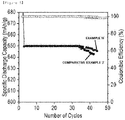
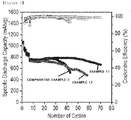
FIG. 3 is a graph showing lifetime properties of lithium-sulfur batteries manufactured in Examples 7 and 8 and Comparative Example 2. -
FIG. 4 is a graph showing lifetime properties of lithium-sulfur batteries manufactured in Example 9 and Comparative Example 2. -
FIG. 5 is a graph showing lifetime properties of lithium-sulfur batteries manufactured in Example 10 and Comparative Example 2. -
FIG. 6 is a graph showing lifetime properties of lithium-sulfur batteries manufactured in Examples 11 and 12 and Comparative Example 2. - Hereinafter, the present invention will be described in detail.
- The present invention relates to a separator for a lithium-sulfur battery comprising a separator base; and a coating layer present on one or more surfaces of the separator base, wherein the coating layer comprises a structural unit (A) derived from one or more compound comprising (i) one or more group selected from the group consisting of a catechol group and a pyrogallol group, and (ii) one or more sulfonic acid group; and a structural unit (B) derived from dopamine, and
wherein the coating layer comprises a sulfonic acid anion group. - As illustrated in
FIG. 1 , the separator for a lithium-sulfur battery of the present invention has a coating layer formed comprising polydopamine and a sulfonic acid anion group (-SO3 -) on the surface. - Since the coating layer is negatively charged, it pushes and thereby blocks negatively charged soluble polysulfide generated in a positive electrode and moving toward a negative electrode by a repulsive force as illustrated in
FIG. 2 . Therefore, problems caused by polysulfide are resolved. - In the coating layer, a ratio of a total molar number of the structural unit (A) to a molar number of the structural unit (B) may be from 1:0.1 to 5, more preferably from 1:0.5 to 2, and even more preferably from 1:0.7 to 1.3.
- The coating layer may be formed by polymerization through an oxidation reaction between the catechol or pyrogallol group comprised in structural unit (A) and catechol group comprised in structural unit (B).
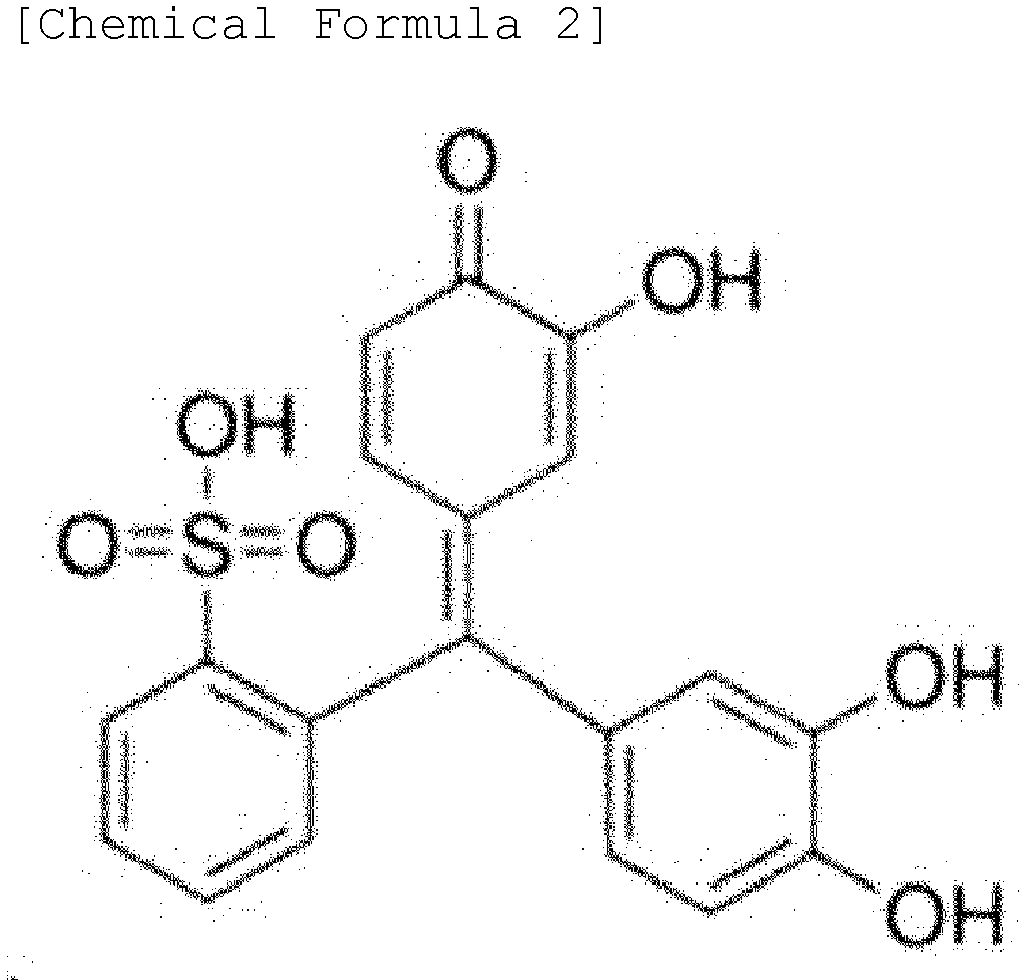
- The one or more compound comprising (i) one or more group selected from the group consisting of a catechol group and a pyrogallol group, and (ii) one or more sulfonic acid group may be selected from the group consisting of, for example, pyrogallol red, pyrocatechol violet, catechol-4-sulfonic acid, 1,2-dihydroxybenzene-3,5-disulfonic acid, 3,4-dihydroxybenzenesulfonic acid, 2,3-dihydroxynaphthalene-6-sulfonic acid and the like, but are not limited thereto.
- Structures of the pyrogallol red and the pyrocatechol violet are represented by the following
Chemical Formulae 

- The separator base is not particularly limited, and those known in the art may be used without limit. For example, films formed with one or more compound selected from the group consisting of polyolefin, polyester such as polyethylene terephthalate, polybutylene terephthalate, polyacetal, polyamide, polycarbonate, polyimide, polyetheretherketone, polyethersulfone, polyphenylene oxide, polyphenylene sulfide, polyethylene naphthalene and the like may be used.
- The present invention also relates to a method for preparing a separator for a lithium-sulfur battery comprising:
- preparing a coating composition comprising:
- (a) one or more compound comprising (i) one or more group selected from the group consisting of a catechol group and a pyrogallol group, and (ii) one or more sulfonic acid group; and
- (b) dopamine; and
- coating the coating composition on one or more surface of a separator base.
- Regarding the preparation method, descriptions on the separator for a lithium-sulfur battery provided above may all be applied.
- In the coating composition, a ratio of a total molar number of (a) to a molar number of (b) may be from 1:0.1 to 5, more preferably from 1:0.5 to 2, and even more preferably from 1:0.7 to 1.3.
- The coating composition may further include a solvent, and in this case, a total molar concentration of (a) may be from 1 mM to 500 mM.
- As the solvent, those capable of dissolving the above-mentioned components may be used, and specifically, one or more selected from among a buffer solution; a C1 to C5 alcohol such as methanol or ethanol; water and the like may be used. As the water, distilled water may be preferably used.
- The solvent may have a pH of 8 to 10 for polymerization of the dopamine.
- The buffer solution may be prepared using, for example, tris HCl and/or tris base. The buffer solution may have its pH adjusted to 8 to 10, and without being limited thereto, may have its pH adjusted to a pH at which the dopamine is able to produce an autoxidation polymerization reaction. As the buffer solution concentration and the pH are higher, the coating rate and/or the coating thickness may increase. For example, the mixture solution may have a concentration of 1 mM to 20 mM, and a pH of 8.5.
- As for the solvent, a total molar concentration of each of the components other than water may be from 1 mM to 1 M.
- The coating composition may further include an oxidizer for facilitating oxidation. As the oxidizer, those known in the art may be used without limit, and for example, NaIO4, piperidine and the like may be used.
- The coating composition may be prepared by mixing (a) and (b).
- The coating method is not particularly limited, and methods known in the art may be used.
- When the coating is performed by dip coating, dipping time of the separator base may be from 5 minutes to 60 minutes and more preferably from 15 minutes to 30 minutes when using pyrogallol red.
- When using pyrocatechol violet, dipping time of the separator base may be from 0.5 hours to 8 hours and more preferably from 50 minutes to 120 minutes.
- The dipping time in the present invention may be shortened by an addition of the oxidizer.
- Pyrogallol red has a high reaction rate, and when the coating is performed for a long period of time outside the above-mentioned coating time range, performance may decline.
- Meanwhile, in pyrocatechol violet, the catechol functional group has a lower reaction rate than the gallol functional group, and therefore, the coating needs to be performed for a relatively long period of time, and when the coating is performed for a shorter period of time than the above-described range, performance declines.
- The present invention also relates to a lithium-sulfur battery including a positive electrode; a negative electrode; a separator provided between the positive electrode and the negative electrode; and an electrolyte, wherein the separator is the separator of the present invention described above.
- Hereinafter, constitutions of the lithium-sulfur battery of the present invention will be described. The following lithium-sulfur battery constitutions are described as an example for implementing the present invention, and do not limit the present invention.
- As the positive electrode of the present invention, those known in the art may be used. Particularly, a sulfur-carbon composite may be preferably used.
- As the negative electrode of the battery of the present invention, negative electrodes known in the art as a negative electrode including lithium metal or a lithium alloy as a negative electrode active material may be used without limit.
- As the lithium alloy as the negative electrode active material, alloys of lithium and metals selected from the group consisting of Na, K, Rb, Cs, Fr, Be, Mg, Ca, Sr, Ba, Ra, Al, Sn and the like may be used.
- As the separator provided between the positive electrode and the negative electrode, the separator of the present invention may be used.
- As the electrolyte, those known in the art may be used, and for example, electrolytes having a form including a lithium salt and an organic solvent may be used. The electrolyte may have a form of being impregnated into the negative electrode, the positive electrode and the separator.
- As the organic solvent included in the electrolyte, for example, single solvent or mixed organic solvents of two or more may be used. When using the mixed organic solvents of two or more, one or more solvents selected from two or more groups among a weak polar solvent group, a strong polar solvent group and a lithium metal protecting solvent group may be used. The weak polar solvent is defined by a solvent having a dielectric constant of less than 15 capable of dissolving a sulfur element among aryl compounds, bicyclic ether, and non-cyclic carbonate, the strong polar solvent is defined by a solvent having a dielectric constant of greater than 15 capable of dissolving lithium polysulfide among bicyclic carbonate, sulfoxide compounds, lactone compounds, ketone compounds, ester compounds, sulfate compounds and sulfite compounds, and a lithium metal protecting solvent is defined by a solvent having charge and discharge cycle efficiency of 50% or greater forming a stable solid electrolyte interface (SEI) on lithium metal such as saturated ether compounds, unsaturated ether compounds, heterocyclic compounds including N, O, S or a combination thereof.
- Specific examples of the weak polar solvent may include xylene, dimethoxyethane, 2-methyltetrahydrofuran, diethyl carbonate, dimethyl carbonate, toluene, dimethyl ether, diethyl ether, diglyme, tetraglyme and the like, but are not limited thereto.
- Specific examples of the strong polar solvent may include hexamethyl phosphoric triamide, γ-butyrolactone, acetonitrile, ethylene carbonate, propylene carbonate, N-methyl pyrrolidone, 3-methyl-2-oxazolidone, dimethylformamide, sulfolane, dimethylacetamide, dimethyl sulfoxide, dimethyl sulfate, ethylene glycol diacetate, dimethyl sulfite, ethylene glycol sulfite and the like, but are not limited thereto.
- Specific examples of the lithium metal protecting solvent may include tetrahydrofuran, ethylene oxide, dioxolane, 3,5-dimethylisoxazole, furan, 2-methylfuran, 1,4-dioxane, 4-methyldioxolane and the like, but are not limited thereto.
- The battery may be formed using technologies known in the art except for characteristic technologies of the present invention described above.
- Hereinafter, preferred examples are provided in order to illuminate the present invention, however, the following examples are for illustrative purposes only, and it is obvious to those skilled in the art that various modifications and changes may be made within the category and the scope of technological ideas of the present invention, and such modifications and changes also fall within the scope of the attached claims.
- As a separator base, a polyethylene (
porosity 50%) film having a thickness of 20 pm was prepared. - Trizma HCl and Trizma base manufactured by Sigma-Aldrich were purchased and dissolved in 2.21 g/L, 4.36 g/L, respectively, to prepare a buffer solution of 50 mM and pH 8.5, and the buffer solution was diluted to 10 mM using distilled water to prepare a tris butter solution.
- To the tris buffer solution, pyrogallol red and dopamine were added in a molar ratio of 1:1 so that the pyrogallol red has a molar concentration of 10 mM, and a coating composition was prepared therefrom.
- The separator base was dipped for 20 minutes through dip coating while stirring the coating composition at 80 rpm using a shaker to prepare a separator.
- A separator was prepared in the same manner as in Example 1 except that the pyrogallol red and the dopamine were added in a molar ratio of 1:0.5.
- A separator was prepared in the same manner as in Example 1 except that the pyrogallol red and the dopamine were added in a molar ratio of 1:2.
- A separator was prepared in the same manner as in Example 1 except that pyrocatechol violet was used instead of pyrogallol red.
- A separator was prepared in the same manner as in Example 1 except that pyrocatechol violet was used instead of pyrogallol red, and the dip coating was performed for 60 minutes.
- A separator was prepared in the same manner as in Example 1 except that the dip coating was performed for 60 minutes instead of 20 minutes.
- A commercially available polyethylene (
porosity 50%) separator having a thickness of 20 pm was prepared as a separator of Comparative Example 1. - A positive electrode a having a composition of 85% by weight of a positive electrode active material prepared by mixing sulfur and carbon nanotubes (CNT) in a weight ratio of 7:3, 5% by weight of carbon nanofibers as a conductor, and 10% by weight of a binder was added to D.I water to prepare positive electrode slurry, and the slurry was coated on an aluminum current collector to prepare a positive electrode.
- Using the positive electrode; lithium foil having a thickness of approximately 35 pm as a negative electrode; an electrolyte liquid obtained by adding 1 M LiTFSI and 1% by weight LiNO3 to an ether-based solvent; and each of the separators prepared in Examples 1 to 6 and Comparative Example 1 as a separator, each of lithium-sulfur batteries of Examples 7 to 12 and Comparative Example 2 was manufactured.
- For each of the lithium-sulfur batteries manufactured in Examples 7 to 12 and Comparative Example 2, a charge and discharge cycle was repeated to measure a lifetime of the battery. Specifically, capacity of each of the batteries for each cycle was measured while repeating charge/discharge at 0.1 C/0.1 C for the first 3 cycles, repeating charge/discharge at 0.2 C/0.2 C for the next 3 cycles, and repeating charge/discharge at 0.3 C/0.5 C for cycles after that.
- For the batteries of Examples 7 to 10 and the battery of Comparative Example 2, lifetime properties were evaluated employing capacity of 650 mAh/g as a cut, and the results are shown in
FIGs. 3 to 5 . - For the batteries of Examples 11 and 12 and the battery of Comparative Example 2, lifetime properties were evaluated employing a voltage of 1.8 V to 2.5 V as a cut, and the results are shown in
FIG. 6 . - Based on the test results shown in
FIG. 3 to FIG. 6 , the lithium-sulfur batteries of Examples 7 to 12 using the separator of the present invention exhibited excellent lifetime properties compared to the lithium-sulfur battery of Comparative Example 2 using a commercially available PE separator. - Specifically, as shown in
FIG. 5 , the lithium-sulfur battery of Example 10 using the separator (Example 4, coating for 20 minutes) prepared using pyrocatechol violet exhibited inferior lifetime properties compared to the batteries using pyrogallol red (Examples 7 to 9), although the lifetime properties were more superior than the lithium-sulfur battery of Comparative Example 2. Such a result is considered to be due to the fact that the catechol functional group has a lower reaction rate than the gallol functional group, and therefore, when coating for the same 20 minutes, relatively low lifetime performance was obtained compared to the batteries using the separator using pyrogallol red (Examples 7 to 9). - However, as shown in
FIG. 6 , the lifetime was more enhanced when coating for 60 minutes. Meanwhile, when using pyrogallol red, coating for 60 minutes resulted in performance decline compared to when coating for 20 minutes, although the performance was more superior than Comparative Example 2. - For reference, the battery of Comparative Example 2 shown in
FIG. 3 and the battery of Comparative Example 2 shown inFIG. 4 exhibited different lifetime properties since loading of the electrode used in the test was different.
Claims (11)
- A separator for a lithium-sulfur battery comprising:a separator base; anda coating layer present on one or more surfaces of the separator base,wherein the coating layer comprises a structural unit (A) derived from one or more compound comprising (i) one or more group selected from the group consisting of a catechol group and a pyrogallol group, and (ii) one or more sulfonic acid group; and a structural unit (B) derived from dopamine, andwherein the coating layer comprises a sulfonic acid anion group.
- The separator for a lithium-sulfur battery of Claim 1, wherein, in the coating layer, a ratio of a total molar number of structural unit (A) to a molar number of structural unit (B) is from 1:0.1 to 5.
- The separator for a lithium-sulfur battery of Claim 1, wherein the structural unit (A) is derived from one or more compound selected from the group consisting of pyrogallol red, pyrocatechol violet, catechol-4-sulfonic acid, 1,2-dihydroxybenzene-3,5-disulfonic acid, 3,4-dihydroxybenzenesulfonic acid and 2,3-dihydroxynaphthalene-6-sulfonic acid.
- The separator for a lithium-sulfur battery of Claim 1, wherein the separator base is a film formed with one or more selected from the group consisting of polyolefin, polyester, polyacetal, polyamide, polycarbonate, polyimide, polyetheretherketone, polyethersulfone, polyphenylene oxide, polyphenylene sulfide and polyethylene naphthalene.
- A method for preparing a separator for a lithium-sulfur battery comprising:preparing a coating composition comprising:(a) one or more compound comprising (i) one or more group selected from the group consisting of a catechol group and a pyrogallol group, and (ii) one or more sulfonic acid group; and(b) dopamine; andcoating the coating composition on one or more surface of a separator base.
- The method for preparing a separator for a lithium-sulfur battery of Claim 5, wherein, in the coating composition, a ratio of a total molar number of (a) to a molar number of (b) is from 1:0.1 to 5.
- The method for preparing a separator for a lithium-sulfur battery of Claim 6, wherein the coating composition further comprises a solvent, and a total molar concentration of (a) is from 1 mM to 500 mM.
- The method for preparing a separator for a lithium-sulfur battery of Claim 7, wherein the solvent comprises one or more selected from the group consisting of a buffer solution, a C1 to C5 alcohol and water, and wherein the solvent has a pH of 8 to 10.
- The method for preparing a separator for a lithium-sulfur battery of Claim 5, wherein the (a) one or more compound comprising (i) one or more group selected from the group consisting of catechol group and a pyrogallol group, and (ii) one or more sulfonic acid group is selected from the group consisting of pyrogallol red, pyrocatechol violet, catechol-4-sulfonic acid, 1,2-dihydroxybenzene-3,5-disulfonic acid, 3,4-dihydroxybenzenesulfonic acid and 2,3-dihydroxynaphthalene-6-sulfonic acid.
- The method for preparing a separator for a lithium-sulfur battery of Claim 5, wherein the coating composition further comprises an oxidizer.
- A lithium-sulfur battery comprising:a positive electrode;a negative electrode;a separator provided between the positive electrode and the negative electrode; andan electrolyte,wherein the separator is the separator of Claim 1.
Applications Claiming Priority (2)
| Application Number | Priority Date | Filing Date | Title |
|---|---|---|---|
| KR1020180019149A KR102207526B1 (en) | 2018-02-19 | 2018-02-19 | Separator for lithium sulfurbattery, manufacturing method thereof, and lithium sulfurbattery comprising the same |
| PCT/KR2019/001977 WO2019160393A1 (en) | 2018-02-19 | 2019-02-19 | Separator for lithium-sulfur battery, manufacturing method therefor, and lithium-sulfur battery comprising same |
Publications (3)
| Publication Number | Publication Date |
|---|---|
| EP3624226A1 true EP3624226A1 (en) | 2020-03-18 |
| EP3624226A4 EP3624226A4 (en) | 2020-05-27 |
| EP3624226B1 EP3624226B1 (en) | 2023-06-28 |
Family
ID=67618770
Family Applications (1)
| Application Number | Title | Priority Date | Filing Date |
|---|---|---|---|
| EP19754162.6A Active EP3624226B1 (en) | 2018-02-19 | 2019-02-19 | Separator for lithium-sulfur battery, manufacturing method therefor, and lithium-sulfur battery comprising same |
Country Status (9)
| Country | Link |
|---|---|
| US (1) | US11289770B2 (en) |
| EP (1) | EP3624226B1 (en) |
| JP (1) | JP6808264B2 (en) |
| KR (1) | KR102207526B1 (en) |
| CN (1) | CN110731021B (en) |
| ES (1) | ES2951830T3 (en) |
| HU (1) | HUE062502T2 (en) |
| PL (1) | PL3624226T3 (en) |
| WO (1) | WO2019160393A1 (en) |
Families Citing this family (3)
| Publication number | Priority date | Publication date | Assignee | Title |
|---|---|---|---|---|
| KR102917427B1 (en) * | 2021-06-03 | 2026-01-23 | 주식회사 엘지에너지솔루션 | Electrolyte for lithium-sulfur battery and lithium-sulfur battery comprising the same |
| KR20250105371A (en) * | 2022-10-31 | 2025-07-08 | 니폰 제온 가부시키가이샤 | Composition for electrochemical device functional layer, precursor for composition for electrochemical device functional layer, functional layer for electrochemical device, laminate for electrochemical device, and electrochemical device |
| CN116632452B (en) * | 2023-07-24 | 2023-09-26 | 江苏宝德新材料有限公司 | Coating material for lithium-sulfur battery diaphragm, diaphragm and preparation method thereof |
Family Cites Families (24)
| Publication number | Priority date | Publication date | Assignee | Title |
|---|---|---|---|---|
| KR101327891B1 (en) * | 2012-02-02 | 2013-11-11 | 에스케이씨 주식회사 | Porous film coated with biopolymer and separator for secondary battery comprising same |
| KR101465173B1 (en) | 2012-06-15 | 2014-11-25 | 주식회사 엘지화학 | A separator having porous coating layer and electrochemical device including the same |
| KR101958644B1 (en) * | 2013-05-21 | 2019-03-15 | 주식회사 엘지화학 | Polyolefin separator and method for preparing thereof |
| US9914152B2 (en) | 2013-07-05 | 2018-03-13 | Surftec, Llc | Polytetrafluoroethylene thin film with polydopamine adhesive layer |
| CN103408975A (en) | 2013-08-16 | 2013-11-27 | 上海大学 | Coating material for lithium ion battery diaphragm |
| US9742028B2 (en) | 2013-08-21 | 2017-08-22 | GM Global Technology Operations LLC | Flexible membranes and coated electrodes for lithium based batteries |
| US9373829B2 (en) | 2013-10-11 | 2016-06-21 | GM Global Technology Operations LLC | Porous interlayer for a lithium-sulfur battery |
| US20160285135A1 (en) * | 2013-12-03 | 2016-09-29 | Ulvac, Inc. | Lithium-sulfur secondary battery |
| KR101396270B1 (en) | 2013-12-16 | 2014-05-19 | 한밭대학교 산학협력단 | Composite separator membrane for secondary battery and manufacturing method of the same |
| KR101610446B1 (en) * | 2013-12-30 | 2016-04-07 | 현대자동차주식회사 | A separator of lithium sulfur secondary battery |
| KR101791241B1 (en) * | 2014-06-17 | 2017-10-30 | 한국과학기술원 | Catecholamine-based versatility film and a preparation method thereof |
| CN104051695A (en) * | 2014-06-20 | 2014-09-17 | 江苏大学 | Polymer modified diaphragm for lithium-sulfur battery, preparation method thereof and lithium-sulfur battery |
| KR101692138B1 (en) * | 2015-01-28 | 2017-01-02 | 서울대학교산학협력단 | Separator of lithium secondary battery and the lithium secondary battery with the same |
| MX2017016280A (en) | 2015-06-17 | 2018-04-20 | Dow Global Technologies Llc | Process for making crosslinked cable insulation using high melt strength ethylene-based polymer made in a tubular reactor and optionally modified with a branching agent. |
| KR20170009280A (en) | 2015-07-16 | 2017-01-25 | 주식회사 엘지화학 | Separator for secondary battery and the method for manufacturing of the same |
| CN106935773A (en) * | 2015-12-31 | 2017-07-07 | 中国人民解放军63971部队 | A kind of interlayer for lithium-sulfur cell |
| KR102038543B1 (en) | 2016-01-28 | 2019-10-30 | 주식회사 엘지화학 | A Separator For Lithium-Sulfur Battery Having Composite Coating Layer Containing Polydopamine, Manufacturing Method Thereof, And Lithium-Sulfur Battery Comprising The Same |
| KR101891876B1 (en) | 2016-03-11 | 2018-08-24 | 한국과학기술원 | Separator of lithium-sulfur battery containing conductive polymer swollen by plasticizer, lithium-sulfur battery comprising the same, and manufacturing method for the same |
| JP6690358B2 (en) | 2016-03-30 | 2020-04-28 | Tdk株式会社 | Negative electrode active material for lithium ion secondary battery, negative electrode for lithium ion secondary battery using the same, and lithium ion secondary battery using the same |
| CN105977433A (en) | 2016-05-26 | 2016-09-28 | 厦门大学 | Composite non-woven fabric and preparation method therefor, and application of composite non-woven fabric in lithium-sulfur battery |
| US10074839B2 (en) * | 2016-07-26 | 2018-09-11 | Massachusetts Institute Of Technology | Lithium-air battery separators and related compositions |
| CN106887556B (en) * | 2017-03-10 | 2020-12-18 | 厦门益舟新能源科技有限公司 | Organic-inorganic composite modified diaphragm and preparation method and application thereof |
| CN106953051B (en) * | 2017-03-10 | 2019-12-10 | 厦门益舟新能源科技有限公司 | Ceramic diaphragm for in-situ generation of composite binder and preparation method and application thereof |
| CN106803561B (en) * | 2017-03-10 | 2020-09-29 | 厦门益舟新能源科技有限公司 | Functionalized modified diaphragm and preparation method and application thereof |
-
2018
- 2018-02-19 KR KR1020180019149A patent/KR102207526B1/en active Active
-
2019
- 2019-02-19 US US16/619,564 patent/US11289770B2/en active Active
- 2019-02-19 CN CN201980002818.8A patent/CN110731021B/en active Active
- 2019-02-19 EP EP19754162.6A patent/EP3624226B1/en active Active
- 2019-02-19 PL PL19754162.6T patent/PL3624226T3/en unknown
- 2019-02-19 HU HUE19754162A patent/HUE062502T2/en unknown
- 2019-02-19 ES ES19754162T patent/ES2951830T3/en active Active
- 2019-02-19 WO PCT/KR2019/001977 patent/WO2019160393A1/en not_active Ceased
- 2019-02-19 JP JP2020514652A patent/JP6808264B2/en active Active
Also Published As
| Publication number | Publication date |
|---|---|
| ES2951830T3 (en) | 2023-10-25 |
| EP3624226A4 (en) | 2020-05-27 |
| WO2019160393A1 (en) | 2019-08-22 |
| US11289770B2 (en) | 2022-03-29 |
| PL3624226T3 (en) | 2023-09-25 |
| CN110731021A (en) | 2020-01-24 |
| CN110731021B (en) | 2022-05-10 |
| JP6808264B2 (en) | 2021-01-06 |
| HUE062502T2 (en) | 2023-11-28 |
| US20200136112A1 (en) | 2020-04-30 |
| EP3624226B1 (en) | 2023-06-28 |
| JP2020521309A (en) | 2020-07-16 |
| KR20190099564A (en) | 2019-08-28 |
| KR102207526B1 (en) | 2021-01-25 |
Similar Documents
| Publication | Publication Date | Title |
|---|---|---|
| JP4864726B2 (en) | Electrolytes for lithium-sulfur electrochemical cells | |
| US10622669B2 (en) | Lithium-sulfur battery separation film having composite coating layer including polydopamine, manufacturing method therefor, and lithium-sulfur battery comprising same | |
| JP6699876B2 (en) | Lithium-sulfur battery electrolyte and lithium-sulfur battery containing the same | |
| US20180212248A1 (en) | Self-assembled composite of carbon nitride and graphene oxide, manufacturing method for same, positive electrode having same applied thereto, and lithium-sulfur battery comprising same | |
| JP6699877B2 (en) | Lithium-sulfur battery electrolyte and lithium-sulfur battery containing the same | |
| US11646457B2 (en) | Method for improving lifetime of lithium-sulfur battery | |
| CN112585782A (en) | Lithium-sulfur secondary battery | |
| EP3648229A1 (en) | Polymer electrolyte for secondary battery and secondary battery comprising same | |
| EP3624236B1 (en) | Cathode for lithium-sulfur battery, and lithium-sulfur battery comprising same | |
| JP6863861B2 (en) | Aqueous electrolyte containing ether and batteries using the electrolyte | |
| EP3910706A1 (en) | Sulfur-carbon composite, and cathode for lithium secondary battery and lithium secondary battery which comprise same | |
| EP3624226B1 (en) | Separator for lithium-sulfur battery, manufacturing method therefor, and lithium-sulfur battery comprising same | |
| EP3370297A1 (en) | Electrolyte containing polydopamine and lithium-sulfur battery including same | |
| CN111033864B (en) | Electrolyte for lithium metal battery and lithium metal battery containing the same | |
| EP3671935A2 (en) | Electrolyte for lithium secondary battery and lithium secondary battery comprising same | |
| EP3624223A1 (en) | Lithium-sulfur battery | |
| KR20150026098A (en) | Cathode for lithium-sulfur battery and method of preparing the same | |
| EP3627608B1 (en) | Polymer electrolyte for secondary battery and lithium secondary battery comprising the same | |
| CN120834283A (en) | Electrolyte for rechargeable lithium battery and rechargeable lithium battery including the electrolyte | |
| WO2023026476A1 (en) | Electrolyte solution for alkali metal secondary batteries, and alkali metal secondary battery | |
| KR20190060240A (en) | SULFUR-CARBON COMPOSITE COATED WITH MnO2 AND METHOD FOR MANUFACTURING THE SAME | |
| US11081728B2 (en) | Non-aqueous electrolyte solution additive, and non-aqueous electrolyte solution for lithium secondary battery and lithium secondary battery which include the same | |
| KR102346842B1 (en) | Cathode for lithium-sulfur battery, method for preparing the same, and lithium-sulfur battery comprising the same | |
| CN114175320A (en) | Electrolyte composition for electrochemical cells comprising lithium anodes | |
| US20240356080A1 (en) | Electrolyte for ultra low electrolyte-to-active material ratio in lithium sulfur/selenium battery |
Legal Events
| Date | Code | Title | Description |
|---|---|---|---|
| STAA | Information on the status of an ep patent application or granted ep patent |
Free format text: STATUS: THE INTERNATIONAL PUBLICATION HAS BEEN MADE |
|
| PUAI | Public reference made under article 153(3) epc to a published international application that has entered the european phase |
Free format text: ORIGINAL CODE: 0009012 |
|
| STAA | Information on the status of an ep patent application or granted ep patent |
Free format text: STATUS: REQUEST FOR EXAMINATION WAS MADE |
|
| 17P | Request for examination filed |
Effective date: 20191211 |
|
| AK | Designated contracting states |
Kind code of ref document: A1 Designated state(s): AL AT BE BG CH CY CZ DE DK EE ES FI FR GB GR HR HU IE IS IT LI LT LU LV MC MK MT NL NO PL PT RO RS SE SI SK SM TR |
|
| AX | Request for extension of the european patent |
Extension state: BA ME |
|
| A4 | Supplementary search report drawn up and despatched |
Effective date: 20200429 |
|
| RIC1 | Information provided on ipc code assigned before grant |
Ipc: H01M 2/14 20060101ALI20200422BHEP Ipc: H01M 10/052 20100101ALI20200422BHEP Ipc: H01M 2/16 20060101AFI20200422BHEP Ipc: H01M 4/38 20060101ALI20200422BHEP |
|
| STAA | Information on the status of an ep patent application or granted ep patent |
Free format text: STATUS: EXAMINATION IS IN PROGRESS |
|
| 17Q | First examination report despatched |
Effective date: 20201103 |
|
| DAV | Request for validation of the european patent (deleted) | ||
| DAX | Request for extension of the european patent (deleted) | ||
| RAP1 | Party data changed (applicant data changed or rights of an application transferred) |
Owner name: LG ENERGY SOLUTION LTD. |
|
| RAP3 | Party data changed (applicant data changed or rights of an application transferred) |
Owner name: LG ENERGY SOLUTION, LTD. |
|
| REG | Reference to a national code |
Ref country code: DE Ref legal event code: R079 Free format text: PREVIOUS MAIN CLASS: H01M0002160000 Ipc: H01M0010052000 Ref country code: DE Ref legal event code: R079 Ref document number: 602019031763 Country of ref document: DE Free format text: PREVIOUS MAIN CLASS: H01M0002160000 Ipc: H01M0010052000 |
|
| GRAP | Despatch of communication of intention to grant a patent |
Free format text: ORIGINAL CODE: EPIDOSNIGR1 |
|
| STAA | Information on the status of an ep patent application or granted ep patent |
Free format text: STATUS: GRANT OF PATENT IS INTENDED |
|
| RIC1 | Information provided on ipc code assigned before grant |
Ipc: H01M 50/457 20210101ALI20230110BHEP Ipc: H01M 50/417 20210101ALI20230110BHEP Ipc: H01M 50/414 20210101ALI20230110BHEP Ipc: H01M 50/403 20210101ALI20230110BHEP Ipc: H01M 4/38 19740701ALI20230110BHEP Ipc: H01M 10/052 20100101AFI20230110BHEP |
|
| INTG | Intention to grant announced |
Effective date: 20230207 |
|
| GRAS | Grant fee paid |
Free format text: ORIGINAL CODE: EPIDOSNIGR3 |
|
| GRAA | (expected) grant |
Free format text: ORIGINAL CODE: 0009210 |
|
| STAA | Information on the status of an ep patent application or granted ep patent |
Free format text: STATUS: THE PATENT HAS BEEN GRANTED |
|
| AK | Designated contracting states |
Kind code of ref document: B1 Designated state(s): AL AT BE BG CH CY CZ DE DK EE ES FI FR GB GR HR HU IE IS IT LI LT LU LV MC MK MT NL NO PL PT RO RS SE SI SK SM TR |
|
| P01 | Opt-out of the competence of the unified patent court (upc) registered |
Effective date: 20230522 |
|
| REG | Reference to a national code |
Ref country code: CH Ref legal event code: EP |
|
| REG | Reference to a national code |
Ref country code: AT Ref legal event code: REF Ref document number: 1583542 Country of ref document: AT Kind code of ref document: T Effective date: 20230715 |
|
| REG | Reference to a national code |
Ref country code: IE Ref legal event code: FG4D |
|
| REG | Reference to a national code |
Ref country code: DE Ref legal event code: R096 Ref document number: 602019031763 Country of ref document: DE |
|
| REG | Reference to a national code |
Ref country code: SE Ref legal event code: TRGR |
|
| REG | Reference to a national code |
Ref country code: LT Ref legal event code: MG9D |
|
| REG | Reference to a national code |
Ref country code: ES Ref legal event code: FG2A Ref document number: 2951830 Country of ref document: ES Kind code of ref document: T3 Effective date: 20231025 |
|
| PG25 | Lapsed in a contracting state [announced via postgrant information from national office to epo] |
Ref country code: NO Free format text: LAPSE BECAUSE OF FAILURE TO SUBMIT A TRANSLATION OF THE DESCRIPTION OR TO PAY THE FEE WITHIN THE PRESCRIBED TIME-LIMIT Effective date: 20230928 |
|
| REG | Reference to a national code |
Ref country code: NL Ref legal event code: MP Effective date: 20230628 |
|
| REG | Reference to a national code |
Ref country code: AT Ref legal event code: MK05 Ref document number: 1583542 Country of ref document: AT Kind code of ref document: T Effective date: 20230628 |
|
| REG | Reference to a national code |
Ref country code: HU Ref legal event code: AG4A Ref document number: E062502 Country of ref document: HU |
|
| PG25 | Lapsed in a contracting state [announced via postgrant information from national office to epo] |
Ref country code: RS Free format text: LAPSE BECAUSE OF FAILURE TO SUBMIT A TRANSLATION OF THE DESCRIPTION OR TO PAY THE FEE WITHIN THE PRESCRIBED TIME-LIMIT Effective date: 20230628 Ref country code: NL Free format text: LAPSE BECAUSE OF FAILURE TO SUBMIT A TRANSLATION OF THE DESCRIPTION OR TO PAY THE FEE WITHIN THE PRESCRIBED TIME-LIMIT Effective date: 20230628 Ref country code: LV Free format text: LAPSE BECAUSE OF FAILURE TO SUBMIT A TRANSLATION OF THE DESCRIPTION OR TO PAY THE FEE WITHIN THE PRESCRIBED TIME-LIMIT Effective date: 20230628 Ref country code: LT Free format text: LAPSE BECAUSE OF FAILURE TO SUBMIT A TRANSLATION OF THE DESCRIPTION OR TO PAY THE FEE WITHIN THE PRESCRIBED TIME-LIMIT Effective date: 20230628 Ref country code: HR Free format text: LAPSE BECAUSE OF FAILURE TO SUBMIT A TRANSLATION OF THE DESCRIPTION OR TO PAY THE FEE WITHIN THE PRESCRIBED TIME-LIMIT Effective date: 20230628 Ref country code: GR Free format text: LAPSE BECAUSE OF FAILURE TO SUBMIT A TRANSLATION OF THE DESCRIPTION OR TO PAY THE FEE WITHIN THE PRESCRIBED TIME-LIMIT Effective date: 20230929 |
|
| PG25 | Lapsed in a contracting state [announced via postgrant information from national office to epo] |
Ref country code: FI Free format text: LAPSE BECAUSE OF FAILURE TO SUBMIT A TRANSLATION OF THE DESCRIPTION OR TO PAY THE FEE WITHIN THE PRESCRIBED TIME-LIMIT Effective date: 20230628 |
|
| PG25 | Lapsed in a contracting state [announced via postgrant information from national office to epo] |
Ref country code: SK Free format text: LAPSE BECAUSE OF FAILURE TO SUBMIT A TRANSLATION OF THE DESCRIPTION OR TO PAY THE FEE WITHIN THE PRESCRIBED TIME-LIMIT Effective date: 20230628 |
|
| PG25 | Lapsed in a contracting state [announced via postgrant information from national office to epo] |
Ref country code: IS Free format text: LAPSE BECAUSE OF FAILURE TO SUBMIT A TRANSLATION OF THE DESCRIPTION OR TO PAY THE FEE WITHIN THE PRESCRIBED TIME-LIMIT Effective date: 20231028 |
|
| PG25 | Lapsed in a contracting state [announced via postgrant information from national office to epo] |
Ref country code: SM Free format text: LAPSE BECAUSE OF FAILURE TO SUBMIT A TRANSLATION OF THE DESCRIPTION OR TO PAY THE FEE WITHIN THE PRESCRIBED TIME-LIMIT Effective date: 20230628 Ref country code: SK Free format text: LAPSE BECAUSE OF FAILURE TO SUBMIT A TRANSLATION OF THE DESCRIPTION OR TO PAY THE FEE WITHIN THE PRESCRIBED TIME-LIMIT Effective date: 20230628 Ref country code: RO Free format text: LAPSE BECAUSE OF FAILURE TO SUBMIT A TRANSLATION OF THE DESCRIPTION OR TO PAY THE FEE WITHIN THE PRESCRIBED TIME-LIMIT Effective date: 20230628 Ref country code: PT Free format text: LAPSE BECAUSE OF FAILURE TO SUBMIT A TRANSLATION OF THE DESCRIPTION OR TO PAY THE FEE WITHIN THE PRESCRIBED TIME-LIMIT Effective date: 20231030 Ref country code: IS Free format text: LAPSE BECAUSE OF FAILURE TO SUBMIT A TRANSLATION OF THE DESCRIPTION OR TO PAY THE FEE WITHIN THE PRESCRIBED TIME-LIMIT Effective date: 20231028 Ref country code: EE Free format text: LAPSE BECAUSE OF FAILURE TO SUBMIT A TRANSLATION OF THE DESCRIPTION OR TO PAY THE FEE WITHIN THE PRESCRIBED TIME-LIMIT Effective date: 20230628 Ref country code: CZ Free format text: LAPSE BECAUSE OF FAILURE TO SUBMIT A TRANSLATION OF THE DESCRIPTION OR TO PAY THE FEE WITHIN THE PRESCRIBED TIME-LIMIT Effective date: 20230628 Ref country code: AT Free format text: LAPSE BECAUSE OF FAILURE TO SUBMIT A TRANSLATION OF THE DESCRIPTION OR TO PAY THE FEE WITHIN THE PRESCRIBED TIME-LIMIT Effective date: 20230628 |
|
| REG | Reference to a national code |
Ref country code: DE Ref legal event code: R097 Ref document number: 602019031763 Country of ref document: DE |
|
| PG25 | Lapsed in a contracting state [announced via postgrant information from national office to epo] |
Ref country code: DK Free format text: LAPSE BECAUSE OF FAILURE TO SUBMIT A TRANSLATION OF THE DESCRIPTION OR TO PAY THE FEE WITHIN THE PRESCRIBED TIME-LIMIT Effective date: 20230628 |
|
| PLBE | No opposition filed within time limit |
Free format text: ORIGINAL CODE: 0009261 |
|
| STAA | Information on the status of an ep patent application or granted ep patent |
Free format text: STATUS: NO OPPOSITION FILED WITHIN TIME LIMIT |
|
| PG25 | Lapsed in a contracting state [announced via postgrant information from national office to epo] |
Ref country code: IT Free format text: LAPSE BECAUSE OF FAILURE TO SUBMIT A TRANSLATION OF THE DESCRIPTION OR TO PAY THE FEE WITHIN THE PRESCRIBED TIME-LIMIT Effective date: 20230628 |
|
| 26N | No opposition filed |
Effective date: 20240402 |
|
| PG25 | Lapsed in a contracting state [announced via postgrant information from national office to epo] |
Ref country code: SI Free format text: LAPSE BECAUSE OF FAILURE TO SUBMIT A TRANSLATION OF THE DESCRIPTION OR TO PAY THE FEE WITHIN THE PRESCRIBED TIME-LIMIT Effective date: 20230628 |
|
| PG25 | Lapsed in a contracting state [announced via postgrant information from national office to epo] |
Ref country code: MC Free format text: LAPSE BECAUSE OF FAILURE TO SUBMIT A TRANSLATION OF THE DESCRIPTION OR TO PAY THE FEE WITHIN THE PRESCRIBED TIME-LIMIT Effective date: 20230628 |
|
| REG | Reference to a national code |
Ref country code: CH Ref legal event code: PL |
|
| PG25 | Lapsed in a contracting state [announced via postgrant information from national office to epo] |
Ref country code: LU Free format text: LAPSE BECAUSE OF NON-PAYMENT OF DUE FEES Effective date: 20240219 |
|
| PG25 | Lapsed in a contracting state [announced via postgrant information from national office to epo] |
Ref country code: CH Free format text: LAPSE BECAUSE OF NON-PAYMENT OF DUE FEES Effective date: 20240229 |
|
| PG25 | Lapsed in a contracting state [announced via postgrant information from national office to epo] |
Ref country code: LU Free format text: LAPSE BECAUSE OF NON-PAYMENT OF DUE FEES Effective date: 20240219 Ref country code: CH Free format text: LAPSE BECAUSE OF NON-PAYMENT OF DUE FEES Effective date: 20240229 |
|
| PG25 | Lapsed in a contracting state [announced via postgrant information from national office to epo] |
Ref country code: BG Free format text: LAPSE BECAUSE OF FAILURE TO SUBMIT A TRANSLATION OF THE DESCRIPTION OR TO PAY THE FEE WITHIN THE PRESCRIBED TIME-LIMIT Effective date: 20230628 |
|
| PG25 | Lapsed in a contracting state [announced via postgrant information from national office to epo] |
Ref country code: BG Free format text: LAPSE BECAUSE OF FAILURE TO SUBMIT A TRANSLATION OF THE DESCRIPTION OR TO PAY THE FEE WITHIN THE PRESCRIBED TIME-LIMIT Effective date: 20230628 |
|
| REG | Reference to a national code |
Ref country code: BE Ref legal event code: MM Effective date: 20240229 |
|
| PG25 | Lapsed in a contracting state [announced via postgrant information from national office to epo] |
Ref country code: BE Free format text: LAPSE BECAUSE OF NON-PAYMENT OF DUE FEES Effective date: 20240229 |
|
| PG25 | Lapsed in a contracting state [announced via postgrant information from national office to epo] |
Ref country code: IE Free format text: LAPSE BECAUSE OF NON-PAYMENT OF DUE FEES Effective date: 20240219 |
|
| PG25 | Lapsed in a contracting state [announced via postgrant information from national office to epo] |
Ref country code: IE Free format text: LAPSE BECAUSE OF NON-PAYMENT OF DUE FEES Effective date: 20240219 Ref country code: BE Free format text: LAPSE BECAUSE OF NON-PAYMENT OF DUE FEES Effective date: 20240229 |
|
| PG25 | Lapsed in a contracting state [announced via postgrant information from national office to epo] |
Ref country code: CY Free format text: LAPSE BECAUSE OF FAILURE TO SUBMIT A TRANSLATION OF THE DESCRIPTION OR TO PAY THE FEE WITHIN THE PRESCRIBED TIME-LIMIT; INVALID AB INITIO Effective date: 20190219 |
|
| PG25 | Lapsed in a contracting state [announced via postgrant information from national office to epo] |
Ref country code: TR Free format text: LAPSE BECAUSE OF FAILURE TO SUBMIT A TRANSLATION OF THE DESCRIPTION OR TO PAY THE FEE WITHIN THE PRESCRIBED TIME-LIMIT Effective date: 20230628 |
|
| PGFP | Annual fee paid to national office [announced via postgrant information from national office to epo] |
Ref country code: HU Payment date: 20260227 Year of fee payment: 8 |
|
| PGFP | Annual fee paid to national office [announced via postgrant information from national office to epo] |
Ref country code: SE Payment date: 20260121 Year of fee payment: 8 |
|
| PGFP | Annual fee paid to national office [announced via postgrant information from national office to epo] |
Ref country code: GB Payment date: 20260122 Year of fee payment: 8 |
|
| PGFP | Annual fee paid to national office [announced via postgrant information from national office to epo] |
Ref country code: ES Payment date: 20260324 Year of fee payment: 8 |
|
| PGFP | Annual fee paid to national office [announced via postgrant information from national office to epo] |
Ref country code: DE Payment date: 20260120 Year of fee payment: 8 |
|
| PGFP | Annual fee paid to national office [announced via postgrant information from national office to epo] |
Ref country code: FR Payment date: 20260121 Year of fee payment: 8 |
|
| PGFP | Annual fee paid to national office [announced via postgrant information from national office to epo] |
Ref country code: PL Payment date: 20260120 Year of fee payment: 8 |