EP3623369A1 - Novel morpholinyl amine compounds for the treatment of autoimmune disease - Google Patents
Novel morpholinyl amine compounds for the treatment of autoimmune disease Download PDFInfo
- Publication number
- EP3623369A1 EP3623369A1 EP18193921.6A EP18193921A EP3623369A1 EP 3623369 A1 EP3623369 A1 EP 3623369A1 EP 18193921 A EP18193921 A EP 18193921A EP 3623369 A1 EP3623369 A1 EP 3623369A1
- Authority
- EP
- European Patent Office
- Prior art keywords
- methyl
- morpholin
- carbonitrile
- piperazinyl
- dihydro
- Prior art date
- Legal status (The legal status is an assumption and is not a legal conclusion. Google has not performed a legal analysis and makes no representation as to the accuracy of the status listed.)
- Granted
Links
- 0 *#Cc1ccc(CNC2)c2c1 Chemical compound *#Cc1ccc(CNC2)c2c1 0.000 description 3
- KPZPSEIHRIDPKH-UHFFFAOYSA-N C(CNC1)c2c1ccnc2 Chemical compound C(CNC1)c2c1ccnc2 KPZPSEIHRIDPKH-UHFFFAOYSA-N 0.000 description 1
- BSXCJTIYZBMHOM-UHFFFAOYSA-N C(c1ccc(CNC2)c2c1)N1CCCCC1 Chemical compound C(c1ccc(CNC2)c2c1)N1CCCCC1 BSXCJTIYZBMHOM-UHFFFAOYSA-N 0.000 description 1
- TTXMFUXVXBAVIP-UHFFFAOYSA-N CC(C)(C)OC(N(CC1)CCN1c1ccc(CN)cc1)=O Chemical compound CC(C)(C)OC(N(CC1)CCN1c1ccc(CN)cc1)=O TTXMFUXVXBAVIP-UHFFFAOYSA-N 0.000 description 1
- FCMLWBBLOASUSO-UHFFFAOYSA-N CC(C)(C)OC(N(CCN1)CC1=O)=O Chemical compound CC(C)(C)OC(N(CCN1)CC1=O)=O FCMLWBBLOASUSO-UHFFFAOYSA-N 0.000 description 1
- PJPZWVZQBOQBMY-JOCHJYFZSA-N CC(C)(C)OC(N(CCN1c2cc(CN(C3)C(OCc4ccccc4)=O)c3cc2)C[C@H]1O)=O Chemical compound CC(C)(C)OC(N(CCN1c2cc(CN(C3)C(OCc4ccccc4)=O)c3cc2)C[C@H]1O)=O PJPZWVZQBOQBMY-JOCHJYFZSA-N 0.000 description 1
- LBQOWBUQZWOJCX-UHFFFAOYSA-N CC(C)(C)OC(N(CCN1c2ccc(CNC3)c3c2)CC1=O)=O Chemical compound CC(C)(C)OC(N(CCN1c2ccc(CNC3)c3c2)CC1=O)=O LBQOWBUQZWOJCX-UHFFFAOYSA-N 0.000 description 1
- NEWMOHQMZAHABR-UHFFFAOYSA-N CC(C1)OC(COS(C(F)(F)F)(=O)=O)CN1c(c1c2nccn1)ccc2C#N Chemical compound CC(C1)OC(COS(C(F)(F)F)(=O)=O)CN1c(c1c2nccn1)ccc2C#N NEWMOHQMZAHABR-UHFFFAOYSA-N 0.000 description 1
- NBSIQFFHAWLXIL-UHFFFAOYSA-N CCC(C1)=CC(C)(C)N1C(OC(C)(C)C)=O Chemical compound CCC(C1)=CC(C)(C)N1C(OC(C)(C)C)=O NBSIQFFHAWLXIL-UHFFFAOYSA-N 0.000 description 1
- AEMYXOXVXQRCQR-APBNVXTGSA-N C[C@H](C1)O[C@@H](CN(C2)CC(C=C3)=C2CC3N(CCNC2)C2=O)CN1c(c1c2N=CCN1)ccc2C#N Chemical compound C[C@H](C1)O[C@@H](CN(C2)CC(C=C3)=C2CC3N(CCNC2)C2=O)CN1c(c1c2N=CCN1)ccc2C#N AEMYXOXVXQRCQR-APBNVXTGSA-N 0.000 description 1
- NUDIGKYHHNONRN-DFHRPNOPSA-N C[C@H](C1)O[C@@H](CN(C2)Cc3c2ccc(CCC2CCN(C)CC2)c3)CN1c1ccc(C#N)[n]2nccc12 Chemical compound C[C@H](C1)O[C@@H](CN(C2)Cc3c2ccc(CCC2CCN(C)CC2)c3)CN1c1ccc(C#N)[n]2nccc12 NUDIGKYHHNONRN-DFHRPNOPSA-N 0.000 description 1
- HOBPPZVTBKVVLM-VIESRKPBSA-N C[C@H](C1)O[C@@H](CN(C2)Cc3c2ccc(N2CC(CCCC4)N4CC2)c3)CN1c(cc1)c2nccnc2c1C#N Chemical compound C[C@H](C1)O[C@@H](CN(C2)Cc3c2ccc(N2CC(CCCC4)N4CC2)c3)CN1c(cc1)c2nccnc2c1C#N HOBPPZVTBKVVLM-VIESRKPBSA-N 0.000 description 1
- WWDCVSLCGPVMOW-NLFFAJNJSA-N C[C@H](C1)O[C@@H](CN(C2)Cc3c2ccc(N2CC4(CC4)NCC2)c3)CN1c(c1c2nccn1)ccc2C#N Chemical compound C[C@H](C1)O[C@@H](CN(C2)Cc3c2ccc(N2CC4(CC4)NCC2)c3)CN1c(c1c2nccn1)ccc2C#N WWDCVSLCGPVMOW-NLFFAJNJSA-N 0.000 description 1
- PPRJEANFMQEILE-RLWLMLJZSA-N C[C@H](C1)O[C@@H](CN(CC2)Cc(cc3)c2cc3N2CCN(C)CC2)CN1c1ccc(C#N)[n]2nccc12 Chemical compound C[C@H](C1)O[C@@H](CN(CC2)Cc(cc3)c2cc3N2CCN(C)CC2)CN1c1ccc(C#N)[n]2nccc12 PPRJEANFMQEILE-RLWLMLJZSA-N 0.000 description 1
- CSUNFNADJJXAAJ-XXBNENTESA-N C[C@H](C1)O[C@@H](CN(CC2)Cc(cc3)c2cc3N2CCNCC2)CN1c(cc1)c2nccnc2c1Cl Chemical compound C[C@H](C1)O[C@@H](CN(CC2)Cc(cc3)c2cc3N2CCNCC2)CN1c(cc1)c2nccnc2c1Cl CSUNFNADJJXAAJ-XXBNENTESA-N 0.000 description 1
- CWTDVRSIYMNNMZ-UZLBHIALSA-N C[C@H](C1)O[C@@H](CN(CC2)Cc3c2cncc3)CN1c1ccc(C#N)[n]2nccc12 Chemical compound C[C@H](C1)O[C@@H](CN(CC2)Cc3c2cncc3)CN1c1ccc(C#N)[n]2nccc12 CWTDVRSIYMNNMZ-UZLBHIALSA-N 0.000 description 1
- BEZCBFRRGYNTFL-QUCCMNQESA-N C[C@H](C1)O[C@@H](CN(CC2)Cc3c2nc(N2CCN(C)CC2)[s]3)CN1c1ccc(C#N)[n]2nccc12 Chemical compound C[C@H](C1)O[C@@H](CN(CC2)Cc3c2nc(N2CCN(C)CC2)[s]3)CN1c1ccc(C#N)[n]2nccc12 BEZCBFRRGYNTFL-QUCCMNQESA-N 0.000 description 1
- MHFIYGNBUQMFDT-NQIIRXRSSA-N C[C@H](C1)O[C@@H](CN2Cc3nc(N4CCNCC4)ncc3C2)CN1c(cc1)c(cccn2)c2c1C#N Chemical compound C[C@H](C1)O[C@@H](CN2Cc3nc(N4CCNCC4)ncc3C2)CN1c(cc1)c(cccn2)c2c1C#N MHFIYGNBUQMFDT-NQIIRXRSSA-N 0.000 description 1
- NAYXSXHUEZKACR-WBVHZDCISA-N C[C@H](C1)O[C@@H](CNCCCC=C)CN1c(c1c2nccn1)ccc2C#N Chemical compound C[C@H](C1)O[C@@H](CNCCCC=C)CN1c(c1c2nccn1)ccc2C#N NAYXSXHUEZKACR-WBVHZDCISA-N 0.000 description 1
- MFWLKFVHYUQFMT-GHMZBOCLSA-N C[C@H](C1)O[C@@H](COCS(C(F)(F)F)(=O)=O)CN1c(c1c2N=CCN1)ccc2Cl Chemical compound C[C@H](C1)O[C@@H](COCS(C(F)(F)F)(=O)=O)CN1c(c1c2N=CCN1)ccc2Cl MFWLKFVHYUQFMT-GHMZBOCLSA-N 0.000 description 1
- JEWZEKZWQJSZQO-ZYHUDNBSSA-N C[C@H](C1)O[C@@H](COS(C(F)(F)F)(=O)=O)CN1c1ccc(C#N)[n]2nccc12 Chemical compound C[C@H](C1)O[C@@H](COS(C(F)(F)F)(=O)=O)CN1c1ccc(C#N)[n]2nccc12 JEWZEKZWQJSZQO-ZYHUDNBSSA-N 0.000 description 1
- LZCLZPXCOKSFNU-UHFFFAOYSA-N O=C(N1Cc2cc(Br)ccc2C1)OCc1ccccc1 Chemical compound O=C(N1Cc2cc(Br)ccc2C1)OCc1ccccc1 LZCLZPXCOKSFNU-UHFFFAOYSA-N 0.000 description 1
Classifications
-
- C—CHEMISTRY; METALLURGY
- C07—ORGANIC CHEMISTRY
- C07D—HETEROCYCLIC COMPOUNDS
- C07D471/00—Heterocyclic compounds containing nitrogen atoms as the only ring hetero atoms in the condensed system, at least one ring being a six-membered ring with one nitrogen atom, not provided for by groups C07D451/00 - C07D463/00
- C07D471/02—Heterocyclic compounds containing nitrogen atoms as the only ring hetero atoms in the condensed system, at least one ring being a six-membered ring with one nitrogen atom, not provided for by groups C07D451/00 - C07D463/00 in which the condensed system contains two hetero rings
- C07D471/04—Ortho-condensed systems
-
- A—HUMAN NECESSITIES
- A61—MEDICAL OR VETERINARY SCIENCE; HYGIENE
- A61P—SPECIFIC THERAPEUTIC ACTIVITY OF CHEMICAL COMPOUNDS OR MEDICINAL PREPARATIONS
- A61P37/00—Drugs for immunological or allergic disorders
-
- A—HUMAN NECESSITIES
- A61—MEDICAL OR VETERINARY SCIENCE; HYGIENE
- A61P—SPECIFIC THERAPEUTIC ACTIVITY OF CHEMICAL COMPOUNDS OR MEDICINAL PREPARATIONS
- A61P37/00—Drugs for immunological or allergic disorders
- A61P37/02—Immunomodulators
-
- C—CHEMISTRY; METALLURGY
- C07—ORGANIC CHEMISTRY
- C07D—HETEROCYCLIC COMPOUNDS
- C07D413/00—Heterocyclic compounds containing two or more hetero rings, at least one ring having nitrogen and oxygen atoms as the only ring hetero atoms
- C07D413/14—Heterocyclic compounds containing two or more hetero rings, at least one ring having nitrogen and oxygen atoms as the only ring hetero atoms containing three or more hetero rings
-
- C—CHEMISTRY; METALLURGY
- C07—ORGANIC CHEMISTRY
- C07D—HETEROCYCLIC COMPOUNDS
- C07D417/00—Heterocyclic compounds containing two or more hetero rings, at least one ring having nitrogen and sulfur atoms as the only ring hetero atoms, not provided for by group C07D415/00
- C07D417/14—Heterocyclic compounds containing two or more hetero rings, at least one ring having nitrogen and sulfur atoms as the only ring hetero atoms, not provided for by group C07D415/00 containing three or more hetero rings
-
- C—CHEMISTRY; METALLURGY
- C07—ORGANIC CHEMISTRY
- C07D—HETEROCYCLIC COMPOUNDS
- C07D487/00—Heterocyclic compounds containing nitrogen atoms as the only ring hetero atoms in the condensed system, not provided for by groups C07D451/00 - C07D477/00
- C07D487/02—Heterocyclic compounds containing nitrogen atoms as the only ring hetero atoms in the condensed system, not provided for by groups C07D451/00 - C07D477/00 in which the condensed system contains two hetero rings
- C07D487/04—Ortho-condensed systems
-
- C—CHEMISTRY; METALLURGY
- C07—ORGANIC CHEMISTRY
- C07D—HETEROCYCLIC COMPOUNDS
- C07D487/00—Heterocyclic compounds containing nitrogen atoms as the only ring hetero atoms in the condensed system, not provided for by groups C07D451/00 - C07D477/00
- C07D487/02—Heterocyclic compounds containing nitrogen atoms as the only ring hetero atoms in the condensed system, not provided for by groups C07D451/00 - C07D477/00 in which the condensed system contains two hetero rings
- C07D487/08—Bridged systems
-
- C—CHEMISTRY; METALLURGY
- C07—ORGANIC CHEMISTRY
- C07D—HETEROCYCLIC COMPOUNDS
- C07D487/00—Heterocyclic compounds containing nitrogen atoms as the only ring hetero atoms in the condensed system, not provided for by groups C07D451/00 - C07D477/00
- C07D487/02—Heterocyclic compounds containing nitrogen atoms as the only ring hetero atoms in the condensed system, not provided for by groups C07D451/00 - C07D477/00 in which the condensed system contains two hetero rings
- C07D487/10—Spiro-condensed systems
-
- C—CHEMISTRY; METALLURGY
- C07—ORGANIC CHEMISTRY
- C07D—HETEROCYCLIC COMPOUNDS
- C07D498/00—Heterocyclic compounds containing in the condensed system at least one hetero ring having nitrogen and oxygen atoms as the only ring hetero atoms
- C07D498/02—Heterocyclic compounds containing in the condensed system at least one hetero ring having nitrogen and oxygen atoms as the only ring hetero atoms in which the condensed system contains two hetero rings
- C07D498/04—Ortho-condensed systems
-
- C—CHEMISTRY; METALLURGY
- C07—ORGANIC CHEMISTRY
- C07D—HETEROCYCLIC COMPOUNDS
- C07D498/00—Heterocyclic compounds containing in the condensed system at least one hetero ring having nitrogen and oxygen atoms as the only ring hetero atoms
- C07D498/02—Heterocyclic compounds containing in the condensed system at least one hetero ring having nitrogen and oxygen atoms as the only ring hetero atoms in which the condensed system contains two hetero rings
- C07D498/08—Bridged systems
-
- C—CHEMISTRY; METALLURGY
- C07—ORGANIC CHEMISTRY
- C07D—HETEROCYCLIC COMPOUNDS
- C07D513/00—Heterocyclic compounds containing in the condensed system at least one hetero ring having nitrogen and sulfur atoms as the only ring hetero atoms, not provided for in groups C07D463/00, C07D477/00 or C07D499/00 - C07D507/00
- C07D513/02—Heterocyclic compounds containing in the condensed system at least one hetero ring having nitrogen and sulfur atoms as the only ring hetero atoms, not provided for in groups C07D463/00, C07D477/00 or C07D499/00 - C07D507/00 in which the condensed system contains two hetero rings
- C07D513/04—Ortho-condensed systems
Definitions
- the present invention relates to organic compounds useful for therapy and/or prophylaxis in a mammal, and in particular to antagonist of TLR7 and/or TLR8 and/or TLR9 useful for treating systemic lupus erythematosus or lupus nephritis.
- Autoimmune connective tissue disease include prototypical autoimmune syndromes such as Systemic Lupus Erythematosus (SLE), primary Sjögren's syndrome (pSjS), mixed connective tissue disease (MCTD), Dermatomyositis/Polymyositis (DM/PM), Rheumatoid Arthritis (RA), and systemic sclerosis (SSc).
- SLE represents the prototypical CTD with a prevalence of 20-150 per 100,000 and causes broad inflammation and tissue damage in distinct organs, from commonly observed symptoms in the skin and joints to renal, lung, or heart failure.
- SLE has been treated with nonspecific anti-inflammatory or immunosuppressive drugs.
- immunosuppressive drug e.g. corticosteroids
- corticosteroids e.g. corticosteroids
- Belimumab is the only FDA-approved drug for lupus in the last 50 years, despite its modest and delayed efficacy in only a fraction of SLE patients ( Navarra, S. V. et al Lancet 2011, 377, 721 .).
- Other biologics such as anti-CD20 mAbs, mAbs against or soluble receptors of specific cytokines, have failed in most clinical studies.
- novel therapies are required that provide sustained improvement in a greater proportion of patient groups and are safer for chronic use in many autoimmune as well as auto-inflammation diseases.
- TLR Toll Like Receptors
- PRR pattern recognition receptors
- endosomal TLRs 7, 8 and 9 recognize nucleic acids derived from viruses, bacteria; specifically, TLR7/8 and TLR9 recognize single-stranded RNA (ssRNA) and single-stranded CpG-DNA, respectively.
- ssRNA single-stranded RNA
- CpG-DNA single-stranded CpG-DNA
- TLR7/8/9 represents a new therapeutic target for autoimmune and auto-inflammatory diseases, for which no effective steroid-free and non-cytotoxic oral drugs exist, and inhibition of these pathways from the very upstream may deliver satisfying therapeutic effects.
- TLR7/8/9 represents a new therapeutic target for autoimmune and auto-inflammatory diseases, for which no effective steroid-free and non-cytotoxic oral drugs exist, and inhibition of these pathways from the very upstream may deliver satisfying therapeutic effects.
- nucleic acid sensing pathways e.g. other TLRs, cGAS/STING
- the present invention relates to novel compounds of formula (I) or (Ia), wherein
- Another object of the present invention is related to novel compounds of formula (I) or (Ia), their manufacture, medicaments based on a compound in accordance with the invention and their production as well as the use of compounds of formula (I) or (Ia) as TLR7 and/or TLR8 and/or TLR9 antagonist, and for the treatment or prophylaxis of systemic lupus erythematosus or lupus nephritis.
- the compounds of formula (I) or (Ia) show superior TLR7 and/or TLR8 and/or TLR9 antagonism activity.
- the compounds of formula (I) or (Ia) also show good cytotoxicity, solubility, human microsome stability and SDPK profiles, as well as low CYP inhibition.
- C 1-6 alkyl denotes a saturated, linear or branched chain alkyl group containing 1 to 6, particularly 1 to 4 carbon atoms, for example methyl, ethyl, n-propyl, isopropyl, n-butyl, isobutyl, tert -butyl and the like.
- Particular "C 1-6 alkyl” groups are methyl, ethyl and n-propyl.
- halogen and "halo” are used interchangeably herein and denote fluoro, chloro, bromo, or iodo.
- haloC 1-6 alkyl denotes an alkyl group wherein at least one of the hydrogen atoms of the alkyl group has been replaced by same or different halogen atoms, particularly fluoro atoms.
- haloC 1-6 alkyl include monofluoro-, difluoro-or trifluoro-methyl,-ethyl or -propyl, for example 3,3,3-trifluoropropyl, 2-fluoroethyl, 2,2,2-trifluoroethyl, fluoromethyl, difluoromethyl, trifluoromethyl and trifluoro ethyl.
- heteroaryl denotes a monovalent aromatic heterocyclic mono- or bicyclic ring system of 5 to 12 ring atoms, comprising 1, 2, 3 or 4 heteroatoms selected from N, O and S, the remaining ring atoms being carbon.
- heteroaryl moieties include pyrrolyl, furanyl, thienyl, imidazolyl, oxazolyl, thiazolyl, triazolyl, oxadiazolyl, thiadiazolyl, tetrazolyl, pyridinyl, pyrazinyl, pyrazolyl, pyridazinyl, pyrimidinyl, triazinyl, azepinyl, isoxazolyl, benzofuranyl, isothiazolyl, benzothienyl, indolyl, isoindolyl, isobenzofuranyl, benzimidazolyl, benzoxazolyl, benzoisoxazolyl, benzothiazolyl, benzoisothiazolyl, benzooxadiazolyl, benzothiadiazolyl, benzotriazolyl, purinyl, quinolinyl, isoquinolinyl, quin
- C 3-7 cycloalkyl denotes a saturated monocyclic or bicyclic carbon ring containing from 3 to 7 carbon atoms, particularly from 3 to 6 carbon atoms, for example, cyclopropyl, cyclobutyl, cyclopentyl, cyclohexyl, cycloheptyl, bicyclo[1.1.1]pentanyl and the like.
- Particular "C 3-7 cycloalkyl” group is cyclopropyl.
- heterocyclyl denotes a monovalent saturated or partly unsaturated mono- or bicyclic ring system of 3 to 12 ring atoms, comprising 1,2, or 3 ring heteroatoms selected from N, O and S, the remaining ring atoms being carbon.
- heterocyclyl is a monovalent saturated monocyclic ring system of 4 to 10 ring atoms, comprising 1, 2, or 3 ring heteroatoms selected from N, O and S, the remaining ring atoms being carbon.
- Heterocyclyl can be fully or partially saturated.
- Examples for monocyclic saturated heterocyclyl are aziridinyl, oxiranyl, azetidinyl, oxetanyl, pyrrolidinyl, tetrahydrofuranyl, tetrahydro-thienyl, pyrazolidinyl, imidazolidinyl, oxazolidinyl, isoxazolidinyl, thiazolidinyl, piperidinyl, tetrahydropyranyl, tetrahydrothiopyranyl, piperazinyl, morpholinyl, thiomorpholinyl, 1,1-dioxo-thiomorpholin-4-yl, azepanyl, diazepanyl, homopiperazinyl, or oxazepanyl.
- Examples for partially saturated monocyclic heterocyclyl are dihydrofuryl, imidazolinyl, dihydro-oxazolyl, tetrahydropyridinyl, and dihydropyranyl.
- Examples for bicyclic heterocyclyl are 1,3-dihydropyrrolo[3,4-c]pyridinyl; 2,3,3a,7a-tetrahydro-1H-indenyl; 3,4-dihydro-1H-isoquinolinyl; 3,4-dihydro-1H-2,7-naphthyridinyl; 3,4-dihydro-2H-quinolinyl; 5,7-dihydropyrrolo[3,4-b]pyridinyl; 5,7-dihydropyrrolo[3,4-d]pyrimidinyl; 6,7-dihydro-4H-thiazolo[5,4-c]pyridinyl; 7,8-dihydro-5H-1,6-na
- Monocyclic or bicyclic heterocyclyl can be further substituted by halogen, hydroxy, hydroxyC 1-6 alkyl, amino, aminoC 1-6 alkyl, aminoC 1-6 alkylcarbonyl, carboxy, C 1-6 alkoxycarbonyl, C 1-6 alkylcarbonylamino, (C 1-6 alkyl) 2 amino, carbamoyl, C 1-6 alkyl, haloC 1-6 alkyl, phenyl, phenylC 1-6 alkyl, or heterocyclyl.
- heterocyclyloxy denotes heterocyclyl-O-.
- enantiomer denotes two stereoisomers of a compound which are non-superimposable mirror images of one another.
- diastereomer denotes a stereoisomer with two or more centers of chirality and whose molecules are not mirror images of one another. Diastereomers have different physical properties, e.g. melting points, boiling points, spectral properties, and reactivities.
- pharmaceutically acceptable salts denotes salts which are not biologically or otherwise undesirable.
- Pharmaceutically acceptable salts include both acid and base addition salts.
- pharmaceutically acceptable acid addition salt denotes those pharmaceutically acceptable salts formed with inorganic acids such as hydrochloric acid, hydrobromic acid, sulfuric acid, nitric acid, carbonic acid, phosphoric acid, and organic acids selected from aliphatic, cycloaliphatic, aromatic, araliphatic, heterocyclic, carboxylic, and sulfonic classes of organic acids such as formic acid, acetic acid, propionic acid, glycolic acid, gluconic acid, lactic acid, pyruvic acid, oxalic acid, malic acid, maleic acid, maloneic acid, succinic acid, fumaric acid, tartaric acid, citric acid, aspartic acid, ascorbic acid, glutamic acid, anthranilic acid, benzoic acid, cinnamic acid, mandelic acid, embonic acid, phenylacetic acid, methanesulfonic acid, ethanesulfonic acid, p -toluen
- pharmaceutically acceptable base addition salt denotes those pharmaceutically acceptable salts formed with an organic or inorganic base.
- acceptable inorganic bases include sodium, potassium, ammonium, calcium, magnesium, iron, zinc, copper, manganese, and aluminum salts.
- Salts derived from pharmaceutically acceptable organic nontoxic bases includes salts of primary, secondary, and tertiary amines, substituted amines including naturally occurring substituted amines, cyclic amines and basic ion exchange resins, such as isopropylamine, trimethylamine, diethylamine, triethylamine, tripropylamine, ethanolamine, 2-diethylaminoethanol, trimethamine, dicyclohexylamine, lysine, arginine, histidine, caffeine, procaine, hydrabamine, choline, betaine, ethylenediamine, glucosamine, methylglucamine, theobromine, purines, piperizine, piperidine, N -ethylpiperidine, and polyamine resins.
- substituted amines including naturally occurring substituted amines, cyclic amines and basic ion exchange resins, such as isopropylamine, trimethylamine, diethylamine, trie
- a pharmaceutically active metabolite denotes a pharmacologically active product produced through metabolism in the body of a specified compound or salt thereof. After entry into the body, most drugs are substrates for chemical reactions that may change their physical properties and biologic effects. These metabolic conversions, which usually affect the polarity of the compounds of the invention, alter the way in which drugs are distributed in and excreted from the body. However, in some cases, metabolism of a drug is required for therapeutic effect.
- therapeutically effective amount denotes an amount of a compound or molecule of the present invention that, when administered to a subject, (i) treats or prevents the particular disease, condition or disorder, (ii) attenuates, ameliorates or eliminates one or more symptoms of the particular disease, condition, or disorder, or (iii) prevents or delays the onset of one or more symptoms of the particular disease, condition or disorder described herein.
- the therapeutically effective amount will vary depending on the compound, the disease state being treated, the severity of the disease treated, the age and relative health of the subject, the route and form of administration, the judgement of the attending medical or veterinary practitioner, and other factors.
- composition denotes a mixture or solution comprising a therapeutically effective amount of an active pharmaceutical ingredient together with pharmaceutically acceptable excipients to be administered to a mammal, e.g., a human in need thereof.
- the present invention relates to a compound of formula (I), wherein
- a another embodiment of present invention is (ii) a compound of formula (Ia), wherein
- a further embodiment of present invention is (iii) a compound of formula (I) or (Ia) according to (i) or (ii), wherein
- a further embodiment of present invention is (iv) a compound of formula (I) or (Ia) according to (iii), wherein R 1 is wherein R 4 is cyano or halogen.
- a further embodiment of present invention is (v) a compound of formula (I) or (Ia) according to (iv), wherein R 4 is cyano or chloro.
- a further embodiment of present invention is (vi) a compound of formula (I) or (Ia) according to (iv), wherein
- a further embodiment of present invention is (vii) a compound of formula (I) or (Ia) according to (vi), wherein R 3 is piperazinyl-1,3-dihydropyrrolo[3,4-c]pyridinyl; piperazinyl-3,4-dihydro-1H-2,7-naphthyridinyl; piperazinyl-3,4-dihydro-1H-isoquinolinyl; methylpiperazinyl-3,4-dihydro-1H-isoquinolinyl; hydroxy(piperazinyl)-3,4-dihydro-1H-isoquinolinyl; piperazinyl-3,4-dihydro-2H-quinolinyl; piperazinyl-5,7-dihydropyrro lo[3,4-b]pyridinyl; piperazinyl-5,7-dihydropyrrolo[3,4-d]pyrimidinyl; methylpiperaziny
- a further embodiment of present invention is (viii) a compound of formula (I) or (Ia) according to (i) or (ii), wherein
- a further embodiment of present invention is (ix) a compound of formula (I) or (Ia) according to (viii), wherein
- the compounds of this invention significantly improved TLR9 potency (>8 folds compared to ER-886509) while keeping excellent TLR7 and TLR8 potency.
- the human microsome stability of the compounds of this invention was greatly increased compared to the reference compound R3 and ER-886509 (see Table 3).
- Table 1 TLR7 and TLR9 potency of compounds disclosed in US20150105370 Compound Structure HEK/hTLR7 IC50 ( ⁇ M) HEK/hTLR9 IC50 ( ⁇ M) ER-886509 0.0440 3.94 ER-886601 0.015 >2.0 ER-886602 0.1850 >20 ER-886608 0.0130 3.366 ER-886799 0.0070 >2.0
- the compounds of the present invention can be prepared by any conventional means. Suitable processes for synthesizing these compounds as well as their starting materials are provided in the schemes below and in the examples. All substituents, in particular, R 1 to R 5 , R 6a and R 6b are as defined above unless otherwise indicated. Furthermore, and unless explicitly otherwise stated, all reactions, reaction conditions, abbreviations and symbols have the meanings well known to a person of ordinary skill in organic chemistry.
- the coupling of compound of formula (IV) with R 1 -X can be achieved by direct coupling in the presence of a base, such as DIPEA or K 2 CO 3 , or under Buchwald-Hartwig amination conditions (ref: Acc. Chem. Res. 1998, 31, 805-818 ; Chem. Rev. 2016, 116, 12564-12649 ; Topics in Current Chemistry, 2002, 219, 131-209 ; and references cited therein) with a catalyst, such as RuPhos Pd G2, and a base, such as Cs 2 CO 3 , to provide compound of formula (V).
- a base such as DIPEA or K 2 CO 3
- Buchwald-Hartwig amination conditions ref: Acc. Chem. Res. 1998, 31, 805-818 ; Chem. Rev. 2016, 116, 12564-12649 ; Topics in Current Chemistry, 2002, 219, 131-209 ; and references cited therein
- a catalyst such as RuPhos Pd G2
- compound of formula (VI) is reacted with amine (VIII) to give compound of formula (IX), which is further coupled with amine (X) under Buchwald-Hartwig amination conditions (ref: Acc. Chem. Res. 1998, 31, 805-818 ; Chem. Rev. 2016, 116, 12564-12649 ; Topics in Current Chemistry, 2002, 219, 131-209 ; and references cited therein) with a catalyst, such as Ruphos Pd G2, and a base, such as Cs 2 CO 3 , to provide compound of formula (III).
- a catalyst such as Ruphos Pd G2
- a base such as Cs 2 CO 3
- the coupling of compound of formula (VI) and amine (VII) or formula (IX) with amine (X) may give a product containing a protecting group, e.g. Boc, originated from amine (VII) or amine (X), which will be removed before affording the final compound of formula (II) or formula (III).
- a protecting group e.g. Boc
- This invention also relates to a process for the preparation of a compound of formula (I) or (Ia) comprising any of the following steps:
- the base can be for example K 2 CO 3 , DIPEA, or Cs 2 CO 3 .
- the Buchwald-Hartwig amination condition includes a catalyst which can be for example Ruphos Pd G2, and a base which can be for example Cs 2 CO 3 .
- a compound of formula (I) or (Ia) when manufactured according to the above process is also an object of the invention.
- the present invention provides compounds that can be used as TLR7 and/or TLR8 and/or TLR9 antagonist, which inhibits pathway activation through TLR7 and/or TLR8 and/or TLR9 as well as respective downstream biological events including, but not limited to, innate and adaptive immune responses mediated through the production of all types of cytokines and all forms of auto-antibodies. Accordingly, the compounds of the invention are useful for blocking TLR7 and/or TLR8 and/or TLR9 in all types of cells that express such receptor(s) including, but not limited to, plasmacytoid dendritic cell, B cell, T cell, macrophage, monocyte, neutrophil, keratinocyte, epithelial cell. As such, the compounds can be used as a therapeutic or prophylactic agent for systemic lupus erythematosus and lupus nephritis.
- the present invention provides methods for treatment or prophylaxis of systemic lupus erythematosus and lupus nephritis in a patient in need thereof.
- Another embodiment includes a method of treating or preventing systemic lupus erythematosus and lupus nephritis in a mammal in need of such treatment, wherein the method comprises administering to said mammal a therapeutically effective amount of a compound of formula (I), a stereoisomer, tautomer, prodrug or pharmaceutically acceptable salt thereof.
- Waters AutoP purification System (Sample Manager 2767, Pump 2525, Detector: Micromass ZQ and UV 2487, solvent system: acetonitrile and 0.1% ammonium hydroxide in water; acetonitrile and 0.1% FA in water or acetonitrile and 0.1% TFA in water).
- Or Gilson-281 purification System (Pump 322, Detector: UV 156, solvent system: acetonitrile and 0.05% ammonium hydroxide in water; acetonitrile and 0.225% FA in water; acetonitrile and 0.05% HCl in water; acetonitrile and 0.075% TFA in water; or acetonitrile and water).
- LC/MS spectra of compounds were obtained using a LC/MS (WatersTM Alliance 2795-Micromass ZQ, Shimadzu Alliance 2020-Micromass ZQ or Agilent Alliance 6110-Micromass ZQ), LC/MS conditions were as follows (running time 3 or 1.5 mins):
- the microwave assisted reactions were carried out in a Biotage Initiator Sixty microwave synthesizer. All reactions involving air-sensitive reagents were performed under an argon or nitrogen atmosphere. Reagents were used as received from commercial suppliers without further purification unless otherwise noted.
- Step 1 preparation of [(2 R ,6 R )-6-methylmorpholin-2-yl]methanol (compound A1)
- Step 2 preparation of 4-[(2 R ,6 R )-2-(hydroxymethyl)-6-methyl-morpholin-4-yl]pyrazolo[1,5-a]pyridine-7-carbonitrile (compound A3)
- Step 3 preparation of [(2 R ,6 R )-4-(7-cyanopyrazolo[1,5-a]pyridin-4-yl)-6-methyl-morpholin-2-yl]methyl trifluoromethanesulfonate (Intermediate A)
- Step 1 preparation of 4-chloro-3-fluoro-pyrazolo[1,5-a]pyridine-7-carbonitrile (compound 67a)
- Step 2 preparation of 3-fluoro-4-[(2 R ,6 R )-2-(hydroxymethyl)-6-methyl-morpholin-4-yl]pyrazolo[1,5-a]pyridine-7-carbonitrile (compound B2)
- Step 3 preparation of (2 R ,6 R )-4-(7-cyanopyrazolo[1,5-a]pyridin-4-yl)-6-methyl-morpholin-2-yl]methyl trifluoromethanesulfonate (Intermediate B)
- reaction mixture was heated at 70 °C for 4 hrs, then solvent was removed under vacuum followed by addition of water (20 mL). The solid was collected by filtration, further washed with water (20 mL), and dried to afford compound E2 (5.0 g) as a yellow solid.
- Step2 preparation of 7-chloro-4-iodo-1,3-benzothiazol-2-amine (compound E3)
- Step 3 preparation of 7-chloro-4-iodo-1,3-benzothiazole (compound E4)
- Step 4 preparation of 7-chloro-1,3-benzothiazole-4-carbonitrile (compound E5)
- Step 5 preparation of 7-[(2 R ,6 R )-2-(hydroxymethyl)-6-methyl-morpholin-4-yl]-1,3-benzothiazole-4-carbonitrile (compound E6)
- Step 6 preparation of ((2 R ,6 R )-4-(4-cyano-1,3-benzothiazol-7-yl)-6-methylmorpholin-2-yl)methyl trifluoromethanesulfonate (Intermediate E)
- Step 2 preparation of tert -butyl 4-isoindolin-4-ylpiperazine-1-carboxylate (compound 3b)
- Step 3 preparation of 4-[(2 R ,6 S )-2-methyl-6-[(4-piperazin-1-ylisoindolin-2-yl)methyl]morpholin-4-yl]pyrazolo[1,5-a]pyridine-7-carbonitrile (Example 3)
- Example 4 17. mg was obtained as a grey powder. MS: calc'd 458 (MH + ), measured 458 (MH + ).
- Example 5 (22 mg) was obtained as a white powder. MS: calc'd 472 (MH + ), measured 472 (MH + ).
- Example 6 The title compound was prepared in analogy to the preparation of Example 3 by using 7-bromo-1,2,3,4-tetrahydroquinoline instead of 4-bromoisoindoline hydrochloride.
- Example 6 (5 mg) was obtained as a white powder.
- Example 7 (19 mg) was obtained as a light yellow powder. MS: calc'd 472 (MH + ), measured 472 (MH + ).
- Step 2 preparation of benzyl 5-(1- tert- butoxycarbonyl-3,6-dihydro-2 H -pyridin-4-yl)isoindoline-2-carboxylate (compound 8b)
- Step 3 preparation of tert- butyl 4-isoindolin-5-ylpiperidine-1-carboxylate
- Step 4 preparation of 4-[(2 R ,6 S )-2-methyl-6-[[5-(4-piperidyl)isoindolin-2-yl]methyl]morpholin-4-yl]pyrazolo[1,5-a]pyridine-7-carbonitrile (Example 8)
- Example 9 (15 mg) was obtained as a white powder. MS: calc'd 443 (MH + ), measured 443 (MH + ).
- Example 10 The title compound was prepared in analogy to the preparation of Example 3 by using 6-bromo-1,2,3,4-tetrahydroisoquinoline instead of 4-bromoisoindoline hydrochloride.
- Example 10 (5 mg) was obtained as a white powder.
- Example 11 was obtained as a white powder. MS: calc'd 472 (MH + ), measured 472 (MH + ).
- Example 12 17.25 mg was obtained as a yellow powder. MS: calc'd 470 (MH + ), measured 470 (MH + ).
- Example 13 (14 mg) was obtained as a yellow powder. MS: calc'd 484 (MH + ), measured 484 (MH + ).
- Example 14 (18 mg) was obtained as a light yellow powder. MS: calc'd 490 (MH + ), measured 490 (MH + ).
- Step 1 preparation of benzyl 7-bromo-3,4-dihydro-1 H -isoquinoline-2-carboxylate (compound 15a)
- Step 2 preparation of benzyl 7-(4-methylpiperazin-1-yl)-3,4-dihydro-1 H- isoquinoline-2-carboxylate (compound 15b)
- Step 3 preparation of 7-(4-methylpiperazin-1-yl)-1,2,3,4-tetrahydroisoquinoline (compound 15c)
- Step 4 preparation of 4-[(2 R ,6 S )-2-methyl-6-[[6-(4-methylpiperazin-1-yl)-3,4-dihydro-1 H -isoquinolin-2-yl]methyl]morpholin-4-yl]pyrazolo[1,5-a]pyridine-7-carbonitrile (Example 15)
- Step 1 preparation of tert -butyl 4-[4-[[[(2 S ,6 R )-4-(7-cyanopyrazolo[1,5-a]pyridin-4-yl)-6-methyl-morpholin-2-yl]methylamino]methyl]phenyl]piperazine-1-carboxylate (compound 16a)
- Step 2 preparation of 4-[(2 R ,6 S )-2-methyl-6-[[(4-piperazin-1-ylphenyl)methylamino]methyl]morpholin-4-yl]pyrazolo[1,5-a]pyridine-7-carbonitrile (Example 16)
- Example 17 (7 mg) was obtained as a light yellow powder. MS: calc'd 472 (MH + ), measured 472 (MH + ).
- Example 18 The title compound was prepared in analogy to the preparation of Example 3 by using 3-bromo-6,7-dihydro-5 H -pyrrolo[3,4-b]pyridine ( CAS: 1394117-24-8 , Vendor: Pharmablock) instead of 4-bromoisoindoline hydrochloride.
- Example 18 (8 mg) was obtained as a light yellow powder. MS: calc'd 459 (MH + ), measured 459 (MH + ).
- Example 19 (20 mg) was obtained as a light yellow powder. MS: calc'd 483 (MH + ), measured 483 (MH + ).
- Example 20 (7.8 mg) was obtained as a light yellow powder. MS: calc'd 470 (MH + ), measured 470 (MH + ).
- Example 21 (7.8 mg) was obtained as a light yellow powder. MS: calc'd 469 (MH + ), measured 469 (MH + ).
- Example 23 (16 mg) was obtained as a light yellow powder. MS: calc'd 475 (MH + ), measured 475 (MH + ).
- Example 24 (16 mg) was obtained as a light yellow powder. MS: calc'd 489 (MH + ), measured 489 (MH + ).
- Example 25 (10 mg) was obtained as a light yellow powder. MS: calc'd 476 (MH + ), measured 476 (MH + ).
- Example 26 (1.7 mg) was obtained as a white powder. MS: calc'd 432 (MH + ), measured 432 (MH + ).
- Step 2 preparation of 2-(4-methylpiperazin-1-yl)-4,5,6,7-tetrahydrothiazolo[5,4-c]pyridine (compound 27b)
- Step 3 preparation of 4-[(2 R ,6 S )-2-methyl-6-[[2-(4-methylpiperazin-1-yl)-6,7-dihydro-4 H -thiazolo[5,4-c]pyridin-5-yl]methyl]morpholin-4-yl]pyrazolo[1,5-a]pyridine-7-carbonitrile (Example 27)
- Step 1 preparation of benzyl 5-hydroxyisoindoline-2-carboxylate (compound 28a)
- Step 2 preparation of benzyl 5-[2-(dimethylamino)ethoxy]isoindoline-2-carboxylate (compound 28b)
- Step 3 preparation of 2-isoindolin-5-yloxy- N,N -dimethyl-ethanamine (compound 28c)
- Step 4 preparation of 4-[(2 S ,6 R )-2-[[5-[2-(dimethylamino)ethoxy]isoindolin-2-yl]methyl]-6-methyl-morpholin-4-yl]pyrazolo[1,5-a]pyridine-7-carbonitrile (Example 28)
- Example 29 (7.4 mg) was obtained as dark brown powder. MS: calc'd 477 (MH + ), measured 477 (MH + ).
- Example 30 (1.6 mg) was obtained as brown powder. MS: calc'd 471 (MH + ), measured 471 (MH + ).
- Example 31 (2.2 mg) was obtained as a light brown powder. MS: calc'd 478 (MH + ), measured 478 (MH + ).
- Example 32 (21mg) was obtained as a yellow solid. MS: calc'd 492 (MH + ), measured 492 (MH + ).
- Example 33 (2.6 mg) was obtained as a brown powder. MS: calc'd 479 (MH + ), measured 479 (MH + ).
- Example 34 (9.9 mg) was obtained as a yellow solid. MS: calc'd 493 (MH + ), measured 493 (MH + ).
- Example 35 (16.9 mg) was obtained as a yellow solid. MS: calc'd 510 (MH + ), measured 510 (MH + ).
- Example 36 (21 mg) was obtained as a yellow solid. MS: calc'd 484 (MH + ), measured 484 (MH + ).
- Example 37 (3.8 mg) was obtained as a yellow gum. MS: calc'd 528 (MH + ), measured 528 (MH + ).
- Step 1 preparation of 8-[(2 S ,6 R )-2-[(5-bromoisoindolin-2-yl)methyl]-6-methyl-morpholin-4-yl]quinoxaline-5-carbonitrile (compound 38a)
- Step 2 preparation of 8-[(2 S ,6 R )-2-[[5-(4,7-diazaspiro[2.5]octan-7-yl)isoindolin-2-yl]methyl]-6-methyl-morpholin-4-yl]quinoxaline-5-carbonitrile (Example 38)
- Step 1 preparation of benzyl 5-(4- tert -butoxycarbonyl-2-oxo-piperazin-1-yl)isoindoline-2-carboxylate (compound 39a)
- Step 2 preparation of tert -butyl 4-isoindolin-5-yl-3-oxo-piperazine-1-carboxylate (compound 39b)
- Step 3 preparation of 8-[(2 R ,6 S )-2-methyl-6-[[5-(2-oxopiperazin-1-yl)isoindolin-2-yl]methyl]morpholin-4-yl]quinoxaline-5-carbonitrile (Example 39)
- Example 41 (3.9 mg) was obtained as a yellow solid. MS: calc'd 496 (MH + ), measured 496 (MH + ).
- Example 42 (25mg) was obtained as a light yellow powder. MS: calc'd 495 (MH + ), measured 495 (MH + ).
- Example 43 (24mg) was obtained as a light brown powder. MS: calc'd 495 (MH + ), measured 495 (MH + ).
- Example 44 (3.9 mg) was obtained as a yellow solid. MS: calc'd 496 (MH + ), measured 496 (MH + ).
- Step 1 preparation of benzyl 5-(4,4,5,5-tetramethyl-1,3,2-dioxaborolan-2-yl)isoindoline-2-carboxylate (compound 45a)
- Step 2 preparation of benzyl 5-(1-methylimidazol-4-yl)isoindoline-2-carboxylate (compound 45b)
- Step 3 preparation of 4-[(2 R ,6 S )-2-methyl-6-[[5-(1-methylimidazol-4-yl)isoindolin-2-yl]methyl]morpholin-4-yl]pyrazolo[1,5-a]pyridine-7-carbonitrile (Example 45)
- Step 1 preparation of 5-[(2 S ,6 R )-2-[(5-bromoisoindolin-2-yl)methyl]-6-methyl-morpholin-4-yl]quinoline-8-carbonitrile (compound 46a)
- Step 2 preparation of 5-[(2 R ,6 S )-2-methyl-6-[[5-(3-oxa-7,9-diazabicyclo[3.3.1]nonan-9-yl)isoindolin-2-yl]methyl]morpholin-4-yl]quinoline-8-carbonitrile (Example 46)
- Example 47 (15mg) was obtained as a light brown powder. MS: calc'd 481 (MH + ), measured 481 (MH + ).
- Example 48 (5.5 mg) was obtained as a yellow solid. MS: calc'd 483 (MH + ), measured 483 (MH + ).
- Example 49 (6 mg) was obtained as a yellow solid. MS: calc'd 512 (MH + ), measured 512 (MH + ).
- Step 1 preparation of O 1 -tert -butyl O 3-ethyl 4-(2-benzyloxycarbonylisoindolin-5-yl)piperazine-1,3-dicarboxylate (compound 50a)
- Step 2 preparation of O 1- tert -butyl O 3-ethyl 4-isoindolin-5-ylpiperazine-1,3-dicarboxylate (compound 50b)
- Step 3 preparation of ethyl 1-[2-[[(2 S ,6 R )-4-(8-cyano-5-quinolyl)-6-methyl-morpholin-2-yl] methyl] isoindolin-5-yl]piperazine-2-carboxylate (Example 50)
- Step 1 preparation of tert -butyl 2-(4-methylpiperazin-1-yl)-5,7-dihydropyrrolo[3,4-d]pyrimidine-6-carboxylate (compound 51a)
- Step 2 preparation of 4-[(2 R ,6 S )-2-methyl-6-[[2-(4-methylpiperazin-1-yl)-5,7-dihydropyrrolo [3,4-d] pyrimidin-6-yl] methyl] morpholin-4-yl] pyrazolo [1,5-a] pyridine-7-carbonitrile (Example 51)
- Step 1 preparation of benzyl 5-(1- tert -butoxycarbonylpyrrolidin-3-yl)oxyisoindoline-2-carboxylate (compound 52a)
- Step 2 preparation of tert -butyl 3-isoindolin-5-yloxypyrrolidine-1-carboxylate (compound 52b)
- Step 3 preparation of 4-[(2 R ,6 S )-2-methyl-6-[(5-pyrrolidin-3-yloxyisoindolin-2-yl)methyl]morpholin-4-yl]pyrazolo[1,5-a]pyridine-7-carbonitrile (Example 52)
- Example 53 (6 mg) was obtained as a light yellow powder. MS: calc'd 479 (MH + ), measured 479 (MH + ).
- Example 54 (6.5 mg) was obtained as a light yellow powder. MS: calc'd 497 (MH + ), measured 497 (MH + ).
- Example 55 (3 mg) was obtained as a brown solid. MS: calc'd 481 (MH + ), measured 481 (MH + ).
- Example 57 (5.5 mg) was obtained as a light yellow solid. MS: calc'd 497 (MH + ), measured 497 (MH + ).
- Example 58 (1 mg) as a light yellow powder. MS: calc'd 525 (MH + ), measured 525 (MH + ).
- Example 59 (24 mg) was obtained as a light yellow powder. MS: calc'd 487 (MH + ), measured 487 (MH + ).
- Example 60 (24 mg) was obtained as a yellow solid. MS: calc'd 471 (MH + ), measured 471 (MH + ).
- Example 61 (15 mg) was obtained as a light yellow solid. MS: calc'd 470 (MH + ), measured 470 (MH + ).
- Example 62 (2.9 mg) was obtained as a light yellow powder. MS: calc'd 483 (MH + ), measured 483 (MH + ).
- Step 1 preparation of 5-[(2 S ,6 R )-2-[(2-chloro-5,7-dihydropyrrolo[3,4-d]pyrimidin-6-yl)methyl]-6-methyl-morpholin-4-yl]quinoline-8-carbonitrile (compound 63a)
- Step 2 preparation of 5-[(2 R ,6 S )-2-methyl-6-[(2-piperazin-1-yl-5,7-dihydropyrrolo[3,4-d]pyrimidin-6-yl)methyl]morpholin-4-yl]quinoline-8-carbonitrile (Example 63)
- Example 64 (2.1 mg) was obtained as a light yellow solid. MS: calc'd 483 (MH + ), measured 483 (MH + ).
- Example 65 (23 mg) was obtained as a yellow powder. MS: calc'd 484 (MH + ), measured 484 (MH + ).
- Example 66 (28 mg) was obtained as a yellow powder. MS: calc'd 484 (MH + ), measured 484 (MH + ).
- Example 67 (23 mg) was obtained as a yellow powder. MS: calc'd 527 (MH + ), measured 527 (MH + ).
- Example 68 (13 mg) was obtained as a yellow powder.
- Example 70 (19 mg) was obtained as a yellow gum. MS: calc'd 484 (MH + ), measured 484 (MH + ).
- Example 71 (3.8 mg) was obtained as a light yellow powder. MS: calc'd 497 (MH + ), measured 497 (MH + ).
- Example 72 (3.9 mg) was obtained as a light yellow powder. MS: calc'd 511 (MH + ), measured 511 (MH + ).
- Example 73 (10 mg) was obtained as a yellow solid. MS: calc'd 499 (MH + ), measured 499 (MH + ).
- Step 1 preparation of tert -butyl 5-formylisoindoline-2-carboxylate (compound 74b)
- Step 2 preparation of 5-(1-piperidylmethyl)isoindoline (compound 74c)
- Step 3 preparation of 5-[(2 R ,6 S )-2-methyl-6-[[5-(1-piperidylmethyl)isoindolin-2-yl]methyl]morpholin-4-yl]quinoline-8-carbonitrile (Example 74)
- Step 1 preparation of ethyl 2-[benzyloxycarbonyl-[(4-bromophenyl)methyl] amino] acetate (compound 75b)
- Step 2 preparation of benzyl 6-bromo-4-oxo-1,3-dihydroisoquinoline-2-carboxylate (compound 75c)
- Step 4 preparation of tert -butyl 4-(4-hydroxy-1,2,3,4-tetrahydroisoquinolin-6-yl)piperazine-1-carboxylate (compound 75e)
- Step 5 preparation of 5-[(2 S ,6 R )-2-[(4-hydroxy-6-piperazin-1-yl-3,4-dihydro-1 H- isoquinolin-2-yl)methyl]-6-methyl-morpholin-4-yl]quinoline-8-carbonitrile (Example 75)
- Step 1 preparation of benzyl 5-[4- tert -butoxycarbonyl-2-(hydroxymethyl)piperazin-1-yl]isoindoline-2-carboxylate (compound 76a)
- Step 2 preparation of benzyl 5-(4- tert -butoxycarbonyl-2-formyl-piperazin-1-yl)isoindoline-2-carboxylate (compound 76b)
- Step 3 preparation of tert -butyl 3-(difluoromethyl)-4-isoindolin-5-yl-piperazine-1-carboxylate (compound 76c)
- Step 4 preparation of 5-[(2 S ,6 R )-2-[[5-[2-(difluoromethyl)piperazin-1-yl]isoindolin-2-yl]methyl]-6-methyl-morpholin-4-yl]quinoline-8-carbonitrile (Example 76)
- Example 77 (5.4 mg) was obtained as a light yellow solid. MS: calc'd 455 (MH + ), measured 455 (MH + ).
- Example 78 (6.2 mg) was obtained as a grey powder. MS: calc'd 483 (MH + ), measured 483 (MH + ).
- Example 79 (42 mg) was obtained as a yellow solid. MS: calc'd 484 (MH + ), measured 484 (MH + ).
- Step 1 preparation of benzyl 2-chloro-5,7-dihydropyrrolo[3,4-b]pyridine-6-carboxylate (compound 80a)
- Step 2 preparation of tert -butyl 4-(6,7-dihydro-5 H -pyrrolo[3,4-b]pyridin-2-yl)piperazine-1-carboxylate (compound 80b)
- Step 3 preparation of 5-[(2 R ,6 S )-2-methyl-6-[(2-piperazin-1-yl-5,7-dihydropyrrolo[3,4-b]pyridin-6-yl)methyl]morpholin-4-yl]quinoline-8-carbonitrile (Example 80)
- Example 82 (19.2 mg) was obtained as a light yellow powder. MS: calc'd 499 (MH + ), measured 499 (MH + ).
- Example 83 (16.6 mg) was obtained as a light brown powder. MS: calc'd 499 (MH + ), measured 499 (MH + ).
- Example 85 (22.6 mg) was obtained as a yellow solid. MS: calc'd 484 (MH + ), measured 484 (MH + ).
- Example 87 (23 mg) was obtained as a light yellow powder. MS: calc'd 484 (MH + ), measured 484 (MH + ).
- a stable HEK293-Blue-hTLR-7 cell line was purchased from InvivoGen (Cat.#: hkb-htlr7, San Diego, California, USA). These cells were originally designed for studying the stimulation of human TLR7 by monitoring the activation of NF- ⁇ B.
- a SEAP (secreted embryonic alkaline phosphatase) reporter gene was placed under the control of the IFN- ⁇ minimal promoter fused to five NF- ⁇ B and AP-1-binding sites. The SEAP was induced by activating NF- ⁇ B and AP-1 via stimulating HEK-Blue hTLR7 cells with TLR7 ligands.
- the reporter expression was declined by TLR7 antagonist under the stimulation of a ligand, such as R848 (Resiquimod), for incubation of 20 hrs.
- a ligand such as R848 (Resiquimod)
- the cell culture supernatant SEAP reporter activity was determined using QUANTI-BlueTM kit (Cat.#: rep-qb1, Invivogen, San Diego, Ca, USA) at a wavelength of 640 nm, a detection medium that turns purple or blue in the presence of alkaline phosphatase.
- HEK293-Blue-hTLR7 cells were incubated at a density of 250,000 ⁇ 450,000 cells/mL in a volume of 170 ⁇ L in a 96-well plate in Dulbecco's Modified Eagle's medium (DMEM) containing 4.5 g/L glucose, 50 U/mL penicillin, 50 mg/mL streptomycin, 100 mg/mL Normocin, 2 mM L-glutamine, 10% (v/v) heat-inactivated fetal bovine serum with addition of 20 ⁇ L test compound in a serial dilution in the presence of final DMSO at 1% and 10 ⁇ L of 20uM R848 in above DMEM, perform incubation under 37 °C in a CO 2 incubator for 20 hrs.
- DMEM Dulbecco's Modified Eagle's medium
- a stable HEK293-Blue-hTLR-8 cell line was purchased from InvivoGen (Cat.#: hkb-htlr8, San Diego, California, USA). These cells were originally designed for studying the stimulation of human TLR8 by monitoring the activation of NF- ⁇ B.
- a SEAP (secreted embryonic alkaline phosphatase) reporter gene was placed under the control of the IFN- ⁇ minimal promoter fused to five NF- ⁇ B and AP-1-binding sites. The SEAP was induced by activating NF- ⁇ B and AP-1 via stimulating HEK-Blue hTLR8 cells with TLR8 ligands.
- the reporter expression was declined by TLR8 antagonist under the stimulation of a ligand, such as R848, for incubation of 20 hrs.
- the cell culture supernatant SEAP reporter activity was determined using QUANTI-BlueTM kit (Cat.#: rep-qb1, Invivogen, San Diego, Ca, USA) at a wavelength of 640 nm, a detection medium that turns purple or blue in the presence of alkaline phosphatase.
- HEK293-Blue-hTLR8 cells were incubated at a density of 250,000 ⁇ 450,000 cells/mL in a volume of 170 ⁇ L in a 96-well plate in Dulbecco's Modified Eagle's medium (DMEM) containing 4.5 g/L glucose, 50 U/mL penicillin, 50 mg/mL streptomycin, 100 mg/mL Normocin, 2 mM L-glutamine, 10% (v/v) heat-inactivated fetal bovine serum with addition of 20 ⁇ L test compound in a serial dilution in the presence of final DMSO at 1% and 10 ⁇ L of 60uM R848 in above DMEM, perform incubation under 37 °C in a CO 2 incubator for 20 hrs.
- DMEM Dulbecco's Modified Eagle's medium
- a stable HEK293-Blue-hTLR-9 cell line was purchased from InvivoGen (Cat.#: hkb-htlr9, San Diego, California, USA). These cells were originally designed for studying the stimulation of human TLR9 by monitoring the activation of NF- ⁇ B.
- a SEAP (secreted embryonic alkaline phosphatase) reporter gene was placed under the control of the IFN- ⁇ minimal promoter fused to five NF- ⁇ B and AP-1-binding sites. The SEAP was induced by activating NF- ⁇ B and AP-1 via stimulating HEK-Blue hTLR9 cells with TLR9 ligands.
- the reporter expression was declined by TLR9 antagonist under the stimulation of a ligand, such as ODN2006 (Cat.#: tlrl-2006-1, Invivogen, San Diego, California, USA), for incubation of 20 hrs.
- a ligand such as ODN2006 (Cat.#: tlrl-2006-1, Invivogen, San Diego, California, USA)
- the cell culture supernatant SEAP reporter activity was determined using QUANTI-BlueTM kit (Cat.#: rep-qb1, Invivogen, San Diego, California, USA) at a wavelength of 640 nm, a detection medium that turns purple or blue in the presence of alkaline phosphatase.
- HEK293-Blue-hTLR9 cells were incubated at a density of 250,000 ⁇ 450,000 cells/mL in a volume of 170 ⁇ L in a 96-well plate in Dulbecco's Modified Eagle's medium (DMEM) containing 4.5 g/L glucose, 50 U/mL penicillin, 50 mg/mL streptomycin, 100 mg/mL Normocin, 2 mM L-glutamine, 10% (v/v) heat-inactivated fetal bovine serum with addition of 20 ⁇ L test compound in a serial dilution in the presence of final DMSO at 1% and 10 ⁇ L of 20uM ODN2006 in above DMEM, perform incubation under 37 °C in a CO 2 incubator for 20 hrs.
- DMEM Dulbecco's Modified Eagle's medium
- the compounds of formula (I) or (Ia) have human TLR7 and/or TLR8 inhibitory activities (IC 50 value) ⁇ 0.5 ⁇ M. Moreover, some compounds also have human TLR9 inhibitory activity ⁇ 1 ⁇ M. Activity data of the compounds of the present invention were shown in Table 2.
- Table 2 The activity of the compounds of present invention in HEK293-Blue-hTLR-7/8/9 cells assays
- the human microsomal stability assay is used for early assessment of metabolic stability of a test compound in human liver microsomes.
- Human liver microsomes (Cat.NO.: 452117, Corning, USA;Cat.NO.:H2610, Xenotech, USA) were preincubated with test compound for 10 minutes at 37°C in 100 mM potassium phosphate buffer, pH 7.4. The reactions were initiated by adding NADPH regenerating system. The final incubation mixtures contained 1 ⁇ M test compound, 0.5 mg/mL liver microsomal protein, 1 mM MgCl2, 1 mM NADP, 1 unit/mL isocitric dehydrogenase and 6 mM isocitric acid in 100 mM potassium phosphate buffer, pH 7.4.
Landscapes
- Organic Chemistry (AREA)
- Chemical & Material Sciences (AREA)
- Health & Medical Sciences (AREA)
- Immunology (AREA)
- Medicinal Chemistry (AREA)
- Life Sciences & Earth Sciences (AREA)
- Chemical Kinetics & Catalysis (AREA)
- General Chemical & Material Sciences (AREA)
- Engineering & Computer Science (AREA)
- Nuclear Medicine, Radiotherapy & Molecular Imaging (AREA)
- Pharmacology & Pharmacy (AREA)
- Bioinformatics & Cheminformatics (AREA)
- Animal Behavior & Ethology (AREA)
- General Health & Medical Sciences (AREA)
- Public Health (AREA)
- Veterinary Medicine (AREA)
- Nitrogen Condensed Heterocyclic Rings (AREA)
- Pharmaceuticals Containing Other Organic And Inorganic Compounds (AREA)
Abstract
Description
- The present invention relates to organic compounds useful for therapy and/or prophylaxis in a mammal, and in particular to antagonist of TLR7 and/or TLR8 and/or TLR9 useful for treating systemic lupus erythematosus or lupus nephritis.
- Autoimmune connective tissue disease (CTD) include prototypical autoimmune syndromes such as Systemic Lupus Erythematosus (SLE), primary Sjögren's syndrome (pSjS), mixed connective tissue disease (MCTD), Dermatomyositis/Polymyositis (DM/PM), Rheumatoid Arthritis (RA), and systemic sclerosis (SSc). With the exception of RA, no really effective and safe therapies are available to patients. SLE represents the prototypical CTD with a prevalence of 20-150 per 100,000 and causes broad inflammation and tissue damage in distinct organs, from commonly observed symptoms in the skin and joints to renal, lung, or heart failure. Traditionally, SLE has been treated with nonspecific anti-inflammatory or immunosuppressive drugs. However, long term usage of immunosuppressive drug, e.g. corticosteroids is only partially effective, and is associated with undesirable toxicity and side effects. Belimumab is the only FDA-approved drug for lupus in the last 50 years, despite its modest and delayed efficacy in only a fraction of SLE patients (Navarra, S. V. et al Lancet 2011, 377, 721.). Other biologics, such as anti-CD20 mAbs, mAbs against or soluble receptors of specific cytokines, have failed in most clinical studies. Thus, novel therapies are required that provide sustained improvement in a greater proportion of patient groups and are safer for chronic use in many autoimmune as well as auto-inflammation diseases.
- Toll Like Receptors (TLR) are an important family of pattern recognition receptors (PRR) which can initiate broad immune responses in a wide variety of immune cells. As natural host defense sensors, endosomal TLRs 7, 8 and 9 recognize nucleic acids derived from viruses, bacteria; specifically, TLR7/8 and TLR9 recognize single-stranded RNA (ssRNA) and single-stranded CpG-DNA, respectively. However, aberrant nucleic acid sensing of TRL7/8/9 is considered as a key node in a broad of autoimmune and auto-inflammatory diseases (Krieg, A. M. et al. Immunol. Rev. 2007, 220, 251. Jiménez-Dalmaroni, M. J. et al Autoimmun Rev. 2016, 15, 1. Chen, J. Q., et al. Clinical Reviews in Allergy & Immunology 2016, 50, 1.) Therefore, TLR7/8/9 represents a new therapeutic target for autoimmune and auto-inflammatory diseases, for which no effective steroid-free and non-cytotoxic oral drugs exist, and inhibition of these pathways from the very upstream may deliver satisfying therapeutic effects. From a safety perspective, because there are multiple nucleic acid sensing pathways (e.g. other TLRs, cGAS/STING), such redundancy should still allow responses to infection in the presence of TLR7/8/9 inhibition. As such, we proposed and invented oral compounds that target and suppress TLR7/8/9 for the treatment of autoimmune and auto-inflammatory diseases.
- The present invention relates to novel compounds of formula (I) or (Ia),

- R1 is

- R2 is C1-6alkyl;
- R3 is 1,3-dihydropyrrolo[3,4-c]pyridinyl substituted by piperazinyl;
3,4-dihydro-1H-2,7-naphthyridinyl substituted by piperazinyl;
3,4-dihydro-1H-isoquinolinyl substituted by one or two substituents independently selected from hydroxy, piperazinyl and C1-6alkylpiperazinyl;
3,4-dihydro-2H-quinolinyl substituted by piperazinyl;
5,7-dihydropyrrolo[3,4-b]pyridinyl substituted by piperazinyl;
5,7-dihydropyrrolo[3,4-d]pyrimidinyl substituted by piperazinyl or C1-6alkylpiperazinyl;
6,7-dihydro-4H-thiazolo[5,4-c]pyridinyl substituted by C1-6alkylpiperazinyl;
7,8-dihydro-5H-1,6-naphthyridinyl substituted by piperazinyl;
isoindolinyl substituted by one or two substituents independently selected from ((C1-6alkyl)2amino)C1-6alkoxy; (C1-6alkoxyC1-6alkyl)piperazinyl; (C1-6alkyl)2piperazinyl; (C1-6alkyl)2pyridinyl; (hydroxyC1-6alkyl)piperazinyl; 1,3,4,6,7,8,9,9a-octahydropyrido[1,2-a]pyrazinyl; 1,6-diazaspiro[3.3]heptanyl; 2,6-diazaspiro[3.3]heptanyl; 3,4,6,7,9,9a-hexahydro-1H-pyrazino[2,1-c][1,4]oxazinyl; 3,8-diazabicyclo[3.2.1]octanyl; 3-oxa-7,9-diazabicyclo[3.3.1]nonanyl; 4,7-diazaspiro[2.5]octanyl; aminoazetidinyl; aminoC1-6alkylamino; C1-6alkoxycarbonylpiperazinyl; C1-6alkyl; C1-6alkylimidazolyl; C1-6alkylpiperazinyl; C3-7cycloalkylpiperazinyl; carboxypiperazinyl; haloC1-6alkylpiperazinyl; halogen; morpholinylC1-6alkyl; oxopiperazinyl; piperazinyl; piperidinyl; piperidinylC1-6alkyl; pyrrolidinyl and pyrrolidinyloxy; or
-NR6aR6b; wherein- R6a is H or C1-6alkyl;
- R6b is phenylC1-6alkyl substituted by piperazinyl;
- Another object of the present invention is related to novel compounds of formula (I) or (Ia), their manufacture, medicaments based on a compound in accordance with the invention and their production as well as the use of compounds of formula (I) or (Ia) as TLR7 and/or TLR8 and/or TLR9 antagonist, and for the treatment or prophylaxis of systemic lupus erythematosus or lupus nephritis. The compounds of formula (I) or (Ia) show superior TLR7 and/or TLR8 and/or TLR9 antagonism activity. In addition, the compounds of formula (I) or (Ia) also show good cytotoxicity, solubility, human microsome stability and SDPK profiles, as well as low CYP inhibition.
- The term "C1-6alkyl" denotes a saturated, linear or branched chain alkyl group containing 1 to 6, particularly 1 to 4 carbon atoms, for example methyl, ethyl, n-propyl, isopropyl, n-butyl, isobutyl, tert-butyl and the like. Particular "C1-6alkyl" groups are methyl, ethyl and n-propyl.
- The term "halogen" and "halo" are used interchangeably herein and denote fluoro, chloro, bromo, or iodo.
- The term "haloC1-6alkyl" denotes an alkyl group wherein at least one of the hydrogen atoms of the alkyl group has been replaced by same or different halogen atoms, particularly fluoro atoms. Examples of haloC1-6alkyl include monofluoro-, difluoro-or trifluoro-methyl,-ethyl or -propyl, for example 3,3,3-trifluoropropyl, 2-fluoroethyl, 2,2,2-trifluoroethyl, fluoromethyl, difluoromethyl, trifluoromethyl and trifluoro ethyl.
- The term "heteroaryl" denotes a monovalent aromatic heterocyclic mono- or bicyclic ring system of 5 to 12 ring atoms, comprising 1, 2, 3 or 4 heteroatoms selected from N, O and S, the remaining ring atoms being carbon. Examples of heteroaryl moieties include pyrrolyl, furanyl, thienyl, imidazolyl, oxazolyl, thiazolyl, triazolyl, oxadiazolyl, thiadiazolyl, tetrazolyl, pyridinyl, pyrazinyl, pyrazolyl, pyridazinyl, pyrimidinyl, triazinyl, azepinyl, isoxazolyl, benzofuranyl, isothiazolyl, benzothienyl, indolyl, isoindolyl, isobenzofuranyl, benzimidazolyl, benzoxazolyl, benzoisoxazolyl, benzothiazolyl, benzoisothiazolyl, benzooxadiazolyl, benzothiadiazolyl, benzotriazolyl, purinyl, quinolinyl, isoquinolinyl, quinazolinyl, or quinoxalinyl.
- The term "C3-7cycloalkyl" denotes a saturated monocyclic or bicyclic carbon ring containing from 3 to 7 carbon atoms, particularly from 3 to 6 carbon atoms, for example, cyclopropyl, cyclobutyl, cyclopentyl, cyclohexyl, cycloheptyl, bicyclo[1.1.1]pentanyl and the like. Particular "C3-7cycloalkyl" group is cyclopropyl.
- The term "heterocyclyl" denotes a monovalent saturated or partly unsaturated mono- or bicyclic ring system of 3 to 12 ring atoms, comprising 1,2, or 3 ring heteroatoms selected from N, O and S, the remaining ring atoms being carbon. In particular embodiments, heterocyclyl is a monovalent saturated monocyclic ring system of 4 to 10 ring atoms, comprising 1, 2, or 3 ring heteroatoms selected from N, O and S, the remaining ring atoms being carbon. Heterocyclyl can be fully or partially saturated. Examples for monocyclic saturated heterocyclyl are aziridinyl, oxiranyl, azetidinyl, oxetanyl, pyrrolidinyl, tetrahydrofuranyl, tetrahydro-thienyl, pyrazolidinyl, imidazolidinyl, oxazolidinyl, isoxazolidinyl, thiazolidinyl, piperidinyl, tetrahydropyranyl, tetrahydrothiopyranyl, piperazinyl, morpholinyl, thiomorpholinyl, 1,1-dioxo-thiomorpholin-4-yl, azepanyl, diazepanyl, homopiperazinyl, or oxazepanyl. Examples for partially saturated monocyclic heterocyclyl are dihydrofuryl, imidazolinyl, dihydro-oxazolyl, tetrahydropyridinyl, and dihydropyranyl. Examples for bicyclic heterocyclyl are 1,3-dihydropyrrolo[3,4-c]pyridinyl; 2,3,3a,7a-tetrahydro-1H-indenyl; 3,4-dihydro-1H-isoquinolinyl; 3,4-dihydro-1H-2,7-naphthyridinyl; 3,4-dihydro-2H-quinolinyl; 5,7-dihydropyrrolo[3,4-b]pyridinyl; 5,7-dihydropyrrolo[3,4-d]pyrimidinyl; 6,7-dihydro-4H-thiazolo[5,4-c]pyridinyl; 7,8-dihydro-5H-1,6-naphthyridinyl; isoindolinyl; azabicyclo[3.2.1]octanyl; azabicyclo[3.3.1]nonanyl; azaspiro[3.3]heptanyl; oxaazabicyclo[3.3.1]nonanyl; oxadiazaspiro[4.5]decanyl; diazabicyclo[2.2.2]octanyl; diazabicyclo[3.2.1]octanyl; diazabicyclo[4.2.0]octanyl; diazaspiro[2.5]octanyl; diazaspiro[3.3]heptanyl; diazaspiro[3.4]octanyl; diazaspiro[3.5]nonanyl; diazaspiro[3.6]decanyl; diazaspiro[4.4]nonanyl; diazaspiro[4.5]decanyl; diazaspiro[5.5]undecanyl; oxadiazabicyclo[3.3.1]nonanyl; oxadiazaspiro[5.5]undecanyl; and oxodiazaspiro[4.4]nonanyl. Monocyclic or bicyclic heterocyclyl can be further substituted by halogen, hydroxy, hydroxyC1-6alkyl, amino, aminoC1-6alkyl, aminoC1-6alkylcarbonyl, carboxy, C1-6alkoxycarbonyl, C1-6alkylcarbonylamino, (C1-6alkyl)2amino, carbamoyl, C1-6alkyl, haloC1-6alkyl, phenyl, phenylC1-6alkyl, or heterocyclyl.
- The term "heterocyclyloxy" denotes heterocyclyl-O-.
- The term "enantiomer" denotes two stereoisomers of a compound which are non-superimposable mirror images of one another.
- The term "diastereomer" denotes a stereoisomer with two or more centers of chirality and whose molecules are not mirror images of one another. Diastereomers have different physical properties, e.g. melting points, boiling points, spectral properties, and reactivities.
- The term "pharmaceutically acceptable salts" denotes salts which are not biologically or otherwise undesirable. Pharmaceutically acceptable salts include both acid and base addition salts.
- The term "pharmaceutically acceptable acid addition salt" denotes those pharmaceutically acceptable salts formed with inorganic acids such as hydrochloric acid, hydrobromic acid, sulfuric acid, nitric acid, carbonic acid, phosphoric acid, and organic acids selected from aliphatic, cycloaliphatic, aromatic, araliphatic, heterocyclic, carboxylic, and sulfonic classes of organic acids such as formic acid, acetic acid, propionic acid, glycolic acid, gluconic acid, lactic acid, pyruvic acid, oxalic acid, malic acid, maleic acid, maloneic acid, succinic acid, fumaric acid, tartaric acid, citric acid, aspartic acid, ascorbic acid, glutamic acid, anthranilic acid, benzoic acid, cinnamic acid, mandelic acid, embonic acid, phenylacetic acid, methanesulfonic acid, ethanesulfonic acid, p-toluenesulfonic acid, and salicyclic acid.
- The term "pharmaceutically acceptable base addition salt" denotes those pharmaceutically acceptable salts formed with an organic or inorganic base. Examples of acceptable inorganic bases include sodium, potassium, ammonium, calcium, magnesium, iron, zinc, copper, manganese, and aluminum salts. Salts derived from pharmaceutically acceptable organic nontoxic bases includes salts of primary, secondary, and tertiary amines, substituted amines including naturally occurring substituted amines, cyclic amines and basic ion exchange resins, such as isopropylamine, trimethylamine, diethylamine, triethylamine, tripropylamine, ethanolamine, 2-diethylaminoethanol, trimethamine, dicyclohexylamine, lysine, arginine, histidine, caffeine, procaine, hydrabamine, choline, betaine, ethylenediamine, glucosamine, methylglucamine, theobromine, purines, piperizine, piperidine, N-ethylpiperidine, and polyamine resins.
- The term "A pharmaceutically active metabolite" denotes a pharmacologically active product produced through metabolism in the body of a specified compound or salt thereof. After entry into the body, most drugs are substrates for chemical reactions that may change their physical properties and biologic effects. These metabolic conversions, which usually affect the polarity of the compounds of the invention, alter the way in which drugs are distributed in and excreted from the body. However, in some cases, metabolism of a drug is required for therapeutic effect.
- The term "therapeutically effective amount" denotes an amount of a compound or molecule of the present invention that, when administered to a subject, (i) treats or prevents the particular disease, condition or disorder, (ii) attenuates, ameliorates or eliminates one or more symptoms of the particular disease, condition, or disorder, or (iii) prevents or delays the onset of one or more symptoms of the particular disease, condition or disorder described herein. The therapeutically effective amount will vary depending on the compound, the disease state being treated, the severity of the disease treated, the age and relative health of the subject, the route and form of administration, the judgement of the attending medical or veterinary practitioner, and other factors.
- The term "pharmaceutical composition" denotes a mixture or solution comprising a therapeutically effective amount of an active pharmaceutical ingredient together with pharmaceutically acceptable excipients to be administered to a mammal, e.g., a human in need thereof.
- The present invention relates to a compound of formula (I),

- R1 is

- R2 is C1-6alkyl;
- R3 is 1,3-dihydropyrrolo[3,4-c]pyridinyl substituted by piperazinyl;
3,4-dihydro-1H-2,7-naphthyridinyl substituted by piperazinyl;
3,4-dihydro-1H-isoquinolinyl substituted by one or two substituents independently selected from hydroxy, piperazinyl and C1-6alkylpiperazinyl;
3,4-dihydro-2H-quinolinyl substituted by piperazinyl;
5,7-dihydropyrrolo[3,4-b]pyridinyl substituted by piperazinyl;
5,7-dihydropyrrolo[3,4-d]pyrimidinyl substituted by piperazinyl or C1-6alkylpiperazinyl;
6,7-dihydro-4H-thiazolo[5,4-c]pyridinyl substituted by C1-6alkylpiperazinyl;
7,8-dihydro-5H-1,6-naphthyridinyl substituted by piperazinyl;
isoindolinyl substituted by one or two substituents independently selected from ((C1-6alkyl)2amino)C1-6alkoxy; (C1-6alkoxyC1-6alkyl)piperazinyl; (C1-6alkyl)2piperazinyl; (C1-6alkyl)2pyridinyl; (hydroxyC1-6alkyl)piperazinyl; 1,3,4,6,7,8,9,9a-octahydropyrido[1,2-a]pyrazinyl; 1,6-diazaspiro[3.3]heptanyl; 2,6-diazaspiro[3.3]heptanyl; 3,4,6,7,9,9a-hexahydro-1H-pyrazino[2,1-c][1,4]oxazinyl; 3,8-diazabicyclo[3.2.1]octanyl; 3-oxa-7,9-diazabicyclo[3.3.1]nonanyl; 4,7-diazaspiro[2.5]octanyl; aminoazetidinyl; aminoC1-6alkylamino; C1-6alkoxycarbonylpiperazinyl; C1-6alkyl; C1-6alkylimidazolyl; C1-6alkylpiperazinyl; C3-7cycloalkylpiperazinyl; carboxypiperazinyl; haloC1-6alkylpiperazinyl; halogen; morpholinylC1-6alkyl; oxopiperazinyl; piperazinyl; piperidinyl; piperidinylC1-6alkyl; pyrrolidinyl and pyrrolidinyloxy; or
-NR6aR6b; wherein- R6a is H or C1-6alkyl;
- R6b is phenylC1-6alkyl substituted by piperazinyl;
- A another embodiment of present invention is (ii) a compound of formula (Ia),

- R1 is

- R2 is C1-6alkyl;
- R3 is 1,3-dihydropyrrolo[3,4-c]pyridinyl substituted by piperazinyl;
3,4-dihydro-1H-2,7-naphthyridinyl substituted by piperazinyl;
3,4-dihydro-1H-isoquinolinyl substituted by one or two substituents independently selected from hydroxy, piperazinyl and C1-6alkylpiperazinyl;
3,4-dihydro-2H-quinolinyl substituted by piperazinyl;
5,7-dihydropyrrolo[3,4-b]pyridinyl substituted by piperazinyl; 5,7-dihydropyrrolo[3,4-d]pyrimidinyl substituted by piperazinyl or C1-6alkylpiperazinyl;
6,7-dihydro-4H-thiazolo[5,4-c]pyridinyl substituted by C1-6alkylpiperazinyl;
7,8-dihydro-5H-1,6-naphthyridinyl substituted by piperazinyl;
isoindolinyl substituted by one or two substituents independently selected from (C1-6alkoxyC1-6alkyl)piperazinyl; (C1-6alkyl)2piperazinyl; (C1-6alkyl)2pyridinyl; (hydroxyC1-6alkyl)piperazinyl; 1,3,4,6,7,8,9,9a-octahydropyrido[1,2-a]pyrazinyl; 1,6-diazaspiro[3.3]heptanyl; 2,6-diazaspiro[3.3]heptanyl; 3,4,6,7,9,9a-hexahydro-1H-pyrazino[2,1-c][1,4]oxazinyl; 3,8-diazabicyclo[3.2.1]octanyl; 3-oxa-7,9-diazabicyclo[3.3.1]nonanyl; 4,7-diazaspiro[2.5]octanyl; aminoazetidinyl; aminoC1-6alkylamino; C1-6alkoxycarbonylpiperazinyl; C1-6alkyl; C1-6alkylimidazolyl; C1-6alkylpiperazinyl; C3-7cycloalkylpiperazinyl; carboxypiperazinyl; haloC1-6alkylpiperazinyl; halogen; morpholinylC1-6alkyl; oxopiperazinyl; piperazinyl; piperidinyl; piperidinylC1-6alkyl; pyrrolidinyl and pyrrolidinyloxy; or
-NR6aR6b; wherein- R6a is H or C1-6alkyl;
- R6b is phenylC1-6alkyl substituted by piperazinyl;
- A further embodiment of present invention is (iii) a compound of formula (I) or (Ia) according to (i) or (ii), wherein
- R1 is

- R2 is methyl;
- R3 is piperazinyl-1,3-dihydropyrrolo[3,4-c]pyridinyl; piperazinyl-3,4-dihydro-1H-2,7-naphthyridinyl; piperazinyl-3,4-dihydro-1H-isoquinolinyl; methylpiperazinyl-3,4-dihydro-1H-isoquinolinyl; hydroxy(piperazinyl)-3,4-dihydro-1H-isoquinolinyl; piperazinyl-3,4-dihydro-2H-quinolinyl; piperazinyl-5,7-dihydropyrrolo[3,4-b]pyridinyl; piperazinyl-5,7-dihydropyrrolo[3,4-d]pyrimidinyl; methylpiperazinyl-5,7-dihydropyrrolo[3,4-d]pyrimidinyl; methylpiperazinyl-6,7-dihydro-4H-thiazolo[5,4-c]pyridinyl; piperazinyl-7,8-dihydro-5H-1,6-naphthyridinyl; (difluoromethyl)piperazinylisoindolinyl; (dimethylamino)ethoxyisoindolinyl; (hydroxymethyl)piperazinylisoindolinyl; (methoxyethyl)piperazinylisoindolinyl; 1,3,4,6,7,8,9,9a-octahydropyrido[1,2-a]pyrazinylisoindolinyl; 1,6-diazaspiro[3.3]heptanylisoindolinyl; 2,6-diazaspiro[3.3]heptanylisoindolinyl; 3,4,6,7,9,9a-hexahydro-1H-pyrazino[2,1-c][1,4]oxazinylisoindolinyl; 3,8-diazabicyclo[3.2.1]octanylisoindolinyl; 3-oxa-7,9-diazabicyclo[3.3.1]nonanylisoindolinyl; 4,7-diazaspiro[2.5]octanylisoindolinyl; aminoazetidinylisoindolinyl; aminoethylaminoisoindolinyl; carboxypiperazinylisoindolinyl; cyclopropylpiperazinylisoindolinyl; dimethylpiperazinylisoindolinyl; dimethylpyridinylisoindolinyl; ethoxycarbonylpiperazinylisoindolinyl; methoxycarbonylpiperazinylisoindolinyl; methylimidazolylisoindolinyl; methylpiperazinyl(fluoro)isoindolinyl; methylpiperazinylisoindolinyl; morpholinylmethylisoindolinyl; oxopiperazinylisoindolinyl; piperazinyl(fluoro)isoindolinyl; piperazinyl(methyl)isoindolinyl; piperazinylisoindolinyl; piperidinylisoindolinyl; piperidinylmethylisoindolinyl; pyrrolidinylisoindolinyl; pyrrolidinyloxyisoindolinyl; (piperazinylphenyl)methylamino or (piperazinylphenyl)methyl(methyl)amino; or a pharmaceutically acceptable salt, enantiomer or diastereomer thereof.
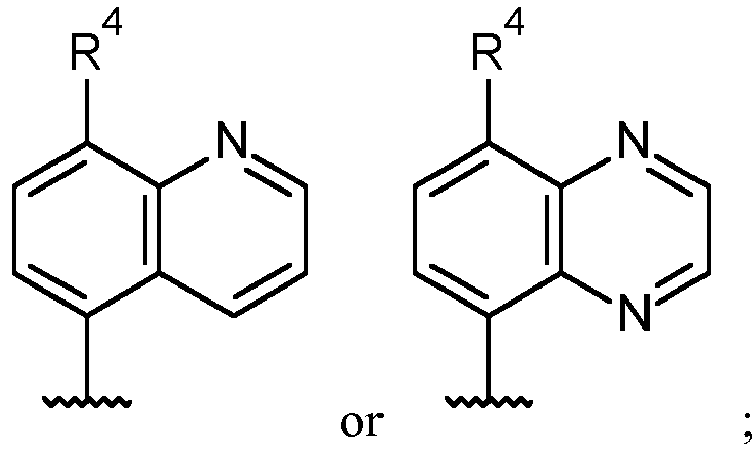
- A further embodiment of present invention is (iv) a compound of formula (I) or (Ia) according to (iii), wherein R1 is

- A further embodiment of present invention is (v) a compound of formula (I) or (Ia) according to (iv), wherein R4 is cyano or chloro.
- A further embodiment of present invention is (vi) a compound of formula (I) or (Ia) according to (iv), wherein
- R3 is 1,3-dihydropyrrolo[3,4-c]pyridinyl substituted by piperazinyl;
3,4-dihydro-1H-2,7-naphthyridinyl substituted by piperazinyl;
3,4-dihydro-1H-isoquinolinyl substituted by one or two substituents independently selected from hydroxy, piperazinyl and C1-6alkylpiperazinyl;
3,4-dihydro-2H-quinolinyl substituted by piperazinyl;
5,7-dihydropyrrolo[3,4-b]pyridinyl substituted by piperazinyl; 5,7-dihydropyrrolo[3,4-d]pyrimidinyl substituted by piperazinyl or C1-6alkylpiperazinyl;
7,8-dihydro-5H-1,6-naphthyridinyl substituted by piperazinyl;
isoindolinyl substituted by (C1-6alkoxyC1-6alkyl)piperazinyl, (C1-6alkyl)2piperazinyl, (hydroxyC1-6alkyl)piperazinyl, C1-6alkylpiperazinyl, C3-7cycloalkylpiperazinyl, haloC1-6alkylpiperazinyl, morpholinylC1-6alkyl, piperazinyl, piperidinyl, piperidinylC1-6alkyl or pyrrolidinyl; or
-NR6aR6b; wherein- R6a is H;
- R6b is phenylC1-6alkyl substituted by piperazinyl.
- A further embodiment of present invention is (vii) a compound of formula (I) or (Ia) according to (vi), wherein R3 is piperazinyl-1,3-dihydropyrrolo[3,4-c]pyridinyl; piperazinyl-3,4-dihydro-1H-2,7-naphthyridinyl; piperazinyl-3,4-dihydro-1H-isoquinolinyl; methylpiperazinyl-3,4-dihydro-1H-isoquinolinyl; hydroxy(piperazinyl)-3,4-dihydro-1H-isoquinolinyl; piperazinyl-3,4-dihydro-2H-quinolinyl; piperazinyl-5,7-dihydropyrro lo[3,4-b]pyridinyl; piperazinyl-5,7-dihydropyrrolo[3,4-d]pyrimidinyl; methylpiperazinyl-5,7-dihydropyrrolo[3,4-d]pyrimidinyl; piperazinyl-7,8-dihydro-5H-1,6-naphthyridinyl; (difluoromethyl)piperazinylisoindolinyl; (hydroxymethyl)piperazinylisoindolinyl; (methoxyethyl)piperazinylisoindolinyl; cyclopropylpiperazinylisoindolinyl; dimethylpiperazinylisoindolinyl; methylpiperazinylisoindolinyl; morpholinylmethylisoindolinyl; piperazinylisoindolinyl; piperidinylisoindolinyl; piperidinylmethylisoindolinyl; pyrrolidinylisoindolinyl; or (piperazinylphenyl)methylamino.
- A further embodiment of present invention is (viii) a compound of formula (I) or (Ia) according to (i) or (ii), wherein
- R1 is

- R2 is C1-6alkyl;
- R3 is 1,3-dihydropyrrolo[3,4-c]pyridinyl substituted by piperazinyl;
3,4-dihydro-1H-2,7-naphthyridinyl substituted by piperazinyl;
3,4-dihydro-1H-isoquinolinyl substituted by one or two substituents independently selected from hydroxy, piperazinyl and C1-6alkylpiperazinyl;
3,4-dihydro-2H-quinolinyl substituted by piperazinyl;
5,7-dihydropyrrolo[3,4-b]pyridinyl substituted by piperazinyl;
5,7-dihydropyrrolo[3,4-d]pyrimidinyl substituted by piperazinyl or C1-6alkylpiperazinyl;
7,8-dihydro-5H-1,6-naphthyridinyl substituted by piperazinyl;
isoindolinyl substituted by (C1-6alkoxyC1-6alkyl)piperazinyl, (C1-6alkyl)2piperazinyl, (hydroxyC1-6alkyl)piperazinyl, C1-6alkylpiperazinyl, C3-7cycloalkylpiperazinyl, haloC1-6alkylpiperazinyl, morpholinylC1-6alkyl, piperazinyl, piperidinyl, piperidinylC1-6alkyl or pyrrolidinyl; or
-NR6aR6b; wherein- R6a is H;
- R6b is phenylC1-6alkyl substituted by piperazinyl;
- A further embodiment of present invention is (ix) a compound of formula (I) or (Ia) according to (viii), wherein
- R1 is
- R2 is methyl;
- R3 is piperazinyl-1,3-dihydropyrrolo[3,4-c]pyridinyl; piperazinyl-3,4-dihydro-1H-2,7-naphthyridinyl; piperazinyl-3,4-dihydro-1H-isoquinolinyl; methylpiperazinyl-3,4-dihydro-1H-isoquinolinyl; hydroxy(piperazinyl)-3,4-dihydro-1H-isoquinolinyl; piperazinyl-3,4-dihydro-2H-quinolinyl; piperazinyl-5,7-dihydropyrrolo[3,4-b]pyridinyl; piperazinyl-5,7-dihydropyrrolo[3,4-d]pyrimidinyl; methylpiperazinyl-5,7-dihydropyrrolo[3,4-d]pyrimidinyl; piperazinyl-7,8-dihydro-5H-1,6-naphthyridinyl; (difluoromethyl)piperazinylisoindolinyl; (hydroxymethyl)piperazinylisoindolinyl; (methoxyethyl)piperazinylisoindolinyl; cyclopropylpiperazinylisoindolinyl; dimethylpiperazinylisoindolinyl; methylpiperazinylisoindolinyl; morpholinylmethylisoindolinyl; piperazinylisoindolinyl; piperidinylisoindolinyl; piperidinylmethylisoindolinyl; pyrrolidinylisoindolinyl; or (piperazinylphenyl)methylamino;
- Another embodiment of present invention is that (x) particular compounds of formula (I) or (Ia) are the following:
- 4-[(2R,6S)-2-methyl-6-[(4-piperazin-1-ylisoindolin-2-yl)methyl]morpholin-4-yl]pyrazolo[1,5-a]pyridine-7-carbonitrile;
- 4-[(2R,6S)-2-methyl-6-[(5-piperazin-1-ylisoindolin-2-yl)methyl]morpholin-4-yl]pyrazolo[1,5-a]pyridine-7-carbonitrile;
- 4-[(2R,6S)-2-methyl-6-[(8-piperazin-1-yl-3,4-dihydro-1H-isoquinolin-2-yl)methyl]morpholin-4-yl]pyrazolo[1,5-a]pyridine-7-carbonitrile;
- 4-[(2R,6S)-2-methyl-6-[(7-piperazin-1-yl-3,4-dihydro-2H-quinolin-1-yl)methyl]morpholin-4-yl]pyrazolo[1,5-a]pyridine-7-carbonitrile;
- 3-fluoro-4-[(2R,6S)-2-methyl-6-[(5-piperazin-1-ylisoindolin-2-yl)methyl]morpholin-4-yl]pyrazolo[1,5-a]pyridine-7-carbonitrile;
- 4-[(2R,6S)-2-methyl-6-[[5-(4-piperidyl)isoindolin-2-yl]methyl]morpholin-4-yl]pyrazolo[1,5-a]pyridine-7-carbonitrile;
- 4-[(2R,6S)-2-methyl-6-[(5-pyrrolidin-3-ylisoindolin-2-yl)methyl]morpholin-4-yl]pyrazolo[1,5-a]pyridine-7-carbonitrile;
- 4-[(2R,6S)-2-methyl-6-[(6-piperazin-1-yl-3,4-dihydro-1H-isoquinolin-2-yl)methyl]morpholin-4-yl]pyrazolo[1,5-a]pyridine-7-carbonitrile;
- 4-[(2R,6S)-2-methyl-6-[(7-piperazin-1-yl-3,4-dihydro-1H-isoquinolin-2-yl)methyl]morpholin-4-yl]pyrazolo[1,5-a]pyridine-7-carbonitrile;
- 8-[(2R,6S)-2-methyl-6-[(5-piperazin-1-ylisoindolin-2-yl)methyl]morpholin-4-yl] quinoxaline-5 -carbonitrile;
- 8-[(2R,6S)-2-methyl-6-[(6-piperazin-1-yl-3,4-dihydro-1H-isoquinolin-2-yl)methyl]morpholin-4-yl]quinoxaline-5-carbonitrile;
- 3-fluoro-4-[(2R,6S)-2-methyl-6-[(6-piperazin-1-yl-3,4-dihydro-1H-isoquinolin-2-yl)methyl]morpholin-4-yl]pyrazolo[1,5-a]pyridine-7-carbonitrile;
- 4-[(2R,6S)-2-methyl-6-[[6-(4-methylpiperazin-1-yl)-3,4-dihydro-1H-isoquinolin-2-yl]methyl]morpholin-4-yl]pyrazolo[1,5-a]pyridine-7-carbonitrile
- 4-[(2R,6S)-2-methyl-6-[[(4-piperazin-1-ylphenyl)methylamino]methyl]morpholin-4-yl]pyrazolo[1,5-a]pyridine-7-carbonitrile;
- 4-[(2R,6S)-2-methyl-6-[[5-(4-methylpiperazin-1-yl)isoindolin-2-yl]methyl]morpholin-4-yl]pyrazolo[1,5-a]pyridine-7-carbonitrile;
- 4-[(2R,6S)-2-methyl-6-[(3-piperazin-1-yl-5,7-dihydropyrrolo[3,4-b]pyridin-6-yl)methyl]morpholin-4-yl]pyrazolo[1,5-a]pyridine-7-carbonitrile;
- 5-[(2R,6S)-2-methyl-6-[(6-piperazin-1-yl-3,4-dihydro-1H-isoquinolin-2-yl)methyl]morpholin-4-yl]quinoline-8-carbonitrile;
- 5-[(2R,6S)-2-methyl-6-[(3-piperazin-1-yl-5,7-dihydropyrrolo[3,4-b]pyridin-6-yl)methyl]morpholin-4-yl]quinoline-8-carbonitrile;
- 5-[(2R,6S)-2-methyl-6-[(5-piperazin-1-ylisoindolin-2-yl)methyl]morpholin-4-yl]quinoline-8-carbonitrile;
- 4-[(2R,6S)-2-methyl-6-[[methyl-[(4-piperazin-1-ylphenyl)methyl]amino]methyl]morpholin-4-yl]pyrazolo[1,5-a]pyridine-7-carbonitrile;
- 7-[(2R,6S)-2-methyl-6-[(5-piperazin-1-ylisoindolin-2-yl)methyl]morpholin-4-yl]-1,3-benzothiazole-4-carbonitrile;
- 7-[(2R,6S)-2-methyl-6-[(6-piperazin-1-yl-3,4-dihydro-1H-isoquinolin-2-yl)methyl]morpholin-4-yl]-1,3-benzothiazole-4-carbonitrile;
- 7-[(2R,6S)-2-methyl-6-[(3-piperazin-1-yl-5,7-dihydropyrrolo[3,4-b]pyridin-6-yl)methyl]morpholin-4-yl]-1,3-benzothiazole-4-carbonitrile;
- 4-[(2S,6R)-2-[[5-(2-aminoethylamino)isoindolin-2-yl]methyl]-6-methyl-morpholin-4-yl]pyrazolo[1 ,5-a]pyridine-7-carbonitrile;
- 4-[(2R,6S)-2-methyl-6-[[2-(4-methylpiperazin-1-yl)-6,7-dihydro-4H-thiazolo[5,4-c]pyridin-5-yl]methyl]morpholin-4-yl]pyrazolo[1,5-a]pyridine-7-carbonitrile;
- 4-[(2S,6R)-2-[[5-[2-(dimethylamino)ethoxy]isoindolin-2-yl]methyl]-6-methyl-morpholin-4-yl]pyrazolo[1,5-a]pyridine-7-carbonitrile;
- 3-fluoro-4-[(2R,6S)-2-methyl-6-[(3-piperazin-1-yl-5,7-dihydropyrrolo[3,4-b]pyridin-6-yl)methyl]morpholin-4-yl]pyrazolo[1,5-a]pyridine-7-carbonitrile;
- 8-[(2R,6S)-2-methyl-6-[(3-piperazin-1-yl-5,7-dihydropyrrolo[3,4-b]pyridin-6-yl)methyl]morpholin-4-yl]quinoxaline-5-carbonitrile;
- (2R,6S)-4-(8-chloro-5-quinolyl)-2-methyl-6-[(5-piperazin-1-ylisoindolin-2-yl)methyl]morpholine;
- (2R,6S)-4-(8-chloro-5-quinolyl)-2-methyl-6-[(6-piperazin-1-yl-3,4-dihydro-1H-isoquinolin-2-yl)methyl]morpholine;
- (2R,6S)-4-(8-chloroquinoxalin-5-yl)-2-methyl-6-[(5-piperazin-1-ylisoindolin-2-yl)methyl]morpholine;
- (2R,6S)-4-(8-chloroquinoxalin-5-yl)-2-methyl-6-[(6-piperazin-1-yl-3,4-dihydro-1H-isoquinolin-2-yl)methyl]morpholine;
- 8-[(2S,6R)-2-[[5-(4-cyclopropylpiperazin-1-yl)isoindolin-2-yl]methyl]-6-methyl-morpholin-4-yl]quinoxaline-5-carbonitrile;
- 8-[(2R,6S)-2-methyl-6-[[5-(3-methylpiperazin-1-yl)isoindolin-2-yl]methyl]morpholin-4-yl] quinoxaline-5 -carbonitrile;
- 8-[(2S,6R)-2-[[5-[4-(2-methoxyethyl)piperazin-1-yl]isoindolin-2-yl]methyl]-6-methyl-morpholin-4-yl]quinoxaline-5-carbonitrile;
- 8-[(2S,6R)-2-[[5-(4,7-diazaspiro[2.5]octan-7-yl)isoindolin-2-yl]methyl]-6-methyl-morpholin-4-yl]quinoxaline-5-carbonitrile;
- 8-[(2R,6S)-2-methyl-6-[[5-(2-oxopiperazin-1-yl)isoindolin-2-yl]methyl]morpholin-4-yl] quinoxaline-5 -carbonitrile;
- 8-[(2S,6R)-2-[[5-(1,3,4,6,7,8,9,9a-octahydropyrido[1,2-a]pyrazin-2-yl)isoindolin-2-yl]methyl]-6-methyl-morpholin-4-yl]quinoxaline-5-carbonitrile;
- 8-[(2S,6R)-2-[[5-(3,8-diazabicyclo[3.2.1]octan-8-yl)isoindolin-2-yl]methyl]-6-methyl-morpholin-4-yl]quinoxaline-5-carbonitrile;
- 5-[(2S,6R)-2-[[5-(3,8-diazabicyclo[3.2.1]octan-3-yl)isoindolin-2-yl]methyl]-6-methyl-morpholin-4-yl]quinoline-8-carbonitrile;
- 5-[(2S,6R)-2-[[5-(3,8-diazabicyclo[3.2.1]octan-8-yl)isoindolin-2-yl]methyl]-6-methyl-morpholin-4-yl]quinoline-8-carbonitrile;
- 8-[(2S,6R)-2-[[5-(3,8-diazabicyclo[3.2.1]octan-3-yl)isoindolin-2-yl]methyl]-6-methyl-morpholin-4-yl]quinoxaline-5-carbonitrile;
- 4-[(2R,6S)-2-methyl-6-[[5-(1-methylimidazol-4-yl)isoindolin-2-yl]methyl]morpholin-4-yl]pyrazolo[1 ,5-a]pyridine-7-carbonitrile;
- 5-[(2R,6S)-2-methyl-6-[[5-(3-oxa-7,9-diazabicyclo[3.3.1]nonan-9-yl)isoindolin-2-yl]methyl]morpholin-4-yl]quinoline-8-carbonitrile;
- 5-[(2S,6R)-2-[[5-(2,6-diazaspiro[3.3]heptan-2-yl)isoindolin-2-yl]methyl]-6-methyl-morpholin-4-yl]quinoline-8-carbonitrile;
- 5-[(2R,6S)-2-methyl-6-[(1-methyl-5-piperazin-1-yl-isoindolin-2-yl)methyl]morpholin-4-yl] quino line-8-carbonitrile;
- 8-[(2R,6S)-2-methyl-6-[[5-(3-oxa-7,9-diazabicyclo[3.3.1]nonan-7-yl)isoindolin-2-yl]methyl]morpholin-4-yl]quinoxaline-5-carbonitrile;
- Ethyl 1-[2-[[(2S,6R)-4-(8-cyano-5-quinolyl)-6-methyl-morpholin-2-yl]methyl]isoindolin-5-yl]piperazine-2-carboxylate;
- 4-[(2R,6S)-2-methyl-6-[[2-(4-methylpiperazin-1-yl)-5,7-dihydropyrrolo[3,4-d]pyrimidin-6-yl]methyl]morpholin-4-yl]pyrazolo[1,5-a]pyridine-7-carbonitrile;
- 4-[(2R,6S)-2-methyl-6-[(5-pyrrolidin-3-yloxyisoindolin-2-yl)methyl]morpholin-4-yl]pyrazolo[1 ,5-a]pyridine-7-carbonitrile;
- 4-[(2S,6R)-2-[[5-(2,6-dimethyl-4-pyridyl)isoindolin-2-yl]methyl]-6-methyl-morpholin-4-yl]pyrazolo[1 ,5-a]pyridine-7-carbonitrile;
- 4-[(2S,6R)-2-[[5-(2,6-dimethyl-4-pyridyl)isoindolin-2-yl]methyl]-6-methyl-morpholin-4-yl]-3-fluoro-pyrazolo[1,5-a]pyridine-7-carbonitrile;
- 5-[(2S,6R)-2-[[5-(1,6-diazaspiro[3.3]heptan-6-yl)isoindolin-2-yl]methyl]-6-methyl-morpholin-4-yl]quinoline-8-carbonitrile;
- 1-[2-[[(2S,6R)-4-(8-cyano-5-quinolyl)-6-methyl-morpholin-2-yl]methyl]isoindolin-5-yl]piperazine-2-carboxylic acid;
- Trans-5-[(2R,6S)-2-methyl-6-[[5-[3,5-dimethylpiperazin-1-yl]isoindolin-2-yl]methyl]morpholin-4-yl]quinoline-8-carbonitrile;
- 5-[(2S,6R)-2-[[5-(3,4,6,7,9,9a-hexahydro-1H-pyrazino[2,1-c][1,4]oxazin-8-yl)isoindolin-2-yl]methyl]-6-methyl-morpholin-4-yl]quinoline-8-carbonitrile;
- 5-[(2S,6R)-2-[(4-fluoro-6-piperazin-1-yl-isoindolin-2-yl)methyl]-6-methyl-morpholin-4-yl] quino line-8-carbonitrile;
- 8-[(2R,6S)-2-methyl-6-[(6-piperazin-1-yl-1,3-dihydropyrrolo[3,4-c]pyridin-2-yl)methyl]morpholin-4-yl]quinoxaline-5-carbonitrile;
- 5-[(2R,6S)-2-methyl-6-[(6-piperazin-1-yl-1,3-dihydropyrrolo[3,4-c]pyridin-2-yl)methyl]morpholin-4-yl]quinoline-8-carbonitrile;
- 5-[(2R,6S)-2-methyl-6-[[5-[(3R)-3-methylpiperazin-1-yl]isoindolin-2-yl]methyl]morpholin-4-yl]quinoline-8-carbonitrile;
- 5-[(2R,6S)-2-methyl-6-[(2-piperazin-1-yl-5,7-dihydropyrrolo[3,4-d]pyrimidin-6-yl)methyl]morpholin-4-yl]quinoline-8-carbonitrile;
- 5-[(2R,6S)-2-methyl-6-[[5-[(3S)-3-methylpiperazin-1-yl]isoindolin-2-yl]methyl]morpholin-4-yl]quinoline-8-carbonitrile;
- 8-[(2R,6S)-2-methyl-6-[[5-[(3R)-3-methylpiperazin-1-yl]isoindolin-2-yl]methyl]morpholin-4-yl]quinoxaline-5-carbonitrile;
- 8-[(2R,6S)-2-methyl-6-[[5-[(3S)-3-methylpiperazin-1-yl]isoindolin-2-yl]methyl]morpholin-4-yl]quinoxaline-5-carbonitrile;
- Methyl4-[2-[[(2S,6R)-4-(8-cyano-5-quinolyl)-6-methyl-morpholin-2-yl]methyl]isoindolin-5-yl]piperazine-2-carboxylate;
- 4-[2-[[(2S,6R)-4-(8-cyano-5-quinolyl)-6-methyl-morpholin-2-yl]methyl]isoindolin-5-yl]piperazine-2-carboxylic acid;
- 5-[(2S,6R)-2-[[4-fluoro-6-(4-methylpiperazin-1-yl)isoindolin-2-yl]methyl]-6-methyl-morpholin-4-yl]quinoline-8-carbonitrile;
- 5-[(2R,6S)-2-methyl-6-[(6-piperazin-1-yl-3,4-dihydro-1H-2,7-naphthyridin-2-yl)methyl]morpholin-4-yl]quinoline-8-carbonitrile;
- 5-[(2R,6S)-2-methyl-6-[[5-[(3R,5S)-3,5-dimethylpiperazin-1-yl]isoindolin-2-yl]methyl]morpholin-4-yl]quinoline-8-carbonitrile;
- 5-[(2R,6S)-2-methyl-6-[[5-(3-oxa-7,9-diazabicyclo[3.3.1]nonan-7-yl)isoindolin-2-yl]methyl]morpholin-4-yl]quinoline-8-carbonitrile;
- 5-[(2S,6R)-2-[[5-[2-(hydroxymethyl)piperazin-1-yl]isoindolin-2-yl]methyl]-6-methyl-morpholin-4-yl]quinoline-8-carbonitrile;
- 5-[(2R,6S)-2-methyl-6-[[5-(1-piperidylmethyl)isoindolin-2-yl]methyl]morpholin-4-yl] quino line-8-carbonitrile;
- 5-[(2S,6R)-2-[(4-hydroxy-o-piperazin-1-yl-3,4-dihydro-1H-isoquinolin-2-yl)methyl]-6-methyl-morpholin-4-yl]quinoline-8-carbonitrile;
- 5-[(2S,6R)-2-[[5-[2-(difluoromethyl)piperazin-1-yl]isoindolin-2-yl]methyl]-6-methyl-morpholin-4-yl]quinoline-8-carbonitrile;
- 5-[(2S,6R)-2-[[5-(3-aminoazetidin-1-yl)isoindolin-2-yl]methyl]-6-methyl-morpholin-4-yl] quino line-8-carbonitrile;
- 5-[(2R,6S)-2-methyl-6-[[5-(2-methylpiperazin-1-yl)isoindolin-2-yl]methyl]morpholin-4-yl] quino line-8-carbonitrile;
- 5-[(2R,6S)-2-methyl-6-[(2-piperazin-1-yl-7,8-dihydro-5H-1,6-naphthyridin-6-yl)methyl]morpholin-4-yl]quinoline-8-carbonitrile;
- 5-[(2R,6S)-2-methyl-6-[(2-piperazin-1-yl-5,7-dihydropyrrolo[3,4-b]pyridin-6-yl)methyl]morpholin-4-yl]quinoline-8-carbonitrile;
- 5-[(2S,6R)-2-[[5-[(2R)-2-(hydroxymethyl)piperazin-1-yl]isoindolin-2-yl]methyl]-6-methyl-morpholin-4-yl]quinoline-8-carbonitrile;
- 5-[(2S,6R)-2-[[5-[(2S)-2-(hydroxymethyl)piperazin-1-yl]isoindolin-2-yl]methyl]-6-methyl-morpholin-4-yl]quinoline-8-carbonitrile;
- 8-[(2R,6S)-2-methyl-6-[[(4-piperazin-1-ylphenyl)methylamino]methyl]morpholin-4-yl] quinoxaline-5 -carbonitrile;
- 5-[(2S,6R)-2-[[5-[3-(hydroxymethyl)piperazin-1-yl]isoindolin-2-yl]methyl]-6-methyl-morpholin-4-yl]quinoline-8-carbonitrile;
- 5-[(2R,6S)-2-methyl-6-[[(4-piperazin-1-ylphenyl)methylamino]methyl]morpholin-4-yl]quinoline-8-carbonitrile; and
- 5-[(2R,6S)-2-methyl-6-[[5-(morpholinomethyl)isoindolin-2-yl]methyl]morpholin-4-yl] quino line-8-carbonitrile;
- A number of compounds were disclosed in patent
US20150105370 showing TLR7 and TLR9 potency data summarized in table 1. From the chemical structure perspective, compounds in table 1 are characterized in having structures as shown in formula (A). More specifically, morpholine ring is substituted by a linear basic center (amino group) connected to aryl or heteroaryl in the tail part. According to the potency data disclosed in patentUS20150105370 , compounds of formula (A) only showed good TLR7 potency, but suffered from the loss of TLR9 potency. - Meanwhile, more analogues of the compounds disclosed in
US20150105370 , such as compound R1, compound R2 and compound R3 which are even closer to the compounds of this invention, were synthesized to confirm the SAR (structure-activity-relationship). However, according to the potency data shown in Table 2, the structural modification based on formula (A) could not improve the potency of TLR9. Therefore, the skill of the art shall not obtain any incitation from the information disclosed inUS20150105370 to further optimize such chemical structures.
- Surprisingly, the compounds of this invention significantly improved TLR9 potency (>8 folds compared to ER-886509) while keeping excellent TLR7 and TLR8 potency. In another embodiment, the human microsome stability of the compounds of this invention was greatly increased compared to the reference compound R3 and ER-886509 (see Table 3).
Table 1. TLR7 and TLR9 potency of compounds disclosed in US20150105370 Compound Structure HEK/hTLR7 IC50 (µM) HEK/hTLR9 IC50 (µM) ER-886509 
0.0440 3.94 ER-886601 
0.015 >2.0 ER-886602 
0.1850 >20 ER-886608 
0.0130 3.366 ER-886799 
0.0070 >2.0 - The compounds of the present invention can be prepared by any conventional means. Suitable processes for synthesizing these compounds as well as their starting materials are provided in the schemes below and in the examples. All substituents, in particular, R1 to R5, R6a and R6b are as defined above unless otherwise indicated. Furthermore, and unless explicitly otherwise stated, all reactions, reaction conditions, abbreviations and symbols have the meanings well known to a person of ordinary skill in organic chemistry.
- General synthetic routes for preparing the compound of formula (I), (Ia), (II), (III) and (IX) are shown below.


- The coupling of compound of formula (IV) with R1-X can be achieved by direct coupling in the presence of a base, such as DIPEA or K2CO3, or under Buchwald-Hartwig amination conditions (ref: Acc. Chem. Res. 1998, 31, 805-818; Chem. Rev. 2016, 116, 12564-12649; Topics in Current Chemistry, 2002, 219, 131-209; and references cited therein) with a catalyst, such as RuPhos Pd G2, and a base, such as Cs2CO3, to provide compound of formula (V). Subsequently the hydroxy group of compound of formula (V) is converted to a leaving group, such as OTf, OTs, or OMs, under basic condition, such as DIPEA, TEA, K2CO3 or 2,6-dimethylpyridine, with Tf2O, TsCl or MsCl. Compound of formula (VI) was further coupled with amine (VII) in the presence of base, such as K2CO3, DIPEA, or Cs2CO3, to afford compound of formula (II). On the other hand, in a basic condition, such as K2CO3, DIPEA, or Cs2CO3, compound of formula (VI) is reacted with amine (VIII) to give compound of formula (IX), which is further coupled with amine (X) under Buchwald-Hartwig amination conditions (ref: Acc. Chem. Res. 1998, 31, 805-818; Chem. Rev. 2016, 116, 12564-12649; Topics in Current Chemistry, 2002, 219, 131-209; and references cited therein) with a catalyst, such as Ruphos Pd G2, and a base, such as Cs2CO3, to provide compound of formula (III). In some embodiment, the coupling of compound of formula (VI) and amine (VII) or formula (IX) with amine (X) may give a product containing a protecting group, e.g. Boc, originated from amine (VII) or amine (X), which will be removed before affording the final compound of formula (II) or formula (III).
- This invention also relates to a process for the preparation of a compound of formula (I) or (Ia) comprising any of the following steps:
- a) the coupling of compound of formula (VI),

- b) the coupling of compound of formula (VI),

- c) the coupling of compound of formula (IX),

- In step a) and b) the base can be for example K2CO3, DIPEA, or Cs2CO3.
- In step c) the Buchwald-Hartwig amination condition includes a catalyst which can be for example Ruphos Pd G2, and a base which can be for example Cs2CO3.
- A compound of formula (I) or (Ia) when manufactured according to the above process is also an object of the invention.
- Compounds of this invention can be obtained as mixtures of diastereomers or enantiomers, which can be separated by methods well known in the art, e.g. (chiral) HPLC or SFC.
- The present invention provides compounds that can be used as TLR7 and/or TLR8 and/or TLR9 antagonist, which inhibits pathway activation through TLR7 and/or TLR8 and/or TLR9 as well as respective downstream biological events including, but not limited to, innate and adaptive immune responses mediated through the production of all types of cytokines and all forms of auto-antibodies. Accordingly, the compounds of the invention are useful for blocking TLR7 and/or TLR8 and/or TLR9 in all types of cells that express such receptor(s) including, but not limited to, plasmacytoid dendritic cell, B cell, T cell, macrophage, monocyte, neutrophil, keratinocyte, epithelial cell. As such, the compounds can be used as a therapeutic or prophylactic agent for systemic lupus erythematosus and lupus nephritis.
- The present invention provides methods for treatment or prophylaxis of systemic lupus erythematosus and lupus nephritis in a patient in need thereof.
- Another embodiment includes a method of treating or preventing systemic lupus erythematosus and lupus nephritis in a mammal in need of such treatment, wherein the method comprises administering to said mammal a therapeutically effective amount of a compound of formula (I), a stereoisomer, tautomer, prodrug or pharmaceutically acceptable salt thereof.
- The invention will be more fully understood by reference to the following examples. They should not, however, be construed as limiting the scope of the invention.
- The invention will be more fully understood by reference to the following examples. They should not, however, be construed as limiting the scope of the invention.
- Abbreviations used herein are as follows:
- ACN:
- acetonitrile
- BINAP:
- (2,2'-bis(diphenylphosphino)-1,1'-binaphthyl)
- Boc2O:
- di-tert butyl dicarbonate
- t-Bu XPhosPd G3:
- [(2-di-tert-butylphosphino-2',4',6'-triisopropyl-1,1'-biphenyl)-2-(2'-amino-1,1'-biphenyl)] palladium(II) methanesulfonate
- CbzCl:
- benzylchloroformate
- cataCXium A Pd G2:
- chloro [(di(1-adamantyl)-N-butylphosphine)-2-(2-aminobiphenyl)]palladium(II)
- DAST:
- diethylaminosulfur trifluoride
- DCM:
- dichloromethane
- DIAD:
- diisopropyl azodicarboxylate
- DIPEA:
- N,N-diisopropylethylamine
- DMA:
- dimethylacetamide
- DMEDA:
- 1,2-dimethylethylenediamine
- EtOAc or EA:
- ethyl acetate
- FA:
- formic acid
- HLM
- human liver microsome
- IC50:
- half inhibition concentration
- IPA:
- isopropanol
- LCMS
- liquid chromatography-mass spectrometry
- MS:
- mass spectrometry
- Pd2(dba)3:
- tris(dibenzylideneacetone)dipalladium(0)
- PdCl2(DPPF)-CH2Cl2:
- [1,1-bis(diphenylphosphino)ferrocene]dichloropalladium(II), complex with dichloromethane
- PE:
- petroleum ether
- prep-HPLC:
- preparative high performance liquid chromatography
- prep-TLC:
- preparative thin layer chromatography
- PPh3:
- triphenylphosphine
- Rf:
- retention factor
- rt:
- room temperature
- RuPhos Pd G2:
- chloro(2-dicyclohexylphosphino-2',6'-diisopropoxy-1,1'-biphenyl)[2-(2'-amino-1,1'-biphenyl)]palladium(II) 2nd generation
- SelectFluor:
- 1-chloromethyl-4-fluoro-1,4-diazoniabicyclo[2.2.2]octane bis(tetrafluoroborate)
- SFC:
- supercritical fluid chromatography
- TEA:
- triethylamine
- TFA:
- trifluoroacetic acid
- Tf2O:
- trifluoromethanesulfonic anhydride
- THF:
- tetrahydrofuran
- v/v:
- volume ratio
- XPhos:
- 2-dicyclohexylphosphino-2',4',6'-triisopropylbiphenyl
- XPhos Pd G2:
- chloro(2-dicyclohexylphosphino-2',4',6'-triisopropyl-1,1'-biphenyl)[2-(2'-amino-1,1'-biphenyl)]palladiuM(II)
- Intermediates and final compounds were purified by flash chromatography using one of the following instruments: i) Biotage SP1 system and the Quad 12/25 Cartridge module. ii) ISCO combi-flash chromatography instrument. Silica gel brand and pore size: i) KP-SIL 60 Å, particle size: 40-60 µm; ii) CAS registry NO: Silica Gel: 63231-67-4, particle size: 47-60 micron silica gel; iii) ZCX from Qingdao Haiyang Chemical Co., Ltd, pore: 200-300 or 300-400.
- Intermediates and final compounds were purified by preparative HPLC on reversed phase column using XBridge™ Prep-C18 (5 µm, OBDTM 30 × 100 mm) column, SunFire™ Prep-C18 (5 µm, OBD™ 30 × 100 mm) column, Phenomenex Synergi-C18 (10 µm, 25 × 150 mm) or Phenomenex Gemini-C18 (10 µm, 25 × 150 mm). Waters AutoP purification System (Sample Manager 2767, Pump 2525, Detector: Micromass ZQ and UV 2487, solvent system: acetonitrile and 0.1% ammonium hydroxide in water; acetonitrile and 0.1% FA in water or acetonitrile and 0.1% TFA in water). Or Gilson-281 purification System (Pump 322, Detector: UV 156, solvent system: acetonitrile and 0.05% ammonium hydroxide in water; acetonitrile and 0.225% FA in water; acetonitrile and 0.05% HCl in water; acetonitrile and 0.075% TFA in water; or acetonitrile and water).
- For SFC chiral separation, intermediates were separated by chiral column (Daicel chiralpak IC, 5 µm, 30 × 250 mm), AS (10 µm, 30 × 250 mm) or AD (10 µm, 30 × 250 mm) using Mettler Toledo Multigram III system SFC, Waters 80Q preparative SFC or Thar 80 preparative SFC, solvent system: CO2 and IPA (0.5% TEA in IPA) or CO2 and MeOH (0.1% NH3·H2O in MeOH), back pressure 100bar, detection UV@ 254 or 220 nm.
- LC/MS spectra of compounds were obtained using a LC/MS (Waters™ Alliance 2795-Micromass ZQ, Shimadzu Alliance 2020-Micromass ZQ or Agilent Alliance 6110-Micromass ZQ), LC/MS conditions were as follows (running time 3 or 1.5 mins):
- Acidic condition I: A: 0.1% TFA in H2O; B: 0.1% TFA in acetonitrile;
- Acidic condition II: A: 0.0375% TFA in H2O; B: 0.01875% TFA in acetonitrile;
- Basic condition I: A: 0.1% NH3·H2O in H2O; B: acetonitrile;
- Basic condition II: A: 0.025% NH3·H2O in H2O; B: acetonitrile;
- Neutral condition: A: H2O; B: acetonitrile.
- Mass spectra (MS): generally only ions which indicate the parent mass are reported, and unless otherwise stated the mass ion quoted is the positive mass ion (MH)+.
- NMR Spectra were obtained using Bruker Avance 400 MHz.
- The microwave assisted reactions were carried out in a Biotage Initiator Sixty microwave synthesizer. All reactions involving air-sensitive reagents were performed under an argon or nitrogen atmosphere. Reagents were used as received from commercial suppliers without further purification unless otherwise noted.
- The following examples are intended to illustrate the meaning of the present invention but should by no means represent a limitation within the meaning of the present invention:
-

- The title compound was prepared according to the following scheme:

- To a solution of tert-butyl (2R,6R)-2-(hydroxymethyl)-6-methyl-morpholine-4-carboxylate (CAS: 1700609-48-8, Vendor: WuXi Apptec, 231 mg, 1.0 mmol) in DCM (2 mL) was added TFA (1 mL) at 0 °C. The reaction mixture was stirred at rt for 2 hrs, then concentrated to give a crude compound A1 (250 mg) which was directly used in next step. MS: calc'd 132 (MH+), measured 132 (MH+).
- To a solution of crude [(2R,6R)-6-methylmorpholin-2-yl]methanol (compound A1, 250 mg, ∼1.0 mmol), 4-chloropyrazolo[1,5-a]pyridine-7-carbonitrile (CAS: 1268520-74-6, Vendor: Pharmablock) (compound A2, 450 mg, 2.5 mmol) and Cs2CO3 (3.3 g, 10.1 mmol) in dioxane (5 mL) was added Ruphos Pd G2 (98 mg, 0.13 mmol). The reaction mixture was degassed and heated at 90 °C (oil bath) for 3 hrs, then cooled to rt, diluted with EtOAc (10 mL), and filtered through celite. The filtrate was concentrated to give a brown oil which was purified by column chromatography to give compound A3 (521 mg) as a yellowish oil. MS: calc'd 273 (MH+), measured 273 (MH+).
- To a solution of 4-[(2R,6R)-2-(hydroxymethyl)-6-methyl-morpholin-4-yl]pyrazolo[1,5-a]pyridine-7-carbonitrile (compound A3, 190 mg, 0.70 mmol) and 2,6-dimethylpyridine (150 mg, 1.4 mmol) in DCM (4 mL) was added trifluoromethanesulfonic anhydride (295 mg, 1.05 mmol) dropwise at 0 °C. The mixture was stirred at 0 °C for 1h. The mixture was then diluted with DCM, washed with sat NH4Cl and brine, dried over Na2SO4, and concentrated to give a crude product which was purified by column chromatography to give Intermediate A (166 mg) as a white solid. MS: calc'd 405 (MH+), measured 405 (MH+).
-


- To a solution of 4-chloropyrazolo[1,5-a]pyridine-7-carbonitrile (compound A2, 600 mg, 3.38 mmol) in ACN (50 mL) was added SelectFluor (2.39 g, 6.76 mmol). The reaction mixture was stirred at rt for 24 hrs. The reaction mixture was concentrated to remove the solvent, then diluted with water (30 mL), extracted with DCM. The organic layer was washed with sat. NH4Cl and brine, dried over Na2SO4, and concentrated to give a crude product which was purified by column chromatography to give compound B1 (419 mg) as light yellow powder. MS: calc'd 196 (MH+), measured 196 (MH+). 1H NMR (400MHz, METHANOL-d4) δ 8.17 (d, J = 3.5 Hz, 1H), 7.55 (d, J = 7.6 Hz, 1H), 7.35 (d, J = 7.7 Hz, 1H).
- To a solution of 4-chloro-3-fluoropyrazolo[1,5-a]pyridine-7-carbonitrile (compound 67a, 419 mg, 2.14 mmol), (2R,6R)-6-methylmorpholin-2-yl]methanol trifluoroacetate (compound 1a, 526 mg, 2.14 mmol) and Cs2CO3 (2.79 g, 8.57 mmol) in dioxane (10 mL) was added RuPhos Pd G2 (116 mg, 0.15 mmol) under N2. The reaction mixture was heated at 90 °C (oil bath) for 2 hrs, then cooled to rt, diluted with EtOAc and filtered through celite. The filtrate was concentrated to give a brown oil which was purified by column chromatography to give compound B2 (325 mg) as a yellow oil. MS: calc'd 291 (MH+), measured 291 (MH+).
- To a solution of 3-fluoro-4-[(2R,6R)-2-(hydroxymethyl)-6-methyl-morpholin-4-yl]pyrazolo[1,5-a]pyridine-7-carbonitrile (compound B2, 325 mg, 1.12 mmol) in DCM (3 mL) was added 2,6-dimethylpyridine (240 mg, 258 µL, 2.24 mmol) and Tf2O (474 mg, 284 µL, 1.68 mmol) at rt. The reaction mixture was stirred at rt for 1.5 hrs. The mixture was then diluted with DCM, washed with sat NH4Cl and brine. The organic layer was dried over Na2SO4 and concentrated to give the crude product which was purified by column chromatography to give Intermediate B (180 mg) as a yellow solid. MS: calc'd 423 (MH+), measured 423 (MH+).
-

US 20170174653 A1 ) instead of 4-chloropyrazolo[1,5-a]pyridine-7-carbonitrile. Intermediate C (825 mg) was obtained as an off-white solid. MS: calc'd 417 (MH+), measured 417 (MH+). -

-


- To a solution of 5-chloro-2-iodo-aniline (compound E1, 5.0 g, 19.7 mmol) in THF (87 mL) was added benzoyl isothiocyanate (6.4 g, 39.4 mmol) at 10-20 °C. After the reaction was stirred at 20 °C for 16 hrs, the solvent was removed and the solid was washed with EtOH/PE (50 mL, v/v = 4/1), followed by air-drying to afford an intermediate (8.7 g). The intermediate was dissolved in methanol (100 mL) and treated with a solution of K2CO3 (8.2 g, 59.2 mmol) in water (40 mL). The reaction mixture was heated at 70 °C for 4 hrs, then solvent was removed under vacuum followed by addition of water (20 mL). The solid was collected by filtration, further washed with water (20 mL), and dried to afford compound E2 (5.0 g) as a yellow solid.
- To a solution of 1-(5-chloro-2-iodophenyl)thiourea (compound E2, 4.0 g, 12.8 mmol) in CHCl3 (32 mL) was added bromine (0.66 mL, 12.8 mmol). The reaction mixture was heated at 78 °C for 18 hrs. After the reaction was cooled to rt, the solvent was removed under vacuum and the solid was dissolved in DCM/MeOH (100 mL, v/v = 1/1), to which aqueous solution of Na2S2O3 (20 mL) was added. Then the solvent was removed under vacuum, and water (30 mL) was added. The solid was collected by filtration, and dried to give compound E3 (3.5 g) as a yellow solid. MS: calc'd 311 (MH+), measured 311 (MH+).
- To a solution of 7-chloro-4-iodo-1,3-benzothiazol-2-amine (compound E3, 3.0 g, 9.7 mmol) in 1,4-dioxane (60 mL) was added tert-butyl nitrite (2.0 g, 19.3 mmol). The reaction mixture was heated at 90 °C for 18 hrs and then the solvent was removed under vacuum. The residue was purified by column chromatography to give a crude product, which was triturated in PE (15 mL) to give compound E4 (1.5 g) as a white solid. MS: calc'd 296 (MH+), measured 296 (MH+).
- To a solution of 7-chloro-4-iodo-1,3-benzothiazole (compound E4, 1.5 g, 5.1 mmol) in DMA (40 mL) was added Zn(CN)2 (0.89 g, 7.6 mmol) and Pd(PPh3)4 (0.20 g, 0.17 mmol). The reaction mixture was heated at 100 °C for 18 hrs and then poured into water (100 mL). The solid was collected by filtration, and dissolved in EtOAc (400 mL). The organic layer was washed with brine, dried over anhydrous Na2SO4 and concentrated to give compound E5 (0.9 g) as a white solid. MS: calc'd 195 (MH+), measured 195 (MH+).
- To a solution of tert-butyl (2R,6R)-2-(hydroxymethyl)-6-methyl-morpholine-4-carboxylate (61 mg, 0.26 mmol) in DCM (2 mL) was added HCl (0.5 mL, 10% in MeOH) at rt. After the reaction mixture was stirred at rt for 2 hrs, the solvent was removed, and the residue was dissolved in DMA (0.5 mL). To the solution was added 7-chloro-1,3-benzothiazole-4-carbonitrile (compound E5, 52 mg, 0.31 mmol) and DIPEA (0.13 mL, 0.77 mmol). After the reaction mixture was stirred at 150 °C for 2 hrs, water (10 mL) was added. The mixture was then cooled and extracted with EtOAc (10 mL). The organic layer was washed with brine, dried over anhydrous Na2SO4, and concentrated to give a crude product which was purified by prep-TLC (PE/EA, v/v = 2/1) to give compound E6 (15 mg) as a yellow gum. MS: calc'd 290 (MH+), measured 290 (MH+).
- To a solution of 7-[(2R,6R)-2-(hydroxymethyl)-6-methyl-morpholin-4-yl]-1,3-benzothiazole-4-carbonitrile (compound E6, 15 mg, 0.050 mmol) in DCM (1 mL) was added 2,6-dimethylpyridine (22 mg, 0.21 mmol) and trifluoromethanesulfonic anhydride (29 mg, 0.10 mmol). The reaction mixture was stirred at 0 °C for 1h and then poured into ice-water (10 mL). The mixture was extracted with DCM (10 mL), which was dried over Na2SO4, and concentrated to give Intermediate E (20 mg) as a yellow solid. MS: calc'd 422 (MH+), measured 422 (MH+).
-

-

-
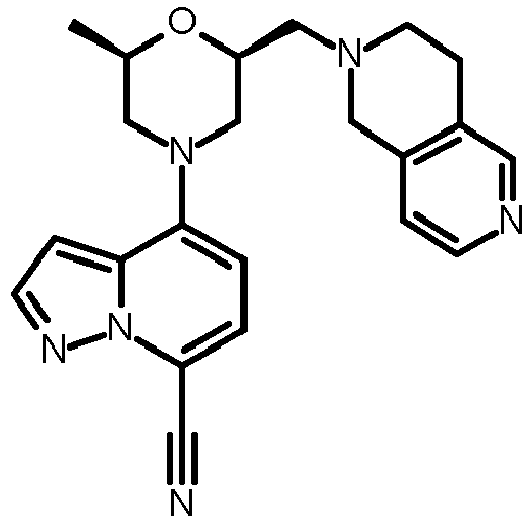
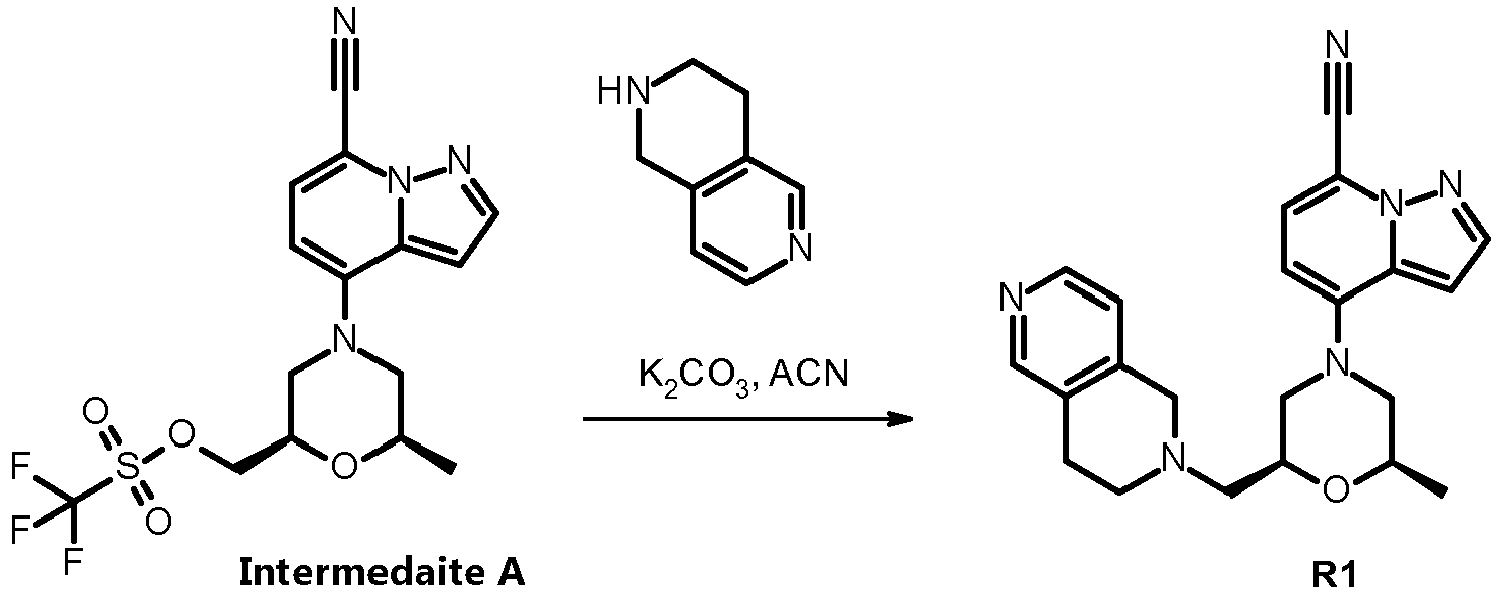
- To a solution of [(2R,6R)-4-(7-cyanopyrazolo[1,5-a]pyridin-4-yl)-6-methyl-morpholin-2-yl]methyl trifluoromethanesulfonate (Intermediate A, 30 mg, 0.074 mmol) and 1,2,3,4-tetrahydro-2,6-naphthyridine (15 mg, 0.11 mmol) in ACN (3 mL) was added K2CO3 (20 mg, 0.14 mmol) at rt. The reaction mixture was refluxed for 6 hrs, then diluted with ACN (10 mL) and filtered through celite. The filtrate was concentrated to give a yellow solid which was purified by prep-HPLC to give Compound R1 (8 mg) as a light brown solid. MS: calc'd 389 (MH+), measured 389 (MH+). 1H NMR (400MHz, METHANOL-d4) δ 8.60 (br d, J = 18.0 Hz, 2H), 8.04 (d, J = 2.2 Hz, 1H), 7.64 (br d, J = 5.5 Hz, 1H), 7.49 (d, J = 7.9 Hz, 1H), 6.91 (d, J = 2.3 Hz, 1H), 6.64 (d, J = 7.9 Hz, 1H), 4.69 (s, 2H), 4.43 (br t, J = 9.8 Hz, 1H), 4.14 - 4.04 (m, 1H), 3.89 - 3.74 (m, 4H), 3.58 - 3.47 (m, 2H), 3.47 - 3.36 (m, 2H), 2.85 - 2.68 (m, 2H), 1.34 (d, J = 6.2 Hz, 3H).
-

-

-


- To a solution of 4-bromoisoindoline hydrochloride (235 mg, 1.0 mmol) in THF (4 mL) was added TEA (355 mg, 0.49 mL, 3.5 mmol). The mixture was then cooled with ice-water bath. CbzCl (256 mg, 0.22 mL, 1.5 mmol) was added dropwise. The reaction mixture was stirred at rt overnight, then diluted with water (20 mL), and extracted with EtOAc (30 mL) twice. The combined organic layer was washed with brine, dried over Na2SO4 and concentrated to give a crude product which was purified by column chromatography to afford compound 3a (255 mg) as a pink solid. MS: calc'd 332&334 (MH+), measured 332&334 (MH+).
- To a solution of benzyl 4-bromoisoindoline-2-carboxylate (compound 3a, 50 mg, 0.15 mmol) in dioxane (4 mL) was added tert-butyl piperazine-1-carboxylate (56 mg, 0.30 mmol) and Cs2CO3 (147 mg, 0.45 mmol). The suspension was bubbled with N2 for 5 mins, then Ruphos Pd G2 (12 mg, 15 µmol) was added. The mixture was heated at 100 °C overnight, then cooled to rt, and diluted with EtOAc (10 mL). The mixture was filtered through celite, and the filtrate was concentrated. The residue was purified by column chromatography to give a pale yellow oil (37 mg) which was dissolved in MeOH (10 mL). To the solution was added Pd(OH)2 on carbon (85 mg, 10% wet). The suspension was charged with hydrogen balloon and stirred at rt for 4 hrs. The mixture was then filtered through celite, the filtrated was concentrated to give a crude compound 3b (25 mg) which was directly used in next step. MS: calc'd 304 (MH+), measured 304 (MH+).
- To a solution of [(2R,6R)-4-(7-cyanopyrazolo[1,5-a]pyridin-4-yl)-6-methyl-morpholin-2-yl]methyl trifluoromethanesulfonate (Intermediate A, 30 mg, 74 µmol) in ACN (4 mL) was added tert-butyl 4-(isoindolin-4-yl)piperazine-1-carboxylate (compound 3b, 25 mg, 82 µmol) and K2CO3 (31 mg, 0.22 mmol) at rt. The suspension was heated to reflux for 3 hrs, then cooled to rt. The mixture was diluted with ACN (5 mL), filtered through celite. The filtrate was concentrated to give a yellow solid which was dissolved in DCM (2 mL). To the solution was added TFA (1 mL). The mixture was stirred at rt for 2 hrs, then concentrated to give a crude mixture which was purified by prep-HPLC to give Example 3 (10 mg) as a grey powder. MS: calc'd 458 (MH+), measured 458 (MH+). 1H NMR (400 MHz, METHANOL-d4) δ 8.06 (d, J = 2.4 Hz, 1H), 7.51 (d, J = 8.1 Hz, 1H), 7.38 (t, J = 7.8 Hz, 1H), 7.13 (d, J = 7.6 Hz, 1H), 7.05 (d, J = 8.2 Hz, 1H), 6.93 (d, J = 2.3 Hz, 1H), 6.66 (d, J = 8.1 Hz, 1H), 4.59 - 4.40 (m, 4H), 4.31 - 4.20 (m, 1H), 4.10 - 4.00 (m, 1H), 3.88 (br d, J = 12.1 Hz, 1H), 3.82 (br d, J = 12.0 Hz, 1H), 3.47 - 3.36 (m, 6H), 3.28 - 3.20 (m, 4H), 2.84 - 2.69 (m, 2H), 1.34 (d, J = 6.2 Hz, 3H).
-

-

-
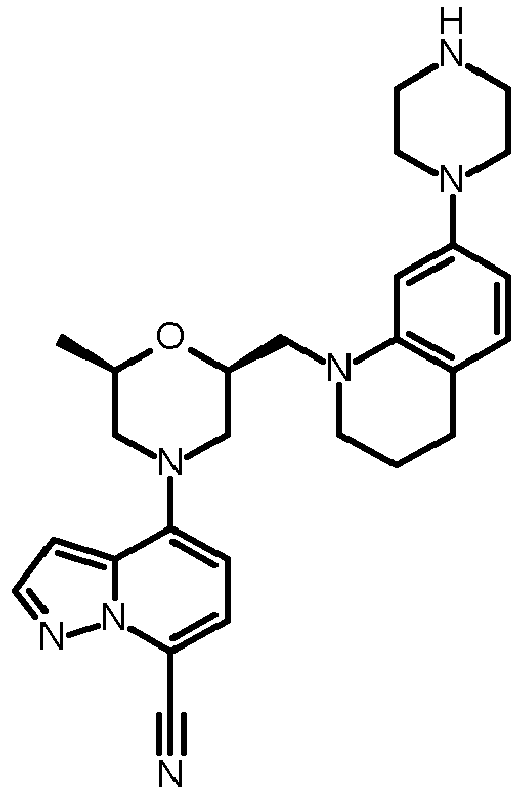
-

-


- To a solution of 5-bromoisoindoline hydrochloride (235 mg, 1.0 mmol) in THF (4 mL) was added TEA (355 mg, 0.49 mL, 3.5 mmol). The solution was cooled with ice-water bath and CbzCl (256 mg, 0.22 mL, 1.5 mmol) was added drop-wise. The reaction mixture was stirred at rt for 3 hrs, then diluted with water, extracted with EtOAc. The organic layer was washed with brine, dried over Na2SO4, and concentrated to give a crude product which was purified by column chromatography to give compound 8a (265 mg) as a white solid. MS: calc'd 332&334 (MH+), measured 332&334 (MH+).
- To a solution of benzyl 5-bromoisoindoline-2-carboxylate (166 mg, 500 µmol) in dioxane/water (4.5 mL, v/v = 8/1) was added tert-butyl 4-(4,4,5,5-tetramethyl-1,3,2-dioxaborolan-2-yl)-3,6-dihydro-2H-pyridine-1-carboxylate (232 mg, 0.75 mmol) and Na2CO3 (106 mg, 1.0 mmol). The suspension was bubbled with N2 for 5 mins, PdCl2(DPPF)-CH2Cl2 adduct (37 mg, 50 µmol) was added. The reaction mixture was heated at 100 °C (oil bath) overnight, then cooled to rt, diluted with EtOAc (10 mL) and filtered through celite, the filtrate was concentrated to give a crude product which was purified by column chromatography to give compound 8b (141 mg) as a white solid. MS: calc'd 435 (MH+), measured 435 (MH+).
- To a solution of benzyl 5-(1-(tert-butoxycarbonyl)-1,2,3,6-tetrahydropyridin-4-yl)isoindoline-2-carboxylate (compound 8b, 70 mg, 0.16 mmol) in MeOH/DCM (5 mL, v/v = 4/1) was added Pd(OH)2 on carbon (10 mg, 10% wet). The reaction mixture was charged with hydrogen balloon and stirred at rt for 4 hrs, then filtered through celite, the filtrate was concentrated to give a crude compound 8c (52 mg) as a brown solid which was used directly in next step. MS: calc'd 303 (MH+), measured 303 (MH+).
- To a solution of ((2R,6R)-4-(7-cyanopyrazolo[1,5-a]pyridin-4-yl)-6-methylmorpholin-2-yl)methyl trifluoromethanesulfonate (Intermediate A, 30 mg, 74 µmol) in ACN (4 mL) was added tert-butyl 4-(isoindolin-5-yl)piperidine-1-carboxylate (27 mg, 89 µmol) and K2CO3 (10 mg, 74 µmol). The suspension was heated to reflux for 2 hrs, then cooled to rt, diluted with ACN (10 mL) and filtered through celite, the filtrate was concentrated to give a yellow solid which was dissolved in DCM (2 mL), followed by addition of TFA (1 mL). The reaction mixture was stirred at rt for 2 hrs, then concentrated to give a crude mixture which was purified by prep-HPLC to afford Example 8 (16 mg) as a light yellow powder. MS: calc'd 457 (MH+), measured 457 (MH+). 1H NMR (400 MHz, METHANOL-d4) δ 8.06 (d, J = 2.3 Hz, 1H), 7.50 (d, J = 7.9 Hz, 1H), 7.45 - 7.40 (m, 1H), 7.38 - 7.34 (m, 2H), 6.92 (d, J = 2.4 Hz, 1H), 6.66 (d, J = 8.1 Hz, 1H), 4.94 - 4.91 (m, 2H), 4.32 (br t, J = 10.3 Hz, 1H), 4.12 - 4.02 (m, 1H), 3.87 - 3.77 (m, 2H), 3.71 - 3.58 (m, 2H), 3.56 - 3.52 (m, 1H), 3.52 - 3.46 (m, 2H), 3.23 - 3.09 (m, 3H), 2.99 (br t, J = 12.2 Hz, 1H), 2.83 - 2.71 (m, 2H), 2.09 (br d, J = 14.1 Hz, 2H), 1.97 - 1.85 (m, 2H), 1.35 (d, J = 6.2 Hz, 3H).
-

-

-
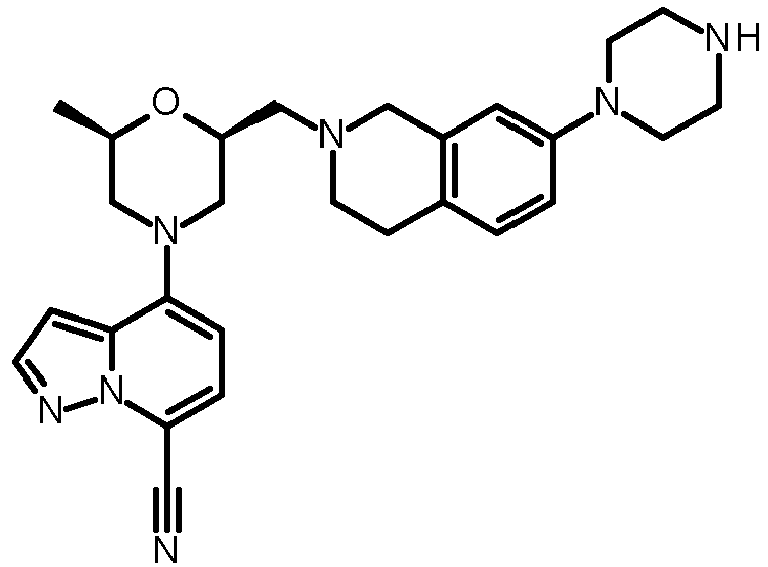
-

-

-

-


- To a solution of 6-bromo-1,2,3,4-tetrahydroisoquinoline (500 mg, 2.4 mmol) in DCM (10 mL) was added TEA (477 mg, 0.66 mL, 4.7 mmol). To the solution was added CbzCl (603 mg, 0.50 mL, 3.5 mmol) at 0 °C. The reaction mixture was stirred at rt for 3 hrs, then diluted with water (20 mL). The mixture was extracted with EtOAc (20 mL) twice. The combined organic layer was washed with brine, dried over Na2SO4 and concentrated to give a crude product which was purified by column chromatography to give compound 15a (715 mg) as an oil. MS: calc'd 346&348 (MH+), measured 346&348 (MH+).
- To a solution of benzyl 6-bromo-3,4-dihydroisoquinoline-2(1H)-carboxylate (compound 15a, 173 mg, 0.50 mmol) in dioxane (5mL) was added 1-methylpiperazine (100 mg, 0.11 mL, 1.0 mmol) and Cs2CO3 (326 mg, 1.0 mmol). The suspension was bubbled with N2 for 5 mins, then Ruphos Pd G2 (39 mg, 50 µmol) was added. The reaction mixture was heated at 100 °C (oil bath) for 12 hrs, then cooled to rt, diluted with EtOAc (10 mL), and filtered through celite. The filtrate was concentrated to give a crude product which was purified by column chromatography to give compound 15b (142 mg) as a yellow oil. MS: calc'd 366 (MH+), measured 366 (MH+).
- To a solution of benzyl 6-(4-methylpiperazin-1-yl)-3,4-dihydroisoquinoline-2(1H)-carboxylate (compound 15b, 142 mg, 0.39 mmol) in MeOH (8 mL) was added Pd(OH)2 on carbon (40 mg, 10% wet). The suspension was charged with hydrogen balloon and stirred at rt for 2 hrs. The mixture was then filtered through celite, the filtrate was concentrated to give compound 15c (94 mg) as a dark solid which was directly used in next step. MS: calc'd 232 (MH+), measured 232 (MH+).
- To a solution of ((2R,6R)-4-(7-cyanopyrazolo[1,5-a]pyridin-4-yl)-6-methylmorpholin-2-yl)methyl trifluoromethanesulfonate (Intermediate A, 25 mg, 62 µmol) in ACN (4 mL) was added K2CO3 (34 mg, 0.25 mmol) and 6-(4-methylpiperazin-1-yl)-1,2,3,4-tetrahydroisoquinoline (compound 15c, 21 mg, 93 µmol). The reaction mixture was refluxed for 3 hrs, then cooled to rt, diluted with ACN (10 mL), and filtered through celite, the filtrate was concentrated to give a crude product which was purified by prep-HPLC to give Example 15 (15 mg) as a light yellow solid. MS: calc'd 486 (MH+), measured 486 (MH+). 1H NMR (400 MHz, METHANOL-d4) δ 8.01 (d, J = 2.4 Hz, 1H), 7.46 (d, J = 7.9 Hz, 1H), 6.95 (d, J = 8.4 Hz, 1H), 6.87 (d, J = 2.4 Hz, 1H), 6.80 (dd, J = 2.5, 8.4 Hz, 1H), 6.73 (d, J = 2.2 Hz, 1H), 6.59 (d, J = 7.9 Hz, 1H), 4.14 - 4.05 (m, 1H), 3.99 - 3.90 (m, 1H), 3.84 (br d, J = 12.3 Hz, 1H), 3.76 (br d, J = 12.3 Hz, 1H), 3.73 - 3.62 (m, 2H), 3.18 - 3.11 (m, 4H), 2.97 - 2.87 (m, 3H), 2.83 - 2.64 (m, 5H), 2.63 - 2.58 (m, 4H), 2.34 (s, 3H), 1.27 (d, J = 6.2 Hz, 3H).
-
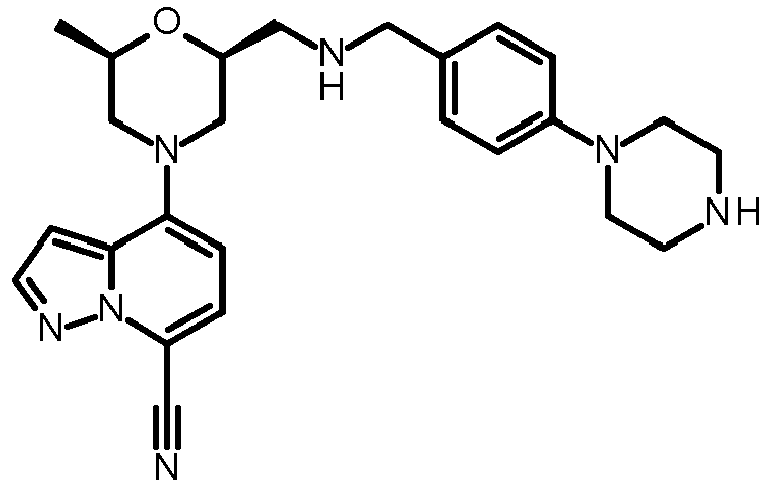

- To a solution of ((2R,6R)-4-(7-cyanopyrazolo[1,5-a]pyridin-4-yl)-6-methylmorpholin-2-yl)methyl trifluoromethanesulfonate (Intermediate A, 40 mg, 99 µmol) in ACN (4 mL) was added tert-butyl 4-(4-(aminomethyl)phenyl)piperazine-1-carboxylate (43 mg, 0.15 mmol) and K2CO3 (41 mg, 0.30 mmol). The reaction mixture was refluxed for 3h, then cooled to rt, diluted with ACN (10 mL), and filtered through celite, the filtrate was concentrated to give a yellow solid which was purified by column chromatography to give compound 16a (52 mg) as a yellow solid. MS: calc'd 546 (MH+), measured 546 (MH+).
- To a solution of tert-butyl 4-[4-[[[(2S,6R)-4-(7-cyanopyrazolo[1,5-a]pyridin-4-yl)-6-methyl-morpholin-2-yl]methylamino]methyl]phenyl]piperazine-1-carboxylate (compound 16a, 20 mg, 37 µmol) in DCM (2 mL) was added TFA (1 mL). The reaction mixture was stirred at rt for 2 hrs, then concentrated to give a crude product which was purified by prep-HPLC to give Example 16 (5mg) as a light yellow powder. MS: calc'd 446 (MH+), measured 446 (MH+). 1H NMR (400 MHz, METHANOL-d4) δ 8.09 - 8.01 (m, 1H), 7.47 (d, J = 8.1 Hz, 1H), 7.29 - 7.23 (m, 2H), 6.99 - 6.93 (m, 2H), 6.87 (d, J = 2.4 Hz, 1H), 6.58 (d, J = 7.9 Hz, 1H), 4.65 - 4.54 (m, 2H), 3.97 - 3.89 (m, 1H), 3.79 - 3.71 (m, 3H), 3.22 - 3.18 (m, 1H), 3.18 - 3.09 (m, 4H), 3.02 - 2.96 (m, 3H), 2.74 - 2.59 (m, 4H), 1.15 (d, J = 6.2 Hz, 1H).
-

-

-

-

-

-


- To a solution of tert-butyl 4-[4-[[[(2S,6R)-4-(7-cyanopyrazolo[1,5-a]pyridin-4-yl)-6-methyl-morpholin-2-yl]methylamino]methyl]phenyl]piperazine-1-carboxylate (compound 16a, 592 mg, 1.1 mmol) in ACN (2 mL) was added formaldehyde (33 mg, 1.1 mmol) and NaBH(OAc)3 (460 mg, 2.2 mmol). The suspension was stirred at rt for 2 hrs, then concentrated. The residue was dissolved in DCM (2 mL), then TFA (1 mL) was added. The reaction mixture was stirred at rt for 2 hrs, then concentrated to give a crude product which was purified by prep-HPLC to give Example 22 (2 mg) as a light yellow solid. MS: calc'd 460 (MH+), measured 460 (MH+). 1H NMR (400 MHz, METHANOL-d4) δ 8.06 (s, 1H), 7.53 - 7.43 (m, 3H), 7.15 (d, J = 8.7 Hz, 2H), 6.90 (d, J = 2.1 Hz, 1H), 6.63 (d, J = 7.9 Hz, 1H), 4.59 - 4.15 (m, 3H), 4.09 - 4.00 (m, 1H), 3.79 (br d, J = 11.7 Hz, 2H), 3.55 - 3.48 (m, 4H), 3.44 - 3.38 (m, 4H), 3.32 - 3.20 (m, 2H), 2.97-2.86 (m, 3H), 2.80 - 2.64 (m, 2H), 1.40 - 1.29 (m, 3H).
-

-

-

-

-


- To a solution of 2-bromo-4,5,6,7-tetrahydrothiazolo[5,4-c]pyridine hydrochloride (CAS: 949922-52-5, vendor: Pharmablock, 130 mg, 0.51 mmol) in DCM (4 mL) was added TEA (206 mg, 0.28 mL, 2.0 mmol) and Boc2O (167 mg, 0.18 mL, 0.76 mmol). The reaction mixture was stirred at rt for 2 hrs, then diluted with water (20 mL), and extracted with DCM (15 mL2) twice. The combined organic layer was washed with brine, dried over Na2SO4 and concentrated to give a brown oil which was purified by column chromatography to give compound 27a (131 mg) as an oil. MS: calc'd 319 and 321 (MH+), measured 319 and 321 (MH+).
- To a solution of tert-butyl 2-bromo-6,7-dihydrothiazolo[5,4-c]pyridine-5(4H)-carboxylate (compound 21a, 131 mg, 0.41 mmol) in dioxane (5 mL) was added 1-methylpiperazine (82 mg, 91 µL, 0.82 mmol) and Cs2CO3 (267 mg, 0.82 mmol). The suspension was bubbled with N2 for 5 min, then RuPhos Pd G2 (32 mg, 41 µmol) was added. The reaction mixture was heated at 100 °C for 18 hrs. The mixture was then diluted with EtOAc (10 mL), filtered through celite. The filtrate was concentrated, and the residue was purified by column chromatography to give a yellow solid (100 mg) which was dissolved in DCM (2 mL). To the solution was added TFA (1 mL). The reaction mixture was then stirred at rt for 2 hrs, then concentrated to give a crude compound 27b (100 mg) which was directly used in next step. MS: calc'd 239 (MH+), measured 239 (MH+).
- To a solution of ((2R,6R)-4-(7-cyanopyrazolo[1,5-a]pyridin-4-yl)-6-methylmorpholin-2-yl)methyl trifluoromethanesulfonate (Intermediate A, 25 mg, 62 µmol) in ACN (4 mL) was added K2CO3 (34 mg, 0.25 mmol) and 2-(4-methylpiperazin-1-yl)-4,5,6,7-tetrahydrothiazolo[5,4-c]pyridine (compound 27b, 22 mg, 93 µmol). The suspension was heated under reflux for 2 hrs. The mixture was then cooled to rt, diluted with ACN (10 mL), and filtered through celite. The filtrated was concentrated to give a crude product which was purified by prep-HPLC to give Example 27 (3.9 mg) as a light yellow solid. MS: calc'd 493 (MH+), measured 493 (MH+). 1H NMR (400 MHz, METHANOL-d4) δ 8.06 (d, J = 2.3 Hz, 1H), 7.51 (d, J = 7.9 Hz, 1H), 6.92 (d, J = 2.3 Hz, 1H), 6.66 (d, J = 7.9 Hz, 1H), 4.61 - 4.46 (m, 2H), 4.39 (br t, J = 10.1 Hz, 1H), 4.13 - 4.05 (m, 1H), 4.05 - 3.65 (m, 6H), 3.64 - 3.35 (m, 6H), 3.13 - 3.02 (m, 2H), 2.99 (s, 3H), 2.82 - 2.70 (m, 2H), 1.34 (d, J = 6.2 Hz, 3H).
-

- The title compound was prepared according to the following scheme:

- To a solution of isoindolin-5-ol hydrobromide (216 mg, 1.0 mmol) in DCM (5 mL) was added TEA (405 mg, 0.56 mL, 4.0 mmol) and CbzCl (256 mg, 0.22 mL, 1.5 mmol) at 0 °C. The reaction mixture was stirred at rt for 2 hrs, then diluted with water (20 mL), and extracted with DCM (15 mL) twice. The combined organic layer was washed with brine, dried over Na2SO4 and concentrated to give a crude product which was purified by column chromatography to give compound 28a (71 mg) as a brown solid. MS: calc'd 270 (MH+), measured 270 (MH+).
- To a solution of benzyl 5-hydroxyisoindoline-2-carboxylate (compound 28a, 71 mg, 0.26 mmol) in THF (5 mL) was added 2-(dimethylamino)ethan-1-ol (23 mg, 26 µL, 0.26 mmol), triphenylphosphine (138 mg, 0.53 mmol) and DIAD (80 mg, 77 µL, 0.40 mmol). The reaction mixture was heated at 65 °C overnight, then cooled to rt, quenched with water, and extracted with DCM. The organic layer was washed with brine, dried over Na2SO4 and concentrated to give a crude product which was purified by column chromatography to afford compound 28b (109 mg) as an oil. MS: calc'd 341 (MH+), measured 341 (MH+).
- To a solution of benzyl 5-(2-(dimethylamino)ethoxy)isoindoline-2-carboxylate (compound 28b, 109 mg, 0.32 mmol) in MeOH (10 mL) was added Pd(OH)2 on carbon (20 mg, 10% wet). The suspension was charged with hydrogen balloon at rt for 2 hrs, then filtered through celite, the filtrate was concentrated to give a crude compound 28c (63 mg) which was directly used in next step. MS: calc'd 207 (MH+), measured 207 (MH+).
- To a solution of ((2R,6R)-4-(7-cyanopyrazolo[1,5-a]pyridin-4-yl)-6-methylmorpholin-2-yl)methyl trifluoromethanesulfonate (intermediate A, 25 mg, 62 µmol) in ACN (4 mL) was added K2CO3 (34 mg, 0.25 mmol) and 2-isoindolin-5-yloxy-N,N-dimethyl-ethanamine (compound 28c, 19 mg, 93 µmol). The suspension was heated under reflux for 2 hrs. The mixture was then cooled to rt, diluted with ACN (10 mL), and filtered through celite. The filtrated was concentrated to give a crude product which was purified by prep-HPLC to give Example 28 (14.4 mg) as a light yellow solid. MS: calc'd 461 (MH+), measured 461 (MH+). 1H NMR (400 MHz, METHANOL-d4) δ 8.06 (d, J = 2.4 Hz, 1H), 7.51 (d, J = 8.1 Hz, 1H), 7.40 (d, J = 8.3 Hz, 1H), 7.14 - 7.08 (m, 2H), 6.94 (d, J = 2.4 Hz, 1H), 6.67 (d, J = 8.1 Hz, 1H), 4.83 - 4.67 (m, 2H), 4.45 - 4.38 (m, 2H), 4.38 - 4.30 (m, 1H), 4.14 - 4.03 (m, 1H), 3.90 - 3.80 (m, 2H), 3.80 - 3.55 (m, 5H), 3.42 - 3.34 (m, 1H), 3.01 (s, 6H), 2.84 - 2.78 (m, 1H), 2.78 - 2.72 (m, 1H), 1.36 (d, J = 6.2 Hz, 3H).
-

-

-

-

-

-
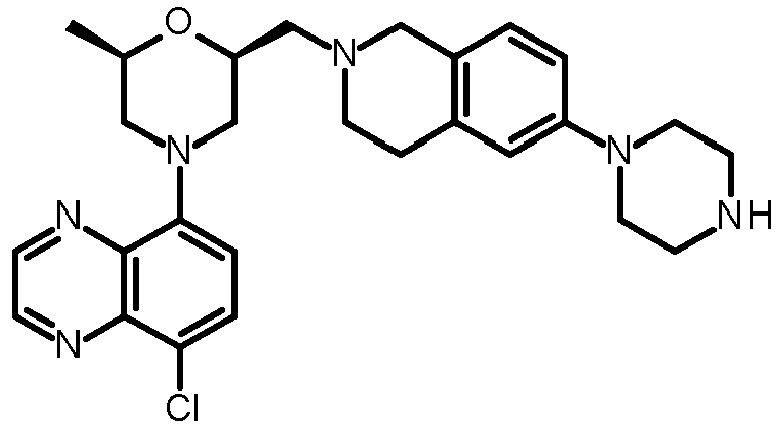
-

-

-
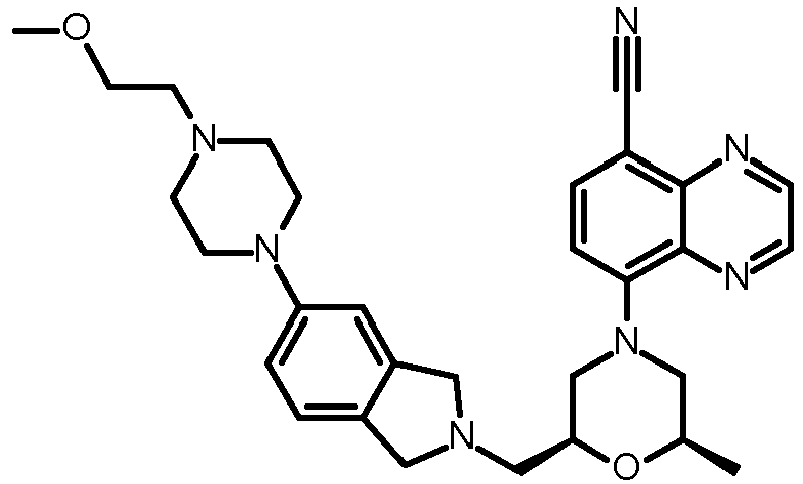
-


- To the solution of [(2R,6R)-4-(8-cyanoquinoxalin-5-yl)-6-methyl-morpholin-2-yl]methyl trifluoromethanesulfonate (Intermediate C, 825 mg, 2.0 mmol) in ACN (8 mL) was added 5-bromoisoindoline hydrochloride (392 mg, 2.0 mmol) and K2CO3 (685 mg, 5.0 mmol). The mixture was stirred at 50 °C for 3 hrs, then diluted with EtOAc (100 mL) and filtered. The filtrate was concentrated to give a crude product which was purified by column chromatography to afford compound 38a (450 mg) as a yellow solid. MS: calc'd 464 &466 (MH+), measured 464&466 (MH+).
- To a solution of 8-[(2S,6R)-2-[(5-bromoisoindolin-2-yl)methyl]-6-methyl-morpholin-4-yl]quinoxaline-5-carbonitrile (compound 38a, 60 mg, 0.13 mmol) and tert-butyl 4,7-diazaspiro[2.5]octane-4-carboxylate (27 mg, 0.13 mmol) in 1,4-dioxane (5 mL) was added RuPhos Pd G2 (10 mg, 0.010 mmol) and Cs2CO3 (105 mg, 0.32 mmol). The mixture was stirred at 90 °C for 12 hrs under N2. The reaction mixture was then concentrated, the residue was dissolved in EtOAc (100 mL). The mixture was washed with water and brine, dried over Na2SO4 and concentrated to give a crude product which was purified by prep-TLC (EA/PE, v/v = 1/3, Rf = 0.25) to give the intermediate (15 mg) as a yellow gum which was dissolved in DCM (2 mL). To the solution was added TFA (1 mL). The reaction mixture was stirred at rt for 1h, then concentrated. The residue was purified by prep-HPLC to give Example 5 (8.9 mg) as a yellow solid. MS: calc'd 496 (MH+), measured 496 (MH+). 1H NMR (400 MHz, METHANOL-d4) δ 8.96 (d, J = 1.5 Hz, 1H), 8.89 (d, J = 1.5 Hz, 1H), 8.14 (d, J = 8.3 Hz, 1H), 7.24 (dd, J = 4.9, 8.2 Hz, 2H), 7.01 - 6.91 (m, 2H), 4.49 - 4.35 (m, 4H), 4.30 (br d, J = 10.3 Hz, 2H), 4.20 - 4.05 (m, 2H), 3.36 (br d, J = 6.0 Hz, 2H), 3.31 - 3.24 (m, 4H), 3.19 (s, 2H), 2.88 - 2.74 (m, 2H), 1.31 (d, J = 6.3 Hz, 3H), 0.98 - 0.85 (m, 4H).
-


- To a solution of benzyl 5-bromoisoindoline-2-carboxylate (compound 8a, 100 mg, 0.30 mmol) and tert-butyl 3-oxopiperazine-1-carboxylate (181 mg, 0.90 mmol) in toluene (3 mL) was added CuI (29 mg, 0.15 mmol), K2CO3 (159 mg, 1.5 mmol) and DMEDA (2.6 mg, 0.030 mmol). The mixture was degassed with N2, and stirred at 150 °C for 4 hrs under N2. The solvent was then removed to give a crude product which was purified by prep-TLC (PE/EA, v/v = 1/1) to give compound 39a (150 mg) as a white solid. MS: calc'd 452 (MH+), measured 452 (MH+).
- To a solution of benzyl 5-(4-tert-butoxycarbonyl-2-oxo-piperazin-1-yl)isoindoline-2-carboxylate (compound 39a, 150 mg, 0.33 mmol) in IPA (5 mL) was added Pd on carbon (20 mg, 10%). The reaction was stirred at rt for 18 hrs under H2. The mixture was then filtered, the filtrate was concentrated to give compound 39b (50 mg) as a yellow gum. MS: calc'd 318 (MH+), measured 318 (MH+).
- To a solution of tert-butyl 4-isoindolin-5-yl-3-oxo-piperazine-1-carboxylate (compound 39b, 37 mg, 0.12 mmol) in ACN (6 mL) was added K2CO3 (33 mg, 0.24 mmol) and [(2R,6R)-4-(8-cyanoquinoxalin-5-yl)-6-methyl-morpholin-2-yl]methyl trifluoromethanesulfonate (Intermediate C, 40 mg, 0.10 mmol). The mixture was stirred at 55 °C for 3 hrs. The mixture was then diluted with EtOAc (10 mL) and filtered. The filtrate was concentrated. The residue was purified by prep-TLC (EA/PE, v/v = 2/1) to afford the intermediate (40 mg) as yellow gum which was dissolved in DCM (2 mL). To the solution was added TFA (1 mL). The reaction mixture was stirred at rt for 1h, then solvent was removed. The residue was purified by prep-HPLC to give Example 39 (4 mg) as a yellow gum. MS: calc'd 484 (MH+), measured 484 (MH+). 1H NMR (400 MHz, METHANOL-d4) δ 9.00 (d, J = 1.6 Hz, 1H), 8.92 (d, J = 1.6 Hz, 1H), 8.18 (d, J = 8.4 Hz, 1H), 7.57 - 7.55 (m, 1H), 7.47 (s, 1H), 7.45 - 7.43 (m, 1H), 7.30 (d, J = 8.4 Hz, 1H), 4.95 - 4.88 (m, 4H), 4.47 - 4.44 (m, 1H), 4.36 - 4.33 (m, 1H), 4.19 - 4.15 (m, 2H), 4.04 (s, 2H), 4.01 - 3.98 (m, 2H), 3.72 - 3.66 (m, 4H), 2.93 - 2.84 (m, 2H), 1.37 (d, J = 6 Hz, 3H).
-


- To a solution of 8-[(2S,6R)-2-[(5-bromoisoindolin-2-yl)methyl]-6-methyl-morpholin-4-yl]quinoxaline-5-carbonitrile (compound 38a, 50 mg, 0.11 mmol) in dioxane (4 mL) was added Cs2CO3 (107 mg, 0.33 mmol), RuPhos Pd G2 (7.7 mg, 0.01 mmol) and 2,3,4,6,7,8,9,9a-octahydro-1H-pyrido[1,2-a]pyrazine (22 mg, 0.16 mmol). The mixture was degassed and stirred at 80 °C for 18 hrs under N2. The mixture was then concentrated, the residue was dissolved in EtOAc (20 mL), washed with brine, dried over Na2SO4 and concentrated to give a crude product which was purified by prep-HPLC to give Example 40 (7 mg) as a yellow solid. MS: calc'd 524 (MH+), measured 524 (MH+). 1H NMR (400 MHz, METHANOL-d4) δ 8.97 (d, J = 1.5 Hz, 1H), 8.91 (d, J = 1.5 Hz, 1H), 8.15 (d, J = 8.3 Hz, 1H), 7.24 (dd, J = 8.3, 12.6 Hz, 2H), 7.02 - 6.93 (m, 2H), 4.38 - 4.05 (m, 8H), 3.74 - 3.59 (m, 2H), 3.27 - 2.48 (m, 11H), 1.93 - 1.67 (m, 4H), 1.58 - 1.38 (m, 2H), 1.33 (d, J = 6.3 Hz, 3H).
-

-

-

-

- The title compound was prepared in analogy to the preparation of Example 38 by using tert-butyl 3,8-diazabicyclo[3.2.1]octane-8-carboxylate instead of tert-butyl 4,7-diazaspiro[2.5]octane-4-carboxylate. Example 44 (3.9 mg) was obtained as a yellow solid. MS: calc'd 496 (MH+), measured 496 (MH+). 1H NMR (400 MHz, METHANOL-d4) δ 9.00 (d, J = 1.6 Hz, 1H), 8.92 (d, J = 1.8 Hz, 1H), 8.19 (d, J = 8.3 Hz, 1H), 7.36 - 7.28 (m, 2H), 7.04 (br s, 2H), 4.42 (br t, J = 9.8 Hz, 1H), 4.33 (br d, J = 11.7 Hz, 1H), 4.24 - 4.13 (m, 4H), 3.80 - 3.57 (m, 4H), 3.39 - 3.30 (m, 4H), 3.16 (br d, J = 12.0 Hz, 2H), 2.92 - 2.81 (m, 2H), 2.20 - 2.19 (m, 4H), 1.36 (d, J = 6.1 Hz, 3H).
-


- To a solution of 4,4,4',4',5,5,5',5'-octamethyl-2,2'-bi(1,3,2-dioxaborolane) (459 mg, 1.8 mmol) in dioxane (4 mL) was added benzyl 5-bromoisoindoline-2-carboxylate (compound 8a, 400 mg, 1.2 mmol), and KOAc (118 mg, 1.2 mmol). The solution was bubbled with N2 for 5 mins, then PdCl2(DPPF)-CH2Cl2 adduct (881 mg, 1.2 mmol) was added. The mixture was heated at 100 °C for 3 hrs, then cooled to rt and concentrated to give a dark oil which was purified by column chromatography to give compound 45a (469 mg) as an oil. MS: calc'd 380 (MH+), measured 380 (MH+).
- To a solution of benzyl 5-(4,4,5,5-tetramethyl-1,3,2-dioxaborolan-2-yl)isoindoline-2-carboxylate (compound 45a, 76 mg, 0.20 mmol) in THF/H2O (4.5 mL, v/v = 8/1) was added 4-bromo-1-methyl-1H-imidazole (32 mg, 0.20 mmol), and K3PO4 (85 mg, 0.40 mmol). The solution was bubbled with N2 for 5 mins, then cataCXium A Pd G2 (134 mg, 0.20 mmol) was added. The mixture was heated at 75 °C overnight, then cooled to rt and concentrated to give a crude product which was purified by column chromatography to give compound 45b (43 mg) as an oil. MS: calc'd 334 (MH+), measured 334 (MH+).
- To a solution of benzyl 5-(1-methyl-1H-imidazol-4-yl)isoindoline-2-carboxylate (compound 45b, 43 mg, 0.13 mmol) in MeOH (10 mL) was added Pd(OH)2 on carbon (10 mg, 20% wet). The suspension was charged with hydrogen balloon and stirred at rt for 2 hrs, then filtered through celite. The filtrate was concentrated to give crude compound 45c (27 mg) which was directly used in next step.
- To a solution of ((2R,6R)-4-(7-cyanopyrazolo[1,5-a]pyridin-4-yl)-6-methylmorpholin-2-yl)methyl trifluoromethanesulfonate (Intermediate A, 29 mg, 72 µmol) in ACN (4 mL) was added K2CO3 (34 mg, 0.25 mmol) and 5-(1-methyl-1H-imidazol-4-yl)isoindoline (compound 45c, 21 mg, 0.11 mmol). The suspension was heated under reflux for 2 hrs. The mixture was then cooled to rt, diluted with ACN (10 mL), and filtered through celite. The filtrated was concentrated to give a crude product which was purified by prep-HPLC to give Example 45 (21 mg) as a light yellow solid. MS: calc'd 454 (MH+), measured 454 (MH+). 1H NMR (400 MHz, METHANOL-d4) δ 8.83 (s, 1H), 8.05 (d, J = 2.4 Hz, 1H), 7.93 (d, J = 1.2 Hz, 1H), 7.82 - 7.75 (m, 2H), 7.59 (d, J = 8.6 Hz, 1H), 7.50 (d, J = 7.9 Hz, 1H), 6.93 (d, J = 2.4 Hz, 1H), 6.66 (d, J = 8.1 Hz, 1H), 5.10 - 4.90 (m, 4H), 4.35 (br t, J = 10.0 Hz, 1H), 4.13 - 4.03 (m, 1H), 3.97 (s, 3H), 3.86 (br d, J = 12.2 Hz, 1H), 3.81 (br d, J = 12.3 Hz, 1H), 3.76 - 3.61 (m, 2H), 2.84 - 2.71 (m, 2H), 1.35 (d, J = 6.2 Hz, 3H).
-


- To a solution of 5-bromoisoindoline hydrochloride (352 mg, 1.50 mmol) in ACN/DCM (50 mL, v/v = 3/2) was added K2CO3 (300 mg, 2.17 mmol). The suspension was stirred at rt for 48 hrs, then filtered through celite. The filtrate was concentrated to give 5-bromoisoindoline (90 mg) which was dissolved in ACN (5 mL). To the solution was added ((2R,6R)-4-(8-cyanoquinolin-5-yl)-6-methylmorpholin-2-yl)methyl trifluoromethanesulfonate (Intermediate D, 519 mg, 1.25 mmol) and K2CO3 (518 mg, 3.75 mmol). The suspension was heated under reflux for 2 hrs, then diluted with ACN (10 mL), and filtered through celite. The filtrate was concentrated to give a crude product which was purified by column chromatography to give compound 46a (500 mg) as a brown foamy solid. MS: calc'd 463 and 465 (MH+), measured 463 and 465 (MH+).
- To a solution of 5-((2R,6S)-2-((5-bromoisoindolin-2-yl)methyl)-6-methylmorpholino)quinoline-8-carbonitrile (compound 46a, 30 mg, 65 µmol) in dioxane (3 mL) was added tert-butyl 3-oxa-7,9-diazabicyclo[3.3.1]nonane-7-carboxylate (22 mg, 97 µmol) and Cs2CO3 (63 mg, 0.19 mmol). The mixture was bubbled with N2 for 5 mins, then XPhos Pd G2 (51 mg, 65 µmol) was added. The mixture was heated at 85 °C (oil bath) for 3 hrs, then cooled to rt, and filtered through celite. The filtrate was concentrated to give a brown oil which was dissolved in DCM (2 mL). To the solution was added TFA (1 mL). The reaction mixture was stirred at rt for 2 hrs, then concentrated to give a crude product which was purified by prep-HPLC to give Example 46 (2.8 mg) as a yellow powder. MS: calc'd 511 (MH+), measured 511 (MH+). 1H NMR (400 MHz, METHANOL-d4) δ 9.01 (dd, J = 1.6, 4.3 Hz, 1H), 8.68 (dd, J = 1.7, 8.6 Hz, 1H), 8.18 (d, J = 8.1 Hz, 1H), 7.66 (dd, J = 4.2, 8.6 Hz, 1H), 7.37 (d, J = 9.2 Hz, 1H), 7.30 (d, J = 8.1 Hz, 1H), 7.07 - 7.02 (m, 2H), 4.97 - 4.93 (m, 2H), 4.75 - 4.54 (m, 1H), 4.50 - 4.42 (m, 1H), 4.24 - 4.15 (m, 5H), 4.06 - 4.00 (m, 2H), 3.68 - 3.56 (m, 4H), 3.50 - 3.34 (m, 5H), 2.85 - 2.71 (m, 2H), 1.34 (d, J = 6.4 Hz, 3H).
-

-

-

-


- To a solution of benzyl 5-bromoisoindoline-2-carboxylate (compound 8a, 400 mg, 1.2 mmol) in 1,4-dioxane (5 mL) was added O1-tert-butyl O3-ethyl piperazine-1,3-dicarboxylate (353 mg, 1.44 mmol), Cs2CO3 (1.18 g, 3.61 mmol) and t-BuXPhos Pd G3 (40 mg, 0.12 mmol). The reaction mixture was stirred at 90 °C for 12 hrs under N2, then concentrated. The residue was dissolved in EtOAc (100 mL) and filtered, the filtrate was concentrated. The crude product was purified by prep-TLC (EA/PE, v/v = 1/1, Rf = 0.25) to give compound 50a (40 mg) as a yellow solid. MS: calc'd 510 (MH+), measured 510 (MH+).
- To a solution of O1-tert-butyl O3-ethyl 4-(2-benzyloxycarbonylisoindolin-5-yl)piperazine-1,3-dicarboxylate (compound 50a, 60 mg, 0.12 mmol) in MeOH (5 mL) was added Pd on carbon (6 mg, 10%). The mixture was stirred for at rt for 2 hrs under hydrogen balloon. The reaction mixture was then filtered, the filtrate was concentrated to afford compound 50b (40 mg) as a brown oil. MS: calc'd 376 (MH+), measured 376 (MH+).
- To a solution of O1-tert-butyl O3-ethyl 4-isoindolin-5-ylpiperazine-1,3-dicarboxylate (compound 50b, 40 mg, 0.11 mmol) in ACN (5 mL) was added K2CO3 (37 mg, 0.27 mmol) and [(2R,6R)-4-(8-cyano-5-quinolyl)-6-methyl-morpholin-2-yl]methyl trifluoromethanesulfonate (Intermediate D, 53 mg, 0.13 mmol). The mixture was stirred at 55 °C for 3 hrs, then filtered. The filtrate was concentrated. The residue was purified by prep-TLC (EA/PE, v/v = 1/1, Rf = 0.5) to afford the intermediate (40 mg) as a yellow oil which was dissolved in DCM (2 mL). To the solution was added TFA (1 mL). The reaction mixture was then concentrated to give a crude product (30 mg). 10 mg of the crude product was purified by prep-HPLC to give Example 50 (7 mg) as a white solid. MS: calc'd 541 (MH+), measured 541 (MH+). 1H NMR (400 MHz, METHANOL-d 4) δ ppm 9.01 (dd, J = 4.3, 1.6 Hz, 1H), 8.69 (dd, J = 8.6, 1.6 Hz, 1H), 8.18 (d, J = 7.9 Hz, 1H), 7.67 (dd, J = 8.5, 4.3 Hz, 1H), 7.35 (d, J = 8.3 Hz, 1H), 7.30 (d, J = 8.2 Hz, 1H), 7.05 - 7.14 (m, 2H), 5.01 (br d, J = 3.8 Hz, 1H), 4.59 - 4.85 (m, 4H), 4.49 (br t, J = 9.9 Hz, 1H), 4.09 - 4.28 (m, 3H), 3.92 (d, J = 13.1 Hz, 1H), 3.75 - 3.84 (m, 1H), 3.42 - 3.71 (m, 7H), 3.24 - 3.32 (m, 1H), 2.69 - 2.88 (m, 2H), 1.35 (d, J = 6.3 Hz, 3H), 1.20 (t, J = 7.2 Hz, 3H).
-


- To a solution of tert-butyl 2-chloro-5,7-dihydro-6H-pyrrolo[3,4-d]pyrimidine-6-carboxylate (CAS: 1211581-47-3, Vendor: Pharmablock, 256 mg, 1.0 mmol) in DCM (3 mL) was added 1-methylpiperazine (150 mg, 0.16 mL, 1.5 mmol) and DIPEA (1.85 g, 2.5 mL, 14.3 mmol) . The suspension was heated at 150 °C under microwave for 2 hrs. The mixture was then concentrated to give a crude product which was purified by column chromatography to give compound 51a (301 mg) as a brown solid. MS: calc'd 320 (MH+), measured 320 (MH+).
- To a solution of tert-butyl 2-(4-methylpiperazin-1-yl)-5,7-dihydro-6H-pyrrolo[3,4-d]pyrimidine-6-carboxylate (compound 51a, 35 mg, 0.11 mmol) in DCM (2 mL) was added TFA (1 mL). The mixture was stirred at rt for 2 hrs, then concentrated to give an oil which was dissolved in THF (4 mL). To the solution was added NaH (60% in mineral oil, 59 mg, 1.49 mmol). The reaction mixture was stirred at rt for 20 min, then was added ((2R,6R)-4-(7-cyanopyrazolo[1,5-a]pyridin-4-yl)-6-methylmorpholin-2-yl)methyl trifluoromethanesulfonate (Intermediate A, 30 mg, 74 µmol). The reaction mixture was stirred at rt for 2 hrs, then quenched with MeOH, the mixture was concentrated to give a crude mixture which was purified by prep-HPLC to give Example 51 (8.2 mg) as a white powder. MS: calc'd 474 (MH+), measured 474 (MH+). 1H NMR (400 MHz, METHANOL-d4) δ 8.47 (s, 1H), 8.07 (d, J = 2.0 Hz, 1H), 7.52 (d, J = 8.1 Hz, 1H), 6.93 (d, J = 2.3 Hz, 1H), 6.67 (d, J = 7.9 Hz, 1H), 5.11 - 4.90 (m, 2H), 4.86 - 4.71 (m, 2H), 4.71 - 4.60 (m, 2H), 4.38 - 4.28 (m, 1H), 4.12 - 4.02 (m, 1H), 3.84 (br dd, J = 12.5, 18.2 Hz, 2H), 3.74 - 3.51 (m, 4H), 3.46 - 3.34 (m, 2H), 3.30 - 3.14 (m, 2H), 2.98 (s, 3H), 2.85 - 2.71 (m, 2H), 1.36 (d, J = 6.2 Hz, 3H).
-

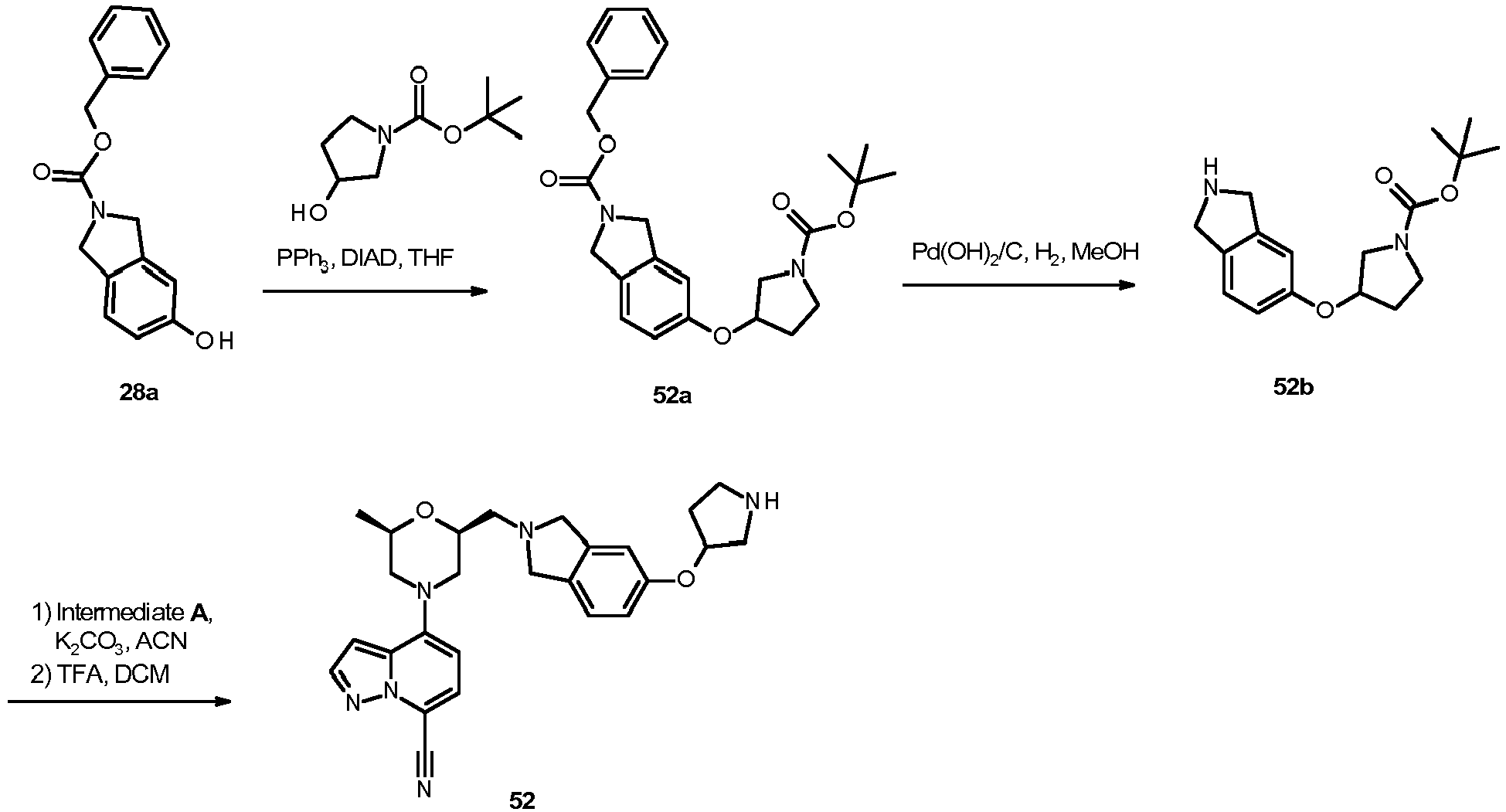
- To a solution of benzyl 5-hydroxyisoindoline-2-carboxylate (compound 28a, 62 mg, 0.23 mmol) in THF (5 mL) was added tert-butyl 3-hydroxypyrrolidine-1-carboxylate (43 mg, 0.23 mmol), and triphenylphosphine (121 mg, 0.46 mmol). To the solution was added DIAD (70 mg, 0.35 mmol) in one portion. The mixture was heated at 65 °C and stirred overnight, then concentrated to give an oil which was purified by column chromatography to give compound 52a (83 mg) as an oil. MS: calc'd 439 (MH+), measured 439 (MH+).
- To a solution of benzyl 5-((1-(tert-butoxycarbonyl)pyrrolidin-3-yl)oxy)isoindoline-2-carboxylate (compound 52a, 83 mg, 0.19 mmol) in MeOH (10 mL) was added Pd(OH)2 on carbon (20 mg, 10% wet). The suspension was charged with hydrogen balloon and stirred at rt for 2 hrs, then filtered through celite, the filtrated was concentrated to give compound 52b (56 mg) as a yellow oil. MS: calc'd 305 (MH+), measured 305 (MH+).
- To a solution of ((2R,6R)-4-(7-cyanopyrazolo[1,5-a]pyridin-4-yl)-6-methylmorpholin-2-yl)methyl trifluoromethanesulfonate (Intermediate A, 50 mg, 0.12 mmol) in ACN (4 mL) was added tert-butyl 3-(isoindolin-5-yloxy)pyrrolidine-1-carboxylate (compound 52b, 56 mg, 0.18 mmol) and K2CO3 (51 mg, 0.37 mmol). The suspension was heated under reflux for 4 hrs, then cooled to rt, diluted with ACN (10 mL), and filtered through celite. The filtrate was concentrated to give a yellow oil which was dissolved in DCM (4 mL). To the solution was added TFA (1 mL). The reaction mixture was stirred at rt for 2 hrs, then concentrated to give a crude product which was purified by prep-HPLC to give Example 52 (28 mg) as a white powder. MS: calc'd 459 (MH+), measured 459 (MH+). 1H NMR (400 MHz, METHANOL-d4) δ 8.07 (s, 1H), 7.52 (d, J = 7.9 Hz, 1H), 7.40 (d, J = 8.7 Hz, 1H), 7.12 - 7.04 (m, 2H), 6.94 (d, J = 2.4 Hz, 1H), 6.67 (d, J = 7.9 Hz, 1H), 5.25 (br s, 1H), 5.03 - 4.91 (m, 2H), 4.83 - 4.54 (m, 2H), 4.34 (br t, J = 10.1 Hz, 1H), 4.13 - 4.04 (m, 1H), 3.84 (br t, J = 13.8 Hz, 2H), 3.75 - 3.62 (m, 2H), 3.62 - 3.56 (m, 2H), 3.55 - 3.45 (m, 2H), 2.85 - 2.72 (m, 2H), 2.39 - 2.31 (m, 2H), 1.36 (d, J = 6.2 Hz, 3H).
-

-
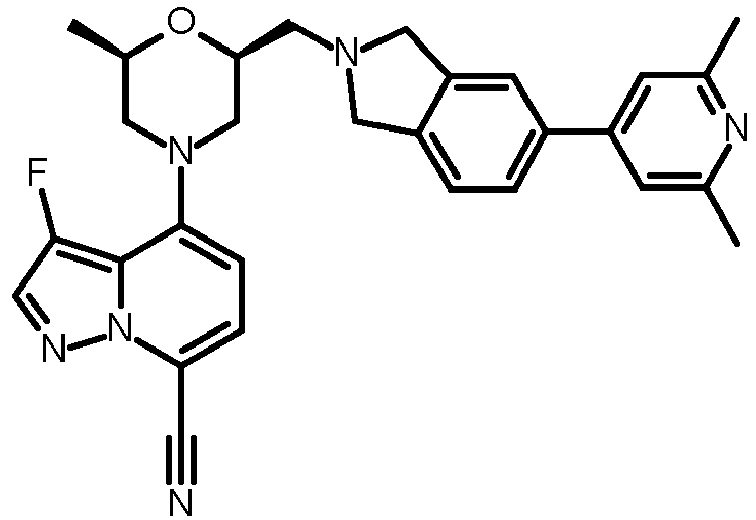
- The title compound was prepared in analogy to the preparation of Example 45 by using Intermediate B and 4-bromo-2,6-dimethylpyridine instead of Intermediate A and 4-bromo-1-methyl-imidazole. Example 54 (6.5 mg) was obtained as a light yellow powder. MS: calc'd 497 (MH+), measured 497 (MH+). 1H NMR (400 MHz, METHANOL-d4) δ 8.03 (d, J = 3.5 Hz, 1H), 7.72 - 7.65 (m, 2H), 7.48 - 7.41 (m, 4H), 6.57 (d, J = 7.9 Hz, 1H), 4.45 - 4.26 (m, 4H), 4.21 - 4.10 (m, 1H), 4.04 - 3.94 (m, 1H), 3.69 (br d, J = 11.7 Hz, 1H), 3.60 (br d, J = 11.6 Hz, 1H), 3.25 - 3.16 (m, 2H), 2.82 - 2.74 (m, 1H), 2.73 - 2.66 (m, 1H), 2.59 (s, 6H), 1.32 (d, J = 6.2 Hz, 3H).
-

- The title compound was prepared in analogy to the preparation of Example 46 by using tert-butyl 1,6-diazaspiro[3.3]heptane-1-carboxylate oxalate instead of tert-butyl 3-oxa-7,9-diazabicyclo[3.3.1]nonane-7-carboxylate. Example 55 (3 mg) was obtained as a brown solid. MS: calc'd 481 (MH+), measured 481 (MH+). 1H NMR (400 MHz, METHANOL-d4) δ 9.01 (dd, J = 1.7, 4.2 Hz, 1H), 8.69 (dd, J = 1.7, 8.6 Hz, 1H), 8.18 (d, J = 8.1 Hz, 1H), 7.67 (dd, J = 4.2, 8.6 Hz, 1H), 7.29 (d, J = 8.1 Hz, 1H), 7.19 (d, J = 8.2 Hz, 1H), 6.53 (s, 1H), 6.49 (br d, J = 8.1 Hz, 1H), 4.39 - 4.27 (m, 4H), 4.24 (d, J = 9.0 Hz, 2H), 4.21 - 4.13 (m, 1H), 4.10 (d, J = 9.0 Hz, 2H), 3.92 (t, J = 8.1 Hz, 2H), 3.51 - 3.39 (m, 2H), 3.32 - 3.18 (m, 3H), 2.85 - 2.66 (m, 4H), 1.32 (d, J = 6.2 Hz, 3H).
-

-

- The title compound was prepared in analogy to the preparation of Example 46 by using trans-tert-butyl 2,6-dimethylpiperazine-1-carboxylate instead of tert-butyl 3-oxa-7,9-diazabicyclo[3.3.1]nonane-7-carboxylate. Example 57 (5.5 mg) was obtained as a light yellow solid. MS: calc'd 497 (MH+), measured 497 (MH+). 1H NMR (400 MHz, METHANOL-d4) δ 9.03 (dd, J = 1.6, 4.3 Hz, 1H), 8.70 (dd, J = 1.6, 8.6 Hz, 1H), 8.20 (d, J = 7.9 Hz, 1H), 7.68 (dd, J = 4.3, 8.6 Hz, 1H), 7.37 (br d, J = 8.9 Hz, 1H), 7.32 (d, J = 8.1 Hz, 1H), 7.11 (br s, 2H), 4.77 - 4.55 (m, 2H), 4.52 - 4.44 (m, 1H), 4.28 - 4.18 (m, 1H), 3.87 - 3.76 (m, 2H), 3.70 - 3.60 (m, 2H), 3.55 - 3.45 (m, 4H), 3.31 - 3.18 (m, 4H), 2.87 - 2.73 (m, 2H), 1.49 (s, 3H), 1.47 (s, 3H), 1.36 (d, J = 6.2 Hz, 3H).
-


- To a solution of 5-((2R,6S)-2-((5-bromoisoindolin-2-yl)methyl)-6-methylmorpholino)quinoline-8-carbonitrile (compound 46a, 30 mg) in dioxane (4 mL) was added octahydropyrazino[2,1-c][1,4]oxazine dihydrochloride (21 mg, 97 µmol) and Cs2CO3 (105 mg, 0.32 mmol). The mixture was bubbled with N2 for 5 mins and XPhos Pd G3 (11 mg, 13 µmol) was added. The mixture was heated at 90 °C (oil bath) overnight. The mixture was filtered through celite, the filtrate was concentrated to give a brown oil which was purified by prep-HPLC to give Example 58 (1 mg) as a light yellow powder. MS: calc'd 525 (MH+), measured 525 (MH+). 1H NMR (400 MHz, METHANOL-d4) δ 9.02 (dd, J = 1.6, 4.3 Hz, 1H), 8.70 (dd, J = 1.7, 8.6 Hz, 1H), 8.20 (d, J = 8.1 Hz, 1H), 7.68 (dd, J = 4.4, 8.6 Hz, 1H), 7.37 (br d, J = 9.3 Hz, 1H), 7.32 (d, J = 8.1 Hz, 1H), 7.15 - 7.10 (m, 2H), 4.80 - 4.53 (m, 4H), 4.48 (br t, J = 9.5 Hz, 1H), 4.28 - 4.19 (m, 1H), 4.15 - 4.03 (m, 2H), 3.97 - 3.82 (m, 4H), 3.71 - 3.55 (m, 4H), 3.54 - 3.39 (m, 4H), 3.30 - 3.17 (m, 2H), 2.87 - 2.73 (m, 3H), 1.35 (d, J = 6.1 Hz, 3H).
-

-

-

-

- The title compound was prepared in analogy to the preparation of Example 46 by using tert-butyl (R)-2-methylpiperazine-1-carboxylate instead of tert-butyl 3-oxa-7,9-diazabicyclo[3.3.1]nonane-7-carboxylate. Example 62 (2.9 mg) was obtained as a light yellow powder. MS: calc'd 483 (MH+), measured 483 (MH+). 1H NMR (400 MHz, METHANOL-d4) δ 9.03 (dd, J = 1.7, 4.2 Hz, 1H), 8.70 (dd, J = 1.6, 8.7 Hz, 1H), 8.20 (d, J = 8.1 Hz, 1H), 7.68 (dd, J = 4.2, 8.6 Hz, 1H), 7.38 (br d, J = 8.9 Hz, 1H), 7.32 (d, J = 8.2 Hz, 1H), 7.16 - 7.11 (m, 2H), 4.87 - 4.54 (m, 2H), 4.51 - 4.42 (m, 1H), 4.29 - 4.19 (m, 1H), 3.86 (br t, J = 14.7 Hz, 2H), 3.70 - 3.59 (m, 2H), 3.58 - 3.43 (m, 5H), 3.38 - 3.35 (m, 2H), 3.11 - 3.01 (m, 1H), 2.89 - 2.73 (m, 3H), 1.43 (d, J = 6.6 Hz, 3H), 1.36 (d, J = 6.2 Hz, 3H).
-


- The a solution of tert-butyl 2-chloro-5,7-dihydro-6H-pyrrolo[3,4-d]pyrimidine-6-carboxylate (CAS: 1211581-47-3, Vendor: Pharmablock, 75 mg, 0.29 mmol) in DCM (2 mL) was added TFA (1 mL). The reaction mixture was stirred at rt for 2 hrs, then concentrated to give an oil which was dissolved in THF (4 mL). To the solution was added NaH (60% in mineral oil, 85 mg, 2.14 mmol) at 0 °C under N2. The mixture was stirred at rt for 30 mins, then the solution of ((2R,6R)-4-(8-cyanoquinolin-5-yl)-6-methylmorpholin-2-yl)methyl trifluoromethanesulfonate (Intermediate D, 111 mg, 0.27 mmol) in THF (1 mL) was added. The reaction mixture was stirred at rt for 24 hrs, then quenched with water, extracted with EtOAc. The organic layer was then washed with sat NH4Cl, dried over Na2SO4, and concentrated. The residue was purified by column chromatography to give compound 63a (50 mg) as a yellow solid. MS: calc'd 421 (MH+), measured 421 (MH+).
- To a solution of 5-[(2S,6R)-2-[(2-chloro-5,7-dihydropyrrolo[3,4-d]pyrimidin-6-yl)methyl]-6-methyl-morpholin-4-yl]quinoline-8-carbonitrile (compound 63a, 50 mg, 0.12 mmol) in IPA (3 mL) was added tert-butyl piperazine-1-carboxylate (27 mg, 0.14 mmol) and DIPEA (2.22 g, 3.0 mL, 17 mmol). The reaction mixture was heated under microwave at 150 °C for 2 hrs, then solvent was removed. The residue was dissolved in DCM (2 mL). To the solution was added TFA (1 mL). The reaction mixture was stirred at rt for 2 hrs, then concentrated to give a crude product which was purified by prep-HPLC to give Example 63 (14 mg) as a light yellow powder. MS: calc'd 471 (MH+), measured 471 (MH+). 1H NMR (400 MHz, METHANOL-d4) δ 8.90 (dd, J = 1.7, 4.2 Hz, 1H), 8.58 (dd, J = 1.7, 8.6 Hz, 1H), 8.36 (s, 1H), 8.07 (d, J = 7.9 Hz, 1H), 7.56 (dd, J = 4.2, 8.6 Hz, 1H), 7.19 (d, J = 8.1 Hz, 1H), 4.74 - 4.66 (m, 2H), 4.65 - 4.52 (m, 2H), 4.42 - 4.32 (m, 1H), 4.16 - 4.06 (m, 1H), 4.06 - 3.99 (m, 4H), 3.62 - 3.48 (m, 2H), 3.40 - 3.31 (m, 2H), 3.26 - 3.22 (m, 2H), 3.20 - 3.11 (m, 2H), 2.71 (dd, J = 10.3, 11.8 Hz, 1H), 2.65 (dd, J = 10.3, 12.2 Hz, 1H), 1.23 (d, J = 6.2 Hz, 3H).
-

-

- The title compound was prepared in analogy to the preparation of Example 3 by using Intermediate C, 5-bromoisoindoline hydrochloride and tert-butyl (R)-2-methylpiperazine-1-carboxylate instead of Intermediate A, 4-bromoisoindoline hydrochloride and tert-butyl piperazine-1-carboxylate. Example 65 (23 mg) was obtained as a yellow powder. MS: calc'd 484 (MH+), measured 484 (MH+). 1H NMR (400 MHz, METHANOL-d4) δ 9.00 (d, J = 1.8 Hz, 1H), 8.92 (d, J = 1.8 Hz, 1H), 8.18 (d, J = 8.3 Hz, 1H), 7.39 - 7.33 (m, 1H), 7.29 (d, J = 8.4 Hz, 1H), 7.15 - 7.07 (m, 2H), 4.78 - 4.53 (m, 2H), 4.43 (br t, J = 10.1 Hz, 1H), 4.33 (br d, J = 12.0 Hz, 1H), 4.21 - 4.10 (m, 2H), 3.91 - 3.78 (m, 2H), 3.74 - 3.59 (m, 2H), 3.57 - 3.48 (m, 2H), 3.38 - 3.34 (m, 2H), 3.32 - 3.27 (m, 1H), 3.12 - 3.02 (m, 1H), 2.94 - 2.80 (m, 3H), 1.42 (d, J = 6.6 Hz, 3H), 1.37 (d, J = 6.1 Hz, 3H).
-

-

-

-


- To a solution of 5-[(2S,6R)-2-[(4-fluoro-6-piperazin-1-yl-isoindolin-2-yl)methyl]-6-methyl-morpholin-4-yl]quinoline-8-carbonitrile (Example 59, 20 mg, 0.040 mmol) in DCM (2 mL) was added formaldehyde (0.5 mL, 0.12 mmol) and NaBH(OAc)3 (26 mg, 0.12 mmol). The reaction mixture was stirred at rt for 2 hrs. After the solvent was removed, the residue was purified by prep-HPLC to give Example 69 (21 mg) as a white solid. MS: calc'd 501 (MH+), measured 501 (MH+). 1H NMR (400 MHz, METHANOL-d4) δ 8.98 (dd, J = 1.5, 4.3 Hz, 1H), 8.66 (dd, J = 1.8, 8.5 Hz, 1H), 8.15 (d, J = 8.0 Hz, 1H), 7.64 (dd, J = 4.3, 8.5 Hz, 1H), 7.27 (d, J = 8.0 Hz, 1H), 6.93 (s, 1H), 6.87 (dd, J = 1.6, 12.2 Hz, 1H), 4.87 - 4.75 (m, 4H), 4.54 - 4.41 (m, 1H), 4.27 - 4.16 (m, 1H), 3.93 (br d, J = 11.5 Hz, 2H), 3.74 - 3.54 (m, 4H), 3.44 (br t, J = 10.8 Hz, 2H), 3.30 - 3.04 (m, 3H), 3.30 - 3.04 (m, 1H), 2.98 (s, 3H), 2.85 - 2.66 (m, 2H), 1.33 (d, J = 6.3 Hz, 3H).
-

-

-

- The title compound was prepared in analogy to the preparation of Example 3 by using Intermediate D, 5-bromoisoindoline hydrochloride and tert-butyl 3-oxa-7,9-diazabicyclo[3.3.1]nonane-9-carboxylate instead of Intermediate A, 4-bromoisoindoline hydrochloride and tert-butylpiperazine-1-carboxylate. Example 72 (3.9 mg) was obtained as a light yellow powder. MS: calc'd 511 (MH+), measured 511 (MH+). 1H NMR (400 MHz, METHANOL-d4) δ 9.03 (dd, J = 1.6, 4.3 Hz, 1H), 8.70 (dd, J = 1.6, 8.6 Hz, 1H), 8.20 (d, J = 8.1 Hz, 1H), 7.68 (dd, J = 4.3, 8.7 Hz, 1H), 7.39 - 7.30 (m, 2H), 7.10 - 7.04 (m, 2H), 4.87 - 4.54 (m, 2H), 4.48 (br t, J = 9.5 Hz, 1H), 4.27 - 4.20 (m, 1H), 4.20 - 4.08 (m, 6H), 3.78 - 3.72 (m, 2H), 3.70 - 3.59 (m, 2H), 3.51 - 3.40 (m, 4H), 3.32 - 3.23 (m, 2H), 2.87 - 2.73 (m, 2H), 1.36 (d, J = 6.4 Hz, 3H).
-

- The title compound was prepared in analogy to the preparation of Example 50 by using tert-butyl 3-(hydroxymethyl)piperazine-1-carboxylate instead of O1-tert-butyl O3-ethyl piperazine-1,3-dicarboxylate . Example 73 (10 mg) was obtained as a yellow solid. MS: calc'd 499 (MH+), measured 499 (MH+). 1H NMR (400 MHz, METHANOL-d4) δ 8.98 (dd, J = 1.3, 4.3 Hz, 1H), 8.67 (dd, J = 1.4, 8.7 Hz, 1H), 8.15 (d, J = 8.0 Hz, 1H), 7.64 (dd, J = 4.3, 8.5 Hz, 1H), 7.34 (br d, J = 8.8 Hz, 1H), 7.27 (d, J = 8.0 Hz, 1H), 7.13 - 7.05 (m, 2H), 4.86 - 4.54 (m, 4H), 4.47 (br t, J = 10.0 Hz, 1H), 4.25 - 4.15 (m, 1H), 4.13 - 4.05 (m, 1H), 3.84 - 3.77 (m, 1H), 3.75 - 3.55 (m, 6H), 3.51 - 3.40 (m, 4H), 3.29 - 3.22 (m, 1H), 2.84 - 2.69 (m, 2H), 1.32 (d, J = 6.3 Hz, 3H).
-


- To a solution of isoindoline-5-carbonitrile hydrochloride (compound 74a, 181 mg, 1.0 mmol) in DCM (4 mL) was added TEA (406 mg, 0.56 mL, 4.0 mmol). Boc-Anhydride (328 mg, 0.35 mL, 1.5 mmol) was added drop-wise at 0 °C. The reaction mixture was stirred at rt for 6 hrs, then diluted with water, and extracted with DCM. The organic layer dried over Na2SO4 and concentrated to give a brown oil which was purified by column chromatography to give the intermediate (222 mg) as a white solid which was dissolved in HOAc/H2O/Pyridine (8 mL, v/v/v = 1/1/2). To the solution was added NaH2PO2 (560 mg, 6.4 mmol) and Raney Ni (30 mg). The reaction mixture was stirred at 60 °C overnight, then filtered through celite. The filtrate was concentrated, the residue was dissolved in water (20 mL), and the mixture was extracted with DCM. The organic layer was washed with sat NH4Cl, dried over Na2SO4 and concentrated to give a yellow oil which was purified by column chromatography to give compound 74b (124 mg) as a white solid. MS: calc'd 192 (MH+-56), measured 192 (MH+-56).
- To a solution of tert-butyl 5-formylisoindoline-2-carboxylate (compound 74b, 72 mg, 0.29 mmol) in THF (2 mL) was added piperidine (99 mg, 0.12 mL, 1.2 mmol) and NaBH(OAc)3 (185 mg, 0.87 mmol). The reaction mixture was stirred at 40 °C for 3 hrs, then quenched with water, and the pH was adjusted to 8. The mixture was then extracted with DCM, the organic layer was washed with brine, dried over Na2SO4, and concentrated to give a crude product which was purified by column chromatography to give an oil (95 mg) which was dissolved in DCM (2 mL). To the solution was added TFA (1 mL). The reaction mixture was stirred at rt for 2h, then concentrated to give compound 74c (94 mg) as an oil. MS: calc'd 217 (MH+), measured 217 (MH+).
- To a solution of ((2R,6R)-4-(8-cyanoquinolin-5-yl)-6-methylmorpholin-2-yl)methyl trifluoromethanesulfonate (Intermediate D, 30 mg, 72 µmol) and 5-(piperidin-1-ylmethyl)isoindoline trifluoroacetate (compound 74c, 36 mg, 0.11 mmol) in ACN (4 mL) was added K2CO3 (40 mg, 0.29 mmol). The reaction mixture was stirred at 85 °C (oil bath) overnight, then filtered through celite, the filtrate was concentrated to give a brown oil which was purified by prep-HPLC to give Example 74 (14.5 mg) as a light yellow solid. MS: calc'd 482 (MH+), measured 482 (MH+). 1H NMR (400 MHz, METHANOL-d4) δ 9.02 (dd, J = 1.6, 4.3 Hz, 1H), 8.70 (dd, J = 1.7, 8.6 Hz, 1H), 8.19 (d, J = 7.9 Hz, 1H), 7.68 (dd, J = 4.3, 8.6 Hz, 1H), 7.62 - 7.56 (m, 3H), 7.32 (d, J = 8.1 Hz, 1H), 5.10 - 4.90 (m, 4H), 4.56 - 4.46 (m, 1H), 4.40 - 4.30 (m, 2H), 4.28 - 4.18 (m, 1H), 3.76 - 3.62 (m, 2H), 3.54 - 3.42 (m, 4H), 3.06 - 2.94 (m, 2H), 2.88 - 2.72 (m, 2H), 1.97 (br d, J = 13.9 Hz, 2H), 1.91 - 1.69 (m, 3H), 1.61 - 1.47 (m, 1H), 1.36 (d, J = 6.2 Hz, 3H).
-


- To a solution of benzyl N-[(4-bromophenyl)methyl]carbamate (compound 75a, 7.0 g, 21.9 mmol) in DMF (84 mL) was added NaH (1.14 g, 28.4 mmol) at 0°C. After being stirred at 0 °C for 30 mins, ethyl bromoacetate (2.9 mL, 26.2 mmol) was added. The reaction mixture was stirred at rt for 18 hrs, then quenched with water (100 mL), and extracted with EtOAc (50 mL) twice. The combined organic layer was washed with brine, dried over anhydrous Na2SO4 and concentrated to give a crude product which was purified by column chromatography to give compound 75b (2.4 g) as a colorless oil. MS: calc'd 406&408 (MH+), measured 406&408 (MH+).
- To a solution of ethyl 2-[benzyloxycarbonyl-[(4-bromophenyl)methyl]amino]acetate (compound 75b, 2.20 g, 5.4 mmol) in THF (30 mL) was added a solution of LiOH·H2O (0.45 g, 10.8 mmol) in water (8 mL). The mixture was stirred at rt for 5 hrs, then quenched with aq. HCl, the pH was adjusted to 5. The mixture was extracted with EtOAc (20 mL) twice, the combined organic layer was washed with brine, dried over Na2SO4, and concentrated to give the crude intermediate (1.8 g) as a yellow gum which was dissolved in DCM (40 mL). To the solution was added thionyl chloride (0.94 g, 7.9 mmol). The reaction mixture was refluxed for 3 hrs, then AlCl3 (2.82 g, 21.1 mmol) was added. The mixture was stirred at rt for 5 hrs, then poured into ice-water, the pH was adjusted to 8 with aq. NaHCO3, and extracted with DCM (50 mL) twice. The combined organic layer was washed with brine, dried over Na2SO4 and concentrated to give a crude 6-bromo-2,3-dihydro-1H-isoquinolin-4-one (1.20 g) which was dissolved in THF/water (18 mL, v/v = 2/1). To the solution was added Na2CO3 (1.69 g, 15.9 mmol) and CbzCl (1.09 g, 6.4 mmol). The reaction mixture was stirred at rt for 18 hrs, then extracted with DCM (50 mL) three times. The combined organic layer was dried over Na2SO4 and concentrated. The crude product was purified by column chromatography to give compound 75c (300 mg) as a yellow gum. MS: calc'd 360&362 (MH+), measured 360&362 (MH+).
- To a solution of benzyl 6-bromo-4-oxo-1,3-dihydroisoquinoline-2-carboxylate (compound 75c, 270 mg, 0.75 mmol) in MeOH (13 mL) was added NaBH4 (34 mg, 0.90 mmol) at 0 °C. The reaction mixture was stirred at 0 °C for 2 hrs, then concentrated. The crude product was purified by column chromatography to give compound 75d (180 mg) as a yellow gum. MS: calc'd 362&364 (MH+), measured 362&364 (MH+).
- To a solution of benzyl 6-bromo-4-hydroxy-3,4-dihydro-1H-isoquinoline-2-carboxylate (compound 75d, 180 mg, 0.50 mmol) in dioxane (5 mL) was added tert-butyl piperazine-1-carboxylate (111 mg, 0.60 mmol), Cs2CO3 (486 mg, 1.49 mmol) and RuPhos Pd G2 (22 mg, 0.030 mmol). The mixture was stirred at 90 °C for 12 hrs under N2. The mixture was concentrated, the crude product was purified by column chromatography to give the intermediate (50 mg) which was dissolved in MeOH/THF (5 mL, v/v = 1/1). To the solution was added Pd/C (10 mg, 10%). The reaction mixture was charged with H2 and stirred at rt for 4 hrs, then filtered. The filtrate was concentrated to give compound 75e (25 mg) as a yellow gum. MS: calc'd 334 (MH+), measured 334 (MH+).
- To a solution of tert-butyl 4-(4-hydroxy-1,2,3,4-tetrahydroisoquinolin-6-yl)piperazine-1-carboxylate (compound 75e, 25 mg, 0.070 mmol) in ACN (3 mL) was added K2CO3 (17 mg, 0.12 mmol) and [(2R,6R)-4-(8-cyano-5-quinolyl)-6-methyl-morpholin-2-yl]methyl trifluoromethanesulfonate (Intermediate D, 20 mg, 0.050 mmol). The mixture was stirred at 50 °C for 1h, then diluted with EtOAc (10 mL). The mixture was filtered, and the filtrate was concentrated to give the intermediate (40 mg) which was dissolved in DCM (2 mL). To the solution was added TFA (1 mL). The reaction mixture was stirred at rt for 1h, then concentrated to give a crude product which was purified by prep-HPLC to afford Example 75 (12 mg) as a yellow solid. MS: calc'd 499 (MH+), measured 499 (MH+). 1H NMR (400 MHz, METHANOL-d4) δ 9.02 (d, J = 4.0 Hz, 1H), 8.69 - 8.67 (m, 1H), 8.20 (d, J = 8.4 Hz, 1H), 7.68 (d, J = 7.2 Hz, 1H), 7.33 - 7.32 (m, 1H), 7.31 - 7.12 (m, 3H), 5.01 - 4.98 (m, 1H), 4.58 - 4.57 (m, 3H), 4.30 - 4.25 (m, 1H), 3.50 - 3.33 (m, 14H), 2.83 - 2.80 (m, 2H), 1.34 (d, J = 6.0 Hz, 3H).
-

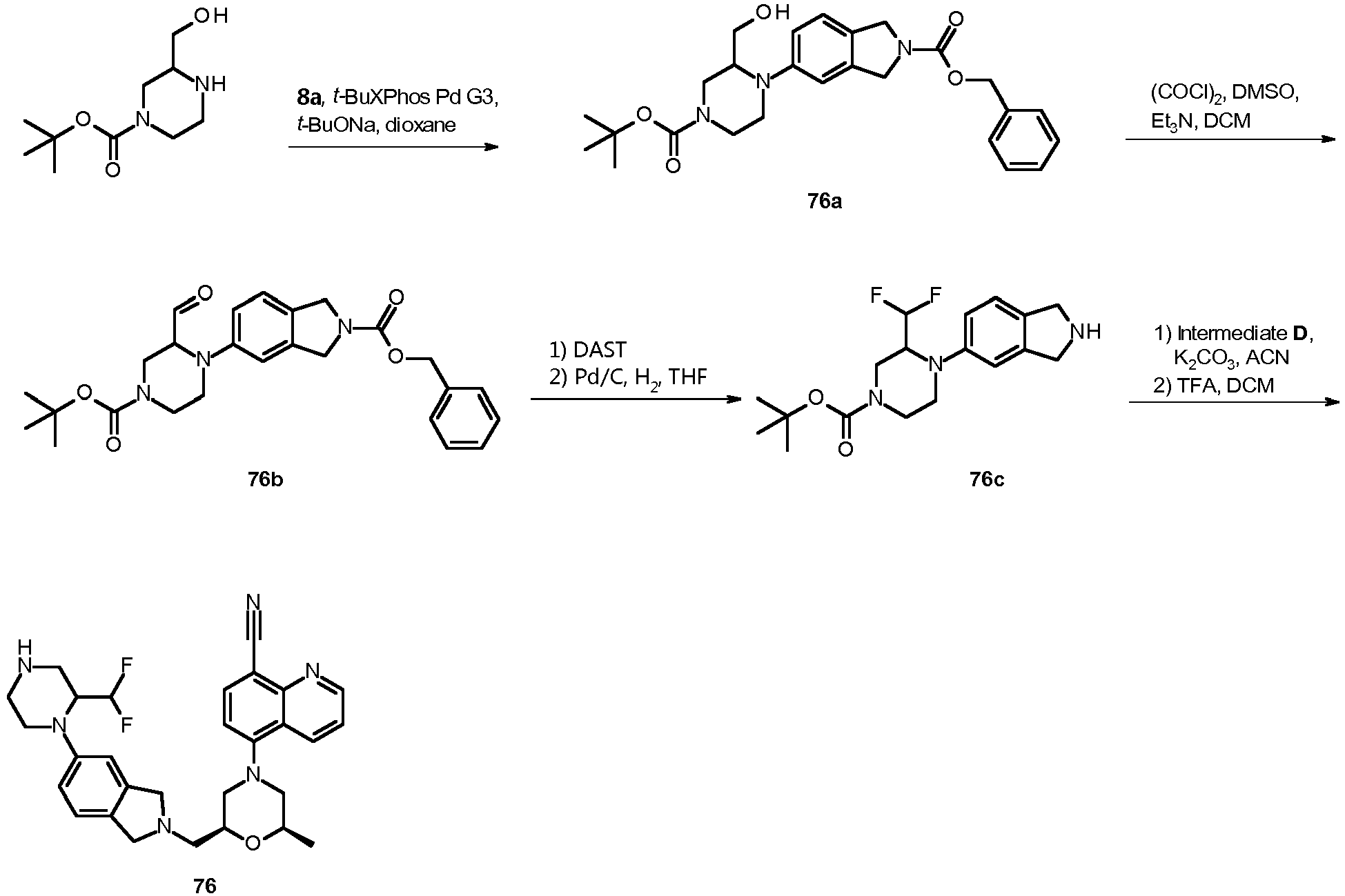
- To a solution of benzyl 5-bromoisoindoline-2-carboxylate (compound 8a, 1.0 g, 3.0 mmol) in 1,4-dioxane (20 mL) was added tert-butyl 3-(hydroxymethyl)piperazine-1-carboxylate (0.98 g, 4.5 mmol), t-BuONa (0.87 g, 9.0 mmol) and t-BuXPhos Pd G3 (239 mg, 0.30 mmol). The mixture was stirred at 100 °C for 3 hrs under N2, then concentrated. The residue was dissolved in EtOAc (150 mL), washed with brine, dried over MgSO4, and concentrated. The crude product was purified by column chromatography to give compound 76a (370 mg) as a colorless gum. MS: calc'd 468 (MH+), measured 468 (MH+).
- To a solution of oxalyl chloride (122 mg, 0.96 mmol) in DCM (30 mL) was added DMSO (100 mg, 1.28 mmol) at -78 °C. After release of gas, the reaction mixture was stirred at - 78 °C under N2 for 30 mins. To the solution was added benzyl 5-[4-tert-butoxycarbonyl-2-(hydroxymethyl)-piperazin-1-yl]isoindoline-2-carboxylate (compound 76a, 300 mg, 0.64 mmol) in DCM (5 mL) dropwise at -78 °C. The reaction mixture was stirred for another 1 h at this temperature. To the solution was added TEA (0.45 mL, 3.21 mmol) at -78 °C, the reaction mixture was warmed to rt over 30 mins, and stirred for another 30 min, then quenched with sat NH4Cl (40 mL). The organic layer was separated, and the aqueous phase was extracted with DCM. The combined organic layer was washed with sat NH4Cl and brine, dried over Na2SO4 and concentrated. The residue was purified by column chromatography to afford compound 76b (400 mg) as a yellow oil. MS: calc'd 466 (MH+), measured 466 (MH+).
- To a solution of benzyl 5-(4-tert-butoxycarbonyl-2-formyl-piperazin-1-yl)isoindoline-2-carboxylate (compound 76b, 350 mg, 0.75 mmol) in DCM (30 mL) was added DAST (1.21 g, 7.5 mmol) dropwise at 0 °C. The reaction mixture was kept at this temperature and stirred for 2.5 hrs, then quenched with sat NaHCO3 (30 mL). The mixture was extracted with DCM. The organic layer was washed with brine, dried over Na2SO4, and concentrated. The residue was purified by prep-TLC (EA/PE, v/v = 1/10, Rf = 0.2) to afford the intermediate (150 mg) as a yellow oil.
- The above intermediate (130 mg, 0.27 mmol) was dissolved in THF (5 mL). To the solution was added Pd on carbon (50 mg, 10%). The reaction mixture was charged with hydrogen and stirred at rt for 2 hrs. The mixture was then filtered, the filtrate was concentrated to give compound 76c (90 mg) as a colorless gum which was directly used in next step. MS: calc'd 354 (MH+), measured 354 (MH+).
- To a solution of tert-butyl 3-(difluoromethyl)-4-isoindolin-5-yl-piperazine-1-carboxylate (compound 76c, 51 mg, 0.14 mmol) in ACN (3 mL) was added K2CO3 (25 mg, 0.18 mmol) and [(2R,6R)-4-(8-cyano-5-quinolyl)-6-methyl-morpholin-2-yl]methyl trifluoromethanesulfonate (Intermediate D, 30 mg, 0.070 mmol). The reaction mixture was stirred at 60 °C for 3 hrs. The mixture was then diluted with EtOAc (10 mL). The mixture was filtered, the filtrate was concentrated. The residue was purified by prep-TLC (EA/PE, v/v = 1/1, Rf = 0.1) to give the intermediate (20 mg) as colorless gum which was dissolved in DCM (2 mL). To the solution was added TFA (1 mL). The mixture was stirred at rt for 2 hrs, then concentrated. The residue was purified by prep-HPLC to give Example 76 (12.6 mg) as a yellow solid. MS: calc'd 519 (MH+), measured 519 (MH+). 1H NMR (400MHz, METHANOL-d4) δ 8.99 (dd, J = 1.8, 4.3 Hz, 1H), 8.68 (dd, J = 1.8, 8.5 Hz, 1H), 8.17 (d, J = 8.0 Hz, 1H), 7.66 (dd, J = 4.3, 8.5 Hz, 1H), 7.37 (d, J = 8.8 Hz, 1H), 7.29 (d, J = 8.0 Hz, 1H), 7.21 - 7.10 (m, 2H), 6.27 - 5.98 (m, 1H), 4.71 (br s, 4H), 4.58 - 4.44 (m, 2H), 4.25 - 4.16 (m, 1H), 3.77 - 3.41 (m, 9H), 3.34 - 3.32 (m, 1H), 2.84 - 2.70 (m, 2H), 1.33 (d, J = 6.3 Hz, 3H).
-

-

-

-

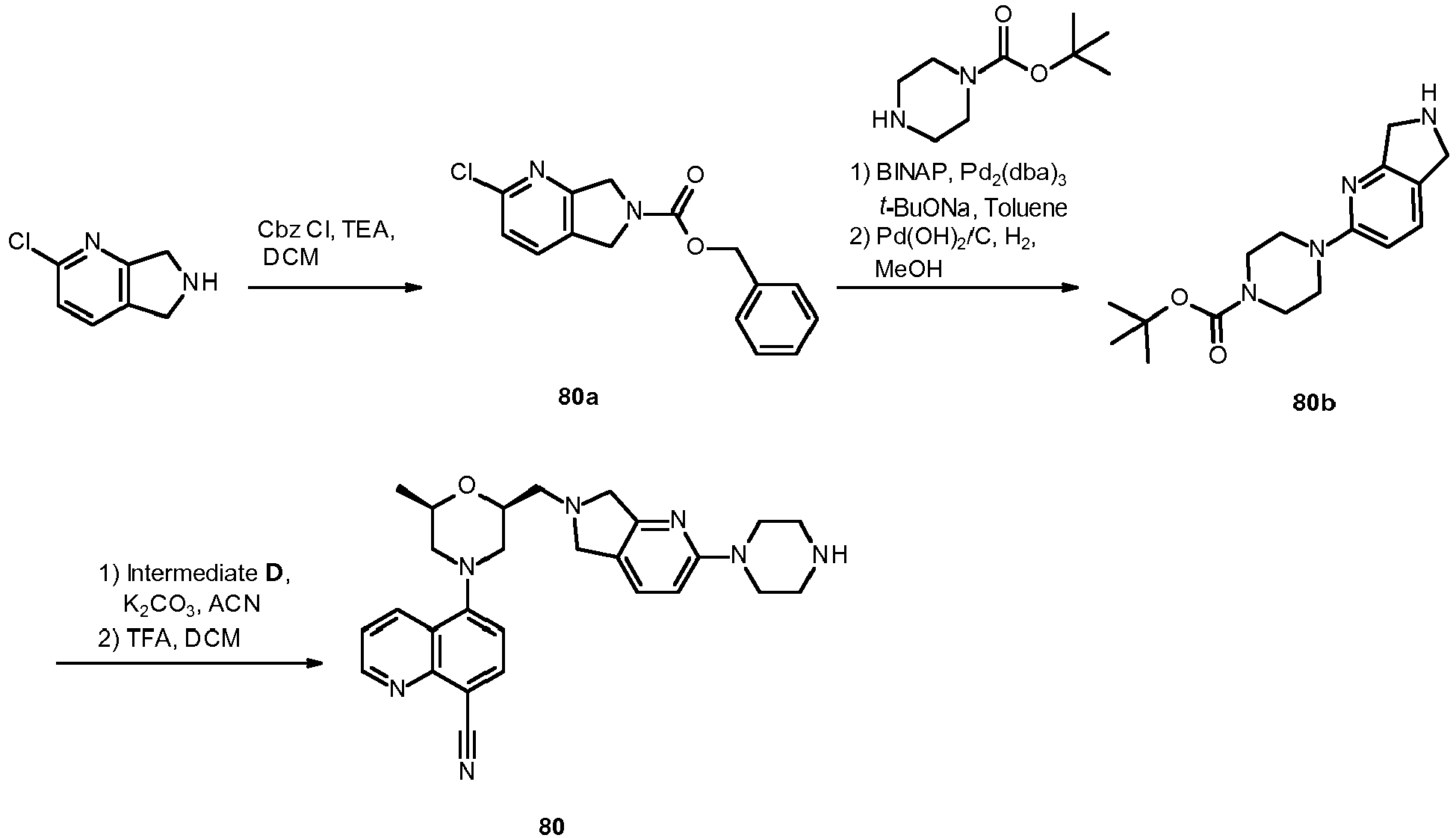
- To a solution of 2-chloro-6,7-dihydro-5H-pyrrolo[3,4-b]pyridine hydrochloride (CAS: 1841081-37-5, Vendor: Pharmablock, 181 mg, 0.95 mmol) in DCM (5 mL) was added TEA (383 mg, 0.53 mL, 3.8 mmol). To the solution was added CbzCl (242 mg, 0.20 mL, 1.4 mmol) drop-wise at 0 °C. The mixture was stirred at rt for 2h, then diluted with water and extracted with DCM, the organic layer was dried over Na2SO4 and concentrated. The residue was purified by column chromatography to afford compound 80a (218 mg) as a white solid. MS: calc'd 289 (MH+), measured 289 (MH+).
- To a solution of benzyl 2-chloro-5,7-dihydro-6H-pyrrolo[3,4-b]pyridine-6-carboxylate (compound 80a, 109 mg, 0.38 mmol) in toluene (5 mL) was added tert-butyl piperazine-1-carboxylate (105 mg, 0.57 mmol), and t-BuONa (73 mg, 0.76 mmol). The suspension was bubbled with N2 for 5 mins, BINAP (47 mg, 75 µmol) and Pd2(dba)3 (35 mg, 38 µmol) was added. The mixture was heated at 90 °C overnight, then diluted with EtOAc (10 mL), and filtered through celite, the filtrate was concentrated. The residue was purified by column chromatography to give the intermediate (116 mg) as a white solid which was dissolved in DCM/MeOH (6 mL, v/v = 1/2). To the solution was added Pd(OH)2 on carbon (20 mg, 20% wet). The suspension was charged with hydrogen balloon, and stirred at rt for 2h. The mixture was then filtered, the filtrate was concentrated to give compound 80b (83 mg) as an oil. MS: calc'd 305 (MH+), measured 305 (MH+).
- To a solution of ((2R,6R)-4-(8-cyanoquinolin-5-yl)-6-methylmorpholin-2-yl)methyl trifluoromethanesulfonate (Intermediate D, 42 mg, 0.10 mmol) in ACN (4 mL) was added tert-butyl 4-(6,7-dihydro-5H-pyrrolo[3,4-b]pyridin-2-yl)piperazine-1-carboxylate (compound 80b, 40 mg, 0.13 mmol) and K2CO3 (42 mg, 0.30 mmol). The mixture was then heated at 85 °C for 3 hrs, then filtered through celite, the filtrate was concentrated to give a brown oil which was dissolved in DCM (2 mL). To the solution was added TFA (1 mL). The mixture was stirred at rt for 2 hrs, then solvent was removed. The residue was purified by prep-HPLC to afford Example 80 (33 mg) as an orange powder. MS: calc'd 470 (MH+), measured 470 (MH+). 1H NMR (400 MHz, METHANOL-d4) δ 9.02 (d, J = 4.2 Hz, 1H), 8.70 (d, J = 8.4 Hz, 1H), 8.19 (d, J = 8.1 Hz, 1H), 7.72 - 7.64 (m, 2H), 7.31 (d, J = 8.1 Hz, 1H), 6.97 (d, J = 8.6 Hz, 1H), 4.87 - 4.61 (m, 4H), 4.54 - 4.45 (m, 1H), 4.26 - 4.19 (m, 1H), 3.92 - 3.84 (m, 4H), 3.74 - 3.61 (m, 2H), 3.50 - 3.43 (m, 2H), 3.37 - 3.34 (m, 4H), 2.87 - 2.72 (m, 2H), 1.35 (d, J = 6.2 Hz, 3H).
-

-
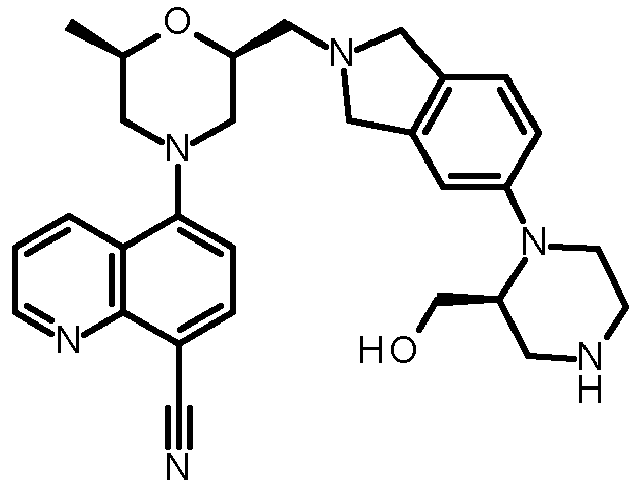
-

-

-

-

- The following tests were carried out in order to determine the activity of the compounds of formula (I) or (Ia) in HEK293-Blue-hTLR-7/8/9 cells assay.
- A stable HEK293-Blue-hTLR-7 cell line was purchased from InvivoGen (Cat.#: hkb-htlr7, San Diego, California, USA). These cells were originally designed for studying the stimulation of human TLR7 by monitoring the activation of NF-κB. A SEAP (secreted embryonic alkaline phosphatase) reporter gene was placed under the control of the IFN-β minimal promoter fused to five NF-κB and AP-1-binding sites. The SEAP was induced by activating NF-κB and AP-1 via stimulating HEK-Blue hTLR7 cells with TLR7 ligands. Therefore the reporter expression was declined by TLR7 antagonist under the stimulation of a ligand, such as R848 (Resiquimod), for incubation of 20 hrs. The cell culture supernatant SEAP reporter activity was determined using QUANTI-Blue™ kit (Cat.#: rep-qb1, Invivogen, San Diego, Ca, USA) at a wavelength of 640 nm, a detection medium that turns purple or blue in the presence of alkaline phosphatase.
- HEK293-Blue-hTLR7 cells were incubated at a density of 250,000∼450,000 cells/mL in a volume of 170 µL in a 96-well plate in Dulbecco's Modified Eagle's medium (DMEM) containing 4.5 g/L glucose, 50 U/mL penicillin, 50 mg/mL streptomycin, 100 mg/mL Normocin, 2 mM L-glutamine, 10% (v/v) heat-inactivated fetal bovine serum with addition of 20 µL test compound in a serial dilution in the presence of final DMSO at 1% and 10 µL of 20uM R848 in above DMEM, perform incubation under 37 °C in a CO2 incubator for 20 hrs. Then 20 µL of the supernatant from each well was incubated with 180 µL Quanti-blue substrate solution at 37 °C for 2 hrs and the absorbance was read at 620∼655 nm using a spectrophotometer. The signalling pathway that TLR7 activation leads to downstream NF-κB activation has been widely accepted, and therefore similar reporter assay was modified for evaluating TLR7 antagonist.
- A stable HEK293-Blue-hTLR-8 cell line was purchased from InvivoGen (Cat.#: hkb-htlr8, San Diego, California, USA). These cells were originally designed for studying the stimulation of human TLR8 by monitoring the activation of NF-κB. A SEAP (secreted embryonic alkaline phosphatase) reporter gene was placed under the control of the IFN-β minimal promoter fused to five NF-κB and AP-1-binding sites. The SEAP was induced by activating NF-κB and AP-1 via stimulating HEK-Blue hTLR8 cells with TLR8 ligands. Therefore the reporter expression was declined by TLR8 antagonist under the stimulation of a ligand, such as R848, for incubation of 20 hrs. The cell culture supernatant SEAP reporter activity was determined using QUANTI-Blue™ kit (Cat.#: rep-qb1, Invivogen, San Diego, Ca, USA) at a wavelength of 640 nm, a detection medium that turns purple or blue in the presence of alkaline phosphatase.
- HEK293-Blue-hTLR8 cells were incubated at a density of 250,000∼450,000 cells/mL in a volume of 170 µL in a 96-well plate in Dulbecco's Modified Eagle's medium (DMEM) containing 4.5 g/L glucose, 50 U/mL penicillin, 50 mg/mL streptomycin, 100 mg/mL Normocin, 2 mM L-glutamine, 10% (v/v) heat-inactivated fetal bovine serum with addition of 20 µL test compound in a serial dilution in the presence of final DMSO at 1% and 10 µL of 60uM R848 in above DMEM, perform incubation under 37 °C in a CO2 incubator for 20 hrs. Then 20 µL of the supernatant from each well was incubated with 180 µL Quanti-blue substrate solution at 37°C for 2 hrs and the absorbance was read at 620∼655 nm using a spectrophotometer. The signalling pathway that TLR8 activation leads to downstream NF-κB activation has been widely accepted, and therefore similar reporter assay was modified for evaluating TLR8 antagonist.
- A stable HEK293-Blue-hTLR-9 cell line was purchased from InvivoGen (Cat.#: hkb-htlr9, San Diego, California, USA). These cells were originally designed for studying the stimulation of human TLR9 by monitoring the activation of NF-κB. A SEAP (secreted embryonic alkaline phosphatase) reporter gene was placed under the control of the IFN-β minimal promoter fused to five NF-κB and AP-1-binding sites. The SEAP was induced by activating NF-κB and AP-1 via stimulating HEK-Blue hTLR9 cells with TLR9 ligands. Therefore the reporter expression was declined by TLR9 antagonist under the stimulation of a ligand, such as ODN2006 (Cat.#: tlrl-2006-1, Invivogen, San Diego, California, USA), for incubation of 20 hrs. The cell culture supernatant SEAP reporter activity was determined using QUANTI-Blue™ kit (Cat.#: rep-qb1, Invivogen, San Diego, California, USA) at a wavelength of 640 nm, a detection medium that turns purple or blue in the presence of alkaline phosphatase.
- HEK293-Blue-hTLR9 cells were incubated at a density of 250,000∼450,000 cells/mL in a volume of 170 µL in a 96-well plate in Dulbecco's Modified Eagle's medium (DMEM) containing 4.5 g/L glucose, 50 U/mL penicillin, 50 mg/mL streptomycin, 100 mg/mL Normocin, 2 mM L-glutamine, 10% (v/v) heat-inactivated fetal bovine serum with addition of 20 µL test compound in a serial dilution in the presence of final DMSO at 1% and 10 µL of 20uM ODN2006 in above DMEM, perform incubation under 37 °C in a CO2 incubator for 20 hrs. Then 20 µL of the supernatant from each well was incubated with 180 µL Quanti-blue substrate solution at 37 °C for 2 hrs and the absorbance was read at 620∼655 nm using a spectrophotometer. The signalling pathway that TLR9 activation leads to downstream NF-κB activation has been widely accepted, and therefore similar reporter assay was modified for evaluating TLR9 antagonist.
- The compounds of formula (I) or (Ia) have human TLR7 and/or TLR8 inhibitory activities (IC50 value) <0.5 µM. Moreover, some compounds also have human TLR9 inhibitory activity <1 µM. Activity data of the compounds of the present invention were shown in Table 2.
-
Example No HEK/hTLR7 IC50 (µM) HEK/hTLR8 IC50 (µM) HEK/hTLR9 IC50 (µM) ER-886509 (reference compound) 0.088 0.139 2.08 R1 (reference compound) 0.55 0.118 50.6 R2 (reference compound) 0.722 0.784 47.0 R3 (reference compound) 0.186 0.146 5.54 4 0.056 0.057 0.055 7 0.042 0.013 0.091 8 0.206 0.079 0.062 9 0.195 0.09 0.064 10 0.081 0.052 0.067 11 0.192 0.229 0.06 12 <0.003* <0.003 0.052 13 0.003 <0.003 0.054 14 0.021 0.029 0.117 15 0.037 0.021 0.046 16 0.104 0.016 0.082 17 0.065 0.052 0.048 18 0.068 0.031 0.048 19 0.011 0.006 0.064 20 0.014 0.004 0.048 21 0.009 0.005 0.055 23 0.006 <0.003 0.075 24 0.009 0.004 0.081 25 0.011 <0.003 0.063 28 0.227 0.058 0.093 29 0.049 0.014 0.134 30 0.016 0.003 0.136 31 0.029 0.013 0.168 32 0.039 0.017 0.123 33 0.009 0.005 0.174 34 0.023 0.005 0.125 35 0.041 0.009 0.216 36 0.01 <0.003 0.057 37 0.05 0.009 0.26 38 0.023 0.005 0.227 40 0.033 0.004 0.122 41 0.059 0.009 0.227 42 0.062 0.013 0.097 43 0.06 0.012 0.088 46 0.074 0.019 0.075 47 0.084 0.023 0.083 48 0.238 0.018 0.105 49 0.05 0.014 0.164 50 0.085 0.033 0.259 55 0.08 0.007 0.084 57 0.125 0.012 0.098 59 0.018 <0.003 0.066 60 0.011 <0.003 0.046 61 0.023 <0.003 0.059 62 0.026 0.005 0.062 63 0.013 <0.003 0.12 64 0.04 0.006 0.075 65 0.008 <0.003 0.059 66 0.006 <0.003 0.083 67 0.056 0.036 0.221 69 0.043 <0.003 0.081 70 0.014 <0.003 <0.032** 71 0.108 0.006 0.073 72 0.045 0.009 0.066 73 0.048 0.01 0.06 74 0.059 <0.003 0.073 75 0.042 0.004 0.055 76 0.009 0.004 0.19 77 0.032 0.008 0.239 78 0.011 <0.003 0.163 79 0.015 0.004 <0.032 80 0.007 <0.003 0.056 82 0.047 0.014 0.054 83 0.034 0.020 0.063 84 0.012 0.022 0.050 85 0.02 0.017 0.051 86 0.015 0.026 <0.032 * 0.003 is the lowest tested concentration for TLR7 and TLR8
** 0.032 is the lowest tested concentration for TLR9 - The human microsomal stability assay is used for early assessment of metabolic stability of a test compound in human liver microsomes.
- Human liver microsomes (Cat.NO.: 452117, Corning, USA;Cat.NO.:H2610, Xenotech, USA) were preincubated with test compound for 10 minutes at 37°C in 100 mM potassium phosphate buffer, pH 7.4. The reactions were initiated by adding NADPH regenerating system. The final incubation mixtures contained 1 µM test compound, 0.5 mg/mL liver microsomal protein, 1 mM MgCl2, 1 mM NADP, 1 unit/mL isocitric dehydrogenase and 6 mM isocitric acid in 100 mM potassium phosphate buffer, pH 7.4. After incubation times of 0, 3, 6, 9, 15 and 30 minutes at 37°C, 300 µL of cold acetonitrile (including internal standard) was added to 100 µL incubation mixture to terminate the reaction. Following precipitation and centrifugation, the amount of compound remaining in the samples were determined by LC-MS/MS. Controls of no NADPH regenerating system at zero and 30 minutes were also prepared and analyzed. The compounds of present invention showed good human liver microsome stability determined in the above assay, results are shown in Table 3 below.
Table 3. Human liver microsome stability of the compounds of present invention Example No Clearance of Human microsome (mL/min/kg) R3 (reference compound) 15.4 ER-886509 (reference compound) 15.2 16 7.31 19 6.17 21 6.15 44 6.94 55 7.09 56 6.51 62 6.39
Claims (14)
- A compound of formula (I),
 R1 is
R1 is R2 is C1-6alkyl;R3 is 1,3-dihydropyrrolo[3,4-c]pyridinyl substituted by piperazinyl;or a pharmaceutically acceptable salt, enantiomer or diastereomer thereof.
3,4-dihydro-1H-2,7-naphthyridinyl substituted by piperazinyl;
3,4-dihydro-1H-isoquinolinyl substituted by one or two substituents independently selected from hydroxy, piperazinyl and C1-6alkylpiperazinyl;
3,4-dihydro-2H-quinolinyl substituted by piperazinyl; 5,7-dihydropyrrolo[3,4-b]pyridinyl substituted by piperazinyl; 5,7-dihydropyrrolo[3,4-d]pyrimidinyl substituted by piperazinyl or C1-6alkylpiperazinyl; 6,7-dihydro-4H-thiazolo[5,4-c]pyridinyl substituted by C1-6alkylpiperazinyl; 7,8-dihydro-5H-1,6-naphthyridinyl substituted by piperazinyl;
isoindolinyl substituted by one or two substituents independently selected from ((C1-6alkyl)2amino)C1-6alkoxy; (C1-6alkoxyC1-6alkyl)piperazinyl; (C1-6alkyl)2piperazinyl; (C1-6alkyl)2pyridinyl; (hydroxyC1-6alkyl)piperazinyl; 1,3,4,6,7,8,9,9a-octahydropyrido[1,2-a]pyrazinyl; 1,6-diazaspiro[3.3]heptanyl; 2,6-diazaspiro[3.3]heptanyl; 3,4,6,7,9,9a-hexahydro-1H-pyrazino[2,1-c][1,4]oxazinyl; 3,8-diazabicyclo[3.2.1]octanyl; 3-oxa-7,9-diazabicyclo[3.3.1]nonanyl; 4,7-diazaspiro[2.5]octanyl; aminoazetidinyl; amino C1-6alkylamino; C1-6alkoxycarbonylpiperazinyl; C1-6alkyl; C1-6alkylimidazolyl; C1-6alkylpiperazinyl; C3-7cycloalkylpiperazinyl; carboxypiperazinyl; haloC1-6alkylpiperazinyl; halogen;
morpholinylC1-6alkyl; oxopiperazinyl; piperazinyl; piperidinyl; piperidinylC1-6alkyl; pyrrolidinyl and pyrrolidinyloxy; or
-NR6aR6b; whereinR6a is H or C1-6alkyl;R6b is phenylC1-6alkyl substituted by piperazinyl; - A compound of formula (Ia),
 R1 is
R1 is R2 is C1-6alkyl;R3 is 1,3-dihydropyrrolo[3,4-c]pyridinyl substituted by piperazinyl;or a pharmaceutically acceptable salt, enantiomer or diastereomer thereof.
3,4-dihydro-1H-2,7-naphthyridinyl substituted by piperazinyl;
3,4-dihydro-1H-isoquinolinyl substituted by one or two substituents independently selected from hydroxy, piperazinyl and C1-6alkylpiperazinyl;
3,4-dihydro-2H-quinolinyl substituted by piperazinyl;
5,7-dihydropyrrolo[3,4-b]pyridinyl substituted by piperazinyl;
5,7-dihydropyrrolo[3,4-d]pyrimidinyl substituted by piperazinyl or C1-6alkylpiperazinyl;
6,7-dihydro-4H-thiazolo[5,4-c]pyridinyl substituted by C1-6alkylpiperazinyl;
7,8-dihydro-5H-1,6-naphthyridinyl substituted by piperazinyl;
isoindolinyl substituted by one or two substituents independently selected from (C1-6alkoxyC1-6alkyl)piperazinyl; (C1-6alkyl)2piperazinyl; (C1-6alkyl)2pyridinyl; (hydroxyC1-6alkyl)piperazinyl; 1,3,4,6,7,8,9,9a-octahydropyrido[1,2-a]pyrazinyl;
1,6-diazaspiro[3.3]heptanyl; 2,6-diazaspiro[3.3]heptanyl; 3,4,6,7,9,9a-hexahydro-1H-pyrazino[2,1-c][1,4]oxazinyl; 3,8-diazabicyclo[3.2.1]octanyl; 3-oxa-7,9-diazabicyclo[3.3.1]nonanyl; 4,7-diazaspiro[2.5]octanyl; aminoazetidinyl; aminoC1-6alkylamino; C1-6alkoxycarbonylpiperazinyl; C1-6alkyl; C1-6alkylimidazolyl; C1-6alkylpiperazinyl; C3-7cycloalkylpiperazinyl; carboxypiperazinyl; haloC1-6alkylpiperazinyl; halogen; morpholinylC1-6alkyl; oxopiperazinyl; piperazinyl; piperidinyl; piperidinylC1-6alkyl; pyrrolidinyl and pyrrolidinyloxy; or
-NR6aR6b; whereinR6a is H or C1-6alkyl;R6b is phenylC1-6alkyl substituted by piperazinyl; - A compound according to claim 1 or 2, whereinR1 is
 R2 is methyl;R3 is piperazinyl-1,3-dihydropyrrolo[3,4-c]pyridinyl; piperazinyl-3,4-dihydro-1H-2,7-naphthyridinyl; piperazinyl-3,4-dihydro-1H-isoquinolinyl; methylpiperazinyl-3,4-dihydro-1H-isoquinolinyl; hydroxy(piperazinyl)-3,4-dihydro-1H-isoquinolinyl; piperazinyl-3,4-dihydro-2H-quinolinyl; piperazinyl-5,7-dihydropyrrolo[3,4-b]pyridinyl; piperazinyl-5,7-dihydropyrrolo[3,4-d]pyrimidinyl; methylpiperazinyl-5,7-dihydropyrrolo[3,4-d]pyrimidinyl; methylpiperazinyl-6,7-dihydro-4H-thiazolo[5,4-c]pyridinyl; piperazinyl-7,8-dihydro-5H-1,6-naphthyridinyl; (difluoromethyl)piperazinylisoindolinyl; (dimethylamino)ethoxyisoindolinyl; (hydroxymethyl)piperazinylisoindolinyl; (methoxyethyl)piperazinylisoindolinyl; 1,3,4,6,7,8,9,9a-octahydropyrido[1,2-a]pyrazinylisoindolinyl; 1,6-diazaspiro[3.3]heptanylisoindo linyl; 2,6-diazaspiro[3.3]heptanylisoindolinyl; 3,4,6,7,9,9a-hexahydro-1H-pyrazino[2,1-c][1,4]oxazinylisoindolinyl; 3,8-diazabicyclo[3.2.1]octanylisoindolinyl; 3-oxa-7,9-diazabicyclo[3.3.1]nonanylisoindolinyl; 4,7-diazaspiro[2.5]octanylisoindo linyl; aminoazetidinylisoindolinyl; aminoethylaminoisoindolinyl; carboxypiperazinylisoindolinyl; cyclopropylpiperazinylisoindolinyl; dimethylpiperazinylisoindolinyl; dimethylpyridinylisoindolinyl; ethoxycarbonylpiperazinylisoindolinyl; methoxycarbonylpiperazinylisoindolinyl; methylimidazolylisoindolinyl; methylpiperazinyl(fluoro)isoindolinyl; methylpiperazinylisoindolinyl; morpholinylmethylisoindolinyl; oxopiperazinylisoindolinyl; piperazinyl(fluoro)isoindolinyl; piperazinyl(methyl)isoindolinyl; piperazinylisoindolinyl; piperidinylisoindolinyl; piperidinylmethylisoindolinyl; pyrrolidinylisoindolinyl; pyrrolidinyloxyisoindolinyl; (piperazinylphenyl)methylamino or (piperazinylphenyl)methyl(methyl)amino;or a pharmaceutically acceptable salt, enantiomer or diastereomer thereof.
 - A compound according to claim 1 or 2, wherein R1 is

- A compound according to claim 4, wherein R4 is cyano or chloro.
- A compound according to claim 4, whereinR3 is 1,3-dihydropyrrolo[3,4-c]pyridinyl substituted by piperazinyl;
3,4-dihydro-1H-2,7-naphthyridinyl substituted by piperazinyl;
3,4-dihydro-1H-isoquinolinyl substituted by one or two substituents independently selected from hydroxy, piperazinyl and C1-6alkylpiperazinyl;
3,4-dihydro-2H-quinolinyl substituted by piperazinyl;
5,7-dihydropyrrolo[3,4-b]pyridinyl substituted by piperazinyl;
5,7-dihydropyrrolo[3,4-d]pyrimidinyl substituted by piperazinyl or C1-6alkylpiperazinyl;
7,8-dihydro-5H-1,6-naphthyridinyl substituted by piperazinyl;
isoindolinyl substituted by (C1-6alkoxyC1-6alkyl)piperazinyl, (C1-6alkyl)2piperazinyl, (hydroxyC1-6alkyl)piperazinyl, C1-6alkylpiperazinyl, C3-7cycloalkylpiperazinyl, haloC1-6alkylpiperazinyl, morpholinylC1-6alkyl, piperazinyl, piperidinyl, piperidinylC1-6alkyl or pyrrolidinyl; or
-NR6aR6b; whereinR6a is H;R6b is phenylC1-6alkyl substituted by piperazinyl. - A compound according to claim 6, wherein R3 is piperazinyl-1,3-dihydropyrrolo[3,4-c]pyridinyl; piperazinyl-3,4-dihydro-1H-2,7-naphthyridinyl; piperazinyl-3,4-dihydro-1H-isoquinolinyl; methylpiperazinyl-3,4-dihydro-1H-isoquinolinyl; hydroxy(piperazinyl)-3,4-dihydro-1H-isoquinolinyl;piperazinyl-3,4-dihydro-2H-quinolinyl;piperazinyl-5,7-dihydropyrrolo[3,4-b]pyridinyl; piperazinyl-5,7-dihydropyrrolo[3,4-d]pyrimidinyl; methylpiperazinyl-5,7-dihydropyrrolo[3,4-d]pyrimidinyl;piperazinyl-7,8-dihydro-5H-1,6-naphthyridinyl; (difluoromethyl)piperazinylisoindolinyl; (hydroxymethyl)piperazinylisoindolinyl; (methoxyethyl)piperazinylisoindolinyl; cyclopropylpiperazinylisoindolinyl; dimethylpiperazinylisoindolinyl; methylpiperazinylisoindolinyl; morpholinylmethylisoindolinyl; piperazinylisoindolinyl; piperidinylisoindolinyl; piperidinylmethylisoindolinyl; pyrrolidinylisoindolinyl; or (piperazinylphenyl)methylamino.
- A compound according to claim 1 or 2, whereinR1 is
 R2 is C1-6alkyl;R3 is 1,3-dihydropyrrolo[3,4-c]pyridinyl substituted by piperazinyl;or a pharmaceutically acceptable salt, enantiomer or diastereomer thereof.
3,4-dihydro-1H-2,7-naphthyridinyl substituted by piperazinyl;
3,4-dihydro-1H-isoquinolinyl substituted by one or two substituents independently selected from hydroxy, piperazinyl and C1-6alkylpiperazinyl;
3,4-dihydro-2H-quinolinyl substituted by piperazinyl;
5,7-dihydropyrrolo[3,4-b]pyridinyl substituted by piperazinyl;
5,7-dihydropyrrolo[3,4-d]pyrimidinyl substituted by piperazinyl or C1-6alkylpiperazinyl;
7,8-dihydro-5H-1,6-naphthyridinyl substituted by piperazinyl;
isoindolinyl substituted by (C1-6alkoxyC1-6alkyl)piperazinyl, (C1-6alkyl)2piperazinyl, (hydroxyC1-6alkyl)piperazinyl, C1-6alkylpiperazinyl, C3-7cycloalkylpiperazinyl, haloC1-6alkylpiperazinyl, morpholinylC1-6alkyl, piperazinyl, piperidinyl, piperidinylC1-6alkyl or pyrrolidinyl; or
-NR6aR6b; whereinR6a is H;R6b is phenylC1-6alkyl substituted by piperazinyl; - A compound according to claim 8, whereinR1 is
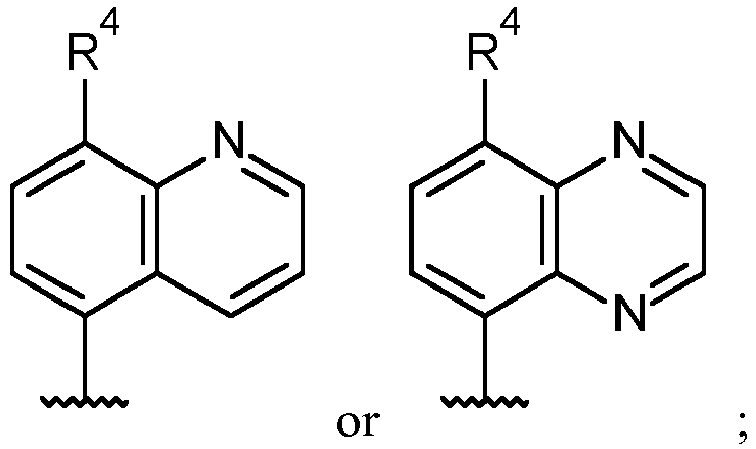 R2 is methyl;R3 is piperazinyl-1,3-dihydropyrrolo[3,4-c]pyridinyl; piperazinyl-3,4-dihydro-1H-2,7-naphthyridinyl; piperazinyl-3,4-dihydro-1H-isoquinolinyl; methylpiperazinyl-3,4-dihydro-1H-isoquinolinyl; hydroxy(piperazinyl)-3,4-dihydro-1H-isoquinolinyl; piperazinyl-3,4-dihydro-2H-quinolinyl; piperazinyl-5,7-dihydropyrrolo[3,4-b]pyridinyl; piperazinyl-5,7-dihydropyrrolo[3,4-d]pyrimidinyl; methylpiperazinyl-5,7-dihydropyrrolo[3,4-d]pyrimidinyl; piperazinyl-7,8-dihydro-5H-1,6-naphthyridinyl; (difluoromethyl)piperazinylisoindolinyl; (hydroxymethyl)piperazinylisoindolinyl; (methoxyethyl)piperazinylisoindolinyl; cyclopropylpiperazinylisoindolinyl; dimethylpiperazinylisoindolinyl; methylpiperazinylisoindolinyl; morpholinylmethylisoindolinyl; piperazinylisoindolinyl; piperidinylisoindolinyl; piperidinylmethylisoindolinyl; pyrrolidinylisoindolinyl; or (piperazinylphenyl)methylamino;or a pharmaceutically acceptable salt, enantiomer or diastereomer thereof.
 - A compound according to claim 1 or 2, selected from:4-[(2R,6S)-2-methyl-6-[(4-piperazin-1-ylisoindolin-2-yl)methyl]morpholin-4-yl]pyrazolo[1 ,5-a]pyridine-7-carbonitrile;4-[(2R,6S)-2-methyl-6-[(5-piperazin-1-ylisoindolin-2-yl)methyl]morpholin-4-yl]pyrazolo[1,5-a]pyridine-7-carbonitrile;4-[(2R,6S)-2-methyl-6-[(8-piperazin-1-yl-3,4-dihydro-1H-isoquinolin-2-yl)methyl]morpholin-4-yl]pyrazolo[1,5-a]pyridine-7-carbonitrile;4-[(2R,6S)-2-methyl-6-[(7-piperazin-1-yl-3,4-dihydro-2H-quinolin-1-yl)methyl]morpholin-4-yl]pyrazolo[1,5-a]pyridine-7-carbonitrile;3-fluoro-4-[(2R,6S)-2-methyl-6-[(5-piperazin-1-ylisoindolin-2-yl)methyl]morpholin-4-yl]pyrazolo[1,5-a]pyridine-7-carbonitrile;4-[(2R,6S)-2-methyl-6-[[5-(4-piperidyl)isoindolin-2-yl]methyl]morpholin-4-yl]pyrazolo[1,5-a]pyridine-7-carbonitrile;4-[(2R,6S)-2-methyl-6-[(5-pyrrolidin-3-ylisoindolin-2-yl)methyl]morpholin-4-yl]pyrazolo[1,5-a]pyridine-7-carbonitrile;4-[(2R,6S)-2-methyl-6-[(6-piperazin-1-yl-3,4-dihydro-1H-isoquinolin-2-yl)methyl]morpholin-4-yl]pyrazolo[1,5-a]pyridine-7-carbonitrile;4-[(2R,6S)-2-methyl-6-[(7-piperazin-1-yl-3,4-dihydro-1H-isoquinolin-2-yl)methyl]morpholin-4-yl]pyrazolo[1,5-a]pyridine-7-carbonitrile;8-[(2R,6S)-2-methyl-6-[(5-piperazin-1-ylisoindolin-2-yl)methyl]morpholin-4-yl]quinoxaline-5-carbonitrile;8-[(2R,6S)-2-methyl-6-[(6-piperazin-1-yl-3,4-dihydro-1H-isoquinolin-2-yl)methyl]morpholin-4-yl]quinoxaline-5-carbonitrile;3-fluoro-4-[(2R,6S)-2-methyl-6-[(6-piperazin-1-yl-3,4-dihydro-1H-isoquinolin-2-yl)methyl]morpholin-4-yl]pyrazolo[1,5-a]pyridine-7-carbonitrile;4-[(2R,6S)-2-methyl-6-[[6-(4-methylpiperazin-1-yl)-3,4-dihydro-1H-isoquinolin-2-yl]methyl]morpholin-4-yl]pyrazolo[1,5-a]pyridine-7-carbonitrile4-[(2R,6S)-2-methyl-6-[[(4-piperazin-1-ylphenyl)methylamino]methyl]morpholin-4-yl]pyrazolo[1,5-a]pyridine-7-carbonitrile;4-[(2R,6S)-2-methyl-6-[[5-(4-methylpiperazin-1-yl)isoindolin-2-yl]methyl]morpholin-4-yl]pyrazolo[1,5-a]pyridine-7-carbonitrile;4-[(2R,6S)-2-methyl-6-[(3-piperazin-1-yl-5,7-dihydropyrrolo[3,4-b]pyridin-6-yl)methyl]morpholin-4-yl]pyrazolo[1,5-a]pyridine-7-carbonitrile;5-[(2R,6S)-2-methyl-6-[(6-piperazin-1-yl-3,4-dihydro-1H-isoquinolin-2-yl)methyl]morpholin-4-yl]quinoline-8-carbonitrile;5-[(2R,6S)-2-methyl-6-[(3-piperazin-1-yl-5,7-dihydropyrrolo[3,4-b]pyridin-6-yl)methyl]morpholin-4-yl]quinoline-8-carbonitrile;5-[(2R,6S)-2-methyl-6-[(5-piperazin-1-ylisoindolin-2-yl)methyl]morpholin-4-yl]quinoline-8-carbonitrile;4-[(2R,6S)-2-methyl-6-[[methyl-[(4-piperazin-1-ylphenyl)methyl]amino]methyl]morpholin-4-yl]pyrazolo[1,5-a]pyridine-7-carbonitrile;7-[(2R,6S)-2-methyl-6-[(5-piperazin-1-ylisoindolin-2-yl)methyl]morpholin-4-yl]-1,3-benzothiazole-4-carbonitrile;7-[(2R,6S)-2-methyl-6-[(6-piperazin-1-yl-3,4-dihydro-1H-isoquinolin-2-yl)methyl]morpholin-4-yl]-1,3-benzothiazole-4-carbonitrile;7-[(2R,6S)-2-methyl-6-[(3-piperazin-1-yl-5,7-dihydropyrrolo[3,4-b]pyridin-6-yl)methyl]morpholin-4-yl]-1,3-benzothiazole-4-carbonitrile;4-[(2S,6R)-2-[[5-(2-aminoethylamino)isoindolin-2-yl]methyl]-6-methyl-morpholin-4-yl]pyrazolo[1,5-a]pyridine-7-carbonitrile;4-[(2R,6S)-2-methyl-6-[[2-(4-methylpiperazin-1-yl)-6,7-dihydro-4H-thiazolo[5,4-c]pyridin-5-yl]methyl]morpholin-4-yl]pyrazolo[1,5-a]pyridine-7-carbonitrile;4-[(2S,6R)-2-[[5-[2-(dimethylamino)ethoxy]isoindolin-2-yl]methyl]-6-methyl-morpholin-4-yl]pyrazolo[1,5-a]pyridine-7-carbonitrile;3-fluoro-4-[(2R,6S)-2-methyl-6-[(3-piperazin-1-yl-5,7-dihydropyrrolo[3,4-b]pyridin-6-yl)methyl]morpholin-4-yl]pyrazolo[1,5-a]pyridine-7-carbonitrile;8-[(2R,6S)-2-methyl-6-[(3-piperazin-1-yl-5,7-dihydropyrrolo[3,4-b]pyridin-6-yl)methyl]morpholin-4-yl]quinoxaline-5-carbonitrile;(2R,6S)-4-(8-chloro-5-quinolyl)-2-methyl-6-[(5-piperazin-1-ylisoindolin-2-yl)methyl]morpholine;(2R,6S)-4-(8-chloro-5-quinolyl)-2-methyl-6-[(6-piperazin-1-yl-3,4-dihydro-1H-isoquinolin-2-yl)methyl]morpholine;(2R,6S)-4-(8-chloroquinoxalin-5-yl)-2-methyl-6-[(5-piperazin-1-ylisoindolin-2-yl)methyl]morpholine;(2R,6S)-4-(8-chloroquinoxalin-5-yl)-2-methyl-6-[(6-piperazin-1-yl-3,4-dihydro-1H-isoquinolin-2-yl)methyl]morpholine;8-[(2S,6R)-2-[[5-(4-cyclopropylpiperazin-1-yl)isoindolin-2-yl]methyl]-6-methyl-morpholin-4-yl]quinoxaline-5-carbonitrile;8-[(2R,6S)-2-methyl-6-[[5-(3-methylpiperazin-1-yl)isoindolin-2-yl]methyl]morpholin-4-yl] quinoxaline-5 -carbonitrile;8-[(2S,6R)-2-[[5-[4-(2-methoxyethyl)piperazin-1-yl]isoindolin-2-yl]methyl]-6-methyl-morpholin-4-yl]quinoxaline-5-carbonitrile;8-[(2S,6R)-2-[[5-(4,7-diazaspiro[2.5]octan-7-yl)isoindolin-2-yl]methyl]-6-methyl-morpholin-4-yl]quinoxaline-5-carbonitrile;8-[(2R,6S)-2-methyl-6-[[5-(2-oxopiperazin-1-yl)isoindolin-2-yl]methyl]morpholin-4-yl] quinoxaline-5 -carbonitrile;8-[(2S,6R)-2-[[5-(1,3,4,6,7,8,9,9a-octahydropyrido[1,2-a]pyrazin-2-yl)isoindolin-2-yl]methyl]-6-methyl-morpholin-4-yl]quinoxaline-5-carbonitrile;8-[(2S,6R)-2-[[5-(3,8-diazabicyclo[3.2.1]octan-8-yl)isoindolin-2-yl]methyl]-6-methyl-morpholin-4-yl]quinoxaline-5-carbonitrile;5-[(2S,6R)-2-[[5-(3,8-diazabicyclo[3.2.1]octan-3-yl)isoindolin-2-yl]methyl]-6-methyl-morpholin-4-yl]quinoline-8-carbonitrile;5-[(2S,6R)-2-[[5-(3,8-diazabicyclo[3.2.1]octan-8-yl)isoindolin-2-yl]methyl]-6-methyl-morpholin-4-yl]quinoline-8-carbonitrile;8-[(2S,6R)-2-[[5-(3,8-diazabicyclo[3.2.1]octan-3-yl)isoindolin-2-yl]methyl]-6-methyl-morpholin-4-yl]quinoxaline-5-carbonitrile;4-[(2R,6S)-2-methyl-6-[[5-(1-methylimidazol-4-yl)isoindolin-2-yl]methyl]morpholin-4-yl]pyrazolo[1 ,5-a]pyridine-7-carbonitrile;5-[(2R,6S)-2-methyl-6-[[5-(3-oxa-7,9-diazabicyclo[3.3.1]nonan-9-yl)isoindolin-2-yl]methyl]morpholin-4-yl]quinoline-8-carbonitrile;5-[(2S,6R)-2-[[5-(2,6-diazaspiro[3.3]heptan-2-yl)isoindolin-2-yl]methyl]-6-methyl-morpholin-4-yl]quinoline-8-carbonitrile;5-[(2R,6S)-2-methyl-6-[(1-methyl-5-piperazin-1-yl-isoindolin-2-yl)methyl]morpholin-4-yl] quino line-8-carbonitrile;8-[(2R,6S)-2-methyl-6-[[5-(3-oxa-7,9-diazabicyclo[3.3.1]nonan-7-yl)isoindolin-2-yl]methyl]morpholin-4-yl]quinoxaline-5-carbonitrile;Ethyl 1-[2-[[(2S,6R)-4-(8-cyano-5-quinolyl)-6-methyl-morpholin-2-yl]methyl]isoindolin-5-yl]piperazine-2-carboxylate;4-[(2R,6S)-2-methyl-6-[[2-(4-methylpiperazin-1-yl)-5,7-dihydropyrrolo[3,4-d]pyrimidin-6-yl]methyl]morpholin-4-yl]pyrazolo[1,5-a]pyridine-7-carbonitrile;4-[(2R,6S)-2-methyl-6-[(5-pyrrolidin-3-yloxyisoindolin-2-yl)methyl]morpholin-4-yl]pyrazolo[1,5-a]pyridine-7-carbonitrile;4-[(2S,6R)-2-[[5-(2,6-dimethyl-4-pyridyl)isoindolin-2-yl]methyl]-6-methyl-morpholin-4-yl]pyrazolo[1,5-a]pyridine-7-carbonitrile;4-[(2S,6R)-2-[[5-(2,6-dimethyl-4-pyridyl)isoindolin-2-yl]methyl]-6-methyl-morpholin-4-yl]-3-fluoro-pyrazolo[1,5-a]pyridine-7-carbonitrile;5-[(2S,6R)-2-[[5-(1,6-diazaspiro[3.3]heptan-6-yl)isoindolin-2-yl]methyl]-6-methyl-morpholin-4-yl]quinoline-8-carbonitrile;1-[2-[[(2S,6R)-4-(8-cyano-5-quinolyl)-6-methyl-morpholin-2-yl]methyl]isoindolin-5-yl]piperazine-2-carboxylic acid;Trans-5-[(2R,6S)-2-methyl-6-[[5-[3,5-dimethylpiperazin-1-yl]isoindolin-2-yl]methyl]morpholin-4-yl]quinoline-8-carbonitrile;5-[(2S,6R)-2-[[5-(3,4,6,7,9,9a-hexahydro-1H-pyrazino[2,1-c][1,4]oxazin-8-yl)isoindolin-2-yl]methyl]-6-methyl-morpholin-4-yl]quinoline-8-carbonitrile;5-[(2S,6R)-2-[(4-fluoro-6-piperazin-1-yl-isoindolin-2-yl)methyl]-6-methyl-morpholin-4-yl] quino line-8-carbonitrile;8-[(2R,6S)-2-methyl-6-[(6-piperazin-1-yl-1,3-dihydropyrrolo[3,4-c]pyridin-2-yl)methyl]morpholin-4-yl]quinoxaline-5-carbonitrile;5-[(2R,6S)-2-methyl-6-[(6-piperazin-1-yl-1,3-dihydropyrrolo[3,4-c]pyridin-2-yl)methyl]morpholin-4-yl]quinoline-8-carbonitrile;5-[(2R,6S)-2-methyl-6-[[5-[(3R)-3-methylpiperazin-1-yl]isoindolin-2-yl]methyl]morpholin-4-yl]quinoline-8-carbonitrile;5-[(2R,6S)-2-methyl-6-[(2-piperazin-1-yl-5,7-dihydropyrrolo[3,4-d]pyrimidin-6-yl)methyl]morpholin-4-yl]quinoline-8-carbonitrile;5-[(2R,6S)-2-methyl-6-[[5-[(3S)-3-methylpiperazin-1-yl]isoindolin-2-yl]methyl]morpholin-4-yl]quinoline-8-carbonitrile;8-[(2R,6S)-2-methyl-6-[[5-[(3R)-3-methylpiperazin-1-yl]isoindolin-2-yl]methyl]morpholin-4-yl]quinoxaline-5-carbonitrile;8-[(2R,6S)-2-methyl-6-[[5-[(3S)-3-methylpiperazin-1-yl]isoindolin-2-yl]methyl]morpholin-4-yl]quinoxaline-5-carbonitrile;Methyl 4-[2-[[(2S,6R)-4-(8-cyano-5-quinolyl)-6-methyl-morpholin-2-yl]methyl]isoindolin-5-yl]piperazine-2-carboxylate;4-[2-[[(2S,6R)-4-(8-cyano-5-quinolyl)-6-methyl-morpholin-2-yl]methyl]isoindolin-5-yl]piperazine-2-carboxylic acid;5-[(2S,6R)-2-[[4-fluoro-6-(4-methylpiperazin-1-yl)isoindolin-2-yl]methyl]-6-methyl-morpholin-4-yl]quinoline-8-carbonitrile;5-[(2R,6S)-2-methyl-6-[(6-piperazin-1-yl-3,4-dihydro-1H-2,7-naphthyridin-2-yl)methyl]morpholin-4-yl]quinoline-8-carbonitrile;5-[(2R,6S)-2-methyl-6-[[5-[(3R,5S)-3,5-dimethylpiperazin-1-yl]isoindolin-2-yl]methyl]morpholin-4-yl]quinoline-8-carbonitrile;5-[(2R,6S)-2-methyl-6-[[5-(3-oxa-7,9-diazabicyclo[3.3.1]nonan-7-yl)isoindolin-2-yl]methyl]morpholin-4-yl]quinoline-8-carbonitrile;5-[(2S,6R)-2-[[5-[2-(hydroxymethyl)piperazin-1-yl]isoindolin-2-yl]methyl]-6-methyl-morpholin-4-yl]quinoline-8-carbonitrile;5-[(2R,6S)-2-methyl-6-[[5-(1-piperidylmethyl)isoindolin-2-yl]methyl]morpholin-4-yl] quino line-8-carbonitrile;5-[(2S,6R)-2-[(4-hydroxy-6-piperazin-1-yl-3,4-dihydro-1H-isoquinolin-2-yl)methyl]-6-methyl-morpholin-4-yl]quinoline-8-carbonitrile;5-[(2S,6R)-2-[[5-[2-(difluoromethyl)piperazin-1-yl]isoindolin-2-yl]methyl]-6-methyl-morpholin-4-yl]quinoline-8-carbonitrile;5-[(2S,6R)-2-[[5-(3-aminoazetidin-1-yl)isoindolin-2-yl]methyl]-6-methyl-morpholin-4-yl] quino line-8-carbonitrile;5-[(2R,6S)-2-methyl-6-[[5-(2-methylpiperazin-1-yl)isoindolin-2-yl]methyl]morpholin-4-yl] quino line-8-carbonitrile;5-[(2R,6S)-2-methyl-6-[(2-piperazin-1-yl-7,8-dihydro-5H-1,6-naphthyridin-6-yl)methyl]morpholin-4-yl]quinoline-8-carbonitrile;5-[(2R,6S)-2-methyl-6-[(2-piperazin-1-yl-5,7-dihydropyrrolo[3,4-b]pyridin-6-yl)methyl]morpholin-4-yl]quinoline-8-carbonitrile;5-[(2S,6R)-2-[[5-[(2R)-2-(hydroxymethyl)piperazin-1-yl]isoindolin-2-yl]methyl]-6-methyl-morpholin-4-yl]quinoline-8-carbonitrile;5-[(2S,6R)-2-[[5-[(2S)-2-(hydroxymethyl)piperazin-1-yl]isoindolin-2-yl]methyl]-6-methyl-morpholin-4-yl]quinoline-8-carbonitrile;8-[(2R,6S)-2-methyl-6-[[(4-piperazin-1-ylphenyl)methylamino]methyl]morpholin-4-yl] quinoxaline-5 -carbonitrile;5-[(2S,6R)-2-[[5-[3-(hydroxymethyl)piperazin-1-yl]isoindolin-2-yl]methyl]-6-methyl-morpholin-4-yl]quinoline-8-carbonitrile;5-[(2R,6S)-2-methyl-6-[[(4-piperazin-1-ylphenyl)methylamino]methyl]morpholin-4-yl]quinoline-8-carbonitrile; and5-[(2R,6S)-2-methyl-6-[[5-(morpholinomethyl)isoindolin-2-yl]methyl]morpholin-4-yl] quino line-8-carbonitrile;
or a pharmaceutically acceptable salt, enantiomer or diastereomer thereof. - A process for the preparation of a compound according to any one of claims 1 to 10 comprising any of the following steps:a) the coupling of compound of formula (VI),
 b) the coupling of compound of formula (VI),
 c) the coupling of compound of formula (IX),wherein the base in step a) and b) is K2CO3, DIPEA, or Cs2CO3 the Buchwald-Hartwig amination condition in step c) includes a catalyst which is Ruphos Pd G2, and a base which is Cs2CO3; LG is OTf, OTs or OMs; Y is halogen, ((C1-6alkyl)2amino)C1-6alkoxy, -NR9R10, heterocyclyl or heterocyclylC1-6alkyl; R7a, R7b, R8a, R8b are independently selected from H and C1-6alkyl; R9 and R10 are independently selected from H, aminoC1-6alkylamino and aminoazetidinyl; or R9 and R10 together with the nitrogen they are attached to form a heterocyclyl; R1 and R2 are defined as in any one of claims 1 to 9.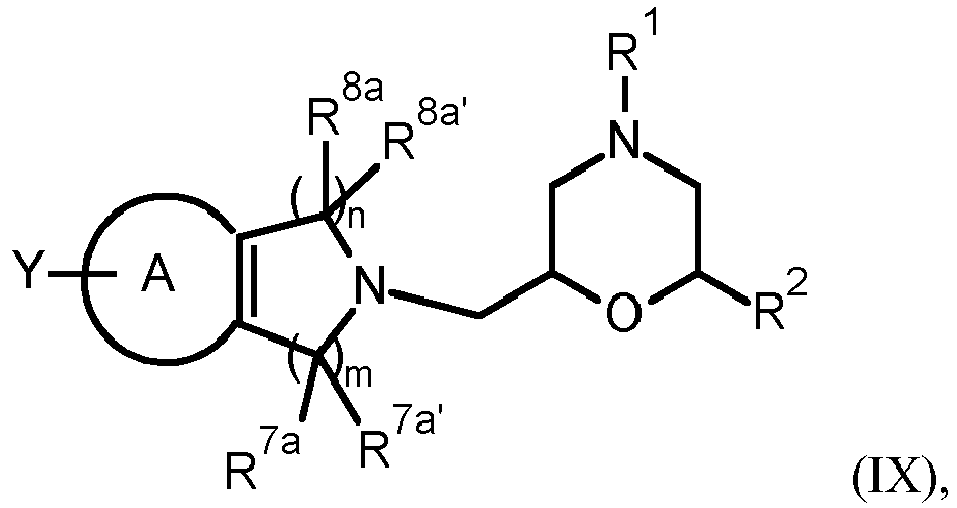
- A compound or pharmaceutically acceptable salt, enantiomer or diastereomer according to any one of claims 1 to 10 for use as therapeutically active substance.
- A pharmaceutical composition comprising a compound in accordance with any one of claims 1 to 10 and a therapeutically inert carrier.
- A compound or pharmaceutically acceptable salt, enantiomer or diastereomer according to any one of claims 1 to 10 for the treatment or prophylaxis of systemic lupus erythematosus or lupus nephritis.
Priority Applications (1)
| Application Number | Priority Date | Filing Date | Title |
|---|---|---|---|
| EP18193921.6A EP3623369B1 (en) | 2018-09-12 | 2018-09-12 | Novel morpholinyl amine compounds for the treatment of autoimmune disease |
Applications Claiming Priority (1)
| Application Number | Priority Date | Filing Date | Title |
|---|---|---|---|
| EP18193921.6A EP3623369B1 (en) | 2018-09-12 | 2018-09-12 | Novel morpholinyl amine compounds for the treatment of autoimmune disease |
Publications (3)
| Publication Number | Publication Date |
|---|---|
| EP3623369A1 true EP3623369A1 (en) | 2020-03-18 |
| EP3623369B1 EP3623369B1 (en) | 2023-10-25 |
| EP3623369C0 EP3623369C0 (en) | 2023-10-25 |
Family
ID=63578993
Family Applications (1)
| Application Number | Title | Priority Date | Filing Date |
|---|---|---|---|
| EP18193921.6A Active EP3623369B1 (en) | 2018-09-12 | 2018-09-12 | Novel morpholinyl amine compounds for the treatment of autoimmune disease |
Country Status (1)
| Country | Link |
|---|---|
| EP (1) | EP3623369B1 (en) |
Cited By (3)
| Publication number | Priority date | Publication date | Assignee | Title |
|---|---|---|---|---|
| US11548884B2 (en) | 2018-09-06 | 2023-01-10 | Hoffmann-La Roche Inc. | Cyclic amidine compounds for the treatment of autoimmune disease |
| US11713327B2 (en) | 2018-06-12 | 2023-08-01 | Hoffmann-La Roche Inc. | Heteroaryl heterocyclyl compounds for the treatment of autoimmune disease |
| US12421252B2 (en) | 2019-11-20 | 2025-09-23 | Hoffmann-La Roche Inc. | Spiro (isobenzofuranazetidine) compounds for the treatment of autoimmune disease |
Citations (2)
| Publication number | Priority date | Publication date | Assignee | Title |
|---|---|---|---|---|
| US20150105370A1 (en) | 2013-10-14 | 2015-04-16 | Eisai R&D Management Co., Ltd. | Selectively substituted quinoline compounds |
| US20170174653A1 (en) | 2015-12-17 | 2017-06-22 | Merck Patent Gmbh | Tlr7/8 antagonists and uses thereof |
-
2018
- 2018-09-12 EP EP18193921.6A patent/EP3623369B1/en active Active
Patent Citations (2)
| Publication number | Priority date | Publication date | Assignee | Title |
|---|---|---|---|---|
| US20150105370A1 (en) | 2013-10-14 | 2015-04-16 | Eisai R&D Management Co., Ltd. | Selectively substituted quinoline compounds |
| US20170174653A1 (en) | 2015-12-17 | 2017-06-22 | Merck Patent Gmbh | Tlr7/8 antagonists and uses thereof |
Non-Patent Citations (7)
| Title |
|---|
| ACC. CHEM. RES., vol. 31, 1998, pages 805 - 818 |
| CHEM. REV., vol. 116, 2016, pages 12564 - 12649 |
| CHEN, J. Q. ET AL., CLINICAL REVIEWS IN ALLERGY & IMMUNOLOGY, vol. 50, 2016, pages 1 |
| JIMENEZ-DALMARONI, M. J. ET AL., AUTOIMMUN REV., vol. 15, 2016, pages 1 |
| KRIEG, A. M. ET AL., IMMUNOL. REV., vol. 220, 2007, pages 251 |
| NAVARRA, S. V. ET AL., LANCET, vol. 377, 2011, pages 721 |
| TOPICS IN CURRENT CHEMISTRY, vol. 219, 2002, pages 131 - 209 |
Cited By (3)
| Publication number | Priority date | Publication date | Assignee | Title |
|---|---|---|---|---|
| US11713327B2 (en) | 2018-06-12 | 2023-08-01 | Hoffmann-La Roche Inc. | Heteroaryl heterocyclyl compounds for the treatment of autoimmune disease |
| US11548884B2 (en) | 2018-09-06 | 2023-01-10 | Hoffmann-La Roche Inc. | Cyclic amidine compounds for the treatment of autoimmune disease |
| US12421252B2 (en) | 2019-11-20 | 2025-09-23 | Hoffmann-La Roche Inc. | Spiro (isobenzofuranazetidine) compounds for the treatment of autoimmune disease |
Also Published As
| Publication number | Publication date |
|---|---|
| EP3623369B1 (en) | 2023-10-25 |
| EP3623369C0 (en) | 2023-10-25 |
Similar Documents
| Publication | Publication Date | Title |
|---|---|---|
| EP3807270B1 (en) | Novel heteroaryl heterocyclyl compounds for the treatment of autoimmune disease | |
| EP3802539B1 (en) | Tetrahydro-1h-pyrazino[2,1-a]isoindolylquinoline compounds for the treatment of autoimmune disease | |
| US12486273B2 (en) | Hydro-1H-pyrrolo[1,2-a]pyrazine compounds for the treatment of autoimmune disease | |
| US20240140954A1 (en) | Tricyclic heterocyclic derivatives, compositions and uses thereof | |
| JP7692838B2 (en) | Hexahydro-1H-pyrazino[1,2-a]pyrazine compounds for the treatment of autoimmune diseases - Patents.com | |
| EP3877388B1 (en) | 5-[6-[[3-(4,5,6,7-tetrahydropyrazolo[4,3-c]pyridin-1-yl)azetidin-1-yl]methyl]morpholin-4-yl]quinoline-8-carbonitrile derivatives and similar compounds as tlr7-9 antagonists for treating systemic lupus erythematosus | |
| EP4061821A1 (en) | Spiro(isobenzofuranazetidine) compounds for the treatment of autoimmune disease | |
| EP3623369B1 (en) | Novel morpholinyl amine compounds for the treatment of autoimmune disease | |
| EP4051387B1 (en) | Hydropyrazino[1,2-d][1,4]diazepine compounds for the treatment of autoimmune disease | |
| US12503471B2 (en) | Triazatricycle compounds for the treatment of autoimmune disease | |
| EP4069693B1 (en) | Hydropyrido[1,2-alpha]pyrazine compounds for the treatment of autoimmune diseases | |
| JP2023503165A (en) | 1,8-naphthyridin-2-one compounds for the treatment of autoimmune diseases | |
| NZ768960A (en) | Tetrahydro-1h-pyrazino[2,1-a]isoindolylquinoline compounds for the treatment of autoimmune disease | |
| HK40068905A (en) | Hydropyrazino[1,2-d][1,4]diazepine compounds for the treatment of autoimmune disease | |
| HK40039183A (en) | Novel heteroaryl heterocyclyl compounds for the treatment of autoimmune disease |
Legal Events
| Date | Code | Title | Description |
|---|---|---|---|
| PUAI | Public reference made under article 153(3) epc to a published international application that has entered the european phase |
Free format text: ORIGINAL CODE: 0009012 |
|
| STAA | Information on the status of an ep patent application or granted ep patent |
Free format text: STATUS: THE APPLICATION HAS BEEN PUBLISHED |
|
| AK | Designated contracting states |
Kind code of ref document: A1 Designated state(s): AL AT BE BG CH CY CZ DE DK EE ES FI FR GB GR HR HU IE IS IT LI LT LU LV MC MK MT NL NO PL PT RO RS SE SI SK SM TR |
|
| AX | Request for extension of the european patent |
Extension state: BA ME |
|
| RIN1 | Information on inventor provided before grant (corrected) |
Inventor name: ZHANG, ZHIWEI Inventor name: SHEN, HONG Inventor name: ZHU, WEI Inventor name: HU, TAISHAN Inventor name: LIU, HAIXIA Inventor name: ZHANG, WEIXING Inventor name: DEY, FABIAN Inventor name: ZHU, GE |
|
| STAA | Information on the status of an ep patent application or granted ep patent |
Free format text: STATUS: REQUEST FOR EXAMINATION WAS MADE |
|
| 17P | Request for examination filed |
Effective date: 20201002 |
|
| RBV | Designated contracting states (corrected) |
Designated state(s): AL AT BE BG CH CY CZ DE DK EE ES FI FR GB GR HR HU IE IS IT LI LT LU LV MC MK MT NL NO PL PT RO RS SE SI SK SM TR |
|
| STAA | Information on the status of an ep patent application or granted ep patent |
Free format text: STATUS: EXAMINATION IS IN PROGRESS |
|
| 17Q | First examination report despatched |
Effective date: 20210820 |
|
| GRAP | Despatch of communication of intention to grant a patent |
Free format text: ORIGINAL CODE: EPIDOSNIGR1 |
|
| STAA | Information on the status of an ep patent application or granted ep patent |
Free format text: STATUS: GRANT OF PATENT IS INTENDED |
|
| INTG | Intention to grant announced |
Effective date: 20230517 |
|
| GRAS | Grant fee paid |
Free format text: ORIGINAL CODE: EPIDOSNIGR3 |
|
| GRAA | (expected) grant |
Free format text: ORIGINAL CODE: 0009210 |
|
| STAA | Information on the status of an ep patent application or granted ep patent |
Free format text: STATUS: THE PATENT HAS BEEN GRANTED |
|
| AK | Designated contracting states |
Kind code of ref document: B1 Designated state(s): AL AT BE BG CH CY CZ DE DK EE ES FI FR GB GR HR HU IE IS IT LI LT LU LV MC MK MT NL NO PL PT RO RS SE SI SK SM TR |
|
| REG | Reference to a national code |
Ref country code: GB Ref legal event code: FG4D |
|
| REG | Reference to a national code |
Ref country code: CH Ref legal event code: EP |
|
| REG | Reference to a national code |
Ref country code: DE Ref legal event code: R096 Ref document number: 602018059850 Country of ref document: DE |
|
| REG | Reference to a national code |
Ref country code: IE Ref legal event code: FG4D |
|
| U01 | Request for unitary effect filed |
Effective date: 20231025 |
|
| U07 | Unitary effect registered |
Designated state(s): AT BE BG DE DK EE FI FR IT LT LU LV MT NL PT SE SI Effective date: 20231030 |
|
| PG25 | Lapsed in a contracting state [announced via postgrant information from national office to epo] |
Ref country code: GR Free format text: LAPSE BECAUSE OF FAILURE TO SUBMIT A TRANSLATION OF THE DESCRIPTION OR TO PAY THE FEE WITHIN THE PRESCRIBED TIME-LIMIT Effective date: 20240126 |
|
| PG25 | Lapsed in a contracting state [announced via postgrant information from national office to epo] |
Ref country code: IS Free format text: LAPSE BECAUSE OF FAILURE TO SUBMIT A TRANSLATION OF THE DESCRIPTION OR TO PAY THE FEE WITHIN THE PRESCRIBED TIME-LIMIT Effective date: 20240225 |
|
| PG25 | Lapsed in a contracting state [announced via postgrant information from national office to epo] |
Ref country code: ES Free format text: LAPSE BECAUSE OF FAILURE TO SUBMIT A TRANSLATION OF THE DESCRIPTION OR TO PAY THE FEE WITHIN THE PRESCRIBED TIME-LIMIT Effective date: 20231025 |
|
| PG25 | Lapsed in a contracting state [announced via postgrant information from national office to epo] |
Ref country code: IS Free format text: LAPSE BECAUSE OF FAILURE TO SUBMIT A TRANSLATION OF THE DESCRIPTION OR TO PAY THE FEE WITHIN THE PRESCRIBED TIME-LIMIT Effective date: 20240225 Ref country code: GR Free format text: LAPSE BECAUSE OF FAILURE TO SUBMIT A TRANSLATION OF THE DESCRIPTION OR TO PAY THE FEE WITHIN THE PRESCRIBED TIME-LIMIT Effective date: 20240126 Ref country code: ES Free format text: LAPSE BECAUSE OF FAILURE TO SUBMIT A TRANSLATION OF THE DESCRIPTION OR TO PAY THE FEE WITHIN THE PRESCRIBED TIME-LIMIT Effective date: 20231025 |
|
| PG25 | Lapsed in a contracting state [announced via postgrant information from national office to epo] |
Ref country code: RS Free format text: LAPSE BECAUSE OF FAILURE TO SUBMIT A TRANSLATION OF THE DESCRIPTION OR TO PAY THE FEE WITHIN THE PRESCRIBED TIME-LIMIT Effective date: 20231025 Ref country code: PL Free format text: LAPSE BECAUSE OF FAILURE TO SUBMIT A TRANSLATION OF THE DESCRIPTION OR TO PAY THE FEE WITHIN THE PRESCRIBED TIME-LIMIT Effective date: 20231025 Ref country code: NO Free format text: LAPSE BECAUSE OF FAILURE TO SUBMIT A TRANSLATION OF THE DESCRIPTION OR TO PAY THE FEE WITHIN THE PRESCRIBED TIME-LIMIT Effective date: 20240125 Ref country code: HR Free format text: LAPSE BECAUSE OF FAILURE TO SUBMIT A TRANSLATION OF THE DESCRIPTION OR TO PAY THE FEE WITHIN THE PRESCRIBED TIME-LIMIT Effective date: 20231025 |
|
| PG25 | Lapsed in a contracting state [announced via postgrant information from national office to epo] |
Ref country code: CZ Free format text: LAPSE BECAUSE OF FAILURE TO SUBMIT A TRANSLATION OF THE DESCRIPTION OR TO PAY THE FEE WITHIN THE PRESCRIBED TIME-LIMIT Effective date: 20231025 |
|
| REG | Reference to a national code |
Ref country code: DE Ref legal event code: R097 Ref document number: 602018059850 Country of ref document: DE |
|
| PG25 | Lapsed in a contracting state [announced via postgrant information from national office to epo] |
Ref country code: SK Free format text: LAPSE BECAUSE OF FAILURE TO SUBMIT A TRANSLATION OF THE DESCRIPTION OR TO PAY THE FEE WITHIN THE PRESCRIBED TIME-LIMIT Effective date: 20231025 |
|
| PG25 | Lapsed in a contracting state [announced via postgrant information from national office to epo] |
Ref country code: SM Free format text: LAPSE BECAUSE OF FAILURE TO SUBMIT A TRANSLATION OF THE DESCRIPTION OR TO PAY THE FEE WITHIN THE PRESCRIBED TIME-LIMIT Effective date: 20231025 Ref country code: SK Free format text: LAPSE BECAUSE OF FAILURE TO SUBMIT A TRANSLATION OF THE DESCRIPTION OR TO PAY THE FEE WITHIN THE PRESCRIBED TIME-LIMIT Effective date: 20231025 Ref country code: RO Free format text: LAPSE BECAUSE OF FAILURE TO SUBMIT A TRANSLATION OF THE DESCRIPTION OR TO PAY THE FEE WITHIN THE PRESCRIBED TIME-LIMIT Effective date: 20231025 Ref country code: CZ Free format text: LAPSE BECAUSE OF FAILURE TO SUBMIT A TRANSLATION OF THE DESCRIPTION OR TO PAY THE FEE WITHIN THE PRESCRIBED TIME-LIMIT Effective date: 20231025 |
|
| PLBE | No opposition filed within time limit |
Free format text: ORIGINAL CODE: 0009261 |
|
| STAA | Information on the status of an ep patent application or granted ep patent |
Free format text: STATUS: NO OPPOSITION FILED WITHIN TIME LIMIT |
|
| U20 | Renewal fee for the european patent with unitary effect paid |
Year of fee payment: 7 Effective date: 20240820 |
|
| 26N | No opposition filed |
Effective date: 20240726 |
|
| PG25 | Lapsed in a contracting state [announced via postgrant information from national office to epo] |
Ref country code: MC Free format text: LAPSE BECAUSE OF FAILURE TO SUBMIT A TRANSLATION OF THE DESCRIPTION OR TO PAY THE FEE WITHIN THE PRESCRIBED TIME-LIMIT Effective date: 20231025 |
|
| PG25 | Lapsed in a contracting state [announced via postgrant information from national office to epo] |
Ref country code: IE Free format text: LAPSE BECAUSE OF NON-PAYMENT OF DUE FEES Effective date: 20240912 |
|
| U20 | Renewal fee for the european patent with unitary effect paid |
Year of fee payment: 8 Effective date: 20250820 |
|
| REG | Reference to a national code |
Ref country code: CH Ref legal event code: U11 Free format text: ST27 STATUS EVENT CODE: U-0-0-U10-U11 (AS PROVIDED BY THE NATIONAL OFFICE) Effective date: 20251001 |
|
| PGFP | Annual fee paid to national office [announced via postgrant information from national office to epo] |
Ref country code: GB Payment date: 20250822 Year of fee payment: 8 |
|
| PGFP | Annual fee paid to national office [announced via postgrant information from national office to epo] |
Ref country code: CH Payment date: 20251001 Year of fee payment: 8 |
|
| PG25 | Lapsed in a contracting state [announced via postgrant information from national office to epo] |
Ref country code: CY Free format text: LAPSE BECAUSE OF FAILURE TO SUBMIT A TRANSLATION OF THE DESCRIPTION OR TO PAY THE FEE WITHIN THE PRESCRIBED TIME-LIMIT; INVALID AB INITIO Effective date: 20180912 |
|
| PG25 | Lapsed in a contracting state [announced via postgrant information from national office to epo] |
Ref country code: HU Free format text: LAPSE BECAUSE OF FAILURE TO SUBMIT A TRANSLATION OF THE DESCRIPTION OR TO PAY THE FEE WITHIN THE PRESCRIBED TIME-LIMIT; INVALID AB INITIO Effective date: 20180912 |