EP3622954A1 - Therapeutic agent containing pyranodipyridine compound - Google Patents
Therapeutic agent containing pyranodipyridine compound Download PDFInfo
- Publication number
- EP3622954A1 EP3622954A1 EP18798031.3A EP18798031A EP3622954A1 EP 3622954 A1 EP3622954 A1 EP 3622954A1 EP 18798031 A EP18798031 A EP 18798031A EP 3622954 A1 EP3622954 A1 EP 3622954A1
- Authority
- EP
- European Patent Office
- Prior art keywords
- fluoro
- oxo
- dihydro
- pyrano
- pharmaceutically acceptable
- Prior art date
- Legal status (The legal status is an assumption and is not a legal conclusion. Google has not performed a legal analysis and makes no representation as to the accuracy of the status listed.)
- Withdrawn
Links
- 150000001875 compounds Chemical class 0.000 title abstract description 104
- 239000003814 drug Substances 0.000 title description 20
- 229940124597 therapeutic agent Drugs 0.000 title 1
- 150000003839 salts Chemical class 0.000 claims abstract description 77
- 201000006517 essential tremor Diseases 0.000 claims abstract description 43
- 208000010261 Small Fiber Neuropathy Diseases 0.000 claims abstract description 42
- 206010073928 Small fibre neuropathy Diseases 0.000 claims abstract description 42
- 208000017692 primary erythermalgia Diseases 0.000 claims abstract description 42
- 239000003795 chemical substances by application Substances 0.000 claims abstract description 37
- JFDZBHWFFUWGJE-UHFFFAOYSA-N benzonitrile Chemical compound N#CC1=CC=CC=C1 JFDZBHWFFUWGJE-UHFFFAOYSA-N 0.000 claims description 186
- 238000000034 method Methods 0.000 claims description 31
- 238000004519 manufacturing process Methods 0.000 claims description 16
- 208000014094 Dystonic disease Diseases 0.000 abstract description 62
- 208000010118 dystonia Diseases 0.000 abstract description 57
- 206010015037 epilepsy Diseases 0.000 abstract description 45
- 208000024827 Alzheimer disease Diseases 0.000 abstract description 39
- 208000003174 Brain Neoplasms Diseases 0.000 abstract description 35
- XEKOWRVHYACXOJ-UHFFFAOYSA-N Ethyl acetate Chemical compound CCOC(C)=O XEKOWRVHYACXOJ-UHFFFAOYSA-N 0.000 description 108
- IMNFDUFMRHMDMM-UHFFFAOYSA-N N-Heptane Chemical compound CCCCCCC IMNFDUFMRHMDMM-UHFFFAOYSA-N 0.000 description 66
- 239000000203 mixture Substances 0.000 description 51
- 239000000243 solution Substances 0.000 description 47
- 239000011541 reaction mixture Substances 0.000 description 37
- IAZDPXIOMUYVGZ-UHFFFAOYSA-N Dimethylsulphoxide Chemical compound CS(C)=O IAZDPXIOMUYVGZ-UHFFFAOYSA-N 0.000 description 34
- VYPSYNLAJGMNEJ-UHFFFAOYSA-N Silicium dioxide Chemical compound O=[Si]=O VYPSYNLAJGMNEJ-UHFFFAOYSA-N 0.000 description 34
- RERZNCLIYCABFS-UHFFFAOYSA-N harmaline Chemical compound C1CN=C(C)C2=C1C1=CC=C(OC)C=C1N2 RERZNCLIYCABFS-UHFFFAOYSA-N 0.000 description 34
- 230000000694 effects Effects 0.000 description 33
- 238000012360 testing method Methods 0.000 description 33
- 229910002027 silica gel Inorganic materials 0.000 description 32
- 239000000741 silica gel Substances 0.000 description 32
- 229960001866 silicon dioxide Drugs 0.000 description 32
- 230000015572 biosynthetic process Effects 0.000 description 31
- HEDRZPFGACZZDS-MICDWDOJSA-N Trichloro(2H)methane Chemical compound [2H]C(Cl)(Cl)Cl HEDRZPFGACZZDS-MICDWDOJSA-N 0.000 description 30
- 238000003786 synthesis reaction Methods 0.000 description 30
- 208000032612 Glial tumor Diseases 0.000 description 29
- 206010018338 Glioma Diseases 0.000 description 29
- 206010010904 Convulsion Diseases 0.000 description 24
- 230000002829 reductive effect Effects 0.000 description 24
- 239000012044 organic layer Substances 0.000 description 23
- 238000010898 silica gel chromatography Methods 0.000 description 22
- XLYOFNOQVPJJNP-UHFFFAOYSA-N water Substances O XLYOFNOQVPJJNP-UHFFFAOYSA-N 0.000 description 22
- 210000004027 cell Anatomy 0.000 description 21
- FAPWRFPIFSIZLT-UHFFFAOYSA-M Sodium chloride Chemical compound [Na+].[Cl-] FAPWRFPIFSIZLT-UHFFFAOYSA-M 0.000 description 20
- 239000008194 pharmaceutical composition Substances 0.000 description 20
- 238000011282 treatment Methods 0.000 description 20
- 238000005160 1H NMR spectroscopy Methods 0.000 description 19
- OKKJLVBELUTLKV-UHFFFAOYSA-N Methanol Chemical compound OC OKKJLVBELUTLKV-UHFFFAOYSA-N 0.000 description 18
- 238000010171 animal model Methods 0.000 description 18
- 229940079593 drug Drugs 0.000 description 18
- YMWUJEATGCHHMB-UHFFFAOYSA-N Dichloromethane Chemical compound ClCCl YMWUJEATGCHHMB-UHFFFAOYSA-N 0.000 description 17
- -1 geometrical isomers Chemical class 0.000 description 17
- 239000003981 vehicle Substances 0.000 description 17
- WYURNTSHIVDZCO-UHFFFAOYSA-N Tetrahydrofuran Chemical compound C1CCOC1 WYURNTSHIVDZCO-UHFFFAOYSA-N 0.000 description 16
- ZMXDDKWLCZADIW-UHFFFAOYSA-N N,N-Dimethylformamide Chemical compound CN(C)C=O ZMXDDKWLCZADIW-UHFFFAOYSA-N 0.000 description 15
- 206010044565 Tremor Diseases 0.000 description 15
- ZMANZCXQSJIPKH-UHFFFAOYSA-N Triethylamine Chemical compound CCN(CC)CC ZMANZCXQSJIPKH-UHFFFAOYSA-N 0.000 description 15
- 208000002193 Pain Diseases 0.000 description 14
- 230000036407 pain Effects 0.000 description 14
- ZSJLQEPLLKMAKR-GKHCUFPYSA-N streptozocin Chemical compound O=NN(C)C(=O)N[C@H]1[C@@H](O)O[C@H](CO)[C@@H](O)[C@@H]1O ZSJLQEPLLKMAKR-GKHCUFPYSA-N 0.000 description 14
- 102000003678 AMPA Receptors Human genes 0.000 description 13
- 108090000078 AMPA Receptors Proteins 0.000 description 13
- ZSJLQEPLLKMAKR-UHFFFAOYSA-N Streptozotocin Natural products O=NN(C)C(=O)NC1C(O)OC(CO)C(O)C1O ZSJLQEPLLKMAKR-UHFFFAOYSA-N 0.000 description 13
- 230000036461 convulsion Effects 0.000 description 13
- 229960001052 streptozocin Drugs 0.000 description 13
- CSNNHWWHGAXBCP-UHFFFAOYSA-L Magnesium sulfate Chemical compound [Mg+2].[O-][S+2]([O-])([O-])[O-] CSNNHWWHGAXBCP-UHFFFAOYSA-L 0.000 description 12
- 241000700159 Rattus Species 0.000 description 12
- 239000011575 calcium Substances 0.000 description 12
- 208000037265 diseases, disorders, signs and symptoms Diseases 0.000 description 12
- 239000000835 fiber Substances 0.000 description 12
- 238000005259 measurement Methods 0.000 description 12
- OYPRJOBELJOOCE-UHFFFAOYSA-N Calcium Chemical compound [Ca] OYPRJOBELJOOCE-UHFFFAOYSA-N 0.000 description 11
- VEXZGXHMUGYJMC-UHFFFAOYSA-N Hydrochloric acid Chemical compound Cl VEXZGXHMUGYJMC-UHFFFAOYSA-N 0.000 description 11
- 229910052791 calcium Inorganic materials 0.000 description 11
- 210000005036 nerve Anatomy 0.000 description 11
- 229920006395 saturated elastomer Polymers 0.000 description 11
- NLXLAEXVIDQMFP-UHFFFAOYSA-N Ammonia chloride Chemical compound [NH4+].[Cl-] NLXLAEXVIDQMFP-UHFFFAOYSA-N 0.000 description 10
- 241001465754 Metazoa Species 0.000 description 10
- PCLIMKBDDGJMGD-UHFFFAOYSA-N N-bromosuccinimide Chemical compound BrN1C(=O)CCC1=O PCLIMKBDDGJMGD-UHFFFAOYSA-N 0.000 description 10
- 210000004556 brain Anatomy 0.000 description 10
- 201000010099 disease Diseases 0.000 description 10
- 230000004044 response Effects 0.000 description 10
- 239000011780 sodium chloride Substances 0.000 description 10
- 230000009471 action Effects 0.000 description 9
- 230000000638 stimulation Effects 0.000 description 9
- UUDAMDVQRQNNHZ-UHFFFAOYSA-N (S)-AMPA Chemical compound CC=1ONC(=O)C=1CC(N)C(O)=O UUDAMDVQRQNNHZ-UHFFFAOYSA-N 0.000 description 8
- BVKZGUZCCUSVTD-UHFFFAOYSA-L Carbonate Chemical compound [O-]C([O-])=O BVKZGUZCCUSVTD-UHFFFAOYSA-L 0.000 description 8
- 206010028980 Neoplasm Diseases 0.000 description 8
- 230000001773 anti-convulsant effect Effects 0.000 description 8
- 230000000259 anti-tumor effect Effects 0.000 description 8
- 125000001797 benzyl group Chemical group [H]C1=C([H])C([H])=C(C([H])=C1[H])C([H])([H])* 0.000 description 8
- 239000000546 pharmaceutical excipient Substances 0.000 description 8
- 241000699666 Mus <mouse, genus> Species 0.000 description 7
- 238000011156 evaluation Methods 0.000 description 7
- 238000010172 mouse model Methods 0.000 description 7
- 230000001575 pathological effect Effects 0.000 description 7
- 208000033808 peripheral neuropathy Diseases 0.000 description 7
- 208000024891 symptom Diseases 0.000 description 7
- TXGKJULMHJEZTA-UHFFFAOYSA-N 2-fluoro-6-(4,4,5,5-tetramethyl-1,3,2-dioxaborolan-2-yl)benzonitrile Chemical compound O1C(C)(C)C(C)(C)OB1C1=CC=CC(F)=C1C#N TXGKJULMHJEZTA-UHFFFAOYSA-N 0.000 description 6
- 238000011818 5xFAD mouse Methods 0.000 description 6
- QTBSBXVTEAMEQO-UHFFFAOYSA-N Acetic acid Chemical compound CC(O)=O QTBSBXVTEAMEQO-UHFFFAOYSA-N 0.000 description 6
- 241000699800 Cricetinae Species 0.000 description 6
- UGJMXCAKCUNAIE-UHFFFAOYSA-N Gabapentin Chemical compound OC(=O)CC1(CN)CCCCC1 UGJMXCAKCUNAIE-UHFFFAOYSA-N 0.000 description 6
- IXCSERBJSXMMFS-UHFFFAOYSA-N hydrogen chloride Substances Cl.Cl IXCSERBJSXMMFS-UHFFFAOYSA-N 0.000 description 6
- 229910000041 hydrogen chloride Inorganic materials 0.000 description 6
- 239000003112 inhibitor Substances 0.000 description 6
- 229910052943 magnesium sulfate Inorganic materials 0.000 description 6
- 235000019341 magnesium sulphate Nutrition 0.000 description 6
- 229920000609 methyl cellulose Polymers 0.000 description 6
- 239000001923 methylcellulose Substances 0.000 description 6
- 239000013642 negative control Substances 0.000 description 6
- 239000008389 polyethoxylated castor oil Substances 0.000 description 6
- NROKBHXJSPEDAR-UHFFFAOYSA-M potassium fluoride Chemical compound [F-].[K+] NROKBHXJSPEDAR-UHFFFAOYSA-M 0.000 description 6
- AQHHHDLHHXJYJD-UHFFFAOYSA-N propranolol Chemical group C1=CC=C2C(OCC(O)CNC(C)C)=CC=CC2=C1 AQHHHDLHHXJYJD-UHFFFAOYSA-N 0.000 description 6
- 239000000126 substance Substances 0.000 description 6
- 230000009885 systemic effect Effects 0.000 description 6
- BZLVMXJERCGZMT-UHFFFAOYSA-N Methyl tert-butyl ether Chemical compound COC(C)(C)C BZLVMXJERCGZMT-UHFFFAOYSA-N 0.000 description 5
- 229910002666 PdCl2 Inorganic materials 0.000 description 5
- 229920002685 Polyoxyl 35CastorOil Polymers 0.000 description 5
- 235000019270 ammonium chloride Nutrition 0.000 description 5
- 230000000202 analgesic effect Effects 0.000 description 5
- 239000001961 anticonvulsive agent Substances 0.000 description 5
- 238000006243 chemical reaction Methods 0.000 description 5
- 230000002920 convulsive effect Effects 0.000 description 5
- 239000012043 crude product Substances 0.000 description 5
- 230000002401 inhibitory effect Effects 0.000 description 5
- QUANRIQJNFHVEU-UHFFFAOYSA-N oxirane;propane-1,2,3-triol Chemical compound C1CO1.OCC(O)CO QUANRIQJNFHVEU-UHFFFAOYSA-N 0.000 description 5
- 230000002269 spontaneous effect Effects 0.000 description 5
- RYHBNJHYFVUHQT-UHFFFAOYSA-N 1,4-Dioxane Chemical compound C1COCCO1 RYHBNJHYFVUHQT-UHFFFAOYSA-N 0.000 description 4
- LMDZBCPBFSXMTL-UHFFFAOYSA-N 1-Ethyl-3-(3-dimethylaminopropyl)carbodiimide Substances CCN=C=NCCCN(C)C LMDZBCPBFSXMTL-UHFFFAOYSA-N 0.000 description 4
- UQNAFPHGVPVTAL-UHFFFAOYSA-N 2,3-Dihydroxy-6-nitro-7-sulfamoyl-benzo(f)quinoxaline Chemical compound N1C(=O)C(=O)NC2=C1C=C([N+]([O-])=O)C1=C2C=CC=C1S(=O)(=O)N UQNAFPHGVPVTAL-UHFFFAOYSA-N 0.000 description 4
- PGHKJMVOHWKSLJ-UHFFFAOYSA-N 2-methoxyethyl n-(2-methoxyethoxycarbonylimino)carbamate Chemical compound COCCOC(=O)N=NC(=O)OCCOC PGHKJMVOHWKSLJ-UHFFFAOYSA-N 0.000 description 4
- NGGGZUAEOKRHMA-UHFFFAOYSA-N 3-[(2-methylpropan-2-yl)oxy]-3-oxopropanoic acid Chemical compound CC(C)(C)OC(=O)CC(O)=O NGGGZUAEOKRHMA-UHFFFAOYSA-N 0.000 description 4
- IAZDPXIOMUYVGZ-WFGJKAKNSA-N Dimethyl sulfoxide Chemical compound [2H]C([2H])([2H])S(=O)C([2H])([2H])[2H] IAZDPXIOMUYVGZ-WFGJKAKNSA-N 0.000 description 4
- LFQSCWFLJHTTHZ-UHFFFAOYSA-N Ethanol Chemical compound CCO LFQSCWFLJHTTHZ-UHFFFAOYSA-N 0.000 description 4
- MZRVEZGGRBJDDB-UHFFFAOYSA-N N-Butyllithium Chemical compound [Li]CCCC MZRVEZGGRBJDDB-UHFFFAOYSA-N 0.000 description 4
- KDLHZDBZIXYQEI-UHFFFAOYSA-N Palladium Chemical compound [Pd] KDLHZDBZIXYQEI-UHFFFAOYSA-N 0.000 description 4
- JUJWROOIHBZHMG-UHFFFAOYSA-N Pyridine Chemical compound C1=CC=NC=C1 JUJWROOIHBZHMG-UHFFFAOYSA-N 0.000 description 4
- UIIMBOGNXHQVGW-UHFFFAOYSA-M Sodium bicarbonate Chemical compound [Na+].OC([O-])=O UIIMBOGNXHQVGW-UHFFFAOYSA-M 0.000 description 4
- VREFGVBLTWBCJP-UHFFFAOYSA-N alprazolam Chemical compound C12=CC(Cl)=CC=C2N2C(C)=NN=C2CN=C1C1=CC=CC=C1 VREFGVBLTWBCJP-UHFFFAOYSA-N 0.000 description 4
- PNEYBMLMFCGWSK-UHFFFAOYSA-N aluminium oxide Inorganic materials [O-2].[O-2].[O-2].[Al+3].[Al+3] PNEYBMLMFCGWSK-UHFFFAOYSA-N 0.000 description 4
- 229960003120 clonazepam Drugs 0.000 description 4
- DGBIGWXXNGSACT-UHFFFAOYSA-N clonazepam Chemical compound C12=CC([N+](=O)[O-])=CC=C2NC(=O)CN=C1C1=CC=CC=C1Cl DGBIGWXXNGSACT-UHFFFAOYSA-N 0.000 description 4
- 230000001787 epileptiform Effects 0.000 description 4
- 210000001320 hippocampus Anatomy 0.000 description 4
- 230000003834 intracellular effect Effects 0.000 description 4
- AMXOYNBUYSYVKV-UHFFFAOYSA-M lithium bromide Chemical compound [Li+].[Br-] AMXOYNBUYSYVKV-UHFFFAOYSA-M 0.000 description 4
- 239000012046 mixed solvent Substances 0.000 description 4
- 210000003007 myelin sheath Anatomy 0.000 description 4
- VLKZOEOYAKHREP-UHFFFAOYSA-N n-Hexane Chemical compound CCCCCC VLKZOEOYAKHREP-UHFFFAOYSA-N 0.000 description 4
- 210000002569 neuron Anatomy 0.000 description 4
- 238000011580 nude mouse model Methods 0.000 description 4
- 238000002360 preparation method Methods 0.000 description 4
- 230000009467 reduction Effects 0.000 description 4
- 230000001953 sensory effect Effects 0.000 description 4
- DTQVDTLACAAQTR-UHFFFAOYSA-N trifluoroacetic acid Substances OC(=O)C(F)(F)F DTQVDTLACAAQTR-UHFFFAOYSA-N 0.000 description 4
- RIOQSEWOXXDEQQ-UHFFFAOYSA-N triphenylphosphine Chemical compound C1=CC=CC=C1P(C=1C=CC=CC=1)C1=CC=CC=C1 RIOQSEWOXXDEQQ-UHFFFAOYSA-N 0.000 description 4
- VYDORXQKNREPEF-UHFFFAOYSA-N 1-hydroxy-3-(3-phenylmethoxypyridin-2-yl)propan-2-one Chemical compound C(C1=CC=CC=C1)OC=1C(=NC=CC=1)CC(CO)=O VYDORXQKNREPEF-UHFFFAOYSA-N 0.000 description 3
- FVMFLPPFTXQBMR-UHFFFAOYSA-N 2-methyl-3-phenylmethoxypyridine Chemical compound CC1=NC=CC=C1OCC1=CC=CC=C1 FVMFLPPFTXQBMR-UHFFFAOYSA-N 0.000 description 3
- JWUJQDFVADABEY-UHFFFAOYSA-N 2-methyltetrahydrofuran Chemical compound CC1CCCO1 JWUJQDFVADABEY-UHFFFAOYSA-N 0.000 description 3
- WFDIJRYMOXRFFG-UHFFFAOYSA-N Acetic anhydride Chemical compound CC(=O)OC(C)=O WFDIJRYMOXRFFG-UHFFFAOYSA-N 0.000 description 3
- WEVYAHXRMPXWCK-UHFFFAOYSA-N Acetonitrile Chemical compound CC#N WEVYAHXRMPXWCK-UHFFFAOYSA-N 0.000 description 3
- KPYSYYIEGFHWSV-UHFFFAOYSA-N Baclofen Chemical compound OC(=O)CC(CN)C1=CC=C(Cl)C=C1 KPYSYYIEGFHWSV-UHFFFAOYSA-N 0.000 description 3
- 208000012639 Balance disease Diseases 0.000 description 3
- 241000699670 Mus sp. Species 0.000 description 3
- QAHCTKVCDDSMPT-UHFFFAOYSA-N N#Cc(c(F)ccc1)c1C1=CC(c(c(OC2)c3)ncc3F)=C2N(c2cnccc2)C1=O Chemical compound N#Cc(c(F)ccc1)c1C1=CC(c(c(OC2)c3)ncc3F)=C2N(c2cnccc2)C1=O QAHCTKVCDDSMPT-UHFFFAOYSA-N 0.000 description 3
- 201000010133 Oligodendroglioma Diseases 0.000 description 3
- PMZURENOXWZQFD-UHFFFAOYSA-L Sodium Sulfate Chemical compound [Na+].[Na+].[O-]S([O-])(=O)=O PMZURENOXWZQFD-UHFFFAOYSA-L 0.000 description 3
- HEMHJVSKTPXQMS-UHFFFAOYSA-M Sodium hydroxide Chemical compound [OH-].[Na+] HEMHJVSKTPXQMS-UHFFFAOYSA-M 0.000 description 3
- 230000002159 abnormal effect Effects 0.000 description 3
- 239000002253 acid Substances 0.000 description 3
- 230000032683 aging Effects 0.000 description 3
- 229960003965 antiepileptics Drugs 0.000 description 3
- 229960000794 baclofen Drugs 0.000 description 3
- 230000037396 body weight Effects 0.000 description 3
- 206010012601 diabetes mellitus Diseases 0.000 description 3
- 230000002964 excitative effect Effects 0.000 description 3
- 238000001914 filtration Methods 0.000 description 3
- 229960002870 gabapentin Drugs 0.000 description 3
- 238000011553 hamster model Methods 0.000 description 3
- 230000001771 impaired effect Effects 0.000 description 3
- 238000002347 injection Methods 0.000 description 3
- 239000007924 injection Substances 0.000 description 3
- 210000003205 muscle Anatomy 0.000 description 3
- 230000003287 optical effect Effects 0.000 description 3
- 239000004033 plastic Substances 0.000 description 3
- 230000036544 posture Effects 0.000 description 3
- 239000011698 potassium fluoride Substances 0.000 description 3
- 235000003270 potassium fluoride Nutrition 0.000 description 3
- 239000002244 precipitate Substances 0.000 description 3
- 229960002393 primidone Drugs 0.000 description 3
- DQMZLTXERSFNPB-UHFFFAOYSA-N primidone Chemical compound C=1C=CC=CC=1C1(CC)C(=O)NCNC1=O DQMZLTXERSFNPB-UHFFFAOYSA-N 0.000 description 3
- 229960003712 propranolol Drugs 0.000 description 3
- 238000012552 review Methods 0.000 description 3
- 201000002899 segmental dystonia Diseases 0.000 description 3
- 230000035807 sensation Effects 0.000 description 3
- 239000007787 solid Substances 0.000 description 3
- PYOKUURKVVELLB-UHFFFAOYSA-N trimethyl orthoformate Chemical compound COC(OC)OC PYOKUURKVVELLB-UHFFFAOYSA-N 0.000 description 3
- 210000001170 unmyelinated nerve fiber Anatomy 0.000 description 3
- FNRPOELSJDDLSG-UHFFFAOYSA-N (3-bromo-6-methoxypyridin-2-yl)methanol Chemical compound COC1=CC=C(Br)C(CO)=N1 FNRPOELSJDDLSG-UHFFFAOYSA-N 0.000 description 2
- PAYLLTXDCVQGLW-UHFFFAOYSA-N 2-bromo-3,5-difluoropyridine Chemical compound FC1=CN=C(Br)C(F)=C1 PAYLLTXDCVQGLW-UHFFFAOYSA-N 0.000 description 2
- QAYIQXZSICOEFY-UHFFFAOYSA-N 2-fluoro-6-[6-(hydroxymethyl)-5-(3-hydroxypyridin-2-yl)-2-oxo-1-pyrimidin-5-ylpyridin-3-yl]benzonitrile Chemical compound FC1=C(C#N)C(=CC=C1)C1=CC(=C(N(C1=O)C=1C=NC=NC=1)CO)C1=NC=CC=C1O QAYIQXZSICOEFY-UHFFFAOYSA-N 0.000 description 2
- VGPRNGGSKJHOFE-UHFFFAOYSA-N 2-methylpyrimidin-5-amine Chemical compound CC1=NC=C(N)C=N1 VGPRNGGSKJHOFE-UHFFFAOYSA-N 0.000 description 2
- ZUUZNOFTKGDLLN-UHFFFAOYSA-N 3-(1,3,2-dioxaborinan-2-yl)pyridine Chemical compound O1CCCOB1C1=CC=CN=C1 ZUUZNOFTKGDLLN-UHFFFAOYSA-N 0.000 description 2
- LBBGUHNQUDJXJA-UHFFFAOYSA-N 3-bromo-6-methoxy-2-(methoxymethoxymethyl)pyridine Chemical compound COCOCC1=NC(OC)=CC=C1Br LBBGUHNQUDJXJA-UHFFFAOYSA-N 0.000 description 2
- HGOQYIGDNWKQEO-UHFFFAOYSA-N 5-(3,5-difluoropyridin-2-yl)-6-(hydroxymethyl)-1H-pyridin-2-one Chemical compound FC=1C(=NC=C(C=1)F)C=1C(=NC(=CC=1)O)CO HGOQYIGDNWKQEO-UHFFFAOYSA-N 0.000 description 2
- RPXVIAFEQBNEAX-UHFFFAOYSA-N 6-Cyano-7-nitroquinoxaline-2,3-dione Chemical compound N1C(=O)C(=O)NC2=C1C=C([N+](=O)[O-])C(C#N)=C2 RPXVIAFEQBNEAX-UHFFFAOYSA-N 0.000 description 2
- 102000013455 Amyloid beta-Peptides Human genes 0.000 description 2
- 108010090849 Amyloid beta-Peptides Proteins 0.000 description 2
- 206010003571 Astrocytoma Diseases 0.000 description 2
- IJGRMHOSHXDMSA-UHFFFAOYSA-N Atomic nitrogen Chemical compound N#N IJGRMHOSHXDMSA-UHFFFAOYSA-N 0.000 description 2
- 108030001720 Bontoxilysin Proteins 0.000 description 2
- TXZQGGGBWMHIPW-UHFFFAOYSA-N COC1=CC=C(C(=N1)COCOC)B(O)O Chemical compound COC1=CC=C(C(=N1)COCOC)B(O)O TXZQGGGBWMHIPW-UHFFFAOYSA-N 0.000 description 2
- 238000001061 Dunnett's test Methods 0.000 description 2
- 102100030652 Glutamate receptor 1 Human genes 0.000 description 2
- 102100030651 Glutamate receptor 2 Human genes 0.000 description 2
- UFHFLCQGNIYNRP-UHFFFAOYSA-N Hydrogen Chemical compound [H][H] UFHFLCQGNIYNRP-UHFFFAOYSA-N 0.000 description 2
- PIWKPBJCKXDKJR-UHFFFAOYSA-N Isoflurane Chemical compound FC(F)OC(Cl)C(F)(F)F PIWKPBJCKXDKJR-UHFFFAOYSA-N 0.000 description 2
- 102000000079 Kainic Acid Receptors Human genes 0.000 description 2
- 108010069902 Kainic Acid Receptors Proteins 0.000 description 2
- WHUUTDBJXJRKMK-VKHMYHEASA-N L-glutamic acid Chemical compound OC(=O)[C@@H](N)CCC(O)=O WHUUTDBJXJRKMK-VKHMYHEASA-N 0.000 description 2
- TWRXJAOTZQYOKJ-UHFFFAOYSA-L Magnesium chloride Chemical compound [Mg+2].[Cl-].[Cl-] TWRXJAOTZQYOKJ-UHFFFAOYSA-L 0.000 description 2
- YNAVUWVOSKDBBP-UHFFFAOYSA-N Morpholine Chemical compound C1COCCN1 YNAVUWVOSKDBBP-UHFFFAOYSA-N 0.000 description 2
- 241000699660 Mus musculus Species 0.000 description 2
- JGFZNNIVVJXRND-UHFFFAOYSA-N N,N-Diisopropylethylamine (DIPEA) Chemical compound CCN(C(C)C)C(C)C JGFZNNIVVJXRND-UHFFFAOYSA-N 0.000 description 2
- 208000027089 Parkinsonian disease Diseases 0.000 description 2
- WCUXLLCKKVVCTQ-UHFFFAOYSA-M Potassium chloride Chemical compound [Cl-].[K+] WCUXLLCKKVVCTQ-UHFFFAOYSA-M 0.000 description 2
- 206010039897 Sedation Diseases 0.000 description 2
- 206010041349 Somnolence Diseases 0.000 description 2
- KJADKKWYZYXHBB-XBWDGYHZSA-N Topiramic acid Chemical compound C1O[C@@]2(COS(N)(=O)=O)OC(C)(C)O[C@H]2[C@@H]2OC(C)(C)O[C@@H]21 KJADKKWYZYXHBB-XBWDGYHZSA-N 0.000 description 2
- 229940123445 Tricyclic antidepressant Drugs 0.000 description 2
- 102000004142 Trypsin Human genes 0.000 description 2
- 108090000631 Trypsin Proteins 0.000 description 2
- 235000010724 Wisteria floribunda Nutrition 0.000 description 2
- 230000005856 abnormality Effects 0.000 description 2
- 230000002378 acidificating effect Effects 0.000 description 2
- 239000013543 active substance Substances 0.000 description 2
- 229940024606 amino acid Drugs 0.000 description 2
- 229940035676 analgesics Drugs 0.000 description 2
- 239000000730 antalgic agent Substances 0.000 description 2
- 230000001078 anti-cholinergic effect Effects 0.000 description 2
- 239000012298 atmosphere Substances 0.000 description 2
- ICFSDLPZJDDPHP-UHFFFAOYSA-M benzyl 3-methylimidazol-3-ium-1-carboxylate;trifluoromethanesulfonate Chemical compound [O-]S(=O)(=O)C(F)(F)F.CN1C=C[N+](C(=O)OCC=2C=CC=CC=2)=C1 ICFSDLPZJDDPHP-UHFFFAOYSA-M 0.000 description 2
- 229940053031 botulinum toxin Drugs 0.000 description 2
- 230000036471 bradycardia Effects 0.000 description 2
- 208000006218 bradycardia Diseases 0.000 description 2
- 201000011510 cancer Diseases 0.000 description 2
- 230000001364 causal effect Effects 0.000 description 2
- 210000003710 cerebral cortex Anatomy 0.000 description 2
- 230000008859 change Effects 0.000 description 2
- 238000004587 chromatography analysis Methods 0.000 description 2
- 229960004170 clozapine Drugs 0.000 description 2
- QZUDBNBUXVUHMW-UHFFFAOYSA-N clozapine Chemical compound C1CN(C)CCN1C1=NC2=CC(Cl)=CC=C2NC2=CC=CC=C12 QZUDBNBUXVUHMW-UHFFFAOYSA-N 0.000 description 2
- 238000007796 conventional method Methods 0.000 description 2
- 238000001816 cooling Methods 0.000 description 2
- 230000006735 deficit Effects 0.000 description 2
- 238000011161 development Methods 0.000 description 2
- 230000018109 developmental process Effects 0.000 description 2
- 208000035475 disorder Diseases 0.000 description 2
- 239000002552 dosage form Substances 0.000 description 2
- 238000001647 drug administration Methods 0.000 description 2
- 238000000537 electroencephalography Methods 0.000 description 2
- VMYQJDCENDEETH-UHFFFAOYSA-N ethyl 2-[tert-butyl(dimethyl)silyl]oxyacetate Chemical compound CCOC(=O)CO[Si](C)(C)C(C)(C)C VMYQJDCENDEETH-UHFFFAOYSA-N 0.000 description 2
- 230000005284 excitation Effects 0.000 description 2
- 210000003754 fetus Anatomy 0.000 description 2
- 239000000706 filtrate Substances 0.000 description 2
- 201000002904 focal dystonia Diseases 0.000 description 2
- 230000006870 function Effects 0.000 description 2
- 208000005017 glioblastoma Diseases 0.000 description 2
- 229930195712 glutamate Natural products 0.000 description 2
- 150000004677 hydrates Chemical class 0.000 description 2
- 239000001257 hydrogen Substances 0.000 description 2
- 229910052739 hydrogen Inorganic materials 0.000 description 2
- 208000014674 injury Diseases 0.000 description 2
- 229960002725 isoflurane Drugs 0.000 description 2
- 239000010410 layer Substances 0.000 description 2
- IAQLJCYTGRMXMA-UHFFFAOYSA-M lithium;acetate;dihydrate Chemical compound [Li+].O.O.CC([O-])=O IAQLJCYTGRMXMA-UHFFFAOYSA-M 0.000 description 2
- 239000000463 material Substances 0.000 description 2
- 230000007246 mechanism Effects 0.000 description 2
- 230000001404 mediated effect Effects 0.000 description 2
- 239000011259 mixed solution Substances 0.000 description 2
- BQJCRHHNABKAKU-KBQPJGBKSA-N morphine Chemical compound O([C@H]1[C@H](C=C[C@H]23)O)C4=C5[C@@]12CCN(C)[C@@H]3CC5=CC=C4O BQJCRHHNABKAKU-KBQPJGBKSA-N 0.000 description 2
- 230000001537 neural effect Effects 0.000 description 2
- 230000007935 neutral effect Effects 0.000 description 2
- 210000000056 organ Anatomy 0.000 description 2
- 208000027232 peripheral nervous system disease Diseases 0.000 description 2
- 239000002504 physiological saline solution Substances 0.000 description 2
- 239000002574 poison Substances 0.000 description 2
- 231100000614 poison Toxicity 0.000 description 2
- 230000001242 postsynaptic effect Effects 0.000 description 2
- BWHMMNNQKKPAPP-UHFFFAOYSA-L potassium carbonate Chemical compound [K+].[K+].[O-]C([O-])=O BWHMMNNQKKPAPP-UHFFFAOYSA-L 0.000 description 2
- 229960001233 pregabalin Drugs 0.000 description 2
- AYXYPKUFHZROOJ-ZETCQYMHSA-N pregabalin Chemical compound CC(C)C[C@H](CN)CC(O)=O AYXYPKUFHZROOJ-ZETCQYMHSA-N 0.000 description 2
- FVSKHRXBFJPNKK-UHFFFAOYSA-N propionitrile Chemical compound CCC#N FVSKHRXBFJPNKK-UHFFFAOYSA-N 0.000 description 2
- UMJSCPRVCHMLSP-UHFFFAOYSA-N pyridine Natural products COC1=CC=CN=C1 UMJSCPRVCHMLSP-UHFFFAOYSA-N 0.000 description 2
- FVLAYJRLBLHIPV-UHFFFAOYSA-N pyrimidin-5-amine Chemical compound NC1=CN=CN=C1 FVLAYJRLBLHIPV-UHFFFAOYSA-N 0.000 description 2
- 102000005962 receptors Human genes 0.000 description 2
- 108020003175 receptors Proteins 0.000 description 2
- 230000036280 sedation Effects 0.000 description 2
- QZAYGJVTTNCVMB-UHFFFAOYSA-N serotonin Chemical compound C1=C(O)C=C2C(CCN)=CNC2=C1 QZAYGJVTTNCVMB-UHFFFAOYSA-N 0.000 description 2
- 235000017557 sodium bicarbonate Nutrition 0.000 description 2
- 229910000030 sodium bicarbonate Inorganic materials 0.000 description 2
- 229910052938 sodium sulfate Inorganic materials 0.000 description 2
- 235000011152 sodium sulphate Nutrition 0.000 description 2
- 238000007619 statistical method Methods 0.000 description 2
- 230000004936 stimulating effect Effects 0.000 description 2
- 230000008093 supporting effect Effects 0.000 description 2
- 238000001356 surgical procedure Methods 0.000 description 2
- 230000009897 systematic effect Effects 0.000 description 2
- GPOMIKKWRBNNNO-UHFFFAOYSA-N tert-butyl 1-(2-methylpyrimidin-5-yl)-2-oxo-6-(phenylmethoxycarbonyloxymethyl)-5-(3-phenylmethoxypyridin-2-yl)pyridine-3-carboxylate Chemical compound C(C1=CC=CC=C1)OC=1C(=NC=CC=1)C1=C(N(C(C(=C1)C(=O)OC(C)(C)C)=O)C=1C=NC(=NC=1)C)COC(=O)OCC1=CC=CC=C1 GPOMIKKWRBNNNO-UHFFFAOYSA-N 0.000 description 2
- IAGOLMBCDYXKAG-UHFFFAOYSA-N tert-butyl 2-oxo-6-(phenylmethoxycarbonyloxymethyl)-5-(3-phenylmethoxypyridin-2-yl)-1-pyrimidin-5-ylpyridine-3-carboxylate Chemical compound C(C1=CC=CC=C1)OC=1C(=NC=CC=1)C1=C(N(C(C(=C1)C(=O)OC(C)(C)C)=O)C=1C=NC=NC=1)COC(=O)OCC1=CC=CC=C1 IAGOLMBCDYXKAG-UHFFFAOYSA-N 0.000 description 2
- FRQWUTLXIPFZNU-UHFFFAOYSA-N tert-butyl 3-[(2-methylpyrimidin-5-yl)amino]-3-oxopropanoate Chemical compound CC1=NC=C(C=N1)NC(CC(=O)OC(C)(C)C)=O FRQWUTLXIPFZNU-UHFFFAOYSA-N 0.000 description 2
- KNUDRRHISQCPPW-UHFFFAOYSA-N tert-butyl 3-oxo-3-(pyrimidin-5-ylamino)propanoate Chemical compound O=C(CC(=O)OC(C)(C)C)NC=1C=NC=NC=1 KNUDRRHISQCPPW-UHFFFAOYSA-N 0.000 description 2
- RHIIOAAXAIMLJX-UHFFFAOYSA-N tert-butyl 6-(hydroxymethyl)-5-(3-hydroxypyridin-2-yl)-1-(2-methylpyrimidin-5-yl)-2-oxopyridine-3-carboxylate Chemical compound OC=1C(=NC=CC=1)C1=C(N(C(C(=C1)C(=O)OC(C)(C)C)=O)C=1C=NC(=NC=1)C)CO RHIIOAAXAIMLJX-UHFFFAOYSA-N 0.000 description 2
- 125000000999 tert-butyl group Chemical group [H]C([H])([H])C(*)(C([H])([H])[H])C([H])([H])[H] 0.000 description 2
- 238000002560 therapeutic procedure Methods 0.000 description 2
- 238000004809 thin layer chromatography Methods 0.000 description 2
- 229960004394 topiramate Drugs 0.000 description 2
- VZCYOOQTPOCHFL-UHFFFAOYSA-N trans-butenedioic acid Natural products OC(=O)C=CC(O)=O VZCYOOQTPOCHFL-UHFFFAOYSA-N 0.000 description 2
- 238000002054 transplantation Methods 0.000 description 2
- 230000008733 trauma Effects 0.000 description 2
- 239000003029 tricyclic antidepressant agent Substances 0.000 description 2
- 239000012588 trypsin Substances 0.000 description 2
- VLPIATFUUWWMKC-SNVBAGLBSA-N (2r)-1-(2,6-dimethylphenoxy)propan-2-amine Chemical compound C[C@@H](N)COC1=C(C)C=CC=C1C VLPIATFUUWWMKC-SNVBAGLBSA-N 0.000 description 1
- WRRSFOZOETZUPG-FFHNEAJVSA-N (4r,4ar,7s,7ar,12bs)-9-methoxy-3-methyl-2,4,4a,7,7a,13-hexahydro-1h-4,12-methanobenzofuro[3,2-e]isoquinoline-7-ol;hydrate Chemical compound O.C([C@H]1[C@H](N(CC[C@@]112)C)C3)=C[C@H](O)[C@@H]1OC1=C2C3=CC=C1OC WRRSFOZOETZUPG-FFHNEAJVSA-N 0.000 description 1
- TVYLLZQTGLZFBW-ZBFHGGJFSA-N (R,R)-tramadol Chemical compound COC1=CC=CC([C@]2(O)[C@H](CCCC2)CN(C)C)=C1 TVYLLZQTGLZFBW-ZBFHGGJFSA-N 0.000 description 1
- ZEUITGRIYCTCEM-KRWDZBQOSA-N (S)-duloxetine Chemical compound C1([C@@H](OC=2C3=CC=CC=C3C=CC=2)CCNC)=CC=CS1 ZEUITGRIYCTCEM-KRWDZBQOSA-N 0.000 description 1
- ZXSQEZNORDWBGZ-UHFFFAOYSA-N 1,3-dihydropyrrolo[2,3-b]pyridin-2-one Chemical compound C1=CN=C2NC(=O)CC2=C1 ZXSQEZNORDWBGZ-UHFFFAOYSA-N 0.000 description 1
- JKMHFZQWWAIEOD-UHFFFAOYSA-N 2-[4-(2-hydroxyethyl)piperazin-1-yl]ethanesulfonic acid Chemical compound OCC[NH+]1CCN(CCS([O-])(=O)=O)CC1 JKMHFZQWWAIEOD-UHFFFAOYSA-N 0.000 description 1
- PPFCAFCIHISRDO-UHFFFAOYSA-N 3,5-difluoro-2-[6-methoxy-2-(methoxymethoxymethyl)pyridin-3-yl]pyridine Chemical compound FC=1C(=NC=C(C=1)F)C=1C(=NC(=CC=1)OC)COCOC PPFCAFCIHISRDO-UHFFFAOYSA-N 0.000 description 1
- FPQQSJJWHUJYPU-UHFFFAOYSA-N 3-(dimethylamino)propyliminomethylidene-ethylazanium;chloride Chemical compound Cl.CCN=C=NCCCN(C)C FPQQSJJWHUJYPU-UHFFFAOYSA-N 0.000 description 1
- BMYNFMYTOJXKLE-UHFFFAOYSA-N 3-azaniumyl-2-hydroxypropanoate Chemical compound NCC(O)C(O)=O BMYNFMYTOJXKLE-UHFFFAOYSA-N 0.000 description 1
- VHYFNPMBLIVWCW-UHFFFAOYSA-N 4-Dimethylaminopyridine Chemical compound CN(C)C1=CC=NC=C1 VHYFNPMBLIVWCW-UHFFFAOYSA-N 0.000 description 1
- IQTHEAQKKVAXGV-UHFFFAOYSA-N 4-ditert-butylphosphanyl-n,n-dimethylaniline Chemical compound CN(C)C1=CC=C(P(C(C)(C)C)C(C)(C)C)C=C1 IQTHEAQKKVAXGV-UHFFFAOYSA-N 0.000 description 1
- 229940098747 AMPA receptor antagonist Drugs 0.000 description 1
- 239000000775 AMPA receptor antagonist Substances 0.000 description 1
- QTBSBXVTEAMEQO-UHFFFAOYSA-M Acetate Chemical compound CC([O-])=O QTBSBXVTEAMEQO-UHFFFAOYSA-M 0.000 description 1
- 208000007848 Alcoholism Diseases 0.000 description 1
- 229940118148 Aldose reductase inhibitor Drugs 0.000 description 1
- 206010002091 Anaesthesia Diseases 0.000 description 1
- 206010073128 Anaplastic oligodendroglioma Diseases 0.000 description 1
- 206010003591 Ataxia Diseases 0.000 description 1
- 230000007082 Aβ accumulation Effects 0.000 description 1
- 239000012583 B-27 Supplement Substances 0.000 description 1
- 208000035821 Benign schwannoma Diseases 0.000 description 1
- 101001042041 Bos taurus Isocitrate dehydrogenase [NAD] subunit beta, mitochondrial Proteins 0.000 description 1
- 108091003079 Bovine Serum Albumin Proteins 0.000 description 1
- 206010006784 Burning sensation Diseases 0.000 description 1
- AXGXMHSQTYMZNK-YEITZPEQSA-N C/C=C(\C=N/C=C)/N(C(COc1c2)=C(C=C3c4cccc(F)c4C#N)c1ncc2F)C3=O Chemical compound C/C=C(\C=N/C=C)/N(C(COc1c2)=C(C=C3c4cccc(F)c4C#N)c1ncc2F)C3=O AXGXMHSQTYMZNK-YEITZPEQSA-N 0.000 description 1
- YZUGIDVKVNLFLE-UHFFFAOYSA-N CC(C)(C)SOCC(N1CCOCC1)=O Chemical compound CC(C)(C)SOCC(N1CCOCC1)=O YZUGIDVKVNLFLE-UHFFFAOYSA-N 0.000 description 1
- JABRVMCAYIGATF-UHFFFAOYSA-N COCC(C(COC(OCc1ccccc1)=O)=O)c1ncccc1OCc1ccccc1 Chemical compound COCC(C(COC(OCc1ccccc1)=O)=O)c1ncccc1OCc1ccccc1 JABRVMCAYIGATF-UHFFFAOYSA-N 0.000 description 1
- UXVMQQNJUSDDNG-UHFFFAOYSA-L Calcium chloride Chemical compound [Cl-].[Cl-].[Ca+2] UXVMQQNJUSDDNG-UHFFFAOYSA-L 0.000 description 1
- 108091006146 Channels Proteins 0.000 description 1
- XJUZRXYOEPSWMB-UHFFFAOYSA-N Chloromethyl methyl ether Chemical compound COCCl XJUZRXYOEPSWMB-UHFFFAOYSA-N 0.000 description 1
- KRKNYBCHXYNGOX-UHFFFAOYSA-K Citrate Chemical compound [O-]C(=O)CC(O)(CC([O-])=O)C([O-])=O KRKNYBCHXYNGOX-UHFFFAOYSA-K 0.000 description 1
- 208000033001 Complex partial seizures Diseases 0.000 description 1
- 229910021595 Copper(I) iodide Inorganic materials 0.000 description 1
- 102000012437 Copper-Transporting ATPases Human genes 0.000 description 1
- 206010012289 Dementia Diseases 0.000 description 1
- 102000016911 Deoxyribonucleases Human genes 0.000 description 1
- 108010053770 Deoxyribonucleases Proteins 0.000 description 1
- FEWJPZIEWOKRBE-JCYAYHJZSA-N Dextrotartaric acid Chemical compound OC(=O)[C@H](O)[C@@H](O)C(O)=O FEWJPZIEWOKRBE-JCYAYHJZSA-N 0.000 description 1
- 102100024099 Disks large homolog 1 Human genes 0.000 description 1
- 101710185746 Disks large homolog 1 Proteins 0.000 description 1
- 206010013578 Dizziness postural Diseases 0.000 description 1
- 208000003556 Dry Eye Syndromes Diseases 0.000 description 1
- 206010013774 Dry eye Diseases 0.000 description 1
- 206010016212 Familial tremor Diseases 0.000 description 1
- VTLYFUHAOXGGBS-UHFFFAOYSA-N Fe3+ Chemical compound [Fe+3] VTLYFUHAOXGGBS-UHFFFAOYSA-N 0.000 description 1
- VZCYOOQTPOCHFL-OWOJBTEDSA-N Fumaric acid Chemical compound OC(=O)\C=C\C(O)=O VZCYOOQTPOCHFL-OWOJBTEDSA-N 0.000 description 1
- 101710087628 Glutamate receptor 1 Proteins 0.000 description 1
- 101710087631 Glutamate receptor 2 Proteins 0.000 description 1
- 239000007995 HEPES buffer Substances 0.000 description 1
- 239000012981 Hank's balanced salt solution Substances 0.000 description 1
- 206010019280 Heart failures Diseases 0.000 description 1
- 208000002972 Hepatolenticular Degeneration Diseases 0.000 description 1
- 101001010445 Homo sapiens Glutamate receptor 1 Proteins 0.000 description 1
- 101001010449 Homo sapiens Glutamate receptor 2 Proteins 0.000 description 1
- 101000960234 Homo sapiens Isocitrate dehydrogenase [NADP] cytoplasmic Proteins 0.000 description 1
- CPELXLSAUQHCOX-UHFFFAOYSA-N Hydrogen bromide Chemical compound Br CPELXLSAUQHCOX-UHFFFAOYSA-N 0.000 description 1
- 208000004454 Hyperalgesia Diseases 0.000 description 1
- 208000035154 Hyperesthesia Diseases 0.000 description 1
- 208000001953 Hypotension Diseases 0.000 description 1
- 206010021118 Hypotonia Diseases 0.000 description 1
- 102100039905 Isocitrate dehydrogenase [NADP] cytoplasmic Human genes 0.000 description 1
- WTDRDQBEARUVNC-LURJTMIESA-N L-DOPA Chemical compound OC(=O)[C@@H](N)CC1=CC=C(O)C(O)=C1 WTDRDQBEARUVNC-LURJTMIESA-N 0.000 description 1
- WTDRDQBEARUVNC-UHFFFAOYSA-N L-Dopa Natural products OC(=O)C(N)CC1=CC=C(O)C(O)=C1 WTDRDQBEARUVNC-UHFFFAOYSA-N 0.000 description 1
- CKLJMWTZIZZHCS-REOHCLBHSA-N L-aspartic acid Chemical compound OC(=O)[C@@H](N)CC(O)=O CKLJMWTZIZZHCS-REOHCLBHSA-N 0.000 description 1
- JVTAAEKCZFNVCJ-UHFFFAOYSA-M Lactate Chemical compound CC(O)C([O-])=O JVTAAEKCZFNVCJ-UHFFFAOYSA-M 0.000 description 1
- 102000016193 Metabotropic glutamate receptors Human genes 0.000 description 1
- 108010010914 Metabotropic glutamate receptors Proteins 0.000 description 1
- 206010027476 Metastases Diseases 0.000 description 1
- AFVFQIVMOAPDHO-UHFFFAOYSA-N Methanesulfonic acid Chemical compound CS(O)(=O)=O AFVFQIVMOAPDHO-UHFFFAOYSA-N 0.000 description 1
- 102000004868 N-Methyl-D-Aspartate Receptors Human genes 0.000 description 1
- 108090001041 N-Methyl-D-Aspartate Receptors Proteins 0.000 description 1
- 229910002651 NO3 Inorganic materials 0.000 description 1
- 206010028813 Nausea Diseases 0.000 description 1
- 208000012902 Nervous system disease Diseases 0.000 description 1
- 208000025966 Neurological disease Diseases 0.000 description 1
- NHNBFGGVMKEFGY-UHFFFAOYSA-N Nitrate Chemical compound [O-][N+]([O-])=O NHNBFGGVMKEFGY-UHFFFAOYSA-N 0.000 description 1
- PHVGLTMQBUFIQQ-UHFFFAOYSA-N Nortryptiline Chemical compound C1CC2=CC=CC=C2C(=CCCNC)C2=CC=CC=C21 PHVGLTMQBUFIQQ-UHFFFAOYSA-N 0.000 description 1
- 239000004677 Nylon Substances 0.000 description 1
- QZQVHLNEOIYAKV-UHFFFAOYSA-N O=C(Cc1ncccc1OCc1ccccc1)COC(OCc1ccccc1)=O Chemical compound O=C(Cc1ncccc1OCc1ccccc1)COC(OCc1ccccc1)=O QZQVHLNEOIYAKV-UHFFFAOYSA-N 0.000 description 1
- BRUQQQPBMZOVGD-XFKAJCMBSA-N Oxycodone Chemical compound O=C([C@@H]1O2)CC[C@@]3(O)[C@H]4CC5=CC=C(OC)C2=C5[C@@]13CCN4C BRUQQQPBMZOVGD-XFKAJCMBSA-N 0.000 description 1
- 229910019142 PO4 Inorganic materials 0.000 description 1
- 206010034010 Parkinsonism Diseases 0.000 description 1
- 208000007913 Pituitary Neoplasms Diseases 0.000 description 1
- 201000005746 Pituitary adenoma Diseases 0.000 description 1
- 206010061538 Pituitary tumour benign Diseases 0.000 description 1
- 206010036437 Posturing Diseases 0.000 description 1
- 208000023146 Pre-existing disease Diseases 0.000 description 1
- 206010037660 Pyrexia Diseases 0.000 description 1
- CZPWVGJYEJSRLH-UHFFFAOYSA-N Pyrimidine Chemical compound C1=CN=CN=C1 CZPWVGJYEJSRLH-UHFFFAOYSA-N 0.000 description 1
- 241000700157 Rattus norvegicus Species 0.000 description 1
- 208000007660 Residual Neoplasm Diseases 0.000 description 1
- QAOWNCQODCNURD-UHFFFAOYSA-L Sulfate Chemical compound [O-]S([O-])(=O)=O QAOWNCQODCNURD-UHFFFAOYSA-L 0.000 description 1
- BPEGJWRSRHCHSN-UHFFFAOYSA-N Temozolomide Chemical compound O=C1N(C)N=NC2=C(C(N)=O)N=CN21 BPEGJWRSRHCHSN-UHFFFAOYSA-N 0.000 description 1
- 206010044074 Torticollis Diseases 0.000 description 1
- HWHLPVGTWGOCJO-UHFFFAOYSA-N Trihexyphenidyl Chemical group C1CCCCC1C(C=1C=CC=CC=1)(O)CCN1CCCCC1 HWHLPVGTWGOCJO-UHFFFAOYSA-N 0.000 description 1
- 206010067584 Type 1 diabetes mellitus Diseases 0.000 description 1
- 208000021017 Weight Gain Diseases 0.000 description 1
- 238000001793 Wilcoxon signed-rank test Methods 0.000 description 1
- 208000018839 Wilson disease Diseases 0.000 description 1
- 208000013142 Writer cramp Diseases 0.000 description 1
- PYXHHBCUOLTZGC-UHFFFAOYSA-N [Si](C)(C)(C(C)(C)C)OCC(=O)N1CCOCC1 Chemical compound [Si](C)(C)(C(C)(C)C)OCC(=O)N1CCOCC1 PYXHHBCUOLTZGC-UHFFFAOYSA-N 0.000 description 1
- 230000001594 aberrant effect Effects 0.000 description 1
- 239000004480 active ingredient Substances 0.000 description 1
- 239000002671 adjuvant Substances 0.000 description 1
- 238000009098 adjuvant therapy Methods 0.000 description 1
- 201000007930 alcohol dependence Diseases 0.000 description 1
- GZCGUPFRVQAUEE-SLPGGIOYSA-N aldehydo-D-glucose Chemical compound OC[C@@H](O)[C@@H](O)[C@H](O)[C@@H](O)C=O GZCGUPFRVQAUEE-SLPGGIOYSA-N 0.000 description 1
- 239000003288 aldose reductase inhibitor Substances 0.000 description 1
- 229960004538 alprazolam Drugs 0.000 description 1
- 229960000836 amitriptyline Drugs 0.000 description 1
- KRMDCWKBEZIMAB-UHFFFAOYSA-N amitriptyline Chemical compound C1CC2=CC=CC=C2C(=CCCN(C)C)C2=CC=CC=C21 KRMDCWKBEZIMAB-UHFFFAOYSA-N 0.000 description 1
- 206010002022 amyloidosis Diseases 0.000 description 1
- 238000001949 anaesthesia Methods 0.000 description 1
- 230000037005 anaesthesia Effects 0.000 description 1
- 206010002224 anaplastic astrocytoma Diseases 0.000 description 1
- 239000005557 antagonist Substances 0.000 description 1
- 230000003288 anthiarrhythmic effect Effects 0.000 description 1
- 230000002082 anti-convulsion Effects 0.000 description 1
- 230000003493 anti-dystonic effect Effects 0.000 description 1
- 230000001410 anti-tremor Effects 0.000 description 1
- 239000003416 antiarrhythmic agent Substances 0.000 description 1
- 229940125681 anticonvulsant agent Drugs 0.000 description 1
- 230000006907 apoptotic process Effects 0.000 description 1
- 238000013459 approach Methods 0.000 description 1
- 229940009098 aspartate Drugs 0.000 description 1
- 238000003556 assay Methods 0.000 description 1
- 208000006673 asthma Diseases 0.000 description 1
- 230000002238 attenuated effect Effects 0.000 description 1
- 208000021018 autosomal dominant inheritance Diseases 0.000 description 1
- 210000004227 basal ganglia Anatomy 0.000 description 1
- 238000005452 bending Methods 0.000 description 1
- 208000013355 benign neoplasm of brain Diseases 0.000 description 1
- SRSXLGNVWSONIS-UHFFFAOYSA-M benzenesulfonate Chemical compound [O-]S(=O)(=O)C1=CC=CC=C1 SRSXLGNVWSONIS-UHFFFAOYSA-M 0.000 description 1
- 229940077388 benzenesulfonate Drugs 0.000 description 1
- WPYMKLBDIGXBTP-UHFFFAOYSA-N benzoic acid Chemical compound OC(=O)C1=CC=CC=C1 WPYMKLBDIGXBTP-UHFFFAOYSA-N 0.000 description 1
- 206010005159 blepharospasm Diseases 0.000 description 1
- 230000000744 blepharospasm Effects 0.000 description 1
- 210000005013 brain tissue Anatomy 0.000 description 1
- RMRJXGBAOAMLHD-IHFGGWKQSA-N buprenorphine Chemical compound C([C@]12[C@H]3OC=4C(O)=CC=C(C2=4)C[C@@H]2[C@]11CC[C@]3([C@H](C1)[C@](C)(O)C(C)(C)C)OC)CN2CC1CC1 RMRJXGBAOAMLHD-IHFGGWKQSA-N 0.000 description 1
- 229960001736 buprenorphine Drugs 0.000 description 1
- 239000001110 calcium chloride Substances 0.000 description 1
- 229910001628 calcium chloride Inorganic materials 0.000 description 1
- FFGPTBGBLSHEPO-UHFFFAOYSA-N carbamazepine Chemical compound C1=CC2=CC=CC=C2N(C(=O)N)C2=CC=CC=C21 FFGPTBGBLSHEPO-UHFFFAOYSA-N 0.000 description 1
- 229960000623 carbamazepine Drugs 0.000 description 1
- 229910052799 carbon Inorganic materials 0.000 description 1
- 239000003054 catalyst Substances 0.000 description 1
- 239000006285 cell suspension Substances 0.000 description 1
- 230000007248 cellular mechanism Effects 0.000 description 1
- 208000015114 central nervous system disease Diseases 0.000 description 1
- 201000002866 cervical dystonia Diseases 0.000 description 1
- 239000003153 chemical reaction reagent Substances 0.000 description 1
- 238000002512 chemotherapy Methods 0.000 description 1
- 229940061627 chloromethyl methyl ether Drugs 0.000 description 1
- 230000001684 chronic effect Effects 0.000 description 1
- 229960004126 codeine Drugs 0.000 description 1
- OROGSEYTTFOCAN-DNJOTXNNSA-N codeine Natural products C([C@H]1[C@H](N(CC[C@@]112)C)C3)=C[C@H](O)[C@@H]1OC1=C2C3=CC=C1OC OROGSEYTTFOCAN-DNJOTXNNSA-N 0.000 description 1
- 230000003920 cognitive function Effects 0.000 description 1
- LSXDOTMGLUJQCM-UHFFFAOYSA-M copper(i) iodide Chemical compound I[Cu] LSXDOTMGLUJQCM-UHFFFAOYSA-M 0.000 description 1
- 230000001054 cortical effect Effects 0.000 description 1
- 230000008878 coupling Effects 0.000 description 1
- 238000010168 coupling process Methods 0.000 description 1
- 238000005859 coupling reaction Methods 0.000 description 1
- 239000013078 crystal Substances 0.000 description 1
- 238000000354 decomposition reaction Methods 0.000 description 1
- 230000007812 deficiency Effects 0.000 description 1
- 230000003111 delayed effect Effects 0.000 description 1
- 238000012631 diagnostic technique Methods 0.000 description 1
- 229960003529 diazepam Drugs 0.000 description 1
- AAOVKJBEBIDNHE-UHFFFAOYSA-N diazepam Chemical compound N=1CC(=O)N(C)C2=CC=C(Cl)C=C2C=1C1=CC=CC=C1 AAOVKJBEBIDNHE-UHFFFAOYSA-N 0.000 description 1
- IJKVHSBPTUYDLN-UHFFFAOYSA-N dihydroxy(oxo)silane Chemical compound O[Si](O)=O IJKVHSBPTUYDLN-UHFFFAOYSA-N 0.000 description 1
- 208000002173 dizziness Diseases 0.000 description 1
- 238000007877 drug screening Methods 0.000 description 1
- 238000002651 drug therapy Methods 0.000 description 1
- 229960002866 duloxetine Drugs 0.000 description 1
- 230000004064 dysfunction Effects 0.000 description 1
- 208000016570 early-onset generalized limb-onset dystonia Diseases 0.000 description 1
- 230000002897 effect on convulsion Effects 0.000 description 1
- 230000007613 environmental effect Effects 0.000 description 1
- 230000002255 enzymatic effect Effects 0.000 description 1
- CHNUOJQWGUIOLD-NFZZJPOKSA-N epalrestat Chemical compound C=1C=CC=CC=1\C=C(/C)\C=C1/SC(=S)N(CC(O)=O)C1=O CHNUOJQWGUIOLD-NFZZJPOKSA-N 0.000 description 1
- 229950010170 epalrestat Drugs 0.000 description 1
- CHNUOJQWGUIOLD-UHFFFAOYSA-N epalrestate Natural products C=1C=CC=CC=1C=C(C)C=C1SC(=S)N(CC(O)=O)C1=O CHNUOJQWGUIOLD-UHFFFAOYSA-N 0.000 description 1
- 230000001037 epileptic effect Effects 0.000 description 1
- 206010016256 fatigue Diseases 0.000 description 1
- 229960002428 fentanyl Drugs 0.000 description 1
- PJMPHNIQZUBGLI-UHFFFAOYSA-N fentanyl Chemical compound C=1C=CC=CC=1N(C(=O)CC)C(CC1)CCN1CCC1=CC=CC=C1 PJMPHNIQZUBGLI-UHFFFAOYSA-N 0.000 description 1
- 239000012091 fetal bovine serum Substances 0.000 description 1
- 238000010304 firing Methods 0.000 description 1
- 201000002865 focal hand dystonia Diseases 0.000 description 1
- VPSRLGDRGCKUTK-UHFFFAOYSA-N fura-2-acetoxymethyl ester Chemical compound CC(=O)OCOC(=O)CN(CC(=O)OCOC(C)=O)C1=CC=C(C)C=C1OCCOC(C(=C1)N(CC(=O)OCOC(C)=O)CC(=O)OCOC(C)=O)=CC2=C1OC(C=1OC(=CN=1)C(=O)OCOC(C)=O)=C2 VPSRLGDRGCKUTK-UHFFFAOYSA-N 0.000 description 1
- 238000004817 gas chromatography Methods 0.000 description 1
- 201000002886 generalized dystonia Diseases 0.000 description 1
- 208000028326 generalized seizure Diseases 0.000 description 1
- 210000001905 globus pallidus Anatomy 0.000 description 1
- MNQZXJOMYWMBOU-UHFFFAOYSA-N glyceraldehyde Chemical compound OCC(O)C=O MNQZXJOMYWMBOU-UHFFFAOYSA-N 0.000 description 1
- 210000004326 gyrus cinguli Anatomy 0.000 description 1
- OROGSEYTTFOCAN-UHFFFAOYSA-N hydrocodone Natural products C1C(N(CCC234)C)C2C=CC(O)C3OC2=C4C1=CC=C2OC OROGSEYTTFOCAN-UHFFFAOYSA-N 0.000 description 1
- 208000013403 hyperactivity Diseases 0.000 description 1
- 230000036543 hypotension Effects 0.000 description 1
- 208000036260 idiopathic disease Diseases 0.000 description 1
- 229960004801 imipramine Drugs 0.000 description 1
- BCGWQEUPMDMJNV-UHFFFAOYSA-N imipramine Chemical compound C1CC2=CC=CC=C2N(CCCN(C)C)C2=CC=CC=C21 BCGWQEUPMDMJNV-UHFFFAOYSA-N 0.000 description 1
- 230000006872 improvement Effects 0.000 description 1
- 230000001939 inductive effect Effects 0.000 description 1
- 208000015181 infectious disease Diseases 0.000 description 1
- 230000005764 inhibitory process Effects 0.000 description 1
- 239000003999 initiator Substances 0.000 description 1
- 230000000977 initiatory effect Effects 0.000 description 1
- 238000007917 intracranial administration Methods 0.000 description 1
- 208000026919 intracranial meningioma Diseases 0.000 description 1
- 230000005865 ionizing radiation Effects 0.000 description 1
- 229960001848 lamotrigine Drugs 0.000 description 1
- PYZRQGJRPPTADH-UHFFFAOYSA-N lamotrigine Chemical compound NC1=NC(N)=NN=C1C1=CC=CC(Cl)=C1Cl PYZRQGJRPPTADH-UHFFFAOYSA-N 0.000 description 1
- 229960004002 levetiracetam Drugs 0.000 description 1
- HPHUVLMMVZITSG-ZCFIWIBFSA-N levetiracetam Chemical compound CC[C@H](C(N)=O)N1CCCC1=O HPHUVLMMVZITSG-ZCFIWIBFSA-N 0.000 description 1
- 239000003446 ligand Substances 0.000 description 1
- 230000007774 longterm Effects 0.000 description 1
- 208000030173 low grade glioma Diseases 0.000 description 1
- 210000003141 lower extremity Anatomy 0.000 description 1
- 229910001629 magnesium chloride Inorganic materials 0.000 description 1
- VZCYOOQTPOCHFL-UPHRSURJSA-N maleic acid Chemical compound OC(=O)\C=C/C(O)=O VZCYOOQTPOCHFL-UPHRSURJSA-N 0.000 description 1
- 230000036210 malignancy Effects 0.000 description 1
- 239000003550 marker Substances 0.000 description 1
- 238000004949 mass spectrometry Methods 0.000 description 1
- 206010027191 meningioma Diseases 0.000 description 1
- 230000003340 mental effect Effects 0.000 description 1
- 108020004999 messenger RNA Proteins 0.000 description 1
- 238000010197 meta-analysis Methods 0.000 description 1
- 208000030159 metabolic disease Diseases 0.000 description 1
- 229910052751 metal Inorganic materials 0.000 description 1
- 239000002184 metal Substances 0.000 description 1
- 230000009401 metastasis Effects 0.000 description 1
- 230000001394 metastastic effect Effects 0.000 description 1
- 206010061289 metastatic neoplasm Diseases 0.000 description 1
- DZNKOAWEHDKBEP-UHFFFAOYSA-N methyl 2-[6-[bis(2-methoxy-2-oxoethyl)amino]-5-[2-[2-[bis(2-methoxy-2-oxoethyl)amino]-5-methylphenoxy]ethoxy]-1-benzofuran-2-yl]-1,3-oxazole-5-carboxylate Chemical compound COC(=O)CN(CC(=O)OC)C1=CC=C(C)C=C1OCCOC(C(=C1)N(CC(=O)OC)CC(=O)OC)=CC2=C1OC(C=1OC(=CN=1)C(=O)OC)=C2 DZNKOAWEHDKBEP-UHFFFAOYSA-N 0.000 description 1
- 229960003404 mexiletine Drugs 0.000 description 1
- 230000005012 migration Effects 0.000 description 1
- 238000013508 migration Methods 0.000 description 1
- 201000001776 mixed oligodendroglioma-astrocytoma Diseases 0.000 description 1
- 238000002156 mixing Methods 0.000 description 1
- 238000012986 modification Methods 0.000 description 1
- 230000004048 modification Effects 0.000 description 1
- 230000009456 molecular mechanism Effects 0.000 description 1
- 229960005181 morphine Drugs 0.000 description 1
- 230000007659 motor function Effects 0.000 description 1
- 201000002901 multifocal dystonia Diseases 0.000 description 1
- 230000004118 muscle contraction Effects 0.000 description 1
- 230000036640 muscle relaxation Effects 0.000 description 1
- 230000035772 mutation Effects 0.000 description 1
- 239000003158 myorelaxant agent Substances 0.000 description 1
- VWPOSFSPZNDTMJ-UCWKZMIHSA-N nadolol Chemical compound C1[C@@H](O)[C@@H](O)CC2=C1C=CC=C2OCC(O)CNC(C)(C)C VWPOSFSPZNDTMJ-UCWKZMIHSA-N 0.000 description 1
- 229960004255 nadolol Drugs 0.000 description 1
- 230000008693 nausea Effects 0.000 description 1
- 230000007830 nerve conduction Effects 0.000 description 1
- 210000000653 nervous system Anatomy 0.000 description 1
- 208000004296 neuralgia Diseases 0.000 description 1
- 208000007538 neurilemmoma Diseases 0.000 description 1
- 230000000926 neurological effect Effects 0.000 description 1
- 229910052757 nitrogen Inorganic materials 0.000 description 1
- 239000002767 noradrenalin uptake inhibitor Substances 0.000 description 1
- 229940126569 noradrenaline reuptake inhibitor Drugs 0.000 description 1
- 229960001158 nortriptyline Drugs 0.000 description 1
- 238000000655 nuclear magnetic resonance spectrum Methods 0.000 description 1
- 229920001778 nylon Polymers 0.000 description 1
- QIQXTHQIDYTFRH-UHFFFAOYSA-N octadecanoic acid Chemical compound CCCCCCCCCCCCCCCCCC(O)=O QIQXTHQIDYTFRH-UHFFFAOYSA-N 0.000 description 1
- 206010073131 oligoastrocytoma Diseases 0.000 description 1
- 239000000014 opioid analgesic Substances 0.000 description 1
- 229940005483 opioid analgesics Drugs 0.000 description 1
- 230000010355 oscillation Effects 0.000 description 1
- 229960002085 oxycodone Drugs 0.000 description 1
- 230000008058 pain sensation Effects 0.000 description 1
- 208000005877 painful neuropathy Diseases 0.000 description 1
- PIBWKRNGBLPSSY-UHFFFAOYSA-L palladium(II) chloride Chemical compound Cl[Pd]Cl PIBWKRNGBLPSSY-UHFFFAOYSA-L 0.000 description 1
- 208000035824 paresthesia Diseases 0.000 description 1
- VOKSWYLNZZRQPF-GDIGMMSISA-N pentazocine Chemical compound C1C2=CC=C(O)C=C2[C@@]2(C)[C@@H](C)[C@@H]1N(CC=C(C)C)CC2 VOKSWYLNZZRQPF-GDIGMMSISA-N 0.000 description 1
- 229960005301 pentazocine Drugs 0.000 description 1
- 238000003359 percent control normalization Methods 0.000 description 1
- 210000000578 peripheral nerve Anatomy 0.000 description 1
- CMFNMSMUKZHDEY-UHFFFAOYSA-N peroxynitrous acid Chemical compound OON=O CMFNMSMUKZHDEY-UHFFFAOYSA-N 0.000 description 1
- 230000002085 persistent effect Effects 0.000 description 1
- 230000000144 pharmacologic effect Effects 0.000 description 1
- 230000000079 pharmacotherapeutic effect Effects 0.000 description 1
- 208000028591 pheochromocytoma Diseases 0.000 description 1
- RGCLLPNLLBQHPF-HJWRWDBZSA-N phosphamidon Chemical compound CCN(CC)C(=O)C(\Cl)=C(/C)OP(=O)(OC)OC RGCLLPNLLBQHPF-HJWRWDBZSA-N 0.000 description 1
- NBIIXXVUZAFLBC-UHFFFAOYSA-K phosphate Chemical compound [O-]P([O-])([O-])=O NBIIXXVUZAFLBC-UHFFFAOYSA-K 0.000 description 1
- 239000010452 phosphate Substances 0.000 description 1
- 230000035479 physiological effects, processes and functions Effects 0.000 description 1
- 208000021310 pituitary gland adenoma Diseases 0.000 description 1
- 238000010837 poor prognosis Methods 0.000 description 1
- 210000004364 postganglionic autonomic fiber Anatomy 0.000 description 1
- 230000002980 postoperative effect Effects 0.000 description 1
- 229910000027 potassium carbonate Inorganic materials 0.000 description 1
- 239000001103 potassium chloride Substances 0.000 description 1
- 235000011164 potassium chloride Nutrition 0.000 description 1
- 125000002924 primary amino group Chemical group [H]N([H])* 0.000 description 1
- 208000030266 primary brain neoplasm Diseases 0.000 description 1
- 210000004129 prosencephalon Anatomy 0.000 description 1
- 230000000506 psychotropic effect Effects 0.000 description 1
- 238000000746 purification Methods 0.000 description 1
- 238000004445 quantitative analysis Methods 0.000 description 1
- 230000005855 radiation Effects 0.000 description 1
- 238000001959 radiotherapy Methods 0.000 description 1
- 238000011552 rat model Methods 0.000 description 1
- 238000001953 recrystallisation Methods 0.000 description 1
- 238000010992 reflux Methods 0.000 description 1
- 238000011160 research Methods 0.000 description 1
- 229960001534 risperidone Drugs 0.000 description 1
- RAPZEAPATHNIPO-UHFFFAOYSA-N risperidone Chemical compound FC1=CC=C2C(C3CCN(CC3)CCC=3C(=O)N4CCCCC4=NC=3C)=NOC2=C1 RAPZEAPATHNIPO-UHFFFAOYSA-N 0.000 description 1
- 238000005070 sampling Methods 0.000 description 1
- 206010039667 schwannoma Diseases 0.000 description 1
- 238000012216 screening Methods 0.000 description 1
- 238000000926 separation method Methods 0.000 description 1
- 239000003775 serotonin noradrenalin reuptake inhibitor Substances 0.000 description 1
- 229940126570 serotonin reuptake inhibitor Drugs 0.000 description 1
- 239000003772 serotonin uptake inhibitor Substances 0.000 description 1
- 210000002966 serum Anatomy 0.000 description 1
- 239000000377 silicon dioxide Substances 0.000 description 1
- 229910001958 silver carbonate Inorganic materials 0.000 description 1
- LKZMBDSASOBTPN-UHFFFAOYSA-L silver carbonate Substances [Ag].[O-]C([O-])=O LKZMBDSASOBTPN-UHFFFAOYSA-L 0.000 description 1
- 238000007390 skin biopsy Methods 0.000 description 1
- 239000011734 sodium Substances 0.000 description 1
- 239000012453 solvate Substances 0.000 description 1
- 230000000392 somatic effect Effects 0.000 description 1
- ZBMZVLHSJCTVON-UHFFFAOYSA-N sotalol Chemical compound CC(C)NCC(O)C1=CC=C(NS(C)(=O)=O)C=C1 ZBMZVLHSJCTVON-UHFFFAOYSA-N 0.000 description 1
- 229960002370 sotalol Drugs 0.000 description 1
- 210000000278 spinal cord Anatomy 0.000 description 1
- 238000011272 standard treatment Methods 0.000 description 1
- 238000003756 stirring Methods 0.000 description 1
- 238000007920 subcutaneous administration Methods 0.000 description 1
- KDYFGRWQOYBRFD-UHFFFAOYSA-L succinate(2-) Chemical compound [O-]C(=O)CCC([O-])=O KDYFGRWQOYBRFD-UHFFFAOYSA-L 0.000 description 1
- 229940124530 sulfonamide Drugs 0.000 description 1
- 239000006228 supernatant Substances 0.000 description 1
- 230000004083 survival effect Effects 0.000 description 1
- 230000002459 sustained effect Effects 0.000 description 1
- 229940095064 tartrate Drugs 0.000 description 1
- 229960004964 temozolomide Drugs 0.000 description 1
- YLQBMQCUIZJEEH-UHFFFAOYSA-N tetrahydrofuran Natural products C=1C=COC=1 YLQBMQCUIZJEEH-UHFFFAOYSA-N 0.000 description 1
- KBIOUJDBIXSYJT-UHFFFAOYSA-N tetramesitylporphyrin Chemical compound CC1=CC(C)=CC(C)=C1C(C1=CC=C(N1)C(C=1C(=CC(C)=CC=1C)C)=C1C=CC(=N1)C(C=1C(=CC(C)=CC=1C)C)=C1C=CC(N1)=C1C=2C(=CC(C)=CC=2C)C)=C2N=C1C=C2 KBIOUJDBIXSYJT-UHFFFAOYSA-N 0.000 description 1
- CZDYPVPMEAXLPK-UHFFFAOYSA-N tetramethylsilane Chemical compound C[Si](C)(C)C CZDYPVPMEAXLPK-UHFFFAOYSA-N 0.000 description 1
- 230000001225 therapeutic effect Effects 0.000 description 1
- 230000035922 thirst Effects 0.000 description 1
- 210000001519 tissue Anatomy 0.000 description 1
- JOXIMZWYDAKGHI-UHFFFAOYSA-N toluene-4-sulfonic acid Chemical compound CC1=CC=C(S(O)(=O)=O)C=C1 JOXIMZWYDAKGHI-UHFFFAOYSA-N 0.000 description 1
- 208000028325 tonic-clonic seizure Diseases 0.000 description 1
- 229960004380 tramadol Drugs 0.000 description 1
- TVYLLZQTGLZFBW-GOEBONIOSA-N tramadol Natural products COC1=CC=CC([C@@]2(O)[C@@H](CCCC2)CN(C)C)=C1 TVYLLZQTGLZFBW-GOEBONIOSA-N 0.000 description 1
- 230000032258 transport Effects 0.000 description 1
- 229960001032 trihexyphenidyl Drugs 0.000 description 1
- WRECIMRULFAWHA-UHFFFAOYSA-N trimethyl borate Chemical compound COB(OC)OC WRECIMRULFAWHA-UHFFFAOYSA-N 0.000 description 1
- 230000003827 upregulation Effects 0.000 description 1
- 210000004291 uterus Anatomy 0.000 description 1
- 210000003462 vein Anatomy 0.000 description 1
- 208000009935 visceral pain Diseases 0.000 description 1
- 238000010792 warming Methods 0.000 description 1
- 230000004584 weight gain Effects 0.000 description 1
- 235000019786 weight gain Nutrition 0.000 description 1
Classifications
-
- A—HUMAN NECESSITIES
- A61—MEDICAL OR VETERINARY SCIENCE; HYGIENE
- A61K—PREPARATIONS FOR MEDICAL, DENTAL OR TOILETRY PURPOSES
- A61K31/00—Medicinal preparations containing organic active ingredients
- A61K31/33—Heterocyclic compounds
- A61K31/395—Heterocyclic compounds having nitrogen as a ring hetero atom, e.g. guanethidine or rifamycins
- A61K31/435—Heterocyclic compounds having nitrogen as a ring hetero atom, e.g. guanethidine or rifamycins having six-membered rings with one nitrogen as the only ring hetero atom
- A61K31/44—Non condensed pyridines; Hydrogenated derivatives thereof
- A61K31/4427—Non condensed pyridines; Hydrogenated derivatives thereof containing further heterocyclic ring systems
- A61K31/444—Non condensed pyridines; Hydrogenated derivatives thereof containing further heterocyclic ring systems containing a six-membered ring with nitrogen as a ring heteroatom, e.g. amrinone
-
- A—HUMAN NECESSITIES
- A61—MEDICAL OR VETERINARY SCIENCE; HYGIENE
- A61P—SPECIFIC THERAPEUTIC ACTIVITY OF CHEMICAL COMPOUNDS OR MEDICINAL PREPARATIONS
- A61P25/00—Drugs for disorders of the nervous system
- A61P25/14—Drugs for disorders of the nervous system for treating abnormal movements, e.g. chorea, dyskinesia
-
- A—HUMAN NECESSITIES
- A61—MEDICAL OR VETERINARY SCIENCE; HYGIENE
- A61K—PREPARATIONS FOR MEDICAL, DENTAL OR TOILETRY PURPOSES
- A61K9/00—Medicinal preparations characterised by special physical form
- A61K9/0012—Galenical forms characterised by the site of application
- A61K9/0053—Mouth and digestive tract, i.e. intraoral and peroral administration
-
- A—HUMAN NECESSITIES
- A61—MEDICAL OR VETERINARY SCIENCE; HYGIENE
- A61P—SPECIFIC THERAPEUTIC ACTIVITY OF CHEMICAL COMPOUNDS OR MEDICINAL PREPARATIONS
- A61P43/00—Drugs for specific purposes, not provided for in groups A61P1/00-A61P41/00
-
- C—CHEMISTRY; METALLURGY
- C07—ORGANIC CHEMISTRY
- C07D—HETEROCYCLIC COMPOUNDS
- C07D491/00—Heterocyclic compounds containing in the condensed ring system both one or more rings having oxygen atoms as the only ring hetero atoms and one or more rings having nitrogen atoms as the only ring hetero atoms, not provided for by groups C07D451/00 - C07D459/00, C07D463/00, C07D477/00 or C07D489/00
- C07D491/12—Heterocyclic compounds containing in the condensed ring system both one or more rings having oxygen atoms as the only ring hetero atoms and one or more rings having nitrogen atoms as the only ring hetero atoms, not provided for by groups C07D451/00 - C07D459/00, C07D463/00, C07D477/00 or C07D489/00 in which the condensed system contains three hetero rings
- C07D491/14—Ortho-condensed systems
- C07D491/147—Ortho-condensed systems the condensed system containing one ring with oxygen as ring hetero atom and two rings with nitrogen as ring hetero atom
Definitions
- the present invention relates to agents for treating essential tremor, small fiber neuropathy, dystonia, epilepsy associated with Alzheimer's disease, epilepsy associated with brain tumor, or brain tumor, comprising a pyranodipyridine compound having ⁇ -amino-3-hydroxy-5-methyl-4-isoxazolepropionic acid (AMPA) receptor inhibitory action or a pharmaceutically acceptable salt thereof as an active ingredient.
- AMPA ⁇ -amino-3-hydroxy-5-methyl-4-isoxazolepropionic acid
- Essential tremor is a pathological condition which presents only tremor primarily in posturing and acting, without causal factors including pre-existing diseases, organic abnormality, traumas, and medication history.
- Essential tremor develops in many cases at around 40 years old, and is exacerbated by aging and persists for the lifetime. The frequency of the onset increases with age. With respect to the onset of essential tremor, essential tremor found with a familial trend is often transmitted in autosomal dominant inheritance and called familial tremor; and essential tremor which has developed in an elderly person is called senile tremor.
- a therapeutic guideline see Non Patent Literature 1.
- Patients with complications of, for example, asthma, bradycardia, diabetes mellitus, cardiac failure, or pheochromocytoma have, however, contraindications for propranolol.
- the guideline also recommends the anti-epileptic drug primidone as a first-choice drug, primidone causes side effects including drowsiness and sedation.
- Non Patent Literature 2 Because of problems with respect to the effect or side effects, 56.3% of patients discontinue taking such a first-choice drug, and use an anti-epileptic drug or the like such as clonazepam, topiramate, gabapentin, and pregabalin as an adjuvant (see Non Patent Literature 2). These drugs are, however, not completely proved to have efficacy and may require use of multiple drugs or drug switching, and in addition suffer from a problem of development of side effects including bradycardia, hypotension, dizziness, sedation, weight gain, fatigue, drowsiness, ataxia, and nausea, and thus there is currently no sufficiently satisfactory treatment agent (see Non Patent Literature 3). Alcohol is known to mitigate symptoms of essential tremor, and long-term use thereof causes a high risk of alcoholism (see Non Patent Literature 4).
- Non Patent Literature 5 In spite of the situation that there are many existing drugs as described above, patients having difficulty in daily life and significant reduction in QOL are known (see Non Patent Literature 5), and development of a drug effective for essential tremor has been demanded.
- essential tremor is believed to be one of central tremors.
- Animals to which harmaline has been administered are used as an animal model of essential tremor.
- Tremor of 4 to 12 Hz in acting is induced by harmaline, and the tremor is attenuated with a drug for treatment of essential tremor.
- Harmaline has action of inducing coincident firing of neuronal activities of inferior olivary nuclei, and this is expected to be the cause of generation of tremor (see Non Patent Literature 6).
- SFN Small fiber neuropathy
- Peripheral nerves include somatic nerves consisting of motor nerves and sensory nerves, and an automatic nervous system to involuntarily control functions of organs in the body, and a condition with these nerves impaired is called peripheral neuropathy. It has been reported that 2.4% of the general population and 8% of persons 55 years or older are affected, and thus there exist an extremely large number of patients (Non Patent Literatures 8, 9). Sensory nerves and automatic nerves are roughly classified by the presence or absence of a myelin sheath, the thickness of a fiber, and difference in conduction velocity into A ⁇ , A ⁇ , and C fibers (Non Patent Literature 10).
- a ⁇ fibers are each a fiber having a myelin sheath and a large diameter, and involved in rapid nerve conduction and primarily transmit tactile sensation and pressure sensation.
- a ⁇ fibers each have a myelin sheath and a diameter smaller than those of A ⁇ fibers, and transmit relatively rapid thermal sensation and pain sensation.
- C fibers are each a fiber lacking a myelin sheath and having a small diameter, and transmit sustained, slow visceral pain and temperature in sensory nerves and control automatic nerves in postganglionic autonomic fibers.
- Conduction velocity is mainly measured in tests on peripheral neuropathy, but this approach can primarily check only the function of large A ⁇ fibers.
- a ⁇ and C fibers small fibers
- SFN SFN is proposed as a disease concept indicating that primarily small fibers are impaired among peripheral neuropathies, and has been becoming common.
- SFN is caused by various underlying diseases such as metabolic diseases including diabetes mellitus, infection by HIV and so on, amyloidosis, drug- or poison-induced diseases, and idiopathic diseases (Non Patent Literature 11).
- metabolic diseases including diabetes mellitus, infection by HIV and so on, amyloidosis, drug- or poison-induced diseases, and idiopathic diseases (Non Patent Literature 11).
- Abnormality of the sensory system such as pain, burning sensation, tingling sensation, and anaesthesia is found for SFN patients (Non Patent Literature 11).
- When small fibers in automatic nerves are impaired, dry eye, thirst, orthostatic dizziness, sudomotor dysfunction, and so on are found (Non Patent Literature 12).
- the QOL of such a patient is largely lowered in mental and physical senses by those symptoms, and in particular pain strongly affects QOL (Non Patent Literature 13), and hence removal of pain is an important goal of treatment.
- a streptozotocin (STZ)-induced model is known as an SFN animal model (Non Patent Literature 15). It has been previously reported that fever and hyperalgesia to mechanical stimulation are suppressed through direct administration of the AMPA/kainate receptor inhibitor 6-cyano-7-nitroquinoxaline-2,3-dione (CNQX) to the anterior cingulate cortex in the forebrain in STZ models (Non Patent Literature 16); however, no pyranodipyridine compound having analgesic action is known.
- CNQX 6-cyano-7-nitroquinoxaline-2,3-dione
- Dystonia is defined as "a pathological state in which a specific posture or movement is disturbed by repeated, twisting, persistent muscle contractions with a constant pattern".
- Dystonia is roughly classified by pathological condition into two types (Non Patent Literature 17).
- Primary dystonia refers to cases that dystonia is the only or essential cardinal symptom and any of the known independent disease units cannot be identified as the causal pathological condition.
- Secondary dystonia refers to dystonia caused as a symptom of a known independent disease or caused by an external factor. Examples of the external factor include drugs, poisons, and traumas. Examples of drug-induced dystonia include acute dystonia and delayed dystonia which appear as a side effect of a drug.
- Dystonia is classified by the site into local dystonia (for example, blepharospasm dystonia, cervical dystonia, writer's cramp dystonia, pharyngeal dystonia), multifocal dystonia (dystonia presenting as dystonia at multiple sites not adjacent to each other), systemic dystonia (coincidence of segmental dystonia in a leg and dystonia at another site), and segmental dystonia (cases of dystonia at adjacent multiple sites which does not meet the definition of systemic dystonia).
- local dystonia for example, blepharospasm dystonia, cervical dystonia, writer's cramp dystonia, pharyngeal dystonia
- multifocal dystonia dystonia presenting as dystonia at multiple sites not adjacent to each other
- systemic dystonia coincidence of segmental dystonia in a leg and dystonia at another site
- segmental dystonia cases of dystonia at adjacent multiple sites which does
- Non Patent Literature 18 Since dystonia is fatal if being systemic, and involves lowering of QOL including interference with movements in daily life such as postures and frequently-used movements, influence on his or her occupation, and reduction in frequency of going-out due to worrying about his or her deteriorated posture, various treatments are performed for dystonia (Non Patent Literature 18).
- Botulinum treatment is used as a first choice for treatment of local dystonia (Non Patent Literature 19).
- Botulinum treatment is selected even for systemic dystonia if muscle relaxation at a specific site is determined to lead to improvement of QOL or determined to be effective for preventing progression of complications.
- deep brain stimulation DBS
- an oral medicine of an anticholinergic, clonazepam, diazepam, baclofen, or the like is used as adjuvant therapy (Non Patent Literature 20).
- Non Patent Literature 20 There exist dystonia for which DBS is recommended, such as primary systemic dystonia, but DBS requires surgery to place stimulating electrodes in the brain, and hence there is strong need for a simple alternative therapy.
- Non Patent Literature 21 the hamster dt sz , which undergoes spontaneous onset of dystonia-like symptoms, is known (Non Patent Literature 21). It has been previously reported that the AMPA receptor inhibitor 2,3-dioxo-6-nitro-1,2,3,4-tetrahydrobenzo[f]quinoxalme-7-sulfonamide (NBQX) has anti-dystonia action in the dt sz model (Non Patent Literature 21); however, no pyranodipyridine compound having anti-dystonia action is known.
- NBQX 2,3-dioxo-6-nitro-1,2,3,4-tetrahydrobenzo[f]quinoxalme-7-sulfonamide
- AD Alzheimer's disease
- Non Patent Literature 22 abnormal electroencephalograms without the occurrence of convulsions, called subclinical epileptiform activity, have been found for 42% of AD cases in earlier stages of the disease.
- APP duplication a specific genotype
- Non Patent Literatures 26, 27 Amyloid-beta (A ⁇ ), which is believed to be deeply involved in progression of pathological condition of AD, enhances expression of GluR1 on cell surfaces in the hippocampus of rats, and increases the excitatory postsynaptic current mediated by an AMPA receptor (Non Patent Literature 28). If an AMPA receptor inhibitor is applied in advance, on the other hand, the increase of the excitatory postsynaptic current by A ⁇ does not occur (Non Patent Literature 28). These results suggest that expression and hyperactivity of an AMPAreceptor is a cause of the onset of epilepsy in AD.
- AD model mice including a Tg2576 mouse and a 5XFAD mouse are known, and each of them has been reported to spontaneously exhibit a an electroencephalogram with abnormal excitation (Non Patent Literatures 29, 30).
- Non Patent Literatures 29, 30 There is no report showing that an AMPA receptor inhibitor exhibits anticonvulsant action in those models.
- Brain tumor is roughly classified into two types, namely, primary brain tumor, which is generated from the brain, and metastatic brain tumor, which is generated through metastasis of cancer generated in tissue or an organ other than the brain.
- primary brain tumor which is generated from the brain
- metastatic brain tumor which is generated through metastasis of cancer generated in tissue or an organ other than the brain.
- TMN classification nor staging is used for brain tumors, and classification is made on the basis of 1 to 4 levels of malignancy (grades).
- Most benign brain tumors correspond to Grade 1, and representative examples thereof include intracranial meningioma, pituitary adenoma, and neurilemmoma.
- malignant brain tumors include glioma.
- Neurons are supported by neuloglial cells.
- the collective name for tumors generated from neuloglial cells is glioma, which accounts for about 25% of tumors generated from the brain.
- Glioma is further classified into multiple types. Representative examples thereof are: astrocytoma and oligodendroglioma (all Grade 2); anaplastic astrocytoma, anaplastic oligodendroglioma, and anaplastic mixed oligodendroglioma-astrocytoma (all Grade 3); and glioblastoma (Grade 4).
- glioma In standard treatment of glioma in an incipient stage, tumor is resected as much as possible, and radiotherapy and chemotherapy with temozolomide are simultaneously performed for the residual tumor. Because glioma invades the brain tissue to grow, however, it is difficult to completely resect glioma by surgery, and glioma often recurs.
- the five-year survival rate is 50 to 70% for Grade 2, 20 to 33% for Grade 3, and 8% or lower for Grade 4, and thus glioma is a disease with poor prognosis.
- epilepsy develops with a high probability, resulting in lowered QOL.
- epilepsy develops in about 70% of glioma cases of low grade, namely, Grades 1 and 2 (Non Patent Literature 31).
- Grades 1 and 2 Grades 1 and 2
- serious seizures including tonic-clonic seizure, complex partial seizure, and secondary generalized seizure are mainly found, convulsions do not disappear in 66% of glioma cases even when three or more anti-epileptic drugs are used in combination, and thus glioma is a disease with high unmet need (Non Patent Literature 32).
- Non Patent Literature 33 a model is known which is obtained by intracranially transplanting a patient-derived glioma cell or a human glioma cell line to a nude mouse.
- AMPA receptor inhibitor YM872 has antitumor effect in a model obtained by subcutaneously transplanting a human glioma cell line to a nude mouse (Non Patent Literature 34); however, no pyranodipyridine compound which exhibits antitumor effect in this model is known.
- An object of the present invention is to provide a compound or pharmaceutically acceptable salt thereof which exhibits antitremor action in animal models and has potential use as an agent for treating essential tremor, exhibits anti-SFN action in animal models and has potential use as an agent for treating SFN, exhibits anti-dystonia action in animal models and has potential use as an agent for treating dystonia, exhibits anticonvulsant action against epilepsy associated with Alzheimer's disease in animal models and has potential use as an agent for treating epilepsy associated with Alzheimer's disease, exhibits anticonvulsant action against epilepsy associated with brain tumor in animal models and has potential use as an agent for treating epilepsy associated with brain tumor, or exhibits antitumor action against brain tumor in animal models and has potential use as an agent for treating brain tumor.
- pyranodipyridine compounds or pharmaceutically acceptable salts thereof have effects of suppressing tremor induced by harmaline in a rat harmaline model and have effects of suppressing pain induced by STZ in a rat STZ model, their effects of suppressing dystonia can be confirmed in a dt sz hamster model, their effects of suppressing convulsions can be confirmed in an AD model mouse such as a Tg2576 mouse and a 5XFAD mouse, their effects of suppressing convulsions can be confirmed in a mouse model with intracranially transplanted human glioma cells, and their antitumor effects can be confirmed in a mouse model with subcutaneously transplanted human glioma cells, thereby completing the present invention.
- the present invention relates to ⁇ 1> to ⁇ 53> set forth below.
- the pyranodipyridine compound or a pharmaceutically acceptable salt thereof of the present invention exhibits effect of suppressing tremor induced by harmaline in a rat harmaline model as an animal model of essential tremor, effect of suppressing pain induced by STZ in a rat STZ model as an animal model of small fiber neuropathy, effect of suppressing dystonia in a dt sz hamster model as an animal model of dystonia, effect of suppressing convulsions in a Tg2576 mouse and a 5XFAD mouse as an animal model of Alzheimer's disease, effect of suppressing convulsions in a mouse model with intracranially transplanted human glioma cells as an animal model of brain tumor, or antitumor effect in a mouse model with subcutaneously transplanted human glioma cells as an animal model of brain tumor. Accordingly, the compound or a pharmaceutically acceptable salt thereof according to the present invention has potential use as an agent for treating essential tremor, small fiber neuropathy, dyst
- the structural formula may represent a certain isomer for convenience sake; however, the compound is not limited to the formula shown for convenience sake, and includes all the structurally possible isomers and isomeric mixtures of the compound, such as geometrical isomers, optical isomers, rotamers, stereoisomers and tautomers, and may be either one of the isomers, or a mixture containing each of the isomers at a given ratio.
- optical isomers and a racemate may be present for the compound in the present specification; however, it is not limited to any of them in the present specification, and the compound in the present specification may be a racemate, any of the optically active substances, or a mixture containing each of the optically active substances at a given ratio.
- crystalline polymorphs may also be present, although the present invention is similarly not limited to any of them, and the compound of the present invention may be in a single form of any of the crystal forms, or a mixture thereof, and the present invention also includes amorphous forms.
- the compound of the present invention also encompasses anhydrate and solvates (in particular, hydrate).
- the "pharmaceutically acceptable salt” is not particularly limited as long as it is a salt formed with any of the compounds of the present invention, and may specifically be, for example, an acid addition salt such as an inorganic acid salt, an organic acid salt, or an acidic amino acid salt.
- the number of molecules of the acid relative to one molecule of the compound in the formed salt is not particularly limited as long as a salt with an appropriate ratio is formed; however, the number of molecules of the acid relative to one molecule of the compound in one mode is about 0.1 to about 5, in another mode about 0.5 to about 2, and in still another mode about 0.5, about 1, or about 2.
- Examples of inorganic acid salts in one specific mode include hydrochloride, hydrobromide, sulfate, nitrate, and phosphate
- examples of organic acid salts in one specific mode include acetate, succinate, fumarate, maleate, tartrate, citrate, lactate, stearate, benzoate, methanesulfonate, p-toluenesulfonate, and benzenesulfonate.
- acidic amino acid salts in one specific mode examples include aspartate and glutamate.
- the pyranodipyridine compounds according to the present invention When the pyranodipyridine compounds according to the present invention are obtained in the free form, they can be converted to salts or hydrates thereof that may be formed by the compounds described above, in accordance with a conventional method.
- pyranodipyridine compounds according to the present invention When the pyranodipyridine compounds according to the present invention are obtained as salts or hydrates of the compounds, they can be converted to the free form of the compounds described above, in accordance with a conventional method.
- various isomers obtained for the compounds in the present specification can be purified and isolated using common separation means, for example, recrystallization, a diastereomeric salt formation method, an enzymatic resolution method, and various types of chromatography (for example, thin layer chromatography, column chromatography, and gas chromatography).
- a pharmaceutical composition of the invention could be prepared by mixing a pharmaceutically acceptable excipient with a pyranodipyridine compound or a pharmaceutically acceptable salt thereof.
- a pharmaceutical composition of the invention can be prepared in accordance with the known method such as a method described in the General Rules for Preparations of the Japanese Pharmacopoeia 17th Edition, the United States Pharmacopeia, and the European Pharmacopoeia .
- a pharmaceutical composition of the invention could be administered to patients appropriately depending on the dosage form.
- the dose of the pyranodipyridine compound or a pharmaceutically acceptable salt thereof according to the present invention will vary depending on the severity of the condition, age, sex, body weight, type of the dosage form or salt, specific type of the disease, and the like; generally, however, for an adult, in the case of oral administration, the daily dose is about 30 ⁇ g to 10 g, 100 ⁇ g to 5 g in one mode, and 100 ⁇ g to 1 g in another mode, and in the case of administration by injection, the daily dose is about 30 ⁇ g to 1 g, 100 ⁇ g to 500 mg in one mode, and 100 ⁇ g to 300 mg in another mode, each administered in single or several divided doses.
- the pyranodipyridine compound or a pharmaceutically acceptable salt thereof according to the present invention can be administered as an agent for treating essential tremor to a patient, for example, in combination with primidone, propranolol, alprazolam, gabapentin, sotalol, topiramate, clonazepam, clozapine, or nadolol simultaneously, separately, continuously, or at time intervals.
- the pyranodipyridine compound or a pharmaceutically acceptable salt thereof according to the present invention can be administered as an agent for treating small fiber neuropathy to a patient, for example, in combination with a tricyclic antidepressant (such as nortriptyline, amitriptyline, imipramine), a Ca channel ⁇ 2 ⁇ ligand (such as pregabalin, gabapentin), neurotropin, a serotonin/noradrenaline reuptake inhibitor (such as duloxetine), an antiarrhythmic (such as mexiletine), an aldose reductase inhibitor (such as epalrestat), oxycodone, carbamazepine, lamotrigine, baclofen, tramadol, codeine, fentanyl, morphine, buprenorphine, or pentazocine simultaneously, separately, continuously, or at time intervals.
- a tricyclic antidepressant such as nortriptyline, amitriptyline, imi
- the pyranodipyridine compound or a pharmaceutically acceptable salt thereof according to the present invention can be administered as an agent for treating dystonia to a patient, for example, in combination with botulinum toxin, an anticholinergic (such as trihexyphenidyl), an anti-epileptic drug (such as clonazepam, levetiracetam), an L-dopa preparation, an atypical psychotropic (such as risperidone, clozapine), or a muscle relaxant (such as baclofen) simultaneously, separately, continuously, or at time intervals.
- an anticholinergic such as trihexyphenidyl
- an anti-epileptic drug such as clonazepam, levetiracetam
- an L-dopa preparation such as an atypical psychotropic (such as risperidone, clozapine)
- a muscle relaxant such as baclofen
- the pyranodipyridine compound of the present invention can be produced, for example, using the methods described in the following production examples and referential examples, and the effects of the compounds can be confirmed using the methods described in the following Test Example. It should be noted, however, that these examples are illustrative, and the present invention is in any case not limited to the following specific examples, and modifications may be made thereto without departing from the scope of the present invention.
- room temperature generally refers to about 10°C to about 35°C.
- % refers to percent by weight, unless otherwise specified.
- initiatorTM or initiator+TM from Biotage Corporation was used for reactions using a microwave reactor in the production examples and referential examples.
- silica gel For chromatography, as the silica gel, Silica Gel60 (70-230 mesh ASTM) from Merck Corporation or PSQ60B from Fuji Silysia Chemical Ltd. was used, or a pre-packed column ⁇ column: Hi-FlashTM Column (Silicagel) from Yamazen Corporation, size: any of S (16 ⁇ 60 mm), M (20 ⁇ 75 mm), L (26 ⁇ 100 mm), 2L (26 ⁇ 150 mm), and 3L (46 ⁇ 130 mm); or BiotageTM SNAP Ultra Silica Cartridge from Biotage Corporation, size: any of 10 g, 25 g, and 50 g ⁇ was used.
- Silica Gel60 70-230 mesh ASTM
- PSQ60B Fuji Silysia Chemical Ltd.
- NH silica gel CHROMATOREX NH-DM2035 from Fuji Silysia Chemical Ltd. was used, or a pre-packed column (column: Hi-FlashTM Column (Amino) from Yamazen Corporation, size: any of S (16 ⁇ 60 mm), M (20 ⁇ 75 mm), L (26 ⁇ 100 mm), 2L (26 ⁇ 150 mm), and 3L(46 ⁇ 130 mm); or PresepTM (Luer Lock) NH 2 (HC) from Wako Pure Chemical Industries, Ltd., size: any of type M (14 g /25 mL), type L (34 g/70 mL), type 2L (50 g/100 mL), and type 3L(110 g/200 mL) ⁇ was used.
- Aluminium oxide 90 active neutral 70-230 mesh, Merck, E6NXX was used.
- the reaction mixture was added dropwise to a solution of 2-((t-butyldimethylsilyl)oxy)-1-morphohnoethanone (6.87 g, 26.5 mmol, 1.2 equivalents) in 2-methyltetrahydrofuran (13.2 mL) at -78°C.
- the reaction mixture was stirred at -78°C for 30 minutes.
- To the reaction mixture was added a 5% aqueous ammonium chloride solution, and the mixture was allowed to warm up to room temperature. The organic layer was separated. The resulting organic layer was washed with a 5% aqueous ammonium chloride solution.
- reaction mixture was concentrated under reduced pressure, and to the resulting residue were added DMSO (46.8 mL) and lithium acetate dihydrate (2.56 g, 25.1 mmol, 10 equivalents), and the reaction mixture was stirred at 120°C for 4 hours.
- the reaction mixture was cooled to room temperature, and then to the reaction mixture was added water, and the mixture was extracted with ethyl acetate.
- the combined organic layers were washed with water and a saturated aqueous sodium chloride solution. The organic layers were dried over magnesium sulfate, filtered, and then concentrated under reduced pressure.
- the present inventors conducted, or can conduct the following tests to confirm AMPA receptor inhibitory action, tremor-suppressing effect, SFN-suppressing effect, anti-dystonia effect, anticonvulsant effect against AD-related epilepsy, anticonvulsant effect against glioma-related epilepsy, and antitumor effect against glioma.
- AMPA-induced intraneuronal calcium entry-suppressing action was examined using a primary culture system of embryonic rat cerebral cortex neurons.
- ⁇ Culture conditions Whole fetuses were removed from the uteri of Wistar rats at embryonic day 18 (Charles River Japan) anesthetized with isoflurane. Whole brains were removed from the whole fetuses, and the cerebral cortex was separated in Leibovitz's L-15 medium, or Hanks balanced salt solution containing 20% fetal bovine serum. The resulting material was treated with trypsin/DNase solution at 37°C for 45 to 60 minutes. After the serum was added to stop the trypsin reaction, the resulting material was centrifuged at 1200 to 1500 rpm for 3 to 5 minutes.
- Neurobasal medium containing 2% B-27 supplement and the like; hereinafter "Neurobasal medium"
- Neurobasal medium containing 2% B-27 supplement and the like; hereinafter "Neurobasal medium”
- the cell suspension was slightly stirred, and then filtered through a nylon mesh filter.
- Viable cells were counted using a hemocytometer, and diluted with Neurobasal medium to 8 to 10 ⁇ 10 5 cells/mL.
- the cells were seeded into 96 well plates at 100 ⁇ L per well and cultured in a CO 2 incubator (5%CO 2 , 37°C). The medium was replaced after 24 hours, and neurons cultured for 7 to 21 days were used.
- the medium On the day of the assay, the medium was removed and replaced with a calcium measurement solution containing 5 to 10 ⁇ mol/L of Fura 2-AM (140 mmol/L sodium chloride, 5 mmol/L potassium chloride, 2 mmol/L magnesium chloride, 3 mmol/L calcium chloride, 24 mmol/L D(+)- glucose, 10 mmol/L HEPES, 1 ⁇ mol/L MK-801, pH 7.4), and the cells were treated in a CO 2 incubator (5%CO 2 , 37°C) for 1 to 2 hours.
- Fura 2-AM 140 mmol/L sodium chloride, 5 mmol/L potassium chloride, 2 mmol/L magnesium chloride, 3 mmol/L calcium chloride, 24 mmol/L D(+)- glucose, 10 mmol/L HEPES, 1 ⁇ mol/L MK-801, pH 7.4
- the calcium measurement solution containing the Fura-2 AM solution was subsequently removed, and the neurons in each well were washed twice with the calcium measurement solution for each well, and then 50 ⁇ L of the calcium measurement solution was added to each well. Subsequently, 50 ⁇ L of a test compound or medium prepared at a concentration 3-fold higher than the final concentration was added, and the cells were pre-treated for about 15 minutes. The plates were subsequently placed on the Fluorescence Drug Screening System 6000 (Hamamatsu Photonics K.K.). The cells were stimulated by adding to each well 50 ⁇ L of an AMPA stimulating solution prepared to 3.3 ⁇ mol/L with the calcium measurement solution.
- Rate of increase of the intracellular calcium concentration % control T post ⁇ T pre / C post ⁇ C pre ⁇ 100 wherein T post : the proportion of fluorescence of sample wells after stimulation; T pre : the proportion of fluorescence of sample wells before stimulation; C post : the proportion of fluorescence of control wells after stimulation; and C pre : the proportion of fluorescence of control wells before stimulation.
- the IC 50 value of the test compound for AMPA inhibition was determined from the rates of increase of the intracellular calcium concentration at various concentrations.
- the compound was prepared for oral administration in 0.4% methylcellulose/5% Cremophor/5% 1 N hydrochloric acid/10% dimethylsulfoxide solution to reach an administration volume of 5 mL/kg, and orally administered.
- As a negative control only the mixed solvent without the compound (Vehicle) was used.
- Harmaline Sigma-Aldrich Co. LLC
- physiological saline Oleuka Pharmaceutical Co., Ltd.
- 4 mg/mL harmaline solution was intraperitoneally administered (dose: 20 mg/kg).
- Balance disorder was observed during 10 minutes from 5 minutes to 15 minutes after the administration of harmaline, and scored in four grades of 0, 1, 2, and 3.
- results were represented as mean ⁇ standard deviation.
- Dunnett's multiple comparison test was used for statistical analysis, and results with p ⁇ 0.05 were determined to be of statistically significant difference.
- Avon Frey filament (bending force: 0.4, 0.6, 1, 2, 4, 6, 8, 15 g; starting from 2 g) was pressed vertically to the center of the sole of the left hind leg for about 6 seconds until the filament bent, and avoidance response (such as putting back the leg) was observed.
- 50% response thresholds were calculated. Measurement was performed at four points of time: before drug administration on Day 14, and 30 minute, 90 minutes, and 180 minutes after the administration.
- Each hamster is put in a new plastic cage 2 days before evaluation of the compound, and observed for 3 hours to score dystonia developed in seven grades of 0 to 6 in accordance with Eur J Pharmacology 1993, 231, 287-291 (Pre-control).
- the compound (I) is orally administered with 0.6, 2, 6 mg/kg, and each hamster was put in a new plastic cage, and observed for 3 hours to score dystonia developed.
- an untreated hamster is put in a new plastic cage to score dystonia developed (Post-control), and individuals with score difference of 2 or more between the Pre-control value and the Post-control value are determined to have large variation and excluded.
- the significance of the anti-dystonia action by administration of the compound to the Vehicle administration group is examined through Wilcoxon signed-rank test
- Tg2576 mice and 5XFAD mice are used for the test.
- the compound is prepared with a vehicle (10% DMSO, 0.05 mol/L HCl, 5% Cremophor EL, and 0.4% methylcellulose) to reach an administration volume of 10 mL/kg, and orally administered. Only the vehicle without the compound is used as a negative control. Evaluation of anticonvulsant effect is performed through measurement of convulsion thresholds or electroencephalography.
- convulsion thresholds In a test to evaluate effect on convulsion thresholds, the compound or the vehicle is administered, and then convulsions are induced by corneal electrical stimulation. The presence or absence of convulsions after the intensity of the stimulation current is varied is visually determined, and the convulsion threshold is calculated in accordance with an up-down method ( Kimball AW et al: Chemical protection against ionizing radiation. I. Sampling methods for screening compounds in radiation protection studies with mice. Radiat Res. 1957, 7(1), 1-12 ).
- animals with generation of a convulsive wave are selected out, and the compound or the vehicle is administered to each of these animals.
- the presence or absence of spontaneous convulsions before and after the administration is visually determined, and the electroencephalogram is quantitatively analyzed to evaluate the effect of the compound on convulsive waves.
- Nude mice to which human glioma cells have been intracranially transplanted are used for the test.
- the compound is prepared with a vehicle (10% DMSO, 0.05 mol/L HCl, 5% Cremophor EL, and 0.4% methylcellulose) to reach an administration volume of 10 mL/kg, and orally administered. Only the vehicle without the compound is used as a negative control.
- the presence or absence of a convulsion wave is determined through electroencephalography. Animals with generation of a convulsive wave are selected out, and the compound or the vehicle is administered to each of these animals.
- the presence or absence of spontaneous convulsions before and after the administration is visually determined, and the electroencephalogram is quantitatively analyzed to evaluate the effect of the compound on convulsive waves.
- Nude mice to which human glioma cells have been subcutaneously transplanted are used for the test.
- the compound is prepared with a vehicle (10% DMSO, 0.05 mol/L HCl, 5% Cremophor EL, and 0.4% methylcellulose) to reach an administration volume of 10 mL/kg, and orally or intraperitoneally administered. Only the vehicle without the compound is used as a negative control. Antitumor effect is evaluated through quantitative analysis of tumor volume.
Landscapes
- Health & Medical Sciences (AREA)
- Chemical & Material Sciences (AREA)
- Organic Chemistry (AREA)
- Medicinal Chemistry (AREA)
- Veterinary Medicine (AREA)
- Public Health (AREA)
- General Health & Medical Sciences (AREA)
- Animal Behavior & Ethology (AREA)
- Life Sciences & Earth Sciences (AREA)
- Pharmacology & Pharmacy (AREA)
- Nuclear Medicine, Radiotherapy & Molecular Imaging (AREA)
- Bioinformatics & Cheminformatics (AREA)
- Chemical Kinetics & Catalysis (AREA)
- General Chemical & Material Sciences (AREA)
- Engineering & Computer Science (AREA)
- Epidemiology (AREA)
- Neurology (AREA)
- Biomedical Technology (AREA)
- Psychology (AREA)
- Neurosurgery (AREA)
- Nutrition Science (AREA)
- Physiology (AREA)
- Pharmaceuticals Containing Other Organic And Inorganic Compounds (AREA)
- Nitrogen Condensed Heterocyclic Rings (AREA)
Abstract
Description
- The present invention relates to agents for treating essential tremor, small fiber neuropathy, dystonia, epilepsy associated with Alzheimer's disease, epilepsy associated with brain tumor, or brain tumor, comprising a pyranodipyridine compound having α-amino-3-hydroxy-5-methyl-4-isoxazolepropionic acid (AMPA) receptor inhibitory action or a pharmaceutically acceptable salt thereof as an active ingredient.
- Essential tremor is a pathological condition which presents only tremor primarily in posturing and acting, without causal factors including pre-existing diseases, organic abnormality, traumas, and medication history. Essential tremor develops in many cases at around 40 years old, and is exacerbated by aging and persists for the lifetime. The frequency of the onset increases with age. With respect to the onset of essential tremor, essential tremor found with a familial trend is often transmitted in autosomal dominant inheritance and called familial tremor; and essential tremor which has developed in an elderly person is called senile tremor.
- While drug therapy is primarily performed for essential tremor, the only drug within insurance coverage for essential tremor with evidence of efficacy is propranolol, which is recommended as a first-choice drug by a therapeutic guideline (see Non Patent Literature 1). Patients with complications of, for example, asthma, bradycardia, diabetes mellitus, cardiac failure, or pheochromocytoma have, however, contraindications for propranolol. Although the guideline also recommends the anti-epileptic drug primidone as a first-choice drug, primidone causes side effects including drowsiness and sedation. Because of problems with respect to the effect or side effects, 56.3% of patients discontinue taking such a first-choice drug, and use an anti-epileptic drug or the like such as clonazepam, topiramate, gabapentin, and pregabalin as an adjuvant (see Non Patent Literature 2). These drugs are, however, not completely proved to have efficacy and may require use of multiple drugs or drug switching, and in addition suffer from a problem of development of side effects including bradycardia, hypotension, dizziness, sedation, weight gain, fatigue, drowsiness, ataxia, and nausea, and thus there is currently no sufficiently satisfactory treatment agent (see Non Patent Literature 3). Alcohol is known to mitigate symptoms of essential tremor, and long-term use thereof causes a high risk of alcoholism (see Non Patent Literature 4).
- In spite of the situation that there are many existing drugs as described above, patients having difficulty in daily life and significant reduction in QOL are known (see Non Patent Literature 5), and development of a drug effective for essential tremor has been demanded.
- While the pathological mechanism of essential tremor is still unclear, essential tremor is believed to be one of central tremors. Animals to which harmaline has been administered are used as an animal model of essential tremor. Tremor of 4 to 12 Hz in acting is induced by harmaline, and the tremor is attenuated with a drug for treatment of essential tremor. Harmaline has action of inducing coincident firing of neuronal activities of inferior olivary nuclei, and this is expected to be the cause of generation of tremor (see Non Patent Literature 6).
- Although a previous report says that 2,3-dioxo-6-nitro-1,2,3,4-tetrahydrobenzo[f]quinoxaline-7-sulfonamide (NBQX), an antagonist for an AMPA receptor and a kainate receptor, suppresses tremor in a harmaline animal model (see Non Patent Literature 7), no pyranodipyridine compound having inhibitory action on tremor is known.
- Small fiber neuropathy (SFN) is a new disease concept referring to a group with impairment primarily of small fibers among peripheral neuropathies.
- Peripheral nerves include somatic nerves consisting of motor nerves and sensory nerves, and an automatic nervous system to involuntarily control functions of organs in the body, and a condition with these nerves impaired is called peripheral neuropathy. It has been reported that 2.4% of the general population and 8% of persons 55 years or older are affected, and thus there exist an extremely large number of patients (Non Patent Literatures 8, 9). Sensory nerves and automatic nerves are roughly classified by the presence or absence of a myelin sheath, the thickness of a fiber, and difference in conduction velocity into Aβ, Aδ, and C fibers (Non Patent Literature 10). Aβ fibers are each a fiber having a myelin sheath and a large diameter, and involved in rapid nerve conduction and primarily transmit tactile sensation and pressure sensation. Aδ fibers each have a myelin sheath and a diameter smaller than those of Aβ fibers, and transmit relatively rapid thermal sensation and pain sensation. C fibers are each a fiber lacking a myelin sheath and having a small diameter, and transmit sustained, slow visceral pain and temperature in sensory nerves and control automatic nerves in postganglionic autonomic fibers.
- Conduction velocity is mainly measured in tests on peripheral neuropathy, but this approach can primarily check only the function of large Aβ fibers. Through recent progress of diagnostic techniques, however, methods for detecting impairment of small fibers (Aδ and C fibers) with skin biopsies have been becoming common. In association with this, SFN is proposed as a disease concept indicating that primarily small fibers are impaired among peripheral neuropathies, and has been becoming common.
- SFN is caused by various underlying diseases such as metabolic diseases including diabetes mellitus, infection by HIV and so on, amyloidosis, drug- or poison-induced diseases, and idiopathic diseases (Non Patent Literature 11). Abnormality of the sensory system such as pain, burning sensation, tingling sensation, and anaesthesia is found for SFN patients (Non Patent Literature 11). When small fibers in automatic nerves are impaired, dry eye, thirst, orthostatic dizziness, sudomotor dysfunction, and so on are found (Non Patent Literature 12). The QOL of such a patient is largely lowered in mental and physical senses by those symptoms, and in particular pain strongly affects QOL (Non Patent Literature 13), and hence removal of pain is an important goal of treatment.
- There are very few clinical studies conducted for SFN, and neither a drug with strong evidence of analgesic effect nor an analgesic within insurance coverage for SFN is present. In treatment of SFN, pain is controlled by using tricyclic antidepressants, serotonin-norepinephrine uptake inhibitors or anticonvulsants, opioid analgesics, and so on, which are not within insurance coverage but used for treatment of neuralgia. It has been reported, however, that analgesics generally provide only 20 to 30% pain reduction and only 20 to 35% of patients undergo 50% pain relief, and effect of analgesics for SFN is strongly desired (Non Patent Literature 14).
- A streptozotocin (STZ)-induced model is known as an SFN animal model (Non Patent Literature 15). It has been previously reported that fever and hyperalgesia to mechanical stimulation are suppressed through direct administration of the AMPA/kainate receptor inhibitor 6-cyano-7-nitroquinoxaline-2,3-dione (CNQX) to the anterior cingulate cortex in the forebrain in STZ models (Non Patent Literature 16); however, no pyranodipyridine compound having analgesic action is known.
- Dystonia is defined as "a pathological state in which a specific posture or movement is disturbed by repeated, twisting, persistent muscle contractions with a constant pattern".
- Dystonia is roughly classified by pathological condition into two types (Non Patent Literature 17). Primary dystonia refers to cases that dystonia is the only or essential cardinal symptom and any of the known independent disease units cannot be identified as the causal pathological condition. Secondary dystonia refers to dystonia caused as a symptom of a known independent disease or caused by an external factor. Examples of the external factor include drugs, poisons, and traumas. Examples of drug-induced dystonia include acute dystonia and delayed dystonia which appear as a side effect of a drug. There is secondary dystonia caused by neurological diseases such as Parkinsonian syndrome and Wilson disease.
- Dystonia is classified by the site into local dystonia (for example, blepharospasm dystonia, cervical dystonia, writer's cramp dystonia, pharyngeal dystonia), multifocal dystonia (dystonia presenting as dystonia at multiple sites not adjacent to each other), systemic dystonia (coincidence of segmental dystonia in a leg and dystonia at another site), and segmental dystonia (cases of dystonia at adjacent multiple sites which does not meet the definition of systemic dystonia).
- Since dystonia is fatal if being systemic, and involves lowering of QOL including interference with movements in daily life such as postures and frequently-used movements, influence on his or her occupation, and reduction in frequency of going-out due to worrying about his or her deteriorated posture, various treatments are performed for dystonia (Non Patent Literature 18).
- Botulinum treatment is used as a first choice for treatment of local dystonia (Non Patent Literature 19). Botulinum treatment is selected even for systemic dystonia if muscle relaxation at a specific site is determined to lead to improvement of QOL or determined to be effective for preventing progression of complications. In the case of systemic dystonia, deep brain stimulation (DBS) is performed, for example, for the internal globus pallidus (Non Patent Literature 20). Even during botulinum therapy or DBS, an oral medicine of an anticholinergic, clonazepam, diazepam, baclofen, or the like is used as adjuvant therapy (Non Patent Literature 20).
- While various treatment methods have been tested and symptoms have been controlled as described above, there are still many cases with insufficient effect. Botulinum treatment requires injection in hospitals and thus is inconvenient, and in addition what is acceptable is only use of specified doses for specified muscles within insurance coverage (Non Patent Literature 20). There exist dystonia for which DBS is recommended, such as primary systemic dystonia, but DBS requires surgery to place stimulating electrodes in the brain, and hence there is strong need for a simple alternative therapy.
- While the pathological mechanism of dystonia is unclear in many points, abnormal activity of the basal ganglia, which is involved in motor function control, is inferred to be the cause. As a dystonia model, the hamster dtsz, which undergoes spontaneous onset of dystonia-like symptoms, is known (Non Patent Literature 21). It has been previously reported that the AMPA receptor inhibitor 2,3-dioxo-6-nitro-1,2,3,4-tetrahydrobenzo[f]quinoxalme-7-sulfonamide (NBQX) has anti-dystonia action in the dtsz model (Non Patent Literature 21); however, no pyranodipyridine compound having anti-dystonia action is known.
- The epilepsy incidence rate in Alzheimer's disease (AD) has been reported to be about seven times higher than that in non-dementia cases (Non Patent Literature 22). In addition, abnormal electroencephalograms without the occurrence of convulsions, called subclinical epileptiform activity, have been found for 42% of AD cases in earlier stages of the disease (Non Patent Literature 23). Further, a high epilepsy incidence rate of 48% is found on average for early-onset familial AD cases, and about 81% for cases with a specific genotype (APP duplication) (Non Patent Literature 24). These results suggest that AD is a risk factor of epilepsy.
- On the other hand, there are reports suggesting that epilepsy is a risk factor of AD. The following two reports are the representative examples: (1) lowering of cognitive functions is more rapid for AD patients having subclinical epileptiform activity than for AD patients having no subclinical epileptiform activity (Non Patent Literature 23); and (2) adults who underwent the onset of epilepsy in childhood have increased amyloid accumulation in the brain (Non Patent Literature 25). Thus, AD and epilepsy are related to each other.
- In the human AD brain, expression of a subunit constituting calcium-permeable AMPA receptors such as GLUR1 and GLUR2 (Q) is facilitated (Non Patent Literatures 26, 27). Amyloid-beta (Aβ), which is believed to be deeply involved in progression of pathological condition of AD, enhances expression of GluR1 on cell surfaces in the hippocampus of rats, and increases the excitatory postsynaptic current mediated by an AMPA receptor (Non Patent Literature 28). If an AMPA receptor inhibitor is applied in advance, on the other hand, the increase of the excitatory postsynaptic current by Aβ does not occur (Non Patent Literature 28). These results suggest that expression and hyperactivity of an AMPAreceptor is a cause of the onset of epilepsy in AD.
- As an AD-related epilepsy model, AD model mice including a Tg2576 mouse and a 5XFAD mouse are known, and each of them has been reported to spontaneously exhibit a an electroencephalogram with abnormal excitation (Non Patent Literatures 29, 30). Currently, there is no report showing that an AMPA receptor inhibitor exhibits anticonvulsant action in those models.
- Brain tumor is roughly classified into two types, namely, primary brain tumor, which is generated from the brain, and metastatic brain tumor, which is generated through metastasis of cancer generated in tissue or an organ other than the brain. In contrast to other cancers, neither TMN classification nor staging is used for brain tumors, and classification is made on the basis of 1 to 4 levels of malignancy (grades). Most benign brain tumors correspond to Grade 1, and representative examples thereof include intracranial meningioma, pituitary adenoma, and neurilemmoma. Representative examples of malignant brain tumors include glioma.
- Neurons are supported by neuloglial cells. The collective name for tumors generated from neuloglial cells is glioma, which accounts for about 25% of tumors generated from the brain. Glioma is further classified into multiple types. Representative examples thereof are: astrocytoma and oligodendroglioma (all Grade 2); anaplastic astrocytoma, anaplastic oligodendroglioma, and anaplastic mixed oligodendroglioma-astrocytoma (all Grade 3); and glioblastoma (Grade 4).
- In standard treatment of glioma in an incipient stage, tumor is resected as much as possible, and radiotherapy and chemotherapy with temozolomide are simultaneously performed for the residual tumor. Because glioma invades the brain tissue to grow, however, it is difficult to completely resect glioma by surgery, and glioma often recurs. The five-year survival rate is 50 to 70% for Grade 2, 20 to 33% for Grade 3, and 8% or lower for Grade 4, and thus glioma is a disease with poor prognosis. In addition, epilepsy develops with a high probability, resulting in lowered QOL. In particular, epilepsy develops in about 70% of glioma cases of low grade, namely, Grades 1 and 2 (Non Patent Literature 31). Regarding the type of seizure, serious seizures including tonic-clonic seizure, complex partial seizure, and secondary generalized seizure are mainly found, convulsions do not disappear in 66% of glioma cases even when three or more anti-epileptic drugs are used in combination, and thus glioma is a disease with high unmet need (Non Patent Literature 32).
- As a glioma-related epilepsy model, a model is known which is obtained by intracranially transplanting a patient-derived glioma cell or a human glioma cell line to a nude mouse (Non Patent Literature 33). Currently, no AMPA receptor inhibitor which exhibits anticonvulsant action in this model is known. It has been reported that the AMPA receptor inhibitor YM872 has antitumor effect in a model obtained by subcutaneously transplanting a human glioma cell line to a nude mouse (Non Patent Literature 34); however, no pyranodipyridine compound which exhibits antitumor effect in this model is known.
-
- [Non Patent Literature 1] Neurology, 64, p2008-2020 (2005)
- [Non Patent Literature 2] Parkinsonism and Related Disorders, 16, p604-607(2010)
- [Non Patent Literature 3] Journal of Central Nervous System Disease, 5, p43-55 (2013)
- [Non Patent Literature 4] The American Journal of Medicine, 115, p134-142 (2003)
- [Non Patent Literature 5] Journal of Neurological Sciences, 349, p168-173 (2015)
- [Non Patent Literature 6] Journal of Physiology, 376, p163-182 (1986)
- [Non Patent Literature 7] European Journal of Pharmacology, 616, p73-80 (2009)
- [Non Patent Literature 8] Martyn CN et al, (1997) Neurol Neurosurg Psychiatry Epidemiology of peripheral neuropathy
- [Non Patent Literature 9] Hughes RC et al (2002)Br Med J 324: 466-469 Peripheral Neuropathy
- [Non Patent Literature 10] Basbaum AI et al. Cellular and molecular mechanisms of pain. Cell. (2009) 139(2): 267-84
- [Non Patent Literature 11] Chan AC and Wilder-Smith EP.Small fiber neuropathy: Getting bigger! Muscle Nerve (2016) 53(5): 671-82.
- [Non Patent Literature 12] Tavee J and Zhou L. (2009) Cleve Clin J Med. 76(5): 297-305.
- [Non Patent Literature 13] Bakkers M et al. Small fibers, large impact: quality of life in small-fiber neuropathy. Muscle Nerve. (2014) 49(3): 329-36
- [Non Patent Literature 14] Nanna Brix Finnerup et al. Chapter 17-Management of painful neuropathies. Handbook of Clinical Neurology (2013) 115,279-290
- [Non Patent Literature 15] Viktor R Drel et al. Evaluation of the peroxynitrite decomposition catalyst Fe(III) tetramesitylporphyrin octasulfonate on peripheral neuropathy in a mouse model of type 1 diabetes. (2007) Int J Mol Med. 20(6): 783-792
- [Non Patent Literature 16] Tomiyama M et al. Upregulation of mRNAs coding for AMPA and NMDA receptor subunits and metabotropic glutamate receptors in the dorsal horn of the spinal cord in a rat model of diabetes mellitus. Brain Res Mol Brain Res (2005) 20; 136(1-2): 275-281
- [Non Patent Literature 17] Bressman SB: Dystonia genotypes, phenotypes, and classification. Adv Neurol 2004 (94) 101-107
- [Non Patent Literature 18] Page D et al: Quality of life in focal, segmental, and generalized dystonia, Mov Disord 2007, 22(3), 341-347
- [Non Patent Literature 19] E. Zoons et al: Botulinum toxin as treatment for focal dystonia: a systematic review of the pharmaco-therapeutic and pharmaco-economic value. Journal of Neurology 2012, 259(12), 2519-2526
- [Non Patent Literature 20] Termsarasab P et al: Medical treatment of dystonia, J Clin Move Disorder 2016,3(19)
- [Non Patent Literature 21] RichterA et al: The AMPA receptor antagonist NBQX exerts antidystonic effects in an animal model of idiopathic dystonia 1993, 231, 287-291
- [Non Patent Literature 22] Horvath A et al: Epileptic seizures in Alzheimer disease: A review. Alzheimer Dis. Assoc. Disord. 2016, 30(2), 186-192
- [Non Patent Literature 23] Vossel KA et al: Incidence and impact of subclinical epileptiform activity in Alzheimer's disease. Ann. Neurol. 2016, 80(6), 858-870
- [Non Patent Literature 24] Zarea A et al: Seizures in dominantly inherited Alzheimer disease. Neurology, 2016, 87(9), 912-919
- [Non Patent Literature 25] Joutsa J et al: Association between childhood-onset epilepsy and amyloid burden 5 decades later. JAMANeurol. 2017, 74(5), 583-590
- [Non Patent Literature 26] Marcello E et al: SAP97-mediated local trafficking is altered in Alzheimer disease patients' hippocampus. Neurobiol. Aging, 2012, 33(2), 422.e1-10
- [Non Patent Literature 27] Gaisler-Salomon I et al: Hippocampus-specific deficiency in RNAediting of GluA2 in Alzheimer's disease. Neurobiol. Aging, 2014,35(8), 1785-1791
- [Non Patent Literature 28] Whitcomb DJ et al: Intracellular oligomeric amyloid-beta rapidly regulates GluA1 subunit ofAMPA receptor in the hippocampus. Sci. Rep. 2015, 5,10934
- [Non Patent Literature 29] Bezzina C et al: Early onset of hypersynchronous network activity and expression of a marker of chronic seizures in the Tg2576 mouse model of Alzheimer's disease. PLoS One, 2015, 10(3), e0119910
- [Non Patent Literature 30] Siwek ME et al: Altered theta oscillations and aberrant cortical excitatory activity in the 5XFAD model of Alzheimer's disease. Neural Plast. 2015, 2015, 781731
- [Non Patent Literature 31] Li Y et al: IDH1 mutation is associated with a higher preoperative seizure incidence in low-grade glioma: A systematic review and meta-analysis. Seizure 2018, 55, 76-82
- [Non Patent Literature 32] Neal A et al: Postoperative seizure control in patients with tumor-associated epilepsy. Epilepsia 2016, 57(11), 1779-1788
- [Non Patent Literature 33] Buckingham SC et al: Glutamate release by primary brain tumors induces epileptic activity. Nat Med. 2011, 17(10), 1269-1274
- [Non Patent Literature 34] Ishiuchi S et al: Blockage of Ca2+-permeable AMPA receptors suppresses migration and induces apoptosis in human glioblastoma cells. Nat. Med 2002, 8(9), 971-978
- An object of the present invention is to provide a compound or pharmaceutically acceptable salt thereof which exhibits antitremor action in animal models and has potential use as an agent for treating essential tremor, exhibits anti-SFN action in animal models and has potential use as an agent for treating SFN, exhibits anti-dystonia action in animal models and has potential use as an agent for treating dystonia, exhibits anticonvulsant action against epilepsy associated with Alzheimer's disease in animal models and has potential use as an agent for treating epilepsy associated with Alzheimer's disease, exhibits anticonvulsant action against epilepsy associated with brain tumor in animal models and has potential use as an agent for treating epilepsy associated with brain tumor, or exhibits antitumor action against brain tumor in animal models and has potential use as an agent for treating brain tumor.
- The present inventors have continued vigorous research to achieve the above-described object, and consequently have found that pyranodipyridine compounds or pharmaceutically acceptable salts thereof have effects of suppressing tremor induced by harmaline in a rat harmaline model and have effects of suppressing pain induced by STZ in a rat STZ model, their effects of suppressing dystonia can be confirmed in a dtsz hamster model, their effects of suppressing convulsions can be confirmed in an AD model mouse such as a Tg2576 mouse and a 5XFAD mouse, their effects of suppressing convulsions can be confirmed in a mouse model with intracranially transplanted human glioma cells, and their antitumor effects can be confirmed in a mouse model with subcutaneously transplanted human glioma cells, thereby completing the present invention.
- In summary, the present invention relates to <1> to <53> set forth below.
- <1> An agent for treating essential tremor, small fiber neuropathy, dystonia, epilepsy associated with Alzheimer's disease, epilepsy associated with brain tumor, or brain tumor, comprising a compound selected from the group consisting of:
- 2-auoro-6-(3-nuoro-8-oxo-7-(pyndin-3-yl)-7,8-dihydro-6H-pyrano[3,2-b:5,4-b']dipyridin-9-yl)benzonitrile,

- 2-fluoro-6-(8-oxo-7-(pyrimidin-5-yl)-7,8-dihydro-6H-pyrano[3,2-b:5,4-b']dipyridin-9-yl)benzonitrile,

- 2-fluoro-6-(7-(2-methylpyrimidin-5-yl)-8-oxo-7,8-dihydro-6H-pyrano[3,2-b:5,4-b']dipyridin-9-yl)benzonitrile

- 2-auoro-6-(3-nuoro-8-oxo-7-(pyndin-3-yl)-7,8-dihydro-6H-pyrano[3,2-b:5,4-b']dipyridin-9-yl)benzonitrile,
- <2> An agent for treating essential tremor, small fiber neuropathy, dystonia, epilepsy associated with Alzheimer's disease, or epilepsy associated with brain tumor, comprising 2-fluoro-6-(3-fluoro-8-oxo-7-(pyridin-3-yl)-7,8-dihydro-6H-pyrano[3,2-b:5,4-b']dipyridin-9-yl)benzonitrile represented by formula (I):

- <3> An agent for treating essential tremor or small fiber neuropathy, comprising 2-fluoro-6-(3-fluoro-8-oxo-7-(pyridin-3-yl)-7,8-dihydro-6H-pyrano[3,2-b:5,4-b']dipyridin-9-yl)benzomtrile represented by formula (I):

- <4> A method for treating essential tremor or small fiber neuropathy, comprising administering to a patient in need thereof 2-fluoro-6-(3-fluoro-8-oxo-7-(pyridin-3-yl)-7,8-dihydro-6H-pyrano[3,2-b:5,4-b']dipyridin-9-yl)benzonitrile represented by formula (I):

- <5> 2-Fluoro-6-(3-fluoro-8-oxo-7-(pyridin-3-yl)-7,8-dihydro-6H-pyrano[3,2-b:5,4-b']dipyridin-9-yl)benzonitrile represented by formula (I):

- <6> Use of 2-fluoro-6-(3-fluoro-8-oxo-7-(pyridin-3-yl)-7,8-dihydro-6H-pyrano[3,2-b:5,4-b']dipyridin-9-yl)benzonitrile represented by formula (I):

- <7> A composition for essential tremor or small fiber neuropathy, comprising 2-fluoro-6-(3-fluoro-8-oxo-7-(pyridin-3-yl)-7,8-dihydro-6H-pyrano[3,2-b:5,4-b']dipyridin-9-yl)benzonitrile represented by formula (I):

- <8> A pharmaceutical composition for treating essential tremor or small fiber neuropathy, comprising 2-fluoro-6-(3-fluoro-8-oxo-7-(pyridin-3-yl)-7,8-dihydro-6H-pyrano[3,2-b:5,4-b']dipyridin-9-yl)benzonitrile represented by formula (I):

- <9> The pharmaceutical composition according to <8>, further comprising a pharmaceutically acceptable excipient.
- <10> An agent for treating essential tremor, comprising 2-fluoro-6-(3-fluoro-8-oxo-7-(pyridin-3-yl)-7,8-dihydro-6H-pyrano[3,2-b:5,4-b']dipyridin-9-yl)benzonitrile represented by formula (I):

- <11> A method for treating essential tremor, comprising administering to a patient in need thereof 2-fluoro-6-(3-fluoro-8-oxo-7-(pyridin-3-yl)-7,8-dihydro-6H-pyrano[3,2-b:5,4-b']dipyridin-9-yl)benzonitrile represented by formula (I):

- <12> 2-Fluoro-6-(3-fluoro-8-oxo-7-(pyridin-3-yl)-7,8-dihydro-6H-pyrano[3,2-b:5,4-b']dipydin-9-yl)benzonitrile represented by formula (I):

- <13> Use of 2-fluoro-6-(3-fluoro-8-oxo-7-(pyridin-3-yl)-7,8-dihydro-6H-pyrano[3,2-b:5,4-b']dipyridin-9-yl)benzonitrile represented by formula (I):

- <14> A composition for essential tremor, comprising 2-fluoro-6-(3-fluoro-8-oxo-7-(pyridin-3-yl)-7,8-dihydro-6H-pyrano[3,2-b:5,4-b']dipyridin-9-yl)benzonitrile represented by formula (I):

- <15> A pharmaceutical composition for treating essential tremor, comprising 2-fluoro-6-(3-fluoro-8-oxo-7-(pyridin-3-yl)-7,8-dihydro-6H-pyrano[3,2-b:5,4-b']dipyndin-9-yl)benzonitrile represented by formula (I):

- <16> The pharmaceutical composition according to <15>, further comprising a pharmaceutically acceptable excipient.
- <17> An agent for treating small fiber neuropathy, comprising 2-fluoro-6-(3-fluoro-8-oxo-7-(pyridin-3-yl)-7,8-dihydro-6H-pyrano[3,2-b:5,4-b']dipyridin-9-yl)benzonitrile represented by formula (I):

- <18> A method for treating small fiber neuropathy, comprising administering to a patient in need thereof 2-fluoro-6-(3-fluoro-8-oxo-7-(pyridin-3-yl)-7,8-dihydro-6H-pyrano[3,2-b:5,4-b']dipyridin-9-yl)benzonitrile represented by formula (I):
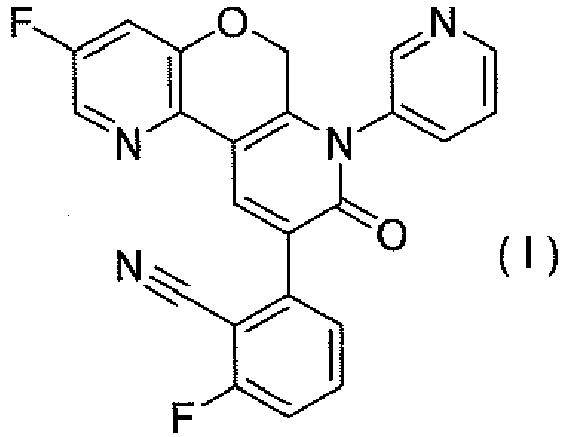
- <19> 2-Fluoro-6-(3-fluoro-8-oxo-7-(pyridin-3-yl)-7,8-dihydro-6H-pyrano[3,2-b:5,4-b']dipyridin-9-yl)benzonitrile represented by formula (I):

- <20> Use of 2-fluoro-6-(3-fluoro-8-oxo-7-(pyridin-3-yl)-7,8-dihydro-6H-pyrano[3,2-b:5,4-b']dipyridin-9-yl)benzonitrile represented by formula (I):

- <21> A composition for small fiber neuropathy, comprising 2-fluoro-6-(3-fluoro-8-oxo-7-(pyridin-3-yl)-7,8-dihydro-6H-pyrano[3,2-b:5,4-b']dipyridin-9-yl)benzonitrile represented by formula (I):

- <22> A pharmaceutical composition for treating small fiber neuropathy, comprising 2-fluoro-6-(3-fluoro-8-oxo-7-(pyridin-3-yl)-7,8-dihydro-6H-pyrano[3,2-b:5,4-b']dipyridin-9-yl)benzonitrile represented by formula (I):

- <23> The pharmaceutical composition according to <22>, further comprising a pharmaceutically acceptable excipient.
- <24> An agent for treating dystonia, comprising 2-fluoro-6-(3-fluoro-8-oxo-7-(pyridin-S-yl)-7,8-dihydro-6H-pyrano[3,2-b:5,4-b']dipyridin-9-yl)benzonitrile represented by formula (I):

- <25> A method for treating dystonia, comprising administering to a patient in need thereof 2-fluoro-6-(3-fluoro-8-oxo-7-(pyridin-3-yl)-7,8-dihydro-6H-pyrano[3,2-b:5,4-b']diridin-9-yl)benzonitrile represented by formula (I):

- <26> 2-Ffluoro-6-(3-fluoro-8-oxo-7-(pyridin-3-yl)-7,8-dihydro-6H-pyrano[3,2-b:5,4-b']dipyridin-9-yl)benzonitile represented by formula (I):

- <27> Use of 2-fluoro-6-(3-fluoro-8-oxo-7-(pyridin-3-yl)-7,8-dihydro-6H-pyrano[3,2-b:5,4-b']dipydin-9-yl)benzonitrile represented by formula (I):

- <28> A pharmaceutical composition for treating dystonia, comprising 2-fluoro-6-(3-fluoro-8-oxo-7-(pyridin-3-yl)-7,8-dihydro-6H-pyrano[3,2-b:5,4-b']dipyridin-9-yl)benzonitrile represented by formula (I):

- <29> A pharmaceutical composition for treating dystonia, comprising 2-fluoro-6-(3-fluoro-8-oxo-7-(pyridin-3-yl)-7,8-dihydro-6H-pyrano[3,2-b:5,4-b']dipyridin-9-yl)benzonitrile represented by formula (I):

- <30> The pharmaceutical composition according to <29>, further comprising a pharmaceutically acceptable excipient.
- <31> An agent for treating epilepsy associated with Alzheimer's disease, comprising 2-fluoro-6-(3-fluoro-8-oxo-7-(pyridin-3-yl)-7,8-dihydro-6H-pyrano[3,2-b:5,4-b']dipyridin-9-yl)benzonitrile represented by formula (I):

- <32> A method for treating epilepsy associated with Alzheimer's disease, comprising administering to a patient in need thereof 2-fluoro-6-(3-fluoro-8-oxo-7-(pyridin-3-yl)-7,8-dihydro-6H-pyrano[3,2-b:5,4-b']dipyridin-9-yl)benzonitrile represented by formula (I):

- <33> 2-Fluoro-6-(3-auoro-8-oxo-7-(pyndin-3-yl)-7,8-dihydno-6H-pyrano[3,2-b:5,4-b']dipyridin-9-yl)benzonitrile represented by formula (I):

- <34> Use of 2-fluoro-6-(3-fluoro-8-oxo-7-(pyridin-3-yl)-7,8-dihydin-6H-pyrano[3,2-b:5,4-b']dipyridin-9-yl)benzonitrile represented by formula (1):

- <35> A composition for epilepsy associated with Alzheimer's disease, comprising 2-fluoro-6-(3-fluoro-8-oxo-7-(pyridin-3-yl)-7,8-dihydro-6H-pyrano[3,2-b:5,4-b']dipyridin-9-yl)benzonitrile represented by formula (I):

- <36> A pharmaceutical composition for treating epilepsy associated with Alzheimer's disease, comprising 2-fluoro-6-(3-fluoro-8-oxo-7-(pyridin-3-yl)-7,8-dihydro-6H-pyrano[3,2-b:5,4-b']dipyridin-9-yl)benzonitrile represented by formula (I):
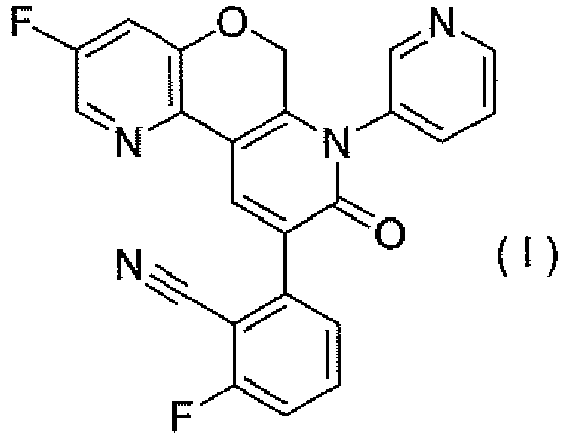
- <37> The pharmaceutical composition according to <36>, further comprising a pharmaceutically acceptable excipient.
- <38> An agent for treating epilepsy associated with brain tumor, comprising 2-fluoro-6-(3-fluoro-8-oxo-7-(pyridin-3-yl)-7,8-dihydro-6H-pyrano[3,2-b:5,4-b']dipyridin-9-yl)benzonitrile represented by formula (I):

- <39> A method for treating epilepsy associated with brain tumor, comprising administering to a patient in need thereof 2-fluoro-6-(3-fluoro-8-oxo-7-(pyridin-3-yl)-7,8-dihydro-6H-pyrano[3,2-b:5,4-b']dipyridin-9-yl)benzonitrile represented by formula (I):

- <40> 2-Fluoro-6-(3-fluoro-8-oxo-7-(pyridin-3-yl)-7,8-dihydro-6H-pyrano[3,2-b:5,4-b']dipyridin-9-yl)benzonitrile represented by formula (I):
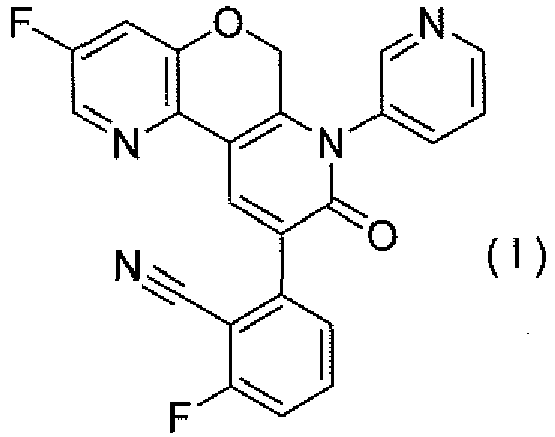
- <41> Use of 2-fluoro-6-(3-fluoro-8-oxo-7-(pyridin-3-yl)-7,8-dihydro-6H-pyrano[3,2-b:5,4-b']dipyridin-9-yl)benzonitrile represented by formula (I):

- <42> A composition for epilepsy associated with brain tumor, comprising 2-fluoro-6-(3-fluoro-8-oxo-7-(pyridin-3-yl)-7,8-dihydro-6H-pyrano[3,2-b:5,4-b']dipyridin-9-yl)benzonitrile represented by formula (I):

- <43> A pharmaceutical composition for treating epilepsy associated with brain tumor, comprising 2-fluoro-6-(3-fluoro-8-oxo-7-(pyridin-3-yl)-7,8-dihydro-6H-pyrano[3,2-b:5,4-b']dipyridin-9-yl)benzonitrile represented by formula (I):

- <44> The pharmaceutical composition according to <43>, further comprising a pharmaceutically acceptable excipient.
- <45> Any of the treatment agents, treatment methods, compounds, uses, compositions, or pharmaceutical compositions above, wherein the brain tumor is glioma.
- <46> An agent for treating brain tumor, comprising 2-fluoro-6-(3-fluoro-8-oxo-7-(pyridin-3-yl)-7,8-dihydro-6H-pyrano[3,2-b:5,4-b']dipyridin-9-yl)benzonitrile represented by formula (I):

- <47> A method for treating brain tumor, comprising administering to a patient in need thereof 2-fluoro-6-(3-fluoro-8-oxo-7-(pyridin-3-yl)-7,8-dihydro-6H-pyrano[3,2-b:5,4-b']dipyridin-9-yl)benzonitrile represented by formula (I):

- <48> 2-Fluoro-6-(3-fluoro-8-oxo-7-(pyridin-3-yl)-7,8-dihydro-6H-pyrano[3,2-b:5,4-b']dipyridin-9-yl)benzonitrile represented by formula (I):

- <49> Use of 2-fluoro-6-(3-fluoro-8-oxo-7-(pyridin-3-yl)-7,8-dihydro-6H-pyrano[3,2-b:5,4-b']dipyridin-9-yl)benzonitrile represented by formula (I):

- <50> A composition for brain tumor, comprising 2-fluoro-6-(3-fluoro-8-oxo-7-(pyridin-3-yl)-7,8-dihydro-6H-pyrano[3,2-b:5,4-b']dipyridin-9-yl)benzonitrile represented by formula (I):

- <51> A pharmaceutical composition for treating brain tumor, comprising 2-fluoro-6-(3-fluoro-8-oxo-7-(pyridin-3-yl)-7,8-dihydro-6H-pyrano[3,2-b:5,4-b]dipyridin-9-yl)benzonitrile represented by formula (I):

- <52> The pharmaceutical composition according to <51>, further comprising a pharmaceutically acceptable excipient.
- <53> Any of the treatment agents, treatment methods, compounds, uses, compositions, or pharmaceutical compositions above, wherein the brain tumor is glioma.
- The pyranodipyridine compound or a pharmaceutically acceptable salt thereof of the present invention exhibits effect of suppressing tremor induced by harmaline in a rat harmaline model as an animal model of essential tremor, effect of suppressing pain induced by STZ in a rat STZ model as an animal model of small fiber neuropathy, effect of suppressing dystonia in a dtsz hamster model as an animal model of dystonia, effect of suppressing convulsions in a Tg2576 mouse and a 5XFAD mouse as an animal model of Alzheimer's disease, effect of suppressing convulsions in a mouse model with intracranially transplanted human glioma cells as an animal model of brain tumor, or antitumor effect in a mouse model with subcutaneously transplanted human glioma cells as an animal model of brain tumor. Accordingly, the compound or a pharmaceutically acceptable salt thereof according to the present invention has potential use as an agent for treating essential tremor, small fiber neuropathy, dystonia, epilepsy associated with Alzheimer's disease, epilepsy associated with brain tumor, or brain tumor.
- The present invention will be hereinafter described in detail.
- In the compounds of the present specification, the structural formula may represent a certain isomer for convenience sake; however, the compound is not limited to the formula shown for convenience sake, and includes all the structurally possible isomers and isomeric mixtures of the compound, such as geometrical isomers, optical isomers, rotamers, stereoisomers and tautomers, and may be either one of the isomers, or a mixture containing each of the isomers at a given ratio. Thus, optical isomers and a racemate, for example, may be present for the compound in the present specification; however, it is not limited to any of them in the present specification, and the compound in the present specification may be a racemate, any of the optically active substances, or a mixture containing each of the optically active substances at a given ratio.
- Further, crystalline polymorphs may also be present, although the present invention is similarly not limited to any of them, and the compound of the present invention may be in a single form of any of the crystal forms, or a mixture thereof, and the present invention also includes amorphous forms. The compound of the present invention also encompasses anhydrate and solvates (in particular, hydrate).
- As used herein, the "pharmaceutically acceptable salt" is not particularly limited as long as it is a salt formed with any of the compounds of the present invention, and may specifically be, for example, an acid addition salt such as an inorganic acid salt, an organic acid salt, or an acidic amino acid salt.
- With regard to the "pharmaceutically acceptable salt" herein, unless otherwise indicated, the number of molecules of the acid relative to one molecule of the compound in the formed salt is not particularly limited as long as a salt with an appropriate ratio is formed; however, the number of molecules of the acid relative to one molecule of the compound in one mode is about 0.1 to about 5, in another mode about 0.5 to about 2, and in still another mode about 0.5, about 1, or about 2.
- Examples of inorganic acid salts in one specific mode include hydrochloride, hydrobromide, sulfate, nitrate, and phosphate, and examples of organic acid salts in one specific mode include acetate, succinate, fumarate, maleate, tartrate, citrate, lactate, stearate, benzoate, methanesulfonate, p-toluenesulfonate, and benzenesulfonate.
- Examples of acidic amino acid salts in one specific mode include aspartate and glutamate.
- When the pyranodipyridine compounds according to the present invention are obtained in the free form, they can be converted to salts or hydrates thereof that may be formed by the compounds described above, in accordance with a conventional method.
- When the pyranodipyridine compounds according to the present invention are obtained as salts or hydrates of the compounds, they can be converted to the free form of the compounds described above, in accordance with a conventional method.
- Moreover, various isomers obtained for the compounds in the present specification (for example, geometrical isomers, optical isomers, rotamers, stereoisomers, and tautomers) can be purified and isolated using common separation means, for example, recrystallization, a diastereomeric salt formation method, an enzymatic resolution method, and various types of chromatography (for example, thin layer chromatography, column chromatography, and gas chromatography).
- A pharmaceutical composition of the invention could be prepared by mixing a pharmaceutically acceptable excipient with a pyranodipyridine compound or a pharmaceutically acceptable salt thereof. A pharmaceutical composition of the invention can be prepared in accordance with the known method such as a method described in the General Rules for Preparations of the Japanese Pharmacopoeia 17th Edition, the United States Pharmacopeia, and the European Pharmacopoeia.
- A pharmaceutical composition of the invention could be administered to patients appropriately depending on the dosage form.
- The dose of the pyranodipyridine compound or a pharmaceutically acceptable salt thereof according to the present invention will vary depending on the severity of the condition, age, sex, body weight, type of the dosage form or salt, specific type of the disease, and the like; generally, however, for an adult, in the case of oral administration, the daily dose is about 30 µg to 10 g, 100 µg to 5 g in one mode, and 100 µg to 1 g in another mode, and in the case of administration by injection, the daily dose is about 30 µg to 1 g, 100 µg to 500 mg in one mode, and 100 µg to 300 mg in another mode, each administered in single or several divided doses.
- The pyranodipyridine compound or a pharmaceutically acceptable salt thereof according to the present invention can be administered as an agent for treating essential tremor to a patient, for example, in combination with primidone, propranolol, alprazolam, gabapentin, sotalol, topiramate, clonazepam, clozapine, or nadolol simultaneously, separately, continuously, or at time intervals. The pyranodipyridine compound or a pharmaceutically acceptable salt thereof according to the present invention can be administered as an agent for treating small fiber neuropathy to a patient, for example, in combination with a tricyclic antidepressant (such as nortriptyline, amitriptyline, imipramine), a Ca channel α2δ ligand (such as pregabalin, gabapentin), neurotropin, a serotonin/noradrenaline reuptake inhibitor (such as duloxetine), an antiarrhythmic (such as mexiletine), an aldose reductase inhibitor (such as epalrestat), oxycodone, carbamazepine, lamotrigine, baclofen, tramadol, codeine, fentanyl, morphine, buprenorphine, or pentazocine simultaneously, separately, continuously, or at time intervals. Further, the pyranodipyridine compound or a pharmaceutically acceptable salt thereof according to the present invention can be administered as an agent for treating dystonia to a patient, for example, in combination with botulinum toxin, an anticholinergic (such as trihexyphenidyl), an anti-epileptic drug (such as clonazepam, levetiracetam), an L-dopa preparation, an atypical psychotropic (such as risperidone, clozapine), or a muscle relaxant (such as baclofen) simultaneously, separately, continuously, or at time intervals.
- The pyranodipyridine compound of the present invention can be produced, for example, using the methods described in the following production examples and referential examples, and the effects of the compounds can be confirmed using the methods described in the following Test Example. It should be noted, however, that these examples are illustrative, and the present invention is in any case not limited to the following specific examples, and modifications may be made thereto without departing from the scope of the present invention.
- Compounds for which document names or the like are noted were produced in accordance with the document or the like.
- The abbreviations used herein are conventional abbreviations well known to those skilled in the art. The following abbreviations will be used herein:
- (Ataphos)2PdCl2: bis(di-t-butyl(4-dimethylaminophenyl)phosphine)dichloropalladium(II)
- DCM: dichloromethane
- DMEAD: di-2-methoxyethyl azodicarboxylate
- DMF: N,N-dimethylformamide
- DMSO: dimethylsulfoxide
- EDC: 1-ethyl-3-(3-dimethylaminopropyl)carbodiimide hydrochloride
- MTBE: 2-methoxy-2-methylpropane
- n-: normal
- NBS: N-bromosuccinimide
- t-: tertiary
- TFA: trifluoroacetic acid
- THF: tetrahydrofuran
- 1H-NMR: proton nuclear magnetic resonance spectrometry
- MS: mass spectrometry
- In the following production examples and referential examples, the "room temperature" generally refers to about 10°C to about 35°C. "%" refers to percent by weight, unless otherwise specified.
- Chemical shifts in proton nuclear magnetic resonance spectra are recorded in δ units (ppm) relative to tetramethylsilane, and coupling constants are recorded in hertz (Hz). Abbreviations for splitting patterns are as follows:
s: singlet, d: doublet, t: triplet, q: quartet, m: multiplet, br.s: broad singlet. - For reactions using a microwave reactor in the production examples and referential examples, initiator™ or initiator+™ from Biotage Corporation was used.
- For chromatography, as the silica gel, Silica Gel60 (70-230 mesh ASTM) from Merck Corporation or PSQ60B from Fuji Silysia Chemical Ltd. was used, or a pre-packed column {column: Hi-Flash™ Column (Silicagel) from Yamazen Corporation, size: any of S (16 × 60 mm), M (20 × 75 mm), L (26 × 100 mm), 2L (26 × 150 mm), and 3L (46 × 130 mm); or Biotage™ SNAP Ultra Silica Cartridge from Biotage Corporation, size: any of 10 g, 25 g, and 50 g} was used.
- As the NH silica gel, CHROMATOREX NH-DM2035 from Fuji Silysia Chemical Ltd. was used, or a pre-packed column (column: Hi-Flash™ Column (Amino) from Yamazen Corporation, size: any of S (16 × 60 mm), M (20 × 75 mm), L (26 × 100 mm), 2L (26 × 150 mm), and 3L(46 × 130 mm); or Presep™ (Luer Lock) NH2 (HC) from Wako Pure Chemical Industries, Ltd., size: any of type M (14 g /25 mL), type L (34 g/70 mL), type 2L (50 g/100 mL), and type 3L(110 g/200 mL)} was used.
- As neutral alumina, Aluminium oxide 90 active neutral, 70-230 mesh, Merck, E6NXX was used.
- As the names of the compounds shown below, those displayed on the "E-Notebook" Version 12 (PerkinElmer Co., Ltd.) were used, except for commonly used reagents.
-

- A mixture of 2,3,4,6,7,8-hexahydro-1H-pyriniido[1,2-a]pyrimidine (1.91 g, 13.7 mmol, 0.3 equivalents), ethyl 2-((t-butyldimethylsilyl)oxy)acetate (Journal of the American Chemical Society, 2011, 133(35), 14082-14089, Supporting Information p.27) (CAS No. 67226-78-2) (10 g, 45.8 mmol, 1 equivalent), morpholine (4.41 mL, 50.4 mmol, 1.1 equivalents) and 2-methyltetrahydrofuran (50 mL) was stirred at 60°C overnight. The reaction mixture was allowed to return to room temperature, and then washed sequentially with a 5% aqueous ammonium chloride solution and water. The solution was concentrated under reduced pressure to afford the title compound (10.4 g).
1H-NMR (400 MHz, CDCl3) δ (ppm): 0.11 (s, 6H), 0.90 (s, 9H), 3.54-3.74 (m, 8H), 4.29 (s, 2H).
MS [M+H]+ = 260 - To a solution of 3-(benzyloxy)-2-methylpyridine (Journal of Medicinal Chemistry, 2008, 51(15), 4708-4714, Supporting Information, p.22) (CAS No. 177559-01-2) (4.4 g, 22.1 mmol, 1 equivalent) in 2-methyltetrahydrofuran (44 mL) was added n-butyllithium (2.65 M solution in n-hexane, 10.0 mL, 26.5 mmol, 1.2 equivalents) at -78°C. The reaction mixture was stirred at -78°C for 1 hour. The reaction mixture was added dropwise to a solution of 2-((t-butyldimethylsilyl)oxy)-1-morphohnoethanone (6.87 g, 26.5 mmol, 1.2 equivalents) in 2-methyltetrahydrofuran (13.2 mL) at -78°C. The reaction mixture was stirred at -78°C for 30 minutes. To the reaction mixture was added a 5% aqueous ammonium chloride solution, and the mixture was allowed to warm up to room temperature. The organic layer was separated. The resulting organic layer was washed with a 5% aqueous ammonium chloride solution. To the resulting organic layer was added 2 N hydrochloric acid (26.4 mL, 52.8 mmol, 2.39 equivalents), and the mixture was stirred at room temperature for 2 hours. The aqueous layer was separated. The resulting aqueous layer was neutralized with a 2 N aqueous sodium hydroxide solution, and extracted with ethyl acetate. The organic layer was dried over sodium sulfate and filtered, and then the resulting solution was concentrated under reduced pressure at 60°C to approximately five times the volume of 3-(benzyloxy)-2-methylpyridine used. The remaining solution was cooled down to room temperature. To this mixture was added n-heptane (50 mL). The precipitate was collected by filtration. The resulting solid was washed with MTBE to afford the title compound (3.53 g).
1H-NMR (400 MHz, CDCl3) δ (ppm): 3.48 (br. s, 1H), 4.03 (s, 2H), 4.28 (s, 2H), 5.08 (s, 2H), 7.12-7.25 (m, 2H), 7.30-7.55 (m, 5H), 8.16 (dd, J = 4.7, 1.6 Hz, 1H).
MS [M+H]+ = 258 - To a solution of 1-(3-(benzyloxy)pyridin-2-yl)-3-hydroxypropan-2-one (21 g, 81.6 mmol, 1 equivalent) in THF (210 mL) were added pyridine (8.58 mL, 106 mmol, 1.3 equivalents) and 1-carbobenzoxy-3-methylimidazolium triflate (CAS No. 163080-99-7) (35.9 g, 97.9 mmol, 1.2 equivalents) at 0°C. The reaction mixture was stirred at room temperature for 16 hours, then MTBE, acetic acid (8.5 mL) and water were added, and the organic layer was separated. The organic layer was washed sequentially with water and a saturated aqueous sodium chloride solution. The organic layer was dried over anhydrous sodium sulfate, filtered, and then concentrated under reduced pressure to afford the title compound (33 g) as a crude product. This crude product was used for the next reaction without further purification.
MS [M+H]+ = 392 - To a mixture of benzyl (3-(3-(benzyloxy)pyridin-2-yl)-2-oxopropyl)carbonate (33 g) and trimethyl orthoformate (CAS No. 149-73-5) (66 mL, 603 mmol) were added acetic anhydride (132 mL, 1.40 mol) and acetic acid (66 mL, 1.15 mol) at room temperature. The reaction mixture was stirred at 70°C for 3 hours. The reaction mixture was concentrated under reduced pressure. The residue was purified with silica gel column chromatography (silica gel, 15%-100% ethyl acetate/n-heptane) to afford the title compound (29.2 g).
1H-NMR (400 MHz, CDCl3) δ (ppm): 3.84 (s, 0.85 x 3H), 3.94 (s, 0.15 x 3H), 4.74 (s, 0.85 x 2H), 5.04 (s, 0.15 x 2H), 5.10 (s, 0.85 x 2H), 5.11 (s, 0.15 x 2H), 5.17 (s, 0.85 x 2H), 5.19 (s, 0.15 x 2H), 7.10-7.43 (m, 0.85 x 12H and 0.15 x 13H), 7.64 (s, 0.85 x 1H), 8.15 (dd, J = 4.0, 2.2 Hz, 0.15 x1H), 8.27 (dd, J = 4.8,1.5 Hz, 0.85 x 1H).
MS [M+H]+ = 434 -

- A mixture of (3-bromo-6-methoxypyridin-2-yl)methanol (CAS No. 623942-84-7) (2.15 g, 9.86 mmol, 1 equivalent), chloromethyl methyl ether (2.25 mL, 29.6 mmol, 3 equivalents) and N,N-diisopropylethylamine (8.61 mL, 49.3 mmol, 5 equivalents) was stirred in DCM (45 mL) at room temperature for 15 hours. The reaction mixture was concentrated under reduced pressure. The residue was purified with silica gel column chromatography (NH silica gel, 0%-5% ethyl acetate/n-heptane) to afford the title compound (2.22 g).
MS [M+H]+ = 262 - A solution of 3-bromo-6-methoxy-2-((methoxymethoxy)methyl)pyridine (1.09 g, 4.16 mmol, 1 equivalent) in THF (20 mL) was cooled to -78°C, and n-butyllithium (2.69 M solution in n-hexane, 1.70 mL, 4.58 mmol, 1.1 equivalents) was added. The reaction mixture was stirred at the same temperature for 1 hour, and then trimethyl borate (0.696 mL, 6.24 mmol, 1.5 equivalents) was added. The reaction mixture was stirred for 12 hours while warming up to room temperature, and then concentrated under reduced pressure. To the residue was added a saturated aqueous ammonium chloride solution, and the mixture was extracted with DCM. The organic layer was concentrated under reduced pressure, and the residue was purified with silica gel column chromatography (silica gel, 10%-100% ethyl acetate/n-heptane) to afford the title compound (570 mg).
1H-NMR (400 MHz, CDCl3) δ (ppm): 3.42 (s, 3H), 3.95 (s, 3H), 4.75 (s, 2H), 4.79 (s, 2H), 6.32 (s, 2H), 6.71 (d, J = 8.2 Hz, 1H), 8.08 (d, J = 8.4 Hz, 1H).
MS [M+H]+ = 228 - A mixture of (6-methoxy-2-((methoxymethoxy)methyl)pyridin-3-yl)boronic acid (570 mg, 2.51 mmol, 1 equivalent), 2-bromo-3,5-difluoropyridine (CAS No. 660425-16-1) (560 mg, 2.89 mmol, 1.15 equivalents), potassium fluoride (438 mg, 7.53 mmol, 3 equivalents), (Ataphos)2PdCl2 (89 mg, 0.126 mmol, 0.05 equivalents), 1,4-dioxane (12 mL) and water (3 mL) was reacted in a microwave reactor at 130°C for 4 hours. The reaction mixture was cooled down to room temperature, and then directly purified with silica gel column chromatography (silica gel on NH silica gel, 5%-35% ethyl acetate/n-heptane) to afford the title compound (648 mg).
MS [M+H]+ = 297 - A mixture of 3,5-difluoro-6'-methoxy-2'-((memoxymethoxy)methyl)-2,3'-bipyridine (648 mg, 2.19 mmol, 1 equivalent) and a 48% aqueous hydrobromic acid solution (1.98 mL, 17.5 mmol, 8 equivalents) was stirred in THF (15 mL) at 55°C for 8 hours. The reaction mixture was cooled down to room temperature, and then concentrated under reduced pressure. To the residue were added a saturated aqueous sodium hydrogen carbonate solution and DCM. The mixture was stirred at room temperature for 1 hour, and then the resulting precipitate was collected by filtration. The resulting solid was washed with water to afford the title compound (349 mg).
1H-NMR (400 MHz, DMSO-d6) δ (ppm): 4.33 (s, 2H), 6.35 (d, J = 9.3 Hz, 1H), 7.51 (dd, J = 9.3,1.8 Hz, 1H), 8.04 (ddd, J= 10.1,8.9,2.5 Hz, 1H), 8.57 (d, J = 2.4 Hz, 1H).
MS [M+H]+ = 239 - A mixture of 3,5-difluoro-2'-(hydroxymethyl)-[2,3'-bipyridin]-6'-ol (329 mg, 1.38 mmol, 1 equivalent) and potassium carbonate (573 mg, 4.14 mmol, 3 equivalents) was stirred in DMF (7 mL) at 100°C for 5 hours. The reaction mixture was cooled down to room temperature, and then an aqueous ammonium chloride solution was added. The mixture was stirred at room temperature for 30 minutes, and then the resulting precipitate was collected by filtration. The resulting solid was washed with water and n-heptane to afford the title compound (251 mg).
1H-NMR (400 MHz, DMSO-d6) δ (ppm): 5.20 (s, 2H), 6.46 (d, J = 8.8 Hz, 1H), 7.38 (dd, J = 9.7,2.4 Hz, 1H), 8.04 (d, J = 9.3 Hz, 1H), 8.19 (d, J = 2.6 Hz, 1H).
MS [M+H]+ = 219 - A mixture of 3-fluoro-6H-pyrano[3,2-b:5,4-b']dipyridin-8(7H)-one (250 mg, 1.15 mmol, 1 equivalent), silver carbonate (474 mg, 1.72 mmol, 1.5 equivalents), copper(I) iodide (131 mg, 0.687 mmol, 0.6 equivalents) and pyridine (0.927 mL, 11.5 mmol, 10 equivalents) was stirred in a mixed solvent of DMF (7 mL) and DMSO (9 mL) at 80°C for 20 minutes. To the reaction mixture was slowly added a mixed solution of pyridine-3-boronic acid 1,3-propanediol cyclic ester (CAS No. 131534-65-1) (373 mg, 2.29 mmol, 2 equivalents) in DMF (4 mL) and DMSO (1 mL). The reaction mixture was stirred at 80°C for 20 hours, then applied to silica gel pad (NH silica gel and silica gel) and eluted with ethyl acetate. The resulting solution was concentrated under reduced pressure. To the residue was added water, and the mixture was extracted with ethyl acetate. The organic layer was washed with a saturated aqueous sodium chloride solution, and then concentrated under reduced pressure. The residue was purified with silica gel column chromatography (NH silica gel on silica gel, 10%-100% ethyl acetate/n-heptane, 10% methanol/ethyl acetate) to afford the title compound (43.5 mg).
1H-NMR (400 MHz, CDCl3) δ (ppm): 4.644.73 (m, 1H), 4.77-4.86 (m, 1H), 6.78 (d, J = 9.5 Hz, 1H), 6.94 (dd, J = 8.9, 2.5 Hz, 1H), 7.51-7.58 (m, 1H), 7.65-7.72 (m, 1H), 8.14 (d, J = 2.6 Hz, 1H), 8.29 (d, J = 9.7 Hz, 1H), 8.53 (d, J= 2.6 Hz, 1H), 8.79 (dd, J = 4.8, 1.5 Hz, 1H).
MS [M+H]+ = 296 - Amixture of 3-fluoro-7-(pyridin-3-yl)-6H-pyrano[3,2-b:5,4-b']dipyridin-8(7H)-one (43.5 mg, 0.147 mmol, 1 equivalent) and NBS (31.5 mg, 0.177 mmol, 1.2 equivalents) was stirred in acetonitrile (3 mL) at room temperature for 15 hours. The reaction mixture was directly purified with silica gel column chromatography (NH silica gel on silica gel, 10%-100% ethyl acetate/n-heptane) to afford the title compound (33 mg).
1H-NMR (400 MHz, CDCl3) δ (ppm): 4.60-4.70 (m, 1H), 4.74-4.83 (m, 1H), 6.95 (dd, J = 8.6,2.0 Hz, 1H), 7.56 (dd, J = 8.1, 4.8 Hz, 1H), 7.65-7.72 (m, 1H), 8.14 (d, J = 2.4 Hz, 1H), 8.53 (d, J = 2.4 Hz, 1H), 8.71 (s, 1H), 8.81 (dd, J = 4.9,1.6 Hz, 1H).
MS [M+Na]+ = 396 - A mixture of 9-bromo-3-fluoro-7-(pyridin-3-yl)-6H-pyrano[3,2-b:5,4-b']dipyridin-8(7H)-one (16.5 mg, 0.044 mmol, 1 equivalent), 2-cyano-3-fluorophenylboronic acid pinacol ester (CAS No. 765916-91-4) (14.2 mg, 0.057 mmol, 1.3 equivalents), (Ataphos)2PdCl2 (1.56 mg, 2.21 µmol, 0.05 equivalents), triethylamine (0.025 mL, 0.176 mmol, 4 equivalents), 1,4-dioxane (0.5 mL) and water (0.15 mL) was reacted in a microwave reactor at 130°C for 2.5 hours. The reaction solution was directly purified with silica gel column chromatography (NH silica gel on silica gel, 5%-90% ethyl acetate/n-heptane) to afford the title compound (11.0 mg).
1H-NMR (400 MHz, CDCl3) δ (ppm): 4.71-4.80 (m, 1H), 4.864.95 (m, 1H), 6.97 (dd, J = 8.8, 2.4 Hz, 1H), 7.20-7.28 (m, 1H), 7.46 (d, J = 7.7 Hz, 1H), 7.57 (dd, J = 8.2, 4.8 Hz, 1H), 7.63 (td, J = 8.2, 5.8 Hz, 1H), 7.77 (ddd, J = 8.1, 2.6,1.6 Hz, 1H), 8.14 (d, J = 2.6 Hz, 1H), 8.51 (s, 1H), 8.60 (d, J = 2.6 Hz, 1H), 8.81 (dd, J= 4.9, 1.6 Hz, 1H).
MS [M+H]+ = 415 -

- To a mixture of 5-aminopyrimidine (CAS No. 591-55-9) (2.00 g, 21.0 mmol, 1 equivalent), triethylamine (14.7 mL, 105 mmol, 5 equivalents), EDC (7.26 g, 37.9 mmol, 1.8 equivalents), N,N-dimethyl-4-aminopyridine (0.257 g, 2.10 mmol, 0.1 equivalents) and DCM (60.0 mL) was added dropwise 3-(t-butoxy)-3-oxopropionic acid (CAS No. 40052-13-9) (4.86 mL, 31.5 mmol, 1.5 equivalents), and the mixture was stirred at room temperature for 3 days. To the reaction mixture were added water and ethyl acetate. The organic layer was washed with water and a saturated aqueous sodium chloride solution. The organic layer was dried over magnesium sulfate, filtered, and then concentrated under reduced pressure. The residue was purified with silica gel column chromatography (silica gel, 25%-71% ethyl acetate/n-heptane) to afford the title compound (4.73 g).
1H-NMR (400 MHz, CDCl3) δ (ppm): 1.52 (s, 9H), 3.44 (s, 2H), 8.98 (s, 1H), 9.03 (s, 2H), 9.77 (br. s, 1H). - To a solution of benzyl (3-(3-(benzyloxy)pyridin-2-yl)-4-methoxy-2-oxobut-3-en-1-yl)carbonate (E/Z mixture) obtained in Production Example 1 (3.05 g, 7.03 mmol, 1 equivalent) in propionitrile (50.0 mL) were sequentially added t-butyl 3-oxo-3-(pyrimidin-5-ylamino)propanoate (2.00 g, 8.43 mmol, 1.2 equivalents), lithium bromide (1.22 g, 14.1 mmol, 2 equivalents) and triethylamine (3.43 mL, 24.6 mmol, 3.5 equivalents) at 0°C. After stirring at the same temperature for 5 minutes, the reaction mixture was warmed up to room temperature and stirred for 12 hours. To the reaction mixture was added water, and the mixture was extracted with ethyl acetate. The combined organic layers were washed with a saturated aqueous sodium chloride solution. The organic layers were dried over sodium sulfate, filtered, and then concentrated under reduced pressure. The residue was purified with silica gel column chromatography (NH silica gel, 20%-75% ethyl acetate/n-heptane). The resulting crude product was triturated with a mixed solution of MTBE/n-heptane to afford the title compound (2.30 g).
1H-NMR (400 MHz, CDCl3) δ (ppm): 1.55 (s, 9H), 4.70 (s, 2H), 4.93 (s, 2H), 5.07 (s, 2H), 7.24-7.27 (m, 1H), 7.29-7.42 (m, 11H), 8.26 (dd, J = 4.7,1.6 Hz, 1H), 8.34 (s, 1H), 8.62 (d, J = 0.8 Hz, 2H), 9.21 (s, 1H). - To t-butyl 3-(benzyloxy)-2'-((((benzyloxy)carbonyl)oxy)methyl)-6'-oxo-1'-(pyrimidin-5-yl)-1',6'-dihydro-[2,3'-bipyridine]-5'-carboxylate (1.56 g, 2.51 mmol, 1 equivalent) was added hydrogen chloride (4 M solution in ethyl acetate) (6.28 mL, 25.1 mmol, 10 equivalents), and the mixture was stirred at room temperature for 30 minutes. The reaction mixture was concentrated under reduced pressure, and to the resulting residue were added DMSO (46.8 mL) and lithium acetate dihydrate (2.56 g, 25.1 mmol, 10 equivalents), and the reaction mixture was stirred at 120°C for 4 hours. The reaction mixture was cooled to room temperature, and then to the reaction mixture was added water, and the mixture was extracted with ethyl acetate. The combined organic layers were washed with water and a saturated aqueous sodium chloride solution. The organic layers were dried over magnesium sulfate, filtered, and then concentrated under reduced pressure. The resulting residue was purified with silica gel column chromatography (silica gel, 50%-83% ethyl acetate/n-heptane, 5% methanol/ethyl acetate) to afford the title compound (588 mg).
1H-NMR (400 MHz, CDCl3) δ (ppm): 4.69 (s, 2H), 4.94 (s, 2H), 5.08 (s, 2H), 6.75 (d, J = 9.8 Hz, 1H), 7.27-7.42 (m, 12H), 7.60 (d, J = 9.4 Hz, 1H), 8.25 (dd, J = 4.7, 1.6 Hz, 1H), 8.67 (s, 2H), 9.23 (s, 1H).
MS [M+H]+ = 521 - To a solution of benzyl ((3-(benzyloxy)-6'-oxo-1'-(pyrimidin-5-yl)-1',6'-dihydro-[2,3'-bipyridin]-2'-yl)methyl)carbonate (560 mg, 1.08 mmol, 1 equivalent) in DMF (5.00 mL) was added NBS (287 mg, 1.61 mmol, 1.5 equivalents) at room temperature, and the mixture was stirred at room temperature for 18 hours. To the reaction mixture was added water, and the mixture was extracted with ethyl acetate. The combined organic layers were washed with water and a saturated aqueous sodium chloride solution. The organic layers were dried over magnesium sulfate, filtered, and then concentrated under reduced pressure. The resulting residue was purified with silica gel column chromatography (silica gel, 50%-77% ethyl acetate/n-heptane) to afford the title compound (595 mg).
1H-NMR (400 MHz, CDCl3) δ (ppm): 4.66 (s, 2H), 4.93 (s, 2H), 5.08 (s, 2H), 7.26-7.42 (m, 12H), 8.03 (s, 1H), 8.25 (dd, J = 4.5,1.4 Hz, 1H), 8.64 (s, 2H), 9.23 (s, 1H).
MS [M+H]+ = 599,601 - A mixture of benzyl ((3-(benzyloxy)-5'-bromo-6'-oxo-1'-(pyrimidin-5-yl)-1',6'-dihydro-[2,3'-bipyridin]-2'-yl)methyl)carbonate (590 mg, 0.984 mmol, 1 equivalent), 2-cyano-3-fluorophenylboronic acid pinacol ester (CAS No. 765916-91-4) (365 mg, 1.48 mmol, 1.5 equivalents), (Ataphos)2PdCl2 (34.8 mg, 0.049 mmol, 0.05 equivalents), potassium fluoride (172 mg, 2.95 mmol, 3 equivalents), 1,4-dioxane (15.0 mL) and water (3.0 mL) was reacted in a microwave reactor at 120°C for 30 minutes. To the reaction mixture was added water, and the mixture was extracted with ethyl acetate. The combined organic layers were washed with water and a saturated aqueous sodium chloride solution. The organic layers were dried over magnesium sulfate, filtered, and then concentrated under reduced pressure. The resulting residue was purified with silica gel column chromatography (silica gel, 50%-83% ethyl acetate/n-heptane) to afford the title compound (511 mg).
1H-NMR (400 MHz, CDCl3) δ (ppm): 4.76 (s, 2H), 4.96 (s, 2H), 5.13 (s, 2H), 7.21 (t, J = 8.6 Hz, 1H), 7.27-7.37 (m, 13H), 7.57 (td, J = 8.2, 5.9 Hz, 1H), 7.83 (s, 1H), 8.23 (dd, J = 4.7,1.2 Hz, 1H), 8.73 (s, 2H), 9.24 (s, 1H).
MS [M+H]+ = 640 - A mixture of benzyl ((3-(benzyloxy)-5'-(2-cyano-3-fluorophenyl)-6'-oxo-1'-(pyrimidin-5-yl)-1',6'-dihydro-[2,3'-bipyridin]-2'-yl)methyl)carbonate (505 mg, 0.79 mmol, 1 equivalent), 5% palladium on carbon (84.0 mg, 0.039 mmol, 0.05 equivalents) and ethanol (20.0 mL) was stirred vigorously at room temperature under a hydrogen atmosphere for 6 hours. The reaction mixture was purged with nitrogen, and then filtered. The resulting filtrate was concentrated under reduced pressure to afford the title compound (311 mg).
MS [M+H]+ = 416 - To a mixture of 2-fluoro-6-(3-hydroxy-2'-(hydroxymethyl)-6'-oxo-1'-(pyrimidin-5-yl)-1',6'-dihydro-[2,3'-bipyridin]-5'-yl)benzonitrile (311 mg, 0.749 mmol, 1 equivalent), triphenylphosphine (295 mg, 1.12 mmol, 1.5 equivalents) and THF (10.0 mL) was slowly added DMEAD (263 mg, 1.12 mmol, 1.5 equivalents) at room temperature, and the mixture was stirred for 10 minutes. To the reaction mixture was added water, and the mixture was extracted with ethyl acetate. The combined organic layers were washed with water and a saturated aqueous sodium chloride solution. The organic layers were dried over magnesium sulfate, filtered, and then concentrated under reduced pressure. The resulting residue was purified with silica gel column chromatography (silica gel, 25%-63% ethyl acetate/n-heptane) to afford the title compound (110 mg).
1H-NMR (400 MHz, CDCl3) δ (ppm): 4.82 (s, 2H), 7.12-7.17 (m, 1H), 7.19-7.23 (m, 1H), 7.24-7.26 (m, 1H), 7.44 (d, J = 7.8 Hz, 1H), 7.65 (td, J = 8.1, 5.7 Hz, 1H), 8.27 (dd, J = 4.5, 1.4 Hz, 1H), 8.59 (s, 1H), 8.81 (s, 2H), 9.39 (s, 1H).
MS [M+H]+ = 398 -

- A mixture of 3-(t-butoxy)-3-oxopropionic acid (CAS No. 40052-13-9) (1.61 g, 10.1 mmol, 1.1 equivalents), 2-methyl-5-pyrimidinamine (CAS No. 39889-94-6) (1.00 g, 9.16 mmol, 1.0 equivalent), triethylamine (1.53 mL, 11.0 mmol, 1.2 equivalents), EDC (2.11 g, 11.0 mmol, 1.2 equivalents) and DCM (20 mL) was heated to reflux for 1 hour. The reaction mixture was cooled down to room temperature, then a saturated aqueous sodium hydrogen carbonate solution was added, and the mixture was extracted with DCM. The organic layer was concentrated under reduced pressure. The residue was purified with silica gel column chromatography (silica gel, 50%-100% ethyl acetate/n-heptane) to afford the title compound (2.21 g).
1H-NMR (400 MHz, CDCl3) δ (ppm): 1.53 (s, 9H), 2.72 (s, 3H), 3.43 (s, 2H), 8.91 (s, 2H), 9.64 (br. s, 1H). - A mixture of t-butyl 3-((2-methylpyrimidin-5-yl)amino)-3-oxopropanoate (313 mg, 1.25 mmol, 1.2 equivalents), lithium bromide (180 mg, 2.08 mmol, 2.0 equivalents), benzyl (3-(3-(benzyloxy)pyridin-2-yl)4-methoxy-2-oxobut-3-en-1-yl)carbonate (E/Z mixture) obtained in Production Example 1 (450 mg, 1.04 mmol, 1.0 equivalents), triethylamine (0.506 mL, 3.63 mmol, 3.5 equivalents) and propionitrile (5.00 mL) was stirred at room temperature for 10 minutes. The reaction mixture was directly purified with silica gel column chromatography (silica gel, 40%-100% ethyl acetate/n-heptane) to afford the title compound (480 mg).
MSm/z = 636 - A mixture of t-butyl 3-(benzyloxy)-2'-((((benzyloxy)carbonyl)oxy)methyl)-1'-(2-methylpyrimidin-5-yl)-6'-oxo-1',6'-dihydro-[2,3'-bipyridine]-5'-carboxylate (480 mg, 0.756 mmol, 1.0 equivalents), 10% palladium on carbon (water content, 53.9%) (80.0 mg, 0.035 mmol, 0.046 equivalents) and methanol (3.00 mL) was stirred at room temperature under a hydrogen atmosphere for 40 minutes. The reaction mixture was filtered through Celite™, and the residue was washed with ethyl acetate. The resulting filtrate was concentrated under reduced pressure. The residue was purified with silica gel column chromatography (silica gel, 0%-20% methanol/ethyl acetate) to afford the title compound (250 mg).
MS [M+H]+ = 411 - To a mixture of t-butyl 3-hydroxy-2'-(hydroxymethyl)-1'-(2-methylpyrimidin-5-yl)-6'-oxo-1',6'-dihydro-[2,3'-bipyridine]-5'-carboxylate (250 mg, 0.609 mmol, 1.0 equivalents), triphenylphosphine (224 mg, 0.853 mmol, 1.4 equivalents) and THF (3.00 mL) was added a solution of DMEAD (200 mg, 0.853 mmol, 1.4 equivalents) in THF (1.00 mL) at 0°C. After the progress of the reaction was confirmed, the reaction mixture was concentrated under reduced pressure to about one half of the original solution volume. The residue was purified with silica gel column chromatography (silica gel, 40%-100% ethyl acetate/n-heptane) to afford the title compound (239 mg).
MS [M+H]+ = 393 - To t-butyl 7-(2-methylpyrimidin-5-yl)-8-oxo-7,8-dihydro-6H-pyrano[3,2-b:5,4-b']dipyridine-9-carboxylate (239 mg, 0.609 mmol, 1.0 equivalent) was added TFA (3.00 mL), and the reaction mixture was concentrated under reduced pressure. To the resulting residue were added DMSO (3.00 mL) and lithium acetate dihydrate (311 mg, 3.05 mmol, 5.0 equivalents), and the reaction mixture was stirred at 120°C for 30 minutes. To the reaction mixture was added a 10% aqueous sodium chloride solution, and the mixture was extracted with ethyl acetate. The organic layer was dried over magnesium sulfate, filtered, and then concentrated under reduced pressure. The resulting residue was purified with silica gel column chromatography (NH silica gel, 60%-80% ethyl acetate/n-heptane). The resulting crude product was purified again with silica gel column chromatography (silica gel, 0%-15% methanol/ethyl acetate) to afford the title compound (34.0 mg).
MS [M+H]+ = 293 - A mixture of 7-(2-methylpyrimidin-5-yl)-6H-pyrano[3,2-b:5,4-b']dipyridin-8(7H)-one (34.0 mg, 0.116 mmol, 1.0 equivalent), NBS (31.1 mg, 0.174 mmol, 1.5 equivalents) and DMF (3.00 mL) was stirred at 50°C for 30 minutes. The reaction mixture was concentrated under reduced pressure. The resulting residue was purified with silica gel column chromatography (silica gel, 0%-25% methanol/ethyl acetate) to afford the title compound (22.0 mg).
MS [M+H]+ = 371 - A mixture of 9-bromo-7-(2-methylpyrimidin-5-yl)-6H-pyrano[3,2-b:5,4-b']dipyridin-8(7H)-one (22.0 mg, 0.059 mmol, 1.0 equivalent), 2-cyano-3-fluorophenylboronic acid pinacol ester (CAS No. 765916-91-4) (22.0 mg, 0.089 mmol, 1.5 equivalents), (Ataphos)2PdCl2 (4.20 mg, 5.93 µmol, 0.1 equivalents), potassium fluoride (10.3 mg, 0.178 mmol, 3.0 equivalents), 1,4-dioxane (0.8 mL) and water (0.4 mL) was reacted in a microwave reactor at 140°C for 10 minutes. The reaction mixture was directly purified with silica gel column chromatography (silica gel, 80%-100% ethyl acetate/n-heptane). The resulting crude product was purified again with silica gel column chromatography (NH silica gel, 50%-80% ethyl acetate/n-heptane) to afford the title compound (11.5 mg).
1H-NMR (400 MHz, CDCl3) δ (ppm): 2.88 (s, 3H), 4.84 (s, 2H), 7.08-7.32 (m, 3H), 7.44 (d, J = 7.7 Hz, 1H), 7.64 (td, J = 8.1, 5.5 Hz, 1H), 8.26 (dd, J = 4.8, 1.5 Hz, 1H), 8.58 (s, 1H), 8.68 (s, 2H).
MS [M+H]+ = 412 - The present inventors conducted, or can conduct the following tests to confirm AMPA receptor inhibitory action, tremor-suppressing effect, SFN-suppressing effect, anti-dystonia effect, anticonvulsant effect against AD-related epilepsy, anticonvulsant effect against glioma-related epilepsy, and antitumor effect against glioma.
- With regard to the AMPA receptor inhibitory action of the compounds, AMPA-induced intraneuronal calcium entry-suppressing action was examined using a primary culture system of embryonic rat cerebral cortex neurons.
- <Culture conditions> Whole fetuses were removed from the uteri of Wistar rats at embryonic day 18 (Charles River Japan) anesthetized with isoflurane. Whole brains were removed from the whole fetuses, and the cerebral cortex was separated in Leibovitz's L-15 medium, or Hanks balanced salt solution containing 20% fetal bovine serum. The resulting material was treated with trypsin/DNase solution at 37°C for 45 to 60 minutes. After the serum was added to stop the trypsin reaction, the resulting material was centrifuged at 1200 to 1500 rpm for 3 to 5 minutes. After the supernatant was removed, Neurobasal medium (containing 2% B-27 supplement and the like; hereinafter "Neurobasal medium") was added, and the cells were uniformly dispersed by gently pipetting. The cell suspension was slightly stirred, and then filtered through a nylon mesh filter. Viable cells were counted using a hemocytometer, and diluted with Neurobasal medium to 8 to 10 × 105 cells/mL. The cells were seeded into 96 well plates at 100 µL per well and cultured in a CO2 incubator (5%CO2, 37°C). The medium was replaced after 24 hours, and neurons cultured for 7 to 21 days were used.
- On the day of the assay, the medium was removed and replaced with a calcium measurement solution containing 5 to 10 µmol/L of Fura 2-AM (140 mmol/L sodium chloride, 5 mmol/L potassium chloride, 2 mmol/L magnesium chloride, 3 mmol/L calcium chloride, 24 mmol/L D(+)- glucose, 10 mmol/L HEPES, 1 µmol/L MK-801, pH 7.4), and the cells were treated in a CO2 incubator (5%CO2, 37°C) for 1 to 2 hours. The calcium measurement solution containing the Fura-2 AM solution was subsequently removed, and the neurons in each well were washed twice with the calcium measurement solution for each well, and then 50 µL of the calcium measurement solution was added to each well. Subsequently, 50 µL of a test compound or medium prepared at a concentration 3-fold higher than the final concentration was added, and the cells were pre-treated for about 15 minutes. The plates were subsequently placed on the Fluorescence Drug Screening System 6000 (Hamamatsu Photonics K.K.). The cells were stimulated by adding to each well 50 µL of an AMPA stimulating solution prepared to 3.3 µmol/L with the calcium measurement solution. Changes in calcium concentration were measured as the changes in fluorescence intensity at excitation wavelengths of 340 nm and 380 nm (measurement wavelength: 540 nm). The rate of change of the intracellular calcium concentration was calculated in accordance with the following equation:

- The IC50 value of the test compound for AMPA inhibition was determined from the rates of increase of the intracellular calcium concentration at various concentrations.
- The results are shown in Table 1. These results revealed that the compounds (I) to (III) have sufficient AMPA receptor inhibitory action.
[Table 1] Sample IC50 (nM) Compound (I) 19.40 Compound (II) 29.00 Compound (III) 44.26 - To confirm tremor-suppressing effect, a harmaline model test with rats was conducted. In this model, balance disorder observed after administration of harmaline serves as an evaluation index (Neuroscience Letter, 590, p84-90 (2015)).
- Four-week-old male SD rats (Charles River) were subjected to the test (two treatments in total, n = 5 in each treatment). Balance disorder (one of tremor symptoms) induced by harmaline was used as an evaluation index (the above literature).
- The compound was prepared for oral administration in 0.4% methylcellulose/5% Cremophor/5% 1 N hydrochloric acid/10% dimethylsulfoxide solution to reach an administration volume of 5 mL/kg, and orally administered. As a negative control, only the mixed solvent without the compound (Vehicle) was used. Harmaline (Sigma-Aldrich Co. LLC) was diluted with physiological saline (Otsuka Pharmaceutical Co., Ltd.) to prepare 4 mg/mL harmaline solution. Twenty minutes after administration of the compound, the 4 mg/mL harmaline solution was intraperitoneally administered (dose: 20 mg/kg). Balance disorder was observed during 10 minutes from 5 minutes to 15 minutes after the administration of harmaline, and scored in four grades of 0, 1, 2, and 3.
- The results were represented as mean ± standard deviation. Dunnett's multiple comparison test was used for statistical analysis, and results with p < 0.05 were determined to be of statistically significant difference.
- The results of the harmaline model are shown in Table 2. Pre-administration of the compound (I) led to statistically significant reduction of tremor scores. This result indicates the efficacy of the drug of the present application to animal models of essential tremor.
[Table 2] Treatment Tremor score Vehicle 2.2±0.3 Compound (I) 1 mg/kg 1.3±0.2 Compound (I) 2 mg/kg 0.6±0.3* Compound (I) 4 mg/kg 0.4±0.2* *p<0.05 versus Vehicle (Dunnett's Test) - To confirm analgesic effect in an SFN model, an STZ model test with rats was conducted. The effect of the compound on pain induced 2 weeks after administration of STZ was examined.
- Seven-week-old male SD rats (Charles River) were used for the test. To STZ aliquoted in advance into shading bottles, ice-cooled physiological saline (Otsuka Pharmaceutical Factory, Inc.) was added to reach 65 mg/mL, and the resultant was gently inversion-mixed with ice-cooling to dissolve STZ. After dissolving, the resultant was stored under ice-cooling, and used within 20 minutes from the initiation of preparation. About 20 hours after fasting, the animals were anesthetize with isoflurane, and the 65 mg/mL STZ solution was administered to each animal from the tail vein with a volume of 1 mL/kg over about 15 seconds by using a 1 mL syringe and a 26G injection needle. After 14 days after the administration of STZ, body weight and pain response before drug administration were measured (see description below on pain response), and animals for each of which the 50% response threshold to mechanical stimulation was 6 g or lower in von Frey test were selected, and grouped so as to provide no difference in 50% response thresholds and body weight among groups.
- The compound was prepared for oral administration in DMSO:1 mol/L HCl:Cremophor EL:0.5% methylcellulose = 10:5:5:80 to reach an administration volume of 10 mL/kg, and orally administered As a negative control, only the mixed solvent without the compound (Vehicle) was used.
- Evaluation of pain response was performed by using von Frey test under blind conditions, without involving any measurer for pain response in grouping and administration. Measurement of 50% response thresholds by von Frey test was performed in accordance with a method by Chaplan et al. (J Neurosci Methods 1994; 53: 55-63) using von Frey filaments. Each animal was put in a measurement cage with a floor of a metal mesh about 30 minutes before scheduled measurement time, and left to stand to habituate to the environmental change, and after the animal was confirmed to become calm measurement was initiated. Avon Frey filament (bending force: 0.4, 0.6, 1, 2, 4, 6, 8, 15 g; starting from 2 g) was pressed vertically to the center of the sole of the left hind leg for about 6 seconds until the filament bent, and avoidance response (such as putting back the leg) was observed. In accordance with a Dixon's up-down method (Annu Rev Pharmacol Toxicol 1980; 20: 441-462), 50% response thresholds were calculated. Measurement was performed at four points of time: before drug administration on Day 14, and 30 minute, 90 minutes, and 180 minutes after the administration.
- The results were represented as mean ± standard deviation. Dunnett's multiple comparison test was used for statistical analysis, and a significance level of 5% was used for both sides in all cases.
- The results of the STZ model are shown in Table 3. Significant analgesic effect due to pre-administration of the compound (I) was found. This result indicates the efficacy of the drug of the present application to animal models of SFN.
[Table 3] Group name Number of cases 50% response threshold (g) Day 14 Pre 30 min 90 min 180 min Vehicle 10 3.6±0.4 4.7±0.9 4.9±1.2 4.5±0.6 Compound (I) 0.6 mg/kg 11 3.6±0.4 7.3±1.4 6.6±1.4 5.2±1.1 Compound (I) 2 mg/kg* 11 3.6±0.3 9.5±1.4 8.0±1.3 6.4±1.1 Compound (I) 6 mg/kg*** 11 3.6±0.4 12.5±1.1 12.1±1.5 9.6±1.4 *P<0.05, ***P<0.001 vs. Vehicle (Dunnett's Test) - To confirm anti-dystoma effect in a dystonia model, a test with dtsz hamsters is conducted.
- Male dtsz hamsters (30-day- to 40-day-old), which undergo spontaneous onset of dystonia, are used for the test. The compound is prepared for oral administration in DMSO:1 mol/L HCl:Cremophor EL:0.5% methylcellulose = 10:5:5:80 to reach an administration volume of 10 mL/kg, and orally administered. As a negative control, only the mixed solvent without the compound (Vehicle) is used. Evaluation of dystonia is performed under blind conditions. Each hamster is put in a new plastic cage 2 days before evaluation of the compound, and observed for 3 hours to score dystonia developed in seven grades of 0 to 6 in accordance with Eur J Pharmacology 1993, 231, 287-291 (Pre-control). On the day of compound test, the compound (I) is orally administered with 0.6, 2, 6 mg/kg, and each hamster was put in a new plastic cage, and observed for 3 hours to score dystonia developed. Two days after that, an untreated hamster is put in a new plastic cage to score dystonia developed (Post-control), and individuals with score difference of 2 or more between the Pre-control value and the Post-control value are determined to have large variation and excluded. The significance of the anti-dystonia action by administration of the compound to the Vehicle administration group is examined through Wilcoxon signed-rank test
- To confirm anticonvulsant effect in an AD-related epilepsy model, a test with Tg2576 mice and 5XFAD mice is conducted.
- Tg2576 mice and 5XFAD mice are used for the test. The compound is prepared with a vehicle (10% DMSO, 0.05 mol/L HCl, 5% Cremophor EL, and 0.4% methylcellulose) to reach an administration volume of 10 mL/kg, and orally administered. Only the vehicle without the compound is used as a negative control. Evaluation of anticonvulsant effect is performed through measurement of convulsion thresholds or electroencephalography.
- In a test to evaluate effect on convulsion thresholds, the compound or the vehicle is administered, and then convulsions are induced by corneal electrical stimulation. The presence or absence of convulsions after the intensity of the stimulation current is varied is visually determined, and the convulsion threshold is calculated in accordance with an up-down method (Kimball AW et al: Chemical protection against ionizing radiation. I. Sampling methods for screening compounds in radiation protection studies with mice. Radiat Res. 1957, 7(1), 1-12).
- In a test to evaluate effect on spontaneous convulsive waves, animals with generation of a convulsive wave are selected out, and the compound or the vehicle is administered to each of these animals. The presence or absence of spontaneous convulsions before and after the administration is visually determined, and the electroencephalogram is quantitatively analyzed to evaluate the effect of the compound on convulsive waves.
- To confirm anticonvulsive effect in a glioma-related epilepsy model, a test with an intracranial transplantation model is conducted.
- Nude mice to which human glioma cells have been intracranially transplanted are used for the test. The compound is prepared with a vehicle (10% DMSO, 0.05 mol/L HCl, 5% Cremophor EL, and 0.4% methylcellulose) to reach an administration volume of 10 mL/kg, and orally administered. Only the vehicle without the compound is used as a negative control. The presence or absence of a convulsion wave is determined through electroencephalography. Animals with generation of a convulsive wave are selected out, and the compound or the vehicle is administered to each of these animals. The presence or absence of spontaneous convulsions before and after the administration is visually determined, and the electroencephalogram is quantitatively analyzed to evaluate the effect of the compound on convulsive waves.
- To confirm antitumor effect in a glioma model, a test with a subcutaneous transplantation model is conducted.
- Nude mice to which human glioma cells have been subcutaneously transplanted are used for the test. The compound is prepared with a vehicle (10% DMSO, 0.05 mol/L HCl, 5% Cremophor EL, and 0.4% methylcellulose) to reach an administration volume of 10 mL/kg, and orally or intraperitoneally administered. Only the vehicle without the compound is used as a negative control. Antitumor effect is evaluated through quantitative analysis of tumor volume.
Claims (12)
- An agent for treating essential tremor or small fiber neuropathy, comprising 2-fluoro-6-(3-fluoro-8-oxo-7-(pyridin-3-yl)-7,8-dihydro-6H-pyrano[3,2-b:5,4-b']dipyridin-9-yl)benzonitrile represented by formula (I):

- A method for treating essential tremor or small fiber neuropathy, comprising administering to a patient in need thereof 2-fluoro-6-(3-fluoro-8-oxo-7-(pyridin-3-yl)-7,8-dihydro-6H-pyrano[3,2-b:5,4-b']dipyridin-9-yl)benzonitrile represented by formula (I):

- 2-Fluoro-6-(3-fluoro-8-oxo-7-(pyridin-3-yl)-7,8-dihydro-6H-pyrano[3,2-b:5,4-b']dipyridin-9-yl)benzonitrile represented by formula (I):
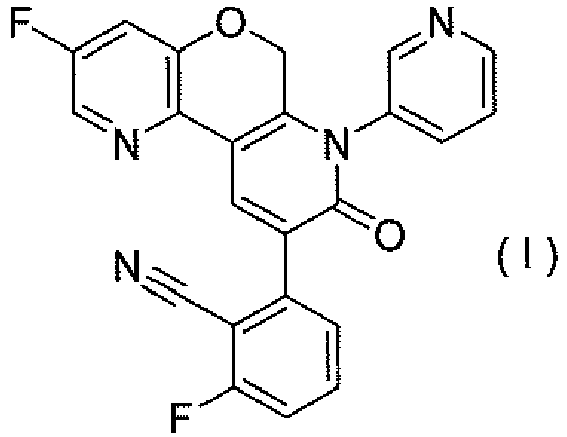
- Use of 2-fluoro-6-(3-fluoro-8-oxo-7-(pyridin-3-yl)-7,8-dihydro-6H-pyrano[3,2-b:5,4-b']dipyridin-9-yl)benzonitrile represented by formula (I):

- An agent for treating essential tremor, comprising 2-fluoro-6-(3-fluoro-8-oxo-7-(pyridin-3-yl)-7,8-dihydro-6H-pyrano[3,2-b:5,4-b']dipyridin-9-yl)benzonitrile represented by formula (I):

- A method for treating essential tremor, comprising administering to a patient in need thereof 2-fluoro-6-(3-fluoro-8-oxo-7-(pyridin-3-yl)-7,8-dihydro-6H-pyrano[3,2-b:5,4-b']dipyridin-9-yl)benzonitrile represented by formula (I):
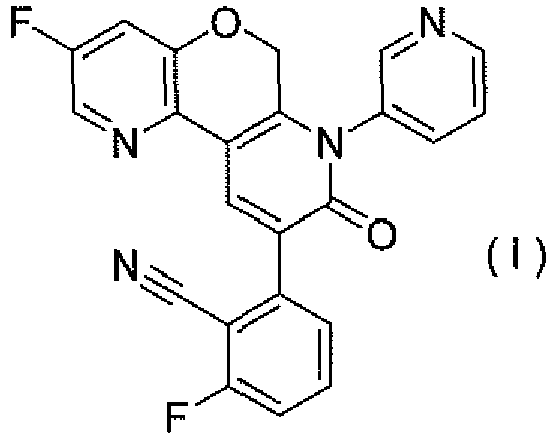
- 2-Fluoro-6-(3-fluoro-8-oxo-7-(pyridin-3-yl)-7,8-dihydro-6H-pyrano[3,2-b:5,4-b']dipyridin-9-yl)benzonitrile represented by formula (I):

- Use of 2-fluoro-6-(3-fluoro-8-oxo-7-(pyridin-3-yl)-7,8-dihydro-6H-pyrano[3,2-b:5,4-b']dipyridin-9-yl)benzonitrile represented by formula (I):

- An agent for treating small fiber neuropathy, comprising 2-fluoro-6-(3-fluoro-8-oxo-7-(pyridin-3-yl)-7,8-dihydro-6H-pyrano[3,2-b:5,4-b']dipyridin-9-yl)benzonitrile represented by formula (I):
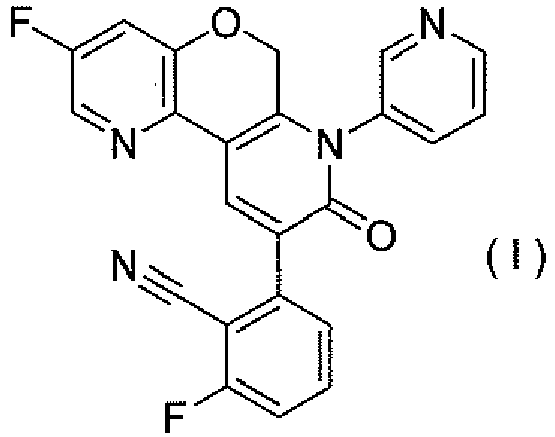
- A method for treating small fiber neuropathy, comprising administering to a patient in need thereof 2-fluoro-6-(3-fluoro-8-oxo-7-(pyridin-3-yl)-7,8-dihydro-6H-pyrano[3,2-b:5,4-b']dipyridin-9-yl)benzonitrile represented by formula (I):

- 2-Fluoro-6-(3-fluoro-8-oxo-7-(pyridin-3-yl)-7,8-dihydro-6H-pyrano[3,2-b:5,4-b']dipyridin-9-yl)benzonitrile represented by formula (I):

- Use of 2-fluoro-6-(3-fluoro-8-oxo-7-(pyridin-3-yl)-7,8-dihydro-6H-pyrano[3,2-b:5,4-b']dipyridin-9-yl)benzonitrile represented by formula (I):
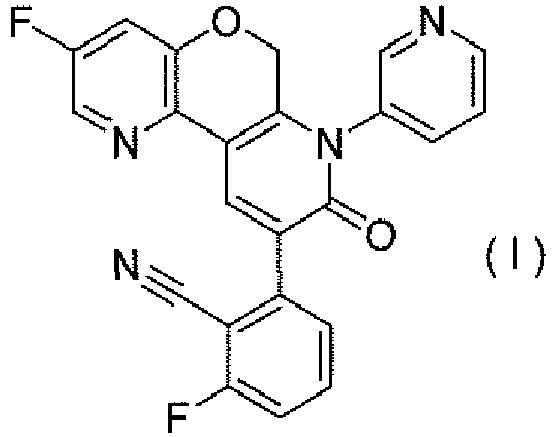
Applications Claiming Priority (4)
| Application Number | Priority Date | Filing Date | Title |
|---|---|---|---|
| JP2017093173 | 2017-05-09 | ||
| JP2017093174 | 2017-05-09 | ||
| JP2017093175 | 2017-05-09 | ||
| PCT/JP2018/017619 WO2018207729A1 (en) | 2017-05-09 | 2018-05-07 | Therapeutic agent containing pyranodipyridine compound |
Publications (1)
| Publication Number | Publication Date |
|---|---|
| EP3622954A1 true EP3622954A1 (en) | 2020-03-18 |
Family
ID=64104851
Family Applications (1)
| Application Number | Title | Priority Date | Filing Date |
|---|---|---|---|
| EP18798031.3A Withdrawn EP3622954A1 (en) | 2017-05-09 | 2018-05-07 | Therapeutic agent containing pyranodipyridine compound |
Country Status (12)
| Country | Link |
|---|---|
| US (1) | US20200383959A1 (en) |
| EP (1) | EP3622954A1 (en) |
| JP (1) | JPWO2018207729A1 (en) |
| KR (1) | KR20200002824A (en) |
| CN (1) | CN110520126A (en) |
| AU (1) | AU2018264511A1 (en) |
| BR (1) | BR112019021935A2 (en) |
| CA (1) | CA3060178A1 (en) |
| MX (1) | MX2019012504A (en) |
| RU (1) | RU2019132958A (en) |
| SG (1) | SG11201909699VA (en) |
| WO (1) | WO2018207729A1 (en) |
Families Citing this family (1)
| Publication number | Priority date | Publication date | Assignee | Title |
|---|---|---|---|---|
| PE20221277A1 (en) * | 2019-11-04 | 2022-09-05 | Revolution Medicines Inc | RAS INHIBITORS |
Family Cites Families (2)
| Publication number | Priority date | Publication date | Assignee | Title |
|---|---|---|---|---|
| WO2010081900A1 (en) * | 2009-01-19 | 2010-07-22 | Neurosearch A/S | Quinolinone derivatives useful for the treatment of cns disorders |
| CN108349989B (en) * | 2015-11-13 | 2021-01-01 | 卫材R&D管理有限公司 | Pyranodipyridine compounds |
-
2018
- 2018-05-07 AU AU2018264511A patent/AU2018264511A1/en not_active Abandoned
- 2018-05-07 CN CN201880025075.1A patent/CN110520126A/en not_active Withdrawn
- 2018-05-07 US US16/606,904 patent/US20200383959A1/en not_active Abandoned
- 2018-05-07 BR BR112019021935A patent/BR112019021935A2/en not_active Application Discontinuation
- 2018-05-07 RU RU2019132958A patent/RU2019132958A/en not_active Application Discontinuation
- 2018-05-07 KR KR1020197030522A patent/KR20200002824A/en not_active Withdrawn
- 2018-05-07 CA CA3060178A patent/CA3060178A1/en not_active Abandoned
- 2018-05-07 SG SG11201909699V patent/SG11201909699VA/en unknown
- 2018-05-07 WO PCT/JP2018/017619 patent/WO2018207729A1/en not_active Ceased
- 2018-05-07 MX MX2019012504A patent/MX2019012504A/en unknown
- 2018-05-07 JP JP2019517608A patent/JPWO2018207729A1/en active Pending
- 2018-05-07 EP EP18798031.3A patent/EP3622954A1/en not_active Withdrawn
Also Published As
| Publication number | Publication date |
|---|---|
| SG11201909699VA (en) | 2019-11-28 |
| RU2019132958A (en) | 2021-06-09 |
| CN110520126A (en) | 2019-11-29 |
| WO2018207729A1 (en) | 2018-11-15 |
| CA3060178A1 (en) | 2018-11-15 |
| BR112019021935A2 (en) | 2020-05-05 |
| US20200383959A1 (en) | 2020-12-10 |
| AU2018264511A1 (en) | 2019-11-07 |
| KR20200002824A (en) | 2020-01-08 |
| MX2019012504A (en) | 2019-12-19 |
| JPWO2018207729A1 (en) | 2020-03-19 |
Similar Documents
| Publication | Publication Date | Title |
|---|---|---|
| CN112390745A (en) | Pyridine nicotinamide derivatives, preparation method and medical application thereof | |
| EP3564217B1 (en) | P2x4 receptor antagonist | |
| TW202409032A (en) | Fused ring compound, and preparation method therefor and use thereof | |
| RU2669943C2 (en) | 1,7-naphthridine-3-carboxamide derivatives, useful as neurogenisis agents | |
| PL190218B1 (en) | Derivatives of 5h-thiazole[3,2-a]pyrimidine, method of obtaining them and medicine containing such derivatives | |
| EP3679043B9 (en) | Vasopressin receptor antagonists and products and methods related thereto | |
| EP3459948B1 (en) | Fluorine-containing triazolopyridine, and manufacturing method, pharmaceutical composition, and application thereof | |
| US9738656B2 (en) | Pyranodipyridine compound | |
| KR101757100B1 (en) | Neurogenesis-stimulating isoquinoline derivatives | |
| PL216979B1 (en) | Arylvinylazacycloalkane compounds and methods of preparation and use thereof | |
| KR20210039228A (en) | Pyrimidina-1,5(1,3)-dibenzenacycloheptaphane derivative as mutant epidermal growth factor receptor inhibitor | |
| JP4574846B2 (en) | Acrylic benzoxazine improves synaptic response | |
| US20200383959A1 (en) | Therapeutic agent containing pyranodipyridine compound | |
| KR101861937B1 (en) | Pyrido[4,3-b]pyrazine-2-carboxamides as neurogenic agents for the treatment of neurodegenerative disorders | |
| Li et al. | Synthesis and biological evaluation of fentanyl acrylic derivatives | |
| US20200316087A1 (en) | Novel combination therapy for anxiety disorders, epilepsy, and pain | |
| Rashid | Design and Synthesis of Achiral and Chiral Benzodiazepines and Imidazodiazepines to Modulate the Activity of GABAA Receptors for the Treatment of Cancer, CNS Disorders and Pain | |
| KR20230116709A (en) | Pharmaceutical composition for prevention or treatment of mental disorder | |
| CA2970256A1 (en) | Diarylmethylidene piperidine derivatives and their use as delta opioid receptor agonists | |
| US9150581B2 (en) | Nicotinic receptor compounds | |
| HK1258756A1 (en) | Pyranodipyridine compound | |
| HK40033061B (en) | Vasopressin receptor antagonists and products and methods related thereto |
Legal Events
| Date | Code | Title | Description |
|---|---|---|---|
| STAA | Information on the status of an ep patent application or granted ep patent |
Free format text: STATUS: THE INTERNATIONAL PUBLICATION HAS BEEN MADE |
|
| PUAI | Public reference made under article 153(3) epc to a published international application that has entered the european phase |
Free format text: ORIGINAL CODE: 0009012 |
|
| STAA | Information on the status of an ep patent application or granted ep patent |
Free format text: STATUS: REQUEST FOR EXAMINATION WAS MADE |
|
| 17P | Request for examination filed |
Effective date: 20191018 |
|
| AK | Designated contracting states |
Kind code of ref document: A1 Designated state(s): AL AT BE BG CH CY CZ DE DK EE ES FI FR GB GR HR HU IE IS IT LI LT LU LV MC MK MT NL NO PL PT RO RS SE SI SK SM TR |
|
| AX | Request for extension of the european patent |
Extension state: BA ME |
|
| DAV | Request for validation of the european patent (deleted) | ||
| DAX | Request for extension of the european patent (deleted) | ||
| STAA | Information on the status of an ep patent application or granted ep patent |
Free format text: STATUS: THE APPLICATION HAS BEEN WITHDRAWN |
|
| 18W | Application withdrawn |
Effective date: 20201116 |