EP3621696B1 - Hair repair composition - Google Patents
Hair repair composition Download PDFInfo
- Publication number
- EP3621696B1 EP3621696B1 EP18722515.6A EP18722515A EP3621696B1 EP 3621696 B1 EP3621696 B1 EP 3621696B1 EP 18722515 A EP18722515 A EP 18722515A EP 3621696 B1 EP3621696 B1 EP 3621696B1
- Authority
- EP
- European Patent Office
- Prior art keywords
- hair
- cationic
- containing non
- formulation
- hydroxyalkyl substituents
- Prior art date
- Legal status (The legal status is an assumption and is not a legal conclusion. Google has not performed a legal analysis and makes no representation as to the accuracy of the status listed.)
- Active
Links
Images


Classifications
-
- A—HUMAN NECESSITIES
- A61—MEDICAL OR VETERINARY SCIENCE; HYGIENE
- A61K—PREPARATIONS FOR MEDICAL, DENTAL OR TOILETRY PURPOSES
- A61K8/00—Cosmetics or similar toiletry preparations
- A61K8/18—Cosmetics or similar toiletry preparations characterised by the composition
- A61K8/72—Cosmetics or similar toiletry preparations characterised by the composition containing organic macromolecular compounds
- A61K8/73—Polysaccharides
- A61K8/737—Galactomannans, e.g. guar; Derivatives thereof
-
- A—HUMAN NECESSITIES
- A61—MEDICAL OR VETERINARY SCIENCE; HYGIENE
- A61Q—SPECIFIC USE OF COSMETICS OR SIMILAR TOILETRY PREPARATIONS
- A61Q5/00—Preparations for care of the hair
- A61Q5/002—Preparations for repairing the hair, e.g. hair cure
-
- A—HUMAN NECESSITIES
- A61—MEDICAL OR VETERINARY SCIENCE; HYGIENE
- A61Q—SPECIFIC USE OF COSMETICS OR SIMILAR TOILETRY PREPARATIONS
- A61Q5/00—Preparations for care of the hair
- A61Q5/004—Preparations used to protect coloured hair
-
- A—HUMAN NECESSITIES
- A61—MEDICAL OR VETERINARY SCIENCE; HYGIENE
- A61Q—SPECIFIC USE OF COSMETICS OR SIMILAR TOILETRY PREPARATIONS
- A61Q5/00—Preparations for care of the hair
- A61Q5/06—Preparations for styling the hair, e.g. by temporary shaping or colouring
Definitions
- the present invention relates to a new use of a cationic polygalactomannan containing non-ionic hydroxyalkyl substituents and having a specific viscosity.
- the present invention relates also to hair care compositions for shaping hair, and more particularly to the use of a specific cationic polygalactomannan containing non-ionic hydroxyalkyl substituents and having a specific viscosity, as an agent for shaping hair, for example, for curl retention.
- Hair is a keratinous substance, which is repeatedly subjected to various stresses including especially environmental factors (such as exposure to UV radiation), damaging treatments (such as bleaching, coloring, perming or thermal straightening), and mechanical stressing, in particular during grooming procedures (for example by frequent brushing, back-combing or combing against high combing resistance).
- environmental factors such as exposure to UV radiation
- damaging treatments such as bleaching, coloring, perming or thermal straightening
- mechanical stressing in particular during grooming procedures (for example by frequent brushing, back-combing or combing against high combing resistance).
- the cuticles are lifted, and the individual hair fibers may tend to become porous, to snarl, kink and/or interlock with each other.
- Impact on the hair texture is noticeable for instance by a poor wet and dry combability, an increased electrostatic charge, increased brittleness, lack of manageability, reduced maximum tear force and elongation at break of the hair and/or split ends, so that the hair as a whole looks unhealthy (dull, lifeless, ...), is hard to comb and/or rough feel.
- ASHLAND "Techniques for Preparing Solutions of Cationic Guar",ANNOUNCEMENT ASH, US, 1 January 2010 discloses the commercially available product N-Hance HPCG 1000, which has the INCI designation HYDROXYPROPYL GUAR HYDROXYPROPYLTRIMONIUM CHLORIDE, is for use in hair care formulations.
- the specific cationic polygalactomannans containing non-ionic hydroxyalkyl substituents and having a specific viscosity not only provide a high percentage of split ends mending, but are also able to close the split ends and to smooth the lifted cuticle scales so as to ensure a durable mend especially after combing or other stress factors during for example hair styling.
- compositions containing the specific cationic polygalactomannans containing non-ionic hydroxyalkyl substituents and having a specific viscosity split ends may advantageously be fully sealed and cuticles layed down.
- the specific cationic polygalactomannans containing non-ionic hydroxyalkyl substituents and having a specific viscosity also provide split ends mending and hair cuticle repair, without dry hair negatives such as the greasy appearance or feel, sticky feel, loss of gloss and/or heavy, coated feel that many consumers experience when conventional cationic polymers with high charge density and high molecular weight are used.
- no residual powder arises from the use of a specific cationic polygalactomannans containing non-ionic hydroxyalkyl substituents and having a specific viscosity.
- the specific cationic polygalactomannans containing non-ionic hydroxyalkyl substituents and having a specific viscosity also provide durable split ends repair, meaning in particular that split ends mending may resist several washing and/or combing cycles.
- the specific cationic polygalactomannan containing non-ionic hydroxyalkyl substituents and having a specific viscosity according to the invention may also provide durable color protection, meaning in particular that color application may resist several washing cycles.
- Galactomannans are polysaccharides consisting mainly of the monosaccharides mannose and galactose.
- the mannose-elements form a chain consisting of many hundreds of (1,4)- ⁇ -D-mannopyranosyl-residues, with 1,6 linked-D-galactopyranosyl-residues at varying distances, dependent on the plant of origin.
- Naturally occurring galactomannans are available from numerous sources, including guar gum, guar splits, locust bean gum, flame tree gum and cassia gum.
- It may be for instance a cationic guar containing hydroxypropyl substituents, preferably a hydroxypropyl guar hydroxypropyltrimonium chloride.
- the terminology "degree of substitution” in reference to a given type of derivatizing group and a given polygalactomannan means the number of the average number of such derivatizing groups attached to each monomeric unit of the polygalactomannan.
- the derivatized polygalactomannan exhibits a total degree of substitution ("DS T ”) of from about 0.001 to about 3.0, wherein :
- the polygalactomannan of the invention can be treated with several known reagents, for example: caustic; acids; biochemical oxidants, such as galactose oxidase; chemical oxidants, such as hydrogen peroxide; and enzymatic reagents; or by physical methods using high speed agitation machines; thermal methods; and combinations of these reagents and methods.
- Reagents such as sodium metabisulfite or inorganic salts of bisulfite may also be optionally included.
- the polygalactomannan of the invention has a cationic degree of substitution DScat ranging from about 0.001 to about 3.
- the polygalactomannan of the invention has a hydroxyalkyl molar substitution ranging from about 0.001 to about 3.
- the polygalactomannan of the invention has a weight average molecular weight ranging from about 2,000 to about 5,000,000 g/mol.
- the weight average molecular weight of a polygalactomannan of the invention may be measured for instance by SEC-MALS or by using gel permeation chromatography.
- the polygalactomannan of the invention is a cationic guar derivative having a cationic degree of substitution DScat comprised between about 0.1 and about 1, a hydroxyalkyl molar substitution comprised between about 0.1 and about 1 and a weight average molecular weight comprised between about 500,000 g/mol and about 4,000,000 g/mol.
- polygalactomannans As an alternative to polygalactomannans, mention may be made of other polysaccharide polymers including, for example, chitosan, pectin, alginate, hyaluronic acid, agar, xanthan, dextrin, starch, cellulose, amylose, amylopectin, alternan, gellan, levan, mutan, dextran, pullulan, fructan, gum arabic, carrageenan, glycogen, glycosaminoglycans, murein, xyloglucans (such as tamarind gum and tamarind gum derivatives such as hydroxypropyl tamarind gum) and bacterial capsular polysaccharides.
- chitosan pectin, alginate, hyaluronic acid, agar, xanthan, dextrin, starch, cellulose, amylose, amylopectin, alternan, gellan, levan, mutan, dextran, pull
- a hair care composition including a cationic polygalactomannan containing non-ionic hydroxyalkyl substituents and having a Brookfield RVT viscosity at 25°C and 20 rpm greater than 700 mPa.s, at a concentration of 1 pbw in water, for instance comprised between 700 and 1,200 mPa.s, makes it possible to achieve improved split ends mending, relative to an otherwise identical hair care composition lacking a cationic polygalactomannan containing non-ionic hydroxyalkyl substituents.
- a hair care composition including a cationic polygalactomannan containing non-ionic hydroxyalkyl substituents and having a Brookfield RVT viscosity at 25°C and 20 rpm greater than 700 mPa.s, at a concentration of 1 pbw in water, for instance comprised between 700 and 1,200 mPa.s, makes it possible to achieve improved split ends mending, relative to an otherwise identical hair care composition including a cationic polygalactomannan containing non-ionic hydroxyalkyl substituents and having a Brookfield RVT viscosity at 25°C and 20 rpm not within this range.
- Viscosity of the cationic polygalactomannan containing non-ionic hydroxyalkyl substituents of the invention is the viscosity in mPa.s measured using a Brookfield RVT viscosimeter using spindle 2 at 20 rpm in a water solution containing the cationic polygalactomannan containing non-ionic hydroxyalkyl substituents of the invention at a concentration of 1 pbw.
- Rheological measurements may be performed for instance according to the following procedure:
- the cationic polygalactomannan containing non-ionic hydroxyalkyl substituents of the invention has a Brookfield RVT viscosity at 25°C and 20 rpm comprised between 750 and 950 mPa.s, at a concentration of 1 pbw in water.
- the cationic polygalactomannan containing non-ionic hydroxyalkyl substituents of the invention has a Brookfield RVT viscosity at 25°C and 20 rpm comprised between 750 and 900 mPa.s, at a concentration of 1 pbw in water.
- the cationic polygalactomannan containing non-ionic hydroxyalkyl substituents of the invention has a Brookfield RVT viscosity at 25°C and 20 rpm comprised between 750 and 850 mPa.s, at a concentration of 1 pbw in water.
- a cationic polygalactomannan containing non-ionic hydroxyalkyl substituents and having a viscosity in accordance with the invention can be prepared by any suitable process known by the one skilled in the art. Methods for the preparation of polygalactomannan derivatives are disclosed for instance in U.S. Pat. Nos. 4,663,159 ; 5,473,059 ; 5,387,675 ; 3,472,840 ; 4,031,307 ; 4,959,464 and US 2010/0029929 .
- composition of the invention may be a personal care composition, for instance a hair care composition.
- the specific cationic polygalactomannan containing non-ionic hydroxyalkyl substituents and having a specific viscosity may be combined with a wide range of other hair benefit agents, including charged hair benefit agents. It is therefore possible to prepare hair care compositions for mending split ends including stable combinations of the specific cationic polygalactomannan containing non-ionic hydroxyalkyl substituents and having a specific viscosity with other hair care ingredients that provide additional desirable properties.
- the specific cationic polygalactomannan containing non-ionic hydroxyalkyl substituents and having a specific viscosity may be formulated in rinse-off or in leave-on hair care compositions.
- the performances in split ends mending are satisfactory in both formulations.
- the hair care composition comprising a cationic polygalactomannan containing non-ionic hydroxyalkyl substituents and having a specific viscosity according to the invention may be formulated as rinse-off or leave-on type of products.
- rinse-off compositions means compositions which are rinsed off from the hair after application.
- leave-on compositions means compositions which are not rinsed off from the hair after application.
- rinse- off products include shampoos, conditioners, hair straighteners, permanent waves, and hair colors (encompassing permanent, semi-permanent, and temporary hair colors).
- Leave-on type of hair care products include but not limited to the following representative examples such as setting lotions, serums, hair sprays, mousses, hair lacquers, hair gels, hair waxes, styling creams, pomades, and tonics. Mention is made that the term "hair spray,” as used herein, refers to hair care products that are delivered in any atomized (spray) format, whether they be pressurized or unpressurized.
- cationic polygalactomannan containing non-ionic hydroxyalkyl substituents and having a specific viscosity in the following non-limiting type of hair care and/or hair styling based end-user formulations such as 2 in 1 shampoos, leave-on and rinse-off conditioners, hair perming products, hair relaxants, permanent hair dyeing systems, hair styling mousses, semi-permanent hair dyeing systems, temporary hair dyeing systems, hair bleaching agents, permanent hair wave systems, hair setting formulations, non-coloring hair preparations, hair-frizz-control gels, hair leave-in conditioners, hair de-tangling products, hair fixatives, hair conditioning mists, hair care pump sprays and other non-aerosol sprays, hair cuticle coats.
- a composition of the invention contains from 0.01 to 10 pbw of a cationic polygalactomannan containing non-ionic hydroxyalkyl substituents and having a specific viscosity according to the invention, relative to the total weight of the composition, for instance from 0.05 to 5 pbw, for instance from 0.1 to 2 pbw.
- Control Formula tion Formulation of the invention Compar ative Formul ation Cationic polygalactomannan containing non-ionic hydroxyalkyl substituents of the invention (a) - 0.5 - Cationic polygalactomannan containing non-ionic hydroxyalkyl substituents, outside the scope of the invention (b) - - 0.5 Ethanol 10 10 10 Glycerin 1 1 1 Panthenol 0.5 0.5 0.5 Preservative ⁇ 0.5 ⁇ 0.5 ⁇ 0.5 Water q.s. q.s. q.s.
- polygalactomannans used in the formulation of the invention and in the comparative formulation have equivalent cationic degrees of substitution and hydroxyalkyl molar substitutions. They differ mainly from one another in terms of viscosity.
- the pre-treated hair tresses undergo repeated grooming during 7,5 hours at 19 rpm in order to create the split-ends
- the formulation is easier to use (more versatile).
- Hair tresses were purchased from Kerling International. European natural Human Hair of the following characteristics: Color 6/0, 20 cm total length, 18 cm of free hair. 2 g weight free hair.
- the tresses of hair are examined with a magnifying glass and tweezers.
- Each tress of hair is divided into 6 parts (subgroups) in which 50 hair fibers are selected and for each fiber, the technician identifies the presence or absence of a split end.
- the technician raises a number of split ends per subgroup of tress, 6 values per tress and finally 30 values for all 5 tresses used per product. In the end, 1500 hair fibers are examined on all 5 tresses.
Landscapes
- Health & Medical Sciences (AREA)
- Life Sciences & Earth Sciences (AREA)
- Animal Behavior & Ethology (AREA)
- General Health & Medical Sciences (AREA)
- Public Health (AREA)
- Veterinary Medicine (AREA)
- Birds (AREA)
- Epidemiology (AREA)
- Dermatology (AREA)
- Cosmetics (AREA)
- Polysaccharides And Polysaccharide Derivatives (AREA)
Description
- The present invention relates to a new use of a cationic polygalactomannan containing non-ionic hydroxyalkyl substituents and having a specific viscosity.
- The present invention relates also to hair care compositions for shaping hair, and more particularly to the use of a specific cationic polygalactomannan containing non-ionic hydroxyalkyl substituents and having a specific viscosity, as an agent for shaping hair, for example, for curl retention.
- Hair is a keratinous substance, which is repeatedly subjected to various stresses including especially environmental factors (such as exposure to UV radiation), damaging treatments (such as bleaching, coloring, perming or thermal straightening), and mechanical stressing, in particular during grooming procedures (for example by frequent brushing, back-combing or combing against high combing resistance).
- It results in different types of structural damage to the hair: the cuticles are lifted, and the individual hair fibers may tend to become porous, to snarl, kink and/or interlock with each other.
- Impact on the hair texture is noticeable for instance by a poor wet and dry combability, an increased electrostatic charge, increased brittleness, lack of manageability, reduced maximum tear force and elongation at break of the hair and/or split ends, so that the hair as a whole looks unhealthy (dull, lifeless, ...), is hard to comb and/or rough feel.
-
US 2005/0089494 andUS 2006/0251603 disclose that the combination of polyquaternium-28 and methylvinylether/maleic acid copolymer, at particular ratios, produces a polyelectrolyte complex useful to repair split ends. - However, the stability of such polyelectrolyte complexes may be compromised when other ingredients are added to the hair care formulation. In particular, it has been reported that charged compounds and polymers could disrupt the structure of such polyelectrolyte complexes.
-
US6258348 discloses split-ends mending compositions comprising three polymers: guar, a betaine- based polyurethane surfactant, and a silicone polyurethane. As demonstrated inEP1552807 the amphoteric or cationic guar gums disclosed inUS6258348 do not achieve substantial split ends repair in the absence of the other disclosed polymeric substituents. - https://www.chemlink.co.uk/wp-content/uploads/2014/05/IPAD-Polycare-Split-Therapy.pdf) bears the publication date of March 2017, and shows that the product "Polycare® Split Therapy", was known for use in split ends therapy.
- ASHLAND: "Techniques for Preparing Solutions of Cationic Guar",ANNOUNCEMENT ASH, US, 1 January 2010 discloses the commercially available product N-Hance HPCG 1000, which has the INCI designation HYDROXYPROPYL GUAR HYDROXYPROPYLTRIMONIUM CHLORIDE, is for use in hair care formulations.
- The subject of the invention is the use of a cationic polygalactomannan containing non-ionic hydroxyalkyl substituents and having a Brookfield RVT viscosity at 25°C and 20 rpm greater than 700 mPa.s, at a concentration of 1 pbw in water, for instance comprised between 700 and 1,200 mPa.s., for hair shaping, for example for curl retention.
- It has been found that the specific cationic polygalactomannans containing non-ionic hydroxyalkyl substituents and having a specific viscosity not only provide a high percentage of split ends mending, but are also able to close the split ends and to smooth the lifted cuticle scales so as to ensure a durable mend especially after combing or other stress factors during for example hair styling.
- The specific cationic polygalactomannans containing non-ionic hydroxyalkyl substituents and having a specific viscosity provide perceivable and durable split ends repair, from first use and onwards, after combing or washing.
- From the first use of a composition containing the specific cationic polygalactomannans containing non-ionic hydroxyalkyl substituents and having a specific viscosity hair surface may advantageously look smoother, cuticles may partially be repaired and/or partial sealing of split ends may be achieved.
- After several applications of a composition containing the specific cationic polygalactomannans containing non-ionic hydroxyalkyl substituents and having a specific viscosity split ends may advantageously be fully sealed and cuticles layed down.
- These benefits can for instance be demonstrated through scanning electron microscopy, as shown in the Examples.
- Advantageously, the specific cationic polygalactomannans containing non-ionic hydroxyalkyl substituents and having a specific viscosity also provide split ends mending and hair cuticle repair, without dry hair negatives such as the greasy appearance or feel, sticky feel, loss of gloss and/or heavy, coated feel that many consumers experience when conventional cationic polymers with high charge density and high molecular weight are used.
- Advantageously, no residual powder arises from the use of a specific cationic polygalactomannans containing non-ionic hydroxyalkyl substituents and having a specific viscosity.
- This is advantageous compared for instance to the use of prior art polyelectrolyte complexes, which may result in significant residual white powder on hair that is visible to the naked eye.
- A composition containing the specific cationic polygalactomannans containing non-ionic hydroxyalkyl substituents and having a specific viscosity has a pleasant texture and spreadability, without stickiness on hands and hair.
- Advantageously, the specific cationic polygalactomannans containing non-ionic hydroxyalkyl substituents and having a specific viscosity also provide durable split ends repair, meaning in particular that split ends mending may resist several washing and/or combing cycles.
- The cationic polygalactomannan containing non-ionic hydroxyalkyl substituents and having a specific viscosity according to the invention shows a surprising styling effect, typically curl retention of hair, when being applied on hair, regardless it is damaged or not.
- Thus the present invention is directed towards the use of the cationic polygalactomannan as defined here-above as an agent for hair shaping, for example, for curl retention of hair.
- Advantageously, when applied on hair after coloring process, the specific cationic polygalactomannan containing non-ionic hydroxyalkyl substituents and having a specific viscosity according to the invention may also provide durable color protection, meaning in particular that color application may resist several washing cycles.
- Galactomannans are polysaccharides consisting mainly of the monosaccharides mannose and galactose. The mannose-elements form a chain consisting of many hundreds of (1,4)-β-D-mannopyranosyl-residues, with 1,6 linked-D-galactopyranosyl-residues at varying distances, dependent on the plant of origin. Naturally occurring galactomannans are available from numerous sources, including guar gum, guar splits, locust bean gum, flame tree gum and cassia gum.
- Additionally, galactomannans may also be obtained by classical synthetic routes or may be obtained by chemical modification of naturally occurring galactomannans.
- Guar gum refers to the mucilage found in the seed of the leguminous plant Cyamopsis tetragonolobus. The water soluble fraction (85%) is called "guaran," which consists of linear chains of (1,4)-.β-D mannopyranosyl units-with α-D-galactopyranosyl units attached by (1,6) linkages. The ratio of D-galactose to D-mannose in guaran is about 1:2. Guar gum typically has a weight average molecular weight of between 2,000,000 and 5,000,000 g/mol. Guars having a reduced molecular weight, such as for example, from about 50,000 to about 2,000,000 g/mol are also known.
- Guar seeds are composed of a pair of tough, non-brittle endosperm sections, hereafter referred to as "guar splits," between which is sandwiched the brittle embryo (germ). After dehulling, the seeds are split, the germ (43-47% of the seed) is removed by screening, and the splits are ground. The ground splits are reported to contain about 78-82% galactomannan polysaccharide and minor amounts of some proteinaceous material, inorganic non-surfactant salts, water-insoluble gum, and cell membranes, as well as some residual seedcoat and embryo.
- Locust bean gum or carob bean gum is the refined endosperm of the seed of the carob tree, Ceratonia siliqua. The ratio of galactose to mannose for this type of gum is about 1:4. Locust bean gum is commercially available.
- As mentioned previously, the polygalactomannan of the invention is a cationic polygalactomannan, that is to say a polygalactomannan that is substituted at one or more sites of the polygalactomannan with a substituent group that is a cationic substituent group.
- The cationic polygalactomannan of the invention also contains non ionic hydroxyalkyl substituents. In other words, a cationic polygalactomannan of the invention is further substituted at one or more sites of the polygalactomannan with a substituent group that is a non ionic hydroxyalkyl substituent group. The hydroxyalkyl substituent group may be linear or branched, and may contain from 1 to 10 carbon atoms, especially from 1 to 5 carbon atoms, for instance from 2 to 4 carbon atoms. Mention may be made for instance of hydroxyethyl groups, hydroxypropyl groups and hydroxybutyl groups.
- According to anyone of the invention embodiments, the polygalactomannan of the invention contains hydroxypropyl groups.
- According to anyone of the invention embodiments, the galactomannan of the present invention is guar.
- It may be for instance a cationic guar containing hydroxypropyl substituents, preferably a hydroxypropyl guar hydroxypropyltrimonium chloride.
- The amount of cationic or of non ionic hydroxyalkyl substituents in a polygalactomannan of the invention may be characterized respectively by the degree of substitution or by the molar substitution of the polygalactomannan of the invention.
- As used herein, the terminology "degree of substitution" in reference to a given type of derivatizing group and a given polygalactomannan means the number of the average number of such derivatizing groups attached to each monomeric unit of the polygalactomannan. In one embodiment, the derivatized polygalactomannan exhibits a total degree of substitution ("DST") of from about 0.001 to about 3.0, wherein :
- DST is the sum of the DS for cationic substituent groups ("DScationic") and the DS for nonionic substituent groups ("DSnonionic"),
- DScationic is from 0 to about 3, more typically from about 0.001 to about 2.0, and even more typically from about 0.001 to about 1.0,
- OSnonionic is from 0 to 3.0, more typically from about 0.001 to about 2.5, and even more typically from about 0.001 to about 1.0, and
- DScationic and DSnonionic, may be measured for instance by 1H-NMR.
- As used herein, the term "molar substitution" or "ms" refers to the number of moles of derivatizing groups per moles of monosaccharide units of the guar. The molar substitution can be determined by the Zeisel-GC method. The molar substitution utilized by the present invention is typically in the range of from about 0.001 to about 3.
- Processes for making polygalactomannans derivatives are known. In particular, processes for making derivatives of guar gum splits are generally known. Typically, guar splits are reacted with one or more derivatizing agents under appropriate reaction conditions to produce a guar polysaccharide having the desired substituent groups. Suitable derivatizing reagents are commercially available and typically contain a reactive functional group, such as an epoxy group, a chlorohydrin group, or an ethylenically unsaturated group, and at least one other substituent group, such as a cationic, nonionic or anionic substituent group, or a precursor of such a substituent group per molecule, wherein substituent group may be linked to the reactive functional group of the derivatizing agent by bivalent linking group, such as an alkylene or oxyalkylene group. Suitable cationic substituent groups include primary, secondary, or tertiary amino groups or quaternary ammonium, sulfonium, or phosphinium groups. Suitable nonionic substituent groups include hydroxyalkyl groups, such as hydroxypropyl groups. Suitable anionic groups include carboxyalkyl groups, such as carboxymethyl groups. The cationic, nonionic and/ or anionic substituent groups may be introduced to the polysaccharide chains via a series of reactions or by simultaneous reactions with the respective appropriate derivatizing agents.
- The polygalactomannans derivative, for instance the guar derivative, may be treated with a crosslinking agent, such as for example, borax (sodium tetra borate) is commonly used as a processing aid in the reaction step of the water-splits process to partially crosslink the surface of the guar splits and thereby reduces the amount of water absorbed by the guar splits during processing. Other crosslinkers, such as, for example, glyoxal or titanate compounds, are known.
- After the preparation, the polygalactomannan of the invention can be treated with several known reagents, for example: caustic; acids; biochemical oxidants, such as galactose oxidase; chemical oxidants, such as hydrogen peroxide; and enzymatic reagents; or by physical methods using high speed agitation machines; thermal methods; and combinations of these reagents and methods. Reagents such as sodium metabisulfite or inorganic salts of bisulfite may also be optionally included.
- The treatments described here above can be also performed on the polygalactomannan of the invention before the derivatization process.
- In a preferred embodiment, the polygalactomannan is a depolymerized polygalactomannan, which has been depolymerized by using chemicals, such as hydrogen peroxide, or cellulase enzymes.
- According to anyone of the invention embodiments, the polygalactomannan of the invention has a cationic degree of substitution DScat ranging from about 0.001 to about 3.
- According to anyone of the invention embodiments, the polygalactomannan of the invention has a hydroxyalkyl molar substitution ranging from about 0.001 to about 3.
- According to anyone of the invention embodiments, the polygalactomannan of the invention has a weight average molecular weight ranging from about 2,000 to about 5,000,000 g/mol.
- The weight average molecular weight of a polygalactomannan of the invention may be measured for instance by SEC-MALS or by using gel permeation chromatography.
- According to anyone of the invention embodiments, the polygalactomannan of the invention is a cationic guar derivative having a cationic degree of substitution DScat comprised between about 0.1 and about 1, a hydroxyalkyl molar substitution comprised between about 0.1 and about 1 and a weight average molecular weight comprised between about 500,000 g/mol and about 4,000,000 g/mol.
- As an alternative to polygalactomannans, mention may be made of other polysaccharide polymers including, for example, chitosan, pectin, alginate, hyaluronic acid, agar, xanthan, dextrin, starch, cellulose, amylose, amylopectin, alternan, gellan, levan, mutan, dextran, pullulan, fructan, gum arabic, carrageenan, glycogen, glycosaminoglycans, murein, xyloglucans (such as tamarind gum and tamarind gum derivatives such as hydroxypropyl tamarind gum) and bacterial capsular polysaccharides.
- It has been found unexpectedly that cationic polygalactomannan containing non-ionic hydroxyalkyl substituents as described previously, and having a specific viscosity, make it possible to achieve substantial split ends mending.
- Specifically, it has been found that a hair care composition including a cationic polygalactomannan containing non-ionic hydroxyalkyl substituents and having a Brookfield RVT viscosity at 25°C and 20 rpm greater than 700 mPa.s, at a concentration of 1 pbw in water, for instance comprised between 700 and 1,200 mPa.s, makes it possible to achieve improved split ends mending, relative to an otherwise identical hair care composition lacking a cationic polygalactomannan containing non-ionic hydroxyalkyl substituents.
- It has also been found that a hair care composition including a cationic polygalactomannan containing non-ionic hydroxyalkyl substituents and having a Brookfield RVT viscosity at 25°C and 20 rpm greater than 700 mPa.s, at a concentration of 1 pbw in water, for instance comprised between 700 and 1,200 mPa.s, makes it possible to achieve improved split ends mending, relative to an otherwise identical hair care composition including a cationic polygalactomannan containing non-ionic hydroxyalkyl substituents and having a Brookfield RVT viscosity at 25°C and 20 rpm not within this range.
- Viscosity of the cationic polygalactomannan containing non-ionic hydroxyalkyl substituents of the invention is the viscosity in mPa.s measured using a Brookfield RVT
viscosimeter using spindle 2 at 20 rpm in a water solution containing the cationic polygalactomannan containing non-ionic hydroxyalkyl substituents of the invention at a concentration of 1 pbw. - Rheological measurements may be performed for instance according to the following procedure:
- weigh out 396 g of demineralised ultrapure water in a 600 ml beaker;
- weigh out 4 g of a cationic polygalactomannan containing non-ionic hydroxyalkyl substituents of the invention and add it into the 600 ml beaker containing demineralised ultrapure water, under stirring;
- keep stirring until a stable pH value is achieved and adjust pH to 5 +/- 0.1 with acetic acid;
- measure viscosity of the resulting solution using a Brookfield RVT
viscosimeter using spindle 2 at 20 rpm, after equilibration at 25°C for 1 hour. - According to anyone of the invention embodiments, the cationic polygalactomannan containing non-ionic hydroxyalkyl substituents of the invention has a Brookfield RVT viscosity at 25°C and 20 rpm comprised between 700 and 950 mPa.s, at a concentration of 1 pbw in water.
- According to anyone of the invention embodiments, the cationic polygalactomannan containing non-ionic hydroxyalkyl substituents of the invention has a Brookfield RVT viscosity at 25°C and 20 rpm comprised between 750 and 950 mPa.s, at a concentration of 1 pbw in water.
- According to anyone of the invention embodiments, the cationic polygalactomannan containing non-ionic hydroxyalkyl substituents of the invention has a Brookfield RVT viscosity at 25°C and 20 rpm comprised between 750 and 900 mPa.s, at a concentration of 1 pbw in water.
- According to anyone of the invention embodiments, the cationic polygalactomannan containing non-ionic hydroxyalkyl substituents of the invention has a Brookfield RVT viscosity at 25°C and 20 rpm comprised between 750 and 850 mPa.s, at a concentration of 1 pbw in water.
- It is believed that high viscosities may negatively impact sensorial performance. For instance using a cationic polygalactomannan containing non-ionic hydroxyalkyl substituents and having a Brookfield RVT viscosity at 25°C and 20 rpm greater than 1,200 mPa.s, for instance greater than 1,500 mPa.s, may be detrimental to the texture and/or spreadability of the formulation and/or may increase stickiness on hands and hair. Hair dry negatives such as the greasy appearance or feel, sticky feel, loss of gloss, heavy, coated feel and/or volume loss may also result from the use of such cationic polygalactomannans of higher viscosity.
- A cationic polygalactomannan containing non-ionic hydroxyalkyl substituents and having a viscosity in accordance with the invention can be prepared by any suitable process known by the one skilled in the art. Methods for the preparation of polygalactomannan derivatives are disclosed for instance in
U.S. Pat. Nos. 4,663,159 ;5,473,059 ;5,387,675 ;3,472,840 ;4,031,307 ;4,959,464 andUS 2010/0029929 . - The composition of the invention may be a personal care composition, for instance a hair care composition.
- Advantageously the specific cationic polygalactomannan containing non-ionic hydroxyalkyl substituents and having a specific viscosity may be combined with a wide range of other hair benefit agents, including charged hair benefit agents. It is therefore possible to prepare hair care compositions for mending split ends including stable combinations of the specific cationic polygalactomannan containing non-ionic hydroxyalkyl substituents and having a specific viscosity with other hair care ingredients that provide additional desirable properties.
- Advantageously the specific cationic polygalactomannan containing non-ionic hydroxyalkyl substituents and having a specific viscosity may be formulated in rinse-off or in leave-on hair care compositions. The performances in split ends mending are satisfactory in both formulations.
- According to anyone of the invention embodiments, the hair care composition comprising a cationic polygalactomannan containing non-ionic hydroxyalkyl substituents and having a specific viscosity according to the invention may be formulated as rinse-off or leave-on type of products.
- As used herein, the expression "rinse-off compositions" means compositions which are rinsed off from the hair after application. Reversely the expression "leave-on compositions" means compositions which are not rinsed off from the hair after application.
- The non-limiting examples of rinse- off products include shampoos, conditioners, hair straighteners, permanent waves, and hair colors (encompassing permanent, semi-permanent, and temporary hair colors).
- Leave-on type of hair care products include but not limited to the following representative examples such as setting lotions, serums, hair sprays, mousses, hair lacquers, hair gels, hair waxes, styling creams, pomades, and tonics. Mention is made that the term "hair spray," as used herein, refers to hair care products that are delivered in any atomized (spray) format, whether they be pressurized or unpressurized.
- It is also considered to employ cationic polygalactomannan containing non-ionic hydroxyalkyl substituents and having a specific viscosity according to the invention in the following non-limiting type of hair care and/or hair styling based end-user formulations such as 2 in 1 shampoos, leave-on and rinse-off conditioners, hair perming products, hair relaxants, permanent hair dyeing systems, hair styling mousses, semi-permanent hair dyeing systems, temporary hair dyeing systems, hair bleaching agents, permanent hair wave systems, hair setting formulations, non-coloring hair preparations, hair-frizz-control gels, hair leave-in conditioners, hair de-tangling products, hair fixatives, hair conditioning mists, hair care pump sprays and other non-aerosol sprays, hair cuticle coats.
- According to anyone of the invention embodiments, a composition of the invention contains from 0.01 to 10 pbw of a cationic polygalactomannan containing non-ionic hydroxyalkyl substituents and having a specific viscosity according to the invention, relative to the total weight of the composition, for instance from 0.05 to 5 pbw, for instance from 0.1 to 2 pbw.
- Some details or advantages of the invention will appear in the non-limitative examples below.
- The invention will now be described in further detail by way of the following non limiting examples, wherein the abbreviations have the usual meaning in the art. Water amount indicated as "q.s." are intended to be "the amount required to complete to 100 pbw".
- All ingredients are expressed by weight percent of the whole formulation and as level of active ingredients. The effect on split ends is given purely as information.
- The following serum compositions were prepared.
Control Formula tion Formulation of the invention Compar ative Formul ation Cationic polygalactomannan containing non-ionic hydroxyalkyl substituents of the invention (a) - 0.5 - Cationic polygalactomannan containing non-ionic hydroxyalkyl substituents, outside the scope of the invention (b) - - 0.5 Ethanol 10 10 10 Glycerin 1 1 1 Panthenol 0.5 0.5 0.5 Preservative <0.5 <0.5 <0.5 Water q.s. q.s. q.s. (a) Hydroxypropyl Guar Hydroxypropyl trimonium chloride having a Brookfield RVT viscosity at 25°C and 20 rpm comprised between 750 and 850 mPa.s, at a concentration of 1 pbw in water, available from Rhodia under the name Polycare® Split Therapy
(b) Hydroxypropyl Guar Hydroxypropyl trimonium chloride having a Brookfield RVT viscosity at 25°C and 20 rpm lower than 700 mPa.s, at a concentration of 1 pbw in water, available from Rhodia - The polygalactomannans used in the formulation of the invention and in the comparative formulation have equivalent cationic degrees of substitution and hydroxyalkyl molar substitutions. They differ mainly from one another in terms of viscosity.
- Disperse the cationic polygalactomannan containing non-ionic hydroxyalkyl substituents in water. Add glycerin and panthenol. Adjust pH to 4.5-5. Add the preservative and adjust the pH to 4.7. Add the ethanol and verify the pH (≤5). Add water to
qsp 100. - Hair tresses were purchased from Kerling International
- European Natural Human Hair of the following characteristics:
Color 5/0. 19 cm total length, 17 cm of free hair. 2.5 cm width. 4 g weight free hair. - Wet the tress during 1 min under running water (or soak during 10 min in water if using several hair tresses). Apply on the
whole tress 3 ml of a 10 pbw active sodium diethoxylated dodecyl sulfate (SLE2S) solution. Shampoo during 1 min, 30 sec on each side. Rinse during 1 min. Squeeze between index and middle finger. Detangle using middle teeth comb followed by fine teeth comb. Leave overnight in the controlled climate room (RH=50% ±10, T=23°C) - The repeated grooming apparatus, custom-built, is used. The device consists of 10 compartments and allows 10 hair tresses to be combed simultaneously. The 4 combs per compartment are mounted at 90° angles, allowing one complete revolution to comb the
tress 3 times. Collection drawers are located under each tress to collect the broken fragments. All experiments were performed under controlled temperature and humidity conditions, in a climate controlled room (RH=50% ±10, T=23°C). - The pre-treated hair tresses undergo repeated grooming during 7,5 hours at 19 rpm in order to create the split-ends
- The whole procedure takes place in the controlled climate room (RH=50% ±10, T=23°C).
- Use 4 g hair tresses pre-treated and then damaged according to the protocols described above.
Pick 10 hair fibers all bearing split ends and glue them together with a scotch tape in order to obtain a 10-fiber kit. Count the split ends under the lighted magnifier.Weight 2 mg of the product (resp.: Control Formulation, Formulation of the invention or Comparative Formulation) in a plastic weighting cup with the aid of a 0.5 ml capacity disposable transfer pipette dropper, on high precision balance. Gather the 10 fibers by holding them close to the split ends and soak them in the product to collect the maximum quantity. Spread the product out on the split ends (on the approximately last 1 cm towards the tips) with the finger until product absorption. Smooth the fibers once more and put the 10-fiber kit in the oven during 1 min. If needed smooth once to align the fibers and count the split ends left under the lighted magnifier. - The percent of split ends repaired (% of Repair) was calculated as follows:

- Results were the following:
Formulation Control Formulation Formulation of the invention Comparative Formulation % of Repair (calculation) 10 93 67 % of Repair (trend) Reference +++ + - The formulation which includes a specific cationic polygalactomannan containing non-ionic hydroxyalkyl substituents in accordance with the invention, exhibits significantly improved split ends mending compared to the Comparative Formulation (which includes a cationic polygalactomannan containing non-ionic hydroxyalkyl substituents outside the scope of the invention in terms of viscosity) and also compared to the Control Formulation (which contains no ingredient acting specifically as agent for mending split ends).
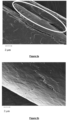
- As evidenced by microscopy (Scanning Electron Microscopy), hair repair is perceivable. Hair fibers that have been treated with the formulation of the invention look healthier from the first use and onwards.
- As depicted in
Figure 1 , after 1 application of the formulation of the invention, hair surface looks smoother, cuticles are partially repaired and bridges are formed between the split ends (partial sealing of split ends is achieved, which is sufficient to bring the splits together). Hair ends diameter appears thicker and looks healthier. - As depicted in
Figure 2 , after several (3) consecutive applications of the formulation split ends are fully sealed and cuticles layed down. - These examples illustrate that the specific cationic polygalactomannan containing non-ionic hydroxyalkyl substituents namely cationic polygalactomannan containing non-ionic hydroxyalkyl substituents having a Brookfield RVT viscosity at 25°C and 20 rpm comprised between 700 and 1,200 mPa.s (and preferably lower than 950 mPa.s especially lower than 850 mPa.s), at a concentration of 1 pbw in water, is highly effective in mending split ends.
- The performances of a formulation have also been compared to a benchmark composition (namely TRESemmé Split Remedy Split Ends, which includes, as agent for mending split ends, a polyelectrolyte complex as taught in
US 2005/0089494 andUS 2006/0251603 ). - The following serum composition was prepared.
Formulation of the invention Hydroxypropyl Guar Hydroxypropyl trimonium chloride having a Brookfield RVT viscosity at 25°C and 20 rpm comprised between 750 and 850 mPa.s, at a concentration of 1 pbw in water (a) 0.5 Ethanol 10 Glycerin 1 Panthenol 0.5 Preservative <0.5 Water q.s. - (a) available from Rhodia under the name Polycare® Split Therapy
- The percentage of split ends repaired was measured following the same procedure and method as disclosed in Example 1.
- Results were the following:
Formulation Control Formulation Formulation of the invention Benchmark formulation (TRESemmé Split Remedy Split Ends) % of Repair (calculation) 10 93 60 % of Repair (trend) Reference +++ + - A formulation which includes a specific cationic polygalactomannan containing non-ionic hydroxyalkyl substituents exhibits significantly improved split ends mending compared to the benchmark formulation (which includes, as agent for mending split ends, a polyelectrolyte complex combining polyquaternium-28 and methylvinylether/maleic acid copolymer, at particular ratios) and compared to the Control Formulation (which contains no ingredient acting specifically as agent for mending split ends).
- Tests also confirmed that split ends mending achieved when using the formulation resisted daily combing (everyday grooming).
- Compared to this benchmark formulation, the formulation is easier to use (more versatile).
- Sensory assessment also demonstrated that the formulation exhibited improved sensorial performance compared to this benchmark formulation.
- A "curl retention" test was set-up. The test takes place in a controlled climatic room (RH=50% ±10, T=23°C). Pre-treated bleached tresses of 4 grams are used. One tress is used per system.
- "Control Formulation" and "Formulation of the invention" as described in Example 1 are used. Hair tresses were purchased from Kerling International. European Natural Human Hair strong bleached, of the following characteristics:
Color 10/0, 19 cm total length, 17 cm of free hair. 2.5 cm width. 4 g weight free hair. - Wet the tress during 1 min under running water (or soak during 10 min in water if using several hair tresses). Apply on the
whole tress 3 ml of a 10 pbw active sodium diethoxylated dodecyl sulfate (SLE2S) solution. Shampoo during 1 min, 30 sec on each side. Rinse during 1 min. Squeeze between index and middle finger. Detangle using middle teeth comb followed by fine teeth comb. Leave overnight in the controlled climate room (RH=50% ±10, T=23°C) -
- 1. Comb the tress twice with large teeth comb then twice with fine teeth comb.
- 2. Place the tresses on a mount with a grid background and take a picture of the initial appearance.
- 3. Apply 500 mg of the formulation on the last 5 cm of the tress: hold the tress at the tips by tightening the fibers then soak tips vertically in the formulation and massage the tips. Hold the tress at the mid-height and retrieve the remaining formulation of the container by scrubbing the tress on it. Massage during 30 s from top to bottom.
- 4. Gently wrap the tress around a curler.
- 5. Dry 20 min at 60°C, in a ventilated oven.
- 6. Gently remove the curler from the tress.
- 7. Place the tresses on the mount and take a picture at t=0.
- 8. Take pictures at 3 hours then at 72 hours.
-
Tress 1 was treated with the "Control Formulation" whileTress 2 was treated with the "Formulation of the invention" (Figure 3 ). - As depicted in
Figure 3 , the curl unties after 3 hours when treated with the "Control Formulation" (tress 1). The curl/shape is maintained even after 72 hours under the study conditions, when treated with the "Formulation of the invention" (tress 2). - The Formulation of the invention shows a good effect for shaping the hair, namely curl retention.
- In order to verify the durability of the Repair effect against washing, one application of the formulation was followed by several shampoo (washing) steps. At each step, the % Repair was evaluated. 5 hair tresses were used per system.
- The "Formulation" as described in Example 1 was used.
- The (neutral) shampoo formulation was as follows: SLES (sodium lauryl ether sulfate) 12% wt CAPB (cocamidopropyl betaine) 2% wt, pH= 5.
- Hair tresses were purchased from Kerling International. European natural Human Hair of the following characteristics: Color 6/0, 20 cm total length, 18 cm of free hair. 2 g weight free hair.
- The hair tresses were pre-treated (see Hair pre-treatment protocol). Then the hair tresses were altered by mechanical action using the apparatus Spin Split Hair®.
- Each tress to be studied is attached to the apparatus and then subjected to the alternating brushing of the two brushes, while a hairdryer sends hot air continuously on the tress. The combined action of repeated brushing and heat contributes to the deterioration of the tress, and in particular to the production of split ends.
- The tress is attached to the Spin Split Hair®. The unit is set at 75 rotations per minute. Each tress is subjected to an alteration cycle of one hour, which is equivalent to about 9000 strokes of brushes.
- The tresses of hair are examined with a magnifying glass and tweezers. Each tress of hair is divided into 6 parts (subgroups) in which 50 hair fibers are selected and for each fiber, the technician identifies the presence or absence of a split end. For a tress, the technician raises a number of split ends per subgroup of tress, 6 values per tress and finally 30 values for all 5 tresses used per product. In the end, 1500 hair fibers are examined on all 5 tresses.
- The repair effect of the formulation was evaluated after the formulation application (Initial Repair) and after consecutive 1, 3, 5, and 10 shampoo applications.
- Application rules:
- Wet the tress and massage the whole length for 45 seconds with the neutral shampoo using 0.2g of shampoo for 2g of tress.
- Rinse thoroughly for 45 seconds and squeeze between index and middle finger. Let air dry the tress. Count the initial number of split ends.
- Apply 0.3g of formulation (for 2g tress) containing the Polycare® Split Therapy on the last 8 cm of the tress (tips).
- Distribute the product on the tress by massaging.
- Let air dry the tress. Count the number of split ends. This gives access to the Initial Repair. Then proceed to additional shampooing (as described above) with intermediate counts of the split ends after 1 shampoo, 3 shampoos, 5 shampoos and 10 shampoos. This gives access to the % of the Initial Repair that is retained after each shampooing (
Figure 4 ). - As depicted in
Figure 4 , the performance is stable after 10 neutral shampoo applications: most of the repair obtained after 1 serum application is retained. - Thus the Repair effect of Formulation is durable against several washing cycles.
- Same formulation and tress alteration protocol as described above are used.
- In order to verify the durability of the Repair effect against combing, one application of the formulation was followed by 20 combings. The % Repair was calculated. 5 hair tresses were used per system.
- Application rules:
- Wet the tress and massage the whole length for 45 seconds with the neutral shampoo using 0.2g of shampoo for 2g of tress.
- Rinse thoroughly for 45 seconds and squeeze between index and middle finger. Let air dry the tress. Count the initial number of split ends.
- Apply 0.3g of formulation (for 2g tress) containing the Polycare® Split Therapy on the last 8 cm of the tress (tips).
- Distribute the product on the tress by massaging.
- Let air dry the tress. Count the number of split ends. This gives access to the Initial Repair. Then proceed to 20 combings with a fine teeth comb. Count the number of split ends. This gives access to the % of the Initial Repair that is retained after 20 combings.
- The test showed a 77% of the Initial Repair that is retained after 20 combings.
- Thus the Repair effect of the Formulation is durable against several combings, which simulates the everyday grooming process of the consumers.
Claims (8)
- Use of one cationic polygalactomannan containing non-ionic hydroxyalkyl substituents and having a Brookfield RVT viscosity at 25°C and 20 rpm comprised between 700 and 1,200 mPa.s, at a concentration of 1 pbw in water and at a pH of 5 +/- 0.1, as an agent for hair shaping, for example, for curl retention of hair.
- The use of the cationic polygalactomannan containing non-ionic hydroxyalkyl substituents according to claim 1, having a Brookfield RVT viscosity at 25°C and 20 rpm comprised between 700 and 950 mPa.s, at a concentration of 1 pbw in water at a pH of 5+/-0.1.
- The use of the cationic polygalactomannan containing non-ionic hydroxyalkyl substituents according to claim 1 or 2, having a Brookfield RVT viscosity at 25°C and 20 rpm comprised between 750 and 950 mPa.s, at a concentration of 1 pbw in water at a pH of 5 +/- 0.1.
- The use of one cationic polygalactomannan containing non-ionic hydroxyalkyl substituents according to anyone of the preceding claims, having a Brookfield RVT viscosity at 25°C and 20 rpm comprised between 750 and 900 mPa.s, at a concentration of 1 pbw in water at a pH of 5 +/- 0.1.
- The use of one cationic polygalactomannan containing non-ionic hydroxyalkyl substituents according to anyone of the preceding claims, having a Brookfield RVT viscosity at 25°C and 20 rpm comprised between 750 and 850 mPa.s, at a concentration of 1 pbw in water at a pH of 5 +/- 0.1.
- The use of one cationic polygalactomannan containing non-ionic hydroxyalkyl substituents according to anyone of the preceding claims, wherein said galactomannan is guar.
- The use of one cationic polygalactomannan containing non-ionic hydroxyalkyl substituents according to anyone of the preceding claims, characterized in that it is a cationic guar containing hydroxypropyl substituents.
- The use of one cationic polygalactomannan containing non-ionic hydroxyalkyl substituents according to anyone of the preceding claims, characterized in that it is a hydroxypropyl guar hydroxypropyltrimonium chloride.
Applications Claiming Priority (2)
| Application Number | Priority Date | Filing Date | Title |
|---|---|---|---|
| EP17170371 | 2017-05-10 | ||
| PCT/EP2018/061495 WO2018206425A1 (en) | 2017-05-10 | 2018-05-04 | Hair repair composition |
Publications (2)
| Publication Number | Publication Date |
|---|---|
| EP3621696A1 EP3621696A1 (en) | 2020-03-18 |
| EP3621696B1 true EP3621696B1 (en) | 2024-07-10 |
Family
ID=58699062
Family Applications (1)
| Application Number | Title | Priority Date | Filing Date |
|---|---|---|---|
| EP18722515.6A Active EP3621696B1 (en) | 2017-05-10 | 2018-05-04 | Hair repair composition |
Country Status (6)
| Country | Link |
|---|---|
| US (2) | US11806422B2 (en) |
| EP (1) | EP3621696B1 (en) |
| JP (1) | JP7286548B2 (en) |
| CN (1) | CN110799246B (en) |
| BR (1) | BR112019023113A2 (en) |
| WO (1) | WO2018206425A1 (en) |
Families Citing this family (3)
| Publication number | Priority date | Publication date | Assignee | Title |
|---|---|---|---|---|
| DE102020204995A1 (en) * | 2020-04-21 | 2021-10-21 | Henkel Ag & Co. Kgaa | HAIR COMPOSITIONS INCLUDING A MODIFIED POLYSACCHARIDE AND A PROTEIN HYDROLYZATE |
| DE102020205003A1 (en) * | 2020-04-21 | 2021-10-21 | Henkel Ag & Co. Kgaa | SILICONE-FREE LEAVE-IN HAIR SERRES INCLUDING A MODIFIED POLYSACCHARIDE AND VEGETABLE OIL |
| DE102020204994A1 (en) * | 2020-04-21 | 2021-10-21 | Henkel Ag & Co. Kgaa | HAIR COMPOSITIONS MADE FROM A MODIFIED POLYSACCHARIDE AND HIGH VALUE IONS |
Citations (1)
| Publication number | Priority date | Publication date | Assignee | Title |
|---|---|---|---|---|
| WO2018065416A1 (en) * | 2016-10-04 | 2018-04-12 | Rhodia Operations | Hair repair composition |
Family Cites Families (39)
| Publication number | Priority date | Publication date | Assignee | Title |
|---|---|---|---|---|
| US3472840A (en) | 1965-09-14 | 1969-10-14 | Union Carbide Corp | Quaternary nitrogen-containing cellulose ethers |
| US4031307A (en) | 1976-05-03 | 1977-06-21 | Celanese Corporation | Cationic polygalactomannan compositions |
| US4663159A (en) | 1985-02-01 | 1987-05-05 | Union Carbide Corporation | Hydrophobe substituted, water-soluble cationic polysaccharides |
| US4959464A (en) | 1988-11-07 | 1990-09-25 | Hi-Tek Polymers, Inc. | Process for derivatizing polygalactomannan using water soluble aluminum salts in the process |
| GB9208652D0 (en) * | 1992-04-22 | 1992-06-10 | Unilever Plc | Hair care composition |
| US5387675A (en) | 1993-03-10 | 1995-02-07 | Rhone-Poulenc Specialty Chemicals Co. | Modified hydrophobic cationic thickening compositions |
| FR2709954B1 (en) | 1993-09-15 | 1995-10-20 | Oreal | Cosmetic compositions containing a linear polysiloxane-polyoxyalkylene block copolymer and a cationic polymer, and their uses. |
| DE69501425T2 (en) | 1994-04-25 | 1998-04-23 | Oreal | Use of a non-ionic or anionic guar gum in a non-permanent deformation of ceramic fibers |
| DE69718339T2 (en) * | 1996-10-25 | 2003-10-30 | Rhodia Inc., Cranbury | COMPOSITION BASED ON DERIVATIZED GUAR RUBBER, WHICH CONTAINS NON-IONIC AND CATIONIC GROUPS, AND THE SOLUTIONS MADE THEREOF ARE VERY CLEAR AND USED IN CLEANING AGENTS |
| US5756720A (en) * | 1996-10-25 | 1998-05-26 | Rhodia Inc. | Derivatized guar gum composition including nonionic and cationic groups which demonstrate excellent solution clarity properties |
| DE19757214A1 (en) | 1997-12-22 | 1999-06-24 | Henkel Kgaa | Agent with excellent hair conditioning action and good compatibility with other formulations |
| US6258348B1 (en) | 1999-08-27 | 2001-07-10 | Bristol-Myers Squibb Company | Hair conditioning formulation for mending split ends |
| US7067499B2 (en) * | 2002-05-06 | 2006-06-27 | Hercules Incorporated | Cationic polymer composition and its use in conditioning applications |
| US6723310B2 (en) * | 2002-07-29 | 2004-04-20 | Albert Zofchak | Hair conditioning formulation |
| US7759296B2 (en) | 2003-06-19 | 2010-07-20 | Lubrizol Advanced Materials, Inc. | Cationic polymers and fixative application therefor |
| US20050089494A1 (en) | 2003-10-28 | 2005-04-28 | Isp Investments Inc. | Mending hair damage with polyelectrolyte complexes |
| EP1552807A1 (en) | 2004-01-07 | 2005-07-13 | Alzo International, Inc. | Hair conditioning formulation |
| US7837983B2 (en) | 2004-07-14 | 2010-11-23 | Isp Investments Inc. | Mending hair damage with polyelectrolyte complexes |
| US20060024260A1 (en) | 2004-07-29 | 2006-02-02 | Cecile Bebot | Cosmetic composition comprising a water-dispersible linear sulphonic polyester and a modified guar gum, methods employing this composition and uses |
| EP1791518A1 (en) * | 2004-09-24 | 2007-06-06 | Hercules Incorporated | High ds cationic polygalactomannan for skincare products |
| WO2008057425A1 (en) * | 2006-11-03 | 2008-05-15 | Hercules Incorporated | Dispersible glyoxal treated cationi c polygalactomannan polymers |
| FR2910308A1 (en) | 2006-12-20 | 2008-06-27 | Oreal | Composition for treating keratinic fibers, especially for hair styling, comprises a cationic polymer and two silicones that react together by hydrosilylation, condensation or crosslinking |
| WO2009045556A1 (en) * | 2007-10-05 | 2009-04-09 | Peter Coppola | Treatment method for revitalizing hair and method of producing keratin protein treatment solution |
| JP2008137990A (en) | 2007-10-22 | 2008-06-19 | Hiromi Muro | Hair treatment agent kit and hair treatment mixture agent |
| GB0813140D0 (en) * | 2008-07-18 | 2008-08-27 | Dow Corning | Home and personal care compositions |
| IT1391979B1 (en) | 2008-07-18 | 2012-02-02 | Lamberti Spa | MODERN GALACTOMANNAN ETHERS |
| KR20110042281A (en) | 2008-07-30 | 2011-04-26 | 로디아 오퍼레이션스 | Process for preparing crosslinked polysaccharide particles |
| DE102008041020A1 (en) * | 2008-08-06 | 2010-02-11 | Evonik Goldschmidt Gmbh | Use of polysiloxanes with quaternary ammonium groups to protect animal or human hair from heat damage |
| EP2216010A1 (en) * | 2009-02-05 | 2010-08-11 | Rhodia Opérations | Aqueous composition suitable as shampoo |
| JP2012524038A (en) | 2009-04-15 | 2012-10-11 | ロディア オペレーションズ | How to treat damaged hair |
| JP4518520B1 (en) | 2009-04-28 | 2010-08-04 | 株式会社資生堂 | Hairdressing cosmetics |
| US8568701B2 (en) * | 2009-07-02 | 2013-10-29 | Hercules Incorporated | Cationic synthetic polymers with improved solubility and performance in phosphate surfactant-based systems and use in personal care and household applications |
| US8343469B2 (en) * | 2009-07-02 | 2013-01-01 | Hercules Incorporated | Cationic synthetic polymers with improved solubility and performance in surfactant-based systems and use in personal care and household applications |
| CA2918830A1 (en) * | 2013-08-23 | 2015-02-26 | The Procter & Gamble Company | Hair treatment methods and kits thereof |
| KR102282084B1 (en) | 2013-10-07 | 2021-07-28 | 허큘레스 엘엘씨 | Dihydroxyalkyl substituted polygalactomannan, and methods for producing and using the same |
| CN103550108B (en) * | 2013-11-15 | 2016-01-20 | 广州好迪集团有限公司 | Nourishing hair and injury repairing shampoo |
| WO2015074691A1 (en) * | 2013-11-20 | 2015-05-28 | Rhodia Operations | Hair conditioning composition |
| DE102015206058A1 (en) | 2015-04-02 | 2016-10-06 | Henkel Ag & Co. Kgaa | Agent for keratin-containing fibers, containing at least one anionic copolymer based on acrylates and at least one cationically modified guar derivative |
| WO2018065418A1 (en) | 2016-10-04 | 2018-04-12 | Rhodia Operations | Hair repair composition |
-
2018
- 2018-05-04 CN CN201880030837.7A patent/CN110799246B/en active Active
- 2018-05-04 JP JP2019561872A patent/JP7286548B2/en active Active
- 2018-05-04 BR BR112019023113-7A patent/BR112019023113A2/en not_active Application Discontinuation
- 2018-05-04 WO PCT/EP2018/061495 patent/WO2018206425A1/en not_active Ceased
- 2018-05-04 US US16/611,400 patent/US11806422B2/en active Active
- 2018-05-04 EP EP18722515.6A patent/EP3621696B1/en active Active
-
2023
- 2023-09-07 US US18/462,468 patent/US20240122839A1/en active Pending
Patent Citations (1)
| Publication number | Priority date | Publication date | Assignee | Title |
|---|---|---|---|---|
| WO2018065416A1 (en) * | 2016-10-04 | 2018-04-12 | Rhodia Operations | Hair repair composition |
Non-Patent Citations (1)
| Title |
|---|
| PACIFIC ASIA ET AL: "The way we do business Versatility in Creating Formulations For Different Consumer Benefits", 1 March 2017 (2017-03-01), pages 1 - 6, XP055802978, Retrieved from the Internet <URL:https://www.chemlink.co.uk/wp-content/uploads/2014/05/IPAD-Polycare-Split-Therapy.pdf> [retrieved on 20210510] * |
Also Published As
| Publication number | Publication date |
|---|---|
| CN110799246A (en) | 2020-02-14 |
| US11806422B2 (en) | 2023-11-07 |
| WO2018206425A1 (en) | 2018-11-15 |
| CN110799246B (en) | 2023-11-28 |
| US20240122839A1 (en) | 2024-04-18 |
| EP3621696A1 (en) | 2020-03-18 |
| BR112019023113A2 (en) | 2020-05-26 |
| US20200163861A1 (en) | 2020-05-28 |
| JP7286548B2 (en) | 2023-06-05 |
| JP2020519608A (en) | 2020-07-02 |
Similar Documents
| Publication | Publication Date | Title |
|---|---|---|
| EP2088994B1 (en) | Dispersible glyoxal crosslinked cationic guar | |
| US20240122839A1 (en) | Hair repair composition | |
| US8796196B2 (en) | Polysaccharide products with improved performance and clarity in surfactant-based aqueous formulations and process for preparation | |
| US8790627B2 (en) | Personal care composition additive for application on keratin substrates to provide long lasting benefits | |
| KR102930001B1 (en) | Hair styling composition comprising polygalactomannan, and method of using the same | |
| US20230414480A1 (en) | Hair repair composition | |
| US20120093900A1 (en) | Capillary composition for treating hair | |
| JP2025121916A (en) | hair repair composition | |
| US20250170044A1 (en) | Multi-modal hair care composition comprising cationic guar blends and process for preparation thereof | |
| US20120103358A1 (en) | Capillary composition for treating hair | |
| WO2025002785A1 (en) | Personal cleansing composition | |
| US20190224103A1 (en) | Hair repair composition |
Legal Events
| Date | Code | Title | Description |
|---|---|---|---|
| STAA | Information on the status of an ep patent application or granted ep patent |
Free format text: STATUS: UNKNOWN |
|
| STAA | Information on the status of an ep patent application or granted ep patent |
Free format text: STATUS: THE INTERNATIONAL PUBLICATION HAS BEEN MADE |
|
| PUAI | Public reference made under article 153(3) epc to a published international application that has entered the european phase |
Free format text: ORIGINAL CODE: 0009012 |
|
| STAA | Information on the status of an ep patent application or granted ep patent |
Free format text: STATUS: REQUEST FOR EXAMINATION WAS MADE |
|
| 17P | Request for examination filed |
Effective date: 20191210 |
|
| AK | Designated contracting states |
Kind code of ref document: A1 Designated state(s): AL AT BE BG CH CY CZ DE DK EE ES FI FR GB GR HR HU IE IS IT LI LT LU LV MC MK MT NL NO PL PT RO RS SE SI SK SM TR |
|
| AX | Request for extension of the european patent |
Extension state: BA ME |
|
| RAP1 | Party data changed (applicant data changed or rights of an application transferred) |
Owner name: RHODIA OPERATIONS |
|
| DAV | Request for validation of the european patent (deleted) | ||
| DAX | Request for extension of the european patent (deleted) | ||
| STAA | Information on the status of an ep patent application or granted ep patent |
Free format text: STATUS: EXAMINATION IS IN PROGRESS |
|
| 17Q | First examination report despatched |
Effective date: 20210514 |
|
| RAP3 | Party data changed (applicant data changed or rights of an application transferred) |
Owner name: RHODIA OPERATIONS |
|
| RAP1 | Party data changed (applicant data changed or rights of an application transferred) |
Owner name: SPECIALTY OPERATIONS FRANCE |
|
| GRAP | Despatch of communication of intention to grant a patent |
Free format text: ORIGINAL CODE: EPIDOSNIGR1 |
|
| STAA | Information on the status of an ep patent application or granted ep patent |
Free format text: STATUS: GRANT OF PATENT IS INTENDED |
|
| INTG | Intention to grant announced |
Effective date: 20240205 |
|
| GRAS | Grant fee paid |
Free format text: ORIGINAL CODE: EPIDOSNIGR3 |
|
| GRAA | (expected) grant |
Free format text: ORIGINAL CODE: 0009210 |
|
| STAA | Information on the status of an ep patent application or granted ep patent |
Free format text: STATUS: THE PATENT HAS BEEN GRANTED |
|
| AK | Designated contracting states |
Kind code of ref document: B1 Designated state(s): AL AT BE BG CH CY CZ DE DK EE ES FI FR GB GR HR HU IE IS IT LI LT LU LV MC MK MT NL NO PL PT RO RS SE SI SK SM TR |
|
| REG | Reference to a national code |
Ref country code: CH Ref legal event code: EP |
|
| REG | Reference to a national code |
Ref country code: DE Ref legal event code: R096 Ref document number: 602018071550 Country of ref document: DE |
|
| REG | Reference to a national code |
Ref country code: LT Ref legal event code: MG9D |
|
| REG | Reference to a national code |
Ref country code: NL Ref legal event code: MP Effective date: 20240710 |
|
| PG25 | Lapsed in a contracting state [announced via postgrant information from national office to epo] |
Ref country code: PT Free format text: LAPSE BECAUSE OF FAILURE TO SUBMIT A TRANSLATION OF THE DESCRIPTION OR TO PAY THE FEE WITHIN THE PRESCRIBED TIME-LIMIT Effective date: 20241111 |
|
| REG | Reference to a national code |
Ref country code: AT Ref legal event code: MK05 Ref document number: 1701538 Country of ref document: AT Kind code of ref document: T Effective date: 20240710 |
|
| PG25 | Lapsed in a contracting state [announced via postgrant information from national office to epo] |
Ref country code: NL Free format text: LAPSE BECAUSE OF FAILURE TO SUBMIT A TRANSLATION OF THE DESCRIPTION OR TO PAY THE FEE WITHIN THE PRESCRIBED TIME-LIMIT Effective date: 20240710 |
|
| PG25 | Lapsed in a contracting state [announced via postgrant information from national office to epo] |
Ref country code: PT Free format text: LAPSE BECAUSE OF FAILURE TO SUBMIT A TRANSLATION OF THE DESCRIPTION OR TO PAY THE FEE WITHIN THE PRESCRIBED TIME-LIMIT Effective date: 20241111 Ref country code: NL Free format text: LAPSE BECAUSE OF FAILURE TO SUBMIT A TRANSLATION OF THE DESCRIPTION OR TO PAY THE FEE WITHIN THE PRESCRIBED TIME-LIMIT Effective date: 20240710 |
|
| PG25 | Lapsed in a contracting state [announced via postgrant information from national office to epo] |
Ref country code: NO Free format text: LAPSE BECAUSE OF FAILURE TO SUBMIT A TRANSLATION OF THE DESCRIPTION OR TO PAY THE FEE WITHIN THE PRESCRIBED TIME-LIMIT Effective date: 20241010 |
|
| PG25 | Lapsed in a contracting state [announced via postgrant information from national office to epo] |
Ref country code: GR Free format text: LAPSE BECAUSE OF FAILURE TO SUBMIT A TRANSLATION OF THE DESCRIPTION OR TO PAY THE FEE WITHIN THE PRESCRIBED TIME-LIMIT Effective date: 20241011 Ref country code: FI Free format text: LAPSE BECAUSE OF FAILURE TO SUBMIT A TRANSLATION OF THE DESCRIPTION OR TO PAY THE FEE WITHIN THE PRESCRIBED TIME-LIMIT Effective date: 20240710 Ref country code: PL Free format text: LAPSE BECAUSE OF FAILURE TO SUBMIT A TRANSLATION OF THE DESCRIPTION OR TO PAY THE FEE WITHIN THE PRESCRIBED TIME-LIMIT Effective date: 20240710 |
|
| PG25 | Lapsed in a contracting state [announced via postgrant information from national office to epo] |
Ref country code: BG Free format text: LAPSE BECAUSE OF FAILURE TO SUBMIT A TRANSLATION OF THE DESCRIPTION OR TO PAY THE FEE WITHIN THE PRESCRIBED TIME-LIMIT Effective date: 20240710 |
|
| PG25 | Lapsed in a contracting state [announced via postgrant information from national office to epo] |
Ref country code: LV Free format text: LAPSE BECAUSE OF FAILURE TO SUBMIT A TRANSLATION OF THE DESCRIPTION OR TO PAY THE FEE WITHIN THE PRESCRIBED TIME-LIMIT Effective date: 20240710 |
|
| PG25 | Lapsed in a contracting state [announced via postgrant information from national office to epo] |
Ref country code: IS Free format text: LAPSE BECAUSE OF FAILURE TO SUBMIT A TRANSLATION OF THE DESCRIPTION OR TO PAY THE FEE WITHIN THE PRESCRIBED TIME-LIMIT Effective date: 20241110 Ref country code: AT Free format text: LAPSE BECAUSE OF FAILURE TO SUBMIT A TRANSLATION OF THE DESCRIPTION OR TO PAY THE FEE WITHIN THE PRESCRIBED TIME-LIMIT Effective date: 20240710 |
|
| PG25 | Lapsed in a contracting state [announced via postgrant information from national office to epo] |
Ref country code: HR Free format text: LAPSE BECAUSE OF FAILURE TO SUBMIT A TRANSLATION OF THE DESCRIPTION OR TO PAY THE FEE WITHIN THE PRESCRIBED TIME-LIMIT Effective date: 20240710 |
|
| PG25 | Lapsed in a contracting state [announced via postgrant information from national office to epo] |
Ref country code: ES Free format text: LAPSE BECAUSE OF FAILURE TO SUBMIT A TRANSLATION OF THE DESCRIPTION OR TO PAY THE FEE WITHIN THE PRESCRIBED TIME-LIMIT Effective date: 20240710 Ref country code: RS Free format text: LAPSE BECAUSE OF FAILURE TO SUBMIT A TRANSLATION OF THE DESCRIPTION OR TO PAY THE FEE WITHIN THE PRESCRIBED TIME-LIMIT Effective date: 20241010 |
|
| PG25 | Lapsed in a contracting state [announced via postgrant information from national office to epo] |
Ref country code: RS Free format text: LAPSE BECAUSE OF FAILURE TO SUBMIT A TRANSLATION OF THE DESCRIPTION OR TO PAY THE FEE WITHIN THE PRESCRIBED TIME-LIMIT Effective date: 20241010 Ref country code: PL Free format text: LAPSE BECAUSE OF FAILURE TO SUBMIT A TRANSLATION OF THE DESCRIPTION OR TO PAY THE FEE WITHIN THE PRESCRIBED TIME-LIMIT Effective date: 20240710 Ref country code: NO Free format text: LAPSE BECAUSE OF FAILURE TO SUBMIT A TRANSLATION OF THE DESCRIPTION OR TO PAY THE FEE WITHIN THE PRESCRIBED TIME-LIMIT Effective date: 20241010 Ref country code: LV Free format text: LAPSE BECAUSE OF FAILURE TO SUBMIT A TRANSLATION OF THE DESCRIPTION OR TO PAY THE FEE WITHIN THE PRESCRIBED TIME-LIMIT Effective date: 20240710 Ref country code: IS Free format text: LAPSE BECAUSE OF FAILURE TO SUBMIT A TRANSLATION OF THE DESCRIPTION OR TO PAY THE FEE WITHIN THE PRESCRIBED TIME-LIMIT Effective date: 20241110 Ref country code: HR Free format text: LAPSE BECAUSE OF FAILURE TO SUBMIT A TRANSLATION OF THE DESCRIPTION OR TO PAY THE FEE WITHIN THE PRESCRIBED TIME-LIMIT Effective date: 20240710 Ref country code: GR Free format text: LAPSE BECAUSE OF FAILURE TO SUBMIT A TRANSLATION OF THE DESCRIPTION OR TO PAY THE FEE WITHIN THE PRESCRIBED TIME-LIMIT Effective date: 20241011 Ref country code: FI Free format text: LAPSE BECAUSE OF FAILURE TO SUBMIT A TRANSLATION OF THE DESCRIPTION OR TO PAY THE FEE WITHIN THE PRESCRIBED TIME-LIMIT Effective date: 20240710 Ref country code: ES Free format text: LAPSE BECAUSE OF FAILURE TO SUBMIT A TRANSLATION OF THE DESCRIPTION OR TO PAY THE FEE WITHIN THE PRESCRIBED TIME-LIMIT Effective date: 20240710 Ref country code: BG Free format text: LAPSE BECAUSE OF FAILURE TO SUBMIT A TRANSLATION OF THE DESCRIPTION OR TO PAY THE FEE WITHIN THE PRESCRIBED TIME-LIMIT Effective date: 20240710 Ref country code: AT Free format text: LAPSE BECAUSE OF FAILURE TO SUBMIT A TRANSLATION OF THE DESCRIPTION OR TO PAY THE FEE WITHIN THE PRESCRIBED TIME-LIMIT Effective date: 20240710 |
|
| REG | Reference to a national code |
Ref country code: DE Ref legal event code: R097 Ref document number: 602018071550 Country of ref document: DE |
|
| PG25 | Lapsed in a contracting state [announced via postgrant information from national office to epo] |
Ref country code: SM Free format text: LAPSE BECAUSE OF FAILURE TO SUBMIT A TRANSLATION OF THE DESCRIPTION OR TO PAY THE FEE WITHIN THE PRESCRIBED TIME-LIMIT Effective date: 20240710 Ref country code: DK Free format text: LAPSE BECAUSE OF FAILURE TO SUBMIT A TRANSLATION OF THE DESCRIPTION OR TO PAY THE FEE WITHIN THE PRESCRIBED TIME-LIMIT Effective date: 20240710 Ref country code: RO Free format text: LAPSE BECAUSE OF FAILURE TO SUBMIT A TRANSLATION OF THE DESCRIPTION OR TO PAY THE FEE WITHIN THE PRESCRIBED TIME-LIMIT Effective date: 20240710 |
|
| PG25 | Lapsed in a contracting state [announced via postgrant information from national office to epo] |
Ref country code: EE Free format text: LAPSE BECAUSE OF FAILURE TO SUBMIT A TRANSLATION OF THE DESCRIPTION OR TO PAY THE FEE WITHIN THE PRESCRIBED TIME-LIMIT Effective date: 20240710 |
|
| PG25 | Lapsed in a contracting state [announced via postgrant information from national office to epo] |
Ref country code: CZ Free format text: LAPSE BECAUSE OF FAILURE TO SUBMIT A TRANSLATION OF THE DESCRIPTION OR TO PAY THE FEE WITHIN THE PRESCRIBED TIME-LIMIT Effective date: 20240710 |
|
| PG25 | Lapsed in a contracting state [announced via postgrant information from national office to epo] |
Ref country code: IT Free format text: LAPSE BECAUSE OF FAILURE TO SUBMIT A TRANSLATION OF THE DESCRIPTION OR TO PAY THE FEE WITHIN THE PRESCRIBED TIME-LIMIT Effective date: 20240710 Ref country code: SK Free format text: LAPSE BECAUSE OF FAILURE TO SUBMIT A TRANSLATION OF THE DESCRIPTION OR TO PAY THE FEE WITHIN THE PRESCRIBED TIME-LIMIT Effective date: 20240710 |
|
| PLBE | No opposition filed within time limit |
Free format text: ORIGINAL CODE: 0009261 |
|
| STAA | Information on the status of an ep patent application or granted ep patent |
Free format text: STATUS: NO OPPOSITION FILED WITHIN TIME LIMIT |
|
| 26N | No opposition filed |
Effective date: 20250411 |
|
| PGFP | Annual fee paid to national office [announced via postgrant information from national office to epo] |
Ref country code: DE Payment date: 20250402 Year of fee payment: 8 |
|
| PGFP | Annual fee paid to national office [announced via postgrant information from national office to epo] |
Ref country code: FR Payment date: 20250401 Year of fee payment: 8 |
|
| PG25 | Lapsed in a contracting state [announced via postgrant information from national office to epo] |
Ref country code: SE Free format text: LAPSE BECAUSE OF FAILURE TO SUBMIT A TRANSLATION OF THE DESCRIPTION OR TO PAY THE FEE WITHIN THE PRESCRIBED TIME-LIMIT Effective date: 20240710 |
|
| REG | Reference to a national code |
Ref country code: CH Ref legal event code: H13 Free format text: ST27 STATUS EVENT CODE: U-0-0-H10-H13 (AS PROVIDED BY THE NATIONAL OFFICE) Effective date: 20251223 |
|
| PG25 | Lapsed in a contracting state [announced via postgrant information from national office to epo] |
Ref country code: LU Free format text: LAPSE BECAUSE OF NON-PAYMENT OF DUE FEES Effective date: 20250504 |
|
| PG25 | Lapsed in a contracting state [announced via postgrant information from national office to epo] |
Ref country code: CH Free format text: LAPSE BECAUSE OF NON-PAYMENT OF DUE FEES Effective date: 20250531 |
|
| REG | Reference to a national code |
Ref country code: BE Ref legal event code: MM Effective date: 20250531 |
|
| PG25 | Lapsed in a contracting state [announced via postgrant information from national office to epo] |
Ref country code: MC Free format text: LAPSE BECAUSE OF FAILURE TO SUBMIT A TRANSLATION OF THE DESCRIPTION OR TO PAY THE FEE WITHIN THE PRESCRIBED TIME-LIMIT Effective date: 20240710 |
|
| PGFP | Annual fee paid to national office [announced via postgrant information from national office to epo] |
Ref country code: GB Payment date: 20260313 Year of fee payment: 9 |
|
| PG25 | Lapsed in a contracting state [announced via postgrant information from national office to epo] |
Ref country code: IE Free format text: LAPSE BECAUSE OF NON-PAYMENT OF DUE FEES Effective date: 20250504 |
|
| PG25 | Lapsed in a contracting state [announced via postgrant information from national office to epo] |
Ref country code: BE Free format text: LAPSE BECAUSE OF NON-PAYMENT OF DUE FEES Effective date: 20250531 |