EP3620940A1 - Dialogue generation method and apparatus, and electronic device - Google Patents
Dialogue generation method and apparatus, and electronic device Download PDFInfo
- Publication number
- EP3620940A1 EP3620940A1 EP18814267.3A EP18814267A EP3620940A1 EP 3620940 A1 EP3620940 A1 EP 3620940A1 EP 18814267 A EP18814267 A EP 18814267A EP 3620940 A1 EP3620940 A1 EP 3620940A1
- Authority
- EP
- European Patent Office
- Prior art keywords
- topic
- dialog
- sequence
- training
- output sequence
- Prior art date
- Legal status (The legal status is an assumption and is not a legal conclusion. Google has not performed a legal analysis and makes no representation as to the accuracy of the status listed.)
- Withdrawn
Links
Images


Classifications
-
- G—PHYSICS
- G06—COMPUTING OR CALCULATING; COUNTING
- G06N—COMPUTING ARRANGEMENTS BASED ON SPECIFIC COMPUTATIONAL MODELS
- G06N3/00—Computing arrangements based on biological models
- G06N3/02—Neural networks
- G06N3/08—Learning methods
- G06N3/088—Non-supervised learning, e.g. competitive learning
-
- G—PHYSICS
- G06—COMPUTING OR CALCULATING; COUNTING
- G06F—ELECTRIC DIGITAL DATA PROCESSING
- G06F40/00—Handling natural language data
- G06F40/30—Semantic analysis
-
- G—PHYSICS
- G06—COMPUTING OR CALCULATING; COUNTING
- G06F—ELECTRIC DIGITAL DATA PROCESSING
- G06F16/00—Information retrieval; Database structures therefor; File system structures therefor
- G06F16/30—Information retrieval; Database structures therefor; File system structures therefor of unstructured textual data
- G06F16/33—Querying
- G06F16/332—Query formulation
- G06F16/3329—Natural language query formulation
-
- G—PHYSICS
- G06—COMPUTING OR CALCULATING; COUNTING
- G06N—COMPUTING ARRANGEMENTS BASED ON SPECIFIC COMPUTATIONAL MODELS
- G06N20/00—Machine learning
-
- G—PHYSICS
- G06—COMPUTING OR CALCULATING; COUNTING
- G06N—COMPUTING ARRANGEMENTS BASED ON SPECIFIC COMPUTATIONAL MODELS
- G06N3/00—Computing arrangements based on biological models
- G06N3/02—Neural networks
- G06N3/04—Architecture, e.g. interconnection topology
- G06N3/044—Recurrent networks, e.g. Hopfield networks
-
- G—PHYSICS
- G06—COMPUTING OR CALCULATING; COUNTING
- G06N—COMPUTING ARRANGEMENTS BASED ON SPECIFIC COMPUTATIONAL MODELS
- G06N3/00—Computing arrangements based on biological models
- G06N3/02—Neural networks
- G06N3/04—Architecture, e.g. interconnection topology
- G06N3/044—Recurrent networks, e.g. Hopfield networks
- G06N3/0442—Recurrent networks, e.g. Hopfield networks characterised by memory or gating, e.g. long short-term memory [LSTM] or gated recurrent units [GRU]
-
- G—PHYSICS
- G06—COMPUTING OR CALCULATING; COUNTING
- G06N—COMPUTING ARRANGEMENTS BASED ON SPECIFIC COMPUTATIONAL MODELS
- G06N3/00—Computing arrangements based on biological models
- G06N3/02—Neural networks
- G06N3/04—Architecture, e.g. interconnection topology
- G06N3/045—Combinations of networks
-
- G—PHYSICS
- G06—COMPUTING OR CALCULATING; COUNTING
- G06N—COMPUTING ARRANGEMENTS BASED ON SPECIFIC COMPUTATIONAL MODELS
- G06N3/00—Computing arrangements based on biological models
- G06N3/02—Neural networks
- G06N3/04—Architecture, e.g. interconnection topology
- G06N3/045—Combinations of networks
- G06N3/0455—Auto-encoder networks; Encoder-decoder networks
-
- G—PHYSICS
- G06—COMPUTING OR CALCULATING; COUNTING
- G06N—COMPUTING ARRANGEMENTS BASED ON SPECIFIC COMPUTATIONAL MODELS
- G06N3/00—Computing arrangements based on biological models
- G06N3/02—Neural networks
- G06N3/08—Learning methods
- G06N3/0895—Weakly supervised learning, e.g. semi-supervised or self-supervised learning
-
- G—PHYSICS
- G06—COMPUTING OR CALCULATING; COUNTING
- G06N—COMPUTING ARRANGEMENTS BASED ON SPECIFIC COMPUTATIONAL MODELS
- G06N3/00—Computing arrangements based on biological models
- G06N3/02—Neural networks
- G06N3/08—Learning methods
- G06N3/09—Supervised learning
-
- G—PHYSICS
- G06—COMPUTING OR CALCULATING; COUNTING
- G06N—COMPUTING ARRANGEMENTS BASED ON SPECIFIC COMPUTATIONAL MODELS
- G06N7/00—Computing arrangements based on specific mathematical models
- G06N7/01—Probabilistic graphical models, e.g. probabilistic networks
Definitions
- This application relates to the field of computer software technologies, and in particular, to a dialog generation method, apparatus, and electronic device.
- an increasingly popular dialog assistant can dialogue with a user based on voice, text, or other forms to answer questions raised by the user, or simply chat with the user.
- questions and answers in a dialog process are regarded as mapping of a question language symbol sequence to an answer language symbol sequence, and a sequence to sequence (seq2seq)-based dialog model is trained using a large amount of manual dialog data with the maximum likelihood estimation as a loss function, so that the dialog model learns a mapping relationship between the question language symbol sequence and the answer language symbol sequence, and dialogs can be automatically generated by the trained dialog model, thereby implementing the dialog assistant.
- a dialog generation method, apparatus, and electronic device are provided in embodiments of this application, for solving the following technical problem: the prior art is susceptible to high frequency reply statements without topic information during dialog model training, resulting in a tendency to produce these low-quality meaningless replies when the trained model is actually used.
- topic range constraint information is introduced in the process of dialog model training using a loss function including the topic range constraint information, thus helping to prevent the trained model from producing low-quality meaningless replies. Therefore, the problem in the prior art can be partially or wholly solved.
- a dialog generation method, apparatus, and electronic device are provided in the embodiments of this application.
- a seq2seq-based dialog model is trained using a loss function including topic range constraint information based on topic reply consistency, thus preventing the trained model from producing a low-quality meaningless dialog.
- the topic range constraint information may specifically be at least part of a formula included in the loss function, and the at least part of the formula is referred to as a topic range constraint function hereinafter.
- the topic reply consistency mainly refers to that, in real human conversation chat, dialog topics of chat participants are often the same or related, and a topic range of reply statements is also limited correspondingly.
- a mentions a weather-related discourse and it is reasonable for B to reply with a statement of a weather-related topic.
- B will not reply with content that has nothing to do with the weather topic, such as "what about this mobile phone?"
- a dialog model is generally configured to simulate dialogs between real people and users, and thus it will be a better experience for the user if the dialog model can generate a dialog following the topic reply consistency.
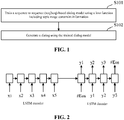
- FIG. 1 is a schematic flowchart of a dialog generation method according to an embodiment of this application.
- the process may be executed by a program on a server or a terminal, such as a model training program, a dialog assistant application, an instant messaging application, and the like.
- the process is executed by, but is not limited to, at least one of the following devices that can serve as a server or a terminal: a mobile phone, a tablet computer, a smart wearable device, an on-board computer, a personal computer, a medium computer, a computer cluster, and the like.
- the process in FIG. 1 may include the following steps.
- a seq2seq-based dialog model is trained using a loss function including topic range constraint information.
- the topic range constraint information may be one or more parameters related to a dialog topic in the loss function, or may be at least part of a formula related to the topic in the loss function.
- parameters in the dialog model are adjusted according to the loss calculated based on the loss function, and the topic range constraint information included in the loss function also has corresponding influences on adjustment of the parameters in the dialog model, such that the content of an output sequence of the trained dialog model is also constrained accordingly.
- This constraint may have two effects: firstly, the output sequence is enabled to include topic information, rather than a low-quality meaningless dialog; and secondly, the output sequence is enabled to achieve topic reply consistency with an input sequence of the corresponding dialog model.
- a dialog is generated using the trained dialog model.
- step S102 may be an action in the process of dialog model training, or an action actually used after completion of the dialog model training.
- the trained dialog model is applied to a dialog assistant application.
- the dialog model receives a statement input by a user and outputs a reply statement; or the dialog model may output a reply statement based on a preset or automatically generated input statement; or the dialog model may directly output a preset statement without depending on an input statement; and so on.
- steps S101 to S102 are both executed by the dialog assistant application.
- step S101 is executed by a model training program, and step S102 is executed by the dialog assistant application; and so on.
- topic range constraint information is introduced in the process of dialog model training using a loss function including the topic range constraint information, thus helping to prevent the trained model from producing low-quality meaningless replies. Therefore, the problem in the prior art can be partially or wholly solved.
- FIG. 2 is a schematic principle diagram of a seq2seq-based dialog model.
- the dialog model in FIG. 2 includes two Long Short-Term Memory (LSTM) recurrent neural networks.
- the first one is used as an encoder responsible for processing an input dialog word sequence X
- the second one is used as a decoder responsible for generating a reply word sequence Y .
- a loss function i.e., an objective function
- MLE Maximum Likelihood Estimate
- a topic range constraint function may be added to Formula 1, and then used for training the dialog model in FIG. 2 .
- Formula 1 can be replaced correspondingly. Illustration is made with reference to FIG. 3 still by taking the MLE as an example.
- FIG. 3 is a schematic principle diagram of a specific implementation solution of dialog model training in the method of FIG. 1 according to an embodiment of this application. As can be seen, compared with FIG. 2 , the topic range constraint function and a corresponding loss calculation action are added in FIG. 3 . The principles in FIG. 3 are illustrated below.
- FIG. 4 is a general schematic flowchart of principles in FIG. 3 according to an embodiment of this application.
- the general flowchart is mainly divided into five parts.
- a topic model is trained to obtain multiple first topic vectors.
- a first topic vector (denoted as: T topic ⁇ id ⁇ ) corresponding to the reply word sequence Y is determined according to the trained topic model.
- the first similarity and the second similarity are substituted into the loss function including the topic range constraint function to calculate a loss, and the dialog model is adjusted according to the loss.
- a topic model is trained in an unsupervised manner using a dialog training corpus.
- the topic model may be, for example, a Latent Dirichlet Allocation (LDA) model, a Kmeans model, or the like.
- LDA Latent Dirichlet Allocation
- Kmeans Kmeans model
- Topic IDs can be used to identify the first topic vectors.
- the first topic vector may be a dense vector similar to word embedding, wherein the word embedding refers to converting a word into a word vector.
- a first topic vector corresponding to the reply word sequence Y can be obtained. Assuming that there is only one central meaning in one sentence, Y only corresponds to one topic ID, and corresponds to only one first topic vector correspondingly.
- the MLP may specifically be a multi-layer neural network, such as fully connected Deep Neural Networks (DNNs), etc.
- the second topic vector corresponding to Y should be similar to the first topic vector corresponding to Y in the semantic space, compared to a first topic vector corresponding to another irrelevant topic ID.
- the irrelevant topic vector is a vector among the first topic vectors other than the first topic vector corresponding to Y , and a topic corresponding to the irrelevant topic vector is irrelevant to the topic corresponding to Y .
- the similarity may be, for example, a cosine similarity, or data that can measure the similarity between vectors, such as a distance between vectors.
- the corresponding loss may be calculated and the dialog model may be adjusted.
- the dialog model can be repeatedly trained using multiple training samples until the training converges.
- a step of training a topic model using a dialog training corpus to obtain multiple first topic vectors each representing a topic may be further performed before training the seq2seq-based dialog model.
- the topic model is trained in an unsupervised manner, which is advantageous in that the training can be efficiently performed with a large amount of dialog training corpus, without the need of manually adding topic labels to the dialog training corpus. Therefore, the cost can be reduced and it is not easy to miss topics.
- the topic model may also be trained in a supervised manner.
- the training the seq2seq-based dialog model using the loss function including the topic range constraint information may specifically include: inputting a training sequence into the seq2seq-based dialog model for processing to obtain various hidden-state output data output during the processing and an output sequence obtained after the processing; generating a second topic vector corresponding to the output sequence according to the various hidden-state output data; inputting the output sequence into the trained topic model for processing to obtain a first topic vector corresponding to the output sequence among the multiple first topic vectors; calculating a loss using the loss function including topic range constraint information according to the first and second topic vectors corresponding to the output sequence; and adjusting the dialog model according to the loss.
- the training sequence is X
- the output sequence is Y.
- the generating a second topic vector corresponding to the output sequence according to the various hidden-state output data may have a variety of specific implementation manners.
- the manner in the example of FIG. 3 is: pooling the various hidden-state output data; and inputting data obtained after the pooling into an MLP for processing to obtain the second topic vector corresponding to the output sequence.
- the pooling specifically takes average pooling as an example, without excluding the possibility of using another pooling manner other than the average pooling.
- the various hidden-state output data may be mapped in another set mapping manner other than using the MLP to obtain the second topic vector corresponding to the output sequence.
- the calculating a loss using the loss function including topic range constraint information according to the first and second topic vectors corresponding to the output sequence may specifically include: calculating a first similarity between the second topic vector corresponding to the output sequence and the first topic vector corresponding to the output sequence; calculating a second similarity between the second topic vector corresponding to the output sequence and an irrelevant topic vector, wherein the irrelevant topic vector is a vector in the multiple first topic vectors other than the first topic vector corresponding to the output sequence; and substituting the first similarity and the second similarity into the loss function including topic range constraint information to calculate the loss, wherein the topic range constraint information is a formula including parameters corresponding to the first similarity and the second similarity.
- the parameter corresponding to the first similarity is S t
- the parameter corresponding to the second similarity is S t
- the loss function including the topic range constraint information is Formula 2
- the topic range constraint information is ⁇ ⁇ log (1+ e - ( S t - S t ) ).
- Formula 2 is exemplary, and other loss functions including the topic range constraint information other than Formula 2 may be constructed based on the parameters S t and/or S t .
- the greater S t is compared with S t the smaller the loss portion corresponding to the topic range constraint information in the calculated loss is.
- a dialog generation method is described above. Base on the same invention idea, a corresponding apparatus is further provided in an embodiment of this application, as shown in FIG. 5 .
- FIG. 5 is a schematic structural diagram of a dialog generation apparatus corresponding to FIG. 1 according to an embodiment of this application.
- the apparatus may be located on the executive body of the process in FIG. 1 , including:
- the training module 501 before training the seq2seq-based dialog model, the training module 501 further trains a topic model using a dialog training corpus to obtain multiple first topic vectors each representing a topic.
- the training module 501 training a seq2seq-based dialog model using a loss function including topic range constraint information specifically includes:
- the training module 501 generating a second topic vector corresponding to the output sequence according to the various hidden-state output data specifically includes:
- the training module 501 calculating a loss using the loss function including topic range constraint information according to the first and second topic vectors corresponding to the output sequence specifically includes:
- a corresponding electronic device including at least one processor; and a memory in communication connection with the at least one processor, wherein the memory stores an instruction executable by the at least one processor, and when executed by the at least one processor, the instruction enables the at least one processor to:
- a corresponding non-volatile computer storage medium storing a computer executable instruction is further provided in an embodiment of this application.
- the computer executable instruction is configured to:
- the apparatus, electronic device, and non-volatile computer storage medium according to the embodiments of this application are corresponding to the method. Therefore, the apparatus, electronic device, and non-volatile computer storage medium also have beneficial technical effects similar to those in the corresponding method.
- the beneficial technical effects of the method have been described in detail above, and thus the beneficial technical effects of the corresponding apparatus, electronic device and non-volatile computer storage medium are not elaborated here.
- an improvement on a technology may be obviously distinguished as an improvement on hardware (for example, an improvement on a circuit structure such as a diode, a transistor, and a switch) or an improvement on software (an improvement on a method procedure).
- improvements of many method procedures at present may be considered as direct improvements on hardware circuit structures. Almost all designers program the improved method procedures into hardware circuits to obtain corresponding hardware circuit structures. Therefore, it cannot be assumed that the improvement of a method procedure cannot be implemented by using a hardware entity module.
- a Programmable Logic Device for example, a Field Programmable Gate Array (FPGA)
- FPGA Field Programmable Gate Array
- HDL Hardware Description Language
- HDLs such as Advanced Boolean Expression Language (ABEL), Altera Hardware Description Language (AHDL), Confluence, Georgia University Programming Language (CUPL), HDCal, Java Hardware Description Language (JHDL), Lava, Lola, MyHDL, PALASM, and Ruby Hardware Description Language (RHDL), among which Very-High-Speed Integrated Circuit Hardware Description Language (VHDL) and Verilog are most commonly used now.
- ABEL Advanced Boolean Expression Language
- AHDL Altera Hardware Description Language
- CUPL Cornell University Programming Language
- HDCal Java Hardware Description Language
- JHDL Java Hardware Description Language
- Lava Lava
- Lola MyHDL
- PALASM Phase Change Language
- RHDL Ruby Hardware Description Language
- VHDL Very-High-Speed Integrated Circuit Hardware Description Language
- Verilog Verilog
- a controller may be implemented in any suitable manner.
- the controller may be in the form of a microprocessor or a processor and a computer-readable medium storing computer-readable program codes (for example, software or firmware) executable by the (micro)processor, a logic gate, a switch, an Application Specific Integrated Circuit (ASIC), a programmable logic controller, and an embedded micro-controller.
- Examples of the controller include, but are not limited to, the following micro-controllers: ARC 625D, Atmel AT91SAM, Microchip PIC18F26K20, and Silicone Labs C8051F320.
- a memory controller may also be implemented as a part of control logic of a memory.
- the method steps may be logically programmed to enable the controller to implement the same function in the form of a logic gate, a switch, an application specific integrated circuit, a programmable logic controller and an embedded microcontroller. Therefore, such a controller may be considered as a hardware component, and apparatuses included therein and configured to implement various functions may also be considered as structures inside the hardware component. Alternatively, further, the apparatuses configured to implement various functions may be considered as both software modules for implementing the method and structures inside the hardware component.
- the system, apparatus, module or unit illustrated in the foregoing embodiments can be implemented by a computer chip or an entity, or implemented by a product having a specific function.
- a typical implementation device is a computer.
- the computer may be a personal computer, a laptop computer, a cellular phone, a camera phone, a smart phone, a personal digital assistant, a media player, a navigation device, an email device, a game console, a tablet computer, a wearable device, or a combination of any of these devices.
- the apparatus is divided into various units based on functions, and the units are described separately.
- functions of various units can also be implemented in one or more pieces of software and/or hardware.
- the embodiments of the present invention may be provided as a method, a system, or a computer program product. Therefore, the present invention may be implemented in a form of a complete hardware embodiment, a complete software embodiment, or an embodiment combining software and hardware. Moreover, the present invention may be in the form of a computer program product implemented on one or more computer usable storage media (including, but not limited to, a magnetic disk memory, a CD-ROM, an optical memory and the like) including computer usable program codes.
- a computer usable storage media including, but not limited to, a magnetic disk memory, a CD-ROM, an optical memory and the like
- a computer program instruction may be used to implement each process and/or block in the flowcharts and/or block diagrams and combinations of processes and/or blocks in the flowcharts and/or block diagrams.
- These computer program instructions may be provided to a general-purpose computer, a special-purpose computer, an embedded processor, or a processor of another programmable data processing device to generate a machine, so that the instructions executed by the computer or the processor of another programmable data processing device generate an apparatus configured to implement a specified function in one or more processes in the flowcharts and/or in one or more blocks in the block diagrams.
- These computer program instructions may also be stored in a computer-readable memory that can guide a computer or another programmable data processing device to work in a particular manner, such that the instructions stored in the computer-readable memory generate an article of manufacture that includes an instruction apparatus.
- the instruction apparatus implements a function specified in one or more processes in the flowcharts and/or in one or more blocks in the block diagrams.
- These computer program instructions may also be loaded onto a computer or another programmable data processing device, such that a series of operation steps are performed on the computer or another programmable device, thus generating computer-implemented processing. Therefore, the instructions executed on the computer or another programmable device provide steps for implementing a function specified in one or more processes in the flowcharts and/or in one or more blocks in the block diagrams.
- the computing device includes one or more central processing units (CPUs), an input/output interface, a network interface, and a memory.
- CPUs central processing units
- input/output interface input/output interface
- network interface network interface
- memory a memory
- the memory may include computer-readable media such as a volatile memory, a Random Access Memory (RAM), and/or a non-volatile memory, e.g., a Read-Only Memory (ROM) or a flash RAM.
- RAM Random Access Memory
- ROM Read-Only Memory
- the memory is an example of a computer-readable medium.
- the computer-readable medium includes permanent and non-permanent media as well as movable and non-movable media, and may implement information storage by means of any method or technology.
- the information may be a computer-readable instruction, a data structure, and a module of a program or other data.
- An example of the storage medium of a computer includes, but is not limited to, a phase change memory (PRAM), a static random access memory (SRAM), a dynamic random access memory (DRAM), other types of RAMs, a ROM, an electrically erasable programmable read-only memory (EEPROM), a flash memory or other memory technologies, a compact disk read-only memory (CD-ROM), a digital versatile disc (DVD) or other optical storages, a cassette tape, a magnetic tape/magnetic disk storage or other magnetic storage devices, or any other non-transmission medium, and can be used to store information accessible to the computing device.
- the computer-readable medium does not include transitory media, such as a modulated data signal and a carrier.
- This application may be described in a general context of a computer executable instruction executed by a computer, for example, a program module.
- the program module includes a routine, a program, an object, an assembly, a data structure, and the like for executing a specific task or implementing a specific abstract data type.
- This application may also be implemented in distributed computing environments. In the distributed computing environments, a task is executed by remote processing devices connected through a communications network. In the distributed computing environments, the program module may be located in local and remote computer storage media including a storage device.
Landscapes
- Engineering & Computer Science (AREA)
- Theoretical Computer Science (AREA)
- Physics & Mathematics (AREA)
- Mathematical Physics (AREA)
- General Engineering & Computer Science (AREA)
- Artificial Intelligence (AREA)
- General Physics & Mathematics (AREA)
- Computational Linguistics (AREA)
- Data Mining & Analysis (AREA)
- Software Systems (AREA)
- General Health & Medical Sciences (AREA)
- Computing Systems (AREA)
- Evolutionary Computation (AREA)
- Health & Medical Sciences (AREA)
- Biomedical Technology (AREA)
- Molecular Biology (AREA)
- Life Sciences & Earth Sciences (AREA)
- Biophysics (AREA)
- Databases & Information Systems (AREA)
- Human Computer Interaction (AREA)
- Computer Vision & Pattern Recognition (AREA)
- Medical Informatics (AREA)
- Audiology, Speech & Language Pathology (AREA)
- Machine Translation (AREA)
Abstract
Description
- This application relates to the field of computer software technologies, and in particular, to a dialog generation method, apparatus, and electronic device.
- With the rapid development of mobile devices, smart assist related applications have become increasingly common. For example, an increasingly popular dialog assistant can dialogue with a user based on voice, text, or other forms to answer questions raised by the user, or simply chat with the user.
- In the prior art, questions and answers in a dialog process are regarded as mapping of a question language symbol sequence to an answer language symbol sequence, and a sequence to sequence (seq2seq)-based dialog model is trained using a large amount of manual dialog data with the maximum likelihood estimation as a loss function, so that the dialog model learns a mapping relationship between the question language symbol sequence and the answer language symbol sequence, and dialogs can be automatically generated by the trained dialog model, thereby implementing the dialog assistant.
- However, the prior art is susceptible to high frequency reply statements without topic information such as "ok," "yes," and "got it" during the model training, resulting in a tendency to produce these low-quality meaningless replies when the trained model is actually used.
- A dialog generation method, apparatus, and electronic device are provided in embodiments of this application, for solving the following technical problem: the prior art is susceptible to high frequency reply statements without topic information during dialog model training, resulting in a tendency to produce these low-quality meaningless replies when the trained model is actually used.
- To solve the above technical problem, the embodiments of this application are implemented as follows.
- A dialog generation method provided in the embodiments of this application comprises:
- training a seq2seq-based dialog model using a loss function including topic range constraint information; and
- generating a dialog using the trained dialog model.
- A dialog generation apparatus provided in the embodiments of this application comprises:
- a training module configured to train a seq2seq-based dialog model using a loss function including topic range constraint information; and
- a generation module configured to generate a dialog using the trained dialog model.
- An electronic device provided in the embodiments of this application comprises:
- at least one processor; and
- a memory in communication connection with the at least one processor, wherein
- the memory stores an instruction executable by the at least one processor, and when executed by the at least one processor, the instruction enables the at least one processor to:
- train a seq2seq-based dialog model using a loss function including topic range constraint information; and
- generate a dialog using the trained dialog model.
- At least one of the above technical solutions adopted in the embodiments of this application can achieve the following beneficial effects: topic range constraint information is introduced in the process of dialog model training using a loss function including the topic range constraint information, thus helping to prevent the trained model from producing low-quality meaningless replies. Therefore, the problem in the prior art can be partially or wholly solved.
- In order to illustrate the technical solutions in the embodiments of this application or in the prior art more clearly, the accompanying drawings used in descriptions of the embodiments or the prior art will be briefly described below. It is apparent that the accompanying drawings in the following description are only some embodiments recorded in this application, and other accompanying drawings can also be obtained by those of ordinary skill in the art according to these accompanying drawings without creative efforts.
-
FIG. 1 is a schematic flowchart of a dialog generation method according to an embodiment of this application; -
FIG. 2 is a schematic principle diagram of a seq2seq-based dialog model; -
FIG. 3 is a schematic principle diagram of a specific implementation solution of dialog model training in the method ofFIG. 1 according to an embodiment of this application; -
FIG. 4 is a general schematic flowchart of principles inFIG. 3 according to an embodiment of this application; and -
FIG. 5 is a schematic structural diagram of a dialog generation apparatus corresponding toFIG. 1 according to an embodiment of this application. - A dialog generation method, apparatus, and electronic device are provided in the embodiments of this application.
- To enable those skilled in the art to better understand the technical solutions of this application, the technical solutions in the embodiments of this application will be described clearly and completely below with reference to the accompanying drawings in the embodiments of this application. Obviously, the described embodiments are only a part rather than all of the embodiments of this application. All other embodiments derived by those of ordinary skill in the art based on the embodiments of this application without creative efforts should fall within the protection scope of this application.
- For ease of understanding, the core idea of the solution of this application is illustrated. In this application, a seq2seq-based dialog model is trained using a loss function including topic range constraint information based on topic reply consistency, thus preventing the trained model from producing a low-quality meaningless dialog. The topic range constraint information may specifically be at least part of a formula included in the loss function, and the at least part of the formula is referred to as a topic range constraint function hereinafter.
- The topic reply consistency mainly refers to that, in real human conversation chat, dialog topics of chat participants are often the same or related, and a topic range of reply statements is also limited correspondingly. For example, A mentions a weather-related discourse, and it is reasonable for B to reply with a statement of a weather-related topic. Generally, B will not reply with content that has nothing to do with the weather topic, such as "what about this mobile phone?"
- A dialog model is generally configured to simulate dialogs between real people and users, and thus it will be a better experience for the user if the dialog model can generate a dialog following the topic reply consistency.
- Based on the above core idea, the solution of this application is described in detail below.
-
FIG. 1 is a schematic flowchart of a dialog generation method according to an embodiment of this application. From the perspective of a program, the process may be executed by a program on a server or a terminal, such as a model training program, a dialog assistant application, an instant messaging application, and the like. From the perspective of a device, the process is executed by, but is not limited to, at least one of the following devices that can serve as a server or a terminal: a mobile phone, a tablet computer, a smart wearable device, an on-board computer, a personal computer, a medium computer, a computer cluster, and the like. - The process in
FIG. 1 may include the following steps. - In S101, a seq2seq-based dialog model is trained using a loss function including topic range constraint information.
- In the embodiment of this application, the topic range constraint information may be one or more parameters related to a dialog topic in the loss function, or may be at least part of a formula related to the topic in the loss function.
- In the training process of the dialog model, parameters in the dialog model are adjusted according to the loss calculated based on the loss function, and the topic range constraint information included in the loss function also has corresponding influences on adjustment of the parameters in the dialog model, such that the content of an output sequence of the trained dialog model is also constrained accordingly.
- This constraint may have two effects: firstly, the output sequence is enabled to include topic information, rather than a low-quality meaningless dialog; and secondly, the output sequence is enabled to achieve topic reply consistency with an input sequence of the corresponding dialog model.
- In S102, a dialog is generated using the trained dialog model.
- In the embodiment of this application, step S102 may be an action in the process of dialog model training, or an action actually used after completion of the dialog model training.
- For example, the trained dialog model is applied to a dialog assistant application. The dialog model receives a statement input by a user and outputs a reply statement; or the dialog model may output a reply statement based on a preset or automatically generated input statement; or the dialog model may directly output a preset statement without depending on an input statement; and so on.
- The actions involved in
FIG. 1 may be executed by the same device or program, or by different devices or programs. For example, steps S101 to S102 are both executed by the dialog assistant application. For another example, step S101 is executed by a model training program, and step S102 is executed by the dialog assistant application; and so on. - With the method of
FIG. 1 , topic range constraint information is introduced in the process of dialog model training using a loss function including the topic range constraint information, thus helping to prevent the trained model from producing low-quality meaningless replies. Therefore, the problem in the prior art can be partially or wholly solved. - Based on the method of
FIG. 1 , some specific implementation solutions and expansion solutions of the method are further provided in the embodiments of this application and illustrated below. -
FIG. 2 is a schematic principle diagram of a seq2seq-based dialog model. - The dialog model in
FIG. 2 includes two Long Short-Term Memory (LSTM) recurrent neural networks. The first one is used as an encoder responsible for processing an input dialog word sequence X, and the second one is used as a decoder responsible for generating a reply word sequence Y. In an actual application, a loss function (i.e., an objective function) of the seq2seq-based dialog model generally adopts Maximum Likelihood Estimate (MLE), as shown in the following formula 1:
- In the embodiment of this application, a topic range constraint function may be added to
Formula 1, and then used for training the dialog model inFIG. 2 . Definitely, if the MLE is not adopted,Formula 1 can be replaced correspondingly. Illustration is made with reference toFIG. 3 still by taking the MLE as an example. -
FIG. 3 is a schematic principle diagram of a specific implementation solution of dialog model training in the method ofFIG. 1 according to an embodiment of this application. As can be seen, compared withFIG. 2 , the topic range constraint function and a corresponding loss calculation action are added inFIG. 3 . The principles inFIG. 3 are illustrated below. -
FIG. 4 is a general schematic flowchart of principles inFIG. 3 according to an embodiment of this application. The general flowchart is mainly divided into five parts. - A topic model is trained to obtain multiple first topic vectors.
- A first topic vector (denoted as:

- Pooling and MLP transformation operations are performed on various hidden-state output data during processing in the dialog model corresponding to Y, thus obtaining a second topic vector (denoted as: Tv ) corresponding to Y.
- A first similarity (denoted as:


- The first similarity and the second similarity are substituted into the loss function including the topic range constraint function to calculate a loss, and the dialog model is adjusted according to the loss.
- Further illustration is made as follows.
- First, a topic model is trained in an unsupervised manner using a dialog training corpus. The topic model may be, for example, a Latent Dirichlet Allocation (LDA) model, a Kmeans model, or the like. By training the topic model, multiple topics can be extracted from the dialog training corpus, and multiple topic vectors are generated correspondingly, which are referred to as first topic vectors each representing a topic. Topic IDs can be used to identify the first topic vectors. Preferably, the first topic vector may be a dense vector similar to word embedding, wherein the word embedding refers to converting a word into a word vector.
- Then, according to the trained topic model, a first topic vector corresponding to the reply word sequence Y can be obtained. Assuming that there is only one central meaning in one sentence, Y only corresponds to one topic ID, and corresponds to only one first topic vector correspondingly.
- After that, hidden-state output data of Y during each step of the LSTM modeling is input for average pooling, and then transformed by a Multi-layer Perceptron (MLP) to obtain another topic vector expression of Y, which is referred to as a second topic vector corresponding to Y. The MLP may specifically be a multi-layer neural network, such as fully connected Deep Neural Networks (DNNs), etc.
- It can be considered that the second topic vector corresponding to Y should be similar to the first topic vector corresponding to Y in the semantic space, compared to a first topic vector corresponding to another irrelevant topic ID. Based on such consideration, a loss function including topic range constraint information is defined in this application, which, for example, is as shown in Formula 2 below:

t represents a similarity between the second topic vector corresponding to Y and an irrelevant topic vector. The irrelevant topic vector is a vector among the first topic vectors other than the first topic vector corresponding to Y, and a topic corresponding to the irrelevant topic vector is irrelevant to the topic corresponding to Y. - The similarity may be, for example, a cosine similarity, or data that can measure the similarity between vectors, such as a distance between vectors.
- Finally, based on Formula 2, the corresponding loss may be calculated and the dialog model may be adjusted. As a result, the dialog model can be repeatedly trained using multiple training samples until the training converges.
- It should be noted that the specific implementation solution in
FIG. 3 is only an example. Based on the example ofFIG. 3 , some key steps involved in the training are further illustrated below. - In the embodiment of this application, for step S102, a step of training a topic model using a dialog training corpus to obtain multiple first topic vectors each representing a topic may be further performed before training the seq2seq-based dialog model.
- In the example of
FIG. 3 , the topic model is trained in an unsupervised manner, which is advantageous in that the training can be efficiently performed with a large amount of dialog training corpus, without the need of manually adding topic labels to the dialog training corpus. Therefore, the cost can be reduced and it is not easy to miss topics. Definitely, the topic model may also be trained in a supervised manner. - In the embodiment of this application, for step S102, the training the seq2seq-based dialog model using the loss function including the topic range constraint information may specifically include:
inputting a training sequence into the seq2seq-based dialog model for processing to obtain various hidden-state output data output during the processing and an output sequence obtained after the processing; generating a second topic vector corresponding to the output sequence according to the various hidden-state output data; inputting the output sequence into the trained topic model for processing to obtain a first topic vector corresponding to the output sequence among the multiple first topic vectors; calculating a loss using the loss function including topic range constraint information according to the first and second topic vectors corresponding to the output sequence; and adjusting the dialog model according to the loss. - In the example of
FIG. 3 , the training sequence is X, and the output sequence is Y. - Further, the generating a second topic vector corresponding to the output sequence according to the various hidden-state output data may have a variety of specific implementation manners.
- For example, the manner in the example of
FIG. 3 is: pooling the various hidden-state output data; and inputting data obtained after the pooling into an MLP for processing to obtain the second topic vector corresponding to the output sequence. The pooling specifically takes average pooling as an example, without excluding the possibility of using another pooling manner other than the average pooling. - In addition, the various hidden-state output data may be mapped in another set mapping manner other than using the MLP to obtain the second topic vector corresponding to the output sequence.
- Further, the calculating a loss using the loss function including topic range constraint information according to the first and second topic vectors corresponding to the output sequence may specifically include:
calculating a first similarity between the second topic vector corresponding to the output sequence and the first topic vector corresponding to the output sequence; calculating a second similarity between the second topic vector corresponding to the output sequence and an irrelevant topic vector, wherein the irrelevant topic vector is a vector in the multiple first topic vectors other than the first topic vector corresponding to the output sequence; and substituting the first similarity and the second similarity into the loss function including topic range constraint information to calculate the loss, wherein the topic range constraint information is a formula including parameters corresponding to the first similarity and the second similarity. - In the example of
FIG. 3 , the parameter corresponding to the first similarity is St, the parameter corresponding to the second similarity is St , the loss function including the topic range constraint information is Formula 2, and the topic range constraint information is λ∗log(1+e -(St -St )). - It should be noted that Formula 2 is exemplary, and other loss functions including the topic range constraint information other than Formula 2 may be constructed based on the parameters St and/or S
t . In general, for the topic range constraint information including the parameters St and St , the greater St is compared with St , the smaller the loss portion corresponding to the topic range constraint information in the calculated loss is. - A dialog generation method according to the embodiment of this application is described above. Base on the same invention idea, a corresponding apparatus is further provided in an embodiment of this application, as shown in
FIG. 5 . -
FIG. 5 is a schematic structural diagram of a dialog generation apparatus corresponding toFIG. 1 according to an embodiment of this application. The apparatus may be located on the executive body of the process inFIG. 1 , including: - a
training module 501 training a seq2seq-based dialog model using a loss function including topic range constraint information; and - a
generation module 502 generating a dialog using the trained dialog model. - Optionally, before training the seq2seq-based dialog model, the
training module 501 further trains a topic model using a dialog training corpus to obtain multiple first topic vectors each representing a topic. - Optionally, the
training module 501 training a seq2seq-based dialog model using a loss function including topic range constraint information specifically includes: - the
training module 501 inputting a training sequence into the seq2seq-based dialog model for processing to obtain various hidden-state output data output during the processing and an output sequence obtained after the processing; - generating a second topic vector corresponding to the output sequence according to the various hidden-state output data;
- inputting the output sequence into the trained topic model for processing to obtain a first topic vector corresponding to the output sequence among the multiple first topic vectors;
- calculating a loss using the loss function including topic range constraint information according to the first and second topic vectors corresponding to the output sequence; and
- adjusting the dialog model according to the loss.
- Optionally, the
training module 501 generating a second topic vector corresponding to the output sequence according to the various hidden-state output data specifically includes: - the
training module 501 pooling the various hidden-state output data; and - inputting data obtained after the pooling into an MLP for processing to obtain the second topic vector corresponding to the output sequence.
- Optionally, the
training module 501 calculating a loss using the loss function including topic range constraint information according to the first and second topic vectors corresponding to the output sequence specifically includes: - the
training module 501 calculating a first similarity between the second topic vector corresponding to the output sequence and the first topic vector corresponding to the output sequence; - calculating a second similarity between the second topic vector corresponding to the output sequence and an irrelevant topic vector, wherein the irrelevant topic vector is a vector in the multiple first topic vectors other than the first topic vector corresponding to the output sequence; and
- substituting the first similarity and the second similarity into the loss function including topic range constraint information to calculate the loss, wherein the topic range constraint information is a formula including parameters corresponding to the first similarity and the second similarity.
- Based on the same invention idea, a corresponding electronic device is further provided in the embodiments of this application, including at least one processor; and
a memory in communication connection with the at least one processor, wherein
the memory stores an instruction executable by the at least one processor, and when executed by the at least one processor, the instruction enables the at least one processor to: - train a seq2seq-based dialog model using a loss function including topic range constraint information; and
- generate a dialog using the trained dialog model.
- Based on the same invention idea, a corresponding non-volatile computer storage medium storing a computer executable instruction is further provided in an embodiment of this application. The computer executable instruction is configured to:
- train a seq2seq-based dialog model using a loss function including topic range constraint information; and
- generate a dialog using the trained dialog model.
- Various embodiments in this specification are described progressively. The same or similar parts between the embodiments may be referenced to one another. In each embodiment, the part that is different from other embodiments is mainly described. Particularly, the embodiments of the apparatus, electronic device and non-volatile computer storage medium are described in a relatively simple manner because they are basically similar to the method embodiment, and for related parts, reference can be made to the parts described in the method embodiment.
- The apparatus, electronic device, and non-volatile computer storage medium according to the embodiments of this application are corresponding to the method. Therefore, the apparatus, electronic device, and non-volatile computer storage medium also have beneficial technical effects similar to those in the corresponding method. The beneficial technical effects of the method have been described in detail above, and thus the beneficial technical effects of the corresponding apparatus, electronic device and non-volatile computer storage medium are not elaborated here.
- In the 1990s, an improvement on a technology may be obviously distinguished as an improvement on hardware (for example, an improvement on a circuit structure such as a diode, a transistor, and a switch) or an improvement on software (an improvement on a method procedure). However, with the development of technologies, improvements of many method procedures at present may be considered as direct improvements on hardware circuit structures. Almost all designers program the improved method procedures into hardware circuits to obtain corresponding hardware circuit structures. Therefore, it cannot be assumed that the improvement of a method procedure cannot be implemented by using a hardware entity module. For example, a Programmable Logic Device (PLD) (for example, a Field Programmable Gate Array (FPGA)) is such an integrated circuit, and logic functions thereof are determined by a user programming device. Designers program by themselves to "integrate" a digital system into a PLD, without having a chip manufacturer to design and manufacture a dedicated integrated circuit chip. Moreover, at present, the programming is mostly implemented by using "logic compiler" software, instead of manually manufacturing an integrated circuit chip. The software is similar to a software complier for developing and writing a program, and original codes before compiling also need to be written in a specific programming language, which is referred to as a Hardware Description Language (HDL). There are not just one, but many types of HDLs, such as Advanced Boolean Expression Language (ABEL), Altera Hardware Description Language (AHDL), Confluence, Cornell University Programming Language (CUPL), HDCal, Java Hardware Description Language (JHDL), Lava, Lola, MyHDL, PALASM, and Ruby Hardware Description Language (RHDL), among which Very-High-Speed Integrated Circuit Hardware Description Language (VHDL) and Verilog are most commonly used now. Those skilled in the art also should know that a hardware circuit for implementing the logic method procedure may be easily obtained only by slightly logically programming the method procedure using the above several hardware description languages and programming the method procedure into an integrated circuit.
- A controller may be implemented in any suitable manner. For example, the controller may be in the form of a microprocessor or a processor and a computer-readable medium storing computer-readable program codes (for example, software or firmware) executable by the (micro)processor, a logic gate, a switch, an Application Specific Integrated Circuit (ASIC), a programmable logic controller, and an embedded micro-controller. Examples of the controller include, but are not limited to, the following micro-controllers: ARC 625D, Atmel AT91SAM, Microchip PIC18F26K20, and Silicone Labs C8051F320. A memory controller may also be implemented as a part of control logic of a memory. Those skilled in the art also know that, in addition to implementing the controller by using pure computer-readable program codes, the method steps may be logically programmed to enable the controller to implement the same function in the form of a logic gate, a switch, an application specific integrated circuit, a programmable logic controller and an embedded microcontroller. Therefore, such a controller may be considered as a hardware component, and apparatuses included therein and configured to implement various functions may also be considered as structures inside the hardware component. Alternatively, further, the apparatuses configured to implement various functions may be considered as both software modules for implementing the method and structures inside the hardware component.
- The system, apparatus, module or unit illustrated in the foregoing embodiments can be implemented by a computer chip or an entity, or implemented by a product having a specific function. A typical implementation device is a computer. For example, the computer may be a personal computer, a laptop computer, a cellular phone, a camera phone, a smart phone, a personal digital assistant, a media player, a navigation device, an email device, a game console, a tablet computer, a wearable device, or a combination of any of these devices.
- For ease of description, the apparatus is divided into various units based on functions, and the units are described separately. Definitely, in an implementation of this specification, functions of various units can also be implemented in one or more pieces of software and/or hardware.
- Those skilled in the art should understand that the embodiments of the present invention may be provided as a method, a system, or a computer program product. Therefore, the present invention may be implemented in a form of a complete hardware embodiment, a complete software embodiment, or an embodiment combining software and hardware. Moreover, the present invention may be in the form of a computer program product implemented on one or more computer usable storage media (including, but not limited to, a magnetic disk memory, a CD-ROM, an optical memory and the like) including computer usable program codes.
- The present invention is described with reference to flowcharts and/or block diagrams of the method, device (system) and computer program product according to the embodiments of the present invention. It should be understood that a computer program instruction may be used to implement each process and/or block in the flowcharts and/or block diagrams and combinations of processes and/or blocks in the flowcharts and/or block diagrams. These computer program instructions may be provided to a general-purpose computer, a special-purpose computer, an embedded processor, or a processor of another programmable data processing device to generate a machine, so that the instructions executed by the computer or the processor of another programmable data processing device generate an apparatus configured to implement a specified function in one or more processes in the flowcharts and/or in one or more blocks in the block diagrams.
- These computer program instructions may also be stored in a computer-readable memory that can guide a computer or another programmable data processing device to work in a particular manner, such that the instructions stored in the computer-readable memory generate an article of manufacture that includes an instruction apparatus. The instruction apparatus implements a function specified in one or more processes in the flowcharts and/or in one or more blocks in the block diagrams.
- These computer program instructions may also be loaded onto a computer or another programmable data processing device, such that a series of operation steps are performed on the computer or another programmable device, thus generating computer-implemented processing. Therefore, the instructions executed on the computer or another programmable device provide steps for implementing a function specified in one or more processes in the flowcharts and/or in one or more blocks in the block diagrams.
- In a typical configuration, the computing device includes one or more central processing units (CPUs), an input/output interface, a network interface, and a memory.
- The memory may include computer-readable media such as a volatile memory, a Random Access Memory (RAM), and/or a non-volatile memory, e.g., a Read-Only Memory (ROM) or a flash RAM. The memory is an example of a computer-readable medium.
- The computer-readable medium includes permanent and non-permanent media as well as movable and non-movable media, and may implement information storage by means of any method or technology. The information may be a computer-readable instruction, a data structure, and a module of a program or other data. An example of the storage medium of a computer includes, but is not limited to, a phase change memory (PRAM), a static random access memory (SRAM), a dynamic random access memory (DRAM), other types of RAMs, a ROM, an electrically erasable programmable read-only memory (EEPROM), a flash memory or other memory technologies, a compact disk read-only memory (CD-ROM), a digital versatile disc (DVD) or other optical storages, a cassette tape, a magnetic tape/magnetic disk storage or other magnetic storage devices, or any other non-transmission medium, and can be used to store information accessible to the computing device. According to the definition in this specification, the computer-readable medium does not include transitory media, such as a modulated data signal and a carrier.
- It should be further noted that the terms "include," "comprise" or other variations thereof are intended to cover non-exclusive inclusion, so that a process, method, article or device including a series of elements not only includes the elements, but also includes other elements not clearly listed, or further includes elements inherent to the process, method, article or device. In the absence of more limitations, an element defined by "including a/an ..." does not exclude that the process, method, article or device including the element further has other identical elements.
- This application may be described in a general context of a computer executable instruction executed by a computer, for example, a program module. Generally, the program module includes a routine, a program, an object, an assembly, a data structure, and the like for executing a specific task or implementing a specific abstract data type. This application may also be implemented in distributed computing environments. In the distributed computing environments, a task is executed by remote processing devices connected through a communications network. In the distributed computing environments, the program module may be located in local and remote computer storage media including a storage device.
- Various embodiments in this specification are described progressively. The same or similar parts between the embodiments may be referenced to one another. In each embodiment, the part that is different from other embodiments is mainly described. Particularly, the system embodiment is described in a relatively simple manner because it is similar to the method embodiment, and for related parts, reference can be made to the parts described in the method embodiment.
- The above description is merely embodiments of this application, and is not used to limit this application. For those skilled in the art, this application may have various alterations and changes. Any modification, equivalent replacement, improvement and the like made without departing from the spirit and principle of this application should be included in the scope of the claims of this application.
Claims (11)
- A dialog generation method, comprising:training a sequence to sequence (seq2seq)-based dialog model using a loss function comprising topic range constraint information; andgenerating a dialog using the trained dialog model.
- The method of claim 1, wherein before the training a seq2seq-based dialog model, the method further comprises:
training a topic model using a dialog training corpus to obtain multiple first topic vectors each representing a topic. - The method of claim 2, wherein the training a seq2seq-based dialog model using a loss function comprising topic range constraint information specifically comprises:inputting a training sequence into the seq2seq-based dialog model for processing to obtain various hidden-state output data output during the processing and an output sequence obtained after the processing;generating a second topic vector corresponding to the output sequence according to the various hidden-state output data;inputting the output sequence into the trained topic model for processing to obtain a first topic vector corresponding to the output sequence among the multiple first topic vectors;calculating a loss using the loss function comprising topic range constraint information according to the first and second topic vectors corresponding to the output sequence; andadjusting the dialog model according to the loss.
- The method of claim 3, wherein the generating a second topic vector corresponding to the output sequence according to the various hidden-state output data specifically comprises:pooling the various hidden-state output data; andinputting data obtained after the pooling into a multi-layer perceptron for processing to generate the second topic vector corresponding to the output sequence.
- The method of claim 3, wherein the calculating a loss using the loss function comprising topic range constraint information according to the first and second topic vectors corresponding to the output sequence specifically comprises:calculating a first similarity between the second topic vector corresponding to the output sequence and the first topic vector corresponding to the output sequence;calculating a second similarity between the second topic vector corresponding to the output sequence and an irrelevant topic vector, wherein the irrelevant topic vector is a vector in the multiple first topic vectors other than the first topic vector corresponding to the output sequence; andsubstituting the first similarity and the second similarity into the loss function comprising topic range constraint information to calculate the loss, wherein the topic range constraint information is a formula comprising parameters corresponding to the first similarity and the second similarity.
- A dialog generation apparatus, comprising:a training module training a sequence to sequence (seq2seq)-based dialog model using a loss function comprising topic range constraint information; anda generation module generating a dialog using the trained dialog model.
- The apparatus of claim 6, wherein before training the seq2seq-based dialog model, the training module further trains a topic model using a dialog training corpus to obtain multiple first topic vectors each representing a topic.
- The apparatus of claim 7, wherein the training module training a seq2seq-based dialog model using a loss function comprising topic range constraint information specifically comprises:the training module inputting a training sequence into the seq2seq-based dialog model for processing to obtain various hidden-state output data output during the processing and an output sequence obtained after the processing;generating a second topic vector corresponding to the output sequence according to the various hidden-state output data;inputting the output sequence into the trained topic model for processing to obtain a first topic vector corresponding to the output sequence among the multiple first topic vectors;calculating a loss using the loss function comprising topic range constraint information according to the first and second topic vectors corresponding to the output sequence; andadjusting the dialog model according to the loss.
- The apparatus of claim 8, wherein the training module generating a second topic vector corresponding to the output sequence according to the various hidden-state output data specifically comprises:the training module pooling the various hidden-state output data; andinputting data obtained after the pooling into a multi-layer perceptron for processing to generate the second topic vector corresponding to the output sequence.
- The apparatus of claim 8, wherein the training module calculating a loss using the loss function comprising topic range constraint information according to the first and second topic vectors corresponding to the output sequence specifically comprises:the training module calculating a first similarity between the second topic vector corresponding to the output sequence and the first topic vector corresponding to the output sequence;calculating a second similarity between the second topic vector corresponding to the output sequence and an irrelevant topic vector, wherein the irrelevant topic vector is a vector in the multiple first topic vectors other than the first topic vector corresponding to the output sequence; andsubstituting the first similarity and the second similarity into the loss function comprising topic range constraint information to calculate the loss, wherein the topic range constraint information is a formula comprising parameters corresponding to the first similarity and the second similarity.
- An electronic device, comprising:at least one processor; anda memory in communication connection with the at least one processor, whereinthe memory stores an instruction executable by the at least one processor, and when executed by the at least one processor, the instruction enables the at least one processor to:train a sequence to sequence (seq2seq)-based dialog model using a loss function comprising topic range constraint information; andgenerate a dialog using the trained dialog model.
Applications Claiming Priority (2)
| Application Number | Priority Date | Filing Date | Title |
|---|---|---|---|
| CN201710423859.7A CN107368524B (en) | 2017-06-07 | 2017-06-07 | Dialog generation method and device and electronic equipment |
| PCT/CN2018/090138 WO2018223992A1 (en) | 2017-06-07 | 2018-06-06 | Dialogue generation method and apparatus, and electronic device |
Publications (2)
| Publication Number | Publication Date |
|---|---|
| EP3620940A1 true EP3620940A1 (en) | 2020-03-11 |
| EP3620940A4 EP3620940A4 (en) | 2020-04-08 |
Family
ID=60304805
Family Applications (1)
| Application Number | Title | Priority Date | Filing Date |
|---|---|---|---|
| EP18814267.3A Withdrawn EP3620940A4 (en) | 2017-06-07 | 2018-06-06 | DIALOG GENERATING METHOD AND DEVICE AND ELECTRONIC DEVICE |
Country Status (6)
| Country | Link |
|---|---|
| US (2) | US11354512B2 (en) |
| EP (1) | EP3620940A4 (en) |
| CN (1) | CN107368524B (en) |
| SG (1) | SG11201911535SA (en) |
| TW (1) | TW201903635A (en) |
| WO (1) | WO2018223992A1 (en) |
Families Citing this family (21)
| Publication number | Priority date | Publication date | Assignee | Title |
|---|---|---|---|---|
| CN107368524B (en) * | 2017-06-07 | 2020-06-02 | 创新先进技术有限公司 | Dialog generation method and device and electronic equipment |
| US10971142B2 (en) * | 2017-10-27 | 2021-04-06 | Baidu Usa Llc | Systems and methods for robust speech recognition using generative adversarial networks |
| CN107832310A (en) * | 2017-11-27 | 2018-03-23 | 首都师范大学 | Structuring argument generation method and system based on seq2seq models |
| CN108090509B (en) * | 2017-12-13 | 2021-10-08 | 四川大学 | A data-length adaptive method for electrocardiogram classification |
| CN110309275B (en) * | 2018-03-15 | 2024-06-14 | 北京京东尚科信息技术有限公司 | A method and device for generating a dialogue |
| CN108509539B (en) * | 2018-03-16 | 2021-08-17 | 联想(北京)有限公司 | Information processing method and electronic device |
| US12217760B2 (en) | 2018-04-17 | 2025-02-04 | GONGIO Ltd. | Metadata-based diarization of teleconferences |
| CN109284361A (en) * | 2018-09-29 | 2019-01-29 | 深圳追科技有限公司 | A kind of entity abstracting method and system based on deep learning |
| CN110008332B (en) * | 2019-02-13 | 2020-11-10 | 创新先进技术有限公司 | Method and device for extracting main words through reinforcement learning |
| CN110297894B (en) * | 2019-05-22 | 2021-03-26 | 同济大学 | Intelligent dialogue generating method based on auxiliary network |
| CN113722448B (en) * | 2020-05-26 | 2025-12-19 | 阿里巴巴集团控股有限公司 | Dialogue method, dialogue device, computer equipment and dialogue medium |
| CN113761136B (en) * | 2020-06-02 | 2024-07-19 | 阿里巴巴集团控股有限公司 | Dialogue processing, information processing, model training methods, devices and storage media |
| US20220027578A1 (en) * | 2020-07-27 | 2022-01-27 | Nvidia Corporation | Text string summarization |
| CN111985934B (en) * | 2020-07-30 | 2024-07-12 | 浙江百世技术有限公司 | Intelligent customer service dialogue model construction method and application |
| CN111930916B (en) * | 2020-09-18 | 2021-02-05 | 北京百度网讯科技有限公司 | Dialog generation method and device, electronic equipment and storage medium |
| CN112131368B (en) * | 2020-09-27 | 2024-02-09 | 深圳平安智慧医健科技有限公司 | Dialogue generation method and device, electronic equipment and storage medium |
| CN112988948B (en) * | 2021-02-05 | 2023-09-19 | 蚂蚁胜信(上海)信息技术有限公司 | Service processing method and device |
| CN115203363A (en) * | 2022-06-23 | 2022-10-18 | 北京澜舟科技有限公司 | Information retrieval method, system and computer storage medium |
| CN115470329A (en) * | 2022-08-22 | 2022-12-13 | 北京字跳网络技术有限公司 | Dialog generation method and device, computer equipment and storage medium |
| US20240281603A1 (en) * | 2023-02-16 | 2024-08-22 | Jpmorgan Chase Bank, N.A. | Systems and methods for seeded neural topic modeling |
| CN120277199B (en) * | 2025-06-11 | 2025-08-22 | 快上云(上海)网络科技有限公司 | Children's education knowledge boundary management method, system and equipment based on large model |
Family Cites Families (17)
| Publication number | Priority date | Publication date | Assignee | Title |
|---|---|---|---|---|
| US7664644B1 (en) * | 2006-06-09 | 2010-02-16 | At&T Intellectual Property Ii, L.P. | Multitask learning for spoken language understanding |
| US8645298B2 (en) * | 2010-10-26 | 2014-02-04 | Microsoft Corporation | Topic models |
| US20130325483A1 (en) * | 2012-05-29 | 2013-12-05 | GM Global Technology Operations LLC | Dialogue models for vehicle occupants |
| US9575952B2 (en) * | 2014-10-21 | 2017-02-21 | At&T Intellectual Property I, L.P. | Unsupervised topic modeling for short texts |
| CN105094315B (en) * | 2015-06-25 | 2018-03-06 | 百度在线网络技术(北京)有限公司 | The method and apparatus of human-machine intelligence's chat based on artificial intelligence |
| JP6544131B2 (en) * | 2015-08-14 | 2019-07-17 | 富士ゼロックス株式会社 | INFORMATION PROCESSING APPARATUS AND INFORMATION PROCESSING PROGRAM |
| US10431205B2 (en) * | 2016-04-27 | 2019-10-01 | Conduent Business Services, Llc | Dialog device with dialog support generated using a mixture of language models combined using a recurrent neural network |
| WO2017210613A1 (en) * | 2016-06-03 | 2017-12-07 | Maluuba Inc. | Natural language generation in a spoken dialogue system |
| US10546066B2 (en) * | 2016-08-31 | 2020-01-28 | Microsoft Technology Licensing, Llc | End-to-end learning of dialogue agents for information access |
| CN106383815B (en) * | 2016-09-20 | 2019-03-01 | 清华大学 | A Neural Network Sentiment Analysis Method Combining User and Product Information |
| US10540967B2 (en) * | 2016-11-14 | 2020-01-21 | Xerox Corporation | Machine reading method for dialog state tracking |
| US10268679B2 (en) * | 2016-12-02 | 2019-04-23 | Microsoft Technology Licensing, Llc | Joint language understanding and dialogue management using binary classification based on forward and backward recurrent neural network |
| CN106682734A (en) * | 2016-12-30 | 2017-05-17 | 中国科学院深圳先进技术研究院 | Method and apparatus for increasing generalization capability of convolutional neural network |
| US10394954B2 (en) * | 2017-02-27 | 2019-08-27 | Intel Corporation | Natural language intent and location determination method and apparatus |
| CN106997375B (en) * | 2017-02-28 | 2020-08-18 | 浙江大学 | Recommendation method for customer service reply based on deep learning |
| CN107368524B (en) * | 2017-06-07 | 2020-06-02 | 创新先进技术有限公司 | Dialog generation method and device and electronic equipment |
| US10503834B2 (en) * | 2017-11-17 | 2019-12-10 | Digital Genius Limited | Template generation for a conversational agent |
-
2017
- 2017-06-07 CN CN201710423859.7A patent/CN107368524B/en active Active
-
2018
- 2018-03-16 TW TW107109025A patent/TW201903635A/en unknown
- 2018-06-06 EP EP18814267.3A patent/EP3620940A4/en not_active Withdrawn
- 2018-06-06 WO PCT/CN2018/090138 patent/WO2018223992A1/en not_active Ceased
- 2018-06-06 SG SG11201911535SA patent/SG11201911535SA/en unknown
-
2019
- 2019-12-05 US US16/704,358 patent/US11354512B2/en active Active
-
2020
- 2020-01-31 US US16/778,995 patent/US10747959B2/en active Active
Also Published As
| Publication number | Publication date |
|---|---|
| SG11201911535SA (en) | 2020-01-30 |
| CN107368524B (en) | 2020-06-02 |
| US10747959B2 (en) | 2020-08-18 |
| WO2018223992A1 (en) | 2018-12-13 |
| CN107368524A (en) | 2017-11-21 |
| TW201903635A (en) | 2019-01-16 |
| US11354512B2 (en) | 2022-06-07 |
| EP3620940A4 (en) | 2020-04-08 |
| US20200167528A1 (en) | 2020-05-28 |
| US20200110916A1 (en) | 2020-04-09 |
Similar Documents
| Publication | Publication Date | Title |
|---|---|---|
| EP3620940A1 (en) | Dialogue generation method and apparatus, and electronic device | |
| US12039995B2 (en) | Audio signal processing method and apparatus, electronic device, and storage medium | |
| CN111309883B (en) | Human-computer dialogue method, model training method and device based on artificial intelligence | |
| KR102608469B1 (en) | Method and apparatus for generating natural language | |
| US10984793B2 (en) | Voice interaction method and device | |
| US20170116185A1 (en) | Natural language processor for providing natural language signals in a natural language output | |
| CN116738233B (en) | Methods, apparatus, equipment and storage media for online model training | |
| CN108920510A (en) | Automatic chatting method, device and electronic equipment | |
| CN116502176A (en) | A language model pre-training method, device, medium and electronic equipment | |
| CN113569017B (en) | Model processing method and device, electronic equipment and storage medium | |
| CN116166793A (en) | Training method of abstract generation model, abstract generation method and device | |
| CN109346079A (en) | Voice interactive method and device based on Application on Voiceprint Recognition | |
| CN115599896A (en) | Method, device, equipment and medium for generating chatting answer based on dynamic Prompt | |
| CN112836829B (en) | Personalized privacy protection learning method, device and equipment | |
| CN114817469B (en) | Text enhancement method, text enhancement model training method and device | |
| CN115952271B (en) | Method and device for generating dialogue information, storage medium and electronic equipment | |
| CN116501852A (en) | A controllable dialogue model training method, device, storage medium and electronic equipment | |
| CN115408500B (en) | Methods, devices, electronic equipment and media for assessing question-and-answer consistency | |
| CN112560447B (en) | Reply information acquisition method and device and computer equipment | |
| CN115640392A (en) | Method and device for optimizing dialog system, storage medium and electronic equipment | |
| CN115358288B (en) | Multi-mode classification model training method and device based on label constraint | |
| CN115019781A (en) | Conversation service execution method, device, storage medium and electronic equipment | |
| Borders et al. | An introduction to word embeddings and language models | |
| CN115495776A (en) | Method, device, storage medium and electronic equipment for adjusting model | |
| CN111104591B (en) | A method and device for generating recommendation information |
Legal Events
| Date | Code | Title | Description |
|---|---|---|---|
| STAA | Information on the status of an ep patent application or granted ep patent |
Free format text: STATUS: THE INTERNATIONAL PUBLICATION HAS BEEN MADE |
|
| PUAI | Public reference made under article 153(3) epc to a published international application that has entered the european phase |
Free format text: ORIGINAL CODE: 0009012 |
|
| STAA | Information on the status of an ep patent application or granted ep patent |
Free format text: STATUS: REQUEST FOR EXAMINATION WAS MADE |
|
| 17P | Request for examination filed |
Effective date: 20191202 |
|
| AK | Designated contracting states |
Kind code of ref document: A1 Designated state(s): AL AT BE BG CH CY CZ DE DK EE ES FI FR GB GR HR HU IE IS IT LI LT LU LV MC MK MT NL NO PL PT RO RS SE SI SK SM TR |
|
| AX | Request for extension of the european patent |
Extension state: BA ME |
|
| A4 | Supplementary search report drawn up and despatched |
Effective date: 20200309 |
|
| RIC1 | Information provided on ipc code assigned before grant |
Ipc: G06N 3/08 20060101ALI20200303BHEP Ipc: G06N 7/00 20060101ALI20200303BHEP Ipc: G06F 16/332 20190101AFI20200303BHEP |
|
| DAV | Request for validation of the european patent (deleted) | ||
| DAX | Request for extension of the european patent (deleted) | ||
| RAP1 | Party data changed (applicant data changed or rights of an application transferred) |
Owner name: ADVANCED NEW TECHNOLOGIES CO., LTD. |
|
| STAA | Information on the status of an ep patent application or granted ep patent |
Free format text: STATUS: EXAMINATION IS IN PROGRESS |
|
| 17Q | First examination report despatched |
Effective date: 20210125 |
|
| STAA | Information on the status of an ep patent application or granted ep patent |
Free format text: STATUS: THE APPLICATION HAS BEEN WITHDRAWN |
|
| 18W | Application withdrawn |
Effective date: 20210601 |