EP3620456B1 - Compound with kinase inhibitory activity and preparation method and use thereof - Google Patents
Compound with kinase inhibitory activity and preparation method and use thereof Download PDFInfo
- Publication number
- EP3620456B1 EP3620456B1 EP18794759.3A EP18794759A EP3620456B1 EP 3620456 B1 EP3620456 B1 EP 3620456B1 EP 18794759 A EP18794759 A EP 18794759A EP 3620456 B1 EP3620456 B1 EP 3620456B1
- Authority
- EP
- European Patent Office
- Prior art keywords
- substituted
- unsubstituted
- hydrogen
- general formula
- compound represented
- Prior art date
- Legal status (The legal status is an assumption and is not a legal conclusion. Google has not performed a legal analysis and makes no representation as to the accuracy of the status listed.)
- Active
Links
- 0 CC1C=C(Nc2ncc(*)c(C(C=CC)=C[C@]3NC(*)=NC3C=*)n2)N=CC(C(*)(*)I)=C1 Chemical compound CC1C=C(Nc2ncc(*)c(C(C=CC)=C[C@]3NC(*)=NC3C=*)n2)N=CC(C(*)(*)I)=C1 0.000 description 21
- PVPXWNFHPVCBDC-UHFFFAOYSA-N CCN1CCC(Cc2ccc(Nc(nc3-c(cc4F)cc5c4nc(C)[n]5C(C)C)ncc3F)nc2)CC1 Chemical compound CCN1CCC(Cc2ccc(Nc(nc3-c(cc4F)cc5c4nc(C)[n]5C(C)C)ncc3F)nc2)CC1 PVPXWNFHPVCBDC-UHFFFAOYSA-N 0.000 description 2
- WXDKFTXEVUUFAH-UHFFFAOYSA-N CC(C)(C)CC(F)F Chemical compound CC(C)(C)CC(F)F WXDKFTXEVUUFAH-UHFFFAOYSA-N 0.000 description 1
- FVXJSKMQNZHOHE-UHFFFAOYSA-N CC(C)C(CC1)CCC1C(C)c1ccc(Nc2ncc(C)c(C3=CC45N(C(C)C)C(C)=NC4C5C(F)=C3)n2)nc1 Chemical compound CC(C)C(CC1)CCC1C(C)c1ccc(Nc2ncc(C)c(C3=CC45N(C(C)C)C(C)=NC4C5C(F)=C3)n2)nc1 FVXJSKMQNZHOHE-UHFFFAOYSA-N 0.000 description 1
- OAZKCWOBRPHZRN-WHPBGPFSSA-N CC(C)N1C(C)=CC2C(F)=CC(C3NC(Nc4ccc([C@H](C)C(CC5)CCN5C(C)C)cn4)=NC=C3F)=CC12 Chemical compound CC(C)N1C(C)=CC2C(F)=CC(C3NC(Nc4ccc([C@H](C)C(CC5)CCN5C(C)C)cn4)=NC=C3F)=CC12 OAZKCWOBRPHZRN-WHPBGPFSSA-N 0.000 description 1
- LBBBSMLEFYBTKI-IBGZPJMESA-N CC(C)[n]1c(cc(cc2F)-c(nc(NC(NC3)=CC=C3[C@@H](C)C(CC3)CCN3C(C)C)nc3)c3F)c2nc1C Chemical compound CC(C)[n]1c(cc(cc2F)-c(nc(NC(NC3)=CC=C3[C@@H](C)C(CC3)CCN3C(C)C)nc3)c3F)c2nc1C LBBBSMLEFYBTKI-IBGZPJMESA-N 0.000 description 1
- JIXKLPSQJGRIOO-UHFFFAOYSA-N CC(C)[n]1c(cc(cc2F)-c(nc(NC3=CCC(C=C(CC4)CCN4C4CC4)C=N3)nc3)c3F)c2nc1C Chemical compound CC(C)[n]1c(cc(cc2F)-c(nc(NC3=CCC(C=C(CC4)CCN4C4CC4)C=N3)nc3)c3F)c2nc1C JIXKLPSQJGRIOO-UHFFFAOYSA-N 0.000 description 1
- VLQAULYYMVAGOS-UHFFFAOYSA-N CC(C)[n]1c(cc(cc2F)-c(nc(Nc3ccc(C(C)C4CCN(CCO)CC4)cn3)nc3)c3F)c2nc1C Chemical compound CC(C)[n]1c(cc(cc2F)-c(nc(Nc3ccc(C(C)C4CCN(CCO)CC4)cn3)nc3)c3F)c2nc1C VLQAULYYMVAGOS-UHFFFAOYSA-N 0.000 description 1
- ZTLUWKZXLPACOY-SFHVURJKSA-N CC(C)[n]1c(cc(cc2F)-c(nc(Nc3ccc([C@@H](C)C(CC4)CCN4C4CC4)cn3)nc3)c3F)c2nc1C Chemical compound CC(C)[n]1c(cc(cc2F)-c(nc(Nc3ccc([C@@H](C)C(CC4)CCN4C4CC4)cn3)nc3)c3F)c2nc1C ZTLUWKZXLPACOY-SFHVURJKSA-N 0.000 description 1
- VLQAULYYMVAGOS-SFHVURJKSA-N CC(C)[n]1c(cc(cc2F)-c(nc(Nc3ccc([C@@H](C)C4CCN(CCO)CC4)cn3)nc3)c3F)c2nc1C Chemical compound CC(C)[n]1c(cc(cc2F)-c(nc(Nc3ccc([C@@H](C)C4CCN(CCO)CC4)cn3)nc3)c3F)c2nc1C VLQAULYYMVAGOS-SFHVURJKSA-N 0.000 description 1
- VLQAULYYMVAGOS-GOSISDBHSA-N CC(C)[n]1c(cc(cc2F)-c(nc(Nc3ccc([C@H](C)C4CCN(CCO)CC4)cn3)nc3)c3F)c2nc1C Chemical compound CC(C)[n]1c(cc(cc2F)-c(nc(Nc3ccc([C@H](C)C4CCN(CCO)CC4)cn3)nc3)c3F)c2nc1C VLQAULYYMVAGOS-GOSISDBHSA-N 0.000 description 1
- YEBKHZAAZGTYKS-FQEVSTJZSA-N CC(C)[n]1c(cc(cc2F)-c(nc([N]3(CC3)c3ccc([C@@H](C)C(CC4)CCN4C4CC4)cn3)nc3)c3F)c2nc1C Chemical compound CC(C)[n]1c(cc(cc2F)-c(nc([N]3(CC3)c3ccc([C@@H](C)C(CC4)CCN4C4CC4)cn3)nc3)c3F)c2nc1C YEBKHZAAZGTYKS-FQEVSTJZSA-N 0.000 description 1
- LKNGNRQPPKGEME-UHFFFAOYSA-N CC(C)[n]1c(cc(cc2F)-c3nc(Nc4ccc(C(C5CCNCC5)O)cn4)ncc3F)c2nc1C Chemical compound CC(C)[n]1c(cc(cc2F)-c3nc(Nc4ccc(C(C5CCNCC5)O)cn4)ncc3F)c2nc1C LKNGNRQPPKGEME-UHFFFAOYSA-N 0.000 description 1
- ZYWXHGUQRQDASP-UHFFFAOYSA-N CC(C)[n]1c(cc(cc2F)-c3nc(Nc4ccc(C=C(CC5)CCN5C(C)C)cn4)ncc3F)c2nc1C Chemical compound CC(C)[n]1c(cc(cc2F)-c3nc(Nc4ccc(C=C(CC5)CCN5C(C)C)cn4)ncc3F)c2nc1C ZYWXHGUQRQDASP-UHFFFAOYSA-N 0.000 description 1
- XTJVRLXIYUGNDQ-KRWDZBQOSA-N CC(C)[n]1c(cc(cc2F)-c3nc(Nc4ccc([C@@H](C)C5CCN(CC(F)F)CC5)cn4)ncc3F)c2nc1C Chemical compound CC(C)[n]1c(cc(cc2F)-c3nc(Nc4ccc([C@@H](C)C5CCN(CC(F)F)CC5)cn4)ncc3F)c2nc1C XTJVRLXIYUGNDQ-KRWDZBQOSA-N 0.000 description 1
- ZTLUWKZXLPACOY-GOSISDBHSA-N CC(C)[n]1c(cc(cc2F)-c3nc(Nc4ccc([C@H](C)C(CC5)CCN5C5CC5)cn4)ncc3F)c2nc1C Chemical compound CC(C)[n]1c(cc(cc2F)-c3nc(Nc4ccc([C@H](C)C(CC5)CCN5C5CC5)cn4)ncc3F)c2nc1C ZTLUWKZXLPACOY-GOSISDBHSA-N 0.000 description 1
- AJDJYPHSHSYVGV-UHFFFAOYSA-N CC(C)[n]1c(cc(cc2F)-c3nc(Nc4ncc(C=C(CC5)CCN5C5CCN(C)CC5)cc4)ncc3F)c2nc1C Chemical compound CC(C)[n]1c(cc(cc2F)-c3nc(Nc4ncc(C=C(CC5)CCN5C5CCN(C)CC5)cc4)ncc3F)c2nc1C AJDJYPHSHSYVGV-UHFFFAOYSA-N 0.000 description 1
- LPQXROUCFKQNEE-QUZMYUOTSA-N CC(C)[n]1c(cc(cc2F)C3=NC(Nc4ccc([C@@H](C)C(CC5)CCN5C(C)C)cn4)NC=C3F)c2nc1C Chemical compound CC(C)[n]1c(cc(cc2F)C3=NC(Nc4ccc([C@@H](C)C(CC5)CCN5C(C)C)cn4)NC=C3F)c2nc1C LPQXROUCFKQNEE-QUZMYUOTSA-N 0.000 description 1
- GXBKREOQKDHFCX-KRWDZBQOSA-N CC(C)[n]1c2cc(-c3nc(Nc4ccc([C@@H](C)C5CCN(C)CC5)cn4)ncc3F)cc(F)c2nc1C Chemical compound CC(C)[n]1c2cc(-c3nc(Nc4ccc([C@@H](C)C5CCN(C)CC5)cn4)ncc3F)cc(F)c2nc1C GXBKREOQKDHFCX-KRWDZBQOSA-N 0.000 description 1
- JOYMQVVUTPCTEP-SEYXRHQNSA-N CC/N=C(/C)\N(CC=C(C)C)C(C)C Chemical compound CC/N=C(/C)\N(CC=C(C)C)C(C)C JOYMQVVUTPCTEP-SEYXRHQNSA-N 0.000 description 1
- GYFSLFAZBVMUDU-UHFFFAOYSA-N CCC(c1ccc(Nc(nc2-c(cc3F)cc4c3nc(C)[n]4C(C)C)ncc2F)nc1)N1CCN(CC)CC1 Chemical compound CCC(c1ccc(Nc(nc2-c(cc3F)cc4c3nc(C)[n]4C(C)C)ncc2F)nc1)N1CCN(CC)CC1 GYFSLFAZBVMUDU-UHFFFAOYSA-N 0.000 description 1
- BOPGDBZGUZZCMJ-UHFFFAOYSA-N CCC1C(F)=CC(c(nc(NC2=CCC(C(C)C(CC3)CCN3C3CC3)C=N2)nc2)c2F)=CC1N(CC)C(C)C Chemical compound CCC1C(F)=CC(c(nc(NC2=CCC(C(C)C(CC3)CCN3C3CC3)C=N2)nc2)c2F)=CC1N(CC)C(C)C BOPGDBZGUZZCMJ-UHFFFAOYSA-N 0.000 description 1
- LLSYKFDFWXQQHS-UVZJYCRKSA-N CCCC(C)C/C=C\[C@H](C)[IH]N(C(C)SC)C(C)=N Chemical compound CCCC(C)C/C=C\[C@H](C)[IH]N(C(C)SC)C(C)=N LLSYKFDFWXQQHS-UVZJYCRKSA-N 0.000 description 1
- QHCCDDQKNUYGNC-UHFFFAOYSA-N CCCCNCC Chemical compound CCCCNCC QHCCDDQKNUYGNC-UHFFFAOYSA-N 0.000 description 1
- KWEATUGUQKCVQE-UHFFFAOYSA-N CCN(CC1)CCC1=C(C)c1ccc(NC(OC(C)(C)C)=O)nc1 Chemical compound CCN(CC1)CCC1=C(C)c1ccc(NC(OC(C)(C)C)=O)nc1 KWEATUGUQKCVQE-UHFFFAOYSA-N 0.000 description 1
- PDUUKAZAFMNABS-UHFFFAOYSA-N CCN(CC1)CCC1=Cc1ccc(N)nc1 Chemical compound CCN(CC1)CCC1=Cc1ccc(N)nc1 PDUUKAZAFMNABS-UHFFFAOYSA-N 0.000 description 1
- XLZWTMNRESMSEW-UHFFFAOYSA-N CCN(CC1)CCC1C(C)c1ccc(Nc(nc2-c(cc3F)cc4c3nc(C)[n]4C(C)C)ncc2F)nc1 Chemical compound CCN(CC1)CCC1C(C)c1ccc(Nc(nc2-c(cc3F)cc4c3nc(C)[n]4C(C)C)ncc2F)nc1 XLZWTMNRESMSEW-UHFFFAOYSA-N 0.000 description 1
- VPVHEAINVNKOEW-UHFFFAOYSA-N CCN(CC1)CCC1C(C1COC1)c1ccc(Nc(nc2)nc(-c(cc3F)cc4c3nc(C)[n]4C(C)C)c2F)nc1 Chemical compound CCN(CC1)CCC1C(C1COC1)c1ccc(Nc(nc2)nc(-c(cc3F)cc4c3nc(C)[n]4C(C)C)c2F)nc1 VPVHEAINVNKOEW-UHFFFAOYSA-N 0.000 description 1
- LCOGFRIEAPBHED-UHFFFAOYSA-N CCN(CC1)CCC1C(C=C)c1ccc(Nc(nc2-c(cc3F)cc4c3nc(C)[n]4C(C)C)ncc2F)nc1 Chemical compound CCN(CC1)CCC1C(C=C)c1ccc(Nc(nc2-c(cc3F)cc4c3nc(C)[n]4C(C)C)ncc2F)nc1 LCOGFRIEAPBHED-UHFFFAOYSA-N 0.000 description 1
- VMDRGHHJUYHDTA-UHFFFAOYSA-N CCN(CC1)CCC1C(c1ccc(Nc(nc2-c(cc3F)cc4c3nc(C)[n]4C(C)C)ncc2F)nc1)=C Chemical compound CCN(CC1)CCC1C(c1ccc(Nc(nc2-c(cc3F)cc4c3nc(C)[n]4C(C)C)ncc2F)nc1)=C VMDRGHHJUYHDTA-UHFFFAOYSA-N 0.000 description 1
- IPBNANRATCYKTF-UHFFFAOYSA-N CCN(CC1)CCC1C(c1ccc(Nc(nc2-c(cc3F)cc4c3nc(C)[n]4C(C)C)ncc2F)nc1)NCCO Chemical compound CCN(CC1)CCC1C(c1ccc(Nc(nc2-c(cc3F)cc4c3nc(C)[n]4C(C)C)ncc2F)nc1)NCCO IPBNANRATCYKTF-UHFFFAOYSA-N 0.000 description 1
- LJHRHMFZETVPSR-UHFFFAOYSA-N CCN(CC1)CCC1C(c1ccc(Nc(nc2-c(cc3F)cc4c3nc(C)[n]4C(C)C)ncc2F)nc1)O[SH-](C)=O Chemical compound CCN(CC1)CCC1C(c1ccc(Nc(nc2-c(cc3F)cc4c3nc(C)[n]4C(C)C)ncc2F)nc1)O[SH-](C)=O LJHRHMFZETVPSR-UHFFFAOYSA-N 0.000 description 1
- GODRABGEERKDKT-UHFFFAOYSA-N CCN(CC1)CCC1C1(c2ccc(Nc(nc3)nc(-c(cc4F)cc5c4nc(C)[n]5C(C)C)c3F)nc2)OC1 Chemical compound CCN(CC1)CCC1C1(c2ccc(Nc(nc3)nc(-c(cc4F)cc5c4nc(C)[n]5C(C)C)c3F)nc2)OC1 GODRABGEERKDKT-UHFFFAOYSA-N 0.000 description 1
- VPVHEAINVNKOEW-MUUNZHRXSA-N CCN(CC1)CCC1[C@@H](C1COC1)c1ccc(Nc(nc2)nc(-c(cc3F)cc4c3nc(C)[n]4C(C)C)c2F)nc1 Chemical compound CCN(CC1)CCC1[C@@H](C1COC1)c1ccc(Nc(nc2)nc(-c(cc3F)cc4c3nc(C)[n]4C(C)C)c2F)nc1 VPVHEAINVNKOEW-MUUNZHRXSA-N 0.000 description 1
- LCOGFRIEAPBHED-HSZRJFAPSA-N CCN(CC1)CCC1[C@@H](C=C)c1ccc(Nc(nc2)nc(-c(cc3F)cc4c3nc(C)[n]4C(C)C)c2F)nc1 Chemical compound CCN(CC1)CCC1[C@@H](C=C)c1ccc(Nc(nc2)nc(-c(cc3F)cc4c3nc(C)[n]4C(C)C)c2F)nc1 LCOGFRIEAPBHED-HSZRJFAPSA-N 0.000 description 1
- XLZWTMNRESMSEW-SFHVURJKSA-N CCN(CC1)CCC1[C@H](C)c1ccc(Nc(nc2)nc(-c3cc(F)c4nc(C)[n](C(C)C)c4c3)c2F)nc1 Chemical compound CCN(CC1)CCC1[C@H](C)c1ccc(Nc(nc2)nc(-c3cc(F)c4nc(C)[n](C(C)C)c4c3)c2F)nc1 XLZWTMNRESMSEW-SFHVURJKSA-N 0.000 description 1
- GSJYXESSCQEJJC-GDLZYMKVSA-N CCN(CC1)CCC1[C@H](c(cc1)cnc1Nc(nc1)nc(-c(cc2F)cc3c2nc(C)[n]3C(C)C)c1F)N(C)C Chemical compound CCN(CC1)CCC1[C@H](c(cc1)cnc1Nc(nc1)nc(-c(cc2F)cc3c2nc(C)[n]3C(C)C)c1F)N(C)C GSJYXESSCQEJJC-GDLZYMKVSA-N 0.000 description 1
- IPBNANRATCYKTF-HHHXNRCGSA-N CCN(CC1)CCC1[C@H](c1ccc(Nc(nc2-c(cc3F)cc4c3nc(C)[n]4C(C)C)ncc2F)nc1)NCCO Chemical compound CCN(CC1)CCC1[C@H](c1ccc(Nc(nc2-c(cc3F)cc4c3nc(C)[n]4C(C)C)ncc2F)nc1)NCCO IPBNANRATCYKTF-HHHXNRCGSA-N 0.000 description 1
- HYWDXEQDDKBZNO-QHCPKHFHSA-N CC[C@@H](c1ccc(Nc(nc2-c(cc3F)cc4c3nc(C)[n]4C(C)C)ncc2F)nc1)N1CCN(C)CC1 Chemical compound CC[C@@H](c1ccc(Nc(nc2-c(cc3F)cc4c3nc(C)[n]4C(C)C)ncc2F)nc1)N1CCN(C)CC1 HYWDXEQDDKBZNO-QHCPKHFHSA-N 0.000 description 1
- AEKICLNNVPAEKM-SSEXGKCCSA-N CC[C@@](C1CCN(CC)CC1)(c1ccc(Nc(nc2-c(cc3F)cc4c3nc(C)[n]4C(C)C)ncc2F)nc1)O Chemical compound CC[C@@](C1CCN(CC)CC1)(c1ccc(Nc(nc2-c(cc3F)cc4c3nc(C)[n]4C(C)C)ncc2F)nc1)O AEKICLNNVPAEKM-SSEXGKCCSA-N 0.000 description 1
- ZERQKHWJZBKHEC-XFJFOTODSA-N C[C@@H](N)NC(C([C@@H]1N)[C@H]1F)/C(/C)=C/[C@@]1(C)NC(C)=N[C@H]1C(C)(C)F Chemical compound C[C@@H](N)NC(C([C@@H]1N)[C@H]1F)/C(/C)=C/[C@@]1(C)NC(C)=N[C@H]1C(C)(C)F ZERQKHWJZBKHEC-XFJFOTODSA-N 0.000 description 1
Images


Classifications
-
- A—HUMAN NECESSITIES
- A61—MEDICAL OR VETERINARY SCIENCE; HYGIENE
- A61P—SPECIFIC THERAPEUTIC ACTIVITY OF CHEMICAL COMPOUNDS OR MEDICINAL PREPARATIONS
- A61P35/00—Antineoplastic agents
-
- A—HUMAN NECESSITIES
- A61—MEDICAL OR VETERINARY SCIENCE; HYGIENE
- A61K—PREPARATIONS FOR MEDICAL, DENTAL OR TOILETRY PURPOSES
- A61K31/00—Medicinal preparations containing organic active ingredients
- A61K31/33—Heterocyclic compounds
- A61K31/395—Heterocyclic compounds having nitrogen as a ring hetero atom, e.g. guanethidine or rifamycins
- A61K31/495—Heterocyclic compounds having nitrogen as a ring hetero atom, e.g. guanethidine or rifamycins having six-membered rings with two or more nitrogen atoms as the only ring heteroatoms, e.g. piperazine or tetrazines
- A61K31/505—Pyrimidines; Hydrogenated pyrimidines, e.g. trimethoprim
- A61K31/506—Pyrimidines; Hydrogenated pyrimidines, e.g. trimethoprim not condensed and containing further heterocyclic rings
-
- A—HUMAN NECESSITIES
- A61—MEDICAL OR VETERINARY SCIENCE; HYGIENE
- A61K—PREPARATIONS FOR MEDICAL, DENTAL OR TOILETRY PURPOSES
- A61K31/00—Medicinal preparations containing organic active ingredients
- A61K31/33—Heterocyclic compounds
- A61K31/395—Heterocyclic compounds having nitrogen as a ring hetero atom, e.g. guanethidine or rifamycins
- A61K31/495—Heterocyclic compounds having nitrogen as a ring hetero atom, e.g. guanethidine or rifamycins having six-membered rings with two or more nitrogen atoms as the only ring heteroatoms, e.g. piperazine or tetrazines
- A61K31/50—Pyridazines; Hydrogenated pyridazines
- A61K31/501—Pyridazines; Hydrogenated pyridazines not condensed and containing further heterocyclic rings
-
- A—HUMAN NECESSITIES
- A61—MEDICAL OR VETERINARY SCIENCE; HYGIENE
- A61K—PREPARATIONS FOR MEDICAL, DENTAL OR TOILETRY PURPOSES
- A61K31/00—Medicinal preparations containing organic active ingredients
- A61K31/33—Heterocyclic compounds
- A61K31/395—Heterocyclic compounds having nitrogen as a ring hetero atom, e.g. guanethidine or rifamycins
- A61K31/535—Heterocyclic compounds having nitrogen as a ring hetero atom, e.g. guanethidine or rifamycins having six-membered rings with at least one nitrogen and one oxygen as the ring hetero atoms, e.g. 1,2-oxazines
- A61K31/5375—1,4-Oxazines, e.g. morpholine
- A61K31/5377—1,4-Oxazines, e.g. morpholine not condensed and containing further heterocyclic rings, e.g. timolol
-
- A—HUMAN NECESSITIES
- A61—MEDICAL OR VETERINARY SCIENCE; HYGIENE
- A61K—PREPARATIONS FOR MEDICAL, DENTAL OR TOILETRY PURPOSES
- A61K31/00—Medicinal preparations containing organic active ingredients
- A61K31/33—Heterocyclic compounds
- A61K31/395—Heterocyclic compounds having nitrogen as a ring hetero atom, e.g. guanethidine or rifamycins
- A61K31/55—Heterocyclic compounds having nitrogen as a ring hetero atom, e.g. guanethidine or rifamycins having seven-membered rings, e.g. azelastine, pentylenetetrazole
- A61K31/551—Heterocyclic compounds having nitrogen as a ring hetero atom, e.g. guanethidine or rifamycins having seven-membered rings, e.g. azelastine, pentylenetetrazole having two nitrogen atoms, e.g. dilazep
-
- A—HUMAN NECESSITIES
- A61—MEDICAL OR VETERINARY SCIENCE; HYGIENE
- A61K—PREPARATIONS FOR MEDICAL, DENTAL OR TOILETRY PURPOSES
- A61K45/00—Medicinal preparations containing active ingredients not provided for in groups A61K31/00 - A61K41/00
- A61K45/06—Mixtures of active ingredients without chemical characterisation, e.g. antiphlogistics and cardiaca
-
- A—HUMAN NECESSITIES
- A61—MEDICAL OR VETERINARY SCIENCE; HYGIENE
- A61P—SPECIFIC THERAPEUTIC ACTIVITY OF CHEMICAL COMPOUNDS OR MEDICINAL PREPARATIONS
- A61P25/00—Drugs for disorders of the nervous system
- A61P25/28—Drugs for disorders of the nervous system for treating neurodegenerative disorders of the central nervous system, e.g. nootropic agents, cognition enhancers, drugs for treating Alzheimer's disease or other forms of dementia
-
- A—HUMAN NECESSITIES
- A61—MEDICAL OR VETERINARY SCIENCE; HYGIENE
- A61P—SPECIFIC THERAPEUTIC ACTIVITY OF CHEMICAL COMPOUNDS OR MEDICINAL PREPARATIONS
- A61P29/00—Non-central analgesic, antipyretic or antiinflammatory agents, e.g. antirheumatic agents; Non-steroidal antiinflammatory drugs [NSAID]
-
- A—HUMAN NECESSITIES
- A61—MEDICAL OR VETERINARY SCIENCE; HYGIENE
- A61P—SPECIFIC THERAPEUTIC ACTIVITY OF CHEMICAL COMPOUNDS OR MEDICINAL PREPARATIONS
- A61P31/00—Antiinfectives, i.e. antibiotics, antiseptics, chemotherapeutics
-
- A—HUMAN NECESSITIES
- A61—MEDICAL OR VETERINARY SCIENCE; HYGIENE
- A61P—SPECIFIC THERAPEUTIC ACTIVITY OF CHEMICAL COMPOUNDS OR MEDICINAL PREPARATIONS
- A61P35/00—Antineoplastic agents
- A61P35/02—Antineoplastic agents specific for leukemia
-
- A—HUMAN NECESSITIES
- A61—MEDICAL OR VETERINARY SCIENCE; HYGIENE
- A61P—SPECIFIC THERAPEUTIC ACTIVITY OF CHEMICAL COMPOUNDS OR MEDICINAL PREPARATIONS
- A61P37/00—Drugs for immunological or allergic disorders
- A61P37/02—Immunomodulators
-
- A—HUMAN NECESSITIES
- A61—MEDICAL OR VETERINARY SCIENCE; HYGIENE
- A61P—SPECIFIC THERAPEUTIC ACTIVITY OF CHEMICAL COMPOUNDS OR MEDICINAL PREPARATIONS
- A61P9/00—Drugs for disorders of the cardiovascular system
-
- C—CHEMISTRY; METALLURGY
- C07—ORGANIC CHEMISTRY
- C07D—HETEROCYCLIC COMPOUNDS
- C07D401/00—Heterocyclic compounds containing two or more hetero rings, having nitrogen atoms as the only ring hetero atoms, at least one ring being a six-membered ring with only one nitrogen atom
- C07D401/14—Heterocyclic compounds containing two or more hetero rings, having nitrogen atoms as the only ring hetero atoms, at least one ring being a six-membered ring with only one nitrogen atom containing three or more hetero rings
-
- C—CHEMISTRY; METALLURGY
- C07—ORGANIC CHEMISTRY
- C07D—HETEROCYCLIC COMPOUNDS
- C07D405/00—Heterocyclic compounds containing both one or more hetero rings having oxygen atoms as the only ring hetero atoms, and one or more rings having nitrogen as the only ring hetero atom
- C07D405/14—Heterocyclic compounds containing both one or more hetero rings having oxygen atoms as the only ring hetero atoms, and one or more rings having nitrogen as the only ring hetero atom containing three or more hetero rings
-
- C—CHEMISTRY; METALLURGY
- C07—ORGANIC CHEMISTRY
- C07D—HETEROCYCLIC COMPOUNDS
- C07D471/00—Heterocyclic compounds containing nitrogen atoms as the only ring hetero atoms in the condensed system, at least one ring being a six-membered ring with one nitrogen atom, not provided for by groups C07D451/00 - C07D463/00
- C07D471/02—Heterocyclic compounds containing nitrogen atoms as the only ring hetero atoms in the condensed system, at least one ring being a six-membered ring with one nitrogen atom, not provided for by groups C07D451/00 - C07D463/00 in which the condensed system contains two hetero rings
- C07D471/08—Bridged systems
-
- C—CHEMISTRY; METALLURGY
- C07—ORGANIC CHEMISTRY
- C07D—HETEROCYCLIC COMPOUNDS
- C07D471/00—Heterocyclic compounds containing nitrogen atoms as the only ring hetero atoms in the condensed system, at least one ring being a six-membered ring with one nitrogen atom, not provided for by groups C07D451/00 - C07D463/00
- C07D471/02—Heterocyclic compounds containing nitrogen atoms as the only ring hetero atoms in the condensed system, at least one ring being a six-membered ring with one nitrogen atom, not provided for by groups C07D451/00 - C07D463/00 in which the condensed system contains two hetero rings
- C07D471/10—Spiro-condensed systems
-
- C—CHEMISTRY; METALLURGY
- C07—ORGANIC CHEMISTRY
- C07D—HETEROCYCLIC COMPOUNDS
- C07D487/00—Heterocyclic compounds containing nitrogen atoms as the only ring hetero atoms in the condensed system, not provided for by groups C07D451/00 - C07D477/00
- C07D487/02—Heterocyclic compounds containing nitrogen atoms as the only ring hetero atoms in the condensed system, not provided for by groups C07D451/00 - C07D477/00 in which the condensed system contains two hetero rings
- C07D487/04—Ortho-condensed systems
-
- C—CHEMISTRY; METALLURGY
- C07—ORGANIC CHEMISTRY
- C07D—HETEROCYCLIC COMPOUNDS
- C07D487/00—Heterocyclic compounds containing nitrogen atoms as the only ring hetero atoms in the condensed system, not provided for by groups C07D451/00 - C07D477/00
- C07D487/02—Heterocyclic compounds containing nitrogen atoms as the only ring hetero atoms in the condensed system, not provided for by groups C07D451/00 - C07D477/00 in which the condensed system contains two hetero rings
- C07D487/08—Bridged systems
-
- C—CHEMISTRY; METALLURGY
- C07—ORGANIC CHEMISTRY
- C07D—HETEROCYCLIC COMPOUNDS
- C07D487/00—Heterocyclic compounds containing nitrogen atoms as the only ring hetero atoms in the condensed system, not provided for by groups C07D451/00 - C07D477/00
- C07D487/02—Heterocyclic compounds containing nitrogen atoms as the only ring hetero atoms in the condensed system, not provided for by groups C07D451/00 - C07D477/00 in which the condensed system contains two hetero rings
- C07D487/10—Spiro-condensed systems
-
- C—CHEMISTRY; METALLURGY
- C07—ORGANIC CHEMISTRY
- C07D—HETEROCYCLIC COMPOUNDS
- C07D491/00—Heterocyclic compounds containing in the condensed ring system both one or more rings having oxygen atoms as the only ring hetero atoms and one or more rings having nitrogen atoms as the only ring hetero atoms, not provided for by groups C07D451/00 - C07D459/00, C07D463/00, C07D477/00 or C07D489/00
- C07D491/02—Heterocyclic compounds containing in the condensed ring system both one or more rings having oxygen atoms as the only ring hetero atoms and one or more rings having nitrogen atoms as the only ring hetero atoms, not provided for by groups C07D451/00 - C07D459/00, C07D463/00, C07D477/00 or C07D489/00 in which the condensed system contains two hetero rings
- C07D491/10—Spiro-condensed systems
- C07D491/107—Spiro-condensed systems with only one oxygen atom as ring hetero atom in the oxygen-containing ring
Definitions
- the present invention relates to a compound with kinase inhibitory activity, a preparation method, and a use thereof.
- Cyclin-dependent kinases play essential roles in the cell cycle regulation.
- the cyclin-dependent kinases are a family of protein serine/threonine enzymes. Cyclin could bind to CDKs to form a complex, which phosphorylates or dephosphorylates pRB to efficiently regulate the G1-S phase of the cell cycle. Cell repair or cancerization will be promoted when an exception occurs.
- the current CDKs include CDK1-13, and cyclins can be divided into cyclin A-L. Different CDKs bind to different cyclins and play different roles in the cell cycle regulation. CDK inhibitors have emerged as a novel treatment strategy for the treatment of cancer and other related diseases by recontrolling of the cell cycle.
- CDK inhibitors such as Alvocidib (flavopiridol), Riviciclib (P276-00), Seliciclib (roscovitine), Dinaciclib (BAY-1000394), Milciclib (PHA-848125), Palbociclib (PD-0332991), Ribociclib (LEE-011), Abemaciclib (LY-2835219).
- Palbociclib PD-0332991, Trade name: Ibrance®, Pfizer Inc.
- CDK4/6 inhibitors include WO2016173505A1 , US20160340A1 , WO2011130232A1 , WO2011101409A1 , WO2008032157A2 , WO2014183520A1 , and WO2016014904A1 .
- WO2016015605A1 discloses a substituted 2-aminopyridine compound having the following formula, which can act as CDK4 or CDK6 inhibitor and can be used for treating inflammation and cell proliferation diseases.
- WO2016173557A1 discloses a compound represented by the following formula, which has CDK kinase inhibitory activity.
- the present invention aims to provide a novel class of compounds with kinase inhibitory activity, a preparation method, and a use thereof.
- the present invention provides a compound represented by general formula (1-1) or (II-1), a pharmaceutically acceptable salt thereof, a stereoisomer thereof or a mixture of stereoisomers, a solvate thereof, a polymorph thereof, or a stable isotope derivative thereof; wherein,
- R 3 and R 4 are each independently H, D, F, Cl, CN, NH 2 , OCH 3 , CH 3 , ethyl, isopropyl, or cyclopropyl.
- the compound represented by the general formula (1-1) or (II-1) is shown as follows: wherein,
- the C 1-3 alkyl is each independently methyl, ethyl, propyl, or isopropyl.
- the C 1-5 alkyl is each independently methyl, ethyl, propyl, isopropyl, n -butyl, isobutyl, tert-butyl or n -pentyl.
- the C 1-3 alkoxy is each independently methoxy, ethoxy, n -propoxy or isopropoxy.
- the halogen is each independently selected from fluorine, chlorine, bromine, or iodine.
- the C 3-5 cycloalkyl can be cyclopropyl, cyclobutyl, or cyclopentyl.
- the C 1-5 haloalkyl can be selected from methyl, ethyl, n -propyl, or isopropyl substituted by halogen, and the halogen can be fluorine, chlorine, bromine or iodine (e.g., fluorine).
- the number of halogens can be one or more than one.
- R 5 can be hydrogen, methyl, ethyl, isopropyl, hydroxyl, amino, fluorine, methoxy, -OC(O)CH 3 or -CH 2 OH.
- R 5 can be hydrogen, methyl, ethyl, hydroxyl, amino, or -CH 2 OH.
- R 6 can be hydrogen, methyl, ethyl, isopropyl, hydroxyl, amino, fluorine, methoxy, -OC(O)CH 3 or -CH 2 OH.
- R 6 can be selected from hydrogen, methyl, ethyl, hydroxyl, amino, or -CH 2 OH.
- At least one of R 5 and R 6 is hydrogen.
- one of R 5 and R 6 is hydrogen, and the other is methyl.
- R 11 can be hydrogen
- R 11a can be hydrogen
- n can be 0.
- Y 1 can be CH or CF, and can also be CH.
- Y 2 can be NR 24 and R 24 can be hydrogen, methyl, ethyl, isopropyl, cyclopropyl,
- the Y 2 can also be NR 24 , and the R 24 can be methyl, ethyl, isopropyl, cyclopropyl, or Y 2 is preferably NCH 2 CH 3 .
- the W can be hydrogen, methyl, or ethyl, and can also be hydrogen.
- the compound represented by the general formula (1-1) or (II-1) is optionally selected from any one of the following compounds:
- the compound represented by the general formula (I-1) can be preferably obtained from racemic compound 102 under the following chiral separation conditions.
- the chiral separation method can comprise the following conditions:
- the compound represented by the general formula (I-1) can be preferably obtained from racemic compound 103 under the following chiral separation conditions.
- the chiral separation method can comprise the following conditions:
- the compound represented by the general formula (I-1) can be preferably obtained from racemic compound 104 under the following chiral separation conditions.
- the chiral separation method can comprise the following conditions:
- the compound represented by the general formula (I-1) can be preferably obtained from racemic compound 105 under the following chiral separation conditions.
- the chiral separation method can comprise the following conditions:
- the compound represented by the general formula (I-1) can be preferably obtained from racemic compound 106 under the following chiral separation conditions.
- the chiral separation method can comprise the following conditions:
- the compound represented by the general formula (I-1) can be preferably obtained from racemic compound 107 under the following chiral separation conditions.
- the chiral separation method can comprise the following conditions:
- the compound represented by the general formula (I-1) can be preferably obtained from racemic compound 108 under the following chiral separation conditions.
- the chiral separation method can comprise the following conditions:
- the compound represented by the general formula (I-1) can be preferably obtained from racemic compound 109 under the following chiral separation conditions.
- the chiral separation method can comprise the following conditions:
- the compound represented by the general formula (I-1) can be preferably obtained from racemic compound 110 under the following chiral separation conditions.
- the compound represented by the general formula (I-1) can be preferably obtained from racemic compound 111 under the following chiral separation conditions.
- the chiral separation method can comprise the following conditions:
- the compound represented by the general formula (I-1) can be preferably obtained from racemic compound 112 under the following chiral separation conditions.
- the chiral separation method can comprise the following conditions:
- the compound preferably represented by the general formula (1-1) can be obtained from racemic compound 113 under the following chiral separation conditions.
- the chiral separation method can comprise the following conditions:
- the invention also provides a process for preparing the compound represented by the general formula (1-1), which comprises the following steps:
- the invention also provides a process for preparing the compound represented by the general formula (II-1), which comprises the following steps:
- the reagents that provide basic conditions include organic bases and inorganic bases, and the organic bases include, but are not limited to, lithium hexamethyldisilazane, sodium hexamethyldisilazane, potassium hexamethyldisilazane, lithium diisopropylamide, n -butyllithium, sec -butyllithium, triethylamine, pyridine, 2,6-dimethylpyridine, N, N -diisopropylethylamine, potassium tert -butoxide, sodium tert -butoxide, lithium tert -butoxide, tetrabutylammonium fluoride or N -methylmorpholine.
- the organic bases include, but are not limited to, lithium hexamethyldisilazane, sodium hexamethyldisilazane, potassium hexamethyldisilazane, lithium diisopropylamide, n -butyl
- the inorganic bases include, but are not limited to, potassium carbonate, sodium carbonate, sodium bicarbonate, sodium hydroxide, potassium hydroxide, lithium hydroxide, cesium fluoride, cesium carbonate, lithium carbonate, potassium phosphate, sodium hydride or potassium hydride.
- the catalyst includes, but is not limited to, triphenylphosphine, 4,5-bis(diphenylphosphino)-9,9-dimethylxanthene, tris(dibenzylideneacetone)dipalladium, 2, 2'-bis(diphenylphosphino)-1,1'-binaphthyl, 2-(dicyclohexylphosphino)biphenyl, 1 1'-bis(diphenylphosphino)ferrocene palladium(II) dichloride, bis(triphenylphosphine)palladium(II) dichloride, palladium dichloride, palladium acetate, cuprous iodide, palladium on carbon (Pd/C), rhodium on carbon (Rh/C) or Raney nickel.
- triphenylphosphine 4,5-bis(diphenylphosphino)-9,9-dimethylxanthene, tris(d
- the present invention also provides a pharmaceutical composition
- a pharmaceutical composition comprising a therapeutically effective amount of the compound represented by the general formula (1-1) or (II-1), the pharmaceutically acceptable salt thereof, the stereoisomer thereof or the mixture form of the stereoisomers, the solvate thereof, the polymorph thereof, or the stable isotope derivative thereof, and a pharmaceutically acceptable carrier, diluent or excipient.
- the present invention also provides the compound represented by the general formula (1-1) or (II-1), the pharmaceutically acceptable salt thereof, the stereoisomer thereof or the mixture form of the stereoisomers, the solvate thereof, the polymorph thereof, or the stable isotope derivative thereof, or the pharmaceutical composition as defined herein for use in inhibiting or treating abnormal cell proliferation, infection, inflammatory diseases, autoimmune diseases, cardiovascular diseases or neurodegenerative diseases related to CDK mediation.
- the CDK can be one or more than one of CDK1, CDK2, CDK4, CDK5, CDK6, CDK7, CDK8, CDK9, CDK10, CDK11, CDK12, and CDK13.
- the CDK can be one or more than one ofCDK1, CDK2, CDK4, CDK6, CDK7, and CDK9.
- the CDK can be CDK4 and/or CDK6.
- the present invention also provides the compound represented by the general formula (1-1) or (II-1), the pharmaceutically acceptable salt thereof, the stereoisomer thereof or the mixture forms of the stereoisomers, the solvate thereof, the polymorph thereof, or the stable isotope derivative thereof, or the pharmaceutical composition as defined herein for use in relieving and/or treating abnormal cell proliferation, infection (e.g., virus infections such as HIV, HBV), inflammatory diseases (e.g., rheumatoid arthritis), autoimmune diseases (e.g., psoriasis, lupus erythematosus, diabetes), cardiovascular diseases (e.g., stroke, myocardial infarction, atherosclerosis) or neurodegenerative diseases (e.g., Alzheimer's disease, Parkinson's disease), wherein the abnormal cell proliferative disease can be a cancer.
- abnormal cell proliferative disease can be a cancer.
- the invention also provides the compound represented by the general formula (1-1) or (II-1), the pharmaceutically acceptable salt thereof, stereoisomer or the mixture forms of the stereoisomers, the solvate thereof, the polymorph thereof, or the stable isotope derivative thereof, or the pharmaceutical composition as herein defined for use in treating a cancer, wherein the cancer includes breast cancer, ovarian cancer, prostate cancer, melanoma, brain tumor (e.g., glioma), nasopharyngeal carcinoma, esophageal cancer, gastric cancer, liver cancer, pancreatic cancer, colorectal cancer (e.g., colon cancer, rectal cancer), lung cancer (e.g., small cell lung cancer, non-small cell lung cancer, squamous cell carcinoma, undifferentiated carcinoma), renal carcinoma, skin cancer, glioblastoma, neuroblastoma, sarcoma, liposarcoma, osteochondroma, osteocarcinoma, osteosarcoma, semi
- the invention also provides the compound represented by the general formula (1-1) or (II-1), the pharmaceutically acceptable salt thereof, the stereoisomer or the mixture forms of the stereoisomers, the solvate thereof, the polymorph thereof, or the stable isotope derivative thereof, or the pharmaceutical composition as herein defined for use in treating a cancer, wherein the compound represented by the general formula (1-1) or (II-1), the pharmaceutically acceptable salt thereof, the stereoisomer thereof or the mixture form of the stereoisomers, the solvate thereof, the polymorph thereof, or the stable isotope derivative thereof, or the pharmaceutical composition can be used in combination with one or more than one other anti-cancer agents which are selected from the group consisting of alkylating agents (e.g., cyclophosphamide, chlormethine hydrochloride, dibromomannitol, carmustine, dacarbazine, melphalan), platinum complexes (e.g., cisplatin, carboplatin), metabolic
- alkyl refers to a saturated aliphatic hydrocarbon group, including linear or branched groups of 1 to 20 carbon atoms, preferably 1 to 10 carbon atoms, more preferably 1 to 8 carbon atoms, and non-limiting examples include, but are not limited to, methyl, ethyl, n -propyl, n -butyl, isobutyl, tert-butyl, sec -butyl, n -pentyl, 2-methylbutyl, 3- methylbutyl, 1, 1-dimethylpropyl, 1, 2-dimethylpropyl, 2, 2-dimethylpropyl, 1-ethylpropyl, n -hexyl, 2-methylpentyl, 3-methylpentyl, 4-methylpentyl, 1, 1-dimethylbutyl, 1, 2-dimethylbutyl, 2, 2-dimethylbutyl, 1, 3-dimethylbutyl, 2, 3-dimethylbutyl, 3, 3-dimethylmethylbuty
- the alkyl can be substituted or unsubstituted and can be substituted at any available junction, and the substituent is preferably one or more than one groups, independently selected from alkyl, halogen, hydroxyl, mercapto, cyano, alkenyl, alkynyl, alkoxy, alkylmercapto, alkylamino, nitro, cycloalkyl, heterocycloalkyl, aryl, heteroaryl, cycloalkyloxy, heterocycloalkyloxy, cycloalkylmercapto, heterocycloalkylmercapto, oxo, amino, haloalkyl, hydroxyalkyl, carboxyl or carboxylate group.
- alkyl and its prefix are used herein, both linear and branched saturated carbon bonds are included.
- cycloalkyl refers to a saturated or partially unsaturated monocyclic or polycyclic group comprising from 3 to 20 carbon atoms, preferably 3 to 12 carbon atoms, more preferably 3 to 10 carbon atoms, and most preferably 3 to 6 carbon atoms.
- monocyclic cycloalkyl include, but are not limited to, cyclopropyl, cyclobutyl, cyclopentyl, cyclopentenyl, cyclohexyl, cyclohexenyl, cyclohexadiene, cycloheptyl, cyclooctyl, and the like.
- Non-limiting examples of polycyclic cycloalkyl include, but are not limited to, spirocycloalkyl, fused cycloalkyl and bridged cycloalkyl.
- Cycloalkyl can be substituted or unsubstituted, and the substituent is preferably one or more than one groups, independently selected from alkyl, halogen, hydroxyl, mercapto, cyano, alkenyl, alkynyl, alkoxy, alkylmercapto, alkylamino, nitro, cycloalkyl, heterocycloalkyl, aryl, heteroaryl, cycloalkoxy, heterocycloalkoxy, cycloalkoxy, cycloalkoxy, cycloalkoxy, cycloalkoxy, cycloalkoxy, cycloalkoxy, cycloalkylmercapto, heterocycloalkylmercapto, oxo, amino, haloalkyl, hydroxyalky
- haloalkyl refers to an alkyl can be substituted by one or more than one the same or different halogen atoms, wherein the definition of the alkyl is as defined in the present invention.
- alkenyl refers to an alkyl as defined in the present invention consisting of at least two carbon atoms and at least one carbon-carbon double bond, preferably C 2 -C 10 alkenyl, more preferably C 2 -C 6 alkenyl, most preferably C 2 -C 4 alkenyl, such as vinyl, propenyl, 1-propenyl, and the like.
- the alkenyl group can be substituted or unsubstituted, and the substituent is preferably one or more than one groups, independently selected from alkyl, halogen, hydroxyl, mercapto, cyano, alkenyl, alkynyl, alkoxy, alkylmercapto, alkylamino, nitro, cycloalkyl, heterocycloalkyl, aryl, heteroaryl, cycloalkoxy, heterocycloalkoxy, cycloalkoxy, cycloalkoxy, cycloalkoxy, cycloalkoxy, cycloalkoxy, cycloalkylmercapto, heterocycloalkylmercapto, oxo, amino, haloalkyl, hydroxyalkyl, carboxyl or carboxylate group, and the like.
- alkynyl refers to an alkyl as defined in the present invention consisting of at least two carbon atoms and at least one carbon-carbon triple bond, preferably C 2 -C 10 alkynyl, more preferably C 2 -C 6 alkynyl, most preferably C 2 -C 4 alkynyl, such as ethynyl, 1-propynyl, 2-propynyl, and the like.
- the alkynyl group can be substituted or unsubstituted, and the substituent is preferably one or more than one groups, independently selected from alkyl, halogen, hydroxyl, mercapto, cyano, alkenyl, alkynyl, alkoxy, alkylmercapto, alkylamino, nitro, cycloalkyl, heterocycloalkyl, aryl, heteroaryl, cycloalkoxy, heterocycloalkoxy, cycloalkoxy, cycloalkoxy, cycloalkoxy, cycloalkoxy, cycloalkoxy, cycloalkylmercapto, heterocycloalkylmercapto, oxo, amino, haloalkyl, hydroxyalkyl, carboxyl or carboxylate group, and the like.
- heterocycloalkyl refers to a saturated or partially unsaturated monocyclic or polycyclic hydrocarbon group comprising from 3 to 20 ring atoms, wherein one or more than one ring atoms are selected from heteroatoms of N, O, S(O) m , P(O) m (wherein m is an integer from 0 to 2), but excluding ring moiety of -O-O, -O-S-or -S-S- and the remaining ring atoms are carbon.
- ring atoms containing 1 to 4 heteroatoms Preferably 3 to 12 ring atoms containing 1 to 4 heteroatoms, and non-limiting examples of monocyclic heterocycloalkyl include pyrrolyl, piperidinyl, piperazinyl, morpholinyl, tetrahydrofuranyl, pyranyl, and the like.
- Polycyclic heterocycloalkyl include spiro heterocycloalkyl, fused heterocycloalkyl and bridged heterocycloalkyl.
- Heterocycloalkyl can be substituted or unsubstituted, and the substituent is preferably one or more than one groups, independently selected from alkyl, halogen, hydroxyl, mercapto, cyano, alkenyl, alkynyl, alkoxy, alkylmercapto, alkylamino, nitro, cycloalkyl, heterocycloalkyl, aryl, heteroaryl, cycloalkyloxy, heterocycloalkyloxy, cycloalkylmercapto, heterocycloalkylmercapto, oxo, amino, haloalkyl, hydroxyalkyl, carboxyl or carboxylate group, and the like.
- alkoxy refers to -O-(alkyl) and -O-(cycloalkyl), wherein the definitions of the alkyl and the cycloalkyl are as described in the description.
- Non-limiting examples include, but are not limited to, methoxy, ethoxy, propoxy, butoxy, cyclopropoxy, cyclobutoxy, cyclopentyloxy, cyclohexyloxy, and the like.
- the alkoxy group can be substituted or unsubstituted, and the substituent is preferably one or more than one groups, independently selected from alkyl, halogen, hydroxyl, mercapto, cyano, alkenyl, alkynyl, alkoxy, alkylmercapto, alkylamino, nitro, cycloalkyl, heterocycloalkyl, aryl, heteroaryl, cycloalkyloxy, heterocycloalkyloxy, heterocycloalkyloxy, cycloalkylmercapto, heterocycloalkylmercapto, oxo, amino, haloalkyl, hydroxyalkyl, carboxyl or carboxylate group, and the like.
- alkylmercapto refers to -S-(alkyl) and -S- (cycloalkyl), wherein the definitions of the alkyl and the cycloalkyl are as described in the description.
- Non-limiting examples include, but are not limited to, methylmercapto, ethylmercapto, propylmercapto, butylmercapto, cyclopropylmercapto, cyclobutylmercapto, cyclopentylmercapto, cyclohexylmercapto, and the like.
- Alkylmercapto can be substituted or unsubstituted, and the substituent is preferably one or more than one groups, independently selected from alkyl, halogen, hydroxyl, mercapto, cyano, alkenyl, alkynyl, alkoxy, alkylmercapto, alkylamino, nitro, cycloalkyl, heterocycloalkyl, aryl, heteroaryl, cycloalkoxy, heterocycloalkoxy, cycloalkylmercapto, heterocycloalkylmercapto, oxo, amino, haloalkyl, hydroxyalkyl, carboxyl or carboxylate group, and the like.
- aryl refers to any stable conjugated hydrocarbon ring system group of 6 to 18 carbon atoms, preferably 6 to 10 carbon atoms, which can be monocyclic, bicyclic, tricyclic or more cyclic aromatic groups, such as phenyl, naphthyl, anthracene and the like.
- the aryl ring can be fused to a ring of heteroaryl, heterocycloalkyl or cycloalkyl.
- the aryl can be substituted or unsubstituted, and the substituent is preferably one or more than one groups, independently selected from alkyl, halogen, hydroxyl, mercapto, cyano, alkenyl, alkynyl, alkoxy, alkylmercapto, alkylamino, nitro, cycloalkyl, heterocycloalkyl, aryl, heteroaryl, cycloalkyloxy, heterocycloalkyloxy, heterocycloalkyloxy, cycloalkylmercapto, heterocycloalkylmercapto, oxo, amino, haloalkyl, hydroxyalkyl, carboxyl or carboxylate group, and the like.
- heteroaryl refers to an aromatic ring system in which at least one carbon atom in the ring is replaced by a heteroatom selected from N, O or S, preferably a 5- to 7-membered monocyclic moiety or a 7- to 12-membered bicyclic moiety, more preferably a 5- to 6-membered heteroaryl, such as pyrrolyl, imidazolyl, pyridyl, pyrimidinyl, thiazolyl, thienyl, pyrazinyl, triazolyl, tetrazolyl, oxazolyl, indazolyl, and the like.
- the heteroayl ring can be fused to a ring of aryl, heterocycloalkyl or cycloalkyl.
- the heteroaryl can be substituted or unsubstituted, and the substituent is preferably one or more than one groups, independently selected from alkyl, halogen, hydroxyl, mercapto, cyano, alkenyl, alkynyl, alkoxy, alkylmercapto, alkylamino, nitro, cycloalkyl, heterocycloalkyl, aryl, heteroaryl, cycloalkyloxy, heterocycloalkyloxy, heterocycloalkyloxy, cycloalkylmercapto, heterocycloalkylmercapto, oxo, amino, haloalkyl, hydroxyalkyl, carboxyl or carboxylate group, and the like.
- hydroxyl refers to -OH.
- halogen refers to fluorine, chlorine, bromine or iodine.
- nitro refers to -NO 2 .
- amino refers to -NH 2 .
- cyano refers to -CN.
- carboxylic acid refers to -C(O)OH.
- mercapto refers to -SH.
- carboxylate group refers to -C(O)O-alkyl, -C(O)O-aryl, or - C(O)O-cycloalkyl, wherein the definitions of alkyl, the aryl, and the cycloalkyl are as defined above.
- substituted means that one or more than one hydrogen or deuterium atoms in the group, preferably 1 to 5 hydrogens or deuterium atoms, are independently substituted by a corresponding number of substituents.
- pharmaceutically acceptable salt refers to a salt that can retain the biological effectiveness of the free base without other toxic and side effects, and can be an acidic salt, a basic salt or an amphoteric salt.
- acidic salts including hydrochloride, hydrobromide, sulfate, pyrosulfate, bisulfate, sulfite, bisulfite, phosphate, monohydrogen phosphate, dihydrogen phosphate, metaphosphate, pyrophosphate, nitrate, acetate, propionate, caprate, octanoate, formate, acrylate, isobutyrate, hexanoate, heptanoate, oxalate, malonate, succinate, suberate, benzoate, methyl benzoate, phthalate, maleate, methanesulfonate, p-toluenesulfonate, benzenesulfonate
- pharmaceutically acceptable salts thereof can further include alkali metal salts (e.g., sodium salt or potassium salt), alkaline earth metal salts (e.g., calcium salt or magnesium salt), organic base salts (e.g., alkyl aromatics, amino acids).
- alkali metal salts e.g., sodium salt or potassium salt
- alkaline earth metal salts e.g., calcium salt or magnesium salt
- organic base salts e.g., alkyl aromatics, amino acids.
- solvate refers to an aggregate (or associated complex) formed by one or more than one solvent molecules with a compound of the present invention.
- Solvents of the formed solvate include, but are not limited to, water, dimethyl sulfoxide, methanol, ethanol, isopropanol, acetic acid, and the like.
- polymorph refers to different solid crystalline phases generated by the presence of two or more different molecular arrangements in the solid-state of the compound of the present invention, which may exist as a single crystal form or a mixture of polycrystal forms.
- stable isotope derivative refers to an isotope substituted derivative obtained by replacing any hydrogen atom of the compound of the present invention with 1 to 5 deuterium atoms, or an isotope substituted derivative obtained by replacing any carbon atom of the compound of the present invention with 1 to 3 C 14 atoms, or an isotope derivative obtained by replacing any oxygen atom with 1 to 3 O 18 atoms of the compound of the present invention.
- pharmaceutical composition refers to a mixture of one or more than one compounds described herein or pharmaceutically acceptable salts and other chemical components, as well as other components such as physiologically acceptable carriers and excipients.
- the purpose of the pharmaceutical composition is to promote the administration of the organism and to facilitate the absorption of the active ingredient and exert biological activity.
- stereoisomer refers to a stereoisomer comprising an enantiomer, a diastereomer and cis/trans isomer is one of the diastereomers.
- the stereoisomers of the present compounds can be their enantiomers, diastereomers, and any mixture thereof, including the formation and presence of free or salt forms.
- an effective amount or “therapeutically effective amount” refers to a sufficient amount of a drug or agent that is non-toxic but that achieves the desired effect.
- the determination of the effective amount varies from person to person, depending on the age and general condition of the recipient, and also on the particular active substance. The appropriate effective amount in a case can be determined by the skilled person in the art according to routine tests.
- Examples 16-35 and 38-86 are according to the present invention, Examples 1-15 and 36-37 are for reference and do not form part of the invention.
- the experimental methods without specifying specific conditions are generally in accordance with conventional methods and conditions, or in accordance with the conditions recommended by the manufacturers of raw materials or commodities.
- the reagents without specific sources are conventional reagents purchased from the market.
- All compounds of the present invention can be determined by nuclear magnetic resonance (NMR) or mass spectrometry (MS).
- NMR nuclear magnetic resonance
- MS mass spectrometry
- the NMR shift ( ⁇ ) is recorded in units of 10-6 (ppm).
- the NMR measuring instrument is Bruker AVANCE-400 spectrometer.
- the deuterated solvents tested are deuterated chloroform (CDCl 3 ), deuterated methanol (MeOD) or deuterated dimethyl sulfoxide (DMSO-d 6 ), and the internal standard is tetramethylsilane (TMS).
- MS mass spectrometry
- HPLC purity is determined by Agilent HPLC Agilent 1260/1220 chromatograph (Agilent Zorb Ax BonusRP 3.5 ⁇ m ⁇ 4.6 mm ⁇ 150 mm or Boston pHlex ODS 4.6 mm ⁇ 150 mm ⁇ 3 ⁇ m).
- the compounds of the present invention and their intermediates can be isolated and purified by conventional preparative HPLC, silica gel plate, column chromatography, or flash column chromatography.
- the thin-layer chromatography silica gel plate uses Yantai Huanghai, Yantai Xinnuo Chemical Industry HSGF254, or Qingdao GF254 silica gel plate.
- the silica gel plate used for thin-layer chromatography (TLC) is 2.5 x 5 cm, 0.2 mm-0.25 mm, and the thin layer chromatography separation (Prep-TLC) used for purifying products is 1 mm or 0.4 mm-0.5 mm, 20 x 20 cm.
- the flash separator is Agela Technologies MP200, and the column is generally Flash column silica-CS (12 g-330 g).
- the preparative HPLC is Gilson GX-281, and the column model is Welch Ultimate XB-C18 21.2 mm x 250 mm ⁇ 10 ⁇ m.
- the chiral columns are CHIRALCEL OD-H, OJ-H or CHIRALPAK AD-H, AS-H 4.6 mm ⁇ 250 mm ⁇ 5 ⁇ m, and the preparation column types are CHIRALCEL OD-H, OJ-H or CHIRALPAK AD-H, AS-H 10 mm ⁇ 250 mm ⁇ 5 ⁇ m.
- the known starting materials of the present invention can be synthesized by methods known in the art, or purchased from suppliers such as Sigma-Aldrich, ACROS, Alaf, TCI, J&K Scientific, energy-chemical, Accela ChemBio, Macklin, Siyanbio chemical companies and the like.
- Anhydrous solvents such as anhydrous tetrahydrofuran, anhydrous dichloromethane or anhydrous N, N -dimethylacetamide are commercially available from the above chemical companies.
- the reaction is generally carried out under a nitrogen or argon atmosphere.
- the nitrogen or argon atmosphere refers to that the reaction flask is connected to a balloon of nitrogen or argon having a volume of about 1 L and subjected to three pumping displacements.
- the hydrogen atmosphere means that the reaction flask is connected to a hydrogen balloon having a volume of about 1 L and subjected to three pumping displacements.
- the pressurized hydrogenation reaction uses a pressure-resistant sealed glass reaction vessel and is connected to a hydrogen pressure gauge.
- reaction temperature is room temperature, and the temperature is 15 - 25 °C.
- the reactions in the examples are generally monitored by LCMS or TLC, wherein the LCMS is as described above.
- the developing solvent system used for TLC is generally: dichloromethane and methanol, petroleum ether and ethyl acetate, dichloromethane and ethyl acetate, petroleum ether and dichloromethane, ethyl acetate and methanol.
- the volume ratio of the solvent is adjusted according to the polarity of the compound, and a small amount (0.1%-10%) of base (e.g. triethylamine or 37% ammonia water) or acid (e.g. acetic acid) can also be added for adjustment.
- base e.g. triethylamine or 37% ammonia water
- acid e.g. acetic acid
- the compounds can be purified by Prep-TLC, column chromatography or Agela preparation system.
- the elution solvent system is generally dichloromethane and methanol, petroleum ether and ethyl acetate, dichloromethane and ethyl acetate, petroleum ether and dichloromethane, ethyl acetate and methanol, etc.
- the volume ratio of the solvent is adjusted according to the polarity of the compound.
- a small amount (0.1%-10%) of base (e.g. triethylamine or 37% ammonia water, etc.) or acid (e.g. acetic acid) can also be added for adjustment.
- reaction flask was evacuated and purged with N 2 and heated to 110 °C for 1.5 h. TLC or LCMS showed that the reaction was complete, the mixture was cooled to room temperature, filtered with Celite, washed with dichloromethane.
- the racemic compound obtained in example 1 was separated by chiral column Chiralpak AD-H (10 mm ⁇ 250 mm, 5 ⁇ m) at a column temperature of 40 °C.
- Mobile phase A was 0.1% DEA in hexane (v/v)
- mobile phase B was ethanol
- running time was 30 minutes
- gradient was mobile phase A/mobile phase B (50/50, v/v)
- flow rate was 6.0 mL/min
- detection wavelength was UV 210 nm.
- Two single-configuration compounds were separated and collected at RT of 15 minutes (compound of example 2) and 20 minutes (compound of example 3), respectively.
- the compounds were detected by chiral column Chiralpak AD-H (4.6 mm ⁇ 250 mm) at a column temperature of 40 °C.
- Mobile phase A was 0.1% DEA in hexane (v/v)
- mobile phase B was ethanol
- running time was 20 minutes
- gradient was mobile phase A/mobile phase B (50/50)
- flow rate was 1.0 mL/min
- detection wavelength was UV 210 nm.
- Example Structure Characterization data Example 4 MS-ESI, m / z : 507.2 [M+1] + Example 5 MS-ESI, m / z : 507.2 [M+1] + Example 6 MS-ESI, m/z: 521.3 [M+1] + Example 7 MS-ESI, m / z : 521.3 [M+1] + Example 8 MS-ESI, m/z: 549.3 [M+1] + Example 9 MS-ESI, m/z: 549.3 [M+1] + Example 10 MS-ESI, m/z: 537.2 [M+1] + Example 11 MS-ESI, m/z: 537.2 [M+1] + Example 12 MS-ESI, m/z: 590.3 [M+1] + Example 13 MS-ESI, m/z: 590.3 [M+1] + Example 14 MS-ESI, m/z: 535.3 [M
- Isopropyl magnesium chloride (2.0 M in THF, 38 mL, 0.076 mol) was added dropwise to a solution of 2, 5-dibromopyridine (15.0 g, 0.063 mol) in dry THF (150 mL) at 0 °C under nitrogen atmosphere. After completion of the addition, the mixture was warmed to room temperature slowly and stirred for 2 h, and then cooled to 0 °C, and a solution of 1- tert -butoxycarbonylpiperidine-4-formaldehyde (16.2 g, 0.076 mol) in THF (50 mL) was added into the above mixture.
- Step 2) tert -butyl 4-(6-bromonicotinoyl) piperidine-1-carboxylate
- n -BuLi (1.6 M in THF, 5.7 mL, 9.16 mmol) was added dropwise to a suspension solution of methyltriphenylphosphonium bromide (3.27 g, 9.16 mmol) in THF (20 mL) at -78 °C under nitrogen atmosphere.
- the reaction was stirred for 1 h, and a solution of tert-butyl 4-(6-bromonicotinoyl) piperidine-1-carboxylate (2.25 g, 6.11 mmol) in THF (10 mL) was added into the above solution, and the mixture was warmed to room temperature slowly.
- Step 8) N -(5-(1-(1-ethylpiperidin-4-yl) ethyl) pyridin-2-yl)-5-fluoro-4-(4-fluoro-1-isopropyl-2-methyl-1 H -benzo[ d ]imidazol-6-yl) pyrimidin-2-amine
- the racemic compound obtained in example 16 was separated by chiral column Chiralpak AS-H (10 mm ⁇ 250 mm, 5 ⁇ m) at a column temperature of 40 °C.
- Mobile phase was 0.1% DEAin hexane(v/v)
- mobile phase B was ethanol
- running time was 30 minutes
- gradient mobile was phase A/mobile phase B (80/20, v/v)
- flow rate was 3.0 mL/min
- detection wavelength was UV 300 nm.
- Two single-configuration compounds were separated and collected at RT of 16 minutes (compound of example 17) and 22 minutes (compound of example 18), respectively.
- the compounds were detected by chiral column Chrialipak AS-H (4.6 mm ⁇ 250 mm) at a column temperature of 40 °C.
- Mobile phase A was 0.1% DEA in hexane(v/v)
- mobile phase B was ethanol
- running time was 20 minutes
- gradient was mobile phase A/mobile phase B (80/20)
- flow rate was 0.5 mL/min
- detection wavelength was UV 300 nm.
- the above intermediate can be obtained by a similar synthesis method to the intermediate 5-(1-(1-ethylpiperidin-4-yl) ethyl) pyridin-2-amine in example 18.
- Step 2) tert -butyl 4-(1-(6-((5-fluoro-4-(4-fluoro-1-isopropyl-2-methyl-1 H- benzo[d]imidazol-6-yl) pyrimidin-2-yl) amino) pyridin-3-yl) ethyl) piperidine-1-carboxylate
- the racemic compound obtained in the third step was separated by chiral column Chiralpak AS-H (10 mm ⁇ 250 mm, 5 ⁇ m) at a column temperature of 40 °C.
- Mobile phase A was 0.1% DEA in hexane(v/v)
- mobile phase B was ethanol
- running time was 30 minutes
- gradient was mobile phase A/mobile phase B (80/20, v/v)
- flow rate was 3.0 mL/min
- detection wavelength was UV 300 nm.
- the two single-configuration compounds were separated and collected at RT of 13 minutes (compound of example 19) and 19 minutes (compound of example 20), respectively.
- the compounds were detected by chiral column Chiralpak AS-H (4.6 mm ⁇ 250 mm) at a column temperature of 40 °C.
- Mobile phase A was 0.1% DEA in hexane(v/v)
- mobile phase B was ethanol
- running time was 20 minutes
- gradient was mobile phase A/mobile phase B(80/20)
- flow rate was 0.5 mL/min
- detection wavelength was UV 300 nm.
- Example 23 MS-ESI, m / z: 524.3 [M+1] + Example 24 MS-ESI, m / z: 524.3 [M+1] + Example 25 MS-ESI, m / z: 534.3 [M+1] + Example 26 MS-ESI, m / z: 534.3 [M+1] + Example 27 MS-ESI, m/z: 536.3 [M+1] + Example 28 MS-ESI, m / z: 536.2 [M+1] + Example 29 MS-ESI, m / z: 538.2 [M+1] + Example 30 MS-ESI, m / z: 538.2 [M+1] + Example 31 MS-ESI, m/z: 536.3 [M+1] + Example 32 MS-ESI, m / z: 536.3 [M+1] +
- Example Structure Characterization data Example 34 MS-ESI, m / z: 490.2 [M+1] + Example 35 MS-ESI, m / z: 504.2 [M+1] + Example 36 MS-ESI, m / z: 519.2 [M+1] + Example 37 MS-ESI, m / z: 491.2 [M+1] + Example 38 MS-ESI, m / z : 536.3 [M+1] +
- Step 2) (6-bromopyridin-3-yl) (1-ethylpiperidin-4-yl) methanone
- the racemic compound obtained in example 39 was separated by chiral column Chiralpak AD-H (10 mm ⁇ 250 mm, 5 ⁇ m) with a column temperature of 40 °C.
- Mobile phase A was 0.1% DEA in hexane(v/v)
- mobile phase B was ethanol
- running time was 50 minutes
- gradient was mobile phase A/mobile phase B (50/50, v/v)
- flow rate was 3.0 mL/min
- detection wavelength was UV 210 nm.
- the two single-configuration compounds were separated at the retention time of 30 minutes (compound of example 40) and 36 minutes (compound of example 41), respectively.
- the compounds were detected by chiral column CHRIARPAK AD-H (4.6 mm ⁇ 250 mm) at a column temperature of 40 °C.
- Mobile phase A was 0.1% DEA in hexane(v/v)
- mobile phase B was ethanol
- running time was 30 minutes
- gradient was mobile phase A/mobile phase B (50/50)
- flow rate was 0.5 mL/min
- detection wavelength was UV 210 nm.
- Step 2 ter t-butyl 4-((6-aminopyridin-3-yl) (( tert -butyldimethylsilyl) oxy) methyl) piperidine-1-carboxylate
- the reaction flask was evacuated and purged with N 2 and the mixture was heated to 110 °C for 2 h.
- LCMS showed that the reaction was complete, and the mixture was cooled to room temperature, filtered with Celite, washed with dichloromethane and the filture was concentrated.
- Step 4) (6-((5-fluoro-4-(4-fluoro-1-isopropyl-2-methyl-1 H -benzo[ d ]imidazol-6-yl) pyrimidin-2-yl) amino) pyridin-3-yl) (piperidin-4-yl) methanol hydrochloride
- Example 47 MS-ESI, m / z: 591.3 [M+1] + Example 48 MS-ESI, m / z: 591.3 [M+1] + Example 49 MS-ESI, m / z: 508.2 [M+1] + Example 50 MS-ESI, m / z: 508.2 [M+1] + Example 51 MS-ESI, m / z: 536.3 [M+1] + Example 52 MS-ESI, m / z: 536.3 [M+1] + Example 53 MS-ESI, m/z: 520.3 [M+1] + Example 54 MS-ESI, m / z: 520.3 [M+1] + Example 55 MS-ESI, m / z: 540.3 [M+1] + Example 56 MS-ESI, m / z: 540.3 [M+1] +
- Step 2 dimethyl ((6-bromopyridin-3-yl) methyl) phosphonate
- Step 6 N -(5-((1-ethylpiperidin-4-ylidene)methyl)pyridin-2-yl)-5-fluoro-4-(4-fluoro-1-isopropyl-2-methyl-1 H -benzo[ d ]imidazol-6-yl) pyrimidin-2-amine
- Step 1) diethyl (1-(6-bromopyridin-3-yl) ethyl) phosphonate
- Step 2) 2-bromo-5-(1-(1-ethylpiperidin-4-ylidene) ethyl) pyridine
- Example 65 MS-ESI, m / z: 573.3 [M+1] +
- the racemic compound was separated by chiral column Chiralpak AD-H (10 mm ⁇ 250 mm, 5 ⁇ m) at a column temperature of 40 °C.
- Mobile phase A was 0.1% DEA in hexane (v/v)
- mobile phase B was ethanol
- running time was 30 minutes
- gradient was mobile phase A/ mobile phase B (50/50, v/v)
- flow rate was 6.0 mL/min
- detection wavelength was UV 210 nm.
- the two single-configuration compounds were separated in the retention time of 25 minutes (compound of example 71) and 31 minutes (compound of example 72) respectively.
- the compound was detected by chiral column CHRIARPAK AD-H (4.6 mm ⁇ 250 mm) at a column temperature of 40 °C, and mobile phase A was 0.1% DEA in hex (V/V), mobile phase B was ethanol, running time was 30 minutes, gradient was mobile phase A/mobile phase B (50/50), flow rate was 0.5 mL/min, and detection wavelength was UV 210 nm.
- CDK CDK4, CDK6, CDK1, CDK2, CDK7, and CDK9
- CDK and raw materials used here CDK4/CycD3 (Carna, Cat.No 04-105, Lot. No 10CBS-0429 C, GST-CDK4(1-303end)/GST-CycD3(1-292end)); CDK6/cycD3 (Carna, Cat.No 04-107, Lot. No 09CBS-0622K, GST-CDK6(1-326(end))); CDK1/CyclinB (Millipore, Cat. 14-450k, Lot. No 25729U, His-CDKl+GST-cyclinB); CDK2/CycA2 (Carna, Cat.No 04-103, Lot.
- CDK (CDK4, CDK6, CDK1, CDK2, CDK7, and CDK9) inhibitory activities of the compounds of the present invention were determined by the above experimental method, and the enzymatic inhibitory activity (IC 50 ) of the compounds were shown in Table 1 below: “+” represents 10-100 ⁇ m, "++” represents 1-10 ⁇ m, “++++” represents 0.5-1 ⁇ m, “++++” represents 0.1-0.5 ⁇ m, "+++++” represents less than 0.1 ⁇ m.
- the compounds of the present invention showed high inhibitory activity against CDK, especially CDK4 and CDK6.
- Test compounds of the invention example 17, 33, 40, and 57.
- Intravenous administration solvent system of compounds 10% (V/V) NMP and 90% (20% (V/V)) SBE- ⁇ -CD in 16.667 mM PBS with a concentration of 1.0 mg/mL.
- Oral administration solvent system of compounds pure water system containing 0.1% hydroxyethyl cellulose and 0.5% Tween -80, with a concentration of 1 mg/mL.
- Intravenous administration 3 male Sprague-Dawley rats of each test compound were injected intravenously after fasting overnight, with a dose of 2 mg/kg, and the dosing volume was 2 mL/kg.
- Oral administration 3 male Sprague-Dawley rats of each test compound were taken orally after fasting overnight, with a dose of 5 mg/kg, and the dosing volume was 5 mL/kg.
- the jugular vein puncture (approximately 0.15 mL per time point) of each animal was performed by collecting blood from polypropylene tubes. All blood samples were transferred to pre-cooled EDTA-K2 test tubes or pre-cooled plastic microcentrifuge tubes containing 3 ⁇ L of 0.5 M EDTA-K2 as anticoagulant and placed on wet ice until centrifugation. Each collected blood was centrifuged at 4 °C for 15 minutes, and plasma was collected. All plasma would be stored in a freezer at about - 80 °C until LCMS/MS detection.
- the rat pharmacokinetic parameters of the compounds of the invention were shown in Table 2 below.
- Table 2 Pharmacokinetic parameters of compounds in rats
- the compounds of examples 17, 33, and 57 have lower clearance, longer half-life and a high level of exposure at 24 h in rat plasma.
- mice BALB/c nude mice, 6-8 weeks old, weighing 18-20 g, female, provided by Shanghai Lab Animal Research Center (Shanghai Xipuer-Beikai) with an animal certificate No: 2008001681946.
- the experiment was started after 3-7 days in the experimental environment when the animals arrived.
- Animals were housed in IVC (independent air supply system) cages (four animals per cage) in SPF grade experimental animal facilities.
- Each cage animal information card contained the number of animals in the cage, sex, strain, receiving date, dosing schedule, experiment number, group and start date of the experiment. All cages, bedding, and drinking water were sterilized before use and were updated twice a week.
- Human breast cancer MCF-7 cells (ECACC, Cat. No. 86012803) were cultured in vitro in monolayer under the conditions of EMEM (EBSS)+2 mM glutamine+1% non-essential amino acids (NEAA) medium with 10% fetal bovine serum, 100 U/mL penicillin and 100 ⁇ g/mL streptomycin, and 37 °C 5% CO 2 incubator. The passage was routinely digested with trypsin-EDTA twice a week. When the cell saturation was up to 80%-90% and reached the requirement, the cells were collected, counted and inoculated. 0.2 mL (1 ⁇ 10 7 ) MCF-7 cells (with matrix gel, volume ratio 1:1) were subcutaneously inoculated into the right back of each mouse, and mice were randomly grouped and dosed when the average tumor volume reached 209 mm 3 .
- EBSS EMEM
- NEAA non-essential amino acids
- Dosage and administration schedule were showed in Table 3.
- the subcutaneous tumor volume of nude mice was measured 2-3 times a week, and the mice were weighed, and the data were recorded.
- Table 3 No. Group dose (mg/kg) Route Number of animals Drug delivery cycle 1 Vehicle - PO 8 PO ⁇ 14 days 2
- Example 17 30 PO 8 PO ⁇ 14 days 3
- Example 57 30 PO 8 PO ⁇ 14 days 4
- Abemaciclib 30 PO 8 PO ⁇ 14 days Note: Dose volume was 10 mg/mL.
- TGI (%) (1-T/C) ⁇ 100%.
- T/C (%) > 40 i.e. TGI (%) ⁇ 60%
- T/C (%) ⁇ 40 i.e. TGI (%) ⁇ 60%
- P ⁇ 0.05 was effective.
- Example 17 and example 57 had better antitumor effects than positive control compound Abemaciclib in the same dosage.
- mice BALB/c nude mice, 6-8 weeks old, weighing 12-14 g, female, provided by Shanghai Lab Animal Research Center (Shanghai Xipuer-Beikai) with an animal certificate No: 2008001682093.
- IVC independent air supply system
- cages Full animals per cage
- SPF grade experimental animal facilities.
- Each cage animal information card contained the number of animals in the cage, sex, strain, receiving date, dosing schedule, experiment number, group and start date of the experiment. All cages, bedding, and drinking water were sterilized before use and were updated twice a week.
- Colo-205 cells Human colorectal cancer Colo-205 cells (ATCC-CCL-222) were cultured in vitro in monolayer under the conditions of RPMI 1640 medium with 10% fetal bovine serum, 100 U/mL penicillin and 100 ⁇ g/mL streptomycin, and 37 °C 5% CO 2 incubator. The passage was routinely digested with trypsin-EDTA twice a week. When the cell saturation was up to 80%-90% and reached the requirement, the cells were collected, counted and inoculated. 0.2 mL (5 ⁇ 10 6 ) Colo-205 cells were subcutaneously inoculated on the right back of each mouse, and mice were randomly grouped and dosed when the average tumor volume reached 163 mm 3 .
- TGI % 1 ⁇ T/C ⁇ 100 % .
- T/C (%) > 40 i.e. TGI (%) ⁇ 60%
- T/C (%) ⁇ 40 i.e. TGI (%) ⁇ 60%
- P ⁇ 0.05 was effective.
- Example 17 had better antitumor effect than positive control compound Abemaciclib in the same dosage.
- mice BALB/c nude mice, 6-8 weeks old, weighing 18-22 g, female, provided by Shanghai Lab Animal Research Center (Shanghai Xipuer-Beikai) with an animal certificate No: 212212121210000.
- the experiment was started after 3-7 days in the experimental environment when the animals arrived.
- Animals were housed in IVC (independent air supply system) cages (four animals per cage) in SPF grade experimental animal facilities.
- Each cage animal information card contained the number of animals in the cage, sex, strain, receiving date, dosing schedule, experiment number, group and start date of the experiment. All cages, bedding, and drinking water were sterilized before use and were updated twice a week.
- Human leukemia MV4-11 cells (ATCC-CRL-9591) were cultured in vitro in suspension under the conditions of RPMI 1640 medium with 10% fetal bovine serum, 100 U/mL penicillin and 100 ⁇ g/mL streptomycin and 37°C 5% CO 2 incubator. Regular passages were performed twice a week. When the cell saturation was up to 80%-90% and reached the requirement, the cells were collected, counted, and inoculated. 0.2 mL (1 ⁇ 10 7 ) MV4-11 cells (added with matrix gel, volume ratio 1:1) were subcutaneously inoculated into the right back of each mouse, and mice were randomly grouped and dosed when the average tumor volume reached 158 mm 3 .
- Dosage and administration schedule were showed in Table 7.
- the subcutaneous tumor volume of nude mice was measured 2-3 times a week, and the mice were weighed, and the data were recorded.
- Table 7 No. Group dose (mg/kg) Route Number of animals Drug delivery cycle 1 Vehicle - PO 8 PO ⁇ 21 days 2
- Example 17 50 PO 8 PO ⁇ 21 days 3
- Example 57 50 PO 8 PO ⁇ 21 days 4
- Abemaciclib 50 PO 8 PO ⁇ 21 days Note: Dose volume was 10 mg/mL.
- TGI % 1 ⁇ T/C ⁇ 100 % .
- T/C (%) > 40 i.e. TGI (%) ⁇ 60%
- T/C (%) ⁇ 40 i.e. TGI (%) ⁇ 60%
- P ⁇ 0.05 was effective.
- SCID Beige mice 6-8 weeks old, weighing 18-22 g, female, provided by Beijing Vital River Laboratory Animal Technology Co., Ltd., with the animal certificate number of 11400700253449.
- Each cage animal information card contained the number of animals in the cage, sex, strain, receiving date, dosing schedule, experiment number, group, and start date of the experiment. All cages, bedding and drinking water were sterilized before use and were updated twice a week.
- Human breast cancer MDA-MB-361 cells (ATCC-HTB-27) were cultured in vitro in monolayer under the conditions of RPMI 1640 medium with 10% fetal bovine serum, 100 U/mL penicillin and 100 ⁇ g/mL streptomycin, and 37 °C 5% CO 2 incubator. The passage was routinely digested with trypsin-EDTA twice a week. When the cell saturation was up to 80%-90% and reached the requirement, the cells were collected, counted and inoculated.
- MDA-MB-361 cells (added with matrix gel, volume ratio 1:1) were subcutaneously inoculated into the right back of each mouse, and mice were randomly grouped and dosed when the average tumor volume reached 175 mm 3 .
- TGI % 1 ⁇ T/C ⁇ 100 % .
- T/C (%) > 40 i.e. TGI (%) ⁇ 60%
- T/C (%) ⁇ 40 i.e. TGI (%) ⁇ 60%
- P ⁇ 0.05 was effective.
Landscapes
- Health & Medical Sciences (AREA)
- Chemical & Material Sciences (AREA)
- Organic Chemistry (AREA)
- Public Health (AREA)
- Medicinal Chemistry (AREA)
- Veterinary Medicine (AREA)
- Pharmacology & Pharmacy (AREA)
- Life Sciences & Earth Sciences (AREA)
- Animal Behavior & Ethology (AREA)
- General Health & Medical Sciences (AREA)
- Epidemiology (AREA)
- Nuclear Medicine, Radiotherapy & Molecular Imaging (AREA)
- General Chemical & Material Sciences (AREA)
- Chemical Kinetics & Catalysis (AREA)
- Engineering & Computer Science (AREA)
- Bioinformatics & Cheminformatics (AREA)
- Neurology (AREA)
- Immunology (AREA)
- Neurosurgery (AREA)
- Oncology (AREA)
- Biomedical Technology (AREA)
- Cardiology (AREA)
- Hospice & Palliative Care (AREA)
- Communicable Diseases (AREA)
- Psychiatry (AREA)
- Heart & Thoracic Surgery (AREA)
- Pain & Pain Management (AREA)
- Rheumatology (AREA)
- Hematology (AREA)
- Pharmaceuticals Containing Other Organic And Inorganic Compounds (AREA)
- Medicines That Contain Protein Lipid Enzymes And Other Medicines (AREA)
- Plural Heterocyclic Compounds (AREA)
Description
- The present invention relates to a compound with kinase inhibitory activity, a preparation method, and a use thereof.
- Abnormal cell cycle regulation is a prominent feature of cancerous lesion. Cyclin-dependent kinases (CDKs) play essential roles in the cell cycle regulation. The cyclin-dependent kinases are a family of protein serine/threonine enzymes. Cyclin could bind to CDKs to form a complex, which phosphorylates or dephosphorylates pRB to efficiently regulate the G1-S phase of the cell cycle. Cell repair or cancerization will be promoted when an exception occurs. The current CDKs include CDK1-13, and cyclins can be divided into cyclin A-L. Different CDKs bind to different cyclins and play different roles in the cell cycle regulation. CDK inhibitors have emerged as a novel treatment strategy for the treatment of cancer and other related diseases by recontrolling of the cell cycle.
- The major pharmaceutical companies have developed a variety of CDK inhibitors, such as Alvocidib (flavopiridol), Riviciclib (P276-00), Seliciclib (roscovitine), Dinaciclib (BAY-1000394), Milciclib (PHA-848125), Palbociclib (PD-0332991), Ribociclib (LEE-011), Abemaciclib (LY-2835219). Among them, Palbociclib (PD-0332991, Trade name: Ibrance®, Pfizer Inc.) as the first CDK4/6 inhibitor was approved by FDA on February 3, 2015. It is used for treating estrogen receptor(ER)-positive, human epidermal growth factor receptor 2 (HER2)-negative advanced or metastatic breast cancer of postmenopausal women who have not received systemic treatment in combination with letrozole. Similarly, Ribociclib (LEE-011, Trade name: Kisqali®, Novartis) as a second CDK4/6 inhibitor was approved by the FDA on March 15, 2017, in combination with an aromatase inhibitor for the treatment of hormone receptor-positive (HR+), human epidermal growth factor receptor 2-negative (HER2-) advanced or metastatic breast cancer of postmenopausal women. The successful marketing of these drugs also demonstrates the reliability of CDK targets and the potential advantages for the treatment of related diseases such as cancer.
- Recently, the development of highly selective CDK inhibitors has become one of the hotspots in the new drugs R&D. The published patents of selective CDK4/6 inhibitors include
WO2016173505A1 ,US20160340A1 WO2011130232A1 ,WO2011101409A1 ,WO2008032157A2 ,WO2014183520A1 , andWO2016014904A1 . - In order to further develop new drugs for the treatment of cancer-related diseases and to meet the huge market demand for CDK-mediated diseases drugs, we urgently need to develop a new generation of CDK inhibitors with high efficiency, low toxicity, and clinical application value.
-
WO2016015605A1 discloses a substituted 2-aminopyridine compound having the following formula, which can act as CDK4 or CDK6 inhibitor and can be used for treating inflammation and cell proliferation diseases.
-
WO2016173557A1 discloses a compound represented by the following formula, which has CDK kinase inhibitory activity.
- The present invention aims to provide a novel class of compounds with kinase inhibitory activity, a preparation method, and a use thereof.
- In a first aspect, the present invention provides a compound represented by general formula (1-1) or (II-1), a pharmaceutically acceptable salt thereof, a stereoisomer thereof or a mixture of stereoisomers, a solvate thereof, a polymorph thereof, or a stable isotope derivative thereof;


- z is the number of substituents R12 and is 0, 1, 2 or 3;
- each R12 is independently selected from hydrogen, deuterium, halogen, hydroxyl, cyano, amino, alkenyl, alkynyl, substituted or unsubstituted alkyl, substituted or unsubstituted alkoxy, substituted or unsubstituted cycloalkyl, substituted or unsubstituted heterocycloalkyl, substituted or unsubstituted aryl, or substituted or unsubstituted heteroaryl;
- wherein
- e and f are each independently 0, 1, 2, or 3;
- R1 and R2 are each independently selected from hydrogen, deuterium, substituted or unsubstituted alkyl, substituted or unsubstituted haloalkyl, substituted or unsubstituted alkoxy, substituted or unsubstituted cycloalkyl, or substituted or unsubstituted heterocycloalkyl;
- R3 and R4 are each independently selected from hydrogen, deuterium, halogen, hydroxyl, cyano, amino, substituted or unsubstituted alkyl, substituted or unsubstituted alkoxy, substituted or unsubstituted cycloalkyl, or substituted or unsubstituted heterocycloalkyl;
- in R5 and R6,
- 1) R5 ≠ R6, and R5 and R6 are each independently selected from hydrogen, deuterium, halogen, hydroxyl, mercapto, cyano, substituted or unsubstituted alkyl, substituted or unsubstituted haloalkyl, substituted or unsubstituted heterocycloalkyl, substituted or unsubstituted alkoxy, substituted or unsubstituted alkylmercapto, substituted or unsubstituted cycloalkyl, substituted or unsubstituted aryl, substituted or unsubstituted heteroaryl, -OR10, -SR10, -NR10R10a, -CONR10R10a, -SO2NR10R10a,-C(O)tR11, -S(=O)tR11, -OC(=O)R11, -C≡CR11 or -CR11=CR11R11a, or R5 and R6 together with the carbon atom to which they are attached form C3-7 monocycloalkyl and bicycloalkyl, C5-12 spirobicyclic group or C5-12 bridged heterobicyclic group, or R5 and R6 together with the carbon atom to which they are attached form a cyclic moiety containing 1-3 heteroatoms, wherein the heteroatoms are selected from N, O, S, P or B;
alternatively, - 2) R5 and R6 are combined to form a substituted or unsubstituted exocyclic double bond

- 1) R5 ≠ R6, and R5 and R6 are each independently selected from hydrogen, deuterium, halogen, hydroxyl, mercapto, cyano, substituted or unsubstituted alkyl, substituted or unsubstituted haloalkyl, substituted or unsubstituted heterocycloalkyl, substituted or unsubstituted alkoxy, substituted or unsubstituted alkylmercapto, substituted or unsubstituted cycloalkyl, substituted or unsubstituted aryl, substituted or unsubstituted heteroaryl, -OR10, -SR10, -NR10R10a, -CONR10R10a, -SO2NR10R10a,-C(O)tR11, -S(=O)tR11, -OC(=O)R11, -C≡CR11 or -CR11=CR11R11a, or R5 and R6 together with the carbon atom to which they are attached form C3-7 monocycloalkyl and bicycloalkyl, C5-12 spirobicyclic group or C5-12 bridged heterobicyclic group, or R5 and R6 together with the carbon atom to which they are attached form a cyclic moiety containing 1-3 heteroatoms, wherein the heteroatoms are selected from N, O, S, P or B;
- W is selected from hydrogen, deuterium, halogen, cyano, substituted or unsubstituted alkyl, substituted or unsubstituted alkoxy, substituted or unsubstituted alkylmercapto, substituted or unsubstituted cycloalkyl, substituted or unsubstituted aryl, substituted or unsubstituted heteroaryl, -OR10, -SR10, -NR10R10a, -SO2NR10R10a, -C(O)tR11, -S(O)tR11, -OC(O)R11, -C≡CR11 or -CR11=CR11R11a;
- Y1 is CRa;
- Ya is independently selected from -CR11R11a-, -N(R10), -C(=O)-, -S(=O)t or -O-;
- Y2 is selected from -CRaRb, -NRb, -C(=O), -S(=O)t, -S- or -O-;
- alternatively, Y1 and Ya form a C=C or C=N double bond;
- R7 is selected from hydrogen, deuterium, halogen, hydroxyl, cyano, oxo, substituted or unsubstituted alkyl, substituted or unsubstituted alkoxy, substituted or unsubstituted alkylmercapto, substituted or unsubstituted cycloalkyl, substituted or unsubstituted heterocycloalkyl, substituted or unsubstituted aryl, or substituted or unsubstituted heteroaryl, -OR10, -SR10, -NR10R10a, -SO2NR10R10a, -C(O)t,R11 -S(O)t,R11, -OC(O)R11, -C≡CR11, -CR11=CR11R11a or -B(OR10)2, or a plurality of R7 together with the carbon atoms or heteroatoms to which they are attached form a cyclic moiety containing 0-3 heteroatoms, wherein the heteroatoms are selected from N, O, S, P or B;
- p is the number of substituents R3 and selected from 0, 1, 2 or 3;
- m and n are each independently selected from 0, 1, 2, 3 or 4;
- q is the number of substituents R7 and selected from 0, 1, 2, 3 or 4;
- t is 1 or 2;
- R10 is selected from hydrogen, deuterium, substituted or unsubstituted alkyl, substituted or unsubstituted alkoxy, substituted or unsubstituted alkylmercapto, substituted or unsubstituted cycloalkyl, substituted or unsubstituted heterocycloalkyl, substituted or unsubstituted aryl, or substituted or unsubstituted heteroaryl;
- R10a is selected from hydrogen, deuterium, halogen, hydroxyl, amino, substituted or unsubstituted alkyl, substituted or unsubstituted alkoxy, substituted or unsubstituted alkylmercapto, substituted or unsubstituted cycloalkyl, substituted or unsubstituted heterocycloalkyl, substituted or unsubstituted aryl, or substituted or unsubstituted heteroaryl;
- alternatively, R10 and R10a together with the nitrogen atom to which they are attached form a cyclic moiety containing 1-3 heteroatoms, wherein the heteroatoms are selected from N, O, S, P or B;
- R11 and R11a are each independently selected from hydrogen, deuterium, halogen, hydroxyl, amino, substituted or unsubstituted alkyl, substituted or unsubstituted alkoxy, substituted or unsubstituted alkylmercapto, substituted or unsubstituted cycloalkyl, substituted or unsubstituted heterocycloalkyl, substituted or unsubstituted aryl, or substituted or unsubstituted heteroaryl; alternatively, R11 and R11a together with the carbon atom to which they are attached form a cyclic moiety containing 0-3 heteroatoms, wherein the heteroatoms are selected from N, O, S, P or B;
- Ra and Rb are each independently selected from hydrogen, deuterium, oxo, halogen, hydroxyl, cyano, amino, substituted or unsubstituted alkyl, substituted or unsubstituted alkoxy, substituted or unsubstituted alkylmercapto, substituted or unsubstituted cycloalkyl, substituted or unsubstituted heterocycloalkyl, substituted or unsubstituted aryl, substituted or unsubstituted heteroaryl, -OR10, -SR10, -NR10R10a, - SO2NR10R10a, -C(O)tR11, -S(O)tR11, -OC(O)R11, -O≡CR11 or -CR11=CR11R11a; alternatively, Ra and Rb together with the carbon atom to which they are attached form monocycloalkyl and bicycloalkyl, C5-12 spirobicyclic group or C5-12 bridged heterobicyclic group containing 0-3 heteroatoms, wherein the heteroatoms are selected from N, O, S, P or B.
- In a preferred embodiment of the present invention, R1 is methyl, difluoromethyl, ethyl, propyl, isopropyl, cyclopropyl, cyclobutyl, isobutyl, tert-butyl, cyclopentyl or cyclohexyl;
- and/or, R2 is H, D, CF3, CHF2 or CH3.
- In a preferred embodiment of the present invention, R3 and R4 are each independently H, D, F, Cl, CN, NH2, OCH3, CH3, ethyl, isopropyl, or cyclopropyl.
- In some aspects of the present invention, the compound represented by the general formula (1-1) or (II-1) is shown as follows:


- R5 and R6 are each independently hydrogen, C1-3 alkyl, hydroxyl, amino, halogen, C1-3 alkoxy, -OC(O)R20 or C1-3 alkyl substituted by hydroxyl, and R5≠R6;
- R20 is C1-3 alkyl;
- R11 and R11a are each independently H or C1-3 alkyl;
- m is 0 or 1;
- Y1 is CR21;
- R21 is hydrogen or halogen;
- Y2 is CR22R23 or NR24;
- R22 and R23 are each independently hydrogen, C1-5 alkyl or -NR25R26; or R22 and R23 together with thecarbon atom to which they are attached form a 5- to 7-membered cycloalkyl containing 0-3 heteroatoms, wherein the heteroatoms are optionally selected from N, O or S;
- R24 is hydrogen, C1-5 alkyl, C3-5 cycloalkyl, C1-5 haloalkyl or C1-3 alkyl substituted by R27;
- R27 is hydroxyl or C1-3 alkoxy;
- R25 and R26 are each independently hydrogen, C1-5 alkyl or C3-5 cycloalkyl; or R25 and R26 together with the nitrogen atom to which they are attached form a 5- to 7-membered cycloalkyl containing 1-3 heteroatoms, wherein the heteroatoms are optionally selected from N, O or S;
- W is hydrogen or C1-3 alkyl.
- In some aspects of the present invention, the C1-3 alkyl is each independently methyl, ethyl, propyl, or isopropyl.
- In some aspects of the present invention, the C1-5 alkyl is each independently methyl, ethyl, propyl, isopropyl, n-butyl, isobutyl, tert-butyl or n-pentyl.
- In some aspects of the present invention, the C1-3 alkoxy is each independently methoxy, ethoxy, n-propoxy or isopropoxy.
- In some aspects of the present invention, the halogen is each independently selected from fluorine, chlorine, bromine, or iodine.
- In some aspects of the present invention, the C3-5 cycloalkyl can be cyclopropyl, cyclobutyl, or cyclopentyl.
- In some aspects of the present invention, the C1-5 haloalkyl can be selected from methyl, ethyl, n-propyl, or isopropyl substituted by halogen, and the halogen can be fluorine, chlorine, bromine or iodine (e.g., fluorine). The number of halogens can be one or more than one.
- In some aspects of the present invention, R5 can be hydrogen, methyl, ethyl, isopropyl, hydroxyl, amino, fluorine, methoxy, -OC(O)CH3 or -CH2OH.
- In some aspects of the present invention, R5 can be hydrogen, methyl, ethyl, hydroxyl, amino, or -CH2OH.
- In some aspects of the present invention, R6 can be hydrogen, methyl, ethyl, isopropyl, hydroxyl, amino, fluorine, methoxy, -OC(O)CH3 or -CH2OH.
- In some aspects of the present invention, R6 can be selected from hydrogen, methyl, ethyl, hydroxyl, amino, or -CH2OH.
- In some aspects of the present invention, at least one of R5 and R6 is hydrogen.
- In some embodiments of the present invention, one of R5 and R6 is hydrogen, and the other is methyl.
- In some aspects of the present invention, R11 can be hydrogen.
- In some aspects of the present invention, R11a can be hydrogen.
- In some aspects of the present invention, m can be 0.
- In some aspects of the present invention, Y1 can be CH or CF, and can also be CH.
- In some aspects of the present invention, Y2 can be NR24 and R24 can be hydrogen, methyl, ethyl, isopropyl, cyclopropyl,


- In some aspects of the present invention, the W can be hydrogen, methyl, or ethyl, and can also be hydrogen.
- In a preferred embodiment of the present invention, the compound represented by the general formula (1-1) or (II-1) is optionally selected from any one of the following compounds:












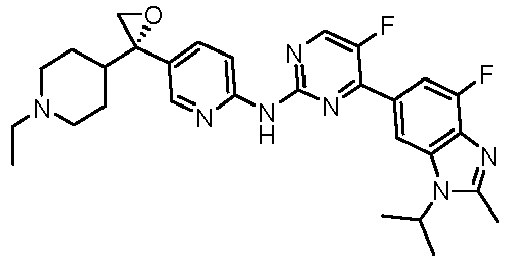








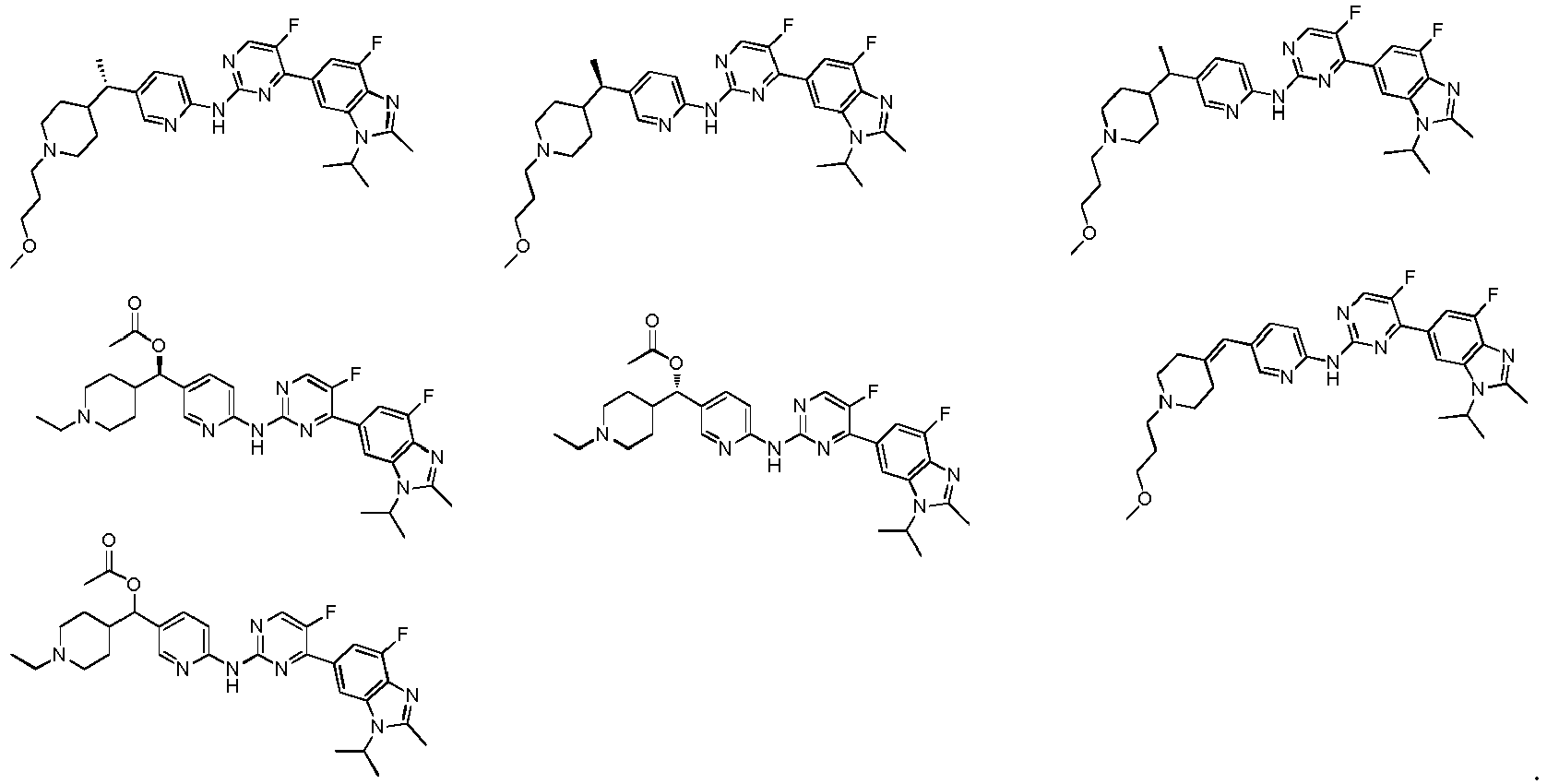
- In the present invention, the compound represented by the general formula (I-1) can be preferably obtained from racemic compound 102 under the following chiral separation conditions.

- The chiral separation method can comprise the following conditions:
- chiral column is Chiralpak AS-
H 10 mm × 250 mm, 5 µm; - column temperature is 40 °C;
- mobile phase A is 0.1% DEA in hexane, and the percentage is the volume percentage;
- mobile phase B is ethanol;
- gradient is mobile phase A/mobile phase B = 80/20, and the ratio is volume percent;
- flow rate is 3.0 mL/min;
- detection wavelength is UV 300 nm;
- the compound represented by the general formula (1-1) is collected separately at RT for 16 minutes or 22 minutes.
- In the present invention, the compound represented by the general formula (I-1) can be preferably obtained from racemic compound 103 under the following chiral separation conditions.

- The chiral separation method can comprise the following conditions:
- chiral column is Chiralpak AS-
H 10 mm × 250 mm, 5 µm; - column temperature is 40 °C;
- mobile phase A is 0.1% DEA in hexane, and the percentage is the volume percentage;
- mobile phase B is ethanol;
- gradient is mobile phase A/mobile phase B = 80/20, and the ratio is volume percent;
- flow rate is 3.0 mL/min;
- detection wavelength is UV 300 nm;
- the compound represented by the general formula (1-1) is collected separately at RT for 13 minutes or 19 minutes.
- In the present invention, the compound represented by the general formula (I-1) can be preferably obtained from racemic compound 104 under the following chiral separation conditions.

- The chiral separation method can comprise the following conditions:
- chiral column is Chiralpak AD-
H 10 mm × 250 mm, 5 µm; - column temperature is 40 °C;
- mobile phase A is 0.1% DEA in hexane, and the percentage is the volume percentage;
- mobile phase B is ethanol;
- gradient is mobile phase A/mobile phase B = 50/50, and the ratio is volume percent;
- flow rate is 3.0 mL/min;
- detection wavelength is UV 210 nm;
- the compound represented by the general formula (1-1) is collected separately at RT for 30 minutes or 36 minutes.
- In the present invention, the compound represented by the general formula (I-1) can be preferably obtained from racemic compound 105 under the following chiral separation conditions.

- The chiral separation method can comprise the following conditions:
- chiral column is Chiralpak AS-
H 10 mm × 250 mm, 5 µm; - column temperature is 40 °C;
- mobile phase A is 0.1% DEA in hexane, and the percentage is the volume percentage;
- mobile phase B is ethanol;
- gradient is mobile phase A/mobile phase B = 80/20, and the ratio is volume percent;
- flow rate is 3.0 mL/min;
- detection wavelength is UV 300 nm;
- the compound represented by the general formula (1-1) is collected separately at RT for 14.5 minutes or 18 minutes.
- In the present invention, the compound represented by the general formula (I-1) can be preferably obtained from racemic compound 106 under the following chiral separation conditions.

- The chiral separation method can comprise the following conditions:
- chiral column is Chiralpak AD-
H 10 mm × 250 mm, 5 µm; - column temperature is 40 °C;
- mobile phase A is 0.1% DEA in hexane, and the percentage is the volume percentage;
- mobile phase B is ethanol;
- gradient is mobile phase A/mobile phase B = 50/50, and the ratio is volume percent;
- flow rate is 3.0 mL/min;
- detection wavelength is UV 210 nm;
- the compound represented by the general formula (1-1) is collected separately at RT for 23 minutes or 29 minutes.
- In the present invention, the compound represented by the general formula (I-1) can be preferably obtained from racemic compound 107 under the following chiral separation conditions.
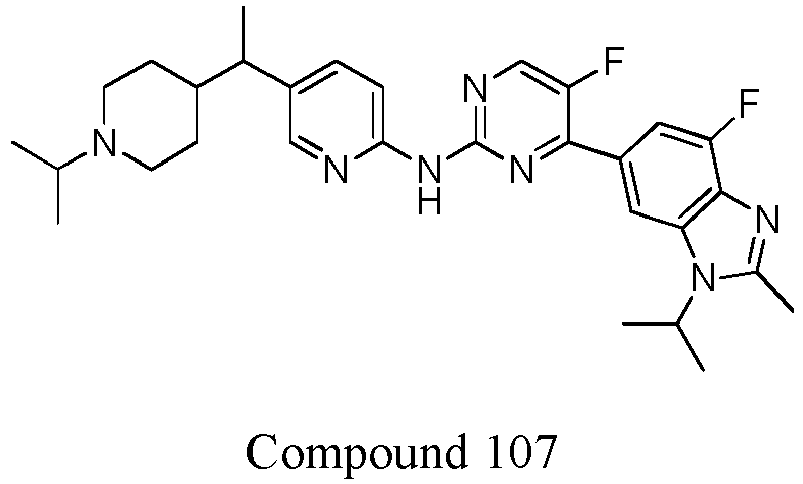
- The chiral separation method can comprise the following conditions:
- chiral column is Chiralpak AS-
H 10 mm × 250 mm, 5 µm; - column temperature is 40 °C;
- mobile phase A is 0.1% DEA in hexane, and the percentage is the volume percentage;
- mobile phase B is ethanol;
- gradient is mobile phase A/ mobile phase B = 80/20, and the ratio is volume percent;
- flow rate is 3.0 mL/min;
- detection wavelength is UV 300 nm;
- the compound represented by the general formula (1-1) is collected separately at RT for 17.5 minutes or 24 minutes.
- In the present invention, the compound represented by the general formula (I-1) can be preferably obtained from racemic compound 108 under the following chiral separation conditions.

- The chiral separation method can comprise the following conditions:
- chiral column is Chiralpak AS-
H 10 mm × 250 mm, 5 µ m; - column temperature is 40 °C;
- mobile phase A is 0.1% DEA in hexane, and the percentage is the volume percentage;
- mobile phase B is ethanol;
- gradient is mobile phase A/ mobile phase B = 80/20, and the ratio is volume percent;
- flow rate is 3.0 mL/min;
- detection wavelength is UV 300 nm;
- the compound represented by the general formula (1-1) is collected separately at RT for 18.4 minutes or 25 minutes.
- In the present invention, the compound represented by the general formula (I-1) can be preferably obtained from racemic compound 109 under the following chiral separation conditions.

- The chiral separation method can comprise the following conditions:
- chiral column is Chiralpak AS-
H 10 mm × 250 mm, 5 µm; - column temperature is 40 °C;
- mobile phase A is 0.1% DEA in hexane, and the percentage is the volume percentage;
- mobile phase B is ethanol;
- gradient is mobile phase A/mobile phase B = 80/20, and the ratio is volume percent;
- flow rate is 3.0 mL/min;
- detection wavelength is UV 300 nm;
- the compound represented by the general formula (1-1) is collected separately at RT for 14.6 minutes or 18.4 minutes.
- In the present invention, the compound represented by the general formula (I-1) can be preferably obtained from racemic compound 110 under the following chiral separation conditions.

- chiral separation method can comprise the following conditions:
- chiral column is Chiralpak AS-
H 10 mm × 250 mm, 5 µm; - column temperature is 40 °C;
- mobile phase A is 0.1% DEA in hexane, and the percentage is the volume percentage;
- mobile phase B is ethanol;
- gradient is mobile phase A/mobile phase B = 80/20, and the ratio is volume percent;
- flow rate is 3.0 mL/min;
- detection wavelength is UV 300 nm;
- the compound represented by the general formula (1-1) is collected separately at RT for 15.7 minutes or 21.3 minutes.
- In the present invention, the compound represented by the general formula (I-1) can be preferably obtained from racemic compound 111 under the following chiral separation conditions.

- The chiral separation method can comprise the following conditions:
- chiral column is Chiralpak AS-
H 10 mm × 250 mm, 5 µm; - column temperature is 40 °C;
- mobile phase A is 0.1% DEA in hexane, and the percentage is the volume percentage;
- mobile phase B is ethanol;
- gradient is mobile phase A/mobile phase B = 80/20, and the ratio is volume percent;
- flow rate is 3.0 mL/min;
- detection wavelength is UV 300 nm;
- the compound represented by the general formula (1-1) is collected separately at RT for 14.9 minutes or 19.7 minutes.
- In the present invention, the compound represented by the general formula (I-1) can be preferably obtained from racemic compound 112 under the following chiral separation conditions.

- The chiral separation method can comprise the following conditions:
- chiral column is Chiralpak AS-
H 10 mm × 250 mm, 5 µm; - column temperature is 40 °C;
- mobile phase A is 0.1% DEA in hexane, and the percentage is the volume percentage;
- mobile phase B is ethanol;
- gradient is mobile phase A/mobile phase B = 80/20, and the ratio is volume percent;
- flow rate is 3.0 mL/min;
- detection wavelength is UV 300 nm;
- the compound represented by the general formula (1-1) is collected separately at RT for 18.3 minutes or 24.8 minutes.
- In the present invention, the compound preferably represented by the general formula (1-1) can be obtained from racemic compound 113 under the following chiral separation conditions.

- The chiral separation method can comprise the following conditions:
- chiral column is Chiralpak AS-
H 10 mm × 250 mm, 5 µm; - column temperature is 40 °C;
- mobile phase A is 0.1% DEA in hexane, and the percentage is the volume percentage;
- mobile phase B is ethanol;
- gradient is mobile phase A/ mobile phase B = 80/20, and the ratio is volume percent;
- flow rate is 3.0 mL/min;
- detection wavelength is UV 300 nm;
- the compound represented by the general formula (1-1) was collected separately at RT for 19.7 minutes or 25.1 minutes.
- Even if other chiral resolution and purification methods are employed, it will fall within the scope of the present invention to obtain a single chiral compound at a corresponding retention time under the chiral separation methods described in the present invention.
- In a second aspect, the invention also provides a process for preparing the compound represented by the general formula (1-1), which comprises the following steps:

- coupling the compound represented by the general formula (I-A) with the compound represented by the general formula (I-B) under basic and catalyst conditions to obtain the compound represented by the general formula (1-1);
- wherein X is halogen; the definitions of R1, R2, R3, R4, R5, R6, R7, R12, z, Y1, Y2, Ya, Yb, A, m, n, p and q are defined as above.
- The invention also provides a process for preparing the compound represented by the general formula (II-1), which comprises the following steps:

- coupling the compound represented by the general formula (II-A) with the compound represented by the general formula (II-B) under basic and catalyst conditions to obtain the compound represented by the general formula (II-1);
- wherein X is halogen; the definitions of R1, R2, R3, R4, R7, R12, z, Y2, Ya, Yb, W, A, m, n, p, and q are defined as above.
- In the coupling reaction, the reagents that provide basic conditions include organic bases and inorganic bases, and the organic bases include, but are not limited to, lithium hexamethyldisilazane, sodium hexamethyldisilazane, potassium hexamethyldisilazane, lithium diisopropylamide, n-butyllithium, sec-butyllithium, triethylamine, pyridine, 2,6-dimethylpyridine, N, N-diisopropylethylamine, potassium tert-butoxide, sodium tert-butoxide, lithium tert-butoxide, tetrabutylammonium fluoride or N-methylmorpholine. The inorganic bases include, but are not limited to, potassium carbonate, sodium carbonate, sodium bicarbonate, sodium hydroxide, potassium hydroxide, lithium hydroxide, cesium fluoride, cesium carbonate, lithium carbonate, potassium phosphate, sodium hydride or potassium hydride.
- In the coupling reaction, the catalyst includes, but is not limited to, triphenylphosphine, 4,5-bis(diphenylphosphino)-9,9-dimethylxanthene, tris(dibenzylideneacetone)dipalladium, 2, 2'-bis(diphenylphosphino)-1,1'-binaphthyl, 2-(dicyclohexylphosphino)biphenyl, 1 1'-bis(diphenylphosphino)ferrocene palladium(II) dichloride, bis(triphenylphosphine)palladium(II) dichloride, palladium dichloride, palladium acetate, cuprous iodide, palladium on carbon (Pd/C), rhodium on carbon (Rh/C) or Raney nickel.
- In a third aspect, the present invention also provides a pharmaceutical composition comprising a therapeutically effective amount of the compound represented by the general formula (1-1) or (II-1), the pharmaceutically acceptable salt thereof, the stereoisomer thereof or the mixture form of the stereoisomers, the solvate thereof, the polymorph thereof, or the stable isotope derivative thereof, and a pharmaceutically acceptable carrier, diluent or excipient.
- The present invention also provides the compound represented by the general formula (1-1) or (II-1), the pharmaceutically acceptable salt thereof, the stereoisomer thereof or the mixture form of the stereoisomers, the solvate thereof, the polymorph thereof, or the stable isotope derivative thereof, or the pharmaceutical composition as defined herein for use in inhibiting or treating abnormal cell proliferation, infection, inflammatory diseases, autoimmune diseases, cardiovascular diseases or neurodegenerative diseases related to CDK mediation.
- In some aspects of the present invention, the CDK can be one or more than one of CDK1, CDK2, CDK4, CDK5, CDK6, CDK7, CDK8, CDK9, CDK10, CDK11, CDK12, and CDK13.
- In some aspects of the present invention, the CDK can be one or more than one ofCDK1, CDK2, CDK4, CDK6, CDK7, and CDK9.
- In some aspects of the present invention, the CDK can be CDK4 and/or CDK6.
- In a sixth aspect, the present invention also provides the compound represented by the general formula (1-1) or (II-1), the pharmaceutically acceptable salt thereof, the stereoisomer thereof or the mixture forms of the stereoisomers, the solvate thereof, the polymorph thereof, or the stable isotope derivative thereof, or the pharmaceutical composition as defined herein for use in relieving and/or treating abnormal cell proliferation, infection (e.g., virus infections such as HIV, HBV), inflammatory diseases (e.g., rheumatoid arthritis), autoimmune diseases (e.g., psoriasis, lupus erythematosus, diabetes), cardiovascular diseases (e.g., stroke, myocardial infarction, atherosclerosis) or neurodegenerative diseases (e.g., Alzheimer's disease, Parkinson's disease), wherein the abnormal cell proliferative disease can be a cancer.
- In an eighth aspect, the invention also provides the compound represented by the general formula (1-1) or (II-1), the pharmaceutically acceptable salt thereof, stereoisomer or the mixture forms of the stereoisomers, the solvate thereof, the polymorph thereof, or the stable isotope derivative thereof, or the pharmaceutical composition as herein defined for use in treating a cancer, wherein the cancer includes breast cancer, ovarian cancer, prostate cancer, melanoma, brain tumor (e.g., glioma), nasopharyngeal carcinoma, esophageal cancer, gastric cancer, liver cancer, pancreatic cancer, colorectal cancer (e.g., colon cancer, rectal cancer), lung cancer (e.g., small cell lung cancer, non-small cell lung cancer, squamous cell carcinoma, undifferentiated carcinoma), renal carcinoma, skin cancer, glioblastoma, neuroblastoma, sarcoma, liposarcoma, osteochondroma, osteocarcinoma, osteosarcoma, seminoma, testicular tumor, uterine tumor (e.g., cervical cancer, endometrial cancer), head and neck tumor (e.g., laryngeal cancer, pharyngeal cancer, tongue cancer), multiple myeloma, malignant lymphoma (e.g., reticulum cell sarcoma, hedgerow lymphosarcoma, Hodgkin's lymphoma, mantle cell lymphoma), polycythemia vera, leukemia (e.g., acute granulocytic leukemia, chronic granulocytic leukemia, acute lymphoblastic leukemia, chronic lymphoblastic leukemia), thyroid tumor, ureteral tumor, bladder tumor, gallbladder cancer, cholangiocarcinoma, chorionic epithelial cancer or pediatric tumor (e.g., neuroblastoma, embryonic testicular cancer, retinoblastoma).
- In a ninth aspect, the invention also provides the compound represented by the general formula (1-1) or (II-1), the pharmaceutically acceptable salt thereof, the stereoisomer or the mixture forms of the stereoisomers, the solvate thereof, the polymorph thereof, or the stable isotope derivative thereof, or the pharmaceutical composition as herein defined for use in treating a cancer, wherein the compound represented by the general formula (1-1) or (II-1), the pharmaceutically acceptable salt thereof, the stereoisomer thereof or the mixture form of the stereoisomers, the solvate thereof, the polymorph thereof, or the stable isotope derivative thereof, or the pharmaceutical composition can be used in combination with one or more than one other anti-cancer agents which are selected from the group consisting of alkylating agents (e.g., cyclophosphamide, chlormethine hydrochloride, dibromomannitol, carmustine, dacarbazine, melphalan), platinum complexes (e.g., cisplatin, carboplatin), metabolic antagonists (e.g., methotrexate, 5-fluorouracil, capecitabine, pemetrexed), alkaloids (e.g., docetaxel, paclitaxel, vinblastine, irinotecan), antibody drugs (e.g., trastuzumab, partrozumab, bevacizumab), hormonal anticancer agents (e.g., leuprorelin, dutasteride, dexamethasone), proteasome inhibitors (e.g., boraxzomib, ixazomib, lenalidomide), CDK inhibitors (e.g., palbociclib, ribociclib), VEGFR or EGFR inhibitors (e.g., alfatinib, imatinib, gefitinib, erlotinib), m-TOR inhibitors (e.g., everolimus, sirolimus), PI3K inhibitors (e.g., idelalisib), B-Raf inhibitors (e.g., sorafenib, vemurafenib, rivarofini), PARP inhibitors (e.g., olaparib, niraparib), c-Met kinase inhibitors (e.g., crizotinib), ALK inhibitors (e.g., ceritinib, alectinib), AKT inhibitors (e.g., perifosine), ABL inhibitors, FLT3 inhibitors, PD-1 monoclonal antibodies (e.g., Opdivo, Keytruda) or PD-L1 monoclonal antibodies (Atezolizumab).
- Unless otherwise stated to the contrary, the terms used in the specification and claims have the following definitions.
- The term "oxo" refers to "=O".
- The term "alkyl" refers to a saturated aliphatic hydrocarbon group, including linear or branched groups of 1 to 20 carbon atoms, preferably 1 to 10 carbon atoms, more preferably 1 to 8 carbon atoms, and non-limiting examples include, but are not limited to, methyl, ethyl, n-propyl, n-butyl, isobutyl, tert-butyl, sec-butyl, n-pentyl, 2-methylbutyl, 3- methylbutyl, 1, 1-dimethylpropyl, 1, 2-dimethylpropyl, 2, 2-dimethylpropyl, 1-ethylpropyl, n-hexyl, 2-methylpentyl, 3-methylpentyl, 4-methylpentyl, 1, 1-dimethylbutyl, 1, 2-dimethylbutyl, 2, 2-dimethylbutyl, 1, 3-dimethylbutyl, 2, 3-dimethylbutyl, 3, 3-dimethylbutyl, 1, 1, 2-trimethylpropyl, 1-ethyl-2-methylpropyl, n-heptyl, 2-methylhexyl, 3-methylhexyl, 4-methylhexyl, 5-methylhexyl, 2, 2-dimethylpentyl, 2, 3-dimethylpentyl, 2,3-dimethylpentyl, 2, 4-dimethylpentyl, 3, 3-dimethylpentyl, 3, 4-dimethylpentyl, 2-ethylpentyl, 3-ethylpentyl, octyl, nonyl, decyl, undecyl, dodecyl, and various isomers thereof, and the like. The alkyl can be substituted or unsubstituted and can be substituted at any available junction, and the substituent is preferably one or more than one groups, independently selected from alkyl, halogen, hydroxyl, mercapto, cyano, alkenyl, alkynyl, alkoxy, alkylmercapto, alkylamino, nitro, cycloalkyl, heterocycloalkyl, aryl, heteroaryl, cycloalkyloxy, heterocycloalkyloxy, cycloalkylmercapto, heterocycloalkylmercapto, oxo, amino, haloalkyl, hydroxyalkyl, carboxyl or carboxylate group. When "alkyl" and its prefix are used herein, both linear and branched saturated carbon bonds are included.
- The term "cycloalkyl" refers to a saturated or partially unsaturated monocyclic or polycyclic group comprising from 3 to 20 carbon atoms, preferably 3 to 12 carbon atoms, more preferably 3 to 10 carbon atoms, and most preferably 3 to 6 carbon atoms. Non-limiting examples of monocyclic cycloalkyl include, but are not limited to, cyclopropyl, cyclobutyl, cyclopentyl, cyclopentenyl, cyclohexyl, cyclohexenyl, cyclohexadiene, cycloheptyl, cyclooctyl, and the like. Non-limiting examples of polycyclic cycloalkyl include, but are not limited to, spirocycloalkyl, fused cycloalkyl and bridged cycloalkyl. Cycloalkyl can be substituted or unsubstituted, and the substituent is preferably one or more than one groups, independently selected from alkyl, halogen, hydroxyl, mercapto, cyano, alkenyl, alkynyl, alkoxy, alkylmercapto, alkylamino, nitro, cycloalkyl, heterocycloalkyl, aryl, heteroaryl, cycloalkoxy, heterocycloalkoxy, cycloalkoxy, cycloalkoxy, cycloalkoxy, cycloalkylmercapto, heterocycloalkylmercapto, oxo, amino, haloalkyl, hydroxyalkyl, carboxyl or carboxylate group, and the like.
- The term "haloalkyl" refers to an alkyl can be substituted by one or more than one the same or different halogen atoms, wherein the definition of the alkyl is as defined in the present invention.
- The term "alkenyl" refers to an alkyl as defined in the present invention consisting of at least two carbon atoms and at least one carbon-carbon double bond, preferably C2-C10 alkenyl, more preferably C2-C6 alkenyl, most preferably C2-C4 alkenyl, such as vinyl, propenyl, 1-propenyl, and the like. The alkenyl group can be substituted or unsubstituted, and the substituent is preferably one or more than one groups, independently selected from alkyl, halogen, hydroxyl, mercapto, cyano, alkenyl, alkynyl, alkoxy, alkylmercapto, alkylamino, nitro, cycloalkyl, heterocycloalkyl, aryl, heteroaryl, cycloalkoxy, heterocycloalkoxy, cycloalkoxy, cycloalkoxy, cycloalkoxy, cycloalkylmercapto, heterocycloalkylmercapto, oxo, amino, haloalkyl, hydroxyalkyl, carboxyl or carboxylate group, and the like.
- The term "alkynyl" refers to an alkyl as defined in the present invention consisting of at least two carbon atoms and at least one carbon-carbon triple bond, preferably C2-C10 alkynyl, more preferably C2-C6 alkynyl, most preferably C2-C4 alkynyl, such as ethynyl, 1-propynyl, 2-propynyl, and the like. The alkynyl group can be substituted or unsubstituted, and the substituent is preferably one or more than one groups, independently selected from alkyl, halogen, hydroxyl, mercapto, cyano, alkenyl, alkynyl, alkoxy, alkylmercapto, alkylamino, nitro, cycloalkyl, heterocycloalkyl, aryl, heteroaryl, cycloalkoxy, heterocycloalkoxy, cycloalkoxy, cycloalkoxy, cycloalkoxy, cycloalkylmercapto, heterocycloalkylmercapto, oxo, amino, haloalkyl, hydroxyalkyl, carboxyl or carboxylate group, and the like.
- The term "heterocycloalkyl" refers to a saturated or partially unsaturated monocyclic or polycyclic hydrocarbon group comprising from 3 to 20 ring atoms, wherein one or more than one ring atoms are selected from heteroatoms of N, O, S(O)m, P(O)m (wherein m is an integer from 0 to 2), but excluding ring moiety of -O-O, -O-S-or -S-S- and the remaining ring atoms are carbon. Preferably 3 to 12 ring atoms containing 1 to 4 heteroatoms, and non-limiting examples of monocyclic heterocycloalkyl include pyrrolyl, piperidinyl, piperazinyl, morpholinyl, tetrahydrofuranyl, pyranyl, and the like. Polycyclic heterocycloalkyl include spiro heterocycloalkyl, fused heterocycloalkyl and bridged heterocycloalkyl. Heterocycloalkyl can be substituted or unsubstituted, and the substituent is preferably one or more than one groups, independently selected from alkyl, halogen, hydroxyl, mercapto, cyano, alkenyl, alkynyl, alkoxy, alkylmercapto, alkylamino, nitro, cycloalkyl, heterocycloalkyl, aryl, heteroaryl, cycloalkyloxy, heterocycloalkyloxy, cycloalkylmercapto, heterocycloalkylmercapto, oxo, amino, haloalkyl, hydroxyalkyl, carboxyl or carboxylate group, and the like.
- The term "alkoxy" refers to -O-(alkyl) and -O-(cycloalkyl), wherein the definitions of the alkyl and the cycloalkyl are as described in the description. Non-limiting examples include, but are not limited to, methoxy, ethoxy, propoxy, butoxy, cyclopropoxy, cyclobutoxy, cyclopentyloxy, cyclohexyloxy, and the like. The alkoxy group can be substituted or unsubstituted, and the substituent is preferably one or more than one groups, independently selected from alkyl, halogen, hydroxyl, mercapto, cyano, alkenyl, alkynyl, alkoxy, alkylmercapto, alkylamino, nitro, cycloalkyl, heterocycloalkyl, aryl, heteroaryl, cycloalkyloxy, heterocycloalkyloxy, heterocycloalkyloxy, cycloalkylmercapto, heterocycloalkylmercapto, oxo, amino, haloalkyl, hydroxyalkyl, carboxyl or carboxylate group, and the like.
- The term "alkylmercapto" refers to -S-(alkyl) and -S- (cycloalkyl), wherein the definitions of the alkyl and the cycloalkyl are as described in the description. Non-limiting examples include, but are not limited to, methylmercapto, ethylmercapto, propylmercapto, butylmercapto, cyclopropylmercapto, cyclobutylmercapto, cyclopentylmercapto, cyclohexylmercapto, and the like. Alkylmercapto can be substituted or unsubstituted, and the substituent is preferably one or more than one groups, independently selected from alkyl, halogen, hydroxyl, mercapto, cyano, alkenyl, alkynyl, alkoxy, alkylmercapto, alkylamino, nitro, cycloalkyl, heterocycloalkyl, aryl, heteroaryl, cycloalkoxy, heterocycloalkoxy, cycloalkylmercapto, heterocycloalkylmercapto, oxo, amino, haloalkyl, hydroxyalkyl, carboxyl or carboxylate group, and the like.
- The term "aryl" refers to any stable conjugated hydrocarbon ring system group of 6 to 18 carbon atoms, preferably 6 to 10 carbon atoms, which can be monocyclic, bicyclic, tricyclic or more cyclic aromatic groups, such as phenyl, naphthyl, anthracene and the like. The aryl ring can be fused to a ring of heteroaryl, heterocycloalkyl or cycloalkyl. The aryl can be substituted or unsubstituted, and the substituent is preferably one or more than one groups, independently selected from alkyl, halogen, hydroxyl, mercapto, cyano, alkenyl, alkynyl, alkoxy, alkylmercapto, alkylamino, nitro, cycloalkyl, heterocycloalkyl, aryl, heteroaryl, cycloalkyloxy, heterocycloalkyloxy, heterocycloalkyloxy, cycloalkylmercapto, heterocycloalkylmercapto, oxo, amino, haloalkyl, hydroxyalkyl, carboxyl or carboxylate group, and the like.
- The term "heteroaryl" refers to an aromatic ring system in which at least one carbon atom in the ring is replaced by a heteroatom selected from N, O or S, preferably a 5- to 7-membered monocyclic moiety or a 7- to 12-membered bicyclic moiety, more preferably a 5- to 6-membered heteroaryl, such as pyrrolyl, imidazolyl, pyridyl, pyrimidinyl, thiazolyl, thienyl, pyrazinyl, triazolyl, tetrazolyl, oxazolyl, indazolyl, and the like. The heteroayl ring can be fused to a ring of aryl, heterocycloalkyl or cycloalkyl. The heteroaryl can be substituted or unsubstituted, and the substituent is preferably one or more than one groups, independently selected from alkyl, halogen, hydroxyl, mercapto, cyano, alkenyl, alkynyl, alkoxy, alkylmercapto, alkylamino, nitro, cycloalkyl, heterocycloalkyl, aryl, heteroaryl, cycloalkyloxy, heterocycloalkyloxy, heterocycloalkyloxy, cycloalkylmercapto, heterocycloalkylmercapto, oxo, amino, haloalkyl, hydroxyalkyl, carboxyl or carboxylate group, and the like.
- The term "hydroxyl" refers to -OH.
- The term "halogen" refers to fluorine, chlorine, bromine or iodine.
- The term "nitro" refers to -NO2.
- The term "amino" refers to -NH2.
- The term "cyano" refers to -CN.
- The term "carboxylic acid" refers to -C(O)OH.
- The term "mercapto" refers to -SH.
- The term "carboxylate group" refers to -C(O)O-alkyl, -C(O)O-aryl, or - C(O)O-cycloalkyl, wherein the definitions of alkyl, the aryl, and the cycloalkyl are as defined above.
- The term "substituted" means that one or more than one hydrogen or deuterium atoms in the group, preferably 1 to 5 hydrogens or deuterium atoms, are independently substituted by a corresponding number of substituents.
- The term "pharmaceutically acceptable salt" refers to a salt that can retain the biological effectiveness of the free base without other toxic and side effects, and can be an acidic salt, a basic salt or an amphoteric salt. Non-limiting examples include, but are not limited to, acidic salts including hydrochloride, hydrobromide, sulfate, pyrosulfate, bisulfate, sulfite, bisulfite, phosphate, monohydrogen phosphate, dihydrogen phosphate, metaphosphate, pyrophosphate, nitrate, acetate, propionate, caprate, octanoate, formate, acrylate, isobutyrate, hexanoate, heptanoate, oxalate, malonate, succinate, suberate, benzoate, methyl benzoate, phthalate, maleate, methanesulfonate, p-toluenesulfonate, benzenesulfonate, (D, L)-tartrate, citrate, maleate, (D, L-)malate, fumarate, stearate, oleate, cinnamate, laurate, glutamate, aspartate, triflate,mandelate, ascorbate, salicylate, and the like. When the compound of the present invention contains acidic groups, pharmaceutically acceptable salts thereof can further include alkali metal salts (e.g., sodium salt or potassium salt), alkaline earth metal salts (e.g., calcium salt or magnesium salt), organic base salts (e.g., alkyl aromatics, amino acids).
- The term "solvate" refers to an aggregate (or associated complex) formed by one or more than one solvent molecules with a compound of the present invention. Solvents of the formed solvate include, but are not limited to, water, dimethyl sulfoxide, methanol, ethanol, isopropanol, acetic acid, and the like.
- The term "polymorph" refers to different solid crystalline phases generated by the presence of two or more different molecular arrangements in the solid-state of the compound of the present invention, which may exist as a single crystal form or a mixture of polycrystal forms.
- The term "stable isotope derivative" refers to an isotope substituted derivative obtained by replacing any hydrogen atom of the compound of the present invention with 1 to 5 deuterium atoms, or an isotope substituted derivative obtained by replacing any carbon atom of the compound of the present invention with 1 to 3 C14 atoms, or an isotope derivative obtained by replacing any oxygen atom with 1 to 3 O18 atoms of the compound of the present invention.
- The term "pharmaceutical composition" refers to a mixture of one or more than one compounds described herein or pharmaceutically acceptable salts and other chemical components, as well as other components such as physiologically acceptable carriers and excipients. The purpose of the pharmaceutical composition is to promote the administration of the organism and to facilitate the absorption of the active ingredient and exert biological activity.
- The term "stereoisomer" refers to a stereoisomer comprising an enantiomer, a diastereomer and cis/trans isomer is one of the diastereomers. The stereoisomers of the present compounds can be their enantiomers, diastereomers, and any mixture thereof, including the formation and presence of free or salt forms.
- The term "effective amount" or "therapeutically effective amount" refers to a sufficient amount of a drug or agent that is non-toxic but that achieves the desired effect. The determination of the effective amount varies from person to person, depending on the age and general condition of the recipient, and also on the particular active substance. The appropriate effective amount in a case can be determined by the skilled person in the art according to routine tests.
- Abbreviations for any protecting groups, amino acids, and other compounds are commonly used and recognized abbreviations, unless otherwise specified, or refer to IUPAC-IUBC Commission on Biochemical Nomenclature (See Biochem. 1972, 11, 942-944).
-
-
Fig. 1 shows the inhibitory effects on tumor volumes in MCF-7 cancer cells of vehicle, examples 17, 57 and Abemaciclib. -
Fig. 2 shows the inhibitory effects on tumor volumes in Colo-205 cancer cells of vehicle, example 17 and Abemaciclib. -
Fig. 3 shows the inhibitory effects on tumor volumes in MV4-11 cancer cells of vehicle, examples 17, 57 and Abemaciclib. -
Fig. 4 shows the inhibitory effects on tumor volumes in MDA-MB-361 cancer cells of vehicle, examples 17, 57 and Abemaciclib. - Examples 16-35 and 38-86 are according to the present invention, Examples 1-15 and 36-37 are for reference and do not form part of the invention.
- The following examples further describe the present invention, but these examples should not limit the scope of the present invention.
- In the examples of the invention, the experimental methods without specifying specific conditions are generally in accordance with conventional methods and conditions, or in accordance with the conditions recommended by the manufacturers of raw materials or commodities. The reagents without specific sources are conventional reagents purchased from the market.
- All compounds of the present invention can be determined by nuclear magnetic resonance (NMR) or mass spectrometry (MS). The NMR shift (δ) is recorded in units of 10-6 (ppm). The NMR measuring instrument is Bruker AVANCE-400 spectrometer. The deuterated solvents tested are deuterated chloroform (CDCl3), deuterated methanol (MeOD) or deuterated dimethyl sulfoxide (DMSO-d6), and the internal standard is tetramethylsilane (TMS).
- Low-resolution mass spectrometry (MS) is determined by Agilent 6120 quadruple LCMS mass spectrometer.
- The HPLC purity is determined by Agilent HPLC Agilent 1260/1220 chromatograph (Agilent Zorb Ax BonusRP 3.5µ m × 4.6 mm × 150 mm or Boston pHlex ODS 4.6 mm × 150 mm × 3 µm).
- The compounds of the present invention and their intermediates can be isolated and purified by conventional preparative HPLC, silica gel plate, column chromatography, or flash column chromatography.
- The thin-layer chromatography silica gel plate uses Yantai Huanghai, Yantai Xinnuo Chemical Industry HSGF254, or Qingdao GF254 silica gel plate. The silica gel plate used for thin-layer chromatography (TLC) is 2.5 x 5 cm, 0.2 mm-0.25 mm, and the thin layer chromatography separation (Prep-TLC) used for purifying products is 1 mm or 0.4 mm-0.5 mm, 20 x 20 cm.
- Column chromatography (silica gel column chromatography) is generally used in sizes of 100-200 mesh or 200-300 mesh or 300-400 mesh.
- The flash separator is Agela Technologies MP200, and the column is generally Flash column silica-CS (12 g-330 g).
- The preparative HPLC (Prep-HPLC) is Gilson GX-281, and the column model is Welch Ultimate XB-C18 21.2 mm x 250 mm × 10 µ m.
- The chiral columns are CHIRALCEL OD-H, OJ-H or CHIRALPAK AD-H, AS-H 4.6 mm × 250 mm × 5 µm, and the preparation column types are CHIRALCEL OD-H, OJ-H or CHIRALPAK AD-H, AS-
H 10 mm × 250 mm × 5 µm. - The known starting materials of the present invention can be synthesized by methods known in the art, or purchased from suppliers such as Sigma-Aldrich, ACROS, Alaf, TCI, J&K Scientific, energy-chemical, Accela ChemBio, Macklin, Siyanbio chemical companies and the like.
- Anhydrous solvents such as anhydrous tetrahydrofuran, anhydrous dichloromethane or anhydrous N, N-dimethylacetamide are commercially available from the above chemical companies.
- Unless otherwise specified in the examples, the reaction is generally carried out under a nitrogen or argon atmosphere. The nitrogen or argon atmosphere refers to that the reaction flask is connected to a balloon of nitrogen or argon having a volume of about 1 L and subjected to three pumping displacements.
- The hydrogen atmosphere means that the reaction flask is connected to a hydrogen balloon having a volume of about 1 L and subjected to three pumping displacements.
- The pressurized hydrogenation reaction uses a pressure-resistant sealed glass reaction vessel and is connected to a hydrogen pressure gauge.
- In the examples, unless otherwise specified, the reaction temperature is room temperature, and the temperature is 15 - 25 °C.
- The reactions in the examples are generally monitored by LCMS or TLC, wherein the LCMS is as described above. The developing solvent system used for TLC is generally: dichloromethane and methanol, petroleum ether and ethyl acetate, dichloromethane and ethyl acetate, petroleum ether and dichloromethane, ethyl acetate and methanol. The volume ratio of the solvent is adjusted according to the polarity of the compound, and a small amount (0.1%-10%) of base (e.g. triethylamine or 37% ammonia water) or acid (e.g. acetic acid) can also be added for adjustment.
- The compounds can be purified by Prep-TLC, column chromatography or Agela preparation system. The elution solvent system is generally dichloromethane and methanol, petroleum ether and ethyl acetate, dichloromethane and ethyl acetate, petroleum ether and dichloromethane, ethyl acetate and methanol, etc. The volume ratio of the solvent is adjusted according to the polarity of the compound. A small amount (0.1%-10%) of base (e.g. triethylamine or 37% ammonia water, etc.) or acid (e.g. acetic acid) can also be added for adjustment.
- The following abbreviations are used throughout the present invention:
- DIPEA: N, N-diisopropylethylamine
- DMF: N, N-dimethylformamide
- NMP: N-methylpyrrolidone
- THF: tetrahydrofuran
- DCM: dichloromethane
- MeOH: methanol
- PE: petroleum ether
- EA: ethyl acetate
- HCl: hydrochloric acid
- K2CO3: potassium carbonate
- Cu2O: cuprous oxide
- DMEDA: N, N'-dimethylethylenediamine
- NaBH4: sodium borohydride
- TBSCl: tert-butyldimethylchlorosilane
- TFA: trifluoroacetic acid
- (Boc)2O: di-tert-butyl dicarbonate
- Na2S2O3: sodium thiosulfate
- NaHCO3: sodium bicarbonate
- AIBN: azobisisobutyronitrile
- NBS: N-bromosuccinimide
- NaOH: sodium hydroxide
- NaH: sodium hydride
- NaBH(OAc)3: sodium triacetoxyborohydride
- Dess-martin oxidant: (1, 1, 1-triacetoxy)-1, 1-dihydro-1,2-phenyliodo-3(1H)-one
- n-BuLi: n-butyllithium
- NH3·H2O: Ammonia
- DEA: diethylamine
- Hexane: n-hexane
- CDCl3: Deuterated chloroform
- H2: hydrogen
- H2O: water
- Pd2(dba)3: tris(dibenzylideneacetone)dipalladium
- CyJohnPhos: 2-(dicyclohexylphosphino) biphenyl
- XantPhos: 4, 5-bis-diphenylphosphino-9,9-dimethyloxazepine
- LiHMDS: bistrimethylsilylamine lithium
- RT: retention time
- SFC: Supercritical Fluid Chromatography
- TLC: Thin layer chromatography
- Prep-TLC: preparative thin-layer chromatography
- Prep-HPLC: preparative high-performance liquid chromatography
- Example 1
-


-

- Ethyl magnesium bromide solution (2.0 M in THF, 16 mL) was added dropwise to a solution of 2-bromo-5-aldehyde pyridine (5.0 g, 26.9 mmol) in dry THF (50 mL) cooled in an ice-water bath under nitrogen atmosphere. After completion of the addition, the mixture was continued to stir for 1 h. TLC monitoring showed that the reaction was almost complete and the mixture was quenched with saturated ammonium chloride solution, diluted with water and extracted with ethyl acetate (50 mL × 3). The combined organic phases were washed with brine, dried over anhydrous Na2SO4, filtered and concentrated. The residue was purified by column chromatography (hexane/acetate, 8 /1) to give intermediate 1-(6-bromopyridin-3-yl)propan-1-ol as a colorless oil (3.8 g, 66% yield).
MS (ESI), m/z, 216.1 [M+1]+. -

- To a solution of 1-(6-bromopyridine-3-yl)propane-1-ol (3.3 g, 15.3 mmol) in dichloromethane solution (50 mL) was added triethylamine (3.1 g, 30.7 mmol) under nitrogen atmosphere, and then cooled to 0 °C, methanesulfonyl chloride (2.6 g, 22.6 mmol) was added dropwise. After the completion of the addition, the mixture was continued to stir for 1 h. LCMS showed that the reaction was complete. The mixture was quenched with saturated NaHCO3 solution, and extracted with dichloromethane (30 mL × 3). The combined organic phases were washed with brine, dried over anhydrous Na2SO4,filtered, and concentrated. The residue was purified by column chromatography to give intermediate 1-(6-bromopyridin-3-yl)propyl methanesulfonate as a colorless oil (3.3 g, 69% yield).
MS (ESI), m/z, 294.1 [M+1]+. -

- To a solution of 1-(6-bromopyridin-3-yl)propyl methanesulfonate (4.5 g, 15.3 mmol) in DMF (50 mL) was added DIPEA(3.95 g, 30.6 mmol) and N-ethyl piperazine (3.49 g, 30.6 mmol) under nitrogen atmosphere. The mixture was heated to 80 °C and stirred for 12 h. TLC showed that the reaction was complete and the mixture was cooled to room temperature and quenched with water. The mixture was extracted with ethyl acetate (50 mL × 3). The combined organic phases were washed with brine, dried over anhydrous Na2SO4,filtered, and concentrated to give intermediate 1-(1-(6-bromopyridin-3-yl) propyl)-4-ethylpiperazine as a white solid (4.5 g, 99% yield), which was used directly in the next step.
MS (ESI), m/z, 312.1 [M+1]+.
1H NMR (400 MHz, CDCl3) δ (ppm) 8.20 (d, J = 1.6 Hz, 1 H), 7.48 - 7.34 (m, 2 H), 3.18 (dd, J = 9.1, 4.8 Hz, 1 H), 2.89 - 2.17 (m, 11 H), 1.91 (ddd, J = 13.5, 7.4, 4.8 Hz, 1 H), 1.66 (ddd, J = 13.7, 9.0, 7.3 Hz, 1 H), 1.05 (t, J = 7.2 Hz, 3 H), 0.71 (t, J = 7.4 Hz, 3 H). -
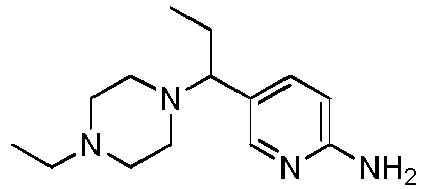
- To a solution of 1-(1-(6-bromopyridin-3-yl)propyl)-4-ethylpiperazine (0.27 g, 0.91 mmol) in THF (5 mL) was added Pd2(dba)3 (82 mg, 0.09 mmol) and CyJohnPhos(63 mg, 0.18 mmol). The reaction flask was evacuated and purged with N2, and heated to 50 °C, LiHMDS (1.0 M in THF, 2.7 mL, 2.7 mmol) was added dropwise. After the addition, themixture was heated to 65 °C for 4 h. TLC or LCMS showed that the reaction was complete, then the mixture was cooled to room temperature, quenched with water, concentrated, diluted with dichloromethane (20 mL), acidified to pH = 1-2 with 2 N HCl, and the two layers were separated. The aqueous phase was washed with dichloromethane (10 mL × 2), basified with 2 N NaOH to pH = 10-12, extracted with dichloromethane (20 mL × 4). The combined organic phases were washed with brine, dried over anhydrous Na2SO4,filtered, and concentrated to give intermediate 5-(1-(4-ethylpiperazin-1-yl) propyl)pyridin-2-amine as a colorless oil (0.22 g, 99% yield), which was used directly in the next step.
MS (ESI), m/z, 249.2 [M+1]+. -

- To a solution of 5-(1-(4-ethylpiperazin-1-yl)propyl) pyridin-2-amine (0.22 g, 0.89 mmol) in dioxane (10mL) was added 6-(2-chloro-5-fluoropyrimidin-4-yl)-4-fluoro-1-isopropyl-2- methyl-1H-benzo[d]imidazole (0.29 g, 0.89 mmol), Pd2(dba)3 (81 mg, 0.09 mmol), XantPhos (103 mg, 0.18 mmol) and cesium carbonate (0.58 g, 1.78 mmol) . The reaction flask was evacuated and purged with N2 and heated to 110 °C for 1.5 h. TLC or LCMS showed that the reaction was complete, the mixture was cooled to room temperature, filtered with Celite, washed with dichloromethane. The filtrate was concentration andpurified by Prep-TLC (DCM/MeOH = 15/1) to give N-(5-(1-(4-ethylpiperazin-1-yl)propyl)pyridin-2-yl)- 5-fluoro-4-(4-fluoro-1-isopropyl-2-methyl-1H-benzo[d]imidazol-6-yl)pyrimidin-2-amine as a white solid (240 mg, 98.2% HPLC purity, 51% yield).
MS (ESI), m/z, 535.3 [M+1]+.
1H NMR (400 MHz, CDCl3) δ (ppm) 8.48 - 8.42 (m, 2 H), 8.39 (d, J = 8.6 Hz, 1 H), 8.19 (d, J = 0.9 Hz, 2 H), 7.80 (d, J = 12.3 Hz, 1 H), 7.60 (dd, J = 8.6, 2.2 Hz, 1 H), 4.82 - 4.63 (m, 1 H), 3.22 (dd, J = 9.3, 4.6 Hz, 1 H), 2.69 (s, 3 H), 2.63 - 2.29 (m, 9 H), 2.06 - 1.86 (m, 1 H), 1.82 - 1.73 (m, 1 H), 1.71 (d, J = 7.0 Hz, 6 H), 1.06 (t, J = 7.2 Hz, 3 H), 0.77 (t, J = 7.3 Hz, 3 H). -

- The racemic compound obtained in example 1 was separated by chiral column Chiralpak AD-H (10 mm × 250 mm, 5 µm) at a column temperature of 40 °C. Mobile phase A was 0.1% DEA in hexane (v/v), mobile phase B was ethanol, running time was 30 minutes, gradient was mobile phase A/mobile phase B (50/50, v/v), flow rate was 6.0 mL/min and detection wavelength was UV 210 nm. Two single-configuration compounds were separated and collected at RT of 15 minutes (compound of example 2) and 20 minutes (compound of example 3), respectively. The compounds were detected by chiral column Chiralpak AD-H (4.6 mm × 250 mm) at a column temperature of 40 °C. Mobile phase A was 0.1% DEA in hexane (v/v), mobile phase B was ethanol, running time was 20 minutes, gradient was mobile phase A/mobile phase B (50/50), flow rate was 1.0 mL/min, and detection wavelength was UV 210 nm. The first single configuration compound was example 2 (RT = 10.4 min, 97.2% ee) and the second single configuration compound was example 3 (RT = 14.2 min, 95.9% ee).
- The compounds of examples 4-15 in the following table were prepared according to the synthesis methods of examples 1-3 using the corresponding starting materials.
Example Structure Characterization data Example 4 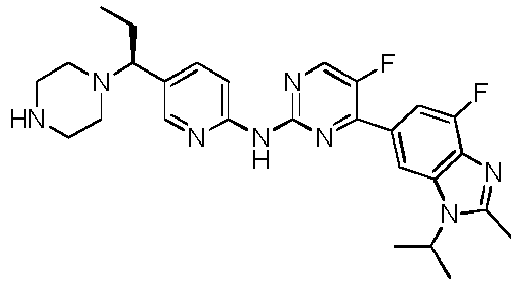
MS-ESI, m/z: 507.2 [M+1]+ Example 5 
MS-ESI, m/z: 507.2 [M+1]+ Example 6 
MS-ESI, m/z: 521.3 [M+1]+ Example 7 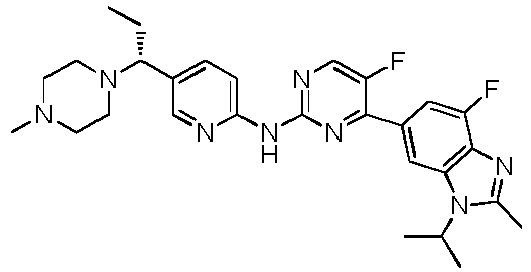
MS-ESI, m/z: 521.3 [M+1]+ Example 8 
MS-ESI, m/z: 549.3 [M+1]+ Example 9 
MS-ESI, m/z: 549.3 [M+1]+ Example 10 
MS-ESI, m/z: 537.2 [M+1]+ Example 11 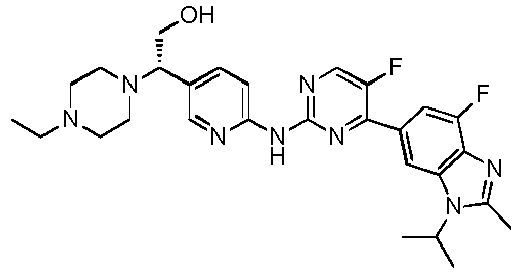
MS-ESI, m/z: 537.2 [M+1]+ Example 12 
MS-ESI, m/z: 590.3 [M+1]+ Example 13 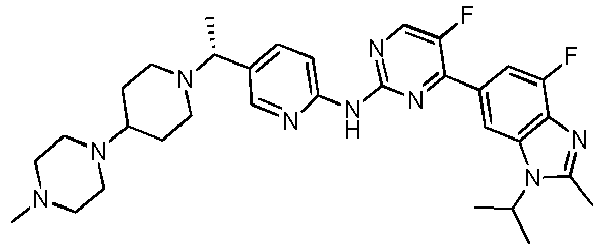
MS-ESI, m/z: 590.3 [M+1]+ Example 14 
MS-ESI, m/z: 535.3 [M+1]+ Example 15 
MS-ESI, m/z: 535.3 [M+1]+ -

-

- Isopropyl magnesium chloride (2.0 M in THF, 38 mL, 0.076 mol) was added dropwise to a solution of 2, 5-dibromopyridine (15.0 g, 0.063 mol) in dry THF (150 mL) at 0 °C under nitrogen atmosphere. After completion of the addition, the mixture was warmed to room temperature slowly and stirred for 2 h, and then cooled to 0 °C, and a solution of 1-tert-butoxycarbonylpiperidine-4-formaldehyde (16.2 g, 0.076 mol) in THF (50 mL) was added into the above mixture. After stirring for 2 h(0 -24 °C), TLC showed that the reaction was complete, and the mixture was quenched with saturated ammonium chloride solution, and extracted with ethyl acetate (50 mL × 3). The combined organic phases were washed with brine, dried over anhydrous Na2SO4, filtered, and concentrated. The residue was purified by column chromatography to give intermediate tert-butyl 4-((6-bromopyridin-3-yl) (hydroxy)methyl) piperidine-1-carboxylate as a white solid (11.0 g, 47% yield).
MS (ESI), m/z, 315.1 [M-55]+.
1H NMR (400 MHz, CDCl3) δ (ppm) 8.29 (d, J = 2.3 Hz, 1 H), 7.55 (dd, J = 8.2, 2.4 Hz, 1 H), 7.49 (d, J = 8.1 Hz, 1 H), 4.46 (d, J = 6.9 Hz, 1 H), 4.24 - 3.97 (m, 3 H), 3.50 (d, J = 6.2 Hz, 1 H), 2.76 - 2.50 (m, 3 H), 1.45 (d, J = 5.4 Hz, 12 H). -

- To a solution of tert-butyl 4-((6-bromopyridin-3-yl) (hydroxy)methyl) piperidine-1-carboxylate (11.0 g, 0.030 mol) in dry dichloromethane (200 mL) at 0 °C under nitrogen atmosphere was added Dess-Martin oxidant (15.0 g, 0.036 mol) in portions, and the reaction was stirred for 1 h (0 - 15 °C). TLC showed that the reaction was complete, and the mixture was cooled to 0 °C, then quenched with saturated Na2S2O3 and saturated NaHCO3. After stirring for 1 h, the layers were separated, and the aqueous phase was extracted with dichloromethane (50 mL × 2). The combined organic phases were washed with brine, dried over anhydrous Na2SO4,filtered, and concentrated. The residue was purified by column chromatography (PE/EA = 5/1-1/1) to give intermediate tert-butyl 4-(6-bromonicotinoyl) piperidine-1-carboxylate as a white solid (4.0 g, 68% yield).
MS (ESI), m/z, 313.1 [M-55]+. -

- n-BuLi (1.6 M in THF, 5.7 mL, 9.16 mmol) was added dropwise to a suspension solution of methyltriphenylphosphonium bromide (3.27 g, 9.16 mmol) in THF (20 mL) at -78 °C under nitrogen atmosphere. The reaction was stirred for 1 h, and a solution of tert-butyl 4-(6-bromonicotinoyl) piperidine-1-carboxylate (2.25 g, 6.11 mmol) in THF (10 mL) was added into the above solution, and the mixture was warmed to room temperature slowly. After stirring for 4 h, TLC or LCMS showed that the reaction was complete, and then the mixture was cooled to 0 °C, quenched with saturated ammonium chloride solution, and extracted with ethyl acetate (50 mL × 3). The combined organic phases were washed with brine, dried over anhydrous Na2SO4, filtered, and concentrated. The residue was purified by column chromatography to give intermediate tert-butyl 4-(1-(6-bromopyridin-3-yl) vinyl) piperidine-1-carboxylate as a white solid (1.2 g, 69% yield).
MS (ESI), m/z, 311.0 [M-55]+.
1H NMR (400 MHz, CDCl3) δ (ppm) 8.31 (dd, J = 2.4, 0.7 Hz, 1 H), 7.45 (qd, J = 8.2, 1.6 Hz, 2 H), 5.22 (s, 1 H), 5.14 (s, 1 H), 4.18 (s, 2 H), 2.71 (d, J = 12.3 Hz, 2 H), 2.47 (t, J = 11.8 Hz, 1 H), 1.83 - 1.61 (m, 3 H), 1.45 (s, 9 H). -

- To a solution of tert-butyl 4-(1-(6-bromopyridin-3-yl) vinyl) piperidine-1-carboxylate (1.2 g, 3.28 mol) in dichloromethane (12 mL) was added TFA(3 mL). After stirring for 2 h (0-23°C), LCMS showed that the reaction was complete, and the mixture was concentrated and diluted with dichloromethane and water (20/20 mL), neutralized with 2 N NaOH solution to pH > 10. Then two layers were separated and the aqueous phase was extracted with dichloromethane (20 mL × 2). The combined organic phases were washedwith brine, dried over anhydrous Na2SO4,filtered, and concentrated to give intermediate 2-bromo-5-(1-(piperidin-4-yl) vinyl) pyridine as a colorless oil (0.86 g, 99% yield), which was used directly in next step.
MS (ESI), m/z, 267.0 [M+1]+. -

- To a solution of 2-bromo-5-(1-(piperidin-4-yl) vinyl) pyridine (0.86 g, 3.23 mmol) in dichloromethane (10 mL) was added acetaldehyde (0.43 g, 9.77 mmol). The mixture was stirred for 5 min, and then NaBH(OAc)3 (2.05 g, 9.67 mmol) was added in portions. After stirring for 1 h (0 - 23 °C), LCMS showed the reaction was complete, then the mixture was cooled to 0 °C, quenched with water, neutralized with 2 N NaOH solution, the two layers were separated, the aqueous phase was extracted with dichloromethane (20 mL × 2). The combined organic phases was washed with brine, dried over anhydrous Na2SO4,filtered, and the filtrate was concentrated and purified by column chromatography (DCM) /MeOH= 10/1, contained 1% NH3·H2O) to give intermediate 2-bromo-5-(1-(1-ethylpiperidin-4-yl) vinyl) pyridine as a colorless oil (0.58 g, 61% yield).
MS (ESI), m/z, 295.0 [M+1]+. -

- To a solution of 2-bromo-5-(1-(1-ethylpiperidin-4-yl) vinyl) pyridine (0.58 g, 1.96 mmol), in THF (10 mL) was added Pd2(dba)3(180 mg, 0.20 mmol) and CyJohnPhos (140 mg, 0.39 mmol). The reaction flask was evacuated and purged with N2 and heated to 50 °C. LiHMDS (1.0 M in THF, 5.8 mL, 5.8 mmol) was added dropwise into the above mixture. After completion of the addition, the mixture was heated to 65 °C and stirred for 3 h. LCMS showed that the reaction was complete, the mixture was cooled to room temperature, quenched with water, concentrated, diluted with dichloromethane (20 mL), acidified to pH = 1-2 with 2 N HCl, the two layers were separated, and the aqueous phase was washed with dichloromethane (20 mL × 3). The aqueous phase was basified with 2 N NaOH to pH = 10-12, extracted with dichloromethane (20 mL × 3). The combined organic phases were washed with brine, dried over anhydrous Na2SO4,concentrated to give intermediate 5-(1-(1-ethylpiperidin-4-yl) vinyl) pyridin-2-amine as a colorless oil (0.44 g, 98% yield), which was used directly in the next step.
MS (ESI), m/z, 232.2 [M+1]+.
1H NMR (400 MHz, CDCl3) δ (ppm) 8.05 (s, 1 H), 7.42 (dd, J = 8.5, 2.4 Hz, 1 H), 6.46 (d, J = 8.5 Hz, 1 H), 5.05 (d, J = 49.3 Hz, 2 H), 4.46 (s, 2 H), 3.09 (d, J = 11.7 Hz, 2 H), 2.49 (q, J = 7.2 Hz, 2 H), 2.35 (t, J = 11.9 Hz, 1 H), 2.03 (t, J = 11.1 Hz, 2 H), 1.81 (d, J = 13.3 Hz, 2 H), 1.60 (ddd, J = 15.7, 12.8, 3.5 Hz, 2 H), 1.12 (t, J = 7.2 Hz, 3 H). -
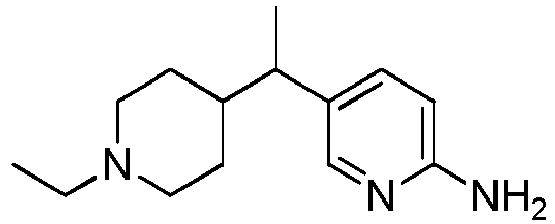
- Pd/C (10%, 50 mg) was added to a solution of 5-(1-(1-ethylpiperidin-4-yl) vinyl) pyridin-2-amine (240 mg, 1.04 mmol) in methanol (10 mL). The reaction flask was evacuated and purged with H2 and the reaction was stirred for 2 h. LCMS showed that the reaction was complete, then the mixture was filtered with Celite, washed with methanol, and the filtrate was concentrated to give intermediate 5-(1-(1-ethylpiperidin-4-yl) ethyl) pyridin-2-amine as a colorless oil (0.22 g, 91% yield), which was used directly in the next step.
MS (ESI), m/z, 234.2 [M+1]+. -

- To a solution of 5-(1-(1-ethylpiperidin-4-yl)ethyl)pyridin-2-amine (220 mg, 0.94 mmol) in dioxane (10 mL) was added 6-(2-chloro-5-fluoropyrimidin-4-yl)-4-fluoro-1-isopropyl-2-methyl-1H-benzo[d]imidazole (304 mg, 0.94 mmol), Pd2(dba)3(86 mg, 0.094 mmol), XantPhos (109 mg, 0.19 mmol) and cesium carbonate (613 mg, 1.89 mmol). The reaction flask was evacuated and purged with N2 and heated to 110 °C for 2 h. LCMS showed that the reaction was complete, then the mixture was cooled to room temperature, filtered with Celite, washed with dichloromethane and the filtrate was concentrated and purified by Prep-TLC (DCM/MeOH = 10/1) twice to give the racemic product N-(5-(1-(1-ethylpiperidin-4-yl) ethyl) pyridin-2-yl)-5-fluoro-4-(4-fluoro-1-isopropyl-2-methyl-1H-benzo[d]imidazol-6-yl) pyrimidin-2-amine as a white solid (0.18 g, 98.5% HPLC purity, 37% yield).
MS (ESI), m/z, 520.3 [M+1]+.
1H NMR (400 MHz, CDCl3) δ (ppm) 8.86 (s, 1 H), 8.47 (d, J = 3.7 Hz, 1 H), 8.38 (d, J = 8.6 Hz, 1 H), 8.26 - 8.09 (m, 2 H), 7.78 (d, J = 11.7 Hz, 1 H), 7.49 (dd, J = 8.6, 2.3 Hz, 1 H), 4.80 - 4.65 (m, 1 H), 3.54 (d, J = 11.6 Hz, 1 H), 3.38 (d, J = 11.1 Hz, 1 H), 2.96 (q, J = 7.2 Hz, 2 H), 2.69 (s, 3 H), 2.64 - 2.51 (m, 2 H), 2.46 (t, J = 11.9 Hz, 1 H), 2.05 (dd, J = 32.4, 13.3 Hz, 2 H), 1.86 (d, J = 10.1 Hz, 1 H), 1.71 (dd, J = 6.9, 1.8 Hz, 6 H), 1.58 (d, J = 12.6 Hz, 2 H), 1.40 (t, J = 7.3 Hz, 3 H), 1.29 (d, J = 7.0 Hz, 3 H). -

- The racemic compound obtained in example 16 was separated by chiral column Chiralpak AS-H (10 mm × 250 mm, 5 µm) at a column temperature of 40 °C. Mobile phase was 0.1% DEAin hexane(v/v), mobile phase B was ethanol, running time was 30 minutes, gradient mobile was phase A/mobile phase B (80/20, v/v), flow rate was 3.0 mL/min and detection wavelength was UV 300 nm. Two single-configuration compounds were separated and collected at RT of 16 minutes (compound of example 17) and 22 minutes (compound of example 18), respectively. The compounds were detected by chiral column Chrialipak AS-H (4.6 mm × 250 mm) at a column temperature of 40 °C. Mobile phase A was 0.1% DEA in hexane(v/v), mobile phase B was ethanol, running time was 20 minutes, gradient was mobile phase A/mobile phase B (80/20), flow rate was 0.5 mL/min, and detection wavelength was UV 300 nm. The first single configuration compound was example 17 (RT = 10.6 min, 99% ee), and the second single configuration compound was example 18 (RT = 12.9 min, 99% ee).
-

-

- The above intermediate can be obtained by a similar synthesis method to the intermediate 5-(1-(1-ethylpiperidin-4-yl) ethyl) pyridin-2-amine in example 18.
MS (ESI), m/z, 306.2 [M+1]+. -

- The above intermediate can be obtained by a similar synthesis method to the intermediate in example 18.
MS (ESI), m/z, 592.3 [M+1]+. -

- To a solution of the intermediate tert-butyl 4-(1-(6-((5-fluoro-4-(4-fluoro-1-isopropyl-2-methyl-1H-benzo[d] imidazol-6-yl) pyrimidin-2-yl) amino) pyridin-3-yl) ethyl) piperidine-1-carboxylate (329 mg, 0.56 mmol) in dichloromethane/methanol (5:1, 6 mL) was added a 6 N dioxane hydrochloride solution (3 mL) and the mixture was stirred for 12 h at room temperature. LCMS showed that the reaction was complete, and the mixture concentrated, diluted with dichloromethane, basified with 2 N NaOH and extracted with dichloromethane (30 mL X 4). The combined organic phases were washed with brine, dried over anhydrous Na2SO4,concentrated, and purified by Prep-TLC (DCM/MeOH = 8/1) to give the product 5-fluoro-4-(4-fluoro-1-isopropyl-2-methyl-1H-benzo[d]imidazol-6-yl)-N-(5-(1-(piperidin-4-yl) ethyl) pyridin-2-yl) pyrimidin-2-amine as a white solid (220 mg, 98.2% HPLC purity, 81% yield).
MS (ESI), m/z, 492.2 [M+1]+.
1H NMR (400 MHz, CDCl3) δ 8.43 (d, J = 3.7 Hz, 1H), 8.35 (d, J = 8.6 Hz, 1H), 8.24 (s, 1H), 8.19 (s, 1H), 8.13 (s, 1H), 7.80 (d, J = 11.6 Hz, 1H), 7.51 (dd, J = 8.6, 2.0 Hz, 1H), 4.82 - 4.66 (m, 1H), 3.14 (d, J = 12.0 Hz, 1H), 3.02 (d, J = 12.2 Hz, 1H), 2.70 (s, 3H), 2.60 (dd, J = 12.1, 10.0 Hz, 1H), 2.50 (dd, J = 14.8, 7.9 Hz, 2H), 1.96 - 1.76 (m, 7H), 1.72 (d, J = 6.9 Hz, 6H), 1.55 - 1.44 (m, 2H), 1.28 (d, J = 7.0 Hz, 3H). - The racemic compound obtained in the third step was separated by chiral column Chiralpak AS-H (10 mm × 250 mm, 5 µm) at a column temperature of 40 °C. Mobile phase A was 0.1% DEA in hexane(v/v), mobile phase B was ethanol, running time was 30 minutes, and gradient was mobile phase A/mobile phase B (80/20, v/v), flow rate was 3.0 mL/min and detection wavelength was UV 300 nm. The two single-configuration compounds were separated and collected at RT of 13 minutes (compound of example 19) and 19 minutes (compound of example 20), respectively. The compounds were detected by chiral column Chiralpak AS-H (4.6 mm × 250 mm) at a column temperature of 40 °C. Mobile phase A was 0.1% DEA in hexane(v/v), mobile phase B was ethanol, running time was 20 minutes, gradient was mobile phase A/mobile phase B(80/20), flow rate was 0.5 mL/min and detection wavelength was UV 300 nm. The first single configuration compound was example 19 (RT = 9.2 min, 98% ee), and the second single configuration compound was example 20 (RT = 11.4 min, 97% ee).
- The compounds of examples 21-32 in the following table were prepared according to the synthesis methods of examples 16-20 using the corresponding starting materials.
Example Structure Characterization data Example 21 
MS-ESI, m/z: 506.2 [M+1]+ 1H NMR (400 MHz, CDCl3) δ (ppm) 8.41 (d, J = 3.8 Hz, 1H), 8.33 (d, J = 8.6 Hz, 1H), 8.19 (s, 1H), 8.10 (d, J = 2.0 Hz, 1H), 7.93 (s, 1H), 7.80 (d, J = 11.6 Hz, 1H), 7.51 (dd, J = 8.6, 2.2 Hz, 1H), 4.74 (dt, J = 13.9, 7.0 Hz, 1H), 2.90 (d, J = 10.5 Hz, 1H), 2.78 (d, J = 11.0 Hz, 1H), 2.70 (s, 3H), 2.48 (t, J = 7.0 Hz, 1H), 2.23 (s, 3H), 2.08 - 1.96 (m, 1H), 1.94 - 1.74 (m, 3H), 1.71 (d, J = 6.9 Hz, 6H), 1.46 - 1.17 (m, 6H). The compound was separated by chiral column Chiralpak AS-H, and chiral separation conditions were the same as in example 17 or 18. RT was 14.5 min. Example 22 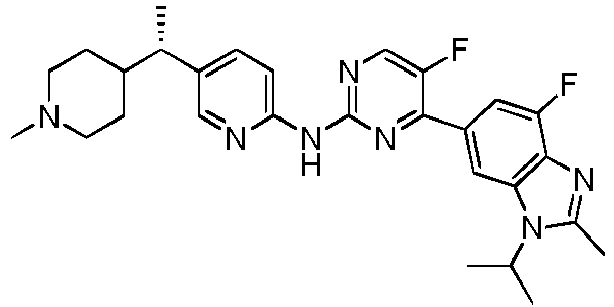
MS-ESI, m/z: 506.2 [M+1]+ The compound was separated by chiral column Chiralpak AS-H, and chiral separation conditions were the same as in example 17 or 18. RT was 18 min. Example 23 
MS-ESI, m/z: 524.3 [M+1]+ Example 24 
MS-ESI, m/z: 524.3 [M+1]+ Example 25 
MS-ESI, m/z: 534.3 [M+1]+ Example 26 
MS-ESI, m/z: 534.3 [M+1]+ Example 27 
MS-ESI, m/z: 536.3 [M+1]+ Example 28 
MS-ESI, m/z: 536.2 [M+1]+ Example 29 
MS-ESI, m/z: 538.2 [M+1]+ Example 30 
MS-ESI, m/z: 538.2 [M+1]+ Example 31 
MS-ESI, m/z: 536.3 [M+1]+ Example 32 
MS-ESI, m/z: 536.3 [M+1]+ -

- To a solution of 5-(1-(1-ethylpiperidin-4-yl) vinyl) pyridine-2-amine (200 mg, 0.87 mmol) in dioxane (10 mL) was added 6-(2-chloro-5-fluoropyrimidin-4-yl)-4-fluoro-1-isopropyl-2-methyl-1H-benzo[d]imidazole (278 mg, 0.87 mmol), Pd2(dba)3 (79mg, 0.086 mmol), XantPhos (100 mg, 0.17 mmol) and cesium carbonate (563 mg, 1.73 mmol). The reaction flask was evacuated and purged with N2, and the mixture was heated to 110 °C for 2 h. LCMS showed that the reaction was complete, then the mixture was cooled to room temperature, filtered with Celite, washed with dichloromethane. The filtrate was concentrated, diluted with dichloromethane/water (20/10 mL), acidified with 2 N HCl to pH = 1-2. The two layers were separated, and the aqueous phase was washed with dichloromethane (20 mL × 2), basified with 2 N NaOH to pH = 10-12 and extracted with dichloromethane (20 mL × 3). The combined organic phases were washed with brine, dried over anhydrous Na2SO4,filtered, concentrated to give a crude product, which was purified by Prep-TLC (DCM/MeOH = 10/1) twice to give the product N-(5-(1-(1-(1-ethylpiperidin-4-yl) vinyl) pyridine-2-yl)-5- fluoro-4-(4-fluoro-1-isopropyl-2-methyl-1H-benzo[d]imidazole-6-yl) pyrimidine-2-amine as a white solid (0.17 g, 98.6% HPLC purity, 38% yield).
MS (ESI), m/z, 518.2 [M+1]+.
1H NMR (400 MHz, CDCl3) δ (ppm) 8.64 (s, 1 H), 8.47 (d, J = 3.7 Hz, 1 H), 8.43 (d, J = 8.7 Hz, 1 H), 8.34 (s, 1 H), 8.17 (s, 1 H), 7.79 (d, J = 11.4 Hz, 1 H), 7.66 (dd, J = 8.7, 2.4 Hz, 1 H), 5.25 (d, J = 54.3 Hz, 2 H), 4.74 (dt, J = 14.0, 7.0 Hz, 1 H), 3.60 (s, 2 H), 3.07 (q, J = 7.3 Hz, 2 H), 2.70 (s, 6 H), 2.29 (s, 2 H), 2.05 (s, 2 H), 1.71 (d, J = 7.0 Hz, 6 H), 1.48 (t, J = 7.3 Hz, 3 H). - The compounds of examples 34-38 in the following table were prepared according to the synthesis method of example 33 using the corresponding starting materials.
Example Structure Characterization data Example 34 
MS-ESI, m/z: 490.2 [M+1]+ Example 35 
MS-ESI, m/z: 504.2 [M+1]+ Example 36 
MS-ESI, m/z: 519.2 [M+1]+ Example 37 
MS-ESI, m/z: 491.2 [M+1]+ Example 38 
MS-ESI, m/z: 536.3 [M+1]+ -

-

- To a solution of tert-butyl 4-(6-bromonicotinoyl)piperidine-1-carboxylate (1.0 g, 2.71 mmol) in dichloromethane (10 mL) at 0 °C was added TFA (4 mL) and stirred for 1 h (0 - 23 °C). TLC showed that the starting material disappeared, and the mixture was concentrated, diluted with water (10 mL), neutralized with saturated NaHCO3, and extracted with dichloromethane (30 mL × 4). The combined organic phases were washed with brine, dried over anhydrous Na2SO4,filtered and concentrated to give (6-bromopyridin-3-yl) (piperidin-4-yl) methanone as a white solid (0.64 g, 88% yield).
MS (ESI), m/z, 269.0 [M+1]+. -

- To a solution of (6-bromopyridin-3-yl) (piperidin-4-yl) methanone (0.64 g, 2.38 mmol) in dichloromethane (10 mL) was added acetaldehyde (0.31 g, 7.14 mmol) at 0 °C, and stirred for 10 min, then solid NaBH(OAc)3(1.0 g, 4.76 mmol) was added and continued to stir for 12 h (0-24 °C). TLC showed that the reaction was complete, and the mixture was quenched with water and saturated with NaHCO3. The two layers were separated, and the aqueous phase was extracted with dichloromethane (15 mL × 2). The combined organic phases were washed with brine, dried over anhydrous Na2SO4 filtered. And the filture was concentratedand purified by column chromatography (DCM/MeOH = 10/1, contained 1% NH3 ·H2O) to give intermediate (6-bromopyridin-3-yl) (1-ethylpiperidin-4-yl) methanone as gum, yield (0.52 g, 74% yield).
MS (ESI), m/z, 297.0 [M+1]+. -

- To a solution of (6-bromopyridin-3-yl) (1-ethylpiperidin-4-yl) methanone (0.52 g, 1.75 mmol) in ethylene glycol (10 mL) was added K2CO3(48 mg, 0.35 mmol), DMEDA(15 mg, 0.17 mmol), Cu2O(25 mg, 0.17 mmol) and 28% ammonia (10 mL). The reaction flask was evacuated and purged with N2 and heated to 80 °C for 4 h. LCMS showed that the reaction was complete, and the mixture was cooled to room temperature, diluted with water and extracted with ethyl acetate (20 mL × 3). The combined organic phases were washed with brine, dried over anhydrous Na2SO4,filtered, and concentrated to give intermediate (6-aminopyridin-3-yl)(1-ethylpiperidin-4-yl) methanone as a colorless oil (0.38 g, 95% yield), which was used directly in the next step.
MS (ESI), m/z, 234.2 [M+1]+. -

- To a solution of (6-aminopyridin-3-yl)(1-ethylpiperidin-4-yl) methanone (0.38 g, 1.63 mmol) in dioxane (5 mL) was added 6-(2-chloro-5-fluoropyrimidin-4-yl)-4-fluoro-1-isopropyl-2-methyl-1H-benzo[d]imidazole (0.53 g, 1.63 mmol), Pd2(dba)3 (150 mg. 0.16 mmol), XantPhos (188 mg, 0.33 mmol) and cesium carbonate (1.1 g, 3.38 mmol). The reaction flask was evacuated and purged with N2 and heated to 110 °C for 2 h. LCMS showed that the reaction was complete, and the mixture was cooled to room temperature, filtered with Celite, washed with dichloromethane and the filtrate was concentrated to give the residue which was purified by column chromatography (DCM/MeOH = 20/1-10/1, contained 1% NH3 ·H2O) to give (1-ethylpiperidin-4-yl)(6-((5-fluoro-4-(4-fluoro-1-isopropyl-2-methyl-1H-benzo[d]imidazol-6-yl) pyrimidin-2-yl) amino) pyridin-3-yl) methanone as a white solid (0.35 g, 71% yield).
MS (ESI), m/z, 520.2 [M+1]+. -

- To a solution of (1-ethylpiperidin-4-yl)(6-((5-fluoro-4-(4-fluoro-1-isopropyl-2-methyl-1H-benzo[d]imidazol-6-yl) pyrimidin-2-yl) amino) pyridin-3-yl) methanone (0.15 g, 0.29 mmol) in methanol (5 mL) was added NaBH4 (33 mg, 0.87 mmol) solid at 0 °C and stirred for 0.5 h. LCMS showed that reaction was complete, and the mixture was quenched with water, extracted with ethyl acetate (20 mg × 3). The combined organic phases were washed with brine, dried over anhydrous sodium sulfate, filtered and the filture was concentrated. The residue was purified by Prep-HPLC (DCM/MeOH = 10/1) twice to give racemic product (1-ethylpiperidin-4-yl) (6-((5-fluoro-4-(4-ftuoro-1-isopropyl-2-methyl-1H-benzo[d]imidazol-6-yl)pyrimidin-2-yl) amino) pyridin-3-yl) methanol as a white solid (20 mg, 98.2% HPLC purity).
MS (ESI), m/z, 522.2 [M+1]+.
1H NMR(400 MHz, DMSO)δ (ppm) 10.12 (s, 2 H), 8.71 (d, J= 3.8 Hz, 1 H), 8.31 (s, 1 H), 8.24 (dd, J = 5.2, 3.0 Hz, 2 H), 7.71 (d, J = 11.5 Hz, 2 H), 5.53 (d, J = 4.4 Hz, 1 H), 4.92 - 4.74 (m, 1 H), 4.37 (dt, J = 11.0, 5.7 Hz, 1 H), 3.50 - 3.41 (m, 2 H), 3.00 (d, J = 6.7 Hz, 2 H), 2.79 (s, 2 H), 2.66 (s, 3 H), 2.00 (d, J = 15.2 Hz, 1 H), 1.79 (s, 1 H), 1.70 - 1.40 (m, 9 H), 1.23 (q, J = 6.9 Hz, 3 H). -

- The racemic compound obtained in example 39 was separated by chiral column Chiralpak AD-H (10 mm × 250 mm, 5 µm) with a column temperature of 40 °C. Mobile phase A was 0.1% DEA in hexane(v/v), mobile phase B was ethanol, running time was 50 minutes, and gradient was mobile phase A/mobile phase B (50/50, v/v), flow rate was 3.0 mL/min and detection wavelength was UV 210 nm. The two single-configuration compounds were separated at the retention time of 30 minutes (compound of example 40) and 36 minutes (compound of example 41), respectively. The compounds were detected by chiral column CHRIARPAK AD-H (4.6 mm × 250 mm) at a column temperature of 40 °C. Mobile phase A was 0.1% DEA in hexane(v/v), mobile phase B was ethanol, running time was 30 minutes, gradient was mobile phase A/mobile phase B (50/50), flow rate was 0.5 mL/min, and detection wavelength was UV 210 nm. The first single configuration compound was example 40 (RT = 25.3 min, 97% ee), and the second single configuration compound was example 41 (RT = 30.0 min, 96% ee).
-

-

- To a solution of 4-((6-bromopyridine-3-yl)(hydroxy) methyl) piperidine-1-carboxylic acid tert-butyl ester tert-butyl 4-((6-bromopyridin-3-yl)(hydroxy)methyl)piperidine-1-carboxylate (203 mg, 0.55 mmol) in DMF (5 mL) was added imidazole (186 mg, 2.74 mmol) and TBSCl (123 mg, 0.83 mmol) and the mixture was stirred at room temperature for 8 h. LCMS showed that the reaction was complete, 5.0 eq imidazole and 1.5 eq TBSCl were added into the above mixture and heated to 30 °C for 12 h. Another 5.0 eq imidazole and 1.5 eq TBSCl were added into the above mixture and stirred for 4 h. LCMS showed that the reaction was complete, and the mixture was quenched with water, extracted with ethyl acetate (20 mL X 3). The combined organic phases were washed with brine, dried over anhydrous Na2SO4, filtered and the filtrue was concentratedand purified by Agela-HPLC (PE in EA from 0-50%) to give intermediate tert-butyl 4-((6-bromopyridin-3-yl)((tert-butyldimethylsilyl) oxy) methyl) piperidine-1-carboxylate as a colorless gum (0.26 g, 99% yield), which was used directly in the next step.
MS (ESI), m/z, 429.1 [M-55]+. -

- To a solution of tert-butyl 4-((6-bromopyridin-3-yl)((tert-butyldimethylsilyl) oxy) methyl) piperidine-1-carboxylate (265 mg, 0.55 mmol) in THF (10 mL) was added Pd2(dba)3 (55 mg, 0.055 mmol) and CyJohnPhos (42 mg, 0.1 mmol). The reaction flask was evacuated and purged with N2, and the mixture was heated to 50 °C. LiHMDS (1.0 M in THF, 1.8 mL, 0.16 mmol) was added into the above mixture dropwise, and then the mixture was heated to 65 °C for 3 h. LCMS showed that the reaction was complete, and the mixture was cooled to room temperature (23 °C), quenched with water, concentrated, and diluted with dichloromethane (20 mL). The two layers were separated, and the aqueous phase was extracted with dichloromethane (20 mL × 2). The combined organic phases were washed with brine, dried over anhydrous Na2SO4, filtered and concentrated. The residue was purified by Agela-HPLC (PE in EA from 0-80%) to give intermediate tert-butyl 4-((6-aminopyridin-3-yl) ((tert-butyldimethylsilyl) oxy) methyl) piperidine-1-carboxylate as colorless gum (0.23 g, 99% yield).
MS (ESI), m/z, 422.3 [M+1]+. -

- To a solution of tert-butyl 4-((6-aminopyridin-3-yl) ((tert-butyldimethylsilyl) oxy) methyl) piperidine-1-carboxylate (0.23 g, 0.55 mmol) in dioxane (10 mL) was added 6-(2-chloro-5-fluoropyrimidin-4-yl)-4-fluoro-1-isopropyl-2-methyl-1H-benzo[d]imidazole (176 mg, 0.55 mmol), Pd2(dba)3 (50 mg, 0.055 mmol), XantPhos (63 mg, 0.1 mmol) and cesium carbonate (355 mg, 1.1 mmol). The reaction flask was evacuated and purged with N2 and the mixture was heated to 110 °C for 2 h. LCMS showed that the reaction was complete, and the mixture was cooled to room temperature, filtered with Celite, washed with dichloromethane and the filture was concentrated. The residue was purified by Agela-HPLC (PE in EA from 0 - 80%) to give intermediate tert-butyl 4-(((tert-butyldimethylsilyl)oxy) (6-((5-fluoro-4-(4-fluoro-1-isopropyl-2-methyl-1H-benzo [d] imidazol-6-yl)pyrimidin-2-yl) amino)pyridin-3-yl)methyl)piperidine-1-carboxylate as colorless gum (0.3 g, 78% yield).
MS (ESI), m/z, 708.1 [M+1]+. -

- To a solution of tert-butyl 4-(((tert-butyldimethylsilyl)oxy) (6-((5-fluoro-4-(4-fluoro-1-isopropyl-2-methyl-1H-benzo [d] imidazol-6-yl)pyrimidin-2-yl) amino)pyridin-3-yl)methyl)piperidine-1-carboxylate (0.3 g, 0.42 mmol) in methanol (5 mL) was added HCl in dioxane (4.0 M, 2 mL) and the mixture was stirred for 12 h. LCMS showed that the reaction was complete and the mixture was concentrated to give crude product (6-((5-fluoro-4-(4-fluoro-1-isopropyl-2-methyl-1H-benzo[d]imidazol-6-yl)pyrimidin-2-yl) amino)pyridin-3-yl)(piperidin-4-yl) methanol hydrochloride as a white solid (224 mg, 99% yield).
MS (ESI), m/z, 494.2 [M+1]+. - The compounds of examples 43-56 in the following table were prepared according to the synthesis method of examples 39-42 using the corresponding starting materials.
Example Structure Characterization data Example 43 
MS-ESI, m/z: 494.2 [M+1]+ Example 44 
MS-ESI, m/z: 494.2 [M+1]+ Example 45 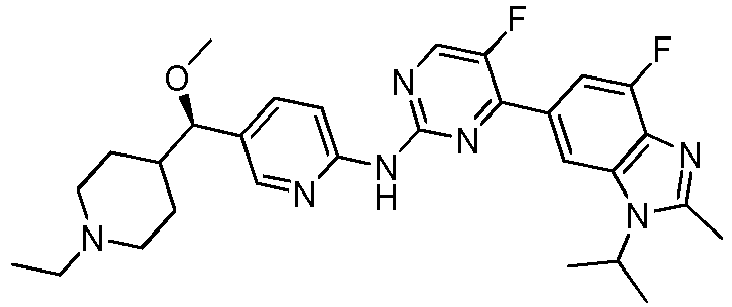
MS-ESI, m/z: 536.2 [M+1]+ 1H NMR (400 MHz, CDCl3) δ (ppm) 8.85 (d, J = 9.1 Hz, 1H), 8.62 - 8.45 (m, 2H), 8.10 (s, 1H), 8.00 (d, J = 9.1 Hz, 1H), 7.90 (d, J = 11.2 Hz, 1H), 4.95 - 4.73 (m, 1H), 3.96 (d, J = 7.0 Hz, 1H), 3.66 (dd, J = 34.5, 11.7 Hz, 2H), 3.25 (s, 3H), 3.07 (d, J = 6.7 Hz, 2H), 2.86 (s, 3H), 2.72 - 2.44 (m, 2H), 2.31 (d, J = 14.0 Hz, 1H), 2.02 - 1.81 (m, 3H), 1.78 (d, J = 6.9Hz, 6H), 1.49(d, J = 12.3 Hz, 1H), 1.36 (t, J = 7.3 Hz, 3H). The compound was separated with chiral column Chiralpak AD-H, and chiral separation conditions were the same as in example 40 or 41. RT was 23 min. Example 46 
MS-ESI, m/z: 436.2 [M+1]+ The compound was separated with chiral column Chiralpak AD-H, and chiral separation conditions were the same as in example 40 or 41. RT was 29 min. Example 47 
MS-ESI, m/z: 591.3 [M+1]+ Example 48 
MS-ESI, m/z: 591.3 [M+1]+ Example 49 
MS-ESI, m/z: 508.2 [M+1]+ Example 50 
MS-ESI, m/z: 508.2 [M+1]+ Example 51 
MS-ESI, m/z: 536.3 [M+1]+ Example 52 
MS-ESI, m/z: 536.3 [M+1]+ Example 53 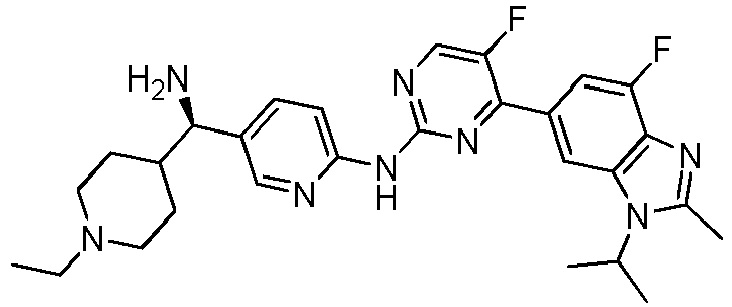
MS-ESI, m/z: 520.3 [M+1]+ Example 54 
MS-ESI, m/z: 520.3 [M+1]+ Example 55 
MS-ESI, m/z: 540.3 [M+1]+ Example 56 
MS-ESI, m/z: 540.3 [M+1]+ -

-

- To a solution of 2-bromo-5-methylpyridine (17 g, 100 mmol) in carbon tetrabromide (250 mL) was added AIBN (164 mg, 1mmol) and the mixture was heated to 75 °C, and then NBS (26.7 g, 150 mmol) was added, and the mixture was stirred for 2 h. TLC showed that the reaction was complete, water (150 mL) was added and extracted with ethyl acetate (150 mL × 3). The combined organic phases were washed with brine, dried over anhydrous Na2SO4, filtered and concentrated to give 3.0g of the residue, which was purified by column chromatography (silica gel 200-300 mesh, PE/EA= 1000:1 to 10:1) to give intermediate 2-bromo -5-(bromomethyl) pyridine (13 g, 50% yield).
MS (ESI), m/z, 250.9 [M+1]+. -

- A mixture of 2-bromo-5-(bromomethyl) pyridine (13 g, 50 mmol) and trimethyl phosphite (20 mL) was heated to 80 °C and stirred for 16 h. TLC showed that the reaction was complete, and most unreacted trimethyl phosphite was removed under reduced pressure, and water (50 mL) was added, then extracted by ethyl acetate (50 mL × 3). The combined organic phases were washed with brine, dried over anhydrous Na2SO4, filtered, and concentrated. The residue was purified by column chromatography (silica gel 200-300 mesh, PE/EA=1000:1 to 1:4) to give the intermediate (8 g, 57% yield).
MS (ESI), m/z, 281.1 [M+1]+. -

- To a solution of dimethyl ((6-bromopyridine-3-yl) methyl) phosphonate (2.78 g, 10 mmol) in THF (10 mL) was added NaH (60% dispersion in mineral oil, 48 mg, 12 mmol) and stirred for 10 - 20 min, and then N-ethylpiperidone (1.40 g, 11 mmol) was added. The mixture was warmed to 20 °C and stirred for 1-2 h. TLC showed that the reaction was complete, and the mixture was quenched with water (50 mL), and extracted with ethyl acetate (50 mL X 3). The combined organic phases were washed with brine, dried over anhydrous Na2SO4, filtered, and concentrated. The residue was purified by column chromatography (silica gel 200-300 mesh, DCM/MeOH = 1000:1 to 20:1) to give intermediate 2-bromo-5-((1-ethylpiperidin-4-ylidene) methyl) pyridine (2.0 g, 72% yield).
MS (ESI), m/z, 281.9 [M+1]+. -

- To a solution of 2-bromo-5-((1-ethylpiperidin-4-ylidene) methyl) pyridine (1.0 g, 3.6 mmol) in THF (10 mL) was added tert-butyl carbamate (0.63 g, 5.3 mmol), Pd2(dba)3 (91 mg, 0.01 mmol), Xantphos (32 mg, 0.01 mmol) and cesium carbonate (2.3 g, 7.2 mmol). The mixture was heated to 60 °C and stirred for 24 h. TLC showed that the reaction was complete, and the mixture was quenched with water (10 mL), and extracted with ethyl acetate (20 mL × 3). The combined organic phases were washed with brine, dried over anhydrous Na2SO4, filtered, and concentrated. The residue was purified by column chromatography (silica gel 200-300 mesh, DCM/MeOH = 1000:1 to 20:1) to give tert-butyl (5-((1-ethylpiperidin-4-ylidene) methyl) pyridin-2-yl) carbamate (0.8 g, 74% yield).
MS (ESI), m/z, 318.1 [M+1]+. -

- To a solution of tert-butyl (5-((1-ethylpiperidin-4-ylidene) methyl) pyridin-2-yl) carbamate (0.30 g, 1 mmol) in ethyl acetate (3 mL) was added HCl ethyl acetate solution (4 mol/L, 2 mL). The reaction mixture was heated to 60 °C and stirred for 3 h. TLC showed that the reaction was complete, and the mixture was filtered and dried to give intermediate 5-((1-ethylpiperidin-4-ylidene) methyl) pyridin-2-amine hydrochloride (100 mg, 47% yield).
MS (ESI), m/z, 218.1 [M+1]+. -

- To a solution of 5-((1-ethylpiperidin-4-ylidene) methyl) pyridin-2-amine hydrochloride in NMP (3 mL) was added 6-(2-chloro -5-fluoropyrimidin-4-yl)-7-fluoro-1-isopropyl-2- methyl-1H-benzo[d]imidazole (0.16 g, 0.5 mmol), Pd2(dba)3 (91 mg, 0.01 mmol) and XantPhos (63 mg, 0.01 mmol) and cesium carbonate (0.32 g, 1 mmol). The reaction mixture was heated to 100 °C and stirred for 3 h. TLC showed that the reaction was complete, the mixture was filtered and concentrated. The crude product was purified by Prep-HPLC to give 50 mg of the product.
MS (ESI), m/z, 504.5 [M+1]+.
1H NMR (400 MHz, DMSO) δ (ppm) 9.56 (s, 1 H), 8.79 (d, J = 3.6 Hz, 1 H), 8.30-8.25 (m, 2 H), 8.13 (s 8.5 Hz, 1 H), 7.89 (s, 1 H), 7.76 (s, 1 H), 7.35 (s, 1 H), 6.,49 (s, 1 H), 4.90-4.86 (m, 1 H), 3.60 - 3.52 (m, 3 H), 3.50 - 3.42 (m, 2 H), 2.97-2.91 (m, 3 H), 2.84 (s, 3 H), 2.69 - 2.62 (m, 2 H), 1.64 (d, J = 6.9 Hz, 6 H), 1.26-1.25 (m, 3 H). -

-

- To a solution of dimethyl ((6-bromopyridine-3-yl) methyl) phosphonate (1.4 g, 5 mmol) in THF (10 mL) was added LDA(6 mL, 1.2 mmol) at -78 °C and stirred for 30 min, methyl iodide (0.75 g, 0.55 mmol) was added and continued to stir for 1-2 h. TLC showed that the reaction was complete, and the mixture was quenched with water (15 mL) and extracted with ethyl acetate (15 mL × 3). The combined organic phases were washed with brine, dried over anhydrous Na2SO4, filtered and concentrated. The residue was purified by column chromatography (silica gel 200-300 mesh, PE/EA = 1000:1 to 10:1) to give the intermediate diethyl (1-(6-bromopyridin-3-yl) ethyl) phosphonate as colorless oil (0.8 g, 56% yield).
MS (ESI), m/z, 295.1 [M+1]+. -

- To a solution (5 mL) of diethyl (1-(6-bromopyridin-3-yl) ethyl) phosphonate (0.8 g, 2.7 mmol) in THF (5 mL) was added NaH (60% dispersion in mineral oil, 126 mg, 3.2 mmol) and stirred for 10-20 min. Then N-ethylpiperidone (0.41 g, 3.2 mmol) was added, and the reaction mixture was warmed to 20 °C and stirred for 1-2 h. TLC showed that the reaction was complete, quenched with water (50 mL), and extracted with ethyl acetate (50 mL X 3). The combined organic phases were washed with brine, dried over anhydrous Na2SO4, filtered and concentrated to give 2.30 g of crude product, which was purified by column chromatography (Silica gel 200-300 mesh, DCM/MeOH = 1000:1 to 20:1) to give intermediate 2-bromo-5-(1-(1-ethylpiperidin-4-ylidene) ethyl) pyridine (0.57 g, yield 72%).
MS (ESI), m/z, 296.1 [M+1]+. -

- To a solution of 2-bromo-5-(1-(1-ethylpiperidin-4-ylidene) ethyl) pyridine (0.53 g, 1.8mmol) in THF (10 mL) was added tert-butyl carbamate (0.33 g, 2.6 mmol), Pd2(dba)3 (45 mg, 0.005 mmol), Xantphos(16 mg, 0.005 mmol) and cesium carbonate (1.2 g, 3.6 mmol). The reaction was heated to 60 °C and stirred for 24 h. TLC showed that the product was formed, and after completion of the reaction, the mixture was quenched with water (10 mL), and extracted with ethyl acetate (20 mL × 3). The combined organic phases were washed with brine, dried over anhydrous Na2SO4, filtered and concentrated to give 0.50 g of the crude product, which was purified by Prep-TLC to give tert-butyl (5-(1-(1-ethylpiperidin-4-ylidene) ethyl) pyridin-2-yl) carbamate (0.33 g, 55% yield).
MS (ESI), m/z, 318.1 [M+1]+. -

- To a solution of tert-butyl (5-(1-(1-ethylpiperidin-4-ylidene) ethyl) pyridin-2-yl) carbamate (0.30 g, 1 mmol) in ethyl acetate (3 mL) was added HCl ethyl acetate solution (4 mol/L, 2 mL). The reaction mixture was heated to 50-60 °C and stirred for 2-3 h. TLC showed that the reaction was complete, and the mixture was filtered and dried to give 5-(1-(1-ethylpiperidin-4-ylidene) ethyl) pyridin-2-amine (100 mg, 47% yield).
MS (ESI), m/z, 218.1 [M+1]+. -

- To a solution of 5-(1-(1-ethylpiperidin-4-ylidene) ethyl) pyridin-2-amine (0.10 g, 0.47 mmol) in NMP (3 mL) was added 6-(2-chloro -5-fluoropyrimidin-4-yl)-7-fluoro-1-isopropyl- 2-methyl-1H-benzo[d]imidazole (0.16 g, 0.5 mmol), Pd2(dba)3(91 mg, 0.01 mmol), Xantphos (60 mg, 0.01 mmol) and cesium carbonate (0.32 g, 1 mmol). The reaction mixture was heated to 100 °C and stirred for 2-3 h. TLC showed that the reaction was complete, and the mixture was concentrated to give a crude product, which was purified by Prep-HPLC to give the product(40 mg, 99.54% purity).
MS (ESI), m/z, 518.1 [M+1]+.
1H NMR (400 MHz, DMSO) δ (ppm) 10.64 (s, 1 H), 9.51 (s, 1 H), 8.78 (s, 1 H), 8.15 (s, 1 H), 7.75-7.72 (m, 1 H), 4.87-4.86 (m, 1 H), 3.63 - 3.6 (m, 2 H), 3.16 - 3.12 (m, 2 H), 2.98-2.90 (m, 3 H), 2.89 (s, 3 H), 2.51 - 2.34 (m, 2 H), 2.27 (s, 3 H),2.06 (d, J = 6.9 Hz, 6 H), 1.64 (m, 3 H). - The compounds of examples 59-70 in the following table were prepared according to the synthesis method of examples 57-58 using the corresponding starting materials.
Example Structure Characterization data Example 59 
MS-ESI, m/z: 476.2 [M+1]+ 1H NMR (400 MHz, DMSO) TFA salt δ (ppm) 10.49 (s, 1H), 8.76 (s, 1H), 8.64 (s, 2H), 8.28-8.17 (m, 3H), 7.76-7.71(m, 2H),6.43 (s, 1H), 4.88-4.85 (m, 1H), 3.19-3.13 (m, 4H), 3.54-3.42 (m, 3H), 2.67-2.61 (m, 8H), 1.64 (d, J = 6.9 Hz, 6H). Example 60 
MS-ESI, m/z: 490.2 [M+1]+ 1H NMR (400 MHz, DMSO) TFA salt δ (ppm) 10.78 (s, 1H), 9.87 (s, 1H), 8.78 (d, J = 3.6 Hz, 1H), 8.36 - 8.21 (m, 2H), 8.14 (d, J = 8.8 Hz, 1H), 7.82 (dd, J = 8.8, 2.0 Hz, 1H), 7.74 (d, J = 11.9 Hz, 1H), 6.46 (s, 1H), 4.98 - 4.77 (m, 1H), 2.99 (ddd, J = 37.6, 21.1, 12.2 Hz, 3H), 2.82 (d, J = 4.2 Hz, 3H), 2.69 (s, 3H), 1.64 (d, J = 6.9 Hz, 6H). Example 61 
MS-ESI, m/z: 490.2 [M+1]+ Example 62 
MS-ESI, m/z: 504.2 [M+1]+ Example 63 
MS-ESI, m/z: 532.3 [M+1]+ Example 64 
MS-ESI, m/z: 518.3 [M+1]+ 1H NMR (400 MHz, DMSO) δ (ppm) TFA salt 10.06 (s, 1H), 9.51 (s, 1H), 8.30-8.25 (m, 2H), 8.26-8.17 (m, 3H), 7.82-7.77(m, 2H),6.45 (s, 1H), 4.89-4.86 (m, 1H), 3.60 - 3.52 (m, 3H), 3.54 - 3.42 (m, 3H), 3.30-2.91 (m, 3H), 2.84 (s, 3H), 2.69 - 2.50 (m, 5H), 1.64 (d, J = 6.9 Hz, 6H), 1.26-1.25 (m, 6H). Example 65 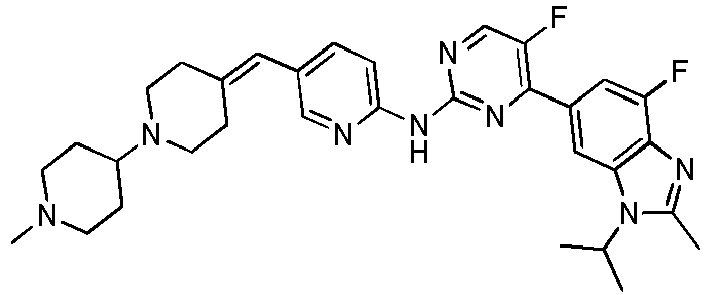
MS-ESI, m/z: 573.3 [M+1]+ Example 66 
MS-ESI, m/z: 516.2 [M+1]+ 1H NMR (400 MHz, DMSO) δ (ppm) TFA salt 10.48 (s, 1H), 9.12 (s, 1H), 8.74 (s, 1H), 8.25-8.20 (m, 3H), 7.76-7.71(m, 2H),6.48 (s, 1H), 4.88-4.85 (m, 1H), 3.60 - 3.54 (m, 4H), 3.26 - 3.19 (m, 2H), 2.95-2.88 (m, 3H), 2.67-2.62 (m, 5H), 1.64 (d, J = 6.9 Hz, 6H), 0.97-0.85 (m, 4H). Example 67 
MS-ESI, m/z: 520.2 [M+1]+ 1H NMR (400 MHz, DMSO) δ (ppm) TFA salt 10.46 (s, 1H), 9.52 (s, 1H), 8.76 (s, 1H), 8.28-8.21(m, 3H), 7.76-7.71(m, 2H),6.45 (s, 1H), 4.88-4.86 (m, 1H), 3.85-3.71 (m, 6H), 3.21-3.02 (m, 4H), 2.67-2.58 (m, 7H), 1.64 (d, J = 6.9 Hz, 6H). Example 68 
MS-ESI, m/z: 534.2 [M+1]+ 1H NMR (400 MHz, DMSO) δ (ppm) TFA salt 10.48 (s, 1H), 9.61 (s, 1H), 8.76 (s, 1H), 8.28-8.19 (m, 3H), 7.76-7.71(m, 2H),6.47 (s, 1H), 4.88-4.83 (m, 1H), 3.68 - 3.34 (m, 6H), 3.452 (s, 3H), 3.07-2.37 (m, 4H), 2.67- 2.60 (m, 5H), 1.64 (d, J = 6.9 Hz, 6H). Example 69 
MS-ESI, m/z: 540.2 [M+1]+ 1H NMR (400 MHz, DMSO) δ (ppm) TFA salt 10.50 (s, 1H), 8.76 (d, J = 3.6 Hz, 1H), 8.29 (s, 1H), 8.23 (d, J = 1.8 Hz, 1H), 8.20 (d, J = 8.8 Hz, 1H), 7.74 (t, J = 10.6 Hz, 2H), 6.60 (d, J = 55.2 Hz, 1H), 6.43 (s, 1H), 4.87 (dt, J = 13.8, 6.7 Hz, 1H), 3.31 - 2.95 (m, 4H), 2.64 (d, J = 21.7 Hz, 7H), 2.00 (dd, J = 14.7, 7.1 Hz, 2H), 1.64 (d, J = 6.9 Hz, 6H). Example 70 
MS-ESI, m/z: 558.2 [M+1]+ 1H NMR (400 MHz, DMSO) δ (ppm) TFA salt 11.02 (s, 1H), 8.81 (d, J = 2.5 Hz, 1H), 8.29 (s, 1H), 8.21 (s, 1H), 8.02 (d, J = 8.6 Hz, 1H), 7.88 (s, 1H), 7.74 (d, J = 12.0 Hz, 1H), 6.30 (s, 1H), 4.93 - 4.78 (m, 1H), 3.32 (d, J = 9.9 Hz, 2H), 2.80 (s, 2H), 2.72 (s, 2H), 2.68 (s, 3H), 2.39 (s, 2H), 2.00 (dd, J = 14.5, 6.9 Hz, 2H), 1.64 (d, J = 6.9 Hz, 6H). -

- To a solution of example 39 (60 mg, 0.11 mmol) in dichloromethane (5 mL) was added triethylamine (17 mg, 0.17 mmol) and 4-dimethylaminopyridine (2.8 mg, 0.023 mmol), followed by dropwise addition of a solution of acetic anhydride (17.6 mg, 0.17 mmol) in dichloromethane (0.5 mL). After stirring for 2 hours, LCMS showed that the reaction was complete, purified by Prep-HPLC and basified to a salt-free form.
MS (ESI), m/z, 564.2 [M+1]+.
1H NMR (400 MHz, CDCl3) δ (ppm) 8.43 (dd, J = 12.0, 6.2 Hz, 2H), 8.32 - 8.22 (m, 2H), 8.19 (d, J = 1.1 Hz, 1H), 7.80 (d, J = 11.9 Hz, 1H), 7.65 (dd, J = 8.7, 2.2 Hz, 1H), 5.52 (d, J = 7.9 Hz, 1H), 4.75 (dt, J = 13.8, 6.9 Hz, 1H), 2.98 (dd, J = 32.6, 11.1 Hz, 2H), 2.70 (s, 3H), 2.39 (dd, J = 14.2, 7.1 Hz, 2H), 2.09 (s, 3H), 1.94 - 1.77 (m, 4H), 1.72 (d, J = 7.0 Hz, 6H), 1.08 (t, J = 7.2 Hz, 3H). - The racemic compound was separated by chiral column Chiralpak AD-H (10 mm × 250 mm, 5 µm) at a column temperature of 40 °C. Mobile phase A was 0.1% DEA in hexane (v/v), mobile phase B was ethanol, running time was 30 minutes, gradient was mobile phase A/ mobile phase B (50/50, v/v), flow rate was 6.0 mL/min and detection wavelength was UV 210 nm. The two single-configuration compounds were separated in the retention time of 25 minutes (compound of example 71) and 31 minutes (compound of example 72) respectively. The compound was detected by chiral column CHRIARPAK AD-H (4.6 mm × 250 mm) at a column temperature of 40 °C, and mobile phase A was 0.1% DEA in hex (V/V), mobile phase B was ethanol, running time was 30 minutes, gradient was mobile phase A/mobile phase B (50/50), flow rate was 0.5 mL/min, and detection wavelength was UV 210 nm. The first single configuration compound was example 71 (RT = 21.3 min, 98% ee), and the second single configuration compound was example 72 (RT 28.6 min, 97% ee).
- The compounds of examples 73-86 in the following table were prepared according to the synthesis method of examples 16-19 using the corresponding starting materials.
Example Structure Characterization data Example 73 
MS-ESI, m/z: 534.3 [M+1]+ 1H NMR (400 MHz, CDCl3) δ (ppm) 8.54 (s, 1H), 8.46 (d, J = 3.5 Hz, 1H), 8.35 (d, J = 8.6 Hz, 1H), 8.20 (s, 1H), 8.16 (d, J = 2.3 Hz, 1H), 7.80 (d, J = 11.6 Hz, 1H), 7.55 - 7.46 (m, 1H), 4.79-4.69 (m, 1H), 2.94 (d, J = 11.2 Hz, 1H), 2.81 (d, J = 11.1 Hz, 1H), 2.70 (s, 3H), 2.65 (dd, J = 13.0, 6.5 Hz, 1H), 2.49 (p, J = 7.1 Hz, 1H), 2.09 (dd, J = 16.0, 6.8 Hz, 1H), 2.03 - 1.80 (m, 4H), 1.72 (d, J = 6.9 Hz, 6H), 1.50 - 1.41 (m, 1H), 1.36 (ddd, J = 16.3, 9.5, 3.3 Hz, 1H), 1.28 (d, J = 7.0 Hz, 3H), 1.18 (ddd, J = 15.0, 11.9, 3.5 Hz, 1H), 1.01 (d, J = 6.5 Hz, 6H). The compound was separated with chiral column Chiralpak AS-H, and chiral separation conditions were the same as in example 17 or 18. RT was 17.5 min. Example 74 
MS-ESI, m/z: 534.3 [M+1]+ The compound was separated with chiral column Chiralpak AS-H, and chiral separation conditions were the same as in example 17 or 18. RT was 24 min. Example 75 
MS-ESI, m/z: 532.3 [M+1]+ 1H NMR (400 MHz, CDCl3) δ (ppm) 8.43 (d, J = 3.7 Hz, 1H), 8.34 (d, J = 8.6 Hz, 1H), 8.20 (s, 2H), 8.12 (s, 1H), 7.80 (d, J = 11.6 Hz, 1H), 7.50 (dd, J = 8.6, 1.9 Hz, 1H), 4.83 - 4.65 (m, 1H), 3.08 (d, J = 11.2 Hz, 1H), 2.96 (d, J = 11.1 Hz, 1H), 2.96 (d, J = 11.1 Hz, 1H), 2.70 (s, 3H), 2.57 - 2.39 (m, 1H), 2.13 (t, J = 10.7 Hz, 1H), 2.03 (t, J = 10.8 Hz, 1H), 1.85 (d, J = 12.8 Hz, 1H), 1.71 (d, J = 6.9 Hz, 6H), 1.56 - 1.47 (m, 1H), 1.47 - 1.35 (m, 2H), 1.35 - 1.20 (m, 4H), 1.13 (dt, J = 22.4, 11.0 Hz, 1H), 0.53 - 0.30 (m, 4H). The compound was separated with chiral column Chiralpak AS-H, and chiral separation conditions were the same as in example 17 or 18. RT was 18.4 min. Example 76 
MS-ESI, m/z: 532.3 [M+1]+ The compound was separated with chiral column Chiralpak AS-H, and chiral separation conditions were the same as in example 17 or 18. RT was 25 min. Example 77 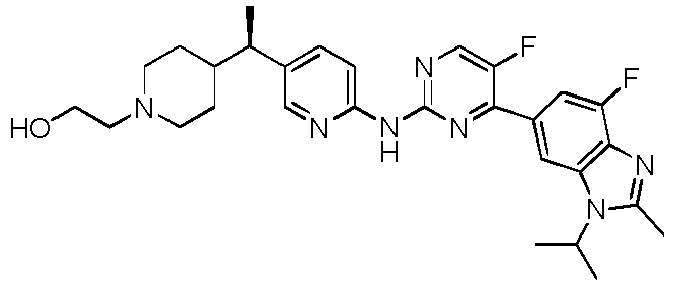
MS-ESI, m/z: 536.3 [M+1]+ 1H NMR (400 MHz, CDCl3) δ (ppm) 8.42 (d, J = 3.7 Hz, 1H), 8.35 (d, J = 8.6 Hz, 1H), 8.19 (s, 1H), 8.15 - 8.09 (m, 2H), 7.80 (d, J = 11.6 Hz, 1H), 7.51 (dd, J = 8.6, 2.1 Hz, 1H), 4.74 (dt, J = 13.8, 6.9 Hz, 1H), 3.57 (t, J = 5.4 Hz, 2H), 2.96 (d, J = 11.7 Hz, 1H), 2.83 (d, J = 11.3 Hz, 1H), 2.69 (s, 3H), 2.48 ((m, 3H), 2.03 (dd, J = 11.5, 9.4 Hz, 1H), 1.98 - 1.83 (m, 3H), 1.71 (d, J = 6.9 Hz, 6H), 1.47 - 1.30 (m, 3H), 1.28 (d, J = 7.0 Hz, 3H). The compound was separated with chiral column Chiralpak AS-H, and chiral separation conditions were the same as in example 17 or 18. RT was 14.6 min. Example 78 
MS-ESI, m/z: 536.3 [M+1]+ The compound was separated with chiral column Chiralpak AS-H, and chiral separation conditions were the same as in example 17 or 18. RT was 18.4 min. Example 79 
MS-ESI, m/z: 550.3 [M+1]+ 1H NMR (400 MHz, CDCl3) δ (ppm) 8.42 (d, J = 3.7 Hz, 1H), 8.33 (d, J = 8.6 Hz, 1H), 8.19 (s, 1H), 8.10 (d, J = 2.0 Hz, 1H), 8.08 (s, 1H), 7.80 (d, J = 11.6 Hz, 1H), 7.50 (dd, J = 8.6, 2.1 Hz, 1H), 4.74 (dt, J = 13.9, 6.9 Hz, 1H), 3.48 (t, J = 5.7 Hz, 2H), 3.33 (s, 3H), 3.01 (d, J = 10.4 Hz, 1H), 2.88 (d, J = 11.1 Hz, 1H), 2.69 (s, 3H), 2.57 - 2.42 (m, 3H), 2.04 - 1.89 (m, 1H), 1.84 (t, J = 10.5 Hz, 2H), 1.71 (d, J = 6.9 Hz, 6H), 1.40 (d, J = 14.3 Hz, 3H), 1.27 (d, J = 7.1 Hz, 4H). The compound was separated with chiral column Chiralpak AS-H, and chiral separation conditions were the same as in example 17 or 18. RT was 15.7 min. Example 80 
MS-ESI, m/z: 550.3 [M+1]+ The compound was separated with chiral column Chiralpak AS-H, and chiral separation conditions were the same as in example 17 or 18. RT was 21.3 min. Example 81 
MS-ESI, m/z: 564.3 [M+1]+ 1H NMR (400 MHz, CDCl3) δ 8.35 (d, J = 3.7 Hz, 1H), 8.27 (d, J = 8.6 Hz, 1H), 8.13 (s, 1H), 8.04 (d, J = 1.9 Hz, 1H), 7.99 (s, 1H), 7.73 (d, J = 11.6 Hz, 1H), 7.43 (dd, J = 8.6, 2.1 Hz, 1H), 4.73 - 4.59 (m, 1H), 3.33 (t, J = 6.4 Hz, 2H), 3.24 (s, 3H), 2.98 - 2.86 (m, 1H), 2.85 - 2.73 (m, 1H), 2.63 (s, 3H), 2.48 - 2.37 (m, 1H), 2.30 (s, 2H), 1.90 - 1.75 (m, 2H), 1.76 - 1.67 (m, 2H), 1.63 (t, J = 8.7 Hz, 6H), 1.57 (s, 1H), 1.31 (dt, J = 10.3, 9.1 Hz, 3H), 1.25 - 1.08 (m, 4H). The compound was separated with chiral column Chiralpak AS-H, and chiral separation conditions were the same as in example 17 or 18. RT was 14.9 min. Example 82 
MS-ESI, m/z: 564.3 [M+1]+ The compound was separated with chiral column Chiralpak AS-H, and chiral separation conditions were the same as in example 17 or 18. RT was 19.7 min. Example 83 
MS-ESI, m/z: 556.3 [M+1]+ 1H NMR (400 MHz, CDCl3) δ 8.44 (d, J = 3.7 Hz, 1H), 8.36 (d, J = 8.1 Hz, 2H), 8.19 (s, 1H), 8.14 (d, J = 1.6 Hz, 1H), 7.80 (d, J = 11.6 Hz, 1H), 7.50 (dd, J = 8.6, 1.9 Hz, 1H), 5.85 (tt, J = 56.0, 4.3 Hz, 1H), 4.88 - 4.63 (m, 1H), 2.99 (d, J = 11.2 Hz, 1H), 2.87 (d, J = 11.0 Hz, 1H), 2.80 - 2.59 (m, 5H), 2.56 - 2.40 (m, 1H), 2.16 (t, J = 11.3 Hz, 1H), 2.05 (t, J = 11.0 Hz, 1H), 1.85 (d, J = 11.1 Hz, 1H), 1.72 (s, 6H), 1.46 - 1.31 (m, 3H), 1.31 - 1.17 (m, 5H). The compound was separated with chiral column Chiralpak AS-H, and chiral separation conditions were the same as in example 17 or 18. RT was 18.3 min. Example 84 
MS-ESI, m/z: 556.3 [M+1]+ The compound was separated with chiral column Chiralpak AS-H, and chiral separation conditions were the same as in example 17 or 18. RT was 24.8 min. Example 85 
MS-ESI, m/z: 574.3 [M+1]+ 1H NMR (400 MHz, CDCl3) δ 8.44 (d, J = 3.7 Hz, 1H), 8.41 - 8.31 (m, 2H), 8.19 (s, 1H), 8.14 (d, J = 2.0 Hz, 1H), 7.80 (d, J = 11.6 Hz, 1H), 7.50 (dd, J = 8.6, 2.1 Hz, 1H), 4.74 (hept, J = 6.8 Hz, 1H), 3.02 (d, J = 10.8 Hz, 1H), 2.98 - 2.84 (m, 3H), 2.70 (s, 3H), 2.55 - 2.42 (m, 1H), 2.31 (t, J = 11.1 Hz, 1H), 2.21 (t, J = 11.2 Hz, 1H), 1.84 (d, J = 10.8 Hz, 1H), 1.72 (s, 6H), 1.47 - 1.31 (m, 2H), 1.34 - 1.16 (m, 5H). The compound was separated with chiral column Chiralpak AS-H, and chiral separation conditions were the same as in example 17 or 18. RT was 19.7 min. Example 86 
MS-ESI, m/z: 574.3 [M+1]+ The compound was separated with chiral column Chiralpak AS-H, and chiral separation conditions were the same as in example 17 or 18. RT was 25.1 min. - In vitro, CDK (CDK4, CDK6, CDK1, CDK2, CDK7, and CDK9) kinase activity was tested by the following method.
- CDK and raw materials used here: CDK4/CycD3 (Carna, Cat.No 04-105, Lot. No 10CBS-0429 C, GST-CDK4(1-303end)/GST-CycD3(1-292end)); CDK6/cycD3 (Carna, Cat.No 04-107, Lot. No 09CBS-0622K, GST-CDK6(1-326(end))); CDK1/CyclinB (Millipore, Cat. 14-450k, Lot. No 25729U, His-CDKl+GST-cyclinB); CDK2/CycA2 (Carna, Cat.No 04-103, Lot. No 06CBS-3024, GST-CDK2 (1-298(end))); CDK7/ CyclinH/MAT1 (Millipore, Cat.No 14-476M, Lot. No WAB0365-A, His-CDK7+GST-MAT1+cyclinH); CDK9/cyclinT1 (Millipore, Cat.No 14-685K, Lot. No. 2476163-A, His-CDK9+cyclinT1); Peptide FAM-P8 (GL Biochem, Cat. No. 112396, Lot. No. P100804-XZ112396); ATP (Sigma, Cat. No. A7699-1G, CAS No. 987-65-5); DMSO (Sigma, Cat. No. D2650, Lot. No. 474382); EDTA (Sigma, Cat. No. E5134, CAS No. 60-00-4); 96-well plate (Corning, Cat. No. 3365, Lot. No. 22008026); 384-well plate (Corning, Cat. No. 3573, Lot. No. 12608008); Staurosporine (Sigma, Cat. No. S4400-1MG, Lot. No. 046K4080).
-
- 1. Prepared 1x kinase buffer and stop buffer for the test
- 1) 1× Kinase base buffer (CDK1, 2, and 6).
- 50 mM HEPES, pH 7.5
- 0.0015% Brij-35
- 10 mM MgCl2
- 2 mM DTT
- 2) 1× Kinase base buffer (CDK4).
- 50 mM HEPES, pH 7.5
- 0.01% Triton X-100
- 10 mM MgCl2
- 2 mM DTT
- 3) 1× Kinase base buffer (CDK7 and 9).
- 20 mM HEPES, pH 7.5
- 0.01% Triton X-100
- 10 mM MgCl2
- 2 mM DTT
- 4) Stop buffer.
- 100 mM HEPES, pH 7.5
- 0.015% Brij-35
- 0.2% Coating Reagent #3
- 50 mM EDTA
- 1) 1× Kinase base buffer (CDK1, 2, and 6).
- 2. Compound preparation
- 1) Diluted the compound to 50 times of the maximum concentration with 100% DMSO. For example, if the desired maximum inhibitory concentration is 10 µM, then a DMSO solution of 500 µM concentration is required.
- 2) Transferred the compound to a 96-well plate and serially diluted the compound from a 100% DMSO solution at a ratio of 30 µm to 60 µm for a total of 10 concentrations gradients.
- 3) Transferred100 µm of 100% DMSO to two empty wells as a no compound control and a no enzyme control.
- 4) Prepared intermediate plate and transferred the compound of 10 µm concentration from the original plate to the intermediate plate, and then 90 µm of 1× kinase buffer was added and mixed by shaking for 10 min.
- 4) Preparing intermediate plate and transferred the compound of 10 µm concentration from the original plate to the intermediate plate, and then 90 µm of 1× kinase buffer was added and mixed by shaking for 10 min.
- 3. Prepared assay plate
- 1) Transferred 5 µm of each compound from the 96-well intermediate plate to a 384-well plate. For example, A1 of the 96-well plate was transferred to A1 and A2 of the 384-well plate. A2 of the 96-well plate was transferred to A3 and A4 of the 384-well plate, and so on.
- 4. Kinase reaction
- 1) Prepared a 2.5 x enzyme solution: added kinase into 1× kinase base buffer.
- 2) Prepared a 2.5x peptide solution: added FAM-labeled peptide and ATP into the 1× kinase base buffer.
- 3) Transferred the 2.5 x enzyme solution to the assay plate: Assay plate already contained 5 µm of 10% DMSO and transferred 10 µm of 2.5 x enzyme solution to each well.
- 4) Incubated at room temperature for 10 min.
- 5) Transferred the 2.5 x peptide solution to the assay plate: added 10 µm of 2.5x peptide solution to each well of the 384-well assay plate.
- 6) Kinase reaction and termination: incubated at 28 °C for a specified period and added 25 µm of stop buffer to stop the reaction.
- 5. Caliper reading: Collect data on Caliper.
- 6. Curve fitting
- 1) Copied conversion data from Caliper program and Converted conversion values to inhibition values:

- 2) Fitted the data in XLFit excel add-in version 4.3.1 to give the corresponding IC50 values.
- 1) Copied conversion data from Caliper program and Converted conversion values to inhibition values:
- The CDK (CDK4, CDK6, CDK1, CDK2, CDK7, and CDK9) inhibitory activities of the compounds of the present invention were determined by the above experimental method, and the enzymatic inhibitory activity (IC50) of the compounds were shown in Table 1 below: "+" represents 10-100 µm, "++" represents 1-10 µm, "++++" represents 0.5-1µm, "++++" represents 0.1-0.5µm, "+++++" represents less than 0.1 µm.
Table 1 Inhibition of CDK by the compounds of the invention Example CDK4 CDK6 CDK1 CDK2 CDK7 CDK9 Abemaciclib +++++ +++++ ++++ +++++ ++ ++++ 1 +++++ ++ + ++ ++ ++ 2 +++++ ++++ + ++ ++ ++ 3 +++++ ++++ + + ++ + 4 +++++ +++ + ++ ++ ++ 5 +++++ ++ + + ++ + 6 +++++ ++++ + ++ ++ ++ 7 +++++ ++ + + ++ + 16 +++++ +++++ ++++ +++++ ++ ++++ 17 +++++ +++++ ++++ +++++ ++ ++++ 18 +++++ ++++ +++ ++++ ++ +++ 19 ++++ +++++ ++++ ++++ ++ ++++ 20 +++++ ++++ +++ ++++ ++ +++ 21 +++++ +++++ ++++ +++++ ++ ++++ 22 +++++ ++++ +++ ++++ ++ +++ 25 ++++ ++++ +++ ++++ ++ +++ 26 ++++ ++++ +++ +++ ++ +++ 33 +++++ +++++ ++++ +++++ ++ +++++ 34 ++++ ++++ +++ ++++ ++ ++++ 35 +++++ ++++ ++++ +++++ ++ +++++ 36 ++++ ++++ +++ +++ ++ +++ 39 +++++ +++++ +++++ +++++ ++++ +++++ 40 +++++ +++++ +++++ +++++ +++ +++++ 41 +++++ +++++ ++++ +++++ +++ ++++ 42 ++++ ++++ ++++ +++++ ++++ ++++ 43 +++++ ++++ ++++ ++++ +++ ++++ 44 ++++ ++++ ++++ ++++ ++++ +++ 45 +++++ ++++ ++++ +++++ ++ ++++ 46 +++++ ++++ ++++ +++++ ++ ++++ 49 +++++ +++++ ++++ ++++ ++++ ++++ 50 +++++ ++++ +++++ +++++ ++++ ++++ 57 +++++ +++++ ++++ +++++ ++ +++++ 58 +++++ ++++ +++ ++++ ++ ++++ 59 +++++ +++ +++ ++++ ++ ++++ 60 +++++ ++++ +++ ++++ ++ ++++ 61 +++++ +++ +++ ++++ ++ ++++ 62 +++++ +++ +++ ++++ ++ +++ 64 +++++ ++++ ++ ++++ + ++++ 66 +++++ +++++ ++++ +++++ ++ ++++ 67 +++++ +++++ ++++ +++++ ++ ++++ 68 +++++ +++++ ++++ +++++ ++ ++++ 69 +++++ +++++ ++++ +++++ ++ ++++ 70 +++++ +++++ ++++ +++++ ++ ++++ 71 +++++ +++++ ++++ +++++ ++ ++++ 72 +++++ +++++ ++++ +++++ ++ ++++ 73 +++++ +++++ ++++ +++++ ++ +++ 74 +++++ ++++ +++ ++++ ++ ++++ 75 +++++ +++++ ++++ +++++ ++ ++++ 76 +++++ ++++ +++ ++++ ++ ++++ 77 +++++ +++++ ++++ +++++ ++ ++++ 79 +++++ +++++ ++++ +++++ ++ ++++ 80 +++++ ++++ +++ ++++ ++ ++++ 81 +++++ +++++ ++++ +++++ ++ ++++ 83 +++++ +++++ ++++ +++++ ++ ++++ 85 +++++ +++++ ++++ +++++ ++ ++++ 86 +++++ ++++ +++ ++++ ++ ++++ - Conclusion: The compounds of the present invention showed high inhibitory activity against CDK, especially CDK4 and CDK6.
- Healthy adult Sprague-Dawley rats, male, 7-10 weeks old, weighing 240-270 g, provided by Beijing Vital River Laboratory Animal Technology Co., Ltd., with an animal certificate number of 1140070278736.
- Intravenous administration solvent system of compounds: 10% (V/V) NMP and 90% (20% (V/V)) SBE-β-CD in 16.667 mM PBS with a concentration of 1.0 mg/mL.
- Oral administration solvent system of compounds: pure water system containing 0.1% hydroxyethyl cellulose and 0.5% Tween -80, with a concentration of 1 mg/mL.
- Intravenous administration: 3 male Sprague-Dawley rats of each test compound were injected intravenously after fasting overnight, with a dose of 2 mg/kg, and the dosing volume was 2 mL/kg.
- Oral administration: 3 male Sprague-Dawley rats of each test compound were taken orally after fasting overnight, with a dose of 5 mg/kg, and the dosing volume was 5 mL/kg.
- Before the administration, and after administration of 0.0833 (iv), 0.25, 0.5, 1, 2, 4, 8, 12, and 24 h, the jugular vein puncture (approximately 0.15 mL per time point) of each animal was performed by collecting blood from polypropylene tubes. All blood samples were transferred to pre-cooled EDTA-K2 test tubes or pre-cooled plastic microcentrifuge tubes containing 3 µL of 0.5 M EDTA-K2 as anticoagulant and placed on wet ice until centrifugation. Each collected blood was centrifuged at 4 °C for 15 minutes, and plasma was collected. All plasma would be stored in a freezer at about - 80 °C until LCMS/MS detection.
- The rat pharmacokinetic parameters of the compounds of the invention were shown in Table 2 below.
Table 2 Pharmacokinetic parameters of compounds in rats Example Cmax (ng/mL) Tmax (h) T1/2 (h) AUC0-24h (ng.h/mL) Cl (mL/min/kg) F (%) 17 225 8.0 9.38 3582 14.1 66.9 33 161 8.0 8.19 2570 12.1 43.7 40 12.9 4.0 11.9 132 72.8 13.3 57 205 8.0 11.7 3077 14.8 57.6 - As shown in the table, at the dose of 10mg/kg, the compounds of examples 17, 33, and 57 have lower clearance, longer half-life and a high level of exposure at 24 h in rat plasma.
- BALB/c nude mice, 6-8 weeks old, weighing 18-20 g, female, provided by Shanghai Lab Animal Research Center (Shanghai Xipuer-Beikai) with an animal certificate No: 2008001681946.
- The experiment was started after 3-7 days in the experimental environment when the animals arrived. Animals were housed in IVC (independent air supply system) cages (four animals per cage) in SPF grade experimental animal facilities. Each cage animal information card contained the number of animals in the cage, sex, strain, receiving date, dosing schedule, experiment number, group and start date of the experiment. All cages, bedding, and drinking water were sterilized before use and were updated twice a week.
- Human breast cancer MCF-7 cells (ECACC, Cat. No. 86012803) were cultured in vitro in monolayer under the conditions of EMEM (EBSS)+2 mM glutamine+1% non-essential amino acids (NEAA) medium with 10% fetal bovine serum, 100 U/mL penicillin and 100 µg/mL streptomycin, and 37 °
C 5% CO2 incubator. The passage was routinely digested with trypsin-EDTA twice a week. When the cell saturation was up to 80%-90% and reached the requirement, the cells were collected, counted and inoculated. 0.2 mL (1×10⁷) MCF-7 cells (with matrix gel, volume ratio 1:1) were subcutaneously inoculated into the right back of each mouse, and mice were randomly grouped and dosed when the average tumor volume reached 209 mm3. - 4.14 mL of lactic acid was added to a large beaker containing 800 mL of deionized water, the pH was adjusted to 4.0 with 5 N NaOH, and then the volume was fixed to 1,000 mL to obtain 50 mmol/L sodium lactate buffer. An appropriate amount of mesylate of example 17, mesylate of example 57 and mesylate of Abemaciclib (made in the laboratory) were weighted, and an appropriate amount of the above sodium lactate buffer was added, vortexed and sonicated for several seconds to give a clear solution.
- Dosage and administration schedule were showed in Table 3. The subcutaneous tumor volume of nude mice was measured 2-3 times a week, and the mice were weighed, and the data were recorded.
Table 3 No. Group dose (mg/kg) Route Number of animals Drug delivery cycle 1 Vehicle - PO 8 PO × 14 days 2 Example 17 30 PO 8 PO × 14 days 3 Example 57 30 PO 8 PO × 14 days 4 Abemaciclib 30 PO 8 PO × 14 days Note: Dose volume was 10 mg/mL. - Experimental evaluation index: the tumor growth inhibition rate TGI (%) or the relative tumor proliferation rate T/C (%) was used for evaluation, wherein T was the experimental group, and C was the vehicle group.
- Calculation of the relative tumor proliferation rate T/C (%): If T > T0, then T/C(%) = (T-T0)/(C-C0)×100%, if T<T0, then T/C(%) = (T-T0)/T0×100%, wherein T and C were tumor volumes at the end of the experiment; To and Co were tumor volumes at the beginning of the experiment.
- Calculation of percent tumor growth inhibition rate TGI (%): TGI (%) = (1-T/C)×100%.
- Evaluation criteria: T/C (%) > 40 (i.e. TGI (%) < 60%) means invalid; T/C (%) ≤ 40 (i.e. TGI (%) ≥ 60%) means valid and statistical significance value P < 0.05 was effective.
- The inhibitory effects of the vehicle, examples 17, 57, and Abemaciclib on tumor volume of MCF-7 cells were shown in
Fig 1 and Table 4.Table 4 Effects of examples 17, 57 and Abemaciclib on tumor volumes of MCF-7 cells Group Route Tumor volume (mm3) (day 0) Tumor volume (mm3) (day 14) T/C (%) TGI (%) P value Vehicle PO 210 857 -- -- -- Example 17 PO 210 216 0.9 99.1 0.006 Example 57 PO 209 290 12.5 87.5 0.010 Abemaciclib PO 209 365 24.1 75.9 0.024 - The results indicated that the compound of example 17, 57, and the positive control Abemaciclib had a strong inhibitory effect on the tumor growth of the MCF-7 nude mouse model at a dose of 30 mg/kg and continuous PO administration for 14 days. Example 17 and example 57 had better antitumor effects than positive control compound Abemaciclib in the same dosage.
- BALB/c nude mice, 6-8 weeks old, weighing 12-14 g, female, provided by Shanghai Lab Animal Research Center (Shanghai Xipuer-Beikai) with an animal certificate No: 2008001682093.
- The experiment was started after 3-7 days in the experimental environment when the animals arrived. Animals were housed in IVC (independent air supply system) cages (Four animals per cage) in SPF grade experimental animal facilities. Each cage animal information card contained the number of animals in the cage, sex, strain, receiving date, dosing schedule, experiment number, group and start date of the experiment. All cages, bedding, and drinking water were sterilized before use and were updated twice a week.
- Human colorectal cancer Colo-205 cells (ATCC-CCL-222) were cultured in vitro in monolayer under the conditions of RPMI 1640 medium with 10% fetal bovine serum, 100 U/mL penicillin and 100 µg/mL streptomycin, and 37 °
C 5% CO2 incubator. The passage was routinely digested with trypsin-EDTA twice a week. When the cell saturation was up to 80%-90% and reached the requirement, the cells were collected, counted and inoculated. 0.2 mL (5×10⁶) Colo-205 cells were subcutaneously inoculated on the right back of each mouse, and mice were randomly grouped and dosed when the average tumor volume reached 163 mm3. - 4.14 mL of lactic acid was added to a large beaker containing 800 mL of deionized water, and the pH was adjusted to 4.0 with 5 N NaOH. Then the volume was fixed to 1,000 mL to obtain 50 mmol/L sodium lactate buffer. An appropriate amount of mesylate of example 17 and mesylate of Abemaciclib (made in the laboratory) were weighted, and an appropriate amount of the above sodium lactate buffer was added, vortexed and sonicated for several seconds to give a clear solution.
- Dosage and administration schedule were showed in Table 5. The subcutaneous tumor volume of nude mice was measured 2-3 times a week, and the mice were weighed, and the data were recorded.
Table 5 No. Group dose (mg/kg) Route Number of animals Drug delivery cycle 1 Vehicle - PO 6 PO x 28 days 2 Example 17 50 PO 6 PO x 28 days 3 Abemaciclib 50 PO 6 PO x 28 days Note: Dose volume was 10 mg/mL. - Experimental evaluation index: the tumor growth inhibition rate TGI (%) or the relative tumor proliferation rate T/C (%) was used for evaluation, wherein T was the experimental group, and C was the vehicle group.
- Calculation of relative tumor proliferation rate TGI (%): If T > T0, then T/C(%) = (T-T0)/(C-C0)×100%, if T<T0, then T/C(%) = (T-T0)/T0×100%, wherein T and C were tumor volumes at the end of the experiment; To and Co were tumor volumes at the beginning of the experiment.

- Evaluation criteria: T/C (%) > 40 (i.e. TGI (%) < 60%) means invalid; T/C (%) ≤ 40 (i.e. TGI (%) ≥ 60%) means valid and statistical significance value P < 0.05 was effective.
- The inhibitory effects of the vehicle, examples 17 and Abemaciclib on tumor volume of Colo-205 cells were shown in
Fig 2 and Table 6.Table 6 Effects of examples 17 and Abemaciclib on tumor volumes of Colo-205 cells Group Route Tumor volume (mm3) (day 0) Tumor volume (mm3) (day 28) T/C (%) TGI (%) P value Vehicle PO 198 2352 -- -- -- Example 17 PO 198 591 18.2 81.8 0.011 Abemaciclib PO 198 749 25.5 74.5 0.007 - The results indicated that the compound of example 17 and the positive control Abemaciclib had a strong inhibitory effect on the tumor growth of the Colo-205 nude mouse model at a dose of 50 mg/kg and continuous PO administration for 28 days. Example 17 had better antitumor effect than positive control compound Abemaciclib in the same dosage.
- BALB/c nude mice, 6-8 weeks old, weighing 18-22 g, female, provided by Shanghai Lab Animal Research Center (Shanghai Xipuer-Beikai) with an animal certificate No: 212212121210000.
- The experiment was started after 3-7 days in the experimental environment when the animals arrived. Animals were housed in IVC (independent air supply system) cages (four animals per cage) in SPF grade experimental animal facilities. Each cage animal information card contained the number of animals in the cage, sex, strain, receiving date, dosing schedule, experiment number, group and start date of the experiment. All cages, bedding, and drinking water were sterilized before use and were updated twice a week.
- Human leukemia MV4-11 cells (ATCC-CRL-9591) were cultured in vitro in suspension under the conditions of RPMI 1640 medium with 10% fetal bovine serum, 100 U/mL penicillin and 100 µg/mL streptomycin and 37°
C 5% CO2 incubator. Regular passages were performed twice a week. When the cell saturation was up to 80%-90% and reached the requirement, the cells were collected, counted, and inoculated. 0.2 mL (1×10⁷) MV4-11 cells (added with matrix gel, volume ratio 1:1) were subcutaneously inoculated into the right back of each mouse, and mice were randomly grouped and dosed when the average tumor volume reached 158 mm3. - 4.14 mL of lactic acid was added to a large beaker containing 800 mL of deionized water, and the pH was adjusted to 4.0 with 5 N NaOH, and then the volume was fixed to 1,000 mL to obtain 50 mmol/L sodium lactate buffer. An appropriate amount of mesylate of example 17, mesylate of example 57 and mesylate of Abemaciclib (made in the laboratory) were weighted, and an appropriate amount of the above sodium lactate buffer was added, vortexed and sonicated for several seconds to give a clear solution.
- Dosage and administration schedule were showed in Table 7. The subcutaneous tumor volume of nude mice was measured 2-3 times a week, and the mice were weighed, and the data were recorded.
Table 7 No. Group dose (mg/kg) Route Number of animals Drug delivery cycle 1 Vehicle - PO 8 PO × 21 days 2 Example 17 50 PO 8 PO × 21 days 3 Example 57 50 PO 8 PO × 21 days 4 Abemaciclib 50 PO 8 PO × 21 days Note: Dose volume was 10 mg/mL. - Experimental evaluation index: the tumor growth inhibition rate TGI (%) or the relative tumor proliferation rate T/C (%) was used for evaluation, wherein T was the experimental group, and C was the vehicle group.
- Calculation of relative tumor proliferation rate TGI (%): If T > To, T/C(%) = (T-T0)/(C-C0)×100%, if T<T0, T/C(%) = (T-T0)/T0×100%, wherein T and C were tumor volumes at the end of the experiment; To and Co were tumor volumes at the beginning of the experiment.

- Evaluation criteria: T/C (%) > 40 (i.e. TGI (%) < 60%) means invalid; T/C (%) ≤ 40 (i.e. TGI (%) ≥ 60%) means valid and statistical significance value P < 0.05 was effective.
- The inhibitory effects of the vehicle, examples 17, 57, and Abemaciclib on tumor volume of MV4-11 cells were shown in
Fig 3 and Table 8.Table 8 Effects of examples 17, 57 and Abemaciclib on tumor volumes of MV4-11 cells Group Route Tumor volume (mm3) (day 0) Tumor volume (mm3) (day 21) T/C (%) TGI (%) P value Vehicle PO 158 961 -- -- -- Example 17 PO 158 463 38 62 0.018 Example 57 PO 158 491 41 59 0.021 Abemaciclib PO 158 440 35 65 0.005 - The results showed that the compound of example 17, 57, and the positive control Abemaciclib had a good inhibitory effect on the tumor growth of the MV4-11 nude mouse model at a dose of 50 mg/kg and continuous PO administration for 21 days. The tumor inhibition effect of example 17 and example 57 were equivalent to that of positive control compound Abemaciclib on the MV4-11 model.
- SCID Beige mice, 6-8 weeks old, weighing 18-22 g, female, provided by Beijing Vital River Laboratory Animal Technology Co., Ltd., with the animal certificate number of 11400700253449.
- The experiment was started after 3-7 days when the animal arrived. Animals were housed in IVC (independent air supply system) cages (four animals per cage) in SPF grade experimental animal facilities. Each cage animal information card contained the number of animals in the cage, sex, strain, receiving date, dosing schedule, experiment number, group, and start date of the experiment. All cages, bedding and drinking water were sterilized before use and were updated twice a week.
- Human breast cancer MDA-MB-361 cells (ATCC-HTB-27) were cultured in vitro in monolayer under the conditions of RPMI 1640 medium with 10% fetal bovine serum, 100 U/mL penicillin and 100 µg/mL streptomycin, and 37 °
C 5% CO2 incubator. The passage was routinely digested with trypsin-EDTA twice a week. When the cell saturation was up to 80%-90% and reached the requirement, the cells were collected, counted and inoculated. 0.2 mL (1×10⁷) MDA-MB-361 cells (added with matrix gel, volume ratio 1:1) were subcutaneously inoculated into the right back of each mouse, and mice were randomly grouped and dosed when the average tumor volume reached 175 mm3. - 4.14 mL of lactic acid was added to a large beaker containing 800 mL of deionized water, and the pH was adjusted to 4.0 with 5 N NaOH. Then the volume was fixed to 1, 000 mL to obtain 50 mmol/L sodium lactate buffer. An appropriate amount of methanesulfonic acid salt of example 17, methanesulfonic acid salt of example 57 and methanesulfonic acid salt of Abemaciclib (made in the laboratory) were weighted, and an appropriate amount of the above sodium lactate buffer solution was added, vortexed and sonicated for several seconds to give a clear solution.
- Dosage and schedule were showed in Table 9. The subcutaneous tumor volume of nude mice was measured 2-3 times a week, and the mice were weighed, and the data were recorded.
Table 9 Number Group dose (mg/kg) Route Number of animals Drug delivery cycle 1 Vehicle - PO 8 PO x 28 days 2 Example 17 15 PO 8 PO x 28 days 3 Example 57 15 PO 8 PO x 28 days 4 Abemaciclib 15 PO 8 PO x 28 days Note: Dose volume was 10 mg/mL. - Experimental evaluation index: Percent tumor growth inhibition TGI (%) or relative tumor proliferation rate T/C (%) was used for evaluation, wherein T was the experimental group, and C was the control group.
- Calculation of relative tumor proliferation rate: If T > To, T/C(%) = (T-To)/(C-C0)×100%, if T<T0, T/C(%) = (T-T0)/T0×100%, wherein T and C were tumor volumes at the end of the experiment; To and Co were tumor volumes at the beginning of the experiment.

- Evaluation criteria: T/C (%) > 40 (i.e. TGI (%) < 60%) means invalid; T/C (%) ≤ 40 (i.e. TGI (%) ≥ 60%) means valid and statistical significance value P < 0.05 was effective.
- The inhibitory effects of the vehicle, examples 17, 57, and Abemaciclib on tumor volume of MDA-MB-361 cells were shown in
Fig 4 and Table 10.Table 10 Effects of examples 17, 57 and Abemaciclib on tumor volumes of MDA-MB-361 cells Group Route Tumor volume (mm3) (day 0) Tumor volume (mm3) (day 28) T/C (%) TGI (%) P value Vehicle PO 175 361 -- -- -- Example 17 PO 175 90 -49 149 <0.001 Example 57 PO 175 99 -43 143 <0.001 Abemaciclib PO 175 85 -51 151 <0.001 - The results showed that the compound of example 17, example 57, and the positive control Abemaciclib exhibited a very strong inhibitory effect on the tumor growth of the MDA-MB-361 nude mouse model at a dose of 15 mg/kg and continuous PO administration for 28 days.


Claims (13)
- A compound represented by general formula (I-1) or (II-1), a pharmaceutically acceptable salt thereof, a stereoisomer thereof or a mixture of stereoisomers, a solvate thereof, a polymorph thereof, or a stable isotope derivative thereof;
 z is the number of substituents R12 and is 0, 1, 2 or 3;each R12 is independently selected from hydrogen, deuterium, halogen, hydroxyl, cyano, amino, alkenyl, alkynyl, substituted or unsubstituted alkyl, substituted or unsubstituted alkoxy, substituted or unsubstituted cycloalkyl, substituted or unsubstituted heterocycloalkyl, substituted or unsubstituted aryl, or substituted or unsubstituted heteroaryl;wherein

 e and f are each independently 0, 1, 2, or 3;R1 and R2 are each independently selected from hydrogen, deuterium, substituted or unsubstituted alkyl, substituted or unsubstituted haloalkyl, substituted or unsubstituted alkoxy, substituted or unsubstituted cycloalkyl, or substituted or unsubstituted heterocycloalkyl;R3 and R4 are each independently selected from hydrogen, deuterium, halogen, hydroxyl, cyano, amino, substituted or unsubstituted alkyl, substituted or unsubstituted alkoxy, substituted or unsubstituted cycloalkyl, or substituted or unsubstituted heterocycloalkyl;in R5 and R6,1) R5 ≠ R6, and R5 and R6 are each independently selected from hydrogen, deuterium, halogen, hydroxyl, mercapto, cyano, substituted or unsubstituted alkyl, substituted or unsubstituted haloalkyl, substituted or unsubstituted heterocycloalkyl, substituted or unsubstituted alkoxy, substituted or unsubstituted alkylmercapto, substituted or unsubstituted cycloalkyl, substituted or unsubstituted aryl, substituted or unsubstituted heteroaryl, -OR10, -SR10, -NR10R10a, -CONR10R10a, -SO2NR10R10a, - C(O)tR11, -S(=O)tR11, -OC(=O)R11, -C≡CR11 or -CR11=CR11R11a, or R5 and R6 together with the carbon atom to which they are attached form C3-7 monocycloalkyl and bicycloalkyl,, C5-12 spirobicyclic group or C5-12 bridged heterobicyclic group, or R5 and R6 together with the carbon atom to which they are attached form a cyclic moiety containing 1-3 heteroatoms, wherein the heteroatoms are selected from N, O, S, P or B;
alternatively,2) R5 and R6 are combined to form a substituted or unsubstituted exocyclic double bond W is selected from hydrogen, deuterium, halogen, cyano, substituted or unsubstituted alkyl, substituted or unsubstituted alkoxy, substituted or unsubstituted alkylmercapto, substituted or unsubstituted cycloalkyl, substituted or unsubstituted aryl, substituted or unsubstituted heteroaryl, -OR10, -SR10, -NR10R10a, -SO2NR10R10a, - C(O)tR11, -S(O)tR11, -OC(O)R11, -C=CR11 or -CR11=CR11R11a;Y1 is CRa;Ya is independently selected from -CR11R11a-, -N(R10), -C(=O)-, -S(=O)t or -O-;Y2 is selected from -CRaRb, -NRb, -C(=O), -S(=O)t, -S- or -O-;alternatively, Y1 and Ya form a C=C or C=N double bond;R7 is selected from hydrogen, deuterium, halogen, hydroxyl, cyano, oxo(=O), substituted or unsubstituted alkyl, substituted or unsubstituted alkoxy, substituted or unsubstituted alkylmercapto, substituted or unsubstituted cycloalkyl, substituted or unsubstituted heterocycloalkyl, substituted or unsubstituted aryl, substituted or unsubstituted heteroaryl, -OR10, -SR10, -NR10R10a, -SO2NR10R10a, -C(O)tR11, - S(O)tR11, -OC(O)R11, -C=CR11, -CR11=CR11R11a or -B(OR10)2, or a plurality of R7 together with the carbon atoms or heteroatoms to which they are attached form a cyclic moiety containing 0-3 heteroatoms, wherein the heteroatoms are selected from N, O, S, P or B;p is the number of substituents R3 and selected from 0, 1, 2 or 3;m and n are each independently selected from 0, 1, 2, 3 or 4;q is the number of substituents R7 and selected from 0, 1, 2, 3 or 4;t is 1 or 2;R10 is selected from hydrogen, deuterium, substituted or unsubstituted alkyl, substituted or unsubstituted alkoxy, substituted or unsubstituted alkylmercapto, substituted or unsubstituted cycloalkyl, substituted or unsubstituted heterocycloalkyl, substituted or unsubstituted aryl, or substituted or unsubstituted heteroaryl;R10a is selected from hydrogen, deuterium, halogen, hydroxyl, amino, substituted or unsubstituted alkyl, substituted or unsubstituted alkoxy, substituted or unsubstituted alkylmercapto, substituted or unsubstituted cycloalkyl, substituted or unsubstituted heterocycloalkyl, substituted or unsubstituted aryl, or substituted or unsubstituted heteroaryl;alternatively, R10 and R10a together with the nitrogen atom to which they are attached form a cyclic moiety containing 1-3 heteroatoms, wherein the heteroatoms are selected from N, O, S, P or B;R11 and R11a are each independently selected from hydrogen, deuterium, halogen, hydroxyl, amino, substituted or unsubstituted alkyl, substituted or unsubstituted alkoxy, substituted or unsubstituted alkylmercapto, substituted or unsubstituted cycloalkyl, substituted or unsubstituted heterocycloalkyl, substituted or unsubstituted aryl, or substituted or unsubstituted heteroaryl; alternatively, R11 and R11a together with the carbon atom to which they are attached form a cyclic moiety containing 0-3 heteroatoms, wherein the heteroatoms are selected from N, O, S, P or B;Ra and Rb are each independently selected from hydrogen, deuterium, oxo(=O), halogen, hydroxyl, cyano, amino, substituted or unsubstituted alkyl, substituted or unsubstituted alkoxy, substituted or unsubstituted alkylmercapto, substituted or unsubstituted cycloalkyl, substituted or unsubstituted heterocycloalkyl, substituted or unsubstituted aryl, substituted or unsubstituted heteroaryl, -OR10, -SR10, -NR10R10a, - SO2NR10R10a, -C(O)tR11, -S(O)tR11, -OC(O)R11, -C=CR11 or -CR11=CR11R11a; alternatively, Ra and Rb together with the carbon atom to which they are attached form monocycloalkyl and bicycloalkyl, C5-12 spirobicyclic group or C5-12 bridged heterobicyclic group, which containing 0-3 heteroatoms, wherein the heteroatoms are selected from N, O, S, P or B.
 - The compound represented by the general formula (I-1) or (II-1) as defined in claim 1, the pharmaceutically acceptable salt thereof, the stereoisomer thereof or a mixture of stereoisomers, the solvate thereof, the polymorph thereof, or the stable isotope derivative thereof, wherein R1 is methyl, difluoromethyl, ethyl, propyl, isopropyl, cyclopropyl, cyclobutyl, isobutyl, tert-butyl, cyclopentyl or cyclohexyl;
and/or, R2 is H, D, CF3, CRF2 or CH3;
and/or, R3 and R4 are each independently H, D, F, Cl, CN, NH2, OCH3, CH3, ethyl, isopropyl or cyclopropyl. - The compound represented by the general formula (I-1) or (II-1) as defined in claim 1, the pharmaceutically acceptable salt thereof, the stereoisomer thereof, the solvate thereof, the polymorph thereof, or the stable isotope derivative thereof, wherein the compound represented by general formula (I-1) or (II-1) is shown as follows:
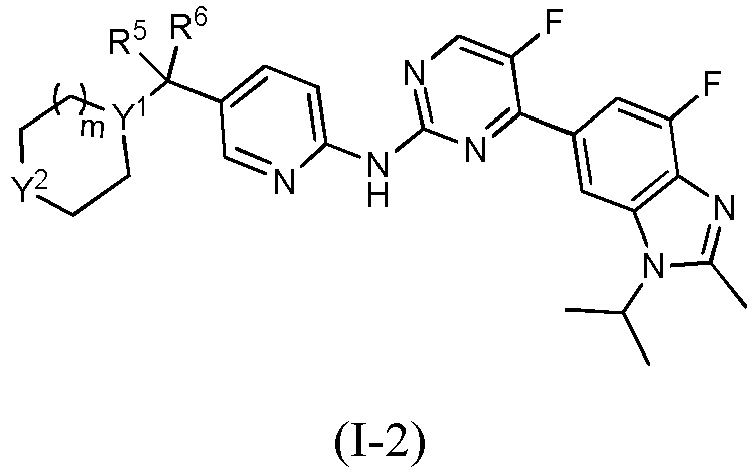

 R5 and R6 are each independently hydrogen, C1-3 alkyl, hydroxyl, amino, halogen, C1-3 alkoxy, -OC(O)R20 or C1-3 alkyl substituted by hydroxyl, and R5 ≠ R6;R20 is C1-3 alkyl;R11 and R11a are each independently H or C1-3 alkyl;m is 0 or 1;Y1 is CR21;R21 is hydrogen or halogen;Y2 is CR22R23 or NR24;R22 and R23 are each independently hydrogen, C1-5 alkyl or -NR25R26; or R22 and R23 together with the carbon atom to which they are attached form a 5- to 7-membered cycloalkyl containing 0-3 heteroatoms, wherein the heteroatoms are optionally selected from N, O or S;R24 is hydrogen, C1-5 alkyl, C3-5 cycloalkyl, C1-5 haloalkyl or C1-3 alkyl substituted by R27;R27 is hydroxyl or C1-3 alkoxy;R25 and R26 are each independently hydrogen, C1-5 alkyl or C3-5 cycloalkyl; or R25 and R26 together with the nitrogen atom to which they are attached form a 5- to 7-membered cycloalkyl containing 1-3 heteroatoms, wherein the heteroatoms are optionally selected from N, O or S;W is hydrogen or C1-3 alkyl.
 - The compound represented by the general formula (I-1) or (II-1) as defined in claim 3, the pharmaceutically acceptable salt thereof, the stereoisomer thereof or a mixture of stereoisomers, the solvate thereof, the polymorph thereof, or the stable isotope derivative thereof, wherein the C1-3 alkyl is each independently methyl, ethyl, propyl or isopropyl;
and/or, the C1-5 alkyl is each independently methyl, ethyl, propyl, isopropyl, n-butyl, isobutyl, tert-butyl or n-pentyl;
and/or, the halogen is each independently fluorine, chlorine, bromine or iodine;
and/or, the C3-5 cycloalkyl is cyclopropyl, cyclobutyl or cyclopentyl;
and/or, the C1-5 haloalkyl is methyl, ethyl, n-propyl or isopropyl substituted by halogen, the halogen is fluorine, chlorine, bromine or iodine, and the number of halogens can be one or more than one. - The compound represented by the general formula (I-1) or (II-1) as defined in claim 4, the pharmaceutically acceptable salt thereof, the stereoisomer thereof or a mixture of stereoisomers, the solvate thereof, the polymorph thereof, or the stable isotope derivative thereof, wherein R5 is hydrogen, methyl, ethyl, isopropyl, hydroxyl, amino, fluorine, methoxy, -OC(O)CH3 or -CH2OH; optionally R5 is hydrogen, methyl, ethyl, hydroxyl, amino or-CH2OH;
and/or, R6 is hydrogen, methyl, ethyl, isopropyl, hydroxyl, amino, fluorine, methoxy, -OC(O)CH3 or-CH2OH; optionally R6 is hydrogen, methyl, ethyl, hydroxyl, amino or-CH2OH;
and/or, at least one of R5 and R6 is hydrogen;
and/or, R11 is hydrogen;
and/or, R11a is hydrogen;
and/or, m is 0;
and/or, Y1 is CH or CF; optionally Y1 is CH;
and/or, Y2 is NR24 and R24 is hydrogen, methyl, ethyl, isopropyl, cyclopropyl,

- The compound represented by the general formula (I-1) or (II-1) as defined in claim 5, the pharmaceutically acceptable salt thereof, the stereoisomer thereof or a mixture of stereoisomers, the solvate thereof, the polymorph thereof, or the stable isotope derivative thereof, wherein one of R5 and R6 is hydrogen, and the other is methyl;
and/or, Y2 is NCH2CH3. - The compound represented by the general formula (I-1) or (II-1) as defined in claim 1, the pharmaceutically acceptable salt thereof, the stereoisomer thereof or a mixture of stereoisomers, the solvate thereof, the polymorph thereof, or the stable isotope derivative thereof, wherein the compound of formula (I-1) or (II-1) is selected from any one of the following compounds:











- The compound represented by the general formula (I-1) or (II-1) as defined in claim 7, the pharmaceutically acceptable salt thereof, the stereoisomer thereof or a mixture of stereoisomers, the solvate thereof, the polymorph thereof, or the stable isotope derivative thereof, wherein the compound represented by the general formula (I-1) is obtained from racemic compound 102 under the following chiral separation conditions,
 chiral column is Chiralpak AS-H 10 mm x 250 mm, 5 µm;column temperature is 40 °C;mobile phase A is 0.1% DEA in hexane, and the percentage is the volume percentage;mobile phase B is ethanol;gradient is mobile phase A/ mobile phase B = 80/20, and the ratio is volume percent;flow rate is 3.0 mL/min;detection wavelength is UV 300 nm;the compound represented by general formula (I-1) is collected separately at RT of 16 minutes or 22 minutes.
 - A process for preparing the compound represented by the general formula (I-1) or (II-1) as defined in claim 1,
wherein the process for preparing the compound represented by the general formula (I-1) comprises the following steps: coupling the compound of the general formula (I-A) with the compound represented by the general formula (I-B) under basic and catalyst conditions to obtain the compound represented by the general formula (I-1);wherein X is halogen; the definitions of R1, R2, R3, R4, R5, R6, R7, R12, z, Y1, Y2, Ya, Yb, A, m, n, p, and q are defined as in any one of claims 1 to 8;the process for preparing the compound represented by the general formula (II-1) comprises the following steps:
 coupling the compound represented by the general formula (II-A) with the compound represented by the general formula (II-B) under basic and catalyst conditions to obtain the compound represented by the general formula (II-1);wherein X is halogen; the definitions of R1, R2, R3, R4, R7, R12, z, Y2, Ya, Yb, W, A, m, n, p, and q are defined as in any one of claims 1 to 8.
 - A pharmaceutical composition comprising a therapeutically effective amount of compound represented by the general formula (I-1) or (II-1) as defined in any one of claims 1 to 8, the pharmaceutically acceptable salt thereof, the stereoisomer thereof or the mixture forms of the stereoisomers, the solvate thereof, the polymorph thereof, or the stable isotope derivative thereof, and a pharmaceutically acceptable carrier, diluent or excipient.
- The compound represented by the general formula (I-1) or (II-1) as defined in any one of claims 1 to 8, the pharmaceutically acceptable salt thereof, the stereoisomer thereof or the mixture forms of the stereoisomers, the solvate thereof, the polymorph thereof, or the stable isotope derivative thereof, or the pharmaceutical composition as defined in claim 10 for use in inhibiting or treating abnormal cell proliferation, infection, inflammatory diseases, autoimmune diseases, cardiovascular diseases or neurodegenerative diseases related to CDK mediation.
- The compound represented by the general formula (I-1) or (II-1) as defined in any one of claims 1 to 8, the pharmaceutically acceptable salt thereof, stereoisomer or the mixture forms of the stereoisomers, the solvate thereof, the polymorph thereof, or the stable isotope derivative thereof, or the pharmaceutical composition as defined in claim 10 for use in treating cancer, wherein the cancer is selected from the group consisting of breast cancer, ovarian cancer, prostate cancer, melanoma, brain cancer, nasopharyngeal carcinoma, esophageal cancer, gastric cancer, liver cancer, pancreatic cancer, colorectal cancer, lung cancer, renal carcinoma, skin cancer, glioblastoma, neuroblastoma, sarcoma, liposarcoma, osteochondroma, osteocarcinoma, osteosarcoma, seminoma, testicular tumor, uterine tumor, head and neck tumor, multiple myeloma, malignant lymphoma, polycythemia vera, leukemia, thyroid tumor, ureteral tumor, bladder tumor, gallbladder cancer, cholangiocarcinoma, chorionic epithelial cancer or pediatric tumor.
- The compound or pharmaceutical composition for use as claimed in claim 12, wherein said compound or said pharmaceutical composition is used in combination with one or more than one other anticancer agents, which are selected from the group consisting of alkylating agents, platinum complexes, metabolic antagonists, alkaloids, antibody drusg, hormone anticancer agents, proteasome inhibitors, CDK inhibitors, VEGFR or EGFR inhibitors, mTOR inhibitors, PI3K inhibitors, B-Raf inhibitors, PARP inhibitors, c-Met kinase inhibitors, ALK inhibitors, AKT inhibitors, ABL inhibitors, FLT3 inhibitors, PD-1 monoclonal antibodies and PD-L1 monoclonal antibodies.
Applications Claiming Priority (2)
| Application Number | Priority Date | Filing Date | Title |
|---|---|---|---|
| CN201710315240.4A CN108794452B (en) | 2017-05-05 | 2017-05-05 | Compound with kinase inhibition activity, preparation method and application thereof |
| PCT/CN2018/085848 WO2018202202A1 (en) | 2017-05-05 | 2018-05-07 | Compound with kinase inhibitory activity and preparation method and use thereof |
Publications (3)
| Publication Number | Publication Date |
|---|---|
| EP3620456A1 EP3620456A1 (en) | 2020-03-11 |
| EP3620456A4 EP3620456A4 (en) | 2020-03-25 |
| EP3620456B1 true EP3620456B1 (en) | 2021-11-17 |
Family
ID=64016466
Family Applications (1)
| Application Number | Title | Priority Date | Filing Date |
|---|---|---|---|
| EP18794759.3A Active EP3620456B1 (en) | 2017-05-05 | 2018-05-07 | Compound with kinase inhibitory activity and preparation method and use thereof |
Country Status (5)
| Country | Link |
|---|---|
| US (1) | US11179391B2 (en) |
| EP (1) | EP3620456B1 (en) |
| JP (1) | JP7215687B2 (en) |
| CN (1) | CN108794452B (en) |
| WO (1) | WO2018202202A1 (en) |
Families Citing this family (15)
| Publication number | Priority date | Publication date | Assignee | Title |
|---|---|---|---|---|
| CN108794452B (en) | 2017-05-05 | 2021-05-28 | 上海时莱生物技术有限公司 | Compound with kinase inhibition activity, preparation method and application thereof |
| CN112703186A (en) | 2018-07-27 | 2021-04-23 | 加利福尼亚技术学院 | CDK inhibitors and uses thereof |
| BR112021022105A2 (en) * | 2019-05-05 | 2021-12-28 | Qilu Regor Therapeutics Inc | cdk inhibitors |
| CN113105434B (en) * | 2020-01-13 | 2022-02-11 | 中国药科大学 | Novel CDK4/6 inhibitor and preparation method and application thereof |
| CN113372368B (en) * | 2020-03-09 | 2022-04-12 | 苏州爱科百发生物医药技术有限公司 | A kind of elastase inhibitor prodrug and use thereof |
| CN113880809B (en) * | 2020-07-03 | 2022-10-18 | 盛世泰科生物医药技术(苏州)有限公司 | Pyrimidine derivative and preparation method and application thereof |
| CN114057839A (en) * | 2020-08-07 | 2022-02-18 | 石家庄创肽生物医药科技有限公司 | Cyclic polypeptide compound and use thereof |
| WO2022063140A1 (en) * | 2020-09-23 | 2022-03-31 | Shenzhen Ionova Life Science Co., Ltd. | Pyrimidine and pyridine derivatives as hpk1 modulator and methods using same |
| CN114426542B (en) * | 2020-10-29 | 2023-06-30 | 苏州亚宝药物研发有限公司 | Substituted diarylamine compounds, pharmaceutical compositions, preparation method and use thereof |
| CA3196167A1 (en) * | 2020-11-19 | 2022-05-27 | Jiaxin Yu | Beta adrenergic agonist and methods of using the same |
| CN114605390B (en) * | 2020-12-04 | 2024-08-16 | 上海凌达生物医药有限公司 | Compounds having CDK kinase inhibitory activity, pharmaceutical compositions and uses thereof |
| JP7693948B2 (en) | 2021-11-08 | 2025-06-17 | シャンハイ ベスト-リンク バイオサイエンス エルエルシー | ε-Poly-L-lysine-based drug conjugates, intermediates thereof and uses thereof |
| CN115093397B (en) * | 2022-06-07 | 2023-09-05 | 自贡市第三人民医院 | Compound for treating tumor, synthesis method and application |
| CN115322209B (en) * | 2022-07-19 | 2023-06-20 | 湖北理工学院 | Triadyncyclic compounds as DNA-PK inhibitors |
| CN119264111B (en) * | 2023-07-04 | 2025-11-21 | 沈阳药科大学 | Benzotriazole derivatives as CDKs inhibitors, and pharmaceutical composition and application thereof |
Family Cites Families (17)
| Publication number | Priority date | Publication date | Assignee | Title |
|---|---|---|---|---|
| WO2008032157A2 (en) | 2006-09-08 | 2008-03-20 | Pfizer Products Inc. | Synthesis of 2-(pyridin-2-ylamino)-pyrido[2,3-d]pyrimidin-7-ones |
| PA8852901A1 (en) | 2008-12-22 | 2010-07-27 | Lilly Co Eli | PROTEIN CINASE INHIBITORS |
| UY33227A (en) | 2010-02-19 | 2011-09-30 | Novartis Ag | PIRROLOPIRIMIDINE COMPOUNDS AS INHIBITORS OF THE CDK4 / 6 |
| KR101830455B1 (en) | 2010-04-13 | 2018-02-20 | 노파르티스 아게 | Combination comprising a cyclin dependent kinase 4 or cyclin dependent kinase (cdk4/6) inhibitor and an mtor inhibitor for treating cancer |
| CN104470921B (en) | 2013-05-17 | 2017-05-03 | 上海恒瑞医药有限公司 | Pyridopyrimidine derivatives, their preparation method and their application in medicine |
| WO2015066452A2 (en) | 2013-11-01 | 2015-05-07 | Foundation Medicine, Inc. | Methods of treating pediatric cancers |
| US9949976B2 (en) | 2013-12-31 | 2018-04-24 | Xuanzhu Pharma Co., Ltd. | Kinase inhibitor and use thereof |
| CN104910137B (en) * | 2014-03-10 | 2017-04-19 | 山东轩竹医药科技有限公司 | CDK kinase inhibitor |
| US20160000340A1 (en) | 2014-07-03 | 2016-01-07 | Michael V. Jackson | Rapid central venous pressure monitor |
| WO2016014904A1 (en) | 2014-07-24 | 2016-01-28 | Beta Pharma, Inc. | 2-h-indazole derivatives as cyclin-dependent kinase (cdk) inhibitors and therapeutic uses thereof |
| WO2016015604A1 (en) * | 2014-07-26 | 2016-02-04 | Sunshine Lake Pharma Co., Ltd. | Compounds as cdk small-molecule inhibitors and uses thereof |
| TWI696617B (en) | 2015-04-28 | 2020-06-21 | 大陸商上海復尚慧創醫藥研究有限公司 | Certain protein kinase inhibitor |
| CN106083823A (en) * | 2015-04-30 | 2016-11-09 | 中国科学院上海药物研究所 | One class has the compound of kinase inhibiting activity, preparation method and purposes |
| CN107286134B (en) | 2016-04-11 | 2019-04-12 | 上海勋和医药科技有限公司 | 2,4- disubstituted pyrimidines derivatives are as CDK inhibitor and its application |
| CN112225724B (en) | 2016-09-07 | 2022-04-29 | 江苏豪森药业集团有限公司 | Benzimidazole compound kinase inhibitor and preparation method and application thereof |
| CN107793399A (en) | 2016-09-07 | 2018-03-13 | 上海翰森生物医药科技有限公司 | CDK4/6 inhibitor and its preparation method and application |
| CN108794452B (en) | 2017-05-05 | 2021-05-28 | 上海时莱生物技术有限公司 | Compound with kinase inhibition activity, preparation method and application thereof |
-
2017
- 2017-05-05 CN CN201710315240.4A patent/CN108794452B/en active Active
-
2018
- 2018-05-07 EP EP18794759.3A patent/EP3620456B1/en active Active
- 2018-05-07 JP JP2020511856A patent/JP7215687B2/en active Active
- 2018-05-07 WO PCT/CN2018/085848 patent/WO2018202202A1/en not_active Ceased
- 2018-05-07 US US16/610,708 patent/US11179391B2/en active Active
Non-Patent Citations (1)
| Title |
|---|
| None * |
Also Published As
| Publication number | Publication date |
|---|---|
| CN108794452A (en) | 2018-11-13 |
| WO2018202202A1 (en) | 2018-11-08 |
| EP3620456A4 (en) | 2020-03-25 |
| CN108794452B (en) | 2021-05-28 |
| US11179391B2 (en) | 2021-11-23 |
| US20200155550A1 (en) | 2020-05-21 |
| JP7215687B2 (en) | 2023-01-31 |
| EP3620456A1 (en) | 2020-03-11 |
| JP2020518672A (en) | 2020-06-25 |
Similar Documents
| Publication | Publication Date | Title |
|---|---|---|
| EP3620456A1 (en) | Compound with kinase inhibitory activity and preparation method and use thereof | |
| CN114981268B (en) | Pyrimidine-4(3H)-one heterocyclic compound, preparation method thereof and application thereof in medicine | |
| CN112225724B (en) | Benzimidazole compound kinase inhibitor and preparation method and application thereof | |
| JP6896852B2 (en) | Heterocyclic compounds used as FGFR inhibitors | |
| CN104470921B (en) | Pyridopyrimidine derivatives, their preparation method and their application in medicine | |
| JP7313364B2 (en) | New benzimidazole compounds and derivatives as EGFR inhibitors | |
| TWI828712B (en) | Heterocyclic compounds as TRK inhibitors | |
| RU2548363C2 (en) | SELECTIVE INHIBITORS OF Haspin kinase | |
| EP4174066A1 (en) | Immunosuppressant, and preparation method therefor and use thereof | |
| CA2729745A1 (en) | Oxindole compounds | |
| EP3640245B1 (en) | Poly(adp-ribose) polymerase inhibitor, preparation method and use | |
| CN113518779B (en) | Thienoheterocyclic derivatives, their preparation methods and their applications in medicine | |
| CA3069602C (en) | Formylpyridine derivative having fgfr4 inhibitory activity, preparation method therefor and use thereof | |
| CN116018345A (en) | new heterocyclic compounds | |
| CN104066736B (en) | Substituted pyrazolopyrimidines as AKT kinase inhibitors | |
| CN111163775B (en) | Novel [1,6] naphthyridine compounds and derivatives as CDK8/CDK19 inhibitors | |
| EP4644395A1 (en) | Camptothecin derivative, pharmaceutical composition, and preparation method and use therefor | |
| HK40016556B (en) | Compound with kinase inhibitory activity and preparation method and use thereof | |
| HK40016556A (en) | Compound with kinase inhibitory activity and preparation method and use thereof | |
| CN116535423B (en) | Compounds for inhibiting/inducing degradation of EGFR kinase and pharmaceutical compositions and applications thereof | |
| EP3950063A1 (en) | Novel azaindole derivative | |
| CN120943837A (en) | Heterocyclic compounds as tyrosine kinase inhibitors | |
| US20240190864A1 (en) | Bruton's Tyrosine Kinase (BTK) INHIBITOR AND APPLICATION THEREOF | |
| HK40072883B (en) | Pyrimidine-4(3h)-ketone heterocyclic compound, preparation method therefor and use thereof in medicine and pharmacology | |
| HK1206025B (en) | Thiophene miazines derivate, preparation method therefor, and medical application thereof |
Legal Events
| Date | Code | Title | Description |
|---|---|---|---|
| STAA | Information on the status of an ep patent application or granted ep patent |
Free format text: STATUS: THE INTERNATIONAL PUBLICATION HAS BEEN MADE |
|
| PUAI | Public reference made under article 153(3) epc to a published international application that has entered the european phase |
Free format text: ORIGINAL CODE: 0009012 |
|
| STAA | Information on the status of an ep patent application or granted ep patent |
Free format text: STATUS: REQUEST FOR EXAMINATION WAS MADE |
|
| 17P | Request for examination filed |
Effective date: 20191205 |
|
| AK | Designated contracting states |
Kind code of ref document: A1 Designated state(s): AL AT BE BG CH CY CZ DE DK EE ES FI FR GB GR HR HU IE IS IT LI LT LU LV MC MK MT NL NO PL PT RO RS SE SI SK SM TR |
|
| AX | Request for extension of the european patent |
Extension state: BA ME |
|
| A4 | Supplementary search report drawn up and despatched |
Effective date: 20200226 |
|
| RIC1 | Information provided on ipc code assigned before grant |
Ipc: C07D 401/14 20060101AFI20200220BHEP Ipc: A61P 35/00 20060101ALI20200220BHEP Ipc: A61K 31/501 20060101ALI20200220BHEP Ipc: A61K 31/506 20060101ALI20200220BHEP Ipc: A61K 31/5377 20060101ALI20200220BHEP |
|
| DAV | Request for validation of the european patent (deleted) | ||
| DAX | Request for extension of the european patent (deleted) | ||
| REG | Reference to a national code |
Ref country code: HK Ref legal event code: DE Ref document number: 40016556 Country of ref document: HK |
|
| STAA | Information on the status of an ep patent application or granted ep patent |
Free format text: STATUS: EXAMINATION IS IN PROGRESS |
|
| 17Q | First examination report despatched |
Effective date: 20201113 |
|
| GRAP | Despatch of communication of intention to grant a patent |
Free format text: ORIGINAL CODE: EPIDOSNIGR1 |
|
| STAA | Information on the status of an ep patent application or granted ep patent |
Free format text: STATUS: GRANT OF PATENT IS INTENDED |
|
| INTG | Intention to grant announced |
Effective date: 20210708 |
|
| GRAS | Grant fee paid |
Free format text: ORIGINAL CODE: EPIDOSNIGR3 |
|
| RAP1 | Party data changed (applicant data changed or rights of an application transferred) |
Owner name: ZHANG, FUYAO |
|
| GRAA | (expected) grant |
Free format text: ORIGINAL CODE: 0009210 |
|
| STAA | Information on the status of an ep patent application or granted ep patent |
Free format text: STATUS: THE PATENT HAS BEEN GRANTED |
|
| AK | Designated contracting states |
Kind code of ref document: B1 Designated state(s): AL AT BE BG CH CY CZ DE DK EE ES FI FR GB GR HR HU IE IS IT LI LT LU LV MC MK MT NL NO PL PT RO RS SE SI SK SM TR |
|
| REG | Reference to a national code |
Ref country code: GB Ref legal event code: FG4D |
|
| REG | Reference to a national code |
Ref country code: IE Ref legal event code: FG4D |
|
| REG | Reference to a national code |
Ref country code: DE Ref legal event code: R096 Ref document number: 602018026914 Country of ref document: DE |
|
| REG | Reference to a national code |
Ref country code: AT Ref legal event code: REF Ref document number: 1447967 Country of ref document: AT Kind code of ref document: T Effective date: 20211215 |
|
| REG | Reference to a national code |
Ref country code: LT Ref legal event code: MG9D |
|
| REG | Reference to a national code |
Ref country code: NL Ref legal event code: MP Effective date: 20211117 |
|
| REG | Reference to a national code |
Ref country code: AT Ref legal event code: MK05 Ref document number: 1447967 Country of ref document: AT Kind code of ref document: T Effective date: 20211117 |
|
| REG | Reference to a national code |
Ref country code: GB Ref legal event code: 732E Free format text: REGISTERED BETWEEN 20220324 AND 20220330 |
|
| PG25 | Lapsed in a contracting state [announced via postgrant information from national office to epo] |
Ref country code: RS Free format text: LAPSE BECAUSE OF FAILURE TO SUBMIT A TRANSLATION OF THE DESCRIPTION OR TO PAY THE FEE WITHIN THE PRESCRIBED TIME-LIMIT Effective date: 20211117 Ref country code: LT Free format text: LAPSE BECAUSE OF FAILURE TO SUBMIT A TRANSLATION OF THE DESCRIPTION OR TO PAY THE FEE WITHIN THE PRESCRIBED TIME-LIMIT Effective date: 20211117 Ref country code: FI Free format text: LAPSE BECAUSE OF FAILURE TO SUBMIT A TRANSLATION OF THE DESCRIPTION OR TO PAY THE FEE WITHIN THE PRESCRIBED TIME-LIMIT Effective date: 20211117 Ref country code: BG Free format text: LAPSE BECAUSE OF FAILURE TO SUBMIT A TRANSLATION OF THE DESCRIPTION OR TO PAY THE FEE WITHIN THE PRESCRIBED TIME-LIMIT Effective date: 20220217 Ref country code: AT Free format text: LAPSE BECAUSE OF FAILURE TO SUBMIT A TRANSLATION OF THE DESCRIPTION OR TO PAY THE FEE WITHIN THE PRESCRIBED TIME-LIMIT Effective date: 20211117 |
|
| PG25 | Lapsed in a contracting state [announced via postgrant information from national office to epo] |
Ref country code: IS Free format text: LAPSE BECAUSE OF FAILURE TO SUBMIT A TRANSLATION OF THE DESCRIPTION OR TO PAY THE FEE WITHIN THE PRESCRIBED TIME-LIMIT Effective date: 20220317 Ref country code: SE Free format text: LAPSE BECAUSE OF FAILURE TO SUBMIT A TRANSLATION OF THE DESCRIPTION OR TO PAY THE FEE WITHIN THE PRESCRIBED TIME-LIMIT Effective date: 20211117 Ref country code: PT Free format text: LAPSE BECAUSE OF FAILURE TO SUBMIT A TRANSLATION OF THE DESCRIPTION OR TO PAY THE FEE WITHIN THE PRESCRIBED TIME-LIMIT Effective date: 20220317 Ref country code: PL Free format text: LAPSE BECAUSE OF FAILURE TO SUBMIT A TRANSLATION OF THE DESCRIPTION OR TO PAY THE FEE WITHIN THE PRESCRIBED TIME-LIMIT Effective date: 20211117 Ref country code: NO Free format text: LAPSE BECAUSE OF FAILURE TO SUBMIT A TRANSLATION OF THE DESCRIPTION OR TO PAY THE FEE WITHIN THE PRESCRIBED TIME-LIMIT Effective date: 20220217 Ref country code: NL Free format text: LAPSE BECAUSE OF FAILURE TO SUBMIT A TRANSLATION OF THE DESCRIPTION OR TO PAY THE FEE WITHIN THE PRESCRIBED TIME-LIMIT Effective date: 20211117 Ref country code: LV Free format text: LAPSE BECAUSE OF FAILURE TO SUBMIT A TRANSLATION OF THE DESCRIPTION OR TO PAY THE FEE WITHIN THE PRESCRIBED TIME-LIMIT Effective date: 20211117 Ref country code: HR Free format text: LAPSE BECAUSE OF FAILURE TO SUBMIT A TRANSLATION OF THE DESCRIPTION OR TO PAY THE FEE WITHIN THE PRESCRIBED TIME-LIMIT Effective date: 20211117 Ref country code: GR Free format text: LAPSE BECAUSE OF FAILURE TO SUBMIT A TRANSLATION OF THE DESCRIPTION OR TO PAY THE FEE WITHIN THE PRESCRIBED TIME-LIMIT Effective date: 20220218 Ref country code: ES Free format text: LAPSE BECAUSE OF FAILURE TO SUBMIT A TRANSLATION OF THE DESCRIPTION OR TO PAY THE FEE WITHIN THE PRESCRIBED TIME-LIMIT Effective date: 20211117 |
|
| REG | Reference to a national code |
Ref country code: DE Ref legal event code: R081 Ref document number: 602018026914 Country of ref document: DE Owner name: SHANGHAI BEST-LINK BIOSCIENCE, LLC, CN Free format text: FORMER OWNER: ZHANG, FUYAO, SHANGHAI, CN |
|
| RAP2 | Party data changed (patent owner data changed or rights of a patent transferred) |
Owner name: SHANGHAI BEST-LINK BIOSCIENCE, LLC |
|
| PG25 | Lapsed in a contracting state [announced via postgrant information from national office to epo] |
Ref country code: SM Free format text: LAPSE BECAUSE OF FAILURE TO SUBMIT A TRANSLATION OF THE DESCRIPTION OR TO PAY THE FEE WITHIN THE PRESCRIBED TIME-LIMIT Effective date: 20211117 Ref country code: SK Free format text: LAPSE BECAUSE OF FAILURE TO SUBMIT A TRANSLATION OF THE DESCRIPTION OR TO PAY THE FEE WITHIN THE PRESCRIBED TIME-LIMIT Effective date: 20211117 Ref country code: RO Free format text: LAPSE BECAUSE OF FAILURE TO SUBMIT A TRANSLATION OF THE DESCRIPTION OR TO PAY THE FEE WITHIN THE PRESCRIBED TIME-LIMIT Effective date: 20211117 Ref country code: EE Free format text: LAPSE BECAUSE OF FAILURE TO SUBMIT A TRANSLATION OF THE DESCRIPTION OR TO PAY THE FEE WITHIN THE PRESCRIBED TIME-LIMIT Effective date: 20211117 Ref country code: DK Free format text: LAPSE BECAUSE OF FAILURE TO SUBMIT A TRANSLATION OF THE DESCRIPTION OR TO PAY THE FEE WITHIN THE PRESCRIBED TIME-LIMIT Effective date: 20211117 Ref country code: CZ Free format text: LAPSE BECAUSE OF FAILURE TO SUBMIT A TRANSLATION OF THE DESCRIPTION OR TO PAY THE FEE WITHIN THE PRESCRIBED TIME-LIMIT Effective date: 20211117 |
|
| REG | Reference to a national code |
Ref country code: DE Ref legal event code: R097 Ref document number: 602018026914 Country of ref document: DE |
|
| PLBE | No opposition filed within time limit |
Free format text: ORIGINAL CODE: 0009261 |
|
| STAA | Information on the status of an ep patent application or granted ep patent |
Free format text: STATUS: NO OPPOSITION FILED WITHIN TIME LIMIT |
|
| 26N | No opposition filed |
Effective date: 20220818 |
|
| PG25 | Lapsed in a contracting state [announced via postgrant information from national office to epo] |
Ref country code: AL Free format text: LAPSE BECAUSE OF FAILURE TO SUBMIT A TRANSLATION OF THE DESCRIPTION OR TO PAY THE FEE WITHIN THE PRESCRIBED TIME-LIMIT Effective date: 20211117 |
|
| PG25 | Lapsed in a contracting state [announced via postgrant information from national office to epo] |
Ref country code: SI Free format text: LAPSE BECAUSE OF FAILURE TO SUBMIT A TRANSLATION OF THE DESCRIPTION OR TO PAY THE FEE WITHIN THE PRESCRIBED TIME-LIMIT Effective date: 20211117 |
|
| REG | Reference to a national code |
Ref country code: CH Ref legal event code: PL |
|
| REG | Reference to a national code |
Ref country code: BE Ref legal event code: MM Effective date: 20220531 |
|
| PG25 | Lapsed in a contracting state [announced via postgrant information from national office to epo] |
Ref country code: MC Free format text: LAPSE BECAUSE OF FAILURE TO SUBMIT A TRANSLATION OF THE DESCRIPTION OR TO PAY THE FEE WITHIN THE PRESCRIBED TIME-LIMIT Effective date: 20211117 Ref country code: LU Free format text: LAPSE BECAUSE OF NON-PAYMENT OF DUE FEES Effective date: 20220507 Ref country code: LI Free format text: LAPSE BECAUSE OF NON-PAYMENT OF DUE FEES Effective date: 20220531 Ref country code: CH Free format text: LAPSE BECAUSE OF NON-PAYMENT OF DUE FEES Effective date: 20220531 |
|
| PG25 | Lapsed in a contracting state [announced via postgrant information from national office to epo] |
Ref country code: IE Free format text: LAPSE BECAUSE OF NON-PAYMENT OF DUE FEES Effective date: 20220507 |
|
| PG25 | Lapsed in a contracting state [announced via postgrant information from national office to epo] |
Ref country code: IT Free format text: LAPSE BECAUSE OF FAILURE TO SUBMIT A TRANSLATION OF THE DESCRIPTION OR TO PAY THE FEE WITHIN THE PRESCRIBED TIME-LIMIT Effective date: 20211117 Ref country code: BE Free format text: LAPSE BECAUSE OF NON-PAYMENT OF DUE FEES Effective date: 20220531 |
|
| PG25 | Lapsed in a contracting state [announced via postgrant information from national office to epo] |
Ref country code: MK Free format text: LAPSE BECAUSE OF FAILURE TO SUBMIT A TRANSLATION OF THE DESCRIPTION OR TO PAY THE FEE WITHIN THE PRESCRIBED TIME-LIMIT Effective date: 20211117 Ref country code: CY Free format text: LAPSE BECAUSE OF FAILURE TO SUBMIT A TRANSLATION OF THE DESCRIPTION OR TO PAY THE FEE WITHIN THE PRESCRIBED TIME-LIMIT Effective date: 20211117 |
|
| PG25 | Lapsed in a contracting state [announced via postgrant information from national office to epo] |
Ref country code: HU Free format text: LAPSE BECAUSE OF FAILURE TO SUBMIT A TRANSLATION OF THE DESCRIPTION OR TO PAY THE FEE WITHIN THE PRESCRIBED TIME-LIMIT; INVALID AB INITIO Effective date: 20180507 |
|
| PG25 | Lapsed in a contracting state [announced via postgrant information from national office to epo] |
Ref country code: MT Free format text: LAPSE BECAUSE OF FAILURE TO SUBMIT A TRANSLATION OF THE DESCRIPTION OR TO PAY THE FEE WITHIN THE PRESCRIBED TIME-LIMIT Effective date: 20211117 |
|
| PGFP | Annual fee paid to national office [announced via postgrant information from national office to epo] |
Ref country code: DE Payment date: 20250519 Year of fee payment: 8 |
|
| PG25 | Lapsed in a contracting state [announced via postgrant information from national office to epo] |
Ref country code: TR Free format text: LAPSE BECAUSE OF FAILURE TO SUBMIT A TRANSLATION OF THE DESCRIPTION OR TO PAY THE FEE WITHIN THE PRESCRIBED TIME-LIMIT Effective date: 20211117 |
|
| PGFP | Annual fee paid to national office [announced via postgrant information from national office to epo] |
Ref country code: GB Payment date: 20260302 Year of fee payment: 9 |
|
| PGFP | Annual fee paid to national office [announced via postgrant information from national office to epo] |
Ref country code: FR Payment date: 20260303 Year of fee payment: 9 |