EP3617275A1 - Lustrous pigment, pigment-containing composition, and pigment-containing coated article - Google Patents
Lustrous pigment, pigment-containing composition, and pigment-containing coated article Download PDFInfo
- Publication number
- EP3617275A1 EP3617275A1 EP18791804.0A EP18791804A EP3617275A1 EP 3617275 A1 EP3617275 A1 EP 3617275A1 EP 18791804 A EP18791804 A EP 18791804A EP 3617275 A1 EP3617275 A1 EP 3617275A1
- Authority
- EP
- European Patent Office
- Prior art keywords
- value
- fine
- reflected light
- pigment
- angle
- Prior art date
- Legal status (The legal status is an assumption and is not a legal conclusion. Google has not performed a legal analysis and makes no representation as to the accuracy of the status listed.)
- Pending
Links
- 239000000049 pigment Substances 0.000 title claims abstract description 112
- 239000000203 mixture Substances 0.000 title claims description 20
- 239000002245 particle Substances 0.000 claims abstract description 76
- 239000000758 substrate Substances 0.000 claims abstract description 76
- 230000003287 optical effect Effects 0.000 claims abstract description 41
- 238000000149 argon plasma sintering Methods 0.000 claims abstract description 30
- GWEVSGVZZGPLCZ-UHFFFAOYSA-N Titan oxide Chemical compound O=[Ti]=O GWEVSGVZZGPLCZ-UHFFFAOYSA-N 0.000 claims description 45
- OGIDPMRJRNCKJF-UHFFFAOYSA-N titanium oxide Inorganic materials [Ti]=O OGIDPMRJRNCKJF-UHFFFAOYSA-N 0.000 claims description 45
- 239000011521 glass Substances 0.000 claims description 34
- 239000010419 fine particle Substances 0.000 claims description 16
- 239000003973 paint Substances 0.000 claims description 15
- 239000000463 material Substances 0.000 claims description 11
- 239000010946 fine silver Substances 0.000 claims description 6
- 239000002356 single layer Substances 0.000 claims description 5
- 150000002484 inorganic compounds Chemical class 0.000 claims description 2
- 229910010272 inorganic material Inorganic materials 0.000 claims description 2
- 150000002894 organic compounds Chemical class 0.000 claims description 2
- 230000001419 dependent effect Effects 0.000 abstract description 7
- 239000000243 solution Substances 0.000 description 42
- 239000002923 metal particle Substances 0.000 description 25
- 239000000047 product Substances 0.000 description 22
- UQSXHKLRYXJYBZ-UHFFFAOYSA-N Iron oxide Chemical compound [Fe]=O UQSXHKLRYXJYBZ-UHFFFAOYSA-N 0.000 description 20
- 229910001111 Fine metal Inorganic materials 0.000 description 18
- 239000002537 cosmetic Substances 0.000 description 15
- XLYOFNOQVPJJNP-UHFFFAOYSA-N water Substances O XLYOFNOQVPJJNP-UHFFFAOYSA-N 0.000 description 14
- BQCADISMDOOEFD-UHFFFAOYSA-N Silver Chemical compound [Ag] BQCADISMDOOEFD-UHFFFAOYSA-N 0.000 description 13
- PCHJSUWPFVWCPO-UHFFFAOYSA-N gold Chemical compound [Au] PCHJSUWPFVWCPO-UHFFFAOYSA-N 0.000 description 12
- 238000000034 method Methods 0.000 description 12
- 239000010410 layer Substances 0.000 description 11
- 229910052737 gold Inorganic materials 0.000 description 10
- 239000010931 gold Substances 0.000 description 10
- VYPSYNLAJGMNEJ-UHFFFAOYSA-N Silicium dioxide Chemical compound O=[Si]=O VYPSYNLAJGMNEJ-UHFFFAOYSA-N 0.000 description 9
- 229910052814 silicon oxide Inorganic materials 0.000 description 9
- 230000000052 comparative effect Effects 0.000 description 8
- 229910052751 metal Inorganic materials 0.000 description 8
- 230000002776 aggregation Effects 0.000 description 7
- 238000004220 aggregation Methods 0.000 description 7
- 239000002184 metal Substances 0.000 description 7
- 239000000843 powder Substances 0.000 description 7
- 230000000694 effects Effects 0.000 description 5
- 238000005259 measurement Methods 0.000 description 5
- 239000010445 mica Substances 0.000 description 5
- 229910052618 mica group Inorganic materials 0.000 description 5
- TWNQGVIAIRXVLR-UHFFFAOYSA-N oxo(oxoalumanyloxy)alumane Chemical compound O=[Al]O[Al]=O TWNQGVIAIRXVLR-UHFFFAOYSA-N 0.000 description 5
- 229910052709 silver Inorganic materials 0.000 description 5
- 239000004332 silver Substances 0.000 description 5
- 238000007664 blowing Methods 0.000 description 4
- 125000000664 diazo group Chemical group [N-]=[N+]=[*] 0.000 description 4
- 230000002708 enhancing effect Effects 0.000 description 4
- 229910052755 nonmetal Inorganic materials 0.000 description 4
- QTBSBXVTEAMEQO-UHFFFAOYSA-N Acetic acid Chemical compound CC(O)=O QTBSBXVTEAMEQO-UHFFFAOYSA-N 0.000 description 3
- 239000004925 Acrylic resin Substances 0.000 description 3
- 229920000178 Acrylic resin Polymers 0.000 description 3
- NLXLAEXVIDQMFP-UHFFFAOYSA-N Ammonium chloride Substances [NH4+].[Cl-] NLXLAEXVIDQMFP-UHFFFAOYSA-N 0.000 description 3
- VHUUQVKOLVNVRT-UHFFFAOYSA-N Ammonium hydroxide Chemical compound [NH4+].[OH-] VHUUQVKOLVNVRT-UHFFFAOYSA-N 0.000 description 3
- 239000002253 acid Substances 0.000 description 3
- QGZKDVFQNNGYKY-UHFFFAOYSA-N ammonia Natural products N QGZKDVFQNNGYKY-UHFFFAOYSA-N 0.000 description 3
- 235000011114 ammonium hydroxide Nutrition 0.000 description 3
- 230000015572 biosynthetic process Effects 0.000 description 3
- 230000008859 change Effects 0.000 description 3
- 239000003086 colorant Substances 0.000 description 3
- 239000013078 crystal Substances 0.000 description 3
- 239000006060 molten glass Substances 0.000 description 3
- PYUYQYBDJFMFTH-WMMMYUQOSA-N naphthol red Chemical compound CCOC1=CC=CC=C1NC(=O)C(C1=O)=CC2=CC=CC=C2\C1=N\NC1=CC=C(C(N)=O)C=C1 PYUYQYBDJFMFTH-WMMMYUQOSA-N 0.000 description 3
- 239000011347 resin Substances 0.000 description 3
- 229920005989 resin Polymers 0.000 description 3
- 239000011342 resin composition Substances 0.000 description 3
- 239000001509 sodium citrate Substances 0.000 description 3
- NLJMYIDDQXHKNR-UHFFFAOYSA-K sodium citrate Chemical compound O.O.[Na+].[Na+].[Na+].[O-]C(=O)CC(O)(CC([O-])=O)C([O-])=O NLJMYIDDQXHKNR-UHFFFAOYSA-K 0.000 description 3
- VEXZGXHMUGYJMC-UHFFFAOYSA-N Hydrochloric acid Chemical compound Cl VEXZGXHMUGYJMC-UHFFFAOYSA-N 0.000 description 2
- XLOMVQKBTHCTTD-UHFFFAOYSA-N Zinc monoxide Chemical compound [Zn]=O XLOMVQKBTHCTTD-UHFFFAOYSA-N 0.000 description 2
- PNEYBMLMFCGWSK-UHFFFAOYSA-N aluminium oxide Inorganic materials [O-2].[O-2].[O-2].[Al+3].[Al+3] PNEYBMLMFCGWSK-UHFFFAOYSA-N 0.000 description 2
- 239000008199 coating composition Substances 0.000 description 2
- 150000001875 compounds Chemical class 0.000 description 2
- 230000007423 decrease Effects 0.000 description 2
- 239000006185 dispersion Substances 0.000 description 2
- 230000001815 facial effect Effects 0.000 description 2
- SZVJSHCCFOBDDC-UHFFFAOYSA-N ferrosoferric oxide Chemical compound O=[Fe]O[Fe]O[Fe]=O SZVJSHCCFOBDDC-UHFFFAOYSA-N 0.000 description 2
- 238000010438 heat treatment Methods 0.000 description 2
- 230000001965 increasing effect Effects 0.000 description 2
- JEIPFZHSYJVQDO-UHFFFAOYSA-N iron(III) oxide Inorganic materials O=[Fe]O[Fe]=O JEIPFZHSYJVQDO-UHFFFAOYSA-N 0.000 description 2
- 238000004519 manufacturing process Methods 0.000 description 2
- BASFCYQUMIYNBI-UHFFFAOYSA-N platinum Chemical compound [Pt] BASFCYQUMIYNBI-UHFFFAOYSA-N 0.000 description 2
- 239000002244 precipitate Substances 0.000 description 2
- 238000001556 precipitation Methods 0.000 description 2
- 230000008569 process Effects 0.000 description 2
- 230000009467 reduction Effects 0.000 description 2
- 238000010992 reflux Methods 0.000 description 2
- SQGYOTSLMSWVJD-UHFFFAOYSA-N silver(1+) nitrate Chemical compound [Ag+].[O-]N(=O)=O SQGYOTSLMSWVJD-UHFFFAOYSA-N 0.000 description 2
- 238000003756 stirring Methods 0.000 description 2
- 239000000126 substance Substances 0.000 description 2
- 239000006228 supernatant Substances 0.000 description 2
- XOLBLPGZBRYERU-UHFFFAOYSA-N tin dioxide Chemical compound O=[Sn]=O XOLBLPGZBRYERU-UHFFFAOYSA-N 0.000 description 2
- 229910001887 tin oxide Inorganic materials 0.000 description 2
- 150000003609 titanium compounds Chemical class 0.000 description 2
- 238000000733 zeta-potential measurement Methods 0.000 description 2
- CGLVZFOCZLHKOH-UHFFFAOYSA-N 8,18-dichloro-5,15-diethyl-5,15-dihydrodiindolo(3,2-b:3',2'-m)triphenodioxazine Chemical compound CCN1C2=CC=CC=C2C2=C1C=C1OC3=C(Cl)C4=NC(C=C5C6=CC=CC=C6N(C5=C5)CC)=C5OC4=C(Cl)C3=NC1=C2 CGLVZFOCZLHKOH-UHFFFAOYSA-N 0.000 description 1
- -1 ACRYL Chemical class 0.000 description 1
- WUGQZFFCHPXWKQ-UHFFFAOYSA-N Propanolamine Chemical compound NCCCO WUGQZFFCHPXWKQ-UHFFFAOYSA-N 0.000 description 1
- NRCMAYZCPIVABH-UHFFFAOYSA-N Quinacridone Chemical compound N1C2=CC=CC=C2C(=O)C2=C1C=C1C(=O)C3=CC=CC=C3NC1=C2 NRCMAYZCPIVABH-UHFFFAOYSA-N 0.000 description 1
- ATJFFYVFTNAWJD-UHFFFAOYSA-N Tin Chemical compound [Sn] ATJFFYVFTNAWJD-UHFFFAOYSA-N 0.000 description 1
- WGLPBDUCMAPZCE-UHFFFAOYSA-N Trioxochromium Chemical compound O=[Cr](=O)=O WGLPBDUCMAPZCE-UHFFFAOYSA-N 0.000 description 1
- RJDOZRNNYVAULJ-UHFFFAOYSA-L [O--].[O--].[O--].[O--].[O--].[O--].[O--].[O--].[O--].[O--].[F-].[F-].[Mg++].[Mg++].[Mg++].[Al+3].[Si+4].[Si+4].[Si+4].[K+] Chemical compound [O--].[O--].[O--].[O--].[O--].[O--].[O--].[O--].[O--].[O--].[F-].[F-].[Mg++].[Mg++].[Mg++].[Al+3].[Si+4].[Si+4].[Si+4].[K+] RJDOZRNNYVAULJ-UHFFFAOYSA-L 0.000 description 1
- XHCLAFWTIXFWPH-UHFFFAOYSA-N [O-2].[O-2].[O-2].[O-2].[O-2].[V+5].[V+5] Chemical compound [O-2].[O-2].[O-2].[O-2].[O-2].[V+5].[V+5] XHCLAFWTIXFWPH-UHFFFAOYSA-N 0.000 description 1
- 239000012670 alkaline solution Substances 0.000 description 1
- 239000005354 aluminosilicate glass Substances 0.000 description 1
- 239000002928 artificial marble Substances 0.000 description 1
- 230000005540 biological transmission Effects 0.000 description 1
- RJTANRZEWTUVMA-UHFFFAOYSA-N boron;n-methylmethanamine Chemical compound [B].CNC RJTANRZEWTUVMA-UHFFFAOYSA-N 0.000 description 1
- 239000005388 borosilicate glass Substances 0.000 description 1
- BRPQOXSCLDDYGP-UHFFFAOYSA-N calcium oxide Chemical compound [O-2].[Ca+2] BRPQOXSCLDDYGP-UHFFFAOYSA-N 0.000 description 1
- 239000000292 calcium oxide Substances 0.000 description 1
- ODINCKMPIJJUCX-UHFFFAOYSA-N calcium oxide Inorganic materials [Ca]=O ODINCKMPIJJUCX-UHFFFAOYSA-N 0.000 description 1
- 239000006229 carbon black Substances 0.000 description 1
- 239000005018 casein Substances 0.000 description 1
- BECPQYXYKAMYBN-UHFFFAOYSA-N casein, tech. Chemical compound NCCCCC(C(O)=O)N=C(O)C(CC(O)=O)N=C(O)C(CCC(O)=N)N=C(O)C(CC(C)C)N=C(O)C(CCC(O)=O)N=C(O)C(CC(O)=O)N=C(O)C(CCC(O)=O)N=C(O)C(C(C)O)N=C(O)C(CCC(O)=N)N=C(O)C(CCC(O)=N)N=C(O)C(CCC(O)=N)N=C(O)C(CCC(O)=O)N=C(O)C(CCC(O)=O)N=C(O)C(COP(O)(O)=O)N=C(O)C(CCC(O)=N)N=C(O)C(N)CC1=CC=CC=C1 BECPQYXYKAMYBN-UHFFFAOYSA-N 0.000 description 1
- 235000021240 caseins Nutrition 0.000 description 1
- 239000000919 ceramic Substances 0.000 description 1
- 229910000420 cerium oxide Inorganic materials 0.000 description 1
- 229910000423 chromium oxide Inorganic materials 0.000 description 1
- 239000011248 coating agent Substances 0.000 description 1
- 238000000576 coating method Methods 0.000 description 1
- 239000000084 colloidal system Substances 0.000 description 1
- XCJYREBRNVKWGJ-UHFFFAOYSA-N copper(II) phthalocyanine Chemical compound [Cu+2].C12=CC=CC=C2C(N=C2[N-]C(C3=CC=CC=C32)=N2)=NC1=NC([C]1C=CC=CC1=1)=NC=1N=C1[C]3C=CC=CC3=C2[N-]1 XCJYREBRNVKWGJ-UHFFFAOYSA-N 0.000 description 1
- 239000006071 cream Substances 0.000 description 1
- 239000006063 cullet Substances 0.000 description 1
- 230000001186 cumulative effect Effects 0.000 description 1
- 210000003298 dental enamel Anatomy 0.000 description 1
- 238000010586 diagram Methods 0.000 description 1
- 238000002050 diffraction method Methods 0.000 description 1
- 238000007599 discharging Methods 0.000 description 1
- 239000002270 dispersing agent Substances 0.000 description 1
- 238000009826 distribution Methods 0.000 description 1
- 238000001035 drying Methods 0.000 description 1
- 239000000839 emulsion Substances 0.000 description 1
- 230000002349 favourable effect Effects 0.000 description 1
- 238000001914 filtration Methods 0.000 description 1
- 239000003676 hair preparation Substances 0.000 description 1
- 239000000976 ink Substances 0.000 description 1
- 238000011835 investigation Methods 0.000 description 1
- 238000010030 laminating Methods 0.000 description 1
- 239000007788 liquid Substances 0.000 description 1
- 239000011159 matrix material Substances 0.000 description 1
- 238000002844 melting Methods 0.000 description 1
- 230000008018 melting Effects 0.000 description 1
- 229910044991 metal oxide Inorganic materials 0.000 description 1
- 150000004706 metal oxides Chemical class 0.000 description 1
- 238000002156 mixing Methods 0.000 description 1
- 229910000480 nickel oxide Inorganic materials 0.000 description 1
- 229910000510 noble metal Inorganic materials 0.000 description 1
- 239000002674 ointment Substances 0.000 description 1
- 230000003647 oxidation Effects 0.000 description 1
- 238000007254 oxidation reaction Methods 0.000 description 1
- BMMGVYCKOGBVEV-UHFFFAOYSA-N oxo(oxoceriooxy)cerium Chemical compound [Ce]=O.O=[Ce]=O BMMGVYCKOGBVEV-UHFFFAOYSA-N 0.000 description 1
- GNRSAWUEBMWBQH-UHFFFAOYSA-N oxonickel Chemical compound [Ni]=O GNRSAWUEBMWBQH-UHFFFAOYSA-N 0.000 description 1
- RVTZCBVAJQQJTK-UHFFFAOYSA-N oxygen(2-);zirconium(4+) Chemical compound [O-2].[O-2].[Zr+4] RVTZCBVAJQQJTK-UHFFFAOYSA-N 0.000 description 1
- 230000001699 photocatalysis Effects 0.000 description 1
- IEQIEDJGQAUEQZ-UHFFFAOYSA-N phthalocyanine Chemical compound N1C(N=C2C3=CC=CC=C3C(N=C3C4=CC=CC=C4C(=N4)N3)=N2)=C(C=CC=C2)C2=C1N=C1C2=CC=CC=C2C4=N1 IEQIEDJGQAUEQZ-UHFFFAOYSA-N 0.000 description 1
- 229910052697 platinum Inorganic materials 0.000 description 1
- 229920003229 poly(methyl methacrylate) Polymers 0.000 description 1
- 239000004417 polycarbonate Substances 0.000 description 1
- 229920000515 polycarbonate Polymers 0.000 description 1
- 239000004926 polymethyl methacrylate Substances 0.000 description 1
- 229910001961 silver nitrate Inorganic materials 0.000 description 1
- 239000005361 soda-lime glass Substances 0.000 description 1
- KKCBUQHMOMHUOY-UHFFFAOYSA-N sodium oxide Chemical compound [O-2].[Na+].[Na+] KKCBUQHMOMHUOY-UHFFFAOYSA-N 0.000 description 1
- 229910001948 sodium oxide Inorganic materials 0.000 description 1
- 238000002198 surface plasmon resonance spectroscopy Methods 0.000 description 1
- 239000000454 talc Substances 0.000 description 1
- 229910052623 talc Inorganic materials 0.000 description 1
- 150000004685 tetrahydrates Chemical class 0.000 description 1
- 150000003606 tin compounds Chemical class 0.000 description 1
- XJDNKRIXUMDJCW-UHFFFAOYSA-J titanium tetrachloride Chemical compound Cl[Ti](Cl)(Cl)Cl XJDNKRIXUMDJCW-UHFFFAOYSA-J 0.000 description 1
- 230000009466 transformation Effects 0.000 description 1
- 229910001935 vanadium oxide Inorganic materials 0.000 description 1
- 230000000007 visual effect Effects 0.000 description 1
- 239000011787 zinc oxide Substances 0.000 description 1
- 229910001928 zirconium oxide Inorganic materials 0.000 description 1
Images
Classifications
-
- C—CHEMISTRY; METALLURGY
- C09—DYES; PAINTS; POLISHES; NATURAL RESINS; ADHESIVES; COMPOSITIONS NOT OTHERWISE PROVIDED FOR; APPLICATIONS OF MATERIALS NOT OTHERWISE PROVIDED FOR
- C09C—TREATMENT OF INORGANIC MATERIALS, OTHER THAN FIBROUS FILLERS, TO ENHANCE THEIR PIGMENTING OR FILLING PROPERTIES ; PREPARATION OF CARBON BLACK ; PREPARATION OF INORGANIC MATERIALS WHICH ARE NO SINGLE CHEMICAL COMPOUNDS AND WHICH ARE MAINLY USED AS PIGMENTS OR FILLERS
- C09C1/00—Treatment of specific inorganic materials other than fibrous fillers; Preparation of carbon black
- C09C1/0015—Pigments exhibiting interference colours, e.g. transparent platelets of appropriate thinness or flaky substrates, e.g. mica, bearing appropriate thin transparent coatings
- C09C1/0021—Pigments exhibiting interference colours, e.g. transparent platelets of appropriate thinness or flaky substrates, e.g. mica, bearing appropriate thin transparent coatings comprising a core coated with only one layer having a high or low refractive index
-
- C—CHEMISTRY; METALLURGY
- C09—DYES; PAINTS; POLISHES; NATURAL RESINS; ADHESIVES; COMPOSITIONS NOT OTHERWISE PROVIDED FOR; APPLICATIONS OF MATERIALS NOT OTHERWISE PROVIDED FOR
- C09C—TREATMENT OF INORGANIC MATERIALS, OTHER THAN FIBROUS FILLERS, TO ENHANCE THEIR PIGMENTING OR FILLING PROPERTIES ; PREPARATION OF CARBON BLACK ; PREPARATION OF INORGANIC MATERIALS WHICH ARE NO SINGLE CHEMICAL COMPOUNDS AND WHICH ARE MAINLY USED AS PIGMENTS OR FILLERS
- C09C1/00—Treatment of specific inorganic materials other than fibrous fillers; Preparation of carbon black
- C09C1/0015—Pigments exhibiting interference colours, e.g. transparent platelets of appropriate thinness or flaky substrates, e.g. mica, bearing appropriate thin transparent coatings
- C09C1/0024—Pigments exhibiting interference colours, e.g. transparent platelets of appropriate thinness or flaky substrates, e.g. mica, bearing appropriate thin transparent coatings comprising a stack of coating layers with alternating high and low refractive indices, wherein the first coating layer on the core surface has the high refractive index
- C09C1/003—Pigments exhibiting interference colours, e.g. transparent platelets of appropriate thinness or flaky substrates, e.g. mica, bearing appropriate thin transparent coatings comprising a stack of coating layers with alternating high and low refractive indices, wherein the first coating layer on the core surface has the high refractive index comprising at least one light-absorbing layer
- C09C1/0033—Pigments exhibiting interference colours, e.g. transparent platelets of appropriate thinness or flaky substrates, e.g. mica, bearing appropriate thin transparent coatings comprising a stack of coating layers with alternating high and low refractive indices, wherein the first coating layer on the core surface has the high refractive index comprising at least one light-absorbing layer consisting of a metal or an alloy
-
- C—CHEMISTRY; METALLURGY
- C09—DYES; PAINTS; POLISHES; NATURAL RESINS; ADHESIVES; COMPOSITIONS NOT OTHERWISE PROVIDED FOR; APPLICATIONS OF MATERIALS NOT OTHERWISE PROVIDED FOR
- C09C—TREATMENT OF INORGANIC MATERIALS, OTHER THAN FIBROUS FILLERS, TO ENHANCE THEIR PIGMENTING OR FILLING PROPERTIES ; PREPARATION OF CARBON BLACK ; PREPARATION OF INORGANIC MATERIALS WHICH ARE NO SINGLE CHEMICAL COMPOUNDS AND WHICH ARE MAINLY USED AS PIGMENTS OR FILLERS
- C09C1/00—Treatment of specific inorganic materials other than fibrous fillers; Preparation of carbon black
- C09C1/0015—Pigments exhibiting interference colours, e.g. transparent platelets of appropriate thinness or flaky substrates, e.g. mica, bearing appropriate thin transparent coatings
- C09C1/0051—Pigments exhibiting interference colours, e.g. transparent platelets of appropriate thinness or flaky substrates, e.g. mica, bearing appropriate thin transparent coatings comprising a stack of coating layers with alternating low and high refractive indices, wherein the first coating layer on the core surface has the low refractive index
- C09C1/0057—Pigments exhibiting interference colours, e.g. transparent platelets of appropriate thinness or flaky substrates, e.g. mica, bearing appropriate thin transparent coatings comprising a stack of coating layers with alternating low and high refractive indices, wherein the first coating layer on the core surface has the low refractive index comprising at least one light-absorbing layer
- C09C1/006—Pigments exhibiting interference colours, e.g. transparent platelets of appropriate thinness or flaky substrates, e.g. mica, bearing appropriate thin transparent coatings comprising a stack of coating layers with alternating low and high refractive indices, wherein the first coating layer on the core surface has the low refractive index comprising at least one light-absorbing layer consisting of a metal or an alloy
-
- C—CHEMISTRY; METALLURGY
- C09—DYES; PAINTS; POLISHES; NATURAL RESINS; ADHESIVES; COMPOSITIONS NOT OTHERWISE PROVIDED FOR; APPLICATIONS OF MATERIALS NOT OTHERWISE PROVIDED FOR
- C09C—TREATMENT OF INORGANIC MATERIALS, OTHER THAN FIBROUS FILLERS, TO ENHANCE THEIR PIGMENTING OR FILLING PROPERTIES ; PREPARATION OF CARBON BLACK ; PREPARATION OF INORGANIC MATERIALS WHICH ARE NO SINGLE CHEMICAL COMPOUNDS AND WHICH ARE MAINLY USED AS PIGMENTS OR FILLERS
- C09C1/00—Treatment of specific inorganic materials other than fibrous fillers; Preparation of carbon black
- C09C1/0078—Pigments consisting of flaky, non-metallic substrates, characterised by a surface-region containing free metal
-
- C—CHEMISTRY; METALLURGY
- C09—DYES; PAINTS; POLISHES; NATURAL RESINS; ADHESIVES; COMPOSITIONS NOT OTHERWISE PROVIDED FOR; APPLICATIONS OF MATERIALS NOT OTHERWISE PROVIDED FOR
- C09D—COATING COMPOSITIONS, e.g. PAINTS, VARNISHES OR LACQUERS; FILLING PASTES; CHEMICAL PAINT OR INK REMOVERS; INKS; CORRECTING FLUIDS; WOODSTAINS; PASTES OR SOLIDS FOR COLOURING OR PRINTING; USE OF MATERIALS THEREFOR
- C09D5/00—Coating compositions, e.g. paints, varnishes or lacquers, characterised by their physical nature or the effects produced; Filling pastes
- C09D5/29—Coating compositions, e.g. paints, varnishes or lacquers, characterised by their physical nature or the effects produced; Filling pastes for multicolour effects
-
- C—CHEMISTRY; METALLURGY
- C09—DYES; PAINTS; POLISHES; NATURAL RESINS; ADHESIVES; COMPOSITIONS NOT OTHERWISE PROVIDED FOR; APPLICATIONS OF MATERIALS NOT OTHERWISE PROVIDED FOR
- C09D—COATING COMPOSITIONS, e.g. PAINTS, VARNISHES OR LACQUERS; FILLING PASTES; CHEMICAL PAINT OR INK REMOVERS; INKS; CORRECTING FLUIDS; WOODSTAINS; PASTES OR SOLIDS FOR COLOURING OR PRINTING; USE OF MATERIALS THEREFOR
- C09D5/00—Coating compositions, e.g. paints, varnishes or lacquers, characterised by their physical nature or the effects produced; Filling pastes
- C09D5/36—Pearl essence, e.g. coatings containing platelet-like pigments for pearl lustre
-
- C—CHEMISTRY; METALLURGY
- C09—DYES; PAINTS; POLISHES; NATURAL RESINS; ADHESIVES; COMPOSITIONS NOT OTHERWISE PROVIDED FOR; APPLICATIONS OF MATERIALS NOT OTHERWISE PROVIDED FOR
- C09D—COATING COMPOSITIONS, e.g. PAINTS, VARNISHES OR LACQUERS; FILLING PASTES; CHEMICAL PAINT OR INK REMOVERS; INKS; CORRECTING FLUIDS; WOODSTAINS; PASTES OR SOLIDS FOR COLOURING OR PRINTING; USE OF MATERIALS THEREFOR
- C09D7/00—Features of coating compositions, not provided for in group C09D5/00; Processes for incorporating ingredients in coating compositions
- C09D7/40—Additives
- C09D7/60—Additives non-macromolecular
- C09D7/61—Additives non-macromolecular inorganic
-
- C—CHEMISTRY; METALLURGY
- C09—DYES; PAINTS; POLISHES; NATURAL RESINS; ADHESIVES; COMPOSITIONS NOT OTHERWISE PROVIDED FOR; APPLICATIONS OF MATERIALS NOT OTHERWISE PROVIDED FOR
- C09D—COATING COMPOSITIONS, e.g. PAINTS, VARNISHES OR LACQUERS; FILLING PASTES; CHEMICAL PAINT OR INK REMOVERS; INKS; CORRECTING FLUIDS; WOODSTAINS; PASTES OR SOLIDS FOR COLOURING OR PRINTING; USE OF MATERIALS THEREFOR
- C09D7/00—Features of coating compositions, not provided for in group C09D5/00; Processes for incorporating ingredients in coating compositions
- C09D7/40—Additives
- C09D7/70—Additives characterised by shape, e.g. fibres, flakes or microspheres
-
- C—CHEMISTRY; METALLURGY
- C01—INORGANIC CHEMISTRY
- C01P—INDEXING SCHEME RELATING TO STRUCTURAL AND PHYSICAL ASPECTS OF SOLID INORGANIC COMPOUNDS
- C01P2006/00—Physical properties of inorganic compounds
- C01P2006/60—Optical properties, e.g. expressed in CIELAB-values
- C01P2006/62—L* (lightness axis)
-
- C—CHEMISTRY; METALLURGY
- C01—INORGANIC CHEMISTRY
- C01P—INDEXING SCHEME RELATING TO STRUCTURAL AND PHYSICAL ASPECTS OF SOLID INORGANIC COMPOUNDS
- C01P2006/00—Physical properties of inorganic compounds
- C01P2006/60—Optical properties, e.g. expressed in CIELAB-values
- C01P2006/66—Hue (H*)
-
- C—CHEMISTRY; METALLURGY
- C08—ORGANIC MACROMOLECULAR COMPOUNDS; THEIR PREPARATION OR CHEMICAL WORKING-UP; COMPOSITIONS BASED THEREON
- C08K—Use of inorganic or non-macromolecular organic substances as compounding ingredients
- C08K3/00—Use of inorganic substances as compounding ingredients
- C08K3/02—Elements
- C08K3/08—Metals
- C08K2003/0806—Silver
-
- C—CHEMISTRY; METALLURGY
- C09—DYES; PAINTS; POLISHES; NATURAL RESINS; ADHESIVES; COMPOSITIONS NOT OTHERWISE PROVIDED FOR; APPLICATIONS OF MATERIALS NOT OTHERWISE PROVIDED FOR
- C09C—TREATMENT OF INORGANIC MATERIALS, OTHER THAN FIBROUS FILLERS, TO ENHANCE THEIR PIGMENTING OR FILLING PROPERTIES ; PREPARATION OF CARBON BLACK ; PREPARATION OF INORGANIC MATERIALS WHICH ARE NO SINGLE CHEMICAL COMPOUNDS AND WHICH ARE MAINLY USED AS PIGMENTS OR FILLERS
- C09C2200/00—Compositional and structural details of pigments exhibiting interference colours
- C09C2200/10—Interference pigments characterized by the core material
- C09C2200/102—Interference pigments characterized by the core material the core consisting of glass or silicate material like mica or clays, e.g. kaolin
-
- C—CHEMISTRY; METALLURGY
- C09—DYES; PAINTS; POLISHES; NATURAL RESINS; ADHESIVES; COMPOSITIONS NOT OTHERWISE PROVIDED FOR; APPLICATIONS OF MATERIALS NOT OTHERWISE PROVIDED FOR
- C09C—TREATMENT OF INORGANIC MATERIALS, OTHER THAN FIBROUS FILLERS, TO ENHANCE THEIR PIGMENTING OR FILLING PROPERTIES ; PREPARATION OF CARBON BLACK ; PREPARATION OF INORGANIC MATERIALS WHICH ARE NO SINGLE CHEMICAL COMPOUNDS AND WHICH ARE MAINLY USED AS PIGMENTS OR FILLERS
- C09C2200/00—Compositional and structural details of pigments exhibiting interference colours
- C09C2200/30—Interference pigments characterised by the thickness of the core or layers thereon or by the total thickness of the final pigment particle
- C09C2200/302—Thickness of a layer with high refractive material
-
- C—CHEMISTRY; METALLURGY
- C09—DYES; PAINTS; POLISHES; NATURAL RESINS; ADHESIVES; COMPOSITIONS NOT OTHERWISE PROVIDED FOR; APPLICATIONS OF MATERIALS NOT OTHERWISE PROVIDED FOR
- C09C—TREATMENT OF INORGANIC MATERIALS, OTHER THAN FIBROUS FILLERS, TO ENHANCE THEIR PIGMENTING OR FILLING PROPERTIES ; PREPARATION OF CARBON BLACK ; PREPARATION OF INORGANIC MATERIALS WHICH ARE NO SINGLE CHEMICAL COMPOUNDS AND WHICH ARE MAINLY USED AS PIGMENTS OR FILLERS
- C09C2200/00—Compositional and structural details of pigments exhibiting interference colours
- C09C2200/50—Interference pigments comprising a layer or a core consisting of or comprising discrete particles, e.g. nanometric or submicrometer-sized particles
- C09C2200/502—Metal particles
Definitions
- the present invention relates to glitter pigments, and particularly relates to a glitter pigment including a flaky substrate, optical interference film formed on the surface of the flaky substrate, and fine particles attached to the optical interference film.
- the present invention also relates to a composition containing a glitter pigment and to a painted product having a paint film containing a glitter pigment.
- Glitter pigments are added to various products such as paints, cosmetics, and so on to allow the products to reflect light with sparkles.
- a typical property required of glitter pigments is high brightness.
- Glitter pigments each including a flaky substrate are suitable for achieving this desirable property.
- Glitter pigments each including an optical interference film present pearly gloss due to an optical interference effect.
- a typical optical interference film is a titanium oxide film.
- Glitter pigments allowed to present a desired color by attachment of fine metal particles are also known. Typical fine metal particles are fine gold particles presenting color by surface plasmon resonance.
- Patent Literature 1 discloses a red or yellow glitter pigment with improved vividness.
- Examples 1 to 4 of Patent Literature 1 disclose glitter pigments each including: a flaky substrate having a surface on which a titanium oxide film with a thickness at which interference color is red is formed; and red fine gold particles attached to the titanium oxide film.
- Example 5 of Patent Literature 1 discloses a glitter pigment including: a flaky substrate having a surface on which a titanium oxide film with a thickness at which interference color is yellow is formed; and yellow fine silver particles attached to the titanium oxide film.
- Patent Literature 2 discloses a technique for enhancing the vividness of a blue or green reflected color by using fine gold particles which have been used as a red-color former.
- the glitter pigment of Patent Literature 2 includes: a titanium oxide film formed on the surface of a flaky substrate to have a thickness at which interference color is blue or green; and fine gold particles attached to the titanium oxide film and then heated to change the aggregation state. The heating changes the aggregation state of the fine gold particles, which thus become a color former that improves the vividness of a blue or green reflected light.
- Reflected color presented by glitter pigments and resulting from optical interference varies depending on the angle at which the glitter pigments are observed.
- an optical interference film can be designed to be able to present a reflected color close to a human skin color in a direction of regular reflection of incident light.
- a slightly greenish reflected color can sometimes be observed.
- Such a shift of color (which may hereinafter be referred to as "color shift") is desirably reduced because such a shift of color can be a cause of an unnatural impression in some applications typified by cosmetics.
- the present invention aims to provide a glitter pigment suitable for imparting high brightness to reflected light toward a regular reflection direction and reducing the unnaturalness caused by an observation angle-dependent variation in reflected light.
- the present invention provides a glitter pigment including:
- the present invention provides a glitter pigment suitable for maintaining a brightness level of reflected light observed in a regular reflection direction and suitable for reducing an observation angle-dependent variation in reflected light, specifically, variations in brightness and color of reflected light.
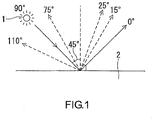
- FIG. 1 is a diagram for describing an angular representation.
- a glitter pigment provided in the present embodiment includes: a flaky substrate; an optical interference film formed on a surface of the flaky substrate; and fine light scattering particles attached to the optical interference film.
- a flaky substrate with an optical interference film that is formed on the surface of the flaky substrate and to which no fine light scattering particles are attached may be referred to as "substrate pigment.”
- the flaky substrate is a fine, plate-like thin piece which can be called, for example, a scaly substrate.
- the flaky substrate is, for example, a glass flake, alumina flake, mica, talc, or sericite.
- the flaky substrate is preferably a glass flake, alumina flake, or mica.
- Mica may be natural mica or synthetic mica.
- a glass flake which is a particularly preferred flaky substrate, will be described.
- the glass composition for forming a glass flake as the flaky substrate is not particularly limited.
- a glass composition containing silicon oxide as a main component and further containing other metal oxides such as aluminum oxide, calcium oxide, and sodium oxide is typically used.
- the term "main component" is used herein to refer to a component whose content is highest in terms of mass. Examples of glass compositions include soda-lime glass, A-glass, C-glass, E-glass, borosilicate glass, and aluminosilicate glass.
- the glass flake preferably has an average particle diameter of 1 to 1000 ⁇ m, even 3 to 500 ⁇ m, and particularly 3 to 200 ⁇ m.
- the average particle diameter of the glass flake is determined as a particle diameter (D50) at 50% by volume in a cumulative undersize distribution of light scattering-based particle sizes measured by laser diffractometry.
- the preferred thickness of the glass flake is 0.1 to 50 ⁇ m, in particular 0.1 to 10 ⁇ m. At least the widest value ranges of these are also a preferred average particle diameter and preferred thickness of the flaky substrate other than the glass flake.
- Glass flakes can be produced, for example, by a blowing process.
- the blowing process includes: melting glass cullet; discharging the molten glass continuously through a circular slit while blowing a gas such as air to the molten glass from a blowing nozzle provided inwardly of the circular slit to inflate the molten glass into a balloon; and crushing the inflated, thinned glass into flakes (scaly particles).
- glass flakes that can be used include commercially-available glass flakes sold as "GLASFLAKE" (registered trademark) by Nippon Sheet Glass Co., Ltd.
- glass flakes are smoother, and more apt to reflect light without scattering, than the surfaces of crystalline particles such as mica. Additionally, glass flakes are transparent, and a glitter pigment including a glass flake as a substrate is thus less likely to produce opaque reflected color which may be observed when translucent crystalline particles are used. A glitter pigment including a glass flake as a substrate is likely to provide favorable light reflection properties leading to appearance features such as high brightness and clear sparkles.
- the optical interference film is a film for imparting interference color to reflected light by an optical interference effect.
- the optical interference film include films including at least one oxide selected from titanium oxide, silicon oxide, aluminum oxide, iron oxide, zinc oxide, tin oxide, zirconium oxide, cerium oxide, nickel oxide, chromium oxide, and vanadium oxide, and films composed of the at least one oxide.
- Oxide names are used herein in referring to all compounds known by the names regardless of the oxidation number of metal elements. For example, the word "iron oxide” collectively refers to Fe 2 O 3 , Fe 3 O 4 , and FeO.
- the optical interference film may be a single-layer film or multi-layer film.
- a preferred single-layer optical interference film is a titanium oxide film. Titanium oxide has a high refractive index and is suitable for forming a layer with desired color formation performance. Titanium oxide can have three types of crystal structures, namely the anatase-type, brookite-type, and rutile-type structures, and anatase-type titanium oxide and rutile-type titanium oxide are industrially manufactured. The rutile-type structure is preferred among the crystal structures of titanium oxide. Rutile-type titanium oxide has a low photocatalytic activity and thus has a low impact on a matrix material, such as a paint, to which the glitter pigment is added. Rutile-type titanium oxide has the highest refractive index.
- rutile-type titanium oxide film on the flaky substrate may be carried out according to a method disclosed, for example, in JP 2001-031421 A or JP 2003-012962 A .
- rutile-type titanium oxide is precipitated on glass flakes in a solution containing a titanium compound such as titanium tetrachloride, and thus a film is formed on the glass flakes.
- the precipitation of rutile-type titanium oxide on the glass flakes can be caused by adding an alkaline compound or alkaline solution to the titanium compound-containing solution having a temperature of 55 to 85°C and a pH of 1.3 or less.
- Preliminarily attaching tin or a tin compound to the glass flakes facilitates the precipitation of rutile-type titanium oxide.
- This method can be used also to form a rutile-type titanium oxide film over glass flakes to which fine gold particles have been attached. With the use of this method, a rutile-type titanium oxide film can be formed without the need for heating for crystal transformation.
- the titanium oxide film formed on a glass flake presents a yellow interference color at a thickness of about 100 nm, a red interference color at a thickness of about 130 nm, a blue interference color at a thickness of about 160 nm, and a green interference color at a thickness of about 175 nm.
- the color produced by the titanium oxide film may slightly vary even when the thickness of the film is unchanged.
- the optical interference film that is a multi-layer film is configured, for example, by laminating the exemplary films described above as single-layer films. It is preferable that the multi-layer optical interference film also include a titanium oxide layer. Examples of a laminate structure of a substrate pigment including the multi-layer optical interference film is shown below.
- Each layer may be formed by a known method.
- "/" represents a boundary between two of the layers.
- the layers referred to by the oxide names shown above may include the corresponding oxides as a main component or may be composed of the corresponding oxide.
- the optical interference film is preferably formed to cover the entire surface of the flaky substrate. For convenience, however, a multi-layer film on only one principal surface of the flaky substrate is described above.
- Interference color produced by multiple interference in the optical interference film varies depending on the angle of observation because a distance that light goes to pass through the film changes depending on the angle of light incident on the optical interference film.
- the color variation (color travel) depending on the angle of observation not only can attract an observer's attention but also can be a cause of an unnatural impression. Therefore, in some applications typified by cosmetics, the color travel of the glitter pigment is desirably made smaller.
- Production of reflected light having a color similar to that of an interference light toward a regular reflection direction relatively reduces an influence of the variation of interference light, and the reduction results in a relatively small color travel.
- Reflected light other than interference light includes scattered light produced by fine metal particles disclosed in Patent Literatures 1 and 2.
- the method involving addition of fine metal particles is a technique developed to enhance the vividness of reflected light, and is also effective in reducing a color travel.
- the present inventor has confirmed that when a color travel is made smaller by making interference light and scattered light have similar colors according to this method, a variation ⁇ L* in brightness L* of reflected light increases with a change in the angle at which the film is observed. If the variation in brightness is increased too much in exchange for a reduction in color variation, an observer is still given an unnatural impression.
- the variation, resulting from addition of fine metal particles, in brightness of reflected light can be reduced by suppressing aggregation of the fine metal particles on the surface of a substrate pigment.
- One specific method for preventing partial aggregation of fine metal particles is to improve the dispersibility of colloidal particles in a colloidal metal solution serving as a source of the fine metal particles. From this point of view, the colloidal metal solution suitably has a large absolute value of zeta potential, which is a measure of the stability of the colloidal particles.
- the zeta potential of a commercially-available colloidal metal solution containing small-diameter colloidal particles is not sufficiently large.
- a commercially-available colloidal solution containing colloidal metal particles with a particle diameter of about 10 nm or less is sufficiently diluted to have a pH of 7, the absolute value of the zeta potential of the commercially-available colloidal solution is measured to be roughly less than 40 mV.
- the absolute value of the zeta potential of a colloidal solution measured in the same manner as above is desirably about 50 mV or more, albeit depending on the kind of fine particles therein.
- the absolute value of the zeta potential of a commercially-available colloidal metal solution is generally smaller than this when the colloidal particles therein have a particle diameter of about 50 nm or less.
- Possible factors of the small absolute value of the zeta potential of the commercially-available product are that a dispersant is less likely to be attached to the fine colloidal particles and that in common applications, the absolute value of zeta potential is not desired to be so large as described above. Therefore, in the case of a colloidal metal solution, the use of a commercially-available product as is makes it impossible to maintain a sufficiently good dispersion state of the fine metal particles therein on the surface of a substrate pigment.
- An example of production of a colloidal metal solution capable of sufficiently preventing aggregation of fine particles therein is described in EXAMPLES.
- the zeta potential of a colloidal solution depends not only on the particle diameters of the colloidal particles in the colloidal solution but also on the pH of the colloidal solution. Commonly, the zeta potential of a colloidal solution containing colloidal metal particles decreases as the pH of the colloidal solution increases.
- Table 2 of JP 2011-190535 A discloses separately prepared (not commercially-available) colloidal silver solutions whose zeta potential decreases down to about -24 mV to about -44 mV with increasing pH. However, this colloidal silver solution has a zeta potential of about -44 mV only when the pH of the colloidal silver solution is 10. When the pH of the colloidal silver solution is around 7, the colloidal silver solution has a zeta potential of about -38 mV.
- Partial aggregation of fine metal particles can produce a preferable result (Patent Literature 2) in terms of enhancing the chroma of reflected color of a glitter pigment. In terms of reducing an observation angle-dependent variation in brightness of reflected light, however, aggregation of fine metal particles should be avoided.
- the fine light scattering particles may be fine particles other than fine metal particles.
- the fine light scattering particles can be, for example, fine particles of an inorganic compound or fine particles of an organic compound.
- fine non-metal particles are a material suitable for reducing an observation angle-dependent variation in brightness of reflected light.
- Some commercially-available colloidal solutions containing fine non-metal particles have a sufficiently high absolute value (for example, 50 mV or more) of zeta potential, but others do not. When a commercially-available colloidal solution is used as a source of fine non-metal particles, an appropriate product should be selected based on the absolute value of zeta potential.
- fine metal particles suitable as the fine light scattering particles include, but are not limited to, fine gold particles, fine platinum particles, and fine silver particles. Other fine particles than these may be used depending on, for example, the desired color. It should be noted that the above exemplary fine noble metal particles are less likely to be deteriorated and these materials are thus desirably used for colors obtainable by the use of these materials. For example, fine silver particles are suitable for achieving a yellow to orange color. When fine non-metal particles are used as the fine light scattering particles, it is recommended that a suitable product be selected as appropriate from commercially-available pigments by reference to the color, particle diameter, zeta potential of a colloidal solution, etc.
- Examples of a pigment with a yellow to red color include yellow iron oxide, red iron oxide, disazo yellow, disazo orange, naphthol red, and quinacridone red.
- Examples of a pigment with a bluish color include phthalocyanine blue, examples of a pigment with a greenish color include phthalocyanine green, examples of a pigment with a purplish color include dioxazine violet, and examples of a pigment with a blackish color include carbon black.
- the average particle diameter of the fine light scattering particles is preferably 1 nm to 50 nm and particularly preferably 5 nm to 30 nm, and may be 10 nm to 30 nm.
- the average particle diameter of the fine light scattering particles attached can be measured using a transmission electron microscope (TEM). In this measurement, it is recommended to measure the diameters of, for example, 10 to 20 fine particles or preferably 100 fine particles and calculate the average of the measured diameters as the average particle diameter.
- TEM transmission electron microscope
- the fine particles suitably have small particle diameters from the viewpoint of reducing the difference ⁇ L* in brightness.
- the particle diameters of the fine light scattering particles are desirably not too small in terms of enhancing the brightness of reflected light toward a regular reflection direction.
- a ratio of the fine light scattering particles to a substrate pigment composed of the flaky substrate and the optical interference film is recommended to be 0.05 to 1%, even 0.1 to 0.6%, and particularly 0.15 to 0.4% in terms of mass.
- a coating of the particles makes it difficult to observe interference light produced by the optical interference film.
- the fine light scattering particles desirably produce scattered light having a color close to a color of interference light produced by the optical interference film.
- an angular difference between a hs (15) value expressed in angle and defined for a substrate pigment composed of the flaky substrate and the optical interference film in the same manner as for a h (15) value and a hue angle hf (15) expressed in angle and defined for the fine light scattering particles in the same manner as for the h (15) value is preferably 60° or less, more preferably 40° or less, and, for example, 0° to 20°.
- Reflected light, as measured using illuminant D65, of the glitter pigment of the present embodiment is represented by an L* (15) value of more than 100, a ⁇ L* (h - s) value of less than 30, and a ⁇ h (h - s) value of less than 40° in an L*C*h color system.
- An angular representation of reflected light is based on the position shown in FIG. 1 .
- An illuminant 1 is disposed so that light from the illuminant 1 to an object 2 will be incident on the object 2 at an incident angle of 45° and observed from a regular reflection direction consequently determined.
- the regular reflection direction is defined as 0° and the direction from which light from the illuminant 1 is incident as 90°.
- Light reflected in directions (highlight) near to the regular reflection direction is measured at angles of 15° and 25°, and light reflected in directions (shade) where regularly reflected light has no influence is measured at angles of 75° and 110°.
- the brightness and hue angle at an angle ⁇ are respectively described as L* ( ⁇ ) and h ( ⁇ ).
- L* (15) refers to the brightness at an angle of 15°, and the L* (15) value is more preferably more than 100 and particularly preferably more than 105. Such a high brightness imparts "glitter” to a product to which the pigment is added.
- the upper limit of the L* (15) value is not limited to a particular value, and may be 115 or less.
- a ⁇ L* (h - s) value is obtained by subtracting the brightness L* (s) in shade from the brightness L* (h) in highlight.
- the L* (h) value is an average of the L* (15) value and L* (25) value, while the L* (s) value is an average of the L* (75) value and L* (110) value.
- the ⁇ L* (h - s) value is preferably less than 30, more preferably less than 28, and particularly preferably less than 25.
- the ⁇ L* (h - s) value may be 0. In some cases, a preferable appearance can be obtained when the ⁇ L* (h - s) value is 15 or more.
- the ⁇ h (h - s) value is an angular difference between a hue angle h (h) in highlight and a hue angle h (s) in shade.
- the h (h) value is an average of the h (15) value and h (25) value, and the h (s) value is an average of an h (75) value and h (110) value.
- the h (h - s) value is preferably less than 40° and more preferably less than 35°, and may be less than 30°.
- the ⁇ h (h - s) value is expressed as an angle of 180° or less.
- the h (h) value is 38 (°) and the h (s) value is 359 (°)
- the ⁇ h (h - s) value is 39°, not 321°.
- the h (h - s) value may be 0. In some cases, a preferable appearance can be obtained when the h (h - s) value is 1 or more.
- the h (15) value of the glitter pigment may be determined as appropriate depending on the intended application.
- the h (15) value of the glitter pigment is desirably 20 to 90 and more desirably 30 to 80 for some types of products so that a yellow to orange color will be presented.
- the optical interference film suitable for achieving such a hue angle is a single-layer titanium oxide film having a thickness of, for example, 105 nm to 125 nm and preferably 110 nm to 120 nm.
- reflected light may be measured for a paint film serving as an object, made of a transparent acrylic resin paint containing the glitter pigment in an amount of 3 weight% with respect to the total weight, and formed on a white plane using a film applicator to have a thickness of (75 ⁇ 5) ⁇ m.
- the glitter pigment is aligned so that the principal surface thereof is substantially parallel to the painted surface.
- the glitter pigment according to the present invention exhibits a natural color as well as high brightness in the regular reflection direction when incorporated in various compositions.
- the present invention provides a pigment-containing composition containing the glitter pigment according to the present invention.
- An example of the pigment-containing composition is at least one selected from a paint, ink, cosmetic, and resin composition, and is preferably a cosmetic.
- the resin composition include those containing a resin which is PMMA and/or polycarbonate in addition to the glitter pigment.
- the resin composition may be a molded product of artificial marble.
- the present invention provides a pigment-containing painted product including a substrate material and a paint film formed on the substrate material, the paint film containing the glitter pigment according to the present invention.
- the pigment-containing painted product may be painted paper.
- the substrate material is paper.
- the substrate material is not limited to paper, and may be a metal, resin, ceramic, or another material.
- the paint film may be composed of the pigment-containing composition according to the present invention or may be formed by applying the pigment-containing composition according to the present invention onto the substrate material.
- the cosmetic examples include facial cosmetics, makeup cosmetics, and hair cosmetics.
- the glitter pigment according to the present embodiment is particularly suitable for use in makeup cosmetics such as eye shadow, nail enamel, eyeliner, mascara, lipstick, and fancy powder.
- the form of the cosmetic is not particularly limited, and the cosmetic may be, for example, in the form of a powder, cake, pencil, stick, ointment, liquid, emulsion, or cream.
- Cosmetics to which the present embodiment is particularly preferably applied are facial cosmetics such as foundation and face powder.
- the substrate pigment used is a glass flake on which a rutile-type titanium oxide film having a thickness of about 110 nm is formed.
- the glass flake composing this substrate pigment has an average particle diameter of about 15 ⁇ m and a thickness of about 0.3 ⁇ m.
- Hydrochloric acid was added to adjust the pH to 2.0 to 4.5 while the colloidal silver solution and substrate pigment were stirred in the beaker using a stirring blade. The mixture was stirred for 10 minutes. After that, a glitter pigment was separated from the supernatant by filtration and dried at 180°C for 12 hours. A glitter pigment was thus obtained.
- a glitter pigment was obtained in the same manner as in Example 1, except that 1.0 g of this 0.5% colloidal solution, 50 g of pure water, and 2 g of the substrate pigment were used.
- a glitter pigment was obtained in the same manner as in Example 1, except that 1.7 g of this 0.3% colloidal solution and 2 g of the substrate pigment were used.
- a glitter pigment was obtained in the same manner as in Example 1, except that 1.0 g of this 0.5% dispersion and 2 g of the substrate pigment were used.
- a glitter pigment was obtained in the same manner as in Example 1, except that 500 ml of a 0.4% aqueous ammonia solution was added instead of 500 ml of the 2% aqueous ammonia solution to produce a silver colloid.
- chloroauric acid tetrahydrate a powder, manufactured by Ohura Precious Metal Industry Co., Ltd. and having a purity of 99.0% or more
- chloroauric acid tetrahydrate a powder, manufactured by Ohura Precious Metal Industry Co., Ltd. and having a purity of 99.0% or more
- sodium citrate manufactured by Nacalai Tesque Inc.
- a 1 L round-bottom flask was charged with 2.0 g of the 17.24 wt% chloroauric acid solution and 994.99 g of pure water, and the contents of the flask were heated under reflux at a constant temperature of 100°C for 30 minutes.
- a glitter pigment was obtained in the same manner as in Example 1, except that 10 g of the colloidal gold solution produced above and 2 g of the substrate pigment were used.
- a coated product in which a powder of the glitter pigment obtained in each of Examples and Comparative Examples above is dispersed in a transparent acrylic resin was produced.
- a film applicator Doctor Blade, manufactured by YASUDA SEIKI SEISAKUSHO, LTD.
- a coating composition to be loaded into the film applicator was prepared by mixing the powder with a transparent acrylic resin paint (N ACRYL AUTO CLEAR SUPER, manufactured by NIPPON PAINT Co., Ltd.) so that the content of the powder would be 3 mass% with respect to the total mass.
- the coating composition was applied to a piece of white paper and dried at ordinary temperature.
- the paint film which was formed to have a thickness of 9 mil (about 228.6 ⁇ m), had a thickness of 70 to 80 ⁇ m after the drying.
- the L* (15) value of a white plane provided by the white paper was 94.1.
- the brightness L* and hue angle h of each coated product formed were measured using a multi-angle spectrocolorimeter, BYK-mac (manufactured by BYK-Gardner GmbH), with an illuminant being disposed so that light would be incident on the coated product at an incident angle of 45°.
- the illuminant used is illuminant D65. The measurement was performed at angles of 15°, 25°, 75°, and 110° in accordance with the angular representation described above. Additionally, the fine light scattering particles used in Examples and Comparative Examples were measured for the hue angle.
- the fine particles were diluted to a concentration of 0.1% and then put in a transparent glass container for this measurement performed using a spectrocolorimeter (CM-5 manufactured by KONICA MINOLTA, INC.).
- the measurement angle was 15° in accordance with the angular representation described above.
- the zeta potential of the colloidal solutions brought in contact with the substrate pigment was measured using a zeta potential measurement apparatus (ELS-6000 manufactured by Otsuka Electronics Co., Ltd.). The zeta potential measurement was performed for the colloidal solutions each diluted 10000-fold with pure water. The pH of each diluted colloidal solution was 7.
Landscapes
- Chemical & Material Sciences (AREA)
- Organic Chemistry (AREA)
- Engineering & Computer Science (AREA)
- Life Sciences & Earth Sciences (AREA)
- Materials Engineering (AREA)
- Wood Science & Technology (AREA)
- Metallurgy (AREA)
- Inorganic Chemistry (AREA)
- Pigments, Carbon Blacks, Or Wood Stains (AREA)
- Paints Or Removers (AREA)
- Cosmetics (AREA)
Abstract
Description
- The present invention relates to glitter pigments, and particularly relates to a glitter pigment including a flaky substrate, optical interference film formed on the surface of the flaky substrate, and fine particles attached to the optical interference film. The present invention also relates to a composition containing a glitter pigment and to a painted product having a paint film containing a glitter pigment.
- Glitter pigments are added to various products such as paints, cosmetics, and so on to allow the products to reflect light with sparkles. A typical property required of glitter pigments is high brightness. Glitter pigments each including a flaky substrate are suitable for achieving this desirable property. Glitter pigments each including an optical interference film present pearly gloss due to an optical interference effect. A typical optical interference film is a titanium oxide film. Glitter pigments allowed to present a desired color by attachment of fine metal particles are also known. Typical fine metal particles are fine gold particles presenting color by surface plasmon resonance.
- It has been proposed to improve the vividness of reflected light by making interference color presented by an optical interference film and color presented by fine metal particles similar to each other.
Patent Literature 1 discloses a red or yellow glitter pigment with improved vividness. Examples 1 to 4 ofPatent Literature 1 disclose glitter pigments each including: a flaky substrate having a surface on which a titanium oxide film with a thickness at which interference color is red is formed; and red fine gold particles attached to the titanium oxide film. Example 5 ofPatent Literature 1 discloses a glitter pigment including: a flaky substrate having a surface on which a titanium oxide film with a thickness at which interference color is yellow is formed; and yellow fine silver particles attached to the titanium oxide film. -
Patent Literature 2 discloses a technique for enhancing the vividness of a blue or green reflected color by using fine gold particles which have been used as a red-color former. The glitter pigment ofPatent Literature 2 includes: a titanium oxide film formed on the surface of a flaky substrate to have a thickness at which interference color is blue or green; and fine gold particles attached to the titanium oxide film and then heated to change the aggregation state. The heating changes the aggregation state of the fine gold particles, which thus become a color former that improves the vividness of a blue or green reflected light. -
- Patent Literature 1:
JP 2006-299051 A - Patent Literature 2:
WO 2016/194352 A1 - Reflected color presented by glitter pigments and resulting from optical interference varies depending on the angle at which the glitter pigments are observed. For example, an optical interference film can be designed to be able to present a reflected color close to a human skin color in a direction of regular reflection of incident light. However, when a film including a glitter pigment including this optical interference film is observed from a different direction, a slightly greenish reflected color can sometimes be observed. Such a shift of color (which may hereinafter be referred to as "color shift") is desirably reduced because such a shift of color can be a cause of an unnatural impression in some applications typified by cosmetics.
- In the case of glitter pigments in which fine metal particles are attached to an optical interference film, an observation angle-dependent color shift of reflected light is reduced thanks to colors of the fine metal particles. However, as disclosed in
Patent Literatures - Therefore, the present invention aims to provide a glitter pigment suitable for imparting high brightness to reflected light toward a regular reflection direction and reducing the unnaturalness caused by an observation angle-dependent variation in reflected light.
- The present invention provides a glitter pigment including:
- a flaky substrate;
- an optical interference film formed on a surface of the flaky substrate; and
- fine light scattering particles attached to the optical interference film, wherein
- reflected light, as measured using illuminant D65, is represented by an L* (15) value of more than 100, a ΔL* (h - s) value of less than 30, and a Δh(h - s) value of less than 40° in an L*C*h color system, wherein
- the L* (15) value is an L* value of the reflected light toward a 15° direction based on an angular representation in which, when the illuminant is disposed so that an incident angle of incident light from the illuminant is 45°, an angle at which the incident light is regularly reflected is defined as 0° and an incident direction of the incident light is defined as 90°,
- the ΔL* (h - s) value is a difference obtained by subtracting an average value L* (s) of an L* (75) value of the reflected light toward a 75° direction and an L* (110) value of the reflected light toward a 110° direction from an average value L* (h) of the L* (15) value of the reflected light toward the 15° direction and an L* (25) value of the reflected light toward a 25° direction when the directions are based on the angular representation, and
- the Δh (h - s) value is an angular difference between an average value h (h), expressed in angle, of a h (15) value of the reflected light toward the 15° direction and a h (25) value of the reflected light toward the 25° direction and an average value h (s), expressed in angle, of a h (75) value of the reflected light toward the 75° direction and a h (110) value of the reflected light toward the 110° direction when the directions are based on the angular representation.
- The present invention provides a glitter pigment suitable for maintaining a brightness level of reflected light observed in a regular reflection direction and suitable for reducing an observation angle-dependent variation in reflected light, specifically, variations in brightness and color of reflected light.
-
FIG. 1 is a diagram for describing an angular representation. - Hereinafter, the present invention will be described in detail. The following description is not intended to limit the present invention to specific embodiments.
- A glitter pigment provided in the present embodiment includes: a flaky substrate; an optical interference film formed on a surface of the flaky substrate; and fine light scattering particles attached to the optical interference film. Hereinafter, a flaky substrate with an optical interference film that is formed on the surface of the flaky substrate and to which no fine light scattering particles are attached may be referred to as "substrate pigment."
- The flaky substrate is a fine, plate-like thin piece which can be called, for example, a scaly substrate. The flaky substrate is, for example, a glass flake, alumina flake, mica, talc, or sericite. The flaky substrate is preferably a glass flake, alumina flake, or mica. Mica may be natural mica or synthetic mica. Hereinafter, a glass flake, which is a particularly preferred flaky substrate, will be described.
- The glass composition for forming a glass flake as the flaky substrate is not particularly limited. A glass composition containing silicon oxide as a main component and further containing other metal oxides such as aluminum oxide, calcium oxide, and sodium oxide is typically used. The term "main component" is used herein to refer to a component whose content is highest in terms of mass. Examples of glass compositions include soda-lime glass, A-glass, C-glass, E-glass, borosilicate glass, and aluminosilicate glass.
- The glass flake preferably has an average particle diameter of 1 to 1000 µm, even 3 to 500 µm, and particularly 3 to 200 µm. The average particle diameter of the glass flake is determined as a particle diameter (D50) at 50% by volume in a cumulative undersize distribution of light scattering-based particle sizes measured by laser diffractometry. The preferred thickness of the glass flake is 0.1 to 50 µm, in particular 0.1 to 10 µm. At least the widest value ranges of these are also a preferred average particle diameter and preferred thickness of the flaky substrate other than the glass flake.
- Glass flakes can be produced, for example, by a blowing process. The blowing process includes: melting glass cullet; discharging the molten glass continuously through a circular slit while blowing a gas such as air to the molten glass from a blowing nozzle provided inwardly of the circular slit to inflate the molten glass into a balloon; and crushing the inflated, thinned glass into flakes (scaly particles). Examples of glass flakes that can be used include commercially-available glass flakes sold as "GLASFLAKE" (registered trademark) by Nippon Sheet Glass Co., Ltd.
- The surfaces of glass flakes are smoother, and more apt to reflect light without scattering, than the surfaces of crystalline particles such as mica. Additionally, glass flakes are transparent, and a glitter pigment including a glass flake as a substrate is thus less likely to produce opaque reflected color which may be observed when translucent crystalline particles are used. A glitter pigment including a glass flake as a substrate is likely to provide favorable light reflection properties leading to appearance features such as high brightness and clear sparkles.
- The optical interference film is a film for imparting interference color to reflected light by an optical interference effect. Examples of the optical interference film include films including at least one oxide selected from titanium oxide, silicon oxide, aluminum oxide, iron oxide, zinc oxide, tin oxide, zirconium oxide, cerium oxide, nickel oxide, chromium oxide, and vanadium oxide, and films composed of the at least one oxide. Oxide names are used herein in referring to all compounds known by the names regardless of the oxidation number of metal elements. For example, the word "iron oxide" collectively refers to Fe2O3, Fe3O4, and FeO.
- The optical interference film may be a single-layer film or multi-layer film. A preferred single-layer optical interference film is a titanium oxide film. Titanium oxide has a high refractive index and is suitable for forming a layer with desired color formation performance. Titanium oxide can have three types of crystal structures, namely the anatase-type, brookite-type, and rutile-type structures, and anatase-type titanium oxide and rutile-type titanium oxide are industrially manufactured. The rutile-type structure is preferred among the crystal structures of titanium oxide. Rutile-type titanium oxide has a low photocatalytic activity and thus has a low impact on a matrix material, such as a paint, to which the glitter pigment is added. Rutile-type titanium oxide has the highest refractive index.
- The formation of a rutile-type titanium oxide film on the flaky substrate may be carried out according to a method disclosed, for example, in
JP 2001-031421 A JP 2003-012962 A - Glass flakes with a rutile-type titanium oxide film formed on the surfaces thereof are sold as "METASHINE (registered trademark) Titania Coat" by Nippon Sheet Glass Co., Ltd. Such a commercially-available product may be used as a substrate pigment.
- Due to optical interference by the titanium oxide film, an interference color depending on the thickness of the titanium oxide film is observed on the flaky substrate with the titanium oxide film formed thereon. The titanium oxide film formed on a glass flake presents a yellow interference color at a thickness of about 100 nm, a red interference color at a thickness of about 130 nm, a blue interference color at a thickness of about 160 nm, and a green interference color at a thickness of about 175 nm. Depending on the layer formation conditions and other factors, the color produced by the titanium oxide film may slightly vary even when the thickness of the film is unchanged.
- The optical interference film that is a multi-layer film is configured, for example, by laminating the exemplary films described above as single-layer films. It is preferable that the multi-layer optical interference film also include a titanium oxide layer. Examples of a laminate structure of a substrate pigment including the multi-layer optical interference film is shown below.
- Flaky substrate/silicon oxide/titanium oxide
- Flaky substrate/silicon oxide/iron oxide
- Flaky substrate/silicon oxide/titanium oxide/iron oxide
- Flaky substrate/silicon oxide/titanium oxide/aluminum oxide
- Flaky substrate/silicon oxide/titanium oxide/silicon oxide/titanium oxide
- Flaky substrate/titanium oxide/iron oxide
- Flaky substrate/titanium oxide/aluminum oxide
- Flaky substrate/titanium oxide/silicon oxide/titanium oxide
- Flaky substrate/tin oxide/titanium oxide
- Flaky substrate/aluminum oxide/titanium oxide
- Flaky substrate/iron oxide/titanium oxide
- Each layer may be formed by a known method.
- In the above laminate structures, "/" represents a boundary between two of the layers. The layers referred to by the oxide names shown above may include the corresponding oxides as a main component or may be composed of the corresponding oxide. The optical interference film is preferably formed to cover the entire surface of the flaky substrate. For convenience, however, a multi-layer film on only one principal surface of the flaky substrate is described above.
- Interference color produced by multiple interference in the optical interference film varies depending on the angle of observation because a distance that light goes to pass through the film changes depending on the angle of light incident on the optical interference film. The color variation (color travel) depending on the angle of observation not only can attract an observer's attention but also can be a cause of an unnatural impression. Therefore, in some applications typified by cosmetics, the color travel of the glitter pigment is desirably made smaller. Production of reflected light having a color similar to that of an interference light toward a regular reflection direction relatively reduces an influence of the variation of interference light, and the reduction results in a relatively small color travel. Reflected light other than interference light includes scattered light produced by fine metal particles disclosed in
Patent Literatures - According to the investigation by the present inventor, the variation, resulting from addition of fine metal particles, in brightness of reflected light can be reduced by suppressing aggregation of the fine metal particles on the surface of a substrate pigment. One specific method for preventing partial aggregation of fine metal particles is to improve the dispersibility of colloidal particles in a colloidal metal solution serving as a source of the fine metal particles. From this point of view, the colloidal metal solution suitably has a large absolute value of zeta potential, which is a measure of the stability of the colloidal particles.
- The zeta potential of a commercially-available colloidal metal solution containing small-diameter colloidal particles is not sufficiently large. When a commercially-available colloidal solution containing colloidal metal particles with a particle diameter of about 10 nm or less is sufficiently diluted to have a pH of 7, the absolute value of the zeta potential of the commercially-available colloidal solution is measured to be roughly less than 40 mV. To reduce the variation in brightness of reflected light, the absolute value of the zeta potential of a colloidal solution measured in the same manner as above is desirably about 50 mV or more, albeit depending on the kind of fine particles therein. However, the absolute value of the zeta potential of a commercially-available colloidal metal solution is generally smaller than this when the colloidal particles therein have a particle diameter of about 50 nm or less. Possible factors of the small absolute value of the zeta potential of the commercially-available product are that a dispersant is less likely to be attached to the fine colloidal particles and that in common applications, the absolute value of zeta potential is not desired to be so large as described above. Therefore, in the case of a colloidal metal solution, the use of a commercially-available product as is makes it impossible to maintain a sufficiently good dispersion state of the fine metal particles therein on the surface of a substrate pigment. An example of production of a colloidal metal solution capable of sufficiently preventing aggregation of fine particles therein is described in EXAMPLES.
- The zeta potential of a colloidal solution depends not only on the particle diameters of the colloidal particles in the colloidal solution but also on the pH of the colloidal solution. Commonly, the zeta potential of a colloidal solution containing colloidal metal particles decreases as the pH of the colloidal solution increases. For example, Table 2 of
JP 2011-190535 A - Partial aggregation of fine metal particles can produce a preferable result (Patent Literature 2) in terms of enhancing the chroma of reflected color of a glitter pigment. In terms of reducing an observation angle-dependent variation in brightness of reflected light, however, aggregation of fine metal particles should be avoided.
- The fine light scattering particles may be fine particles other than fine metal particles. The fine light scattering particles can be, for example, fine particles of an inorganic compound or fine particles of an organic compound. Although not as suitable for improving the vividness of reflected light as fine metal particles such as fine gold particles, fine non-metal particles are a material suitable for reducing an observation angle-dependent variation in brightness of reflected light. Some commercially-available colloidal solutions containing fine non-metal particles have a sufficiently high absolute value (for example, 50 mV or more) of zeta potential, but others do not. When a commercially-available colloidal solution is used as a source of fine non-metal particles, an appropriate product should be selected based on the absolute value of zeta potential.
- Examples of fine metal particles suitable as the fine light scattering particles include, but are not limited to, fine gold particles, fine platinum particles, and fine silver particles. Other fine particles than these may be used depending on, for example, the desired color. It should be noted that the above exemplary fine noble metal particles are less likely to be deteriorated and these materials are thus desirably used for colors obtainable by the use of these materials. For example, fine silver particles are suitable for achieving a yellow to orange color. When fine non-metal particles are used as the fine light scattering particles, it is recommended that a suitable product be selected as appropriate from commercially-available pigments by reference to the color, particle diameter, zeta potential of a colloidal solution, etc. Examples of a pigment with a yellow to red color include yellow iron oxide, red iron oxide, disazo yellow, disazo orange, naphthol red, and quinacridone red. Examples of a pigment with a bluish color include phthalocyanine blue, examples of a pigment with a greenish color include phthalocyanine green, examples of a pigment with a purplish color include dioxazine violet, and examples of a pigment with a blackish color include carbon black.
- The average particle diameter of the fine light scattering particles is preferably 1 nm to 50 nm and particularly preferably 5 nm to 30 nm, and may be 10 nm to 30 nm. The average particle diameter of the fine light scattering particles attached can be measured using a transmission electron microscope (TEM). In this measurement, it is recommended to measure the diameters of, for example, 10 to 20 fine particles or preferably 100 fine particles and calculate the average of the measured diameters as the average particle diameter. Generally, assuming that the amount of the fine light scattering particles attached is the same, a higher light scattering effect can be achieved by the fine light scattering particles having smaller particle diameters. Therefore, the fine particles suitably have small particle diameters from the viewpoint of reducing the difference ΔL* in brightness. However, the particle diameters of the fine light scattering particles are desirably not too small in terms of enhancing the brightness of reflected light toward a regular reflection direction.
- In the glitter pigment, a ratio of the fine light scattering particles to a substrate pigment composed of the flaky substrate and the optical interference film is recommended to be 0.05 to 1%, even 0.1 to 0.6%, and particularly 0.15 to 0.4% in terms of mass. When too large an amount of the fine light scattering particles is attached, a coating of the particles makes it difficult to observe interference light produced by the optical interference film.
- The fine light scattering particles desirably produce scattered light having a color close to a color of interference light produced by the optical interference film. Specifically, an angular difference between a hs (15) value expressed in angle and defined for a substrate pigment composed of the flaky substrate and the optical interference film in the same manner as for a h (15) value and a hue angle hf (15) expressed in angle and defined for the fine light scattering particles in the same manner as for the h (15) value is preferably 60° or less, more preferably 40° or less, and, for example, 0° to 20°.
- Reflected light, as measured using illuminant D65, of the glitter pigment of the present embodiment is represented by an L* (15) value of more than 100, a ΔL* (h - s) value of less than 30, and a Δh (h - s) value of less than 40° in an L*C*h color system.
- An angular representation of reflected light is based on the position shown in
FIG. 1 . Anilluminant 1 is disposed so that light from theilluminant 1 to anobject 2 will be incident on theobject 2 at an incident angle of 45° and observed from a regular reflection direction consequently determined. To describe angles, the regular reflection direction is defined as 0° and the direction from which light from theilluminant 1 is incident as 90°. Light reflected in directions (highlight) near to the regular reflection direction is measured at angles of 15° and 25°, and light reflected in directions (shade) where regularly reflected light has no influence is measured at angles of 75° and 110°. The brightness and hue angle at an angle θ are respectively described as L* (θ) and h (θ). - L* (15) refers to the brightness at an angle of 15°, and the L* (15) value is more preferably more than 100 and particularly preferably more than 105. Such a high brightness imparts "glitter" to a product to which the pigment is added. The upper limit of the L* (15) value is not limited to a particular value, and may be 115 or less.
- A ΔL* (h - s) value is obtained by subtracting the brightness L* (s) in shade from the brightness L* (h) in highlight. The L* (h) value is an average of the L* (15) value and L* (25) value, while the L* (s) value is an average of the L* (75) value and L* (110) value. The ΔL* (h - s) value is preferably less than 30, more preferably less than 28, and particularly preferably less than 25. Such a small ΔL* (h - s) value and a small Δh (h - s) value as described next reduce an unnatural, quick, and observation angle-dependent change in reflected light and allow a natural glitter to be imparted to a product to which the glitter pigment is added. The ΔL* (h - s) value may be 0. In some cases, a preferable appearance can be obtained when the ΔL* (h - s) value is 15 or more.
- The Δh (h - s) value is an angular difference between a hue angle h (h) in highlight and a hue angle h (s) in shade. The h (h) value is an average of the h (15) value and h (25) value, and the h (s) value is an average of an h (75) value and h (110) value. The h (h - s) value is preferably less than 40° and more preferably less than 35°, and may be less than 30°. The Δh (h - s) value is expressed as an angle of 180° or less. For example, when the h (h) value is 38 (°) and the h (s) value is 359 (°), the Δh (h - s) value is 39°, not 321°. The h (h - s) value may be 0. In some cases, a preferable appearance can be obtained when the h (h - s) value is 1 or more.
- The h (15) value of the glitter pigment may be determined as appropriate depending on the intended application. For example, in cosmetic applications, the h (15) value of the glitter pigment is desirably 20 to 90 and more desirably 30 to 80 for some types of products so that a yellow to orange color will be presented. The optical interference film suitable for achieving such a hue angle is a single-layer titanium oxide film having a thickness of, for example, 105 nm to 125 nm and preferably 110 nm to 120 nm.
- It is appropriate to measure the properties of reflected light from the glitter pigment in the form of a paint containing the glitter pigment dispersed in a transparent resin. Specifically, reflected light may be measured for a paint film serving as an object, made of a transparent acrylic resin paint containing the glitter pigment in an amount of 3 weight% with respect to the total weight, and formed on a white plane using a film applicator to have a thickness of (75 ± 5) µm. In a paint film formed using a film applicator to have a thickness as specified above, the glitter pigment is aligned so that the principal surface thereof is substantially parallel to the painted surface.
- The glitter pigment according to the present invention exhibits a natural color as well as high brightness in the regular reflection direction when incorporated in various compositions. In another aspect, the present invention provides a pigment-containing composition containing the glitter pigment according to the present invention. An example of the pigment-containing composition is at least one selected from a paint, ink, cosmetic, and resin composition, and is preferably a cosmetic. Examples of the resin composition include those containing a resin which is PMMA and/or polycarbonate in addition to the glitter pigment. The resin composition may be a molded product of artificial marble.
- In still another aspect, the present invention provides a pigment-containing painted product including a substrate material and a paint film formed on the substrate material, the paint film containing the glitter pigment according to the present invention. The pigment-containing painted product may be painted paper. In this case, the substrate material is paper. The substrate material is not limited to paper, and may be a metal, resin, ceramic, or another material. The paint film may be composed of the pigment-containing composition according to the present invention or may be formed by applying the pigment-containing composition according to the present invention onto the substrate material.
- Preferred embodiments and specific examples of the pigment-containing composition and the pigment-containing painted product are as disclosed in publications of patent applications previously filed by the applicant of the present invention (
JP 2008-063525 A - Examples of the cosmetic include facial cosmetics, makeup cosmetics, and hair cosmetics. In particular, the glitter pigment according to the present embodiment is particularly suitable for use in makeup cosmetics such as eye shadow, nail enamel, eyeliner, mascara, lipstick, and fancy powder. The form of the cosmetic is not particularly limited, and the cosmetic may be, for example, in the form of a powder, cake, pencil, stick, ointment, liquid, emulsion, or cream. Cosmetics to which the present embodiment is particularly preferably applied are facial cosmetics such as foundation and face powder.
- To a 1 L beaker were added 179.1 g of 3-amino-1-propanol (manufactured by Tokyo Chemical Industry Co., Ltd.), 249.9 g of pure water, 12.1 g of casein (manufactured by KISHIDA CHEMICAL Co., Ltd.), which were stirred. To the mixture was added a mixture of 2.18 g of silver nitrate (manufactured by Ohura Precious Metal Industry Co., Ltd.) and 200 g of pure water, and the contents were stirred. Subsequently, a mixture of 0.16 g of dimethylamine borane (manufactured by Wako Pure Chemical Industries, Ltd.) and 200 g of pure water was added and the contents were stirred for 30 minutes. Acetic acid was added to the mixture to adjust the pH to 4.4 and precipitate silver. The supernatant was removed, and the precipitate was washed with pure water. This was followed by addition of 500 ml of a 2% aqueous ammonia solution and stirring to disperse silver. A colloidal silver solution was thus obtained.
- An amount of 12.5 g of the colloidal silver solution produced above, 50 g of pure water, and 5 g of a substrate pigment were added to a beaker. The substrate pigment used is a glass flake on which a rutile-type titanium oxide film having a thickness of about 110 nm is formed. The glass flake composing this substrate pigment has an average particle diameter of about 15 µm and a thickness of about 0.3 µm. Hydrochloric acid was added to adjust the pH to 2.0 to 4.5 while the colloidal silver solution and substrate pigment were stirred in the beaker using a stirring blade. The mixture was stirred for 10 minutes. After that, a glitter pigment was separated from the supernatant by filtration and dried at 180°C for 12 hours. A glitter pigment was thus obtained.
- A colloidal solution, EMF OCHER HL (manufactured by TOYO INK CO., LTD.), was diluted with pure water to have a pigment concentration of 0.5%. A glitter pigment was obtained in the same manner as in Example 1, except that 1.0 g of this 0.5% colloidal solution, 50 g of pure water, and 2 g of the substrate pigment were used.
- A colloidal solution, EMF YELLOW HG (manufactured by TOYO INK CO., LTD.), was diluted with pure water to have a pigment concentration of 0.3%. A glitter pigment was obtained in the same manner as in Example 1, except that 1.7 g of this 0.3% colloidal solution and 2 g of the substrate pigment were used.
- A colloidal solution, EMF RED HR (manufactured by TOYO INK CO., LTD.), was diluted with pure water to have a pigment concentration of 0.5%. A glitter pigment was obtained in the same manner as in Example 1, except that 1.0 g of this 0.5% dispersion and 2 g of the substrate pigment were used.
- A glitter pigment was obtained in the same manner as in Example 1, except that 500 ml of a 0.4% aqueous ammonia solution was added instead of 500 ml of the 2% aqueous ammonia solution to produce a silver colloid.
- An amount of 100 g of chloroauric acid tetrahydrate (a powder, manufactured by Ohura Precious Metal Industry Co., Ltd. and having a purity of 99.0% or more) was diluted with 480 g of water to prepare a 8.24 wt% chloroauric acid solution. Additionally, sodium citrate (manufactured by Nacalai Tesque Inc.) was diluted with pure water to prepare a 10 wt% sodium citrate solution. A 1 L round-bottom flask was charged with 2.0 g of the 17.24 wt% chloroauric acid solution and 994.99 g of pure water, and the contents of the flask were heated under reflux at a constant temperature of 100°C for 30 minutes. Subsequently, 3.01 g of the 10 wt% sodium citrate solution was added to the round-bottom flask, and the contents of the flask were heated under reflux at a constant temperature of 100°C for another 30 minutes, after which the round-bottom flask was cooled to room temperature in water, giving a colloidal gold solution.
- A glitter pigment was obtained in the same manner as in Example 1, except that 10 g of the colloidal gold solution produced above and 2 g of the substrate pigment were used.
- A coated product in which a powder of the glitter pigment obtained in each of Examples and Comparative Examples above is dispersed in a transparent acrylic resin was produced. A film applicator (Doctor Blade, manufactured by YASUDA SEIKI SEISAKUSHO, LTD.) was used to produce the coated product. A coating composition to be loaded into the film applicator was prepared by mixing the powder with a transparent acrylic resin paint (N ACRYL AUTO CLEAR SUPER, manufactured by NIPPON PAINT Co., Ltd.) so that the content of the powder would be 3 mass% with respect to the total mass. The coating composition was applied to a piece of white paper and dried at ordinary temperature. The paint film, which was formed to have a thickness of 9 mil (about 228.6 µm), had a thickness of 70 to 80 µm after the drying. The L* (15) value of a white plane provided by the white paper was 94.1.
- The brightness L* and hue angle h of each coated product formed were measured using a multi-angle spectrocolorimeter, BYK-mac (manufactured by BYK-Gardner GmbH), with an illuminant being disposed so that light would be incident on the coated product at an incident angle of 45°. The illuminant used is illuminant D65. The measurement was performed at angles of 15°, 25°, 75°, and 110° in accordance with the angular representation described above. Additionally, the fine light scattering particles used in Examples and Comparative Examples were measured for the hue angle. The fine particles were diluted to a concentration of 0.1% and then put in a transparent glass container for this measurement performed using a spectrocolorimeter (CM-5 manufactured by KONICA MINOLTA, INC.). The measurement angle was 15° in accordance with the angular representation described above.
- Moreover, the zeta potential of the colloidal solutions brought in contact with the substrate pigment was measured using a zeta potential measurement apparatus (ELS-6000 manufactured by Otsuka Electronics Co., Ltd.). The zeta potential measurement was performed for the colloidal solutions each diluted 10000-fold with pure water. The pH of each diluted colloidal solution was 7.
- The measurement results are shown in Table 1. In Examples 1 to 4, the ΔL* (h - s) and Δh (h - s) values were both small. Therefore, reflected light achieving a high soft focus effect was observed by visual observation at different angles. High brightness was also observed from the regular reflection direction. In Comparative Examples 1 to 2, although a color shift was reduced, the difference ΔL* (h - s) in brightness depending on the angle of observation was large. Therefore, reflected light gave an indelible, artificial impression and looked slightly unnatural.
[Table 1] Fine light scattering particles Average particle diameter (nm) Hue angle h of fine particles Difference in h between substrate pigment and fine particles Zeta potential (mV) L* (15) L* (25) L* (75) L* (110) ΔL* (h - s) h (15) h (25) h (75) h (110) Δh(h - s) Example 1 Silver 10 to 20 79 6.6 -54 106.7 93.8 77.4 74.4 24.4 67.65 67.94 72.70 69.18 3.1 Example 2 Yellow iron oxide 30 80.9 8.5 -56.8 114.1 101.1 86.2 83.6 22.7 76.91 81.77 114.08 109.08 32.2 Example 3 Disazo yellow 30 86.3 13.9 -63.2 111.4 98.2 82.6 80.0 23.5 81.28 85.07 97.15 95.59 13.2 Example 4 Naphthol red 30 33.2 39.2 -60.4 103.9 89.5 71.6 68.7 26.6 47.13 40.60 15.26 14.12 29.2 Comparative Example 1 Silver - 79 6.6 -18 96.8 78.7 52.1 48.3 37.6 65.43 63.55 46.13 43.05 19.9 Comparative Example 2 Gold 10 10.2 62.2 -40 99.4 82.3 59.9 56.3 32.8 63.10 61.55 54.50 51.12 9.5 Substrate pigment - - - - - 114.6 102.0 87.6 84.8 22.1 72.40 76.64 184.17 183.22 109.2 * Average particle diameter: Average particle diameter of the fine light scattering particles
* Difference in h between substrate pigment and fine particles: Difference between the hs (15) value of the substrate pigment and the hf (15) value of the fine light scattering particles
* Amount of the fine light scattering particles attached in each of Examples and Comparative Examples: 0.25 mass% with respect to the substrate pigment
Claims (10)
- A glitter pigment, comprising:a flaky substrate;an optical interference film formed on a surface of the flaky substrate; andfine light scattering particles attached to the optical interference film, whereinreflected light, as measured using illuminant D65, is represented by an L* (15) value of more than 100, a ΔL* (h - s) value of less than 30, and a Δh (h - s) value of less than 40° in an L*C*h color system, whereinthe L* (15) value is an L* value of the reflected light toward a 15° direction based on an angular representation in which, when the illuminant is disposed so that an incident angle of incident light from the illuminant is 45°, an angle at which the incident light is regularly reflected is defined as 0° and an incident direction of the incident light is defined as 90°,the ΔL* (h - s) value is a difference obtained by subtracting an average value L* (s) of an L* (75) value of the reflected light toward a 75° direction and an L* (110) value of the reflected light toward a 110° direction from an average value L* (h) of the L* (15) value of the reflected light toward the 15° direction and an L* (25) value of the reflected light toward a 25° direction when the directions are based on the angular representation, andthe Δh (h - s) value is an angular difference between an average value h (h), expressed in angle, of a h (15) value of the reflected light toward the 15° direction and a h (25) value of the reflected light toward the 25° direction and an average value h (s), expressed in angle, of a h (75) value of the reflected light toward the 75° direction and a h (110) value of the reflected light toward the 110° direction when the directions are based on the angular representation.
- The glitter pigment according to claim 1, wherein a ratio of the fine light scattering particles to a substrate pigment composed of the flaky substrate and the optical interference film is 0.05 to 1% in terms of mass.
- The glitter pigment according to claim 1 or 2, wherein an angular difference between a hs (15) value expressed in angle and defined for a substrate pigment composed of the flaky substrate and the optical interference film in the same manner as for the h (15) value and a hue angle hf (15) expressed in angle and defined for the fine light scattering particles in the same manner as for the h (15) value is 60° or less.
- The glitter pigment according to any one of claims 1 to 3, wherein the h (15) value of the glitter pigment is 20 to 90.
- The glitter pigment according to claim 4, wherein
the optical interference film is a titanium oxide film being a single-layer film and
the titanium oxide film has a thickness of 105 nm to 125 nm. - The glitter pigment according to any one of claims 1 to 5, wherein the fine light scattering particles are fine particles of an inorganic compound or fine particles of an organic compound.
- The glitter pigment according to any one of claims 1 to 5, wherein the fine light scattering particles are fine silver particles.
- The glitter pigment according to any one of claims 1 to 7, wherein the flaky substrate is a glass flake.
- A pigment-containing composition, comprising the glitter pigment according to any one of claims 1 to 8.
- A pigment-containing painted product, comprising:a substrate material; anda paint film formed on the substrate material, the paint film containing the glitter pigment according to any one of claims 1 to 8.
Applications Claiming Priority (2)
| Application Number | Priority Date | Filing Date | Title |
|---|---|---|---|
| JP2017089625 | 2017-04-28 | ||
| PCT/JP2018/016858 WO2018199182A1 (en) | 2017-04-28 | 2018-04-25 | Lustrous pigment, pigment-containing composition, and pigment-containing coated article |
Publications (2)
| Publication Number | Publication Date |
|---|---|
| EP3617275A1 true EP3617275A1 (en) | 2020-03-04 |
| EP3617275A4 EP3617275A4 (en) | 2021-01-27 |
Family
ID=63919864
Family Applications (1)
| Application Number | Title | Priority Date | Filing Date |
|---|---|---|---|
| EP18791804.0A Pending EP3617275A4 (en) | 2017-04-28 | 2018-04-25 | Lustrous pigment, pigment-containing composition, and pigment-containing coated article |
Country Status (5)
| Country | Link |
|---|---|
| US (1) | US11472963B2 (en) |
| EP (1) | EP3617275A4 (en) |
| JP (1) | JP7000420B2 (en) |
| CN (1) | CN110573577B (en) |
| WO (1) | WO2018199182A1 (en) |
Families Citing this family (7)
| Publication number | Priority date | Publication date | Assignee | Title |
|---|---|---|---|---|
| US11118061B2 (en) * | 2018-12-17 | 2021-09-14 | Viavi Solutions Inc. | Article including at least one metal portion |
| US11740532B2 (en) | 2018-12-17 | 2023-08-29 | Viavi Solutions Inc. | Article including light valves |
| US12298470B2 (en) | 2019-03-04 | 2025-05-13 | Viavi Solutions Inc. | Thin film interference pigments with a coating of nanoparticles |
| EP3935108B1 (en) | 2019-03-04 | 2024-06-26 | Viavi Solutions Inc. | Pigment including a coating of nanoparticles |
| EP3854856B2 (en) | 2020-01-27 | 2026-05-13 | Viavi Solutions Inc. | Thin film interference pigments with a coating of nanoparticles |
| US12613366B2 (en) | 2020-04-06 | 2026-04-28 | Viavi Solutions Inc. | Article including a stack of alternating layers |
| US12504571B2 (en) | 2020-04-06 | 2025-12-23 | Viavi Solutions Inc. | Article including two external layers of absorbing nanoparticles |
Family Cites Families (15)
| Publication number | Priority date | Publication date | Assignee | Title |
|---|---|---|---|---|
| US5116664A (en) * | 1988-02-09 | 1992-05-26 | Shiseido Company Ltd. | Titanium-mica composite material |
| JP2629854B2 (en) * | 1988-07-20 | 1997-07-16 | トヨタ自動車株式会社 | Facial material |
| JP4103293B2 (en) | 1999-05-14 | 2008-06-18 | 日本板硝子株式会社 | Method for producing rutile titanium dioxide |
| JP2001288038A (en) | 2000-03-31 | 2001-10-16 | Shiseido Co Ltd | Cosmetics |
| JP3798266B2 (en) | 2001-06-25 | 2006-07-19 | 花王株式会社 | Colored mica titanium |
| JP2003012962A (en) | 2001-06-27 | 2003-01-15 | Nippon Sheet Glass Co Ltd | Clear bright pigment, and coating material, resin composition, ink composition, molded artificial marble, coated paper, and cosmetics using the same |
| JP3745688B2 (en) * | 2002-01-22 | 2006-02-15 | メルク株式会社 | Cosmetic extender pigment and method for producing the same |
| JP2006299051A (en) * | 2005-04-20 | 2006-11-02 | Shiseido Co Ltd | Composite powder for coloring and cosmetic material containing the same |
| DE102005050094A1 (en) * | 2005-10-18 | 2007-04-19 | Identif Gmbh | Colored effect pigment with layer of discrete metal particles, process for its preparation and its use |
| JP4896641B2 (en) | 2006-09-11 | 2012-03-14 | 日本板硝子株式会社 | Luster pigment |
| JP2010275180A (en) | 2009-04-27 | 2010-12-09 | Central Glass Co Ltd | Flaky powder utilizing plasmon phenomenon of fine metal particles, and method of regulating color tone thereof |
| EP2369597B1 (en) | 2010-03-12 | 2014-06-25 | Clariant International AG | Production of conductive surface coatings with dispersion with electrostatically stabilised silver nanoparticles |
| JP5165733B2 (en) | 2010-07-28 | 2013-03-21 | 東洋アルミニウム株式会社 | Colored metal pigment, method for producing the same, coating composition containing the same, and cosmetics |
| KR102033234B1 (en) | 2015-06-02 | 2019-10-16 | 니혼 이타가라스 가부시키가이샤 | Bright pigments and preparation methods thereof, pigment-containing compositions, and pigment-containing paints |
| EP3546528B1 (en) | 2016-11-25 | 2021-12-29 | Nippon Sheet Glass Company, Limited | Glitter pigment, pigment-containing composition, and pigment-containing painted product |
-
2018
- 2018-04-25 CN CN201880027280.1A patent/CN110573577B/en active Active
- 2018-04-25 EP EP18791804.0A patent/EP3617275A4/en active Pending
- 2018-04-25 JP JP2019514587A patent/JP7000420B2/en active Active
- 2018-04-25 WO PCT/JP2018/016858 patent/WO2018199182A1/en not_active Ceased
- 2018-04-25 US US16/606,088 patent/US11472963B2/en active Active
Also Published As
| Publication number | Publication date |
|---|---|
| CN110573577B (en) | 2021-10-08 |
| WO2018199182A1 (en) | 2018-11-01 |
| US20200123387A1 (en) | 2020-04-23 |
| JP7000420B2 (en) | 2022-01-19 |
| US11472963B2 (en) | 2022-10-18 |
| EP3617275A4 (en) | 2021-01-27 |
| JPWO2018199182A1 (en) | 2020-03-12 |
| CN110573577A (en) | 2019-12-13 |
Similar Documents
| Publication | Publication Date | Title |
|---|---|---|
| US11472963B2 (en) | Glitter pigment, pigment-containing composition, and pigment-containing painted product | |
| JP6912539B2 (en) | Glitter pigments and their manufacturing methods, pigment-containing compositions, and pigment-containing coatings | |
| CN102282219B (en) | There is high gloss multiple layering effect pigment and its production method of non-silver color interference color and narrow size distribution | |
| EP3546528B1 (en) | Glitter pigment, pigment-containing composition, and pigment-containing painted product | |
| KR101903207B1 (en) | Brilliant black pigments | |
| KR20140130048A (en) | alpha -alumina flake | |
| TW200521193A (en) | Improved effect pigment | |
| EP4353785A1 (en) | Bright pigment having coating film containing zirconium oxide | |
| CN114144706B (en) | Near infrared shielding materials | |
| HK1129604B (en) | Pearl shiny pigment and a cosmetic composition containing the same | |
| HK1129604A1 (en) | Pearl shiny pigment and a cosmetic composition containing the same |
Legal Events
| Date | Code | Title | Description |
|---|---|---|---|
| STAA | Information on the status of an ep patent application or granted ep patent |
Free format text: STATUS: THE INTERNATIONAL PUBLICATION HAS BEEN MADE |
|
| PUAI | Public reference made under article 153(3) epc to a published international application that has entered the european phase |
Free format text: ORIGINAL CODE: 0009012 |
|
| STAA | Information on the status of an ep patent application or granted ep patent |
Free format text: STATUS: REQUEST FOR EXAMINATION WAS MADE |
|
| 17P | Request for examination filed |
Effective date: 20191118 |
|
| AK | Designated contracting states |
Kind code of ref document: A1 Designated state(s): AL AT BE BG CH CY CZ DE DK EE ES FI FR GB GR HR HU IE IS IT LI LT LU LV MC MK MT NL NO PL PT RO RS SE SI SK SM TR |
|
| AX | Request for extension of the european patent |
Extension state: BA ME |
|
| DAV | Request for validation of the european patent (deleted) | ||
| DAX | Request for extension of the european patent (deleted) | ||
| A4 | Supplementary search report drawn up and despatched |
Effective date: 20210114 |
|
| RIC1 | Information provided on ipc code assigned before grant |
Ipc: C09C 3/06 20060101ALI20201223BHEP Ipc: C09C 1/00 20060101AFI20201223BHEP Ipc: C09D 7/62 20180101ALI20201223BHEP Ipc: B32B 27/18 20060101ALI20201223BHEP Ipc: C09C 3/08 20060101ALI20201223BHEP Ipc: C09D 5/29 20060101ALI20201223BHEP Ipc: C09D 201/00 20060101ALI20201223BHEP Ipc: C09C 1/28 20060101ALI20201223BHEP |
|
| P01 | Opt-out of the competence of the unified patent court (upc) registered |
Effective date: 20230516 |