EP3617087A1 - Container comprising a security seal - Google Patents
Container comprising a security seal Download PDFInfo
- Publication number
- EP3617087A1 EP3617087A1 EP18770565.2A EP18770565A EP3617087A1 EP 3617087 A1 EP3617087 A1 EP 3617087A1 EP 18770565 A EP18770565 A EP 18770565A EP 3617087 A1 EP3617087 A1 EP 3617087A1
- Authority
- EP
- European Patent Office
- Prior art keywords
- container
- lid
- bottle
- container according
- tongue
- Prior art date
- Legal status (The legal status is an assumption and is not a legal conclusion. Google has not performed a legal analysis and makes no representation as to the accuracy of the status listed.)
- Granted
Links
Images

Classifications
-
- B—PERFORMING OPERATIONS; TRANSPORTING
- B65—CONVEYING; PACKING; STORING; HANDLING THIN OR FILAMENTARY MATERIAL
- B65D—CONTAINERS FOR STORAGE OR TRANSPORT OF ARTICLES OR MATERIALS, e.g. BAGS, BARRELS, BOTTLES, BOXES, CANS, CARTONS, CRATES, DRUMS, JARS, TANKS, HOPPERS, FORWARDING CONTAINERS; ACCESSORIES, CLOSURES, OR FITTINGS THEREFOR; PACKAGING ELEMENTS; PACKAGES
- B65D55/00—Accessories for container closures not otherwise provided for
- B65D55/02—Locking devices; Means for discouraging or indicating unauthorised opening or removal of closure
-
- B—PERFORMING OPERATIONS; TRANSPORTING
- B65—CONVEYING; PACKING; STORING; HANDLING THIN OR FILAMENTARY MATERIAL
- B65D—CONTAINERS FOR STORAGE OR TRANSPORT OF ARTICLES OR MATERIALS, e.g. BAGS, BARRELS, BOTTLES, BOXES, CANS, CARTONS, CRATES, DRUMS, JARS, TANKS, HOPPERS, FORWARDING CONTAINERS; ACCESSORIES, CLOSURES, OR FITTINGS THEREFOR; PACKAGING ELEMENTS; PACKAGES
- B65D2401/00—Tamper-indicating means
- B65D2401/10—Tearable part of the container
-
- B—PERFORMING OPERATIONS; TRANSPORTING
- B65—CONVEYING; PACKING; STORING; HANDLING THIN OR FILAMENTARY MATERIAL
- B65D—CONTAINERS FOR STORAGE OR TRANSPORT OF ARTICLES OR MATERIALS, e.g. BAGS, BARRELS, BOTTLES, BOXES, CANS, CARTONS, CRATES, DRUMS, JARS, TANKS, HOPPERS, FORWARDING CONTAINERS; ACCESSORIES, CLOSURES, OR FITTINGS THEREFOR; PACKAGING ELEMENTS; PACKAGES
- B65D2555/00—Accessories for container closures not otherwise provided for
- B65D2555/02—Locking devices; Means for discouraging or indicating unauthorised opening or removal of closure
Definitions
- the subject matter of the present invention is a container, of the type suitable for the collection of samples and for containing biological material or other types of materials, such as urine or others, food, medicines, cosmetics, etc., with the particularity that the container has been configured to optimize the guarantee and integrity of the content, obtaining at the same time a package of economical unit cost.
- Containers for the collection of samples for further analysis are widely used. Not only are said containers used in the routine medical monitoring of patients in order to analyze, for example, the content of their body fluids, but sometimes the collection of biological sample is aimed at legal or sports control, it being necessary to ensure the integrity of the sample from its collection point to the center that will carry out the analysis of the contents of the bottle.
- This type of containers can be used for the collection of samples for analysis in which the samples can be of varied origin: food, cosmetics, medicines, etc., and be solid, liquid, semi-solid samples, etc.
- One of the first requirements of this type of containers refers to the sterility of the container, obtained initially by a manufacturing process in aseptic conditions. Another usual requirement is what is known as a "first-use guarantee", that is, that the container has not been previously used, with the danger that this would lead to contamination of the sample to be deposited in the container.
- This type of guarantee is provided, for example, in one of the known solutions, by presenting the sample collection bottle inside a sterile package, such as a plastic bag, which the user must break to use the sample collection bottle.
- a sterile package such as a plastic bag
- Another possible type of guarantee of first use is typically provided by containers that are closed at the factory and in which some type of seal must be broken, an adhesive strip between the lid and the bottle, etc., in order to use the container.
- Another problem facing the present invention refers to the guarantee of the integrity of the deposited sample, i.e. that it could not have been accidentally or intentionally altered, between the time of its collection and the moment of its analysis.
- patent US4934547 provides a container for the collection of samples that, among other characteristics, provides a means of closing of the container that does not allow its opening without breaking its integrity.
- Both the lid and the container incorporate a flange intended to overlap with a through hole to which a pressure pin is to be knotted, thereby fixing the lid and the container.
- the pin is associated with the lid and has a conical tip that by deformation surpasses the section of the lid and container holes to eventually lock in the closed position.
- the package cannot be opened without breaking the lid and the container closure previously configured. It also incorporates teeth and self-locking ramps for the lid and the container in its closed position.
- Patent US7731048 provides the closure of the lid of a plastic container by means of a sealing portion by removably attaching the lid and the container.
- This type of solutions can be improved in several aspects by providing, like in the present invention, a container easier to manufacture and consequently of lower unit cost, thereby providing both a guarantee of first use and, in another embodiment, a guarantee of the integrity of the sample collected prior to its analysis.
- the invention also solves the technical problem of preserving the contents of a container or holder by presenting a guarantee of first use of its content that is cost-effective, simple to manufacture and that minimizes the wastes from its use.
- the present invention develops a container, suitable for the collection of samples and for containing biological material or other types of material, such as urine or others, food, medicines, cosmetics, etc., and which provides a relatively high capacity container that incorporates a means of closing that cannot be avoided without breaking its integrity.
- the container of the invention consists of a lid and a bottle which in the preferred embodiment shown in this description is a tubular body, a straight cone-shaped frustum, said lid having a perimeter skirt.
- Both the lid and the bottle have opposed threads for their mutual connection, so configured in the invention to open or close with a quarter turn and thus being grooves and discontinuous projections that altogether permit such fast quarter turn opening and closing.
- the lid has on its perimeter a cutting element in the manner of a protruding prismatic body, forming a tongue or lug with a sharp leading edge.
- This tongue when the lid and the container are joined thereby closing the container of the invention, is inserted in a perimeter socket, to a retaining device or lock, existing in the bottle portion of the container. This connection is such that it cannot be opened by unscrewing the lid and detaching the lid and the container without breaking the existing retention and warranty device in the container.
- the container In its preferred mode of use, the container is presented closed to the public.
- the container has been closed by automated means that join the lid and the bottle, closing it under pressure with a vertical downward movement that threads the tongue of the lid with the container retaining device.
- This is possible because the thread of the lid of the container of the present invention has a reduced, segmented, quarter turn fillet, the perimeter skirt being sufficiently short and flexible for surpass due to its flexibility the opposed fillets of the lid and the bottle.
- the present invention consists of a container, of the type suitable for the collection of samples and for containing biological material or other, such as urine or others, food, medicines, cosmetics, etc., by making a container of relatively high capacity, for example 100 ml, and that incorporates closing means that cannot be avoided without breaking its integrity.
- the container 1 of the invention consists of a lid 2 and a bottle 3.
- the bottle is formed by a more or less cylindrical plastic body, a straight cone-shaped frustum, having in its neck portion a filleting 6' configured to cooperate with an opposed filleting 6 present in the lid 2.
- At least one retaining and safety device 5 is arranged on the perimeter of the bottle.
- This device 5 provides a hollow interior space 7 in which to fit, by locking thereof, a tongue, tab or cutting lug 4 disposed in the lid 2.
- This device 5 is configured, in this preferred embodiment, showing a broad front surface, compared to the sides of the device, which is joined to the rest of the device by weakened areas 9. On the side corresponding to the working direction or opening of the bottle it presents a weakened area 9' which facilitates the opening of the container.
- the lid 2 has at least one tongue 4, prismatic in shape, and emerging from the perimeter skirt of the lid 2; said tongue 4 being configured to be able to be inserted into the hole 7 of the interior of at least one retaining and security device 5.
- This tongue 4 has a prismatic projection with a sharp leading edge 8, this leading surface 8 being sharpened to facilitate the cutting of the device 5 through its weakened area 9', upon opening of the container 1 by unscrewing the lid 2.
- the container In its preferred mode of use, the container is presented closed with the lid 2 joined to the bottle 3.
- the particularity of the invention facilitates this presentation because the mechanization of the closing process of the container of the invention is easier, with a vertical downward movement of the lid 2 which threads the tongue 4 of said lid 2 with the retaining device 5 of the bottle 3, closing it by pressure, than performing a threaded closure that would require the rotation of one part onto the other.
- This preferred embodiment provides a container with a guarantee of first use, without any addition whatsoever to the container of the invention.
- the container 1 is presented closed to the user, with the lid 2 and the bottle 3 joined together, so that to use the container 1 the retaining and guarantee device 5 must be broken by forcing an opening movement between the lid 2 and the bottle 3, that is, the lid 2 is to be rotated in relation to the bottle 3, this accordingly resulting in the breaking of said device 5 due to the action of the tongue 4.
- This method of use involves several advantages over other sample collection containers of the known art, since it does not require a sterile bag, it simplifies elements and avoids wastes in the use of the container.
- the rupture of the retaining and safety device is also carried out without the open portion of said device 5 becoming detached from the body of the bottle 3, thereby also avoiding wastes in the use of the container.
- the container 1 can be presented inside an airtight and hygienic bag to provide an additional guarantee of the perfect sterility and preservation of the container 1, prior to its use.
- the invention contemplates the possibility of incorporating, if it is considered convenient, closing guarantee seals, according to the known art.
- the lid 2 and bottle 3 can be presented separately and ready for use, even introduced in a bag or using individual bags for lid 2 and bottle 3, as a means to ensure the biological preservation of first use of the container.
- the user fills the container with the material and in a vertical downward movement of the lid, closes the container 1 of the invention under pressure. With this action, the integrity of the content of the container is preserved until it is opened under controlled conditions of non-alteration or contamination of the contents.
- tongues 4 there are a plurality of tongues 4, preferably two, working in combination with a plurality of retaining and safety devices 5, preferably two.
- This type of embodiments aim to simultaneously provide a guarantee of first use of the container and a guarantee of preservation of the content after it is collected.
- a plurality of closure assemblies, tongue 4 and device 5, allow the reuse of the container or to achieve an increased opening force as more than one retaining device 5 must be broken.
- two to two, of lugs or tongues 4 and 5, the separation between said tongues 4 can be different from the separation of said devices 5, in order to allow an alternative use of the tongues 4, to provide in one case the guarantee of first use and subsequently, by using the second set, a guarantee of integrity of the sample.
- a single tongue 4 is provided in the lid 2, while in the bottle 3 there are preferably two closing devices 5. This arrangement simultaneously allows a guarantee of first use of the container and a guarantee of integrity of the contents of the container once it has been filled.
- the invention contemplates the possibility of using an individual bagging, pre-installed, for example, in order to make the preservation of the sterility of the container 1 prior to its use more reliable, both of the closed lid 2 and bottle 3 assembly, in the corresponding embodiments, and in other embodiments of each of the different elements of the container of the invention, lid 2 and bottle 3, individually.
- the invention is capable of incorporating closure and/or guarantee seals, according to the known technique.
- the container 1 is configured for the collection of samples, preferably biological, for further analysis; that is, it is airtight, sterile and delivered without any contaminants.
- the bottle of the invention is capable of being made in different sizes, from small bottles of 40 ml, bottles of relatively high capacity, such as 100 ml, or of any suitable size.
- the material forming the container 1 of the invention is HDPE (High Density Polyethylene), although any other material, preferably plastic, suitable for the storage of biological samples or other is possible and included within the invention.
- HDPE High Density Polyethylene
- the invention contemplates and is intended, in other preferred embodiments of the invention, not shown in the figures, to incorporate drain needles.
- a device is provided in the container 1 that incorporates a needle so that once the urine is deposited therein, a vacuum tube is introduced, with negative pressure inside it, inside the device, so that the urine is transferred from the bottle to the tube without having to open the latter.
- the preferred use of the invention is to collect urine, although this is not a limitation on the inventive scope of the described container that can be used for the collection of any type of sample that requires a sterile container suitable for research and diagnose laboratories, quality control laboratories for the food industry, etc.
- the container 1 is also suitable for use with different types of material to be contained, all comprised within the invention.
- material to be contained all comprised within the invention.
- Both the bottle 3 and the lid 2 are capable of incorporating engravings, both internal and external, for example, indicating levels of filling of the bottle 3, information of the material of the container, etc.
- the outer surface of the bottle 3 can incorporate a grinded area in order to allow handmade annotations on the bottle.
- the invention also contemplates the use of a means for marking the sample through a coded adhesive and even through an indelible means, for example, laser marking, which allows the integrity of the annotation on the container 1 and even its incorporation into an automated processing system.
- the above-described container is used to contain substances of any kind, food, beverages, cosmetics, pharmaceuticals products, etc., and is presented to the user closed and packaging the material contained in the container 1.
- a packaging of substances is obtained which incorporates a lid closure 2 and bottle 3 which provides a first use guarantee in an economical and easy to manufacture container 1, whose use does not generate wastes.
Landscapes
- Engineering & Computer Science (AREA)
- Mechanical Engineering (AREA)
- Closures For Containers (AREA)
- Sampling And Sample Adjustment (AREA)
- Sealing Material Composition (AREA)
Abstract
Description
- The subject matter of the present invention is a container, of the type suitable for the collection of samples and for containing biological material or other types of materials, such as urine or others, food, medicines, cosmetics, etc., with the particularity that the container has been configured to optimize the guarantee and integrity of the content, obtaining at the same time a package of economical unit cost.
- Containers for the collection of samples for further analysis are widely used. Not only are said containers used in the routine medical monitoring of patients in order to analyze, for example, the content of their body fluids, but sometimes the collection of biological sample is aimed at legal or sports control, it being necessary to ensure the integrity of the sample from its collection point to the center that will carry out the analysis of the contents of the bottle.
- This type of containers can be used for the collection of samples for analysis in which the samples can be of varied origin: food, cosmetics, medicines, etc., and be solid, liquid, semi-solid samples, etc.
- The industry is to face the demands that the preservation of said varied type of samples requires, by providing easy-to-use containers with a low unit cost.
- One of the first requirements of this type of containers refers to the sterility of the container, obtained initially by a manufacturing process in aseptic conditions. Another usual requirement is what is known as a "first-use guarantee", that is, that the container has not been previously used, with the danger that this would lead to contamination of the sample to be deposited in the container.
- This type of guarantee is provided, for example, in one of the known solutions, by presenting the sample collection bottle inside a sterile package, such as a plastic bag, which the user must break to use the sample collection bottle.
- Another possible type of guarantee of first use is typically provided by containers that are closed at the factory and in which some type of seal must be broken, an adhesive strip between the lid and the bottle, etc., in order to use the container.
- Another problem facing the present invention refers to the guarantee of the integrity of the deposited sample, i.e. that it could not have been accidentally or intentionally altered, between the time of its collection and the moment of its analysis.
- For example, patent
US4934547 provides a container for the collection of samples that, among other characteristics, provides a means of closing of the container that does not allow its opening without breaking its integrity. Both the lid and the container incorporate a flange intended to overlap with a through hole to which a pressure pin is to be knotted, thereby fixing the lid and the container. The pin is associated with the lid and has a conical tip that by deformation surpasses the section of the lid and container holes to eventually lock in the closed position. - The package cannot be opened without breaking the lid and the container closure previously configured. It also incorporates teeth and self-locking ramps for the lid and the container in its closed position.
- Patent
US7731048 provides the closure of the lid of a plastic container by means of a sealing portion by removably attaching the lid and the container. - Both solutions represent that, once the container has been closed, its opening cannot occur neither unintentionally nor visibly by those in charge of taking the sample or else perform the biological analysis of the sample contained therein. Said solutions provide, therefore, a guarantee of the integrity of the sample contained and that it has not been altered between its collection and its analysis, and, in the second case, a guarantee of first use of the container.
- This type of solutions can be improved in several aspects by providing, like in the present invention, a container easier to manufacture and consequently of lower unit cost, thereby providing both a guarantee of first use and, in another embodiment, a guarantee of the integrity of the sample collected prior to its analysis.
- The invention also solves the technical problem of preserving the contents of a container or holder by presenting a guarantee of first use of its content that is cost-effective, simple to manufacture and that minimizes the wastes from its use.
- These and other advantages of the present invention will become more apparent throughout the description that follows.
- The present invention develops a container, suitable for the collection of samples and for containing biological material or other types of material, such as urine or others, food, medicines, cosmetics, etc., and which provides a relatively high capacity container that incorporates a means of closing that cannot be avoided without breaking its integrity.
- The container of the invention consists of a lid and a bottle which in the preferred embodiment shown in this description is a tubular body, a straight cone-shaped frustum, said lid having a perimeter skirt.
- Both the lid and the bottle have opposed threads for their mutual connection, so configured in the invention to open or close with a quarter turn and thus being grooves and discontinuous projections that altogether permit such fast quarter turn opening and closing.
- The lid has on its perimeter a cutting element in the manner of a protruding prismatic body, forming a tongue or lug with a sharp leading edge. This tongue, when the lid and the container are joined thereby closing the container of the invention, is inserted in a perimeter socket, to a retaining device or lock, existing in the bottle portion of the container. This connection is such that it cannot be opened by unscrewing the lid and detaching the lid and the container without breaking the existing retention and warranty device in the container.
- In its preferred mode of use, the container is presented closed to the public. The container has been closed by automated means that join the lid and the bottle, closing it under pressure with a vertical downward movement that threads the tongue of the lid with the container retaining device. This is possible because the thread of the lid of the container of the present invention has a reduced, segmented, quarter turn fillet, the perimeter skirt being sufficiently short and flexible for surpass due to its flexibility the opposed fillets of the lid and the bottle.
- On the other hand, once the container is closed, its opening requires the rupture of the body of the retention and safety device of the bottle. This device, which has been built with a wide outer surface to easily show its integrity, has several weak areas, so that when its integrity is broken, its opening is clearly visible.
- For a better understanding of the invention, the present specification is accompanied by two sheets of drawings, provided solely for illustrative purposes and not intended to limit the invention.
-
Figure 1 shows a perspective representation of a sample collection container according to one of the possible preferred embodiments of the present invention, once the lid has been attached to the bottle to form the container of the invention. -
Figure 2 shows a perspective view of a lid, face up, according to the example of embodiment of the preceding figure, which facilitates the view of the opening tongue on the lid, as well as the filleting by sectors thereof. -
Figure 3 shows a perspective view of a bottle or container according to the embodiment offigure 1 , showing the retention and intact guarantee device, prior to the assembly of the container, as well as the filleting by segments, opposed to the respective filleting of the lid. -
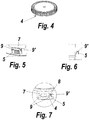
Figure 4 represents another perspective view of the lid according to the embodiment shown in the preceding drawings, it now being a top view perimetrally showing the tongue or lug thereof disposed in its perimeter skirt. -
Figure 5 is an enlarged detail of the portion of the retaining device offigure 3 . -
Figure 6 is a cross-section of the retention and guarantee device of the previous figure, showing its main rupture zone and in which it can be appreciated its weakened portion that facilitates said rupture. -
Figure 7 is a cross-section of the container offigure 1 , showing enlarged the detail of the union of the container and the lid by the area of the guarantee closure between the cutting tongue and the retainer and security device. The different weakened areas of the device that facilitate its rupture and make it visible when it occurs can be appreciated. - The present invention consists of a container, of the type suitable for the collection of samples and for containing biological material or other, such as urine or others, food, medicines, cosmetics, etc., by making a container of relatively high capacity, for example 100 ml, and that incorporates closing means that cannot be avoided without breaking its integrity.
- The
container 1 of the invention consists of alid 2 and abottle 3. In the preferred embodiment shown in the drawings accompanying the present description, the bottle is formed by a more or less cylindrical plastic body, a straight cone-shaped frustum, having in its neck portion a filleting 6' configured to cooperate with anopposed filleting 6 present in thelid 2. - It is a segmented, discontinuous thread, without the need for a slide, with four threads or fillets, which has four inlets that provide a 90 ° closure, allowing quick opening and closing with a quarter turn. This constructive arrangement represents an easy machining, both in the final presentation of the product, and in the manufacturing stages of the container in which an easy extraction of the mold through a pressure plate is allowed, and where the negatives of the piece in the mold do not have to be released.
- As can be seen in
figure 3 and in greater detail, in the enlarged section offigure 7 , at least one retaining andsafety device 5 is arranged on the perimeter of the bottle. Thisdevice 5 provides a hollowinterior space 7 in which to fit, by locking thereof, a tongue, tab or cuttinglug 4 disposed in thelid 2. Thisdevice 5 is configured, in this preferred embodiment, showing a broad front surface, compared to the sides of the device, which is joined to the rest of the device by weakenedareas 9. On the side corresponding to the working direction or opening of the bottle it presents a weakened area 9' which facilitates the opening of the container. - For its part, the
lid 2 has at least onetongue 4, prismatic in shape, and emerging from the perimeter skirt of thelid 2; saidtongue 4 being configured to be able to be inserted into thehole 7 of the interior of at least one retaining andsecurity device 5. Thistongue 4 has a prismatic projection with a sharp leadingedge 8, this leadingsurface 8 being sharpened to facilitate the cutting of thedevice 5 through its weakened area 9', upon opening of thecontainer 1 by unscrewing thelid 2. When the rupture of thedevice 5 occurs, this rupture is sufficiently visible because said device is broken by several zones thanks to the different weakenedparts 9 and 9' of said strike ordevice 5. - In this way it is clearly shown that the contents of the container have not been opened until the moment of said rupture of the
retaining device 5. - Although the preferred embodiment shown in the drawings features only a
tongue 4 and a retaining andsecurity device 5, the invention is capable of being performed, thanks to the vertical mounting of thelid 2 against thebottle 3, with different combinations of thetongue assembly 4 anddevice 5. - In its preferred mode of use, the container is presented closed with the
lid 2 joined to thebottle 3. The particularity of the invention facilitates this presentation because the mechanization of the closing process of the container of the invention is easier, with a vertical downward movement of thelid 2 which threads thetongue 4 of saidlid 2 with theretaining device 5 of thebottle 3, closing it by pressure, than performing a threaded closure that would require the rotation of one part onto the other. - This closing movement without threading is possible in the present invention and is facilitated because the
thread 6 of thelid 2 of the container has a reduced threading, a segmented quarter turn, the perimeter skirt being sufficiently short and flexible so that the approach movement of thelid 2 to thebottle 3, overcomes due to its flexibility theopposed fillets 6 and 6' of the lid and the bottle. - This preferred embodiment provides a container with a guarantee of first use, without any addition whatsoever to the container of the invention. The
container 1 is presented closed to the user, with thelid 2 and thebottle 3 joined together, so that to use thecontainer 1 the retaining andguarantee device 5 must be broken by forcing an opening movement between thelid 2 and thebottle 3, that is, thelid 2 is to be rotated in relation to thebottle 3, this accordingly resulting in the breaking of saiddevice 5 due to the action of thetongue 4. - This method of use involves several advantages over other sample collection containers of the known art, since it does not require a sterile bag, it simplifies elements and avoids wastes in the use of the container. The rupture of the retaining and safety device is also carried out without the open portion of said
device 5 becoming detached from the body of thebottle 3, thereby also avoiding wastes in the use of the container. - Furthermore, in that preferred embodiment and if so desired, the
container 1 can be presented inside an airtight and hygienic bag to provide an additional guarantee of the perfect sterility and preservation of thecontainer 1, prior to its use. The invention contemplates the possibility of incorporating, if it is considered convenient, closing guarantee seals, according to the known art. - In another embodiment, the
lid 2 andbottle 3 can be presented separately and ready for use, even introduced in a bag or using individual bags forlid 2 andbottle 3, as a means to ensure the biological preservation of first use of the container. The user fills the container with the material and in a vertical downward movement of the lid, closes thecontainer 1 of the invention under pressure. With this action, the integrity of the content of the container is preserved until it is opened under controlled conditions of non-alteration or contamination of the contents. - In another preferred embodiment, there are a plurality of
tongues 4, preferably two, working in combination with a plurality of retaining andsafety devices 5, preferably two. This type of embodiments aim to simultaneously provide a guarantee of first use of the container and a guarantee of preservation of the content after it is collected. A plurality of closure assemblies,tongue 4 anddevice 5, allow the reuse of the container or to achieve an increased opening force as more than oneretaining device 5 must be broken. - In an embodiment, two to two, of lugs or
tongues tongues 4 can be different from the separation of saiddevices 5, in order to allow an alternative use of thetongues 4, to provide in one case the guarantee of first use and subsequently, by using the second set, a guarantee of integrity of the sample. - In another preferred embodiment not shown in the drawings, a
single tongue 4 is provided in thelid 2, while in thebottle 3 there are preferably twoclosing devices 5. This arrangement simultaneously allows a guarantee of first use of the container and a guarantee of integrity of the contents of the container once it has been filled. - The invention contemplates the possibility of using an individual bagging, pre-installed, for example, in order to make the preservation of the sterility of the
container 1 prior to its use more reliable, both of theclosed lid 2 andbottle 3 assembly, in the corresponding embodiments, and in other embodiments of each of the different elements of the container of the invention,lid 2 andbottle 3, individually. - In the same way, the invention is capable of incorporating closure and/or guarantee seals, according to the known technique.
- In different preferred configurations of the invention, the
container 1 is configured for the collection of samples, preferably biological, for further analysis; that is, it is airtight, sterile and delivered without any contaminants. - The bottle of the invention is capable of being made in different sizes, from small bottles of 40 ml, bottles of relatively high capacity, such as 100 ml, or of any suitable size.
- The material forming the
container 1 of the invention is HDPE (High Density Polyethylene), although any other material, preferably plastic, suitable for the storage of biological samples or other is possible and included within the invention. - The invention contemplates and is intended, in other preferred embodiments of the invention, not shown in the figures, to incorporate drain needles. In this type of known configurations, a device is provided in the
container 1 that incorporates a needle so that once the urine is deposited therein, a vacuum tube is introduced, with negative pressure inside it, inside the device, so that the urine is transferred from the bottle to the tube without having to open the latter. - The preferred use of the invention is to collect urine, although this is not a limitation on the inventive scope of the described container that can be used for the collection of any type of sample that requires a sterile container suitable for research and diagnose laboratories, quality control laboratories for the food industry, etc.
- The
container 1 is also suitable for use with different types of material to be contained, all comprised within the invention. For example, solid, liquid, semi-solid materials, etc. - Both the
bottle 3 and thelid 2 are capable of incorporating engravings, both internal and external, for example, indicating levels of filling of thebottle 3, information of the material of the container, etc. The outer surface of thebottle 3 can incorporate a grinded area in order to allow handmade annotations on the bottle. - The invention also contemplates the use of a means for marking the sample through a coded adhesive and even through an indelible means, for example, laser marking, which allows the integrity of the annotation on the
container 1 and even its incorporation into an automated processing system. - Additionally, in another possible embodiment of the present invention, the above-described container is used to contain substances of any kind, food, beverages, cosmetics, pharmaceuticals products, etc., and is presented to the user closed and packaging the material contained in the
container 1. In this way, a packaging of substances is obtained which incorporates alid closure 2 andbottle 3 which provides a first use guarantee in an economical and easy to manufacturecontainer 1, whose use does not generate wastes. - It is understood in the present case that such finish and form details that do not modify the essence of the present invention will be considered as variations thereof in accordance with the appended claims.
Claims (12)
- CONTAINER, of the type suitable for containing biological material or other, such as urine or others, food, medicines, cosmetics, in which said container (1) is formed by a lid (2) and a bottle (3), in that said bottle (3) of said container (1) incorporates at least one retaining device (5) arranged on the perimeter of said bottle (3), thereby enabling a hollow space (7) into which it fits, in a vertical downward movement of said lid (2), a tongue (4) arranged on the perimeter skirt of said lid (2), that closes the container,
CHARACTERIZED- in that said retaining device (5) has weakened areas (9) in the front area of said device and an especially a weakened area (9') on the side of said device coinciding with the direction of opening of the container (1) that are broken in the opening action of said container (1);- in that said tongue (4) of said lid (2) has a prismatic form, said tongue (4) having a leading edge (8). - CONTAINER according to claim 1, CHARACTERIZED in that said bottle (2) is formed by a plastic body, of a straight cone-shaped frustum, having in its neck part a fillet (6') configured to cooperate with an opposed fillet (6) present in said lid (2), both fillets (6 and 6') being segmented, with four threads or fillets providing four inputs, configured for a quick opening turn of a quarter turn.
- CONTAINER according to any one of the preceding claims, CHARACTERIZED in that said retaining device (5) has an approximately semi-rectangular shape, in cross section and parallel to the bottom of the bottle (3).
- CONTAINER according to the preceding claim, CHARACTERIZED in that said retaining device (5) has a broad front surface than the rest of the device and that is joined to the rest of said device (5) by means of said weakened areas (9).
- CONTAINER according to claim 1, CHARACTERIZED in that said leading edge (8) is sharp to facilitate the cutting of said device (5) through its weakened area (9').
- CONTAINER according to any one of the preceding claims, CHARACTERIZED in that said lid (2) has more than one tongue (4).
- CONTAINER according to the preceding claim, CHARACTERIZED in that said lid (2) has two tongues (4) displaced perimetrically at a distance different from that separating two retaining devices (5) arranged in said bottle (3).
- CONTAINER according to any one of the claims 1 to 6, CHARACTERIZED in that said lid (2) has a tongue (4) and said bottle (3) has two retaining devices (5).
- CONTAINER according to any one of the preceding claims, CHARACTERIZED in that both said bottle (3) and said lid (2) incorporate engravings, which can be both internal and external to its surface.
- CONTAINER according to any one of the preceding claims, CHARACTERIZED in that the outer surface of said bottle (3) incorporates a grinded area in order to allow manual annotations on said bottle.
- CONTAINER according to any one of the preceding claims, CHARACTERIZED in that said container (1) is capable of being marked by an indelible means, for example, by laser, which allows the integrity of the annotation on said container (1) and its use in an automated sample processing system.
- CONTAINER according to any one of the preceding claims, CHARACTERIZED in that said container (1) and/or said lid (2) and said bottle (3) is/are protected by an airtight bag.
Applications Claiming Priority (2)
| Application Number | Priority Date | Filing Date | Title |
|---|---|---|---|
| ES201700238A ES2686829B1 (en) | 2017-03-22 | 2017-03-22 | Container with warranty seal |
| PCT/ES2018/000023 WO2018172574A1 (en) | 2017-03-22 | 2018-03-21 | Container comprising a security seal |
Publications (4)
| Publication Number | Publication Date |
|---|---|
| EP3617087A1 true EP3617087A1 (en) | 2020-03-04 |
| EP3617087A4 EP3617087A4 (en) | 2021-03-31 |
| EP3617087B1 EP3617087B1 (en) | 2023-07-19 |
| EP3617087C0 EP3617087C0 (en) | 2023-07-19 |
Family
ID=63585073
Family Applications (1)
| Application Number | Title | Priority Date | Filing Date |
|---|---|---|---|
| EP18770565.2A Active EP3617087B1 (en) | 2017-03-22 | 2018-03-21 | Container comprising a security seal |
Country Status (4)
| Country | Link |
|---|---|
| EP (1) | EP3617087B1 (en) |
| ES (2) | ES2686829B1 (en) |
| MA (1) | MA49067A (en) |
| WO (1) | WO2018172574A1 (en) |
Family Cites Families (6)
| Publication number | Priority date | Publication date | Assignee | Title |
|---|---|---|---|---|
| US4646926A (en) * | 1984-03-20 | 1987-03-03 | Robert Linkletter Associates, Inc. | Tamper resistant & tamper evident closures |
| US4630743A (en) * | 1984-10-01 | 1986-12-23 | Sunbeam Plastics Corporation | Tamper indicating child resistant closure |
| US4934547A (en) | 1987-02-10 | 1990-06-19 | Helena Laboratories Corporation | Specimen collection container and non-removable cover |
| AR038867A1 (en) | 2002-03-07 | 2005-02-02 | Brasilata Embalagens Metalicas | PLASTIC COVER FOR CAN |
| US6931821B2 (en) * | 2003-07-29 | 2005-08-23 | Evergreen Industries, Inc. | Tamper evident vial cap and integrity assurance method |
| US8881988B2 (en) * | 2012-05-22 | 2014-11-11 | Tri State Distribution, Inc. | Method of providing custom information to users of pharmaceutical storage systems |
-
2017
- 2017-03-22 ES ES201700238A patent/ES2686829B1/en not_active Expired - Fee Related
-
2018
- 2018-03-21 MA MA049067A patent/MA49067A/en unknown
- 2018-03-21 WO PCT/ES2018/000023 patent/WO2018172574A1/en not_active Ceased
- 2018-03-21 ES ES18770565T patent/ES2951939T3/en active Active
- 2018-03-21 EP EP18770565.2A patent/EP3617087B1/en active Active
Also Published As
| Publication number | Publication date |
|---|---|
| ES2686829B1 (en) | 2019-07-30 |
| EP3617087B1 (en) | 2023-07-19 |
| EP3617087A4 (en) | 2021-03-31 |
| EP3617087C0 (en) | 2023-07-19 |
| MA49067A (en) | 2021-03-31 |
| ES2686829A1 (en) | 2018-10-22 |
| ES2951939T3 (en) | 2023-10-25 |
| WO2018172574A1 (en) | 2018-09-27 |
Similar Documents
| Publication | Publication Date | Title |
|---|---|---|
| US6173852B1 (en) | Container with cap having connector and spike | |
| AU2022202467B2 (en) | Connecting and container system | |
| US5464111A (en) | Closure for medication container | |
| EP3656694B1 (en) | Connecting and container system with inclined frangible line | |
| US8926582B2 (en) | Sealing cap for a body fluid container and a blood collection device | |
| US4620638A (en) | Cap for opening and extracting the contents of a vessel | |
| SE450567B (en) | CONTAINER CLOSURE | |
| AU2020227033A1 (en) | Connecting and container system | |
| EP3617087B1 (en) | Container comprising a security seal | |
| US20230056087A1 (en) | Hinged stopper | |
| GB2492586A (en) | Double Tamper Evident Seal | |
| AU2014256079A1 (en) | Container | |
| US20120273451A1 (en) | Angled piercing fliptop closure | |
| AU742134B2 (en) | Package | |
| US4056129A (en) | Closable sterile container | |
| EP1122185B1 (en) | Cap for container | |
| KR20220149375A (en) | After removing the sealing member, the blocking structure when the closure and the body of the container inlet are combined | |
| JP2017226459A (en) | Cap structure and packaging container using the same | |
| EP2371729B1 (en) | Hinged lid container | |
| US771017A (en) | Cap for bottles or other vessels. | |
| EP0242453A2 (en) | Metal cap with improved means for its partial or total removal, particularly for medicinal product containers | |
| EP3476762A1 (en) | Recipient with an improved mechanism for sealing, closing and opening | |
| CA3190254A1 (en) | Tool to seal a bottle neck by a stopper | |
| EP2213379A1 (en) | Closure for containers | |
| US612288A (en) | Non-refillable bottle |
Legal Events
| Date | Code | Title | Description |
|---|---|---|---|
| STAA | Information on the status of an ep patent application or granted ep patent |
Free format text: STATUS: THE INTERNATIONAL PUBLICATION HAS BEEN MADE |
|
| PUAI | Public reference made under article 153(3) epc to a published international application that has entered the european phase |
Free format text: ORIGINAL CODE: 0009012 |
|
| STAA | Information on the status of an ep patent application or granted ep patent |
Free format text: STATUS: REQUEST FOR EXAMINATION WAS MADE |
|
| 17P | Request for examination filed |
Effective date: 20191002 |
|
| AK | Designated contracting states |
Kind code of ref document: A1 Designated state(s): AL AT BE BG CH CY CZ DE DK EE ES FI FR GB GR HR HU IE IS IT LI LT LU LV MC MK MT NL NO PL PT RO RS SE SI SK SM TR |
|
| AX | Request for extension of the european patent |
Extension state: BA ME |
|
| RAV | Requested validation state of the european patent: fee paid |
Extension state: MA Effective date: 20191023 |
|
| DAX | Request for extension of the european patent (deleted) | ||
| RAV | Requested validation state of the european patent: fee paid |
Extension state: MA Effective date: 20191023 |
|
| A4 | Supplementary search report drawn up and despatched |
Effective date: 20210302 |
|
| RIC1 | Information provided on ipc code assigned before grant |
Ipc: B65D 55/02 20060101AFI20210224BHEP |
|
| STAA | Information on the status of an ep patent application or granted ep patent |
Free format text: STATUS: EXAMINATION IS IN PROGRESS |
|
| 17Q | First examination report despatched |
Effective date: 20211109 |
|
| GRAP | Despatch of communication of intention to grant a patent |
Free format text: ORIGINAL CODE: EPIDOSNIGR1 |
|
| STAA | Information on the status of an ep patent application or granted ep patent |
Free format text: STATUS: GRANT OF PATENT IS INTENDED |
|
| INTG | Intention to grant announced |
Effective date: 20230210 |
|
| GRAS | Grant fee paid |
Free format text: ORIGINAL CODE: EPIDOSNIGR3 |
|
| GRAA | (expected) grant |
Free format text: ORIGINAL CODE: 0009210 |
|
| STAA | Information on the status of an ep patent application or granted ep patent |
Free format text: STATUS: THE PATENT HAS BEEN GRANTED |
|
| AK | Designated contracting states |
Kind code of ref document: B1 Designated state(s): AL AT BE BG CH CY CZ DE DK EE ES FI FR GB GR HR HU IE IS IT LI LT LU LV MC MK MT NL NO PL PT RO RS SE SI SK SM TR |
|
| REG | Reference to a national code |
Ref country code: GB Ref legal event code: FG4D |
|
| REG | Reference to a national code |
Ref country code: CH Ref legal event code: EP |
|
| REG | Reference to a national code |
Ref country code: DE Ref legal event code: R096 Ref document number: 602018053661 Country of ref document: DE |
|
| REG | Reference to a national code |
Ref country code: IE Ref legal event code: FG4D |
|
| U01 | Request for unitary effect filed |
Effective date: 20230727 |
|
| U07 | Unitary effect registered |
Designated state(s): AT BE BG DE DK EE FI FR IT LT LU LV MT NL PT SE SI Effective date: 20230818 |
|
| REG | Reference to a national code |
Ref country code: ES Ref legal event code: FG2A Ref document number: 2951939 Country of ref document: ES Kind code of ref document: T3 Effective date: 20231025 |
|
| REG | Reference to a national code |
Ref country code: LT Ref legal event code: MG9D |
|
| PG25 | Lapsed in a contracting state [announced via postgrant information from national office to epo] |
Ref country code: GR Free format text: LAPSE BECAUSE OF FAILURE TO SUBMIT A TRANSLATION OF THE DESCRIPTION OR TO PAY THE FEE WITHIN THE PRESCRIBED TIME-LIMIT Effective date: 20231020 |
|
| PG25 | Lapsed in a contracting state [announced via postgrant information from national office to epo] |
Ref country code: IS Free format text: LAPSE BECAUSE OF FAILURE TO SUBMIT A TRANSLATION OF THE DESCRIPTION OR TO PAY THE FEE WITHIN THE PRESCRIBED TIME-LIMIT Effective date: 20231119 |
|
| PG25 | Lapsed in a contracting state [announced via postgrant information from national office to epo] |
Ref country code: RS Free format text: LAPSE BECAUSE OF FAILURE TO SUBMIT A TRANSLATION OF THE DESCRIPTION OR TO PAY THE FEE WITHIN THE PRESCRIBED TIME-LIMIT Effective date: 20230719 Ref country code: NO Free format text: LAPSE BECAUSE OF FAILURE TO SUBMIT A TRANSLATION OF THE DESCRIPTION OR TO PAY THE FEE WITHIN THE PRESCRIBED TIME-LIMIT Effective date: 20231019 Ref country code: IS Free format text: LAPSE BECAUSE OF FAILURE TO SUBMIT A TRANSLATION OF THE DESCRIPTION OR TO PAY THE FEE WITHIN THE PRESCRIBED TIME-LIMIT Effective date: 20231119 Ref country code: HR Free format text: LAPSE BECAUSE OF FAILURE TO SUBMIT A TRANSLATION OF THE DESCRIPTION OR TO PAY THE FEE WITHIN THE PRESCRIBED TIME-LIMIT Effective date: 20230719 Ref country code: GR Free format text: LAPSE BECAUSE OF FAILURE TO SUBMIT A TRANSLATION OF THE DESCRIPTION OR TO PAY THE FEE WITHIN THE PRESCRIBED TIME-LIMIT Effective date: 20231020 |
|
| PG25 | Lapsed in a contracting state [announced via postgrant information from national office to epo] |
Ref country code: PL Free format text: LAPSE BECAUSE OF FAILURE TO SUBMIT A TRANSLATION OF THE DESCRIPTION OR TO PAY THE FEE WITHIN THE PRESCRIBED TIME-LIMIT Effective date: 20230719 |
|
| U20 | Renewal fee for the european patent with unitary effect paid |
Year of fee payment: 7 Effective date: 20240308 |
|
| REG | Reference to a national code |
Ref country code: DE Ref legal event code: R097 Ref document number: 602018053661 Country of ref document: DE |
|
| PG25 | Lapsed in a contracting state [announced via postgrant information from national office to epo] |
Ref country code: SM Free format text: LAPSE BECAUSE OF FAILURE TO SUBMIT A TRANSLATION OF THE DESCRIPTION OR TO PAY THE FEE WITHIN THE PRESCRIBED TIME-LIMIT Effective date: 20230719 Ref country code: RO Free format text: LAPSE BECAUSE OF FAILURE TO SUBMIT A TRANSLATION OF THE DESCRIPTION OR TO PAY THE FEE WITHIN THE PRESCRIBED TIME-LIMIT Effective date: 20230719 Ref country code: CZ Free format text: LAPSE BECAUSE OF FAILURE TO SUBMIT A TRANSLATION OF THE DESCRIPTION OR TO PAY THE FEE WITHIN THE PRESCRIBED TIME-LIMIT Effective date: 20230719 Ref country code: SK Free format text: LAPSE BECAUSE OF FAILURE TO SUBMIT A TRANSLATION OF THE DESCRIPTION OR TO PAY THE FEE WITHIN THE PRESCRIBED TIME-LIMIT Effective date: 20230719 |
|
| PLBE | No opposition filed within time limit |
Free format text: ORIGINAL CODE: 0009261 |
|
| STAA | Information on the status of an ep patent application or granted ep patent |
Free format text: STATUS: NO OPPOSITION FILED WITHIN TIME LIMIT |
|
| 26N | No opposition filed |
Effective date: 20240422 |
|
| REG | Reference to a national code |
Ref country code: CH Ref legal event code: PL |
|
| PG25 | Lapsed in a contracting state [announced via postgrant information from national office to epo] |
Ref country code: MC Free format text: LAPSE BECAUSE OF FAILURE TO SUBMIT A TRANSLATION OF THE DESCRIPTION OR TO PAY THE FEE WITHIN THE PRESCRIBED TIME-LIMIT Effective date: 20230719 |
|
| PG25 | Lapsed in a contracting state [announced via postgrant information from national office to epo] |
Ref country code: MC Free format text: LAPSE BECAUSE OF FAILURE TO SUBMIT A TRANSLATION OF THE DESCRIPTION OR TO PAY THE FEE WITHIN THE PRESCRIBED TIME-LIMIT Effective date: 20230719 |
|
| PG25 | Lapsed in a contracting state [announced via postgrant information from national office to epo] |
Ref country code: IE Free format text: LAPSE BECAUSE OF NON-PAYMENT OF DUE FEES Effective date: 20240321 |
|
| PG25 | Lapsed in a contracting state [announced via postgrant information from national office to epo] |
Ref country code: IE Free format text: LAPSE BECAUSE OF NON-PAYMENT OF DUE FEES Effective date: 20240321 Ref country code: CH Free format text: LAPSE BECAUSE OF NON-PAYMENT OF DUE FEES Effective date: 20240331 |
|
| U20 | Renewal fee for the european patent with unitary effect paid |
Year of fee payment: 8 Effective date: 20250325 |
|
| PG25 | Lapsed in a contracting state [announced via postgrant information from national office to epo] |
Ref country code: CY Free format text: LAPSE BECAUSE OF FAILURE TO SUBMIT A TRANSLATION OF THE DESCRIPTION OR TO PAY THE FEE WITHIN THE PRESCRIBED TIME-LIMIT; INVALID AB INITIO Effective date: 20180321 |
|
| PG25 | Lapsed in a contracting state [announced via postgrant information from national office to epo] |
Ref country code: HU Free format text: LAPSE BECAUSE OF FAILURE TO SUBMIT A TRANSLATION OF THE DESCRIPTION OR TO PAY THE FEE WITHIN THE PRESCRIBED TIME-LIMIT; INVALID AB INITIO Effective date: 20180321 |
|
| VS25 | Lapsed in a validation state [announced via postgrant information from nat. office to epo] |
Ref country code: MA Free format text: FAILURE TO ELECT DOMICILE IN THE NATIONAL COUNTRY Effective date: 20231020 |
|
| PG25 | Lapsed in a contracting state [announced via postgrant information from national office to epo] |
Ref country code: TR Free format text: LAPSE BECAUSE OF FAILURE TO SUBMIT A TRANSLATION OF THE DESCRIPTION OR TO PAY THE FEE WITHIN THE PRESCRIBED TIME-LIMIT Effective date: 20230719 |
|
| U20 | Renewal fee for the european patent with unitary effect paid |
Year of fee payment: 9 Effective date: 20260203 |
|
| PGFP | Annual fee paid to national office [announced via postgrant information from national office to epo] |
Ref country code: GB Payment date: 20260316 Year of fee payment: 9 |
|
| PGFP | Annual fee paid to national office [announced via postgrant information from national office to epo] |
Ref country code: ES Payment date: 20260429 Year of fee payment: 9 |