EP3614600B1 - Data transmission method and device - Google Patents
Data transmission method and device Download PDFInfo
- Publication number
- EP3614600B1 EP3614600B1 EP18795065.4A EP18795065A EP3614600B1 EP 3614600 B1 EP3614600 B1 EP 3614600B1 EP 18795065 A EP18795065 A EP 18795065A EP 3614600 B1 EP3614600 B1 EP 3614600B1
- Authority
- EP
- European Patent Office
- Prior art keywords
- sending
- time domain
- manner
- transport block
- domain resource
- Prior art date
- Legal status (The legal status is an assumption and is not a legal conclusion. Google has not performed a legal analysis and makes no representation as to the accuracy of the status listed.)
- Active
Links
Images



Classifications
-
- H—ELECTRICITY
- H04—ELECTRIC COMMUNICATION TECHNIQUE
- H04L—TRANSMISSION OF DIGITAL INFORMATION, e.g. TELEGRAPHIC COMMUNICATION
- H04L1/00—Arrangements for detecting or preventing errors in the information received
- H04L1/12—Arrangements for detecting or preventing errors in the information received by using return channel
- H04L1/16—Arrangements for detecting or preventing errors in the information received by using return channel in which the return channel carries supervisory signals, e.g. repetition request signals
- H04L1/18—Automatic repetition systems, e.g. Van Duuren systems
- H04L1/1812—Hybrid protocols; Hybrid automatic repeat request [HARQ]
-
- H—ELECTRICITY
- H04—ELECTRIC COMMUNICATION TECHNIQUE
- H04L—TRANSMISSION OF DIGITAL INFORMATION, e.g. TELEGRAPHIC COMMUNICATION
- H04L1/00—Arrangements for detecting or preventing errors in the information received
- H04L1/0001—Systems modifying transmission characteristics according to link quality, e.g. power backoff
- H04L1/0009—Systems modifying transmission characteristics according to link quality, e.g. power backoff by adapting the channel coding
-
- H—ELECTRICITY
- H04—ELECTRIC COMMUNICATION TECHNIQUE
- H04L—TRANSMISSION OF DIGITAL INFORMATION, e.g. TELEGRAPHIC COMMUNICATION
- H04L1/00—Arrangements for detecting or preventing errors in the information received
- H04L1/12—Arrangements for detecting or preventing errors in the information received by using return channel
- H04L1/16—Arrangements for detecting or preventing errors in the information received by using return channel in which the return channel carries supervisory signals, e.g. repetition request signals
- H04L1/18—Automatic repetition systems, e.g. Van Duuren systems
- H04L1/1812—Hybrid protocols; Hybrid automatic repeat request [HARQ]
- H04L1/1819—Hybrid protocols; Hybrid automatic repeat request [HARQ] with retransmission of additional or different redundancy
-
- H—ELECTRICITY
- H04—ELECTRIC COMMUNICATION TECHNIQUE
- H04L—TRANSMISSION OF DIGITAL INFORMATION, e.g. TELEGRAPHIC COMMUNICATION
- H04L1/00—Arrangements for detecting or preventing errors in the information received
- H04L1/0001—Systems modifying transmission characteristics according to link quality, e.g. power backoff
- H04L1/0015—Systems modifying transmission characteristics according to link quality, e.g. power backoff characterised by the adaptation strategy
- H04L1/0017—Systems modifying transmission characteristics according to link quality, e.g. power backoff characterised by the adaptation strategy where the mode-switching is based on Quality of Service requirement
- H04L1/0018—Systems modifying transmission characteristics according to link quality, e.g. power backoff characterised by the adaptation strategy where the mode-switching is based on Quality of Service requirement based on latency requirement
-
- H—ELECTRICITY
- H04—ELECTRIC COMMUNICATION TECHNIQUE
- H04L—TRANSMISSION OF DIGITAL INFORMATION, e.g. TELEGRAPHIC COMMUNICATION
- H04L1/00—Arrangements for detecting or preventing errors in the information received
- H04L1/08—Arrangements for detecting or preventing errors in the information received by repeating transmission, e.g. Verdan system
-
- H—ELECTRICITY
- H04—ELECTRIC COMMUNICATION TECHNIQUE
- H04L—TRANSMISSION OF DIGITAL INFORMATION, e.g. TELEGRAPHIC COMMUNICATION
- H04L1/00—Arrangements for detecting or preventing errors in the information received
- H04L1/12—Arrangements for detecting or preventing errors in the information received by using return channel
- H04L1/16—Arrangements for detecting or preventing errors in the information received by using return channel in which the return channel carries supervisory signals, e.g. repetition request signals
- H04L1/1607—Details of the supervisory signal
-
- H—ELECTRICITY
- H04—ELECTRIC COMMUNICATION TECHNIQUE
- H04L—TRANSMISSION OF DIGITAL INFORMATION, e.g. TELEGRAPHIC COMMUNICATION
- H04L1/00—Arrangements for detecting or preventing errors in the information received
- H04L1/12—Arrangements for detecting or preventing errors in the information received by using return channel
- H04L1/16—Arrangements for detecting or preventing errors in the information received by using return channel in which the return channel carries supervisory signals, e.g. repetition request signals
- H04L1/1607—Details of the supervisory signal
- H04L1/1614—Details of the supervisory signal using bitmaps
-
- H—ELECTRICITY
- H04—ELECTRIC COMMUNICATION TECHNIQUE
- H04L—TRANSMISSION OF DIGITAL INFORMATION, e.g. TELEGRAPHIC COMMUNICATION
- H04L1/00—Arrangements for detecting or preventing errors in the information received
- H04L1/12—Arrangements for detecting or preventing errors in the information received by using return channel
- H04L1/16—Arrangements for detecting or preventing errors in the information received by using return channel in which the return channel carries supervisory signals, e.g. repetition request signals
- H04L1/18—Automatic repetition systems, e.g. Van Duuren systems
- H04L1/1809—Selective-repeat protocols
-
- H—ELECTRICITY
- H04—ELECTRIC COMMUNICATION TECHNIQUE
- H04L—TRANSMISSION OF DIGITAL INFORMATION, e.g. TELEGRAPHIC COMMUNICATION
- H04L1/00—Arrangements for detecting or preventing errors in the information received
- H04L1/12—Arrangements for detecting or preventing errors in the information received by using return channel
- H04L1/16—Arrangements for detecting or preventing errors in the information received by using return channel in which the return channel carries supervisory signals, e.g. repetition request signals
- H04L1/18—Automatic repetition systems, e.g. Van Duuren systems
- H04L1/1829—Arrangements specially adapted for the receiver end
- H04L1/1854—Scheduling and prioritising arrangements
-
- H—ELECTRICITY
- H04—ELECTRIC COMMUNICATION TECHNIQUE
- H04L—TRANSMISSION OF DIGITAL INFORMATION, e.g. TELEGRAPHIC COMMUNICATION
- H04L1/00—Arrangements for detecting or preventing errors in the information received
- H04L1/12—Arrangements for detecting or preventing errors in the information received by using return channel
- H04L1/16—Arrangements for detecting or preventing errors in the information received by using return channel in which the return channel carries supervisory signals, e.g. repetition request signals
- H04L1/18—Automatic repetition systems, e.g. Van Duuren systems
- H04L1/1829—Arrangements specially adapted for the receiver end
- H04L1/1861—Physical mapping arrangements
-
- H—ELECTRICITY
- H04—ELECTRIC COMMUNICATION TECHNIQUE
- H04L—TRANSMISSION OF DIGITAL INFORMATION, e.g. TELEGRAPHIC COMMUNICATION
- H04L1/00—Arrangements for detecting or preventing errors in the information received
- H04L1/12—Arrangements for detecting or preventing errors in the information received by using return channel
- H04L1/16—Arrangements for detecting or preventing errors in the information received by using return channel in which the return channel carries supervisory signals, e.g. repetition request signals
- H04L1/18—Automatic repetition systems, e.g. Van Duuren systems
- H04L1/1829—Arrangements specially adapted for the receiver end
- H04L1/1864—ARQ related signaling
-
- H—ELECTRICITY
- H04—ELECTRIC COMMUNICATION TECHNIQUE
- H04L—TRANSMISSION OF DIGITAL INFORMATION, e.g. TELEGRAPHIC COMMUNICATION
- H04L1/00—Arrangements for detecting or preventing errors in the information received
- H04L1/12—Arrangements for detecting or preventing errors in the information received by using return channel
- H04L1/16—Arrangements for detecting or preventing errors in the information received by using return channel in which the return channel carries supervisory signals, e.g. repetition request signals
- H04L1/18—Automatic repetition systems, e.g. Van Duuren systems
- H04L1/1867—Arrangements specially adapted for the transmitter end
- H04L1/1893—Physical mapping arrangements
-
- H—ELECTRICITY
- H04—ELECTRIC COMMUNICATION TECHNIQUE
- H04L—TRANSMISSION OF DIGITAL INFORMATION, e.g. TELEGRAPHIC COMMUNICATION
- H04L1/00—Arrangements for detecting or preventing errors in the information received
- H04L1/12—Arrangements for detecting or preventing errors in the information received by using return channel
- H04L1/16—Arrangements for detecting or preventing errors in the information received by using return channel in which the return channel carries supervisory signals, e.g. repetition request signals
- H04L1/18—Automatic repetition systems, e.g. Van Duuren systems
- H04L1/1867—Arrangements specially adapted for the transmitter end
- H04L1/1896—ARQ related signaling
-
- H—ELECTRICITY
- H04—ELECTRIC COMMUNICATION TECHNIQUE
- H04L—TRANSMISSION OF DIGITAL INFORMATION, e.g. TELEGRAPHIC COMMUNICATION
- H04L5/00—Arrangements affording multiple use of the transmission path
- H04L5/003—Arrangements for allocating sub-channels of the transmission path
- H04L5/0053—Allocation of signalling, i.e. of overhead other than pilot signals
- H04L5/0055—Physical resource allocation for ACK/NACK
-
- H—ELECTRICITY
- H04—ELECTRIC COMMUNICATION TECHNIQUE
- H04W—WIRELESS COMMUNICATION NETWORKS
- H04W28/00—Network traffic management; Network resource management
- H04W28/02—Traffic management, e.g. flow control or congestion control
- H04W28/06—Optimizing the usage of the radio link, e.g. header compression, information sizing, discarding information
-
- H—ELECTRICITY
- H04—ELECTRIC COMMUNICATION TECHNIQUE
- H04L—TRANSMISSION OF DIGITAL INFORMATION, e.g. TELEGRAPHIC COMMUNICATION
- H04L1/00—Arrangements for detecting or preventing errors in the information received
- H04L1/0001—Systems modifying transmission characteristics according to link quality, e.g. power backoff
- H04L1/0023—Systems modifying transmission characteristics according to link quality, e.g. power backoff characterised by the signalling
- H04L1/0026—Transmission of channel quality indication
-
- H—ELECTRICITY
- H04—ELECTRIC COMMUNICATION TECHNIQUE
- H04W—WIRELESS COMMUNICATION NETWORKS
- H04W68/00—User notification, e.g. alerting and paging, for incoming communication, change of service or the like
-
- H—ELECTRICITY
- H04—ELECTRIC COMMUNICATION TECHNIQUE
- H04W—WIRELESS COMMUNICATION NETWORKS
- H04W72/00—Local resource management
- H04W72/04—Wireless resource allocation
- H04W72/044—Wireless resource allocation based on the type of the allocated resource
- H04W72/0446—Resources in time domain, e.g. slots or frames
Definitions
- This application relates to the communication field, and more specifically, to a method and device for transmitting data.
- a transmit end and a receive end receive or send a transport block in a default hybrid automatic repeat request (Hybrid Automatic Repeat reQuest, HARQ) sending manner. Specifically, after sending the transport block, the transmit end waits for feedback information that is sent by the receive end and that is used to indicate whether the transport block is received correctly. Then, based on the feedback information, the transmit end determines whether hybrid automatic repeat request (Hybrid Automatic Repeat reQuest, HARQ) retransmission needs to be performed for the transport block.
- Hybrid Automatic Repeat reQuest Hybrid Automatic Repeat reQuest
- WO 2017/031646 A1 describes a communications method including: determining, by a base station, a feedback manner of HARQ feedback information of user equipment, where the feedback manner includes: feeding back the HARQ feedback information, or skipping feeding back the HARQ feedback information.
- the base station determines first signaling according to the feedback manner of the HARQ feedback information, where the first signaling implicitly indicates the feedback manner of the HARQ feedback information.
- EP 3 518 447 A1 describes a data transmission method to meet reliability and latency requirements. The method includes: determining, by an access network device, a transmission mode of service data, where the transmission mode includes a one-time transmission mode and an automatic repeat transmission mode; sending, by the access network device, first indication information to a terminal device, where the first indication information indicates the determined transmission mode; and sending, by the access network device, the service data to the terminal device using the determined transmission mode.
- US 2013/051272 A1 anticipates a receiving node that makes an early estimate of the outcome of a decoding attempt and that sends a corresponding early feedback to the sending node. This has an effect of enabling a fast retransmission of the data by the sending node in case the decoding by the receiving node is likely to fail. An advantage of this is that any delays due to data retransmission may be minimized, resulting in a higher average throughput of the data transmission between the nodes.
- This application provides a method for transmitting data, which is advantageous to improving data transmission efficiency.
- a method for transmitting data according to claim 1 is provided.
- this application provides an apparatus according to claim 14.
- this application provides a computer program product according to claim 13.
- the first sending manner for sending the first transport block is flexibly determined, and the first sending manner is indicated to the second device through the indication information.
- This solution is advantageous to flexibly selecting a sending manner by the first device and the second device, and is further advantageous to improving data transmission efficiency.
- a network device is an apparatus that is deployed in a radio access network and that is configured to provide a radio communication function for a terminal device.
- the network device may include a base station, a macro base station, a micro base station (also referred to as a small cell), a relay station, an access point, or the like in various forms.
- a device having a base station function may have different names in systems using different radio access technologies.
- a network device may be an access point (Access Point, AP) in a WLAN, or may be a base transceiver station (Base Transceiver Station, BTS) in GSM or CDMA, or may be an evolved NodeB (evolved NodeB, eNB or eNodeB) in an LTE system.
- a network device may be a NodeB (Node B) in a 3rd generation (3rd Generation, 3G) system.
- the network device may alternatively be a relay station, an access point, a vehicular device, a wearable device, a network device in a future 5G network, a network device in a future evolved PLMN network, or the like.
- a network device may be an access point (Access Point, AP) in a WLAN, or may be a base transceiver station (Base Transceiver Station, BTS) in GSM or CDMA, or may be an evolved NodeB (evolved NodeB, eNB or
- a terminal device may also be referred to as user equipment (User Equipment, UE), an access terminal, a subscriber unit (subscriber unit), a subscriber station, a mobile, a mobile station (Mobile Station, MS), a remote station, a remote terminal, a mobile device, a user terminal, a terminal (Terminal), a radio communication device, a user agent, or a user apparatus.
- UE user equipment
- UE user equipment
- access terminal a subscriber unit (subscriber unit), a subscriber station, a mobile, a mobile station (Mobile Station, MS), a remote station, a remote terminal, a mobile device, a user terminal, a terminal (Terminal), a radio communication device, a user agent, or a user apparatus.
- the terminal device included in the embodiments of this application may include various handheld devices having a radio communication function, a vehicular device, a wearable device, a computing device, or another processing device connected to a wireless modem.
- the terminal device may alternatively include a subscriber unit, a cellular phone (cellular phone), a smartphone (smart phone), a wireless data card, a personal digital assistant (Personal Digital Assistant, PDA) computer, a tablet computer, a wireless modem (modem), a handheld device (handset), a laptop computer (laptop computer), a machine type communication (Machine Type Communication, MTC) terminal, or a station (STATION, ST) in a wireless local area network (wireless local area networks, WLAN).
- the terminal device may be a cellular phone, a cordless telephone, a Session Initiation Protocol (Session Initiation Protocol, SIP) telephone, a wireless local loop (wireless local loop, WLL) station, a terminal device in a next-generation communication system, for example, in a fifth-generation (fifth-generation, 5G) communication network, or a terminal device in a future evolved public land mobile network (Public Land Mobile Network, PLMN) network.
- SIP Session Initiation Protocol
- WLL wireless local loop
- 5G fifth-generation
- PLMN Public Land Mobile Network
- FIG. 1 is a schematic interaction diagram of a method for transmitting data according to an embodiment of this application. It should be understood that FIG. 1 shows detailed steps or operations of the method for transmitting data, but the steps or operations are merely used as an example, and other operations or transformations of various operations in FIG. 1 may be further performed in this embodiment of this application.
- the method 100 is performed by a first device and a second device.
- the first device may be a network device, and the second device may be a terminal device; or the first device may be a terminal device, and the second device may be a network device.
- the method 100 includes 110 and 120.
- the first device sends indication information to the second device, and correspondingly, the second device receives the indication information sent by the first device, where the indication information indicates a first sending manner for a first transport block, and the first sending manner is one of at least two sending manners.
- the first device sends the first transport block based on the first sending manner, and correspondingly, the second device detects the first transport block based on the first sending manner.
- the transport block in this embodiment of this application is similar to a TB (Transport Block, TB) in an LTE system.
- One transport block is one data block that includes a MAC PDU, and the data block may be transmitted in one TTI.
- the first device may (for example, based on some conditions) determine the first sending manner, and the first device may indicate the first sending manner to the second device after determining the first sending manner, to enable the first device and the second device to perform data transmission based on the first sending manner.
- the first device may determine the first sending manner, the first sending manner is one of the at least two sending manners, and the first device communicates with the second device based on the first sending manner.
- the method is advantageous to improving data transmission efficiency to meet different latency requirements.
- the first device may use an explicit indicator or an implicit indicator when indicating the first sending manner to a second terminal device through indication information.
- the indication information is used to indicate the first sending manner.
- a sending manner may correspond to some parameters.
- the first device sends the parameters
- the second device can determine the first sending manner after receiving the parameters.
- the parameters may include a parameter used to indicate channel quality, and may include a channel quality indicator CQI, a signal to interference plus noise ratio SINR, a signal to interference ratio SIR, a block error ratio (Block Error Ratio, BLER), or a modulation and coding scheme MCS level (the MCS may include a quantity of repetitions).
- 110 may include: sending, by the first device, the indication information to the second device through physical layer signaling; and correspondingly, receiving, by the second device through the physical layer signaling, the indication information sent by the first device.
- 110 and 120 may occur in different time domain units.
- the first device sends the indication information in a TTI #1, and sends the first transport block in a TTI #2, where the TTI #1 is before the TTI #2 in terms of time domain.
- 110 and the 120 may alternatively occur in a same time domain unit.
- the first device sends the indication information in a TTI #1, and sends the first transport block in the TTI #1.
- the time domain unit may be a unit of a time domain resource that can be scheduled.
- the time domain unit may be a transmission time interval (Transmission Time Interval, TTI) or a short transmission time interval (Short Transmission Time Interval, sTTI).
- TTI Transmission Time Interval
- sTTI Short Transmission Time Interval
- the domain unit may be a subframe (subframe), a slot (slot), a mini-slot (mini-slot), or a symbol, or may be a plurality of subframes, a plurality of slots, a plurality of mini-slots, or a plurality of symbols.
- the first sending manner may be determined by a network device, and be indicated to a terminal device through indication information. If the first transport block is uplink data, the first sending manner may be determined by a network device, and be indicated to a terminal device through indication information, or the first sending manner may be determined by a terminal device and be indicated to a network device through indication information.
- the first device sends the indication information to the second device, so that the first device and the second device communicate with each other in one sending manner of the at least two sending manners.
- the method 100 further includes: 101.
- the first device sends higher-layer signaling to the second device, where the higher-layer signaling indicates a sending manner set, and the sending manner set includes one or more sending manners in the at least two sending manners, and correspondingly, the second device receives the higher-layer signaling sent by the first device.
- the sending manner set in this embodiment of this application means that the higher-layer signaling indicates one or more sending manners, and shall not constitute any limitation on this application.
- the one or more sending manners may be in a table form or another form.
- the one or more sending manners indicated by the higher-layer signaling include the first sending manner.
- the higher-layer signaling may be radio resource control (Radio Resource Control, RRC) signaling.
- RRC Radio Resource Control
- the higher-layer signaling is used to indicate at least one type of the following information:
- the higher-layer signaling is used to indicate a time domain resource pattern corresponding to each sending manner in the sending manner set.
- One or more resources indicated by the time domain resource pattern are for a same transport block (that is, corresponding to the transport block).
- the time domain resource pattern may be a plurality of types of resources.
- a resource indicated by the time domain resource pattern may be one time domain unit (the one time domain unit may be one TTI).
- FIG. 2 is a schematic diagram of an example of a time domain resource pattern according to an embodiment of this application.
- a transport block corresponds to one time domain unit.
- a resource indicated by the time domain resource pattern may be a plurality of successive time domain units.
- FIG. 3 is a schematic diagram of another example of a time domain resource pattern according to an embodiment of this application.
- a same transport block corresponds to four successive time domain units.
- a resource indicated by the time domain resource pattern may be a plurality of non-successive time domain units. Further, the plurality of non-successive time domain units may further be partially non-successive or completely non-successive.
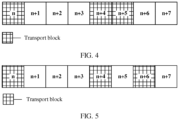
- FIG. 4 is a schematic diagram of still another example of a time domain resource pattern according to an embodiment of this application. As shown in FIG. 4 , the time domain resource pattern may include a plurality of time domain units for a same transport block, and some of the plurality of the time domain units are non-successive.
- FIG. 5 is a schematic diagram of yet another example of a time domain resource pattern according to an embodiment of this application. As shown in FIG. 5 , the time domain resource pattern may include a plurality of time domain units, and any two domain units in the plurality of time domain units are non-successive.
- the plurality of the non-successive time domain units may be evenly spaced or unevenly spaced, and this is not limited in this embodiment of this application.
- the higher-layer signaling may further indicate each time domain resource pattern in a plurality of manners.
- the higher-layer signaling indicates each time domain resource pattern through a bitmap (bitmap). That is, higher-layer signaling carries a bitmap, and different bitmaps correspond to different patterns. For example, a bitmap of 10000000 indicates the pattern shown in FIG. 2 , a bitmap of 11110000 indicates the pattern shown in FIG. 3 , and so on. Further, a length of a bitmap is further related to an average latency requirement, a longest latency requirement, a current transmission latency requirement, and/or a feedback latency.
- the higher-layer signaling may separately indicate a quantity of repetitions and a repetition interval for indicating each time domain resource pattern.
- the higher-layer signaling may indicate each time domain resource pattern by indicating a quantity of time domain units.
- the higher-layer signaling may indicate the time domain resource pattern shown in FIG. 2 by indicating that the quantity of time domain units is one.
- the higher-layer signaling may indicate the time domain resource pattern shown in FIG. 3 by indicating the quantity of the time domain units is four.
- the higher-layer signaling indicates the sending manner set by indicating a time domain resource pattern of each sending manner in the sending manner set. That is, each sending manner may correspond to a different time domain resource pattern, and the higher-layer signaling may indicate at least one sending manner by indicating at least one time domain resource pattern in a one-to-one correspondence manner.
- the higher-layer signaling may be used to indicate a feeding-back manner corresponding to each sending manner in the one or more sending manners.
- the feeding-back manner at least may include the following types:
- a first device sends a first transport block to a second device through at least one time domain unit. If the second device successfully receives the first transport block, the second device feeds back an ACK to the first device, and correspondingly, after receiving the ACK, the first device stops subsequently sending the first transport block.
- a first device may send a first transport block to a second device through N (N is greater than or equal to 1) time domain units. Regardless of whether the second device receives the first transport block, the second device does not need to feed back an ACK or a NACK.
- a first device may send a first transport block to a second device through at least one time domain unit. If the second device successfully receives the first transport block, the second device feeds back an ACK, or if the second device fails to receive the first transport block, the second device feeds back a NACK.
- the higher-layer signaling may indicate the sending manner set by indicating a feeding-back manner of each sending manner in the sending manner set. That is, each sending manner corresponds to a different feeding-back manner, and at least one sending manner indicated by the higher-layer signaling has a one-to-one correspondence with at least one feeding-back manner.
- the higher-layer signaling may be used to indicate the time domain resource pattern corresponding to each sending manner in the sending manner set and the feeding-back manner corresponding to each sending manner.
- Different sending manners may indicate different time domain resource patterns and/or different feeding-back manners.
- the sending manner in an embodiment of this application may include a plurality of types of sending manners.
- a HARQ manner a one-shot sending (one shot) manner, and a repeated sending (Repetition) manner may be included.
- the one-shot sending manner may mean that a first device sends a first transport block in N successive time domain units, and does not perform retransmission of the first transport block subsequently (for example, a time domain resource pattern of the one-shot sending manner may be shown in FIG. 3 ).
- the repeated sending manner means that a first device sends a first transport block in a plurality of reserved time domain units, and when receiving an ACK or a channel state information feedback, the first device stops sending the first transport block in a subsequent time domain unit (for example, a time domain resource pattern of the repeated sending manner may be shown in FIG. 4 ).
- retransmission may be performed.
- a resource for retransmission is rescheduled based on a NACK, and for the repeated sending manner, a resource for retransmission is reserved.
- different sending manners may correspond to different types.
- the at least two sending manners may include the HARQ, the one-shot sending manner, and the repeated sending manner. If the first sending manner indicates the repeated sending manner, the first device and the second device transmit the first transport block based on the HARQ.
- the first device may determine the first sending manner based on a plurality of factors.
- the first device may determine the sending manner set based on at least one of: channel quality between the first device and the second device, a service transmitted between the first device and the second device, a feedback latency of feedback information used to indicate whether a transport block is received correctly, a feedback latency of channel quality information, and a subcarrier spacing (or numerology) of a transport block between the first device and the second device.
- the first sending manner when in a range of a service latency requirement, transmission of Q retransmissions (for example, a maximum quantity of transmission times of a physical layer) can be supported, and there is a feedback resource, the first sending manner may be determined as the HARQ.
- the first sending manner When in a range of a service latency requirement, there is no time to provide a feedback (including a case caused by a lack of feedback resources), the first sending manner may be determined as the one-shot sending manner.
- transmission of Q retransmissions for example, a maximum quantity of transmission times of a physical layer
- the first sending manner may be determined as the repeated sending manner.
- a latency requirement of a service is 100 ms, in each millisecond of the 100 ms, in which the service is transmitted, there are enough downlink data resources and uplink feedback resources, and an interval between initial transmission and retransmission is 8 ms, it can be learned that the service can be repeatedly transmitted four times or more in the latency requirement, so that the first device determines the first sending manner as the HARQ.
- the first device determines the first sending manner as the repeated sending manner.
- the first network device may perform real-time scheduling upon arrival of the service, so that even the HARQ is adopted, there are still two transmission occasions. Therefore, the first device may determine the first sending manner as the HARQ. If the first device does not perform resource scheduling until 5/8 ms, the first device may determine the first sending manner as the one-shot sending manner. If the first device does not perform resource scheduling until 2/8 ms, the first device may determine the first sending manner as the repeated sending manner.
- different sending manners may correspond to different time domain resource patterns. Assuming that the at least two sending manners include the pattern shown in FIG. 3 and the pattern shown in FIG. 4 , and a service corresponding to a first transport block has a relatively short latency, the first device may determine the first sending manner as the sending manner #2 to reduce a transmission latency.
- the indication information may be used to indicate the first sending manner. Further, the indication information may be used to indicate another parameter, and the another parameter corresponds to the first sending manner.
- the first device may send indication information used to indicate an MCS level to the second device, where the MCS level corresponds to a sending manner, and the second device may determine a first sending manner based on the MCS level.
- the first device may determine the first sending manner based on a plurality of factors. Likewise, if the first device is a network device, the network device may configure different sending manner sets for a terminal device based on a plurality of factors.
- the first device may determine the sending manner set according to at least one of: channel quality between the first device and the second device, a service transmitted between the first device and the second device, a feedback latency of feedback information used to indicate whether a transport block is received correctly, a feedback latency of channel quality information, and a subcarrier spacing (or numerology) of a transport block between the first device and the second device.
- the network device may configure different sending manner sets for different terminal devices. For example, assuming that the network device configures sending manner sets for a terminal device #A and a terminal device #B, the terminal device #A is located in a central area of a cell, and the terminal device #B is located in an edge area of the cell. As shown in FIG. 6 , one sending manner set configured by the network device for the terminal device #A may include a sending manner #1 and a sending manner #2, and a sending manner set configured by the network device for the terminal device #B may include a sending manner #3 and a sending manner #4.
- the foregoing higher-layer signaling that is used to indicate a time domain resource pattern without indicating a feeding-back manner may be recorded as first higher-layer signaling.
- the method 100 may further include: 102.
- the first device sends second higher-layer signaling to the second device, where the second higher-layer signaling indicates a feeding-back manner set, and the feeding-back manner set includes at least one feeding-back manner, and correspondingly, the second device receives the second higher-layer signaling sent by the first device.
- the indication information may further be used to indicate a first feeding-back manner in the feeding-back manner set, where the first feeding-back manner may be a feeding-back manner corresponding to the first sending manner, or the first feeding-back manner may be a feeding-back manner selected by the first device based on some conditions or factors.
- 120 may include:
- the feedback information may include at least one of: first feedback information and second feedback information.
- the first feedback information is used to indicate that the first transport block is correctly received or the first transport block is not correctly received.
- the second feedback information is used to indicate channel quality of the first time domain resource.
- the second feedback information may include at least one type of the information, such as a CQI, a SINR, a SIR, an MCS level (may include information of a quantity of repetitions), and an absolute value or a bias value of a BLER, for indicating the channel quality.
- the second device may feed back an ACK, and the first device may stop sending the first transport block after receiving the ACK. If the second device skips detecting the first transport block, the second device may feed back a NACK, and after the first device receives the NACK, if a feeding-back manner corresponding to the first sending manner is the HARQ, the first device may transmit, based on scheduling, the first transport block on a k th time domain resource, where a value of k is related to a quantity of processes of the HARQ; and if a k th time domain unit in a time domain resource pattern corresponding to the first sending manner is a reserved time domain unit, the first device may send data on the kthtime domain unit.
- the first device may adjust a sending parameter based on the second feedback information, and send the first transport block on a second resource by using the adjusted parameter.
- the sending parameter includes at least one of: a modulation manner, a coding manner, and transmission duration.
- the first device may adjust the sending parameter based on the channel quality. This is advantageous to improving sending efficiency of the first transport block.
- 120 may include:
- the update indication information may be used to indicate adjusting or suspending transmission on the k th time domain resource after the first time domain resource.
- the update indication information may include at least one of transmission suspension information and MCS update information.
- the first device may send the update indication information to the second device based on factors such as channel quality and a service latency requirement.
- FIG. 7 is a schematic diagram of an example of a device for transmitting data according to an embodiment of this application.
- a device 200 for transmitting data is provided, where the device 200 includes: a transceiver unit 210.
- the transceiver unit 210 is configured to: send indication information to a second device, where the indication information indicates a first sending manner for a first transport block, and the first sending manner is one of at least two sending manners; and send the first transport block based on the first sending manner or receive the first transport block based on the first sending manner.
- the transceiver unit 210 is specifically configured to: send the indication information to the second device through a physical layer signaling.
- the transceiver unit 210 is further configured to: send higher-layer signaling to the second device, the higher-layer signaling indicates a sending manner set, the sending manner set includes one or more sending manners in the at least two sending manners, and the first sending manner is one of the one or more sending manners included in the sending manner set.
- the higher-layer signaling also indicates the sending manner set by indicating a time domain resource pattern of each sending manner in the one or more sending manners, and one or more resources indicated by the time domain resource pattern are for a same transport block.
- the higher-layer signaling indicates a time domain resource pattern of at least one sending manner in the one or more sending manners through a bitmap.
- the higher-layer signaling indicates the time domain resource pattern of the at least one sending manner in the one or more sending manners by indicating a quantity of time domain units.
- the higher-layer signaling is further used to indicate a feeding-back manner corresponding to each sending manner in the one or more sending manners, and the feeding-back manner includes performing ACK feeding-back and skipping performing NACK feeding-back, skipping performing ACK feeding-back and skipping performing NACK feeding-back, or performing ACK feeding-back and performing NACK feeding-back.
- the indication information is further used to indicate a first feeding-back manner corresponding to the first sending manner.
- the transceiver unit 210 is specifically configured to: send the first transport block to the second device on a first time domain resource based on the first sending manner; receive feedback information sent by the second device; and adjust or suspend transmission on a k th time domain resource after the first time domain resource based on the feedback information, where k is a positive integer greater than or equal to 2.
- the transceiver unit 210 is specifically configured to: send the first transport block to the second device on the first time domain resource based on the first sending manner; and send update indication information to the second device, where the update indication information is used to indicate adjusting or suspending transmission on the k th time domain resource after the first time domain resource, and k is a positive integer greater than or equal to 2.
- FIG. 8 is a schematic diagram of an example of a device for transmitting data according to an embodiment of this application.
- a device 300 for transmitting data is provided, where the device 300 includes: a transceiver unit 310, and the transceiver unit 310 is configured to: receive indication information sent by a first device, where the indication information indicates a first sending manner for a first transport block, and the first sending manner is one of at least two sending manners; and receive the first transport block based on the first sending manner, or send the first transport block based on the first sending manner.
- the transceiver unit 310 is specifically configured to: receive physical layer signaling, to receive the indication information sent by the first device.
- the transceiver unit 310 is further configured to: receive higher-layer signaling sent by the first device, the higher-layer signaling indicates a sending manner set, the sending manner set includes one or more sending manners in the at least two sending manners, and the first sending manner is one of the one or more sending manners included in the sending manner set.
- the higher-layer signaling also indicates the sending manner set by indicating a time domain resource pattern of each sending manner in the one or more sending manners, and one or more resources indicated by the time domain resource pattern are for a same transport block.
- the higher-layer signaling indicates a time domain resource pattern of at least one sending manner in the one or more sending manners through a bitmap.
- the higher-layer signaling indicates the time domain resource pattern of the at least one sending manner in the one or more sending manners by indicating a quantity of time domain units.
- the higher-layer signaling is further used to indicate a feeding-back manner corresponding to each sending manner in the one or more sending manners, and the feeding-back manner includes performing ACK feeding-back and skipping performing NACK feeding-back, skipping performing ACK feeding-back and skipping performing NACK feeding-back, or performing ACK feeding-back and performing NACK feeding-back.
- the indication information is further used to indicate a first feeding-back manner corresponding to the first sending manner.
- the transceiver unit 310 is specifically configured to: detect and/or measure, on the first time domain resource based on the first sending manner, the first transport block sent by the first device; and send feedback information to the first device based on at least one of a detection result and a measurement result.
- the transceiver unit 310 is specifically configured to: detect, on the first time domain resource based on the first sending manner, the first transport block sent by the first device; and receive update indication information sent by the first device, where the update indication information is used to indicate adjusting or suspending transmission on a k th time domain resource after the first time domain resource, and k is a positive integer greater than or equal to 2.
- FIG. 9 is a schematic diagram of another example of a device for transmitting data according to an embodiment of this application.
- a device 400 includes: one or more processors 401, one or more memories 402, and one or more transceivers (each transceiver includes a transmitter 403 and a receiver 404).
- the transmitter 403 or the receiver 404 is connected to one or more antennas 405, and transmits and receives signals through the antennas.
- the memory 402 stores a computer program instruction (or code).
- the processor 401 performs a computer program instruction stored in the memory 402, to implement corresponding procedures and/or operations performed by the first device in the method 100 for communication provided in this application. Details are not described herein again.
- the device 200 in FIG. 7 may be implemented by using the device 400 in FIG. 9 .
- a processing unit 210 shown in FIG. 7 may be implemented by the processor 401.
- a sending unit 201 may be specifically implemented by the transmitter 403, and a receiving unit 310 may be specifically implemented by the receiver 404.
- FIG. 10 is a schematic diagram of still another example of a device for transmitting data according to an embodiment of this application.
- a device 500 includes: one or more processors 501, one or more memories 502, and one or more transceivers (each transceiver includes a transmitter 503 and a receiver 504).
- the transmitter 503 or the receiver 504 is connected to one or more antennas 505, and transmits and receives signals through the antennas.
- the memory 502 stores a computer program instruction (or code).
- the processor 501 performs a computer program instruction stored in the memory 502, to implement corresponding procedures and/or operations performed by the second device in the method 100 for communication provided in this application. Details are not described herein again.
- the device 300 in FIG. 8 may be implemented by using the device 500 in FIG. 10 .
- a processing unit 310 shown in FIG. 3 may be implemented by the processor 501.
- a sending unit 310210 may be specifically implemented by the transmitter 503.
- a receiving unit may be specifically implemented by the receiver 504.
- a processor may be a central processing unit (Central Processing Unit, CPU), a microprocessor, an application-specific integrated circuit (Application-Specific Integrated Circuit, ASIC), or one or more integrated circuits that are configured to control performing a solution program in this application.
- the processor may include a digital signal processor device, a microprocessor device, an analog-to-digital converter, a digital-to-analog converter, or the like.
- the processor may allocate control and signal processing functions of mobile devices among the foregoing devices according to a function of each of the foregoing devices.
- a processor may include a function of operating one or more software programs, and the software programs may be stored in a memory.
- a memory may be a read only memory (Read Only Memory, ROM) or other types of static storage devices that may store static information and an instruction, or a random access memory (Random Access Memory, RAM) or other types of dynamic storage devices that may store information and an instruction, or may also be an electrically erasable programmable read-only memory (Electrically Erasable Programmable Read-Only Memory, EEPROM), a compact disc read-only memory (Compact Disc Read-Only Memory, CD-ROM) or other disc storage, an optical disc storage (including a compressed optical disc, a laser disc, an optical disc, a digital universal optical disc, a blue-ray optical disc, or the like), a magnetic disk storage or other magnetic storage devices, or any other medium that can be used to carry or storage an expected program code having an instruction or a data structure form and that may be read by a computer, but this is not limited herein.
- a memory may exist independently, or may be integrated with a processor.
- a transceiver may include, for example, an infrared transceiver, a using transceiver, a universal serial bus (Universal Serial Bus, USB) transceiver, a Bluetooth transceiver, or the like.
- a first device may use a corresponding communication technology to send information (or a signal) by using a transmitter and/or receive information (or a signal) by using a receiver.
- the disclosed system, apparatus, and method may be implemented in other manners.
- the described apparatus embodiment is merely an example.
- the unit division is merely logical function division and may be other division in actual implementation.
- a plurality of units or components may be combined or integrated into another system, or some features may be ignored or not performed.
- the displayed or discussed mutual couplings or direct couplings or communication connections may be implemented by using some interfaces.
- the indirect couplings or communication connections between the apparatuses or units may be implemented in electronic, mechanical, or other forms.
- the units described as separate parts may or may not be physically separate, and parts displayed as units may or may not be physical units, may be located in one position, or may be distributed on a plurality of network units. Some or all of the units may be selected based on actual requirements to achieve the objectives of the solutions of the embodiments.
- the functions When the functions are implemented in the form of a software functional unit and sold or used as an independent product, the functions may be stored in a computer-readable storage medium. Based on such an understanding, the technical solutions of this application essentially, or the part contributing to the prior art, or some of the technical solutions may be implemented in a form of a software product.
- the software product is stored in a storage medium, and includes several instructions for instructing a computer device (which may be a personal computer, a server, or a network device) to perform all or some of the steps of the methods described in the embodiments of this application.
- the foregoing storage medium includes: any medium that can store program code, such as a USB flash drive, a removable hard disk, a read-only memory (Read-Only Memory, ROM), a random access memory (Random Access Memory, RAM), a magnetic disk, or an optical disc.
- program code such as a USB flash drive, a removable hard disk, a read-only memory (Read-Only Memory, ROM), a random access memory (Random Access Memory, RAM), a magnetic disk, or an optical disc.
Landscapes
- Engineering & Computer Science (AREA)
- Signal Processing (AREA)
- Computer Networks & Wireless Communication (AREA)
- Quality & Reliability (AREA)
- Mobile Radio Communication Systems (AREA)
Description
- This application relates to the communication field, and more specifically, to a method and device for transmitting data.
- In the prior art, a transmit end and a receive end receive or send a transport block in a default hybrid automatic repeat request (Hybrid Automatic Repeat reQuest, HARQ) sending manner. Specifically, after sending the transport block, the transmit end waits for feedback information that is sent by the receive end and that is used to indicate whether the transport block is received correctly. Then, based on the feedback information, the transmit end determines whether hybrid automatic repeat request (Hybrid Automatic Repeat reQuest, HARQ) retransmission needs to be performed for the transport block.
- However, as mobile data traffic increases, there are massive mobile communication device connections, and various new services and application scenarios continuously emerge, a manner of transmitting a transport block based on the default HARQ sending manner is disadvantageous to efficient data transmission.
WO 2017/031646 A1 describes a communications method including: determining, by a base station, a feedback manner of HARQ feedback information of user equipment, where the feedback manner includes: feeding back the HARQ feedback information, or skipping feeding back the HARQ feedback information. The base station determines first signaling according to the feedback manner of the HARQ feedback information, where the first signaling implicitly indicates the feedback manner of the HARQ feedback information. Further, the base station sends the first signaling to the user equipment, so that the user equipment determines the feedback manner of the HARQ feedback information according to the first signaling.
EP 3 518 447 A1 -
US 2013/051272 A1 anticipates a receiving node that makes an early estimate of the outcome of a decoding attempt and that sends a corresponding early feedback to the sending node. This has an effect of enabling a fast retransmission of the data by the sending node in case the decoding by the receiving node is likely to fail. An advantage of this is that any delays due to data retransmission may be minimized, resulting in a higher average throughput of the data transmission between the nodes. - The invention is defined by the independent claims. Advantageous embodiments of the invention are given in the dependent claims.
- This application provides a method for transmitting data, which is advantageous to improving data transmission efficiency.
- According to a first aspect, a method for transmitting data according to
claim 1 is provided. - According to a second aspect, a method for transmitting data according to
claim 7 is provided. - According to a third aspect, this application provides an apparatus according to claim 14.
- According to a fourth aspect, this application provides a computer program product according to claim 13.
- In the technical solutions provided in this application, the first sending manner for sending the first transport block is flexibly determined, and the first sending manner is indicated to the second device through the indication information. This solution is advantageous to flexibly selecting a sending manner by the first device and the second device, and is further advantageous to improving data transmission efficiency.
-
-
FIG. 1 is a schematic interaction diagram of an example of a method for transmitting data according to an embodiment of this application; -
FIG. 2 is a schematic diagram of an example of a time domain resource pattern according to an embodiment of this application; -
FIG. 3 is a schematic diagram of another example of a time domain resource pattern according to an embodiment of this application; -
FIG. 4 is a schematic diagram of still another example of a time domain resource pattern according to an embodiment of this application; -
FIG. 5 is a schematic diagram of yet another example of a time domain resource pattern according to an embodiment of this application; -
FIG. 6 is a schematic diagram of yet another example of a time domain resource pattern according to an embodiment of this application; -
FIG. 7 is a schematic diagram of an example of a device for transmitting data according to an embodiment of this application; -
FIG. 8 is a schematic diagram of an example of a device for transmitting data according to an embodiment of this application; -
FIG. 9 is a schematic diagram of an example of a device for transmitting data according to an embodiment of this application; and -
FIG. 10 is a schematic diagram of an example of a device for transmitting data according to an embodiment of this application. - The following describes technical solutions of this application with reference to accompanying drawings.
- It should be understood that, division of manners, cases, and types in embodiments of this application is merely for the convenience of description, and should not constitute a particular limitation.
- It should also be understood that "first", "second", and "third" in the embodiments of this application are merely used for distinction, and shall not constitute any limitation on this application.
- In the embodiments of this application, a network device is an apparatus that is deployed in a radio access network and that is configured to provide a radio communication function for a terminal device. The network device may include a base station, a macro base station, a micro base station (also referred to as a small cell), a relay station, an access point, or the like in various forms. A device having a base station function may have different names in systems using different radio access technologies. For example, a network device may be an access point (Access Point, AP) in a WLAN, or may be a base transceiver station (Base Transceiver Station, BTS) in GSM or CDMA, or may be an evolved NodeB (evolved NodeB, eNB or eNodeB) in an LTE system. Alternatively, a network device may be a NodeB (Node B) in a 3rd generation (3rd Generation, 3G) system. In addition, the network device may alternatively be a relay station, an access point, a vehicular device, a wearable device, a network device in a future 5G network, a network device in a future evolved PLMN network, or the like. For ease of description, in all the embodiments of this application, all the foregoing apparatuses that provide a radio communication function for an MS are collectively referred to as a network device.
- In the embodiments of this application, a terminal device may also be referred to as user equipment (User Equipment, UE), an access terminal, a subscriber unit (subscriber unit), a subscriber station, a mobile, a mobile station (Mobile Station, MS), a remote station, a remote terminal, a mobile device, a user terminal, a terminal (Terminal), a radio communication device, a user agent, or a user apparatus.
- As an example rather than a limitation, the terminal device included in the embodiments of this application may include various handheld devices having a radio communication function, a vehicular device, a wearable device, a computing device, or another processing device connected to a wireless modem. The terminal device may alternatively include a subscriber unit, a cellular phone (cellular phone), a smartphone (smart phone), a wireless data card, a personal digital assistant (Personal Digital Assistant, PDA) computer, a tablet computer, a wireless modem (modem), a handheld device (handset), a laptop computer (laptop computer), a machine type communication (Machine Type Communication, MTC) terminal, or a station (STATION, ST) in a wireless local area network (wireless local area networks, WLAN). The terminal device may be a cellular phone, a cordless telephone, a Session Initiation Protocol (Session Initiation Protocol, SIP) telephone, a wireless local loop (wireless local loop, WLL) station, a terminal device in a next-generation communication system, for example, in a fifth-generation (fifth-generation, 5G) communication network, or a terminal device in a future evolved public land mobile network (Public Land Mobile Network, PLMN) network.
- With reference to
FIG. 1 to FIG. 4 , a method for sending data in an embodiment of this application is described below in detail. -
FIG. 1 is a schematic interaction diagram of a method for transmitting data according to an embodiment of this application. It should be understood thatFIG. 1 shows detailed steps or operations of the method for transmitting data, but the steps or operations are merely used as an example, and other operations or transformations of various operations inFIG. 1 may be further performed in this embodiment of this application. - The method 100 is performed by a first device and a second device. Optionally, in this embodiment of this application, the first device may be a network device, and the second device may be a terminal device; or the first device may be a terminal device, and the second device may be a network device.
- As shown in
FIG. 1 , the method 100 includes 110 and 120. - 110. The first device sends indication information to the second device, and correspondingly, the second device receives the indication information sent by the first device, where the indication information indicates a first sending manner for a first transport block, and the first sending manner is one of at least two sending manners.
- 120. The first device sends the first transport block based on the first sending manner, and correspondingly, the second device detects the first transport block based on the first sending manner.
- The transport block in this embodiment of this application is similar to a TB (Transport Block, TB) in an LTE system. One transport block is one data block that includes a MAC PDU, and the data block may be transmitted in one TTI.
- Specifically, the first device may (for example, based on some conditions) determine the first sending manner, and the first device may indicate the first sending manner to the second device after determining the first sending manner, to enable the first device and the second device to perform data transmission based on the first sending manner.
- Compared with transmitting a transport block by a transmit end and a receive end in a default HARQ sending manner in the prior art, in the method in this embodiment of this application, the first device may determine the first sending manner, the first sending manner is one of the at least two sending manners, and the first device communicates with the second device based on the first sending manner. The method is advantageous to improving data transmission efficiency to meet different latency requirements.
- The first device may use an explicit indicator or an implicit indicator when indicating the first sending manner to a second terminal device through indication information.
- Further, the indication information is used to indicate the first sending manner.
- In another optional example, a sending manner may correspond to some parameters. In this case, the first device sends the parameters, and the second device can determine the first sending manner after receiving the parameters. The parameters may include a parameter used to indicate channel quality, and may include a channel quality indicator CQI, a signal to interference plus noise ratio SINR, a signal to interference ratio SIR, a block error ratio (Block Error Ratio, BLER), or a modulation and coding scheme MCS level (the MCS may include a quantity of repetitions).
- Further, 110 may include: sending, by the first device, the indication information to the second device through physical layer signaling; and correspondingly, receiving, by the second device through the physical layer signaling, the indication information sent by the first device.
- It should be understood that 110 and 120 may occur in different time domain units. For example, the first device sends the indication information in a
TTI # 1, and sends the first transport block in aTTI # 2, where theTTI # 1 is before theTTI # 2 in terms of time domain. 110 and the 120 may alternatively occur in a same time domain unit. For example, the first device sends the indication information in aTTI # 1, and sends the first transport block in theTTI # 1. - It should be understood that the time domain unit may be a unit of a time domain resource that can be scheduled. The time domain unit may be a transmission time interval (Transmission Time Interval, TTI) or a short transmission time interval (Short Transmission Time Interval, sTTI). Further, the domain unit may be a subframe (subframe), a slot (slot), a mini-slot (mini-slot), or a symbol, or may be a plurality of subframes, a plurality of slots, a plurality of mini-slots, or a plurality of symbols.
- It should be understood that if the first transport block is downlink data, the first sending manner may be determined by a network device, and be indicated to a terminal device through indication information. If the first transport block is uplink data, the first sending manner may be determined by a network device, and be indicated to a terminal device through indication information, or the first sending manner may be determined by a terminal device and be indicated to a network device through indication information.
- It is described above that the first device sends the indication information to the second device, so that the first device and the second device communicate with each other in one sending manner of the at least two sending manners.
- Moreover, the method 100 further includes:
101. The first device sends higher-layer signaling to the second device, where the higher-layer signaling indicates a sending manner set, and the sending manner set includes one or more sending manners in the at least two sending manners, and correspondingly, the second device receives the higher-layer signaling sent by the first device. - It should be noted that the sending manner set in this embodiment of this application means that the higher-layer signaling indicates one or more sending manners, and shall not constitute any limitation on this application. For example, the one or more sending manners may be in a table form or another form.
- The one or more sending manners indicated by the higher-layer signaling include the first sending manner. Further, optionally, the higher-layer signaling may be radio resource control (Radio Resource Control, RRC) signaling.
- Further, the higher-layer signaling is used to indicate at least one type of the following information:
- The higher-layer signaling is used to indicate a time domain resource pattern corresponding to each sending manner in the sending manner set. One or more resources indicated by the time domain resource pattern are for a same transport block (that is, corresponding to the transport block). Using an example in which a unit of a resource indicated by the time domain resource pattern is a TTI, the time domain resource pattern may be a plurality of types of resources.
- For example, a resource indicated by the time domain resource pattern may be one time domain unit (the one time domain unit may be one TTI).
FIG. 2 is a schematic diagram of an example of a time domain resource pattern according to an embodiment of this application. In the time domain resource pattern shown inFIG. 2 , a transport block corresponds to one time domain unit. - For another example, a resource indicated by the time domain resource pattern may be a plurality of successive time domain units.
FIG. 3 is a schematic diagram of another example of a time domain resource pattern according to an embodiment of this application. In the time domain resource pattern shown inFIG. 3 , in the time domain resource pattern, a same transport block corresponds to four successive time domain units. - For still another example, a resource indicated by the time domain resource pattern may be a plurality of non-successive time domain units. Further, the plurality of non-successive time domain units may further be partially non-successive or completely non-successive. For example,
FIG. 4 is a schematic diagram of still another example of a time domain resource pattern according to an embodiment of this application. As shown inFIG. 4 , the time domain resource pattern may include a plurality of time domain units for a same transport block, and some of the plurality of the time domain units are non-successive.FIG. 5 is a schematic diagram of yet another example of a time domain resource pattern according to an embodiment of this application. As shown inFIG. 5 , the time domain resource pattern may include a plurality of time domain units, and any two domain units in the plurality of time domain units are non-successive. - It should be noted that the plurality of the non-successive time domain units may be evenly spaced or unevenly spaced, and this is not limited in this embodiment of this application.
- Further, the higher-layer signaling may further indicate each time domain resource pattern in a plurality of manners.
- The higher-layer signaling indicates each time domain resource pattern through a bitmap (bitmap). That is, higher-layer signaling carries a bitmap, and different bitmaps correspond to different patterns. For example, a bitmap of 10000000 indicates the pattern shown in
FIG. 2 , a bitmap of 11110000 indicates the pattern shown inFIG. 3 , and so on. Further, a length of a bitmap is further related to an average latency requirement, a longest latency requirement, a current transmission latency requirement, and/or a feedback latency. - For another example, the higher-layer signaling may separately indicate a quantity of repetitions and a repetition interval for indicating each time domain resource pattern.
- For still another example, the higher-layer signaling may indicate each time domain resource pattern by indicating a quantity of time domain units. For example, the higher-layer signaling may indicate the time domain resource pattern shown in
FIG. 2 by indicating that the quantity of time domain units is one. For another example, the higher-layer signaling may indicate the time domain resource pattern shown inFIG. 3 by indicating the quantity of the time domain units is four. - Additionally, the higher-layer signaling indicates the sending manner set by indicating a time domain resource pattern of each sending manner in the sending manner set. That is, each sending manner may correspond to a different time domain resource pattern, and the higher-layer signaling may indicate at least one sending manner by indicating at least one time domain resource pattern in a one-to-one correspondence manner.
- The higher-layer signaling may be used to indicate a feeding-back manner corresponding to each sending manner in the one or more sending manners. The feeding-back manner at least may include the following types:
- Perform ACK feeding-back and skip performing NACK feeding-back.
- In the feeding-back manner #A, a first device sends a first transport block to a second device through at least one time domain unit. If the second device successfully receives the first transport block, the second device feeds back an ACK to the first device, and correspondingly, after receiving the ACK, the first device stops subsequently sending the first transport block.
- Skip performing ACK feeding-back and skip performing NACK feeding-back.
- In the feeding-back manner #B, a first device may send a first transport block to a second device through N (N is greater than or equal to 1) time domain units. Regardless of whether the second device receives the first transport block, the second device does not need to feed back an ACK or a NACK.
- Perform ACK feeding-back and perform NACK feeding-back.
- In the feeding-back manner #C, a first device may send a first transport block to a second device through at least one time domain unit. If the second device successfully receives the first transport block, the second device feeds back an ACK, or if the second device fails to receive the first transport block, the second device feeds back a NACK.
- In another optional example, the higher-layer signaling may indicate the sending manner set by indicating a feeding-back manner of each sending manner in the sending manner set. That is, each sending manner corresponds to a different feeding-back manner, and at least one sending manner indicated by the higher-layer signaling has a one-to-one correspondence with at least one feeding-back manner.
- Optionally, in an embodiment of this application, the higher-layer signaling may be used to indicate the time domain resource pattern corresponding to each sending manner in the sending manner set and the feeding-back manner corresponding to each sending manner. Different sending manners may indicate different time domain resource patterns and/or different feeding-back manners.
- Optionally, the sending manner in an embodiment of this application may include a plurality of types of sending manners. For example, a HARQ manner, a one-shot sending (one shot) manner, and a repeated sending (Repetition) manner may be included.
- The one-shot sending manner may mean that a first device sends a first transport block in N successive time domain units, and does not perform retransmission of the first transport block subsequently (for example, a time domain resource pattern of the one-shot sending manner may be shown in
FIG. 3 ). - The repeated sending manner means that a first device sends a first transport block in a plurality of reserved time domain units, and when receiving an ACK or a channel state information feedback, the first device stops sending the first transport block in a subsequent time domain unit (for example, a time domain resource pattern of the repeated sending manner may be shown in
FIG. 4 ). - In both of the repeated sending manner and the HARQ, retransmission may be performed. However, for the HARQ, a resource for retransmission is rescheduled based on a NACK, and for the repeated sending manner, a resource for retransmission is reserved.
- In an optional example, in this embodiment of this application, different sending manners may correspond to different types. For example, the at least two sending manners may include the HARQ, the one-shot sending manner, and the repeated sending manner. If the first sending manner indicates the repeated sending manner, the first device and the second device transmit the first transport block based on the HARQ.
- Further, the first device may determine the first sending manner based on a plurality of factors. Optionally, the first device may determine the sending manner set based on at least one of: channel quality between the first device and the second device, a service transmitted between the first device and the second device, a feedback latency of feedback information used to indicate whether a transport block is received correctly, a feedback latency of channel quality information, and a subcarrier spacing (or numerology) of a transport block between the first device and the second device.
- For example, when in a range of a service latency requirement, transmission of Q retransmissions (for example, a maximum quantity of transmission times of a physical layer) can be supported, and there is a feedback resource, the first sending manner may be determined as the HARQ. When in a range of a service latency requirement, there is no time to provide a feedback (including a case caused by a lack of feedback resources), the first sending manner may be determined as the one-shot sending manner. When in a range of a service latency requirement, transmission of Q retransmissions (for example, a maximum quantity of transmission times of a physical layer) cannot be supported, and there is a feedback resource, the first sending manner may be determined as the repeated sending manner.
- For another example, when a latency requirement of a service is 100 ms, in each millisecond of the 100 ms, in which the service is transmitted, there are enough downlink data resources and uplink feedback resources, and an interval between initial transmission and retransmission is 8 ms, it can be learned that the service can be repeatedly transmitted four times or more in the latency requirement, so that the first device determines the first sending manner as the HARQ. When a service whose a latency requirement is 0.5 ms (four slots) is transmitted by using a resource whose slot = 1/8 ms, based on a typical transmission-feedback time sequence relationship (initial transmission occurs in a slot n, and feeding-back occurs in a slot n+3), initial transmission occurs in a first slot, and feeding-back occurs in a fourth slot. In this case, the latency requirement is met, that is, a maximum quantity of transmission times is reached, and the feeding-back does not save resources, so that the first device determines the first sending manner as the one-shot sending manner. When a service whose a latency requirement is 1 ms is transmitted by using a resource whose TTI = 1/8 ms, but there are enough downlink data resources and uplink feedback resources within 1 ms after service transmission is started, the first device determines the first sending manner as the repeated sending manner.
- For still another example, when a latency requirement of a service is 1 ms, in each 1/8 ms of the 1 ms, in which the service is transmitted, there are enough downlink data resources and uplink feedback resources, and an interval between initial transmission and retransmission is 6/8 ms, the first network device may perform real-time scheduling upon arrival of the service, so that even the HARQ is adopted, there are still two transmission occasions. Therefore, the first device may determine the first sending manner as the HARQ. If the first device does not perform resource scheduling until 5/8 ms, the first device may determine the first sending manner as the one-shot sending manner. If the first device does not perform resource scheduling until 2/8 ms, the first device may determine the first sending manner as the repeated sending manner.
- In another optional example, in this embodiment of this application, different sending manners may correspond to different time domain resource patterns. Assuming that the at least two sending manners include the pattern shown in
FIG. 3 and the pattern shown inFIG. 4 , and a service corresponding to a first transport block has a relatively short latency, the first device may determine the first sending manner as the sendingmanner # 2 to reduce a transmission latency. - It should be noted that the indication information may be used to indicate the first sending manner. Further, the indication information may be used to indicate another parameter, and the another parameter corresponds to the first sending manner. For example, the first device may send indication information used to indicate an MCS level to the second device, where the MCS level corresponds to a sending manner, and the second device may determine a first sending manner based on the MCS level.
- It is described above that the first device may determine the first sending manner based on a plurality of factors. Likewise, if the first device is a network device, the network device may configure different sending manner sets for a terminal device based on a plurality of factors.
- In an optional example, the first device may determine the sending manner set according to at least one of: channel quality between the first device and the second device, a service transmitted between the first device and the second device, a feedback latency of feedback information used to indicate whether a transport block is received correctly, a feedback latency of channel quality information, and a subcarrier spacing (or numerology) of a transport block between the first device and the second device.
- It should be understood that the network device may configure different sending manner sets for different terminal devices. For example, assuming that the network device configures sending manner sets for a terminal device #A and a terminal device #B, the terminal device #A is located in a central area of a cell, and the terminal device #B is located in an edge area of the cell. As shown in
FIG. 6 , one sending manner set configured by the network device for the terminal device #A may include a sendingmanner # 1 and a sendingmanner # 2, and a sending manner set configured by the network device for the terminal device #B may include a sendingmanner # 3 and a sendingmanner # 4. - Further, the foregoing higher-layer signaling that is used to indicate a time domain resource pattern without indicating a feeding-back manner may be recorded as first higher-layer signaling.
- The method 100 may further include:
102. The first device sends second higher-layer signaling to the second device, where the second higher-layer signaling indicates a feeding-back manner set, and the feeding-back manner set includes at least one feeding-back manner, and correspondingly, the second device receives the second higher-layer signaling sent by the first device. - The indication information may further be used to indicate a first feeding-back manner in the feeding-back manner set, where the first feeding-back manner may be a feeding-back manner corresponding to the first sending manner, or the first feeding-back manner may be a feeding-back manner selected by the first device based on some conditions or factors.
- In an optional example, 120 may include:
- sending, by the first device, the first transport block to the second device on the first time domain resource based on the first sending manner; and correspondingly, detecting, by the second device, the first transport block on the first time domain resource based on the first sending manner;
- sending, by the second device, feedback information to the first device based on a detection result; and correspondingly, receiving, by the first device, the feedback information sent by the second device; and
- adjusting or suspending, by the first device, transmission on the kth time domain resource after the first time domain resource based on the feedback information.
- Specifically, the feedback information may include at least one of: first feedback information and second feedback information. The first feedback information is used to indicate that the first transport block is correctly received or the first transport block is not correctly received. The second feedback information is used to indicate channel quality of the first time domain resource. Specifically, the second feedback information may include at least one type of the information, such as a CQI, a SINR, a SIR, an MCS level (may include information of a quantity of repetitions), and an absolute value or a bias value of a BLER, for indicating the channel quality.
- For example, assuming that the feedback information includes first feedback information, if the second device detects the first transport block, the second device may feed back an ACK, and the first device may stop sending the first transport block after receiving the ACK. If the second device skips detecting the first transport block, the second device may feed back a NACK, and after the first device receives the NACK, if a feeding-back manner corresponding to the first sending manner is the HARQ, the first device may transmit, based on scheduling, the first transport block on a kth time domain resource, where a value of k is related to a quantity of processes of the HARQ; and if a kth time domain unit in a time domain resource pattern corresponding to the first sending manner is a reserved time domain unit, the first device may send data on the kthtime domain unit.
- For another example, assuming that the feedback information includes second feedback information, the first device may adjust a sending parameter based on the second feedback information, and send the first transport block on a second resource by using the adjusted parameter. The sending parameter includes at least one of: a modulation manner, a coding manner, and transmission duration. The first device may adjust the sending parameter based on the channel quality. This is advantageous to improving sending efficiency of the first transport block.
- In another optional example, 120 may include:
- sending, by the first device, the first transport block to the second device on the first time domain resource based on the first sending manner, and correspondingly, detecting, by the second device, the first transport block on the first time domain resource based on the first sending manner; and
- sending, by the first device, update indication information to the second device, and correspondingly, receiving, by the second device, the update indication information sent by the first device.
- Specifically, the update indication information may be used to indicate adjusting or suspending transmission on the kth time domain resource after the first time domain resource.
- Specifically, the update indication information may include at least one of transmission suspension information and MCS update information.
- Specifically, the first device may send the update indication information to the second device based on factors such as channel quality and a service latency requirement.
-
FIG. 7 is a schematic diagram of an example of a device for transmitting data according to an embodiment of this application. As shown inFIG. 7 , adevice 200 for transmitting data is provided, where thedevice 200 includes: atransceiver unit 210. - The
transceiver unit 210 is configured to: send indication information to a second device, where the indication information indicates a first sending manner for a first transport block, and the first sending manner is one of at least two sending manners; and send the first transport block based on the first sending manner or receive the first transport block based on the first sending manner. - Optionally, the
transceiver unit 210 is specifically configured to: send the indication information to the second device through a physical layer signaling. - Further, the
transceiver unit 210 is further configured to: send higher-layer signaling to the second device, the higher-layer signaling indicates a sending manner set, the sending manner set includes one or more sending manners in the at least two sending manners, and the first sending manner is one of the one or more sending manners included in the sending manner set. - The higher-layer signaling also indicates the sending manner set by indicating a time domain resource pattern of each sending manner in the one or more sending manners, and one or more resources indicated by the time domain resource pattern are for a same transport block.
- The higher-layer signaling indicates a time domain resource pattern of at least one sending manner in the one or more sending manners through a bitmap. Optionally, the higher-layer signaling indicates the time domain resource pattern of the at least one sending manner in the one or more sending manners by indicating a quantity of time domain units.
- Optionally, the higher-layer signaling is further used to indicate a feeding-back manner corresponding to each sending manner in the one or more sending manners, and the feeding-back manner includes performing ACK feeding-back and skipping performing NACK feeding-back, skipping performing ACK feeding-back and skipping performing NACK feeding-back, or performing ACK feeding-back and performing NACK feeding-back.
- Optionally, the indication information is further used to indicate a first feeding-back manner corresponding to the first sending manner.
- Optionally, the
transceiver unit 210 is specifically configured to: send the first transport block to the second device on a first time domain resource based on the first sending manner; receive feedback information sent by the second device; and adjust or suspend transmission on a kth time domain resource after the first time domain resource based on the feedback information, where k is a positive integer greater than or equal to 2. - Optionally, the
transceiver unit 210 is specifically configured to: send the first transport block to the second device on the first time domain resource based on the first sending manner; and send update indication information to the second device, where the update indication information is used to indicate adjusting or suspending transmission on the kth time domain resource after the first time domain resource, and k is a positive integer greater than or equal to 2. - All units in the
device 200 provided in this application and the foregoing other operations or functions are separately used to implement corresponding procedures performed by the first device in the method 100 provided in this application. For brevity, details are not described herein again. -
FIG. 8 is a schematic diagram of an example of a device for transmitting data according to an embodiment of this application. As shown inFIG. 8 , adevice 300 for transmitting data is provided, where thedevice 300 includes: atransceiver unit 310, and thetransceiver unit 310 is configured to: receive indication information sent by a first device, where the indication information indicates a first sending manner for a first transport block, and the first sending manner is one of at least two sending manners; and receive the first transport block based on the first sending manner, or send the first transport block based on the first sending manner. - Optionally, the
transceiver unit 310 is specifically configured to: receive physical layer signaling, to receive the indication information sent by the first device. - Further, the
transceiver unit 310 is further configured to: receive higher-layer signaling sent by the first device, the higher-layer signaling indicates a sending manner set, the sending manner set includes one or more sending manners in the at least two sending manners, and the first sending manner is one of the one or more sending manners included in the sending manner set. - The higher-layer signaling also indicates the sending manner set by indicating a time domain resource pattern of each sending manner in the one or more sending manners, and one or more resources indicated by the time domain resource pattern are for a same transport block.
- The higher-layer signaling indicates a time domain resource pattern of at least one sending manner in the one or more sending manners through a bitmap. Optionally, the higher-layer signaling indicates the time domain resource pattern of the at least one sending manner in the one or more sending manners by indicating a quantity of time domain units.
- Optionally, the higher-layer signaling is further used to indicate a feeding-back manner corresponding to each sending manner in the one or more sending manners, and the feeding-back manner includes performing ACK feeding-back and skipping performing NACK feeding-back, skipping performing ACK feeding-back and skipping performing NACK feeding-back, or performing ACK feeding-back and performing NACK feeding-back.
- Optionally, the indication information is further used to indicate a first feeding-back manner corresponding to the first sending manner.
- Optionally, the
transceiver unit 310 is specifically configured to: detect and/or measure, on the first time domain resource based on the first sending manner, the first transport block sent by the first device; and send feedback information to the first device based on at least one of a detection result and a measurement result. - Optionally, the
transceiver unit 310 is specifically configured to: detect, on the first time domain resource based on the first sending manner, the first transport block sent by the first device; and receive update indication information sent by the first device, where the update indication information is used to indicate adjusting or suspending transmission on a kth time domain resource after the first time domain resource, and k is a positive integer greater than or equal to 2. - All units in the
device 300 provided in this application and the foregoing other operations or functions are separately used to implement corresponding procedures performed by the second device in the method 100 provided in this application. For brevity, details are not described herein again. -
FIG. 9 is a schematic diagram of another example of a device for transmitting data according to an embodiment of this application. As shown inFIG. 9 , adevice 400 includes: one ormore processors 401, one ormore memories 402, and one or more transceivers (each transceiver includes atransmitter 403 and a receiver 404). Thetransmitter 403 or thereceiver 404 is connected to one ormore antennas 405, and transmits and receives signals through the antennas. Thememory 402 stores a computer program instruction (or code). Theprocessor 401 performs a computer program instruction stored in thememory 402, to implement corresponding procedures and/or operations performed by the first device in the method 100 for communication provided in this application. Details are not described herein again. - It should be noted that the
device 200 inFIG. 7 may be implemented by using thedevice 400 inFIG. 9 . For example, aprocessing unit 210 shown inFIG. 7 may be implemented by theprocessor 401. A sending unit 201 may be specifically implemented by thetransmitter 403, and a receivingunit 310 may be specifically implemented by thereceiver 404. -
FIG. 10 is a schematic diagram of still another example of a device for transmitting data according to an embodiment of this application. As shown inFIG. 10 , adevice 500 includes: one ormore processors 501, one ormore memories 502, and one or more transceivers (each transceiver includes atransmitter 503 and a receiver 504). Thetransmitter 503 or thereceiver 504 is connected to one ormore antennas 505, and transmits and receives signals through the antennas. Thememory 502 stores a computer program instruction (or code). Theprocessor 501 performs a computer program instruction stored in thememory 502, to implement corresponding procedures and/or operations performed by the second device in the method 100 for communication provided in this application. Details are not described herein again. - It should be noted that the
device 300 inFIG. 8 may be implemented by using thedevice 500 inFIG. 10 . For example, aprocessing unit 310 shown inFIG. 3 may be implemented by theprocessor 501. A sending unit 310210 may be specifically implemented by thetransmitter 503. A receiving unit may be specifically implemented by thereceiver 504. - In the foregoing embodiments, a processor may be a central processing unit (Central Processing Unit, CPU), a microprocessor, an application-specific integrated circuit (Application-Specific Integrated Circuit, ASIC), or one or more integrated circuits that are configured to control performing a solution program in this application. For example, the processor may include a digital signal processor device, a microprocessor device, an analog-to-digital converter, a digital-to-analog converter, or the like. The processor may allocate control and signal processing functions of mobile devices among the foregoing devices according to a function of each of the foregoing devices. In addition, a processor may include a function of operating one or more software programs, and the software programs may be stored in a memory.
- A memory may be a read only memory (Read Only Memory, ROM) or other types of static storage devices that may store static information and an instruction, or a random access memory (Random Access Memory, RAM) or other types of dynamic storage devices that may store information and an instruction, or may also be an electrically erasable programmable read-only memory (Electrically Erasable Programmable Read-Only Memory, EEPROM), a compact disc read-only memory (Compact Disc Read-Only Memory, CD-ROM) or other disc storage, an optical disc storage (including a compressed optical disc, a laser disc, an optical disc, a digital universal optical disc, a blue-ray optical disc, or the like), a magnetic disk storage or other magnetic storage devices, or any other medium that can be used to carry or storage an expected program code having an instruction or a data structure form and that may be read by a computer, but this is not limited herein. A memory may exist independently, or may be integrated with a processor.
- A transceiver may include, for example, an infrared transceiver, a using transceiver, a universal serial bus (Universal Serial Bus, USB) transceiver, a Bluetooth transceiver, or the like. A first device may use a corresponding communication technology to send information (or a signal) by using a transmitter and/or receive information (or a signal) by using a receiver.
- A person of ordinary skill in the art may be aware that, in combination with the examples described in the embodiments disclosed in this specification, units and algorithm steps may be implemented by electronic hardware or a combination of computer software and electronic hardware. Whether the functions are performed by hardware or software depends on particular applications and design constraint conditions of the technical solutions. A person skilled in the art may use different methods to implement the described functions for each particular application.
- It may be clearly understood by a person skilled in the art that, for the purpose of convenient and brief description, for a detailed working process of the foregoing system, apparatus, and unit, refer to a corresponding process in the foregoing method embodiments, and details are not described herein again.
- In the several embodiments provided in this application, it should be understood that the disclosed system, apparatus, and method may be implemented in other manners. For example, the described apparatus embodiment is merely an example. For example, the unit division is merely logical function division and may be other division in actual implementation. For example, a plurality of units or components may be combined or integrated into another system, or some features may be ignored or not performed. In addition, the displayed or discussed mutual couplings or direct couplings or communication connections may be implemented by using some interfaces. The indirect couplings or communication connections between the apparatuses or units may be implemented in electronic, mechanical, or other forms.
- The units described as separate parts may or may not be physically separate, and parts displayed as units may or may not be physical units, may be located in one position, or may be distributed on a plurality of network units. Some or all of the units may be selected based on actual requirements to achieve the objectives of the solutions of the embodiments.
- In addition, functional units in the embodiments of this application may be integrated into one
processing unit 210, or each of the units may exist alone physically, or two or more units are integrated into one unit. - When the functions are implemented in the form of a software functional unit and sold or used as an independent product, the functions may be stored in a computer-readable storage medium. Based on such an understanding, the technical solutions of this application essentially, or the part contributing to the prior art, or some of the technical solutions may be implemented in a form of a software product. The software product is stored in a storage medium, and includes several instructions for instructing a computer device (which may be a personal computer, a server, or a network device) to perform all or some of the steps of the methods described in the embodiments of this application. The foregoing storage medium includes: any medium that can store program code, such as a USB flash drive, a removable hard disk, a read-only memory (Read-Only Memory, ROM), a random access memory (Random Access Memory, RAM), a magnetic disk, or an optical disc.
Claims (14)
- A method for transmitting data performed by a first device, comprisingsending (110) indication information to a second device, wherein the indication information indicates a first sending manner for a first transport block, and the first sending manner is one of at least two sending manners; andsending (120) the first transport block based on the first sending manner, or receiving the first transport block based on the first sending manner;wherein the method further comprisessending (101) higher-layer signaling to the second device, wherein the higher-layer signaling indicates a sending manner set, the sending manner set comprises one or more sending manners in the at least two sending manners, and the first sending manner is one of the one or more sending manners comprised in the sending manner set;wherein the higher-layer signaling indicates the sending manner set by indicating a time domain resource pattern of each sending manner in the one or more sending manners, and one or more resources indicated by the time domain resource pattern are for a same transport block;wherein the sending (120) the first transport block based on the first sending manner comprises sending the first transport block in a plurality of reserved time domain resources indicated by the time domain resource pattern of the first sending manner and stopping the sending of the first transport block in a subsequent time domain resource when receiving an ACK;wherein the receiving the first transport block based on the first sending manner comprises receiving the first transport block in the plurality of reserved time domain resources indicated by the time domain resource pattern of the first sending manner and stopping transmissions of the first transport block in the subsequent time domain resource by sending an ACK; andwherein the higher-layer signaling indicates a time domain resource pattern of at least one sending manner in the one or more sending manners through a bitmap.
- The method according to claim 1, wherein the sending indication information to a second device comprises:
sending the indication information to the second device through physical layer signaling. - The method according to any one of claims 1 or 2, wherein the higher-layer signaling is further used to indicate a feeding-back manner corresponding to each sending manner in the one or more sending manners, and the feeding-back manner comprises performing ACK feeding-back and skipping performing NACK feeding-back, skipping performing ACK feeding-back and skipping performing NACK feeding-back, or performing ACK feeding-back and performing NACK feeding-back.
- The method according to any one of claims 1 to 2, wherein the indication information is further used to indicate a first feeding-back manner corresponding to the first sending manner.
- The method according to any one of claims 1 to 3, wherein the sending the first transport block based on the first sending manner comprises:sending the first transport block to the second device on a first time domain resource based on the first sending manner;receiving feedback information sent by the second device; andadjusting or suspending transmission on a kth time domain resource after the first time domain resource based on the feedback information, wherein k is a positive integer greater than or equal to 2.
- The method according to any one of claims 1 to 5, wherein the sending the first transport block based on the first sending manner comprises:sending the first transport block on a first time domain resource to the second device based on the first sending manner; andsending update indication information to the second device, wherein the update indication information is used to indicate adjusting or suspending transmission on the kth time domain resource after the first time domain resource, and k is a positive integer greater than or equal to 2.
- A method for transmitting data performed by a second device, comprisingreceiving (110) indication information sent by a first device, wherein the indication information indicates a first sending manner for a first transport block, and the first sending manner is one of at least two sending manners; andreceiving (120) the first transport block based on the first sending manner, or sending, by the second device, the first transport block based on the first sending manner;wherein the method further comprisesreceiving (101) higher-layer signaling sent by the first device, wherein the higher-layer signaling indicates a sending manner set, the sending manner set comprises one or more sending manners in the at least two sending manners, and the first sending manner is one of the one or more sending manners comprised in the sending manner set;wherein the higher-layer signaling indicates the sending manner set by indicating a time domain resource pattern of each sending manner in the one or more sending manners, and one or more resources indicated by the time domain resource pattern are for a same transport block;wherein the receiving (120) the first transport block based on the first sending manner comprises receiving the first transport block in a plurality of reserved time domain resources indicated by the time domain resource pattern of the first sending manner and stopping transmissions of the first transport block in a subsequent time domain resource by sending an ACK;wherein the sending, by the second device, the first transport block based on the first sending manner comprises sending the first transport block in the plurality of reserved time domain resources indicated by the time domain resource pattern of the first sending manner and stopping the sending of the first transport block in the subsequent time domain resource when receiving an ACK; andwherein the higher-layer signaling indicates a time domain resource pattern of at least one sending manner in the one or more sending manners through a bitmap.
- The method according to claim 7, wherein the receiving indication information sent by a first device comprises:
receiving, by receiving physical layer signaling, the indication information sent by the first device. - The method according to any one of claims 7 to 8, wherein the higher-layer signaling is further used to indicate a feeding-back manner corresponding to each sending manner in the one or more sending manners, and the feeding-back manner comprises performing ACK feeding-back and skipping performing NACK feeding-back, skipping performing ACK feeding-back and skipping performing NACK feeding-back, or performing ACK feeding-back and performing NACK feeding-back.
- The method according to any one of claims 7 to 8, wherein the indication information is further used to indicate a first feeding-back manner corresponding to the first sending manner.
- The method according to any one of claims 7 to 10, wherein the receiving the first transport block based on the first sending manner comprises:detecting, on a first time domain resource based on the first sending manner, the first transport block sent by the first device; andsending, based on a detection result, feedback information to the first device.
- The method according to any one of claims 7 to 11, wherein the receiving the first transport block in the first sending manner comprises:detecting, on a first time domain resource based on the first sending manner, the first transport block sent by the first device; andthe method further comprises:
receiving update indication information sent by the first device, wherein the update indication information is used to indicate adjusting or suspending transmission on a kth time domain resource after the first time domain resource, and k is a positive integer greater than or equal to 2. - A computer program product comprising an instruction which, when executed by a computer, causes the computer to perform steps of the method according to any one of claims 1 to 12.
- An apparatus (200, 300) configured to implement the method according to any one of claims 1 to 12.
Applications Claiming Priority (2)
| Application Number | Priority Date | Filing Date | Title |
|---|---|---|---|
| CN201710314184.2A CN108809543B (en) | 2017-05-05 | 2017-05-05 | Method and device for transmitting data |
| PCT/CN2018/085531 WO2018202111A1 (en) | 2017-05-05 | 2018-05-04 | Data transmission method and device |
Publications (3)
| Publication Number | Publication Date |
|---|---|
| EP3614600A1 EP3614600A1 (en) | 2020-02-26 |
| EP3614600A4 EP3614600A4 (en) | 2020-06-17 |
| EP3614600B1 true EP3614600B1 (en) | 2024-12-04 |
Family
ID=64016386
Family Applications (1)
| Application Number | Title | Priority Date | Filing Date |
|---|---|---|---|
| EP18795065.4A Active EP3614600B1 (en) | 2017-05-05 | 2018-05-04 | Data transmission method and device |
Country Status (4)
| Country | Link |
|---|---|
| US (1) | US11316623B2 (en) |
| EP (1) | EP3614600B1 (en) |
| CN (1) | CN108809543B (en) |
| WO (1) | WO2018202111A1 (en) |
Families Citing this family (11)
| Publication number | Priority date | Publication date | Assignee | Title |
|---|---|---|---|---|
| CN111757493B (en) * | 2019-03-29 | 2025-01-24 | 中兴通讯股份有限公司 | Information sending method and device |
| CN110582122B (en) * | 2019-08-06 | 2025-10-24 | 中兴通讯股份有限公司 | Resource indication method, device, service node and storage medium |
| CN113328834B (en) * | 2020-02-28 | 2025-03-14 | 华为技术有限公司 | Communication method and device |
| CN113767583B (en) * | 2020-04-07 | 2024-05-31 | 北京小米移动软件有限公司 | Unlicensed frequency band feedback information transmission method, device and storage medium |
| CN113676292B (en) * | 2020-05-15 | 2023-04-07 | 维沃移动通信有限公司 | Information transmission method, HARQ-ACK codebook generation method, information transmission device, HARQ-ACK codebook transmission method and HARQ-ACK codebook generation device |
| EP4436078A3 (en) * | 2020-07-02 | 2024-12-04 | ZTE Corporation | Methods and devices for configuring harq-ack feedback |
| CN116671213A (en) | 2021-01-07 | 2023-08-29 | 华为技术有限公司 | Method and device for determining transmission power |
| US20240205891A1 (en) * | 2021-03-30 | 2024-06-20 | Nokia Technologies Oy | Enhanced semi-persistent scheduling (sps) operations |
| EP4199437B1 (en) * | 2021-12-17 | 2025-02-12 | Nxp B.V. | Apparatus for a controller area network |
| EP4231560A1 (en) * | 2022-02-18 | 2023-08-23 | Nokia Solutions and Networks Oy | Adapting hybrid automatic repeat requests |
| CN121770696A (en) * | 2024-09-29 | 2026-03-31 | 中兴通讯股份有限公司 | Communication methods, devices, storage media and software products |
Citations (1)
| Publication number | Priority date | Publication date | Assignee | Title |
|---|---|---|---|---|
| US20130051272A1 (en) * | 2010-05-04 | 2013-02-28 | Telefonaktiebolaget Lm Ericsson (Publ) | Methods and Arrangements for Early HARQ Feedback in a Mobile Communication System |
Family Cites Families (20)
| Publication number | Priority date | Publication date | Assignee | Title |
|---|---|---|---|---|
| CN101388756B (en) * | 2007-09-11 | 2013-01-09 | 电信科学技术研究院 | Data package transmission method and apparatus |
| CN101183918B (en) * | 2007-11-26 | 2010-11-03 | 华中科技大学 | An adaptive hybrid automatic request retransmission method |
| CN101667900B (en) * | 2008-09-02 | 2014-11-05 | 中兴通讯股份有限公司 | Method for feeding back HARQ |
| CN102378112B (en) | 2010-08-12 | 2016-06-15 | 中兴通讯股份有限公司 | The method and system of counting user facility information in multimedia broadcast multi-broadcasting business |
| CN102571265B (en) * | 2011-01-04 | 2015-11-25 | 华为技术有限公司 | Data transmission method and transmitting apparatus |
| KR20130021865A (en) * | 2011-08-24 | 2013-03-06 | 삼성전자주식회사 | Method and device for allocating persistent resource in mobile communication system |
| CN103209483B (en) | 2012-01-12 | 2015-09-09 | 华为技术有限公司 | Method for transmitting uplink control information, user equipment and base station |
| CN104160649B (en) * | 2012-03-09 | 2018-05-29 | Lg电子株式会社 | Method and device for transmitting and receiving signals |
| CN103368709B (en) * | 2012-04-09 | 2018-08-14 | 中兴通讯股份有限公司 | A kind of hybrid automatic repeat-request confirms response message sending method and device |
| US10321446B2 (en) | 2012-12-07 | 2019-06-11 | Lg Electronics Inc. | Method and device for transmitting and receiving control signal |
| WO2015012666A1 (en) * | 2013-07-26 | 2015-01-29 | 엘지전자 주식회사 | Method for transmitting signal for mtc and apparatus for same |
| WO2015105208A1 (en) * | 2014-01-09 | 2015-07-16 | 엘지전자 주식회사 | Method and apparatus for constructing frame structure in wireless access system supporting fdr transmission |
| US10440771B2 (en) * | 2015-03-06 | 2019-10-08 | Qualcomm Incorporated | Conditional HARQ feedback |
| US10805061B2 (en) * | 2015-07-20 | 2020-10-13 | Lg Electronics Inc. | Method and apparatus for handling MBSFN subframes for short TTI in wireless communication system |
| US10020923B2 (en) * | 2015-07-30 | 2018-07-10 | Lg Electronics Inc. | Method of transmitting and receiving downlink signal in unlicensed band in wireless communication system and apparatus therefor |
| KR20180038532A (en) * | 2015-08-21 | 2018-04-16 | 후아웨이 테크놀러지 컴퍼니 리미티드 | Information processing method, apparatus, and system |
| CN106550445B (en) * | 2015-09-20 | 2019-12-20 | 上海朗帛通信技术有限公司 | Method and apparatus for low latency in wireless communications |
| CN106559183A (en) * | 2015-09-25 | 2017-04-05 | 普天信息技术有限公司 | Data transmission method, device and system |
| CN106254043A (en) * | 2016-08-26 | 2016-12-21 | 哈尔滨海能达科技有限公司 | Method, base station and the target terminal of a kind of data transmission |
| CN108063647B (en) * | 2016-11-05 | 2021-04-20 | 华为技术有限公司 | Method and device for data transmission |
-
2017
- 2017-05-05 CN CN201710314184.2A patent/CN108809543B/en active Active
-
2018
- 2018-05-04 WO PCT/CN2018/085531 patent/WO2018202111A1/en not_active Ceased
- 2018-05-04 EP EP18795065.4A patent/EP3614600B1/en active Active
-
2019
- 2019-11-04 US US16/673,645 patent/US11316623B2/en active Active
Patent Citations (1)
| Publication number | Priority date | Publication date | Assignee | Title |
|---|---|---|---|---|
| US20130051272A1 (en) * | 2010-05-04 | 2013-02-28 | Telefonaktiebolaget Lm Ericsson (Publ) | Methods and Arrangements for Early HARQ Feedback in a Mobile Communication System |
Also Published As
| Publication number | Publication date |
|---|---|
| CN108809543A (en) | 2018-11-13 |
| EP3614600A4 (en) | 2020-06-17 |
| EP3614600A1 (en) | 2020-02-26 |
| WO2018202111A1 (en) | 2018-11-08 |
| CN108809543B (en) | 2021-12-31 |
| US20200067656A1 (en) | 2020-02-27 |
| US11316623B2 (en) | 2022-04-26 |
Similar Documents
| Publication | Publication Date | Title |
|---|---|---|
| US11316623B2 (en) | Method and device for transmitting data | |
| US12532320B2 (en) | Method and apparatus for communication based on short transmission time intervals in a wireless communication system | |
| US20190335496A1 (en) | Channel listening method and apparatus | |
| CN114499803A (en) | Method for transmitting data, communication device, computer storage medium | |
| US11109402B2 (en) | Scheduling request transmission method and apparatus | |
| CN112469127B (en) | A communication method, terminal and network equipment | |
| US20210329604A1 (en) | Physical Layer Enhancements for Sidelink Communication | |
| US11153858B2 (en) | Uplink communication method, terminal device, and network device | |
| JP2020516126A (en) | Determining start position for uplink transmission | |
| CN109075901B (en) | Link adaptation on licensed assisted access carriers | |
| WO2022215350A1 (en) | Communication device, base station device, communication method, and communication program | |
| US10506636B2 (en) | Transceiving apparatus and spectrum access controlling method thereof | |
| WO2020074069A1 (en) | Enhanced scheduling request transmissions in wireless networks | |
| US20200068568A1 (en) | Data Transmission Method and Device | |
| JP7444469B2 (en) | Method by user equipment and base station | |
| WO2024168630A1 (en) | Coping with consistent listen-before-talk failure | |
| US20230388084A1 (en) | Methods, terminals, network equipment, systems, circuitry and computer program products | |
| KR20260015558A (en) | Time Domain Overlap Management for Direction Communication Link |
Legal Events
| Date | Code | Title | Description |
|---|---|---|---|
| STAA | Information on the status of an ep patent application or granted ep patent |
Free format text: STATUS: THE INTERNATIONAL PUBLICATION HAS BEEN MADE |
|
| PUAI | Public reference made under article 153(3) epc to a published international application that has entered the european phase |
Free format text: ORIGINAL CODE: 0009012 |
|
| STAA | Information on the status of an ep patent application or granted ep patent |
Free format text: STATUS: REQUEST FOR EXAMINATION WAS MADE |
|
| 17P | Request for examination filed |
Effective date: 20191120 |
|
| AK | Designated contracting states |
Kind code of ref document: A1 Designated state(s): AL AT BE BG CH CY CZ DE DK EE ES FI FR GB GR HR HU IE IS IT LI LT LU LV MC MK MT NL NO PL PT RO RS SE SI SK SM TR |
|
| AX | Request for extension of the european patent |
Extension state: BA ME |
|
| A4 | Supplementary search report drawn up and despatched |
Effective date: 20200515 |
|
| RIC1 | Information provided on ipc code assigned before grant |
Ipc: H04L 1/00 20060101ALI20200511BHEP Ipc: H04L 1/18 20060101AFI20200511BHEP Ipc: H04W 68/00 20090101ALI20200511BHEP Ipc: H04L 1/08 20060101ALI20200511BHEP |
|
| DAV | Request for validation of the european patent (deleted) | ||
| DAX | Request for extension of the european patent (deleted) | ||
| STAA | Information on the status of an ep patent application or granted ep patent |
Free format text: STATUS: EXAMINATION IS IN PROGRESS |
|
| 17Q | First examination report despatched |
Effective date: 20220112 |
|
| REG | Reference to a national code |
Ref country code: DE Ref legal event code: R079 Free format text: PREVIOUS MAIN CLASS: H04L0001180000 Ipc: H04L0001000000 Ref country code: DE Ref legal event code: R079 Ref document number: 602018077276 Country of ref document: DE Free format text: PREVIOUS MAIN CLASS: H04L0001180000 Ipc: H04L0001000000 |
|
| GRAP | Despatch of communication of intention to grant a patent |
Free format text: ORIGINAL CODE: EPIDOSNIGR1 |
|
| STAA | Information on the status of an ep patent application or granted ep patent |
Free format text: STATUS: GRANT OF PATENT IS INTENDED |
|
| RIC1 | Information provided on ipc code assigned before grant |
Ipc: H04W 68/00 20090101ALI20240531BHEP Ipc: H04L 1/1867 20230101ALI20240531BHEP Ipc: H04L 1/08 20060101ALI20240531BHEP Ipc: H04L 1/00 20060101AFI20240531BHEP |
|
| INTG | Intention to grant announced |
Effective date: 20240710 |
|
| GRAS | Grant fee paid |
Free format text: ORIGINAL CODE: EPIDOSNIGR3 |
|
| GRAA | (expected) grant |
Free format text: ORIGINAL CODE: 0009210 |
|
| STAA | Information on the status of an ep patent application or granted ep patent |
Free format text: STATUS: THE PATENT HAS BEEN GRANTED |
|
| AK | Designated contracting states |
Kind code of ref document: B1 Designated state(s): AL AT BE BG CH CY CZ DE DK EE ES FI FR GB GR HR HU IE IS IT LI LT LU LV MC MK MT NL NO PL PT RO RS SE SI SK SM TR |
|
| REG | Reference to a national code |
Ref country code: GB Ref legal event code: FG4D |
|
| REG | Reference to a national code |
Ref country code: CH Ref legal event code: EP |
|
| REG | Reference to a national code |
Ref country code: DE Ref legal event code: R096 Ref document number: 602018077276 Country of ref document: DE |
|
| REG | Reference to a national code |
Ref country code: IE Ref legal event code: FG4D |
|
| REG | Reference to a national code |
Ref country code: LT Ref legal event code: MG9D |
|
| REG | Reference to a national code |
Ref country code: NL Ref legal event code: MP Effective date: 20241204 |
|
| PG25 | Lapsed in a contracting state [announced via postgrant information from national office to epo] |
Ref country code: HR Free format text: LAPSE BECAUSE OF FAILURE TO SUBMIT A TRANSLATION OF THE DESCRIPTION OR TO PAY THE FEE WITHIN THE PRESCRIBED TIME-LIMIT Effective date: 20241204 |
|
| PG25 | Lapsed in a contracting state [announced via postgrant information from national office to epo] |
Ref country code: FI Free format text: LAPSE BECAUSE OF FAILURE TO SUBMIT A TRANSLATION OF THE DESCRIPTION OR TO PAY THE FEE WITHIN THE PRESCRIBED TIME-LIMIT Effective date: 20241204 |
|
| PG25 | Lapsed in a contracting state [announced via postgrant information from national office to epo] |
Ref country code: BG Free format text: LAPSE BECAUSE OF FAILURE TO SUBMIT A TRANSLATION OF THE DESCRIPTION OR TO PAY THE FEE WITHIN THE PRESCRIBED TIME-LIMIT Effective date: 20241204 |
|
| PG25 | Lapsed in a contracting state [announced via postgrant information from national office to epo] |
Ref country code: ES Free format text: LAPSE BECAUSE OF FAILURE TO SUBMIT A TRANSLATION OF THE DESCRIPTION OR TO PAY THE FEE WITHIN THE PRESCRIBED TIME-LIMIT Effective date: 20241204 |
|
| PG25 | Lapsed in a contracting state [announced via postgrant information from national office to epo] |
Ref country code: NO Free format text: LAPSE BECAUSE OF FAILURE TO SUBMIT A TRANSLATION OF THE DESCRIPTION OR TO PAY THE FEE WITHIN THE PRESCRIBED TIME-LIMIT Effective date: 20250304 |
|
| PG25 | Lapsed in a contracting state [announced via postgrant information from national office to epo] |
Ref country code: LV Free format text: LAPSE BECAUSE OF FAILURE TO SUBMIT A TRANSLATION OF THE DESCRIPTION OR TO PAY THE FEE WITHIN THE PRESCRIBED TIME-LIMIT Effective date: 20241204 Ref country code: GR Free format text: LAPSE BECAUSE OF FAILURE TO SUBMIT A TRANSLATION OF THE DESCRIPTION OR TO PAY THE FEE WITHIN THE PRESCRIBED TIME-LIMIT Effective date: 20250305 |
|
| PG25 | Lapsed in a contracting state [announced via postgrant information from national office to epo] |
Ref country code: RS Free format text: LAPSE BECAUSE OF FAILURE TO SUBMIT A TRANSLATION OF THE DESCRIPTION OR TO PAY THE FEE WITHIN THE PRESCRIBED TIME-LIMIT Effective date: 20250304 |
|
| PG25 | Lapsed in a contracting state [announced via postgrant information from national office to epo] |
Ref country code: NL Free format text: LAPSE BECAUSE OF FAILURE TO SUBMIT A TRANSLATION OF THE DESCRIPTION OR TO PAY THE FEE WITHIN THE PRESCRIBED TIME-LIMIT Effective date: 20241204 |
|
| REG | Reference to a national code |
Ref country code: AT Ref legal event code: MK05 Ref document number: 1749271 Country of ref document: AT Kind code of ref document: T Effective date: 20241204 |
|
| PG25 | Lapsed in a contracting state [announced via postgrant information from national office to epo] |
Ref country code: SM Free format text: LAPSE BECAUSE OF FAILURE TO SUBMIT A TRANSLATION OF THE DESCRIPTION OR TO PAY THE FEE WITHIN THE PRESCRIBED TIME-LIMIT Effective date: 20241204 |
|
| PG25 | Lapsed in a contracting state [announced via postgrant information from national office to epo] |
Ref country code: PL Free format text: LAPSE BECAUSE OF FAILURE TO SUBMIT A TRANSLATION OF THE DESCRIPTION OR TO PAY THE FEE WITHIN THE PRESCRIBED TIME-LIMIT Effective date: 20241204 |
|
| PGFP | Annual fee paid to national office [announced via postgrant information from national office to epo] |
Ref country code: DE Payment date: 20250402 Year of fee payment: 8 |
|
| PG25 | Lapsed in a contracting state [announced via postgrant information from national office to epo] |
Ref country code: IS Free format text: LAPSE BECAUSE OF FAILURE TO SUBMIT A TRANSLATION OF THE DESCRIPTION OR TO PAY THE FEE WITHIN THE PRESCRIBED TIME-LIMIT Effective date: 20250404 |
|
| PG25 | Lapsed in a contracting state [announced via postgrant information from national office to epo] |
Ref country code: PT Free format text: LAPSE BECAUSE OF FAILURE TO SUBMIT A TRANSLATION OF THE DESCRIPTION OR TO PAY THE FEE WITHIN THE PRESCRIBED TIME-LIMIT Effective date: 20250404 |
|
| PG25 | Lapsed in a contracting state [announced via postgrant information from national office to epo] |
Ref country code: EE Free format text: LAPSE BECAUSE OF FAILURE TO SUBMIT A TRANSLATION OF THE DESCRIPTION OR TO PAY THE FEE WITHIN THE PRESCRIBED TIME-LIMIT Effective date: 20241204 |
|
| PG25 | Lapsed in a contracting state [announced via postgrant information from national office to epo] |
Ref country code: AT Free format text: LAPSE BECAUSE OF FAILURE TO SUBMIT A TRANSLATION OF THE DESCRIPTION OR TO PAY THE FEE WITHIN THE PRESCRIBED TIME-LIMIT Effective date: 20241204 Ref country code: RO Free format text: LAPSE BECAUSE OF FAILURE TO SUBMIT A TRANSLATION OF THE DESCRIPTION OR TO PAY THE FEE WITHIN THE PRESCRIBED TIME-LIMIT Effective date: 20241204 |
|
| PG25 | Lapsed in a contracting state [announced via postgrant information from national office to epo] |
Ref country code: SK Free format text: LAPSE BECAUSE OF FAILURE TO SUBMIT A TRANSLATION OF THE DESCRIPTION OR TO PAY THE FEE WITHIN THE PRESCRIBED TIME-LIMIT Effective date: 20241204 |
|
| PG25 | Lapsed in a contracting state [announced via postgrant information from national office to epo] |
Ref country code: CZ Free format text: LAPSE BECAUSE OF FAILURE TO SUBMIT A TRANSLATION OF THE DESCRIPTION OR TO PAY THE FEE WITHIN THE PRESCRIBED TIME-LIMIT Effective date: 20241204 |
|
| PG25 | Lapsed in a contracting state [announced via postgrant information from national office to epo] |
Ref country code: IT Free format text: LAPSE BECAUSE OF FAILURE TO SUBMIT A TRANSLATION OF THE DESCRIPTION OR TO PAY THE FEE WITHIN THE PRESCRIBED TIME-LIMIT Effective date: 20241204 |
|
| REG | Reference to a national code |
Ref country code: DE Ref legal event code: R097 Ref document number: 602018077276 Country of ref document: DE |
|
| PG25 | Lapsed in a contracting state [announced via postgrant information from national office to epo] |
Ref country code: SE Free format text: LAPSE BECAUSE OF FAILURE TO SUBMIT A TRANSLATION OF THE DESCRIPTION OR TO PAY THE FEE WITHIN THE PRESCRIBED TIME-LIMIT Effective date: 20241204 |
|
| PG25 | Lapsed in a contracting state [announced via postgrant information from national office to epo] |
Ref country code: DK Free format text: LAPSE BECAUSE OF FAILURE TO SUBMIT A TRANSLATION OF THE DESCRIPTION OR TO PAY THE FEE WITHIN THE PRESCRIBED TIME-LIMIT Effective date: 20241204 |
|
| PLBE | No opposition filed within time limit |
Free format text: ORIGINAL CODE: 0009261 |
|
| STAA | Information on the status of an ep patent application or granted ep patent |
Free format text: STATUS: NO OPPOSITION FILED WITHIN TIME LIMIT |
|
| REG | Reference to a national code |
Ref country code: CH Ref legal event code: L10 Free format text: ST27 STATUS EVENT CODE: U-0-0-L10-L00 (AS PROVIDED BY THE NATIONAL OFFICE) Effective date: 20251015 |
|
| 26N | No opposition filed |
Effective date: 20250905 |
|
| REG | Reference to a national code |
Ref country code: CH Ref legal event code: H13 Free format text: ST27 STATUS EVENT CODE: U-0-0-H10-H13 (AS PROVIDED BY THE NATIONAL OFFICE) Effective date: 20251223 |
|
| PG25 | Lapsed in a contracting state [announced via postgrant information from national office to epo] |
Ref country code: LU Free format text: LAPSE BECAUSE OF NON-PAYMENT OF DUE FEES Effective date: 20250504 |
|
| PG25 | Lapsed in a contracting state [announced via postgrant information from national office to epo] |
Ref country code: CH Free format text: LAPSE BECAUSE OF NON-PAYMENT OF DUE FEES Effective date: 20250531 |
|
| GBPC | Gb: european patent ceased through non-payment of renewal fee |
Effective date: 20250504 |
|
| REG | Reference to a national code |
Ref country code: BE Ref legal event code: MM Effective date: 20250531 |
|
| PG25 | Lapsed in a contracting state [announced via postgrant information from national office to epo] |
Ref country code: MC Free format text: LAPSE BECAUSE OF FAILURE TO SUBMIT A TRANSLATION OF THE DESCRIPTION OR TO PAY THE FEE WITHIN THE PRESCRIBED TIME-LIMIT Effective date: 20241204 |
|
| PG25 | Lapsed in a contracting state [announced via postgrant information from national office to epo] |
Ref country code: GB Free format text: LAPSE BECAUSE OF NON-PAYMENT OF DUE FEES Effective date: 20250504 |
|
| PG25 | Lapsed in a contracting state [announced via postgrant information from national office to epo] |
Ref country code: IE Free format text: LAPSE BECAUSE OF NON-PAYMENT OF DUE FEES Effective date: 20250504 |
|
| PG25 | Lapsed in a contracting state [announced via postgrant information from national office to epo] |
Ref country code: BE Free format text: LAPSE BECAUSE OF NON-PAYMENT OF DUE FEES Effective date: 20250531 |
|
| PG25 | Lapsed in a contracting state [announced via postgrant information from national office to epo] |
Ref country code: FR Free format text: LAPSE BECAUSE OF NON-PAYMENT OF DUE FEES Effective date: 20250531 |