EP3614278A1 - Evaluation program, evaluation method, and evaluation device - Google Patents
Evaluation program, evaluation method, and evaluation device Download PDFInfo
- Publication number
- EP3614278A1 EP3614278A1 EP17906051.2A EP17906051A EP3614278A1 EP 3614278 A1 EP3614278 A1 EP 3614278A1 EP 17906051 A EP17906051 A EP 17906051A EP 3614278 A1 EP3614278 A1 EP 3614278A1
- Authority
- EP
- European Patent Office
- Prior art keywords
- risk evaluation
- factor
- evaluation value
- risk
- technique
- Prior art date
- Legal status (The legal status is an assumption and is not a legal conclusion. Google has not performed a legal analysis and makes no representation as to the accuracy of the status listed.)
- Granted
Links
Images








Classifications
-
- G—PHYSICS
- G06—COMPUTING OR CALCULATING; COUNTING
- G06F—ELECTRIC DIGITAL DATA PROCESSING
- G06F17/00—Digital computing or data processing equipment or methods, specially adapted for specific functions
- G06F17/10—Complex mathematical operations
- G06F17/18—Complex mathematical operations for evaluating statistical data, e.g. average values, frequency distributions, probability functions, regression analysis
-
- G—PHYSICS
- G01—MEASURING; TESTING
- G01C—MEASURING DISTANCES, LEVELS OR BEARINGS; SURVEYING; NAVIGATION; GYROSCOPIC INSTRUMENTS; PHOTOGRAMMETRY OR VIDEOGRAMMETRY
- G01C21/00—Navigation; Navigational instruments not provided for in groups G01C1/00 - G01C19/00
- G01C21/20—Instruments for performing navigational calculations
- G01C21/203—Instruments for performing navigational calculations specially adapted for water-borne vessels
-
- B—PERFORMING OPERATIONS; TRANSPORTING
- B63—SHIPS OR OTHER WATERBORNE VESSELS; RELATED EQUIPMENT
- B63B—SHIPS OR OTHER WATERBORNE VESSELS; EQUIPMENT FOR SHIPPING
- B63B43/00—Improving safety of vessels, e.g. damage control, not otherwise provided for
- B63B43/18—Improving safety of vessels, e.g. damage control, not otherwise provided for preventing collision or grounding; reducing collision damage
-
- G—PHYSICS
- G06—COMPUTING OR CALCULATING; COUNTING
- G06Q—INFORMATION AND COMMUNICATION TECHNOLOGY [ICT] SPECIALLY ADAPTED FOR ADMINISTRATIVE, COMMERCIAL, FINANCIAL, MANAGERIAL OR SUPERVISORY PURPOSES; SYSTEMS OR METHODS SPECIALLY ADAPTED FOR ADMINISTRATIVE, COMMERCIAL, FINANCIAL, MANAGERIAL OR SUPERVISORY PURPOSES, NOT OTHERWISE PROVIDED FOR
- G06Q10/00—Administration; Management
- G06Q10/06—Resources, workflows, human or project management; Enterprise or organisation planning; Enterprise or organisation modelling
- G06Q10/063—Operations research, analysis or management
- G06Q10/0635—Risk analysis of enterprise or organisation activities
-
- G—PHYSICS
- G06—COMPUTING OR CALCULATING; COUNTING
- G06Q—INFORMATION AND COMMUNICATION TECHNOLOGY [ICT] SPECIALLY ADAPTED FOR ADMINISTRATIVE, COMMERCIAL, FINANCIAL, MANAGERIAL OR SUPERVISORY PURPOSES; SYSTEMS OR METHODS SPECIALLY ADAPTED FOR ADMINISTRATIVE, COMMERCIAL, FINANCIAL, MANAGERIAL OR SUPERVISORY PURPOSES, NOT OTHERWISE PROVIDED FOR
- G06Q50/00—Information and communication technology [ICT] specially adapted for implementation of business processes of specific business sectors, e.g. utilities or tourism
- G06Q50/40—Business processes related to the transportation industry
-
- G—PHYSICS
- G08—SIGNALLING
- G08G—TRAFFIC CONTROL SYSTEMS
- G08G3/00—Traffic control systems for marine craft
- G08G3/02—Anti-collision systems
Definitions
- the present invention relates to an evaluation program, an evaluation method and an evaluation device.
- FIG. 12 is a diagram for describing a factor analysis.
- each of the observation values is represented as a linear combination of the factors.
- a coefficient by which corresponding one of factors is multiplied when each of the observation values (a risk evaluation value based on each technique) is represented as a linear combination of the factors is referred to as a "factor loading”.
- an object of the present invention is to provide an evaluation program, an evaluation method, and an evaluation device that improves the validity of a risk value based on a comprehensive viewpoint.
- an evaluation program causes a computer to calculate a first factor loading of each of a plurality of risk evaluation values by performing factor analysis on the plurality of risk evaluation values each calculated according to one of a plurality of techniques.
- the evaluation program then causes the computer to exclude, from the plurality of risk evaluation values, a risk evaluation value for which the calculated first factor loading is less than a predetermined value.
- the evaluation program causes the computer to perform the factor analysis on the plurality of risk evaluation values obtained by excluding the risk evaluation value for which the first factor loading is equal to or less than the predetermined value.
- the evaluation program causes the computer to repeat the processing described above until no risk evaluation value for which the first factor loading is equal to or less than the predetermined value appears by the factor analysis.
- One embodiment of the present invention has an effect of improving the validity of a risk value based on a comprehensive viewpoint.
- risk indicates, for example, the degree of probability that vessels navigating in a sea area, in which navigation should be controlled, collide with each other when a predetermined time elapses in a case where the vessels keep the routes and the speeds at the time.
- those terms may indicate a subjective collision probability of a captain or a pilot instead of an objective evaluation value as described above.
- the "time” includes date information and time information.
- risk evaluation techniques are not limited to nine types of the techniques A to H and the technique Z.
- the "true risk” most strongly affects the "risk value based on comprehensive viewpoint”.
- risk evaluation techniques based on various viewpoints as follows. This is due to the fact that it is very difficult to construct an evaluation technique that takes all the factors into consideration since the collision risk of a vessel is affected in various ways from a wide variety of factors.
- risk evaluation techniques focusing on objective facts there is a technique focusing on the distance at the closest approach and the time taken to the closest approach, a technique focusing on the collision probability, and a technique focusing on the size of room for avoidance action.
- risk evaluation techniques focusing on subjective feeling
- the technique disclosed herein is based on the background that each of these risk evaluation techniques is based only on a corresponding viewpoint, and it is desired to calculate a "risk evaluation value based on comprehensive viewpoint" that appropriately describes a case from all viewpoints, in other words, that indicates the maximum risk factor across the plurality of techniques.
- FIG. 1 is a diagram illustrating an example of a schematic configuration of a support system according to an embodiment.
- the support system 10 is a marine traffic control system that supports the navigation of vessels.
- FIG. 1 illustrates two vessels 11 and a land facility 13.
- Each vessel 11 is equipped with an Automatic Identification System (AIS) device 12.
- AIS Automatic Identification System
- specific vessels are required to be equipped with the AIS device 12 by a law or the like.
- the specific vessels are all vessels of 300 gross tons or more engaged on international voyages, all passenger vessels engaged on international voyages, and all vessels of 500 gross tons or more that are not engaged on international voyages.
- vessels other than the specific vessels may also be equipped with the AIS device 12.
- the AIS device 12 periodically transmits AIS information including various types of information related to the vessel 11 equipped with the AIS device 12 via wireless communication.
- the AIS information includes, for example, information such as a position defined by latitude and longitude, a speed, a vessel name, a time, a bow direction, Maritime Mobile Service Identity (MMSI), a captain, and a vessel width.
- MMSI Maritime Mobile Service Identity
- the AIS information is received by the other vessel 11 and the land facility 13.
- the other vessel 11 and the land facility 13 can grasp various types of information such as a position, a speed, a vessel name, a time, a bow direction, MMSI, a captain, a vessel width, and the like of the vessel 11 that is a transmission source of the received AIS information.
- the land facility 13 is, for example, a facility that controls navigation of each of the vessels 11 such as a marine traffic center or a port traffic control room that have a role of monitoring and providing information about vessels on the sea.
- the land facility 13 grasps the position of each vessel 11 based on the AIS information received from the vessel 11, information detected by a radar, etc., and provides various types of information related to marine traffic to the vessel 11.
- FIG. 2 is a diagram illustrating an example of a schematic configuration of an evaluation device according to the embodiment.
- the evaluation device 20 is disposed in the land facility 13 and is a device that supports the navigation of vessels.
- the evaluation device 20 is implemented in a computer device such as a server disposed in the land facility 13.
- the evaluation device 20 includes an external interface (I/F) unit 21, an input unit 22, a display unit 23, a storage unit 30, and a control unit 40.
- I/F external interface
- the external I/F unit 21 is, for example, an interface that transmits and receives various types of information to and from other devices.
- the external I/F unit 21 can wirelessly communicate with each vessel 11 via a wireless communication device 13A such as an antenna provided in the land facility 13, and the external I/F unit 21 transmits and receives various types of information to and from each vessel 11.
- the external I/F unit 21 receives the AIS information from each vessel 11 via the wireless communication device 13A.
- the input unit 22 is an input device for inputting various types of information.
- Examples of the input unit 22 include an input device that receives an input of an operation such as a mouse, or a keyboard.
- the input unit 22 receives input of various types of information.
- the input unit 22 receives an operation input instructing start of various types of processing.
- the input unit 22 inputs operation information indicating the received operation content to the control unit 40.
- the display unit 23 is a display device that displays various types of information. Examples of the display unit 23 include display devices such as a Liquid Crystal Display (LCD) and a Cathode Ray Tube (CRT). The display unit 23 displays various types of information. For example, the display unit 23 displays various screens such as an operation screen.
- LCD Liquid Crystal Display
- CRT Cathode Ray Tube
- the storage unit 30 is an external memory device such as a hard disk drive (HDD), a solid state drive (SSD), or an optical or magneto-optical disk.
- the storage unit 30 may be a semiconductor memory in which data is rewritable such as a random access memory (RAM), a flash memory, and a non volatile static random access memory (NVSRAM).
- RAM random access memory
- NVSRAM non volatile static random access memory
- the storage unit 30 stores an operating system (OS) and various programs executed by the control unit 40.
- the storage unit 30 stores a program for performing evaluation processing described below.
- the storage unit 30 stores various types of data used by a program executed by the control unit 40.
- the storage unit 30 stores AIS accumulated data 31, risk evaluation value calculation result information 32, and comprehensive risk evaluation value calculation result information 33.
- Each of the AIS accumulated data 31, the risk evaluation value calculation result information 32, and the comprehensive risk evaluation value calculation result information 33 is of a data format of a table as an example.
- the data format is not limited thereto, and each of the AIS accumulated data 31, the risk evaluation value calculation result information 32, and the comprehensive risk evaluation value calculation result information 33 may be of other data formats such as Comma Separated Values (CSV) format.
- CSV Comma Separated Values
- the AIS accumulated data 31 is data in which AIS information received from each vessel 11 is accumulated.
- the risk evaluation value calculation result information 32 is data having the risk calculation result of each technique for "vessel 1" with respect to “vessel 2" at each time as one record, and is data to be input to the comprehensive risk value calculation processing described below.
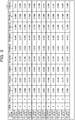
- FIG. 3 is a diagram illustrating an example of risk evaluation value calculation result information according to the embodiment.
- the risk evaluation value calculation result information 32 includes items such as "time stamp”, “vessel 1", “vessel 2", “technique A” to “technique H”, “technique Z”, etc.
- Each of the items of the risk evaluation value calculation result information 32 illustrated in FIG. 3 is an example, and the risk evaluation value calculation result information 32 may have other items.
- the vessels that can be set to "vessel 1" and “vessel 2" are three vessels “X", “Y”, and “Z” as an example.
- "X", "Y”, and “Z” are identified based on, for example, the MMSI of a vessel.
- the "time stamp” indicates date and time corresponding to each record of the risk evaluation value calculation result information 32 identified by "vessel 1", “vessel 2", “technique A” to “technique H”, and “technique Z".
- each risk value of "vessel 1" "X” with respect to “vessel 2" "Y” at “time stamp” "2015/6/4 3:30:00” indicates that the risk value according to "technique A” is "0.868".
- the comprehensive risk evaluation value calculation result information 33 will be described below.
- the control unit 40 is a device that controls the evaluation device 20.
- a processing device such as a central processing unit (CPU) or a micro processing unit (MPU), or an integrated circuit such as an application specific integrated circuit (ASIC) or a field programmable gate array (FPGA) can be used.
- the control unit 40 includes an internal memory for storing programs defining various types of processing procedures and control data, and performs various types of processing using the programs and the control data.
- the control unit 40 functions as various types of processing units by executing various programs.
- the control unit 40 includes an acquisition unit 41, a risk evaluation value calculation unit 42, a comprehensive risk evaluation value calculation unit 43, and an output unit 44.
- the acquisition unit 41 acquires various types of information. For example, the acquisition unit 41 acquires travel information about the position and speed of each vessel. For example, the acquisition unit 41 acquires AIS information from each vessel 11 via the wireless communication device 13A as the travel information about each vessel. The acquisition unit 41 stores the acquired AIS information in the AIS accumulated data 31. In addition, as the speed of each vessel, the speed stored in the AIS information may be used, or the speed of each vessel may be calculated from the change of the position of the vessel at each time. In the present embodiment, a case where the evaluation device 20 receives AIS information will be described, but the AIS information may be stored in an external memory device such as a storage device. In this case, the acquisition unit 41 acquires the AIS information of each vessel 11 from the external memory device.
- the risk evaluation value calculation unit 42 first calculates a correlation matrix of the risk evaluation value calculation result information 32 that is input data, and determines the number of eigenvalues having a value of 1 or more based on Guttman criterion as the number of factors used in performing factor analysis.
- the factor analysis performed in the present embodiment is a factor analysis including promax rotation, the factor analysis is not limited to this, and any factor analysis including oblique rotation on the premise that there is a correlation between factors may be used.
- FIG. 4 is a diagram illustrating an example of the result of calculating the first factor loading by performing the factor analysis for the first time in the case in the embodiment.
- the risk evaluation value calculation unit 42 deletes the risk evaluation value according to a technique having a negative value as the first factor loading as a result of the first factor analysis from the risk evaluation value calculation result information 32 that is the input data.
- the first factor loading of "technique Z" has a negative value.
- “technique Z” is deleted from the risk evaluation value calculation result information 32.
- the value to be deleted is not limited to the first factor loading having a negative value, but a first factor loading having a value equal to or less than a predetermined value (or less than a predetermined value) may be deleted.
- the risk evaluation value calculation unit 42 calculates a correlation matrix of the risk evaluation value calculation result information 32 obtained by deleting the risk evaluation value having a negative value as the first factor loading from the risk evaluation value calculation result information 32 that is the input data, and determines the number of eigenvalues having a value of 1 or more based on Guttman criterion as the number of factors used in performing factor analysis. Then, based on the AIS accumulated data 31, the risk evaluation value calculation unit 42 calculates the first factor loading for each of the risk evaluation value calculation techniques, "technique A" to "technique H” using the technique.
- FIG. 5 is a diagram illustrating an example of the result of calculating the first factor loading by performing the factor analysis for the second time in the case in the embodiment.
- the risk evaluation value calculation unit 42 repeats the processing of performing the factor analysis and deleting the risk evaluation value of a technique having a negative value as the first factor loading from the risk evaluation value calculation result information 32 that is the input data until a technique having a negative value as the first factor loading as a result of the factor analysis does not appear.
- FIG. 6 is a diagram illustrating an example of the final result of calculating the first factor loading in the case in the embodiment.
- FIG. 6 illustrates an example, in which the first factor loading is “0.788” according to “technique A”, “0.606” according to “technique B”, “0.904” according to “technique C”, “0.918” according to “technique D”, “0.448” according to “technique E”, “0.516” according to “technique F”, “0.085” according to “technique G”, and “0.900” according to “technique H”.
- FIG. 7 is a diagram illustrating an example of the result of calculating the "weight" for each of the first factor loadings in the case in the embodiment.
- the comprehensive risk calculation unit 43 multiplies the risk evaluation value according to each of the techniques in the risk evaluation value calculation result information 32 obtained by deleting a technique having a negative value as the first factor loading from the risk evaluation value calculation result information 32 by corresponding one of the "weights" calculated by the risk evaluation value calculation unit 42, and totals the weighted risk evaluation values to calculate the "comprehensive risk evaluation value".
- FIG. 8 is a diagram illustrating an example of the result of calculating the comprehensive risk value in the case in the embodiment. For example, in the first record of the risk evaluation value calculation result information 32 illustrated in FIG.
- the comprehensive risk calculation unit 43 similarly calculates the "comprehensive risk evaluation value” for the second and subsequent records of the risk evaluation value calculation result information 33 illustrated in FIG. 8 .
- the output unit 44 performs various outputs. For example, the output unit 44 outputs the "comprehensive risk evaluation value" calculated by the comprehensive risk evaluation value calculation unit 43. Alternatively, when the "comprehensive risk evaluation value" calculated by the comprehensive risk evaluation value calculation unit 43 is equal to or higher than a threshold, the output unit 44 may output a warning.
- the risk evaluation value calculation unit 42 is an example of a calculation unit that performs factor analysis on the plurality of risk evaluation values each calculated according to one of the plurality of techniques to calculate the first factor loading of each risk evaluation value.
- the risk evaluation value calculation unit 42 is an example of an exclusion unit that excludes, from the plurality of risk evaluation values, a risk evaluation value for which the calculated first factor loading is less than a predetermined value.
- the risk evaluation value calculation unit 42 is an example of a factor analysis unit that performs factor analysis on the plurality of risk evaluation values obtained by excluding a risk evaluation value for which the first factor loading is equal to or less than the predetermined value.
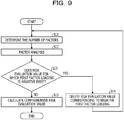
- FIG. 9 is a diagram illustrating an exemplary flowchart of comprehensive risk value calculation processing according to the embodiment.
- the comprehensive risk value calculation processing is performed by the comprehensive risk evaluation value calculation unit 43 at a timing when the comprehensive risk evaluation value calculation unit 43 receives a predetermined operation instructing the start of processing such as a timing of performing analysis of a past case using the accumulated AIS data 31 or at a predetermined period. It is assumed that each risk evaluation value is calculated in advance by the risk evaluation value calculation unit 42 using technique A to technique H and technique Z before the "comprehensive risk evaluation value" is calculated by the comprehensive risk evaluation value calculation unit 43.
- step S11 the comprehensive risk evaluation value calculation unit 43 calculates a correlation matrix of the risk evaluation value calculation result information 32, which is input data, and determines the number of eigenvalues having a value of 1 or more based on Guttman criterion as the number of factors used in performing factor analysis.
- step S12 the comprehensive risk evaluation value calculation unit 43 performs factor analysis to calculate a first factor loading that has the maximum value for each of the risk evaluation value calculation techniques "technique A” to "technique H” and “technique Z” using the technique based on the AIS accumulated data 31.
- step S13 the comprehensive risk evaluation value calculation unit 43 determines whether a risk evaluation value for which a first factor loading is negative exists.
- the comprehensive risk evaluation value calculation unit 43 proceeds the processing to step S14 if a risk evaluation value for which the first factor loading is negative exists (Yes in step S13).
- the comprehensive risk evaluation value calculation unit 43 proceeds the processing to step S15 if a risk evaluation value for which the first factor loading is negative exists (No in step S13).
- step S14 the comprehensive risk evaluation value calculation unit 43 deletes a risk evaluation value corresponding to the negative first factor loading in step S13.
- step S14 ends the comprehensive risk evaluation value calculation unit 43 returns the processing to step S11.
- step S15 the comprehensive risk evaluation value calculation unit 43 calculates the "weight” for each "first factor loading” with respect to the total of the “first factor loadings", and multiplies the risk evaluation value according to each of the techniques in the risk evaluation value calculation result information 32 obtained by deleting a technique having a negative value as the first factor loading from the risk evaluation value calculation result information 32 by corresponding one of the calculated "weights” and totals the weighted risk evaluation values to calculate the "comprehensive risk evaluation value”.
- step S15 ends, the comprehensive risk evaluation value calculation unit 43 ends the comprehensive risk value calculation processing.
- an inappropriate risk evaluation value may be automatically eliminated, and the validity of the comprehensive risk evaluation value is improved.
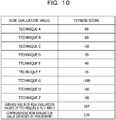
- FIG. 10 is a diagram illustrating an evaluation result of the comprehensive risk evaluation value calculation technique according to the embodiment.
- detailed analysis was performed on a near-miss case, and check items each of which should be satisfied by a risk evaluation value at each time in the near-miss case were set as follows.
- Evaluation is performed to determine whether the following risk values satisfy the above check items.
- the risk values were evaluated into three grades of "each condition of check items 1 to 3 is satisfied, and the value of each risk evaluation value is subjectively valid" having a fitness score (2 points), "each condition of check items 1 to 3 is satisfied, but the value of each risk evaluation value is different from subjective evaluation” having a fitness score (0 point), and "any condition of check items 1 to 3 is not satisfied” having a fitness score (-2 points). While the “fitness value of risk evaluation value according to each of technique A to technique H and technique Z" was as illustrated in FIG. 10 and "average value of the risk evaluation values of technique A to technique H and technique Z" was "107 points”, the "'comprehensive risk evaluation value' obtained by embodiment” was "139 points".
- the evaluation device 20 analyzes the past case using the accumulated AIS data 31 by performing the "comprehensive risk evaluation value".
- the disclosed technique is not limited to this, and "weights" may be calculated in pre-training using the accumulated AIS data 31. Then, the evaluation device 20 may apply the "weights" calculated in the pre-training to the real-time AIS data 31 to calculate the "comprehensive risk evaluation value" in real time.
- each component of each device illustrated in the drawings is functionally conceptual, and thus the device needs not be physically configured as illustrated in the drawings. That is, the specific aspects of separation and integration of each device are not limited to the illustrated aspects, and all or part of the device can be functionally or physically separated and integrated in any unit, in accordance with various loads, use situation, or the like.
- the risk evaluation value calculation unit 42 and the comprehensive risk evaluation value calculation unit 43 may be integrated.
- the comprehensive risk evaluation value calculation unit 43 may be separated to a factor number determination unit, a deletion unit that deletes a technique corresponding to a negative risk evaluation value, a "weight" calculation unit, and a comprehensive risk evaluation value calculation unit.
- each processing function performed by corresponding processing unit may be realized by a CPU and a program analyzed and executed by the CPU, or may be realized as hardware using wired logic.
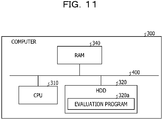
- FIG. 11 is a diagram illustrating a computer that executes an evaluation program.
- the computer 300 includes a CPU 310, a hard disk drive (HDD) 320, and a random access memory (RAM) 340.
- the components 310 to 340 are connected to each other via a bus 400.
- the HDD 320 stores in advance a collision risk calculation program 320a that exhibits a function similar to the function of each of the processing units of the above-described embodiments.
- the evaluation program 320a that exhibits functions similar to those of the acquisition unit 41, the risk evaluation value calculation unit 42, the comprehensive risk evaluation value calculation unit 43, and the output unit 44 in the above-described embodiments is stored.
- the evaluation program 320a may be divided into modules for the functions as appropriate.
- the HDD 320 also stores various types of data.
- the HDD 320 stores an OS and various types of data.
- the CPU 310 reads the evaluation program 320a from the HDD 320 and executes the evaluation program 320a, thereby performing operations similar to those of the processing units of the embodiments. That is, the evaluation program 320a performs operations similar to those of the acquisition unit 41, the risk evaluation value calculation unit 42, the comprehensive risk evaluation value calculation unit 43, and the output unit 44.
- the evaluation program 320a described above does not necessarily have to be stored in the HDD 320 initially.
- the program is stored in a "portable physical medium" such as a flexible disk (FD), a compact disk read only memory (CD-ROM), a digital versatile disk (DVD), a magneto-optical disk, or an IC card inserted into the computer 300. Then, the computer 300 may reads the program from these media and execute the program.
- a "portable physical medium” such as a flexible disk (FD), a compact disk read only memory (CD-ROM), a digital versatile disk (DVD), a magneto-optical disk, or an IC card inserted into the computer 300.
- the computer 300 may reads the program from these media and execute the program.
- the program may be stored in "another computer (or a server)" or the like connected to the computer 300 via a public line, the Internet, a LAN, a WAN, or the like. Then, the computer 300 may reads the program from these media and execute the program.
Landscapes
- Engineering & Computer Science (AREA)
- Physics & Mathematics (AREA)
- Business, Economics & Management (AREA)
- General Physics & Mathematics (AREA)
- Human Resources & Organizations (AREA)
- Remote Sensing (AREA)
- Radar, Positioning & Navigation (AREA)
- Theoretical Computer Science (AREA)
- Strategic Management (AREA)
- Economics (AREA)
- Data Mining & Analysis (AREA)
- Operations Research (AREA)
- Entrepreneurship & Innovation (AREA)
- Tourism & Hospitality (AREA)
- Ocean & Marine Engineering (AREA)
- Health & Medical Sciences (AREA)
- Marketing (AREA)
- General Business, Economics & Management (AREA)
- Computational Mathematics (AREA)
- Mathematical Physics (AREA)
- Pure & Applied Mathematics (AREA)
- Mathematical Analysis (AREA)
- Mathematical Optimization (AREA)
- Chemical & Material Sciences (AREA)
- Automation & Control Theory (AREA)
- Development Economics (AREA)
- Combustion & Propulsion (AREA)
- Educational Administration (AREA)
- Game Theory and Decision Science (AREA)
- Public Health (AREA)
- Quality & Reliability (AREA)
- Mechanical Engineering (AREA)
- Evolutionary Biology (AREA)
- Life Sciences & Earth Sciences (AREA)
- Bioinformatics & Cheminformatics (AREA)
- Bioinformatics & Computational Biology (AREA)
- Algebra (AREA)
- Probability & Statistics with Applications (AREA)
- General Engineering & Computer Science (AREA)
- Software Systems (AREA)
Abstract
Description
- The present invention relates to an evaluation program, an evaluation method and an evaluation device.
- Conventionally, a risk evaluation technique has been proposed in which a risk evaluation value based on a "comprehensive viewpoint" is calculated with unsupervised learning by combining risk evaluation results based on a plurality of risk evaluation techniques based on various viewpoints. A factor analysis is an example of such a risk evaluation technique.
FIG. 12 is a diagram for describing a factor analysis. - For example, in a factor analysis, when factors of an unobservable "true risk" include a "risk based on comprehensive viewpoint", a "risk based on
viewpoint 1", a "risk based onviewpoint 2", ... , and observation values include a "risk evaluation value according to technique A", a "risk evaluation value according to technique B", a "risk evaluation value according to technique C", ... that are observable, each of the observation values (a risk evaluation value according to each technique) is represented as a linear combination of the factors. A coefficient by which corresponding one of factors is multiplied when each of the observation values (a risk evaluation value based on each technique) is represented as a linear combination of the factors is referred to as a "factor loading". A technique of performing a factor analysis by calculating "factor loadings" appropriately is proposed. -
- Patent Document 1: Japanese National Publication of International Patent Application No.
2011-517765 - Patent Document 2: Japanese Laid-open Patent Publication No.
2001-188796 - However, the above-described conventional technique uses unsupervised learning. Thus, it is difficult to eliminate a "risk evaluation value" that is inappropriate and should not be incorporated in calculation of the "risk value based on comprehensive viewpoint" that appropriately explains a case from all viewpoints. An inappropriate "risk evaluation value" that is inappropriate and should not be incorporated in calculation of the "risk value based on comprehensive viewpoint" may be, for example, a "risk evaluation value" calculated according to a technique that strongly depends on a specific viewpoint or situation. Therefore, as a result, a calculated "risk value based on comprehensive viewpoint" becomes inappropriate, which is disadvantageous.
- In one aspect, an object of the present invention is to provide an evaluation program, an evaluation method, and an evaluation device that improves the validity of a risk value based on a comprehensive viewpoint.
- According to a first aspect, an evaluation program causes a computer to calculate a first factor loading of each of a plurality of risk evaluation values by performing factor analysis on the plurality of risk evaluation values each calculated according to one of a plurality of techniques. The evaluation program then causes the computer to exclude, from the plurality of risk evaluation values, a risk evaluation value for which the calculated first factor loading is less than a predetermined value. Then, the evaluation program causes the computer to perform the factor analysis on the plurality of risk evaluation values obtained by excluding the risk evaluation value for which the first factor loading is equal to or less than the predetermined value. Then, the evaluation program causes the computer to repeat the processing described above until no risk evaluation value for which the first factor loading is equal to or less than the predetermined value appears by the factor analysis.
- One embodiment of the present invention has an effect of improving the validity of a risk value based on a comprehensive viewpoint.
-
-
FIG. 1 is a diagram illustrating an example of a schematic configuration of a support system according to an embodiment. -
FIG. 2 is a diagram illustrating an example of a schematic configuration of an evaluation device according to the embodiment. -
FIG. 3 is a diagram illustrating an example of risk evaluation value calculation result information according to the embodiment. -
FIG. 4 is a diagram illustrating an example of the result of calculating a first factor loading by performing the factor analysis for the first time in a case in the embodiment. -
FIG. 5 is a diagram illustrating an example of the result of calculating the first factor loading by performing the factor analysis for the second time in the case in the embodiment. -
FIG. 6 is a diagram illustrating an example of the final result of calculating the first factor loading in the case in the embodiment. -
FIG. 7 is a diagram illustrating an example of the result of calculating a "weight" for each of the first factor loadings in the case in the embodiment. -
FIG. 8 is a diagram illustrating an example of the result of calculating the comprehensive risk value in the case in the embodiment. -
FIG. 9 is a diagram illustrating an exemplary flowchart of comprehensive risk value calculation processing according to the embodiment. -
FIG. 10 is a diagram illustrating an evaluation result of the comprehensive risk evaluation value calculation technique according to the embodiment. -
FIG. 11 is a diagram illustrating a computer that executes an evaluation program. -
FIG. 12 is a diagram for describing a factor analysis. - Hereinafter, embodiments of an evaluation program, an evaluation method, and an evaluation device according to the disclosed technique will be described in detail based on the drawings. Note that the following embodiments do not limit the present invention. The embodiments can be appropriately combined as far as there is no contradiction in processing. In the following embodiment, a case where the disclosed technique is applied to a support system that supports navigation of a vessel will be described as an example. However, the application of the present disclosure is not limited to this, and the present disclosure can be applied to cases where the feature that appears on a risk corresponding to the first factor loading is most apparent and can be analyzed by factor analysis, and the like. In the following embodiments, "risk", "risk value", "risk evaluation value", and "comprehensive risk evaluation value" indicate, for example, the degree of probability that vessels navigating in a sea area, in which navigation should be controlled, collide with each other when a predetermined time elapses in a case where the vessels keep the routes and the speeds at the time. Depending on the risk calculation technique, those terms may indicate a subjective collision probability of a captain or a pilot instead of an objective evaluation value as described above. The "time" includes date information and time information.
- As a premise of the following embodiment, it is assumed that the risk evaluation values used in factor analysis are nine types of techniques A to H and a technique Z, and the risk evaluation value of each technique is normalized to take a value from 0 (risk = 0) to 1 (risk is the maximum). By the technique Z, an appropriate risk evaluation value is calculated only when a very high risk such as a case of a marine accident occurs, but an appropriate evaluation value is not calculated in a case that does not lead to a vessel collision. The risk evaluation techniques are not limited to nine types of the techniques A to H and the technique Z.
- In the following embodiment, it is further assumed, as illustrated in
FIG. 12 , that the risk evaluation value calculated according to each risk evaluation technique includes a "risk value based on comprehensive viewpoint" (hereinafter also referred to as "comprehensive risk evaluation value") and a "risk value based on one or more viewpoints n (n = 1, 2, ...)" at certain ratios. In the following embodiment, it is also assumed that the "true risk" most strongly affects the "risk value based on comprehensive viewpoint". - For example, as evaluation techniques of collision risk in marine traffic, there are risk evaluation techniques based on various viewpoints as follows. This is due to the fact that it is very difficult to construct an evaluation technique that takes all the factors into consideration since the collision risk of a vessel is affected in various ways from a wide variety of factors. For example, as risk evaluation techniques focusing on objective facts, there is a technique focusing on the distance at the closest approach and the time taken to the closest approach, a technique focusing on the collision probability, and a technique focusing on the size of room for avoidance action. In addition, for example, as risk evaluation techniques focusing on subjective feeling, there is a technique focusing on the magnitude of risk that a captain or a pilot feels, and a technique focusing on the size of room for avoidance action that a captain or a pilot feels. The technique disclosed herein is based on the background that each of these risk evaluation techniques is based only on a corresponding viewpoint, and it is desired to calculate a "risk evaluation value based on comprehensive viewpoint" that appropriately describes a case from all viewpoints, in other words, that indicates the maximum risk factor across the plurality of techniques.
- First, an example of a
support system 10 according to an embodiment will be described.FIG. 1 is a diagram illustrating an example of a schematic configuration of a support system according to an embodiment. Thesupport system 10 is a marine traffic control system that supports the navigation of vessels. -
FIG. 1 illustrates twovessels 11 and aland facility 13. Eachvessel 11 is equipped with an Automatic Identification System (AIS) device 12. For example, specific vessels are required to be equipped with the AIS device 12 by a law or the like. The specific vessels are all vessels of 300 gross tons or more engaged on international voyages, all passenger vessels engaged on international voyages, and all vessels of 500 gross tons or more that are not engaged on international voyages. In addition, vessels other than the specific vessels may also be equipped with the AIS device 12. - The AIS device 12 periodically transmits AIS information including various types of information related to the
vessel 11 equipped with the AIS device 12 via wireless communication. The AIS information includes, for example, information such as a position defined by latitude and longitude, a speed, a vessel name, a time, a bow direction, Maritime Mobile Service Identity (MMSI), a captain, and a vessel width. The AIS information is received by theother vessel 11 and theland facility 13. Theother vessel 11 and theland facility 13 can grasp various types of information such as a position, a speed, a vessel name, a time, a bow direction, MMSI, a captain, a vessel width, and the like of thevessel 11 that is a transmission source of the received AIS information. - The
land facility 13 is, for example, a facility that controls navigation of each of thevessels 11 such as a marine traffic center or a port traffic control room that have a role of monitoring and providing information about vessels on the sea. Theland facility 13 grasps the position of eachvessel 11 based on the AIS information received from thevessel 11, information detected by a radar, etc., and provides various types of information related to marine traffic to thevessel 11. - Next, the configuration of an evaluation device 20 according to the embodiment will be described.
FIG. 2 is a diagram illustrating an example of a schematic configuration of an evaluation device according to the embodiment. The evaluation device 20 is disposed in theland facility 13 and is a device that supports the navigation of vessels. For example, the evaluation device 20 is implemented in a computer device such as a server disposed in theland facility 13. - The evaluation device 20 includes an external interface (I/F) unit 21, an input unit 22, a display unit 23, a storage unit 30, and a control unit 40.
- The external I/F unit 21 is, for example, an interface that transmits and receives various types of information to and from other devices. The external I/F unit 21 can wirelessly communicate with each
vessel 11 via awireless communication device 13A such as an antenna provided in theland facility 13, and the external I/F unit 21 transmits and receives various types of information to and from eachvessel 11. For example, the external I/F unit 21 receives the AIS information from eachvessel 11 via thewireless communication device 13A. - The input unit 22 is an input device for inputting various types of information. Examples of the input unit 22 include an input device that receives an input of an operation such as a mouse, or a keyboard. The input unit 22 receives input of various types of information. For example, the input unit 22 receives an operation input instructing start of various types of processing. The input unit 22 inputs operation information indicating the received operation content to the control unit 40.
- The display unit 23 is a display device that displays various types of information. Examples of the display unit 23 include display devices such as a Liquid Crystal Display (LCD) and a Cathode Ray Tube (CRT). The display unit 23 displays various types of information. For example, the display unit 23 displays various screens such as an operation screen.
- The storage unit 30 is an external memory device such as a hard disk drive (HDD), a solid state drive (SSD), or an optical or magneto-optical disk. The storage unit 30 may be a semiconductor memory in which data is rewritable such as a random access memory (RAM), a flash memory, and a non volatile static random access memory (NVSRAM).
- The storage unit 30 stores an operating system (OS) and various programs executed by the control unit 40. For example, the storage unit 30 stores a program for performing evaluation processing described below. Furthermore, the storage unit 30 stores various types of data used by a program executed by the control unit 40. For example, the storage unit 30 stores AIS accumulated data 31, risk evaluation value calculation result information 32, and comprehensive risk evaluation value calculation result
information 33. Each of the AIS accumulated data 31, the risk evaluation value calculation result information 32, and the comprehensive risk evaluation value calculation resultinformation 33 is of a data format of a table as an example. However, the data format is not limited thereto, and each of the AIS accumulated data 31, the risk evaluation value calculation result information 32, and the comprehensive risk evaluation value calculation resultinformation 33 may be of other data formats such as Comma Separated Values (CSV) format. - The AIS accumulated data 31 is data in which AIS information received from each
vessel 11 is accumulated. - The risk evaluation value calculation result information 32 is data having the risk calculation result of each technique for "
vessel 1" with respect to "vessel 2" at each time as one record, and is data to be input to the comprehensive risk value calculation processing described below. -
FIG. 3 is a diagram illustrating an example of risk evaluation value calculation result information according to the embodiment. As illustrated inFIG. 3 , the risk evaluation value calculation result information 32 includes items such as "time stamp", "vessel 1", "vessel 2", "technique A" to "technique H", "technique Z", etc. Each of the items of the risk evaluation value calculation result information 32 illustrated inFIG. 3 is an example, and the risk evaluation value calculation result information 32 may have other items. Note that, in the example ofFIG. 3 , the vessels that can be set to "vessel 1" and "vessel 2" are three vessels "X", "Y", and "Z" as an example. "X", "Y", and "Z" are identified based on, for example, the MMSI of a vessel. - The "time stamp" indicates date and time corresponding to each record of the risk evaluation value calculation result information 32 identified by "
vessel 1", "vessel 2", "technique A" to "technique H", and "technique Z". For example, in the first record illustrated inFIG. 3 , each risk value of "vessel 1" "X" with respect to "vessel 2" "Y" at "time stamp" "2015/6/4 3:30:00" indicates that the risk value according to "technique A" is "0.868". The same applies to the risk values according to "technique B" to "technique H" and "technique Z". - The comprehensive risk evaluation value calculation result
information 33 will be described below. - The control unit 40 is a device that controls the evaluation device 20. As the control unit 40, a processing device such as a central processing unit (CPU) or a micro processing unit (MPU), or an integrated circuit such as an application specific integrated circuit (ASIC) or a field programmable gate array (FPGA) can be used. The control unit 40 includes an internal memory for storing programs defining various types of processing procedures and control data, and performs various types of processing using the programs and the control data. The control unit 40 functions as various types of processing units by executing various programs. For example, the control unit 40 includes an acquisition unit 41, a risk evaluation value calculation unit 42, a comprehensive risk evaluation value calculation unit 43, and an output unit 44.
- The acquisition unit 41 acquires various types of information. For example, the acquisition unit 41 acquires travel information about the position and speed of each vessel. For example, the acquisition unit 41 acquires AIS information from each
vessel 11 via thewireless communication device 13A as the travel information about each vessel. The acquisition unit 41 stores the acquired AIS information in the AIS accumulated data 31. In addition, as the speed of each vessel, the speed stored in the AIS information may be used, or the speed of each vessel may be calculated from the change of the position of the vessel at each time. In the present embodiment, a case where the evaluation device 20 receives AIS information will be described, but the AIS information may be stored in an external memory device such as a storage device. In this case, the acquisition unit 41 acquires the AIS information of eachvessel 11 from the external memory device. - The risk evaluation value calculation unit 42 first calculates a correlation matrix of the risk evaluation value calculation result information 32 that is input data, and determines the number of eigenvalues having a value of 1 or more based on Guttman criterion as the number of factors used in performing factor analysis. Although the factor analysis performed in the present embodiment is a factor analysis including promax rotation, the factor analysis is not limited to this, and any factor analysis including oblique rotation on the premise that there is a correlation between factors may be used. Then, based on the AIS accumulated data 31, the risk evaluation value calculation unit 42 calculates a factor loading that has the maximum value (hereinafter referred to as a first factor loading) in each of the risk evaluation value calculation techniques, "technique A" to "technique H" and "technique Z" using each of the risk evaluation value calculation techniques.
FIG. 4 is a diagram illustrating an example of the result of calculating the first factor loading by performing the factor analysis for the first time in the case in the embodiment. - Next, the risk evaluation value calculation unit 42 deletes the risk evaluation value according to a technique having a negative value as the first factor loading as a result of the first factor analysis from the risk evaluation value calculation result information 32 that is the input data. In the example illustrated in
FIG. 4 , the first factor loading of "technique Z" has a negative value. Thus, "technique Z" is deleted from the risk evaluation value calculation result information 32. In addition, when a risk evaluation value is deleted from the risk evaluation value calculation result information 32 which is input data, the value to be deleted is not limited to the first factor loading having a negative value, but a first factor loading having a value equal to or less than a predetermined value (or less than a predetermined value) may be deleted. - Next, the risk evaluation value calculation unit 42 calculates a correlation matrix of the risk evaluation value calculation result information 32 obtained by deleting the risk evaluation value having a negative value as the first factor loading from the risk evaluation value calculation result information 32 that is the input data, and determines the number of eigenvalues having a value of 1 or more based on Guttman criterion as the number of factors used in performing factor analysis. Then, based on the AIS accumulated data 31, the risk evaluation value calculation unit 42 calculates the first factor loading for each of the risk evaluation value calculation techniques, "technique A" to "technique H" using the technique.
FIG. 5 is a diagram illustrating an example of the result of calculating the first factor loading by performing the factor analysis for the second time in the case in the embodiment. - Note that, the risk evaluation value calculation unit 42 repeats the processing of performing the factor analysis and deleting the risk evaluation value of a technique having a negative value as the first factor loading from the risk evaluation value calculation result information 32 that is the input data until a technique having a negative value as the first factor loading as a result of the factor analysis does not appear.
FIG. 6 is a diagram illustrating an example of the final result of calculating the first factor loading in the case in the embodiment.FIG. 6 illustrates an example, in which the first factor loading is "0.788" according to "technique A", "0.606" according to "technique B", "0.904" according to "technique C", "0.918" according to "technique D", "0.448" according to "technique E", "0.516" according to "technique F", "0.085" according to "technique G", and "0.900" according to "technique H". - Then, the risk evaluation value calculation unit 42 calculates a "weight" for each of the "first factor loadings" with respect to the total of the "first factor loadings" illustrated in
FIG. 6 , 0.788 + 0.606 + 0.904 + 0.918 + 0.448 + 0.516 + 0.085 + 0.900 = 5.165.FIG. 7 is a diagram illustrating an example of the result of calculating the "weight" for each of the first factor loadings in the case in the embodiment.FIG. 7 illustrates an example, in which the "weight" is "0.153" for "technique A", "0.117" for "technique B", "0.175" for "technique C", "0.178" for "technique D", "0.087" for "technique E", "0.100" for "technique F", "0.016" for "technique G", and "0.174" for "technique H". - The comprehensive risk calculation unit 43 multiplies the risk evaluation value according to each of the techniques in the risk evaluation value calculation result information 32 obtained by deleting a technique having a negative value as the first factor loading from the risk evaluation value calculation result information 32 by corresponding one of the "weights" calculated by the risk evaluation value calculation unit 42, and totals the weighted risk evaluation values to calculate the "comprehensive risk evaluation value".
FIG. 8 is a diagram illustrating an example of the result of calculating the comprehensive risk value in the case in the embodiment. For example, in the first record of the risk evaluation value calculation result information 32 illustrated inFIG. 8 , the risk values of "vessel 1" "X" with respect to "vessel 2" "Y" are "0.868" according to "technique A", "0.520" according to "technique B", ... , and "0.000" according to "technique H", and the "comprehensive risk evaluation value" is 0.868 × 0.153 + 0.520 × 0.117 + ... + 0.000 × 0.174 = 0.239. The comprehensive risk calculation unit 43 similarly calculates the "comprehensive risk evaluation value" for the second and subsequent records of the risk evaluation value calculation resultinformation 33 illustrated inFIG. 8 . - The output unit 44 performs various outputs. For example, the output unit 44 outputs the "comprehensive risk evaluation value" calculated by the comprehensive risk evaluation value calculation unit 43. Alternatively, when the "comprehensive risk evaluation value" calculated by the comprehensive risk evaluation value calculation unit 43 is equal to or higher than a threshold, the output unit 44 may output a warning.
- The risk evaluation value calculation unit 42 is an example of a calculation unit that performs factor analysis on the plurality of risk evaluation values each calculated according to one of the plurality of techniques to calculate the first factor loading of each risk evaluation value. In addition, the risk evaluation value calculation unit 42 is an example of an exclusion unit that excludes, from the plurality of risk evaluation values, a risk evaluation value for which the calculated first factor loading is less than a predetermined value. Further, the risk evaluation value calculation unit 42 is an example of a factor analysis unit that performs factor analysis on the plurality of risk evaluation values obtained by excluding a risk evaluation value for which the first factor loading is equal to or less than the predetermined value.
-
FIG. 9 is a diagram illustrating an exemplary flowchart of comprehensive risk value calculation processing according to the embodiment. The comprehensive risk value calculation processing is performed by the comprehensive risk evaluation value calculation unit 43 at a timing when the comprehensive risk evaluation value calculation unit 43 receives a predetermined operation instructing the start of processing such as a timing of performing analysis of a past case using the accumulated AIS data 31 or at a predetermined period. It is assumed that each risk evaluation value is calculated in advance by the risk evaluation value calculation unit 42 using technique A to technique H and technique Z before the "comprehensive risk evaluation value" is calculated by the comprehensive risk evaluation value calculation unit 43. - First, in step S11, the comprehensive risk evaluation value calculation unit 43 calculates a correlation matrix of the risk evaluation value calculation result information 32, which is input data, and determines the number of eigenvalues having a value of 1 or more based on Guttman criterion as the number of factors used in performing factor analysis. Next, in step S12, the comprehensive risk evaluation value calculation unit 43 performs factor analysis to calculate a first factor loading that has the maximum value for each of the risk evaluation value calculation techniques "technique A" to "technique H" and "technique Z" using the technique based on the AIS accumulated data 31.
- Next, in step S13, the comprehensive risk evaluation value calculation unit 43 determines whether a risk evaluation value for which a first factor loading is negative exists. The comprehensive risk evaluation value calculation unit 43 proceeds the processing to step S14 if a risk evaluation value for which the first factor loading is negative exists (Yes in step S13). On the other hand, the comprehensive risk evaluation value calculation unit 43 proceeds the processing to step S15 if a risk evaluation value for which the first factor loading is negative exists (No in step S13).
- In step S14, the comprehensive risk evaluation value calculation unit 43 deletes a risk evaluation value corresponding to the negative first factor loading in step S13. When step S14 ends, the comprehensive risk evaluation value calculation unit 43 returns the processing to step S11.
- On the other hand, in step S15, the comprehensive risk evaluation value calculation unit 43 calculates the "weight" for each "first factor loading" with respect to the total of the "first factor loadings", and multiplies the risk evaluation value according to each of the techniques in the risk evaluation value calculation result information 32 obtained by deleting a technique having a negative value as the first factor loading from the risk evaluation value calculation result information 32 by corresponding one of the calculated "weights" and totals the weighted risk evaluation values to calculate the "comprehensive risk evaluation value". When step S15 ends, the comprehensive risk evaluation value calculation unit 43 ends the comprehensive risk value calculation processing.
- According to the above-described embodiment, an inappropriate risk evaluation value may be automatically eliminated, and the validity of the comprehensive risk evaluation value is improved.
-
FIG. 10 is a diagram illustrating an evaluation result of the comprehensive risk evaluation value calculation technique according to the embodiment. In order to verify the embodiment, detailed analysis was performed on a near-miss case, and check items each of which should be satisfied by a risk evaluation value at each time in the near-miss case were set as follows. - (Check Item 1) At time T0, the risks of the vessel X with respect to all other vessels are zero.
- (Check Item 2) From time T1 to time T2, the risk of the vessel X with respect to the vessel Y increases.
- (Check Item 3) At time T2, the risk of the vessel X with respect to the vessel Y is smaller than the risk of the vessel X with respect to the vessel Z.
- Evaluation is performed to determine whether the following risk values satisfy the above check items.
- (Risk Value 1) A risk evaluation value according to each of technique A to technique H and technique Z.
- (Risk Value 2) An average value of risk evaluation values according to techniques A to H and technique Z.
- (Risk value 3) A "comprehensive risk evaluation value" calculated according to the embodiment (the risk evaluation value according to technique Z is excluded).
- The risk values were evaluated into three grades of "each condition of
check items 1 to 3 is satisfied, and the value of each risk evaluation value is subjectively valid" having a fitness score (2 points), "each condition ofcheck items 1 to 3 is satisfied, but the value of each risk evaluation value is different from subjective evaluation" having a fitness score (0 point), and "any condition ofcheck items 1 to 3 is not satisfied" having a fitness score (-2 points). While the "fitness value of risk evaluation value according to each of technique A to technique H and technique Z" was as illustrated inFIG. 10 and "average value of the risk evaluation values of technique A to technique H and technique Z" was "107 points", the "'comprehensive risk evaluation value' obtained by embodiment" was "139 points". That is, from the result, it can be seen that the "average value of risk evaluation values according to technique A to technique H and technique Z" has a score higher than the fitness score according to each of technique A to technique H and technique Z, but "'comprehensive risk evaluation value' obtained by embodiment" has a score even higher, and thus the embodiment is the most advantageous. - Although an embodiment of the disclosed technique has been described above, the disclosed technique may be implemented in various forms different from each other in addition to the above-described embodiment. Thus, hereinafter, other embodiments included in the disclosed technique will be described.
- In the above-described embodiment, the evaluation device 20 analyzes the past case using the accumulated AIS data 31 by performing the "comprehensive risk evaluation value". However, the disclosed technique is not limited to this, and "weights" may be calculated in pre-training using the accumulated AIS data 31. Then, the evaluation device 20 may apply the "weights" calculated in the pre-training to the real-time AIS data 31 to calculate the "comprehensive risk evaluation value" in real time.
- In addition, each component of each device illustrated in the drawings is functionally conceptual, and thus the device needs not be physically configured as illustrated in the drawings. That is, the specific aspects of separation and integration of each device are not limited to the illustrated aspects, and all or part of the device can be functionally or physically separated and integrated in any unit, in accordance with various loads, use situation, or the like. For example, the risk evaluation value calculation unit 42 and the comprehensive risk evaluation value calculation unit 43 may be integrated. Alternatively, for example, the comprehensive risk evaluation value calculation unit 43 may be separated to a factor number determination unit, a deletion unit that deletes a technique corresponding to a negative risk evaluation value, a "weight" calculation unit, and a comprehensive risk evaluation value calculation unit.
- Further, all or any part of each processing function performed by corresponding processing unit may be realized by a CPU and a program analyzed and executed by the CPU, or may be realized as hardware using wired logic.
- In addition, various types of processing described in the above embodiments can also be realized by executing a program prepared in advance on a computer system such as a personal computer or a workstation. Therefore, in the following description, an example of the computer system that executes a program having functions similar to those in the above-described embodiments will be described.
FIG. 11 is a diagram illustrating a computer that executes an evaluation program. - As illustrated in
FIG. 11 , thecomputer 300 includes a CPU 310, a hard disk drive (HDD) 320, and a random access memory (RAM) 340. The components 310 to 340 are connected to each other via abus 400. - The
HDD 320 stores in advance a collisionrisk calculation program 320a that exhibits a function similar to the function of each of the processing units of the above-described embodiments. For example, theevaluation program 320a that exhibits functions similar to those of the acquisition unit 41, the risk evaluation value calculation unit 42, the comprehensive risk evaluation value calculation unit 43, and the output unit 44 in the above-described embodiments is stored. Theevaluation program 320a may be divided into modules for the functions as appropriate. - The
HDD 320 also stores various types of data. For example, theHDD 320 stores an OS and various types of data. - Then, the CPU 310 reads the
evaluation program 320a from theHDD 320 and executes theevaluation program 320a, thereby performing operations similar to those of the processing units of the embodiments. That is, theevaluation program 320a performs operations similar to those of the acquisition unit 41, the risk evaluation value calculation unit 42, the comprehensive risk evaluation value calculation unit 43, and the output unit 44. - The
evaluation program 320a described above does not necessarily have to be stored in theHDD 320 initially. For example, the program is stored in a "portable physical medium" such as a flexible disk (FD), a compact disk read only memory (CD-ROM), a digital versatile disk (DVD), a magneto-optical disk, or an IC card inserted into thecomputer 300. Then, thecomputer 300 may reads the program from these media and execute the program. - Furthermore, the program may be stored in "another computer (or a server)" or the like connected to the
computer 300 via a public line, the Internet, a LAN, a WAN, or the like. Then, thecomputer 300 may reads the program from these media and execute the program. -
- 10 support system
- 11 vessel
- 12 AIS device
- 13 land facility
- 13A wireless communication device
- 20 evaluation device
- 21 external I/F unit
- 22 input unit
- 23 display unit
- 30 storage unit
- 31 AIS accumulated data
- 32 risk evaluation value calculation result information
- 33 comprehensive risk evaluation value calculation result information
- 40 control unit
- 41 acquisition unit
- 42 risk evaluation value calculation unit
- 43 comprehensive risk evaluation value calculation unit
- 44 output unit
Claims (7)
- An evaluation program that causes a computer to perform processing comprising:calculating a first factor loading of each of a plurality of risk evaluation values by performing factor analysis on the plurality of risk evaluation values each calculated according to one of a plurality of techniques;excluding, from the plurality of risk evaluation values, a risk evaluation value for which the calculated first factor loading is less than a predetermined value; andperforming the factor analysis on the plurality of risk evaluation values obtained by excluding the risk evaluation value for which the first factor loading is equal to or less than the predetermined value,wherein the processing is repeated until no risk evaluation value for which the first factor loading is equal to or less than the predetermined value appears by the factor analysis.
- The evaluation program according to claim 1 that causes the computer to perform the processing further comprising calculating a comprehensive risk evaluation value by combining risk evaluation values obtained after the risk evaluation value for which the first factor loading is equal to or less than the predetermined value is excluded and no risk evaluation value for which the first factor loading is equal to or less than the predetermined value appears by the factor analysis.
- The evaluation program according to claim 2 that causes the computer to perform the processing further comprising:calculating a weight for each of the first factor loadings with respect to a total of the first factor loadings after no risk evaluation value for which the first factor loading is equal to or less than the predetermined value appears by the factor analysis; andcalculating the comprehensive risk evaluation value by totaling results obtained by multiplying each of the plurality of risk evaluation values obtained by excluding the risk evaluation value for which the first factor loading is equal to or less than a predetermined value, by the weight corresponding to the risk evaluation value.
- The evaluation program according to any one of claims 1 to 3, wherein a number that is less than the predetermined value is a negative number.
- The evaluation program according to any one of claims 1 to 3, wherein the factor analysis is factor analysis including oblique rotation.
- An evaluation method performed by a computer, comprising:calculating a first factor loading of each of a plurality of risk evaluation values by performing factor analysis on the plurality of risk evaluation values each calculated according to one of a plurality of techniques;excluding, from the plurality of risk evaluation values, a risk evaluation value for which the calculated first factor loading is less than a predetermined value; andperforming the factor analysis on the plurality of risk evaluation values obtained by excluding the risk evaluation value for which the first factor loading is equal to or less than the predetermined value,wherein the processing is repeated until no risk evaluation value for which the first factor loading is equal to or less than the predetermined value appears by the factor analysis.
- An evaluation device comprising:a calculation unit configured to calculate a first factor loading of each of a plurality of risk evaluation values by performing factor analysis on the plurality of risk evaluation values each calculated according to one of a plurality of techniques;an exclusion unit configured to exclude, from the plurality of risk evaluation values, a risk evaluation value for which the calculated first factor loading is less than a predetermined value; anda factor analysis unit configured to perform the factor analysis on the plurality of risk evaluation values obtained by excluding the risk evaluation value for which the first factor loading is equal to or less than the predetermined value,wherein the calculation unit, the exclusion unit, and the factor analysis unit repeat the processing until no risk evaluation value for which the first factor loading is equal to or less than the predetermined value appears by the factor analysis.
Applications Claiming Priority (1)
| Application Number | Priority Date | Filing Date | Title |
|---|---|---|---|
| PCT/JP2017/015947 WO2018193595A1 (en) | 2017-04-20 | 2017-04-20 | Evaluation program, evaluation method, and evaluation device |
Publications (3)
| Publication Number | Publication Date |
|---|---|
| EP3614278A1 true EP3614278A1 (en) | 2020-02-26 |
| EP3614278A4 EP3614278A4 (en) | 2020-08-26 |
| EP3614278B1 EP3614278B1 (en) | 2026-01-07 |
Family
ID=63856537
Family Applications (1)
| Application Number | Title | Priority Date | Filing Date |
|---|---|---|---|
| EP17906051.2A Active EP3614278B1 (en) | 2017-04-20 | 2017-04-20 | Evaluation program, evaluation method, and evaluation device |
Country Status (4)
| Country | Link |
|---|---|
| US (1) | US20200033133A1 (en) |
| EP (1) | EP3614278B1 (en) |
| JP (1) | JP6795088B2 (en) |
| WO (1) | WO2018193595A1 (en) |
Families Citing this family (2)
| Publication number | Priority date | Publication date | Assignee | Title |
|---|---|---|---|---|
| EP3926604B1 (en) | 2019-02-15 | 2025-05-21 | Fujitsu Limited | Collision risk calculation method, collision risk calculation device, and collision risk calculation program |
| WO2024236950A1 (en) * | 2023-05-12 | 2024-11-21 | 古野電気株式会社 | Navigation assistance device, navigation assistance method, and program |
Family Cites Families (20)
| Publication number | Priority date | Publication date | Assignee | Title |
|---|---|---|---|---|
| JP2001188796A (en) | 1999-12-28 | 2001-07-10 | Toshiba Corp | Data analysis system, data analysis method, and computer-readable recording medium recording program |
| US20040193467A1 (en) * | 2003-03-31 | 2004-09-30 | 3M Innovative Properties Company | Statistical analysis and control of preventive maintenance procedures |
| US7194353B1 (en) * | 2004-12-03 | 2007-03-20 | Gestalt, Llc | Method and system for route planning of aircraft using rule-based expert system and threat assessment |
| US20060200395A1 (en) * | 2005-03-07 | 2006-09-07 | Hiroaki Masuyama | Stock portfolio selection device, stock portfolio selection method and medium storing stock portfolio selection program |
| JP2007072624A (en) * | 2005-09-05 | 2007-03-22 | Recruit Co Ltd | Method for presenting housing image |
| WO2007120844A2 (en) * | 2006-04-12 | 2007-10-25 | Chimento Marc A | System and method for screening for fraud in commercial transactions |
| EP2544006A1 (en) | 2007-06-04 | 2013-01-09 | Diagnoplex | Biomarker combinations for colorectal cancer |
| JP5303320B2 (en) * | 2008-07-15 | 2013-10-02 | 三菱マテリアルテクノ株式会社 | Groundwater origin analysis method, groundwater origin analysis system, groundwater origin analysis program, recording medium, rainfall recharge calculation method, and rainfall recharge calculation unit |
| JP2010092312A (en) * | 2008-10-09 | 2010-04-22 | Toshiba Corp | Causal relation visualizing device and causal relation visualization method |
| JP5778530B2 (en) * | 2010-09-10 | 2015-09-16 | 花王株式会社 | Question item selection method |
| US20120317058A1 (en) * | 2011-06-13 | 2012-12-13 | Abhulimen Kingsley E | Design of computer based risk and safety management system of complex production and multifunctional process facilities-application to fpso's |
| US9342986B2 (en) * | 2013-02-25 | 2016-05-17 | Honda Motor Co., Ltd. | Vehicle state prediction in real time risk assessments |
| US9972054B1 (en) * | 2014-05-20 | 2018-05-15 | State Farm Mutual Automobile Insurance Company | Accident fault determination for autonomous vehicles |
| US9242654B2 (en) * | 2014-06-27 | 2016-01-26 | International Business Machines Corporation | Determining vehicle collision risk |
| JP2018036958A (en) * | 2016-09-01 | 2018-03-08 | 株式会社日立製作所 | Traffic control support system |
| EP3513265B1 (en) * | 2016-09-14 | 2024-09-18 | Nauto, Inc. | Method for near-collision determination |
| US10274338B2 (en) * | 2016-12-11 | 2019-04-30 | International Business Machines Corporation | Risk situations for vehicle occupants based on data provided by vehicle sensors and contextual information |
| US10417816B2 (en) * | 2017-06-16 | 2019-09-17 | Nauto, Inc. | System and method for digital environment reconstruction |
| CA3055951A1 (en) * | 2018-09-21 | 2020-03-21 | Element Ai Inc. | Automatically assessing and reducing vehicular incident risk |
| US11827217B2 (en) * | 2020-08-28 | 2023-11-28 | Ford Global Technologies, Llc | Vehicle detection and response |
-
2017
- 2017-04-20 WO PCT/JP2017/015947 patent/WO2018193595A1/en not_active Ceased
- 2017-04-20 EP EP17906051.2A patent/EP3614278B1/en active Active
- 2017-04-20 JP JP2019513174A patent/JP6795088B2/en active Active
-
2019
- 2019-10-04 US US16/592,879 patent/US20200033133A1/en not_active Abandoned
Also Published As
| Publication number | Publication date |
|---|---|
| WO2018193595A1 (en) | 2018-10-25 |
| JP6795088B2 (en) | 2020-12-02 |
| US20200033133A1 (en) | 2020-01-30 |
| EP3614278A4 (en) | 2020-08-26 |
| JPWO2018193595A1 (en) | 2020-01-16 |
| EP3614278B1 (en) | 2026-01-07 |
Similar Documents
| Publication | Publication Date | Title |
|---|---|---|
| EP3690742B1 (en) | Method for auto-labeling training images for use in deep learning network to analyze images with high precision, and auto-labeling device using the same | |
| US20180210944A1 (en) | Data fusion and classification with imbalanced datasets | |
| US10347135B2 (en) | Ship track data display method, ship track data display device, and computer-readable recording medium | |
| US20170032276A1 (en) | Data fusion and classification with imbalanced datasets | |
| US10043057B2 (en) | Accelerating object detection | |
| US20220019713A1 (en) | Estimation of probability of collision with increasing severity level for autonomous vehicles | |
| US20190164078A1 (en) | Information processing system, information processing method, and recording medium | |
| US8787681B1 (en) | System and method for classifying documents | |
| EP3926604A1 (en) | Collision risk calculation method, collision risk calculation device, and collision risk calculation program | |
| CN107066980A (en) | A kind of anamorphose detection method and device | |
| US20200033133A1 (en) | Recording medium recording evaluation program, evaluation method and information processing device | |
| CN113902041A (en) | Method and device for training and authentication of target detection model | |
| US20220405534A1 (en) | Learning apparatus, information integration system, learning method, and recording medium | |
| US11983241B2 (en) | Method and system for training a neural network | |
| US20190213445A1 (en) | Creating device, creating program, and creating method | |
| Khattak et al. | Interpretable ensemble imbalance learning strategies for the risk assessment of severe‐low‐level wind shear based on LiDAR and PIREPs | |
| EP2713338A1 (en) | Method and device for dividing object | |
| US10324180B1 (en) | Severe weather detection, classification and localization using dual-polarization radar | |
| US20230222324A1 (en) | Learning method, learning apparatus and program | |
| EP4557242A1 (en) | Target detection method, computer device, computer-readable storage medium and vehicle | |
| JP2008524675A (en) | Feature reduction method for classifier | |
| EP2993643A1 (en) | Image processing device, image processing method, and image processing program | |
| EP4180769A1 (en) | System and method for providing more readable font characters in size adjusting avionics charts | |
| US11195299B2 (en) | Image processing device, image processing method and storage medium | |
| CN105320677A (en) | Method and device for training streamed unbalance data |
Legal Events
| Date | Code | Title | Description |
|---|---|---|---|
| STAA | Information on the status of an ep patent application or granted ep patent |
Free format text: STATUS: THE INTERNATIONAL PUBLICATION HAS BEEN MADE |
|
| PUAI | Public reference made under article 153(3) epc to a published international application that has entered the european phase |
Free format text: ORIGINAL CODE: 0009012 |
|
| STAA | Information on the status of an ep patent application or granted ep patent |
Free format text: STATUS: REQUEST FOR EXAMINATION WAS MADE |
|
| 17P | Request for examination filed |
Effective date: 20191014 |
|
| AK | Designated contracting states |
Kind code of ref document: A1 Designated state(s): AL AT BE BG CH CY CZ DE DK EE ES FI FR GB GR HR HU IE IS IT LI LT LU LV MC MK MT NL NO PL PT RO RS SE SI SK SM TR |
|
| AX | Request for extension of the european patent |
Extension state: BA ME |
|
| DAV | Request for validation of the european patent (deleted) | ||
| DAX | Request for extension of the european patent (deleted) | ||
| A4 | Supplementary search report drawn up and despatched |
Effective date: 20200724 |
|
| RIC1 | Information provided on ipc code assigned before grant |
Ipc: G08G 3/02 20060101ALI20200720BHEP Ipc: G06F 17/18 20060101AFI20200720BHEP |
|
| STAA | Information on the status of an ep patent application or granted ep patent |
Free format text: STATUS: EXAMINATION IS IN PROGRESS |
|
| 17Q | First examination report despatched |
Effective date: 20220304 |
|
| GRAP | Despatch of communication of intention to grant a patent |
Free format text: ORIGINAL CODE: EPIDOSNIGR1 |
|
| STAA | Information on the status of an ep patent application or granted ep patent |
Free format text: STATUS: GRANT OF PATENT IS INTENDED |
|
| INTG | Intention to grant announced |
Effective date: 20251010 |
|
| GRAS | Grant fee paid |
Free format text: ORIGINAL CODE: EPIDOSNIGR3 |
|
| GRAA | (expected) grant |
Free format text: ORIGINAL CODE: 0009210 |
|
| STAA | Information on the status of an ep patent application or granted ep patent |
Free format text: STATUS: THE PATENT HAS BEEN GRANTED |
|
| AK | Designated contracting states |
Kind code of ref document: B1 Designated state(s): AL AT BE BG CH CY CZ DE DK EE ES FI FR GB GR HR HU IE IS IT LI LT LU LV MC MK MT NL NO PL PT RO RS SE SI SK SM TR |
|
| REG | Reference to a national code |
Ref country code: CH Ref legal event code: F10 Free format text: ST27 STATUS EVENT CODE: U-0-0-F10-F00 (AS PROVIDED BY THE NATIONAL OFFICE) Effective date: 20260107 Ref country code: GB Ref legal event code: FG4D |
|
| REG | Reference to a national code |
Ref country code: DE Ref legal event code: R096 Ref document number: 602017093487 Country of ref document: DE |
|
| REG | Reference to a national code |
Ref country code: IE Ref legal event code: FG4D |
|
| PGFP | Annual fee paid to national office [announced via postgrant information from national office to epo] |
Ref country code: GB Payment date: 20260330 Year of fee payment: 10 |