EP3613824A1 - Azeotropic and azeotrope-like compositions of hfo-e-1,3,4,4,4-pentafluoro-3-trifluoromethyl-1-butene and uses thereof - Google Patents
Azeotropic and azeotrope-like compositions of hfo-e-1,3,4,4,4-pentafluoro-3-trifluoromethyl-1-butene and uses thereof Download PDFInfo
- Publication number
- EP3613824A1 EP3613824A1 EP19195111.0A EP19195111A EP3613824A1 EP 3613824 A1 EP3613824 A1 EP 3613824A1 EP 19195111 A EP19195111 A EP 19195111A EP 3613824 A1 EP3613824 A1 EP 3613824A1
- Authority
- EP
- European Patent Office
- Prior art keywords
- hfo
- azeotrope
- azeotropic
- butene
- composition
- Prior art date
- Legal status (The legal status is an assumption and is not a legal conclusion. Google has not performed a legal analysis and makes no representation as to the accuracy of the status listed.)
- Withdrawn
Links
- 239000000203 mixture Substances 0.000 title claims abstract description 148
- TZIHFWKZFHZASV-UHFFFAOYSA-N methyl formate Chemical compound COC=O TZIHFWKZFHZASV-UHFFFAOYSA-N 0.000 claims abstract description 124
- 238000000034 method Methods 0.000 claims abstract description 40
- 238000012546 transfer Methods 0.000 claims abstract description 9
- 238000005057 refrigeration Methods 0.000 claims abstract description 7
- 239000004604 Blowing Agent Substances 0.000 claims abstract description 5
- 239000003989 dielectric material Substances 0.000 claims abstract description 5
- 229920001169 thermoplastic Polymers 0.000 claims abstract description 5
- 239000006269 thermoset foam Substances 0.000 claims abstract description 5
- 239000004416 thermosoftening plastic Substances 0.000 claims abstract description 5
- 239000002904 solvent Substances 0.000 claims abstract description 4
- 239000000443 aerosol Substances 0.000 claims abstract description 3
- 238000001816 cooling Methods 0.000 claims abstract description 3
- 238000010438 heat treatment Methods 0.000 claims abstract description 3
- 239000003507 refrigerant Substances 0.000 claims description 10
- 238000001704 evaporation Methods 0.000 claims description 9
- 239000003795 chemical substances by application Substances 0.000 claims description 7
- 239000003380 propellant Substances 0.000 claims description 4
- 238000004519 manufacturing process Methods 0.000 claims description 2
- 150000001875 compounds Chemical class 0.000 abstract description 20
- 239000007788 liquid Substances 0.000 description 14
- 238000009835 boiling Methods 0.000 description 13
- 239000012530 fluid Substances 0.000 description 6
- 238000005259 measurement Methods 0.000 description 5
- 230000015572 biosynthetic process Effects 0.000 description 4
- 239000006260 foam Substances 0.000 description 4
- CBENFWSGALASAD-UHFFFAOYSA-N Ozone Chemical compound [O-][O+]=O CBENFWSGALASAD-UHFFFAOYSA-N 0.000 description 3
- 230000000694 effects Effects 0.000 description 3
- 230000008020 evaporation Effects 0.000 description 3
- 239000000463 material Substances 0.000 description 3
- 230000001629 suppression Effects 0.000 description 3
- 238000010792 warming Methods 0.000 description 3
- 239000003082 abrasive agent Substances 0.000 description 2
- 239000012459 cleaning agent Substances 0.000 description 2
- 230000000779 depleting effect Effects 0.000 description 2
- 239000002274 desiccant Substances 0.000 description 2
- 238000013461 design Methods 0.000 description 2
- 238000006073 displacement reaction Methods 0.000 description 2
- 238000004821 distillation Methods 0.000 description 2
- 239000012071 phase Substances 0.000 description 2
- 238000006116 polymerization reaction Methods 0.000 description 2
- 238000013459 approach Methods 0.000 description 1
- 238000003889 chemical engineering Methods 0.000 description 1
- 230000006378 damage Effects 0.000 description 1
- 238000002474 experimental method Methods 0.000 description 1
- 238000005194 fractionation Methods 0.000 description 1
- 239000007789 gas Substances 0.000 description 1
- 239000007791 liquid phase Substances 0.000 description 1
- 238000012423 maintenance Methods 0.000 description 1
- 238000002156 mixing Methods 0.000 description 1
- 238000012986 modification Methods 0.000 description 1
- 230000004048 modification Effects 0.000 description 1
- 238000012545 processing Methods 0.000 description 1
- 238000000926 separation method Methods 0.000 description 1
- 238000012360 testing method Methods 0.000 description 1
- 238000005303 weighing Methods 0.000 description 1
Images
Classifications
-
- A—HUMAN NECESSITIES
- A62—LIFE-SAVING; FIRE-FIGHTING
- A62D—CHEMICAL MEANS FOR EXTINGUISHING FIRES OR FOR COMBATING OR PROTECTING AGAINST HARMFUL CHEMICAL AGENTS; CHEMICAL MATERIALS FOR USE IN BREATHING APPARATUS
- A62D1/00—Fire-extinguishing compositions; Use of chemical substances in extinguishing fires
- A62D1/0028—Liquid extinguishing substances
- A62D1/0057—Polyhaloalkanes
-
- A—HUMAN NECESSITIES
- A62—LIFE-SAVING; FIRE-FIGHTING
- A62D—CHEMICAL MEANS FOR EXTINGUISHING FIRES OR FOR COMBATING OR PROTECTING AGAINST HARMFUL CHEMICAL AGENTS; CHEMICAL MATERIALS FOR USE IN BREATHING APPARATUS
- A62D1/00—Fire-extinguishing compositions; Use of chemical substances in extinguishing fires
-
- C—CHEMISTRY; METALLURGY
- C08—ORGANIC MACROMOLECULAR COMPOUNDS; THEIR PREPARATION OR CHEMICAL WORKING-UP; COMPOSITIONS BASED THEREON
- C08J—WORKING-UP; GENERAL PROCESSES OF COMPOUNDING; AFTER-TREATMENT NOT COVERED BY SUBCLASSES C08B, C08C, C08F, C08G or C08H
- C08J9/00—Working-up of macromolecular substances to porous or cellular articles or materials; After-treatment thereof
- C08J9/04—Working-up of macromolecular substances to porous or cellular articles or materials; After-treatment thereof using blowing gases generated by a previously added blowing agent
- C08J9/12—Working-up of macromolecular substances to porous or cellular articles or materials; After-treatment thereof using blowing gases generated by a previously added blowing agent by a physical blowing agent
- C08J9/14—Working-up of macromolecular substances to porous or cellular articles or materials; After-treatment thereof using blowing gases generated by a previously added blowing agent by a physical blowing agent organic
- C08J9/142—Compounds containing oxygen but no halogen atom
-
- C—CHEMISTRY; METALLURGY
- C08—ORGANIC MACROMOLECULAR COMPOUNDS; THEIR PREPARATION OR CHEMICAL WORKING-UP; COMPOSITIONS BASED THEREON
- C08J—WORKING-UP; GENERAL PROCESSES OF COMPOUNDING; AFTER-TREATMENT NOT COVERED BY SUBCLASSES C08B, C08C, C08F, C08G or C08H
- C08J9/00—Working-up of macromolecular substances to porous or cellular articles or materials; After-treatment thereof
- C08J9/04—Working-up of macromolecular substances to porous or cellular articles or materials; After-treatment thereof using blowing gases generated by a previously added blowing agent
- C08J9/12—Working-up of macromolecular substances to porous or cellular articles or materials; After-treatment thereof using blowing gases generated by a previously added blowing agent by a physical blowing agent
- C08J9/14—Working-up of macromolecular substances to porous or cellular articles or materials; After-treatment thereof using blowing gases generated by a previously added blowing agent by a physical blowing agent organic
- C08J9/143—Halogen containing compounds
- C08J9/144—Halogen containing compounds containing carbon, halogen and hydrogen only
- C08J9/146—Halogen containing compounds containing carbon, halogen and hydrogen only only fluorine as halogen atoms
-
- C—CHEMISTRY; METALLURGY
- C08—ORGANIC MACROMOLECULAR COMPOUNDS; THEIR PREPARATION OR CHEMICAL WORKING-UP; COMPOSITIONS BASED THEREON
- C08J—WORKING-UP; GENERAL PROCESSES OF COMPOUNDING; AFTER-TREATMENT NOT COVERED BY SUBCLASSES C08B, C08C, C08F, C08G or C08H
- C08J9/00—Working-up of macromolecular substances to porous or cellular articles or materials; After-treatment thereof
- C08J9/04—Working-up of macromolecular substances to porous or cellular articles or materials; After-treatment thereof using blowing gases generated by a previously added blowing agent
- C08J9/12—Working-up of macromolecular substances to porous or cellular articles or materials; After-treatment thereof using blowing gases generated by a previously added blowing agent by a physical blowing agent
- C08J9/14—Working-up of macromolecular substances to porous or cellular articles or materials; After-treatment thereof using blowing gases generated by a previously added blowing agent by a physical blowing agent organic
- C08J9/149—Mixtures of blowing agents covered by more than one of the groups C08J9/141 - C08J9/143
-
- C—CHEMISTRY; METALLURGY
- C09—DYES; PAINTS; POLISHES; NATURAL RESINS; ADHESIVES; COMPOSITIONS NOT OTHERWISE PROVIDED FOR; APPLICATIONS OF MATERIALS NOT OTHERWISE PROVIDED FOR
- C09K—MATERIALS FOR MISCELLANEOUS APPLICATIONS, NOT PROVIDED FOR ELSEWHERE
- C09K3/00—Materials not provided for elsewhere
- C09K3/30—Materials not provided for elsewhere for aerosols
-
- C—CHEMISTRY; METALLURGY
- C09—DYES; PAINTS; POLISHES; NATURAL RESINS; ADHESIVES; COMPOSITIONS NOT OTHERWISE PROVIDED FOR; APPLICATIONS OF MATERIALS NOT OTHERWISE PROVIDED FOR
- C09K—MATERIALS FOR MISCELLANEOUS APPLICATIONS, NOT PROVIDED FOR ELSEWHERE
- C09K5/00—Heat-transfer, heat-exchange or heat-storage materials, e.g. refrigerants; Materials for the production of heat or cold by chemical reactions other than by combustion
- C09K5/02—Materials undergoing a change of physical state when used
- C09K5/04—Materials undergoing a change of physical state when used the change of state being from liquid to vapour or vice versa
- C09K5/041—Materials undergoing a change of physical state when used the change of state being from liquid to vapour or vice versa for compression-type refrigeration systems
- C09K5/044—Materials undergoing a change of physical state when used the change of state being from liquid to vapour or vice versa for compression-type refrigeration systems comprising halogenated compounds
- C09K5/045—Materials undergoing a change of physical state when used the change of state being from liquid to vapour or vice versa for compression-type refrigeration systems comprising halogenated compounds containing only fluorine as halogen
-
- C—CHEMISTRY; METALLURGY
- C11—ANIMAL OR VEGETABLE OILS, FATS, FATTY SUBSTANCES OR WAXES; FATTY ACIDS THEREFROM; DETERGENTS; CANDLES
- C11D—DETERGENT COMPOSITIONS; USE OF SINGLE SUBSTANCES AS DETERGENTS; SOAP OR SOAP-MAKING; RESIN SOAPS; RECOVERY OF GLYCEROL
- C11D7/00—Compositions of detergents based essentially on non-surface-active compounds
- C11D7/50—Solvents
-
- C—CHEMISTRY; METALLURGY
- C08—ORGANIC MACROMOLECULAR COMPOUNDS; THEIR PREPARATION OR CHEMICAL WORKING-UP; COMPOSITIONS BASED THEREON
- C08J—WORKING-UP; GENERAL PROCESSES OF COMPOUNDING; AFTER-TREATMENT NOT COVERED BY SUBCLASSES C08B, C08C, C08F, C08G or C08H
- C08J2203/00—Foams characterized by the expanding agent
- C08J2203/12—Organic compounds only containing carbon, hydrogen and oxygen atoms, e.g. ketone or alcohol
-
- C—CHEMISTRY; METALLURGY
- C08—ORGANIC MACROMOLECULAR COMPOUNDS; THEIR PREPARATION OR CHEMICAL WORKING-UP; COMPOSITIONS BASED THEREON
- C08J—WORKING-UP; GENERAL PROCESSES OF COMPOUNDING; AFTER-TREATMENT NOT COVERED BY SUBCLASSES C08B, C08C, C08F, C08G or C08H
- C08J2203/00—Foams characterized by the expanding agent
- C08J2203/16—Unsaturated hydrocarbons
- C08J2203/162—Halogenated unsaturated hydrocarbons, e.g. H2C=CF2
-
- C—CHEMISTRY; METALLURGY
- C08—ORGANIC MACROMOLECULAR COMPOUNDS; THEIR PREPARATION OR CHEMICAL WORKING-UP; COMPOSITIONS BASED THEREON
- C08J—WORKING-UP; GENERAL PROCESSES OF COMPOUNDING; AFTER-TREATMENT NOT COVERED BY SUBCLASSES C08B, C08C, C08F, C08G or C08H
- C08J2203/00—Foams characterized by the expanding agent
- C08J2203/18—Binary blends of expanding agents
- C08J2203/182—Binary blends of expanding agents of physical blowing agents, e.g. acetone and butane
-
- C—CHEMISTRY; METALLURGY
- C08—ORGANIC MACROMOLECULAR COMPOUNDS; THEIR PREPARATION OR CHEMICAL WORKING-UP; COMPOSITIONS BASED THEREON
- C08J—WORKING-UP; GENERAL PROCESSES OF COMPOUNDING; AFTER-TREATMENT NOT COVERED BY SUBCLASSES C08B, C08C, C08F, C08G or C08H
- C08J2203/00—Foams characterized by the expanding agent
- C08J2203/18—Binary blends of expanding agents
- C08J2203/184—Binary blends of expanding agents of chemical foaming agent and physical blowing agent, e.g. azodicarbonamide and fluorocarbon
-
- C—CHEMISTRY; METALLURGY
- C09—DYES; PAINTS; POLISHES; NATURAL RESINS; ADHESIVES; COMPOSITIONS NOT OTHERWISE PROVIDED FOR; APPLICATIONS OF MATERIALS NOT OTHERWISE PROVIDED FOR
- C09K—MATERIALS FOR MISCELLANEOUS APPLICATIONS, NOT PROVIDED FOR ELSEWHERE
- C09K2205/00—Aspects relating to compounds used in compression type refrigeration systems
- C09K2205/10—Components
- C09K2205/104—Carboxylic acid esters
-
- C—CHEMISTRY; METALLURGY
- C09—DYES; PAINTS; POLISHES; NATURAL RESINS; ADHESIVES; COMPOSITIONS NOT OTHERWISE PROVIDED FOR; APPLICATIONS OF MATERIALS NOT OTHERWISE PROVIDED FOR
- C09K—MATERIALS FOR MISCELLANEOUS APPLICATIONS, NOT PROVIDED FOR ELSEWHERE
- C09K2205/00—Aspects relating to compounds used in compression type refrigeration systems
- C09K2205/10—Components
- C09K2205/12—Hydrocarbons
- C09K2205/126—Unsaturated fluorinated hydrocarbons
-
- C—CHEMISTRY; METALLURGY
- C09—DYES; PAINTS; POLISHES; NATURAL RESINS; ADHESIVES; COMPOSITIONS NOT OTHERWISE PROVIDED FOR; APPLICATIONS OF MATERIALS NOT OTHERWISE PROVIDED FOR
- C09K—MATERIALS FOR MISCELLANEOUS APPLICATIONS, NOT PROVIDED FOR ELSEWHERE
- C09K2205/00—Aspects relating to compounds used in compression type refrigeration systems
- C09K2205/32—The mixture being azeotropic
Definitions
- the present disclosure relates to azeotropic or azeotrope-like compositions of HFO-E-1,3,4,4,4-pentafluoro-3-trifluoromethyl-1-butene and a number of compounds including methyl formate and HFO-E-1,1,1,4,4,4-hexafluoro-2-butene.
- CFCs chlorofluorocarbons
- HCFCs hydrochlorofluorocarbons
- HFCs hydrofluorocarbons
- the HFCs do not contribute to the destruction of stratospheric ozone, but are of concern due to their contribution to the "greenhouse effect", i.e., they contribute to global warming. As a result of their contribution to global warming, the HFCs have come under scrutiny, and their widespread use may also be limited in the future. Thus, there is a need for compositions that have both low ozone depleting potentials (ODPs) and low global warming potentials (GWPs).
- ODPs low ozone depleting potentials
- GWPs low global warming potentials
- HFO-E-1,3,4,4,4-pentafluoro-3-trifluoromethyl-1-butene has zero ODP and low GWP.
- Methyl formate also has zero ODP and low GWP.
- composition consisting essentially of (a) HFO-E-1,3,4,4,4-pentafluoro-3-trifluoromethyl-1-butene and (b) a second compound selected from the group consisting of methyl formate and HFO-E-1,1,1,4,4,4-hexafluoro-2-butene; wherein the second compound is present in an effective amount to form an azeotropic or azeotrope-like mixture with HFO-E-1,3,4,4,4-pentafluoro-3-trifluoromethyl-1-butene.
- a pure single component or an azeotropic or azeotrope-like mixture is desirable.
- a blowing agent composition also known as a foam expansion agent or a foam expansion composition
- the composition may change during the foam forming process. Such a change in composition could detrimentally affect processing or cause poor performance in the application.
- a refrigerant is often lost during operation through leaks in shaft seals, hose connections, soldered joints and broken lines. In addition, the refrigerant may be released to the atmosphere during maintenance procedures on refrigeration equipment.
- the refrigerant composition may change when leaked or discharged to the atmosphere from the refrigeration equipment.
- the change in refrigerant composition may cause the refrigerant to become flammable or to have poor refrigeration performance.
- HFO-1438ezy may exist as one of two configurational isomers, E or Z .
- the terms “comprises,” “comprising,” “includes,” “including,” “has,” “having” or any other variation thereof, are intended to cover a non-exclusive inclusion.
- a process, method, article, or apparatus that comprises a list of elements is not necessarily limited to only those elements but may include other elements not expressly listed or inherent to such process, method, article, or apparatus.
- “or” refers to an inclusive or and not to an exclusive or. For example, a condition A or B is satisfied by any one of the following: A is true (or present) and B is false (or not present), A is false (or not present) and B is true (or present), and both A and B are true (or present).
- compositions consisting essentially of (a) HFO-E-1438ezy and (b) a second compound selected from the group consisting of methyl formate and HFO-E-1,1,1,4,4,4-hexafluoro-2-butene; wherein the second compound is present in an effective amount.
- an "effective amount” includes the amounts, such as may be expressed in weight or mole percentages, of each component of the compositions of the instant invention which form azeotropic or azeotrope-like compositions at temperatures or pressures other than as described herein.
- an azeotropic composition is an admixture of two or more different components which, when in liquid form under a given pressure, will boil at a substantially constant temperature, which temperature may be higher or lower than the boiling temperatures of the individual components, and which will provide a vapor composition essentially identical to the overall liquid composition undergoing boiling.
- a substantially constant temperature which temperature may be higher or lower than the boiling temperatures of the individual components, and which will provide a vapor composition essentially identical to the overall liquid composition undergoing boiling.
- Relative volatility is the ratio of the volatility of component 1 to the volatility of component 2.
- the ratio of the mole fraction of a component in vapor to that in liquid is the volatility of the component.
- a method known as the PTx method can be used.
- the vapor-liquid equilibrium (VLE), and hence relative volatility, can be determined either isothermally or isobarically.
- the isothermal method requires measurement of the total pressure of mixtures of known composition at constant temperature. In this procedure, the total absolute pressure in a cell of known volume is measured at a constant temperature for various compositions of the two compounds.
- the isobaric method requires measurement of the temperature of mixtures of known composition at constant pressure. In this procedure, the temperature in a cell of known volume is measured at a constant pressure for various compositions of the two compounds.
- Use of the PTx Method is described in detail in " Phase Equilibrium in Process Design", Wiley-Interscience Publisher, 1970, written by Harold R. Null, on pages 124 to 126 .
- NRTL Non-Random, Two-Liquid
- the NRTL equation can sufficiently predict the relative volatilities of the HFO-E-1438ezy compositions of the present invention and can therefore predict the behavior of these mixtures in multi-stage separation equipment such as distillation columns.
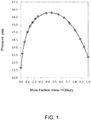
- FIG. 1 The temperatures measured versus the compositions in the PTx cell for the HFO-E-1438ezy/methyl formate system are shown in FIG. 1 , which graphically illustrates the formation of an azeotropic composition consisting essentially of HFO-E-1438ezy and methyl formate as indicated by a mixture of about 42.1 mole % HFO-E-1438ezy and 57.9 mole % methyl formate having the highest pressure over the range of compositions at about 27.8°C.
- HFO-E-1438ezy and methyl formate form azeotropic compositions ranging from about 11.2 mole percent to about 46.5 mole percent HFO-E-1438ezy and from about 88.8 mole percent to about 53.5 mole percent methyl formate.
- These azeotropic compositions boil at a temperature of from about -40°C to about 171°C and at a pressure of from about 0.5 psia (3.4 kPa) to about 456 psia (3144 kPa).
- the azeotropic composition consists essentially of 42.1 mole % HFO-E-1438ezy and 57.9 mole % methyl formate.
- the azeotropic composition consists essentially of 42.2 mole % HFO-E-1438ezy and 57.8 mole % methyl formate.
- Table 1 Azeotropic Compositions Temp °C Pressure PSIA E-1438EZYT Mole-Frac Methyl Formate Mole-Frac -40 0.500851 0.464726 0.535273 -30 0.973422 0.456538 0.543461 -20 1.774033 0.449264 0.550735 -10 3.05662 0.442647 0.557353 0 5.013813 0.436488 0.563511 10 7.87652 0.430638 0.569361 20 11.91157 0.424984 0.575015 27.78 16.0521 0.420666 0.579333 30 17.417862 0.419442 0.580557 40 24.721561 0.413956 0.586044 50 34.170861 0.408483 0.591516 60 46.130733 0.402996 0.597003 70 60.977886 0.397473 0.602526 80 79.095912 0.391886 0.608113 90 100.87026 0.386187 0.613812 100 126.682209 0.
- azeotrope-like compositions containing HFO-E-1438ezy and methyl formate may also be formed. According to calculation, azeotrope-like compositions consisting essentially of 1-99 mole % HFO-E-1438ezy and 99-1 mole % methyl formate are formed at temperatures ranging from about -40°C to about 140°C. More specifically, over this temperature range, the difference in dew point pressure and bubble point pressure of the composition at a particular temperature is less than or equal to 5 percent, based upon the bubble point pressure.
- Such azeotrope-like compositions may exist above and below the upper and lower limits of azeotropic compositions.
- Some embodiments of azeotrope-like compositions are listed in Tables 2 and 3.
- Table 2 Azeotrope-like compositions Components T (°C) Mole Percentage Range HFO-E-1438ezy/methyl formate -40 27 - 75 / 25 - 73 93-99/1 -7 HFO-E-1438ezy/methyl formate - 20 26 - 77 / 23 - 74 89 - 99 /1 - 11 HFO-E-1438ezy/methyl formate 0 25 - 99 / 1 - 75 HFO-E-1438ezy/methyl formate 20 1 -2 / 98 - 99 22 - 99 / 1 - 78 HFO-E-1438ezy/methyl formate 40 1 - 4 / 96 - 99 18 - 99 / 1 - 82 HFO-E-1438ezy/methyl formate 60 1
- HFO-E-1438ezy and HFO-E-1,1,1,4,4,4-hexafluoro-2-butene form azeotrope-like compositions.
- the PTx method described above was used. Once more, he pressure in a PTx cell of known volume was measured at constant temperature for various binary compositions. These measurements were then reduced to equilibrium vapor and liquid compositions in the cell using the NRTL equation.
- azeotrope-like compositions consisting essentially of 1 to 9 mole % HFO-E-1,3,4,4,4-pentafluoro-3-trifluoromethyl-1-butene and 91 to 99 mole % HFO-E-1,1,1,4,4,4-hexafluoro-2-butene at 24.8°C and pressures ranging from about 25 to 28 psia
- azeotrope-like compositions consisting essentially of 94 to 99 mole % HFO-E-1,3,4,4,4-pentafluoro-3-trifluoromethyl-1-butene and 1 to 6 mole % HFO-E-1,1,1,4,4,4-hexafluoro-2-butene at 24.8°C and pressures ranging from about 12 psia .
- azeotrope-like compositions consisting essentially of 1-32 mole % and 76-99 mole %HFO-E-1,3,4,4,4-pentafluoro-3-trifluoromethyl-1-butene and 68-99 mole % and 1-24 mole % HFO-E-1,1,1,4,4,4-hexafluoro-2-butene are formed at temperatures ranging from about -40°C to about 120°C (i.e., over this temperature range, the difference in dew point pressure and bubble point pressure of the composition at a particular temperature is less than or equal to 5 percent (based upon the bubble point pressure)).
- azeotrope-like compositions Components T (°C) Mole Percentage Range HFO-E-1,3,4,4,4-Pentafluoro-3-trifluoromethyl-1 -butene / HFO-E-1,1,1,4,4,4-Hexafluoro-2-butene -40 1 - 4 / 96 - 99 97 - 99 / 1 - 3 HFO-E-1,3,4,4,4-Pentafluoro-3-trifluoromethyl-1 -butene / HFO-E-1,1,1,4,4,4-Hexafluoro-2-butene - 20 1 - 5 / 95 - 99 97 - 99 / 1 - 3 HFO-E-1,3,4,4,4-Pentafluoro-3-trifluoromethyl-1 -butene / HFO-E-1,1,1,4,4,4-Hexafluoro-2-butene - 20 1 - 5 / 95 - 99 97 - 99
- the azeotropic or azeotrope-like compositions of the present invention can be prepared by any convenient method including mixing or combining the desired amounts.
- an azeotropic or azeotrope-like composition can be prepared by weighing the desired component amounts and combining them in an appropriate container.
- azeotropic or azeotrope-like compositions of the present invention can be used in a wide range of applications, including their use as aerosol propellants, refrigerants, solvents, cleaning agents, blowing agents (foam expansion agents) for thermoplastic and thermoset foams, heat transfer media, gaseous dielectrics, fire extinguishing and suppression agents, power cycle working fluids, polymerization media, particulate removal fluids, carrier fluids, buffing abrasive agents, and displacement drying agents.
- One embodiment of this invention provides a process for preparing a thermoplastic or thermoset foam.
- the process comprises using an azeotropic or azeotrope-like composition as a blowing agent, wherein said azeotropic or azeotrope-like composition consists essentially of HFO-E-1438ezy and a second compound selected from the group consisting of methyl formate and HFO-E-1,1,1,4,4,4-hexafluoro-2-butene.
- Another embodiment of this invention provides a process for producing refrigeration.
- the process comprises condensing an azeotropic or azeotrope-like composition and thereafter evaporating said azeotropic or azeotrope-like composition in the vicinity of the body to be cooled, wherein said azeotropic or azeotrope-like composition consists essentially of HFO-E-1438ezy and a second compound selected from the group consisting of methyl formate and HFO-E-1,1,1,4,4,4-hexafluoro-2-butene.
- Another embodiment of this invention provides a process for producing cooling.
- the process comprises condensing an azeotropic or azeotrope-like composition and thereafter evaporating said azeotropic or azeotrope-like composition in the vicinity of the body to be cooled, wherein said azeotropic or azeotrope-like composition consists essentially of HFO-E-1438ezy and a second compound selected from the group consisting of methyl formate and HFO-E-1,1,1,4,4,4-hexafluoro-2-butene.
- Another embodiment of this invention provides a process for producing heating.
- the process comprises condensing an azeotropic or azeotrope-like composition in the vicinity of the body to be heated and thereafter evaporating said azeotropic or azeotrope-like composition, wherein said azeotropic or azeotrope-like composition consists essentially of HFO-E-1438ezy and a second compound selected from the group consisting of methyl formate and HFO-E-1,1,1,4,4,4-hexafluoro-2-butene.
- Another embodiment of this invention provides a process for using an azeotropic or azeotrope-like composition as a solvent, wherein said azeotropic or azeotrope-like composition consists essentially of HFO-E-1438ezy and a second compound selected from the group consisting of methyl formate and HFO-E-1,1,1,4,4,4-hexafluoro-2-butene.
- Another embodiment of this invention provides a process for producing an aerosol product.
- the process comprises using an azeotropic or azeotrope-like composition as a propellant, wherein said azeotropic or azeotrope-like composition consists essentially of HFO-E-1438ezy and a second compound selected from the group consisting of methyl formate and HFO-E-1,1,1,4,4,4-hexafluoro-2-butene.
- Another embodiment of this invention provides a process using an azeotropic or azeotrope-like composition as a heat transfer media, wherein said azeotropic or azeotrope-like composition consists essentially of HFO-E-1438ezy and a second compound selected from the group consisting of methyl formate and HFO-E-1,1,1,4,4,4-hexafluoro-2-butene.
- Another embodiment of this invention provides a process for extinguishing or suppressing a fire.
- the process comprises using an azeotropic or azeotrope-like composition as a fire extinguishing or suppression agent, wherein said azeotropic or azeotrope-like composition consists essentially of HFO-E-1438ezy and a second compound selected from the group consisting of methyl formate and HFO-E-1,1,1,4,4,4-hexafluoro-2-butene.
- Another embodiment of this invention provides a process using an azeotropic or azeotrope-like composition as dielectrics, wherein said azeotropic or azeotrope-like composition consists essentially of HFO-E-1438ezy and a second compound selected from the group consisting of methyl formate and HFO-E-1,1,1,4,4,4-hexafluoro-2-butene.
Landscapes
- Chemical & Material Sciences (AREA)
- Engineering & Computer Science (AREA)
- Chemical Kinetics & Catalysis (AREA)
- Organic Chemistry (AREA)
- Materials Engineering (AREA)
- Health & Medical Sciences (AREA)
- Medicinal Chemistry (AREA)
- Polymers & Plastics (AREA)
- General Chemical & Material Sciences (AREA)
- Emergency Management (AREA)
- Business, Economics & Management (AREA)
- Thermal Sciences (AREA)
- Physics & Mathematics (AREA)
- Combustion & Propulsion (AREA)
- Life Sciences & Earth Sciences (AREA)
- Oil, Petroleum & Natural Gas (AREA)
- Wood Science & Technology (AREA)
- Dispersion Chemistry (AREA)
- Organic Low-Molecular-Weight Compounds And Preparation Thereof (AREA)
- Fire-Extinguishing Compositions (AREA)
- Heterocyclic Carbon Compounds Containing A Hetero Ring Having Oxygen Or Sulfur (AREA)
Abstract
Description
- The present disclosure relates to azeotropic or azeotrope-like compositions of HFO-E-1,3,4,4,4-pentafluoro-3-trifluoromethyl-1-butene and a number of compounds including methyl formate and HFO-E-1,1,1,4,4,4-hexafluoro-2-butene.
- Many industries have been working for the past few decades to find replacements for the ozone depleting chlorofluorocarbons (CFCs) and hydrochlorofluorocarbons (HCFCs). The CFCs and HCFCs have been employed in a wide range of applications, including their use as aerosol propellants, refrigerants, cleaning agents, expansion agents for thermoplastic and thermoset foams, heat transfer media, gaseous dielectrics, fire extinguishing and suppression agents, power cycle working fluids, polymerization media, particulate removal fluids, carrier fluids, buffing abrasive agents, and displacement drying agents. In the search for replacements for these versatile compounds, many industries have turned to the use of hydrofluorocarbons (HFCs).
- The HFCs do not contribute to the destruction of stratospheric ozone, but are of concern due to their contribution to the "greenhouse effect", i.e., they contribute to global warming. As a result of their contribution to global warming, the HFCs have come under scrutiny, and their widespread use may also be limited in the future. Thus, there is a need for compositions that have both low ozone depleting potentials (ODPs) and low global warming potentials (GWPs). For example, HFO-E-1,3,4,4,4-pentafluoro-3-trifluoromethyl-1-butene has zero ODP and low GWP. Methyl formate also has zero ODP and low GWP.
- This disclosure provides a composition consisting essentially of (a) HFO-E-1,3,4,4,4-pentafluoro-3-trifluoromethyl-1-butene and (b) a second compound selected from the group consisting of methyl formate and HFO-E-1,1,1,4,4,4-hexafluoro-2-butene; wherein the second compound is present in an effective amount to form an azeotropic or azeotrope-like mixture with HFO-E-1,3,4,4,4-pentafluoro-3-trifluoromethyl-1-butene.
-
-
FIG. 1 -FIG. 1 is a graphical representation of an azeotropic composition of HFO-E-1,3,4,4,4-pentafluoro-3-trifluoromethyl-1-butene (HFO-E-1438ezy) and methyl formate at a temperature of about 27.8°C. -
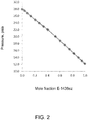
FIG. 2 -FIG. 2 is a graphical representation of an azeotrope-like composition of HFO-E-1,3,4,4,4-pentafluoro-3-trifluoromethyl-1-butene (HFO-E-1438ezy) and HFO-E-1,1,1,4,4,4-hexafluoro-2-butene at a temperature of about 24.8°C. - In many applications, the use of a pure single component or an azeotropic or azeotrope-like mixture is desirable. For example, when a blowing agent composition (also known as a foam expansion agent or a foam expansion composition) is not a pure single component or an azeotropic or azeotrope-like mixture, the composition may change during the foam forming process. Such a change in composition could detrimentally affect processing or cause poor performance in the application. Also, in refrigeration applications, a refrigerant is often lost during operation through leaks in shaft seals, hose connections, soldered joints and broken lines. In addition, the refrigerant may be released to the atmosphere during maintenance procedures on refrigeration equipment. If the refrigerant is not a pure single component or an azeotropic or azeotrope-like composition, the refrigerant composition may change when leaked or discharged to the atmosphere from the refrigeration equipment. The change in refrigerant composition may cause the refrigerant to become flammable or to have poor refrigeration performance. Accordingly, there is a need for using azeotropic or azeotrope-like mixtures in these and other applications, for example azeotropic or azeotrope-like mixtures containing HFO-E-1,3,4,4,4-pentafluoro-3-trifluoromethyl-1-butene (also referred to herein interchangeably as E-(CF3)2CFCH=CHF, HFO-E-1438ezy, or HFO-trans-1438ezy) in combination with a second compound selected from the group consisting of methyl formate and HFO-E-1,1,1,4,4,4-hexafluoro-2-butene.
- Before addressing details of embodiments described below, some terms are defined or clarified. The following definitions are used herein to further define and describe the disclosure. These definitions apply to the terms as used throughout this specification, unless otherwise limited in specific instances.
- HFO-1438ezy may exist as one of two configurational isomers, E or Z. The term "HFO-1438ezy", when used herein without a configurational signifier such as E or Z, refers to the isomers, HFO-Z-1438ezy or HFO-E-1438ezy, as well as any combinations or mixtures of such isomers.
- As used herein, the terms "comprises," "comprising," "includes," "including," "has," "having" or any other variation thereof, are intended to cover a non-exclusive inclusion. For example, a process, method, article, or apparatus that comprises a list of elements is not necessarily limited to only those elements but may include other elements not expressly listed or inherent to such process, method, article, or apparatus. Further, unless expressly stated to the contrary, "or" refers to an inclusive or and not to an exclusive or. For example, a condition A or B is satisfied by any one of the following: A is true (or present) and B is false (or not present), A is false (or not present) and B is true (or present), and both A and B are true (or present).
- Also, use of "a" or "an" are employed to describe elements and components described herein. This is done merely for convenience and to give a general sense of the scope of the invention. This description should be read to include one or at least one and the singular also includes the plural unless it is obvious that it is meant otherwise.
- Unless otherwise defined, all technical and scientific terms used herein have the same meaning as commonly understood by one of ordinary skill in the art to which this invention belongs. Although methods and materials similar or equivalent to those described herein can be used in the practice or testing of embodiments of the present invention, suitable methods and materials are described below. All publications, patent applications, patents, and other references mentioned herein are incorporated by reference in their entirety, unless a particular passage is cited. In case of conflict, the present specification, including definitions, will control. In addition, the materials, methods, and examples are illustrative only and not intended to be limiting.
- Provided herein are compositions consisting essentially of (a) HFO-E-1438ezy and (b) a second compound selected from the group consisting of methyl formate and HFO-E-1,1,1,4,4,4-hexafluoro-2-butene; wherein the second compound is present in an effective amount.
- By "effective amount" is meant an amount, which, when combined with HFO-E-1438ezy, results in the formation of an azeotropic or azeotrope-like mixture. In this connection, those of skill in the art are aware that the proportion of the components in an azeotropic or azeotrope-like mixture may vary with the temperature or pressure at which the azeotropic or azeotrope-like mixture is distilled. Accordingly, the term "effective amount", as used herein, refers to the amount of each component in the mixture, which amounts may vary depending on the pressure applied to the composition so long as the azeotropic or azeotrope-like compositions continue to exist at the different pressures, but with possible different boiling points. Therefore, an "effective amount" includes the amounts, such as may be expressed in weight or mole percentages, of each component of the compositions of the instant invention which form azeotropic or azeotrope-like compositions at temperatures or pressures other than as described herein.
- As recognized in the art, an azeotropic composition is an admixture of two or more different components which, when in liquid form under a given pressure, will boil at a substantially constant temperature, which temperature may be higher or lower than the boiling temperatures of the individual components, and which will provide a vapor composition essentially identical to the overall liquid composition undergoing boiling. (see, e.g., M. F. Doherty and M.F. Malone, Conceptual Design of Distillation Systems, McGraw-Hill (New York), 2001, 185-186, 351-359).
- Accordingly, the essential features of an azeotropic composition are that at a given pressure, the boiling point of the liquid composition is fixed and that the composition of the vapor above the boiling composition is essentially that of the overall boiling liquid composition (i.e., no fractionation of the components of the liquid composition takes place). It is also recognized in the art that both the boiling point and the weight percentages of each component of the azeotropic composition may change when the azeotropic composition is subjected to boiling at different pressures. Thus, an azeotropic composition may be defined in terms of the unique relationship that exists among the components or in terms of the compositional ranges of the components or in terms of exact weight percentages of each component of the composition characterized by a fixed boiling point at a specified pressure.
- For the purpose of this invention, an azeotrope-like composition means a composition that behaves like an azeotropic composition (i.e., has constant boiling characteristics or a tendency not to fractionate upon boiling or evaporation). Hence, during boiling or evaporation, the vapor and liquid compositions, if they change at all, change only to a minimal or negligible extent. This is to be contrasted with non-azeotrope-like compositions in which during boiling or evaporation, the vapor and liquid compositions change to a substantial degree.
- Additionally, azeotrope-like compositions exhibit dew point pressure and bubble point pressure with virtually no pressure differential. That is to say that the difference in the dew point pressure and bubble point pressure at a given temperature will be a small value. In this invention, compositions with a difference in dew point pressure and bubble point pressure of less than or equal to 5 percent (based upon the bubble point pressure) is considered to be azeotrope-like.
- It is further recognized in this field that when the relative volatility of a system approaches 1.0, the system is defined as forming an azeotropic or azeotrope-like composition. Relative volatility is the ratio of the volatility of component 1 to the volatility of component 2. The ratio of the mole fraction of a component in vapor to that in liquid is the volatility of the component.
- To determine the relative volatility of any two compounds, a method known as the PTx method can be used. The vapor-liquid equilibrium (VLE), and hence relative volatility, can be determined either isothermally or isobarically. The isothermal method requires measurement of the total pressure of mixtures of known composition at constant temperature. In this procedure, the total absolute pressure in a cell of known volume is measured at a constant temperature for various compositions of the two compounds. The isobaric method requires measurement of the temperature of mixtures of known composition at constant pressure. In this procedure, the temperature in a cell of known volume is measured at a constant pressure for various compositions of the two compounds. Use of the PTx Method is described in detail in "Phase Equilibrium in Process Design", Wiley-Interscience Publisher, 1970, written by Harold R. Null, on pages 124 to 126.
- These measurements can be converted into equilibrium vapor and liquid compositions in the PTx cell by using an activity coefficient equation model, such as the Non-Random, Two-Liquid (NRTL) equation, to represent liquid phase nonidealities. Use of an activity coefficient equation, such as the NRTL equation, is described in detail in "The Properties of Gases and Liquids," 4th edition, published by McGraw Hill in New York in 1987, written by Reid, Prausnitz and Poling, on pages 241 to 387, and in "Phase Equilibria in Chemical Engineering," published by Butterworth Publishers in Boston in 1985, written by Stanley M. Walas, pages 165 to 244. Without wishing to be bound by any theory or explanation, it is believed that the NRTL equation, together with the PTx cell data, can sufficiently predict the relative volatilities of the HFO-E-1438ezy compositions of the present invention and can therefore predict the behavior of these mixtures in multi-stage separation equipment such as distillation columns.
- It was found through experiments that HFO-E-1438ezy and methyl formate form azeotropic compositions.
- To determine the relative volatility of this binary pair, the PTx method described above was used. The pressure in a PTx cell of known volume was measured at constant temperature for various binary compositions. These measurements were then reduced to equilibrium vapor and liquid compositions in the cell using the NRTL equation.
- The temperatures measured versus the compositions in the PTx cell for the HFO-E-1438ezy/methyl formate system are shown in
FIG. 1 , which graphically illustrates the formation of an azeotropic composition consisting essentially of HFO-E-1438ezy and methyl formate as indicated by a mixture of about 42.1 mole % HFO-E-1438ezy and 57.9 mole % methyl formate having the highest pressure over the range of compositions at about 27.8°C. - Based upon these findings, it has been calculated that HFO-E-1438ezy and methyl formate form azeotropic compositions ranging from about 11.2 mole percent to about 46.5 mole percent HFO-E-1438ezy and from about 88.8 mole percent to about 53.5 mole percent methyl formate. These azeotropic compositions boil at a temperature of from about -40°C to about 171°C and at a pressure of from about 0.5 psia (3.4 kPa) to about 456 psia (3144 kPa).
- For example, at 27.8°C and 16.1 psia (111 kPa) the azeotropic composition consists essentially of 42.1 mole % HFO-E-1438ezy and 57.9 mole % methyl formate. In another example, at 25.4°C and atmospheric pressure (14.7 psia, 101 kPa) the azeotropic composition consists essentially of 42.2 mole % HFO-E-1438ezy and 57.8 mole % methyl formate. Some embodiments of azeotropic compositions are listed in Table 1.
Table 1: Azeotropic Compositions Temp °C Pressure PSIA E-1438EZYT Mole-Frac Methyl Formate Mole-Frac -40 0.500851 0.464726 0.535273 -30 0.973422 0.456538 0.543461 -20 1.774033 0.449264 0.550735 -10 3.05662 0.442647 0.557353 0 5.013813 0.436488 0.563511 10 7.87652 0.430638 0.569361 20 11.91157 0.424984 0.575015 27.78 16.0521 0.420666 0.579333 30 17.417862 0.419442 0.580557 40 24.721561 0.413956 0.586044 50 34.170861 0.408483 0.591516 60 46.130733 0.402996 0.597003 70 60.977886 0.397473 0.602526 80 79.095912 0.391886 0.608113 90 100.87026 0.386187 0.613812 100 126.682209 0.380273 0.619726 110 156.900279 0.373926 0.626073 120 191.866326 0.366661 0.633338 130 231.87177 0.357365 0.642634 - Additionally, azeotrope-like compositions containing HFO-E-1438ezy and methyl formate may also be formed. According to calculation, azeotrope-like compositions consisting essentially of 1-99 mole % HFO-E-1438ezy and 99-1 mole % methyl formate are formed at temperatures ranging from about -40°C to about 140°C. More specifically, over this temperature range, the difference in dew point pressure and bubble point pressure of the composition at a particular temperature is less than or equal to 5 percent, based upon the bubble point pressure.
- Such azeotrope-like compositions may exist above and below the upper and lower limits of azeotropic compositions. Some embodiments of azeotrope-like compositions are listed in Tables 2 and 3.
Table 2 Azeotrope-like compositions Components T (°C) Mole Percentage Range HFO-E-1438ezy/methyl formate -40 27 - 75 / 25 - 73 93-99/1 -7 HFO-E-1438ezy/methyl formate - 20 26 - 77 / 23 - 74 89 - 99 /1 - 11 HFO-E-1438ezy/methyl formate 0 25 - 99 / 1 - 75 HFO-E-1438ezy/methyl formate 20 1 -2 / 98 - 99 22 - 99 / 1 - 78 HFO-E-1438ezy/methyl formate 40 1 - 4 / 96 - 99 18 - 99 / 1 - 82 HFO-E-1438ezy/methyl formate 60 1 - 99 / 1 - 99 HFO-E-1438ezy/methyl formate 80 1 - 99 / 1 - 99 HFO-E-1438ezy/methyl formate 100 1 - 99 / 1 - 99 HFO-E-1438ezy/methyl formate 120 1 - 99 / 1 - 99 HFO-E-1438ezy/methyl formate 140 1 - 99 / 1 - 99 Table 3 Azeotrope-like compositions Components T (°C) Mole Percentage Range HFO-E-1438ezy/methyl formate - 40 27 - 75 / 25 - 73 93-95 / 5-7 HFO-E-1438ezy/methyl formate - 20 26 - 77 / 23 - 74 89 - 95 / 5 - HFO-E-1438ezy/methyl formate 0 25-95 / 5-75 HFO-E-1438ezy/methyl formate 20 22 - 95 / 5 - 78 HFO-E-1438ezy/methyl formate 40 18 - 95 / 5 - 82 HFO-E-1438ezy/methyl formate 60 5 - 95 / 5 - 95 HFO-E-1438ezy/methyl formate 80 5 - 95 / 5 - 95 HFO-E-1438ezy/methyl formate 100 5-95 / 5-95 HFO-E-1438ezy/methyl formate 120 5 - 95 / 5 - 95 HFO-E-1438ezy/methyl formate 140 5 - 95 / 5 - 95 - It has further been discovered that HFO-E-1438ezy and HFO-E-1,1,1,4,4,4-hexafluoro-2-butene form azeotrope-like compositions. To determine the relative volatility of this binary pair, the PTx method described above was used. Once more, he pressure in a PTx cell of known volume was measured at constant temperature for various binary compositions. These measurements were then reduced to equilibrium vapor and liquid compositions in the cell using the NRTL equation.
- The pressures measured versus the compositions in the PTx cell for HFO-E-1,3,4,4,4-Pentafluoro-3-trifluoromethyl-1 -butene and HFO-E-1,1,1,4,4,4-Hexafluoro-2-butene mixtures are shown in
FIG. 2 , which graphically illustrates the formation of azeotrope-like compositions consisting essentially of 1 to 9 mole % HFO-E-1,3,4,4,4-pentafluoro-3-trifluoromethyl-1-butene and 91 to 99 mole % HFO-E-1,1,1,4,4,4-hexafluoro-2-butene at 24.8°C and pressures ranging from about 25 to 28 psia, and also illustrates the formation of azeotrope-like compositions consisting essentially of 94 to 99 mole % HFO-E-1,3,4,4,4-pentafluoro-3-trifluoromethyl-1-butene and 1 to 6 mole % HFO-E-1,1,1,4,4,4-hexafluoro-2-butene at 24.8°C and pressures ranging from about 12 psia . - According to calculation, azeotrope-like compositions consisting essentially of 1-32 mole % and 76-99 mole %HFO-E-1,3,4,4,4-pentafluoro-3-trifluoromethyl-1-butene and 68-99 mole % and 1-24 mole % HFO-E-1,1,1,4,4,4-hexafluoro-2-butene are formed at temperatures ranging from about -40°C to about 120°C (i.e., over this temperature range, the difference in dew point pressure and bubble point pressure of the composition at a particular temperature is less than or equal to 5 percent (based upon the bubble point pressure)).
- Some embodiments of azeotrope-like compositions are listed in Table 4.
Table 4: Azeotrope-like compositions Components T (°C) Mole Percentage Range HFO-E-1,3,4,4,4-Pentafluoro-3-trifluoromethyl-1 -butene / HFO-E-1,1,1,4,4,4-Hexafluoro-2-butene -40 1 - 4 / 96 - 99 97 - 99 / 1 - 3 HFO-E-1,3,4,4,4-Pentafluoro-3-trifluoromethyl-1 -butene / HFO-E-1,1,1,4,4,4-Hexafluoro-2-butene - 20 1 - 5 / 95 - 99 97 - 99 / 1 - 3 HFO-E-1,3,4,4,4-Pentafluoro-3-trifluoromethyl-1 -butene / HFO-E-1,1,1,4,4,4-Hexafluoro-2-butene 0 1 - 7 / 93 - 99 96 - 99 / 1 - 4 HFO-E-1,3,4,4,4-Pentafluoro-3-trifluoromethyl-1 -butene / HFO-E-1,1,1,4,4,4-Hexafluoro-2-butene 20 1 - 9 / 91 - 99 94 - 99 / - 6 HFO-E-1,3,4,4,4-Pentafluoro-3-trifluoromethyl-1 -butene / HFO-E-1,1,1,4,4,4-Hexafluoro-2-butene 40 1 - 11 / 89 - 99 93 - 99 / 1 - 7 HFO-E-1,3,4,4,4-Pentafluoro-3-trifluoromethyl-1 -butene / HFO-E-1,1,1,4,4,4-Hexafluoro-2-butene 60 1 - 13/ 87 - 99 91 - 99 / 1 - 9 HFO-E-1,3,4,4,4-Pentafluoro-3-trifluoromethyl-1 -butene / HFO-E-1,1,1,4,4,4-Hexafluoro-2-butene 80 1 - 17 / 83 - 99 88 - 99 / 1 - 12 HFO-E-1,3,4,4,4-Pentafluoro-3-trifluoromethyl-1 -butene / HFO-E-1,1,1,4,4,4-Hexafluoro-2-butene 100 1 - 22 / 78 - 99 84 - 99 / 1 - 16 HFO-E-1,3,4,4,4-Pentafluoro-3-trifluoromethyl-1 -butene / HFO-E-1,1,1,4,4,4-Hexafluoro-2-butene 120 1 - 32 / 68 - 99 76 - 99 / 1 - 24 - The azeotropic or azeotrope-like compositions of the present invention can be prepared by any convenient method including mixing or combining the desired amounts. In one embodiment of this invention, an azeotropic or azeotrope-like composition can be prepared by weighing the desired component amounts and combining them in an appropriate container.
- The azeotropic or azeotrope-like compositions of the present invention can be used in a wide range of applications, including their use as aerosol propellants, refrigerants, solvents, cleaning agents, blowing agents (foam expansion agents) for thermoplastic and thermoset foams, heat transfer media, gaseous dielectrics, fire extinguishing and suppression agents, power cycle working fluids, polymerization media, particulate removal fluids, carrier fluids, buffing abrasive agents, and displacement drying agents.
- One embodiment of this invention provides a process for preparing a thermoplastic or thermoset foam. The process comprises using an azeotropic or azeotrope-like composition as a blowing agent, wherein said azeotropic or azeotrope-like composition consists essentially of HFO-E-1438ezy and a second compound selected from the group consisting of methyl formate and HFO-E-1,1,1,4,4,4-hexafluoro-2-butene.
- Another embodiment of this invention provides a process for producing refrigeration. The process comprises condensing an azeotropic or azeotrope-like composition and thereafter evaporating said azeotropic or azeotrope-like composition in the vicinity of the body to be cooled, wherein said azeotropic or azeotrope-like composition consists essentially of HFO-E-1438ezy and a second compound selected from the group consisting of methyl formate and HFO-E-1,1,1,4,4,4-hexafluoro-2-butene.
- Another embodiment of this invention provides a process for producing cooling. The process comprises condensing an azeotropic or azeotrope-like composition and thereafter evaporating said azeotropic or azeotrope-like composition in the vicinity of the body to be cooled, wherein said azeotropic or azeotrope-like composition consists essentially of HFO-E-1438ezy and a second compound selected from the group consisting of methyl formate and HFO-E-1,1,1,4,4,4-hexafluoro-2-butene.
- Another embodiment of this invention provides a process for producing heating. The process comprises condensing an azeotropic or azeotrope-like composition in the vicinity of the body to be heated and thereafter evaporating said azeotropic or azeotrope-like composition, wherein said azeotropic or azeotrope-like composition consists essentially of HFO-E-1438ezy and a second compound selected from the group consisting of methyl formate and HFO-E-1,1,1,4,4,4-hexafluoro-2-butene.
- Another embodiment of this invention provides a process for using an azeotropic or azeotrope-like composition as a solvent, wherein said azeotropic or azeotrope-like composition consists essentially of HFO-E-1438ezy and a second compound selected from the group consisting of methyl formate and HFO-E-1,1,1,4,4,4-hexafluoro-2-butene.
- Another embodiment of this invention provides a process for producing an aerosol product. The process comprises using an azeotropic or azeotrope-like composition as a propellant, wherein said azeotropic or azeotrope-like composition consists essentially of HFO-E-1438ezy and a second compound selected from the group consisting of methyl formate and HFO-E-1,1,1,4,4,4-hexafluoro-2-butene.
- Another embodiment of this invention provides a process using an azeotropic or azeotrope-like composition as a heat transfer media, wherein said azeotropic or azeotrope-like composition consists essentially of HFO-E-1438ezy and a second compound selected from the group consisting of methyl formate and HFO-E-1,1,1,4,4,4-hexafluoro-2-butene.
- Another embodiment of this invention provides a process for extinguishing or suppressing a fire. The process comprises using an azeotropic or azeotrope-like composition as a fire extinguishing or suppression agent, wherein said azeotropic or azeotrope-like composition consists essentially of HFO-E-1438ezy and a second compound selected from the group consisting of methyl formate and HFO-E-1,1,1,4,4,4-hexafluoro-2-butene.
- Another embodiment of this invention provides a process using an azeotropic or azeotrope-like composition as dielectrics, wherein said azeotropic or azeotrope-like composition consists essentially of HFO-E-1438ezy and a second compound selected from the group consisting of methyl formate and HFO-E-1,1,1,4,4,4-hexafluoro-2-butene.
- While certain of the preferred embodiments of this invention have been described and specifically exemplified above, it is not intended that the invention be limited to such embodiments. Various modifications may be made without departing from the scope of the invention, as set forth in the following claims.
Claims (14)
- A composition consisting essentially of:(a) HFO-E-1,3,4,4,4-pentafluoro-3-trifluoromethyl-1-butene; and(b) methyl formate; wherein the methyl formate is present in an effective amount to form an azeotropic combination with the HFO-E-1,3,4,4,4-pentafluoro-3-trifluoromethyl-1-butene.
- The composition of claim 1, consisting essentially of:(a) from 11.2 mole percent to 46.5 mole percent of HFO-E-1,3,4,4,4-pentafluoro-3-trifluoromethyl-1-butene; and(b) from 53.5 mole percent to 88.8 mole percent of methyl formate.
- The composition of claim 2, consisting essentially of:(a) 42.1 mole percent of HFO-E-1,3,4,4,4-pentafluoro-3-trifluoromethyl-1-butene; and(b) 57.9 mole percent of methyl formate.
- A composition consisting essentially of:(a) HFO-E-1,3,4,4,4-pentafluoro-3-trifluoromethyl-1-butene; and(b) methyl formate; wherein the methyl formate is present in an effective amount to form an azeotrope-like combination with the HFO-E-1,3,4,4,4-pentafluoro-3-trifluoromethyl-1-butene.
- The composition of claim 4, consisting essentially of:(a) from 1 to 99 mole percent of HFO-E-1,3,4,4,4-pentafluoro-3-trifluoromethyl-1-butene; and(b) from 1 to 99 mole percent of methyl formate.
- A process for preparing a thermoplastic or thermoset foam comprising use of a blowing agent comprising an azeotropic or azeotrope-like composition, wherein said azeotropic or azeotrope-like composition consists essentially of HFO-E-1,3,4,4,4-pentafluoro-3-trifluoromethyl-1-butene and methyl formate.
- A process for producing refrigeration comprising condensing a heat transfer media comprising an azeotropic or azeotrope-like composition and thereafter evaporating said heat transfer media in the vicinity of a body to be cooled, wherein said azeotropic or azeotrope-like composition consists essentially of HFO-E-1,3,4,4,4-pentafluoro-3-trifluoromethyl- 1-butene and methyl formate.
- Use of an azeotropic or azeotrope-like composition as a solvent, wherein said azeotropic or azeotrope-like composition consists essentially of HFO-E-1,3,4,4,4-pentafluoro-3-trifluoromethyl-1-butene and methyl formate.
- A process for producing an aerosol product comprising use of a propellant comprising an azeotropic or azeotrope-like composition , wherein said azeotropic or azeotrope-like composition consists essentially of HFO-E-1,3,4,4,4-pentafluoro-3-trifluoromethyl-1-butene and methyl formate.
- Use of an azeotropic or azeotrope-like composition as a heat transfer media, wherein said azeotropic or azeotrope-like composition consists essentially of HFO-E-1,3,4,4,4-pentafluoro-3-trifluoromethyl-1-butene and methyl formate.
- A process for extinguishing or suppressing a fire comprising use of a fire extinguishing agent comprising an azeotropic or azeotrope-like composition , wherein said azeotropic or azeotrope-like composition consists essentially of HFO-E-1,3,4,4,4-pentafluoro-3-trifluoromethyl-1-butene and methyl formate.
- Use of an azeotropic or azeotrope-like composition as dielectrics, wherein said azeotropic or azeotrope-like composition consists essentially of HFO-E-1,3,4,4,4-pentafluoro-3-trifluoromethyl-1-butene and methyl formate.
- A process for producing cooling, comprising condensing a refrigerant comprising an azeotropic or azeotrope-like composition and thereafter evaporating said refrigerant in the vicinity of the body to be cooled, wherein said azeotropic or azeotrope-like composition consists essentially of HFO-E-1,3,4,4,4-pentafluoro-3-trifluoromethyl-1-butene and methyl formate.
- A process for producing heating, comprising condensing a heat transfer media comprising an azeotropic or azeotrope-like composition in the vicinity of a body to be heated and thereafter evaporating said heat transfer media, wherein said azeotropic or azeotrope-like composition consists essentially of HFO-E-1,3,4,4,4-pentafluoro-3-trifluoromethyl-1-butene and methyl formate.
Applications Claiming Priority (3)
| Application Number | Priority Date | Filing Date | Title |
|---|---|---|---|
| US201462036200P | 2014-08-12 | 2014-08-12 | |
| EP15745706.0A EP3180407B1 (en) | 2014-08-12 | 2015-07-23 | Azeotropic and azeotrope-like compositions of hfo-e-1,3,4,4,4-pentafluoro-3-trifluoromethyl-1-butene and uses thereof |
| PCT/US2015/041666 WO2016025138A1 (en) | 2014-08-12 | 2015-07-23 | Azeotropic and azeotrope-like compositions of hfo-e-1,3,4,4,4-pentafluoro-3-trifluoromethyl-1-butene and uses thereof |
Related Parent Applications (2)
| Application Number | Title | Priority Date | Filing Date |
|---|---|---|---|
| EP15745706.0A Division-Into EP3180407B1 (en) | 2014-08-12 | 2015-07-23 | Azeotropic and azeotrope-like compositions of hfo-e-1,3,4,4,4-pentafluoro-3-trifluoromethyl-1-butene and uses thereof |
| EP15745706.0A Division EP3180407B1 (en) | 2014-08-12 | 2015-07-23 | Azeotropic and azeotrope-like compositions of hfo-e-1,3,4,4,4-pentafluoro-3-trifluoromethyl-1-butene and uses thereof |
Publications (1)
| Publication Number | Publication Date |
|---|---|
| EP3613824A1 true EP3613824A1 (en) | 2020-02-26 |
Family
ID=53777015
Family Applications (2)
| Application Number | Title | Priority Date | Filing Date |
|---|---|---|---|
| EP15745706.0A Active EP3180407B1 (en) | 2014-08-12 | 2015-07-23 | Azeotropic and azeotrope-like compositions of hfo-e-1,3,4,4,4-pentafluoro-3-trifluoromethyl-1-butene and uses thereof |
| EP19195111.0A Withdrawn EP3613824A1 (en) | 2014-08-12 | 2015-07-23 | Azeotropic and azeotrope-like compositions of hfo-e-1,3,4,4,4-pentafluoro-3-trifluoromethyl-1-butene and uses thereof |
Family Applications Before (1)
| Application Number | Title | Priority Date | Filing Date |
|---|---|---|---|
| EP15745706.0A Active EP3180407B1 (en) | 2014-08-12 | 2015-07-23 | Azeotropic and azeotrope-like compositions of hfo-e-1,3,4,4,4-pentafluoro-3-trifluoromethyl-1-butene and uses thereof |
Country Status (6)
| Country | Link |
|---|---|
| US (3) | US10188887B2 (en) |
| EP (2) | EP3180407B1 (en) |
| KR (1) | KR20170041245A (en) |
| CN (1) | CN107001919A (en) |
| CA (1) | CA2955471A1 (en) |
| WO (1) | WO2016025138A1 (en) |
Families Citing this family (1)
| Publication number | Priority date | Publication date | Assignee | Title |
|---|---|---|---|---|
| CA3077388C (en) * | 2017-10-10 | 2024-04-09 | The Chemours Company Fc, Llc | Process for the manufacture of thermoplastic foam containing hfo-1336mzz(z) and hfo-1336mzz(e) |
Citations (1)
| Publication number | Priority date | Publication date | Assignee | Title |
|---|---|---|---|---|
| WO2014022638A1 (en) * | 2012-08-01 | 2014-02-06 | E. I. Du Pont De Nemours And Company | Azeotropic and azeotrope-like compositions of e-1,3,4,4,4-pentafluoro-3-trifluoromethyl-1-butene and z-1,1,1,4,4,4-hexafluoro-2-butene and uses thereof |
Family Cites Families (12)
| Publication number | Priority date | Publication date | Assignee | Title |
|---|---|---|---|---|
| US7803975B2 (en) * | 2006-07-13 | 2010-09-28 | E.I. Du Pont De Nemours And Company | Process for separating a fluoroolefin from HF by liquid-liquid extraction |
| CN101541715B (en) * | 2006-08-24 | 2013-09-11 | 纳幕尔杜邦公司 | Process for separating fluoroalkenes from hydrogen fluoride by azeotropic distillation |
| CN106474649B (en) * | 2007-06-12 | 2019-09-10 | 科慕埃弗西有限公司 | The azeotropic and Azeotrope-like compositions of E-1,1,1,4,4,4- hexafluoro -2- butylene |
| CA2695229C (en) * | 2007-09-06 | 2016-05-10 | E.I. Du Pont De Nemours And Company | Azeotropic and azeotrope-like compositions of e-1,1,1,4,4,5,5,5-octafluoro-2-pentene |
| ES2548184T3 (en) * | 2007-12-19 | 2015-10-14 | E. I. Du Pont De Nemours And Company | Foam-forming compositions containing an azeotrope-like mixture containing z-1,1,1,4,4,4-hexafluoro-2-butene and dimethoxymethane and their uses in the preparation of polyisocyanate-based foams |
| US20110147638A1 (en) * | 2009-06-26 | 2011-06-23 | E.I. Du Pont De Nemours And Company | Azeotropic and azeotrope-like compositions of z-1,1,1,4,4,4-hexafluoro-2-butene, trans-1,2-dichloroethylene, and cyclopentane |
| US20110144216A1 (en) * | 2009-12-16 | 2011-06-16 | Honeywell International Inc. | Compositions and uses of cis-1,1,1,4,4,4-hexafluoro-2-butene |
| US20150191576A1 (en) * | 2012-08-01 | 2015-07-09 | E I Du Pont De Nemours And Company | Azeotropic and azeotrope-like compositions of e-1,3,4,4,4-pentafluoro-3-trifluoromethyl-1-butene and z-1,1,1,4,4,4-hexafluoro-2-butene and uses thereof |
| TWI633179B (en) * | 2013-06-04 | 2018-08-21 | 杜邦股份有限公司 | Use of alkyl perfluoroalkene ethers and mixtures thereof in high temperature heat pumps |
| CA2926251A1 (en) * | 2013-10-08 | 2015-04-16 | The Chemours Company Fc, Llc | Azeotrope-like compositions of hfo-e-1,3,4,4,4-pentafluoro-3-trifluoromethyl-1-butene and e-1-chloro-3,3,3-trifluoropropene and uses thereof |
| WO2016140938A1 (en) * | 2015-03-02 | 2016-09-09 | The Chemours Company Fc, Llc | Azeotropic and azeotrope-like compositions of z-1-chloro-3,3,3-trifluoropropene |
| US20170028240A1 (en) * | 2015-07-31 | 2017-02-02 | The Chemours Company Fc, Llc | Method for the suppression of fire |
-
2015
- 2015-07-23 EP EP15745706.0A patent/EP3180407B1/en active Active
- 2015-07-23 WO PCT/US2015/041666 patent/WO2016025138A1/en not_active Ceased
- 2015-07-23 US US15/323,982 patent/US10188887B2/en not_active Expired - Fee Related
- 2015-07-23 EP EP19195111.0A patent/EP3613824A1/en not_active Withdrawn
- 2015-07-23 CN CN201580043220.5A patent/CN107001919A/en active Pending
- 2015-07-23 KR KR1020177006308A patent/KR20170041245A/en not_active Withdrawn
- 2015-07-23 CA CA2955471A patent/CA2955471A1/en not_active Abandoned
-
2018
- 2018-10-19 US US16/165,083 patent/US10286242B2/en not_active Expired - Fee Related
-
2019
- 2019-02-27 US US16/286,857 patent/US10434349B2/en not_active Expired - Fee Related
Patent Citations (1)
| Publication number | Priority date | Publication date | Assignee | Title |
|---|---|---|---|---|
| WO2014022638A1 (en) * | 2012-08-01 | 2014-02-06 | E. I. Du Pont De Nemours And Company | Azeotropic and azeotrope-like compositions of e-1,3,4,4,4-pentafluoro-3-trifluoromethyl-1-butene and z-1,1,1,4,4,4-hexafluoro-2-butene and uses thereof |
Non-Patent Citations (4)
| Title |
|---|
| HAROLD R. NULL: "Phase Equilibrium in Process Design", 1970, WILEY-INTERSCIENCE PUBLISHER, pages: 124 - 126 |
| M. F. DOHERTYM.F. MALONE: "Conceptual Design of Distillation Systems", vol. 185-186, 2001, MCGRAW-HILL, pages: 351 - 359 |
| REID, PRAUSNITZPOLING: "The Properties of Gases and Liquids", 1987, MCGRAW HILL, pages: 241 - 387 |
| STANLEY M. WALAS: "Phase Equilibria in Chemical Engineering", 1985, BUTTERWORTH PUBLISHERS, pages: 165 - 244 |
Also Published As
| Publication number | Publication date |
|---|---|
| US10286242B2 (en) | 2019-05-14 |
| US20170203137A1 (en) | 2017-07-20 |
| CN107001919A (en) | 2017-08-01 |
| EP3180407B1 (en) | 2020-01-08 |
| US10434349B2 (en) | 2019-10-08 |
| EP3180407A1 (en) | 2017-06-21 |
| US20190192891A1 (en) | 2019-06-27 |
| KR20170041245A (en) | 2017-04-14 |
| CA2955471A1 (en) | 2016-02-18 |
| WO2016025138A1 (en) | 2016-02-18 |
| US10188887B2 (en) | 2019-01-29 |
| US20190046824A1 (en) | 2019-02-14 |
Similar Documents
| Publication | Publication Date | Title |
|---|---|---|
| EP2139568B1 (en) | Azeotropic composition of z-1,1,1,4,4,4-hexafluoro-2-butene and methyl formate | |
| EP3095830B1 (en) | Azeotropic and azeotrope-like compositions of z-1,1,1,4,4,4- hexafluoro-2-butene | |
| EP2285930B1 (en) | Azeotropic and azeotrope-like compositions of z-1,1,1,4,4,4-hexafluoro-2-butene | |
| EP2957616A1 (en) | Azeotrope-like compositions involving certain haloolefins and uses thereof | |
| US20110260093A1 (en) | azeotrope-like compositions of e-1,1,1,4,4,4-hexafluoro-2-butene and 1-chloro-3,3,3-trifluoropropene | |
| EP2152833A1 (en) | Azeotropic and azeotrope-like compositions of e-1,1,1,4,4,4-hexafluoro-2-butene | |
| WO2009032983A1 (en) | Azeotropic and azeotrope-like compositions of e-1,1,1,4,4,5,5,5-octafluoro-2-pentene | |
| US20190217138A1 (en) | Azeotrope-like compositions of hfo-e-1,3,4,4,4-pentafluoro-3-trifluoromethyl-1-butene and e-1-chloro-3,3,3-trifluoropropene and uses thereof | |
| EP2885345B1 (en) | Azeotropic and azeotrope-like compositions of 2,3,3,4,4,4-hexafluoro-1-butene and 1,1,1,2,3,3-hexafluoropropane and uses thereof | |
| US10434349B2 (en) | Azeotropic and azeotrope-like compositions of HFO-E-1,3,4,4,4-pentafluoro-3-trifluoromethyl-1-butene and uses thereof | |
| US20150202480A1 (en) | Azeotropic and azeotrope-like compositions of 2,3,3,4,4,4-hexafluoro-1-butene and 1,1,1,2,3,3-hexafluoropropane and uses thereof | |
| CA2879541A1 (en) | Azeotropic and azeotrope-like compositions of e-1,3,4,4,4-pentafluoro-3-trifluoromethyl-1-butene and z-1,1,1,4,4,4-hexafluoro-2-butene and uses thereof | |
| AU2017201144B8 (en) | Azeotropic and azeotrope-like compositions of z-1,1,1,4,4,4-hexafluoro-2-butene | |
| US20150238792A1 (en) | Azeotropic and azeotrope-like compositions of hcfo-e-1-chloro-3,3,3-trifluoropropene and a pentane and uses thereof |
Legal Events
| Date | Code | Title | Description |
|---|---|---|---|
| PUAI | Public reference made under article 153(3) epc to a published international application that has entered the european phase |
Free format text: ORIGINAL CODE: 0009012 |
|
| STAA | Information on the status of an ep patent application or granted ep patent |
Free format text: STATUS: THE APPLICATION HAS BEEN PUBLISHED |
|
| AC | Divisional application: reference to earlier application |
Ref document number: 3180407 Country of ref document: EP Kind code of ref document: P |
|
| AK | Designated contracting states |
Kind code of ref document: A1 Designated state(s): AL AT BE BG CH CY CZ DE DK EE ES FI FR GB GR HR HU IE IS IT LI LT LU LV MC MK MT NL NO PL PT RO RS SE SI SK SM TR |
|
| STAA | Information on the status of an ep patent application or granted ep patent |
Free format text: STATUS: THE APPLICATION IS DEEMED TO BE WITHDRAWN |
|
| 18D | Application deemed to be withdrawn |
Effective date: 20200827 |