EP3613783A1 - Preparation method of graft copolymer, graft copolymer, and thermoplastic resin molded article - Google Patents
Preparation method of graft copolymer, graft copolymer, and thermoplastic resin molded article Download PDFInfo
- Publication number
- EP3613783A1 EP3613783A1 EP19747015.6A EP19747015A EP3613783A1 EP 3613783 A1 EP3613783 A1 EP 3613783A1 EP 19747015 A EP19747015 A EP 19747015A EP 3613783 A1 EP3613783 A1 EP 3613783A1
- Authority
- EP
- European Patent Office
- Prior art keywords
- weight
- parts
- graft copolymer
- conjugated diene
- based polymer
- Prior art date
- Legal status (The legal status is an assumption and is not a legal conclusion. Google has not performed a legal analysis and makes no representation as to the accuracy of the status listed.)
- Granted
Links
Images

Classifications
-
- C—CHEMISTRY; METALLURGY
- C08—ORGANIC MACROMOLECULAR COMPOUNDS; THEIR PREPARATION OR CHEMICAL WORKING-UP; COMPOSITIONS BASED THEREON
- C08L—COMPOSITIONS OF MACROMOLECULAR COMPOUNDS
- C08L51/00—Compositions of graft polymers in which the grafted component is obtained by reactions only involving carbon-to-carbon unsaturated bonds; Compositions of derivatives of such polymers
- C08L51/04—Compositions of graft polymers in which the grafted component is obtained by reactions only involving carbon-to-carbon unsaturated bonds; Compositions of derivatives of such polymers grafted on to rubbers
-
- C—CHEMISTRY; METALLURGY
- C08—ORGANIC MACROMOLECULAR COMPOUNDS; THEIR PREPARATION OR CHEMICAL WORKING-UP; COMPOSITIONS BASED THEREON
- C08C—TREATMENT OR CHEMICAL MODIFICATION OF RUBBERS
- C08C1/00—Treatment of rubber latex
- C08C1/02—Chemical or physical treatment of rubber latex before or during concentration
- C08C1/065—Increasing the size of dispersed rubber particles
-
- C—CHEMISTRY; METALLURGY
- C08—ORGANIC MACROMOLECULAR COMPOUNDS; THEIR PREPARATION OR CHEMICAL WORKING-UP; COMPOSITIONS BASED THEREON
- C08F—MACROMOLECULAR COMPOUNDS OBTAINED BY REACTIONS ONLY INVOLVING CARBON-TO-CARBON UNSATURATED BONDS
- C08F279/00—Macromolecular compounds obtained by polymerising monomers on to polymers of monomers having two or more carbon-to-carbon double bonds as defined in group C08F36/00
- C08F279/02—Macromolecular compounds obtained by polymerising monomers on to polymers of monomers having two or more carbon-to-carbon double bonds as defined in group C08F36/00 on to polymers of conjugated dienes
- C08F279/04—Vinyl aromatic monomers and nitriles as the only monomers
-
- C—CHEMISTRY; METALLURGY
- C08—ORGANIC MACROMOLECULAR COMPOUNDS; THEIR PREPARATION OR CHEMICAL WORKING-UP; COMPOSITIONS BASED THEREON
- C08F—MACROMOLECULAR COMPOUNDS OBTAINED BY REACTIONS ONLY INVOLVING CARBON-TO-CARBON UNSATURATED BONDS
- C08F8/00—Chemical modification by after-treatment
- C08F8/02—Alkylation
-
- C—CHEMISTRY; METALLURGY
- C08—ORGANIC MACROMOLECULAR COMPOUNDS; THEIR PREPARATION OR CHEMICAL WORKING-UP; COMPOSITIONS BASED THEREON
- C08F—MACROMOLECULAR COMPOUNDS OBTAINED BY REACTIONS ONLY INVOLVING CARBON-TO-CARBON UNSATURATED BONDS
- C08F8/00—Chemical modification by after-treatment
- C08F8/34—Introducing sulfur atoms or sulfur-containing groups
-
- C—CHEMISTRY; METALLURGY
- C08—ORGANIC MACROMOLECULAR COMPOUNDS; THEIR PREPARATION OR CHEMICAL WORKING-UP; COMPOSITIONS BASED THEREON
- C08K—Use of inorganic or non-macromolecular organic substances as compounding ingredients
- C08K5/00—Use of organic ingredients
- C08K5/01—Hydrocarbons
-
- C—CHEMISTRY; METALLURGY
- C08—ORGANIC MACROMOLECULAR COMPOUNDS; THEIR PREPARATION OR CHEMICAL WORKING-UP; COMPOSITIONS BASED THEREON
- C08L—COMPOSITIONS OF MACROMOLECULAR COMPOUNDS
- C08L25/00—Compositions of, homopolymers or copolymers of compounds having one or more unsaturated aliphatic radicals, each having only one carbon-to-carbon double bond, and at least one being terminated by an aromatic carbocyclic ring; Compositions of derivatives of such polymers
- C08L25/02—Homopolymers or copolymers of hydrocarbons
- C08L25/04—Homopolymers or copolymers of styrene
- C08L25/08—Copolymers of styrene
- C08L25/12—Copolymers of styrene with unsaturated nitriles
-
- C—CHEMISTRY; METALLURGY
- C08—ORGANIC MACROMOLECULAR COMPOUNDS; THEIR PREPARATION OR CHEMICAL WORKING-UP; COMPOSITIONS BASED THEREON
- C08F—MACROMOLECULAR COMPOUNDS OBTAINED BY REACTIONS ONLY INVOLVING CARBON-TO-CARBON UNSATURATED BONDS
- C08F2500/00—Characteristics or properties of obtained polyolefins; Use thereof
- C08F2500/24—Polymer with special particle form or size
Definitions
- the present invention relates to a method for preparing a graft copolymer, a graft copolymer and a thermoplastic resin molded article, and more particularly, to a method for preparing a graft copolymer, by which a molded article having improved surface characteristics and improved plating and painting properties may be manufactured, a graft copolymer and a thermoplastic resin molded article.
- a method of controlling the amount of acrylonitrile may be used to improve plating properties.
- a method of increasing a graft ratio or a method including a butadiene rubber polymer having the high gel content is also used.
- a method of introducing a small-size butadiene rubbery polymer having a small average particle diameter during the graft reaction may be used.
- plating adhesion may be improved, but due to the increase of the amount of the small-size butadiene rubbery polymer, impact strength of a graft copolymer may be decreased, and problems of decreasing a graft ratio and deteriorating flowability may arise.
- An object of the present invention is to provide a method for preparing a graft copolymer possibly manufacturing a molded article having improved surface characteristics, and thus, improved plating and painting properties.
- Another object of the present invention is to provide a method for preparing a graft copolymer, by which a molded article having a high graft ratio, excellent flowability and mechanical properties, and minimized remaining amount of volatile organic compounds, may be manufactured.
- a method for preparing a graft copolymer which includes polymerizing a first conjugated diene-based polymer, a second conjugated diene-based polymer, an aromatic vinyl-based monomer and a vinyl cyan-based monomer, wherein particle size distribution of the first conjugated diene-based polymer is 0.346 to 0.404, and particle size distribution of the second conjugated diene-based polymer is 0.196 to 0.304.
- the present invention provides a graft copolymer, which is prepared by the above-described method and has a graft ratio of 37% or more and a weight average molecular weight of a shell of 75,000 g/mol or more.
- the present invention provides a thermoplastic resin molded article manufactured from a thermoplastic resin composition which includes the above-described graft copolymer; and a copolymer including a unit derived from an aromatic vinyl-based monomer and a unit derived from a vinyl cyan-based monomer, wherein a remaining amount of volatile organic compounds is 1,000 ppm or less.
- a molded article having excellent surface characteristics and improved plating and paining properties may be manufactured.
- a molded article having excellent flowability and mechanical properties, and minimized remaining amount of volatile organic compounds may be manufactured.
- the average particle diameter and particle size distribution of the conjugated diene-based polymer may be measured using a dynamic light scattering method, particularly, using a Nicomp 380 equipment (product name, manufacturer: PSS) in the present invention.
- the "average particle diameter” or "Dv” referred to in the present disclosure means an arithmetic average particle diameter in particle size distribution measured by the dynamic light scattering method.
- the arithmetic average particle diameter may be an intensity distribution average particle diameter.
- 90% particle diameter means a particle diameter (D 90 ) at position 90% when counting the particle diameter from 0 (minimum) - 100% (maximum) in order from a small particle diameter in the particle diameter distribution measured by the measuring method.
- 50% particle diameter means a particle diameter (D 50 ) when dividing fragments into two based on a certain particle diameter in the particle size distribution measured by the measuring method and when a greater portion and a smaller portion become equivalent.
- “10% particle diameter” means a particle diameter (D 10 ) at position 10% when counting the particle diameter from 0 (minimum) - 100% (maximum) in order from a small particle diameter in the particle diameter distribution measured by the measuring method.
- the gel content may be measured by coagulating a conjugated diene-based polymer latex using methanol, washing, and drying in a vacuum oven of 60°C for 24 hours. Then, the lump (specimen) thus obtained is cut using scissors, 1 g thereof is taken and put in 100 g of toluene and stored at room temperature for 48 hours in a dark room, and then, sol and gel are separated. Then, the gel content may be measured by the following Equation.
- Gel content % gel weight / specimen weight ⁇ 100
- the average molecular weight of the shell of the graft copolymer may be measured by drying the supernatant obtained in the measurement method of the graft ratio in a hot air oven of 50°C, dissolving a dried material in THF to prepare a solution (concentration: 0.1 wt%), and filtering the solution using a 0.1 ⁇ m filter, and finally using GPC.
- the remaining amount of the volatile organic compounds may be measured using a gas chromatography equipment (product name: GC, manufacturer: Agilent).
- the polymerization may be any one selected from the group consisting of suspension polymerization, emulsion polymerization and bulk polymerization, and among them, the emulsion polymerization is preferable.
- the derived unit from an aromatic vinyl-based monomer may be a unit derived from an aromatic vinyl-based monomer.
- the aromatic vinyl-based monomer may be one or more selected from the group consisting of styrene, ⁇ -methyl styrene, ⁇ -ethyl styrene, and p-methyl styrene, and among them, the styrene is preferable.
- the derived unit from a vinyl cyan-based monomer may be a unit derived from a vinyl cyan-based monomer.
- the vinyl cyan-based monomer may be one or more selected from the group consisting of acrylonitrile, methacrylonitrile, phenylacrylonitrile and ⁇ -chloroacrylonitrile, and among them, the acrylonitrile is preferable.
- the conjugated diene-based monomer may be one or more selected from the group consisting of 1,3-butadiene, isoprene, chloroprene and piperylene, and among them, the 1,3-butadiene is preferable.
- the method for preparing a graft copolymer according to an embodiment of the present invention includes polymerizing a first conjugated diene-based polymer, a second conjugated diene-based polymer, an aromatic vinyl-based monomer and a vinyl cyan-based monomer, wherein the particle size distribution of the first conjugated diene-based polymer is 0.346 to 0.404, and the particle size distribution of the second conjugated diene-based polymer is 0.196 to 0.304.
- the particle size distribution of the first conjugated diene-based polymer is 0.346 to 0.404, preferably, 0.35 to 0.4. If the above-described conditions are satisfied, coagulation in the first conjugated diene-based polymer is minimized. In addition, a graft copolymer accomplishing excellent surface characteristics and impact strength may be prepared. If the particle size distribution is less than the above-mentioned range, impact strength is decreased, and if the particle size distribution is greater than the above-mentioned range, surface protrusions are excessively produced.
- the first conjugated diene-based polymer has an average particle diameter of 0.2 to 0.4 ⁇ m, 0.25 to 0.35 ⁇ m or 0.3 to 0.33 ⁇ m, and among them, 0.3 to 0.33 ⁇ m is preferable. If the above-described conditions are satisfied, the coagulation in the first conjugated diene-based polymer may be minimized and impact strength and flowability may be improved.
- the particles included in the first conjugated diene-based polymer may have a standard deviation of 0.3 to 0.4 or 0.33 to 0.38, and among them, 0.33 to 0.38 is preferable. If the above-described conditions are satisfied, since the first conjugated diene-based polymer includes particles having relatively diverse particle diameters, a graft copolymer having excellent surface characteristics and impact strength may be prepared.
- the second conjugated diene-based polymer has particle size distribution of 0.196 to 0.304, preferably, 0.2 to 0.3. If the above-described conditions are satisfied, the graft copolymer may achieve excellent impact strength and tensile strength. If the above-described conditions are not satisfied, the impact strength of the graft copolymer may be degraded.
- the second conjugated diene-based polymer has an average particle diameter of 0.2 to 0.4 ⁇ m, 0.25 to 0.35 ⁇ m or 0.28 to 0.30 ⁇ m, and among them, 0.28 to 0.30 ⁇ m is preferable. If the above-described range is satisfied, the mechanical properties and flowability of the graft copolymer may be even more improved.
- the particles included in the second conjugated diene-based polymer may have a standard deviation of 0.2 to 0.29 or 0.24 to 0.26, and among them, 0.24 to 0.26 is preferable. If the above-described conditions are satisfied, since the second conjugated diene-based polymer includes particles having uniform particle diameters, a graft copolymer having excellent impact strength may be prepared.
- the first conjugated diene-based polymer and the second conjugated diene-based polymer may be prepared by 1) a preparation method by which a conjugated diene-based monomer is polymerized and enlargement is not performed, or 2) a preparation method by which a conjugated diene-based monomer is polymerized to prepare a small-size conjugated diene-based polymer, and enlarging the small-size conjugated diene-based polymer.
- the average particle diameter of the small-size conjugated diene-based polymer may be 0.05 to 0.15 ⁇ m, or 0.08 to 0.12 ⁇ m, and among them, 0.08 to 0.12 ⁇ m is preferable. If the above-described conditions are satisfied, the preparation of the first and second conjugated diene-based polymers may be easy.
- the gel content of the small-size conjugated diene-based polymer may be 90% or more, 90% to 95%, or 90% to 94%, and among them, 92% to 94% is preferable. If the above-described conditions are satisfied, excellent impact strength may be accomplished.
- the enlargement during preparing the first and second conjugated diene-based polymers may be performed once or more times, and the enlargement may be performed by adding a coagulant to the small-size conjugated diene-based polymer.
- the coagulant may be acetic acid or phosphoric acid.
- the coagulant may be added during preparing the first conjugated diene-based polymer in 2.75 to 3.75 parts by weight or 3 to 3.5 parts by weight with respect to 100 parts by weight of the small-size conjugated diene-based polymer, and among them, addition of 3 to 3.5 parts by weight is preferable. If the above-described range is satisfied, a conjugated diene-based polymer satisfying the particle size distribution and average particle diameter of the first conjugated diene-based polymer may be prepared.
- a weight ratio of the coagulant added in the first and second enlargements may be 85:15 to 95:5 or 87:13 to 93:7, and among them, 87:13 to 93:7 is preferable.
- the weight ratio of the coagulant added during the first and second enlargements may be 65:35 to 80:20 or 70:30 to 75:25, and among them, 70:30 to 75:25 is preferable. If the above-described range is satisfied, flowability may be improved, and excellent impact strength may be accomplished.
- the coagulant may be added in 2 to 2.73 parts by weight or 2.5 to 2.7 parts by weight with respect to 100 parts by weight of the small-size conjugated diene-based polymer during preparing the second conjugated diene-based polymer, and among them, addition of 2.5 to 2.7 parts by weight is preferable. If the above-described range is satisfied, a conjugated diene-based polymer satisfying the particle size distribution and average particle diameter of the second conjugated diene-based polymer may be prepared.
- a weight ratio of the coagulant added in the first and second enlargements may be 90:10 to 99:1 or 93:7 to 97:3, and among them, 93:7 to 97:3 is preferable.
- the weight ratio of the coagulant added during the first and second enlargements may be 85:15 to 95:5 or 87:13 to 93:17, and among them, 87:13 to 93:7 is preferable. If the above-described range is satisfied, flowability may be improved, and excellent impact strength may be accomplished.
- the second conjugated diene-based polymer is prepared by the 1) preparation method
- the second conjugated diene-based polymer may be prepared by a known method, and in order to satisfy the particle size distribution and average particle diameter, the amounts of an emulsifier or an electrolyte may be suitably controlled in the known method.
- the emulsifier may be one or more selected from the group consisting of a rosin acid alkali metal salt, a fatty acid alkali metal salt and a fatty acid dimer alkali metal salt, and among them, the fatty acid dimer alkali metal salt is preferable.
- the rosin acid alkali metal salt may be one or more selected from the group consisting of potassium rosinate and sodium rosinate, and among them, the potassium rosinate is preferable.
- the fatty acid alkali metal salt may be a fatty acid alkali metal salt of C 8 to C 20 , and one or more selected from the group consisting of an alkali metal salt of capric acid, an alkali metal salt of lauric acid, an alkali metal salt of palmitic acid, an alkali metal salt of stearic acid, an alkali metal salt of oleic acid and an alkali metal salt of linoleic acid, are more preferable.
- the fatty acid dimer alkali metal salt may be a fatty acid dimer alkali metal salt of C 8 to C 20 , may preferably be a fatty acid dimer potassium salt of C 8 to C 20 , and may more preferably be an oleic acid dimer potassium salt.
- the emulsifier may be added in 0.3 to 3.0 parts by weight or 0.5 to 2.5 parts by weight with respect to 100 parts by weight of the conjugated diene-based monomer, and among them, addition of 0.5 to 2.5 parts by weight is preferable. If the above-described range is satisfied, polymerization stability may become excellent and a polymerization conversion ratio may be increased.
- the electrolyte may be one or more selected from the group consisting of KCl, NaCl, KHCO 3 , NaHCO 3 , K 2 CO 3 , Na 2 CO 3 , KHSO 3 , NaHSO 3 , K 4 P 2 O 7 , K 3 PO 4 , Na 3 PO 4 and Na 2 HPO 4 , and among them, one or more selected from the group consisting of K 2 CO 3 and Na 2 CO 3 , is preferable.
- the electrolyte may be added in 0.1 to 1 parts by weight or 0.2 to 0.5 parts by weight with respect to 100 parts by weight of the conjugated diene-based monomer, and among them, addition of 0.2 to 0.5 parts by weight is preferable. If the above-described range is satisfied, polymerization stability becomes excellent and a polymerization conversion ratio may be increased.
- the weight ratio of the first conjugated diene-based polymer and the second conjugated diene-based polymer may be 30:70 to 80:20, 50:50 to 80:20, 60:40 to 75:25 or 65:35 to 70:30, and among them, 65:35 to 70:30 is preferable. If the above-described range is satisfied, the production of protrusions at the surface is minimized, and a molded article having excellent surface characteristics may be manufactured, and thus, a molded article having excellent painting and plating properties may be manufactured. In addition, a graft copolymer having a high graft ratio and improved impact strength and flowability may be prepared.
- the total amount of the first conjugated diene-based polymer and the second conjugated diene-based polymer may be 50 to 65 wt% or 55 to 60 wt% with respect to the total weight of the first conjugated diene-based polymer, the second conjugated diene-based polymer, the aromatic vinyl-based monomer and the vinyl cyan-based monomer, and among them, 55 to 60 wt% is preferable. If the above-described range is satisfied, the generation of a coagulant during polymerization may be minimized, and the impact strength of the graft copolymer may be even further improved.
- the first conjugated diene-based polymer and the second conjugated diene-based polymer may have a latex type, which are dispersed in water in a colloidal state, and may be added to a reactor prior to initiating polymerization.
- the total amount of the aromatic vinyl-based monomer and the vinyl cyan-based monomer may be 35 to 50 wt% or 40 to 45 wt% with respect to the total weight of the first conjugated diene-based polymer, the second conjugated diene-based polymer, the aromatic vinyl-based monomer and the vinyl cyan-based monomer, and among them, 40 to 45wt% is preferable. If the above-described range is satisfied, the chemical resistance, rigidity, impact strength, processability and surface gloss of the graft copolymer may be even more improved.
- the weight ratio of the aromatic vinyl-based monomer and the vinyl cyan-based monomer may be 80:20 to 65:35 or 75:25 to 70:30, and among them, 75:25 to 70:30 is preferable. If the above-described range is satisfied, a polymerization conversion ratio may be increased, and polymerization stability and latex stability may be improved even further.
- the aromatic vinyl-based monomer and the vinyl cyan-based monomer may be emulsion polymerized while being continuously added in a constant rate to a reactor where the first and second conjugated diene-based polymers are present. If the aromatic vinyl-based monomer and the vinyl cyan-based monomer are continuously added, the heat of reaction produced during polymerization may be dispersed.
- one or more selected from the group consisting of a molecular weight adjusting agent, an initiator, an emulsifier, a redox-based catalyst and water may be further added to the reactor.
- the molecular weight adjusting agent may include a mercaptan compound which has large reactivity and a fast decomposition rate, and a large aromatic vinyl-based dimer which has small reactivity and a slow decomposition rate.
- the mercaptan compound may be one or more selected from the group consisting of t-dodecyl mercaptan, n-dodecyl mercaptan and octyl mercaptan, and among them, the t-dodecyl mercaptan is preferable.
- the aromatic vinyl-based dimer may be one or more selected from the group consisting of an ⁇ -methyl styrene dimer, an ethyl styrene dimer and a propyl styrene dimer, and among them, the ⁇ -methyl styrene dimer is preferable.
- the molecular weight adjusting agent may be 0.30 to 0.50 parts by weight or 0.35 to 0.45 parts by weight with respect to total 100 parts by weight of the first conjugated diene-based polymer, the second conjugated diene-based polymer, the aromatic vinyl-based monomer and the vinyl cyan-based monomer, and among them, 0.35 to 0.45 parts by weight is preferable. If the above-described range is satisfied, the weight average molecular weight of a shell may be suitable maintained and the impact strength of the graft copolymer may be improved even further.
- the mercaptan compound and the aromatic vinyl-based dimer may be added in a weight ratio of 60:40 to 70:30 or 65:35 to 70:30, and among them, addition in a weight ratio of 65:35 to 70:30 is preferable. If the above-described conditions are satisfied, the mercaptan compound and the aromatic vinyl-based dimer may control the graft ratio of the graft copolymer, and falling sphere impact strength and notched izod impact strength may be increased.
- the initiator may be one or more selected from the group consisting of potassium persulfate, sodium persulfate, ammonium persulfate, cumene hydroperoxide, diisopropyl benzene hydroperoxide, azobisisobutyronitrile, t-butyl hydroperoxide, paramenthane hydroperoxide and benzoylperoxide, and among them the t-butyl hydroperoxide is preferable.
- the initiator may be added in 0.5 to 0.8 parts by weight, or 0.6 to 0.7 parts by weight with respect to total 100 parts by weight of the first conjugated diene-based polymer, the second conjugated diene-based polymer, the aromatic vinyl-based monomer and the vinyl cyan-based monomer, and among them, addition of 0.6 to 0.7 parts by weight is preferable. If the above-described range is satisfied, latex stability may be excellent, emulsion polymerization may be easily performed, and the remaining amount in the graft copolymer may be minimized.
- the emulsifier may be one or more selected from the group consisting of a monocarboxylate of C 1 to C 20 , a metal succinate of C 12 to C 18 , a metal sulfonate and a rosin acid alkali metal salt.
- the monocarboxylate may be a fatty acid soap of C 8 to C 20 .
- the metal succinate of C 12 to C 18 may be a dipotassium alkenyl succinate of C 12 to C 18 .
- the metal sulfonate may be one or more selected from the group consisting of sodium dodecyl sulfate, sodium lauryl sulfate, sodium dodecyl benzene sulfate, sodium octadecyl sulfate, sodium oleic sulfate, potassium dodecyl sulfate and potassium octadecyl sulfate.
- the rosin acid alkali metal salt may be one or more selected from the group consisting of potassium rosinate and sodium rosinate.
- the emulsifier is preferably a rosin acid alkali metal salt, and potassium rosinate is more preferable.
- the emulsifier may be added in 0.5 to 1.2 parts by weight, or 0.8 to 1.0 parts by weight with respect to total 100 parts by weight of the first conjugated diene-based polymer, the second conjugated diene-based polymer, the aromatic vinyl-based monomer and the vinyl cyan-based monomer, and among them, addition of 0.8 to 1.0 parts by weight is preferable. If the above-described range is satisfied, emulsion polymerization may be easily performed, and the remaining amount in the graft copolymer may be minimized.
- the redox-based catalyst may be one or more selected from the group consisting of sodium formaldehyde sulfoxylate, sodium ethylenediamine tetraacetate, ferrous sulfate, dextrose, sodium pyrophosphate, anhydrous sodium pyrophosphate, and sodium sulfate, and among them, one or more selected from the group consisting of ferrous sulfate, dextrose, sodium pyrophosphate is preferable.
- the redox-based catalyst may be added in 0.1 to 0.5 parts by weight, or 0.3 to 0.4 parts by weight with respect to total 100 parts by weight of the first conjugated diene-based polymer, the second conjugated diene-based polymer, the aromatic vinyl-based monomer and the vinyl cyan-based monomer, and among them, addition of 0.3 to 0.4 parts by weight is preferable. If the above-described range is satisfied, advantages of increasing a polymerization conversion ratio is achieved.
- the water may be ion exchange water.
- One or more selected from the group consisting of the molecular weight adjusting agent, the initiator, the emulsifier, the redox-based catalyst and water may be continuously added to a reactor in which the first and second conjugated diene-based polymers are present together with the aromatic vinyl-based monomer and the vinyl cyan-based monomer in a constant rate.
- the continuous addition heat of reaction during polymerization may be dispersed and the removal of heat may be advantageous.
- the graft copolymer prepared by the above-described preparation method has a graft ratio of 37% or more, a weight average molecular weight of a shell of 75,000 g/mol or more, preferably, 75,000 to 110,000 g/mol. If the above-described range is satisfied, surface characteristics may become excellent, and plating and painting properties may be even further improved.
- thermoplastic resin composition according to another embodiment of the present invention includes a graft copolymer prepared by the preparation method according to an embodiment of the present invention; and a copolymer including a unit derived from an aromatic vinyl-based monomer and a unit derived from a vinyl cyan-based monomer.
- the copolymer may impart the thermoplastic resin composition with heat resistance, rigidity and processability.
- the copolymer may include the unit derived from an aromatic vinyl-based monomer and the unit derived from a vinyl cyan-based monomer in a weight ratio of 85:15 to 70:30 or 80:20 to 75:25, and among them, a weight ratio of 80:20 to 75:25 is preferable. If the above-described range is satisfied, the thermoplastic resin composition may accomplish the balance among heat resistance, impact strength and processability be achieved well.
- the weight average molecular weight of the copolymer may be 100,000 to 150,000 g/mol or 120,000 to 140,000 g/mol, and among them, 120,000 to 140,000 g/mol is preferable. If the above-described range is satisfied, the impact strength of the thermoplastic resin composition may be even further improved.
- the weight average molecular weight may be measured using tetrahydrofuran (THF) as an eluent through GPC as a relative value with respect to a standard polystyrene (PS) specimen.
- THF tetrahydrofuran
- PS polystyrene
- the copolymer may be prepared by one or more kinds of methods selected from the group consisting of emulsion polymerization, suspension polymerization and bulk polymerization, and among them, the bulk polymerization is preferable.
- the weight ratio of the graft copolymer and the copolymer may be 20:80 to 35:65 or 25:75 to 30:70, and among them, 25:75 to 30:70 is preferable. If the above-described range is satisfied, the chemical resistance, impact strength, thermal stability, coloring properties, fatigue resistance, rigidity and processability of a molded article manufactured from the thermoplastic resin composition may be improved even further.
- thermoplastic resin molded article manufactured using the thermoplastic resin composition has the remaining amount of volatile organic compounds of 1,000 ppm or less. If the above-described conditions are satisfied, a molded article having excellent characteristics of odor may be provided.
- the remaining amount of the volatile organic compounds may be measured using a gas chromatography equipment (product name: GC, manufacturer: Agilent).
- ion-exchange water 100 parts by weight of 1,3-butadiene, 2 parts by weight of a potassium rosinate as an emulsifier, 0.1 parts by weight of t-dodecyl mercaptan as a molecular weight adjusting agent, and 0.2 parts by weight of Na 2 CO 3 as an electrolyte were added and sufficiently mixed, and then, the temperature was elevated so that the internal temperature of the reactor reached 50°C. After finishing the temperature elevation, 0.2 parts by weight of potassium persulfate was added in batch as an initiator, and the polymerization was performed for 7 hours.
- aqueous acetic acid solution including 2.4 parts by weight of acetic acid (concentration: 7 wt%) was continuously added in a constant rate for 1 hour while stirring at 30°C in a rate of 10 rpm, followed by stirring for 25 minutes to perform first enlargement.
- an aqueous acetic acid solution including 0.6 parts by weight of acetic acid (concentration: 7 wt%) was continuously added in a constant rate for 10 minutes, followed by stirring for 10 minutes to perform second enlargement to prepare a large-size butadiene rubbery polymer A-1.
- the large-size butadiene rubbery polymer A-1 had particle size distribution of 0.34 and an average particle diameter of 0.3 ⁇ m.
- FIG. 1 shows particle size distribution of the large-size butadiene rubbery polymer latex A-3.
- the large-size butadiene rubbery polymer latex A-3 has wide particle size distribution.
- aqueous acetic acid solution including 2.375 parts by weight of acetic acid (concentration: 7 wt%) was continuously added in a constant rate for 1 hour while stirring at 30°C in a rate of 10 rpm, followed by stirring for 25 minutes to perform first enlargement.
- an aqueous acetic acid solution including 0.125 parts by weight of acetic acid (concentration: 7 wt%) was continuously added in a constant rate for 10 minutes, followed by stirring for 10 minutes to perform second enlargement to prepare a large-size butadiene rubbery polymer latex A-7.
- the large-size butadiene rubbery polymer latex A-7 had particle size distribution of 0.2 and an average particle diameter of 0.3 ⁇ m.
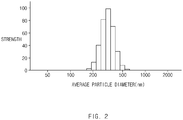
- FIG. 2 shows particle size distribution of the large-size butadiene rubbery polymer latex A-8.
- the large-size butadiene rubbery polymer latex A-8 has narrow particle size distribution.
- aqueous acetic acid solution including 3.15 parts by weight of acetic acid (concentration: 7 wt%) was continuously added in a constant rate for 1 hour while stirring at 30°C in a rate of 10 rpm, followed by stirring for 25 minutes to perform first enlargement.
- an aqueous acetic acid solution including 0.35 parts by weight of acetic acid (concentration: 7 wt%) was continuously added in a constant rate for 10 minutes, followed by stirring for 10 minutes to perform second enlargement to prepare a large-size butadiene rubbery polymer latex A-10.
- the large-size butadiene rubbery polymer latex A-10 had particle size distribution of 0.31 and an average particle diameter of 0.3 ⁇ m.
- 0.05 parts by weight of dextrose, 0.03 parts by weight of sodium pyrophosphate, 0.001 parts by weight of ferrous sulfate as a redox-based catalyst, and 0.05 parts by weight of t-butyl hydroperoxide as an initiator were added in batch to the reactor, and polymerization was performed while elevating the temperature to 80°C over 1 hour. Then, the polymerization was finished to prepare a graft copolymer latex.
- the graft copolymer latex thus obtained was coagulated, aged, washed, dehydrated and dried to obtain a graft copolymer powder B-1.
- thermoplastic resin composition ⁇ Preparation of thermoplastic resin composition>
- thermoplastic resin composition C-1 30 parts by weight of the graft copolymer powder B-1 and 70 parts by weight of 92HR (styrene/acrylonitrile copolymer) of LG Chem, were mixed to prepare a thermoplastic resin composition C-1.
- a graft copolymer powder B-2 was prepared by the same method as in Example 1 except for adding 40 parts by weight (based on the solid content) instead of 36 parts by weight (based on the solid content) of the large-size butadiene rubbery polymer latex A-3, and adding 20 parts by weight (based on the solid content) instead of 24 parts by weight (based on the solid content) of the large-size butadiene rubbery polymer latex A-8.
- thermoplastic resin composition C-2 30 parts by weight of the graft copolymer powder B-2 and 70 parts by weight of 92HR (styrene/acrylonitrile copolymer) of LG Chem, were mixed to prepare a thermoplastic resin composition C-2.
- a graft copolymer powder B-3 was prepared by the same method as in Example 1 except for adding 45 parts by weight (based on the solid content) instead of 36 parts by weight (based on the solid content) of the large-size butadiene rubbery polymer latex A-3, and adding 15 parts by weight (based on the solid content) instead of 24 parts by weight (based on the solid content) of the large-size butadiene rubbery polymer latex A-8.
- thermoplastic resin composition C-3 30 parts by weight of the graft copolymer powder B-3 and 70 parts by weight of 92HR (styrene/acrylonitrile copolymer) of LG Chem, were mixed to prepare a thermoplastic resin composition C-3.
- 0.05 parts by weight of dextrose, 0.03 parts by weight of sodium pyrophosphate, 0.001 parts by weight of ferrous sulfate as a redox-based catalyst, and 0.05 parts by weight of t-butyl hydroperoxide as an initiator were added in batch to the reactor, and polymerization was performed while elevating the temperature to 80°C over 1 hour. Then, the polymerization was finished to prepare a graft copolymer latex.
- the graft copolymer latex thus obtained was coagulated, aged, washed, dehydrated and dried to obtain a graft copolymer powder B-4.
- thermoplastic resin composition C-4 30 parts by weight of the graft copolymer powder B-4 and 70 parts by weight of 92HR (styrene/acrylonitrile copolymer) of LG Chem, were mixed to prepare a thermoplastic resin composition C-4.
- a graft copolymer powder B-5 was prepared by the same method as in Example 1 except for adding 20 parts by weight (based on the solid content) instead of 36 parts by weight (based on the solid content) of the large-size butadiene rubbery polymer latex A-3, and adding 40 parts by weight (based on the solid content) instead of 24 parts by weight (based on the solid content) of the large-size butadiene rubbery polymer latex A-8.
- thermoplastic resin composition C-5 30 parts by weight of the graft copolymer powder B-5 and 70 parts by weight of 92HR (styrene/acrylonitrile copolymer) of LG Chem, were mixed to prepare a thermoplastic resin composition C-5.
- 0.05 parts by weight of dextrose, 0.03 parts by weight of sodium pyrophosphate, 0.001 parts by weight of ferrous sulfate as a redox-based catalyst, and 0.05 parts by weight of t-butyl hydroperoxide as an initiator were added in batch to the reactor, and polymerization was performed while elevating the temperature to 80°C over 1 hour. Then, the polymerization was finished to prepare a graft copolymer latex.
- the graft copolymer latex thus obtained was coagulated, aged, washed, dehydrated and dried to obtain a graft copolymer powder B-6.
- thermoplastic resin composition C-6 30 parts by weight of the graft copolymer powder B-6 and 70 parts by weight of 92HR (styrene/acrylonitrile copolymer) of LG Chem, were mixed to prepare a thermoplastic resin composition C-6.
- a graft copolymer powder B-7 was prepared by the same method as in Example 1 except for adding the large-size butadiene rubbery polymer latex A-2 instead of the large-size butadiene rubbery polymer latex A-3.
- thermoplastic resin composition C-7 30 parts by weight of the graft copolymer powder B-7 and 70 parts by weight of 92HR (styrene/acrylonitrile copolymer) of LG Chem, were mixed to prepare a thermoplastic resin composition C-7.
- a graft copolymer powder B-8 was prepared by the same method as in Example 1 except for adding the large-size butadiene rubbery polymer latex A-4 instead of the large-size butadiene rubbery polymer latex A-3.
- thermoplastic resin composition C-8 30 parts by weight of the graft copolymer powder B-8 and 70 parts by weight of 92HR (styrene/acrylonitrile copolymer) of LG Chem, were mixed to prepare a thermoplastic resin composition C-8.
- a graft copolymer powder B-9 was prepared by the same method as in Example 1 except for adding the large-size butadiene rubbery polymer latex A-7 instead of the large-size butadiene rubbery polymer latex A-8.
- thermoplastic resin composition C-9 30 parts by weight of the graft copolymer powder B-9 and 70 parts by weight of 92HR (styrene/acrylonitrile copolymer) of LG Chem, were mixed to prepare a thermoplastic resin composition C-9.
- a graft copolymer powder B-10 was prepared by the same method as in Example 1 except for adding the large-size butadiene rubbery polymer latex A-9 instead of the large-size butadiene rubbery polymer latex A-8.
- thermoplastic resin composition C-10 30 parts by weight of the graft copolymer powder B-10 and 70 parts by weight of 92HR (styrene/acrylonitrile copolymer) of LG Chem, were mixed to prepare a thermoplastic resin composition C-10.
- a graft copolymer powder B-11 was prepared by the same method as in Example 1 except for adding the large-size butadiene rubbery polymer latex A-4 instead of the large-size butadiene rubbery polymer latex A-3, and adding the large-size butadiene rubbery polymer A-9 instead of the large-size butadiene rubbery polymer A-8.
- thermoplastic resin composition C-11 30 parts by weight of the graft copolymer powder B-11 and 70 parts by weight of 92HR (styrene/acrylonitrile copolymer) of LG Chem, were mixed to prepare a thermoplastic resin composition C-11.
- a graft copolymer powder B-12 was prepared by the same method as in Example 1 except for adding 40 parts by weight (based on the solid content) of the large-size butadiene rubbery polymer latex A-4 instead of 36 parts by weight (based on the solid content) of the large-size butadiene rubbery polymer latex A-3, and adding 20 parts by weight (based on the solid content) of the butadiene rubbery polymer A-9 instead of 24 parts by weight of the large-size butadiene rubbery polymer A-8.
- thermoplastic resin composition C-12 30 parts by weight of the graft copolymer powder B-12 and 70 parts by weight of 92HR (styrene/acrylonitrile copolymer) of LG Chem, were mixed to prepare a thermoplastic resin composition C-12.
- a first mixture including 30 parts by weight of styrene, 10 parts by weight of acrylonitrile, 0.6 parts by weight of t-butyl hydroperoxide as an initiator, 1.0 part by weight of a potassium rosinate as an emulsifier, 0.4 parts by weight of t-dodecyl mercaptan as a molecular weight adjusting agent, and 25 parts by weight of ion exchange water was prepared.
- 0.05 parts by weight of dextrose, 0.03 parts by weight of sodium pyrophosphate, 0.001 parts by weight of ferrous sulfate as a redox-based catalyst, and 0.05 parts by weight of t-butyl hydroperoxide as an initiator were added in batch to the reactor, and polymerization was performed while elevating the temperature to 80°C over 1 hour. Then, the polymerization was finished to prepare a graft copolymer latex.
- the graft copolymer latex thus obtained was coagulated, aged, washed, dehydrated and dried to obtain a graft copolymer powder B-13.
- thermoplastic resin composition 30 parts by weight of the graft copolymer powder B-13 and 70 parts by weight of 92HR (styrene/acrylonitrile copolymer) of LG Chem, were mixed to prepare a thermoplastic resin composition.
- a first mixture including 30 parts by weight of styrene, 10 parts by weight of acrylonitrile, 0.6 parts by weight of t-butyl hydroperoxide as an initiator, 1.0 part by weight of a potassium rosinate as an emulsifier, 0.4 parts by weight of an ⁇ -methyl styrene dimer as a molecular weight adjusting agent, and 25 parts by weight of ion exchange water was prepared.
- 0.05 parts by weight of dextrose, 0.03 parts by weight of sodium pyrophosphate, 0.001 parts by weight of ferrous sulfate as a redox-based catalyst, and 0.05 parts by weight of t-butyl hydroperoxide as an initiator were added in batch to the reactor, and polymerization was performed while elevating the temperature to 80°C over 1 hour. Then, the polymerization was finished to prepare a graft copolymer latex.
- the graft copolymer latex thus obtained was coagulated, aged, washed, dehydrated and dried to obtain a graft copolymer powder B-14.
- thermoplastic resin composition C-14 30 parts by weight of the graft copolymer powder B-14 and 70 parts by weight of 92HR (styrene/acrylonitrile copolymer) of LG Chem, were mixed to prepare a thermoplastic resin composition C-14.
- a first mixture including 30 parts by weight of styrene, 10 parts by weight of acrylonitrile, 0.6 parts by weight of t-butyl hydroperoxide as an initiator, 1.0 part by weight of a potassium rosinate as an emulsifier, 0.4 parts by weight of t-dodecyl mercaptan as a molecular weight adjusting agent, and 25 parts by weight of ion exchange water was prepared.
- 0.05 parts by weight of dextrose, 0.03 parts by weight of sodium pyrophosphate, 0.001 parts by weight of ferrous sulfate as a redox-based catalyst, and 0.05 parts by weight of t-butyl hydroperoxide as an initiator were added in batch to the reactor, and polymerization was performed while elevating the temperature to 80°C over 1 hour. Then, the polymerization was finished to prepare a graft copolymer latex.
- the graft copolymer latex thus obtained was coagulated, aged, washed, dehydrated and dried to obtain a graft copolymer powder B-15.
- thermoplastic resin composition C-15 30 parts by weight of the graft copolymer powder B-15 and 70 parts by weight of 92HR (styrene/acrylonitrile copolymer) of LG Chem, were mixed to prepare a thermoplastic resin composition C-15.
- a first mixture including 30 parts by weight of styrene, 10 parts by weight of acrylonitrile, 0.6 parts by weight of t-butyl hydroperoxide as an initiator, 1.0 part by weight of a potassium rosinate as an emulsifier, 0.4 parts by weight of an ⁇ -methyl styrene dimer as a molecular weight adjusting agent, and 25 parts by weight of ion exchange water was prepared.
- 0.05 parts by weight of dextrose, 0.03 parts by weight of sodium pyrophosphate, 0.001 parts by weight of ferrous sulfate as a redox-based catalyst, and 0.05 parts by weight of t-butyl hydroperoxide as an initiator were added in batch to the reactor, and polymerization was performed while elevating the temperature to 80°C over 1 hour. Then, the polymerization was finished to prepare a graft copolymer latex.
- the graft copolymer latex thus obtained was coagulated, aged, washed, dehydrated and dried to obtain a graft copolymer powder B-16.
- thermoplastic resin composition C-16 30 parts by weight of the graft copolymer powder B-16 and 70 parts by weight of 92HR (styrene/acrylonitrile copolymer) of LG Chem, were mixed to prepare a thermoplastic resin composition C-16.
- a graft copolymer powder B-17 was prepared by the same method as in Example 1 except for adding the large-size butadiene rubbery polymer latex A-1 instead of the large-size butadiene rubbery polymer latex A-3.
- thermoplastic resin composition C-17 30 parts by weight of the graft copolymer powder B-17 and 70 parts by weight of 92HR (styrene/acrylonitrile copolymer) of LG Chem, were mixed to prepare a thermoplastic resin composition C-17.
- a graft copolymer powder B-18 was prepared by the same method as in Example 1 except for adding the butadiene rubbery polymer latex A-5 instead of the large-size butadiene rubbery polymer latex A-3.
- thermoplastic resin composition C-18 30 parts by weight of the graft copolymer powder B-18 and 70 parts by weight of 92HR (styrene/acrylonitrile copolymer) of LG Chem, were mixed to prepare a thermoplastic resin composition C-18.
- a graft copolymer powder B-19 was prepared by the same method as in Example 1 except for adding the butadiene rubbery polymer latex A-6 instead of the large-size butadiene rubbery polymer latex A-8.
- thermoplastic resin composition C-19 30 parts by weight of the graft copolymer powder B-19 and 70 parts by weight of 92HR (styrene/acrylonitrile copolymer) of LG Chem, were mixed to prepare a thermoplastic resin composition C-19.
- a graft copolymer powder B-20 was prepared by the same method as in Example 1 except for adding the butadiene rubbery polymer latex A-10 instead of the butadiene rubbery polymer latex A-8.
- thermoplastic resin composition C-20 30 parts by weight of the graft copolymer powder B-20 and 70 parts by weight of 92HR (styrene/acrylonitrile copolymer) of LG Chem, were mixed to prepare a thermoplastic resin composition C-20.
- thermoplastic resin compositions of the Examples and the Comparative Examples were added to a twin-screw extruder set to 210°C and extruded to prepare pellets.
- the physical properties of the pellets were measured by the methods below, and the results are listed in [Table 2] to [Table 5] below.
- a specimen was manufactured by injection molding the pellet prepared in Experimental Example 1, and the physical properties thereof were measured by the methods below. The results are listed in [Table 2] to [Table 5] below.
- the graft copolymers of Examples 1 to 12 prepared by the large-size butadiene rubbery polymers having particle size distribution of 0.35 to 0.4 and the large-size butadiene rubbery polymers having particle size distribution of 0.2 to 0.4 had the graft ratio of 37% or more and the weight average molecular weight of a shell of 75,000 g/mol or more.
- the graft copolymers of Comparative Examples 1 to 12 were found that if the graft ratio was 37% or more, the weight average molecular weight of a shell was 65,000 g/mol or less, and if the graft ratio was less than 37%, the weight average molecular weight was 75,000 g/mol or more.
- thermoplastic resin compositions of Examples 1 to 12 were found to have small remaining amounts of volatile organic compounds, excellent characteristics of odor and small number of surface protrusions, and thus excellent surface characteristics. It was found that the falling sphere impact strength and notched izod impact strength were excellent and thus, mechanical properties were excellent.
- Examples 1, 7 and 8, prepared using the large-size butadiene rubbery polymers having particle size distribution of 0.35 to 0.4 and the large-size butadiene rubbery polymers having particle size distribution of 0.23 showed markedly low remaining amount or volatile organic compounds, markedly small number of surface protrusions, excellent falling sphere impact strength and notched izod impact strength, and excellent mechanical properties when compared with Comparative Example 5, prepared using the large-size butadiene rubbery polymers having particle size distribution of 0.34 and the large-size butadiene rubbery polymers having particle size distribution of 0.23.
- Examples 1, 7 and 8 showed markedly low remaining amount or volatile organic compounds, markedly small number of surface protrusions, excellent falling sphere impact strength and notched izod impact strength, and excellent mechanical properties when compared with Comparative Example 6, prepared using the large-size butadiene rubbery polymers having particle size distribution of 0.41 and the large-size butadiene rubbery polymers having particle size distribution of 0.23.
- Examples 1, 9 and 10 prepared using the large-size butadiene rubbery polymers having particle size distribution of 0.37 and the large-size butadiene rubbery polymers having particle size distribution of 0.2 to 0.3 showed markedly low remaining amount or volatile organic compounds, markedly small number of surface protrusions, excellent falling sphere impact strength and notched izod impact strength, and excellent mechanical properties when compared with Comparative Example 7, prepared using the large-size butadiene rubbery polymers having particle size distribution of 0.37 and the large-size butadiene rubbery polymers having particle size distribution of 0.19.
- Examples 1, 9 and 10 showed markedly low remaining amount or volatile organic compounds, markedly small number of surface protrusions, excellent falling sphere impact strength and notched izod impact strength, and excellent mechanical properties when compared with Comparative Example 8, prepared using the large-size butadiene rubbery polymers having particle size distribution of 0.37 and the large-size butadiene rubbery polymers having particle size distribution of 0.31.
- Comparative Examples 1 to 4 prepared using only one type of large-size butadiene rubbery polymer, it was found that, when compared with the Examples, the remaining amount of volatile organic compounds was large and the characteristics of odor were not good, and since the number of surface protrusions was large, surface characteristics were not good, and the falling sphere impact strength and impact strength were degraded.
Landscapes
- Chemical & Material Sciences (AREA)
- Health & Medical Sciences (AREA)
- Chemical Kinetics & Catalysis (AREA)
- Medicinal Chemistry (AREA)
- Polymers & Plastics (AREA)
- Organic Chemistry (AREA)
- General Chemical & Material Sciences (AREA)
- Dispersion Chemistry (AREA)
- Graft Or Block Polymers (AREA)
Abstract
Description
- The present application claims the benefit of priority based on Korean Patent Application Nos.
10-2018-0013592, filed on February 2, 2018 10-2019-0011180, filed on January 29, 2019 - The present invention relates to a method for preparing a graft copolymer, a graft copolymer and a thermoplastic resin molded article, and more particularly, to a method for preparing a graft copolymer, by which a molded article having improved surface characteristics and improved plating and painting properties may be manufactured, a graft copolymer and a thermoplastic resin molded article.
- Generally, in case of an ABS graft copolymer used as a material for plating, a method of controlling the amount of acrylonitrile may be used to improve plating properties. In addition, in order to maintain the shape of an anchor hole during plating etching, a method of increasing a graft ratio or a method including a butadiene rubber polymer having the high gel content is also used. Also, in order to improve adhesion by increasing the number of anchor holes, a method of introducing a small-size butadiene rubbery polymer having a small average particle diameter during the graft reaction may be used.
- According to the method using the small-size butadiene rubbery polymer, plating adhesion may be improved, but due to the increase of the amount of the small-size butadiene rubbery polymer, impact strength of a graft copolymer may be decreased, and problems of decreasing a graft ratio and deteriorating flowability may arise.
- If a large-size butadiene rubbery polymer having a large average particle diameter is used to increase the graft ratio, impact strength may be improved but surface characteristics and flowability may be decreased and problems of degrading plating properties may arise.
- An object of the present invention is to provide a method for preparing a graft copolymer possibly manufacturing a molded article having improved surface characteristics, and thus, improved plating and painting properties.
- In addition, another object of the present invention is to provide a method for preparing a graft copolymer, by which a molded article having a high graft ratio, excellent flowability and mechanical properties, and minimized remaining amount of volatile organic compounds, may be manufactured.
- According to an aspect of the present invention, there is provided a method for preparing a graft copolymer, which includes polymerizing a first conjugated diene-based polymer, a second conjugated diene-based polymer, an aromatic vinyl-based monomer and a vinyl cyan-based monomer, wherein particle size distribution of the first conjugated diene-based polymer is 0.346 to 0.404, and particle size distribution of the second conjugated diene-based polymer is 0.196 to 0.304.
- In addition, the present invention provides a graft copolymer, which is prepared by the above-described method and has a graft ratio of 37% or more and a weight average molecular weight of a shell of 75,000 g/mol or more.
- In addition, the present invention provides a thermoplastic resin molded article manufactured from a thermoplastic resin composition which includes the above-described graft copolymer; and a copolymer including a unit derived from an aromatic vinyl-based monomer and a unit derived from a vinyl cyan-based monomer, wherein a remaining amount of volatile organic compounds is 1,000 ppm or less.
- According to the method for preparing a graft copolymer of the present invention, a molded article having excellent surface characteristics and improved plating and paining properties may be manufactured.
- In addition, according to the method for preparing a graft copolymer of the present invention, a molded article having excellent flowability and mechanical properties, and minimized remaining amount of volatile organic compounds may be manufactured.
-
-
FIG. 1 is a graph showing particle size distribution of a large-size butadiene rubbery polymer of Preparation Example 3. -
FIG. 2 is a graph showing particle size distribution of a large-size butadiene rubbery polymer of Preparation Example 8. - Hereinafter, the present invention will be described in more detail to assist the understanding of the present invention.
- It will be understood that words or terms used in the specification and claims shall not be interpreted as the meaning defined in commonly used dictionaries. It will be understood that the words or terms should be interpreted as having a meaning that is consistent with their meaning in the technical idea of the invention, based on the principle that an inventor may properly define the meaning of the words to best explain the invention.
- The average particle diameter and particle size distribution of the conjugated diene-based polymer may be measured using a dynamic light scattering method, particularly, using a Nicomp 380 equipment (product name, manufacturer: PSS) in the present invention.
- The "average particle diameter" or "Dv" referred to in the present disclosure means an arithmetic average particle diameter in particle size distribution measured by the dynamic light scattering method. The arithmetic average particle diameter may be an intensity distribution average particle diameter.
- "90% particle diameter" means a particle diameter (D90) at position 90% when counting the particle diameter from 0 (minimum) - 100% (maximum) in order from a small particle diameter in the particle diameter distribution measured by the measuring method.
- "50% particle diameter" means a particle diameter (D50) when dividing fragments into two based on a certain particle diameter in the particle size distribution measured by the measuring method and when a greater portion and a smaller portion become equivalent.
- "10% particle diameter" means a particle diameter (D10) at position 10% when counting the particle diameter from 0 (minimum) - 100% (maximum) in order from a small particle diameter in the particle diameter distribution measured by the measuring method.
- The measurement method by the dynamic light scattering method, and the computing method of the particle size distribution may be performed by well-known methods in this technical field, and in the present invention, the particle size distribution may be computed by the following Mathematical Formula 1:

- In Mathematical Formula 1,
the definition of D90, D50, and D10 is the same as described above. - In the present invention, the gel content may be measured by coagulating a conjugated diene-based polymer latex using methanol, washing, and drying in a vacuum oven of 60°C for 24 hours. Then, the lump (specimen) thus obtained is cut using scissors, 1 g thereof is taken and put in 100 g of toluene and stored at room temperature for 48 hours in a dark room, and then, sol and gel are separated. Then, the gel content may be measured by the following Equation.

- In the present invention, the graft ratio may be obtained by putting 2 g of a graft copolymer powder to 300 ml of acetone, stirring for 24 hours, adding the solution to a ultracentrifuge, separating a supernatant, dropping methanol to the supernatant and obtaining a non-grafted portion, drying the non-grafted portion at 85°C to obtain a dry material, and weighing a weight, and computing by the following Formula:


- In the present invention, the average molecular weight of the shell of the graft copolymer may be measured by drying the supernatant obtained in the measurement method of the graft ratio in a hot air oven of 50°C, dissolving a dried material in THF to prepare a solution (concentration: 0.1 wt%), and filtering the solution using a 0.1 µm filter, and finally using GPC.
- In the present invention, the remaining amount of the volatile organic compounds may be measured using a gas chromatography equipment (product name: GC, manufacturer: Agilent).
- In the present invention, the polymerization may be any one selected from the group consisting of suspension polymerization, emulsion polymerization and bulk polymerization, and among them, the emulsion polymerization is preferable.
- In the present invention, the derived unit from an aromatic vinyl-based monomer may be a unit derived from an aromatic vinyl-based monomer. The aromatic vinyl-based monomer may be one or more selected from the group consisting of styrene, α-methyl styrene, α-ethyl styrene, and p-methyl styrene, and among them, the styrene is preferable.
- In the present invention, the derived unit from a vinyl cyan-based monomer may be a unit derived from a vinyl cyan-based monomer. The vinyl cyan-based monomer may be one or more selected from the group consisting of acrylonitrile, methacrylonitrile, phenylacrylonitrile and α-chloroacrylonitrile, and among them, the acrylonitrile is preferable.
- In the present invention, the conjugated diene-based monomer may be one or more selected from the group consisting of 1,3-butadiene, isoprene, chloroprene and piperylene, and among them, the 1,3-butadiene is preferable.
- The method for preparing a graft copolymer according to an embodiment of the present invention includes polymerizing a first conjugated diene-based polymer, a second conjugated diene-based polymer, an aromatic vinyl-based monomer and a vinyl cyan-based monomer, wherein the particle size distribution of the first conjugated diene-based polymer is 0.346 to 0.404, and the particle size distribution of the second conjugated diene-based polymer is 0.196 to 0.304.
- The particle size distribution of the first conjugated diene-based polymer is 0.346 to 0.404, preferably, 0.35 to 0.4. If the above-described conditions are satisfied, coagulation in the first conjugated diene-based polymer is minimized. In addition, a graft copolymer accomplishing excellent surface characteristics and impact strength may be prepared. If the particle size distribution is less than the above-mentioned range, impact strength is decreased, and if the particle size distribution is greater than the above-mentioned range, surface protrusions are excessively produced.
- The first conjugated diene-based polymer has an average particle diameter of 0.2 to 0.4 µm, 0.25 to 0.35 µm or 0.3 to 0.33 µm, and among them, 0.3 to 0.33 µm is preferable. If the above-described conditions are satisfied, the coagulation in the first conjugated diene-based polymer may be minimized and impact strength and flowability may be improved.
- The particles included in the first conjugated diene-based polymer may have a standard deviation of 0.3 to 0.4 or 0.33 to 0.38, and among them, 0.33 to 0.38 is preferable. If the above-described conditions are satisfied, since the first conjugated diene-based polymer includes particles having relatively diverse particle diameters, a graft copolymer having excellent surface characteristics and impact strength may be prepared.
- Meanwhile, the second conjugated diene-based polymer has particle size distribution of 0.196 to 0.304, preferably, 0.2 to 0.3. If the above-described conditions are satisfied, the graft copolymer may achieve excellent impact strength and tensile strength. If the above-described conditions are not satisfied, the impact strength of the graft copolymer may be degraded.
- The second conjugated diene-based polymer has an average particle diameter of 0.2 to 0.4 µm, 0.25 to 0.35 µm or 0.28 to 0.30 µm, and among them, 0.28 to 0.30 µm is preferable. If the above-described range is satisfied, the mechanical properties and flowability of the graft copolymer may be even more improved.
- The particles included in the second conjugated diene-based polymer may have a standard deviation of 0.2 to 0.29 or 0.24 to 0.26, and among them, 0.24 to 0.26 is preferable. If the above-described conditions are satisfied, since the second conjugated diene-based polymer includes particles having uniform particle diameters, a graft copolymer having excellent impact strength may be prepared.
- Meanwhile, the first conjugated diene-based polymer and the second conjugated diene-based polymer may be prepared by 1) a preparation method by which a conjugated diene-based monomer is polymerized and enlargement is not performed, or 2) a preparation method by which a conjugated diene-based monomer is polymerized to prepare a small-size conjugated diene-based polymer, and enlarging the small-size conjugated diene-based polymer.
- In Step 2), the average particle diameter of the small-size conjugated diene-based polymer may be 0.05 to 0.15 µm, or 0.08 to 0.12 µm, and among them, 0.08 to 0.12 µm is preferable. If the above-described conditions are satisfied, the preparation of the first and second conjugated diene-based polymers may be easy.
- The gel content of the small-size conjugated diene-based polymer may be 90% or more, 90% to 95%, or 90% to 94%, and among them, 92% to 94% is preferable. If the above-described conditions are satisfied, excellent impact strength may be accomplished.
- Meanwhile, the enlargement during preparing the first and second conjugated diene-based polymers may be performed once or more times, and the enlargement may be performed by adding a coagulant to the small-size conjugated diene-based polymer. The coagulant may be acetic acid or phosphoric acid.
- The coagulant may be added during preparing the first conjugated diene-based polymer in 2.75 to 3.75 parts by weight or 3 to 3.5 parts by weight with respect to 100 parts by weight of the small-size conjugated diene-based polymer, and among them, addition of 3 to 3.5 parts by weight is preferable. If the above-described range is satisfied, a conjugated diene-based polymer satisfying the particle size distribution and average particle diameter of the first conjugated diene-based polymer may be prepared.
- If the enlargement is performed in twice during preparing the first conjugated diene-based polymer and the total addition amount of the coagulant is 3 parts by weight with respect to 100 parts by weight of the small-size conjugated diene-based polymer, a weight ratio of the coagulant added in the first and second enlargements may be 85:15 to 95:5 or 87:13 to 93:7, and among them, 87:13 to 93:7 is preferable. In addition, if the total addition amount of the coagulant is 3.5 parts by weight with respect to 100 parts by weight of the small-size conjugated diene-based polymer, the weight ratio of the coagulant added during the first and second enlargements may be 65:35 to 80:20 or 70:30 to 75:25, and among them, 70:30 to 75:25 is preferable. If the above-described range is satisfied, flowability may be improved, and excellent impact strength may be accomplished.
- Meanwhile, the coagulant may be added in 2 to 2.73 parts by weight or 2.5 to 2.7 parts by weight with respect to 100 parts by weight of the small-size conjugated diene-based polymer during preparing the second conjugated diene-based polymer, and among them, addition of 2.5 to 2.7 parts by weight is preferable. If the above-described range is satisfied, a conjugated diene-based polymer satisfying the particle size distribution and average particle diameter of the second conjugated diene-based polymer may be prepared.
- If the enlargement is performed in twice during preparing the second conjugated diene-based polymer and the total addition amount of the coagulant is 2.5 parts by weight with respect to 100 parts by weight of the small-size conjugated diene-based polymer, a weight ratio of the coagulant added in the first and second enlargements may be 90:10 to 99:1 or 93:7 to 97:3, and among them, 93:7 to 97:3 is preferable. In addition, if the total addition amount of the coagulant is 2.7 parts by weight with respect to 100 parts by weight of the small-size conjugated diene-based polymer, the weight ratio of the coagulant added during the first and second enlargements may be 85:15 to 95:5 or 87:13 to 93:17, and among them, 87:13 to 93:7 is preferable. If the above-described range is satisfied, flowability may be improved, and excellent impact strength may be accomplished.
- Meanwhile, if the second conjugated diene-based polymer is prepared by the 1) preparation method, the second conjugated diene-based polymer may be prepared by a known method, and in order to satisfy the particle size distribution and average particle diameter, the amounts of an emulsifier or an electrolyte may be suitably controlled in the known method.
- The emulsifier may be one or more selected from the group consisting of a rosin acid alkali metal salt, a fatty acid alkali metal salt and a fatty acid dimer alkali metal salt, and among them, the fatty acid dimer alkali metal salt is preferable.
- The rosin acid alkali metal salt may be one or more selected from the group consisting of potassium rosinate and sodium rosinate, and among them, the potassium rosinate is preferable.
- The fatty acid alkali metal salt may be a fatty acid alkali metal salt of C8 to C20, and one or more selected from the group consisting of an alkali metal salt of capric acid, an alkali metal salt of lauric acid, an alkali metal salt of palmitic acid, an alkali metal salt of stearic acid, an alkali metal salt of oleic acid and an alkali metal salt of linoleic acid, are more preferable.
- The fatty acid dimer alkali metal salt may be a fatty acid dimer alkali metal salt of C8 to C20, may preferably be a fatty acid dimer potassium salt of C8 to C20, and may more preferably be an oleic acid dimer potassium salt.
- The emulsifier may be added in 0.3 to 3.0 parts by weight or 0.5 to 2.5 parts by weight with respect to 100 parts by weight of the conjugated diene-based monomer, and among them, addition of 0.5 to 2.5 parts by weight is preferable. If the above-described range is satisfied, polymerization stability may become excellent and a polymerization conversion ratio may be increased.
- The electrolyte may be one or more selected from the group consisting of KCl, NaCl, KHCO3, NaHCO3, K2CO3, Na2CO3, KHSO3, NaHSO3, K4P2O7, K3PO4, Na3PO4 and Na2HPO4, and among them, one or more selected from the group consisting of K2CO3 and Na2CO3, is preferable.
- The electrolyte may be added in 0.1 to 1 parts by weight or 0.2 to 0.5 parts by weight with respect to 100 parts by weight of the conjugated diene-based monomer, and among them, addition of 0.2 to 0.5 parts by weight is preferable. If the above-described range is satisfied, polymerization stability becomes excellent and a polymerization conversion ratio may be increased.
- Meanwhile, the weight ratio of the first conjugated diene-based polymer and the second conjugated diene-based polymer may be 30:70 to 80:20, 50:50 to 80:20, 60:40 to 75:25 or 65:35 to 70:30, and among them, 65:35 to 70:30 is preferable. If the above-described range is satisfied, the production of protrusions at the surface is minimized, and a molded article having excellent surface characteristics may be manufactured, and thus, a molded article having excellent painting and plating properties may be manufactured. In addition, a graft copolymer having a high graft ratio and improved impact strength and flowability may be prepared.
- The total amount of the first conjugated diene-based polymer and the second conjugated diene-based polymer may be 50 to 65 wt% or 55 to 60 wt% with respect to the total weight of the first conjugated diene-based polymer, the second conjugated diene-based polymer, the aromatic vinyl-based monomer and the vinyl cyan-based monomer, and among them, 55 to 60 wt% is preferable. If the above-described range is satisfied, the generation of a coagulant during polymerization may be minimized, and the impact strength of the graft copolymer may be even further improved.
- The first conjugated diene-based polymer and the second conjugated diene-based polymer may have a latex type, which are dispersed in water in a colloidal state, and may be added to a reactor prior to initiating polymerization.
- The total amount of the aromatic vinyl-based monomer and the vinyl cyan-based monomer may be 35 to 50 wt% or 40 to 45 wt% with respect to the total weight of the first conjugated diene-based polymer, the second conjugated diene-based polymer, the aromatic vinyl-based monomer and the vinyl cyan-based monomer, and among them, 40 to 45wt% is preferable. If the above-described range is satisfied, the chemical resistance, rigidity, impact strength, processability and surface gloss of the graft copolymer may be even more improved.
- The weight ratio of the aromatic vinyl-based monomer and the vinyl cyan-based monomer may be 80:20 to 65:35 or 75:25 to 70:30, and among them, 75:25 to 70:30 is preferable. If the above-described range is satisfied, a polymerization conversion ratio may be increased, and polymerization stability and latex stability may be improved even further.
- The aromatic vinyl-based monomer and the vinyl cyan-based monomer may be emulsion polymerized while being continuously added in a constant rate to a reactor where the first and second conjugated diene-based polymers are present. If the aromatic vinyl-based monomer and the vinyl cyan-based monomer are continuously added, the heat of reaction produced during polymerization may be dispersed.
- During the polymerization, one or more selected from the group consisting of a molecular weight adjusting agent, an initiator, an emulsifier, a redox-based catalyst and water may be further added to the reactor.
- The molecular weight adjusting agent may include a mercaptan compound which has large reactivity and a fast decomposition rate, and a large aromatic vinyl-based dimer which has small reactivity and a slow decomposition rate.
- The mercaptan compound may be one or more selected from the group consisting of t-dodecyl mercaptan, n-dodecyl mercaptan and octyl mercaptan, and among them, the t-dodecyl mercaptan is preferable.
- The aromatic vinyl-based dimer may be one or more selected from the group consisting of an α-methyl styrene dimer, an ethyl styrene dimer and a propyl styrene dimer, and among them, the α -methyl styrene dimer is preferable.
- The molecular weight adjusting agent may be 0.30 to 0.50 parts by weight or 0.35 to 0.45 parts by weight with respect to total 100 parts by weight of the first conjugated diene-based polymer, the second conjugated diene-based polymer, the aromatic vinyl-based monomer and the vinyl cyan-based monomer, and among them, 0.35 to 0.45 parts by weight is preferable. If the above-described range is satisfied, the weight average molecular weight of a shell may be suitable maintained and the impact strength of the graft copolymer may be improved even further.
- The mercaptan compound and the aromatic vinyl-based dimer may be added in a weight ratio of 60:40 to 70:30 or 65:35 to 70:30, and among them, addition in a weight ratio of 65:35 to 70:30 is preferable. If the above-described conditions are satisfied, the mercaptan compound and the aromatic vinyl-based dimer may control the graft ratio of the graft copolymer, and falling sphere impact strength and notched izod impact strength may be increased.
- The initiator may be one or more selected from the group consisting of potassium persulfate, sodium persulfate, ammonium persulfate, cumene hydroperoxide, diisopropyl benzene hydroperoxide, azobisisobutyronitrile, t-butyl hydroperoxide, paramenthane hydroperoxide and benzoylperoxide, and among them the t-butyl hydroperoxide is preferable.
- The initiator may be added in 0.5 to 0.8 parts by weight, or 0.6 to 0.7 parts by weight with respect to total 100 parts by weight of the first conjugated diene-based polymer, the second conjugated diene-based polymer, the aromatic vinyl-based monomer and the vinyl cyan-based monomer, and among them, addition of 0.6 to 0.7 parts by weight is preferable. If the above-described range is satisfied, latex stability may be excellent, emulsion polymerization may be easily performed, and the remaining amount in the graft copolymer may be minimized.
- The emulsifier may be one or more selected from the group consisting of a monocarboxylate of C1 to C20, a metal succinate of C12 to C18, a metal sulfonate and a rosin acid alkali metal salt.
- The monocarboxylate may be a fatty acid soap of C8 to C20.
- The metal succinate of C12 to C18 may be a dipotassium alkenyl succinate of C12 to C18.
- The metal sulfonate may be one or more selected from the group consisting of sodium dodecyl sulfate, sodium lauryl sulfate, sodium dodecyl benzene sulfate, sodium octadecyl sulfate, sodium oleic sulfate, potassium dodecyl sulfate and potassium octadecyl sulfate.
- The rosin acid alkali metal salt may be one or more selected from the group consisting of potassium rosinate and sodium rosinate.
- The emulsifier is preferably a rosin acid alkali metal salt, and potassium rosinate is more preferable.
- The emulsifier may be added in 0.5 to 1.2 parts by weight, or 0.8 to 1.0 parts by weight with respect to total 100 parts by weight of the first conjugated diene-based polymer, the second conjugated diene-based polymer, the aromatic vinyl-based monomer and the vinyl cyan-based monomer, and among them, addition of 0.8 to 1.0 parts by weight is preferable. If the above-described range is satisfied, emulsion polymerization may be easily performed, and the remaining amount in the graft copolymer may be minimized.
- The redox-based catalyst may be one or more selected from the group consisting of sodium formaldehyde sulfoxylate, sodium ethylenediamine tetraacetate, ferrous sulfate, dextrose, sodium pyrophosphate, anhydrous sodium pyrophosphate, and sodium sulfate, and among them, one or more selected from the group consisting of ferrous sulfate, dextrose, sodium pyrophosphate is preferable.
- The redox-based catalyst may be added in 0.1 to 0.5 parts by weight, or 0.3 to 0.4 parts by weight with respect to total 100 parts by weight of the first conjugated diene-based polymer, the second conjugated diene-based polymer, the aromatic vinyl-based monomer and the vinyl cyan-based monomer, and among them, addition of 0.3 to 0.4 parts by weight is preferable. If the above-described range is satisfied, advantages of increasing a polymerization conversion ratio is achieved.
- One or more selected from the group consisting of the molecular weight adjusting agent, the initiator, the emulsifier, the redox-based catalyst and water may be continuously added to a reactor in which the first and second conjugated diene-based polymers are present together with the aromatic vinyl-based monomer and the vinyl cyan-based monomer in a constant rate. With the continuous addition, heat of reaction during polymerization may be dispersed and the removal of heat may be advantageous.
- The graft copolymer prepared by the above-described preparation method has a graft ratio of 37% or more, a weight average molecular weight of a shell of 75,000 g/mol or more, preferably, 75,000 to 110,000 g/mol. If the above-described range is satisfied, surface characteristics may become excellent, and plating and painting properties may be even further improved.
- The thermoplastic resin composition according to another embodiment of the present invention includes a graft copolymer prepared by the preparation method according to an embodiment of the present invention; and a copolymer including a unit derived from an aromatic vinyl-based monomer and a unit derived from a vinyl cyan-based monomer.
- The copolymer may impart the thermoplastic resin composition with heat resistance, rigidity and processability.
- The copolymer may include the unit derived from an aromatic vinyl-based monomer and the unit derived from a vinyl cyan-based monomer in a weight ratio of 85:15 to 70:30 or 80:20 to 75:25, and among them, a weight ratio of 80:20 to 75:25 is preferable. If the above-described range is satisfied, the thermoplastic resin composition may accomplish the balance among heat resistance, impact strength and processability be achieved well.
- The weight average molecular weight of the copolymer may be 100,000 to 150,000 g/mol or 120,000 to 140,000 g/mol, and among them, 120,000 to 140,000 g/mol is preferable. If the above-described range is satisfied, the impact strength of the thermoplastic resin composition may be even further improved.
- The weight average molecular weight may be measured using tetrahydrofuran (THF) as an eluent through GPC as a relative value with respect to a standard polystyrene (PS) specimen.
- The copolymer may be prepared by one or more kinds of methods selected from the group consisting of emulsion polymerization, suspension polymerization and bulk polymerization, and among them, the bulk polymerization is preferable.
- The weight ratio of the graft copolymer and the copolymer may be 20:80 to 35:65 or 25:75 to 30:70, and among them, 25:75 to 30:70 is preferable. If the above-described range is satisfied, the chemical resistance, impact strength, thermal stability, coloring properties, fatigue resistance, rigidity and processability of a molded article manufactured from the thermoplastic resin composition may be improved even further.
- The thermoplastic resin molded article manufactured using the thermoplastic resin composition has the remaining amount of volatile organic compounds of 1,000 ppm or less. If the above-described conditions are satisfied, a molded article having excellent characteristics of odor may be provided.
- Here, the remaining amount of the volatile organic compounds may be measured using a gas chromatography equipment (product name: GC, manufacturer: Agilent).
- Hereinafter, preferred embodiments will be explained in detail so that a person skilled in the art could easily perform the present invention. However, the present invention may be accomplished in various other types and is not limited to the embodiments explained herein.
- To a nitrogen-substituted polymerization reactor, 120 parts by weight of ion-exchange water, 100 parts by weight of 1,3-butadiene, 2 parts by weight of a potassium rosinate as an emulsifier, 0.1 parts by weight of t-dodecyl mercaptan as a molecular weight adjusting agent, and 0.2 parts by weight of Na2CO3 as an electrolyte were added and sufficiently mixed, and then, the temperature was elevated so that the internal temperature of the reactor reached 50°C. After finishing the temperature elevation, 0.2 parts by weight of potassium persulfate was added in batch as an initiator, and the polymerization was performed for 7 hours. Then, 0.05 parts by weight of t-dodecyl mercaptan as a molecular weight adjusting agent was added, the temperature was elevated to 70°C, and the polymerization was performed for 8 hours. The polymerization was finished to obtain a small-size butadiene rubbery polymer latex (average particle diameter: 0.1 µm, gel content: 98%).
- 100 parts by weight (based on the solid content) of the small-size butadiene rubbery polymer latex was added to a reactor, and an aqueous acetic acid solution including 2.4 parts by weight of acetic acid (concentration: 7 wt%) was continuously added in a constant rate for 1 hour while stirring at 30°C in a rate of 10 rpm, followed by stirring for 25 minutes to perform first enlargement. Then, an aqueous acetic acid solution including 0.6 parts by weight of acetic acid (concentration: 7 wt%) was continuously added in a constant rate for 10 minutes, followed by stirring for 10 minutes to perform second enlargement to prepare a large-size butadiene rubbery polymer A-1. The large-size butadiene rubbery polymer A-1 had particle size distribution of 0.34 and an average particle diameter of 0.3 µm.
- 100 parts by weight (based on the solid content) of the small-size butadiene rubbery polymer latex prepared in Preparation Example 1 was added to a reactor, and an aqueous acetic acid solution including 2.7 parts by weight of acetic acid (concentration: 7 wt%) was continuously added in a constant rate for 1 hour while stirring at 30°C in a rate of 10 rpm, followed by stirring for 25 minutes to perform first enlargement. Then, an aqueous acetic acid solution including 0.3 parts by weight of acetic acid (concentration: 7 wt%) was continuously injected in a constant rate for 10 minutes, followed by stirring for 10 minutes to perform second enlargement to prepare a large-size butadiene rubbery polymer A-2. The large-size butadiene rubbery polymer A-2 had particle size distribution of 0.35 and an average particle diameter of 0.3 µm.
- 100 parts by weight (based on the solid content) of the small-size butadiene rubbery polymer latex prepared in Preparation Example 1 was added to a reactor, and an aqueous acetic acid solution including 3 parts by weight of acetic acid (concentration: 7 wt%) was added in a constant rate for 1 hour while stirring at 30°C in a rate of 10 rpm. After finishing the addition, the stirring was stopped and the resultant product was stood for 30 minutes for enlargement to prepare a large-size butadiene rubbery polymer A-3. The large-size butadiene rubbery polymer A-3 had particle size distribution of 0.37 and an average particle diameter of 0.3 µm.
-
FIG. 1 shows particle size distribution of the large-size butadiene rubbery polymer latex A-3. - Referring to
FIG. 1 , it may be found that the large-size butadiene rubbery polymer latex A-3 has wide particle size distribution. - 100 parts by weight (based on the solid content) of the small-size butadiene rubbery polymer latex prepared in Preparation Example 1 was added to a reactor, and an aqueous acetic acid solution including 2.45 parts by weight of acetic acid (concentration: 7 wt%) was continuously added in a constant rate for 1 hour while stirring at 30°C in a rate of 10 rpm, followed by stirring for 25 minutes to perform first enlargement. Then, an aqueous acetic acid solution including 1.05 parts by weight of acetic acid (concentration: 7 wt%) was continuously added in a constant rate for 10 minutes, followed by stirring for 10 minutes to perform second enlargement to prepare a large-size butadiene rubbery polymer latex A-4. The large-size butadiene rubbery polymer latex A-4 had particle size distribution of 0.4 and an average particle diameter of 0.3 µm.
- 100 parts by weight (based on the solid content) of the small-size butadiene rubbery polymer latex prepared in Preparation Example 1 was added to a reactor, and an aqueous acetic acid solution including 3.6 parts by weight of acetic acid (concentration: 7 wt%) was continuously added in a constant rate for 1 hour while stirring at 25°C in a rate of 10 rpm, followed by stirring for 25 minutes to perform first enlargement. Then, an aqueous acetic acid solution including 0.4 parts by weight of acetic acid (concentration: 7 wt%) was continuously added in a constant rate for 10 minutes, followed by stirring for 10 minutes to perform second enlargement to prepare a large-size butadiene rubbery polymer latex A-5. The large-size butadiene rubbery polymer latex A-5 had particle size distribution of 0.41 and an average particle diameter of 0.3 µm.
- 100 parts by weight (based on the solid content) of the small-size butadiene rubbery polymer latex prepared in Preparation Example 1 was added to a reactor, and an aqueous acetic acid solution including 2.25 parts by weight of acetic acid (concentration: 7 wt%) was continuously added in a constant rate for 1 hour while stirring at 30°C in a rate of 10 rpm, followed by stirring for 25 minutes to perform first enlargement. Then, an aqueous acetic acid solution including 0.25 parts by weight of acetic acid (concentration: 7 wt%) was continuously added in a constant rate for 10 minutes, followed by stirring for 10 minutes to perform second enlargement to prepare a large-size butadiene rubbery polymer latex A-6. The large-size butadiene rubbery polymer latex A-6 had particle size distribution of 0.19 and an average particle diameter of 0.3 µm.
- 100 parts by weight (based on the solid content) of the small-size butadiene rubbery polymer latex prepared in Preparation Example 1 was added to a reactor, and an aqueous acetic acid solution including 2.375 parts by weight of acetic acid (concentration: 7 wt%) was continuously added in a constant rate for 1 hour while stirring at 30°C in a rate of 10 rpm, followed by stirring for 25 minutes to perform first enlargement. Then, an aqueous acetic acid solution including 0.125 parts by weight of acetic acid (concentration: 7 wt%) was continuously added in a constant rate for 10 minutes, followed by stirring for 10 minutes to perform second enlargement to prepare a large-size butadiene rubbery polymer latex A-7. The large-size butadiene rubbery polymer latex A-7 had particle size distribution of 0.2 and an average particle diameter of 0.3 µm.
- To a nitrogen-substituted polymerization reactor, 100 parts by weight of ion-exchange water, 70 parts by weight of 1,3-butadiene, 1.5 parts by weight of a potassium rosinate as an emulsifier, 0.3 parts by weight of Na2CO3 as an electrolyte, 0.03 parts by weight of t-dodecyl mercaptan as a molecular weight adjusting agent, and 0.5 parts by weight of potassium persulfate as an initiator were added in batch, and the temperature was elevated to 50°C to initiate polymerization. At a point when a polymerization conversion ratio was about 35%, 0.7 parts by weight of a potassium rosinate as an emulsifier, 0.5 parts by weight of potassium persulfate and 30 parts by weigh of 1,3-butadiene were added in batch, and polymerization was performed. At a point when a polymerization conversion ratio was about 60%, the temperature was elevated to 75°C, at a point when a polymerization conversion ratio was about 65%, 0.3 parts by weight of a potassium rosinate was added in batch as an emulsifier, and the polymerization was continued. At a point when a polymerization conversion ratio was about 97%, the reaction was finished to prepare a large-size butadiene rubbery polymer latex A-8 having particle size distribution of 0.23 and an average particle diameter of 0.3 µm.
-
FIG. 2 shows particle size distribution of the large-size butadiene rubbery polymer latex A-8. - Referring to
FIG. 2 , it may be found that the large-size butadiene rubbery polymer latex A-8 has narrow particle size distribution. - 100 parts by weight (based on the solid content) of the small-size butadiene rubbery polymer latex prepared in Preparation Example 1 was added to a reactor, and an aqueous acetic acid solution including 2.7 parts by weight of acetic acid (concentration: 7 wt%) was continuously added in a constant rate for 1 hour while stirring at 30°C in a rate of 10 rpm, followed by stirring for 25 minutes to perform first enlargement. Then, an aqueous acetic acid solution including 0.3 parts by weight of acetic acid (concentration: 7 wt%) was continuously added in a constant rate for 10 minutes, followed by stirring for 10 minutes to perform second enlargement to prepare a large-size butadiene rubbery polymer latex A-9. The large-size butadiene rubbery polymer latex A-9 had particle size distribution of 0.3 and an average particle diameter of 0.3 µm.
- 100 parts by weight (based on the solid content) of the small-size butadiene rubbery polymer latex prepared in Preparation Example 1 was added to a reactor, and an aqueous acetic acid solution including 3.15 parts by weight of acetic acid (concentration: 7 wt%) was continuously added in a constant rate for 1 hour while stirring at 30°C in a rate of 10 rpm, followed by stirring for 25 minutes to perform first enlargement. Then, an aqueous acetic acid solution including 0.35 parts by weight of acetic acid (concentration: 7 wt%) was continuously added in a constant rate for 10 minutes, followed by stirring for 10 minutes to perform second enlargement to prepare a large-size butadiene rubbery polymer latex A-10. The large-size butadiene rubbery polymer latex A-10 had particle size distribution of 0.31 and an average particle diameter of 0.3 µm.
- Hereinafter, the amount and weight ratio of the acetic acid added for preparing each of the large-size butadiene rubbery polymers of the Preparation Examples, and the particle size distribution and average particle diameter of the large-size butadiene rubbery polymer are listed in [Table 1] below.
-
[Table 1] Division Preparation Example 1 2 3 4 5 6 7 8 9 10 Large-size butadiene rubbery polymer A-1 A-2 A-3 A-4 A-5 A-6 A-7 A-8 A-9 A-10 Acetic acid (parts by weight) Total addition amount 3 3 3 3.5 4.0 2.5 2.5 - 2.7 3.5 First enlargement 2.4 2.7 3 2.45 3.6 2.25 2.375 - 0.3 3.15 Second enlargement 0.6 0.3 - 1.05 0.4 0.25 0.125 - 3 0.35 Weight ratio 8:2 9:1 - 7:3 9:1 9:1 95:5 - 9:1 9:1 Particle size distribution 0.34 0.35 0.37 0.4 0.41 0.19 0.2 0.23 0.3 0.31 Average particle diameter 0.3 0.3 0.3 0.3 0.3 0.3 0.3 0.3 0.3 0.3 - A first mixture including 30 parts by weight of styrene, 10 parts by weight of acrylonitrile, 0.6 parts by weight of t-butyl hydroperoxide as an initiator, 1.0 part by weight of a potassium rosinate as an emulsifier, 0.26 parts by weight of t-dodecyl mercaptan as a molecular weight adjusting agent, 0.14 parts by weight of an α-methyl styrene dimer, and 25 parts by weight of ion exchange water was prepared.
- In addition, a second mixture including 0.027 parts by weight of dextrose, 0.002 parts by weight of sodium pyrophosphate, and 0.001 parts by weight of ferrous sulfate was prepared.
- To a nitrogen-substituted reactor, 36 parts by weight (based on the solid content) of the large-size butadiene rubbery polymer latex A-3, 24 parts by weight (based on the solid content) of the large-size butadiene rubbery polymer latex A-8, and 100 parts by weight of ion exchange water were added.
- Then, the first mixture and the second mixture were continuously added to the reactor at 70°C in a constant rate for 2 hours.
- Then, 0.05 parts by weight of dextrose, 0.03 parts by weight of sodium pyrophosphate, 0.001 parts by weight of ferrous sulfate as a redox-based catalyst, and 0.05 parts by weight of t-butyl hydroperoxide as an initiator were added in batch to the reactor, and polymerization was performed while elevating the temperature to 80°C over 1 hour. Then, the polymerization was finished to prepare a graft copolymer latex. The graft copolymer latex thus obtained was coagulated, aged, washed, dehydrated and dried to obtain a graft copolymer powder B-1.
- 30 parts by weight of the graft copolymer powder B-1 and 70 parts by weight of 92HR (styrene/acrylonitrile copolymer) of LG Chem, were mixed to prepare a thermoplastic resin composition C-1.
- A graft copolymer powder B-2 was prepared by the same method as in Example 1 except for adding 40 parts by weight (based on the solid content) instead of 36 parts by weight (based on the solid content) of the large-size butadiene rubbery polymer latex A-3, and adding 20 parts by weight (based on the solid content) instead of 24 parts by weight (based on the solid content) of the large-size butadiene rubbery polymer latex A-8.
- 30 parts by weight of the graft copolymer powder B-2 and 70 parts by weight of 92HR (styrene/acrylonitrile copolymer) of LG Chem, were mixed to prepare a thermoplastic resin composition C-2.
- A graft copolymer powder B-3 was prepared by the same method as in Example 1 except for adding 45 parts by weight (based on the solid content) instead of 36 parts by weight (based on the solid content) of the large-size butadiene rubbery polymer latex A-3, and adding 15 parts by weight (based on the solid content) instead of 24 parts by weight (based on the solid content) of the large-size butadiene rubbery polymer latex A-8.
- 30 parts by weight of the graft copolymer powder B-3 and 70 parts by weight of 92HR (styrene/acrylonitrile copolymer) of LG Chem, were mixed to prepare a thermoplastic resin composition C-3.
- A first mixture including 30 parts by weight of styrene, 10 parts by weight of acrylonitrile, 0.6 parts by weight of t-butyl hydroperoxide as an initiator, 1.0 part by weight of a potassium rosinate as an emulsifier, 0.14 parts by weight of t-dodecyl mercaptan as a molecular weight adjusting agent, 0.26 parts by weight of an α-methyl styrene dimer, and 25 parts by weight of ion exchange water was prepared.
- In addition, a second mixture including 0.027 parts by weight of dextrose, 0.002 parts by weight of sodium pyrophosphate, and 0.001 parts by weight of ferrous sulfate was prepared.
- To a nitrogen-substituted reactor, 40 parts by weight (based on the solid content) of the large-size butadiene rubbery polymer latex A-3, 20 parts by weight (based on the solid content) of the large-size butadiene rubbery polymer latex A-8, and 100 parts by weight of ion exchange water were added.
- Then, the first mixture and the second mixture were continuously added to the reactor at 70°C in a constant rate for 2 hours.
- Then, 0.05 parts by weight of dextrose, 0.03 parts by weight of sodium pyrophosphate, 0.001 parts by weight of ferrous sulfate as a redox-based catalyst, and 0.05 parts by weight of t-butyl hydroperoxide as an initiator were added in batch to the reactor, and polymerization was performed while elevating the temperature to 80°C over 1 hour. Then, the polymerization was finished to prepare a graft copolymer latex. The graft copolymer latex thus obtained was coagulated, aged, washed, dehydrated and dried to obtain a graft copolymer powder B-4.
- 30 parts by weight of the graft copolymer powder B-4 and 70 parts by weight of 92HR (styrene/acrylonitrile copolymer) of LG Chem, were mixed to prepare a thermoplastic resin composition C-4.
- A graft copolymer powder B-5 was prepared by the same method as in Example 1 except for adding 20 parts by weight (based on the solid content) instead of 36 parts by weight (based on the solid content) of the large-size butadiene rubbery polymer latex A-3, and adding 40 parts by weight (based on the solid content) instead of 24 parts by weight (based on the solid content) of the large-size butadiene rubbery polymer latex A-8.
- 30 parts by weight of the graft copolymer powder B-5 and 70 parts by weight of 92HR (styrene/acrylonitrile copolymer) of LG Chem, were mixed to prepare a thermoplastic resin composition C-5.
- A first mixture including 30 parts by weight of styrene, 10 parts by weight of acrylonitrile, 0.6 parts by weight of t-butyl hydroperoxide as an initiator, 1.0 part by weight of a potassium rosinate as an emulsifier, 0.14 parts by weight of t-dodecyl mercaptan as a molecular weight adjusting agent, 0.26 parts by weight of an α-methyl styrene dimer, and 25 parts by weight of ion exchange water was prepared.
- In addition, a second mixture including 0.027 parts by weight of dextrose, 0.002 parts by weight of sodium pyrophosphate, and 0.001 parts by weight of ferrous sulfate was prepared.
- To a nitrogen-substituted reactor, 20 parts by weight (based on the solid content) of the large-size butadiene rubbery polymer latex A-3, 40 parts by weight (based on the solid content) of the large-size butadiene rubbery polymer latex A-8, and 100 parts by weight of ion exchange water were added.
- Then, the first mixture and the second mixture were continuously added to the reactor at 70°C in a constant rate for 2 hours.
- Then, 0.05 parts by weight of dextrose, 0.03 parts by weight of sodium pyrophosphate, 0.001 parts by weight of ferrous sulfate as a redox-based catalyst, and 0.05 parts by weight of t-butyl hydroperoxide as an initiator were added in batch to the reactor, and polymerization was performed while elevating the temperature to 80°C over 1 hour. Then, the polymerization was finished to prepare a graft copolymer latex. The graft copolymer latex thus obtained was coagulated, aged, washed, dehydrated and dried to obtain a graft copolymer powder B-6.
- 30 parts by weight of the graft copolymer powder B-6 and 70 parts by weight of 92HR (styrene/acrylonitrile copolymer) of LG Chem, were mixed to prepare a thermoplastic resin composition C-6.
- A graft copolymer powder B-7 was prepared by the same method as in Example 1 except for adding the large-size butadiene rubbery polymer latex A-2 instead of the large-size butadiene rubbery polymer latex A-3.
- 30 parts by weight of the graft copolymer powder B-7 and 70 parts by weight of 92HR (styrene/acrylonitrile copolymer) of LG Chem, were mixed to prepare a thermoplastic resin composition C-7.
- A graft copolymer powder B-8 was prepared by the same method as in Example 1 except for adding the large-size butadiene rubbery polymer latex A-4 instead of the large-size butadiene rubbery polymer latex A-3.
- 30 parts by weight of the graft copolymer powder B-8 and 70 parts by weight of 92HR (styrene/acrylonitrile copolymer) of LG Chem, were mixed to prepare a thermoplastic resin composition C-8.
- A graft copolymer powder B-9 was prepared by the same method as in Example 1 except for adding the large-size butadiene rubbery polymer latex A-7 instead of the large-size butadiene rubbery polymer latex A-8.
- 30 parts by weight of the graft copolymer powder B-9 and 70 parts by weight of 92HR (styrene/acrylonitrile copolymer) of LG Chem, were mixed to prepare a thermoplastic resin composition C-9.
- A graft copolymer powder B-10 was prepared by the same method as in Example 1 except for adding the large-size butadiene rubbery polymer latex A-9 instead of the large-size butadiene rubbery polymer latex A-8.
- 30 parts by weight of the graft copolymer powder B-10 and 70 parts by weight of 92HR (styrene/acrylonitrile copolymer) of LG Chem, were mixed to prepare a thermoplastic resin composition C-10.
- A graft copolymer powder B-11 was prepared by the same method as in Example 1 except for adding the large-size butadiene rubbery polymer latex A-4 instead of the large-size butadiene rubbery polymer latex A-3, and adding the large-size butadiene rubbery polymer A-9 instead of the large-size butadiene rubbery polymer A-8.
- 30 parts by weight of the graft copolymer powder B-11 and 70 parts by weight of 92HR (styrene/acrylonitrile copolymer) of LG Chem, were mixed to prepare a thermoplastic resin composition C-11.
- A graft copolymer powder B-12 was prepared by the same method as in Example 1 except for adding 40 parts by weight (based on the solid content) of the large-size butadiene rubbery polymer latex A-4 instead of 36 parts by weight (based on the solid content) of the large-size butadiene rubbery polymer latex A-3, and adding 20 parts by weight (based on the solid content) of the butadiene rubbery polymer A-9 instead of 24 parts by weight of the large-size butadiene rubbery polymer A-8.
- 30 parts by weight of the graft copolymer powder B-12 and 70 parts by weight of 92HR (styrene/acrylonitrile copolymer) of LG Chem, were mixed to prepare a thermoplastic resin composition C-12.
- A first mixture including 30 parts by weight of styrene, 10 parts by weight of acrylonitrile, 0.6 parts by weight of t-butyl hydroperoxide as an initiator, 1.0 part by weight of a potassium rosinate as an emulsifier, 0.4 parts by weight of t-dodecyl mercaptan as a molecular weight adjusting agent, and 25 parts by weight of ion exchange water was prepared.
- In addition, a second mixture including 0.027 parts by weight of dextrose, 0.002 parts by weight of sodium pyrophosphate, and 0.001 parts by weight of ferrous sulfate was prepared.
- To a nitrogen-substituted reactor, 60 parts by weight (based on the solid content) of the large-size butadiene rubbery polymer latex A-3 and 100 parts by weight of ion exchange water were added.
- Then, the first mixture and the second mixture were continuously added to the reactor at 70°C in a constant rate for 2 hours.
- Then, 0.05 parts by weight of dextrose, 0.03 parts by weight of sodium pyrophosphate, 0.001 parts by weight of ferrous sulfate as a redox-based catalyst, and 0.05 parts by weight of t-butyl hydroperoxide as an initiator were added in batch to the reactor, and polymerization was performed while elevating the temperature to 80°C over 1 hour. Then, the polymerization was finished to prepare a graft copolymer latex. The graft copolymer latex thus obtained was coagulated, aged, washed, dehydrated and dried to obtain a graft copolymer powder B-13.
- 30 parts by weight of the graft copolymer powder B-13 and 70 parts by weight of 92HR (styrene/acrylonitrile copolymer) of LG Chem, were mixed to prepare a thermoplastic resin composition.
- A first mixture including 30 parts by weight of styrene, 10 parts by weight of acrylonitrile, 0.6 parts by weight of t-butyl hydroperoxide as an initiator, 1.0 part by weight of a potassium rosinate as an emulsifier, 0.4 parts by weight of an α-methyl styrene dimer as a molecular weight adjusting agent, and 25 parts by weight of ion exchange water was prepared.
- In addition, a second mixture including 0.027 parts by weight of dextrose, 0.002 parts by weight of sodium pyrophosphate, and 0.001 parts by weight of ferrous sulfate was prepared.
- To a nitrogen-substituted reactor, 60 parts by weight (based on the solid content) of the large-size butadiene rubbery polymer latex A-3 and 100 parts by weight of ion exchange water were added.
- Then, the first mixture and the second mixture were continuously added to the reactor at 70°C in a constant rate for 2 hours.
- Then, 0.05 parts by weight of dextrose, 0.03 parts by weight of sodium pyrophosphate, 0.001 parts by weight of ferrous sulfate as a redox-based catalyst, and 0.05 parts by weight of t-butyl hydroperoxide as an initiator were added in batch to the reactor, and polymerization was performed while elevating the temperature to 80°C over 1 hour. Then, the polymerization was finished to prepare a graft copolymer latex. The graft copolymer latex thus obtained was coagulated, aged, washed, dehydrated and dried to obtain a graft copolymer powder B-14.
- 30 parts by weight of the graft copolymer powder B-14 and 70 parts by weight of 92HR (styrene/acrylonitrile copolymer) of LG Chem, were mixed to prepare a thermoplastic resin composition C-14.
- A first mixture including 30 parts by weight of styrene, 10 parts by weight of acrylonitrile, 0.6 parts by weight of t-butyl hydroperoxide as an initiator, 1.0 part by weight of a potassium rosinate as an emulsifier, 0.4 parts by weight of t-dodecyl mercaptan as a molecular weight adjusting agent, and 25 parts by weight of ion exchange water was prepared.
- In addition, a second mixture including 0.027 parts by weight of dextrose, 0.002 parts by weight of sodium pyrophosphate, and 0.001 parts by weight of ferrous sulfate was prepared.
- To a nitrogen-substituted reactor, 60 parts by weight (based on the solid content) of the large-size butadiene rubbery polymer latex A-8, and 100 parts by weight of ion exchange water were sffed.
- Then, the first mixture and the second mixture were continuously added to the reactor at 70°C in a constant rate for 2 hours.
- Then, 0.05 parts by weight of dextrose, 0.03 parts by weight of sodium pyrophosphate, 0.001 parts by weight of ferrous sulfate as a redox-based catalyst, and 0.05 parts by weight of t-butyl hydroperoxide as an initiator were added in batch to the reactor, and polymerization was performed while elevating the temperature to 80°C over 1 hour. Then, the polymerization was finished to prepare a graft copolymer latex. The graft copolymer latex thus obtained was coagulated, aged, washed, dehydrated and dried to obtain a graft copolymer powder B-15.
- 30 parts by weight of the graft copolymer powder B-15 and 70 parts by weight of 92HR (styrene/acrylonitrile copolymer) of LG Chem, were mixed to prepare a thermoplastic resin composition C-15.
- A first mixture including 30 parts by weight of styrene, 10 parts by weight of acrylonitrile, 0.6 parts by weight of t-butyl hydroperoxide as an initiator, 1.0 part by weight of a potassium rosinate as an emulsifier, 0.4 parts by weight of an α-methyl styrene dimer as a molecular weight adjusting agent, and 25 parts by weight of ion exchange water was prepared.
- In addition, a second mixture including 0.027 parts by weight of dextrose, 0.002 parts by weight of sodium pyrophosphate, and 0.001 parts by weight of ferrous sulfate was prepared.
- To a nitrogen-substituted reactor, 60 parts by weight (based on the solid content) of a large-size butadiene rubbery polymer latex A-8 and 100 parts by weight of ion exchange water were added.
- Then, the first mixture and the second mixture were continuously added to the reactor at 70°C in a constant rate for 2 hours.
- Then, 0.05 parts by weight of dextrose, 0.03 parts by weight of sodium pyrophosphate, 0.001 parts by weight of ferrous sulfate as a redox-based catalyst, and 0.05 parts by weight of t-butyl hydroperoxide as an initiator were added in batch to the reactor, and polymerization was performed while elevating the temperature to 80°C over 1 hour. Then, the polymerization was finished to prepare a graft copolymer latex. The graft copolymer latex thus obtained was coagulated, aged, washed, dehydrated and dried to obtain a graft copolymer powder B-16.
- 30 parts by weight of the graft copolymer powder B-16 and 70 parts by weight of 92HR (styrene/acrylonitrile copolymer) of LG Chem, were mixed to prepare a thermoplastic resin composition C-16.
- A graft copolymer powder B-17 was prepared by the same method as in Example 1 except for adding the large-size butadiene rubbery polymer latex A-1 instead of the large-size butadiene rubbery polymer latex A-3.
- 30 parts by weight of the graft copolymer powder B-17 and 70 parts by weight of 92HR (styrene/acrylonitrile copolymer) of LG Chem, were mixed to prepare a thermoplastic resin composition C-17.
- A graft copolymer powder B-18 was prepared by the same method as in Example 1 except for adding the butadiene rubbery polymer latex A-5 instead of the large-size butadiene rubbery polymer latex A-3.
- 30 parts by weight of the graft copolymer powder B-18 and 70 parts by weight of 92HR (styrene/acrylonitrile copolymer) of LG Chem, were mixed to prepare a thermoplastic resin composition C-18.
- A graft copolymer powder B-19 was prepared by the same method as in Example 1 except for adding the butadiene rubbery polymer latex A-6 instead of the large-size butadiene rubbery polymer latex A-8.
- 30 parts by weight of the graft copolymer powder B-19 and 70 parts by weight of 92HR (styrene/acrylonitrile copolymer) of LG Chem, were mixed to prepare a thermoplastic resin composition C-19.
- A graft copolymer powder B-20 was prepared by the same method as in Example 1 except for adding the butadiene rubbery polymer latex A-10 instead of the butadiene rubbery polymer latex A-8.
- 30 parts by weight of the graft copolymer powder B-20 and 70 parts by weight of 92HR (styrene/acrylonitrile copolymer) of LG Chem, were mixed to prepare a thermoplastic resin composition C-20.
- The polymerization conversion ratios, graft ratios and weight average molecular weights of the graft copolymers of the Examples and the Comparative Examples were measured and listed in [Table 2] to [Table 5] below.
- (1) Polymerization conversion ratio (%): 2 g of a graft copolymer latex was dried in a hot air drier for 15 minutes, and the weight was measured to obtain the total solid content (TSC), and the polymerization conversion ratio was computed using the following equation:

- (2) Graft ratio (%): 2 g of a graft copolymer powder was put in 300 ml of acetone and stirred for 24 hours. This solution was added to an ultracentrifuge, and a supernatant was separated. Methanol was dropped to the supernatant to obtain a non-grafted part and this non-grafted part was dried at 85°C to obtain a dried material. Then, the amount of the dried material was measured and the graft ratio was computed according to the following equation:


- (3) Weight average molecular weight of shell (g/mol): the supernatant obtained in the measurement method of the graft ratio was dried in a hot air oven of 50°C. Then, the dried material was dissolved in THF to prepare a solution (concentration: 0.1 wt%), and this solution was filtered through a filter of 0.1 µm, and finally the weight average molecular weight of shell was measured using GPC.
- The thermoplastic resin compositions of the Examples and the Comparative Examples were added to a twin-screw extruder set to 210°C and extruded to prepare pellets. The physical properties of the pellets were measured by the methods below, and the results are listed in [Table 2] to [Table 5] below.
- (1) Melt Flow index (g/10 min): measured based on ASTM D1238.
- (2) Remaining amount of volatile organic compounds (ppm): the remaining amount of the volatile organic compounds was measured using a gas chromatography equipment (product name: GC, manufacturer: Agilent).
- A specimen was manufactured by injection molding the pellet prepared in Experimental Example 1, and the physical properties thereof were measured by the methods below. The results are listed in [Table 2] to [Table 5] below.
- (1) Number of surface protrusions: the specimen was manufactured into a film sheet, and the number of protrusions which had a size of 0.3 µm or more per 1 m2 of the sheet was counted.
- (2) Falling sphere impact strength (N): measured based on ASTM D3763.
- (3) Notched izod impact strength (kgf·cm/cm): measured using a 1/4 In specimen based on ASTM 256.
- Referring to Tables 2 to 5, it was found that the graft copolymers of Examples 1 to 12, prepared by the large-size butadiene rubbery polymers having particle size distribution of 0.35 to 0.4 and the large-size butadiene rubbery polymers having particle size distribution of 0.2 to 0.4 had the graft ratio of 37% or more and the weight average molecular weight of a shell of 75,000 g/mol or more. However, the graft copolymers of Comparative Examples 1 to 12 were found that if the graft ratio was 37% or more, the weight average molecular weight of a shell was 65,000 g/mol or less, and if the graft ratio was less than 37%, the weight average molecular weight was 75,000 g/mol or more. In addition, the thermoplastic resin compositions of Examples 1 to 12 were found to have small remaining amounts of volatile organic compounds, excellent characteristics of odor and small number of surface protrusions, and thus excellent surface characteristics. It was found that the falling sphere impact strength and notched izod impact strength were excellent and thus, mechanical properties were excellent.
- Meanwhile, when comparing Examples 2 and 4, with Examples 5 and 6, it was found that the falling sphere impact strength was improved with the increase of the amount of t-dodecyl mercaptan.
- In addition, when comparing Examples 1, 7 and 8, with Comparative Examples 5 and 6, it was found that Examples 1, 7 and 8, prepared using the large-size butadiene rubbery polymers having particle size distribution of 0.35 to 0.4 and the large-size butadiene rubbery polymers having particle size distribution of 0.23 showed markedly low remaining amount or volatile organic compounds, markedly small number of surface protrusions, excellent falling sphere impact strength and notched izod impact strength, and excellent mechanical properties when compared with Comparative Example 5, prepared using the large-size butadiene rubbery polymers having particle size distribution of 0.34 and the large-size butadiene rubbery polymers having particle size distribution of 0.23. In addition, it was found that Examples 1, 7 and 8 showed markedly low remaining amount or volatile organic compounds, markedly small number of surface protrusions, excellent falling sphere impact strength and notched izod impact strength, and excellent mechanical properties when compared with Comparative Example 6, prepared using the large-size butadiene rubbery polymers having particle size distribution of 0.41 and the large-size butadiene rubbery polymers having particle size distribution of 0.23.
- In addition, when comparing Examples 1, 9 and 10, with Comparative Examples 7 and 8, it was found that Examples 1, 9 and 10, prepared using the large-size butadiene rubbery polymers having particle size distribution of 0.37 and the large-size butadiene rubbery polymers having particle size distribution of 0.2 to 0.3 showed markedly low remaining amount or volatile organic compounds, markedly small number of surface protrusions, excellent falling sphere impact strength and notched izod impact strength, and excellent mechanical properties when compared with Comparative Example 7, prepared using the large-size butadiene rubbery polymers having particle size distribution of 0.37 and the large-size butadiene rubbery polymers having particle size distribution of 0.19. In addition, it was found that Examples 1, 9 and 10 showed markedly low remaining amount or volatile organic compounds, markedly small number of surface protrusions, excellent falling sphere impact strength and notched izod impact strength, and excellent mechanical properties when compared with Comparative Example 8, prepared using the large-size butadiene rubbery polymers having particle size distribution of 0.37 and the large-size butadiene rubbery polymers having particle size distribution of 0.31.
- Meanwhile, in case of Comparative Examples 1 to 4, prepared using only one type of large-size butadiene rubbery polymer, it was found that, when compared with the Examples, the remaining amount of volatile organic compounds was large and the characteristics of odor were not good, and since the number of surface protrusions was large, surface characteristics were not good, and the falling sphere impact strength and impact strength were degraded.
| Division | Example | ||||||
| 1 | 2 | 3 | 4 | 5 | 6 | ||
| Large-size butadiene rubbery polymer (parts by weight) | A-1 | - | - | - | - | - | - |
| A-2 | - | - | - | - | - | - | |
| A-3 | 36 | 40 | 45 | 40 | 20 | 20 | |
| A-4 | - | - | - | - | - | - | |
| A-5 | - | - | - | - | - | - | |
| A-6 | - | - | - | - | - | - | |
| A-7 | - | - | - | - | - | - | |
| A-8 | 24 | 20 | 15 | 20 | 40 | 40 | |
| A-9 | - | - | - | - | - | - | |
| A-10 | - | - | - | - | - | - | |
| Styrene (parts by weight) | 30 | 30 | 30 | 30 | 30 | 30 | |
| Acrylonitrile (parts by weight) | 10 | 10 | 10 | 10 | 10 | 10 | |
| Molecular weight adjusting agent (parts by weight) | t-dodecyl mercaptan | 0.26 | 0.26 | 0.26 | 0.14 | 0.26 | 0.14 |
| α-methyl styrene dimer | 0.14 | 0.14 | 0.14 | 0.26 | 0.14 | 0.26 | |
| Polymerization conversion ratio | 95 | 97 | 96 | 95 | 96 | 94 | |
| Graft ratio | 39 | 48 | 38 | 40 | 37 | 41 | |
| Weight average molecular weight of shell | 88,000 | 75,000 | 84,000 | 85,000 | 100,000 | 80,000 | |
| Flow index | 7.2 | 7.5 | 7.0 | 6.8 | 6.5 | 6.9 | |
| Volatile organic compound remaining amount | 820 | 700 | 800 | 850 | 900 | 900 | |
| Surface protrusion number | 6 | 3 | 7 | 6 | 7 | 5 | |
| Falling sphere impact strength | 3,900 | 4,300 | 3,800 | 3,800 | 4,400 | 4,000 | |
| Notched izod impact strength | 31 | 33 | 30 | 32 | 31 | 30 | |
| Division | Example | ||||||
| 7 | 8 | 9 | 10 | 11 | 12 | ||
| Large-size butadiene rubbery polymer (parts by weight) | A-1 | - | - | - | - | - | |
| A-2 | 36 | - | - | - | - | ||
| A-3 | - | - | 36 | 36 | - | - | |
| A-4 | - | 36 | - | 36 | 40 | ||
| A-5 | - | - | - | - | - | ||
| A-6 | - | - | - | - | - | ||
| A-7 | - | - | 24 | - | - | - | |
| A-8 | 24 | 24 | - | - | - | - | |
| A-9 | - | - | - | 24 | 24 | 20 | |
| A-10 | - | - | - | - | - | - | |
| Styrene (parts by weight) | 30 | 30 | 30 | 30 | 30 | 30 | |
| Acrylonitrile (parts by weight) | 10 | 10 | 10 | 10 | 10 | 10 | |
| Molecular weight adjusting agent (parts by weight) | t-dodecyl mercaptan | 0.26 | 0.26 | 0.26 | 0.26 | 0.26 | 0.26 |
| α-methyl styrene dimer | 0.14 | 0.14 | 0.14 | 0.14 | 0.14 | 0.14 | |
| Polymerization conversion ratio | 96 | 96 | 96 | 96 | 96 | 96 | |
| Graft ratio | 39 | 40 | 41 | 40 | 40 | 43 | |
| Weight average molecular weight of shell | 83,000 | 84,000 | 82,000 | 85,000 | 85,000 | 77,000 | |
| Flow index | 7.2 | 7.2 | 7.3 | 7.0 | 7.1 | 7.3 | |
| Volatile organic compound remaining amount | 800 | 810 | 790 | 820 | 790 | 750 | |
| Surface protrusion number | 4 | 5 | 4 | 4 | 5 | 4 | |
| Falling sphere impact strength | 3,850 | 3,950 | 4,000 | 3,800 | 3,950 | 4,200 | |
| Notched izod impact strength | 33 | 34 | 35 | 32 | 32 | 32 | |
| Division | Comparative Example | ||||
| 1 | 2 | 3 | 4 | ||
| Large-size butadiene rubbery polymer (parts by weight) | A-1 | - | - | - | - |
| A-2 | - | - | - | - | |
| A-3 | 60 | 60 | - | - | |
| A-4 | - | - | - | - | |
| A-5 | - | - | - | - | |
| A-6 | - | - | - | - | |
| A-7 | - | - | - | - | |
| A-8 | - | - | 60 | 60 | |
| A-9 | - | - | - | - | |
| A-10 | - | - | - | - | |
| Styrene (parts by weight) | 30 | 30 | 30 | 30 | |
| Acrylonitrile (parts by weight) | 10 | 10 | 10 | 10 | |
| Molecular weight adjusting agent (parts by weight) | t-dodecyl mercaptan | 0.4 | - | 0.4 | - |
| α-methyl styrene dimer | - | 0.4 | - | 0.4 | |
| Polymerization conversion ratio | 98 | 94 | 97.5 | 94 | |
| Graft ratio | 38 | 35 | 37 | 33 | |
| Weight average molecular weight of shell | 60,000 | 95,000 | 65,000 | 105,000 | |
| Flow index | 7.8 | 6. 6 | 7. 6 | 6.7 | |
| Volatile organic compound remaining amount | 1,200 | 1,300 | 1,350 | 1,150 | |
| Surface protrusion number | 25 | 28 | 30 | 35 | |
| Falling sphere impact strength | 3,700 | 3,500 | 3,900 | 3,600 | |
| Notched izod impact strength | 28 | 29 | 27 | 28 | |
| Division | Comparative Example | ||||
| 5 | 6 | 7 | 8 | ||
| Large-size butadiene rubbery polymer (parts by weight) | A-1 | 36 | - | - | - |
| A-2 | - | - | - | - | |
| A-3 | - | - | 36 | 36 | |
| A-4 | - | - | - | - | |
| A-5 | - | 36 | - | - | |
| A-6 | - | - | 24 | - | |
| A-7 | - | - | - | - | |
| A-8 | 24 | 24 | - | - | |
| A-9 | - | - | - | - | |
| A-10 | - | - | - | 24 | |
| Styrene (parts by weight) | 30 | 30 | 30 | 30 | |
| Acrylonitrile (parts by weight) | 10 | 10 | 10 | 10 | |
| Molecular weight | t-dodecyl | 0.26 | 0.26 | 0.26 | 0.26 |
| adjusting agent (parts by weight) | mercaptan | ||||
| α-methyl styrene dimer | 0.14 | 0.14 | 0.14 | 0.14 | |
| Polymerization conversion ratio | 96 | 95.5 | 96 | 96 | |
| Graft ratio | 35 | 34 | 34 | 35 | |
| Weight average molecular weight of shell | 83,000 | 92,000 | 85,000 | 83,000 | |
| Flow index | 6.8 | 6.5 | 6.7 | 6.8 | |
| Volatile organic compound remaining amount | 1,250 | 1,400 | 1,380 | 1,340 | |
| Surface protrusion number | 33 | 34 | 32 | 33 | |
| Falling sphere impact strength | 3,800 | 3,600 | 3,500 | 3,700 | |
| Notched izod impact strength | 29 | 27 | 26 | 27 | |
Claims (12)
- A method for preparing a graft copolymer, the method comprising:polymerizing a first conjugated diene-based polymer, a second conjugated diene-based polymer, an aromatic vinyl-based monomer and a vinyl cyan-based monomer,wherein particle size distribution of the first conjugated diene-based polymer is 0.346 to 0.404, andparticle size distribution of the second conjugated diene-based polymer is 0.196 to 0.304.
- The method for preparing a graft copolymer according to claim 1, wherein average particle diameters of the first conjugated diene-based polymer and the second conjugated diene-based polymer are 0.2 to 0.4 µm, respectively.
- The method for preparing a graft copolymer according to claim 1, wherein the particle size distribution of the first conjugated diene-based polymer is 0.35 to 0.4.
- The method for preparing a graft copolymer according to claim 1, wherein the first and second conjugated diene-based polymers are respectively prepared by polymerizing a conjugated diene-based monomer to prepare a small-size conjugated diene-based polymer, and then, enlarging the small-size conjugated diene-based polymer.
- The method for preparing a graft copolymer according to claim 4, wherein the small-size diene-based rubbery polymer has the gel content of 90% or more.
- The method for preparing a graft copolymer according to claim 1, wherein the particle size distribution of the second conjugated diene-based polymer is 0.2 to 0.3.
- The method for preparing a graft copolymer according to claim 1, wherein a weight ratio of the first conjugated diene-based polymer and the second conjugated diene-based polymer is 30:70 to 80:20.
- The method for preparing a graft copolymer according to claim 1, wherein a weight ratio of the aromatic vinyl-based monomer and the vinyl cyan-based monomer is 80:20 to 65:35.
- The method for preparing a graft copolymer according to claim 1, further adding a mercaptan-based compound and an aromatic vinyl-based dimer during polymerizing.
- The method for preparing a graft copolymer according to claim 9, wherein the mercaptan-based compound and the aromatic vinyl-based dimer are added in a weight ratio of 60:40 to 70:30.
- A graft copolymer prepared by the preparation method according to claim 1, and having a graft ratio of 37% or more and a weight average molecular weight of a shell of 75,000 g/mol or more.
- A thermoplastic resin molded article manufactured from a thermoplastic resin composition comprising:the graft copolymer according to claim 11; anda copolymer comprising a unit derived from an aromatic vinyl-based monomer and a unit derived from a vinyl cyan-based monomer,wherein a remaining amount of volatile organic compounds is 1,000 ppm or less.
Applications Claiming Priority (3)
| Application Number | Priority Date | Filing Date | Title |
|---|---|---|---|
| KR20180013592 | 2018-02-02 | ||
| KR1020190011180A KR102111120B1 (en) | 2018-02-02 | 2019-01-29 | Method for preparing graft copolymer, graft copolymer and thermoplastic resin article |
| PCT/KR2019/001304 WO2019151776A1 (en) | 2018-02-02 | 2019-01-30 | Preparation method of graft copolymer, graft copolymer, and thermoplastic resin molded article |
Publications (3)
| Publication Number | Publication Date |
|---|---|
| EP3613783A1 true EP3613783A1 (en) | 2020-02-26 |
| EP3613783A4 EP3613783A4 (en) | 2020-06-10 |
| EP3613783B1 EP3613783B1 (en) | 2021-06-09 |
Family
ID=67625045
Family Applications (1)
| Application Number | Title | Priority Date | Filing Date |
|---|---|---|---|
| EP19747015.6A Active EP3613783B1 (en) | 2018-02-02 | 2019-01-30 | Preparation method of graft copolymer, graft copolymer, and thermoplastic resin molded article |
Country Status (3)
| Country | Link |
|---|---|
| US (1) | US11104789B2 (en) |
| EP (1) | EP3613783B1 (en) |
| KR (1) | KR102111120B1 (en) |
Families Citing this family (4)
| Publication number | Priority date | Publication date | Assignee | Title |
|---|---|---|---|---|
| KR102792496B1 (en) * | 2019-09-05 | 2025-04-08 | 주식회사 엘지화학 | Acryl based coagulant agent, method for preparing the same, method for preparing graft copolymer using the same |
| KR102725012B1 (en) | 2019-09-27 | 2024-11-04 | 주식회사 엘지화학 | Method for Preparing Graft Copolymer |
| WO2022010222A1 (en) | 2020-07-08 | 2022-01-13 | 주식회사 엘지화학 | Graft copolymer preparation method and graft copolymer prepared by preparation method |
| WO2022085913A1 (en) | 2020-10-23 | 2022-04-28 | (주) 엘지화학 | Method for preparing vinyl cyanide compound-conjugated diene rubber-aromatic vinyl compound graft copolymer, and method for preparing thermoplastic resin composition comprising same |
Family Cites Families (17)
| Publication number | Priority date | Publication date | Assignee | Title |
|---|---|---|---|---|
| DE3537100A1 (en) | 1985-10-18 | 1987-04-23 | Basf Ag | SHAPING DIMENSIONS BASED ON POLYCARBONATE, SAN COPOLYMERS AND A GRAFT MIXING POLYMERS |
| DE4025219A1 (en) * | 1990-08-09 | 1992-02-13 | Hoechst Ag | THERMOPLASTIC POLYOXYMETHYLENE SHAPING MATERIAL WITH HIGH TOUGHNESS AND THEIR USE |
| KR950005861A (en) * | 1993-08-06 | 1995-03-20 | 이덕림 | Process for preparing graft polymer |
| KR950018237A (en) * | 1993-12-30 | 1995-07-22 | 이덕림 | Thermoplastic resin excellent in heat resistance and its manufacturing method |
| JP3648861B2 (en) | 1996-08-08 | 2005-05-18 | テクノポリマー株式会社 | Maleimide ABS resin composition |
| JPH11181230A (en) | 1997-12-24 | 1999-07-06 | Sumika Abs Latex Kk | Low rigid resin composition and interior and exterior parts for vehicle |
| JP4817403B2 (en) | 1999-12-20 | 2011-11-16 | ローム アンド ハース カンパニー | Method for producing enlarged latex |
| DE10321083A1 (en) * | 2003-05-09 | 2004-11-25 | Basf Ag | Polymer dispersion with color effect |
| KR100409088B1 (en) * | 2003-07-28 | 2003-12-11 | 주식회사 엘지화학 | Method for preparing latex having superior stability |
| EP1831306B1 (en) | 2004-12-31 | 2010-12-29 | LG Chem, Ltd. | Plastic resin composition having improved heat resistance, weld strength, chemical resistance, impact strength and elongation |
| JP5283817B2 (en) | 2005-01-12 | 2013-09-04 | ユーエムジー・エービーエス株式会社 | Thermoplastic resin composition and molded article |
| KR20160048331A (en) * | 2014-10-24 | 2016-05-04 | 삼성에스디아이 주식회사 | Vinyl-aromatic Graft Copolymer Composition with Excellent Anti-blocking Property and Thermoplastic Resin Composition Containing The Same |
| KR101725599B1 (en) * | 2014-11-28 | 2017-04-10 | 주식회사 엘지화학 | Method of large paticle sized rubbery polymer and rubber reinforced thermoplastics using the same |
| KR102514316B1 (en) * | 2017-07-05 | 2023-03-24 | 이네오스 스티롤루션 그룹 게엠베하 | Thermoplastic resin composition with improved UV resistance |
| CN111051428B (en) * | 2017-07-05 | 2023-04-07 | 英力士苯领集团股份公司 | Thermoplastic styrene copolymer resin composition having enhanced ultraviolet resistance |
| EP3710492B1 (en) * | 2017-11-13 | 2021-08-11 | INEOS Styrolution Group GmbH | Thermoplastic molding composition and articles made thereof having improved surface quality |
| US11680127B2 (en) * | 2018-08-29 | 2023-06-20 | Ineos Styrolution Group Gmbh | Process for the production of graft copolymer powder compositions and thermoplastic resin compositions |
-
2019
- 2019-01-29 KR KR1020190011180A patent/KR102111120B1/en active Active
- 2019-01-30 US US16/631,812 patent/US11104789B2/en active Active
- 2019-01-30 EP EP19747015.6A patent/EP3613783B1/en active Active
Also Published As
| Publication number | Publication date |
|---|---|
| KR20190094104A (en) | 2019-08-12 |
| KR102111120B1 (en) | 2020-06-08 |
| EP3613783B1 (en) | 2021-06-09 |
| US11104789B2 (en) | 2021-08-31 |
| EP3613783A4 (en) | 2020-06-10 |
| US20200165440A1 (en) | 2020-05-28 |
Similar Documents
| Publication | Publication Date | Title |
|---|---|---|
| EP3613783B1 (en) | Preparation method of graft copolymer, graft copolymer, and thermoplastic resin molded article | |
| JP6595595B2 (en) | Method for producing acrylonitrile-butadiene-styrene graft copolymer, and acrylonitrile-butadiene-styrene thermoplastic resin containing the same | |
| JP6595603B2 (en) | Rubber polymer and production method thereof, graft copolymer and thermoplastic resin composition | |
| EP3882285B1 (en) | Acrylic graft copolymer, method for producing same, and thermoplastic resin composition containing same | |
| EP3708599B1 (en) | Method of preparing graft copolymer, graft copolymer, and thermoplastic resin molded article including graft copolymer | |
| EP3750930B1 (en) | Method for preparing graft copolymer and thermoplastic resin molded article | |
| CN104768988B (en) | Process for producing thermoplastic resin composition having excellent surface clarity and gloss | |
| EP3686244B1 (en) | Heat-resistant resin composition | |
| EP3696201B1 (en) | Method for preparing vinyl cyan compound-conjugated diene compound-aromatic vinyl compound graft copolymer and thermoplastic resin composition comprising graft copolymer | |
| CN110662780B (en) | Preparation method of graft copolymer, graft copolymer and thermoplastic resin molding | |
| US11214645B2 (en) | Method for preparing graft copolymer and thermoplastic resin molded article | |
| EP3770192A1 (en) | Diene-based rubber latex, manufacturing method thereof, and core-shell structured graft copolymer comprising same | |
| US4603169A (en) | Thermoplastic molding compositions containing polycarbonate and a graft copolymer of resin-forming monomers on a rubber | |
| KR101602531B1 (en) | Manufacturing method of transparent thermoplastic resin having no mold deposit | |
| EP4029889B1 (en) | Graft copolymer preparation method and graft copolymer prepared by preparation method | |
| EP3623397A1 (en) | Method for preparing conjugated diene-based polymer, and method for preparing graft copolymer comprising same | |
| EP4006062B1 (en) | Acrylic copolymer coagulant and method for preparing graft copolymer using the same | |
| KR100523595B1 (en) | Thermoplastic transparent resin composition and process for preparaing thereof | |
| EP4722265A1 (en) | Graft copolymer, preparation method therefor, and resin composition comprising same | |
| WO2006038758A1 (en) | Method for preparing rubber latex | |
| KR100602365B1 (en) | Thermoplastic resin composition | |
| KR20200111466A (en) | Method for preparing graft copolymer | |
| KR100998370B1 (en) | Graft copolymer, preparation method thereof and thermoplastic resin comprising same | |
| KR20050034106A (en) | Styrene thermoplastic resin composition | |
| RU2588139C1 (en) | Method of producing thermoplastic resin, characterised by excellent surface and lustre |
Legal Events
| Date | Code | Title | Description |
|---|---|---|---|
| STAA | Information on the status of an ep patent application or granted ep patent |
Free format text: STATUS: THE INTERNATIONAL PUBLICATION HAS BEEN MADE |
|
| PUAI | Public reference made under article 153(3) epc to a published international application that has entered the european phase |
Free format text: ORIGINAL CODE: 0009012 |
|
| STAA | Information on the status of an ep patent application or granted ep patent |
Free format text: STATUS: REQUEST FOR EXAMINATION WAS MADE |
|
| 17P | Request for examination filed |
Effective date: 20191118 |
|
| AK | Designated contracting states |
Kind code of ref document: A1 Designated state(s): AL AT BE BG CH CY CZ DE DK EE ES FI FR GB GR HR HU IE IS IT LI LT LU LV MC MK MT NL NO PL PT RO RS SE SI SK SM TR |
|
| AX | Request for extension of the european patent |
Extension state: BA ME |
|
| A4 | Supplementary search report drawn up and despatched |
Effective date: 20200513 |
|
| RIC1 | Information provided on ipc code assigned before grant |
Ipc: C08F 6/18 20060101ALI20200507BHEP Ipc: C08L 25/12 20060101ALI20200507BHEP Ipc: C08F 279/04 20060101AFI20200507BHEP Ipc: C08L 55/02 20060101ALI20200507BHEP |
|
| GRAP | Despatch of communication of intention to grant a patent |
Free format text: ORIGINAL CODE: EPIDOSNIGR1 |
|
| STAA | Information on the status of an ep patent application or granted ep patent |
Free format text: STATUS: GRANT OF PATENT IS INTENDED |
|
| RIC1 | Information provided on ipc code assigned before grant |
Ipc: C08L 25/12 20060101ALI20210302BHEP Ipc: C08F 6/22 20060101ALI20210302BHEP Ipc: C08F 279/04 20060101AFI20210302BHEP Ipc: C08F 6/18 20060101ALI20210302BHEP Ipc: C08L 55/02 20060101ALI20210302BHEP |
|
| DAV | Request for validation of the european patent (deleted) | ||
| DAX | Request for extension of the european patent (deleted) | ||
| INTG | Intention to grant announced |
Effective date: 20210330 |
|
| GRAS | Grant fee paid |
Free format text: ORIGINAL CODE: EPIDOSNIGR3 |
|
| GRAA | (expected) grant |
Free format text: ORIGINAL CODE: 0009210 |
|
| STAA | Information on the status of an ep patent application or granted ep patent |
Free format text: STATUS: THE PATENT HAS BEEN GRANTED |
|
| AK | Designated contracting states |
Kind code of ref document: B1 Designated state(s): AL AT BE BG CH CY CZ DE DK EE ES FI FR GB GR HR HU IE IS IT LI LT LU LV MC MK MT NL NO PL PT RO RS SE SI SK SM TR |
|
| REG | Reference to a national code |
Ref country code: GB Ref legal event code: FG4D |
|
| REG | Reference to a national code |
Ref country code: CH Ref legal event code: EP Ref country code: AT Ref legal event code: REF Ref document number: 1400450 Country of ref document: AT Kind code of ref document: T Effective date: 20210615 |
|
| REG | Reference to a national code |
Ref country code: DE Ref legal event code: R096 Ref document number: 602019005285 Country of ref document: DE |
|
| REG | Reference to a national code |
Ref country code: IE Ref legal event code: FG4D |
|
| REG | Reference to a national code |
Ref country code: LT Ref legal event code: MG9D |
|
| PG25 | Lapsed in a contracting state [announced via postgrant information from national office to epo] |
Ref country code: FI Free format text: LAPSE BECAUSE OF FAILURE TO SUBMIT A TRANSLATION OF THE DESCRIPTION OR TO PAY THE FEE WITHIN THE PRESCRIBED TIME-LIMIT Effective date: 20210609 Ref country code: HR Free format text: LAPSE BECAUSE OF FAILURE TO SUBMIT A TRANSLATION OF THE DESCRIPTION OR TO PAY THE FEE WITHIN THE PRESCRIBED TIME-LIMIT Effective date: 20210609 Ref country code: LT Free format text: LAPSE BECAUSE OF FAILURE TO SUBMIT A TRANSLATION OF THE DESCRIPTION OR TO PAY THE FEE WITHIN THE PRESCRIBED TIME-LIMIT Effective date: 20210609 Ref country code: BG Free format text: LAPSE BECAUSE OF FAILURE TO SUBMIT A TRANSLATION OF THE DESCRIPTION OR TO PAY THE FEE WITHIN THE PRESCRIBED TIME-LIMIT Effective date: 20210909 |
|
| REG | Reference to a national code |
Ref country code: AT Ref legal event code: MK05 Ref document number: 1400450 Country of ref document: AT Kind code of ref document: T Effective date: 20210609 |
|
| REG | Reference to a national code |
Ref country code: NL Ref legal event code: MP Effective date: 20210609 |
|
| PG25 | Lapsed in a contracting state [announced via postgrant information from national office to epo] |
Ref country code: LV Free format text: LAPSE BECAUSE OF FAILURE TO SUBMIT A TRANSLATION OF THE DESCRIPTION OR TO PAY THE FEE WITHIN THE PRESCRIBED TIME-LIMIT Effective date: 20210609 Ref country code: NO Free format text: LAPSE BECAUSE OF FAILURE TO SUBMIT A TRANSLATION OF THE DESCRIPTION OR TO PAY THE FEE WITHIN THE PRESCRIBED TIME-LIMIT Effective date: 20210909 Ref country code: RS Free format text: LAPSE BECAUSE OF FAILURE TO SUBMIT A TRANSLATION OF THE DESCRIPTION OR TO PAY THE FEE WITHIN THE PRESCRIBED TIME-LIMIT Effective date: 20210609 Ref country code: SE Free format text: LAPSE BECAUSE OF FAILURE TO SUBMIT A TRANSLATION OF THE DESCRIPTION OR TO PAY THE FEE WITHIN THE PRESCRIBED TIME-LIMIT Effective date: 20210609 Ref country code: GR Free format text: LAPSE BECAUSE OF FAILURE TO SUBMIT A TRANSLATION OF THE DESCRIPTION OR TO PAY THE FEE WITHIN THE PRESCRIBED TIME-LIMIT Effective date: 20210910 |
|
| PG25 | Lapsed in a contracting state [announced via postgrant information from national office to epo] |
Ref country code: RO Free format text: LAPSE BECAUSE OF FAILURE TO SUBMIT A TRANSLATION OF THE DESCRIPTION OR TO PAY THE FEE WITHIN THE PRESCRIBED TIME-LIMIT Effective date: 20210609 Ref country code: NL Free format text: LAPSE BECAUSE OF FAILURE TO SUBMIT A TRANSLATION OF THE DESCRIPTION OR TO PAY THE FEE WITHIN THE PRESCRIBED TIME-LIMIT Effective date: 20210609 Ref country code: PT Free format text: LAPSE BECAUSE OF FAILURE TO SUBMIT A TRANSLATION OF THE DESCRIPTION OR TO PAY THE FEE WITHIN THE PRESCRIBED TIME-LIMIT Effective date: 20211011 Ref country code: SM Free format text: LAPSE BECAUSE OF FAILURE TO SUBMIT A TRANSLATION OF THE DESCRIPTION OR TO PAY THE FEE WITHIN THE PRESCRIBED TIME-LIMIT Effective date: 20210609 Ref country code: AT Free format text: LAPSE BECAUSE OF FAILURE TO SUBMIT A TRANSLATION OF THE DESCRIPTION OR TO PAY THE FEE WITHIN THE PRESCRIBED TIME-LIMIT Effective date: 20210609 Ref country code: CZ Free format text: LAPSE BECAUSE OF FAILURE TO SUBMIT A TRANSLATION OF THE DESCRIPTION OR TO PAY THE FEE WITHIN THE PRESCRIBED TIME-LIMIT Effective date: 20210609 Ref country code: SK Free format text: LAPSE BECAUSE OF FAILURE TO SUBMIT A TRANSLATION OF THE DESCRIPTION OR TO PAY THE FEE WITHIN THE PRESCRIBED TIME-LIMIT Effective date: 20210609 Ref country code: ES Free format text: LAPSE BECAUSE OF FAILURE TO SUBMIT A TRANSLATION OF THE DESCRIPTION OR TO PAY THE FEE WITHIN THE PRESCRIBED TIME-LIMIT Effective date: 20210609 Ref country code: EE Free format text: LAPSE BECAUSE OF FAILURE TO SUBMIT A TRANSLATION OF THE DESCRIPTION OR TO PAY THE FEE WITHIN THE PRESCRIBED TIME-LIMIT Effective date: 20210609 |
|
| PG25 | Lapsed in a contracting state [announced via postgrant information from national office to epo] |
Ref country code: PL Free format text: LAPSE BECAUSE OF FAILURE TO SUBMIT A TRANSLATION OF THE DESCRIPTION OR TO PAY THE FEE WITHIN THE PRESCRIBED TIME-LIMIT Effective date: 20210609 |
|
| REG | Reference to a national code |
Ref country code: DE Ref legal event code: R097 Ref document number: 602019005285 Country of ref document: DE |
|
| PLBE | No opposition filed within time limit |
Free format text: ORIGINAL CODE: 0009261 |
|
| STAA | Information on the status of an ep patent application or granted ep patent |
Free format text: STATUS: NO OPPOSITION FILED WITHIN TIME LIMIT |
|
| PG25 | Lapsed in a contracting state [announced via postgrant information from national office to epo] |
Ref country code: DK Free format text: LAPSE BECAUSE OF FAILURE TO SUBMIT A TRANSLATION OF THE DESCRIPTION OR TO PAY THE FEE WITHIN THE PRESCRIBED TIME-LIMIT Effective date: 20210609 |
|
| 26N | No opposition filed |
Effective date: 20220310 |
|
| PG25 | Lapsed in a contracting state [announced via postgrant information from national office to epo] |
Ref country code: AL Free format text: LAPSE BECAUSE OF FAILURE TO SUBMIT A TRANSLATION OF THE DESCRIPTION OR TO PAY THE FEE WITHIN THE PRESCRIBED TIME-LIMIT Effective date: 20210609 |
|
| PG25 | Lapsed in a contracting state [announced via postgrant information from national office to epo] |
Ref country code: IT Free format text: LAPSE BECAUSE OF FAILURE TO SUBMIT A TRANSLATION OF THE DESCRIPTION OR TO PAY THE FEE WITHIN THE PRESCRIBED TIME-LIMIT Effective date: 20210609 |
|
| PG25 | Lapsed in a contracting state [announced via postgrant information from national office to epo] |
Ref country code: MC Free format text: LAPSE BECAUSE OF FAILURE TO SUBMIT A TRANSLATION OF THE DESCRIPTION OR TO PAY THE FEE WITHIN THE PRESCRIBED TIME-LIMIT Effective date: 20210609 |
|
| REG | Reference to a national code |
Ref country code: CH Ref legal event code: PL |
|
| REG | Reference to a national code |
Ref country code: BE Ref legal event code: MM Effective date: 20220131 |
|
| PG25 | Lapsed in a contracting state [announced via postgrant information from national office to epo] |
Ref country code: LU Free format text: LAPSE BECAUSE OF NON-PAYMENT OF DUE FEES Effective date: 20220130 |
|
| PG25 | Lapsed in a contracting state [announced via postgrant information from national office to epo] |
Ref country code: BE Free format text: LAPSE BECAUSE OF NON-PAYMENT OF DUE FEES Effective date: 20220131 |
|
| PG25 | Lapsed in a contracting state [announced via postgrant information from national office to epo] |
Ref country code: LI Free format text: LAPSE BECAUSE OF NON-PAYMENT OF DUE FEES Effective date: 20220131 Ref country code: CH Free format text: LAPSE BECAUSE OF NON-PAYMENT OF DUE FEES Effective date: 20220131 |
|
| PG25 | Lapsed in a contracting state [announced via postgrant information from national office to epo] |
Ref country code: IE Free format text: LAPSE BECAUSE OF NON-PAYMENT OF DUE FEES Effective date: 20220130 |
|
| PG25 | Lapsed in a contracting state [announced via postgrant information from national office to epo] |
Ref country code: MK Free format text: LAPSE BECAUSE OF FAILURE TO SUBMIT A TRANSLATION OF THE DESCRIPTION OR TO PAY THE FEE WITHIN THE PRESCRIBED TIME-LIMIT Effective date: 20210609 Ref country code: CY Free format text: LAPSE BECAUSE OF FAILURE TO SUBMIT A TRANSLATION OF THE DESCRIPTION OR TO PAY THE FEE WITHIN THE PRESCRIBED TIME-LIMIT Effective date: 20210609 |
|
| PG25 | Lapsed in a contracting state [announced via postgrant information from national office to epo] |
Ref country code: HU Free format text: LAPSE BECAUSE OF FAILURE TO SUBMIT A TRANSLATION OF THE DESCRIPTION OR TO PAY THE FEE WITHIN THE PRESCRIBED TIME-LIMIT; INVALID AB INITIO Effective date: 20190130 |
|
| PG25 | Lapsed in a contracting state [announced via postgrant information from national office to epo] |
Ref country code: MT Free format text: LAPSE BECAUSE OF FAILURE TO SUBMIT A TRANSLATION OF THE DESCRIPTION OR TO PAY THE FEE WITHIN THE PRESCRIBED TIME-LIMIT Effective date: 20210609 |
|
| PG25 | Lapsed in a contracting state [announced via postgrant information from national office to epo] |
Ref country code: TR Free format text: LAPSE BECAUSE OF FAILURE TO SUBMIT A TRANSLATION OF THE DESCRIPTION OR TO PAY THE FEE WITHIN THE PRESCRIBED TIME-LIMIT Effective date: 20210609 |
|
| PGFP | Annual fee paid to national office [announced via postgrant information from national office to epo] |
Ref country code: GB Payment date: 20251222 Year of fee payment: 8 |
|
| PGFP | Annual fee paid to national office [announced via postgrant information from national office to epo] |
Ref country code: FR Payment date: 20251223 Year of fee payment: 8 |
|
| PGFP | Annual fee paid to national office [announced via postgrant information from national office to epo] |
Ref country code: DE Payment date: 20251222 Year of fee payment: 8 |