EP3613675A1 - Visibility range sensing - Google Patents
Visibility range sensing Download PDFInfo
- Publication number
- EP3613675A1 EP3613675A1 EP19191967.9A EP19191967A EP3613675A1 EP 3613675 A1 EP3613675 A1 EP 3613675A1 EP 19191967 A EP19191967 A EP 19191967A EP 3613675 A1 EP3613675 A1 EP 3613675A1
- Authority
- EP
- European Patent Office
- Prior art keywords
- light
- light beam
- image
- controller
- intensity
- Prior art date
- Legal status (The legal status is an assumption and is not a legal conclusion. Google has not performed a legal analysis and makes no representation as to the accuracy of the status listed.)
- Granted
Links
Images




Classifications
-
- B—PERFORMING OPERATIONS; TRANSPORTING
- B64—AIRCRAFT; AVIATION; COSMONAUTICS
- B64D—EQUIPMENT FOR FITTING IN OR TO AIRCRAFT; FLIGHT SUITS; PARACHUTES; ARRANGEMENT OR MOUNTING OF POWER PLANTS OR PROPULSION TRANSMISSIONS IN AIRCRAFT
- B64D47/00—Equipment not otherwise provided for
- B64D47/02—Arrangements or adaptations of signal or lighting devices
- B64D47/04—Arrangements or adaptations of signal or lighting devices the lighting devices being primarily intended to illuminate the way ahead
-
- G—PHYSICS
- G08—SIGNALLING
- G08G—TRAFFIC CONTROL SYSTEMS
- G08G5/00—Traffic control systems for aircraft
- G08G5/80—Anti-collision systems
-
- G—PHYSICS
- G01—MEASURING; TESTING
- G01C—MEASURING DISTANCES, LEVELS OR BEARINGS; SURVEYING; NAVIGATION; GYROSCOPIC INSTRUMENTS; PHOTOGRAMMETRY OR VIDEOGRAMMETRY
- G01C11/00—Photogrammetry or videogrammetry, e.g. stereogrammetry; Photographic surveying
- G01C11/04—Interpretation of pictures
- G01C11/06—Interpretation of pictures by comparison of two or more pictures of the same area
- G01C11/12—Interpretation of pictures by comparison of two or more pictures of the same area the pictures being supported in the same relative position as when they were taken
- G01C11/14—Interpretation of pictures by comparison of two or more pictures of the same area the pictures being supported in the same relative position as when they were taken with optical projection
-
- G—PHYSICS
- G01—MEASURING; TESTING
- G01S—RADIO DIRECTION-FINDING; RADIO NAVIGATION; DETERMINING DISTANCE OR VELOCITY BY USE OF RADIO WAVES; LOCATING OR PRESENCE-DETECTING BY USE OF THE REFLECTION OR RERADIATION OF RADIO WAVES; ANALOGOUS ARRANGEMENTS USING OTHER WAVES
- G01S17/00—Systems using the reflection or reradiation of electromagnetic waves other than radio waves, e.g. lidar systems
- G01S17/88—Lidar systems specially adapted for specific applications
- G01S17/89—Lidar systems specially adapted for specific applications for mapping or imaging
-
- G—PHYSICS
- G01—MEASURING; TESTING
- G01S—RADIO DIRECTION-FINDING; RADIO NAVIGATION; DETERMINING DISTANCE OR VELOCITY BY USE OF RADIO WAVES; LOCATING OR PRESENCE-DETECTING BY USE OF THE REFLECTION OR RERADIATION OF RADIO WAVES; ANALOGOUS ARRANGEMENTS USING OTHER WAVES
- G01S17/00—Systems using the reflection or reradiation of electromagnetic waves other than radio waves, e.g. lidar systems
- G01S17/88—Lidar systems specially adapted for specific applications
- G01S17/93—Lidar systems specially adapted for specific applications for anti-collision purposes
- G01S17/933—Lidar systems specially adapted for specific applications for anti-collision purposes of aircraft or spacecraft
-
- G—PHYSICS
- G01—MEASURING; TESTING
- G01S—RADIO DIRECTION-FINDING; RADIO NAVIGATION; DETERMINING DISTANCE OR VELOCITY BY USE OF RADIO WAVES; LOCATING OR PRESENCE-DETECTING BY USE OF THE REFLECTION OR RERADIATION OF RADIO WAVES; ANALOGOUS ARRANGEMENTS USING OTHER WAVES
- G01S17/00—Systems using the reflection or reradiation of electromagnetic waves other than radio waves, e.g. lidar systems
- G01S17/88—Lidar systems specially adapted for specific applications
- G01S17/95—Lidar systems specially adapted for specific applications for meteorological use
-
- G—PHYSICS
- G06—COMPUTING OR CALCULATING; COUNTING
- G06T—IMAGE DATA PROCESSING OR GENERATION, IN GENERAL
- G06T7/00—Image analysis
- G06T7/10—Segmentation; Edge detection
- G06T7/194—Segmentation; Edge detection involving foreground-background segmentation
-
- G—PHYSICS
- G08—SIGNALLING
- G08G—TRAFFIC CONTROL SYSTEMS
- G08G5/00—Traffic control systems for aircraft
- G08G5/50—Navigation or guidance aids
- G08G5/51—Navigation or guidance aids for control when on the ground, e.g. taxiing or rolling
-
- G—PHYSICS
- G08—SIGNALLING
- G08G—TRAFFIC CONTROL SYSTEMS
- G08G5/00—Traffic control systems for aircraft
- G08G5/70—Arrangements for monitoring traffic-related situations or conditions
- G08G5/74—Arrangements for monitoring traffic-related situations or conditions for monitoring terrain
-
- B—PERFORMING OPERATIONS; TRANSPORTING
- B64—AIRCRAFT; AVIATION; COSMONAUTICS
- B64D—EQUIPMENT FOR FITTING IN OR TO AIRCRAFT; FLIGHT SUITS; PARACHUTES; ARRANGEMENT OR MOUNTING OF POWER PLANTS OR PROPULSION TRANSMISSIONS IN AIRCRAFT
- B64D45/00—Aircraft indicators or protectors not otherwise provided for
-
- B—PERFORMING OPERATIONS; TRANSPORTING
- B64—AIRCRAFT; AVIATION; COSMONAUTICS
- B64D—EQUIPMENT FOR FITTING IN OR TO AIRCRAFT; FLIGHT SUITS; PARACHUTES; ARRANGEMENT OR MOUNTING OF POWER PLANTS OR PROPULSION TRANSMISSIONS IN AIRCRAFT
- B64D47/00—Equipment not otherwise provided for
- B64D47/08—Arrangements of cameras
-
- G—PHYSICS
- G01—MEASURING; TESTING
- G01S—RADIO DIRECTION-FINDING; RADIO NAVIGATION; DETERMINING DISTANCE OR VELOCITY BY USE OF RADIO WAVES; LOCATING OR PRESENCE-DETECTING BY USE OF THE REFLECTION OR RERADIATION OF RADIO WAVES; ANALOGOUS ARRANGEMENTS USING OTHER WAVES
- G01S17/00—Systems using the reflection or reradiation of electromagnetic waves other than radio waves, e.g. lidar systems
- G01S17/02—Systems using the reflection of electromagnetic waves other than radio waves
-
- G—PHYSICS
- G06—COMPUTING OR CALCULATING; COUNTING
- G06T—IMAGE DATA PROCESSING OR GENERATION, IN GENERAL
- G06T2207/00—Indexing scheme for image analysis or image enhancement
- G06T2207/10—Image acquisition modality
- G06T2207/10028—Range image; Depth image; 3D point clouds
-
- G—PHYSICS
- G06—COMPUTING OR CALCULATING; COUNTING
- G06T—IMAGE DATA PROCESSING OR GENERATION, IN GENERAL
- G06T2207/00—Indexing scheme for image analysis or image enhancement
- G06T2207/20—Special algorithmic details
- G06T2207/20212—Image combination
- G06T2207/20224—Image subtraction
-
- H—ELECTRICITY
- H04—ELECTRIC COMMUNICATION TECHNIQUE
- H04N—PICTORIAL COMMUNICATION, e.g. TELEVISION
- H04N23/00—Cameras or camera modules comprising electronic image sensors; Control thereof
Definitions
- Pilots are located in a central cockpit where they are well positioned to observe objects that are directly in front of the cabin of the aircraft. Wings extend laterally from the cabin in both directions. Some commercial and some military aircraft have large wingspans, and so the wings on these aircraft laterally extend a great distance from the cabin. Some commercial and some military aircraft have engines that extend below the wings. Pilots, positioned in the cabin, can have difficulty knowing the risk of collisions between the wingtips and/or engines and other objects external to the aircraft. Visibility is further hindered by fog, rain, or snow.
- An aircraft on-ground collision alerting system would be useful to survey the area forward or aft of the tail, wingtips and/or engines, to detect obstructions with sufficient range and measurement resolution in a potential collision path, and to provide visual and audible alerts to the cockpit.
- a system comprises at least one light projector, at least one image sensor, and at least one controller.
- the at least one light projector is attachable to an aircraft at a first location.
- the at least one light projector is configured to emit a first beam of light in a first direction at a first intensity.
- the at least one image sensor is attachable to the aircraft at a second location.
- the at least one image sensor is configured to capture a first image of a scene including the reflections of first beam of light and a second image of the scene while the at least one projector is not emitting light.
- the at least one controller is configured to subtract pixel values of the second image from pixel values of the first image to provide a third image, to determine a light intensity of the first beam of light in the third image, and to determine a maximum detection range of the first beam of light based upon the light intensity, the first location, and the second location.
- a method comprises emitting a first beam of light in a first direction at a first intensity using a light projector; capturing, using an image sensor, a first image of a scene including reflections of the first beam of light; capturing, using the image sensor, a second image of the scene while the light projector is not emitting light; subtracting, using a controller, pixel values of the second image from pixel values of the first image to provide a third image; determining, using the controller, a light intensity of the first beam of light in the third image; and determining, using the controller, a maximum detection range of the first beam of light based upon the light intensity, the first location, and the second location.
- Apparatus, systems, and associated methods relate to range detection in aircraft visibility systems.
- degraded visibility conditions such as rain, fog, and/or snow
- the maximum detection range and human sight visibility range of aircraft visibility systems are degraded.
- the human sight visibility range can be degraded by low ambient light levels.
- Ground taxi operation safety is improved by validating the maximum detection range. It is also possible to be used to increase safety during airborne operations of approach and landing.
- built in test capability allows structured light to be used as a primary measurement system. Primary systems can be used to take the place of the pilot function. This reduces pilot workload and allows for taxi autonomy.
- FIG. 1 shows an overhead view of an aircraft with a visibility range sensing system including aircraft 10, a block diagram of visibility range sensing system 12, light projector 14, image sensor 16, light beam 18A, and dotted lines 20A and 20B.
- Visibility range sensing system 12 includes projector 14, image sensor 16, controller 22, and display 24.
- Light projector 14 and image sensor 16 are mounted on aircraft 10.
- Light beam 18A is provided by light projector 14.
- Dotted lines 20A and 20B indicated the boundaries of the field of view of image sensor 16.
- Light projector 14 and image sensor 16 are arranged, for example, on a side of aircraft 10. The relative locations of light projector 14 and image sensor 16 are known and calibrated. Image sensor 16 captures images of the visual scene within its field of view and converts the visual scene to pixel values. In some examples, image sensor 16 is a camera.
- Light projector 14 emits a light beam of controlled intensity, direction, divergence angle, and/or light pattern. Controller 22 performs image processing to compute difference images, converts image pixel coordinates to distances, determines light beam range based upon the light intensity of light beams, computes light gradient and extinction values, and determines the maximum detection range of visibility range sensing system 12. Controller 22 provides data for display on display 24.
- Display 24 can be a pilot display, flight controller display, and/or other aircraft displays. Display 24 provides information to a user based upon the data provided by controller 22. The information can include the maximum visible range, a recommended maximum taxi speed, the ambient light condition, the image sensor detection limits, and the current performance level of image sensor 16.
- Light projector 14 provides light beam 18A to illuminate a portion of the scene within the field of view of image sensor 16.
- Light beam 18A can be turned on only during image capture or for longer lengths of time.
- Image sensor 16 captures an image of the scene with light beam 18A turned on.
- Image sensor also 16 captures an image of the same scene with light beam 18A turned off.
- Extinction values are used to compute the maximum detection range. Images captured without a light beam from light projector 14 are used to determine the ambient light level. This ambient light measurement can be captured across the full visible spectrum. Light meters may also be used to provide the ambient light measurement. Using the ambient light levels and the extinction value, the maximum visible range can be computed.
- This information can be used to inform a pilot of the distance at which objects can be seen while taxiing in visually degraded environments such as rain, fog, snow, and/or low ambient lighting. This information can also be used by various vision based systems to ensure the validity of the images and data they capture.
- images captured by image sensor 16 will not include a light beam, such as light beam 18A, that is visible throughout its length.
- light beams provided by light projector 14 will be scattered by the particulates making the light beams visible throughout their length.
- FIG. 1 light beam 18A is visible throughout its length.
- Light beam 18A is shown such that the intensity of light reflecting from particulates is shown darker, and as light beam 18A fades over distance it is shown lighter. As light beam 18A fades, its intensity decreases and the light level of light beam 18A becomes closer to the background light level.
- Light projector 14 can increase or decrease the light intensity of light beam 18A.
- Light beam 18A fades due to the increased extinction value caused by conditions such as fog, rain, and/or snow.
- the range at which light beam 18A is no longer detected is the maximum detection range.
- the value of the maximum detection range of light beam 18A is determined by controller 22 using triangulation. Controller 22 uses the known or calibrated locations of light projector 14 and image sensor 16, the angle of projection of light beam 18A, and the measured pixel length of light beam 18A. Controller 22 applies a constant to the maximum detection range to determine a human sight visibility range. Based upon the maximum detection range and/or the human sight visibility range, a recommended taxi speed can also be determined. The human sight visibility range and the recommended taxi speed can be displayed to the pilot on display 24.
- the known location of light projector 14, the pattern of light beam 18A, and the output intensity of light beam 18A are used to determine the maximum detection range of light beam 18A.
- Light projector 14 may project light beam 18A as a single narrow beam, a line, or a wide beam.
- Light beam 18A starts with a small cross-sectional area near light projector 14 and increases in cross sectional area as it extends from light projector 14.
- controller 22 uses the dimming gradient of light beam 18A to determine the extinction value.
- the dimming gradient is a measure of how fast light beam 18A dims with increased distance from light projector 14. Controller 22 determines the extinction value by scaling the dimming gradient.
- FIG. 2 shows an overhead view of an aircraft with a visibility range sensing system including aircraft 10, a block diagram of visibility range sensing system 12, light projector 14, image sensor 16, light beam 18B, and dotted lines 20A and 20B.
- Visibility range sensing system 12 includes projector 14, image sensor 16, controller 22, and display 24.
- Light projector 14 and image sensor 16 are mounted on aircraft 10.
- Light beam 18B is provided by light projector 14.
- Dotted lines 20A and 20B indicate the boundaries of the field of view of image sensor 16.
- Light beam 18B has a lower intensity than light beam 18A of FIG. 1 . With the lower intensity, light beam 18B fades at a shorter distance than light beam 18A. With the different light intensity of light beam 18B, light beam 18B has a different maximum detection range. Light beam 18B also has a different rate of change in light intensity. The extinction value between light beam 18A and 18B is unchanged because the degraded conditions cause light beams 18A and 18B to fade at the same rate. The maximum detection range of beam 18B is shorter, because light beam 18B is emitted from light projector 14 at a lower intensity than light beam 18A.
- FIG. 3 shows an overhead view of an aircraft with a visibility range sensing system including aircraft 10, a block diagram of visibility range sensing system 12, light projector 14, image sensor 16, light beam 18C, and dotted lines 20A and 20B.
- Visibility range sensing system 12 includes projector 14, image sensor 16, controller 22, and display 24.
- Light projector 14 and image sensor 16 are mounted on aircraft 10.
- Light beam 18C is provided by light projector 14.
- Dotted lines 20A and 20B indicate the boundaries of the field of view of image sensor 16.
- Light beam 18C has the same light intensity light beam 18A of FIG. 1 , but light beam 18C is directed at a different angle than light beam 18A.
- Light beam 18A and 18C are emitted by light projector 14 at the same intensity in the same degraded conditions, therefore, light beam 18A and light beam 18C have the same maximum detection range value, but in different directions.
- measurements are verified using two or more light beams of different intensities, such as light beam 18A and light beam 18B.
- Controller 22 determines the maximum detection range of light beams 18A and 18B to determine the dimming gradient of both light beams 18A and 18B.
- measurements are verified using two light beams of the same intensity directed at different angles, such as light beam 18A and light beam 18C.
- Controller 22 determines the dimming gradient of light beam 18A and 18C to determine the maximum detection range of light beams 18A and 18C. Measuring the dimming gradient two or more times is equivalent to finding the maximum detection range because light beams 18A and 18C have the same maximum detection range value. Both measurements can be used to ensure they are consistent.
- light projector 14 emits light at two or more wavelengths. Projecting light at two or more wavelengths provides additional measures of visibility range. Longer IR wavelengths are capable of transmitting through longer ranges depending on the size of particles present in the air. This multispectral feature is used for determining visibility ranges at the different optical wavelengths.
- light projector 14 uses short duration pulses that prevent personnel from seeing the light source emitted from the system. Short duration pulses can include pulses of 1 millisecond or less. In some examples, light projector 14 emits infrared light making the light invisible to personnel.
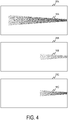
- FIG. 4 illustrates images 25A-25C captured by image sensor 16 of light beams 18A-18C of FIGs. 1-3 .
- Image 25A includes light beam 18A
- image 25B includes light beam 18B
- image 25C includes light beam 18C.
- images 25A-25C will be discussed within the context of visibility range sensing system 12 of FIGs. 1-3 .
- Light beams 18A-18C start out bright on the right side near the light projector source and fade on the left side. At each point along the length of light beams 18A-18C, the light intensity has a different value as the light fades over distance.
- Each pixel in images 25A-25C has a light intensity value.
- the intensity of light beams 18A-18C are controlled at light projector 14.
- the rate of change in the light intensity of each of light beams 18A-18C is a direct measure of the light extinction value.
- the pixel coordinates of each pixel in images 25A-25C corresponds to a distance from aircraft 10 at a given angle.
- controller 22 determines the distance of each point along light beams 18A-18C from aircraft 10 in images 25A-25C based upon the pixel coordinates and angles of projection of light beams 18A-18C. With the determined distances and light intensity values the rate of change of light intensity can be determined.
- light beam 18B With the different light intensity of light beam 18B compared to light beam 18A, light beam 18B has a different maximum detection range. Although light beam 18B is shorter, the rate of change of light intensity remains the same. The extinction value between light beam 18A and 18B also remains unchanged. Light beam 18B has a lower intensity at the right edge of image 25B than light beam 18A in image 25A. The lower intensity is due to the lower intensity of the projector output. Determining the rate of change in light intensity using light beam 18B in addition to light beam 18A is a way to verify the extinction value and maximum detection range of light beam 18A.
- Image 25C depicts light beam 18C.
- Light beam 18C appears to have the same length as light beam 18B despite having the same maximum detection range as light beam 18A. This is because light beam 18C is projected at an angle that is more normal to the field of view of image sensor 16. This causes light beam 18C to take up less of the horizontal space of the field of view of image sensor 16 than light beam 18A while having the same maximum detection range as light beam 18A.
- Light beam 18C also has a nearly the same intensity, but is slightly lower at the right edge of image 25C than light beam 18A in image 25A. The initial intensity is slightly lower due to capturing the light beam on the right side of the image at a distance further from the projector. The shorter length of the light beam in image sensor 16 is caused by the different projection angle.
- light beam 18C fades out towards the center of the image because the pixels of image 25C represent a different range and a longer distance to light beam 18C than the pixels of image 25B to light beam 18B.
- the angles of light beams 18A-18C are known and the locations of light projector 14 and image sensor 16 are known allowing triangulation to be used to determine distances in each of images 25A-25C. This allows visibility range sensing system 12 to determine the maximum detection range regardless of the angle and intensity of light beams provided by light projector 14.
- FIG. 5A shows an overhead view of an aircraft tail in the field of view of a visibility range sensing system including aircraft tail 26, image sensor 28, light projector 30, dotted lines 32A and 32B, and light beam 34.
- Light projector 30 emits light beam 34 onto aircraft tail 26.
- Light beam 34 is projected as a narrow vertical line.
- Image sensor 28 captures images of the scene within the field of view bounded by dotted lines 32A and 32B.
- Under clear air conditions when light beam 34 hits an object within the field of view of image sensor 28, such as aircraft tail 26, light beam 34 appears as a narrow line on the object.
- Under degraded visibility conditions light beam 34 spreads more than the divergence angle in clear conditions causing the narrow line to become wider than normal with distance.
- the degraded visibility conditions cause light beam 34 to appear wider than normal on objects within the field of view of image sensor 28.
- the divergence in light beam 34 occurs both in the transmission from light projector 30 and from the reflection of light beam 34 from aircraft tail 26 to image sensor 28.
- Image sensor 28 captures the total divergence of light beam 34 to aircraft tail 26 and back to image sensor 28.
- FIG. 5B shows image 36 captured by image sensor 28 of FIG.5A including aircraft tail 26, light beam 34, and vertical light line 38.
- the range of light beam 34 is dependent on aircraft tail 26. Since light beam 34 appears as a line on aircraft tail 26 in image 36, the pixel coordinates and projection angle of light beam 34 can be used to determine the distance of aircraft tail 26 and the maximum detection range of light beam 34. Under degraded visibility conditions, vertical light line 38 will be wider, covering more pixels. Covering more pixels decreases the accuracy of the range determination because there is a wider distance that vertical light line 38 is associated with based upon pixel coordinates. The decrease in range accuracy can be mitigated by using a degraded range distance measurement. Using a degraded range distance measurement includes estimating what the width would be under clear conditions at aircraft tail 26. Determining the size of the wider than normal line allows for a determination of the extinction value and maximum detection range, independent of the light gradient.
- FIG. 5C shows partial image 40 captured in clear conditions by the visibility range sensing system of FIG. 5A including aircraft tail 26 and vertical light line 38 under clear conditions.
- Partial image 40 shows light beam 34 falling on aircraft tail 26 as vertical light line 38 under clear conditions.
- FIG. 5D shows partial image 42 captured in degraded visibility conditions by the visibility range sensing system of FIG. 5A including aircraft tail 26 and vertical light line 38 under degraded conditions.
- Partial image 42 shows light beam 34 falling on aircraft tail 26 as vertical light line 38 under degraded visibility conditions.
- apparatus, systems, and associated methods herein allow aircraft visibility systems to accurately determine their maximum detection range and the human sight visibility range in degraded conditions such as rain, fog, and/or snow.
- Utilizing the visibility range sensing system described herein provides improved aircraft safety during taxiing, approach, and/or landing. Aircraft pilots are additionally provided with accurate information about the human sight visibility range and recommended speeds during degraded conditions.
- a system can comprise at least one light projector attachable to an aircraft at a first location, the at least one light projector configured to emit a first light beam in a first direction at a first intensity; at least one image sensor attachable to the aircraft at a second location, the at least one image sensor configured to capture a first image of a scene including the first light beam and a second image of the scene while the at least one light projector is not emitting light; and at least one controller configured to subtract pixel values of the second image from pixel values of the first image to provide a third image, to determine a light intensity of the first light beam in the third image, and to determine a maximum detection range of the first light beam based upon the light intensity, the first location, and the second location.
- the system of the preceding paragraph can optionally include, additionally and/or alternatively, any one or more of the following features, configurations and/or additional components:
- the at least one controller can be further configured to determine a human sight visibility range based upon the maximum detection range; and determine a suggested maximum taxi speed based upon the human sight visibility range.
- the system of claim 2 further comprising a display configured to display the human sight visibility range and the suggested maximum taxi speed.
- the at least one controller can be further configured to determine an extinction value of the first light beam based upon the light intensity of the first light beam; determine an ambient light level using the second image; and further determine the maximum detection range of the first light beam based upon the extinction value and the ambient light.
- the at least one controller can be further configured to determine a dimming gradient of the first light beam using the third image; determine an extinction value of the first light beam using the dimming gradient; and further determine the maximum detection range of the first light beam based upon the extinction value.
- the at least one light projector can be further configured to emit a second light beam in the first direction at a second intensity; the at least one image sensor can be further configured to capture a fourth image of the scene including the second light beam; and the at least one controller can be further configured to subtract pixel values of the second image from pixel values of the fourth image to provide a fifth image, to determine a light intensity of the second light beam in the fifth image, and to verify the extinction value based upon the light intensity of the second light beam.
- the at least one light projector can be further configured to emit a second light beam in a second direction at the first intensity; the at least one image sensor can be further configured to capture a fourth image of the scene including the second light beam; and the at least one controller can be further configured to subtract pixel values of the second image from pixel values of the fourth image to provide a fifth image, to determine a light intensity of the second light beam in the fifth image, and to verify the extinction value based upon the light intensity of the second light beam.
- Determining the maximum detection range can further include determining a width of the first light beam projected onto an object in the scene and comparing it to an expected width.
- Determining the maximum detection range can further include using pixel coordinates of the first light beam in the third image.
- the first light beam can be infrared light.
- a method can comprise emitting a first light beam in a first direction at a first intensity using a light projector; capturing, using an image sensor, a first image of a scene including the first light beam; capturing, using the image sensor, a second image of the scene while the light projector is not emitting light; subtracting, using a controller, pixel values of the second image from pixel values of the first image to provide a third image; determining, using the controller, a light intensity of the first light beam in the third image; and determining, using the controller, a maximum detection range of the first light beam based upon the light intensity, the first location, and the second location.
- the method of the preceding paragraph can optionally include, additionally and/or alternatively, any one or more of the following features, configurations and/or additional components:
- Determining, using a controller, a human sight visibility range can be based upon the maximum detection range; and determining, using a controller, a suggested maximum taxi speed can be based upon the human sight visibility range.
- Determining, using the controller, an extinction value of the first light beam can be based upon the light intensity of the first light beam; determining, using the controller, an ambient light level using the second image; and further determining, using the controller, the maximum detection range of the first light beam based upon the extinction value and the ambient light.
- Determining the maximum detection range can further include determining a width of the first light beam projected onto an object in the scene and comparing it to an expected width.
- Determining the maximum detection range can further include using pixel coordinates of the first light beam in the third image.
- the first light beam can be infrared light.
- the present invention also provides a method as claimed in claim 11.
- the method may comprise determining, using the controller, a dimming gradient of the first light beam using the third image;
- the method may comprise emitting, using the light projector, a second light beam in the first direction at a second intensity
- the method may comprise emitting, using the projector, a second light beam in a second direction at the first intensity
- the method may comprise determining the maximum detection range further includes determining a width of the first light beam projected onto an object in the scene and comparing it to an expected width.
- the method may comprise determining the maximum detection range further includes using pixel coordinates of the first light beam in the third image.
- the method may comprise the first light beam is infrared light.
Landscapes
- Engineering & Computer Science (AREA)
- Physics & Mathematics (AREA)
- General Physics & Mathematics (AREA)
- Remote Sensing (AREA)
- Radar, Positioning & Navigation (AREA)
- Aviation & Aerospace Engineering (AREA)
- Electromagnetism (AREA)
- Computer Networks & Wireless Communication (AREA)
- Computer Vision & Pattern Recognition (AREA)
- Theoretical Computer Science (AREA)
- Multimedia (AREA)
- Lighting Device Outwards From Vehicle And Optical Signal (AREA)
- Traffic Control Systems (AREA)
Abstract
Description
- Each year, significant time and money are lost due to commercial aircraft accidents and incidents during ground operations, of which significant portions occur during taxiing maneuvers. During ground operations, aircraft share the taxiways with other aircraft, fuel vehicles, baggage carrying trains, mobile stairways and many other objects. Aircraft often taxi to and/or from fixed buildings and other fixed objects. Should an aircraft collide with any of these objects, the aircraft must be repaired and recertified as capable of operation. The cost of repair and recertification, as well as the lost opportunity costs associated with the aircraft being unavailable for use can be very expensive.
- Pilots are located in a central cockpit where they are well positioned to observe objects that are directly in front of the cabin of the aircraft. Wings extend laterally from the cabin in both directions. Some commercial and some military aircraft have large wingspans, and so the wings on these aircraft laterally extend a great distance from the cabin. Some commercial and some military aircraft have engines that extend below the wings. Pilots, positioned in the cabin, can have difficulty knowing the risk of collisions between the wingtips and/or engines and other objects external to the aircraft. Visibility is further hindered by fog, rain, or snow. An aircraft on-ground collision alerting system would be useful to survey the area forward or aft of the tail, wingtips and/or engines, to detect obstructions with sufficient range and measurement resolution in a potential collision path, and to provide visual and audible alerts to the cockpit.
- In one example, a system comprises at least one light projector, at least one image sensor, and at least one controller. The at least one light projector is attachable to an aircraft at a first location. The at least one light projector is configured to emit a first beam of light in a first direction at a first intensity. The at least one image sensor is attachable to the aircraft at a second location. The at least one image sensor is configured to capture a first image of a scene including the reflections of first beam of light and a second image of the scene while the at least one projector is not emitting light. The at least one controller is configured to subtract pixel values of the second image from pixel values of the first image to provide a third image, to determine a light intensity of the first beam of light in the third image, and to determine a maximum detection range of the first beam of light based upon the light intensity, the first location, and the second location.
- In one example, a method comprises emitting a first beam of light in a first direction at a first intensity using a light projector; capturing, using an image sensor, a first image of a scene including reflections of the first beam of light; capturing, using the image sensor, a second image of the scene while the light projector is not emitting light; subtracting, using a controller, pixel values of the second image from pixel values of the first image to provide a third image; determining, using the controller, a light intensity of the first beam of light in the third image; and determining, using the controller, a maximum detection range of the first beam of light based upon the light intensity, the first location, and the second location.
-
-
FIG. 1 shows an overhead view of an aircraft with a visibility range sensing system in a first configuration. -
FIG. 2 shows an overhead view of an aircraft with a visibility range sensing system in a second configuration. -
FIG. 3 shows an overhead view of an aircraft with a visibility range sensing system in a third configuration. -
FIG. 4 is a set of three images captured by a visibility range sensing system in the first, second, and third configuration. -
FIG. 5A shows an overhead view of an aircraft tail in the field of view of a visibility range sensing system. -
FIG. 5B shows an image captured by a visibility range sensing system. -
FIG. 5C shows a partial image captured by a visibility range sensing system in clear conditions. -
FIG. 5D shows a partial image captured by a visibility range sensing system in degraded conditions. - Apparatus, systems, and associated methods relate to range detection in aircraft visibility systems. In degraded visibility conditions, such as rain, fog, and/or snow, the maximum detection range and human sight visibility range of aircraft visibility systems are degraded. In addition, the human sight visibility range can be degraded by low ambient light levels. Using the apparatus, systems, and associated methods herein it can be determined when and at what range such aircraft visibility systems degrade below reliable use. Ground taxi operation safety is improved by validating the maximum detection range. It is also possible to be used to increase safety during airborne operations of approach and landing. The addition of built in test capability allows structured light to be used as a primary measurement system. Primary systems can be used to take the place of the pilot function. This reduces pilot workload and allows for taxi autonomy.
-
FIG. 1 shows an overhead view of an aircraft with a visibility range sensingsystem including aircraft 10, a block diagram of visibilityrange sensing system 12,light projector 14,image sensor 16,light beam 18A, and dottedlines range sensing system 12 includesprojector 14,image sensor 16,controller 22, anddisplay 24.Light projector 14 andimage sensor 16 are mounted onaircraft 10.Light beam 18A is provided bylight projector 14. Dottedlines image sensor 16. -
Light projector 14 andimage sensor 16 are arranged, for example, on a side ofaircraft 10. The relative locations oflight projector 14 andimage sensor 16 are known and calibrated.Image sensor 16 captures images of the visual scene within its field of view and converts the visual scene to pixel values. In some examples,image sensor 16 is a camera.Light projector 14 emits a light beam of controlled intensity, direction, divergence angle, and/or light pattern.Controller 22 performs image processing to compute difference images, converts image pixel coordinates to distances, determines light beam range based upon the light intensity of light beams, computes light gradient and extinction values, and determines the maximum detection range of visibilityrange sensing system 12.Controller 22 provides data for display ondisplay 24.Display 24 can be a pilot display, flight controller display, and/or other aircraft displays.Display 24 provides information to a user based upon the data provided bycontroller 22. The information can include the maximum visible range, a recommended maximum taxi speed, the ambient light condition, the image sensor detection limits, and the current performance level ofimage sensor 16. -
Light projector 14 provideslight beam 18A to illuminate a portion of the scene within the field of view ofimage sensor 16.Light beam 18A can be turned on only during image capture or for longer lengths of time.Image sensor 16 captures an image of the scene withlight beam 18A turned on. Image sensor also 16 captures an image of the same scene withlight beam 18A turned off. Via image processing, the two captured images are subtracted from each other to remove background light sources. Extinction values are used to compute the maximum detection range. Images captured without a light beam fromlight projector 14 are used to determine the ambient light level. This ambient light measurement can be captured across the full visible spectrum. Light meters may also be used to provide the ambient light measurement. Using the ambient light levels and the extinction value, the maximum visible range can be computed. This information can be used to inform a pilot of the distance at which objects can be seen while taxiing in visually degraded environments such as rain, fog, snow, and/or low ambient lighting. This information can also be used by various vision based systems to ensure the validity of the images and data they capture. - With clear conditions and long-distance visibility ranges, images captured by
image sensor 16 will not include a light beam, such aslight beam 18A, that is visible throughout its length. When fog, rain, or snow is present, light beams provided bylight projector 14 will be scattered by the particulates making the light beams visible throughout their length. As shown inFIG. 1 ,light beam 18A is visible throughout its length.Light beam 18A is shown such that the intensity of light reflecting from particulates is shown darker, and aslight beam 18A fades over distance it is shown lighter. Aslight beam 18A fades, its intensity decreases and the light level oflight beam 18A becomes closer to the background light level.Light projector 14 can increase or decrease the light intensity oflight beam 18A.Light beam 18A fades due to the increased extinction value caused by conditions such as fog, rain, and/or snow. The range at whichlight beam 18A is no longer detected is the maximum detection range. The value of the maximum detection range oflight beam 18A is determined bycontroller 22 using triangulation.Controller 22 uses the known or calibrated locations oflight projector 14 andimage sensor 16, the angle of projection oflight beam 18A, and the measured pixel length oflight beam 18A.Controller 22 applies a constant to the maximum detection range to determine a human sight visibility range. Based upon the maximum detection range and/or the human sight visibility range, a recommended taxi speed can also be determined. The human sight visibility range and the recommended taxi speed can be displayed to the pilot ondisplay 24. - In some examples, the known location of
light projector 14, the pattern oflight beam 18A, and the output intensity oflight beam 18A are used to determine the maximum detection range oflight beam 18A.Light projector 14 may projectlight beam 18A as a single narrow beam, a line, or a wide beam.Light beam 18A starts with a small cross-sectional area nearlight projector 14 and increases in cross sectional area as it extends fromlight projector 14. In some examples,controller 22 uses the dimming gradient oflight beam 18A to determine the extinction value. The dimming gradient is a measure of howfast light beam 18A dims with increased distance fromlight projector 14.Controller 22 determines the extinction value by scaling the dimming gradient. -
FIG. 2 shows an overhead view of an aircraft with a visibility range sensingsystem including aircraft 10, a block diagram of visibilityrange sensing system 12,light projector 14,image sensor 16,light beam 18B, and dottedlines range sensing system 12 includesprojector 14,image sensor 16,controller 22, anddisplay 24.Light projector 14 andimage sensor 16 are mounted onaircraft 10.Light beam 18B is provided bylight projector 14.Dotted lines image sensor 16. -
Light beam 18B has a lower intensity thanlight beam 18A ofFIG. 1 . With the lower intensity,light beam 18B fades at a shorter distance thanlight beam 18A. With the different light intensity oflight beam 18B,light beam 18B has a different maximum detection range.Light beam 18B also has a different rate of change in light intensity. The extinction value betweenlight beam light beams beam 18B is shorter, becauselight beam 18B is emitted fromlight projector 14 at a lower intensity thanlight beam 18A. -
FIG. 3 shows an overhead view of an aircraft with a visibility range sensingsystem including aircraft 10, a block diagram of visibilityrange sensing system 12,light projector 14,image sensor 16,light beam 18C, and dottedlines range sensing system 12 includesprojector 14,image sensor 16,controller 22, anddisplay 24.Light projector 14 andimage sensor 16 are mounted onaircraft 10.Light beam 18C is provided bylight projector 14.Dotted lines image sensor 16. -
Light beam 18C has the same lightintensity light beam 18A ofFIG. 1 , butlight beam 18C is directed at a different angle thanlight beam 18A.Light beam light projector 14 at the same intensity in the same degraded conditions, therefore,light beam 18A andlight beam 18C have the same maximum detection range value, but in different directions. In some examples, measurements are verified using two or more light beams of different intensities, such aslight beam 18A andlight beam 18B.Controller 22 determines the maximum detection range oflight beams light beams light beam 18A andlight beam 18C.Controller 22 determines the dimming gradient oflight beam light beams light beams - In some examples,
light projector 14 emits light at two or more wavelengths. Projecting light at two or more wavelengths provides additional measures of visibility range. Longer IR wavelengths are capable of transmitting through longer ranges depending on the size of particles present in the air. This multispectral feature is used for determining visibility ranges at the different optical wavelengths. In some examples,light projector 14 uses short duration pulses that prevent personnel from seeing the light source emitted from the system. Short duration pulses can include pulses of 1 millisecond or less. In some examples,light projector 14 emits infrared light making the light invisible to personnel. -
FIG. 4 illustratesimages 25A-25C captured byimage sensor 16 oflight beams 18A-18C ofFIGs. 1-3 .Image 25A includeslight beam 18A,image 25B includeslight beam 18B, andimage 25C includeslight beam 18C. For purposes of clarity and ease of discussion,images 25A-25C will be discussed within the context of visibilityrange sensing system 12 ofFIGs. 1-3 . - Light beams 18A-18C start out bright on the right side near the light projector source and fade on the left side. At each point along the length of
light beams 18A-18C, the light intensity has a different value as the light fades over distance. Each pixel inimages 25A-25C has a light intensity value. The intensity oflight beams 18A-18C are controlled atlight projector 14. The rate of change in the light intensity of each oflight beams 18A-18C is a direct measure of the light extinction value. The pixel coordinates of each pixel inimages 25A-25C corresponds to a distance fromaircraft 10 at a given angle. This allowscontroller 22 to determine the distance of each point alonglight beams 18A-18C fromaircraft 10 inimages 25A-25C based upon the pixel coordinates and angles of projection oflight beams 18A-18C. With the determined distances and light intensity values the rate of change of light intensity can be determined. - With the different light intensity of
light beam 18B compared tolight beam 18A,light beam 18B has a different maximum detection range. Althoughlight beam 18B is shorter, the rate of change of light intensity remains the same. The extinction value betweenlight beam Light beam 18B has a lower intensity at the right edge ofimage 25B thanlight beam 18A inimage 25A. The lower intensity is due to the lower intensity of the projector output. Determining the rate of change in light intensity usinglight beam 18B in addition tolight beam 18A is a way to verify the extinction value and maximum detection range oflight beam 18A. -
Image 25C depictslight beam 18C.Light beam 18C appears to have the same length aslight beam 18B despite having the same maximum detection range aslight beam 18A. This is becauselight beam 18C is projected at an angle that is more normal to the field of view ofimage sensor 16. This causeslight beam 18C to take up less of the horizontal space of the field of view ofimage sensor 16 thanlight beam 18A while having the same maximum detection range aslight beam 18A.Light beam 18C also has a nearly the same intensity, but is slightly lower at the right edge ofimage 25C thanlight beam 18A inimage 25A. The initial intensity is slightly lower due to capturing the light beam on the right side of the image at a distance further from the projector. The shorter length of the light beam inimage sensor 16 is caused by the different projection angle. Accordingly,light beam 18C fades out towards the center of the image because the pixels ofimage 25C represent a different range and a longer distance tolight beam 18C than the pixels ofimage 25B tolight beam 18B. The angles oflight beams 18A-18C are known and the locations oflight projector 14 andimage sensor 16 are known allowing triangulation to be used to determine distances in each ofimages 25A-25C. This allows visibilityrange sensing system 12 to determine the maximum detection range regardless of the angle and intensity of light beams provided bylight projector 14. -
FIG. 5A shows an overhead view of an aircraft tail in the field of view of a visibility range sensing system includingaircraft tail 26,image sensor 28,light projector 30, dottedlines light beam 34. -
Light projector 30 emitslight beam 34 ontoaircraft tail 26.Light beam 34 is projected as a narrow vertical line.Image sensor 28 captures images of the scene within the field of view bounded bydotted lines light beam 34 hits an object within the field of view ofimage sensor 28, such asaircraft tail 26,light beam 34 appears as a narrow line on the object. Under degraded visibility conditions,light beam 34 spreads more than the divergence angle in clear conditions causing the narrow line to become wider than normal with distance. The degraded visibility conditions causelight beam 34 to appear wider than normal on objects within the field of view ofimage sensor 28. The divergence inlight beam 34 occurs both in the transmission fromlight projector 30 and from the reflection oflight beam 34 fromaircraft tail 26 to imagesensor 28.Image sensor 28 captures the total divergence oflight beam 34 toaircraft tail 26 and back toimage sensor 28. -
FIG. 5B showsimage 36 captured byimage sensor 28 ofFIG.5A includingaircraft tail 26,light beam 34, and verticallight line 38. - In
image 36 captured byimage sensor 28, the range oflight beam 34 is dependent onaircraft tail 26. Sincelight beam 34 appears as a line onaircraft tail 26 inimage 36, the pixel coordinates and projection angle oflight beam 34 can be used to determine the distance ofaircraft tail 26 and the maximum detection range oflight beam 34. Under degraded visibility conditions, verticallight line 38 will be wider, covering more pixels. Covering more pixels decreases the accuracy of the range determination because there is a wider distance that verticallight line 38 is associated with based upon pixel coordinates. The decrease in range accuracy can be mitigated by using a degraded range distance measurement. Using a degraded range distance measurement includes estimating what the width would be under clear conditions ataircraft tail 26. Determining the size of the wider than normal line allows for a determination of the extinction value and maximum detection range, independent of the light gradient. -
FIG. 5C showspartial image 40 captured in clear conditions by the visibility range sensing system ofFIG. 5A includingaircraft tail 26 and verticallight line 38 under clear conditions. -
Partial image 40 showslight beam 34 falling onaircraft tail 26 as verticallight line 38 under clear conditions. -
FIG. 5D showspartial image 42 captured in degraded visibility conditions by the visibility range sensing system ofFIG. 5A includingaircraft tail 26 and verticallight line 38 under degraded conditions. -
Partial image 42 showslight beam 34 falling onaircraft tail 26 as verticallight line 38 under degraded visibility conditions. - Accordingly, apparatus, systems, and associated methods herein, allow aircraft visibility systems to accurately determine their maximum detection range and the human sight visibility range in degraded conditions such as rain, fog, and/or snow. Utilizing the visibility range sensing system described herein provides improved aircraft safety during taxiing, approach, and/or landing. Aircraft pilots are additionally provided with accurate information about the human sight visibility range and recommended speeds during degraded conditions.
- The following are non-exclusive descriptions of possible embodiments of the present invention.
- A system can comprise at least one light projector attachable to an aircraft at a first location, the at least one light projector configured to emit a first light beam in a first direction at a first intensity; at least one image sensor attachable to the aircraft at a second location, the at least one image sensor configured to capture a first image of a scene including the first light beam and a second image of the scene while the at least one light projector is not emitting light; and at least one controller configured to subtract pixel values of the second image from pixel values of the first image to provide a third image, to determine a light intensity of the first light beam in the third image, and to determine a maximum detection range of the first light beam based upon the light intensity, the first location, and the second location.
- The system of the preceding paragraph can optionally include, additionally and/or alternatively, any one or more of the following features, configurations and/or additional components:
- The at least one controller can be further configured to determine a human sight visibility range based upon the maximum detection range; and determine a suggested maximum taxi speed based upon the human sight visibility range.
- The system of claim 2, further comprising a display configured to display the human sight visibility range and the suggested maximum taxi speed.
- The at least one controller can be further configured to determine an extinction value of the first light beam based upon the light intensity of the first light beam; determine an ambient light level using the second image; and further determine the maximum detection range of the first light beam based upon the extinction value and the ambient light.
- The at least one controller can be further configured to determine a dimming gradient of the first light beam using the third image; determine an extinction value of the first light beam using the dimming gradient; and further determine the maximum detection range of the first light beam based upon the extinction value.
- The at least one light projector can be further configured to emit a second light beam in the first direction at a second intensity; the at least one image sensor can be further configured to capture a fourth image of the scene including the second light beam; and the at least one controller can be further configured to subtract pixel values of the second image from pixel values of the fourth image to provide a fifth image, to determine a light intensity of the second light beam in the fifth image, and to verify the extinction value based upon the light intensity of the second light beam.
- The at least one light projector can be further configured to emit a second light beam in a second direction at the first intensity; the at least one image sensor can be further configured to capture a fourth image of the scene including the second light beam; and the at least one controller can be further configured to subtract pixel values of the second image from pixel values of the fourth image to provide a fifth image, to determine a light intensity of the second light beam in the fifth image, and to verify the extinction value based upon the light intensity of the second light beam.
- Determining the maximum detection range can further include determining a width of the first light beam projected onto an object in the scene and comparing it to an expected width.
- Determining the maximum detection range can further include using pixel coordinates of the first light beam in the third image.
- The first light beam can be infrared light.
- A method can comprise emitting a first light beam in a first direction at a first intensity using a light projector; capturing, using an image sensor, a first image of a scene including the first light beam; capturing, using the image sensor, a second image of the scene while the light projector is not emitting light; subtracting, using a controller, pixel values of the second image from pixel values of the first image to provide a third image; determining, using the controller, a light intensity of the first light beam in the third image; and determining, using the controller, a maximum detection range of the first light beam based upon the light intensity, the first location, and the second location.
- The method of the preceding paragraph can optionally include, additionally and/or alternatively, any one or more of the following features, configurations and/or additional components:
- Determining, using a controller, a human sight visibility range can be based upon the maximum detection range; and determining, using a controller, a suggested maximum taxi speed can be based upon the human sight visibility range.
- Displaying, using a display, the human sight visibility range and the suggested maximum taxi speed.
- Determining, using the controller, an extinction value of the first light beam can be based upon the light intensity of the first light beam; determining, using the controller, an ambient light level using the second image; and further determining, using the controller, the maximum detection range of the first light beam based upon the extinction value and the ambient light.
- Determining, using the controller, a dimming gradient of the first light beam using the third image; determining, using the controller, an extinction value of the first light beam using the dimming gradient; and further determining, using the controller, the maximum detection range of the first light beam based upon the extinction value.
- Emitting, using the light projector, a second light beam in the first direction at a second intensity; capturing, using the image sensor, a fourth image of the scene including the second light beam; subtracting, using the controller, pixel values of the second image from pixel values of the fourth image to provide a fifth image; determining, using the controller, a light intensity of the second light beam in the fifth image; and verifying, using the controller, the extinction value based upon the light intensity of the second light beam.
- Emitting, using the projector, a second light beam in a second direction at the first intensity; capturing, using the image sensor, a fourth image of the scene including the second light beam; subtracting, using the controller, pixel values of the second image from pixel values of the fourth image to provide a fifth image; determining, using the controller, a light intensity of the second light beam in the fifth image; and verifying, using the controller, the extinction value based upon the light intensity of the second light beam.
- Determining the maximum detection range can further include determining a width of the first light beam projected onto an object in the scene and comparing it to an expected width.
- Determining the maximum detection range can further include using pixel coordinates of the first light beam in the third image.
- The first light beam can be infrared light.
- The present invention also provides a method as claimed in claim 11.
- The method may comprise determining, using the controller, a dimming gradient of the first light beam using the third image;
- determining, using the controller, an extinction value of the first light beam using the dimming gradient; and
- further determining, using the controller, the maximum detection range of the first light beam based upon the extinction value.
- The method may comprise emitting, using the light projector, a second light beam in the first direction at a second intensity;
- capturing, using the image sensor, a fourth image of the scene including reflections of the second light beam;
- subtracting, using the controller, pixel values of the second image from pixel values of the fourth image to provide a fifth image;
- determining, using the controller, a light intensity of the second light beam in the fifth image; and
- verifying, using the controller, the extinction value based upon the light intensity of the second light beam.
- The method may comprise emitting, using the projector, a second light beam in a second direction at the first intensity;
- capturing, using the image sensor, a fourth image of the scene including reflections of the second light beam;
- subtracting, using the controller, pixel values of the second image from pixel values of the fourth image to provide a fifth image;
- determining, using the controller, a light intensity of the second light beam in the fifth image; and
- verifying, using the controller, the extinction value based upon the light intensity of the second light beam.
- The method may comprise determining the maximum detection range further includes determining a width of the first light beam projected onto an object in the scene and comparing it to an expected width.
- The method may comprise determining the maximum detection range further includes using pixel coordinates of the first light beam in the third image.
- The method may comprise the first light beam is infrared light.
- While the invention has been described with reference to an exemplary embodiment(s), it will be understood by those skilled in the art that various changes may be made and equivalents may be substituted for elements thereof without departing from the scope of the invention. In addition, many modifications may be made to adapt a particular situation or material to the teachings of the invention without departing from the essential scope thereof. Therefore, it is intended that the invention not be limited to the particular embodiment(s) disclosed, but that the invention will include all embodiments falling within the scope of the appended claims.
Claims (15)
- A system comprising:at least one light projector attachable to an aircraft at a first location, the at least one light projector configured to emit a first light beam in a first direction at a first intensity;at least one image sensor attachable to the aircraft at a second location, the at least one image sensor configured to capture a first image of a scene including reflections of the first light beam and a second image of the scene while the at least one light projector is not emitting light; andat least one controller configured to subtract pixel values of the second image from pixel values of the first image to provide a third image, to determine a light intensity of the first light beam in the third image, and to determine a maximum detection range of the first light beam based upon the light intensity, the first location, and the second location.
- The system of claim 1, wherein the at least one controller is further configured to:determine a human sight visibility range based upon the maximum detection range; anddetermine a suggested maximum taxi speed based upon the human sight visibility range.
- The system of claim 2, further comprising a display configured to display the human sight visibility range and the suggested maximum taxi speed.
- The system of any preceding claim, wherein the at least one controller is further configured to:determine an extinction value of the first light beam based upon the light intensity of the first light beam;determine an ambient light level using the second image; andfurther determine the maximum detection range of the first light beam based upon the extinction value and the ambient light.
- The system of any preceding claim, wherein the at least one controller is further configured to:determine a dimming gradient of the first light beam using the third image;determine an extinction value of the first light beam using the dimming gradient; andfurther determine the maximum detection range of the first light beam based upon the extinction value.
- The system of claim 5, wherein:the at least one light projector is further configured to emit a second light beam in the first direction at a second intensity;the at least one image sensor is further configured to capture a fourth image of the scene including reflections of the second light beam; andthe at least one controller is further configured to subtract pixel values of the second image from pixel values of the fourth image to provide a fifth image, to determine a light intensity of the second light beam in the fifth image, and to verify the extinction value based upon the light intensity of the second light beam.
- The system of claim 5 or 6, wherein:the at least one light projector is further configured to emit a second light beam in a second direction at the first intensity;the at least one image sensor is further configured to capture a fourth image of the scene including reflections of the second light beam; andthe at least one controller is further configured to subtract pixel values of the second image from pixel values of the fourth image to provide a fifth image, to determine a light intensity of the of the second light beam in the fifth image, and to verify the extinction value based upon the light intensity of the second light beam.
- The system of any preceding claim, wherein determining the maximum detection range further includes determining a width of the first light beam projected onto an object in the scene and comparing it to an expected width.
- The system of any preceding claim, wherein determining the maximum detection range further includes using pixel coordinates of the first light beam in the third image.
- The system of any preceding claim, wherein the first light beam is infrared light.
- A method comprising:emitting a first light beam in a first direction at a first intensity using a light projector mounted at a first location on an aircraft;capturing, using an image sensor mounted at a second location on an aircraft, a first image of a scene including reflections of the first light beam;capturing, using the image sensor, a second image of the scene while the light projector is not emitting light;subtracting, using a controller, pixel values of the second image from pixel values of the first image to provide a third image;determining, using the controller, a light intensity of the first light beam in the third image; anddetermining, using the controller, a maximum detection range of the first light beam based upon the light intensity, the first location, and the second location.
- The method of claim 11, further comprising:determining, using a controller, a human sight visibility range based upon the maximum detection range; anddetermining, using a controller, a suggested maximum taxi speed based upon the human sight visibility range.
- The method of claim 12, further comprising displaying, using a display, the human sight visibility range and the suggested maximum taxi speed.
- The method of claim 11, 12 or 13, further comprising:determining, using the controller, an extinction value of the first light beam based upon the light intensity of the first light beam;determining, using the controller, an ambient light level using the second image; andfurther determining, using the controller, the maximum detection range of the first light beam based upon the extinction value and the ambient light.
- The method of any one of claims 11-14, further comprising:determining, using the controller, a dimming gradient of the first light beam using the third image;determining, using the controller, an extinction value of the first light beam using the dimming gradient; andfurther determining, using the controller, the maximum detection range of the first light beam based upon the extinction value.
Applications Claiming Priority (1)
| Application Number | Priority Date | Filing Date | Title |
|---|---|---|---|
| US16/105,701 US11181368B2 (en) | 2018-08-20 | 2018-08-20 | Visibility range sensing |
Publications (2)
| Publication Number | Publication Date |
|---|---|
| EP3613675A1 true EP3613675A1 (en) | 2020-02-26 |
| EP3613675B1 EP3613675B1 (en) | 2021-07-14 |
Family
ID=67659002
Family Applications (1)
| Application Number | Title | Priority Date | Filing Date |
|---|---|---|---|
| EP19191967.9A Active EP3613675B1 (en) | 2018-08-20 | 2019-08-15 | Visibility range sensing |
Country Status (3)
| Country | Link |
|---|---|
| US (1) | US11181368B2 (en) |
| EP (1) | EP3613675B1 (en) |
| CA (1) | CA3051079A1 (en) |
Families Citing this family (4)
| Publication number | Priority date | Publication date | Assignee | Title |
|---|---|---|---|---|
| US11592568B2 (en) * | 2019-10-18 | 2023-02-28 | Ai4 International Oy | Measurement device and method of operating therefor |
| EP3812283B1 (en) * | 2019-10-22 | 2024-03-20 | Goodrich Lighting Systems GmbH & Co. KG | Exterior aircraft image projector |
| JP7696770B2 (en) * | 2021-06-30 | 2025-06-23 | フォルシアクラリオン・エレクトロニクス株式会社 | Information processing device and control program |
| US11866194B2 (en) * | 2021-10-30 | 2024-01-09 | Beta Air, Llc | Systems and methods for a visual system for an electric aircraft |
Citations (2)
| Publication number | Priority date | Publication date | Assignee | Title |
|---|---|---|---|---|
| US20170011268A1 (en) * | 2014-02-24 | 2017-01-12 | Nissan Motor Co., Ltd. | Self-Position Calculating Apparatus and Self-Position Calculating Method |
| US20170301250A1 (en) * | 2016-04-18 | 2017-10-19 | Rosemount Aerospace Inc. | Method and system for aircraft taxi strike alerting |
Family Cites Families (6)
| Publication number | Priority date | Publication date | Assignee | Title |
|---|---|---|---|---|
| DE102012112321B4 (en) | 2012-12-14 | 2015-03-05 | Faro Technologies, Inc. | Device for optically scanning and measuring an environment |
| US9911344B2 (en) | 2015-07-24 | 2018-03-06 | Honeywell International Inc. | Helicopter landing system using a camera for obstacle detection |
| US10453185B2 (en) | 2015-11-12 | 2019-10-22 | Aquifi, Inc. | System and method for high dynamic range depth capture using multiple cameras |
| US10609359B2 (en) | 2016-06-22 | 2020-03-31 | Intel Corporation | Depth image provision apparatus and method |
| US11094208B2 (en) | 2016-09-30 | 2021-08-17 | The Boeing Company | Stereo camera system for collision avoidance during aircraft surface operations |
| US10725470B2 (en) * | 2017-06-13 | 2020-07-28 | GM Global Technology Operations LLC | Autonomous vehicle driving systems and methods for critical conditions |
-
2018
- 2018-08-20 US US16/105,701 patent/US11181368B2/en active Active
-
2019
- 2019-08-01 CA CA3051079A patent/CA3051079A1/en active Pending
- 2019-08-15 EP EP19191967.9A patent/EP3613675B1/en active Active
Patent Citations (2)
| Publication number | Priority date | Publication date | Assignee | Title |
|---|---|---|---|---|
| US20170011268A1 (en) * | 2014-02-24 | 2017-01-12 | Nissan Motor Co., Ltd. | Self-Position Calculating Apparatus and Self-Position Calculating Method |
| US20170301250A1 (en) * | 2016-04-18 | 2017-10-19 | Rosemount Aerospace Inc. | Method and system for aircraft taxi strike alerting |
Also Published As
| Publication number | Publication date |
|---|---|
| US11181368B2 (en) | 2021-11-23 |
| EP3613675B1 (en) | 2021-07-14 |
| US20200056885A1 (en) | 2020-02-20 |
| CA3051079A1 (en) | 2020-02-20 |
| BR102019015899A2 (en) | 2020-03-10 |
Similar Documents
| Publication | Publication Date | Title |
|---|---|---|
| EP3613675B1 (en) | Visibility range sensing | |
| JP5414540B2 (en) | Optical system for determining and displaying aircraft position and status during aircraft landing and takeoff | |
| US8666570B1 (en) | Volcanic ash detection by optical backscatter using standard aircraft lights | |
| CA2956752C (en) | Method and system for aircraft taxi strike alerting | |
| JP6356673B2 (en) | Collision detection using video images | |
| JP6215567B2 (en) | System and method for sorting wing tip sensor information | |
| EP3392153B1 (en) | Method and system for providing docking guidance to a pilot of a taxiing aircraft | |
| EP3597545B1 (en) | Taxi strike alert system | |
| US20240125936A1 (en) | Time-resolved contrast imaging for lidar | |
| DK151728B (en) | PROCEDURE FOR MEASURING VIEW SCREEN AND HEIGHT | |
| WO2009075648A1 (en) | An aircraft ground collision warning system | |
| EP0597715A1 (en) | Automatic aircraft landing system calibration | |
| EP3767306B1 (en) | Method and system for collecting air data using a laser-induced plasma channel | |
| US20070222969A1 (en) | Aircraft docking system | |
| US11635523B2 (en) | Aircraft laser collision detection system | |
| CN109385939B (en) | Multi-inlet runway scratch-proof system | |
| BR102019015899B1 (en) | SYSTEM AND METHOD FOR DETECTING VISIBILITY RANGE | |
| US12487088B2 (en) | Airborne measurement system comprising a SPAD camera | |
| KR20120105966A (en) | Apparatus for measuring of visibility and method for thereof | |
| KR101127726B1 (en) | Improved aircraft docking system | |
| US10991261B1 (en) | Glideslope visibility monitor | |
| KR20230067218A (en) | 3D space information monitoring system | |
| ITMI951329A1 (en) | SYSTEM FOR APPROACH AND LANDING ON RUNWAYS IN CONDITIONS OF MARGINAL VISIBILITY THROUGH THE USE OF TECHNOLOGIES |
Legal Events
| Date | Code | Title | Description |
|---|---|---|---|
| PUAI | Public reference made under article 153(3) epc to a published international application that has entered the european phase |
Free format text: ORIGINAL CODE: 0009012 |
|
| STAA | Information on the status of an ep patent application or granted ep patent |
Free format text: STATUS: THE APPLICATION HAS BEEN PUBLISHED |
|
| AK | Designated contracting states |
Kind code of ref document: A1 Designated state(s): AL AT BE BG CH CY CZ DE DK EE ES FI FR GB GR HR HU IE IS IT LI LT LU LV MC MK MT NL NO PL PT RO RS SE SI SK SM TR |
|
| AX | Request for extension of the european patent |
Extension state: BA ME |
|
| STAA | Information on the status of an ep patent application or granted ep patent |
Free format text: STATUS: REQUEST FOR EXAMINATION WAS MADE |
|
| 17P | Request for examination filed |
Effective date: 20200826 |
|
| RBV | Designated contracting states (corrected) |
Designated state(s): AL AT BE BG CH CY CZ DE DK EE ES FI FR GB GR HR HU IE IS IT LI LT LU LV MC MK MT NL NO PL PT RO RS SE SI SK SM TR |
|
| GRAP | Despatch of communication of intention to grant a patent |
Free format text: ORIGINAL CODE: EPIDOSNIGR1 |
|
| STAA | Information on the status of an ep patent application or granted ep patent |
Free format text: STATUS: GRANT OF PATENT IS INTENDED |
|
| INTG | Intention to grant announced |
Effective date: 20210129 |
|
| GRAS | Grant fee paid |
Free format text: ORIGINAL CODE: EPIDOSNIGR3 |
|
| GRAA | (expected) grant |
Free format text: ORIGINAL CODE: 0009210 |
|
| STAA | Information on the status of an ep patent application or granted ep patent |
Free format text: STATUS: THE PATENT HAS BEEN GRANTED |
|
| AK | Designated contracting states |
Kind code of ref document: B1 Designated state(s): AL AT BE BG CH CY CZ DE DK EE ES FI FR GB GR HR HU IE IS IT LI LT LU LV MC MK MT NL NO PL PT RO RS SE SI SK SM TR |
|
| REG | Reference to a national code |
Ref country code: GB Ref legal event code: FG4D |
|
| REG | Reference to a national code |
Ref country code: DE Ref legal event code: R096 Ref document number: 602019006073 Country of ref document: DE |
|
| REG | Reference to a national code |
Ref country code: IE Ref legal event code: FG4D |
|
| REG | Reference to a national code |
Ref country code: AT Ref legal event code: REF Ref document number: 1410470 Country of ref document: AT Kind code of ref document: T Effective date: 20210815 |
|
| REG | Reference to a national code |
Ref country code: LT Ref legal event code: MG9D |
|
| REG | Reference to a national code |
Ref country code: NL Ref legal event code: MP Effective date: 20210714 |
|
| REG | Reference to a national code |
Ref country code: AT Ref legal event code: MK05 Ref document number: 1410470 Country of ref document: AT Kind code of ref document: T Effective date: 20210714 |
|
| PG25 | Lapsed in a contracting state [announced via postgrant information from national office to epo] |
Ref country code: FI Free format text: LAPSE BECAUSE OF FAILURE TO SUBMIT A TRANSLATION OF THE DESCRIPTION OR TO PAY THE FEE WITHIN THE PRESCRIBED TIME-LIMIT Effective date: 20210714 Ref country code: ES Free format text: LAPSE BECAUSE OF FAILURE TO SUBMIT A TRANSLATION OF THE DESCRIPTION OR TO PAY THE FEE WITHIN THE PRESCRIBED TIME-LIMIT Effective date: 20210714 Ref country code: RS Free format text: LAPSE BECAUSE OF FAILURE TO SUBMIT A TRANSLATION OF THE DESCRIPTION OR TO PAY THE FEE WITHIN THE PRESCRIBED TIME-LIMIT Effective date: 20210714 Ref country code: SE Free format text: LAPSE BECAUSE OF FAILURE TO SUBMIT A TRANSLATION OF THE DESCRIPTION OR TO PAY THE FEE WITHIN THE PRESCRIBED TIME-LIMIT Effective date: 20210714 Ref country code: LT Free format text: LAPSE BECAUSE OF FAILURE TO SUBMIT A TRANSLATION OF THE DESCRIPTION OR TO PAY THE FEE WITHIN THE PRESCRIBED TIME-LIMIT Effective date: 20210714 Ref country code: BG Free format text: LAPSE BECAUSE OF FAILURE TO SUBMIT A TRANSLATION OF THE DESCRIPTION OR TO PAY THE FEE WITHIN THE PRESCRIBED TIME-LIMIT Effective date: 20211014 Ref country code: AT Free format text: LAPSE BECAUSE OF FAILURE TO SUBMIT A TRANSLATION OF THE DESCRIPTION OR TO PAY THE FEE WITHIN THE PRESCRIBED TIME-LIMIT Effective date: 20210714 Ref country code: HR Free format text: LAPSE BECAUSE OF FAILURE TO SUBMIT A TRANSLATION OF THE DESCRIPTION OR TO PAY THE FEE WITHIN THE PRESCRIBED TIME-LIMIT Effective date: 20210714 Ref country code: NL Free format text: LAPSE BECAUSE OF FAILURE TO SUBMIT A TRANSLATION OF THE DESCRIPTION OR TO PAY THE FEE WITHIN THE PRESCRIBED TIME-LIMIT Effective date: 20210714 Ref country code: NO Free format text: LAPSE BECAUSE OF FAILURE TO SUBMIT A TRANSLATION OF THE DESCRIPTION OR TO PAY THE FEE WITHIN THE PRESCRIBED TIME-LIMIT Effective date: 20211014 Ref country code: PT Free format text: LAPSE BECAUSE OF FAILURE TO SUBMIT A TRANSLATION OF THE DESCRIPTION OR TO PAY THE FEE WITHIN THE PRESCRIBED TIME-LIMIT Effective date: 20211115 |
|
| PG25 | Lapsed in a contracting state [announced via postgrant information from national office to epo] |
Ref country code: PL Free format text: LAPSE BECAUSE OF FAILURE TO SUBMIT A TRANSLATION OF THE DESCRIPTION OR TO PAY THE FEE WITHIN THE PRESCRIBED TIME-LIMIT Effective date: 20210714 Ref country code: LV Free format text: LAPSE BECAUSE OF FAILURE TO SUBMIT A TRANSLATION OF THE DESCRIPTION OR TO PAY THE FEE WITHIN THE PRESCRIBED TIME-LIMIT Effective date: 20210714 Ref country code: GR Free format text: LAPSE BECAUSE OF FAILURE TO SUBMIT A TRANSLATION OF THE DESCRIPTION OR TO PAY THE FEE WITHIN THE PRESCRIBED TIME-LIMIT Effective date: 20211015 |
|
| REG | Reference to a national code |
Ref country code: DE Ref legal event code: R097 Ref document number: 602019006073 Country of ref document: DE |
|
| REG | Reference to a national code |
Ref country code: BE Ref legal event code: MM Effective date: 20210831 |
|
| PG25 | Lapsed in a contracting state [announced via postgrant information from national office to epo] |
Ref country code: DK Free format text: LAPSE BECAUSE OF FAILURE TO SUBMIT A TRANSLATION OF THE DESCRIPTION OR TO PAY THE FEE WITHIN THE PRESCRIBED TIME-LIMIT Effective date: 20210714 |
|
| PLBE | No opposition filed within time limit |
Free format text: ORIGINAL CODE: 0009261 |
|
| STAA | Information on the status of an ep patent application or granted ep patent |
Free format text: STATUS: NO OPPOSITION FILED WITHIN TIME LIMIT |
|
| PG25 | Lapsed in a contracting state [announced via postgrant information from national office to epo] |
Ref country code: SM Free format text: LAPSE BECAUSE OF FAILURE TO SUBMIT A TRANSLATION OF THE DESCRIPTION OR TO PAY THE FEE WITHIN THE PRESCRIBED TIME-LIMIT Effective date: 20210714 Ref country code: SK Free format text: LAPSE BECAUSE OF FAILURE TO SUBMIT A TRANSLATION OF THE DESCRIPTION OR TO PAY THE FEE WITHIN THE PRESCRIBED TIME-LIMIT Effective date: 20210714 Ref country code: RO Free format text: LAPSE BECAUSE OF FAILURE TO SUBMIT A TRANSLATION OF THE DESCRIPTION OR TO PAY THE FEE WITHIN THE PRESCRIBED TIME-LIMIT Effective date: 20210714 Ref country code: MC Free format text: LAPSE BECAUSE OF FAILURE TO SUBMIT A TRANSLATION OF THE DESCRIPTION OR TO PAY THE FEE WITHIN THE PRESCRIBED TIME-LIMIT Effective date: 20210714 Ref country code: LU Free format text: LAPSE BECAUSE OF NON-PAYMENT OF DUE FEES Effective date: 20210815 Ref country code: EE Free format text: LAPSE BECAUSE OF FAILURE TO SUBMIT A TRANSLATION OF THE DESCRIPTION OR TO PAY THE FEE WITHIN THE PRESCRIBED TIME-LIMIT Effective date: 20210714 Ref country code: CZ Free format text: LAPSE BECAUSE OF FAILURE TO SUBMIT A TRANSLATION OF THE DESCRIPTION OR TO PAY THE FEE WITHIN THE PRESCRIBED TIME-LIMIT Effective date: 20210714 Ref country code: AL Free format text: LAPSE BECAUSE OF FAILURE TO SUBMIT A TRANSLATION OF THE DESCRIPTION OR TO PAY THE FEE WITHIN THE PRESCRIBED TIME-LIMIT Effective date: 20210714 |
|
| 26N | No opposition filed |
Effective date: 20220419 |
|
| PG25 | Lapsed in a contracting state [announced via postgrant information from national office to epo] |
Ref country code: IT Free format text: LAPSE BECAUSE OF FAILURE TO SUBMIT A TRANSLATION OF THE DESCRIPTION OR TO PAY THE FEE WITHIN THE PRESCRIBED TIME-LIMIT Effective date: 20210714 Ref country code: IE Free format text: LAPSE BECAUSE OF NON-PAYMENT OF DUE FEES Effective date: 20210815 Ref country code: BE Free format text: LAPSE BECAUSE OF NON-PAYMENT OF DUE FEES Effective date: 20210831 |
|
| REG | Reference to a national code |
Ref country code: CH Ref legal event code: PL |
|
| PG25 | Lapsed in a contracting state [announced via postgrant information from national office to epo] |
Ref country code: LI Free format text: LAPSE BECAUSE OF NON-PAYMENT OF DUE FEES Effective date: 20220831 Ref country code: CH Free format text: LAPSE BECAUSE OF NON-PAYMENT OF DUE FEES Effective date: 20220831 |
|
| PG25 | Lapsed in a contracting state [announced via postgrant information from national office to epo] |
Ref country code: CY Free format text: LAPSE BECAUSE OF FAILURE TO SUBMIT A TRANSLATION OF THE DESCRIPTION OR TO PAY THE FEE WITHIN THE PRESCRIBED TIME-LIMIT Effective date: 20210714 |
|
| PG25 | Lapsed in a contracting state [announced via postgrant information from national office to epo] |
Ref country code: HU Free format text: LAPSE BECAUSE OF FAILURE TO SUBMIT A TRANSLATION OF THE DESCRIPTION OR TO PAY THE FEE WITHIN THE PRESCRIBED TIME-LIMIT; INVALID AB INITIO Effective date: 20190815 |
|
| PG25 | Lapsed in a contracting state [announced via postgrant information from national office to epo] |
Ref country code: MK Free format text: LAPSE BECAUSE OF FAILURE TO SUBMIT A TRANSLATION OF THE DESCRIPTION OR TO PAY THE FEE WITHIN THE PRESCRIBED TIME-LIMIT Effective date: 20210714 |
|
| PG25 | Lapsed in a contracting state [announced via postgrant information from national office to epo] |
Ref country code: TR Free format text: LAPSE BECAUSE OF FAILURE TO SUBMIT A TRANSLATION OF THE DESCRIPTION OR TO PAY THE FEE WITHIN THE PRESCRIBED TIME-LIMIT Effective date: 20210714 |
|
| PG25 | Lapsed in a contracting state [announced via postgrant information from national office to epo] |
Ref country code: MT Free format text: LAPSE BECAUSE OF FAILURE TO SUBMIT A TRANSLATION OF THE DESCRIPTION OR TO PAY THE FEE WITHIN THE PRESCRIBED TIME-LIMIT Effective date: 20210714 |
|
| PGFP | Annual fee paid to national office [announced via postgrant information from national office to epo] |
Ref country code: DE Payment date: 20250724 Year of fee payment: 7 |
|
| PGFP | Annual fee paid to national office [announced via postgrant information from national office to epo] |
Ref country code: GB Payment date: 20250724 Year of fee payment: 7 |
|
| PGFP | Annual fee paid to national office [announced via postgrant information from national office to epo] |
Ref country code: FR Payment date: 20250723 Year of fee payment: 7 |
|
| REG | Reference to a national code |
Ref country code: GB Ref legal event code: 732E Free format text: REGISTERED BETWEEN 20251030 AND 20251105 |
|
| P01 | Opt-out of the competence of the unified patent court (upc) registered |
Free format text: CASE NUMBER: UPC_APP_0019057_3613675/2025 Effective date: 20251222 |
|
| REG | Reference to a national code |
Ref country code: DE Ref legal event code: R081 Ref document number: 602019006073 Country of ref document: DE Owner name: GOODRICH CORPORATION, CHARLOTTE, US Free format text: FORMER OWNER: SIMMONDS PRECISION PRODUCTS, INC., VERGENNES, VT, US |