EP3611690A1 - Recognition device, recognition method, and recognition program - Google Patents
Recognition device, recognition method, and recognition program Download PDFInfo
- Publication number
- EP3611690A1 EP3611690A1 EP17905268.3A EP17905268A EP3611690A1 EP 3611690 A1 EP3611690 A1 EP 3611690A1 EP 17905268 A EP17905268 A EP 17905268A EP 3611690 A1 EP3611690 A1 EP 3611690A1
- Authority
- EP
- European Patent Office
- Prior art keywords
- recognition
- scene
- skeleton
- person
- distance information
- Prior art date
- Legal status (The legal status is an assumption and is not a legal conclusion. Google has not performed a legal analysis and makes no representation as to the accuracy of the status listed.)
- Withdrawn
Links
Images










Classifications
-
- G—PHYSICS
- G06—COMPUTING OR CALCULATING; COUNTING
- G06T—IMAGE DATA PROCESSING OR GENERATION, IN GENERAL
- G06T7/00—Image analysis
- G06T7/70—Determining position or orientation of objects or cameras
- G06T7/73—Determining position or orientation of objects or cameras using feature-based methods
-
- G—PHYSICS
- G06—COMPUTING OR CALCULATING; COUNTING
- G06F—ELECTRIC DIGITAL DATA PROCESSING
- G06F16/00—Information retrieval; Database structures therefor; File system structures therefor
- G06F16/50—Information retrieval; Database structures therefor; File system structures therefor of still image data
- G06F16/58—Retrieval characterised by using metadata, e.g. metadata not derived from the content or metadata generated manually
- G06F16/583—Retrieval characterised by using metadata, e.g. metadata not derived from the content or metadata generated manually using metadata automatically derived from the content
- G06F16/5854—Retrieval characterised by using metadata, e.g. metadata not derived from the content or metadata generated manually using metadata automatically derived from the content using shape and object relationship
-
- G—PHYSICS
- G06—COMPUTING OR CALCULATING; COUNTING
- G06F—ELECTRIC DIGITAL DATA PROCESSING
- G06F18/00—Pattern recognition
- G06F18/20—Analysing
- G06F18/21—Design or setup of recognition systems or techniques; Extraction of features in feature space; Blind source separation
- G06F18/214—Generating training patterns; Bootstrap methods, e.g. bagging or boosting
- G06F18/2148—Generating training patterns; Bootstrap methods, e.g. bagging or boosting characterised by the process organisation or structure, e.g. boosting cascade
-
- G—PHYSICS
- G06—COMPUTING OR CALCULATING; COUNTING
- G06F—ELECTRIC DIGITAL DATA PROCESSING
- G06F18/00—Pattern recognition
- G06F18/20—Analysing
- G06F18/28—Determining representative reference patterns, e.g. by averaging or distorting; Generating dictionaries
-
- G—PHYSICS
- G06—COMPUTING OR CALCULATING; COUNTING
- G06T—IMAGE DATA PROCESSING OR GENERATION, IN GENERAL
- G06T7/00—Image analysis
-
- G—PHYSICS
- G06—COMPUTING OR CALCULATING; COUNTING
- G06V—IMAGE OR VIDEO RECOGNITION OR UNDERSTANDING
- G06V40/00—Recognition of biometric, human-related or animal-related patterns in image or video data
- G06V40/20—Movements or behaviour, e.g. gesture recognition
- G06V40/23—Recognition of whole body movements, e.g. for sport training
-
- G—PHYSICS
- G06—COMPUTING OR CALCULATING; COUNTING
- G06T—IMAGE DATA PROCESSING OR GENERATION, IN GENERAL
- G06T2207/00—Indexing scheme for image analysis or image enhancement
- G06T2207/10—Image acquisition modality
- G06T2207/10028—Range image; Depth image; 3D point clouds
-
- G—PHYSICS
- G06—COMPUTING OR CALCULATING; COUNTING
- G06T—IMAGE DATA PROCESSING OR GENERATION, IN GENERAL
- G06T2207/00—Indexing scheme for image analysis or image enhancement
- G06T2207/20—Special algorithmic details
- G06T2207/20081—Training; Learning
-
- G—PHYSICS
- G06—COMPUTING OR CALCULATING; COUNTING
- G06T—IMAGE DATA PROCESSING OR GENERATION, IN GENERAL
- G06T2207/00—Indexing scheme for image analysis or image enhancement
- G06T2207/20—Special algorithmic details
- G06T2207/20084—Artificial neural networks [ANN]
-
- G—PHYSICS
- G06—COMPUTING OR CALCULATING; COUNTING
- G06T—IMAGE DATA PROCESSING OR GENERATION, IN GENERAL
- G06T2207/00—Indexing scheme for image analysis or image enhancement
- G06T2207/30—Subject of image; Context of image processing
- G06T2207/30196—Human being; Person
-
- G—PHYSICS
- G06—COMPUTING OR CALCULATING; COUNTING
- G06T—IMAGE DATA PROCESSING OR GENERATION, IN GENERAL
- G06T2207/00—Indexing scheme for image analysis or image enhancement
- G06T2207/30—Subject of image; Context of image processing
- G06T2207/30221—Sports video; Sports image
Definitions
- the present invention relates to a recognition apparatus and the like.
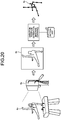
- FIG. 20 is a diagram that illustrates an example of a related skeleton recognition system.
- sensing is conducted by using a distance sensor 5a to acquire distance data 5b including an object person 6a, and the distance data 5b and a dictionary 5c are used to estimate a three-dimensional skeleton position 6b of the object person 6a.
- the dictionary 5c is previously subjected to machine learning.
- a pixel corresponding to a human body is extracted from the image data and each part of the extracted pixel is labeled as a human body site so that the skeleton model of the human body is estimated.
- a related art 2 prevents a decrease in the recognition accuracy.
- the related art 2 is a technology regarding the recognition of a feature point on a face.
- a feature point of the face is a point indicating the position of an eye, nose, mouth, or the like.
- learning data is divided in accordance with a direction, such as the front, the right, or the left, and the face feature point is learned in each set of divided learning data.
- FIG. 21 and FIG. 22 an example of the related art 2 is described below.
- FIG. 21 is a diagram that illustrates an example of learning of a face feature point according to the related art 2.
- the image previously classified in accordance with the direction of the face and the training data indicating the face feature point in the image are used so that machine learning is executed independently with regard to each direction.
- the feature point is recognized while the direction of the input face image is restricted.
- the feature point in a leftward face image is learned by using training data 1a of a left-facing learning image and a face feature point to obtain a left-facing identifying device 2a.
- the feature point of a frontward face image is learned by using training data 1b of a front-facing learning image and a face feature point to obtain a front-facing identifying device 2b.
- the feature point of a rightward face image is learned by using training data 1c of a right-facing learning image and a face feature point to obtain a right-facing identifying device 2c.
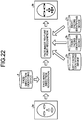
- FIG. 22 is a diagram that illustrates a recognition process for a feature point according to the related art 2.
- the direction of the face image 3a is recognized based on a face-direction identifying device 4.
- any identifying device is selected from the identifying devices 2a to 2c based on a recognition result of the direction and, by using the selected identifying device, the feature point of the face image 3a is recognized so that a recognition result 3b is obtained.
- the identifying devices are selectively used in accordance with the direction of the face image, whereby the recognition accuracy of the feature point may be improved.
- Non Patent Document 1 J. Shotton, A. Fitzgibbon, M. Cook, T. Sharp, M. Finocchio, R. Moore, A. Kipman, A. Blake, "Real-time human pose recognition in parts from a single depth image," CVPR, pp. 1297-1304, 2011 .
- Non Patent Document 2 M. Dantone, J. Gall, G. Fanelli, and L. Van Gool, "Real-time facial feature detection using conditional regression forests," CVPR, pp. 2578-2585, 2012 .
- the direction of the face image 3a is recognized by using the face-direction identifying device 4 according to the related art 2
- scene identification in the same manner as for a face image is difficult with regard to the object that makes a complicated movement as described in the related art 1.
- the difficulty in accurately identifying a scene causes the difficulty in using the optimum dictionary and, as a result, causes degradation in the recognition accuracy.
- the present invention has been made in consideration of the foregoing and has an object to provide an apparatus that makes it possible to improve the accuracy of recognition of the skeleton of a human body.
- a recognition apparatus includes: a storage unit that stores a scene recognition dictionary relating a feature of a person included in distance information indicating a distance to the person with a scene identified by a formed angle between a plurality of reference axes perpendicular to each other and a vector based on a skeleton of the person and a skeleton recognition dictionary relating distance information corresponding to the scene with a joint position of the person; a scene recognizing unit that, in a case where recognition distance information, which is distance information on an object person, is acquired, recognizes a scene corresponding to the recognition distance information based on a feature of the recognition distance information and the scene recognition dictionary; and a skeleton recognizing unit that recognizes a skeleton of the object person based on a recognition result of the scene recognized by the scene recognizing unit, the recognition distance information, and the skeleton recognition dictionary.
- FIG. 1A is a diagram that illustrates an example of the definition of the direction of a person used in a first embodiment.
- the case where a person faces the front with a straight line vertical to the ground as an axis is 0° as a representative.
- the case where a person faces the left is 90°.
- the case where a person faces the back is 180°.
- the case where a person faces the right is 270°.
- the direction is recognized in a unit that is each of four divisions by 90° to conduct skeleton recognition. For example, the front is 315° to 45°, the left is 45° to 135°, the back is 135° to 225°, and the right is 225° to 315°.
- FIGS. 1B and FIG. 1C are diagrams that illustrate an example of a recognition unit of a direction, a recognition range, and a learning range used in the first embodiment.
- the recognition apparatus uses a narrow range to recognize the direction of a person and, to estimate a joint position, uses a result of learning with a wide range that is the combination of a plurality of recognition units.
- FIG. 1C illustrates an example of the recognition unit for the direction recognition.
- the recognition apparatus executes learning and recognition by 30°, groups the results by 90°, and finally determines any of a group G1 on the front, a group G2 on the left, a group G3 on the back, and a group G4 on the right.
- the recognition apparatus determines the direction by a recognition range A1 as a unit.
- the unit of the recognition range A1 corresponds to the unit (a unit by 90°) of each of the groups G1 to G4 described in FIG. 1C .
- the recognition apparatus executes learning by using data in a learning range A2 to prevent a decrease in the accuracy of skeleton recognition.
- the learning range A2 is a range of 150° that is extended to the right by 30° and to the left by 30° as compared with the recognition range A1.
- FIG. 1D is a diagram that illustrates a configuration of a system according to the first embodiment.
- the system includes a distance sensor 20 and a recognition apparatus 100.
- the recognition apparatus 100 is coupled to the distance sensor 20.
- the recognition apparatus 100 stores therein a scene recognition dictionary and a skeleton recognition dictionary that are previously trained.
- the recognition apparatus 100 uses the scene recognition dictionary and the skeleton recognition dictionary to conduct skeleton recognition on the object person 6a.
- the recognition apparatus 100 trains the scene recognition dictionary and the skeleton recognition dictionary
- an external computer other than the recognition apparatus 100 may train the scene recognition dictionary and the skeleton recognition dictionary, and the recognition apparatus 100 may store therein the scene recognition dictionary and the skeleton recognition dictionary.
- the distance sensor 20 is a sensor that measures the distance information from the installation position of the distance sensor 20 to each observation point on the object person 6a included in the capturing range of the distance sensor 20.
- the distance sensor 20 generates the distance data representing the three-dimensional coordinates of each observation point and outputs the generated distance data to the recognition apparatus 100.
- the distance data output to the recognition apparatus 100 by the distance sensor 20 is described as "recognition data”.
- the recognition apparatus 100 acquires the recognition data from the distance sensor 20 and recognizes the skeleton position of the object person 6a based on a scene recognition dictionary 130a and a skeleton recognition dictionary 130b.
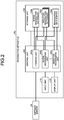
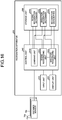
- FIG. 2 is a functional block diagram that illustrates a configuration of the recognition apparatus according to the first embodiment.
- the recognition apparatus 100 includes an input unit 110, a display unit 120, a storage unit 130, and a control unit 140. Furthermore, the recognition apparatus 100 is coupled to the distance sensor 20.
- the input unit 110 is an input device for inputting various types of information to the recognition apparatus 100.
- the input unit 110 corresponds to, for example, a keyboard, a mouse, or a touch panel.
- the display unit 120 is a display device that displays information output from the control unit 140.
- the display unit 120 corresponds to, for example, a liquid crystal display or a touch panel.
- the storage unit 130 includes the scene recognition dictionary 130a, the skeleton recognition dictionary 130b, and a recognition data buffer 130c.
- the storage unit 130 corresponds to a storage device, e.g., a semiconductor memory device, such as a RAM (Random Access Memory), a ROM (Read Only Memory), or a flash memory (Flash Memory), or an HDD (Hard Disk Drive).
- a storage device e.g., a semiconductor memory device, such as a RAM (Random Access Memory), a ROM (Read Only Memory), or a flash memory (Flash Memory), or an HDD (Hard Disk Drive).
- the scene recognition dictionary 130a is dictionary information used for determining which scene the image data included in recognition data corresponds to.
- the scene recognition dictionary 130a relates the scene identification information for uniquely identifying a scene with the feature of the distance data corresponding to the scene identification information.
- the skeleton recognition dictionary 130b is dictionary information representing the hypothetical joint position (skeleton position) in each scene.
- the skeleton recognition dictionary 130b relates scene identification information, the distance data corresponding to the scene identification information, and information (skeleton dictionary information) on the joint position of a person.
- skeleton dictionary information corresponding to each set of scene identification information.
- the recognition data buffer 130c is a buffer that stores recognition data.
- the recognition data corresponds to the distance data output from the distance sensor 20.
- the control unit 140 includes a learning unit 140a, a scene recognizing unit 140b, and a skeleton recognizing unit 140c.
- the control unit 140 is implemented by a CPU (Central Processing Unit), an MPU (Micro Processing Unit), or the like. Further, the control unit 140 may be also implemented by a hard wired logic, such as an ASIC (Application Specific Integrated Circuit) or an FPGA (Field Programmable Gate Array).
- ASIC Application Specific Integrated Circuit
- FPGA Field Programmable Gate Array
- the learning unit 140a is a processing unit that generates the scene recognition dictionary 130a and the skeleton recognition dictionary 130b.
- FIG. 3 is a diagram that illustrates an example of a learning process.
- the upper section illustrates an example of the process to generate the scene recognition dictionary 130a through learning.
- the learning unit 140a executes learning by using the distance image data generated by CG, or the like, and the accompanying scene-recognition training label data by the set.
- the training label is the information for uniquely identifying the direction of a person included in each set of distance data 21a, and it is any one of the directions of the person, "front", “left”, “back”, and "right".
- the training label may be information (classification) directly indicating the person direction range as in FIG. 1B or may be the angle value (regression) itself indicating the direction of the person included in the distance data 21a.
- the learning unit 140a may determine the scene identification information on the basis of the angle formed between the reference axis and the axis based on the skeleton of the person in accordance with the joint position data on the person.
- the scene identification information serves as a training label.
- the joint position data on a person may be acquired by using motion capture, or the like.
- the learning unit 140a executes machine learning based on the plurality of sets of distance data 21a, to which the scene-recognition training label "front” is assigned, and extracts the feature of the person direction "front".
- the person direction "front” and the feature of the person direction “front” are related to each other and are registered in a scene recognition dictionary 131.
- the learning unit 140a executes machine learning in the same manner with regard to a plurality of sets of distance data to which other training labels "left”, “back”, and “right” are assigned.
- the features of the person directions “left”, “back”, and “right” are related to the person directions “left”, “back”, and “right”, respectively, and are registered in the scene recognition dictionary 130a.
- the learning unit 140a executes machine learning by using, as training data, the input of a site label image or a distance image 21b associated with a skeleton position. Furthermore, the learning unit 140a may determine the angle between the reference axis and the axis based on the skeleton of the person on the basis of the joint position data on the person and determine each set of scene identification information, as described later.
- FIG. 4 is a diagram that illustrates a spin direction and a forward direction. As illustrated in FIG. 4 , the spin direction is a direction 1A. The forward direction is a direction 1B. This figure illustrates an example of the scene classification that is based on the angle between two axes on the basis of the skeleton of the person; however, a division may be made by three axes including the axis perpendicular to the two.
- FIG. 5 is a diagram that illustrates the formed angle in the spin direction.
- the formed angle in the spin direction corresponds to a formed angle ⁇ 1 between a line segment 11 and a reference line 12a.
- the line segment 11 is a line segment that is obtained by projecting, onto a plane 13, the straight line connecting a right shoulder 11a and a left shoulder 11b of the person.
- the plane 13 may be a plane parallel to the floor.
- the positions of the right shoulder 11a and the left shoulder 11b of the person are identified by the joint position data on the person.
- the reference line 12a may be a line segment horizontal to the X-axis direction of the plane 13 or may be a line segment obtained by projecting, onto the plane 13, the straight line connecting the right shoulder 11a and the left shoulder 11b of the person at the start timing.
- FIG. 6 is a diagram that illustrates an example of the classification basis for the attitude in the spin direction. For example, when the formed angle ⁇ 1 is included in the range of from ⁇ ⁇ 1 to ⁇ ⁇ 2 , it is determined that the attitude in the spin direction is "front side".
- the formed angle ⁇ 1 When the formed angle ⁇ 1 is included in the range of from ⁇ ⁇ 2 to ⁇ ⁇ 3 , it is determined that the attitude in the spin direction is "left side". When the formed angle ⁇ 1 is included in the range of from ⁇ ⁇ 3 to ⁇ ⁇ 4 , it is determined that the attitude in the spin direction is "back side”. When the formed angle ⁇ 1 is included in the range of from ⁇ ⁇ 4 to ⁇ ⁇ 1 , it is determined that the attitude in the spin direction is "right side”.
- FIG. 7 is a diagram that illustrates the formed angle in the forward direction.
- the formed angle in the forward direction is a formed angle ⁇ 2 between a line segment 15 and a reference line 12b.
- the line segment 15 is a line segment that is obtained by projecting, onto a plane 14, the straight line passing through 15a, 15b on the backbone.
- the positions of 15a, 15b on the backbone are identified by the joint position data on the person.
- the reference line 12b is a line segment obtained by projecting, onto the plane 14, the line segment upward in the vertical direction.
- FIG. 8 is a diagram that illustrates an example of the classification basis for the attitude in the forward direction.
- the formed angle ⁇ 2 is included in the range of from ⁇ ⁇ 1 (285°) to ⁇ ⁇ 2 (105°)
- it is determined that the attitude in the forward direction is "upright”.
- the formed angle ⁇ 2 is included in the range of from ⁇ ⁇ 2 (105°) to ⁇ ⁇ 1 (285°)
- it is determined that the attitude in the forward direction is "leaning”.
- the attitude in the spin direction corresponding to the formed angle ⁇ 1 and the attitude in the forward direction corresponding to the formed angle ⁇ 2 are determined based on the joint position data, and the corresponding scene identification information is identified based on the combination of the attitude in the spin direction and the attitude in the forward direction.
- the learning unit 140a determines that it is a "first scene”. In a case where the attitude in the forward direction is “upright” and the attitude in the spin direction is "left side”, the learning unit 140a determines that it is a "second scene”. In a case where the attitude in the forward direction is "upright” and the attitude in the spin direction is "back side”, the learning unit 140a determines that it is a "third scene”. In a case where the attitude in the forward direction is "upright” and the attitude in the spin direction is "right side”, the learning unit 140a determines that it is a "fourth scene”.
- the learning unit 140a determines that it is a "fifth scene”. In a case where the attitude in the forward direction is “leaning” and the attitude in the spin direction is "left side”, the learning unit 140a determines that it is a "sixth scene”. In a case where the attitude in the forward direction is “leaning” and the attitude in the spin direction is "back side”, the learning unit 140a determines that it is a "seventh scene”. In a case where the attitude in the forward direction is "leaning” and the attitude in the spin direction is "right side”, the learning unit 140a determines that it is an "eighth scene”.
- FIG. 9 is a diagram that illustrates a process to extract a feature from distance data.
- a distance image 25 visually illustrating distance data is used.
- the learning unit 140a sets a plurality of groups of pixel-of-interest coordinates 25a, a vector u, and a vector v in a random manner.
- the learning unit 140a calculates the difference between the distance value indicated by the pixel value of a selected pixel 25b away from the pixel of interest 25a by the vector u and the distance value indicated by the pixel value of a selected pixel 25c away from the pixel of interest 25a by the vector v.
- the learning unit 140a executes the calculation of a distance difference with regard to the distance image 25 for the number of times corresponding to the number of groups of the pixel of interest 25a, the vector u, and the vector v and then extracts the distance differences as a feature of the distance image 25.
- the learning unit 140a extracts a feature by using the same group of the pixel of interest 25a, the vector u, and the vector v with regard to each set of distance data (distance image). Based on the feature of each set of distance data and the scene identification information, the learning unit 140a determines the threshold for a feature for properly classifying a scene through machine learning and registers it in the scene recognition dictionary 130a. That is, the first scene to the eighth scene are classified by using the threshold for a feature.
- the learning unit 140a prepares a plurality of (e.g., approximately a few hundred to a few thousand) parameters, such as a feature-value 1 parameter: pixel-of-interest coordinates a1(x1,y1), a vector u1, and a vector v1, a feature-value 2 parameter: pixel-of-interest coordinates a2(x2,y2), a vector u2, and a vector v2.
- a feature-value 1 parameter pixel-of-interest coordinates a1(x1,y1), a vector u1, and a vector v1
- a feature-value 2 parameter pixel-of-interest coordinates a2(x2,y2), a vector u2, and a vector v2.
- the learning unit 140a calculates a feature based on the above-described feature parameter with regard to all the learning images (distance data), combines any number (e.g., approximately 10 to 20) of features, finds, through machine learning, the pair of a feature and a threshold with which each scene is properly classified in such a manner that, for example, an image is the first scene if the value of a feature 77 is more than a, the value of a feature 5 is more than b, ..., and the value of a feature 123 is more than c, an image is the fifth scene if the value of the feature 77 is more than a, the value of the feature 5 is more than b, ..., and the value of the feature 123 is less than c, and obtains the scene recognition dictionary 130a.
- any number e.g., approximately 10 to 20
- the learning unit 140a To generate the skeleton recognition dictionary 130b, the learning unit 140a generates a skeleton recognition dictionary for each set of scene identification information based on a distance image, a site label image, or skeleton three-dimensional coordinates.
- the skeleton recognition dictionary is information relating distance data and information on the joint position of a person.
- the learning unit 140a uses the joint position data for each set of scene identification information to automatically generate a dictionary.
- the learning unit 140a performs the same process as the above-described process so as to identify the scene identification information based on the joint positions of both shoulders that are previously determined.
- the identified scene e.g., the first scene
- the corresponding distance image and site label image or distance image and skeleton three-dimensional coordinates are selected, and the skeleton recognition dictionary 130b for the identified scene is automatically generated.
- Other scenes "the second scene to the eighth scene, and the like" may be also identified as is the case with the first scene and registered in the skeleton recognition dictionary 130b.
- the classification for scenes and the learning range of the skeleton recognition dictionary 130b in the spin direction are in the four directions by 90 degrees; however, this is not a limitation.
- the scene classification is conducted in four directions by 90 degrees, learning is executed in a range that is extended at two ends by 30 degrees in each scene, and a result of the skeleton recognition is obtained as the corresponding skeleton recognition dictionary 130b.
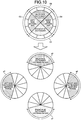
- FIG. 10 and FIG. 11 are diagrams that illustrate an example of the selection range and the learning range of the skeleton recognition dictionary.
- the front-side dictionary is trained in a range g1 that is extended at two ends by 30 degrees as compared with the range G1.
- the left-side dictionary is trained in a range g2 that is extended at two ends by 30 degrees as compared with the range G2.
- the back-side dictionary is trained in a range g3 that is extended at two ends by 30 degrees as compared with the range G3.
- the right-side dictionary is trained in a range g4 that is extended at two ends by 30 degrees as compared with the range G4.
- the settings are made such that the selection range is 90 degrees and the learning range is extended by 30 degrees; however, this is not a limitation.
- the skeleton recognition may be executed by using 12 types of skeleton recognition dictionaries that are trained in the range that is ⁇ 30 degrees of the corresponding angle as a center at an interval of 30 degrees in the spin direction and the forward direction.
- the learning range of the skeleton recognition dictionary used for 30 degrees of the person direction is a range H1.
- the learning range of the skeleton recognition dictionary used for 0 degrees of the person direction is a range H2.
- the learning range of the skeleton recognition dictionary used for 330 degrees of the person direction is a range H3.
- ⁇ 30 degrees is set in the example illustrated in FIG. 11 , this is not a limitation.
- the learning unit 140a may sort the distance data (distance image), the site label image, the skeleton three-dimensional coordinates, or the like, based on the information on the joint position of the person and use the sorted information to generate the scene recognition dictionary 130a and the skeleton recognition dictionary 130b.
- the scene recognizing unit 140b stores the recognition data from the distance sensor 20 in the recognition data buffer 130c.
- the scene recognizing unit 140b determines the scene identification information corresponding to the recognition data based on the feature of the recognition data and the scene recognition dictionary 130a.
- the scene recognizing unit 140b outputs the determined scene identification information to the skeleton recognizing unit 140c.
- the scene recognizing unit 140b obtains the value of each feature (e.g., the above-described features 77, 5, ..., 123) with regard to the recognition data and recognizes the scene depending on whether the value of each feature exceeds the threshold. For example, the scene recognizing unit 140b recognizes the recognition data as the first scene when the value of the feature 77 regarding the recognition data is more than a, the value of the feature 5 is more than b, ..., and the value of the feature 123 is more than c.
- the scene recognizing unit 140b recognizes the recognition data as the first scene when the value of the feature 77 regarding the recognition data is more than a, the value of the feature 5 is more than b, ..., and the value of the feature 123 is more than c.
- the skeleton recognizing unit 140c is a processing unit that recognizes the skeleton position of the object person 6a based on the information on the skeleton recognition dictionary 130b corresponding to the scene identification information recognized by the scene recognizing unit 140b.
- the recognition apparatus 100 may further include a performance determining unit that determines the performance of the object person 6a based on information generated by the skeleton recognizing unit 140c.
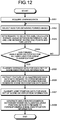
- FIG. 12 is a flowchart that illustrates the steps of the process of the learning unit according to the first embodiment.
- the learning unit 140a acquires learning data (Step S101).
- the learning data is data for generating the scene recognition dictionary 130a and the skeleton recognition dictionary 130b, and it includes, for example, joint position data, distance data (distance image), site label image, or information on skeleton three-dimensional coordinates.
- the learning unit 140a selects the axis for obtaining the formed angle (Step S102). With regard to the selected axis, the learning unit 140a calculates the formed angle between the reference line and the line segment whose end points are two joints (Step S103).
- Step S104 In a case where the formed angle has been calculated for all the axes used for scene classification (Step S104, Yes), the learning unit 140a proceeds to Step S105. Conversely, in a case where the formed angle has not been calculated for all the axes used for scene classification (Step S104, No), the learning unit 140a proceeds to Step S102.
- the learning unit 140a classifies the distance data for each set of scene identification information (Step S105).
- the learning unit 140a extracts the feature of the classified distance data with regard to the corresponding scene identification information and generates the scene recognition dictionary 130a (Step S106).
- the learning unit 140a classifies the joint position data (distance data (distance image), site label image, or information on skeleton three-dimensional coordinates) for each set of scene identification information (Step S107).
- the learning unit 140a generates the skeleton recognition dictionary 130b based on the classified joint position data with regard to the corresponding scene identification information (Step S108).
- FIG. 13 is a flowchart that illustrates the steps of the recognition process by the recognition apparatus according to the first embodiment.
- the scene recognizing unit 140b of the recognition apparatus 100 acquires recognition data from the distance sensor 20 (Step S201).
- the scene recognizing unit 140b of the recognition apparatus 100 compares the recognition data with the scene recognition dictionary 130a to determine the scene identification information on the recognition data (Step S202).
- the skeleton recognizing unit 140c of the recognition apparatus 100 selects information on the skeleton recognition dictionary 130b corresponding to the determined scene identification information (Step S203).
- the skeleton recognizing unit 140c recognizes the skeleton based on the recognition data and the information on the selected skeleton recognition dictionary 130b (Step S204).
- the skeleton recognizing unit 140c outputs a skeleton recognition result (Step S205).
- the recognition apparatus 100 stores, in the storage unit 130, the scene recognition dictionary 130a in which the scene identification information identified by the angle between a plurality of reference axes and the axis based on the skeleton of the person is related to the feature of the distance data and the skeleton recognition dictionary 130b in which the scene identification information, the distance data, and the joint position of the person are related. Furthermore, after acquiring the recognition data, the recognition apparatus 100 identifies the scene identification information based on the scene recognition dictionary 130a and uses the information in the skeleton recognition dictionary 130b corresponding to the identified scene identification information to recognize the skeleton of the object. Thus, as the skeleton recognition is enabled by the skeleton recognition dictionary 130b that is formed of the limited attitude, the accuracy of the skeleton recognition is improved.
- the recognition apparatus 100 sets a larger range of the direction of a person included in the skeleton recognition dictionary selected in accordance with a scene as compared with the range of the direction of the person in a specific area for scene recognition, whereby the proper attitude may be recognized even if an error occurs in the angle detection for the direction of the person during the scene recognition.
- the learning unit 140a repeatedly performs the process to extract a feature from a plurality of sets of distance data that are classified into the identical scene identification information by using, for example, Random Forest so as to generate the scene recognition dictionary 130a.
- the process by the learning unit 140a to extract a feature is not limited thereto.
- the learning unit 140a may use a technique for automatically extracting the feature of distance data by using deep learning.
- the learning unit 140a repeatedly inputs the scene identification information, which is correct, and the distance image data into a multi-layer neural network and causes it to learn so as to automatically determine "weight” for leading the distance data to the scene identification information that is correct.
- the learning unit 140a sets "weight” automatically determined by deep learning as the "feature" corresponding to the scene identification information.
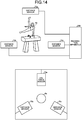
- FIG. 14 is a diagram that illustrates a configuration of a system according to a second embodiment.
- the system includes distance sensors 70a, 70b, 70c and a recognition apparatus 200.
- the recognition apparatus 200 is coupled to the distance sensors 70a to 70c. Furthermore, the distance sensors 70a to 70c are disposed so as to surround the object person 6a.
- an explanation is given of a case where, for example, the recognition apparatus 200 trains the scene recognition dictionary and the skeleton recognition dictionary; however, it is possible that an external computer other than the recognition apparatus 200 trains the scene recognition dictionary and the skeleton recognition dictionary and the recognition apparatus 200 stores therein the scene recognition dictionary and the skeleton recognition dictionary.
- the distance from the distance sensor 20 to each observation point on the person at the side of the sensor may be measured.
- the use of the distance sensors 70a to 70c makes it possible to measure the distance to each observation point on the person in all the directions.
- the distance sensors 70a to 70c are sensors that measure the distance information from the installation position of the distance sensor to each observation point on the object person 6a included in the capturing range of the distance sensor. In the following description, the distance sensors 70a to 70c are collectively described as a distance sensor 70.
- the distance sensor 70 operates on the learning phase and the recognition phase.
- the distance sensor 70 generates the distance data (three-dimensional point group data) indicating the three-dimensional coordinates of each observation point and outputs the generated distance data to the recognition apparatus 200.
- FIG. 15 is a diagram that illustrates an example of the three-dimensional point group data.
- the three-dimensional point group data is the information that is the group of distances from the respective distance sensors 70a to 70c to each observation point on the person.
- FIG. 16 is a functional block diagram that illustrates a configuration of a recognition apparatus according to the second embodiment.
- the recognition apparatus 200 includes an input unit 210, a display unit 220, a storage unit 230, and a control unit 240. Furthermore, the recognition apparatus 200 is coupled to the distance sensors 70a to 70c.
- the descriptions of the input unit 210 and the display unit 220 are the same as those of the input unit 110 and the display unit 120 illustrated in FIG. 2 .
- the storage unit 230 includes a scene recognition dictionary 230a, a skeleton recognition dictionary 230b, and a recognition data buffer 230c.
- the storage unit 230 corresponds to a semiconductor memory device such as a RAM, a ROM, or a flash memory, or a storage device such as an HDD.
- the scene recognition dictionary 230a is the dictionary information used for determining which scene the recognition data corresponds to.
- the scene recognition dictionary 230a relates the scene identification information for uniquely identifying a scene and the feature of the distance data corresponding to the scene identification information.
- the feature is a feature of the three-dimensional point group data corresponding to the scene.
- the feature of three-dimensional point group data is identified based on machine learning.
- the skeleton recognition dictionary 230b is dictionary information indicating the hypothetical joint position (skeleton position) in a single scene.
- the skeleton recognition dictionary 230b relates predetermined scene identification information, the distance data corresponding to the predetermined scene identification information, and the information on the joint position of a person.
- the recognition data buffer 230c is a buffer that stores recognition data.
- the recognition data is three-dimensional point group data that is the group of the distance data output from each of the distance sensors 70.
- the control unit 240 includes a learning unit 240a, a scene recognizing unit 240b, and a skeleton recognizing unit 240c.
- the control unit 240 is implemented by using a CPU, an MPU, or the like. Furthermore, the control unit 240 may be implemented by using a hard wired logic such as an ASIC or an FPGA.
- the learning unit 240a is a processing unit that generates the scene recognition dictionary 230a and the skeleton recognition dictionary 230b. First, an explanation is given of an example of the process by the learning unit 240a to generate the scene recognition dictionary 230a.
- the learning unit 240a extracts the feature for each set of scene identification information from the distance data to generate the scene recognition dictionary 230a.
- the learning unit 240a extracts the feature of each set of three-dimensional point group data in the distance data classified as the first scene on the basis of the joint position data on the person. With regard to a feature extracted from each set of three-dimensional point group data, the learning unit 240a finds, through machine learning, the pair of the feature and the threshold with which each scene may be properly classified, and registers it in the scene recognition dictionary 230a.
- the learning unit 240a is a processing unit that acquires the joint position data (distance image, site label image, or skeleton three-dimensional coordinates) corresponding to predetermined scene identification information, relates the predetermined scene identification information with the joint position data, and registers them in the skeleton recognition dictionary 230b.
- the predetermined scene identification information is "the first scene”.
- the scene recognizing unit 240b stores the recognition data acquired from the distance sensor 70 in the recognition data buffer 230c.
- the scene recognizing unit 240b is a processing unit that acquires the recognition data stored in the recognition data buffer 230c and compares the feature of the acquired recognition data with the scene recognition dictionary 230a so as to identify the scene identification information on the acquired recognition data.
- the scene recognizing unit 240b outputs the scene identification information as a determination result and the recognition data to the skeleton recognizing unit 240c.
- the skeleton recognizing unit 240c is a processing unit that recognizes the skeleton position of the object person 6a based on the recognition data.
- the skeleton recognizing unit 230b compares the recognition data with the skeleton recognition dictionary 230b in a case where the scene identification information, which is a determination result of the scene recognizing unit 240b, is "the first scene", thereby identifying the joint position of the object person 6a.
- the skeleton recognizing unit 240c rotates the direction of the three-dimensional point group data on the recognition data such that it is set in the direction corresponding to the first scene. For example, with regard to each of the second to the eighth scenes, information as to which direction the three-dimensional point group data is to be rotated and how much degrees it is to be rotated is previously defined so that the skeleton recognizing unit 240c rotates the direction of the three-dimensional point group data based on the information. The skeleton recognizing unit 240c compares the rotated recognition data with the skeleton recognition dictionary 230b to identify the joint position of the object person 6a.
- FIG. 17 is a flowchart that illustrates the steps of a process of the learning unit according to the second embodiment.
- the learning unit 240a acquires learning data (Step S301).
- the learning data is data for generating the scene recognition dictionary 230a and the skeleton recognition dictionary 230b, and it includes, for example, joint position data, distance data (distance image), site label image, or information on the skeleton three-dimensional coordinates.
- the learning unit 240a selects the axis for obtaining the formed angle (Step S302). With regard to the selected axis, the learning unit 240a calculates the formed angle between the reference line and the line segment whose end points are two joints (Step S303) .
- Step S304 In a case where the formed angle has been calculated for all the axes used for the scene classification (Step S304, Yes), the learning unit 240a proceeds to Step S305. Conversely, in a case where the formed angle has not been calculated for all the axes used for the scene classification (Step S304, No), the learning unit 240a proceeds to Step S302.
- the learning unit 240a classifies the distance data for each set of scene identification information (Step S305).
- the learning unit 240a extracts the feature of the classified distance data with regard to the corresponding scene identification information and generates the scene recognition dictionary 230a (Step S306).
- the learning unit 240a classifies the joint position data (distance data (distance image), site label image, or information on the skeleton three-dimensional coordinates) for each set of scene identification information (Step S307).
- the learning unit 240a generates the skeleton recognition dictionary 230b based on the joint position data corresponding to the predetermined scene identification information (Step S308).
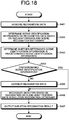
- FIG. 18 is a flowchart that illustrates the steps of the recognition process of the recognition apparatus according to the second embodiment.
- the scene recognizing unit 240b of the recognition apparatus 200 acquires recognition data from the distance sensor 70 (Step S401).
- the scene recognizing unit 240b compares the recognition data with the scene recognition dictionary 230a to determine the scene identification information on the recognition data (Step S402).
- the skeleton recognizing unit 240c of the recognition apparatus 200 determines whether the determined scene identification information is the predetermined scene identification information (Step S403).
- the predetermined scene identification information is "the first scene”.
- the first scene is a scene where the attitude of the object person 6a in the forward direction is "upright" and the attitude in the spin direction is "the front side”.
- Step S404 the skeleton recognizing unit 240c of the recognition apparatus 200 proceeds to Step S406. Conversely, in a case where the determined scene identification information is not the predetermined scene identification information (Step S404, No), the skeleton recognizing unit 240c proceeds to Step S405.
- the skeleton recognizing unit 240c corrects (rotates) the direction of the three-dimensional point group data in the recognition data to obtain the predetermined scene identification information (the first scene) (Step S405).
- the skeleton recognizing unit 240c recognizes the skeleton based on the recognition data and the joint position data in the skeleton recognition dictionary 230b (Step S406).
- the skeleton recognizing unit 240c outputs a skeleton recognition result (Step S407).
- the recognition apparatus 200 prepares the skeleton recognition dictionary 230b for a view in one direction, such as the front side of a body. During the recognition, after executing the scene classification, the recognition apparatus 200 aligns the direction of the three-dimensional point group data with the direction assumed by the skeleton recognition dictionary 230b and then executes the skeleton recognition. As a result, one scene may be prepared in the skeleton recognition dictionary 230b, and the learning time may be shortened.
- the scene identification information is determined by using the distance sensors 20, 70; however, this is not a limitation.
- the recognition apparatuses 100, 200 are coupled to an RGB camera and, based on image data captured by the RGB camera, the scene identification information on the object person 6a is determined.
- FIG. 19 is a diagram that illustrates an example of the hardware configuration of a computer that performs the same function as those of the recognition apparatuses.
- a computer 300 includes a CPU 301 that executes various types of arithmetic processing; an input device 302 that receives the input of data from the user; and a display 303. Furthermore, the computer 300 includes a reading device 304 that reads a program, and the like, from a storage medium; and an interface device 305 that executes data transaction with a different computer via a wired or wireless network. For example, the interface device 305 is coupled to the distance sensors 20, 70a to 70c, and the like. Furthermore, the computer 300 includes a RAM 306 that temporarily stores various types of information; and a hard disk device 307. Moreover, each of the devices 301 to 307 is coupled to a bus 308.
- the hard disk device 307 includes a learning program 307a, a scene recognition program 307b, and a skeleton recognition program 307c.
- the CPU 301 reads the learning program 307a, the scene recognition program 307b, and the skeleton recognition program 307c and loads them into the RAM 306.
- the learning program 307a functions as a learning process 306a.
- the scene recognition program 307b functions as a scene recognition process 306b.
- the skeleton recognition program 307c functions as a skeleton recognition process 306c.
- a process in the learning process 306a corresponds to a process of the learning units 140a, 240a.
- a process in the scene recognition process 306b corresponds to a process of the scene recognizing units 140b, 240b.
- a process in the skeleton recognition process 306c corresponds to a process of the skeleton recognizing units 140c, 240c.
- each of the programs 306a to 307c does not need to be initially stored in the hard disk device 307.
- each program is stored in a "portable physical medium" such as a flexible disk (FD), CD-ROM, DVD disk, magnetic optical disk, or IC card, inserted into the computer 300.
- the computer 300 may read and execute each of the programs 306a to 307c.
Landscapes
- Engineering & Computer Science (AREA)
- Theoretical Computer Science (AREA)
- Physics & Mathematics (AREA)
- General Physics & Mathematics (AREA)
- Computer Vision & Pattern Recognition (AREA)
- Data Mining & Analysis (AREA)
- General Engineering & Computer Science (AREA)
- Library & Information Science (AREA)
- Evolutionary Biology (AREA)
- Bioinformatics & Computational Biology (AREA)
- Bioinformatics & Cheminformatics (AREA)
- Evolutionary Computation (AREA)
- Artificial Intelligence (AREA)
- Life Sciences & Earth Sciences (AREA)
- Databases & Information Systems (AREA)
- Health & Medical Sciences (AREA)
- General Health & Medical Sciences (AREA)
- Psychiatry (AREA)
- Social Psychology (AREA)
- Human Computer Interaction (AREA)
- Multimedia (AREA)
- Image Analysis (AREA)
- Image Processing (AREA)
Abstract
Description
- The present invention relates to a recognition apparatus and the like.
- Nowadays, there is a technology that generates a dictionary through machine learning based on distance data (distance image) or an RGB (Red Green Blue) image, which is a result of sensing by a distance sensor, and uses the generated dictionary to recognize the skeleton of a human body.
-
FIG. 20 is a diagram that illustrates an example of a related skeleton recognition system. In the example illustrated inFIG. 20 , sensing is conducted by using adistance sensor 5a to acquiredistance data 5b including anobject person 6a, and thedistance data 5b and a dictionary 5c are used to estimate a three-dimensional skeleton position 6b of theobject person 6a. The dictionary 5c is previously subjected to machine learning. - Furthermore, there is a disclosed technology, as disclosed in a related art 1, in which a pixel corresponding to a human body is extracted from the image data and each part of the extracted pixel is labeled as a human body site so that the skeleton model of the human body is estimated.
- Here, to recognize the skeleton of a human body, it is assumed that learning is conducted for every action, which is the recognition target during learning, and therefore, for example, if a single dictionary is used to recognize a wide range of complicated actions, such as gymnastics, the recognition accuracy is decreased.
- A
related art 2 prevents a decrease in the recognition accuracy. Therelated art 2 is a technology regarding the recognition of a feature point on a face. A feature point of the face is a point indicating the position of an eye, nose, mouth, or the like. According to therelated art 2, learning data is divided in accordance with a direction, such as the front, the right, or the left, and the face feature point is learned in each set of divided learning data. With reference toFIG. 21 andFIG. 22 , an example of therelated art 2 is described below. -
FIG. 21 is a diagram that illustrates an example of learning of a face feature point according to therelated art 2. For the learning of a feature point according to therelated art 2, the image previously classified in accordance with the direction of the face and the training data indicating the face feature point in the image are used so that machine learning is executed independently with regard to each direction. Thus, the feature point is recognized while the direction of the input face image is restricted. - In the example illustrated in
FIG. 21 , the feature point in a leftward face image is learned by usingtraining data 1a of a left-facing learning image and a face feature point to obtain a left-facing identifyingdevice 2a. The feature point of a frontward face image is learned by usingtraining data 1b of a front-facing learning image and a face feature point to obtain a front-facing identifyingdevice 2b. The feature point of a rightward face image is learned by usingtraining data 1c of a right-facing learning image and a face feature point to obtain a right-facing identifyingdevice 2c. -
FIG. 22 is a diagram that illustrates a recognition process for a feature point according to therelated art 2. As illustrated inFIG. 22 , according to therelated art 2, after aface image 3a is received, the direction of theface image 3a is recognized based on a face-direction identifying device 4. According to therelated art 2, any identifying device is selected from the identifyingdevices 2a to 2c based on a recognition result of the direction and, by using the selected identifying device, the feature point of theface image 3a is recognized so that arecognition result 3b is obtained. Thus, according to therelated art 2, the identifying devices are selectively used in accordance with the direction of the face image, whereby the recognition accuracy of the feature point may be improved. -
- Patent Document 1:
U.S. Patent No. 2010/0197390 - Patent Document 2:
U.S. Patent No. 2013/0241833 - Non Patent Document 1: J. Shotton, A. Fitzgibbon, M. Cook, T. Sharp, M. Finocchio, R. Moore, A. Kipman, A. Blake, "Real-time human pose recognition in parts from a single depth image," CVPR, pp. 1297-1304, 2011.
- Non Patent Document 2: M. Dantone, J. Gall, G. Fanelli, and L. Van Gool, "Real-time facial feature detection using conditional regression forests," CVPR, pp. 2578-2585, 2012.
- However, the above-described related arts have a problem of low accuracy of the skeleton recognition on a human body.
- For example, although the direction of the
face image 3a is recognized by using the face-direction identifying device 4 according to therelated art 2, scene identification in the same manner as for a face image is difficult with regard to the object that makes a complicated movement as described in the related art 1. The difficulty in accurately identifying a scene causes the difficulty in using the optimum dictionary and, as a result, causes degradation in the recognition accuracy. - The present invention has been made in consideration of the foregoing and has an object to provide an apparatus that makes it possible to improve the accuracy of recognition of the skeleton of a human body.
- According to a first aspect, a recognition apparatus includes: a storage unit that stores a scene recognition dictionary relating a feature of a person included in distance information indicating a distance to the person with a scene identified by a formed angle between a plurality of reference axes perpendicular to each other and a vector based on a skeleton of the person and a skeleton recognition dictionary relating distance information corresponding to the scene with a joint position of the person; a scene recognizing unit that, in a case where recognition distance information, which is distance information on an object person, is acquired, recognizes a scene corresponding to the recognition distance information based on a feature of the recognition distance information and the scene recognition dictionary; and a skeleton recognizing unit that recognizes a skeleton of the object person based on a recognition result of the scene recognized by the scene recognizing unit, the recognition distance information, and the skeleton recognition dictionary.
- It is possible to improve the accuracy of recognition of the skeleton of a human body.
-
-
FIG. 1A is a diagram that illustrates an example of definition of a direction of a person used in a first embodiment. -
FIG. 1B is a diagram (1) that illustrates an example of a recognition unit of a direction, a recognition range, and a learning range used in the first embodiment. -
FIG. 1C is a diagram (2) that illustrates an example of the recognition unit of a direction, the recognition range, and the learning range used in the first embodiment. -
FIG. 1D is a diagram that illustrates a configuration of a system according to the first embodiment. -
FIG. 2 is a functional block diagram that illustrates a configuration of a recognition apparatus according to the first embodiment. -
FIG. 3 is a diagram that illustrates an example of a learning process. -
FIG. 4 is a diagram that illustrates a spin direction and a forward direction. -
FIG. 5 is a diagram that illustrates a formed angle in the spin direction. -
FIG. 6 is a diagram that illustrates an example of a classification basis for an attitude in the spin direction. -
FIG. 7 is a diagram that illustrates a formed angle in the forward direction. -
FIG. 8 is a diagram that illustrates an example of a classification basis for an attitude in the forward direction. -
FIG. 9 is a diagram that illustrates a process to extract a feature from distance data. -
FIG. 10 is a diagram (1) that illustrates an example of a selection range and a learning range of a skeleton recognition dictionary. -
FIG. 11 is a diagram (2) that illustrates an example of the selection range and the learning range of the skeleton recognition dictionary. -
FIG. 12 is a flowchart that illustrates the steps of a process of a learning unit according to the first embodiment. -
FIG. 13 is a flowchart that illustrates the steps of a recognition process by the recognition apparatus according to the first embodiment. -
FIG. 14 is a diagram that illustrates a configuration of a system according to a second embodiment. -
FIG. 15 is a diagram that illustrates an example of three-dimensional point group data. -
FIG. 16 is a functional block diagram that illustrates a configuration of a recognition apparatus according to the second embodiment. -
FIG. 17 is a flowchart that illustrates the steps of a process of a learning unit according to the second embodiment. -
FIG. 18 is a flowchart that illustrates the steps of a recognition process of the recognition apparatus according to the second embodiment. -
FIG. 19 is a diagram that illustrates an example of the hardware configuration of a computer that performs the same function as those of the recognition apparatuses. -
FIG. 20 is a diagram that illustrates an example of a related skeleton recognition system. -
FIG. 21 is a diagram that illustrates an example of learning of a face feature point according to arelated art 2. -
FIG. 22 is a diagram that illustrates a recognition process of a feature point according to therelated art 2. - With reference to the drawings, embodiments of a recognition apparatus, a recognition method, and a recognition program according to the present invention are described below in detail. Furthermore, the present invention is not limited to the embodiments.
-
FIG. 1A is a diagram that illustrates an example of the definition of the direction of a person used in a first embodiment. As illustrated inFIG. 1A , the case where a person faces the front with a straight line vertical to the ground as an axis is 0° as a representative. The case where a person faces the left is 90°. The case where a person faces the back is 180°. The case where a person faces the right is 270°. According to the first embodiment, the direction is recognized in a unit that is each of four divisions by 90° to conduct skeleton recognition. For example, the front is 315° to 45°, the left is 45° to 135°, the back is 135° to 225°, and the right is 225° to 315°. -
FIGS. 1B and FIG. 1C are diagrams that illustrate an example of a recognition unit of a direction, a recognition range, and a learning range used in the first embodiment. For example, the recognition apparatus uses a narrow range to recognize the direction of a person and, to estimate a joint position, uses a result of learning with a wide range that is the combination of a plurality of recognition units.FIG. 1C illustrates an example of the recognition unit for the direction recognition. At the time of direction recognition, the recognition apparatus executes learning and recognition by 30°, groups the results by 90°, and finally determines any of a group G1 on the front, a group G2 on the left, a group G3 on the back, and a group G4 on the right. - As illustrated in
FIG. 1B , the recognition apparatus determines the direction by a recognition range A1 as a unit. For example, the unit of the recognition range A1 corresponds to the unit (a unit by 90°) of each of the groups G1 to G4 described inFIG. 1C . Furthermore, in a case where the actual direction of a person during recognition is near the boundary between four divisions, the recognition apparatus executes learning by using data in a learning range A2 to prevent a decrease in the accuracy of skeleton recognition. For example, the learning range A2 is a range of 150° that is extended to the right by 30° and to the left by 30° as compared with the recognition range A1. -
FIG. 1D is a diagram that illustrates a configuration of a system according to the first embodiment. As illustrated inFIG. 1D , the system includes adistance sensor 20 and arecognition apparatus 100. Therecognition apparatus 100 is coupled to thedistance sensor 20. Therecognition apparatus 100 stores therein a scene recognition dictionary and a skeleton recognition dictionary that are previously trained. Therecognition apparatus 100 uses the scene recognition dictionary and the skeleton recognition dictionary to conduct skeleton recognition on theobject person 6a. Although an explanation is given in the first embodiment of a case where, for example, therecognition apparatus 100 trains the scene recognition dictionary and the skeleton recognition dictionary, an external computer other than therecognition apparatus 100 may train the scene recognition dictionary and the skeleton recognition dictionary, and therecognition apparatus 100 may store therein the scene recognition dictionary and the skeleton recognition dictionary. - The
distance sensor 20 is a sensor that measures the distance information from the installation position of thedistance sensor 20 to each observation point on theobject person 6a included in the capturing range of thedistance sensor 20. Thedistance sensor 20 generates the distance data representing the three-dimensional coordinates of each observation point and outputs the generated distance data to therecognition apparatus 100. In the following description, the distance data output to therecognition apparatus 100 by thedistance sensor 20 is described as "recognition data". - The
recognition apparatus 100 acquires the recognition data from thedistance sensor 20 and recognizes the skeleton position of theobject person 6a based on ascene recognition dictionary 130a and askeleton recognition dictionary 130b. -
FIG. 2 is a functional block diagram that illustrates a configuration of the recognition apparatus according to the first embodiment. As illustrated inFIG. 2 , therecognition apparatus 100 includes aninput unit 110, adisplay unit 120, astorage unit 130, and acontrol unit 140. Furthermore, therecognition apparatus 100 is coupled to thedistance sensor 20. - The
input unit 110 is an input device for inputting various types of information to therecognition apparatus 100. Theinput unit 110 corresponds to, for example, a keyboard, a mouse, or a touch panel. - The
display unit 120 is a display device that displays information output from thecontrol unit 140. Thedisplay unit 120 corresponds to, for example, a liquid crystal display or a touch panel. - The
storage unit 130 includes thescene recognition dictionary 130a, theskeleton recognition dictionary 130b, and arecognition data buffer 130c. Thestorage unit 130 corresponds to a storage device, e.g., a semiconductor memory device, such as a RAM (Random Access Memory), a ROM (Read Only Memory), or a flash memory (Flash Memory), or an HDD (Hard Disk Drive). - The
scene recognition dictionary 130a is dictionary information used for determining which scene the image data included in recognition data corresponds to. For example, thescene recognition dictionary 130a relates the scene identification information for uniquely identifying a scene with the feature of the distance data corresponding to the scene identification information. - The
skeleton recognition dictionary 130b is dictionary information representing the hypothetical joint position (skeleton position) in each scene. For example, theskeleton recognition dictionary 130b relates scene identification information, the distance data corresponding to the scene identification information, and information (skeleton dictionary information) on the joint position of a person. Although not illustrated, it is assumed that there is skeleton dictionary information corresponding to each set of scene identification information. - The
recognition data buffer 130c is a buffer that stores recognition data. The recognition data corresponds to the distance data output from thedistance sensor 20. - A reference is made back to
FIG. 2 . Thecontrol unit 140 includes alearning unit 140a, ascene recognizing unit 140b, and askeleton recognizing unit 140c. Thecontrol unit 140 is implemented by a CPU (Central Processing Unit), an MPU (Micro Processing Unit), or the like. Further, thecontrol unit 140 may be also implemented by a hard wired logic, such as an ASIC (Application Specific Integrated Circuit) or an FPGA (Field Programmable Gate Array). - The
learning unit 140a is a processing unit that generates thescene recognition dictionary 130a and theskeleton recognition dictionary 130b. -
FIG. 3 is a diagram that illustrates an example of a learning process. The upper section illustrates an example of the process to generate thescene recognition dictionary 130a through learning. Thelearning unit 140a executes learning by using the distance image data generated by CG, or the like, and the accompanying scene-recognition training label data by the set. The training label is the information for uniquely identifying the direction of a person included in each set ofdistance data 21a, and it is any one of the directions of the person, "front", "left", "back", and "right". Furthermore, the training label may be information (classification) directly indicating the person direction range as inFIG. 1B or may be the angle value (regression) itself indicating the direction of the person included in thedistance data 21a. Moreover, as described later, thelearning unit 140a may determine the scene identification information on the basis of the angle formed between the reference axis and the axis based on the skeleton of the person in accordance with the joint position data on the person. The scene identification information serves as a training label. The joint position data on a person may be acquired by using motion capture, or the like. - For the scene recognition dictionary generation learning, the
learning unit 140a executes machine learning based on the plurality of sets ofdistance data 21a, to which the scene-recognition training label "front" is assigned, and extracts the feature of the person direction "front". The person direction "front" and the feature of the person direction "front" are related to each other and are registered in a scene recognition dictionary 131. Thelearning unit 140a executes machine learning in the same manner with regard to a plurality of sets of distance data to which other training labels "left", "back", and "right" are assigned. The features of the person directions "left", "back", and "right" are related to the person directions "left", "back", and "right", respectively, and are registered in thescene recognition dictionary 130a. - To generate the
skeleton recognition dictionary 130b, thelearning unit 140a executes machine learning by using, as training data, the input of a site label image or adistance image 21b associated with a skeleton position. Furthermore, thelearning unit 140a may determine the angle between the reference axis and the axis based on the skeleton of the person on the basis of the joint position data on the person and determine each set of scene identification information, as described later. -
FIG. 4 is a diagram that illustrates a spin direction and a forward direction. As illustrated inFIG. 4 , the spin direction is adirection 1A. The forward direction is adirection 1B. This figure illustrates an example of the scene classification that is based on the angle between two axes on the basis of the skeleton of the person; however, a division may be made by three axes including the axis perpendicular to the two. -
FIG. 5 is a diagram that illustrates the formed angle in the spin direction. The formed angle in the spin direction corresponds to a formed angle θ1 between aline segment 11 and areference line 12a. For example, theline segment 11 is a line segment that is obtained by projecting, onto aplane 13, the straight line connecting aright shoulder 11a and aleft shoulder 11b of the person. Theplane 13 may be a plane parallel to the floor. The positions of theright shoulder 11a and theleft shoulder 11b of the person are identified by the joint position data on the person. Thereference line 12a may be a line segment horizontal to the X-axis direction of theplane 13 or may be a line segment obtained by projecting, onto theplane 13, the straight line connecting theright shoulder 11a and theleft shoulder 11b of the person at the start timing. - Next, an explanation is given of an example of the process by the
learning unit 140a to determine scene identification information based on the joint position data on the person during learning image classification (in a case where distance data is classified in accordance with a scene). During the learning image classification by thelearning unit 140a, the attitude of the person in the spin direction is classified into any of "front side", "left side", "back side", and "right side" in accordance with the formed angle θ1.FIG. 6 is a diagram that illustrates an example of the classification basis for the attitude in the spin direction. For example, when the formed angle θ1 is included in the range of from θα1 to θα2, it is determined that the attitude in the spin direction is "front side". When the formed angle θ1 is included in the range of from θα2 to θα3, it is determined that the attitude in the spin direction is "left side". When the formed angle θ1 is included in the range of from θα3 to θα4, it is determined that the attitude in the spin direction is "back side". When the formed angle θ1 is included in the range of from θα4 to θα1, it is determined that the attitude in the spin direction is "right side". -
FIG. 7 is a diagram that illustrates the formed angle in the forward direction. The formed angle in the forward direction is a formed angle θ2 between aline segment 15 and areference line 12b. For example, theline segment 15 is a line segment that is obtained by projecting, onto aplane 14, the straight line passing through 15a, 15b on the backbone. The positions of 15a, 15b on the backbone are identified by the joint position data on the person. Thereference line 12b is a line segment obtained by projecting, onto theplane 14, the line segment upward in the vertical direction. - During the learning image classification by the
learning unit 140a, the attitude of the person in the forward direction is classified into any of "upright" and "leaning" in accordance with the formed angle θ2.FIG. 8 is a diagram that illustrates an example of the classification basis for the attitude in the forward direction. For example, when the formed angle θ2 is included in the range of from θβ1 (285°) to θβ2 (105°), it is determined that the attitude in the forward direction is "upright". When the formed angle θ2 is included in the range of from θβ2 (105°) to θβ1 (285°), it is determined that the attitude in the forward direction is "leaning". - During the generation of the
scene recognition dictionary 130a by thelearning unit 140a, the attitude in the spin direction corresponding to the formed angle θ1 and the attitude in the forward direction corresponding to the formed angle θ2 are determined based on the joint position data, and the corresponding scene identification information is identified based on the combination of the attitude in the spin direction and the attitude in the forward direction. - For example, in a case where the attitude in the forward direction is "upright" and the attitude in the spin direction is "front side", the
learning unit 140a determines that it is a "first scene". In a case where the attitude in the forward direction is "upright" and the attitude in the spin direction is "left side", thelearning unit 140a determines that it is a "second scene". In a case where the attitude in the forward direction is "upright" and the attitude in the spin direction is "back side", thelearning unit 140a determines that it is a "third scene". In a case where the attitude in the forward direction is "upright" and the attitude in the spin direction is "right side", thelearning unit 140a determines that it is a "fourth scene". - For example, in a case where the attitude in the forward direction is "leaning" and the attitude in the spin direction is "front side", the
learning unit 140a determines that it is a "fifth scene". In a case where the attitude in the forward direction is "leaning" and the attitude in the spin direction is "left side", thelearning unit 140a determines that it is a "sixth scene". In a case where the attitude in the forward direction is "leaning" and the attitude in the spin direction is "back side", thelearning unit 140a determines that it is a "seventh scene". In a case where the attitude in the forward direction is "leaning" and the attitude in the spin direction is "right side", thelearning unit 140a determines that it is an "eighth scene". - During the generation of the
scene recognition dictionary 130a, thelearning unit 140a extracts the feature of each set of distance data with regard to each set of scene identification information on the basis of various machine learning techniques.FIG. 9 is a diagram that illustrates a process to extract a feature from distance data. For the convenience of explanation inFIG. 9 , adistance image 25 visually illustrating distance data is used. Thelearning unit 140a sets a plurality of groups of pixel-of-interest coordinates 25a, a vector u, and a vector v in a random manner. With regard to thedistance image 25, thelearning unit 140a calculates the difference between the distance value indicated by the pixel value of a selectedpixel 25b away from the pixel ofinterest 25a by the vector u and the distance value indicated by the pixel value of a selectedpixel 25c away from the pixel ofinterest 25a by the vector v. Thelearning unit 140a executes the calculation of a distance difference with regard to thedistance image 25 for the number of times corresponding to the number of groups of the pixel ofinterest 25a, the vector u, and the vector v and then extracts the distance differences as a feature of thedistance image 25. Thelearning unit 140a extracts a feature by using the same group of the pixel ofinterest 25a, the vector u, and the vector v with regard to each set of distance data (distance image). Based on the feature of each set of distance data and the scene identification information, thelearning unit 140a determines the threshold for a feature for properly classifying a scene through machine learning and registers it in thescene recognition dictionary 130a. That is, the first scene to the eighth scene are classified by using the threshold for a feature. - More specifically, the
learning unit 140a prepares a plurality of (e.g., approximately a few hundred to a few thousand) parameters, such as a feature-value 1 parameter: pixel-of-interest coordinates a1(x1,y1), a vector u1, and a vector v1, a feature-value 2 parameter: pixel-of-interest coordinates a2(x2,y2), a vector u2, and a vector v2. Thelearning unit 140a calculates a feature based on the above-described feature parameter with regard to all the learning images (distance data), combines any number (e.g., approximately 10 to 20) of features, finds, through machine learning, the pair of a feature and a threshold with which each scene is properly classified in such a manner that, for example, an image is the first scene if the value of a feature 77 is more than a, the value of a feature 5 is more than b, ..., and the value of a feature 123 is more than c, an image is the fifth scene if the value of the feature 77 is more than a, the value of the feature 5 is more than b, ..., and the value of the feature 123 is less than c, and obtains thescene recognition dictionary 130a. - To generate the
skeleton recognition dictionary 130b, thelearning unit 140a generates a skeleton recognition dictionary for each set of scene identification information based on a distance image, a site label image, or skeleton three-dimensional coordinates. For example, the skeleton recognition dictionary is information relating distance data and information on the joint position of a person. - To generate the
skeleton recognition dictionary 130b, thelearning unit 140a uses the joint position data for each set of scene identification information to automatically generate a dictionary. Thelearning unit 140a performs the same process as the above-described process so as to identify the scene identification information based on the joint positions of both shoulders that are previously determined. With regard to the identified scene (e.g., the first scene), the corresponding distance image and site label image or distance image and skeleton three-dimensional coordinates are selected, and theskeleton recognition dictionary 130b for the identified scene is automatically generated. Other scenes "the second scene to the eighth scene, and the like" may be also identified as is the case with the first scene and registered in theskeleton recognition dictionary 130b. - Here, according to the first embodiment, the classification for scenes and the learning range of the
skeleton recognition dictionary 130b in the spin direction are in the four directions by 90 degrees; however, this is not a limitation. For example, it is possible that the scene classification is conducted in four directions by 90 degrees, learning is executed in a range that is extended at two ends by 30 degrees in each scene, and a result of the skeleton recognition is obtained as the correspondingskeleton recognition dictionary 130b. -
FIG. 10 andFIG. 11 are diagrams that illustrate an example of the selection range and the learning range of the skeleton recognition dictionary. As illustrated inFIG. 10 , for example, to train a front-side dictionary corresponding to a range G1 in the spin direction, the front-side dictionary is trained in a range g1 that is extended at two ends by 30 degrees as compared with the range G1. To train a left-side dictionary corresponding to a range G2 in the spin direction, the left-side dictionary is trained in a range g2 that is extended at two ends by 30 degrees as compared with the range G2. To train a back-side dictionary corresponding to a range G3 in the spin direction, the back-side dictionary is trained in a range g3 that is extended at two ends by 30 degrees as compared with the range G3. To train a right-side dictionary corresponding to a range G4 in the spin direction, the right-side dictionary is trained in a range g4 that is extended at two ends by 30 degrees as compared with the range G4. Here, in the explanation, the settings are made such that the selection range is 90 degrees and the learning range is extended by 30 degrees; however, this is not a limitation. - Furthermore, as illustrated in
FIG. 11 , the skeleton recognition may be executed by using 12 types of skeleton recognition dictionaries that are trained in the range that is ±30 degrees of the corresponding angle as a center at an interval of 30 degrees in the spin direction and the forward direction. For example, the learning range of the skeleton recognition dictionary used for 30 degrees of the person direction is a range H1. The learning range of the skeleton recognition dictionary used for 0 degrees of the person direction is a range H2. The learning range of the skeleton recognition dictionary used for 330 degrees of the person direction is a range H3. Moreover, although ±30 degrees is set in the example illustrated inFIG. 11 , this is not a limitation. - Furthermore, to generate the
scene recognition dictionary 130a and theskeleton recognition dictionary 130b, thelearning unit 140a may sort the distance data (distance image), the site label image, the skeleton three-dimensional coordinates, or the like, based on the information on the joint position of the person and use the sorted information to generate thescene recognition dictionary 130a and theskeleton recognition dictionary 130b. - The
scene recognizing unit 140b stores the recognition data from thedistance sensor 20 in therecognition data buffer 130c. Thescene recognizing unit 140b determines the scene identification information corresponding to the recognition data based on the feature of the recognition data and thescene recognition dictionary 130a. Thescene recognizing unit 140b outputs the determined scene identification information to theskeleton recognizing unit 140c. - An explanation is given of an example of the process by the
scene recognizing unit 140b to recognize a scene based on the threshold for a feature set in thescene recognition dictionary 130a. For the convenience of explanation, "a1" is the feature of distance data A corresponding to the scene identification information "the first scene", and "b1" is the feature of distance data B corresponding to the scene identification information "the second scene". Here, a1<b1. Furthermore, "c1" is the feature of the recognition data (distance data C). Here, when the feature c1 is smaller than (a1+b1)/2, thescene recognizing unit 140b determines that the scene identification information corresponding to the recognition data is "the first scene". Conversely, when the feature c1 is larger than (a1+b1)/2, thescene recognizing unit 140b determines that the scene identification information corresponding to the recognition data is "the second scene". - Furthermore, in a case where the
scene recognition dictionary 130a classifies each scene by using a threshold for values of a plurality of features, thescene recognizing unit 140b obtains the value of each feature (e.g., the above-described features 77, 5, ..., 123) with regard to the recognition data and recognizes the scene depending on whether the value of each feature exceeds the threshold. For example, thescene recognizing unit 140b recognizes the recognition data as the first scene when the value of the feature 77 regarding the recognition data is more than a, the value of the feature 5 is more than b, ..., and the value of the feature 123 is more than c. - The
skeleton recognizing unit 140c is a processing unit that recognizes the skeleton position of theobject person 6a based on the information on theskeleton recognition dictionary 130b corresponding to the scene identification information recognized by thescene recognizing unit 140b. - The
recognition apparatus 100 may further include a performance determining unit that determines the performance of theobject person 6a based on information generated by theskeleton recognizing unit 140c. - Next, an example of the steps of the process of the
learning unit 140a according to the first embodiment is described.FIG. 12 is a flowchart that illustrates the steps of the process of the learning unit according to the first embodiment. As illustrated inFIG. 12 , thelearning unit 140a acquires learning data (Step S101). Here, the learning data is data for generating thescene recognition dictionary 130a and theskeleton recognition dictionary 130b, and it includes, for example, joint position data, distance data (distance image), site label image, or information on skeleton three-dimensional coordinates. - The
learning unit 140a selects the axis for obtaining the formed angle (Step S102). With regard to the selected axis, thelearning unit 140a calculates the formed angle between the reference line and the line segment whose end points are two joints (Step S103). - In a case where the formed angle has been calculated for all the axes used for scene classification (Step S104, Yes), the
learning unit 140a proceeds to Step S105. Conversely, in a case where the formed angle has not been calculated for all the axes used for scene classification (Step S104, No), thelearning unit 140a proceeds to Step S102. - The
learning unit 140a classifies the distance data for each set of scene identification information (Step S105). Thelearning unit 140a extracts the feature of the classified distance data with regard to the corresponding scene identification information and generates thescene recognition dictionary 130a (Step S106). - The
learning unit 140a classifies the joint position data (distance data (distance image), site label image, or information on skeleton three-dimensional coordinates) for each set of scene identification information (Step S107). Thelearning unit 140a generates theskeleton recognition dictionary 130b based on the classified joint position data with regard to the corresponding scene identification information (Step S108). -
FIG. 13 is a flowchart that illustrates the steps of the recognition process by the recognition apparatus according to the first embodiment. As illustrated inFIG. 13 , thescene recognizing unit 140b of therecognition apparatus 100 acquires recognition data from the distance sensor 20 (Step S201). - The
scene recognizing unit 140b of therecognition apparatus 100 compares the recognition data with thescene recognition dictionary 130a to determine the scene identification information on the recognition data (Step S202). Theskeleton recognizing unit 140c of therecognition apparatus 100 selects information on theskeleton recognition dictionary 130b corresponding to the determined scene identification information (Step S203). - The
skeleton recognizing unit 140c recognizes the skeleton based on the recognition data and the information on the selectedskeleton recognition dictionary 130b (Step S204). Theskeleton recognizing unit 140c outputs a skeleton recognition result (Step S205). - Next, the advantageous effect of the
recognition apparatus 100 according to the first embodiment is described. Therecognition apparatus 100 stores, in thestorage unit 130, thescene recognition dictionary 130a in which the scene identification information identified by the angle between a plurality of reference axes and the axis based on the skeleton of the person is related to the feature of the distance data and theskeleton recognition dictionary 130b in which the scene identification information, the distance data, and the joint position of the person are related. Furthermore, after acquiring the recognition data, therecognition apparatus 100 identifies the scene identification information based on thescene recognition dictionary 130a and uses the information in theskeleton recognition dictionary 130b corresponding to the identified scene identification information to recognize the skeleton of the object. Thus, as the skeleton recognition is enabled by theskeleton recognition dictionary 130b that is formed of the limited attitude, the accuracy of the skeleton recognition is improved. - Furthermore, the
recognition apparatus 100 sets a larger range of the direction of a person included in the skeleton recognition dictionary selected in accordance with a scene as compared with the range of the direction of the person in a specific area for scene recognition, whereby the proper attitude may be recognized even if an error occurs in the angle detection for the direction of the person during the scene recognition. - Furthermore, the
learning unit 140a according to the above-described first embodiment repeatedly performs the process to extract a feature from a plurality of sets of distance data that are classified into the identical scene identification information by using, for example, Random Forest so as to generate thescene recognition dictionary 130a. However, the process by thelearning unit 140a to extract a feature is not limited thereto. - For example, the
learning unit 140a may use a technique for automatically extracting the feature of distance data by using deep learning. Thelearning unit 140a repeatedly inputs the scene identification information, which is correct, and the distance image data into a multi-layer neural network and causes it to learn so as to automatically determine "weight" for leading the distance data to the scene identification information that is correct. Thelearning unit 140a sets "weight" automatically determined by deep learning as the "feature" corresponding to the scene identification information. By automatically extracting a feature by using deep learning, the accuracy of the scene recognition may be improved. -
FIG. 14 is a diagram that illustrates a configuration of a system according to a second embodiment. As illustrated inFIG. 14 , the system includesdistance sensors recognition apparatus 200. Therecognition apparatus 200 is coupled to thedistance sensors 70a to 70c. Furthermore, thedistance sensors 70a to 70c are disposed so as to surround theobject person 6a. Furthermore, according to the second embodiment, an explanation is given of a case where, for example, therecognition apparatus 200 trains the scene recognition dictionary and the skeleton recognition dictionary; however, it is possible that an external computer other than therecognition apparatus 200 trains the scene recognition dictionary and the skeleton recognition dictionary and therecognition apparatus 200 stores therein the scene recognition dictionary and the skeleton recognition dictionary. - In the example described according to the first embodiment, as the
single distance sensor 20 is used, the distance from thedistance sensor 20 to each observation point on the person at the side of the sensor may be measured. Conversely, according to the second embodiment, the use of thedistance sensors 70a to 70c makes it possible to measure the distance to each observation point on the person in all the directions. - The
distance sensors 70a to 70c are sensors that measure the distance information from the installation position of the distance sensor to each observation point on theobject person 6a included in the capturing range of the distance sensor. In the following description, thedistance sensors 70a to 70c are collectively described as a distance sensor 70. The distance sensor 70 operates on the learning phase and the recognition phase. The distance sensor 70 generates the distance data (three-dimensional point group data) indicating the three-dimensional coordinates of each observation point and outputs the generated distance data to therecognition apparatus 200.FIG. 15 is a diagram that illustrates an example of the three-dimensional point group data. The three-dimensional point group data is the information that is the group of distances from therespective distance sensors 70a to 70c to each observation point on the person. -
FIG. 16 is a functional block diagram that illustrates a configuration of a recognition apparatus according to the second embodiment. As illustrated inFIG. 16 , therecognition apparatus 200 includes aninput unit 210, adisplay unit 220, astorage unit 230, and acontrol unit 240. Furthermore, therecognition apparatus 200 is coupled to thedistance sensors 70a to 70c. The descriptions of theinput unit 210 and thedisplay unit 220 are the same as those of theinput unit 110 and thedisplay unit 120 illustrated inFIG. 2 . - The
storage unit 230 includes ascene recognition dictionary 230a, askeleton recognition dictionary 230b, and arecognition data buffer 230c. Thestorage unit 230 corresponds to a semiconductor memory device such as a RAM, a ROM, or a flash memory, or a storage device such as an HDD. - The
scene recognition dictionary 230a is the dictionary information used for determining which scene the recognition data corresponds to. For example, thescene recognition dictionary 230a relates the scene identification information for uniquely identifying a scene and the feature of the distance data corresponding to the scene identification information. The feature is a feature of the three-dimensional point group data corresponding to the scene. For example, the feature of three-dimensional point group data is identified based on machine learning. - The
skeleton recognition dictionary 230b is dictionary information indicating the hypothetical joint position (skeleton position) in a single scene. For example, theskeleton recognition dictionary 230b relates predetermined scene identification information, the distance data corresponding to the predetermined scene identification information, and the information on the joint position of a person. - The
recognition data buffer 230c is a buffer that stores recognition data. The recognition data is three-dimensional point group data that is the group of the distance data output from each of the distance sensors 70. - The
control unit 240 includes alearning unit 240a, ascene recognizing unit 240b, and askeleton recognizing unit 240c. Thecontrol unit 240 is implemented by using a CPU, an MPU, or the like. Furthermore, thecontrol unit 240 may be implemented by using a hard wired logic such as an ASIC or an FPGA. - The
learning unit 240a is a processing unit that generates thescene recognition dictionary 230a and theskeleton recognition dictionary 230b. First, an explanation is given of an example of the process by thelearning unit 240a to generate thescene recognition dictionary 230a. Thelearning unit 240a extracts the feature for each set of scene identification information from the distance data to generate thescene recognition dictionary 230a. - For example, the
learning unit 240a extracts the feature of each set of three-dimensional point group data in the distance data classified as the first scene on the basis of the joint position data on the person. With regard to a feature extracted from each set of three-dimensional point group data, thelearning unit 240a finds, through machine learning, the pair of the feature and the threshold with which each scene may be properly classified, and registers it in thescene recognition dictionary 230a. - An explanation is given of an example of the process by the
learning unit 240a to generate theskeleton recognition dictionary 230b. Thelearning unit 240a is a processing unit that acquires the joint position data (distance image, site label image, or skeleton three-dimensional coordinates) corresponding to predetermined scene identification information, relates the predetermined scene identification information with the joint position data, and registers them in theskeleton recognition dictionary 230b. According to the second embodiment, for example, the predetermined scene identification information is "the first scene". - The
scene recognizing unit 240b stores the recognition data acquired from the distance sensor 70 in therecognition data buffer 230c. Thescene recognizing unit 240b is a processing unit that acquires the recognition data stored in therecognition data buffer 230c and compares the feature of the acquired recognition data with thescene recognition dictionary 230a so as to identify the scene identification information on the acquired recognition data. Thescene recognizing unit 240b outputs the scene identification information as a determination result and the recognition data to theskeleton recognizing unit 240c. - The
skeleton recognizing unit 240c is a processing unit that recognizes the skeleton position of theobject person 6a based on the recognition data. Theskeleton recognizing unit 230b compares the recognition data with theskeleton recognition dictionary 230b in a case where the scene identification information, which is a determination result of thescene recognizing unit 240b, is "the first scene", thereby identifying the joint position of theobject person 6a. - When the scene identification information, which is a determination result of the
scene recognizing unit 240b, is "other than the first scene", theskeleton recognizing unit 240c rotates the direction of the three-dimensional point group data on the recognition data such that it is set in the direction corresponding to the first scene. For example, with regard to each of the second to the eighth scenes, information as to which direction the three-dimensional point group data is to be rotated and how much degrees it is to be rotated is previously defined so that theskeleton recognizing unit 240c rotates the direction of the three-dimensional point group data based on the information. Theskeleton recognizing unit 240c compares the rotated recognition data with theskeleton recognition dictionary 230b to identify the joint position of theobject person 6a. - Next, an example of the steps of a process of the
recognition apparatus 200 according to the second embodiment is described.FIG. 17 is a flowchart that illustrates the steps of a process of the learning unit according to the second embodiment. As illustrated inFIG. 17 , thelearning unit 240a acquires learning data (Step S301). Here, the learning data is data for generating thescene recognition dictionary 230a and theskeleton recognition dictionary 230b, and it includes, for example, joint position data, distance data (distance image), site label image, or information on the skeleton three-dimensional coordinates. Thelearning unit 240a selects the axis for obtaining the formed angle (Step S302). With regard to the selected axis, thelearning unit 240a calculates the formed angle between the reference line and the line segment whose end points are two joints (Step S303) . - In a case where the formed angle has been calculated for all the axes used for the scene classification (Step S304, Yes), the
learning unit 240a proceeds to Step S305. Conversely, in a case where the formed angle has not been calculated for all the axes used for the scene classification (Step S304, No), thelearning unit 240a proceeds to Step S302. - The
learning unit 240a classifies the distance data for each set of scene identification information (Step S305). Thelearning unit 240a extracts the feature of the classified distance data with regard to the corresponding scene identification information and generates thescene recognition dictionary 230a (Step S306). - The
learning unit 240a classifies the joint position data (distance data (distance image), site label image, or information on the skeleton three-dimensional coordinates) for each set of scene identification information (Step S307). Thelearning unit 240a generates theskeleton recognition dictionary 230b based on the joint position data corresponding to the predetermined scene identification information (Step S308). -
FIG. 18 is a flowchart that illustrates the steps of the recognition process of the recognition apparatus according to the second embodiment. As illustrated inFIG. 18 , thescene recognizing unit 240b of therecognition apparatus 200 acquires recognition data from the distance sensor 70 (Step S401). - The
scene recognizing unit 240b compares the recognition data with thescene recognition dictionary 230a to determine the scene identification information on the recognition data (Step S402). Theskeleton recognizing unit 240c of therecognition apparatus 200 determines whether the determined scene identification information is the predetermined scene identification information (Step S403). In the description according to the second embodiment, for example, the predetermined scene identification information is "the first scene". As described above, the first scene is a scene where the attitude of theobject person 6a in the forward direction is "upright" and the attitude in the spin direction is "the front side". - In a case where the determined scene identification information is the predetermined scene identification information (Step S404, Yes), the
skeleton recognizing unit 240c of therecognition apparatus 200 proceeds to Step S406. Conversely, in a case where the determined scene identification information is not the predetermined scene identification information (Step S404, No), theskeleton recognizing unit 240c proceeds to Step S405. - The
skeleton recognizing unit 240c corrects (rotates) the direction of the three-dimensional point group data in the recognition data to obtain the predetermined scene identification information (the first scene) (Step S405). Theskeleton recognizing unit 240c recognizes the skeleton based on the recognition data and the joint position data in theskeleton recognition dictionary 230b (Step S406). Theskeleton recognizing unit 240c outputs a skeleton recognition result (Step S407). - Next, the advantageous effect of the
recognition apparatus 200 according to the second embodiment is described. Therecognition apparatus 200 prepares theskeleton recognition dictionary 230b for a view in one direction, such as the front side of a body. During the recognition, after executing the scene classification, therecognition apparatus 200 aligns the direction of the three-dimensional point group data with the direction assumed by theskeleton recognition dictionary 230b and then executes the skeleton recognition. As a result, one scene may be prepared in theskeleton recognition dictionary 230b, and the learning time may be shortened. - Furthermore, according to the first and the second embodiments, for example, the scene identification information is determined by using the
distance sensors 20, 70; however, this is not a limitation. For example, it is possible that therecognition apparatuses object person 6a is determined. - Next, an example of the hardware configuration of a computer that performs the same function as those of the
recognition apparatuses FIG. 19 is a diagram that illustrates an example of the hardware configuration of a computer that performs the same function as those of the recognition apparatuses. - As illustrated in
FIG. 19 , acomputer 300 includes aCPU 301 that executes various types of arithmetic processing; aninput device 302 that receives the input of data from the user; and adisplay 303. Furthermore, thecomputer 300 includes areading device 304 that reads a program, and the like, from a storage medium; and aninterface device 305 that executes data transaction with a different computer via a wired or wireless network. For example, theinterface device 305 is coupled to thedistance sensors computer 300 includes aRAM 306 that temporarily stores various types of information; and ahard disk device 307. Moreover, each of thedevices 301 to 307 is coupled to abus 308. - The
hard disk device 307 includes alearning program 307a, ascene recognition program 307b, and askeleton recognition program 307c. TheCPU 301 reads thelearning program 307a, thescene recognition program 307b, and theskeleton recognition program 307c and loads them into theRAM 306. - The
learning program 307a functions as alearning process 306a. Thescene recognition program 307b functions as ascene recognition process 306b. Theskeleton recognition program 307c functions as askeleton recognition process 306c. - A process in the
learning process 306a corresponds to a process of thelearning units scene recognition process 306b corresponds to a process of thescene recognizing units skeleton recognition process 306c corresponds to a process of theskeleton recognizing units - Furthermore, each of the
programs 306a to 307c does not need to be initially stored in thehard disk device 307. For example, each program is stored in a "portable physical medium" such as a flexible disk (FD), CD-ROM, DVD disk, magnetic optical disk, or IC card, inserted into thecomputer 300. Further, thecomputer 300 may read and execute each of theprograms 306a to 307c. -
- 20, 70a, 70b, 70c
- DISTANCE SENSOR
- 100, 200
- RECOGNITION APPARATUS
Claims (7)
- A recognition apparatus comprising:a storage unit configured to store a scene recognition dictionary relating a feature of a person included in distance information indicating a distance to the person with a scene identified by a formed angle between a plurality of reference axes perpendicular to each other and a vector based on a skeleton of the person and a skeleton recognition dictionary relating distance information corresponding to the scene with a joint position of the person;a scene recognizing unit configured to, in a case where recognition distance information, which is distance information on an object person, is acquired, recognize a scene corresponding to the recognition distance information based on a feature of the recognition distance information and the scene recognition dictionary; anda skeleton recognizing unit configured to recognize a skeleton of the object person based on a recognition result of the scene recognized by the scene recognizing unit, the recognition distance information, and the skeleton recognition dictionary.
- The recognition apparatus according to claim 1, further comprising a learning unit configured to acquire a plurality of sets of distance information related to information on the joint position of the person, classifies the plurality of sets of distance information based on the information on the joint position, and generates the scene recognition dictionary and the skeleton recognition dictionary based on a classification result.
- The recognition apparatus according to claim 2,
wherein
a distance image used to generate the skeleton recognition dictionary is generated based on joint position information on a person measured during motion capture and is related to a direction of the person in each scene, and
to generate a skeleton recognition dictionary corresponding to a predetermined scene, the learning unit is configured to classify a plurality of distance images based on joint position information on the person and generate a skeleton recognition dictionary for each classified distance image. - The recognition apparatus according to claim 2,
wherein the learning unit is configured to repeatedly input a pair of a predetermined scene and distance information on the object person corresponding to the predetermined scene into a multi-layer neural network so as to determine a weight of the neural network for leading the distance information on the object person to the predetermined scene, extract the determined weight as a feature of the predetermined scene, and generate the scene recognition dictionary. - The recognition apparatus according to claim 1,
wherein
the skeleton recognition dictionary includes information on distance information corresponding to a single predetermined scene and the joint position of the person, and
the skeleton recognizing unit is configured to rotate distance information that is the recognition result corresponding to the scene recognized by the scene recognizing unit to obtain distance information corresponding to the single predetermined scene and, based on the rotated distance information and the skeleton recognition dictionary, recognize a skeleton position of the object person. - A recognition method implemented by a computer, the recognition method causing the computer to execute a process comprising:referring to a storage device that stores a scene recognition dictionary relating a feature of a person included in distance information indicating a distance to the person with a scene identified by a formed angle between a plurality of reference axes perpendicular to each other and a vector based on a skeleton of the person and a skeleton recognition dictionary relating distance information corresponding to the scene with a joint position of the person;recognizing, in a case where recognition distance information, which is distance information on an object person, is acquired, a scene corresponding to the recognition distance information based on a feature of the recognition distance information and the scene recognition dictionary; andrecognizing a skeleton of the object person based on a recognition result of the recognized scene, the recognition distance information, and the skeleton recognition dictionary.
- A recognition program implemented by a computer, the recognition program causing the computer to execute a process comprising:referring to a storage device that stores a scene recognition dictionary relating a feature of a person included in distance information indicating a distance to the person to the person with a scene identified by a formed angle between a plurality of reference axes perpendicular to each other and a vector based on a skeleton of the person and a skeleton recognition dictionary relating distance information corresponding to the scene with a joint position of the person;recognizing, in a case where recognition distance information, which is distance information on an object person, is acquired, a scene corresponding to the recognition distance information based on a feature of the recognition distance information and the scene recognition dictionary; andrecognizing a skeleton of the object person based on a recognition result of the recognized scene, the recognition distance information, and the skeleton recognition dictionary.
Applications Claiming Priority (1)
| Application Number | Priority Date | Filing Date | Title |
|---|---|---|---|
| PCT/JP2017/014716 WO2018189795A1 (en) | 2017-04-10 | 2017-04-10 | Recognition device, recognition method, and recognition program |
Publications (2)
| Publication Number | Publication Date |
|---|---|
| EP3611690A1 true EP3611690A1 (en) | 2020-02-19 |
| EP3611690A4 EP3611690A4 (en) | 2020-10-28 |
Family
ID=63793213
Family Applications (1)
| Application Number | Title | Priority Date | Filing Date |
|---|---|---|---|
| EP17905268.3A Withdrawn EP3611690A4 (en) | 2017-04-10 | 2017-04-10 | DETECTION DEVICE, DETECTION METHOD AND DETECTION PROGRAM |
Country Status (5)
| Country | Link |
|---|---|
| US (1) | US11210557B2 (en) |
| EP (1) | EP3611690A4 (en) |
| JP (1) | JP6760490B2 (en) |
| CN (1) | CN110546644B (en) |
| WO (1) | WO2018189795A1 (en) |
Families Citing this family (12)
| Publication number | Priority date | Publication date | Assignee | Title |
|---|---|---|---|---|
| EP3611691B1 (en) * | 2017-04-10 | 2021-04-21 | Fujitsu Limited | Recognition device, recognition system, recognition method, and recognition program |
| JP7032623B2 (en) * | 2017-10-31 | 2022-03-09 | 株式会社デンソー | Inference device, inference method and program |
| CN109934881B (en) * | 2017-12-19 | 2022-02-18 | 华为技术有限公司 | Image coding method, motion recognition method and computer equipment |
| WO2020084667A1 (en) * | 2018-10-22 | 2020-04-30 | 富士通株式会社 | Recognition method, recognition program, recognition device, learning method, learning program, and learning device |
| JP7124888B2 (en) * | 2018-12-13 | 2022-08-24 | 富士通株式会社 | Estimation method, estimation program and estimation device |
| CN109840917B (en) * | 2019-01-29 | 2021-01-26 | 北京市商汤科技开发有限公司 | Image processing method and device and network training method and device |
| CN112668359A (en) * | 2019-10-15 | 2021-04-16 | 富士通株式会社 | Motion recognition method, motion recognition device and electronic equipment |
| JP7415469B2 (en) * | 2019-11-15 | 2024-01-17 | 株式会社アイシン | Physique estimation device and posture estimation device |
| JP6846765B1 (en) * | 2020-03-26 | 2021-03-24 | 株式会社 情報システムエンジニアリング | Information processing program |
| US11450111B2 (en) | 2020-08-27 | 2022-09-20 | International Business Machines Corporation | Deterministic learning video scene detection |
| US20240303855A1 (en) * | 2021-01-15 | 2024-09-12 | Nec Corporation | Posture estimation apparatus, learning model generation apparatus, posture estimation method, learning model generation method, and computer-readable recording medium |
| US12361584B2 (en) * | 2021-09-14 | 2025-07-15 | Mediatek Inc. | Video processing method for detecting location, pixels, and skeleton of object, and associated video processing circuit |
Family Cites Families (23)
| Publication number | Priority date | Publication date | Assignee | Title |
|---|---|---|---|---|
| JP2000137810A (en) * | 1998-10-30 | 2000-05-16 | Oki Electric Ind Co Ltd | Individual identifier |
| JP4661074B2 (en) * | 2004-04-07 | 2011-03-30 | ソニー株式会社 | Information processing system, information processing method, and robot apparatus |
| JP4668680B2 (en) * | 2005-05-17 | 2011-04-13 | ヤマハ発動機株式会社 | Attribute identification system and attribute identification dictionary generator |
| JP4709723B2 (en) | 2006-10-27 | 2011-06-22 | 株式会社東芝 | Attitude estimation apparatus and method |
| US8295546B2 (en) | 2009-01-30 | 2012-10-23 | Microsoft Corporation | Pose tracking pipeline |
| US8631355B2 (en) * | 2010-01-08 | 2014-01-14 | Microsoft Corporation | Assigning gesture dictionaries |
| JP2011181021A (en) | 2010-03-04 | 2011-09-15 | Nippon Telegr & Teleph Corp <Ntt> | Time-series signal identification device, time-series signal identification method and program |
| JP2011248525A (en) * | 2010-05-25 | 2011-12-08 | Kyushu Institute Of Technology | Object detection device and detection method thereof |
| JP2012000165A (en) | 2010-06-14 | 2012-01-05 | Sega Corp | Video game apparatus |
| WO2012046392A1 (en) * | 2010-10-08 | 2012-04-12 | パナソニック株式会社 | Posture estimation device and posture estimation method |
| JP5525407B2 (en) | 2010-10-12 | 2014-06-18 | 日本電信電話株式会社 | Behavior model learning device, three-dimensional posture estimation device, behavior model learning method, three-dimensional posture estimation method, and program |
| JP5866728B2 (en) * | 2011-10-14 | 2016-02-17 | サイバーアイ・エンタテインメント株式会社 | Knowledge information processing server system with image recognition system |
| JP5885583B2 (en) * | 2012-05-18 | 2016-03-15 | 三菱電機株式会社 | Target classifier |
| WO2014010203A1 (en) * | 2012-07-13 | 2014-01-16 | 日本電気株式会社 | Fall detection device, fall detection method, fall detection camera, and computer program |
| JP2014048540A (en) * | 2012-08-31 | 2014-03-17 | Toshiba Tec Corp | Recognition dictionary generation device and recognition dictionary generation program |
| US9754154B2 (en) * | 2013-02-15 | 2017-09-05 | Microsoft Technology Licensing, Llc | Identification using depth-based head-detection data |
| JP6433149B2 (en) | 2013-07-30 | 2018-12-05 | キヤノン株式会社 | Posture estimation apparatus, posture estimation method and program |
| KR102106135B1 (en) * | 2013-10-01 | 2020-05-04 | 한국전자통신연구원 | Apparatus and method for providing application service by using action recognition |
| JP6337447B2 (en) | 2013-11-18 | 2018-06-06 | 富士通株式会社 | Posture classification method, information processing apparatus, and program |
| KR20150103927A (en) * | 2014-03-04 | 2015-09-14 | 삼성전자주식회사 | Method for displaying content and electronic device |
| JP2016054409A (en) * | 2014-09-03 | 2016-04-14 | キヤノン株式会社 | Image recognition device, image recognition method, and program |
| CN105404886B (en) * | 2014-09-16 | 2019-01-18 | 株式会社理光 | Characteristic model generation method and characteristic model generating means |
| US10575759B2 (en) * | 2015-07-01 | 2020-03-03 | BaziFIT, Inc. | Method and system for monitoring and analyzing position, motion, and equilibrium of body parts |
-
2017
- 2017-04-10 JP JP2019512072A patent/JP6760490B2/en not_active Expired - Fee Related
- 2017-04-10 EP EP17905268.3A patent/EP3611690A4/en not_active Withdrawn
- 2017-04-10 CN CN201780089445.3A patent/CN110546644B/en not_active Expired - Fee Related
- 2017-04-10 WO PCT/JP2017/014716 patent/WO2018189795A1/en not_active Ceased
-
2019
- 2019-10-07 US US16/594,251 patent/US11210557B2/en not_active Expired - Fee Related
Also Published As
| Publication number | Publication date |
|---|---|
| US11210557B2 (en) | 2021-12-28 |
| EP3611690A4 (en) | 2020-10-28 |
| CN110546644B (en) | 2022-10-21 |
| JP6760490B2 (en) | 2020-09-23 |
| US20200034659A1 (en) | 2020-01-30 |
| CN110546644A (en) | 2019-12-06 |
| JPWO2018189795A1 (en) | 2020-01-16 |
| WO2018189795A1 (en) | 2018-10-18 |
Similar Documents
| Publication | Publication Date | Title |
|---|---|---|
| US11210557B2 (en) | Recognition apparatus, recognition method, and recording medium | |
| Reyes et al. | Featureweighting in dynamic timewarping for gesture recognition in depth data | |
| JP5771413B2 (en) | Posture estimation apparatus, posture estimation system, and posture estimation method | |
| US9589365B2 (en) | Method and apparatus for expressing motion object | |
| CN103221977B (en) | Posture state estimation unit and posture state method of estimation | |
| US9275276B2 (en) | Posture estimation device and posture estimation method | |
| CN104599287B (en) | Method for tracing object and device, object identifying method and device | |
| CN105740779B (en) | Method and device for detecting living human face | |
| EP2579210A1 (en) | Face feature-point position correction device, face feature-point position correction method, and face feature-point position correction program | |
| EP2555159A1 (en) | Face recognition device and face recognition method | |
| CN106663126A (en) | Video processing for motor task analysis | |
| JP6071002B2 (en) | Reliability acquisition device, reliability acquisition method, and reliability acquisition program | |
| KR101815697B1 (en) | Apparatus and method for discriminating fake face | |
| US20210286983A1 (en) | Estimation method, and computer-readable recording medium recording estimation program | |
| EP3611691B1 (en) | Recognition device, recognition system, recognition method, and recognition program | |
| CN104200200A (en) | System and method for realizing gait recognition by virtue of fusion of depth information and gray-scale information | |
| CN109993021A (en) | Face detection method, device and electronic device | |
| CN110991292A (en) | Action recognition comparison method, system, computer storage medium and electronic device | |
| US12112570B2 (en) | Direction estimation device, direction estimation method, and storage medium | |
| JP6290760B2 (en) | Work similarity calculation method, apparatus and program | |
| JP5704909B2 (en) | Attention area detection method, attention area detection apparatus, and program | |
| US11348324B2 (en) | Calculation method, non-transitory computer readable recording medium, and information processing device | |
| JP2013003686A (en) | Recognizing apparatus and method, program, and recording medium | |
| CN111652019A (en) | Face living body detection method and device | |
| Arunkumar et al. | Estimation of vehicle distance based on feature points using monocular vision |
Legal Events
| Date | Code | Title | Description |
|---|---|---|---|
| STAA | Information on the status of an ep patent application or granted ep patent |
Free format text: STATUS: THE INTERNATIONAL PUBLICATION HAS BEEN MADE |
|
| PUAI | Public reference made under article 153(3) epc to a published international application that has entered the european phase |
Free format text: ORIGINAL CODE: 0009012 |
|
| STAA | Information on the status of an ep patent application or granted ep patent |
Free format text: STATUS: REQUEST FOR EXAMINATION WAS MADE |
|
| 17P | Request for examination filed |
Effective date: 20191004 |
|
| AK | Designated contracting states |
Kind code of ref document: A1 Designated state(s): AL AT BE BG CH CY CZ DE DK EE ES FI FR GB GR HR HU IE IS IT LI LT LU LV MC MK MT NL NO PL PT RO RS SE SI SK SM TR |
|
| AX | Request for extension of the european patent |
Extension state: BA ME |
|
| DAV | Request for validation of the european patent (deleted) | ||
| DAX | Request for extension of the european patent (deleted) | ||
| A4 | Supplementary search report drawn up and despatched |
Effective date: 20200929 |
|
| RIC1 | Information provided on ipc code assigned before grant |
Ipc: G06T 1/00 20060101AFI20200923BHEP Ipc: G06T 7/73 20170101ALI20200923BHEP Ipc: G06T 7/00 20170101ALI20200923BHEP |
|
| STAA | Information on the status of an ep patent application or granted ep patent |
Free format text: STATUS: EXAMINATION IS IN PROGRESS |
|
| 17Q | First examination report despatched |
Effective date: 20221123 |
|
| GRAP | Despatch of communication of intention to grant a patent |
Free format text: ORIGINAL CODE: EPIDOSNIGR1 |
|
| STAA | Information on the status of an ep patent application or granted ep patent |
Free format text: STATUS: GRANT OF PATENT IS INTENDED |
|
| INTG | Intention to grant announced |
Effective date: 20230817 |
|
| STAA | Information on the status of an ep patent application or granted ep patent |
Free format text: STATUS: THE APPLICATION IS DEEMED TO BE WITHDRAWN |
|
| 18D | Application deemed to be withdrawn |
Effective date: 20240103 |