EP3611610A1 - Virtual reality application data processing method, computer device and storage medium - Google Patents
Virtual reality application data processing method, computer device and storage medium Download PDFInfo
- Publication number
- EP3611610A1 EP3611610A1 EP18799360.5A EP18799360A EP3611610A1 EP 3611610 A1 EP3611610 A1 EP 3611610A1 EP 18799360 A EP18799360 A EP 18799360A EP 3611610 A1 EP3611610 A1 EP 3611610A1
- Authority
- EP
- European Patent Office
- Prior art keywords
- playback
- picture
- application
- manipulation data
- computer device
- Prior art date
- Legal status (The legal status is an assumption and is not a legal conclusion. Google has not performed a legal analysis and makes no representation as to the accuracy of the status listed.)
- Pending
Links
Images




Classifications
-
- G—PHYSICS
- G06—COMPUTING OR CALCULATING; COUNTING
- G06F—ELECTRIC DIGITAL DATA PROCESSING
- G06F9/00—Arrangements for program control, e.g. control units
- G06F9/06—Arrangements for program control, e.g. control units using stored programs, i.e. using an internal store of processing equipment to receive or retain programs
- G06F9/46—Multiprogramming arrangements
- G06F9/48—Program initiating; Program switching, e.g. by interrupt
- G06F9/4806—Task transfer initiation or dispatching
- G06F9/4843—Task transfer initiation or dispatching by program, e.g. task dispatcher, supervisor, operating system
- G06F9/485—Task life-cycle, e.g. stopping, restarting, resuming execution
-
- G—PHYSICS
- G06—COMPUTING OR CALCULATING; COUNTING
- G06F—ELECTRIC DIGITAL DATA PROCESSING
- G06F3/00—Input arrangements for transferring data to be processed into a form capable of being handled by the computer; Output arrangements for transferring data from processing unit to output unit, e.g. interface arrangements
- G06F3/01—Input arrangements or combined input and output arrangements for interaction between user and computer
- G06F3/048—Interaction techniques based on graphical user interfaces [GUI]
- G06F3/0484—Interaction techniques based on graphical user interfaces [GUI] for the control of specific functions or operations, e.g. selecting or manipulating an object, an image or a displayed text element, setting a parameter value or selecting a range
-
- A—HUMAN NECESSITIES
- A63—SPORTS; GAMES; AMUSEMENTS
- A63F—CARD, BOARD, OR ROULETTE GAMES; INDOOR GAMES USING SMALL MOVING PLAYING BODIES; VIDEO GAMES; GAMES NOT OTHERWISE PROVIDED FOR
- A63F13/00—Video games, i.e. games using an electronically generated display having two or more dimensions
- A63F13/60—Generating or modifying game content before or while executing the game program, e.g. authoring tools specially adapted for game development or game-integrated level editor
- A63F13/67—Generating or modifying game content before or while executing the game program, e.g. authoring tools specially adapted for game development or game-integrated level editor adaptively or by learning from player actions, e.g. skill level adjustment or by storing successful combat sequences for re-use
-
- A—HUMAN NECESSITIES
- A63—SPORTS; GAMES; AMUSEMENTS
- A63F—CARD, BOARD, OR ROULETTE GAMES; INDOOR GAMES USING SMALL MOVING PLAYING BODIES; VIDEO GAMES; GAMES NOT OTHERWISE PROVIDED FOR
- A63F13/00—Video games, i.e. games using an electronically generated display having two or more dimensions
- A63F13/45—Controlling the progress of the video game
- A63F13/48—Starting a game, e.g. activating a game device or waiting for other players to join a multiplayer session
-
- A—HUMAN NECESSITIES
- A63—SPORTS; GAMES; AMUSEMENTS
- A63F—CARD, BOARD, OR ROULETTE GAMES; INDOOR GAMES USING SMALL MOVING PLAYING BODIES; VIDEO GAMES; GAMES NOT OTHERWISE PROVIDED FOR
- A63F13/00—Video games, i.e. games using an electronically generated display having two or more dimensions
- A63F13/45—Controlling the progress of the video game
- A63F13/49—Saving the game status; Pausing or ending the game
- A63F13/493—Resuming a game, e.g. after pausing, malfunction or power failure
-
- A—HUMAN NECESSITIES
- A63—SPORTS; GAMES; AMUSEMENTS
- A63F—CARD, BOARD, OR ROULETTE GAMES; INDOOR GAMES USING SMALL MOVING PLAYING BODIES; VIDEO GAMES; GAMES NOT OTHERWISE PROVIDED FOR
- A63F13/00—Video games, i.e. games using an electronically generated display having two or more dimensions
- A63F13/45—Controlling the progress of the video game
- A63F13/49—Saving the game status; Pausing or ending the game
- A63F13/497—Partially or entirely replaying previous game actions
-
- A—HUMAN NECESSITIES
- A63—SPORTS; GAMES; AMUSEMENTS
- A63F—CARD, BOARD, OR ROULETTE GAMES; INDOOR GAMES USING SMALL MOVING PLAYING BODIES; VIDEO GAMES; GAMES NOT OTHERWISE PROVIDED FOR
- A63F13/00—Video games, i.e. games using an electronically generated display having two or more dimensions
- A63F13/50—Controlling the output signals based on the game progress
- A63F13/52—Controlling the output signals based on the game progress involving aspects of the displayed game scene
- A63F13/525—Changing parameters of virtual cameras
- A63F13/5252—Changing parameters of virtual cameras using two or more virtual cameras concurrently or sequentially, e.g. automatically switching between fixed virtual cameras when a character changes room or displaying a rear-mirror view in a car-driving game
-
- G—PHYSICS
- G06—COMPUTING OR CALCULATING; COUNTING
- G06F—ELECTRIC DIGITAL DATA PROCESSING
- G06F9/00—Arrangements for program control, e.g. control units
- G06F9/06—Arrangements for program control, e.g. control units using stored programs, i.e. using an internal store of processing equipment to receive or retain programs
- G06F9/44—Arrangements for executing specific programs
- G06F9/451—Execution arrangements for user interfaces
-
- G—PHYSICS
- G06—COMPUTING OR CALCULATING; COUNTING
- G06F—ELECTRIC DIGITAL DATA PROCESSING
- G06F9/00—Arrangements for program control, e.g. control units
- G06F9/06—Arrangements for program control, e.g. control units using stored programs, i.e. using an internal store of processing equipment to receive or retain programs
- G06F9/46—Multiprogramming arrangements
- G06F9/50—Allocation of resources, e.g. of the central processing unit [CPU]
- G06F9/5005—Allocation of resources, e.g. of the central processing unit [CPU] to service a request
- G06F9/5027—Allocation of resources, e.g. of the central processing unit [CPU] to service a request the resource being a machine, e.g. CPUs, Servers, Terminals
- G06F9/5038—Allocation of resources, e.g. of the central processing unit [CPU] to service a request the resource being a machine, e.g. CPUs, Servers, Terminals considering the execution order of a plurality of tasks, e.g. taking priority or time dependency constraints into consideration
-
- G—PHYSICS
- G06—COMPUTING OR CALCULATING; COUNTING
- G06T—IMAGE DATA PROCESSING OR GENERATION, IN GENERAL
- G06T11/00—Two-dimensional [2D] image generation
-
- G—PHYSICS
- G06—COMPUTING OR CALCULATING; COUNTING
- G06T—IMAGE DATA PROCESSING OR GENERATION, IN GENERAL
- G06T19/00—Manipulating three-dimensional [3D] models or images for computer graphics
- G06T19/006—Mixed reality
-
- G—PHYSICS
- G06—COMPUTING OR CALCULATING; COUNTING
- G06V—IMAGE OR VIDEO RECOGNITION OR UNDERSTANDING
- G06V20/00—Scenes; Scene-specific elements
- G06V20/20—Scenes; Scene-specific elements in augmented reality scenes
-
- A—HUMAN NECESSITIES
- A63—SPORTS; GAMES; AMUSEMENTS
- A63F—CARD, BOARD, OR ROULETTE GAMES; INDOOR GAMES USING SMALL MOVING PLAYING BODIES; VIDEO GAMES; GAMES NOT OTHERWISE PROVIDED FOR
- A63F13/00—Video games, i.e. games using an electronically generated display having two or more dimensions
- A63F13/70—Game security or game management aspects
- A63F13/77—Game security or game management aspects involving data related to game devices or game servers, e.g. configuration data, software version or amount of memory
Definitions
- This application relates to the field of computer technologies, and in particular, to a method of processing data in a virtual reality (VR) application, a computer device, and a storage medium.
- VR virtual reality
- VR virtual reality
- some VR applications require a user to perform a series of operations, and the user can perform a next operation only after completing a previous operation. If the user intends to again perform an operation included in history of previous operations, the user needs to re-operate from the beginning until a target operation intended by the user is performed.
- a method of processing data in a VR application, a computer device, and a storage medium are provided.
- a method of processing data in a VR application includes:
- a computer device includes a memory and a processor, the memory storing a computer-readable instruction, and when the computer-readable instruction is executed by the processor, the processor being caused to perform:
- One or more storage mediums storing a computer-readable instruction are provided.
- the computer-readable instruction is executed by one or more processors, the one or more processors are caused to perform:
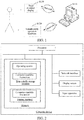
- FIG. 1 is a diagram of an application environment of a virtual reality (VR) application data processing method according to an embodiment.
- the application environment of the interaction data processing method includes a terminal 110, VR operation hardware 120, and a head mounted display (HMD) 130.
- a VR application program (which may be referred to as a VR application for short) is installed in the terminal 110.
- the VR operation hardware 120 is configured to: receive or acquire a control operation, and generate manipulation data capable of controlling running of the VR application program.
- the VR operation hardware 120 may include an operation handle, a position tracking device, and/or the like.
- the manipulation data may include operation control data generated by an operation performed by the handle, and/or physical space position data generated through position tracking by the position tracking device.
- the head mounted display (HMD) 130 is a head-mounted display device having a function of outputting and displaying a VR picture.
- the terminal 110 may be a desktop computer or a mobile terminal, and the mobile terminal may include at least one of a mobile phone, a tablet computer, a personal digital assistant, a wearable device, and the like.
- the terminal 110 may receive a playback start instruction, and restore the VR application to an initial running state in response to the playback start instruction.
- the terminal 110 obtains manipulation data pre-captured and stored sent by VR operation hardware 120 to a runtime library and having a time sequence, and imports the manipulation data into the runtime library according to the time sequence.
- the terminal 110 transfers the imported manipulation data to the VR application in the initial running state by using the runtime library, for playback processing.
- the terminal 110 may output, to the HMD 130, a playback picture that is generated by the VR application according to the manipulation data.
- the HMD 130 may display the playback picture. It may be understood that, in another embodiment, the terminal 110 may not output, to the HMD 130 for display, the playback picture generated during the playback processing.
- FIG. 2 is a schematic diagram of an internal structure of a computer device according to an embodiment.
- the computer device may be the terminal 110 in FIG. 1 .
- the computer device includes a processor, a memory, a network interface, a display screen, and an input apparatus that are connected by using a system bus.
- the memory includes a non-volatile storage medium and an internal memory.
- the non-volatile storage medium of the computer device may store an operating system and a computer-readable instruction.
- the processor When the computer-readable instruction is executed, the processor may be caused to perform a method of processing data in a VR application.
- the processor of the computer device is configured to provide calculation and control capabilities, to support running of the entire computer device.
- the internal memory may store a computer-readable instruction, and when the computer-readable instruction is executed by the processor, the processor may be caused to perform a method of processing data in a VR application.
- the network interface of the computer device is configured to perform network communication.
- the display screen of the computer device may be a liquid crystal display screen or an e-ink display screen.
- the input apparatus of the computer device may be a touch layer covering the display screen, or may be a key, a trackball, or a touchpad disposed on a housing of the computer device, or may be an external keyboard, touchpad, a mouse, or the like.
- the touch layer and the display screen form a touchscreen.
- FIG. 2 is merely a block diagram of a partial structure related to a solution in this application, and does not constitute a limitation to the computer device to which the solution in this application is applied.
- the computer device may include more components or fewer components than those shown in the figure, or some components may be combined, or a different component deployment may be used.
- FIG. 3 is a schematic flowchart of a method of processing data in a VR application according to an embodiment.
- the method specifically includes the following steps: S302: Receive a playback start instruction.
- the playback start instruction is used for triggering execution of playback processing logic.
- a playback switch may be disposed on the terminal, and generation of the playback start instruction is triggered through a triggering operation by the playback switch (for example, a touch operation, a slide operation, a tap operation, or a press operation).
- the playback switch is a functional key used for controlling playback starting and/or ending.
- the playback switch may be an independent functional key or may be a functional key combining a plurality of keys.
- the playback switch may be a physical key, or may be a virtual switch displayed on the screen of the terminal.
- a preset playback triggering action may alternatively be performed on the terminal, to trigger generation of the playback start instruction.
- a playback mode can be entered after the playback start instruction is received.
- the playback mode is a mode used for performing playback processing.
- VR means that a virtual world of three-dimensional space is generated through computer simulation, and a user is provided with simulation of a visual sense, an auditory sense, a touch sense, or the like, so that the user feels as if the user is immersed, and observes things in the three-dimensional space.
- the VR application is an application program configured to achieve a VR effect.
- the VR application may be a VR game application program. It may be understood that, the VR application may also be another type of application program.
- the initial running state is a state during initial running of the VR application.
- the VR application may be restarted to restore the VR application to the initial running state, or the VR application may be restored to the initial running state by using a restoration mechanism.
- S306 Obtain manipulation data pre-captured and stored that are sent by VR operation hardware to a runtime library and have a time sequence.
- the VR operation hardware is hardware configured to: receive a control operation, and generate manipulation data capable of controlling running of the VR application program.
- the VR operation hardware may include an operation handle, a position tracking device, and/or the like. It may be understood that, if a head-mounted display device and a control handle can achieve a position tracking function, and can acquire the manipulation data and send the manipulation data to the terminal, the head-mounted display device and the control handle are also position tracking devices.
- the manipulation data is data corresponding to the control operation and achieving a function of controlling the running of the VR application.
- the manipulation data may include operation control data generated by an operation performed by the handle, and/or physical space position data generated through position tracking by the position tracking device.
- the manipulation data may include one or a combination of a data block size, a time node, a manipulation event type, a manipulation device type, manipulation duration, manipulation event additional data, and the like.
- the manipulation event type includes handle button rotation, head mounted display rotation, and/or the like.
- the manipulation device type includes a handle, an HMD, and/or the like.
- the manipulation event additional data includes physical space position data during manipulation, and a physical space position may include physical space position data of the HMD (namely, HMD position data). It may be understood that, the event additional data may further include other data associated with manipulation.
- Table 1 shows a storage structure of manipulation data in an embodiment.
- Table 1 Data block size 1 Time node 1 Manipulation event type 1 Manipulation device type 1 Manipulation event duration 1 Manipulation event additional data 1 Data block size 2 Time node 2 Manipulation event type 2 Manipulation device type 2 Manipulation event duration 2 Manipulation event additional data 2 ... ... ... ... ... ... ... ... ... ... Data block size N Time node N Manipulation event type N Manipulation event duration N Manipulation event additional data N
- composition of operation data for example, the manipulation data is "40 10:44:28.545545 305 2 2 2, 3, 1", where
- the runtime library is a special computer program library used by a compiler to implement a programming language built-in function, to provide language program runtime (execution) support.
- the runtime library is used as a conversion layer between hardware and an application after a language program is run.
- the runtime library may be used for feeding back, to the VR application, the manipulation data sent by the VR operation hardware.
- FIG. 4 is a system block diagram according to an embodiment.
- the VR operation hardware sends the manipulation data to the runtime library, and the runtime library feeds back the manipulation data to the VR application.
- the manipulation data sent by the VR operation hardware to the runtime library and having the time sequence may be captured and stored, to obtain the manipulation data pre-captured and stored having the time sequence.
- the terminal may obtain the manipulation data pre-captured and stored sent by the VR operation hardware to the runtime library and having the time sequence.
- the capturing is a data obtaining manner of interception and transferring. That is, the terminal may intercept the manipulation data sent by the VR operation hardware to the runtime library and having the time sequence, to obtain the manipulation data, and continue to transfer the manipulation data to the runtime library, thereby avoiding impact on a normal operation and use of the VR application by the user when the manipulation data is obtained.
- the time sequence may be in a chronological order.
- Storage of the manipulation data having the time sequence is storage of manipulation data in a chronological order.
- each piece of manipulation data and a time node may be correspondingly stored, or the manipulation data may be stored in a corresponding chronological order, and only the manipulation data is stored.
- the method before receiving a playback start instruction, the method further includes: registering a callback function with the runtime library; and invoking the callback function when the VR operation hardware sends, to the runtime library, the manipulation data having the time sequence, to capture and store the manipulation data having the time sequence.
- the callback function is used for capturing the manipulation data sent by the VR operation hardware to the runtime library and having the time sequence.
- the callback function may be a hook function.
- the terminal may register the callback function with the runtime library by invoking a register event callback function (RegisterHookEvent()) in the runtime library.
- the register event callback function is used for registering, with the runtime library, the callback function in the terminal that is used for capturing the manipulation data.
- the VR operation hardware As the user operates the VR application, the VR operation hardware generates the manipulation data.
- the terminal When the VR operation hardware sends the manipulation data having the time sequence to the runtime library, the terminal may invoke the callback function, to capture and store the manipulation data having the time sequence.
- the terminal may register the callback function with the runtime library when receiving an exercise mode enabling instruction. When an exercise mode is enabled, the VR application is in the initial running state.
- the exercise mode may be a mode when the VR application is normally operated and used.
- the exercise mode may alternatively be a separate mode dedicated for exercise.
- the exercise mode may be a mode that allows the user to practice an operation without considering a user level.
- the terminal may alternatively register the callback function with the runtime library when the VR application is started. It may be understood that, the VR application is in the initial running state during starting of the VR application.
- the callback function is registered with the runtime library, and the manipulation data, sent by the VR operation hardware to the runtime library and having the time sequence, is captured and stored by using the callback function, thereby avoiding impact on a normal operation and use of the VR application by the user when the manipulation data is obtained.
- the terminal may import the corresponding manipulation data into the runtime library according to chronological time sequences.
- the terminal may invoke an event import function in the runtime library, to import the manipulation data into the runtime library according to the time sequence.
- the event import function (PollNextEvent()) is used for importing the stored manipulation data.
- FIG. 5 is a design diagram of a parameter definition structure of the register event callback function (RegisterHookEvent()) and the event import function (PollNextEvent()) in the runtime library according to an embodiment.
- a rhombus in FIG. 5 indicates an aggregation relationship, namely, an inclusion relationship between an entirety and a part, and the part points to the entirety.
- HMD matrix data and HMD vector data in FIG. 5 are a part of HMD position data
- the HMD position data and control handle event data are a part of event information
- the event information is a part of data to be obtained by using the event import function and the callback function.
- the event import function may be a preset function in the runtime library, or may be temporary function code injected into the runtime library after the playback start instruction is received (that is, after the playback mode is enabled).
- the preset function is a function that is preset in the runtime library. Even if the playback start instruction is not received, the preset function also exists in the runtime library.
- a temporary function is a temporarily injected function, and is a function that is automatically ineffective when system running ends.
- the temporary function may be a function injected into the runtime library only after the playback start instruction is received, and after the system running ends, the temporary function does not exist in the runtime library.
- the event import function is temporary function code that is injected into the runtime library after the playback start instruction is received, if the playback start instruction is not received, the import function does not exist in the runtime library, thereby reducing occupation on space of the runtime library.
- the terminal may accelerate importing of the manipulation data into the runtime library according to the time sequence.
- the terminal may alternatively import the manipulation data into the runtime library according to the time node, that is, import the runtime library at a normal speed.
- the runtime library is used for feeding back, to the VR application, the manipulation data sent by the VR operation hardware, so that the terminal imports the manipulation data into the runtime library according to the time sequence, and the runtime library also transfers the imported manipulation data to the VR application in the initial running state according to the time sequence.
- the terminal may transfer the manipulation data in real time to the VR application in the initial running state by using the runtime library. That is, after importing the manipulation data into the runtime library, the terminal may transfer the data in real time to the VR application in the initial running state by using the runtime library.
- the runtime library may alternatively be improved in advance, and after receiving the imported manipulation data by using the runtime library, instead of transferring the manipulation data in real time to the VR application in the initial running state, the terminal may uniformly transfer the manipulation data to the VR application in the initial running state within a preset period, to reduce data sending frequency and save system resources.
- how the terminal transfers the imported manipulation data to the VR application in the initial running state by using the runtime library is not limited, provided that the manipulation data can be sent to the VR application in the initial running state.
- the VR application in the initial running state performs running processing corresponding to the manipulation data
- the transferred manipulation data is manipulation data during a previous user operation. Therefore, the VR application performs the running processing corresponding to the manipulation data, to implement the playback processing.
- manipulation data that are sent by VR operation hardware to a runtime library and have a time sequence, is pre-captured and stored; a VR application is restored to an initial running state when a playback start instruction, is received; the manipulation data pre-captured and stored is automatically imported into the runtime library according to a time sequence; and the imported manipulation data is transferred to the VR application in the initial running state by using the runtime library, for playback processing.
- an operation of a user in history operations can be reproduced without requiring the user to re-operate from the beginning, thereby greatly improving operation efficiency.
- the playback processing can be implemented without modifying a virtual application program, thereby achieving universal application, and avoiding problems relating to a cost and difficulties caused due to modification of each virtual application program.
- step S308 includes: determining a playback manner corresponding to the VR application; shortening, when the playback manner is a first playback manner, according to an acceleration import multiple corresponding to the first playback manner, a record time interval between manipulation data neighboring based on the time sequence; and importing the manipulation data sequentially into the runtime library according to the time sequence and the shortened record time interval.
- the terminal may determine the playback manner corresponding to the VR application that currently performs the playback processing.
- the playback manner may include accelerated playback and/or restored playback.
- the accelerated playback means that a manipulation speed corresponding to the stored manipulation data is increased, to increase a playback speed.
- the restored playback means that restored playback processing is performed at a manipulation speed corresponding to the stored manipulation data.
- the terminal when the terminal generates corresponding manipulation data according to a user operation, the terminal records a time node generated by the manipulation data.
- the record time interval is a recorded interval between time nodes of the manipulation data neighboring based on the time sequence. For example, if a recorded time node of a previous piece of manipulation data is t1, and a recorded time node of a following piece of manipulation data is t2, a record time interval of the two pieces of neighboring manipulation data is t2-t1.
- the terminal may obtain the acceleration import multiple corresponding to the first playback manner.
- the acceleration import multiple may be preset.
- the terminal shortens, according to the acceleration import multiple, the record time interval between manipulation data neighboring based on the time sequence; and imports the manipulation data sequentially into the runtime library according to the time sequence and the shortened record time interval.
- the acceleration import multiple is 2
- the record time interval of the two pieces of neighboring manipulation data arranged based on the time sequence is 0.02 second
- the record time interval of the two pieces of manipulation data is shortened to 0.01 second
- the manipulation data is sequentially imported into the runtime library according to the time sequence and the shortened record time interval of 0.01 second. Playback efficiency can be improved through accelerated import.
- the method further includes: obtaining, when the playback manner is a second playback manner, a time node corresponding to the manipulation data; and importing the manipulation data sequentially into the runtime library according to the time node.
- the terminal may obtain the time node corresponding to the manipulation data, and import the manipulation data sequentially into the runtime library according to the time node.
- the time node corresponding to the manipulation data is a stored time node at which the user performs an operation; and the manipulation data is imported sequentially into the runtime library according to the time node, to import the manipulation data into the runtime library at a manipulation speed used when the user previously performs an operation, that is, implement consistent restoration on the operation.
- first and “second” in the first playback manner and the second playback manner are merely used for distinguishing between different playback manners, and are not intended to constitute a limitation in aspects of a size, subordination, an order, or the like.
- the playback manner corresponding to the VR application is determined, and the manipulation data is imported according to the corresponding playback manner, so that the playback manner is more accurate and valid, thereby improving the playback efficiency.
- the determining a playback manner corresponding to the VR application includes: determining, when virtual three-dimensional coordinates in the VR application and physical three-dimensional coordinates in physical space satisfy a one-to-one mapping relationship, that the playback manner corresponding to the VR application is the first playback manner.
- the virtual three-dimensional coordinates are position coordinates corresponding to a character of the user in virtual three-dimensional space constructed in the VR application.
- the physical space refers to real three-dimensional space (or three-dimensional space in a real word).
- the physical three-dimensional coordinates are position coordinates of the user in the real three-dimensional space.
- the terminal determines whether the virtual three-dimensional coordinates in the VR application and the physical three-dimensional coordinates in the physical space satisfy the one-to-one mapping relationship. If the virtual three-dimensional coordinates and the physical three-dimensional coordinates satisfy the one-to-one mapping relationship, it indicates that a position of the user in the virtual three-dimensional space constructed in the VR application is determined based only on a position in the physical space, without involving constraints of manipulation data generated by an operation of the handle and/or the HMD and the time node, so that the terminal may determine that the VR application supports the accelerated import, that is, the terminal may determine that the playback manner corresponding to the VR application is the first playback manner (namely, the accelerated playback). It may be understood that, in another embodiment, for the VR application supporting the accelerated import, the terminal may not perform the accelerated import, but performs import into the runtime library in a normal import manner.
- the determining a playback manner corresponding to the VR application includes: determining, when virtual three-dimensional coordinates in the VR application and physical three-dimensional coordinates in physical space do not satisfy a one-to-one mapping relationship, that the playback manner corresponding to the VR application is the second playback manner.
- the terminal may determine that the VR application does not support the accelerated import, that is, determine that the playback manner corresponding to the VR application is the second playback manner (namely, the restored playback).
- the virtual three-dimensional coordinates in the VR application need to be determined by using the physical three-dimensional coordinates in the physical space and manipulation data generated by an operation of the handle, the HMD, and/or the like, and the time node, it indicates that the virtual three-dimensional coordinates in the VR application and the physical three-dimensional coordinates in the physical space do not satisfy the one-to-one mapping relationship.
- the method further includes a step of performing blur processing on the playback picture, which specifically includes the following steps: obtaining a playback picture that is generated by the VR application according to the manipulation data; performing blur processing on the playback picture; and outputting and displaying a playback picture obtained after the blur processing.
- the terminal may generate the corresponding playback picture by using the VR application according to the manipulation data.
- the terminal may determine the corresponding virtual three-dimensional coordinates by using the VR application according to the manipulation data, and generate the playback picture corresponding to the determined virtual three-dimensional coordinates.
- a picture generated by the VR application corresponds to virtual three-dimensional coordinates in the virtual three-dimensional space, and pictures corresponding to different virtual three-dimensional coordinates in the virtual three-dimensional space are also different. For example, if the character of the user is walking forward in the virtual three-dimensional space, a corresponding picture also changes.
- the terminal obtains the playback picture that is generated by the VR application according to the manipulation data, and performs the blur processing on the playback picture.
- the terminal may implement the blur processing on the playback picture by reducing quality of the playback picture, or may implement the blur processing on the playback picture by superimposing a blurred graphic element onto the playback picture, for example, superimposing a mosaic layer.
- a specific implementation of performing the blur processing on the playback picture by the terminal is not limited, provided that the blur processing can be implemented on the playback picture.
- the terminal may output and display the playback picture generated after the blur processing. That is, the terminal may send the playback picture obtained after the blur processing to the HMD for output and display. The user may see, through the HMD, the playback picture obtained after the blur processing.
- the step of performing blur processing on the playback picture may be performed. It may be understood that, when the terminal imports the manipulation data by using the second playback manner, to perform the playback processing, the generated picture may cause the user to generate a vertigo feeling, and the blur processing is performed on the playback picture to avoid the vertigo feeling, thereby improving quality and an effective ratio of a playback operation.
- the method further includes: generating a picture of a third-party view of angle corresponding to the playback picture; and outputting the picture of the third-party view of angle, to superimpose the picture of the third-party view of angle onto the playback picture obtained after the blur processing, and a result of superimposition is displayed.
- the playback picture that is generated by the VR application according to the manipulation data is a picture of a first-party view of angle.
- the terminal may generate a picture drawing parameter of the playback picture of the first-party view of angle through changing, to generate the picture of the third-party view of angle corresponding to the playback picture. It may be understood that, in the picture of the third-party view of angle, an image corresponding to the character of the user is a part of the picture of the third-party view of angle, while in the picture of the first-party view of angle, the character of the user is not displayed.
- the terminal may output the generated picture of the third-party view of angle corresponding to the playback picture, to superimpose the picture of the third-party view of angle onto the playback picture obtained after the blur processing, and a result of superimposition is displayed. In this way, the user can be prevented from getting vertigo, and the user can see a current playback progress.
- the method further includes: receiving a playback stop instruction; and canceling, in response to the playback stop instruction, the blur processing performed on the playback picture, and canceling generation and output of the picture of the third-party view of angle corresponding to the playback picture.
- the playback stop instruction is used for triggering stopping of execution logic for playback.
- the user may perform a tap operation, a press operation, or the like at any position in a playback process, to send the playback stop instruction.
- the terminal may receive the playback stop instruction that is initiated by the user at any position in the playback process. For example, all of manipulation data stored by the terminal for the playback processing may be played back for 30 seconds, but the user may not intend to play back all of the manipulation data and may initiate the playback stop instruction at any position before the entire playback process is completed. For example, when the manipulation data is played back for 20 seconds before the entire playback process of 30 seconds is completed, the user may tap or press a playback stop button to initiate the playback stop instruction.
- the terminal may cancel, in response to the playback stop instruction, the blur processing performed on the playback picture, and cancel generation and output of the picture of the third-party view of angle corresponding to the playback picture.
- the terminal may cancel blur processing on a playback picture at a position corresponding to the playback stop instruction, that is, the playback picture at the position corresponding to the playback stop instruction is a picture on which the blur processing is not performed and that can be normally output and displayed.
- the terminal may further cancel generation and output of the picture of the third-party view of angle corresponding to the playback picture. That is, after receiving the playback stop instruction, the terminal may not generate a picture of a third-party view of angle corresponding to the playback picture at the position corresponding to the playback stop instruction. That is, after the terminal responds to the playback stop instruction and performs the foregoing processing, the user finally sees, through the HMD, the playback picture on which the blur processing is not performed.
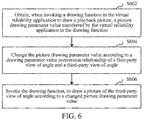
- the generating a picture of a third-party view of angle corresponding to the playback picture (which is referred to as a step of generating the picture of the third-party view of angle for short) specifically includes the following steps: S602: Obtain, when invoking a drawing function in the VR application to draw the playback picture, a picture drawing parameter value transferred by the VR application to the drawing function.
- the VR application invokes the drawing function to draw the playback picture corresponding to the manipulation data.
- the terminal may obtain the picture drawing parameter value transferred by the VR application to the drawing function.
- the obtained picture drawing parameter value is used for drawing the picture of the first view of angle. It may be understood that, after obtaining the picture drawing parameter value transferred by the VR application to the drawing function, the terminal may continue to transfer the picture drawing parameter value to the drawing function, so that the drawing function generates the playback picture of the first view of angle according to the picture drawing parameter value.
- S604 Change the picture drawing parameter value according to a drawing parameter value conversion relationship of a first-party view of angle and the third-party view of angle.
- the drawing parameter value conversion relationship of the first-party view of angle and the third-party view of angle may be a drawing parameter value conversion rule for converting the picture of the first-party view of angle into the picture of the third-party view of angle.
- the terminal may change, according to the drawing parameter value conversion rule of the first-party view of angle and the third-party view of angle, the obtained drawing parameter value used for drawing the picture of the first view of angle into a drawing parameter value used for drawing the picture of the third view of angle.
- S606 Invoke the drawing function, to draw the picture of the third-party view of angle according to a changed picture drawing parameter value.
- the terminal may invoke the drawing function, to draw the picture of the third-party view of angle according to the changed picture drawing parameter value (namely, the picture drawing parameter value used for drawing the picture of the third view of angle).
- the changed picture drawing parameter value namely, the picture drawing parameter value used for drawing the picture of the third view of angle
- the picture of the third-party view of angle is generated by obtaining and changing the picture drawing parameter value, so that the picture of the third-party view of angle can be generated with significant convenience and improved efficiency.
- step S602 includes: obtaining, when invoking the drawing function in the VR application to draw the playback picture, by using a hook function injected into the drawing function, the picture drawing parameter value transferred by the VR application to the drawing function; and step S606 includes: invoking the drawing function by using the hook function injected into the drawing function, to draw the picture of the third-party view of angle according to the changed picture drawing parameter value.
- the terminal when receiving the playback instruction, the terminal triggers injection of the hook function into the drawing function.
- the terminal may obtain, by using the hook function injected into the drawing function, the picture drawing parameter value transferred by the VR application to the drawing function.
- the terminal may invoke the corresponding drawing function again by using the hook function injected into the drawing function, to draw the picture of the third-party view of angle according to the changed picture drawing parameter value.
- the picture drawing parameter value is obtained and changed by using the hook function injected into the drawing function, to generate the picture of the third-party view of angle. Accordingly, the picture of the third-party view of angle can be generated with significant convenience and improved efficiency.
- FIG. 7 is a diagram of a time sequence of the method of processing data in a VR application according to an embodiment. The method specifically includes the following steps:
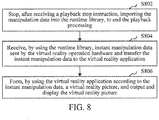
- the method further includes a step of generating an instant VR picture, which specifically includes the following steps: S802: Stop, after receiving a playback stop instruction, importing the manipulation data into the runtime library, to end the playback processing.
- the playback stop instruction is used for triggering stopping of the execution logic for playback.
- the user may perform a tap operation, a press operation, or the like at any position in a playback process, to send the playback stop instruction.
- the terminal may receive the playback stop instruction that is initiated by the user at any position in the playback process. For example, all of manipulation data stored by the terminal may be played back for 30 seconds in the playback processing, but the user may not intend to play back all of the manipulation data and initiate the playback stop instruction at any position before the entire playback process of 30 seconds is completed. For example, when the manipulation data is played back for 20 seconds, the user may tap or press a playback stop button to initiate the playback stop instruction.
- the terminal stops, after receiving the playback stop instruction, importing the manipulation data into the runtime library, to end the playback processing. It may be understood that, after the playback processing ends, an instant operation processing state is restored, and the terminal may control the runtime library to restore to a state in which instant manipulation data sent by the VR operation hardware can be received.
- S804 Receive, by using the runtime library, instant manipulation data sent by the VR operation hardware, and transfer the instant manipulation data to the VR application.
- the user may operate the VR operation hardware to initiate an instant operation on the VR application.
- the VR operation hardware sends instant manipulation data corresponding to the instant operation to the runtime library.
- the terminal receives, by using the runtime library, the instant manipulation data sent by the VR operation hardware, and transfers the instant manipulation data to the VR application.
- S806 Form a VR picture by using the VR application according to the instant manipulation data, and output and display the VR picture.
- the terminal may form the VR picture by using the VR application according to the instant manipulation data, and output and display the VR picture.
- the terminal may determine corresponding virtual three-dimensional coordinates by using the VR application according to the instant manipulation data, and generate an instant VR picture corresponding to the determined virtual three-dimensional coordinates.
- the instant operation processing state can be restored to, and the VR picture is formed according to the instant manipulation data sent by the VR operation hardware, and is output and displayed, to implement a seamless connection between playback and instant operations. Accordingly, another operation for restoring the instant operation state is not needed, thereby improving the operation efficiency.
- FIG. 9 in an embodiment, another method of processing data in a VR application is provided.
- the method specifically includes the following steps:
- S910 Shorten, according to an acceleration import multiple corresponding to the first playback manner, a record time interval between manipulation data neighboring based on the time sequence; and import the manipulation data sequentially into the runtime library according to the time sequence and the shortened record time interval.
- S912 obtain a time node corresponding to the manipulation data; and import the manipulation data sequentially into the runtime library according to the time node.
- S916 Obtain, when invoking a drawing function in the VR application to draw a playback picture, by using a hook function injected into the drawing function, a picture drawing parameter value transferred by the VR application to the drawing function.
- S918 Change the picture drawing parameter value according to a drawing parameter value conversion relationship of a first-party view of angle and a third-party view of angle.
- S920 Invoke the drawing function by using the hook function injected into the drawing function, to draw a picture of the third-party view of angle according to a changed picture drawing parameter value.
- S922 Obtain a playback picture that is generated by the VR application according to the manipulation data; and perform blur processing on the playback picture, and output and display a playback picture obtained after the blur processing.
- S924 Output the picture of the third-party view of angle, to display the picture of the third-party view of angle by superimposing the picture of the third-party view of angle onto the playback picture obtained after the blur processing.
- S926 Receive a playback stop instruction; and cancel, in response to the playback stop instruction, the blur processing performed on the playback picture, and cancel generation and output of the picture of the third-party view of angle corresponding to the playback picture.
- S930 Receive, by using the runtime library, instant manipulation data sent by the VR operation hardware, and transfer the instant manipulation data to the VR application.
- S932 Form a VR picture by using the VR application according to the instant manipulation data, and output and display the VR picture.
- manipulation data that are sent by VR operation hardware to a runtime library and have a time sequence, is pre-captured and stored; a VR application is restored to an initial running state when a playback start instruction is received; the manipulation data pre-captured and stored is automatically imported into the runtime library according to a time sequence; and the imported manipulation data is transferred to the VR application in the initial running state by using the runtime library, for playback processing.
- an operation of a user in history operations can be reproduced without requiring the user to re-operate from the beginning, thereby greatly improving operation efficiency.
- the playback manner corresponding to the VR application is determined, and the manipulation data is imported according to the corresponding playback manner, so that the playback manner is more accurate and valid, thereby improving the playback efficiency.
- the playback efficiency can be further improved through the accelerated import.
- the blur processing is performed on the playback picture to avoid a vertigo feeling, thereby improving quality and an effective ratio of a playback operation.
- the picture of the third-party view of angle is superimposed onto the playback picture obtained after the blur processing for display. In this way, the user can be prevented from getting vertigo, and the user can see a current playback progress.
- the picture of the third-party view of angle is generated by obtaining and changing the picture drawing parameter value, so that the picture of the third-party view of angle can be generated with significant convenience and improved efficiency.
- the instant operation processing state can be restored, and the VR picture is formed according to the instant manipulation data sent by the VR operation hardware, and is output and displayed, to implement a seamless connection between playback and instant operations, avoiding a need to restore to the instant operation state by using another operation, and improving the operation efficiency.
- a terminal is further provided.
- An internal structure of the terminal may be shown in FIG. 2 .
- the terminal includes an apparatus of processing data in a VR application, the apparatus of processing data in a VR application includes various modules, and a part or all of each module may be implemented by using software, hardware, or a combination thereof.
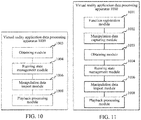
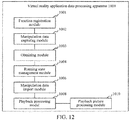
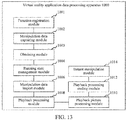
- an apparatus of processing data in a VR application 1000 includes an obtaining module 1003, a running state management module 1004, a manipulation data import module 1006, and a playback processing module 1008.
- the obtaining module 1003 is configured to receive a playback start instruction.
- the running state management module 1004 is configured to restore the VR application to an initial running state in response to the playback start instruction.
- the obtaining module 1002 is further configured to obtain manipulation data pre-captured and stored that are sent by VR operation hardware to a runtime library and have a time sequence.
- the manipulation data import module 1006 is configured to import the manipulation data into the runtime library according to the time sequence.
- the playback processing module 1008 is configured to transfer the imported manipulation data to the VR application in the initial running state by using the runtime library, for playback processing.
- the apparatus 1000 further includes:
- the manipulation data import module 1006 is further configured to: determine a playback manner corresponding to the VR application; shorten, when the playback manner is a first playback manner, according to an acceleration import multiple corresponding to the first playback manner, a record time interval between manipulation data neighboring based on the time sequence; and import the manipulation data sequentially into the runtime library according to the time sequence and the shortened record time interval.
- the manipulation data import module 1006 is further configured to determine a playback manner corresponding to the VR application; obtain, when the playback manner is a second playback manner, a time node corresponding to the manipulation data; and import the manipulation data sequentially into the runtime library according to the time node.
- the manipulation data import module 1006 is further configured to determine, when virtual three-dimensional coordinates in the VR application and physical three-dimensional coordinates in physical space satisfy a one-to-one mapping relationship, that the playback manner corresponding to the VR application is the first playback manner.
- the manipulation data import module 1006 is further configured to determine, when virtual three-dimensional coordinates in the VR application and physical three-dimensional coordinates in physical space do not satisfy a one-to-one mapping relationship, that the playback manner corresponding to the VR application is the second playback manner.
- the apparatus 1000 further includes: a playback picture processing module 1010, configured to obtain a playback picture that is generated by the VR application according to the manipulation data; perform blur processing on the playback picture; and output and display a playback picture obtained after the blur processing.
- a playback picture processing module 1010 configured to obtain a playback picture that is generated by the VR application according to the manipulation data; perform blur processing on the playback picture; and output and display a playback picture obtained after the blur processing.
- the playback picture processing module 1010 is further configured to: generate a picture of a third-party view of angle corresponding to the playback picture; and output the picture of the third-party view of angle, to display the picture of the third-party view of angle by superimposing the picture of the third-party view of angle onto the playback picture obtained after the blur processing.
- the playback picture processing module 1010 is further configured to: receive a playback stop instruction; and cancel, in response to the playback stop instruction, the blur processing performed on the playback picture, and cancel generation and output of the picture of the third-party view of angle corresponding to the playback picture.
- the playback picture processing module 1010 is further configured to: obtain, when invoking a drawing function in the VR application to draw the playback picture, a picture drawing parameter value transferred by the VR application to the drawing function; change the picture drawing parameter value according to a drawing parameter value conversion relationship of a first-party view of angle and the third-party view of angle; and invoke the drawing function, to draw the picture of the third-party view of angle according to a changed picture drawing parameter value.
- the playback picture processing module 1010 is further configured to obtain, when invoking the drawing function in the VR application to draw the playback picture, by using a hook function injected into the drawing function, the picture drawing parameter value transferred by the VR application to the drawing function.
- the playback picture processing module 1010 is further configured to invoke the drawing function by using the hook function injected into the drawing function, to draw the picture of the third-party view of angle according to the changed picture drawing parameter value.
- the apparatus 1000 further includes:
- a computer device in an embodiment, includes a memory and a processor, the memory storing a computer-readable instruction, and when the computer-readable instruction is executed by the processor, the processor being caused to perform the following steps: receiving a playback start instruction; restoring the VR application to an initial running state in response to the playback start instruction; obtaining manipulation data pre-captured and stored that are sent by VR operation hardware to a runtime library and have a time sequence; importing the manipulation data into the runtime library according to the time sequence; and transferring the imported manipulation data to the VR application in the initial running state by using the runtime library, for playback processing.
- the computer-readable instruction before the receiving a playback start instruction, the computer-readable instruction further causes the processor to perform the following steps: registering a callback function with the runtime library; and invoking the callback function when the VR operation hardware sends, to the runtime library, the manipulation data having the time sequence, to capture and store the manipulation data having the time sequence.
- the importing the manipulation data into the runtime library according to the time sequence that is performed by the processor includes: determining a playback manner corresponding to the VR application; shortening, when the playback manner is a first playback manner, according to an acceleration import multiple corresponding to the first playback manner, a record time interval between manipulation data neighboring based on the time sequence; and importing the manipulation data sequentially into the runtime library according to the time sequence and the shortened record time interval.
- the computer-readable instruction further causes the processor to perform the following steps: determining a playback manner corresponding to the VR application; obtaining, when the playback manner is a second playback manner, a time node corresponding to the manipulation data; and importing the manipulation data sequentially into the runtime library according to the time node.
- the determining a playback manner corresponding to the VR application that is performed by the processor includes: determining, when virtual three-dimensional coordinates in the VR application and physical three-dimensional coordinates in physical space satisfy a one-to-one mapping relationship, that the playback manner corresponding to the VR application is the first playback manner.
- the determining a playback manner corresponding to the VR application that is performed by the processor includes: determining, when virtual three-dimensional coordinates in the VR application and physical three-dimensional coordinates in physical space do not satisfy a one-to-one mapping relationship, that the playback manner corresponding to the VR application is the second playback manner.
- the computer-readable instruction further causes the processor to perform the following steps: obtaining a playback picture that is generated by the VR application according to the manipulation data; performing blur processing on the playback picture; and outputting and displaying a playback picture obtained after the blur processing.
- the computer-readable instruction further causes the processor to perform the following steps: generating a picture of a third-party view of angle corresponding to the playback picture; and outputting the picture of the third-party view of angle, to display the picture of the third-party view of angle by superimposing the picture of the third-party view of angle onto the playback picture obtained after the blur processing.
- the computer-readable instruction further causes the processor to perform the following steps: receiving a playback stop instruction; and canceling, in response to the playback stop instruction, the blur processing performed on the playback picture, and canceling generation and output of the picture of the third-party view of angle corresponding to the playback picture.
- the generating a picture of a third-party view of angle corresponding to the playback picture that is performed by the processor includes: obtaining, when invoking a drawing function in the VR application to draw the playback picture, a picture drawing parameter value transferred by the VR application to the drawing function; changing the picture drawing parameter value according to a drawing parameter value conversion relationship of a first-party view of angle and the third-party view of angle; and invoking the drawing function, to draw the picture of the third-party view of angle according to a changed picture drawing parameter value.
- the obtaining, when invoking a drawing function in the VR application to draw the playback picture, a picture drawing parameter value transferred by the VR application to the drawing function that is performed by the processor includes: obtaining, when invoking the drawing function in the VR application to draw the playback picture, by using a hook function injected into the drawing function, the picture drawing parameter value transferred by the VR application to the drawing function.
- the invoking the drawing function, to draw the picture of the third-party view of angle according to a changed picture drawing parameter value that is performed by the processor includes: invoking the drawing function by using the hook function injected into the drawing function, to draw the picture of the third-party view of angle according to the changed picture drawing parameter value.
- the computer-readable instruction further causes the processor to perform the following steps: stopping, after receiving a playback stop instruction, importing the manipulation data into the runtime library, to end the playback processing; receiving, by using the runtime library, instant manipulation data sent by the VR operation hardware, and transferring the instant manipulation data to the VR application; and forming a VR picture by using the VR application according to the instant manipulation data, and outputting and displaying the VR picture.
- a storage medium storing a computer-readable instruction.
- the one or more processors are caused to perform the following steps: receiving a playback start instruction; restoring the VR application to an initial running state in response to the playback start instruction; obtaining manipulation data pre-captured and stored that are sent by VR operation hardware to a runtime library and have a time sequence; importing the manipulation data into the runtime library according to the time sequence; and transferring the imported manipulation data to the VR application in the initial running state by using the runtime library, for playback processing.
- the computer-readable instruction before the receiving a playback start instruction, the computer-readable instruction further causes the processor to perform the following steps: registering a callback function with the runtime library; and invoking the callback function when the VR operation hardware sends, to the runtime library, the manipulation data having the time sequence, to capture and store the manipulation data having the time sequence.
- the importing the manipulation data into the runtime library according to the time sequence that is performed by the processor includes: determining a playback manner corresponding to the VR application; shortening, when the playback manner is a first playback manner, according to an acceleration import multiple corresponding to the first playback manner, a record time interval between manipulation data neighboring based on the time sequence; and importing the manipulation data sequentially into the runtime library according to the time sequence and the shortened record time interval.
- the computer-readable instruction further causes the processor to perform the following steps: determining a playback manner corresponding to the VR application; obtaining, when the playback manner is a second playback manner, a time node corresponding to the manipulation data; and importing the manipulation data sequentially into the runtime library according to the time node.
- the determining a playback manner corresponding to the VR application that is performed by the processor includes: determining, when virtual three-dimensional coordinates in the VR application and physical three-dimensional coordinates in physical space satisfy a one-to-one mapping relationship, that the playback manner corresponding to the VR application is the first playback manner.
- the determining a playback manner corresponding to the VR application that is performed by the processor includes: determining, when virtual three-dimensional coordinates in the VR application and physical three-dimensional coordinates in physical space do not satisfy a one-to-one mapping relationship, that the playback manner corresponding to the VR application is the second playback manner.
- the computer-readable instruction further causes the processor to perform the following steps: obtaining a playback picture that is generated by the VR application according to the manipulation data; performing blur processing on the playback picture; and outputting and displaying a playback picture obtained after the blur processing.
- the computer-readable instruction further causes the processor to perform the following steps: generating a picture of a third-party view of angle corresponding to the playback picture; and outputting the picture of the third-party view of angle, to display the picture of the third-party view of angle by superimposing the picture of the third-party view of angle onto the playback picture obtained after the blur processing.
- the computer-readable instruction further causes the processor to perform the following steps: receiving a playback stop instruction; and canceling, in response to the playback stop instruction, the blur processing performed on the playback picture, and canceling generation and output of the picture of the third-party view of angle corresponding to the playback picture.
- the generating a picture of a third-party view of angle corresponding to the playback picture that is performed by the processor includes: obtaining, when invoking a drawing function in the VR application to draw the playback picture, a picture drawing parameter value transferred by the VR application to the drawing function; changing the picture drawing parameter value according to a drawing parameter value conversion relationship of a first-party view of angle and the third-party view of angle; and invoking the drawing function, to draw the picture of the third-party view of angle according to a changed picture drawing parameter value.
- the obtaining, when invoking a drawing function in the VR application to draw the playback picture, a picture drawing parameter value transferred by the VR application to the drawing function that is performed by the processor includes: obtaining, when invoking the drawing function in the VR application to draw the playback picture, by using a hook function injected into the drawing function, the picture drawing parameter value transferred by the VR application to the drawing function.
- the invoking the drawing function, to draw the picture of the third-party view of angle according to a changed picture drawing parameter value that is performed by the processor includes: invoking the drawing function by using the hook function injected into the drawing function, to draw the picture of the third-party view of angle according to the changed picture drawing parameter value.
- the computer-readable instruction further causes the processor to perform the following steps: stopping, after receiving a playback stop instruction, importing the manipulation data into the runtime library, to end the playback processing; receiving, by using the runtime library, instant manipulation data sent by the VR operation hardware, and transferring the instant manipulation data to the VR application; and forming a VR picture by using the VR application according to the instant manipulation data, and outputting and displaying the VR picture.
- steps in the embodiments of this application are not necessarily performed in an order indicated by the step numbers. Unless explicitly stated in this specification, the execution of these steps is not strictly sequential, and these steps may be executed in another sequence. Moreover, at least some of the steps in each embodiment may include a plurality of sub-steps or stages, which may not necessarily be completed at the same moment, but may be performed at different moments. These sub-steps or stages are not necessarily performed in sequence, but may be performed in turn or alternately with at least some of other steps or sub-steps or stages of the other steps.
- the non-volatile memory may include a read-only memory (ROM), a programmable ROM (PROM), an electrically programmable ROM (EPROM), an electrically erasable programmable ROM (EEPROM), a flash memory, or the like.
- ROM read-only memory
- PROM programmable ROM
- EPROM electrically programmable ROM
- EEPROM electrically erasable programmable ROM
- the volatile memory may include a random access memory (RAM) or an external high-speed cache.
- the RAM is available in a variety of forms, such as a static RAM (SRAM), a dynamic RAM (DRAM), a synchronous DRAM (SDRAM), a dual data rate SDRAM (DDRSDRAM), an enhanced SDRAM (ESDRAM), a synchronization link (Synchlink) DRAM (SLDRAM), a memory bus (Rambus) direct RAM (RDRAM), a direct memory bus dynamic RAM (DRDRAM), and a memory bus dynamic RAM (RDRAM).
- SRAM static RAM
- DRAM dynamic RAM
- SDRAM synchronous DRAM
- DDRSDRAM dual data rate SDRAM
- ESDRAM enhanced SDRAM
- SLDRAM synchronization link
- RDRAM direct RAM
- DRAM direct memory bus dynamic RAM
- RDRAM memory bus dynamic RAM
Landscapes
- Engineering & Computer Science (AREA)
- Theoretical Computer Science (AREA)
- Multimedia (AREA)
- Software Systems (AREA)
- Physics & Mathematics (AREA)
- General Physics & Mathematics (AREA)
- General Engineering & Computer Science (AREA)
- Human Computer Interaction (AREA)
- Computer Graphics (AREA)
- Computer Hardware Design (AREA)
- User Interface Of Digital Computer (AREA)
- Processing Or Creating Images (AREA)
Abstract
Description
- This application claims priority to Chinese Patent Application No.
2017103223363 - This application relates to the field of computer technologies, and in particular, to a method of processing data in a virtual reality (VR) application, a computer device, and a storage medium.
- With rapid development of science and technology, an increased number of types of applications are available. Virtual reality (VR) applications are increasingly popular by virtue of high interactivity and better user experience.
- At present, some VR applications require a user to perform a series of operations, and the user can perform a next operation only after completing a previous operation. If the user intends to again perform an operation included in history of previous operations, the user needs to re-operate from the beginning until a target operation intended by the user is performed.
- Therefore, at present, when a user intends to perform an operation included in a history of previous operations again, the user needs to re-operate from the beginning, leading to relatively low operation efficiency.
- According to various embodiments provided in this application, a method of processing data in a VR application, a computer device, and a storage medium are provided.
- A method of processing data in a VR application is provided. The method includes:
- receiving, by a computer device, a playback start instruction;
- restoring, by the computer device, the VR application to an initial running state in response to the playback start instruction;
- obtaining, by the computer device, manipulation data pre-captured and stored that are sent by VR operation hardware to a runtime library and have a time sequence;
- importing, by the computer device, the manipulation data into the runtime library according to the time sequence; and
- transferring, by the computer device, the imported manipulation data to the VR application in the initial running state by using the runtime library, for playback processing.
- A computer device is provided. The computer device includes a memory and a processor, the memory storing a computer-readable instruction, and when the computer-readable instruction is executed by the processor, the processor being caused to perform:
- receiving a playback start instruction;
- restoring the VR application to an initial running state in response to the playback start instruction;
- obtaining manipulation data pre-captured and stored that are sent by VR operation hardware to a runtime library and have a time sequence;
- importing the manipulation data into the runtime library according to the time sequence; and
- transferring the imported manipulation data to the VR application in the initial running state by using the runtime library, for playback processing.
- One or more storage mediums storing a computer-readable instruction are provided. When the computer-readable instruction is executed by one or more processors, the one or more processors are caused to perform:
- receiving a playback start instruction;
- restoring the VR application to an initial running state in response to the playback start instruction;
- obtaining manipulation data pre-captured and stored that are sent by VR operation hardware to a runtime library and have a time sequence;
- importing the manipulation data into the runtime library according to the time sequence; and
- transferring the imported manipulation data to the VR application in the initial running state by using the runtime library, for playback processing.
- To describe the technical solutions in the embodiments of this application more clearly, the following briefly describes the accompanying drawings required for describing the embodiments. Apparently, the accompanying drawings in the following description show merely some embodiments of this application, and a person of ordinary skill in the art may still derive other drawings from these accompanying drawings without creative efforts.
-
FIG. 1 is a diagram of an application environment of a method of processing data in a VR application according to an embodiment. -
FIG. 2 is a schematic diagram of an internal structure of a computer device according to an embodiment. -
FIG. 3 is a schematic flowchart of a method of processing data in a VR application according to an embodiment. -
FIG. 4 is a system block diagram according to an embodiment. -
FIG. 5 is a design diagram of a parameter definition structure of a register event callback function and an event import function in a runtime library according to an embodiment. -
FIG. 6 is a schematic flowchart of a step of generating a picture of a third-party view of angle according to an embodiment. -
FIG. 7 is a diagram of a time sequence of a method of processing data in a VR application according to an embodiment. -
FIG. 8 is a schematic flowchart of a step of generating an instant VR picture according to an embodiment. -
FIG. 9 is a schematic flowchart of a method of processing data in a VR application according to another embodiment. -
FIG. 10 is a block diagram of an apparatus of processing data in a VR application according to an embodiment. -
FIG. 11 is a block diagram of an apparatus of processing data in a VR application according to another embodiment. -
FIG. 12 is a block diagram of an apparatus of processing data in a VR application according to still another embodiment. -
FIG. 13 is a block diagram of an apparatus of processing data in a VR application according to yet another embodiment. - To make the objectives, the technical solutions, and the advantages of this application clearer, the following further describes this application in detail with reference to the accompanying drawings and the embodiments. It should be understood that the specific embodiments described herein are only used to describe this application, instead of limiting this application.
-
FIG. 1 is a diagram of an application environment of a virtual reality (VR) application data processing method according to an embodiment. Referring toFIG. 1 , the application environment of the interaction data processing method includes a terminal 110,VR operation hardware 120, and a head mounted display (HMD) 130. A VR application program (which may be referred to as a VR application for short) is installed in the terminal 110. TheVR operation hardware 120 is configured to: receive or acquire a control operation, and generate manipulation data capable of controlling running of the VR application program. TheVR operation hardware 120 may include an operation handle, a position tracking device, and/or the like. The manipulation data may include operation control data generated by an operation performed by the handle, and/or physical space position data generated through position tracking by the position tracking device. The head mounted display (HMD) 130 is a head-mounted display device having a function of outputting and displaying a VR picture. The terminal 110 may be a desktop computer or a mobile terminal, and the mobile terminal may include at least one of a mobile phone, a tablet computer, a personal digital assistant, a wearable device, and the like. - The terminal 110 may receive a playback start instruction, and restore the VR application to an initial running state in response to the playback start instruction. The terminal 110 obtains manipulation data pre-captured and stored sent by
VR operation hardware 120 to a runtime library and having a time sequence, and imports the manipulation data into the runtime library according to the time sequence. The terminal 110 transfers the imported manipulation data to the VR application in the initial running state by using the runtime library, for playback processing. In an embodiment, the terminal 110 may output, to the HMD 130, a playback picture that is generated by the VR application according to the manipulation data. The HMD 130 may display the playback picture. It may be understood that, in another embodiment, the terminal 110 may not output, to the HMD 130 for display, the playback picture generated during the playback processing. -
FIG. 2 is a schematic diagram of an internal structure of a computer device according to an embodiment. The computer device may be the terminal 110 inFIG. 1 . Referring toFIG. 2 , the computer device includes a processor, a memory, a network interface, a display screen, and an input apparatus that are connected by using a system bus. The memory includes a non-volatile storage medium and an internal memory. The non-volatile storage medium of the computer device may store an operating system and a computer-readable instruction. When the computer-readable instruction is executed, the processor may be caused to perform a method of processing data in a VR application. The processor of the computer device is configured to provide calculation and control capabilities, to support running of the entire computer device. The internal memory may store a computer-readable instruction, and when the computer-readable instruction is executed by the processor, the processor may be caused to perform a method of processing data in a VR application. The network interface of the computer device is configured to perform network communication. The display screen of the computer device may be a liquid crystal display screen or an e-ink display screen. The input apparatus of the computer device may be a touch layer covering the display screen, or may be a key, a trackball, or a touchpad disposed on a housing of the computer device, or may be an external keyboard, touchpad, a mouse, or the like. The touch layer and the display screen form a touchscreen. - A person skilled in the art would understand that, the structure shown in
FIG. 2 is merely a block diagram of a partial structure related to a solution in this application, and does not constitute a limitation to the computer device to which the solution in this application is applied. Specifically, the computer device may include more components or fewer components than those shown in the figure, or some components may be combined, or a different component deployment may be used. -
FIG. 3 is a schematic flowchart of a method of processing data in a VR application according to an embodiment. In this embodiment, an example in which the method of processing data in a VR application is applied to the terminal 110 inFIG. 1 is mainly used for description. Referring toFIG. 3 , the method specifically includes the following steps:
S302: Receive a playback start instruction. - The playback start instruction is used for triggering execution of playback processing logic.
- In an embodiment, a playback switch may be disposed on the terminal, and generation of the playback start instruction is triggered through a triggering operation by the playback switch (for example, a touch operation, a slide operation, a tap operation, or a press operation). The playback switch is a functional key used for controlling playback starting and/or ending. The playback switch may be an independent functional key or may be a functional key combining a plurality of keys. The playback switch may be a physical key, or may be a virtual switch displayed on the screen of the terminal.
- In another embodiment, a preset playback triggering action may alternatively be performed on the terminal, to trigger generation of the playback start instruction.
- In an embodiment, a playback mode can be entered after the playback start instruction is received. The playback mode is a mode used for performing playback processing.
- S304: Restore the VR application to an initial running state in response to the playback start instruction.
- VR means that a virtual world of three-dimensional space is generated through computer simulation, and a user is provided with simulation of a visual sense, an auditory sense, a touch sense, or the like, so that the user feels as if the user is immersed, and observes things in the three-dimensional space.
- The VR application is an application program configured to achieve a VR effect. In an embodiment, the VR application may be a VR game application program. It may be understood that, the VR application may also be another type of application program.
- The initial running state is a state during initial running of the VR application. Specifically, the VR application may be restarted to restore the VR application to the initial running state, or the VR application may be restored to the initial running state by using a restoration mechanism.
- S306: Obtain manipulation data pre-captured and stored that are sent by VR operation hardware to a runtime library and have a time sequence.
- The VR operation hardware is hardware configured to: receive a control operation, and generate manipulation data capable of controlling running of the VR application program. The VR operation hardware may include an operation handle, a position tracking device, and/or the like. It may be understood that, if a head-mounted display device and a control handle can achieve a position tracking function, and can acquire the manipulation data and send the manipulation data to the terminal, the head-mounted display device and the control handle are also position tracking devices.
- The manipulation data is data corresponding to the control operation and achieving a function of controlling the running of the VR application. The manipulation data may include operation control data generated by an operation performed by the handle, and/or physical space position data generated through position tracking by the position tracking device.
- In an embodiment, the manipulation data may include one or a combination of a data block size, a time node, a manipulation event type, a manipulation device type, manipulation duration, manipulation event additional data, and the like.
- The manipulation event type includes handle button rotation, head mounted display rotation, and/or the like. The manipulation device type includes a handle, an HMD, and/or the like. The manipulation event additional data includes physical space position data during manipulation, and a physical space position may include physical space position data of the HMD (namely, HMD position data). It may be understood that, the event additional data may further include other data associated with manipulation. Referring to Table 1, Table 1 shows a storage structure of manipulation data in an embodiment.
Table 1 Data block size 1Time node 1Manipulation event type 1Manipulation device type 1Manipulation event duration 1Manipulation event additional data 1Data block size 2Time node 2Manipulation event type 2Manipulation device type 2Manipulation event duration 2Manipulation event additional data 2... ... ... ... ... ... Data block size N Time node N Manipulation event type N Manipulation device type N Manipulation event duration N Manipulation event additional data N - An example is used currently to describe composition of operation data, for example, the manipulation data is "40 10:44:28.545545 305 2 2 2, 3, 1", where
- 40: indicates a stored data block size;
- 10:44:28.545545: indicates a time node
- 305: indicates a left-handle scroll button;
- 2: indicates a left handle
- 2: indicates a scroll time length of the handle; and
- 2, 3, 1: indicates a physical space position of the handle during scrolling.
- The runtime library is a special computer program library used by a compiler to implement a programming language built-in function, to provide language program runtime (execution) support. The runtime library is used as a conversion layer between hardware and an application after a language program is run. In this embodiment, the runtime library may be used for feeding back, to the VR application, the manipulation data sent by the VR operation hardware.
-
FIG. 4 is a system block diagram according to an embodiment. The VR operation hardware sends the manipulation data to the runtime library, and the runtime library feeds back the manipulation data to the VR application. - It may be understood that, when the user directly operates the VR application, the manipulation data sent by the VR operation hardware to the runtime library and having the time sequence may be captured and stored, to obtain the manipulation data pre-captured and stored having the time sequence. After receiving the playback start instruction, the terminal may obtain the manipulation data pre-captured and stored sent by the VR operation hardware to the runtime library and having the time sequence.
- The capturing is a data obtaining manner of interception and transferring. That is, the terminal may intercept the manipulation data sent by the VR operation hardware to the runtime library and having the time sequence, to obtain the manipulation data, and continue to transfer the manipulation data to the runtime library, thereby avoiding impact on a normal operation and use of the VR application by the user when the manipulation data is obtained.
- The time sequence may be in a chronological order. Storage of the manipulation data having the time sequence is storage of manipulation data in a chronological order. There may be one or more pieces of manipulation data. In an embodiment, each piece of manipulation data and a time node may be correspondingly stored, or the manipulation data may be stored in a corresponding chronological order, and only the manipulation data is stored.
- In an embodiment, before receiving a playback start instruction, the method further includes: registering a callback function with the runtime library; and invoking the callback function when the VR operation hardware sends, to the runtime library, the manipulation data having the time sequence, to capture and store the manipulation data having the time sequence.
- The callback function is used for capturing the manipulation data sent by the VR operation hardware to the runtime library and having the time sequence. In an embodiment, the callback function may be a hook function.
- Specifically, when the VR application is in the initial running state, the terminal may register the callback function with the runtime library by invoking a register event callback function (RegisterHookEvent()) in the runtime library. The register event callback function is used for registering, with the runtime library, the callback function in the terminal that is used for capturing the manipulation data. As the user operates the VR application, the VR operation hardware generates the manipulation data. When the VR operation hardware sends the manipulation data having the time sequence to the runtime library, the terminal may invoke the callback function, to capture and store the manipulation data having the time sequence. In an embodiment, the terminal may register the callback function with the runtime library when receiving an exercise mode enabling instruction. When an exercise mode is enabled, the VR application is in the initial running state. The exercise mode may be a mode when the VR application is normally operated and used. The exercise mode may alternatively be a separate mode dedicated for exercise. For example, for a VR game application, the exercise mode may be a mode that allows the user to practice an operation without considering a user level.
- In another embodiment, the terminal may alternatively register the callback function with the runtime library when the VR application is started. It may be understood that, the VR application is in the initial running state during starting of the VR application.
- In the foregoing embodiment, the callback function is registered with the runtime library, and the manipulation data, sent by the VR operation hardware to the runtime library and having the time sequence, is captured and stored by using the callback function, thereby avoiding impact on a normal operation and use of the VR application by the user when the manipulation data is obtained.
- S308: Import the manipulation data into the runtime library according to the time sequence.
- Specifically, the terminal may import the corresponding manipulation data into the runtime library according to chronological time sequences.
- In an embodiment, the terminal may invoke an event import function in the runtime library, to import the manipulation data into the runtime library according to the time sequence. The event import function (PollNextEvent()) is used for importing the stored manipulation data.
-
FIG. 5 is a design diagram of a parameter definition structure of the register event callback function (RegisterHookEvent()) and the event import function (PollNextEvent()) in the runtime library according to an embodiment. A rhombus inFIG. 5 indicates an aggregation relationship, namely, an inclusion relationship between an entirety and a part, and the part points to the entirety. For example, HMD matrix data and HMD vector data inFIG. 5 are a part of HMD position data, the HMD position data and control handle event data are a part of event information, and the event information is a part of data to be obtained by using the event import function and the callback function. The event import function may be a preset function in the runtime library, or may be temporary function code injected into the runtime library after the playback start instruction is received (that is, after the playback mode is enabled). The preset function is a function that is preset in the runtime library. Even if the playback start instruction is not received, the preset function also exists in the runtime library. A temporary function is a temporarily injected function, and is a function that is automatically ineffective when system running ends. The temporary function may be a function injected into the runtime library only after the playback start instruction is received, and after the system running ends, the temporary function does not exist in the runtime library. - It may be understood that, when the event import function is temporary function code that is injected into the runtime library after the playback start instruction is received, if the playback start instruction is not received, the import function does not exist in the runtime library, thereby reducing occupation on space of the runtime library.
- The terminal may accelerate importing of the manipulation data into the runtime library according to the time sequence. The terminal may alternatively import the manipulation data into the runtime library according to the time node, that is, import the runtime library at a normal speed.
- S310: Transfer the imported manipulation data to the VR application in the initial running state by using the runtime library, for playback processing.
- It may be understood that, the runtime library is used for feeding back, to the VR application, the manipulation data sent by the VR operation hardware, so that the terminal imports the manipulation data into the runtime library according to the time sequence, and the runtime library also transfers the imported manipulation data to the VR application in the initial running state according to the time sequence.
- In an embodiment, to achieve an effect of real-time operation control, the terminal may transfer the manipulation data in real time to the VR application in the initial running state by using the runtime library. That is, after importing the manipulation data into the runtime library, the terminal may transfer the data in real time to the VR application in the initial running state by using the runtime library. In another embodiment, the runtime library may alternatively be improved in advance, and after receiving the imported manipulation data by using the runtime library, instead of transferring the manipulation data in real time to the VR application in the initial running state, the terminal may uniformly transfer the manipulation data to the VR application in the initial running state within a preset period, to reduce data sending frequency and save system resources. Herein, how the terminal transfers the imported manipulation data to the VR application in the initial running state by using the runtime library is not limited, provided that the manipulation data can be sent to the VR application in the initial running state.
- It may be understood that, the VR application in the initial running state performs running processing corresponding to the manipulation data, and the transferred manipulation data is manipulation data during a previous user operation. Therefore, the VR application performs the running processing corresponding to the manipulation data, to implement the playback processing.
- According to the foregoing method of processing data in a VR application, manipulation data, that are sent by VR operation hardware to a runtime library and have a time sequence, is pre-captured and stored; a VR application is restored to an initial running state when a playback start instruction, is received; the manipulation data pre-captured and stored is automatically imported into the runtime library according to a time sequence; and the imported manipulation data is transferred to the VR application in the initial running state by using the runtime library, for playback processing. Based on automatic playback processing, an operation of a user in history operations can be reproduced without requiring the user to re-operate from the beginning, thereby greatly improving operation efficiency.
- In addition, the playback processing can be implemented without modifying a virtual application program, thereby achieving universal application, and avoiding problems relating to a cost and difficulties caused due to modification of each virtual application program.
- In an embodiment, step S308 includes: determining a playback manner corresponding to the VR application; shortening, when the playback manner is a first playback manner, according to an acceleration import multiple corresponding to the first playback manner, a record time interval between manipulation data neighboring based on the time sequence; and importing the manipulation data sequentially into the runtime library according to the time sequence and the shortened record time interval.
- Specifically, before importing the manipulation data into the runtime library, the terminal may determine the playback manner corresponding to the VR application that currently performs the playback processing. In an embodiment, the playback manner may include accelerated playback and/or restored playback. The accelerated playback means that a manipulation speed corresponding to the stored manipulation data is increased, to increase a playback speed. The restored playback means that restored playback processing is performed at a manipulation speed corresponding to the stored manipulation data.
- It may be understood that, when the terminal generates corresponding manipulation data according to a user operation, the terminal records a time node generated by the manipulation data. The record time interval is a recorded interval between time nodes of the manipulation data neighboring based on the time sequence. For example, if a recorded time node of a previous piece of manipulation data is t1, and a recorded time node of a following piece of manipulation data is t2, a record time interval of the two pieces of neighboring manipulation data is t2-t1.
- When the playback manner corresponding to the VR application is the first playback manner (namely, the accelerated playback), the terminal may obtain the acceleration import multiple corresponding to the first playback manner. The acceleration import multiple may be preset. The terminal shortens, according to the acceleration import multiple, the record time interval between manipulation data neighboring based on the time sequence; and imports the manipulation data sequentially into the runtime library according to the time sequence and the shortened record time interval.
- For example, if the acceleration import multiple is 2, and the record time interval of the two pieces of neighboring manipulation data arranged based on the time sequence is 0.02 second, the record time interval of the two pieces of manipulation data is shortened to 0.01 second, and then the manipulation data is sequentially imported into the runtime library according to the time sequence and the shortened record time interval of 0.01 second. Playback efficiency can be improved through accelerated import.
- In an embodiment, the method further includes: obtaining, when the playback manner is a second playback manner, a time node corresponding to the manipulation data; and importing the manipulation data sequentially into the runtime library according to the time node.
- When the playback manner corresponding to the VR application is the second playback manner (namely, the restored playback), the terminal may obtain the time node corresponding to the manipulation data, and import the manipulation data sequentially into the runtime library according to the time node. It may be understood that, the time node corresponding to the manipulation data is a stored time node at which the user performs an operation; and the manipulation data is imported sequentially into the runtime library according to the time node, to import the manipulation data into the runtime library at a manipulation speed used when the user previously performs an operation, that is, implement consistent restoration on the operation.
- It should be noted that, "first" and "second" in the first playback manner and the second playback manner are merely used for distinguishing between different playback manners, and are not intended to constitute a limitation in aspects of a size, subordination, an order, or the like.
- In the foregoing embodiment, before the stored manipulation data is imported into the runtime library, the playback manner corresponding to the VR application is determined, and the manipulation data is imported according to the corresponding playback manner, so that the playback manner is more accurate and valid, thereby improving the playback efficiency.
- In an embodiment, the determining a playback manner corresponding to the VR application includes: determining, when virtual three-dimensional coordinates in the VR application and physical three-dimensional coordinates in physical space satisfy a one-to-one mapping relationship, that the playback manner corresponding to the VR application is the first playback manner.
- The virtual three-dimensional coordinates are position coordinates corresponding to a character of the user in virtual three-dimensional space constructed in the VR application. The physical space refers to real three-dimensional space (or three-dimensional space in a real word). The physical three-dimensional coordinates are position coordinates of the user in the real three-dimensional space.
- Specifically, the terminal determines whether the virtual three-dimensional coordinates in the VR application and the physical three-dimensional coordinates in the physical space satisfy the one-to-one mapping relationship. If the virtual three-dimensional coordinates and the physical three-dimensional coordinates satisfy the one-to-one mapping relationship, it indicates that a position of the user in the virtual three-dimensional space constructed in the VR application is determined based only on a position in the physical space, without involving constraints of manipulation data generated by an operation of the handle and/or the HMD and the time node, so that the terminal may determine that the VR application supports the accelerated import, that is, the terminal may determine that the playback manner corresponding to the VR application is the first playback manner (namely, the accelerated playback). It may be understood that, in another embodiment, for the VR application supporting the accelerated import, the terminal may not perform the accelerated import, but performs import into the runtime library in a normal import manner.
- In an embodiment, the determining a playback manner corresponding to the VR application includes: determining, when virtual three-dimensional coordinates in the VR application and physical three-dimensional coordinates in physical space do not satisfy a one-to-one mapping relationship, that the playback manner corresponding to the VR application is the second playback manner.
- Specifically, when the virtual three-dimensional coordinates in the VR application and the physical three-dimensional coordinates in the physical space do not satisfy the one-to-one mapping relationship, the terminal may determine that the VR application does not support the accelerated import, that is, determine that the playback manner corresponding to the VR application is the second playback manner (namely, the restored playback). In an embodiment, when the virtual three-dimensional coordinates in the VR application need to be determined by using the physical three-dimensional coordinates in the physical space and manipulation data generated by an operation of the handle, the HMD, and/or the like, and the time node, it indicates that the virtual three-dimensional coordinates in the VR application and the physical three-dimensional coordinates in the physical space do not satisfy the one-to-one mapping relationship.
- In the foregoing embodiment, whether the virtual three-dimensional coordinates in the VR application and the physical three-dimensional coordinates in the physical space satisfy the one-to-one mapping relationship is determined, to determine the playback manner corresponding to the VR application. Accordingly, the playback manner can be more accurately determined, and playback is performed based on the accurate playback manner, thereby improving the playback efficiency.
- In an embodiment, the method further includes a step of performing blur processing on the playback picture, which specifically includes the following steps: obtaining a playback picture that is generated by the VR application according to the manipulation data; performing blur processing on the playback picture; and outputting and displaying a playback picture obtained after the blur processing.
- Specifically, after transferring the stored manipulation data into the VR application by using the runtime library, the terminal may generate the corresponding playback picture by using the VR application according to the manipulation data.
- In an embodiment, the terminal may determine the corresponding virtual three-dimensional coordinates by using the VR application according to the manipulation data, and generate the playback picture corresponding to the determined virtual three-dimensional coordinates. It may be understood that, for some VR applications (for example, a VR game application) needing to be continuously operated, a picture generated by the VR application corresponds to virtual three-dimensional coordinates in the virtual three-dimensional space, and pictures corresponding to different virtual three-dimensional coordinates in the virtual three-dimensional space are also different. For example, if the character of the user is walking forward in the virtual three-dimensional space, a corresponding picture also changes.
- The terminal obtains the playback picture that is generated by the VR application according to the manipulation data, and performs the blur processing on the playback picture. Specifically, the terminal may implement the blur processing on the playback picture by reducing quality of the playback picture, or may implement the blur processing on the playback picture by superimposing a blurred graphic element onto the playback picture, for example, superimposing a mosaic layer. Herein, a specific implementation of performing the blur processing on the playback picture by the terminal is not limited, provided that the blur processing can be implemented on the playback picture. Further, the terminal may output and display the playback picture generated after the blur processing. That is, the terminal may send the playback picture obtained after the blur processing to the HMD for output and display. The user may see, through the HMD, the playback picture obtained after the blur processing.
- In an embodiment, when the terminal imports the manipulation data sequentially into the runtime library according to the second playback manner (namely, the restored playback) and the time node, the step of performing blur processing on the playback picture may be performed. It may be understood that, when the terminal imports the manipulation data by using the second playback manner, to perform the playback processing, the generated picture may cause the user to generate a vertigo feeling, and the blur processing is performed on the playback picture to avoid the vertigo feeling, thereby improving quality and an effective ratio of a playback operation.
- In an embodiment, the method further includes: generating a picture of a third-party view of angle corresponding to the playback picture; and outputting the picture of the third-party view of angle, to superimpose the picture of the third-party view of angle onto the playback picture obtained after the blur processing, and a result of superimposition is displayed.
- The playback picture that is generated by the VR application according to the manipulation data is a picture of a first-party view of angle. The terminal may generate a picture drawing parameter of the playback picture of the first-party view of angle through changing, to generate the picture of the third-party view of angle corresponding to the playback picture. It may be understood that, in the picture of the third-party view of angle, an image corresponding to the character of the user is a part of the picture of the third-party view of angle, while in the picture of the first-party view of angle, the character of the user is not displayed.
- The terminal may output the generated picture of the third-party view of angle corresponding to the playback picture, to superimpose the picture of the third-party view of angle onto the playback picture obtained after the blur processing, and a result of superimposition is displayed. In this way, the user can be prevented from getting vertigo, and the user can see a current playback progress.
- In an embodiment, the method further includes: receiving a playback stop instruction; and canceling, in response to the playback stop instruction, the blur processing performed on the playback picture, and canceling generation and output of the picture of the third-party view of angle corresponding to the playback picture.
- The playback stop instruction is used for triggering stopping of execution logic for playback.
- Specifically, the user may perform a tap operation, a press operation, or the like at any position in a playback process, to send the playback stop instruction. The terminal may receive the playback stop instruction that is initiated by the user at any position in the playback process. For example, all of manipulation data stored by the terminal for the playback processing may be played back for 30 seconds, but the user may not intend to play back all of the manipulation data and may initiate the playback stop instruction at any position before the entire playback process is completed. For example, when the manipulation data is played back for 20 seconds before the entire playback process of 30 seconds is completed, the user may tap or press a playback stop button to initiate the playback stop instruction.
- The terminal may cancel, in response to the playback stop instruction, the blur processing performed on the playback picture, and cancel generation and output of the picture of the third-party view of angle corresponding to the playback picture. Specifically, the terminal may cancel blur processing on a playback picture at a position corresponding to the playback stop instruction, that is, the playback picture at the position corresponding to the playback stop instruction is a picture on which the blur processing is not performed and that can be normally output and displayed. In addition, the terminal may further cancel generation and output of the picture of the third-party view of angle corresponding to the playback picture. That is, after receiving the playback stop instruction, the terminal may not generate a picture of a third-party view of angle corresponding to the playback picture at the position corresponding to the playback stop instruction. That is, after the terminal responds to the playback stop instruction and performs the foregoing processing, the user finally sees, through the HMD, the playback picture on which the blur processing is not performed.
- As shown in
FIG. 6 , in an embodiment, the generating a picture of a third-party view of angle corresponding to the playback picture (which is referred to as a step of generating the picture of the third-party view of angle for short) specifically includes the following steps:
S602: Obtain, when invoking a drawing function in the VR application to draw the playback picture, a picture drawing parameter value transferred by the VR application to the drawing function. - Specifically, after the terminal transfers the stored manipulation data to the VR application by using the runtime library, the VR application invokes the drawing function to draw the playback picture corresponding to the manipulation data. When the VR application invokes the drawing function to draw the playback picture, the terminal may obtain the picture drawing parameter value transferred by the VR application to the drawing function. The obtained picture drawing parameter value is used for drawing the picture of the first view of angle. It may be understood that, after obtaining the picture drawing parameter value transferred by the VR application to the drawing function, the terminal may continue to transfer the picture drawing parameter value to the drawing function, so that the drawing function generates the playback picture of the first view of angle according to the picture drawing parameter value.
- S604: Change the picture drawing parameter value according to a drawing parameter value conversion relationship of a first-party view of angle and the third-party view of angle.
- The drawing parameter value conversion relationship of the first-party view of angle and the third-party view of angle may be a drawing parameter value conversion rule for converting the picture of the first-party view of angle into the picture of the third-party view of angle. The terminal may change, according to the drawing parameter value conversion rule of the first-party view of angle and the third-party view of angle, the obtained drawing parameter value used for drawing the picture of the first view of angle into a drawing parameter value used for drawing the picture of the third view of angle.
- S606: Invoke the drawing function, to draw the picture of the third-party view of angle according to a changed picture drawing parameter value.
- Specifically, the terminal may invoke the drawing function, to draw the picture of the third-party view of angle according to the changed picture drawing parameter value (namely, the picture drawing parameter value used for drawing the picture of the third view of angle).
- In the foregoing embodiment, the picture of the third-party view of angle is generated by obtaining and changing the picture drawing parameter value, so that the picture of the third-party view of angle can be generated with significant convenience and improved efficiency.
- In an embodiment, step S602 includes: obtaining, when invoking the drawing function in the VR application to draw the playback picture, by using a hook function injected into the drawing function, the picture drawing parameter value transferred by the VR application to the drawing function; and step S606 includes: invoking the drawing function by using the hook function injected into the drawing function, to draw the picture of the third-party view of angle according to the changed picture drawing parameter value.
- Specifically, when receiving the playback instruction, the terminal triggers injection of the hook function into the drawing function. When the VR application invokes the drawing function to draw the playback picture, the terminal may obtain, by using the hook function injected into the drawing function, the picture drawing parameter value transferred by the VR application to the drawing function.
- After the obtained picture drawing parameter value is changed completely, the terminal may invoke the corresponding drawing function again by using the hook function injected into the drawing function, to draw the picture of the third-party view of angle according to the changed picture drawing parameter value.
- In the foregoing embodiment, the picture drawing parameter value is obtained and changed by using the hook function injected into the drawing function, to generate the picture of the third-party view of angle. Accordingly, the picture of the third-party view of angle can be generated with significant convenience and improved efficiency.
- It may be understood that, actually, the terminal implements the method of processing data in a VR application in this embodiment by using third-party software run on the terminal.
FIG. 7 is a diagram of a time sequence of the method of processing data in a VR application according to an embodiment. The method specifically includes the following steps: - 1) Third-party software invokes the register event callback function in the runtime library, to register the callback function with the runtime library.
- 2) The third-party software injects a hook function to a drawing function in a drawing program.
- 3) The third-party software captures and stores, by using the callback function, manipulation data sent by the VR operation hardware to the runtime library.
- 4) The third-party software invokes the event import function in the runtime library, to import the stored manipulation data into the runtime library.
- 5) The runtime library transfers the imported manipulation data to the VR application.
- 6) The VR application invokes the drawing function in the drawing program, to draw a playback picture corresponding to the manipulation data.
- 7) Obtain and change a picture drawing parameter value by using the hook function injected into the drawing function in the drawing program.
- 8) Generate a playback picture by using the drawing function in the drawing program according to an original picture drawing parameter value.
- 9) Invoke the drawing function by using the hook function injected into the drawing function in the drawing program, to generate a picture of a third-party view of angle according to a changed picture drawing parameter value.
- 10) The drawing program returns the playback picture and the picture of the third-party view of angle to the third-party software.
- 11) The third-party software performs blur processing on the playback picture, and superimposes the picture of the third view of angle.
- 12) The third-party software sends the blurred playback picture and the superimposed picture of the third view of angle to the HMD.
- 13) The HMD outputs and displays the blurred playback picture and the superimposed picture of the third view of angle.
- As shown in
FIG. 8 , in an embodiment, the method further includes a step of generating an instant VR picture, which specifically includes the following steps:
S802: Stop, after receiving a playback stop instruction, importing the manipulation data into the runtime library, to end the playback processing. - The playback stop instruction is used for triggering stopping of the execution logic for playback.
- Specifically, the user may perform a tap operation, a press operation, or the like at any position in a playback process, to send the playback stop instruction. The terminal may receive the playback stop instruction that is initiated by the user at any position in the playback process. For example, all of manipulation data stored by the terminal may be played back for 30 seconds in the playback processing, but the user may not intend to play back all of the manipulation data and initiate the playback stop instruction at any position before the entire playback process of 30 seconds is completed. For example, when the manipulation data is played back for 20 seconds, the user may tap or press a playback stop button to initiate the playback stop instruction.
- The terminal stops, after receiving the playback stop instruction, importing the manipulation data into the runtime library, to end the playback processing. It may be understood that, after the playback processing ends, an instant operation processing state is restored, and the terminal may control the runtime library to restore to a state in which instant manipulation data sent by the VR operation hardware can be received.
- S804: Receive, by using the runtime library, instant manipulation data sent by the VR operation hardware, and transfer the instant manipulation data to the VR application.
- Specifically, the user may operate the VR operation hardware to initiate an instant operation on the VR application. The VR operation hardware sends instant manipulation data corresponding to the instant operation to the runtime library. The terminal receives, by using the runtime library, the instant manipulation data sent by the VR operation hardware, and transfers the instant manipulation data to the VR application.
- S806: Form a VR picture by using the VR application according to the instant manipulation data, and output and display the VR picture.
- Specifically, the terminal may form the VR picture by using the VR application according to the instant manipulation data, and output and display the VR picture. In an embodiment, the terminal may determine corresponding virtual three-dimensional coordinates by using the VR application according to the instant manipulation data, and generate an instant VR picture corresponding to the determined virtual three-dimensional coordinates.
- In the foregoing embodiment, after the playback stop instruction is received, the instant operation processing state can be restored to, and the VR picture is formed according to the instant manipulation data sent by the VR operation hardware, and is output and displayed, to implement a seamless connection between playback and instant operations. Accordingly, another operation for restoring the instant operation state is not needed, thereby improving the operation efficiency.
- As shown in
FIG. 9 , in an embodiment, another method of processing data in a VR application is provided. The method specifically includes the following steps: - S902: Register a callback function with a runtime library; and invoke the callback function when VR operation hardware sends, to the runtime library, manipulation data having a time sequence, to capture and store the manipulation data having the time sequence.
- S904: Receive a playback start instruction, and restore the VR application to an initial running state in response to the playback start instruction.
- S906: Obtain the manipulation data pre-captured and stored sent by the VR operation hardware to the runtime library and having the time sequence.
- S908: Determine a playback manner corresponding to the VR application. When the playback manner is a first playback manner, proceed to step S910; or when the playback manner is a second playback manner, proceed to step S912.
- When virtual three-dimensional coordinates in the VR application and physical three-dimensional coordinates in physical space satisfy a one-to-one mapping relationship, it is determined that the playback manner corresponding to the VR application is the first playback manner. When virtual three-dimensional coordinates in the VR application and physical three-dimensional coordinates in physical space do not satisfy a one-to-one mapping relationship, it is determined that the playback manner corresponding to the VR application is the second playback manner.
- S910: Shorten, according to an acceleration import multiple corresponding to the first playback manner, a record time interval between manipulation data neighboring based on the time sequence; and import the manipulation data sequentially into the runtime library according to the time sequence and the shortened record time interval.
- S912: obtain a time node corresponding to the manipulation data; and import the manipulation data sequentially into the runtime library according to the time node.
- S914: Transfer the imported manipulation data to the VR application in the initial running state by using the runtime library, for playback processing.
- S916: Obtain, when invoking a drawing function in the VR application to draw a playback picture, by using a hook function injected into the drawing function, a picture drawing parameter value transferred by the VR application to the drawing function.
- S918: Change the picture drawing parameter value according to a drawing parameter value conversion relationship of a first-party view of angle and a third-party view of angle.
- S920: Invoke the drawing function by using the hook function injected into the drawing function, to draw a picture of the third-party view of angle according to a changed picture drawing parameter value.
- S922: Obtain a playback picture that is generated by the VR application according to the manipulation data; and perform blur processing on the playback picture, and output and display a playback picture obtained after the blur processing.
- S924: Output the picture of the third-party view of angle, to display the picture of the third-party view of angle by superimposing the picture of the third-party view of angle onto the playback picture obtained after the blur processing.
- S926: Receive a playback stop instruction; and cancel, in response to the playback stop instruction, the blur processing performed on the playback picture, and cancel generation and output of the picture of the third-party view of angle corresponding to the playback picture.
- S928: Stop importing the manipulation data into the runtime library, to end the playback processing.
- S930: Receive, by using the runtime library, instant manipulation data sent by the VR operation hardware, and transfer the instant manipulation data to the VR application.
- S932: Form a VR picture by using the VR application according to the instant manipulation data, and output and display the VR picture.
- According to the foregoing method of processing data in a VR application, manipulation data, that are sent by VR operation hardware to a runtime library and have a time sequence, is pre-captured and stored; a VR application is restored to an initial running state when a playback start instruction is received; the manipulation data pre-captured and stored is automatically imported into the runtime library according to a time sequence; and the imported manipulation data is transferred to the VR application in the initial running state by using the runtime library, for playback processing. Based on automatic playback processing, an operation of a user in history operations can be reproduced without requiring the user to re-operate from the beginning, thereby greatly improving operation efficiency.
- Second, before the stored manipulation data is imported into the runtime library, the playback manner corresponding to the VR application is determined, and the manipulation data is imported according to the corresponding playback manner, so that the playback manner is more accurate and valid, thereby improving the playback efficiency. In addition, the playback efficiency can be further improved through the accelerated import.
- Then the blur processing is performed on the playback picture to avoid a vertigo feeling, thereby improving quality and an effective ratio of a playback operation.
- Further, the picture of the third-party view of angle is superimposed onto the playback picture obtained after the blur processing for display. In this way, the user can be prevented from getting vertigo, and the user can see a current playback progress.
- In addition, the picture of the third-party view of angle is generated by obtaining and changing the picture drawing parameter value, so that the picture of the third-party view of angle can be generated with significant convenience and improved efficiency.
- Finally, after the playback stop instruction is received, the instant operation processing state can be restored, and the VR picture is formed according to the instant manipulation data sent by the VR operation hardware, and is output and displayed, to implement a seamless connection between playback and instant operations, avoiding a need to restore to the instant operation state by using another operation, and improving the operation efficiency.
- In an embodiment, a terminal is further provided. An internal structure of the terminal may be shown in
FIG. 2 . The terminal includes an apparatus of processing data in a VR application, the apparatus of processing data in a VR application includes various modules, and a part or all of each module may be implemented by using software, hardware, or a combination thereof. - As shown in
FIG. 10 , in an embodiment, an apparatus of processing data in a VR application 1000 is provided. The apparatus 1000 includes an obtainingmodule 1003, a runningstate management module 1004, a manipulationdata import module 1006, and aplayback processing module 1008. - The obtaining
module 1003 is configured to receive a playback start instruction. - The running
state management module 1004 is configured to restore the VR application to an initial running state in response to the playback start instruction. - The obtaining
module 1002 is further configured to obtain manipulation data pre-captured and stored that are sent by VR operation hardware to a runtime library and have a time sequence. - The manipulation
data import module 1006 is configured to import the manipulation data into the runtime library according to the time sequence. - The
playback processing module 1008 is configured to transfer the imported manipulation data to the VR application in the initial running state by using the runtime library, for playback processing. - As shown in
FIG. 11 , in an embodiment, the apparatus 1000 further includes: - a
function registration module 1001, configured to register a callback function with the runtime library; and - a manipulation
data capturing module 1002, configured to invoke the callback function when the VR operation hardware sends, to the runtime library, the manipulation data having the time sequence, to capture and store the manipulation data having the time sequence. - In an embodiment, the manipulation
data import module 1006 is further configured to: determine a playback manner corresponding to the VR application; shorten, when the playback manner is a first playback manner, according to an acceleration import multiple corresponding to the first playback manner, a record time interval between manipulation data neighboring based on the time sequence; and import the manipulation data sequentially into the runtime library according to the time sequence and the shortened record time interval. - In an embodiment, the manipulation
data import module 1006 is further configured to determine a playback manner corresponding to the VR application; obtain, when the playback manner is a second playback manner, a time node corresponding to the manipulation data; and import the manipulation data sequentially into the runtime library according to the time node. - In an embodiment, the manipulation
data import module 1006 is further configured to determine, when virtual three-dimensional coordinates in the VR application and physical three-dimensional coordinates in physical space satisfy a one-to-one mapping relationship, that the playback manner corresponding to the VR application is the first playback manner. - In an embodiment, the manipulation
data import module 1006 is further configured to determine, when virtual three-dimensional coordinates in the VR application and physical three-dimensional coordinates in physical space do not satisfy a one-to-one mapping relationship, that the playback manner corresponding to the VR application is the second playback manner. - As shown in
FIG. 12 , in an embodiment, the apparatus 1000 further includes:
a playbackpicture processing module 1010, configured to obtain a playback picture that is generated by the VR application according to the manipulation data; perform blur processing on the playback picture; and output and display a playback picture obtained after the blur processing. - In an embodiment, the playback
picture processing module 1010 is further configured to: generate a picture of a third-party view of angle corresponding to the playback picture; and output the picture of the third-party view of angle, to display the picture of the third-party view of angle by superimposing the picture of the third-party view of angle onto the playback picture obtained after the blur processing. - In an embodiment, the playback
picture processing module 1010 is further configured to: receive a playback stop instruction; and cancel, in response to the playback stop instruction, the blur processing performed on the playback picture, and cancel generation and output of the picture of the third-party view of angle corresponding to the playback picture. - In an embodiment, the playback
picture processing module 1010 is further configured to: obtain, when invoking a drawing function in the VR application to draw the playback picture, a picture drawing parameter value transferred by the VR application to the drawing function; change the picture drawing parameter value according to a drawing parameter value conversion relationship of a first-party view of angle and the third-party view of angle; and invoke the drawing function, to draw the picture of the third-party view of angle according to a changed picture drawing parameter value. - In an embodiment, the playback
picture processing module 1010 is further configured to obtain, when invoking the drawing function in the VR application to draw the playback picture, by using a hook function injected into the drawing function, the picture drawing parameter value transferred by the VR application to the drawing function. - The playback
picture processing module 1010 is further configured to invoke the drawing function by using the hook function injected into the drawing function, to draw the picture of the third-party view of angle according to the changed picture drawing parameter value. - As shown in
FIG. 13 , in an embodiment, the apparatus 1000 further includes: - a playback
processing ending module 1012, configured to stop, after receiving a playback stop instruction, importing the manipulation data into the runtime library, to end the playback processing; and - an
instant manipulation module 1014, configured to: receive, by using the runtime library, instant manipulation data sent by the VR operation hardware, and transfer the instant manipulation data to the VR application; and form a VR picture by using the VR application according to the instant manipulation data, and output and display the VR picture. - In an embodiment, a computer device is provided. The computer device includes a memory and a processor, the memory storing a computer-readable instruction, and when the computer-readable instruction is executed by the processor, the processor being caused to perform the following steps: receiving a playback start instruction; restoring the VR application to an initial running state in response to the playback start instruction; obtaining manipulation data pre-captured and stored that are sent by VR operation hardware to a runtime library and have a time sequence; importing the manipulation data into the runtime library according to the time sequence; and transferring the imported manipulation data to the VR application in the initial running state by using the runtime library, for playback processing.
- In an embodiment, before the receiving a playback start instruction, the computer-readable instruction further causes the processor to perform the following steps: registering a callback function with the runtime library; and invoking the callback function when the VR operation hardware sends, to the runtime library, the manipulation data having the time sequence, to capture and store the manipulation data having the time sequence.
- In an embodiment, the importing the manipulation data into the runtime library according to the time sequence that is performed by the processor includes: determining a playback manner corresponding to the VR application; shortening, when the playback manner is a first playback manner, according to an acceleration import multiple corresponding to the first playback manner, a record time interval between manipulation data neighboring based on the time sequence; and importing the manipulation data sequentially into the runtime library according to the time sequence and the shortened record time interval.
- In an embodiment, the computer-readable instruction further causes the processor to perform the following steps: determining a playback manner corresponding to the VR application; obtaining, when the playback manner is a second playback manner, a time node corresponding to the manipulation data; and importing the manipulation data sequentially into the runtime library according to the time node.
- In an embodiment, the determining a playback manner corresponding to the VR application that is performed by the processor includes: determining, when virtual three-dimensional coordinates in the VR application and physical three-dimensional coordinates in physical space satisfy a one-to-one mapping relationship, that the playback manner corresponding to the VR application is the first playback manner.
- In an embodiment, the determining a playback manner corresponding to the VR application that is performed by the processor includes: determining, when virtual three-dimensional coordinates in the VR application and physical three-dimensional coordinates in physical space do not satisfy a one-to-one mapping relationship, that the playback manner corresponding to the VR application is the second playback manner.
- In an embodiment, the computer-readable instruction further causes the processor to perform the following steps: obtaining a playback picture that is generated by the VR application according to the manipulation data; performing blur processing on the playback picture; and outputting and displaying a playback picture obtained after the blur processing.
- In an embodiment, the computer-readable instruction further causes the processor to perform the following steps: generating a picture of a third-party view of angle corresponding to the playback picture; and outputting the picture of the third-party view of angle, to display the picture of the third-party view of angle by superimposing the picture of the third-party view of angle onto the playback picture obtained after the blur processing.
- In an embodiment, the computer-readable instruction further causes the processor to perform the following steps: receiving a playback stop instruction; and canceling, in response to the playback stop instruction, the blur processing performed on the playback picture, and canceling generation and output of the picture of the third-party view of angle corresponding to the playback picture.
- In an embodiment, the generating a picture of a third-party view of angle corresponding to the playback picture that is performed by the processor includes: obtaining, when invoking a drawing function in the VR application to draw the playback picture, a picture drawing parameter value transferred by the VR application to the drawing function; changing the picture drawing parameter value according to a drawing parameter value conversion relationship of a first-party view of angle and the third-party view of angle; and invoking the drawing function, to draw the picture of the third-party view of angle according to a changed picture drawing parameter value.
- In an embodiment, the obtaining, when invoking a drawing function in the VR application to draw the playback picture, a picture drawing parameter value transferred by the VR application to the drawing function that is performed by the processor includes: obtaining, when invoking the drawing function in the VR application to draw the playback picture, by using a hook function injected into the drawing function, the picture drawing parameter value transferred by the VR application to the drawing function.
- The invoking the drawing function, to draw the picture of the third-party view of angle according to a changed picture drawing parameter value that is performed by the processor includes: invoking the drawing function by using the hook function injected into the drawing function, to draw the picture of the third-party view of angle according to the changed picture drawing parameter value.
- In an embodiment, the computer-readable instruction further causes the processor to perform the following steps: stopping, after receiving a playback stop instruction, importing the manipulation data into the runtime library, to end the playback processing; receiving, by using the runtime library, instant manipulation data sent by the VR operation hardware, and transferring the instant manipulation data to the VR application; and forming a VR picture by using the VR application according to the instant manipulation data, and outputting and displaying the VR picture.
- In an embodiment, a storage medium storing a computer-readable instruction is provided. When the computer-readable instruction is executed by one or more processors, the one or more processors are caused to perform the following steps: receiving a playback start instruction; restoring the VR application to an initial running state in response to the playback start instruction; obtaining manipulation data pre-captured and stored that are sent by VR operation hardware to a runtime library and have a time sequence; importing the manipulation data into the runtime library according to the time sequence; and transferring the imported manipulation data to the VR application in the initial running state by using the runtime library, for playback processing.
- In an embodiment, before the receiving a playback start instruction, the computer-readable instruction further causes the processor to perform the following steps: registering a callback function with the runtime library; and invoking the callback function when the VR operation hardware sends, to the runtime library, the manipulation data having the time sequence, to capture and store the manipulation data having the time sequence.
- In an embodiment, the importing the manipulation data into the runtime library according to the time sequence that is performed by the processor includes: determining a playback manner corresponding to the VR application; shortening, when the playback manner is a first playback manner, according to an acceleration import multiple corresponding to the first playback manner, a record time interval between manipulation data neighboring based on the time sequence; and importing the manipulation data sequentially into the runtime library according to the time sequence and the shortened record time interval.
- In an embodiment, the computer-readable instruction further causes the processor to perform the following steps: determining a playback manner corresponding to the VR application; obtaining, when the playback manner is a second playback manner, a time node corresponding to the manipulation data; and importing the manipulation data sequentially into the runtime library according to the time node.
- In an embodiment, the determining a playback manner corresponding to the VR application that is performed by the processor includes: determining, when virtual three-dimensional coordinates in the VR application and physical three-dimensional coordinates in physical space satisfy a one-to-one mapping relationship, that the playback manner corresponding to the VR application is the first playback manner.
- In an embodiment, the determining a playback manner corresponding to the VR application that is performed by the processor includes: determining, when virtual three-dimensional coordinates in the VR application and physical three-dimensional coordinates in physical space do not satisfy a one-to-one mapping relationship, that the playback manner corresponding to the VR application is the second playback manner.
- In an embodiment, the computer-readable instruction further causes the processor to perform the following steps: obtaining a playback picture that is generated by the VR application according to the manipulation data; performing blur processing on the playback picture; and outputting and displaying a playback picture obtained after the blur processing.
- In an embodiment, the computer-readable instruction further causes the processor to perform the following steps: generating a picture of a third-party view of angle corresponding to the playback picture; and outputting the picture of the third-party view of angle, to display the picture of the third-party view of angle by superimposing the picture of the third-party view of angle onto the playback picture obtained after the blur processing.
- In an embodiment, the computer-readable instruction further causes the processor to perform the following steps: receiving a playback stop instruction; and canceling, in response to the playback stop instruction, the blur processing performed on the playback picture, and canceling generation and output of the picture of the third-party view of angle corresponding to the playback picture.
- In an embodiment, the generating a picture of a third-party view of angle corresponding to the playback picture that is performed by the processor includes: obtaining, when invoking a drawing function in the VR application to draw the playback picture, a picture drawing parameter value transferred by the VR application to the drawing function; changing the picture drawing parameter value according to a drawing parameter value conversion relationship of a first-party view of angle and the third-party view of angle; and invoking the drawing function, to draw the picture of the third-party view of angle according to a changed picture drawing parameter value.
- In an embodiment, the obtaining, when invoking a drawing function in the VR application to draw the playback picture, a picture drawing parameter value transferred by the VR application to the drawing function that is performed by the processor includes: obtaining, when invoking the drawing function in the VR application to draw the playback picture, by using a hook function injected into the drawing function, the picture drawing parameter value transferred by the VR application to the drawing function.
- The invoking the drawing function, to draw the picture of the third-party view of angle according to a changed picture drawing parameter value that is performed by the processor includes: invoking the drawing function by using the hook function injected into the drawing function, to draw the picture of the third-party view of angle according to the changed picture drawing parameter value.
- In an embodiment, the computer-readable instruction further causes the processor to perform the following steps: stopping, after receiving a playback stop instruction, importing the manipulation data into the runtime library, to end the playback processing; receiving, by using the runtime library, instant manipulation data sent by the VR operation hardware, and transferring the instant manipulation data to the VR application; and forming a VR picture by using the VR application according to the instant manipulation data, and outputting and displaying the VR picture.
- It should be understood that although the steps in the embodiments of this application are not necessarily performed in an order indicated by the step numbers. Unless explicitly stated in this specification, the execution of these steps is not strictly sequential, and these steps may be executed in another sequence. Moreover, at least some of the steps in each embodiment may include a plurality of sub-steps or stages, which may not necessarily be completed at the same moment, but may be performed at different moments. These sub-steps or stages are not necessarily performed in sequence, but may be performed in turn or alternately with at least some of other steps or sub-steps or stages of the other steps.
- A person of ordinary skill in the art may understand that all or some of the processes of the methods in the foregoing embodiments may be implemented by a computer program instructing relevant hardware. The program may be stored in a non-volatile computer-readable storage medium. When the program is run, the processes of the foregoing methods in the embodiments are performed. Any reference to a memory, a storage, a database or another medium used in the various embodiments provided in this application may include a non-volatile and/or volatile memory. The non-volatile memory may include a read-only memory (ROM), a programmable ROM (PROM), an electrically programmable ROM (EPROM), an electrically erasable programmable ROM (EEPROM), a flash memory, or the like. The volatile memory may include a random access memory (RAM) or an external high-speed cache. By way of illustration and not limitation, the RAM is available in a variety of forms, such as a static RAM (SRAM), a dynamic RAM (DRAM), a synchronous DRAM (SDRAM), a dual data rate SDRAM (DDRSDRAM), an enhanced SDRAM (ESDRAM), a synchronization link (Synchlink) DRAM (SLDRAM), a memory bus (Rambus) direct RAM (RDRAM), a direct memory bus dynamic RAM (DRDRAM), and a memory bus dynamic RAM (RDRAM).
- The technical features of the foregoing embodiments may be randomly combined. For the purpose of concise descriptions, not all possible combinations of the technical features in the foregoing embodiments are described, but as long as combinations of the technical features do not conflict each other, the combinations of the technical features should be considered as falling within the scope of this specification.
- The foregoing embodiments only describe several implementations of this application, which are described specifically and in detail, and therefore cannot be construed as a limitation to the patent scope of the present invention. It should be noted that various changes and improvements may further be made by a person of ordinary skill in the art without departing from the idea of this application, and these changes and improvements all fall within the protection scope of this application. Therefore, the protection scope of this application shall be subject to the appended claims.
Claims (20)
- A method of processing data in a virtual reality (VR) application, comprising:receiving, by a computer device, a playback start instruction;restoring, by the computer device, the VR application to an initial running state in response to the playback start instruction;obtaining, by the computer device, manipulation data pre-captured and stored that are sent by VR operation hardware to a runtime library and have a time sequence;importing, by the computer device, the manipulation data into the runtime library according to the time sequence; andtransferring, by the computer device, the imported manipulation data to the VR application in the initial running state by using the runtime library, for playback processing.
- The method according to claim 1, further comprising:registering, by the computer device, a callback function with the runtime library; andinvoking, by the computer device, the callback function when the VR operation hardware sends, to the runtime library, the manipulation data having the time sequence, to capture and store the manipulation data having the time sequence.
- The method according to claim 1, wherein the importing, by the computer device, the manipulation data into the runtime library according to the time sequence comprises:in response to determining that a playback manner is a first playback manner, shortening, by the computer device, a record time interval between manipulation data neighboring based on the time sequence, according to an acceleration import multiple corresponding to the first playback manner; andimporting, by the computer device, the manipulation data sequentially into the runtime library according to the time sequence and the shortened record time interval.
- The method according to claim 1, further comprising:in response to determining that a playback manner is a second playback manner, obtaining, by the computer device, a time node corresponding to the manipulation data; andimporting, by the computer device, the manipulation data sequentially into the runtime library according to the time node.
- The method according to claim 3, further comprising:
determining, by the computer device, that the playback manner corresponding to the VR application is the first playback manner when virtual three-dimensional coordinates in the VR application and physical three-dimensional coordinates in physical space satisfy a one-to-one mapping relationship. - The method according to claim 4, further comprising:
determining, by the computer device, that the playback manner corresponding to the VR application is the second playback manner when virtual three-dimensional coordinates in the VR application and physical three-dimensional coordinates in physical space do not satisfy a one-to-one mapping relationship. - The method according to claim 1, further comprising:obtaining, by the computer device, a playback picture that is generated by the VR application according to the manipulation data;performing, by the computer device, blur processing on the playback picture; andoutputting and displaying, by the computer device, a playback picture obtained after the blur processing.
- The method according to claim 7, further comprising:generating, by the computer device, a picture of a third-party view of angle corresponding to the playback picture; andoutputting, by the computer device, the picture of the third-party view of angle, to display the picture of the third-party view of angle by superimposing the picture of the third-party view of angle onto the playback picture obtained after the blur processing.
- The method according to claim 8, wherein the generating, by the computer device, a picture of a third-party view of angle corresponding to the playback picture comprises:obtaining, by the computer device when invoking a drawing function in the VR application to draw the playback picture, a picture drawing parameter value transferred by the VR application to the drawing function;changing, by the computer device, the picture drawing parameter value according to a drawing parameter value conversion relationship of a first-party view of angle and the third-party view of angle; andinvoking, by the computer device, the drawing function, to draw the picture of the third-party view of angle according to a changed picture drawing parameter value.
- The method according to claim 9, wherein the obtaining, by the computer device when invoking a drawing function in the VR application to draw the playback picture, a picture drawing parameter value transferred by the VR application to the drawing function comprises:obtaining, by the computer device when invoking the drawing function in the VR application to draw the playback picture, the picture drawing parameter value transferred by the VR application to the drawing function by using a hook function injected into the drawing function; andthe invoking, by the computer device, the drawing function, to draw the picture of the third-party view of angle according to a changed picture drawing parameter value comprises:
invoking, by the computer device, the drawing function by using the hook function injected into the drawing function, to draw the picture of the third-party view of angle according to the changed picture drawing parameter value. - The method according to claim 1, further comprising:stopping, by the computer device after receiving a playback stop instruction, importing the manipulation data into the runtime library, to end the playback processing;receiving, by the computer device by using the runtime library, instant manipulation data sent by the VR operation hardware, and transferring the instant manipulation data to the VR application; andforming, by the computer device, a VR picture by using the VR application according to the instant manipulation data, and outputting and displaying the VR picture.
- A computer device, comprising a memory and a processor, the memory storing a computer-readable instruction, and when the computer-readable instruction is executed by the processor, the processor being caused to perform:receiving a playback start instruction;restoring the virtual reality (VR) application to an initial running state in response to the playback start instruction;obtaining manipulation data pre-captured and stored that are sent by VR operation hardware to a runtime library and have a time sequence;importing the manipulation data into the runtime library according to the time sequence; andtransferring the imported manipulation data to the VR application in the initial running state by using the runtime library, for playback processing.
- The computer device according to claim 12, wherein the computer-readable instruction further causes the processor to perform:registering a callback function with the runtime library; andinvoking the callback function when the VR operation hardware sends, to the runtime library, the manipulation data having the time sequence, to capture and store the manipulation data having the time sequence.
- The computer device according to claim 12, wherein the importing the manipulation data into the runtime library according to the time sequence that is performed by the processor comprises:in response to determining that a playback manner is a first playback manner, shortening a record time interval between manipulation data neighboring based on the time sequence, according to an acceleration import multiple corresponding to the first playback manner; andimporting the manipulation data sequentially into the runtime library according to the time sequence and the shortened record time interval.
- The computer device according to claim 12, wherein the computer-readable instruction further causes the processor to perform:in response to determining that a playback manner is a second playback manner, obtaining a time node corresponding to the manipulation data; andimporting the manipulation data sequentially into the runtime library according to the time node.
- The computer device according to claim 12, wherein the computer-readable instruction further causes the processor to perform:obtaining a playback picture that is generated by the VR application according to the manipulation data;performing blur processing on the playback picture; andoutputting and displaying a playback picture obtained after the blur processing.
- The computer device according to claim 16, wherein the computer-readable instruction further causes the processor to perform:generating a picture of a third-party view of angle corresponding to the playback picture; andoutputting the picture of the third-party view of angle, to display the picture of the third-party view of angle by superimposing the picture of the third-party view of angle onto the playback picture obtained after the blur processing.
- The computer device according to claim 17, wherein the generating a picture of a third-party view of angle corresponding to the playback picture that is performed by the processor comprises:obtaining, when invoking a drawing function in the VR application to draw the playback picture, a picture drawing parameter value transferred by the VR application to the drawing function;changing the picture drawing parameter value according to a drawing parameter value conversion relationship of a first-party view of angle and the third-party view of angle; andinvoking the drawing function, to draw the picture of the third-party view of angle according to a changed picture drawing parameter value.
- The computer device according to claim 12, wherein the computer-readable instruction further causes the processor to perform:stopping, after receiving a playback stop instruction, importing the manipulation data into the runtime library, to end the playback processing;receiving, by using the runtime library, instant manipulation data sent by the VR operation hardware, and transferring the instant manipulation data to the VR application; andforming a VR picture by using the VR application according to the instant manipulation data, and outputting and displaying the VR picture.
- A storage medium storing a computer-readable instruction, when the computer-readable instruction is executed by one or more processors, the one or more processors being caused to perform:receiving a playback start instruction;restoring the virtual reality (VR) application to an initial running state in response to the playback start instruction;obtaining manipulation data pre-captured and stored that are sent by VR operation hardware to a runtime library and have a time sequence;importing the manipulation data into the runtime library according to the time sequence; andtransferring the imported manipulation data to the VR application in the initial running state by using the runtime library, for playback processing.
Applications Claiming Priority (2)
| Application Number | Priority Date | Filing Date | Title |
|---|---|---|---|
| CN201710322336.3A CN108874267B (en) | 2017-05-09 | 2017-05-09 | Virtual reality application data processing method, computer device and storage medium |
| PCT/CN2018/083584 WO2018205809A1 (en) | 2017-05-09 | 2018-04-18 | Virtual reality application data processing method, computer device and storage medium |
Publications (2)
| Publication Number | Publication Date |
|---|---|
| EP3611610A1 true EP3611610A1 (en) | 2020-02-19 |
| EP3611610A4 EP3611610A4 (en) | 2021-01-27 |
Family
ID=64104831
Family Applications (1)
| Application Number | Title | Priority Date | Filing Date |
|---|---|---|---|
| EP18799360.5A Pending EP3611610A4 (en) | 2017-05-09 | 2018-04-18 | Virtual reality application data processing method, computer device and storage medium |
Country Status (4)
| Country | Link |
|---|---|
| US (1) | US11307891B2 (en) |
| EP (1) | EP3611610A4 (en) |
| CN (1) | CN108874267B (en) |
| WO (1) | WO2018205809A1 (en) |
Families Citing this family (4)
| Publication number | Priority date | Publication date | Assignee | Title |
|---|---|---|---|---|
| CN110598027B (en) * | 2019-09-10 | 2022-09-02 | Oppo广东移动通信有限公司 | Image processing effect display method and device, electronic equipment and storage medium |
| CN112256317B (en) * | 2020-10-21 | 2022-07-29 | 上海曼恒数字技术股份有限公司 | Rapid construction method, medium and equipment of virtual reality immersion type large-screen tracking system |
| CN112535865B (en) * | 2020-12-15 | 2024-08-23 | 网易(杭州)网络有限公司 | Game content playback method, terminal, readable storage medium and electronic device |
| CN114862669B (en) * | 2022-03-22 | 2025-12-16 | 阿里巴巴(中国)有限公司 | Training method of picture processing model and picture processing method |
Family Cites Families (14)
| Publication number | Priority date | Publication date | Assignee | Title |
|---|---|---|---|---|
| US6064355A (en) * | 1994-05-24 | 2000-05-16 | Texas Instruments Incorporated | Method and apparatus for playback with a virtual reality system |
| US20160267720A1 (en) * | 2004-01-30 | 2016-09-15 | Electronic Scripting Products, Inc. | Pleasant and Realistic Virtual/Augmented/Mixed Reality Experience |
| US20120086630A1 (en) * | 2010-10-12 | 2012-04-12 | Sony Computer Entertainment Inc. | Using a portable gaming device to record or modify a game or application in real-time running on a home gaming system |
| CN102769775A (en) * | 2012-06-12 | 2012-11-07 | 严幸华 | Overlay image providing system, server, and method |
| JP2014127987A (en) * | 2012-12-27 | 2014-07-07 | Sony Corp | Information processing apparatus and recording medium |
| DE112014001637T5 (en) * | 2013-03-28 | 2015-12-24 | Mitsubishi Electric Corporation | Reproduction device, control method and program |
| CN104111864A (en) * | 2013-04-22 | 2014-10-22 | 腾讯科技(深圳)有限公司 | Recording method, playback method, recording device and playback device for application operations |
| US9858899B2 (en) * | 2013-06-13 | 2018-01-02 | Microsoft Technology Licensing, Llc | Managing transitions of adaptive display rates for different video playback scenarios |
| US9715764B2 (en) * | 2013-10-03 | 2017-07-25 | Honda Motor Co., Ltd. | System and method for dynamic in-vehicle virtual reality |
| US9997199B2 (en) * | 2014-12-05 | 2018-06-12 | Warner Bros. Entertainment Inc. | Immersive virtual reality production and playback for storytelling content |
| US11351466B2 (en) * | 2014-12-05 | 2022-06-07 | Activision Publishing, Ing. | System and method for customizing a replay of one or more game events in a video game |
| CN104580973B (en) * | 2014-12-30 | 2018-03-23 | 中国科学院深圳先进技术研究院 | A kind of recording, back method and the device of virtual surgery simulation process |
| EP3206122A1 (en) * | 2016-02-10 | 2017-08-16 | Nokia Technologies Oy | An apparatus and associated methods |
| US20170249785A1 (en) * | 2016-02-29 | 2017-08-31 | Vreal Inc | Virtual reality session capture and replay systems and methods |
-
2017
- 2017-05-09 CN CN201710322336.3A patent/CN108874267B/en active Active
-
2018
- 2018-04-18 WO PCT/CN2018/083584 patent/WO2018205809A1/en not_active Ceased
- 2018-04-18 EP EP18799360.5A patent/EP3611610A4/en active Pending
-
2019
- 2019-07-11 US US16/508,483 patent/US11307891B2/en active Active
Also Published As
| Publication number | Publication date |
|---|---|
| WO2018205809A1 (en) | 2018-11-15 |
| US11307891B2 (en) | 2022-04-19 |
| CN108874267A (en) | 2018-11-23 |
| US20190332418A1 (en) | 2019-10-31 |
| CN108874267B (en) | 2022-12-09 |
| EP3611610A4 (en) | 2021-01-27 |
Similar Documents
| Publication | Publication Date | Title |
|---|---|---|
| EP3611610A1 (en) | Virtual reality application data processing method, computer device and storage medium | |
| CN110134899B (en) | Page data carousel method, device, computer equipment and storage medium | |
| CN106708452B (en) | Information sharing method and terminal | |
| WO2019237675A1 (en) | Whiteboard content displaying method and device, whiteboard device, and server | |
| CN109525884B (en) | Video sticker adding method, device, equipment and storage medium based on split screen | |
| JP5635672B1 (en) | Image processing apparatus and image processing program | |
| CN115151969A (en) | Reduced display processing unit transfer time to compensate for delayed GPU rendering time | |
| CN111078170B (en) | Display control method, display control device and computer-readable storage medium | |
| US20230259260A1 (en) | Interaction method and apparatus for video call | |
| CN115278107B (en) | Video processing method, device, electronic equipment and storage medium | |
| US20210042980A1 (en) | Method and electronic device for displaying animation | |
| WO2022151752A1 (en) | Scene switching method and apparatus | |
| EP4191513A1 (en) | Image processing method and apparatus, device and storage medium | |
| CN109947506B (en) | Interface switching method, device and electronic device | |
| JP2023100616A (en) | Content distribution device, content distribution program, content distribution method, content display device, content display program, and content display method | |
| US20250085835A1 (en) | Method for displaying sharing interface and electronic device | |
| US10002589B2 (en) | Retaining user selected screen area on user equipment | |
| CN115514859A (en) | Image processing circuit, image processing method and electronic device | |
| CN106598439B (en) | Display method and device in item scrolling process | |
| CN116893816B (en) | Remote rendering method, device and storage medium | |
| CN108520228A (en) | Gesture matching process and device | |
| CN114840793B (en) | Dynamic page display method, device and electronic device | |
| CN116932047A (en) | Data transmission method, device, electronic equipment and readable storage medium | |
| CN113096054B (en) | Image frame synthesis method, device and storage medium | |
| CN114513692A (en) | Video preview method, terminal and storage medium |
Legal Events
| Date | Code | Title | Description |
|---|---|---|---|
| STAA | Information on the status of an ep patent application or granted ep patent |
Free format text: STATUS: THE INTERNATIONAL PUBLICATION HAS BEEN MADE |
|
| PUAI | Public reference made under article 153(3) epc to a published international application that has entered the european phase |
Free format text: ORIGINAL CODE: 0009012 |
|
| STAA | Information on the status of an ep patent application or granted ep patent |
Free format text: STATUS: REQUEST FOR EXAMINATION WAS MADE |
|
| 17P | Request for examination filed |
Effective date: 20191111 |
|
| AK | Designated contracting states |
Kind code of ref document: A1 Designated state(s): AL AT BE BG CH CY CZ DE DK EE ES FI FR GB GR HR HU IE IS IT LI LT LU LV MC MK MT NL NO PL PT RO RS SE SI SK SM TR |
|
| AX | Request for extension of the european patent |
Extension state: BA ME |
|
| DAV | Request for validation of the european patent (deleted) | ||
| DAX | Request for extension of the european patent (deleted) | ||
| A4 | Supplementary search report drawn up and despatched |
Effective date: 20210113 |
|
| RIC1 | Information provided on ipc code assigned before grant |
Ipc: A63F 13/63 20140101ALI20201222BHEP Ipc: G06F 9/451 20180101ALI20201222BHEP Ipc: G06T 11/00 20060101ALI20201222BHEP Ipc: G06F 3/0484 20130101AFI20201222BHEP |
|
| RAP3 | Party data changed (applicant data changed or rights of an application transferred) |
Owner name: TENCENT TECHNOLOGY (SHENZHEN) COMPANY LIMITED |
|
| STAA | Information on the status of an ep patent application or granted ep patent |
Free format text: STATUS: EXAMINATION IS IN PROGRESS |
|
| 17Q | First examination report despatched |
Effective date: 20230124 |