EP3611366A1 - Hybrid gas turbine engine system powered warm-up - Google Patents
Hybrid gas turbine engine system powered warm-up Download PDFInfo
- Publication number
- EP3611366A1 EP3611366A1 EP19191995.0A EP19191995A EP3611366A1 EP 3611366 A1 EP3611366 A1 EP 3611366A1 EP 19191995 A EP19191995 A EP 19191995A EP 3611366 A1 EP3611366 A1 EP 3611366A1
- Authority
- EP
- European Patent Office
- Prior art keywords
- gas turbine
- turbine engine
- state
- speed spool
- electric
- Prior art date
- Legal status (The legal status is an assumption and is not a legal conclusion. Google has not performed a legal analysis and makes no representation as to the accuracy of the status listed.)
- Granted
Links
Images


Classifications
-
- F—MECHANICAL ENGINEERING; LIGHTING; HEATING; WEAPONS; BLASTING
- F02—COMBUSTION ENGINES; HOT-GAS OR COMBUSTION-PRODUCT ENGINE PLANTS
- F02K—JET-PROPULSION PLANTS
- F02K5/00—Plants including an engine, other than a gas turbine, driving a compressor or a ducted fan
-
- B—PERFORMING OPERATIONS; TRANSPORTING
- B64—AIRCRAFT; AVIATION; COSMONAUTICS
- B64D—EQUIPMENT FOR FITTING IN OR TO AIRCRAFT; FLIGHT SUITS; PARACHUTES; ARRANGEMENT OR MOUNTING OF POWER PLANTS OR PROPULSION TRANSMISSIONS IN AIRCRAFT
- B64D27/00—Arrangement or mounting of power plants in aircraft; Aircraft characterised by the type or position of power plants
- B64D27/02—Aircraft characterised by the type or position of power plants
- B64D27/10—Aircraft characterised by the type or position of power plants of gas-turbine type
-
- B—PERFORMING OPERATIONS; TRANSPORTING
- B64—AIRCRAFT; AVIATION; COSMONAUTICS
- B64D—EQUIPMENT FOR FITTING IN OR TO AIRCRAFT; FLIGHT SUITS; PARACHUTES; ARRANGEMENT OR MOUNTING OF POWER PLANTS OR PROPULSION TRANSMISSIONS IN AIRCRAFT
- B64D33/00—Arrangement in aircraft of power plant parts or auxiliaries not otherwise provided for
-
- F—MECHANICAL ENGINEERING; LIGHTING; HEATING; WEAPONS; BLASTING
- F02—COMBUSTION ENGINES; HOT-GAS OR COMBUSTION-PRODUCT ENGINE PLANTS
- F02C—GAS-TURBINE PLANTS; AIR INTAKES FOR JET-PROPULSION PLANTS; CONTROLLING FUEL SUPPLY IN AIR-BREATHING JET-PROPULSION PLANTS
- F02C6/00—Plural gas-turbine plants; Combinations of gas-turbine plants with other apparatus; Adaptations of gas-turbine plants for special use
- F02C6/14—Gas-turbine plants having means for storing energy, e.g. for meeting peak loads
-
- F—MECHANICAL ENGINEERING; LIGHTING; HEATING; WEAPONS; BLASTING
- F02—COMBUSTION ENGINES; HOT-GAS OR COMBUSTION-PRODUCT ENGINE PLANTS
- F02C—GAS-TURBINE PLANTS; AIR INTAKES FOR JET-PROPULSION PLANTS; CONTROLLING FUEL SUPPLY IN AIR-BREATHING JET-PROPULSION PLANTS
- F02C7/00—Features, components parts, details or accessories, not provided for in, or of interest apart form groups F02C1/00 - F02C6/00; Air intakes for jet-propulsion plants
- F02C7/26—Starting; Ignition
- F02C7/268—Starting drives for the rotor, acting directly on the rotor of the gas turbine to be started
-
- F—MECHANICAL ENGINEERING; LIGHTING; HEATING; WEAPONS; BLASTING
- F02—COMBUSTION ENGINES; HOT-GAS OR COMBUSTION-PRODUCT ENGINE PLANTS
- F02C—GAS-TURBINE PLANTS; AIR INTAKES FOR JET-PROPULSION PLANTS; CONTROLLING FUEL SUPPLY IN AIR-BREATHING JET-PROPULSION PLANTS
- F02C9/00—Controlling gas-turbine plants; Controlling fuel supply in air- breathing jet-propulsion plants
- F02C9/26—Control of fuel supply
-
- F—MECHANICAL ENGINEERING; LIGHTING; HEATING; WEAPONS; BLASTING
- F02—COMBUSTION ENGINES; HOT-GAS OR COMBUSTION-PRODUCT ENGINE PLANTS
- F02C—GAS-TURBINE PLANTS; AIR INTAKES FOR JET-PROPULSION PLANTS; CONTROLLING FUEL SUPPLY IN AIR-BREATHING JET-PROPULSION PLANTS
- F02C9/00—Controlling gas-turbine plants; Controlling fuel supply in air- breathing jet-propulsion plants
- F02C9/48—Control of fuel supply conjointly with another control of the plant
- F02C9/50—Control of fuel supply conjointly with another control of the plant with control of working fluid flow
- F02C9/54—Control of fuel supply conjointly with another control of the plant with control of working fluid flow by throttling the working fluid, by adjusting vanes
-
- B—PERFORMING OPERATIONS; TRANSPORTING
- B64—AIRCRAFT; AVIATION; COSMONAUTICS
- B64D—EQUIPMENT FOR FITTING IN OR TO AIRCRAFT; FLIGHT SUITS; PARACHUTES; ARRANGEMENT OR MOUNTING OF POWER PLANTS OR PROPULSION TRANSMISSIONS IN AIRCRAFT
- B64D27/00—Arrangement or mounting of power plants in aircraft; Aircraft characterised by the type or position of power plants
- B64D27/02—Aircraft characterised by the type or position of power plants
- B64D27/026—Aircraft characterised by the type or position of power plants comprising different types of power plants, e.g. combination of a piston engine and a gas-turbine
-
- B—PERFORMING OPERATIONS; TRANSPORTING
- B64—AIRCRAFT; AVIATION; COSMONAUTICS
- B64D—EQUIPMENT FOR FITTING IN OR TO AIRCRAFT; FLIGHT SUITS; PARACHUTES; ARRANGEMENT OR MOUNTING OF POWER PLANTS OR PROPULSION TRANSMISSIONS IN AIRCRAFT
- B64D27/00—Arrangement or mounting of power plants in aircraft; Aircraft characterised by the type or position of power plants
- B64D27/02—Aircraft characterised by the type or position of power plants
- B64D27/30—Aircraft characterised by electric power plants
- B64D27/33—Hybrid electric aircraft
-
- F—MECHANICAL ENGINEERING; LIGHTING; HEATING; WEAPONS; BLASTING
- F05—INDEXING SCHEMES RELATING TO ENGINES OR PUMPS IN VARIOUS SUBCLASSES OF CLASSES F01-F04
- F05D—INDEXING SCHEME FOR ASPECTS RELATING TO NON-POSITIVE-DISPLACEMENT MACHINES OR ENGINES, GAS-TURBINES OR JET-PROPULSION PLANTS
- F05D2260/00—Function
- F05D2260/85—Starting
Definitions
- the subject matter disclosed herein generally relates to engine systems and, more particularly, to a method and apparatus for hybrid gas turbine engine system powered warm-up.
- Hybrid electric aircraft use electricity to provide a portion of the power needed for aircraft propulsion by converting electricity into a propulsive force.
- a hybrid electric aircraft can use an electric drive to support taxiing operations on a runway and prevent fuel burn typical of conventional gas turbine engine idling.
- a hybrid gas turbine engine system of a hybrid electric aircraft includes a gas turbine engine, an electric motor operable to perform an electric taxiing of the hybrid electric aircraft, and a controller.
- the controller is operable to prevent fuel flow to the gas turbine engine during at least a portion of the electric taxiing and monitor for a powered warm-up request during the electric taxiing.
- a powered warm-up state of the gas turbine engine is initiated based on detecting the powered warm-up request.
- the powered warm-up state adds heat to one or more components of the gas turbine engine prior to transitioning to a takeoff power state.
- the gas turbine engine transitions from the powered warm-up state to the takeoff power state after reaching a target temperature of the one or more components in the powered warm-up state.
- further embodiments may include where the powered warm-up state includes enabling one or more electric heaters.
- gas turbine engine includes a low speed spool and a high speed spool.
- further embodiments may include where the high speed spool is motored in reverse to urge heat in a reverse flow direction in the powered warm-up state.
- further embodiments may include where the high speed spool is motored with a sub-idle fuel flow in the powered warm-up state.
- further embodiments may include a generator operably coupled to the low speed spool of the gas turbine engine, and the gas turbine engine can be operated with a higher engine power setting above idle to drive rotation of the generator and produce idle thrust during after the electric taxiing.
- further embodiments may include where the generator is a motor-generator operable in a generator mode to charge a battery system and in a motor mode to provide supplemental rotation force to the gas turbine engine.
- further embodiments may include where the generator provides power for motoring the high speed spool and/or charging a battery system.
- further embodiments may include where a combination of vane positions and power setting of the gas turbine engine reduces a compressor efficiency of the gas turbine engine to increase temperature at or below idle thrust in the powered warm-up state.
- a propulsion system for a hybrid electric aircraft includes a gas turbine engine with a low speed spool, a high speed spool, and a combustor.
- the propulsion system also includes an electric motor operably coupled to the high speed spool and a controller.
- the controller is operable to prevent fuel flow to the combustor of the gas turbine engine during at least a portion of an electric taxiing of the hybrid electric aircraft and monitor for a powered warm-up request during the electric taxiing.
- a powered warm-up state of the gas turbine engine is initiated based on detecting the powered warm-up request.
- the powered warm-up state adds heat to one or more components of the gas turbine engine prior to transitioning to a takeoff power state.
- the gas turbine engine transitions from the powered warm-up state to the takeoff power state after reaching a target temperature of the one or more components in the powered warm-up state.
- a method of providing a powered warm-up for a gas turbine engine of a hybrid electric aircraft includes preventing fuel flow to the gas turbine engine during at least a portion of an electric taxiing of the hybrid electric aircraft and monitoring for a powered warm-up request during the electric taxiing.
- a powered warm-up state of the gas turbine engine is initiated based on detecting the powered warm-up request.
- the powered warm-up state adds heat to one or more components of the gas turbine engine prior to transitioning to a takeoff power state.
- the gas turbine engine transitions from the powered warm-up state to the takeoff power state after reaching a target temperature of the one or more components in the powered warm-up state.
- a technical effect of the apparatus, systems and methods is achieved by providing a powered warm-up state for a hybrid gas turbine engine system during electric taxiing as described herein.
- FIG. 1 schematically illustrates a gas turbine engine 20.
- the gas turbine engine 20 is disclosed herein as a two-spool turbofan that generally incorporates a fan section 22, a compressor section 24, a combustor section 26 and a turbine section 28.
- the fan section 22 drives air along a bypass flow path B in a bypass duct, while the compressor section 24 drives air along a core flow path C for compression and communication into the combustor section 26 then expansion through the turbine section 28.
- FIG. 1 schematically illustrates a gas turbine engine 20.
- the gas turbine engine 20 is disclosed herein as a two-spool turbofan that generally incorporates a fan section 22, a compressor section 24, a combustor section 26 and a turbine section 28.
- the fan section 22 drives air along a bypass flow path B in a bypass duct
- the compressor section 24 drives air along a core flow path C for compression and communication into the combustor section 26 then expansion through the turbine section 28.
- the exemplary engine 20 generally includes a low speed spool 30 and a high speed spool 32 mounted for rotation about an engine central longitudinal axis A relative to an engine static structure 36 via several bearing systems 38. It should be understood that various bearing systems 38 at various locations may alternatively or additionally be provided, and the location of bearing systems 38 may be varied as appropriate to the application.
- the low speed spool 30 generally includes an inner shaft 40 that interconnects a fan 42, a low pressure compressor 44 and a low pressure turbine 46.
- the inner shaft 40 is connected to the fan 42 through a speed change mechanism, which in exemplary gas turbine engine 20 is illustrated as a geared architecture 48 to drive the fan 42 at a lower speed than the low speed spool 30.
- the high speed spool 32 includes an outer shaft 50 that interconnects a high pressure compressor 52 and high pressure turbine 54.
- a combustor 56 is arranged in exemplary gas turbine 20 between the high pressure compressor 52 and the high pressure turbine 54.
- An engine static structure 36 is arranged generally between the high pressure turbine 54 and the low pressure turbine 46.
- the engine static structure 36 further supports bearing systems 38 in the turbine section 28.
- the inner shaft 40 and the outer shaft 50 are concentric and rotate via bearing systems 38 about the engine central longitudinal axis A which is collinear with their longitudinal axes.
- each of the positions of the fan section 22, compressor section 24, combustor section 26, turbine section 28, and fan drive gear system 48 may be varied.
- gear system 48 may be located aft of combustor section 26 or even aft of turbine section 28, and fan section 22 may be positioned forward or aft of the location of gear system 48.
- the engine 20 in one example is a high-bypass geared aircraft engine.
- the engine 20 bypass ratio is greater than about six (6), with an example embodiment being greater than about ten (10)
- the geared architecture 48 is an epicyclic gear train, such as a planetary gear system or other gear system, with a gear reduction ratio of greater than about 2.3
- the low pressure turbine 46 has a pressure ratio that is greater than about five.
- the engine 20 bypass ratio is greater than about ten (10:1)
- the fan diameter is significantly larger than that of the low pressure compressor 44
- the low pressure turbine 46 has a pressure ratio that is greater than about five 5:1.
- Low pressure turbine 46 pressure ratio is pressure measured prior to inlet of low pressure turbine 46 as related to the pressure at the outlet of the low pressure turbine 46 prior to an exhaust nozzle.
- the geared architecture 48 may be an epicycle gear train, such as a planetary gear system or other gear system, with a gear reduction ratio of greater than about 2.3:1. It should be understood, however, that the above parameters are only exemplary of one embodiment of a geared architecture engine and that the present disclosure is applicable to other gas turbine engines including direct drive turbofans.
- the fan section 22 of the engine 20 is designed for a particular flight condition--typically cruise at about 0.8 Mach and about 35,000 feet (10,668 meters).
- 'TSFC' Thrust Specific Fuel Consumption
- Low fan pressure ratio is the pressure ratio across the fan blade alone, without a Fan Exit Guide Vane (“FEGV”) system.
- the low fan pressure ratio as disclosed herein according to one non-limiting embodiment is less than about 1.45.
- Low corrected fan tip speed is the actual fan tip speed in ft/sec divided by an industry standard temperature correction of [(Tram °R)/(518.7 °R)] 0.5 .
- the "Low corrected fan tip speed” as disclosed herein according to one non-limiting embodiment is less than about 1150 ft/second (350.5 m/sec).
- FIG. 1 illustrates one example of the gas turbine engine 20
- any number of spools, inclusion or omission of the gear system 48, and/or other elements and subsystems are contemplated.
- rotor systems described herein can be used in a variety of applications and need not be limited to gas turbine engines for aircraft applications.
- rotor systems can be included in power generation systems, which may be ground-based as a fixed position or mobile system, and other such applications.
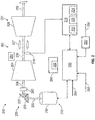
- FIG. 2 illustrates a hybrid gas turbine engine system 201 including a rotor system 202 that includes at least one compressor section 204 and at least one turbine section 208 operably coupled to a shaft 206 as part of a hybrid electric aircraft 200.
- the rotor system 202 can be a spool of the gas turbine engine 20 of FIG. 1 , such as the low speed spool 30 or the high speed spool 32.
- the at least one compressor section 204 can be equivalent to the low pressure compressor 44
- the shaft 206 can be equivalent to the inner shaft 40
- the at least one turbine section 208 can be equivalent to the low pressure turbine 46 of FIG. 1 .
- the at least one compressor section 204 can be equivalent to the high pressure compressor 52
- the shaft 206 can be equivalent to the outer shaft 50
- the at least one turbine section 208 can be equivalent to the high pressure turbine 54 of FIG. 1 .
- an electric power system 210 is operably coupled to the rotor system 202.
- the electric power system 210 includes a motor-generator 212 operably coupled to the shaft 206.
- the motor-generator 212 can be configured as an electric motor or a generator depending upon an operational mode or system configuration.
- a geared interface 230 operably couples the motor-generator 212 to the shaft 206.
- the geared interface 230 can include, for instance, an auxiliary gear 233 coupled to an auxiliary shaft 235 driven by the motor-generator 212.
- the geared interface 230 can also include a rotor gear 237 coupled to the shaft 206.
- the auxiliary gear 233 and the rotor gear 237 can each be beveled gears.
- the auxiliary shaft 235 can be a tower shaft.
- a disconnect 240 such as a clutch, can be positioned between the motor-generator 212 and a portion of the shaft 206 such that the motor-generator 212 can be selectively engaged and disengaged to rotate with rotation of the shaft 206.
- the motor-generator 212 is operably coupled to the shaft 206 absent the geared interface 230 (e.g., direct coupling).
- the electric power system 210 also includes converter electronics 214 operable to condition current to/from the motor-generator 212.
- the motor-generator 212 is configured in a generator mode to charge a battery system 250 and in a motor mode to provide supplemental rotation force to the rotor system 202 of gas turbine engine 20 of FIG. 1 .
- the motor-generator 212 can include conventional motor and generator components, such as a rotor and stator, including a plurality of windings and/or permanent magnets.
- the converter electronics 214 can also include conventional current control electronics, such as filters, switching components, rectifiers, inverters, voltage converters, and the like.
- the motor-generator 212 can perform as a variable frequency generator in a generator mode due to speed fluctuations of rotation of the shaft 206, which may be primarily driven by the at least one turbine section 208.
- a frequency normalizing component can interface with the motor-generator 212 to produce a constant frequency output (e.g., through the converter electronics 214 or as a mechanical interface between the motor-generator 212 and the shaft 206).
- the motor-generator 212 may be operable as a starter motor to partially or completely power rotation of the shaft 206 in a starting mode of operation (e.g., to start the gas turbine engine 20 of FIG. 1 ) and/or can provide supplemental power to the shaft 206 during various flight phases of the hybrid electric aircraft 200.
- Other uses and functions for the motor-generator 212 are contemplated.
- the converter electronics 214 can control charging of the battery system 250 responsive to a controller 216.
- the controller 216 can enable a flow of a charging current from the motor-generator 212 or a power input 252 to charge the battery system 250 as regulated and conditioned through the converter electronics 214.
- the power input 252 can be an external input, such as power received through a plug interface while the hybrid electric aircraft 200 is on the ground at a ground-based power source, e.g., at a gate or service location.
- the converter electronics 214 may receive electric current from an auxiliary power input 254 to provide a supplemental or alternative power source for charging the battery system 250.
- the auxiliary power input 254 may receive electric current from an auxiliary power unit (not depicted) or another instance of the gas turbine engine 20 on the hybrid electric aircraft 200.
- the charge stored in the battery system 250 can provide an electric current for a propulsion system use 256, which may include powering one or more electric motors of the hybrid electric aircraft 200 during various operational states and/or providing power to the motor-generator 212 when operating in a motor mode, for instance, to assist in driving rotation of shaft 206.
- the propulsion system use 256 can be part of the gas turbine engine 20 that includes the rotor system 202 or another aircraft system, such as another instance of the gas turbine engine 20 on the hybrid electric aircraft 200.
- the propulsion system use 256 can include powering one or more electric heaters 262, 264, for instance, during a powered warm-up state of the gas turbine engine 20.
- One or more electric heaters 262 can warm an oil tank 260 to add heat to lubricating oil, for instance, to transfer heat to other components of the gas turbine engine 20 and/or alter viscosity of the lubricating oil.
- One or more electric heaters 264 can heat a portion of the compressor section 204, such as a rear portion of the high pressure compressor 52 of FIG. 1 .
- the controller 216 of the electric power system 210 can monitor one or more rotor system sensors 218 while the rotor system 202 is rotating.
- the rotor system sensors 218 can be any type or combination of sensors operable to measure aspects of the motion of the rotor system 202.
- the rotor system sensors 218 can include one or more accelerometers, speed sensors, torque sensors, and the like.
- the rotor system sensors 218 can be existing sensors used for controlling the gas turbine engine 20.
- the controller 216 can control a charging of the battery system 250, for instance, by selecting the source of electric current received through the converter electronics 214. Data collected from the rotor system sensors 218 can be used to determine an operational status of a gas turbine engine 20 of FIG. 2 .
- the operational status of a gas turbine engine 20 can be received as a signal or message from an alternate source, such as an engine system or aircraft communication bus.
- the controller 216 may also control other system aspects, such as controlling operation of the gas turbine engine 20 of FIG. 1 .
- the controller 216 can be integrally formed or otherwise in communication with a full authority digital engine control (FADEC) of the gas turbine engine 20.
- FADEC full authority digital engine control
- the rotor system sensors 218 need not be directly coupled to the controller 216, as sensor data or sensor-derived data can be observed or determined by another control (e.g., a FADEC) and provided to the controller 216.
- the controller 216 can include a processing system 220, a memory system 222, and an input/output interface 224.
- the processing system 220 can include any type or combination of central processing unit (CPU), including one or more of: a microprocessor, a digital signal processor (DSP), a microcontroller, an application specific integrated circuit (ASIC), a field programmable gate array (FPGA), or the like.
- the memory system 222 can store data and instructions that are executed by the processing system 220.
- the memory system 222 may include random access memory (RAM), read only memory (ROM), or other electronic, optical, magnetic, or any other computer readable medium onto which is stored data and algorithms in a non-transitory form.
- the input/output interface 224 is configured to collect sensor data from the one or more rotor system sensors 218 and interface with the converter electronics 214 and/or other systems (not depicted).
- the controller 216 is operable to determine when to charge the battery system 250 and when to use the battery system 250.
- the motor-generator 212 can charge the battery system 250 while putting an increased load on the rotor system 202 of the gas turbine engine 20 to more rapidly add heat.
- charging can be halted to reduce loading on the gas turbine engine 20.
- the motor-generator 212 can transition to a motor mode during takeoff to provide supplemental rotational force to the shaft 206.
- supplemental or replacement current can be provided for battery charging or to supply other electric loads through the auxiliary power input 254. Alternate transition points and operational states to support powered warm-up state are contemplated.
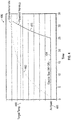
- Powered warm-up state adds heat to one or more components of the gas turbine engine 20 prior to transitioning to a takeoff power state, as depicted in the example plot 400 of FIG. 4 .
- a conventional idle state gradually increases temperature over time as a conventional idle state temperature 402 from ambient 406 through a target temperature 408 and beyond.
- the target temperature 408 indicates a desired temperature level to enhance efficiency and operational performance of the gas turbine engine 20 prior to takeoff.
- fuel flow to combustor 207 e.g., combustor 56 of FIG. 1
- heating of the gas turbine engine 20 can occur at a faster rate as a powered warm-up state temperature 405 than the conventional idle state temperature 402. After reaching the target temperature 408, the gas turbine engine 20 can transition from the powered warm-up state to a takeoff power state.
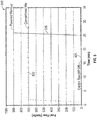
- a conventional idle fuel flow 502 may rise early and hold steady for a substantial period of time during idle.
- An electric taxiing fuel flow 504 may be at or near zero during electric taxiing until transitioning to a powered warmup state (e.g., after completion of electric taxiing) where a powered warmup fuel flow 505 rises above the conventional idle fuel flow 502.
- the total fuel consumption in the combination of electric taxiing and the powered warmup fuel flow 505 may be less than the total fuel consumption of the conventional idle fuel flow 502.
- FIG. 3 is a schematic diagram of a hybrid gas turbine engine system 301 as part of a hybrid electric aircraft 300 according to an embodiment.
- the hybrid gas turbine engine system 301 includes a first rotor system 302A and a second rotor system 302B, which may be an embodiment of the gas turbine engine 20 of FIG. 1 .
- the first rotor system 302A can be the low speed spool 30 of the gas turbine engine 20
- the second rotor system 302B can be the high speed spool 32 of the gas turbine engine 20.
- the first rotor system 302A can include a first compressor section 204A and a first turbine section 208A operably coupled to a first shaft 206A.
- the second rotor system 302B can include a second compressor section 204B and a second turbine section 208B operably coupled to a second shaft 206B, where the second shaft 206B is concentrically arranged with respect to the first shaft 206A.
- the first compressor section 204A can be equivalent to the low pressure compressor 44
- the first shaft 206A can be equivalent to the inner shaft 40
- the first turbine section 208A can be equivalent to the low pressure turbine 46 of FIG. 1
- the second compressor section 204B can be equivalent to the high pressure compressor 52
- the second shaft 206B can be equivalent to the outer shaft 50
- the second turbine section 208B can be equivalent to the high pressure turbine 54 of FIG. 1 .
- an electric power system 310 includes a motor-generator 212 operably coupled to converter electronics 214 and an electric motor 312 driven by drive electronics 314.
- a first set of one or more rotor system sensors 218A may be associated with the first rotor system 302A, and a second set of one or more rotor system sensors 218B may be associated with the second rotor system 302B.
- the converter electronics 214 can control charging of the battery system 250 and conditioning current to/from the motor-generator 212 responsive to a controller 216 that may receive sensor data from the first set of one or more rotor system sensors 218A and the second set of one or more rotor system sensors 218B.
- the controller 216 may control the electric motor 312 through the drive electronics 314 responsive to sensor data from the first set of one or more rotor system sensors 218A and/or the second set of one or more rotor system sensors 218B.
- the controller 216 is further subdivided as two or more separate controls, for instance, where a separate instance of the controller 216 is provided for each of the motor-generator 212 and the electric motor 312.
- the motor-generator 212 (when operated in a motor mode) and the electric motor 312 can be independently controlled to each supply a supplemental motive force to the respective shafts 206A, 206B, where fuel combustion in the combustor 207 can provide a primary motive force for the first rotor system 302A as the low speed spool 30 and for the second rotor system 302B as the high speed spool 32.
- the motor-generator 212 and the electric motor 312 can each be configured in either a generator mode or a motor mode.
- the motor-generator 212 can be operably coupled to the first shaft 206A using a direct coupling, while the electric motor 312 can be operably coupled to the second shaft 206B using a geared interface 330.
- a first disconnect 240A such as a clutch, can be positioned between the motor-generator 212 and a portion of the first shaft 206A, and a second disconnect 240B can be positioned between the electric motor 312 and a portion of the second shaft 206B.
- the geared interface 330 can include, for instance, a motor gear 333 coupled to a motor shaft 335 driven by the electric motor 312 and a rotor gear 337 coupled to the second shaft 206B. While the example of FIG.
- both of the motor-generator 212 and electric motor 312 can be directly or indirectly coupled to corresponding first and second shafts 206A, 206B.
- the motor-generator 212 may be indirectly coupled through a tower shaft to the first shaft 206A, while the electric motor 312 is directly coupled to the second shaft 206B.
- the coupling locations of the motor-generator 212 and electric motor 312 to the first and second shafts 206A, 206B can vary, and the coupling locations depicted in FIG. 3 are merely one example.
- the propulsion system use 256 can be to provide electrical power to the electric motor 312, power one or more electric heaters 262, 264, provide electrical power to the motor-generator 212 when operating in a motor mode, and/or other uses.
- the controller 216 may disable or provide limited current to the electric motor 312 while the battery system 250 is being charged by one or more of the motor-generator 212, the power input 252, and/or the auxiliary power input 254. Electric current produced by the motor-generator 212 above a level needed to charge the battery system 250 may be provided to other on-board uses.
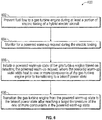
- FIG. 6 is a flow chart illustrating a method 600 for hybrid gas turbine engine system powered warm-up, in accordance with an embodiment.
- the method 600 may be performed, for example, by the systems 210, 310 of FIGS. 2 and 3 .
- the method 600 is described primarily with respect to the system 210 of FIG. 2 ; however, it will be understood that the method 600 can be performed on other configurations, such as the system 310 of FIG. 3 as well as other configurations (not depicted).
- the controller 216 can prevent fuel flow to the combustor 56 of the gas turbine engine 20 during at least a portion of electric taxiing of the hybrid electric aircraft 200, 300.
- the controller 216 can monitor for a powered warm-up request during the electric taxiing.
- a powered warm-up state request can be received as a message, for instance, a pilot initiated command.
- the controller 216 can initiate a powered warm-up state of the gas turbine engine 20 based on detecting the powered warm-up request, where the powered warm-up state adds heat to one or more components of the gas turbine engine 20 prior to transitioning to a takeoff power state.
- Adding of heat is not limited to the use of electric heaters 262, 264 but can include any means of adding heat to one or more components of the gas turbine engine 20, such as starting combustion and operating the gas turbine engine 20 above a nominal idle fuel flow rate after electric taxiing, for example.
- the controller 216 can transition the gas turbine engine 20 from the powered warm-up state to the takeoff power state after reaching a target temperature 408 of the one or more components in the powered warm-up state.
- Engine spool rotational speed, throttle commands, and other inputs received at the controller 216 can be used to determine the operational status of the gas turbine engine 20.
- An electric motor such as motor-generator 212 or electric motor 312, can be used to drive rotation of the gas turbine engine 20 as part of electric taxiing.
- electric taxiing can include the use of an electric motor to push, pull, or drive ground wheel rotation of the hybrid electric aircraft 200, 300 while on the ground.
- the powered warm-up state can include enabling one or more electric heaters 262, 264.
- the high speed spool 32 can be motored in reverse to urge heat in a reverse flow direction as compared to normal engine operation.
- the powered warm-up state can include motoring the high speed spool 32 with a sub-idle fuel flow.
- the gas turbine engine 20 can be operated with a higher engine power setting above idle to drive rotation of a motor-generator 212 operably coupled to the low speed spool 30 and produce idle thrust after the electric taxiing.
- the controller 216 can command a combination of vane positions and power setting of the gas turbine engine 20 that reduces a compressor efficiency of the gas turbine engine 20 to increase temperature at or below idle thrust.
Landscapes
- Engineering & Computer Science (AREA)
- Chemical & Material Sciences (AREA)
- Combustion & Propulsion (AREA)
- Mechanical Engineering (AREA)
- General Engineering & Computer Science (AREA)
- Aviation & Aerospace Engineering (AREA)
- Physics & Mathematics (AREA)
- Fluid Mechanics (AREA)
- Engine Equipment That Uses Special Cycles (AREA)
- Control Of Turbines (AREA)
Abstract
Description
- The subject matter disclosed herein generally relates to engine systems and, more particularly, to a method and apparatus for hybrid gas turbine engine system powered warm-up.
- Conventional gas turbine engines are typically operated at an idle power level during taxiing from a gate to a runway and can remain at idle power for a substantial period of time before takeoff, which consumes a quantity of fuel prior to flight. Hybrid electric aircraft use electricity to provide a portion of the power needed for aircraft propulsion by converting electricity into a propulsive force. A hybrid electric aircraft can use an electric drive to support taxiing operations on a runway and prevent fuel burn typical of conventional gas turbine engine idling.
- According to one embodiment, a hybrid gas turbine engine system of a hybrid electric aircraft is provided. The hybrid gas turbine engine system includes a gas turbine engine, an electric motor operable to perform an electric taxiing of the hybrid electric aircraft, and a controller. The controller is operable to prevent fuel flow to the gas turbine engine during at least a portion of the electric taxiing and monitor for a powered warm-up request during the electric taxiing. A powered warm-up state of the gas turbine engine is initiated based on detecting the powered warm-up request. The powered warm-up state adds heat to one or more components of the gas turbine engine prior to transitioning to a takeoff power state. The gas turbine engine transitions from the powered warm-up state to the takeoff power state after reaching a target temperature of the one or more components in the powered warm-up state.
- In addition to one or more of the features described above or below, or as an alternative, further embodiments may include where the powered warm-up state includes enabling one or more electric heaters.
- In addition to one or more of the features described above or below, or as an alternative, further embodiments may include where the gas turbine engine includes a low speed spool and a high speed spool.
- In addition to one or more of the features described above or below, or as an alternative, further embodiments may include where the high speed spool is motored in reverse to urge heat in a reverse flow direction in the powered warm-up state.
- In addition to one or more of the features described above or below, or as an alternative, further embodiments may include where the high speed spool is motored with a sub-idle fuel flow in the powered warm-up state.
- In addition to one or more of the features described above or below, or as an alternative, further embodiments may include a generator operably coupled to the low speed spool of the gas turbine engine, and the gas turbine engine can be operated with a higher engine power setting above idle to drive rotation of the generator and produce idle thrust during after the electric taxiing.
- In addition to one or more of the features described above or below, or as an alternative, further embodiments may include where the generator is a motor-generator operable in a generator mode to charge a battery system and in a motor mode to provide supplemental rotation force to the gas turbine engine.
- In addition to one or more of the features described above or below, or as an alternative, further embodiments may include where the generator provides power for motoring the high speed spool and/or charging a battery system.
- In addition to one or more of the features described above or below, or as an alternative, further embodiments may include where a combination of vane positions and power setting of the gas turbine engine reduces a compressor efficiency of the gas turbine engine to increase temperature at or below idle thrust in the powered warm-up state.
- According to another embodiment, a propulsion system for a hybrid electric aircraft includes a gas turbine engine with a low speed spool, a high speed spool, and a combustor. The propulsion system also includes an electric motor operably coupled to the high speed spool and a controller. The controller is operable to prevent fuel flow to the combustor of the gas turbine engine during at least a portion of an electric taxiing of the hybrid electric aircraft and monitor for a powered warm-up request during the electric taxiing. A powered warm-up state of the gas turbine engine is initiated based on detecting the powered warm-up request. The powered warm-up state adds heat to one or more components of the gas turbine engine prior to transitioning to a takeoff power state. The gas turbine engine transitions from the powered warm-up state to the takeoff power state after reaching a target temperature of the one or more components in the powered warm-up state.
- According to another embodiment, a method of providing a powered warm-up for a gas turbine engine of a hybrid electric aircraft includes preventing fuel flow to the gas turbine engine during at least a portion of an electric taxiing of the hybrid electric aircraft and monitoring for a powered warm-up request during the electric taxiing. A powered warm-up state of the gas turbine engine is initiated based on detecting the powered warm-up request. The powered warm-up state adds heat to one or more components of the gas turbine engine prior to transitioning to a takeoff power state. The gas turbine engine transitions from the powered warm-up state to the takeoff power state after reaching a target temperature of the one or more components in the powered warm-up state.
- A technical effect of the apparatus, systems and methods is achieved by providing a powered warm-up state for a hybrid gas turbine engine system during electric taxiing as described herein.
- The following descriptions should not be considered limiting in any way. With reference to the accompanying drawings, like elements are numbered alike:
-
FIG. 1 is a partial cross-sectional illustration of a gas turbine engine, in accordance with an embodiment of the disclosure; -
FIG. 2 is a schematic diagram of a hybrid gas turbine engine system, in accordance with an embodiment of the disclosure; -
FIG. 3 is a schematic diagram of a hybrid gas turbine engine system, in accordance with an embodiment of the disclosure; -
FIG. 4 is a temperature plot, in accordance with an embodiment of the disclosure; -
FIG. 5 is a fuel flow plot, in accordance with an embodiment of the disclosure; and -
FIG. 6 is a flow chart illustrating a method, in accordance with an embodiment of the disclosure. - A detailed description of one or more embodiments of the disclosed apparatus and method are presented herein by way of exemplification and not limitation with reference to the Figures.
-
FIG. 1 schematically illustrates agas turbine engine 20. Thegas turbine engine 20 is disclosed herein as a two-spool turbofan that generally incorporates afan section 22, acompressor section 24, acombustor section 26 and aturbine section 28. Thefan section 22 drives air along a bypass flow path B in a bypass duct, while thecompressor section 24 drives air along a core flow path C for compression and communication into thecombustor section 26 then expansion through theturbine section 28. Although depicted as a two-spool turbofan gas turbine engine in the disclosed non-limiting embodiment, it should be understood that the concepts described herein are not limited to use with two-spool turbofans as the teachings may be applied to other types of turbine engines including three-snool architectures. - The
exemplary engine 20 generally includes alow speed spool 30 and ahigh speed spool 32 mounted for rotation about an engine central longitudinal axis A relative to an enginestatic structure 36 viaseveral bearing systems 38. It should be understood thatvarious bearing systems 38 at various locations may alternatively or additionally be provided, and the location ofbearing systems 38 may be varied as appropriate to the application. - The
low speed spool 30 generally includes aninner shaft 40 that interconnects afan 42, a low pressure compressor 44 and alow pressure turbine 46. Theinner shaft 40 is connected to thefan 42 through a speed change mechanism, which in exemplarygas turbine engine 20 is illustrated as a gearedarchitecture 48 to drive thefan 42 at a lower speed than thelow speed spool 30. Thehigh speed spool 32 includes anouter shaft 50 that interconnects ahigh pressure compressor 52 andhigh pressure turbine 54. Acombustor 56 is arranged inexemplary gas turbine 20 between thehigh pressure compressor 52 and thehigh pressure turbine 54. An enginestatic structure 36 is arranged generally between thehigh pressure turbine 54 and thelow pressure turbine 46. The enginestatic structure 36 further supports bearingsystems 38 in theturbine section 28. Theinner shaft 40 and theouter shaft 50 are concentric and rotate viabearing systems 38 about the engine central longitudinal axis A which is collinear with their longitudinal axes. - The core airflow is compressed by the low pressure compressor 44 then the
high pressure compressor 52, mixed and burned with fuel in thecombustor 56, then expanded over thehigh pressure turbine 54 andlow pressure turbine 46. Theturbines low speed spool 30 andhigh speed spool 32 in response to the expansion. It will be appreciated that each of the positions of thefan section 22,compressor section 24,combustor section 26,turbine section 28, and fandrive gear system 48 may be varied. For example,gear system 48 may be located aft ofcombustor section 26 or even aft ofturbine section 28, andfan section 22 may be positioned forward or aft of the location ofgear system 48. - The
engine 20 in one example is a high-bypass geared aircraft engine. In a further example, theengine 20 bypass ratio is greater than about six (6), with an example embodiment being greater than about ten (10), the gearedarchitecture 48 is an epicyclic gear train, such as a planetary gear system or other gear system, with a gear reduction ratio of greater than about 2.3 and thelow pressure turbine 46 has a pressure ratio that is greater than about five. In one disclosed embodiment, theengine 20 bypass ratio is greater than about ten (10:1), the fan diameter is significantly larger than that of the low pressure compressor 44, and thelow pressure turbine 46 has a pressure ratio that is greater than about five 5:1.Low pressure turbine 46 pressure ratio is pressure measured prior to inlet oflow pressure turbine 46 as related to the pressure at the outlet of thelow pressure turbine 46 prior to an exhaust nozzle. The gearedarchitecture 48 may be an epicycle gear train, such as a planetary gear system or other gear system, with a gear reduction ratio of greater than about 2.3:1. It should be understood, however, that the above parameters are only exemplary of one embodiment of a geared architecture engine and that the present disclosure is applicable to other gas turbine engines including direct drive turbofans. - A significant amount of thrust is provided by the bypass flow B due to the high bypass ratio. The
fan section 22 of theengine 20 is designed for a particular flight condition--typically cruise at about 0.8 Mach and about 35,000 feet (10,668 meters). The flight condition of 0.8 Mach and 35,000 ft (10,668 meters), with the engine at its best fuel consumption--also known as "bucket cruise Thrust Specific Fuel Consumption ('TSFC')"--is the industry standard parameter of lbm of fuel being burned divided by lbf of thrust the engine produces at that minimum point. "Low fan pressure ratio" is the pressure ratio across the fan blade alone, without a Fan Exit Guide Vane ("FEGV") system. The low fan pressure ratio as disclosed herein according to one non-limiting embodiment is less than about 1.45. "Low corrected fan tip speed" is the actual fan tip speed in ft/sec divided by an industry standard temperature correction of [(Tram °R)/(518.7 °R)]0.5. The "Low corrected fan tip speed" as disclosed herein according to one non-limiting embodiment is less than about 1150 ft/second (350.5 m/sec). - While the example of
FIG. 1 illustrates one example of thegas turbine engine 20, it will be understood that any number of spools, inclusion or omission of thegear system 48, and/or other elements and subsystems are contemplated. Further, rotor systems described herein can be used in a variety of applications and need not be limited to gas turbine engines for aircraft applications. For example, rotor systems can be included in power generation systems, which may be ground-based as a fixed position or mobile system, and other such applications. -
FIG. 2 illustrates a hybrid gasturbine engine system 201 including arotor system 202 that includes at least onecompressor section 204 and at least oneturbine section 208 operably coupled to ashaft 206 as part of a hybridelectric aircraft 200. Therotor system 202 can be a spool of thegas turbine engine 20 ofFIG. 1 , such as thelow speed spool 30 or thehigh speed spool 32. For example, when embodied as thelow speed spool 30, the at least onecompressor section 204 can be equivalent to the low pressure compressor 44, theshaft 206 can be equivalent to theinner shaft 40, and the at least oneturbine section 208 can be equivalent to thelow pressure turbine 46 ofFIG. 1 . When embodied as thehigh speed spool 32, the at least onecompressor section 204 can be equivalent to thehigh pressure compressor 52, theshaft 206 can be equivalent to theouter shaft 50, and the at least oneturbine section 208 can be equivalent to thehigh pressure turbine 54 ofFIG. 1 . - In the example of
FIG. 2 , anelectric power system 210 is operably coupled to therotor system 202. Theelectric power system 210 includes a motor-generator 212 operably coupled to theshaft 206. The motor-generator 212 can be configured as an electric motor or a generator depending upon an operational mode or system configuration. In the example ofFIG. 2 , a gearedinterface 230 operably couples the motor-generator 212 to theshaft 206. The gearedinterface 230 can include, for instance, anauxiliary gear 233 coupled to anauxiliary shaft 235 driven by the motor-generator 212. The gearedinterface 230 can also include arotor gear 237 coupled to theshaft 206. Theauxiliary gear 233 and therotor gear 237 can each be beveled gears. Theauxiliary shaft 235 can be a tower shaft. Adisconnect 240, such as a clutch, can be positioned between the motor-generator 212 and a portion of theshaft 206 such that the motor-generator 212 can be selectively engaged and disengaged to rotate with rotation of theshaft 206. In alternate embodiments, the motor-generator 212 is operably coupled to theshaft 206 absent the geared interface 230 (e.g., direct coupling). - The
electric power system 210 also includesconverter electronics 214 operable to condition current to/from the motor-generator 212. In some embodiments, the motor-generator 212 is configured in a generator mode to charge abattery system 250 and in a motor mode to provide supplemental rotation force to therotor system 202 ofgas turbine engine 20 ofFIG. 1 . The motor-generator 212 can include conventional motor and generator components, such as a rotor and stator, including a plurality of windings and/or permanent magnets. Theconverter electronics 214 can also include conventional current control electronics, such as filters, switching components, rectifiers, inverters, voltage converters, and the like. The motor-generator 212 can perform as a variable frequency generator in a generator mode due to speed fluctuations of rotation of theshaft 206, which may be primarily driven by the at least oneturbine section 208. Alternatively, a frequency normalizing component can interface with the motor-generator 212 to produce a constant frequency output (e.g., through theconverter electronics 214 or as a mechanical interface between the motor-generator 212 and the shaft 206). In some embodiments, the motor-generator 212 may be operable as a starter motor to partially or completely power rotation of theshaft 206 in a starting mode of operation (e.g., to start thegas turbine engine 20 ofFIG. 1 ) and/or can provide supplemental power to theshaft 206 during various flight phases of the hybridelectric aircraft 200. Other uses and functions for the motor-generator 212 are contemplated. - The
converter electronics 214 can control charging of thebattery system 250 responsive to acontroller 216. Thecontroller 216 can enable a flow of a charging current from the motor-generator 212 or apower input 252 to charge thebattery system 250 as regulated and conditioned through theconverter electronics 214. Thepower input 252 can be an external input, such as power received through a plug interface while the hybridelectric aircraft 200 is on the ground at a ground-based power source, e.g., at a gate or service location. In some embodiments, theconverter electronics 214 may receive electric current from anauxiliary power input 254 to provide a supplemental or alternative power source for charging thebattery system 250. For instance, theauxiliary power input 254 may receive electric current from an auxiliary power unit (not depicted) or another instance of thegas turbine engine 20 on the hybridelectric aircraft 200. The charge stored in thebattery system 250 can provide an electric current for apropulsion system use 256, which may include powering one or more electric motors of the hybridelectric aircraft 200 during various operational states and/or providing power to the motor-generator 212 when operating in a motor mode, for instance, to assist in driving rotation ofshaft 206. Thepropulsion system use 256 can be part of thegas turbine engine 20 that includes therotor system 202 or another aircraft system, such as another instance of thegas turbine engine 20 on the hybridelectric aircraft 200. Further, thepropulsion system use 256 can include powering one or moreelectric heaters gas turbine engine 20. One or moreelectric heaters 262 can warm anoil tank 260 to add heat to lubricating oil, for instance, to transfer heat to other components of thegas turbine engine 20 and/or alter viscosity of the lubricating oil. One or moreelectric heaters 264 can heat a portion of thecompressor section 204, such as a rear portion of thehigh pressure compressor 52 ofFIG. 1 . - In embodiments, the
controller 216 of theelectric power system 210 can monitor one or morerotor system sensors 218 while therotor system 202 is rotating. Therotor system sensors 218 can be any type or combination of sensors operable to measure aspects of the motion of therotor system 202. For example, therotor system sensors 218 can include one or more accelerometers, speed sensors, torque sensors, and the like. Therotor system sensors 218 can be existing sensors used for controlling thegas turbine engine 20. Thecontroller 216 can control a charging of thebattery system 250, for instance, by selecting the source of electric current received through theconverter electronics 214. Data collected from therotor system sensors 218 can be used to determine an operational status of agas turbine engine 20 ofFIG. 2 . Alternatively, the operational status of agas turbine engine 20 can be received as a signal or message from an alternate source, such as an engine system or aircraft communication bus. Thecontroller 216 may also control other system aspects, such as controlling operation of thegas turbine engine 20 ofFIG. 1 . For example, thecontroller 216 can be integrally formed or otherwise in communication with a full authority digital engine control (FADEC) of thegas turbine engine 20. Therotor system sensors 218 need not be directly coupled to thecontroller 216, as sensor data or sensor-derived data can be observed or determined by another control (e.g., a FADEC) and provided to thecontroller 216. In embodiments, thecontroller 216 can include aprocessing system 220, amemory system 222, and an input/output interface 224. Theprocessing system 220 can include any type or combination of central processing unit (CPU), including one or more of: a microprocessor, a digital signal processor (DSP), a microcontroller, an application specific integrated circuit (ASIC), a field programmable gate array (FPGA), or the like. Thememory system 222 can store data and instructions that are executed by theprocessing system 220. In embodiments, thememory system 222 may include random access memory (RAM), read only memory (ROM), or other electronic, optical, magnetic, or any other computer readable medium onto which is stored data and algorithms in a non-transitory form. The input/output interface 224 is configured to collect sensor data from the one or morerotor system sensors 218 and interface with theconverter electronics 214 and/or other systems (not depicted). - The
controller 216 is operable to determine when to charge thebattery system 250 and when to use thebattery system 250. During powered warm-up state, the motor-generator 212 can charge thebattery system 250 while putting an increased load on therotor system 202 of thegas turbine engine 20 to more rapidly add heat. Upon transitioning to the takeoff power state, charging can be halted to reduce loading on thegas turbine engine 20. In some embodiments, the motor-generator 212 can transition to a motor mode during takeoff to provide supplemental rotational force to theshaft 206. Further, supplemental or replacement current can be provided for battery charging or to supply other electric loads through theauxiliary power input 254. Alternate transition points and operational states to support powered warm-up state are contemplated. Powered warm-up state adds heat to one or more components of thegas turbine engine 20 prior to transitioning to a takeoff power state, as depicted in theexample plot 400 ofFIG. 4 . - As illustrated in
FIG. 4 , a conventional idle state gradually increases temperature over time as a conventionalidle state temperature 402 from ambient 406 through atarget temperature 408 and beyond. Thetarget temperature 408 indicates a desired temperature level to enhance efficiency and operational performance of thegas turbine engine 20 prior to takeoff. In embodiments, while electric taxiing is performed at an electrictaxing temperature 404, fuel flow to combustor 207 (e.g., combustor 56 ofFIG. 1 ) may be blocked/prevented, keeping thegas turbine engine 20 at or near ambient 406. Upon initiation of a powered warm-up state (e.g., based on detecting a powered warm-up request), heating of thegas turbine engine 20 can occur at a faster rate as a powered warm-upstate temperature 405 than the conventionalidle state temperature 402. After reaching thetarget temperature 408, thegas turbine engine 20 can transition from the powered warm-up state to a takeoff power state. - There can also be differences in fuel flow between a conventional idle state and a powered warm-up state. For example, as depicted in the
example plot 500 ofFIG. 5 , a conventionalidle fuel flow 502 may rise early and hold steady for a substantial period of time during idle. An electrictaxiing fuel flow 504 may be at or near zero during electric taxiing until transitioning to a powered warmup state (e.g., after completion of electric taxiing) where a poweredwarmup fuel flow 505 rises above the conventionalidle fuel flow 502. However, the total fuel consumption in the combination of electric taxiing and the poweredwarmup fuel flow 505 may be less than the total fuel consumption of the conventionalidle fuel flow 502. -
FIG. 3 is a schematic diagram of a hybrid gasturbine engine system 301 as part of a hybridelectric aircraft 300 according to an embodiment. The hybrid gasturbine engine system 301 includes afirst rotor system 302A and asecond rotor system 302B, which may be an embodiment of thegas turbine engine 20 ofFIG. 1 . For instance, thefirst rotor system 302A can be thelow speed spool 30 of thegas turbine engine 20, and thesecond rotor system 302B can be thehigh speed spool 32 of thegas turbine engine 20. Thefirst rotor system 302A can include afirst compressor section 204A and afirst turbine section 208A operably coupled to afirst shaft 206A. Thesecond rotor system 302B can include asecond compressor section 204B and asecond turbine section 208B operably coupled to asecond shaft 206B, where thesecond shaft 206B is concentrically arranged with respect to thefirst shaft 206A. With respect to thegas turbine engine 20 ofFIG. 1 , thefirst compressor section 204A can be equivalent to the low pressure compressor 44, thefirst shaft 206A can be equivalent to theinner shaft 40, and thefirst turbine section 208A can be equivalent to thelow pressure turbine 46 ofFIG. 1 . Similarly, thesecond compressor section 204B can be equivalent to thehigh pressure compressor 52, thesecond shaft 206B can be equivalent to theouter shaft 50, and thesecond turbine section 208B can be equivalent to thehigh pressure turbine 54 ofFIG. 1 . - In the example of
FIG. 3 , anelectric power system 310 includes a motor-generator 212 operably coupled toconverter electronics 214 and anelectric motor 312 driven bydrive electronics 314. A first set of one or morerotor system sensors 218A may be associated with thefirst rotor system 302A, and a second set of one or morerotor system sensors 218B may be associated with thesecond rotor system 302B. Theconverter electronics 214 can control charging of thebattery system 250 and conditioning current to/from the motor-generator 212 responsive to acontroller 216 that may receive sensor data from the first set of one or morerotor system sensors 218A and the second set of one or morerotor system sensors 218B. Thecontroller 216 may control theelectric motor 312 through thedrive electronics 314 responsive to sensor data from the first set of one or morerotor system sensors 218A and/or the second set of one or morerotor system sensors 218B. In other embodiments, thecontroller 216 is further subdivided as two or more separate controls, for instance, where a separate instance of thecontroller 216 is provided for each of the motor-generator 212 and theelectric motor 312. The motor-generator 212 (when operated in a motor mode) and theelectric motor 312 can be independently controlled to each supply a supplemental motive force to therespective shafts combustor 207 can provide a primary motive force for thefirst rotor system 302A as thelow speed spool 30 and for thesecond rotor system 302B as thehigh speed spool 32. In some embodiments, the motor-generator 212 and theelectric motor 312 can each be configured in either a generator mode or a motor mode. - The motor-
generator 212 can be operably coupled to thefirst shaft 206A using a direct coupling, while theelectric motor 312 can be operably coupled to thesecond shaft 206B using a gearedinterface 330. Afirst disconnect 240A, such as a clutch, can be positioned between the motor-generator 212 and a portion of thefirst shaft 206A, and asecond disconnect 240B can be positioned between theelectric motor 312 and a portion of thesecond shaft 206B. The gearedinterface 330 can include, for instance, amotor gear 333 coupled to amotor shaft 335 driven by theelectric motor 312 and arotor gear 337 coupled to thesecond shaft 206B. While the example ofFIG. 3 depicts theelectric power system 310 with the motor-generator 212 andelectric motor 312 in different coupling configurations, it will be understood that both of the motor-generator 212 andelectric motor 312 can be directly or indirectly coupled to corresponding first andsecond shafts generator 212 may be indirectly coupled through a tower shaft to thefirst shaft 206A, while theelectric motor 312 is directly coupled to thesecond shaft 206B. Further, the coupling locations of the motor-generator 212 andelectric motor 312 to the first andsecond shafts FIG. 3 are merely one example. - In the example of
FIG. 3 , thepropulsion system use 256 can be to provide electrical power to theelectric motor 312, power one or moreelectric heaters generator 212 when operating in a motor mode, and/or other uses. In embodiments, thecontroller 216 may disable or provide limited current to theelectric motor 312 while thebattery system 250 is being charged by one or more of the motor-generator 212, thepower input 252, and/or theauxiliary power input 254. Electric current produced by the motor-generator 212 above a level needed to charge thebattery system 250 may be provided to other on-board uses. - Referring now to
FIG. 6 with continued reference toFIGS. 1-5 ,FIG. 6 is a flow chart illustrating amethod 600 for hybrid gas turbine engine system powered warm-up, in accordance with an embodiment. Themethod 600 may be performed, for example, by thesystems FIGS. 2 and3 . For purposes of explanation, themethod 600 is described primarily with respect to thesystem 210 ofFIG. 2 ; however, it will be understood that themethod 600 can be performed on other configurations, such as thesystem 310 ofFIG. 3 as well as other configurations (not depicted). - At
block 602, thecontroller 216 can prevent fuel flow to thecombustor 56 of thegas turbine engine 20 during at least a portion of electric taxiing of the hybridelectric aircraft block 604, thecontroller 216 can monitor for a powered warm-up request during the electric taxiing. A powered warm-up state request can be received as a message, for instance, a pilot initiated command. Atblock 606, thecontroller 216 can initiate a powered warm-up state of thegas turbine engine 20 based on detecting the powered warm-up request, where the powered warm-up state adds heat to one or more components of thegas turbine engine 20 prior to transitioning to a takeoff power state. Adding of heat is not limited to the use ofelectric heaters gas turbine engine 20, such as starting combustion and operating thegas turbine engine 20 above a nominal idle fuel flow rate after electric taxiing, for example. Atblock 608, thecontroller 216 can transition thegas turbine engine 20 from the powered warm-up state to the takeoff power state after reaching atarget temperature 408 of the one or more components in the powered warm-up state. Engine spool rotational speed, throttle commands, and other inputs received at thecontroller 216 can be used to determine the operational status of thegas turbine engine 20. - An electric motor, such as motor-
generator 212 orelectric motor 312, can be used to drive rotation of thegas turbine engine 20 as part of electric taxiing. Alternatively, electric taxiing can include the use of an electric motor to push, pull, or drive ground wheel rotation of the hybridelectric aircraft - In embodiments, the powered warm-up state can include enabling one or more
electric heaters high speed spool 32 can be motored in reverse to urge heat in a reverse flow direction as compared to normal engine operation. The powered warm-up state can include motoring thehigh speed spool 32 with a sub-idle fuel flow. Further, thegas turbine engine 20 can be operated with a higher engine power setting above idle to drive rotation of a motor-generator 212 operably coupled to thelow speed spool 30 and produce idle thrust after the electric taxiing. As a further option for powered warm-up state, thecontroller 216 can command a combination of vane positions and power setting of thegas turbine engine 20 that reduces a compressor efficiency of thegas turbine engine 20 to increase temperature at or below idle thrust. - While the above description has described the flow process of
FIG. 6 in a particular order, it should be appreciated that unless otherwise specifically required in the attached claims that the ordering of the steps may be varied. - The term "about" is intended to include the degree of error associated with measurement of the particular quantity based upon the equipment available at the time of filing the application.
- The terminology used herein is for the purpose of describing particular embodiments only and is not intended to be limiting of the present disclosure. As used herein, the singular forms "a", "an" and "the" are intended to include the plural forms as well, unless the context clearly indicates otherwise. It will be further understood that the terms "comprises" and/or "comprising," when used in this specification, specify the presence of stated features, integers, steps, operations, elements, and/or components, but do not preclude the presence or addition of one or more other features, integers, steps, operations, element components, and/or groups thereof.
- While the present disclosure has been described with reference to an exemplary embodiment or embodiments, it will be understood by those skilled in the art that various changes may be made and equivalents may be substituted for elements thereof without departing from the scope of the present disclosure. In addition, many modifications may be made to adapt a particular situation or material to the teachings of the present disclosure without departing from the essential scope thereof. Therefore, it is intended that the present disclosure not be limited to the particular embodiment disclosed as the best mode contemplated for carrying out this present disclosure, but that the present disclosure will include all embodiments falling within the scope of the claims.
- The following clauses set out features of the invention which may or may not presently be claimed in this application, but which may form the basis for future amendment or a divisional application.
- 1. A hybrid gas turbine engine system of a hybrid electric aircraft, the hybrid gas turbine engine system comprising:
- a gas turbine engine;
- an electric motor operable to perform an electric taxiing of the hybrid electric aircraft; and
- a controller operable to:
- prevent fuel flow to the gas turbine engine during at least a portion of the electric taxiing;
- monitor for a powered warm-up request during the electric taxiing;
- initiate a powered warm-up state of the gas turbine engine based on detecting the powered warm-up request, wherein the powered warm-up state adds heat to one or more components of the gas turbine engine prior to transitioning to a takeoff power state; and
- transition the gas turbine engine from the powered warm-up state to the takeoff power state after reaching a target temperature of the one or more components in the powered warm-up state.
- 2. The hybrid gas turbine engine system of clause 1, wherein the powered warm-up state comprises enabling one or more electric heaters.
- 3. The hybrid gas turbine engine system of clause 1, wherein the gas turbine engine comprises a low speed spool and a high speed spool.
- 4. The hybrid gas turbine engine system of clause 3, wherein the high speed spool is motored in reverse to urge heat in a reverse flow direction in the powered warm-up state.
- 5. The hybrid gas turbine engine system of clause 3, wherein the high speed spool is motored with a sub-idle fuel flow in the powered warm-up state.
- 6. The hybrid gas turbine engine system of clause 3, further comprising:
a generator operably coupled to the low speed spool of the gas turbine engine, and the gas turbine engine is operated with a higher engine power setting above idle to drive rotation of the generator and produce idle thrust after the electric taxiing. - 7. The hybrid gas turbine engine system of clause 6, wherein the generator is a motor-generator operable in a generator mode to charge a battery system and in a motor mode to provide supplemental rotation force to the gas turbine engine.
- 8. The hybrid gas turbine engine system of clause 6, wherein the generator provides power for motoring the high speed spool and/or charging a battery system.
- 9. The hybrid gas turbine engine system of clause 1, wherein a combination of vane positions and power setting of the gas turbine engine reduces a compressor efficiency of the gas turbine engine to increase temperature at or below idle thrust in the powered warm-up state.
- 10. A propulsion system for a hybrid electric aircraft, the propulsion system comprising:
- a gas turbine engine comprising a low speed spool, a high speed spool, and a combustor;
- an electric motor operably coupled to the high speed spool; and
- a controller operable to:
- prevent fuel flow to the combustor of the gas turbine engine during at least a portion of an electric taxiing of the hybrid electric aircraft;
- monitor for a powered warm-up request during the electric taxiing;
- initiate a powered warm-up state of the gas turbine engine based on detecting the powered warm-up request, wherein the powered warm-up state adds heat to one or more components of the gas turbine engine prior to transitioning to a takeoff power state; and
- transition the gas turbine engine from the powered warm-up state to the takeoff power state after reaching a target temperature of the one or more components in the powered warm-up state.
- 11. The propulsion system of
clause 10, wherein the powered warm-up state comprises enabling one or more electric heaters. - 12. The propulsion system of
clause 10, wherein the high speed spool is motored in reverse to urge heat in a reverse flow direction in the powered warm-up state. - 13. The propulsion system of
clause 10, further comprising:
a generator operably coupled to the low speed spool of the gas turbine engine, and the gas turbine engine is operated with a higher engine power setting above idle to drive rotation of the generator and produce idle thrust after the electric taxiing, wherein the generator is a motor-generator operable in a generator mode to charge a battery system and/or provide power for motoring the high speed spool, and the generator is operable in a motor mode to provide supplemental rotation force to the gas turbine engine. - 14. The propulsion system of
clause 10, wherein a combination of vane positions and power setting of the gas turbine engine reduces a compressor efficiency of the gas turbine engine to increase temperature at or below idle thrust in the powered warm-up state. - 15. A method of providing a powered warm-up for a gas turbine engine of a hybrid electric aircraft, the method comprising:
- preventing fuel flow to the gas turbine engine during at least a portion of an electric taxiing of the hybrid electric aircraft;
- monitoring for a powered warm-up request during the electric taxiing;
- initiating a powered warm-up state of the gas turbine engine based on detecting the powered warm-up request, wherein the powered warm-up state adds heat to one or more components of the gas turbine engine prior to transitioning to a takeoff power state; and
- transitioning the gas turbine engine from the powered warm-up state to the takeoff power state after reaching a target temperature of the one or more components in the powered warm-up state.
- 16. The method of
clause 15, wherein the powered warm-up state comprises enabling one or more electric heaters. - 17. The method of
clause 15, wherein the gas turbine engine comprises a low speed spool and a high speed spool, and further comprising:
motoring the high speed spool in reverse to urge heat in a reverse flow direction in the powered warm-up state. - 18. The method of
clause 15, wherein the gas turbine engine comprises a low speed spool and a high speed spool, and further comprising:
motoring the high speed spool with a sub-idle fuel flow in the powered warm-up state. - 19. The method of
clause 15, wherein the gas turbine engine comprises a low speed spool and a high speed spool, and further comprising:
operating the gas turbine engine with a higher engine power setting above idle to drive rotation of a generator operably coupled to the low speed spool and produce idle thrust after the electric taxiing, wherein the generator is a motor-generator operable in a generator mode to charge a battery system and/or provide power for motoring the high speed spool, and the generator is operable in a motor mode to provide supplemental rotation force to the gas turbine engine. - 20. The method of
clause 15, further comprising:
commanding a combination of vane positions and power setting of the gas turbine engine that reduces a compressor efficiency of the gas turbine engine to increase temperature at or below idle thrust in the powered warm-up state.
Claims (15)
- A hybrid gas turbine engine system (201; 301) of a hybrid electric aircraft (200; 300), the hybrid gas turbine engine system comprising:a gas turbine engine (20);an electric motor (312) operable to perform an electric taxiing of the hybrid electric aircraft; anda controller (216) operable to:prevent fuel flow to the gas turbine engine (20) during at least a portion of the electric taxiing;monitor for a powered warm-up request during the electric taxiing;initiate a powered warm-up state (405) of the gas turbine engine (20) based on detecting the powered warm-up request, wherein the powered warm-up state adds heat to one or more components of the gas turbine engine prior to transitioning to a takeoff power state; andtransition the gas turbine engine (20) from the powered warm-up state to the takeoff power state after reaching a target temperature (408) of the one or more components in the powered warm-up state.
- The hybrid gas turbine engine system of claim 1, wherein the powered warm-up state (405) comprises enabling one or more electric heaters (262, 264).
- The hybrid gas turbine engine system of claim 1 or 2, wherein the gas turbine engine (20) comprises a low speed spool (30) and a high speed spool (32).
- The hybrid gas turbine engine system of claim 3, wherein the high speed spool (32) is motored in reverse to urge heat in a reverse flow direction in the powered warm-up state (405).
- The hybrid gas turbine engine system of claim 3, wherein the high speed spool (32) is motored with a sub-idle fuel flow in the powered warm-up state (405).
- The hybrid gas turbine engine system of claim 3, further comprising:
a generator (212) operably coupled to the low speed spool (30) of the gas turbine engine (20), and the gas turbine engine (20) is operated with a higher engine power setting above idle to drive rotation of the generator (212) and produce idle thrust after the electric taxiing. - The hybrid gas turbine engine system of claim 6, wherein the generator (212) is a motor-generator operable in a generator mode to charge a battery system
(250) and in a motor mode to provide supplemental rotation force to the gas turbine engine (20); and/or wherein the generator (212) provides power for motoring the high speed spool (32) and/or charging a battery system (250). - The hybrid gas turbine engine system of any preceding claim, wherein a combination of vane positions and power setting of the gas turbine engine (20) reduces a compressor efficiency of the gas turbine engine to increase temperature at or below idle thrust in the powered warm-up state (405).
- A propulsion system for a hybrid electric aircraft (200; 300), the propulsion system comprising:a hybrid gas turbine engine system (201; 301) of any preceding claim, the gas turbine engine (20) comprising a low speed spool (30), a high speed spool (32), and a combustor (56; 207);the electric motor (312) being operably coupled to the high speed spool; andthe controller (216) being operable to prevent fuel flow to the combustor (56; 207) of the gas turbine engine during at least a portion of an electric taxiing of the hybrid electric aircraft.
- A method of providing a powered warm-up for a gas turbine engine (20) of a hybrid electric aircraft (200; 300), the method comprising:preventing (602) fuel flow to the gas turbine engine during at least a portion of an electric taxiing of the hybrid electric aircraft;monitoring (604) for a powered warm-up request during the electric taxiing;initiating (606) a powered warm-up state (405) of the gas turbine engine (20) based on detecting the powered warm-up request, wherein the powered warm-up state adds heat to one or more components of the gas turbine engine (20) prior to transitioning to a takeoff power state; andtransitioning (608) the gas turbine engine (20) from the powered warm-up state to the takeoff power state after reaching a target temperature (408) of the one or more components in the powered warm-up state.
- The method of claim 10, wherein the powered warm-up state (405) comprises enabling one or more electric heaters (262, 264).
- The method of claim 10 or 11, wherein the gas turbine engine comprises a low speed spool (30) and a high speed spool (32), and further comprising:
motoring the high speed spool (32) in reverse to urge heat in a reverse flow direction in the powered warm-up state. - The method of claim 10 or 11, wherein the gas turbine engine (20) comprises a low speed spool (30) and a high speed spool (32), and further comprising:
motoring the high speed spool (32) with a sub-idle fuel flow in the powered warm-up state. - The method of claim 10, wherein the gas turbine engine comprises a low speed spool (30) and a high speed spool (32), and further comprising:
operating the gas turbine engine (20) with a higher engine power setting above idle to drive rotation of a generator (212) operably coupled to the low speed spool (30) and produce idle thrust after the electric taxiing, wherein the generator (212) is a motor-generator operable in a generator mode to charge a battery system (250) and/or provide power for motoring the high speed spool (32), and the generator (212) is operable in a motor mode to provide supplemental rotation force to the gas turbine engine. - The method of any of claims 10 to 14, further comprising:
commanding a combination of vane positions and power setting of the gas turbine engine (20) that reduces a compressor efficiency of the gas turbine engine to increase temperature at or below idle thrust in the powered warm-up state.
Priority Applications (1)
| Application Number | Priority Date | Filing Date | Title |
|---|---|---|---|
| EP21201054.0A EP3954889B1 (en) | 2018-08-17 | 2019-08-15 | Hybrid gas turbine engine system powered warm-up |
Applications Claiming Priority (1)
| Application Number | Priority Date | Filing Date | Title |
|---|---|---|---|
| US16/104,281 US11149649B2 (en) | 2018-08-17 | 2018-08-17 | Hybrid gas turbine engine system powered warm-up |
Related Child Applications (1)
| Application Number | Title | Priority Date | Filing Date |
|---|---|---|---|
| EP21201054.0A Division EP3954889B1 (en) | 2018-08-17 | 2019-08-15 | Hybrid gas turbine engine system powered warm-up |
Publications (2)
| Publication Number | Publication Date |
|---|---|
| EP3611366A1 true EP3611366A1 (en) | 2020-02-19 |
| EP3611366B1 EP3611366B1 (en) | 2021-10-06 |
Family
ID=67659016
Family Applications (2)
| Application Number | Title | Priority Date | Filing Date |
|---|---|---|---|
| EP19191995.0A Active EP3611366B1 (en) | 2018-08-17 | 2019-08-15 | Hybrid gas turbine engine system powered warm-up |
| EP21201054.0A Active EP3954889B1 (en) | 2018-08-17 | 2019-08-15 | Hybrid gas turbine engine system powered warm-up |
Family Applications After (1)
| Application Number | Title | Priority Date | Filing Date |
|---|---|---|---|
| EP21201054.0A Active EP3954889B1 (en) | 2018-08-17 | 2019-08-15 | Hybrid gas turbine engine system powered warm-up |
Country Status (2)
| Country | Link |
|---|---|
| US (2) | US11149649B2 (en) |
| EP (2) | EP3611366B1 (en) |
Cited By (6)
| Publication number | Priority date | Publication date | Assignee | Title |
|---|---|---|---|---|
| GB2589676A (en) * | 2019-08-12 | 2021-06-09 | Raytheon Tech Corp | Aircraft engine power-assist start stability control |
| CN114233523A (en) * | 2021-12-09 | 2022-03-25 | 北京航空航天大学 | A method and system for controlling the thrust of a solid-liquid hybrid engine |
| CN114753925A (en) * | 2022-05-12 | 2022-07-15 | 沈阳漠南动力科技有限公司 | Electric energy turbine engine |
| CN114876647A (en) * | 2022-06-01 | 2022-08-09 | 中国航发沈阳发动机研究所 | Method and system for automatically executing warming-up of aircraft engine |
| EP4108904A1 (en) * | 2021-06-23 | 2022-12-28 | Raytheon Technologies Corporation | Hybrid electric engine including auxiliary compressor |
| EP4123156A1 (en) * | 2021-07-20 | 2023-01-25 | General Electric Company | Electric machine power assist of turbine engine during idle operation |
Families Citing this family (19)
| Publication number | Priority date | Publication date | Assignee | Title |
|---|---|---|---|---|
| US11149649B2 (en) | 2018-08-17 | 2021-10-19 | Raytheon Technologies Corporation | Hybrid gas turbine engine system powered warm-up |
| US11891967B2 (en) * | 2018-09-21 | 2024-02-06 | Safran Aircraft Engines | Turbofan comprising a power supply device to drive the compressor |
| US11421604B2 (en) * | 2019-07-03 | 2022-08-23 | Hamilton Sundstrand Corporation | Hybrid gas turbine engine with bleed system improvements |
| US11215117B2 (en) * | 2019-11-08 | 2022-01-04 | Raytheon Technologies Corporation | Gas turbine engine having electric motor applying power to the high pressure spool shaft and method for operating same |
| US11905898B2 (en) * | 2019-12-19 | 2024-02-20 | The Boeing Company | Efficient engine start |
| US12031479B2 (en) * | 2020-08-31 | 2024-07-09 | General Electric Company | Hybrid electric propulsion system load share |
| US12516635B2 (en) | 2020-08-31 | 2026-01-06 | General Electric Company | Compressor stall mitigation |
| US11725594B2 (en) | 2020-08-31 | 2023-08-15 | General Electric Company | Hybrid electric engine speed regulation |
| KR20220062178A (en) * | 2020-11-06 | 2022-05-16 | 현대자동차주식회사 | Hybrid air mobility |
| US11873081B2 (en) | 2021-06-09 | 2024-01-16 | Textron Innovations Inc. | Supplemental engine power control |
| US12434849B2 (en) | 2021-08-06 | 2025-10-07 | Rtx Corporation | Energy optimization for a hybrid electric engine |
| US12258139B2 (en) * | 2022-01-13 | 2025-03-25 | Rtx Corporation | Ground-based aircraft movement |
| US12459659B2 (en) | 2022-03-07 | 2025-11-04 | General Electric Company | Method and apparatus for controlling electrical machines operating with a turbine engine |
| US12077308B2 (en) | 2022-04-14 | 2024-09-03 | Textron Innovations Inc. | Supplemental engine transition control |
| US12054245B2 (en) * | 2022-07-18 | 2024-08-06 | Textron Innovations Inc. | Optimizing usage of supplemental engine power |
| US12571349B2 (en) * | 2022-07-26 | 2026-03-10 | Rolls-Royce Corporation | Shaft couple for rapid start |
| US12006880B2 (en) | 2022-09-12 | 2024-06-11 | General Electric Company | High bandwidth control of turbofan/turboprop thrust response using embedded electric machines |
| US12241425B2 (en) | 2023-02-13 | 2025-03-04 | Pratt & Whitney Canada Corp. | Hybrid electric propulsion system with start sequence and shutdown sequence |
| US12221221B2 (en) | 2023-02-14 | 2025-02-11 | Pratt & Whitney Canada Corp. | Sub-idle hybrid operation mode for hybrid electric propulsion system |
Citations (4)
| Publication number | Priority date | Publication date | Assignee | Title |
|---|---|---|---|---|
| US20070101721A1 (en) * | 2005-11-09 | 2007-05-10 | Pratt & Whitney Canada Corp. | Method and system for taxiing an aircraft |
| EP2006496A1 (en) * | 2007-06-22 | 2008-12-24 | Siemens Aktiengesellschaft | Gas turbine engine start up method |
| EP2452878A2 (en) * | 2010-11-16 | 2012-05-16 | Rolls-Royce Corporation | Aircraft, propulsion system, and system for taxiing an aircraft |
| US20180002025A1 (en) * | 2016-07-01 | 2018-01-04 | United Technologies Corporation | Aircraft including parallel hybrid gas turbine electric propulsion system |
Family Cites Families (27)
| Publication number | Priority date | Publication date | Assignee | Title |
|---|---|---|---|---|
| US6931856B2 (en) * | 2003-09-12 | 2005-08-23 | Mes International, Inc. | Multi-spool turbogenerator system and control method |
| US7513120B2 (en) * | 2005-04-08 | 2009-04-07 | United Technologies Corporation | Electrically coupled supercharger for a gas turbine engine |
| US7805947B2 (en) * | 2005-05-19 | 2010-10-05 | Djamal Moulebhar | Aircraft with disengageable engine and auxiliary power unit components |
| US8099944B2 (en) * | 2008-10-08 | 2012-01-24 | The Invention Science Fund I, Llc | Hybrid propulsive engine including at least one independently rotatable propeller/fan |
| US20100083632A1 (en) * | 2008-10-08 | 2010-04-08 | Searete Llc, A Limited Liability Corporation Of The State Of Delaware | Hybrid propulsive engine including at least one independently rotatable compressor rotor |
| US20100126178A1 (en) * | 2008-10-08 | 2010-05-27 | Searete Llc, A Limited Liability Corporation Of The State Of Delaware | Hybrid propulsive engine including at least one independently rotatable turbine stator |
| US8684304B2 (en) * | 2010-11-16 | 2014-04-01 | Rolls-Royce Corporation | Aircraft, propulsion system, and system for taxiing an aircraft |
| US8690099B2 (en) * | 2010-11-16 | 2014-04-08 | Rolls-Royce Corporation | Aircraft and propulsion system |
| US9212625B2 (en) * | 2010-11-19 | 2015-12-15 | Rudolph Allen SHELLEY | Hybrid gas turbine propulsion system |
| US8955335B2 (en) * | 2010-12-30 | 2015-02-17 | Rolls-Royce Corporation | System, propulsion system and vehicle |
| ES2398316B1 (en) * | 2011-07-18 | 2014-04-29 | Airbus Operations, S.L. | VERSATILE AIRCRAFT SYSTEM IN AIRCRAFT |
| US9643729B2 (en) * | 2014-06-20 | 2017-05-09 | Electronair Llc | Energy cell regenerative system for electrically powered aircraft |
| US10196923B2 (en) * | 2014-08-28 | 2019-02-05 | Pratt & Whitney Canada Corp. | Operation of aircraft engines during transient conditions |
| FR3044714B1 (en) * | 2015-12-08 | 2020-08-28 | Airbus Group Sas | HYBRID POWER OR PUSH GENERATOR AND VEHICLE CONTAINING SUCH A GENERATOR |
| US10336461B2 (en) * | 2016-01-05 | 2019-07-02 | The Boeing Company | Aircraft engine and associated method for driving the fan with the low pressure shaft during taxi operations |
| US10724443B2 (en) * | 2016-05-24 | 2020-07-28 | General Electric Company | Turbine engine and method of operating |
| US11428170B2 (en) | 2016-07-01 | 2022-08-30 | Raytheon Technologies Corporation | Descent operation for an aircraft parallel hybrid gas turbine electric propulsion system |
| US11371430B2 (en) * | 2016-07-01 | 2022-06-28 | Raytheon Technologies Corporation | Power system for aircraft parallel hybrid gas turbine electric propulsion system |
| US12601276B2 (en) * | 2016-07-01 | 2026-04-14 | Rtx Corporation | High efficiency aircraft parallel hybrid gas turbine electric propulsion system |
| US10366461B2 (en) | 2017-03-06 | 2019-07-30 | Aon Risk Services, Inc. Of Maryland | Automated document analysis for varying natural languages |
| US10208675B2 (en) * | 2017-03-15 | 2019-02-19 | The Boeing Company | Hybrid drive system for transferring power from a gas turbine engine of an aircraft |
| FR3077804B1 (en) * | 2018-02-09 | 2022-03-18 | Safran | HYBRID PROPULSION FOR AN AIRCRAFT |
| US10968825B2 (en) * | 2018-04-19 | 2021-04-06 | The Boeing Company | Flow multiplier systems for aircraft |
| US20190323426A1 (en) * | 2018-04-19 | 2019-10-24 | The Boeing Company | Supercharging systems for aircraft engines |
| US10981660B2 (en) * | 2018-04-19 | 2021-04-20 | The Boeing Company | Hybrid propulsion engines for aircraft |
| US11149649B2 (en) | 2018-08-17 | 2021-10-19 | Raytheon Technologies Corporation | Hybrid gas turbine engine system powered warm-up |
| US10773812B2 (en) * | 2018-08-17 | 2020-09-15 | Raytheon Technologies Corporation | Hybrid electric aircraft battery charging |
-
2018
- 2018-08-17 US US16/104,281 patent/US11149649B2/en active Active
-
2019
- 2019-08-15 EP EP19191995.0A patent/EP3611366B1/en active Active
- 2019-08-15 EP EP21201054.0A patent/EP3954889B1/en active Active
-
2021
- 2021-10-14 US US17/501,051 patent/US11542872B2/en active Active
Patent Citations (4)
| Publication number | Priority date | Publication date | Assignee | Title |
|---|---|---|---|---|
| US20070101721A1 (en) * | 2005-11-09 | 2007-05-10 | Pratt & Whitney Canada Corp. | Method and system for taxiing an aircraft |
| EP2006496A1 (en) * | 2007-06-22 | 2008-12-24 | Siemens Aktiengesellschaft | Gas turbine engine start up method |
| EP2452878A2 (en) * | 2010-11-16 | 2012-05-16 | Rolls-Royce Corporation | Aircraft, propulsion system, and system for taxiing an aircraft |
| US20180002025A1 (en) * | 2016-07-01 | 2018-01-04 | United Technologies Corporation | Aircraft including parallel hybrid gas turbine electric propulsion system |
Cited By (10)
| Publication number | Priority date | Publication date | Assignee | Title |
|---|---|---|---|---|
| GB2589676A (en) * | 2019-08-12 | 2021-06-09 | Raytheon Tech Corp | Aircraft engine power-assist start stability control |
| GB2589676B (en) * | 2019-08-12 | 2022-10-12 | Raytheon Tech Corp | Aircraft engine power-assist start stability control |
| US11557995B2 (en) | 2019-08-12 | 2023-01-17 | Raytheon Technologies Corporation | Aircraft engine power-assist start stability control |
| EP4108904A1 (en) * | 2021-06-23 | 2022-12-28 | Raytheon Technologies Corporation | Hybrid electric engine including auxiliary compressor |
| US11608797B2 (en) | 2021-06-23 | 2023-03-21 | Raytheon Technologies Corporation | Hybrid electric engine including auxiliary compressor |
| EP4123156A1 (en) * | 2021-07-20 | 2023-01-25 | General Electric Company | Electric machine power assist of turbine engine during idle operation |
| CN114233523A (en) * | 2021-12-09 | 2022-03-25 | 北京航空航天大学 | A method and system for controlling the thrust of a solid-liquid hybrid engine |
| CN114233523B (en) * | 2021-12-09 | 2022-12-20 | 北京航空航天大学 | A method and system for controlling thrust of a solid-liquid hybrid engine |
| CN114753925A (en) * | 2022-05-12 | 2022-07-15 | 沈阳漠南动力科技有限公司 | Electric energy turbine engine |
| CN114876647A (en) * | 2022-06-01 | 2022-08-09 | 中国航发沈阳发动机研究所 | Method and system for automatically executing warming-up of aircraft engine |
Also Published As
| Publication number | Publication date |
|---|---|
| EP3954889B1 (en) | 2025-11-26 |
| US11542872B2 (en) | 2023-01-03 |
| US11149649B2 (en) | 2021-10-19 |
| EP3954889A1 (en) | 2022-02-16 |
| EP3611366B1 (en) | 2021-10-06 |
| US20200056546A1 (en) | 2020-02-20 |
| US20220034262A1 (en) | 2022-02-03 |
Similar Documents
| Publication | Publication Date | Title |
|---|---|---|
| US11542872B2 (en) | Hybrid gas turbine engine system powered warm-up | |
| EP3623203B1 (en) | Hybrid electric aircraft battery charging | |
| EP3693571B1 (en) | Transient operation control of a hybrid gas turbine engine | |
| US11548651B2 (en) | Asymmeiric hybrid aircraft idle | |
| US12123344B2 (en) | Engine and secondary power unit integrated operation | |
| CN103228872A (en) | Power generation control method applied to aircraft gas turbine and device implementing the method | |
| EP3620634B1 (en) | Variable cycle compensation in a gas turbine engine | |
| US12168519B2 (en) | Hybrid-electric single engine descent failure management | |
| US12326111B2 (en) | Hybrid-electric single engine descent failure management | |
| EP3767090B1 (en) | Compressor operability control for hybrid electric propulsion | |
| EP4407159B1 (en) | Systems and methods of dual-spool power management | |
| US11557995B2 (en) | Aircraft engine power-assist start stability control | |
| EP3779150B1 (en) | Material fatigue improvement for hybrid propulsion systems |
Legal Events
| Date | Code | Title | Description |
|---|---|---|---|
| PUAI | Public reference made under article 153(3) epc to a published international application that has entered the european phase |
Free format text: ORIGINAL CODE: 0009012 |
|
| STAA | Information on the status of an ep patent application or granted ep patent |
Free format text: STATUS: THE APPLICATION HAS BEEN PUBLISHED |
|
| AK | Designated contracting states |
Kind code of ref document: A1 Designated state(s): AL AT BE BG CH CY CZ DE DK EE ES FI FR GB GR HR HU IE IS IT LI LT LU LV MC MK MT NL NO PL PT RO RS SE SI SK SM TR |
|
| AX | Request for extension of the european patent |
Extension state: BA ME |
|
| STAA | Information on the status of an ep patent application or granted ep patent |
Free format text: STATUS: REQUEST FOR EXAMINATION WAS MADE |
|
| 17P | Request for examination filed |
Effective date: 20200819 |
|
| RBV | Designated contracting states (corrected) |
Designated state(s): AL AT BE BG CH CY CZ DE DK EE ES FI FR GB GR HR HU IE IS IT LI LT LU LV MC MK MT NL NO PL PT RO RS SE SI SK SM TR |
|
| RAP1 | Party data changed (applicant data changed or rights of an application transferred) |
Owner name: RAYTHEON TECHNOLOGIES CORPORATION |
|
| GRAP | Despatch of communication of intention to grant a patent |
Free format text: ORIGINAL CODE: EPIDOSNIGR1 |
|
| STAA | Information on the status of an ep patent application or granted ep patent |
Free format text: STATUS: GRANT OF PATENT IS INTENDED |
|
| INTG | Intention to grant announced |
Effective date: 20210408 |
|
| GRAS | Grant fee paid |
Free format text: ORIGINAL CODE: EPIDOSNIGR3 |
|
| GRAA | (expected) grant |
Free format text: ORIGINAL CODE: 0009210 |
|
| STAA | Information on the status of an ep patent application or granted ep patent |
Free format text: STATUS: THE PATENT HAS BEEN GRANTED |
|
| AK | Designated contracting states |
Kind code of ref document: B1 Designated state(s): AL AT BE BG CH CY CZ DE DK EE ES FI FR GB GR HR HU IE IS IT LI LT LU LV MC MK MT NL NO PL PT RO RS SE SI SK SM TR |
|
| REG | Reference to a national code |
Ref country code: GB Ref legal event code: FG4D |
|
| REG | Reference to a national code |
Ref country code: CH Ref legal event code: EP Ref country code: AT Ref legal event code: REF Ref document number: 1436433 Country of ref document: AT Kind code of ref document: T Effective date: 20211015 |
|
| REG | Reference to a national code |
Ref country code: IE Ref legal event code: FG4D |
|
| REG | Reference to a national code |
Ref country code: DE Ref legal event code: R096 Ref document number: 602019008131 Country of ref document: DE |
|
| REG | Reference to a national code |
Ref country code: LT Ref legal event code: MG9D |
|
| REG | Reference to a national code |
Ref country code: NL Ref legal event code: MP Effective date: 20211006 |
|
| REG | Reference to a national code |
Ref country code: AT Ref legal event code: MK05 Ref document number: 1436433 Country of ref document: AT Kind code of ref document: T Effective date: 20211006 |
|
| PG25 | Lapsed in a contracting state [announced via postgrant information from national office to epo] |
Ref country code: RS Free format text: LAPSE BECAUSE OF FAILURE TO SUBMIT A TRANSLATION OF THE DESCRIPTION OR TO PAY THE FEE WITHIN THE PRESCRIBED TIME-LIMIT Effective date: 20211006 Ref country code: LT Free format text: LAPSE BECAUSE OF FAILURE TO SUBMIT A TRANSLATION OF THE DESCRIPTION OR TO PAY THE FEE WITHIN THE PRESCRIBED TIME-LIMIT Effective date: 20211006 Ref country code: FI Free format text: LAPSE BECAUSE OF FAILURE TO SUBMIT A TRANSLATION OF THE DESCRIPTION OR TO PAY THE FEE WITHIN THE PRESCRIBED TIME-LIMIT Effective date: 20211006 Ref country code: BG Free format text: LAPSE BECAUSE OF FAILURE TO SUBMIT A TRANSLATION OF THE DESCRIPTION OR TO PAY THE FEE WITHIN THE PRESCRIBED TIME-LIMIT Effective date: 20220106 Ref country code: AT Free format text: LAPSE BECAUSE OF FAILURE TO SUBMIT A TRANSLATION OF THE DESCRIPTION OR TO PAY THE FEE WITHIN THE PRESCRIBED TIME-LIMIT Effective date: 20211006 |
|
| PG25 | Lapsed in a contracting state [announced via postgrant information from national office to epo] |
Ref country code: IS Free format text: LAPSE BECAUSE OF FAILURE TO SUBMIT A TRANSLATION OF THE DESCRIPTION OR TO PAY THE FEE WITHIN THE PRESCRIBED TIME-LIMIT Effective date: 20220206 Ref country code: SE Free format text: LAPSE BECAUSE OF FAILURE TO SUBMIT A TRANSLATION OF THE DESCRIPTION OR TO PAY THE FEE WITHIN THE PRESCRIBED TIME-LIMIT Effective date: 20211006 Ref country code: PT Free format text: LAPSE BECAUSE OF FAILURE TO SUBMIT A TRANSLATION OF THE DESCRIPTION OR TO PAY THE FEE WITHIN THE PRESCRIBED TIME-LIMIT Effective date: 20220207 Ref country code: PL Free format text: LAPSE BECAUSE OF FAILURE TO SUBMIT A TRANSLATION OF THE DESCRIPTION OR TO PAY THE FEE WITHIN THE PRESCRIBED TIME-LIMIT Effective date: 20211006 Ref country code: NO Free format text: LAPSE BECAUSE OF FAILURE TO SUBMIT A TRANSLATION OF THE DESCRIPTION OR TO PAY THE FEE WITHIN THE PRESCRIBED TIME-LIMIT Effective date: 20220106 Ref country code: NL Free format text: LAPSE BECAUSE OF FAILURE TO SUBMIT A TRANSLATION OF THE DESCRIPTION OR TO PAY THE FEE WITHIN THE PRESCRIBED TIME-LIMIT Effective date: 20211006 Ref country code: LV Free format text: LAPSE BECAUSE OF FAILURE TO SUBMIT A TRANSLATION OF THE DESCRIPTION OR TO PAY THE FEE WITHIN THE PRESCRIBED TIME-LIMIT Effective date: 20211006 Ref country code: HR Free format text: LAPSE BECAUSE OF FAILURE TO SUBMIT A TRANSLATION OF THE DESCRIPTION OR TO PAY THE FEE WITHIN THE PRESCRIBED TIME-LIMIT Effective date: 20211006 Ref country code: GR Free format text: LAPSE BECAUSE OF FAILURE TO SUBMIT A TRANSLATION OF THE DESCRIPTION OR TO PAY THE FEE WITHIN THE PRESCRIBED TIME-LIMIT Effective date: 20220107 Ref country code: ES Free format text: LAPSE BECAUSE OF FAILURE TO SUBMIT A TRANSLATION OF THE DESCRIPTION OR TO PAY THE FEE WITHIN THE PRESCRIBED TIME-LIMIT Effective date: 20211006 |
|
| REG | Reference to a national code |
Ref country code: DE Ref legal event code: R097 Ref document number: 602019008131 Country of ref document: DE |
|
| PG25 | Lapsed in a contracting state [announced via postgrant information from national office to epo] |
Ref country code: SM Free format text: LAPSE BECAUSE OF FAILURE TO SUBMIT A TRANSLATION OF THE DESCRIPTION OR TO PAY THE FEE WITHIN THE PRESCRIBED TIME-LIMIT Effective date: 20211006 Ref country code: SK Free format text: LAPSE BECAUSE OF FAILURE TO SUBMIT A TRANSLATION OF THE DESCRIPTION OR TO PAY THE FEE WITHIN THE PRESCRIBED TIME-LIMIT Effective date: 20211006 Ref country code: RO Free format text: LAPSE BECAUSE OF FAILURE TO SUBMIT A TRANSLATION OF THE DESCRIPTION OR TO PAY THE FEE WITHIN THE PRESCRIBED TIME-LIMIT Effective date: 20211006 Ref country code: EE Free format text: LAPSE BECAUSE OF FAILURE TO SUBMIT A TRANSLATION OF THE DESCRIPTION OR TO PAY THE FEE WITHIN THE PRESCRIBED TIME-LIMIT Effective date: 20211006 Ref country code: DK Free format text: LAPSE BECAUSE OF FAILURE TO SUBMIT A TRANSLATION OF THE DESCRIPTION OR TO PAY THE FEE WITHIN THE PRESCRIBED TIME-LIMIT Effective date: 20211006 Ref country code: CZ Free format text: LAPSE BECAUSE OF FAILURE TO SUBMIT A TRANSLATION OF THE DESCRIPTION OR TO PAY THE FEE WITHIN THE PRESCRIBED TIME-LIMIT Effective date: 20211006 |
|
| PLBE | No opposition filed within time limit |
Free format text: ORIGINAL CODE: 0009261 |
|
| STAA | Information on the status of an ep patent application or granted ep patent |
Free format text: STATUS: NO OPPOSITION FILED WITHIN TIME LIMIT |
|
| 26N | No opposition filed |
Effective date: 20220707 |
|
| PG25 | Lapsed in a contracting state [announced via postgrant information from national office to epo] |
Ref country code: AL Free format text: LAPSE BECAUSE OF FAILURE TO SUBMIT A TRANSLATION OF THE DESCRIPTION OR TO PAY THE FEE WITHIN THE PRESCRIBED TIME-LIMIT Effective date: 20211006 |
|
| PG25 | Lapsed in a contracting state [announced via postgrant information from national office to epo] |
Ref country code: SI Free format text: LAPSE BECAUSE OF FAILURE TO SUBMIT A TRANSLATION OF THE DESCRIPTION OR TO PAY THE FEE WITHIN THE PRESCRIBED TIME-LIMIT Effective date: 20211006 |
|
| PG25 | Lapsed in a contracting state [announced via postgrant information from national office to epo] |
Ref country code: MC Free format text: LAPSE BECAUSE OF FAILURE TO SUBMIT A TRANSLATION OF THE DESCRIPTION OR TO PAY THE FEE WITHIN THE PRESCRIBED TIME-LIMIT Effective date: 20211006 |
|
| REG | Reference to a national code |
Ref country code: CH Ref legal event code: PL |
|
| PG25 | Lapsed in a contracting state [announced via postgrant information from national office to epo] |
Ref country code: LU Free format text: LAPSE BECAUSE OF NON-PAYMENT OF DUE FEES Effective date: 20220815 Ref country code: LI Free format text: LAPSE BECAUSE OF NON-PAYMENT OF DUE FEES Effective date: 20220831 Ref country code: CH Free format text: LAPSE BECAUSE OF NON-PAYMENT OF DUE FEES Effective date: 20220831 |
|
| REG | Reference to a national code |
Ref country code: BE Ref legal event code: MM Effective date: 20220831 |
|
| PG25 | Lapsed in a contracting state [announced via postgrant information from national office to epo] |
Ref country code: IT Free format text: LAPSE BECAUSE OF FAILURE TO SUBMIT A TRANSLATION OF THE DESCRIPTION OR TO PAY THE FEE WITHIN THE PRESCRIBED TIME-LIMIT Effective date: 20211006 |
|
| P01 | Opt-out of the competence of the unified patent court (upc) registered |
Effective date: 20230521 |
|
| PG25 | Lapsed in a contracting state [announced via postgrant information from national office to epo] |
Ref country code: IE Free format text: LAPSE BECAUSE OF NON-PAYMENT OF DUE FEES Effective date: 20220815 |
|
| PG25 | Lapsed in a contracting state [announced via postgrant information from national office to epo] |
Ref country code: BE Free format text: LAPSE BECAUSE OF NON-PAYMENT OF DUE FEES Effective date: 20220831 |
|
| PG25 | Lapsed in a contracting state [announced via postgrant information from national office to epo] |
Ref country code: HU Free format text: LAPSE BECAUSE OF FAILURE TO SUBMIT A TRANSLATION OF THE DESCRIPTION OR TO PAY THE FEE WITHIN THE PRESCRIBED TIME-LIMIT; INVALID AB INITIO Effective date: 20190815 |
|
| PG25 | Lapsed in a contracting state [announced via postgrant information from national office to epo] |
Ref country code: CY Free format text: LAPSE BECAUSE OF FAILURE TO SUBMIT A TRANSLATION OF THE DESCRIPTION OR TO PAY THE FEE WITHIN THE PRESCRIBED TIME-LIMIT Effective date: 20211006 |
|
| PG25 | Lapsed in a contracting state [announced via postgrant information from national office to epo] |
Ref country code: MK Free format text: LAPSE BECAUSE OF FAILURE TO SUBMIT A TRANSLATION OF THE DESCRIPTION OR TO PAY THE FEE WITHIN THE PRESCRIBED TIME-LIMIT Effective date: 20211006 |
|
| PG25 | Lapsed in a contracting state [announced via postgrant information from national office to epo] |
Ref country code: MT Free format text: LAPSE BECAUSE OF FAILURE TO SUBMIT A TRANSLATION OF THE DESCRIPTION OR TO PAY THE FEE WITHIN THE PRESCRIBED TIME-LIMIT Effective date: 20211006 |
|
| REG | Reference to a national code |
Ref country code: DE Ref legal event code: R081 Ref document number: 602019008131 Country of ref document: DE Owner name: RTX CORPORATION (N.D.GES.D. STAATES DELAWARE),, US Free format text: FORMER OWNER: RAYTHEON TECHNOLOGIES CORPORATION, FARMINGTON, CT, US |
|
| PGFP | Annual fee paid to national office [announced via postgrant information from national office to epo] |
Ref country code: DE Payment date: 20250724 Year of fee payment: 7 |
|
| PGFP | Annual fee paid to national office [announced via postgrant information from national office to epo] |
Ref country code: GB Payment date: 20250725 Year of fee payment: 7 |
|
| PGFP | Annual fee paid to national office [announced via postgrant information from national office to epo] |
Ref country code: FR Payment date: 20250725 Year of fee payment: 7 |
|
| PG25 | Lapsed in a contracting state [announced via postgrant information from national office to epo] |
Ref country code: TR Free format text: LAPSE BECAUSE OF FAILURE TO SUBMIT A TRANSLATION OF THE DESCRIPTION OR TO PAY THE FEE WITHIN THE PRESCRIBED TIME-LIMIT Effective date: 20211006 |