EP3611213A1 - Composition comprising a polyalkylene oxide-based polymer - Google Patents
Composition comprising a polyalkylene oxide-based polymer Download PDFInfo
- Publication number
- EP3611213A1 EP3611213A1 EP18306120.9A EP18306120A EP3611213A1 EP 3611213 A1 EP3611213 A1 EP 3611213A1 EP 18306120 A EP18306120 A EP 18306120A EP 3611213 A1 EP3611213 A1 EP 3611213A1
- Authority
- EP
- European Patent Office
- Prior art keywords
- polyalkylene oxide
- based polymer
- group
- acid moiety
- polymer
- Prior art date
- Legal status (The legal status is an assumption and is not a legal conclusion. Google has not performed a legal analysis and makes no representation as to the accuracy of the status listed.)
- Withdrawn
Links
- 229920000642 polymer Polymers 0.000 title claims abstract description 124
- 229920000233 poly(alkylene oxides) Polymers 0.000 title claims abstract description 75
- 239000000203 mixture Substances 0.000 title claims description 98
- 125000000623 heterocyclic group Chemical group 0.000 claims abstract description 38
- QJGQUHMNIGDVPM-UHFFFAOYSA-N nitrogen group Chemical group [N] QJGQUHMNIGDVPM-UHFFFAOYSA-N 0.000 claims abstract description 28
- 238000000034 method Methods 0.000 claims abstract description 12
- 230000008569 process Effects 0.000 claims abstract description 8
- ZFSLODLOARCGLH-UHFFFAOYSA-N isocyanuric acid Chemical group OC1=NC(O)=NC(O)=N1 ZFSLODLOARCGLH-UHFFFAOYSA-N 0.000 claims description 32
- HNYOPLTXPVRDBG-UHFFFAOYSA-N barbituric acid Chemical group O=C1CC(=O)NC(=O)N1 HNYOPLTXPVRDBG-UHFFFAOYSA-N 0.000 claims description 29
- 229920001451 polypropylene glycol Polymers 0.000 claims description 29
- -1 polytetramethylene Polymers 0.000 claims description 29
- 229920003986 novolac Polymers 0.000 claims description 23
- 150000003141 primary amines Chemical class 0.000 claims description 21
- 239000007859 condensation product Substances 0.000 claims description 20
- 125000000467 secondary amino group Chemical class [H]N([*:1])[*:2] 0.000 claims description 20
- 238000006243 chemical reaction Methods 0.000 claims description 15
- 229910052757 nitrogen Chemical group 0.000 claims description 13
- 229910052760 oxygen Inorganic materials 0.000 claims description 11
- QVGXLLKOCUKJST-UHFFFAOYSA-N atomic oxygen Chemical compound [O] QVGXLLKOCUKJST-UHFFFAOYSA-N 0.000 claims description 10
- 239000001301 oxygen Substances 0.000 claims description 10
- 150000001875 compounds Chemical class 0.000 claims description 9
- WEWFIUPOLKEEJP-UHFFFAOYSA-N triazine-4,6-diamine Chemical compound NC1=CC(N)=NN=N1 WEWFIUPOLKEEJP-UHFFFAOYSA-N 0.000 claims description 9
- 229920001577 copolymer Polymers 0.000 claims description 8
- 125000005842 heteroatom Chemical group 0.000 claims description 8
- XSQUKJJJFZCRTK-UHFFFAOYSA-N Urea Chemical compound NC(N)=O XSQUKJJJFZCRTK-UHFFFAOYSA-N 0.000 claims description 7
- 125000004433 nitrogen atom Chemical group N* 0.000 claims description 7
- 229920003171 Poly (ethylene oxide) Polymers 0.000 claims description 6
- 150000001408 amides Chemical group 0.000 claims description 6
- 125000006295 amino methylene group Chemical group [H]N(*)C([H])([H])* 0.000 claims description 6
- 229920001400 block copolymer Polymers 0.000 claims description 6
- 229920001748 polybutylene Polymers 0.000 claims description 6
- 238000006116 polymerization reaction Methods 0.000 claims description 6
- 125000001033 ether group Chemical group 0.000 claims description 5
- 230000009477 glass transition Effects 0.000 claims description 5
- 229920005989 resin Polymers 0.000 claims description 5
- 239000011347 resin Substances 0.000 claims description 5
- 125000004429 atom Chemical group 0.000 claims description 4
- 239000004202 carbamide Substances 0.000 claims description 4
- 125000005647 linker group Chemical group 0.000 claims description 4
- 125000006659 (C1-C20) hydrocarbyl group Chemical group 0.000 claims description 3
- 125000003161 (C1-C6) alkylene group Chemical group 0.000 claims description 3
- KXDHJXZQYSOELW-UHFFFAOYSA-N Carbamic acid Chemical group NC(O)=O KXDHJXZQYSOELW-UHFFFAOYSA-N 0.000 claims description 3
- 239000004698 Polyethylene Substances 0.000 claims description 3
- 239000004743 Polypropylene Substances 0.000 claims description 3
- 150000001412 amines Chemical group 0.000 claims description 3
- 238000004519 manufacturing process Methods 0.000 claims description 3
- 229920000573 polyethylene Polymers 0.000 claims description 3
- 229920001155 polypropylene Polymers 0.000 claims description 3
- 229920003987 resole Polymers 0.000 claims description 3
- 125000004185 ester group Chemical group 0.000 claims 1
- 125000002915 carbonyl group Chemical group [*:2]C([*:1])=O 0.000 abstract description 3
- 239000000463 material Substances 0.000 description 25
- CSCPPACGZOOCGX-UHFFFAOYSA-N Acetone Chemical compound CC(C)=O CSCPPACGZOOCGX-UHFFFAOYSA-N 0.000 description 15
- 230000006870 function Effects 0.000 description 14
- WSFSSNUMVMOOMR-UHFFFAOYSA-N Formaldehyde Chemical group O=C WSFSSNUMVMOOMR-UHFFFAOYSA-N 0.000 description 13
- 239000000654 additive Substances 0.000 description 13
- IAZDPXIOMUYVGZ-WFGJKAKNSA-N Dimethyl sulfoxide Chemical compound [2H]C([2H])([2H])S(=O)C([2H])([2H])[2H] IAZDPXIOMUYVGZ-WFGJKAKNSA-N 0.000 description 12
- ISWSIDIOOBJBQZ-UHFFFAOYSA-N Phenol Chemical compound OC1=CC=CC=C1 ISWSIDIOOBJBQZ-UHFFFAOYSA-N 0.000 description 12
- IJGRMHOSHXDMSA-UHFFFAOYSA-N Atomic nitrogen Chemical compound N#N IJGRMHOSHXDMSA-UHFFFAOYSA-N 0.000 description 10
- HEDRZPFGACZZDS-UHFFFAOYSA-N Chloroform Chemical compound ClC(Cl)Cl HEDRZPFGACZZDS-UHFFFAOYSA-N 0.000 description 10
- 125000003118 aryl group Chemical group 0.000 description 10
- 230000035876 healing Effects 0.000 description 10
- YXFVVABEGXRONW-UHFFFAOYSA-N Toluene Chemical compound CC1=CC=CC=C1 YXFVVABEGXRONW-UHFFFAOYSA-N 0.000 description 9
- 125000000217 alkyl group Chemical group 0.000 description 9
- 125000004432 carbon atom Chemical group C* 0.000 description 9
- RWQNBRDOKXIBIV-UHFFFAOYSA-N thymine Chemical compound CC1=CNC(=O)NC1=O RWQNBRDOKXIBIV-UHFFFAOYSA-N 0.000 description 9
- XLYOFNOQVPJJNP-UHFFFAOYSA-N water Substances O XLYOFNOQVPJJNP-UHFFFAOYSA-N 0.000 description 9
- 239000003054 catalyst Substances 0.000 description 8
- 125000004122 cyclic group Chemical group 0.000 description 8
- 238000002474 experimental method Methods 0.000 description 8
- 125000002496 methyl group Chemical group [H]C([H])([H])* 0.000 description 8
- 230000002829 reductive effect Effects 0.000 description 8
- 239000000523 sample Substances 0.000 description 8
- 125000003342 alkenyl group Chemical group 0.000 description 7
- 239000000835 fiber Substances 0.000 description 7
- 238000002360 preparation method Methods 0.000 description 7
- YMWUJEATGCHHMB-UHFFFAOYSA-N Dichloromethane Chemical compound ClCCl YMWUJEATGCHHMB-UHFFFAOYSA-N 0.000 description 6
- IAZDPXIOMUYVGZ-UHFFFAOYSA-N Dimethylsulphoxide Chemical compound CS(C)=O IAZDPXIOMUYVGZ-UHFFFAOYSA-N 0.000 description 6
- LFQSCWFLJHTTHZ-UHFFFAOYSA-N Ethanol Chemical compound CCO LFQSCWFLJHTTHZ-UHFFFAOYSA-N 0.000 description 6
- XEKOWRVHYACXOJ-UHFFFAOYSA-N Ethyl acetate Chemical compound CCOC(C)=O XEKOWRVHYACXOJ-UHFFFAOYSA-N 0.000 description 6
- 229910052799 carbon Inorganic materials 0.000 description 6
- 229910052739 hydrogen Inorganic materials 0.000 description 6
- 239000007788 liquid Substances 0.000 description 6
- 239000000047 product Substances 0.000 description 6
- ZMXDDKWLCZADIW-UHFFFAOYSA-N N,N-Dimethylformamide Chemical compound CN(C)C=O ZMXDDKWLCZADIW-UHFFFAOYSA-N 0.000 description 5
- JUJWROOIHBZHMG-UHFFFAOYSA-N Pyridine Chemical compound C1=CC=NC=C1 JUJWROOIHBZHMG-UHFFFAOYSA-N 0.000 description 5
- 125000003178 carboxy group Chemical group [H]OC(*)=O 0.000 description 5
- 238000000576 coating method Methods 0.000 description 5
- 125000001495 ethyl group Chemical group [H]C([H])([H])C([H])([H])* 0.000 description 5
- 238000005227 gel permeation chromatography Methods 0.000 description 5
- 125000001183 hydrocarbyl group Chemical group 0.000 description 5
- 239000001257 hydrogen Substances 0.000 description 5
- 238000005259 measurement Methods 0.000 description 5
- 125000001436 propyl group Chemical group [H]C([*])([H])C([H])([H])C([H])([H])[H] 0.000 description 5
- 239000007787 solid Substances 0.000 description 5
- 239000002904 solvent Substances 0.000 description 5
- 238000003756 stirring Methods 0.000 description 5
- 239000000126 substance Substances 0.000 description 5
- 238000002411 thermogravimetry Methods 0.000 description 5
- UUFQTNFCRMXOAE-UHFFFAOYSA-N 1-methylmethylene Chemical compound C[CH] UUFQTNFCRMXOAE-UHFFFAOYSA-N 0.000 description 4
- GQHTUMJGOHRCHB-UHFFFAOYSA-N 2,3,4,6,7,8,9,10-octahydropyrimido[1,2-a]azepine Chemical compound C1CCCCN2CCCN=C21 GQHTUMJGOHRCHB-UHFFFAOYSA-N 0.000 description 4
- OKTJSMMVPCPJKN-UHFFFAOYSA-N Carbon Chemical compound [C] OKTJSMMVPCPJKN-UHFFFAOYSA-N 0.000 description 4
- 238000005481 NMR spectroscopy Methods 0.000 description 4
- HEDRZPFGACZZDS-MICDWDOJSA-N Trichloro(2H)methane Chemical compound [2H]C(Cl)(Cl)Cl HEDRZPFGACZZDS-MICDWDOJSA-N 0.000 description 4
- 239000000853 adhesive Substances 0.000 description 4
- 230000001070 adhesive effect Effects 0.000 description 4
- 125000000304 alkynyl group Chemical group 0.000 description 4
- 239000004411 aluminium Substances 0.000 description 4
- XAGFODPZIPBFFR-UHFFFAOYSA-N aluminium Chemical compound [Al] XAGFODPZIPBFFR-UHFFFAOYSA-N 0.000 description 4
- 229910052782 aluminium Inorganic materials 0.000 description 4
- 230000008901 benefit Effects 0.000 description 4
- 125000001797 benzyl group Chemical group [H]C1=C([H])C([H])=C(C([H])=C1[H])C([H])([H])* 0.000 description 4
- 125000000649 benzylidene group Chemical group [H]C(=[*])C1=C([H])C([H])=C([H])C([H])=C1[H] 0.000 description 4
- 150000002148 esters Chemical group 0.000 description 4
- 238000009472 formulation Methods 0.000 description 4
- 239000011521 glass Substances 0.000 description 4
- 125000001072 heteroaryl group Chemical group 0.000 description 4
- 229920001519 homopolymer Polymers 0.000 description 4
- 229930195733 hydrocarbon Natural products 0.000 description 4
- 125000000743 hydrocarbylene group Chemical group 0.000 description 4
- 125000004435 hydrogen atom Chemical group [H]* 0.000 description 4
- 230000004048 modification Effects 0.000 description 4
- 238000012986 modification Methods 0.000 description 4
- 150000002989 phenols Chemical class 0.000 description 4
- NMWCVZCSJHJYFW-UHFFFAOYSA-M sodium;3,5-dichloro-2-hydroxybenzenesulfonate Chemical compound [Na+].OC1=C(Cl)C=C(Cl)C=C1S([O-])(=O)=O NMWCVZCSJHJYFW-UHFFFAOYSA-M 0.000 description 4
- 239000000243 solution Substances 0.000 description 4
- 238000009864 tensile test Methods 0.000 description 4
- 125000002221 trityl group Chemical group [H]C1=C([H])C([H])=C([H])C([H])=C1C([*])(C1=C(C(=C(C(=C1[H])[H])[H])[H])[H])C1=C([H])C([H])=C([H])C([H])=C1[H] 0.000 description 4
- ZWEHNKRNPOVVGH-UHFFFAOYSA-N 2-Butanone Chemical compound CCC(C)=O ZWEHNKRNPOVVGH-UHFFFAOYSA-N 0.000 description 3
- 239000004215 Carbon black (E152) Substances 0.000 description 3
- MUBZPKHOEPUJKR-UHFFFAOYSA-N Oxalic acid Chemical compound OC(=O)C(O)=O MUBZPKHOEPUJKR-UHFFFAOYSA-N 0.000 description 3
- ZMANZCXQSJIPKH-UHFFFAOYSA-N Triethylamine Chemical compound CCN(CC)CC ZMANZCXQSJIPKH-UHFFFAOYSA-N 0.000 description 3
- 230000000996 additive effect Effects 0.000 description 3
- 150000001299 aldehydes Chemical class 0.000 description 3
- 125000001931 aliphatic group Chemical group 0.000 description 3
- 125000002947 alkylene group Chemical group 0.000 description 3
- 239000012298 atmosphere Substances 0.000 description 3
- NJSHPGCLLSXFIW-UHFFFAOYSA-N benzyl 2-(2,4,6-trioxo-1,3,5-triazinan-1-yl)acetate Chemical compound C=1C=CC=CC=1COC(=O)CN1C(=O)NC(=O)NC1=O NJSHPGCLLSXFIW-UHFFFAOYSA-N 0.000 description 3
- 238000012512 characterization method Methods 0.000 description 3
- 230000000052 comparative effect Effects 0.000 description 3
- 238000004132 cross linking Methods 0.000 description 3
- 238000000113 differential scanning calorimetry Methods 0.000 description 3
- 239000000706 filtrate Substances 0.000 description 3
- 229910052736 halogen Inorganic materials 0.000 description 3
- 150000002367 halogens Chemical class 0.000 description 3
- WJRBRSLFGCUECM-UHFFFAOYSA-N hydantoin Chemical compound O=C1CNC(=O)N1 WJRBRSLFGCUECM-UHFFFAOYSA-N 0.000 description 3
- 150000002430 hydrocarbons Chemical group 0.000 description 3
- RAXXELZNTBOGNW-UHFFFAOYSA-N imidazole Natural products C1=CNC=N1 RAXXELZNTBOGNW-UHFFFAOYSA-N 0.000 description 3
- 150000002576 ketones Chemical class 0.000 description 3
- 239000000843 powder Substances 0.000 description 3
- UMJSCPRVCHMLSP-UHFFFAOYSA-N pyridine Natural products COC1=CC=CN=C1 UMJSCPRVCHMLSP-UHFFFAOYSA-N 0.000 description 3
- 239000011541 reaction mixture Substances 0.000 description 3
- 229920006395 saturated elastomer Polymers 0.000 description 3
- 229920002677 supramolecular polymer Polymers 0.000 description 3
- CXWXQJXEFPUFDZ-UHFFFAOYSA-N tetralin Chemical compound C1=CC=C2CCCCC2=C1 CXWXQJXEFPUFDZ-UHFFFAOYSA-N 0.000 description 3
- 229940113082 thymine Drugs 0.000 description 3
- 125000000391 vinyl group Chemical group [H]C([*])=C([H])[H] 0.000 description 3
- 238000005160 1H NMR spectroscopy Methods 0.000 description 2
- GJYCVCVHRSWLNY-UHFFFAOYSA-N 2-butylphenol Chemical compound CCCCC1=CC=CC=C1O GJYCVCVHRSWLNY-UHFFFAOYSA-N 0.000 description 2
- ZTQSAGDEMFDKMZ-UHFFFAOYSA-N Butyraldehyde Chemical compound CCCC=O ZTQSAGDEMFDKMZ-UHFFFAOYSA-N 0.000 description 2
- 0 CCC(*C(C)C)[C@@]1*(C)(CC)*CC1 Chemical compound CCC(*C(C)C)[C@@]1*(C)(CC)*CC1 0.000 description 2
- VTYYLEPIZMXCLO-UHFFFAOYSA-L Calcium carbonate Chemical compound [Ca+2].[O-]C([O-])=O VTYYLEPIZMXCLO-UHFFFAOYSA-L 0.000 description 2
- 239000004971 Cross linker Substances 0.000 description 2
- 239000009261 D 400 Substances 0.000 description 2
- RTZKZFJDLAIYFH-UHFFFAOYSA-N Diethyl ether Chemical compound CCOCC RTZKZFJDLAIYFH-UHFFFAOYSA-N 0.000 description 2
- VEXZGXHMUGYJMC-UHFFFAOYSA-N Hydrochloric acid Chemical compound Cl VEXZGXHMUGYJMC-UHFFFAOYSA-N 0.000 description 2
- 229930040373 Paraformaldehyde Natural products 0.000 description 2
- 239000002202 Polyethylene glycol Substances 0.000 description 2
- UIIMBOGNXHQVGW-UHFFFAOYSA-M Sodium bicarbonate Chemical compound [Na+].OC([O-])=O UIIMBOGNXHQVGW-UHFFFAOYSA-M 0.000 description 2
- WYURNTSHIVDZCO-UHFFFAOYSA-N Tetrahydrofuran Chemical compound C1CCOC1 WYURNTSHIVDZCO-UHFFFAOYSA-N 0.000 description 2
- RTAQQCXQSZGOHL-UHFFFAOYSA-N Titanium Chemical compound [Ti] RTAQQCXQSZGOHL-UHFFFAOYSA-N 0.000 description 2
- 125000002723 alicyclic group Chemical group 0.000 description 2
- 125000002877 alkyl aryl group Chemical group 0.000 description 2
- JHVLLYQQQYIWKX-UHFFFAOYSA-N benzyl 2-bromoacetate Chemical compound BrCC(=O)OCC1=CC=CC=C1 JHVLLYQQQYIWKX-UHFFFAOYSA-N 0.000 description 2
- 239000011230 binding agent Substances 0.000 description 2
- 230000015572 biosynthetic process Effects 0.000 description 2
- IISBACLAFKSPIT-UHFFFAOYSA-N bisphenol A Chemical compound C=1C=C(O)C=CC=1C(C)(C)C1=CC=C(O)C=C1 IISBACLAFKSPIT-UHFFFAOYSA-N 0.000 description 2
- 125000006367 bivalent amino carbonyl group Chemical group [H]N([*:1])C([*:2])=O 0.000 description 2
- 125000002837 carbocyclic group Chemical group 0.000 description 2
- 230000008859 change Effects 0.000 description 2
- 239000003153 chemical reaction reagent Substances 0.000 description 2
- 239000011248 coating agent Substances 0.000 description 2
- 238000009833 condensation Methods 0.000 description 2
- 230000005494 condensation Effects 0.000 description 2
- 238000010276 construction Methods 0.000 description 2
- 238000001816 cooling Methods 0.000 description 2
- OPTASPLRGRRNAP-UHFFFAOYSA-N cytosine Chemical compound NC=1C=CNC(=O)N=1 OPTASPLRGRRNAP-UHFFFAOYSA-N 0.000 description 2
- 238000010494 dissociation reaction Methods 0.000 description 2
- 238000005516 engineering process Methods 0.000 description 2
- 239000000284 extract Substances 0.000 description 2
- 238000001125 extrusion Methods 0.000 description 2
- 230000009969 flowable effect Effects 0.000 description 2
- HYBBIBNJHNGZAN-UHFFFAOYSA-N furfural Chemical compound O=CC1=CC=CO1 HYBBIBNJHNGZAN-UHFFFAOYSA-N 0.000 description 2
- 239000003349 gelling agent Substances 0.000 description 2
- 238000010438 heat treatment Methods 0.000 description 2
- 230000003993 interaction Effects 0.000 description 2
- 239000010410 layer Substances 0.000 description 2
- 229920002521 macromolecule Polymers 0.000 description 2
- 125000001570 methylene group Chemical group [H]C([H])([*:1])[*:2] 0.000 description 2
- 238000002156 mixing Methods 0.000 description 2
- 229920001568 phenolic resin Polymers 0.000 description 2
- 229920001223 polyethylene glycol Polymers 0.000 description 2
- 238000012545 processing Methods 0.000 description 2
- 125000004076 pyridyl group Chemical group 0.000 description 2
- 238000010992 reflux Methods 0.000 description 2
- GHMLBKRAJCXXBS-UHFFFAOYSA-N resorcinol Chemical compound OC1=CC=CC(O)=C1 GHMLBKRAJCXXBS-UHFFFAOYSA-N 0.000 description 2
- 230000002441 reversible effect Effects 0.000 description 2
- 238000000518 rheometry Methods 0.000 description 2
- 238000007789 sealing Methods 0.000 description 2
- 238000001998 small-angle neutron scattering Methods 0.000 description 2
- 238000000807 solvent casting Methods 0.000 description 2
- 229910052717 sulfur Inorganic materials 0.000 description 2
- 239000000725 suspension Substances 0.000 description 2
- 229920001059 synthetic polymer Polymers 0.000 description 2
- 229920001169 thermoplastic Polymers 0.000 description 2
- 239000004416 thermosoftening plastic Substances 0.000 description 2
- 239000002562 thickening agent Substances 0.000 description 2
- 239000010936 titanium Substances 0.000 description 2
- 229910052719 titanium Inorganic materials 0.000 description 2
- 150000003918 triazines Chemical class 0.000 description 2
- BNCPSJBACSAPHV-UHFFFAOYSA-N (2-oxo-1h-pyrimidin-6-yl)urea Chemical class NC(=O)NC=1C=CNC(=O)N=1 BNCPSJBACSAPHV-UHFFFAOYSA-N 0.000 description 1
- 125000004169 (C1-C6) alkyl group Chemical group 0.000 description 1
- JYEUMXHLPRZUAT-UHFFFAOYSA-N 1,2,3-triazine Chemical compound C1=CN=NN=C1 JYEUMXHLPRZUAT-UHFFFAOYSA-N 0.000 description 1
- UTUUEKRFCYJQSC-UHFFFAOYSA-N 1-(2-chloroethyl)-1,3,5-triazinane-2,4,6-trione Chemical compound ClCCN1C(=O)NC(=O)NC1=O UTUUEKRFCYJQSC-UHFFFAOYSA-N 0.000 description 1
- KJCVRFUGPWSIIH-UHFFFAOYSA-N 1-naphthol Chemical compound C1=CC=C2C(O)=CC=CC2=C1 KJCVRFUGPWSIIH-UHFFFAOYSA-N 0.000 description 1
- 238000001644 13C nuclear magnetic resonance spectroscopy Methods 0.000 description 1
- TZDMCKHDYUDRMB-UHFFFAOYSA-N 2-(5-methyl-2,4-dioxopyrimidin-1-yl)acetic acid Chemical compound CC1=CN(CC(O)=O)C(=O)NC1=O TZDMCKHDYUDRMB-UHFFFAOYSA-N 0.000 description 1
- NFAOATPOYUWEHM-UHFFFAOYSA-N 2-(6-methylheptyl)phenol Chemical compound CC(C)CCCCCC1=CC=CC=C1O NFAOATPOYUWEHM-UHFFFAOYSA-N 0.000 description 1
- XQCZBXHVTFVIFE-UHFFFAOYSA-N 2-amino-4-hydroxypyrimidine Chemical class NC1=NC=CC(O)=N1 XQCZBXHVTFVIFE-UHFFFAOYSA-N 0.000 description 1
- BKOOMYPCSUNDGP-UHFFFAOYSA-N 2-methylbut-2-ene Chemical group CC=C(C)C BKOOMYPCSUNDGP-UHFFFAOYSA-N 0.000 description 1
- QTWJRLJHJPIABL-UHFFFAOYSA-N 2-methylphenol;3-methylphenol;4-methylphenol Chemical compound CC1=CC=C(O)C=C1.CC1=CC=CC(O)=C1.CC1=CC=CC=C1O QTWJRLJHJPIABL-UHFFFAOYSA-N 0.000 description 1
- IQUPABOKLQSFBK-UHFFFAOYSA-N 2-nitrophenol Chemical compound OC1=CC=CC=C1[N+]([O-])=O IQUPABOKLQSFBK-UHFFFAOYSA-N 0.000 description 1
- WJQOZHYUIDYNHM-UHFFFAOYSA-N 2-tert-Butylphenol Chemical compound CC(C)(C)C1=CC=CC=C1O WJQOZHYUIDYNHM-UHFFFAOYSA-N 0.000 description 1
- CWMBYWBNOVVMJB-UHFFFAOYSA-N 3-(carbamoylamino)propylurea Chemical class NC(=O)NCCCNC(N)=O CWMBYWBNOVVMJB-UHFFFAOYSA-N 0.000 description 1
- AWVHBFJVGCSREW-UHFFFAOYSA-N 5-(2-chloroethyl)-1,3-diazinane-2,4,6-trione Chemical compound ClCCC1C(NC(NC1=O)=O)=O AWVHBFJVGCSREW-UHFFFAOYSA-N 0.000 description 1
- FVFVNNKYKYZTJU-UHFFFAOYSA-N 6-chloro-1,3,5-triazine-2,4-diamine Chemical compound NC1=NC(N)=NC(Cl)=N1 FVFVNNKYKYZTJU-UHFFFAOYSA-N 0.000 description 1
- KWOLFJPFCHCOCG-UHFFFAOYSA-N Acetophenone Chemical compound CC(=O)C1=CC=CC=C1 KWOLFJPFCHCOCG-UHFFFAOYSA-N 0.000 description 1
- 239000005995 Aluminium silicate Substances 0.000 description 1
- KLSJWNVTNUYHDU-UHFFFAOYSA-N Amitrole Chemical compound NC1=NC=NN1 KLSJWNVTNUYHDU-UHFFFAOYSA-N 0.000 description 1
- 229910052580 B4C Inorganic materials 0.000 description 1
- RRJHVHDFEXBXSC-UHFFFAOYSA-N CC(COCC(C)OC(CN(C(NC(N1)=O)=O)C1=O)=O)OCC(C)OC(CN(C(NC(N1)=O)=O)/C1=[O]/C)=O Chemical compound CC(COCC(C)OC(CN(C(NC(N1)=O)=O)C1=O)=O)OCC(C)OC(CN(C(NC(N1)=O)=O)/C1=[O]/C)=O RRJHVHDFEXBXSC-UHFFFAOYSA-N 0.000 description 1
- JKFBDXNBNZXCCV-UHFFFAOYSA-N CN(C(NC(N1)=O)=O)C1=O Chemical compound CN(C(NC(N1)=O)=O)C1=O JKFBDXNBNZXCCV-UHFFFAOYSA-N 0.000 description 1
- 229920000049 Carbon (fiber) Polymers 0.000 description 1
- 229920003261 Durez Polymers 0.000 description 1
- IAYPIBMASNFSPL-UHFFFAOYSA-N Ethylene oxide Chemical compound C1CO1 IAYPIBMASNFSPL-UHFFFAOYSA-N 0.000 description 1
- FYYHWMGAXLPEAU-UHFFFAOYSA-N Magnesium Chemical compound [Mg] FYYHWMGAXLPEAU-UHFFFAOYSA-N 0.000 description 1
- 229920000877 Melamine resin Polymers 0.000 description 1
- 239000006057 Non-nutritive feed additive Substances 0.000 description 1
- RRSUXNQPYWWCPA-UHFFFAOYSA-N OC(NC(N1)=O)N(CC(OCc2ccccc2)=O)C1=O Chemical compound OC(NC(N1)=O)N(CC(OCc2ccccc2)=O)C1=O RRSUXNQPYWWCPA-UHFFFAOYSA-N 0.000 description 1
- PCNDJXKNXGMECE-UHFFFAOYSA-N Phenazine Natural products C1=CC=CC2=NC3=CC=CC=C3N=C21 PCNDJXKNXGMECE-UHFFFAOYSA-N 0.000 description 1
- 229920002007 Pluronic® 25R4 Polymers 0.000 description 1
- 239000004952 Polyamide Substances 0.000 description 1
- GOOHAUXETOMSMM-UHFFFAOYSA-N Propylene oxide Chemical compound CC1CO1 GOOHAUXETOMSMM-UHFFFAOYSA-N 0.000 description 1
- KYQCOXFCLRTKLS-UHFFFAOYSA-N Pyrazine Natural products C1=CN=CC=N1 KYQCOXFCLRTKLS-UHFFFAOYSA-N 0.000 description 1
- 229910000831 Steel Inorganic materials 0.000 description 1
- NINIDFKCEFEMDL-UHFFFAOYSA-N Sulfur Chemical compound [S] NINIDFKCEFEMDL-UHFFFAOYSA-N 0.000 description 1
- 239000012317 TBTU Substances 0.000 description 1
- DPOPAJRDYZGTIR-UHFFFAOYSA-N Tetrazine Chemical compound C1=CN=NN=N1 DPOPAJRDYZGTIR-UHFFFAOYSA-N 0.000 description 1
- CLZISMQKJZCZDN-UHFFFAOYSA-N [benzotriazol-1-yloxy(dimethylamino)methylidene]-dimethylazanium Chemical compound C1=CC=C2N(OC(N(C)C)=[N+](C)C)N=NC2=C1 CLZISMQKJZCZDN-UHFFFAOYSA-N 0.000 description 1
- IKHGUXGNUITLKF-XPULMUKRSA-N acetaldehyde Chemical compound [14CH]([14CH3])=O IKHGUXGNUITLKF-XPULMUKRSA-N 0.000 description 1
- 239000002253 acid Substances 0.000 description 1
- 238000007171 acid catalysis Methods 0.000 description 1
- 239000003377 acid catalyst Substances 0.000 description 1
- 150000001263 acyl chlorides Chemical group 0.000 description 1
- 239000000956 alloy Substances 0.000 description 1
- 229910045601 alloy Inorganic materials 0.000 description 1
- HSFWRNGVRCDJHI-UHFFFAOYSA-N alpha-acetylene Natural products C#C HSFWRNGVRCDJHI-UHFFFAOYSA-N 0.000 description 1
- 235000012211 aluminium silicate Nutrition 0.000 description 1
- 238000004873 anchoring Methods 0.000 description 1
- 239000003963 antioxidant agent Substances 0.000 description 1
- 230000003078 antioxidant effect Effects 0.000 description 1
- 229920006231 aramid fiber Polymers 0.000 description 1
- 150000004945 aromatic hydrocarbons Chemical class 0.000 description 1
- 125000000732 arylene group Chemical group 0.000 description 1
- IWELAZFTWOKAAR-UHFFFAOYSA-N benzyl 2-(2,4,6-trioxo-1,3-diazinan-5-yl)acetate Chemical compound O=C1NC(C(C(N1)=O)CC(=O)OCC1=CC=CC=C1)=O IWELAZFTWOKAAR-UHFFFAOYSA-N 0.000 description 1
- 125000001743 benzylic group Chemical group 0.000 description 1
- 230000001588 bifunctional effect Effects 0.000 description 1
- LLEMOWNGBBNAJR-UHFFFAOYSA-N biphenyl-2-ol Chemical compound OC1=CC=CC=C1C1=CC=CC=C1 LLEMOWNGBBNAJR-UHFFFAOYSA-N 0.000 description 1
- 238000000071 blow moulding Methods 0.000 description 1
- INAHAJYZKVIDIZ-UHFFFAOYSA-N boron carbide Chemical compound B12B3B4C32B41 INAHAJYZKVIDIZ-UHFFFAOYSA-N 0.000 description 1
- YHWCPXVTRSHPNY-UHFFFAOYSA-N butan-1-olate;titanium(4+) Chemical compound [Ti+4].CCCC[O-].CCCC[O-].CCCC[O-].CCCC[O-] YHWCPXVTRSHPNY-UHFFFAOYSA-N 0.000 description 1
- 125000000484 butyl group Chemical group [H]C([*])([H])C([H])([H])C([H])([H])C([H])([H])[H] 0.000 description 1
- 239000006227 byproduct Substances 0.000 description 1
- 229910000019 calcium carbonate Inorganic materials 0.000 description 1
- 239000000378 calcium silicate Substances 0.000 description 1
- 229910052918 calcium silicate Inorganic materials 0.000 description 1
- OYACROKNLOSFPA-UHFFFAOYSA-N calcium;dioxido(oxo)silane Chemical compound [Ca+2].[O-][Si]([O-])=O OYACROKNLOSFPA-UHFFFAOYSA-N 0.000 description 1
- 150000001721 carbon Chemical group 0.000 description 1
- 239000004917 carbon fiber Substances 0.000 description 1
- 239000011203 carbon fibre reinforced carbon Substances 0.000 description 1
- 239000000919 ceramic Substances 0.000 description 1
- PBAYDYUZOSNJGU-UHFFFAOYSA-N chelidonic acid Natural products OC(=O)C1=CC(=O)C=C(C(O)=O)O1 PBAYDYUZOSNJGU-UHFFFAOYSA-N 0.000 description 1
- 230000000295 complement effect Effects 0.000 description 1
- 239000002131 composite material Substances 0.000 description 1
- 238000006482 condensation reaction Methods 0.000 description 1
- 238000005260 corrosion Methods 0.000 description 1
- 229930003836 cresol Natural products 0.000 description 1
- MLUCVPSAIODCQM-NSCUHMNNSA-N crotonaldehyde Chemical compound C\C=C\C=O MLUCVPSAIODCQM-NSCUHMNNSA-N 0.000 description 1
- MLUCVPSAIODCQM-UHFFFAOYSA-N crotonaldehyde Natural products CC=CC=O MLUCVPSAIODCQM-UHFFFAOYSA-N 0.000 description 1
- 238000002425 crystallisation Methods 0.000 description 1
- 230000008025 crystallization Effects 0.000 description 1
- 125000006165 cyclic alkyl group Chemical group 0.000 description 1
- 125000006448 cycloalkyl cycloalkyl group Chemical group 0.000 description 1
- 125000000753 cycloalkyl group Chemical group 0.000 description 1
- 125000000582 cycloheptyl group Chemical group [H]C1([H])C([H])([H])C([H])([H])C([H])([H])C([H])(*)C([H])([H])C1([H])[H] 0.000 description 1
- 125000000113 cyclohexyl group Chemical group [H]C1([H])C([H])([H])C([H])([H])C([H])(*)C([H])([H])C1([H])[H] 0.000 description 1
- 125000000640 cyclooctyl group Chemical group [H]C1([H])C([H])([H])C([H])([H])C([H])([H])C([H])(*)C([H])([H])C([H])([H])C1([H])[H] 0.000 description 1
- 125000001511 cyclopentyl group Chemical group [H]C1([H])C([H])([H])C([H])([H])C([H])(*)C1([H])[H] 0.000 description 1
- 125000001559 cyclopropyl group Chemical group [H]C1([H])C([H])([H])C1([H])* 0.000 description 1
- 229940104302 cytosine Drugs 0.000 description 1
- 230000006378 damage Effects 0.000 description 1
- 125000003493 decenyl group Chemical group [H]C([*])=C([H])C([H])([H])C([H])([H])C([H])([H])C([H])([H])C([H])([H])C([H])([H])C([H])([H])C([H])([H])[H] 0.000 description 1
- 230000003247 decreasing effect Effects 0.000 description 1
- 125000002704 decyl group Chemical group [H]C([H])([H])C([H])([H])C([H])([H])C([H])([H])C([H])([H])C([H])([H])C([H])([H])C([H])([H])C([H])([H])C([H])([H])* 0.000 description 1
- 150000004985 diamines Chemical class 0.000 description 1
- 125000005442 diisocyanate group Chemical group 0.000 description 1
- 150000002009 diols Chemical class 0.000 description 1
- 238000006073 displacement reaction Methods 0.000 description 1
- 230000005593 dissociations Effects 0.000 description 1
- 238000004090 dissolution Methods 0.000 description 1
- 238000009826 distribution Methods 0.000 description 1
- 238000001035 drying Methods 0.000 description 1
- 230000000694 effects Effects 0.000 description 1
- 229920001971 elastomer Polymers 0.000 description 1
- 125000002534 ethynyl group Chemical group [H]C#C* 0.000 description 1
- 230000007717 exclusion Effects 0.000 description 1
- 238000000605 extraction Methods 0.000 description 1
- 239000003733 fiber-reinforced composite Substances 0.000 description 1
- 239000000945 filler Substances 0.000 description 1
- 238000007306 functionalization reaction Methods 0.000 description 1
- 125000002541 furyl group Chemical group 0.000 description 1
- 239000003365 glass fiber Substances 0.000 description 1
- LEQAOMBKQFMDFZ-UHFFFAOYSA-N glyoxal Chemical compound O=CC=O LEQAOMBKQFMDFZ-UHFFFAOYSA-N 0.000 description 1
- 125000001188 haloalkyl group Chemical group 0.000 description 1
- 125000001475 halogen functional group Chemical group 0.000 description 1
- 125000003187 heptyl group Chemical group [H]C([*])([H])C([H])([H])C([H])([H])C([H])([H])C([H])([H])C([H])([H])C([H])([H])[H] 0.000 description 1
- 125000004051 hexyl group Chemical group [H]C([H])([H])C([H])([H])C([H])([H])C([H])([H])C([H])([H])C([H])([H])* 0.000 description 1
- 229940091173 hydantoin Drugs 0.000 description 1
- 230000002209 hydrophobic effect Effects 0.000 description 1
- 125000002887 hydroxy group Chemical group [H]O* 0.000 description 1
- 125000004029 hydroxymethyl group Chemical group [H]OC([H])([H])* 0.000 description 1
- 238000003384 imaging method Methods 0.000 description 1
- YAMHXTCMCPHKLN-UHFFFAOYSA-N imidazolidin-2-one Chemical compound O=C1NCCN1 YAMHXTCMCPHKLN-UHFFFAOYSA-N 0.000 description 1
- 150000002461 imidazolidines Chemical class 0.000 description 1
- 238000001746 injection moulding Methods 0.000 description 1
- 239000002198 insoluble material Substances 0.000 description 1
- 125000000959 isobutyl group Chemical group [H]C([H])([H])C([H])(C([H])([H])[H])C([H])([H])* 0.000 description 1
- 239000012948 isocyanate Substances 0.000 description 1
- IQPQWNKOIGAROB-UHFFFAOYSA-N isocyanate group Chemical group [N-]=C=O IQPQWNKOIGAROB-UHFFFAOYSA-N 0.000 description 1
- 125000001449 isopropyl group Chemical group [H]C([H])([H])C([H])(*)C([H])([H])[H] 0.000 description 1
- 125000005956 isoquinolyl group Chemical group 0.000 description 1
- NLYAJNPCOHFWQQ-UHFFFAOYSA-N kaolin Chemical compound O.O.O=[Al]O[Si](=O)O[Si](=O)O[Al]=O NLYAJNPCOHFWQQ-UHFFFAOYSA-N 0.000 description 1
- 150000003951 lactams Chemical class 0.000 description 1
- 150000002596 lactones Chemical class 0.000 description 1
- 239000011968 lewis acid catalyst Substances 0.000 description 1
- 239000011777 magnesium Substances 0.000 description 1
- 229910052749 magnesium Inorganic materials 0.000 description 1
- ZLNQQNXFFQJAID-UHFFFAOYSA-L magnesium carbonate Chemical compound [Mg+2].[O-]C([O-])=O ZLNQQNXFFQJAID-UHFFFAOYSA-L 0.000 description 1
- 239000001095 magnesium carbonate Substances 0.000 description 1
- 229910000021 magnesium carbonate Inorganic materials 0.000 description 1
- JDSHMPZPIAZGSV-UHFFFAOYSA-N melamine Chemical compound NC1=NC(N)=NC(N)=N1 JDSHMPZPIAZGSV-UHFFFAOYSA-N 0.000 description 1
- 239000000155 melt Substances 0.000 description 1
- 238000002844 melting Methods 0.000 description 1
- 230000008018 melting Effects 0.000 description 1
- WSFSSNUMVMOOMR-NJFSPNSNSA-N methanone Chemical compound O=[14CH2] WSFSSNUMVMOOMR-NJFSPNSNSA-N 0.000 description 1
- SIMZDIYBPINLEC-UHFFFAOYSA-N methyl 2-(2,4,6-trioxo-1,3,5-triazinan-1-yl)acetate Chemical compound COC(=O)CN1C(=O)NC(=O)NC1=O SIMZDIYBPINLEC-UHFFFAOYSA-N 0.000 description 1
- OOCUVWHLCCABLY-UHFFFAOYSA-N methyl 2-(2,4,6-trioxo-1,3-diazinan-5-yl)acetate Chemical compound O=C1NC(C(C(N1)=O)CC(=O)OC)=O OOCUVWHLCCABLY-UHFFFAOYSA-N 0.000 description 1
- 125000000325 methylidene group Chemical group [H]C([H])=* 0.000 description 1
- 239000010445 mica Substances 0.000 description 1
- 229910052618 mica group Inorganic materials 0.000 description 1
- 239000012764 mineral filler Substances 0.000 description 1
- 239000011490 mineral wool Substances 0.000 description 1
- 238000012544 monitoring process Methods 0.000 description 1
- 239000000178 monomer Substances 0.000 description 1
- KRXQPLNNIVKFHM-UHFFFAOYSA-N n-(6-methyl-4-oxo-1h-pyrimidin-2-yl)imidazole-1-carboxamide Chemical compound N1C(C)=CC(=O)N=C1NC(=O)N1C=NC=C1 KRXQPLNNIVKFHM-UHFFFAOYSA-N 0.000 description 1
- 125000004370 n-butenyl group Chemical group [H]\C([H])=C(/[H])C([H])([H])C([H])([H])* 0.000 description 1
- 125000001400 nonyl group Chemical group [H]C([*])([H])C([H])([H])C([H])([H])C([H])([H])C([H])([H])C([H])([H])C([H])([H])C([H])([H])C([H])([H])[H] 0.000 description 1
- 238000000655 nuclear magnetic resonance spectrum Methods 0.000 description 1
- 125000004365 octenyl group Chemical group C(=CCCCCCC)* 0.000 description 1
- 125000002347 octyl group Chemical group [H]C([*])([H])C([H])([H])C([H])([H])C([H])([H])C([H])([H])C([H])([H])C([H])([H])C([H])([H])[H] 0.000 description 1
- 230000003287 optical effect Effects 0.000 description 1
- 239000012766 organic filler Substances 0.000 description 1
- 125000000962 organic group Chemical group 0.000 description 1
- 239000012044 organic layer Substances 0.000 description 1
- 230000008520 organization Effects 0.000 description 1
- 235000006408 oxalic acid Nutrition 0.000 description 1
- 150000002924 oxiranes Chemical class 0.000 description 1
- 125000004430 oxygen atom Chemical group O* 0.000 description 1
- 230000036961 partial effect Effects 0.000 description 1
- 125000001147 pentyl group Chemical group C(CCCC)* 0.000 description 1
- KRIOVPPHQSLHCZ-UHFFFAOYSA-N phenyl propionaldehyde Natural products CCC(=O)C1=CC=CC=C1 KRIOVPPHQSLHCZ-UHFFFAOYSA-N 0.000 description 1
- 239000000049 pigment Substances 0.000 description 1
- 239000004014 plasticizer Substances 0.000 description 1
- 239000002798 polar solvent Substances 0.000 description 1
- 229920001983 poloxamer Polymers 0.000 description 1
- 229920002647 polyamide Polymers 0.000 description 1
- 229920005862 polyol Polymers 0.000 description 1
- 150000003077 polyols Chemical class 0.000 description 1
- 229920006324 polyoxymethylene Polymers 0.000 description 1
- 230000036316 preload Effects 0.000 description 1
- 125000004368 propenyl group Chemical group C(=CC)* 0.000 description 1
- 239000011253 protective coating Substances 0.000 description 1
- 230000001681 protective effect Effects 0.000 description 1
- 238000000746 purification Methods 0.000 description 1
- 125000000561 purinyl group Chemical group N1=C(N=C2N=CNC2=C1)* 0.000 description 1
- XFTQRUTUGRCSGO-UHFFFAOYSA-N pyrazin-2-amine Chemical compound NC1=CN=CC=N1 XFTQRUTUGRCSGO-UHFFFAOYSA-N 0.000 description 1
- 150000003216 pyrazines Chemical class 0.000 description 1
- ZZYXNRREDYWPLN-UHFFFAOYSA-N pyridine-2,3-diamine Chemical compound NC1=CC=CN=C1N ZZYXNRREDYWPLN-UHFFFAOYSA-N 0.000 description 1
- 150000003222 pyridines Chemical class 0.000 description 1
- 150000003230 pyrimidines Chemical class 0.000 description 1
- 125000000168 pyrrolyl group Chemical group 0.000 description 1
- 125000005493 quinolyl group Chemical group 0.000 description 1
- 239000002994 raw material Substances 0.000 description 1
- 239000012429 reaction media Substances 0.000 description 1
- 238000011084 recovery Methods 0.000 description 1
- 238000004064 recycling Methods 0.000 description 1
- 230000002787 reinforcement Effects 0.000 description 1
- 230000003014 reinforcing effect Effects 0.000 description 1
- 239000013557 residual solvent Substances 0.000 description 1
- 238000007151 ring opening polymerisation reaction Methods 0.000 description 1
- 229930195734 saturated hydrocarbon Natural products 0.000 description 1
- 125000002914 sec-butyl group Chemical group [H]C([H])([H])C([H])([H])C([H])(*)C([H])([H])[H] 0.000 description 1
- 229910000030 sodium bicarbonate Inorganic materials 0.000 description 1
- 239000010959 steel Substances 0.000 description 1
- 238000003860 storage Methods 0.000 description 1
- 125000001424 substituent group Chemical group 0.000 description 1
- 150000005846 sugar alcohols Polymers 0.000 description 1
- SEEPANYCNGTZFQ-UHFFFAOYSA-N sulfadiazine Chemical compound C1=CC(N)=CC=C1S(=O)(=O)NC1=NC=CC=N1 SEEPANYCNGTZFQ-UHFFFAOYSA-N 0.000 description 1
- 150000003871 sulfonates Chemical class 0.000 description 1
- 239000011593 sulfur Substances 0.000 description 1
- 238000003786 synthesis reaction Methods 0.000 description 1
- 239000006188 syrup Substances 0.000 description 1
- 235000020357 syrup Nutrition 0.000 description 1
- 239000000454 talc Substances 0.000 description 1
- 229910052623 talc Inorganic materials 0.000 description 1
- 125000000999 tert-butyl group Chemical group [H]C([H])([H])C(*)(C([H])([H])[H])C([H])([H])[H] 0.000 description 1
- 238000012360 testing method Methods 0.000 description 1
- YLQBMQCUIZJEEH-UHFFFAOYSA-N tetrahydrofuran Natural products C=1C=COC=1 YLQBMQCUIZJEEH-UHFFFAOYSA-N 0.000 description 1
- 238000002076 thermal analysis method Methods 0.000 description 1
- 150000003568 thioethers Chemical class 0.000 description 1
- 239000012745 toughening agent Substances 0.000 description 1
- 150000003852 triazoles Chemical class 0.000 description 1
- 229930195735 unsaturated hydrocarbon Natural products 0.000 description 1
- HGBOYTHUEUWSSQ-UHFFFAOYSA-N valeric aldehyde Natural products CCCCC=O HGBOYTHUEUWSSQ-UHFFFAOYSA-N 0.000 description 1
- 239000011345 viscous material Substances 0.000 description 1
- 230000004580 weight loss Effects 0.000 description 1
- 239000010456 wollastonite Substances 0.000 description 1
- 229910052882 wollastonite Inorganic materials 0.000 description 1
- 239000002023 wood Substances 0.000 description 1
- 125000002256 xylenyl group Chemical class C1(C(C=CC=C1)C)(C)* 0.000 description 1
Classifications
-
- C—CHEMISTRY; METALLURGY
- C08—ORGANIC MACROMOLECULAR COMPOUNDS; THEIR PREPARATION OR CHEMICAL WORKING-UP; COMPOSITIONS BASED THEREON
- C08G—MACROMOLECULAR COMPOUNDS OBTAINED OTHERWISE THAN BY REACTIONS ONLY INVOLVING UNSATURATED CARBON-TO-CARBON BONDS
- C08G65/00—Macromolecular compounds obtained by reactions forming an ether link in the main chain of the macromolecule
- C08G65/02—Macromolecular compounds obtained by reactions forming an ether link in the main chain of the macromolecule from cyclic ethers by opening of the heterocyclic ring
- C08G65/32—Polymers modified by chemical after-treatment
- C08G65/329—Polymers modified by chemical after-treatment with organic compounds
- C08G65/333—Polymers modified by chemical after-treatment with organic compounds containing nitrogen
- C08G65/33365—Polymers modified by chemical after-treatment with organic compounds containing nitrogen containing cyano group
- C08G65/33375—Polymers modified by chemical after-treatment with organic compounds containing nitrogen containing cyano group cyclic
-
- C—CHEMISTRY; METALLURGY
- C08—ORGANIC MACROMOLECULAR COMPOUNDS; THEIR PREPARATION OR CHEMICAL WORKING-UP; COMPOSITIONS BASED THEREON
- C08G—MACROMOLECULAR COMPOUNDS OBTAINED OTHERWISE THAN BY REACTIONS ONLY INVOLVING UNSATURATED CARBON-TO-CARBON BONDS
- C08G65/00—Macromolecular compounds obtained by reactions forming an ether link in the main chain of the macromolecule
- C08G65/02—Macromolecular compounds obtained by reactions forming an ether link in the main chain of the macromolecule from cyclic ethers by opening of the heterocyclic ring
- C08G65/32—Polymers modified by chemical after-treatment
- C08G65/329—Polymers modified by chemical after-treatment with organic compounds
-
- C—CHEMISTRY; METALLURGY
- C08—ORGANIC MACROMOLECULAR COMPOUNDS; THEIR PREPARATION OR CHEMICAL WORKING-UP; COMPOSITIONS BASED THEREON
- C08G—MACROMOLECULAR COMPOUNDS OBTAINED OTHERWISE THAN BY REACTIONS ONLY INVOLVING UNSATURATED CARBON-TO-CARBON BONDS
- C08G65/00—Macromolecular compounds obtained by reactions forming an ether link in the main chain of the macromolecule
- C08G65/02—Macromolecular compounds obtained by reactions forming an ether link in the main chain of the macromolecule from cyclic ethers by opening of the heterocyclic ring
- C08G65/32—Polymers modified by chemical after-treatment
- C08G65/329—Polymers modified by chemical after-treatment with organic compounds
- C08G65/331—Polymers modified by chemical after-treatment with organic compounds containing oxygen
-
- C—CHEMISTRY; METALLURGY
- C08—ORGANIC MACROMOLECULAR COMPOUNDS; THEIR PREPARATION OR CHEMICAL WORKING-UP; COMPOSITIONS BASED THEREON
- C08G—MACROMOLECULAR COMPOUNDS OBTAINED OTHERWISE THAN BY REACTIONS ONLY INVOLVING UNSATURATED CARBON-TO-CARBON BONDS
- C08G65/00—Macromolecular compounds obtained by reactions forming an ether link in the main chain of the macromolecule
- C08G65/02—Macromolecular compounds obtained by reactions forming an ether link in the main chain of the macromolecule from cyclic ethers by opening of the heterocyclic ring
- C08G65/32—Polymers modified by chemical after-treatment
- C08G65/329—Polymers modified by chemical after-treatment with organic compounds
- C08G65/331—Polymers modified by chemical after-treatment with organic compounds containing oxygen
- C08G65/332—Polymers modified by chemical after-treatment with organic compounds containing oxygen containing carboxyl groups, or halides, or esters thereof
-
- C—CHEMISTRY; METALLURGY
- C08—ORGANIC MACROMOLECULAR COMPOUNDS; THEIR PREPARATION OR CHEMICAL WORKING-UP; COMPOSITIONS BASED THEREON
- C08G—MACROMOLECULAR COMPOUNDS OBTAINED OTHERWISE THAN BY REACTIONS ONLY INVOLVING UNSATURATED CARBON-TO-CARBON BONDS
- C08G65/00—Macromolecular compounds obtained by reactions forming an ether link in the main chain of the macromolecule
- C08G65/02—Macromolecular compounds obtained by reactions forming an ether link in the main chain of the macromolecule from cyclic ethers by opening of the heterocyclic ring
- C08G65/32—Polymers modified by chemical after-treatment
- C08G65/329—Polymers modified by chemical after-treatment with organic compounds
- C08G65/333—Polymers modified by chemical after-treatment with organic compounds containing nitrogen
- C08G65/33303—Polymers modified by chemical after-treatment with organic compounds containing nitrogen containing amino group
-
- C—CHEMISTRY; METALLURGY
- C08—ORGANIC MACROMOLECULAR COMPOUNDS; THEIR PREPARATION OR CHEMICAL WORKING-UP; COMPOSITIONS BASED THEREON
- C08G—MACROMOLECULAR COMPOUNDS OBTAINED OTHERWISE THAN BY REACTIONS ONLY INVOLVING UNSATURATED CARBON-TO-CARBON BONDS
- C08G65/00—Macromolecular compounds obtained by reactions forming an ether link in the main chain of the macromolecule
- C08G65/02—Macromolecular compounds obtained by reactions forming an ether link in the main chain of the macromolecule from cyclic ethers by opening of the heterocyclic ring
- C08G65/32—Polymers modified by chemical after-treatment
- C08G65/329—Polymers modified by chemical after-treatment with organic compounds
- C08G65/333—Polymers modified by chemical after-treatment with organic compounds containing nitrogen
- C08G65/33303—Polymers modified by chemical after-treatment with organic compounds containing nitrogen containing amino group
- C08G65/3331—Polymers modified by chemical after-treatment with organic compounds containing nitrogen containing amino group cyclic
- C08G65/33313—Polymers modified by chemical after-treatment with organic compounds containing nitrogen containing amino group cyclic aromatic
-
- C—CHEMISTRY; METALLURGY
- C08—ORGANIC MACROMOLECULAR COMPOUNDS; THEIR PREPARATION OR CHEMICAL WORKING-UP; COMPOSITIONS BASED THEREON
- C08G—MACROMOLECULAR COMPOUNDS OBTAINED OTHERWISE THAN BY REACTIONS ONLY INVOLVING UNSATURATED CARBON-TO-CARBON BONDS
- C08G65/00—Macromolecular compounds obtained by reactions forming an ether link in the main chain of the macromolecule
- C08G65/02—Macromolecular compounds obtained by reactions forming an ether link in the main chain of the macromolecule from cyclic ethers by opening of the heterocyclic ring
- C08G65/32—Polymers modified by chemical after-treatment
- C08G65/329—Polymers modified by chemical after-treatment with organic compounds
- C08G65/333—Polymers modified by chemical after-treatment with organic compounds containing nitrogen
- C08G65/33303—Polymers modified by chemical after-treatment with organic compounds containing nitrogen containing amino group
- C08G65/33317—Polymers modified by chemical after-treatment with organic compounds containing nitrogen containing amino group heterocyclic
-
- C—CHEMISTRY; METALLURGY
- C08—ORGANIC MACROMOLECULAR COMPOUNDS; THEIR PREPARATION OR CHEMICAL WORKING-UP; COMPOSITIONS BASED THEREON
- C08G—MACROMOLECULAR COMPOUNDS OBTAINED OTHERWISE THAN BY REACTIONS ONLY INVOLVING UNSATURATED CARBON-TO-CARBON BONDS
- C08G65/00—Macromolecular compounds obtained by reactions forming an ether link in the main chain of the macromolecule
- C08G65/02—Macromolecular compounds obtained by reactions forming an ether link in the main chain of the macromolecule from cyclic ethers by opening of the heterocyclic ring
- C08G65/32—Polymers modified by chemical after-treatment
- C08G65/329—Polymers modified by chemical after-treatment with organic compounds
- C08G65/333—Polymers modified by chemical after-treatment with organic compounds containing nitrogen
- C08G65/3332—Polymers modified by chemical after-treatment with organic compounds containing nitrogen containing carboxamide group
-
- C—CHEMISTRY; METALLURGY
- C08—ORGANIC MACROMOLECULAR COMPOUNDS; THEIR PREPARATION OR CHEMICAL WORKING-UP; COMPOSITIONS BASED THEREON
- C08G—MACROMOLECULAR COMPOUNDS OBTAINED OTHERWISE THAN BY REACTIONS ONLY INVOLVING UNSATURATED CARBON-TO-CARBON BONDS
- C08G65/00—Macromolecular compounds obtained by reactions forming an ether link in the main chain of the macromolecule
- C08G65/02—Macromolecular compounds obtained by reactions forming an ether link in the main chain of the macromolecule from cyclic ethers by opening of the heterocyclic ring
- C08G65/32—Polymers modified by chemical after-treatment
- C08G65/329—Polymers modified by chemical after-treatment with organic compounds
- C08G65/333—Polymers modified by chemical after-treatment with organic compounds containing nitrogen
- C08G65/33396—Polymers modified by chemical after-treatment with organic compounds containing nitrogen having oxygen in addition to nitrogen
-
- C—CHEMISTRY; METALLURGY
- C08—ORGANIC MACROMOLECULAR COMPOUNDS; THEIR PREPARATION OR CHEMICAL WORKING-UP; COMPOSITIONS BASED THEREON
- C08G—MACROMOLECULAR COMPOUNDS OBTAINED OTHERWISE THAN BY REACTIONS ONLY INVOLVING UNSATURATED CARBON-TO-CARBON BONDS
- C08G65/00—Macromolecular compounds obtained by reactions forming an ether link in the main chain of the macromolecule
- C08G65/02—Macromolecular compounds obtained by reactions forming an ether link in the main chain of the macromolecule from cyclic ethers by opening of the heterocyclic ring
- C08G65/32—Polymers modified by chemical after-treatment
- C08G65/329—Polymers modified by chemical after-treatment with organic compounds
- C08G65/334—Polymers modified by chemical after-treatment with organic compounds containing sulfur
- C08G65/3344—Polymers modified by chemical after-treatment with organic compounds containing sulfur containing oxygen in addition to sulfur
Definitions
- the present invention concerns a polyalkylene oxide-based polymer functionalized at one or both ends with a nitrogen-containing heterocyclic group bearing 3 carbonyl functions.
- the invention also concerns processes for producing said polymer and articles obtained thereof.
- Supramolecular materials are formed by small chain-length polymers or molecules bonded together by physical bonds such as, for example, hydrogen bonds, ionic bonds, hydrophobic bonds, and more particularly hydrogen bonds also known as "H bridges" or "H bonds".
- An advantage of these supramolecular polymers is that these physical bonds are reversible, that is to say that they may easily break leading to the partial or complete depolymerization of said polymers under the influence of various factors such as temperature.
- polymers of low glass-transition temperature (T g ) are used to obtain the molecular mobility required for formation of the supramolecular bond, as well as for effective contact between the surfaces to be joined for the healing process.
- Supramolecular materials since made from flexible low-T g polymers, have very low stiffness and dimensional stability. Further, due to supramolecular bonds, which are intrinsically weaker than typical covalent bonds, the supramolecular materials are also mechanically weak.
- the present invention thus concerns a polyalkylene oxide-based polymer functionalized at one or both ends with an isocyanuric acid moiety and/or a barbituric acid moiety, and having a number-average molecular weight (Mn) from 100 to 35000 g/mol, more preferably from 300 to 25000 g/mol.
- Mn number-average molecular weight
- the invention also concerns a composition
- a composition comprising the functionalized polyalkylene oxide-based polymer of the invention and a polyalkylene oxide-based polymer functionalized at one or both ends with a nitrogen-containing heterocyclic group bearing at least a function chosen in the group consisting of primary amine and secondary amine.
- Functionalized polyalkylene oxide-based polymers of the invention also have the faculty of forming three-dimensional networks with other functionalized polyalkylene oxide-based polymer, notably with polyalkylene oxide-based polymer functionalized at one or both ends with a nitrogen-containing heterocyclic group bearing at least a function chosen in the group consisting of primary amine and secondary amine.
- Those three-dimensional networks may have anchoring points that are free to aggregate in the form of clusters, thus reinforcing the molecular cohesion of the constituted associations.
- the organization specific to the functionalized polyalkylene oxide-based polymers of the invention persist well beyond ambient temperature, since most dissociation temperatures of the physical crosslinking nodes that maintain their structure are evaluated between 35°C and 50°C. Even more remarkable, for some of the compositions studied, a three-dimensional order remains perennial up to 130°C.
- Functionalized polyalkylene oxide-based polymers of the invention also exhibit a high thermal stability and do not degrade up to 220°C.
- the invention also concerns compositions comprising at least the functionalized polyalkylene oxide-based polymer of the invention, and a phenol-carbonyl condensation product.
- Such a composition notably exhibits a good level of mechanical properties, such as stiffness and tensile strength, and can be self-healed, recovering about the same level of mechanical properties; and even higher mechanical properties, such as modulus, when the healing process is performed at higher temperatures.
- composition comprising at least:
- Such a composition notably exhibits a good level of mechanical properties, such as stiffness and tensile strength, and an inherent self-healing property. Healing occurs permitting to recover about the same level of mechanical properties, when the healing process is performed at higher temperatures.
- Ratios, concentrations, amounts, and other numerical data may be presented herein in a range format. It is to be understood that such range format is used merely for convenience and brevity and should be interpreted flexibly to include not only the numerical values explicitly recited as the limits of the range, but also to include all the individual numerical values or sub-ranges encompassed within that range as if each numerical value and sub-range is explicitly recited.
- a temperature range of about 120°C to about 150°C should be interpreted to include not only the explicitly recited limits of about 120°C to about 150°C, but also to include sub-ranges, such as 125°C to 145°C, 130°C to 150°C, and so forth, as well as individual amounts, including fractional amounts, within the specified ranges, such as 122.2°C, 140.6°C, and 141.3°C, for example.
- hydrocarbon group refers to a group mainly consisting of carbon atoms and hydrogen atoms, which group may be saturated or unsaturated, linear, branched or cyclic, aliphatic or aromatic.
- hydrocarbyl used in the description and the claims describes radicals which are based on hydrocarbons with the stated number of carbon atoms and which may be pure hydrocarbon radicals but may also have substituents.
- Hydrocarbon groups of the present invention may be alkyl groups, alkenyl groups, alkynyl groups, aryl groups, alkylaryl groups, aryalkyl groups, heterocyclic groups, and/or alkylheterocyclic groups.
- Hydrocarbon groups of the present invention may be alkyl groups, alkenyl groups, alkynyl groups, aryl groups, alkylaryl groups, aryalkyl groups, heterocyclic groups, and/or alkylheterocyclic groups.
- alkyl should be construed under the ordinary meaning.
- Alkyl groups include saturated hydrocarbons having one or more carbon atoms, including straight-chain alkyl groups, such as methyl, ethyl, propyl, butyl, pentyl, hexyl, heptyl, octyl, nonyl, decyl, cyclic alkyl groups (or "cycloalkyl” or “alicyclic” or “carbocyclic” groups), such as cyclopropyl, cyclopentyl, cyclohexyl, cycloheptyl, and cyclooctyl, branched-chain alkyl groups, such as isopropyl, tert-butyl, sec-butyl, and isobutyl, and alkyl-substituted alkyl groups, such as alkyl-substituted cycloalkyl groups and cycloalkyl-sub
- aliphatic group includes organic moieties characterized by straight or branched-chains, typically having between 1 and 22 carbon atoms. In complex structures, the chains may be branched, bridged, or crosslinked. Aliphatic groups include alkyl groups, alkenyl groups, and alkynyl groups.
- alkenyl or “alkenyl group” refers to an aliphatic hydrocarbon radical which can be straight or branched, containing at least one carbon-carbon double bond.
- alkenyl groups include, but are not limited to, ethenyl, propenyl, n-butenyl, i-butenyl, 3-methylbut-2-enyl, n-pentenyl, heptenyl, octenyl, decenyl, and the like.
- alkynyl refers to straight or branched chain hydrocarbon groups having at least one triple carbon to carbon bond, such as ethynyl.
- aryl group includes unsaturated and aromatic cyclic hydrocarbons as well as unsaturated and aromatic heterocycles containing one or more rings.
- Aryl groups may also be fused or bridged with alicyclic or heterocyclic rings that are not aromatic so as to form a polycycle, such as tetralin.
- An "arylene” group is a divalent analog of an aryl group.
- heterocyclic group includes closed ring structures analogous to carbocyclic groups in which one or more of the carbon atoms in the ring is an element other than carbon, for example, nitrogen, sulfur, or oxygen. Heterocyclic groups may be saturated or unsaturated. Additionally, heterocyclic groups, such as pyrrolyl, pyridyl, isoquinolyl, quinolyl, purinyl, and furyl, may have aromatic character, in which case they may be referred to as “heteroaryl” or “heteroaromatic” groups.
- hydrocarbylene group is meant divalent group comprising only carbon and hydrogen atoms formed by removing two hydrogen atoms from a hydrocarbon, the free valencies of which are not involved in a double bond.
- the hydrocarbylene group can be saturated or unsaturated, linear, branched or cyclic.
- the hydrocarbylene group is cyclic it may be an aryl group formed by removing two hydrogen atoms from an aromatic hydrocarbon i.e. from a cyclic conjugated unsaturated hydrocarbon ring having a number of delocalized ⁇ electrons following the Huckel rule.
- hydrocarbylene group When the hydrocarbylene group is interrupted by one or more heteroatoms or heteroatoms containing groups it can be interrupted by one or more ether linkage -O-, one or more thioether linkage -S-, one or more amide linkage -CO-NH- or one or more urea linkage -NH-CO-NH-.
- polyethylene oxide polyethylene oxide
- PEO polyethylene oxide
- EO polyethylene glycol
- PEG polyethylene glycol
- polypropylene oxide polypropylene oxide
- PPO polypropylene glycol
- PPG polypropylene glycol
- the functionalized polyalkylene oxide-based polymer of the invention at one or both ends may, for instance, include a polymer having a main chain including a repeating unit represented by a general formula: -(R-O) n - ; wherein R represents an alkylene group having 1 to 14 carbon atoms, and n is the number of repeating units and is a positive integer, n may be comprised for instance between 2 and 800, preferably from 4 to 600, more preferably from 6 to 400.
- the main chain backbone of the polyalkylene oxide-based polymer may be composed of only one type of repeating unit or two or more types of repeating units.
- Examples of the main chain backbone of the polyalkylene oxide-based polymer include polyethylene oxides, polypropylene oxides, polytetramethylene oxides (i.e polybutylene oxides), polyethylene oxide-polypropylene oxide copolymers, and polypropylene oxide-polybutylene oxide copolymers, or block copolymers of such units. Of these, polypropylene oxides are preferred.
- the polyalkylene oxide-based polymer preferably a polymer of polyethylene oxide and/or polypropylene oxide, may refer to a polymer of varying molecular weights, and of various types, ranging from linear multi-block copolymers, side-chain grafted block copolymers, and hyper-branched block copolymers to star-shaped block copolymers. Said polymers may also comprise end-modified and chain-extended polymers of various types.
- Polyalkylene oxide-based polymers of the invention may represent a homopolymer or a copolymer which can be obtained by polymerization of one or more linear, cyclic and/or branched, monounsaturated or polyunsaturated monomers.
- Polymer may represent a homopolymer or a copolymer which can be obtained by ring-opening polymerization of epoxides, lactones or lactams.
- the polyalkylene oxide-based polymer capable of forming all or part of the polymer backbone according to the invention, is of formula PO, in which PO represents a homopolymer or a copolymer which can be obtained by polymerization of one or more linear, cyclic and/or branched, polyunsaturated (preferably diunsaturated), C 2 -C 10 , preferably C 2 -C 4 alkylene oxides.
- PO preferably represents a homopolymer or a copolymer which can be obtained by polymerization of one or more diunsaturated, linear or branched C 2 -C 4 alkylene oxides.
- PO represents a polymer chosen from a polyethylene oxides, a polypropylene oxides, polytetramethylene oxides (polybutylene oxides), polyethylene oxide-polypropylene oxide copolymers, and polypropylene oxide-polybutylene oxide copolymers. Of these, polypropylene oxides are preferred.
- Polyalkylene oxide-based polymers of the invention may comprise for instance the units as follows:
- the x, y and z values represent the average value of each respective repeat unit.
- the values of x, y, and z are typically determined based on molecular weight.
- polymers examples include copolymers supplied by Solvay under trade name Antarox® (such as Antarox® L61, Antarox® 17R2, etc.), by BASF under trade name Pluronic® (such as Pluronic® 25R4), by DOW under trade name Tergitol® (such Tergitol® L81), etc.
- Antarox® such as Antarox® L61, Antarox® 17R2, etc.
- Pluronic® such as Pluronic® 25R4
- Tergitol® such Tergitol® L81
- the polyalkylene oxide-based polymer of the invention may have an average molecular weight (M n ) from 100 to 35000 g/mol, more preferably from 300 to 25000 g/mol; measured by NMR spectroscopy or by gel permeation chromatography.
- M n average molecular weight
- the isocyanuric acid moiety and/or a barbituric acid moiety may be attached to the polyalkylene oxide-based polymer directly with a single bond or via a linker, such as for instance a linear or branched C 1 -C 6 alkylene group, C 6 -C 12 aryl, C 7 -C 12 alkaryl and C 7 -C 12 alkylaryl groups, ether function, carbonyl function, ester function, carboxyl function, amine function, amide function, an urea or carbamate functional group, and/or a combination thereof.
- a linker such as for instance a linear or branched C 1 -C 6 alkylene group, C 6 -C 12 aryl, C 7 -C 12 alkaryl and C 7 -C 12 alkylaryl groups, ether function, carbonyl function, ester function, carboxyl function, amine function, amide function, an urea or carbamate functional group, and/or a combination thereof.
- the isocyanuric acid moiety may be preferably chosen in the group consisting of (it being understood that all the tautomeric forms are included) a substituted or unsubstituted trioxotriazine-based group, such as isocyanuric acid; notably the isocyanuric acid moiety as follows:
- the barbituric acid moiety may be preferably chosen in the group consisting of (it being understood that all the tautomeric forms are included) a substituted or unsubstituted trioxypyrimidine group, such as barbituric acid (or malonylurea or 6-hydroxyuracil), notably the barbituric acid moiety as follows:
- polyalkylene oxide-based polymer of the invention is a polypropylene oxide polymer functionalized at one or both ends with isocyanuric acid (ICA), such as ICA-PPO or ICA-PPO-ICA.
- ICA isocyanuric acid
- Polyalkylene oxide-based polymer of the invention may also be a polypropylene oxide polymer functionalized at one or both ends with barbituric acid (BA), such as BA-PPO or BA-PPO-BA.
- BA barbituric acid
- the rate of chain-end functionalization of the functionalized polyalkylene oxide-based polymer of the invention ranges from 70 to 100%, more preferably from 85 to 99%; as calculated by 1H NMR comparison of signal corresponding to functionalized end-groups with the isocyanuric acid moiety and/or the barbituric acid moiety, and signal corresponding to non-functionnalized end-groups.
- the functionalized polymer of the invention may correspond to formula (A) as represented hereinafter: wherein
- the functionalized polyalkylene oxide-based polymer of the invention is a polymer of formula (B) as follows: wherein n is comprised between 2 and 800, preferably from 4 to 600, more preferably from 6 to 400, m is comprised between 0 and 20, preferably from 1 to 12, X is an oxygen or a nitrogen atom.
- the functionalized polyalkylene oxide-based polymer of the invention mays also be a polymer of formula (C) as follows: wherein n is comprised between 2 and 800, preferably from 4 to 600, more preferably from 6 to 400, m is comprised between 0 and 20, preferably from 1 to 12, 1 is comprised between 1 and 5, X is an oxygen or a nitrogen atom.
- the functionalized polyalkylene oxide-based polymer of the invention mays also be a polymer of formula (D) as follows: wherein n is comprised between 2 and 800, preferably from 4 to 600, more preferably from 6 to 400.
- the polyalkylene oxide-based polymer of the invention may be prepared by any process normally employed by a person skilled in the art, such as for instance by polymerization or reaction between a polyalkylene oxide-based polymer intermediate and a compound comprising an isocyanuric acid moiety and/or a barbituric acid moiety.
- the polymer of the invention can be polymerized in a one-step process in the presence of a suitable catalyst in order to achieve the desired product.
- the polyalkylene oxide-based polymer may be first polymerized or prepolymerized and subsequently co-reacted with a compound comprising an isocyanuric acid moiety and/or a barbituric acid moiety, to obtain such product.
- a polymer can be synthesized by either a solution or a bulk reaction process.
- the compound comprising an isocyanuric acid moiety and/or a barbituric acid moiety may comprise a suitable leaving group such as for example halogen or a reactive functionality like ester function, amide function, acyl chloride function, isocyanate function.
- Compounds comprising an isocyanuric acid moiety and/or a barbituric acid moiety is preferably chosen in the group consisting of: benzyl 2-(2,4,6-trioxo-1,3,5-triazinan-1-yl)acetate, benzyl 2-(2,4,6-trioxohexahydropyrimidin-5-yl)acetate, methyl 2-(2,4,6-trioxo-1,3,5-triazinan-1-yl)acetate, methyl 2-(2,4,6-trioxohexahydropyrimidin-5-yl)acetate, 1-(2-chloroethyl)-1,3,5-triazinane-2,4,6-trione, 5-(2-chloroethyl)pyrimidine-2,4,6(1H,3H,5H)-trione.
- the molar ratio between the polyalkylene oxide-based polymer and the compound comprising an isocyanuric acid moiety and/or a barbituric acid moiety may be comprised between 1:1 and 1:4, preferably between 1:1.5 and 1:2.5.
- Reaction between the polyalkylene oxide-based polymer and the compound comprising an isocyanuric acid moiety and/or a barbituric acid moiety may occur at a temperature from 20°C to 300°C, preferably from a temperature from 50°C to 230°C.
- Said reaction may be made in bulk conditions or also in presence of solvents, such as polar solvents, for instance tetrahydrofuran, dimethylformamide or dimethylsulfoxide.
- Said reaction may be carried out with or without catalyst for instance.
- the catalyst for the said reaction can be an acid catalyst, a base catalyst, a Lewis Acid catalyst, a titanium-based catalyst, an organotin catalyst or a catalyst commonly used for ester or amide synthesis.
- the functionalized polymer of formula (A) as represented hereinafter: may be produced by a process comprising at least the steps of:
- the invention also concerns a composition comprising at least a functionalized polyalkylene oxide-based polymer of the invention.
- Composition of the present invention may also comprise another polymer or a resin.
- One or more additives may be added to said composition. They may be, for example, at least: an antioxidant, a plasticizer, a mineral filler, an organic filler, a pigment and/or a dye.
- the fillers may be chosen in the group constituted by talc, mica, kaolin, calcium carbonate, calcium silicate, magnesium carbonate; glass fibers, carbon fibers, synthetic polymeric fiber, aramid fiber, aluminium fiber, titanium fiber, magnesium fiber, boron carbide fibers, rock wool fiber, steel fiber, wollastonite and mixtures thereof.
- additives can additionally be added during the processing to produce the composition of this invention.
- Such additives may be for instance chosen in the group consisting of: diols, such as linear or branched C 1 -C 20 alkylene diols, diamines, such as linear or branched C 1 -C 20 alkylene diamines, diisocyanates, such as linear, branched or cyclic C 1 -C 20 alkylene diisocyanates, C 1 -C 20 amino alcohols, C 1 -C 20 triols, C 1 -C 20 triamines, C 1 -C 20 tri-isocyanates or C 1 -C 20 polyalcohols.
- composition may also comprises a polyalkylene oxide-based polymer functionalized at one or both ends with a nitrogen-containing heterocyclic group bearing at least a function chosen in the group consisting of primary amine and secondary amine.
- the nitrogen-containing heterocyclic group bearing at least a function chosen in the group consisting of primary amine and secondary amine, may be attached to the polyalkylene oxide-based polymer directly with a single bond or via a linker, such as for instance a linear or branched C 1 -C 6 alkylene group, ether function, ester function, carboxylic function, amine function, amide function, an urea or carbamate functional group.
- a linker such as for instance a linear or branched C 1 -C 6 alkylene group, ether function, ester function, carboxylic function, amine function, amide function, an urea or carbamate functional group.
- the nitrogen-containing heterocyclic group bearing at least a function chosen in the group consisting of primary amine and secondary amine, may be preferably chosen in the group consisting of (it being understood that all the tautomeric forms are included):
- the nitrogen-containing heterocyclic group is preferably a heteroaryl group, such as pyridine, diazine, triazine, tetrazine, imidazole, and pirazole.
- the nitrogen-containing heterocyclic group bearing at least a function chosen in the group consisting of primary amine and secondary amine, may have the general structure of formula (E) as follows: wherein, the ring is a 6-membered aromatic ring wherein A 1 , A 2 , A 3 , A 4 and A 5 are each independently carbon or nitrogen, with the proviso that at least 3 of A 1 , A 2 , A 3 , A 4 and A 5 are carbon atoms, n is from 1 to 4, notably from 1 to 3, notably 1, 2 or 3, each R 1 is independently alkyl, alkenyl, carboxyl, carboxyl ester, amino, hydroxyl, halo, haloalkyl, or heteroaryl, with the proviso that said nitrogen-containing heterocyclic group bears at least a primary amine and/or a secondary amine.
- Polyalkylene oxide-based polymer may notably be connected to nitrogen-containing heterocyclic group by a carbon atom of said heterocyclic group, by an oxygen atom of said heterocyclic group or by a nitrogen atom of said heterocyclic group, via a linker or a single bond as previously expressed.
- the nitrogen-containing heterocyclic group may bear at least one primary amine function wherein "primary amine” denotes a -NH 2 group.
- the nitrogen-containing heterocyclic group may bear at least one secondary amine function wherein "secondary amine” denotes a -NHR group, wherein R is selected from the group consisting of C 1 -C 6 alkyl, C 6 -C 12 aryl, C 7 -C 12 alkaryl and C 7 -C 12 alkylaryl groups, wherein the alkyl groups may be linear, branched or cyclic.
- secondary amine denotes a -NHR group, wherein R is selected from the group consisting of C 1 -C 6 alkyl, C 6 -C 12 aryl, C 7 -C 12 alkaryl and C 7 -C 12 alkylaryl groups, wherein the alkyl groups may be linear, branched or cyclic.
- nitrogen-containing heterocyclic group is substituted or unsubstituted triazine-based heterocyclic group. More preferably, nitrogen-containing heterocyclic group of the invention is derived from a 4,6-diaminotriazine (DAT).
- DAT 4,6-diaminotriazine
- the substituted or unsubstituted nitrogen-containing heterocyclic group of the invention may be H-bonding and may comprise at least two sites capable of H-donor capability and at least one site capable of H-acceptor capability (where these two sites are not be fully reacted).
- the H-donor site may be a H-donor group well known by those skilled in the art. Such an H-donor group may comprise -NH 2 , -NH-, -OH or - SH groups.
- the H-acceptor site may be a H-acceptor site well known by those skilled in the art. Such an H-acceptor site may comprise atoms like O, N or S.
- functionalized polyalkylene oxide-based polymer is DAT-PPO or DATPPO-DAT.
- the functionalized polyalkylene oxide based polymers may have a number-average molecular weight (M n ) of between 100 and 80000 g/mol, more preferably between 300 and 35000 g/mol, notably between 400 and 25000 g/mol.
- M n number-average molecular weight
- the number-average molecular weight (M n ) may be measured by NMR spectroscopy or by Gel Permeation Chromatography.
- the functionalized polyalkylene oxide-based polymer may be a polymer of formula (F) as follows: wherein n is comprised between 2 and 1500, preferably from 4 to 625.
- the functionalized polyalkylene oxide-based polymer may be a polymer of formula (G) as follows: wherein n is comprised between 2 and 1500, preferably from 4 to 625.
- the functionalized polyalkylene oxide-based polymer may be a polymer of formula (H) as follows: wherein n is comprised between 2 and 1500, preferably from 4 to 625, m is comprised between 1 and 5, X is an oxygen or a nitrogen atom.
- Composition of the invention may also comprise a phenol-carbonyl condensation product.
- Phenol-carbonyl condensation products of the invention are preferably chosen from the group consisting of phenol-aldehyde condensation product and phenol-ketone condensation product.
- Phenol-aldehyde or phenol-ketone condensation products are condensation products of phenolic compounds with aldehydes or ketones; in particular a condensation product of at least one phenolic compound with at least one aldehyde and/or one ketone. These condensation reactions are generally catalysed with an acid or a base.
- the phenolic compounds may be chosen, alone or as a mixture, from phenol, cresol, xylenol, naphthol, alkylphenols, such as butylphenol, tert-butylphenol, isooctylphenol, nitrophenol, phenylphenol, resorcinol or bisphenol A; or any other substituted phenol.
- aldehyde used most frequently is formaldehyde. However, others may be used, such as acetaldehyde, para-formaldehyde (polyoxymethylene), butyraldehyde, crotonaldehyde, glycoxal and furfural.
- ketone it is possible to use acetone, methyl ethyl ketone or acetophenone.
- the phenol-aldehyde condensation product is a condensation product of phenol and formaldehyde.
- the phenol-carbonyl condensation product is a novolac resin or a resole resin.
- the composition according to the invention may comprise one or more different types of novolac resin.
- Novolacs are phenol-formaldehyde resins with a formaldehyde to phenol molar ratio of less than one.
- the polymerization is brought to completion using acid-catalysis such as oxalic acid, hydrochloric acid or sulfonate acids.
- the phenol units are mainly linked by methylene and/or ether groups.
- Resole are base-catalysed phenol-formaldehyde resins made with a formaldehyde to phenol ratio of greater than one (usually around 1.5). Phenol, formaldehyde, water and catalyst are usually mixed in the desired amount, depending on the resin to be formed, and are then heated. The first part of the reaction, at around 70°C, forms a thick reddish-brown tacky material, which is rich in hydroxymethyl and benzylic ether groups.
- Phenol-carbonyl condensation products are generally have a degree of condensation between 2 and 15.
- the novolac resins preferably have a degree of condensation between 2 and 15.
- Phenol-carbonyl condensation products may have an average molecular weight comprised between 500 and 10000 g/mol, preferably between 500 and 3000 g/mol. It may be measured by gel permeation chromatography (GPC) or by other techniques commonly used by person skilled in the art, as it is well described in Determination of Molecular Weight Distributions of Novolac Resins by Gel Permeation Chromatography, T.R. Dargaville et al., 1996 .
- GPC gel permeation chromatography
- the novolac resins used advantageously have an average molecular weight comprised between 500 and 3000 g/mol, preferably between 800 and 2000 g/mol.
- Composition of the invention may notably comprise at least:
- Composition of the invention may notably comprise at least:
- Composition of the invention may notably comprise at least:
- the molar ratio between the polyalkylene oxide-based polymer functionalized at one or both ends with an isocyanuric acid moiety and/or a barbituric acid moiety, and having a number-average molecular weight (Mn) from 100 to 35000 g/mol, more preferably from 300 to 25000 g/mol and the polyalkylene oxide-based polymer functionalized at one or both ends with a nitrogen-containing heterocyclic group bearing at least a function chosen in the group consisting of primary amine and secondary amine may range from 1:0.25 to 1:4, preferably 1:1 to 1:2.
- a composition according to the present invention may be obtained for instance by blending, notably with a mechanical blender followed by an extrusion process. It is also possible to blend the polymer of the invention with other polymers and/or additives in a solvent media via a solvent-casting technique, such as for instance in ethyl acetate, acetone, chloroform or dichloromethane.
- a solvent-casting technique such as for instance in ethyl acetate, acetone, chloroform or dichloromethane.
- the invention also relates to a process for preparing the composition of the invention comprising at least the steps of
- the invention also relates to a process for preparing the composition of the invention comprising at least the steps of:
- compositions of the present invention may have a glass transition temperature from -80 to -20°C, preferably from -60°C to -20°C, more preferably from -60°C to -30°C, notably from -50°C to -40°C.
- the invention also concerns then a composition
- a composition comprising at least 2 polyalkylene oxide-based polymers and having a glass transition temperature from -60 to -20°C.
- Composition of the present invention may also have a Cross-Over point from 10 to 200°C, preferably from 20 to 150°C.
- Cross-Over point denotes the temperature at which the physical crosslinkers (which assume the cohesion of the system) dissociate.
- Cross-Over point may notably by rheological measurement, such as with a RDA III instrument with TA orchestrator software, equipped with a parallel plates geometry (diameter 8 mm or 25 mm). The linear domain was firstly determined, and a temperature sweep at 10 rad/s between Tmin and Tmax at 2°C/min was acquired. Finally, angular frequency sweep at different temperatures are performed allowing the construction of Time-Temperature-Superposition (TTS) mastercurves.
- TTS Time-Temperature-Superposition
- Compositions of the present invention may have an elongation at break from 0.5% to 700%. Elongation at break may be measured for instance by using mechanical UTM instrument, which determines the value as strain on the material at break from the change in position of the cross-head, during measurement of the stress-strain characteristics of the material.
- the present invention also relates to an article or a part of an article comprising the functionalized polymer of the invention or a composition comprising at least the functionalized polymer of the invention.
- Articles may be for instance, used as additives, coatings, adhesive compositions, sealing compositions, thickeners, composites, gelling agents and binders.
- these articles are produced from a composition as described above by injection molding, by extrusion or by blow molding.
- composition according to the invention may be for instance used for the following applications:
- composition according to the present invention is very useful in coating applications such as decorative, protective, thermos-reversible and self-healing coatings, adhesive compositions, sealing compositions, as thickener, gelling agents or binder, and in imaging or biomedical applications.
- the NMR spectra were recorded on a Brüker AV 400 MHz at 300 K.
- the solvents used were CDCl 3 or DMSO-d 6 .
- the chemical shifts ( ⁇ ) are expressed in ppm, using the signal of residual solvent as an intern reference.
- the signals multiplicity is indicated as follows: s (singulet), bs (broad singulet), d (doublet), m (multiplet).
- TGA experiments were performed under nitrogen on a Perkin Elmer TGA 4000 instrument to determine the thermal stability of the materials. 20-30 mg of product are analyzed in a ceramic crucible from 40°C to 800°C at 10°C/min. This first thermal analysis allows to determine the maximum temperature (T max ) for the rheological experiments (working temperature is selected 10°C below the temperature at which the sample exhibits a weight loss of 1%wt)
- DSC Differential scanning calorimetry
- DSC experiments were performed under nitrogen on a Perkin Elmer DSC 8000 instrument in order to determine the melting/crystallization temperatures (Tm, Tc) and the glass transition temperature (Tg) of the materials. 5-8 mg of product are analyzed in an aluminium crucible. Three heating/cooling cycles are performed between -60°C and T max (determined by TGA). The first cycle at 10°C/min allows erasing the thermal history of the sample. The second and third cycles are performed at 10°C/min and 40°C/min, respectively.
- the rheological properties were investigated on a RDA III instrument with TA orchestrator software, equipped with a parallel plates geometry (diameter 8 mm or 25 mm). The linear domain was firstly determined, and a temperature sweep at 10 rad/s between T min and T max at 2°C/min was acquired. Finally, angular frequency sweep at different temperatures are performed allowing the construction of Time-Temperature-Superposition (TTS) mastercurves.
- TTS Time-Temperature-Superposition
- Thymine-1-acetic acid (110 mmol) was dissolved in DMF (250 mL).
- NH 2 -PPO2000-NH 2 (Jeffamine® D-2000, 50 mmol)
- TBTU O-(Benzotriazol-1-yl)- N,N,N',N'- tetramethyluronium tetrafluoroborate, 125 mmol
- triethylamine 400 mmol
- the reaction was stirred at room temperature for 16 h and subsequently quenched with water (250 mL).
- the reaction mixture was extracted with toluene (2 x 500 mL).
- the combined organic extracts were washed with water (2 x 500 mL), concentrated under reduced pressure, and dried at 100 °C under vacuum leading to THY-PPO2000-THY in 86% yield.
- Example 1 preparation of benzyl 2-(2,4,6-trioxo-1,3,5-triazinan-1-yl)acetate
- the solid was filtered off and the filtrate was extracted with ethyl acetate (4 x 950g). The combined organic extracts were concentrated under reduced pressure. The oily residue was precipitated by the addition of water (200 g). The resulting solid was washed with water to remove residual amount of dimethylsulfoxide, and dried at 75°C under reduced pressure. The solid was finally washed with dichloromethane (3 x 1000g) and toluene (2 x 500g) to remove the undesired di- and tri-substituted byproducts. After drying at 75°C for 12 h under reduced pressure, the expected monosubstituted product was obtained in 35% yield as a white powder.
- NMR profile of ICA-PPO2000-ICA 1 H (400MHz, DMSO- d 6 ) ⁇ 11.70 (s, 4H, NH), 4.94 (m, 2H, CHCH 3 ), 4.40 (s, 4H, NCH 2 ), 3.60-3.30 (m, 112H, CH+CH 2 PPO), 1.16 (d, 6H, CH 3 CH), 1.06-1.04 (m, 105H, CH 3 PPO).
- NMR profile of DAT-PPO2000-DAT 1 H (400MHz, DMSO- d 6 ) ⁇ 6.20-5.80 (m, 10H, NH 2 +NH), 4.04 (m, 2H, CHCH 3 ), 3.75-3.00 (m, 140H, CH+CH 2 PPO), 1.03 (m, 135H, CH 3 PPO).
- the blends of supramolecular materials were prepared following a solvent-casting procedure in chloroform or acetone.
- preparation of Suprapolymer blend made of DAT-PPO2000-DAT /ICA-PPO2000-ICA in 1/1 molar ratio has been made as follows: to a 250 mL flask with a magnetic stirrer were added 5.0 g of DAT-PPO2000-DAT (2.3 mmol) and 40 mL of chloroform (or acetone). The mixture was stirred at 25°C for 0.5 h. To this colorless mixture was added a solution of 5.28 g of ICA-PPO2000-ICA (2.3 mmol) in 50 mL of chloroform (or acetone).
- Table 1 Compositions Molar ratio Cross-Over point (°C) Plateau Modulus G° N (Pa) Broadening of Rubbery Plateau (°C) Comparison 1: PPO18000 na -37 3.8.10 5 20 Comparison 2: UPy-PPO-UPy na +1 4.1.10 5 39 Comparison 3: DAT-PPO2000-DAT and THY-PPO-THY 1:1 -11 1.2.10 6 27 Composition 1 DAT-PPO2000-DAT and ICA-PPO2000-ICA 1:1 +52 7.0.10 5 90 Composition 2 DAT-PPO2000-DAT and ICA-PPO2000-ICA 2:1 +37 1.7.10 5 75 Composition 3 DAT-PPO2000-DAT and ICA-PPO425-ICA 1:1 +130 2.0.10 7 110 Cross-Over point (°C) is measured on the Tsweep curve at the temperature
- Modulus G' is also reported for the compositions at -20°C, 20°C and 80°C in Table 2 to denote the thermal stability of functionalized polyalkylene oxide-based polymers of the invention
- Table 2 Compositions Molar ratio Modulus G' at -20°C (Pa) Modulus G' at 20°C (Pa) Modulus G' at 80°C (Pa) Comparison 1: PPO18000 na 2.10 3 5 ⁇ 1 Comparison 2: UPy-PPO-UPy na 4.10 5 3.10 3 ⁇ 1 Comparison 3: DAT-PPO2000-DAT and THY-PPO2000-THY 1:1 9.10 5 8 ⁇ 1 Composition 1 DAT-PPO2000-DAT and ICA-PPO2000-ICA 1:1 8.10 5 8.10 5 2.10 3 Composition 2 DAT-PPO2000-DAT and ICA-PPO2000-ICA 2:1 4.10 5 4.10 5 7.10 2 Composition 3 DAT-PPO2000-DAT and ICA-PPO425-ICA
- composition A Experiment has been performed with Novolac of type Nowolak S (LERG S.A., Poland).
- the Novolac resin powder (1 gm) was taken in an aluminium sheet and equal amount of ICA-PPO-ICA (1 gm) was added.
- the components were mixed well at 25°C, using a spatula for 4 min forming a thick paste.
- the mixture was then heated at 100°C with stirring and till the viscosity of the material reduces forming a flowable mass.
- the yellow to brown coloured viscous liquid was poured into a mould and casted into a small bar of dimension about 40 mm x 10.0 mm x 2.5 mm.
- Composition B Experiment has been performed with Novolac of type Nowolak S (LERG S.A., Tru). Equal amounts of DAT-PPO-DAT and ICA-PPO-ICA were mixed together at 25°C using a spatula. The Novolac resin powder (1 gm) was taken in an aluminium sheet and an equal amount of the DAT-PPO-DAT - ICA-PPO-ICA mixture (total 1 gm) was added. The mixture was then heated to 140°C with stirring and till the viscosity of the material reduces forming a flowable mass. The yellow to brown coloured viscous liquid was poured into small mould and casted into a small bar of dimension about 40 mm x 10.0 mm x 2.5 mm.
- the samples which have ductility i.e to say DAT-PPO-DAT and 50% Novolac, DAT-PPO-DAT and 50% Novolac-After healing at 50°C, DAT-PPO-DAT and ICA-PPO-ICA and 50% Novolac, DAT-PPO-DAT and ICA-PPO-ICA and 50% Novolac-After healing at 60°C, the tensile test was performed at least up to 15% elongation point.
- the tensile bars of ductile samples were broken into two pieces by hand from the center whereas for the non-ductile materials, the samples that broke near the center of the bar during tensile test were used.
- Broken pieces of the tensile bar sample were reattached by hand and pressed for 2 minutes and subsequently kept without any extra pressure for another period of 30 minutes at 25°C and 50°C (for ICA-PPO-ICA + Novolac) or 60°C (for DAT-PPO-DAT + ICA-PPO-ICA + Novolac), respectively. Samples which were healed at 50°C or 60°C were kept for another 30 minutes for thermal relaxation, and then samples were again tested by using the method described above.
- composition according to the invention with a sufficient level of stiffness and strength, such as described above, can be self-healed, regaining about 75% of the original strength, after two broken parts of the material are joined together and kept for about half an hour at room temperature. If the self-healing process is performed at higher temperatures, almost full recovery of strength and also the ductility of the material is achieved.
Landscapes
- Chemical & Material Sciences (AREA)
- General Chemical & Material Sciences (AREA)
- Health & Medical Sciences (AREA)
- Chemical Kinetics & Catalysis (AREA)
- Medicinal Chemistry (AREA)
- Polymers & Plastics (AREA)
- Organic Chemistry (AREA)
- Polyethers (AREA)
- Compositions Of Macromolecular Compounds (AREA)
Abstract
The present invention concerns a polyalkylene oxide-based polymer functionalized at one or both ends with a nitrogen-containing heterocyclic group bearing 3 carbonyl functions. The invention also concerns processes for producing said polymer and articles obtained thereof.
Description
- The present invention concerns a polyalkylene oxide-based polymer functionalized at one or both ends with a nitrogen-containing heterocyclic group bearing 3 carbonyl functions. The invention also concerns processes for producing said polymer and articles obtained thereof.
- The following discussion of the prior art is provided to place the invention in an appropriate technical context and enable the advantages of it to be more fully understood. It should be appreciated, however, that any discussion of the prior art throughout the specification should not be considered as an express or implied admission that such prior art is widely known or forms part of common general knowledge in the field.
- Supramolecular materials are formed by small chain-length polymers or molecules bonded together by physical bonds such as, for example, hydrogen bonds, ionic bonds, hydrophobic bonds, and more particularly hydrogen bonds also known as "H bridges" or "H bonds". An advantage of these supramolecular polymers is that these physical bonds are reversible, that is to say that they may easily break leading to the partial or complete depolymerization of said polymers under the influence of various factors such as temperature. A number of reports demonstrated self-healing properties in such materials and suggested their various applications such as in self-healing coatings. To impart self-healing properties, polymers of low glass-transition temperature (Tg) are used to obtain the molecular mobility required for formation of the supramolecular bond, as well as for effective contact between the surfaces to be joined for the healing process.
- Supramolecular materials, since made from flexible low-Tg polymers, have very low stiffness and dimensional stability. Further, due to supramolecular bonds, which are intrinsically weaker than typical covalent bonds, the supramolecular materials are also mechanically weak.
- Cortese et al., J. Am. Chem. Soc., 2012, 134, 3671-3674 reports telechelic supramolecular polymers based on poly(propylene oxide) (PPO), thymine (Thy) and diaminotriazine (DAT) having complementary interactions that can suppress mesoscopic order and thus lead to a counterintuitive change in material properties. It discloses supramolecular polymer with weakly self-complementary stickers (DAT), DAT-PPO-2000-DAT, which is a liquid.
- Bras et al., Macromolecules 2013, 46, 9446-9454 reports small angle neutron scattering (SANS) study of the association of heterocomplementary telechelic polypropylene glycol (PPG) polymers, bearing either diaminotriazine (DAT) or thymine (Thy) stickers as end-groups, both in the melt and in dilute solutions. It discloses bifunctional macromonomers DAT-PPG-DAT having weaker self-association.
- The applicant has discovered, entirely surprisingly, that the use of a polyalkylene oxide-based polymer functionalized at one or both ends with an isocyanuric acid moiety and/or a barbituric acid moiety, and having a number-average molecular weight (Mn) from 100 to 35000 g/mol, more preferably from 300 to 25000 g/mol.permits to produce compositions having a high mechanical strength and an inherent self-healing property.
- The present invention thus concerns a polyalkylene oxide-based polymer functionalized at one or both ends with an isocyanuric acid moiety and/or a barbituric acid moiety, and having a number-average molecular weight (Mn) from 100 to 35000 g/mol, more preferably from 300 to 25000 g/mol.
- The invention also concerns a composition comprising the functionalized polyalkylene oxide-based polymer of the invention and a polyalkylene oxide-based polymer functionalized at one or both ends with a nitrogen-containing heterocyclic group bearing at least a function chosen in the group consisting of primary amine and secondary amine.
- Functionalized polyalkylene oxide-based polymers of the invention also have the faculty of forming three-dimensional networks with other functionalized polyalkylene oxide-based polymer, notably with polyalkylene oxide-based polymer functionalized at one or both ends with a nitrogen-containing heterocyclic group bearing at least a function chosen in the group consisting of primary amine and secondary amine. Those three-dimensional networks may have anchoring points that are free to aggregate in the form of clusters, thus reinforcing the molecular cohesion of the constituted associations. The organization specific to the functionalized polyalkylene oxide-based polymers of the invention persist well beyond ambient temperature, since most dissociation temperatures of the physical crosslinking nodes that maintain their structure are evaluated between 35°C and 50°C. Even more remarkable, for some of the compositions studied, a three-dimensional order remains perennial up to 130°C.
- Functionalized polyalkylene oxide-based polymers of the invention also exhibit a high thermal stability and do not degrade up to 220°C.
- The invention also concerns compositions comprising at least the functionalized polyalkylene oxide-based polymer of the invention, and a phenol-carbonyl condensation product.
- Such a composition notably exhibits a good level of mechanical properties, such as stiffness and tensile strength, and can be self-healed, recovering about the same level of mechanical properties; and even higher mechanical properties, such as modulus, when the healing process is performed at higher temperatures.
- The invention also concerns a composition comprising at least:
- a polyalkylene oxide-based polymer functionalized at one or both ends with an isocyanuric acid moiety and/or a barbituric acid moiety, and having a number-average molecular weight (Mn) from 100 to 35000 g/mol, more preferably from 300 to 25000 g/mol;
- a polyalkylene oxide-based polymer functionalized at one or both ends with a nitrogen-containing heterocyclic group bearing at least a function chosen in the group consisting of primary amine and secondary amine; and
- a phenol-carbonyl condensation product.
- Such a composition notably exhibits a good level of mechanical properties, such as stiffness and tensile strength, and an inherent self-healing property. Healing occurs permitting to recover about the same level of mechanical properties, when the healing process is performed at higher temperatures.
- Other characteristics, details and advantages of the invention will emerge even more fully upon reading the description which follows.
- For convenience, before further description of the present disclosure, certain terms employed in the specification, and examples are collected here. These definitions should be read in the light of the remainder of the disclosure and understood as by a person of skill in the art. The terms used herein have the meanings recognized and known to those of skill in the art, however, for convenience and completeness, particular terms and their meanings are set forth below.
- The articles "a", "an" and "the" are used to refer to one or to more than one (i.e., to at least one) of the grammatical object of the article.
- The term "and/or" includes the meanings "and", "or" and also all the other possible combinations of the elements connected to this term.
- The terms "comprise" and "comprising" are used in the inclusive, open sense, meaning that additional elements may be included. Throughout this specification, unless the context requires otherwise the word "comprise", and variations, such as "comprises" and "comprising", will be understood to imply the inclusion of a stated element or step or group of element or steps but not the exclusion of any other element or step or group of element or steps.
- The term "including" is used to mean "including but not limited to". "Including" and "including but not limited to" are used interchangeably.
- The term "consisting of' means the embodiment necessarily includes the listed components only and no other unlisted components are present.
- The term "consisting essentially of' means the embodiment necessarily includes the listed components, but may also include additional unnamed, unrecited elements, notably which do not materially affect the basic and novel characteristic of the composition.
- Ratios, concentrations, amounts, and other numerical data may be presented herein in a range format. It is to be understood that such range format is used merely for convenience and brevity and should be interpreted flexibly to include not only the numerical values explicitly recited as the limits of the range, but also to include all the individual numerical values or sub-ranges encompassed within that range as if each numerical value and sub-range is explicitly recited. For example, a temperature range of about 120°C to about 150°C should be interpreted to include not only the explicitly recited limits of about 120°C to about 150°C, but also to include sub-ranges, such as 125°C to 145°C, 130°C to 150°C, and so forth, as well as individual amounts, including fractional amounts, within the specified ranges, such as 122.2°C, 140.6°C, and 141.3°C, for example.
- The term "between" should be understood as being inclusive of the limits.
- It is specified that, in the continuation of the description, unless otherwise indicated, the values at the limits are included in the ranges of values which are given. It should be noted that in specifying any range of concentration, any particular upper concentration can be associated with any particular lower concentration.
- As used herein, the term "hydrocarbon group" refers to a group mainly consisting of carbon atoms and hydrogen atoms, which group may be saturated or unsaturated, linear, branched or cyclic, aliphatic or aromatic. The term "hydrocarbyl" used in the description and the claims describes radicals which are based on hydrocarbons with the stated number of carbon atoms and which may be pure hydrocarbon radicals but may also have substituents. Hydrocarbon groups of the present invention may be alkyl groups, alkenyl groups, alkynyl groups, aryl groups, alkylaryl groups, aryalkyl groups, heterocyclic groups, and/or alkylheterocyclic groups.
- Hydrocarbon groups of the present invention may be alkyl groups, alkenyl groups, alkynyl groups, aryl groups, alkylaryl groups, aryalkyl groups, heterocyclic groups, and/or alkylheterocyclic groups.
- As used herein, the terminology "(Cn-Cm)" in reference to an organic group, wherein n and m are each integers, indicates that the group may contain from n carbon atoms to m carbon atoms per group.
- As used herein, "alkyl" should be construed under the ordinary meaning. Alkyl groups include saturated hydrocarbons having one or more carbon atoms, including straight-chain alkyl groups, such as methyl, ethyl, propyl, butyl, pentyl, hexyl, heptyl, octyl, nonyl, decyl, cyclic alkyl groups (or "cycloalkyl" or "alicyclic" or "carbocyclic" groups), such as cyclopropyl, cyclopentyl, cyclohexyl, cycloheptyl, and cyclooctyl, branched-chain alkyl groups, such as isopropyl, tert-butyl, sec-butyl, and isobutyl, and alkyl-substituted alkyl groups, such as alkyl-substituted cycloalkyl groups and cycloalkyl-substituted alkyl groups. The term "aliphatic group" includes organic moieties characterized by straight or branched-chains, typically having between 1 and 22 carbon atoms. In complex structures, the chains may be branched, bridged, or crosslinked. Aliphatic groups include alkyl groups, alkenyl groups, and alkynyl groups.
- As used herein, "alkenyl" or "alkenyl group" refers to an aliphatic hydrocarbon radical which can be straight or branched, containing at least one carbon-carbon double bond. Examples of alkenyl groups include, but are not limited to, ethenyl, propenyl, n-butenyl, i-butenyl, 3-methylbut-2-enyl, n-pentenyl, heptenyl, octenyl, decenyl, and the like. The term "alkynyl" refers to straight or branched chain hydrocarbon groups having at least one triple carbon to carbon bond, such as ethynyl.
- The term "aryl group" includes unsaturated and aromatic cyclic hydrocarbons as well as unsaturated and aromatic heterocycles containing one or more rings. Aryl groups may also be fused or bridged with alicyclic or heterocyclic rings that are not aromatic so as to form a polycycle, such as tetralin. An "arylene" group is a divalent analog of an aryl group.
- The term "heterocyclic group" includes closed ring structures analogous to carbocyclic groups in which one or more of the carbon atoms in the ring is an element other than carbon, for example, nitrogen, sulfur, or oxygen. Heterocyclic groups may be saturated or unsaturated. Additionally, heterocyclic groups, such as pyrrolyl, pyridyl, isoquinolyl, quinolyl, purinyl, and furyl, may have aromatic character, in which case they may be referred to as "heteroaryl" or "heteroaromatic" groups.
- It should be noted that a chemical moiety that forms part of a larger compound may be described herein using a name commonly accorded it when it exists as a single molecule or a name commonly accorded its radical. For example, the terms "pyridine" and "pyridyl" are accorded the same meaning when used to describe a moiety attached to other chemical moieties.
- By hydrocarbylene group is meant divalent group comprising only carbon and hydrogen atoms formed by removing two hydrogen atoms from a hydrocarbon, the free valencies of which are not involved in a double bond. The hydrocarbylene group can be saturated or unsaturated, linear, branched or cyclic. When the hydrocarbylene group is cyclic it may be an aryl group formed by removing two hydrogen atoms from an aromatic hydrocarbon i.e. from a cyclic conjugated unsaturated hydrocarbon ring having a number of delocalized π electrons following the Huckel rule. When the hydrocarbylene group is interrupted by one or more heteroatoms or heteroatoms containing groups it can be interrupted by one or more ether linkage -O-, one or more thioether linkage -S-, one or more amide linkage -CO-NH- or one or more urea linkage -NH-CO-NH-.
- The terms "polyethylene oxide", "PEO", "EO", "polyethylene glycol" and "PEG" are used interchangeably and refer to synthetic polymers of ethylene oxide.
- The terms "polypropylene oxide", "PPO", "PO", "polypropylene glycol" and "PPG" are used interchangeably and refer to synthetic polymers of propylene oxide.
- Those skilled in the art will be aware that the present disclosure is subject to variations and modifications other than those specifically described. It is to be understood that the present disclosure includes all such variations and modifications. The disclosure also includes all such steps, features, compositions and compounds referred to or indicated in this specification, individually or collectively and any and all combinations of any or more of such steps or features.
- The functionalized polyalkylene oxide-based polymer of the invention at one or both ends, may, for instance, include a polymer having a main chain including a repeating unit represented by a general formula: -(R-O)n- ; wherein R represents an alkylene group having 1 to 14 carbon atoms, and n is the number of repeating units and is a positive integer, n may be comprised for instance between 2 and 800, preferably from 4 to 600, more preferably from 6 to 400. The main chain backbone of the polyalkylene oxide-based polymer may be composed of only one type of repeating unit or two or more types of repeating units.
- Examples of the main chain backbone of the polyalkylene oxide-based polymer include polyethylene oxides, polypropylene oxides, polytetramethylene oxides (i.e polybutylene oxides), polyethylene oxide-polypropylene oxide copolymers, and polypropylene oxide-polybutylene oxide copolymers, or block copolymers of such units. Of these, polypropylene oxides are preferred.
- The polyalkylene oxide-based polymer, preferably a polymer of polyethylene oxide and/or polypropylene oxide, may refer to a polymer of varying molecular weights, and of various types, ranging from linear multi-block copolymers, side-chain grafted block copolymers, and hyper-branched block copolymers to star-shaped block copolymers. Said polymers may also comprise end-modified and chain-extended polymers of various types.
- Polyalkylene oxide-based polymers of the invention may represent a homopolymer or a copolymer which can be obtained by polymerization of one or more linear, cyclic and/or branched, monounsaturated or polyunsaturated monomers. Polymer may represent a homopolymer or a copolymer which can be obtained by ring-opening polymerization of epoxides, lactones or lactams.
- Preferably, the polyalkylene oxide-based polymer, capable of forming all or part of the polymer backbone according to the invention, is of formula PO, in which PO represents a homopolymer or a copolymer which can be obtained by polymerization of one or more linear, cyclic and/or branched, polyunsaturated (preferably diunsaturated), C2-C10, preferably C2-C4 alkylene oxides. PO preferably represents a homopolymer or a copolymer which can be obtained by polymerization of one or more diunsaturated, linear or branched C2-C4 alkylene oxides. More preferably, PO represents a polymer chosen from a polyethylene oxides, a polypropylene oxides, polytetramethylene oxides (polybutylene oxides), polyethylene oxide-polypropylene oxide copolymers, and polypropylene oxide-polybutylene oxide copolymers. Of these, polypropylene oxides are preferred.
- Polyalkylene oxide-based polymers of the invention may comprise for instance the units as follows:
- -EOxPOyEOz-, wherein x is from 1 to 500, y is from 0 to 800, z is from 1 to 500;
- -POxEOyPOz-, wherein x is from 1 to 500, y is from 0 to 800, z is from 1 to 500; or
- -EOxPOy-, wherein x is from 1 to 1000, y is from 1 to 1000.
- The x, y and z values represent the average value of each respective repeat unit. The values of x, y, and z are typically determined based on molecular weight.
- Examples of such polymers are for instance copolymers supplied by Solvay under trade name Antarox® (such as Antarox® L61, Antarox® 17R2, etc.), by BASF under trade name Pluronic® (such as Pluronic® 25R4), by DOW under trade name Tergitol® (such Tergitol® L81), etc.
- The polyalkylene oxide-based polymer of the invention may have an average molecular weight (Mn) from 100 to 35000 g/mol, more preferably from 300 to 25000 g/mol; measured by NMR spectroscopy or by gel permeation chromatography.
- The isocyanuric acid moiety and/or a barbituric acid moiety may be attached to the polyalkylene oxide-based polymer directly with a single bond or via a linker, such as for instance a linear or branched C1-C6 alkylene group, C6-C12 aryl, C7-C12 alkaryl and C7-C12 alkylaryl groups, ether function, carbonyl function, ester function, carboxyl function, amine function, amide function, an urea or carbamate functional group, and/or a combination thereof.
- The isocyanuric acid moiety may be preferably chosen in the group consisting of (it being understood that all the tautomeric forms are included) a substituted or unsubstituted trioxotriazine-based group, such as isocyanuric acid; notably the isocyanuric acid moiety as follows:

- The barbituric acid moiety may be preferably chosen in the group consisting of (it being understood that all the tautomeric forms are included) a substituted or unsubstituted trioxypyrimidine group, such as barbituric acid (or malonylurea or 6-hydroxyuracil), notably the barbituric acid moiety as follows:

- Preferably, polyalkylene oxide-based polymer of the invention is a polypropylene oxide polymer functionalized at one or both ends with isocyanuric acid (ICA), such as ICA-PPO or ICA-PPO-ICA. Polyalkylene oxide-based polymer of the invention may also be a polypropylene oxide polymer functionalized at one or both ends with barbituric acid (BA), such as BA-PPO or BA-PPO-BA.
- Preferably, the rate of chain-end functionalization of the functionalized polyalkylene oxide-based polymer of the invention ranges from 70 to 100%, more preferably from 85 to 99%; as calculated by 1H NMR comparison of signal corresponding to functionalized end-groups with the isocyanuric acid moiety and/or the barbituric acid moiety, and signal corresponding to non-functionnalized end-groups.
- The functionalized polymer of the invention may correspond to formula (A) as represented hereinafter:

- A is an alkanediyl group, O is oxygen;
- S1 and S2 which may be the same or different are nil or a C1-C20 hydrocarbylene groups optionally interrupted by one or more heteroatoms or heteroatoms containing groups chosen from the list consisting of -O-, -S-, -(C=O)-, -(C=S)-, -CO-NH-,-COO-, -NH-CO-NH-, -NH-COO-;
- W is a divalent group selected from the list consisting of -*CH2-NH-, -*NH-CH2-, -*CH2-NR-, -*NR-CH2-, -*CH2-O-, -*O-CH2-, -*CH2-S-, -*S-CH2-, -*S-CH2-CH2-, -*CH2-CH2-S-, -*NH(C=O)-, -(*C=O)NH-, -*NR(C=O)-, -(*C=O)NR-, -(*C=O)O-, -*O(C=O)-, -NH-CO-NH- and -NH-COO- wherein the atom designed with * is linked to S1, and R is independently H or a C1-C20 hydrocarbyl group, such as notably a methyl, ethyl, propyl, benzyl, triphenylmethyl, or a benzylidene group;
- Q1 is an isocyanuric acid moiety or a barbituric acid moiety; and
- n is an integer ranging from 2 and 800, preferably from 4 to 600, more preferably from 6 to 400.
- Preferably the functionalized polyalkylene oxide-based polymer of the invention is a polymer of formula (B) as follows:

- The functionalized polyalkylene oxide-based polymer of the invention mays also be a polymer of formula (C) as follows:

- The functionalized polyalkylene oxide-based polymer of the invention mays also be a polymer of formula (D) as follows:

- The polyalkylene oxide-based polymer of the invention may be prepared by any process normally employed by a person skilled in the art, such as for instance by polymerization or reaction between a polyalkylene oxide-based polymer intermediate and a compound comprising an isocyanuric acid moiety and/or a barbituric acid moiety.
- The polymer of the invention can be polymerized in a one-step process in the presence of a suitable catalyst in order to achieve the desired product. Alternatively, the polyalkylene oxide-based polymer may be first polymerized or prepolymerized and subsequently co-reacted with a compound comprising an isocyanuric acid moiety and/or a barbituric acid moiety, to obtain such product. Such a polymer can be synthesized by either a solution or a bulk reaction process.
- It is perfectly possible to use as raw material a polyalkylene oxide-based polymer comprising at one or both ends a hydroxyl function, or a polyalkylene oxide-based polymer comprising at one or both ends a primary amine function.
- The compound comprising an isocyanuric acid moiety and/or a barbituric acid moiety may comprise a suitable leaving group such as for example halogen or a reactive functionality like ester function, amide function, acyl chloride function, isocyanate function.
- Compounds comprising an isocyanuric acid moiety and/or a barbituric acid moiety is preferably chosen in the group consisting of: benzyl 2-(2,4,6-trioxo-1,3,5-triazinan-1-yl)acetate, benzyl 2-(2,4,6-trioxohexahydropyrimidin-5-yl)acetate, methyl 2-(2,4,6-trioxo-1,3,5-triazinan-1-yl)acetate, methyl 2-(2,4,6-trioxohexahydropyrimidin-5-yl)acetate, 1-(2-chloroethyl)-1,3,5-triazinane-2,4,6-trione, 5-(2-chloroethyl)pyrimidine-2,4,6(1H,3H,5H)-trione.
- The molar ratio between the polyalkylene oxide-based polymer and the compound comprising an isocyanuric acid moiety and/or a barbituric acid moiety may be comprised between 1:1 and 1:4, preferably between 1:1.5 and 1:2.5.
- Reaction between the polyalkylene oxide-based polymer and the compound comprising an isocyanuric acid moiety and/or a barbituric acid moiety may occur at a temperature from 20°C to 300°C, preferably from a temperature from 50°C to 230°C. Said reaction may be made in bulk conditions or also in presence of solvents, such as polar solvents, for instance tetrahydrofuran, dimethylformamide or dimethylsulfoxide. Said reaction may be carried out with or without catalyst for instance. The catalyst for the said reaction can be an acid catalyst, a base catalyst, a Lewis Acid catalyst, a titanium-based catalyst, an organotin catalyst or a catalyst commonly used for ester or amide synthesis.
- Notably the functionalized polymer of formula (A) as represented hereinafter:

- preparing a mixture comprising at least

Q1-S2-S1-Y (Aii)
wherein - A is an alkanediyl group, O is oxygen,
- S1 and S2 which may be the same or different are nil or a C1-C20 hydrocarbylene groups optionally interrupted by one or more heteroatoms or heteroatoms containing groups chosen from the list consisting of -O-, -S-, -(C=O)-, -(C=S)-, -CO-NH-,-COO-, -NH-CO-NH-, -NH-COO-;
- W is a divalent group selected from the list consisting of -*CH2-NH-, -*NH-CH2-, -*CH2-NR-, -*NR-CH2-, -*CH2-O-, -*O-CH2-, -*CH2-S-, -*S-CH2-, -*S-CH2-CH2-, -*CH2-CH2-S-, -*NH(C=O)-, -(*C=O)NH-, -*NR(C=O)-, -(*C=O)NR-, -(*C=O)O-, -*O(C=O)-, -NH-CO-NH- and -NH-COO- wherein the atom designed with * is linked to S1, and R is independently H or a C1-C20 hydrocarbyl group such as notably a methyl, ethyl, propyl, benzyl, triphenylmethyl, or a benzylidene group;
- X is preferably selected from the list consisting of -H, -OH, -NH2, -NHR, -(C=O)-Z-COOH, -COOR, -NCO, -CH=CH2, -CH2Z more preferably from the list consisting of OH, NH2, and NHR wherein R is a C1-C20 hydrocarbylene group such as notably a methyl, ethyl, propyl, benzyl, triphenylmethyl, or a benzylidene group, Z is a leaving group, such as for example halogen;
- Y is a reactive group and capable of reacting with X so as to obtain a bridge W between S1 and A; Y can be selected from the list consisting of H, -OH, -NH2, -NHR, -(C=O)-Z -COOH, -COOR, -NCO, -CH=CH2, -CH2Z, more preferably from the list consisting of -(C=O)-Z, -COOH, -COOR, wherein R is a C1-C20 hydrocarbylene group such as notably a methyl, ethyl, propyl, benzyl, triphenylmethyl, or a benzylidene group, Z is a leaving group, such as for example halogen;
- Q1 is an isocyanuric acid moiety or a barbituric acid moiety;
- n is an integer ranging from 2 and 800, preferably from 4 to 600, more preferably from 6 to 400; and
- reacting group X with group Y so as to obtain the polymer of formula (A).
- The invention also concerns a composition comprising at least a functionalized polyalkylene oxide-based polymer of the invention.
- Composition of the present invention may also comprise another polymer or a resin. One or more additives may be added to said composition. They may be, for example, at least: an antioxidant, a plasticizer, a mineral filler, an organic filler, a pigment and/or a dye.
- The fillers may be chosen in the group constituted by talc, mica, kaolin, calcium carbonate, calcium silicate, magnesium carbonate; glass fibers, carbon fibers, synthetic polymeric fiber, aramid fiber, aluminium fiber, titanium fiber, magnesium fiber, boron carbide fibers, rock wool fiber, steel fiber, wollastonite and mixtures thereof.
- Apart from the polymers, additives can additionally be added during the processing to produce the composition of this invention. Such additives may be for instance chosen in the group consisting of: diols, such as linear or branched C1-C20 alkylene diols, diamines, such as linear or branched C1-C20 alkylene diamines, diisocyanates, such as linear, branched or cyclic C1-C20 alkylene diisocyanates, C1-C20 amino alcohols, C1-C20 triols, C1-C20 triamines, C1-C20 tri-isocyanates or C1-C20 polyalcohols.
- Notably the composition may also comprises a polyalkylene oxide-based polymer functionalized at one or both ends with a nitrogen-containing heterocyclic group bearing at least a function chosen in the group consisting of primary amine and secondary amine.
- The nitrogen-containing heterocyclic group, bearing at least a function chosen in the group consisting of primary amine and secondary amine, may be attached to the polyalkylene oxide-based polymer directly with a single bond or via a linker, such as for instance a linear or branched C1-C6 alkylene group, ether function, ester function, carboxylic function, amine function, amide function, an urea or carbamate functional group.
- The nitrogen-containing heterocyclic group, bearing at least a function chosen in the group consisting of primary amine and secondary amine, may be preferably chosen in the group consisting of (it being understood that all the tautomeric forms are included):
- A substituted or unsubstituted triazine-based group, such as diaminotriazine and melamine;
- A substituted or unsubstituted pyridine-based group, such as diaminopyridine ;
- A substituted or unsubstituted pyrimidine-based group, such as cytosine, and thymine;
- A substituted or unsubstituted pyrazine-based group, such as aminopyrazine;
- A substituted or unsubstituted trimethylene urea-based group, such as monourea or bisurea;
- A substituted or unsubstituted imidazolidine-based group, such as imidazolidone, imidazolidine 2,4-dione (hydantoin);
- A substituted or unsubstituted triazole-based group, such as amino-triazole;
- A substituted or unsubstituted isocytosine-based group, such as alkylisocytosine, and substituted ureido pyrimidinone.
- The nitrogen-containing heterocyclic group is preferably a heteroaryl group, such as pyridine, diazine, triazine, tetrazine, imidazole, and pirazole.
- The nitrogen-containing heterocyclic group, bearing at least a function chosen in the group consisting of primary amine and secondary amine, may have the general structure of formula (E) as follows:

- Polyalkylene oxide-based polymer may notably be connected to nitrogen-containing heterocyclic group by a carbon atom of said heterocyclic group, by an oxygen atom of said heterocyclic group or by a nitrogen atom of said heterocyclic group, via a linker or a single bond as previously expressed.
- The nitrogen-containing heterocyclic group may bear at least one primary amine function wherein "primary amine" denotes a -NH2 group.
- The nitrogen-containing heterocyclic group may bear at least one secondary amine function wherein "secondary amine" denotes a -NHR group, wherein R is selected from the group consisting of C1-C6 alkyl, C6-C12 aryl, C7-C12 alkaryl and C7-C12 alkylaryl groups, wherein the alkyl groups may be linear, branched or cyclic.
- Preferably the nitrogen-containing heterocyclic group is substituted or unsubstituted triazine-based heterocyclic group. More preferably, nitrogen-containing heterocyclic group of the invention is derived from a 4,6-diaminotriazine (DAT).
- The substituted or unsubstituted nitrogen-containing heterocyclic group of the invention may be H-bonding and may comprise at least two sites capable of H-donor capability and at least one site capable of H-acceptor capability (where these two sites are not be fully reacted). The H-donor site may be a H-donor group well known by those skilled in the art. Such an H-donor group may comprise -NH2, -NH-, -OH or - SH groups. The H-acceptor site may be a H-acceptor site well known by those skilled in the art. Such an H-acceptor site may comprise atoms like O, N or S.
- Preferentially, functionalized polyalkylene oxide-based polymer is DAT-PPO or DATPPO-DAT.
- The functionalized polyalkylene oxide based polymers may have a number-average molecular weight (Mn) of between 100 and 80000 g/mol, more preferably between 300 and 35000 g/mol, notably between 400 and 25000 g/mol. The number-average molecular weight (Mn) may be measured by NMR spectroscopy or by Gel Permeation Chromatography.
- The functionalized polyalkylene oxide-based polymer may be a polymer of formula (F) as follows:

- The functionalized polyalkylene oxide-based polymer may be a polymer of formula (G) as follows:

- The functionalized polyalkylene oxide-based polymer may be a polymer of formula (H) as follows:

- Composition of the invention may also comprise a phenol-carbonyl condensation product. Phenol-carbonyl condensation products of the invention are preferably chosen from the group consisting of phenol-aldehyde condensation product and phenol-ketone condensation product.
- Phenol-aldehyde or phenol-ketone condensation products are condensation products of phenolic compounds with aldehydes or ketones; in particular a condensation product of at least one phenolic compound with at least one aldehyde and/or one ketone. These condensation reactions are generally catalysed with an acid or a base.
- The phenolic compounds may be chosen, alone or as a mixture, from phenol, cresol, xylenol, naphthol, alkylphenols, such as butylphenol, tert-butylphenol, isooctylphenol, nitrophenol, phenylphenol, resorcinol or bisphenol A; or any other substituted phenol.
- The aldehyde used most frequently is formaldehyde. However, others may be used, such as acetaldehyde, para-formaldehyde (polyoxymethylene), butyraldehyde, crotonaldehyde, glycoxal and furfural.
- As ketone, it is possible to use acetone, methyl ethyl ketone or acetophenone.
- According to one particular embodiment of the invention, the phenol-aldehyde condensation product is a condensation product of phenol and formaldehyde.
- Preferably, the phenol-carbonyl condensation product is a novolac resin or a resole resin. The composition according to the invention may comprise one or more different types of novolac resin.
- Novolacs are phenol-formaldehyde resins with a formaldehyde to phenol molar ratio of less than one. The polymerization is brought to completion using acid-catalysis such as oxalic acid, hydrochloric acid or sulfonate acids. The phenol units are mainly linked by methylene and/or ether groups.
- Resole are base-catalysed phenol-formaldehyde resins made with a formaldehyde to phenol ratio of greater than one (usually around 1.5). Phenol, formaldehyde, water and catalyst are usually mixed in the desired amount, depending on the resin to be formed, and are then heated. The first part of the reaction, at around 70°C, forms a thick reddish-brown tacky material, which is rich in hydroxymethyl and benzylic ether groups.
- Phenol-carbonyl condensation products are generally have a degree of condensation between 2 and 15. The novolac resins preferably have a degree of condensation between 2 and 15.
- Phenol-carbonyl condensation products may have an average molecular weight comprised between 500 and 10000 g/mol, preferably between 500 and 3000 g/mol. It may be measured by gel permeation chromatography (GPC) or by other techniques commonly used by person skilled in the art, as it is well described in Determination of Molecular Weight Distributions of Novolac Resins by Gel Permeation Chromatography, T.R. Dargaville et al., 1996.
- The novolac resins used advantageously have an average molecular weight comprised between 500 and 3000 g/mol, preferably between 800 and 2000 g/mol.
- As commercial novolac resin, mention may especially be made of the commercial products Durez®, Vulkadur®, Rhenosin® or Nowolac®.
- Composition of the invention may notably comprise at least:
- (1) from 20 to 80 mol%, preferably from 30 to 50 mol% of a polyalkylene oxide-based polymer functionalized at one or both ends with an isocyanuric acid moiety and/or a barbituric acid moiety, and having a number-average molecular weight (Mn) from 100 to 35000 g/mol, more preferably from 300 to 25000 g/mol; and
- (2) from 20 to 80 mol%, preferably from 50 to 70 mol% of a polyalkylene oxide-based polymer functionalized at one or both ends with a nitrogen-containing heterocyclic group bearing at least a function chosen in the group consisting of primary amine and secondary amine;
- with respect to the total molar amount of the components (1) and (2).
- Composition of the invention may notably comprise at least:
- from 50 to 99 wt%, preferably from 70 to 90 wt% of a polyalkylene oxide-based polymer functionalized at one or both ends with an isocyanuric acid moiety and/or a barbituric acid moiety, and having a number-average molecular weight (Mn) from 100 to 35000 g/mol, more preferably from 300 to 25000 g/mol; and
- from 1 to 50 wt%, preferably from 10 to 30 wt% of a phenol-carbonyl condensation product
- Composition of the invention may notably comprise at least:
- from 20 to 80 wt%, preferably from 30 to 50 wt% of a polyalkylene oxide-based polymer functionalized at one or both ends with an isocyanuric acid moiety and/or a barbituric acid moiety, and having a number-average molecular weight (Mn) from 100 to 35000 g/mol, more preferably from 300 to 25000 g/mol;
- from 20 to 80 wt%, preferably from 50 to 70 wt% of a polyalkylene oxide-based polymer functionalized at one or both ends with a nitrogen-containing heterocyclic group bearing at least a function chosen in the group consisting of primary amine and secondary amine; and
- from 1 to 50 wt%, preferably from 10 to 30 wt% of a phenol-carbonyl condensation product
- Preferably, the molar ratio between the polyalkylene oxide-based polymer functionalized at one or both ends with an isocyanuric acid moiety and/or a barbituric acid moiety, and having a number-average molecular weight (Mn) from 100 to 35000 g/mol, more preferably from 300 to 25000 g/mol and the polyalkylene oxide-based polymer functionalized at one or both ends with a nitrogen-containing heterocyclic group bearing at least a function chosen in the group consisting of primary amine and secondary amine may range from 1:0.25 to 1:4, preferably 1:1 to 1:2.
- A composition according to the present invention may be obtained for instance by blending, notably with a mechanical blender followed by an extrusion process. It is also possible to blend the polymer of the invention with other polymers and/or additives in a solvent media via a solvent-casting technique, such as for instance in ethyl acetate, acetone, chloroform or dichloromethane.
- The invention also relates to a process for preparing the composition of the invention comprising at least the steps of
- preparing a mixture comprising at least one functionalized polymer of the invention and a liquid,
- preparing a mixture comprising at least an other polymer, such as polyalkylene oxide-based polymer functionalized at one or both ends with a nitrogen-containing heterocyclic group bearing at least a function chosen in the group consisting of primary amine and secondary amine and a liquid,
- mixing the two mixtures under stirring so as to obtain a mixture,
- removing the liquid so as to obtain the desired composition.
- The invention also relates to a process for preparing the composition of the invention comprising at least the steps of:
- preparing under stirring and heating up to a temperature of 10 to 200°C a mixture comprising at least the polymer of the invention and at least an other polymer, such as polyalkylene oxide-based polymer functionalized at one or both ends with a nitrogen-containing heterocyclic group bearing at least a function chosen in the group consisting of primary amine and secondary amine, and optionally at least an other additive such a phenol-carbonyl condensation product;
- cooling the mixture so as to obtain the desired composition as a solid.
- Compositions of the present invention may have a glass transition temperature from -80 to -20°C, preferably from -60°C to -20°C, more preferably from -60°C to -30°C, notably from -50°C to -40°C.
- The invention also concerns then a composition comprising at least 2 polyalkylene oxide-based polymers and having a glass transition temperature from -60 to -20°C.
- Composition of the present invention may also have a Cross-Over point from 10 to 200°C, preferably from 20 to 150°C. Cross-Over point denotes the temperature at which the physical crosslinkers (which assume the cohesion of the system) dissociate. Cross-Over point may notably by rheological measurement, such as with a RDA III instrument with TA orchestrator software, equipped with a parallel plates geometry (diameter 8 mm or 25 mm). The linear domain was firstly determined, and a temperature sweep at 10 rad/s between Tmin and Tmax at 2°C/min was acquired. Finally, angular frequency sweep at different temperatures are performed allowing the construction of Time-Temperature-Superposition (TTS) mastercurves. Cross-Over point is measured on the Tsweep curve at the temperature where moduli G' and G" cross.
- Compositions of the present invention may have an elongation at break from 0.5% to 700%. Elongation at break may be measured for instance by using mechanical UTM instrument, which determines the value as strain on the material at break from the change in position of the cross-head, during measurement of the stress-strain characteristics of the material.
- The present invention also relates to an article or a part of an article comprising the functionalized polymer of the invention or a composition comprising at least the functionalized polymer of the invention.
- Articles may be for instance, used as additives, coatings, adhesive compositions, sealing compositions, thickeners, composites, gelling agents and binders.
- Preferably, these articles are produced from a composition as described above by injection molding, by extrusion or by blow molding.
- The composition according to the invention may be for instance used for the following applications:
- additives in the processing of thermoplastics to effect reversible crosslinking; affecting as processing aid, toughening agent and/or for self-healing properties;
- additives in the formulation of rubber;
- as a component in resin formulations for fiber-reinforced composites
- as one of the layers or additive to the formulation for one of the layers in coating;
- anti-corrosion additives, in particular in protective coatings;
- additives to facilitate recycling of thermoplastic substances by destruction of the hydrogen bonds by a specific solvent;
- additives for impact modification in polymers, in particular in polyamides;
- as adhesive or as additive to adhesive formulations; and
- materials for printed circuits.
- The composition according to the present invention is very useful in coating applications such as decorative, protective, thermos-reversible and self-healing coatings, adhesive compositions, sealing compositions, as thickener, gelling agents or binder, and in imaging or biomedical applications.
- Specific language is used in the description so as to facilitate the understanding of the principle of the invention. It should, however, be understood that no limitation of the scope of the invention is envisioned by the use of this specific language. Modifications, improvements and refinements may especially be envisioned by those skilled in the art of the technical field concerned on the basis of their own general knowledge.
- Other details and advantages of the invention will emerge more clearly in the light of the examples below, which are given purely for indicative purposes.
- The disclosure will now be illustrated with working examples, which is intended to illustrate the working of disclosure and not intended to take restrictively to imply any limitations on the scope of the present disclosure. Other examples are also possible which are within the scope of the present disclosure.
- Jeffamine®-D Series were provided by Huntsman. PPO-18000 (Mn = 18000 g/mol, Acclaim® Polyol 18200N) was provided by Covestro. The other reagents were purchased from Sigma-Aldrich, Acros or Alfa-Aesar. All chemicals were used as received without any further purification.
- The NMR spectra were recorded on a Brüker AV 400 MHz at 300 K. The solvents used were CDCl3 or DMSO-d6. The chemical shifts (δ) are expressed in ppm, using the signal of residual solvent as an intern reference. The signals multiplicity is indicated as follows: s (singulet), bs (broad singulet), d (doublet), m (multiplet).
- TGA experiments were performed under nitrogen on a Perkin Elmer TGA 4000 instrument to determine the thermal stability of the materials. 20-30 mg of product are analyzed in a ceramic crucible from 40°C to 800°C at 10°C/min. This first thermal analysis allows to determine the maximum temperature (Tmax) for the rheological experiments (working temperature is selected 10°C below the temperature at which the sample exhibits a weight loss of 1%wt)
- DSC experiments were performed under nitrogen on a Perkin Elmer DSC 8000 instrument in order to determine the melting/crystallization temperatures (Tm, Tc) and the glass transition temperature (Tg) of the materials. 5-8 mg of product are analyzed in an aluminium crucible. Three heating/cooling cycles are performed between -60°C and Tmax (determined by TGA). The first cycle at 10°C/min allows erasing the thermal history of the sample. The second and third cycles are performed at 10°C/min and 40°C/min, respectively.
- The rheological properties were investigated on a RDA III instrument with TA orchestrator software, equipped with a parallel plates geometry (diameter 8 mm or 25 mm). The linear domain was firstly determined, and a temperature sweep at 10 rad/s between Tmin and Tmax at 2°C/min was acquired. Finally, angular frequency sweep at different temperatures are performed allowing the construction of Time-Temperature-Superposition (TTS) mastercurves.
- Tensile test experiments were recorded on a ZWICK Z20 apparatus with Imetrum video gauge technology to enable high resolution optical measurement of strain and displacement in structural monitoring. The materials were prepared as dog-bone samples (type 5A) and submitted to a pre-load of 0.1N, and a deformation rate of 1 mm/min.
-

- The telechelic end-grafting of PPO chains by an ureiodopyrimidinone moiety (UPy) was carried out following an adapted experimental procedure from the work described by R. P. Sijbesma et al. (Macromolecules 2007, 23, 8464).
- To a 1L double-jacketed glass reactor equipped with a condenser, a mechanical stirrer with four inclined blades, and a temperature probe were added under inert atmosphere Jeffamine D-2000 (15 mmol), 530 g of chloroform (stabilized on amylene) and UPy-CDI (N-(6-methyl-4-oxo-1,4-dihydropyrimidin-2-yl)-1H-imidazole-1-carboxamide, 45 mmol). The reaction was heated to reflux at a temperature of 70°C and stirred for 4 h. The mixture was cooled down to 25°C and filtered to remove insoluble materials. The filtrate was then washed with water (3 x 200 g) and evaporated under reduced pressure leading to a yellow oily residue in 95% yield.
- 1H (400MHz, CDCl3) δ 13.10 (bs, 2H, NH), 11.85 (bs, 2H, NHCO), 9.98 (d, 2H, NHCO), 5.78 (s, 2H, CH=), 3.98 (m, 2H, CHMe), 3.57-3.34 (m, 110H), 2.19 (s, 6H, CH3), 1.22 (d, 6H, CH3CH), 1.11 (m, 105H).
-

- The telechelic end-grafting of PPO chains by a thymine moiety was carried out following the experimental procedure described by L. Leibler et al. (J. Am. Chem. Soc. 2011, 49, 19672).
- Thymine-1-acetic acid (110 mmol) was dissolved in DMF (250 mL). NH2-PPO2000-NH2 (Jeffamine® D-2000, 50 mmol), TBTU (O-(Benzotriazol-1-yl)-N,N,N',N'-tetramethyluronium tetrafluoroborate, 125 mmol) and triethylamine (400 mmol) were then added. The reaction was stirred at room temperature for 16 h and subsequently quenched with water (250 mL). The reaction mixture was extracted with toluene (2 x 500 mL). The combined organic extracts were washed with water (2 x 500 mL), concentrated under reduced pressure, and dried at 100 °C under vacuum leading to THY-PPO2000-THY in 86% yield.
- RMN 1H (400MHz, DMSO-d6 ) δ 11.23 (s, 2H), 7.96 (m, 2H), 7.35 (s, 2H), 4.23 (s, 4H), 3.83 (m, 2H), 3.25-3.60 (m, 126H) 1.73 (s, 6H), 1.01 (d, 128H).
-

- To a 3L double-jacketed glass reactor equipped with a condenser, a mechanical stirrer with four inclined blades, and a temperature probe were added under inert atmosphere cyanuric acid (1.29 mol), 1120 g of dimethylsulfoxide and 1,8-diazabicyclo[5.4.0]undec-7-ene (DBU) (1.29 mol). The suspension was heated to 70°C and stirred at this temperature until full dissolution. Benzyl bromoacetate was then added dropwise over 15 min at 70°C, and the reaction mixture was stirred at this temperature for 2 h. The reaction media was cooled down to 15°C and 1000 g of water were added to precipitate the excess of cyanuric acid. The solid was filtered off and the filtrate was extracted with ethyl acetate (4 x 950g). The combined organic extracts were concentrated under reduced pressure. The oily residue was precipitated by the addition of water (200 g). The resulting solid was washed with water to remove residual amount of dimethylsulfoxide, and dried at 75°C under reduced pressure. The solid was finally washed with dichloromethane (3 x 1000g) and toluene (2 x 500g) to remove the undesired di- and tri-substituted byproducts. After drying at 75°C for 12 h under reduced pressure, the expected monosubstituted product was obtained in 35% yield as a white powder.
- 1H (400MHz, DMSO-d6 ) δ 11.70 (s, 2H, NH), 7.34-7.39 (m, 5H, Ph), 5.19 (s, 2H, CH2-Ph), 4.49 (s, 2H, N-CH2); 13C (100MHz, DMSO-d6) δ 167.56, 149.41, 148.29, 135.47, 128.40, 128.14, 127.85, 66.45, 41.54.
-

- To a 50 mL glass reactor equipped with anchor stirrer were added under nitrogen flush OH-PPO-OH (10 mmol) (Mn 2000 g/mol or Mn 425 g/mol), benzyl 2-(2,4,6-trioxo-1,3,5-triazinan-1-yl)acetate (20 mmol) and titanium butoxide (0.25wt%). Slow stirring was started and the reactor was immersed in the Wood's alloy bath previously heated at 210°C. These conditions were maintained at atmospheric pressure during 2 h. Then vacuum pump is started and the pressure is slowly decreased to 4 mbar. The conditions are maintained during 4.5 h to improve the conversion. The material was obtained in quantitative yields with conversions up to 90%: a conversion of 85% is reached by using a PPO of Mn=2000 g/mol, and a conversion of 90% is reached with a PPO of Mn=425 g/mol.
- NMR profile of ICA-PPO2000-ICA:
1H (400MHz, DMSO-d6 ) δ 11.70 (s, 4H, NH), 4.94 (m, 2H, CHCH3), 4.40 (s, 4H, NCH2), 3.60-3.30 (m, 112H, CH+CH2 PPO), 1.16 (d, 6H, CH3CH), 1.06-1.04 (m, 105H, CH3 PPO). -

- To a 1L double-jacketed glass reactor equipped with a condenser, a mechanical stirrer with four inclined blades, and a temperature probe were added under inert atmosphere NH2-PPO-NH2 (30 mmol) (Jeffamines® D-2000 or Jeffamines® D-400), 430 g of a water/ethanol mixture (50/50 v/v), NaHCO3 (66 mmol) and 2-chloro-4,6-diamino-1,3,5-triazine (66 mmol). The resulting suspension was heated to reflux and stirred at this temperature for 24 h. The reaction mixture was then cooled down to 20°C and filtered to remove the excess of DAT-Cl. The filtrate was concentrated under reduced pressure to remove ethanol. After extraction with toluene (3 x 300mL), the combined organic layers were evaporated under reduced pressure leading to DAT-PPO-DAT as a slightly yellow viscous material. A yield of 86% is obtained for DAT-PPO2000-DAT (obtained with Jeffamines® D-2000), and a yield of 45% is obtained for DAT-PPO400-DAT (obtained with Jeffamines® D-400)
- NMR profile of DAT-PPO2000-DAT:
1H (400MHz, DMSO-d6 ) δ 6.20-5.80 (m, 10H, NH2+NH), 4.04 (m, 2H, CHCH3), 3.75-3.00 (m, 140H, CH+CH2 PPO), 1.03 (m, 135H, CH3 PPO). - The blends of supramolecular materials were prepared following a solvent-casting procedure in chloroform or acetone. For instance preparation of Suprapolymer blend made of DAT-PPO2000-DAT /ICA-PPO2000-ICA in 1/1 molar ratio has been made as follows: to a 250 mL flask with a magnetic stirrer were added 5.0 g of DAT-PPO2000-DAT (2.3 mmol) and 40 mL of chloroform (or acetone). The mixture was stirred at 25°C for 0.5 h. To this colorless mixture was added a solution of 5.28 g of ICA-PPO2000-ICA (2.3 mmol) in 50 mL of chloroform (or acetone). An increase of the viscosity was observed; the resulting syrup was stirred for 0.5 h at 25°C. The solution of the supramolecular material was concentrated to dryness under reduced pressure leading to a solid residue that was ready for rheological or mechanical characterization.
- Compositions illustrated in the following Table 1 were thus prepared, as well as three control compositions, and their rheological properties measured and reported.
Table 1 Compositions Molar ratio Cross-Over point (°C) Plateau Modulus G°N (Pa) Broadening of Rubbery Plateau (°C) Comparison 1: PPO18000 na -37 3.8.105 20 Comparison 2: UPy-PPO-UPy na +1 4.1.105 39 Comparison 3: DAT-PPO2000-DAT and THY-PPO-THY 1:1 -11 1.2.106 27 Composition 1 DAT-PPO2000-DAT and ICA-PPO2000-ICA 1:1 +52 7.0.105 90 Composition 2 DAT-PPO2000-DAT and ICA-PPO2000-ICA 2:1 +37 1.7.105 75 Composition 3 DAT-PPO2000-DAT and ICA-PPO425-ICA 1:1 +130 2.0.107 110 Cross-Over point (°C) is measured on the Tsweep curve at the temperature where moduli G' and G" cross. It denotes the temperature at which the physical crosslinkers (which assume the cohesion of the system) dissociate
Modulus G°N (Pa) is measured on the TTS master curve. It corresponds to the value of G' at the minimum of tanδ
Broadening of Rubbery Plateau (°C) is measured on the Tsweep curve and covers the range of temperatures comprised between the lowest (Tg) and the highest (Tdissociation) (G',G") cross over points - It appears then that supramolecular interactions through hydrogen bond technology in the composition of the invention can dramatically increase the properties of low Tg materials. Supramolecular associations confer to a reference system (PPO polymer) which has the viscosity of water at room temperature: rheological performances which demonstrate an upgrading of their usage temperature and high cohesive reinforcement properties due to the efficiency of the hydrogen bond crosslinking moieties.
- Notably, composition 3 shows a cohesive 3D network with a usage temperature up to 120°C and a crossover between G' & G" up to 130°C and a very high and broad Rubbery Plateau. Said composition also provides a very high viscoelastic behavior with a η* = 2.106 Pa.s at 60°C and η* = 3.105 Pa.s at 120°C.
- Modulus G' is also reported for the compositions at -20°C, 20°C and 80°C in Table 2 to denote the thermal stability of functionalized polyalkylene oxide-based polymers of the invention
Table 2 Compositions Molar ratio Modulus G' at -20°C (Pa) Modulus G' at 20°C (Pa) Modulus G' at 80°C (Pa) Comparison 1: PPO18000 na 2.103 5 <<1 Comparison 2: UPy-PPO-UPy na 4.105 3.103 <<1 Comparison 3: DAT-PPO2000-DAT and THY-PPO2000-THY 1:1 9.105 8 <<1 Composition 1 DAT-PPO2000-DAT and ICA-PPO2000-ICA 1:1 8.105 8.105 2.103 Composition 2 DAT-PPO2000-DAT and ICA-PPO2000-ICA 2:1 4.105 4.105 7.102 Composition 3 DAT-PPO2000-DAT and ICA-PPO425-ICA 1:1 2.107 2.107 1.106 - It appears then that high cohesive properties (i.e. high values of G' storage modulus) are maintained up to 80°C for compositions 1 to 3, while comparative examples 1 to 3 do not present the same feature, with a dramatically decrease of the G' modulus even at room temperature.
- Young Modulus and Elongation at break of compositions 1 and 3 have been measured and reported in Table 3.
Table 3 Compositions Young Modulus (MPa) Elongation at break (%) Composition 1 DAT-PPO2000-DAT and ICA-PPO2000-ICA 4 70 Composition 3 DAT-PPO2000-DAT and ICA-PPO425-ICA 115 1.5 - It appears then that the developed materials exhibit very interesting Modulus-reinforcement properties. Depending of the compositions, the mechanical properties of the material can be adjusted to the requirements of the applicative domain.
- Composition A: Experiment has been performed with Novolac of type Nowolak S (LERG S.A., Poland). The Novolac resin powder (1 gm) was taken in an aluminium sheet and equal amount of ICA-PPO-ICA (1 gm) was added. The components were mixed well at 25°C, using a spatula for 4 min forming a thick paste. The mixture was then heated at 100°C with stirring and till the viscosity of the material reduces forming a flowable mass. The yellow to brown coloured viscous liquid was poured into a mould and casted into a small bar of dimension about 40 mm x 10.0 mm x 2.5 mm. Composition B: Experiment has been performed with Novolac of type Nowolak S (LERG S.A., Poland). Equal amounts of DAT-PPO-DAT and ICA-PPO-ICA were mixed together at 25°C using a spatula. The Novolac resin powder (1 gm) was taken in an aluminium sheet and an equal amount of the DAT-PPO-DAT - ICA-PPO-ICA mixture (total 1 gm) was added. The mixture was then heated to 140°C with stirring and till the viscosity of the material reduces forming a flowable mass. The yellow to brown coloured viscous liquid was poured into small mould and casted into a small bar of dimension about 40 mm x 10.0 mm x 2.5 mm.
- Tensile properties of the test samples, with dimensions of approximately 40 mm x 10.0 mm x 2.5 mm, were measured using UTM (Zwick Roell, UTM-030), by application of strain at the rate of 1 mm/min. During tensile test measurement, failure of some of the samples occurred from the centre or grip. This is specifically observed for the samples which either have no ductility or were healed at 20°C. The samples which have ductility i.e to say DAT-PPO-DAT and 50% Novolac, DAT-PPO-DAT and 50% Novolac-After healing at 50°C, DAT-PPO-DAT and ICA-PPO-ICA and 50% Novolac, DAT-PPO-DAT and ICA-PPO-ICA and 50% Novolac-After healing at 60°C, the tensile test was performed at least up to 15% elongation point.
- For the self-healing studies, the tensile bars of ductile samples were broken into two pieces by hand from the center whereas for the non-ductile materials, the samples that broke near the center of the bar during tensile test were used. Broken pieces of the tensile bar sample were reattached by hand and pressed for 2 minutes and subsequently kept without any extra pressure for another period of 30 minutes at 25°C and 50°C (for ICA-PPO-ICA + Novolac) or 60°C (for DAT-PPO-DAT + ICA-PPO-ICA + Novolac), respectively. Samples which were healed at 50°C or 60°C were kept for another 30 minutes for thermal relaxation, and then samples were again tested by using the method described above. Measurement of mechanical properties before and after healing is expressed in Table 4.
Table 4 S.No. Sample Description Modulus (Mpa) Tensile Strength (MPa) %Elongation Comp 50wt% PPO-2000 + 50 wt% Novolac Very soft ND ND A1 50wt% ICA-PPO-ICA + 50wt% Novolac 173 1.11 1.6 A2 50wt% ICA-PPO-ICA + 50wt% Novolac After healing @ 25°C 207 0.86 1 B1 25wt% ICA-PPO-ICA + 25wt% DAT-PPO-DAT + 50wt% Novolac 191 1.15 Ductile B2 25wt% ICA-PPO-ICA + 25wt% DAT-PPO-DAT + 50wt% Novolac After healing @ 25°C 172 0.83 1.7 B3 25wt% ICA-PPO-ICA + 25wt% DAT-PPO-DAT + 50wt% Novolac After healing @ 60°C 192 1.01 Ductile ND = Measurement was not done (PPO-2000 material was too soft gripping on the sample holder and could not be measured).
Ductile material = elongation of at least 15%.
Tensile Strength = the maximum value of the tensile stress
Novolac = "Nowolak S" grade in all cases - It appears then that a composition according to the invention with a sufficient level of stiffness and strength, such as described above, can be self-healed, regaining about 75% of the original strength, after two broken parts of the material are joined together and kept for about half an hour at room temperature. If the self-healing process is performed at higher temperatures, almost full recovery of strength and also the ductility of the material is achieved.
Claims (19)
- A polyalkylene oxide-based polymer functionalized at one or both ends with an isocyanuric acid moiety and/or a barbituric acid moiety, and having a number-average molecular weight (Mn) from 100 to 35000 g/mol, more preferably from 300 to 25000 g/mol.
- Polyalkylene oxide-based polymer according to claim 1 wherein the polyalkylene oxide-based polymer comprises a backbone selected from the group consisting of: polyethylene oxides, polypropylene oxides, polytetramethylene oxides (i.e polybutylene oxides), polyethylene oxide-polypropylene oxide copolymers, and polypropylene oxide-polybutylene oxide copolymers or block copolymers of such units.
- Polyalkylene oxide-based polymer according to claim 1 or 2 wherein the polyalkylene oxide-based polymer comprises a backbone of polypropylene oxide.
- Polyalkylene oxide-based polymer according to anyone of claims 1 to 3 wherein the isocyanuric acid moiety is as follows:

- Polyalkylene oxide-based polymer according to anyone of claims 1 to 3 wherein the barbituric acid moiety is as follows:

- Polyalkylene oxide-based polymer according to anyone of claims 1 to 5 wherein the polymer:- corresponds to formula (A) as represented hereinafter:
 - A is an alkanediyl group, O is oxygen;- S1 and S2 which may be the same or different are nil or a C1-C20 hydrocarbylene groups optionally interrupted by one or more heteroatoms or heteroatoms containing groups chosen from the list consisting of -O-, -S-, -(C=O)-, -(C=S)-, -CO-NH-,-COO-,- NH-CO-NH-, -NH-COO-;- W is a divalent group selected from the list consisting of -*CH2-NH-, -*NH-CH2-, -*CH2-NR-, -*NR-CH2-, -*CH2-O-, -*O-CH2-, -*CH2-S-, -*S-CH2- , -*S-CH2-CH2-, -*CH2-CH2-S-, -*NH(C=O)-, -(*C=O)NH-, -*NR(C=O)-, -(*C=O)NR-,-(*C=O)O-, -*O(C=O)-, -NH-CO-NH- and -NH-COO- wherein the atom designed with * is linked to S1, and R is independently H or a C1-C20 hydrocarbyl group;- Q1 is an isocyanuric acid moiety or a barbituric acid moiety; and- n is an integer ranging from 2 and 800, preferably from 4 to 600, more preferably from 6 to 400,or- is a polymer of formula (B) as follows:
or- is a polymer of formula (C) as follows:
or- is a polymer of formula (D) as follows:
- A process for the production of a functionalized polyalkylene oxide-based polymer according to anyone of claims 1 to 6 wherein the polymer is prepared by polymerization or reaction between a polyalkylene oxide-based polymer intermediate and a compound comprising an isocyanuric acid moiety and/or a barbituric acid moiety.
- A composition comprising at least a functionalized polyalkylene oxide-based polymer according to anyone of claims 1 to 7.
- Composition according to claim 8 wherein it comprises a polyalkylene oxide-based polymer functionalized at one or both ends with a nitrogen-containing heterocyclic group bearing at least a function chosen in the group consisting of primary amine and secondary amine.
- Composition according to claim 9 wherein the nitrogen-containing heterocyclic group, bearing at least a function chosen in the group consisting of primary amine and secondary amine, is attached to the polyalkylene oxide-based polymer directly with a single bond or via a linker, such as for instance a linear or branched C1-C6 alkylene group, ether function, ester function, carboxylic function, amine function, amide function, an urea or carbamate functional group.
- Composition according to claim 9 or 10 wherein the nitrogen-containing heterocyclic group of the invention is derived from a 4,6-diaminotriazine.
- Composition according to anyone of claims 9 to 11 wherein the polyalkylene oxide-based polymer functionalized at one or both ends with a nitrogen-containing heterocyclic group bearing at least a function chosen in the group consisting of primary amine and secondary amine has a number-average molecular weight (Mn) of between 100 and 80000 g/mol, more preferably between 300 and 35000 g/mol, notably between 400 and 25000 g/mol.
- Composition according to anyone of claims 9 to 12 wherein the polyalkylene oxide-based polymer functionalized at one or both ends with a nitrogen-containing heterocyclic group bearing at least a function chosen in the group consisting of primary amine and secondary amine is:- a polymer of formula (F) as follows:
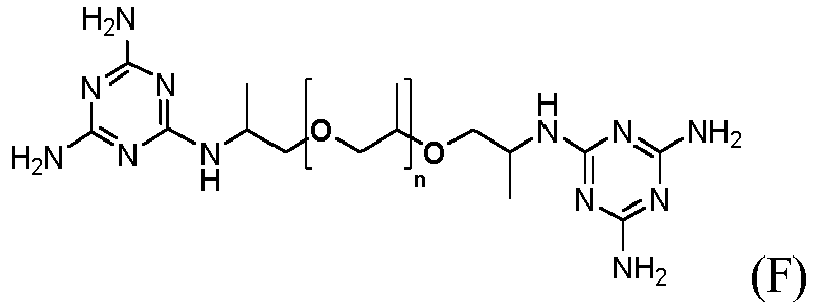 - a polymer of formula (G) as follows:
 - a polymer of formula (H) as follows:
- Composition according to anyone of claims 8 to 13 wherein it comprises a phenol-carbonyl condensation product.
- Composition according to claim 14 wherein the phenol-carbonyl condensation product is a novolac resin or a resole resin.
- Composition according to anyone of claim 8 to 15 wherein the composition comprises at least:- a polyalkylene oxide-based polymer functionalized at one or both ends with an isocyanuric acid moiety and/or a barbituric acid moiety, and having a number-average molecular weight (Mn) from 100 to 35000 g/mol, more preferably from 300 to 25000 g/mol;- a polyalkylene oxide-based polymer functionalized at one or both ends with a nitrogen-containing heterocyclic group bearing at least a function chosen in the group consisting of primary amine and secondary amine; and- a phenol-carbonyl condensation product.
- A composition comprising at least 2 polyalkylene oxide-based polymers and having a glass transition temperature from -60 to -20°C.
- Composition according to claim 17 having a Cross-Over point from 10 to 200°C, preferably from 20 to 150°C.
- An article manufactured from a composition according to anyone of claims 8 to 18.
Priority Applications (2)
| Application Number | Priority Date | Filing Date | Title |
|---|---|---|---|
| EP18306120.9A EP3611213A1 (en) | 2018-08-14 | 2018-08-14 | Composition comprising a polyalkylene oxide-based polymer |
| PCT/EP2019/066558 WO2019243621A1 (en) | 2018-06-22 | 2019-06-21 | Composition comprising a polyalkylene oxide-based polymer |
Applications Claiming Priority (1)
| Application Number | Priority Date | Filing Date | Title |
|---|---|---|---|
| EP18306120.9A EP3611213A1 (en) | 2018-08-14 | 2018-08-14 | Composition comprising a polyalkylene oxide-based polymer |
Publications (1)
| Publication Number | Publication Date |
|---|---|
| EP3611213A1 true EP3611213A1 (en) | 2020-02-19 |
Family
ID=63405145
Family Applications (1)
| Application Number | Title | Priority Date | Filing Date |
|---|---|---|---|
| EP18306120.9A Withdrawn EP3611213A1 (en) | 2018-06-22 | 2018-08-14 | Composition comprising a polyalkylene oxide-based polymer |
Country Status (1)
| Country | Link |
|---|---|
| EP (1) | EP3611213A1 (en) |
Cited By (1)
| Publication number | Priority date | Publication date | Assignee | Title |
|---|---|---|---|---|
| CN115397879A (en) * | 2020-04-03 | 2022-11-25 | 科思创(荷兰)有限公司 | Method for synthesizing polyhydrogen-bonded oligomers |
Citations (3)
| Publication number | Priority date | Publication date | Assignee | Title |
|---|---|---|---|---|
| US5912189A (en) * | 1998-05-12 | 1999-06-15 | The Lubrizol Corporation | Compositions containing reaction product of a cyclic compound containing both a nitrogen atom and a carbonyl group, an aldehyde or ketone, and an etheramine |
| WO2014185779A1 (en) * | 2013-05-14 | 2014-11-20 | Suprapolix B.V. | Supramolecular biodegradable polymer |
| PL218533B1 (en) * | 2010-10-19 | 2014-12-31 | Politechnika Rzeszowska | Process for the preparation of polyetherols with azacyclic rings |
-
2018
- 2018-08-14 EP EP18306120.9A patent/EP3611213A1/en not_active Withdrawn
Patent Citations (3)
| Publication number | Priority date | Publication date | Assignee | Title |
|---|---|---|---|---|
| US5912189A (en) * | 1998-05-12 | 1999-06-15 | The Lubrizol Corporation | Compositions containing reaction product of a cyclic compound containing both a nitrogen atom and a carbonyl group, an aldehyde or ketone, and an etheramine |
| PL218533B1 (en) * | 2010-10-19 | 2014-12-31 | Politechnika Rzeszowska | Process for the preparation of polyetherols with azacyclic rings |
| WO2014185779A1 (en) * | 2013-05-14 | 2014-11-20 | Suprapolix B.V. | Supramolecular biodegradable polymer |
Non-Patent Citations (6)
| Title |
|---|
| BRAS ET AL., MACROMOLECULES, vol. 46, 2013, pages 9446 - 9454 |
| CORTESE ET AL., J. AM. CHEM. SOC., vol. 134, 2012, pages 3671 - 3674 |
| JESSALYN CORTESE ET AL: "Suppression of Mesoscopic Order by Complementary Interactions in Supramolecular Polymers", JOURNAL OF THE AMERICAN CHEMICAL SOCIETY, AMERICAN CHEMICAL SOCIETY|, vol. 134, no. 8, 29 February 2012 (2012-02-29), pages 3671 - 3674, XP009171151, ISSN: 0002-7863, [retrieved on 20120209], DOI: 10.1021/JA2119496 * |
| L. LEIBLER ET AL., J. AM. CHEM. SOC., vol. 49, 2011, pages 19672 |
| R. P. SIJBESMA ET AL., MACROMOLECULES, vol. 23, 2007, pages 8464 |
| ROXANNE E. KIELTYKA ET AL: "Mesoscale Modulation of Supramolecular Ureidopyrimidinone-Based Poly(ethylene glycol) Transient Networks in Water", JOURNAL OF THE AMERICAN CHEMICAL SOCIETY, vol. 135, no. 30, 31 July 2013 (2013-07-31), pages 11159 - 11164, XP055161854, ISSN: 0002-7863, DOI: 10.1021/ja403745w * |
Cited By (1)
| Publication number | Priority date | Publication date | Assignee | Title |
|---|---|---|---|---|
| CN115397879A (en) * | 2020-04-03 | 2022-11-25 | 科思创(荷兰)有限公司 | Method for synthesizing polyhydrogen-bonded oligomers |
Similar Documents
| Publication | Publication Date | Title |
|---|---|---|
| EP1352005B1 (en) | Supramolecular polymer forming polymer | |
| WO2002026849A1 (en) | Polymer aldehyde/siloxane amine networks | |
| EP4065628B1 (en) | Epoxy-derived covalent adaptable networks and methods of their production | |
| KR102308746B1 (en) | Telechelic n-alkylated polyamide polymers and copolymers | |
| CN115867596A (en) | Benzoxazine derivative glass polymer | |
| US3661850A (en) | Quinoxaline polymers,methods of making same and compositions thereof | |
| Hergenrother | Polyphenylquinoxalines—high performance thermoplastics | |
| Houston et al. | Supramolecular engineering polyesters: endgroup functionalization of glycol modified PET with ureidopyrimidinone | |
| Han et al. | Preparation and characterization of high molecular weight poly (butylene succinate) | |
| JP2002527555A (en) | Highly branched oligomers, their preparation method and their applications | |
| CN112457590A (en) | Flame-treatment-free sprayable polypropylene composite material and preparation method thereof | |
| US5422042A (en) | Imidazolidone polyetheramine strength enhancing additives of epoxy resin systems | |
| EP3611213A1 (en) | Composition comprising a polyalkylene oxide-based polymer | |
| WO2019243621A1 (en) | Composition comprising a polyalkylene oxide-based polymer | |
| DE1495442A1 (en) | Process for the preparation of polymerization products | |
| WO2020002558A1 (en) | Polysiloxanes bearing isocyanuric acid or barbituric acid moieties and compositions comprising them | |
| WO2019243620A1 (en) | Composition comprising a polyalkylene oxide-based polymer | |
| EP3611212A1 (en) | Composition comprising a polyalkylene oxide-based polymer | |
| Ling et al. | Thermoplastic elastomers based on poly (l‐Lysine)‐Poly (ε‐Caprolactone) multi‐block copolymers | |
| Wörner et al. | Thermal polymerization and reactive blending of 2-(4-hydroxyphenyl)-1, 3-oxazoline | |
| Jang et al. | Effects of macromonomeric length of ureidopyrimidinone-induced supramolecular polymers on their crystalline structure and mechanical/rheological properties | |
| Fainleib et al. | Effect of ionic liquids on kinetic parameters of dicyanate ester polycyclotrimerization and on thermal and viscoelastic properties of resulting cyanate ester resins | |
| EP3835302A1 (en) | Diisocyanate compound having anhydrosugar alcohol core and preparation method therefor | |
| WO2016038112A1 (en) | Alkenyl ether polyols | |
| WO2020002556A1 (en) | Thermoplastic composition comprising a polysiloxane bearing diaminotriazine moieties |
Legal Events
| Date | Code | Title | Description |
|---|---|---|---|
| PUAI | Public reference made under article 153(3) epc to a published international application that has entered the european phase |
Free format text: ORIGINAL CODE: 0009012 |
|
| STAA | Information on the status of an ep patent application or granted ep patent |
Free format text: STATUS: THE APPLICATION HAS BEEN PUBLISHED |
|
| AK | Designated contracting states |
Kind code of ref document: A1 Designated state(s): AL AT BE BG CH CY CZ DE DK EE ES FI FR GB GR HR HU IE IS IT LI LT LU LV MC MK MT NL NO PL PT RO RS SE SI SK SM TR |
|
| AX | Request for extension of the european patent |
Extension state: BA ME |
|
| RAP1 | Party data changed (applicant data changed or rights of an application transferred) |
Owner name: RHODIA OPERATIONS |
|
| STAA | Information on the status of an ep patent application or granted ep patent |
Free format text: STATUS: THE APPLICATION IS DEEMED TO BE WITHDRAWN |
|
| 18D | Application deemed to be withdrawn |
Effective date: 20200820 |