EP3611158A1 - 1,3-di-oxo-indene derivative, pharmaceutically acceptable salt or optical isomer thereof, preparation method thereof, and pharmaceutical composition containing same as an antiviral, active ingredient - Google Patents
1,3-di-oxo-indene derivative, pharmaceutically acceptable salt or optical isomer thereof, preparation method thereof, and pharmaceutical composition containing same as an antiviral, active ingredient Download PDFInfo
- Publication number
- EP3611158A1 EP3611158A1 EP19179546.7A EP19179546A EP3611158A1 EP 3611158 A1 EP3611158 A1 EP 3611158A1 EP 19179546 A EP19179546 A EP 19179546A EP 3611158 A1 EP3611158 A1 EP 3611158A1
- Authority
- EP
- European Patent Office
- Prior art keywords
- arh
- inden
- dioxo
- dihydro
- mmol
- Prior art date
- Legal status (The legal status is an assumption and is not a legal conclusion. Google has not performed a legal analysis and makes no representation as to the accuracy of the status listed.)
- Granted
Links
- CWEBOACYNOYAJU-UHFFFAOYSA-N CC(C)c1cc(OC)c(C(C(c(cc2)c3c(NC(C)=O)c2[N+]([O-])=O)=O)(C3=O)O)cc1 Chemical compound CC(C)c1cc(OC)c(C(C(c(cc2)c3c(NC(C)=O)c2[N+]([O-])=O)=O)(C3=O)O)cc1 CWEBOACYNOYAJU-UHFFFAOYSA-N 0.000 description 1
- BIRPXFYKKURNMZ-UHFFFAOYSA-N CC(OC(C(c1c2cccc1)=O)(C2=O)c(ccc(C)c1)c1OC(C)=O)=O Chemical compound CC(OC(C(c1c2cccc1)=O)(C2=O)c(ccc(C)c1)c1OC(C)=O)=O BIRPXFYKKURNMZ-UHFFFAOYSA-N 0.000 description 1
- QJSBXEYPPNKWEM-UHFFFAOYSA-N CCC(NC(C(c1cccc(N)c11)=O)(C1=O)c(ccc(C(C)C)c1)c1OC(CC)=O)=O Chemical compound CCC(NC(C(c1cccc(N)c11)=O)(C1=O)c(ccc(C(C)C)c1)c1OC(CC)=O)=O QJSBXEYPPNKWEM-UHFFFAOYSA-N 0.000 description 1
- BVVWAEBKPRIORO-UHFFFAOYSA-N CCCC(OC(C(c1c2cccc1)=O)(C2=O)c(ccc(C(C)C)c1)c1OC(CCC)=O)=O Chemical compound CCCC(OC(C(c1c2cccc1)=O)(C2=O)c(ccc(C(C)C)c1)c1OC(CCC)=O)=O BVVWAEBKPRIORO-UHFFFAOYSA-N 0.000 description 1
- 0 CCCCC(*(C)C(C(c1ccccc11)=O)(C1=O)c(ccc(C(C)C)c1)c1OC(C(C)(C)C)=O)=O Chemical compound CCCCC(*(C)C(C(c1ccccc11)=O)(C1=O)c(ccc(C(C)C)c1)c1OC(C(C)(C)C)=O)=O 0.000 description 1
- XXPPGMWCUVQEEI-UHFFFAOYSA-N COc1cccc(C(C(c2c3cccc2)=O)C3=O)c1 Chemical compound COc1cccc(C(C(c2c3cccc2)=O)C3=O)c1 XXPPGMWCUVQEEI-UHFFFAOYSA-N 0.000 description 1
- WWCSFRRQCULQOK-UHFFFAOYSA-N Cc1cc(C(C(c2ccccc22)=O)(C2=O)O)cc(C)c1O Chemical compound Cc1cc(C(C(c2ccccc22)=O)(C2=O)O)cc(C)c1O WWCSFRRQCULQOK-UHFFFAOYSA-N 0.000 description 1
Classifications
-
- A—HUMAN NECESSITIES
- A61—MEDICAL OR VETERINARY SCIENCE; HYGIENE
- A61P—SPECIFIC THERAPEUTIC ACTIVITY OF CHEMICAL COMPOUNDS OR MEDICINAL PREPARATIONS
- A61P3/00—Drugs for disorders of the metabolism
- A61P3/08—Drugs for disorders of the metabolism for glucose homeostasis
- A61P3/10—Drugs for disorders of the metabolism for glucose homeostasis for hyperglycaemia, e.g. antidiabetics
-
- C—CHEMISTRY; METALLURGY
- C07—ORGANIC CHEMISTRY
- C07C—ACYCLIC OR CARBOCYCLIC COMPOUNDS
- C07C49/00—Ketones; Ketenes; Dimeric ketenes; Ketonic chelates
- C07C49/587—Unsaturated compounds containing a keto groups being part of a ring
- C07C49/657—Unsaturated compounds containing a keto groups being part of a ring containing six-membered aromatic rings
- C07C49/665—Unsaturated compounds containing a keto groups being part of a ring containing six-membered aromatic rings a keto group being part of a condensed ring system
-
- A—HUMAN NECESSITIES
- A61—MEDICAL OR VETERINARY SCIENCE; HYGIENE
- A61K—PREPARATIONS FOR MEDICAL, DENTAL OR TOILETRY PURPOSES
- A61K31/00—Medicinal preparations containing organic active ingredients
- A61K31/12—Ketones
- A61K31/122—Ketones having the oxygen directly attached to a ring, e.g. quinones, vitamin K1, anthralin
-
- A—HUMAN NECESSITIES
- A61—MEDICAL OR VETERINARY SCIENCE; HYGIENE
- A61K—PREPARATIONS FOR MEDICAL, DENTAL OR TOILETRY PURPOSES
- A61K31/00—Medicinal preparations containing organic active ingredients
- A61K31/04—Nitro compounds
-
- A—HUMAN NECESSITIES
- A61—MEDICAL OR VETERINARY SCIENCE; HYGIENE
- A61K—PREPARATIONS FOR MEDICAL, DENTAL OR TOILETRY PURPOSES
- A61K31/00—Medicinal preparations containing organic active ingredients
- A61K31/33—Heterocyclic compounds
- A61K31/395—Heterocyclic compounds having nitrogen as a ring hetero atom, e.g. guanethidine or rifamycins
- A61K31/435—Heterocyclic compounds having nitrogen as a ring hetero atom, e.g. guanethidine or rifamycins having six-membered rings with one nitrogen as the only ring hetero atom
-
- A—HUMAN NECESSITIES
- A61—MEDICAL OR VETERINARY SCIENCE; HYGIENE
- A61K—PREPARATIONS FOR MEDICAL, DENTAL OR TOILETRY PURPOSES
- A61K31/00—Medicinal preparations containing organic active ingredients
- A61K31/33—Heterocyclic compounds
- A61K31/395—Heterocyclic compounds having nitrogen as a ring hetero atom, e.g. guanethidine or rifamycins
- A61K31/435—Heterocyclic compounds having nitrogen as a ring hetero atom, e.g. guanethidine or rifamycins having six-membered rings with one nitrogen as the only ring hetero atom
- A61K31/47—Quinolines; Isoquinolines
-
- A—HUMAN NECESSITIES
- A61—MEDICAL OR VETERINARY SCIENCE; HYGIENE
- A61P—SPECIFIC THERAPEUTIC ACTIVITY OF CHEMICAL COMPOUNDS OR MEDICINAL PREPARATIONS
- A61P11/00—Drugs for disorders of the respiratory system
- A61P11/02—Nasal agents, e.g. decongestants
-
- A—HUMAN NECESSITIES
- A61—MEDICAL OR VETERINARY SCIENCE; HYGIENE
- A61P—SPECIFIC THERAPEUTIC ACTIVITY OF CHEMICAL COMPOUNDS OR MEDICINAL PREPARATIONS
- A61P17/00—Drugs for dermatological disorders
-
- A—HUMAN NECESSITIES
- A61—MEDICAL OR VETERINARY SCIENCE; HYGIENE
- A61P—SPECIFIC THERAPEUTIC ACTIVITY OF CHEMICAL COMPOUNDS OR MEDICINAL PREPARATIONS
- A61P21/00—Drugs for disorders of the muscular or neuromuscular system
-
- A—HUMAN NECESSITIES
- A61—MEDICAL OR VETERINARY SCIENCE; HYGIENE
- A61P—SPECIFIC THERAPEUTIC ACTIVITY OF CHEMICAL COMPOUNDS OR MEDICINAL PREPARATIONS
- A61P25/00—Drugs for disorders of the nervous system
-
- A—HUMAN NECESSITIES
- A61—MEDICAL OR VETERINARY SCIENCE; HYGIENE
- A61P—SPECIFIC THERAPEUTIC ACTIVITY OF CHEMICAL COMPOUNDS OR MEDICINAL PREPARATIONS
- A61P27/00—Drugs for disorders of the senses
- A61P27/16—Otologicals
-
- A—HUMAN NECESSITIES
- A61—MEDICAL OR VETERINARY SCIENCE; HYGIENE
- A61P—SPECIFIC THERAPEUTIC ACTIVITY OF CHEMICAL COMPOUNDS OR MEDICINAL PREPARATIONS
- A61P29/00—Non-central analgesic, antipyretic or antiinflammatory agents, e.g. antirheumatic agents; Non-steroidal antiinflammatory drugs [NSAID]
-
- A—HUMAN NECESSITIES
- A61—MEDICAL OR VETERINARY SCIENCE; HYGIENE
- A61P—SPECIFIC THERAPEUTIC ACTIVITY OF CHEMICAL COMPOUNDS OR MEDICINAL PREPARATIONS
- A61P31/00—Antiinfectives, i.e. antibiotics, antiseptics, chemotherapeutics
-
- A—HUMAN NECESSITIES
- A61—MEDICAL OR VETERINARY SCIENCE; HYGIENE
- A61P—SPECIFIC THERAPEUTIC ACTIVITY OF CHEMICAL COMPOUNDS OR MEDICINAL PREPARATIONS
- A61P31/00—Antiinfectives, i.e. antibiotics, antiseptics, chemotherapeutics
- A61P31/12—Antivirals
- A61P31/14—Antivirals for RNA viruses
- A61P31/16—Antivirals for RNA viruses for influenza or rhinoviruses
-
- A—HUMAN NECESSITIES
- A61—MEDICAL OR VETERINARY SCIENCE; HYGIENE
- A61P—SPECIFIC THERAPEUTIC ACTIVITY OF CHEMICAL COMPOUNDS OR MEDICINAL PREPARATIONS
- A61P9/00—Drugs for disorders of the cardiovascular system
-
- C—CHEMISTRY; METALLURGY
- C07—ORGANIC CHEMISTRY
- C07C—ACYCLIC OR CARBOCYCLIC COMPOUNDS
- C07C205/00—Compounds containing nitro groups bound to a carbon skeleton
- C07C205/45—Compounds containing nitro groups bound to a carbon skeleton the carbon skeleton being further substituted by at least one doubly—bound oxygen atom, not being part of a —CHO group
-
- C—CHEMISTRY; METALLURGY
- C07—ORGANIC CHEMISTRY
- C07C—ACYCLIC OR CARBOCYCLIC COMPOUNDS
- C07C225/00—Compounds containing amino groups and doubly—bound oxygen atoms bound to the same carbon skeleton, at least one of the doubly—bound oxygen atoms not being part of a —CHO group, e.g. amino ketones
- C07C225/20—Compounds containing amino groups and doubly—bound oxygen atoms bound to the same carbon skeleton, at least one of the doubly—bound oxygen atoms not being part of a —CHO group, e.g. amino ketones having amino groups bound to carbon atoms of rings other than six-membered aromatic rings of the carbon skeleton
-
- C—CHEMISTRY; METALLURGY
- C07—ORGANIC CHEMISTRY
- C07C—ACYCLIC OR CARBOCYCLIC COMPOUNDS
- C07C225/00—Compounds containing amino groups and doubly—bound oxygen atoms bound to the same carbon skeleton, at least one of the doubly—bound oxygen atoms not being part of a —CHO group, e.g. amino ketones
- C07C225/22—Compounds containing amino groups and doubly—bound oxygen atoms bound to the same carbon skeleton, at least one of the doubly—bound oxygen atoms not being part of a —CHO group, e.g. amino ketones having amino groups bound to carbon atoms of six-membered aromatic rings of the carbon skeleton
-
- C—CHEMISTRY; METALLURGY
- C07—ORGANIC CHEMISTRY
- C07C—ACYCLIC OR CARBOCYCLIC COMPOUNDS
- C07C231/00—Preparation of carboxylic acid amides
- C07C231/02—Preparation of carboxylic acid amides from carboxylic acids or from esters, anhydrides, or halides thereof by reaction with ammonia or amines
-
- C—CHEMISTRY; METALLURGY
- C07—ORGANIC CHEMISTRY
- C07C—ACYCLIC OR CARBOCYCLIC COMPOUNDS
- C07C233/00—Carboxylic acid amides
- C07C233/01—Carboxylic acid amides having carbon atoms of carboxamide groups bound to hydrogen atoms or to acyclic carbon atoms
- C07C233/30—Carboxylic acid amides having carbon atoms of carboxamide groups bound to hydrogen atoms or to acyclic carbon atoms having the nitrogen atom of at least one of the carboxamide groups bound to a carbon atom of a hydrocarbon radical substituted by doubly-bound oxygen atoms
- C07C233/32—Carboxylic acid amides having carbon atoms of carboxamide groups bound to hydrogen atoms or to acyclic carbon atoms having the nitrogen atom of at least one of the carboxamide groups bound to a carbon atom of a hydrocarbon radical substituted by doubly-bound oxygen atoms with the substituted hydrocarbon radical bound to the nitrogen atom of the carboxamide group by a carbon atom of a ring other than a six-membered aromatic ring
-
- C—CHEMISTRY; METALLURGY
- C07—ORGANIC CHEMISTRY
- C07C—ACYCLIC OR CARBOCYCLIC COMPOUNDS
- C07C233/00—Carboxylic acid amides
- C07C233/01—Carboxylic acid amides having carbon atoms of carboxamide groups bound to hydrogen atoms or to acyclic carbon atoms
- C07C233/30—Carboxylic acid amides having carbon atoms of carboxamide groups bound to hydrogen atoms or to acyclic carbon atoms having the nitrogen atom of at least one of the carboxamide groups bound to a carbon atom of a hydrocarbon radical substituted by doubly-bound oxygen atoms
- C07C233/33—Carboxylic acid amides having carbon atoms of carboxamide groups bound to hydrogen atoms or to acyclic carbon atoms having the nitrogen atom of at least one of the carboxamide groups bound to a carbon atom of a hydrocarbon radical substituted by doubly-bound oxygen atoms with the substituted hydrocarbon radical bound to the nitrogen atom of the carboxamide group by a carbon atom of a six-membered aromatic ring
-
- C—CHEMISTRY; METALLURGY
- C07—ORGANIC CHEMISTRY
- C07C—ACYCLIC OR CARBOCYCLIC COMPOUNDS
- C07C233/00—Carboxylic acid amides
- C07C233/01—Carboxylic acid amides having carbon atoms of carboxamide groups bound to hydrogen atoms or to acyclic carbon atoms
- C07C233/34—Carboxylic acid amides having carbon atoms of carboxamide groups bound to hydrogen atoms or to acyclic carbon atoms having the nitrogen atom of at least one of the carboxamide groups bound to a carbon atom of a hydrocarbon radical substituted by amino groups
- C07C233/41—Carboxylic acid amides having carbon atoms of carboxamide groups bound to hydrogen atoms or to acyclic carbon atoms having the nitrogen atom of at least one of the carboxamide groups bound to a carbon atom of a hydrocarbon radical substituted by amino groups with the substituted hydrocarbon radical bound to the nitrogen atom of the carboxamide group by a carbon atom of a ring other than a six-membered aromatic ring
-
- C—CHEMISTRY; METALLURGY
- C07—ORGANIC CHEMISTRY
- C07C—ACYCLIC OR CARBOCYCLIC COMPOUNDS
- C07C233/00—Carboxylic acid amides
- C07C233/01—Carboxylic acid amides having carbon atoms of carboxamide groups bound to hydrogen atoms or to acyclic carbon atoms
- C07C233/34—Carboxylic acid amides having carbon atoms of carboxamide groups bound to hydrogen atoms or to acyclic carbon atoms having the nitrogen atom of at least one of the carboxamide groups bound to a carbon atom of a hydrocarbon radical substituted by amino groups
- C07C233/42—Carboxylic acid amides having carbon atoms of carboxamide groups bound to hydrogen atoms or to acyclic carbon atoms having the nitrogen atom of at least one of the carboxamide groups bound to a carbon atom of a hydrocarbon radical substituted by amino groups with the substituted hydrocarbon radical bound to the nitrogen atom of the carboxamide group by a carbon atom of a six-membered aromatic ring
- C07C233/43—Carboxylic acid amides having carbon atoms of carboxamide groups bound to hydrogen atoms or to acyclic carbon atoms having the nitrogen atom of at least one of the carboxamide groups bound to a carbon atom of a hydrocarbon radical substituted by amino groups with the substituted hydrocarbon radical bound to the nitrogen atom of the carboxamide group by a carbon atom of a six-membered aromatic ring having the carbon atom of the carboxamide group bound to a hydrogen atom or to a carbon atom of a saturated carbon skeleton
-
- C—CHEMISTRY; METALLURGY
- C07—ORGANIC CHEMISTRY
- C07C—ACYCLIC OR CARBOCYCLIC COMPOUNDS
- C07C233/00—Carboxylic acid amides
- C07C233/57—Carboxylic acid amides having carbon atoms of carboxamide groups bound to carbon atoms of rings other than six-membered aromatic rings
- C07C233/61—Carboxylic acid amides having carbon atoms of carboxamide groups bound to carbon atoms of rings other than six-membered aromatic rings having the nitrogen atom of at least one of the carboxamide groups bound to a carbon atom of a hydrocarbon radical substituted by doubly-bound oxygen atoms
-
- C—CHEMISTRY; METALLURGY
- C07—ORGANIC CHEMISTRY
- C07C—ACYCLIC OR CARBOCYCLIC COMPOUNDS
- C07C233/00—Carboxylic acid amides
- C07C233/64—Carboxylic acid amides having carbon atoms of carboxamide groups bound to carbon atoms of six-membered aromatic rings
- C07C233/76—Carboxylic acid amides having carbon atoms of carboxamide groups bound to carbon atoms of six-membered aromatic rings having the nitrogen atom of at least one of the carboxamide groups bound to a carbon atom of a hydrocarbon radical substituted by doubly-bound oxygen atoms
-
- C—CHEMISTRY; METALLURGY
- C07—ORGANIC CHEMISTRY
- C07C—ACYCLIC OR CARBOCYCLIC COMPOUNDS
- C07C247/00—Compounds containing azido groups
- C07C247/14—Compounds containing azido groups with azido groups bound to carbon atoms of rings other than six-membered aromatic rings
-
- C—CHEMISTRY; METALLURGY
- C07—ORGANIC CHEMISTRY
- C07C—ACYCLIC OR CARBOCYCLIC COMPOUNDS
- C07C269/00—Preparation of derivatives of carbamic acid, i.e. compounds containing any of the groups, the nitrogen atom not being part of nitro or nitroso groups
-
- C—CHEMISTRY; METALLURGY
- C07—ORGANIC CHEMISTRY
- C07C—ACYCLIC OR CARBOCYCLIC COMPOUNDS
- C07C271/00—Derivatives of carbamic acids, i.e. compounds containing any of the groups, the nitrogen atom not being part of nitro or nitroso groups
- C07C271/06—Esters of carbamic acids
- C07C271/08—Esters of carbamic acids having oxygen atoms of carbamate groups bound to acyclic carbon atoms
- C07C271/10—Esters of carbamic acids having oxygen atoms of carbamate groups bound to acyclic carbon atoms with the nitrogen atoms of the carbamate groups bound to hydrogen atoms or to acyclic carbon atoms
- C07C271/12—Esters of carbamic acids having oxygen atoms of carbamate groups bound to acyclic carbon atoms with the nitrogen atoms of the carbamate groups bound to hydrogen atoms or to acyclic carbon atoms to hydrogen atoms or to carbon atoms of unsubstituted hydrocarbon radicals
-
- C—CHEMISTRY; METALLURGY
- C07—ORGANIC CHEMISTRY
- C07C—ACYCLIC OR CARBOCYCLIC COMPOUNDS
- C07C271/00—Derivatives of carbamic acids, i.e. compounds containing any of the groups, the nitrogen atom not being part of nitro or nitroso groups
- C07C271/06—Esters of carbamic acids
- C07C271/08—Esters of carbamic acids having oxygen atoms of carbamate groups bound to acyclic carbon atoms
- C07C271/24—Esters of carbamic acids having oxygen atoms of carbamate groups bound to acyclic carbon atoms with the nitrogen atom of at least one of the carbamate groups bound to a carbon atom of a ring other than a six-membered aromatic ring
-
- C—CHEMISTRY; METALLURGY
- C07—ORGANIC CHEMISTRY
- C07C—ACYCLIC OR CARBOCYCLIC COMPOUNDS
- C07C271/00—Derivatives of carbamic acids, i.e. compounds containing any of the groups, the nitrogen atom not being part of nitro or nitroso groups
- C07C271/06—Esters of carbamic acids
- C07C271/40—Esters of carbamic acids having oxygen atoms of carbamate groups bound to carbon atoms of six-membered aromatic rings
- C07C271/42—Esters of carbamic acids having oxygen atoms of carbamate groups bound to carbon atoms of six-membered aromatic rings with the nitrogen atoms of the carbamate groups bound to hydrogen atoms or to acyclic carbon atoms
- C07C271/44—Esters of carbamic acids having oxygen atoms of carbamate groups bound to carbon atoms of six-membered aromatic rings with the nitrogen atoms of the carbamate groups bound to hydrogen atoms or to acyclic carbon atoms to hydrogen atoms or to carbon atoms of unsubstituted hydrocarbon radicals
-
- C—CHEMISTRY; METALLURGY
- C07—ORGANIC CHEMISTRY
- C07C—ACYCLIC OR CARBOCYCLIC COMPOUNDS
- C07C271/00—Derivatives of carbamic acids, i.e. compounds containing any of the groups, the nitrogen atom not being part of nitro or nitroso groups
- C07C271/62—Compounds containing any of the groups, X being a hetero atom, Y being any atom, e.g. N-acylcarbamates
- C07C271/64—Y being a hydrogen or a carbon atom, e.g. benzoylcarbamates
-
- C—CHEMISTRY; METALLURGY
- C07—ORGANIC CHEMISTRY
- C07C—ACYCLIC OR CARBOCYCLIC COMPOUNDS
- C07C275/00—Derivatives of urea, i.e. compounds containing any of the groups, the nitrogen atoms not being part of nitro or nitroso groups
- C07C275/26—Derivatives of urea, i.e. compounds containing any of the groups, the nitrogen atoms not being part of nitro or nitroso groups having nitrogen atoms of urea groups bound to carbon atoms of rings other than six-membered aromatic rings
-
- C—CHEMISTRY; METALLURGY
- C07—ORGANIC CHEMISTRY
- C07C—ACYCLIC OR CARBOCYCLIC COMPOUNDS
- C07C275/00—Derivatives of urea, i.e. compounds containing any of the groups, the nitrogen atoms not being part of nitro or nitroso groups
- C07C275/64—Derivatives of urea, i.e. compounds containing any of the groups, the nitrogen atoms not being part of nitro or nitroso groups having nitrogen atoms of urea groups singly-bound to oxygen atoms
-
- C—CHEMISTRY; METALLURGY
- C07—ORGANIC CHEMISTRY
- C07C—ACYCLIC OR CARBOCYCLIC COMPOUNDS
- C07C323/00—Thiols, sulfides, hydropolysulfides or polysulfides substituted by halogen, oxygen or nitrogen atoms, or by sulfur atoms not being part of thio groups
- C07C323/22—Thiols, sulfides, hydropolysulfides or polysulfides substituted by halogen, oxygen or nitrogen atoms, or by sulfur atoms not being part of thio groups containing thio groups and doubly-bound oxygen atoms bound to the same carbon skeleton
-
- C—CHEMISTRY; METALLURGY
- C07—ORGANIC CHEMISTRY
- C07C—ACYCLIC OR CARBOCYCLIC COMPOUNDS
- C07C45/00—Preparation of compounds having >C = O groups bound only to carbon or hydrogen atoms; Preparation of chelates of such compounds
-
- C—CHEMISTRY; METALLURGY
- C07—ORGANIC CHEMISTRY
- C07C—ACYCLIC OR CARBOCYCLIC COMPOUNDS
- C07C49/00—Ketones; Ketenes; Dimeric ketenes; Ketonic chelates
- C07C49/587—Unsaturated compounds containing a keto groups being part of a ring
- C07C49/703—Unsaturated compounds containing a keto groups being part of a ring containing hydroxy groups
- C07C49/747—Unsaturated compounds containing a keto groups being part of a ring containing hydroxy groups containing six-membered aromatic rings
-
- C—CHEMISTRY; METALLURGY
- C07—ORGANIC CHEMISTRY
- C07C—ACYCLIC OR CARBOCYCLIC COMPOUNDS
- C07C49/00—Ketones; Ketenes; Dimeric ketenes; Ketonic chelates
- C07C49/587—Unsaturated compounds containing a keto groups being part of a ring
- C07C49/753—Unsaturated compounds containing a keto groups being part of a ring containing ether groups, groups, groups, or groups
-
- C—CHEMISTRY; METALLURGY
- C07—ORGANIC CHEMISTRY
- C07C—ACYCLIC OR CARBOCYCLIC COMPOUNDS
- C07C49/00—Ketones; Ketenes; Dimeric ketenes; Ketonic chelates
- C07C49/587—Unsaturated compounds containing a keto groups being part of a ring
- C07C49/753—Unsaturated compounds containing a keto groups being part of a ring containing ether groups, groups, groups, or groups
- C07C49/755—Unsaturated compounds containing a keto groups being part of a ring containing ether groups, groups, groups, or groups a keto group being part of a condensed ring system with two or three rings, at least one ring being a six-membered aromatic ring
-
- C—CHEMISTRY; METALLURGY
- C07—ORGANIC CHEMISTRY
- C07C—ACYCLIC OR CARBOCYCLIC COMPOUNDS
- C07C67/00—Preparation of carboxylic acid esters
-
- C—CHEMISTRY; METALLURGY
- C07—ORGANIC CHEMISTRY
- C07C—ACYCLIC OR CARBOCYCLIC COMPOUNDS
- C07C67/00—Preparation of carboxylic acid esters
- C07C67/08—Preparation of carboxylic acid esters by reacting carboxylic acids or symmetrical anhydrides with the hydroxy or O-metal group of organic compounds
-
- C—CHEMISTRY; METALLURGY
- C07—ORGANIC CHEMISTRY
- C07C—ACYCLIC OR CARBOCYCLIC COMPOUNDS
- C07C69/00—Esters of carboxylic acids; Esters of carbonic or haloformic acids
- C07C69/02—Esters of acyclic saturated monocarboxylic acids having the carboxyl group bound to an acyclic carbon atom or to hydrogen
- C07C69/12—Acetic acid esters
-
- C—CHEMISTRY; METALLURGY
- C07—ORGANIC CHEMISTRY
- C07C—ACYCLIC OR CARBOCYCLIC COMPOUNDS
- C07C69/00—Esters of carboxylic acids; Esters of carbonic or haloformic acids
- C07C69/02—Esters of acyclic saturated monocarboxylic acids having the carboxyl group bound to an acyclic carbon atom or to hydrogen
- C07C69/12—Acetic acid esters
- C07C69/16—Acetic acid esters of dihydroxylic compounds
-
- C—CHEMISTRY; METALLURGY
- C07—ORGANIC CHEMISTRY
- C07C—ACYCLIC OR CARBOCYCLIC COMPOUNDS
- C07C69/00—Esters of carboxylic acids; Esters of carbonic or haloformic acids
- C07C69/02—Esters of acyclic saturated monocarboxylic acids having the carboxyl group bound to an acyclic carbon atom or to hydrogen
- C07C69/12—Acetic acid esters
- C07C69/18—Acetic acid esters of trihydroxylic compounds
-
- C—CHEMISTRY; METALLURGY
- C07—ORGANIC CHEMISTRY
- C07C—ACYCLIC OR CARBOCYCLIC COMPOUNDS
- C07C69/00—Esters of carboxylic acids; Esters of carbonic or haloformic acids
- C07C69/02—Esters of acyclic saturated monocarboxylic acids having the carboxyl group bound to an acyclic carbon atom or to hydrogen
- C07C69/22—Esters of acyclic saturated monocarboxylic acids having the carboxyl group bound to an acyclic carbon atom or to hydrogen having three or more carbon atoms in the acid moiety
-
- C—CHEMISTRY; METALLURGY
- C07—ORGANIC CHEMISTRY
- C07C—ACYCLIC OR CARBOCYCLIC COMPOUNDS
- C07C69/00—Esters of carboxylic acids; Esters of carbonic or haloformic acids
- C07C69/02—Esters of acyclic saturated monocarboxylic acids having the carboxyl group bound to an acyclic carbon atom or to hydrogen
- C07C69/22—Esters of acyclic saturated monocarboxylic acids having the carboxyl group bound to an acyclic carbon atom or to hydrogen having three or more carbon atoms in the acid moiety
- C07C69/28—Esters of acyclic saturated monocarboxylic acids having the carboxyl group bound to an acyclic carbon atom or to hydrogen having three or more carbon atoms in the acid moiety esterified with dihydroxylic compounds
-
- C—CHEMISTRY; METALLURGY
- C07—ORGANIC CHEMISTRY
- C07C—ACYCLIC OR CARBOCYCLIC COMPOUNDS
- C07C69/00—Esters of carboxylic acids; Esters of carbonic or haloformic acids
- C07C69/52—Esters of acyclic unsaturated carboxylic acids having the esterified carboxyl group bound to an acyclic carbon atom
- C07C69/533—Monocarboxylic acid esters having only one carbon-to-carbon double bond
- C07C69/54—Acrylic acid esters; Methacrylic acid esters
-
- C—CHEMISTRY; METALLURGY
- C07—ORGANIC CHEMISTRY
- C07C—ACYCLIC OR CARBOCYCLIC COMPOUNDS
- C07C69/00—Esters of carboxylic acids; Esters of carbonic or haloformic acids
- C07C69/612—Esters of carboxylic acids having a carboxyl group bound to an acyclic carbon atom and having a six-membered aromatic ring in the acid moiety
- C07C69/618—Esters of carboxylic acids having a carboxyl group bound to an acyclic carbon atom and having a six-membered aromatic ring in the acid moiety having unsaturation outside the six-membered aromatic ring
-
- C—CHEMISTRY; METALLURGY
- C07—ORGANIC CHEMISTRY
- C07C—ACYCLIC OR CARBOCYCLIC COMPOUNDS
- C07C69/00—Esters of carboxylic acids; Esters of carbonic or haloformic acids
- C07C69/62—Halogen-containing esters
- C07C69/63—Halogen-containing esters of saturated acids
-
- C—CHEMISTRY; METALLURGY
- C07—ORGANIC CHEMISTRY
- C07C—ACYCLIC OR CARBOCYCLIC COMPOUNDS
- C07C69/00—Esters of carboxylic acids; Esters of carbonic or haloformic acids
- C07C69/66—Esters of carboxylic acids having esterified carboxylic groups bound to acyclic carbon atoms and having any of the groups OH, O—metal, —CHO, keto, ether, acyloxy, groups, groups, or in the acid moiety
- C07C69/73—Esters of carboxylic acids having esterified carboxylic groups bound to acyclic carbon atoms and having any of the groups OH, O—metal, —CHO, keto, ether, acyloxy, groups, groups, or in the acid moiety of unsaturated acids
- C07C69/734—Ethers
- C07C69/736—Ethers the hydroxy group of the ester being etherified with a hydroxy compound having the hydroxy group bound to a carbon atom of a six-membered aromatic ring
-
- C—CHEMISTRY; METALLURGY
- C07—ORGANIC CHEMISTRY
- C07C—ACYCLIC OR CARBOCYCLIC COMPOUNDS
- C07C69/00—Esters of carboxylic acids; Esters of carbonic or haloformic acids
- C07C69/66—Esters of carboxylic acids having esterified carboxylic groups bound to acyclic carbon atoms and having any of the groups OH, O—metal, —CHO, keto, ether, acyloxy, groups, groups, or in the acid moiety
- C07C69/73—Esters of carboxylic acids having esterified carboxylic groups bound to acyclic carbon atoms and having any of the groups OH, O—metal, —CHO, keto, ether, acyloxy, groups, groups, or in the acid moiety of unsaturated acids
- C07C69/738—Esters of keto-carboxylic acids or aldehydo-carboxylic acids
-
- C—CHEMISTRY; METALLURGY
- C07—ORGANIC CHEMISTRY
- C07C—ACYCLIC OR CARBOCYCLIC COMPOUNDS
- C07C69/00—Esters of carboxylic acids; Esters of carbonic or haloformic acids
- C07C69/76—Esters of carboxylic acids having a carboxyl group bound to a carbon atom of a six-membered aromatic ring
- C07C69/78—Benzoic acid esters
-
- C—CHEMISTRY; METALLURGY
- C07—ORGANIC CHEMISTRY
- C07D—HETEROCYCLIC COMPOUNDS
- C07D213/00—Heterocyclic compounds containing six-membered rings, not condensed with other rings, with one nitrogen atom as the only ring hetero atom and three or more double bonds between ring members or between ring members and non-ring members
- C07D213/02—Heterocyclic compounds containing six-membered rings, not condensed with other rings, with one nitrogen atom as the only ring hetero atom and three or more double bonds between ring members or between ring members and non-ring members having three double bonds between ring members or between ring members and non-ring members
- C07D213/04—Heterocyclic compounds containing six-membered rings, not condensed with other rings, with one nitrogen atom as the only ring hetero atom and three or more double bonds between ring members or between ring members and non-ring members having three double bonds between ring members or between ring members and non-ring members having no bond between the ring nitrogen atom and a non-ring member or having only hydrogen or carbon atoms directly attached to the ring nitrogen atom
- C07D213/60—Heterocyclic compounds containing six-membered rings, not condensed with other rings, with one nitrogen atom as the only ring hetero atom and three or more double bonds between ring members or between ring members and non-ring members having three double bonds between ring members or between ring members and non-ring members having no bond between the ring nitrogen atom and a non-ring member or having only hydrogen or carbon atoms directly attached to the ring nitrogen atom with hetero atoms or with carbon atoms having three bonds to hetero atoms with at the most one bond to halogen, e.g. ester or nitrile radicals, directly attached to ring carbon atoms
- C07D213/62—Oxygen or sulfur atoms
- C07D213/63—One oxygen atom
- C07D213/65—One oxygen atom attached in position 3 or 5
-
- C—CHEMISTRY; METALLURGY
- C07—ORGANIC CHEMISTRY
- C07D—HETEROCYCLIC COMPOUNDS
- C07D215/00—Heterocyclic compounds containing quinoline or hydrogenated quinoline ring systems
- C07D215/02—Heterocyclic compounds containing quinoline or hydrogenated quinoline ring systems having no bond between the ring nitrogen atom and a non-ring member or having only hydrogen atoms or carbon atoms directly attached to the ring nitrogen atom
- C07D215/16—Heterocyclic compounds containing quinoline or hydrogenated quinoline ring systems having no bond between the ring nitrogen atom and a non-ring member or having only hydrogen atoms or carbon atoms directly attached to the ring nitrogen atom with hetero atoms or with carbon atoms having three bonds to hetero atoms with at the most one bond to halogen, e.g. ester or nitrile radicals, directly attached to ring carbon atoms
- C07D215/20—Oxygen atoms
-
- C—CHEMISTRY; METALLURGY
- C07—ORGANIC CHEMISTRY
- C07D—HETEROCYCLIC COMPOUNDS
- C07D221/00—Heterocyclic compounds containing six-membered rings having one nitrogen atom as the only ring hetero atom, not provided for by groups C07D211/00 - C07D219/00
- C07D221/02—Heterocyclic compounds containing six-membered rings having one nitrogen atom as the only ring hetero atom, not provided for by groups C07D211/00 - C07D219/00 condensed with carbocyclic rings or ring systems
- C07D221/04—Ortho- or peri-condensed ring systems
-
- C—CHEMISTRY; METALLURGY
- C07—ORGANIC CHEMISTRY
- C07C—ACYCLIC OR CARBOCYCLIC COMPOUNDS
- C07C2601/00—Systems containing only non-condensed rings
- C07C2601/02—Systems containing only non-condensed rings with a three-membered ring
-
- C—CHEMISTRY; METALLURGY
- C07—ORGANIC CHEMISTRY
- C07C—ACYCLIC OR CARBOCYCLIC COMPOUNDS
- C07C2602/00—Systems containing two condensed rings
- C07C2602/02—Systems containing two condensed rings the rings having only two atoms in common
- C07C2602/04—One of the condensed rings being a six-membered aromatic ring
- C07C2602/08—One of the condensed rings being a six-membered aromatic ring the other ring being five-membered, e.g. indane
-
- Y—GENERAL TAGGING OF NEW TECHNOLOGICAL DEVELOPMENTS; GENERAL TAGGING OF CROSS-SECTIONAL TECHNOLOGIES SPANNING OVER SEVERAL SECTIONS OF THE IPC; TECHNICAL SUBJECTS COVERED BY FORMER USPC CROSS-REFERENCE ART COLLECTIONS [XRACs] AND DIGESTS
- Y02—TECHNOLOGIES OR APPLICATIONS FOR MITIGATION OR ADAPTATION AGAINST CLIMATE CHANGE
- Y02A—TECHNOLOGIES FOR ADAPTATION TO CLIMATE CHANGE
- Y02A50/00—TECHNOLOGIES FOR ADAPTATION TO CLIMATE CHANGE in human health protection, e.g. against extreme weather
- Y02A50/30—Against vector-borne diseases, e.g. mosquito-borne, fly-borne, tick-borne or waterborne diseases whose impact is exacerbated by climate change
Definitions
- the present invention relates to 1,3-Dioxoindene derivatives, pharmaceutically acceptable salts thereof or enantiomers thereof, preparation methods thereof, and pharmaceutical compositions for the prevention and treatment of viral diseases, comprising the same.
- Picornaviruses are non-enveloped, positive single-stranded RNA viruses with an RNA genome 7.2 - 8.5 Kb long. These viruses are very small and globular in shape with a size of about 22 ⁇ 30 nm, and were first identified a long time ago.
- enteroviruses including rhinovirus, poliovirus, coxsackievirus A, coxsackievirus B, and echovirus, and hepatitis A virus.
- the diseases that picornaviruses cause are varied, ranging from respiratory diseases to digestive diseses, to circulatory diseases and to dermal diseases, examples of which include poliomyelitis, paralysis, acute hemorrhagic conjunctivitis, viral meningitis, hand-foot-and-mouth disease, vesicular disease, hepatitis A, myositis, myocarditis, pancreatitis, diabetes, epidemic myalgia, encephalitis, flu, herpangina, and foot-and-mouth disease.
- poliomyelitis paralysis, acute hemorrhagic conjunctivitis, viral meningitis, hand-foot-and-mouth disease, vesicular disease, hepatitis A, myositis, myocarditis, pancreatitis, diabetes, epidemic myalgia, encephalitis, flu, herpangina, and foot-and-mouth disease.
- Most of the drugs under development are uncoating inhibitors.
- Viruses belonging to the family Picornaviridae cause various diseases including the aforemented respiratory diseases, which evoke hygienic, social and economic issues.
- Picornaviruses are the main causative agents of waterborne diseases. Being very stable and difficult to disinfect, the RNA viruses incessantly cause related diseases.
- Human rhinoviruses have been recently associated with the majority of asthma exacerbations, and are known to exist even in bronchial tissues of many stable asthma patients. Comparison of respective bronchial mucosa biopsy specimens taken from asthma and non-asthma patients showed significantly higher frequencies of detection of human rhinoviruses in the lower respiratory tract of asthma patients, compared to non-asthma patients. It has also been reported that there is correlation between the presence of human rhinovirus and the clinical severity of asthma. In addition, rhinoviruses cause chronic obstructive pulmonary disease, pneumonia, sinusitis, and otitis media as well as asthma.
- Rhinoviruses are the main causative of the common cold while enterovirus-induced diseases include meningitis, respectory tract infection, etc. Extensive effort to provide vaccination against poliovirus has significantly reduced the onset of poliomyelitis worldwide, but there are still reports of cases of the disease in Niger, Nigeria, Egypt, India, Parkistan, and Afghanistan. Hepatitis A is now possible to control to some degree thanks to vaccines for hepatitis A viruses. However, no vaccines for coxsackieviruses, echoviruses, or rhinoviruses have been developed, thus far.
- coxsackievirus B is a main cause of myocarditis, which may develop, in serious cases, into idiopathic dilated cardiomyopathy, which requires heart transplantation
- Enviroxime derivatives are considered the most promising candidate with a broad anti-enterovirus- and anti-rhinovirus activity.
- Enviroxime interferes with the synthesis of plus-strand RNA by binding to the virus protein 3A that is required for the formation of RNA intermediates in the virus reproduction ( Heinz B A and Vance L M: J Virol, 1995, 69(7), 4189-97 ).
- the compound was observed to have insignificant or few therapeutic effects, with the concomitant detection of bad pharmacokinetics and unwanted side effects ( Miller FD et al.: Antimicrob Agents Chemother, 1985, 27(1), 102-6 ).
- the protease inhibitor AG 7088 has been developed on the basis of the knowledge about the fine structure and function of the viral protease 2C. In the cell culture in the nanomolar concentration range, AG 7088 has an effect against 48 rhinovirus types and coxsackievirus A21, B3, enterovirus 70 and echovirus 11 ( Pattick A K et al.: Antimicrobila Agents Chemother, 1999, 43(10), 2444-50 ).
- the WIN substances have been obtained ( Diana G D: Curr Med Chem 2003, 2, 1-12 ). They inhibit the adsorption and/or the uncoating of rhinoviruses and enteroviruses. Some of the WIN substances have a highly specific effect only against individual genera or virus types of the picornaviruses. Other derivatives inhibit the replication both of rhinoviruses and enteroviruses. Arildone, disoxaril and pirodavir belong, for example, to the WIN substances. These compounds showed very good antiviral effects in the cell culture.
- Pleconaril a kind of WIN substance, has a very good oral bioavailability and after its binding to the hydrophobe pocket in the viruscapsid, it inhibits the penetration of rhino-, echo- and coxsackieviruses ( Pevear D C et al.: Antimicrob Agents Chemother 1999, 43(9), 2109-15 ; McKinlay M A et al.: Annu Rev Microbiol 1992, 46, 635-54 ). Therefore, pleconaril is potentially effective against a broad spectrum of virus diseases, ranging from the common cold to the viral meningitis or myocarditis.
- BTA-798 was found to have higher antiviral activity than pleconaril, as evaluated in vitro and in vivo with rhinoviruses, and is now being under a clinical test ( Ryan, J. et al. Antiviral Res [18th Intl Conf Antiviral Res (April 11-14, Barcelona) 2005] 2005, 65(3): Abst LB-11 ).
- the present invention provides an 1,3-Dioxoindene derivative represented by the following Chemcial Formula 1, a pharmaceutically acceptable salt thereof, or an enantiomer thereof: (wherein, A 1 , A 2 , A 3 , A 4 , D 1 , D 2 , D 3 , D 4 , Z 1 , Z 2 , Z 3 , X, Y, E and G are respectively as defined in the following description of the specification.)
- the present invention provides a method for the preparation of the 1,3-Dioxoindene derivative, pharmaceutically acceptable salt or enantiomer.
- the present invention provides a pharmaceutical composition for the prevention or treatment of a viral disease, comprising the 1,3-Dioxoindene derivative, pharmaceutically acceptable salt or enantiomer as an active ingredient.
- the 1,3-Dioxoindene derivative of Chemical Formula 1 can be useful as an active ingredient of a pharmaceutical composition for the prevention or treatment of viral diseases including poliomyelitis, paralysis, acute hemorrhagic conjunctivitis, viral meningitis, hand-foot-and-mouth disease, vesicular disease, hepatitis A, myositis, myocarditis, pancreatitis, diabetes, epidemic myalgia, encephalitis, flu, herpangina, foot-and-mouth disease, asthma, chronic obstructive pulmonary disease, pneumonia, sinusitis or otitis media.
- viral diseases including poliomyelitis, paralysis, acute hemorrhagic conjunctivitis, viral meningitis, hand-foot-and-mouth disease, vesicular disease, hepatitis A, myositis, myocarditis, pancreatitis, diabetes, epidemic myalgia, encephalitis, flu, herpan
- the present invention addresses 1,3-Dioxoindene derivatives expressed by Formula 1, pharmaceutically-acceptable salt thereof or optical isomer thereof: wherein,
- a 1 , A 2 , A 3 and A 4 are, either independently or optionally, any one selected from a group consisting of -H, halogen and -NR 1 R 2 ;
- R 1 , R 2 and R 3 are, each independently, hydrogen, nonsubstituted or phenyl-substituted C 1 ⁇ C 8 straight- or side-chain alkyl, non
- Preferred examples of the 1,3-Dioxoindene derivative represented by Chemcial Formula 1 are as follows: Compounds 27), 36) ⁇ 48), 53) ⁇ 56), 59) ⁇ 70), and 76) ⁇ 108).
- 1,3-Dioxoindene derivative represented by Chemical Formula include: Compounds 6), 19), 21) ⁇ 23), 30), 32), 36), 48), 49), 68) ⁇ 70), 76), 78) ⁇ 85), 92) ⁇ 97), and 99) ⁇ 103).
- the 1,3-Dioxoindene derivatives, represented by Chemical Formula 1, according to the present invention may be used in the form of pharmaceutical acceptable salts.
- Useful are acid addition salts formed with pharmaceutically acceptable free acids.
- pharmaceutically acceptable salt refers to any organic or inorganic salt of the base compounds of Chemical Formula 1, not exhibiting a side effect in which the beneficial activity of the base compounds of Chemical Formula 1 is degraded when it is present at a concentration causing no toxicity and harm in the body.
- the free acids may be inorganic or organic. Examples of useful inorganic free acids include hydrochloric acid, bromic acid, nitric acid, sulfuric acid, perchloric acid and phosphoric acid.
- citric acid As organic acids, citric acid, acetic acid, lactic acid, maleic acid, fumaric acid, gluconic acid, methane sulfonic acid, gluconic acid, succinic acid, tartaric acid, galacturonic acid, embonic acid, glutamic acid, aspartic acid, oxalic acid, (D)-or (L)-malic acid, maleic acid, methanesulfonic acid, ethanesulfonic acid, 4-toluenesulfonic acid, salicylic acid, benzoic acid, or malonic acid may be used.
- the pharmaceutically acceptable salts may include alkali metal salts (sodium salt, potassium salt, etc.) and alkaline earth metal salts (calcium salt, magnesium salt, etc.).
- Acid addition salts useful in the present invention include, but are not limited to, acetate, aspartate, benzoate, besylate, bicarbonate/carbonate, bisulfate/sulfate, borate, camsylate, citrate, edisylate, esylate, formate, fumarate, gluceptate, gluconate, glucuronate, hexafluorophosphate, hibenzate, hydrochloride/chloride, hydrobromide/bromide, hydroiodide/iodide, isethionate, lactate, malate, maleate, malonate, mesylate, methylsulfate, naphthylate, 2-napsylate, nicotinate, nitrate, orotate, oxalate, palmitate,
- Addition salts according to the present invention may be prepared by typical methods. For example, they may be prepared by dissolving the compound of Chemical Formula 1 in an organic solvent, such as methanol, ethanol, acetone, methylene chloride, or acetonitrile, and adding an excess of organic acids or an excess of aqueous inorganic acid solutions so as to precipitate or crystallize salts. These addition salts may be obtained by precipitation or crystallization, or by evaporating the solvent or excess acid and drying or suction-filtering the precipitated salt.
- an organic solvent such as methanol, ethanol, acetone, methylene chloride, or acetonitrile
- pharmaceutically acceptable metal salts formed with bases may fall within the range of pharmaceutically acceptable salts of the compound of the present invention.
- the metal salts useful in the present invention include alkali metal salts and alkaline earth metal salts.
- the compound of the present invention may be dissolved in excess alkali metal hydroxide or alkaline earth metal hydroxide in water, and, after the filtration of the solution to remove non-dissolved compound salts, the filtrate may be dried to afford the pharmaceutically acceptable salts of the compound of the present invention.
- Suitable for use in pharmaceutics are sodium, potassium or calcium salts.
- Corresponding silver salts may be obtained by reacting the alkali metal or alkaline earth metal salts with suitable silver salt (e.g., silver nitrate).
- the present invention is concerned with a method for the preparation of the 1,3-Dioxoindene derivative according to the present invention.
- the method comprises acylating or alkylating the compound of Chemical Formula 2 with a base in a solvent to afford a compound of Chemcial Formula 1a (step 1), as illustrated in the following Reaction Scheme 1: wherein, the compound of Chemical Formula 1a is a derivative of the compound of Chemical Formula 1, a pharmaceutically acceptable salt thereof, or an enantiomer thereof,
- diisopropylether, diethylether, dioxane, tetrahydrofurane (THF), dimethylformamide(DMF), dimethylacetamide(DMA), dimethylsulfoxide(DMSO), methylene chloride(MC), chlorobenzene, toluene, or benzene may be employed.
- the base used in this reaction may be pyridine (PPTs), 4-dimethyl aminopyridine, trimethylamine, or ethylamine.
- the method comprises:
- the solvents used in steps 1 and 2 in Reaction Scheme 2 of this method may be, independently, selected from the group consisting of diisopropylether, diethylether, dioxane, tetrahydrofurane(THF), dimethylformamide(DMF), dimethylacetamide(DMA), dimethylsulfoxide(DMSO), methylene chloride(MC), chlorobenzene, toluene, and benzene.
- pyridine PPTs
- trimethylamine ethylamine
- triphosgene a base for the acylating or alkylating reaction in this method
- compositions of the prevention or treatment of a viral disease comprising an 1,3-Dioxoindene derivative represented by Chemical Formula 1, a pharmaceutically acceptable salt thereof, or optical isomer thereof as an active ingredient.
- the viral disease that the pharmaceutical composition of the present invention targets is a disease caused by picornaviruses including coxsackie-, entero-, polio-, and rhinoviruses.
- the viral disease include poliomyelitis, paralysis, acute hemorrhagic conjunctivitis, viral meningitis, hand-foot-and-mouth disease, vesicular disease, hepatitis A, myositis, myocarditis, pancreatitis, epidemic myalgia, encephalitis, flu, herpangina, and foot-and-mouth disease.
- the 1,3-Dioxoindene derivative of Chemical Formula 1 can be useful as an active ingredient of a pharmaceutical composition for the prevention or treatment of various viral diseases including poliomyelitis, paralysis, acute hemorrhagic conjunctivitis, viral meningitis, hand-foot-and-mouth disease, vesicular disease, hepatitis A, myositis, myocarditis, pancreatitis, diabetes, epidemic myalgia, encephalitis, flu, herpangina, foot-and-mouth disease, asthma, chronic obstructive pulmonary disease, pneumonia, sinusitis, and otitis media.
- various viral diseases including poliomyelitis, paralysis, acute hemorrhagic conjunctivitis, viral meningitis, hand-foot-and-mouth disease, vesicular disease, hepatitis A, myositis, myocarditis, pancreatitis, diabetes, epidemic myalgia, encephalitis, flu
- the compound of the present invention may be administerd in the form of various formulations.
- the compound is usually formulated in combination with a diluent or excipient, such as a filler, a thickening agent, a binder, a wetting agent, a disintegrant, a surfactant, etc.
- Solid preparations intended for oral administration of the compound of the present invention may take the form of tablets, pills, powders, granules, capsules, troches, and the like. These solid preparations are formulated in combination with at least one excipient such as starch, calcium carbonate, sucrose, lactose, or gelatine. In addition to a simple excipient, a lubricant such as magnesium stearate, talc, or the like may also be added.
- Liquid preparations intended for oral administration include suspensions, internal use solutions, emulsion, syrups, and the like.
- various excipients such as wetting agents, sweetening agents, aromatics, preservatives, and the like may be contained in the liquid preparations for the oral administration of the compound of the present invention.
- the compound of the present invention may be in a parenteral dosage form such as sterile aqueous solutions, non-aqueous solvents, suspensions, emulsions, lyophilizates, suppositories, and the like.
- a parenteral dosage form such as sterile aqueous solutions, non-aqueous solvents, suspensions, emulsions, lyophilizates, suppositories, and the like.
- Propylene glycol, polyethylene glycol, vegetable oils such as olive oil, and esters such as ethyl oleate may be suitable for the non-aqueous solvents and suspensions.
- the basic materials of suppositories include Witepsol, macrogol, Tween 61, cacao butter, laurin butter, and glycerogelatin.
- the compound of the present invention is administered in a therapeutically effective amount.
- the effective dose of the compound of the present invention varies depending on various factors including a patient's age, weight, sex, and health condition, the route of administration, and the severity of disease.
- the compound of the present invention may be administered at a daily dose of from 0.001 to 100 mg/kg, and preferably at a daily dose of from 0.01 to 35 mg/kg.
- the dose of the compound of the present invention may typically range from 0.07 to 7,000 mg/day, and preferably from 0.7 to 2,500 mg/day.
- the formulations of the compound may be administered in a single dose or may be divided into multiple doses at regular intervals of time according to the instructions of a physician or pharmacist who is responsible for monitoring or observing the administration of the drug.
- Triethylamine (0.10 g, 0.6 mmol) was added to a solution of 1-amino-4b,9b-dihydroxy-7-isopropyl-4b,9b-dihydro-5-oxa-indeno[2,1-a]inden-10-one (0.20 g, 0.6 mmol) in methylene chloride (5 ml) at room temperature.
- methylene chloride 5 ml
- a dilution of 10% acetyl chloride (1 ml) in methylene chloride was slowly added at 0 °C and stirred at room temperature 1 hr.
- the reaction mixture was concentrated in a vacuum, and extracted with ethylacetate.
- Triethylamine (0.11 g, 1.16 mmol) was added to a solution of 4b,9b-dihydroxy-7-isopropyl-1-nitro-4b,9b-dihydro-5-oxa-indeno[2,1-a]inden-10-one (0.20 g, 0.58 mmol) in anhydrous chloroform (10 ml) at room temperature.
- acetyl chloride (1 ml) was slowly added at 0 °C and stirred at room temperature 1 hr. The reaction mixture was concentrated in a vacuum, and extracted with ethylacetate.
- N-(2,2-dihydroxy-7-nitro-1,3-dioxo-2,3-dihydro-1H-inden-4-yl) acetamide (1.50 g, 6.4 mmol) was completely dissolved in anhydrous dioxane (15 ml). This solution was added with selenium oxide (1.56 g, 14.0 mmol) and AcOH (1.5 ml). The reaction mixture was heated for 12 hrs under reflux. After filtration at high temperature, the filtrate was concentrated to afford 1.79 g (100%).
- N-(2,2-dihydroxy-5-nitro-1,3-dioxo-2,3-dihydro-1H-inden-4-yl) acetamide (2.60 g, 11.1 mmol) was completely dissolved in anhydrous dioxane (20 ml). This solution was added with selenium oxide (2.70 g, 24.4 mmol) and AcOH (1.5 ml). The reaction mixture was heated for 7 hrs under reflux. After filtration at high temperature, the filtrate was concentrated to afford 1.79 g (100%). Trifluoroacetic solution of the resulting product was added with isopropyl-3-methoxybenzene (1.66 g, 11.1 mmol), followed by stirring for 12 hrs.
- N-(2-hydroxy-2-(4-isopropyl-2-methoxyphenyl)-5-nitro-1,3-dioxo-2,3-dihydro-1H-inden-4-yl)acetamide (0.10 g, 0.24 mmol) was completely dissolved in anhydrous ethanol (3 ml). This solution was added with iron (0.098 g), conc. HCl (0.05 ml) and water(0.3 ml). The reaction mixture was heated for 2 hrs under reflux. After filtration at high temperature to remove iron, the filtrate was concentrated in a vacuum and purified using column chromatography(ethylacetate 100 %) to afford the title compound(90 mg, 98%). mp: 124-131 °C.
- N-(7-amino-2-hydroxy-2-(4-isopropyl-2-methoxyphenyl)-1,3-dioxo-2,3-dihydro-1H-inden-4-yl)acetamide (45 mg, 0.10 mmol) was completely dissolved in 6M HCl (1.4 ml) and methanol (0.1 ml), followed by heating for 90 min at 80 ⁇ .
- N-(5-amino-2-hydroxy-2-(4-isopropyl-2-methoxyphenyl)-1,3-dioxo-2,3-dihydro-1H-inden-4-yl)acetamide (85 mg, 0.19 mmol) was completely dissolved in 6M HCl (1.4 ml) and methanol (0.1 ml), followed by heating for 40 min at 80 ⁇ .
- Iron powder (0.03 g, 0.5 mmol), conc. HCl (0.05 ml), and water (0.5 ml) were added in that order to a solution of 2-(2- hexanamido-4-nitro-1,3-dioxo-2,3-dihydro-1H-inden-2-yl)-5-isopropylphenyl hexanoate(40 mg, 0.07 mmol) in ethanol(5 ml).
- the reaction mixture was heated for 1 hrs under reflux.
- Iron powder (0.03 g, 0.5 mmol), conc. HCl (0.05 ml), and water (0.5 ml) were added in that order to a solution of 2-(2-heptanamido-4nitro-1,3-dioxo-2,3-dihydro-1H-inden-2-yl)-5-isopropylphenyl heptanoate(60 mg, 0.10 mmol) in ethanol(5 ml).
- the reaction mixture was heated for 1 hrs under reflux.
- Iron powder (0.03 g, 0.5 mmol), conc. HCl (0.05 ml), and water (0.5 ml) were added in that order to a solution of 5-isopropyl-2-(4-nitro-1,3-dioxo-2- propionamido-2,3-dihydro-1H-inden-2-yl)phenyl propionate(40 mg, 0.08 mmol) in ethanol (5 ml).
- the reaction mixture was heated for 1 hrs under reflux.
- N-(3,4-dimethylphenyl)acetamide (915 mg, 5.62 mmol) and ninhydrin (1.00 g, 5.62 mmol) were dissolved in conc. sulfuric acid (20 mL) and stirred at room temperature for 1.5 hrs. The reaction was stopped by slowing pouring the solution to 150 g of ice and stirring. The reaction mixture was extracted with ethylacetate and water, washed with brine. The washed organic layer was dried over sodium sulfate, concentrated in a vacuum, and purified through column chromatography (30% ethylacetate in hexane) to afford the title compound (yellow solid, 800 mg, 44%).
- N-(3,4-dimethylphenyl)propion amide 500 mg, 2.82 mmol
- ninhydrin 500 mg, 2.82 mmol
- the reaction was stopped by slowing pouring the solution to 150 g of ice and stirring.
- the reaction mixture was extracted with ethylacetate and water, washed with brine.
- the washed organic layer was dried over sodium sulfate, concentrated in a vacuum, and purified through silica gel column chromatography (30% ethylacetate in hexane) to afford the title compound (yellow solid, 430 mg, 45%).
- N-(3-ethylphenyl)acetamide 500 mg, 3.06 mmol
- ninhydrin 546 mg, 3.06 mmol
- the reaction was stopped by slowing pouring the solution to 150 g of ice and stirring.
- the reaction mixture was extracted with ethylacetate and water, washed with brine.
- the washed organic layer was dried over sodium sulfate, concentrated in a vacuum, and purified through silica gel column chromatography (30% ethylacetate in hexane) to afford the title compound (90 mg, 9%).
- N-(3,4-dimethylphenyl)butyramide (1.00 mg, 5.61 mmol) and ninhydrin (1.07 mg, 5.61 mmol) were dissolved in conc. sulfuric acid (15 mL) and stirred at room temperature for 5 hrs. The reaction was stopped by slowing pouring the solution to 150 g of ice and stirring. The reaction mixture was extracted with ethylacetate and water, washed with brine. The washed organic layer was dried over sodium sulfate, concentrated in a vacuum, and purified through silica gel column chromatography (30% ethylacetate in hexane) to afford the title compound (yellow solid, 1.10 g, 56%).
- N-(3,4-dimethylphenyl)isobutyramide (1.00 mg, 5.61 mmol) and ninhydrin (1.07 mg, 5.61 mmol) were dissolved in conc. sulfuric acid (15 mL) and stirred at room temperature for 5 hrs. The reaction was stopped by slowing pouring the solution to 200 g of ice and stirring. The reaction mixture was extracted with ethylacetate and water, washed with brine. The washed organic layer was dried over sodium sulfate, concentrated in a vacuum, and purified through silica gel column chromatography (30% ethylacetate in hexane) to afford the title compound (yellow solid, 1.85 g, 94%).
- Triethylamine (0.24 ml, 1.77 mmol) and methylchloroformate (0.11 ml, 1.48 mmol) were added to N-(4b-hydroxy-7-isopropyl-10-oxo-9b,10-dihydro-4bH-benzo[d]indeno[1,2-b]furan-9b-yl)acetamide (0.50 g, 1.48 mmol) in THF (5 ml). The reaction mixture was stirred at room temperature for 12 hrs, concentrated in a vacuum to remove solvent.
- Triethylamine (0.24 ml, 1.77 mmol) and Valeroyl chloride (0.18 ml, 1.48 mmol) were added to N-(4b-hydroxy-7-isopropyl-10-oxo-9b,10-dihydro-4bH-benzo[d]indeno[1,2-b]furan-9b-yl)acetamide (0.50 g, 1.48 mmol) in THF (10 ml).
- the reaction mixture was stirred at room temperature for 12 hrs, concentrated in a vacuum to remove solvent.
- N-(2,2-dihydroxy-7-nitro-1,3-dioxo-2,3-dihydro-1H-inden-4-yl) acetamide (0.20 g, 0.71 mmol) and N-(3,4-dimethylphenyl) isobutyramide (136 mg, 0.71 mmol) were dissolved in conc. sulfuric acid (5 mL) and stirred at room temperature for 3 hrs. The reaction mixture was extracted with ethylacetate and ice-water, washed with brine.
- N-(4b-hydroxy-7-isopropyl-10-oxo-4b,10-dihydro-5-oxa-indeno[2,1-a]inden-9b-yl)-acetamide (0.50 g, 1.48 mmol) was dissolved in anhydrous THF (15 ml). This solution was added with Dimethyl-carbamylchrolide (0.23 g, 2.22 mmol), Trimethylamine (0.17 g, 1.77 mmol). The reaction mixture was heated for 24 hrs under reflux. After concentrating in a vacuum to remove THF, and the remainder was diluted with Ethylacetate and washed with Bicarbonate sodium aqueous solution many times.
- N-(4b-hydroxy-7-isopropyl-10-oxo-4b,10-dihydro-5-oxa-indeno[2,1-a]inden-9b-yl)-acetamide (0.50 g, 1.48 mmol) was dissolved in anhydrous THF (15 ml). This solution was added with Phenyl chroloformate (0.35 g, 2.22 mmol), Trimethylamine (0.18 g, 1.77 mmol). The reaction mixture was heated for 24 hrs under reflux. After concentrating in a vacuum to remove THF, and the remainder was diluted with Ethylacetate and washed with Bicarbonate sodium aqueous solution many times.
- HeLa human cervical cancer cells
- MRC-5 human fetal lung fibroblast cells
- RD cells derived from human rhabdomyosarcoma
- ribavirin Rosin
- pleco human fetal lung fibroblast cells
- BTA-798 BTA-798
- Reagents were dissolved at a concentration of 10 ⁇ 40 mg/ml in 100 % dimethylsulfoxide (DMSO).
- DMSO dimethylsulfoxide
- Water-soluble reagents were dissolved in PBS (-) solution and stored at -20°C. On the day of the experiment, they were used in 3x to 5x concentrations in such a manner that the concentration of dimethylsulfoxide in each well was between 0.5 % and 1 %.
- CPE virus-induced cytopathic effect
- the culture medium was removed before aliquots of drug dilutions with various concentrations were added in an amount of 100 ⁇ l to each well. While HRV was grown at 33°C, the other viruses were incubated in a 37°C CO 2 incubator for 2 ⁇ 3 days. Alternatively, the cells were cultured for 2 ⁇ 3 days without removal of the medium after they were added with 50 ⁇ l of each drug dilution having a 2-fold higher concentration and then with 50 ⁇ l of the virus dilution.
- the drugs were measured for EC 50 (50 % maximal effective concentration), which is the concentration of a drug inducing a response halfway between the baseline and maximun, using an MTT assay.
- CPE was determined using FDA (Fluorescein diacetate).
- mock-infected cells which were prepared by adding a virus-free medium to a cell culture were treated in the same manner. That is, the medium was removed after one hour of incubation, and dilutions of drugs in the medium were added once more.
- the cells were observed under a microscope and the drugs were determined for CC 50 (50% cytotoxic concentration), using an MTT assay in which counts of viable cells in mock-infected wells containing drugs were compared to those of viable cells in control wells containing no drugs.
- MTT assay in which counts of viable cells in mock-infected wells containing drugs were compared to those of viable cells in control wells containing no drugs.
- FDA hydrolysis assay FDA was added to each well after removal of the medium, and incubated for 20 ⁇ 30 min before fluorescence intensity was measured using a spectrofluorometer to determine CPE in the same manner as in MTT.
- CC 50 50% cytotoxic concentration
- Antiviral Effect A Drug / Virus ⁇ A Virus Control A Cell Control ⁇ A Virus Control ⁇ 100 %
- a survaival rate of 100 % means a perfect antiviral effect (100 %) whereas the drugs are regarded to be devoid of antiviral effects at a survival rate of 0 %.
- the viral cytopathic effect (CPE) was recorded, and the 50% effective concentration (EC 50 ) was defined as the compound concentration required to reduce the viral CPE by 50% compared to that for the untreated control. Lower EC 50 values mean higher antiviral activities.
- CC 50 and EC 50 values of the compounds which accout cytotoxicity and antivival activity against picornaviruses, respectively, are given in Tables 3 and 4. TABLE 3 Ex. No. CC 50 ( ⁇ g/mL) EC 50 ( ⁇ g/mL) Coxsackie-virus B1 Coxsackie-virus B3 Coxsackie-virus B4 Coxsackie-virus A24 (DN) Coxsackie-virus A24 (HG) Polio virus 3 Polio -virus 2 Entero-virus 70 1 >100 - - - - - - - - 2 >100 - - - - - - - ⁇ 1.0 3 50.7 - - - - - - - 0.013 4 50.4 - - - - - - - - 5 26 - - - - - - - 6 23.5 ⁇ 0.01 0.035 - - - - - -
- 1,3-Dioxoindene derivatives represented by Chemcial Formula 1 in accordance with the present invention exhibit low cytotoxicity and high inhibitory activity against a broad spectrum of picornaviruses, and thus may be usefully applied to a pharmaceutical composition for preventing or treating picornavirus-caused diseases.
- test compounds were evaluated for anti-picornavirus activity by a multicycle cytopathic effect (CPE) reduction assay.
- CPE cytopathic effect
- cells grown to confluence in 96-well plates were infected with 100 50% cell culture infective doses (CCID 50 ) of virus. After an adsorption period of 2 hrs at 37°C, virus was removed and serial dilutions of the compounds were added. The cultures were further incubated at 37°C for 3 days, until complete CPE was observed in the infected and untreated virus control (VC). After removal of the medium, 90 ⁇ l of a culture medium and 10 ⁇ l of MTS-phenazine methosulfate (Promega, Leiden, The Netherlands) were added to each well. After an incubation period of 2 hrs at 37°C, the optical density (OD) of each well was read at 498 nm in a microplate reader.
- CCID 50 cell culture infective doses
- the 50% effective concentration (EC 50 ) and the 50 % cytotoxic concentration (CC 50 ) were defined as the concentrations of compound that offered 50% protection against virus-induced CPE and that killed cells by 50 %, respectively, and were calculated using logarithmic interpolation.
- CC 50 and EC 50 against various viruses of some compounds are given in Table 3, below. TABLE 5 Ex. 19 Ex. 36 Ex. 74 CC 50 [ ⁇ M] >100 >50 >100 Coxsackie B3 c EC 50 [ ⁇ M] ⁇ 0.01 ⁇ 0.01 - Coxsackie A16 d EC 50 [ ⁇ M] 0.064 ⁇ 0.010 - 13 ⁇ 0.32 Coxsackie A9 f EC 50 [ ⁇ M] - 0.0070 ⁇ 0.00018 Coxsackie A21 d EC 50 [ ⁇ M] 0.67 ⁇ 0.13 - 26 ⁇ 0.34 Entero 71 e EC 50 [ ⁇ M] 0.10 ⁇ 0.0018 0.0067 ⁇ 0.00078 3.3 ⁇ 1.6 Echo 9 d EC 50 [ ⁇ M] 0.017 ⁇ 0.0067 0.011 ⁇ 0.0032 0.61 ⁇ 0.038 Echo 11 f EC 50 [ ⁇ M] 0.017 ⁇ 0.0078 0.0082 ⁇ 0.0019 0.
- the superscript c represents incubation at 37°C in Vero cells
- the superscript d represents incubation at 37°C in MRC-5 cells
- the superscript e represents incubation at 37°C in RD cells
- the superscrip f represents incubation at 37°C in BGM cells
- the superscript g represents incubation at 37°C in HeLa cells
- the superscript i represents 100 % inhibition of viral replication with compounds of 0.078 ⁇ M or higher.
- the 1,3-Dioxoindene derivatives according to the present invention are low in cytotoxicity because their CC 50 was measured at 50 ⁇ M or higher, especially the compound of EXAMPLE 19 and EXAMPLE 74 are low in cytotoxicity because their CC 50 was measured at 100 ⁇ M or higher.
- the 1,3-Dioxoindene derivatives were observed to have an EC 50 of 26 ⁇ M or less against coxsackieviruses B3, A16, A9, and A21. Particularly high antiviral activity was detected in the compound of EXAMPLE 19 and EXAMPLE 36 with an EC 50 of as low as 0.01 ⁇ M.
- the 1,3-Dioxoindene derivatives according to the present invention showed an EC 50 of 3.3 ⁇ M or less. Particularly high antiviral activity was detected in the compound of EXAMPLE 36 with an EC 50 of as low as 0.0067 ⁇ M.
- the 1,3-Dioxoindene derivatives according to the invention showed an EC 50 of 0.70 ⁇ M or less against echovirus 9 and echovirus 11, while the higest antiviral activity was dected in the compound of EXAMPLE 36 as demonstrated by the EC 50 of 0.0082 ⁇ M.
- EC 50 values of the 1,3-Dioxoindene derivatives according to present invention were measured to be 20 ⁇ M or less. Particularly high antiviral activity was detected in the compound of EXAMPLE 36 with an EC 50 of as low as 0.01 ⁇ M.
- 1,3-Dioxoindene derivatives according to the invention were highly inhibitory of rhinoviruses.
- EC 50 of 50 ⁇ M or more was detected against rhinoviruses 2, 9, 15, 29, 39, 41, 45, 59, 63, 85, 89, 14, 42, 70, 72, and 86.
- Particularly high antiviral activity was detected in the compound of EXAMPLE 36 with an EC 50 of 0.078 ⁇ M or less against rhinoviruses 45 and 70.
- the 1,3-Dioxoindene derivatives of the present invention are of low cytotoxicity and exhibit excellent antiviral activity against picornaviruses including coxsackie-, entero-, echo-, polio- and rhinoviruses, so that they can be usefully applied to the prevention or treatment of picornavirus-caused respiratory, cardiocirculatory, and nerveous system diseases, including poliomyelitis, paralysis, acute hemorrhagic conjunctivitis, viral meningitis, hand-foot-and-mouth disease, vesicular disease, hepaitis A, myositis, myocarditis, pancreatitis, diabetes, epidemic myalgia, encephalitis, flu, herpangina, foot-and-mouth disease, asthma, chronic obstructive pulmonary disease, pneumonia, sinusitis and otitis media.
- poliomyelitis paralysis, acute hemorrhagic conjunctivitis, viral meningitis, hand-foot
- the 1,3-Dioxoindene derivative of the present invention was dissolved in a appropriate volume of sodium chloride BP for injection.
- the pH of the resultant solution was regulated to be pH 3.5 with dil.HCl BP, and then its volume was regulated with sodium chloride BP for Injection and the solution was mixed completely.
- the solution was then filled in 5 -ml type 1 ample that is made of transparent glass. The air was sealed in upper lattice by melting the glass.
- the solution contained in ample was autoclaved at 120°C for 15 min or more to be sterilized and thereby to obtain an injection.
- the 1,3-Dioxoindene derivative of Chemical Formula 1 can be useful as an active ingredient of a pharmaceutical composition for the prevention or treatment of viral diseases including poliomyelitis, paralysis, acute hemorrhagic conjunctivitis, viral meningitis, hand-foot-and-mouth disease, vesicular disease, hepatitis A, myositis, myocarditis, pancreatitis, diabetes, epidemic myalgia, encephalitis, flu, herpangina, foot-and-mouth disease, asthma, chronic obstructive pulmonary disease, pneumonia, sinusitis or otitis media.
- viral diseases including poliomyelitis, paralysis, acute hemorrhagic conjunctivitis, viral meningitis, hand-foot-and-mouth disease, vesicular disease, hepatitis A, myositis, myocarditis, pancreatitis, diabetes, epidemic myalgia, encephalitis, flu, herpan
Landscapes
- Chemical & Material Sciences (AREA)
- Organic Chemistry (AREA)
- Health & Medical Sciences (AREA)
- Life Sciences & Earth Sciences (AREA)
- Medicinal Chemistry (AREA)
- General Health & Medical Sciences (AREA)
- Veterinary Medicine (AREA)
- Public Health (AREA)
- Animal Behavior & Ethology (AREA)
- Pharmacology & Pharmacy (AREA)
- Chemical Kinetics & Catalysis (AREA)
- Nuclear Medicine, Radiotherapy & Molecular Imaging (AREA)
- General Chemical & Material Sciences (AREA)
- Bioinformatics & Cheminformatics (AREA)
- Engineering & Computer Science (AREA)
- Epidemiology (AREA)
- Diabetes (AREA)
- Virology (AREA)
- Communicable Diseases (AREA)
- Neurology (AREA)
- Pulmonology (AREA)
- Oncology (AREA)
- Heart & Thoracic Surgery (AREA)
- Emergency Medicine (AREA)
- Pain & Pain Management (AREA)
- Orthopedic Medicine & Surgery (AREA)
- Physical Education & Sports Medicine (AREA)
- Biomedical Technology (AREA)
- Neurosurgery (AREA)
- Otolaryngology (AREA)
- Dermatology (AREA)
- Molecular Biology (AREA)
- Cardiology (AREA)
- Rheumatology (AREA)
- Endocrinology (AREA)
- Hematology (AREA)
- Obesity (AREA)
- Acyclic And Carbocyclic Compounds In Medicinal Compositions (AREA)
- Organic Low-Molecular-Weight Compounds And Preparation Thereof (AREA)
- Pharmaceuticals Containing Other Organic And Inorganic Compounds (AREA)
Abstract
Description
- The present invention relates to 1,3-Dioxoindene derivatives, pharmaceutically acceptable salts thereof or enantiomers thereof, preparation methods thereof, and pharmaceutical compositions for the prevention and treatment of viral diseases, comprising the same.
- Picornaviruses are non-enveloped, positive single-stranded RNA viruses with an RNA genome 7.2 - 8.5 Kb long. These viruses are very small and globular in shape with a size of about 22 ∼ 30 nm, and were first identified a long time ago. Among the viruses belonging to the family Picornaviridae are enteroviruses including rhinovirus, poliovirus, coxsackievirus A, coxsackievirus B, and echovirus, and hepatitis A virus.
- The diseases that picornaviruses cause are varied, ranging from respiratory diseases to digestive diseses, to circulatory diseases and to dermal diseases, examples of which include poliomyelitis, paralysis, acute hemorrhagic conjunctivitis, viral meningitis, hand-foot-and-mouth disease, vesicular disease, hepatitis A, myositis, myocarditis, pancreatitis, diabetes, epidemic myalgia, encephalitis, flu, herpangina, and foot-and-mouth disease. However, there are no therapeutics for curing these diseases. Most of the drugs under development are uncoating inhibitors. Viruses belonging to the family Picornaviridae cause various diseases including the aforemented respiratory diseases, which evoke hygienic, social and economic issues. Picornaviruses are the main causative agents of waterborne diseases. Being very stable and difficult to disinfect, the RNA viruses incessantly cause related diseases.
- Human rhinoviruses (hRV) have been recently associated with the majority of asthma exacerbations, and are known to exist even in bronchial tissues of many stable asthma patients. Comparison of respective bronchial mucosa biopsy specimens taken from asthma and non-asthma patients showed significantly higher frequencies of detection of human rhinoviruses in the lower respiratory tract of asthma patients, compared to non-asthma patients. It has also been reported that there is correlation between the presence of human rhinovirus and the clinical severity of asthma. In addition, rhinoviruses cause chronic obstructive pulmonary disease, pneumonia, sinusitis, and otitis media as well as asthma.
- Rhinoviruses are the main causative of the common cold while enterovirus-induced diseases include meningitis, respectory tract infection, etc. Extensive effort to provide vaccination against poliovirus has significantly reduced the onset of poliomyelitis worldwide, but there are still reports of cases of the disease in Niger, Nigeria, Egypt, India, Parkistan, and Afghanistan. Hepatitis A is now possible to control to some degree thanks to vaccines for hepatitis A viruses. However, no vaccines for coxsackieviruses, echoviruses, or rhinoviruses have been developed, thus far.
- Particularly, coxsackievirus B is a main cause of myocarditis, which may develop, in serious cases, into idiopathic dilated cardiomyopathy, which requires heart transplantation
- Enviroxime derivatives are considered the most promising candidate with a broad anti-enterovirus- and anti-rhinovirus activity. Enviroxime interferes with the synthesis of plus-strand RNA by binding to the virus protein 3A that is required for the formation of RNA intermediates in the virus reproduction (Heinz B A and Vance L M: J Virol, 1995, 69(7), 4189-97). In clinical studies, however, the compound was observed to have insignificant or few therapeutic effects, with the concomitant detection of bad pharmacokinetics and unwanted side effects (Miller FD et al.: Antimicrob Agents Chemother, 1985, 27(1), 102-6).
- The protease inhibitor AG 7088 has been developed on the basis of the knowledge about the fine structure and function of the viral protease 2C. In the cell culture in the nanomolar concentration range, AG 7088 has an effect against 48 rhinovirus types and coxsackievirus A21, B3, enterovirus 70 and echovirus 11 (Pattick A K et al.: Antimicrobila Agents Chemother, 1999, 43(10), 2444-50).
- Thanks to the clarification of the molecular structure of the viral capsids, the preconditions for a purposeful design of capsid blockers, the "WIN substances", have been obtained (Diana G D: Curr Med Chem 2003, 2, 1-12). They inhibit the adsorption and/or the uncoating of rhinoviruses and enteroviruses. Some of the WIN substances have a highly specific effect only against individual genera or virus types of the picornaviruses. Other derivatives inhibit the replication both of rhinoviruses and enteroviruses. Arildone, disoxaril and pirodavir belong, for example, to the WIN substances. These compounds showed very good antiviral effects in the cell culture. However, a poor solubility (arildone), low bioavailability (arildone and disoxaril), a rapid metabolization and excretion (disoxaril and WIN 54954) as well as side effects, such as skin rash (WIN 54954), made a clinical application impossible.
- Pleconaril, a kind of WIN substance, has a very good oral bioavailability and after its binding to the hydrophobe pocket in the viruscapsid, it inhibits the penetration of rhino-, echo- and coxsackieviruses (Pevear D C et al.: Antimicrob Agents Chemother 1999, 43(9), 2109-15; McKinlay M A et al.: Annu Rev Microbiol 1992, 46, 635-54). Therefore, pleconaril is potentially effective against a broad spectrum of virus diseases, ranging from the common cold to the viral meningitis or myocarditis. Resistances were observed for rhinoviruses, enterovirus 71 and coxsackievirus B3 (Ledford R M et al.: J Virol 2004, 78(7), 3663-74; Groarke J M et al.: J Infect Dis 1999, 179(6), 1538-41). However, the proven therapeutic effect was not sufficient for the registration of pleconaril (Picovir, Viropharma, USA) as an agent for the treatment of rhinovirus infections in the USA. In March 2002, a corresponding application was refused by the Food and Drug Administration (FDA) because therapy success was too low and side effects were observed.
- BTA-798 was found to have higher antiviral activity than pleconaril, as evaluated in vitro and in vivo with rhinoviruses, and is now being under a clinical test (Ryan, J. et al. Antiviral Res [18th Intl Conf Antiviral Res (April 11-14, Barcelona) 2005] 2005, 65(3): Abst LB-11).
- However, no antiviral drugs that have gained approval for use in the treatment of entero- or rhinoviruses have been developed, so far.
- Leading to the present invention, intensive and thorough research into effective virustatics against picornaviruses including coxsackie-, entero-, echo-, polio-, and rhinoviruses, culminated in the finding that novel 1,3-Dioxoindene derivatives exhibit highly inhibitory activity against picornaviruses including coxsackie-, entero-, echo-, polio-, and rhinoviruses.
- It is therefore an object of the present invention to provide a 1,3-Dioxoindene derivative, or a pharmaceutically acceptable salt thereof.
- It is another object of the present invention to provide a method for the preparation of the 1,3-Dioxoindene derivative, or pharmaceutically acceptable salt thereof.
- It is a further object of the present invention to provide a pharmaceutical composition for the prevention or treatment of a viral disease, comprising the 1,3-Dioxoindene derivative, or pharmaceutically acceptable salt thereof as an active ingredient.
- In accordance with an aspect thereof, the present invention provides an 1,3-Dioxoindene derivative represented by the following Chemcial Formula 1, a pharmaceutically acceptable salt thereof, or an enantiomer thereof:

A1, A2, A3, A4, D1, D2, D3, D4, Z1, Z2, Z3, X, Y, E and G are respectively as defined in the following description of the specification.) - In accordance with another aspect thereof, the present invention provides a method for the preparation of the 1,3-Dioxoindene derivative, pharmaceutically acceptable salt or enantiomer.
- In accordance with a further aspect thereof, the present invention provides a pharmaceutical composition for the prevention or treatment of a viral disease, comprising the 1,3-Dioxoindene derivative, pharmaceutically acceptable salt or enantiomer as an active ingredient.
- Having excellent inhibitory activity against picornaviruses including coxsackie-, entero-, echo-, Polio-, and rhinoviruses, as well as exhibiting low cytotoxicity, the 1,3-Dioxoindene derivative of Chemical Formula 1 can be useful as an active ingredient of a pharmaceutical composition for the prevention or treatment of viral diseases including poliomyelitis, paralysis, acute hemorrhagic conjunctivitis, viral meningitis, hand-foot-and-mouth disease, vesicular disease, hepatitis A, myositis, myocarditis, pancreatitis, diabetes, epidemic myalgia, encephalitis, flu, herpangina, foot-and-mouth disease, asthma, chronic obstructive pulmonary disease, pneumonia, sinusitis or otitis media.
- Below, a detailed description will be given of the present invention.
- According to one aspect thereof, the present invention addresses 1,3-Dioxoindene derivatives expressed by Formula 1, pharmaceutically-acceptable salt thereof or optical isomer thereof:

- A1, A2, A3 and A4 are, either independently or optionally, any one selected from a group consisting of -H, halogen, -OH, -CN, -N3, C1∼C10 alkoxy, C1∼C10 straight- or side-chain alkyl, C6∼C12 aryl, -O(C=O)R1, -(C=O)R1, - (C=O)OR1, -O(C=O)OR1, -O(C=O)NR1R2, -NO2, -NR1R2, -NR1(C=O)R2, -NR1(C=S) R2, -NR1(C=O)OR2, -NR1(C=O)-NR2R3 and -NR1(C=S)-NR2R3, or two or more neighboring substituents of A1, A2, A3 and A4 may form a ring together, wherein a ring formed by two or more neighboring substituents of D1, D2, D3 and D4 may include one or more hetero atom, and the hetero atom is N, O or S;
- G is -H, halogen, -OH, -CN, -N3, C1∼C10 alkoxy, - O(C=O)R1, - (C=O)R1, - (C=O)OR1, -O(C=O)OR1, -O(C=O)NR1R2, -NO2, -NR1R2, -NR1(C=O)R2, -NR1(C=S)R2, -NR1(C=O)OR2, -NR1(C=O)-NR2R3, -NR1(C=S) -NR2R3 or

- D1, D2, D3 and D4 are, either independently or optionally, any one selected from a group consisting of -H, halogen, -OH, -CN, C1∼C10 alkoxy, C1∼C10 straight- or side-chain alkyl, C6∼C12 aryl, - (CH2)n-(C=O)OR1, -O(C=O)R1, - (C=O)R1, -(C=O)OR1, -O(C=O)OR1, -O(C=O)NR1R2, -NO2, -NR1R2, - NR1(C=O)R2, -NR1(C=S)R2, -NR1(C=O)OR2, -NR1(C=O)-NR2R3, -SR1 and -NR1(C=S)-NR2R3, or two or more neighboring substituents of D1, D2, D3 and D4 may form a ring together, wherein a ring formed by two or more neighboring substituent of D1, D2, D3 and D4 may include one or more hetero atom, and the hetero atom is N, O or S;
- E is -H, -OH, -OR1, -O(C=O)R1, -(C=O)R1, -(C=O)OR1, - (C=O)OR1, -O(C=O)NR1R2, -NO2, -NR1R2, -NR1(C=O)R2, -SR1, - NR1 (C=S)R2, -NR1(C=O)OR2, -NR1(C=O)-NR2R3 or -NR1(C=S)-NR2R3;
- R1, R2 and R3 are, each independently, hydrogen, nonsubstituted or phenyl-substituted C1∼C10 straight- or side-chain alkyl, C1∼C10 alkoxy, nonsubstituted or phenyl-substituted C1∼C10 straight- or side-chain alkenyl, C3∼C7 cycloalkyl or nonsubstituted or phenyl-substituted C6∼C12 aryl;
- X and Y are, each independently, hydrogen, oxygen, hydroxy or sulfur;
- Z1, Z2 and Z3 are carbon or nitrogen;
- n is integer between 1∼10; and
- '
--- ' denotes single or double bond. - In a preferred embodiment,
A1, A2, A3 and A4 are, either independently or optionally, any one selected from a group consisting of -H, halogen, C1∼C10 straight- or side-chain alkyl, -NR1R2, - NR1(C=O)R2, or two or more neighboring substituents of A1, A2, A3 and A4 may form a ring together, wherein a ring formed by two or more neighboring substituents of D1, D2, D3 and D4 may include one or more hetero atom, and the hetero atom is N, O or S;
G is -OH, -O(C=O)R1, -O(C=O)OR1, -NR1(C=O)R2, - NR1(C=O)OR2 or
E is -H, -OH, -OR1, -O(C=O)R1, -O(C=O)OR1, - O(C=O)NR1R2, -NR1(C=O)R2 or -NR1(C=O)OR2;
R1, R2 and R3 are, each independently, hydrogen, nonsubstituted or phenyl-substituted C1∼C9 straight- or side-chain alkyl, nonsubstituted or phenyl-substituted C1∼C5 straight- or side-chain alkenyl or C6∼C10 aryl;
X and Y are, each independently, oxygen or hydroxy;
Z1, Z2 and Z3 are carbon;
n is integer betweeb 1∼5; and
'--- ' denotes single or double bond. - In a more preferred embodiment,
A1, A2, A3 and A4 are, either independently or optionally, any one selected from a group consisting of -H, halogen and -NR1R2;
G is -OH, -NR1(C=O)R2 or -NR1(C=O)OR2;
D1, D2, D3 and D4 are, either independently or optionally, any one selected from a group consisting of halogen, C1∼C10 straight- or side-chain alkyl and - NR1(C=O)R2;
E is -H, -OH, -OR1, -O(C=O)R1, -O(C=O)OR1 or - O(C=O)NR1R2;
R1, R2 and R3 are, each independently, hydrogen, nonsubstituted or phenyl-substituted C1∼C8 straight- or side-chain alkyl, nonsubstituted or phenyl-substituted C1∼C4 straight- or side-chain alkenyl or C6∼C10 aryl;
X and Y are oxygen;
Z1, Z2 and Z3 are carbon;
n is integer betweeb 1∼3; and
'--- ' denotes double bond. - In a further more preferred embodiment,
A1, A2, A3 and A4 are, either independently or optionally, any one selected from a group consisting of -H and -NR1R2;
G is -NR1(C=O)R2;
D1, D2, D3 and D4 are C1∼C10 straight- or side-chain alkyl;
E is -O(C=O)R1;
R1, R2 and R3 are, each independently, hydrogen or C1∼C7 straight- or side-chain alkyl;
X and Y are oxygen;
Z1, Z2 and Z3 are carbon;
n is integer betweeb 1∼3; and
'--- ' denotes double bond. - Concrete examples of the compound represented by Chemical Formula 1 include:
- 1) Ethyl 2-(4-acetoxy-3-(2-acetoxy-1,3-dioxo-2,3-dihydro-1H-inden-2-yl)-5-methoxyphenyl)acetate;
- 2) 2-(2-Acetoxy-1,3-dioxo-2,3-dihydro-1H-inden-2-yl)-4,5-dimethylphenyl acetate;
- 3) 2-(2-Acetoxy-1,3-dioxo-2,3-dihydro-1H-inden-2-yl)-5-chlorophenyl acetate;
- 4) 6-(2-Acetoxy-1,3-dioxo-2,3-dihydro-1H-inden-2-yl)-2,3-dichlorophenyl acetate;
- 5) 2-(2-Acetoxy-1,3-dioxo-2,3-dihydro-1H-inden-2-yl)-4,6-dichlorophenyl acetate;
- 6) 2-(2-Acetoxy-1,3-dioxo-2,3-dihydro-1H-inden-2-yl)-5-ethylphenyl acetate;
- 7) 2-(2-Acetoxy-1,3-dioxo-2,3-dihydro-1H-inden-2-yl)-4-methoxyphenyl acetate;
- 8) 4-(2-Acetoxy-1,3-dioxo-2,3-dihydro-1H-inden-2-yl)biphenyl-3-yl acetate;
- 9) 2-(2-Acetoxy-1,3-dioxo-2,3-dihydro-1H-inden-2-yl)-4-nitrophenyl acetate;
- 10) 3-(2-Acetoxy-1,3-dioxo-2,3-dihydro-1H-inden-2-yl)biphenyl-4-yl acetate;
- 11) 2-(2-Acetoxy-1,3-dioxo-2,3-dihydro-1H-inden-2-yl)-4-propylphenyl acetate;
- 12) 2-(2-Acetoxy-1,3-dioxo-2,3-dihydro-1H-inden-2-yl)-4-ethylphenyl acetate;
- 13) 2-(2-Acetoxy-1,3-dioxo-2,3-dihydro-1H-inden-2-yl)-4-sec-butylphenyl acetate;
- 14) 2-(2-Acetoxy-1,3-dioxo-2,3-dihydro-1H-inden-2-yl)-4-tert-butylphenyl acetate;
- 15) 2-(2-Acetoxy-1,3-dioxo-2,3-dihydro-1H-inden-2-yl)-5-tert-butylphenyl acetate;
- 16) 2-(2-Acetoxy-1,3-dioxo-2,3-dihydro-1H-inden-2-yl)-3,4,5-trimethylphenyl acetate;
- 17) 2-(2-Acetoxy-1,3-dioxo-2,3-dihydro-1H-inden-2-yl)-4-tert-pentylphenyl acetate;
- 18) Acetic acid 2-(2,3-diacetoxy-5-methyl-phenyl)-1,3-dioxo-indan-2-yl ester;
- 19) Acetic acid 2-(2-acetoxy-4-isopropyl-phenyl)-1,3-dioxo-indan-2-yl ester;
- 20) 2-(4-Acetyl-2-hydroxy-phenyl)-2-hydroxy-indan-1,3-dione;
- 21) 2-(1,3-Dioxo-2-(propionyloxy)-2,3-dihydro-1H-inden-2-yl)-5-isopropylphenyl propionate;
- 22) 2-(2-(Butyryloxy)-1,3-dioxo-2,3-dihydro-1H-inden-2-yl)-5-isopropylphenyl butyrate;
- 23) 2-(2-Hydroxy-4-isopropylphenyl)-1,3-dioxo-2,3-dihydro-1H-inden-2-yl benzoate;
- 24) 2-(2-Benzyloxy-4-isopropyl-phenyl)-2-hydroxy-indan-1,3-dione;
- 25) 2-(2-Benzyloxy-4-isopropyl-phenyl)-2-methoxy-indan-1,3-dione;
- 26) 2-Hydroxy-2-(4-hydroxy-3,5-dimethyl-phenyl)-indan-1,3-dione;
- 27) 2-(2-Acetoxy-4-isopropylphenyl)-5-methoxy-1,3-dioxo-2,3-dihydro-1H-inden-2-yl acetate;
- 28) 2-(2-Hydroxy-4-isopropylphenyl)-2-methoxy-1H-inden-1,3(2H)-dione;
- 29) 2-(1,3-Dioxo-2-(pivaloyloxy)-2,3-dihydro-1H-inden-2-yl)-5-isopropylphenyl pivalate;
- 30) 2-(2-Hydroxy-1,3-dioxo-2,3-dihydro-1H-inden-2-yl)-5-isopropylphenyl cinnamate;
- 31) Dimethyl-carbamic acid 2-(2-dimethylcarbamoyloxy-1,3-dioxo-indan-2-yl)-5-isopropyl-phenyl ester;
- 32) 2-(2-(Acryloyloxy)-1,3-dioxo-2,3-dihydro-1H-inden-2-yl)-5-isopropylphenyl acrylate;
- 33) Diethyl-carbamic acid 2-(2-diethylcarbamoyloxy-1,3-dioxo-indan-2-yl)-5-isopropyl-phenyl ester;
- 34) 2-(2-Hydroxy-1,3-dioxo-2,3-dihydro-1H-inden-2-yl)-5-isopropylphenyl diethylcarbamate;
- 35) 2-Hydroxy-2-(4-hydroxy-2,5-dimethylphenyl)-1H-inden-1,3(2H)-dione;
- 36) Acetic acid 2-(2-acetoxy-4-isopropyl-phenyl)-4-amino-1,3-dioxo-indan-2-yl ester;
- 37) Acetic acid 2-(2-acetoxy-4-isopropyl-phenyl)-4-nitro-1,3-dioxo-indan-2-yl ester;
- 38) 2-Hydroxy-2-(4-isopropyl-2-methoxyphenyl)-4-nitro-2H-inden-1,3-dione;
- 39) 2-Chloro-2-(4-isopropyl-2-methoxyphenyl)-4-nitro-2H-inden-1,3-dione;
- 40) 2-Azido-2-(4-isopropyl-2-methoxyphenyl)-4-nitro-2H-inden-1,3-dione;
- 41) 4-Amino-2-hydroxy-2-(4-isopropyl-2-methoxyphenyl)-2H-inden-1,3-dione;
- 42) N-(2-Hydroxy-2-(4-isopropyl-2-methoxyphenyl)-7-nitro-1,3-dioxo-2,3-dihydro-1H-inden-4-yl) acetamide;
- 43) N-(2-Hydroxy-2-(4-isopropyl-2-methoxyphenyl)-5-nitro-1,3-dioxo-2,3-dihydro-1H-inden-4-yl)acetamide;
- 44) N-(7-Amino-2-hydroxy-2-(4-isopropyl-2-methoxyphenyl)-1,3-dioxo-2,3-dihydro-1H-inden-4-yl)acetamide;
- 45) N-(5-Amino-2-hydroxy-2-(4-isopropyl-2-methoxyphenyl)-1,3-dioxo-2,3-dihydro-1H-inden-4-yl)acetamide;
- 46) 4,7-Diamino-2-hydroxy-2-(4-isopropyl-2-methoxyphenyl)-2H-inden-1,3-dione;
- 47) 4,5-Diamino-2-hydroxy-2-(4-isopropyl-2-methoxyphenyl)-2H-inden-1,3-dione;
- 48) Methyl 2-(4-isopropyl-2(methoxycarbonyloxy)phenyl)-1,3-dioxo-2,3-dihydro-1H-inden-2-yl carbamate;
- 49) 2-(1,3-Dioxo-2-pentanamido-2,3-dihydro-1H-inden-2-yl)-5-isopropylphenyl pentanoate;
- 50) 2-(2-Isobutylamido-1,3-dioxo-2,3-dihydro-1H-inden-2-yl)-5-isopropylphenyl isobutyrate;
- 51) 2-Hydroxy-2-(2-hydroxy-4-isopropylphenyl)-2,3-dihydro-1H-inden-1-one;
- 52) 2-Azido-2-(4-isopropyl-2-methoxyphenyl)-2H-inden-1,3-dione;
- 53) 2-Amino-2-(4-isopropyl-2-methoxyphenyl)-2H-inden-1,3-dione;
- 54) N-(2-(4-Isopropyl-2-methoxyphenyl)-1,3-dioxo-2,3-dihydro-1H-inden-2-yl) acetamide;
- 55) N-(2-(4-Isopropyl-2-methoxyphenyl)-1,3-dioxo-2,3-dihydro-1H-inden-2-yl)benzamide;
- 56) N-(2-(4-Isopropyl-2-methoxyphenyl)-1,3-dioxo-2,3-dihydro-1H-inden-2-yl) cyclopropancarboxamide;
- 57) 2-(2-(Methylthio)phenyl)-2H-inden-1,3-dione;
- 58) 2-(4-(Methylthio)phenyl)-2H-inden-1,3-dione;
- 59) Methyl 2-(4-isopropyl-2-methoxyphenyl)-1,3-dioxo-2,3-dihydro-1H-inden-2-ylcarbamate;
- 60) 1-Ethyl-3-(2,3-dihydro-2-(4-isopropyl-2-methoxyphenyl)-1,3-dioxo-1H-inden-2-yl)urea;
- 61) 1-(2,3-Dihydro-2-(4-isopropyl-2-methoxyphenyl)-1,3-dioxo-1H-inden-2-yl)urea;
- 62) Isopropyl 2-(4-isopropyl-2-methoxyphenyl)-1,3-dioxo-2,3-dihydro-1H-inden-2-ylcarbamate;
- 63) 1-(2-(4-Isopropyl-2-methoxyphenyl)-1,3-dioxo-2,3-dihydro-1H-inden-2-yl)-3-methoxy urea;
- 64) Ethyl 2-(4-isopropyl-2-methoxyphenyl)-1,3-dioxo-2,3-dihydro-1H-inden-2-ylcarbamate ;
- 65) N-(2-Bromo-2-(4-isopropyl-2-methoxyphenyl)-1,3-dioxo-2,3-dihydro-1H-inden-4-yl) acetamide;
- 66) N-(2-Amino-2-(4-isopropyl-2-methoxyphenyl)-1,3-dioxo-2,3-dihydro-1H-inden-4-yl) acetamide;
- 67) N,N'-(2-(4-Isopropyl-2-methoxyphenyl)-1,3-dioxo-2,3-dihydro-1H-inden-2,4-diyl)diacetamide;
- 68) 2-(1,3-Dioxo-2-propionamido-2,3-dihydro-1H-inden-2-yl)-5-isopropylphenyl propionate;
- 69) 2-(1,3-Dioxo-2-pentanamido-2,3-dihydro-1H-inden-2-yl)-5-isopropylphenyl pentanoate;
- 70) 2-(2-Benzamido-1,3-dioxo-2,3-dihydro-1H-inden-2-yl)-5-isopropylphenyl benzoate;
- 71) 2-(2-Acetoxy-1,3-dioxo-2,3-dihydro-1H-inden-2-yl)-6-methylpyridin-3-yl acetate;
- 72) 2-Hydroxy-2-(4-hydroxy-5-methylpyridin-3-yl)-1H-inden-1,3(2H)-dione;
- 73) 2-(5-Chloro-3-hydroxypyridin-2-yl)-2-hydroxy-1H-inden-1,3(2H)-dione;
- 74) 2-2-acetoxy-1,3-dioxo-2,3-dihydro-1H-inden-2-yl;
- 75) 2-Hydroxy-2-(6-hydroxyquinolin-7-yl)-1H-inden-1,3 (2H) -dione;
- 76) Butyric acid 2-(2-butyrylamino-1,3-dioxo-indan-2-yl)-5-isopropyl-phenyl ester;
- 77) Octanoic acid 7-isopropyl-9b-octanoylamino-10-oxo-9b,10-dihydro-5-oxa-indeno[2,1-a]inden-4b-yl ester;
- 78) Hexanoic acid 2-(2-hexanoylamino-1,3-dioxo-indan-2-yl)-5-isopropyl-phenyl ester;
- 79) Heptanoic acid 2-(2-heptanoylamino-1,3-dioxo-indan-2-yl)-5-isopropyl-phenyl ester;
- 80) 2,2-Dimethyl-propionic acid 2-(1,3-dioxo-2-pentanoylamino-indan-2-yl)-5-isopropyl-phenyl ester;
- 81) 2-(4-Amino-1,3-dioxo-2-pentanamido-2,3-dihydro-1H-inden-2-yl)-5-isopropylphenyl pentanoate;
- 82) 2-(4-Amino-2-hexanamido-1,3-dioxo-2,3-dihydro-1H-inden-2-yl)-5-isopropylphenyl hexanoate;
- 83) 2-(4-Amino-2-heptanamido-1,3-dioxo-2,3-dihydro-1H-inden-2-yl)-5-isopropylphenyl heptanoate;
- 84) 2-(4-Amino-1,3-dioxo-2-propionamido-2,3-dihydro-1H-inden-2-yl)-5-isopropylphenyl propionate;
- 85) 2-(4-Amino-2-butyramido-1,3-dioxo-2,3-dihydro-1H-inden-2-yl)-5-isopropylphenyl butyrate;
- 86) N-(2-(2-Hydroxy-1,3-dioxo-2,3-dihydro-1H-inden-2-yl)-4,5-dimethylphenyl)acetamide;
- 87) N-(2-(2-Hydroxy-1,3-dioxo-2,3-dihydro-1H-inden-2-yl)-4,5-dimethylphenyl)propionamide;
- 88) N-(5-Ethyl-2-(2-hydroxy-1,3-dioxo-2,3-dihydro-1H-inden-2-yl) phenyl)acetamide;
- 89) N-(2-(2-Hydroxy-1,3-dioxo-2,3-dihydro-1H-inden-2-yl)-4,5-dimethylphenyl)butyramide;
- 90) N-(2-(2-Hydroxy-1,3-dioxo-2,3-dihydro-1H-inden-2-yl)-4,5-dimethylphenyl)isobutyramide;
- 91) 2-(4-Amino-2-octanamido-1,3-dioxo-2,3-dihydro-1H-inden-2-yl)-5-isopropylphenyl octanoate;
- 92) 2-(2-Acetamido-1,3-dioxo-2,3-dihydro-1H-inden-2-yl)-5-isopropylphenyl methyl carbonate;
- 93) 2-(2-Acetamido-1,3-dioxo-2,3-dihydro-1H-inden-2-yl)-5-isopropylphenyl pentanoate;
- 94) N-(2-(4-Acetamido-2-hydroxy-7-nitro-1,3-dioxo-2,3-dihydro-1H-inden-2-yl)-4,5-dimethylphenyl)isobutyramide;
- 95) N-(2-(2-Hydroxy-1,3-dioxo-2,3-dihydro-1H-inden-2-yl)-5-isopropylphenyl)isobutyramide;
- 96) 2-(2-Acetamido-4-amino-1,3-dioxo-2,3-dihydro-1H-inden-2-yl)-5-isopropylphenyl butyl carbonate2-(2-acetamido-4-amino-1,3-dioxo-2,3-dihydro-1H-inden-2-yl)-5-isopropylphenyl butyl carbonate;
- 97) 2-(2-Acetamido-1,3-dioxo-2,3-dihydro-1H-inden-2-yl)-5-isopropylphenyl methylcarbamate;
- 98) Dimethyl-carbamic acid 2-(2-acetylamino-1,3-dioxo-indan-2-yl)-5-isopropyl-phenyl ester;
- 99) Carbonic acid 2-(2-acetylamino-1,3-dioxo-indan-2-yl)-5-isopropyl-phenyl ester phenyl ester;
- 100) 2-(2-Acetamido-4-amino-1,3-dioxo-2,3-dihydro-1H-inden-2-yl)-5-isopropylphenyl dimethylcarbamate;
- 101) 2-(2-Acetamido-1,3-dioxo-2,3-dihydro-1H-inden-2-yl)-5-isopropylphenyl ethyl carbonate;
- 102) Ethyl acetyl(2-(2-hydroxy-4-isopropylphenyl)-1,3-dioxo-2,3-dihydro-1H-inden-2-yl) carbamate;
- 103) 2-(2-Acetamido-4-amino-1,3-dioxo-2,3-dihydro-1H-inden-2-yl)-5-isopropylphenyl ethylcarbamate;
- 104) 2-(3-Methoxyphenyl)-2H-inden-1,3-dione;
- 105) Ethyl (6-(2-((ethoxycarbonyl)oxy)-4-isopropylphenyl)-5,7-dioxo-6,7-dihydro-5H-cyclopenta[b]pyridin-6-yl) carbonate;
- 106) N-(2-(2-Hydroxy-1,3-dioxo-2,3-dihydro-1H-inden-2-yl)-4,5-dimethoxyphenyl)isobutyramide;
- 107) N-[2-(4-Amino-2-hydroxy-1,3-dioxo-indan-2-yl)-4,5-dimethoxy-phenyl]-isobutyramide; and
- 108) N-[2-(2-Hydroxy-5,6-dimethoxy-1,3-dioxo-indan-2-yl)-4,5-dimethoxy-phenyl]-isobutyramide.
- Preferred examples of the 1,3-Dioxoindene derivative represented by Chemcial Formula 1 are as follows:
Compounds 27), 36) ∼ 48), 53) ∼ 56), 59) ∼ 70), and 76) ∼ 108). - More preferred examples of the 1,3-Dioxoindene derivative represented by Chemical Formula include:
Compounds 6), 19), 21) ∼ 23), 30), 32), 36), 48), 49), 68) ∼ 70), 76), 78) ∼ 85), 92) ∼ 97), and 99) ∼ 103). - The 1,3-Dioxoindene derivatives, represented by Chemical Formula 1, according to the present invention may be used in the form of pharmaceutical acceptable salts. Useful are acid addition salts formed with pharmaceutically acceptable free acids. As used herein, the term "pharmaceutically acceptable salt" refers to any organic or inorganic salt of the base compounds of Chemical Formula 1, not exhibiting a side effect in which the beneficial activity of the base compounds of Chemical Formula 1 is degraded when it is present at a concentration causing no toxicity and harm in the body. The free acids may be inorganic or organic. examples of useful inorganic free acids include hydrochloric acid, bromic acid, nitric acid, sulfuric acid, perchloric acid and phosphoric acid. As organic acids, citric acid, acetic acid, lactic acid, maleic acid, fumaric acid, gluconic acid, methane sulfonic acid, gluconic acid, succinic acid, tartaric acid, galacturonic acid, embonic acid, glutamic acid, aspartic acid, oxalic acid, (D)-or (L)-malic acid, maleic acid, methanesulfonic acid, ethanesulfonic acid, 4-toluenesulfonic acid, salicylic acid, benzoic acid, or malonic acid may be used. The pharmaceutically acceptable salts may include alkali metal salts (sodium salt, potassium salt, etc.) and alkaline earth metal salts (calcium salt, magnesium salt, etc.). Acid addition salts useful in the present invention include, but are not limited to, acetate, aspartate, benzoate, besylate, bicarbonate/carbonate, bisulfate/sulfate, borate, camsylate, citrate, edisylate, esylate, formate, fumarate, gluceptate, gluconate, glucuronate, hexafluorophosphate, hibenzate, hydrochloride/chloride, hydrobromide/bromide, hydroiodide/iodide, isethionate, lactate, malate, maleate, malonate, mesylate, methylsulfate, naphthylate, 2-napsylate, nicotinate, nitrate, orotate, oxalate, palmitate, pamoate, phosphate/hydrogen phosphate/dihydrogen phosphate, saccharate, stearate, succinate, tartrate, tosylate, trifluoroacetate, aluminum, arginine, benzathine, calcium, choline, diethylamine, diolamine, glycine, lysine, magnesium, meglumine, alamine, potassium, sodium, tromethamine, and zinc salt, with hydrochloride or trifluoroacetate being preferred. Addition salts according to the present invention may be prepared by typical methods. For example, they may be prepared by dissolving the compound of Chemical Formula 1 in an organic solvent, such as methanol, ethanol, acetone, methylene chloride, or acetonitrile, and adding an excess of organic acids or an excess of aqueous inorganic acid solutions so as to precipitate or crystallize salts. These addition salts may be obtained by precipitation or crystallization, or by evaporating the solvent or excess acid and drying or suction-filtering the precipitated salt.
- Also, pharmaceutically acceptable metal salts formed with bases may fall within the range of pharmaceutically acceptable salts of the compound of the present invention. Examples of the metal salts useful in the present invention include alkali metal salts and alkaline earth metal salts. By way of example, the compound of the present invention may be dissolved in excess alkali metal hydroxide or alkaline earth metal hydroxide in water, and, after the filtration of the solution to remove non-dissolved compound salts, the filtrate may be dried to afford the pharmaceutically acceptable salts of the compound of the present invention. Suitable for use in pharmaceutics are sodium, potassium or calcium salts. Corresponding silver salts may be obtained by reacting the alkali metal or alkaline earth metal salts with suitable silver salt (e.g., silver nitrate).
- Not only the 1,3-Dioxoindene derivatives of compound of Chemical Formula 1 and pharmaceutically acceptable salts thereof, but also solvates, hydrates and isomers prepared therefrom, if having the same effect, are within the scope of the present invention.
- Also, the present invention is concerned with a method for the preparation of the 1,3-Dioxoindene derivative according to the present invention. In one embodiment, the method comprises acylating or alkylating the compound of Chemical Formula 2 with a base in a solvent to afford a compound of Chemcial Formula 1a (step 1), as illustrated in the following Reaction Scheme 1:


the compound of Chemical Formula 1a is a derivative of the compound of Chemical Formula 1, a pharmaceutically acceptable salt thereof, or an enantiomer thereof, - A1, A2, A3, A4, D1, D2, D3, D4, Z1, Z2, and Z3 are as defined in Chemical Formula 1, respectively,
- J and L are, independently or optionally, the same as A1, A2, A3, A4, D1, D2, D3, or D4.
- As the solvent useful in Reaction Scheme 1, diisopropylether, diethylether, dioxane, tetrahydrofurane (THF), dimethylformamide(DMF), dimethylacetamide(DMA), dimethylsulfoxide(DMSO), methylene chloride(MC), chlorobenzene, toluene, or benzene may be employed.
- The base used in this reaction may be pyridine (PPTs), 4-dimethyl aminopyridine, trimethylamine, or ethylamine.
- In another embodiment, the method comprises:
- reacting the compound of Chemcial Formula 2 with thionyl chloride or oxalic chloride in the presence of a base in a solvent and then with ammonia to give a compound of Chemcial Formula 3 (step 1); and
- acylating or alkylating the compound of Chemcial Formula 3 in the presence of a base in a solvent to afford a compound of Chemical Formula 1b (step 2), as illustrated in the following Reaction Scheme 2:

the compound of Chemical Formula 1b is a derivative of the compound of Chemical Formula 1, a pharmaceutically acceptable salt thereof, or an enantiomer thereof,- A1, A2, A3, A4, D1, D2, D3, D4, Z1, Z2, and Z3 are as defined in Chemical Formula 1, respectively,
- J and L are, independently or optionally, the same as A1, A2, A3, A4, D1, D2, D3, or D4.
- The solvents used in steps 1 and 2 in Reaction Scheme 2 of this method may be, independently, selected from the group consisting of diisopropylether, diethylether, dioxane, tetrahydrofurane(THF), dimethylformamide(DMF), dimethylacetamide(DMA), dimethylsulfoxide(DMSO), methylene chloride(MC), chlorobenzene, toluene, and benzene.
- As the base for the acylating or alkylating reaction in this method, pyridine (PPTs), trimethylamine, ethylamine, or triphosgene may be used.
- Also contemplated in accordance with an aspect of the present invention is a pharmaceutical composition of the prevention or treatment of a viral disease, comprising an 1,3-Dioxoindene derivative represented by Chemical Formula 1, a pharmaceutically acceptable salt thereof, or optical isomer thereof as an active ingredient.
- The viral disease that the pharmaceutical composition of the present invention targets is a disease caused by picornaviruses including coxsackie-, entero-, polio-, and rhinoviruses. Examples of the viral disease include poliomyelitis, paralysis, acute hemorrhagic conjunctivitis, viral meningitis, hand-foot-and-mouth disease, vesicular disease, hepatitis A, myositis, myocarditis, pancreatitis, epidemic myalgia, encephalitis, flu, herpangina, and foot-and-mouth disease.
- Having excellent antiviral activity against picornaviruses such as coxsackie-, entero-, echo-, polio- and rhinoviruses as well as exhibiting low cytotoxicity, the 1,3-Dioxoindene derivative of Chemical Formula 1 can be useful as an active ingredient of a pharmaceutical composition for the prevention or treatment of various viral diseases including poliomyelitis, paralysis, acute hemorrhagic conjunctivitis, viral meningitis, hand-foot-and-mouth disease, vesicular disease, hepatitis A, myositis, myocarditis, pancreatitis, diabetes, epidemic myalgia, encephalitis, flu, herpangina, foot-and-mouth disease, asthma, chronic obstructive pulmonary disease, pneumonia, sinusitis, and otitis media.
- Clinically, the compound of the present invention may be administerd in the form of various formulations. For this, the compound is usually formulated in combination with a diluent or excipient, such as a filler, a thickening agent, a binder, a wetting agent, a disintegrant, a surfactant, etc.
- Solid preparations intended for oral administration of the compound of the present invention may take the form of tablets, pills, powders, granules, capsules, troches, and the like. These solid preparations are formulated in combination with at least one excipient such as starch, calcium carbonate, sucrose, lactose, or gelatine. In addition to a simple excipient, a lubricant such as magnesium stearate, talc, or the like may also be added. Liquid preparations intended for oral administration include suspensions, internal use solutions, emulsion, syrups, and the like. In addition to a simple diluent such as water or liquid paraffin, various excipients, such as wetting agents, sweetening agents, aromatics, preservatives, and the like may be contained in the liquid preparations for the oral administration of the compound of the present invention.
- Also, the compound of the present invention may be in a parenteral dosage form such as sterile aqueous solutions, non-aqueous solvents, suspensions, emulsions, lyophilizates, suppositories, and the like. Propylene glycol, polyethylene glycol, vegetable oils such as olive oil, and esters such as ethyl oleate may be suitable for the non-aqueous solvents and suspensions. The basic materials of suppositories include Witepsol, macrogol, Tween 61, cacao butter, laurin butter, and glycerogelatin.
- The compound of the present invention is administered in a therapeutically effective amount. The effective dose of the compound of the present invention varies depending on various factors including a patient's age, weight, sex, and health condition, the route of administration, and the severity of disease. Typically, the compound of the present invention may be administered at a daily dose of from 0.001 to 100 mg/kg, and preferably at a daily dose of from 0.01 to 35 mg/kg. For an adult with a weight of 70 kg, the dose of the compound of the present invention may typically range from 0.07 to 7,000 mg/day, and preferably from 0.7 to 2,500 mg/day. The formulations of the compound may be administered in a single dose or may be divided into multiple doses at regular intervals of time according to the instructions of a physician or pharmacist who is responsible for monitoring or observing the administration of the drug.
- A better understanding of the present invention may be obtained through the following examples which are set forth to illustrate, but are not to be construed as limiting the present invention.
- Ethyl 2-(4b,9b-dihydroxy-6-methoxy-10-oxo-9b,10-dihydro-4bH-benzo[d]indeno[1,2-b]furan-8-yl)acetate (0.50 g, 1.4 mmol) was completely dissolved in anhydrous dichloromethane (30 ml). This solution was added with anhydrous acetic acid (0.37 ml, 3.9 mmol), pyridine (0.11 ml, 1.4 mmol), and 4-dimethyl aminopyridine (0.05 g), and stirred at room temperature for 3 hrs. After the reaction mixture was extracted with dichloromethane, the organic layer was concentrated and purified using column chromatography (ethylacetate : hexane = 1 : 2) to afford the title compound (0.03 g, 4 %).
mp: 102-107 °C.
1H-NMR(300MHz, CDCl3) δ 1.25(t, J=7.2Hz, 3H, CH3) 1.98(s, 3H, OAc) 2.19(s, 3H, OAc) 3.60(s, 2H, CH2) 3.73(s, 3H OCH3) 4.12-4.19(q, J=7.2, 14.4Hz, 2H, CH2) 6.93(s, 1H, ArH) 7.23(s, 1H, ArH) 7.85-8.00(m, 4H, ArH). MS(EI): 454. - 4b,9b-Dihydroxy-7,8-dimethyl-4bH-benzo[d]indeno[1,2-b]-furan-10(9bH)-one (1.00 g, 3.5 mmol) was dissolved in anhydrous THF (50 ml). This solution was added with anhydrous acetic acid (0.67 ml, 7.1 mmol), pyridine (0.30 ml, 3.5 mmol), and 4-dimethyl aminopyridine (0.1 g), and stirred at room temperature for 3 hrs. After the reaction mixture was extracted with dichloromethane, the organic layer was concentrated and purified using column chromatography (ethylacetate : hexane = 1 : 4) to afford the title compound (0.55 g, 42 %).
mp: 206-207 °C.
1H-NMR(300MHz, CDCl3) δ 2.05 (s, 3H, CH3) 2.19 (s, 3H, OAc) 2.23(s, 3H, OAc) 6.74(s, 1H, ArH) 7.44(s, 1H, ArH) 7.83-8.00(m, 4H, ArH). MS (EI): 366. - 7-Chloro-4b,9b-dihydroxy-4bH-benzo[d] indeno[1,2-b]-furan-10(9bH)-one (2.00 g, 6.9 mmol) was completely dissolved in anhydrous THF (20 ml). This solution was added with anhydrous acetic acid (1.41 ml, 13.8 mmol), pyridine (0.55 ml, 6.9 mmol), and 4-dimethyl aminopyridine (0.2 g), and stirred at room temperature for 12 hrs. After the reaction mixture was extracted with dichloromethane, the organic layer was concentrated and purified using column chromatography (ethylacetate : hexane = 1 : 3) to afford the title compound (0.51 g, 19 %).
mp: 148-150 °C.
1H-NMR(300MHz, CDCl3) δ 2.04 (s, 3H, OAc) 2.20 (s, 3H, OAc) 7.04(d, J=2.1Hz, 1H, ArH) 7.30(d, J=1.8Hz, 1H, ArH) 7.68(d, J=9.0Hz, 1H, ArH) 7.89-7.93(m, 2H, ArH) 7.99-8.03(m, 2H, ArH). MS (EI) : 372. - 2-(3,4-Dichloro-2-hydroxyphenyl)-2-hydroyx-1H-inden-1,3(2H)-dione (2.00 g, 6. 9 mmol) was completely dissolved in anhydrous THF (20 ml). This solution was added with anhydrous acetic acid (1.41 ml, 13.8 mmol), pyridine (0.55 ml, 6.9 mmol), and 4-dimethyl aminopyridine (0.2 g), and stirred at room temperature for 12 hrs. After the reaction mixture was extracted with dichloromethane, the organic layer was concentrated and purified using column chromatography (ethylacetate : hexane = 1 : 4 to 1 : 2.5) to afford the title compound (0.037 g, 1.5 %).
mp: 129-136 °C.
1H-NMR (300MHz, CDCl3) δ 2. 07(s, 3H, OAc) 2.19(s, 3H, OAc) 7.42 (d, J=8.8Hz, 1H, ArH) 7.64(d, J=8.7Hz, 1H, ArH) 7.89-8.03 (m, 4H, ArH). MS (EI): 407. - 2-(3,5-Dichloro-2-hycroxyphenyl)-2-hydroxy-1H-inden-1,3(2H)-dione (1.50 g, 4.6 mmol) was completely dissolved in anhydrous THF (20 ml). This solution was added with anhydrous acetic acid (0.95 ml, 9.28 mmol), pyridine (0.37 ml, 4.6 mmol), and 4-dimethyl aminopyridine (0.15 g), and stirred at room temperature for 12 hrs. After the reaction mixture was extracted with dichloromethane, the organic layer was concentrated and purified using column chromatography (ethylacetate : hexane = 1 : 4) to afford the title compound (80 g, 4.2 %).
mp: 178-180 °C.
1H-NMR(200MHz, CDCl3) δ 2.07(s, 3H, OAc) 2.20(s, 3H, OAc) 7.48 (d, J=3.6Hz, 1H, ArH) 7.72(d, J=3.3Hz, 1H, ArH) 7.92-8.08(m, 4H, ArH). MS (EI): 407. - 7-Ethyl-4b,9b-dihydroxy-4bH-benzo[d]indeno[1,2-b]-furan-10(9bH)-one (2.00 g, 7.0 mmol) was completely dissolved in anhydrous THF (20 ml). This solution was added with anhydrous acetic acid (1.44 ml, 14.1 mmol), pyridine (0.56 ml, 7.0 mmol), and 4-dimethyl aminopyridine (0.2 g), and stirred at room temperature for 12 hrs. After the reaction mixture was extracted with dichloromethane, the organic layer was concentrated and purified using column chromatography (ethylacetate : hexane = 1 : 4) to afford the title compound (2.28 g, 88 %).
mp: 136-137 °C.
1H-NMR (300MHz, CDCl3) δ 1.19(t, J=7.6Hz, 3H, CH3) 2.08(s, 3H, OAc) 2.19(s, 3H, OAc) 2.57-2.64(q, J=15.3Hz, J=7.8Hz, 2H, CH2) 6.81(s, 1H, ArH) 7.11(d, J=9.0Hz, 1H, ArH) 7.59(d, J=8.4Hz, 1H, ArH) 7.86-7.90(m, 2H, ArH) 7.97-8.01(m, 2H, ArH). MS (EI): 366. - 4b,9b-Dihydroxy-8-methyl-4bH-benzo[d]indeno[1,2-b]-furan-10(9bH)-one (3.03 g, 10.6 mmol) was dissolved in anhydrous THF (20 ml). This solution was added with anhydrous acetic acid (2.01 g, 21.3 mmol), pyridine (0.84 ml, 10.6 mmol), and 4-dimethyl aminopyridine (0.3 g), and stirred at room temperature for 12 hrs. After the reaction mixture was extracted with dichloromethane, the organic layer was concentrated and purified using column chromatography (ethylacetate : hexane = 1 : 3 to 1 : 2.5) to afford the title compound (0.44g, 11 %).
mp: 184-186 °C.
1H-NMR (300MHz, CDCl3) δ 2.15(s, 3H, OAc) 2.17(s, 3H, OAc) 3.78(s, 3H, OCH3) 6.78(d, J=8.7Hz, 1H, ArH) 6.91(dd, J=2.7, 9.0Hz, 1H, ArH) 7.12(d, J=2.7Hz, 1H, ArH) 7.60(t, J=7.5Hz, 1H, ArH) 7.76-7.85(m, 2H, ArH) 8.14(d, J=7.8Hz, 1H, ArH). MS(EI): 368. - 4b,9b-Dihydroxy-7-phenyl-4bH-benzo[d]indeno[1,2-b]-furan-10(9bH)-one (2.00 g, 6.0 mmol) was dissolved in anhydrous THF (20 ml). This solution was added with anhydrous acetic acid (1.24 ml, 12.1 mmol), pyridine (0.48 ml, 6.0 mmol), and 4-dimethyl aminopyridine (0.2 g), and stirred at room temperature for 12 hrs. After the reaction mixture was extracted with dichloromethane, the organic layer was concentrated and purified using column chromatography (ethylacetate : hexane = 1 : 4) to afford the title compound (0.41 g, 11 %).
mp: 165-167 °C.
1H-NMR (300MHz, CDCl3) δ 2.05(s, 3H, OAc) 2.22(s, 3H, OAc) 7.20(s, 1H, ArH) 7.33-7.43(m, 3H, ArH) 7.51(d, J=6.0Hz, 3H, ArH) 7.78(dd, J=8.4Hz, J=1.8Hz, 1H, ArH) 7.88-7.92(m, 2H, ArH) 8.01-8.05(m, 2H, ArH). MS(EI): 414. - 4b,9b-Dihydroxy-8-nitro-4bH-benzo[d]indeno[1,2-b]-furan-10(9bH)-one (0.80 g, 2.6 mmol) was dissolved in anhydrous THF (20 ml). This solution was added with anhydrous acetic acid (0.54 ml, 5.3 mmol), pyridine (0.21 ml, 2.6 mmol), and 4-dimethyl aminopyridine (0.08 g), and stirred at room temperature for 30 hrs. After the reaction mixture was extracted with dichloromethane, the organic layer was concentrated and purified using column chromatography (ethylacetate : hexane = 1 : 2 to 1 : 1) to afford the title compound (0.44 g, 11 %).
mp: 163-167 °C.
1H-NMR(300MHz, CDCl3) δ 1.92(s, 3H, OAc) 2.24(s, 3H, OAc) 7.22 (d, J=9.0Hz, 1H, ArH) 7.93-7.97 (m, 2H, ArH) 8.03-8.08(m, 2H, ArH) 8.24(dd, J=8.4Hz, J=3.0Hz, 1H, ArH) 8.72(d, J=2.7Hz, 1H, ArH). MS(EI): 383. - 4b,9b-Dihydroxy-8-phenyl-4bH-benzo[d]indeno[1,2-b]-furan-10(9bH)-one (1.00 g, 3.0 mmol) was dissolved in anhydrous THF (20 ml). This solution was added with anhydrous acetic acid (0.62 ml, 6.0 mmol), pyridine (0.25 ml, 3.0 mmol), and 4-dimethyl aminopyridine (0.1 g), and stirred at room temperature for 30 hrs. After the reaction mixture was extracted with dichloromethane, the organic layer was concentrated and purified using column chromatography (ethylacetate : hexane = 1 : 4) to afford the title compound (0.12 g, 6 %).
mp: 196-198 °C.
1H-NMR(300MHz, CDCl3) δ 2.08(s, 3H, OAc) 2.22(s, 3H, OAc) 7.06(d, J=8.4Hz, 1H, ArH) 7.35-7.48(m, 3H, ArH) 7.54-7.58(m, 3H, ArH) 7.88-7.92(m, 3H, ArH) 8.00-8.04(m, 2H, ArH). MS(EI): 414. - 4b,9b-Dihydroxy-8-propyl-4bH-benzo[d]indeno[1,2-b]-furan-10(9bH)-one (0.80 g, 2.70 mmol) was dissolved in anhydrous THF (20 ml). This solution was added with anhydrous acetic acid (0.55 ml, 5.40 mmol), pyridine (0.21 ml, 2.7 mmol), and 4-dimethyl aminopyridine (0.08 g), and stirred at room temperature for 12 hrs. After the reaction mixture was extracted with dichloromethane, the organic layer was concentrated and purified using column chromatography (ethylacetate : hexane = 1 : 4) to afford the title compound (0.85g, 56 %).
mp: 108-111 °C.
1H-NMR(300MHz, CDCl3) δ 0.96(t, J=8.0Hz, 3H, CH3) 1.55-1.70(m, 2H, CH2) 2.08(s, 3H, OAc) 2.24(s, 3H, OAc) 2.61(t, J=8.4Hz, 2H, CH2) 6.92(d, J=8.2Hz, 1H, ArH) 7.28(s, 1H, ArH) 7.55(m, 1H, ArH) 7.78-8.07(m, 4H, ArH). MS (EI): 380. - 8-Ethyl-4b,9b-dihydroxy-4bH-benzo[d]indeno[1,2-b]-furan-10(9bH)-one (0.80 g, 2.70 mmol) was completely dissolved in anhydrous THF (20 ml) . This solution was added with anhydrous acetic acid (0.57 ml, 5.66 mmol), pyridine (0.22 ml, 2.83 mmol), and 4-dimethyl aminopyridine (0.08 g), and stirred at room temperature for 12 hrs. After the reaction mixture was extracted with dichloromethane, the organic layer was concentrated and purified using column chromatography (ethylacetate : hexane = 1 : 4 to 1 : 2) to afford the title compound (0.56 g, 27 %).
mp: 153-154 °C.
1H-NMR (300MHz, CDCl3) δ 1.25(t, J=7.2Hz, 3H, CH3) 2.16(s, 3H, OAc) 2.20(s, 3H, OAc) 2.61-2.69(q, J=15.0, 7.5Hz, 2H, CH2) 6.89(d, J=8.4Hz, 1H, ArH) 7.20(d, J=8.4Hz, 1H, ArH) 7.53(s, 1H, ArH) 7.86-7.90(m, 2H, ArH) 7.98-8.02(m, 2H, ArH). MS(EI): 366. - 8-sec-Butyl-4b,9b-dihydroxy-4bH-benzo[d]indeno[1,2-b]-furan-10(9bH)-one (0.58 g, 1.8 mmol) was completely dissolved in anhydrous THF (10 ml). This solution was added with anhydrous acetic acid (0.39 ml, 3.7 mmol), pyridine (0.15 ml, 1.8 mmol), and 4-dimethyl aminopyridine (0.06 g), and stirred at room temperature for 12 hrs. After the reaction mixture was extracted with dichloromethane, the organic layer was concentrated and purified using column chromatography (ethylacetate : hexane = 1 : 4 to 1 : 2) to afford the title compound (0.70 g, 48 %).
mp: 118-120 °C.
1H-NMR (300MHz, CDCl3) δ 0.82(t, J=9.0Hz, 3H, CH3) 1.21(d, J=6.9Hz, 3H, CH3) 1.52-1.61(m, 2H, CH2) 2.06(s, 3H, OAc) 2.21(s, 3H, OAc) 2.59-2.66 (m, 1H, CH) 6.90(d, J=8.4Hz, 1H, ArH) 7.20(dd, J=2.1, 8.4Hz, 1H, ArH) 7.50(d, J=1.8Hz, 1H, ArH) 7.87-7.91 (m, 2H, ArH) 7.98-8.03 (m, 2H, ArH). MS (EI) : 394. - 8-tert-Butyl-4b,9b-dihydroxy-4bH-benzo[d]indeno[1,2-b]-furan-10(9bH)-one (0.50 g, 1.6 mmol) was completely dissolved in anhydrous THF (10 ml). This solution was added with anhydrous acetic acid (0.32 ml, 3.7 mmol), pyridine (0.13 ml, 1.8 mmol), and 4-dimethyl aminopyridine (0.05 g), and stirred at room temperature for 12 hrs. After the reaction mixture was extracted with dichloromethane, the organic layer was concentrated and purified using column chromatography (ethylacetate : hexane = 1 : 4 to 1 : 2) to afford the title compound (0.44 g, 36 %).
mp: 195-196 °C.
1H-NMR(300MHz, CDCl3) δ 1.29(s, 9H, CH3) 2.14(s, 3H, OAc) 2.18(s, 3H, OAc) 6.80(d, J=8.7Hz, 1H, ArH) 7.37-7.40(dd, J=2.1, 8.7Hz, 1H, ArH) 7.52-7.61(m, 2H, ArH) 7.75-7.85(m, 2H, ArH) 8.16(d, J=8.1Hz, 1H, ArH). MS(EI): 394. - 7-sec-Butyl-4b,9b-dihydroxy-4bH-benzo[d]indeno[1,2-b]-furan-10(9bH)-one (0.52 g, 1.67 mmol) was completely dissolved in anhydrous THF (20 ml). This solution was added with anhydrous acetic acid (0.34 g, 3.3 mmol), pyridine (0.13 g, 1.6 mmol), and 4-dimethyl aminopyridine (0.05 g), and stirred at room temperature for 12 hrs. After the reaction mixture was extracted with dichloromethane, the organic layer was concentrated and purified using column chromatography (ethylacetate : hexane = 1 : 4 to 1 : 2) to afford the title compound (0.53 g, 42 %).
mp: 119-120 °C.
1H-NMR(300MHz, CDCl3) δ 1.25(s, 9H, CH3) 2.04(s, 3H, OAc) 2.10(s, 3H, OAc) 6.95(d, J=2.1Hz, 1H, ArH) 7.29(dd, J=8.4, 2.1Hz, 1H, ArH) 7.60(d, J=8.4Hz, 1H, ArH) 7.84-7.90(m, 2H, ArH) 7.97-8.02(m, 2H, ArH). MS (EI): 394. - 4b,9b-Dihydroxy-8-propyl-4bH-benzo[d]indeno[1,2-b]-furan-10(9bH)-one (0.69 g, 2.33 mmol) was dissolved in anhydrous THF (20 ml). This solution was added with anhydrous acetic acid (0.48 ml, 4.66 mmol), pyridine (0.18 g, 2.33 mmol), and 4-dimethyl aminopyridine (0.07 g), and stirred at room temperature for 12 hrs. After the reaction mixture was extracted with dichloromethane, the organic layer was concentrated and purified using column chromatography (ethylacetate : hexane = 1 : 4 to 1 : 1) to afford the title compound (0.016 g, 2 %).
mp: 238-242 °C.
1H-NMR(300MHz, CDCl3) δ 2.05(s, 6H, CH3) 2.22 (s, 6H, OAc) 2.59(s, 3H, CH3) 6.54(s, 1H, ArH) 7.56(t, J=7.5Hz, 1H, ArH) 7.78(t, J=7.5Hz, 2H, ArH) 7.94(d, J=6.6Hz, 1H, ArH). MS (EI): 380. - 4b,9b-Dihydroxy-8-tert-pentyl-4bH-benzo[d]indeno[1,2-b]-furan-10(9bH)-one (0.80 g, 2.46 mmol) was dissolved in anhydrous THF (20 ml). This solution was added with anhydrous acetic acid (0.50 g, 4.93 mmol), pyridine (0.19 ml, 2.46 mmol), and 4-dimethyl aminopyridine (0.08 g), and stirred at room temperature for 12 hrs. After the reaction mixture was extracted with dichloromethane, the organic layer was concentrated and purified using column chromatography (ethylacetate : hexane = 1 : 3) to afford the title compound (0.71 g, 38 %).
mp: 146-151 °C.
1H-NMR(300MHz, CDCl3) δ 0.68(t, J=7.5Hz, 3H, CH3) 1.26(s, 6H, CH3) 1.56-1.66 (m, 2H, CH2) 2.06(s, 3H, OAc) 2.20(s, 3H, OAc) 6.90(d, J=8.7Hz, 1H, ArH) 7.31(dd, J=8.7Hz, 2.7Hz, 1H, ArH) 7.64(d, J=2.4Hz, 1H, ArH) 7.86-7.91(m, 2H, ArH) 7.98-8.02(m, 2H, ArH). MS(EI) = 408. - 4b, 6, 9b-Trihydroxy-8-methyl-4b, 9b-dihydro-5-oxa-indeno[1,2-a]-inden-10-one (0.50 g, 1.70 mmol) was dissolved in anhydrous THF (20 ml). This solution was added with anhydrous acetic acid (0.36 g, 3.5 mmol), pyridine (0.14 ml, 1.7 mmol), and 4-dimethyl aminopyridine (0.05 g), and stirred at room temperature for 12 hrs. After the reaction mixture was extracted with dichloromethane, the organic layer was concentrated and purified using column chromatography (ethylacetate : hexane = 1 : 2) to afford the title compound (0.47 g, 65 %).
mp: 192-194 °C.
1H-NMR (300MHz, CDCl3) δ 2.08(s, 3H, OAc) 2.17(s, 3H, OAc) 2.19(s, 3H, OAc) 2.35(s, 3H, CH3) 7.06(s, 1H, ArH) 7.35(s, 1H, ArH) 7.86-7.89(m, 2H, ArH) 7.98-8.01(m, 2H, ArH). MS(EI): 410. - 4b,9b-Dihydroxy-7-isopropyl-4b,9b-dihydro-5-oxa-indeno[2,1-a]-inden-10-one (0.80 g, 2.70 mmol) was dissolved in anhydrous THF (100 ml). This solution was added with anhydrous acetic acid (11.46 g, 121.4 mmol), pyridine (4.9 g, 60.7 mmol), and 4-dimethyl aminopyridine (1.8 g), and stirred at room temperature for 12 hrs. After the reaction mixture was extracted with dichloromethane, the organic layer was concentrated and purified using column chromatography (ethylacetate : hexane = 1 : 4) to afford the title compound (19.0 g, 82 %).
mp: 136-137 °C.
1H-NMR(300MHz, CDCl3) δ 1.18(d, J=6.9Hz, 6H, CH3) 2.09(s, 3H, OAc) 2.20(s, 3H, OAc) 2.83-2.88(q, J=6.9Hz, 1H, CH) 6.83(d, J=1.6Hz, 1H, ArH) 7.14(dd, J=8.4Hz, J=1.8Hz, 1H, ArH) 7.59(d, J=8.4Hz, 1H, ArH) 7.77-7.88 (m, 2H, ArH) 7.97-8.01(m, 2H, ArH). MS(EI): 380. - To a solution of ninhydrin (1.00 g, 5.61 mmol) in acetic acid (20 ml) was added 1-(3-hydroxy-phenyl)-ethanone (0.76 g, 5.61 mmol), followed by heating for 3 hrs at 110°C. The reaction mixture was diluted with methylene chloride, extracted with 2N NaOH aqueous solution, and the concentrated organic layer was purified using column chromatography (ethylacetate : hexane = 1 : 2) to afford the title compound (White, 1.32 g, 79 %).
mp: 177-180 °C.
1H-NMR(300MHz, CDCl3) δ 3.87(s, 3H, CH3) 7.07(d, J=7.0Hz, 1H, ArH) 7.32(d, J=7.9Hz, 1H, ArH) 7.43(d, J=8.1Hz, 1H, ArH) 7.91-7.94(q, J=5.7, 3.0Hz, 2H, ArH) 8.06-8.08(q, J=5.7, 3.0Hz, 2H, ArH). MS(EI): 296. - 2-hydroxy-2-(2-hydroxy-4-isopropyl-phenyl)-indan-1,3-dione (1.00 g, 3.37 mmol) was completely dissolved in anhydrous THF (20 ml). This solution was added with propionyl chloride (0.62 g, 6.74 mmol), and triethylamine (0.41 g, 4.04 mmol), followed by heating 12 hrs under reflux. After the reaction mixture was concentrated, extracted with dichloromethane, and the organic layer was concentrated and purified using column chromatography (ethylacetate : hexane = 1 : 4) to afford the title compound (White, 0.23 g, 17 %).
mp: 123-125 °C.
1H-NMR(300MHz, CDCl3) δ 1.10-1.19 (m, 12H, CH3) 2.31-2.39(q, J=15.0, 7.5Hz, 2H, CH2) 2.46-2.54(q, J=15.0, 7.5Hz, 2H, CH2) 2.80-2.89(m, 1H, CH) 6.82(s, 1H, ArH) 7.14(d, J=8.4Hz, 1H, ArH) 7.61(d, J=8.1Hz, 1H, ArH) 7.83-7.86(m, 2H, ArH) 7.95-7.99(m, 2H, ArH). MS(EI) = 408. - 2-hydroxy-2-(2-hydroxy-4-isopropyl-phenyl)-indan-1,3-dione (1.00 g, 3.37 mmol) was completely dissolved in anhydrous methylene chloride (20 ml). This solution was added with butyryl chloride (0.72 g, 6.74 mmol), and triethylamine (0.41 g, 4.04 mmol), followed by heating 24 hrs under reflux. After the reaction mixture was concentrated, extracted with dichloromethane, and the organic layer was concentrated and purified using column chromatography (ethylacetate : hexane = 1 : 2) to afford the title compound (White, 0.20 g, 14 %).
mp: 98-102 °C.
1H-NMR(300MHz, CDCl3) δ 0.94-1.02 (m, 6H, CH3) 1.17(s, 3H, CH3) 1.20(s, 3H, CH3) 1.59-1.73 (m, 4H, CH2) 2.29(t, J=7.2Hz, 2H, CH2) 2.45(t, J=7.5Hz, 2H, CH2) 2.81-2.90(m, 1H, CH) 6.80(s, 1H, ArH) 7.13(dd, J=8.4Hz, 1.4H, 1H, ArH) 7.60(d, J=8.4Hz, 1H, ArH) 7.85-7.89(m, 2H, ArH) 7.96-8.01(m, 2H, ArH). MS (EI): 436. - 2-hydroxy-2-(2-hydroxy-4-isopropyl-phenyl)-indan-1,3-dione (1.00 g, 3.37 mmol) was completely dissolved in anhydrous methylene chloride (20 ml). This solution was added with benzoyl chloride (0.94 g, 6.74 mmol), triethylamine (0.41 g, 4.04 mmol), and DMPA (0.01 g), followed by heating 24 hrs under reflux. After the reaction mixture was concentrated, extracted with dichloromethane, and the organic layer was concentrated and purified using column chromatography (ethylacetate : hexane = 1 : 4) to afford the title compound (0.81 g, 14 %).
mp: 117-119 °C.
1H-NMR(300MHz, CDCl3) δ 1.19-1.28(m, 6H, CH3) 2.84-2.97(m, 1H, CH) 6.91-8.09(m, 12H, ArH). MS(EI): 400. - 4b,9b-dihydroxy-7-isopropyl-4b,9b-dihydroxy-5-oxa-indeno[2,1-a]inden-10-one (0.50 g, 1.68 mmol) was completely dissolved in anhydrous DMF (10 ml). This solution was added with potassium carbonate (0.46 g, 3.26 mmol) and benzyl bromide (0.26 g, 1.51 mmol), and stirred at room temperature for 13 hrs. The reaction mixture was washed with 1N NaOH, extracted with dichloromethane, and the concentrated organic layer was purified using column chromatography (ethylacetate : hexane = 1 : 4) to afford the title compound (0.40 g, 61 %).
mp: 197-199 °C.
1H-NMR(300MHz, CDCl3) δ 1.21(d, J=6.9Hz, 6H, CH3) 2.83-2.93(m, 1H, CH) 3.04 (s, 1H, OH) 4.67 (s, 2H, OCH2) 6.69 (s, 1H, ArH) 6.91(d, J=7.5Hz, 2H, ArH) 6.99(d, J=8.1Hz, 1H, ArH) 7.11-7.23(m, 3H, ArH) 7.57-7.60(m, 2H, ArH) 7.61-7.71(m, 3H, ArH). MS (EI): 386. - 2-(2-benzyloxy-4-isopropyl-phenyl)-2-hydroxy-indan-1,3-dione (0.10 g, 0.25 mmol) was completely dissolved in anhydrous DMF (2 ml). This solution was added with sodium hydride (0.007 g, 0.31 mmol) and methyl iodide (0.04 g, 0.28 mmol), and stirred at room temperature for 13 hrs. The reaction mixture was extracted with dichloromethane, and the concentrated organic layer was purified using column chromatography (ethylacetate : hexane = 1 : 4) to afford the title compound (12 mg, 12 %).
mp: 140-144 °C.
1H-NMR(300MHz, CDCl3) δ 1.21(d, J=6.9Hz, 6H, CH3) 2.82-2.92(m, 1H, CH) 3.44(s, 1H, OCH3) 4.63(s, 2H, OCH2) 6.68(s, 1H, ArH) 6.88(d, J=7.8Hz, 2H, ArH) 6.99(d, J=8.1Hz, 1H, ArH) 7.09-7.21(m, 3H, ArH) 7.54-7.58(m, 2H, ArH) 7.63-7.70(m, 3H, ArH). MS(EI): 400. - Ninhydrin (1.00 g, 5.61 mmol) was dissolved in acetic acid (15 ml), and this solution was heated for 13 hrs. The reaction mixture was concentrated, and extracted with dichloromethane, and then concentrated organic layer was purified using column chromatography (ethylacetate : hexane = 1 : 2) to afford the title compound (0.31 g, 20 %).
mp: 210-213 °C.
1H-NMR(300MHz, CDCl3) δ 2.16(s, 6H, CH3) 3.27(s, 1H, OH) 4.81(s, 1H, OH) 7.02(s, 2H, ArH) 7.90-7.92(m, 2H, ArH) 8.04-8.07(m, 2H, ArH). MS (EI): 282. - 4b,9b-dihydroxy-7-isopropyl-2-methoxy-4bH-benzo[d]indeno[1,2-b]furan-10(9bH)-one (0.30 g, 0.91 mmol) was completely dissolved in anhydrous THF (10 ml). This solution was added with anhydrous acetic acid (0.18 g, 1.82 mmol), pyridine (0.07 g, 0.91 mmol) and DMAP (0.03 g), and stirred at room temperature. The reaction mixture was concentrated, and extracted with ethylacetate, and the concentrated organic layer was purified using column chromatography (ethylacetate:hexane = 1:3) to afford the title compound (0.19 g, 51 %).
mp: 146-148 °C.
1H-NMR(300MHz, CDCl3) δ 1.19(dd, J=2.1, 6.9Hz, 6H, CH3) 2.13(s, 3H, OAc) 2.18(s, 3H, OAc) 2.81-2.90(m, 1H, CH) 3.93(s, 3H, OCH3) 6.84(s, 1H, ArH) 7.13(d, J=1.2Hz, 8.4Hz, 1H, ArH) 7.33-7.36 (m, 2H, ArH) 7.57(d, J=8.4Hz, 1H, ArH) 7.91(d, J=6.0Hz, 1H, ArH). MS(EI): 410. - 2-(2-(tert-butyldimethylsilyloxy)-4-isopropylphenyl)-2-methoxy-1H-indene-1,3(2H)-dione (0.2 g, 0.47 mmol) was completely dissolved in anhydrous THF (10 ml). This solution was added with quaternary ammonium fluoride (0.27 g, 1.04 mmol), and stirred at room temperature for 1 hr. The reaction mixture was concentrated, and extracted with ethylacetate, and the concentrated organic layer was purified using column chromatography (ethylacetate:hexane = 1:4) to afford the title compound (38 mg, 27 %).
mp: 272-274 °C.
1H-NMR(300MHz, CDCl3) δ 1.20(d, J=7.2Hz, 6H, CH3) 2.82-2.91(m, 1H, CH) 3.36(s, 3H, OCH3) 3.47(s, 1H, OH) 6.59(s, 1H, ArH) 6.94(d, J=8.1Hz, 1H, ArH) 7.62(d, J=8.1Hz, 1H, ArH) 7.87-8.05(m, 4H, ArH). MS(EI) = 310. - To a solution of 4b,9b-dihydroxy-7-isopropyl-4b,9H-dihydro-5-oxa-indeno[2,1-a]inden-10-one (1.00 g, 3.3 mmol) in anhydrous THF were added 2,2-dimethyl-propionyl chloride (0.81 g, 6.7 mmol), trimethylamine (0.40 g, 4.0 mmol), and DMAP (0.1 g), followed by heating for 24 hrs under reflux. The reaction mixture was concentrated in a vacuum, and extracted with ethylaceteta. The extracted organic layer was purified using column chromatography (ethylacetate : hexane = 1 : 6) to afford the title compound (0.38 g, 24 %).
mp: 121-124 °C.
1H-NMR (300MHz, CDCl3) δ 1.18(d, J=8.7Hz, 6H, CH3) 1.26(s, 9H, CH3) 1.35(s, 9H, CH3) 6.67(s, 1H, ArH) 7.07(d, J=8.4Hz, 1H, ArH) 7.42(d, J=8.4Hz, 1H, ArH) 7.79-7.83(m, 2H, ArH) 7.93-7.97(m, 2H, ArH). MS(EI): 464. - To a solution of 4b,9b-dihydroxy-7-isopropyl-4b,9H-dihydro-5-oxa-indeno[2,1-a]inden-10-one (1.00 g, 3.3 mmol) in anhydrous THF (10 ml) were added 3-phenyl-acyloyl chloride (1.12 g, 6.7 mmol), trimethylamine (0.40 g, 4.0 mmol), and DMAP (0.1 g), followed by heating for 24 hrs under reflux. The reaction mixture was concentrated in a vacuum, and extracted with ethylacetate. The extracted organic layer was purified using column chromatography (ethylacetate : hexane = 1 : 8 to 1 : 4) to afford the title compound (0.05 g, 3.5 %).
mp: 95-97 °C.
1H-NMR (300MHz, CDCl3) δ 1.20(dd, J=2.7Hz, 6.8Hz, 6H, CH3) 2.86-2.91 (m, 1H, CH) 4.20(m, 1H, OH) 6.24(d, J=16.0Hz, 1H, CH) 6.49(d, J=16.0Hz, 1H, CH) 6.93(s, 1H, ArH) 7.20(d, J=8.3Hz, 1H, ArH) 7.35-7.59(m, 6H, ArH) 7.67-7.76(m, 3H, ArH) 7.67-7.98(m, 1H, ArH). MS (EI) = 426. - To a solution of 4b,9b-dihydroxy-7-isopropyl-4b,9H-dihydro-5-oxa-indeno[2,1-a]inden-10-one (1.00 g, 3.3 mmol) in anhydrous THF (10 ml) were added dimethylcarbamoyl chloride (0.72 g, 6.7 mmol), trimethylamine (0.41 g, 4.0 mmol), and DMAP (0.1 g), followed by heating for 24 hrs under reflux. The reaction mixture was concentrated in a vacuum, and extracted with ethylacetate. The extracted organic layer was purified using column chromatography (ethylacetate : hexane = 1 : 4 to 1 : 2) to afford the title compound (0.20 g, 13 %).
mp: 203-205 °C.
1H-NMR (300MHz, CDCl3) δ 1.19 (d, J=6.8Hz, 6H, CH3) 2.73 (s, 3H, NCH3) 2.83 (s, 3H, NCH3) 2.93 (s, 3H, NCH3) 3.08 (s, 3H, NCH3) 6.78 (s, 1H, ArH) 7.12(d, J=8.0Hz, 1H, ArH) 7.59 (d, J=8.0Hz, 1H, ArH) 7.79-7.82 (m, 2H, ArH) 7.95-7.98 (m, 2H, ArH). MS (EI): 438. - To a solution of 4b,9b-dihydroxy-7-isopropyl-4b,9H-dihydro-5-oxa-indeno[2,1-a]inden-10-one (1.00 g, 3.37 mmol) in anhydrous THF (10 ml) were added acyloyl chloride (0.61 g, 6.74 mmol), trimethylamine (0.41 g, 4.0 mmol), and DMAP (0.1 g), followed by heating for 24 hrs under reflux. The reaction mixture was concentrated in a vacuum, and extracted with ethylacetate. The extracted organic layer was purified using column chromatography (ethylacetate : hexane = 1 : 2 to 1 : 1) to afford the title compound (0.26 g, 19 %).
1H-NMR (300MHz, CDCl3) δ 1.18 (d, J=2.1Hz, 7.2Hz, 6H, CH3) 2.81-2.87 (m, 1H, CH) 5.94-6.24 (m, 4H, CH2) 6.44-6.47 (m, 2H, CH) 6.87(s, 1H, ArH) 7.15(d, J=8.1Hz, 1H, ArH) 7.58(d, J=8.1Hz, 1H, ArH) 7.83-7.86(m, 2H, ArH) 7.96-7.99(m, 2H, ArH). MS (EI): 404 - To a solution of 4b,9b-dihydroxy-7-isopropyl-4b,9H-dihydro-5-oxa-indeno[2,1-a]inden-10-one (1.00 g, 3.3 mmol) in anhydrous THF were added trimethylamine (0.40 g, 4.0 mmol), diethylcarbamoyl chloride (0.91 g, 6.7 mmol), and DMAP (0.1 g), followed by heating for 24 hrs under reflux. The reaction mixture was concentrated in a vacuum, and extracted with ethylacetate. The extracted organic layer was purified using column chromatography (ethylacetate : hexane = 1 : 4 to 1 : 2) to afford the title compound (0.54 g, 32 %).
mp: 103-105 °C.
1H-NMR (300MHz, CDCl3) δ 1.02-1.28 (m, 18H, CH3) 2.82-2.86(m, 1H, CH) 3.10-3.26(m, 6H, NCH2) 3.40(q, J=14.2Hz, 7.1Hz, 2H, NCH2) 6.73(s, 1H, ArH) 7.10(d, J=8.3Hz, 1H, ArH) 7.60(d, J=8.3Hz, 1H, ArH) 7.76-7.79 (m, 2H, ArH) 7.93-7.96 (m, 2H, ArH). MS (EI): 494. - To a solution of 4b,9b-dihydroxy-7-isopropyl-4b,9H-dihydro-5-oxa-indeno[2,1-a]inden-10-one (1.00 g, 3.3 mmol) in anhydrous THF were added trimethylamine (0.40 g, 4.0 mmol), diethylcarbamoyl chloride (0.91 g, 6.7 mmol), and DMAP (0.1 g), followed by heating for 24 hrs under reflux. The reaction mixture was concentrated in a vacuum, and extracted with ethylacetate. The extracted organic layer was purified using column chromatography (ethylacetate : hexane = 1 : 4 to 1 : 2) to afford the title compound (0.06 g, 5 %).
mp: 103-106 °C.
1H-NMR (300MHz, CDCl3) δ 0.94-1.04 (m, 6H, CH3) 1.20 (d, J=6.9Hz, 6H, CH3) 2.81-2.89 (m, 3H, CH, NCH2) 3.08 (q, J=14.2Hz, 7.1Hz, 2H, NCH2) 4.03(s, 1H, OH) 6.74(s, 1H, ArH) 7.14 (d, J=8.1Hz, 1H, ArH) 7.70 (d, J=7.8Hz, 1H, ArH) 7.84-7.89(m, 2H, ArH) 7.99-8.03(m, 2H, ArH). MS (EI): 395 - To a solution of ninhydrin (1.00 g, 5.6 mmol) in glacial acetic acid (20 ml) was added 2,5-dimethyl phenol (0.68 g, 5.6 mmol), followed by heating for 24 hrs under reflux. The reaction mixture was concentrated in a vacuum, and extracted with ethylacetate. The concentrated organic layer was purified using column chromatography (ethylacetate : hexane = 1 : 6 to 1 : 4) to afford the title compound (0.13 g, 8 %).
mp: 228-230 °C.
1H-NMR (300MHz, CDCl3 + CD3OD) δ 2.12 (s, 3H, CH3) 2.24 (s, 3H, CH3) 3.39(s, 1H, OH) 5.59(s, 1H, OH) 6.54(s, 1H, ArH) 7.02(s, 1H, ArH) 7.90-7.93(m, 2H, ArH) 8.03-8.06(m, 2H, ArH). MS (EI) = 282. - Triethylamine (0.10 g, 0.6 mmol) was added to a solution of 1-amino-4b,9b-dihydroxy-7-isopropyl-4b,9b-dihydro-5-oxa-indeno[2,1-a]inden-10-one (0.20 g, 0.6 mmol) in methylene chloride (5 ml) at room temperature. To this reaction mixture, a dilution of 10% acetyl chloride (1 ml) in methylene chloride was slowly added at 0 °C and stirred at room temperature 1 hr. The reaction mixture was concentrated in a vacuum, and extracted with ethylacetate. The concentrated organic layer was purified using column chromatography (ethylacetate : hexane = 1 : 4 to 1 : 2) to afford the title compound (100 mg, 40 %).
mp: 148-151 °C.
1H-NMR (300MHz, CDCl3) δ 1.19 (d, J=6.9Hz, 6H, CH3) 2.07(s, 3H, OAc) 2.18(s, 3H, OAc) 2.83-2.88(m, 1H, CH) 5.67(s, 2H, NH2) 6.83(d, J=1.8Hz, 1H, ArH) 6.88(d, J=8.4Hz, 1H, ArH) 7.14(dd, J=8.4Hz, 2.1Hz, 1H, ArH) 7.22(d, J=7.2Hz, 1H, ArH) 7.53(t, J=7.2Hz, 1H, ArH) 7.59(d, J=8.4Hz, 1H, ArH). 13C-NMR (300MHz, DMSO) δ 19.86, 20.83, 23.98, 34.89, 82.49, 111.47, 122.19, 122.52, 123.17, 123.91, 125.54, 130.59, 138.55, 141.87, 148.87, 149.94, 153.17, 17.077, 171.10, 195.88, 196.68. MS(EI): 395. - Triethylamine (0.11 g, 1.16 mmol) was added to a solution of 4b,9b-dihydroxy-7-isopropyl-1-nitro-4b,9b-dihydro-5-oxa-indeno[2,1-a]inden-10-one (0.20 g, 0.58 mmol) in anhydrous chloroform (10 ml) at room temperature. To this reaction mixture, acetyl chloride (1 ml) was slowly added at 0 °C and stirred at room temperature 1 hr. The reaction mixture was concentrated in a vacuum, and extracted with ethylacetate. The concentrated organic layer was purified using column chromatography (ethylacetate : hexane = 1 : 4 to 1 : 2) to afford the title compound (30 mg, 12 %).
mp: 94-98 °C.
1H-NMR (300MHz, CDCl3) δ 1.20 (dd, J=6.9Hz, 6H, CH3) 2.19(s, 3H, OAc) 2.27(s, 3H, OAc) 2.83-2.92 (m, 1H, CH) 6.91(s, 1H, ArH) 7.15(dd, J=8.2Hz, 1.7Hz, 1H, ArH) 7.53(d, J=8.2Hz, 1H, ArH) 7.99(t, J=7.8Hz, 1H, ArH) 8.23(dd, J= 3.0Hz, 7.8Hz, 2H, ArH). 13C-NMR (300MHz, CDCl3) δ 19.72, 20.92, 23.45, 33.71, 82.07, 119.57, 12.83, 125.03, 127.88, 129.86, 130.24, 131.48, 136.49, 141.09, 145.18, 148.77, 153.02, 168.90, 169.92, 187.91, 190.47. MS (EI): 425. - A solution of 4-nitro-2,3-dihydro-1H-inden-1-one (4.00 g, 20.9 mmol) in 1,4-dioxane (40 ml) and glacial acetic acid (4 ml) was added with selenium dioxide (5.10 g, 46.03 mmol), and refluxed for 3 hrs. After filtration at high temperature, the filtrate was concentrated to afford 2,2-dihydroxy-4-nitro-2H-inden-1,3-dione (4.67 g, 100 %). To a solution of 2,2-dihydoxy-4-nitro-2H-inden-1,3-dione (4.67 g, 20.9 mmol) in TFA (10 ml) was added isopropyl anisole (3.14 g, 20.9 mmol), followed by stirring at 60 °C for 6 hrs. The reaction mixture was concentrated in a vacuum, and extracted with aq. sodium bicarbonate and ethylacetate. The concentrated organic layer was purified using column chromatography (ethylacetate : hexane = 1 : 4) to afford the title compound (1.19 mg, 16 %).
1H-NMR (300MHz, CDCl3) δ 1.21 (d, J=6.9Hz, 6H, CH3) 2.82-2.92 (m, H, CH) 3.05 (s, 3H, OCH3) 3.75 (s, 3H, OH) 6.60 (s, 1H, ArH) 6.96 (dd, J=7.8Hz, 1H, ArH) 7.65 (d, J=8.1Hz, 1H, ArH) 8.01(t, J=7.8Hz, 1H, ArH) 8.20-8.26(m, 2H, ArH). MS (EI): 355.3. - 2-hydroxy-2-(4-isopropyl-2-methoxyphenyl)-4-nitro-2H-inden-1,3-dione (1.00 g, 2.8 mmol) was dissolved in excess of thionyl chloride (10 ml), stirred at room temperature for 2 hrs. The reaction mixture was concentrated in a vacuum, and extracted with aq. sodium bicarbonate and ethylacetate. The organic layer was concentrated to afford the title compound (1.05 g, 77 %).
mp: 81-84 °C.
1H-NMR (300MHz, CDCl3) δ 1.25 (d, J=6.9Hz, 6H, CH3) 2.87-2.96 (m, 1H, CH) 3.44 (s, 3H, OCH3) 6.65(s, 1H, ArH) 7.02(dd, J=1.2Hz, 7.8Hz, 1H, ArH) 8.05-8.12(m, 1H, ArH) 8.22 (dd, J=1.2Hz, 7.8Hz, 1H, ArH) 8.28-8.35 (m, 2H, ArH). MS (EI): 373. - 2-chloro-2-(4-isopropyl-2-methoxyphenyl)-4-nitro-2H-inden-1,3-dione (1.23 g, 3.2 mmol) was completely dissolved in acetone (30 ml). This solution was added with sodium azide (0.47 g, 7.2 mmol), sodium iodide (0.59 g, 3.9 mmol), water (6 ml), followed by heating 12 hrs under reflux. The reaction mixture was concentrated, and extracted with ethylacetate, and the concentrated organic layer was purified using column chromatography (ethylacetate:hexane = 1:4) to afford the title compound (Brown syrup, 600 mg, 48 %).
1H-NMR (300MHz, CDCl3) δ 1.23 (d, J=6.9Hz, 6H, CH3) 2.28-2.94 (m, 1H, CH) 3.40 (s, 3H, OCH3) 6.63 (d, J=1.5Hz, 1H, ArH) 7.01(dd, J=1.5Hz, 8.1Hz, 1H, ArH) 7.56-7.60(m, 2H, ArH) 7.78-7.90(m, 2H, ArH). MS (EI): 380. - 2-hydroxy-2-(4-isopropyl-2-methoxyphenyl)-4-nitro-2H-inden-1,3-dione (52 mg, 1.4 mmol) was completely dissolved in anhydrous ethanol (10 ml). This solution was added with iron (0.59 g, 10.6 mmol), conc. HCl (0.01 ml) and water (1 ml). The reaction mixture was heated for 3 hrs under reflux. After filtration at high temperature to remove iron, the filtrate was concentrated in a vacuum and purified using column chromatography(ethylacetate : hexane = 1 : 2) to afford the title compound(0.32 g, 68%).
mp: 219-220 °C.
1H-NMR (300MHz, CDCl3) δ 1.21 (d, J=6.9Hz, 6H, CH3) 2.82-2.91 (m, 1H, CH) 3.41-3.45 (s, 3H, OCH3) 6.60 (d, J=1.2Hz, 1H, ArH) 6.89-6.98(m, 2H, ArH) 7.21-7.27(m, 1H, ArH) 7.56-7.66(m, 2H, ArH). MS (EI): 325. - N-(2,2-dihydroxy-7-nitro-1,3-dioxo-2,3-dihydro-1H-inden-4-yl) acetamide (1.50 g, 6.4 mmol) was completely dissolved in anhydrous dioxane (15 ml). This solution was added with selenium oxide (1.56 g, 14.0 mmol) and AcOH (1.5 ml). The reaction mixture was heated for 12 hrs under reflux. After filtration at high temperature, the filtrate was concentrated to afford 1.79 g (100%). The resulting product was extracted with ethyl acetate, and concentrated organic layer was purified using column chromatography(ethylacetate : hexane = 1 : 1) to afford the title compound (0.52 g, 20%).
mp: 110-115 °C.
1H-NMR (300MHz, CDCl3) δ 1.23 (d, J=6.9Hz, 6H, CH3) 2.29 (s, 3H, CH3), 2.84-2.93 (m, 1H, CH) 3.57 (s, 3H, OCH3) , 3.78(s, 1H, OH), 6.63(s, 1H, ArH) 7.00(dd, J=1.5, 8.1Hz, 1H, ArH) 7.68(d, J=8.1Hz, 1H, ArH) 8.28(d, J=8.7Hz, 1H, ArH) 9.04 (d, J=2.4, 9.0Hz, 1H, ArH) 10.54 (s, 1H, NH). MS (EI): 412.39. - N-(2,2-dihydroxy-5-nitro-1,3-dioxo-2,3-dihydro-1H-inden-4-yl) acetamide (2.60 g, 11.1 mmol) was completely dissolved in anhydrous dioxane (20 ml). This solution was added with selenium oxide (2.70 g, 24.4 mmol) and AcOH (1.5 ml). The reaction mixture was heated for 7 hrs under reflux. After filtration at high temperature, the filtrate was concentrated to afford 1.79 g (100%). Trifluoroacetic solution of the resulting product was added with isopropyl-3-methoxybenzene (1.66 g, 11.1 mmol), followed by stirring for 12 hrs. The remainder was extracted with ethyl acetate, and concentrated organic layer was purified using column chromatography(ethylacetate 100%) to afford the title compound(0.64 g, 14%).
mp: 199-201 °C.
1H-NMR (300MHz, CDCl3) δ 1.23 (d, J=6.9Hz, 6H, CH3) 2.28 (s, 3H, CH3), 2.84-2.91 (m, 1H, CH) 3.42 (s, 3H, OCH3), 3.77(s, 1H, OH), 6.65(s, 1H, ArH) 7.00(dd, J=1.4, 7.9Hz, 1H, ArH) 7.63(d, J=7.9Hz, 1H, ArH) 7.85(d, J=8.1Hz, 1H, ArH) 8.35(d, J=8.1Hz, 1H, ArH) 9.79 (s, 1H, NH). MS (EI): 412. - N-(2-hydroxy-2-(4-isopropyl-2-methoxyphenyl)-7-nitro-1,3-dioxo-2,3-dihydro-1H-inden-4-yl)acetamide (0.10 g, 0.24 mmol) was completely dissolved in anhydrous ethanol (3 ml). This solution was added with iron (0.098 g), conc. HCl (0.05 ml) and water(0.3 ml). The reaction mixture was heated for 2 hrs under reflux. After filtration at high temperature to remove iron, the filtrate was concentrated in a vacuum and purified using column chromatography(ethylacetate : hexane = 1 : 2) to afford the title compound (65 mg, 71%).
1H-NMR (300MHz, CDCl3) δ 1.22 (s, 6H, CH3) 2.20 (s, 3H, CH3) 2.83-2.92 (m, 1H, CH) 3.50 (s, 3H, OCH3) 3.78 (s, 1H, OH) 5.54(s, 2H, NH2) 6.66(d, J=2.7Hz, 1H, ArH) 6.91-7.07 (m, 2H, ArH) 7.56(d, J=7.8Hz, 1H, ArH) 8.76(d, J=3.3, 9.0Hz, 1H, ArH) 9.81 (s, 1H, NH). MS (EI): 382. - N-(2-hydroxy-2-(4-isopropyl-2-methoxyphenyl)-5-nitro-1,3-dioxo-2,3-dihydro-1H-inden-4-yl)acetamide (0.10 g, 0.24 mmol) was completely dissolved in anhydrous ethanol (3 ml). This solution was added with iron (0.098 g), conc. HCl (0.05 ml) and water(0.3 ml). The reaction mixture was heated for 2 hrs under reflux. After filtration at high temperature to remove iron, the filtrate was concentrated in a vacuum and purified using column chromatography(ethylacetate 100 %) to afford the title compound(90 mg, 98%).
mp: 124-131 °C.
1H-NMR (300MHz, CDCl3) δ 1.21 (d, J=6.9Hz, 6H, CH3) 2.30 (s, 3H, CH3) 2.83-2.92 (m, CH) 3.46 (s, 3H, OCH3) 3.78 (s, 1H, OH) 5.36(s, 2H, NH2) 6.62(s, 1H, ArH) 6.93(d, J=8.1Hz, 1H, ArH) 7.14(d, J=8.4Hz, 1H, ArH) 7.56(d, J=8.1Hz, 1H, ArH) 7.70 (d, J=8.1Hz, 1H, ArH) 9.56 (s, 1H, NH). MS (EI): 382. - N-(7-amino-2-hydroxy-2-(4-isopropyl-2-methoxyphenyl)-1,3-dioxo-2,3-dihydro-1H-inden-4-yl)acetamide (45 mg, 0.10 mmol) was completely dissolved in 6M HCl (1.4 ml) and methanol (0.1 ml), followed by heating for 90 min at 80 □. The reaction mixture was diluted with methylene chloride, extracted with 2N NaOH aqueous solution, and the concentrated organic layer was purified using column chromatography (ethylacetate:hexane=1:1) to afford the title compound (80 mg, 200%).
mp: 243-247 °C.
1H-NMR (300MHz, CDCl3) δ 1.21 (d, J=6.9Hz, 6H, CH3) 2.84-2.88 (m, 1H, CH) 3.55 (s, 3H, OCH3) 3.78(s, 1H, OH) 5.20 (s, 2H, NH2) 6.64 (s, 1H, ArH) 6.90(s, 3H, ArH) 7.52(d, J=7.8Hz, 1H, ArH). MS (EI): 340. - N-(5-amino-2-hydroxy-2-(4-isopropyl-2-methoxyphenyl)-1,3-dioxo-2,3-dihydro-1H-inden-4-yl)acetamide (85 mg, 0.19 mmol) was completely dissolved in 6M HCl (1.4 ml) and methanol (0.1 ml), followed by heating for 40 min at 80 □. The reaction mixture was diluted with methylene chloride, extracted with 2N NaOH aqueous solution, and the concentrated organic layer was purified using column chromatography (ethylacetate:hexane=1:1) to afford the title compound(30 mg, 44%).
mp: 272-274 °C.
1H-NMR (300MHz, CDCl3) δ 1.21 (d, J=6.9Hz, 6H, CH3) 2.83-2.92 (m, 1H, CH) 3.33 (s, 3H, OCH3) 3.76 (s, 1H, OH) 4.13 (s, 2H, NH2) 6.63 (s, 1H, ArH) 6.96 (d, J=7.8Hz, 1H, ArH) 7.68 (d, J=7.8Hz, 1H, ArH) 7.83(d, J=8.1Hz, 1H, ArH) 8.08(d, J=8.4Hz, 1H, ArH). MS (EI): 340. - 9b-amino-4b-hydroxy-7-isopropyl-4b,9b-dihydro-5-oxa-indeno[2,1-a]inden-10-one(0.30 g, 1.01 mmol) was completely dissolved in THF (10 ml). This solution was added with triethylamine (0.17 ml, 1.21 mmol) and methylchloroformate (0.07 ml, 1.01 mmol), followed by heating for 3 hrs under room temperature. After the reaction mixture was concentrated in a vaccum, extracted with water and methylene chloride, and purified using column chromatography (ethylacetate : hexane = 1 : 2) to afford the title compound (0.30 g, 72 %).
mp : 105-107 °C.
1H-NMR (300MHz, CDCl3) δ 1.18 (d, J=6.9Hz, 6H), 2.85 (q, J=7.1Hz, 1H), 3.61 (s, 3H), 3.89 (s, 3H), 5.97 (s, 1H), 6.91 (s, 1H), 7.14 (d, J=8.4Hz, 1H), 7.51 (d, J=8.4Hz, 1H), 7.82-7.87 (m, 2H), 7.97-8.03 (m, 2H). - 9b-amino-4b-hydroxy-7-isopropyl-4b,9b-dihydro-5-oxa-indeno[2,1-a]inden-10-one(0.30 g, 1.01 mmol) was dissolved in THF (10 ml). This solution was added with valeryl chloride (0.12 ml, 1.01 mmol), followed by heating for 1 hr under room temperature. After the reaction mixture was concentrated in a vaccum, extracted with water and methylene chloride, and purified using column chromatography (ethylacetate : hexane = 1 : 4) to afford the title compound (0.10 g, 20 %).
mp : 117-118 °C.
1H-NMR (300MHz, CDCl3) δ 0.89 (t, J=7.8Hz, 3H), 1.00 (t, J=8.1Hz, 3H), 1.17 (d, J=6.8Hz, 6H), 1.29-1.40 (m, 2H), 1.42-1.62 (m, 4H), 1.77 (q, J=8.8Hz, 2H), 2.24 (t, J=8.3Hz, 2H), 2.65 (t, J=9.4Hz, 2H), 2.84 (q, J=7.8Hz, 1H), 6.67 (s, 1H), 6.85 (s, 1H), 7.05 (dd, J=1.4Hz, 8.3Hz, 1H), 7.34 (d, J=8.1Hz, 1H), 7.79-7.84 (m, 2H), 7.93-7.99 (m, 2H). - 9b-Amino-4b-hydro-7-isopropyl-4b,9b-dihydro-5-oxa-indeno[2,1-a]-inden-10-one (0.30 g, 1.01 mmol) was dissolved in THF (10 ml). This solution was added with triethylamine (0.17 ml, 1.21 mmol), isobutyryl chloride (0.10 ml, 1.01 mmol), and stirred at room temperature for 1 hrs. The reaction mixture was concentrated in a vacuum, and extracted with water and methylene chloride. The extracted organic layer was purified using column chromatography (ethylacetate : hexane = 1 : 2) to afford the title compound (0.10 g, 23 %).
mp : 195-197 °C.
1H-NMR (300MHz, CDCl3) δ 1.15 (d, J=6.9Hz, 6H), 1.17 (d, J=6.9Hz, 6H), 1.38 (d, J=7.0Hz, 6H), 2.45 (q, J=7.3Hz, 1H), 2.77-3.00 (m, 2H), 6.70 (s, 1H), 6.82 (d, J=1.7Hz, 1H), 7.04 (dd, J=1.7Hz, 8.2Hz, 1H), 7.29 (d, J=8.2Hz, 1H), 7.77-7.84 (m, 2H), 7.93-7.99 (m, 2H). - To a solution of 4b,9b-dihydroxy-7-isopropyl-4bH-benzo[d]indeno[1,2-b]furan-10(9bH)-one (1.0 g, 3.3 mmol) in diethylene glycol (10 ml) were added with hydrazine hydrate (80 %, 0.36 g, 9.6 mmol), followed by stirring at 150 °C for 15 min. The reaction mixture was added potassium hydroxide (360 mg, 6.4 mmol), and stirred at 165-170 °C for 1 hrs. The reaction mixture was extracted with ethylacetate, and purified using column chromatography (20% ethylacetate in hexane) to afford the title compound (60 g, 6.5 %).
mp: 144-146 °C.
1H-NMR (300MHz, CDCl3) δ 1.17 (d, J=7Hz, 6H, CH3) 2.75-2.79(septet, 1H, CH) 3.52-3.69(m, 2H, CH2) 6.57(d, J=8.0Hz, 1H, ArH) 6.70(d, J=8.0Hz, 1H, ArH) 6.79(s, 1H, ArH) 7.41(t, J=6.8Hz, 2H, ArH) 7.65(t, J=7.1Hz, 1H, ArH) 7.82(d, J=7.7Hz, 1H, ArH). MS (EI): 282. - To a solution of 2-chloro-2-(4-isopropyl-2-methoxyphenyl)-1H-inden-1,3(2H)-dione (0.10 g, 0.3 mmol) in acetone (5 ml) were added with sodium iodide (54 mg, 0.36 mmol) and sodium azide (50 mg, 0.76 mmol) and distilled water (1 ml), followed by stirring at 80 °C for 6 hrs. The reaction mixture was added water, and extracted diethyl ether, and washed with water and brine in that order. The washed organic layer was concentrated to afford the title compound (100 g, 98 %).
mp: 175-177 °C.
1H-NMR (300MHz, CDCl3) δ 1.24 (d, J=6.9Hz, 6H, CH3) 2.89 (septet, J=6.9Hz, 1H, CH) 3.43(s, 3H, OCH3) 6.62(d, J=1.2Hz, 1H, ArH) 7.02(dd, J=7.8Hz, J=1.2Hz, 1H, ArH) 7.61(d, J=8.1Hz, 1H, ArH) 7.89-7.95 (m, 2H, ArH) 8.03-8.09 (m, 2H, ArH). MS (EI): 335. - To a solution of 2-azido-2-(4-isopropyl-2-methoxyphenyl)-2H-inden-1,3-dione (50 mg, 0.15 mmol) in methanol (10 ml) were added with triphenylphosphine (47 mg, 0.18 mmol), followed by stirring at 60 °C for 4 hrs. The concentrated reaction mixture was purified using silica column chromatography (25 % ethylacetate in hexane) to afford the title compound (25 g, 54 %).
mp: 164-166 °C.
1H-NMR (300MHz, CDCl3) δ 1.22 (d, J=6.9Hz, 6H, CH3) 2.88(septet, J=6.9Hz, 1H, CH) 3.30(s, 3H, OCH3) 6.57(d, J=1.2Hz, 1H, ArH) 6.97(dd, J=7.8Hz, J=1.5Hz, 1H, ArH) 7.60(d, J=7.8Hz, 1H, ArH) 7.86-7.90 (m, 2H, ArH) 8.00-8.04 (m, 2H, ArH). MS (EI): 309. - 2-Amino-2-(4-isopropyl-2-methoxyphenyl)-2H-inden-1,3-dione (0.10 g, 0.32 mmol) was dissolved in methylene chloride (4 ml). This solution was added with acetyl chloride (0.05 ml, 0.70 mmol), followed by stirring at room temperature for 15 min, and added with triethylamine (0.12 ml, 0.86 mmol), and stirred for 6 hrs. After the reaction mixture was extracted with methylene chloride (50 ml X 3), the organic layer was purified using column chromatography (45 % ethylacetate in hexane) to afford the title compound (70 g, 62 %).
mp: 222-224 °C.
1H-NMR (300MHz, CDCl3) δ 1.18 (d, J=6.9Hz, 6H, CH3) 1.95(s, 3H, OAc) 2.82(septet, J=6.9Hz, 1H, CH) 3.51(s, 3H, OCH3) 6.63(d, J=1.5Hz, 1H, ArH) 6.85-6.90(m, 2H, NH, ArH) 7.41(d, J=8.4Hz, 1H, ArH) 7.76-7.82(m, 2H, ArH) 7.93-7.97 (m, 2H, ArH). MS (EI): 351. - A solution of 2-amino-2-(4-isopropyl-2-methoxyphenyl)-2H-inden-1,3-dione (200 mg, 0.60 mmol) in dichloromethane (10 ml) was stirred overnight together with benzoyl chloride (0.09 mL, 0.77 mmol) and triethylamine (0.27 mL, 1.9 mmol) at room temperature. The reaction mixture was extracted with dichloromethane, and purified by silica gel column chromatography (30% ethylacetate in hexane) to afford the title compound (250 mg, 97%).
mp: 106-108 °C.
1H-NMR (300MHz, CDCl3) δ 1.21 (d, J=6.9Hz, 6H, CH3) 2.86(septet, J=6.9Hz, 1H, CH) 3.64(s, 3H, OCH3) 6.72(s, 1H, ArH) 6.90 (d, J=8.1Hz, 1H, ArH) 7.40-7.45 (m, 3H, ArH) 7.50-7.55(m, 2H, ArH) 7.80-7.87 (m, 4H, ArH) 8.01-8.06(m, 2H, ArH). MS (EI): 413. - A solution of 2-amino-2-(4-isopropyl-2-methoxyphenyl)-2H-inden-1,3-dione (200 mg, 0.60 mmol) in dichloromethane (10 ml) was stirred overnight together with cyclopropyl carbonyl chloride (0.07 mL, 0.77 mmol) and triethylamine (0.27 mL, 1.9 mmol)at room temperature. The reaction mixture was extracted with dichloromethane, and purified by silica gel column chromatography (30% ethylacetate in hexane) to afford the title compound (235 mg, 96%).
mp: 145-147 °C.
1H-NMR (300MHz, CDCl3) δ 1.22 (d, J=6.9Hz, 6H, CH3) 2.88(septet, J=6.9Hz, 1H, CH) 3.30(s, 3H, OCH3) 6.57(d, J=1.2Hz, 1H, ArH) 6.97(dd, J=7.8Hz, J=1.5Hz, 1H, ArH) 7.60(d, J=7.8Hz, 1H, ArH) 7.86-7.90 (m, 2H, ArH) 8.00-8.04 (m, 2H, ArH). MS (EI): 377. - Ninhydrin(0.10 g, 0.56 mmols) and thioanisole(0.07 mL, 0.56 mmols) were dissolved in trifluoroacetic acid(3 mL) and was stirred for 90 min at room temperature. The reaction mixture was neutralization with an aqueous sodium bicarbonate solution and was extracted with ethylacetate and was purified by silica gel column chromatography to afford the title compound (20 mg, 13%).
mp: 191-193 °C.
1H-NMR (300MHz, CDCl3) δ 2.11 (s, 3H, SMe) 3.70 (b, 1H, OH) 7.34-7.42 (m, 3H, ArH) 7.82(m, 1H, ArH) 7.87-7.96 (m, 2H, ArH) 8.01-8.05 (m, 2H, ArH). MS(EI): 284. - The title compound (115 mg, 77%) was obtained in a similar manner as described in EXAMPLE 70.
mp: 153-155 °C.
1H-NMR (300MHz, CDCl3) δ 2.14 (s, 3H, SMe) 3.74 (b, 1H, OH) 7.13-7.17 (m, 2H, ArH) 7.26-7.31 (m, 2H, ArH) 7.90-7.95 (m, 2H, ArH) 8.03-8.06 (m, 2H, ArH). MS(EI): 284. - A solution of 2-amino-2-(4-isopropyl-2-methoxyphenyl)-2H-inden-1,3-dione (0.50g, 1.62 mmol) in anhydrous THF(10 ml) was added triphosgene(0.21 g, 0.71 mmol) and stirred for 30 min. The reaction mixture was concentrated and was dissolved in methanol (6 mL) and was stirred for 2 hrs and was concentrated to afford the title compound (220 mg, 93%).
mp: 153-155 °C.
1H-NMR (300MHz, CDCl3) δ 1.18 (d, J=6.9Hz, 6H, CH3) 2.83 (septet, J=6.9Hz, 1H, CH) 3.50 (s, 3H, OCH3) 3.65 (s, 3H, OCH3) 5.94(br, 1H, NH) 6.63(d, J=1.5Hz, 1H, ArH) 6.89(dd, J=8.1Hz, J=1.5Hz, 1H, ArH) 7.44 (d, J=8.1Hz, 1H, ArH) 7.79-7.85 (m, 2H, ArH) 7.97-8.03 (m, 2H, ArH). MS(EI): 367. - A solution of 2-amino-2-(4-isopropyl-2-methoxyphenyl)-2H-inden-1,3-dione (0.50g, 1.62 mmol)in anhydrous THF(10 ml) was added triphosgene(0.52 g, 1.77 mmol)and stirred for 15 min. The reaction mixture was concentrated and was dissolved in anhydrous THF(10 ml) and was added ethylamine(2.0M in methanol, 2 mL, 400 mmol)and was stirred for 2 hrs. Concentrated reaction mixture was added dichloromethane to afford the title compound(450 mg, 74%).
mp: 267-269 °C.
1H-NMR (300MHz, CDCl3) δ 1.17.1.23 (m, 9H, CH3) 2.72 (br, 1H, NH) 2.89 (septet, J=6.9Hz, 1H, CH) 3.30-3.44(m, 4H, CH3 and CH2) 3.50-3.62 (m, 1H, CH2) 5.33 (s, 1H, NH) 6.70 (s, 1H, ArH) 6.96(dd, J=8.1Hz, J=1.2Hz, 1H, ArH) 7.51(d, J=8.1Hz, 1H, ArH) 7.59-7.64 (m, 1H, ArH) 7.75-7.83 (m, 2H, ArH) 7.94 (d, J=7.8Hz, 1H, ArH). MS (EI): 380. - A solution of 2-amino-2-(4-isopropyl-2-methoxyphenyl)-2H-inden-1,3-dione (0.50g, 1.62 mmol)in anhydrous THF(10 ml) was added triphosgene(0.52 g, 1.77 mmol)and stirred for 15 min. The reaction mixture was concentrated and was dissolved in anhydrous THF(10 ml) and was added ammonia ((2.0M in IPA, 1.6 mL, 3.23 mmol) was stirred for 2 hrs. The reaction mixture was oncentrated and was purified using silica gel column chromatography to afford the title compound(150 mg, 29%).
mp: 272-274 °C.
1H-NMR (300MHz, Acetone-D6) δ 1.24 (d, J=6.9Hz, 6H, CH3) 2.84-2.96 (m, 3H, CH, NH2) 3.30 (s, 3H, OMe) 6.81(d, J=1.5Hz, 1H, ArH) 6.91-6.95 (m, 1.7H, ArH and NH) 7.18(br, 0.63H, NH) 7.51(d, J=7.8Hz, 1H, ArH) 7.59-7.64(m, 1H, ArH) 7.79-7.86(m, 3H, ArH). MS (EI): 352. - The title compound (150 mg, 23%) was obtained in a similar manner as described in EXAMPLE 75.
mp: 159-161 °C.
1H-NMR (300MHz, CDCl3) δ 1.10-1.17 (m, 12H, CH3) 2.82 (septet, J=6.9Hz, 1H, CH) 3.48(s, 3H, OMe) 4.76(m, 1H, CH) 5.83(s, 1H, NH) 6.62(d, J=1.5Hz, 1H, ArH) 6.88-6.93 (m, 1H, ArH) 7.45-7.49 (m, 1H, ArH) 7.80-7.84 (m, 2H, ArH) 7.97-8.01 (m, 2H, ArH). MS (EI): 395. - A solution of 2-amino-2-(4-isopropyl-2-methoxyphenyl)-2H-inden-1,3-dione (0.50g, 1.61 mmol)in anhydrous THF(20 ml) was added triphosgene(0.528 g, 1.77 mmol)and stirred for 15 min. The reaction mixture was concentrated and was dissolved in anhydrous THF(20 ml) and was added hydroxylamine hydrochloride(0.28 g, 4.04 mmol) was stirred for 2 hrs at room temperature. The reaction mixture was oncentrated and was purified using silica gel column chromatography (1 : 1 = ethylacetate : hexane) to afford the title compound(420 mg, 69%).
mp: 153-155 °C.
1H-NMR (300MHz, CDCl3) δ 1.25 (dd, J=1.5Hz, J=6.9Hz, 6H, CH3) 2.91(septet, J=6.9Hz, 1H, CH) 2.97(s, 1H, NH) 3.45(s, 3H, OCH3) 4.02 (s, 3H, OCH3) 5.51 (br, 1H, NH) 6.76 (d, J=1.5Hz, 1H, ArH) 7.00(dd, J=1.5Hz, J=7.8Hz, 1H, ArH) 7.47(d, J=7.8Hz, 1H, ArH) 7.60-7.65(m, 1H, ArH) 7.76-7.81(m, 1H, ArH) 7.89-7.95 (t, J=8.4Hz, 2H, ArH). MS(EI): 382. - A solution of 2-amino-2-(4-isopropyl-2-methoxyphenyl)-2H-inden-1,3-dione (0.80 g, 2.58 mmol) in anhydrous THF(20 ml) was added triphosgene(0.84 g, 2.84 mmol) and stirred for 15 min. The reaction mixture was concentrated and was dissolved in ethanol(20 ml) was stirred for 2 hrs at room temperature to afford the title compound (0.95 g, 96%).
mp: 149-150 °C.
1H-NMR (300MHz, CDCl3) δ 1.17-1.24 (m, 9H, CH3) 2.83 (septet, J=6.9Hz, 1H, CH) 3.49(s, 3H, OCH3) 4.02(q, 2H, CH2) 5.89 (br, 1H, NH) 6.62 (s, 1H, ArH) 6.89 (d, J=8.1Hz, 1H, ArH) 7.46(d, J=8.1Hz, 1H, ArH) 7.80-7.83(m, 2H, ArH) 7.98-8.01 (m, 2H, ArH). MS (EI): 381. - A solution of N-(2-hydroxy-2-(4-isopropyl-2-methoxyphenyl)-1,3-dioxo-2,3-2,3-dihydro-1H-inden-4-yl)acetamide(0.25 g, 0.68 mmol) in dichloromethane(10 ml) and was added thionyl bromide (0.08 mL, 1.02 mmol) and DMF(2 drops) was stirred for 2 hrs at room temperature. The reaction mixture was extracted with dichloromethane and was purified using silica gel column chromatography(20% ethylacetate in hexane) to afford the title compound(0.22 g, 75%).
mp: 143-145 °C.
1H-NMR (300MHz, CDCl3) δ 1.24 (d, J=6.9Hz, 6H, CH3) 2.63 (s, 3H, NAc) 2.91(septet, J=6.9Hz, 1H, CH) 3.41(s, 3H, OCH3) 6.61(d, J=1.2Hz, 1H, ArH) 6.98(dd, J=8.1Hz, J=1.2Hz, 1H, ArH) 7.70(d, J=8.1Hz, 1H, ArH) 7.81(d, J=7.8Hz, 1H, ArH) 7.86-7.91(m, 1H, ArH) 9.00(d, J=8.4Hz, 1H, ArH) 10.31(br, 1H, NH). MS(EI): 430.2. - A solution of N-(2-azido-2-(4-isopropyl-2-methoxyphenyl)-1,3-dioxo-2,3-2,3-dihydro-1H-inden-4-yl) acetamide (115 mg, 0.29 mmol) in methanol (5 ml) and was added triphenylphosphine(92 mg, 0.35 mmol) and water (1 mL) was stirred for 2.5 hrs at 50 °C. The reaction mixture was concentrated and purified using silica gel column chromatography(30% ethylacetate in hexane, 1% triethylamine) to afford the title compound(75 mg, 70%)..
mp: 183-185 °C.
1H-NMR (300MHz, CDCl3) δ 1.23 (d, J=6.9Hz, 6H, CH3) 1.99(br, 2H, NH2) 2.24 (s, 3H, NAc) 2.88 (septet, J=6.9Hz, 1H, CH) 3.35 (s, 3H, OCH3) 6.59(d, J=1.5Hz, 1H, ArH) 6.98(dd, J=7.8Hz, J=1.5Hz, 1H, ArH) 7.60(d, J=7.8Hz, 1H, ArH) 7.66(d, J=7.2Hz, 1H, ArH) 7.84(t, J=7.8Hz, 1H, ArH) 8.93(d, J=8.1Hz, 1H, ArH) 10.2 (br, 1H, NH). MS (EI): 366. - A solution of N-(2-amino-2-(4-isopropyl-2-methoxyphenyl)-1,3-dioxo-2,3-2,3-dihydro-1H-inden-4-yl)acetamide(0.20 g, 0.54 mmol) in dichloromethane(10 mL) and was added triethylamine(0.23 mL, 1.6 mmol) and then stirred for overnight. The reaction mixture was extracted with dichloromethane and purified using silica gel column chromatography(50% ethylacetate in hexane) to afford the title compound(210 mg, 95%).
mp: 241-243 °C.
1H-NMR (300MHz, CDCl3) δ 1.19 (d, J=6.9Hz, 6H, CH3) 2.05(s, 3H, NAc) 2.23(s, 3H, NAc) 2.85(septet, J=6.9Hz, 1H, CH) 3.55(s, 3H, OCH3) 6.65-6.74 (m, 2H, ArH and NH) 6.91 (dd, J=8.1Hz, J=1.5Hz, 1H, ArH) 7.39(d, J=8.1Hz, 1H, ArH) 7.62(d, J=7.5Hz, 1H, ArH) 7.78(t, J=8.1Hz, 1H, ArH) 8.86(d, J=8.4Hz, 1H, ArH) 10.1 (br,1H, NH). MS (EI): 408. - A solution of 9b-amino-4b-hydroxy-7-isopropyl-4bH-benzo[d]indeno[1,2-b]furan-10(9bH)-one(0.10 g, 0.34 mmol) in dichloromethane(5 ml) was added triethylamine(0.14 mL, 1.02 mmol) and propionyl chloride(32.5 µL, 0.37 mmol) at 0 °C and then stirred for 4 hrs at room temperature. The reaction mixture was extracted with dichloromethane and purified using silica gel column chromatography(40% ethylacetate in hexane) to afford the title compound(116 mg, 85%).
mp: 173-175 °C.
1H-NMR (300MHz, CDCl3) δ 1.07-1.19 (m, 9H, CH3) 1.23-1.33 (m, 3H, CH3) 2.27 (q, J=7.5Hz, 2H, CH2) 2.68 (q, J=7.5Hz, 2H, CH2) 2.84 (septet, J=6.9Hz, 1H, CH) 6.69(s, 1H, NH) 6.86(d, J=1.5Hz, 1H, ArH) 7.06(dd, J=1.5Hz, J=8.1Hz, 1H, ArH) 7.35(d, J=8.1Hz, 1H, ArH) 7.80-7.83(m, 2H, ArH) 7.95-7.98(m, 2H, ArH). MS (EI): 407. - A solution of 9b-amino-4b-hydroxy-7-isopropyl-4bH-benzo[d]indeno[1,2-b]furan-10(9bH)-one(0.15 g, 0.50 mmol) in dichloromethane(5 ml) was added triethylamine(0.21 mL, 1.52 mmol) and valeroyl chloride (74 µL, 0.61 mmol) at 0 °C and then stirred for overnight at room temperature. The reaction mixture was extracted with dichloromethane and purified using silica gel column chromatography(30% ethylacetate in hexane) to afford the title compound(150 mg, 68%).
mp: 128-130 °C.
1H-NMR (300MHz, CDCl3) δ 0.89 (t, J=7.2Hz, 3H, CH3) 0.99 (t, J=7.2Hz, 3H, CH3) 1.18 (d, J=6.9Hz, 6H, CH3) 1.23-1.40 (m, 2H, CH2) 1.42-1.62 (m, 4H, CH2) 1.72-1.82 (m, 2H, CH2) 2.43 (t, J=7.5Hz, 2H, CH2) 2.65 (t, J=7.8Hz, 2H, CH2) 2.84 (septet, J=6.9Hz, 1H, CH) 6.67(s, 1H, NH) 6.85(d, J=1.5Hz, 1H, ArH) 7.06(dd, J=1.5Hz, J=8.4Hz, 1H, ArH) 7.34(d, J=8.4Hz, 1H, ArH) 7.79-7.84 (m, 2H, ArH) 7.93-7.97 (m, 2H, ArH). MS (EI): 463. - A solution of 9b-amino-4b-hydroxy-7-isopropyl-4bH-benzo[d]indeno[1,2-b]furan-10(9bH)-one(0.25 g, 0.85 mmol) in dichloromethane(15 ml) was added diisopropylethylamine(0.73 mL, 4.22 mmol) and benzoyl chloride (0.29 mL, 2.54 mmol) at 0 °C and then stirred for overnight at room temperature. The reaction mixture was extracted with dichloromethane and purified using silica gel column chromatography(20% ethylacetate in hexane) to afford the title compound(280 mg, 66%).
mp: 138-140 °C.
1H-NMR (300MHz, CDCl3) δ 1.22 (d, J=6.9Hz, 6H, CH3) 2.90(septet, J=6.9Hz, 1H, CH) 7.00(d, J=1.5Hz, 1H, ArH) 7.16(dd, J=1.5Hz, J=8.1Hz, 1H, ArH) 7.34-7.61 (m, 9H, ArH) 7.73-7.76(m, 4H, ArH) 7.77-7.86(m, 2H, ArH) 8.10-8.12(m, 2H, ArH). MS (EI): 503. - The title compound was obtained in a similar manner as described in EXAMPLE 2.
1H-NMR (200MHz, CDCl3): δ 8.33 (d, J=7.7Hz, 1H), 7.80 (t, J=7.7Hz, 1H), 7.61(t, J=7.6Hz, 1H), 7.52-7.44 (m, 2H), 7.26(d, J=8.0Hz, 1H), 2.59(s,3 H), 2.35(s, 3H), 2.30 (s, 3H). - The title compound was obtained in a similar manner as described in EXAMPLE 24.
1H-NMR (200MHz, DMSO-d6): δ 10.5 (s, 1H), 8.15 (d, J=8.0Hz, 1H), 7.90(m, 2H), 7.65(m, 2H), 7.52(d, J=8.5Hz, 1H), 7.38(d, J=8.6Hz ,1H), 2.51 (s, 3H). - The title compound was obtained in a similar manner as described in EXAMPLE 24.
1H-NMR (200MHz, CDCl3): δ 8.32 (d, J=7.9Hz, 1H), 8.08(m, 1H), 7.89(td, J=8.2, 1.2Hz, 1H), 7.65(t, J=7.0Hz, 1H), 7.42(d, J=2.0Hz, 1H), 7.32(d, J=1.4Hz, 1H). - A solution of 4b,9b-dihyroxy-7-methyl-4bH-benzo[d]indeno[1,2-b]furan-10(9bH)-one (0.25 g, 0.85 mmol) in anhydrous dichloromethane(50 ml) was added anhydrous acetic acid(0.7 ml, 7.4 mmol), pyridine(0.3 ml, 3.7 mmol), 4-dimethylaminopyridine (0.1 g) and then stirred for 3hrs at room temperature. The reaction mixture was extracted with dichloromethane, the concentrated organic layer was purified using silica gel column chromatography (ethylacetate : hexane = 1 : 8) to afford the title compound(1.1 g, 84%).
m.p: 145-147 °C.
1H-NMR (300MHz, CDCl3) : δ 2.07 (s, 3H, OAc), 2.19 (s, 3H, OAc), 2.31(s, 3H, CH3), 6.80 (s, 1H, ArH), 7.08(d, J=8.1Hz, 1H, ArH), 7.57(d, J=8.1Hz, 1H, ArH), 7.86-8.02(m, 4H, ArH). MS (EI): 352. - The title compound was obtained in a similar manner as described in EXAMPLE 24.
1H-NMR (200MHz, CDCl3) : δ 8.86 (d, J=8.5Hz, 1H), 8.75 (m, 1H), 8.35 (s, 1H), 8.05-7.88 (m, 3H), 7.75-7.55(m, 3H), 7.36(d, J=9.1Hz, 1H), 6.87(s, 1H). - A solution of 9b-amino-4b-hydroxy-7-isopropyl-4b,9b-dihydro-5-oxa-indeno[2,1-a]inden-10-one(0.20 g, 0.67 mmol) in anhydrous methylene chloride(10 ml) was added triethylamine(0.20 g, 2.01 mmol) and butyryl chloride (0.18 g, 1.69 mmol) at room temperature and then stirred for 3 hrs. The reaction mixture was diluted in ethylacetate, and washed with water several time. The organic layer was dried, filtered, and purified using silica gel column chromatography (ethylacetate : hexane = 1 : 4 to 1 : 2) to afford the title compound(230 mg, 79%).
1H-NMR (300MHz, CDCl3) δ 0.95 (t, J=7.5Hz, 3H, CH3) 1.08 (t, J=7.5Hz, 3H, CH3) 1.18 (d, J=6.9Hz, 6H, CH3) 1.57-1.67 (m, 2H, CH2) 1.78-1.86 (m, 2H, CH2) 2.23 (t, J=7.5Hz, 2H, CH2) 2.64 (t, J=7.5Hz, 2H, CH2) 2.82-2.86(m, 1H, CH) 6.61(s, 1H, NH) 6.85(d, J=1.5Hz, 1H, ArH) 7.06(dd, J=1.5, 8.1Hz, 1H, ArH) 7.33 (d, J=8.1Hz, 1H, ArH) 7.80-7.85 (m, 2H, ArH) 7.94-7.98 (m, 2H, ArH). - A solution of 9b-amino-4b-hydroxy-7-isopropyl-4b,9b-dihydro-5-oxa-indeno[2,1-a]inden-10-one(0.20 g, 0.67 mmol) in anhydrous methylene chloride(10 ml) was added triethylamine(0.20 g, 2.01 mmol) and octanoyl chloride (0.27 g, 1.67 mmol) and then stirred for 28 hrs. The reaction mixture was concented and extracted with ethylacetate. The concentrated organic layer was purified using silica gel column chromatography (ethylacetate : hexane = 1 : 6 to 1 : 4) to afford the title compound as a syrup(55 mg, 15%).
1H-NMR (300MHz, CDCl3) δ 0.88 (t, J=7.5Hz, 3H, CH3) 1.18 (d, J=6.9Hz, 6H, CH3) 1.26-1.45 (m, 12H, CH2) 1.54-1.65 (m, 4H, CH2) 1.73-1.83 (m, 2H, CH2) 2.24 (t, J=7.8Hz, 2H, CH2) 2.34 (t, J=7.5Hz, 2H, CH2) 2.65 (t, J=7.5Hz, 2H, CH2) 2.80-2.89(m, 1H, CH) 6.61(s, 1H, NH) 6.85(d, J=1.5Hz, 1H, ArH) 7.06(dd, J=1.8, 8.4Hz, 1H, ArH) 7.33(d, J=8.4Hz, 1H, ArH) 7.79-7.84(m, 2H, ArH) 7.94-7.99(m, 2H, ArH). - A solution of 9b-amino-4b-hydroxy-7-isopropyl-4b,9b-dihydro-5-oxa-indeno[2,1-a]inden-10-one(0.20 g, 0.67 mmol) in anhydrous methylene chloride(10 ml) was added triethylamine(0.20 g, 2.01 mmol) and hexanoyl chloride(0.22 g, 1.69 mmol) and then stirred for 5 hrs. The reaction mixture was concented and extracted with ethylacetate. The concentrated organic layer was purified using silica gel column chromatography (ethylacetate : hexane = 1 : 6 to 1 : 4) to afford the title compound as a syrup(0.14 g, 46%).
1H-NMR (300MHz, CDCl3) δ 0.88 (t, J=6.9Hz, 3H, CH3) 0.95 (t, J=6.9Hz, 3H, CH3) 1.18 (d, J=6.9Hz, 6H, CH3) 1.25-1.37 (m, 6H, CH2) 1.40-1.47 (m, 2H, CH2) 1.55-1.65 (m, 2H, CH2) 1.74-1.84 (m, 2H, CH2) 2.24 (t, J=7.5Hz, 2H, CH2) 2.65 (t, J=7.5Hz, 2H, CH2) 280-2.89(m, 1H, CH) 6.60(s, 1H, NH) 6.85(d, J=1.8Hz, 1H, ArH) 7.05(dd, J=1.8, 8.1Hz, 1H, ArH) 7.33(d, J=8.4Hz, 1H, ArH) 7.80-7.84 (m, 2H, ArH) 7.93-7.98 (m, 2H, ArH) . - A solution of 9b-amino-4b-hydroxy-7-isopropyl-4b,9b-dihydro-5-oxa-indeno[2,1-a]inden-10-one(0.20 g, 0.67 mmol) in anhydrous methylene chloride(10 ml) was added triethylamine(0.20 g, 2.01 mmol) and heptanoyl chloride(0.25 g, 1.69 mmol) and then stirred for 3 hrs. The reaction mixture was concented and extracted with ethylacetate. The concentrated organic layer was purified using silica gel column chromatography (ethylacetate : hexane = 1 : 6 to 1 : 4) to afford the title compound as a syrup(0.21 g, 60%).
1H-NMR (300MHz, CDCl3) δ 0.85-0.94 (m, 6H, CH3) 1.18 (d, J= 7.2Hz, 6H, CH3) 1.25-1.37 (m, 10H, CH2) 1.54-1.63 (m, 4H, CH2) 1.73-1.80 (m, 2H, CH2) 2.24 (t, J=7.5Hz, 2H, CH2) 2.65 (t, J=7.5Hz, 2H, CH2) 2.82-2.86(m, 1H, CH) 6.60(s, 1H, NH) 6.85(d, J=1.5Hz, 1H, ArH) 7.05(dd, J=1.5, 8.4Hz, 1H, ArH) 7.33(d, J=8.1Hz, 1H, ArH) 7.80-7.83(m, 2H, ArH) 7.95-7.98(m, 2H, ArH). - A solution of pentanoic acid [2-(2-hydroxy-4-isopropyl-phenyl)-1,3-dioxo-indan-2-yl]-amide(0.10 g, 0.26 mmol) in anhydrous methylene chloride(10 ml) was added triethylamine(0.03 g, 0.31 mmol) and pivaloyl chloride(0.047 g, 0.39 mmol) and then stirred for 2 hrs. The reaction mixture was concented and extracted with ethylacetate. The concentrated organic layer was purified using silica gel column chromatography (ethylacetate : hexane = 1 : 4) to afford the title compound(0.11 g, 91%).
1H-NMR (300MHz, CDCl3) δ 0.88 (t, J=7.2Hz, 3H, CH3) 1.17 (d, J=6.9Hz, 6H, CH3) 1.44-1.25 (m, 2H, CH2) 1.50 (s, 9H, CH3) 1.53-1.61 (m, 2H, CH2) 2.23 (t, J=7.2Hz, 2H, ArH) 2.78-2.88(m, 1H, CH) 6.77-6.79(m, 2H, NH, ArH) 6.97(d, J=1.2, 8.1Hz, 1H, ArH) 7.08(d, J=1.2, 8.1Hz, 1H, ArH) 7.79-7.82 (m, 2H, ArH) 7.95-7.98(m, 2H, ArH). - Iron powder (0.03 g, 0.6 mmol), conc. HCl (0.05 ml), and water (0.5 ml) were added in that order to a solution of 5-isopropyl-2-(4-nitro-1,3-dioxo-2-pentanamido-2,3-dihydro-1H-inden-2-yl) phenyl pentanoate (43 mg, 0.08 mmol) in ethanol (5 ml). The reaction mixture was heated for 1 hrs under reflux. The reaction mixture was hot filtered off, the filtrate was concentrated in a vacuum and purified by column chromatography (ethylacetate : hexane = 1 : 4 to 1 : 2) to afford the title compound(22 mg, 55%).
1H-NMR (300MHz, CDCl3) δ 0.90 (t, J=7.2Hz, 3H, CH3) 0.98 (t, J=7.2Hz, 3H, CH3) 1.16-1.61 (m, 12H, CH2, CH3) 1.73(t, J=7.5Hz, 2H, CH2) 2.25(t, J=7.5Hz, 2H, CH2) 2.63(t, J=8.1Hz, 2H, CH2) 2.80-2.89 (m, 1H, CH) 5.69(s, 2H, NH2) 6.62(s, 1H, NH) 6.77(d, J=8.1Hz, 1H, ArH) 6.85(s, 1H, ArH) 7.05(d, J=6.9Hz, 1H, ArH) 7.13(d, J=6.9Hz, 1H, ArH) 7.30(d, J=8.1Hz, 1H, ArH) 7.40(t, J=7.8Hz, 1H, ArH). - Iron powder (0.03 g, 0.5 mmol), conc. HCl (0.05 ml), and water (0.5 ml) were added in that order to a solution of 2-(2- hexanamido-4-nitro-1,3-dioxo-2,3-dihydro-1H-inden-2-yl)-5-isopropylphenyl hexanoate(40 mg, 0.07 mmol) in ethanol(5 ml). The reaction mixture was heated for 1 hrs under reflux. The reaction mixture was hot filtered off, the filtrate was concentrated in a vacuum and purified by column chromatography (ethylacetate : hexane = 1 : 4 to 1 : 2) to afford the title compound(21 mg, 57%).
1H-NMR (300MHz, CDCl3) δ 0.79-0.96 (m, 6H, CH3) 1.18 (dd, J=6.9Hz, 6H, CH3) 1.22-1.32 (m, 6H, CH3) 1.36-1.41 (m, 2H, CH2) 1.47-1.63 (m, 3H, CH2) 1.73-1.82 (m, 1H, CH2) 2.24 (t, J=7.5Hz, 2H, CH2) 2.65 (t, J=7.8Hz, 2H, CH2) 2.80-2.89 (m, 1H, CH) 5.66(s, 2H, NH2) 6.59(s, 1H, NH) 6.80(d, J=8.1Hz, 1H, ArH) 6.86(d, J=1.8Hz, 1H, ArH) 7.05(dd, J=1.8, 8.1Hz, 1H, ArH) 7.15(d, J=7.2Hz, 1H, ArH) 7.30(d, J=8.4Hz, 1H, ArH) 7.44(d, J=7.8Hz, 1H, ArH). - Iron powder (0.03 g, 0.5 mmol), conc. HCl (0.05 ml), and water (0.5 ml) were added in that order to a solution of 2-(2-heptanamido-4nitro-1,3-dioxo-2,3-dihydro-1H-inden-2-yl)-5-isopropylphenyl heptanoate(60 mg, 0.10 mmol) in ethanol(5 ml). The reaction mixture was heated for 1 hrs under reflux. The reaction mixture was hot filtered off, the filtrate was concentrated in a vacuum and purified by column chromatography (ethylacetate : hexane = 1 : 6 to 1 : 4) to afford the title compound(20 mg, 36%).
1H-NMR (300MHz, CDCl3) δ 0.79-0.97 (m, 6H, CH3) 1.18 (dd, J=6.9Hz, 6H, CH3) 1.25-1.49 (m, 12H, CH2) 1.58 (t, J=7.2Hz, 2H, CH2) 1.82 (t, J=7.2Hz, 2H, CH2) 2.22 (t, J=7.5Hz, 2H, CH2) 2.65(t, J=7.5Hz, 2H, CH2) 2.80-2.89(m, 1H, CH) 5.66(s, 2H, NH2) 6.59 (s, 1H, NH) 6.79(d, J=8.1Hz, 1H, ArH) 6.85(d, J=1.5Hz, 1H, ArH) 7.05(dd, J=1.8, 8.4Hz, 1H, ArH) 7.15(d, J=7.2Hz, 1H, ArH) 7.29(d, J=8.1Hz, 1H, ArH) 7.42(t, J=8.1Hz, 1H, ArH). - Iron powder (0.03 g, 0.5 mmol), conc. HCl (0.05 ml), and water (0.5 ml) were added in that order to a solution of 5-isopropyl-2-(4-nitro-1,3-dioxo-2- propionamido-2,3-dihydro-1H-inden-2-yl)phenyl propionate(40 mg, 0.08 mmol) in ethanol (5 ml). The reaction mixture was heated for 1 hrs under reflux. The reaction mixture was hot filtered off, the filtrate was concentrated in a vacuum and purified by column chromatography (ethylacetate : hexane = 1 : 4 to 1 : 2) to afford the title compound(28 mg, 75%).
1H-NMR (300MHz, CDCl3) δ 1.18 (dd, J=6.9Hz, 6H, CH3) 1.27 (dd, J=3.3, 7.5Hz, 6H, CH3) 2.29(q, J=7.5Hz, 2H, CH2) 2.70(q, J=7.5Hz, 2H, CH2) 2.80-2.89(m, 1H, CH) 5.67(s, 2H, NH2) 6.60(s, 1H, NH) 6.80(d, J=8.1Hz, 1H, ArH) 6.87(d, J=1.5Hz, 1H, ArH) 7.06(dd, J=1.5, 6.9Hz, 1H, ArH) 7.16(d, J=7.2Hz, 1H, ArH) 7.32(t, J=8.1Hz, 1H, ArH) 7.43(t, J=7.5Hz, 1H, ArH). - Iron powder (0.07 g, 1.3 mmol), conc. HCl (0.05 ml), and water (1 ml) were added in that order to a solution of 2-(2-butyramido-4-nitro-1,3-dioxo-2,3-dihydro-1H-inden-2-y1)-5-isopropylphenyl butyrate (90 mg, 0.18 mmol) in ethanol (5 ml). The reaction mixture was heated for 1 hrs under reflux. After filtration at high temperature, the filtrate was concentrated in a vacuum and purified using column chromatography(ethylacetate : hexane = 1 : 4 to 1 : 2) to afford the title compound (70 mg, 83%).
1H-NMR (300MHz, CDCl3) δ 0.95 (t, J=7.5Hz, 3H, CH3) 1.07 (t, J=7.5Hz, 3H, CH3) 1.18 (d, J=6.9Hz, 6H, CH3) 1.64 (q, J=7.5, 14.7Hz, 2H, CH2) 1.80(q, J=7.5, 14.7Hz, 2H, CH2) 2.23 (t, J=7.5Hz, 2H, CH2) 2.64 (t, J=7.5Hz, 2H, CH2) 2.80-2.89 (m, 1H, CH) 5.70 (s, 2H, NH2) 6.62 (s, 1H, NH) 6.74 (d, J=8.4Hz, 1H, ArH) 6.86(d, J=1.5Hz, 1H, ArH) 7.05(dd, J=1.5, 8.4Hz, 1H, ArH) 7.12(d, J=7.2Hz, 1H, ArH) 7.28(t, J=7.5Hz, 1H, ArH) 7.38(t, J=7.5Hz, 1H, ArH). - N-(3,4-dimethylphenyl)acetamide (915 mg, 5.62 mmol) and ninhydrin (1.00 g, 5.62 mmol) were dissolved in conc. sulfuric acid (20 mL) and stirred at room temperature for 1.5 hrs. The reaction was stopped by slowing pouring the solution to 150 g of ice and stirring. The reaction mixture was extracted with ethylacetate and water, washed with brine. The washed organic layer was dried over sodium sulfate, concentrated in a vacuum, and purified through column chromatography (30% ethylacetate in hexane) to afford the title compound (yellow solid, 800 mg, 44%).
1H-NMR (300MHz, CDCl3) δ 2.02 (s, 3H, NAc) 2.20 (s, 3H, CH3) 2.22 (s, 3H, CH3) 6.11 (s, 1H, ArH) 7.03 (s, 1H, ArH) 7.99-8.02 (m, 2H, ArH) 8.13-8.16 (m, 2H, ArH). - N-(3,4-dimethylphenyl)propion amide (500 mg, 2.82 mmol) and ninhydrin (500 mg, 2.82 mmol) were dissolved in conc. sulfuric acid (10 mL) and stirred at room temperature for 1.5 hrs. The reaction was stopped by slowing pouring the solution to 150 g of ice and stirring. The reaction mixture was extracted with ethylacetate and water, washed with brine. The washed organic layer was dried over sodium sulfate, concentrated in a vacuum, and purified through silica gel column chromatography (30% ethylacetate in hexane) to afford the title compound (yellow solid, 430 mg, 45%).
1H-NMR (300MHz, DMSO) δ 1.26(t, J=7.5Hz, 3H, CH3) 2.14 (s, 6H, CH3) 3.06-3.58 (m, 2H, CH2) 6.84 (s, 1H, ArH/OH) 7.16(s, 1H, ArH/OH) 7.48(s, 1H, ArH/OH) 7.56-7.61(m, 1H, ArH) 7.70(d, J=7.8Hz, 1H, ArH) 7.80-7.86(m, 2H, ArH) 7.95-8.01(m, 1H, ArH). - N-(3-ethylphenyl)acetamide (500 mg, 3.06 mmol) and ninhydrin (546 mg, 3.06 mmol) were dissolved in conc. sulfuric acid (10 mL) and stirred at room temperature for 3 hrs. The reaction was stopped by slowing pouring the solution to 150 g of ice and stirring. The reaction mixture was extracted with ethylacetate and water, washed with brine. The washed organic layer was dried over sodium sulfate, concentrated in a vacuum, and purified through silica gel column chromatography (30% ethylacetate in hexane) to afford the title compound (90 mg, 9%).
1H-NMR (300MHz, CDCl3) δ 1.17 (t, J=7.5Hz, 3H, CH3) 2.45(s, 3H, NAc) 2.57(q, J=7.5Hz, 2H, CH2) 6.30(d, J=7.5Hz, 1H, ArH) 6.81(dd, J=7.5Hz, J=1.5Hz, 1H, ArH) 7.09(d, J=1.5Hz, 1H, ArH) 7.98-8.03(m, 2H, ArH) 8.11-8.15(m, 2H, ArH). - N-(3,4-dimethylphenyl)butyramide (1.00 mg, 5.61 mmol) and ninhydrin (1.07 mg, 5.61 mmol) were dissolved in conc. sulfuric acid (15 mL) and stirred at room temperature for 5 hrs. The reaction was stopped by slowing pouring the solution to 150 g of ice and stirring. The reaction mixture was extracted with ethylacetate and water, washed with brine. The washed organic layer was dried over sodium sulfate, concentrated in a vacuum, and purified through silica gel column chromatography (30% ethylacetate in hexane) to afford the title compound (yellow solid, 1.10 g, 56%).
1H-NMR (300MHz, CDCl3) δ 1.028 (t, J=7.5Hz, 3H, CH3) 1.69-1.79 (m, 2H, CH2) 2.01 (s, 3H, CH3) 2.17 (s, 3H, CH3) 2.43 (t, J=7.5Hz, 2H, CH2) 6.11 (s, 1H, ArH) 7.05 (s, 1H, ArH) 7.99-8.03(m, 2H, ArH) 8.11-8.16(m, 2H, ArH). - N-(3,4-dimethylphenyl)isobutyramide (1.00 mg, 5.61 mmol) and ninhydrin (1.07 mg, 5.61 mmol) were dissolved in conc. sulfuric acid (15 mL) and stirred at room temperature for 5 hrs. The reaction was stopped by slowing pouring the solution to 200 g of ice and stirring. The reaction mixture was extracted with ethylacetate and water, washed with brine. The washed organic layer was dried over sodium sulfate, concentrated in a vacuum, and purified through silica gel column chromatography (30% ethylacetate in hexane) to afford the title compound (yellow solid, 1.85 g, 94%).
1H-NMR (300MHz, CDCl3) δ 1.26 (d, J=6.9Hz, 6H, CH3) 2.01 (s, 3H, CH3) 2.18 (s, 3H, CH3) 2.68 (sept, J=6.9Hz, 1H, CH) 6.11(s, 1H, ArH) 7.08(s, 1H, ArH) 7.99-8.03(m, 2H, ArH) 8.11-8.16(m, 2H, ArH). - Iron powder (58 mg, 1.03 mmol) and conc. HCl (3 drops) were added in that order to a solution of 5-isopropyl-2-(4-nitro-2-octanamino-1,3-dioxo-2,3-dihydro-1H-inden-2-yl)phenyl octanoate (80 mg, 0.14 mmol) in ethanol:water (9:1, 7 ml). The reaction mixture was heated for 3 hrs under reflux. After filtration at high temperature, the filtrate was concentrated in a vacuum and purified using silica gel column chromatography(20% ethylacetate in hexane, 1% triethylamine) to afford the title compound (45 mg, 59%).
1H-NMR (300MHz, CDCl3) δ 0.84-0.88 (m, 6H, CH3) 1.16-1.28 (m, 16H + 6H, CH2 + CH3) 1.51-1.64 (m, 4H, CH2) 2.10-2.46 (m, 4H, CH2) 2.85 (sept, J=6.9Hz, 1H, CH) 4.40 (br, 2H, NH2) 5.98 (s, 1H, ArH/NH) 6.72(s, 1H, ArH/NH) 6.89-6.96(m, 2H, ArH) 7.22-7.34(m, 2H, ArH) 7.40-7.43 (m, 1H, ArH). - Triethylamine (0.24 ml, 1.77 mmol) and methylchloroformate (0.11 ml, 1.48 mmol) were added to N-(4b-hydroxy-7-isopropyl-10-oxo-9b,10-dihydro-4bH-benzo[d]indeno[1,2-b]furan-9b-yl)acetamide (0.50 g, 1.48 mmol) in THF (5 ml). The reaction mixture was stirred at room temperature for 12 hrs, concentrated in a vacuum to remove solvent. The reaction mixture was extracted with water and methylene chloride, and purified through silica gel column chromatography (ethylacetate : hexane = 1 : 2) to afford the title compound (0.10 g, 14%).
1H-NMR (300MHz, CDCl3) δ 1.17 (d, J = 6.8Hz, 6H), 1.89 (s, 3H), 2.84 (q, J = 7.8Hz, 1H), 3.89 (s, 3H), 6.90 (s, 1H), 7.01 (s, 1H), 7.10 (d, J = 7.7Hz, 1H), 7.44 (d, J = 8.2Hz, 1H), 7.77-7.83 (m, 2H), 7.92-7.96 (m, 2H). - Triethylamine (0.24 ml, 1.77 mmol) and Valeroyl chloride (0.18 ml, 1.48 mmol) were added to N-(4b-hydroxy-7-isopropyl-10-oxo-9b,10-dihydro-4bH-benzo[d]indeno[1,2-b]furan-9b-yl)acetamide (0.50 g, 1.48 mmol) in THF (10 ml). The reaction mixture was stirred at room temperature for 12 hrs, concentrated in a vacuum to remove solvent. The reaction mixture was extracted with water and methylene chloride, and purified through silica gel column chromatography (ethylacetate : hexane = 1 : 2) to afford the title compound (0.20 g, 32%).
1H-NMR (300MHz, CDCl3) δ 0.99 (t, J = 8.9Hz, 3H), 1.17 (d, J = 7.0Hz, 6H), 1.44-1.52 (m, 2H), 1.75 (q, J = 8.3Hz, 2H), 2.62 (t, J = 8.9Hz, 2H), 2.83 (q, J = 7.7Hz, 1H), 6.81-6.87 (m, 2H), 7.06 (dd, J = 1.3Hz, 8.3Hz, 1H), 7.38 (d, J = 7.7Hz, 1H), 7.79-7.85 (m, 2H), 7.92-7.98 (m, 2H). - N-(2,2-dihydroxy-7-nitro-1,3-dioxo-2,3-dihydro-1H-inden-4-yl) acetamide (0.20 g, 0.71 mmol) and N-(3,4-dimethylphenyl) isobutyramide (136 mg, 0.71 mmol) were dissolved in conc. sulfuric acid (5 mL) and stirred at room temperature for 3 hrs. The reaction mixture was extracted with ethylacetate and ice-water, washed with brine. The washed organic layer dried over sodium sulfate, concentrated in a vacuum, and purified through silica gel column chromatography (30% ethylacetate in hexane) to afford the title compound (30 mg, 10%).
1H-NMR (300MHz, CDCl3) δ 1.27 (d, J=6.9Hz, 6H, CH3) 2.08 (s, 3H, NAc) 2.19 (s, 6H, CH3) 2.69(sept, J=6.9Hz, 1H, CH) 6.30 (s, 1H, ArH), 7.02 (d, J=9Hz, 1H, ArH) 7.08 (s, 1H, ArH) 8.22(d, J=9Hz, 1H, ArH). - Ninhydrin (0.5 g, 2.80 mmol) and N-(4-isopropylphenyl)acetamide (575 mg, 2.80 mmol) were dissolved in conc. sulfuric acid (5-6 mL) and stirred at room temperature for 15 hrs. The reaction mixture was extracted with ethylacetate and ice-water, washed with brine. The washed organic layer was dried over sodium sulfate, concentrated in a vacuum, and purified through silica gel column chromatography (20% ethylacetate in hexane) to afford the title compound (320 mg, 31%).
1H-NMR (300MHz, CDCl3) δ 1.19 (d, J=6.9Hz, 6H, CH3) 1.29(d, J=6.9Hz, 6H, CH3) 2.71(sept, J=6.9Hz, 1H, CH) 2.81(sept, J=6.9Hz, 1H, CH) 6.31(d, J=7.8Hz, 1H, ArH) 6.83(dd, J=1.5Hz, J=7.8Hz, 1H, ArH) 7.17(d, J=1.5Hz, 1H, ArH) 7.98-8.02(m, 2H, ArH) 8.11-8.15(m, 2H, ArH). - 9b-acetamido-7-isopropyl-1-nitro-10-oxo-9b,10-dihydro-4bH-benzo[d]indeno[1,2-b]furan-4b-yl butylcarbonate(0.11 g, 0.22 mmol) was completely dissolved in anhydrous ethanol (5 ml). This solution was added with iron (0.09 g, 1.66 mmol), conc. HCl (0.05 ml) and water(0.5 ml). The reaction mixture was heated for 1.5 hrs under reflux. After filtration at high temperature to remove iron, the filtrate was concentrated in a vacuum and purified using column chromatography(ethylacetate : hexane = 1 : 2) to afford the title compound(50 mg, 50%).
1H-NMR (300MHz, CDCl3) δ 0.91 (t, J=7.2Hz, 3H, CH3) 1.22 (dd, J=7.2Hz, 16.8Hz, 6H, CH3) 1.33-1.44 (m, 2H, CH2) 1.59-1.73 (m, 2H, CH2) 1.95 (s, 3H, CH3) 2.04-2.90 (m, 1H, CH) 4.07-4.46 (m, 2H, OCH2) 5.59(s, 1H, NH) 6.10(s, 1H, ArH) 6.60(d, J=8.1Hz, 1H, ArH) 6.75(s, 1H, ArH) 6.91(dd, J=1.5, 7.8Hz, 1H, ArH) 7.12(d, J=7.2Hz, 1H, ArH) 7.39-7.48 (m, 1H, ArH) . - 9b-chloro-4b-hydroxy-7-isopropyl-1-nitro-4bH-benzo[d]indeno[1,2-b]furan-10(9bH)-one (0.50 g, 1.48 mmol) was dissolved in anhydrous THF (15 ml). This solution was added with methyl isocyanate (0.12 g, 2.22 mmol), trimethylamine(0.18 g, 1.77 mmol). The reaction mixture was heated for 5 hrs under reflux. After concentrating in a vacuum to remove THF, and the remainder was diluted with methylene chrolide and washed with water many times. After drying and filtrating, the organic layer was purified using column chromatography(ethylacetate : hexane = 1 : 2) to afford the title compound(0.25 g, 44%).
1H-NMR (300MHz, CDCl3) δ 1.17 (d, J=6.9Hz, 6H, CH3) 2.01 (s, 3H, CH3) 2.79-2.91 (m, 4H, CH, CH3) 5.22 (s, 1H, NH) 6.86(s, 1H, NH) 6.95(s, 1H, ArH) 7.04(d, J=7.8Hz, 1H, ArH) 7.32(d, J=8.4Hz, 1H, ArH) 7.80-7.83 (m, 2H, ArH) 7.94-7.97 (m, 2H, ArH). - N-(4b-hydroxy-7-isopropyl-10-oxo-4b,10-dihydro-5-oxa-indeno[2,1-a]inden-9b-yl)-acetamide (0.50 g, 1.48 mmol) was dissolved in anhydrous THF (15 ml). This solution was added with Dimethyl-carbamylchrolide (0.23 g, 2.22 mmol), Trimethylamine (0.17 g, 1.77 mmol). The reaction mixture was heated for 24 hrs under reflux. After concentrating in a vacuum to remove THF, and the remainder was diluted with Ethylacetate and washed with Bicarbonate sodium aqueous solution many times. After drying and filtrating, the organic layer was purified using column chromatography(ethylacetate : hexane = 1 : 1) to afford the title compound(0.26 g, 43%).
1H-NMR (300MHz, CDCl3) δ 1.17 (d, J=6.9Hz, 6H, CH3) 1.98 (s, 3H, CH3) 2.80-2.88 (sept, 1H, CH) 3.04 (s, 3H, CH3) 3.23(s, 3H, CH3) 6.88 (s, 1H, ArH) 7.01(d, J=8.1Hz, 1H, ArH) 7.16(s, 1H, ArH) 7.23(d, J=8.4Hz, 1H, ArH) 7.79-7.82 (m, 2H, ArH) 7.94-7.97(m, 2H, ArH). - N-(4b-hydroxy-7-isopropyl-10-oxo-4b,10-dihydro-5-oxa-indeno[2,1-a]inden-9b-yl)-acetamide (0.50 g, 1.48 mmol) was dissolved in anhydrous THF (15 ml). This solution was added with Phenyl chroloformate (0.35 g, 2.22 mmol), Trimethylamine (0.18 g, 1.77 mmol). The reaction mixture was heated for 24 hrs under reflux. After concentrating in a vacuum to remove THF, and the remainder was diluted with Ethylacetate and washed with Bicarbonate sodium aqueous solution many times. After drying and filtrating, the organic layer was purified using column chromatography(ethylacetate : hexane = 1 : 1) to afford the title compound(0.18 g, 26%).
1H-NMR (300MHz, CDCl3) δ 1.19 (d, J=6.9Hz, 6H, CH3) 2.04 (s, 3H, CH3) 2.82-2.91 (sept, 1H, CH) 6.67 (s, 1H, NH) 7.03(s, 1H, ArH) 7.15(d, J=8.4Hz, 1H, ArH) 7.30-7.34 (m, 1H, ArH) 7.45-7.47(m, 5H, ArH) 7.81-7.84(m, 2H, ArH) 8.00-8.02(m, 2H, ArH). - 2-(2-acetamido-4-nitro-1,3-dioxo-2,3-dihydro-1H-inden-2-yl)-5-isopropylphenyl dimethylcarbamate (0.20 g, 0.4 mmol) was dissolved in anhydrous ethanol (10 ml) and water (1 ml). This solution was added with iron (0.18 g, 3.2 mmol) and conc. HCl (0.03 ml). The reaction mixture was heated for 2 hrs under reflux. After filtrating and washing with MeOH, the remainder was concentrated in a vacuum and purified using column chromatography(ethylacetate : hexane = 1 : 2) to afford the title compound(90 mg, 50%).
1H-NMR (300MHz, CDCl3) δ 1.18 (d, J=6.9Hz, 6H, CH3) 1.98 (s, 3H, CH3) 2.97 (s, 3H, CH3) 2.79-2.89 (m, 1H, CH) 3.05 (s, 3H, CH3) 3.23 (s, 3H, CH3) 5.67 (s, 2H, NH2) 6.81 (d, J=8.1Hz, 1H, ArH) 6.85(s, 1H, NH) 7.01(d, J=8.4Hz, 1H, ArH) 7.08(s, 1H, ArH) 7.13-7.21 (m, 2H, ArH) 7.44(t, J=8.1Hz, 1H, ArH) . - 9b-chrolo-4b-hydroxy-7-isopropyl-1-nitro-4bH-benzo[d]indeno[1,2-b]furan-10(9bH)-one (0.70 g, 2.07 mmol) was dissolved in anhydrous THF (15 ml). This solution was added with Ethyl chroloformate (0.32 g, 3.11 mmol) and Trimethylamine (0.25 g, 2.48 mmol). The reaction mixture was stirred for 4 hrs. After concentrating in a vacuum to remove THF, and the remainder was diluted with Methylene chrolide and washed with water many times. After drying and filtrating, the organic layer was purified using column chromatography(ethylacetate : hexane = 1 : 4) to afford the title compound (30 mg, 3.6%).
1H-NMR (300MHz, CDCl3) δ 1.16-1.28 (m, 9H, CH3) 2.33 (s, 3H, CH3) 2.79-2.88 (m, 1H, CH) 4.02-4.15 (m, 2H, OCH2) 5.90 (s, 1H, NH) 6.68 (s, 1H, ArH) 7.07 (dd, J=1.5, 8.3Hz, 1H, ArH) 7.42(d, J=8.3Hz, 1H, ArH) 7.81-7.90(m, 2H, ArH) 7.96-8.02(m, 2H, ArH). - 9b-chrolo-4b-hydroxy-7-isopropyl-1-nitro-4bH-benzo[d]indeno[1,2-b]furan-10(9bH)-one (0.70 g, 2.07 mmol) was dissolved in anhydrous THF (15 ml). This solution was added with Ethyl chroloformate (0.32 g, 3.11 mmol) and Trimethylamine (0.25 g, 2.48 mmol). The reaction mixture was stirred for 4 hrs. After concentrating in a vacuum to remove THF, and the remainder was diluted with Methylene chrolide and washed with water many times. After drying and filtrating, the organic layer was purified using column chromatography(ethylacetate : hexane = 1 : 4) to afford the title compound (0.64 g, 71%).
1H-NMR (300MHz, CDCl3) δ 1.18 (d, J=6.9Hz, 6H, CH3) 1.46 (t, J=7.1Hz, 3H, CH3) 2.03 (s, 3H, CH3) 2.83-2.88 (m, 1H, CH) 4.31-4.38(q, J=7.1Hz, 2H, OCH2) 6.67(s, 1H, NH) 6.92(s, 1H, ArH) 7.12(dd, J=1.2, 8.2Hz, 1H, ArH) 7.43(d, J=8.2Hz, 1H, ArH) 7.81-7.84(m, 2H, ArH) 7.96-7.99(m, 2H, ArH). - 2-(2-acetamido-4-nitro-1,3-dioxo-2,3-dihydro-1H-inden-2-yl)-5-isopropylphenyl ethylcarbamate (0.27 g, 0.59 mmol) was dissolved in Ethanol (10 ml) and water (1 ml). This solution was added with iron (0.24 g, 4.3 mmol) and conc. HCl (0.03 ml). The reaction mixture was heated for 2 hrs under reflux. After filtrating and washing with MeOH, the remainder was concentrated in a vacuum and purified using column chromatography(ethylacetate : hexane = 1 : 1) to afford the title compound(90 mg, 36%).
1H-NMR (300MHz, CDCl3) δ 1.11-1.92 (d, J=6.9Hz, 6H, CH3) 1.95 (s, 3H, CH3) 2.79-2.88 (m, 1H, CH) 3.10-3.26(m, 2H, CH3) 5.24 (s, 1H, NCH) 5.56 (s, 2H, NH2) 6.21 (s, 1H, NH) 6.60(d, J=8.4Hz, 1H, ArH) 6.71(s, 1H, ArH) 6.88(d, J=7.8Hz, 1H, ArH) 7.06(d, J=7.5Hz, 1H, ArH) 7.42(t, J=7.8Hz, 2H, ArH). - Sodium (1.1 g) was dissolved in anhydrous Ethanol (90 ml). This solution was added with Phthalide (4.43 g, 33.04 mmol) and m-Methoxy benzaldehyde (3.00 g, 22.03 mmol). The reaction mixture was heated for 3 hrs under reflux. The reaction mixture was concentrated in a vacuum. White solid was obtained by adding conc.HCl. And then the white solid was recrystalized in ethylacetate : hexane(= 1 : 2) to afford the title compound (2.45 g, 44%).
1H-NMR (300MHz, CDCl3) δ 3.78 (s, 3H, OCH3) 6.73-6.76 (m, 2H, ArH) 6.85(d, J=7.2Hz, 1H, ArH) 7.26(t, J=7.8Hz, 1H, ArH) 7.89-7.93(m, 2H, ArH) 8.06-8.09(m, 2H, ArH). - 4b,9b-dihydroxy-7-isopropyl-4bH-benzofuro[2',3':3,4]cyclopenta[1,2-b]pyridin-10(9bH)-one (0.50 g, 1.68 mmol) was dissolved in THF (10 ml) and Et3N (0.70 ml, 5.04 mmol). This solution was added with Ethyl chroloformate (0.40 ml, 4.20 mmol). The reaction mixture was stirred for 2 hrs. After concentrating in a vacuum, and the remainder was purified using column chromatography(ethylacetate : hexane = 1 : 2) to afford the title compound (0.20 g, 27%).
1H-NMR (300MHz, CDCl3) δ 1.19 (d, J = 6.8Hz, 6H), 1.28 (t, J = 7.2Hz, 3H), 1.32 (t, J = 7.6Hz, 3H), 2.87 (q, J = 7.1Hz, 1H), 4.10-4.18 (m, 4H), 6.92 (s, 1H), 6.20 (dd, J = 1.1Hz, 8.4Hz, 1H), 7.73-7.79 (m, 2H), 8.33 (d, J = 7.9Hz, 1H), 9.16 (d, J = 4.7Hz, 1H). - Ninhydrin (1.00 g, 5.6 mmol) was dissolved in conc.H2SO4 (10 ml). This solution was added with N-(3,4-dimethoxyphenyl) isobutyramide (1.25 g, 5.62 mmol) at 0 °C and stirred for 30 min under room temperature. Ice water was added with the reaction mixture, and then washed with ice water and ethylacetate. After drying and filtrating, the ethylacetate layer was purified using column chromatography(ethylacetate : hexane = 1 : 4) to afford the title compound (1.37 g, 63%).
1H-NMR (300MHz, CDCl3) δ 1.28 (d, J=6.9Hz, 6H, CH3) 2.63-2.72 (m, 1H, CH) 3.56 (s, 3H, OCH3) 3.86 (s, 3H, OCH3) 5.84 (s, 1H, ArH) 6.87(s, 1H, ArH) 7.99-8.04(m, 2H, ArH) 8.13-8.18 (m, 2H, ArH). - N-[2-(2-hydroxy-4-nitro-1,3-dioxo-indan-2-yl)-4,5-dimethoxy-phenyl]-isobutyramide (150 mg, 0.35 mmol) was dissolved in ethanol (3 ml) and water (0.3 ml). This solution was added with iron (Fe) (0.14 g, 2.55 mmol) and conc. HCl (0.03 ml), followed by heating for 3 hrs under reflux. The reaction mixture was filtrated with MeOH washing via celite pad, and the filtrate was concentrated in a vaccume. The concentrated organic layer was purified using column chromatography (ethylacetate:hexane=1:4) to afford the title compound(17 mg, 12%).
1H-NMR (300MHz, CDCl3) δ 0.77 (d, J=6.9Hz, 3H, CH3) 1.19(d, J=6.9Hz, 3H, CH3) 2.01-2.10 (m, 1H, CH), 3.91 (s, 3H, OMe) 4.07(s, 3H, OMe) 5.36(s, 2H, NH2) 6.49(d, J=7.2Hz, 1H, ArH) 6.74(d, J=8.1Hz, 1H, ArH) 7.15(s, 1H, ArH) 7.37(t, J=7.5Hz, 1H, ArH) 8.35(s, 1H, ArH). - 5,6-dimethoxy-indan-1-one(3.0 g, 15.6 mmol) was dissolved in anhydrous dioxane (30 ml). This solution was added with SeO2(3.80 g, 34.3 mmol) and acetic acid (3 ml), followed by heating for 5 hrs under reflux. The reaction mixture was filtrated with MeOH washing via celite pad, and the filtrate was concentrated in a vaccume to remove solvent. The remainder (2.13 g, 8.95 mmol) was dissolved in conc.H2SO4(20 ml), and added with isobutyramide (3.50 g, 15.6 mmol), followed by stirring for 2 hrs under room temperature. After stirring, the reaction mixture was washed with ethylacetate and water in several times. The obtained organic layer was dried, filtrated and concentrated in a vaccume. The concentrated organic layer was purified using column chromatography (ethylacetate:hexane=1:4) to afford the title compound(218 mg, 3%).
1H-NMR (300MHz, CDCl3) δ 1.36 (d, J=6.6Hz, 6H, CH3) 2.67-2.76 (m, 1H, CH) 3.63(s, 3H, OMe) 3.85(s, 3H, OMe) 4.06 (s, 6H, OMe) 6.24 (s, 1H, ArH) 7.15 (s, 1H, ArH) 7.99(s, 1H, ArH) 9.70(s, 1H, ArH). - In Table 1, chemical formulas of compounds of examples 1 to 108 are shown.
TABLE 1 Ex. Chemical structure Ex. Chemical structure 1 
56 
2 
57 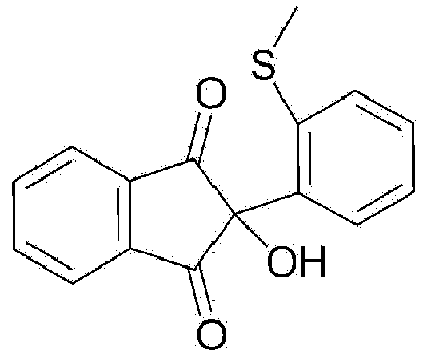
3 
58 
4 
59 
5 
60 
6 
61 
7 
62 
8 
63 
9 
64 
10 
65 
11 
66 
12 
67 
13 
68 
14 
69 
15 
70 
16 
71 
17 
72 
18 
73 
19 
74 
20 
75 
21 
76 
22 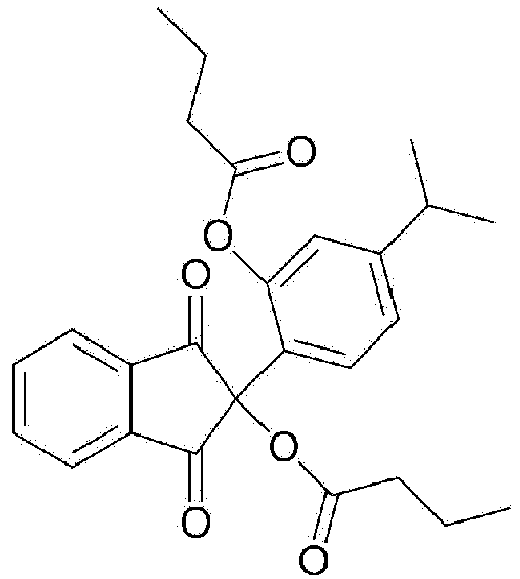
77 
23 
78 
24 
79 
25 
80 
26 
81 
27 
82 
28 
83 
29 
84 
30 
85 
31 
86 
32 
87 
33 
88 
34 
89 
35 
90 
36 
91 
37 
92 
38 
93 
39 
94 
40 
95 
41 
96 
42 
97 
43 
98 
44 
99 
45 
100 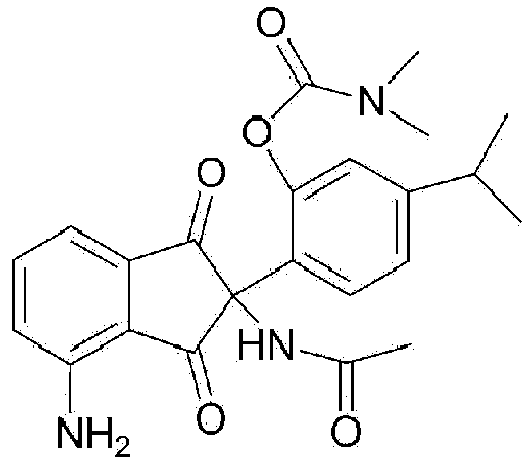
46 
101 
47 
102 
48 
103 
49 
104 
50 
105 
51 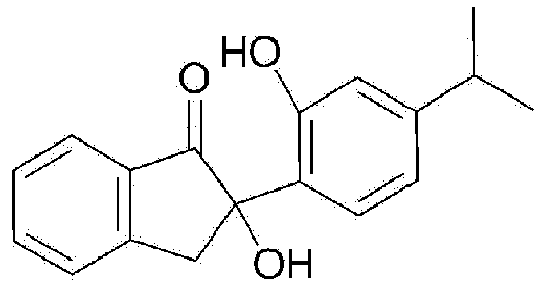
106 
52 
107 
53 
108 
54 
- - 55 
- - - In the assay, HeLa (human cervical cancer cells), MRC-5 (human fetal lung fibroblast cells), and RD cells (derived from human rhabdomyosarcoma) were employed. For comparison, ribavirin (Riv), pleconaril (pleco), and BTA-798 (BTA) were used as controls. Reagents were dissolved at a concentration of 10 ∼ 40 mg/ml in 100 % dimethylsulfoxide (DMSO). Water-soluble reagents were dissolved in PBS (-) solution and stored at -20°C. On the day of the experiment, they were used in 3x to 5x concentrations in such a manner that the concentration of dimethylsulfoxide in each well was between 0.5 % and 1 %.
- Pharmaceutical effects were determined using a virus-induced cytopathic effect (CPE) inhibition assay. In this regard, after cells suitable for viruses were grown in 96-well plates, dilutions of viruses in DME supplemented with 2 % FBS (DME/2% FBS) or MEM supplemented with 2 % FBS (MEM/2% FBS) were inoculated in an amount of 100 µl with a concentration corresponding to 100 CCID50 (50% cell culture infective dose) into each well of the plates, and incubated for 30 min ∼ 1 hrs at 33°C or 37°C to allow the viruses to adosorb to the cells. The culture medium was removed before aliquots of drug dilutions with various concentrations were added in an amount of 100 µl to each well. While HRV was grown at 33°C, the other viruses were incubated in a 37°C CO2 incubator for 2∼3 days. Alternatively, the cells were cultured for 2 ∼ 3 days without removal of the medium after they were added with 50 µl of each drug dilution having a 2-fold higher concentration and then with 50 µl of the virus dilution.
- Test conditions for each virus are summarized in Table 2, below.
TABLE 2 Virus Note Host cell Incubation Temp. Incubation Term Medium Coxsackie A9 - RD 37°C 2 days MEM/2% FBS Coxsackie A24 - MRC-5 37°C 2 days MEM/2% FBS Coxsackie A24 Isolated from patients MRC-5 37°C 2 days MEM/2% FBS Coxsackie B1 - HeLa 37°C 2 days DME/2% FBS Coxsackie B3 - HeLa 37°C 2 days DME/2% FBS Coxsackie B4 - HeLa 37°C 2 days DME/2% FBS Entero 70 - MRC-5 37°C 2 days MEM/2% FBS Poliovirus3 - HeLa 37°C 2 days DME/2% FBS Rhinovirus - HeLa 33°C 3 days MEM/2% FBS - For HeLa cells, the drugs were measured for EC50 (50 % maximal effective concentration), which is the concentration of a drug inducing a response halfway between the baseline and maximun, using an MTT assay. With regard to RD and MRC-5 cells, CPE was determined using FDA (Fluorescein diacetate). In order for the evaluation results of drug potency to reflect the toxic effect of the drug, mock-infected cells which were prepared by adding a virus-free medium to a cell culture were treated in the same manner. That is, the medium was removed after one hour of incubation, and dilutions of drugs in the medium were added once more. Following incubation for 2 ∼ 3 days, the cells were observed under a microscope and the drugs were determined for CC50 (50% cytotoxic concentration), using an MTT assay in which counts of viable cells in mock-infected wells containing drugs were compared to those of viable cells in control wells containing no drugs. In an FDA hydrolysis assay, FDA was added to each well after removal of the medium, and incubated for 20 ∼ 30 min before fluorescence intensity was measured using a spectrofluorometer to determine CPE in the same manner as in MTT.
- Survival rate (% survival) of mock-infected cells was calculated using the following Mathmatic Formula 1:

- While 100 % cell survival means no cytotoxicity of the drug, the highest cytotoxicity is reflected by 0 % cell survival. The 50% cytotoxic concentration (CC50) was defined as the concentration required to reduce the cell number by 50% compared to that for the untreated controls. Higher CC50 values mean lower cytotoxicity.
- In addition, antiviral effects can be calculated using the following Mathmatic Formula 2:

- A survaival rate of 100 % means a perfect antiviral effect (100 %) whereas the drugs are regarded to be devoid of antiviral effects at a survival rate of 0 %. The viral cytopathic effect (CPE) was recorded, and the 50% effective concentration (EC50) was defined as the compound concentration required to reduce the viral CPE by 50% compared to that for the untreated control. Lower EC50 values mean higher antiviral activities.
- CC50 and EC50 values of the compounds which accout cytotoxicity and antivival activity against picornaviruses, respectively, are given in Tables 3 and 4.
TABLE 3 Ex. No. CC50 (µg/mL) EC50 (µg/mL) Coxsackie-virus B1 Coxsackie-virus B3 Coxsackie-virus B4 Coxsackie-virus A24 (DN) Coxsackie-virus A24 (HG) Polio virus 3 Polio -virus 2 Entero-virus 70 1 >100 - - - - - - - - 2 >100 - - - - - - - <1.0 3 50.7 - - - - - - - 0.013 4 50.4 - - - - - - - - 5 26 - - - - - - - - 6 23.5 <0.01 0.035 - - - - - <0.01 7 >100 - - - - - - - - 8 7.91 - - - - - - - - 9 >100 - - - - - - - - 10 7.85 - - - - - - - - 11 8.42 - - - - - - - - 12 74.12 - - - - - - - - 13 7.93 - - - - - - - - 14 8.26 - - - - - - - - 15 8.26 0.015 - - - - - - - 16 8.87 - - - - - - - - 17 9.3 - - - - - - - - 18 >100 - - - - - - - - 19 17.7 <0.01 <0.01 - - <1.0 <1.0 - <0.01 20 >100 - - - - - - - - 21 16 <0.01 - - - - - - - 22 33.8 <0.01 - - - - - - - 23 44.3 <0.01 - - - - - - - 24 >100 - - - - - - - - 25 >100 - - - - - - - - 26 >100 - - - - - - - - 27 9.5 - - - - - - - - 28 9.2 - - - - - - - - 29 >100 - - - - - - - - 30 >100 <0.01 - - - - - - - 31 >100 - - - - - - - - 32 28.69 <0.01 - - - - - - - 33 >100 - - - - - - - - 34 46.25 - - - - - - - - 35 59.8 - - - - - - - - 36 9.42 <0.01 <0.01 - <0.1 <0.01 <0.01 - - 37 62.72 - - - - - - - - 38 >100 - - - - - - - - 39 6.67 - - - - - - - - 40 53.25 - - - - - - - - 41 - - - - - - - - - 42 71.06 - - - - - - - - 43 61.7 - - - - - - - - 44 >117 - - - - - - - - 45 >117 - - - - - - - - 46 63.98 - - - - - - - - 47 50.92 - - - - - - - - 48 46.74 <0.01 <0.01 - - - - - - 49 >100 <0.01 <0.01 <0.01 <1.0 <1.0 <1.0 <1.0 - 50 44.32 0.0112 - - - - - - - 51 9.34 - - - - - - - - 52 27.67 - - - - - - - - 53 10.2 - - - - - - - - 54 >117 0.0198 - - - - - - - 55 >117 - - - - - - - - 56 87.77 - - - - - - - - 57 48.21 - - - - - - - - 58 47.79 - - - - - - - - 59 53.67 - - - - - - - - 60 68.93 - - - - - - - - 61 >117 - - - - - - - - 62 11.26 - - - - - - - - 63 >117 - - - - - - - - 64 87.77 - - - - - - - - 65 11.16 - - - - - - - - 66 26.69 - - - - - - - - 67 54.59 - - - - - - - - 68 65.95 <0.01 <0.01 - - <1.0 - - - 69 >117 <0.01 <0.01 - <1.0 <1.0 <1.0 - - 70 >117 <0.01 <0.01 - - <1.0 - - - 71 >100 - - - - - - - - 72 >100 - - - - - - - - 73 >100 - - - - - - - - 74 - - - - - - - - - 75 >100 - - - - - - - - TABLE 4 Ex. No. Picorna-virus CC50 (µg/mL) Coxsackie-virus B1 EC50 (µg/mL) Coxsackie-virus B3 EC50 (µg/mL) Polio-virus 3 EC50 (µg/mL) 76 45.11 <0.01 <0.04 - 77 77.77 0.014 0.018 - 78 68.17 <0.01 <0.01 - 79 8.94 <0.01 <0.01 - 80 >100 <0.01 <0.01 - 81 41.26 <0.01 <0.01 0.012 82 >100 <0.01 <0.02 0.015 83 >100 <0.01 <0.01 - 84 >100 <0.01 <0.01 - 85 45.85 <0.01 <0.03 0.015 86 4.63 - - - 87 8.31 0.019 - - 88 4.49 - - - 89 10.7 - - - 90 38.26 - - - 91 40.02 0.015 - - 92 43.58 <0.01 <0.01 - 93 35.21 <0.01 <0.01 - 94 39.17 <0.01 <0.01 - 95 27.45 <0.01 <0.01 - 96 48.85 <0.01 <0.01 0.03 97 45.09 <0.01 <0.01 - 98 >100 0.013 - - 99 38.07 <0.01 <0.01 - 100 >100 <0.01 <0.01 - 101 45.95 <0.01 <0.01 - 102 42.5 <0.01 <0.01 - 103 26.27 <0.01 <0.01 0.013 104 >100 - - - 105 >100 - - - 106 >100 - - - 107 >100 - - - 108 >100 - - - - As is understood from data of Tables 3 and 4, most of the 1,3-Dioxoindene derivatives of the present invention exhibited low cytotoxicity because they had high CC50 values. In addition, most of the 1,3-Dioxoindene derivatives of the present invention were found to be highly inhibitory of coxsackie-, polio-, rhino-, and entero- viruses because their EC50 values were 0.01 µg/mL or less.
- Accordingly, the 1,3-Dioxoindene derivatives represented by Chemcial Formula 1 in accordance with the present invention exhibit low cytotoxicity and high inhibitory activity against a broad spectrum of picornaviruses, and thus may be usefully applied to a pharmaceutical composition for preventing or treating picornavirus-caused diseases.
- The test compounds were evaluated for anti-picornavirus activity by a multicycle cytopathic effect (CPE) reduction assay. The antiviral activity was initially determined using an MTS [3-(4,5-dimethylthiazol-2-yl)-5-(3-carboxymethoxyphenyl)-2-(4-sulfophenyl)-2H-tetrazolium]-based CPE reduction assay.
- In this regard, cells grown to confluence in 96-well plates were infected with 100 50% cell culture infective doses (CCID50) of virus. After an adsorption period of 2 hrs at 37°C, virus was removed and serial dilutions of the compounds were added. The cultures were further incubated at 37°C for 3 days, until complete CPE was observed in the infected and untreated virus control (VC). After removal of the medium, 90 µl of a culture medium and 10 µl of MTS-phenazine methosulfate (Promega, Leiden, The Netherlands) were added to each well. After an incubation period of 2 hrs at 37°C, the optical density (OD) of each well was read at 498 nm in a microplate reader.
- CPE values for evaluating antiviral activity were calculated using the following Mathmatic Formula 3:

- CPE values for evaluating cytotoxicity were calculated using the following Mathmatic Formula 4:

- ODCC corresponds to the OD of the uninfected and untreated, background cell cultures,
- ODVC represents the OD of the infected and untreated control cell cultures,
- ODvirus+campound represents the OD of the virus-infected cell cultures treated with a given concentration of compound, and
- ODBlank represents the OD of the well added with the cell culture medium alone.
- The 50% effective concentration (EC50) and the 50 % cytotoxic concentration (CC50) were defined as the concentrations of compound that offered 50% protection against virus-induced CPE and that killed cells by 50 %, respectively, and were calculated using logarithmic interpolation.
- CC50 and EC50 against various viruses of some compounds are given in Table 3, below.
TABLE 5 Ex. 19 Ex. 36 Ex. 74 CC50 [µM] >100 >50 >100 Coxsackie B3c EC50 [µM] <0.01 <0.01 - Coxsackie A16d EC50 [µM] 0.064 ± 0.010 - 13 ± 0.32 Coxsackie A9f EC50 [µM] - 0.0070 ± 0.00018 Coxsackie A21d EC50 [µM] 0.67 ± 0.13 - 26 ± 0.34 Entero 71e EC50 [µM] 0.10 ± 0.0018 0.0067 ± 0.00078 3.3 ± 1.6 Echo 9d EC50 [µM] 0.017 ± 0.0067 0.011 ± 0.0032 0.61 ± 0.038 Echo 11f EC50 [µM] 0.017 ± 0.0078 0.0082 ± 0.0019 0.70 ± 0.24 Polio 1f EC50 [µM] 0.79 ± 0.36 0.22 ± 0.050 20 ± 14 Polio 2f EC50 [µM] - - - Polio 3f EC50 [µM] <1.0 <0.01 - Rhino 2g EC50 [µM] >50 7.8 ± 0.57 >50 Rhino 9g EC50 [µM] >50 1.2 ± 0.12 >50 Rhino 15g EC50 [µM] >50 1.5 ± 0.24 >50 Rhino 29g EC50 [µM] >50 5.5 ± 0.72 >50 Rhino 39g EC50 [µM] >50 1.4 ± 0.20 >50 Rhino 41g EC50 [µM] >50 0.54 ± 0.0030 >50 Rhino 45g EC50 [µM] 4.6 ± 0.0083 <0.078i >50 Rhino 59g EC50 [µM] - - >50 Rhino 63g EC50 [µM] >50 >10 >50 Rhino 85g EC50 [µM] >50 7.5 ± 1.2 >50 Rhino 89g EC50 [µM] >50 0.49 ± 0.038 >50 Rhino 14g EC50 [µM] 0.45 ± 0.41 0.35 ± 0.32 >50 Rhino 42g EC50 [µM] >50 - >50 Rhino 70g EC50 [µM] 2.0 ± 0.12 > 0.078i >50 Rhino 72g EC50 [µM] 4.6 ± 0.092 - >50 Rhino 86g EC50 [µM] 26 ± 18 - 26 ± 18 - In Table 5, the superscript c represents incubation at 37°C in Vero cells, the superscript d represents incubation at 37°C in MRC-5 cells, the superscript e represents incubation at 37°C in RD cells, the superscrip f represents incubation at 37°C in BGM cells, the superscript g represents incubation at 37°C in HeLa cells, and the superscript i represents 100 % inhibition of viral replication with compounds of 0.078 µM or higher.
- As can be seen in Table 5, the 1,3-Dioxoindene derivatives according to the present invention are low in cytotoxicity because their CC50 was measured at 50 µM or higher, especially the compound of EXAMPLE 19 and EXAMPLE 74 are low in cytotoxicity because their CC50 was measured at 100 µM or higher. In addition, the 1,3-Dioxoindene derivatives were observed to have an EC50 of 26 µM or less against coxsackieviruses B3, A16, A9, and A21. Particularly high antiviral activity was detected in the compound of EXAMPLE 19 and EXAMPLE 36 with an EC50 of as low as 0.01 µM.
- With regard to enterovirus 71, the 1,3-Dioxoindene derivatives according to the present invention showed an EC50 of 3.3 µM or less. Particularly high antiviral activity was detected in the compound of EXAMPLE 36 with an EC50 of as low as 0.0067 µM.
- The 1,3-Dioxoindene derivatives according to the invention showed an EC50 of 0.70 µM or less against echovirus 9 and echovirus 11, while the higest antiviral activity was dected in the compound of EXAMPLE 36 as demonstrated by the EC50 of 0.0082 µM.
- In the case of polioviruses 1, 2 and 3, EC50 values of the 1,3-Dioxoindene derivatives according to present invention were measured to be 20 µM or less. Particularly high antiviral activity was detected in the compound of EXAMPLE 36 with an EC50 of as low as 0.01 µM.
- Also, the 1,3-Dioxoindene derivatives according to the invention were highly inhibitory of rhinoviruses. For example, EC50 of 50 µM or more was detected against rhinoviruses 2, 9, 15, 29, 39, 41, 45, 59, 63, 85, 89, 14, 42, 70, 72, and 86. Particularly high antiviral activity was detected in the compound of EXAMPLE 36 with an EC50 of 0.078 µM or less against rhinoviruses 45 and 70.
- Consequently, the 1,3-Dioxoindene derivatives of the present invention are of low cytotoxicity and exhibit excellent antiviral activity against picornaviruses including coxsackie-, entero-, echo-, polio- and rhinoviruses, so that they can be usefully applied to the prevention or treatment of picornavirus-caused respiratory, cardiocirculatory, and nerveous system diseases, including poliomyelitis, paralysis, acute hemorrhagic conjunctivitis, viral meningitis, hand-foot-and-mouth disease, vesicular disease, hepaitis A, myositis, myocarditis, pancreatitis, diabetes, epidemic myalgia, encephalitis, flu, herpangina, foot-and-mouth disease, asthma, chronic obstructive pulmonary disease, pneumonia, sinusitis and otitis media.
-
<1-1> Preparation of Powder 1,3-Dioxoindene derivative: 2 g Lactose: 1 g - The above ingredients were mixed and loaded into an airtight sac to produce a powder agent.
<1-2> Preparation of Tablet 1,3-Dioxoindene derivative: 100 mg Corn starch: 100 mg Lactose: 100 mg Mg stearate: 2 mg - These ingredients were mixed and prepared into tablets using a typical tabletting method.
<1-3> Preparation of Capsule 1,3-Dioxoindene derivative: 100 mg Corn starch: 100 mg Lactose: 100 mg Mg stearate: 2 mg - These ingredients were mixed and loaded into gelatin capsules according to a typical method to produce capsules.
<1-4> Preparation of Injection 1,3-Dioxoindene derivative: 10 µg/ml Diluted Hydrochloric acid BP: to be pH 3.5 Sodium chloride BP for injection: maximum 1 ml - The 1,3-Dioxoindene derivative of the present invention was dissolved in a appropriate volume of sodium chloride BP for injection. The pH of the resultant solution was regulated to be pH 3.5 with dil.HCl BP, and then its volume was regulated with sodium chloride BP for Injection and the solution was mixed completely. The solution was then filled in 5 -ml type 1 ample that is made of transparent glass. The air was sealed in upper lattice by melting the glass. The solution contained in ample was autoclaved at 120°C for 15 min or more to be sterilized and thereby to obtain an injection.
- Having excellent inhibitory activity against picornaviruses including coxsackie-, entero-, echo-, Polio-, and rhinoviruses, as well as exhibiting low cytotoxicity, as described hitherto, the 1,3-Dioxoindene derivative of Chemical Formula 1 can be useful as an active ingredient of a pharmaceutical composition for the prevention or treatment of viral diseases including poliomyelitis, paralysis, acute hemorrhagic conjunctivitis, viral meningitis, hand-foot-and-mouth disease, vesicular disease, hepatitis A, myositis, myocarditis, pancreatitis, diabetes, epidemic myalgia, encephalitis, flu, herpangina, foot-and-mouth disease, asthma, chronic obstructive pulmonary disease, pneumonia, sinusitis or otitis media.
-
- [Clause 1]
1,3-Dioxoindene derivatives expressed by Formula 1, pharmaceutically-acceptable salt thereof or optical isomer thereof:
- where, A1, A2, A3 and A4 are, either independently or optionally, any one selected from a group consisting of -H, halogen, -OH, -CN, -N3, C1∼C10 alkoxy, C1∼C10 straight- or side-chain alkyl, C6∼C12 aryl, -O(C=O)R1, -(C=O)R1, - (C=O)OR1, -O(C=O)OR1, -O(C=O)NR1R2, -NO2, -NR1R2, -NR1(C=O)R2, -NR1(C=S) R2, -NR1(C=O)OR2, -NR1(C=O)-NR2R3 and -NR1(C=S)-NR2R3, or two or more neighboring substituents of A1, A2, A3 and A4 may form a ring together, wherein a ring formed by two or more neighboring substituents of D1, D2, D3 and D4 may include one or more hetero atom, and the hetero atom is N, O or S;
- G is -H, halogen, -OH, -CN, -N3, C1∼C10 alkoxy, - O(C=O)R1, - (C=O)R1, -(C=O)OR1, -O(C=O)OR1, -O(C=O)NR1R2, -NO2, -NR1R2, -NR1(C=O)R2, -NR1(C=S)R2, -NR1(C=O)OR2, -NR1(C=O)-NR2R3, -NR1(C=S) -NR2R3 or

- D1, D2, D3 and D4 are, either independently or optionally, any one selected from a group consisting of -H, halogen, -OH, -CN, C1∼C10 alkoxy, C1∼C10 straight- or side-chain alkyl, C6∼C12 aryl, - (CH2)n-(C=O)OR1, -O(C=O)R1, - (C=O)R1, - (C=O)OR1, -O(C=O)OR1, -O(C=O)NR1R2, -NO2, -NR1R2, - NR1(C=O)R2, -NR1(C=S)R2, -NR1(C=O)OR2, -NR1(C=O)-NR2R3, -SR1 and -NR1(C=S)-NR2R3, or two or more neighboring substituents of D1, D2, D3 and D4 may form a ring together, wherein a ring formed by two or more neighboring substituent of D1, D2, D3 and D4 may include one or more hetero atom, and the hetero atom is N, O or S;
- E is -H, -OH, -OR1, -O(C=O)R1, - (C=O)R1, - (C=O)OR1, - O(C=O)OR1, -O(C=O)NR1R2, -NO2, -NR1R2, -NR1(C=O)R2, -SR1, - NR1(C=S)R2, -NR1(C=O)OR2, -NR1(C=O)-NR2R3 or -NR1(C=S)-NR2R3;
- R1, R2 and R3 are, each independently, hydrogen, nonsubstituted or phenyl-substituted C1∼C10 straight- or side-chain alkyl, C1∼C10 alkoxy, nonsubstituted or phenyl-substituted C1∼C10 straight- or side-chain alkenyl, C3∼C7 cycloalkyl or nonsubstituted or phenyl-substituted C6∼C12 aryl;
- X and Y are, each independently, hydrogen, oxygen, hydroxy or sulfur;
- Z1, Z2 and Z3 are carbon or nitrogen;
- n is integer between 1∼10; and
- '
--- ' denotes single or double bond.
- [Clause 2]
The 1,3-Dioxoindene derivatives, pharmaceutically-acceptable salt thereof or optical isomer thereof as set forth in clause 1, wherein, A1, A2, A3 and A4 are, either independently or optionally, any one selected from a group consisting of -H, halogen, C1∼C10 straight- or side-chain alkyl, -NR1R2, -NR1(C=O)R2, or two or more neighboring substituents of A1, A2, A3 and A4 may form a ring together, wherein a ring formed by two or more neighboring substituents of D1, D2, D3 and D4 may include one or more hetero atom, and the hetero atom is N, O or S;
G is -OH, -O (C=O) R1, -O (C=O) OR1, -NR1 (C=O) R2, - NR1 (C=O) OR2 or
E is -H, -OH, -OR1, -O(C=O)R1, -O(C=O)OR1,-O(C=O)NR1R2, -NR1(C=O)R2 or -NR1(C=O)OR2;
R1, R2 and R3 are, each independently, hydrogen, nonsubstituted or phenyl-substituted C1∼C9 straight- or side-chain alkyl, nonsubstituted or phenyl-substituted C1∼C5 straight- or side-chain alkenyl or C6∼C10 aryl;
X and Y are, each independently, oxygen or hydroxy;
Z1, Z2 and Z3 are carbon;
n is integer betweeb 1∼5; and
'--- ' denotes single or double bond. - [Clause 3]
The 1,3-Dioxoindene derivatives, pharmaceutically-acceptable salt thereof or optical isomer thereof as set forth in clause 1, wherein, A1, A2, A3 and A4 are, either independently or optionally, any one selected from a group consisting of -H, halogen and -NR1R2;
G is -OH, -NR1(C=O)R2 or -NR1(C=O)OR2;
D1, D2, D3 and D4 are, either independently or optionally, any one selected from a group consisting of halogen, C1∼C10 straight- or side-chain alkyl and - NR1 (C=O) R2;
E is -H, -OH, -OR1, -O(C=O)R1, -O(C=O)OR1 or-O(C=O)NR1R2;
R1, R2 and R3 are, each independently, hydrogen, nonsubstituted or phenyl-substituted C1∼C8 straight- or side-chain alkyl, nonsubstituted or phenyl-substituted C1∼C4 straight- or side-chain alkenyl or C6∼C10 aryl;
X and Y are oxygen;
Z1, Z2 and Z3 are carbon;
n is integer betweeb 1∼3; and
'--- ' denotes double bond. - [Clause 4]
The 1,3-Dioxoindene derivatives, pharmaceutically-acceptable salt thereof or optical isomer thereof as set forth in clause 1, wherein, A1, A2, A3 and A4 are, either independently or optionally, any one selected from a group consisting of -H and -NR1R2;
G is -NR1(C=O)R2;
D1, D2, D3 and D4 are C1∼C10 straight- or side-chain alkyl;
E is -O(C=O)R1;
R1, R2 and R3 are, each independently, hydrogen or C1∼C7 straight- or side-chain alkyl;
X and Y are oxygen;
Z1, Z2 and Z3 are carbon;
n is integer betweeb 1∼3; and
'--- ' denotes double bond. - [Clause 5]
The 1,3-Dioxoindene derivatives, pharmaceutically acceptable salt thereof or optical isomer thereof as set forth in clause 1, wherein the 1,3-Dioxoindene derivative is selected from the group consisting of:- 1) Ethyl 2-(4-acetoxy-3-(2-acetoxy-1,3-dioxo-2,3-dihydro-1H-inden-2-yl)-5-methoxyphenyl)acetate;
- 2) 2-(2-Acetoxy-1,3-dioxo-2,3-dihydro-1H-inden-2-yl)-4,5-dimethylphenyl acetate;
- 3) 2-(2-Acetoxy-1,3-dioxo-2,3-dihydro-1H-inden-2-yl)-5-chlorophenyl acetate;
- 4) 6-(2-Acetoxy-1,3-dioxo-2,3-dihydro-1H-inden-2-yl)-2,3-dichlorophenyl acetate;
- 5) 2-(2-Acetoxy-1,3-dioxo-2,3-dihydro-1H-inden-2-yl)-4,6-dichlorophenyl acetate;
- 6) 2-(2-Acetoxy-1,3-dioxo-2,3-dihydro-1H-inden-2-yl)-5-ethylphenyl acetate;
- 7) 2-(2-Acetoxy-1,3-dioxo-2,3-dihydro-1H-inden-2-yl)-4-methoxyphenyl acetate;
- 8) 4-(2-Acetoxy-1,3-dioxo-2,3-dihydro-1H-inden-2-yl)biphenyl-3-yl acetate;
- 9) 2-(2-Acetoxy-1,3-dioxo-2,3-dihydro-1H-inden-2-yl)-4-nitrophenyl acetate;
- 10) 3-(2-Acetoxy-1,3-dioxo-2,3-dihydro-1H-inden-2-yl)biphenyl-4-yl acetate;
- 11) 2-(2-Acetoxy-1,3-dioxo-2,3-dihydro-1H-inden-2-yl)-4-propylphenyl acetate;
- 12) 2-(2-Acetoxy-1,3-dioxo-2,3-dihydro-1H-inden-2-yl)-4-ethylphenyl acetate;
- 13) 2-(2-Acetoxy-1,3-dioxo-2,3-dihydro-1H-inden-2-yl)-4-sec-butylphenyl acetate;
- 14) 2-(2-Acetoxy-1,3-dioxo-2,3-dihydro-1H-inden-2-yl)-4-tert-butylphenyl acetate;
- 15) 2-(2-Acetoxy-1,3-dioxo-2,3-dihydro-1H-inden-2-yl)-5-tert-butylphenyl acetate;
- 16) 2-(2-Acetoxy-1,3-dioxo-2,3-dihydro-1H-inden-2-yl)-3,4,5-trimethylphenyl acetate;
- 17) 2-(2-Acetoxy-1,3-dioxo-2,3-dihydro-1H-inden-2-yl)-4-tert-pentylphenyl acetate;
- 18) Acetic acid 2-(2,3-diacetoxy-5-methyl-phenyl)-1,3-dioxo-indan-2-yl ester;
- 19) Acetic acid 2-(2-acetoxy-4-isopropyl-phenyl)-1,3-dioxo-indan-2-yl ester;
- 20) 2-(4-Acetyl-2-hydroxy-phenyl)-2-hydroxy-indan-1,3-dione;
- 21) 2-(1,3-Dioxo-2-(propionyloxy)-2,3-dihydro-1H-inden-2-yl)-5-isopropylphenyl propionate;
- 22) 2-(2-(Butyryloxy)-1,3-dioxo-2,3-dihydro-1H-inden-2-yl)-5-isopropylphenyl butyrate;
- 23) 2-(2-Hydroxy-4-isopropylphenyl)-1,3-dioxo-2,3-dihydro-1H-inden-2-yl benzoate;
- 24) 2-(2-Benzyloxy-4-isopropyl-phenyl)-2-hydroxy-indan-1,3-dione;
- 25) 2-(2-Benzyloxy-4-isopropyl-phenyl)-2-methoxy-indan-1,3-dione;
- 26) 2-Hydroxy-2-(4-hydroxy-3,5-dimethyl-phenyl)-indan-1,3-dione;
- 27) 2-(2-Acetoxy-4-isopropylphenyl)-5-methoxy-1,3-dioxo-2,3-dihydro-1H-inden-2-yl acetate;
- 28) 2-(2-Hydroxy-4-isopropylphenyl)-2-methoxy-1H-inden-1,3(2H)-dione;
- 29) 2-(1,3-Dioxo-2-(pivaloyloxy)-2,3-dihydro-1H-inden-2-yl)-5-isopropylphenyl pivalate;
- 30) 2-(2-Hydroxy-1,3-dioxo-2,3-dihydro-1H-inden-2-yl)-5-isopropylphenyl cinnamate;
- 31) Dimethyl-carbamic acid 2-(2-dimethylcarbamoyloxy-1,3-dioxo-indan-2-yl)-5-isopropyl-phenyl ester;
- 32) 2-(2-(Acryloyloxy)-1,3-dioxo-2,3-dihydro-1H-inden-2-yl)-5-isopropylphenyl acrylate;
- 33) Diethyl-carbamic acid 2-(2-diethylcarbamoyloxy-1,3-dioxo-indan-2-yl)-5-isopropyl-phenyl ester;
- 34) 2-(2-Hydroxy-1,3-dioxo-2,3-dihydro-1H-inden-2-yl)-5-isopropylphenyl diethylcarbamate;
- 35) 2-Hydroxy-2-(4-hydroxy-2,5-dimethylphenyl)-1H-inden-1,3(2H)-dione;
- 36) Acetic acid 2-(2-acetoxy-4-isopropyl-phenyl)-4-amino-1,3-dioxo-indan-2-yl ester;
- 37) Acetic acid 2-(2-acetoxy-4-isopropyl-phenyl)-4-nitro-1,3-dioxo-indan-2-yl ester;
- 38) 2-Hydroxy-2-(4-isopropyl-2-methoxyphenyl)-4-nitro-2H-inden-1,3-dione;
- 39) 2-Chloro-2-(4-isopropyl-2-methoxyphenyl)-4-nitro-2H-inden-1,3-dione;
- 40) 2-Azido-2-(4-isopropyl-2-methoxyphenyl)-4-nitro-2H-inden-1,3-dione;
- 41) 4-Amino-2-hydroxy-2-(4-isopropyl-2-methoxyphenyl)-2H-inden-1,3-dione;
- 42) N-(2-Hydroxy-2-(4-isopropyl-2-methoxyphenyl)-7-nitro-1,3-dioxo-2,3-dihydro-1H-inden-4-yl) acetamide;
- 43) N-(2-Hydroxy-2-(4-isopropyl-2-methoxyphenyl)-5-nitro-1,3-dioxo-2,3-dihydro-1H-inden-4-yl) acetamide;
- 44) N-(7-Amino-2-hydroxy-2-(4-isopropyl-2-methoxyphenyl)-1,3-dioxo-2,3-dihydro-1H-inden-4-yl)acetamide;
- 45) N-(5-Amino-2-hydroxy-2-(4-isopropyl-2-methoxyphenyl)-1,3-dioxo-2,3-dihydro-1H-inden-4-yl)acetamide;
- 46) 4,7-Diamino-2-hydroxy-2-(4-isopropyl-2-methoxyphenyl)-2H-inden-1,3-dione;
- 47) 4,5-Diamino-2-hydroxy-2-(4-isopropyl-2-methoxyphenyl)-2H-inden-1,3-dione;
- 48) Methyl 2-(4-isopropyl-2 (methoxycarbonyloxy)phenyl)-1,3-dioxo-2,3-dihydro-1H-inden-2-yl carbamate;
- 49) 2-(1,3-Dioxo-2-pentanamido-2,3-dihydro-1H-inden-2-yl)-5-isopropylphenyl pentanoate;
- 50) 2-(2-Isobutylamido-1,3-dioxo-2,3-dihydro-1H-inden-2-yl)-5-isopropylphenyl isobutyrate;
- 51) 2-Hydroxy-2-(2-hydroxy-4-isopropylphenyl)-2,3-dihydro-1H-inden-1-one;
- 52) 2-Azido-2-(4-isopropyl-2-methoxyphenyl)-2H-inden-1,3-dione;
- 53) 2-Amino-2-(4-isopropyl-2-methoxyphenyl)-2H-inden-1,3-dione;
- 54) N-(2-(4-Isopropyl-2-methoxyphenyl)-1,3-dioxo-2,3-dihydro-1H-inden-2-yl) acetamide;
- 55) N-(2-(4-Isopropyl-2-methoxyphenyl)-1,3-dioxo-2,3-dihydro-1H-inden-2-yl)benzamide;
- 56) N-(2-(4-Isopropyl-2-methoxyphenyl)-1,3-dioxo-2,3-dihydro-1H-inden-2-yl) cyclopropancarboxamide;
- 57) 2-(2-(Methylthio)phenyl)-2H-inden-1,3-dione;
- 58) 2-(4-(Methylthio)phenyl)-2H-inden-1,3-dione;
- 59) Methyl 2-(4-isopropyl-2-methoxyphenyl)-1,3-dioxo-2,3-dihydro-1H-inden-2-ylcarbamate;
- 60) 1-Ethyl-3-(2,3-dihydro-2-(4-isopropyl-2-methoxyphenyl)-1,3-dioxo-1H-inden-2-yl)urea;
- 61) 1-(2,3-Dihydro-2-(4-isopropyl-2-methoxyphenyl)-1,3-dioxo-1H-inden-2-yl)urea;
- 62) Isopropyl 2-(4-isopropyl-2-methoxyphenyl)-1,3-dioxo-2,3-dihydro-1H-inden-2-ylcarbamate;
- 63) 1-(2-(4-Isopropyl-2-methoxyphenyl)-1,3-dioxo-2,3-dihydro-1H-inden-2-yl)-3-methoxy urea;
- 64) Ethyl 2-(4-isopropyl-2-methoxyphenyl)-1,3-dioxo-2,3-dihydro-1H-inden-2-ylcarbamate ;
- 65) N-(2-Bromo-2-(4-isopropyl-2-methoxyphenyl)-1,3-dioxo-2,3-dihydro-1H-inden-4-yl) acetamide;
- 66) N-(2-Amino-2-(4-isopropyl-2-methoxyphenyl)-1,3-dioxo-2,3-dihydro-1H-inden-4-yl) acetamide;
- 67) N,N'-(2-(4-Isopropyl-2-methoxyphenyl)-1,3-dioxo-2,3-dihydro-1H-inden-2,4-diyl)diacetamide;
- 68) 2-(1,3-Dioxo-2-propionamido-2,3-dihydro-1H-inden-2-yl)-5-isopropylphenyl propionate;
- 69) 2-(1,3-Dioxo-2-pentanamido-2,3-dihydro-1H-inden-2-yl)-5-isopropylphenyl pentanoate;
- 70) 2-(2-Benzamido-1,3-dioxo-2,3-dihydro-1H-inden-2-yl)-5-isopropylphenyl benzoate;
- 71) 2-(2-Acetoxy-1,3-dioxo-2,3-dihydro-1H-inden-2-yl)-6-methylpyridin-3-yl acetate;
- 72) 2-Hydroxy-2-(4-hydroxy-5-methylpyridin-3-yl)-1H-inden-1,3(2H)-dione;
- 73) 2-(5-Chloro-3-hydroxypyridin-2-yl)-2-hydroxy-1H-inden-1,3(2H)-dione;
- 74) 2-2-acetoxy-1,3-dioxo-2,3-dihydro-1H-inden-2-yl;
- 75) 2-Hydroxy-2-(6-hydroxyquinolin-7-yl)-1H-inden-1, 3 (2H) -dione;
- 76) Butyric acid 2-(2-butyrylamino-1,3-dioxo-indan-2-yl)-5-isopropyl-phenyl ester;
- 77) Octanoic acid 7-isopropyl-9b-octanoylamino-10-oxo-9b,10-dihydro-5-oxa-indeno[2,1-a]inden-4b-yl ester;
- 78) Hexanoic acid 2-(2-hexanoylamino-1,3-dioxo-indan-2-yl)-5-isopropyl-phenyl ester;
- 79) Heptanoic acid 2-(2-heptanoylamino-1,3-dioxo-indan-2-yl)-5-isopropyl-phenyl ester;
- 80) 2,2-Dimethyl-propionic acid 2-(1,3-dioxo-2-pentanoylamino-indan-2-yl)-5-isopropyl-phenyl ester;
- 81) 2-(4-Amino-1,3-dioxo-2-pentanamido-2,3-dihydro-1H-inden-2-yl)-5-isopropylphenyl pentanoate;
- 82) 2-(4-Amino-2-hexanamido-1,3-dioxo-2,3-dihydro-1H-inden-2-yl)-5-isopropylphenyl hexanoate;
- 83) 2-(4-Amino-2-heptanamido-1,3-dioxo-2,3-dihydro-1H-inden-2-yl)-5-isopropylphenyl heptanoate;
- 84) 2-(4-Amino-1,3-dioxo-2-propionamido-2,3-dihydro-1H-inden-2-yl)-5-isopropylphenyl propionate;
- 85) 2-(4-Amino-2-butyramido-1,3-dioxo-2,3-dihydro-1H-inden-2-yl)-5-isopropylphenyl butyrate;
- 86) N-(2-(2-Hydroxy-1,3-dioxo-2,3-dihydro-1H-inden-2-yl)-4,5-dimethylphenyl)acetamide;
- 87) N-(2-(2-Hydroxy-1,3-dioxo-2,3-dihydro-1H-inden-2-yl)-4,5-dimethylphenyl)propionamide;
- 88) N-(5-Ethyl-2-(2-hydroxy-1,3-dioxo-2,3-dihydro-1H-inden-2-yl)phenyl)acetamide;
- 89) N-(2-(2-Hydroxy-1,3-dioxo-2,3-dihydro-1H-inden-2-yl)-4,5-dimethylphenyl)butyramide;
- 90) N-(2-(2-Hydroxy-1,3-dioxo-2,3-dihydro-1H-inden-2-yl)-4,5-dimethylphenyl)isobutyramide;
- 91) 2-(4-Amino-2-octanamido-1,3-dioxo-2,3-dihydro-1H-inden-2-yl)-5-isopropylphenyl octanoate;
- 92) 2-(2-Acetamido-1,3-dioxo-2,3-dihydro-1H-inden-2-yl)-5-isopropylphenyl methyl carbonate;
- 93) 2-(2-Acetamido-1,3-dioxo-2,3-dihydro-1H-inden-2-yl)-5-isopropylphenyl pentanoate;
- 94) N-(2-(4-Acetamido-2-hydroxy-7-nitro-1,3-dioxo-2,3-dihydro-1H-inden-2-yl)-4,5-dimethylphenyl)isobutyramide;
- 95) N-(2-(2-Hydroxy-1,3-dioxo-2,3-dihydro-1H-inden-2-yl)-5-isopropylphenyl)isobutyramide;
- 96) 2-(2-Acetamido-4-amino-1,3-dioxo-2,3-dihydro-1H-inden-2-yl)-5-isopropylphenyl butyl carbonate2-(2-acetamido-4-amino-1,3-dioxo-2,3-dihydro-1H-inden-2-yl)-5-isopropylphenyl butyl carbonate;
- 97) 2-(2-Acetamido-1,3-dioxo-2,3-dihydro-1H-inden-2-yl)-5-isopropylphenyl methylcarbamate;
- 98) Dimethyl-carbamic acid 2-(2-acetylamino-1,3-dioxo-indan-2-yl)-5-isopropyl-phenyl ester;
- 99) Carbonic acid 2-(2-acetylamino-1,3-dioxo-indan-2-yl)-5-isopropyl-phenyl ester phenyl ester;
- 100) 2-(2-Acetamido-4-amino-1,3-dioxo-2,3-dihydro-1H-inden-2-yl)-5-isopropylphenyl dimethylcarbamate;
- 101) 2-(2-Acetamido-1,3-dioxo-2,3-dihydro-1H-inden-2-yl)-5-isopropylphenyl ethyl carbonate;
- 102) Ethyl acetyl(2-(2-hydroxy-4-isopropylphenyl)-1,3-dioxo-2,3-dihydro-1H-inden-2-yl)carbamate;
- 103) 2-(2-Acetamido-4-amino-1,3-dioxo-2,3-dihydro-1H-inden-2-yl)-5-isopropylphenyl ethylcarbamate;
- 104) 2-(3-Methoxyphenyl)-2H-inden-1,3-dione;
- 105) Ethyl (6-(2-((ethoxycarbonyl)oxy)-4-isopropylphenyl)-5,7-dioxo-6,7-dihydro-5H-cyclopenta[b]pyridin-6-yl) carbonate;
- 106) N-(2-(2-Hydroxy-1,3-dioxo-2,3-dihydro-1H-inden-2-yl)-4,5-dimethoxyphenyl)isobutyramide;
- 107) N-[2-(4-Amino-2-hydroxy-1,3-dioxo-indan-2-yl)-4,5-dimethoxy-phenyl]-isobutyramide; and
- 108) N-[2-(2-Hydroxy-5,6-dimethoxy-1,3-dioxo-indan-2-yl)-4,5-dimethoxy-phenyl]-isobutyramide.
- [Clause 6]
The 1,3-Dioxoindene derivatives, pharmaceutically acceptable salt thereof or optical isomer thereof as set forth in clause 1, wherein the 1,3-Dioxoindene derivative is selected from the group consisting of:- 27) 2-(2-Acetoxy-4-isopropylphenyl)-5-methoxy-1,3-dioxo-2,3-dihydro-1H-inden-2-yl acetate;
- 36) Acetic acid 2-(2-acetoxy-4-isopropyl-phenyl)-4-amino-1,3-dioxo-indan-2-yl ester;
- 37) Acetic acid 2-(2-acetoxy-4-isopropyl-phenyl)-4-nitro-1,3-dioxo-indan-2-yl ester;
- 38) 2-Hydroxy-2-(4-isopropyl-2-methoxyphenyl)-4-nitro-2H-inden-1,3-dione;
- 39) 2-Chloro-2-(4-isopropyl-2-methoxyphenyl)-4-nitro-2H-inden-1,3-dione;
- 40) 2-Azido-2-(4-isopropyl-2-methoxyphenyl)-4-nitro-2H-inden-1,3-dione;
- 41) 4-Amino-2-hydroxy-2-(4-isopropyl-2-methoxyphenyl)-2H-inden-1,3-dione;
- 42) N-(2-Hydroxy-2-(4-isopropyl-2-methoxyphenyl)-7-nitro-1,3-dioxo-2,3-dihydro-1H-inden-4-yl) acetamide;
- 43) N-(2-Hydroxy-2-(4-isopropyl-2-methoxyphenyl)-5-nitro-1,3-dioxo-2,3-dihydro-1H-inden-4-yl) acetamide;
- 44) N-(7-Amino-2-hydroxy-2-(4-isopropyl-2-methoxyphenyl)-1,3-dioxo-2,3-dihydro-1H-inden-4-yl)acetamide;
- 45) N-(5-Amino-2-hydroxy-2-(4-isopropyl-2-methoxyphenyl)-1,3-dioxo-2,3-dihydro-1H-inden-4-yl)acetamide;
- 46) 4,7-Diamino-2-hydroxy-2-(4-isopropyl-2-methoxyphenyl)-2H-inden-1,3-dione;
- 47) 4,5-Diamino-2-hydroxy-2-(4-isopropyl-2-methoxyphenyl)-2H-inden-1,3-dione;
- 48) Methyl 2-(4-isopropyl-2(methoxycarbonyloxy)phenyl)-1,3-dioxo-2,3-dihydro-1H-inden-2-yl carbamate;
- 53) 2-Amino-2-(4-isopropyl-2-methoxyphenyl)-2H-inden-1,3-dione;
- 54) N-(2-(4-Isopropyl-2-methoxyphenyl)-1,3-dioxo-2,3-dihydro-1H-inden-2-yl) acetamide;
- 55) N-(2-(4-Isopropyl-2-methoxyphenyl)-1,3-dioxo-2,3-dihydro-1H-inden-2-yl)benzamide;
- 56) N-(2-(4-Isopropyl-2-methoxyphenyl)-1,3-dioxo-2,3-dihydro-1H-inden-2-yl) cyclopropancarboxamide;
- 59) Methyl 2-(4-isopropyl-2-methoxyphenyl)-1,3-dioxo-2,3-dihydro-1H-inden-2-ylcarbamate;
- 60) 1-Ethyl-3-(2,3-dihydro-2-(4-isopropyl-2-methoxyphenyl)-1,3-dioxo-1H-inden-2-yl)urea;
- 61) 1-(2,3-Dihydro-2-(4-isopropyl-2-methoxyphenyl)-1,3-dioxo-1H-inden-2-yl)urea;
- 62) Isopropyl 2-(4-isopropyl-2-methoxyphenyl)-1,3-dioxo-2,3-dihydro-1H-inden-2-ylcarbamate;
- 63) 1-(2-(4-Isopropyl-2-methoxyphenyl)-1,3-dioxo-2,3-dihydro-1H-inden-2-yl)-3-methoxy urea;
- 64) Ethyl 2-(4-isopropyl-2-methoxyphenyl)-1,3-dioxo-2,3-dihydro-1H-inden-2-ylcarbamate ;
- 65) N-(2-Bromo-2-(4-isopropyl-2-methoxyphenyl)-1,3-dioxo-2,3-dihydro-1H-inden-4-yl) acetamide;
- 66) N-(2-Amino-2-(4-isopropyl-2-methoxyphenyl)-1,3-dioxo-2,3-dihydro-1H-inden-4-yl) acetamide;
- 67) N,N'-(2-(4-Isopropyl-2-methoxyphenyl)-1,3-dioxo-2,3-dihydro-1H-inden-2,4-diyl)diacetamide;
- 68) 2-(1,3-Dioxo-2-propionamido-2,3-dihydro-1H-inden-2-yl)-5-isopropylphenyl propionate;
- 69) 2-(1,3-Dioxo-2-pentanamido-2,3-dihydro-1H-inden-2-yl)-5-isopropylphenyl pentanoate;
- 70) 2-(2-Benzamido-1,3-dioxo-2,3-dihydro-1H-inden-2-yl)-5-isopropylphenyl benzoate;
- 76) Butyric acid 2-(2-butyrylamino-1,3-dioxo-indan-2-yl)-5-isopropyl-phenyl ester;
- 77) Octanoic acid 7-isopropyl-9b-octanoylamino-10-oxo-9b,10-dihydro-5-oxa-indeno[2,1-a]inden-4b-yl ester;
- 78) Hexanoic acid 2-(2-hexanoylamino-1,3-dioxo-indan-2-yl)-5-isopropyl-phenyl ester;
- 79) Heptanoic acid 2-(2-heptanoylamino-1,3-dioxo-indan-2-yl)-5-isopropyl-phenyl ester;
- 80) 2,2-Dimethyl-propionic acid 2-(1,3-dioxo-2-pentanoylamino-indan-2-yl)-5-isopropyl-phenyl ester;
- 81) 2-(4-Amino-1,3-dioxo-2-pentanamido-2,3-dihydro-1H-inden-2-yl)-5-isopropylphenyl pentanoate;
- 82) 2-(4-Amino-2-hexanamido-1,3-dioxo-2,3-dihydro-1H-inden-2-yl)-5-isopropylphenyl hexanoate;
- 83) 2-(4-Amino-2-heptanamido-1,3-dioxo-2,3-dihydro-1H-inden-2-yl)-5-isopropylphenyl heptanoate;
- 84) 2-(4-Amino-1,3-dioxo-2-propionamido-2,3-dihydro-1H-inden-2-yl)-5-isopropylphenyl propionate;
- 85) 2-(4-Amino-2-butyramido-1,3-dioxo-2,3-dihydro-1H-inden-2-yl)-5-isopropylphenyl butyrate;
- 86) N-(2-(2-Hydroxy-1,3-dioxo-2,3-dihydro-1H-inden-2-yl)-4,5-dimethylphenyl)acetamide;
- 87) N-(2-(2-Hydroxy-1,3-dioxo-2,3-dihydro-1H-inden-2-yl)-4,5-dimethylphenyl)propionamide;
- 88) N-(5-Ethyl-2-(2-hydroxy-1,3-dioxo-2,3-dihydro-1H-inden-2-yl) phenyl)acetamide;
- 89) N-(2-(2-Hydroxy-1,3-dioxo-2,3-dihydro-1H-inden-2-yl)-4,5-dimethylphenyl)butyramide;
- 90) N-(2-(2-Hydroxy-1,3-dioxo-2,3-dihydro-1H-inden-2-yl)-4,5-dimethylphenyl)isobutyramide;
- 91) 2-(4-Amino-2-octanamido-1,3-dioxo-2,3-dihydro-1H-inden-2-yl)-5-isopropylphenyl octanoate;
- 92) 2-(2-Acetamido-1,3-dioxo-2,3-dihydro-1H-inden-2-yl)-5-isopropylphenyl methyl carbonate;
- 93) 2-(2-Acetamido-1,3-dioxo-2,3-dihydro-1H-inden-2-yl)-5-isopropylphenyl pentanoate;
- 94) N-(2-(4-Acetamido-2-hydroxy-7-nitro-1,3-dioxo-2,3-dihydro-1H-inden-2-yl)-4,5-dimethylphenyl)isobutyramide;
- 95) N-(2-(2-Hydroxy-1,3-dioxo-2,3-dihydro-1H-inden-2-yl)-5-isopropylphenyl)isobutyramide;
- 96) 2-(2-Acetamido-4-amino-1,3-dioxo-2,3-dihydro-1H-inden-2-yl)-5-isopropylphenyl butyl carbonate2-(2-acetamido-4-amino-1,3-dioxo-2,3-dihydro-1H-inden-2-yl)-5-isopropylphenyl butyl carbonate;
- 97) 2-(2-Acetamido-1,3-dioxo-2,3-dihydro-1H-inden-2-yl)-5-isopropylphenyl methylcarbamate;
- 98) Dimethyl-carbamic acid 2-(2-acetylamino-1,3-dioxo-indan-2-yl)-5-isopropyl-phenyl ester;
- 99) Carbonic acid 2-(2-acetylamino-1,3-dioxo-indan-2-yl)-5-isopropyl-phenyl ester phenyl ester;
- 100) 2-(2-Acetamido-4-amino-1,3-dioxo-2,3-dihydro-1H-inden-2-yl)-5-isopropylphenyl dimethylcarbamate;
- 101) 2-(2-Acetamido-1,3-dioxo-2,3-dihydro-1H-inden-2-yl)-5-isopropylphenyl ethyl carbonate;
- 102) Ethyl acetyl(2-(2-hydroxy-4-isopropylphenyl)-1,3-dioxo-2,3-dihydro-1H-inden-2-yl)carbamate;
- 103) 2-(2-Acetamido-4-amino-1,3-dioxo-2,3-dihydro-1H-inden-2-yl)-5-isopropylphenyl ethylcarbamate;
- 104) 2-(3-Methoxyphenyl)-2H-inden-1,3-dione;
- 105) Ethyl (6-(2-((ethoxycarbonyl)oxy)-4-isopropylphenyl)-5,7-dioxo-6,7-dihydro-5H-cyclopenta[b]pyridin-6-yl) carbonate;
- 106) N-(2-(2-Hydroxy-1,3-dioxo-2,3-dihydro-1H-inden-2-yl)-4,5-dimethoxyphenyl)isobutyramide;
- 107) N-[2-(4-Amino-2-hydroxy-1,3-dioxo-indan-2-yl)-4,5-dimethoxy-phenyl]-isobutyramide; and
- 108) N-[2-(2-Hydroxy-5,6-dimethoxy-1,3-dioxo-indan-2-yl)-4,5-dimethoxy-phenyl]-isobutyramide.
- [Clause 7]
The 1,3-Dioxoindene derivatives, pharmaceutically acceptable salt thereof or optical isomer thereof as set forth in clause 1, wherein the 1,3-Dioxoindene derivative is selected from the group consisting of:- 6) 2-(2-Acetoxy-1,3-dioxo-2,3-dihydro-1H-inden-2-yl)-5-ethylphenyl acetate;
- 19) Acetic acid 2-(2-acetoxy-4-isopropyl-phenyl)-1,3-dioxo-indan-2-yl ester;
- 21) 2-(1,3-Dioxo-2-(propionyloxy)-2,3-dihydro-1H-inden-2-yl)-5-isopropylphenyl propionate;
- 22) 2-(2-(Butyryloxy)-1,3-dioxo-2,3-dihydro-1-inden-2-yl)-5-isopropylphenyl butyrate;
- 23) 2-(2-Hydroxy-4-isopropylphenyl)-1,3-dioxo-2,3-dihydro-1H-inden-2-yl benzoate;
- 30) 2-(2-Hydroxy-1,3-dioxo-2,3-dihydro-1H-inden-2-yl)-5-isopropylphenyl cinnamate;
- 32) 2-(2-(Acryloyloxy)-1,3-dioxo-2,3-dihydro-1H-inden-2-yl)-5-isopropylphenyl acrylate;
- 36) Acetic acid 2-(2-acetoxy-4-isopropyl-phenyl)-4-amino-1,3-dioxo-indan-2-yl ester;
- 48) Methyl 2-(4-isopropyl-2 (methoxycarbonyloxy)phenyl)-1,3-dioxo-2,3-dihydro-1H-inden-2-yl carbamate;
- 49) 2-(1,3-Dioxo-2-pentanamido-2,3-dihydro-1H-inden-2-yl)-5-isopropylphenyl pentanoate;
- 68) 2-(1,3-Dioxo-2-propionamido-2,3-dihydro-1H-inden-2-yl)-5-isopropylphenyl propionate;
- 69) 2-(1,3-Dioxo-2-pentanamido-2,3-dihydro-1H-inden-2-yl)-5-isopropylphenyl pentanoate;
- 70) 2-(2-Benzamido-1,3-dioxo-2,3-dihydro-1H-inden-2-yl)-5-isopropylphenyl benzoate;
- 76) Butyric acid 2-(2-butyrylamino-1,3-dioxo-indan-2-yl)-5-isopropyl-phenyl ester;
- 78) Hexanoic acid 2-(2-hexanoylamino-1,3-dioxo-indan-2-yl)-5-isopropyl-phenyl ester;
- 79) Heptanoic acid 2-(2-heptanoylamino-1,3-dioxo-indan-2-yl)-5-isopropyl-phenyl ester;
- 80) 2,2-Dimethyl-propionic acid 2-(1,3-dioxo-2-pentanoylamino-indan-2-yl)-5-isopropyl-phenyl ester;
- 81) 2-(4-Amino-1,3-dioxo-2-pentanamido-2,3-dihydro-1H-inden-2-yl)-5-isopropylphenyl pentanoate;
- 82) 2-(4-Amino-2-hexanamido-1,3-dioxo-2,3-dihydro-1H-inden-2-yl)-5-isopropylphenyl hexanoate;
- 83) 2-(4-Amino-2-heptanamido-1,3-dioxo-2,3-dihydro-1H-inden-2-yl)-5-isopropylphenyl heptanoate;
- 84) 2-(4-Amino-1,3-dioxo-2-propionamido-2,3-dihydro-1H-inden-2-yl)-5-isopropylphenyl propionate;
- 85) 2-(4-Amino-2-butyramido-1,3-dioxo-2,3-dihydro-1H-inden-2-yl)-5-isopropylphenyl butyrate;
- 92) 2-(2-Acetamido-1,3-dioxo-2,3-dihydro-1H-inden-2-yl)-5-isopropylphenyl methyl carbonate;
- 93) 2-(2-Acetamido-1,3-dioxo-2,3-dihydro-1H-inden-2-yl)-5-isopropylphenyl pentanoate;
- 94) N-(2-(4-Acetamido-2-hydroxy-7-nitro-1,3-dioxo-2,3-dihydro-1H-inden-2-yl)-4,5-dimethylphenyl)isobutyramide;
- 95) N-(2-(2-Hydroxy-1,3-dioxo-2,3-dihydro-1H-inden-2-yl)-5-isopropylphenyl)isobutyramide;
- 96) 2-(2-Acetamido-4-amino-1,3-dioxo-2,3-dihydro-1H-inden-2-yl)-5-isopropylphenyl butyl carbonate2-(2-acetamido-4-amino-1,3-dioxo-2,3-dihydro-1H-inden-2-yl)-5-isopropylphenyl butyl carbonate;
- 97) 2-(2-Acetamido-1,3-dioxo-2,3-dihydro-1H-inden-2-yl)-5-isopropylphenyl methylcarbamate;
- 99) Carbonic acid 2-(2-acetylamino-1,3-dioxo-indan-2-yl)-5-isopropyl-phenyl ester phenyl ester;
- 100) 2-(2-Acetamido-4-amino-1,3-dioxo-2,3-dihydro-1H-inden-2-yl)-5-isopropylphenyl dimethylcarbamate;
- 101) 2-(2-Acetamido-1,3-dioxo-2,3-dihydro-1H-inden-2-yl)-5-isopropylphenyl ethyl carbonate;
- 102) Ethyl acetyl(2-(2-hydroxy-4-isopropylphenyl)-1,3-dioxo-2,3-dihydro-1H-inden-2-yl)carbamate; and
- 103) 2-(2-Acetamido-4-amino-1,3-dioxo-2,3-dihydro-1H-inden-2-yl)-5-isopropylphenyl ethylcarbamate.
- [Clause 8]
A method for preparing the 1,3-Dioxoindene derivatives as set forth in clause 1, comprising a step (step 1) of obtaining a compound of Formula 1a by acylation or alkylation a compound of Formula 2 in the presence of a base and a solvent, as expressed by Reaction Formla 1 below:
- A1, A2, A3, A4, D1, D2, D3, D4, Z1, Z2 and Z3 are as defined in Formula 1 of clause 1, and
- J and L are, either independently or optionally, identical to A1, A2, A3, A4, D1, D2, D3 or D4.
- [Clause 9] A method for preparing the 1,3-Dioxoindene derivatives as set forth in clause 1, comprising:
- a step (step 1) of obtaining a compound of Formla 3 by reacting a compound of Formula 2 with thionyl chloride or oxalic chloride in the presence of a reacting base and a solvent, and then reacting with ammonia; and
- a step (step 2) of obtaining a compound of Formula 1b by acylation or alkylation the compound of Formula 3 prepared in step 1 in the presence of a base and a solvent, as expressed by Reactoin Formaul 2 below:

- A1, A2, A3, A4, D1, D2, D3, D4, Z1, Z2 and Z3 are as defined in Formula 1 of clause 1, and
- J and L are, either independently or optionally, identical to A1, A2, A3, A4, D1, D2, D3 or D4.
- [Clause 10]
A pharmaceutical composition for preventing or treating viral disease comprising the 1,3-Dioxoindene derivatives expressed by Formula 1 of clause 1, pharmaceutically-aceptable salt thereof, or optical isomer thereof as effective ingredient. - [Clause 11]
The pharmaceutical composition as set forth in clause 10, wherein the viral disease comprises a disease caused by Coxsackie virus. - [Clause 12]
The pharmaceutical composition as set forth in clause 10, wherein the viral disease comprises a disease caused by polio virus. - [Clause 13]
The pharmaceutical composition as set forth in clause 10, wherein the viral disease comprises a disease caused by echo virus. - [Clause 14]
The pharmaceutical composition as set forth in clause 10, wherein the viral disease comprises a disease caused by entero virus. - [Clause 15]
The pharmaceutical composition as set forth in clause 10, wherein the viral disease comprises a disease caused by rhino virus. - [Clause 16]
The pharmaceutical composition as set forth in clause 10, wherein the viral disease comprises a disease caused by picorna virus. - [Clause 17]
The pharmaceutical composition as set forth in clause 10, wherein the viral disease comprises: poliomyelitis, paralysis, acute hemorrhagic conjunctivitis, viral meningitis, hand-foot-and-mouth disease, vesicular disease, hepatitis A, myositis, myocarditis, pancreatitis, diabetes, epidemic mylagia, encephalitis, flu, herpangina, or foot-and-mouth disease, asthma, chronic obstructive pulmonary disease, pneumonia, sinusitis or otitis media.
Claims (14)


G is -OH, -O(C=O) R1, -O(C=O) OR1, -NR1 (C=O) R2, - NR1(C=O) OR2 or

E is -H, -OH, -OR1, -O(C=O)R1, -O(C=O)OR1,-O(C=O)NR1R2, -NR1(C=O)R2 or -NR1(C=O)OR2;
R1, R2 and R3 are, each independently, hydrogen, nonsubstituted or phenyl-substituted C1∼C9 straight- or side-chain alkyl, nonsubstituted or phenyl-substituted C1∼C5 straight- or side-chain alkenyl or C6∼C10 aryl;
X and Y are, each independently, oxygen or hydroxy; Z1, Z2 and Z3 are carbon;
n is integer betweeb 1∼5; and
'
G is -OH, -NR1(C=O)R2 or -NR1(C=O)OR2;
D1, D2, D3 and D4 are, either independently or optionally, any one selected from a group consisting of halogen, C1∼C10 straight- or side-chain alkyl and - NR1(C=O)R2;
E is -H, -OH, -OR1, -O(C=O)R1, -O(C=O)OR1 or-O(C=O)NR1R2;
R1, R2 and R3 are, each independently, hydrogen, nonsubstituted or phenyl-substituted C1∼C8 straight- or side-chain alkyl, nonsubstituted or phenyl-substituted C1∼C4 straight- or side-chain alkenyl or C6∼C10 aryl;
X and Y are oxygen;
Z1, Z2 and Z3 are carbon;
n is integer betweeb 1∼3; and
'
G is -NR1(C=O)R2;
D1, D2, D3 and D4 are C1∼C10 straight- or side-chain alkyl;
E is -O(C=O)R1;
R1, R2 and R3 are, each independently, hydrogen or C1∼C7 straight- or side-chain alkyl;
X and Y are oxygen;
Z1, Z2 and Z3 are carbon;
n is integer betweeb 1∼3; and
'


Priority Applications (2)
| Application Number | Priority Date | Filing Date | Title |
|---|---|---|---|
| EP23218086.9A EP4360710A3 (en) | 2011-06-16 | 2012-06-18 | 1,3-di-oxo-indene derivative, pharmaceutically acceptable salt or optical isomer thereof, preparation method thereof, and pharmaceutical composition containing same as an antiviral, active ingredient |
| SI201232059T SI3611158T1 (en) | 2011-06-16 | 2012-06-18 | 1,3-di-oxo-indene derivative, pharmaceutically acceptable salt or optical isomer thereof, preparation method thereof, and pharmaceutical composition containing same as an antiviral, active ingredient |
Applications Claiming Priority (4)
| Application Number | Priority Date | Filing Date | Title |
|---|---|---|---|
| KR20110058704 | 2011-06-16 | ||
| EP12799827.6A EP2722322B8 (en) | 2011-06-16 | 2012-06-18 | 1,3-di-oxo-indene derivative, pharmaceutically acceptable salt or optical isomer thereof, preparation method thereof, and pharmaceutical composition containing same as an antiviral, active ingredient |
| PCT/KR2012/004804 WO2012173447A2 (en) | 2011-06-16 | 2012-06-18 | 1,3-di-oxo-indene derivative, pharmaceutically acceptable salt or optical isomer thereof, preparation method thereof, and pharmaceutical composition containing same as an antiviral, active ingredient |
| KR1020120065023A KR101391745B1 (en) | 2011-06-16 | 2012-06-18 | 1,3-Dioxoindene derivatives, pharmaceutically acceptable salt thereof, preparation method thereof and pharmaceutical composition for the antivirus containing the same as an active ingredient |
Related Parent Applications (2)
| Application Number | Title | Priority Date | Filing Date |
|---|---|---|---|
| EP12799827.6A Division EP2722322B8 (en) | 2011-06-16 | 2012-06-18 | 1,3-di-oxo-indene derivative, pharmaceutically acceptable salt or optical isomer thereof, preparation method thereof, and pharmaceutical composition containing same as an antiviral, active ingredient |
| EP12799827.6A Division-Into EP2722322B8 (en) | 2011-06-16 | 2012-06-18 | 1,3-di-oxo-indene derivative, pharmaceutically acceptable salt or optical isomer thereof, preparation method thereof, and pharmaceutical composition containing same as an antiviral, active ingredient |
Related Child Applications (1)
| Application Number | Title | Priority Date | Filing Date |
|---|---|---|---|
| EP23218086.9A Division EP4360710A3 (en) | 2011-06-16 | 2012-06-18 | 1,3-di-oxo-indene derivative, pharmaceutically acceptable salt or optical isomer thereof, preparation method thereof, and pharmaceutical composition containing same as an antiviral, active ingredient |
Publications (2)
| Publication Number | Publication Date |
|---|---|
| EP3611158A1 true EP3611158A1 (en) | 2020-02-19 |
| EP3611158B1 EP3611158B1 (en) | 2023-12-20 |
Family
ID=47357637
Family Applications (3)
| Application Number | Title | Priority Date | Filing Date |
|---|---|---|---|
| EP12799827.6A Active EP2722322B8 (en) | 2011-06-16 | 2012-06-18 | 1,3-di-oxo-indene derivative, pharmaceutically acceptable salt or optical isomer thereof, preparation method thereof, and pharmaceutical composition containing same as an antiviral, active ingredient |
| EP19179546.7A Active EP3611158B1 (en) | 2011-06-16 | 2012-06-18 | 1,3-di-oxo-indene derivative, pharmaceutically acceptable salt or optical isomer thereof, preparation method thereof, and pharmaceutical composition containing same as an antiviral, active ingredient |
| EP23218086.9A Pending EP4360710A3 (en) | 2011-06-16 | 2012-06-18 | 1,3-di-oxo-indene derivative, pharmaceutically acceptable salt or optical isomer thereof, preparation method thereof, and pharmaceutical composition containing same as an antiviral, active ingredient |
Family Applications Before (1)
| Application Number | Title | Priority Date | Filing Date |
|---|---|---|---|
| EP12799827.6A Active EP2722322B8 (en) | 2011-06-16 | 2012-06-18 | 1,3-di-oxo-indene derivative, pharmaceutically acceptable salt or optical isomer thereof, preparation method thereof, and pharmaceutical composition containing same as an antiviral, active ingredient |
Family Applications After (1)
| Application Number | Title | Priority Date | Filing Date |
|---|---|---|---|
| EP23218086.9A Pending EP4360710A3 (en) | 2011-06-16 | 2012-06-18 | 1,3-di-oxo-indene derivative, pharmaceutically acceptable salt or optical isomer thereof, preparation method thereof, and pharmaceutical composition containing same as an antiviral, active ingredient |
Country Status (16)
| Country | Link |
|---|---|
| US (2) | US9346749B2 (en) |
| EP (3) | EP2722322B8 (en) |
| JP (2) | JP5941142B2 (en) |
| KR (1) | KR101391745B1 (en) |
| CN (1) | CN103748060B (en) |
| AU (1) | AU2012270310B2 (en) |
| BR (1) | BR112013032273B1 (en) |
| CA (1) | CA2838680C (en) |
| EA (1) | EA025384B1 (en) |
| ES (1) | ES2744982T3 (en) |
| MX (1) | MX355498B (en) |
| PL (1) | PL2722322T3 (en) |
| PT (1) | PT2722322T (en) |
| RU (1) | RU2566761C2 (en) |
| SI (1) | SI2722322T1 (en) |
| WO (1) | WO2012173447A2 (en) |
Families Citing this family (5)
| Publication number | Priority date | Publication date | Assignee | Title |
|---|---|---|---|---|
| PT3882244T (en) * | 2012-12-14 | 2025-04-04 | Univ Leuven Kath | Compound, pharmaceutically acceptable salt or optical isomer thereof, method for preparing same, and pharmaceutical composition for prevention or treatment of viral diseases containing same as active ingredient |
| CN104557559B (en) * | 2015-01-14 | 2016-08-17 | 成都中医药大学 | Indandione chirality hexamethylene spiro-compound and preparation method thereof and purposes |
| KR102067858B1 (en) | 2016-05-24 | 2020-01-17 | 주식회사 엘지화학 | Compound, colorant composition comprising the same and resin composition comprising the same |
| KR102894005B1 (en) | 2020-04-20 | 2025-12-03 | 노파르티스 아게 | Antiviral 1,3-di-oxo-indene compounds |
| CN115916763B (en) * | 2020-04-20 | 2025-06-03 | 诺华股份有限公司 | Antiviral 1,3-dioxoindene compounds |
Citations (6)
| Publication number | Priority date | Publication date | Assignee | Title |
|---|---|---|---|---|
| GB1533388A (en) * | 1975-02-07 | 1978-11-22 | Creat | Ninhydrin-phenol condensation products their preparation and use as therapeutic agents |
| US4569945A (en) * | 1983-10-14 | 1986-02-11 | Akzo N.V. | Diarylindane-1,3-diones, their preparation and use |
| EP1081138A1 (en) * | 1999-08-30 | 2001-03-07 | Maruishi Pharmaceutical Co., Ltd. | 1,2-disubstituted 1,4-dihydro-4-oxoquinoline compounds |
| JP2001089455A (en) * | 1999-09-17 | 2001-04-03 | Maruishi Pharmaceutical Co Ltd | 5,10-dihydro-11h-indeno[1,2-b]quinolin-10-one derivative |
| US20020091261A1 (en) * | 1997-02-13 | 2002-07-11 | Guido Bold | Phthalazines with angiogenesis inhibiting activity |
| WO2003082265A2 (en) * | 2002-04-02 | 2003-10-09 | Fujisawa Pharmaceutical Co | Pharmaceutical composition for treating or preventing virus infectious diseases |
Family Cites Families (6)
| Publication number | Priority date | Publication date | Assignee | Title |
|---|---|---|---|---|
| GB1425295A (en) * | 1974-01-23 | 1976-02-18 | Rizh Politekhn I | Alpha-aminoylidenephthalides and processes for their preparation |
| FR2392951A2 (en) * | 1975-02-07 | 1978-12-29 | Creat Lab | Condensation products of ninhydrin and phenol(s) - having antiinflammatory, analgesic, spasmolytic and uricosuric activity |
| EP2258365B1 (en) | 2003-03-28 | 2013-05-29 | Novartis Vaccines and Diagnostics, Inc. | Use of organic compounds for immunopotentiation |
| WO2008018833A1 (en) * | 2006-08-08 | 2008-02-14 | Agency For Science, Technology And Research | Methods for electrochemical detection/quantification of a nucleic acid |
| US20100048638A1 (en) * | 2008-07-01 | 2010-02-25 | Zacharon Pharmaceuticals, Inc. | Heparan sulfate inhibitors |
| EP2324820B1 (en) * | 2009-11-04 | 2016-03-02 | Inopharm Limited | Stable fluindione composition comprising one or more antioxidant agents |
-
2012
- 2012-06-18 KR KR1020120065023A patent/KR101391745B1/en active Active
- 2012-06-18 ES ES12799827T patent/ES2744982T3/en active Active
- 2012-06-18 CA CA2838680A patent/CA2838680C/en active Active
- 2012-06-18 AU AU2012270310A patent/AU2012270310B2/en active Active
- 2012-06-18 EP EP12799827.6A patent/EP2722322B8/en active Active
- 2012-06-18 RU RU2014101179/04A patent/RU2566761C2/en active
- 2012-06-18 EA EA201490025A patent/EA025384B1/en not_active IP Right Cessation
- 2012-06-18 MX MX2013014239A patent/MX355498B/en active IP Right Grant
- 2012-06-18 WO PCT/KR2012/004804 patent/WO2012173447A2/en not_active Ceased
- 2012-06-18 EP EP19179546.7A patent/EP3611158B1/en active Active
- 2012-06-18 PL PL12799827T patent/PL2722322T3/en unknown
- 2012-06-18 CN CN201280029665.4A patent/CN103748060B/en active Active
- 2012-06-18 US US14/126,479 patent/US9346749B2/en active Active
- 2012-06-18 PT PT12799827T patent/PT2722322T/en unknown
- 2012-06-18 BR BR112013032273-0A patent/BR112013032273B1/en active IP Right Grant
- 2012-06-18 EP EP23218086.9A patent/EP4360710A3/en active Pending
- 2012-06-18 JP JP2014515763A patent/JP5941142B2/en active Active
- 2012-06-18 SI SI201231664T patent/SI2722322T1/en unknown
-
2016
- 2016-04-14 US US15/098,972 patent/US9833423B2/en active Active
- 2016-05-18 JP JP2016099511A patent/JP6373297B2/en active Active
Patent Citations (6)
| Publication number | Priority date | Publication date | Assignee | Title |
|---|---|---|---|---|
| GB1533388A (en) * | 1975-02-07 | 1978-11-22 | Creat | Ninhydrin-phenol condensation products their preparation and use as therapeutic agents |
| US4569945A (en) * | 1983-10-14 | 1986-02-11 | Akzo N.V. | Diarylindane-1,3-diones, their preparation and use |
| US20020091261A1 (en) * | 1997-02-13 | 2002-07-11 | Guido Bold | Phthalazines with angiogenesis inhibiting activity |
| EP1081138A1 (en) * | 1999-08-30 | 2001-03-07 | Maruishi Pharmaceutical Co., Ltd. | 1,2-disubstituted 1,4-dihydro-4-oxoquinoline compounds |
| JP2001089455A (en) * | 1999-09-17 | 2001-04-03 | Maruishi Pharmaceutical Co Ltd | 5,10-dihydro-11h-indeno[1,2-b]quinolin-10-one derivative |
| WO2003082265A2 (en) * | 2002-04-02 | 2003-10-09 | Fujisawa Pharmaceutical Co | Pharmaceutical composition for treating or preventing virus infectious diseases |
Non-Patent Citations (22)
| Title |
|---|
| A. YA. OZOLA ET AL: "4-Azaindane-1,3-dione derivatives. III. Reactivities and prototropic transformations of new 4-azaindane-1,3-diones", CHEMISTRY OF HETEROCYCLIC COMPOUNDS, vol. 12, no. 2, 1 February 1976 (1976-02-01), pages 220 - 226, XP055149594, ISSN: 0009-3122, DOI: 10.1007/BF00523975 * |
| A. YA. OZOLA ET AL: "A new method of synthesizing 4-azaindan-1,3-dione derivatives", CHEMISTRY OF HETEROCYCLIC COMPOUNDS, vol. 9, no. 8, 1 August 1973 (1973-08-01), pages 1062 - 1062, XP055149591, ISSN: 0009-3122, DOI: 10.1007/BF00471736 * |
| BENDERS J ET AL: "Esr spectra of semidiones derived from indandione-1,3", JOURNAL OF MOLECULAR STRUCTURE, ELSEVIER, AMSTERDAM, NL, vol. 19, 1 December 1973 (1973-12-01), pages 431 - 440, XP026856517, ISSN: 0022-2860, [retrieved on 19731201] * |
| COURANT J ET AL: "1,3-Indandiones VIII. 2-Hydroxy-2-indolyl-1,3-indandiones, 2-(indol-3-ylmethylene indandione and derivatives: search for anti-inflammatory activity", EUROPEAN JOURNAL OF MEDICINAL CHEMISTRY, EDITIONS SCIENTIFIQUE ELSEVIER, PARIS, FR, vol. 24, no. 2, 1 March 1989 (1989-03-01), pages 145 - 154, XP023871134, ISSN: 0223-5234, [retrieved on 19890301], DOI: 10.1016/0223-5234(89)90108-6 * |
| DIANA G D, CURR MED CHEM, vol. 2, 2003, pages 1 - 12 |
| GÉRARD SCHMITT ET AL: "A New and Mild Synthesis of Substituted Salicylic Acids", SYNTHESIS, vol. 1984, no. 09, 1 January 1984 (1984-01-01), pages 758 - 760, XP055149527, ISSN: 0039-7881, DOI: 10.1055/s-1984-30960 * |
| GROARKE J M ET AL., J INFECT DIS, vol. 179, no. 6, 1999, pages 1538 - 41 |
| HYUN NAM SONG ET AL: "The Reaction of Ninhydrin with Polymethylbenzenes in the Presence of Acid Catalyst: Formation of 2-Aryl-1,3-indanedione and Indenoindanone Derivatives", BULL. KOREAN CHEM. SOC., vol. 20, no. 10, 1 January 1999 (1999-01-01), pages 1229 - 1231, XP055139081 * |
| L. E. NEILAND ET AL: "2-Aryl-4-azaindain-1,3-diones", CHEMISTRY OF HETEROCYCLIC COMPOUNDS, vol. 3, no. 1, 1 January 1969 (1969-01-01), pages 81 - 83, XP055149589, ISSN: 0009-3122, DOI: 10.1007/BF00944269 * |
| LEDFORD R M ET AL., J VIROL, vol. 78, no. 7, 2004, pages 3663 - 74 |
| MALAICHAMY JEYACHANDRAN ET AL: "Synthesis, Antimicrobial, and Anticoagulant Activities of 2-(Arylsulfonyl)indane-1,3-diones", ORGANIC CHEMISTRY INTERNATIONAL, vol. 2, no. 4, 1 January 2011 (2011-01-01), pages 175 - 5, XP055149760, ISSN: 2090-200X, DOI: 10.1021/bi034661v * |
| MCKINLAY M A ET AL., ANNU REV MICROBIOL, vol. 46, 1992, pages 635 - 54 |
| MILLER FD ET AL., ANTIMICROB AGENTS CHEMOTHER, vol. 27, no. 1, 1985, pages 102 - 6 |
| MONA KAPOOR ET AL: "Stereoselective synthesis of Z-3-alkoxy-2-[(4'-methoxyphenyl)methylidene]-1(3H)-isobenzofuranones", TETRAHEDRON, vol. 59, no. 27, 1 June 2003 (2003-06-01), pages 5027 - 5031, XP055139075, ISSN: 0040-4020, DOI: 10.1016/S0040-4020(03)00757-9 * |
| PATTICK A K ET AL., ANTIMICROBILA AGENTS CHEMOTHER, vol. 43, no. 10, 1999, pages 2444 - 50 |
| PEVEAR D C ET AL., ANTIMICROB AGENTS CHEMOTHER, vol. 43, no. 9, 1999, pages 2109 - 15 |
| POUPELIN JEAN PIERRE ET AL: "SYNTHESE ET PROPRIETES PHARMALOGIQUES DE DERIVES DE L'HYDROXY-2 INDANEDIONE-1,3; PRODUITS DE CONDENSATION DE LA NINHYDRINE AVEC LES PHENOLS C-ALKYLES = Synthesis and pharmacological properties of 2-hydroxyindan-1,3-dione derivatives. I. Compounds of condensation of ninhydrin with C-alkylphenols", CHIMIE THERAPEUTIQUE, EDITIONS DIMEO, ARCUEIL, FR, vol. 14, no. 2, 1 January 1979 (1979-01-01), pages 171 - 179, XP009181011, ISSN: 0009-4374 * |
| RYAN, J. ET AL., ANTIVIRAL RES, vol. 65, no. 3, 11 April 2005 (2005-04-11) |
| SUVEN DAS ET AL: "A simple synthesis of 4-substituted 2,3-benzoxazinones from C-2 arylated 1,3-indanediones", TETRAHEDRON LETTERS, ELSEVIER LTD, AMSTERDAM, NL, vol. 52, no. 25, 19 April 2011 (2011-04-19), pages 3243 - 3246, XP028212378, ISSN: 0040-4039, [retrieved on 20110427], DOI: 10.1016/J.TETLET.2011.04.076 * |
| VANCE L M, J VIROL, vol. 69, no. 7, 1995, pages 4189 - 97 |
| WILLIAM A. MOSHER ET AL: "Reactions of some methylene ketones with dimethyl phthalate. New route to 2-substituted 1,3-indandiones", THE JOURNAL OF ORGANIC CHEMISTRY, vol. 36, no. 11, 1 June 1971 (1971-06-01), pages 1561 - 1563, XP055149611, ISSN: 0022-3263, DOI: 10.1021/jo00810a028 * |
| YAYA LIU ET AL: "Investigating the Origin of the Slow-Binding Inhibition of HCV NS3 Serine Protease by a Novel Substrate Based Inhibitor", BIOCHEMISTRY, vol. 42, no. 29, 1 July 2003 (2003-07-01), pages 8862 - 8869, XP055149767, ISSN: 0006-2960, DOI: 10.1021/bi034661v * |
Also Published As
Similar Documents
| Publication | Publication Date | Title |
|---|---|---|
| EP2722042B1 (en) | Indanone derivatives, pharmaceutically acceptable salts or optical isomers thereof, preparation method for same, and pharmaceutical compositions containing same as active ingredient for preventing or treating viral diseases | |
| US9833423B2 (en) | 1,3-Di-oxo-indene derivative, pharmaceutically acceptable salt or optical isomer thereof, preparation method thereof, and pharmaceutical composition containing same as an antiviral, active ingredient | |
| HK40111343A (en) | 1,3-di-oxo-indene derivative, pharmaceutically acceptable salt or optical isomer thereof, preparation method thereof, and pharmaceutical composition containing same as an antiviral, active ingredient | |
| HK40023156A (en) | 1,3-di-oxo-indene derivative, pharmaceutically acceptable salt or optical isomer thereof, preparation method thereof, and pharmaceutical composition containing same as an antiviral, active ingredient | |
| HK40023156B (en) | 1,3-di-oxo-indene derivative, pharmaceutically acceptable salt or optical isomer thereof, preparation method thereof, and pharmaceutical composition containing same as an antiviral, active ingredient | |
| EP2933254A1 (en) | Novel compound, pharmaceutically acceptable salt or optical isomer thereof, method for preparing same, and pharmaceutical composition for prevention or treatment of viral diseases containing same as active ingredient | |
| ES2974025T3 (en) | Derivative of 1,3-di-oxo-indene, pharmaceutically acceptable salt or optical isomer thereof, method of preparation thereof, and pharmaceutical composition containing the same, active ingredient, antiviral | |
| HK40018321A (en) | Indanone derivatives, pharmaceutically acceptable salts or optical isomers thereof, preparation method for same, and pharmaceutical compositions containing same as active ingredient for preventing or treating viral diseases | |
| RU2574591C2 (en) | Indanone derivative, its pharmaceutically acceptable salt or enantiomer, method for producing it and pharmaceutical composition containing it and applicable for preventing or treating viral disease |
Legal Events
| Date | Code | Title | Description |
|---|---|---|---|
| PUAI | Public reference made under article 153(3) epc to a published international application that has entered the european phase |
Free format text: ORIGINAL CODE: 0009012 |
|
| STAA | Information on the status of an ep patent application or granted ep patent |
Free format text: STATUS: THE APPLICATION HAS BEEN PUBLISHED |
|
| AC | Divisional application: reference to earlier application |
Ref document number: 2722322 Country of ref document: EP Kind code of ref document: P |
|
| AK | Designated contracting states |
Kind code of ref document: A1 Designated state(s): AL AT BE BG CH CY CZ DE DK EE ES FI FR GB GR HR HU IE IS IT LI LT LU LV MC MK MT NL NO PL PT RO RS SE SI SK SM TR |
|
| STAA | Information on the status of an ep patent application or granted ep patent |
Free format text: STATUS: REQUEST FOR EXAMINATION WAS MADE |
|
| 17P | Request for examination filed |
Effective date: 20200819 |
|
| RBV | Designated contracting states (corrected) |
Designated state(s): AL AT BE BG CH CY CZ DE DK EE ES FI FR GB GR HR HU IE IS IT LI LT LU LV MC MK MT NL NO PL PT RO RS SE SI SK SM TR |
|
| STAA | Information on the status of an ep patent application or granted ep patent |
Free format text: STATUS: EXAMINATION IS IN PROGRESS |
|
| REG | Reference to a national code |
Ref country code: HK Ref legal event code: DE Ref document number: 40023156 Country of ref document: HK |
|
| 17Q | First examination report despatched |
Effective date: 20201111 |
|
| REG | Reference to a national code |
Ref country code: DE Ref legal event code: R079 Free format text: PREVIOUS MAIN CLASS: C07C0069160000 Ipc: C07C0069000000 Ref country code: DE Ref legal event code: R079 Ref document number: 602012080435 Country of ref document: DE Free format text: PREVIOUS MAIN CLASS: C07C0069160000 Ipc: C07C0069000000 |
|
| GRAP | Despatch of communication of intention to grant a patent |
Free format text: ORIGINAL CODE: EPIDOSNIGR1 |
|
| STAA | Information on the status of an ep patent application or granted ep patent |
Free format text: STATUS: GRANT OF PATENT IS INTENDED |
|
| RIC1 | Information provided on ipc code assigned before grant |
Ipc: A61P 31/00 20060101ALI20211014BHEP Ipc: A61P 27/16 20060101ALI20211014BHEP Ipc: A61P 29/00 20060101ALI20211014BHEP Ipc: A61P 25/00 20060101ALI20211014BHEP Ipc: A61P 21/00 20060101ALI20211014BHEP Ipc: A61P 17/00 20060101ALI20211014BHEP Ipc: A61P 11/06 20060101ALI20211014BHEP Ipc: A61P 11/02 20060101ALI20211014BHEP Ipc: A61P 9/00 20060101ALI20211014BHEP Ipc: A61P 3/10 20060101ALI20211014BHEP Ipc: C07C 323/22 20060101ALI20211014BHEP Ipc: C07C 275/64 20060101ALI20211014BHEP Ipc: C07C 275/26 20060101ALI20211014BHEP Ipc: C07C 271/64 20060101ALI20211014BHEP Ipc: C07C 271/44 20060101ALI20211014BHEP Ipc: C07C 271/24 20060101ALI20211014BHEP Ipc: C07D 215/20 20060101ALI20211014BHEP Ipc: C07C 205/45 20060101ALI20211014BHEP Ipc: C07C 69/00 20060101AFI20211014BHEP |
|
| INTG | Intention to grant announced |
Effective date: 20211116 |
|
| GRAJ | Information related to disapproval of communication of intention to grant by the applicant or resumption of examination proceedings by the epo deleted |
Free format text: ORIGINAL CODE: EPIDOSDIGR1 |
|
| STAA | Information on the status of an ep patent application or granted ep patent |
Free format text: STATUS: EXAMINATION IS IN PROGRESS |
|
| INTC | Intention to grant announced (deleted) | ||
| GRAP | Despatch of communication of intention to grant a patent |
Free format text: ORIGINAL CODE: EPIDOSNIGR1 |
|
| STAA | Information on the status of an ep patent application or granted ep patent |
Free format text: STATUS: GRANT OF PATENT IS INTENDED |
|
| INTG | Intention to grant announced |
Effective date: 20220811 |
|
| GRAJ | Information related to disapproval of communication of intention to grant by the applicant or resumption of examination proceedings by the epo deleted |
Free format text: ORIGINAL CODE: EPIDOSDIGR1 |
|
| STAA | Information on the status of an ep patent application or granted ep patent |
Free format text: STATUS: EXAMINATION IS IN PROGRESS |
|
| GRAP | Despatch of communication of intention to grant a patent |
Free format text: ORIGINAL CODE: EPIDOSNIGR1 |
|
| STAA | Information on the status of an ep patent application or granted ep patent |
Free format text: STATUS: GRANT OF PATENT IS INTENDED |
|
| INTC | Intention to grant announced (deleted) | ||
| INTG | Intention to grant announced |
Effective date: 20230403 |
|
| P01 | Opt-out of the competence of the unified patent court (upc) registered |
Effective date: 20230523 |
|
| GRAS | Grant fee paid |
Free format text: ORIGINAL CODE: EPIDOSNIGR3 |
|
| GRAA | (expected) grant |
Free format text: ORIGINAL CODE: 0009210 |
|
| STAA | Information on the status of an ep patent application or granted ep patent |
Free format text: STATUS: THE PATENT HAS BEEN GRANTED |
|
| AC | Divisional application: reference to earlier application |
Ref document number: 2722322 Country of ref document: EP Kind code of ref document: P |
|
| AK | Designated contracting states |
Kind code of ref document: B1 Designated state(s): AL AT BE BG CH CY CZ DE DK EE ES FI FR GB GR HR HU IE IS IT LI LT LU LV MC MK MT NL NO PL PT RO RS SE SI SK SM TR |
|
| REG | Reference to a national code |
Ref country code: GB Ref legal event code: FG4D |
|
| REG | Reference to a national code |
Ref country code: CH Ref legal event code: EP |
|
| REG | Reference to a national code |
Ref country code: DE Ref legal event code: R096 Ref document number: 602012080435 Country of ref document: DE |
|
| REG | Reference to a national code |
Ref country code: IE Ref legal event code: FG4D |
|
| REG | Reference to a national code |
Ref country code: NL Ref legal event code: FP |
|
| REG | Reference to a national code |
Ref country code: SE Ref legal event code: TRGR |
|
| REG | Reference to a national code |
Ref country code: PT Ref legal event code: SC4A Ref document number: 3611158 Country of ref document: PT Date of ref document: 20240322 Kind code of ref document: T Free format text: AVAILABILITY OF NATIONAL TRANSLATION Effective date: 20240313 |
|
| REG | Reference to a national code |
Ref country code: LT Ref legal event code: MG9D |
|
| PG25 | Lapsed in a contracting state [announced via postgrant information from national office to epo] |
Ref country code: LT Free format text: LAPSE BECAUSE OF FAILURE TO SUBMIT A TRANSLATION OF THE DESCRIPTION OR TO PAY THE FEE WITHIN THE PRESCRIBED TIME-LIMIT Effective date: 20231220 |
|
| REG | Reference to a national code |
Ref country code: GR Ref legal event code: EP Ref document number: 20240400636 Country of ref document: GR Effective date: 20240410 |
|
| PG25 | Lapsed in a contracting state [announced via postgrant information from national office to epo] |
Ref country code: LT Free format text: LAPSE BECAUSE OF FAILURE TO SUBMIT A TRANSLATION OF THE DESCRIPTION OR TO PAY THE FEE WITHIN THE PRESCRIBED TIME-LIMIT Effective date: 20231220 Ref country code: FI Free format text: LAPSE BECAUSE OF FAILURE TO SUBMIT A TRANSLATION OF THE DESCRIPTION OR TO PAY THE FEE WITHIN THE PRESCRIBED TIME-LIMIT Effective date: 20231220 Ref country code: BG Free format text: LAPSE BECAUSE OF FAILURE TO SUBMIT A TRANSLATION OF THE DESCRIPTION OR TO PAY THE FEE WITHIN THE PRESCRIBED TIME-LIMIT Effective date: 20240320 |
|
| REG | Reference to a national code |
Ref country code: SK Ref legal event code: T3 Ref document number: E 43802 Country of ref document: SK |
|
| PG25 | Lapsed in a contracting state [announced via postgrant information from national office to epo] |
Ref country code: RS Free format text: LAPSE BECAUSE OF FAILURE TO SUBMIT A TRANSLATION OF THE DESCRIPTION OR TO PAY THE FEE WITHIN THE PRESCRIBED TIME-LIMIT Effective date: 20231220 Ref country code: LV Free format text: LAPSE BECAUSE OF FAILURE TO SUBMIT A TRANSLATION OF THE DESCRIPTION OR TO PAY THE FEE WITHIN THE PRESCRIBED TIME-LIMIT Effective date: 20231220 Ref country code: HR Free format text: LAPSE BECAUSE OF FAILURE TO SUBMIT A TRANSLATION OF THE DESCRIPTION OR TO PAY THE FEE WITHIN THE PRESCRIBED TIME-LIMIT Effective date: 20231220 |
|
| REG | Reference to a national code |
Ref country code: ES Ref legal event code: FG2A Ref document number: 2974025 Country of ref document: ES Kind code of ref document: T3 Effective date: 20240625 |
|
| PG25 | Lapsed in a contracting state [announced via postgrant information from national office to epo] |
Ref country code: IS Free format text: LAPSE BECAUSE OF FAILURE TO SUBMIT A TRANSLATION OF THE DESCRIPTION OR TO PAY THE FEE WITHIN THE PRESCRIBED TIME-LIMIT Effective date: 20240420 |
|
| PG25 | Lapsed in a contracting state [announced via postgrant information from national office to epo] |
Ref country code: SM Free format text: LAPSE BECAUSE OF FAILURE TO SUBMIT A TRANSLATION OF THE DESCRIPTION OR TO PAY THE FEE WITHIN THE PRESCRIBED TIME-LIMIT Effective date: 20231220 Ref country code: RO Free format text: LAPSE BECAUSE OF FAILURE TO SUBMIT A TRANSLATION OF THE DESCRIPTION OR TO PAY THE FEE WITHIN THE PRESCRIBED TIME-LIMIT Effective date: 20231220 Ref country code: IS Free format text: LAPSE BECAUSE OF FAILURE TO SUBMIT A TRANSLATION OF THE DESCRIPTION OR TO PAY THE FEE WITHIN THE PRESCRIBED TIME-LIMIT Effective date: 20240420 Ref country code: EE Free format text: LAPSE BECAUSE OF FAILURE TO SUBMIT A TRANSLATION OF THE DESCRIPTION OR TO PAY THE FEE WITHIN THE PRESCRIBED TIME-LIMIT Effective date: 20231220 |
|
| REG | Reference to a national code |
Ref country code: DE Ref legal event code: R097 Ref document number: 602012080435 Country of ref document: DE |
|
| PG25 | Lapsed in a contracting state [announced via postgrant information from national office to epo] |
Ref country code: DK Free format text: LAPSE BECAUSE OF FAILURE TO SUBMIT A TRANSLATION OF THE DESCRIPTION OR TO PAY THE FEE WITHIN THE PRESCRIBED TIME-LIMIT Effective date: 20231220 |
|
| PLBE | No opposition filed within time limit |
Free format text: ORIGINAL CODE: 0009261 |
|
| STAA | Information on the status of an ep patent application or granted ep patent |
Free format text: STATUS: NO OPPOSITION FILED WITHIN TIME LIMIT |
|
| PG25 | Lapsed in a contracting state [announced via postgrant information from national office to epo] |
Ref country code: DK Free format text: LAPSE BECAUSE OF FAILURE TO SUBMIT A TRANSLATION OF THE DESCRIPTION OR TO PAY THE FEE WITHIN THE PRESCRIBED TIME-LIMIT Effective date: 20231220 |
|
| 26N | No opposition filed |
Effective date: 20240923 |
|
| PG25 | Lapsed in a contracting state [announced via postgrant information from national office to epo] |
Ref country code: MC Free format text: LAPSE BECAUSE OF FAILURE TO SUBMIT A TRANSLATION OF THE DESCRIPTION OR TO PAY THE FEE WITHIN THE PRESCRIBED TIME-LIMIT Effective date: 20231220 |
|
| PG25 | Lapsed in a contracting state [announced via postgrant information from national office to epo] |
Ref country code: LU Free format text: LAPSE BECAUSE OF NON-PAYMENT OF DUE FEES Effective date: 20240618 |
|
| PGFP | Annual fee paid to national office [announced via postgrant information from national office to epo] |
Ref country code: SE Payment date: 20250310 Year of fee payment: 14 |
|
| PGFP | Annual fee paid to national office [announced via postgrant information from national office to epo] |
Ref country code: NL Payment date: 20250409 Year of fee payment: 14 |
|
| PGFP | Annual fee paid to national office [announced via postgrant information from national office to epo] |
Ref country code: PL Payment date: 20250407 Year of fee payment: 14 Ref country code: DE Payment date: 20250402 Year of fee payment: 14 |
|
| PGFP | Annual fee paid to national office [announced via postgrant information from national office to epo] |
Ref country code: GB Payment date: 20250401 Year of fee payment: 14 |
|
| PGFP | Annual fee paid to national office [announced via postgrant information from national office to epo] |
Ref country code: NO Payment date: 20250610 Year of fee payment: 14 |
|
| PGFP | Annual fee paid to national office [announced via postgrant information from national office to epo] |
Ref country code: BE Payment date: 20250410 Year of fee payment: 14 Ref country code: IT Payment date: 20250522 Year of fee payment: 14 |
|
| PGFP | Annual fee paid to national office [announced via postgrant information from national office to epo] |
Ref country code: PT Payment date: 20250618 Year of fee payment: 14 |
|
| PGFP | Annual fee paid to national office [announced via postgrant information from national office to epo] |
Ref country code: FR Payment date: 20250409 Year of fee payment: 14 |
|
| PGFP | Annual fee paid to national office [announced via postgrant information from national office to epo] |
Ref country code: GR Payment date: 20250516 Year of fee payment: 14 |
|
| PGFP | Annual fee paid to national office [announced via postgrant information from national office to epo] |
Ref country code: AT Payment date: 20250528 Year of fee payment: 14 |
|
| PGFP | Annual fee paid to national office [announced via postgrant information from national office to epo] |
Ref country code: TR Payment date: 20250613 Year of fee payment: 14 Ref country code: SK Payment date: 20250513 Year of fee payment: 14 |
|
| PGFP | Annual fee paid to national office [announced via postgrant information from national office to epo] |
Ref country code: CZ Payment date: 20250530 Year of fee payment: 14 |
|
| PGFP | Annual fee paid to national office [announced via postgrant information from national office to epo] |
Ref country code: IE Payment date: 20250402 Year of fee payment: 14 |
|
| PGFP | Annual fee paid to national office [announced via postgrant information from national office to epo] |
Ref country code: SI Payment date: 20250424 Year of fee payment: 14 |
|
| PGFP | Annual fee paid to national office [announced via postgrant information from national office to epo] |
Ref country code: ES Payment date: 20250703 Year of fee payment: 14 |
|
| PGFP | Annual fee paid to national office [announced via postgrant information from national office to epo] |
Ref country code: CH Payment date: 20250701 Year of fee payment: 14 |
|
| PG25 | Lapsed in a contracting state [announced via postgrant information from national office to epo] |
Ref country code: CY Free format text: LAPSE BECAUSE OF FAILURE TO SUBMIT A TRANSLATION OF THE DESCRIPTION OR TO PAY THE FEE WITHIN THE PRESCRIBED TIME-LIMIT; INVALID AB INITIO Effective date: 20120618 |
|
| REG | Reference to a national code |
Ref country code: AT Ref legal event code: UEP Ref document number: 1642360 Country of ref document: AT Kind code of ref document: T Effective date: 20231220 |
|
| PG25 | Lapsed in a contracting state [announced via postgrant information from national office to epo] |
Ref country code: HU Free format text: LAPSE BECAUSE OF FAILURE TO SUBMIT A TRANSLATION OF THE DESCRIPTION OR TO PAY THE FEE WITHIN THE PRESCRIBED TIME-LIMIT; INVALID AB INITIO Effective date: 20120618 |